Like most Finnish towns, Iisalmi proved somewhat disappointing. We
waited a day or two, to rest, to collect letters and answer them, to
bathe and mend our clothes, and then gladly jogged on again.
Our start from Iisalmi for Kajana was somewhat remarkable. Having
dined and enjoyed our coffee, we had ordered the kärra for five
o'clock, when it was cooler, well knowing that, in consequence of the
Finns' slowness, it would take at least an hour to pack our luggage
away. The queer little two-wheeled vehicles drove into the courtyard.
They had no springs, and no hood to protect us from the rain or sun; but
were merely fragile little wooden carts, such as are used by the natives
themselves. The seat was placed across them dog-cart fashion, and behind
it and under it the luggage had to be stowed. Verily, we were starting
through Finland in carts!
On this occasion our party mustered six in all; therefore, as a kärra
holds but two, three of these primitive little vehicles were required
for our accommodation. We were very anxious to dispense with the
services of the coachmen, two of them at all events, as we had often
done before, for it seemed quite ridiculous, considering we always drove
ourselves, to take two men with us who were not wanted, and whose extra
weight told on a long country journey. But not a bit of it; no amount of
persuasion could induce them to stop behind. They were looking forward
to the trip with pleasurable excitement, and evidently considered
travelling with English ladies a special honour. The amount of talking
and discussing and arranging that went on over this simple matter is
appalling to think about even now. First of all they said there was too
much luggage, although they had already interviewed the luggage the day
before. Then they declared that if they took it they must be paid ten
marks extra for doing so; then they packed all the heavy articles into
one kärra, and all the light into another, and finally came to the
conclusion that this plan would not answer, and unpacked everything
again. It really became ridiculous at last, and we sat on the steps of
the little hostelry and roared with laughter to see them shaking their
fists first at each other, and then at our unoffending Finnish friends,
while measuring the Gladstones or thumping the rugs. All this fuss was
about three Gladstones, a small dress-basket, only the size of a suit
case, a bundle of rugs, and a basket full of provisions!
By half-past six, however, matters were amicably settled, and the
patient little ponies, which had stood perfectly still throughout the
squabble, feeling us mount into our places, started off at a full
gallop out of the town almost before we had caught the reins. Sheer
bravado on the part of the ponies, or one might perhaps better say
training, for it is the habit of the country to go out of towns with a
dash, and enter after the same fashion.
As a rule, the coachman sits on the floor at the feet of the off-side
occupant of the kärra, holding the reins immediately over the
splash-board, and dangling his feet somewhere above the step. If he does
not do this, he hangs on by his eyelashes behind, balanced on the top of
the luggage.
Our men, or rather lads, afforded us much amusement before we parted
with them two days later, for their interest in us was quite wonderful,
and, finding that we were surprised at many things to which they were
quite accustomed, they began showing off every trifle with the air of
princes. When they came to a friend's house on the route they invited us
to enter, consequently we drank milk with many queer folk, and patted
the heads of numerous native children.
After our gentlemen friends had finally paid these coachmen and given
them their tips at Kajana, some days later our sitting-room door burst
open, and in the three solemnly filed, cap in hand, looking somewhat
shy, and formally went through the process of handshaking with us all in
turn. If the warmth of their affections was meant to be conveyed by the
strength of their grip, they must have loved us very much indeed, for
our fingers tingled for an hour afterwards; but the funniest part of
all, perhaps, was the whisper of one in my ear. Finnish was his
language; I did not understand a word and shook my head; when, putting
his mouth still closer to my ear, he murmured the words again. Alas! I
could not understand, and he knew it; yet his anxiety was so great he
tried and tried again to make me comprehend. "Take me to England," at
last I understood was the translation of the words the nervous youth,
with many blushes and much twirling of his cap, kept repeating. But
firmly and decisively I declined the honour, and he left quite
crestfallen.
The tenant farmer, who often pays his rent in labour, is called a
torppari, and his house a torp. He can only be likened to the
crofters in the poorer parts of Scotland; but where the crofter builds
his house of stone, the torppari erects his of wood; where the crofter
burns peat and blackens his homestead absolutely, the torppari uses
wood, and therefore the peat reek is missing, and the ceilings and walls
merely browned; where the crofter sometimes has only earth for his
flooring, the torp is floored neatly with wood, although that wood is
often very much out of repair, the walls shaky with age, extra lumps of
Iceland moss being poked in everywhere to keep out the snow and rain.
Before the door was a sort of half wigwam made of tree trunks, standing
outwards with the top end leaning against the house; this was to protect
the door from the winter snows, to make a sort of screen in fact, so
that it need not be dug out every day as is sometimes necessary. The
door itself was only about three feet high, and began a foot from the
ground,—another plan to keep back the encroaching snow. Yet these
torps are very superior, and the inhabitants much richer than those
wretched folk who dwell in the Savupirtti, a house without a chimney.
There are many such queer abodes in Finland, more especially in the
Savo or Savolax districts there yet remain a large number of these
Savupirtti, the name given to a chimneyless house in the nominative
singular in Finnish, famous as we know for its sixteen cases, which so
alter the original that to a stranger the word becomes unrecognisable.
To a foreigner these Savupirtti are particularly interesting, and as
we drove through the country we peeped into several of such curious
homesteads, all more or less alike, and all absolutely identical in
their poverty, homes which in 1912 only exist in the most remote
districts.
Seeing a queer tumbledown little hovel without a chimney by the wayside,
we called "bur-r-r" to the pony, which, like all good Scandinavian
horses, immediately drew up, and, throwing down the knotted blue cotton
reins, we hopped out, our student friend proceeding to take the top rail
off the gate to admit of our clambering over the remaining bars. These
strange loose fences are a speciality of Finland, and although they look
so shaky and tumbledown, they withstand the winter storms, which is no
slight matter. The same loose fences are to be found in the United
States or Canada, but there they are made zig-zag, and called
snake-fences. In Finland, the gates do not open; they are simply small
pine trunks laid from one fence to the other, or any chance projecting
bough, and when the peasant wants to open them, he pulls them out and
wrecks the whole fragile construction. It saves locks and hinges, even
nails, or, the native equivalent, tying with silver-birch twigs; but it
is a ramshackle sort of contrivance nevertheless.
In we went to see a chimneyless cot. See, did we say? Nay, we could not
see anything until our eyes became accustomed to the dim light. It was a
tiny room, the stove occupying almost half the available space; there
was no proper chimney; the hole at the top did not always accomplish the
purpose for which it was intended, consequently the place was black with
ancient smoke, and suffocating with modern fumes. The floor was carpeted
with whole birch boughs, the leaves of which were drying in the
atmosphere as winter fodder for the one treasured cow. For the cow is a
greater possession to the Finn than his pig to the Irishman. The other
quarter of the room contained a loom, and the space left was so limited
we were not surprised that the dame found her little outside kitchen of
much use. Two very small windows (not made to open) lighted the
apartment; so how those folk saw during the long dark winter days was a
mystery to us, for they made their own candles, they said, just as
English folks formerly made dips, and we all know the illumination from
dips is uncertain and not brilliant. Still smoke, want of ventilation,
and scarcity of light did not seem to have made them blind, although it
had certainly rendered them prematurely old.
Beyond was the bedroom, so low that a man could only stand upright in
the middle; the wooden bed was folded away for the day, and the rough
wooden table and bench denoted signs of an approaching meal, for a black
bread loaf lay upon the table, and a wooden bowl of piimää was at
hand.
Standing on the little barley patch which surrounded the house, we saw a
sort of wigwam composed of loose fir-tree trunks. They leant against one
another, spread out because of their greater size at the bottom, and
narrowed to a kind of open chimney at the top. This was the housewife's
extra kitchen, and there on a heap of stones a wood fire was
smouldering, above which hung a cauldron for washing purposes. How like
the native wigwam of Southern climes was this Northern kitchen—in the
latter case only available during the warm weather, but then the family
washing for the year is done in summer, and sufficient rågbröd also
baked for many months' consumption. Before we had finished inspecting
this simple culinary arrangement, the housewife arrived. She was no
blushing maid, no beautiful fresh peasant girl. Blushing, beautiful
maids don't exist in Finland, for which want the Mongolian blood or the
climate is to blame, as well as hard work. The girls work hard before
they enter their teens, and at seventeen are quite like old women. The
good body who welcomed us was much pleased to see visitors in her
little Savupirtti, and delighted to supply us with fresh milk, for, in
spite of their terrible poverty, these torppari possessed a cow—who
does not in Finland?—wherein lies the source of their comparative
wealth. The Highland crofter, on the other hand, rarely owns even a pig!
Naturally the advent of three kärra created considerable sensation,
and the old woman had immediately hurried to call her husband, so that
he also might enjoy a look at the strangers. Consequently, he stood in
the doorway awaiting our arrival.
Of course they neither of them wore any shoes or stockings. Even the
richer peasants, who possess shoes or fur-lined boots for winter use,
more often than not walk barefoot in the summer, while stockings are
unknown luxuries, a piece of rag occasionally acting as a substitute.
The old lady's short serge skirt was coarsely woven, her white shirt was
loose and clean, her apron was striped in many colours, after the native
style, and all were "woven by herself," she told us with great pride. On
her hair she wore a black cashmere kerchief. Her face might have
belonged to a woman of a hundred, or a witch of the olden days, it was
so wrinkled and tanned. Her hands were hard and horny, and yet, after
half an hour's conversation, we discovered she was only about
fifty-five, and her man seventy. But what a very, very old pair they
really seemed. Weather-beaten and worn, poorly fed during the greater
part of their lives, they were emaciated, and the stooping shoulders
and deformed hands denoted hard work and a gray life. They seemed very
jolly, nevertheless, this funny old pair. Perhaps it was our arrival, or
perhaps in the warm sunny days they have not time to look on the dark
side of things while gathering in the little tufts of grass that grow
among the rocky boulders, drying birch leaves for the cow for winter,
attending to the small patch of rye—their greatest earthly
possession—or mending up the Savupirtti ere the first snows of
October are upon them, that made them so cheerful.
The old woman was much more romantically inclined than the man. The
Finnish character is slow and does not rush into speech; but a friendly
pat on one grandchild's head, and a five-penni piece to the other, made
our hostess quite chirpy. "May God's blessing accompany your journey,"
she said at parting; "may He protect the English ladies."
We got into cordial relations by degrees, and our friend the student,
seeing a piece of woven band hanging up, asked its use.
"Ah," she answered, "that was one of the pieces the bridegroom gave to
his groomsmen."
She was greatly delighted at our evident interest in her concerns, and
told us how her son, when about twenty, met with a girl of another
village, and took a fancy to her. (By law a girl must be fifteen, and a
boy eighteen, and able to prove they have something to live on before
they can marry.)
"He saw her many times, and decided to ask her to be his wife," she
continued. "He had met the girl when he was working at her father's
house, so he sent a puhemies, or spokesman, to ask for the girl's
hand."
This personage is generally chosen from among the intended bridegroom's
best friends, as in the days of Kalevala, and usually is possessed of
a ready tongue. The puhemies still plays a very important rôle, for
not only does he ask for the girl's hand (while the suitor sits like a
mute), but he is obliged to help at the wedding ceremony and feast, and
also has to provide, from his own purse, brandy and coffee for all the
guests.
After the proposal was accepted, our old friend told us there was an
exchange of rings, her son got his bride such a splendid wide gold
band—much wider than hers—and it was arranged that they would marry
when the man had collected enough goods, and the girl had woven
sufficient linen and stuffs to stock the little home.
"Of course," exclaimed the voluble old lady, "my son gave the
kihlarahat."
"What is that?" we asked.
"Why, it is a sort of deposit given to the girl's father to show he
really means to marry the girl. A cow, or something of that sort,
denotes he is in earnest, and my son also gave money to the girl herself
to buy things for their future household."
"How long were they engaged?"
"Two years—for we are poor, and it took that time to collect enough to
get married. Ah, but the marriage was a grand thing, it was," and the
old hag chuckled to herself at the remembrance.
All these things and many more the proud mother told us, till at last
she became completely engrossed in the tale of her son's wedding. He was
her only boy, and she talked of him and of his doings with as much pride
as if he had been the greatest hero of this or any century. She informed
us how, a month before the wedding, the young couple had gone to the
pastor dressed in their best, the puhemies, of course, accompanying
them, and there arranged to have the banns read three Sundays in the
bride's district. We were struck by this strange resemblance to our own
customs, and learnt that the publication of banns is quite universal in
Finland.
"The wedding was here," she went on, warming to her narrative, "for,
naturally, the wedding always takes place at the bridegroom's house."
Looking round at the extremely small two-roomed hovel, we wondered how
it was possible to have läksiäiset or polterabend, as our German
friends call the festival before the wedding, at this bridegroom's
house, for the one little sitting-room and the one little bedroom
combined did not cover a larger space of ground than an ordinary
billiard table.
"It is a very expensive thing to get married," she continued, "and my
son had to give many presents to the Appi (father-in-law), Anoppi
(mother-in-law), Morsianpiiat (bridesmaids), Sulhasrengit
(groomsmen), etc."
Knowing the poverty of the place and the distance from a town where
goods could be purchased, we enquired the sort of presents he gave.
"To all the bridesmaids," she said, "he gave Sukat (stockings), that
being the fashion of the country, to the groomsmen he gave paita
(shirts), to his mother-in-law, the Anoppi, he gave vaatteet
(dress), and to the Appi he gave a vyö (belt). Then to various other
friends he distributed huivit (head handkerchiefs)," and altogether
the wedding became a very serious drain on the family resources.
"But oh! it was a lovely time," she exclaimed rapturously. "A wedding is
a splendid thing. We had a feast all that day and the next day, and then
the priest came and they were married."
"Did many friends come to the wedding?" we ventured to ask.
"Oh yes, certainly, every one we knew came from miles round. Some
brought a can of milk, and some brought corn brandy, and others brought
gröt (porridge), and Järvinen had been to Iisalmi, so he brought
back with him some white bread. Ay, it was a grand feast," and she
rubbed her hands again and again, and positively smacked her lips at the
recollection of the festival. "We danced, and ate, and sang, and made
merry for two days, and then we all walked with my son and his bride to
that little torp on the other side of the wood, and left them there,
where they have lived ever since."
"Do you generally stay long in the same house in Finland?"
"Of course," she replied, "I came here when I was a bride, and I shall
never leave it till I am a corpse."
This led to her telling us of the last funeral in the neighbourhood. A
man died, and, according to custom, he was laid out in an outhouse. The
coffin, made by a peasant friend, was brought on a sledge, and, it
being March with snow on the ground—"to the rumble of a snow sledge
swiftly bounding," as they say in Kalevala. The corpse on the fourth
day was laid in the coffin, and placed in front of the house door. All
the friends and relatives arrived for the final farewell. Each in turn
went up to the dead man; the relations kissed him (it will be remembered
the royal party kissed the corpse of the late Tzar before his funeral in
the Fortress Church at St. Petersburg), and his friends all shook him by
the hand. Then the coffin was screwed down, laid across a pony's back,
to which it was securely strapped, and away they all trudged to the
cemetery to bury their friend.
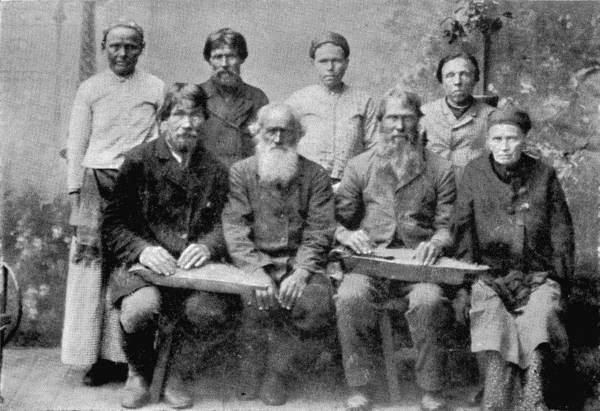
She went on to tell us of a curious old fashion in Finland, not
altogether extinct. During the time that a corpse is being laid out and
washed, professional women are engaged to come and sing "the corpse
song." This is a weird melancholy chant, joined in by the relations as
far as they are able, but chiefly undertaken by the paid singers. This
confirmed what two of the Runo singers at Sordavala had told us,
that they were often hired out to perform this lament, and, as we were
much interested in such a quaint old custom, we asked them at the time
if they would repeat it for us. They seemed delighted. The two women
stood up opposite one another, and each holding her handkerchief over
her eyes, rolled herself backwards and forwards, slowly singing the
melancholy dirge the while. They had a perfect fund of song these Runo
women, of whom our friend at the Savupirtti constantly reminded us;
we told her that they had recited how Wäinämöinen had made himself a
Kantele out of the head of a pike, and how he had played upon it so
beautifully that the tears had welled to his own eyes until they began
to flow, and as his tears fell into the sea the drops turned into
beautiful pearls.
We asked the old dame if she could sing?
"Oh yes," and without more ado this prima donna sang a song about a
girl sitting at a bridge waiting for her lover. It ran—Annuka, the
maid of Åbo, sat at the end of the bridge waiting for a man after her
own mind, a man with tender words. Out of the sea came a man, a watery
form out of the depths of the waves with a golden helmet, a golden cloak
upon his shoulders, golden gloves upon his hands, golden money in his
pockets, and bridal trinkets such as formerly were given to all Finnish
brides.
"Will you come with me, Annuka, fair maid of Åbo?"
"I do not want to, and I will not come," she answers.
Annuka, the maid of Åbo, sits at the end of the bridge, and waits
for a man after her own mind, a man with tender words.
Out of the sea comes a man, a watery form out of the depths of the waves
with a silver helmet, a silver cloak upon his shoulders, silver gloves
upon his hands, silver money in his pockets, and silver bridal trinkets.
"Will you come with me, Annuka, fair maid of Åbo?"
"I do not want to, and I will not come," she answers.
Annuka, the maid of Åbo, sits at the end of the bridge, and waits
for a man after her own mind, a man with tender words.
Out of the sea comes a man, a watery form out of the depths of the waves
with a copper helmet, a copper cloak upon his shoulders, copper gloves
upon his hands, copper money in his pockets, and copper bridal trinkets.
"Will you come with me, Annuka, fair maid of Åbo?"
"I do not want to, and I will not come," she answers.
Annuka, the maid of Åbo, sits at the end of the bridge, and waits
for a man after her own mind, a man with tender words.
Out of the sea comes a man, a watery form out of the depths of the waves
with an iron helmet, an iron cloak upon his shoulders, iron gloves upon
his hands, iron money in his pockets, and iron bridal trinkets.
"Will you come with me, Annuka, fair maid of Åbo?"
"I do not want to, and I will not come," she answers.
And then came a poor man, whose only wealth was bread. It is not gold,
nor silver, nor copper, nor iron, but bread that is the staff of life.
This is emblematical, to show that money does not make happiness, and so
Annuka, the maid of Åbo, takes him, and sings—
"Now I am coming to you, my husband. Annuka, the maid of Åbo, will
be happy now, and happy evermore."
Many old Finnish songs repeat themselves like this, and most of them are
very sad.
Our dear old woman was moved to tears as she sang in her squeaky voice,
and rocked herself to and fro.
As she sang a butterfly flew past us, and was quickly joined by a
second, when a small fight ensued, the pretty creatures coming together
as though kissing one another in their frolicsome short-lived glee, and
then separating again, perhaps for ever.
"Ukonkoira" (butterflies), remarked the old woman, beaming with
pleasure. Then our student explained that the butterfly was looked upon
as sacred, and its flight considered a good omen.
We had been much impressed by our old dame; her innocence and childish
joy, her love of music, and her God-fearing goodness were most touching.
We cannot repeat too often that the Finn is musical and poetical to the
core, indeed, he has a strong and romantic love for tales and stories,
songs and melody, while riddles are to be met with at every turn, and
the funny thing is that these riddles or mental puzzles often most
mercilessly ridicule the Finns themselves.
No language, perhaps, is richer in sayings than the Finnish. When a Finn
sees any one trying to perform some feat beyond his power, and failing,
he immediately laughs and cries, "Eihän lehmä puuhun pääse" (the cow
cannot climb a tree). Or, when speaking of his own country as superior
to every other land, he invariably adds, "Oma maa mansikka muu maa
mustikka" (my own land is a strawberry, all other lands are
bilberries).
These proverbs and riddles, of which there are some thousands, are the
solace of the winter evenings, when the old folk sit opposite one
another in the dark—more often than not hand in hand—each trying who
will give in first and find his store of riddles soonest exhausted. In
fact, from childhood the Finn is taught to think and invent by means of
riddles; in his solitude he ponders over them, and any man who evolves a
good one is a hero in his village. They meet together for "riddle
evenings," and most amusing are the punishments given to those who
cannot answer three in succession. He is sent to Hymylä, which is
something like being sent to Coventry.
He is given three chances, and if he can answer none every one sings—
Hyys hyys Hymylään!
Kun et sitäkään tiedä.
Meaning, "Well, well, off you go to Coventry as punishment for
ignorance."
Then the poor delinquent is made to play the fool. He is set on a chair
in the middle of the room, dressed up as fancy pleases the audience. His
face is often absurdly painted, and after enduring every indignity, to
the amusement of his friends, he is escorted from the room to ponder
over the answers to the riddles. How they chaff him. Does he enjoy
Hymylä? Are the dogs howling and the children running away? If he
wants to come back he had better harness a mouse to his carriage, find a
cat to act as coachman, and a saucepan for a sledge. He must wash
himself with tar and paint himself with feathers.
And so they chaff and laugh on during those long winter evenings, in
their badly-lighted homes, where books are still rare.
Every one in Finland can read to-day, but the first Finnish book was
published in 1542, by Mikael Agricola, the Bishop who made the first
translation of the New Testament; but they cannot read much in their
dimly-lighted houses during the long winters, and therefore it is that
they sing so constantly, and repeat mythical rhymes, or riddles and
proverbs, which our host and hostess declared they loved.
Their Savupirtti and land did not belong to them, the latter told us.
The actual owner was a farmer who let it out in various torps. Our
particular friend, the torppari, paid him one-third of all he made off
his holding, and gave him besides eight days' work during the
year—being called upon for this manual contribution whenever the farmer
was himself most pressed.
This particular little chimneyless house lay eighteen kilometres from
Iisalmi, where the nearest shops were to be found. The poor old woman
told us that she had had nine children, out of which number she had lost
seven. When we considered the smallness of her home, the terrible want
of ventilation and sanitation, the poverty of the people, and the
hardness of their lives, we were not in the least surprised at her
statement, but we marvelled much at the mother having survived all she
must have gone through.
She made a wonderful picture as she sat on the wooden bedstead, her bare
feet playing a tattoo on the wooden floor, while her clean clothes
seemed absolutely to shine against the darkness of the wall behind her.
Although so far removed from civilisation, and from luxuries of any
kind, the old couple knew how to read, and they had one or two treasured
books. Poor as they were, they, like every other native peasant,
possessed a Piplia (Bible), a Katkismus (catechism), a Virsikirja
(hymn-book), and an Almanakka (almanac).
We ventured to ask the good soul if she ever read them. "Of course," she
replied, "or what should we do at the lukukinkerit?"
"And what may that be?" we asked, surprised; only to learn that in the
winter months the priests travel about by means of sledges from one big
peasant's house to another, where the smaller torpparis all assemble,
and there hold an examination of the people in order to ascertain their
holy knowledge.
The peasants rather dread these lukukinkerit, as the priest asks them
difficult questions, which it is considered an absolute disgrace not to
be able to answer satisfactorily. As we know, this was formerly the
custom in Scotland, and severe punishments were given to those who could
not answer rightly, and prove themselves thoroughly versed in Bible
history. This custom is now practically done away with in Scotland,
although the examination for the communion, which takes place twice a
year in the Highlands, partakes somewhat of the same nature. In Finland
the winter examinations are very serious matters, and therefore it is
that the Bible, prayer-book, and hymn-book are to be found in every
peasant's home, while a profound knowledge of their contents is general.
Besides examining the folk on religious subjects, the priest also
severely tests their reading capabilities, for no one can be married in
Finland unless he be able to read to the satisfaction of his spiritual
adviser. This means that all Finland can read. Yet in Russia, near by,
only a quarter of the population know how to read, and far fewer can
write, and they still count by beads.
As we turned to leave the little homestead, we noticed some apparently
dead birch-trees planted on both sides of the front door, and knowing
the birch and ash were still considered more or less sacred by the
peasant, we wondered what such a shrubbery could signify—why, when the
trees were dead, they had not been thrown away. Everything else looked
fresh and green, so we were more than surprised to notice their crumpled
brown leaves, and eventually asked how it came about that these two
young trees were dead.
"It was my husband's Nimipäivä (name-day) lately," said the old body,
"and of course we went to the forest and cut down two birch-trees, and
stuck them into the ground by the front door to bring him luck."
The name-day, be it understood, is an important event in Finnish family
history, a festival equivalent to our birthday rejoicings; and in the
case of the father or mother, the children generally all assemble on
their parent's name-day. The richer folk have a dinner or a dance, or
something of that kind—the poor a feast; but all decorate their front
door with birch-trees, in honour of the occasion, while those who have
the means to do so exchange presents.
Our dear old lady was almost tearful when we left, and, asking our names
most affectionately, tried again and again to pronounce the
queer-sounding Tweedie and Harley. A bright idea struck us; we would
show her the words written, and thereupon we gave her our cards. This
was too much joy. Fancy any one actually having her name on a card. Then
she turned the extraordinary bits of pasteboard over and over, and
seizing our hands, kissed them to show her gratitude. Afterwards she
went to her cupboard, and producing a white handkerchief, one of those
she kept for conveying her Bible to and from church, carefully wrapped
the cards round and round, and promised to keep them always in
remembrance of her strange visitors.
It was really wonderful, driving along the roads, how near our three
kärra kept to one another; sometimes, indeed, they were so close that
we could all converse conveniently. This answered very well, but when,
by chance or design, they got about twenty or thirty yards apart, the
dust kicked up by the horse in front was so fearful that we suffered
much, and it was really amusing at the end of each day to see how
completely our hair was powdered, and note the wonderful gray hue our
faces had assumed, eyelashes, eyebrows and all. I was wearing a black
dress, on the lapels of which it afforded amusement to my companions to
play a game of noughts and crosses with their fingers amid the
accumulated dust. It was extraordinary, considering the thickness of the
sand, for it was more sand than dust that lay upon the roads, that our
ponies could go so well; and when the sun was at its height the heat was
so fearful, and the number of mosquitoes and horseflies so appalling,
that this inconvenience, coupled with the dust, still made it absolutely
impossible at times for us to pursue our journey during the mid-day
hours; but those glorious northern evenings made up for all the
discomfort.
The roads themselves were wonderfully straight, and as there is a red
post every kilometre (or half mile), we could tell how far we went
without even turning our heads, because we could count five or six posts
at the same time, so straight was the way.
As we proceeded farther North the country became more hilly, and our
little animals would stop and walk up steep inclines; having reached the
summit, however, they were wont to gallop full speed to the bottom.
We reached a most charming majatalo. It was near midnight, and, as it
is one of the best in Finland, it was decided that we should there spend
a night. It was only the pretence of a night, however, for the coachman
declared it would be quite impossible to drive during the heat of the
following day, and, consequently, We must start again on our way at four
in the morning at the very latest.
Here at last, thank heaven, we found a majatalo which was properly
inspected. There were iron bedsteads and clean mattresses, and, having
suffered so terribly as we had done, it seemed very bad luck that we
could not enjoy more than three hours' rest in such delightful quarters.
While our supper, which consisted of milk, coffee, eggs, and delicious
butter, supplemented with the white bread we brought with us, was being
prepared, we had a look into the large farmhouse where our host himself
lived.
Instead of the family being in bed, as in an ordinary English farm they
would be at midnight, a girl was sitting in the corner making butter
with an old-fashioned churn of the wooden-handled type, which you pull
up and down to use. There had evidently been a great baking that day or
the day before, for the farm kitchen seemed to contain hundreds of
loaves, which were stacked on the floor, piled on the table, and strewn
on benches, not yet having been suspended by means of strings from the
ceilings and rafters.
We thoroughly enjoyed that evening meal, sitting on the balcony, or
rather large porch of the little annexe kept for strangers; one and all
agreed no nicer butter, sweeter milk, or more perfect cream—of which
they brought us a quart jug—could be found anywhere, and that
travellers must indeed be hard to please who could not live for a few
days on such excellent farm produce, even though they might have to
dispense with the luxuries of fish, flesh, and fowl.
Three A.M. is a little early to turn out of bed, but when one is
travelling through the wilds one must do many trying things, so we all
got up at that hour, which, judging by our feelings, seemed to us still
midnight. The sun, however, was of a different opinion, he was up and
shining brilliantly long before any of us.
We had previously told our Finnish student the joke of having tried to
order hot water over night, and, after much explanation and many
struggles to make her understand, how the girl had returned with a
teacup full of the boiling liquid, and declared that the greatest
trouble we were forced to encounter in Finland was to get any water to
wash with, more especially warm.
He smiled, but was not daunted. We heard him up early, and imagined he
was arranging things with the coachman and ordering breakfast—for we
cannot ever be sufficiently grateful to our Finnish friends for their
kindness and thoughtfulness in managing everything for our comfort from
the first day of our stay in Finland till the last; but he had done more
than this, and apparently made up his mind that we should never, while
he travelled with us, have cause to accuse Finland again of being unable
to produce Hett vatten!
At three A.M. a knock came at the door—a most unusual form of
proceeding in a country where every one walks in without this
preliminary—and, having opened it in reply, we found a buxom maid
standing with an enormous jug of boiling water, and a yet more enormous
wooden pail, such as one might require for a family wash, full of the
same boiling liquid, and a tub outside the door from which volumes of
steam were rising. It was for the English ladies, she said.
Our student had paid us out, and we felt ashamed and sorry.
As we sat at breakfast we watched a girl drawing water from the well.
Every house in Finland, be it understood, has its well, over which is a
raised wooden platform something like a table with a hole in the middle
for the bucket to pass through. A few feet back a solid pillar stands on
the ground, through the fork-like top of which a pine-tree trunk is
fixed, generally about thirty feet long. It is balanced in such a way
that at the one end of it a large stone is tied to make it heavy, while
suspended from a fine point, standing in mid-air, appear a series of
wooden posts joined together by iron hasps so as to form a long chain or
cord, to the bottom end of which the bucket is attached. Thus the bucket
with its wooden string is, when filled with water, equivalent in weight
to the stone at the other end of the pump. In fact, the whole thing is
made on the principle of a pair of scales.
The girl seized the empty bucket, pulled it over the hole, and, hanging
on to the jointed poles with all her weight, sent the bucket down some
thirty feet into the well below. By this time the stone at the far end
of the pole was up in mid-air. When she thought the bucket was full she
let go, and immediately it began to rise at the same time as the stone
at the other end began to descend, and in a moment the beautiful
well-water reached the surface. Such pumps as these are to be found all
over Finland, and their manufacture seems a speciality of the country.
We had considerable fun over the coffee cups at breakfast, for every one
of them had written round its border love passages and mottoes in
Finnish—another instance of how the love of proverbs and mottoes is
noticeable everywhere throughout the country. Our gentleman friends had
great jokes over these inscriptions, but they unkindly refused to tell
us what they really meant.
We had learnt a good deal of Finnish from sheer necessity, and could
manage to order coffee or milk, or to pay what was necessary, but our
knowledge of the language did not go far enough for us to understand the
wonderful little tales printed round the coffee cups from which we
drank. Again we were given silver spoons.
For once we really started at the hour named, and at four o'clock, with
a crack of the whip, our ponies galloped out of the yard of the most
delightful majatalo we had ever slept in. On we drove through the
early hours of the morning, everything looking fresh and bright, the
birds singing, the rabbits running across the road. As we passed fields
where the peasants were gathering in their hay, or ploughing with an
old-fashioned hand-plough, such as was used in Bible days and is still
common in Morocco, we wondered what Finnish peasants would think of all
our modern inventions for saving labour, especially that wonderful
machine where the wheat goes in at the top and comes out corn at one
end, chaff in the middle, and straw, bound ready for sale, at the other.
We drove on till nine o'clock, by which time we were all ready for
another meal. Jogging along country roads aids digestion, and by nine we
had forgotten we had ever eaten any breakfast at all. We had really
arranged to spend some hours at our next halting-place, in fact not to
leave until the cool of the evening, so as to rest both our horses and
ourselves, and be saved the glare and the heat. But tired as our animals
seemed, and weary though we were, that station proved impossible. We had
to stay for a couple of hours, for it would have been cruel to ask the
ponies to leave sooner, but we were indeed thankful that we had not
arranged to spend the night in such an awful hole. To relate the horror
of that majatalo would be too fearful a task. Suffice it to say
everything was filthy, and we felt sick at heart when drinking milk and
coffee at the place. Worse still, our white bread had come to an end,
and we had to eat some of the native rye bread. The housewife and all
the women in the house being terrible even to look upon, it seemed
perfectly awful to eat bread that they had made, but yet we were so
hungry. Reader, pity our plight.
Though the sun was blazing, we dare not sit inside, for the little tufts
of hair tied round the legs of the tables a foot and a half from the
floor found here practical use. These fur protectors are often used in
Suomi to keep insects from crawling up the legs of the table, but, in
this case, when we bent down to look at the bit of ba-lamb's fur so
tied, we saw to our horror that it was full of animal life. Calling the
attention of one of our Finnish friends to this fact, he told us that
there was a saying that none of these creepy things would come across
filbunke, and that a friend of his, travelling in these Northern
parts, had on one occasion been so pestered that he fetched a wooden mug
of filbunke, and with a wooden spoon made a ring on the floor with the
soured milk, inside which he sat in peace, the crawling things remaining
on the outside of his charmed circle.
"And," he added, laughing, "we will go and fetch filbunke, if you
like, and then you can all sit inside rings of your own."
"No," we replied, "instead of doing that, let us get away from here as
quickly as possible."
Out we sallied, therefore, to ask the coachman how soon he could be
ready to drive on to Kajana.
How typical. There was one of the lads, aged thirteen, lying on his
back, flat out on the wooden steps of the house, smoking hard at a
native pipe; his felt hat was pulled down over his eyes, his top boots
were standing beside him, and over them hung the rags he used for
stockings.
"Go on," he said. "Oh! we cannot go on till this afternoon, it's too
hot."
"But," remonstrated Grandpapa, "it is not so very far to Kajana, and
the ladies are anxious to get to the end of their journey."
"Quite impossible," he replied, "the horses must rest."
Wherein he certainly was right; the poor brutes had come well, and,
after all, whatever the horrors and inconveniences may be to oneself,
one cannot drive dumb animals to death, so, therefore, at that
majatalo we stayed, weary and hungry prisoners for hours. Only think
of it!
Oh, how glad we were to shake the dust of that station from our feet,
and how ridiculous it seemed to us that such dirty untidy folk could
exist in the present day, to whom "Cleanliness is next to godliness" was
an unknown fact.
We found some amusement, however, for the family had just received in a
box-case a sewing-machine—a real English sewing-machine. A "traveller"
had been round even to this sequestered spot, possessed of sufficient
eloquence to persuade the farmer to buy his goods, and it certainly did
seem remarkable that in such a primitive homestead, with its
spinning-wheel and hand-loom in one corner, a sewing machine and a new
American clock should stand in the other.
On we jogged; but, be it owned, so many consecutive days' driving and so
few hours' rest, in carts without springs or seats and without backs,
were beginning to tell, and we were one and all finding our backbones
getting very limp. The poor little ponies too began to show signs of
fatigue, but luckily we at last reached a hilltop which showed we were
drawing close to the end of our kärra journey. We pulled up for a
while to give the poor creatures time to breathe, and for us to see the
wide-spreading forests around. The view extended for miles and miles,
and undulating away to the horizon, nothing appeared but pine-trees.
No one can imagine the vastness, the black darkness, the sombre
grandness of those pine forests of Finland.
Then the descent began; there were terribly steep little bits, where the
one idea of the ponies seemed to be to fly away from the wheels that
were tearing along behind them. We held on tightly to the blue knitted
reins, for the descents in some places were so severe that even those
sure-footed little ponies were inclined to stumble—fatigue was the
cause, no doubt;—but if our own descent were exciting, it was yet more
alarming to look back at the kärra following, too close for comfort,
behind us, literally waggling from side to side in their fast and
precipitous descent, encircled by clouds of dust.
Kajana at last. What a promised haven of rest after travelling for
days in springless carts, happily through some of the most beautiful and
interesting parts of Finland.