Across the hills, and far away
Beyond their utmost purple rim.
Tennyson: The Day-Dream.
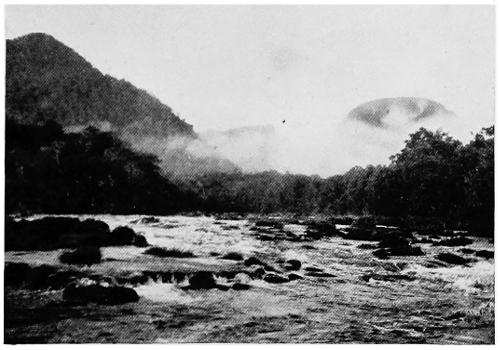
It took some time to ferry our whole party across
the Ireng, as there were only three boats available—namely,
two small dug-outs and a large
one, the latter specially made for us by the
Mataruka people. The crossing was an amusing
performance to watch, and very picturesque the
dug-outs looked piled up with baggage and
people. Meanwhile, my husband and I rested
in shade under some trees at the mouth of the
Waikana creek, which drains the Mataruka
savannah and joins the Ireng through a narrow
rift between hills that completely conceal the
plain from the river-side. But, once through
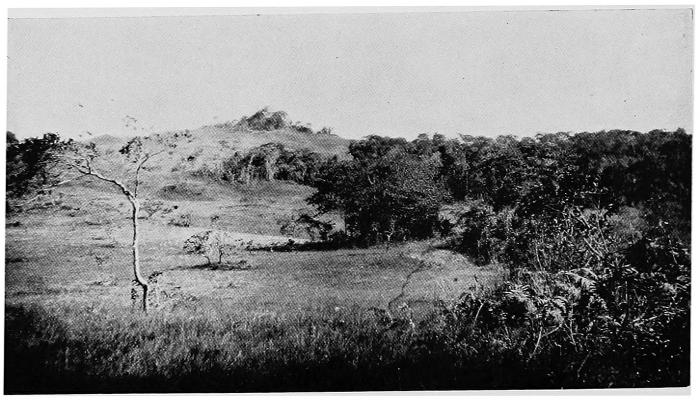
this gate, an extensive flat prairie lies before you;
and an hour’s march over it brings you to
Mataruka village, at the foot of the mountain of
the same name, which we had first seen from the
Karto tableland, and which had been in view off
and on ever since. Even at the village you are
only halfway across this admirable pasture-land,
which is flanked on the east by Mount Bulak-köyepin,
a landmark conspicuous during many
days of our journey, and on the south by the hills
that divide the Ireng from the Kotinga watershed.
A tropical sun blazed down out of a cloudless
sky, and I was extremely glad to avail myself
of the hammock, and to find that the men carried
me very comfortably. They bore me along faster
than I could have walked.
Mataruka is a large Makusi village; and we
found all its inhabitants drawn up in two long
lines, with their chief, Albert, at their head, waiting
to shake hands. I did wish that the fashion
of shaking hands had not spread to this far-away
corner of Brazil, and I left the brunt of it to my
husband; but all the mothers brought their babies
to me to shake hands. They seem to regard it
as a most important ceremony, and, of course,
we should have hated to hurt the feelings of this
friendly, pleasant people. Albert, a very stout
and heavy personage, whom we did not much
like, wore a pink shirt and grey trousers, all much
too small for his portly figure. In expectation
of his church bell and gramophone, he had mustered
his people from far and wide to meet us.
He had also caused a banaboo to be built for us,
a very large, though unfinished edifice, of which
the greater part of the roof had been completed
and also the sides to windward—a fortunate circumstance,
as the wind sweeps ceaselessly over
the Mataruka plain. We went into our house,
followed by the entire village; and Albert then
brought up Joseph, our future guide, a very shy
Makusi cowboy. My husband asked him how
many days the journey to Roraima would take,
and he answered by nervously reeling off all the
names of mountains and rivers we should pass.
This certainly made it sound a very long way
indeed. Joseph we found to be a really good
fellow, and we became very fond of him before
the end of our journey.
These preliminaries being over, “gramophone
talked,” with great success, and was duly handed
over to Albert after he had been instructed how
to work it, together with his church bell. No
sooner had that been done than he proceeded to
ring the bell as a summons to the villagers to come
to church. Albert, who has strong ecclesiastical
leanings, has set apart as a church in his village a
very nice banaboo with a pointed apse containing
a picture of the Madonna and Child. Logs
on the floor serve as pews for the congregation,
which trooped in dutifully at the sound of the
bell—men, women and children, dogs and poultry.
Then began a sort of religious service; for
Albert conducts lengthy prayers and hymn-singing
every morning and afternoon. We could
frequently catch the words “Ave Maria” and
“Spiritus Sanctus”; and, whenever the congregation
fastened upon any phrase or tune they
knew, they all shouted lustily together. Albert
himself intones rather well, having been taught
by an itinerant Roman Catholic priest. On
every day we spent in the village Matins and
Evensong were duly celebrated, while in the
intervals the gramophone proved a great success.
There are several houses in Mataruka, and also a
corral for the cattle. At our request, a herd of
about fifty head was driven into the corral for our
inspection; and the Makusis said there were, in
addition, plenty of wild cattle round about. Here
we enjoyed a plentiful supply of new milk,
brought to us in large gourds, and on our return
journey a bullock was killed for our benefit.
The dogs of Mataruka were unfortunately even
more insistent than those we had hitherto had to
endure. Nothing was safe from the miserable
starving brutes. They sprang upon the rough
tables made of cross-wise branches and snatched
anything that was put down for a second. Poor
Haywood was almost beside himself, and was
quite hurt with me for collapsing with laughter
as a dog swallowed three eggs and made off with
two fish that had been brought as a gift. The
fish were certainly very stale and the eggs probably
likewise, so it was not a matter to grieve over,
as the loss of a precious ham at Chiung had been.
We went to bed as usual at dusk. The night was
chilly, and the glory of the stars above the wide
plain was wonderful.
We were up again breakfasting on porridge
and fresh milk by starlight with a sinking
Southern Cross before dawn of day (9th January).
There was, however, much delay in starting off,
as we had an almost entirely new set of carriers.
The Mataruka folk appeared to regard our expedition
to Roraima in the light of a pleasure trip,
and a large number of women, and even one baby
in arms, accompanied us on the march there and
back. I think they enjoyed the idea of a pilgrimage
through the Arekuna country under a
safe escort. There is no love lost between Makusi
and Arekuna; the latter are stronger men and
fiercer, but the former are much more numerous.
So, our camp-followers being many, the usual
load for a drogher, which is between fifty and
sixty pounds, was considerably reduced, and
several men carried next to nothing. Our rate
of travel was thereby much accelerated, and
everyone was extremely cheerful, regarding the
whole jaunt as great fun.
From Albert’s village our trail ascended between
Mount Mataruka on our right and Mount
Kako on our left. The valley, up which we
climbed, was very hot, even at half-past seven in
the morning, and we wound up it with the sun
at our backs towards an elusive pass over a succession
of ridges, each one pretending to be the
real summit, and when we had surmounted it,
behold! there was yet another beyond. It was
an exceedingly pretty valley with long golden
grass, dotted with picturesque shade trees; but
the Indians behind us set fire to the grass,
and on our return it was a blackened desolation.
Indians always set fire to the prairies
when they travel, partly to keep the trails clear
and make walking easier than it would be in long
grass, and incidentally to drive away snakes, but
partly out of merely childish pleasure in the blaze.
It is very bad for the country, as the soil after a
burning tends to get washed off the hills by the
next heavy rain.
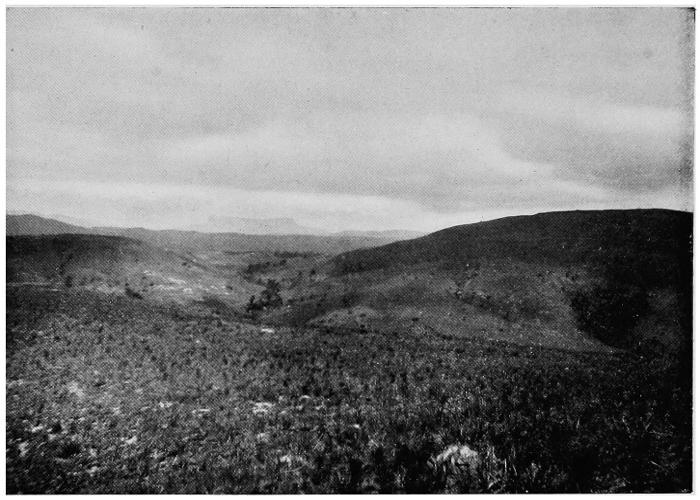
When, after climbing for an hour and a
quarter, we really reached the final ridge at a
point 2,350 feet above sea-level, the view was
glorious and the air so keen and invigorating, so
strong and beautiful, that with each breath we
seemed to be drinking health and energy. From
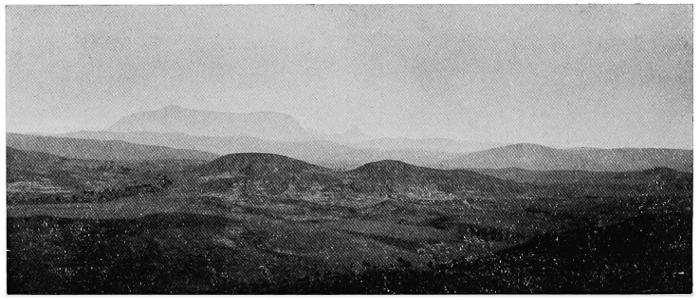
this pass the most striking feature of the landscape
was Mount Chakbang, far away to the west-north-west.
It looks in shape somewhat like a
clenched fist, with one finger pointing up to the
sky. This mountain is indeed a surveyor’s friend,
for it is visible and unmistakable from nearly
every elevated point in the country.
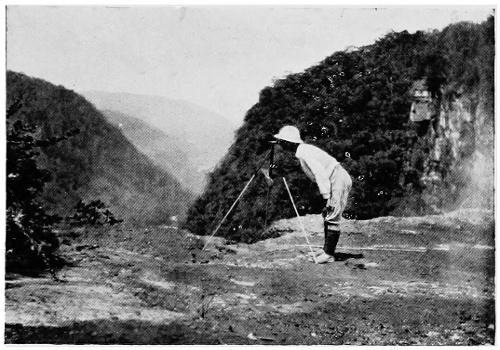
Joseph, our guide, a most picturesque bronze
figure, with his scarlet loin-cloth, his little quake
containing a hammock and drinking gourd on his
back, and a pair of chickens on his arm to assist
the commissariat, was always close to my husband,
telling him the names of all the hills far
and near, whenever we halted for observations.
He was tall and very lean and carried a knife in
his hand, with which he would gesticulate to himself
as he walked, describing semicircles in the
air with it, or pointing away to distant hills,
evidently reciting in his mind all the different
trails of the neighbourhood.
From the col between Mount Mataruka and
Mount Kako, the trail taken by Joseph descended
slightly across an upland savannah and led us in
forty-five minutes to another col between the
hills to the east of Rera, a plain almost as large as
that of Mataruka and exceedingly well watered,
draining into the Kotinga. Rera is Joseph’s
home, and he pointed out his house far away to
the south of the golden savannah on a knoll,
where stood three banaboos with cattle grazing
close by. No breath of air stirred in the Rera
plain, and I was glad of my hammock. Johnny
and Jack had evidently found my weight the day
before more than they could bear, and had each
provided himself with a tin canister instead; but
I had two fresh volunteers, an old man, whose
name did not transpire, and his son, who called
himself “Misterquick.” Mr. Quick is an
Anglican parson who used to visit the district.
These two Makusis carried well; but Indians dislike
weights on their shoulders, as they are accustomed
to carrying on the back, and they often
complained, “Mamma heavy.” I did not, however,
require them to carry me for long at a time,
though the hammock was very useful in enabling
me to rest every now and then for ten or fifteen
minutes without delaying the line of march.
After skirting the Rera plain for some distance
past the foot of Mount Kurowya, we crossed a
rather nasty little eta-swamp, and then turned off
at a right angle to ascend a pass between Mount
Kumâraying and Mount Sakmann—a steep and
rocky track. Halfway up we stopped to take
lunch, where a delicious rippling brook crossed
our path. Unfortunately, there was little shade
and no breeze, so it was very warm. We made an
excellent meal off our Puwa beefsteak, for meat
keeps several days in this atmosphere. We also
took note of the extraordinary number of people
in our train; but, as only nineteen claimed
rations, we realized that the others had come
independently for the sake of the journey. There
were some uncommonly good fellows amongst our
men. Daniel, Joseph’s great friend and ally,
was a thoroughly hard-working boy. A younger
Thomas formed with Haywood our commissariat,
and a very efficient one too. Thomas carried the
lunch-basket and all the materials and implements
immediately necessary for making and eating a
meal, and he stuck firmly to a position just behind
Haywood, which meant that he was always well
to the front. Thomas also became a very handy
man about camp, and learnt with Indian deftness
to manipulate our folding beds, chairs, and table.
In return for these services, he was admitted to
mess with Haywood, who took care that he should
always have enough to eat, or rather that there
should be plenty, for an Indian has an infinite
appetite and can never have enough. Haywood
observed to me once: “I does like to see Thomas
eat. He eat so diligent”; and it was an apt
remark, for Thomas would squat down to finish
the remains in a saucepan with an air of rapt
thought, the complete concentration of a man
who is faced with one of the great tasks of life,
and he would scour and scour again the inside of
the pots with his spoon, until no smallest speck
of food could possibly be scraped together, before
he would consent to wash them. Thomas’s wife
came too, carrying a baby, as well as a quake with
their hammocks and food. I was rather anxious
about that baby the first day, exposed to torrid
sun with nothing on its head; but it was perfectly
well and cheerful the whole time—a fine little
boy. Johnny and Jack of Chiung were another
pair of stalwart friends. Jack wore a felt hat
with a green ribbon run in and out round the
crown. It looked a very quaint apex to his
brawny, bronze-red figure. He was an exceptionally
powerful fellow, whilst Johnny was a
dear old man to whom we became much attached.
He would come holding out his hand, saying
“Mamma” in a most appealing way, to beg for
a piece of chocolate; and if I refused him a bit,
he would sulk just like a spoiled child, and pretend
to be deaf when spoken to. Then the
“Pirate,” as we christened him on account of a
red handkerchief he wore tied round his head, his
real name being Alexander, was a cheery personage,
always to the fore, despite the fact that
he was very elderly; and he was closely followed
by his nimble, if likewise elderly, wife. The
“Nut,” too, having discarded necklaces and
trousers, proved a useful retainer.
After our meal we started again up the hill.
It certainly was a roasting climb; but a delicious
breeze met us on the top and fanned us as we
went down the other side. We descended into a
small grass plain, at the end of which we crossed
a narrow strip of bush, where, as usual, a path
had recently been cleared for us; and then, following
the bank of a delightful jasper-bedded
little stream with pretty cascades and crystal clear
water, we wound in and out between low hills in
a narrow valley until the trail again took us to a
hill-top, whence we perceived that we had come
in a sweeping semicircle from Mataruka back to
the Ireng, which was again at our feet. At this
point we were two and three-quarter hours’ march
from the col between hills above the east end of
the Rera plain, say six miles by the trail in all its
windings; but the distance back to the col
between Mount Mataruka and Mount Kako was
only four miles in the direct line of vision.
Plainly, therefore, there must be some straighter,
if more arduous, path over this stretch of country;
and, as a matter of fact, the Arekunas who accompanied
us on our return journey did make a short-cut,
which took them from the Paiwa valley to
the saddle between Mount Mataruka and Mount
Kako without traversing the Rera plain. Their
path was, however, described by Joseph, with an
expressive gesture, as “Mountain-top, mountain-top,
mountain-top.” We could now see the
savannah peaks above Enamung as well as those
near Puwa, and it would evidently be possible to
reach Enamung from the Karto tableland by a
route far more direct than ours had been. Indeed,
Joseph afterwards told us of a trail leading from
Karto village to Enamung in two stages. That
would undoubtedly be the best line for any future
traveller bound for Roraima, as the long détour
through Chiung, Puwa, Mataruka, and Rera, is
thus avoided. Still, we did not object to the
longer march. It was all very delightful in the
keen air and sunshine, and I realized with great
thankfulness that I was now hardening to the
sun and felt extremely fit and well.
From our hill-top we continued for some time
along a ridge, descending gradually at first, and
then sharply, till after twenty-three minutes’
walk we forded a beautiful clear stream, almost at
the level of the Ireng, which it joined a short distance
to our right. Then, on a low knoll beyond,
we stepped upon some stone slabs with curious
markings on them, and here Joseph said, “Makunaima
pickaninny, he dead.” Makunaima is the
goddess whose tears, shed for the loss of her pickaninny,
are said to form Roraima’s waterfalls, and
this we supposed to be the child’s burial place.
Then came another little flat meadow, a strip of
woodland over some undulating ground, and we
again emerged into a large grassy plain in the
middle of which stands Paröwöpö village. I say
“village,” but there was only one banaboo and an
open building, which the few women about the
place called “church,” but which contained no
holy pictures nor any sign of worship. Our whole
party established ourselves in this “church”;
and, while we took tea, the women brought cassiri
for our droghers. As each fresh batch of
men came in, the cassiri bowl was handed to
Joseph to give them at his good pleasure. After
tea we had some difficulty in getting our caravan
to restart from Paröwöpö. They explained
that Enamung was “far far”; but, Joseph having
prescribed Enamung as our destination for
the night, we would not listen, but pressed on.
Another hour and a quarter brought us to
Enamung village. The trail, after leaving the
Paröwöpö plain, passed through the forest-belt
which fills the low saddle between the hills that
separate the two savannahs. The trail in this
forest had been admirably cleaned and widened,
and even the leaves had been swept off the path.
Towards sunset we emerged from the bush into
a lovely scene, open savannah, with a broad
stream curving through it in a semicircle. On
our side of this stream the ground rose and fell
in pleasant undulations, whilst on the other side
it rolled up into high grassy peaks. We could
hear a cataract roaring on the right, where the
river disappeared from view. This river, called
the Wairann, is a tributary of the Ireng, and
we followed its course upstream for several miles
next day. The Enamung village consists of two
houses and a cattle-pen, perched up on a grassy
knoll just above the right bank of the Wairann.
A more beautiful spot for a camp cannot be
imagined. But we had barely time to spread
our tarpaulin over a wooden framework that stood
between the two banaboos before night closed in
on us; and just as dusk was falling some children
drove up cattle into the pen. We counted twelve
head. They were a good, short-horned, straight-backed
breed. This was the last place at which
we saw cattle on our outward journey. Of
course, the herds one sees at the various Makusi
villages are only the tame cattle; and we were
told that a far larger number roam wild among
these uninhabited savannahs, and are shot by
the Indians, when they have a craving for fresh
beef.
It grew very cold directly the sun had gone
down, and the moon circled with earth-shine was
glorious, likewise the stars. Luckily there was
no wind, as our camp was most exposed. The
Indians and Mr. Menzies all slept inside the banaboos;
but we were in the open, and, as we lay with
all our blankets over us, looking into the infinite
depths of the starry skies, the muffled roar of the
distant cataract filling the air, four lines of Matthew
Arnold’s which have always haunted me and
filled me with longing since I was a child came
into my mind:
In the moonlight the shepherds,
Soft lulled by the rills,
Lie wrapped in their blankets,
Asleep on the hills.
On the morrow we were up again by starlight
and admired an exceptionally bright Southern
Cross. Then, after swallowing a large plateful
of porridge each, washed down with some coffee,
we were off on the trail as day dawned. From
Enamung village a climb of twenty-three minutes
took us to the brow of a hill, whence we had a
good view up the valley of the Wairann and far
beyond to Mount Weitipu, one of the giants
standing near Roraima. The path, however,
dropped down again to the river, which curved
back to us, and we followed its right bank upstream
for two hours in a beautiful valley. On
the left bank rose an almost perpendicular grassy
hill; but we wound alternately through meadows,
strewn with big black boulders, and through belts
of woodland, where, as before, a bridle track had
been cleared for us. The river was roaring in
cataracts or meandering in still reaches beside us
or racing round islands. It contains a large
volume of water.
Our caravan halted for “breakfast” unusually
early, and we expostulated with Joseph; but he
waved his hand in the direction of our onward
path, which was now to leave the beautiful
Wairann, and said, “Tuna (i.e., water) far, far.”
The Indians have a manner of saying “f-a-a-r-far”
in a faint voice that is wonderfully expressive
of distance.
When the meal was over we resumed our
march, and a five minutes’ climb uphill, followed
by a seventeen minutes’ march across a small
plateau, finally took us from the watershed of the
Ireng to that of the Kotinga. From the small
plateau we again obtained a glorious view of
Mount Weitipu, rising high and blue above all
intervening hills. The next hour was spent in
descending from the plateau, fording a little brook
which falls into the Karakanang, a tributary of
the Kotinga, re-ascending on to another and very
stony tableland, to the south-east of which was
the Karakanang gorge, far below the level of our
trail, and so reaching the point where that river is
forded by stepping-stones of red jasper just above
its leap from the plateau level into the gorge. The
heat of the sun, though intense at midday, was
mitigated by a heavenly breeze that fanned us
steadily. Flights of locusts rose at our approach
and flew round us, hitting us all over. The
Indians eagerly caught as many as they could and
ate them raw on the spot, regarding them, apparently,
as titbits.
The Karakanang is a most fascinating river,
flowing crystal clear in a succession of little vertical
falls, or else sliding over long, smooth slabs
of jasper into limpid green pools. This is the
regular formation of river-beds in the upper
Kotinga watershed. The colouring of that country
is exquisite: greeny-grey grass, red soil, and blue-green
crystal-clear water, flowing over coral-red
jasper bottoms. When we had crossed the Karakanang,
the tableland widened into a fine grassy
savannah, surrounded by a stately amphitheatre
of hills, and we marched over easily-undulating
ground for an hour and a half, crossing in that
time no less than six small streams, that flowed
through gulleys in the plateau to join the Karakanang.
The course of these tiny cañons could
be traced afar off by the eta-palms growing in
them. At last we came to a rift in the tableland,
where, beyond another small stream, there was a
strip of forest, through which, for the first time
since leaving Karto tableland, we found that no
trail had been cleared for us—a plain hint that we
were now passing from the land of the Makusis
into that of the Arekunas. Moreover, the stream,
where we reached it, ran in a deep pool, too deep
to ford; so, while Joseph and some of the men
were felling a couple of small trees for us to cross
by, and clearing a path through the wood, we sat
down under a big tree, drank cold tea, which
Haywood had handy, and ate chocolate. Joseph’s
arrangements being complete, we crossed the pool
on his makeshift bridge, and a few minutes’ walk
brought us to the other side of the bush. Thence
our trail gradually sloped down over a grassy
savannah to meet the Warukma River, where it
races down over a jasper bed, glittering under the
sun, from the heart of the mountain amphitheatre
that swept round in a majestic circle to
our left.
We forded the Warukma and camped on the
ledges of its left bank. These torrents, when
swollen by heavy rain, must be a splendid sight,
but they would then be very difficult to cross. A
delicious current of icy-cold water was flowing in
the bed of the Warukma; but wide stretches of
jasper floor were uncovered and dry, and on one
of these Joseph and his men improvised for us a
most ingenious tent. They placed one end of a
ridge-pole in the fork of a tree on the bank; the
other end they supported on cross-wise poles,
whose bases they propped up with big stones.
They then stuck short uprights, on which to tie
the tarpaulin, in cracks of the ledge and buttressed
them up with stones. It was very picturesque.
The ledge made us a beautiful, clean, level floor,
and this was, in fact, the nicest camp of our journey.
We bathed in a natural “porphyry font,”
a few yards upstream from our tent. The water
was stone-cold and clear, and the pool very deep.
Little fish, about the size of a trout which would
be thrown back as too small, and of a bright green
colour, with black “eyes” on them, came swimming
up curiously to examine us. We had a still,
cloudless night; the moon was very bright, but
not large enough to dim the radiance of the stars.
We woke to find the weather deliciously cool
and grey; and, after our porridge and coffee, we
started “under the opening eyelids of the morn”
to climb steadily until we reached the ridge of the
mountain amphitheatre. It was an hour’s ascent.
At the top we found a fine, grassy, high-level
plateau, well watered, but almost treeless, which
it took us just half an hour to cross. The freshness
of the grey morning gave wings to our feet.
We crossed a brook and a water-hole on this
plateau, for the country is wonderfully irrigated,
and every tableland seems provided with springs
of clear water. At the far end of the plateau,
before descending, we had a superb view back to
Mounts Mataruka and Bulak-köyepin. Given
favourable weather conditions, Roraima, Kukenaam,
Wei-assipu, Weitipu, and Muköripö can
all be seen from the trail itself at this point, which
is 3,150 feet above sea-level; but on our outward
journey they were densely veiled in cloud. If you
climb a peak rising above the plateau a little to the
east, Mount Chakbang also comes into sight. It
is a splendid observation-post for a surveyor, and
for that reason my husband labelled it “Landmark
Peak.”
Our path now descended very gradually in the
valley of a stream, which rises on “Landmark
Peak” and soon becomes a fine jasper-bedded
watercourse, the trail betaking itself to the river-bed,
where the smooth slabs made excellent
going. This stream is called Aimaratökpai. It
was very nearly dry—a fortunate thing for us;
but I should love to see these rivers rushing down
in spate over their smooth stone floors. The bed
of this particular stream had weathered to a slate-blue
colour, but there was a good deal of pink,
disintegrated jasper sand lying on it. The effect
of the blue floor, with its pink streaks of sand and
the grey hills above it, was very lovely and curious.
Too soon the line suddenly decided to leave
this friendly river-bed, and we had to scramble
up a steep bluff about sixty feet in height. An
Indian trail always makes a great point of doing
the unexpected. We then traversed a very
switchback of a path, winding over hill-spurs,
until we gained the top of a steep slant into the
valley of the Waraïna, a confluent of the Kotinga.
The view from this spot, before we descended,
was beautiful, and our whole company sat down
to admire it. Indians love to look out over a big
stretch of country, and it is amusing to watch a
crowd of them pointing out to each other all the
salient features and tracing with finger-tips the
directions of different trails over distant hills.
Their language seems onomatopœic, and at times
one can gather the gist of their conversation without
understanding one word. It sounds very
much as though they spoke in tones, like the
Chinese, but, much more quietly. They are a
curiously quiet people, the result, I suppose, of
living amid that big, silent Nature. We never
heard them sing on the line of march, or even
when paddling, and they seldom raise their voices.
In camp, with thirty of them close by, they never
disturbed us. If we happened to wake in the
night, only the flicker of the fires, which they
keep going throughout the dark hours, reminded
us that they were near us; and even in their villages
they make little noise. A mere dozen blacks
or Chinese would give one a very different tale to
tell.
A steep scramble downhill brought us to the
side of a brook, which we followed for a short distance,
and which flows into the Waraïna. We
left the brook just before the watersmeet, and
crossing in the fork a little belt of land, where
some fine cassava was growing, we forded the
Waraïna. Then a short walk took us to our
breakfast camp on the Opamapö, another confluent
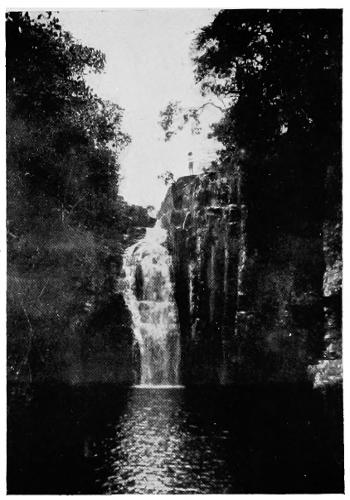
of the Waraïna. This is one of the prettiest
spots in the country; for here the Opamapö
makes a vertical leap of some sixty feet over a red
jasper cliff into a clear, deep, jasper-ledged, tree-girt
pool. The crowning note of colour came
from a purple-blossomed tree projecting over the
cliff-side. We sat on the tree-shaded ledges
above the fall, drawing water for our meal from a
limpid, green pool, and the stream beyond wound
away fringed with eta-palm. Steep, green hill-shoulders
formed the far horizon.
After an hour and a quarter’s rest, during
which we ate cold chicken, one of the four
brought with us from Mataruka, and our men
regaled themselves with cassava and dried beef,
we proceeded on our way, fording the Opamapö.
The weather was still delightfully grey and cool,
and we met a few light, passing showers—greetings
from Roraima behind his cloud-wall. We
marched in a steadily widening valley for fifty
minutes until we reached the crest of a low ridge
that forms the water-parting between the streams
that feed the Waraïna and the basin of the
Kotinga itself. The latter river, however, as had
previously been the case with the Ireng, remained
invisible until we reached its edge. We were
now in the gently-sloping pasture-lands of a magnificent
valley, beautifully watered by numerous
streams, whose course is marked in the lush grass
by avenues of eta-palms; but no human habitation
or sign of cattle could anywhere be seen.
We put up a big deer, but it escaped us easily.
There were signs that a fire, probably lit by travelling
Indians, had recently passed over the place,
the grass being very young and green, and the
stems of the palms blackened and scorched. On
our right we now saw Mount Weitipu quite
clearly, with Mount Muköripö, an oddly-shaped
rocky cone, close beside him. The ground undulates
gently, forming a plateau some three hundred
feet above both banks of the Kotinga, which
flows in a narrow trench below the spacious
acclivities of the surrounding country.
At last from the edge of this plateau we saw at
our feet the Kotinga itself, with its turquoise-blue
water, flowing through a valley of brightest green,
dotted with eta-palms. So attractive and refreshing
it looked that we little guessed the hidden
plague awaiting us, until Joseph said resignedly,
pointing down to the river: “Kabouru plenty,
plenty.” We now descended quickly to the left
bank of the river, crossing the ravine of a boisterous
little brook on the way. The river-bed is here
about 2,200 feet above sea-level; and the ford is
not far below the confluence of the Kwating from
the north-west and the Pipi—another blue jewel
in a setting of eta-palms—from the north-east, to
form the Kotinga proper. It was by far the most
serious obstacle of the kind that we had to negotiate.
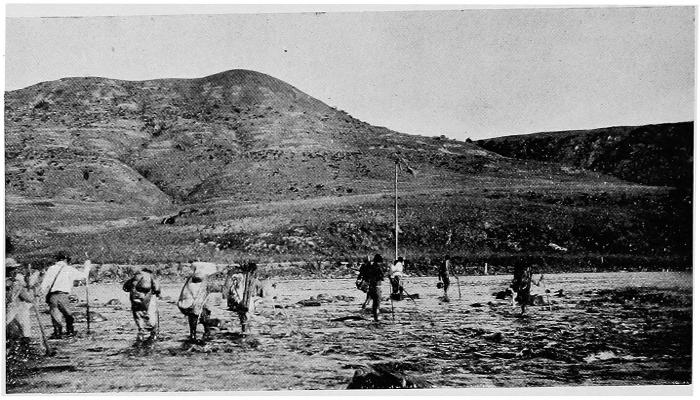
The river at the ford is some two hundred
feet wide, and contains near the left bank an
island of some size—the usual camping-ground of
Indians on their way over this trail—and near the
right bank another much smaller island. The
ford runs diagonally across at the brink of a small
rapid over jasper rocks, water-worn and slippery,
and would doubtless be quite impassable when the
river comes down in spate. As it was, the water
came well above my husband’s knees; and, the
current being strong, we had to plant our feet
carefully at each step to avoid an accident. We
had by this time become quite accustomed to
wading over streams, and much enjoyed the delicious
feeling of the stone-cold water round our
feet and legs. Our clothes and our canvas rubber-soled
boots dried very quickly in the sun after each
such crossing. Joseph wanted us to camp on the
island near the left bank, but we did not like the
look of it. It was covered with dense bush, and
the kabouru, from which pest we had been happily
free since crossing the Ireng, rose in their millions
to receive us. Besides, we felt that a ford,
once begun, is better done and finished with. It
was great fun getting across. Joseph held my
arm firmly, and piloted me with much care and
skill. The long file of our Indians, men and
women, gingerly picking their way along the
brink of the rapid, was a quaint sight.
On the right bank of the Kotinga, in the neighbourhood
of the ford, there was no “bush,” without
which, of course, one cannot camp, as firewood
is essential, and the Indians must have trees
on which to hang their hammocks. So we moved
on, the trail turning downstream to the left and
then up an eta-fringed brook. After a little while
we forded this brook, and, having crossed a low
ridge, we made camp at 4.30 p.m. on the banks of
another stream in a clump of bush at its edge.
Alas! there was no escaping the kabouru! As
soon as we had halted, they came about us in
swarms, and rendered life intolerable until dark,
at 6.30 p.m., when they all disappeared. The
ups and downs of camp life are truly astonishing!
The night before, in the Warukma bed, we had
had as perfect a site for our camp as we could possibly
desire, whilst the Kotinga valley camp could
not well have been more disagreeable. It was
not a picturesque camp either, for the surroundings
had recently been scorched by fire. The
stream beside us was, however, pretty enough.
It dropped in a cascade into a steep gulley at our
feet, there disappearing into a dense thicket. But
there was no level ground, so that we spent an
uncomfortable night with our beds at a slant. I
would strongly advise future travellers by this
route to endeavour to ford the Kotinga early
enough in the day to permit of their camping for
the night some way up the hills to the north or
south of the valley, at a distance from the river.
Next day (12th January) we were up, dressed,
and packed before dawn, to avoid the kabouru.
It was a glorious, cool morning. A heavy dew
sparkled on the grass, and the air was keen and
fresh. Our path continued obstinately to the
left, despite the fact that our goal lay behind
Weitipu on the right; and we passed over beautiful
undulating meadows, like English hayfields
ready for the scythe, and then round hill-spurs,
until after one and three-quarter hours’ march we
reached the valley of the Chitu, a large confluent
of the Kotinga, crossing on our way frequent little
brooks that tumbled down steep gulleys. Here
the Indians and Haywood killed a snake in the
grass, and the latter said it was a labaria and
poisonous; but is a snake ever killed which the
people concerned in the daring deed do not
declare to be deadly?
We forded the northern fork of the Chitu close
to the point where it descends out of a steep line
of hills, and up the steepest part of these hills our
trail then proceeded to climb. Pink soil showed
through the grass, which was now short and growing
in tussocks, so that we knew we were still on
jasper formation. The hill ascended in a series of
terraces, the ascent between each being almost
vertical; and on each terrace we paused to drink
in the wonderful beauty of the widening view, for
our hill-side commanded a great stretch of the
Kotinga valley, shut in far away by the mountain
ranges we had crossed in the previous forenoon.
The sun filtered through the clouds enough to
light up the scene with the most extraordinary
and exquisite colouring, the far hills being a marvellous
sapphire and the nearer country a brilliant
emerald, patched with purple cloud shadows.
It reminded me dimly of old stained glass and of
the colouring of Rossetti’s pictures. We were
climbing the crest of the hill-ridge in the fork
between the northern and southern branches of
the Chitu River, and one hour’s effort brought us
to the summit. We then had a view right back
to “Landmark Peak,” while in front of us
stretched a tableland, over which the wind blew
keen and cold, for we were 4,500 feet above sea-level.
Such a country! And there it lies, all
untouched and unknown, the great silence of solitude
brooding over it! Save for a handful of
nomadic Indians scattered over the vast prairies,
never a man treads these lonely regions.
For the next hour and a half our path lay over
charming upland savannah, with here and there a
strip of woodland, intersected by numerous brooks
hurrying down in cascades to meet the Chitu. We
halted beside one of these rivulets, crossing, as
usual, just above a cascade that fell into the customary
deep green pool. We had to put our
coats on directly we stopped to rest, for the sky
was overcast and a chilly but invigorating wind
was blowing. Anyone who filled these highland
valleys with cattle and built himself a jasper house
amidst the life-giving breezes of the hills would
have his lot cast in a fair land. After luncheon
we walked on again, and were caught in one or two
light showers of cold drizzle, though not enough
to soak our clothes. We descended slightly to
cross the southern fork of the Chitu, racing down
to its valley. The ford is short, but deep. Then
we climbed to the head-waters of the Chitu close
by. Here is, we believe, the divide between the
Amazon and the Orinoco; and, if so, at this point
we presumably crossed from Brazil into Venezuela.
These two republics, however, have not
delimited the frontier in this neighbourhood.