 TIRRING times are these
when the whole of
Europe has to give its
opinion, and I may say
decision, as to whether
Austria may snap up
Bosnia and Herzegovina,
and Bulgaria may assert her independence
and style her princeling a Tzar,
which seems crowing rather loud and savours
of the bantam in the poultry yard! However,
we shall see what happens in the near future;
meanwhile I am thinking that a very interesting
tour I made through these provinces with
my paint brush, may be attractive to those
who take an interest in other nations and
other countries. Several books have already
been written on Dalmatia, but I do not think
any have been illustrated by the brush, and
I have seen no books on Bosnia and Herzegovina,
or that barren, wild country Montenegro,
with its range after range of rocky,
jagged mountains.
TIRRING times are these
when the whole of
Europe has to give its
opinion, and I may say
decision, as to whether
Austria may snap up
Bosnia and Herzegovina,
and Bulgaria may assert her independence
and style her princeling a Tzar,
which seems crowing rather loud and savours
of the bantam in the poultry yard! However,
we shall see what happens in the near future;
meanwhile I am thinking that a very interesting
tour I made through these provinces with
my paint brush, may be attractive to those
who take an interest in other nations and
other countries. Several books have already
been written on Dalmatia, but I do not think
any have been illustrated by the brush, and
I have seen no books on Bosnia and Herzegovina,
or that barren, wild country Montenegro,
with its range after range of rocky,
jagged mountains.
I have been twice in Dalmatia, the first
time we sailed on our yacht Vanadis
from Venice, touching at Pola—a stormy
passage of eight hours. At Pola itself there
was not much for me to see beyond a fine
Roman amphitheatre, two gates and two
temples. It is the centre of the Austrian
naval base, and was bristling with ironclads;
our Captain elected to steam calmly
in among them, but we had soon to make a
retreat, piloted to the other side of the
harbour by some Jack Tars, who were each
presented with a cigar for the “entente
cordiale” of the nations.
From Pola we went on to Abbazia, which
is an Austrian invalid watering place and, sad
to say, was full of consumptives. It is quite a
pretty place, with a Casino, public gardens,
and a wonderful artificial walk, a veritable
sun trap for miles by the sea. On our arrival
we found another yacht moored to the only
buoy—there is no harbour, so we had to
drop our anchor hoping for a fine night, which
it was.
The next morning I went ashore to sketch,
and the rest of the party went in the launch
to Fiume, which had no attraction for me.
A heavy thunderstorm that afternoon made
the streets very wet, but we bravely struggled
to a café and listened to the Hungarian band,
at the same time drinking some excellent
coffee with the milk nicely frothed up in a
jug, and each person had his own little tray.
The yacht which had secured the buoy the
evening before, had taken its departure early
in the morning, so we attached ourselves to
it, and as the Captain remarked “possession
was nine tenths of the law,” the other yacht
had the privilege of taking turn in dropping
her anchor for the night.
Some of the peasant women were very
picturesque in costume, and wore a kind of
ballet skirt, Hessian boots, and a red handkerchief
tied round the head and floating at
one side.
Though as I said before, I have twice been
along the Dalmatian coast, I have not visited
any of the most interesting islands, and my
stay at the various towns has been far too
short to please me, but it could not be avoided,
I was at the mercy of a yacht, and in order
to visit the principal towns in a country which
possesses one small railway connecting two
coast towns and one inland town, it was
necessary to allow myself to be whirled along
at the pleasure of others, who wanted not to
linger brush in hand.
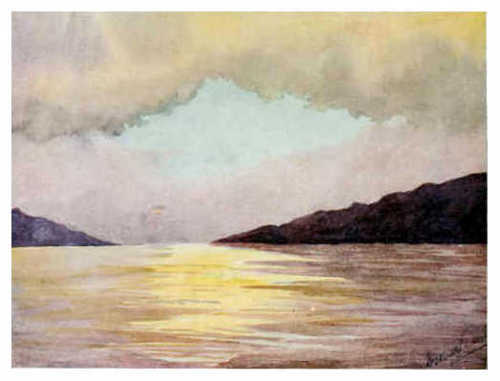
Evening—Abbazia
The history of Dalmatia dates, I think, from
the year 180 B.C., when the tribe from which
it takes its name declared their independence
from Gentius, King of Illyria, and established
a republic. In 156 B.C. the Dalmatians
were attacked by the Romans and compelled
to pay tribute, but it was not till the reign of
Augustus that their country became a Roman
province. Under Tiberius, Dalmatia was
thoroughly Romanised, it gave to the world
the Emperor Diocletian, who eventually
retired to Salona, the new Dalmatian capital,
where are still to be found the remains of
his magnificence. It then fell into several
successive hands, and in the seventh century
it received the dominant element of its
present population by the immigration of
the Slavs invited by Heraclius.
In the ninth century the Croatian influence
was high, and Croatian princes were
recognised as kings of Dalmatia. In the
tenth century Venice extended her power,
which is still visible in the many beautiful
buildings seen all along this coast. About
the year 1018 the Doge took the title of Duke
of Dalmatia. Venice and Croatia struggled
hard for supremacy during the eleventh
century, and in 1091 the Hungarians ousted
the Croatians. The maritime cities of Zara,
Traù, Spalato and Ragusa, had each their
separate history, and attained much prosperity
by commerce and industry. These
towns sided with Venice and were at times
under her control, until the treatment by
that great republic disgusted them and they
welcomed Louis of Hungary. Venetian
authority was, however, once more asserted,
but in 1797, Dalmatia became part of the
Austrian dominions to which she has belonged
ever since, with the exception of a Napoleonic
period from 1805-1814. The Austrians were
not popular, the feeling of the country being
extremely hostile, and in 1869 an insurrection
was put down by force of arms.
Water in Dalmatia is scarce, and the only
rivers are the Krka and the Cettina. Outside
the towns is very little vegetation; barley,
wheat, maize, oats, rye, millet, beetroot,
hemp and potatoes are all grown somewhere;
coasting for miles and miles nothing is seen
but pinky grey rock, and now and then a
bush, though as you go further south vegetation
becomes evident and vines are grown,
the grapes producing a full, red wine which
is much exported to Bordeaux; and olives,
the oil of which is also exported.
About eighty-nine per cent of the natives
belong to the Servian race and speak a Slavonic
dialect, but there are a good many
Italians; most of the natives understand
Italian I found. The principal religion is
Roman Catholic, there are also those who
follow the Greek Church. The Roman Catholic
Archbishop has his seat at Zara, and
Spalato, Sebenico, Lesina and Cattaro are
Bishoprics. Donkeys and goats abound,
and there are some sheep. The peasant
grinds his corn and weaves his clothes at
home.
Lace making is a great industry amongst
Dalmatian women, and there is a special
school at Spalato where the most beautiful
patterns taken from the Churches are copied.
Sponges also are found near Sebenico.
Anchovies and tunny fish are caught in large
quantities and many other kinds of fish.
Zara we reached on April 14th, but here
on this our first visit, we discovered no
harbour, though next time we found the
harbour was quite on the other side of the
town. As we did not relish the idea of tossing
about all night on the open sea, we decided
only to stay a very short time just to visit the
town and then push on to Zara Vecchia
for the night.
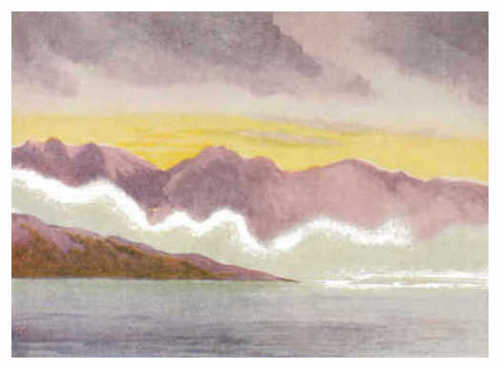
After a Storm—Abbazia.
The town looks very new from the sea,
and appears to be composed of large white
modern buildings with red roofs, one hotel,
“The Bristol,” looked most imposing and new,
but you must penetrate behind all this, where
you will find the old town of Zara with its
narrow streets, with many Roman and Venetian
remains, of the former two large Corinthian
columns still stand, one they say is
where it was first erected. A plaque of
stone or marble let into a wall, on which a
most graceful figure of a dancing girl was
carved, and there was also quite a museum
of statues and other relics. The Duomo,
with its beautiful façade, is distinctly
Venetian, and the Lion of St. Marc watches
at the gates of the town.
Zara, now, is specially celebrated for its
mareschino, where are two manufacturies.
Our large party landing caused quite a
flutter amongst the inhabitants, some of
whom were most picturesque, the women
with bright red and yellow aprons, white
head shawls embroidered in many colours,
blue skirts and red stockings. Some of the
men in blue trousers, all rucked up the leg,
red, gold-embroidered jackets were thrown
over one shoulder, sashes were gleaming
with knives, &c., tucked in, and a curious
tiny red cap with a black tassel crowned
all. This cap looks ridiculously small perched
on the top of the head.
The country here is bare sandy rock, with
a few shrubs dotted about, very barren all
along the shore, and on a dull day would
look very dreary no doubt, but with bright
sunshine the sea is lovely, and the range of
snow-capped mountains behind make a
charming background. We did not land at
Zara Vecchia, and were off at sunrise to
Sebenico.
A lovely little spot is Sebenico, at the
foot of those curious grey barren hills. We
landed, and passed through a quaint doorway,
with picturesque figures going to and
fro, then went up a few steps to narrow
streets—very narrow indeed, but clean, with
many subjects for an artist, but alas! no
time for me—only an hour or two, and what
is that! We wandered about the streets
and many appeals were made as to why
I did not paint this and that—the questioners
quite forgetting architectural subjects
cannot be done in a minute, like the snapshot
of a camera! After gazing at many fascinating
bits, I decided to attempt an old carved
door in a narrow street, and forthwith began,
to be distracted very shortly by two funerals
passing and re-passing, the mourners carrying
each a guttering candle held at any angle and
walking three abreast in the street five feet
wide. My easel was once swept away by a
boy, who, like most boys, did not look where
he was going, luckily no damage was done
and I settled to work again, to be three
times disturbed, I having to flatten myself
against the wall to let the mourners pass.
I worked hard till dusk, then returned to the
yacht.
I thought it a great pity we could not stay
a few days at Sebenico, but on we rushed,
and I must go too this time. I longed to
stay and put all I saw on paper, of all this
beautiful curious scenery, and at some
future date, I hoped to be able to dawdle
along this coast at my own sweet will.
One of our party bought a most curious
knife from a very handsome native, who
showed the purchaser its various uses—the
knife was used to eat with, and shave with,
&c., &c., the double pronged stiletto, which
occupied the same sheath, was to dig into an
enemy. This was about a foot long. These
the natives carry tucked into their belts.
The Cathedral is very fine, Old Venetian,
and had many fascinating corners for the artist.
After lunch we went up a serpentine gorge,
so narrow, that every moment it seemed to
come to an end. The sides were pinky-grey
hills, barren except for a few shrubs, the
whole colouring was most curious, the sea
bright blue-green, contrasting with the rocky
sides. A special pilot came on board for
this cruise, and he nearly ran us into some
rocks, not calculating how much room we
took to turn the corners. When we arrived
at the furthest limit that the yacht could
go, we took to the launch, and approached
the Falls of Krka, where the water comes
down in tiers, very fine. Here electric light
is being made. We walked up to a height
for a view looking back, which was most
extraordinary, the pinky-grey hills, with one
long strip of winding emerald green water
between.
My second visit to Sebenico was under
more favourable circumstances, as I decided
to leave the yacht and put up at the Hotel
Krka with my courier.
La, La! the cold on this my second visit,
but charmed am I to be here once more at this
most fascinating little place, Sebenico, this
time to stay a few days, but oh! the cold!!
I have never felt anything like it in England,
the north-east wind, the Bora (the wind
of the dead) is blowing. I imagine it comes
off the steppes of Russia, from its intense
piercing coldness. The sun is nice and
warm, if you can get out of the wind which
rises very decidedly every afternoon. I
landed from the yacht in the morning,
escorted by my guide. An elaborate programme
was made out, and it was intended
we should travel through Herzegovina and
Bosnia, visiting Jajce, Bajnaluka, Bihac
(pronounced Beehatch), Novi, and Plitvice,
where are wonderful lakes and cascades in
continuation from one to the other. Part
of the journey we carried out, but not all,
as will be seen later on.
At Sebenico, they talk Italian and Slav;
Italian made me quite happy as it enabled
me to converse with the natives. The
national costumes here are most fascinating,
lovely brilliant colouring mixed in the
women’s head-gear and shawls, and some
of the contadine that come in, with dark
blue dresses striped with red, green and
orange, and embroideries of every hue, are
most striking. The men, too, dress very
smartly, and finish off their costumes with
very large silver buttons.
I took a room at the Hotel Krka; the
rooms are quite nice, but the Restaurant
rather dirty. The landlady wanted to ask
me fourteen krones as pension—rather a lot
for this out of the way place, but as I came
off a yacht, I am, no doubt, expected to pay
accordingly; however, I decided to take
my room, and then have my meals à la
carte, and by this means I exactly halved
the pension terms. My first meal was composed
of soup, veal, salad and cheese. I
had not intended to have soup, as I
ordered spagetti, which I naturally thought
would be macaroni and tomato sauce, and
was disgusted to find it the name of a soup.
Wine was given free, and all the other
customers seemed to drink it, but I found
it horribly bitter, and to take off the taste
I allowed myself a mareschino—the only
part of my lunch I enjoyed! At night I
had macaroni in pieces three-quarters of
a yard long, these I found most difficult to
negotiate, as when I twirled it round my
fork, and was about to put it in my mouth,
the whole thing flew off like a spring. I
think it took me twenty minutes to tackle
this dish.
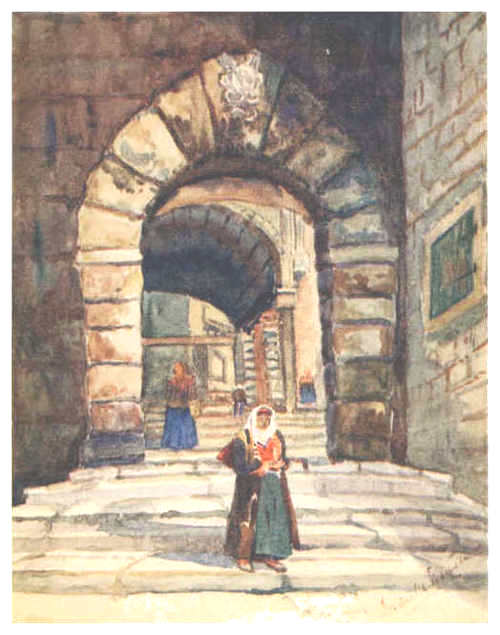
The Porta Marina, Sebenico.
The streets here are very quaint, as the
town is built on the hill side, there are a
great many steps. At the entrance to the
town, near the Quay, is a beautiful gateway
which I tried to draw, but the intense
cold and wind soon sent me away. The
Cathedral has fine doors east and north.
My guide and I wandered about the town
looking for paintable spots of which there
are many, we went into the gardens where
is a statue to Tommaseo (the author), and
in a fountain I saw a fat goldfish who seemed
to look at me out of the corner of his eye,
in surprise at a stranger. There are many
remains of old Venetian days, in old doorways
and on beautiful carvings, and I came
across a fine lion of St. Mark let into the
wall of a building: very old columns, Roman,
are used as corner stones to many of the
houses. The streets are very narrow and
the houses high. May here would be a
charming month, but the end of March is
far too early. My guide and I sat in the
gardens for awhile in the sun, but the wind
sent us indoors, it rose so high and the dust
blew in clouds.
I told my guide to come early next
morning if it was fine and warmer, but the
piercing wind still prevailed, so we waited
till nine, and I drew the pretty view from
my window. I was longing to draw the
gate which I had kept in view from my
earlier trip down this coast and for which
particular reason I came to Sebenico, however
we had no luck, and again I could do
nothing but wander in the streets. I saw
some wonderful Easter offerings, chickens
made of a sort of yellow bread, with two red
paste eggs reposing in their breasts, one
cock’s feather in the tail and another in the
head.
I took a few photographs of the fruit
market, but the non-picturesque people
were very tiresome, coming immediately in
front of my camera at the most critical
moment. One man’s waistcoat was covered
with embroidery and masses of silver buttons
in clusters down the front and others at the
sides; they were very handsome buttons,
large, round, and filagreed, and others were
flat. Those I have on my coat were a source
of great interest, and as the natives talk
Italian, they were a subject of much conversation
between them and myself.
The bread market is very quaint, rows
and rows of long loaves of bread, which my
guide says is sold very cheap to the poor
people. The vegetable market is close to
the bread market, but vegetables are few
just now; where anything green came from
I was at a loss to know, as a fresh blade of
grass even was nowhere to be seen, all is bare
rock and thoroughly winterly in appearance.
On the second day I sallied forth to paint
my gate at 12-30, so as to sit in the sun and
avoid the crowd of natives who had gone
to their mid-day meal, and luckily did not
seem in any hurry to come out after it. On
account of the cold I left early next day,
instead of by the evening train. There are
only two trains, so I decided to leave by the
7-20 a.m. I had hoped to be able to go to
Knin, but we found it took too long for me
to reach the yacht in time. Of course, as
usual, we arrived ages too soon at the station.
A small boy carried most of my luggage and
my guide the rest. The station was about
a mile from the hotel, there are no carriages
in the town, so walking is compulsory. The
train was already in the station, and I naturally
wanted to get into it, but I was waved
back by an official, and was told I must
wait till the appointed time. At Petrovic
we changed trains, and I had time to sketch
one or two natives, the woman wore very
thick dark blue cloth with stripes of red
applique, and green and orange pipings
and strappings, with patches of wool embroidery
at intervals, and an apron of many
colours, edged with a hair fringe; her head
was covered by a white embroidered cotton
kerchief. Also a fine old man made an
imposing figure with his long brown coat,
blue trousers hooked tightly at the ankle,
his many coloured embroidered waistcoat
and his silver buttons, and wide leather belt,
in which were tucked weapons and pipes.
He was smoking a long wooden pipe, holding
the bowl in his hand, chatting to me while
I was sketching him.
We came along the most arid country,
all stones, but lots of vines were growing
apparently out of the stones, as I could see
hardly any soil about them; in some parts
there was more soil, and on the hillsides
patches of earth for vineyards. The railway
winds in and out of the hills which are grey,
and the only bit of colour to be seen was in
the costumes of the peasants, which was an
agreeable relief from the great monotony
of stone. Men and women were very busy
digging and attending to the vines. We
passed Traù and Salona at some distance,
at the latter are many Roman remains,
which are beautifully situated over the bay.
Salona was once the capital of Roman
Dalmatia and had a naval harbour, its
massive walls were washed by the sea in
those days, but now it has receded far from
the ruins. In the Roman Civil War, Salona
adhered to Cæsar, and was besieged by
Octavius, Pompey’s general. Much excavation
is still going on, and the chief relics
are removed to the Museum at Spalato.
Diocletian had a beautiful palace overlooking
this bay, which covered nine and a half
acres in extent. Diocletian was born near
Ragusa.
This little railway ends at Spalato, where
we once more joined the yacht.
Spalato is picturesquely encircled by lofty
hills and lies in a fertile region on a peninsula.
The town owes its name to a great palace
(palatium) of Diocletian, within the precincts
of which a great part of the old town is built.
The palace formed a little world of its own,
with temples, baths, &c., of which the principal
remains are more or less built over, as
for instance the Cathedral piazza, once the
peristyle, has twelve Corinthian columns,
some of which are built into the houses,
while the south end is occupied by an imposing
vestibule with four columns of red
granite. This vestibule once led to the
private state apartments and from it opens
a Rotunda.
The Cathedral, a fine edifice, enclosed
by a dilapidated colonnade (originally the
Mausoleum of Diocletian) is now dedicated
to the Virgin and St. Diomo. In the interior
are eight columns, twenty-three feet high,
bearing an ambulatory, on which stand eight
columns which were once crowned by statues.
Between these columns at the top is a frieze
with hunting scenes, portraits, and various
other figures. The pulpit and choir-stalls
are also Romanesque: the columns of the
former with their capitols are very fine.
The Baptistery was supposed to have been
the private temple of Diocletian, dedicated
to Jupiter.
The Porta Aurea is on the north and is
the palace gate facing the land. This gate
is most imposing and impressive, no doubt
because it has not been mixed up with modern
buildings, so you get a clear view of it.
Happily for me while at Spalato something
went wrong with the yacht’s boiler, this much
refreshed me by its kindness, and I decided
to take a little jaunt of my own to Traù, a
town we had passed on our way, so to Traù
I went, accompanied by the old courier
Angelos. We chartered a carriage and
drove to this dear little place with a lovely
old Venetian Cathedral. At Spalato we
had a thunderstorm, and the weather still
looked threatening, so after seeing the sights
of Traù, I settled down to work on the old
Venetian gate of the town. I had only time
to draw it that evening and hoped to return
next day, as we had to stay the night at
Traù, but alas! it rained hard all night, and
I was wondering if I should rise at day-break
or not, when I suddenly remembered the
door and covered-in porch of the Cathedral.
To this I started off in a downpour, but
found I could sit comfortably inside the porch,
and there old Angelos found me in due course,
hard at work, and there I sat till lunch time.
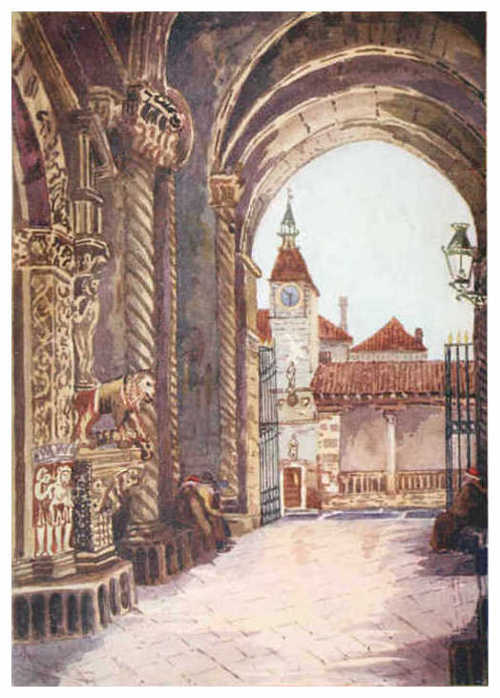
The Cathedral Porch, Traù.
In the afternoon it cleared, and I went
on painting the gate, but the wind blew
my sketch twice off the easel, so I had to
give it up and ordered the carriage to return
to Spalato. Two ruffianly looking youths clad
in brown coats with hoods acted as coachman
and footman. When we reached the octroi,
they had to throw back their coats for inspection
underneath; as it was raining and
the hood was up, the douanier proceeded to
examine the inside of the carriage, and
found old Angelos and myself, at which he
saluted respectfully and waved us on.
I found the family also anxious to visit
Traù, and next morning we all returned by
sea, so much the better for my gate! The
drive is quite pretty, and it was a treat to
see green once more. On the way I passed
seven villages all called Castello something,
as Castelvecchio, Castelnuovo, &c., relics
of old feudal times, there being a castle in
the centre of each village with houses all
round it. I longed to visit each, but had
no time.
The men’s costumes are very striking, blue
trousers open at the back of the ankle to
ten inches from the shoe—a string sandal—little
brass hooks and eyes to fasten them
when required, red sashes and tabs at
the waist, the sash in which the usual
weapon reposes, brown jacket with crimson
velvet slashes and fringe ornamenting
the front, piped with crimson all round, a
waistcoat of red velvet with silver buttons,
and the scarlet cap crowns all. The
women look well in dark blue, with a
red band round the bottom of the skirt,
coloured handkerchiefs on their heads; some
wore long blue coats piped with red and red
bands embroidered down the sides, a sort
of stocking-shoe embroidered in many colours
and an apron of red and yellow.
The landlord at Traù was surprised and
pleased to see me again for my frugal lunch
of fried eggs, Parmesan cheese and radishes;
the yacht had anchored so far out, I could
not go back to it. I finished my work in
hand, and then tried to draw the attention
of someone on the yacht, but it was no use,
so I had to hire a boat from shore.
It was twelve hours run from Spalato to
Gravosa (the harbour of Ragusa). We came
past the islands of Lesina, Lissa, Curzola,
and Sabioncello, and down the Canale di
Melita. We thought of calling at the town
of Curzola, which is well worth a visit, but
as it was blowing hard, we deemed it wiser
to push on.
We reached Ragusa next morning after
a rolling night, and anchored opposite the
town; but there was such a roll on, I was
sure that none but the best sailors would
come to breakfast, so we moved into the
port of Gravosa, two miles away.
Mr. T. and I walked to the town, he, poor
man, politely carrying my satchel. On the
way we passed many villas. The old town
is entered by a charming old gate, called
Porta Pille; old walls surround the town,
which is also a fortress. Directly you enter
the gate a quaint fountain meets your gaze,
and many figures in costumes are grouped
about it. We wandered on down the principal
street of shops, in many of which were
collections of curiosities, embroideries, bags,
belts, swords, old inlaid mother-of-pearl
stocked guns, &c., the belts of enormous
weight were studded with agates, and were
said to have been worn by the women.
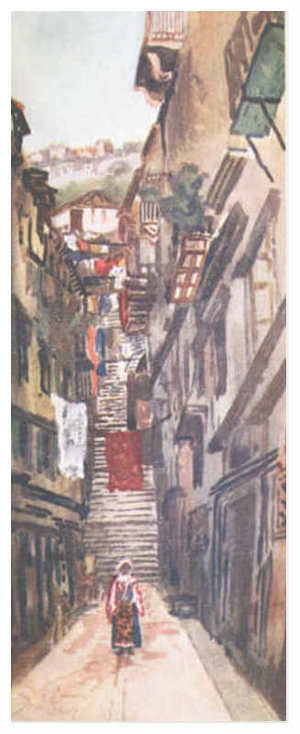
Narrow streets, with innumerable steps,
branched off from the main street; several
churches and two monasteries, the Franciscan
with a charming old courtyard.
A Street in Ragusa
The Rector’s Palace had a fine portico;
these were among the things we saw, but I
have no doubt that there were many others
we did not see of equal interest, as my attention
was rivetted on one of the steep side
streets, bright with all kinds of coloured
clothing strung across it. I had hardly
started work, when down came the rain in
torrents. I sent old Angelos off for a carriage
while I took refuge in a doorway, and I generously
gave the old courier my umbrella as
he had none. After waiting a long time and
getting in despair of his ever returning, I
suddenly heard his voice round a corner, so
I ran. Why he took so long was, that he
had quite forgotten where he had left me!
Some of the others reached the quay at
the same time as I did; the rain coming
down in sheets made it very difficult to get
on board, and the dingey was simply a large
pool of water.
In the afternoon we went in the launch up
the river of the Val d’ Ombra, as we were
told it was a very nice excursion; the
country was very ugly, but the water at the
fall seemed to bubble up from the ground,
coming through, not down the mountain,
when it had disappeared entirely for nineteen
miles.
On April 20th we left Gravosa for Cattaro.
There is not much to see in the town there,
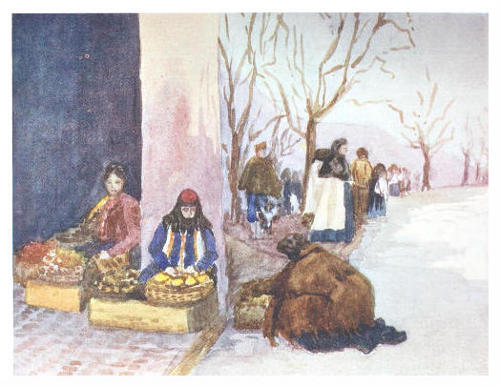
but the market was most fascinating, peasants
in costume from all parts, Brda, or Montenegro,
&c., &c. The Montenegrins are a
very good looking fine race. The women
part the hair in the middle, and wear enormously
thick plaits of hair round the head,
a black shawl in cold weather for the married
women and a little cap for the girls, embroidered
on the crown with I.H. (Nichola I.),
a long white sleeveless coat, a blue or red
zouave of velvet, beautifully embroidered
in gold, ordinary skirt and apron, and shoes
of calf skin with string tops and straps, a
sock with a border of red and blue is worn
over the stocking. The men wear the little
round cap, the sleeveless white coat, and
red waistcoat embroidered in black and
silver buttons, wide, bright blue pantaloons,
and a sash and leathern pocket in which
the revolver rests—these latter they always
wear, except on market days at Cattaro,
where all firearms have to be left behind.
They (men and women) are splendid specimens
of humanity, every man a soldier and
a gentleman, with a fine carriage and a most
dignified manner; they salute or bow, often
both.
In the afternoon, Angelos and I started
off in a carriage to drive to Cettinje, the
capital of Montenegro, where I stayed the
night.
The road zig-zags up the mountain side
all the way from Cattaro to a Col, then zig-zags
down on the other side to Cettinje,
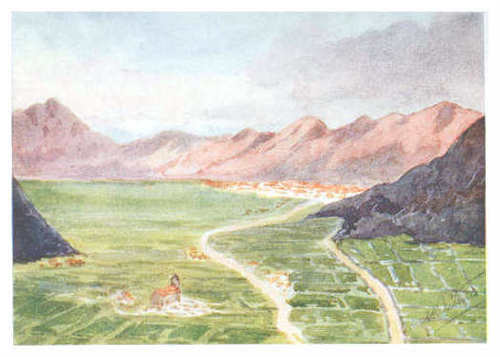
which lies nestling at the foot of steep hills
and at the end of a cultivated valley. The
road was in a state of repair, and was a mass
of stones all the way, which made the drive
of seven hours very tiring. The scenery is
very grand and rugged, the mountains pinky
grey in colour, with very little green at the
commencement of the ascent even, and
these are chiefly shrubs; then this green ends,
and is entirely left behind, and the mountains
stand out in all their ruggedness, with an
occasional patch of snow still left by the
road side at the end of April.
There is very little soil except in the valleys,
and these are old lake basins. Every bit
of soil is used in cultivation. For miles and
miles there is nothing to be seen but rugged,
jagged rock.
On our way we passed a few thatched
cottages, and stopped to bait the horses at
the only village on the road, called Njegus,
which is a short distance over the frontier.
In this village the house is shown where
Prince Nichola was born. While waiting
here, I had a frugal meal of eggs, bread and
wine, and I made a sketch of a very fine
looking young man, much to his amusement
and gratification, as he seemed quite pleased
with his appearance on paper. Several other
good looking young men came to criticise,
some spoke a little Italian but most of them
Slav, I suppose, as they are the descendants
of the old nobility of the Servian Empire,
who fled to the Black Mountains to escape
Turkish oppression, and who maintained
their liberty and independence against all
comers for more than five centuries.
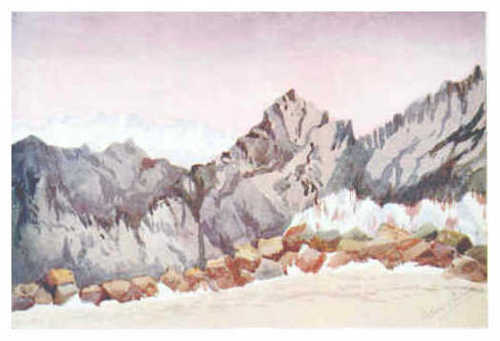
Montenegro.
A blind musician came to play while I was
lunching, his instrument had one string only,
which is usual in this country; but it was
as sweet and melodious as though it had
many strings.
The aspect of the scenery was much the
same until we reached the Col, but when
there the view was grand in the extreme.
Range after range of rocky, jagged mountains,
the lake of Scutari in the dim distance
and the Albanian mountains in snow behind,
and a pinky glow from the setting sun enhanced
the view. Here we paused a few
moments, then began to descend to Cettinje,
which we reached after driving for some hours.
Before going further, I will say a little
about Montenegro, which in extent is about
half the size of Wales. There are a few small
towns dotted about, the capital is Cettinje,
and the only town I visited. The seaport
town is Dulcigno, on the Adriatic; the
whole country is very mountainous and
there are several small lakes, the principal
one is Scutari, of which half belongs to
Montenegro and the other half to Albania.
If I had had time, I should have much
liked to have driven to Lake Scutari, but it
would have taken a whole day to go there
and back from Cettinje, so I had to give it up.
The Montenegrins are such delightful people,
that I believe you can go anywhere in their
country and feel perfectly safe, they are
particularly hospitable to strangers. In the
time of war with Turkey, the Turkish women
and children fled into Montenegro, knowing
they would be perfectly safe from insult of
any kind in the enemy’s territory.
There is but little farming land in Montenegro,
the peasant is glad to enclose the
tiniest patch of fertile soil retained by the
hollows in the mountain sides.
The largest land proprietor is the owner
of sixty acres, and other freehold estates
vary from two to twenty acres, and it is
usually not to the individual, but to the
family that this ownership belongs.
The history of Montenegro from the
earliest times to the Turkish War of 1877,
is one of incessant wars and raids, throughout
the whole of which the country has preserved
its independence, even when Turkish power
was spread over the whole of south-eastern
Europe. The accession of the present
dynasty dates from 1687. Prince Nichola
(the reigning Prince and father of the Queen
of Italy) conducted a successful war against
Turkey; he is a dramatist, and also introduced
a new code of laws.
Bears and wolves are still to be found in
the highest forests.
Cettinje has a population of about 1,300
people, the houses are whitewashed, with
red roofs. The whole town is very clean
in appearance.
It has a broad main street, crossed by
smaller streets. In the main street are
the houses of the foreign representatives.
In the square is the palace of the Prince
Nichola, unpretentious in appearance and
only distinguishable by the guard in front
of it. The Prince still administers open-air
justice before his palace, though lately
the large tree under which he sat has fallen,
I believe.
Cettinje.
Not far off is the palace of Prince Danilo,
his son, the hall of the senate being on the
ground floor. The Ministry, the Court of
Justice, and the prison are adjacent, and
opposite the Ministry is the Monastery, in
whose church the ancestors of the reigning
house are buried. Above the Monastery
rises a round tower, which until lately was
adorned by Turkish skulls. Near the Monastery
is the Museum in which are many torn
standards, arms, medals, etc., etc.
Montenegro has a standing army, in which
every able-bodied man serves for a term of
four months at a time. The Montenegrins are
as fine soldiers as can be found, and the Prince
takes the keenest interest in his army and
his people. Every morning he rides over
to the square, where his subjects await him
bare-headed. He signs one to his side,
who, after kissing his hand, walks along by
the side of his horse as far as the barracks,
the Prince meanwhile discussing and questioning
him as to his family affairs, or crops,
&c. At the barracks the Prince watches the
drilling, chats with his officers, and inspects
the building, after which he will often visit
the Law Courts and superintend affairs.
His people reverence him, and look upon
him as their father in more than name.
I stayed at a comfortable hotel, and next
morning Angelos and I wandered about the
streets, starting at 6 a.m. and visiting several
shops, as I was particularly anxious to buy
one of the pretty costumes, which are so
becoming, and would make such a charming
fancy dress; the shoes were tiresome to get,
as I did not fancy the calf-skin ones which I
was told I must soak to soften, these I scorned,
and at last found a very smart pair with
leather soles and ornamented string tops.
As I had to get back to the yacht and
wanted to do some sketching on the way,
and was tired of wandering about on foot,
we started on our return journey to Cattaro
at 9-30, and it was with much regret that I
left these charming people and their country.
The Market Place, Cettinje.
About half-way I paused to sketch, it was
bitterly cold, and by the time I had finished
could hardly feel my fingers. The horses
had been taken out of the carriage and I had
lunch to warm me up; it was composed of
eggs fried in rancid oil—very nasty! but
the bread was of excellent rye. The rest
of our party passed us on their way to Cettinje,
which they intended to visit and return
in the same day. Soon the wind rose
and came in gusts at every zig-zag going
down the mountain side; I did not envy
the others who could not reach the yacht
again till ten o’clock. The evening was
very stormy, we thought of their terrible
drive in the dark, and were on the look out
all the evening for them. About eight we
saw two lights on the mountain slowly
descending, so we were sure it must be our
travellers, who arrived safe and sound about
10-30, very tired, and one driver was drunk,
so those in the carriage walked eight miles
rather than drive. A stormy, wild coast
is this, warm in the valleys but bitterly cold
in the mountains, and a good deal of snow
still at the end of April.
After Montenegro I decided to return once
more to Ragusa—that fine old fortress town—with
Miss B., so we bade farewell to the
yacht and retraced our steps once more, and
from there we travelled through Herzegovina
and Bosnia.
Here a new guide met me from Pola,
strongly recommended by a friend of ours
there, and he proved a great success, by
name Karabaich.
Miss B. and I found ourselves at a very
comfortable hotel—The Imperial—where we
stayed a week in this delightful old town
surrounded by walls and fortresses.
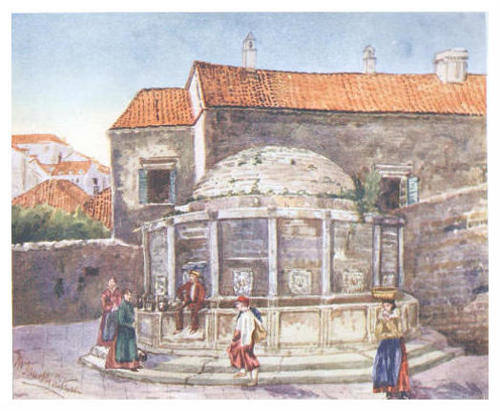
The Fontana Onofrio, Ragusa.
Ragusa lies at the foot of Monte Serjio, and
is built on its steep slopes. Down to 1805
it was an independent republic, but was
annexed by Napoleon, and later in 1814 by
Austria. We enter the town from Gravosa
by the Porta Pille, where in the niche over
the gateway is the statue of St. Biagio, the
patron saint of the town, which is entirely
surrounded by enormously thick walls, on
which it is permitted to walk by an order
from the commandant’s office; but we
found greater attractions. On passing
through Porta Pille you enter the long wide
street called the Corso, and here on Sundays
they run races, one of which we saw, two
men were running backwards and forwards
for four miles. The Corso extends from
one end of the town to the other, and is
flanked by the principal shops and some of
the Churches.
On the right, near the gate, is the large
fountain called Onofrio, which was built in
1473, and here many picturesque figures
come to draw water. To the left is the
Franciscan Church, with its fine cloisters and
its Gothic portal. Rather lower down the
street on the opposite side is the Servian
Church, at the east end of the Corso, in a
square, is the Church of St. Biagio. On the
left is the custom house, formerly the mint.
This was built in the Venetian style, about
1520, and is adorned with a statue of St.
Biagio, it has also a handsome courtyard.
Near, is the clock tower and the guard house
with an old fountain. Then comes the
Palazzo Comunale and the Museum. The
Rector’s Palace with its fine colonnade is
most striking, and passing through the doorway
is a beautiful courtyard surrounded by
pillars, and a noble marble staircase possibly
dating from the fifteenth century, but recently
restored.
Walking further on you come to the Cathedral,
built in the seventeenth century. From
here we pass on to the market place, which
has a beautiful old Venetian door; there one
day I sketched under difficulties, with a
curious crowd and a tearing wind, which
whirled the dust round and round over me
and my easel, in a very aggravating manner.
Returning whence we came, we walked
along to the clock tower, which we passed
under, and immediately to our left was the
Dominican Monastery, up several flights
of steps.
My first day was spent in shopping and
sight-seeing, the former consisted of buying
some of the beautiful gold embroideries. I
found what I think will make a beautiful
dinner gown, the coat is embroidered nearly
all over with the most exquisite gold embroidery;
this coat is sleeveless, but belonging
to it are sleeves which are also a mass of
embroidery, these are cut perfectly straight,
so impossible to wear, but I think they can
be adapted by wearing them outside others
and allowed to fall loose. I also bought a gold
embroidered man’s waistcoat which makes
a very smart trimming for a coat, or could
be used for a winter gown. I found some
old silver pins for hats, and a quaint jug
which has a secret how to drink out of it
without spilling the wine. It is very old,
the wine comes up the handle, round the top
of the jug to the lip, in which is a hole to
drink, all the top of the jug is perforated,
so it is necessary to know the secret to avoid
spilling the wine. I added many other things
to my collection and sent them on to the
yacht to be brought home. These shops are
too fascinating for words, there are so many
things you can’t get at Liberty’s, wonderful
to relate. There are quantities of old firearms
for sale, old guns with inlaid stocks, pistols
of all sizes and shapes, &c., &c. The place
was full of visitors speaking in German tongue,
but we saw no English, or even the ever
present American. There are many old
buildings worth visiting, and the streets
are very quaint and picturesque, also very
narrow, stretching up the hillsides; one wide
long street down the centre of the town,
where the principal shops are to be found.
Friday and Saturday mornings I spent in
painting the cloisters of the Dominican
Monastery, and I persuaded one of the young
monks to pose for me, sitting near the well.
In the afternoon Miss B. and I walked about
the quaint old streets and saw many attractive
bits for the brush, and then had coffee
at a café and sat on the terrace, but the wind
was cold, as we were not in the sun which
is hot. Certainly the weather as to the intense
cold had somewhat improved, and we
found it unnecessary to wear so many coats
and woolly things as before, which was a
blessing.
The peasants were very picturesque, and
there is a great variety of costume both in
men and women, some of course very shabby,
and one wonders how their rags hold together.
All these towns are wonderfully clean and
about here all the people look clean, though
they may be very ragged. The monks at
the monastery were very interested in my
work, and crowded on to the balcony above
me, chattering like magpies. Sunday, I
went to high Mass, and in the afternoon took
a carriage to drive to San Giacomo, a disused
monastery. Karabaich sat on the box with
my sketching materials. Carriages are horribly
expensive, at the rate of about two
shillings a mile. Unfortunately we took it
for granted that we could get on to the terrace,
and allowed the carriage to go away with
instructions to return in three hours. Alas!
the doors were all locked, and though we
found out where the custodian lived, he had
gone to the town, so as it was not very far to
walk to the Villa Adrian, Karabaich and I
decided to look at it on our way back on foot,
as we could not spend three hours doing
nothing by the wayside. The Villa Adrian
is a pension, a charming situation with
several terraces down to the sea; all is quite
new except some of the columns used in the
pergolas. I made various enquiries about the
pension, but was not pleased with the idea
of always schinken (ham) for supper, and
the rooms I saw did not impress me favourably
either. In ten years’ time the garden
will be lovely, no doubt, and in the summer
when the leaves are out it must now be quite
nice.
The next day we went to the much talked
of Island of Lacroma, to which a small launch
conveys you, and you pay the sum of two
krones to go and return, and another krone
to the solitary Dominican monk who inhabits
the island. Lacroma used to belong to the
Emperor Maximilian, and then to Prince
Rudolf, but it was then considered so unlucky
that the Emperor handed it over to the
Dominicans. I asked the monk if he had
seen any ghosts, at which he was much
amused. Part of the Monastery can be
wandered over, and the gardens would be
charming if well planted with flowers. These
gardens, of which there are several, are surrounded
by high hedges, and box borders
enough to delight any one. The rooms of the
monastery are bare, but over each bedroom
door is a rhyme in German, such as:—
“Freund in der Droth
Freund in der Todt
Freund hintern Rücken
Das sind drei starke Brücken,”
and another
“Schweig und Meig
Werk und Leid
Jedes Ding hat seine Zeit.”
and so on over each door.
I saw many prints of Queen Victoria,
Prince Albert, and other Royalties, also
several engravings of old English pictures
by famous artists. The island is itself
covered with small fir and cypress trees, and
has many shady walks. We had some time
to wait for the return launch, and amused
ourselves by sketching the monk; Miss B.
took a photo of him and promised him a
copy. On our return the town was gay with
people of all nationalities and costumes to
see a great race being run down the principal
street, by two men who ran for an hour and
a half without stopping. I sat at the café
and sketched some of the people.
After dinner there was nothing to be done
or to see in the town, and as the drawing-rooms
soon became very stuffy, I went off
to my room after supper.
One afternoon while we were amusing
ourselves by turning over, and I am afraid
purchasing, some of the fascinating goods
in one of the shops, we found a bridegroom
making purchases for his bride elect, who
was attended by her mother and aunt as
chaperones. Both bride and bridegroom
came from the Canali district, where the
women wear a very charming costume of
bright colours. On the head is a little red
and gold embroidered cap, over it a white
embroidered accordian pleated handkerchief,
embroidered vest and bolero, with tassels of
gold coloured silk on sleeves and bodice, a
white apron with a deep embroidered hem,
probably a bright blue accordian pleated
skirt with a border of some other colour.
About the bodice and waist are many ribbons
as ornament, and a sash of many colours
round the waist. We saw a good many so
dressed on Easter Sunday in the town.
On April 4th we left Ragusa in drenching
rain, which began the day before and continued
all the journey to Mostar, but was
happily fine after our arrival about 7-30.
This is a journey of eight hours through the
mountains of rugged grey stone. The railway
goes up a great height and winds in and
out of the hills, the view is more grand than
beautiful. The train stops at many little
stations for the sole reason of allowing the
travellers to have drinks, we concluded, as
at many places we stayed ten minutes for
apparently no reason except that we saw
the travellers flocking into a bar.
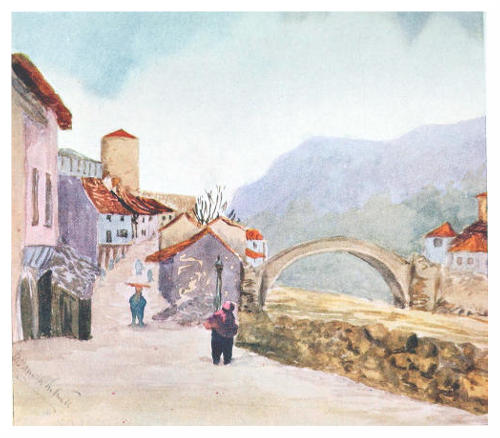
The Old Bridge, Mostar.
Herzegovina, since 1878, has been under
the titular dominion of the Turkish Sultan,
but the administration of Austria-Hungary.
It is bounded on the north and east by
Bosnia, south by Montenegro, and west by
Dalmatia, and only just touches the Adriatic
at Sutterina. Some districts, those of Niksich
and Domitor, have been placed by the Treaty
of Berlin under the Government of the Prince
of Montenegro.
The greater part of the population belong
to the Greek Church. Then come about
70,000 Mohamedans, some Roman Catholics,
Jews, and Gipsies. The Mahomedan population
are those that strike the eye most,
probably because of the men’s picturesque
dress, and the bazaars which one makes a
point of visiting.
The people live chiefly in hamlets, and
there are only about five towns; the capital
of Herzegovina is Mostar.
Over the river Narenta, at Mostar, is a
fine old Roman bridge which connects two
parts of the town.
The river Narenta is the principal river,
and along its valley lies the most cultivation,
olives, mulberries, figs, melons, grapes, rice,
and maize are grown. In some places there
are forests of beech and pine. Many of the
mountains reach to a height of 8,500 feet
near the Montenegrin frontier. There are
many sheep and goats, out of the wool of
which the long white thick coats are made
that you see hanging at shop doors in the
hamlets all the way to Mostar. There is a
high road from Seràjevo in Bosnia, through
Herzegovina to the Adriatic.
We visited these parts in April, but it was
far too early for comfort, and I should not
recommend anyone to attempt it before June.
Herzegovina seems to have changed hands
many times within the last 400 years, at one
time belonging to Hungary, and then to
Bosnia, then Turkey conquered it; earlier,
too, the Venetians seemed to have a look in.
Of its history under the Turks there seems
to be no particular records. Feudalism,
under Mahomedan guise continued to survive
here. The Spahis, begs, or agas, were
mediæval lords who had apostatized to Islam.
They kept their ancestral castles, banners
and title deeds, and patents of nobility.
They enacted feudal service from their serfs
and retainers. One of these Mahomedan
nobles, Ali, Aga of Stolac, did such good
service for the Sultan in his struggle with
the Bosnian magnates, that he was made
Vizier of Herzegovina, which was freed for
a while from Bosnian government. The
reform of Sultan Mahmoud did not by any
means remove the grievances of the population
of Herzegovina. The serfs had now to
satisfy the extortion of imperial excisement
as well as from their feudal lords. The begs
and agas extorted from them forced labour
and a third of the produce; the central
government levied a tithe, which at the date
of the outbreak had become an eighth. Three
kinds of cattle tax: the tax for exemption
from military service levied on every infant
in arms, forced labour in the roads, forced
loan of horses, a heavy tax on grapes and
tobacco, and a variety of lesser taxes crushed
the Christian peasants; but more galling
still the manner in which these taxes were
extorted—the iniquitous assessment of tax
farmers and excisemen—and the brutal
license of the Zaptiehs quartered on recalcitrant
villagers. All this caused the insurrection
of 1875, the villagers of Nevinsinge
(which takes its name from a plateau
near Mostar) who were unable to bear the
extortions and outrages committed by the
Zaptiehs and bashi-basouks, rose against
their oppressors. The insurrection spread
rapidly through Herzegovina and on to
Bosnia, and for a year the Herzegovinians
under their leaders held out against all the
forces of Turkey, and in two struggles in the
gorge of Muratovizza the Turks lost over
2,000 men. In July, 1876, principalities
joined in the struggle; the Russo-Turkish
war followed, and by the treaty of Berlin,
the government of Herzegovina and Bosnia
was confided to Austria-Hungary, while
Niksich and the country about Mount Dormitor
were detached from Herzegovina and
annexed to Montenegro.
Curiously enough, that at this present
time, when all the states around are agitating,
not one word comes in protest from either
of these two states, Herzegovina or Bosnia.
In July, 1878, the Austrian troops crossed
the Herzegovinian frontier, and this news
roused the Mahomedan fanatics to a desperate
effort.
On August 2nd the Mahomedans of Mostar,
believing themselves betrayed by the Turkish
government, rose en masse, murdered
the Turkish governor and officials. The
Austrians pressed forward, and crushing
some ineffectual efforts at resistance, entered
Mostar on the 5th August. Since the completion
of the occupation, the government
of the province has been under the military
governor at Saràjevo, controlled by the
Foreign Office at Vienna. The Sultan has,
up to now, remained the sovereign de jure,
so that the present declaration of Austria
is not likely to involve any alteration of
government from what has gone on all
these last thirty years.
At Mostar there is quite a comfortable
hotel called Hotel Narenta, with a Restaurant
attached, where you can order what you
like in the way of food, without having to
sit through a weary supper—which took an
hour at Ragusa,—and we found the cooking
much better too. Two ladies can travel
alone in these parts quite well, if they can
speak Italian and German, and at the Hotels
they all speak English. I have my guide,
Karabaich, who carries my sketching things
and keeps off the crowd—all of which is a
convenience, but not a necessity so far.
Next day we wandered into the town, which
was a mass of mud. It rained at intervals,
but we managed to see the old town with the
Turkish Bazaar, which consists of tiny shops;
nothing much tempted us to buy, though
it was interesting to look at them. There
are many little Mosques dotted about with
tiny minarets. It was too wet to sketch,
so memory must suffice. I thought of taking
a drive, but the downpour began after lunch.
We wondered how much longer it would
last!!
The stamps of Herzegovina are most fascinating
with little views on them, they can
be had from the value of a quarter of a
farthing upwards, each stamp has a different
view on it, and they are double the size of an
ordinary stamp, so take up a good deal of
room on an envelope.
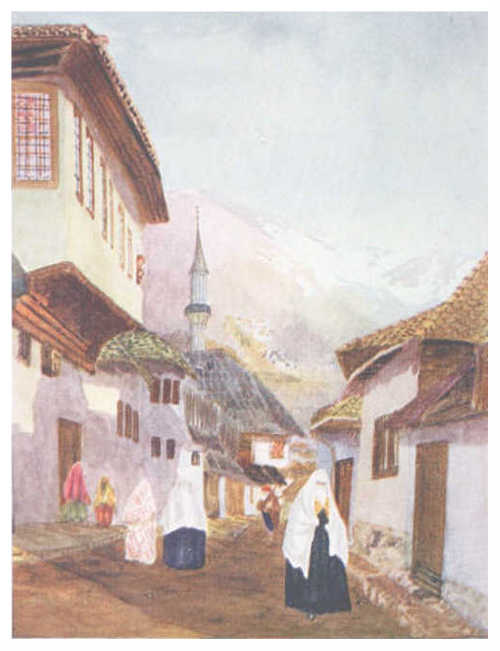
Here we were much impressed by the
women’s ungainly costume with their hideous
baggy trousers, generally of some black
material, the whole of the upper part of the
body and head is swathed in the feridjeh,
and they waddle along very similar to ducks,
the back view being most laughable.
I have painted one in my view of the
bridge of Mostar.
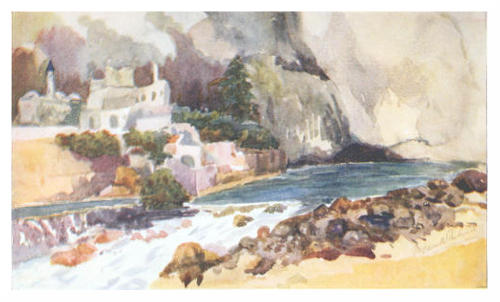
I made the excursion by carriage to the
source of the Buna, about eight miles from
Mostar; happily it ceased raining and I was
able to sketch the source which wells up
from the ground apparently, but is one of
the curious rivers of these countries which
in an extraordinary way find their way
through a mountain. A windmill and
mosque came picturesquely into my foreground,
and the rich deep blue of the water
added to its charm.
I was sorry we had such wretched weather
at Mostar.
The Source of the Buna, near Mostar.
About seven o’clock next day the sun
came out very kindly for our journey to
Saràjevo, the capital of Bosnia, and before
leaving Mostar we paid another visit to the
town, into other streets; but the picturesque
ones are all Turkish. The better
class women wear a most curious feridjeh,
with a bonnet attached to it very like an
elongated Quaker’s bonnet; no one can see
under it, but they see out of a chink. This
domino is generally all black or dark blue.
Many of the women wore trousers under
their skirts, the latter they tucked up very
high to keep them out of the mud.
Going along in the train we saw many
curious houses and scenes. The houses have
all very deep roofs of wood and often the
whole house is wood, there are no proper
chimneys, the smoke coming out at four
little windows in the roof. Ploughing was
in full force, and six oxen are often yoked
to a plough driven by a woman in Turkish
trousers and sort of shawl over her head;
sometimes the trousers were scarlet and the
shawl white, and sometimes the whole costume
would be yellow. The little girls and
boys, looking after the flocks of sheep with
beautiful long white wool, were dressed in
brown sort of riding breeches, the boy wearing
a fez and the girl a kerchief on the
head, the only distinction of sex.
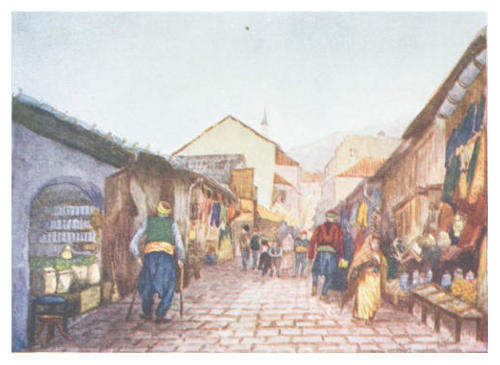
A Street in Saràjevo.
Bosnia, the other state claimed by Austria,
which is very mountainous, is bounded on
the south by Albania and Montenegro, east
by Servia, north and west by the Austrian
dominions, and has an area of about 24,024
miles. A large proportion is forest land,
and valuable as it furnishes timber and fuel.
Plums are largely grown and exported as
prunes; maize and wheat are the principal
crops, but barley, oats, hemp, rice, are grown;
cattle, sheep and goats are plentiful, and
large droves of pigs are fed in the oak forests.
The whole valley of the Bosnia is said to
be a coal bed, and copper is worked in several
places, also at Inatch is a very valuable
cimmabar mine. Marble, too, is found and
there are saline springs. The principal
exports are timber, fruit, cattle, wool, lamb-skins,
furs of wild animals, wax and honey.
Nearly all the trading is with Austria. Lately
several roads have been made that connect
some of the principal towns. The province
is divided into seven Sandjaks. The people
are Servians, but principally Mahomedans,
as is seen in passing many graveyards by the
side of the railway, sadly dilapidated spots,
the gravestones of which for men are composed
of a column, crowned by a carved
turban or fez, generally toppling sideways
over in a melancholy manner and leaning
towards another column. A large part of
the south has an Albanian population.
Mahomedanism is not only predominant,
but often enforced; education is very neglected,
though there are a good many schools.
The population of Bosnia is about 1,592,000.
The early inhabitants were Illyrians, and for
the first time they are mentioned in the
history was 34 B.C. In the Roman period,
of which nothing remains, and at the end of
the fourth century, Roman sway was overcome
by the invasion of the Goths, then
followed Croatians, then Servians. The south-west
part became Christian under Justinian
(527-565) and the rest of it by Servian
apostles, Cyril and Methodius, about A.D. 880.
From A.D. 940 and onwards, Bosnia was
governed by elective princes or “bans,”
who afterwards became feudatories of the
Hungarian kings.
In A.D. 1377, the ruling Ban assumed the
title King Stephen Tvertko I. In the reign of
his eighth successor, Stephen Tomashewitch,
Bosnia was conquered by Sultan Mahommed
II., this was in 1463. In 1528, the banet of
Jaice, and in 1592 the north-west part of
Bosnia was taken by Turkey, and became
the chief theatre of long wars between
Austria and Turkey, which at length were
ended by the peace of Sistova in 1791. The
oppressive Turk left very little peace, causing
the Christians to revolt repeatedly, particularly
in 1850 and 1875; and in 1878, the
Treaty of Berlin handed Bosnia with Herzegovina
over to the government of Austria.
A great deal has been done by way of improvements,
such as new roads connecting
important towns, the railway, also good
gendarmes keep order.
I do not think the Bosnian is at all dissatisfied,
in fact I understand that at a large
meeting at Saràjevo of the Servian Independent
Party, which consists chiefly of peasants,
they decided to send a deputation of sixty
persons to thank the Emperor of Austria
for the annexation of Bosnia and Herzegovina,
and to assure His Majesty of their
loyalty. One half of the deputation would
consist of peasants, and the rest of the clergy
and townsmen. The propositions of Austria-Hungary
being, that the complete autonomy
which would be introduced into Bosnia and
Herzegovina would be based on the three
ruling elements of the population, which
must receive their proper representation in
the Diet. To ensure this free development
of the country, as well as religious peace, each
of the three denominations would elect a
certain number of deputies, but no one would
be obliged to elect a member of his own
persuasion. In addition to the Diet, district
councils would also be created. It is thought
that these arrangements may be carried out
in the Spring.
The chief town, Saràjevo, is picturesque
with its numerous minarets, and there are
nine bridges over its river, the Miljavka.
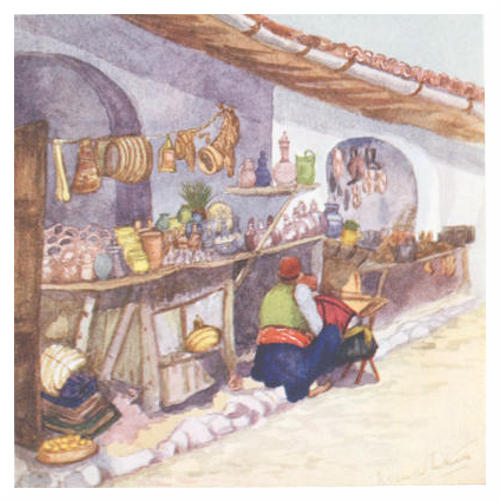
Turkish Shops, Saràjevo.
Sad to say we found ourselves very near
the snow at Saràjevo, and from the incessant
rain the streets were ankle-deep in mud
in the Bazaars. We wandered out in the
afternoon with our skirts not quite so high
as the trousered ladies, but still we were
determined they should be out of the mud.
Of course sketching and photography were
not to be thought of, the only thing we could
do was to patter along and see as much of
interest as possible. In the little shops
copper was being beaten into trays, jugs,
ash-trays, coffee pots and cup holders, also
there were silver and enamel things for sale;
I bought a couple of silver hat-pins. I saw
buckles, brooches, studs, earrings, &c., all
made of silver in patterns or designs carried
out on the article for sale. There were
quantities of shoemakers and saddlers all
hard at work. Stalls of sweet sellers who
have a round table on which to display their
wares laid out in sections. The lemonade
sellers and coffee sellers carried their jugs
and glasses, calling as they walked, very like
Cairo. People wore goloshes or pattens of
wood, some of the latter of which Miss B.
was very anxious to purchase, but I rather
frightened her, saying she might fall on her
nose as she was not used to them, and no
doubt they would be awkward to walk with
at first, so she refrained from buying a pair.
We plodded along for some time, then returned
to a warm café, where we had delicious
coffee with beaten up cream, so grateful and
warming!
The cold at Saràjevo was so great that I
felt very tempted to go straight to Budapest
and give up my tour to Plitvice after all.
It is no pleasure to be even out of doors
in this damp depressing weather, but unfortunately
the morning that was to decide me
broke forth into sunshine once more, and I
decided to go on. No green was to be seen
on any bushes, and the rivers were all in
flood; however, as I had a guide on purpose
for this trip, I wanted to go if possible.
My bedroom had such a depressing outlook
that I asked to change it. A tumbledown
Turkish hotel was not elevating to spirits
I found, and beside that there seemed to be
a general rubbish heap; in fact, I had my
doubts as to whether it was healthy, overlooking
such a place. Though it is always
an effort to change rooms, I made up my
mind it must be done, and changed very
much for the better, moving into quite a new
part of the hotel, which was very sweet and
clean after what I had just left.
The next day was a glorious warm one
and my spirits rose again, so I decided to go
the original excursion to Jajce, and on.
Miss B., who did not like driving and roughing
it, decided she would go direct to Budapest,
and home by Vienna, leaving me on Tuesday
evening. The journeys in these mountainous
regions are very long and the trains creep
very slowly; each little journey in distance
since we left Ragusa has taken seven or
eight hours, but the whole way is interesting.
Early, Karabaich and I wandered forth
with my camera, and in hopes of finding a
place to sketch, which seemed hopeless in
the Bazaars, as the streets are very narrow,
with crowds of people and ponies laden with
wood passing along; those laden with hay
require the width of the street to themselves,
and woe betide the passer-by if he does not
step back into a doorway. After lunch we
went out to sketch, and found a quiet street
which was also picturesque. Karabaich
was busy keeping off the crowd who had
“spotted” me. The boys soon discovered
something out of the ordinary was going on,
and the little girls were made to stand back
by the boys, I fancy, but I was too busy to
pay much attention, and finally got a most
successful sketch with some Turkish ladies
flitting by in the picture; these I had to draw
in very hurriedly, as they, like all Easterns,
consider it bad luck to have a portrait taken,
and many of the groups in the market rapidly
dispersed when they detected my camera.
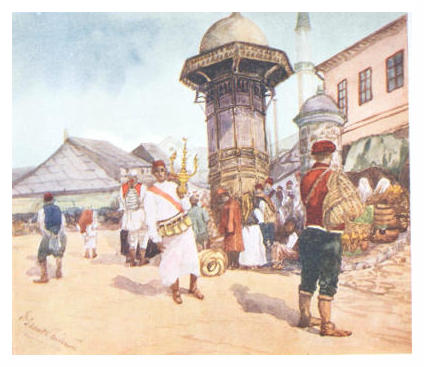
The Market Place, Saràjevo.
The people one sees in these parts are
remarkably plain, though many of the men
are tall and well made, and of fine physique.
The Bosnian costume is very ugly, the women
wear enormously wide black trousers down
to their feet, these being so voluminous
must be much in the way in wet weather,
and become very muddy and damp about
the ankles. The material used has every
appearance of black sateen.
After a journey of seven hours from
Saràjevo, Karabaich and I arrived at Jajce.
The railway winds in and out, and in and out
of the mountains. It was fine all day until
I went out to paint the wonderful waterfall.
This is a charming old town, full of quaint
wood roofed houses and mosques, the minarets
are even made of wood. There seem
to be many Turks living here, and in these
parts I passed many dilapidated graveyards
on my way, and every village has a mosque
or two. Many of the women are veiled;
it must be a horrid bore to have to go about
so muffled up, and what must it be in summer!
At Jajce in the old days, the Kings of
Bosnia had their castle, and the town was
fortified and surrounded by walls; the ruins
of walls and castles still remain. Next
morning was again wet and I did not go out,
finally we had a short shower, but after
lunch it cleared. The landlord asked me
if I would like to visit a Turkish lady. Of
course I was delighted, and he accompanied
me with Karabaich on the box, to a village
about seven miles off, where a friend of his
would take me into a Turkish house. We
drove up to a “Theehütte” and were much
refreshed and warmed by some delicious
coffee, then I sallied forth with the landlady’s
servant girl as interpreter, to call, as of course
the landlord from Jajce could not even
approach the doorstep! I could only speak
German and the Turkish lady Bosnian, so
without an interpreter our conversation
would have been very limited. It was the
proper thing to take presents with you, for
the mother and children. I was at a loss to
know where the presents were to be got in
that tiny village, but the little maid took
me to a shop, where we bought sweets for
the children and a piece of soap, scented
strongly with pachouli, for the lady. Armed
with these we arrived on the doorstep. Into
the house we walked without knocking—no
doubt we were expected—and climbed some
very steep stairs, went along a landing and
entered a very comfortable sitting-room,
with a divan all round it. There were one
or two chairs, but the grandmother who
came in to show some of her crotchet work,
squatted on her heels on the floor. One
little girl with hair of a most curious red
came into the room. I heard afterwards it
was dyed, and certainly the colour was most
unnatural and never seen in genuine red
hair. The grandmother wore a wig of this
colour, and a tiny baby of one year also had
it. I asked about this of the tea house
landlady, and she told me they will dye a
baby’s hair of even a month old. Several
little boys peeped at me through a crack in
the door, but they would not come in, so I
gave the sweets to the girl, which she secreted
inside the cupboard bed in the room, and the
mother tucked her soap hurriedly away
somewhere about her person. The room
was very clean and neat, with rugs on the
floor, and a quantity of coloured stuffs
piled in one corner. A stove pipe came
through the floor to warm it, but also
I saw a curious stove in the corner, which
looked as though it was ornamented with
bottle ends in cement of some kind. The
mother had been very good-looking; she
remarked on my teeth with envious eyes as
they were all there, and she had lost a good
many of hers. The windows of the house
were latticed, except those looking on to the
river, where no one could see into the room.
Mrs. Turk was very interested in my wedding
ring, which she proposed to keep as a souvenir,
but I expressed much regret that I could
not part with it, as it was the English custom
to wear our wedding rings for the rest of our
lives, and my husband might be angry if I
gave it away. No doubt she wondered what
I was doing travelling alone, but she did not
ask me. After a cup of Turkish coffee I left.
I was really highly entertained by my visit.
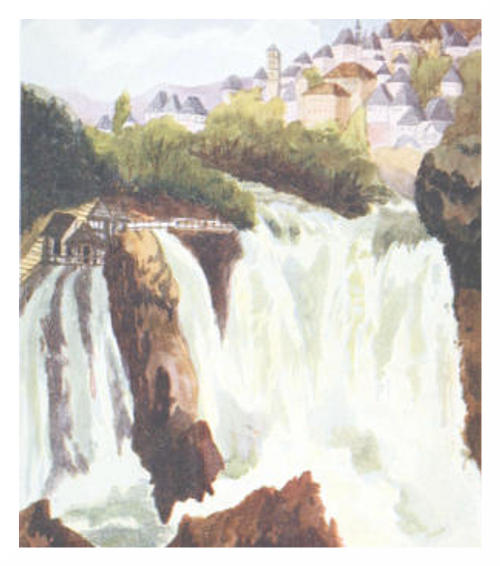
Jaice.
The road runs along by the river which
has cataracts and falls, and little mills built
of wood, standing over the water, these
are reached by a plank, and are used for
grinding corn. We passed an inland lake on
the way, the Lake of Jesero.
In this part, it is the custom to kiss your
hand—a performance I particularly dislike,
and I now carefully retain my gloves when
I think it may take place. It can’t be helped,
and to draw it hurriedly away would cause
great offence.
Next morning was not very fine, but we
started in a carriage about 7-30 to drive to
Bajnaluka, a nine hours’ drive. On the way,
where we lunched and the horses rested, the
landlord told me that this year the wolves
had come down as low as his house, but as
he had no gun, he had to wait till they chose
to go away.
At Bajnaluka there is not much to see.
Karabaich and I wandered about and found
a few Turkish shops and stalls. The people
are hideously ugly, clothed in quantities of
rags, so they may be warm.
A train at 7 a.m. brought us to Novi (the
end of the world we called it). Here we were
to find a carriage to take us to Plitvice, but
the only decent one refused to go, and the
others were so falling to bits I was sure we
should never reach our destination, so I had
reluctantly to give up the expedition and go
on to Vienna. Had we known what a desolate
spot Novi was, we should not have
attempted to alight; but unfortunately we
could not get on till evening, as there was
no train. To anyone wishing to travel in
these parts, I recommend them to wait till
June. At Agram I dismissed my guide,
and so ends my trip through these unfrequented
parts.
One or two little remarks I must make
before I close, one is on the honesty of the
people. My umbrella, which is a valuable
one, not only in keeping off the constant
rain, but because it has a gold duck on the
stick, which I value very much, I suddenly
missed one day at Saràjevo while sketching;
getting a sudden shock as to what had become
of my umbrella when I had been deep in my
paint box, I appealed to Karabaich, who
had been keeping off a crowd of urchins. “It
is all right, lady,” he explained, in Italian, “I
put it by that fence behind,” and sure enough
it was still there, though the fence was twenty
yards behind me and a large crowd in between.
My luggage, too, was often left for ages on a
table in the waiting-room quite unguarded, it
was all there on our return. I am afraid I
should not have such confidence in my
native land!
A word in praise, too, I must add of my
guide Karabaich. Should any of my readers
want a guide, I can certainly recommend
him as being most attentive, of very nice
appearance and manners, and thoroughly
honest. He is a native of Pola and is a pilot
by trade, he also has a boat trading in wine;
his name and the town will always find him,
as he is well known there. He speaks
German, Italian, and Slav, and possibly
other languages, but I did not require them.