The facts were apparently unrelated to each
other. Only a flight of imagination would have
connected them, and imagination, though it is
often valuable in speculating on what probably
happened, is not court evidence of what did happen.
In the order of their occurrence, the facts
were these:
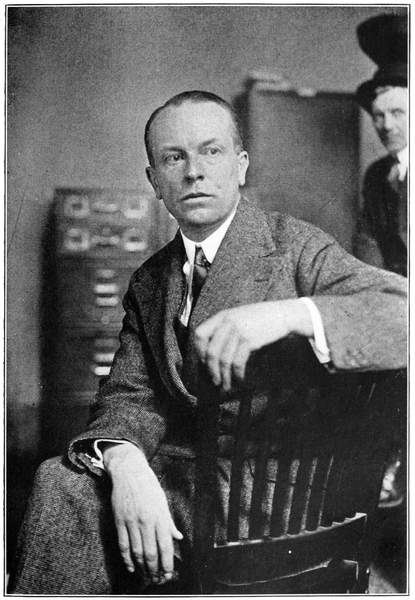
1. On April 16, 1906, Leone Krembs Muenter,
wife of Erich Muenter, an instructor in German in
Harvard College, died, soon after the birth of
her second baby. The circumstances of her death
were suspicious, and the Coroner directed that
the stomach of the body be taken to the Harvard
Medical School for examination. Dr. Muenter,
on the following day, requested that he be allowed
to escort the remains from Cambridge to Chicago
for burial, and this permission was granted.
With the children he made the gloomy pilgrimage
west. The body of the dead wife was cremated.
Dr. Muenter wrote at once from Chicago to the
New York Life Insurance Company directing that
the policy on his wife’s life be made payable to her
sister, instead of to himself. The examination of
the lining of the stomach had indicated slow
arsenical poisoning and a warrant was issued at
once for the husband. But it reached Chicago to
find him gone—no one knew where.
2. In a corridor of the main floor of the Senate
wing of the United States Capitol at Washington
used to stand a telephone switchboard. On the
night of Friday, July 2, 1915, an explosion near
it blew fragments of the board through the walls
of the telephone booths adjoining. No one was
about, which was lucky, for the wrecked switchboard
was not the only damage done: plaster
rained from the walls and ceilings, every door
nearby was blown open (one was a door into the
Vice-President’s office which had not been in use
for forty years), the east reception room was
wrecked, a gaping hole was torn in the stonework
of the wall, and fragments of windows, mirrors,
crystal chandeliers and telephone apparatus flew
in every direction.
3. In his country home on East Island, where
Long Island reaches out into the Sound to form
Glen Cove, John Pierpont Morgan was having
breakfast on the morning of Saturday, July 3,
1915. It was nearly half past nine, and the
members of his family, together with several holiday
guests, were in the breakfast room, which is
on the eastern side of the house. An automobile
drove up to the front door, and the butler was
confronted by a man of dingy appearance who
asked, in an accent suggesting German, to see Mr.
Morgan. He presented a card bearing the
legend “Society Summer Directory: represented
by Thomas C. Lester.” The butler wanted better
credentials and asked for them. The stranger
pulled a revolver from his pocket, covered the
butler with it and stepping inside the door demanded,
“Where is Morgan?”
With good presence of mind the butler answered,
“In the library,”—the library being in
the west wing of the house, and away from the
breakfast room—and stepped toward the library
door. Unfortunately it was open, and the intruder,
who was following with his gun aimed,
saw that the room was empty, and that the butler
had lied. At the same moment Physick, the butler,
realized that his ruse had not worked. He
shouted, “Upstairs, Mr. Morgan! Upstairs!”
hoping by the urgency of his cry to convey to the
banker a warning that something was distinctly
wrong and at the same time to get him out of
range. Mr. Morgan at once hurried up a rear
stairway and began to search for the trouble. A
moment later Mrs. Morgan joined him. They
proceeded from one room to another, found nothing,
and asked a nurse what was wrong. As the
little search party reached the head of the main
staircase, with Mrs. Morgan in the lead, she
caught sight of a strange man with a revolver in
each hand. Lester had come up the front staircase.
Mr. Morgan saw his wife between himself
and the guns, brushed her aside, and charged.
The man fired twice as the two went to the floor,
grappling, and the hammer of his revolver clicked
twice more on caps that did not explode. Two
wounds, one in the front of the abdomen, and
the other in the left thigh, did not prevent Mr.
Morgan, from overpowering his assailant: he lay
with the full weight of his 220 pounds on the
man’s body, pinning down the revolvers to the
floor. One of the guns Mrs. Morgan and the
nurse wrenched from the man’s hand; the other
Mr. Morgan captured. Physick had meanwhile
roused the servants, and he stunned the intruder
with a lump of coal as he lay on the floor. Lester’s
unconscious form was then trussed up and
taken to the Glen Cove jail.
There, briefly, were the facts. The Morgan
shooting I have recounted in some detail to show
the desperation with which the stranger trespassed,
and attempted murder. It was not an
affair which suggested a motive of robbery, but
apparently a cold attempt at assassination. The
Capitol explosion had been fruitless in its results
so far as the loss of human life was concerned,
and its origin was at that time a complete mystery.
The Muenter affair had long since passed out of
my memory. How to get evidence to establish
motives for the crimes, fix the entire responsibility,
and punish the offenders?
Never, probably, has long-distance communication
played a swifter or more helpful part in a
case. In order to show just how a nation which
has been called to the hunt can enter into the
pursuit, let us follow the developments in their
strict chronological order.
At seven o’clock Saturday morning, before
Lester had appeared at the door of the Morgan
house, the newspapers in Washington received a
typewritten form letter, signed “R. Pearce,” protesting
in excited terms against the shipment of
munitions to the nations at war. Its second paragraph
read:
“In connection with the Senate affair would
it not be well to stop and consider what we are
doing?”
The writer stated further:
“Sorry, I, too, had to use explosives (for the
last time I trust). It is the export kind, and
ought to make enough noise to be heard above
the voices that clamor for war and blood money.
This explosion is the exclamation point to my
appeal for peace.”
Again he wrote:
“By the way, don’t put this on the Germans or
Bryan. I am an old-fashioned American...”
And he added, in a penned postscript:
“We would, of course, not sell to the Germans
if they could buy here, and since so far we only
sold to the Allies, neither side should object if we
stopped.”
At half-past nine o’clock the shooting occurred
at Glen Cove. About the same time Dr.
Charles Munroe, consulting expert of the Bureau
of Mines, was called to the Capitol to make an
examination of the wreckage of the explosion.
He soon arrived at the conclusion that the shock
had been caused by no spontaneous combustion,
but by a fair quantity of high explosive.
While he was prying about among the débris,
Lester was being lodged in the Glen Cove jail.
His bonds were loosened, leaving him a very
sore set of ankles and wrists, his cut forehead
was bound up, and when he was questioned, he
gave out the following statement:
“I, Frank Holt, of Ithaca, N. Y., and lately
professor of German at Cornell, do hereby freely
make to William E. Luyster, justice of the peace,
the following statement of the facts concerning
my visit to the home of J. P. Morgan at East
Island, Glen Cove, N. Y.
“I have been in New York City about ten
days and had made a previous trip to the home
of Mr. Morgan last week. My motive in coming
here was to try to force Mr. Morgan to use his influence
with the manufacturers of munitions in
the United States, and with the millionaires who
are financing the war loans, to have an embargo
put on shipments of war munitions, so as to
relieve the American people from complicity
in the death of thousands of our European
brothers.
“If Germany should be able to buy munitions
here we would of course positively refuse to sell
to her. The reason that the American people
have not as yet stopped the shipments seems to
be that we are getting rich out of this traffic, but
do we not get enough prosperity out of non-contraband
shipments? And would it not be
better for us to make what money we can without
causing the slaughter of Europeans?
“I am very sorry that I had to cause the
Morgan family this unpleasantness, but I believe
that if Mr. Morgan would put his shoulder to the
wheel he could accomplish what I have endeavored
to do. I wanted him to do the work I could not
do. I hope that he will do his share anyway.
We must stop our participation in the killing of
Europeans, and God will take care of the rest.”
Lester, then, was not Lester at all, but Frank
Holt.
Meanwhile I knew nothing of what had transpired.
I had risen that Saturday morning looking
forward to a day of relaxation and pleasure, for
there was to be a field day for the police at
Gravesend Bay. On the way down to the track I
read with some interest of the explosion in the
Capitol, and then dismissed it from my mind:
the newspapers, which had been printed about
one o’clock of that morning, carried no news except
a description of the effects of the explosion.
Furthermore, it was a holiday, with another to
follow, and I proposed to enjoy it.
About noon Police Commissioner Woods called
me to the telephone, told me hurriedly that Mr.
Morgan had been “shot by a German,” and
told me to get down to Glen Cove as fast as
possible. “Find out the man’s motives and any
accomplices he had,” the commissioner said.
“Keep in touch with me.” And hung up. I
found Detective Coy of the Bomb Squad, and a
patrolman who knew German in case we should
need an interpreter, and after some delay in getting
a car, we hastened to the little Glen Cove
jail.
Then, at four o’clock, for the first time, I was
told the facts as Glen Cove knew them. A search
of Holt’s person had disclosed two revolvers,
three sticks of dynamite, a number of loose cartridges,
a cartoon clipped from a Philadelphia
newspaper, an express receipt, and a scrap of
paper bearing the names in pencilled handwriting
of Mr. Morgan’s children. Frank McCahill,
the constable in charge, showed me the statement
Holt had made, and supplied the further information
that Holt had been identified by some of
Mr. Morgan’s employees as a man who had been
seen on the estate two days before—on Thursday.
Glen Cove had been in a turmoil since
the shooting. Newspaper reporters and photographers
had flocked to the jail, had taken photographs
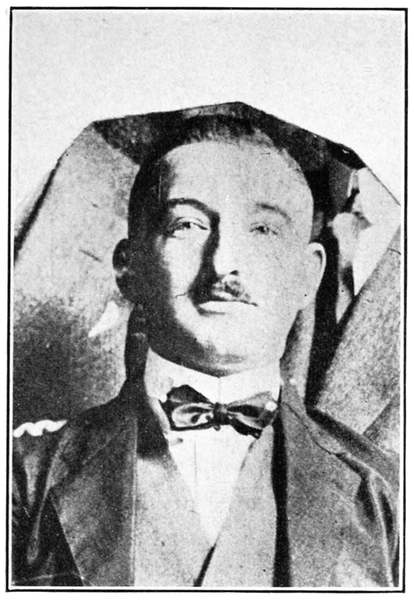
of the prisoner, and already prints of the
photographs were on their way to every large
newspaper in the country. His statement, as well
as a description of the man, had been telegraphed
over the Associated and United Press wires in
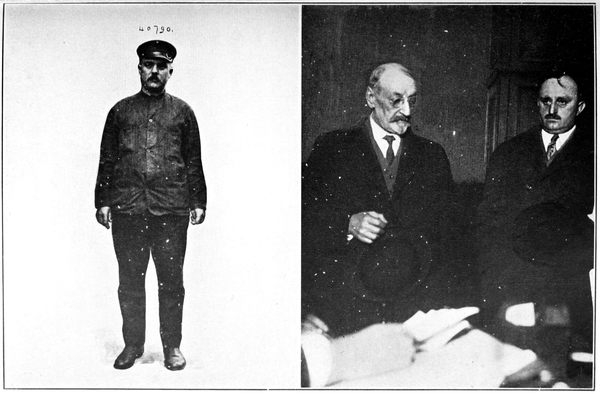
every direction. So I decided to have a talk
with the prisoner himself.
He was brought out of his cell, and we sat in
comparative privacy on two camp-stools in the
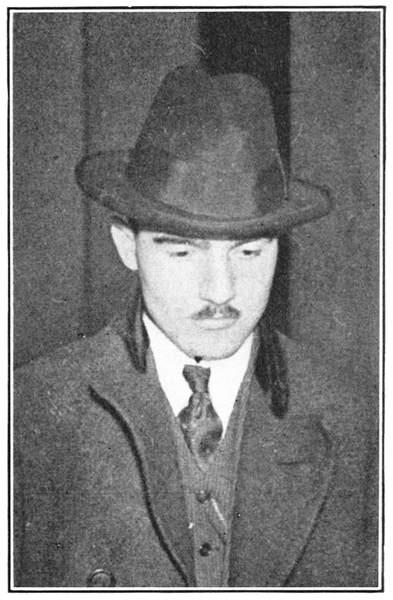
corridor. He was a frail, slight fellow, with
deep eye-sockets, a prominent hook-nose, and a
retreating chin. His accent was certainly German.
His name, he said, was Frank Holt, and
he was born in the United States. He told me
he was forty years old, that his father and mother
had been born in America, although they had
both French and German ancestors, and that his
wife and two children were in Dallas. For several
years, he said, he had taught in Vanderbilt
University, and during the year just past had been
instructor in German in Cornell University, at
Ithaca. He had left Ithaca two weeks before,
and had stopped at a Mills Hotel in New York
before coming down to Glen Cove.
“What did you try to kill Mr. Morgan for?”
I asked.
“I didn’t intend to kill him. I want to persuade
him to use his influence to stop the shipment
of ammunition to Europe.”
“Well, you chose a pretty strong means of
persuading him, didn’t you? What was the
dynamite for?”
“I was going to show him what was causing
all the trouble—explosives.”
He answered frankly, but not completely. The
scrap of paper bearing the names of the Morgan
children, he said, was only a memorandum; he
had intended to hold them hostage until Mr.
Morgan promised to exert himself to stop the
export of supplies to the Allies. No amount of
questioning would bring an answer as to where
he had bought the dynamite, but he readily volunteered
the approximate addresses of the shops
where he had purchased the revolvers and cartridges.
These facts gave me something to work
on, and I went outside to a telephone while he was
locked up again.
Meanwhile the whole United States had been
taking a keen interest in the case. Holt’s statement
had reached Washington on the Associated
Press wire, and was delivered to Captain Boardman
of the Washington Police. Captain Boardman
had been busy all morning throwing out lines
on the Capitol case, and attempting to trace the
author of the R. Pearce letters, which had been
mailed in the city about nine o’clock of the previous
evening. He read the Pearce letter over
several times in search of some clue to the writer.
Presently the Holt statement came in. From the
two communications these sentences met the Captain’s
eyes:
| Pearce |
Holt |
| “We would, of
course, not sell to the
Germans if they could
buy here, and since so
far we only sold to the
Allies, neither side
should object if we
stopped.” |
“If Germany should
be able to buy munitions
here we would, of
course, positively refuse
to sell to her.” |
Captain Boardman’s next move was to wire to
his chief, Major Pullman, who happened to be in
New York to attend that same field day that Coy
and I had missed. His message, dated 2 P. M.
(while we were on the way to Glen Cove), read:
“Ascertain from F. Holt, in custody at Glen
Cove, N. Y., for shooting J. P. Morgan, his
whereabouts Thursday and Friday, as he may
have placed the bomb in the Capitol here Friday
night.”
This message, sent in care of Inspector Faurot,
was relayed to us at Glen Cove by Guy Scull,
deputy commissioner, but not until after the Associated
Press man at the jail had had a tip telegraphed
from his Washington office to ask Holt
the same question. Holt denied that he had been
in Washington, flatly. But McCahill knew he
had been in Glen Cove Thursday, so at 5 P. M. he
telegraphed Captain Boardman:
“F. Holt was in Glen Cove Thursday, July
1, P. M.”
I telephoned headquarters the numbers of the
revolvers, and the neighborhood in which Holt
said he had bought them. Several members of
the squad started out from headquarters to identify
the pawnshops, and to find out what they
could of the history of three sticks of dynamite
marked “Keystone National Powder Company.
60 per cent. Emporium, Pa.”
Holt had proved obstinate to all questions of
the source of his supply of dynamite. The man
was getting tired: he had had a hard day, had
been considerably battered, had been interviewed,
photographed, harried with questions, his ankles
and wrists ached, his head throbbed, and his mind,
which though alert and active, was none too
stable, was showing signs of exhaustion. His
condition suggested that he might be in a mood
to supply some of the further information we
needed, so I suggested that we take an automobile
ride and he could show me where he had been
the day before. He protested at once.
“No! My head is aching, and you want to
take me on a ride and make a show of me to the
morbid crowd. I will not tell you—not until
later. Later perhaps, but not now!”
“All right,” I answered. “Later.”
Then I decided we had better get our information
down on paper in a formal examination.
The meeting convened at once, with Coy, McCahill,
a county detective from Mineola, two
deputy sheriffs, two patrolmen, a stenographer
and myself as board of inquiry. It may serve
to describe the fellow’s manner, as well as to
bring out what the examination further disclosed,
if we make use here of extracts from the proceedings:
Question. Where were you born?
Answer. Somehow my brain is in such a shape
that I can’t remember—Wisconsin, I know. I
don’t know what it is that affected me—something
inside of me—maybe it is the shock I got
from that.
Q. You speak with a German accent. Were
you born in Germany, or in any of the European
countries—tell me the truth.
A. Now listen. That has been said before—that
I speak with a foreign accent. That is because
I speak several languages. I speak French,
German, Spanish, and all that. That is the cause
of that, you see?
Q. We will eliminate the trouble of asking
you questions if you will tell us the town or city
in which you were born.
A. Yes. Now I am trying to think (a pause)
I will have to disappoint you.
Q. Your memory is very clear on other things.
A. As I told you, I have been lying there,
thinking, thinking.
I took up the matter of the express receipt
found on him:
Q. On June 11, 1915, you shipped a box by
the American Express Company to D. F. Sensabaugh,
101 South Marsalis Street, Dallas, Texas.
What did that box contain?
A. It evidently must have been a typewriter.
I would not be sure now, I think it was a typewriter.
And then the cartoon, clipped from the Philadelphia
paper, brought out a very unexpected
fact:
Q. How many times have you been in Philadelphia?
A. No time.
Q. You came to New York from Ithaca?
A. Yes.
Q. Do you mean to truthfully answer my question
by saying that you have not been to Philadelphia
at any time since you left Ithaca?
A. At no time.
Q. You have a clipping of a Philadelphia
newspaper in your possession. Where did you get
that?
A. I think I got that out of a Philadelphia
paper of course, that I found lying around. I
think it was a cartoon.
Q. Were you not in Philadelphia when you
purchased that paper?
A. I did not purchase that. I saw that lying
around somewhere, probably in the Mills Hotel.
Q. Where did you sleep last night?
A. Now, I will tell you. A reporter from the
Associated Press asked me about this Washington
business, and he was trying to connect me
with that. I suppose that is what you are trying
to do.
Q. I am not trying to connect you with anything.
I want truthful answers. I am very frank
and honest with you. I will fairly investigate
every answer that you make.
A. Yes, I thought that over since he was here,
and I think it is just as well to say that I wrote
that R. Pearce letter. I was in Washington yesterday
and came back on the train. I think it is
just as well to say.
Here was news! McCahill slipped out of the
room, and sent this telegram to Captain Boardman:
“Holt was in Washington Friday. Will wire
full particulars later,” and returned for the particulars,
which Holt continued to unfold.
He had gone to Washington early Friday, arriving
at 2 P. M., hired a furnished room near the
Union Station, and two hours later walked over
to the Capitol and found the Senate wing deserted.
He placed a bomb near the telephone
booth, timed so as to explode in eight hours.
He idled away the evening, mailed the R. Pearce
letters, took a midnight train to New York,
stopped at the Mills Hotel for mail, and took an
early train to Glen Cove Saturday morning.
What his activities had been since then we well
knew. But while the confession of his responsibility
for the Washington outrage was a really
surprising bit, it did not conclude our work, for
he had pointed out several new alleys of possibility
which we must search.
By seven o’clock we had, first, a sketch of Holt’s
recent career as a teacher. This we proceeded
to verify by telephone to New York and by telegraph
thence to Ithaca, Dallas, Nashville, and
Philadelphia. His account of the Washington
bombing Mr. Scull telephoned to Washington, and
Major Pullman left at once for Long Island to
secure a more complete confession. We had the
numbers of his revolvers and were already at
work upon that clue. We had no information
except the trade-mark of where he had got his
dynamite, and knowing the strict city restrictions
on its sale, I felt confident that he had accomplices
who supplied it to him. The chances were, too,
that Holt had more dynamite than the three sticks
which he said had made up the Capitol bomb, and
the three on his person. We knew he had called
at the Mills Hotel, and we sent a man to search
his room. We had a wholly unsatisfactory statement
of his birthplace, which he had already contradicted
once, and which lent color to the Germanic
origin of his accent. And finally, Holt had
given a description of the methods he used in making
his bomb which I cannot detail here for obvious
reasons, but which from my acquaintance with
explosives I knew to be untrue. By no means
all the particulars of his acquaintance with dynamite
had been explained, and the fact that this
remarkable teacher of foreign languages, a man
apparently of fair intellect, had committed one
major crime and confessed to another all in the
same day, made the motive all the more obscure.
But we had learned that he talked freely, and that
meant that he would give us more information,
either consciously or unconsciously.
Holt was moved about half past seven that
night to safer keeping in the county jail at Mineola,
and we reconvened there an hour later for
further examination. Major Pullman joined us
in the course of the evening and took part in the
questioning. By that time I had word from New
York that a telegram had arrived for Holt at
the Mills Hotel signed by D. F. Sensabaugh, and
inquiring for particulars. Thinking that this was
a clue to possible accomplices I tried, taking several
different angles of attack, to find out whether
Holt had told Sensabaugh (who he said was his
father-in-law), what he was going to do, and why
he had written that evening to his wife. The result
of this questioning was nil. Then we went
over his course in Washington, step by step, and
brought out nothing of significance; then returned
to the topic of his views on the shipment of munitions,
and tried to draw out any talks which he
might have had with friends on that subject.
His answer to this was:
“I have not talked to my friends about it, because
my friends, in my position, they are not the
kind of people who would talk on such things.
Do you suppose that a university professor would
undertake that sort of thing? I think that can
be easily figured out that I could not have anybody
else with me.”
That was the conclusion which we were being
forced to accept. But the mystery of the dynamite
purchase was still unsolved. Holt said we
could not guess the reason why he was withholding
the answer to it. I was inclined to agree
with him just then. I couldn’t guess. But he
betrayed in one of his replies the real factor
which was to solve the mystery. Major Pullman
asked:
“Why did you decide to go to the Capitol?”
“Merely,” replied the thin figure in the chair,
“to get the most prominent place in the country.
You see I wanted to call attention to my appeal.”
In this he had succeeded. The whole country
was working on the case. If our feeling that
Holt had bought more explosives was no more
than a theory at first, it was strengthened when
he admitted that he had spent nearly $275 in two
weeks, had only six sticks of dynamite to show
for it, and was able to account for only $50. He
denied that he had ever been in the German Club
in New York, reiterated that he was born in the
United States, dodged the exact city, then suggested
Milwaukee, said that the name of the college
he had attended in Texas “wouldn’t come,”
and sidestepped cleverly any admission which
might allow us to trace the dynamite purchase.
Thus ended Saturday, July 3, which had started
out as a holiday. I left two men to watch Holt,
and went home, tired out, and not at all satisfied.
While we had been busy with the prisoner, the
wires to Boston and the trains to Chicago had been
carrying out their routine tasks of syndicating
news. A police officer in Cambridge in reading
the description of Holt which had flashed out to
the newspapers detected a familiar ring to the
natural phrase “shambling walk” which had been
used to describe Holt’s gait. Thousands of men
whom we encounter in daily life have shambling
walks, but to this officer only one man had a
shambling walk in which he was interested, and
that man was Erich Muenter, a Harvard instructor,
whom he had suspected of wife-murder nine
years before. Nine years is a long time, and
the average person cannot recall offhand the gait
of anyone whom he last saw nine years ago, but
those two words had evidently typified to the
Cambridge officer the murderer who got away.
When the news photographs followed the description
to Boston and the Cambridge police saw
them, they were not so sure, for Muenter had had
a beard, and in his Cambridge days his head was
not bandaged. But suspicion had been aroused,
and that was enough to issue the news throughout
the country during the night. Reporters in Ithaca
tried to verify it from Holt’s associates at Cornell,
and failed, reporters two thousand miles away in
Dallas tried to verify it from Holt’s confused
father-in-law, and failed. Dallas, however, supplied
the particulars of his previous life so far
as anyone seemed to know them, and these particulars
were again relayed, verified, and amplified
in every city in which Holt had ever been known in
recent years.
Sunday morning, Independence Day, I went
early to Mineola and questioned Holt again, with
little result. Meanwhile the Bomb Squad at work
in New York had found one of the shops in Jersey
City where Holt had purchased a revolver. He
gave his name to the proprietor as “Henderson,”
and his address as Syosset, Long Island—a little
station not far from Glen Cove. I asked him
why he gave this fictitious name and address; he
replied he had happened to see Syosset on a timetable,
and that the name Henderson popped into
his head. We then returned to my favorite subject,
dynamite, and Holt finally said that he would
tell me on the following Wednesday, July 7, where
he had bought it. Why Wednesday, July 7?
He would not answer, and no amount of questioning
served any end except that of further confusion.
The day was not without developments, however.
During the afternoon District Attorney
Smith of Nassau County paid a visit to the jail,
and identified the wretched Holt as a former
acquaintance in Cambridge, Erich Muenter. At
almost the same hour the Chicago authorities
came into possession of the news photograph of
the man mailed from New York the day before.
They hurried with it to the home of two spinsters,
known to be sisters of the missing Muenter, and
obtained from them an unqualified identification:
it was their lost brother, and “the news would kill
their mother.” This Pearce-Lester-Holt-Henderson-Muenter
was becoming more interesting
every minute. Wife-poisoner, dynamiter, gunman—what
next?
“Next” was Monday. The second revolvershop
had been discovered, and again the use of
the alias Henderson and the address Syosset.
Holt, when I called on him in the morning, repeated
only what he had told the day before, and
reiterated, “Wednesday I will tell you,” until it
became almost a refrain. He denied that he was
Muenter, and that he had ever heard the name.
I returned to New York to spend the rest of the
daylight in investigation among the explosives’
manufacturers. From the records of the Ætna
Company, of which the Keystone was a subsidiary,
we learned during the afternoon that one Henderson
had telephoned an order for 200 sticks of
dynamite to be delivered at Syosset. I was just
ready to start for Syosset with Commissioner Scull
when, as if we had not already had enough to interest
us, our friends the anarchists exploded a
bomb in Police Headquarters itself. Curiously
enough, although it was a delay, this did not prove
the disturbing incident which one might believe.
We had had anonymous threats of it some weeks
before; it was one year and a day after the accidental
death of the anarchist Berg, who was killed
making a bomb, and it seemed to have no connection
whatever with the Holt case. No one was injured,
and after steps had been taken to follow the
case, I went home to sleep what was left of the
night.
Tuesday arrived.
I went to Syosset, and interviewed the station
agent, George D. Carnes. Carnes said he knew
a man named Henderson. Henderson had seen
him first about three weeks before when he came
to the little station to claim a new trunk which
had been shipped down from New York, apparently
empty, as it weighed only thirty-six pounds.
Henderson had signed for the trunk, and gone
away. He reappeared some days later and asked
Carnes whether he had received two boxes of
dynamite and two boxes of fuses and detonating
caps—he had to blow up some stumps and he
expected the explosives. They had not arrived.
Henderson made inquiries for several days, and
when the boxes came, claimed them, signed the
name of Frank Hendrix to the receipt, and drove
away in a Ford. At last we seemed to be on the
right trail.
He had received the material, we knew, but
where was it? In the trunk, perhaps. Had the
trunk been shipped out of Syosset? No, Carnes
said. We telephoned several stations in the vicinity,
and finally at Central Park, a few miles
west, we struck the trail again. The baggage
records there revealed that a Henderson had
checked a trunk to the Pennsylvania station, New
York, on July 2—Friday. That was enough to
take us to Central Park.
The check number I telephoned to New York
for detectives to trace from the station if they
could. Information of a stranger is freely offered
in a village, and we found shortly that Holt had
employed a small boy with a wheelbarrow to convey
his trunk from a shanty in the woods to the
station, and to the shanty we went. Near it lay
a charred dynamite-box, and there were a few wax-paper
wrappers from sticks of dynamite which the
weather had left for our information. No explosive
was to be seen, but there was evidence
that he had burned some of it nearby.
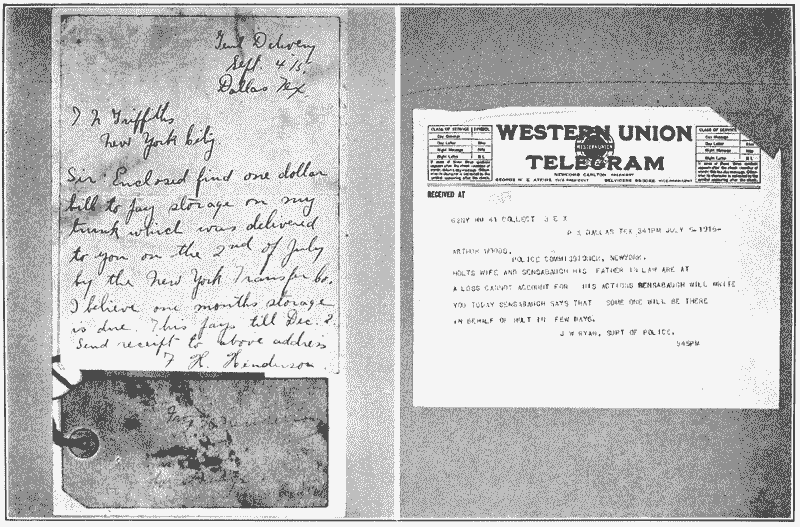
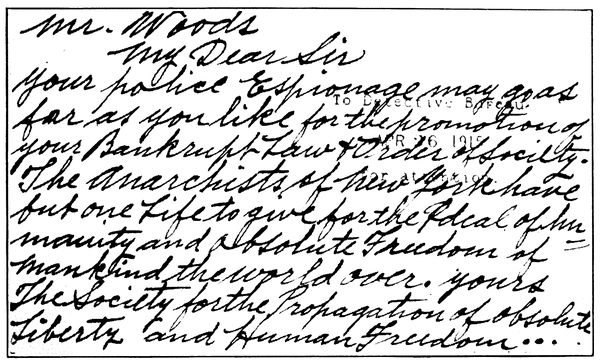
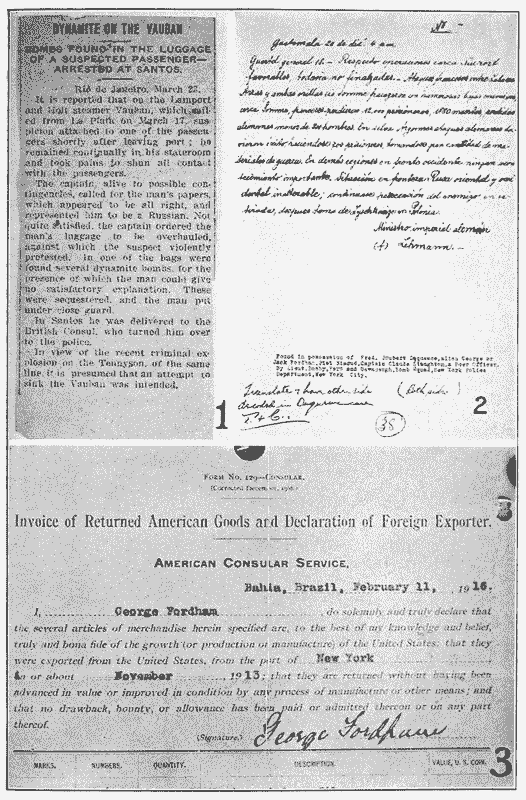
Mrs. Holt’s Mysterious Letter
The First Word from Texas
(Larger)
If he had not burned it all, the balance of those
two hundred sticks were in the trunk. The day
was growing old. Carnes and I sped back to
Mineola, and the station agent identified Holt
as the dynamite man. I repeated my questions;
Holt replied, “I will tell you Wednesday.”
“Look here,” I said. “I have the number
of that check. That dynamite is in the trunk.
It’s liable to go off any minute and kill a lot of
people. I can trace that check, but it will take
time, and you better tell me quick where you left
the trunk.”
“All right,” Holt answered, and said that he
had sent it to a storage warehouse whose office was
somewhere near 40th Street and Seventh Avenue.
Two minutes later Lieut. Barnitz and I were out
of the jail and in a motor bound for New York.
It took just 28 minutes to cover the 20 miles
to Fifty-Ninth Street and Fifth Avenue, and we
turned south to the section around Fortieth Street.
We found the office of the storage company—empty.
The warehouse itself was at 342 West
38th Street, and we hurried over there, arriving
simultaneously with the detectives who had been
tracing the check number from the Pennsylvania
station. An old watchman was in charge who
knew nothing whatever of the records of the office,
but who turned bright green when we told him
what we were after. While Detectives Barnitz,
Coy, Murphy, Sterett, Walsh and Fenelly went
up into the recesses of the warehouse to hunt for
the trunk, I called headquarters.
“Commissioner Woods just called and wants
you to call him at the Harvard Club,” the office
said. I did so, and reported our progress.
“Get that trunk as fast you can and find out
exactly what’s in it,” said the Commissioner.
“Washington just called me to say that Governor
Colquitt down in Dallas just wired them. He
says Holt’s wife got a letter from Holt dated
July 2 saying that he’s put dynamite on a ship
now at sea, and that it will sink on the seventh!”
On the fifth floor of the great dark barn they
discovered the trunk, with a dozen others on top
of it. There were no lights, and it was necessary
to roll it over, haul it out, snake it across other
piles, and carry it down four flights of steep
stairs in the dark to the office. Barnitz picked
up an axe and hacked the lock away. He lifted
the cover, and there we found one hundred and
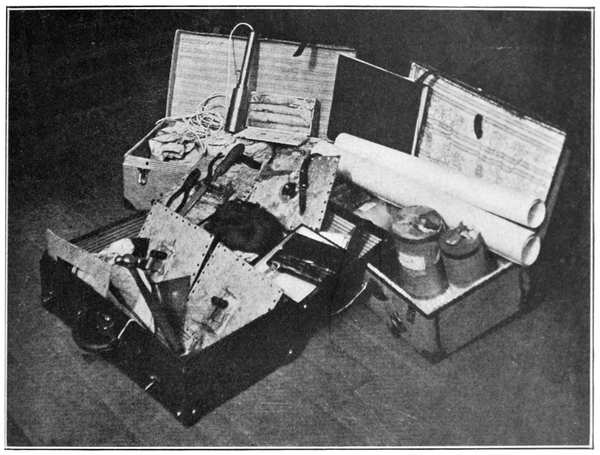
thirty-four sticks of dynamite—one hundred in
their original box, and the rest packed in small
spaces between hammers, nails, bolts, and other
tools, several bottles of sulphuric and nitric acid,
and 197 detonating caps—a pretty package to
trundle down four flights of dark stairs and open
with an axe!
Fifty sticks of the original 200 were unaccounted
for. I telephoned the report to the Commissioner,
and followed it to the Harvard Club, in
44th Street, while Barnitz telephoned for the inspector
of combustibles to come and take possession
of the explosives. The Commissioner, with
Guy Scull, were sitting in the lounge, and I was
reporting in greater detail when the Commissioner
was called to the telephone. He returned a moment
later, and his first remark was this:
“Holt is dead at Mineola!”
And there went our case.
The first wild report from Mineola had it that
Holt had been shot by a German. The international
consequences of the case, which had been
hovering just out of reach for the past four days,
now seemed certain. A nation which was still
bitterly angry over the recent Lusitania sinking
would certainly not brook the violation of its
Capitol and the attempted assassination of one
of its chief figures by a German agent, and if
Holt had been shot by a German, it was more
than likely that he had been killed to prevent a
further confession which would implicate the Imperial
German Government. These thoughts
passed through our minds as we motored back
across the Queensboro Bridge, and retraced the
route Barnitz and I had just traveled.
Holt was not shot by a German. Holt was not
shot at all. An aged guard had been left to
watch him that evening, just after Barnitz and
I had left, for the prisoner, despairing over the
Muenter identification, had already made one attempt
with a bit of tin from a lead pencil to cut
the arteries of his wrists, and we did not want him
to try again. The old bailiff who sat outside the
cell cage had not only left the cage door unlocked,
but had been careless enough to leave Holt’s cell
door ajar. The prisoner seemed quiet enough,
and the bailiff fell asleep. He woke to find Holt’s
body in a twisted heap in the center of the floor
of the cell corridor. Holt had evidently been
feigning sleep and while the bailiff dozed had
crept out, climbed to the top of the cage, and
dived headforemost to the concrete floor.
There we found him. The man’s skull was
crushed from the impact of his dive. Rumors
that he was shot by a mysterious rifle bullet from
outside notwithstanding, Holt bore no wound except
the bruise Physick gave him with the lump of
coal, and the wound which was the result of his
fall. If Holt was a German agent, he died with
his secret.
We had no time to analyze the question. We
knew that Holt had written his wife he had placed
dynamite aboard a ship which was at sea, and
that July 7, the date on which he had promised
an explosion, was less than two hours away. On
the theory that he might have shipped an express
parcel containing a bomb overseas from some
nearby station, Mr. Scull and I spent the night
in an exhaustive canvass by telephone and motor
of every station in Nassau County. Many of the
station agents were asleep, but we woke them, and
searched until dawn. The net result was record
of two shipments to Europe since the day Holt
received the dynamite: One from Syosset the
other from Oyster Bay. Back to New York
again we raced, and at the office of the Adams
Express Company found the Syosset package,
opened it, and found—no dynamite at all. The
Oyster Bay package had already been shipped to
Europe; we telephoned the consignor, and learned
that it contained clothes for a poor relative in
England.
Apparently Holt had not shipped a bomb.
While we were opening his trunk at the warehouse
the night before, the government was issuing
from Washington a wireless bulletin to all
ships at sea, warning them to search the cargo
thoroughly for a bomb. One by one the vessels
which had sailed during the past week reported
that they had investigated with no result, and as
these reports came in we began to rest easier in
our minds. Yet he had so persistently refused to
tell us of the dynamite “until Wednesday” that
we could not ignore the prophecy he had made to
his wife—“With God’s help, a ship that sailed
from New York July 3 will sink on July 7.” At
noon, of Wednesday, July 7, an explosion occurred
in the hold of the steamship Minnehaha,
in mid-ocean, so strong as to blow out a section of
the upper decks. The Minnehaha had left New
York on July 3. Happily there was no loss of
life, and she reached port safely.
Two and two make four, but we must not add
them for a moment. Holt—or Muenter, as he
was fully and finally identified—may have placed
a bomb in the Minnehaha. His promise may
have been valid, but there is another possible
origin for that explosion, namely, the activities of
Paul Koenig’s little group. He may have placed
a bomb on the Minnehaha which was exploded by
a bomb placed there by another. He may have
placed a bomb on quite another ship—which did
not explode, and which may have traveled harmless
to its consignee in England. That consignee
may have been fictitious, or he may have been an
accomplice; if an accomplice he may have been
German. We must not add two and two until we
have gathered up the loose threads as they were
gathered up during those last active days, and
begin to sort them out.
If we do, we shall see that the Ithaca police
found in Holt’s rooms a scrapbook curiously replete
with newspaper reports of crimes, fratricides,
patricides and plain murders. But no cases of
wife-murder, nor of arsenical poisoning. And
no clippings dating back of 1906; for all the evidence
of the scrapbook, Holt had never existed
before 1907. His wife, who, by a queer coincidence,
bore the same maiden name, Leona, as the
one whom he had poisoned, apparently knew
nothing of Holt’s life before she met him in Texas
in 1909, loved him, and married him. She did
not know that he was born in Germany, and educated
in Germany or that he had fled from Chicago
to Mexico in 1906 and had then worked back into
Texas as a student. He probably wrote to her
from Ithaca in September, 1914, that he had just
had the pleasure of meeting Professor Ernest
Elster, of Marburg, Germany, who was visiting
Cornell, and that Elster had highly commended
him for his articles on Goethe—but if he did
write to her, what then? Perhaps Herr Professor
Elster had commended Holt for some other
past or projected service to Kultur. There is a
queer development of the story in the fact that on
September 4, 1915, Mrs. Frank Holt, writing
from Dallas, Texas, to Griffithe’s warehouse, enclosed
one dollar to pay for storage on a trunk
left there by her husband July 2, and signed her
name: “F. H. Henderson.” Perhaps the
rumor is true that a woman appeared at the
offices of J. P. Morgan and Company in New
York on July 2, 1915, and attempted to warn Mr.
Morgan of “something that was going to happen
the next day” and perhaps she was a friend
of von Rintelen’s. Mr. Morgan never saw her.
But it is a fact that Rintelen had said to an American
with whom he was dealing: “Morgan and
Root ought to be put out of the way!”
Probably—not perhaps—speculation has already
carried this story too far. The facts are
that Mr. Morgan recovered from his wounds,
and that two and two make four.