On the Western Coast of Africa. By Madame Dard, one of the
Sufferers.
In the year 1816, an expedition was fitted out by the French
to go and resume possession of Senegal, which had been restored
to them.—My father was reinstated in his place of
resident attorney, and taking with him his family repaired
immediately to Rochefort to embark on board the Medusa
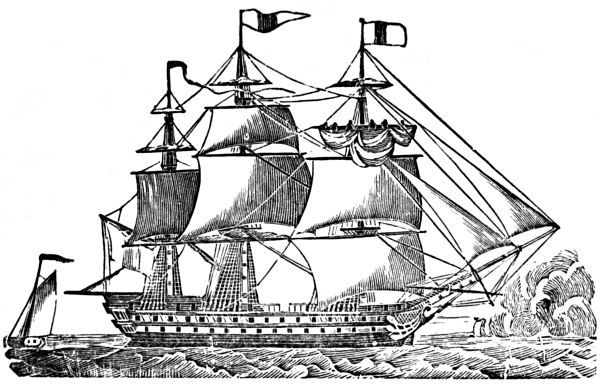
frigate.
Early on the morning of the 12th of June, we were on our
way to the boats that were to convey us on board the Medusa,
which was riding at anchor off the island of Aix, distant
about four leagues from Rochefort. The field through which
we passed was sown with corn. Wishing before I left our
beautiful France, to make my farewell to the flowers, and,
whilst our family went leisurely forward to the place where
we were to embark upon the Charente, I crossed the furrows,
and gathered a few blue-bottles and poppies. We soon arrived
at the place of embarkation, where we found some of
our fellow passengers, who, like myself, seemed casting a last
look to Heaven, whilst they were yet on the French soil.—We
embarked, however and left these happy shores. In descending
the tortuous course of the Charente, contrary winds
so impeded our progress, that we did not reach the Medusa
till the morrow, having taken twenty-four hours in sailing four
leagues. At length we mounted the deck of the Medusa, of
painful memory. When we got on board, we found our
berths not provided for us, consequently were obliged to remain
indiscriminately together till the next day. Our family,
which consisted of nine persons, was placed in a berth near
the main deck. As the wind was still contrary, we lay at anchor
for seventeen days.
On the 17th of June, at four in the morning, we set sail
as did the whole expedition, which consisted of the Medusa
frigate, the Loire store-ship, the Argus brig and the Echo
corvette. The wind being favorable, we soon lost sight of
the green fields of l’Aunis. At six in the morning, however,
the island of Rhe still appeared above the horizon. We fixed
our eyes upon it with regret, to salute for the last time our
dear country. Now, imagine the ship borne aloft, and surrounded
by huge mountains of water, which at one moment
tossed it in the air, and at another plunged it into the profound
abyss.
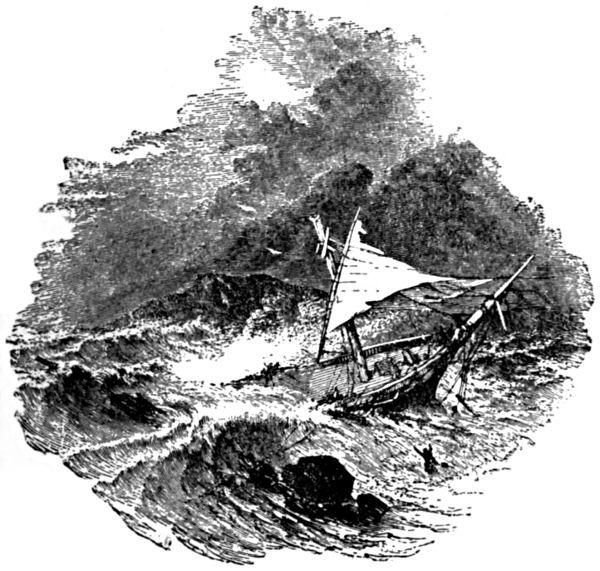
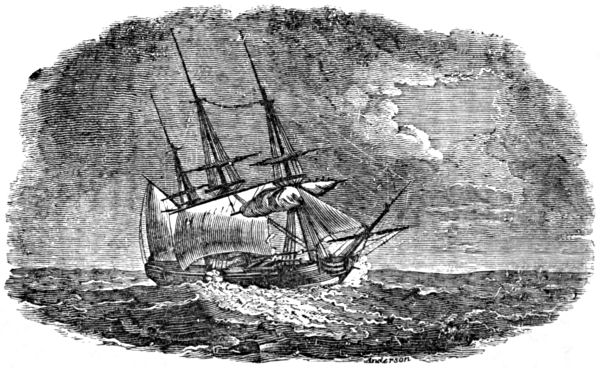
The waves, raised by a stormy northwest breeze, came
dashing in a horrible manner against the sides of our ship.—I
knew not whether it was a presentiment of the misfortune
which menaced us that had made me pass the preceding
night in the most cruel inquietude. In my agitation, I sprang
upon deck, and contemplated with horror the frigate winging
its way upon the waters. The winds pressed against the sails
with great violence, strained and whistled among the cordage;
and the great bulk of wood seemed to split every time the
surge broke upon its sides. On looking a little out to sea I
perceived at no great distance on our right, all the other ships
of the expedition, which quieted me very much. Towards
ten in the morning the wind changed; immediately an appalling
cry was heard, concerning which the passengers, as well
as myself, were equally ignorant. The whole crew were in
motion. Some climbed the rope ladders, and seemed to
perch on the extremities of the yards; others mounted to the
highest parts of the mast; these bellowing and pulling the
cordages in cadence; those crying, swearing, whistling, and
filling the air with barbarous and unknown sounds. The officer
on duty, in his turn, roaring out these words, starboard,
larboard, hoist, luff, tack, which the helmsman repeated in
the same tone. All this hubbub, however, produced its effect;
the yards were turned on their pivots, the sails set, the
cordage tightened, and the unfortunate sea-boys having received
their lesson descended to the deck. Every thing remained
tranquil, except that the waves still roared, and the
masts continued their creaking. However the sails were
swelled, the wind less violent, though favorable, and the mariner,
while he caroled his song, said we had a noble voyage.
During several days we did indeed enjoy a delightful passage.
All the ships of the expedition still kept together, but
at length the breeze became changeable, and they all
disappeared. The Echo, however, still kept in sight, and persisted
in accompanying us, as if to guide us on our route. The
wind becoming more favorable, we held due south, sailing at
the rate of sixty-two leagues a day. The sea was so fine,
and our journey so rapid, that I began to think it nearly as
agreeable to travel by sea as by land; but my illusion was not
of long duration.
On the 28th of June, at six in the morning, we discovered
the Peak of Teneriffe, towards the south, the summit of whose
cone seemed lost in the clouds. We were then distant about
two leagues, which we made in less than a quarter of an
hour. At ten o’clock we brought to before the town of St.
Croix. Several officers got leave to go on shore to procure
refreshments.
While these gentlemen were away, a certain passenger,
member of the self-instituted Philanthropic Society of Cape
Verd, suggested that it was very dangerous to remain where
we were, adding that he was well acquainted with the country,
and had navigated in all these latitudes. M. Le Roy
Lachaumareys, captain of the Medusa, believing the pretended
knowledge of the intriguing Richefort, gave him the command
of the frigate. Various officers of the navy, represented
to the captain how shameful it was to put such confidence
in a stranger, and they would never obey a man who had no
character as a commander. The captain despised these wise
remonstrances; and, using his authority, commanded the pilots,
and all the crew, to obey Richefort; saying he was king,
since the orders of the king were, that they should obey him.
Immediately the imposter, desirous of displaying his great
skill in navigation, made them change the route, for no purpose,
but that of showing his skill in manœuvring the ship.—Every
instant he changed the tack, went, came and returned,
and approached the very reefs, as if to brave them; in short,
he beat about so much, that the sailors at length refused to
obey him, saying boldly that he was a vile imposter. But it
was done. The man had gained the confidence of Captain
Lachaumareys, who ignorant of navigation himself, was
doubtless glad to get someone to undertake his duty. But
it must be told, that this blind inept confidence was the sole
cause of the loss of the Medusa frigate, as well as all the
crimes consequent upon it.
Towards three in the afternoon, those officers who went on
shore in the morning, returned on board loaded with vegetables,
fruits and flowers. They laughed heartily at the
manœuvres that had been going on during their absence, which
doubtless did not please the captain, who flattered himself
he had already found in his pilot Richefort, a good and able
seaman; such were his words.
At four in the afternoon we took a southerly direction. M. Richefort,
then beaming with exultation for having, as he
said, saved the Medusa from certain shipwreck, continued to
give his pernicious counsels to the captain, persuading him he
had been often employed to explore the shores of Africa, and
that he was perfectly well acquainted with the Arguin Bank.
The journals of the 29th and 30th afford nothing very remarkable.
The hot winds from the desert of Sahara began to be felt,
which told us we approached the tropic; indeed, the sun at
noon seemed suspended perpendicularly above our heads, a
phenomenon which few among us had ever seen.
On the 1st of July, we recognised Cape Bojador, and then
saw the shores of Sahara. Towards ten in the morning, they
set about the frivolous ceremony which the sailors have invented
for the purpose of exacting something from those passengers
who have never crossed the line. During the ceremony,
the frigate doubled Cape Barbas hastening to its destruction.
Captain Lachaumareys very good humoredly presided
at this species of baptism, while his dear Richefort promenaded
the forecastle, and looked with indifference upon a
shore bristling with dangers. However that may be, all passed
on well; nay, it may even be said that the farce was well
played off. But the route which we pursued soon made us
forget the short lived happiness we had experienced. Every
one began to observe the sudden change which had taken
place in the color of the sea, as we ran upon the bank in shallow
water. A general murmur arose among the passengers
and officers of the navy;—they were far from partaking in the
blind confidence of the captain.
On the second of July, at five in the morning, the captain
was persuaded that a large cloud, which was discovered in
the direction of Cape Blanco, was that Cape itself. After
this pretended discovery, they ought to have steered to the
west, for about fifty leagues, to have gained sea room to
double with certainty the Arguin Bank; moreover, they ought
to have conformed to the instructions the Minister of Marine
had given to the ships which set out for Senegal. The other
part of the expedition, from having followed these instructions
arrived in safety at their destination. During the preceding
night, the Echo, which had hitherto accompanied the Medusa,
made several signals, but being replied to with contempt,
abandoned us. Towards ten in the morning, the danger
which threatened us was again represented to the captain,
and he was strongly urged, if he wished to avoid the Arguin
Bank, to take a westerly course; but the advice was again
neglected, and he despised the predictions. One of the officers
of the frigate, from having wished to expose the intriguing
Richefort, was put under arrest. My father, who had already
twice made the voyage to Senegal, and who with various
persons was persuaded they were going right upon the
bank, also made his observations to the unfortunate pilot.—His
advice was no better received than those of Messrs. Reynaud,
Espiau, Maudet, &c. Richefort, in the sweetest tone,
replied, ‘My dear, we know our business; attend to yours,
and be quiet. I have already twice passed the Arguin Bank; I
have sailed upon the Red Sea, and you see I am not drowned.’
What reply could be made to such a preposterous speech?
My father, seeing it was impossible to get our route changed,
resolved to trust to Providence to free us from our danger,
and descended to our cabin, where he sought to dissipate his
fears in the oblivion of sleep.
At noon on the 2d of July, soundings were taken. M. Maudet,
ensign of the watch, was convinced we were upon
the edge of the Arguin Bank. The captain said to him, as
well as to every one, that there was no cause of alarm. In
the meanwhile, the wind blowing with great violence, impelled
us nearer and nearer to the danger which menaced us.—A
species of stupor overpowered all our spirits, and every
one preserved a mournful silence, as if they were persuaded
we would soon touch the bank. The color of the water entirely
changed, a circumstance even remarked by the ladies.
About three in the afternoon, being in 19 30 north latitude,
and 19 45 west longitude, an universal cry was heard upon
deck. All declared they saw sand rolling among the ripple
of the sea. The captain in an instant ordered to sound.—The
line gave eighteen fathoms; but on a second sounding it
only gave six. He at last saw his error, and hesitated no
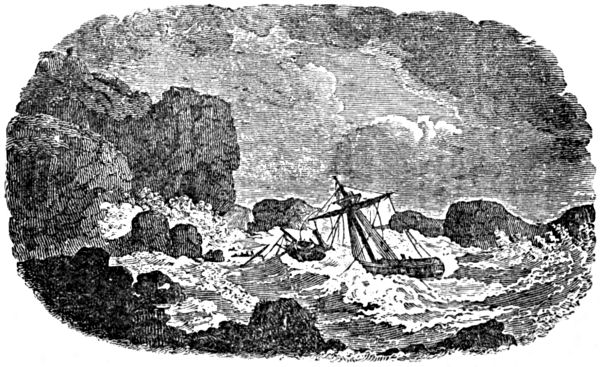
longer on changing the route, but it was too late. A strong
concussion told us the frigate had struck. Terror and consternation
were instantly depicted on every face. The crew
stood motionless; the passengers in utter despair. In the
midst of this general panic, cries of vengeance were heard
against the principal author of our misfortunes, wishing to
throw him overboard; but some generous persons interposed,
and endeavored to calm their spirits, by diverting their attention
to the means of our safety. The confusion was already
so great, that McPoinsignon, commandant of a troop, struck
my sister Caroline a severe blow, doubtless thinking it was
one of his soldiers. At this crisis my father was buried in
profound sleep, but he quickly awoke, the cries and the tumult
upon deck having informed him of our misfortunes. He
poured out a thousand reproaches on those whose ignorance
and boasting had been so disastrous to us. However, they
set about the means of averting our danger. The officers,
with an altered voice, issued their orders expecting every moment
to see the ship go in pieces. They strove to lighten her,
but the sea was very rough and the current strong. Much
time was lost in doing nothing; they only pursued half measures
and all of them unfortunately failed.
When it was discovered that the danger of the Medusa was
not so great as was at first supposed, various persons proposed
to transport the troops to the island of Arguin, which was
conjectured to be not far from the place where we lay
aground. Others advised to take us all successively to the
coast of the desert of Sahara, by the means of our boats, and
with provisions sufficient to form a caravan, to reach the island
of Saint Louis, at Senegal. The events which afterwards
ensued proved this plan to have been the best, and which
would have been crowned with success; unfortunately it was
not adopted. M. Schmaltz, the governor, suggested the
making of a raft of sufficient size to carry two hundred men,
with provisions; which latter plan was seconded by the two
officers of the frigate, and put in execution.
The fatal raft was then begun to be constructed, which
would, they said, carry provisions for every one. Masts,
planks, boards and cordage were thrown overboard. Two
officers were charged with the framing of these together.—Large
barrels were emptied and placed at the angles of the
machine, and the workmen were taught to say, that the passengers
would be in greater security there, and more at their
ease, than in the boats. However, it was forgotten to erect
rails, every one supposed, and with reason, that those who
had given the plan of the raft, had had no design of embarking
upon it themselves.
When it was completed, the two chief officers of the frigate
publicly promised, that all the boats would tow it to the
shore of the Desert; and, when there, stores of provisions
and fire-arms would be given us to form a caravan to
take us all to Senegal. Why was not this plan executed?—Why
were these promises, sworn before the French flag,
made in vain? But it is necessary to draw a veil over the past.
I will only add, that if these promises had been fulfilled, every
one would have been saved, and that, in spite of the detestable
egotism of certain personages, humanity would not
now have had to deplore the scenes of horror consequent on
the wreck of the Medusa.
On the 3d of July, the efforts were renewed to disengage
the frigate, but without success. We then prepared to quit
her. The sea became very rough, and the wind blew with
great violence. Nothing now was heard but the plaintive
and confused cries of a multitude, consisting of more than
four hundred persons, who, seeing death before their eyes,
deplored their hard fate in bitter lamentations.
On the 4th, there was a glimpse of hope. At the hour the
tide flowed, the frigate, being considerably lightened by all
that had been thrown overboard, was found nearly afloat; and
it is very certain, if on that day they had thrown the artillery
into the water, the Medusa would have been saved; but
M. Lachaumareys said, he would not thus sacrifice the king’s
cannon, as if the frigate did not belong to the king also.—However,
the sea ebbed, and the ship sinking into the sand
deeper than ever, made them relinquish that on which depended
our last ray of hope.
On the approach of night, the fury of the winds redoubled,
and the sea became very rough. The frigate then received
some tremendous concussions, and the water rushed into the
hold in the most terrific manner, but the pumps would not
work. We had now no alternative but to abandon her for
the frail boats, which any single wave might overwhelm.—Frightful
gulfs environed us; mountains of water raised their
liquid summits in the distance. How were we to escape so
many dangers? Whither could we go? What hospitable
land would receive us on its shores? My thoughts then reverted
to our beloved country. Then starting suddenly from
my reverie, I exclaimed: ‘O terrible condition! that black and
boundless sea resembles the eternal night which will engulf
us! All those who surround me seem yet tranquil, but that
fatal calm will soon be succeeded by the most frightful torments.
Fools, what had we to find in Senegal, to make us
trust to the most perfidious of elements! Did France not afford
every necessary for our happiness? Happy! yes, thrice
happy, they who never set foot on a foreign soil! Great
God! succor all these unfortunate beings; save our unhappy
family!’
My father perceived my distress, but how could he console
me? What words could calm my fears, and place me above
the apprehensions of those dangers to which we were exposed?
How, in a word, could I assume a serene appearance,
when friends, parents and all that was most dear to me were,
in all human probability, on the very verge of destruction?—Alas!
my fears were but too well founded. For I soon perceived
that, although we were the only ladies, besides the
Misses Schmaltz, who formed a part of the Governor’s suit,
they had the barbarity of intending our family to embark upon
the raft, where were only soldiers sailors and planters of
Cape Verd, and some generous officers who had not the honor
(if it could be accounted one) of being considered among
the ignorant confidants of MM. Schmaltz and Lachaumareys.
My father, indignant at a proceeding so indecorous, swore
we would not embark upon the raft, and that, if we were
not judged worthy of a place in one of the six boats, he would
himself, his wife and children, remain on board the wreck
of the frigate. The tone in which he spoke these words, was
that of a man resolute to avenge any insult that might be offered
to him. The governor of Senegal, doubtless fearing
the world would one day reproach him for his inhumanity, decided
we should have a place in one of the boats. This having
in some measure quieted our fears concerning our unfortunate
situation, I was desirous of taking some repose, but
the uproar among the crew was so great I could not obtain it.
Towards midnight, a passenger came to inquire of my
father if we were disposed to depart; he replied, we had been
forbid to go yet. However, we were soon convinced that a
great part of the crew and various passengers were secretly
preparing to set off in the boats. A conduct so perfidious
could not fail to alarm us, especially as we perceived among
those so eager to embark unknown to us, several who had
promised, but a little while before, not to go without us.
M. Schmaltz, to prevent that which was going on upon
deck, instantly rose to endeavor to quiet their minds; but the
soldiers had already assumed a threatening attitude, and
holding cheap the words of their commander, swore they
would fire upon whosoever attempted to depart in a clandestine
manner. The firmness of these brave men produced the
desired effect, and all was restored to order. The governor
returned to his cabin; and those who were desirous of departing
furtively were confused and covered with shame. The
governor, however, was ill at ease; and as he had heard
very distinctly certain energetic words which had been addressed
to him, he judged it proper to assemble a council.—All
the officers and passengers being collected, M. Schmaltz,
there solemnly swore before them not to abandon the raft, and
a second time promised that all the boats would tow it to the
shore of the Desert, where they would all be formed into a
caravan. I confess this conduct of the governor greatly satisfied
every member of our family; for we never dreamed he
would deceive us, nor act in a manner contrary to what he
had promised.
About three in the morning, some hours after the meeting
of the council, a terrible noise was heard in the powder room;
it was the helm which was broken. All who were sleeping
were roused by it. On going on deck every one was more
and more convinced that the frigate was lost beyond all recovery.
Alas! the wreck was for our family but the commencement
of a horrible series of misfortunes. The two
chief officers then decided with one accord, that all should embark
at six in the morning, and abandon the ship to the mercy
of the waves. After the decision, followed a scene the most
whimsical, and at the same time the most melancholy that can be
well conceived. To have a more distinct idea of it, let the
reader transport himself in imagination to the midst of the liquid
plains of the ocean: then let him picture to himself a multitude
of all classes, of every age, tossed about at the mercy of
the waves upon a dismasted vessel, foundered, and half submerged,
let him not forget these are thinking beings with the certain
prospect before them of having reached the goal of their
existence.
Separated from the rest of the world by a boundless sea,
and having no place of refuge but the wreck of a grounded
vessel, the multitude addressed at first their vows to heaven,
and forgot, for a moment, all earthly concerns. Then suddenly
starting from their lethargy, they began to look after
their wealth, the merchandise they had in small ventures,
utterly regardless of the elements which threatened them.
The miser, thinking of the gold contained in his coffers, hastening
to put it in a place of safety, either by sewing it into the
lining of his clothes, or by cutting out for it a place in the
waistband of his trowsers. The smuggler was tearing his hair
at not being able to save a chest of contraband which he had
secretly got on board, and with which he had hoped to have
gained two or three hundred per cent. Another, selfish to
excess, was throwing overboard all his hidden money, and
amusing himself by burning all his effects. A generous officer
was opening his portmanteau, offering caps, stockings, and
shirts, to any who would take them. These had scarcely
gathered together their various effects, when they learned that
they could not take anything with them; those were searching
the cabin and store-rooms to carry away everything that
was valuable. Ship-boys were discovering the delicate wines
and fine liquors, which a wise foresight had placed in reserve.
Soldiers and sailors were penetrating even into the spirit-room,
broaching casks, staving others and drinking till they fell exhausted.
Soon the tumult of the inebriated made us forget
the roaring of the sea which threatened to engulf us. At last
the uproar was at its height; the soldiers no longer listened to
the voice of the captain. Some knit their brows and muttered
oaths; but nothing could be done with those whom wine had
rendered furious. Next, piercing cries mixed with doleful
groans were heard—this was the signal of departure.
At six o’clock on the morning of the 5th, a great part of the
military were embarked upon the raft, which was already
covered with a large sheet of foam. The soldiers were expressly
prohibited from taking their arms. A young officer of
infantry, whose brain seemed to be powerfully affected, put his
horse beside the barricadoes of the frigate, and then, armed
with two pistols, threatened to fire upon any one who refused
to go upon the raft. Forty men had scarcely descended when
it sunk to the depth of about two feet. To facilitate the embarking
of a greater number, they were obliged to throw over
several barrels of provisions which had been placed upon it
the day before. In this manner did this furious officer get
about one hundred and fifty heaped upon that floating tomb;
but he did not think of adding one more to the number by descending
himself, as he ought to have done, but went peaceably
away, and placed himself in one of the best boats. There
should have been sixty sailors upon the raft, and there were but
about ten. A list had been made out on the 4th, assigning
each his proper place: but this wise precaution being disregarded,
every one pursued the plan he deemed the best for his
own preservation. The precipitation with which they forced
one hundred and fifty unfortunate beings upon the raft was
such, that they forgot to give them one morsel of biscuit.
However, they threw towards them twenty-five pounds in a
sack, while they were not far from the frigate; but it fell into
the sea, and was with difficulty recovered.
During this disaster, the governor of Senegal, who was
busied in the care of his own dear self, effeminately descended
in an arm-chair into the barge, where were already various
large chests, all kinds of provisions, his dearest friends, his
daughters and his wife. Afterwards the captain’s boat received
twenty-seven persons, among whom were twenty-five
sailors, good rowers. The shallop, commanded by M. Espiau,
ensign of the ship, took forty-five passengers, and put off.
The boat, called the Senegal, took twenty-five; the pinnace
thirty-three; and the yawl, the smallest of all the boats, took
only ten.
Almost all the officers, the passengers, the mariners and supernumeraries,
were already embarked—all, but our weeping
family, who still remained upon the boards of the frigate, till
some charitable souls would kindly receive us into a boat.
Surprised at this abandonment, I instantly felt myself roused,
and, calling with all my might to the officers of the boats, besought
them to take our unhappy family along with them.
Soon after, the barge, in which were the governor of Senegal
and all his family, approached the Medusa, as if still to take
some passengers, for there were but few in it. I made a motion
to descend, hoping that the Misses Schmaltz, who had,
till that day, taken a great interest in our family, would allow
us a place in their boat; but I was mistaken: those ladies,
who had embarked in a mysterious incognito, had already forgotten
us; and M. Lachaumareys, who was still on the frigate,
positively told me they would not embark along with us.
Nevertheless I ought to tell, what we learned afterwards, that
the officer who commanded the pinnace had received orders
to take us in, but, as he was already a great way from the frigate,
we were certain he had abandoned us. My father however
hailed him, but he persisted on his way to gain the open
sea. A short while afterwards we perceived a small boat
among the waves, which seemed desirous to approach the
Medusa; it was the yawl. When it was sufficiently near,
my father implored the sailors who were in it to take us on
board, and to carry us to the pinnace, where our family ought
to be placed. They refused. He then seized a firelock,
which lay by chance upon deck, and swore he would kill
every one of them if they refused to take us, adding that it
was the property of the king, and that he would have advantage
from it as well as another. The sailors murmured, but
durst not resist, and received all our family, which consisted
of nine persons, viz. four children, our step-mother, my cousin,
my sister Caroline, my father and myself. A small box
filled with valuable papers, which we wished to save, some
clothes, two bottles of ratafia, which we had endeavored to
preserve amidst our misfortunes, were seized and thrown
overboard by the sailors of the yawl, who told us we would
find in the pinnace everything we could wish for our voyage.
We had then only the clothes which covered us, never thinking
of dressing ourselves in two suits; but the loss which affected
us most was that of several MSS, at which my father
had been laboring for a long while. Our trunks, our linen
and various chests of merchandize of great value, in a word,
everything we possessed, was left in the Medusa. When we
boarded the pinnace, the officer who commanded it began excusing
himself for having set off without forewarning us, as
he had been ordered, and said a thousand things in his justification.
But without believing the half of his fine protestations,
we felt very happy in having overtaken him; for it is most
certain they had no intention of encumbering themselves with
our unfortunate family. I say encumber, for it is evident
that four children, one of whom was yet at the breast,
were very indifferent beings to people who were actuated by
a selfishness without all parallel. When we were seated in
the long boat, my father dismissed the sailors with the
yawl, telling them he would ever gratefully remember their
services. They speedily departed, but little satisfied with the
good action they had done. My father hearing their murmurs
and the abuse they poured out against us, said, loud enough
for all in the boat to hear, ‘We are not surprised sailors are
destitute of shame, when their officers blush at being compelled
to do a good action.’ The commandant of the boat feigned
not to understand the reproaches conveyed in these words,
and, to divert our minds from brooding over our wrongs, endeavored
to counterfeit the man of gallantry.
All the boats were already far from the Medusa, when they
were brought to, to form a chain in order to tow the raft.—The
barge, in which was the governor of Senegal, took the
first tow, then all the other boats in succession joined themselves
to that. M. Lachaumareys embarked, although there
yet remained upon the Medusa more than sixty persons.—Then
the brave and generous M. Espiau, commander of the
shallop, quitted the line of boats, and returned to the frigate,
with the intention of saving all the wretches who had been
abandoned. They all sprung into the shallop; but as it was
very much overloaded, seventeen unfortunates preferred remaining
on board, rather than expose themselves as well as
their companions to certain death. But alas! the greater
part afterwards fell victims to their fears or their devotion.—Fifty-two
days after they were abandoned, no more than three
of them were alive, and those looked more like skeletons than
men. They told that their miserable companions had gone
afloat upon planks and hen-coops, after having waited in vain
forty-two days, for the succor which had been promised them,
and that all had perished.
The shallop, carrying with difficulty all those she had saved
from the Medusa, slowly rejoined the line of boats which towed
the raft, M. Espiau earnestly besought the officers of the
other boats to take some of them along with them; but they
refused, alleging to the generous officer that he ought to keep
them in his own boat, as he had gone for them himself.
M. Espiau, finding it impossible to keep them all without exposing
them to the utmost peril, steered right for a boat which I
will not name. Immediately a sailor sprung from the shallop
into the sea, and endeavored to reach it by swimming; and
when he was about to enter it, an officer who possessed great
influence pushed him back, and, drawing his sabre, threatened
to cut off his hands, if he again made the attempt. The
poor wretch regained the shallop, which was very near the pinnace,
which we were in, my father supplicated M. Laperere,
the officer of the boat, to receive him on board, and had his
arms already out to catch him, when M. Laperere instantly let
go the rope which attached us to the other boats, and tugged
off with all his force. At the same instant every boat imitated
our execrable example; and wishing to shun the approach of
the shallop, which sought for assistance, stood off from the
raft, abandoning, in the midst of the ocean, and to the fury of
the waves, the miserable mortals whom they had sworn to
land on the shores of the Desert.
Scarcely had these cowards broken their oath, when we
saw the French flag flying upon the raft. The confidence of
those unfortunate persons was so great, that when they saw the
first boat which had the tow removing from them, they all cried
out the rope is broken! the rope is broken! but when no attention
was paid to their observation, they instantly perceived
the treachery of the wretches who had left them so basely.—Then
the cries of Vive le Roi arose from the raft, as if the
poor fellows were calling to their father for assistance; or, as
if they had been persuaded that, at that rallying word, the officers
of the boats would return, and not abandon their countrymen.
The officers repeated the cry of Vive le Roi, without
a doubt, to insult them; but, more particularly, M. Lachaumareys
who, assuming a martial attitude, waved his hat in the
air. Alas! what availed these false professions? Frenchmen,
menaced with the greatest peril, were demanding assistance
with the cries of Vive le Roi; yet none were found sufficiently
generous nor sufficiently French, to go to aid them. After
a silence of some minutes, horrible cries were heard; the air
resounded with the groans, the lamentations, the imprecations
of these wretched beings, and the echo of the sea frequently
repeated, alas! how cruel you are to abandon us!!! The raft
already appeared to be buried under the waves, and its unfortunate
passengers immersed. The fatal machine was drifted
by currents far behind the wreck of the frigate; without
cable, anchor, mast, sail or oars; in a word, without the smallest
means of enabling them to save themselves. Each wave
that struck it, made them stumble in heaps on one another.—Their
feet getting entangled among the cordage, and between
the planks, bereaved them of the faculty of moving. Maddened
by these misfortunes, suspended, and adrift upon a
merciless ocean, they were soon tortured between the pieces
of wood which formed the scaffold on which they floated.—The
bones of their feet and their legs were bruised and broken,
every time the fury of the waves agitated the raft; their
flesh covered with contusions and hideous wounds, dissolved,
as it were, in the briny waves, while the roaring flood around
them was colored with their blood.
As the raft, when it was abandoned, was nearly two leagues
from the frigate, it was impossible these unfortunate persons
could return to it; they were soon after far out to sea. These
victims still appeared above their floating tomb; and, stretching
out their supplicating hands towards the boats which fled
from them, seemed yet to invoke, for the last time, the names
of the wretches who had deceived them. O horrid day! a day
of shame and reproach! Alas! that the hearts of those who
were so well acquainted with misfortune, should have been so
inaccessible to pity.
After witnessing that most inhuman scene, and seeing they
were insensible to the cries and lamentations of so many unhappy
beings, I felt my heart bursting with sorrow. It seemed
to me that the waves would overwhelm all these wretches,
and I could not suppress my tears. My father, exasperated
to excess, and bursting with rage at seeing so much cowardice
and inhumanity among the officers of the boats, began to regret
he had not accepted the place which had been assigned for
us upon the fatal raft. ‘At least,’ said he, ‘we would have died
with the brave, or would have returned to the wreck of the
Medusa; and not have had the disgrace of saving ourselves
with cowards.’ Although this produced no effect upon the
officers, it proved very fatal to us afterwards; for, on our arrival
at Senegal, it was reported to the Governor, and very
probably was the principal cause of all those evils and vexations
which we endured in that colony.
Let us now turn our attention to the several situations of all
those who were endeavoring to save themselves in the different
boats, as well as to those left upon the wreck of the Medusa.
We have already seen, that the frigate was half sunk when
it was deserted, presenting nothing but a hulk and wreck.—Nevertheless,
seventeen still remained upon it, and had food,
which, although damaged, enabled them to support themselves
for a considerable time; while the raft was abandoned to float
at the mercy of the waves, upon the vast surface of the ocean.
One hundred and fifty wretches were embarked upon it, sunk
to the depth of at least three feet on its fore part, and on its
poop immersed even to the middle. What victuals they had
were soon consumed, or spoiled by the salt water; and perhaps
some, as the waves hurried them along, became food for
the monsters of the deep. Two only of all the boats which
left the Medusa, and these with very few people in them, were
provisioned with every necessary; these struck off with security
and despatch. But the condition of those who were in
the shallop was but little better than those upon the raft; their
great number, their scarcity of provisions, their great distance
from the shore, gave them the most melancholy anticipations
of the future. Their worthy commander, M. Espiau, had no
other hope but of reaching the shore as soon as possible. The
other boats were less filled with people, but they were scarcely
better provisioned; and as by a species of fatality, the pinnace,
in which were our family, was destitute of everything.
Our provisions consisted of a barrel of biscuit, and a tierce of
water; and, to add to our misfortune, the biscuit being soaked
in the sea, it was almost impossible to swallow one morsel
of it. Each passenger in our boat was obliged to sustain his
wretched existence with a glass of water, which he could get
only once a day. To tell how this happened, how this boat
was so poorly supplied, while there was abundance left upon
the Medusa, is far beyond my power. But it is at least certain,
that the greater part of the officers commanding the
boats, the shallop, the pinnace, the Senegal boat, and the
yawl, were persuaded, when they quitted the frigate, that they
would not abandon the raft, but that all the expedition would
sail together to the coast of Sahara; that when there, the boats
would be again sent to the Medusa to take provisions, arms,
and those who were left there; but it appears the chiefs had
decided otherwise.
After abandoning the raft, although scattered, all the boats
formed a little fleet, and followed the same route. All who
were sincere hoped to arrive the same day at the coast of the
Desert, and that every one would get on shore; but
MM. Schmaltz and Lachaumareys gave orders to take the route
for Senegal. This sudden change in the resolutions of the
chiefs was like a thunderbolt to the officers commanding the
boats. Having nothing on board but what was barely necessary
to enable us to allay the cravings of hunger for one day,
we were all sensibly affected. The other boats, which, like
ourselves, hoped to have got on shore at the nearest point,
were a little better provisioned than we were; they had at
least a little wine, which supplied the place of other necessaries.
We then demanded some from them, explaining our
situation, but none would assist us, not even the captain, who,
drinking to a kept mistress, supported by two sailors, swore
he had not one drop on board. We were next desirous of addressing
the boat of the Governor of Senegal, where we were
persuaded were plenty of provisions of every kind, such as
oranges, biscuit, cakes, comfits, plums and even the finest liquors;
but my father opposed it, so well was he assured we
would not obtain anything.
We will now turn to the condition of those on the raft,
when the boats left them to themselves.
If all the boats had continued dragging the raft forward, favored
as we were by the breeze from the sea, we would have
been able to have conducted them to the shore in less than
two days. But an inconceivable fatality caused the generous
plan to be abandoned which had been formed.
When the raft had lost sight of the boats, a spirit of sedition
began to manifest itself in furious cries. They then began
to regard one another with ferocious looks, and to thirst
for one another’s flesh. Some one had already whispered of
having recourse to that monstrous extremity, and of
commencing with the fattest and youngest. A proposition so
atrocious filled the brave Captain Dupont and his worthy
Lieutenant M. L’Heureux with horror; and that courage
which had so often supported them in the field of glory, now
forsook them.
Among the first who fell under the hatchets of the assassins,
was a young woman who had been seen devouring the body
of her husband. When her turn was come, she sought a little
wine as a last favor, then rose, and without uttering a word
threw herself into the sea. Captain Dupont, being prescribed
for having refused to partake of the sacrilegious viands with
which the monsters were feeding on, was saved by a miracle
from the hands of the butchers. Scarcely had they seized
him to lead him to the slaughter, when a large pole, which
served in place of a mast, fell upon his body; and believing
that his legs were broken, they contented themselves by
throwing him into the sea. The unfortunate captain plunged
and disappeared, and they thought him already in another
world.
Providence, however, revived the strength of the unfortunate
warrior. He emerged under the beams of the raft, and
clinging with all his might, holding his head above water, he
remained between two enormous pieces of wood, while the
rest of his body was hid in the sea. After more than two hours
of suffering, Captain Dupont spoke in a low voice to his lieutenant,
who by chance was seated near the place of his concealment.
The brave L’Heureux, with eyes glistening with
tears, believed he heard the voice, and saw the shade of his
captain; and trembling, was about to quit the place of horror;
O wonderful! he saw a head which seemed to draw its last
sigh, he recognized it, he embraced it, alas! it was his dear
friend! Dupont was instantly drawn from the water, and
L’Heureux obtained for his unfortunate comrade again a place
upon the raft. Those who had been most inveterate against
him, touched at what Providence had done for him in so miraculous
a manner, decided with one accord to allow him entire
liberty upon the raft.
The sixty unfortunates who had escaped from the first massacre,
were soon reduced to fifty, then to forty, and at last to
twenty-eight. The least murmur, or the smallest complaint,
at the moment of distributing the provisions, was a crime punished
with immediate death. In consequence of such a regulation,
it may easily be presumed the raft was soon lightened.
In the meanwhile the wine diminished sensibly, and the
half-rations very much displeased a certain chief of the conspiracy.
On purpose to avoid being reduced to that extremity,
the executive power decided it was much wiser to drown thirteen
people, and to get full rations, than that twenty-eight
should have half rations.
Merciful Heaven! what shame! After the last catastrophe,
the chiefs of the conspiracy, fearing, doubtless of being
assassinated in their turn, threw all the arms into the sea, and
swore an inviolable friendship with the heroes which the
hatchet had spared. On the 17th of July, in the morning,
Captain Parnajon, commandant of the Argus brig, still found
fifteen men on the raft. They were immediately taken on
board, and conducted to Senegal. Four of the fifteen are
yet alive, viz. Captain Dupont, residing in the neighborhood
of Maintenon, Lieutenant L’Heureux, since Captain at Senegal,
Savigny, at Rochefort, and Correard, I know not where.
On the 5th of July, at ten in the morning, one hour after
abandoning the raft, and three after quitting the Medusa,
M. Laperere, the officer of our boat, made the first distribution of
provisions. Each passenger had a small glass of water and
nearly the fourth of a biscuit. Each drank his allowance of
water at one draught, but it was found impossible to swallow
one morsel of our biscuit, it being so impregnated with sea-water.
It happened, however, that some was found not quite
so saturated. Of these we eat a small portion, and put back
the remainder for a future day. Our voyage would have been
sufficiently agreeable, if the beams of the sun had not been so
fierce. On the evening we perceived the shores of the Desert;
but as the two chiefs (MM. Schmaltz and Lachaumareys)
wished to go right for Senegal, notwithstanding we
were still one hundred leagues from it, we were not allowed
to land. Several officers remonstrated, both on account of
our want of provisions and the crowded condition of the
boats, for undertaking so dangerous a voyage. Others urged
with equal force, that it would be dishonoring the French
name if we were to neglect the unfortunate people on the
raft, and insisted we should be set on shore, and whilst we
waited there, three boats should return to look after the raft,
and three to the wreck of the frigate, to take up the seventeen
who were left there, as well as a sufficient quantity of provisions
to enable us to go to Senegal by the way of Barbary.
But MM. Schmaltz and Lachaumareys whose boats were sufficiently
well provisioned, scouted the advice or their subalterns,
and ordered them to cast anchor till the following morning.
They were obliged to obey these orders, and to relinquish
their designs. During the night, a certain passenger
who was doubtless no doctor, and who believed in ghosts and
witches, was suddenly frightened by the appearance of flames,
which he thought he saw in the waters of the sea, a little way
from where our boat was anchored. My father, and some
others, who were aware that the sea is sometimes phosphorated,
confirmed the poor credulous man in his belief, and added
several circumstances which fairly turned his brain. They
persuaded him the Arabic sorcerers had fired the sea to prevent
us from travelling along their deserts.
On the morning of the 6th of July, at five o’clock, all the
boats were under way on the route to Senegal. The boats
of MM. Schmaltz and Lachaumareys took the lead along the
coast, and all the expedition followed. About eight, several
sailors in our boat, with threats, demanded to be set on shore;
but M. Laperere, not acceding to their request, the whole
were about to revolt and seize the command; but the firmness
of this officer quelled the mutineers. In a spring which he
made to seize a firelock which a sailor persisted in keeping in
his possession, he almost tumbled into the sea. My father
fortunately was near him, and held him by his clothes, but he
had instantly to quit him, for fear of losing his hat, which the
waves were floating away. A short while after this slight
accident, the shallop, which we had lost sight of since the
morning, appeared desirous of rejoining us. We plied all
hands to avoid her, for we were afraid of one another, and
thought that that boat, encumbered with so many people, wished
to board us to oblige us to take some of its passengers, as
M. Espiau would not suffer them to be abandoned like those
upon the raft. That officer hailed us at a distance, offering to
take our family on board, adding, he was anxious to take
about sixty people to the Desert. The officer of our boat,
thinking that this was a pretence, replied, we preferred suffering
where we were. It even appeared to us that M. Espiau
had hid some of his people under the benches of the shallop.
But alas; in the end we deeply deplored being so suspicious,
and of having so outraged the devotion of the most generous
officer of the Medusa.
Our boat began to leak considerably, but we prevented it
as well as we could, by stuffing the largest holes with oakum,
which an old sailor had had the precaution to take before quitting
the frigate. At noon the heat became so strong—so intolerable,
that several of us believed we had reached our last
moments. The hot winds of the Desert even reached us; and
the fine sand with which they were loaded, had completely obscured
the clearness of the atmosphere. The sun presented
a reddish disk; the whole surface of the ocean became nebulous,
and the air which we breathed, depositing a fine sand, an
impalpable powder, penetrated to our lungs, already parched
with a burning thirst. In this state of torment we remained
till four in the afternoon, when a breeze from the northwest
brought us some relief. Notwithstanding the privations we
felt, and especially the burning thirst which had become intolerable,
the cool air which we now began to breathe, made
us in part forget our sufferings. The heavens began again to
resume the usual serenity of those latitudes, and we hoped to
have passed a good night. A second distribution of provisions
was made; each received a small glass of water, and the
eighth part of a biscuit. Notwithstanding our meagre fare,
every one seemed content, in the persuasion we would reach
Senegal by the morrow. But how vain were all our hopes,
and what sufferings had we yet to endure!
At half past seven, the sky was covered with stormy clouds.
The serenity we had admired a little while before, entirely disappeared,
and gave place to the most gloomy obscurity. The
surface of the ocean presented all the signs of a coming tempest.
The horizon on the side of the Desert had the appearance
of a long hideous chain of mountains piled on one another,
the summits of which seemed to vomit fire and smoke.
Bluish clouds, streaked with a dark copper color, detached
themselves from that shapeless heap, and came and joined
with those which floated over our heads. In less than half
an hour the ocean seemed confounded with the terrible sky
which canopied us. The stars were hid. Suddenly a frightful
noise was heard from the west, and all the waves of the
sea rushed to founder our frail bark. A fearful silence succeeded
to the general consternation. Every tongue was
mute; and none durst communicate to his neighbor the horror
with which his mind was impressed. At intervals the cries of
the children rent our hearts. At that instant a weeping and
agonized mother bared her breast to her dying child, but it
yielded nothing to appease the thirst of the little innocent
who pressed it in vain. O night of horrors! what pen is capable
to paint thy terrible picture! How describe the agonizing
fears of a father and mother, at the sight of their children
tossed about and expiring of hunger in a small boat, which the
winds and waves threatened to engulf at every instant! Having
full before our eyes the prospect of inevitable death, we
gave ourselves up to our unfortunate condition, and addressed
our prayers to Heaven. The winds growled with the utmost
fury; the tempestuous waves arose exasperated. In their
terrific encounter a mountain of water was precipitated into
our boat, carrying away one of the sails, and the greater part
of the effects which the sailors had saved from the Medusa.
Our bark was nearly sunk; the females and the children lay
rolling in its bottom, drinking the waters of bitterness; and
their cries, mixed with the roaring of the waves and the furious
north wind, increased the horrors of the scene. My unfortunate
father then experienced the most excruciating agony
of mind. The idea of the loss which the shipwreck had occasioned
to him, and the danger which still menaced all he
held dearest in the world, plunged him into a swoon. The
tenderness of his wife and children recovered him; but alas!
his recovery was to still more bitterly deplore the wretched
situation of his family. He clasped us to his bosom; he
bathed us with his tears, and seemed as if he was regarding us
with his last looks of love.
Every soul in the boat was seized with the same perturbation,
but it manifested itself in different ways. One part of
the sailors remained motionless, in a bewildered state; the
other cheered and encouraged one another; the children,
locked in the arms of their parents, wept incessantly. Some
demanded drink, vomiting the salt water which choked them;
others, in short, embraced as for the last time, intertwining
their arms, and vowing to die together.
In the meanwhile the sea became rougher and rougher.
The whole surface of the ocean seemed a vast plain furrowed
with huge blackish waves fringed with white foam. The
thunder growled around us, and the lightning discovered to our
eyes all that our imagination could conceive most horrible.
Our boat, beset on all sides by the winds, and at every instant
tossed on the summit of mountains of water, was very nearly
sunk in spite of our every effort in baling it, when we discovered
a large hole in its poop. It was instantly stuffed with
everything we could find:—old clothes, sleeves of shirts, shreds
of coats, shawls, useless bonnets, everything was employed,
and secured us as far as it was possible. During the space
of six hours, we rowed suspended alternately between hope
and fear, between life and death. At last towards the middle
of the night, Heaven, which had seen our resignation, commanded
the floods to be still. Instantly the sea became less
rough, the veil which covered the sky became less obscure,
the stars again shone out, and the tempest seemed to withdraw.
A general exclamation of joy and thankfulness issued at one
instant from every mouth. The winds calmed, and each of us
sought a little sleep, while our good and generous pilot steered
our boat on a still very stormy sea.
The day at last, the day so desired, entirely restored the
calm; but it brought no other consolation. During the night,
the currents, the waves, and the winds had taken us so far
out to sea, that, on the dawning of the 7th of July, we saw
nothing but sky and water, without knowing whither to direct
our course; for our compass had been broken during the
tempest. In this hopeless condition, we continued to steer
sometimes to the right and sometimes to the left, until the sun
arose, and at last showed us the east.
On the morning of the 7th of July, we again saw the
shores of the Desert, notwithstanding we were a great distance
from it. The sailors renewed their murmurings, wishing
to get on shore, with the hope of being able to get some
wholesome plants, and some more palatable water than that of
the sea; but as we were afraid of the Moors, their request
was opposed. However, M. Laperere proposed to take them
as near as he could to the first breakers on the coast; and
when there, those who wished to go on shore should throw
themselves into the sea, and swim to land. Eleven accepted
the proposal; but when we had reached the first waves, none
had the courage to brave the mountains of water which rolled
between them and the beach. Our sailors then betook
themselves to their benches and oars, and promised to be
more quiet for the future. A short while after, a third distribution
was made since our departure from the Medusa; and
nothing more remained than four pints of water, and one half
dozen biscuits. What steps were we to take in this cruel
situation? We were desirous of going on shore, but we had
such dangers to encounter. However we soon came to a decision,
when we saw a caravan of Moors on the coast. We
then stood a little out to sea. According to the calculation
of our commanding officer, we would arrive at Senegal on
the morrow. Deceived by that false account, we preferred
suffering one day more, rather than be taken by the
Moors of the Desert, or perish among the breakers. We
had now no more than a small half glass of water, and the
seventh of a biscuit.
Exposed as we were to the heat of the sun, which darted
its rays perpendicularly on our heads, that ration, though small
would have been a great relief to us; but the distribution
was delayed to the morrow. We were then obliged to drink
the bitter sea water, ill as it was calculated to quench our
thirst. Must I tell it! thirst had so withered the lungs of
our sailors, that they drank water salter than that of the sea.
Our numbers diminished daily, and nothing but the hope of
arriving at the colony on the following day sustained our frail
existence. My young brothers and sisters wept incessantly
for water. The little Laura, aged six years lay dying at the
feet of her mother. Her mournful cries so moved the soul
of my unfortunate father, that he was on the eve of opening
a vein to quench the thirst which consumed his child; but a
wise person opposed his design, observing that all the blood
in his body would not prolong the life of his infant one moment.
The freshness of the night wind procured us some respite.
We anchored pretty near to the shore, and though dying of
famine, each got a tranquil sleep. On the morning of the
8th of July, at break of day, we took the route for Senegal.
A short while after the wind fell, and we had a dead calm.—We
endeavored to row, but our strength was exhausted. A
fourth and last distribution was made, and in the twinkling of
an eye, our last resources were consumed. We were forty-two
people who had to feed upon six biscuits and about four
pints of water, with no hope of a farther supply. Then came
the moment for deciding whether we were to perish among
the breakers, which defended the approach to the shores of
the Desert, or to die of famine in continuing our route.—The
majority preferred the last species of misery. We continued
our progress along the shore, painfully pulling our
oars. Upon the beach were distinguished several downs of
white sand and some small trees. We were thus creeping
along the coast, observing a mournful silence, when a sailor
suddenly exclaimed, behold the Moors! We did, in fact, see
various individuals upon the rising ground, walking at a
quick pace, and whom we took to be the Arabs of the Desert.
As we were very near the shore, we stood farther out to sea,
fearing that these pretended Moors, or Arabs, would throw
themselves into the sea, swim out, and take us. Some hours
after, we observed several people upon an eminence, who
seemed to make signals for us.
We examined them attentively, and soon recognized them
to be our companions in misfortune. We replied to them by
attaching a white handkerchief to the top of our mast. Then
we resolved to land at the risk of perishing among the breakers,
which were very strong towards the shore, although the
sea was calm. On approaching the beach, we went towards
the right, where the waves seemed less agitated, and endeavored
to reach it, with the hope of being able more easily to
land. Scarcely had we directed our course to that point,
when we perceived a great number of people standing near
to a little wood surrounding the sand-hills. We recognized
them to be the passengers of that boat, which, like ourselves,
were deprived of provisions.
Meanwhile we approached the shore, and already the foaming
surge filled us with terror. Each wave that came from
the open sea, each billow that swept beneath our boat, made
us bound into the air; so we were sometimes thrown from the
poop to the prow, and from the prow to the poop. Then, if
our pilot had missed the sea, we would have been sunk; the
waves would have thrown us aground, and we would have
been buried among the breakers. The helm of the boat was
again given to the old pilot, who had already so happily steered
us through the dangers of the storm. He instantly threw into
the sea the mast, the sails, and everything that could impede
our proceedings. When we came to the first landing point,
several of our shipwrecked companions, who had reached the
shore, ran and hid themselves behind the hills, not to see us
perish; others made signs not to approach at that place, some
covered their eyes with their hands; others, at last despising
the danger, precipitated themselves into the waves to receive
us in their arms. We then saw a spectacle that made us
shudder. We had already doubled two ranges of breakers;
but those which we had still to cross raised their foaming
waves to a prodigious height, then sunk with a hollow and
monstrous sound, sweeping along a long line of the coast.—Our
boat sometimes greatly elevated, and sometimes engulfed
between the waves, seemed, at the moment, of utter ruin.
Bruised, battered and tossed about on all hands, it turned of
itself, and refused to obey the kind hand which directed it.—At
that instant a huge wave rushed from the open sea, and
dashed against the poop; the boat plunged, disappeared, and
we were all among the waves. Our sailors, whose strength
had returned at the presence of danger, redoubled their efforts,
uttering mournful sounds. Our bark groaned, the oars were
broken; it was thought aground, but it was stranded; it was
upon its side. The last sea rushed upon us with the impetuosity
of a torrent. We were all up to the neck in water; the
bitter sea-froth choked us. The grapnel was thrown out.—The
sailors threw themselves into the sea; they took the
children in their arms; returned, and took us upon their
shoulders; and I found myself seated upon the sand on the
shore, by the side of my step-mother, my brothers and sisters,
almost dead. Every one was upon the beach except my father
and some sailors; but that good man arrived at last, to
mingle his tears with those of his family and friends.
Instantly our hearts joined in addressing our prayers and
praises to God. I raised my hands to heaven, and remained
sometime immoveable upon the beach. Every one also hastened
to testify his gratitude to our old pilot, who next to
God, justly merited the title of our preserver. M. Dumege,
a naval surgeon, gave him an elegant gold watch, the only
thing he had saved from the Medusa.
Let the reader now recollect all the perils to which we had
been exposed in escaping from the wreck of the frigate to the
shores of the Desert—all that we had suffered during our four
days’ voyage—and he will perhaps have a just notion of the
various sensations we felt on getting on shore on that strange
and savage land. Doubtless the joy we experienced at having
escaped, as by a miracle, the fury of the floods, was very
great; but how much was it lessened by the feelings of our
horrible situation! Without water, provisions, and the majority
of us nearly naked, was it to be wondered at that we
should be seized with terror on thinking of the obstacles
which we had to surmount, the fatigues, the privations, the
pains and sufferings we had to endure, with the dangers we
had to encounter in the immense and frightful Desert we had
to traverse before we could arrive at our destination? Almighty
Providence! it was in Thee alone I put my trust.
After we had a little recovered from the fainting and fatigue
of our getting on shore, our fellow-sufferers told us they had
landed in the forenoon, and cleared the breakers by the
strength of their oars and sails; but they had not all been so
lucky as we were. One unfortunate person, too desirous of
getting quickly on shore, had his legs broken under the
shallop, and was taken and laid on the beach, and left to the
care of Providence. M. Espiau, commander of the shallop,
reproached us for having doubted him when he wished to board
us to take our family along with him. It was most true he
had landed sixty-three people that day. A short while after
our refusal, he took the passengers of the yawl, who would
infallibly have perished in the stormy nights of the 6th and 7th.
The boat named the Senegal, commanded by M. Maudet, had
made the shore at the same time with M. Espiau. The boats
of MM. Schmaltz and Lachaumareys were the only ones
which continued the route for Senegal, while nine-tenths of
the Frenchmen intrusted to these gentlemen were butchering
each other on the raft, or dying of hunger on the burning
sands of Sahara.
About seven in the morning, a caravan was formed to penetrate
into the interior, for the purpose of finding some fresh
water. We did accordingly find some at a little distance from
the sea, by digging among the sand. Every one instantly
flocked round the little wells, which furnished enough to
quench our thirst. This brackish water was found to be delicious,
although it had a sulphurous taste: its color was that
of whey. As all our clothes were wet and in tatters, and as
we had nothing to change them, some generous officers offered
theirs. My step-mother, my cousin, and my sister, were
dressed in them; for myself, I preferred keeping my own.
We remained nearly an hour beside our beneficent fountain,
then took the route for Senegal; that is, a southerly direction,
for we did not know exactly where that country lay. It was
agreed that the females and children should walk before the
caravan, that they might not be left behind. The sailors voluntarily
carried the youngest on their shoulders, and every
one took the route along the coast. Notwithstanding it was
nearly seven o’clock, the sand was quite burning, and we suffered
severely, walking without shoes, having lost them while
landing. As soon as we arrived on the shore, we went to
walk on the wet sand, to cool us a little. Thus we traveled
during all the night, without encountering anything but
shells, which wounded our feet.
On the morning of the 9th, we saw an antelope on the top
of a little hill, which instantly disappeared, before we had time
to shoot it. The Desert seemed to our view one immense
plain of sand, on which was seen not one blade of verdure.
However, we still found water by digging in the sand. In the
forenoon, two officers of marine complained that our family incommoded
the progress of the caravan. It is true, the females
and the children could not walk so quickly as the men. We
walked as fast as it was possible for us, nevertheless, we often
fell behind, which obliged them to halt till we came up.
These officers, joined with other individuals, considered among
themselves whether they would wait for us, or to abandon us
in the Desert. I will be bold to say, however, that but few
were of the latter opinion. My father being informed of what
was plotting against us, stepped up to the chiefs of the conspiracy,
and reproached them in the bitterest terms for their
selfishness and brutality. The dispute waxed hot. Those
who were desirous of leaving us drew their swords, and my
father put his hand upon a poignard, with which he had provided
himself on quitting the frigate. At this scene, we threw
ourselves in between them, conjuring him rather to remain in
the Desert with his family, than seek the assistance of those
who were, perhaps, less human than the Moors themselves.
Several people took our part, particularly M. Begnere, captain
of infantry, who quieted the dispute by saying to his soldiers,
‘My friends, you are Frenchmen, and I have the honor
of being your commander; let us never abandon an unfortunate
family in the Desert, so long as we are able to be of use
to them.’ This brief, but energetic speech, caused those to
blush who wished to leave us. All then joined with the old
captain saying they would not leave us on condition we would
walk quicker. M. Begnere and his soldiers replied, they did
not wish to impose conditions on those to whom they were desirous
of doing a favor; and the unfortunate family of Picard
were again on the road with the whole caravan.
About noon hunger was felt so powerfully among us, that it
was agreed upon to go to the small hills of sand which were
near the coast, to see if any herbs could be found fit for eating;
but we only got poisonous plants, among which were
various kinds of euphorbium. Convolvaluses of a bright green
carpeted the downs; but on tasting their leaves we found them
as bitter as gall. The caravan rested in this place, while
several officers went farther into the interior. They came
back in about an hour, loaded with wild purslain, which they
distributed to each of us. Every one instantly devoured his
bunch of herbage, without leaving the smallest branch: but
as our hunger was far from being satisfied with this small allowance,
the soldiers and sailors betook themselves to look for
more. They soon brought back a sufficient quantity, which
was equally distributed, and devoured upon the spot, so delicious
had hunger made that food to us. For myself, I declare
I never eat anything with so much appetite in all my life.
Water was also found in this place, but it was of an abominable
taste. After this truly frugal repast, we continued our
route. The heat was insupportable in the last degree. The
sands on which we trod were burning, nevertheless several of
us walked on these scorching coals without shoes; and the
females had nothing but their hair for a cap. When we reached
the sea-shore, we all ran and lay down among the waves.
After remaining there some time, we took our route along the
wet beach. On our journey we met with several large crabs,
which were of considerable service to us. Every now and
then we endeavored to slake our thirst by sucking their crooked
claws. About nine at night we halted between two pretty
high sand hills. After a short talk concerning our misfortunes,
all seemed desirous of passing the night in this place,
notwithstanding we heard on every side the roaring of leopards.
We deliberated on the means of securing ourselves, but sleep
soon put an end to our fears. Scarcely had we slumbered a
few hours when a terrible roaring of wild beasts awoke us, and
made us stand on our defence. It was a beautiful moonlight
night, and in spite of my fears and the horrible aspect of the
place, nature never appeared so sublime to me before. Instantly
something was announced that resembled a lion. This
information was listened to with the greatest emotion. Every
one being desirous of verifying the truth, fixed upon something
he thought to be the object: one believed he saw the long
teeth of the king of the forest; another was convinced his
mouth was already open to devour us: several, armed with
muskets, aimed at the animal, and advancing a few steps, discovered
the pretended lion to be nothing more than a shrub
fluctuating in the breeze. However, the howlings of ferocious
beasts had so frightened us, being yet heard at intervals that
we again sought the sea-shore, on purpose to continue our
route towards the south.
Some of our companions were desirous of making observations
in the interior, and they did not go in vain. They instantly
returned, and told us they had seen two Arab tents
upon a slight rising ground. We instantly directed our steps
thither. We had to pass great downs of sand very slippery,
and arrived in a large plain streaked here and there with verdure;
but the turf was so hard and piercing, we could scarcely
walk over it without wounding our feet. Our presence in
these frightful solitudes put to flight three or four Moorish
shepherds, who herded a small flock of sheep and goats in an
oasis. At last we arrived at the tents after which we were
searching, and found in them three Mooresses and two little
children, who did not seem in the least frightened by our visit.
A negro servant, belonging to an officer of marine, interpreted
between us; and the good women, who, when they had
heard of our misfortunes, offered us millet and water for
payment. We bought a little of that grain at the rate of thirty
pence a handful; the water was got for three francs a glass;
it was very good, and none grudged the money it cost. As a
glass of water, with a handful of millet, was but a poor dinner
for famished people, my father bought two kids, which they
would not give him under twenty piastres. We immediately
killed them, and our Mooresses boiled them in a large kettle.
While our repast was preparing, my father, who could not afford
the whole of the expense, got others to contribute to it,
but an old officer of marine, who was to have been captain of
the port of Senegal, was the only person who refused, notwithstanding
he had about him nearly three thousand francs which
he boasted of in the end. Several soldiers and sailors had
seen him count it in round pieces of gold, on coming ashore
on the Desert, and reproached him for his sordid avarice; but
he seemed insensible to their reproaches, nor eat the less of his
portion of the kid with his companions in misfortune.
When about to resume our journey, we saw several Moors
approaching us armed with lances. Our people instantly
seized their arms, and put themselves in readiness to defend
us in case of an attack. Two officers, followed by several
soldiers and sailors, with our interpreter, advanced to discover
their intentions. They instantly returned with the Moors,
who said, that far from wishing to do us harm, they had come
to offer us their assistance, and to conduct us to Senegal.
This offer being accepted of with gratitude by all of us, the
Moors, of whom we had been so afraid, became our protectors
and friends, verifying the old proverb, there are good people
everywhere! As the camp of the Moors was at some considerable
distance from where we were, we set off altogether
to reach it before night. After having walked about two
leagues through the burning sands, we found ourselves again
upon the shore. Towards night, our conductors made us
strike again into the interior, saying we were near their camp
which is called in their language Berkelet. But the short
distance of the Moors was found very long by the females and
the children, on account of the downs of sand which we had to
ascend and descend every instant, also of prickly shrubs over
which we were frequently obliged to walk. Those who were
barefooted, felt most severely at this time the want of their
shoes. I myself lost among the bushes various shreds of my
dress, and my feet and legs were all streaming with blood.
At length, after two long hours of walking and suffering, we
arrived at the camp of that tribe to which belonged our Arab
conductors. We had scarcely got into the camp, when the
dogs, the children, and the Moorish women, began to annoy
us. Some of them threw sand in our eyes, others amused
themselves by snatching at our hair, on pretence of wishing
to examine it. This pinched us, that spit upon us; the dogs
bit our legs, whilst the old harpies cut the buttons from the
officers coats, or endeavored to take away the lace. Our
conductors, however, had pity on us, and chased away the
dogs and the curious crowd, who had already made us suffer
as much as the thorns which had torn our feet. The chiefs
of the camp, our guides, and some good women, at last set
about getting us some supper. Water in abundance was
given us without payment, and they sold us fish dried in the
sun, and some bowlsful of sour milk, at a reasonable price.
We found a Moor in the camp who had previously known my
father at Senegal, and who spoke a little French. As soon as
he recognised him, he cried, ‘Tiens toi Picard! ni a pas conneitre
moi Amet?’ Hark ye, Picard, know you not Amet?
We were all struck with astonishment at these French words
coming from the mouth of a Moor. My father recollected
having employed long ago a young goldsmith at Senegal, and
discovering the Moor Amet to be the same person, shook him
by the hand. After that good fellow had been made acquainted
with our shipwreck, and to what extremities our unfortunate
family had been reduced, he could not refrain from tears;
and this perhaps was the first time a Mussulman had ever
wept over the misfortunes of a Christian. Amet was not satisfied
with deploring our hard fate; he was desirous of proving
that he was generous and humane, and instantly distributed
among us a large quantity of milk and water free of any
charge. He also raised for our family a large tent of the
skins of camels, cattle and sheep, because his religion would
not allow him to lodge with Christians under the same roof.
The place appeared very dark, and the obscurity made us uneasy.
Amet and our conductors lighted a large fire to quiet
us; and at last, bidding us good night, and retiring to his tent,
said, ‘Sleep in peace; the God of the Christians is also the
God of the Mussulman.’
We had resolved to quit this truly hospitable place early in
the morning; but during the night, some people who had probably
too much money, imagined the Moors had taken us to
their camp to plunder us. They communicated their fears to
others, and pretending that the Moors, who walked up and
down among their flocks, and cried from time to time to keep
away the ferocious beasts, had already given the signal for
pursuing and murdering us. Instantly a general panic seized
all our people, and they wished to set off forthwith. My father,
although he well knew the perfidy of the inhabitants of
the Desert, endeavored to assure them we had nothing to fear,
because the Arabs were too frightened for the people of Senegal,
who would not fail to avenge us if we were insulted; but
nothing could quiet their apprehensions, and we had to take
the route during the middle of the night. The Moors being
soon acquainted with our fears, made us all kinds of protestations;
and seeing we persisted in quitting the camp, offered
us asses to carry us as far as the Senegal. These beasts of
burden were hired at the rate of 12 francs a day, for each head,
and we took our departure under the guidance of those Moors
who had before conducted us to the camp. Amet’s wife being
unwell, he could not accompany us, but recommended us
strongly to our guides. My father was able to hire only two
asses for the whole of our family; and as it was numerous, my
sister Caroline, my cousin, and myself, were obliged to crawl
along, whilst my unfortunate father followed in the suite of the
caravan, which in truth went much quicker than we did.
A short distance from the camp, the brave and compassionate
Capt. Begnere, seeing we still walked, obliged us to accept
of the ass he had hired for himself, saying he would not
ride when young ladies exhausted with fatigue, followed on
foot. The King afterwards honorably recompensed this
worthy officer, who ceased not to regard our unfortunate
family with a care and attention I will never forget.
During the remainder of the night, we travelled in a
manner sufficiently agreeable, mounting alternately the ass of
Captain Begnere.
At five in the morning of the 11th of July we regained the
sea-shore. Our asses, fatigued with the long journey among
the sand, ran instantly and lay down among the breakers, in
spite of our utmost exertions to prevent them. This caused
several of us to take a bath we wished not; I was myself held
under my ass in the water, and had great difficulty in saving
one of my young brothers who was floating away. But, in
the end as this incident had no unfortunate issue, we laughed,
and continued our route, some on foot and some on the capricious
asses. Towards ten o’clock, perceiving a ship out
at sea, we attached a white handkerchief to the muzzle of a
gun, waiving it in the air, and soon had the satisfaction of
seeing it was noticed. The ship having approached
sufficiently near the coast, the Moors who were with us threw
themselves into the sea and swam to it. It must be said we
had very wrongfully supposed that these people had had a design
against us, for their devotion could not appear greater
than when five of them darted through the waves to endeavor
to communicate between us and the ship, notwithstanding it
was still a good quarter of a league distant from where we
stood on the beach. In about half an hour we saw these good
Moors returning, making float before them three small barrels.
Arrived on shore, one of them gave a letter to M. Espiau
from M. Parnajon. This gentleman was the captain of
the Argus brig, sent to seek after the raft, and to give us provisions.
This letter announced a small barrel of biscuit, a
tierce of wine, a half tierce of brandy, and a Dutch cheese.
O fortunate event! We were very desirous of testifying our
gratitude to the generous commander of the brig, but he instantly
set out and left us. We staved the barrels which held
our small stock of provisions, and made a distribution.—Each
of us had a biscuit, about a glass of wine, a half glass
of brandy, and a small morsel of cheese. Each drank his
allowance of wine at one gulp; the brandy was not even despised
by the ladies. I however preferred quantity to quality,
and exchanged my ration of brandy for that of wine. To
describe our joy, while taking this repast, is impossible. Exposed
to the fierce rays of a vertical sun; exhausted by a long
train of suffering; deprived for a long while, the use of any
kind of spirituous liquors, when our portions of water, wine
and brandy mingled in our stomachs we became like insane
people.
Life, which had lately been a great burden, now became precious
to us. Foreheads, lowering and sulky, began to unwrinkle;
enemies became most brotherly; the avaricious endeavored
to forget their selfishness and cupidity; the children
smiled for the first time since our shipwreck; in a word, every
one seemed to be born again from a condition, melancholy
and dejected. I even believe the sailors sung the praises of
their mistresses.
This journey was the most fortunate for us. Some short
while after our delicious meal, we saw several Moors approaching,
who brought milk and butter, so that we had refreshments
in abundance. It is true we paid a little dear for
them; the glass of milk cost not less than three francs. After
reposing about three hours, our caravan proceeded on its
route.
About six in the evening, my father finding himself extremely
fatigued, wished to rest himself. We allowed the
caravan to move on, while my step-mother and myself remained
near him, and the rest of the family followed with
their asses. We all three soon fell asleep. When we awoke
we were astonished at not seeing our companions. The sun
was sinking in the west. We saw several Moors approaching
us, mounted on camels; and my father reproached himself
for having slept so long.
Their appearance gave us great uneasiness, and we wished
much to escape from them, but my step-mother and myself
fell quite exhausted. The Moors with long beards having
come quite close to us, one of them alighted and addressed
us in the following words. “Be comforted, ladies; under
the costume of an Arab, you see an Englishman who is desirous
of serving you. Having heard at Senegal that Frenchmen
were thrown ashore upon these deserts, I thought my
presence might be of some service to them, as I was acquainted
with several of the princes of this arid country.” These
noble words from the mouth of a man we had at first taken to
be a Moor, instantly quieted our fears.
Recovering from our fright, we rose and expressed to the
philanthropic Englishman the gratitude we felt. Mr. Carnet,
the name of the generous Briton, told us that our caravan
which he had met, waited for us at about the distance of two
leagues. He then gave us some biscuit, which we eat; and
we then set off together to join our companions. Mr. Carnet
wished us to mount his camels, but my step-mother and myself,
being unable to persuade ourselves we could sit securely
on their hairy haunches, continued to walk on the moist sand,
whilst my father, Mr. Carnet and the Moors who accompanied
him, proceeded on the camels. We soon reached a little
river, called in the country Marigot des Maringoins. We
wished to drink of it, but found it as salt as the sea. Mr.
Carnet desired us to have patience, and we should find some
at the place where our caravan waited. We forded that river
knee deep.
At last, having walked about an hour, we rejoined our companions,
who had found several wells of fresh water. It was
resolved to pass the night in this place, which seemed less
arid than any we saw near us. The soldiers, being requested
to go and seek wood to light a fire, for the purpose of frightening
the ferocious beasts which were heard roaring around
us, refused; but Mr. Carnet assured us, that the Moors who
were with him knew well how to keep all such intruders from
our camp. In truth, during the whole of the night these good
Arabs promenaded round our caravan, uttering cries at intervals
like those we had heard in the camp of the generous
Amet.
We passed a very good night, and at four in the morning
continued our route along the shore, Mr. Carnet left us to
endeavor to procure some provisions. Till then our asses
had been quite docile; but, annoyed with their riders so long
upon their backs, they refused to go forward. A fit took possession
of them, and all at the same instant threw their riders
on the ground, or among the bushes. The Moors, however,
who accompanied us, assisted to catch our capricious animals,
who had nearly scampered off, and replaced us on the hard
backs of these headstrong creatures. At noon the heat became
so violent, that even the Moors themselves bore it with
difficulty. We then determined on finding some shade behind
the high mounds of sand which appeared in the interior;
but how were we to reach them! The sands could not be
hotter. We had been obliged to leave our asses on the shore,
for they would neither advance nor recede. The greater
part of us had neither shoes nor hats; notwithstanding we
were obliged to go forward almost a long league to find a little
shade. The heat reflected by the sands of the Desert
could be compared to nothing but the mouth of an oven at the
moment of drawing out the bread; nevertheless, we endured
it; but not without cursing those who had been the occasion
of all our misfortunes. Arrived behind the heights for which
we searched, we stretched ourselves under the Mimos-gommier,
(the acacia of the Desert), several broke branches of the
asclepia (swallow-wort), and made themselves a shade. But
whether from want of air, or the heat of the ground on which
we were seated, we were nearly all suffocated. I thought
my last hour was come. Already my eyes saw nothing but a
dark cloud, when a person of the name of Berner, who was to
have been a smith at Senegal, gave me a boot containing some
muddy water, which he had had the precaution to keep. I
seized the elastic vase, and hastened to swallow the liquid in
large draughts.
One of my companions equally tormented with thirst, envious
of the pleasure I seemed to feel, and which I felt effectually,
drew the foot from the boot, and seized it in his turn,
but it availed him nothing. The water which remained was
so disgusting, that he could not drink it, and spilled it on the
ground. Captain Begnere, who was present, judging, by the
water which fell, how loathsome must that have been which I
had drank, offered me some crumbs of biscuit, which he had
kept most carefully in his pocket. I chewed that mixture of
bread, dust and tobacco, but I could not swallow it, and gave
it all masticated to one of my young brothers, who had fallen
from inanimation.
We were about to quit this furnace, when we saw our generous
Englishman approaching, who brought us provisions.—At
this sight I felt my strength revive, and ceased to desire
death, which I had before called on to release me from my
sufferings. Several Moors accompanied Mr. Carnet, and every
one was loaded. On their arrival we had water, with
rice and dried fish in abundance. Every one drank his allowance
of water, but had not ability to eat, although the rice
was excellent. We were all anxious to return to the sea,
that we might bathe ourselves, and the caravan put itself on
the road to the breakers of Sahara. After an hour’s march
of great suffering, we regained the shore, as well as our asses,
who were lying in the water. We rushed among the
waves, and after a bath of half an hour, we reposed ourselves
upon the beach. My cousin and I went to stretch ourselves
upon a small rising ground, where we were shaded with some
old clothes which we had with us. My cousin was clad in an
officer’s uniform, the lace of which strongly attracted the
eyes of Mr. Carnet’s Moors. Scarcely had we lain down,
when one of them, thinking we were asleep, came to endeavor
to steal it; but seeing we were awake, contented himself
by looking at us very steadily.
About three in the morning, a northwest wind having
sprang up and a little refreshed us, our caravan continued its
route; our generous Englishman again taking the task of
procuring us provisions. At four o’clock the sky became
overcast, and we heard thunder in the distance. We all expected
a great tempest, which happily did not take place.—Near
seven we reached the spot where we were to wait for
Mr. Carnet, who came to us with a bullock he had purchased.
Then quitting the shore, we went into the interior to seek a
place to cook our supper. We fixed our camp beside a
small wood of acacias, near to which were several wells or
cisterns of fresh water. Our ox was instantly killed, skinned,
cut to pieces and distributed. A huge fire was kindled, and
each was occupied in dressing his meal. At this time I
caught a smart fever; notwithstanding I could not help laughing
at seeing every one seated round a large fire holding his
piece of beef on the point of his bayonet, a sabre or some
sharp-pointed stick. The flickering of the flames on the different
faces, sun-burned and covered with long beards, rendered
more visible by the darkness of the night, joined to the
noise of the waves and the roaring of ferocious beasts, which
we heard in the distance, presented a spectacle at once laughable
and imposing.
While these thoughts were passing across my mind, sleep
overpowered my senses. Being awakened in the middle of
the night, I found my portion of beef in the shoes which an
old sailor had lent me for walking among the thorns; although
it was a little burned and smelt strongly of the dish in which
it was contained, I eat a good part of it, and gave the rest to
my friend the sailor. That seaman, seeing I was ill, offered
to exchange my meat for some which he had had the address
to boil in a small tin-box. I prayed him to give me a little
water if he had any, and he instantly went and fetched me
some in his hat. My thirst was so great that I drank it out
of his nasty hat without any repugnance.
At nine o’clock we met upon the shore a large flock herded
by young Moors. These shepherds sold us milk, and one
of them offered to lend my father an ass for a knife which he
had seen him take out of his pocket. My father having accepted
the proposal, the Moor left his companion to accompany
us as far as Senegal, from which we were yet two good
leagues.
Suddenly we left the shore. Our companions appearing
quite transported with joy, some of us ran forward, and having
gained a slight rising ground, discovered the Senegal at
no great distance.
We hastened our march, and for the first time since our
shipwreck, a smiling picture presented itself to our view.—The
trees always green, with which that noble river is shaded,
the humming birds, the red birds, the paroquets, the promerops,
&c. who flitted among their long yielding branches,
caused in us emotions difficult to express. We could not satiate
our eyes with gazing on the beauties of this place, verdure
being so enchanting to the sight, especially after having
travelled through the Desert. Before reaching the river we
had to descend a little hill covered with thorny bushes. My
ass stumbling threw me into the midst of one, and I tore myself
in several places, but was easily consoled when I at
length found myself on the banks of a river of fresh water.
Every one having quenched his thirst, we stretched ourselves
under the shade of a small grove, while the beneficent Mr.
Carnet and two of our officers set forward to Senegal to announce
our arrival, and to get us boats. In the meanwhile
some took a little repose, and others were engaged in dressing
the wounds with which they were covered.
At two in the afternoon, we saw a small boat beating
against the current of the stream with oars. It soon reached
the spot where we were. Two Europeans landed, saluted
our caravans, and inquired for my father. One of them
said he came on the part of MM. Artigue and Laboure, inhabitants
of Senegal, to offer assistance to our family; the
other added, that he had not waited for the boats which were
getting ready for us at the island of St. Louis, knowing too
well what would be our need. We were desirous of thanking
them, but they instantly ran off to the boat and brought
us provisions, which my father’s old friends had sent him.—They
placed before us a large basket containing several
loaves, cheese, a bottle of Madeira, a bottle of filtered water
and dresses for my father. Every one, who, during our
journey, had taken any interest in our unfortunate family, and
especially the brave Captain Begnere, had a share of our
provisions. We experienced a real satisfaction in partaking
with them, and giving them this small mark of our gratitude.
A young aspirant of marine, who had refused us a glass of
water in the Desert, pressed with hunger, begged of us some
bread; he got it, also a small glass of Madeira.
It was four o’clock before the boats of the government arrived,
and we all embarked. Biscuit and wine were found in
each of them, and all were refreshed.
That in which were our family was commanded by M. Artigue,
captain of the port, and one of those who had sent us
provisions. My father and he embraced as two old friends
who had not seen one another for eight years, and congratulated
themselves that they had been permitted to meet once
more before they died. We had already made a league upon
the river when a young navy clerk (M. Mollien) was suddenly
taken ill. We put him ashore, and left him to the care of a
negro to conduct him to Senegal when he should recover.
It would be in vain for me to paint the various emotions of
my mind at that delicious moment. I am bold to say all the
colony, if we accept MM. Schmaltz and Lachaumareys, were
at the port to receive us from our boats. M. Artigue going
on shore first to acquaint the English governor of our arrival,
met him coming to us on horseback, followed by our generous
conductor Mr. Carnet, and several superior officers.—We
went on shore carrying our brothers and sisters in our
arms. My father presented us to the English governor, who
had alighted; he appeared to be sensibly affected with our
misfortunes, the females and children chiefly excited his commiseration.
And the native inhabitants and Europeans tenderly
shook the hands of the unfortunate people; the negro
slaves even seemed to deplore our disastrous fate.
The governor placed the most sickly of our companions in
a hospital; various inhabitants of the colony received others
into their houses; M. Artigue obligingly took charge of our
family. Arriving at his house we there found his wife, two
ladies and an English lady, who begged to be allowed to assist
us. Taking my sister Caroline and myself, she conducted
us to her house, and presented us to her husband, who received
us in the most affable manner; after which she led us
to her dressing-room, where we were combed, cleansed, and
dressed by the domestic negresses, and were most obligingly
furnished with linen from her own wardrobe, the whiteness of
which was strongly contrasted with our sable countenances.
In the midst of my misfortunes my soul had preserved all its
strength; but this sudden change of situation affected me so
much, that I thought my intellectual faculties were forsaking
me. We were so confused by our agitation, that we scarcely
heard the questions which were put to us, having constantly before
our eyes the foaming waves and the immense tract of
sand over which we had passed.
The following is the substance, abridged from MM. Correard
and Savigny, of what took place on the raft during thirteen
days before the sufferers were taken up by the Argus
Brig.
After the boats had disappeared, the consternation became
extreme. All the horrors of thirst and famine passed before
our imagination; besides, we had to contend with a treacherous
element, which already covered the half of our bodies.—The
deep stupor of the soldiers and sailors instantly changed
to despair. All saw their inevitable destruction, and expressed
by their moans the dark thoughts which brooded in their
minds. Our words were at first unavailing to quiet their
fears, which we participated with them, but which a greater
strength of mind enabled us to dissemble. At last an unmoved
countenance, and our proffered consolations, quieted them
by degrees, but could not entirely dissipate the terror with
which they were seized.
When tranquility was a little restored, we began to search
about the raft for the charts, the compass, and the anchor,
which we presumed had been placed upon it, after what we
had been told at the time of quitting the frigate.
These things of the first importance, had not been placed
upon our machine. Above all, the want of a compass the
most alarmed us, and we gave vent to our rage and vengeance.
M. Correard then remembered he had seen one in the hands
of the principal workmen under his command; he spoke to
the man, who replied, ‘Yes, yes, I have it with me.’ This
information transported us with joy, and we believed that our
safety depended upon this futile resource; it was about the
size of a crown-piece, and very incorrect. Those who have
not been in situations in which their existence was exposed to
extreme peril, can have but a faint knowledge of the price
one attaches then to the simplest objects—with what avidity
one seizes the slightest means capable of mitigating the rigor
of that fate against which they contend. The compass was
given to the commander of the raft, but an accident deprived
us of it forever; it fell and disappeared between the pieces of
wood which formed our machine. We had kept it but a few
hours, and, after its loss, had nothing to guide us but the rising
and setting of the sun.
We had all gone afloat without taking any food. Hunger
beginning to be imperiously felt, we mixed our paste of sea-biscuit
with a little wine, and distributed it thus prepared.—Such
was our first meal, and the best we had, during our stay
upon the raft.
An order, according to our numbers, was established for
the distribution of our miserable provisions. The ration of
wine was fixed at three quarters a day. We will speak no
more of the biscuit, it having been entirely consumed at the
first distribution. The day passed away sufficiently tranquil.
We talked of the means by which we would save ourselves;
we spoke of it as a certain circumstance, which reanimated
our courage; and we sustained that of the soldiers, by cherishing
in them the hope of being able, in a short time, to revenge
themselves on those who had abandoned us. This
hope of vengeance, it must be avowed, equally animated us
all; and we poured out a thousand imprecations against those
who had left us a prey to so much misery and danger.
The officer who commanded the raft being unable to move,
M. Savigny took upon himself the duty of erecting the mast.
He caused them to cut in two one of the poles of the frigate’s
masts, and fixed it with the rope which had served to
tow us, and of which we made stays and shrouds. It was
placed on the anterior third of the raft. We put up for a sail
the main-top-gallant, which trimmed very well, but was of
very little use, except when the wind served from behind; and
to keep the raft in this course, we were obliged to trim the
sail as if the breeze blew athwart us.
In the evening, our hearts and our prayers, by a feeling
natural to the unfortunate, were turned towards Heaven.—Surrounded
by inevitable dangers, we addressed that invisible
Being who has established, and who maintains the order
of the universe. Our vows were fervent, and we experienced
from our prayers the cheering influence of hope. It is
necessary to have been in similar situations, before one can
rightly imagine what a charm is the sublime idea of a God
protecting the unfortunate to the heart of the sufferer.
One consoling thought still soothed our imaginations. We
persuaded ourselves that the little divisions had gone to the
isle of Arguin, and that after it had set a part of its people
on shore, the rest would return to our assistance; we endeavored
to impress this idea on our soldiers and sailors, which
quieted them. The night came without our hope being realized;
the wind freshened, and the sea was considerably swelled.
What a horrible night! The thought of seeing the
boats on the morrow, a little consoled our men, the greater
part of whom, being unaccustomed to the sea, fell on one another
at each movement of the raft. M. Savigny, seconded
by some people who still preserved their presence of mind
amidst the disorder, stretched cords across the raft, by which
the men held, and were better able to resist the swell of the
sea; some were even obliged to fasten themselves. In the
middle of the night the weather was very rough; huge waves
burst upon us, sometimes overturning us with great violence.
The cries of the men, mingled with the flood, whilst the terrible
sea raised us at every instant from the raft, and threatened
to sweep us away. This scene was rendered still more
terrible, by the horrors inspired by the darkness of the night.
Suddenly we believed we saw fires in the distance at intervals.
We had had the precaution to hang at the top of the mast,
the gunpowder and pistols which we had brought from the
frigate. We made signals by burning a large quantity of
cartridges; we even fired some pistols, but it seems the fire
we saw, was nothing but an error of vision, or, perhaps,
nothing more than the sparkling of the waves.
We struggled with death during the whole of the night,
holding firmly by the ropes which were made very secure.—Tossed
by the waves from the back to the front, and from the
front to the back, and sometimes precipitated into the sea;
floating between life and death, mourning our misfortunes,
certain of perishing; we disputed, nevertheless, the remainder
of our existence, with that cruel element which threatened
to engulf us. Such was our condition till daybreak. At
every instant were heard the lamentable cries of the soldiers
and sailors; they prepared for death, bidding farewell to one
another, imploring the protection of Heaven, and addressing
fervent prayers to God. Every one made vows to him, in
spite of the certainty of never being able to accomplish them.
Frightful situation! How is it possible to have any idea of it,
which will not fall far short of the reality!
Towards seven in the morning the sea fell a little, the
wind blew with less fury; but what a scene presented itself
to our view! Ten or twelve unfortunates, having their inferior
extremities fixed in the openings between the pieces of
the raft, had perished by being unable to disengage themselves;
several others were swept away by the violence of
the sea. At the hour of repast, we took the numbers anew;
we had lost twenty men. We will not affirm that this was the
exact number; for we perceived some soldiers who, to have
more than their share, took rations for two, and even three;
we were so huddled together that we found it absolutely impossible
to prevent this abuse.
In the midst of these horrors a touching scene of filial piety
drew our tears. Two young men raised and recognized
their father, who had fallen, and was lying insensible among
the feet of the people. They believed him at first dead, and
their despair was expressed in the most affecting manner. It
was perceived, however, that he still breathed, and every assistance
was rendered for his recovery in our power. He
slowly revived, and was restored to life, and to the prayers of
his sons, who supported him closely folded in their arms.—Whilst
our hearts were softened by this affecting episode in
our melancholy adventures, we had soon to witness the sad
spectacle of a dark contrast. Two ship-boys and a baker
feared not to seek death, and threw themselves into the sea,
after having bid farewell to their companions in misfortune.
Already the minds of our people were singularly altered;
some believed that they saw land, others ships which were
coming to save us; all talked aloud of their fallacious visions.
We lamented the loss of our unfortunate companions. At
this moment we were far from anticipating the still more terrible
scene which took place on the following night; far from
that, we enjoyed a positive satisfaction so well were we persuaded
that the boats would return to our assistance. The
day was fine, and the most perfect tranquility reigned all the
while on our raft. The evening came and no boats appeared.
Despondency began again to seize our men, and then a spirit
of insubordination manifested itself in cries of rage. The
voice of the officers was entirely disregarded. Night fell
rapidly in, the sky was obscured by dark clouds; the wind
which, during the whole day, had blown rather violently, became
furious and swelled the sea, which in an instant became
very rough.
The preceding night had been frightful, but this was more
so. Mountains of water covered us at every instant, and
burst with fury into the midst of us. Very fortunately we
had the wind from behind, and the strongest of the sea was a
little broken by the rapidity with which we were driven before
it. We were impelled towards the land. The men,
from the violence of the sea, were hurried from the back to
the front; we were obliged to keep to the centre, the firmest
part of the raft, and those who could not get there almost all
perished. Before and behind the waves dashed impetuously,
and swept away the men in spite of all their resistance. At
the centre the pressure was such, that some unfortunates
were suffocated by the weight of their comrades, who fell upon
them at every instant. The officers kept by the foot of the
little mast, and were obliged every moment to call to those
around them to go to the one or the other side to avoid the
waves; for the sea coming nearly athwart us, gave our raft
nearly a perpendicular position, to counteract which, they
were forced to throw themselves upon the side raised by the
sea.
The soldiers and sailors, frightened by the presence of almost
inevitable danger, doubted not that they had reached their
last hour. Firmly believing they were lost, they resolved to
soothe their last moments by drinking till they lost their senses.
We had no power to oppose this disorder. They seized
a cask which was in the centre of the raft, made a little hole
in the end of it, and, with small tin cups, took each a pretty
large quantity; but they were obliged to cease, for the sea
water rushed into the hole they had made. The fumes of the
wine failed not to disorder their brains, already weakened by
the presence of danger and want of food. Thus excited,
these men became deaf to the voice of reason. They wished
to involve, in one common ruin, all their companions in
misfortune. They avowedly expressed their intention of freeing
themselves from their officers, who they said, wished to
oppose their design; and then to destroy the raft, by cutting
the ropes which united its different parts. Immediately after
they resolved to put their plans into execution. One of them
advanced upon the side of the raft with a boarding axe, and
began to cut the cords. This was the signal of revolt. We
stepped forward to prevent these insane mortals, and he who
was armed with the hatchet, with which he even threatened
an officer, fell the first victim; a stroke of a sabre terminated
his existence.
This man was an Asiatic, and a soldier in a colonial regiment.
Of a colossal stature, short hair, a nose extremely
large, an enormous mouth and dark complexion, he made a
most hideous appearance. At first he had placed himself in
the middle of the raft, and, at each blow of his fist, knocked
down every one who opposed him; he inspired the greatest
terror, and none durst approach him. Had there been six
such, our destruction would have been certain.
Some men anxious to prolong their existence, armed and
united themselves with those who wished to preserve the raft;
among this number were some subaltern officers and many
passengers. The rebels drew their sabres, and those who
had none armed themselves with knives. They advanced in
a determined manner upon us; we stood on our defence; the
attack commenced. Animated by despair, one of them aimed
a stroke at an officer; the rebel instantly fell, pierced with
wounds. This firmness awed them for an instant, but diminished
nothing of their rage. They ceased to advance, and
withdrew, presenting to us a front bristling with sabres and
bayonets, to the back part of the raft to execute their plan.—One
of them feigned to rest himself on the small railings on
the sides of the raft, and with a knife began cutting the cords.
Being told by a servant, one of us sprung upon him. A soldier,
wishing to defend him, struck at the officer with his knife,
which only pierced his coat; the officer wheeled round, seized
his adversary, and threw both him and his comrade into
the sea.
There had been as yet but partial affairs; the combat became
general. Some one cried to lower the sail; a crowd of
infuriated mortals threw themselves in an instant upon the
haulyards and the shrouds, and cut them. The fall of the
mast almost broke the thigh of a captain of infantry, who fell
insensible. He was seized by the soldiers, who threw him
into the sea. We saved him, and placed him on a barrel,
whence he was taken by the rebels, who wished to put out
his eyes with a penknife. Exasperated by so much brutality,
we no longer restrained ourselves, but pushed in upon them,
and charged them with fury. Sword in hand we traversed
the line which the soldiers had formed, and many paid with
their lives the errors of their revolt. Various passengers,
during these cruel moments, evinced the greatest courage
and coolness.
M. Correard fell into a sort of swoon; but hearing at every
instant the cries, To Arms! with us comrades; we are
lost! joined with the groans and imprecations of the wounded
and dying, was soon roused from his lethargy. All this horrible
tumult speedily made him comprehend how necessary it
was to be upon his guard. Armed with his sabre, he gathered
together some of his workmen on the front of the raft, and
there charged them to hurt no one, unless they were attacked.
He almost always remained with them; and several
times they had to defend themselves against the rebels, who,
swimming round to that point of the raft, placed M. Correard
and his little troop between two dangers, and made their position
very difficult to defend. At every instant he was opposed
to men armed with knives, sabres and bayonets. Many
had carabines which they wielded as clubs. Every effort
was made to stop them, by holding them off at the point of
their swords; but, in spite of the repugnance they experienced
in fighting with their wretched countrymen, they were compelled
to use their arms without mercy. Many of the mutineers
attacked with fury, and they were obliged to repel them
in the same manner. Some of the laborers received severe
wounds in this action. Their commander could show a great
number received in the different engagements. At last their
united efforts prevailed in dispersing this mass who had attacked
them with such fury.
During this combat, M. Correard was told by one of his
workmen who remained faithful, that one of their comrades,
named Dominique, had gone over to the rebels, and that they
had seized and thrown him into the sea. Immediately forgetting
the fault and treason of this man, he threw himself in at
the place whence the voice of the wretch was heard calling
for assistance, seized him by the hair, and had the good fortune
to restore him on board. Dominique had got several sabre
wounds in a charge, one of which had laid open his head.
In spite of the darkness we found out the wound, which seemed
very large.
One of the workmen gave his handkerchief to bind and
stop the blood. Our care recovered the wretch; but, when
he had collected strength, the ungrateful Dominique, forgetting
at once his duty and the signal service which we had
rendered him, went and rejoined the rebels. So much baseness
and insanity did not go unrevenged; and soon after he
found, in a fresh assault, that death from which he was not
worthy to be saved, but which he might in all probability have
avoided, if, true to honor and gratitude, he had remained
among us.
Just at the moment we finished dressing the wounds of
Dominique, another voice was heard. It was that of the unfortunate
female who was with us on the raft, and whom the
infuriated beings had thrown into the sea, as well as her husband,
who had defended her with courage. M. Correard
in despair at seeing two unfortunates perish, whose pitiful
cries, especially the woman’s pierced his heart, seized a large
rope which he found on the front of the raft, which he fastened
round his middle, and throwing himself a second time into
the sea, was again so fortunate as to save the woman, who invoked,
with all her might, the assistance of our Lady of Land.
Her husband was rescued at the same time by the head
workman, Lavilette. We laid these unfortunates upon the dead
bodies, supporting their backs with a barrel. In a short
while they recovered their senses. The first thing the woman
did was to acquaint herself with the name of the person who
saved her, and to express to him her liveliest gratitude.—Finding,
doubtless, that her words but ill expressed her feelings,
she recollected she had in her pocket a little snuff, and
instantly offered it to him,—it was all she possessed. Touched
with the gift, but unable to use it, M. Correard gave it to
a poor sailor, which served him for three or four days. But
it is impossible for us to describe a still more affecting scene,
the joy this unfortunate couple testified, when they had sufficiently
recovered their senses, at finding that they were both
saved.
The rebels being repulsed, as it has been stated above, left
us a little repose. The moon lighted with her melancholy
rays this disastrous raft, this narrow space, on which were
found united so many torturing anxieties, so many cruel misfortunes,
a madness so insensate, a courage so heroic, and
the most generous, the most amiable sentiments of nature and
humanity.
The man and wife, who had been but a little before stabbed
with swords and bayonets, and thrown both together into a
stormy sea, could scarcely credit their senses when they
found themselves in one another’s arms. The woman was a
native of the Upper Alps, which place she had left twenty-four
years before, and during which time she had followed the
French armies in the campaigns in Italy, and other places, as
a sutler. ‘Therefore preserve my life,’ said she to M. Correard,
‘you see I am an useful woman. Ah! if you knew
how often I have ventured upon the field of battle, and braved
death to carry assistance to our gallant men. Whether they
had money or not I always let them have my goods. Sometimes
a battle would deprive me of my poor debtors; but after
the victory, others would pay me double or triple for what
they had consumed before the engagement. Thus I came in
for a share of their victories.’ Unfortunate woman! she little
knew what a horrible fate awaited her among us! They
felt, they expressed so vividly that happiness which they alas
so shortly enjoyed, that would have drawn tears from the
most obdurate heart. But in that horrible moment, when we
scarcely breathed from the most furious attack,—when we
were obliged to be continually on our guard, not only against
the violence of the men, but a most boisterous sea, few
among us had time to attend to scenes of conjugal affection.
After this second check, the rage of the soldiers was suddenly
appeased, and gave place to the most abject cowardice.
Several threw themselves at our feet, and implored our pardon,
which was instantly granted. Thinking that order was
re-established, we returned to our station on the centre of the
raft, only taking the precaution of keeping our arms. We,
however, had soon to prove the impossibility of counting on
the permanence of any honest sentiment in the hearts of
these beings.
It was nearly midnight; and after an hour of apparent tranquility,
the soldiers rose afresh. Their mind was entirely
gone; they ran upon us in despair with knives and sabres in
their hands. As they yet had all their physical strength, and
besides were armed, we were obliged again to stand on our
defence. Their revolt became still more dangerous, as, in
their delirium, they were entirely deaf to the voice of reason.
They attacked us, we charged them in our turn, and immediately
the raft was strewed with their dead bodies. Those of
our adversaries who had no weapons endeavored to tear us
with their sharp teeth. Many of us were cruelly bitten.—M. Savigny
was torn on the legs and the shoulder; he also
received a wound on the right arm which deprived him of the
use of his fourth and little finger for a long while. Many
others were wounded; and many cuts were found in our
clothes from knives and sabres.
One of our workmen was also seized by four of the rebels,
who wished to throw him into the sea. One of them had laid
hold of his right leg, and had bit most unmercifully the tendon
above the heel; others were striking him with great slashes
of their sabres, and with the butt end of their guns, when his
cries made us hasten to his assistance. In this affair, the
brave Lavilette, ex-serjeant of the foot artillery of the Old
Guard, behaved with a courage worthy of the greatest praise.
He rushed upon the infuriated beings in the manner of
M. Correard, and soon snatched the workman from the danger
which menaced him. Some short while after, in a fresh attack
of the rebels, sub-lieutenant Lozach fell into their hands. In
their delirium, they had taken him for Lieutenant Danglas, of
whom we have formerly spoken, and who had abandoned the
raft at the moment when we were quitting the frigate. The
troop, to a man, eagerly sought this officer, who had seen
little service, and whom they reproached for having used them
ill during the time they garrisoned the Isle of Rhe. We believed
this officer lost, but hearing his voice, we soon found it
still possible to save him. Immediately MM. Clairet, Savigny,
L’Heureux, Lavilette, Coudin, Correard, and some workmen,
formed themselves into small platoons, and rushed upon the insurgents
with great impetuosity, overturning every one in their
way, and retook M. Lozach, and placed him on the centre of
the raft.
The preservation of this officer cost us infinite difficulty.
Every moment the soldiers demanded he should be delivered
to them, designating him always by the name of Danglas.
We endeavored to make them comprehend their mistake, and
told them that they themselves had seen the person for whom
they sought return on board the frigate. They were insensible
to everything we said; everything before them was Danglas;
they saw him perpetually, and furiously and unceasingly demanded
his head. It was only by force of arms we succeeded
in repressing their rage, and quieting their dreadful cries
of death.
Horrible night! thou shrouded with thy gloomy veil these
frightful combats, over which presided the cruel demon of
despair.
We had also to tremble for the life of M. Coudin. Wounded
and fatigued by the attacks which he had sustained with us,
and in which he had shown a courage superior to everything,
he was resting himself on a barrel, holding in his arms a young
sailor boy of twelve years of age, to whom he had attached
himself. The mutineers seized him with his barrel, and threw
him into the sea with the boy, whom he still held fast. In
spite of his burden, he had the presence of mind to lay hold of
the raft, and to save himself from this extreme peril.
We cannot yet comprehend how a handful of men should
have been able to resist such a number so monstrously insane.
We are sure we were not more than twenty to combat all these
madmen. Let it not, however, be imagined, that in the midst
of all these dangers we had preserved our reason entire.
Fear, anxiety, and the most cruel privations, had greatly
changed our intellectual faculties. But being somewhat less
insane than the unfortunate soldiers, we energetically opposed
their determination of cutting the cords of the raft. Permit
us now to make some observations concerning the different
sensations with which we were affected. During the first day,
M. Griffon entirely lost his senses. He threw himself into the
sea, but M. Savigny saved him with his own hands. His
words were vague and unconnected. A second time he threw
himself in, but, by a sort of instinct, kept hold of the cross
pieces of the raft, and was again saved.
The following is what M. Savigny experienced in the beginning
of the night. His eyes closed in spite of himself, and he
felt a general drowsiness. In this condition the most delightful
visions flitted across his imagination. He saw around him
a country covered with the most beautiful plantations, and
found himself in the midst of objects delightful to his senses.
Nevertheless, he reasoned concerning his condition, and felt
that courage alone could withdraw him from this species of
non-existence. He demanded some wine from the master-gunner,
who got it for him, and he recovered a little from this
stupor. If the unfortunates who were assailed with these
primary symptoms had not strength to withstand them, their
death was certain. Some became furious; others threw themselves
into the sea, bidding farewell to their comrades with the
utmost coolness. Some said—‘Fear nothing; I am going to
get you assistance, and will return in a short while.’ In the
midst of this general madness, some wretches were seen rushing
upon their companions, sword in hand, demanding a wing
of a chicken and some bread to appease the hunger which
consumed them; others asked for their hammocks to go, they
said, between the decks of the frigate to take a little repose.
Many believed they were still on the Medusa, surrounded by
the same objects they there saw daily. Some saw ships, and
called to them for assistance, or a fine harbor, in the distance
of which was an elegant city. M. Correard thought he was
travelling through the beautiful fields of Italy. An officer said
to him—‘I recollect we have been abandoned by the boats; but
fear nothing. I am going to write to the governor, and in a few
hours we shall be saved.’ M. Correard replied in the same
tone, and as if he had been in his ordinary condition.—‘Have
you a pigeon to carry your orders with such celerity?’ The
cries and the confusion soon roused us from this languor; but
when tranquility was somewhat restored, we again fell into the
same drowsy condition. On the morrow, we felt as if we had
awoke from a painful dream, and asked our companions, if,
during their sleep, they had not seen combats and heard cries
of despair. Some replied, that the same visions had continually
tormented them, and that they were exhausted with
fatigue. Every one believed he was deceived by the illusions
of a horrible dream.
After these different combats, overcome with toil, with want
of food and sleep, we laid ourselves down and reposed till the
morrow dawned, and showed us the horror of the scene. A
great number in their delirium had thrown themselves into the
sea. We found that sixty or sixty-five had perished during
the night. A fourth part at least, we supposed, had drowned
themselves in despair. We only lost two of our own numbers,
neither of whom were officers. The deepest dejection was
painted on every face; each, having recovered himself, could
now feel the horrors of his situation; and some of us, shedding
tears of despair, bitterly deplored the rigor of our fate.
A new misfortune was now revealed to us. During the
tumult, the rebels had thrown into the sea two barrels of wine,
and the only two casks of water which we had upon the raft.
Two casks of wine had been consumed the day before, and
only one was left. We were more than sixty in number, and
we were obliged to put ourselves on half rations.
At break of day, the sea calmed, which permitted us again
to erect our mast. When it was replaced, we made a distribution
of wine. The unhappy soldiers murmured and blamed
us for privations which we equally endured with them.
They fell exhausted. We had taken nothing for forty-eight
hours, and we had been obliged to struggle continually against a
strong sea. We could, like them, hardly support ourselves;
courage alone made us still act. We resolved to employ
every possible means to catch fish, and, collecting all the hooks
and eyes from the soldiers, made fish-hooks of them but all
was of no avail. The currents carried our lines under the
raft, where they got entangled. We bent a bayonet to catch
sharks, one bit at it, and straitened it, and we abandoned
our project. Something was absolutely necessary to sustain
our miserable existence, and we tremble with horror at being
obliged to tell that of which we made use. We feel our pen
fall from our hands: a mortal cold congeals all our members,
and our hair bristles erect on our foreheads. Readers! we
implore you, feel not indignant towards men already overloaded
with misery. Pity their condition, and shed a tear of sorrow
for their deplorable fate.
The wretches, whom death had spared during the disastrous
night we have described, seized upon the dead bodies with
which the raft was covered, cutting them up by slices, which
some even instantly devoured. Many nevertheless refrained.
Almost all the officers were of this number. Seeing that this
monstrous food had revived the strength of those who had
used it, it was proposed to dry it, to make it a little more
palatable. Those who had firmness to abstain from it, took
an additional quantity of wine. We endeavored to eat shoulder-belts
and cartouch-boxes, and contrived to swallow some
small bits of them. Some eat linen; others the leathers of
their hats, on which was a little grease or rather dirt. We had
recourse to many expedients to prolong our miserable existence,
to recount which would only disgust the heart of
humanity.
The day was calm and beautiful. A ray of hope beamed for
a moment to quiet our agitation. We still expected to see
the boats or some ships, and addressed our prayers to the
Eternal, on whom we placed our trust. The half of our men
were extremely feeble, and bore upon their faces the stamp
of approaching dissolution. The evening arrived, and we
found no help. The darkness of the third night augmented
our fears, but the wind was still, and the sea less agitated. The
sun of the fourth morning since our departure shone upon our
disaster, and showed us ten or twelve of our companions
stretched lifeless upon the raft. This sight struck us most
forcibly, as it told us we would be soon extended in the same
manner in the same place. We gave their bodies to the sea
for a grave, reserving only one to feed those who, but the day
before, had held his trembling hands, and sworn to him eternal
friendship. This day was beautiful. Our souls, anxious
for more delightful sensations, were in harmony with the aspect
of the heavens, and got again a new ray of hope. Towards
four in the afternoon, an unlooked for event happened which
gave us some consolation. A shoal of flying fish passed under
our raft, and as there were an infinite number of openings between
the pieces which composed it, the fish were entangled
in great quantities. We threw ourselves upon them, and captured
a considerable number. We took about two hundred
and put them in an empty barrel; we opened them as we
caught them, and took out what is called their milt. This food
seemed delicious: but one man would have required a thousand.
Our first emotion was to give to God renewed thanks
for this unhoped for favor.
An ounce of gunpowder having been found in the morning,
was dried in the sun during the day, which was very fine; a
steel, gunflints, and tinder made also a part of the same parcel.
After a good deal of difficulty we set fire to some fragments
of dry linen. We made a large opening in the side of an
empty cask, and placed at the bottom of it several wet things,
and upon this kind of scaffolding we set our fire; all of which
we placed on a barrel that the sea-water might not extinguish
it. We cooked some fish and eat them with extreme avidity;
but our hunger was such, and our portion so small, that we
added to it some of the sacrilegious viands, which the cooking
rendered less revolting. This some of the officers touched
for the first time. From this day we continued to eat it; but
we could no longer dress it, the means of making a fire having
been entirely lost; the barrel having caught fire we
extinguished it without being able to preserve anything to rekindle
it on the morrow. The powder and tinder were entirely
gone. This meal gave us all additional strength to support
our fatigues. The night was tolerable, and would have
been happy, had it not been signalized by a new massacre.
Some Spaniards, Italians, and negroes, had formed a plot
to throw us all into the sea. The negroes had told them that
they were very near the shore, and that, when there, they
would enable them to traverse Africa without danger. We
had to take to our arms again, the sailors, who had remained
faithful to us, pointing out to us the conspirators. The first
signal for battle was given by a Spaniard, who, placing himself
behind the mast, holding fast by it, made the sign of the
Cross with one hand, invoking the name of God, and with the
other held a knife. The sailors seized him and threw him
into the sea. An Italian, servant to an officer of the troops,
who was in the plot, seeing all was discovered, armed himself
with the only boarding axe left on the raft, made his retreat
to the front, enveloped himself in a piece of drapery he wore
across his breast, and of his own accord threw himself into the
sea. The rebels rushed forward to avenge their comrades; a
terrible conflict again commenced; both sides fought with desperate
fury; and soon the fatal raft was strewed with dead
bodies and blood, which should have been shed by other
hands, and in another cause. In this tumult we heard them
again demanding, with horrid rage, the head of Lieut. Danglas!
In this assault the unfortunate sutler was a second time
thrown into the sea. M. Coudin, assisted by some workmen,
saved her, to prolong for a little while her torment and her
existence.
In this terrible night Lavilette failed not to give proofs of
the rarest intrepidity. It was to him and some of those who
had survived the sequel of our misfortunes, that we owed our
safety. At last, after unheard of efforts, the rebels were once
more repulsed, and quiet restored. Having escaped this new
danger, we endeavored to get some repose. The day at length
dawned upon us for the fifth time. We were now no more
than thirty in number. We had lost four or five of our faithful
sailors, and those who survived were in the most deplorable
condition. The sea-water had almost entirely excoriated the
skin of our lower extremities; we were covered with contusions
or wounds, which, irritated by the salt water, extorted
from us the most piercing cries. About twenty of us only
were capable of standing upright or walking. Almost all our
fish was exhausted; we had but four days’ supply of wine: in
four days, said we, nothing will be left, and death will be inevitable.
Thus came the seventh day of our abandonment. In
the course of the day two soldiers had glided behind the only
barrel of wine that was left; pierced it, and were drinking by
means of a reed. We had sworn that those who used such
means should be punished with death; which law was instantly
put in execution, and the two transgressors were thrown
into the sea.
This same day saw the close of the life of a child named
Leon, aged twelve years. He died like a lamp which ceases
to burn for want of aliment. All spoke in favor of this young
and amiable creature, who merited a better fate. His angelic
form, his musical voice, the interest of an age so tender increased
still more by the courage he had shown, and the services
he had performed, for he had already made in the preceding
year a campaign in the East Indies, inspired us all
with the greatest pity for this young victim, devoted to so horrible
and premature a death. Our old soldiers and all our
people in general did everything they could to prolong his existence,
but all was in vain. Neither the wine which they
gave him without regret, nor all the means they employed,
could arrest his melancholy doom, and he expired in the arms
of M. Coudin, who had not ceased to give him the most unwearied
attention. Whilst he had strength to move, he ran
incessantly from one side to the other, loudly calling for his
unhappy mother, for water and food. He trod indiscriminately
on the feet and legs of his companions in misfortune, who,
in their turn, uttered sorrowful cries, but these were very rarely
accompanied with menaces; they pardoned all which the
poor boy had made them suffer. He was not in his senses,
consequently could not be expected to behave as if he had had
the use of his reason.
There now remained but twenty-seven of us. Fifteen of
that number seemed able to live yet some days; the rest,
covered with large wounds, had almost entirely lost the use
of their reason. They still, however, shared in the distributions,
and would, before they died, consume to thirty or forty
bottles of wine, which to us were inestimable. We deliberated,
that by putting the sick on half allowance was but putting
them to death by halves: but after a counsel, at which presided
the most dreadful despair, it was decided they should be
thrown into the sea. This means, however repugnant, however
horrible it appeared to us, procured the survivors six
days wine. But after the decision was made, who durst execute
it? The habit of seeing death ready to devour us; the
certainty of our infallible destruction without this monstrous
expedient; all, in short, had hardened our hearts to every
feeling but that of self-preservation. Three sailors and a soldier
took charge of this cruel business. We looked aside and
shed tears of blood at the fate of these unfortunates. Among
them were the wretched sutler and her husband. Both had
been grievously wounded in the different combats. The
woman had a thigh broken between the beams of the raft, and
a stroke of a sabre had made a deep wound in the head of her
husband. Every thing announced their approaching end.
We consoled ourselves with the belief that our cruel resolution
shortened but a brief space the term of their existence. Ye
who shudder at the cry of outraged humanity, recollect, that it
was other men, fellow-countrymen, comrades who had placed
us in this awful situation!
This horrible expedient saved the fifteen who remained; for
when we were found by the Argus brig, we had very little
wine left, and it was the sixth day after the cruel sacrifice we
have described. The victims, we repeat, had not more than
forty-eight hours to live, and by keeping them on the raft, we
would have been absolutely destitute of the means of existence
two days before we were found. Weak as we were, we considered
it as a certain thing, that it would have been impossible
for us to have lived only twenty-four hours more without
taking some food. After this catastrophe, we threw our arms
into the sea; they inspired us with a horror we could not overcome.
We only kept one sabre, in case we had to cut some
cordage or some piece of wood.
A new event, for everything was an event to wretches to
whom the world was reduced to the narrow space of a few
toises, and for whom the winds and waves contended in their
fury as they floated above the abyss; an event happened
which diverted our minds from the horrors of our situation.
All on a sudden a white butterfly, of a species common in
France, came fluttering above our heads, and settled on our
sails. The first thought this little creature suggested was,
that it was the harbinger of approaching land, and we clung to
the hope with a delirium of joy. It was the ninth day we had
been upon the raft; the torments of hunger consumed our entrails;
and the soldiers and sailors already devoured with haggard
eyes this wretched prey, and seemed ready to dispute
about it. Others looking upon it as a messenger from Heaven,
declared that they took it under their protection, and would
suffer none to do it harm. It is certain we could not be far
from land, for the butterflies continued to come on the following
days, and flutter about our sail. We had also on the
same day another indication not less positive, by a Goeland
which flew around our raft. This second visitor left us no
doubt that we were fast approaching the African soil, and we
persuaded ourselves we would be speedily thrown upon the
coast by the force of the currents.
This same day a new care employed us. Seeing we were
reduced to so small a number, we collected all the little
strength we had left, detached some planks on the front of the
raft, and, with some pretty long pieces of wood, raised on the
centre a kind of platform, on which we reposed. All the effects
we could collect were placed upon it, and rendered to
make it less hard; which also prevented the sea from passing
with such facility through the spaces between the different
planks, but the waves came across, and sometimes covered us
completely.
On this new theatre we resolved to meet death in a manner
becoming Frenchmen, and with perfect resignation. Our
time was almost wholly spent in speaking of our unhappy
country. All our wishes, our last prayers, were for the prosperity
of France. Thus passed the last days of our abode
upon the raft.
Soon after our abandonment, we bore with comparative ease
the immersions during the nights, which are very cold in these
countries; but latterly, every time the waves washed over us,
we felt a most painful sensation, and we uttered plaintive
cries. We employed every means to avoid it. Some supported
their heads on pieces of wood, and made with what
they could find a sort of little parapet to screen them from the
force of the waves; others sheltered themselves behind two
empty casks. But these means were very insufficient: it was
only when the sea was calm that it did not break over us.
An ardent thirst, redoubled in the day by the beams of a burning
sun, consumed us. An officer of the army found by chance
a small lemon, and it may be easily imagined how valuable
such a fruit would be to him. His comrades, in spite of the
most urgent entreaties, could not get a bit of it from him. Signs
of rage were already manifested, and had he not partly listened
to the solicitations of those around him, they would have taken
it by force, and he would have perished the victim of his selfishness.
We also disputed about thirty cloves of garlic which
were found in the bottom of a sack. These disputes were
for the most part accompanied with violent menaces, and if
they had been prolonged, we might perhaps have come to the
last extremities. There was found also two small phials, in
which was a spirituous liquid for cleaning the teeth. He who
possessed them kept them with care, and gave with reluctance
one or two drops in the palm of the hand. This liquor which,
we think, was a tincture of guiacum, cinnamon, cloves, and
other aromatic substances, produced on our tongues an agreeable
feeling, and for a short while removed the thirst which
destroyed us. Some of us found some small pieces of powder,
which made, when put into the mouth, a kind of coolness.
One plan generally employed was to put into a hat a quantity
of sea-water with which we washed our faces for a while, repeating
it at intervals. We also bathed our hair and held our
hands in the water. Misfortune made us ingenious, and each
thought of a thousand means to alleviate his sufferings. Emaciated
by the most cruel privations, the least agreeable feeling
was to us a happiness supreme. Thus we sought with avidity
a small empty phial which one of us possessed, and in which
had once been some essence of roses; and every one as he
got hold of it respired with delight the odor it exhaled, which
imparted to his senses the most soothing impressions. Many
of us kept our ration of wine in a small tin cup, and sucked it
out with a quill. This manner of taking it was of great benefit
to us, and allayed our thirst much better than if we had
gulped it off at once.
Three days passed in inexpressible anguish. So much did
we despise life, that many of us feared not to bathe in sight
of the sharks which surrounded our raft; others placed themselves
naked upon the front of our machine, which was under
water. These expedients diminished a little the ardor of their
thirst. A species of molusca, known to seamen by the name
of gatere, was sometimes driven in great numbers on our raft;
and when their long arms rested on our naked bodies, they
occasioned us the most cruel sufferings. Will it be believed,
that amidst these terrible scenes, struggling with inevitable
death, some of us uttered pleasantries which made us yet smile,
in spite of the horrors of our situation? One, besides others,
said jestingly, ‘If the brig is sent to search for us, pray God
it has the eyes of Argus,’ in allusion to the name of the vessel
we presumed would be sent to our assistance. This consolatory
idea never left us an instant, and we spoke of it frequently.
On the 16th, reckoning we were very near land, eight of the
most determined among us resolved to endeavor to gain the
coast. A second raft, of smaller dimensions, was formed for
transporting them thither: but it was found insufficient, and
they at length determined to await death in their present situation.
Meanwhile night came on, and its sombre veil revived
in our minds the most afflicting thoughts. We were convinced
there were not above a dozen or fifteen bottles of wine in
our barrel. We began to have an invincible disgust at the
flesh which had till then scarcely supported us; and we may
say, that the sight of it inspired us with feelings of horror,
doubtless produced by the idea of our approaching destruction.
On the morning of the 17th, the sun appeared free from
clouds. After having addressed our prayers to the Eternal,
we divided among us a part of our wine. Each, with delight,
was taking his small portion, when a captain of infantry, casting
his eyes on the horizon, perceived a ship, announced it to
us by an exclamation of joy. We knew it to be a brig, but it
was at a great distance; we could distinguish the masts. The
sight of this vessel revived in us emotions difficult to describe.
Each believed his deliverance sure, and we gave a thousand
thanks to God. Fears, however, mingled with our hopes.
We straightened some hoops of casks, to the ends of which
we fixed handkerchiefs of different colors. A man, with our
united assistance, mounted to the top of the mast, and waved
these little flags. For more than half an hour, we were tossed
between hope and fear. Some thought the vessel grew
larger, and others were convinced its course was from us.
These last were the only ones whose eyes were not blinded
by hope, for the ship disappeared.
From the delirium of joy, we passed to that of despondency
and sorrow. We envied the fate of those whom we had seen
perish at our sides; and we said to ourselves, ‘When we
shall be in want of everything, and when our strength begins
to forsake us, we will wrap ourselves up as well as we can,
we will stretch ourselves on this platform, the witness of the
most cruel sufferings, and there await death with resignation.’
At length, to calm our despair, we sought for consolation in
the arm of sleep. The day before, we had been scorched by
the beams of a burning sun: to-day, to avoid the fierceness
of his rays, we made a tent with the main-sail of the frigate.
As soon as it was finished, we laid ourselves under it; thus
all that was passing without was hid from our eyes. We
proposed then to write upon a plank an abridgement of our adventures,
and to add our names at the bottom of the recital,
and fix it to the upper part of the mast, in the hope it would
reach the government and our families.
After having passed two hours, a prey to the most cruel reflections,
the master gunner of the frigate, wishing to go to the
front of the raft, went out from below the tent. Scarcely had
he put out his head, when he turned to us, uttering a piercing
cry. Joy was painted upon his face; his hands were stretched
towards the sea; he breathed with difficulty. All he was
able to say was; ‘Saved! see the brig upon us!’ and in
fact it was not more than half a league distant having every
sail set, and steering right upon us. We rushed from our tent;
even those whom enormous wounds in their inferior extremities
had confined for many days, dragged themselves to the
back of the raft, to enjoy a sight of the ship which had come
to save us from certain death. We embraced one another
with a transport which looked much like madness, and tears
of joy trickled down our cheeks, withered by the most cruel
privations. Each seized handkerchiefs, or some pieces of
linen, to make signals to the brig, which was rapidly approaching
us. Some fell on their knees, and fervently returned
thanks to Providence for this miraculous preservation of their
lives. Our joy redoubled when saw we at the top of the fore-mast
a large white flag, and we cried, ‘It is then to Frenchmen
we will owe our deliverance.’ We instantly recognised the brig
to be the Argus; it was then about two gunshots from us.
We were terribly impatient to see her reef her sails, which at
last she did, and fresh cries of joy arose from our raft. The
Argus came and lay-to on our starboard, about half a pistol-shot
from us. The crew, ranged upon the deck and on the
shrouds, announced to us, by the waving of their hands and
hats, the pleasure they felt at coming to the assistance of their
unfortunate countrymen. In a short time we were all transported
on board the brig, where we found the lieutenant of
the frigate, and some others who had been wrecked with us.
Compassion was painted on every face, and pity drew tears
from every eye which beheld us.
We found some excellent broth on board the brig, which
they had prepared, and when they had perceived us they added
to it some wine, and thus restored our nearly exhausted
strength. They bestowed on us the most generous care and
attention; our wounds were dressed, and on the morrow many
of our sick began to revive. Some, however, still suffered
much, for they were placed between decks, very near the
kitchen, which augmented the almost insupportable heat of
these latitudes. This want of space arose from the small size
of the vessel. The number of the shipwrecked was indeed very
considerable. Those who did not belong to the navy were laid
upon cables, wrapped in flags, and placed under the fire of the
kitchen. Here they had almost perished during the course
of the night, fire having broken out between decks about ten
in the evening; but timely assistance being rendered, we were
saved for the second time. We had scarcely escaped when
some of us became again delirious. An officer of infantry
wished to throw himself into the sea, to look for his pocket
book, and would have done it had he not been prevented.
Others were seized in a manner not less frenzied.
The commander and officers of the brig watched over us,
and kindly anticipated our wants. They snatched us from
death, by saving us from our raft; their unremitting care revived
within us the spark of life. The surgeon of the ship,
M. Renaud, distinguished himself for his indefatigable zeal.
He was obliged to spend the whole of the day in dressing our
wounds; and during the two days we were in the brig, he bestowed
on us all the aid of his art, with an attention and gentleness
which merit our eternal gratitude.
In truth, it was time we should find an end of our sufferings;
they had lasted thirteen days, in the most cruel manner.
The strongest among us might have lived forty-eight hours
or so, longer. M. Correard felt that he must die in the course
of the day; he had, however a presentiment we would be
saved. He said, that a series of events so unheard of would
not be buried in oblivion; that Providence would at least preserve
some of us to tell to the world the melancholy story of
our misfortunes.
Such is the faithful history of those who were left upon the
memorable raft. Of one hundred and fifty, fifteen only were
saved. Five of that number never recovered from their fatigue,
and died at St. Louis. Those who yet live are covered
with scars; and the cruel sufferings to which they have been
exposed, have materially shaken their constitutions.