INTRODUCTION.—ERRONEOUS NOTIONS REGARDING CHINA.—NO
CORRECT SOURCES OF INFORMATION.—INFORMATION
GLEANED FROM THE CHINESE NOT TO BE DEPENDED UPON.—IMAGINATIVE
POWERS OF AUTHORS ON CHINA.—PECULIAR
TRAITS IN THE CHARACTER OF THE CHINESE.—REMARKS ON
AGRICULTURE AND SOIL.—ON GOVERNMENT AND LAWS.—CHINA
HAS BEEN RETROGRADING FOR MANY YEARS.—MY OWN
EXPERIENCE.
When the news of the peace with China first reached
England, in the autumn of 1842, I obtained the appointment
of Botanical Collector to the Horticultural
Society of London, and proceeded to China in that
capacity early in the spring of the following year.
In laying my travels and their results before the
public, I beg to say at the commencement, that I
have no intention of writing or "making" a "book
on China." By this I mean such books as have
often been issued from the press, professing to give
a faithful and true account of the history of the
Chinese from the earliest ages, and their earliest
kings down to Taouk-wang and the present day, of
the arts, sciences, religion and laws, and the social
and moral condition of the people; whose authors,
with true Chinese "Oula Custom," stand manfully
by what the writers of other days have told them;
and faithfully hand down to posterity, by the aid of
the scissors and the pen, all the exaggerations and
absurdities which have ever been written on China
and the Chinese.
This celebrated country has been long looked
upon as a kind of fairy-land by the nations of the
Western world. Its position on the globe is so
remote that few—at least informer days—had
an opportunity of seeing and judging for themselves;
and besides, those few were confined within
the most narrow limits at Canton and Macao, the
very outskirts of the kingdom, and far removed
from the central parts or the seat of the government.
Even the Embassies of Lord Macartney and
Lord Amherst, although they went as far as the
capital, were so fettered and watched by the
jealous Chinese that they saw little more than their
friends who remained at Canton. Under these circumstances
much that was gleaned from the Chinese
themselves relating to their country, was of the
most exaggerated description, if not entirely fabulous.
They, from the highest Mandarin down
to the meanest beggar, are filled with the most
conceited notions of their own importance and
power; and fancy that no people however civilised,
and no country however powerful, are for one
moment to be compared with them. As an instance
of this I may mention the following:—When
the first steamer visited the coast of China,
the Chinese in Canton and Macao did not exhibit
the least surprise, but merely said "Have got plenty,
all same, inside," meaning that such things were
quite common in the interior of their country.
Moreover, they cannot appreciate statistical inquiries;
but always fancy that we have some secret
motive for making them; or that the subject cannot
be of the slightest importance, either to ourselves
or others, and consequently do not trouble themselves
about obtaining correct information.
I have been often much annoyed with this propensity
of theirs during my travels in the country;
and have had frequently to travel many a weary
mile, merely because they did not think it worth
their while to give me correct information. In fact,
latterly I made a practice of disbelieving every
thing they told me, until I had an opportunity of
seeing and judging for myself.
Shut out from the country, and having no means
of getting information on which we could depend
(for independent of Chinese statements, the accounts
written by the Jesuits were in many instances
grossly exaggerated), it is not to be wondered at if
the works in our language were more remarkable
for the exhibition of the imaginative power of their
authors, than for facts concerning China and the
Chinese. We were in the position of little children
who gaze with admiration and wonder at a penny
peep-show in a fair or market-place at home.—We
looked with magnifying eyes on every thing Chinese;
and fancied, for the time at least, that what we saw
was certainly real. But the same children who
look with wonder upon the scenes of Trafalgar and
Waterloo, when the curtain falls, and their penny-worth
of sights has passed by, find that, instead
of being amongst those striking scenes which have
just passed in review before their eyes, they are
only, after all, in the market-place of their native
town. So it is with "children of a larger growth."
This mystery served the purpose of the Chinese so
long as it lasted; and although we perhaps did not
give them credit for all to which they pretended,
at least we gave them much more than they
really deserved.
Viewing the subject in this light we have little difficulty
in accounting for the false colouring which
has been given to every picture drawn by authors
who have written on this country, and who have
extolled to the skies her perfection in the arts, in
agriculture, in horticulture, the fertility of the
soil, the industry of the people, and the excellence
of her government and laws. But the curtain
which had been drawn around the celestial country
for ages, has now been rent asunder; and instead
of viewing an enchanted fairy-land, we find, after
all, that China is just like other countries.
Doubtless the Chinese were in that half-civilised
state in which they are now, at a very early period,
and when the now polished nations of the West
were yet rude savages. It is long since they discovered
the art of making the beautiful porcelain,
lacquer-ware, and silks, which have for centuries
been so much admired in Europe; but these very
facts—their civilised condition, their advancement
in the arts, and even their discovering a magnetic
power in nature, which they could convert
into a compass for the purpose of navigation—instead
of telling in their favour as an active and
intelligent people, do the very reverse when we
consider what they might have been now and what
they really are.
A great proportion of the northern Chinese seem
to be in a sleepy or dreaming state, from which it is
difficult to awake them. When a foreigner at any
of the northern ports goes into a shop, the whole
place inside and out is immediately crowded with
Chinese, who gaze at him with a sort of stupid
dreaming eye; and it is difficult to say whether they
really see him or not, or whether they have been
drawn thereby some strange mesmeric influence over
which they have no control: and I am quite sure
that, were it possible for the stranger to slip out of
his clothes and leave a block standing in his place,
these Chinese would still continue to gaze on, and
never know the difference. The conduct of the
Chinese peasants during the war was very remarkable
in this respect. I have been told by some of
the military officers, that, when the whole fleet of
sailing vessels and steamers went up the Yang-tse-Kiang
in 1842, many of the agricultural labourers
on the banks of the river used to hold up their
heads for a few seconds, and look with a kind of
stupid gaze upon our noble fleet; and then quietly
resume their labours, as if the thing was only an
every day occurrence, and they had seen it a
thousand times before. When the "Medusa"
steamer went up the Shanghae river for several
miles above the city, the river became so narrow
that they had some difficulty in finding a place
wide enough to allow the steamer to come round.
A peasant was standing on the bank smoking his
pipe, and looking on with the most perfect unconcern
when, the helm being put down, the little
vessel in coming round shot right across the stream,
and came in contact with the bank, just under the
very feet of the Chinaman. The shock was of course
considerable, and the man who all at once seemed
to awake from a trance, set off in the utmost
terror, like an arrow, across the fields, without once
looking behind him; and, as Captain Hewitt who
related the story, remarked, for any thing he knew,
the man was running until this day! Many of the
Chinese are of course very different characters from
those I have just described; and are as active men
as you find in any part of the world: but the
above are striking features in the character of the
inhabitants of the northern parts of the country
which I have had an opportunity of visiting.
In the knowledge and practice of agriculture,
although the Chinese may be in advance of other
Eastern nations, they are not for a moment to be
compared with the civilised nations of the West.
Perhaps more nonsense has been written upon
this subject than upon any other connected with
China; and we can only account for it by supposing
the writers to have been entirely unacquainted with
the subject, and led away by the fancies and prejudices
above alluded to. How ridiculous, for
example, for them to speak in such glowing terms
of the fertility of the land, when we bear in mind
that they judged from what they saw at Canton
and Macao! Had they seen the glorious scenery
amongst the mountains at Tein-tung near Ning-po,
or the rich plain of Shanghae, then indeed they
might have written in the most glowing terms of
the fertility of Chinese soil; but what terms could
they have found to describe it, after giving the
barren soil of the south such a character?
Although it is not my intention to devote any
part of these pages to the history and government
of the Chinese, I must still notice, in passing, what
has been so often said about the perfection of their
government and laws. And here, too, I must differ
from those who have such high notions of the
Chinese in these respects. I think no country can
be well governed where the government is powerless,
and has not the means of punishing those who
break the laws. China is very weak in this respect,
compared with European nations, and the only thing
which keeps the country together is the quiet and
inoffensive character of the people. Everybody,
who has travelled in China, knows that, wherever
the natives are enterprising and bold, they set the
government at defiance whenever it suits their
purpose to do so. For example, what can the
government do if the natives on the coast of Fokien,—a
bold and lawless race, choose to disobey its
mandates?—Positively nothing. Even further
north, where the Mandarins are more powerful—in
Shanghae for example—the Chinchew men, as
they are called, often fight pitched battles with fire-arms,
in the streets and in open day; and the
Mandarins, with all their soldiers at their backs,
dare not to interfere. Surely no government worth
any thing would tolerate this state of things. The
system of apprehension and punishment is so
curious, and so characteristic of the Chinese government,
that I must not omit to mention it. The
belligerents are allowed to fight as long and as
fiercely as they choose, and the soldiers never
interfere: but when the weakest side is over-powered,
and probably a number of lives lost in
the affray, they come down in great force and seize
and carry off to punishment the most defenceless:
and, in circumstances of this kind, they are not
over particular about seizing the most riotous,
or those most implicated in the disturbances, provided
those they seize are the weakest and least able
to resist. Such conduct in the Chinese government
I have been an eye-witness to, again and again, in
the north of China; more particularly in Shanghae.
What should we think if such a state of things
existed in England? and yet this is a specimen of
the government which has been considered so perfect,
and which has been so highly eulogised.
There can be no doubt that the Chinese empire
arrived at its highest state of perfection many years
ago; and since then it has rather been retrograding
than advancing. Many of the northern cities,
evidently once in the most flourishing condition,
are now in a state of decay, or in ruins; the
pagodas which crown the distant hills, are crumbling
to pieces, and apparently are seldom repaired;
the spacious temples are no longer as they used to
be in former days; even the celebrated temples on
Pootoo-San (an island near Chusan) to which, as
to Jerusalem of old, the natives come from afar to
worship, show all the signs of having seen better
days. It is very true that these are heathen
temples, and the good in every land will hail with
delight the day when these shall give way to others
which shall be erected to the true God: but nevertheless
such is the fact, that these places are not
supported as they used to be: and from this I
conclude that the Chinese, as a nation, are retrograding
rather than advancing.
Although I have considered it necessary to expose
in this manner the prejudiced opinions which
have been from time to time given out to the world
by authors on China, I am far from having any
prejudice against the Chinese people. On the contrary,
in many respects they stand high in my
estimation. During the last three years I have
been continually among them; wandering over
and among their hills, dining in their houses, and
sleeping in their temples: and from this experience
I do not hesitate in pronouncing them a very different
race from what they are generally supposed
to be. The natives of the southern towns, and all
along the coast, at least as far north as Chekiang,
richly deserve the bad character which every one
gives them; being remarkable for their hatred to
foreigners and conceited notions of their own importance,
besides abounding in characters of the
very worst description, who are nothing less than
thieves and pirates. But the character of the
Chinese as a nation must not suffer from a partial
view of this kind; for it must be recollected that,
in every country, the worst and most lawless
characters are amongst those who inhabit sea-port
towns, and who come in contact with natives
of other countries: and unfortunately we must
confess that European nations have contributed
their share to make these people what they really
are. In the north of China, and more particularly
inland, the natives are entirely different. There are
doubtless bad characters and thieves amongst them
too: but generally the traveller is not exposed to
insult; and the natives are quiet, civil, and obliging.
And although they are not entitled to the credit of
being equal to, much less in advance of the nations
of the West in science, in the arts, in government, or
in laws; yet they are certainly considerably in advance
of the Hindoos, Malays, and other nations
who inhabit the central and western portions of
Asia. Besides, the manners and customs of the
people, and the strange formation of the country,
are indeed striking when viewed by the stranger's
eye;—the pagodas, like monuments to departed
greatness, towering on the hills; the strange dresses
and long tails of the men, and the small deformed
feet of the women. Added to which, this is the
land of tea,—a beverage which in the eyes of Englishmen
is enough to immortalise any country,
had it nothing else besides. But I must again
assert, that the great secret of the popularity of
China, and the Chinese people, lies in the manner
in which foreigners allowed themselves to be treated
in former days, and in the mystery with which
the Chinese, from principle, enveloped every thing
relating to their country.
FIRST VIEW OF CHINA AND THE IMPRESSIONS PRODUCED.—CONTRASTED
WITH JAVA.—LAND AT HONG-KONG.—DESCRIPTION
OF ITS HARBOUR.—TOWN OF VICTORIA.—CHINESE
TOWNS, STANLEY AND ABERDEEN.—DESCRIPTION OF THE
ISLAND.—EFFECTS OF RAINS.—"HAPPY VALLEY" NOTICED.—CHINESE
MODE OF "STOPPING THE SUPPLIES."—VIEWS
FROM THE TOPS OF MOUNTAINS.—CLIMATE.—BOTANY OF
THE ISLAND—FEW ANIMALS INDIGENOUS.—UNHEALTHINESS
OF THE SETTLEMENT—ITS CAUSES.—CHARACTER OF THE
CHINESE POPULATION.—MIXED CHARACTER OF FOREIGNERS.—REMARKS
ON THE SETTLEMENT AS A PLACE OF TRADE.
On the sixth of July, 1843, after a passage of four
months from England, I had the first view of the
shores of China: and although I had often heard of
the bare and unproductive hills of this celebrated
country, I certainly was not prepared to find them
so barren as they really are. Viewed from the
sea, they have everywhere a scorched appearance,
with rocks of granite and red clay showing all over
their surface: the trees are few, and stunted in their
growth, being perfectly useless for any thing but
fire-wood, the purpose to which they are generally
applied in this part of the country. A kind of fir-tree
(Pinus sinensis) seems to struggle hard for
existence, and is found in great quantities all over
the hill sides; but, what with the barren nature
of the soil, and the Chinese practice of lopping
off its branches for fuel, it never attains any size,
but is merely a stunted bush. Was this, then, the
"flowery land," the land of camellias, azaleas,
and roses, of which I had heard so much in England?
What a contrast betwixt this scenery and
the hills and valleys of Java, where I had been only
a few days before! There, from the sea-shore to
the tops of the highest hills, the whole is clothed
with the most luxuriant vegetation; and when
the sun rises in the morning, or when his last
rays scatter themselves over the lovely landscape,
deepening the tints of the foliage of all hues, the
scene presented to the view may well be called
grand and sublime. But, as the poet sings,—
"'Tis the land of the East, the clime of the sun."
After a few hours' pleasant sailing amongst the
islands, we at last reached the beautiful bay of
Hong-kong, and anchored opposite to the new town
of Victoria. Hong-kong bay is one of the finest
which I have ever seen: it is eight or ten miles in
length, and irregular in breadth; in some places
two, and in others six miles wide, having excellent
anchorage all over it, and perfectly free
from hidden dangers. It is completely sheltered
by the mountains of Hong-kong on the south, and
by those of the main land of China on the opposite
shore; land-locked, in fact, on all sides; so that the
shipping can ride out the heaviest gales with perfect
safety.
The new town of Victoria is situated on the
north side of the island, along the shores of this
splendid bay, with the mountain chain rising precipitously
and majestically behind it. When viewed
from the sea in 1843, it had a curious and irregular
appearance; but as the plan of the town becomes
more developed, and better houses are built, it
will really be a very pretty little place. When
I left China, at the end of December, 1845, it had
made most rapid progress; new houses and even
new streets had risen, as if by magic. Some noble
government buildings were nearly completed, to be
used as barracks for the soldiers; excellent and
substantial houses were erected, or in the course of
erection, for the merchants; and a large Chinese
town had been built to the westward, for the principal
part of the Chinese population. A beautiful
road, called the Queen's Road, has been formed
along the shore for several miles; and this was lined
with excellent houses, and many very good shops.
Many of the Chinese shops are little inferior to
those in Canton, and certainly equal to what used
to be in Macao. In fact, a very large proportion of
the Macao shopkeepers have removed their establishments
to Hong-kong; the former place being
now useless for the purpose of trade since the
English left it. The bazaar or market is also a
most excellent one. Here we find all the natural
productions of China, which are brought regularly
from the main land; such as the fruits and vegetables
indigenous to the country; fowls, ducks,
teal, quails, and pheasants; meat of all kinds; and in
fact every luxury which the natives or foreigners
can possibly require. Besides these, English potatoes,
green peas, and several other kinds of foreign
vegetables are plentiful at almost all seasons of the
year.
The only other Chinese towns on the island of any
note besides the new one just noticed, are on the
south side, and used to be called Little Hong-kong
and Chuckehew; their names have been changed
lately by the governor, Sir J. Davis, into Stanley
and Aberdeen. They are merely fishing-towns; but
the government always keeps up a military station
at the latter, which renders it of some importance.
Hong-kong is one of the largest islands near
the mouth of the Canton river. It is about
eight miles from east to west, and the widest
part of it is not more than six miles; but it is very
irregular, some parts being only three miles in
breadth, and the land jutting out here and there,
forming a succession of headlands and bays. Imagine,
then, an island considerably longer than it is
broad, perfectly mountainous, and sloping in a
rugged manner to the water's edge, having here
and there deep ravines almost at equal distances
along the coast, which extend from the tops of the
mountains down to the sea, deepening and widening
in their course. There are immense blocks of
granite in these ravines, which have either been
bared by the rapid currents of water in its descent
during the rains, or which have tumbled into them
from the sides of the mountains at some former
period of time. The water in these ravines is
abundant and excellent; and hence the poetical
name which the Chinese have given our island.
Hong-kong, or more properly Heang-Keang, the
"Island of fragrant streams." During the wet
season—for it rains in torrents then—these little
streams swell with the augmentation of fresh
water; and rush down from the mountains with a
velocity which sweeps every thing before them.
In May, 1845, one of these storms of thunder and
rain visited Victoria; and the effects produced by
it were perfectly astonishing; houses were undermined,
roads made at a great expense only a few
months before, were swept away; drains were burst
open; and many of the bridges and other public works
rendered perfectly useless. "The Hong-kong Register"
thus notices the storm to which I allude:—"The
damage was very great, both to the recently-formed
roads and to many buildings in the course of erection;
and had the violence of the rain continued an hour
or two longer, many houses must have been undermined
and destroyed. As it was, much individual
inconvenience has been sustained. About 5 o'clock
the whole of Queen's Road, from the entrance to
the large bazaar to the market-place, was completely
flooded, to the depth of from two to four
feet. All the streets leading upwards to the hill
served as feeders to this lake. In Peel Street
particularly, the torrent rushed along, bearing
every thing before it, and the street still resembles
a dried up water-course, covered with stones and
wrecks of buildings. The passages from the Queen's
Road to the sea were all full; the one leading
through Chunam's Hong for hours presented the
appearance of a rapid river, and many of the
houses on each side were only saved from the flood
by mud walls hastily raised. About 6 o'clock the
rain moderated, but for some time after the road
was quite impassable. A Coolie, attempting to
ford the stream rushing down D'Aguilar Street,
was borne off his feet, but saved himself by catching
hold of the frame of a mat-shed. The drain
lately formed could not carry off the water, which
committed great devastation, flooding a new house
in its vicinity to the depth of nearly three feet, and
destroying some new walls. All the open drains in
the upper streets have suffered, many are entirely
destroyed, leaving scarcely a trace of the street. A
stream from a distant water-course flowed along the
road above the bungalow, occupied by the attorney-general,
and descending with great fury upon the roof
of one of his out-offices, carried away a great part of
it. In many places the Queen's Road has been
covered with soil, sand, &c., to the depth of more
than two feet, and nearly all the cross drains are
choked up. The bridge at the Commissariat has
been carried away, and that in the Wong-nai-chung
has also disappeared. Several lives were lost by
the fall of a house in which some Chinese resided;
and it is said the stream at Pokfowlum burst upon
a mat hut in which were a number of Coolies, employed
upon the new road; three saved themselves
in a tree, but many more are missing, and are
supposed to have been carried out to sea."
There is very little flat ground on the Island
capable of being brought under cultivation; indeed
the only tract of any extent is the "Wang-Nai
Chung," or, as the English call it, the "happy
Valley," about two miles east from the town; and
even that is not more than twenty or thirty acres
in extent. There are several other small plots
of ground near the bottom of the hills, and some few
terraced patches amongst them, but the whole is of
very trifling extent. In former times the Chinese
used to cultivate crops of rice and vegetables in
the Wang-Nai-Chung Valley, but the place proved
to be very unhealthy; and the Government, supposing
that the malaria might proceed from the
water necessary to bring the crops to maturity,
prohibited the natives from cultivating them, and
set about draining the land. From this description
it will be seen that our settlement on this Island is
entirely dependent on the dominions of his Celestial
Majesty for supplies, which he, of course, can cut
off when he pleases. Shortly after the present
Governor, Sir John Francis Davis, took the helm
of affairs in China, he, with the advice of the
Legislative Council of Hong-kong, passed a law
for registering all the inhabitants of the island,
English and Chinese, the latter of course being
under the rule of Her Britannic Majesty's representative.
The Chinese population, ever jealous
of foreigners, fancied there was more in this than
met the eye, and that it was done for the purpose of
squeezing them, and they actually rebelled against
the decree. A meeting of all the Compradores and
other great men took place, and one of the results
was, that the "supplies" were stopped. For
several days every thing stood still, the Coolies
would not work, the boats would not bring provisions,
in fact, the Chinese were in a fair way of
starving the "Legislative Council of Hong-kong"
into making better laws; and they succeeded at
last in making them alter the celebrated Registration
Act into one more agreeable to their feelings.
From the tops of the mountains the view is
grand and imposing in the extreme; mountain is
seen rising above mountain, rugged, barren and
wild—the elevation of the highest being nearly two
thousand feet—the sea as far as the eye can reach
is studded with islands of the same character as
Hong-kong; on one side our beautiful bay lies
beneath us crowded with shipping and boats, and on
the other, the far extending waters of the China sea.
The climate of Hong-kong is far from being
agreeable, and up to the present time, has proved
very unhealthy, both to Europeans and to the native
Chinese. During the months of July and August—the
hottest in the year—the maximum heat shown
by my thermometer was 94° Fahr. and the minimum
in the same time was 80°. The difference
between the heat of day and night is generally
about 10 degrees. In winter the thermometer
sometimes sinks as low as the freezing point, but
this is a rare occurrence. Even in the midst
of winter, when the sun shines, it is scarcely
possible to walk out without the shelter of an
umbrella, and if any one has the hardihood to
attempt it, he invariably suffers for his folly. The
air is so dry that one can scarcely breathe, and
there is no shade to break the force of the almost
vertical rays of the sun. At other times in winter,
the wind blows cold and cutting from the north,
and fires are necessary in the houses; indeed, at all
seasons the climate is liable to sudden changes of
temperature.
The botany of the island possesses a considerable
degree of interest, at least would have done so
some years ago, when the plants indigenous to it
were less known than they now are. By far the
most beautiful plants met with on the low ground,
are the different species of Lagerstrœmia. There
are two or three varieties, having red, white, and
purple flowers, and in the summer months when
they are in bloom, they are quite the hawthorns
of China; surpassing in their gorgeous flowers
even that beautiful family. I have generally met
with them in a wild state, very near the sea shore.
A little higher up we find the beautiful Ixora
coccinea flowering in profusion in the clefts of the
rocks, and its scarlet heads of bloom under the
Hong-kong sun are of the most dazzling brightness.
The ravines are crowded with ferns and creeping
shrubs of different kinds, not however of much
interest to the lover of ornamental flowering plants.
Here, however, under the ever-dripping rocks, we
find the beautiful Chirita sinensis, a plant with
elegant foxglove lilac flowers, which I sent to the
Horticultural Society soon after I arrived in China,
and which is now to be found in many of the gardens
of England.
It is a curious fact connected with the vegetation
of Hong-kong, that all the most ornamental flowering
plants are found high up on the mountains, from
a thousand to two thousand feet above the level
of the sea. In the northern parts of China, such
as Chusan and the mountainous country near
Ning-po, the same description of plants are indigenous
to less elevated situations, and there, on the
tops of the hills, we find little else than specks of
grass, wild roses and violets, thus showing how
plants accommodate themselves to the climate, by
choosing a higher or lower altitude as the climate
in which they are placed may be hot or cold. All
the beautiful plants indigenous to Hong-kong, with
the exceptions already pointed out, grow and
flourish high up amongst the hills. Several species
of Azalea, a plant now so well known in England,
are found covering the sides of the hills at least
fifteen hundred feet above the level of the sea, and
they are not met with at all at a low elevation on
the same hills. The Polyspora axillaris grows in
the same situations, and another plant, perhaps
the most beautiful of all; I mean the Enkianthus
reticulatus. This plant is very highly prized by the
Chinese. It flowers in February and March, about
the time of their new year, and they then bring
the branches down from the hills in great quantities
for the decoration of their houses. The flowers are
unexpanded when they are gathered, but by being
placed in water, they very soon bloom in the houses,
and remain for more than a fortnight as fresh and
beautiful as if they had been taken up with their
roots in the most careful manner. Even the more
beautiful amongst the native Orchids are only found
at a considerable elevation. The tops of the highest
hills are covered in the summer and autumn months
with the purple Arundina sinensis, and the yellow
Spathoglottis Fortuni.
The trees on the island are few, and generally in
a stunted condition. The fir (Pinus sinensis) is common
here as it is all along the coast of China; Cunninghamia
sinensis is rare on Hong-kong, although
frequently met with on the main land; the tallow-tree
is also indigenous, but no use is made of its
fruit. Many kinds of the fig tribe are common,
and one, the Ficus nitida, a kind of banyan, sometimes
forms a very ornamental tree. Several species
of bamboo seem to grow very well, and in the
situations where they are found are strikingly
ornamental.
The only trees to the cultivation of which the
Chinese pay any attention, are the fruit bearing
kinds; and in some places there are very fair
orchards containing the Mango, Leechee, Longan,
Wangpee, Orange, Citrons, and Pumelows.
Although there are many more species of shrubs
and trees indigenous to Hong-kong, yet after all the
island has a barren and desolate appearance.
The nature of the soil will always be a great barrier
in the way of any improvement in this state of
things; but even this, to a certain extent at least,
may be overcome by the liberality of the Government,
or even by the energy and taste of private
individuals, and Hong-kong or Victoria may become
in a few years very different from what it now
is. We have only to look at what has been done
as an earnest of what may follow. Trees lately
planted are already growing beautifully in the
grounds of Messrs. Dents, the Honourable Major
Caine, Messrs. Jardine, and Messrs. Matheson, and
at Mr. Stewart's, a considerable way up the hill.
The island is not rich in indigenous animals.
I have frequently seen wild goats feeding in the
most inaccessible parts of the rocky crags; there
are also deer and foxes, but these are extremely
rare. The only animals of the feathered tribe one
meets with are, two or three species of king-fishers,
some small singing birds and a few wood-pigeons
where there are any trees or bushes to shelter
them. The main land is much better stocked with
birds. From thence the natives bring to the market
large quantities of pheasants, partridges, quail,
ducks, teal, and sometimes woodcocks and snipes.
These birds are seldom seen wild amongst the
mountains of Hong-kong, and when they are, they
have only accidentally strayed from the main land.
Luckily for the poor Chinese, their waters are much
more productive than the land, and an inconceivable
variety of fish is daily brought to the markets, and
forms, with rice, the staple article of their food.
There are numerous fine quarries of granite
along the coast, from which the stone has been
obtained for the new town of Victoria. Much of
the granite in different parts of the island is in
a state of decay, and some ingenious persons have
fancied that to this may be ascribed the prevalence
of that malignant disease called the "Hong-kong
fever," which has baffled medical skill, and carried
hundreds to the tomb.
The autumnal months, August, September, and
October, are most unhealthy. In 1843, when I
first visited the island, it was in a lamentable condition.
A place called the "West Point," where some
barracks stood, and which was to all appearance as
healthy as any other, proved fatal to the greater
part of a detachment of our troops quartered there.
The mortality was such, that Lord Saltoun, then
commander-in-chief, was obliged to remove the
wretched remnant, and ordered the barracks to be
pulled down.[1] The "Wang-nai-chung," that "happy
Valley" already noticed, was another most unhealthy
spot. One of my fellow-passengers, Mr.
Dyer, and his partner, who came out with high
hopes of succeeding in business under the new
regulations, went to live in this place, where, in a
few days, they were seized with fever, and in a few
more they had both gone to "that undiscovered
country from whose bourn no traveller returns." In
other parts of the island, which were at that time considered
more healthy, fever prevailed to a great extent.
Among those who were carried off, and whose
death caused the greatest regret, were Major Pottinger
and the Honourable J. R. Morrison, Chinese
interpreter, son of the celebrated Dr. Morrison.
The former had been only out for a few days, and
was on the point of returning home with despatches
for the Government. Many other instances
might be mentioned; but these are sufficient to show
the deplorable condition of our new settlement
at this time; and so malignant and fatal was this
disease, that few who were seized ever recovered.
The only advice the doctors gave, was at once to
leave the island and fly to Macao.
The south side of Hong-kong was at this time
considered much more healthy than the north,
where the new town of Victoria was being built.
The prevailing opinion amongst the inhabitants
then was that the town ought to have been placed on
the south side, which had the advantage of being
exposed to the refreshing breeze of the south-west
monsoon, from which the north was in a great
measure shut out by the range of mountains. This
theory, however, was soon disproved, for latterly the
troops stationed at Aberdeen, on the south side,
have suffered more than those in Victoria.
My own observation has led me to the following
conclusions:—Much of the sickness and mortality,
doubtless, proceeded from the imperfect construction
and dampness of the houses in which our
people were obliged to live when the colony was
first formed; and a great deal may be also attributed
to exposure to the fierce and burning rays
of the Hong-kong sun. All the travellers in the
East, with whom I had any conversation on the
subject, agreed, that there was a fierceness and
oppressiveness in the sun's rays here, which they
never experienced in any other part of the tropics,
even under the line. I have no doubt that this
is caused by the want of luxuriant vegetation, and
the consequent reflection of the sun's rays. The
bare and barren rocks and soil reflect every ray
that strikes them; there are no trees or bushes
to afford shade, or to decompose the carbonic acid,
and render it fit for the respiration of man, and
thus the air wants that peculiar softness which
makes it so agreeable even in hot tropical climates.
If these are the principal causes of the mortality
in our new colony, the remedy will of course be apparent
to every one. Already a great improvement
has taken place in the houses of the merchants, and
in the barracks of the soldiers, and the results have
been most satisfactory. But the colonists must not
stop at this stage in their improvements. Let the
Government and the inhabitants use every means
in their power to clothe the hill-sides in and
around the town with a healthy vegetation; let
them plant trees and shrubs by the road sides, in
gardens, and in every place available for such purposes;
and then I have no doubt that Victoria
will be quite as healthy as Macao. No one can
approve of the selection of Hong-kong as a British
settlement; but that part of the business being
irremediable, we must make the most of our bargain.
The native population in Victoria, consist of
shopkeepers, tradesmen, servants, boat-people, and
Coolies, and altogether form a most motley group.
Unfortunately there is no inducement for the respectable
Chinese merchant to take up his quarters
there, and until that takes place, we shall always
have the worst set of people in the country. The
town swarms with thieves and robbers, who are
only kept under by the strong armed police lately
established. Previous to this, scarcely a dark
night passed without some one having his house
broken into by an armed band, and all that was
valuable being carried off or destroyed. These
audacious rascals did not except the Governor even,
for one night Government House was robbed; and
another time they actually stole the arms of the
sentries. These armed bands, sometimes a hundred
strong, disappeared, as they came, in a most
marvellous manner, and no one seemed to know
whence they came or whither they went. Such
attacks are fortunately now of rare occurrence.
In all my wanderings on the island, and also
on the main land hereabouts, I found the inhabitants
harmless and civil. I have visited their
glens and their mountains, their villages and small
towns, and from all the intercourse I have had
with them, I am bound to give them this character.
But perhaps the secret of all was, that I had nothing
for them to take, for I was always most careful
not to have any thing valuable about me, and
my clothes, after scrambling amongst the rocks and
brushwood, were not very tempting even to a
Chinaman.
Since the island of Hong-kong has been ceded to
England, the foreign population in it has been much
changed. In former days there were only a few
mercantile establishments, all known to each other,
and generally most upright and honourable men.
Now people from all countries, from England to
Sydney, flock to the Celestial country, and form
a very motley group.
Viewed as a place of trade, I fear Hong-kong
will be a failure. The great export and import
trade of southern China must necessarily be carried
on at Canton, as heretofore, there being at present,
at least, no inducement to bring that trade to
Hong-kong. It will, nevertheless, be a place of
great importance to many of the merchants, more
particularly to those engaged in the opium trade;
and will, in fact, be the head-quarters of all houses
who have business on the coast, from the facilities
of gaining early information regarding the state of
the English and Indian markets, now that steam
communication has been established between this
country and the south of China. Moreover, with
all its faults, its importance may yet be acknowledged
in the event of another war. Our countrymen
cannot have so entirely forgotten the kind of
protection which used to be afforded them by the
Portuguese at Macao, as to make them wish to be
put in the same circumstances again; and it is of
no little importance to know that their lives and
property are safe under the British flag, which has
.... " braved a thousand years
The battle and the breeze."
LEAVE HONG-KONG FOR AMOY.—OPIUM STATION AT NAMOA.—LIBERTY
THE ENGLISH ENJOY THERE.—CHINESE POPULATION,
AND THEIR MODES OF LIVING.—A NEW ADMIRAL
MAKES NEW LAWS.—CHERRY-BRANDY ALTERS HIS VIEWS.—THE
ACCOUNT WHICH, AS IN DUTY BOUND, HE SENDS TO
PEKING.—NATURAL TUNNEL THROUGH CHAPLE ISLAND.—AMOY.—REMARKS
ON ITS TRADE.—TRAVELS IN THE COUNTRY
AMONGST THE PEOPLE.—THE WANT OF A TAIL.—THE
HILLS.—ISLAND OF KOO-LUNG-SOO.—EFFECTS OF
WAR.—STRANGE ROCKS.—UNHEALTHY NATURE OF THE
ISLAND.—BOTANY AND BIRDS.—VISIT TO ONE OF THE CHIEF
MANDARINS.—HIS HOUSE AND GROUNDS.
I left the pleasant bay of Hong-kong on the 23d
of August, and sailed for Amoy. As we came
out of the harbour by the western entrance, and
rounded the south side of the island, I had an excellent
view of the little town of Chuckchew, and
the military station established there. The town,
or village, for it is but a small place, is pleasantly
situated on the shores of a deep bay, and fully exposed
to the refreshing breezes of the south-west
monsoon, and is generally considered much more
healthy than the town of Victoria, on the opposite
side of the island.
It was now my lot to be seized with that dreadful
fever, which I have already noticed, as so prevalent
in our new settlement at this time. I
lay in a very precarious state for several days,
without the means of procuring medical aid; but
the sea air probably did more for me than any thing
else, and, under Providence, was the means of
saving my life. After encountering a strong gale of
wind, which we rode out in a deep bay for three days,
we at last reached the opium station at Namoa.
Namoa is the name of a small island about half
way between Hong-kong and Amoy, and is well
known as one of the stations where the contraband
trade in opium is carried on between foreign
vessels and the Chinese smugglers. At this
time I was fresh from England, and full of all the
notions which we form there of the sacredness of
the Chinese empire. I then thought that, although
I might perhaps get a view of the celestial country,
no barbarian feet would be allowed to pollute the
sacred soil. Great was my surprise and pleasure
when I found the captains of vessels wandering
about all over the island unmolested. They had
made roads to a considerable extent, and had built
a cottage as a sort of smoking lodge when they
landed in the evenings for recreation. They had
also erected stables, and had small Chinese ponies
for riding all over the island; in fact, they seemed
quite the lords of the soil, and were not subjected
to the least annoyance from the natives.
Hundreds of Chinamen gather round this spot,
where they have erected huts and a bazaar, or
market, for supplying the shipping, and, what appears
not a little strange to European eyes, whenever
the ships move to any other anchorage in the
vicinity, the whole of the inhabitants, houses, market,
and all, move along with them, so easily do
these individuals change about from one place to
another. One of the captains informed me that it
was in contemplation to leave that particular spot
shortly, and that if I happened to visit it a day
or two after this event, all the motley groups
would be gone, and the place entirely deserted.
Nor was this statement at all exaggerated, for
on my return a few months afterwards, the change
of station had taken place, and not a vestige of
the little village remained: men, women, and children,
with their huts, boats, and all that belonged
to them, had followed the ships, and had again
squatted opposite to them on the beach.
The different modes which these people have of
obtaining a livelihood are really astonishing: with
one of these I was particularly struck. There are
boats of all kinds engaged in bringing off stock,
such as ducks, fowls, and other things, to the ships;
but one kind consisted only of five or six thick
pieces of bamboo fastened together in the form of
a raft, and with this the poor fellows paddled
along with two oars, the water washing all over the
raft, and frequently also over its contents. The
fowls which some of these people brought off were
in a most pitiable plight, and certainly could not
exist long in such a state.
A few months after this time a complaint was
made to Sir Henry Pottinger, then governor of
Hong-kong, by the Chinese authorities regarding
this state of affairs at Namoa. It set forth that
the subjects of Her Britannic Majesty had built
houses, made roads, and in fact were making
another Hong-kong at the island of Namoa, which,
according to the treaty, they had no right to do.
The old Chinese admiral, who had shut his eyes to
all these irregular proceedings, had been removed,
and another, remarkable for his prowess and
bravery in the suppression of piracy on that coast!
had been appointed to this station, and it was the
latter with whom the complaint originated. Sir
Henry Pottinger acknowledged the irregularity of
the proceeding, but blamed the Chinese authorities
for allowing it for such a length of time, and
claimed a period of six months to give time for
the sale or removal of any articles the English
might have on shore. This was agreed to on the
part of the Chinese.
And now comes the part of the business, which
so nicely illustrates the peculiar character of the
Chinese. When I visited Namoa, in October, 1845,
I made enquiry regarding the state of affairs on
shore, and found that a little civility and a few
bottles of cherry brandy had wonderfully softened
the good old admiral, and that a communication
had been received stating that some little show
of compliance was actually necessary: they must
pull down the house, for example, but the stables
and horses might remain as before, and the captains
might go on taking their accustomed exercise and
recreation on the island, as they had been in the
habit of doing. It was even hinted that no objection
would be made to their putting up another
cottage, if they chose to do so. In the mean time,
a fine account had doubtless gone to Peking, showing
how the barbarians had been driven from the
island which they had dared to set foot upon:
perhaps a battle had been fought, and a few of our
ships and their crews taken and destroyed, which
would give a certain amount of éclat to the affair.
This is the way things are managed in China!
Matters being in this state, I had no difficulty in
prosecuting my botanical researches amongst the
hills. These hills are of the same barren nature as
those formerly noticed, and the natural productions,
both in the animal and vegetable kingdoms, resemble
those of Hong-kong.
The island of Namoa is about fifteen miles long,
and of irregular breadth; in some places about
five miles. The principal town is situated on the
northern side, having a very fine bay, swarming
with fishing-boats; indeed the whole of the coasts
of this celebrated country are studded with small
sailing boats belonging to fishermen, who seem to be
a most industrious and hard-working race of men:
many of them, in this island, go perfectly naked, a
practice which I have not observed so common in
any other part of China.
Leaving Namoa, and sailing up the coast towards
Amoy, the stranger is continually struck with the
barren rocky nature of the coast, and in some parts
has a view of hills of sand, the particles of which,
when a hurricane blows, mix with the wind,
and whiten the ropes of vessels, and render it
most unpleasant to be in the vicinity. Here and
there he has a view of what appear to be rather
fertile plains amongst the hills, cultivated with
sweet potatoes, rice and the other staple productions
of the country. On the top of the highest
hills along the coast, and as far as the eye can
reach inland, pagodas are seen towering, which
serve as excellent marks to the mariner as he sails
along the shores. As we approached nearer to
Amoy we passed Chapel Island, remarkable for
having a large natural tunnel right through its
centre, which has a most striking and curious
appearance when vessels come in a line with it.
In the afternoon we anchored in the harbour of
Amoy between that island and Koo-lung-soo.
Amoy is a city of the third class, seven or
eight miles in circumference, and densely populated.
It is one of the filthiest towns which I
have ever seen, either in China or elsewhere; worse
even than Shanghae, and that is bad enough. When
I was there in the hot autumnal months, the
streets, which are only a few feet wide, were
thatched over with mats to protect the inhabitants
from the sun. At every corner the itinerant
cooks and bakers were pursuing their avocations,
and disposing of their delicacies; and the odours
which met me at every point were of the most
disagreeable and suffocating nature. The suburbs
are rather cleaner than the city; but as it is not
customary to use carriages of any kind in this part
of China, the roads are narrow.
It is from this place and the adjacent coast
that the best and most enterprising Chinese sailors
come. Many, or rather most of those who
emigrate to Manila, Singapore, and other parts
of the straits are natives of Amoy and the coast
of Fokien, and hence this place has generally
been the head-quarters of the foreign junk trade.
During the war it was remarked by our officers,
that the merchants here showed more knowledge
of English customs than those at other places did,
and all were acquainted with our settlement at
Singapore, and spoke highly of it.
Since this port has been thrown open several
foreign merchants have established themselves, and
the trade, although small when compared with that
of the more northern port of Shanghae, is still considerable.
Indian cotton, cotton twist, long cloths
of English and American manufacture, and opium
seem to be the principal articles of import, if we
except the Straits produce, which is chiefly brought
in their own junks. Since the arrival of the
British Consul the opium ships have been removed
from the harbour, and now lie just outside its
limits, where the Chinese smugglers are allowed to
visit them with impunity.
Unfortunately for the trade at Amoy, the exports
of which we are most in need—I mean teas
and silk—are not so easily brought to it as to the
northern port of Shanghae. This, of course, will
be much against Amoy; but nevertheless it may do
a considerable portion of business in other ways.
All sorts of coins are current here: dollars, rupees,
English shillings and sixpences, Dutch coins, &c.
&c., are all met with, and pass current by weight.
Native gold, in bars, is sometimes brought in considerable
quantities, to pay for the cotton and
opium, and is I believe considered of a very pure
quality.
During my stay here I was continually travelling
in the interior, going sometimes a
considerable distance up the rivers, and then
landing, and prosecuting my botanical researches
in the adjacent country. Frequently in these
excursions I came unexpectedly upon small towns
and villages, and generally walked into them without
the least obstruction on the part of the natives;
indeed, they seemed in most cases highly delighted
to see me. When the day was hot I would sit
down under the shade of a large banyan-tree, generally
found growing near the houses, and then
the whole village—men, women, and children,
would gather around, gazing at me with curiosity
not unmixed with fear, as if I were a
being from another world. Then one would begin
to examine my clothes, another would peep into
my pockets, while several others were examining
my specimens. The general opinion seemed
to be that I was a medical man, and in a very
short time I was surrounded with invalids of all
classes and ages, begging assistance and advice.
The number of persons who are diseased in a
Chinese village is really astonishing. Many of
them are nearly blind, and a much greater number,
in this part of the country at least, were
affected with cutaneous diseases of the most loath-some
description; originating probably in their
peculiar diet, and dirty habits.
I was one day travelling amongst the hills in the
interior of the island in places where I suppose no
Englishman had ever been before. The day was
fine, and the whole of the agricultural labourers
were at work in the fields. When they first saw
me, they seemed much excited, and from their gestures
and language I was almost inclined to think
them hostile. From every hill and valley they
cried "Wyloe-Fokei," or "Wyloe-san-pan-Fokei,"
that is, "Be off to your boat, friend;" but on
former occasions I had always found that the
best plan was to put a bold face on the matter
and walk in amongst them, and then try to get
them into good humour. In this instance the plan
succeeded admirably: we were in a few minutes
excellent friends; the boys were running in all
directions gathering plants for my specimen-box,
and the old men were offering me their bamboo-pipes
to smoke. As I got a little nearer to the
village, however, their suspicions seemed to return,
and they evidently would have been better pleased,
had I either remained where I was, or gone back
again. This procedure did not suit my plans, and
although they tried very hard to induce me to
"wyloe" to my "san-pan," it was of no use. They
then pointed to the heavens, which were very black
at the time, and told me that it would soon be a
thunder-storm, but even this did not succeed. As
a last resource, when they found that I was not
to be turned out of my way, some of the little
ones were sent on before to apprize the villagers
of my approach, and when I reached the village,
every living thing, down even to the dogs and pigs,
were out to have a peep at the "Fokei." I soon
put them all, the dogs excepted[1], in the best possible
humour, and at last they seemed in no hurry
to get rid of me. One of the most respectable
amongst them, seemingly the head man of the village,
brought me some cakes and tea, which he politely
offered me. I thanked him and began to eat. The
hundreds who now surrounded me were perfectly
delighted. "He eats and drinks like ourselves,"
said one; "Look," said two or three behind me
who had been examining the back part of my head
rather attentively, "look here, the stranger has no
tail;" and then the whole crowd, women and children
included, had to come round me, to see if it was
really a fact, that I had no tail. One of them,
rather a dandy in his way, with a noble tail of his
own, plaited with silk, now came forward, and taking
off a kind of cloth, which the natives here wear
as a turban, and allowing his tail to fall gracefully
over his shoulders, said to me in the most triumphant
manner, "look at that." I acknowledged
it was very fine, and promised if he would allow
me to cut it off, I would wear it for his sake. He
seemed very much disgusted at the idea of such a
loss, and the others had a good laugh at him.
The hills in this part of the country are more
barren than any I ever recollect to have seen either
before or since; consisting entirely of bare rocks
and gravelly sand, as hard and as solid as stone,
with scarcely a vestige of vegetation. In height
they vary from five hundred to two thousand feet
above the level of the sea. Further inland the
ground is more level: it is also much more
fertile, and yields good crops of rice, sweet potatoes
and earth-nut, besides a considerable quantity of
ginger and sugar.
The island of Koo-lung-soo is situated opposite
to the town of Amoy, and commands it. At the
time of the war this island was taken by the English
troops, and occupied until the spring of 1845,
when the Chinese paid a part of the ransom money,
and it was again placed in their hands. It is
scarcely two miles long, and of irregular breadth,
and seems to have been, before the war, the residence
of some of the principal inhabitants in this
part of the country. Most of the houses on the
island are in ruins, but their remains show what
they were, and prove the wealth of their former
residents. I could not look upon the ruined
walls, the pretty fish-ponds, all overgrown with
weeds and filled up with rubbish, the remains of
gardens, ruinous as the houses, without wishing
most sincerely that war, and all its attending calamities,
might long be kept from my own peaceful,
happy home, and soon be unnecessary in every
part of the world. According to all accounts,
the less respectable part of the natives had done
more to make the houses of this island have a
ruinous appearance, than our troops during the
war, by pulling down every thing that they could
possibly carry away and dispose of.
Some immense blocks of stone (granite) are here
supported naturally on the tops of the hills in the
strangest manner, and are objects of great interest to
the traveller. One, in particular, appears as if
some giant arm had raised it to its present position,
and left it there solely to astonish the beholder in
after-ages, and leave him to wonder not only how it
came there, but how it could remain in its present
position, and, most assuredly, a very small quantity
of gunpowder exploded below it would hurl it
from the hill into the plain beneath. Another
huge rock stands near the entrance of the harbour:
this, however, seems to have been on the point of
giving way, for it is now supported by a mass
of stone-work on one side. The natives have a
tradition concerning this rock, and say that as
long as it stands, the town of Amoy will never
fall before a foreign enemy. Unfortunately for the
prophecy, Amoy, like the rest of the places attacked
by the English, was taken, although the rock still
stands as before.
The island, particularly on the north-eastern and
eastern sides, is very unhealthy: fever and cholera
prevail to a great extent during the south-west
monsoon, and are most fatal. Our troops suffered
far more from the climate, when they had possession
of the place, than from the guns of the
Chinese at the taking of Amoy. In the autumn of
1843, the sickness amongst the officers and men of
the 18th Royal Irish was almost unprecedented:
dismay was painted in every countenance, for
every one had lost his comrade or his friend. It
was dismal indeed. I have known many who were
healthy and well one day, and on the morrow at
sunset their remains were carried to their last
resting-place. The little English burial-place was
already nearly full, and the earth was red and
fresh with recent interments, scarcely a day passing
without two or three being added to the
number of the dead. And yet what was rather
strange, a detachment of the 41st M. N. I. commanded
by Captain Hall, were, officers and men,
all perfectly healthy; they were, however, on a
different part of the island.
I fear that the more we know of China the more
will be dispelled the notions of its being a healthy
country, which we had formed from the experience
of those who lived in their shaded airy houses at
Macao and Canton. During my rambles on Koo-lung-soo
I stumbled on the tombstones of some
Englishmen, who, according to the inscriptions on
them, had been interred upwards of one hundred
and fifty years: their graves had been preserved
during that long period by the Chinese, who seem
to pay great respect to the tombs of the dead.
Lately the stones had been replaced and the tombs
repaired by one of our captains on the coast, who,
for this respectful and praiseworthy act, had acquired
amongst his comrades the name of Old
Mortality.
In the midst of such rocky mountains and barren
scenery, it will not be expected that I could have
much success in my botanical researches. Besides,
the flora has still much of the same tropical
character as the Canton province. In the gardens
there were several pretty shrubs, but the greater
part of them were well known, such, for example,
as the Jasminum Sambac, Olea fragrans, China
rose, Chrysanthemums, and various other common
species. The hedges and crevices of the rocks
abound in a little creeper called Pæderia fœtida,
very pretty, but having a most disagreeable odour.
There are, however, some very pretty roses on
the island, producing small double flowers of
great neatness and beauty, although destitute of
perfume. These I sent home to the garden of the
Horticultural Society at Chiswick.
Birds are very rare, and the species most meagre
in number: indeed this may be expected, as there
is no shelter for them. A small Mina with white
wings is met with in large flocks; white-necked
crows are common, as well as paddy-birds, Indian
kites, and two or three varieties of kingfishers.
During my stay here I was much assisted by
Captain Hall of the 41st N. I., who was fond of
botany, and well acquainted with the localities of
all the plants in the neighbourhood.
One day I went in company with this gentleman
and the Rev. Mr. Abele, an American missionary,
to pay our respects to one of the principal mandarins,
and to see his houses and gardens. His
residence is in the suburbs of the town, on the
side of a rocky hill, close to the beach. When we
entered the outer court, we were received by a
number of officers of inferior rank, and conducted
to a kind of office, where, after politely desiring
us to sit down, they offered us their pipes to
smoke, and snuff-boxes, or rather phials of glass and
stone, containing something which was like Scotch
snuff, and rather agreeable. There were two
couches or beds in the room, on one of which I
observed a small lamp burning and an opium pipe
lying by its side, by which I conjectured we had
disturbed an opium-smoker in the midst of his
enjoyment. Tea was immediately set before us, as
is the custom in this country; but it was very
indifferent, and, as Mr. Abele informed us that we
should get much better when we were introduced
to the principal Mandarin, we only tasted it in
compliment to our good friends.
In a few minutes the Mandarin himself came
to conduct us into a more splendid apartment.
It was a large airy room, one side fitted up with
finely carved cases, in the centre of which stood
a time-piece and some beautiful jars filled with
flowers. I here had an opportunity of seeing the
great veneration with which the Chinese regard
anything that is old. One of these pieces of porcelain,
he informed us, had been in his family for
five hundred years, and had the peculiar property
of preserving flowers or fruits from decay for a
lengthened period. He seemed to prize it much on
account of its age, and handled it with great
veneration. The other side of the room was elevated
a little, and fitted up for the "sing-song," or
theatricals, of which the Chinese, from the highest
to the lowest, are passionately fond. Tea was
soon brought in, in a tea-pot, in the European
fashion, and not in the manner usual amongst the
Chinese; for the custom with them is first to put
the tea into the cup, and then to pour the water
over it, the visitor drinking the beverage and leaving
the leaves in the bottom of the cup—an admirable
mode for such persons as the Aberdeen gentleman,
who, some years since, when coffee was not so common
as it is now, complained that "his landlady
did not give him the thick as well as the thin."
Sugar is never used by the Chinese with their
tea.
The Mandarin, after making various inquiries
about us—what our names were? what our occupations?
how long we had been from home? and
more particularly how old we were?—and after
minutely inspecting our clothes, the coloured waist-coats
apparently gratifying him very much, asked us
to walk out and see the grounds around the mansion.
The house stands near the base of the hill, and the
garden lies behind it: the whole is really pretty;
the large banyan-trees overhanging the walks,
and the huge and rugged rocks forming caves
and shades from the sun. A very fine spring
issues from the hill-side, from beneath a rock. This
water the proprietor praised very much, and we
all drank heartily of it to please him: really such a
spring, in a place like this, is invaluable. A telescope
was brought to us, which he evidently considered
a great curiosity. He placed it upon a large
stone table, carefully adjusting it to the desired
view, and then asked us to look through it; but we
were not accustomed to use the instrument in that
way, and took it up in our hands in the usual
manner. He seemed surprised that we could see
through it this way. After showing us all the
curiosities in the garden, he took us back into the
house, where tea was again set before us, with the
addition of six or seven kinds of cake, which, however
good they may be considered by the Chinese, I
must confess I did not like. I have since tasted
excellent buns and short cakes in Chusan and
Shanghae. After some further conversation, we
withdrew, the Mandarin inviting us to renew our
visit as often as we pleased. It was now dark,
and we were lighted to the river with torches, followed,
as usual, by some hundreds of the Chinese,
who were all respectful and civil. Indeed, we
were always honoured with a body-guard of this
description wherever we went.
LEAVE AMOY.—GALE IN THE FORMOSA CHANNEL.—DRIVEN
BACK TO CHIMOO.—CHIMOO BAY.—CHINESE MODE OF
PAYING TAXES.—CHARACTER OF THE NATIVES.—JOURNEY
TO THE HILLS.—CHIMOO PAGODA.—INTERESTING
SCENERY.—ATTACKED AND ROBBED.—MY SERVANT'S OPINION
OF THE STATE OF MATTERS.—GET BACK IN SAFETY TO THE
SHORE.—NOVEL MODE OF CROSSING THE WET SANDS.—NEW
PLANTS FOUND.—THE BAY OF CHINCHEW.
Having travelled all over the country adjacent
to Amoy, and completed my researches, at the
end of September I sailed again towards the
Formosa Channel, on my way to our most northern
stations of Chusan, Ningpo and Shanghae. The
Monsoon, however, had now changed from south-west
to north-east, and we experienced very stormy
weather, with strong northerly currents, which, of
course, were directly against us. The vessel was at
last obliged to put into the Bay of Chinchew from
stress of weather, and having sprung her bowsprit
in the gale, it was impossible for her to proceed.
At one time the sea was running so high, and the
vessel plunging so much, that the whole of her
decks were frequently under water. Some idea may
be formed of the storm when I mention that a large
fish weighing at least thirty pounds was thrown
out of the sea upon the skylight on the poop,
the frame of which was dashed to pieces, and the
fish fell through, and landed upon the cabin table.
In a day or two our cargo was got out and put
into another vessel, in which I also embarked, and
we again proceeded on our voyage. This attempt
was even more disastrous than the last, for after
being out for several days, and having got nearly
through the Formosa Channel, we met one of those
dreadful gales so well known to the navigators of
these seas. Our newest and strongest sails were split
to pieces, the bulwarks washed away, and in spite of
the best seamanship, and every exertion, we were
driven back far below the bay from which we
started about a week before. I shall long remember
one of these fearful nights. The poor Lascar
crew were huddled together under the long boat,
to shelter themselves from the wind: the sea was
running very high, and washing our decks fore and
aft, as if we had been a narrow plank tossing on
the waves. I had gone below, and the Captain
had come down for a second, to look at the barometer,
when we felt a sea strike the vessel with
terrible force, and heard a crash which sounded as
if her sides had been driven in; at the same moment
the glass of the skylight came down about
our ears, and the sea forced its way into the cabin.
I certainly thought the little schooner had gone to
pieces; but Captain Landers rushed on deck to ascertain
the damage which had been done, and to try
to repair it. The night was very dark; but he
soon found that our weather bulwarks had been
stove in, and the long-boat carried over to leeward
from its place in mid-ships, where it was fixed.
Luckily the lee bulwarks held it fast, otherwise the
boat and the whole of our crew would have been
swept together into the angry foaming ocean, where
no mortal arm could have rendered them any assistance.
Two glazed plant cases filled with plants
from Amoy, which were on the deck, were dashed to
pieces, and their contents, of course, completely
destroyed. In the long voyage from England to
China, even in rounding the celebrated "Cape of
Storms," I never experienced such weather as I met
with on the east coast of China, at the commencement
of the north-east monsoon. After being three
days in the storm, having only as much sail on the
vessel as to steady her, the gale moderated a little,
and we were able to hoist more sail, and make for
the land, which proved to be a place called Chimoo,
which was far below the point which we started
from a week before.
Chimoo Bay is about fifty miles north of Amoy.
It has been an opium station for foreign ships for
some years; and here, even during the war, that
trade was carried on in spite of the mandarins.
The natives of the different towns on the shores of
this bay are an independent and lawless race. An
anecdote was related to me by one of the captains,
which gives a fair idea how things are managed in
this part of the country.
Some of the opium merchants came on board
one of the ships in the bay, and requested the loan
of some guns, for each of which they offered to
deposit a large piece of Sycee silver, which was, of
course, much more than its value; and promised to
return them in a day or two. When asked what
they intended to do with them, they replied, that
the mandarins and officers of government were expected
shortly to levy the taxes, and that the people
were determined not to pay. They said they only
wanted four or five guns for the purpose: these
were granted them; and in a day or two, when they
returned them, inquiry was made if they had been
successful. "Oh, yes," they said: "they had
driven the mandarins over the hills." It certainly
had been no very difficult matter to effect this object.
The inhabitants in the towns and villages around
the bay are frequently at war with each other; in
this they resemble the borderers of our own
country in ancient feudal times, when "might was
right." As in those days, too, a sort of black
mail is levied, and treaties of peace are concluded,
one of the parties paying a stipulated sum to the
other. This, however, I am sorry to say, is not
the worst trait in their character: they are the
greatest thieves and robbers in existence; as I
myself found to my cost.
One day I had sent my Chinese servant on shore
with orders to gather all the plants he could
find in a certain direction, which I pointed out
to him before he left the ship; but he returned
to me the next morning with only a few useless
things, which he had evidently gathered very near
the landing-place on the shore. I felt much
annoyed at this, and scolded him pretty sharply for
his conduct; but he excused himself by saying, that
he durst not go in the direction to which I had
pointed, as he would have been beaten and robbed
by the Chinchew men. This I did not believe at
the time, and imagined that it was laziness on his
part, for, like most of the Chinese, who receive a
specified sum per month for their services, he was
rather remarkable for this propensity; I therefore
determined to set out myself on the day following,
and give him the treat of a long walk for his misconduct.
The following morning was fine, and I
jumped into a China boat which I had hired for the
purpose, and reached the shore, after being completely
drenched by the breakers, which roll high
along the shores of this bay, and render the landing,
particularly in small boats, rather dangerous. When
I got on shore, and proceeded to walk in the direction
I intended, the boatman and others came
round me, and attempted to dissuade me from
going, by intimating that I was sure to be attacked
by the Chinchew men, and robbed or murdered.
I also saw signs of warfare in the shape of matchlocks
and long bamboo poles, in the hands of the
Chinamen, who, as my servant informed me, were
obliged to carry them in self-defence. I began
to wish, then, that I had brought off from the ship
a few of the crew for protection—indeed Captain
Woodrow kindly offered to send some with me
when I set out: however, it was now too late;
and I determined to put a bold face on the matter
and proceed. I set out towards the hills, on one
of which stands the Chimoo pagoda, which I was
anxious to visit on my route, as I expected to get
a good view of the country from its summit.
Many acres of ground here, all along the shore,
are used for evaporating sea water and forming
salt, which is a great article of trade in China. As
the traveller proceeds inland, the ground, capable
of cultivation, is covered with crops of sweet
potato and earth-nut, which form the staple productions
of this part of the country in the autumnal
months. Between the different fields, one often
stumbles upon the graves of the natives, sometimes
finely ornamented with those half-circular
erections, so common in the south of China, and at
other times without any ornament whatever; this of
course depending upon the wealth of the relatives.
The hills are like those near Amoy, rocky and
barren, having here and there a few wild plants
growing on the sides of the ravines; some of
which, however, are very beautiful. The pagoda,
already mentioned, stands on the top of the
highest hill, and affords an excellent landmark to
the vessels on the coast.
On my way towards the hills, I was frequently
surrounded by hundreds of the Chinese, and was
evidently considered a great natural curiosity.
The country, although barren, teems with inhabitants;
indeed, I almost thought the very stones
were changing into Chinamen, so rapidly did the
crowd accumulate at times. The sight was droll
enough:—here were I and my servant on one
side of some ravine, with our specimen boxes and
other implements gathering samples of every thing
we could find; there, on the top of the other,
stood three or four hundred of the Chinese, of
both sexes, and all ages, looking down upon us with
wonder painted in every countenance. And then,
their features, their manners and costume, were all
so striking to a stranger, that I believe our surprise
and curiosity were mutual. They were generally
civil, but I ran a risk at last of getting into
trouble, on account of a silk neckcloth which I had
on, and to which some of them took a great fancy,
telling me that it would look so well round their
heads—for in this part of China they wear a
handkerchief like a turban. I was much amused
with the various plans they employed to get it from
me: one brought a handful of chillies, which he held
out in one hand, and with the other pointed to the
neckcloth, intimating that he would close the
bargain in that way; another did the same with a
few earth-nuts, and some brought me a few weeds;
all, however, taking care to offer nothing of value. I
began blundering Chinese to them as well as I could,
upon which two of the men ran off to the village as
fast as they could, desiring me to wait until they
returned. I could not divine the reason of this;
but in order to please them, I complied with their
wishes. They soon returned, bringing with them
a bottle of sam-shew, or Chinese spirits; which
they supposed I had asked for, and which they now
tendered for the neckcloth, evidently considering
that this offer must be irresistible. The crowd,
however, was now becoming rather too great, and
I walked on towards the hills, and began to ascend
them—a plan which I always adopted when I
wanted to get away from the Chinese, as they are
generally too lazy to follow far, where much exertion
is required. The manoeuvre answered my
purpose, for I was soon left to my own meditations.
When I reached the highest hill on which the
pagoda stands, and looked down on the level plain
over which I had passed, I was at no loss to
comprehend from whence the numbers came by
whom I had been surrounded, as large villages or
towns now met my eye in all directions which had
not been visible when I was on the plain.
On reaching the pagoda, I was astonished to
find it in a most dilapidated condition, almost
ruinous, although the main part of it, which had
been strongly built, was nearly entire. A few
stone josses or gods—a dome, with a double wall,
containing a winding staircase leading to the different
balconies through which the wind howled
in a most dismal manner, are all that I can particularise
about the pagoda. I went over the
whole of it, and obtained an excellent view of
the surrounding country for many miles on all
sides. As far as the eye can reach, it has the
same barren and rocky character. No one noticed
or molested me in any way.
After enjoying the view of the country from the
top of the hills, I again descended to the low
ground by a different way from that by which I
had come; but no sooner did I reach the plain,
than I was again surrounded by the natives. It
was getting late in the afternoon, and my servant, I
believe, felt rather tired, as I had intended he should
when we started in the morning. He now began
to scheme a little, to save himself from walking
any farther than he could possibly help; and as I
sometimes traversed rather wide circular routes in
search of plants, he generally took the nearest way
in the direction in which he knew we had ultimately
to go. A few of the natives now began
to follow me rather closely, and from their manner
I suspected that their intentions were not good;
but as they pretended to take me to some place
where I should see some good plants and flowers,
I allowed them to accompany me, and tried to
keep them all in good humour. We arrived
at last in sight of a large mansion, standing in
a retired part of the country, and I was proceeding
with perfect confidence towards it, when
the Chinamen began to press more closely round
me; and upon feeling a hand in my pocket, I turned
quickly round, and saw the thief running off with
a letter which he had abstracted. As soon as he
saw he was discovered, he threw it on the ground,
and made off; but when I put my hand into my
pocket, I found that I had lost several things of
more value. This incident stopped my progress,
and made me look about for my servant, whom I
saw at some distance attacked by about eight or
ten of the fellows. They had surrounded him,
presenting their knives, and threatening to stab
him if he offered the least resistance, at the same
time endeavouring to rob and strip him of every
thing of the slightest value, and my poor plants
collected with so much care were flying about
in all directions. I felt that we were in a dangerous
situation, and instantly leaving my pickpockets,
set off to his assistance as fast as I could.
When the Chinamen saw me coming, they all took
to their heels and left him, making off towards
their companions, who were looking on from a
distance. My servant was pale with fright when I
reached him, and very much excited; nor did he fail
to remind me of all he had said the day before.
I felt there was no denying we were in dangerous
company, and that the only thing to be done was
to get out of it as soon as we could. Accordingly
I made straight for the village where we had left the
boat, and my servant took good care to follow close
at my heels. As we approached the landing-place
the boatman came to meet us in high spirits,
saying he had expected us long ago, and was fearful
that the Chinchew men had either robbed or murdered
us. It was now ebb tide, and there was
about half a mile of bare sand to cross, with the
surf breaking furiously beyond it. The boatman at
first said it was impossible to go to the ship before
morning, and the people of the village promised
me good chow-chow (food), and quarters for the
night. I thanked them for all their kind offers,
but told them that I should be much better pleased
to get on board of the Ka pan with three masts,
as I was to sail to Chusan early next day. Upon
this, a sign was made to some other boatmen hard
by, and immediately all were in motion. A boat
was carried by a number of men across the sands
to the water. I jumped upon the back of a stout
Chinaman, who scampered like a race-horse across
the wet sands, and deposited me in the boat; and
they rowed us through the rolling surf in a
masterly manner. I reached the ship, all safe and
sound, although completely drenched with wet,
but with my opinion of the Chinese considerably
lowered by the adventures of the day.
Amongst the plants which were nearly destroyed
in the fight between my servant and the natives
were several fine roots of Campanula grandiflora,
which grows wild amongst these hills, and a new
species of Abelia (Abelia rupestris). Both have
ultimately arrived safe in England, and are now in
the garden of the Horticultural Society at Chiswick.
The bay which bears the name of Chinchew has
also a station for merchants' vessels, a few miles
further north than that of Chimoo. I mention
this place to show the great change which has
taken place in the Chinese since the late war. The
captains of the ships here, as at Namoa, have now
horses to take exercise in the morning and evening.
A little incident occurred about this time, which
speaks for itself. It was necessary, from some
cause or other, to remove the officers' stable, and
build it on another part of the shore. The men
employed for this purpose, when taking away the
stones from the one place to the other, were stopped
by some natives of the lower order, who took
the stones and appropriated them to their own use.
In going past the site of the old stable a few days
afterwards, our people were surprised to see the
stones all brought back; doubtless through the
interference of some superior officer amongst the
Chinese. This incident shows, I think, that the
mandarins are anxious to preserve peace with the
English, although some people, who pretend to
secret sources of information, assert that in the
interior they are preparing for another war.
The country, both with regard to vegetation
and general features, is the same as at Chimoo:
I was, however, much struck with the formation of
one part of the main-land near the entrance to
the bay. Part of the hill was rocky, but other
parts were formed by immense banks of sea-sand,
which appear to have been driven up from the
bottom of the ocean by some terrific storm, or
convulsion of nature. Sea shells, stony shingle,
large fragments of rock, as well as sand, contribute
their share in swelling the mighty mass, and all
formed a great contrast with the appearance of
every thing around it.
The natives bear the same character as those all
along the coast in this province—that of thieves
and pirates; but they are the best and most enterprising
sailors in China, and you meet them in
every port you go to. Their trade will be much
injured by the admission of English vessels into
the northern ports.
I must here notice the great kindness and assistance
which I have always received from the
captains of vessels at these opium stations, who
were always ready to lend me a helping hand, and
forward my views by every means in their power.
LAND AT CHUSAN.—DESCRIPTION OF THE ISLAND.—TOWN OF
TINGHAE.—AGRICULTURE.—STAPLE PRODUCTIONS.—HEMP
PLANTS.—PALM OF WHICH ROPES ARE MADE.—TREFOIL CULTIVATED
FOR MANURE.—OIL PLANT.—FLORA.—HILLS
COVERED WITH AZALEAS, ETC.—THE TALLOW TREE.—GREEN-TEA
SHRUB.—BAMBOOS AND OTHER TREES.—FRUITS.—YANG
MAI AND KUM-QUAT.—INHABITANTS AND SHOPS IN
TINGHAE.—ENGLISH NAMES ON SHOP DOORS.—A NEW LANGUAGE.—MODE
OF CLASSING FOREIGNERS.—DISEASES OF
THE EYE COMMON.—SALT-MAKING.—METHOD OF PREPARING
THE VEGETABLE TALLOW.—MODE OF HATCHING EGGS BY
ARTIFICIAL HEAT.
Our little vessel being sufficiently repaired, we
were able to proceed on our voyage. This time we
were more fortunate, and reached the Chusan
group of islands in ten days from Chimoo. When
we neared the islands, I was delighted with the
change in the aspect of the country; and as we
anchored off Keto Point, waiting for the tide,
Captain Landers kindly allowed me to have the
ship's boat and crew to go on shore. The first
glance at the vegetation convinced me that this
must be the field of my future operations, and I had
then no doubt that my mission would end most
successfully. Here the hills were no longer barren,
but either cultivated, or clothed with beautiful
green grass, trees, and brushwood. I returned to
the vessel in high spirits, and in a few hours afterwards
we were at anchor in the fine Bay of Chusan.
Chusan is a large and beautiful island, twenty
miles in length and ten or twelve in breadth at the
broadest part. In approaching it, the view of the
numerous other islands which stud the sea in all
directions, is striking and picturesque, noble mountains
towering above the other land, and fertile
valleys sloping gradually to the ocean. The island
itself is a succession of hills, valleys, and glens, presenting
an appearance not unlike the scenery in the
Highlands of Scotland. At the head of every valley
there are mountain passes, over which the inhabitants
cross when they wish to visit the interior of
the island. The valleys are rich and beautiful,
surrounded by mountains, which in many parts are
covered with trees, and in others under cultivation:
these, in their turn, again open and expose other
vallies no less fertile, rich in vegetation, and watered
by the clear streams from the mountains. Thus
the traveller can visit the whole of the island, his
way winding through valleys and over mountain
passes, until his prospect is at last arrested by the
sea, of which he has had frequent glimpses during
the journey. Did our island of Hong-kong possess
the natural advantages and beauties of Chusan,
what a splendid place it might have been made
by our enterprising English merchants in a very
few years!
The principal town is Tinghae, well known as the
place twice taken by the English troops during
the last war. It is but small, compared with any
of the other five ports where foreigners are now
trading: the walls are not more than three miles
in circumference, and the suburbs not very extensive.
When I was there, the island was in the
hands of the English, being retained by them until
1846, under the treaty of Nanking, and Tinghae
was of course the head quarters of the troops: we
had also military stations at Sing-kong and Sing-kie-mun,
the western and eastern parts of the
island. Major-General Sir James Schoedde, the
officer in command, to whom I had letters from
Lord Stanley, very kindly procured me quarters
in a house within the walls, and I immediately commenced
operations. I was fortunate in becoming
acquainted with Dr. Maxwell, of the 2d Madras
native infantry, who was stationed there. This
gentleman, an ardent lover of botanical pursuits, had
been most indefatigable in his researches, and was
consequently able to give me much valuable information.
He had also made drawings of all the
more striking plants which he had met with on the
island, and I was thus at once put in possession of
information which it would have taken me some
months to acquire in any other way.
During two years from this date (Nov. 1843),
I had frequent opportunities of visiting Chusan, at
all seasons of the year, and was consequently enabled
to gain a perfect knowledge of the soil, productions,
and flora of the island. The soil of the hills is a
rich gravelly loam; in the valleys it is more stiff,
from having less vegetable matter mixed with it,
and from being almost continually under water.
The rocks of granite, however, of the same kind
as those noticed on the barren southern hills, exist
here also; and although they are generally covered
with soil and vegetation, they have doubtless been
at some former time as bleak and barren as their
southern neighbours.
All the valleys and hill-sides are under cultivation;
paddy is the principal crop on the
low grounds, and sweet potatoes on the hills. In
the spring and early summer months, crops of
wheat, barley, beans, peas and maize are grown on
the hilly and rising grounds, the low paddy land
being too wet for such crops. Cotton is also grown
on the island, but the quantity is inconsiderable
it is only for the home use of the small farmers on
whose land it grows. There is a species of Urtica,
both wild and cultivated, which grows about
three or four feet in height, and produces a strong
fibre in the bark, which is prepared by the natives,
and sold for the purpose of making ropes and
cables. Another strong fibre is obtained from the
bracts of a palm-tree cultivated on the hill-sides of
Chusan, as well as in similar situations all over
the province of Chekiang. These articles answer
the purposes to which they are applied extremely
well; but the rope made from the Manila hemp is
of much greater strength and durability. From
the bracts of this same palm the natives of the
north make what they call a So-e, or garment of
leaves, and a hat of the same material, which they
put on during rainy weather; and although they
look comical enough in the dress, still it is an
excellent protection from wind and rain. In the
south of China the So-e is made from the leaves
of the bamboo and other broad-leaved grasses.
After the last crop of rice has been gathered in,
the ground is immediately ploughed up and prepared
to receive certain hardy green crops, such as
clover, the oil plant, and other varieties of the
cabbage tribe. The trefoil, or clover, is sown on
ridges, to keep it above the level of the water,
which often covers the valleys during the winter
months. When I first went to Chusan, and saw
this plant cultivated so extensively in the fields, I
was at a loss to know the use to which it was applied,
for the Chinese have few cattle to feed, and these
are easily supplied from the road-sides and uncultivated
parts of the hills. On inquiry I was informed
that this crop was cultivated almost exclusively for
manure. The large fresh leaves of the trefoil are
also picked and used as a vegetable by the natives.
The oil plant, Brassica chinensis, is in seed and
ready to be taken from the ground in the beginning
of May. This plant is extensively grown in
this part of China, both in the province of Chekiang
and also in Kiangsoo, and there is a great
demand for the oil which is pressed from its seeds.
For the information of readers not acquainted
with botany, I may state that this plant is a species
of cabbage, producing flower stems three or four
feet high, with yellow flowers, and long pods of seed
like all the cabbage tribe. In April, when the
fields are in bloom, the whole country seems tinged
with gold, and the fragrance which fills the air,
particularly after an April shower, is delightful.
The small ox-plough, and the celebrated water-wheel
which is here worked by hand, are the two
principal implements in husbandry; the plough
seems a rude thing, but it answers the purpose
remarkably well, and is probably better for the
Chinese in their present state, with their oxen and
buffaloes, than our more improved implement. An
immense quantity of water is raised with great
ease by the water-wheel, and is made to flow into
the different rice flats with great rapidity. I have
often stood for a considerable time looking on and
admiring the simplicity and utility of this contrivance.
The flora of Chusan, and all over the main land
in this part of the province of Chekiang, is very
different from that of the south. Almost all the
species of a tropical character have entirely disappeared,
and in their places we find others related
to those found in temperate climates in other parts
of the world. I here met, for the first time, the
beautiful Glycine sinensis wild on the hills, where it
climbs among the hedges and on trees, and its
flowering branches hang in graceful festoons by the
sides of the narrow roads which lead over the mountains.
The Ficus nitida, so common around all
the houses and temples in the south, is here unknown;
and many of those beautiful flowering
genera which are only found on the tops of the
mountains in the south, have here chosen less
exalted situations. I allude more particularly to the
Azaleas which abound on the hill-sides of this island.
Most people have seen and admired the beautiful
azaleas which are brought to the Chiswick fêtes, and
which, as individual specimens, surpass in most
instances those which grow and bloom on their
native hills: but few can form any idea of the
gorgeous and striking beauty of these azalea-clad
mountains, where, on every side, as far as our
vision extends, the eye rests on masses of flowers
of dazzling brightness and surpassing beauty. Nor
is it the azalea alone which claims our admiration;
clematises, wild roses, honeysuckles, the
Glycine, noticed above, and a hundred others,
mingle their flowers with them, and make us confess
that China is indeed the "central flowery land."
There are several species of myrtaceous and ericaceous
plants, which are also common on the hills,
but no species of heath has ever been found, and
I believe the genus does not exist in this part of
the country.
The tallow tree (Stillingia sebifera) is abundant
in the valleys of Chusan, and large quantities of
tallow and oil are yearly extracted from its seeds:
tallow mills are erected in several parts of the island
for this purpose. The Laurus Camphora, or camphor
tree, is also abundant, but no camphor is extracted
or exported from the island. The green tea shrub
(Thea viridis) is cultivated every where; but, if we
except a small quantity which is annually sent over
to the main land—to Ningpo and the adjacent towns,—the
whole is used by the inhabitants themselves.
Every small farmer and cottager has a few plants
on his premises, which he rears with considerable
care, but seems to have no wish to enter on its
cultivation on a larger scale. Indeed it is questionable
if it would answer, as the soil is scarcely
rich enough; and, although the shrub grows pretty
well, it is far from being so luxuriant as it is in
the larger tea districts on the main land. The
forests of different varieties of bamboo are very
striking, and give a kind of tropical character to
the Chusan scenery. I do not know any thing
more beautiful than the yellow bamboo with its clean
and straight stem, and graceful top and branches
waving in the breeze: it always reminded me of
our young larch forests at home. The fir tree,
found in the south, is also common in this part of
China: it seems to be an exception to a general
rule, being met with all over the country, and in
every degree of latitude. Here the Cunninghamia
sinensis, another of the pine tribe, is also found in
abundance: it is more rare in the south. Besides
these there are several species of cypress and juniper,
which are always found growing around the
tombs of the wealthy, which are scattered over the
valley and hill-sides.
In fruits Chusan is meagre indeed. All the
peaches, grapes, pears, plums, oranges, &c., which
are brought to the markets of Tinghae in the summer
season, are from the main land. There are, however,
two fruits cultivated on the island, which are
of considerable excellence; the one is called Yang-mai:
it is a scarlet fruit, not unlike an arbutus or
strawberry, but having a stone like a plum in the
centre; the other is the Kum-quat, a small species
of Citrus, about the size of an oval gooseberry,
with a sweet rind and sharp acid pulp. This fruit is
well known in a preserved state by those who
have any intercourse with Canton, and a small
quantity is generally sent home as presents every
year. Preserved in sugar, according to the Chinese
method, it is excellent. Groves of the kum-quat
are common on all the hill-sides of Chusan. The
bush grows from three to six feet high, and, when
covered with its orange-coloured fruit, is a very
pretty object.
The islands of the Chusan Archipelago having
every variety of elevation and soil, and a large proportion
of the hills and ravines being in a state of
nature[1], I found them not only rich in plants, but
had also the satisfaction of meeting with several
novelties of great interest.
The natives of Chusan are a quiet and inoffensive
race, and were always civil and obliging to me.
Like the vegetation of their hills, they are very different
from their countrymen of the south, and the
change, I am happy to say, is for the better and not
for the worse. Doubtless there are thieves and bad
characters amongst them; but these are comparatively
few, and are kept in better check by the government,
the result of which is, that unprotected
property is in a great measure safe, and cases of theft
are almost unknown. The people may be divided
into three classes:—the countrymen or agricultural
farmers and labourers, the shopkeepers in the
towns, and the mandarins or officers of government.
The trade of Tinghae and the other towns seems
to consist chiefly in articles of food and clothing,
and owing to the number of British soldiers who
were there from the time of our taking possession
of the island until it was again handed over to the
Chinese, this trade was of course in a flourishing
condition. Fruits and vegetables were brought in
great quantities from the main land, fish were
plentiful; good sheep were sold at about three
dollars each, and the Chinese even got so far over
their religious prejudices as to keep the market
well supplied with bullocks, which were sold at
prices varying from eight to twelve dollars. It
was astonishing how quickly they got accustomed
to our habits, and were able to supply all our
wants. Bread baked in the English mode was
soon exposed for sale in the shops[2], and even
ready-made clothes were to be had in any quantity.
The tailors flocked from all quarters: a large proportion
of the shops near the beach were occupied by
them, and they doubtless reaped a rich harvest, although
they made and sold every article of dress on
the most reasonable terms. Then there were curiosity
shops without number, containing josses or
gods carved in bamboo or stone, incense burners, old
bronzes, animals of strange forms which only exist
in the brains of the Chinese, and countless specimens
of porcelain and pictures. Silk shops, too, were not
wanting, and here were to be had beautiful pieces of
manufactured silk, much cheaper and better than
could be purchased in Canton. The embroidery
in these shops was of the most elaborate and
beautiful description, which must be seen before it
can be appreciated; this the Chinese were making
into articles, such as scarfs and aprons, for English
ladies.
The shopkeepers in Tinghae supposed an English
name indispensable to the respectability of
their shops and the success of their trade, and it
was quite amusing to walk up the streets and read
the different names which they had adopted under
the advice and instruction of the soldiers and sailors
to whom they had applied on the subject. There
were "Stultz, tailor, from London;" "Buckmaster,
tailor to the army and navy;" "Dominic Dobbs, the
grocer;" "Squire Sam, porcelain merchant;" and
the number of tradesmen "to Her Majesty" was
very great, among whom one was "Tailor to Her
Most Gracious Majesty Queen Victoria and His
Royal Highness Prince Albert, by appointment,"
and below the name was a single word, which I
could not make out for some few seconds,—Uniformsofalldescriptions.
Certificates from their
customers were also in great request, and many of
these were most laughable performances. The
poor Chinese were never quite at their ease about
these certificates, as they were so often hoaxed
by the donors, and consequently were continually
showing them to other customers and asking "what
thing that paper talkie; can do, eh?" The answer
was probably in this strain—"Oh, yes, Fokei,
this can do, only a little alteration, more better."
Poor Fokei runs and brings a pen, the little alteration
is made, and it is needless to add that the
thing is ten times more ridiculous than it was
before.
Almost all the natives who come in contact with
the English understand a little of the language; and
as they have also a smattering of Portuguese, Malay,
and Bengalese, they soon mix them up all together,
and draw out of the whole a new tongue, which
the most accomplished linguist would have very
great difficulty in analysing. And, what is most
amusing, they fancy all the time that this is capital
English.
The way in which the Chinese classed the
foreigners on the island was somewhat droll. There
were three degrees of rank which they generally
bestowed upon them,—Mandarins, or, as they pronounced
it, Mandalees, Sien-sangs, and A-says. In
the first class they included all persons of rank holding
government situations, as well as the officers of
the army and navy; the higher being styled "Bulla
Bulla Mandalees," and the lower "Chotta Chotta
Mandalees," corruptions of Hindostan words, signifying
very large and very small. The merchants
were honoured with the title of "Sien-sang" and
the common soldiers, sailors, and the rest of the
lower orders, were all classed under the head of
A-says. The word Mandarin is not Chinese, but
has always been used by the Portuguese at Macao,
as well as by the English, to denote a Chinese government
officer; Sien-sang is a Chinese term, and
signifies master or teacher, being generally used by
the people as a title of respect, in the same way as
we commonly use our word Sir; but A-say is quite
a new appellation. "I say," or "Ay say," is a
very common expression amongst our soldiers and
sailors; and when the northern towns were taken
by us during the war, the Chinese continually heard
our men shouting it out to each other, and naturally
concluded that this was the name of the class to
which the lower orders belonged. It was quite
common to hear them asking each other whether
such a one was a Mandarin, a Sien-sang, or an
A-say.
Cutaneous diseases are less common amongst the
natives here than amongst those in the south of
China, probably owing to the more healthy nature
of the climate. They are, however, dreadfully
affected with diseases of the eye and ultimate
blindness. This is, doubtless, caused in a great
measure by the operations of the native barber,
who, whenever he shaves the heads of his customers,
also tickles their eyes and probes their ears, and
the result is that they become both blind and deaf.
The lashes of the eye, probably also from this cause,
frequently grow inwards, and the hairs rubbing on
the eyeball soon causes inflammation. Many of the
poor natives were cured by my friend Dr. Maxwell,
who, in the kindest and most philanthropic manner,
set apart a portion of every day for the purpose.
They flocked to him from all parts of the island,
submitting cheerfully and without a murmur to
operations of a most painful nature. Many most
remarkable cures resulted from his skill, and his
fame spread not only all over the island, but also
to the main land—to Chinhae and Ningpo,—from
whence numbers came and begged to be admitted
on his lists of patients. One day, when I was
out with the Doctor on a botanising expedition,
as we were passing a small cottage at the foot of the
hills a man and his wife rushed out, and begged us
to enter their humble dwelling. We did so, chairs
were set for us, tea was brought, and the worthy
pair thanked the Doctor in the most feeling
and grateful manner for his former kindness to
them. The man had been nearly blind, and unable
to work for his family, when, hearing of the wonderful
English doctor, he came over to Chusan, and
soon received his sight.
Many of the inhabitants of Chusan and the
neighbouring islands gain their living by making
salt on the shores. Large heaps of clay are
scraped together in winter on the flats close by the
sea; and when the weather becomes warm in summer,
these heaps are spread out, and regularly watered
with sea water several times a day, which quickly
evaporates and leaves a highly saline mixture.
When by this means the soil is completely saturated,
the next operation is to make a filter. This
the natives do by forming a round basin of clay and
mud; in the bottom of this they put a quantity of
straw or grass, and some charcoal or ashes on the
top; they then surround the whole with another
layer of mud, and place a quantity of the saline
earth in the centre. Water is then regularly
poured over this earth, and the particles of salt are
carried down through the filter in a liquid state.
A pipe made of bamboo, which had been placed
below, leads the liquid into a well dug at the side,
into which it comes clear, pure, and highly saline.
This mixture is now carried off to pans, where it is
boiled, until the whole of the water is evaporated.
I cannot say whether the Chinese have any means
of purifying the salt. In Chimoo Bay, the natives
evaporate sea water with the aid of the sun alone,
and do not saturate the soil as they do in Chusan;
but there the sea water is perfectly clear. Amongst
the Chusan group of islands the water is yellow
and muddy, being rendered so by the large rivers
which are pouring in their waters from the main
land, and more particularly by the Yang-tse-kiang.
For the following account of the Chinese method
of extracting the tallow from the seeds of the
Stillingia sebifera I am indebted to Dr. Rawes, of
the Madras army, who was some time resident in
the island of Chusan:—
"The seeds are picked at the commencement of
the cold weather, in November and December, when
all the leaves have fallen from the trees,—this I
saw at Singkong when out shooting in the Sah-hoo
valley, close by our quarters through the village.
The seeds are in the first place taken to the building
where the process of making the tallow is
carried on, and picked and separated from the
stalks. They are then put into a wooden cylinder,
open at the top, but with a perforated bottom.
This is placed over an iron vessel (about the same
diameter or rather larger than the wooden cylinder,
and about six or eight inches deep) containing
water, by which means the seeds are well steamed,
for the purpose of softening the tallow and causing
it more readily to separate. The furnace I saw
had four or five iron vessels in a row, was about
three feet high, four or five feet broad, and eight or
ten feet long. The fire was placed at one end and
fed with the husk of the rice, dry grass, and such
like cheap materials which make a great flame,
and the flue was of course carried directly under the
whole of the iron vessels.
"When the seeds have steamed ten minutes or a
quarter of an hour, they are thrown into a large
stone mortar, and are gently beaten by two men
with stone mallets for the purpose of detaching
the tallow from the other parts of the seed. They
are then thrown upon a sieve, heated over the fire,
and sifted, by which process the tallow is separated,
or nearly so, although they generally undergo
the process of steaming &c. a second time that
nothing may be lost. The other part of the seed
is ground and pressed for oil.
"The tallow now resembles coarse linseed meal, but
with more white spots in it, and derives its brown
colour from the thin covering over the seed (between
it and the tallow) which is separated by the
pounding and sifting. In this state it is put between
circles of twisted straw, five or six of which
are laid upon each other, and thus forming a hollow
cylinder for its reception. When this straw cylinder
(we may call it so) has been filled, it is
carried away and placed in the press, which is a
very rude and simple contrivance, but which, like
every thing Chinese, answers the purpose remarkably
well. The press consists of longitudinal beams
of considerable thickness, placed about a foot and
a half, or two feet, asunder, with a thick plank at
the bottom, forming a kind of trough, and the
whole is bound together with iron. The tallow is
pressed out by means of wedges driven in very
tightly with stone mallets, and passes through a
hole in the bottom of the press into a tub, which is
sunk there to receive it. It is now freed from all
impurities, and is a semifluid of a beautiful white
colour, but soon gets solid, and in cold weather is
very brittle. The inside of the tubs which collect
the tallow are sprinkled or dusted over, with a
fine red earth, well dried, which prevents the tallow
from adhering to their sides. It is thus easily
removed in a solid state from the tubs, and in this
condition the cakes are exposed for sale in the
market. As the candles made from this vegetable
tallow have a tendency to get soft and to melt in
hot weather, they are commonly dipped in wax of
various colours, as red, green, and yellow. Those
which are intended for religious purposes are generally
very large, and finely ornamented with
golden characters."
"The cake, or refuse, which remains after the
tallow has been pressed out of it, is used for fuel,
or to manure the land, and so is the refuse from
the other part of the seeds from which oil is extracted."
One of the greatest Lions in Chusan is an old
Chinaman, who every spring hatches thousands of
ducks' eggs by artificial heat. His establishment
is situated in the valley on the north side of the
city of Tinghae, and is much resorted to by the
officers of the troops and strangers who visit the
island. The first question put to a sight-seer who
comes here is, whether he has seen the hatching
process, and if he has not, he is always recommended
to pay a visit to the old Chinaman and
his ducks.
When I set out upon this excursion for the first
time, it was a beautiful morning in the end of May,
just such a morning as we have in the same month
in England, but perhaps a little warmer. The
mist and vapour were rolling lazily along the sides
of the hills which surround the plain on which
the city of Tinghae is built; the Chinese, who are
generally early risers, were already proceeding to
their daily labours, and although the greater part
of the labouring population are very poor, yet they
seem contented and happy. Walking through the
city, and out at the north gate, I passed through
some rice fields, the first crop of which had been
just planted, and a five minutes' walk brought
me to the poor man's cottage. He received me
with Chinese politeness; asked me to sit down, and
offered me tea and his pipe, two things always at
hand in a Chinese house, and perfectly indispensable.
Having civilly declined his offer, I asked
permission to examine his hatching house, to which
he immediately led the way.
The Chinese cottages generally are wretched
buildings of mud and stone, with damp earthen
floors, scarcely fit for cattle to sleep in, and remind
one of what Scottish cottages were a few years ago,
but which now, happily, are among the things that
were. My new friend's cottage was no exception
to the general rule: bad fitting, loose, creaking
doors, paper windows, dirty and torn; ducks, geese,
fowls, dogs, and pigs in the house and at the doors,
and apparently having equal rights with their
masters. Then there were children, grand-children,
and, for aught that I know, great-grand-children,
all together, forming a most motley group, which,
with their shaved heads, long tails, and strange
costume, would have made a capital subject for the
pencil of Cruikshank.
The hatching-house was built at the side of the
cottage, and was a kind of long shed, with mud
walls, and thickly-thatched with straw. Along the
ends and down one side of the building are a number
of round straw baskets, well plastered with mud, to
prevent them from taking fire. In the bottom of
each basket there is a tile placed, or rather the tile
forms the bottom of the basket; upon this the fire
acts,—a small fire-place being below each basket.
Upon the top of the basket there is a straw cover,
which fits closely, and which is kept shut whilst
the process is going on. In the centre of the shed
are a number of large shelves placed one above
another, upon which the eggs are laid at a certain
stage of the process.
When the eggs are brought, they are put into
the baskets, the fire is lighted below them, and
an uniform heat kept up, ranging, as nearly as I
could ascertain by some observations which I made
with a thermometer, from 95° to 102°, but the
Chinamen regulate the heat by their own feelings,
and therefore it will of course vary considerably.
In four or five days after the eggs have been
subject to this temperature, they are taken carefully
out, one by one, to a door, in which a number
of holes have been bored nearly the size of the
eggs; they are then held against these holes, and
the Chinamen look through them, and are able
to tell whether they are good or not. If good,
they are taken back, and replaced in their former
quarters; if bad, they are of course excluded. In
nine or ten days after this, that is, about fourteen
days from the commencement, the eggs are taken
from the baskets, and spread out on the shelves.
Here no fire-heat is applied, but they are covered
over with cotton, and a kind of blanket, under which
they remain about fourteen days more, when the
young ducks burst their shells, and the shed teems
with life. These shelves are large, and capable of
holding many thousands of eggs; and when the
hatching takes place, the sight is not a little curious.
The natives who rear the young ducks in the surrounding
country know exactly the day when they
will be ready for removal, and in two days after the
shell is burst, the whole of the little creatures are
sold, and conveyed to their new quarters.
FIRST VISIT TO NING-PO.—THE BRIDGE OF BOATS.—CITY AND
PAGODA.—MEDICAL MISSIONARY.—TEMPERATURE.—CHINESE
MODE OF KEEPING THEMSELVES WARM.—CHARCOAL STOVES.—MY
LODGINGS.—CHINESE GAMBLERS.—DESCRIPTION OF
SHOPS.—SILKS AND EMBROIDERY.—JADE STONE.—COTTON
PRINTING.—ROPE MAKING.—CURIOSITY SHOPS AND CONTENTS.—"FURNITURE
STREET" AND FURNITURE.—BANKING
ESTABLISHMENT.—NO PROSPECT OF FOREIGN TRADE.—TEMPLES,
AND DEVOTION OF SOME OF THE PEOPLE.—DWARFED
TREES.—MODE OF DWARFING EXPLAINED.—MANDARINS'
GARDENS VISITED AND DESCRIBED.—VIEW FROM
NORTHERN HILLS.—AGRICULTURE.—NATIVE FLORA OF THESE
HILLS.—GRAVES OF THE DEAD.—COFFINS EXPOSED.
I visited Ning-po for the first time in the autumn
of 1843. It is a large town, situated on the main
land, nearly west from the Chusan group of islands,
on the east coast of China. It stands about twelve
miles from the sea, at the junction of two fine
streams, which by their union form a noble river
capable of being navigated by the larger vessels and
junks. One of these branches runs from the west,
and the other from the south, meeting at Ning-po;
and over the latter the Chinese have constructed a
bridge of boats for the traffic with the suburbs on
the opposite shore. This bridge is a most simple
and ingenious contrivance, consisting of a number
of large boats moored at equal distances across the
river, forming the basis on which the upper woodwork
rests, and enabling the whole to rise and fall
to a certain extent with the tide. By this means
there is sufficient room under the bridge to allow
fishing and passage boats to pass through at all
times of the tide, providing it is not running too
strong. At spring tides the water rushes through
these spaces between the boats with great velocity,
and sometimes it is next to impossible to get
through.
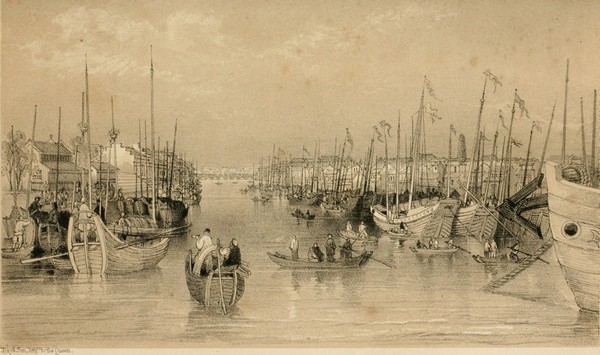
CITY OF NINGPO—BRIDGE OF BOATS.
London, John Murray, Albemarle Street.
The city itself is strongly fortified with high
walls and ramparts about five miles round, and the
space inside the walls is almost entirely filled with
houses, in most parts densely crowded together.
There are two or three very fine streets; finer, indeed,
and wider than those of any other Chinese
town which I have visited. A good view of the
city and the surrounding country, as far as the eye
can reach, is obtained from the top of a pagoda
about one hundred and thirty feet high, having a
stair-case inside by which the top can be reached.
(See following page.) This pagoda is named
"Tien-foong-tah" or the "Temple of the Heavenly
Winds;" it is evidently very old, and, like many
others of the same kind, is in a state of decay. Whenever
I visited this place, the Priests (Budhists) were
always in attendance with their offerings of cake
and tea, for which a small gratuity was expected.
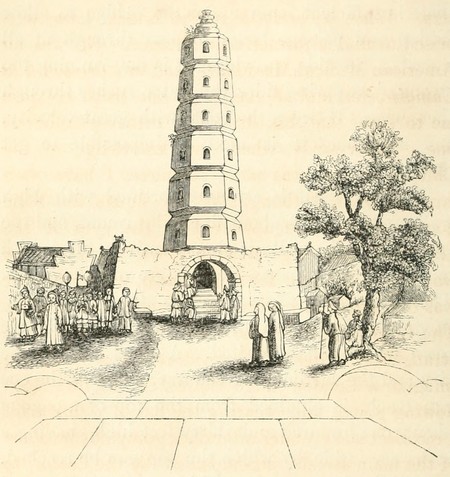
When I first landed at Ning-po, the British
consul, Mr. Thom, had not arrived, and I was quite
at a loss where to go, or to whom to apply for
quarters. Leaving my boat and servant on the
river, I strolled away into the city to reconnoitre,
thinking that something might turn up which I
could use for my advantage. I was soon surrounded
by crowds of the natives, and amongst
them some blackguard boys who had been corrupted
to a great extent by the troops during the
war, but who luckily understood a little of the
English language, and were able to be of essential
service to me. They informed me that there was
one "Hong-mou-jin"—(red-haired man)—a term
which they apply to all western nations—already in
the city, and immediately led the way to his quarters.
When we arrived at the house, I was surprised
to find a former acquaintance. He was an
American Medical Missionary, and was dressed à la
Chinoise, tail and all complete, but truth compels
me to state that his dress was rather a ludicrous
one. Afterwards when my knowledge of the
Chinese costume was more complete, I have often
laughed when I thought of the figure the little
doctor must have appeared in the eyes of the
Chinese. The large flowing gown which he wore
was almost too fine for a mandarin, while the hat
was one commonly worn by servants and coolies.
The English reader, if he wishes to understand the
strange sort of appearance the doctor presented, must
imagine a London judge clothed in his fine black
flowing gown, and wearing the hat of a dustman.
I recollect one evening after dark going out into one
of the main streets, accompanied by the doctor, to
see an offering which was there presented to the
Gods, and I soon found that he in his Chinese dress
was a greater object of attention than I was in my
English one. How the Chinese laughed and enjoyed
the joke! I had obtained a room in the
same house with my friend, who was visited daily
by great numbers of the Chinese, and who, although
not a very good Chinaman, was most
zealous in the cause of medical missions.
As the winter approached the weather became
extremely cold, and in December and January the
ice on the ponds and canals was of considerable
thickness. The most attractive shops in the city
now, were the different clothing establishments,
where all articles of wearing apparel were lined
with skins of various kinds, many of them of the
most costly description. The very poorest Chinese
has always a warm jacket or cloak lined with sheep
skin, or padded with cotton, for the winter; and
they cannot imagine how the Europeans can exist
with the thin clothing they generally go about in.
When the weather was cold, I used always to wear
a stout warm great coat above my other dress, and
yet the Chinese were continually feeling the thickness
of my clothes, and telling me that surely I
must feel cold. Their mode of keeping themselves
comfortable in winter, differs entirely from ours:
they rarely or never think of using fires in their
rooms for this purpose, but as the cold increases,
they just put on another jacket or two, until they
feel that the warmth of their bodies is not carried
off faster than it is generated. As the raw damp
cold of morning gives way to the genial rays of
noon, the upper coats are one by one thrown off,
until evening, when they are again put on. In the
spring months, the upper garments are cast off by
degrees, and when the summer arrives, the Chinese
are found clad in thin dresses of cotton, or in the
grass cloth manufactured in the country. In
the northern towns the ladies sometimes use a
small brass-stove, like a little oval basket, having
the lid grated to allow the charcoal to burn and
the heat to escape; this they place upon their
tables or on the floor, for the purpose of warming
the hands and feet. Nurses also carry these
little stoves in their hands under the feet of the
children. Such, however, is the thickness and
warmth of their dresses, that it is only in the
coldest weather they require them. Little children
in winter are so covered up, that they look like
bundles of clothes, nearly as broad as they are long,
and when the padding is removed in warm weather,
it is difficult to imagine that you see before you
the same individuals.
I never felt so cold in England as I did during
this winter in the north of China, and yet, as may
be seen from the chapter on temperature, the
thermometer did not indicate a very low degree.
The house in which I lived was so open, that the
wind rushed in at every crevice; the windows
were large, not glazed, as with us, but papered, and
in many places perfectly open. During the day I
got on very well, as I was always out and moving
about from morning until dark. But the long
evenings, with the wind whistling through the
windows, and blowing upon my candle, were dreary
and cold enough.
To vary the monotony of the scene, as well as to
warm myself, I used frequently to take a stroll
down the main street. The Chinese, as a nation,
are great gamblers; even the poorest of them cannot
resist the temptation, and in this street after nightfall,
there used to be numerous stalls of oranges,
sweetmeats, and trifling curiosities, at each of which
there were dice of some kind, and a "wheel of
fortune," surrounded by the Chinese in great numbers,
trying their luck with a few copper cash, and
evincing, by their looks and language, the most intense
interest in the stopping of the wheel, or the
throwing of the dice.
Besides the shops already noticed for the sale of
clothes and skins, there are many others worthy of
our attention. There are a number of excellent
silk shops and warehouses a little off the main street,
which, like our old-established houses at home,
have but little external show to attract notice.
Here, too, are large quantities of that beautiful
northern embroidery which is so much admired by
all who have had an opportunity of seeing it.
It is entirely different from that commonly procured
at Canton, and much more elaborate and
expensive. A considerable demand for articles of
dress which would be fashionable in England, has
induced the Chinese to get them made, and they
are now exposed for sale in all the towns in the
north frequented by the English. Ladies' aprons,
scarfs, shawls, work-bags, and many other articles
made up in the English style, and beautifully embroidered,
are the things most in demand.
The Chinese estimate their celebrated jade stone
very highly, and here there are numerous shops,
both for cutting it and exposing it for sale, carved
into all those curious and fantastic forms for which
this people are so well known. The process of
cotton printing in its most simple and original
form may be seen in most of the streets here, as
well as in other towns in China. Rope-making is
carried on extensively in the suburbs near the
river, and some strong cables and ropes for junks
are made from the bracts of the palm, formerly
noticed, and from the bark of the urticaceous plant,
commonly called hemp by the English in the north
of China. There are, of course, the usual quantity of
curiosity shops, containing bamboo ornaments carved
into all possible forms; specimens of ancient porcelain,
which are said to "preserve flowers and fruit from
decay for an unusual time," lacquered ware, and
other ornaments brought by the junks from Japan,
many beautifully carved rhinoceros' horns, bronzes,
and other articles to which the Chinese attach
great importance, purchasing them at exorbitant
rates, apparently far beyond their value. But what
struck me as being most unique, was a peculiar kind
of furniture, made and sold in a street, generally
called "Furniture Street" by foreigners who visit
Ning-po. There were beds, chairs, tables, washing-stands,
cabinets and presses, all peculiarly Chinese
in their form, and beautifully inlaid with different
kinds of wood and ivory, representing the people
and customs of the country, and presenting, in
fact, a series of pictures of China and the Chinese.
Every one who saw these things admired them, and,
what was rather strange, they seem peculiar to
Ning-po, and are not met with at any of the other
five ports, not even in Shanghae. As all this beautiful
work is expensive, it is, of course, only used
in the houses of the wealthy.
There are some large banking establishments in
Ning-po, having connection with all the other towns
in the north, and it is here, therefore, that the value
of money is regulated, the "stocks" rising and
falling exactly as they do in England. There can
be little doubt that it is a place of great wealth.
There are a large number of retired merchants in
the city and suburbs, who have made their fortunes
in early life, and who now seek to enjoy themselves
amid the luxuries and retirement of Ning-po. But
these circumstances, unfortunately, do not fit it for
a place of active foreign trade; and hence, although
it is large, rich, and populous, our merchants find
the northern port of Shanghae of far greater importance
as regards the sale of European and American
manufactures, and the purchase of tea and silk,—the
staple productions of the country. And yet, judging
from appearances, one would think that a
considerable foreign trade might be carried on at
Ning-po, as it is in itself a large town, is in the
midst of a populous country, and has excellent water
communication with all parts of the empire. Time,
and the perseverance of our merchants, will soon
show whether this supposition is a correct one.
Many of the temples in this town have been much
admired by foreigners, but I must confess that, to
me, the very best of them had a childish and tinselly
appearance, which I could not admire. The
one called the Fokien Temple is best and most
showy. The Confucian Temple was formerly a
large and celebrated place, but it was nearly
destroyed during the war, and up to the time when
I left China, no attempt had been made to rebuild
it, or put it in a state of repair: the Chinese seemed
to consider that the touch of the barbarian had
polluted the sacred edifice. The Budhists' temples
are crowded with painted wooden images of their
gods. The "three precious Budhas," the "past,
present, and future," are generally enormously
large, being often thirty or forty feet in height.
To these, and to the numerous small images, the
poor deluded natives bow the knee, burn incense,
and engage in other exercises of devotion. The
traveller meets with these temples, or joss-houses,
as they are commonly called, in all the streets, at
the gates of the city, and even on the ramparts, and
cannot but admire the devotional spirit of the inhabitants,
although he may wish that it was directed
to a higher and purer object. I have often looked on,
when these simple people,—the women more particularly,—seemed
actually, like Jacob of old, "wrestling
with God in prayer," and using various means
to ascertain whether the mind of the Deity had
softened towards them, and granted their requests.
Two small pieces of wood, flat on one side and
rounded on the other, are generally used to accomplish
this end; these are thrown up in the air, and
if they fall on the desired side, it was well; if not,
some more incense was burned, and again and
again they prostrated themselves before the altar,
and seemed engaged in earnest prayer. Many of
their religious ceremonies have a great resemblance
to those of the Roman Catholic church, and I
remember being much struck on a Sunday afternoon,
when passing out at one of the city gates, by
hearing the sounds of prayer and praise, not unlike
those of the Christian churches of other lands. I
immediately walked into the place from whence the
sounds came, and found, to my disappointment, that
it was one of the numerous temples with which the
city abounds, and that the sounds of praise which
fell upon my ears, were only addressed to the gods
of the heathen. But many of these temples are in
a most ruinous state, and are evidently not so well
supported now as they have been at some former
time. In fact, the town of Ning-po itself, with
all its riches, and all its advantages, has been in
a decaying state for years, and is one example,
amongst many others, of the truth of what I formerly
stated concerning the general state of this
country.
My first business, when I reached Ning-po, was
to make inquiries regarding the gardens of the
Mandarins, which I had heard something of from
the officers who were there when the city was taken
by the English troops, during the war. I had the
same difficulties to encounter as I had at Amoy,
owing to the jealousy of the Chinese. Ultimately,
however, these too were overcome, and I obtained
access to several Mandarins' gardens and nurseries,
out of which several new plants were procured,
which proved very valuable additions to my collections.
Here, as at other places, I made many
inquiries after the supposed yellow camellia, and
offered ten dollars to any Chinaman who would
bring me one. Anything can be had in China for
dollars! and it was not long before two plants were
brought to me, one of which was said to be light
yellow, and the other as deep a colour as the double
yellow rose. Both had flower-buds upon them, but
neither were in bloom. I felt quite certain that the
Chinaman was deceiving me, and it seemed foolish
to pay such a sum for plants which I should in all
probability have to throw away afterwards; and yet
I could not make up my mind to lose the chance,
slight as it was, of possessing the yellow camellia.
And the rogue did his business so well. He had a
written label stuck in each pot, and apparently the
writing and labels had been there for some years.
I fancied I was as cunning as he was, and requested
him to leave the plants and return on the following
morning, when he should have an answer. In the
meantime I asked a respectable Chinese merchant
to read the writing upon the labels. All was correct;
the writing agreed with what the man had
told me; namely, that one of the plants produced
light yellow blooms, and the other deep yellow.
"Did you ever see a camellia with yellow flowers?"
I inquired of my friend the merchant. "No," said
he, in his broken English. "My never have seen he,
my thinkie no have got" On the following morning
the owner of the plant presented himself, and asked
me if I had made up my mind upon the subject.
I told him that I would take the plants to Hong-kong,
where I was going at the time; that they
would soon flower there; and that, if they proved
yellow, he should have his money. This, however,
he would not consent to; and at last we compromised
the matter, I agreeing to pay half the money
down, and the other half when the plants flowered,
providing they were "true." On these conditions
I got the camellias, and took them with me to
Hong-kong. It is almost needless to say that when
they flowered there was nothing yellow about them
but the stamens, for they were both semi-double
worthless kinds.
The gardens of the Mandarins in the city of
Ning-po are very pretty and unique; they contain
a choice selection of the ornamental trees and shrubs
of China, and generally a considerable number of
dwarf trees. Many of the latter are really curious,
and afford another example of the patience and
ingenuity of this people. Some of the specimens
are only a few inches high, and yet seem hoary
with age. Not only are they trained to represent
old trees in miniature, but some are made to resemble
the fashionable pagodas of the country, and
others different kinds of animals, amongst which
the deer seems to be the favourite. Junipers are
generally chosen for the latter purpose, as they
can be more readily bent into the desired form;
the eyes and tongue are added afterwards, and the
representation altogether is really good. One of the
Mandarins of Ning-po, anxious, I suppose, to confer
some mark of especial favour upon me, presented
me with one of these animals,—plants, I should say;—but
as it was of no real use to me, and as my
collections of other things were large, I was obliged
to decline his present, which he evidently considered
of great value, and no doubt wondered at my want
of taste.
Another example will show the passion which
exists amongst the Chinese for things of this kind.
When I was travelling on the hills of Hong-kong, a
few days after my first arrival in China, I met with
a most curious dwarf Lycopodium, which I dug up
and carried down to Messrs. Dent's garden, where
my other plants were at the time. "Hai-yah," said
the old compradore, when he saw it, and was quite
in raptures of delight. All the other coolies and
servants gathered round the basket to admire this
curious little plant. I had not seen them evince so
much gratification since I showed them the "old
man Cactus" (Cereus senilis), which I took out from
England, and presented to a Chinese nurseryman at
Canton. On asking them why they prized the
Lycopodium so much, they replied, in Canton
English, "Oh, he too muchia hemdsome; he grow
only a leete and a leete every year; and suppose he be
one hundred year oula, he only so high" holding up
their hands an inch or two higher than the plant.
This little plant is really very pretty, and often
naturally takes the very form of a dwarf tree in
miniature, which is doubtless the reason of its being
such a favourite with the Chinese.
The dwarfed trees of the Chinese and Japanese
have been noticed by every author who has written
upon these countries, and all have attempted to
give some description of the method by which the
effect is produced. The process is in reality a
very simple one, and is based upon one of the
commonest principles of vegetable physiology. We
all know that any thing which retards in any way
the free circulation of the sap, also prevents to a
certain extent the formation of wood and leaves.
This may be done by grafting, by confining the
roots, withholding water, bending the branches, or
in a hundred other ways which all proceed upon
the same principle. This principle is perfectly understood
by the Chinese, and they make nature subservient
to this particular whim of theirs. We are
told that the first part of the process is to select the
very smallest seeds from the smallest plants, which
is not at all unlikely, but I cannot speak to the
fact from my own observation. I have, however,
often seen Chinese gardeners selecting suckers and
plants for this purpose from the other plants which
were growing in their garden. Stunted varieties
were generally chosen, particularly if they had the
side branches opposite or regular, for much depends
upon this; a one-sided dwarf tree is of no value in
the eyes of the Chinese. The main stem was then
in most cases twisted in a zigzag form, which
process checked the flow of the sap, and at the
same time encouraged the production of side
branches at those parts of the stem where they
were most desired. When these suckers had
formed roots in the open ground, or kind of nursery
where they were planted, they were looked
over and the best taken up for potting. The same
principles, which I have already noticed, were still
kept in view, the pots used being narrow and
shallow, so that they held but a small quantity of
soil compared with the wants of the plants, and no
more water being given than what was barely
sufficient to keep them alive. Whilst the branches
were forming, they were tied down and twisted in
various ways; the points of the leaders and strong
growing ones were generally nipped out, and every
means were taken to discourage the production of
young shoots which were possessed of any degree
of vigour. Nature generally struggles against this
treatment for a while, until her powers seem in a
great measure exhausted, when she quietly yields
to the power of art. The Chinese gardener, however,
must be ever on the watch, for should the
roots of his plants get through the pots into the
ground, or happen to be liberally supplied with
moisture, or should the young shoots be allowed to
grow in their natural position for a short time, the
vigour of the plant which has so long been lost
will be restored, and the fairest specimen of Chinese
dwarfing destroyed. Sometimes, as in the case of
peach and plum trees, which are often dwarfed, the
plants are thrown into a flowering state, and then,
as they flower freely year after year, they have
little inclination to make vigorous growth. The
plants generally used in dwarfing are pines, junipers,
cypresses, bamboos, peach and plum trees, and a
species of small-leaved elm.
Amongst the Mandarins' gardens, in the city of
Ning-po, there is one in particular which is generally
visited by all strangers, and is much admired. It
is situated near the lake in the centre of the city.
The old man to whom it belongs has long retired
from trade with an independent fortune, and he
now enjoys his declining years in the peaceful
pursuits of gardening, and is passionately fond of
flowers. Both his house and garden are unique in
their way, but they are most difficult to describe,
and must be seen to be appreciated. In this part
of the country the building of artificial rockwork
is so well understood, that the resemblance to
nature is perfect, and it forms a principal feature
in every garden. This old gentleman has the
different parts of his house joined together by rude-looking
caverns, and what at first sight appears
to be a subterraneous passage, leading from room
to room, through which the visitor passes to the
garden, which lies behind the house. The small
courts, of which a glimpse is caught in passing
through, are fitted up with this rockwork; dwarf
trees are planted here and there in various places,
and creepers hang down naturally and gracefully
until their ends touch the little ponds of water
which are always placed in front of the rockwork.
These small places being passed, we are again led
through passages like those already noticed, when
the garden, with its dwarf trees, vases, rockwork,
ornamental windows, and beautiful flowering shrubs,
is suddenly opened to the view.
It must be understood, however, that all which
I have now described is very limited in extent, but
the most is made of it by windings and glimpses
through rockwork, and arches in the walls, as well
as by hiding the boundary with a mass of shrubs
and trees.
Here old Dr. Chang—I believe that was his
name—was spending the evening of his days in
peaceful retirement. When I called upon him he
was extremely polite, and, after making a great
many very low bows, requested me to take the seat
of honour by his side. The servants were then
ordered to bring tea, a beverage which is offered to
every stranger, and which was of the very finest
description. Messengers were sent round to all
the old man's particular friends, who each hurried
to see the foreigner. One by one they dropt in,
until the room was nearly full. The servants, who
seemed to think themselves quite as good as their
masters, mixed with the company, and made their
remarks upon me with the greatest freedom. Every
thing about me was examined and criticised most
minutely, particularly my watch, which they seemed
to admire very much. I was frequently requested,
as a great favour, to allow them to see the works,
and to hold it to their ears, in order that they
might hear the sound which it made. The old
mandarin now led me round his house, and showed
me all the curiosities which it contained, and of
which he was a great collector. Old bronzes,
carved woods, specimens of porcelain, and other
articles of that kind, were arranged with great
taste in several of the rooms. From the house we
proceeded to the garden, but as it was winter, and
the trees leafless, I could form but little idea of the
rarity or beauty of the plants which it contained.
I took my leave, after drinking some more tea,
promising to visit the old man again whenever I
returned to Ning-po.
I visited also at this time several other Mandarins
who had gardens, and from all of them I
received the greatest civility. Some small articles
which I brought out with me as presents were of
the greatest use, not only in procuring me a civil
reception, but also in enabling me to get plants or
cuttings of rare species which were only found in
the gardens of the rich, and which, of course, were
not for sale.
The level plain on which the city of Ning-po is
built is at least thirty miles across, surrounded on
all sides by a circle of hills, but opening on the east
to the sea, where the town of Chinhae stands, and
forms, as it were, the sea-port town of Ning-po.
The view from the hills is very fine—the broad
extensive plain forming, as it were, a vast amphitheatre,
traversed by beautiful winding rivers and
by canals in all directions; thus enabling the
natives to convey the produce of their country and
its merchandise to Ning-po, and from thence to
Hang-chow-foo, and any other part of the world.
Rice is the staple production of the low land in
this part of the country during the summer months,
and the oil plant is cultivated extensively on the
same land in winter and spring, being in seed and
ready to harvest by the time for sowing the first
crop of rice. Large quantities of the trefoil which
I have noticed before are also grown here, and for
the same purposes; indeed, the agricultural productions,
both of the low lands and on the sides of the
hills, are really the same as those formerly described
on the island of Chusan.
The native flora of the hills to the north of
Ning-po is nearly the same as that found on
Chusan and the neighbouring islands, but more
extensive. It is a curious fact, that I always found
the main land of China more productive in species
of animals and plants than the neighbouring
islands, although these islands were large, and
only separated from the main land by a narrow
extent of sea. I met here, for the first time in a
wild state, the beautiful yellow Azalea sinensis.
These hills are somewhat more barren than most
of the others in this part of the country, and there
are few trees on them of any size. They are very
different from those which I have yet to describe,
a few miles to the south of Ning-po.
The graves of the dead are scattered all over the
plain, and give the stranger a good idea of the
immense population of the country. In travelling
from Ning-po to the hills, I could not account for
the vast number of tombs which I met with on my
way; but when I reached the summit of the hills,
and looked down upon the wide-spreading plain,
covered with towns and villages in all directions,
densely peopled with human beings, it was easily
accounted for. Here, as at Chusan and Shanghae,
the traveller is continually coming upon coffins
placed on the surface of the ground, and in many
instances decaying, and exposing the skeleton remains
of the dead. I was much struck by frequently
meeting with large numbers of coffins
piled one above another, in heaps of from thirty to
forty, chiefly those of young children. I was told
that they are buried periodically, but from their
appearance many of them must have remained in
the same place for years, and their tenants must
long ago have mouldered into dust.
REMARKS ON THE CHINESE LANGUAGE.—ICE-HOUSES NEAR
NING-PO DESCRIBED.—THEIR SIMPLICITY AND UTILITY.—NOVEL
MODES OF FISHING.—FISHING CORMORANTS MET WITH.—THEIR
ACTIONS DESCRIBED.—TWO PAIRS PURCHASED.—ACCOUNT
OF THEIR FOOD AND HABITS.
In sailing up the river towards Ning-po, I observed
a great number of thatched houses, and desired
my Chinese servant to go to the boatman and
inquire what they were. He went immediately to
the man at the helm, and, after a conversation of at
least ten minutes' duration, came back hanging his
head, and slunk away without reporting the result
of his inquiries. "Well," said I, "what is the use
of all these houses which we now see on the shore?"
With all the gravity in the world, he replied that
the boatman said they were places built to keep
Chinese soldiers in during the cold winter months.
"Nonsense," said I, "they cannot fill all these places
with soldiers." "Well," said he, "he have talkie my
so fashion." As I could not conceive this to be
true, I went to the man myself, and with the little
knowledge of the language which I then possessed,
soon found out that the buildings in question were
ice-houses, for which commodity, he informed me,
there was a great demand daring the summer
months. This shows that the Chinese language
differs so much in different provinces, that a native
of Canton and another in the north cannot understand
each other: and indeed this is so much the
case, that my Macao servant was almost entirely
useless to me in the north, in so far as the language
was concerned. In this instance the Chinese word
"Ping"—or I should rather say sound—means
both soldier and ice, and it immediately struck my
servant, who I suppose had never seen ice in his
life, that the buildings in question were soldiers'
houses instead of ice-houses; rather cold barracks,
I should think.
I was much struck with the simplicity of the
construction of these ice-houses, and my only doubt
about them was whether or not the ice would keep
well in them throughout the hot summer months.
The results of my investigation I sent in the following
letter to Professor Lindley, who published it in
the "Gardener's Chronicle" for 1845:—
"A short time before I left England, you
published in the 'Gardener's Chronicle' a number
of letters and plans for the construction of ice-houses,
but, as far as I can remember, nothing at
all resembling the Chinese one which I shall now
describe to you. On the right bank of the Ning-po
river, above the town and fort of Chinhae, and in
various other parts of the north of China, I have
met with these ice-houses. When I inspected them
for the first time last winter (1843), their construction
and situation differed so much from what I
had been accustomed to see at home,—differing,
too, in things which I
used to consider as
indispensable to an
ice-house,—that I had
great doubts regarding
their efficiency; but at
the present time, which
is now the end of
August, 1844, many of
these houses are yet
full of ice, and seem to
answer the end most
admirably. You are
probably aware, from
my former descriptions
of the country, that the
town of Ning-po stands
in the midst of a level
plain from twenty to
thirty miles across.
These ice-houses are
built on the sides of
the river in the centre
of the plain, completely
exposed to the sun—a
sun, too, very different
in its effects
from what we experience in England,—clear,
fierce, and burning, which would try the efficiency
of our best English ice-houses as well as it does
the constitution of an Englishman in China.
Ice-houses near Ning-Po.
"The bottom of these ice-houses is nearly on a
level with the surrounding fields, and is generally
about twenty yards long, by fourteen broad. The
walls, which are built of mud and stone, are very
thick, twelve feet in height, and are, in fact, a kind
of embankment rather than walls, having a door on
one side level with the floor, for the removal of the
ice, and a kind of sloping terrace on the other,
by which the ice can be thrown into the house. On
the top of the walls or embankment a tall span
roof is raised, constructed of bamboo, thickly
thatched with straw, and in appearance exactly
like an English haystack. And this is the simple
structure which keeps ice so well during the summer
months, and under the burning sun of China!
"The Chinaman, with his characteristic ingenuity,
manages also to fill his ice-houses in a
most simple way, and at a very trifling expense.
Around the house he has a small flat level field
connected with the river. This field he takes care
to flood in winter before the cold weather comes
on. The water then freezes and furnishes the
necessary supply of ice at the very door. Again
in spring these same fields are ploughed up and
planted with rice, and the water which drains from
the bottom of the ice-house helps to nourish the
young crop. Of course here, as in England, when
the house is filled the ice is carefully covered up
with a thick coating of straw. Thus the Chinaman,
with little expense in building his ice-house, and
an economical mode of filling it, manages to secure
an abundant supply for preserving his fish during
the hot summer months.
"It now, I think, becomes a question whether we
could not build ice-houses at less expense and more
efficient, upon the Chinese plan, than upon the old
under-ground system common in England. The
accompanying sketch will enable you to form an
idea of the appearance which these ice-houses
present to the traveller, in going up the Ning-po
river. Ning-po, August, 1844."
Since this letter was published I have had frequent
opportunities of testing the qualities of the Chinese
ice-house, both at Ning-po and also at Chusan
and Shanghae, and I have found that it answers
the purpose admirably. The winter of 1844–1845
was unusually mild in this part of China; little
or no ice was formed on the ponds and canals, and
of course the ice-houses could not be filled; but
many of them contained large quantities which had
been laid up the year before, and by this means the
market was supplied with ice which had been in
store at least a year and a half, and would probably
have kept some time longer.
This ice is of great importance to the Chinese,
who depend so much for their food upon the fish
which is caught in their waters. They are enabled
by this means to keep their fish during the hottest
weather for a considerable time, and transmit them
in this way to different parts of the country.
Immense quantities of fish are daily caught in
the river above the town. Their mode of catching
them is ingenious and amusing. One day I was
going up a considerable distance in a boat, and set
out a little before low water, that I might have the
full benefit of the flow of the tide, and get as far
up as possible before it turned. On the side of the
river, a few miles above Ning-po, I observed some
hundreds of small boats anchored, each containing
two or three men; and the tide turning just as I
passed, the whole fleet was instantly in motion,
rowing and sculling up the river with the greatest
rapidity. As soon as the men reached a favourable
part of the stream they cast out their nets and
began to make a loud noise, splashing with their
oars and sculls, with the intention, I suppose, of
driving the fish into the nets. After remaining in
this spot for about a quarter of an hour, all the
boats set off again, farther up, for the next station,
when the crew commenced again in the same noisy
manner, and so on, for a long way up the river, as
long as the tide was flowing; they then returned
with the ebb, loaded with fishes for the next morning's
market.
There is another mode of catching fish, which I
have frequently seen in the northern provinces,
even more curious than that which I have just
noticed. Every one acquainted with Chinese history
knows that fish abound in all the rivers and lakes
of the north; indeed, every little pond swarms with
them. I was greatly surprised when I first saw
the fish-catcher following his profession in these
places. He is literally amphibious. He is to be seen
perfectly naked, half walking, half swimming; now he
raises his arms and hands above his head, and, bringing
them down, strikes a sharp blow upon the water,
making a loud and splashing noise. His feet are
not idle: they warn him that a fish is at hand, and
they are now feeling for him amongst the mud at
the bottom of the pond. The next moment the
fisherman has disappeared: he is now under water,
and he remains so long that you think something has
happened to him. There is, however, no cause of
fear; a few seconds more and he appears, rubbing
his face and eyes with one hand, and in the other
triumphantly holding up the poor little fish which
he has just captured. It is immediately placed
safely in his basket, and the work goes on as before.
The surface of the water is struck and splashed,
as I have just described, in order to frighten the
fish which are swimming amongst the feet of the
Chinamen. Being frightened, they dive immediately
to the bottom amongst the mud, where they are
felt by the feet, and are soon taken by these expert
divers.
But the most singular of all the methods of
catching fish in China is that of training and employing
a large species of cormorant for this purpose,
generally called the fishing cormorant. These
are certainly wonderful birds. I have frequently
met with them on the canals and lakes in the
interior, and, had I not seen with my own eyes their
extraordinary docility, I should have had great
difficulty in bringing my mind to believe what authors
have said about them. The first time I saw
them was on a canal a few miles from Ning-po. I
was then on my way to a celebrated temple in that
quarter, where I intended to remain for some time,
in order to make collections of objects of natural
history in the neighbourhood. When the birds
came in sight I immediately made my boatmen
take in our sail, and we remained stationary for
some time to observe their proceedings. There
were two small boats, containing one man and about
ten or twelve birds in each. The birds were
standing perched on the sides of the little boat, and
apparently had just arrived at the fishing ground,
and were about to commence operations. They
were now ordered out of the boats by their masters;
and so well trained were they, that they went on
the water immediately, scattered themselves over
the canal, and began to look for fish. They have a
beautiful sea-green eye, and, quick as lightning, they
see and dive upon the finny tribe, which, once
caught in the sharp-notched bill of the bird, never
by any possibility can escape. The cormorant now
rises to the surface with the fish in its bill, and the
moment he is seen by the Chinaman he is called
back to the boat. As docile as a dog, he swims
after his master, and allows himself to be pulled
into the San-pan, where he disgorges his prey, and
again resumes his labours. And, what is more
wonderful still, if one of the cormorants gets hold
of a fish of large size, so large that he would have
some difficulty in taking it to the boat, some of the
others, seeing his dilemma, hasten to his assistance,
and with their efforts united capture the animal and
haul him off to the boat. Sometimes a bird seemed
to get lazy or playful, and swam about without
attending to his business; and then the Chinaman,
with a long bamboo, which he also used for propelling
the boat, struck the water near where the
bird was, without, however, hurting him, calling
out to him at the same time in an angry tone.
Immediately, like the truant school-boy who
neglects his lessons and is found out, the cormorant
gives up his play and resumes his labours.
A small string is put round the neck of the bird,
to prevent him from swallowing the fish which he
catches; and great care is taken that this string
is placed and fastened so that it will not slip farther
down upon his neck and choke him, which otherwise
it would be very apt to do.
Since I first saw these birds on the Ning-po canal
I have had opportunities of inspecting them and
their operations in many other parts of China, more
particularly in the country between the towns of
Hang-chow-foo and Shanghae. I also saw great
numbers of them on the river Min, near Foo chow-foo.
I was most anxious to get some living specimens,
that I might take them home to England.
Having great difficulty in inducing the Chinese to
part with them, or, indeed, to speak at all on the
subject, when I met them in the country, owing to
our place of meeting being generally in those parts
of the interior where the English are never seen, I
applied to Her Majesty's Consul at Shanghae (Captain
Balfour), who very kindly sent one of the
Chinese connected with the Consulate into the country,
and procured two pairs for me. The difficulty
now was to provide food for them on the voyage
from Shanghae to Hong-kong. We procured a
large quantity of live eels, this being a principal
part of their food, and put them into ajar of mud
and fresh water. These they eat in a most voracious
manner, swallowing them whole, and in many
instances vomiting them afterwards. If one bird
was unlucky enough to vomit his eel, he was fortunate
indeed if he caught it again, for another, as
voracious as himself, would instantly seize it, and
swallow it in a moment. Often they would fight
stoutly for the fish, and then it either became the
property of one, or, as often happened, their sharp
bills divided the prey, and each ran off and devoured
the half which fell to his share. During the passage
down we encountered a heavy gale at sea, and as
the vessel was one of those small clipper schooners,
she pitched and rolled very much, shipping seas
from bow to stern, which set every thing on her
decks swimming. I put my head out of the cabin-door
when the gale was at its height, and the first
thing I saw was the cormorants devouring the eels,
which were floating all over the decks. I then
knew that the jar must have been turned over or
smashed to pieces, and that of course all the eels
which escaped the bills of the cormorants were
now swimming in the ocean. After this I was
obliged to feed them upon any thing on board which
I could find: but when I arrived at Hong-kong
they were not in very good condition: two of them
died soon after; and as there was no hope of taking
the others home alive, I was obliged to kill them
and preserve their skins.
The Chinaman from whom I bought these birds
has a large establishment for fishing and breeding
the birds about thirty or forty miles from Shanghae,
and between that town and Chapoo. They sell at
a high price even amongst the Chinese themselves—I
believe from six to eight dollars per pair, that is,
from 30s. to 40s. As I was anxious to learn something
of their food and habits, Mr. Medhurst, jun.,
interpreter to the British Consulate at Shanghae,
kindly undertook to put some questions to the man
who brought them, and sent me the following notes
connected with this subject:—
"The fish-catching birds eat small fish, yellow
eels, and pulse-jelly. At 5 p. m. every day each
bird will eat six taels (eight ounces) of eels or fish,
and a catty of pulse-jelly. They lay eggs after
three years, and in the fourth or fifth month. Hens
are used to incubate the eggs. When about to lay
their faces turn red, and then a good hen must be
prepared. The date must be clearly written upon
the shells of the eggs laid, and they will hatch in
twenty-five days. When hatched, take the young
and put them upon cotton, spread upon some warm
water, and feed them with eel's blood for five days.
After five days they can be fed with eel's flesh
chopped fine, and great care must be taken in
watching them.
"When fishing, a straw tie must be put upon
their necks, to prevent them from swallowing the
fish when they catch them. In the eighth or ninth
month of the year they will daily descend into the
water at ten o'clock in the morning, and catch fish
until five in the afternoon, when they will come on
shore. They will continue to go on in this way
until the third month, after which time they cannot
fish until the eighth month comes round again.
The male is easily known from the female, in being
generally a larger bird, and in having a darker and
more glossy feather, but more particularly in the
size of the head, the head of the male being large
and that of the female small."
Such are the habits of this extraordinary bird.
As the months named in the note just quoted refer
to the Chinese calendar, it follows that these birds
do not fish in the summer months, but commence
in autumn, about October, and end about May—periods
agreeing nearly with the eighth and third
month of the Chinese year.
SHANGHAE VISITED AT THE END OF 1843.—MY LODGINGS.—PREJUDICES
AND SUPERSTITIONS OF THE INHABITANTS.—THE
CITY DESCRIBED.—SHOPS AND MERCHANDISE.—FOOD.—AN
IMPORTANT STATION FOR FOREIGN TRADE.—THE EXPORTS OF
THE COUNTRY; TEAS AND SILK EASILY BROUGHT TO IT.—THE
ADJACENT COUNTRY DESCRIBED.—ITS CANALS.—AGRICULTURE.—TOMBS
OF THE DEAD.—TREES AND SHRUBS.—GARDENS
AND NURSERIES.—DIFFICULTY OF ACCESS TO THEM.—CUNNING
AND DECEIT OF THE CHINESE.—A CHINESE
DINNER.—THEATRICALS.
Shanghae is the most northerly of the five ports
at which foreigners are now permitted to trade
with the Chinese. It is situated about a hundred
miles, in a north-west direction, from the island of
Chusan. The city stands on the bank of a fine
river, about twelve miles from the point where it
joins the celebrated Yang-tse-kiang, or "Child of
the Ocean." The Shanghae river, as it is generally
called by foreigners, is as wide at Shanghae as the
Thames at London Bridge. Its main channel is
deep, and easily navigated when known, but the
river abounds in long mud-banks, dangerous to
large foreign vessels unless they happen to go up
with a fair wind, and manage to get a good pilot on
board at the entrance of the river.
I visited this place for the first time at the end
of 1843, as soon as the port was opened by Her
Majesty's Consul, Captain Balfour, and took up my
quarters in a kind of bank or government shroff
establishment, in company with two or three gentlemen
who were here for purposes of trade. As
none of us carried a cooking establishment with us,
our meals were necessarily of the roughest description,
neither exactly Chinese nor English, but
something between the two. Our bed-rooms were
miserably cold: often, in the mornings, we would
find ourselves drenched in bed with the rain; and
if snow fell, it was blown through the windows and
formed "wreaths" on the floor. Nevertheless, the
excitement produced on our minds by every thing
around us kept us in excellent health and in good
spirits, and we made light of many things which
in other circumstances we might have considered
as hardships. Whenever we moved out of the
house hundreds of people crowded the streets,
and followed in our wake, as anxious to catch a
glimpse of us as the crowds in London are to see
the Queen. Every door and window was crammed
with men, women, and children, who gazed upon us
with a kind of stupid wonder, as if we had been
inhabitants of the moon, and not the ordinary sons
of earth. The children more particularly looked
upon us with a kind of fear and dread, doubtless
implanted in their young minds by their parents,
who had less or more of the same feelings themselves.
The name we bore—Kwei-tsz, or devil's child—was
also calculated to produce erroneous impressions,
particularly on the minds of the young, and
make them regard us with superstitious horror.
In these times it was quite common for us to hear
such expressions as the following: "The devil's
children are coming," or "Come and see a devil's
child;" and not infrequently "Kwei-tsz" was called
out to us in derision. Several complaints were
made of this conduct to the British Consul by
parties who believed it to be very bad policy at the
first commencement of the trade to submit to any
marks of contempt, however slight; and strong
remonstrances were promptly made by him to the
Taoutae, or head Mandarin, of Shanghae. This
policy was the very best which could have been
pursued with the Chinese authorities; and the consequence
was, that in a very short time the offensive
appellation was rarely heard in the streets of
Shanghae; and if some little urchin, remembering
the lesson so early taught him, came out with it
unawares, he was immediately rebuked by the
respectable part of the bystanders.
The following incident shows the kind of superstitious
dread in which we were held by the inhabitants.
A friend and myself were asked to a dinner
given on board one of the vessels in the river, and
as the cabin was much more comfortable than our
cheerless, fireless rooms on shore, we remained until
nearly eleven o'clock. Not only are the gates of a
Chinese town closed after dark, but all communication
even with the streets in the suburbs is cut off
by numerous gates and doors, which are fastened
up about ten or eleven o'clock at night. This has
doubtless been a very ancient custom, to prevent
any sudden surprise by an enemy, or by the unruly
populace themselves, and is still kept up in more
peaceful times. When, therefore, we landed, we
found all the gates in the suburbs closed and locked;
and we had to pass through one at least before we
could reach our quarters. Not a sound was heard;
every house was closed; and all that dense multitude
which thronged the street by day had sunk into
repose. "How shall we get through?" said my
friend. "Shake the gate," said I; "perhaps the noise
will bring some one; or perchance, as it seems pretty
old, it may give way." We took hold of the gate
and gave it a good shake, calling out at the same
time for some one to come and open it. The
watchman's light was now seen coming towards us,
and my friend again called out to him to make
haste. At last two men with their lanterns came
up, in that dreamy state which I have already
noticed as a characteristic feature in the Chinese
race, and muffled up with skins, as the night was
very cold. They could not see distinctly who were
on the other side of the door; and, as we mumbled
a word or two of Chinese, they were put completely
off their guard, and supposed we were benighted
Chinamen. The bolts were drawn, the door opened,
and behold, two of the dreaded "red-haired race"
stood before them. I shall never forget their astonishment
when they got their eyes upon us after
the gate was opened: and whether they actually
believed us to be beings of another world, or supposed
we had another army at our back to take the
city a second time, it is impossible to say, but quick
as lightning they both turned their backs and fled,
leaving us to shut the gates or admit an army, if
we chose. We walked quietly home, and neither
saw nor heard any thing more of the bold guardians
of the night.
The city of Shanghae is surrounded with high
walls and ramparts built upon the same plan as all
other Chinese fortifications of this kind. The circumference
of the walls is about three and a half
miles, and the greater part of the inside is densely
studded with houses; the suburbs, particularly all
along the side of the river, are very extensive. Although
the gates of the city are closed soon after
dark, the people are allowed to pass through afterwards
on the payment of a few "cash." When the
gate is opened to one, a whole crowd are ready to rush
through along with him, the first only paying the
"cash." Such is the custom, so that if a poor man
comes to the gate he has only to wait until one
richer than himself arrives, when, the fee being paid,
they pass through together. Joss-houses are met
with in all directions, both in the city and suburbs;
at certain parts on the ramparts, also, these temples
are built and crowded with idols, where the natives
come to burn incense, bow the knee, and engage in
the other ceremonies of heathen idol worship. Fortune-tellers
and jugglers are also in great request,
and reap a rich harvest by working upon the
credulity of their countrymen. You meet these
characters in all the streets and public squares in
Shanghae, and, what is very strange, the sing-song
or theatricals, of which the Chinese are particularly
fond, are frequently exhibited in the temples. This
is much opposed to our ideas of religion and
propriety; but, somehow or other, the customs of
our Celestial friends are in many instances directly
opposed to ours.
The streets are generally very narrow, and in the
day time are crowded with people actively engaged
in business. The merchandise, which is the most
striking to a stranger walking through the streets,
is the silk and embroidery, such as I formerly
noticed at Ning-po, cotton and cotton goods,
porcelain, ready-made clothes of all kinds beautifully
lined with skins and fur, bamboo pipes six
feet long and nicely arranged in the shops, pictures,
bronzes, and numerous curiosity shops for the
sale of carved bamboo ornaments, old pieces of porcelain,
and things of that kind, to which the Chinese
attach great value. But articles of food form of
course the most extensive trade of all; and it is
sometimes a difficult matter to get through the
streets for the immense quantities of fish, pork,
fruit, and vegetables which crowd the stands in
front of the shops. Besides the more common
kinds of vegetables, the shepherds' purse, and a
kind of trefoil or clover, are extensively used
amongst the natives here; and really these things,
when properly cooked, more particularly the latter,
are not bad. Dining-rooms, tea-houses, and bakers'
shops, are met with at every step, from the poor
man who carries his kitchen or bakehouse upon
his back, and beats upon a piece of bamboo to
apprise the neighbourhood of his presence, and
whose whole establishment is not worth a dollar,
to the most extensive tavern or tea-garden crowded
with hundreds of customers. For a few cash
(1000 or 1200 = one dollar) a Chinese can dine
in a sumptuous manner upon his rice, fish, vegetables,
and tea; and I fully believe, that in no
country in the world is there less real misery and
want than in China. The very beggars seem a kind
of jolly crew, and are kindly treated by the inhabitants.
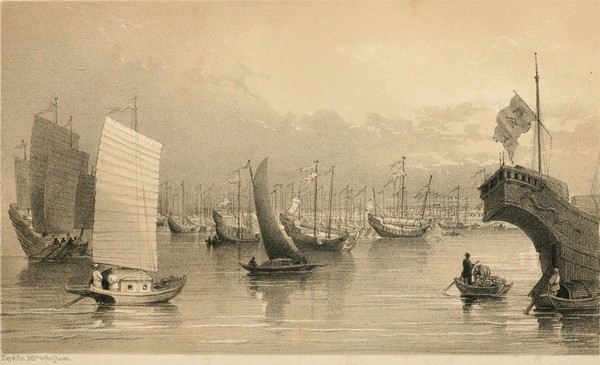
RIVER AT SHANGHAE
London, John Murray, Albemarle Street.
Shanghae is by far the most important station
for foreign trade on the coast of China, and is consequently
attracting a large share of public attention.
No other town with which I am acquainted
possesses such advantages: it is the great gate—the
principal entrance, in fact—to the Chinese
empire. In going up the river towards the town,
a forest of masts meets the eye, and shows at once
that it is a place of vast native trade. Junks come
here from all parts of the coast, not only from the
southern provinces, but also from Shantung and
Peechelee: there are also a considerable number
annually from Singapore and the Malay Islands.
The convenience of inland transit is also unrivalled
in any part of the world. The country, being as
it were the valley of the Yang-tse-kiang, is one
vast plain, intersected by many beautiful rivers,
and these again joined and crossed by canals, many
of them nearly natural, and others stupendous
works of art. Owing to the level nature of the
country, the tide ebbs and flows a great distance
inland, thus assisting the natives in the transmission
of their exports to Shanghae, or their imports
to the most distant parts of the country. The
port of Shanghae swarms with boats of all sizes,
employed in this inland traffic; and the traveller
continually meets them, and gets a glimpse of their
sails over the land, at every step of his progress in
the interior. Since the port has been opened these
boats bring down large quantities of tea and silk
to supply the wants of our merchants who have
established themselves here, and return loaded with
the manufactures of Europe and America, which
they have taken in exchange. Our plain cotton
goods are most in demand amongst the Chinese,
because they can dye them in their own peculiar
style, and fit them for the tastes of the people.
From what we know of the geographical nature of
the country, there can be no doubt that all the
green teas, and perhaps the greatest portion of the
black, can be brought to Shanghae at less expense
than they can be taken to Canton, or any of the
other southern towns, except, perhaps, Ning-po; and
as the tea-men incur less risk in taking their money
home from the North, owing to the peaceable
nature of the inhabitants, this will be another
very great inducement to bring their teas to
Shanghae. I am aware that people generally suppose
the black-tea districts to be nearer the port of
Foo-chow-foo than either Ning-po or Shanghae; but
it must be recollected that very few of the black
teas now imported to England are from the Bohee
hills, as these teas are considered coarser, and much
inferior in quality to other kinds, which are from
a very different country, much farther to the
north, and on the northern side of the great mountain
range. The large silk districts of Northern
China are close at hand; and there can be no doubt
that a large proportion of that commodity in a
raw state will be disposed of at Shanghae. Taking,
therefore, all these facts into consideration—the
proximity of Shanghae to the large towns of
Hangchow, Soo-chow, and the ancient capital of
Nanking; the large native trade, the convenience
of inland transit by means of rivers and canals;
the fact that teas and silks can be brought here
more readily than to Canton; and, lastly, viewing
this place as an immense mart for our cotton
manufactures, which we already know it to be,—there
can be no doubt that in a few years it will
not only rival Canton, but become a place of far
greater importance. And, when I add that the
climate is healthy, the natives peaceable, and foreign
residents respected, and allowed to walk and ride
all over the country to any distance not exceeding
a day's journey, it will be acknowledged that, as a
place to live at, it has many advantages over its
southern rival.
I have already said that this part of China is
a complete net-work of rivers and canals. These
were often most annoying to me in my travels over
the country, when I happened to get off the
Emperor's highway, a circumstance of no rare
occurrence. I have often been obliged to press a
boat into my service much against the will of the
owners, more particularly when I visited this region
for the first time, because I was then unacquainted
with the localities, and the Chinese always seemed
to fear I might take, or rob, their boats if I succeeded
in getting into them, such were the opinions
formed of foreigners at that time.
One day, in particular, I had been a considerable
distance inland to the westward of Shanghae, and
on my return, by some means or other, I got off the
beaten track, and in pursuing my way, as I supposed
in the proper direction, I was "brought up" by a
large and deep canal. About two miles from where
I stood, I saw a bridge, and, as it was nearly dark,
I made for it as fast as I could. Unluckily, however,
just as I thought my difficulties were over,
being within gun-shot of the bridge, I was again
stopped by another canal, which crossed the former
one at right angles. I was now completely brought
to a stand still, but in a few minutes I perceived a
boat approaching, and a man tracking it on the
same side as that on which we were. As soon as it
came near, we called out to the men on board to
pull the boat towards us, and allow us to get across
to the other side. They seemed much frightened,
and after making the man who was tracking the
boat come on board, they pulled her into the
middle of the canal, and then sculled away with all
their might. They would soon have passed far
beyond our reach, and left us to feel our way in
the dark, or plunge through the deep muddy canal.
Necessity, they say, has no law. "Call out to
them," said I to my servant, "that if they do not
immediately stop I will fire into the boat and kill
the whole of them," and at the same moment I
fired one of my barrels a little way ahead. This was
quite sufficient. They immediately came towards
us, and put us quickly over to the other side. I
paid them for their trouble, and desired them to be
more civil to the next traveller they might meet in
the same circumstances. They went off in high
spirits, and we heard them laughing and joking
about the adventure long after they had passed out
of our sight.
As an agricultural country, the plain of Shanghae
is by far the richest which I have seen in China, and
is perhaps unequalled by any district of like extent
in the world. It is one vast beautiful garden. The
hills nearest to Shanghae are distant about thirty
miles. These have an isolated appearance in the
extensive plain, and are not more than two or three
hundred feet high. From their summit, on a clear
day, I looked round in all directions, and was only
able to see some few hills, apparently having the
same isolated character, far away on the horizon,
to the south; these, I have since ascertained, are
near the Tartar city of Chapoo. All the rest of the
country was a vast level plain, without a mountain
or a hill to break the monotony of the view. The
soil is a rich deep loam, and produces heavy crops
of wheat, barley, rice, and cotton, besides an immense
quantity of green vegetable crops, such as
cabbages, turnips, yams, carrots, egg-plants, cucumbers
and other articles of that kind which are
grown in the vicinity of the city. The land, although
level, is generally much higher than the
valleys amongst the hills, or the plain round Ning-po;
and, consequently, it is well adapted for the
cultivation of cotton, which is, in fact, the staple
production of the district. Indeed this is the great
Nanking cotton country, from which large quantities
of that article are generally sent in junks to the
north and south of China, as well as to the neighbouring
islands. Both the white kind, and that
called the "yellow cotton," from which the yellow
Nanking cloth is made, are produced in the district.
The soil of this district is not only remarkably
fertile, but agriculture seems more advanced, and
bears a greater resemblance to what it is at home,
than in any part of China which I have seen. One
here meets with a farm-yard containing stacks regularly
built up and thatched in the same form and
manner as we find them in England; the land, too,
is ridged and furrowed in the same way; and were
it not for plantations of bamboo, and the long tails
and general costume of the natives, a man might
almost imagine himself on the banks of the Thames.
A very considerable portion of the land in the
vicinity of the town is occupied by the tombs of
the dead.[1] In all directions large conical shaped
mounds meet the eye, overgrown with long grass,
and in some instances planted with shrubs and
flowers. The traveller here, as well as at Ning-po
and Chusan, constantly meets with coffins placed on
the surface of the ground out in the fields, carefully
thatched over with straw or mats to preserve them
from the weather. Sometimes, though rarely, when
the relatives are less careful than they generally
are, I met with coffins broken or crumbling to
pieces with age, exposing the remains of the dead.
I was most struck with the coffins of children,
which I met with every where; these are raised
from the ground on a few wooden posts, and carefully
thatched over to protect them from the
weather—reminding the stranger that some parent,
with feelings as tender and acute as his own, has
been bereaved of a loved one, whom he, perhaps,
expected should cheer and support him in his declining
years, and whose remains he now carefully
watches. Those in the higher ranks of life have,
generally, a family burial-place at a little distance
from the town, planted with cypress and pine trees,
with a temple and altar built to hold the josses or
idols, and where the various religious ceremonies
are performed. A man with his family is stationed
there to protect the place, and to burn candles and
incense on certain high days. Others, again, are
interred in what may be called public cemeteries,
several of which I met with in the vicinity of
Shanghae. These are large buildings, each containing
a certain number of spacious halls or rooms,
and having the coffins placed in rows around the
sides.
A flat and highly cultivated country, such as I
have just described, cannot be expected to be rich
in indigenous plants. There are, however, many
beautiful clumps of the bamboo growing round all
the villages and small farm houses, which give a
kind of tropical character to the scenery, but it is
the only type of the tropics met with in this district,
at least as regards trees. I have already
mentioned the clumps of cypress and pine trees
planted in the cemeteries of the rich, which are seen
studded all over the country, and form one of its
most striking features. Among these, I met for
the first time with the beautiful Cryptomeria japonica,
a species of pine not unlike the Araucarias of
Norfolk Island and Brazil. When growing luxuriantly,
it is highly ornamental, rising from the
ground as straight as a larch, and sending out
numerous side branches almost horizontally from
the main stem, which again droop towards the
ground in a graceful and "weeping" manner. The
wood of the tree has a kind of twisted grain, and
possesses great strength and durability. It is
highly valued by the Chinese, and from its beauty
and straightness is often used by the mandarins
and priests for those long poles which are generally
seen in front of their houses and temples. It is
also well known and highly prized by the natives
of Japan. My first seeds and plants of this beautiful
fir were sent from Shanghae, in the autumn
of 1843, and fortunately reached the garden of
the Horticultural Society, at Chiswick, in excellent
order. It is to be hoped that it will prove hardy,
and if so, it will form a striking feature in the woods
of England.
The only tree which I met with of very large
size in this district is the Salisburia adiantifolia,
commonly called the Maiden-hair tree, from the resemblance
its leaves bear to a fern of that name.
This is one of the plants which the Chinese are
fond of dwarfing, and it is, consequently, often seen
in that state in their gardens. Its fruit is sold in
the markets in all Chinese towns by the name of
"Pa-Kwo," and is not unlike dried almonds, only
whiter, fuller, and more round. The natives seem
very fond of it, although it is rarely eaten by
Europeans. The weeping-willow, apparently the
same species as we possess in England, is also common
on the sides of all the rivers and canals, as
well as in the gardens of the Chinese; and there is
also a species of elm, but it never attains any great
size, and can therefore be of little value.
Although there is a paucity in the number of
plants which are really indigenous to this district,
yet Shanghae is rich in species which have been
brought from other parts of the empire, and are
here exposed in gardens for sale: but there are
here no mandarin gardens similar to those at
Ning-po, this being essentially a mercantile city, and
all the residents engaged in active business. The
difference between the two towns, in this respect,
is indeed very striking. To make up, however, for
the deficiency of private collections, I found a number
of nursery gardens containing excellent assortments
of plants for sale, many of which were new
to me, and are unknown in Europe; and, being at
the same time very ornamental, were consequently
of great value. At first I had great difficulty
in finding out these gardens. The Chinese, from
motives which it would be difficult to define—perhaps
jealousy or fear,—were unwilling to give me
the slightest information about any of these places
outside of the town. They told me there were
numbers of flower-shops in the city, but denied
having any knowledge of nurseries or gardens in
the country.
"If you want flowers," said they, "there they
are in the shops; why do you not buy them?
Shanghae men do this, and you should do the
same."
"But then shops do not contain the things
which I want," said I.
"Then give us the names of the things you
want, and we will get them for you."
"But how can I give you the names? I do not
understand your language; you would, of course,
send to your nurseries for them if I could only
furnish you with their names?"
"Yes."
"Oh, then, you have nursery gardens in the
country?"
"Yes; but they are a very long way off."
Of course I knew enough of the Chinese by this
time to doubt every word they told me, unless I
had good reasons for believing them to be speaking
the truth, which I had not in this case. I also
saw at a glance, from the state of the plants, that
they had not only been grown in the country, but I
knew from their condition that they could have come
but a very short distance, for they had been dug
out of the ground with a portion of the soil
adhering to the roots. For some few days, however,
all my efforts were completely baffled, until
a lucky circumstance enabled me to get the better
of my Chinese friends. My servant and myself
were returning home from the country, after an
unsuccessful day's search, when, as we neared the
north gate of the city, I shot a bird, which was new
to me; being at that time engaged in making
a collection of the skins of Chinese birds. I was
of course immediately surrounded by all the boys
in the neighbourhood, who were quite in raptures
at my gun, as it was so different from their own
clumsy matchlock. "Now," said I to the juvenile
crowd around me, "who can show me the way to
the nearest flower-garden, where I can purchase
some flowers." "Lyloe, lyloe,"[2] said half a
dozen of them at once, and I found, to my surprise
and pleasure, that I was almost close to the gate
of a very good nursery belonging to an individual
who had a flower-shop in the city, and with whom
I had had the conversation related above. It was
now getting too dark to see the plants well, but I
marked the spot, and returned on the following
day. This time, however, I was not successful,
for, as I approached, a boy, who was on the watch,
scampered away to the gardener's house and gave
notice of my appearance; and long before I reached
the gate it was closed and barricaded, and no persuasion
nor entreaty could remove their fears, or
induce them to allow me to enter. The next day,
and the next again, the very same thing took
place, although I took different roads, in the hopes
of finding the young sentinel off his guard. I was
now obliged to have recourse to other means to
gain my end. Her Majesty's consul, Captain Balfour,
had from the first taken great interest in the
success of my pursuits, and kindly offered me
every assistance in his power, should I find any
difficulties in my way. I therefore related the
circumstance to him, and requested him to allow
one of the Chinese officers attached to the consulate
to accompany me to the garden, and explain
that my object was to purchase plants, and not to
take any thing away against their will. From our
experience of Chinese character, we were well
aware that, if this were properly explained, the poor
people, whose livelihood depended upon the propagation
and sale of plants, would be very glad to
allow me to make purchases at their garden. I
therefore set out again on the following day,
accompanied by an officer from the consulate.
When we approached the garden, my young friend
was at his post, as usual, and ran off immediately,
and forthwith the gate was closed and barricaded
as before. We walked quietly up to it, and
knocked, but there was no answer; and the place
seemed all at once to be deserted. The officer well
knew that the family had hid themselves just
inside the gate, and commenced talking to them,
and laughing at their fears. In a few seconds we
heard a movement amongst the bushes, and then
the inmates, gaining courage, ventured to approach
the gate to reconnoitre. At last, being apparently
satisfied, the bolts were withdrawn, and we were
admitted within the sacred precincts of the garden,
when I soon found several very valuable plants.
The ice was now broken, and, with the assistance
of the Chinese officer, I got the names and localities
of several other gardens, which I soon found
out: and, although it was the winter season, and
vegetation in a state of repose, I was able in a few
weeks to get together a collection of plants, which,
when they flowered, proved not only quite new,
but highly ornamental. A few months wrought
a great change upon these diffident and timid
people, and, at length, they not only received me
with pleasure, but begged me to bring my friends
and acquaintances to see their flowers. I frequently
did so, and as we always treated them with kindness
and consideration, a favourable impression was
made upon their minds, which, I have no doubt,
will long continue. When I was leaving Shanghae
for the last time on my return to England, I went
to remove a collection of plants which I had in one
of these gardens: as I was doing so, the proprietor
said to me, "the next time you come to Shanghae
I shall have left this garden, and gone to one
which I have taken in the next district, where I
shall be glad to see you, and supply you with the
plants you want."
"Thanks, my good friend," said I, "but as my
labours in the 'central flowery land' are ended, I
shall now return again to my own country, 'Ta-Eng-co[3],'
a land in the far distant west, and you
shall never see me again; fare you well."
He then kindly wished me fair winds, smooth
seas, and a happy meeting with my friends at
home.
I merely mention this circumstance to show what
a change took place in the feelings of these poor
people in the course of two years, and which I
regard as an earnest of what may be done with the
northern Chinese, who differ widely from their
haughty and insolent countrymen in the south.
Another example may be given to show the
cunning and deceit of many of the Chinese here as
elsewhere. A flower painter in Chusan had informed
me that several very valuable varieties of
the Moutan, or Tree Pœony, were to be found in
gardens near Shanghae. Those varieties of this
flower, which are yearly brought from the northern
provinces to Canton, and which are now common
in Europe, have blossoms, which are either rose-coloured
or white: but it was always asserted,
although not believed, that in some part of China
purple, blue, and yellow varieties were produced,
although these were never brought to Canton for
sale. It was for these that I made the most particular
inquiries, and this painter not only affirmed
he had seen them, but also offered, for a small sum,
to make me drawings from memory of all the different
kinds. I employed him at once, and when
he had finished the drawings, I took them with me
to Shanghae. A nurseryman, who had a flower-shop
in the town, to whom I showed these drawings,
promised at once to procure living plants for
me, but said they would be very expensive, as he
would have to send to Soo-chow, a distance of
nearly one hundred miles, for they were not to be
procured in the vicinity of Shanghae, and a man
would be absent at least eight days. I was, of
course, glad to get them upon any terms, and gave
the man the price he asked, which, after all, was
not much out of the way, if they were to be
brought a hundred miles. At the specified time
the Moutans arrived, and proved most valuable
kinds, which, in England, would have brought a
very high sum. Amongst them there were lilacs
and purples; some nearly black; and one which the
Chinese called "the yellow," which, however, was only
white with a slight tinge of yellow near the centre of
the petals. Altogether the collection was a valuable
one, and I was highly satisfied with my bargain.
Great was my surprise when I afterwards found
that these plants were brought a distance not more
than six miles from the walls of Shanghae, and that
the celebrated town of Soo-chow was, in fact, supplied
with "Moutans" from the very same place.
It was the winter season when I paid my first
visit to Shanghae, and of course few plants were then
in bloom except the Chrysanthemum, the varieties
of which are as numerous here as in the south of
China; and as the Chinese gardeners understand
their cultivation well, they were, at this particular
season, objects of great interest. My collections
were chiefly deciduous plants, which it was impossible
to determine or describe at the time, being chosen
partly on account of the families they belonged to,
and partly from the characters given them by the
Chinese. Every one acquainted with practical
Botany can form a very fair idea of the value of
plants even in this condition, and I was not disappointed
in the expectations I had formed regarding
this collection, many of the specimens afterwards
proving plants of great beauty and value.
Whilst at Shanghae, I, with some other Europeans,
had an invitation to go to the house of a
mandarin, to see a theatrical performance or "Sing-song,"
and to dine with him in Chinese style afterwards.
Sedan chairs were sent to take us to his
house, where we were introduced to a number of
his friends, and, as the invariable custom is, tea was
immediately handed round. Shortly afterwards a
servant came with a tray full of wet, warm towels,
not unlike those generally used in kitchens at home,
and presented one to each of us. At first, we could
not conjecture what these were for; but, on looking
at our Chinese friends, we observed them
rubbing their faces and hands with them, and, although
not very agreeable to us, we immediately
did the same. I afterwards found that this was a
common custom amongst the Chinese, and I have
often been much refreshed by it after a warm walk.
In hot countries like China this plan is much better,
and more conducive to health, than either washing
or bathing in cold water.
While this was going on in the house, the players
were getting every thing ready in the large room
where the performance was to take place. In a little
while one of them entered the room where we were,
carrying in his hand several fine long ivory cards,
on which were written a number of the most popular
plays of the day, any one of which the
players were ready to perform at the command of
our host and his friends. We were most politely
consulted on the subject, which, as we did not
know a single character of the language, and had
the greatest difficulty in understanding what was
said to us, was not of much use. Having at last
fixed upon a particular piece for the evening's entertainment,
we were all led into the theatre. The
room was large and nearly square, having a platform
at the upper end for the actors and band, and
one of the sides being only separated from an open
lane by a railing, so that the public might also have
a view of the play. The centre of the room was
completely filled with guests, and from the roof
hung a number of lanterns in the Chinese style.
As it was early in the afternoon when the play commenced,
the lanterns were not lighted and the piece
went on in daylight, the Chinese actors not excluding
it as we do in our theatres in England.
The play began with some pantomime-like feats,
such as we see in English theatres at Christmas.
This was succeeded by something which appeared
to be very pathetic, judging from the language and
gestures of the performers. All was gone through
in a kind of opera style, the actors singing their
parts with false voices. The feats of tumbling
which were now and then performed were extremely
dexterous and clever, and attracted our notice more
than any thing else, probably because they were best
understood.
The dresses of the actors were superb, and must
have cost a large sum of money. There were no
females amongst them, as it is not customary for
them to act; but their places were supplied by men
or boys, chosen from amongst those who are most
"lady-looking," and so well were their appearance
and dresses arranged, that it would have required a
practised eye to have detected the difference.
The voices of the actors were not musical, at least
to English ears, but the whole was in unison with
the noisy gong, and the wind instruments, like bagpipes,
which are in common use amongst the Chinese.
In fact, noise seemed to be the thing which
produced the greatest effect, and we certainly had
enough of it.
I was struck by the various figures made by
the actors on the stage, intended, no doubt, to
represent something like those scenes or pictures
which are so much studied in our theatres at
home. A quadrant seems to be a great favourite,
and was constantly made by them in the different
acts. They have no scenery to assist the delusion,
only a simple screen, which is sometimes used to represent
a room out of which some actor is to make
his appearance. Fencing is much practised, and is,
perhaps, the most curious part of these exhibitions.
Each individual has two swords, which he swings
about his head in the wildest manner, at the same
time throwing his feet and legs about in a most
fantastic way, as if they had as much to do in the
business as the hands and arms. The exhibition or
play lasted for three hours, and then we left the
theatre and retired into another room. While we
were there the servants were busily employed in rearranging
the theatre, which was now to be converted
into a dining-room.
When all was ready we were led in with great
ceremony, and placed in the principal seats of honour.
We had now an opportunity of seeing the extent to
which the Chinese carry their ceremony and politeness
amongst themselves when they are about to be
seated at table. Our host and his friends were
nearly a quarter of an hour before the whole of them
were seated. Each one was pressing the most honourable
seat upon his neighbour, who, in his turn,
could not think of occupying such a distinguished
place at the board. However, after a great deal of
bowing and flattery, all was apparently arranged
satisfactorily and dinner commenced.
The tables were now covered with a profusion of
small dishes, which contained all the finest fruits
and vegetables of the season, besides many of the
most expensive kinds of soups, such as the celebrated
bird's nest and others, many of which were
excellent even to the palate of an Englishman. The
servants were continually employed in removing
the centre dishes and replacing them by others of a
different kind, until at last every one seemed perfectly
satisfied. Still, however, the ceremony of
bringing in new dishes went on, and these were
merely looked at and removed. Our maiden efforts
with the chopsticks must have been a source of
great amusement to our Chinese friends, but they
were polite enough not to laugh at us, and did
every thing in their power to assist us. The play
was resumed again as soon as the dinner commenced,
and continued as briskly as ever. The "lady
actors" at intervals came down from the platform
and supplied the guests with different kinds of
wines. During the entertainment, a piece of money
was handed to each of the guests, which they were
desired to leave as a present for the actors at the
conclusion of the piece. When this was given them,
the whole of the corps dramatique came round, and
each made a most polite bow of acknowledgment and
withdrew. Still, however, the dinner ceremonial
went on; hundreds of fresh dishes were brought in,
and as many in their turn removed. The Chinese
guests were sometimes smoking, sometimes eating,
just as it seemed good to them, and uniformly
praising every thing which made its appearance on
the table.
We had now been three or four hours at table,
and although the whole affair had been very
amusing, we had had enough of it, and were beginning
to tire. "How long shall the dinner last?"
said I to a linguist who was placed next me, and
who had most politely explained every thing which
had occurred during the entertainment. "Oh,"
said he, "it will last for three or four hours longer,
but if you want to go away, you may do so now."
We were very glad to find that Chinese etiquette
permitted us to withdraw, and ordered our chairs,
which were waiting in the court-yard to receive us.
Our host and his friends lighted us out with lanterns,
and we took our departure in the same style
in which we came. So ended my first Chinese
dinner. Since then such things have been no
rarity, either in the palaces of the rich or in the
cottages of the poor, and they have been even more
frequent in the temples with the priests.
RETURN TO THE SOUTH OF CHINA.—THE CANTON RIVER DESCRIBED.—FORTS
AT THE BOCCA TIGRIS.—PRODUCTIONS OF
THE COUNTRY.—THE "SIGHING" WILLOW.—CULTIVATION
OF THE NELUMBIUM.—BOATS ON THE RIVER.—THE BARBER'S
BOAT, &C.—SPLENDOUR OF THE FLOWER BOATS.—APPEARANCE
OF THE RIVER AT FESTIVALS.—ORDER WHICH PREVAILS
IN THIS FLOATING CITY.—HOUSES BUILT OVER WATER.—CHINESE
DEXTERITY IN SWIMMING AND DIVING.—FA-TEE
GARDENS.—THEIR PLANTS.—OLD ACHING GETS A BAD NAME
BECAUSE HIS SEEDS DO NOT GROW.—HE DOES NOT DESERVE
IT.—ADVICE TO THE BUYERS OF SEEDS.—ENGLISH AND
AMERICAN PUBLIC GARDENS AT CANTON.—CHINESE NEW YEAR.—ATTACKED
AND ROBBED BY THE CHINESE.—A SUBSEQUENT
ATTACK MADE UPON SOME OFFICERS OF THE ENGLISH GOVERNMENT.—THEIR
LETTER TO HER MAJESTY'S CONSUL.
As the island of Chusan was my head-quarters in
the north of China, I now proceeded thither with
my collections from Shanghae, preparatory to sailing
for Hong-kong and the southern ports of the country.
The Chusan hills were now covered with
snow, and the weather was piercingly cold. Large
quantities of pheasants and water-fowl were daily
brought to the markets by the Chinese, who found
the English good customers. A small species of
deer was also brought from the main-land, and
frequently alive. Four or five fine pheasants were
often to be purchased for a dollar, and duck and
teal were also remarkably cheap: I believe from
two to four rupees were generally given for a deer.
The officers of the troops stationed at Chusan,
who were fond of shooting, obtained excellent sport
by engaging Chinese boats and going across to the
hills on the main-land, there being little game of
any kind upon the island itself.
Having got all my things packed, I took a
passage in a vessel bound for the South, and having
a fair monsoon down the China sea, we arrived at
Hong-kong in a few days, without any thing occurring
worthy of notice. The various collections
which I had made in the North were now put up
in glazed cases and shipped for England.
As the south of China had been ransacked by
former botanists, I could not expect to find much
which was new or worthy of being sent home, and
I therefore arranged to proceed north again in
March or April, in order to have a whole season
before me. In the meantime, as I had a few weeks
to spare in the south, I determined on a visit to
Canton and Macao, which are both within a short
distance from Hong-kong.
The Canton river is certainly one of the most
imposing and striking objects which the traveller
meets with in this celebrated country. The sea,
near its mouth, is studded all over with numerous
islands, of which a good view is obtained in going
over from Hong-kong to Macao: and in sailing from
either of these places to Canton, we pass a succession
of them, most of which are mountainous,
having huge masses of rock and yellow gravelly
clay protruding here and there through the surface,
and but thinly covered with vegetation of any
kind.
Sometimes however, in our progress, we obtained
views of beautiful bays, with a few acres of level
land near the shore, in the midst of which there are
some pretty houses or huts, surrounded by a few
trees and shrubs. In sailing amongst these islands
one is apt to think that in the retirement of such
places, far removed from the vicious world, and the
"busy hum of men," the inhabitants must indeed
be happy and innocent, having their few wants
abundantly supplied by the rice which grows luxuriantly
around their dwellings, and by the never-failing
supply of excellent fish, which are easily
caught in the sea. But these dreams of happiness
and innocence are soon dispelled—these quiet villages
abound with pirates, who frequently commit
acts of the most cold-blooded cruelty, and render
the passage between Hong-kong, Canton, and Macao
an alarming and dangerous affair. Lorchas and
other small vessels, with valuable cargoes on board,
are frequently attacked, the crew and passengers
murdered, and the vessels disabled or destroyed.
A few hours' sail, with a fair wind and tide,
brought me in sight of the celebrated Bocca Tigris,
the entrance to the Canton river. The forts destroyed
during the war had been rebuilt on a more
extensive scale; and, if manned with English soldiers,
no hostile fleet in the world could pass them
without being blown to pieces. I fancy, however,
that the Chinese, although they have had a lesson
in the art of war, which will make them more
difficult to conquer in future, would still, with all
their forts, afford, but a feeble resistance against the
military and naval tactics of the English and other
civilised nations of the West.
Inside the Bogue the river widens very much,
and presents the appearance of an inland sea. The
view now becomes beautiful and highly picturesque,
the flat cultivated land near the shores forming a
striking contrast to the barren hills on the outside
of the forts; the mountains in the distance appear
to encircle the extensive plain; and although, like
the others, they are barren, yet they make a fine
back-ground to the picture. A few miles further
up the river, the shipping in Blenheim and Whampoa
reaches come into view, and the celebrated
Whampoa pagoda, with several more of less note,
besides numerous other towers and joss-houses, all
remind the traveller that he is approaching the far-famed
city of Canton, one of the richest and most
important in the celestial empire. The noble river,
with its numerous ramifications, forms many
islands, on one of which the small town or village of
Whampoa is built.
Large quantities of rice are grown, both on the
islands formed by the river, and on the flats on the
main land. The tide is kept out by embankments,
and the ground can be overflowed at will. These
embankments are not allowed to lie idle, but are
made to produce crops of Plantains. When the
land is too high to be flooded by the tide, the
water-wheel is brought into play, and it is perfectly
astonishing how much water can be raised by this
simple contrivance in a very short space of time.
Sugar-cane is also grown rather extensively near
Whampoa, and in its raw state is an article in
great demand amongst the Chinese. It is manufactured
into sugar-candy and brown sugar; many
kinds of the latter being particularly fine, though
not much used by the foreigners residing in the
country; who generally prefer the candy reduced
to powder, in which state it is very fine and white.
I did not see our loaf-sugar in any part of China,
and I conceive that it is not made there.
A great number of the common fruit trees of
the country grow all over the plains and near the
side of the river. The mango, guava, wangpee
(Cookia punctata), leechee, longan, oranges, and
pumeloes, are the principal kinds. Besides these,
there are the cypress, thuja, banyan and other
kinds of fig-trees, and a species of pine, called by
the Chinese the water pine, from its always growing
by the sides of the rivers and canals. The
bamboo, and a sort of weeping willow very much
like our own, are also frequently met with. The
name which the Chinese give to the latter is the
"sighing" willow, coinciding rather curiously with
our own term of "weeping," and when taken in
connection with the historical fact of the Jews
weeping by the streams of Babylon, and hanging
their harps upon the willows, show that this is regarded
as the emblem of sorrow as universally
as the dark and sombre pine and cypress are
considered in all countries fit companions to the
cemetery and churchyard.
On the sides of the river, both below and above
the city, large quantities of the water lily, or lotus,
are grown, which are enclosed by embankments
in the same manner as the rice fields. This plant
is cultivated both as an ornament, and for the root,
which is brought in large quantities to the markets,
and of which the Chinese are remarkably fond.
In the summer and autumn months, when in flower,
the lotus fields have a gay and striking appearance,
but at other seasons the decayed leaves
and flowers, and the stagnant and dirty water, are
not at all ornamental to the houses which they
surround.
One of the most striking sights on the Canton
river is the immense number of boats which are
moored all along the shore, near the foreign factory.
There are hundreds of thousands of all kinds and
sizes, from the splendid flower-boat, as it is called,
down to the small barber's boat, forming a large
floating city, peopled by an immense number of
human beings. In sailing up the river you may
observe a very small boat, perhaps the smallest you
ever saw, exposed on the water, being nothing more
than a few planks fastened together. This is the
barber's boat, who is going about, or rather swimming
about, following his daily avocation of shaving
the heads and tickling the ears and eyes of
the Chinamen. By the by, this same barber has
much to answer for, for his practice has a most
prejudicial effect upon the eyes and ears of his
countrymen. He, however, works his little boat
with great dexterity, and with his scull manages
to propel himself with ease and swiftness through
the floating city of boats, larger and more powerful
than his own. Then you see boats of various
sizes, such as those at Macao and Hong-kong,
covered over, divided into three compartments, and
kept remarkably clean and neat. These are hired
by either natives or foreigners for the purpose of
going off to the large junks, or other vessels
moored out in the river, or for short excursions to
the island of Honan, the Fa-Tee Gardens, or such
places. The centre division of the boat forms a
very neat little room, having windows in the sides,
ornamented with pictures and flowers of various
kinds. The compartment at the bow is occupied
by the rowers, and that at the stern is used for
preparing the food of the family to whom the boat
belongs.
The boats of the Hong merchants, and the large
flower-boats are very splendid. They are arranged
in compartments like the others, but are built in a
more superb and costly manner. The reader must
imagine a kind of wooden house raised upon the
floor of the boat, having the entrance near the
bows, space being left there for the boatmen to
stand and row. This entrance being the front, is
carved in a most superb style, forming a prelude
to what may be seen within. Numerous lanterns
hang from the roof of these splendid showy
cabins; looking-glasses, pictures, and poetry adorn
their sides; and all the peculiarities of this singular
people are exposed to our view in these their
floating palaces.
Then there are the Chop boats, which are used
by the merchants for conveying goods to the vessels
at Whampoa; the passage-boats to Hong-kong,
Macao, and various parts of the country; the Mandarin-boats,
with their numerous oars, which have
a strange appearance as they pass up and down the
river (I have seen a single boat of this kind with
forty oars on each side); and, lastly, the large unwieldly
sea-going junks. There are various modifications
of all these kinds of boats, each adapted
for the particular purpose for which it is designed.
At festival times, the river has a singularly
gay and striking appearance, particularly at night,
when the lanterns are lighted, and numberless
boats gaily decorated with them move up and down
in front of the factory. The effect produced upon
a stranger at these times by the wild and occasionally
plaintive strains of Chinese music, the noisy
gong, the close and sultry air, the strange people,—full
of peculiarities and conceit,—is such as he
can never forget, and leaves upon his mind a mixed
impression of pleasure, pity, admiration, and contempt.
Throughout the whole of this immense
floating city, the greatest regularity prevails; the
large boats are arranged in rows, forming streets,
through which the smaller craft pass and repass,
like coaches and other vehicles in a large town.
The families who live in this manner seem to have
a great partiality for flowers, which they keep in
pots, either upon the high stern of their boats, or
in their little parlours. The Chinese Arbor vitæ,
Gardenias, Cycas revoluta, cockscombs, and oranges,
seem to be the greatest favourites with them. A
joss-house—small indeed, in many cases, but yet
a place of worship—is indispensable to all these
floating houses. Here the joss-stick and the oil are
daily burned, and form the incense which these
poor people offer to their imaginary deity.
Upon the sides of the river, and the numerous
canals in the suburbs of Canton, whole streets of
wooden houses are built upon stakes which are
driven firmly into the mud. These dwellings very
much resemble the travelling shows which are
often seen in the market towns of England; except
that posts supply the place of wheels, and that they
are crowded together in hundreds, forming crooked
and irregular streets. Thousands of the inhabitants
live and enjoy health and happiness in such
places, which would soon be graves for Europeans—such
is the difference of constitution.
But what surprised me most was the old women
and young children bathing in the river, which
seemed as if it were their natural element, and they
appeared quite as much at home there as the fishes
themselves. The Chinese boat population are
famous for their dexterity in and under the water.
Since the island of Hong-kong became an English
settlement, officers of the government, sent to
apprehend thieves in the bay, have frequently failed
to do so owing to this circumstance. The Chinamen,
whenever they found that there was any
danger of being taken, jumped all together overboard,
diving out of sight, and swimming under
water until they were out of the reach of their
pursuers, or until they found shelter in some of
the numerous boats belonging to their own clan,
which lay moored in the bay.
I lost no time in visiting the celebrated Fa-tee
Gardens, near Canton, the "flowery land," as the
name implies, from whence a great number of those
fine plants were first procured which now decorate
our gardens in England. They are situated two
or three miles above the city, on the opposite side
of the river, and are, in fact, Chinese nursery
gardens, where plants are cultivated for sale.
Here, then, I beheld a specimen of the far-famed
system of Chinese gardening, about which we have
read so much in European authors: I will, therefore,
describe them somewhat fully. The plants
are principally kept in large pots arranged in rows
along the sides of narrow paved walks, with the
houses of the gardeners at the entrance through
which the visitors pass to the gardens. There are
about a dozen of these gardens, more or less extensive,
according to the business or wealth of the
proprietor; but they are generally smaller than
the smallest of our London nurseries. They have
also stock-grounds, where the different plants are
planted out in the ground, and where the first
process of dwarfing their celebrated trees is put
in operation. These contain large collections of
Camellias, Azaleas, oranges, roses, and various
other well-known plants, which are purchased by
the Chinese when in flower. The most striking
plant in autumn or winter is the curious fingered
Citron, which the Chinese gather and place in their
dwellings or on their altars. It is much admired
both for its strange form and also for its perfume.
The mandarin orange is also much grown at Fa-tee,
where the plants are kept in a dwarf state, and
flower and fruit most profusely, producing large,
flat, dark, red-skinned fruit. The Chinese have a
great variety of plants belonging to the orange
tribe; and of one which they call the cum quat—a
small oval-fruited variety—they make a most
excellent preserve. The Murraya exotica, Aglaia
odorata, Ixoras, and Lagerstrœmias are very ornamental
here in autumn.
But it is of course in spring that the Fa-tee
gardens possess the greatest attractions. They are
then gay with the tree pæony, azaleas, camellias, roses,
and various other plants. The azaleas are splendid,
and reminded me of the exhibitions in the gardens
of the Horticultural Society at Chiswick, but the
Fa-tee exhibitions were on a much larger scale. Every
garden was one mass of bloom, and the different
colours of red, white, and purple blended together,
had a most beautiful and imposing effect. The
principal kinds grown were Azalea indica, indica
alba, phœnicea, lateritia, variegata, and the yellow
Azalea sinensis. I may mention in passing, that I
found the latter plant wild on the Ning-po hills, so
that there is no doubt of its being a genuine Chinese
species. The air at this season around Fa-tee is
perfumed with the sweet flowers of Olea fragrans,
and the Magnolia fuscata, both of which are grown
extensively in these gardens. Dwarf trees, as may
be supposed, occupy a principal station; they are
trained into the most grotesque and curious forms.
The plants which stand next to dwarf trees in
importance with the Chinese are certainty chrysanthemums,
which they manage extremely well, perhaps
better than they do any other plant. So high
do these plants stand in the favour of the Chinese
gardener, that he will cultivate them extensively,
even against the wishes of his employer; and, in
many instances, rather leave his situation than give
up the growth of his favourite flower. I was told
that the late Mr. Beale used to say that he grew
chrysanthemums in his garden for no other purpose
than to please his gardener, not having any taste
for this particular flower himself.
Tree pæonies are not natives of the south of
China, but are brought down in large quantities
every year, about the month of January, from the
northern provinces. They flower soon after they
arrive, and are rapidly bought up by the Chinese
to ornament their houses, after which they are
thrown away, as they do not thrive well so far
south as Canton or Macao, and will not flower a
second season. They are sold according to the
number of flower-buds they may have upon them,
many of them fetching rather high prices.
One of the old gardeners here speaks the English
language very well, and carries on a considerable
trade in seeds with the English and American residents,
but, unfortunately, he has got a bad name,
owing to his seeds generally failing to grow when
they are sent home. It is now currently reported
that the old man boils them, in order that his trade
may not be spoiled by some enterprising propagator
in England or America. Such, however, is not the
case; on the contrary, I am quite certain that he
does every thing in his power to preserve them, but
very likely some may be a year or two old before
they are dispatched to Europe. Besides, the long
voyage round the Cape—during which the seeds
have twice to cross the tropics—is very prejudicial
to their germination. There is, however, no great
loss in these seeds not growing, as there is nothing
amongst them new, or of any value, for they are
gathered from the plants common in the Fa-tee gardens,
the greater part of which have been years
ago introduced to our gardens at home. I would,
therefore, strongly advise my friends in China not
to spend their money upon such seeds.
Although the botanist can find little that is new
to him in these gardens, yet they are well worthy
of a visit; and in the spring months, when most of
the plants are in bloom, they have a singularly gorgeous
and imposing appearance, and really deserve
the poetical name of "Fa-tee," or flowery land,
which the Chinese have given them.
The garden which formerly belonged to the East
India Company is still in existence. It is but a
small plot of ground on the river side, not more
than sixty paces each way, having broad chunamed
walks round it, and a clump, with a few trees in the
middle, and a few more between the walk and the
wall all round. Since Mr. Reeves's time no one
seems to have paid any attention to the plants here,
and if there ever were any rare species, they are
now all lost. A few Palms, Plantains, Magnolia
grandiflora, Clerodendron fragrans, Justicia Adhatoda,
Ligustrum, Murraya exotica, the Leechee, and
two or three other well-known things, are all that it
contains. In front of the American factory there
is a very nice public garden, at least six times the
size of the Company's, with fine broad walks for
recreation, and containing numerous shrubs and
trees indigenous to the country; nothing, it is true,
of any rarity, but sufficient to make it look extremely
well. A good garden and promenade are of much
importance here; for it is likely to be some years
before foreigners enjoy the same liberty at Canton
of walking about the country as they do in the
other parts of China.
At this period the Chinese were making great
preparations for the celebration of New Year's Day,
which then fell on the 18th of February. Flowers
of all kinds were in great demand amongst the
inhabitants, who employ them in the decoration of
their houses and temples. In going up the river
towards the Fa-tee Gardens, I met boats in great
numbers loaded with branches of peach and plum
trees in bloom, Enkianthus quinqueflorus, camellias,
cockscombs, magnolias, and various other
plants which flower at this season. The Enkianthus
is brought down from the hills with the buds just
expanding; and after being placed in water for a
day or two, the flowers come out as healthy and
fresh as if the branches had not been removed from
the parent tree. This plant is a great favourite
amongst the Chinese. The common jonquil too
comes in for a very extensive share of patronage;
and in the streets of Canton one meets with thousands
of bulbs growing in small pans amongst water
and a few white stones. In this case the Chinese
exhibit their peculiar propensity for dwarf and
monstrous growth, by planting the bulbs upside
down, and making the plants and flowers assume
curious twisted forms, which appear to be so agreeable
to the eyes of a Chinaman. Large quantities of
all these flowers are exposed for sale in many of the
shops and in the corners of the streets in Canton,
where they seem to be eagerly bought up by the
Chinese, who consider them quite indispensable at
this particular season. Not only are the houses
and temples decorated with them, but the boats on
the river also come in for a most extensive share.
Indeed, these boats are only floating houses, for a
very great part of the population of Canton lives
upon the river. The flower-boats, as they are commonly
called, are particularly gay at new-year time
with flowers of all hues, and gaudy flags streaming
from each mast and stern. Crackers or fireworks,
of which the Chinaman is so fond, are let off in large
quantities for several days in all parts of the town,
and form part of their religious ceremonies or offerings
to their gods. Their shops are closed on New
Year's Day, and for two or three days afterwards.
The greater part of the natives wear their holiday
clothes, and tramp about amongst their relations
and friends to chin-chin them, and wish them a
happy new year, as we do at home. Large parties
are made at this season to go up to the gardens
at Fa-tee; and on particular days you find there
hundreds of these flower-boats crowded with young
Chinese of the better classes, enjoying themselves
as our own population do at Richmond or Hampton
Court. Great numbers of well dressed ladies also
go over to Fa-tee in the flower-boats, and walk about
in the gardens; and this is the only season when
they are visible at Canton.
After having been several months in the north
of China, and, with one or two exceptions, always
experiencing the greatest civility from the natives,
I was beginning to form a high opinion of the
Chinese as a nation, and inclined to trust the people
about Canton in the same manner as I had done in
the northern provinces. I very soon, however, found
out my mistake, and in a most disagreeable manner.
There were some hills behind the city, a few miles
distant, which I had often wished to visit for the
purpose of examining their botanical productions.
One morning I started off through the town, in
the direction of these hills; and after walking
between two and three miles, I reached the suburbs
on the side of the town, opposite to that where the
foreign factory stands. The sounds of "Fankwei,"[1]
with which I was assailed in the early part of my
walk, had now nearly ceased, and I began to imagine
that I had got out from amongst the impertinent
boys and low Chinese, whom one continually
meets in the back streets of Canton. I was now on
a good road, amongst fields and gardens, and had
an excellent view of the surrounding country, and
hills. How very strange, thought I, that the
foreign residents in the factories never avail themselves
of the opportunity of coming here, when
they might enjoy the fresh air, and see the
country, which would help to relieve the monotonous
life they are compelled to lead.
As I was walking quietly along, I met a Chinese
soldier on horseback, who by gestures and words
did every thing in his power to induce me to retrace
my steps. I knew nothing of the Canton
dialect at this time, and as I thought he only
wished to prevent me from taking a walk in the
country, I paid no attention to him, but passed onwards.
Soon afterwards, however, I began to suspect
the ill intentions of several groups of ill-looking
fellows who seemed to be eyeing me narrowly
as I proceeded. I now came to a little hill which
seemed to be used as a cemetery: it was enclosed,
but the door which led to it was wide open, and
the place appeared to be quite public. In order
to have a more extended view of the country, I
walked in and began to ascend the hill. I had
only proceeded about half way up, when a number of
Chinamen who had followed me in, began to crowd
round me, asking for "comeshaws,"[2] and becoming
every moment more numerous and urgent. I tried
what civility would do with them for a little while,
but by the time I reached the top of the hill I
clearly perceived that I was in a trap, out of which
it would be a difficult matter to extricate myself.
Up to this time, however, no one had attempted
to lay hands upon me. Taking a cursory view of
the surrounding country, I began to devise in my
mind the best mode of getting rid of my troublesome
companions. There seemed no other way
than putting a bold face on the matter, and retracing
my steps to Canton. "You more better
come down this way," said a fellow to me in broken
English, pointing to a ravine on the opposite side of
the hill. My suspicions, however, were now roused,
and I saw at once the object of my adviser, which
was to get me into some place out of sight, where I
should doubtless have been robbed of every article
I had about my person, and probably stripped into
the bargain. "No, no," said I, "I have nothing
to do down there," and began to retrace my steps
down the hill. The Chinese now closed upon me,
and seemed determined to obstruct my progress.
Some laid hold of my arms; one fellow seized my
cap, and ran off with it, another did the same with
my umbrella, several hands were in my pockets, and
others were even attempting to get my coat off. I
now saw that nothing short of getting every thing
I possessed would satisfy them, as each one wanted
something, and "their name was legion." Collecting
all my strength, I threw myself upon those who
were below me, and sent several of them rolling
down the side of the hill. This, however, was
nearly fatal to me, for, owing to the force which I
exerted, and the uneven nature of the ground, I
stumbled and fell; but fortunately I instantly recovered
myself, and renewed the unequal struggle,
my object being to reach the door of the cemetery
by which I had entered. The Chinese on the hill
now called out to their friends below to shut the
door, and thus prevent me from reaching the open
road. Seeing at once that if this were accomplished
I should be an easy prey to them, I determined
if possible to prevent it. Springing out of
the grasp of those by whom I was surrounded, I
made for the door, which I reached just as it was
closed, but fortunately before it was fastened on
the other side. The force with which I came
against it burst it open, and threw the Chinamen
on their backs who were busily fastening it. I
was now in the open road, where some hundreds
of the Chinese were congregated together;
some of them apparently respectable, but the
greater part evidently nothing but thieves and
robbers. The respectable part would not, or probably
durst not, render me any assistance. Stones
were now flying about me in all directions, and a
brick struck me with great force on the back, and
nearly brought me to the ground. I was stunned
for a few seconds, and leaned against the wall to
breathe and recover myself, thinking that I was
now comparatively safe as I was out on the open
road. I was soon undeceived, however, for the
rascals again surrounded me, and relieved me of
several articles which had escaped them before.
As the whole neighbourhood was evidently a bad
one, it would have been madness to have taken
shelter in any of the houses, and I therefore had to
struggle with the robbers for nearly a mile, sometimes
fighting, and sometimes running, until I got
out of their territory, and near the more populous
parts of the town. The plight I was now in may
easily be conceived, but taking everything into
account, I came off better than might have been
expected.
On my way home, having neither hat nor umbrella,
I suffered greatly from exposure to the sun,
which, in the south of China, is very powerful on a
clear day, even in spring. I would have gladly gone
into a shop and bought a Chinese hat, but the rascals
had not left me even a copper cash for the purpose.
Fortunately I had left my watch at home, otherwise
that would have been taken amongst the first things,
as Chinese thieves are very partial to watches and
know their value well.
The Honourable F. C. Drummond, with whom I
was staying at the time, informed me afterwards that
the place where I had been attacked was one of the
worst in the suburbs of Canton, and that three gentlemen
of his acquaintance, a year or two before,
had come off even worse than I had done, the
Chinese having taken away nearly all their clothes.
About two years after this attack upon me three
gentlemen holding government appointments in
China, Mr. Montgomery Martin, the Rev. V. Stanton,
and Mr. Jackson, having incautiously strolled into
the suburbs, were also attacked; and the letter
which they addressed officially to Her Majesty's
consul complaining of the treatment they had received,
shows so clearly the state of things at Canton,
that I give it entire:—
"About seven o'clock this morning, while walking
for exercise along the north wall, on the outside
of the city, we were attacked by several Chinese,
who had been following us, and increasing in numbers,
from the building known to foreigners as the
Five-storied Pagoda. At first they commenced by
throwing stones, which endangered our lives, and
by some of which we were struck. This attack was
aided and encouraged by a number of Chinese, who
followed us along the top of the city wall, hurling
large stones, which, if they had struck, would have
killed those at whom they were aimed. Mr. Jackson
was first attacked by men brandishing swords
and daggers; his arms were pinioned, and his gold
chain snatched from his neck. The Rev. Mr.
Stanton and Mr. Martin perceiving that Mr. Jackson
was not following returned to aid him, and
were themselves seized. One of the assailants
thrust a dagger at Mr. Martin's breast, two endeavoured
to throw him on the ground, and, whilst
struggling with them, his pockets were rifled. The
same course was pursued with Mr. Jackson and
Mr. Stanton. The latter lost his watch; the former
still retained his, but every thing else was taken.
The assailants then left us; but the persons on the
wall followed us for sometime, hurling large stones
and using menacing gestures and opprobrious
language.
"Proceeding southward beneath the wall to
reach to the river side, we were again followed and
attacked by another party. Mr. Jackson received
a violent blow on his chest, and a roof was torn up
to furnish large sticks to the assailants. In this
attack Mr. Jackson was deprived of his watch;
our clothes were torn; and at one time the people
were disposed to strip us. No resistance was
offered: it was hopeless to have attempted it, not
only by reason of the numbers and weapons of the
multitude, but also on account of the attack on us
from the watch tower and along the walls.
"The outrage was entirely unprovoked. Our
own official character, and the presence of a minister
of religion, was a guarantee for peaceful conduct;
and had his presence not restrained Mr. Jackson
and Mr. Martin, bloodshed might probably have
ensued. Reaching a more populous part of the
suburbs, we rested a moment and then proceeded
home; but not unfrequently hearing opprobrious
epithets, mingled with cries of 'Kill them, kill
them.'
"From no nation in Europe would British subjects
suffer this treatment. There can be no excuse
for tolerating a continuance of such conduct
towards us in China; and we think there cannot be
a doubt that the Chinese government have it in
their power effectually to put a stop, not only to
the personal insults which the English daily experience,
but also to prohibit effectually the repetition
of the injuries we have experienced. By the prohibition
to enter the city of Canton, the lower
classes of the Chinese are encouraged to regard us
as inferiors, and to treat us with marked contumely.
No measures, that we are aware of, have ever been
taken by the authorities to prevent the constant
insults to which the British community are subjected;
and which, instead of diminishing by time,
or being subdued by acts of kindness, seem to become
more frequent and more virulent.
"Anxiously desirous to maintain peace and to
promote amity, we make this representation, believing
that, unless the Chinese authorities remedy
the evils complained of, the most serious consequences
must inevitably and ere long ensue."
VISIT TO THE NINGPO GREEN TEA DISTRICT.—MOUNTAIN
TRAVELLING CHAIR.—THE BUDDHIST TEMPLE OF TEIN-TUNG.—SCENERY
AROUND THE TEMPLE.—TRADITIONAL HISTORY
COMMUNICATED BY THE PRIEST.—THE TEMPLE AND ITS IDOLS.—INVITATION
TO DINNER WITH THE PRIESTS.—FIRST TRIAL
WITH CHOPSTICKS.—POLITENESS! OF THE CHINESE.—USUAL
DINNER COMPANY.—MY BED.—DEVOTIONS OF THE PRIESTS.—WILD
BOAR HUNT.—NARROW ESCAPE.—MODE OF
FRIGHTENING THE ANIMALS FROM THE BAMBOO PLANTATIONS.—MOUNTAIN
SCENERY.—BUDDHIST TEMPLE OF AH-YU-WANG.-POO-TO-SAN,
OR THE WORSHIPPING ISLAND.—ITS TEMPLES
AND IDOLS.—BRONZE GODS.—TREES AND SHRUBS.—GARDENS
AND PET PLANTS OF THE PRIESTS.—SALE OF GODS OR JOSSES.—OFFERINGS
TO THE GODS IN SHANGHAE AND NINGPO.—PROCESSIONS
IN HONOUR OF THE GODS.—CHRISTIAN MISSIONS.—MEDICAL
MISSIONARY SOCIETY.—ROMAN CATHOLICS.
Having despatched my collections to England
by three different vessels from Hong-kong, I sailed
again, at the end of March 1844, for the northern
provinces. During the summer of this year, and
in that of 1845, I was able to visit several parts
of the country, which were formerly scaled to
Europeans, and which contained subjects of much
interest.
About the beginning of May I set out upon an
excursion with Mr. Thom, the British consul, and
two other gentlemen, to visit the green tea district
near Ningpo. We were informed that there was
a large and celebrated temple, named Tein-tung,
in the centre of the tea district, and above twenty
miles distant, where we could lodge during our
stay in this part of the country. Twelve or fourteen
miles of our journey was performed by water,
but the canal ending at the foot of the hills we
were obliged to walk, or take chairs for the remainder
of the way. The mountain travelling
chair of China is a very simple contrivance. It
consists merely of two long bamboo poles, with
a board placed between them for a seat, and two
other cross pieces, one for the back and the other
for the feet: a large Chinese umbrella is held
over the head to afford protection from the sun
and rain.
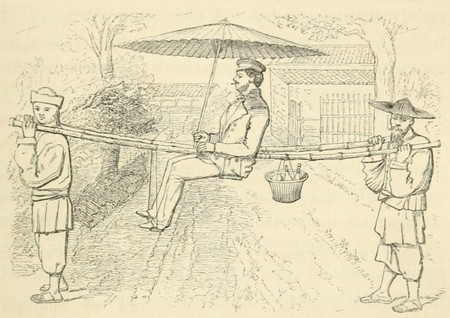
Mountain Chair.
The Chinese are quite philosophers after their
own fashion. On our way to the temple, when
tired with sitting so long in our boat, we several
times got out and walked along the path on the
sides of the canal. A great number of passage-boats
going in the same direction with ourselves,
and crowded with passengers, kept very near us
for a considerable portion of the way, in order to
satisfy their curiosity. A Chinaman never walks
when he can possibly find any other mode of
conveyance, and these persons were consequently
much surprised to see us apparently enjoying
our walk.
"Is it not strange," said one, "that these people
prefer walking when they have a boat as well as
ourselves?" A discussion now took place amongst
them as to the reason of this apparently strange
propensity, when one, more wise than his companions,
settled the matter by the pithy observation,
"It is their nature to do so;" which was
apparently satisfactory to all parties.
It was nearly dark when we reached the temple,
and as the rain had fallen in torrents during
the greater part of the day, we were drenched to
the skin, and in rather a pitiable condition. The
priests seemed much surprised at our appearance,
but at once evinced the greatest hospitality and
kindness, and we soon found ourselves quite at home
amongst them. They brought us fire to dry our
clothes, got ready our dinner, and set apart a
certain number of their best rooms for us to sleep
in. We were evidently subjects of great curiosity
to most of them who had never seen an Englishman
before. Our clothes, features, mode of eating,
and manners were all subjects of wonder to
these simple people, who passed off many a good
humoured joke at our expence.
Glad to get off our clothes, which were still damp,
we retired early to rest. When we arose in the
morning, the view which met our eyes far surpassed
in beauty any scenery which I had ever witnessed
before in China. The temple stands at the head of
a fertile valley in the bosom of the hills. This
valley is well watered by clear streams, which
flow from the mountains, and produces most excellent
crops of rice. The tea shrubs, with their
dark green leaves, are seen dotted on the lower sides
of all the more fertile hills. The temple itself is
approached by a long avenue of Chinese pine trees.
This avenue is at first straight, but near the temple
it winds in a most picturesque manner round the
edges of two artificial lakes, and then ends in a
flight of stone steps, which lead up to the principal
entrance. Behind, and on each side, the mountains
rise, in irregular ridges, from one to two thousand
feet above the level of the sea. These are not like
the barren southern mountains, but are clothed
nearly to their summits with a dense tropical looking
mass of brushwood, shrubs, and trees. Some of
the finest bamboos of China are grown in the ravines,
and the sombre coloured pine attains to a
large size on the sides of the hills. Here, too, I
observed some very beautiful specimens of the
new fir (Cryptomeria japonica), and obtained some
plants and seeds of it, which may now be seen
growing in the Horticultural Gardens at Chiswick.
After we had breakfasted, one of the head priests
came and gave us a very pressing invitation to dine
with him about mid-day; and in the meantime he accompanied
us over the monastery, of which he gave
the following history:—"Many hundred years
ago a pious old man retired from the world, and
came to dwell in these mountains, giving himself up
entirely to the performance of religious duties. So
earnest was he in his devotions that he neglected
everything relating to his temporal wants, even to
his daily food. Providence, however, would not
suffer so good a man to starve. Some boys were
sent in a miraculous manner, who daily supplied
him with food. In the course of time the fame of
the sage extended all over the adjacent country,
and disciples flocked to him from all quarters. A
small range of temples was built, and thus commenced
the extensive buildings which now bear
the name of "Tein-tung," or the "Temple of the
Heavenly Boys;" Tein signifying heaven, and tung
a boy. At last the old man died, but his disciples
supplied his place. The fame of the temple spread
far and wide, and votaries came from the most
distant parts of the empire—one of the Chinese
kings being amongst the number—to worship and
leave their offerings at its altars. Larger temples
were built in front of the original ones, and these
again in their turn gave way to those spacious
buildings which form the principal part of the
structure of the present day.
All the temples are crowded with idols, or images
of their favourite gods, such as the "three precious
Buddhas," "the Queen of Heaven"—represented as
sitting on the celebrated lotus or nelumbium—"the
God of War," and many other deified kings
and great men of former days. Many of these
images are from thirty to forty feet in height, and
have a very striking appearance when seen arranged
in these spacious and lofty halls. The priests themselves
reside in a range of low buildings, erected at
right angles with the different temples and courts
which divide them. Each has a little temple in
his own house—a family altar crowded with
small images, where he is often engaged in private
devotion.
After inspecting the various temples and the belfry,
which contains a noble bronze bell of large dimensions,
our host conducted us back to his house,
where the dinner was already on the table. The
priests of the Buddhist religion are not allowed to
eat animal food at any of their meals. Our dinner
therefore consisted entirely of vegetables, served up
in the usual Chinese style, in a number of small
round basins, the contents of each—soups excepted—being
cut up into small square bits, to be eaten
with chopsticks. The Buddhist priests contrive to
procure a number of vegetables of different kinds,
which, by a peculiar mode of preparation, are
rendered very palatable. In fact, so nearly do they
resemble animal food in taste and in appearance,
that at first we were deceived, imagining that the
little bits we were able to get hold of with our
chopsticks were really pieces of fowl or beef. Such,
however, was not the case, as our good host was
consistent on this day at least, and had nothing
but vegetable productions at his table. Several
other priests sat with us at table, and a large number
of others of inferior rank with servants, crowded
around the doors and windows outside. The whole
assemblage must have been much surprised at the
awkward way in which some of us handled our
chopsticks, and, with all their politeness, I observed
they could not refrain from laughing when, after
repeated attempts, some little dainty morsel would
still slip back again into the dish. I know few
things more annoying, and yet laughable too, than
attempting to eat with the Chinese chopsticks for
the first time, more particularly if the operator has
been wandering on the hills all the morning, and is
ravenously hungry. The instruments should first
of all be balanced between the thumb and forefinger
of the right hand; the points are next to be
brought carefully together, just leaving as much
room as will allow the coveted morsel to go in between
them; the little bit is then to be neatly
seized; but alas! in the act of lifting the hand,
one point of the chopstick too often slips past the
other, and the object of all our hopes drops back
again into the dish, or perhaps even into another
dish on the table. Again and again the same operation
is tried, until the poor novice loses all patience,
throws down the chopsticks in despair, and seizes
a porcelain spoon, with which he is more successful.
In cases like these the Chinese themselves are
very obliging, although scarcely in a way agreeable
to an Englishman's taste. Your Chinese friend, out
of kindness and politeness, when he sees the dilemma
in which you are, reaches across the table
and seizes, with his own chopsticks, which have
just come out of his mouth, the wished-for morsel,
and with them lays it on the plate before you. In
common politeness you must express your gratitude
and swallow the offering.
During dinner our host informed us that there
were about a hundred priests connected with the
monastery, but that many were always absent on
missions to various parts of the country. On
questioning him as to the mode by which the establishment
was supported, he informed us that a
considerable portion of land in the vicinity belonged
to the temple, and that large sums were yearly
raised from the sale of bamboos, which are here very
excellent, and of the branches of trees and brushwood,
which are made up in bundles for fire-wood. A
number of tea and rice farms also belong to the
priests, which they themselves cultivate. Besides
the sums raised by the sale of these productions, a
considerable revenue must be derived from the
contributions of the devotees who resort to the
temple for religious purposes, as well as from the
sums collected by those of the order who are out on
begging excursions at stated seasons of the year.
The priests are of course of all grades, some of
them being merely the servants of the others, both
in the house and in the fields. They seem a harmless
and simple race, but are dreadfully ignorant
and superstitious. The typhoon of the previous
year, or rather the rain which had accompanied it,
had occasioned a large slip of earth on one of the
hill-sides near the temple, and completely buried
ten or twelve acres of excellent paddy land. On
our remarking this, the priests told us with great
earnestness that every one said it was a bad omen
for the temple; but one of them with true Chinese
politeness remarked that he had no doubt any evil
influence would now be counteracted, since the
temple had been honoured with a visit from us.
After inspecting the tea farms and the mode of
manufacturing it, Mr. Thom, Mr. Morrison, a son
of the late Dr. Morrison, and Mr. Sinclair, returned
to Ningpo, leaving me to prosecute my research in
natural history in this part of the country. I was
generally absent from the temple the whole day,
returning at dark with the collections of plants and
birds which I had been lucky enough to meet with
in my peregrinations. The friends of the priests
came from all quarters of the adjacent country to
see the foreigner; and, as in the case of a wild
animal, my feeding time seemed to be the most
interesting moment to them. My dinner was placed
on a round table in the centre of the room, and
although rather curiously concocted, being half
Chinese and half English, the exercise and fresh air
of the mountains gave me a keen appetite. The
difficulties of the chopsticks were soon got over, and
I was able to manage them nearly as well as the
Chinese themselves. The priests and their friends
tilled the chairs, which are always placed down the
sides of a Chinese hall, each man with his pipe in
his mouth and his cup of tea by his side. With all
deference to my host and his friends, I was obliged
to request the smoking to be stopped, as it was disagreeable
to me while at dinner; in other respects, I
believe I was "polite" enough. I shall never forget
how inexpressibly lonely I felt the first night after
the departure of my friends. The Chinese one by
one dropt off to their homes or to bed, and at last
my host himself gave several unequivocal yawns,
which reminded me that it was time to retire for
the night. My bed-room was upstairs, and to get
to it I had to pass through a small temple, such as I
have already noticed, dedicated to Tein-how, or the
"Queen of Heaven," and crowded with other idols.
Incense was burning on the altar in front of the
idols; a solitary lamp shed a dim light over the
objects in the room, and a kind of solemn stillness
seemed to pervade the whole place. In the room
below, and also in one in an adjoining house, I
could hear the priests engaged in their devotional
exercises, in that singing tone which is peculiar to
them. Then the sounds of the gong fell upon my
ears; and, at intervals, a single solemn toll of the
large bronze bell in the belfry; all which showed
that the priests were engaged in public as well as
private devotion. Amidst scenes of this kind, in a
strange country, far from friends and home, impressions
are apt to be made upon the mind, which
remain vivid through life; and I feel convinced I
shall never forget the strange mixture of feelings
which filled my mind during the first night of my
stay with the priests in the temple of Tein-tung.
I have visited the place often since, passed through
the same little temple, slept in the same bed, and
heard the same solemn sounds throughout the silent
watches of the night, and yet the first impressions
remain in my mind distinct and single.
The priests, from the highest to the lowest,
always showed me the most marked attention and
kindness. As many of them as I wished cheerfully
followed me in my excursions in the vicinity
of the temple; one carrying my specimen
paper, another my plants, and a third my birds,
and so on. The gun seemed an object of great
interest to them, being so different from their
own clumsy matchlocks; and percussion caps
were looked upon as most magical little objects.
But they were great cowards, and always kept at
a most respectful distance when I was shooting.
One evening a deputation, headed by the high
priest, came and informed me that the wild boars
had come down from the mountains at night, and
were destroying the young shoots of the bamboo,
which were then just coming through the ground,
and were in the state in which they are highly
prized as a vegetable for the table. "Well," said
I, "what do you want me to do?"
"Will you be good enough to lend us the gun?"
"Yes; there it stands in the corner of the
room."
"Oh, but you must load it for us."
"Very well, I will;" and I immediately loaded
the gun with ball. "There, but take care and
don't shoot yourselves." There was now a long
pause; none had sufficient courage to take the
gun, and a long consultation was held between
them. At length the spokesman came forward,
with great gravity, and told me they were afraid
to fire it off, but that if I would go with them,
and shoot the boar, I should have it to eat. This
was certainly no great sacrifice on the part of
the Budhist priesthood, who do not, or at least
should not, eat animal food. We now sallied forth
in a body to fight the wild boars; but the night was
so dark that we could see nothing in the bamboo
ravines, and, perhaps, the noise made by about
thirty priests and servants warned the animals to
retire to the brushwood higher up the hills. Be
that as it may, we could neither see nor hear any
thing of them, and I confess I was rather glad,
than otherwise, as I thought there was a considerable
chance of my shooting, by mistake, a
priest instead of a wild boar.
The priests have two modes of protecting their
property from the ravages of these animals. Deep
pits are dug on the hill sides, and, as there are
springs in almost all these places, the pits are
scarcely finished before they are half full of water.
The mouth of each pit is then covered over with a
quantity of sticks, rubbish, and grass, to attract
the animal, and no sooner does he begin to bore
into it with his snout, than the whole gives way,
and he is plunged, head foremost, into the pit,
from which it is quite impossible for him to extricate
himself, and he is either drowned or becomes
an easy prey to the Chinese. These pits are most
dangerous traps to persons unacquainted with the
localities in which they are placed. I had several
narrow escapes, and once in particular, when coming
out of a dense mass of brushwood, I stept
unawares on the treacherous mouth of one of them,
and felt the ground under my feet actually giving
way; but managing to throw my arms forward I
caught hold of a small twig which was growing
near, and by this means supported myself until
I was able to scramble on to firmer ground. On
turning back to examine the place, I found that
the loose rubbish had sunk in, and a deep pit, half
full of water, was exposed to my view. The pit
was made narrow at the mouth and widening inside
like a great China vase, being constructed in
this manner to prevent the boar from scrambling
out when once fairly in it. Had I fallen in, it
would have been next to impossible to have extricated
myself without assistance, and as the pits are
generally dug in the most retired and wild part of
the mountains, my chance would have been a bad
one. The fate of my predecessor, Mr. Douglas,
who perished in a pit of this kind on the Sandwich
Islands, must still be fresh in the recollection of
many of my readers, and his melancholy end
naturally coming to my mind at the time, made
me doubly thankful for my escape.
The other method of protecting the young
bamboos from the ravages of the wild boar, is an
ingenious one. A piece of bamboo wood, about
eight or ten feet long, and rather thicker than a
man's arm, is split up the middle to within a fourth
of its length. This is made fast to a tree in the
bamboo thicket, and at an angle of about forty-five
degrees, the split part being left loose, a cord,
also made of bamboo, is fastened to it by one end,
and the other is led to some convenient place out
of the thicket, where a man is stationed. When
the boars come down in the dead of night to
attack the young shoots, the man pulls the rope
backwards and forwards, and clank, clank, clank
goes the bamboo, producing a loud and hollow
sound, which on a quiet evening may be heard at a
great distance. The animals are frightened and
make off to their dens on the hills. The first time
I heard these things beating at night, all over the
country, I imagined that some religious ceremony
was going on, the hollow sounds of the bamboo
being not unlike those produced by an instrument
used in the Budhist worship in all Chinese temples.
There are a large number of Budhist temples
scattered over all this part of the country. One,
named Ah-yu-wang, which I also visited, is, like
Tein-tung, of great extent, and seemingly well supported.
They both own large tracts of land in the
vicinity of the monasteries, and have numerous
small temples in different parts of the district which
are under their control. All the temples, both
large and small, are built in the most romantic and
beautiful situations amongst the hills, and the
neighbouring woods are always preserved and encouraged.
What would indicate the residence of a
country gentleman in England, is in China the sign
of a Budhist temple, and this holds good over all
the country. When the weary traveller, therefore,
who has been exposed for hours to the fierce
rays of an eastern sun, sees a large clean looking
house showing itself amongst trees on the distant
hill-side, he may be almost certain that it is one of
Budha's temples, where the priests will treat him not
only with courtesy, but with kindness.
Poo-to, or the Worshipping Island, as it is commonly
called by foreigners, is one of the eastern
islands in the Chusan Archipelago, and seems to be
the capital or stronghold of Budhism in this part of
China. This island is not more than five or six
miles in circumference, and, although hilly, its sides
and small ravines are pretty well wooded, particularly
in the vicinity of the numerous temples. As
it is only a few hours' sail from Chusan, it had been
visited at different times by a number of our officers
during the war, all of whom spoke highly of its
natural beauties and richness of vegetation. I was
also informed that the resident priests were fond of
collecting plants, particularly Orchidaceæ, and that
their collections were much increased by the itinerant
habits of the begging priests, who visit the
most distant provinces of the empire, as well as by
the donations of the lay devotees, who come to
Poo-to at stated seasons of the year, to worship and
leave their offerings in the temples. I therefore determined
to visit the place in order to judge for myself,
and accordingly set out in July, 1844, accompanied
by my friend, Dr. Maxwell, of the Madras army.
Leaving Chusan at night, with the tide in our
favour, we reached the island at sun-rise on the following
morning. We landed, and pursued our
way over a hill and down on the other side by a
road which led us into a beautiful and romantic
glen. It is here that the principal group of temples
is built, and when we first caught a glimpse of them,
as we wended our way down the hill, they seemed
like a town of considerable size. As we approached
nearer, the view became highly interesting. In
front there was a large artificial pond, filled with
the broad green leaves and noble red and white
flowers of the Nelumbium speciosum,—a plant in
high favour with the Chinese. Every body who went
to Poo-to admired these beautiful water-lilies. In
order to reach the monastery we crossed a very ornamental
bridge built over this pond, which, when
viewed in a line with an old tower close by, has a
pretty and striking appearance.
The temples or halls which contain the idols
are extremely spacious, and resemble those which
I have already described at Tein-tung and Ah-yu-Wang.
These idols, many of which are thirty or
forty feet in height, are generally made of wood or
clay, and then richly gilt. There is one small
temple, however, of a very unassuming appearance,
where we met with some exquisite bronze statues,
which would be considered of great value in England.
These, of course, were much smaller than
the others, but, viewed as works of art, they were
by far the finest which I saw during my travels in
China.
Having examined these temples, we pursued our
way towards another assemblage of them, about
two miles to the eastward and close on the sea-shore.
We entered the courts through a kind of
triumphal arch, which looks out upon the sea, and
found that these temples were constructed upon
the same plan as all the others. As we had
determined to make this part of the island our
home during our stay, we fixed upon the cleanest
looking temple, and asked the High Priest to allow
us, without farther delay, to put our beds and
travelling baggage into it.
On the following day we inspected various parts
of the island. Besides the large temples just noticed,
there are about sixty or seventy smaller ones,
built on all the hill sides, each of which contains
three or four priests, who are all under the superior,
or abbot, who resides near one of the large temples.
Even on the top of the highest hill, probably 1500
or 1800 feet above the level of the sea, we found a
temple of considerable size and in excellent repair.
There are winding stone steps from the sea beach
all the way up to this temple, and a small resting-place
about half way up the hill, where the weary
devotee may rest and drink of the refreshing stream
which flows down the sides of the mountain, and
in the little temple close at hand, which is also
crowded with idols, he can supplicate Budha for
strength to enable him to reach the end of his
journey. We were surprised to find a Budhist
temple in such excellent order as the one on the
summit of the hill proved to be in. It is a striking
fact, that almost all these places are crumbling fast
into ruins. There are a few exceptions, in cases
where they happen to get a good name amongst
the people from the supposed kindness of the gods;
but the great mass are in a state of decay.
From the upper temple on Poo-to-san the view is
strikingly grand. Hugged mountains are seen rising
one above another and capped with clouds. Hundreds
of islands, some fertile, others rocky and
barren, lay scattered over the sea. When we looked
in one direction amongst the islands, the water was
yellow and muddy; but, to the eastward, the deep
blue ocean had resumed its usual colour, and the line
between the yellow waters and the blue was distinctly
and curiously marked.
The wood on the island is preserved in the same
manner as it is around all the other Budhist temples.
The principal species of trees and shrubs met with
are Pinus sinensis, Cunningham lanceolata, yews,
cypresses, the camphor tree, tallow tree, oaks, and
bamboos. The Camellia japonica grows spontaneously
in the woods, where we met with many
specimens from twenty to thirty feet in height and
with stems thick in proportion. The variety, however,
was only the well-known single red. In
other respects the flora of Poo-to is nearly the same
as on the island of Chusan.
A few pet plants were cultivated by all the
priests who were fortunate enough to have private
residences at the little temples on the sides of the
hills. We were much pleased with the interest these
poor people took in their favourite flowers, but
were disappointed in the number and variety of
plants, which, from the reports of others, we expected
to have found. Almost the only orchidaceous
plant which they had, proved to be the common and
well-known Cymbidium sinense. Daphne odorata,
two or three species of Gardenia, several varieties
of Rose, the common Balsam, and the favourite
Nelumbium were nearly all the plants met with in
the gardens of the priests.
The island of Poo-to is set apart entirely as a
residence for the priests of the Budhist religion.
Few other persons are allowed to live there, and
these are either servants or in some way connected
with the priests. No women are permitted to reside
on the island, it being against the principles of the
Budhists to allow their priests to marry. The
number of priests are estimated at 2000, but many
of them are constantly absent on begging expeditions
for the support of their religion. This establishment,
like Tein-tung, has also a portion of land
allotted to it for its support, and the remainder of
the funds are made up by the subscriptions of the
devotees. On certain high days, at different periods
of the year, many thousands of both sexes, but particularly
females, resort to these temples, clad in
their best attire, to pay their vows and engage in
the other exercises of heathen worship. Little
stalls are then seen in the temples or at the doorways
for the sale of incense, candles, paper made
up in the form of the ingots of Sycee-silver,
and other holy things which are considered acceptable
offerings to the gods, and are either consumed
in the temples or carried home to bring a blessing
upon the houses and families of those who purchase
them. The profits of these sales, of course, go to
the support of the establishment. When we consider
that these poor deluded people sometimes
travel a distance of several hundred miles to worship
in the temples on Poo-to-san and other celebrated
places, we cannot but admire their spirit of devotion.
I was once staying in the temple of Tein-tung
when it was visited for three days by devotees from
all parts of the country. As they lined the roads
on their way to the temple, clad in the graceful and
flowing costume of the East, the mind was naturally
led back to those days of scripture history when
Jerusalem was in its glory, and the Jews, the chosen
people of God, came from afar to worship in its
temple.
Although no Christian can look upon the priests
and devotees of the Budhist creed without an eye
of pity, yet he must give them credit for their conduct,
since he has every reason to believe them sincere,
and I am inclined to believe that justice has not
been done them in this respect. Mr. Gutzlaff, in
describing his visit to Poo-to, is of a different opinion.
He says, "We were present at the vespers
of the priests, which they chanted in the Pali language,
not unlike the Latin service of the Romish
church. They held rosaries in their hands, which
rested folded upon their breasts. One of them had
a small bell, by the tinkling of which their service
was regulated; and they occasionally beat the
drum and large bell to rouse Budha's attention to
their prayers. The same words were a hundred
times repeated. None of the officiating persons showed
any interest in the ceremony, for some were looking
around laughing and joking, while others muttered
their prayers. The few people who were present,
not to attend the worship, but to gaze at us, did
not seem, in the least degree, to feel the solemnity
of the service. "What Mr. Gutzlaff says is doubtless
true, but after residing for months in their
temples, at different times, and in different parts of
the country, I have no hesitation in saying that
such conduct is very far from being general. In
certain instances I have seen it myself, but this
levity and apparent want of attention was exhibited
by the servants and lookers on, who were taking
no part in the ceremony, and not by the respectable
portion of the priests. On the contrary, I
have generally been struck with the solemnity with
which their devotional exercises were conducted.
I have often walked into Chinese temples when the
priests were engaged in prayer, and, although there
would have been some apology for them had their
attention been diverted, they went on in the most
solemn manner until the conclusion of the service,
as if no foreigner were present. They then came
politely up to me, examining my dress and every
thing about me with the most earnest curiosity.
Nor does this apply to priests only; the laity, and
particularly the female sex, seem equally sincere
when they engage in their public devotions.
Whether they are what they appear to be, or how
often they are in this pious frame of mind, are
questions which I cannot answer. Before judging
harshly of the Chinese let the reader consider what
effect would be produced upon the members of a
Christian church by the unexpected entrance of a
small-footed Chinese lady, or a Mandarin, with the
gold button and peacock feather mounted on his
hat, and his long tail dangling over his shoulders.
I am far from being an admirer of the Budhist
priesthood; they are generally an imbecile race,
and shamefully ignorant of every thing but the
simple forms of their religion, but nevertheless
there are many traits in their character not unworthy
of imitation.
There are two other sects in China, namely, the
followers of Kong-foo-tze or Confucius, and the
sect of Taou or Reason. Although these three
sects form the principal part of the population, it
is well known that there are a great number of
Mohommedans in every part of the empire, who are
not only tolerated, but admitted to offices under
government in the same manner as the members of
the three established sects. Jews also are found
in several districts, but more particularly at a
place called Kae-foong-foo, in the province of
Honan.
The various religious ceremonies which the
Chinese are continually performing prove at least
that they are very superstitions. In all the
southern towns every house has its temple or altar
both inside and outside. The altar in the inside
is generally placed at the end of the principal hall
or shop, as the case may be, raised a few feet from
the ground, and having some kind of representation
of the family deity placed upon it. This is surrounded
with gaudy tinsel paper, and on the first
of the Chinese month or other high days candles
and incense are burned on the table which is placed
in front of it. The altar on the outside of the door
resembles a little furnace, in which the same ceremonies
are regularly performed. In the vicinity
of small villages, and sometimes in the most retired
situations, the stranger meets with little joss-houses
or temples, gaudily decorated with paintings
and tinsel paper, and stuck round about with
the remains of candles and sticks of incense. In
almost all Chinese towns there are shops for the
sale of idols of all kinds and sizes, varying in price
from a few "cash" to a very large sum. Many of
those exposed for sale are of great age, and have
evidently changed hands several times. I am
inclined to believe that the Chinese exchange those
gods which do not please them for others of higher
character, and which they suppose are more likely
to grant an answer to their prayers, or bring
prosperity to their homes or their villages.
The periodical offerings to the gods are very
striking exhibitions to the stranger who looks upon
them for the first time. When staying at Shanghae,
in November, 1844, I witnessed a most curious
spectacle in the house where I was residing. It
was a family offering to the gods. Early in the
morning the principal hall in the house was set in
order, a large table was placed in the centre, and
shortly afterwards covered with small dishes filled
with the various articles commonly used as food by
the Chinese. All these were of the very best description
which could be procured. After a certain
time had elapsed a number of candles were lighted,
and columns of smoke and fragrant odours began
to rise from the incense which was burning on the
table. All the inmates of the house and their
friends were clad in their best attire, and in turn
came to Ko-tou, or bow lowly and repeatedly in
front of the table and the altar. The scene,
although it was an idolatrous one, seemed to me to
have something very impressive about it, and
whilst I pitied the delusion of our host and his
friends, I could not but admire their devotion. In
a short time after this ceremony was completed a
large quantity of tinsel paper, made up in the form
and shape of the ingots of Sycee silver common in
China, was heaped on the floor in front of the
tables, the burning incense was then taken from
the table and placed in the midst of it, and the
whole consumed together. By and by, when the
gods were supposed to have finished their repast,
all the articles of food were removed from the
tables, cut up, and consumed by people connected
with the family.
On another occasion, when at Ning-po, having
been out some distance in the country, it was
night and dark before I reached the cast gate of
the city, near which I was lodged in the house of a
Chinese merchant. The city gates were closed,
but two or three loud knocks soon brought the
warder, who instantly admitted me. I was now
in the widest and finest street in the city, which
seemed in a blaze of light and unusually lively for
any part of a Chinese town after nightfall. The
sounds of music fell, upon my ear, the gong, the
drum, and the more plaintive and pleasing tones of
several wind instruments. I was soon near enough
to observe what was going on, and saw, at a glance,
that it was a public offering to the gods, but far
grander and more striking than I had before witnessed.
The table was spread in the open street,
and every thing was on a large and expensive
scale. Instead of small dishes, whole animals were
sacrificed on the occasion. A pig was placed on
one side of the table, and a sheep on the other, the
former scraped clean, in the usual way, and the
latter skinned; the entrails of both were removed,
and on each were placed some flowers, an onion,
and a knife. The other parts of the table groaned
with all the delicacies in common use amongst the
respectable portion of the Chinese, such as fowls,
ducks, numerous compound dishes, fruits, vegetables,
and rice. Chairs were placed at one end
of the table on which the gods were supposed to sit
during the meal, and chopsticks were regularly laid
at the sides of the different dishes. A blaze of
light illuminated the whole place, and the smoke
of the fragrant incense rose up into the air in
wreaths. At intervals the band struck up their
favourite plaintive national airs, and altogether
the whole scene was one of the strangest and
most curious which it has ever been my lot to
witness.
There is another ceremony of a religious character
which I frequently observed in the northern
cities—I allude to processions in honour of the
gods. I saw one of them at Shanghae, which
must have been at least a mile in length. The
gods, or josses, were dressed up in the finest silks,
and carried about in splendid sedan-chairs, preceded
and succeeded by their numerous devotees,
superbly dressed for the occasion, and bearing the
different badges of office. The dresses of the
officials were exactly the same as of those who form
the train of some of the high mandarins. Some
had a broad fan, made of peacock feathers, which
they wore on the sides of their hats, others were
clad in glaring theatrical dresses, with low caps,
and two long black feathers stuck in them, and
hanging over their shoulders like two horns. Then
there were the ill-looking executioners with long,
conical, black hats on their heads, and whips in
their hands for the punishment of the refractory.
Bands of music, placed in different parts of the
procession, played at intervals as it proceeded.
Anxious to see the end of this curious exhibition,
I followed the procession until it arrived at a
temple in the suburbs, where it halted. The gods
were taken out of the sedan-chairs, and replaced
with due honours, in the temple, from which they
had been taken in the morning. Here their numerous
votaries bent low before them, burned
incense, and left their gifts upon the altar. Numerous
groups of well-dressed ladies and their
children were scattered over the ground in the
vicinity of the temple, all bending their knees
and seemingly engaged in earnest devotion. A
large quantity of paper, in the form of the Sycee
ingots, was heaped up on the grass as it was
brought by the different devotees, and, when the
ceremonies of the day were drawing to a close, the
whole was burned in honour of, or as an offering
to, the gods. The sight was interesting, but it
was one which no Christian could look upon without
feelings of the deepest commiseration.
In the course of my travels in China I often
met with Christian missionaries, both Protestant
and Roman Catholic, who have been labouring
amongst the Chinese for many years. Until very
lately the efforts of the Protestants had been chiefly
confined to Macao and Canton. Since the war,
however, they have had an opportunity of extending
their operations, and some are now settled at
all the new ports which have been opened for
foreign trade, as well as on our Island of Hong-kong,
which will now become their head-quarters.
The medical missionaries also act in conjunction
with the others, and are of great use in curing
many of the diseases which prevail in the country,
while, at the same time, the truths of the Christian
faith are presented to the minds of their patients.
Dr. Lockhart of the London Missionary Society,
who has established himself in the town of Shanghae,
had his hospital daily crowded with patients,
many of whom had come from very distant parts
of the country. All were attended to in the most
skilful and careful manner, "without money and
without price." The Rev. Mr. Medhurst, who has
laboured long and zealously as a Christian missionary
in the East, was also at Shanghae. This
gentleman is well known as an eminent Chinese
scholar, and, besides preaching to the people in
their own tongue, he has a printing establishment
with Chinese type continually at work, for the
dissemination of the truths of the gospel. Several
other gentlemen and their families had arrived at
the same port previous to my departure, and were
closely engaged in the study of the language.
Ning-po and Amoy were also occupied by missionaries,
both from England and America, and I
suppose, ere this time, some have also reached
Foo-chow-foo on the River Min.
From my own experience of Chinese character,
and from what I have seen of the working of the
Medical Missionary Society, I am convinced that it
must be a powerful auxiliary to the missionaries
in the conversion of the Chinese. I regret, however,
to say, that up to the present time little progress
appears to have been made. One portion of
the people, and a large one, is entirely indifferent
to religion of any kind, and the rest are so bigoted
and conceited, that it will be a most difficult task
to convince them that any religion is better or
purer than their own.
The Roman Catholic missionaries conduct their
operations in a manner somewhat different from
the Protestants. They do not restrict themselves
to the out-ports of the empire, where foreigners are
permitted to trade, but penetrate into the interior,
and distribute themselves over all the country.
One of their bishops, an Italian nobleman, resides
in the province of Keang-soo, a few miles from
Shanghae, where I have frequently met him. He
dresses in the costume of the country, and speaks
the language with the most perfect fluency. In
the place where he lives he is surrounded by his
converts; in fact it is a little Christian village,
where he is perfectly safe, and I believe is seldom
if ever annoyed in any way by the Chinese authorities.
When new Roman Catholic missionaries
arrive, they are met by some of their brethren or
their converts at the port nearest their destination,
and secretly conveyed into the interior; the
Chinese dress is substituted for the European;
their heads are shaved, and in this state they are
conducted to the scene of their future labours,
where they commence the study of the language, if
they have not learned it before, and in about two
years are able to speak it sufficiently well to
enable them to instruct the people. These poor
men submit to many privations and dangers for
the cause they have espoused, and although I do
not approve of the doctrines which they teach, I
must give them the highest praise for enthusiasm
and devotion to their faith. European customs,
habits, and luxuries are all abandoned from
the moment they put their feet on the shores of
China; parents, friends, and home, in many instances,
are heard of no more; before them lies a
heathen land of strangers, cold and unconcerned
about the religion for which they themselves are
sacrificing everything, and they know that their
graves will be far away from the land of their birth
and the home of their early years. They seem to
have much of the spirit and enthusiasm of the first
preachers of the Christian religion, when they were
sent out into the world by their Divine Master to
"preach the gospel to every creature," and "to
obey God rather than man."
According to the accounts of these missionaries,
the number of converts to their faith is very considerable;
but I fear they, as well as the Protestants,
are often led away by false appearances
and assertions. Many of the Chinese are unprincipled
and deceitful enough to become Christians
or in fact any thing else, in name, to accomplish
the object they may have in view, and they
would become Budhists the very next day should
any inducement be offered them to do so. Judging
from appearances, the day must yet be very
distant when the Chinese, as a nation, will be converted
to the Christian faith. Could those individuals
in our time, who predict the near approach
of the Millennium, see the length and breadth of
this vast country, with its three hundred millions
of souls, they would surely pause and reflect before
they published their absurd and foolish predictions.
THE TEA-PLANT OF CHINA.—THE SPECIES FOUND IN THE GREEN
AND BLACK TEA DISTRICTS.—BEST SITUATION FOR TEA PLANTATIONS.—REMARKS
ON THEIR MANAGEMENT.—SEASONS,
AND METHODS, OF GATHERING THE LEAVES.—MANUFACTURE
OF TEA.—COTTAGES AMONGST THE TEA HILLS.—FURNACES
AND DRYING PANS.—FIRST APPLICATION OF HEAT.—ROLLING
PROCESS.—EXPOSURE OF THE LEAVES TO THE AIR.—SECOND
HEATING.—LENGTH OF TIME REQUIRED.—TWO KINDS OF TEA.—DIFFERENCE
IN THE MANUFACTURE OF EACH.—SELECTING
AND PACKING TEAS.—APPEARANCE AND COLOUR OF
THE LEAF.—PECULIAR TASTE OF FOREIGNERS FOR DYED
TEAS.—GOOD SENSE OF THE CHINESE.—TEA MERCHANTS.—THEIR
VISITS TO THE TEA HILLS.—MODE OF BUYING FROM
THE SMALL GROWERS.—BLACK TEA DISTRICT IN FOKIEN.—TEAS
DIVIDED INTO TWO KINDS.—PECULIAR METHOD OF
PREPARING EACH.—CAUSE OF THEIR DIFFERENCE IN COLOUR.—FLOWERS
USED IN SCENTING THE FINER TEAS.—SIR JOHN
FRANCIS DAVIS'S REMARKS ON DIFFERENT KINDS OF TEAS SOLD
AT CANTON.
There are few subjects connected with the vegetable
kingdom which have attracted such a large
share of public notice as the tea-plant of China.
Its cultivation on the Chinese hills, the particular
species or variety which produces the black and
green teas of commerce, and the method of preparing
the leaves, have always been objects of peculiar
interest. The jealousy of the Chinese government,
in former times, prevented foreigners from visiting
any of the districts where tea is cultivated, and
the information derived from the Chinese merchants,
even scanty as it was, was not to be
depended upon. And hence we find our English
authors contradicting each other, some asserting
that the black and green teas are produced by the
same variety, and that the difference in colour is
the result of a different mode of preparation, while
others say that the black teas are produced from
the plant called by botanists Thea Bohea, and the
green from Thea viridis, both of which we have
had for many years in our gardens in England.
During my travels in China since the last war,
I have had frequent opportunities of inspecting
some extensive tea districts in the black and green
tea countries of Canton, Fokien, and Chekiang, and
the result of these observations is now laid before
the reader. It will prove that even those who have
had the best means of judging have been deceived,
and that the greater part of the black and green teas
which are brought yearly from China to Europe
and America are obtained from the same species or
variety, namely, from the Thea viridis. Dried
specimens of this plant were prepared in the districts
I have named by myself, and are now in the
herbarium of the Horticultural Society of London,
so that there can be no longer any doubt upon
the subject.
In various parts of the Canton province, where
I had an opportunity of seeing tea cultivated, the
species proved to be the Thea Bohea, or what is
commonly called the black tea plant. In the green
tea districts of the north—I allude more particularly
to the province of Chekiang—I never
met with a single plant of this species, which is so
common in the fields and gardens near Canton.
All the plants in the green tea country near
Ning-po, on the Islands of the Chusan Archipelago,
and in every part of the province which I had an
opportunity of visiting, proved, without exception,
to be the Thea viridis. Two hundred miles further
to the north-west, in the province of Kiang-nan,
and only a short distance from the tea hills in that
quarter, I also found in gardens this same species
of tea.
Thus far my actual observation exactly verified
the opinions I had formed on the subject before
I left England, viz., that the black teas were prepared
from the Thea Bohea, and the green from
Thea viridis. When I left the north, on my way
to the city of Foo-chow-foo, on the River Min, in
the province of Fokien, I had no doubt that I
should find the tea hills there covered with the
other species, Thea Bohea, from which we generally
suppose the black teas are made; and this was the
more likely to be the case as this species actually
derives its specific name from the Bohee hills in
this province. Great was my surprise to find all
the plants on the tea hills near Foo-chow exactly
the same as those in the green tea districts of the
north. Here were then green tea plantations on
the black tea hills, and not a single plant of the
Thea Bohea to be seen. Moreover, at the time of
my visit, the natives were busily employed in the
manufacture of black teas. Although the specific
differences of the tea-plants were well known to me,
I was so much surprised, and I may add amused, at
this discovery, that I procured a set of specimens
for the herbarium, and also dug up a living plant,
which I took northward to Chekiang. On comparing
it with those which grow on the green tea
hills, no difference whatever was observed.
It appears, therefore, that the black and green
teas of the northern districts of China (those districts
in which the greater part of the teas for the
foreign markets are made) are both produced from
the same variety, and that that variety is the Thea
viridis, or, what is commonly called the green tea
plant. On the other hand, those black and green
teas which are manufactured in considerable quantities
in the vicinity of Canton are obtained from
the Thea Bohea, or black tea. And, really, when
we give the subject our unprejudiced consideration,
there seems nothing surprising in this state
of things. Moreover, we must bear in mind that
our former opinions were formed upon statements
made to us by the Chinese at Canton, who will say
any thing which suits their purpose, and rarely give
themselves any trouble to ascertain whether the information
they communicate be true or false.
The soil of the tea districts is, of course, much
richer in the northern provinces than it is in Quantung.
In Fokien and Chekiang it is a rich sandy
loam, very different from the sample which will
be found noticed in the chapter on climate and
soil. Tea shrubs will not succeed well unless they
have a rich soil to grow in. The continual gathering
of their leaves is very detrimental to their
health, and, in fact, ultimately kills them. Hence
a principal object with the grower is to keep his
bushes in as robust health as possible; and this
cannot be done if the soil be poor.
The tea plantations in the north of China are
always situated on the lower and most fertile sides
of the hills, and never on the low lands. The
shrubs are planted in rows about four feet apart
and about the same distance between each row,
and look, at a distance, like little shrubberies of
evergreens.
The farms are small, each consisting of from one
to four or five acres; indeed, every cottager has his
own little tea garden, the produce of which supplies
the wants of his family, and the surplus brings him
in a few dollars, which are spent on the other necessaries
of life. The same system is practised in
every thing relating to Chinese agriculture. The
cotton, silk, and rice farms are generally all small
and managed upon the same plan. There are few
sights more pleasing than a Chinese family in the
interior engaged in gathering the tea leaves, or,
indeed, in any of their other agricultural pursuits.
There is the old man, it may be the grand—father, or
even the great-grandfather, patriarch like, directing
his descendants, many of whom are in their
youth and prime, while others are in their childhood,
in the labours of the field. He stands in the midst
of them, bowed down with age. But, to the honour
of the Chinese as a nation, he is always looked up
to by all with pride and affection, and his old age
and grey hairs are honoured, revered, and loved.
When, after the labours of the day are over, they
return to their humble and happy homes, their fare
consists chiefly of rice, fish, and vegetables, which
they enjoy with great zest, and are happy and contented.
I really believe that there is no country in
the world where the agricultural population are
better off than they are in the north of China.
Labour with them is pleasure, for its fruits are
eaten by themselves, and the rod of the oppressor is
unfelt and unknown.
In the green tea districts of Chekiang near
Ning-po, the first crop of leaves is generally
gathered about the middle of April. This consists
of the young leaf-buds just as they begin to
unfold, and forms a fine and delicate kind of
young hyson, which is held in high estimation by
the natives, and is generally sent about in small
quantities as presents to their friends. It is a
scarce and expensive article, and the picking of
the leaves in such a young state does considerable
injury to the tea plantations. The summer rains,
however, which fall copiously about this season,
moisten the earth and air, and if the plants are
young and vigorous they soon push out fresh
leaves.
In a fortnight or three weeks from the time of
the first picking, or about the beginning of May,
the shrubs are again covered with fresh leaves,
and are ready for the second gathering, which is,
in fact, the most important of the season. The
third and last gathering, which takes place as
soon as new leaves are formed, produces a very
inferior kind of tea, which, I believe, is rarely sent
out of the district.
The mode of gathering and preparing the
leaves of the tea-plants is extremely simple. We
have been so long accustomed to magnify and
mystify every thing relating to the Chinese, that,
in all their arts and manufactures, we expect to
find some peculiar and out of the way practice,
when the fact is, that many operations in China
are more simple in their character than in most
other parts of the world. To rightly understand
the process of rolling and drying the leaves, which
I am about to describe, it must be borne in mind
that the grand object is to expel the moisture, and
at the same time to retain, as much as possible, of
the aromatic and other desirable secretions of the
species. The system adopted to attain this end
is as simple as it is efficacious.
In the harvest seasons the natives are seen in little
family groups on the side of every hill, when the
weather is dry, engaged in gathering the tea leaves.
They do not seem so particular, as I imagined
they would have been, in this operation, but strip
the leaves off rapidly and promiscuously, and throw
them all into round baskets made for the purpose
out of split bamboo or rattan. In the beginning
of May, when the principal gathering takes place,
the young seed vessels are about as large as peas.
These are also stripped off and dried with the
leaves; it is these seed-vessels, which we often see
in our tea, and which have some slight resemblance
to young capers. When a sufficient quantity
of leaves are gathered, they are carried home
to the cottage or barn, where the operation of
drying is performed.
The Chinese cottages, amongst the tea hills, are
simple and rude in their construction, and remind
one of what we used to see in Scotland in former
years, when the cow and pig lived and fed in the
same house with the peasant. Scottish cottages,
however, even in these days, were always better
furnished and more comfortable than those of the
Chinese are at the present time. Nevertheless, it
is in these poor cottages that a large proportion of
the teas, with their high-sounding names, are first
prepared. Barns, sheds, and other outhouses, are
also frequently used for the same purpose, particularly
about the temples and monasteries.
The drying pans and furnaces in these places
are very simply constructed. The pans, which are
of iron, and are made as thin as possible, are
round and shallow, and, in fact, are the same, or
nearly the same, which the natives have in general
use for cooking their rice. A row of these are
built into brick work and chunam, having a flue
constructed below them, with the grating, or
rather fire-place, at one end, and the chimney, or,
at least, some hole to allow the smoke to escape, at
the other. A chimney is a secondary consideration
with the Chinese, and in many instances which came
under my observation, the smoke, after passing
below the drying-pans, was allowed to escape,
as it best could, through the doors and roofs
of the houses, which, indeed, in China, is no difficult
matter.
When the pans are first fixed, the brick-work
and chunam are smoothed off very neatly round
their edges and carried up a little higher, particularly
at the back of the pans, at the same time
widening gradually. When complete, the whole has
the appearance of a row of large high-backed
basins, each being three or four times larger than
the shallow iron pan which is placed at its bottom,
immediately over the flue. When the fire is applied,
the upper part of these basins, which is formed
of chunam, gets heated as well as the iron pan,
though in a less degree. The drying pans, thus
formed, being low in front, and rising very gradually
at the sides and back, the person, whose duty
it is to attend to the drying of the leaves, can
readily manage them, and scatter them about over
the back of the basin. The accompanying sketch,
which was made on the spot, will render this description
more clear.
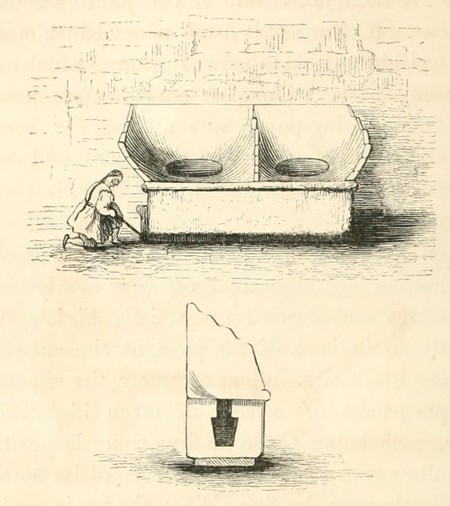
Furnaces and Drying Pans.
The leaves having been brought in from the
hills are placed in the cottage or drying-house. It
is now the duty of one individual to light the little
fire at the mouth of the flue, and to regulate it as
nicely as possible. The pans become hot very
soon after the warm air has begun to circulate in
the flue beneath them. A quantity of leaves, from a
sieve or basket, are now thrown into the pans, and
turned over, shaken up, and kept in motion by
men and women stationed there for this purpose.
The leaves are immediately affected by the heat.
They begin to crack, and become quite moist with
the vapour or sap which they give out on the
application of the heat. This part of the process
lasts about five minutes, in which time the leaves
lose their crispness, and become soft and pliable.
They are then taken out of the pans and thrown
upon a table, the upper part of which is made of
split pieces of bamboo as represented in the
annexed sketch. Three or four persons now surround
the table, and the heap of tea leaves is
divided into as many parcels, each individual
taking as many as he can hold in his hands, and
the rolling process commences. I cannot give a
better idea of this operation than by comparing it
to a baker working and rolling his dough. Both
hands are used in the very same way; the object
being to express the sap and moisture, and at the
same time to twist the leaves. Two or three times
during the operation the little bundles of rolled
leaves are held up and shaken out upon the table,
and are then again taken up and pressed and
rolled as before. This part of the process also
lasts about five minutes, during which time a
large portion of green juice has been expressed,
and may be seen finding its way down between the
interstices of the bamboos. The leaves being now
pressed, twisted, and curled, do not occupy a
quarter of the space which they did before the
operation.
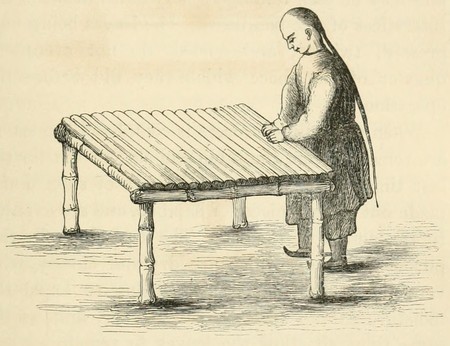
The Rolling Process.
When the rolling process is completed the leaves
are removed from the table and shaken out for the
last time, thinly, upon a large sort of screen, also
made out of split pieces of bamboo, and are exposed
to the action of the air. The best days for this
purpose are those which are dry and cloudy, with
very little sun. The object being to expel the
moisture in the most gentle manner, and, at the
same time, to allow the leaves to remain as soft
and pliable as possible. When the sun is clear and
powerful the moisture evaporates too rapidly, and
the leaves are left crisp, coarse, and not in a proper
state to undergo the remaining part of the process.
There is no stated time for this exposure, as much
depends upon the nature of the weather and the
convenience of the work-people; sometimes I have
seen them go on with the remaining part of the
operation without at all exposing the leaves to
the air.
Having in this manner got rid of a certain part
of the superfluous moisture, the leaves, which are
now soft and pliant, are again thrown into the
drying-pans, and the second heating commences.
Again one individual takes his post at the furnace,
and keeps up a slow and steady fire. Others
resume their places at the different drying-pans—one
at each—and commence stirring and throwing
up the leaves, so that they may all have an equal
share of the fire, and none get scorched or burned.
The process of drying thus goes on slowly and
regularly. This part of the operation soon becomes
more easy, for the leaves, as they part with their
moisture, twist and curl, and consequently take up
much less room than they do at first, and mix together
more readily. The tea leaves being now rather
too hot for the hand, a small and neat brush, made
of bamboo, is used instead of the fingers for stirring
them up from the bottom of the pan. By this means
the leaves are scattered about on the smooth
chunam-work, which forms the back of the drying-pan,
and, as they roll down on this heated inclined
plane they dry slowly, and twist at the same time.
During this operation the men and women who are
employed never leave their respective stations,
one keeps slowly feeding the fire, and the others
continually stir the leaves. No very exact degree
of temperature is attempted to be kept up, for
they do not use the thermometer, but a slow and
steady fire is quite sufficient; that is, the pan is
made and kept so hot, that I could not place my
hand upon it for a second of time. In order to
get a correct idea of the time required to complete
this second part of the process, I referred to my
watch on different occasions, and at different tea
farms, and always found that it occupied about an
hour; that is, from the time the leaves were put
into the pan after exposure to the air, until they
were perfectly dry.
When the operation of drying is going on
largely, some of the pans in the range are used for
finishing the process, while others, and the hottest
ones, are heating and moistening the leaves before
they are squeezed and rolled. Thus a considerable
number of hands can be employed at once, and the
work goes on rapidly without loss of time or heat,
the latter of which is of some importance in a
country so ill provided with fuel.
The tea prepared in the manner which I have
just described is greenish in colour, and of a most
excellent quality. It is called by the Chinese in
the province of Chekiang, Tsaou-tsing, or the tea
which is dried in the pan, to distinguish it from
the Hong-tsing, or that kind which is dried in flat
bamboo baskets over a slow fire of charcoal.
This latter kind—the Hong-tsing,—is prepared
in the following manner:—The first process, up
to the period of rolling and exposure to the air,
is exactly the same as that which I have just
described, but instead of being put into the drying-pan
for the second heating like the Tsaou-tsing, the
Hong-tsing is shaken out into flat baskets, which
are placed over tubs containing charcoal and ashes.
The charcoal, when ignited, burns slowly and
sends out a mild and gentle heat. Indeed, the only
difference between the two teas consists in the
mode of firing, the latter being dried less and
more slowly than the former. The Hong-tsing is
not so green in colour as the Tsaou-tsing, and I
believe has rarely been exported.
After the drying is completed the tea is picked,
sifted, divided into different kinds and qualities,
and prepared for packing. This is a part of the
operation which requires great care, more especially
when the tea is intended for the foreign market, as
the value of the sample depends much upon the
"smallness and evenness" of the leaf, as well as
upon its other good qualities. In those districts
where the teas are manufactured solely for exportation,
the natives are very particular in the
rolling process, and hence the teas from these districts
are better divided and more even—although
I should doubt their being really better in quality—than
they are in the eastern parts of the province
of Chekiang. When they have been duly assorted,
a man puts on a pair of clean cloth or straw shoes,
and treads the tea firmly into baskets or boxes,
and the operation is considered complete, in so far
as the grower is concerned.
I have stated that the plants grown in the district
of Chekiang produce green teas, but it must
not be supposed that they are the green teas which
are exported to England. The leaf has a much
more natural colour, and has little or none of what
we call the "beautiful bloom" upon it, which is
so much admired in Europe and America. There
is now no doubt that all these "blooming" green
teas, which are manufactured at Canton, are dyed
with prussian blue and gypsum, to suit the taste
of the foreign "barbarians:" indeed, the process
may be seen any day, during the season, by those
who will give themselves the trouble to seek after
it. It is very likely that the same ingredients are
also used in dying the northern green teas for the
foreign market; of this, however, I am not quite
certain. There is a vegetable dye obtained from
Isatis indigotica much used in the northern districts,
and called Tein-ching, and it is not unlikely that it
may be the substance which is employed.
The Chinese never use these dyed teas themselves,
and I certainly think their taste in this respect is
more correct than ours. It is not to be supposed
that the dye used can produce any very bad effects
upon the consumer, for, had this been the case, it
would have been discovered before now; but if entirely
harmless or inert, its being so must be ascribed
to the very small quantity which is employed in
the manufacture.
When the teas are ready for sale, the large tea
merchants or their servants come out from the principal
towns of the district, and take up their quarters
in all the little inns or eating houses, which are
very numerous in every part of the country. They
also bring coolies loaded with the copper coin of
the country, with which they pay for their purchases.
As soon as the merchants are known to
have arrived in the district, the tea growers bring
their produce for inspection and sale. These little
farmers or their labourers may now be seen hastening
along the different roads, each with two baskets
or chests slung across his shoulder on his bamboo
pole. When they arrive at the merchant's abiding
place the baskets are opened before him, and the
quality of the tea inspected. If he is pleased with
its appearance and smell, and the parties agree as
to the price, the tea is weighed, the money paid
down, and the grower gets his strings of copper
money slung over his shoulder, and returns to his
farm. But should the price offered appear too low,
the baskets are immediately shouldered with the
greatest apparent independence, and carried away
to some opposition merchant. It, however, sometimes
happens that a merchant makes a contract
with some of the tea growers before the season commences,
in which case the price is arranged in the
usual way, and generally a part paid in advance.
This, I understand, is frequently the case at Canton
when a foreign resident wishes to secure any particular
kind of tea.
After the teas are bought up in the district
where they are grown, they are conveyed to the
most convenient town, where they are assorted and
properly packed for the European and American
markets. Such is the system of green tea culture
and manufacture which came under my own observation
in the province of Chekiang.
The black tea districts of Fokien, which I visited,
are managed in the same way as those of Chekiang.
I have already said that the species of plant which
produces the black teas near Foo-chow is the very
same as that found in the green tea districts of the
north. Being further south, and of course in a
hotter climate, the tea plant of Fokien is generally
grown at a high elevation amongst the hills. At
the risk of some little repetition I will insert an
account of my visit to the tea hills of Fokien.
Every cottager, or small farmer, has two or three
patches of tea shrubs growing on the hill sides,
which are generally planted and kept in order by
the members of his own family. When the gathering
season arrives, the cottage doors are locked, and
all proceed to the hills with their baskets and commence
plucking the leaves. This business, of
course, only goes on during fine days when the
leaves are dry.
The first gathering takes place just when the
leaf-buds begin to unfold themselves in early
spring. This tea is scarce and of a very superior
quality, being, in fact, the same, or nearly the
same, as that which is made from the young leaves
in the green-tea district. The second gathering
produces the principal crop of the season; the
third crop is coarse and inferior.
When the leaves are brought home from the
hills, they are first of all emptied out into large
flat bamboo sieves, and, providing the day is not
too bright, are exposed in the open air to dry off
any superfluous moisture. When this moisture has
evaporated, convenient portions of the leaves are
brought in and thrown into a round flat iron pan,
such as the Chinese use for boiling their rice, and
are exposed to the heat of a gentle fire which is
lighted below them. As soon as this heat reaches
them, they give out a large quantity of moisture
with a crackling noise, and they soon become soft
and pliant. The person who attends to them stirs
them about with his hands, and in about five minutes
takes them out and puts in a fresh supply.
The heated leaves are emptied out on a large round
and flat bamboo sieve, which is placed upon a
table at a convenient height from the ground, and
the process of rolling commences. Three or four
persons take a portion of the heated leaves and
begin to squeeze and roll them in the manner
which I have already described. This goes on for
a minute or two, when each person takes his portion
and examines the effects which have already
been produced; it is then shaken well out upon
the table, after which it is gathered up and the
operation of rolling and squeezing goes on as before.
This is repeated three or four times, and
then the whole is shaken well out, on another large
flat bamboo sieve, in such a manner as to spread it
thinly upon it.
Up to this stage of the process all the leaves
have been subjected to the same treatment. But the
tea in this district is now divided into two classes,
each of which is treated in a peculiar manner.
They are called, in the language of the district,
Luk-cha and Hong-cha. The former seems to be a
kind of mixture of black and green, and I should
imagine it is only made for the use of the natives
themselves; the latter is our common black tea.
The Luk-cha is prepared in the following manner:—The
leaves, after being rolled and squeezed,
are shaken out thinly and exposed to the air to
dry. Great care is taken not to expose them in
this state to much bright sunshine, and hence a
fine dry day when the sun is partially obscured by
thin clouds is always preferred for this part of the
operation. After being exposed for an hour or
two, or even longer, as the case may be, for this
depends upon a variety of circumstances, such as
the dryness of the air, or the convenience of the
workpeople, they are brought within doors, and
the drying process commences. The flat rice
pan, in which they were first heated, is so constructed,
that it can be taken out at the pleasure
of the cottager. It is now removed, and a bamboo
sieve, exactly the same size, is put into its place,
and filled with the leaves. A very slow and steady
fire of wood or charcoal is now kept up, and the
remains of the moisture in the leaves is thus
gradually and slowly evaporated. After a few
minutes the sieve is lifted out and placed in one of
a larger size with a closer bottom. The leaves are
then well shaken up and turned over, and any of
the smaller tea which falls through the open sieve,
during the operation, is thus collected in the under
one and carefully saved. Both sieves are now
placed over the flue, and the leaves carefully
watched and turned frequently, for about an hour,
when the tea is considered properly fired. Sometimes,
if the day is fine, it is exposed a little while
to the sun before it is packed away.
The Hong-cha, or our common black tea, is prepared
rather differently. In the first place the
natives seem more particular in the rolling process,
especially when it is for the foreign market,
although the operation is performed much in the
same way. After heating and rolling, the leaves
are shaken out on large screens, and subjected to
the action of the open air; the natives in this, as
in all other cases, taking care not to expose them
to a bright and burning sun. This is a most important
part of the manufacture. The black tea is
left in this state sometimes for two or three days
before it is fired, which, doubtless, is one cause
why the colour of this tea is so much darker than
those kinds which are prepared from the same
plants and quickly dried.
After being exposed for a sufficient length of
time to the action of the air, the leaves are taken
in for the purpose of firing. Instead, however, of
being heated in baskets, like the other kind, this is
thrown at once into the pan. An old and experienced
person takes his place at the furnace,
and keeps up a slow and steady fire, while it is the
duty of the younger branches of the family to keep
the leaves in the pan in continual motion and prevent
them from being burned. This is done by
means of little hand-brushes made from the prolific
bamboo, the outer flinty part being split for
this purpose. The tea prepared in this manner
soon becomes of a dark colour, and is quite different
in appearance from the Luk-cha. After it
has been sufficiently dried, it has, of course, to
undergo the other operations of sifting, picking,
and dividing, before it is fit to be packed up for
the foreign market.
From hence it appears, that the black tea is
rendered darker in colour, first by being longer
exposed to the air in a soft and moist state; and
secondly, by being subjected to a greater degree of
fire-heat. With regard to the green teas, there
can be no doubt that those used by the Chinese
themselves are of the genuine colour which they
acquire in the drying; and that those "blooming"
kinds, prepared to suit our depraved tastes, are,
one and all, dyed. Moreover, in conclusion, I may
repeat, what I have already proved, that the black
and green teas of the north are produced from the
same species, the Thea viridis, and that the true
Canton teas are manufactured from the leaves of
the Thea Bohea. It therefore follows that the black
teas can be, and, in fact, are made from both
species; and with regard to the green, as it is the
result of a dye, the Chinese, I doubt not, could
substitute for that colour either red or yellow,
should our tastes change and lead us to prefer more
glaring tints!
There are several different kinds of scented
flowers, which are grown in particular districts,
for the purpose of mixing with and perfuming the
tea. Amongst these I may mention the following:—Olea
fragrans, Chloranthus inconspicuus, Aglaia
odorata, &c. I believe these flowers are dried
by themselves, and afterwards mixed with the
teas.*
* In order to give the reader some idea of the different sorts
of teas manufactured for the European and American markets,
I cannot do better than quote some excellent remarks on this
subject, by Sir John Francis Davis, in his work, "The Chinese:"—[1]
"As tea has always held so principal a place in our intercourse
with China, it requires some particular consideration as
an article of commerce. We have seen before, that the fineness
and dearness of tea are determined by the tenderness and
smallness of the leaf when picked. The various descriptions of
the Black diminish in quality and value as they are gathered
later in the season, until they reach the lowest kind, called by
us Bohea, and by the Chinese (Ta-cha), 'large tea' on account
of the maturity and size of the leaves. The early leaf-buds
in spring, being covered with a white silky down, are
gathered to make Pekoe, which is a corruption of the Canton
name Pak-ho, 'white down.' A few days' longer growth
produce what is here styled 'black-leaved pekoe.' The more
fleshy and matured leaves constitute Souchong; as they grow
larger and coarser they form Congou; and the last and latest
picking is Bohea. The tea-farmers, who are small proprietors
or cultivators, give the tea a rough preparation, and then take
it to the contractors, whose business it is to adapt its farther
preparation to the existing nature of the demand. The different
kinds of tea may be considered in the ascending scale of
their value.
"1. Bohea, which in England is the name of a quality, has
been already stated to be, in China, the name of a district
where various kinds of black tea are produced. The coarse
leaf brought under that name to this country is distinguished
by containing a larger proportion of the woody fibre than other
teas; its infusion is of a darker colour, and as it has been more
subjected to the action of fire, it keeps a longer time without
becoming musty than the finer sorts. Two kinds of Bohea are
brought from China: the lowest of these is manufactured on
the spot, and therefore called 'Canton Bohea,' being a mixture
of refuse Congou with a coarse tea called Woping, the growth
of the province. The better kind of Bohea comes from the
district of that name in Fokien, and, having been of late esteemed
equally with the lower Congou teas, has been packed in
the same square chests, while the old Bohea package is of an
oblong shape.
"2. Congou, the next higher kind, is named from a corruption
of the Chinese Koong foo, 'labour or assiduity.' It formed
for many years the bulk of the East India Company's cargoes;
but the quality gradually fell off, in consequence of the partial
abandonment of the old system of annual contracts, by which
the Chinese merchants were assured of a remunerating price
for the better sorts. The consumption of Bohea in this country
has of late years increased, to the diminution of Congou, and
the standard of the latter has been considerably lowered. A
particular variety, called Campoi, is so called from a corruption
of the original name Kien-peoy, 'selection—choice;' but it
has ceased to be prized in this country, from the absence of
strength—a characteristic which is stated to be generally
esteemed beyond delicacy of flavour.
"3. Souchong (Seaou-choong, 'small, or scarce sort') is the
finest of the stronger black teas, with a leaf that is generally
entire and curly, but more young than in the coarser kinds.
What is called 'Padre Souchong' is packed in separate paper
bundles, of about half a pound each, and is so fine as to be used
almost exclusively for presents. The probability is that its use
in that way by the Catholic missionaries first gave rise to the
name. The finest kinds of Souchong are sometimes scented
with the flowers of the Chloranthus inconspicuus, and Gardenia
florida; and they cannot be obtained, even among the Chinese,
except at dear prices. A highly-crisped and curled leaf called
Sonchi, has lately grown into disrepute and been much disused,
in consequence of being often found to contain a ferruginous
dust, which was probably not intended as a fraud, but arose
from the nature of the ground, where the tea had been carelessly
and dirtily packed.
"4. Pekoe being composed mainly of the young spring-buds,
the gathering of these must, of course, be injurious in some
degree to the future produce of the shrub, and this description
of tea is accordingly both dear and small in quantity. With a
view to preserving the fineness of flavour, the application of
heat is very limited in drying the leaves, and hence it is, that
Pekoe is more liable to injury from keeping than any other sort
of tea. There is a species of Pekoe made in the Green-tea
country from the young buds, in like manner with the black
kind; but it is so little fired that the least damp spoils it; and
for this reason, as well as on account of its scarcity and high
price, the Hyson-pekoe as some call it, has never been brought
to England. The mandarins send it in very small canisters
to each other, or to their friends, as presents, under the name
of Loong-tsing, which is probably the name of the district
where the tea is made.
"Green teas may generally be divided into five denominations,
which are—1. Twankey; 2. Hyson-skin; 3. Hyson; 4. Gunpowder;
5. Young Hyson. Twankay tea has always formed
the bulk of the green teas imported into this country, being
used by the retailers to mix with the finer kinds. The leaf is
older, and not so much twisted and rolled as in the dearer descriptions:
there is altogether less care and trouble bestowed
on its preparation. It is, in fact, the Bohea of green teas; and
the quantity of it brought to England has fully equalled three-fourths
of the whole importation of green. 'Hyson-skin' is
so named from the original Chinese term, in which connection
the skin means the refuse, or inferior portion of anything; in
allusion, perhaps, to the hide of an animal, or the rind of fruit.
In preparing the fine tea called Hyson, all those leaves that are
of a coarser, yellower, and less twisted or rolled appearance,
are set apart and sold as the refuse or 'skin-tea,' at a ranch
inferior price. The whole quantity, therefore, depends on, and
bears a proportion to, the whole quantity of Hyson manufactured,
but seldom exceeds two or three thousand chests in
all.
"The word Hyson is corrupted from the Chinese name, which
signifies 'flourishing spring,' this fine sort of tea being of
course gathered in the early part of the season. Every separate
leaf is twisted and rolled by hand, and it is on account of
the extreme care and labour required in its preparation, that
the best Hyson tea is so difficult to procure, and so expensive.
By way of keeping up its quality, the East India Company used
to give a premium for the two best lots annually presented to
them for selection; and the tea-merchants were stimulated to
exertion, as much by the credit of the thing, as by the actual
gain in price. Gunpowder, as it is called, is nothing but a
more carefully picked Hyson, consisting of the best rolled and
roundest leaves, which give it that granular appearance whence
it derives its name. For a similar reason, the Chinese call it
Choocha, 'pearl-tea.' Young Hyson, until it was spoiled by
the large demand of the Americans, was a genuine, delicate
young leaf, called in the original language Yu-tsien, 'before
the rains,' because gathered in the early spring. As it could
not be fairly produced in any large quantities, the call for it on
the part of the Americans was answered by cutting up and
sifting other green tea through sieves of a certain size; and, as
the Company's inspectors detected the imposture, it formed no
portion of their London importations. But the abuse became
still worse of late (as we shall presently see), for the coarsest
black tea-leaves have been cut up, and then coloured with a
preparation resembling the hue of green teas.
"The remission of the tea duties in the United States occasioned,
in the years 1832 and 1833, a demand for green teas at
Canton which could not be supplied by the arrivals from the
provinces. The Americans, however, were obliged to sail with
cargoes of green teas within the favourable season; they were
determined to have these teas; and the Chinese were determined
they should be supplied. Certain rumours being afloat
concerning the manufacture of green tea from old black leaves,
the writer of this became curious to ascertain the truth, and
with some difficulty persuaded a Hong merchant to conduct
him, accompanied by one of the inspectors, to the place where
the operation was carried on. Upon reaching the opposite side
of the river, and entering one of these laboratories of factitious
Hyson, the parties were witnesses to a strange scene.
"In the first place, large quantities of black tea, which had
been damaged in consequence of the floods of the previous
autumn, were drying in baskets with sieve bottoms, placed over
pans of charcoal. The dried leaves were then transferred in
portions of a few pounds each to a great number of cast-iron
pans, imbedded in chunam or mortar, over furnaces. At each
pan stood a workman stirring the tea rapidly round with his
hand, having previously added a small quantity of turmeric in
powder, which of course gave the leaves a yellowish or orange
tinge; but they were still to be made green. For this purpose
some lumps of a fine blue were produced, together with a white
substance in powder, which from the names given to them by
the workmen, as well as their appearance, were known at once
to be prussian blue and gypsum.[2] These were triturated finely
together with a small pestle, in such proportion as reduced the
dark colour of the blue to a light shade; and a quantity equal
to a small tea-spoonful of the powder being added to the yellowish
leaves, these were stirred as before over the fire, until
the tea had taken the fine bloom colour of Hyson, with very
much the same scent. To prevent all possibility of error regarding
the substances employed, samples of them, together
with specimens of the leaves in each stage of the process were
carried away from the place.
"The tea was then handed in small quantities, on broad
shallow baskets, to a number of women and children, who carefully
picked out the stalks, and coarse or uncurled leaves; and,
when this had been done, it was passed in succession through
sieves of different degrees of fineness. The first sifting produced
what was sold as Hyson-skin, and the last bore the name
of Young Hyson. As the party did not see the intermediate
step between the picking and sifting, there is reason to believe
that the size of the leaves was first reduced by chopping or
cutting with shears. If the tea has not highly deleterious qualities,
it can only be in consequence of the colouring matter
existing in a small proportion to the leaf[3]; and the Chinese
seemed quite conscious of the real character of the occupation
in which they were engaged; for, on attempting to enter several
other places where the same process was going on, the doors
were speedily closed upon the party. Indeed, had it not been
for the influence of the Hongist who conducted them, there
would have been little chance of their seeing as much as they
did."
CHUSAN ARCHIPELAGO.—STORM IN A SMALL BOAT.—NEARLY
UPSET.—KIN-TANG, OR SILVER ISLAND.—ITS INHABITANTS.—THEIR
SURPRISE ON SEEING A FOREIGNER.—YANG-TSE-KIANG
RIVER.—ITS NUMEROUS SAND BANKS.—OUR
SCHOONER AGROUND.—NOVEL METHOD OF GETTING ASSISTANCE
FROM THE CHINESE.—VILLAGE OF WOO-SUNG.—OPIUM
STATION.—REMARKS ON THE OPIUM TRADE.—ITS
EFFECTS UPON THE CHINESE.
In the summer of 1844 I was frequently engaged
in exploring the islands of the Chusan Archipelago,
more particularly that portion which lies between
Chusan and the opposite shores of the main-land.
It was of course necessary for this purpose to employ
Chinese boats, which are not very trustworthy.
The distance from Chusan to the town of Chinhae,
at the mouth of the Ning-po river, is about thirty
miles. A sail across a sea such as this is generally
pleasant enough, because the water, which is
hemmed in on all sides, is frequently as smooth as
a mill-pond. Sometimes, however, the wind comes
down in gusts from the openings amongst the hills,
and then the little China boats are all laid nearly
upon their beam-ends before the sail can be taken in.
Once, in particular, I had a narrow escape from a
watery grave amongst these islands. I had engaged
a boat to take me across from the city of Ning-po
to Chusan; and, as I was in a hurry at the time, I
was anxious to reach my destination as soon as
possible. The wind blew rather fresh as we were
going down the Ning-po river, and when we reached
the town of Chinhae, at its mouth, evening had set
in, and the sky had a threatening and stormy appearance.
The boatmen pointed this out to me,
and were anxious to remain where we were until
daylight. As I was afraid of being too late for a
passage in an English vessel, which was then at
anchor in the bay of Chusan, I would not consent
to this prudent proposal, but insisted that they
should proceed across without further delay. After
exhausting all their arguments, they at length
unwillingly got up the anchor, and we proceeded
on our voyage. The land and hills on our way
from Ning-po to the mouth of the river had sheltered
us, and prevented me from feeling the full force of
the wind; but no sooner had we passed the forts,
and reached the open sea, than I found I had done
a very foolish thing in urging the boatmen to take
me across in such a night, and I would gladly
have gone back had it been prudent or indeed possible
to have done so. It was now, however, too
late, for with a strong spring tide and a heavy
head sea, it was impossible to get back again to
Chinhae, and we therefore kept on in the direction
of Chusan. "Are you not carrying too much sail in
such a wind as this, and with such a heavy rolling
sea?" said I to the captain of the boat, an old weather-beaten
man from the province of Fokien. "No
fear, no fear," he replied in his broken Chusan
English, "my can manage he." "But I think there
is fear, Fokei," I replied; and the words were scarcely
said, when a tremendous gust came down upon us,
and at the same moment a heavy sea struck the
side of our boat, and laid her fairly on her beam-ends.
In an instant the boat filled in all her
divisions from bow to stern. "Lower the sail, lower
the sail, quick, quick," cried the helmsman, "or we
shall all go to the bottom." Several of the crew flew
to the sail, which fortunately came down readily,
and our little craft righted once more, but rolled and
plunged very heavily in consequence of the great
quantity of water in her hold, and seemed as if she
would go down at every plunge, and leave us exposed
to the fury of the waves. We again got
a few feet of sail hoisted, and kept her away
before the wind. It was now dark, not a star was
to be seen in the heavens, the mountains, although
not distinctly visible, yet loomed through the gloom,
and the only objects clearly distinguished were some
lights flickering on the distant shore. The crew
now surrounded the helmsman, and besought him
to try and get back to Chinhae, but I was sailor
enough to know that if we attempted to put the
helm down and bring the boat round, in all probability
we should ship another sea, and had we done
so we must have gone down. I immediately went
and stood by the helmsman, and kept the crew from
interfering, telling him to keep on our course and
try to get under the lee of some island as soon as
possible. The men now began to throw off their
clothes as a last resource, and so completely lost
all their self-possession that no remonstrances could
induce them to attend to the boat and get some of
the water out of her. The captain or helmsman,
however, did his duty well, and to his firmness and
knowledge we, doubtless, owed our lives. Providentially
the wind lulled for a short time, which
enabled us to hoist more sail; and soon afterwards
we got to leeward of one of the numerous small
islands which are scattered over this part of the
coast. As soon as we had anchored all hands began
baling the water out of the boat. We were in a
most pitiful condition, all our clothes and beds
being completely soaked with seawater; some plants,
but luckily only duplicates, which I had with me,
were, of course, totally destroyed; but our hearts
were light, and we were thankful that our lives had
been saved. Before daylight the boat was all right
again, and as the weather had moderated, we were
able to proceed on our course to Chusan.
Kintang, or Silver Island, as it is called by
the English, is a large island in this archipelago.
Although near Chusan, it was seldom visited by
any of the English there; but its hills and valleys
were very interesting in a botanical point of view,
and on that account I was in the habit of anchoring
my little boat in some of its numerous bays,
and exploring its botanical productions. The surprise
of the simple inhabitants, many of whom had
never left the island in their lives, was often very
great when I came down unexpectedly upon their
little villages. The reader will easily credit this,
if he will only picture to himself the surprise and
astonishment with which a Chinese would be regarded
were he to appear suddenly in some secluded
village in the highlands of Scotland or Wales, where
no such phenomenon had ever been seen before.
I remember, on one occasion, that having toiled up
to the top of one of the beautiful hills on the island
of Kintang, I observed on the other side of the
hill, a few yards below me, a Chinese youth engaged
in cutting the long grass and bushes for fire-wood.
As he was employed he did not observe me, and
I approached the place where he was at work, and
standing upon a rock a few feet above him, made
some noise to attract his attention. He looked up,
and never shall I forget the look he gave me. Had
I been a being from another world he could not
have been more astonished; indeed, I suppose he
thought that I had fallen from the clouds, or come
out from the bowels of the hills. For a second or
two he stood in silent amazement, seemingly completely
paralysed, and then throwing his grass-knife
away, fled down the hill over rocks and stones with
a rapidity hardly credible, nor did he ever look
behind, until he had crossed the narrow valley, and
reached the village on the opposite side. The news
was soon communicated to the villagers, who rushed
out of their houses and assembled in great numbers
in front of their buildings. I walked slowly and
quietly down towards them, and soon removed all
their fears. My young friend the grass cutter was
very shy at first, but we parted excellent friends.
The port of Shanghae is situated about 80 or
100 miles to the north-west of Chusan, the latter
being in lat. 30° north, and the former in 31° 20'.
On leaving the Chusan group of Islands, and sailing
to the northward in the direction of Shanghae we
pass the Bay of Hangchow on the left, and enter the
mouth of the noble Yang-tse-kiang, the "child of
the Ocean," as its name implies. The country, which,
up to this degree of latitude from the south, is very
mountainous, now changes, and becomes perfectly
level. The shores of the river are, in many places,
lower than the river itself, which is kept within
its bounds by large and strong embankments.
The mountainous scenery disappears entirely, and
even from the top of the highest mast of a ship, no
hill is seen to bound the distant horizon—all the
view is a vast level plain. This is what is called
the valley of the Yang-tse-kiang, and is the great
northern Nanking cotton district. The land is a
deep rich loam, and is without doubt the finest in
China, if not in the world.
At the entrance of the river, the navigation is
rather difficult, particularly in thick weather,
owing partly to the numerous sand banks, which
are all covered at high water, and partly to the
difficulty of getting prominent land-marks. Since
the opening of the trade in 1843 several ships have
got entangled amongst these banks, and have been
totally wrecked. When I first visited the Yang-tse-kiang,
it was quite a common occurrence for
vessels to get aground at low water, but as the
greater part of them were small opium clippers,
commanded by men who knew the region well,
they generally got easily off again when the tide
flowed. One evening in April, we were sailing up
this river with a fair light breeze, which was
sending us on at the rate of six or seven miles
an hour. The man at the lead was singing out
his soundings; and as it was "and a half three,"
and "by the mark three," the captain concluded
that we were in the right channel, and went below
for a minute or two. The leadsman was still
singing out three fathoms, when, all at once, we felt
the bottom of the vessel touch the ground, and in
two seconds she was hard and fast in the mud.
The tide was ebbing rapidly at the time, and as
one side of the schooner was in deeper water, we
were obliged to get out all the spare planking we
had to prop the vessel and prevent her from falling
over. The next question was, how we were to get
off when the tide rose. In the course of the afternoon,
we had observed a number of junks astern of
us, coming up the river and bound for Shanghae.
Some of these were now within a quarter of a mile,
and had dropt their anchors until the commencement
of the flood tide. After some consultation,
the captain came to the determination of boarding
one of them, and getting the people to shift their
anchoring ground and come a little nearer the
schooner, so that a rope might be passed from the
one to the other, and our vessel hauled off when
the tide was sufficiently high to float her. As I
was able to speak a little Chinese, I was asked to go
in the boat and explain what our object was, and
likewise to tell them that they should be well paid
for their trouble. The boat's crew armed themselves
with cutlasses, and, in order to render the
business more imposing, the captain put on an old
uniform which had formerly belonged to a naval
officer, and with a cocked hat on his head and a
sword dangling at his side took his seat in the boat.
The night was dark but fine, and we could just discern
the masts of the nearest junk. In a few minutes
we were alongside, and were challenged by
the man who had the watch upon deck, and who at
the same moment, seeing we were foreigners, ran to
give the alarm, exclaiming that the Hong-mou-jins,
or "red-haired men," were upon them. Without
further parley we sprang into the junk, and when
we looked round we found her decks deserted—the
watch and every body else having hid themselves
below. The captain directed our men to go down
the hatchways and try to get the Chinese upon
deck, but he gave them strict orders to use them
kindly. It was not a little amusing to see our tars
going about this part of the business, which they did
with right good will and glee. They soon dragged
the Chinamen out of their hiding places, and, much
against their inclination, mustered them on deck.
I now explained to their captain that our intentions
were peaceful, but that our vessel was in very great
danger, and that it was absolutely necessary they
should get up their anchor immediately, and
come to our assistance. At the same time, I told
them that they should receive twenty dollars for
their trouble. They now held a consultation
amongst themselves, and at last came and informed
us that they would render the required assistance
on the following morning. This, however, would
not answer our purpose, and besides we knew
enough of the Chinese to be perfectly aware that
this "to-morrow" would never come, and was only
said to get rid of us altogether, and leave us to our
fate. We therefore told them that this arrangement
would not suit us, and again requested them
to get up their anchor. Another consultation was
held, and as it was quite evident to me that they
were procrastinating, and that we might go on in
this manner all night, I advised the master of our
schooner to set his own men to work to heave up
the Chinaman's anchor, and hoist her sail. The
sailors, who were getting rather impatient, gladly
obeyed these orders, and when the junk's crew saw
what was going on, they also gave their assistance,
so that in a few minutes we were under weigh.
Having gone as near the schooner as we considered
prudent, the anchor was dropped, and a strong
rope made fast to the two vessels in order to draw
ours off the mud when the tide rose high enough
to float her. This was accomplished during the
night, and we were safely anchored in three
fathoms of water. At daylight, however, we found
that our Chinese friends had made sail, and gone
away without waiting to claim the promised
reward.
The small village of Woosung, where one of the
battles was fought during the last war, stands on
the banks of another river, commonly known as the
"Shanghae river" by Europeans, and at the point
where it falls into the Yang-tse-Kiang. This is
one of the principal stations in China for the
opium merchant vessels, and I believe latterly
more of the drug has been sold here than at all
the other stations put together.
So much has been said about this trade and
opium smoking, that a few remarks upon the
subject will not be out of place here. It is well
known that the greater part of the opium which is
brought to the Chinese coast is grown and manufactured
in our East Indian possessions. Those
English or American merchants who deal largely
in this production employ very fast sailing vessels
for bringing it from India to China, and also keep
up what are called receiving ships in many of the
bays or harbours along the coast of China. These
receiving ships are regularly supplied by the fast-sailing
vessels which bring their cargoes from
India or Hong-kong. The Chinese smugglers come
out from the adjoining bays and towns, in small
boats, well manned and armed, in order to protect
their property, which is generally of great value.
Silver, in the form of South American dollars or
Sycee, is bartered for the opium at all those stations
on the coast, where no other trade is carried on;
at other places the foreign merchants often find it
advantageous to barter the opium in exchange for
raw silks and teas, which are the two chief exports
of the country.
The statements which have been frequently
made in England, both as regards the smuggling
and the smoking of opium are very much exaggerated.
When I first went to China, I expected
to find those merchants who were engaged
in this trade little else than armed buccaneers,
indeed, if I do not mistake, they have been represented
as characters of this kind on the English
stage. Instead of this, the trade is conducted by
men of the highest respectability, possessed of
immense capital, and who are known and esteemed
as merchants of the first class in every part of the
civilised world. The trade in opium, although
contraband, is so unlike what is generally called
smuggling, that people at a distance are deceived
by the term. It may be quite true that its introduction
and use are prohibited by the Chinese
government, but that prohibition is merely an
empty sound, which, in fact, means nothing. The
whole, or at least the greater part, of the mandarins
use it, and it is not at all unlikely that his
Celestial Majesty himself makes one of the number
of its devotees. The truth is, the Chinese government,
whatever it may say, has no wish to put a
stop to its introduction. It is necessary, however,
to publish every now and then strong threatening
edicts against it, which are only consigned to
oblivion in the pages of the Peking Gazette, and
have no effect whatever in restraining the Emperor's
loyal subjects. It is now the opinion of all
intelligent foreigners, and also of many of the more
enlightened amongst the Chinese themselves, that
the importation of opium ought to be legalised, and
that it should be admitted at a small duty, as, by
this means, much of the demoralising effects of smuggling
would be got rid of, and a considerable revenue
would flow into the coffers of the Chinese treasury.
Many instances of the feeble kind of opposition
which the Chinese government employ to stop the
opium trade, occurred during my residence in the
country. Sometimes an admiral, renowned for his
valour, was sent with a number of war junks to a
particular station, where the opium ships were
anchored, for the purpose of compelling them to
leave the Chinese shores. Gongs were beat, guns
were fired, at a respectful distance, however, and
the junks came down with all that pomp and
parade which the Chinese know so well how to
assume, and which seem to form a principal part of
their warlike operations. In the meantime the
little opium vessels were laying quietly at anchor,
apparently paying but slight attention to all these
threatening demonstrations. Presently a message
was sent from the admiral, ordering them to get
up their anchors and stand out to sea, and never
more to dare to enter the waters of his celestial
majesty under the penalty of being completely annihilated.
A summons like this in former days might have
had some weight, but now it had none; and the
only answer the messengers carried back was, "that
the foreign vessels were well armed, and that they
would not leave their anchorage." This was quite
sufficient to cool the courage of the admiral, who
was now in a dilemma; he durst not light the
"barbarians," and if he did not manage to get them
out of the way, his character for courage would
suffer when the affair was represented at head
quarters. He therefore altered his tone, and requested
the captains, as a great favour, to leave the
anchorage and move outside for a day or two only,
after which time they might return to their old
quarters. This was agreed to on the part of the
captains of the opium vessels, and on the following
morning they got under weigh and went out to
sea. The Chinese, who were on the look-out at
the time, made a great noise by beating gongs
and firing guns, and followed the opium ships
until they were fairly outside. The admiral now
sent up a report to his government to the effect
that he had fought a great battle with the "barbarians,"
and had driven them away from the shores;
or very probably he said that he had blown some
of their vessels to pieces, and sunk the rest in the
depths of the sea. In the meantime, even before
the report was half-way to Peking, the opium
vessels had quietly taken up their old anchorage,
and things were going on in the usual way! Such
is a specimen of the way in which affairs are managed
in China.
The opium from Bengal, which consists of two
kinds—namely, Patna and Benares—is always of a
good quality and pure, but the Bombay Malwa is
now so much mixed up with other ingredients,
that the Chinese smuggler will not buy it until he
has had an opportunity of testing its quality. This
is done in the following manner:—having selected
the chest or number of chests which he wishes to
purchase, they are opened, and he takes out three
or four of the worst-looking cakes, cuts a small
piece from each, and dissolves them in a copper
ladle over a charcoal fire. When the opium is
melted, it is poured out into a coarse paper filter.
If it is not of the worst description, it readily passes
through the paper into a small basin, which is
placed under it. When it will not pass through
the filter, the Chinese call it Man-ling, by which
name they designate opium which is so bad, or so
mixed with extraneous ingredients, that it will not
dissolve in water or pass through the paper filter.
This description of the drug is, of course, only
bought at a very reduced price.
When the mixture passes through the filter, the
paper is carefully examined, and if any sediment
remains, such as sand or rubbish, with which the
opium is frequently adulterated, it detracts considerably
from its value. This filtered mixture is
now put again into a clear copper pan, and boiled
slowly over the charcoal fire, until the whole of
the water is evaporated, and nothing remains but
pure opium. The drug is then poured out into a
small porcelain cup, and stirred round and examined
with great care. At this stage of the process,
colour forms the principal test of its quality,
and as the smuggler stirs it round, and holds it up
to the light, he pronounces it to be "tung-kow" if
it is thick like jelly; "pak-chat," if it has a whitish
colour; "hong-chat," if it is red; and "kong-see-pak,"
if it is opium of the first quality, or like that
sent round by the East India Company.
Opium is prepared for smoking much in the
same manner as I have just described, and is kept
in small cups, which are made for the purpose.
The smoker lays his head upon a pillow, has a
lamp by his side, and with a kind of needle he lifts
a small portion of the opium to the candle; and
having ignited it, he puts it into the small aperture
of the bowl of the pipe. The candle is applied to
the bowl during the process of inhaling, and the
smoke is drawn into the lungs in the same manner
as an Indian or Chinese swallows tobacco. A
whiff or two is all that can be drawn from a single
pipe, and, therefore, those who are accustomed to
the use of the drug have frequently to renew the
dose.
No one who has seen any thing of the habits of
the Chinese, will deny that the use of opium, particularly
when taken to excess, has a most pernicious
effect both upon the constitution and morals
of its victims. From my own experience, however,
I have no hesitation in saying that the number of
persons who use it to excess has been very much
exaggerated; it is quite true that a very large
quantity of the drug is yearly imported from
India, but then we must take into consideration
the vast extent of the Chinese empire, and its population
of 300,000,000 of people. I have, when travelling
in different parts of the country, often been
in company with opium smokers, and am consequently
able to speak with some confidence with
regard to their habits. I well remember the impressions
I had on this subject before I left England,
and my surprise when I was first in the company
of an opium smoker who was enjoying his favourite
stimulant. When the man lay down upon the
couch, and began to inhale the fumes of the opium,
I observed him attentively, expecting in a minute
or two to see him in his "third heaven of bliss;"
but no: after he had taken a few whiffs he quietly
resigned the pipe to one of his friends, and walked
away to his business. Several others of the party
did exactly the same. Since then I have often
seen the drug used, and I can assert that in the
great majority of cases it was not immoderately indulged
in. At the same time I am well aware that,
like the use of ardent spirits in our own country, it
is frequently carried to a most lamentable excess.
Lord Jocelyn, in his "Campaign in China," gives
the following account of its effects, which he witnessed
upon the Chinese at Singapore. "A few
days of this fearful luxury, when taken to excess,
will give a pallid and haggard look to the face, and
a few months, or even weeks, will change the
strong and healthy man into little better than an
idiot skeleton. The pain they suffer when deprived
of the drug after long habit, no language can
explain; and it is only when to a certain degree
under its influence that their faculties are alive.
In the houses devoted to their ruin, these infatuated
people may be seen at nine o'clock in the evening
in all the different stages; some entering half distracted
to feed the craving appetite they had been
obliged to subdue during the day; others laughing
and talking wildly under the effects of a first pipe;
whilst the couches around are filled with their
different occupants, who lie languid with an idiot
smile upon their countenance, too much under the
influence of the drug to care for passing events, and
fast merging to the wished-for consummation. The
last scene in this tragic play is generally a room in
the rear of the building, a species of dead-house,
where lie stretched those who have passed into the
state of bliss the opium smoker madly seeks—an
emblem of the long sleep to which he is blindly
hurrying."
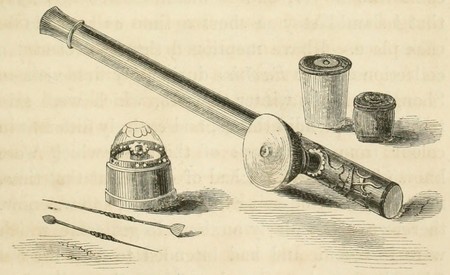
Opium Pipe.
SHANGHAE IN 1844.—ITS GARDENS AND PLANTS.—START FOR
THE HILLS IN THE INTERIOR.—CANALS AND BRIDGES.—ADVENTURE
WITH MY PONY.—THE "TEIN-CHING," OR BLUE DYE,
FOUND.—HILLS AND THEIR VEGETATION DESCRIBED.—THE
SURPRISE OF THE NATIVES ON SEEING A FOREIGNER.—THEIR
CURIOSITY AND HONESTY!—PLANTS SENT TO ENGLAND.—ANOTHER
JOURNEY INTO THE INTERIOR.—SOME LARGE NORTHERN
CITIES NOTICED.—A MIDNIGHT VISIT FROM THIEVES.—THE
FAR-FAMED CITY OF SOO-CHOW-FOO VISITED.—A DESCRIPTION
OF IT.—NEW PLANTS FOUND.—CENTRAL POSITION OF SOO-CHOW
AS A PLACE OF TRADE.—BATHS FOR THE MILLION.—RETURN
TO SHANGHAE.
I again visited Shanghae on the 18th of April,
1844, and spent two or three weeks there at
different times. My principal object was to see all
the plants in the different northern districts as they
came into flower, and it was therefore necessary
that I should stay as short a time as possible in
each place. I have mentioned that I purchased a
collection of Tree Pæonies during my first visit to
Shanghae in the winter of 1843, which were said
to be very splendid things, and entirely different in
colour from any plants of the kind which were
known in England. I had of course, at that time,
no opportunity of seeing their flowers, and was now,
therefore, particularly anxious to get some which
were in bloom, and had intended to send my old
friend back again to Soo-chow for another collection,
stipulating, however, that the plants should this
time have blooms upon them. One morning, however,
as I was going out into the country, a short
distance from Shanghae, I was surprised at meeting
a garden labourer with a load of Moutans all in full
flower, which he was taking towards the city for
sale. The flowers were very large and fine, and the
colours were dark purples, lilacs, and deep reds,
kinds of which the very existence had been always
doubted in England, and which are never seen
even at Canton. Two English gentlemen who
were excellent Chinese scholars, being with me at
the time, we soon found out the name of the
Moutan district; and from the state of the roots in
the man's basket, I was quite certain that the plants
had not been more than an hour or two out of the
ground, and that consequently the place where they
were grown could not be more than six or eight
miles from Shanghae, a surmise which I afterwards
found to be perfectly correct. This was doubtless
the place where my nursery friend had procured his
plants in the previous autumn, and where he would
have gone again had I not been lucky enough to
find that I could easily go there myself. Indeed, I
afterwards discovered that there was no Moutan
country in the vicinity of Soo-chow, having met a
man from that place in the Shanghae district,
where he had come for the express purpose of
buying Tree Pæonies. I now went into the Moutan
district daily during the time the different plants
were coming into bloom, and secured some most
striking and beautiful kinds for the Horticultural
Society.
Several very distinct and beautiful Azaleas were
added to my collections at Shanghae, as well as
many other plants of an ornamental character
which have not yet been described. I fully expect
that many of these will prove hardy enough to
thrive in the open air in England, and that others
will make excellent plants for the greenhouse.
Being now well acquainted with the country in
the immediate vicinity of Shanghae, I was anxious
to extend my researches into the interior, particularly
as far as some hills which were said to be
about thirty miles distant, in a westerly direction.
It was extremely difficult to gain any information
on this subject from the Chinese, who were particularly
jealous of foreigners going any distance
inland. Their suspicious feelings had also been
much increased at this time, by the indiscretion of
some of our own countrymen, who had hired a boat
and gone a considerable distance up one of the
rivers, taking soundings with bamboo poles, in the
manner of the Chinese. The authorities suspected
that they had some particular object in view in
ascertaining the depth of the river, and immediately
complained to Captain Balfour, the English
consul, who was consequently obliged to notice the
circumstance.
Being determined, however, to make an effort to
accomplish the object I had in view, I procured a
pony and a pocket compass, and started off one
morning early on a voyage of discovery. The hills
were said to lie westerly, and in that direction I
rode for eight or ten miles without seeing anything
higher than a mound of earth. The compass was
my only guide both in going and also in finding
my way back again; the roads were generally not
more than four or six feet wide, but still the
country had its highways and byways, and for a
length of time I was fortunate enough to keep on
the former; as long as I did so, I got easily over
the numerous canals which intersect the country
in all directions, because wherever these are crossed
by the main road, good substantial stone bridges
are erected. At last I got a glimpse of the hills in
the distance, and in my anxiety to take the shortest
road, I lost sight of the highway, and got entangled
amongst byways and canals. I was soon in a
somewhat critical position, the bridges which I was
constantly crossing were old, narrow, and rotten,
and the feet of my pony were every now and then
getting entangled between the planks. At length
we came to one much worse than the others, and
although I got off and did every thing to persuade
the pony to follow me over it, with great reluctance
he attempted to do so, but when about the centre
of the bridge, his feet got fast in the rotten planking,
and in the struggle to free himself, the centre
gave way; I had just time to spring to the bank,
when the bridge and pony both fell into the canal.
Luckily for me the poor animal swam to the side I
was on, and allowed me to catch him when he got
out of the water: he was completely covered with
mud, and my saddle and bridle were of course in a
sad condition. By the assistance of some labourers
who were at work within a short distance, I was
soon enabled to get out of this network of canals,
and regain the main road; but this was a lesson
to me, and as long as I was in China, I never afterwards
went off the main road when I was on
horseback.
I reached a small town in the vicinity of the
hills about two o'clock in the afternoon; the pony
having had nothing to eat since we left Shanghae,
was much exhausted, and I was therefore anxious
to procure a feed of corn for him at some of the
shops. The news of the presence of a foreigner in
the town spread like lightning, and I was soon surrounded
and followed by some thousands of people
of both sexes, young and old, who were all anxious
to get a glimpse of my features and dress. Their
behaviour on the whole, however, was civil and respectful,
and the only inconvenience I had to
complain of was the pressure of the crowd. For a
few of the copper coin of the country, a boy had
promised to take me to a shop where I could purchase
something for the pony, and we wended our
way through the crowd, which was every moment
becoming more dense, towards, as I supposed, a corn
or hay shop. At last, to my surprise, he came to a
halt in front of an eating house, and my guide came
and asked me for money to go in and buy some
boiled rice. "But I want a feed for the pony,"
said I. "Very well, give me the money, and I will
fetch you a basin of boiled rice for him." "You
had better bring him a pair of chopsticks also," said
I, as I put the money into his hand. The idea of
a pony eating with chopsticks delighted the crowd,
and put them into high good humour: during my
travels in the interior, I often found the benefit of
having a joke with the natives.
My pony seemed to enjoy the meal which was
set before him, and I too had some rice from the
same pot. I then proceeded on foot to examine
the nearest hill, and soon came to the conclusion
that it would be advantageous for me to be some
days in the vicinity of this place. As I could not
trust the natives with the pony, which belonged
to the head mandarin in Shanghae, I determined
to take him home again myself, and hire a boat
with which I could return by any of the numerous
canals which branch all over the country, and stay
as long as I pleased. I reached Shanghae late on
the same evening, weary enough, having ridden at
least sixty miles during the day.
A few days after this, having engaged a boat,
I started early one morning, and taking advantage
of the tide, which ebbs and flows over all this part
of the country, I reached the hills on the same
evening. The country through which I passed
was rich and fertile, cotton forming the staple production
of the fields in the neighbourhood of
Shanghae. After passing the cotton district, I
came into a tract of country in which a cruciferous
plant seemed to be principally cultivated. From this
plant a kind of indigo or blue dye is prepared; it
is called Tein-ching by the Chinese. Very large quantities
of this substance are brought to Shanghae, and
all the other towns in the north of China, where it
is used in dyeing the blue cotton cloth, which forms
the principal article of dress of the poorer classes.
I brought home living specimens of the plant which
produces this dye, and as these are now in flower
in the gardens of the Horticultural Society, the
proper scientific name of the plant will soon be
ascertained.[1]
As I approached the hills the level of the country
became lower, and at that time of the year (June)
it was completely flooded, and rice was extensively
cultivated. In general, the higher land of this
vast plain is used in the cultivation of cotton and
the cruciferous plant mentioned above; while the
lower lands, those which are easily flooded, are
converted into rice fields. Here and there on my
way I met with large trees of the Salisburia
adiantifolia, which are the largest and most striking
trees in this part of the country. Small patches
of bamboo were seen around all the villages, and
groups of cypress and pine generally marked the
last resting places of the Chinese, which are scattered
over all the country.
The hills were very different from any which I
had seen in the more southern parts of China:
they are not more than 400 feet in height, and
have none of that bold and rugged character which
I have formerly noticed. Here and there crumbling
rocks show themselves above the surface, but these
are not so general as to affect the general pastoral-looking
appearance of these hills. The country is
also more richly wooded than any other part near
Shanghae, and, of course, contains a greater number
of species of plants. One curious fact, however,
came under my notice: no Azaleas were met
with in this part of the country, although the hills
about sixty or eighty miles to the south abound in
such plants; and, although the other plants, which
accompany Azaleas on the Chusan and Ning-po
hills, were here growing in all their native luxuriance,
these, their more lovely companions, were
not to be found. I can scarcely believe that the
hills between Ning-po and Shanghae are the most
northern limit for this class of plants; yet such
from my own observations would appear to be the
case.
The natives in this part of the country were
vastly surprised when they saw me for the first
time; at the different villages and towns, men,
women, and children of all ranks lined the banks
of the canals as my boat passed along, and often
requested me to come out in order that they might
have a better opportunity of seeing me. "When I
left my boat for the purpose of ascending the hills,
my boatmen used to make a good deal of money
by allowing the people to go in and inspect my
little cabin. A copy of the "Pictorial Times,"
which I happened to have with me, was greatly
admired, and I was obliged to leave it amongst
them. It is a remarkable fact, however, that nothing,
as far as I know, was ever stolen from me
at this time, although several hundred persons
visited my boat in my absence. The boatmen must
either have been very sharp, or the people must have
had a superstitious dread of the property of a
foreigner: to put it down to their honour is, I am
afraid, out of the question!
Having finished my researches amongst the hills,
I left this part of the country and returned to
Shanghae. The "Helen Stuart," one of the first
vessels which left Shanghae for England direct,
was at this time ready for sea, and I availed myself
of this opportunity to send some cases of plants
to the Horticultural Society, which, I regret to
say, arrived in very bad condition. When I had
despatched these cases, I determined on another
journey into the interior.
Every one who has been in China, or who is at
all acquainted with Chinese history, has heard of
the city of Soo-chow-foo. If a stranger enters
a shop in Hong-Kong, in Canton, or in any of
the other towns in the south, he is sure to be
told, when he inquires the price of any curiosity
out of the common way, that it has been brought
from this celebrated place; let him order any
thing superb, and it must be sent for from
Soo-chow—fine pictures, fine carved work, fine
silks, and fine ladies, all come from Soo-chow.—It
is the Chinaman's earthly paradise, and it
would be hard indeed to convince him that it had
its equal in any town on earth. In addition to
its other attractions, I was informed by the Chinese
nursery gardeners at Shanghae that it contained a
great number of excellent flower gardens and
nurseries, from which they obtained all or nearly
all the plants which they had for sale, and I was,
therefore, strongly tempted to infringe the absurd
laws of the Celestial Empire, and try to reach this
far-famed place. My greatest difficulty was to
meet with boatmen who would travel with me, as
they were all frightened for the mandarins, who had
issued very stringent orders to them after the circumstance
happened which I have already noticed.
They were told, that they might take foreigners
down the river towards the sea, and up as far as
a pagoda a mile or two above Shanghae, but on no
account were they to go up the western branch
of the river. This was a direct infringement on
the right which had been secured to us by the
treaty of Nanking, and her Majesty's consul at
this port soon found it necessary and prudent to
interfere in the matter. Some time after this period,
when what are called the boundaries were fixed,
the foreign residents were allowed to go a day's
journey into the interior, that is, as far as they
could go and come back again in twenty-four hours.
Having at length procured a boat, we set off on
our journey, the boatmen neither knowing where
I intended to go to, or how long I was to be absent
from Shanghae. I simply told them we were
going into the country in search of plants, and
that they must take a supply of rice for several days.
My Chinese servant, who always accompanied me,
also informed them, that it was a common thing
for me to wander about the country in search of
plants, but that I was perfectly harmless, and
would take care that they should not get into any
trouble on my account. This gave them some
confidence, and as the wind and tide were both in
our favour, we were soon a considerable distance
away from Shanghae. As I knew pretty well in
what direction Soo-chow lay, I took my course
by a pocket compass which I always carried with
me. After getting twenty or thirty miles from
Shanghae, I judged it prudent to break the subject
of my wishes to my companions. First of all, I
took my servant aside; he was a most active fellow,
and capable of persuading the others to do
any thing he liked. "Now," said I to him, "I
want to visit Soo-chow, and if you will persuade
the boatmen to go on there, I will make you a
present of five dollars when we return; besides,
you may tell the men that I shall double the
amount of the hire which I have already promised
them." Upon this a long conference ensued, the
result of which was that they determined to accept
my offer.
I was, of course, travelling in the Chinese costume;
my head was shaved, I had a splendid wig
and tail, of which some Chinaman informer days had
doubtless been extremely vain, and upon the whole
I believe I made a pretty fair Chinaman. Although
the Chinese countenance and eye differ considerably
from those of a native of Europe, yet a traveller
in the north has far greater chance of escaping
detection than in the south of China, the features
of the northern natives approaching more nearly
to those of Europeans than they do in the south,
and the difference amongst themselves also being
greater.
In China, the canal is the traveller's highway,
and the boat is his carriage, and hence the absence
of good roads and carriages in this country.
Such a mode of conveyance is not without its advantages,
however little we may think of it in
England; for as the tide ebbs and flows through
the interior for many miles, the boats proceed with
considerable rapidity; the traveller, too, can sleep
comfortably in his little cabin, which is, in fact,
his house for the time being.
The canal, after leaving Shanghae, leads in a
northerly direction, inclining sometimes a little to
the west; branches leading off in all directions
over the country. Some very large towns and
walled cities were passed on our route, at one of
which, named Cading, we halted for the night just
under the ramparts. I spread out my bed in my
little cabin, and went to sleep rather early, intending
to start by times with the tide next morning,
and get as far as possible during the ensuing day.
But, as my countryman says,—
"The best laid schemes of mice and men gang aft agee;"
and I awoke during the night by the cool air blowing
in upon my head through one of the windows
of the boat, which I had shut before I went to
rest. I jumped up immediately and looked out,
and through the darkness I could discern that we
were drifting down the canal with the tide, now
coming in contact with some other boat, which
had been fastened up like ourselves for the night,
and now rubbing against the branches of trees
which hung over the sides of the canal. I lost no
time in awaking my servant and the boatmen,
who rubbed their eyes with astonishment, and exclaimed
that some robber must have boarded us.
This had never struck me before, but when I called
for a light, I found that all my clothes, English and
Chinese, were gone. Our visitor, who ever he had
been, after taking possession of all the cabin contained,
cut the rope by which we were fastened,
and shoved us off into the centre of the canal,
along which we had drifted a considerable way
before I awoke. Fortunately for me, the few
dollars I had with me were in my Chinese purse
beneath my pillow.
"What shall we do," said my servant when we
had made the boat fast again to some others on
the side of the canal, "your clothes are all gone?"
"Do," said I, laughing; "I think the best
thing we can do is to go to bed again until daylight."
This being agreed to, we were soon all once
more sound asleep. When morning dawned, I
sent my servant into the town of Cading with a
few dollars, which procured me another dress, and
we proceeded on our journey.
The city of Cading is large and fortified,
although the walls and ramparts are in a state
of decay. It is evidently a very ancient place.
Here a large quantity of the celebrated carving is
done, for which the Chinese in the north are so
well known. After leaving this town, the canal
which was narrow, continued in a northerly
direction for a few miles, and then, all at once, our
little boat shot out of it into a broad and beautiful
canal, resembling a lake or broad river, running
nearly east and west, and probably connecting
itself with the Yang-tse-kiang river, somewhere
between Woosung and Nanking. The scenery
here is extremely striking; the broad and smooth
canal bears on its waters hundreds of Chinese boats
of all sizes, under sail, and each hurrying to its
place of destination; pagodas here and there are
seen rearing their heads above the woods and
Budhist temples, which are scattered over this
wide and extensive plain. One of these temples
crowns a solitary little hill named Quin-san, which
at certain seasons of the year is visited by crowds
of people from Soo-chow and the neighbouring
towns; the whole country, as far as the eye can
reach, is one vast rice-field, and everywhere the
pleasing clatter of the water-wheels falls upon the
ear, and hundreds of happy and contented Chinese
peasants are seen engaged in the cultivation of
the soil. After continuing its westerly course for
some distance, the canal divided, and the branch
we took soon led us to another town named Ta-tsong-tseu.
It is a place of great size, walled and
fortified like Cading and Shanghae, and is probably
larger than the latter, although perhaps not so
populous. A great number of large old junks are
moored on the canal round the walls, apparently
used as dwelling-houses, being now unfit for any
other service. This town too, like Cading, is
evidently in a decaying state, judging from the
dilapidated condition of the houses and fortifications,
but teems with an immense population of
men, women, and particularly children.
On approaching Soo-chow some hills were seen,
bounding the level plain, which I afterwards found
were some few miles west from the town itself.
The whole country here, as well as near Cading, is
one vast rice-field. Many females are employed in
driving the water-wheels, generally three or four
to each wheel: these ladies have large feet, or
rather their feet are of the natural size; indeed, if
they were cramped in the usual way it would be
impossible for them to work on the water-wheel.
Small feet, however, are general amongst the
lower classes who work in the fields, for of the
hundreds whom I observed hoeing the cotton, or
engaged in other agricultural operations, but a
small proportion had feet of the natural size.
A few miles on the east of Soo-chow there is a
large and beautiful lake, twelve or fifteen miles
across, through which the boats from Sung-Kiang-foo
and other places in that direction approach the
city. After passing this lake the canal, which
had widened considerably, now began to contract;
bridges here and there were passed, villages and
small towns lined the banks, and everything denoted
the approach to a city of some size and
importance. It was a delightful summer's evening
on the 23rd of June, when I approached this far-famed
town. The moon was up, and with a fair
light breeze my little boat scudded swiftly, its
masts and sails reflected in the clear water of the
canal; the boats thickened as we went along, the
houses became more crowded and larger, lanterns
were moving in great numbers on the bridges and
sides of the canal, and in a few minutes more we
were safely moored, among some hundreds of other
boats, under the walls of this celebrated city.
Having taken all the precautions in our power
against another nightly visitor, my servant, the
boatmen, and myself, were soon fast asleep.
With the first dawn of morning I was up, and
dressed with very great care by my Chinese servant,
whom I then despatched to find out the
nursery gardens in the city, in order to procure
the plants which I wanted. When he had obtained
this information he returned, and we proceeded
together into the city, in order to make my selections.
When I left the boat, I confess I felt rather
nervous as to the trial I was about to make.
Although I had passed very well as a Chinaman
in the country districts, I knew that the inhabitants
of large towns, and particularly those in a town
like this, were more difficult to deceive. My old
friends, or I should rather say my enemies, the
dogs, who are as acute as any Chinaman, evidently
did not disown me as a countryman, and this at
once gave me confidence. These animals manifest
very great hatred to foreigners, barking at them
wherever they see them, and hanging on their
skirts until they are fairly out of sight of the house
or village where their masters reside.
As I was crossing the bridge, which is built over
the moat or canal on the outside of the city walls,
numbers of the Chinese were loitering on it,
leaning over its sides, and looking down upon the
boats which were plying to and fro. I stopped
too, and looked down upon the gay and happy
throng, with a feeling of secret triumph when I
remembered that I was now in the most fashionable
city of the Celestial Empire, where no
Englishman, as far as I knew, had ever been
before. None of the loiterers on the bridge
appeared to pay the slightest attention to me, by
which I concluded that I must be very much like
one of themselves. How surprised they would
have been had it been whispered to them that an
Englishman was standing amongst them.
The city of Soo-chow-foo, in its general features,
is much the same as the other cities in the north,
but is evidently the seat of luxury and wealth, and
has none of those signs of dilapidation and decay
which one sees in such towns as Ning-po. A noble
canal, as wide as the river Thames at Richmond,
runs parallel with the city walls, and acts as a moat
as well as for commercial purposes. Here, as at
Cading and Ta-tsong-tseu, a large number of invalided
junks are moored, and doubtless make
excellent Chinese dwelling-houses, particularly to a
people so fond of living on the water. This same
canal is carried through arches into the city, where
it ramifies in all directions, sometimes narrow and
dirty, and at other places expanding into lakes of
considerable beauty; thus enabling the inhabitants
to convey their merchandise to their houses from
the most distant parts of the country. Junks and
boats of all sizes are plying on this wide and beautiful
canal, and the whole place has a cheerful and
flourishing aspect, which one does not often see in
the other towns in China, if we except Canton and
Shanghae. The walls and ramparts are high, and
in excellent repair, having considerable resemblance
to those of Ning-po, but in much better order.
The east wall, along the side of which I went all
the way, is not more than a mile in length, but
the north and south are much longer, thus making
the city a parallelogram. That part of the city
near the east gate, by which I entered, is anything
but splendid; the streets are narrow and dirty,
and the population seems of the lowest order, but
towards the west the buildings and streets are
much finer, the shops are large, and everything
denotes this to be the rich and aristocratic part of
the town. The city gates seem to be well guarded
with Chinese soldiers, and all the streets and lanes
inside are intersected at intervals with gates,
which are closed at nine or ten o'clock at night.
The Governor General of the province resides
here, and keeps those under his control in excellent
order.
The number of nursery gardens in this city had
been exaggerated by my Chinese friends at
Shanghae, but nevertheless there were several of
considerable extent, out of which I was able to
procure some new and valuable plants. Among
these I may notice in passing a white Glycine, a
fine new double yellow rose, and a Gardenia with
large white blossoms, like a Camellia. These plants
are now in England, and will soon be met with in
every garden in the country. The Soo-chow nurseries
abounded in dwarf trees, many of which were
very curious and old, two properties to which the
Chinese attach far greater importance than we do
in England.
The ladies here are considered by the Chinese to
be the most beautiful in the country, and, judging
from the specimens which I had an opportunity of
seeing, they certainly deserve their high character.
Their dresses are of the richest material, made in a
style at once graceful and elegant; and the only
faults I could find with them were their small
deformed feet, and the mode they have of painting
or whitening their faces with a kind of powder
made for this purpose. But what seemed faults in
my eyes are beauties in those of a Chinaman, and
hence the prevalence of these customs.
Soo-chow-foo seems to be the great emporium of
the central provinces of China, for which it is
peculiarly well fitted by its situation. The trade
of Ning-po, Hang-chow, Shanghae, and many
other towns on the south: Ching-kiang-foo,
Nanking, and even Peking itself on the north, all
centres here, and all these places are connected
either by the Grand Canal, or by the hundreds of
canals of lesser note, which ramify over all this
part of the empire. Shanghae, from its favourable
position as regards Soo-chow, will doubtless become
one day a place of vast importance, in a commercial
point of view, both as regards Europe and America.
I remained for several days in this city, and its
neighbourhood, when, having done all that was
possible under the circumstances, I set out on my
way back to Shanghae. When I arrived, I was
obliged to go on shore in my Chinese dress, as the
English one had been stolen by my midnight
visitor. The disguise, however, was so complete,
that I was not recognised by a single individual,
although I walked up the street where I was well
known, and even my friend Mr. Mackenzie, with
whom I was staying, did not know me for the first
few minutes after I sat down in his room.
In the town of Shanghae, as well as in many other
large Chinese towns, there are a number of public
hot water bathing establishments, which must be of
great importance as regards the health and comfort
of the natives. I will describe one which I passed
daily during my residence in Shanghae. There are
two outer rooms used for undressing and dressing;
the first, and largest, is for the poorer classes; the
second, for those who consider themselves more
respectable, and who wish to be more private. As you
enter the largest of these rooms, a placard which
is hung near the door informs you what the charges
are, and a man stands there to receive the money
on entrance. Arranged in rows down the middle
and round the sides of both rooms are a number of
small boxes or lockers, furnished with lock and
key, into which the visitors put their clothes, and
where they can make sure of finding them when
they return from the bathing room, which is
entered by a small door at the farther end of the
building, and is about 30 feet long and 20 feet
wide; the water occupying the whole space, except
a narrow path round the sides. The water is from
1 foot to 18 inches deep, and the sides of the bath
are lined with marble slabs, from which the bathers
step into the water, and on which they sit and
wash themselves: the furnace is placed on the outside,
and the flues are carried below the centre of
the bath.
In the afternoon anti evening this establishment
is crowded with visitors, and on entering the bath
room, the first impression is almost insupportable;
the hot steam or vapour meets you at the door,
filling the eyes and ears, and causing perspiration
to run from every pore of the body; it almost
darkens the place, and the Chinamen seen in this
imperfect light, with their brown skins and long
tails, sporting amongst the water, render the scene
a most ludicrous one to an Englishman.
Those visitors who use the common room pay
only six copper cash; the others pay eighteen, but
they have in addition a cup of tea and a pipe of
tobacco from the proprietors. I may mention that
one hundred copper cash amount to about 4½d. of
our money; so that the first class enjoy a hot
water bath for about one farthing! and the other a
bath, a private room, a cup of tea, and a pipe of
tobacco for something less than one penny!
CHINESE COTTON CULTIVATION.—YELLOW COTTON.—DISTRICT
WHERE IT GROWS.—COTTON COUNTRY DESCRIBED.—SOIL.—MANURE,
AND MODE OF APPLICATION.—PRECEDING CROPS.—TIME
OF SOWING.—METHOD.—RAINS.—SUMMER CULTIVATION.—EARLY
RAIN ADVANTAGEOUS.—TIME OF REAPING
AND GATHERING.—COTTON FARMERS AND THEIR FAMILIES.—DRYING
AND CLEANING PROCESS DESCRIBED.—MARKETING.—INDEPENDENCE
OF THE SELLER.—CROWDED STREETS IN
SHANGHAE DURING THE COTTON SEASON.—WAREHOUSES AND
PACKING.—HOME CONSUMPTION.—STALKS USED FOR FUEL.
The Chinese or Nanking cotton plant is the Gossypium
herbaceum of botanists, and the "Mie wha" of
the northern Chinese. It is a branching annual,
growing from one to three or four feet in height,
according to the richness of the soil, and flowering
from August to October. The flowers are of a
dingy yellow colour, and, like the Hibiscus or
Malva, which belong to the same tribe, remain expanded
only for a few hours, in which time they
perform the part allotted to them by nature, and
then shrivel up and soon decay. At this stage the
seed pod begins to swell rapidly, and when ripe,
the outer coating bursts and exposes the pure
white cotton in which the seeds lie imbedded.
The yellow cotton, from which the beautiful
Nanking cloth is manufactured, is called "Tze mie
wha" by the Chinese, and differs but slightly
in its structure and general appearance from
the kind just noticed. I have often compared
them in the cotton fields where they were growing,
and although the yellow variety has a more
stunted habit than the other, it has no characters
which constitute a distinct species. It is merely
an accidental variety, and although its seeds
may generally produce the same kind, they doubtless
frequently yield the white variety, and vice
versâ. Hence, specimens of the yellow cotton
are frequently found growing amongst the white
in the immediate vicinity of Shanghae; and again a
few miles northward, in fields near the city of
Poushan on the banks of the Yang-tse-kiang, where
the yellow cotton abounds, I have often gathered
specimens of the white variety.
The Nanking cotton is chiefly cultivated in the
level ground around Shanghae, where it forms the
staple summer production of the country. This
district, which is part of the great plain of the
Yang-tze-kiang, although flat, is yet several feet
above the level of the water in the rivers and canals,
and is consequently much better fitted for cotton
cultivation than those flat rice districts in various
parts of the country,—such for example as the
plain of Ning-po,—where the ground is either wet
and marshy, or liable at times to be completely
overflowed. Some fields in this district are, of
course, low and marshy, and these are cultivated
with rice instead of cotton, and regularly flooded
by the water-wheel during the period of growth.
Although the cotton land is generally flat, so much
so, indeed, that no hills can be seen from the tops
of the houses in the city of Shanghae, it has nevertheless
a pleasing and undulating appearance, and
taken as a whole, it is perhaps the most fertile
agricultural district in the world. The soil is a
strong rich loam capable of yielding immense crops
year after year, although it receives but a small
portion of manure.
The manure applied to the cotton lands of the
Chinese, is doubtless peculiarly well fitted for this
kind of crop. It is obtained from the canals,
ponds, and ditches which intersect the country in
every direction, and consists of mud which has
been formed partly by the decay of long grass,
reeds, and succulent water plants, and partly by the
surface soil which has been washed down from the
higher ground by the heavy rains. Every agricultural
operation in China seems to be done with
the greatest regularity, at certain stated times,
which experience has proved the best, and in
nothing is this more apparent than in the manuring
of the cotton lands. Early in April the agricultural
labourers, all over the country, are seen busily
employed in cleaning these ponds and ditches. The
water is first of all partly drawn off, and then the
mud is thrown up on the adjoining land to dry,
where it remains for a few days until all the
superfluous water is drained out of it, and is then
conveyed away and spread over the cotton fields.
Previous to this, the land has been prepared for its
reception, having been either ploughed up with
the small buffalo plough in common use in the
country, and then broken and pulverised by the
three-pronged hoe, or, in those instances where the
farms are small and cannot boast of a buffalo and
plough, it is loosened and broken up entirely by
manual labour. When the mud is first spread
over the land, it is, of course, hard or cloggy, but
the first showers soon mix it with the surface soil,
and the whole becomes pulverised, and it is then
ready for the reception of the cotton seed. Road-scrapings
and burnt rubbish are saved up with
care, and used for the same purpose and in the
same manner.
A considerable portion of the cotton lands either
lie fallow during the winter months, or are planted
with those crops which are ready for gathering prior
to the sowing of the cotton seed. Frequently, however,
two crops are found growing in the field at
the same time. Wheat, for example, which is a
winter crop, is reaped in the Shanghae district
generally about the end of May, while the proper
time for putting in the cotton seed is the beginning
of that month or the end of April. In order,
therefore, to have cotton on the wheat lands, the
Chinese sow its seeds at the usual time amongst the
wheat, and when the latter is reaped, the former is
several inches above ground, and ready to grow
with vigour when it is more fully exposed to the
influence of sun and air. The Shanghae season—that
is, from the late spring frosts to those in autumn—is
barely long enough for the production
and ripening of the cotton, as it is easily injured by
frost, and the Chinese farmer is thus obliged, in
order to gain time and obtain two crops from his
ground in one year, to sow its seeds before the
winter crop is ready to be removed from the
ground. When it is possible to have the first crop
entirely removed before the cotton is sown it is
much preferred, as the land can then be well worked
and properly manured, neither of which can otherwise
be done. The method of sowing one crop before
the preceding one is ripe and removed from the
land is very common in this part of the country;
and even in autumn, before the cotton stalks are
taken out of the ground, other seeds are frequently
seen germinating and ready to take the place of the
more tender crop.
In the end of April and beginning of May—the
land having been prepared in the manner just
described—the cotton seeds are carried in baskets
to the fields, and the sowing commences. They
are generally sown broad-cast, that is, scattered regularly
over the surface of the ground, and then
the labourers go over the whole surface with their
feet and tread them carefully in. This not only embeds
the seeds, but also acts like a roller to break
and pulverise the soil. Germination soon commences,
the seeds rooting first in the manure which
had been scattered over the surface of the land.
In some cases the seed, instead of being sown broadcast,
is sown in drills or patches, but this mode is
less common than the other. The rains, which always
fall copiously at the change of the monsoon
which takes place at this season of the year, warm
and moisten the earth, and the seeds swell, and
vegetation progresses with wonderful rapidity.
Many of the operations in Chinese agriculture are
regulated by the change of the monsoon. The
farmer knows from experience, that, when the
winds, which have been blowing from the north
and east for the last seven months, change to the
south and west, the atmosphere will be highly
charged with electric fluid, and the clouds will
daily rain and refresh his crops.
The cotton fields are carefully tended during the
summer months. The plants are thinned where
they have been sown too thickly, the earth is
loosened amongst the roots, and the ground hoed
and kept free from weeds. If the season is favourable,
immense crops are obtained owing to the
fertility of the soil, but if the weather happens to
be unusually dry from June to August, the crop
receives a check which it never entirely recovers,
even although the ground, after that period, should
be moistened by frequent showers. 1845 was a
season of this kind, and the crop was a very deficient
one compared with that of the previous year.
The spring was highly favourable, and the plants
looked well up to the month of June, when the dry
weather set in, and gave them a check which they
never recovered. Abundance of rain fell later in
the season but it was then too late, and only caused
the plants to grow tall and run to leaf, without
producing those secretions which ultimately go to
the formation of flowers and seed.
The cotton plant produces its flowers in succession
from August to the end of October, but
sometimes, when the autumn is mild, blooms are
produced even up to November, when the cold
nights generally nip the buds, and prevent them
from forming seed. In the autumn of 1844 this
happened on the night of the 28th of October, when
the thermometer sunk to the freezing point, and
then ice was found on the sides of the canals and
ponds.
As the pods are bursting every day, it is necessary
to have them gathered with great regularity,
otherwise they fall upon the ground and the cotton
gets dirty, which of course reduces its value in the
market. Little bands of the Chinese are now seen
in the afternoon in every field, gathering the ripe
cotton and carrying it home to the houses of the
farmers. As the farms are generally small, they
are worked almost entirely by the farmer and his
family, consisting sometimes of three or even four
generations, including the old grey-haired grand-father
or great-grandfather, who has seen the
crops of four-score years gathered into his barns.
Every member of these family groups has a certain
degree of interest in his employment; the harvest is
their own, and the more productive it is, the greater
number of comforts they will be able to afford. Of
course there are many cotton farms of larger size,
where labourers are employed in addition to the
farmer's family, but by far the greater number are
small and worked in the way I have just described.
It is no unusual sight to see the family goat too,
doing their share of the work. Several of these
animals are kept on almost every farm, where they
are, of course, great favourites with the children,
and often follow them to the cotton fields. Although
the children with their little hands can
gather the cotton as well as their elders, they are
not strong enough to carry it about with them,
and it is amusing to see their favourites the goats,
with bags slung across their backs, receiving the
deposits of cotton, and bearing it home to the
houses, evidently aware that they too are working
for the general good.
However fine the crop may be, the Chinese are
never sure of it until it is actually gathered in.
Much depends upon a dry autumn, for, if the
weather is wet after the pods begin to burst, they
drop amongst the muddy soil, and are consequently
much injured, if not completely destroyed. When
the cotton reaches the farm-yard, it is daily spread
out on hurdles raised about four feet from the
ground, and fully exposed to the sun. As the
object is to get rid of all the moisture, it is of
course only put out in fine weather, and is always
taken into the house or barn in the evening.
When perfectly dry, the process of separating it
from the seeds commences. This is done by the
well-known wheel with two rollers, which, when
turned round, draws or sucks in the cotton, and
rejects the seeds. It is a simple and beautiful
contrivance, and answers well the end for which it
is designed. The cotton is now sent to market,
and a portion of the seeds are reserved for the next
year's crop.
Early in the fine autumnal mornings, the roads
leading into Shanghae are crowded with bands of
coolies from the cotton farms, each with his bamboo
across his shoulders and a large sack of cotton swung
from each end. With these they hurry into the
town, for the purpose of disposing of them to the
merchants, who have numerous warehouses from
which they send the cotton to the other provinces
of the empire. These coolies or small farmers—for
many of them bring their own produce to market
themselves—are very independent in their dealings.
Having reached the first warehouse, the cotton is
exposed to the view of the merchant, who is asked
what price he intends to give for that particular
quality; and should the sum offered be below the
owner's expectations, he immediately shoulders his
load and walks away to another merchant. At this
season it is almost impossible to get along the
streets near the sides of the river where the cotton
warehouses are, owing to the large quantities of
this commodity which are daily brought in from
the country. It is bought up by the large cotton
merchants, who empty it out in their warehouses,
and then repack it in a neat and compact manner
before it is conveyed on board the junks.
Before the cotton is converted into thread for
the purpose of weaving, it is cleaned and freed
from knots by the well-known process common in
our possessions in India. This is done by an elastic
bow, the string of which being passed under a
portion of the cotton placed on a table, throws it
in the air by the vibration which is kept up by the
workman, and separates the fibre without at all
breaking or injuring it. At the same time the
wind caused by the sudden vibrations carries off
the dust and other impurities. After this process
the Chinese cotton is particularly pure and soft,
and is considered by good judges not to be surpassed
by any in the world. It is much superior to that
imported to China from Hindostan, and always
commands a higher price in the Chinese market.
Every small farmer or cottager reserves a portion
of the produce of his fields for the wants of his own
family. This the female members clean, spin, and
weave at home. In every cottage throughout this
district the traveller meets with the spinning-wheel
and the small hand-loom, which used to be common
in our own country in days of yore, but which have
now given way to machinery. These looms are
plied by the wives and daughters, who are sometimes
assisted by the old men or young boys who
are unfit for the labours of the field. Where the
families are numerous and industrious, a much
greater quantity of cloth is woven than is required
for their own wants, and in this case the surplus is
taken to Shanghae and the adjacent towns for sale.
A sort of market is held every morning at one of
the gates of the city, where these people assemble
and dispose of their little bundles of cotton cloth.
Money is in this manner realised for the purchase
of tea and other necessaries which are not produced
by the farms in this particular district.
When the last crops are gathered from the cotton
fields, the stalks are carried home for fuel. Thus
every part of the crop is turned to account: the
cotton itself clothes them, and affords them the
means of supplying themselves with all the necessaries
of life; the stalks boil their frugal meals; and
the ashes even—the remains of all—are strewed
over their fields for the purposes of manure. But
even before this takes place, the system I have
already noticed—of sowing and planting fresh
crops before the removal of those which occupy the
land—is already in progress. Clover, beans, and
other vegetables are frequently above ground in
the cotton fields before the stalks of the latter are
removed. Thus, the Chinese in the northern provinces
lengthen by every means in their power
the period of growth; and gain as much as they
possibly can from the fertility of their land.
The reader must bear in mind, however, that the
soil of this district is a rich deep loam, which is
capable of yielding many crops in succession without
the aid of a particle of manure. Nature has
showered her bounties on the inhabitants of this
part of the Chinese empire with no sparing hand;
the soil is not only the most fertile in China, but the
climate is capable of rearing and bringing to perfection
many of the productions of the tropics, as well
as the whole of those found in all the temperate
regions of the globe.
CLIMATE OF CHINA.—SUMMER AND WINTER.—TEMPERATURE
OF HONG-KONG—OF SHANGHAE.—MONSOONS.—TYPHOONS.—SIGNS
OF THEIR APPROACH.—DESCRIPTION OF A TYPHOON
WITNESSED BY THE AUTHOR.—EFFECT PRODUCED UPON
VEGETATION.—RAINS.—WET AND DRY SEASONS.—METEOROLOGICAL
TABLE.
In order to understand Chinese agriculture, a
knowledge of the climate of the country is of course
necessary. The dominions of the Emperor of
China stretch over twenty-three degrees of latitude—from
18° to 41° north, and from the 98° to the
123° of east longitude; thus including both tropical
and temperate regions in its vast extent. Being
placed on the east side and forming part of the
large continent of Asia, it is liable to extremes of
temperature—to excessive heat in summer, and
extreme cold in winter—which are unknown in
many other parts of the world within the same
parallels of latitude. One of our best writers upon
China[1] makes the following very sensible remarks
on this subject:—"Although Peking is nearly a
degree to the south of Naples—the latitude of the
former place being 30° 54', of the latter 40° 50'—the
mean temperature of Peking is only 54° of
Fahrenheit, while that of Naples is 63°. But the
thermometer at the Chinese capital sinks much
lower during the winter than at Naples, so in
summer does it rise somewhat higher; the rivers
are said to be frozen for three or four months
together, from December to March; while during
the last embassy in September, 1816, we experienced
a heat of between 90° and 100° in the
shade. Now it is well known that Naples, and
other countries in the extreme south of Europe, are
strangers to such a degree of long-continued cold,
and not often visited by such heats. "Europe,"
observes Humboldt, "may be considered altogether
as the western part of a great continent, and therefore
subject to all the influence which causes the
western sides of continents to be warmer than the
eastern; and at the same time more temperate, or
less subject to excesses of both heat and cold, but
principally the latter."
From my own tables, kept by Newman's best
registering thermometers, I find that at Hong-kong,
in the months of July and August—the two
hottest months in the year—the mercury frequently
stood as high as 90°, and one day at 94° Fahr. in
the shade. The minimum was generally about ten
degrees lower than the maximum. In the winter,
from December to March, the thermometer frequently
sinks nearly down to the freezing point, and
sometimes, although rarely, snow has fallen at
Canton and on the adjacent hills. The influence of
the sea, however, in this part of the empire, has a
tendency to check the extremes of both heat and
cold; but these are much greater in the northern
interior. The northerly winds in the winter and
spring months are severely cold in the south of
China; indeed, I have suffered more from cold at
Hong-kong and Macao in the month of February,
than I have ever done in England.
At Shanghae, in the province of Keangsoo, in
latitude 31° 20' north, the extremes of heat and cold
are much greater than what we experienced in the
southern provinces. Through the kindness of Dr.
Lockhart, who kept up my meteorological tables
during my absence in different parts of the country,
I have obtained a very complete set of observations
for nearly two years. From these it appears that
in July and August the heat is the greatest; the
thermometer in the shade sometimes standing for
several days at 100° of Fahrenheit. The heat
during these days was almost insupportable to
Europeans, who, when I was in Shanghae, were
obliged to live in Chinese houses, which, from their
construction, were ill calculated to exclude the
heat. In the end of October the thermometer
sometimes sinks as low as the freezing point. In
the evening of the 28th of that month, in 1844,
the remains of the cotton and other tropical plants
which are cultivated in the fields during the
summer, were destroyed by frost. December,
January, and February are the coldest months in
the year, the cold then being quite as severe as it
is with us in the south of England. In the winter
of 1844–45 the thermometer sunk as low as 26°
Fahrenheit. On the night of the 18th of December,
and again on January, the 4th, the index was left
at 24°. But that winter, according to Chinese
accounts, was peculiarly mild, so much so, that the
usual supply of ice could not be procured. In
ordinary years the ponds and canals are frequently
frozen several inches in thickness, and afford a
plentiful supply of ice. I have, therefore, little
doubt that in most years the thermometer may be
found at least twenty degrees below the freezing
point, or at 12° of Fahrenheit, and perhaps even
lower. Snow frequently falls, but the sun is too
powerful to allow it to lie long on the ground.
If we except the extremes of heat and cold just
noticed, the climate of Shanghae may be pronounced
as fine as any in the world. Even the cold in
winter is highly advantageous to the natives, and
still more so to Europeans and Americans, as it
strengthens their constitutions, and enables them to
withstand the effects of the excessive heat. The
months of April, May, and June are delightful, and
although the sun is hot in the middle of the day, in
the afternoon the air is soft and agreeable, and the
evenings cool and pleasant. The autumnal months
are generally of the same description; the wind then
is cool and bracing, and the sky is much clearer
than in England. The sun, for days, and sometimes
for weeks together, rises in the morning, runs
his course, and sets again in a clear and cloudless
sky.
The prevailing winds blow from the south-west
from the end of April to the middle of September;
during the remaining portion of the year they are
northerly and easterly: thus forming what are called
the south-west and north-east monsoons. These
monsoons blow with great regularity in the south
of China, but are more variable towards the north.
In the latitude of Chusan or Shanghae, although
the monsoons prevail, the wind, not unfrequently,
blows from other quarters. In the end of the summer
season, that is, from July to October, the country
is frequently visited by those dreadful gales called by
foreigners typhoons. The name is a corruption of
the Chinese word Ta-fung or "great wind." These
storms commit the most fearful ravages both by
land and sea. The barometer gives warning some
hours before the gale commences, and, therefore,
foreign ships can always send down their masts
and yards, and, if possible, remove to a safe anchorage.
Where that is not to be had, they have
the dreadful alternative of standing out to sea.
The Chinese, without the aid of the barometer, can
always tell when the Ta-fung is coming on by the
following signs. The wind, which blows from the
south-west in the typhoon season, changes and
blows from the north or north-cast, becoming gusty
and gradually increasing in strength, the sky
lowers and looks wild, the sea rolls in upon the bench
with a dead heavy swell, and every thing portends a
coming storm. When these signs appear, the fleets
of fishing-boats on the coast take their nets in, crowd
all sail, and make for the shore as fast as they can,
where the boats are hauled up on dry land, or into
some creek which is sheltered from the force of
the winds and waves. The coasting junks, which
are ill fitted for bad weather, lose no time in getting
into some sheltered port where they can ride out
the storm in safety. And, luckily, as a safeguard
from the fury of these winds, nature has provided a
great number of excellent well-sheltered harbours
on the coast of China, all of which are well known
to the pilots who are employed on board the
junks.
During my residence in China, I witnessed two
of these terrific gales—once at sea, and once on
shore. Luckily, in the first instance, we were able
to run into a deep bay, and with three anchors down
rode out the gale in perfect safety. The other occurred
on the 21st and 22d of August, 1844, when
I was at Ningpo. I observed the Chinese running
about in great consternation, and calling to each
other that the "great wind" was coming, and to
make preparations for it. Mats and rattan work,
which had been placed over the doors and windows
to afford shade from the sun, were hastily removed,
and many of the houses, which were known to be
in a weak state, were, in a rapid way, propped up
and strengthened. Nor were the husbandmen less
busy in the fields. The heads of the tall millet,
being nearly ripe, were quicky cut, and the long
stalks left to be reaped at another time. Millet is
so heavy when nearly ripe, that had it been left exposed
to the wind it must have been dashed to pieces,
and the crop entirely lost. Crops on the sides of
the rivers and canals were removed where it was
possible to do so; otherwise, they would have been
blown into the water, and carried away far beyond
the reach of their owners. All the fruit which was
nearly ripe was hastily gathered from the trees,
unnecessary branches were cut away, and others
tied up and supported.
The gale gradually increased in force until daylight
on the morning of the 22d, when it seemed
to be at its height. In Mr. Mackenzie's house, where
I was staying at the time, we passed a fearful night.
The wind howled and whistled round the roof,
every blast seemingly more fierce than that which
preceded it, until I really thought we should have
the building down upon us and be buried in the
ruins. At daylight the rooms presented a dismal
appearance; all the floors, chairs, and tables were
covered with dust and pieces of broken tiles and
mortar which had been shaken out of the roof.
As the storm still raged with unabated fury, Mr.
Mackenzie and myself, glad to escape from the wreck
by which we were surrounded, went out to see what
effect the gale was producing on the other places
in the vicinity. The wind was so powerful, that it
was next to impossible to keep our feet; in fact, we
were frequently blown off the path, and were obliged
to scramble back to it again on our bands and knees.
The river, which is generally beautiful and smooth,
had now risen and completely overflowed its banks,
having been forced back by the strength of the
wind, and was as rough as the sea itself. The whole
country was one vast sheet of troubled water, for
the branches of the river, and the numerous canals
by which it is intersected, had all overflowed their
banks, and had spread in the low paddy fields.
Most of the small boats were safe, as they were
either in sheltered creeks, or drawn up beyond
the reach of the water, but many of the large
wood-junks which frequent this port were not so
fortunate. These had been moored off the city,
having, as usual, a large portion of their cargo
lashed to their sides. In many instances, the combined
force of the winds and waves snapped the
lashings, strong as they were, and the spars of wood
floated from their sides, and were either carried
away by the force of the stream, or thrown on shore.
Hundreds of the Chinese were now ready to seize
the wood as it floated to land, and with a total
disregard to the "rights of property" conveyed it at
once to their own houses. No Mandarin or other
government officer interfered to prevent this, and
the Chinese servants of the English Consul and
other foreign residents actually brought a considerable
quantity to the houses of their masters, and
seemed surprised when reproved for their dishonesty.
The English of course honourably returned
the spoil to its owners, much to the surprise
of the Chinese. On the opposite side of the river,
we observed great numbers engaged in the same
lawless occupation. The city walls, here, run parallel
with the river, and these rascals were coolly
hoisting the wood over the wails and ramparts, assisted
by their friends inside the city; nor was this
attempted to be checked.
At about nine o'clock in the morning, the wind,
which commenced from the north, had veered round
to the east and south, but still raged with fearful
power. On retracing our steps, which we had some
difficulty in doing, owing to the flooded state of
the country, and the force of the wind, we encountered
a family group in the fields surrounding a
coffin, which the wind seemed inclined to carry off
in spite of all their efforts to fasten it to the ground.
It is customary in this part of the country to place
the remains of the dead upon the surface of the
ground, sometimes supporting the coffins on short
stakes, to raise them a few feet from the earth. In
this instance the poor people were actually fighting
with the winds, but were at last able to secure the
remains of their relative, and allow him to sleep
the long sleep of death in peace. At this time the
barometer stood at 28° 30', but the wind was still
blowing a perfect gale until about mid-day, when
it gradually became less violent. In the evening,
although the sky still looked wild, it was evident
the gale had passed away, and the wind was then
blowing from the south-west. The river soon returned
to its former limits, boats began to sail up
and down, and business, which had been entirely
suspended, went on again as usual. Altogether,
the typhoon lasted nearly twenty-four hours.
The following morning was calm and beautiful,
but the scene was one of ruin and devastation.
The streets were strewed with broken tiles and
mortar; many of the houses were completely unroofed,
walls were blown down, and every thing
evinced the violence of the storm. In the fields
the change was still more striking; but two days
before the trees and hedges were green, the gardens
were gay with flowers, and every thing bore the
happy smiling aspect of summer; now vegetation
had changed from green to withered sickly brown,
flowers had faded, trees were torn lip by the roots
and broken and shattered, and many of the crops
were completely ruined.
The accounts which reached us from sea after
this typhoon proved that the loss of life had been
very great. For many days after the gale had
ceased, our vessels on the coast frequently met
with large portions of wreck floating about, the
remains of Chinese junks, which told a fearful tale.
An English vessel on her way to Chusan was
obliged to cut away her masts, and was towed into
the harbour a day or two afterwards by one of the
government steamers. Mr. Shaw, one of her passengers,
informed me that during the typhoon they
had a perfect calm for some time, and that then the
wind veered round to a different quarter, and blew
with increased violence. This is not unfrequently the
case, and during these short lulls the vessels roll and
labour in a dreadful manner, owing to the heavy
swell of the sea, as they are then entirely at its
mercy, and have nothing to steady them.
In the preceding year, this part of the country
was twice visited by typhoons, viz., on the 1st
of September and 1st of October. In the island of
Chusan, where they were particularly violent, the
most disastrous effects were produced upon the
crops. The little streams in the island were
swollen into large rivers, and carried away every
thing before them. The crops of entire fields,
chiefly paddy, were in some instances swept away,
and in others sanded completely up, and rendered
useless. The patched-up houses of our officers
who held the island at the time suffered severely.
During the typhoon of 1844, a house built on the
beach by one of the officers was actually lifting up,
and would doubtless have been carried away by
the force of the wind, but fortunately Brigadier
Campbell, who was passing at the time, gave the
alarm, and ordered out a number of men from the
barracks, who held it down until it was rendered
more secure.
The wet and dry seasons in the southern and
tropical parts of China are more decided in their
character than they are in the northern portions of
the Empire. At Hong-kong and in the provinces of
the south, the winter season, that is, from October
to March, is generally dry, more particularly in
November, December, and January. The most wet
months in the year are those near the change of
the monsoons, in May and June, and again in September,
when the rains fall in torrents, probably
owing to the stagnation produced in the atmosphere
by the change in the direction of the winds.
The author before quoted explains this on the
following principles. He says:—"The north-east
monsoon, which commences about September, blows
strongest during the above period, and begins to
yield to the opposite monsoon in March. About
that time the southerly winds come charged with
the moisture which they have acquired in their
passage over the sea through warm latitudes; and
this moisture is suddenly condensed into thick fogs
as it comes in contact with the land of China,
which has been cooled down to a low temperature
by the long-continued northerly winds. The latent
heat given out, by the rapid distillation of this
steam into fluid, produces the sudden advance of
temperature which takes place about March; and
its effect is immediately perceptible in the stimulus
given to vegetation of all kinds, by this union of
warmth with moisture. With the progressive
increase of heat and evaporation those rains commence,
which tend so greatly to mitigate the
effects of the sun's rays in tropical climates. In
the month of May the fall of rain has been known
to exceed twenty inches, being more than a fourth
of all the year, and this keeps down the temperature
to the moderate average marked for that
month."
The following table made from observations kept
by the late Mr. Beale at Macao for a number of
years, shows the amount of the average monthly
fall of rain in inches:—
| | Thermometer. | Mean
Height of
Barometer. | Average Fall
of Rain
in Inches. |
Mean
Max. | Mean
Min. | Mean
Temp. | Range. |
| From | To |
January
February
March
April
May
June
July
August
September
October
November
December |
57
58
71
76
78
84
88
86
84
76
68
63 |
45
45
60
69
73
79
84
83
79
70
61
52 |
51
51.5
65.5
72.5
75.5
81.5
86
84.5
81.5
73
64.5
57.5 |
65
68
79
84
86
89
94
90
88
85
79
69 |
29
33
45
59
69
74
81
79
75
60
48
40 |
30.23
30.12
30.17
30.04
29.89
29.87
29.84
29.86
29.90
30.04
30.14
30.25 |
0.675
1.700
2.150
5.675
11.850
11.100
7.750
9.900
10.925
5.500
2.425
0.975 |
| Annual Means | 74.1 | 66.7 | 70.4 | 81.3 | 57.6 | 30.03 |
Total rain, 70.625
In the north the rains also fall copiously at the
change of the monsoons, more particularly in spring,
at which time they are of the greatest utility to the
crops, which are sown or planted about that time.
Those parts of China, however, which are included
in the temperate zone, cannot properly be said to
have a wet and dry season in the same sense as
these terms are generally understood in the tropics.
The winter months which are dry at Hong-kong
are far from having the same character, at Shanghae,
for example, where heavy and continued falls of rain
and snow are of frequent occurrence. In fact, the
climate of Northern China has a greater resemblance
to that of the south of England or France,
than it has to that of the southern parts of the
Chinese empire; and although hotter, used always
to remind me of the beautiful summers we have in
England once in every ten and twelve years. The
sky is for days and weeks together without a cloud,
and in the evening a heavy dew falls and refreshes
vegetation.
These remarks will assist the reader to understand
more fully the theory and practice of
Chinese agriculture, which form the subject of the
following chapter.
CHINESE AGRICULTURE—EXAGGERATED STATEMENTS REGARDING
ITS ADVANCEMENT.—SOIL OF THE HILLS.—TEA LAND.—SOIL
OF THE PLAINS.—SUMMER CROPS.—RICE AND ITS CULTIVATION.—CHINESE
PLOUGH AND HARROW.—NUMBER OF
CROPS PRODUCED.—METHOD OF OBTAINING TWO CROPS OF
RICE IN SUMMER IN THE PROVINCE OF CHEKIANG.—RICE
HARVEST.—TERRACE CULTIVATION DESCRIBED.—THE TEIN-CHING
PLANT, FROM WHICH THE NORTHERN INDIGO IS OBTAINED.—SUMMER
HILL CROPS.—CULTIVATION OF SWEET
POTATOES.—EARTH NUTS.—WINTER CROPS.—CELEBRATED
SHAN-TUNG CABBAGE.—OIL PLANT.—WHEAT, BARLEY, ETC.—RIPENING
OF WINTER CROPS.—MANURES—TWO PLANTS CULTIVATED
FOR THIS TURPOSE—THEIR CULTIVATION AND MODE
OF APPLICATION.—A MANURE FOR MIXING WITH SEEDS.—ITS
UTILITY.—OTHER MANURES IN COMMON USE.—MANURE TANKS.—NIGHT
SOIL AND URINE—MODE OF APPLICATION.—SUCCESSION
AND ROTATION OF CROPS.
The profession of agriculture in China has been
highly honoured and encouraged by the government
of the country, from the earliest times down
to the present day. The husbandman ranks higher
here than he does in any other country in the
world, and the emperor himself marks his sense of
the importance of agriculture, by engaging in its
operations at the commencement of every season.
In his character of "Son of Heaven," or mediator
between the gods and his subjects, he devotes three
days to solemn fasting and prayer, after which he
proceeds to a field, and with his own hands holds
the plough, and throws a portion of the rice seed
into the ground, thus showing the importance
which government attaches to industry in the cultivation
of the earth, that there may be plenty on the
land to supply the wants of the teeming population.
The progress and advancement of the Chinese in
agriculture as an art has been, however, greatly
exaggerated by many who have adverted to this
subject in their writings. The Chinese government
has been always so jealous of foreigners entering
the country, that those who were probably able to
form a correct opinion on the subject were prevented
from doing so, and were led away by the
fertility of their imaginations; while, on the other
hand, the Roman Catholic missionaries who travelled
and resided in the interior, were evidently
ignorant of the art itself, as well as of the progress
it had made in other countries. But it must also
be borne in mind, that whilst agriculture has been
advancing rapidly towards perfection amongst the
nations of the western world, the Chinese in this,
as with most other things, have remained stationary,
and hence there must be a much greater
disparity between us and them now than there was
when the early writers upon China published their
works. To these writers, and more particularly
to those who kept on faithfully copying their works,
we must attribute the erroneous opinions which
have been generally held by us in every thing relating
to the agriculture of the Chinese. I have no
doubt that, as a nation, they surpass the natives of
India and other half-civilised states in this art, as
they do in most other peaceful accomplishments;
but it is ridiculous, now at least, to compare them
for a moment with our intelligent farmers in England
or Scotland. As well might we compare
their coasting junks with the navy of England, or
their merchants with ours, whose ships are met with
on every sea, and whose commercial operations extend
to every quarter of the world. In order,
however, that the reader may form an opinion for
himself, I will describe in detail what passed under
my own eye connected with this subject, during
my travels of nearly three years in the country.
In that space of time I had an opportunity of seeing
repeatedly the various methods of cultivation
and their results, both in the north and in the
south; all of which were carefully noted in my
journal at the time.
I will begin with the southern provinces. These
are, of course, tropical, and differ from those in the
north in many respects, both with regard to soil
and the nature of the plants cultivated.
The soil of the mountains in the south of China is
of the poorest description. Rocks of granite are
seen every where protruding themselves above the
scanty vegetation, whilst the soil itself is composed
of dry burnt clay mixed with particles of granite
in a decaying or disintegrated state. This soil
naturally so poor, is kept so by the practice of
periodically cutting and carrying off the long grass
and stunted bushes for fire-wood. Sometimes the
natives set fire to this upon the mountains, for the
purpose of affording a scanty manure, but nevertheless
the soil is miserably sterile. Almost all the
hilly portions of the south of China are in a state
of nature "stern and wild" where the hand of man
never attempts agricultural operations, and where it
is almost impossible he ever can. Here and there,
near the base of the hills, the far-famed terrace
cultivation may be seen, where the natives grow
small patches of rice and other vegetables, such as
sweet potatoes and earth-nuts, but the portion of
land in this part of the country used for such purposes,
bears but an extremely small proportion to
the vast tracts in a wild state.
At Amoy and over all that part of the province
of Fokien the mountains are even more barren
than those of Quantung. On some of the hills on
the island of Amoy, the traveller may wander for
miles and scarcely see even a weed. On every side
there is nothing but masses of dark crumbling
granite, and red burnt-looking clay. This, however,
seems the northern boundary of the most barren
part of China. When we reach the river Min
near Foo-chow-foo, there is a great change visible
in the vegetation of the hills, caused, of course, by
the richer nature of the soil. This remark applies
to the northern portion of Fokien and to the whole
of the province of Chekiang. I have ascended hills
near the mouth of the Min at least 3000 feet above
the level of the sea, which were under cultivation
to their summit. The soil here was composed of a
gravelly loam; and though far from rich, it contained
more vegetable matter or humus, and was also
much deeper. This addition of vegetable matter
rendered the soil sufficiently fertile to repay the
Chinese fanner for the labour expended in bringing
the crops to maturity. Some of the hills are of
course much more productive than others. The
tea districts, for example, both in the province of
Fokien and Chekiang, are not only more fertile, but
are very different from what they are generally
supposed to be. One of the most accredited accounts
of China gives the following analysis of the
soil of these districts:—"The tea soil of China consists
almost entirely of siliceous sand in a minute
state of division—84 per cent. of sand, a quantity of
carbonate of iron and alumina, and only 1 per cent.
of vegetable matter." Where or how this analysis
could be obtained, I have no means of knowing—most
probably from the black tea districts near
Canton; but it is certainly very far from being a
correct one if meant to apply to the rich soil of the
great tea districts.
But even here, and over all the most fertile
mountain districts of Central China, it would be
ridiculous to assert, as some have done, that the
whole or even the greater part is under cultivation.
On the contrary by far the greater part lies in a
state of nature and has never been disturbed by the
hand of man. I am anxious to state this fact in
express terms, in order to set those right who have
been led to believe that every inch of land in the
empire, however bleak and barren, is under cultivation,
having given way to Chinese industry and
skill! I myself, before I visited China, was under
the same impression; but the first glance at the
rushed mountainous shores soon convinced me of
my error. Unfortunately, our opinions of a distant
unknown country are apt to go to extremes, either
fancying it entirely barren, or else a paradise of
fertility.
The soil of the valleys or plains varies quite as
much in different provinces as it does in the hills.
The level of these valleys or plains is generally very
low; in many instances below that of the rivers
and canals. In the south the soil consists of a
strong stiff clay mixed with a small portion of sand,
but containing scarcely any vegetable matter or
humus. This is its composition about Canton
and Macao, and in fact over all the provinces of
the south, unless perhaps in the vicinity of large
towns, where its natural character has been altered
to a certain extent by the influence of manure.
Where the hills lose their barren character, four
or five hundred miles to the northward from Hong-kong,
a visible change takes place also in the soil of
the valleys and plains. In the district of the Min,
for example, instead of being almost entirely composed
of strong stiff clay it is mixed with a considerable
portion of vegetable matter, and is an excellent
strong loam, not unlike that which we find
in some of our best wheat lands in England and
Scotland, and capable of producing excellent crops.
As a general rule it may be observed, that the
lower the valleys are, the more the soil approaches
in its nature to the stiff clay of the south, and vice
versâ. For instance, the Shanghae district is several
feet higher above the level of the rivers and canals
than that of Ning-po, and the soil of the latter consists
more of a stiff clay and has less vegetable
matter in its composition, and is far from being so
fertile as the cotton district of Shanghae.
Rice being the chief article of food is, of course,
the staple production of the country, more particularly
in the south, where two crops of it can easily
be raised in the hot months, besides another crop
of some more hardy vegetables in winter.
The ground is prepared in spring for the first
crop of rice, as soon as the winter green crops are
removed from the fields. The plough, which is
commonly drawn by a buffalo or bullock, is a rude
implement; but probably answers the purpose much
better than ours would, which has been found to
be too heavy and unmanageable for the Chinese.[1]
As the land is always flooded with water before it
is ploughed, this operation may be described as
the turning up a layer of mud and water, six or eight
inches deep, which lies on a solid floor of hard stiff
clay. The plough never goes deeper than this mud
and water, and consequently the ploughman and his
bullock in wading through the field find a solid
footing at this depth below the surface. The water
buffalo generally employed in the south, is well
adapted for this work, as he delights to wallow
amongst the mud, and is often found swimming and
amusing himself in the canals on the sides of the
rice fields. But it seems a most disagreeable and
unhealthy operation for the poor labourer, who
nevertheless goes along cheerful and happy. After
the plough comes the harrow; this is chiefly used
to break and pulverise the surface of the soil or to
bury the manure. Hence it has not long perpendicular
teeth like ours; but the labourer stands
upon the top of it, and presses it down upon the
muddy soil while it is drawn along. The object
of both plough and harrow is not only to loosen
the earth, but to mix up the whole until it forms a
puddle and its surface becomes smooth and soft.
In this condition it is ready to receive the young
rice plants.
Previously to the preparation of the fields the
rice seed is sown thickly in small patches of highly
manured ground, and the young plants in these
seed-beds are ready for transplanting when the
fields are in a fit state to receive them. Sometimes
the Chinese steep the seeds in liquid manure before
they sow them; but although this practice is
common in the south, it is not general throughout
the empire.
The seedling plants are carefully dug up from
the bed and removed to the fields. These fields
are now smooth and overflowed with water to the
depth of three inches. The plants are put in in
patches, each containing about a dozen plants, and
in rows from ten to twelve inches apart each way.
The operation of planting is performed with astonishing
rapidity. A labourer takes a quantity of
plants under his left arm, and drops them in
bundles over the land about to be planted, as he
knows, almost to a plant, what number will be
required. These little bundles are then taken up,
and the proper number of plants selected and
plunged by the hand into the muddy soil. The
water, when the hand is drawn up, immediately
rushes into the hole, and carries with it a portion
of soil to cover the roots, and the seedlings are
thus planted and covered in without further
trouble.
In the south the first crop is fit to cut by the
end of June or the beginning of July. Before it
is quite ripe, another crop of seedlings is raised
on the beds or corners of the fields, and is ready
for transplanting as soon as the ground has been
ploughed up and prepared for their reception.
This second crop is ready for cutting in November.
In the latitude of Ning-po, 30° north, the
summers are too short to have the land cropped in
the same way in which it is done in the south. The
farmers here manage to have two crops of paddy in
the summer by planting the second crop two or three
weeks after the first, in alternate rows. The first
planting takes place about the middle of May, and
the crop is reaped in the beginning of August, at
which time the alternate rows are only about a foot
in height, and are still quite green. After the
early crop is removed, the ground is stirred up
and manured, and the second crop having now
plenty of light and air, advances rapidly to maturity,
and is ready for the reaping-hook about
the middle of November.
About one hundred miles further north, in the
Shanghae district, the summers are too short to
enable the husbandman to obtain a second crop of
rice, even upon the Ning-po plain, and he is
therefore obliged to content himself with one.
This is sown at the end of May, and reaped at
the beginning of October.
A large quantity of rain always falls at the
change of the north-east monsoon in May. This is
of the utmost importance to the farmer, not only
as regards his rice crops, but also as to many other
operations at this season of the year. We are
accustomed to hear a great deal of the machine-like
regularity which pervades all the operations of the
Chinese; but a little investigation of the circumstances
in which they are placed—at least in so far
as agriculture is concerned—will convince us that
their practice is regulated, not so much by caprice
and those "Mede and Persian" laws, as by the laws
of nature herself, upon which the success of the
varied operations of agriculture mainly depend.
Thus the crops of rice and cotton are sown on the
low lands, and the sweet potatoes are planted on
the hills, year after year, exactly at the same time.
But this regularity is not the effect of prejudice,
nor in obedience to the imperial orders; it is
simply the result of experience which has taught
the farmer that this is the proper time for these
operations, because there will then be a continuance
of frequent and copious showers, which will moisten
the earth and the air until such time as the
young rootlets have laid hold of the soil and are
capable of sending up sufficient nourishment to the
stems.
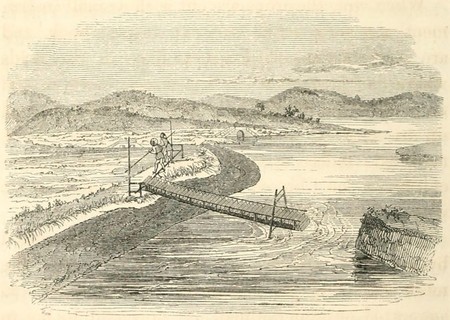
Water-wheel for Irrigation.
During the growth of the rice, the fields are
always kept flooded when water can be obtained.
The terraces near the base of the hills are supplied
by the mountain streams, and the fields which are
above the level of any adjoining river or canal are
flooded by the celebrated water-wheel, which is in
use all over the country. These machines are of
three kinds. The principle in all of them is the
same, the only difference being in the mode of
applying the moving power; one is worked by the
hand, another by the feet, and the third by an
animal of some kind, generally a buffalo or bullock.
The rice lands are kept flooded in this way until
the crops are nearly ripe, when the water is no
longer necessary. It is also necessary, or at least
advantageous, to go over the ground once or twice
during the summer, and stir the soil up well
amongst the roots, at the same time removing any
weeds which may have sprung up. If the weather
is wet, the fields retain the water for a considerable
time, and then it is not an uncommon sight to see
the natives wading nearly up to the knees in mud
and water, when they are gathering in the harvest.
When ripe, the crops are cut with a small instrument,
not very unlike our own reaping-hook, and
are generally thrashed out at once in the fields
where they have grown. Sometimes, however, and
more particularly in the north, the paddy is tied
up in sheaves, and carried home before it is
thrashed; indeed every thing in the northern agriculture
of the Chinese has a great resemblance to
what is practised in Europe.
The terrace cultivation of China has been noticed
by nearly all writers upon this country, and, like
most other subjects, it has been either much exaggerated
or undervalued. It appeared to me to
be carried to the greatest perfection on the hill
sides adjacent to the river Min near Foo-chow-foo;
at least I was more struck with it there than any
where else. On sailing up that beautiful river,
these terraces look like steps on the sides of the
mountains, one rising above another, until they
sometimes reach six or eight hundred feet above
the level of the sea. When the rice and other
crops are young, these terraces are clothed in
luxuriant green, and look like a collection of gardens
among the rugged and barren mountains. The
terrace system is adopted by the Chinese, either for
the purpose of supplying the hill sides with water
where paddy is to be grown, or to prevent the
heavy rains from washing down the loose soil from
the roots of other vegetables. Hence these cuttings
are seen all over the sides of the hills, not exactly
level like the rice terraces, but level enough to
answer the purpose of checking the rains in their
descent down the mountain. For the same reason,
the sweet potato and some other crops which are
grown on the hills are always planted in ridges
which run cross-ways or horizontally; indeed,
were the ridges made in a different direction, the
heavy rains which fall in the early summer months
would carry both the loose soil and crops down
into the plains.
Rice is grown on the lower terrace ground, and
a stream of water is always led from some ravine
and made to flow across the sides of the hills, until
it reaches the highest terrace, into which it flows
and floods the whole of the level space. When the
water rises three or four inches in height, which is
sufficiently high for the rice, it finds vent at an
opening made for the purpose in the bank, through
which it flows into the terrace below, which it
floods in the same manner, and so on to the lowest.
In this way the whole of the rice terraces are kept
continually flooded, until the stalks of the crops
assume a yellow ripening hue when the water being
no longer required, it is turned back into its natural
channel, or led to a different part of the hill, for
the nourishment of other crops. These mountain
streams, which abound in all parts of the hilly districts,
are of the greatest importance to the farmer;
and as they generally spring from a high elevation
in the ravines, they can be conducted at pleasure
over all the lower parts of the hills. No operation
in agriculture gives him and his labourers more
pleasure than leading these streams of water from
one place to another and making them subservient
to their purposes. In my travels in the country the
inhabitants often called my attention to this branch
of their operations, and I pleased them much when
I expressed my admiration at the skill with which
they executed it. The practice is not confined to
the paddy fields; for I remember once, when superintending
the planting of some large trees and
shrubs in the garden of Messrs. Dent & Co. in
Hong-kong, after I had given them a large supply of
water at the time they were put into the ground, I
desired the gardener to repeat the dose next morning.
But, on the following day, when I returned to
the spot I was surprised to find a little stream divided
into many branches, and meandering amongst
the roots of the newly planted trees. As there
was no stream there before, I went up to examine
its source, and found that it had been led from a
neighbouring ravine; a work more easy than carrying
a large supply of water in buckets, and at
the same time more effectual.
Several other summer crops are cultivated in the
lowlands. In the southern provinces, for instance,
we find large quantities of the Nelumbium speciosum
grown for its roots, which are much esteemed; the
Trapa bicornis, the castoroil plant, Scirpus tuberosus,
Convolvulus reptans, and several other vegetables,
for which there is a great demand in all Chinese
towns. The sugar cane also is extensively grown
both in the provinces of Quantung and Fokien, and
probably in other parts of the empire.
In the district of Kiangsoo my attention was
directed to a plant called Tein-ching, which is largely
cultivated by the inhabitants for the sake of its
blue dye. In the southern provinces a great deal
of indigo (Indigofera) is grown and manufactured,
in addition to a large quantity which is annually
imported from Manilla and the Straits. In the
north, however, the plant which we call indigo is
never met with, owing, I suppose, to the coldness
of the winters; but its place is supplied by the
Tein-ching (Isatis indigotica), the leaves of which
are prepared in the same manner as the common
indigo. The colour of the liquid at first is a kind
of greenish blue, but, after being well stirred up
and exposed to the air, it becomes much darker. I
suppose it is thickened afterwards by evaporation;
but this part of the process did not come under my
observation. I am very much inclined to believe
that this is the dye used to colour the green teas
which are manufactured in the north of China for
the English and American markets: this, however,
is only conjecture.
The summer productions of the hilly country are,
of course, different from those of the plains. From
the province of Fokien northward to the great
valley of the Yang-tse-Kiang, the hills are amongst
the most fertile in China. They are frequently
terraced in the manner I have described, and their
staple productions, if we except the rice which is
grown on the lower terraces, are sweet potatoes
and earth-nuts. In the southern provinces, when
the winters are mild, the roots of the sweet potato
frequently remain in the ground all the winter.
In the north the cold is too severe, and consequently
the natives are obliged to dig up and protect
the roots. In April those roots which have been
saved for "seed" are planted thickly in beds near
the houses or in the corners of the fields. They
begin to push out their young shoots immediately,
and these are ready to be taken off by the beginning
of May. In the mean time the ground on the
hill sides has been prepared, and horizontal ridges
or drills formed about two feet apart. About the
10th or 12th of May these cuttings are taken off
and planted, and seem to grow as readily as couch
grass. It is astonishing how well they succeed, considering
the little care expended upon them; but
we must keep in mind that this is the commencement
of the rainy season at the change of the monsoon,
that the sky is generally cloudy, that scarcely
a day passes without frequent showers, and that
consequently the air is saturated with moisture.
The earth-nuts are grown most extensively in the
southern provinces, more particularly in Fokien;
while the sweet potatoes are better a little farther
north, where they form the chief hill crop.
The winter crops in the neighbourhood of Macao
and Canton consist of large quantities of our European
vegetables, such as potatoes, peas, onions,
and cabbages, which are grown for the supply of
the Europeans who reside at Hong-kong or Canton:
our potatoes are generally planted here in October,
which is considered the best time to insure a good
crop; but as they always sell well in the markets, the
growers manage to keep up a succession during the
greater part of the year. Several varieties of the
cabbage tribe, which seem indigenous to China, are
grown extensively in the fields at this season both in
the south and north. These never produce a solid
heart like our cabbages, and are of no value when
imported to England; but the celebrated "Pak-tsae"
or white cabbage of Shantung and Peking, is a very
different plant; it is never grown in the south of
China, but is produced in the summer months in
the north. Large quantities of this delicious
vegetable are brought south every autumn, in the
junks which sail at the commencement of the
north-east monsoon in October.
In the northern provinces the principal winter
productions are wheat, barley, peas, beans, the
cabbage oil plant, and various other vegetables of
lesser note. These crops are grown on the hills
as well as on the low lands, and on the ground
which produces sweet potatoes in summer. In the
Nanking district they fire generally sown or planted
in October upon those lands which produce rice or
cotton during the summer months. Frequently
the sowing takes place before the cotton or the dry
summer crops have been removed from the ground,
and the young plants are seen coming up amongst
these crops, and ready to take their place when
they are removed. This is done in order to give a
longer season for the ripening of the different crops,
and is very generally practised in the northern districts.
The wheat and barley ripen in Fokien in
April, and in the neighbourhood of Shanghae about
the middle of May. About Chinchew and Amoy
the wheat crops are so poor that the labourers pull
them up by the hand, in the same manner as we
do in our moorlands in England and Scotland.
They are of course much better in the rich district
of Shanghae, but the varieties of both wheat and
barley are far inferior to ours; and as the Chinese
sow them too thickly, they are generally much
drawn, and the heads and corn small. The beans
and peas seem to be exactly the same as our field
kinds, and are certainly indigenous to the northern
parts of China. Very large quantities of the cabbage
tribe are cultivated for the sake of the oil
which is extracted from their seeds. They are
planted out in the fields in autumn, and their seeds
are ripe in April and May, in time to be removed
from the land before the rice crops. It must not
be supposed, however, that the whole of the land is
regularly cropt in this manner, and that, as some
writers inform us, it never for a moment lies idle,
for such is not the case.
In the island of Chusan, and over all the rice
country of Chekiang and Keangsoo, there are two
plants cultivated in the winter months, almost exclusively
for manure: the one is a species of Coronilla;
the other is Trefoil, or clover. Large ridges,
not unlike those on which gardeners grow celery,
are thrown up on the wet rice fields in the autumn,
and the seeds of the plants are dropt in, in patches
at five inches apart, on the surface of the ridges.
In a few days germination commences, and long
before the winter is past the tops of the ridges are
covered with luxuriant herbage. This goes on
growing until April, when it is necessary to prepare
the ground for the rice. The ridges are then
levelled, and the manure plants are scattered in a
fresh state over the surface of the ground. The
fields are flooded, and the plough and harrow are
employed to turn up and pulverise the soil. The
manure, thus scattered over the ground and half-buried
amongst mud and water, begins to decay
immediately, and gives out a most disagreeable
putrid smell. This mode of manuring is generally
adopted in all the rice lands in this part of
China, and the young paddy doubtless derives
strong nourishment from the ammonia given out in
the decomposition of this fresh manure.
Fire-wood is so scarce in the country that a great
portion of the straw, cotton stalks, and grass, which
would go to manure the fields, is used for firing,
and, therefore, the plan of growing manure for the
land is forced upon the farmers by necessity. The
plan of using manure in a fresh state, instead of
allowing it first to decay, has doubtless been found
from long experience to be the best for the young
paddy. The Chinese farmer is not a chemist; he
knows little or nothing of vegetable physiology, but
his forefathers have hit accidentally upon certain
systems which are found in practice to succeed, and
to these he himself adheres, and hands them down
unchanged to his children.
When the first crop of rice is cut, the second,
which has been planted in the alternate rows, is
left to grow and ripen in the autumn; the ground
is stirred up, and the stubble and part of the straw
of the first crop is immediately worked up with the
mud and water between the rows: this decays in
the same manner as the trefoil in spring, and affords
manure to the second crop. Prawns and fish
of various kinds are frequently used for the same
purpose and in the same way.
Burnt earth mixed with decomposed vegetable
matter is another highly esteemed manure, and is
common in all the agricultural districts. During the
summer months all sorts of vegetable rubbish are
collected in heaps by the road-sides, and mixed with
straw, grass, parings of turf, &c., which are set on
fire and burn slowly for several days, until all the
rank vegetable matter is decomposed, and the whole
reduced to a rich black earth. It is then turned
over several times, when it presents the same appearance
as the vegetable mould used in gardens
in England. This manure is not scattered over the
land, but reserved for covering the seeds, and is
applied in the following manner. When the seed
time arrives, one man makes the holes, another
follows and drops in the seeds, and a third puts a
handful of this black earth on the top of them.
Being principally vegetable matter, it keeps the
seeds loose and moist during the period of germination,
and afterwards affords them nourishment.
This manure is useful mechanically as well as
chemically in a stiff soil, like that of the low lands
of China, where the seeds are apt to be injured
in the process of germination. The young crop
thus planted acquires a vigour in its first growth,
which enables it to assimilate the matter which
forms the strong stiff soil, and to strike its roots
firmly into it.
What is commonly known by the name of oil-cake,
is broken up and used in the same manner as
the vegetable earth, and is also scattered broadcast
over the land. The oil-cake is the remains or refuse
of the seeds of several different plants, such
as the tallow tree, various kinds of beans, and the
cabbage formerly mentioned. There is a great demand
for this manure in all parts of the country,
and it forms a very considerable branch of trade
both by sea and land. Bones, shells, old lime, soot,
ashes, and all kinds of rubbish, are also eagerly
bought up by the farmer for the purpose of manure.
In the Fa-tee gardens near Canton the proprietors
have a curious kind of rich mud, which they
cut up into small square bits, and sell at a very
high price for the growing of plants in pots. This
is obtained chiefly from the ponds and lakes in the
vicinity, where the Nelumbium speciosum grows.
This soil is so much esteemed, that the price for
the best kind is 1 dollar for 3 peculs[2], and for the
second 1 dollar for 4 peculs. The inferior sort has
been frequently sent to England in plant cases
from Canton.
For crops in a vigorous growing state no kind of
manure is so eagerly sought after as night soil, and
every traveller in China has remarked the large
cisterns or earthen tubs which are placed in the
most conspicuous and convenient situation for the
reception of this kind of manure. What would be
considered an intolerable nuisance in every civilised
town in Europe, is here looked upon by all classes,
rich and poor, with the utmost complacency; and I
am convinced that nothing would astonish a Chinaman
more, than hearing any one complain of the
stench which is continually rising from these manure
tanks. Almost every Chinese town is placed on the
banks of a river or canal, and the water is generally
led not only round the walls, thus forming a kind of
moat, but also through many parts of the city. Long
clumsy boats are placed in different departments of
the town, into which the night soil and urine are
emptied and conveyed from thence into the country.
The fields in the neighbourhood of cities are generally
supplied with it by coolies, who go every
morning to market loaded with the produce of
their firms. Each brings home two buckets of
this manure, slung at the ends of his bamboo
pole. In England it is generally supposed that the
Chinese carry the night soil and urine to these
tanks, and leave it there to undergo fermentation,
before they apply it to the land. This, however,
is not the case; at least, not generally. In the
fertile agricultural districts in the north, I have
observed that the greater part of this stimulant is
used in a fresh state, being of course sufficiently
diluted with water before it is applied to the crops.
And there can be little doubt that in this the
Chinese are perfectly right, as the manure must be
much more efficient in this state than when a great
portion of its ammonia has passed off into the air.
The Chinese, as far as I could learn, have no mode
of disinfecting their manure, but they seem to be
perfectly aware, that if allowed free access to the
air a great loss must result, owing to the gases
which are given out and dissipated. Without waiting,
then, for fermentation or putrefaction, this
manure is at once applied to the growing crops.
On the afternoons, or on cloudy days, the labourers
are seen carrying water from the nearest pond or
canal to the manure tank, for the purpose of
diluting its contents. This being done, they fill
their buckets, attaching one to each end of their
bamboo in the usual way, and carry them off to
their destination. When this is reached, each man
takes a small wooden ladle having a long bamboo
handle, and with this he scatters the liquid over the
growing crop. A strong stimulant like this would
probably in other circumstances have an injurious
effect; but, by using it only when the crops
are young and luxuriant, they assimilate its gases,
and a most marked effect is produced upon
their growth and productiveness. This kind of
liquid manure is generally applied to wheat, barley,
and all the cabbage tribe, and other garden vegetables;
but not to rice, which is always flooded
during its growth.
This manure is sometimes used after putrefaction
and fermentation have taken place, and even in
this state it is very efficient. In the gardens near
Canton it is often dried and mixed with the soil
taken from the bottom of the Lotus ponds, and
used for growing plants in pots, or for enriching
any particular tree which may be a favourite in
the garden.
Although the land is sometimes allowed to lie
idle for some months, yet there is no regular
system of fallowing, nor is the rotation of crops
much known or practised. Indeed, as regards
the low lands, the soil being a kind of stiff, strong
clay, capable of yielding many crops of rice in
succession, without being in any way burthened
or impoverished, no such mode of cultivation is
necessary.
RETURN TO CHUSAN.—ITS SUPPOSED UNHEALTHINESS.—MORTALITY
AMONGST THE QUEEN'S TROOPS WHEN FIRST STATIONED
THERE.—SUBSEQUENT SALUBRITY.—ITS ADVANTAGES OVER
HONG-KONG AS A BRITISH SETTLEMENT.—NEW PLANTS FOUND
ON THE ISLAND.—NINGPO.—GARDENS OF THE MANDARINS.—MANNERS
OF CHINESE LADIES.—SAIL FOR HONG-KONG.—TOMBS
OF THE CHINESE.—SITUATIONS SUPPOSED TO BE THE
BEST.—SOOTHSAYERS EMPLOYED.—THEIR METHODS OF
WORKING ON THE MINDS OF THE PEOPLE.—MR. LAY CONSULTED
AS TO THE BEST SITE FOR A GRAVE.—INSCRIPTIONS
ON THE TOMBS.—PERIODICAL VISITS TO THEM BY RELATIVES.—DIFFERENT
MODES OF INTERMENT.—COFFINS EXPOSED IN
THE FIELDS.—KEPT IN HOUSES.—TOMB NEAR SUNG-KIANG-FOO.—FAVOURITE
FLOWERS FOR PLANTING ON THE GRAVES.
My first visit to Chusan in 1843 was during the
autumn and winter, but in 1844 I had an opportunity
of exploring this beautiful island, at
intervals, from the commencement of spring, until
the close of the season. At this time the first
impression regarding the unhealthiness of the
climate had been entirely removed, and the island
was looked upon as the most healthy in the Chinese
seas.
It will be recollected that when the island was
first occupied by our troops, the mortality was so
great that the place was pronounced by every one
to be the most unhealthy in China. Many a brave
soldier fell a victim to the malignant fever which
prevailed at the time. No regiment suffered more
than Her Majesty's 26th, the "Cameronians," who
were encamped on a green hill which overlooked
the city, and which certainly appeared to be the
most healthy spot which could have been selected
for the purpose. That place still bears the name
of the "Cameronian Hill," and is now thickly
strewed with the graves of our countrymen.
It soon became evident, that this great mortality
proceeded from other causes than the paddy fields
which surrounded the city of Tinghae. Invalids
from Hong-kong and Amoy were sent here to
recover their health; and the difference in the
appearance of the troops stationed in Chusan, from
those in Hong-kong, was most marked. Dr. Maxwell
of the Madras army, who was a most excellent
judge in such matters, has often expressed his
opinion, that, with good medical skill and ordinary
care, this beautiful island might have been rendered
one of the most healthy stations for our troops in
the East. Indeed, every one now seemed to regret
that we had not secured Chusan as a part of the
British dominions for the protection of our trade
in China, instead of the barren and unhealthy
island of Hong-kong; and some even went so far
as to recommend that means should still be taken
by our government to accomplish this desirable
end. The time, however, for doing this had gone
by, and I believe that every right-thinking person
would have seen with regret any power exercised
by a great and exalted nation like England to infringe
a solemn treaty "which had been entered into
with a nation so utterly powerless as the Chinese;
and most assuredly nothing less than this—no negotiations
or promises—would have induced the
Chinese to give up an island like Chusan, which
commands the central and most important parts of
their empire. That we committed a blunder and
made a bad bargain is quite certain, but having
done so, we must abide by the consequences. Had
we retained Chusan, it would not only have been a
healthy place for our troops and merchants, but it
would also have proved a safeguard to our trade
in the north, which must ultimately become of
greater importance than that at Canton. Moreover,
we should have been in a central position as
regards a large and important part of the world,
which must sooner or later open its ports to our
commerce. I allude of course to Japan and Corea,
both of which are only a few days' sail from
Chusan, and are still in a great measure sealed
countries to Europeans. These regrets, however,
are vain.
Chusan in spring is one of the most beautiful
islands in the world. It reminds the Englishman
of his own native land. In the mornings the grass
sparkles with dew, the air is cool and refreshing,
the birds are singing in every bush, and flowers
are hanging in graceful festoons from the trees and
hedges.
The new plants of the island, some of which I
had discovered in the preceding autumn, I now saw
in flower for the first time. Early in spring the
hill sides were covered with a beautiful Daphne
with lilac flowers (Daphne Fortuni Lindl.); Azalea
ovata Lindl., certainly one of the finest and most
distinct plants of this kind which I have introduced,
also grows wild on the hills, and was in full bloom at
this period. A fine new Buddlea (B. Bindleyana)
had a most graceful appearance, as its long spikes of
purple flowers hung in profusion from the hedges on
the hill sides, often side by side with the well-known
Glycine sinensis. Another plant, certainly one of
the most beautiful shrubs of northern China, the
Weigela rosea, was first discovered in the garden of a
Chinese mandarin near the city of Tinghae on this
island. This spring, it was loaded with its noble
rose-coloured flowers, and was the admiration of all
who saw it, both English and Chinese. I have
great pleasure in saying that all these plants and
many others, natives of Chusan, are now growing in
our gardens in England.
Ningpo is about 40 miles west from Chusan, and
is situated on the mainland. My visits to it at different
times during this summer were attended with
much less difficulty than in the preceding autumn.
I was now beginning to speak a little Chinese, and
was perfectly acquainted with the town, and the
whole of the places where the different mandarins'
gardens and nurseries were situated. The mandarins
were particularly inquisitive at this time about
every thing which related to the movements of the
English, or other foreigners, who were likely to
establish themselves at their port; and I soon perceived
that, as we were able to keep up a conversation
together in Chinese, my visits were very agreeable
to them. The nurserymen, too, having found
out that my money was as valuable to them as that
which they received from their own countrymen,
threw aside their shyness, and were all anxiety to
sell me any plants I wanted.
The gardens of the mandarins were extremely
gay, particularly during the early months of the
year; and, what was of more importance to me, contained
a number of new plants of great beauty and
interest. On entering one of the gardens on a fine
morning in May, I was struck with a mass of yellow
flowers which completely covered a distant part
of the wall. The colour was not a common yellow,
but had something of buff in it, which gave the
flowers a striking and uncommon appearance. I
immediately ran up to the place, and, to my surprise
and delight, found that it was a most beautiful new
double yellow climbing rose. I have no doubt, from
what I afterwards learned, that this rose is from
the more northern districts of the empire, and will
prove perfectly hardy in Europe. Another rose,
which the Chinese call the "five coloured," was also
found in one of these gardens at this time. It belongs
to the section commonly called China roses in
this country, but grows in a very strange and beautiful
manner. Sometimes it produces self-coloured
blooms—being either red or French white, and
frequently having flowers of both on one plant at
the same time—while at other times the flowers
are striped with the two colours. This will also
be as hardy as our common China rose. Glycine
sinensis is often grown on a flat trellis in front of
the summer-house, or forms a kind of portico, which
affords a pleasing shade. Entwined with one of
these trees, I found another variety, having very
long racemes of pure white flowers, which contrasted
well with the light blue of the other. I obtained
permission from the old Chinese gentleman
to whom it belonged (my old friend Dr. Chang) to
make some layers of this fine plant, and I am happy
to say that one of these is now alive in the garden
at Chiswick.
The Horticultural Society having sent me out
some small optical instruments to be given as
presents, I presented some of them to the Doctor,
with which he was much pleased, and offered in
return to let me have whatever cuttings or plants
from his garden I might wish to possess.
We are generally led to believe that ladies of rank
in this country are never seen by visitors. It is
quite true that Chinese custom, in this respect,
differs entirely from ours; and that the females here,
like those of most half civilised or barbarous nations,
are kept in the back ground, and are not considered
as on an equality with their husbands. For example,
they do not sit at the same table; when a
"sing-song" or theatrical performance is got up,
they are put in a place out of view, where they can
see all that is going on and yet remain unseen.
But for all this they are not entirely secluded from
society; at least they used frequently to honour me
with their presence, and crowd round me with the
greatest curiosity. At first they used to be extremely
shy, and only took sly peeps at me from
behind doors and through windows; by and by,
however, their strong curiosity conquered their
bashfulness, and then they used to stand and look
on very composedly. They generally, however,
kept at a little distance, and whenever a movement
was made towards where they stood, they pretended
to be vastly frightened, and ran away; but
they soon came back again.
To Mr. Mackenzie, one of our merchants at
Ningpo, and also to Mr. Thom, Her Majesty's
consul, I was greatly indebted for their kindness
and hospitality. They did every thing in their
power to forward my views, and to both these gentlemen
I take this opportunity of rendering my best
thanks.
After having spent the summer in the districts
of Ningpo, Chusan, and Shanghae, I returned to
the last-mentioned place, where my plants were all
collected, intending immediately to sail for Hong-kong,
and send a portion of them home to England;
but the exposure to the sun during the summer
was now beginning to affect my health, and when
I landed at Shanghae I was laid up with a severe
attack of fever. Providentially this happened when
I was amongst my English friends, and, as I had
the means of procuring excellent medical advice, I
recovered in the course of a fortnight, and was
able to proceed to sea, where the change of air
completed my cure. I reached Hong-kong in November,
and forthwith made preparations for sending
my collections home in several vessels, which
were at anchor in the bay at this time.
During the summer which had now passed by, I
had had frequent opportunities of inspecting the
tombs of the Chinese both in the northern and
southern districts. In the south, the natives form
no regular cemeteries or churchyards, as we do in
Europe, but the tombs of the dead are scattered all
over the sides of the hills, the most pleasant situations
being generally selected. The more wealthy
individuals often convey their dead a considerable
distance, and employ a kind of fortune-teller, whose
duty it is to find out the most appropriate resting-place.
This man goes with the corpse to the place
appointed, and of course pretends to be very wise
in the selection of the spot, as well as in the choice
of the soil with which the ashes of the dead are to
mingle in after years; and upon trial, should the
particular earth appear unsuitable, he immediately
orders the procession off to some other place in the
neighbourhood, where he expects to be more successful.
I believe many of the Chinese have this important
point settled before they die; for one day
when one of our principal merchants went to call
on old Howqua, the late Hong merchant at Canton,
a tray was brought into the room with several kinds
of earth upon it, which the old man examined with
great care, and then fixed on the one in which he
wished to be buried.
A situation on the hill side is also considered of
great importance, especially if it commands a view
of a beautiful bay or lake. But I believe that of
all places the one most coveted is where a winding
stream, in its course, passes and then returns again
to the foot of the hill where the grave is to be
made. The director of the ceremonies, with a
compass in his hand, settles the direction in which
the body is to lie, which is another point of great
importance. An intelligent Chinese, with whom I
was acquainted, informed me that this fortune-teller
of the dead is often very eloquent in his descriptions
of the future happiness of those who
obey his directions; he informs them that they or
their children, or some one in whom they are much
interested, shall enjoy riches and honours in after
life, as a reward for the attention and respect they
have paid to the remains of their fathers; that as
the stream which they then behold when standing
around their father's grave flows and returns again
in its windings, so shall their path through life be
smooth and pleasant until they sink into the tomb
hoary with years, respected, beloved, and mourned
by their children.
These men are generally great rogues, and play
upon the prejudices of the people. It frequently
happens, that after a corpse has been interred for
some time, they call upon the relatives, and inform
them, that for some cause which they affect to explain,
it is absolutely necessary to remove and re-inter
it. Should the relations object to this, the
answer is, "Very well, I don't care, but your
children and relations will also be regardless of
your remains when you die, and you will be miserable
in your graves." The feelings of the poor deluded
people are thus wrought upon, and a further
sum of money is extracted for finding a more suitable
grave.
The late Mr. Lay, during one of his rambles
amongst the hills on the banks of the river Min, was
present at one of these ceremonies, and the relatives
of the deceased crowded round him and consulted
him as to the site of the grave, under the impression
that he was well versed in such matters. He
remarks in his journal, that "much good or much
evil is thought to betide the survivors from a right
or wrong position. Keangse practitioners in this
'te-le' and 'fung shwuy,' or soothsaying from
the influence of the earth's local modalities, get
large moneys by the trade; but as they do not
agree amongst themselves, the people are fain to ask
counsel of a stranger."
In my travels in the south of China I often came
upon graves in the most retired places amongst the
hills; they were all more or less of the same form,
namely, a half circle cut out of the hill side, having
the body interred behind it. Sometimes, indeed
generally, there were several of these half-circles
with a succession of terraces in front of the grave;
and in the burying-places of the more wealthy, the
semi-circles were built of brick or stone, and on a
more extensive scale. In the centre of the semi-circle,
and of course near the body, the grave stone
is placed with its inscription. M. Callery, an excellent
Chinese scholar, informed me that these inscriptions
are always of the most simple kind, merely stating
the name of the deceased, that he died in such
a dynasty, in such a year. This is the plain and
unflattering tale which the Chinese tombstone tells.
In some instances—I cannot tell if in all—after
the body has decayed, the bones are dug up, and
carefully put into earthenware vessels, which are
then placed on the hill side above ground. These,
as well as the graves, are visited at stated times by
the relatives. They go first to the grave of the
patriarch, or father of the tribe, and then to those
of the other members of the family in rotation,
where they perform their devotions, and offer incense.
They afterwards dine together when the
ceremonies are over.
I was once or twice in the wild mountain districts
in the interior, at the time when the natives visited
the tombs. Even the most retired parts had their
visitors, and it was both pleasing and affecting to
see the little groups assembled round the graves,
paying the tribute of affection to those whose
memory they revered and loved. The widow was
seen kneeling by the grave of her lost husband;
children, often very young, shedding tears of sorrow
for a father or mother; and, sometimes, an old
man whose hair was white with age, was there
mourning the loss of those whom he had looked to
as the support of his declining years. All were
cutting the long grass and weeds which were
growing round the tombs, and planting their favourite
flowers to bloom and to decorate them.
Near Amoy, this scattered mode of interring the
dead has been departed from, and perhaps necessarily,
in consequence of the large population; in the
country, however, I sometimes found tombs in retired
and inaccessible parts of the hills here, as well
as in the more southern provinces; but these were
evidently the property of the wealthy inhabitants.
As the traveller proceeds northward, the circular
form of the tombs is less common and they become
more varied in their appearance. In Chusan,
Ningpo, and various other places in that district, a
great number of the coffins are placed on the surface
of the ground and merely thatched over with
straw. I met with these coffins in all sorts of
places,—on the sides of the public highway—on
the banks of the rivers and canals—and in woods
and other retired parts of the country. Sometimes
the thatch was completely off, the wood rotten, and
the remains of the Chinamen of former days exposed
to view. On one hill side on the island of
Chusan, skulls and bones are lying about in all
directions, and more than once when wandering
through the long brushwood in this place, I have
been entangled by getting my feet through the lid
of a coffin.
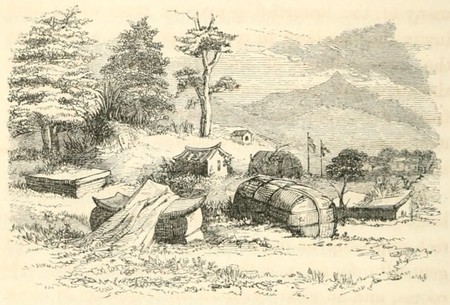
Tombs on the Island of Chusan.
I believe that the wealthy in these districts generally
bury their dead, and some of them build very
chaste and beautiful tombs. There are three or
four very fine ones in the island of Chusan, where
the paving in front of the mound which contains
the body is beautiful, and the carving elaborate;
the whole of the stone-work is square, instead of
circular as in the tombs in the south of China.
Here, as at home—and I believe in every part of
the world—trees of the pine tribe are generally
planted in the burying-grounds. Lord Jocelyn, in
his "Campaign in China," mentions such places in
the following beautiful and appropriate language:—"Here
and there, as if dropped at random upon
the sides of the hills, were clumps of pine trees,
and peeping through their thick foliage, the roofs of
houses and temples diversified the scene. Amongst
many of the beautiful groves of trees which here
invite the wanderer to repose, spots are selected as
the resting-places of mortality; and gazing on
those tranquil scenes, where the sweet clematis and
fragrant flowers help to decorate the last home of
man, the most careless eye cannot fail to mark the
beauties of the grave."
In the Shanghae district I have frequently visited
large houses which seem to have been built by the
rich expressly as mausoleums. In these houses I
generally found a coffin in one of the principal
rooms, and an altar, with all the trappings of idolatry,
where incense on high days is burned to the
memory of the deceased, and various other ceremonies
are gone through by the relatives. These
houses or temples are generally surrounded by a
pine wood, and sometimes the body is buried out of
doors—the altar and records only being kept in
the temple, where a servant with his family is
always placed to look after them.
When the English first established themselves at
Shanghae, some of them had thoughts of taking
houses in the country that their families might enjoy
retirement and fresh air. One day towards the
end of 1843, I accompanied a gentleman of my acquaintance
on an errand of this kind. When we
had proceeded about six or eight miles from Shanghae,
we observed a good-looking house in a wood
hard by, and determined to pay it a visit and see
whether the occupant would be inclined to let it.
As we drew near, all was still and quiet; not even
our old enemies, the dogs, appeared to dispute our
approach. When the Chinese,—who always followed
us in considerable numbers wherever we
went—saw us approaching the house, they stood
still at a little distance, watching our proceedings
with a great degree of interest. We knocked at
the door of the mansion, and then stood at one side
so that the porter might not see that his visitors
were the Hong-mou-jins, or red-haired race, as
they are pleased to call the English; for we well
knew that if we were seen, the door would not be
opened. In a few seconds we heard the sounds of
feet, and then a voice summoned us to know our
business. We mumbled something in Chinese, and
the poor man, quite unconscious of his danger,
threw open the door. I shall never forget the look
of mingled fear and astonishment which he gave us
as we quietly walked into the court; at the same
time the group of natives outside were indulging in
hearty laughter at the way in which he had been
entrapped.
The court-yard, where we now were, was neatly
paved, and the whole of the house appeared to be
in excellent repair. As we were led from room to
room by our terrified guide, every thing appeared
quite suitable for a country residence, at least, as
good as one could expect in such an out-of-the-way
place, and my friend remarked that it was the best he
had yet seen, and that he should certainly make an
effort to get possession of it. At last we came to
what appeared the principal room: "Ah, this shall
be my drawing-room," said my companion, "but
what is that?" added he in the same breath. I
looked in the direction in which he pointed, and a
large massive coffin met my eye. We then discovered
that we were in one of those places set
apart for the remains of the dead.
During one of my journeys in the interior, I met
with a very curious tomb near the town of Sung-kiang-foo.
It was placed on the side of a hill, in a
wood, and evidently belonged to some very wealthy
or important personage of that city. From the
base of the hill to where the tomb stood about
halfway up—the visitor ascended by abroad flight
of steps, on each side of which were placed a number
of figures carved in stone. As far as I can recollect,
the following was the order in which the
figures were placed; first, a pair of goats or sheep,
one on each side; second, two dogs; third, two cats;
fourth, two horses saddled and bridled; and fifth,
two most gigantic priests; the effect of the whole
being most strange and imposing. There is another
tomb of the same description near Ningpo, but on
a much smaller scale.
The flowers which the Chinese plant on or
among the tombs are simple and beautiful in their
kind. No expensive camellias, moutans, or other
of the finer ornaments of the garden are chosen for
this purpose. Sometimes the conical mound of
earth,—when the grave is of this kind,—is crowned
with a large plant of fine, tall, waving grass; at
Ningpo wild roses are planted, which soon spread
themselves over the grave, and, when their flowers
expand in spring, cover it with a sheet of pure
white. At Shanghae a pretty bulbous plant, a
species of Lycoris, covers the graves in autumn
with masses of brilliant purple. When I first discovered
the Anemone Japonica, it was in full flower
amongst the graves of the natives, which are round
the ramparts of Shanghae; it blooms in November,
when other flowers have gone by, and is a most appropriate
ornament to the last resting-places of the
dead.
The poor, as well as the rich, often keep their
dead in their dwelling-houses for a long time; I
should imagine, from the numerous coffins which I
met with in such circumstances, that many are thus
kept for years. The coffins are remarkably thick
and strong, and the joints so carefully cemented
that no unpleasant smell is emitted during the decay
of the body.
Much of the respect which is paid by the Chinese
to the memory of their deceased relatives, may
doubtless be a mere matter of form, sanctioned and
rendered necessary by the custom of ages, but I am
inclined to think that a considerable portion springs
from a higher and purer source, and I have no
doubt that when the Chinese periodically visit the
tombs of their fathers to worship and pay respect
to their memory, they indulge in the pleasing reflection,
that when they themselves are no more,
their graves will not be neglected or forgotten—but
will also be visited by their children and grand-children,
in whose hearts and affections they will
live for many, many years after their bodies have
mouldered into dust.
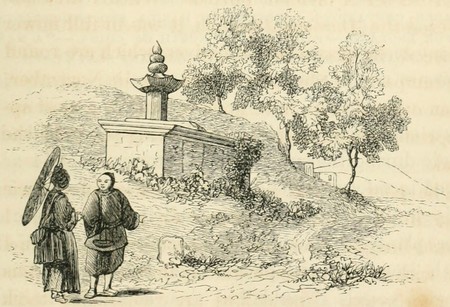
Tomb of a Mandarin's Wife.
PLANTS SHIPPED FOR ENGLAND.—SAIL FOR MANILA.—NATURAL
PRODUCTIONS AND EXPORTS.—PASSPORT ANNOYANCES.—THE
INTERIOR OF LUZON—ITS LAGUNA.—EARLY MORNING IN THE
PHILIPPINES.—VALUABLE PLANTS PROCURED.—THE "QUEEN
OF ORCHIDS."—NATURAL HABITS OF AIR-PLANTS.—LAWLESS
BANDITTI OF THE INTERIOR.—A FALSE ALARM.—MONKEYS
MORE HARMLESS THAN MEN.—A NIGHT AT DOLORES WITH
THE PADRE.—VOLCANOES IN THE PHILIPPINES.—GENERAL
APPEARANCE OF THE COUNTRY.—LEECHES NOT VERY AGREEABLE
COMPANIONS.—RETURN TO MANILA AND SHIP PLANTS
FOR ENGLAND.—SAIL FOR THE NORTH OF CHINA.—"A MAN
OVERBOARD"—HIS RECOVERY BY A GALLANT BOAT'S CREW.—ARRIVE
IN THE NORTH.
The collections of plants and seeds which I had
made during the summer and autumn of 1844 arrived
in safety at Hong-kong, and I lost no time in
shipping them for England. All the living objects
were planted as usual in "Ward's cases," well guarded
with iron bars and placed upon the poops of the
largest vessels I could find then at anchor in the
bay. I always took care to divide my collections
into three or four parts for the purpose of sending
them by different ships, so that if any thing happened
to one portion, the others had a chance of
reaching England in safety. The last shipment at
this time was made on the 31st of December. As
it was then winter in the northern provinces, and
as nothing could be done in the south, I determined
to go over to the Philippine Islands for a few weeks,
and accordingly sailed for Manila in the beginning
of January, 1845.
The voyage from Hong-kong to Manila at this
season is generally made in six or eight days, as the
monsoon is fair. I need not give any description
of the town, which is well known as being the chief
Spanish settlement in the Philippines. The inhabitants
are principally Spaniards, Indians, Chinese,
and there are a few English mercantile establishments.
The chief productions and exports
are sugar, coffee, rice, cheroots, and indigo. The
beautiful cloth generally known by the name of
Pinia, which is made from the fibre of the pine-apple
plant, is manufactured and embroidered by the
natives and is sold in the shops. A kind of hemp,
the produce of a species of Musa, is also made into
ropes and cables; it is highly prized and in much demand
amongst the shipping in the East. The cigar
manufactory, a government monopoly, is one of the
largest establishments in the town; almost the
whole of the labour in it is performed by women and
girls. When I landed, it happened to be the hour
when the work people were coming out of the factory
and the streets were crowded with females. As I
was not aware of the circumstance, I began to think
that the women must form the chief part of the
population.
As I had no object in remaining in the town, I applied
to the authorities for a passport to enable me
to proceed at once into the interior of the island.
The traveller, if he is not well acquainted with the
customs of the place, is exposed to much annoyance
from the Spanish regulations regarding passports.
Some new regulations had been established just before
my arrival, and I found that I could not land
without either having a passport, or getting some
well-known merchant to become surety for my conduct.
Having landed, a second passport was necessary
to enable me to remain on the island, another
before I could go into the interior, and a fourth when
I wished to leave the country. These passports
had to be signed by different individuals, and at
different offices, and if the slightest informality occurred,
the party was turned back or the vessel detained.
I was much indebted to Messrs. Butler,
and Messrs. Holliday, Wise & Co., English merchants
at Manila, who rendered me every assistance
in their power.
Having at length got over these difficulties and
engaged some guides and servants, our baggage
was put into a Banca or boat, and we started for
the Laguna, a large lake in the interior, and the
source of the river on which the town of Manila
stands. We had to cross the lake; and we were
strongly advised to do so at night, as it is generally
smooth at this time. We soon perceived the
value of this advice. The Bancas are built long
and narrow for swiftness, as they have often to
make way against a rapid current, which flows
down the river. Out-riggers are fixed to the sides
of the boats, to enable the Indians to run out and
balance them when the wind comes down in strong
puffs, and when without these they would be often
thrown on their beam ends and capsized.
When I awoke in the morning we were half-way
across the lake, and day was just dawning. Those
who have never been in eastern tropical countries
can form no idea of the beauty and freshness of
early morning in the Philippines. The broad
sheet of water through which we were swiftly
passing was smooth as glass, and shone like a mirror;
there was not a breath of air to disturb it.
The shores of the lake were rich in vegetation;
trees and bushes dipping their luxuriant branches
into the water, and crowning the summit of every
hill. In this beautiful region winter is unknown, for
here, "the trees ever blossom, the beams ever shine."
As soon as the sun began to appear above the
horizon, the whole surface of the lake was put in
motion by the breeze which then began to blow,
and which gradually increased until it became a
pretty strong gale. Our sail was close reefed, and
all the crew except the man at the helm, stood on
the out-riggers to balance the boat, walking out
or in as the wind was more or less powerful. In
less than half an hour the lake was covered with
waves rolling like those of the sea. Every now
and then we took one on board, and were soon, as
well as our beds and baggage, completely drenched
with water. Luckily we were near our destination
on the opposite shore, where we soon arrived in
safety. I counsel all travellers to beware of crossing
the Laguna; by day and I took good care to
avoid doing so on my return.
Having landed I made the best of my way to
the farm of Don Inego Gonzales de Azaola, whom
I had met in Manila, and who had kindly offered
me the use of his house in the interior. My chief
object in visiting this part of the country was to
procure, if possible, a supply of the beautiful orchid
(Phalænopsis amabilis), which Cuming had
sent home a few years before, but which was still
extremely rare in England. His Grace the Duke
of Devonshire purchased the first plant, for which
he gave the large sum of one hundred guineas.
As I had very little time to spare, I was anxious
to make the most of my opportunities. I made
an Indian's hut in the wood my head quarters
where I held a sort of market for the purchase
of orchids. The Indians knew the hour at which
I should return to the hut, and on my arrival I
generally found the ground in front strewed with
orchids in the state in which they had been cut
from the trees, and many of them covered with
flowers. The Phalænopsis, in particular, was singularly
beautiful. I was very anxious to get some
large specimens of the plant, and offered a dollar,
which was a high sum in an Indian forest, for the
largest which should be brought to me. The lover
of this beautiful tribe will easily imagine the delight
I felt, when, one day I saw two Indians approaching
with a plant of extraordinary size,
having ten or twelve branching flower-stalks upon
it, and upwards of a hundred flowers in full bloom.
"There," said they, in triumph, "is not that worth
a dollar?" I acknowledged that they were well
entitled to the reward, and took immediate possession
of my prize. This plant is now in the garden
of the Horticultural Society of London; and
although it was a little reduced, in order to get it
into the plant case at Manila, is still by far the
largest specimen in Europe. This beautiful species
may be well called the "Queen of Orchids."
The air-plants are not found so frequently in the
dense shaded parts of the forests as in the edges of
the woods, on trees by the road-sides, and in exposed
situations. I found the genus Aërides very
often in the most dense parts of the woods, but
never a single plant of Phalænopsis. The latter
was commonly found growing on the branches of
the Mango in the cleared parts of the woods, near
the cottages of the Indians, and sometimes on the
very tops of high trees where it was fully exposed
to the sun. I confess this fact was quite contrary
to the opinion I had formed of the habits of these
plants; for I expected to have found them principally
in damp shaded forests, where the sun's rays
could seldom penetrate; but such is not the case,
at least in the Philippine Islands.
Having ransacked the country around Don Inego's
farm, I now set off, accompanied by my servants
and some other Indians to St. Pablo and Dolores.
Dolores is a small village in a wild part of
the country, where the natives bear a very bad
character, having frequently attacked and robbed
travellers. During our progress my companions
related a great many stories of this kind, and were
evidently not a little frightened. The roads were
only narrow lanes, leading through dense thickets
of brushwood, and the locality was certainly an excellent
one for lawless characters of every description
to do exactly as they pleased in. On one occasion,
when I had gone a little way ahead of the
party, something alarmed them, and the whole set
took to their heels and ran off in another direction.
I rode back after the fugitives, and being well armed
explored the ground in every direction to find out
the cause of their alarm, but could discover nothing,
and at length I persuaded them to return
and pursue the journey. Shortly after this, however,
a wild-looking Indian stepped out of the forest,
and stood eyeing us narrowly as we passed him oil
the road. He had a short matchlock in his hand,
and evidently belonged to the band of free-booters
who infested this part of the country. I passed
him in a very slow and deliberate manner, taking
care to watch his motions, and to let him see that
I and some of my party were well armed, and
prepared for any attack. After looking at us in
silence for a minute or two, he jumped into the
jungle and disappeared.
As our path winded through the jungle, we sometimes
could only see a very short distance either
before or behind us. At one of these bends we
heard a noise amongst the bushes, as if a number of
men were advancing rapidly towards us, and naturally
concluded that we were about to be attacked.
A halt was instantly called, and then the question
was whether we should advance or recede. As
I had no time to lose I looked to my fire-arms
and determined to proceed. Accordingly I rode
forward a few paces to reconnoitre, and saw a numerous
band, not of robbers or free-booters, but—I
hope my courteous reader will not laugh—of
monkeys! there must have been several hundreds of
these animals on the trees, jumping about from
branch to branch, and evidently enjoying themselves
vastly. As we passed amongst them they commenced
chattering and making all sorts of faces
at us.
At length we reached the little village of Dolores,
and as in duty bound, I immediately went to
pay my respects to the Padre. His house was a
small miserable hut, little better than those of the
Indians which surrounded it, and poorly furnished.
He received us kindly, and told us that we were
welcome to the shelter his house afforded, and that
although he had little to offer us in the way of luxuries,
he should do every thing in his power to make
us comfortable. At the same time he informed us
we were in a dangerous neighbourhood, and that he
could not answer for the security of the ponies or
baggage. The servants and Indians who accompanied
me, were accommodated in another house
which was building for the Padre, and the ponies
were tied up there, and a watch set over them.
The Indians mounted guard by turns; they were
well armed, and as they were much frightened, there
was no danger of their neglecting their duty. I
was told in the morning, that they had been roused
several times during the night; but I fancy imagination
had something to do with it, as I found that
every thing belonging to us was perfectly safe. In
the evening, after dark, the worthy Padre did every
thing in his power to amuse me. He had an old
pianoforte which had found its way by some means
into this wild mountain district, but I presume it
had never been tuned since its first arrival, for it
was sadly out of order. On this he played a number
of Spanish and Italian airs, accompanying the
instrument with his voice. After exhausting his
own stock of songs he sent for his servant-boy, and
the head man of the village, who were musicians,
and got up a sort of concert. The Padre played
on the pianoforte, the boy on the fife, and the other
on the clarionette. It must be confessed, however,
that the music was not very harmonious.
The greater part of the following day was spent
in exploring the surrounding country, and in the
afternoon I bade the hospitable priest adieu, and
started for St. Pablo, which was situated in a more
civilised part of the country. There, also, and indeed
wherever I went, the priests were most kind
and hospitable.
The Philippine Islands must, atone time, have
been a complete nest of volcanoes. With one exception,
they are now all inactive; but traces of
them were met with at every step of our progress
through the higher districts of the country, in the
form of circular pools of stagnant water, and masses
of lava which still emit a most disagreeable odour
when they are stirred up. On the top of a high
hill, near St. Pablo, I came unexpectedly on the remains
of a still more recent volcano. The trees in
its vicinity were in a most unhealthy state, many of
their roots and branches being decayed. Sometimes
I sunk nearly up to the knees amongst burnt-looking
earth, which emitted a strong sulphureous
smell; and, as none of the natives were with me, I
was sometimes afraid of getting into the mouth of
the crater, and going down altogether.
The Island of Luzon, of which Manila is the capital,
is very like Java and other parts of the straits.
It is very hilly, but extremely fertile, and affords a
most striking contrast to the barren shores of the
south of China which I had just left. Large crops of
rice are produced on the low lands which are capable
of being flooded. Sugar and tobacco are grown on
such ground as would produce good wheat in England;
and coffee and chocolate trees are planted on
the sides of the hills. The Manila mango is considered
one of the finest in the world, not inferior
to that which is produced near Bombay. Cocoa-nuts,
plantains, bananas, and other tropical fruits
abound, and are to be had in great perfection. Besides
these oranges are also cultivated; but they
are inferior to those of China and Europe; indeed,
as might be expected, all the fruits, natives of more
northern latitudes, which we find in these islands,
are far surpassed by the same kinds which grow in
climates more congenial to their nature. The vine
is largely cultivated, but it produces grapes of a
very inferior quality.
The mountainous portions of the country are for
the most part in a state of nature, being covered
with trees, and with brushwood; which in some
places is so thick that I had to employ the Indians
to cut a way through it with small billhooks which
they kept for the purpose. In other parts, the tops
of the tall trees form a mass so dense, that no ray
ever shines through them. The ground on the
sides of these mountains is always in a moist and
slimy condition; and is the habitation of millions
of leeches. In my first excursion to the mountains
I observed the feet and legs of the Indians, who
were cutting a path for me, covered with blood,
and at first I fancied that they must have wounded
themselves with the thorny shrubs which they were
cutting. On inquiry, however, I found that it was
the leeches that were doing the mischief, and in a
very little time I had a good many specimens of
their powers upon my own skin. There were two
species, one a small linear one, and the other nearly
round. "Whenever the former fixed upon the Indians,
they invariably pulled it off, but they never
interfered with the little round one. I found that
the reason for this was, that the latter, if taken off
by force, would leave a very painful wound; but
that, if allowed to suck until it was full, it would
drop off, of its own accord, and leave scarcely a
mark; the other species might be taken off with
impunity. At first, when they fixed themselves
upon me, which they did through my stockings, I
set to work to pull them off, without regard to species,
although warned by the natives of the impropriety
of doing so. In a short time my legs were
covered with blood, and the wounds annoyed me
with a kind of itching soreness for several days
afterwards.
With the exception of the Orchids, the Philippines
are not very rich in plants of an ornamental
kind. As far as I had an opportunity of
judging, the vegetation of Luzon bears a great
resemblance to the island of Java and the other
parts of the Malay Archipelago. The country is,
however, very rich in birds and shells, and many
of the land species of the latter are extremely valuable.
Mr. Cuming, who is well known in this part
of the world, made very large collections of them,
and has already distributed them over the greater
part of Europe and America.
After spending about three weeks in the interior
of Luzon and having procured a fine supply of the
beautiful Phalænopsis, and several other Orchids,
I returned to the town of Manila, and shipped a
portion of them to England. These, I am happy to
say, arrived in excellent order; and upon reference
to the garden-lists on my return, I find that no
fewer than forty-five specimens of this lovely plant—the
"Queen of Orchids"—had been distributed
amongst the Fellows of the Horticultural Society
of London.
The time which I had allotted for this excursion
having expired, I sailed for my old station in the
north of China and arrived there on the 14th of
March, 1845. On going up the coast, we had to
contend with the north-east monsoon, and "beat to
windward," during the whole of the passage. One
afternoon when it was nearly dark, and when the
sea was running very high, one of the men who
was out on the bowsprit lost his hold, owing to
the heaving of the vessel, and fell into the sea.
The cry of a "man over board"—that peculiar
cry amongst sailors which, once heard, can never
be forgotten, made me rush on deck. The schooner
was going at the rate of at least eight knots, but
her helm was instantly put down, and her way
stopped. A hand was sent aloft to keep his eye
upon the poor fellow whose head was seen every
now and then as he rose upon a wave, and in a
few seconds the schooner was close at his side.
A rope was thrown out to him, and every one
thought that he would be able to lay hold, and be
drawn in over the side. Probably from exhaustion
he unfortunately missed it, and the schooner
shooting ahead at the time, he was again left to
the mercy of the waves. As a last resource the
boat was lowered; and although rather a dangerous
service, several gallant fellows stepped into it and
pulled in the direction signalled to them from the
ship. Those on board were in a state of the most
painful suspense. When we caught a glimpse of
the man from time to time, he was evidently
sinking, and in a few more seconds all must have
been over with him. The boat was nearly lost to
us in the closing darkness, and the men told us
that they were on the point of returning to the
ship without getting a glimpse of their poor messmate,
when they saw his head raised above a wave
close by; and pulling towards him, they caught
him by the hair, and drew him into the boat.
When brought on board he was in a most exhausted
state, but the usual remedies being applied
he recovered in the course of the night.
SPRING IN THE NORTH OF CHINA.—NEW FLOWERS.—JOURNEY
THROUGH THE COUNTRY.—MOTLEY GROUP OF FELLOW-PASSENGERS.—A
MORNING SCENE IN A CHINESE JUNK.—TARTAR
CITY OF CHAPOO.—SHOPS AND TRADE.—CROWDS OF PEOPLE.—A
VISIT TO THE MANDARINS.—A FREE PASSAGE ONWARD
OFFERED—THEIR OBJECT IN THIS.—MEANS TAKEN TO
THWART THEM.—LEAVE CHAPOO FOR SHANGHAE.—COUNTRY
AND TOWN OF PING-HOO.—SILK DISTRICTS VISITED.—CULTIVATION
OF THE MULBERRY.—MANAGEMENT OF THE SILK-WORM.—ARRIVAL
AT SHANGHAE.—CONSUL'S LETTER ENCLOSING
ONE FROM THE TAOUTAE, OR HEAD MANDARIN.—A
MOST SATISFACTORY REPLY!
It was the commencement of spring when I returned
to the north of China. In this season of the
year no country can be more agreeable or healthy
than this. The air is bracing, the sky generally
clear, and the mornings are delightfully cool. Before
long, vegetation progressed with wonderful
rapidity, far surpassing any thing of the kind I had
ever witnessed in England. By the middle of
April, deciduous trees and shrubs were covered with
leaves, barley was in full ear, and the oil plant
(Brassica sinensis) was seen forming masses of
golden yellow, on the hill sides and on the plains,
where the air was perfumed with the fragrance of
its blossoms.
My object during this summer was to make a
complete collection of all my finest plants, for the
purpose of taking them home under my own care.
I lost no time, therefore, in visiting all my former
acquaintances, mandarins and nurserymen—and
made my selections when the plants were in bloom.
Tree-pæonies, Azaleas, Viburnums, Daphnes, Roses,
and many other plants, all new to Europe, and of
great beauty, were from time to time added to this
collection. As many of these plants could be only
verified by the colour of their flowers, it was absolutely
necessary that I should visit the different
districts three or four times during the spring, and
consequently that I should lose as little time as possible
in travelling from one place to another. Shanghae,
Chusan, Ningpo, and many other parts of the
interior, all lying wide of each other, had some object
of interest which demanded my presence and
attention.
The distance from Ningpo to Shanghae is about
a hundred miles. I had completed my researches
in the Ningpo district, and was very anxious to get
to Shanghae as soon as possible, in order to see
some Azaleas in bloom, which I was anxious to add
to my collections. In another fortnight their flowers
would have been all faded, and it would then
have been impossible to identify the different varieties.
There were two routes from Ningpo to Shanghae,
one for the foreigners and the other for the natives.
The legal road was to go across to Chusan, then
garrisoned by the English, a distance of thirty or
forty miles, nearly due east, and then take the
chance of finding some vessel about to sail for
Woosung or Shanghae. I knew that if I took this
line, in all probability I should have to wait for
eight or ten days in Chusan before such an opportunity
would occur, a delay which would have entirely
defeated the object which I had in view. I
determined, therefore, to go by the interdicted
route, and take my chance of consequences.
The journey overland was a very interesting one.
When I reached the town of Chinhae, at the mouth
of the Ningpo river, I found that some small junks
were to sail that evening for Chapoo, and I lost no
time in securing a passage on board one of them.
I was surprised at my success thus far, as I had anticipated
my greatest, if not my only difficulty would
have been in making a start. I found afterwards
that I was indebted for this to my Chinese servant,
who happened to be a native of Chinhae and knew
the captain of the junk. He persuaded him that
there was no harm in my going by that route; and,
at all events, that he could easily land me at Chapoo,
and that nobody would know how I had come
there.
In the evening, after many delays on account of
wind and tide, and also with the view of securing
more passengers and cargo, we lifted our anchor and
set sail. In crossing the bay of Hangchow, the tide
runs very rapidly, and the Chinese junks and boats
never go across without a fair or leading wind. I
shall never forget the strange and motley group of
passengers who were my fellow-travellers in this
little vessel. We were all huddled together in the
centre cabin, and our beds were spread down on
each side, merely leaving room for us to walk down
the middle. Some of the passengers were respectable
merchants, but even these had something filthy
and disagreeable about them. Little insects whose
names sound harsh to "ears polite," were charitably
supported in great numbers amongst the warm folds
of their dresses. The first thing I did when my
bed was spread down, was to surround it with my
trunks, gun-case, and another box or two, to prevent,
if possible, any visiters of this description from
leaving their rightful lord and master, and taking
up their quarters with me. With all my care it
was next to impossible to keep myself apart from
the Chinese, owing to the motion of the little vessel
which sometimes sent us rolling from one side to the
other.
A great part of the night was spent by the Chinese
in smoking opium and tobacco. When morning
dawned, the scene which the cabin presented
was a strange one. Nearly all the passengers were
sound asleep. They were lying in heaps, here and
there, as they had been tossed and wedged by
the motion of the vessel during the night. Their
features and appearance, as seen in the twilight of
a summer morning, were striking to the eye of a
foreigner. I almost fancied that I could read the
characters of the different beings who lay stretched
before me. There was the habitual opium smoker—there
was no mistaking him—his looks were pale
and haggard, his breathing quick and disturbed,
and so thin was he, that his cheek bones seemed
piercing the skin. Some seemed care-worn with
business, and others again apparently slept soundly
with hearts light and joyous. All had the fore part
of their heads shaved, and their tails lay about in
wild confusion.
We were now far on our way across the bay
having had a fair wind and tide during the greater
part of the night, and the hills near Chapoo were
already visible on the horizon to the northward.
All hands were soon busily engaged in getting
breakfast ready. A Chinese sea breakfast consists
chiefly of rice, fish, and vegetables. The proprietors
of the junk provide food for the passengers, for
which they charge a small sum from each, independent
of the passage-money. If the passengers do
not choose to have breakfast, or dinner, they are not
required to pay for it. When breakfast was ended,
some began to smoke opium and others tobacco,
after which most of them went to bed again and
were soon fast asleep. The Chinese when travelling
do little else than eat, smoke, and sleep. During the
whole time I was travelling in the country, I never
remember seeing one Chinese engaged in reading.
About eleven in the forenoon we came to anchor
in a muddy bay abreast of the city of Chapoo, where
many of the junks are high and dry at low water.
I had my luggage put into a small sand-pan and
rowed for the shore. "You had better take off
your shoes and stockings, and draw up your trowsers,"
said one of the Chinese boatmen as we were
getting near the landing-place. The prudence and
necessity of this advice was soon apparent; for when
the boat touched the beach, I found that I had to
walk a quarter of a mile up to the knees in mud,
before I could get on firm ground. Now came the
critical part of my expedition. When I had got
through the mud, I inquired for the nearest spring
and commenced my ablutions, making no attempt
to disguise myself, as I was dressed in the common
English garb. Long before I had finished washing,
I was surrounded by some hundreds of the natives,
who seemed perfectly astonished at the sight of an
Englishman, although this place had been attacked
and taken during the late War. All sorts of inquiries
were made regarding me; "where had I come
from?" "where was I bound for?" "what were my
objects?" and a hundred other questions were put to
me, or to those who accompanied me. All were,
however, quite civil and did not attempt to annoy
me in the slightest degree. I now walked to
some hills near the city, and inspected their vegetation.
On the way I visited some temples which
had been battered down by our troops during the
war, and which still remained in the same ruinous
condition. Hundreds of people followed me to the
hills, the view from which is one of the finest I
ever saw in this country. Here it is that the hills
of the south end, and the wide plain of the Yang-tse-kiang
commences. On one side, looking towards
the south and west, mountains are seen towering in
all their grandeur; whilst on the northern side, the
eye rests on a rich and level plain, watered by its
thousand canals, and dotted all over with towns and
villages peopled with an immense number of industrious
and happy human beings. Chapoo and the
country which surrounds it may well be called the
garden of China.
After inspecting the hills, I went down into the
Tartar city of Chapoo. The suburbs are large and
populous, but the walled city itself is not very extensive.
It is a square, and the circuit of the walls
is not more than three miles; they seem very old,
and are surrounded by a moat, which also serves
the purpose of a canal. Here the Tartar troops
and their families reside, living entirely apart from
the Chinese inhabitants of the town.
The streets, houses, and shops are of the same
kind as those which I have already described. Indeed,
so like is one town in China to another, that,
if a traveller well acquainted with the northern
cities, was set down blindfolded in one of them, he
would have the greatest difficulty in saying whether
it was Chapoo, Ningpo, or Shanghae. I observed
in the shops a considerable quantity of Japanese
goods, which are brought annually to this place by
the junks which trade with Japan.
By the time I had examined all the chief objects
of interest, it was late in the afternoon, and I began
to think of leaving the city and taking the road for
Shanghae. I had already taken measures by means
of my servant to find the part of the canal from
which the Shanghae boats started, and thither proceeded
with the intention of engaging a boat. A
numerous crowd had surrounded and accompanied
me, during the whole of the day; but now that I
was on the eve of taking my departure, it was
greatly augmented. Every street, lane, window,
and house-top was crowded with human beings; all,
however, perfectly harmless and civil. When I
reached the canal and attempted to speak with one
of the boatmen, the crowd pressed after me in such
numbers, that the boat, had I got on board, would
probably have been swamped. The poor boatmen
were so frightened, that no reward which I could
hold out would induce them to give me a passage.
They begged and prayed me not to enter their
boats, as some accident would happen from the
number of persons whom nothing could prevent
from crowding in after me.
I was now in a dilemma, and I scarcely knew
how to get out of it. At last I determined, much
against my inclination, to go to the mandarins. It
is a bad plan to have any thing to do with Chinese
officials when it can be possibly avoided, but in
this case there was no help for it; so, having inquired
for the residence of the superintendent of
boats, I set off to call upon him, followed, of course,
by an immense mob. As we were going to his
house, my servant came up to me and requested
that I would not tell the mandarin that he was in
my service, or that he had any thing to do in bringing
me there. As I could speak the language sufficiently
well to make myself understood, I did not
need him as an interpreter, and I was of course
anxious not to bring him or his relations into any
scrape on my account.
When we reached the mandarin's house, the
doors were thrown open, and I walked boldly into
the reception-room. It was a most difficult matter
for the servants to keep out the crowd, but they
accomplished the task partly by threats, and partly
by whips, which they used rather more freely than
we should approve of in England. This, however,
is a common mode of punishing the rabble in China,
and when they know they deserve it they take it
very quietly.
"Tell your master I want to see him," said I
in a lofty tone to one of the attendants, who immediately
went into an inner apartment and returned
with the mandarin himself, clothed in his most
imposing robes of office,—hat, button, peacock
feather, and all. I made him several very low
bows, which he most politely returned." I am in a
great hurry," said I, "to go on to Shanghae, and have
been trying to engage a boat for that purpose, but
cannot succeed without your assistance. Will you
have the goodness to aid me?" After repeating
after me what I had said, as is the invariable custom
in Chinese conversation, he put the following question
to me: "How old are you?" This may seem
strange, but it is considered complimentary by the
Chinese, and is generally amongst the first questions
they put. I thanked him for his inquiry, told him
my age, and then asked his, and again proposed
the question regarding the boat. Upon this he
promised to send one of his servants to get one,
and in the mean time invited me to take some cake
and tea, which were immediately set before me.
The gun which I had with me was an object of
great curiosity to the old man, more particularly
the locks and percussion caps, which he told me he
had never seen before. During the time I was
discussing the cake and tea, he asked me a multiplicity
of questions; such as, where had I come
from last? who had told me there was a road to
Shanghae this way? &c. &c., some of which I
answered, and some I found it convenient not to
understand. At last, through some blunder on the
part of my servant, it became known that he belonged
to me; a circumstance which was immediately
communicated to the mandarin, who sent
for him and subjected him to a close and searching
examination.
While this was going on, the mandarin of the
highest rank in the city arrived, having been sent
for by his brother in office to hold a conference
regarding me. These worthies, after a long consultation
in a private room, came out and informed
me, in the blandest manner, that they intended to
give me a free passage across the country to
Shanghae, in a boat belonging to themselves, and
that, to add more to my comfort, they would send
another boat to convey my servant and luggage.
This seemed at first sight remarkably kind; but I
had been long enough in the celestial empire to
be aware of the necessity of looking narrowly into
their motives, in order to counteract any evil designs
they might think proper to hide under their
assumed kindness and civility. In this instance
their motives were perfectly plain to me, and were
simply these:—According to the treaty of Nanking,
if any Englishman was found beyond the
boundaries which were to have been fixed at each
of the five ports, he was liable to be seized by
the authorities and brought to the nearest British
Consul, who, in these circumstances, was obliged to
impose a very heavy fine upon the transgressor;
and therefore, if I had accepted their kind offers,
I should have found, on my arrival at Shanghae,
that I was a prisoner instead of a guest, and should,
in all probability, have been handed over as such
to the British Consul. On the other hand, if I
hired my own boat, and went unaccompanied by
any of the mandarin's people, I was perfectly safe,
according to the strict letter of the treaty, even although
a complaint were lodged against me on my
arrival at Shanghae. Nothing would have been
done in the matter by the British Consul unless I
had been bonâ fide taken up beyond the boundaries,
which was not likely to happen; as the Chinese
officials are extremely cautious in all matters of
this kind, in order to avoid getting themselves into
trouble.
I immediately determined that I would not be
outdone in politeness, and therefore, with many
bows and reiterated thanks, I told them that I
could not think of accepting so much gratuitous
kindness, as I was able to pay my own expenses;
and that all I required of them was simply permission
to hire a small boat, with three or four men,
which would enable me to get on to Shanghae.
They still kept on pressing their offer upon me,
which I continued as firmly to refuse. Another
long private conference between them was now
held, which, I suppose, ended in a determination
to try what effect could be produced on my servant,
who was accordingly sent for. He was desired to
tell me that the distance between Chapoo and
Shanghae was very great, and that the roads were
infested with bands of robbers who were sure to
attack us; and that they could not answer for the
consequences unless another boat and some of their
own soldiers went along with us for protection.
"Tell them," said I, "that I have made up my
mind to travel in my usual way, and that no arguments
which can be used will induce me to change
my opinion, and that the arms which I have shown
them are quite sufficient to repel the attacks of
any robbers whom I may meet on the road." As a
last resource, they sent an officer and his servant
to me, who said that they were going to Shanghae,
and would be extremely obliged if I would allow
them to accompany me. I was obliged to meet
even this civil request with a refusal; and the mandarins,
finding that they must either use force or
allow me to have my own way, finally gave up the
contest.
A boatman now made his appearance, and announced
that he was ready to proceed to Shanghae.
When I rose to take my leave, I found that all the
servants and retainers had been ordered out for the
purpose of keeping off the crowd and seeing me
safely into the boat. The two mandarins accompanied
me, and we marched off to the canal in
grand style. The crowd which had assembled was
immense, but they were all perfectly quiet and
civil. When we reached the landing-place, I thanked
my two friends for their kindness, and bade them
adieu: then stepping into the boat she was pushed
out into the stream, and we soon left the crowd
and the Tartar city far behind us.
The country through which we passed was perfectly
level, highly cultivated, and more richly
wooded than any of the lowlands which I had
visited before. It was getting dark when we
reached a town of considerable size, named Ping-hoo,
which is distant only a few miles from Chapoo,
and I determined to remain there for the night.
When the morning dawned I roused the Chinamen,
and we proceeded on our journey. We now passed
through an extensive silk district, where the mulberry-tree
was the principal object of cultivation.
The natives at this time (May 18th) were busily
employed in gathering the leaves and feeding the
silkworms with them.
The mulberry-trees are all grafted, and produce
very fine thick leaves. I obtained a plant, which is
now alive in England, in order to determine the
particular variety, and whether it is different from
the kinds which are used for the purpose in Europe.
It is not yet, however, in a sufficiently advanced
state for this to be ascertained. One thing, however,
is certain, that the silk produced in this district is
considered as being amongst the finest in China;
but whether this is owing to the particular variety
of mulberry-tree used in feeding the worms, or to
climate or soil, still remains to be ascertained.
The trees, or rather bushes, are planted in rows,
the banks of the canals being a favourite situation;
and they are not allowed to grow more than from
four to six feet in height. The natives set to
work with a pair of strong scissors, and cut all the
young shoots off close by the stump; they are
then either stript of their leaves, or taken home in
bundles and stript afterwards. Before this operation
takes place, the plants seem in a high state of
health, producing vigorous shoots and fine large
and thick shining leaves. After the leaves have
been taken off, the bushes look like a collection of
dead stumps, and in the middle of summer have
a curious wintry appearance; but the rain, which
falls copiously, and the fertility of the soil, soon
revive a succulent plant like the mulberry. The
Chinese seem very particular in stirring up the
earth amongst the roots of the bushes immediately
after the young branches and leaves have been
taken off, and the plantations appear to have great
attention paid to them.
The farms are small, and are generally worked
by the family and relatives of the farmer; who
not only plant, graft, and cultivate the mulberry,
but also gather the leaves, feed the silkworms,
and wind the silk off the cocoons.
During my progress through the silk district, I
visited a great number of cottages, where the
worms were feeding. They are commonly kept in
dark rooms, fitted up with shelves placed one
above another, from the ground to the roof of the
house. The worms are kept and fed in round
bamboo sieves, placed upon these shelves, so that
any one of the sieves may be taken out and examined
at pleasure. The poor natives were greatly
surprised when they saw a foreigner coming
amongst them, and generally supposed that I intended
to rob them of their silkworms. In all
the villages which I visited, they uniformly denied
that they had any feeding-rooms—although the
leaves and stems of the mulberry about their doors
told a different tale; and they never failed to direct
me to go on to some other part of the country,
where they assured me I should find them. Before
we parted, however, they generally gained confidence,
and showed me their collections of worms,
as well as their mode of managing them.
After passing through the Hang-chow silk district,
and keeping on in an easterly direction, we
reached, late in the evening, a large town named
Sung-kiang-foo, which is about 30 miles to the
west of Shanghae, and stopped for the night under
its ramparts. By daybreak the next morning we
were again on our road, and reached Shanghae on
the afternoon of the same day. Having taken up
my abode in the house of my friend, Mr. Mackenzie,
I was surprised in going down stairs next morning
to find one of my Chapoo acquaintances—the
officer already mentioned—in close conversation
with the Chinese servants; but I now cared very
little about the matter, knowing perfectly how the
business must end. There was no doubt that the
whole affair had been reported to the Taoutae, or
head mandarin of Shanghae, and that he would be
obliged, for his own sake, to take some little notice
of it.
A day or two afterwards I had the honour to
receive the following letter from H. B. M. Consul,
and a translation of a note which had been sent to
him by the Taoutae:—
"H. B. M. Consulate,
"Shanghae, 21st May, 1845.
"Sir—The annexed translation of a note received
this morning from the Taoutae is transmitted
to you for an explanation, which I request
may be afforded as soon as possible. I have the
honour to be, Sir, yours, &c.
"G. Balfour,
"H. B. M. Consul for Shanghae."
The inclosed ran as follows:—
"I have just heard that a merchant of your
honourable nation, Fortune, and his attendant,
Linguist ye Mingchoo, were coming from Tinghae
to Shanghae, and met with a breeze at sea, when
the vessel drifted to Chapoo; that the local officers
in Chekiang then protected and sent them on
along the coast, and that they are living at the
Ming-le Warehouse. I would, therefore, trouble the
honourable Consul to make inquiry of what ship he
is the merchant, and let me know. This is written
wishing you daily happiness."
"(True Translation.) (Signed) W. H. Medhurst,
"Interpreter."
When I perused this document I could not but
admire the cunning of the old man. He knew perfectly
well that it did not contain one word of
truth: that I was not coming from Tinghae, but
from Ningpo; that I met with no breeze at sea
except that which had quietly brought us to the
desired port; and, lastly, that I had not been sent
along the coast, but had had a very pleasant
journey through the interior of the country. I
saw at once that the object of the good old Taoutae
was to allow me to deny the truth of his statements;
and, upon the principle that no man is bound to
criminate himself, I sent the following answer to
Her Majesty's Consul, which was doubtless perfectly
satisfactory to the Taoutae, and just what he
wanted:—
"Sir—I have the honour to acknowledge the
receipt of a letter from you of yesterday's date, to
which is annexed a translation of a note you had
received from the Taoutae of Shanghae, concerning
which you request an explanation may be afforded
as soon as possible. In answer to this, I beg to
inform you that the circumstances noticed in the
Taoutae's letter do not apply to me, and he is,
therefore, mistaken, or has been misinformed. I
have the honour to be, Sir, yours," &c.
I need scarcely say that I heard no more of the
matter, and from this I concluded that my answer
must have been considered highly satisfactory. I
arrived in Shanghae in good time to transact the
business I had in hand, and not a little pleased at
having so successfully accomplished my "overland"
journey.
SAIL FOR FOO-CHOW-FOO ON THE RIVER MIN.—NOVEL MODE OF
ENGAGING A PILOT.—ENTRANCE TO THE RIVER—SCENERY ON
ITS BANKS.—BRIDGE OF FOO-CHOW-FOO.—CHINESE CHAIRMEN.—INSULTS
RECEIVED FROM THE NATIVES—CITY AND SUBURBS.—NATIVE
TRADE.—FISHING CORMORANTS.—BANK NOTES.—CHARACTER
OF THE NATIVES.—THE LADIES, AND THEIR
FONDNESS FOR FLOWERS.—POPULATION.—REMARKS ON FOO-CHOW-FOO
AS A PLACE OF FOREIGN TRADE.—GOVERNMENT
SPIES.—GARDENS AND NURSERIES.—DECEIT OF THE MANDARINS.—LEAVE
FOO-CHOW-FOO FOR THE TEA HILLS.—MOUNTAIN
SCENERY DESCRIBED.—BLACK-TEA DISTRICTS.—FLORA
OF THE HILLS.—AGRICULTURE OF THE DISTRICT.—NATIVE
FRUIT.—CLIMATE AND TEMPERATURE.
When I had finished my business in Shanghae, I
left that city, and sailed for Foo-chow-foo, on the
river Min. Foo-chow-foo is the capital of the province
of Fokien, situated in 25° 30' N. latitude,
near the celebrated Bohea hills, and about half way
between Chusan and Canton. On approaching
the entrance to the Min, we anchored under the
lee of some islands named the White Dogs, for
the purpose of procuring a fisherman who could
pilot the vessel into the river, as the entrance is
rather difficult for a stranger, having been until very
lately but imperfectly surveyed. Going to the
shore for that purpose in the ship's boat, we found
a small fishing village inhabited by men and boys,
most of whom had a piratical and forbidding
appearance. It seems that these people only come
here at certain periods of the year to fish; and
when the season is past, they move to more comfortable
quarters on the main-land. No women are
ever allowed to inhabit the island.
Having picked out the most weather-beaten man
we could find, we asked him if he knew the passage
to the Min, and if he could take a vessel in which
drew three fathoms of water. He immediately
answered in the affirmative; but when we wanted
him to come on board, he altered his mind and
hesitated, probably because he had not confidence
in us; or, it might be, he was frightened at the
consequences, not knowing how his conduct would
be viewed by the authorities. Mr. Shaw, Captain
Freeman, and myself, now held a conference as to
what was to be done. A ship and a valuable cargo
were at stake; the numerous and dangerous sand-banks
near the mouth of the river were visible; and
as the man only refused us his service through fear
and ignorance, we concluded that, as "necessity
has no law," there could be no great harm in taking
him against his will. We accordingly pulled alongside
his little junk, and took him and it off to the
ship, where he very soon got over all his fears.
The Chinese are certainly a strange and unaccountable
race. Never in my life did I witness
greater apathy than was shown by this boat's crew
when we took them off to the ship. Their companions
too—for there were several boats in the little bay—scarcely
even looked at us, or manifested the
least surprise, when they saw our men board the
boat, get her anchor up, and hoist her sail.
The next morning our pilot got the ship under
weigh, and took us into the river Min by a passage
not marked in our charts; he evinced the most perfect
acquaintance with the depth of water at every
part, and at last anchored us in safety abreast of a
small temple, a few miles from the mouth of the
river. Before we came to the most dangerous point,
where we had to pass between two sand banks, the
captain very quietly informed him, that if he
made any mistake and got the ship aground, he
should have his tail cut off—a punishment very
nearly the greatest, which can be inflicted on a
Chinaman. When told, he shrugged up his shoulders,
gave a sly look, and said, "Very well; we shall
see by and by." The anchorage being reached in
safety, the old man thought it was now his time
for a joke, and, turning triumphantly round with
his tail in one of his hands, exclaimed, "Now, what
about the tail? is it to be cut off, or not? or are you
satisfied?"
The passage by which we entered the river is
called by the natives the Woo-hoo-mun, or "the
five tiger gate;" and here we saw a most singular
rock, or island, which is cleft, as it were, into five
pyramids, and is much revered by the Chinese
sailor. In fact, he seems to look upon it as representing
the gods of the ocean, and he fails not
to offer up his thanks and his offerings every time
he passes by it on returning from the sea. The
Chinese are often taunted with their indifference to
the religion which they profess; and yet the earnest
and devout manner in which they burn incense, and
worship at their holy places, would put to the blush
many of the professors of a holier and purer faith.
The scenery at the mouth of the Min and towards
Foo-chow-foo is striking and beautiful. The river
itself varies much in width and depth, according to
the district through which it flows. Near its
mouth, and at some parts where the country between
it and the hills is flat, it is not less than a
mile in width; but at other parts, where the
mountains come almost to the water's edge, the
river is narrow, deep, and rapid. There are two
or three such places between the mouth of the Min
and the city of Foo-chow-foo. The whole of this
district is hilly, many of the mountains being at
least 3000 feet high; and at this season of the year,
when thunder-storms were almost of daily occurrence,
the effects produced by them amongst these
mountains were grand and sublime.
It is evident that the Chinese greatly dreaded
our visiting this place during the war. I observed
that forts had been built on all the most commanding
positions on the sides of the river; but
most of them were now without guns, and had
already become dilapidated.
The little town and fortress of Mingan, a few
miles up the river, is beautifully situated on a hill
sloping down to the water; and the position is so
strong by nature, that, if manned with English
troops, it could defend the pass against the strongest
force.
A few miles below the city the river is blocked
up, almost all the way across, with stones and old
junks, which are covered at high water. I believe
the intended plan of defence was, to wreck all our
vessels on this barrier, and destroy our men by
batteries erected near it!
On the banks of the river are numerous temples,
or joss houses, built in the most romantic and
beautiful situations. A fig-tree (Ficus nitida)—a
kind of Banyan—is a great favourite with the
priests, and is always found growing beside the
temples, where its dark green leaves and wide-spreading
branches afford an agreeable shade from
the fierce rays of the sun. About nine miles below
Foo-chow-foo, a pretty little pagoda stands on an
island on the left bank of the river: near this is
the anchorage for large vessels which it would not
be prudent to take up to the town. All the low
hills are neatty terraced and cultivated with sweet
potatoes and earth-nuts, and on the more fertile of
the mountains cultivation is carried on at least
2500 feet above the level of the sea. But many of
the mountains are quite barren; bare rocks of
granite are showing themselves over their surface,
from amongst which springs are almost always
flowing, and when the water accumulates in the
glens between the hills, it forms numerous beautiful
cascades, as it tumbles down into the Min.
Some parts of the region are well wooded, at least
for China; and, viewing the scenery as a whole—the
beautiful river, winding its way between mountains,
its islands, its temples, its villages and
fortresses—I think, although not the richest, it
is the most romantic and beautiful part of the
country which has come under my observation.
The city and suburbs of Foo-chow-foo stand in
an opening amongst the hills, about twenty miles
from the mouth of the Min. The river runs
through the suburbs, which are connected by the
celebrated bridge called the Wan-show, or "myriads
of ages," which was always said to consist of one
hundred arches. It is not an arched bridge at all;
but is nevertheless a wonderful structure, being
about two thousand feet in length, and having fifty
strong pillars of stone, with large slabs of granite
reaching from the one to the other, and forming
the top of the bridge. During the rains the river
rushes through these divisions with awful rapidity;
and as the bridge has evidently stood for many
ages, it is a proof of the substantial manner in
which it was originally built.
Leaving the ship at the mouth of the Min, Mr.
Shaw, Captain Freeman, and myself started in a
native boat to go up to the city. When we were
getting into the boat, our old friend the pilot, who
by this time had become quite at home amongst us,
came and begged us to give him a passage as far
up as the first town we were to pass on our way.
We inquired why he did not go back again to
his fishing at the White Dog island. His reply
was, "I should get robbed by pirates of all the
money you have given me for pilotage. I must
first make sure of it by depositing it in the hands
of a friend of mine in the town: after that is done,
I shall return to the island."
We were nearly two days in getting up to the
city, owing to the rapidity of the stream, caused
by the late heavy rains. We landed near the
bridge already noticed, and immediately inquired
for the house of the English Consul, who, we were
informed, lived in a temple situated within the
city, and about three miles from the landing-place.
As nearly the whole of the streets in the suburbs
were under water at the time, in some parts to the
depth of four feet, it was impossible to walk this
distance; nor was it necessary to make the attempt,
for chairmen surrounded us in great numbers, and
were as determined on putting us into their chairs
as a London conductor is to have passengers for
his omnibus. We willingly yielded to their solicitations,
and got into chairs and set off for the consular
residence. The people here had seen but few
foreigners, and were particularly impertinent and
annoying. Hundreds followed us and crowded
round the chairs; "Quang-yanga, quang-yanga,"—their
term for foreigners—was rung in our ears
from all sides, and frequently other appellations of
a much worse signification. Our Chinese servants,
who walked by our side, were attacked and reviled
for having any connection with us. In one of the
streets the water was so deep that I was obliged to
stand up on the seat of the chair, and even then it
reached my feet. Here the crowd became very
abusive, and commenced throwing water over us.
At first our servants bore this treatment pretty
well; but their patience was at last exhausted, and
they turned upon the assailants. The scene was
now both amusing and disagreeable. Luckily I
happened to be a little in advance, and was therefore
pretty well out of the mêlé; but Captain
Freeman came in for his full share of it, and was
completely soaked through. When we got within
the city walls we were not molested further, owing,
I suppose, to the greater strength of the police.
The city is walled and fortified upon the same
plan as Ningpo and Shanghae, and is at least eight
or nine miles in circumference, having as usual east,
west, north, and south gates. At various points on
the walls, as well as above the gates, guard-houses
are erected, each containing guns; some of which,
according to the writings on them, were cast about
the commencement of the last war. A small area
between the south and north gates is not built upon;
but the greater part of the space within the walls is
densely covered with houses. There are two rather
handsome pagodas, and some small hills on which
temples are built, and where a good view of the town
and suburbs may be obtained. On one of these
hills the British Consul has his residence.
The streets in all Chinese cities have much the
same appearance: some are a little wider than others,
and have better and more attractive shops; but by
far the greater part of them are narrow and dirty,
and Foo-chow-foo certainly forms no exception to the
general rule. A large trade appears to be carried on
here in copper, judging from the number of shops
tilled with manufactured articles of that metal, particularly
of gongs, of which I observed an immense
number of all sizes. This copper is brought here
principally in junks from Loo-choo. They also
bring a considerable quantity of gold. Both metals
are said to be originally the exports of Japan. I
went on board two of these junks at the mouth of the
Min, which were bound to Loo-choo, and were loaded
with tea-oil, which they told me they had taken in
exchange for their copper. A great quantity of iron
is manufactured here, and wire-drawing is carried on
extensively. The great export trade of the port,
however, is in wood, which is floated down the Min
in large quantities, and covers many acres in the
suburbs near the river side. Hundreds of junks
from Amoy, Ningpo, Chapoo, and some even from as
far north as the province of Shan-tung and the bay
of Pee-che-lee, are constantly employed in this trade.
The wood is chiefly a sort of common pine, employed
in the building of houses, and it is generally cut into
lengths suited to that purpose before it is shipped.
Good planks of fine hard wood can also be had in
any quantity at this place. The wood junks are
loaded with great skill, a great part of their cargo
being lashed to their sides, thus making them about
three times their ordinary width.
Banking is carried on to a greater extent in Foo-chow-foo
than in the other towns which I have
visited. Paper notes are a common medium of exchange,
in which the people have the greatest confidence,
prefering them to dollars, or "cash." Some
of the notes are as low as four hundred cash—about
eighteen pence English money; others are for very
large sums.
The people here are generally much cleaner in
their habits, and appear to be a more active race,
than those in the northern towns. In fact, they
approach more nearly to the natives of Canton than
to any other, in these respects. I was much surprised
to find them consuming beef, and even milk,
in considerable quantities; articles which are never
used by the inhabitants of the other districts where
I have been: indeed, everywhere else the Chinese
were wont to express their astonishment when they
saw the English using such articles of food.
The ladies of Foo-chow-foo are particularly fond
of flowers—artificial as well as natural—for the
decoration of their hair. The rustic cottage beauty
employs the more large and gaudy, such as the
red Hibiscus; while the refined damsels prefer the
jasmine, tuberose, and others of that description:
artificial flowers, however, are more in use than
natural ones.
The population of Foo-chow-foo has been estimated
at about half a million; and I have no doubt
that if the suburbs and numerous villages in the
vicinity be taken into account, the number is not
over-stated. Up to the time when I left China,
little or nothing had been done here in the way of
trade, and I cannot help thinking that its advantages
in this respect have been greatly over-rated.
It is never likely to be a place of as great importance
to England as the more northerly port of
Shanghae; and for this very simple reason—the
physical nature of the country is against it. The
whole of the surrounding region is mountainous;
the rivers are rapid and in some places shallow,
and are often liable to rain-floods. There are consequently
many impediments in the way of a free
transmission of goods into the interior of the
country. Foo-chow-foo was supposed to possess
great advantages, owing to its being near the Bohea
or black tea district; and it was thought at one
time that it might form the great emporium for
the export of this article to Europe and America.
This opinion, however, has hitherto proved fallacious,
and I believe it is now ascertained that the
black teas can be brought more readily to Shanghae
or Ningpo than to Foo-chow-foo; especially
since the Bohea teas have sunk in estimation, and
other districts to the northward, having taken the
place of the Bohea hills, are now furnishing the
black teas of commerce.
In addition to all these disadvantages the natives
seem a lawless and turbulent race, having all the
characteristics of those in the Canton province,
find, like them, being inveterate in their hatred of
foreigners, and full of conceit as to their own importance
and power. Several very serious disturbances
have taken place at the port since it
was opened to the British.
After paying our visit to the English Consul, we
returned to the suburbs to look out for a house
where we could put up during our stay. When
we got back to the river, we found all our luggage
and servants already safely lodged in the house of
a person who had been ordered by the mandarins
to lodge us and look after us. We were glad to
get in-doors from the insulting crowd, and were
consequently not very particular as to quarters.
We soon found, however, that we were very
strictly watched, and that we could not move
anywhere without the fact being communicated to
the mandarins.
My first object was to find out all the gardens
and nurseries in the district. The late G. Tradescant
Lay, Esq., the first consul here, who took a
great interest in botanical pursuits, had unfortunately
left this place for Amoy. All was, therefore,
up-hill work, as it used to be in the more
northern towns when I first visited them. After a
great deal of exertion and annoyance, I found out
a number of gardens and nurseries, both in the
town and in the surrounding country; and obtained
a few new plants.
The valley of the Min was still flooded in many
parts, and travelling over it was a very serious
matter. One morning I started for a place at a
considerable distance in the country, accompanied
by a guide and a Coolie. I took the Coolie that he
might carry me over those low flats which were
known to be still flooded. We got on pretty well
for some time; but the tide beginning to rise, I soon
found that I must either retrace my steps or make
up my mind to disregard the water, as the whole of
the paths in our route were flooded. Unwilling to
return, I went on, often wading up to my middle;
the same thing occurred during several successive
days, and this under a burning sun, with a temperature
of at least 95° Fahr. in the shade. Few constitutions
could stand this with impunity; and I
suffered severely for it afterwards.
I was now anxious to proceed further into the
country, particularly into the hilly black tea
district; but the mandarins, who were informed of
all my movements by their spies, did every thing
in their power to dissuade me from making the
attempt. They told the Consul, and induced him to
believe them, that their only reason for wishing to
prevent my going into the interior was, that the
natives were in a state which made it unsafe for a
foreigner to trust himself amongst them: that by
and by they would communicate with the magistrates
in the district to which I wanted to go, and
that after this was done I might proceed with safety.
But I had had too much to do with the Chinese
authorities in various parts of the country to place
any reliance in what they said, more particularly
when I knew that they had some end to gain.
In the present instance, their object was to procrastinate
matters from day to day until I should
be obliged to leave the district. When the Chinese
have an end to gain, the only question with
them is, whether they are most likely to succeed
by telling the truth or telling lies; either method
is resorted to as may best suit their purpose, with
a slight preference, perhaps, for the latter.
When they found that, notwithstanding all their
descriptions of the fierce and hostile disposition of the
people, I was still determined to go, they declared
that no tea was grown in this district; being fully
persuaded that an Englishman could have no other
object in exploring the country than to see the
cultivation of his favourite beverage. Indeed, every
Chinaman firmly believes we could not continue to
exist as a nation were it not for the productions of
the celestial empire. It has been stated that his
celestial majesty the Emperor himself, during the
war, recommended his subjects to use every means
in their power to prevent the English from getting
tea and rhubarb—the one being what they lived
upon, and the other their medicine, without which,
his majesty said, they could not continue to exist
for any length of time; and consequently would be
more easily conquered in this way than by the
sword.
I told the mandarins that I did not care whether
there were tea farms on these hills or not; but
that, to cut the matter short, I was determined to
go and see.
Accordingly, on the following morning I started
early, taking the road for the tea hills. The flat
country through which I passed, between the north
side of the city and the mountains, is chiefly cultivated
with rice, sugar-cane, ginger, and tobacco.
On the sides of the little hills, and also for a considerable
distance up the loftier ranges, large
quantities of sweet potatoes and earth-nuts are
grown during the summer season; but as we
ascend, the mountains become more rugged, cultivation
ceases, and plants indigenous to the
country alone show themselves. On my journey
over these mountains I came to the conclusion that
their native flora was of an intermediate character
between those of the southern and northern
provinces—the tropical species of the south being
found in the low lands, and the species of more
northern latitudes inhabiting the mountains 2000
or 3000 feet above the level of the sea. In the
low valleys the Ficus nitida attains a large size, and
is a great favourite with the inhabitants. It is
always seen near villages and temples.
After toiling up one of the celebrated mountain
passes, which is paved all the way, and has a house
of refreshment about half way up, I reached the
summit of the mountain—the highest land in this
part of China. A glorious prospect was spread
before me: the valley of the Min stretching far
across to the other hills; the city of Foo-chow-foo,
with its pagodas, temples, and watchtowers
standing in the centre of the plain; and the broad
river winding smoothly along in its course to
the sea; mountain towering above mountain, and
the whole striking the mind with wonder and
admiration.
Among these mountains, and at a height of 2000
and 3000 feet above the level of the sea, I found
the black tea district, which I was anxious to see,
and the existence of which had been denied by my
affectionate friends the mandarins. Having been
in several green tea countries further north, I was
desirous to ascertain clearly whether the plant was
the same species in both places, or whether, as
generally believed, they were different. I have
stated in a former chapter that the tea-plant of the
northern green tea districts is the true Thea viridis
of botanists. I was now fortunate enough not
only to find an extensive tea district, but also to
be present when the natives were picking and
preparing the leaves; and I not only procured
specimens for my herbarium, but also a living
plant, which I afterwards took to the green tea hills
of the north, and found, on minute comparison,
that it was identical with the Thea viridis. In
other words, the black and green teas which
generally come to England from the northern
provinces of China are made from the same
species, and the difference of colour, flavour, &c.
is solely the result of the different modes of preparation.
In this region I met with no plants which I had
not seen before in other parts of the country. I
observed the lance-leaved pine (Cunninghamia lanceolata)
in great abundance; indeed, this species and
the more common Pinus sinensis are almost the only
trees of any size which grow in this mountainous
district. The natives amongst these hills were
much surprised at the sight of a foreigner, and
came crowding from all quarters to see me; they
were, however, much more civil and respectful
than their countrymen in the lowlands and at
Foo-chow-foo.
On my return from this excursion, I devoted
most of my time to the examination of nurseries
in the vicinity of the city. They contained some
interesting plants. The celebrated Fingered-Citron,
so common in the shops throughout China, seems
to be cultivated in great perfection in this part of
the country; in fact, it appears to be its natural
locality. The district round Foo-chow-foo seems
to be the great Camellia garden of China, and in
no other part of the country did I ever see these
plants in such perfect health, or so beautifully
cultivated. The Ixoras and Hydrangeas are also
particularly well grown and handsome, the latter
invariably producing flowers of the deepest blue,
much deeper than I have ever seen them in
England. They are grown in a fine rich loam,
which contains some chemical ingredient, and which
is the cause of their deep colour.
Here, as well as further north, the farmer grows
crops of wheat and green vegetables during the
winter months. A great part of the low country,
at least all that is capable of being flooded, is
cultivated with rice during the summer and
autumn. The first crop is ripe in July, and the
second is planted between the rows of the former,
in the same manner as in the northern provinces,
and ripens in the autumn. Large quantities of
tobacco are grown in the province. The farmers
cultivate this plant with very great care, and take
every means to have the leaves large and fine.
For this purpose all the flowers are regularly
picked off, and also all the small and useless leaves
as soon as they are formed. Sugar and ginger
are likewise grown to a greater extent in this part
of China than in any other with which I am acquainted;
and crops of sweet potatoes and earth-nuts
abound on the sides of the hills.
Amongst fruits, the plums are good, but inferior
to what we have in England; the peaches are
curiously formed, but worthless. What may be
more properly called Chinese fruits, such as
leechees, longans, and wangpees, are, however,
excellent, the climate suiting them admirably.
When I was here (in July), the leechee trees were
covered with their fine red fruit, and were very
beautiful, the fruit contrasted so well with the deep
clear green foliage. Large quantities of oranges,
citrons, and pumeloes are also found in the
district of the Min; but none of them were ripe at
this season. I saw, for the first time, the tree
commonly called the Chinese olive (Canarium),
from the resemblance its fruit bears to the olive
of Europe; also the Chinese date (Zizyphus),
which produces a fruit not unlike the date imported
into England.
In the fields in the vicinity of Foo-chow-foo,
large quantities of the sweet-scented Jasminum
Sambac are cultivated. It is used to decorate the
hair of the ladies, and to garnish the tables of the
wealthy. I believe that all the gardens, both in the
north and south, are supplied with this favourite
flower from the province of Fokien. Various other
shrubs, such as Murraya exotica, Aglaia odorata,
and Chloranthus inconspicuus, are grown for their
blossoms, which are used for mixing with the tea.
The temperature of Foo-chow-foo appears to
be intermediate between that of Hong-kong in the
south, and Shanghae in the north. In June, and
in the beginning of July, the thermometer ranged
from 85° to 95° Fahr., and about the middle of the
latter month it rose to 100°, which I believe it
seldom exceeds. The following table was kept by
the late Mr. G. Tradescant Lay:—
| 1844. | Max. | Min. |
August
September
October
November
December
1845.
January |
°
96
90
86
78
75
72 |
°
82
82
71
65
44
44 |
The weather is generally unsettled and wet
about the time the summer monsoon changes, that
is, from April to June, and the district is visited
by heavy thunder-storms in July and part of
August. Towards the end of August, in September,
and in the beginning of October, it is generally
very dry. The monsoon now changes again to the
north-east, and the weather becomes variable and
continues so during the winter months.
During my stay here I received a great deal of
kindness from Mr. Walker, of H. M. Consulate.
The natives continued to the last troublesome and
annoying; and I was very glad when my labours
in the district were ended.
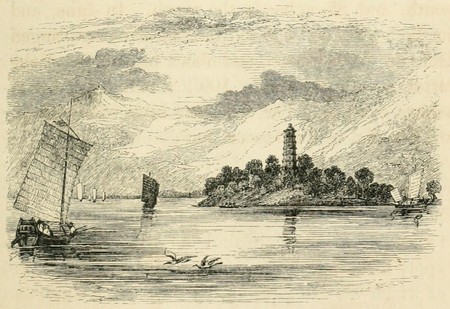
Pagoda Island, on the River Min.
ENGAGE A PASSAGE IN A JUNK.—LEAVE THE DISTRICT OF THE
MIN.—AN ATTACK OF FEVER.—RELIGIOUS CEREMONIES ON
BOARD THE JUNK.—ATTACKED BY PIRATES.—SCENE ON
BOARD.—COWARDICE OF THE CHINESE.—PIRATES BEAT OFF.—GRATITUDE
OF THE CREW.—A SAFE ANCHORAGE!—ANOTHER
FLEET OF PIRATES.—ATTACK AND RESULTS.—ARRIVE
AT CHUSAN.—INGRATITUDE OF THE CREW.—MODE OF
MAKING THEM KEEP THEIR WORD.—KINDNESS OF FOREIGN
RESIDENTS AT SHANGHAE.—LARGE PEACHES.—COLLECTIONS
PACKED.—LEAVE THE NORTH OF CHINA.—SAIL FOR ENGLAND.—ARRIVAL
IN THE THAMES.—CONCLUSION.
At the time when I visited Foo-chow-foo, although
it was open to the English as a place of trade and
had a British Consul, it was little known in a mercantile
point of view. The entrance to the river
Min was described as extremely difficult and dangerous,
and, consequently, few foreign vessels ventured
to touch at this port. When, therefore, my
botanical researches were completed, and I was ready
to return north to Shanghae, I was obliged to
apply for a passage in a Chinese junk, a whole fleet
of which were to sail in a few days for Ningpo and
Chapoo. Knowing the dislike and jealousy which
most of the natives manifest towards foreigners, I
had some doubt whether I should be able to induce
them to take me as a passenger, and, in that event,
I had determined to go down to the mouth of the
river, and, "sans cérémonie," get on board, whether
they consented or not. I was, therefore, agreeably
surprised, when, on sending my servant to make
inquiries as to the time when they were likely to
sail, he returned, bringing with him the captain and
some of the sailors, who were all not only willing,
but most anxious, that I should go with them.
The principal part of the cargo carried by the
Ningpo and Chapoo junks is wood. This is stowed
on deck, and also lashed firmly to the gunwales and
sides with large ropes of bamboo which are of great
strength. Several hundreds of these vessels may
be seen loading at the port of Foo-chow-foo, particularly
in the summer season, when the monsoon is
fair for their voyage home. The mandarins are
extremely jealous of so large a fleet, and will not
allow them to carry guns, even for their own defence;
evidently fearing that some day or other these
might be turned against the government. The consequence
of this regulation is, that these poor sailors
and all they possess on board often fall an easy
prey to the pirates who abound all along this coast.
When the cargo was completed, the captain of
the junk came to inform me that he was ready to
start, and requested me to come on board. Whilst
I was packing up my luggage, he began to examine
my fire-arms very minutely, and said to me, "I
hope your gun is a good one, and that you have
plenty of powder and shot?" "What is your
reason for putting this question?" said I: "I am
sure we shall have nothing to shoot in our voyage
up the coast." "Oh yes, you will," answered he;
"we are very likely to be attacked by the Jan-dous,
who swarm outside amongst the islands." "Who
are the Jan-dous?" said I, to my servant, never
having heard the name before. "Oh! they are
pirates," said he, "and we are all very much frightened
at them." "Nonsense!" I exclaimed: "no
pirates will attack us; and if they do, they will
repent it." At this time I had no idea that the
coast was so infested with these lawless characters,
and I put it all down to the cowardice of my
informants.
As soon as I got on board, we hove up the anchor
and dropped down to the mouth of the Min. We
here found a large fleet of junks—about one
hundred and seventy sail—all, like ourselves,
loaded with wood, and ready to start for the
northern parts of Ningpo and Chapoo. That
evening a meeting of the captains was held on
board of our vessel, and a deputation appointed to
wait upon the mandarins to request them to send
a convoy of war junks to protect the fleet from the
pirates. These negotiations were carried on for
several days; but the demands of the mandarins
were so exorbitant, that the junk people would
not comply with them, and it was at last determined
to sail without the convoy. Just as they
came to this decision, the wind changed and blew a
gale from the north for three days, when it veered
round to the south, and blew nearly as strong
from that quarter, and for the same space of time.
These vessels never go to sea in stormy weather,
even if the wind is fair; and, what with gales of
wind and negotiations with mandarins, I was
obliged to content myself with a junk life for a
fortnight at the mouth of the river.
As long as I enjoyed health I got on well enough;
but the exposure during the past summer, particularly
at Foo-chow-foo, had gradually undermined
my constitution; and the fever, which was probably
kept off for a certain time by bodily exertion,
now seized me, and compelled me to take to my
cot, where I lay for a number of days insensible at
intervals. At times, when consciousness returned,
I certainly thought that my travels were drawing
to a close, and that my grave would be a lonely
one on the banks of the Min. It seemed hard for
me to die in a land of strangers, without a friend
or countryman to close my eyes, or follow me to
my last resting-place; and home, friends, and country,
how doubly dear did they seem to me then!
The wind having been fair for several days, and
the weather appearing settled, the captain of the
junk came down to the place where I lay, and told
me they intended to sail on the following morning.
He again inquired if I had my gun and pistols in
proper order, and plenty of powder and ball. Still
imagining that they were exaggerating the dangers
of the voyage, I laughed, and said, "Do not be
afraid; I have every thing in order, and I will undertake
to beat off any pirates who may attack us."
Nevertheless, I clearly saw that both captain and
sailors were really uneasy about the voyage, and
would have been very glad of another gale to
afford a pretext for deferring it a little longer.
They had, however, no further excuse for delay,
and it was settled that the whole fleet should sail
early the next day.
The Chinese sailor never goes to sea without
first presenting an offering to the gods to propitiate
them, in order that the voyage may be a speedy
and successful one. Accordingly, on this day the
cabin of our junk was set in order, and the tables
covered with dishes of pork, mutton, fruits, and vegetables.
Candles and incense were burned upon
the tables for a short time, and the whole business
had something solemn and imposing about it. The
cook, who seemed to be the high priest, conducted
all the ceremonies. On other days, as well as this,
it was part of his duty to light the candles in the
little temple where the gods were kept, as well as to
burn incense and prostrate himself before them.
Early on the following morning, the whole fleet
was in motion, starting altogether for the sake of
mutual protection. The wind and tide were both
fair, and we proceeded along the coast with great
rapidity, and were soon out of sight of the Min and
its beautiful and romantic scenery. The plan of
mutual protection soon seemed to be abandoned,
and the vessels separated into threes and fours,
each getting on as well and as fast as it could.
About four o'clock in the afternoon, and when we
were some, fifty or sixty miles from the Min, the
captain and pilot came hurriedly down to my cabin
and informed me that they saw a number of Jan-dous,
right ahead, lying in wait for us. I ridiculed the
idea, and told them that they imagined every junk
they saw to be a pirate; but they still maintained
that they were so, and I therefore considered it
prudent to be prepared for the worst. I got out of
bed, ill and feverish as I was, and carefully examined
my fire-arms, clearing the nipples of my
gun and pistols and putting on fresh caps. I also
rammed down a ball upon the top of each charge
of shot in my gun, put a pistol in each side-pocket,
and patiently waited for the result. By the aid of
a small pocket-telescope, I could see as the nearest
junk approached that her deck was crowded with
men; I then had no longer any doubts regarding
her intentions. The pilot, an intelligent old man,
now came up to me, and said that he thought resistance
was of no use; I might manage to beat off
one junk, or even two, but that I had no chance
with five of them. Being at that time in no mood
to take advice or be dictated to by any one, I ordered
him off to look after his own duty. I knew
perfectly well, that if we were taken by the pirates I
had not the slightest chance of escape; for the first
thing they would do would be to knock me on the
head and throw me overboard, as they would deem
it dangerous to themselves were I to get away. At
the same time I must confess I had little hopes of
being able to beat off such a number, and devoutly
wished myself anywhere rather than where I was.
The scene around me was a strange one. The
captain, pilot, and one or two native passengers
were taking up the boards of the cabin-floor, and
putting their money and other valuables out of sight
amongst the ballast. The common sailors, too, had
their copper cash, or "tsien" to hide; and the
whole place was in a state of bustle and confusion.
When all their more valuable property was hidden,
they began to make some preparations for defence.
Baskets of small stones were brought up from the
hold, and emptied out on the most convenient parts
of the deck, and were intended to be used instead
of fire-arms when the pirates came to close quarters.
This is a common mode of defence in various parts
of China, and is effectual enough when the enemy
has only similar weapons to bring against them;
but on the coast of Fokien, where we were now, all
the pirate junks carried guns, and consequently a
whole deck-load of stones could be of very little
use against them.
During the general bustle I missed my own
servant for a short time. When he returned to
me, he had made such a change in his appearance
that I did not recognise him. He was literally
clothed in rags, which he had borrowed from the
sailors, all of whom had also put on their very
worst clothes. When I asked him the reason of
this change in his outward man, he told me that
the pirates only made those persons prisoners who
had money, and were likely to pay handsomely for
their ransom; and that they would not think it
worth their while to lay hold of a man in rags.
I was surrounded by several of the crew, who
might well be called "Job's comforters," some
suggesting one thing, and some another; and
many proposed that we should bring the junk
round and run back to the Min. The nearest pirate
was now within 200 or 300 yards of us, and,
putting her helm down, gave us a broadside from
her guns. All was now dismay and consternation
on board our junk, and every man ran below
except two who were at the helm. I expected
every moment that these also would leave their
post; and then we should have been an easy prey
to the pirates. "My gun is nearer you than those
of the Jan-dous," said I to the two men; "and
if you move from the helm, depend upon it I will
shoot you." The poor fellows looked very uncomfortable,
but I suppose thought they had better
stand the fire of the pirates than mine, and kept
at their post. Large boards, heaps of old clothes,
mats, and things of that sort which were at hand,
were thrown up to protect us from the shot; and
as we had every stitch of sail set, and a fair wind,
we were going through the water at the rate of
seven or eight miles an hour.
The shot from the pirates fell considerably short
of us, and I was therefore enabled to form an
opinion of the range and power of their guns,
which was of some use to me. Assistance from
our cowardly crew was quite out of the question,
for there was not a man amongst them brave
enough to use the stones which had been brought
on deck; and which, perhaps, might have been of
some little use when the pirates came nearer. The
fair wind and all the press of sail which we had
crowded on the junk proved of no use; for our
pursuers, who had much faster-sailing vessels,
were gaining rapidly upon us. Again the nearest
pirate fired upon us. The shot this time fell just
under our stem. I still remained quiet, as I had
determined not to fire a single shot until I was
quite certain my gun would take effect. The
third broadside, which followed this, came whizzing
over our heads and through the sails, without,
however, wounding either the men at the helm or
myself.
The pirates now seemed quite sure of their prize,
and came down upon us hooting and yelling like
demons, at the same time loading their guns, and
evidently determined not to spare their shot. This
was a moment of intense interest. The plan which I
had formed from the first was now about to be put to
the proof; and if the pirates were not the cowards
which I believed them to be, nothing could save us
from falling into their hands. Their fearful yells
seem to be ringing in my ears even now, after this
lapse of time, and when I am on the other side of
the globe.
The nearest junk was now within thirty yards
of ours; their guns were now loaded, and I knew
that the next discharge would completely rake our
decks. "Now," said I to our helmsmen, "keep
your eyes fixed on me, and the moment you see me
fall flat on the deck you must do the same, or you
will be shot." I knew that the pirate, who was
now on our stern, could not bring his guns to bear
upon us without putting his helm down and
bringing his gangway at right angles with our
stern, as his guns were fired from the gangway.
I therefore kept a sharp eye upon his helmsman,
and the moment I saw him putting the helm down
I ordered our steersmen to fall flat on their faces
behind some wood, and at the same moment did so
myself. We had scarcely done so, when bang!
bang! went their guns, and the shot came whizzing
close over us, splintering the wood about us in all
directions. Fortunately none of us were struck.
"Now, mandarin, now! they are quite close
enough," cried out my companions, who did not
wish to have another broadside like the last. I,
being of the same opinion, raised myself above the
high stern of our junk; and while the pirates were
not more than twenty yards from us, hooting and
yelling, I raked their decks fore and aft, with shot
and ball from my double-barrelled gun.
Had a thunder-bolt fallen amongst them, they
could not have been more surprised. Doubtless,
many were wounded, and probably some killed.
At all events, the whole of the crew, not fewer than
forty or fifty men, who, a moment before, crowded
the deck, disappeared in a marvellous manner;
sheltering themselves behind the bulwarks, or
lying flat on their faces. They were so completely
taken by surprise, that their junk was left without
a helmsman; her sails flapped in the wind; and, as
we were still carrying all sail and keeping on our
right course, they were soon left a considerable
way astern.
Another was now bearing down upon us as
boldly as his companion had done, and commenced
firing in the same manner. Having been so successful
with the first, I determined to follow the
same plan with this one, and to pay no attention to
his firing until he should come to close quarters.
The plot now began to thicken; for the first junk
had gathered way again, and was following in our
wake, although keeping at a respectful distance;
and three others, although still further distant,
were making for the scene of action as fast as they
could. In the mean time, the second was almost
alongside, and continued giving us a broadside
now and then with their guns. Watching their
helm as before, we sheltered ourselves as well as
we could; at the same time, my poor fellows who
were steering kept begging and praying that I
would fire into our pursuers as soon as possible, or
we should be all killed. As soon as they came
within twenty or thirty yards of us, I gave them
the contents of both barrels, raking their decks as
before. This time the helmsman fell, and doubtless
several others were wounded. In a minute or two
I could see nothing but boards and shields, which
were held up by the pirates to protect themselves
from my firing; their junk went up into the wind
for want of a helmsman, and was soon left some
distance behind us.
While I was watching this vessel, our men called
out to me that there was another close on our lee-bow,
which I had not observed on account of our
main-sail. Luckily, however, it proved to be a
Ningpo wood junk like ourselves, which the pirates
had taken a short time before, but which, although
manned by these rascals, could do us no harm,
having no guns. The poor Ningpo crew, whom I
could plainly see on board, seemed to be very much
down-hearted and frightened. I was afterwards
informed that, when a junk is captured, all the
principal people, such as the captain, pilot, and
passengers, are taken out of her, and a number of
the pirates go on board and take her into some of
their dens amongst the islands, and keep her there
until a heavy ransom is paid, both for the junk and
the people. Sometimes, when a ransom cannot be
obtained, the masts and spars and every thing else
which is of any value are taken out of her, and she
is set on fire.
Two other piratical junks which had been following
in our wake for some time, when they saw
what had happened, would not venture any nearer;
and at last, much to my satisfaction, the whole set
of them bore away.
Now was the time for my heroical companions
to come from their hiding-place, which they did
with great alacrity, hooting and yelling as the
pirates had done before, and, in derision, calling
on them to come back and renew the fight. The
stones, too, were now boldly seized and thrown
after the retreating junks, reaching to almost a
tenth part of the distance; and a stranger who had
not seen these gentry before would have supposed
them the bravest men in existence. Fortunately
the pirates did not think proper to accept the challenge.
With the captain, pilot, crew, and passengers,
I was now one of the greatest and best of men in
existence. They actually came and knelt before
me, as to some superior being, and expressed their
deep and lasting gratitude, which, however, did
not last long. The sun was now setting, in all his
glory, behind the hills of Fokien, and many of the
more devout amongst the passengers and crew did
not fail to bow low in adoration and thankfulness
to this supposed deity for their escape out of the
hands of the pirates. Shortly after nightfall we
arrived at one of the safe anchorages, where the
mandarins are too strong for the lawless bands
which infest the other parts of the coast.
On the following morning we again got under
weigh, and proceeded the whole day without
molestation. In the evening we arrived at another
safe anchorage, or place of rendezvous; but the
security at this place consisted in the number and
strength of the junks actually at anchor there, and
not in the fear which the pirates entertained for
the government. When we reached this place the
night was fine, and, as it was nearly full moon, it
was almost as light as clay. The tide too was just
turning in our favour; and as I was most anxious
to proceed on our voyage, I did every thing in my
power to induce them to go on. It was of no use,
however; for as soon as we reached the anchorage,
and found a large fleet of junks, the anchor was
dropped, and they determined to stay there all
night. I felt very much annoyed, but saw it was
no use to grumble, and went quietly to bed. In
less than an hour from this time, and before I had
fallen asleep, hearing a stir upon deck, I inquired
what was the cause, and found that we were getting
under weigh. This was agreeable news; but as I
could not imagine what had caused them to change
their minds so soon, I went upon deck to see what
was going on. Our people, it appeared, had gone
to sleep the moment our anchor was down; shortly
after this, the other junks, which, it turned out,
were only waiting for the rise of the tide to enter
some river in the vicinity, had all weighed anchor
and gone off. All on board were now in great consternation,
lest the pirates should come down upon
us whilst at anchor, and no time was lost in getting
it up and proceeding on our voyage, much, of
course, to my satisfaction.
On the following day, late in the afternoon,
when I was laid up in my bed with fever, the
captain came hurriedly down, and informed me
that another fleet of pirates were in sight, and
evidently lying in wait for us. I was obliged to
get up, ill as I was; and when I got on deck I
could see, by the aid of my telescope, six junks
coming out from amongst the islands under the
main land, and evidently bearing down towards
us. This time I was not so sceptical as the last.
After having once seen these rascally vessels, there
was no mistaking others of the same class, as they
came sneaking out of the bays. Their clipper-built
hulls, the cut of their sails, their raking masts,
and the crowd of fellows who lined their decks, all
told the business they were after. It was therefore
evident that we must prepare for another
encounter.
It now struck me that perhaps I might be able
to deceive the pirates with regard to our strength,
as I was afraid that I might not again be so successful
with them, particularly if they found out
that there was only one foreigner on board: knowing
that they have a great dread of foreigners and
their guns, my object was to make them believe
that there were a number of us, and that we were
well armed. For this purpose I got up all the
spare clothes I had, and put them on the least
Chinese-looking Chinamen on board. At the same
time I desired them to collect all the short levers
which they use for hoisting their sails, and which
at a distance would look not unlike fire-arms, particularly
if the deception was assisted by the report
of a double-barreled gun. Every thing looked
promising, and I thought my recruits were likely
to be of some service to me; but when the nearest
pirate, who had been coming fast down upon us,
gave us a broadside, it was too much for my
Chinamen, who were instantly panic-struck, threw
down their arms, and ran below; and, added to
this, I had again to threaten the men at the helm,
who seemed half inclined to follow the example of
the others: so I now prepared for the worst.
The pirates came on, firing at intervals as the
others had done, and I followed my former plan of
watching their movements until they were near
enough for my gun to tell upon them with fearful
precision. Their shot was now flying about our
ears and riddling our sails, and they came on in
their usual noisy manner, perfectly unconscious of
what I had in store for their reception. For the
last time the helm of the nearest junk was put
down, when we instantly fell flat on our faces and
allowed the shot to pass over us. As soon as their
last gun was fired, and before they had time to
load again, I poured the contents of my gun
amongst them fore and aft, raking the deck as I
had done before. This took them completely by
surprise; and as we were still under a heavy press
of sail, we were soon a considerable way ahead of
them. Two others of the fleet came up and fired
some shots at us; but the whole of them evidently
imagined that a number of foreigners were on board
of our junk, a belief which doubtless had a great
deal to do with the success which attended my
efforts. At length, darkness coming on, they gave
up the pursuit and bore away from us, and in two
hours more we arrived at a safe anchorage. The
fever, which I had scarcely felt during all this excitement,
now returned with greater violence, and
I was heartily glad to go below and turn into my
bed.
During the night I heard a great noise on board,
but was too feverish and weak to make any inquiries
as to the cause. In the morning my
servant informed me that it was occasioned by the
arrival of three junks during the night, which had
been chased to the entrance of the harbour by the
pirates; there had, he said, originally been four in
company, but one of them had been taken.
The sailors on board these junks had not been so
fortunate as we had been, for several of them were
severely wounded, and I was now asked to extract
the balls. The wounds were large and ragged,
owing to the iron shot which the Chinese use in
their guns. I advised the wounded men to hurry
on to Chusan, where they would get good medical
advice.
Up to nine o'clock in the morning, although the
wind and tide were both favourable, there were no
signs of the junks getting under weigh; I therefore
sent for the captain, and inquired if it was not his
intention to proceed. He told me that he had had
a meeting with the captains of the other vessels,
and that they had determined to get a convoy of
war junks from the mandarin before they went on.
Being now within eighty or ninety miles of Chusan,
I could easily hire a small boat for that distance,
and therefore said to the captain, "Very well, then
I shall leave you here, as I am very unwell, and
anxious to get to Chusan as soon as possible."
"Go," said I, turning to my servant, "and engage
a boat to take me on to Chusan, and bring it here
as soon as you can." When he was about to leave
the vessel, several of the crew gathered round him
and attempted to persuade him not to go. Anxious
to serve his countrymen, although at my expense,
he loitered about for a little while, and then came
back and informed me that it was no use going on
shore, as I should not be able to engage a boat to
take me so far. As I had been informed, by one
of the shore people who had come on board, that
plenty of boats were to be had on hire, I felt annoyed
at his deceit, and threatened to punish him
if he did not start immediately and bring a boat off.
When he saw that I was determined, he turned
sulkily away, jumped into a sand-pan, and procured
a boat without the slightest difficulty. The
captain and crew now crowded round me, begging
me not to leave them, and offering to get up their
anchor and proceed at once. Although my destination
was Chusan, I had taken my passage for
Ningpo, as all the wood junks were bound either
for that port or Chapoo. On their now begging me
to stay, I told them that unless they would sail into
Chusan harbour and leave me there as they passed,
I would proceed in the small boat, as I was anxious
to get there as soon as possible, in order to obtain
medicine and advice. "Oh," said they, "if you
will only go with us, we will run into Chusan
harbour and leave you there before we cross over
to Ningpo." Upon this assurance I agreed to accompany
them.
The captains of the other junks now came to me
and asked me if I would undertake to protect them
all from the attacks of the pirates; as, if so, they
would get under weigh and go with us also. Upon
my telling them that I could not undertake to do
this, they told me that they must wait until some
arrangement could be made with the mandarins,
as they were afraid to proceed alone. We therefore
left them at anchor, and proceeded on our voyage.
During the day we frequently saw suspicious-looking
craft, which were pronounced by the crew
to be Jan-dous; but none of them were near
enough to attack us. Late in the afternoon, as
we approached Keto-point—a promontory of the
main-land near Chusan—we met a large fleet
of merchant junks sailing together for mutual protection
on their way down. Some of them came
alongside us, and made anxious inquiries regarding
the Jan-dous, and how many of them they might
expect to meet with. Our people did not fail to
give them an exaggerated account of the number
we had seen and fought with, and the news did
not appear greatly to delight them. During the
night the tide turned against us; and as the wind,
although fair, was light, we were obliged to anchor
until morning.
When I went on deck at daylight the following
morning, I found we were just under Keto-point,
and only a few miles from Chusan harbour. The
land was well known to me, having been frequently
there before. It was the most welcome sight
which had met my eyes for many a long day; and
I was thankful indeed to the Almighty for my
escape from the pirates.
Whilst the men were heaving up the anchor,
my old friends the captain and pilot came below,
bolder and in much better spirits than heretofore,
and informed me, with the greatest coolness, that
they had changed their minds about going into
the harbour of Chusan; and that I must go over
with them to Ningpo, from whence I could easily
return in a small boat for Chusan. I felt very
much nettled at this conduct, which, considering
that I had saved their junk from being taken by
the pirates on two different occasions, was most
ungrateful. I reproached them with this ingratitude,
telling them that, as they were now safe from
the Jan-dous, they imagined that they could do
with me just as they pleased. "But you never deceived
yourselves more," added I: "you may show
as much ingratitude as you please; but I shall
take care that you fulfil the promise you made to
me yesterday, and take me into the harbour of
Chusan before you go over to Ningpo. Look
here: you see this gun and these pistols; they
are all loaded: you know what effects they produced
upon the Jan-dous; take care they are not
turned against yourselves. Englishmen never allow
promises which have been made to them to be
broken with impunity. I know the way into
Chusan harbour as well as you do, and when the
anchor is up I shall stand at the helm; and if the
pilot attempts to steer for Ningpo, he must take
the consequence." This threat had the desired
effect; and the trembling varlets landed me safely
at Chusan in the course of the forenoon.
What with the fever and the excitement of the
last few days, I was in a most deplorable condition
when I reached Chusan; but as the greater part of
my collections were in the country near Shanghae,
I was most anxious to ascertain in what state they
were; and, finding an English vessel about to sail
for the Yang-tse-Kiang, I immediately crawled on
board, and, having a fair wind, we soon reached our
destination. I was kindly received by my friend
Mr. Mackenzie, and under the skilful treatment of
Dr. Kirk, the fever gradually left me.
Amongst the more important of the acquisitions
which I made in the vicinity of Shanghae, I
must not forget to mention a fine and large variety
of peach, which comes into the markets there about
the middle of August, and remains in perfection
for about ten days. It is grown in the peach
orchards, a few miles to the south of the city; and
it is quite a usual thing to see peaches of this
variety eleven inches in circumference and twelve
ounces in weight. This is, probably, what some
writers call the Peking peach, about which such
exaggerated stories have been told. Trees of the
Shanghae variety are now in the garden of the
Horticultural Society of London.
The whole of my plants from the districts of
Foo-chow-foo, Chusan, and Ningpo, being brought
together at Shanghae, I got them packed, and, on
the 10th of October, left the north of China for
Hong-kong and England. As I went down the
river, I could not but look around me with pride
and satisfaction; for in this part of the country
I had found the finest plants in my collections. It
is only the patient botanical collector, the object
of whose unintermitted labour is the introduction
of the more valuable trees and shrubs of other
countries into his own, who can appreciate what I
then felt.
When we arrived at Hong-kong, I divided my
collections, and despatched eight glazed cases of
living plants for England: the duplicates of these
and many others I reserved to take home under
my own care. I then went up to Canton, and took
my passage for London in the ship "John Cooper."
Eighteen glazed cases, filled with the most beautiful
plants of northern China, were placed upon
the poop of the ship, and we sailed on the 22d of
December. After a long but favourable voyage,
we anchored in the Thames, on the 6th of May,
1846. The plants arrived in excellent order, and
were immediately conveyed to the garden of the
Horticultural Society at Chiswick. Already, many
of those which I first imported have found their
way to the principal gardens in Europe; and at
the present time (October 20, 1846), the Anemone
japonica is in full bloom in the garden of the Society
at Chiswick, as luxuriant and beautiful as it
ever grew on the graves of the Chinese, near the
ramparts of Shanghae.
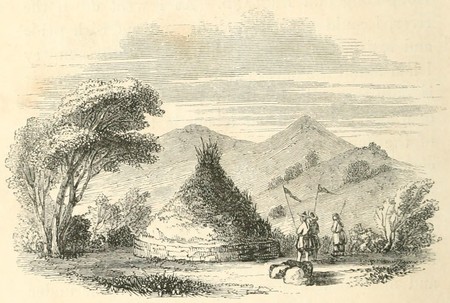
Anemone on the Tombs.
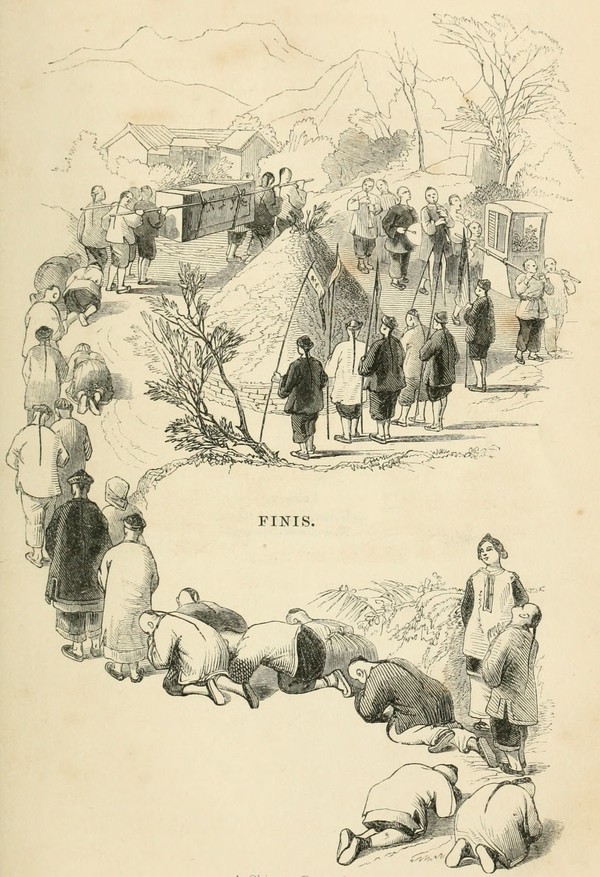
A Chinese Funeral.
London:
Spottiswoode and Shaw,
New-street-Square.