Captain Buchanan has done me the honour
of asking me to write a short preface to a work
which seems to me at all events of peculiar
interest. To write a preface is a difficult task,
unless one has some real raison d’être for the
task; yet I find it difficult to refuse, if only
for my intense admiration for the part played
by the battalion with which the author was
so long and honourably associated—the 25th
Royal Fusiliers.
The author’s qualifications to write this
work are undoubted, not only from his stout
record as a soldier, but also through his previous
experience as a traveller, explorer, and student
of Natural History. When war broke out
Captain Buchanan was engaged on behalf of
the Provincial Government of Saskatchewan,
Canada, in investigating the country in the
far north, west of Hudson Bay, and studying
and collecting the rarer flora and fauna. He
had been for nearly a year many hundreds of
miles out of touch with any other white man.
The first rumour of war did not reach him
until the end of October, when he at once
struck south to a Hudson Bay Fort, which he
reached at Christmas. Without delay he left
to join up, and in but a month or two had
changed his habitat from almost the Arctic
Circle to the Equator.
Readers will be able to follow the fortunes of
that wonderful unit, the 25th Royal Fusiliers,
through the campaign, and will perhaps gain
thereby an insight into this strangest of all
side-shows more true and illuminating than
a more comprehensive work. There was little
that this old Legion of Frontiersmen missed.
Comparisons are odious; yet I think it may
safely be said that no other white unit took
so full a part in the diverse stages of the
campaign. They bore the long and arduous
months of frontier and railway guarding in
1915. They took no mean share in the spectacular
capture of Bukoba. Their mounted
infantry as well as ordinary rank and file, took
part in many of the small but intensely trying
patrols through the thorny scrub along the
Serengeti plains. General Smuts’s operations
around Kilimanjaro saw them. Right to the
fore were they in the long and tiring treks,
varied by frequent and fierce rear-guard actions,
which took place down the Pangani and
southward through the bush and forests to
the capture of Morogoro; and onwards again
right down to the Rufiji. They bore that
cruelly hard period through the rains of 1916,
when they held the Mgeta line against a
numerically superior foe, living literally in a
swamp for months, riddled through and through
with fever. In January, 1917, when General
Smuts made his final effort to crush the opposition,
Colonel Driscoll and his men were
right in the van, and here among others they
lost Captain Selous, that great hunter and
greater English gentleman. After a brief
period in the south we find them back in time
for the final stages of the campaign. Here
they went in from Lindi to take part in the
fighting of 1917, fighting so bitter that all the
previous work was but as child’s play in
comparison. Lest it seem that I exaggerate,
let me say that, with a force of about half the
size, the casualties during these last four
months were three times as great as those
throughout the whole previous two years.
There was indeed hardly an action in which
the battalion did not take part, until that
day on the 18th of October, 1917, when, while
covering a temporary retirement, they were
overwhelmed by immensely superior numbers
and cut to pieces.
The author does not harp overmuch on the
sickness and privations of his comrades—he
has been through too many of them to do so;
but I am reminded of the remark of one of
them during the not infrequent periods of
grousing which every respectable British
soldier must have. “Ah, I wish to h⸺ I was
in France! There one lives like a gentleman
and dies like a man, here one lives like a pig
and dies like a dog.” There may have been
something in this remark, yet I have thought
as I saw the 25th staggering on, absolutely in
rags, many with fever actually on them,
nearly all emaciated and staring-eyed, that
they were living, if not like gentlemen, at all
events like Men.
There is one point of view that I would like
to put before readers in estimating the debt
that those of us who live in Africa owe to these
men—and that is this: when once the coastal
belt was reached, and after the departure of
General Smuts and practically all his South
African fighting troops, it became apparent
that European infantry, generally speaking,
could no longer compete on even terms with
the native soldier. The handicap of climate
became too great. The European could no
longer stand marching under a load, and
more than that, the continual fever and sun
sapped the “essential guts,” so that it became
almost impossible for white troops to meet
the German-African troops—led, of course,
by trained and well-fed German officers and
N.C.O.s—with any fair prospect of success.
Such a fact boded ill for the future prestige
of the white race. Yet it may be said that
the Fusiliers soared triumphant even over
this handicap; and they can boast, without
fear of contradiction, that up to the very end
no German field company would look with
other than apprehension to meeting the 25th
on even terms. I have always felt that the
prowess and endurance of these fine men during
these last months have done more to uphold
our prestige and ensure the firm future of our
rule than is likely to be adequately realised.
An estimate of the campaign as a whole is
scarcely yet possible. It will probably be
years before a just view can be taken of a
side-show that is believed to have cost more
money and many more lives than the whole
of the South African Campaign. Many mistakes
were made, and it is more than possible
that the lion’s share of what credit posterity
may have to bestow will fall on Von Lettow
and his comrades. Yet there were many
factors which caused the task which Generals
Tighe, Smuts, Hoskins, and Van Deventer
did eventually accomplish, to be of almost
unparalleled difficulty.
The question asked very often, and one
which is likely to be of interest to posterity,
is: How were the Germans able to prolong
their resistance and, in fine, to make such a
determined struggle against our very superior
forces? In answer the following points seem
to merit consideration.
In the first place the enemy had in the
person of Colonel Von Lettow an outstanding
personality, and a soldier whose merit it is
hard to over-estimate. It will, moreover, always
form one bright spot on the blackened
German escutcheon that in his operations
during the campaign, personally speaking, his
conduct was as clean as it was efficient.
When war broke out the local military
position was overwhelmingly in favour of the
Germans. They had ready, at a conservative
estimate, 2,000 to 3,000 trained whites and
8,000 native troops, with some 70 machine-guns
and 40 guns. Against this we, on our
side, had in British East Africa about 700
native soldiers and 2 machine-guns, one of
which was out of action, and not more than
100 whites with any military experience at
all. This force might possibly have been
duplicated in Nyasaland. With this early
crushing superiority it is obvious that expansion
on the one side was easy—on the other a
matter of extraordinary difficulty.
In connection with this point it must also be
borne in mind that in British East Africa the
natives are for the very large part, not soldiers,
but agriculturists by nature; whereas German
East Africa teems with natives who form
as fine material for soldiers as any in the
world. This point is always worth remembering
since, because of it, while Germany held
German East Africa, she was a potential
menace to the whole continent.
Unity of command again was with the
Germans to a striking degree. For on our side
was ever command so divided? Our main
force working from East Africa contained
troops from almost every portion of the globe,
speaking different tongues, having different
habits, eating different foods, fighting in different
ways. From Nyasaland and Rhodesia,
General Northey with his small force brilliantly
fought his way into the enemy’s country, for
long not only not under our Commander-in-Chief,
but not even administered by the War
Office. From the west our most gallant Allies
the Belgians pushed forward to Tabora, and
later worked in direct co-operation into the
very heart of the enemy’s country. On the
south there were the Portuguese.
The advantages which the Germans had
over us in this matter were worth many
thousands of rifles.
It is certainly undeniable that after the first
eighteen months our combined force largely
outnumbered our adversaries. Yet at his
strongest Von Lettow probably mustered 25,000
to 30,000 rifles, all fighting troops. A not
inconsiderable army on the basis that we, on
our side, had to estimate that it took four to
five soldiers to get one fighting man into the
firing line.
It will naturally be assumed that at all
events in the matter of equipment and arms
we had the advantage, but until the very latest
stages it may be doubted if this was so. Two
incidents will illustrate this. During the latter
part of 1916 a German prisoner, being taken
past a spot where some of our artillery units,
which shall be nameless, were parked, remarked,
“the movable armament from the
Ark, I should imagine!” And, indeed, his
naval guns, his 42-in. howitzers, and quick-firing
mountain guns were far ahead of anything in
our possession. Again, late in 1917, a German
doctor came in to demand back one of his
medical panniers abandoned on the field. We
returned it with reluctance, as it was a very
fine set, the latest model in 1914. However,
in response to repeated and urgent indents
and “hasteners,” new equipment for our own
medical department was that moment arriving.
It was far in advance of anything we had seen on
our side, but was plainly marked 1906. I shall
not soon forget the sneer on that doctor’s face.
It is true that twice in the campaign the
Germans were on short commons in the matter
of small-arm ammunition, in spite of their
enormous pre-war accumulation, but in each
case, most unfortunately, a blockade runner
relieved the situation. Later on, unfortunate
captures prevented a shortage which would
have appeared inevitable.
Again, the Germans worked throughout on
interior lines and were able, for the most part,
to choose the areas in which their resistance
would be stiffest. Such spots were naturally
where they would gain the fullest advantage
from their knowledge of the country, and
where the evil climate would exact the most
murderous toll from our white and Indian
troops. These considerations should, I think,
be borne in mind by those who feel, as many
must, that the cost in blood and money was
altogether in excess of the results obtained.
In any case it is to our credit that having put
hand to the plough we did not turn back. It
is for those who in the future will reap the
benefit to see that the worthiest use is made
of the vast country which the efforts of those
who have fallen have placed in our hands.
The wild animal and bird life encountered
throughout the campaign formed a most distinctive
feature. This especially applies to
the last stages, when the fighting in the south-east
corner of the Colony was conducted in
territory almost virgin to the naturalist. This
applies equally to the insects both large and
small, which in many cases were as unpleasant
as they were intrusive. Captain Buchanan is
well qualified to discourse on these subjects,
and his observant notes are most instructive.
Let us hope that some day he may find an
opportunity of renewing his researches under
happier circumstances.
In conclusion of these few remarks let me
wish Captain Buchanan the utmost success
in putting his book before the public. If only
others read it with the same interest and
enjoyment with which it has filled me, I can
only think that the author’s work will not
have been in vain.
Cranworth.
PREFACE
In accomplishing the conquest of German
East Africa, many columns were put in the
field. Those had their starting-points from
the British East Africa frontier in the neighbourhood
of Kilimanjaro Mountain, from Lake
Victoria Nyanza, from the Belgian Congo,
from Rhodesia, and latterly from the East
Africa coast. To cover wide fronts of great
extent of country, the forces from each of
those bases advanced in their particular area
in two, three, or more columns. This narrative
deals directly with the operations of a
single column, but, as operations throughout
the columns were similar, it may be found, in
part, to be generally descriptive of much that
was experienced by all columns.
On actual operations in German East Africa—not
including the operations on the frontier
during 1915, nor the countless distances covered
on patrol—our unit marched some 850 miles
with the column, in the following stages:
Kilimanjaro area, 194 miles; to the Central
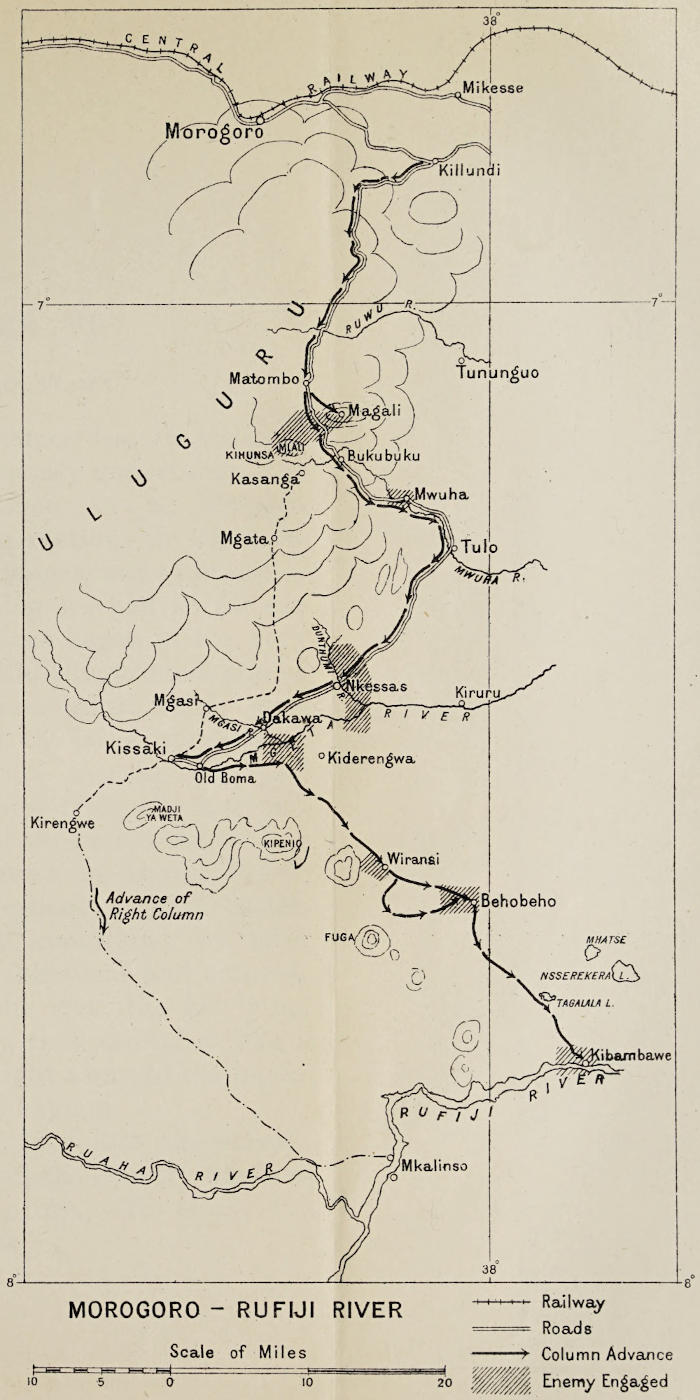
Railway, 335 miles; Morogoro-Rufiji area,
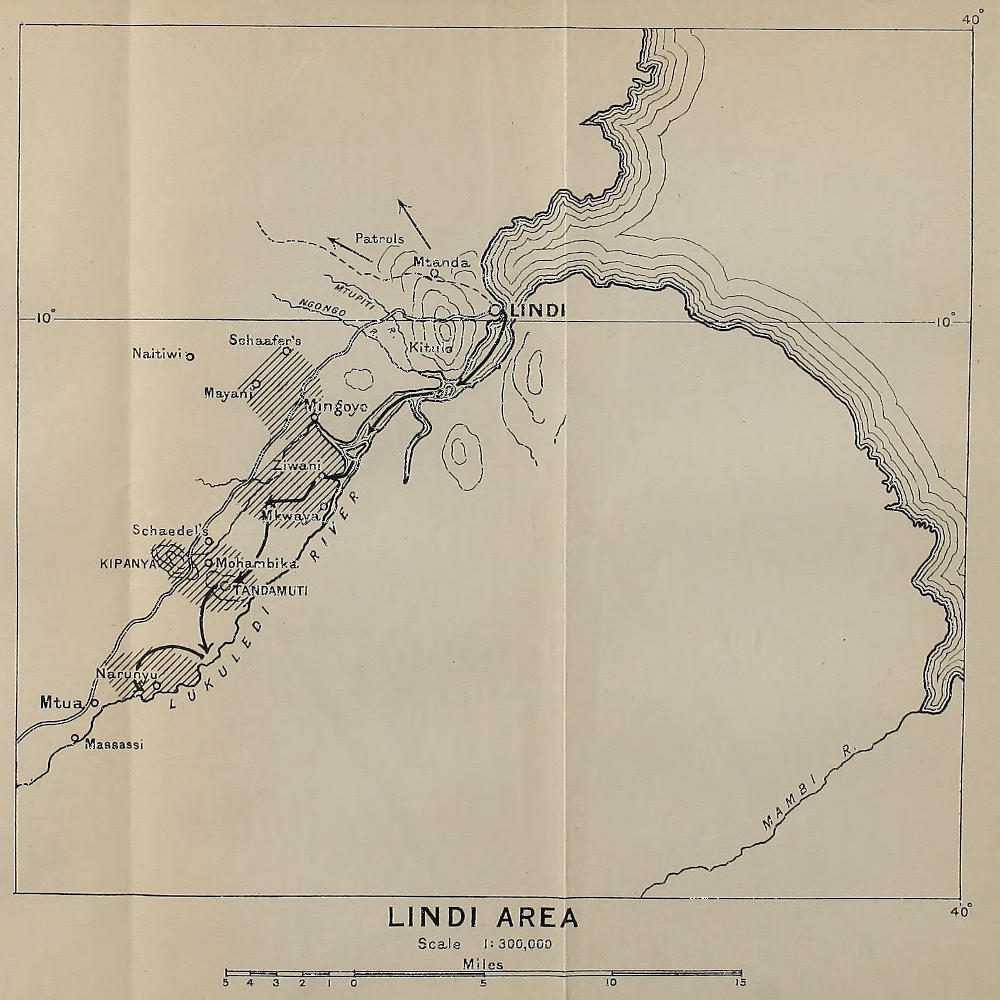
260 miles; and Lindi area (to date of my
departure), 61 miles. Those distances are not
direct to their objective as the crow flies,
for they had often a zigzag course, and sometimes
even doubled back to a fresh starting-point.
It has been my endeavour to include every
detail of experience, and, in doing so, I trust
that at some points I have not laid too much
stress on the hardships of the campaign. They
were all in the day’s work, and were taken
as such, no matter how irksome they were.
Of them General Smuts, in a dispatch of
27th October, 1916, said:
“Their work has been done under tropical
conditions which not only produce bodily
weariness and unfitness, but which create
mental languor and depression, and finally
appal the stoutest hearts. To march day by
day, and week by week, through the African
jungle or high grass, in which vision is limited
to a few yards, in which danger always lurks
near, but seldom becomes visible, even when
experienced, supplies a test to human nature
often, in the long run, beyond the limits of
human endurance.”
Little reference has been made in the narrative
to the number of our casualties, nor was
that possible. A recent casualty statement—at
the end of 1918—records the casualties of
the East African Campaign as: 380 officers
killed, 478 officers wounded, 8,724 other ranks
killed, 7,276 other ranks wounded, 38 officers
missing (including prisoners), and 929 other
ranks missing (including prisoners) = 896 officers,
16,929 other ranks.
This is the only statement of casualties I
have seen, and I give these figures with every
reservation, doubting the aggregate and its
completeness.
They will, however, suffice to show that
there is a remarkable percentage of killed,
and this may largely be put down to the
closeness of the fighting, and that at times
the attacking forces were advancing on entrenched
positions without protection of any
kind to themselves.
THREE YEARS OF WAR IN EAST AFRICA — CHAPTER I OUTWARD BOUND
It was raining in London. It had been
raining all day, and for many days previous,
and to-night the atmosphere of damp and
greyness pervaded the very soul of the city
outdoors.
FRONTIERSMEN AT WATERLOO
Number Seven platform, at Waterloo Station,
was crowded with troops and baggage,
about to depart for service with the B.E.F. in
East Africa. They had arrived at the station
at 6 p.m. At 11 p.m. they were still there
grouped about in talkative jollying clusters,
apparently indifferent to the delay in entraining.
Everyone knows this type of crowd nowadays,
but in this case, and as commonly with
men garbed in identical uniform, no one
could tell with any accuracy the remarkable
variety of character of the men, or the
extent of their notability. Joe Robson, who
was standing apart—a quiet onlooker—thought:
“It is almost a pity that the individual
loses his individuality in the army and
becomes a stranger in a strange crowd.”
What would that group of schoolboys say,
and the inquisitive idle crowd in general, if
they knew that here in the ranks, beneath
the guise of homogeneous khaki, were gathered
many men from all the world over? Men
who had come to fight for their native land
from Honolulu, Hong-Kong, China, Ceylon,
Malay States, India, New Zealand, Australia,
South and East Africa, Egypt, South America,
Mexico, United States of America, and Canada?
Men from the very outer edges of the world;
in Ogilvie’s words:
Lean men, brown men, men from overseas,
Men from all the outer world; shy and ill at ease.
Some were men who had taken part in
Arctic exploration; others were of the North-west
Mounted Police and of the British South
Africa Police; even a cowpuncher or two from
under the flag of the U.S.A. were amongst
this force of frontiersmen. And there were
among them: good sorts, bad sorts, rich sorts,
keen sorts, game sorts—all sorts!
Here also, holding the rank of subalterns,
were some famous hunters, setting out again
on adventure. F. C. Selous, the renowned
big-game hunter and naturalist and explorer,
was there, and Cherry Kearton, who, like his
brother Richard, “shoots” with his camera
and has specialised in photographing big game
in Africa. Then there were George Outram
and Martin Ryan, hailing from divergent
corners of our colonies, who were reputed
old hunters who knew, by long association,
the vast hunting-grounds in Africa, as well
as you or I, perhaps, know our grouse moor
at home. And, lastly, at the head of all
stood Colonel Driscoll, the leader of “Driscoll’s
Scouts” in the South African War.
Yes, there was a spirit of romance on
Number Seven platform on this evening of
April 1915. But, as is often the case with
romance, it was obscure to the ordinary
vision of the spectator, and but dully realised,
if realised at all. So, for the most part, those
troops remained commonplace, and passed
from London, as thousands of other troops
do, out to an unknown destination under
cover of the night.
It was 2 o’clock next morning when, after
long waiting, the train finally drew out of
Waterloo. Between 11 p.m. and 1 a.m., by
twos and threes, friends of the troops had
taken their last farewells and departed, taking
sadness with them, and leaving, here and
there, a disconsolate soul behind.
How many touching, aye, last farewells
have been witnessed by the soulless shed of
that vast station since war began! How many
brave souls have laughingly departed never
to return!—their one great love their Home,
their Empire’s honour.
The battalion’s destination—the port of
sailing—was unknown, except to those in
command, but in the early dawn of morning
it became apparent to all, as we passed along
the borders of Somerset and Dorset and on
through Devon, that we were en route to
Plymouth.
At 10 a.m. we drew up in Plymouth Docks,
there to embark on H.M.T.S. Neuralia (Glasgow).
The day was spent in embarking the troops
and baggage to their allocated stations on
board ship; and in the depth of a pitch-black
night, when all was ready, we cleared the docks
and steamed slowly out of Plymouth Sound,
in company with others of a convoy, and
commenced our voyage “outward bound” to
Africa.
ON BOARD A TROOPSHIP
There are times in all men’s lives when they
go through experiences that remain for ever
remarkable, either because they are so new
and unexpected, or because they contain so
much of pain and hardship. The men new
to travel—and there were a number of them—who
embarked on the good ship Neuralia
will remember, to the end of their days, their
first experiences on board a troopship and
their first voyage to the tropics; for it contained,
for them, all the hardship of their
new life of soldiering, and all the romance
and pleasure of seeing a completely new and
unexpected world.
Conversation on board ship dealt largely
with contrasts. Old pictures were compared
with new and, in most cases, within the mind
of the intelligent individual each fresh experience
brought new expression and wide awakening.
Young men who short weeks before,
and all their lives, had enjoyed all the comfort
and ease of home life were now feeling the
first rigour of army service.
Robson, an observant old soldier, heard
much of his neighbours’ little troubles. It
was common to hear the warm, soft, white-sheeted
bed at home ruefully recalled by the
men, when rolled in coarse grey blankets on
the hard deck, or, chrysalis-like, bound in
hammocks slung from the ceiling in the
impure atmosphere below. Also to hear, when
men viewed their portions of bare, often ill-cooked
rations, fond recollections of Sunday
dinners at home, or a lucid description of a
favourite dish. Personal comparisons those,
which would have in time become odious had
they not usually evoked laughter from some
buoyant spirit, and the request to “Shut up,
you old Funeral!”
It was much the same with everything of
this new environment—the men’s clothes,
their boots, their fatigue work (deck-scrubbing,
etc.), all were of a rougher nature than that
to which they had been accustomed in pre-war
life.
The process of securing and ensuring hardihood
had begun, and, as time went on, the
men, particularly the good ones, came to see
the purpose of it and, generally, to laugh more
than to “grouse” at their difficulties.
Were they not, after all, starting out on the
greatest adventure of all—the stern pursuit
of a perilous quest—and was not a rough
life part of the setting to be expected and
contested?
“Assuredly yes,” thought Robson. “I who
am an old traveller know it. Before you again
see England you, who are ‘green hands,’
will have seen and experienced what ‘roughing
it’ really is, and you will be the stronger
men for it; you who live through.”
While the change of personal surroundings
was being discussed and searching out men’s
weaknesses, the Neuralia was proceeding
daily on her way—overjoying the men, in
their idle hours, with the new scenes constantly
presenting themselves, and stirring awake
excited anticipation of the adventurous country
to which they were going.
GIBRALTAR
The ship’s course—the war-time course—held
south, well west of France and Spain
and outside the Bay of Biscay. The first
few days had been dull, for sea-sickness and
strange quarters affect the best of spirits,
but by the time the ship ran into Gibraltar,
on the fourth day, everyone was about deck
and cheerful.
No shore leave was granted at “Gib.,” nor
was there any real time for it. The ship lay
off “the Rock” only a few hours—the time
required to take off, from launches, a few
troops for Malta and some fresh vegetables.
From the sea the towering Rock looked
magnificent—grave, strong-featured, impressive.
From the ship’s side the eye could just
discern the houses around the base of the
promontory, clustered like molluscs on a
rock, the white-bright dwellings of the inhabitants
rising tier above tier from the water’s
edge to the sheer rock face a little distance
inland from shore. A few light sailing craft
were dodging about in the foreground, out
on their habitual occupation of the day,
making pleasant pictures when they swept
past with full white sail taut in the breeze.
Alongside, a number of native row-boats, which
had raced for the ship from shore as soon as
it anchored, were doing thriving business in
cigarettes, cigars, and tobacco, which gaily
dressed Moors, and other low-caste tradesmen,
were disposing of rapidly at their own figures
to the improvident Tommies.
Dear old Gib., so proudly British, to many
it was the entrance to the promised land of
adventure, and the portal of farewell to things
that are near and dear to home.
The ship sailed amid the gay raillery and
cheers of Tommies to the barter-boats, but
behind the laughter there lurked, perhaps, a
tear, for this was the final, irrevocable, parting
of the ways.
The good ship was now in the Mediterranean
Sea—fast bidding good-bye to Europe,
and with Northern Africa distantly in sight,
at times, on our starboard beam.
It pleased many on board, at this stage,
to get a hint of Africa’s vastness. Here were
they sighting the Continent on the fifth day
out from England, and yet they knew that
they must have about twenty days of travel,
hugging her shores, before they could reach
their destination on the East Coast of that
same continent.
This set some of the more enterprising
Tommies to establishing a “range card,” and,
after questioning good-natured ship’s officers,
they arrived at the information that our
journey from Gib. to Mombasa was one of
roughly some 6,000 miles.
This “range card” was:
Miles
Gibraltar to Malta
1,200
Malta to Port Said
1,125
Port Said to Aden
1,675
Aden to Mombasa
1,950
Total
5,950
It was pleasant, now, forging ahead day after
day, through sunny seas, neither storm-disturbed
nor storm-delayed. Fair weather and
placid sea, and the mellow wind of a southern
spring—indeed we had found the Mediterranean
in gracious mood. And under a clear
sky is there another sea like that of the soft
cobalt blue of the Mediterranean? It is not the
commonplace sea, for it has lost all that is
grey or blackish, and lives completely and
wholly blue—blue as the overhead April sky;
even more blue, more alluringly attractive.
MALTA
On the morning of the eighth day the ship
worked slowly into the snug but narrow harbour
at Malta, while all along deck deeply interested
troops conversed on the unfolding view of this
quaint and foreign port, dressed for the business
of war and bristling with grim fortifications.
British and French warships lay in harbour,
and merchant vessels of all kinds—suggestive
of the great activities of war in this quarter of
the world, for here routes touched to the war
zones of Egypt, Gallipoli, Mesopotamia, India,
and Africa.
Here, as at Gibraltar, the boat hawking
tobacco vendors arrived alongside from shore
in their small craft, plying clamorous trade
with the good-natured troops, until the arrival
of the coal barges put them to flight.
The ship coaled all day and late into night;
a process conducted by swarms of gibbering
ill-thriven Maltese natives, meagrely garbed
in ragged loin-cloths, who filed, endlessly, up
plank gangways from the barges to the coal
bunkers in the ship’s side, each with his
loaded wicker basket hoisted shoulder high.
Coaling is a filthy business. Before evening,
despite awnings and closed port-holes, the fine
coal-dust had sought its way into every conceivable
corner of the ship, to be roundly abused
and accused by a thousand discomforted
Tommies. None were sorry to get it over, and
all rejoiced when, the following morning, the
ship hove anchor and took again to the clean-winded
open sea.
Before departing, at early dawn, it was a
strange sight to see row-boats from shore
dredging the shallow harbour, with small bag
nets, for the oddments of coal which had fallen
overboard during the process of coaling—patient
labour for a mere pittance of reward that
forcibly suggested the value of fuel to the low-caste
natives of the island.
Fair weather continued, and the next few
days were as pleasant and generous of speed as
those preceding our arrival at Malta. A noteworthy
occurrence was the northern-bound
migration of bird life which was encountered
on the 19th and 20th of April. Many swallows
and doves were seen and a few yellow wagtails,
while a whitethroat and a screech owl
were picked up on deck. At the time most
migration was observed the ship was about in a
longitudinal line with the island of Crete.
On the morning of the twelfth day the ship
arrived at Port Said, at the entrance of the
Suez Canal, and anchored for a few hours—not
long enough to go ashore and get any real
first impression of the place. But it marked an
important stage in the voyage; and the colonial,
somewhat oriental, appearance of the town
on the west shore of the Canal entrance, close
to which the ship had anchored, was predictive
of things Egyptian, and of the weird beauty
and strangeness of the Land of Deserts.
THROUGH THE SUEZ CANAL
Leaving Port Said, the Suez Canal was
entered, and slowly the ship proceeded on her
course up the narrow fairway; but not before
sand-bags had been stacked on the bridge for
protection from enemy sniping, for we were
now in a theatre of war.
On entering the Canal, which, between its
low banks, is straight and of apparent width of
a city thoroughfare, the first view, at this
season, is of mud flats and shallow sheets of
water, like flooded fen country; colourless of
green, except for a few isolated tufts of grass
or dwarfed shrub.
Soon this changes to the dry level plain of
sand desert, endless as far as eye can see on
land, and featureless in geographical outline
if one seeks profile or form. There were many
outposts stationed along the Canal, safeguarding
it from Turkish enemy who longed to wreak
destruction on it. And they made picturesque
scenes, those outposts on the desert, with their
chalk-white groups of clustered conical tents,
standing prominent in the unbroken desolation
of pale wastes of sand. On the outskirts of
camp were a few patient camels and some
soldiers—helmeted British Tommies or turbaned
Indians—all sharply outlined in firm
silhouette, since they were darker in colour
than the dead flat background.
By evening the ship was well up the Canal,
and the scene was very beautiful and impressive
then. Far as the eye could see on either
side were deep desolate stretches of limitless
desert, unbroken by the slightest undulation.
Overhead, the sky was soft and peculiar;
singularly wistful and hazed and unlike any
sky one sees at home, while a brilliant rainbow,
foreboding, perhaps, a light shower of rain,
lit up and went out low on the north-east
horizon, away, apparently, at the uttermost
edges of the world, where sand and sky merged
almost without any visible line.
It was strange brooding country, and it
infused a vein of solemnity into the atmosphere,
for it held a suggestion that it had something
to say, could it but give utterance, as an unexpressed
thought may do which lies dormant
for unknown ages through the long, long life
of mankind.
At daybreak the ship arrived at Port Suez,
having completed the passage through the
Canal during the night. Here ammunition
was taken on board before proceeding onward
a few hours later.
Suez was left with regret. Many were sorry
to go to sea from a land so attractively picturesque
and so full of indefinite mystery.
IN THE RED SEA
And in after days it was men’s habit to look
back on this one brief glimpse of Egypt and
recall it as the most novel and memorable
picture of the many which unfolded before their
eyes on their voyage to Africa. The fast-moving
ship was now sailing the Red Sea, and we were
experiencing that for which it is famed—excessive
heat. Damp, cold, and wintry it had been in
England when the troops had sailed, and men
had cursed the weather roundly, as soldiers will,
but now, lolling listlessly about deck, victims
of oppressive heat, they would fain have recalled
a little of that northern temperature for
the benefit of bodily comfort. However, the
heat brought about one good service, for it
caused the “powers that be” to issue orders for
all ranks to hand in their home service kit to
Stores and be supplied with the light tropical
khaki drill outfit customarily worn in hot
climates.
The troops were now settled to the routine
of ship-board, and in leisure hours even the
novelties of sea and new scenes became less
astonishing the more they grew familiar with
them.
The days in the Red Sea passed without
particular incident. The weather remained
phenomenally fine, and the sea charmingly
clear and blue—almost as blue as that of the
Mediterranean. Large numbers of flying fish
were seen soon after leaving Port Suez; the
first of their kind to be observed. With their
transparent wings and long bodies they looked
like magnified dragon-flies in their short flights
over the water.
About this time the shortening of the hours
of daylight was noticeable. On the 26th of
April dawn was at 5 a.m. and dusk at 6.45 p.m.
The North Pole Star, too, was now low on the
horizon, as the ship drew farther and farther
away from the northern hemisphere, and nearer
to the Equator.
On the 17th day land was in sight on both
bows. Strange land; of pronounced geographical
change in the formation of the prominent
mountains. They were not generally
round and rolling and soft as the hills at home,
but flat-topped, and severe as a cliff-head at
their summit, their steep-rearing slopes terminating
abruptly in a definite horizontal line.
The whole was apparently rock and boulder,
barren of any covering of foliage.
The sight of land was a forewarning of approach
to Aden, and late at night, some hours
after dark, anchor was dropped outside the
harbour.
There was little sleep for anyone on board
at Aden, unless you had cast-iron nerves and
hearing, for coaling was started almost immediately
the ship anchored, and continued throughout
the night. The uproar of a thousand puny
jabbering Lascars, and the run of the coal
down the chutes, made merry music for devils’
ears, but not for sleepless Tommies.
Next morning, before sailing, Aden was
viewed from the ship’s side, but it was too far
to land to glean much. The settlement was
at the base of towering ragged mountains and,
judging by the gathering of houses close to
the shore front, it was apparently a small
place, and principally a military station.
Here, for the first time, numbers of that
well-known camp thief, the Egyptian kite,
were seen gathering their food by robbing the
defenceless gulls of the meat scraps that they
picked up overboard.
NEARING EAST AFRICA
At 10.30 a.m. Aden was left behind. It was the
final port en route, and the ship steamed down
the Gulf against a light headwind on the last
lap of the voyage. She was soon well out to
sea, and land was not sighted again until, six
days later, her destination was approached.
The third day out from Aden, in dead calm
weather in the Indian Ocean, the best run of
the voyage was recorded—337 miles.
Otherwise the final days were uneventful,
except that there was a good deal of bustle and
confusion in preparation to land. Arms and
ammunition were issued, equipment fitted, and
everything got in readiness for the journey up
country to the frontier, which was to be
immediately undertaken on arrival in port.
On the morning of the 4th of May the battalion
landed at Mombasa—twenty-four days
after our departure from Plymouth.
The bugle sounded Réveillé at 5 a.m.—one
hour earlier than usual; and while all were
dressing, low-lying shore came into sight, rich
with abundant tropical tree growth, and green,
for it was the rainy season and leaf was new.
A little later the ship anchored in the harbour
of Kilindini, and, in due course, commenced
the disembarkation of troops and stores into
barges, and thence to the landings on shore.
It was late evening ere the labours of transportation
had ceased and all were landed and
entrained, ready to proceed up country in the
narrow, antiquated, wood-seated carriages of
which the train was composed.
There had been no time for cooking, and
everyone was hungry, for the last meal had
been at 12 noon on the previous day. However,
some hours after commencing the train
journey, the train was stopped at a small wayside
station about midnight, and hot tea and
rations were served to the famishing troops.
In after days all knew much more about going
hungry—not for a day, but for many days—but,
looking back now, it was strange that the
very first experience in Africa was one of short
rations and lean “interiors.”
Thus an imperial unit had come to East
Africa; to join Indian and Native African
forces already holding the frontier against
the enemy in German East Africa.
CHAPTER II FRONTIER LIFE
Routine in the early days of war, in the camps
on the frontier of British East Africa in 1915,
was like unto a watch-dog’s duties.
The Uganda Railway, running parallel to
the boundary from Mombasa, on the East
Coast, to Kisumu, on Lake Victoria Nyanza,
had to be vigorously protected from raiding
parties; and a force larger than our own had
to be held at bay until a sufficient army could
be sent out to take the field and the offensive.
ENCAMPMENTS AND PATROLS
Small encampments, manned with a handful
of daring, miscellaneous soldiers, had sprung
into being all along the frontier.
Every station along the boundary was alert
and aware of the presence of enemy; and
frequent were the alarms and skirmishes.
Amongst thorn “bush,” in dreary landscape
of consistent sameness, those stations were
everywhere hidden—a mere gathering of small
tents, within limited enclosures built up of
sharp-spiked, tangled, thorn-tree branches.
These enclosures were called “bomas,” and
were, against an enemy surprise, as complete
a protection as barbed wire. Water, always
the chief concern of existence in Africa, was
usually in the neighbourhood of those encampments.
Sometimes, if the camp was a main
station, water was brought by pipe line from the
hills; but most often, the supply for a small
camp was that of the adjacent muddy “water
hole.” They were those stagnant pools of
water so often spoken of by travellers who
have written of interior Africa and know her
thirst. Those pools of water—a single pool in
a swampy bed or in a barren river bottom—are
of uncertain quality and of uncertain supply.
It was usual to place a guard over such scanty
supply, and order a very bare ration to be
served to each individual each day.
Patrols were the chief concern of those bush
encampments. They were unceasingly active,
daily, nightly, moving out into the vague, half-unmapped
country, to cover many miles in
quest of enemy patrols or raiding parties.
Those patrols seldom covered less than ten
miles a day, more often twenty miles; while
occasionally long distances were covered that
necessitated a party being out from three to
six days.
In this manner the frontier was kept fairly
clear of enemy; especially in the neighbourhood
of the camps. The grass was tall, and
the bush, in places, very heavy, so that ambush
and surprise encounters were not infrequent.
On those occasions casualties were, sometimes,
on both sides heavy; but usually it was the
side which laid the ambush which scored most
heavily. To illustrate this: on one occasion,
on the 4th of September, 1915, at Maktau, a
party of our M.I. was ambushed and rather
badly cut up by the enemy. The casualties
in killed were eleven Europeans and three
Indians. During this encounter a young British
officer named Dartnell won the V.C. for refusing
to surrender to the enemy, and fighting
right out to a finish against great odds.
Ten days later this same enemy company
was ambushed by our forces and completely
routed, leaving thirty dead Askaris and one
German officer on the battle-ground.
On the whole it was this sort of ding-dong
fighting all along, with the British forces holding
the stronger hand. Patrols were constantly
expectant of an engagement of some description,
and many became very expert bushmen
as months of this type of fighting went on.
On the 19th June, 1915, four hundred of our
unit found themselves detraining at Kisumu,
on Lake Victoria Nyanza, after a long train
journey which had lasted one day and one
night. On the low shore of the lake edge
they camped, near to the wharf and half-roofed
freight sheds, while other detachments
came in on the railway and joined the force.
During the day, there were concentrated here,
beside us, detachments of 29th Punjabis, King’s
African Rifles, Loyal North Lancashires; and
28th Mountain Battery, with their array of
fine looking Sepoys, and sturdy, well-groomed,
well-fed mules.
By noon on the following day, which was
a Sunday, everyone had been packed on to
the small lake steamship craft which lay at
the wharf in readiness, and the expedition
sailed thenceforth, out through the Kavirondo
Gulf into the great lake.
The ships had been filled to their utmost
capacity, above deck and below, and it was a
motley crowd that occupied every yard of
deck space, while pack-mules and store
cattle stood roped to the ship’s rails on the
upper deck. Forward, each vessel had a gun
mounted, and a space roped off and cleared
for action.
Thus we sailed from Kisumu to raid the town
of Bukoba on the 22nd and 23rd June; a
prosperous trade town within the German
colony, on the south-west shores of the lake,
which was the base of enemy activities against
the Uganda Frontier in the vicinity of the
Kagera River, and which contained a powerful
wireless plant, by which the enemy were able to
obtain, and send, important communications.
All night, and all the next day, we sailed
the great lake, Victoria Nyanza, and we had
been some thirty hours on board when, at
sundown on the second day, we drew near to
the enemy’s territory and slowed down,
awaiting the fall of darkness.
RAID ON LAKE VICTORIA NYANZA
It was thought to effect a night landing
and make a surprise attack on the town, and
plans were all prepared for this. In this connection
three privates were voluntarily selected
for a novel undertaking: it was arranged
that an Australian bushman, a Canadian
from the Yukon, and self (I was then a private)
were to go ahead at landing and try to overpower,
and kill if necessary, a certain sentry
whose post was known to our command.
But all plans were changed in the end, for,
about midnight, when our lightless phantom
ships were drawing in to Bukoba, wakeful
watchers on a high island, that lay out in the
bay before the town, detected our approach in
the light of the half-full moon, and five great
rockets shot in warning into the sky. The
alarm was out! Soldiers in the town would
be rushing to arms and our landing on the
beach would now be in the face of enemy
waiting to receive us. Thus, plans were
changed, and the ships drew away from shore,
beyond the vision of the enemy, and stood to,
waiting for dawn.
When dawn approached we again moved
toward land. A force was to threaten a
landing away south of the town, while the
main forces drew in behind a long promontory
north of Bukoba Bay.
Close on dawn our ship dropped anchor
and boats were lowered; and, one by one,
they were filled with troops, and left the ship’s
side for shore; while the ship trembled from
stem to stern beneath the shock of her gun-fire,
which was now rapidly shelling the heights
before us, and the hidden positions beyond.
Beneath the steep hill-face of the promontory
each boat ran aground on the beach, and the
troops scrambled overboard and waded ashore.
ATTACKING BUKOBA
It was breaking daylight when we began
filing up the steep mountain-side, which was
cliff-like in places, and the climb to the top
proved a stiff one, of close on a mile in distance,
and very breathless were we when the
summit was reached, while we judged it our
great good fortune that this awkward ground
had been covered unopposed by enemy. Advancing
across the summit, south toward
Bukoba, some resistance was encountered
there in the banana plantations and forest,
but the real fighting did not begin until we
reached the southern slopes and looked out on
the town of Bukoba, some two miles distant,
situated on low land that swept back from
the shores of the lake to the foot of the hills,
and over the intervening bouldered, rocky
hill country, and on to the commanding
heights, above the town, on the west and south.
It was then that serious fighting began, and
all day—while the ships shelled from the
lake—we fought in attack against the enemy,
who, to begin with, held out amongst the rocks
and clumps of trees in the broken hills before
us, and who, latterly, defended the commanding
hills north-west of the town.
It was real guerilla warfare. From rock to
rock one could see men dodge, while puffs of
smoke puffed in and out from behind scores
of rocks, and from many a tree-clump bottom.
The enemy were here using the old ·450 rifle
and black powder and lead bullets, hence the
prominence of the smoke-puffs. On the whole
front all was visible, even the enemy’s single
piece of artillery, which was plainly seen in
position by the river-side in the low flat
ground north of the town, and which the
Mountain Battery guns in a short time knocked
out of action, before turning their attention
to the enemy machine-guns, which were not so
easy to deal with.
In the afternoon we worked down the last
of the hill-slopes under constant fire of our
foes, and, toward evening, gathering our tired
limbs under us, a charge was ordered. Across
an open meadow we doubled, cheering lustily;
through swamp and river, almost neck-high
in water, and, finally, up the hill-side opposite,
and on to the lower hill-top of the enemy’s
coveted position commanding the town; there
to lie, panting breathlessly, picking off the
fleeing enemy that we could see dodging among
the rocks in endeavour to reach the higher hill,
across a ravine and to the west of us.
Meantime the Loyal North Lancashires,
who had made a wide flank movement, were
advancing in on the higher hill from the west;
and ere darkness set in we were in full possession
of the chief positions.
Had there been more daylight, it is possible
that we should have taken the town this day,
for the enemy were on the run; but darkness
overtook us, and night gave the enemy opportunity
to reorganise.
We camped for the night on the hill, chilled,
and blanketless, and foodless; for no supplies
followed us as it was a short undertaking. In
the early part of the night, the force which
had made a demonstration to the south of
the town were landed on the beach near to us,
and joined our force.
At daylight a fighting line was formed across
the flats, from the hills to the lake; and an
advance began toward the town in face of
steady rifle and machine-gun fire. The river
we had crossed yesterday had swung southward
and ran parallel with the lake, and here
again proved an obstacle, and many of us got
thoroughly wet crossing and recrossing it.
Also, in the morning, in the heat of the early
fighting, a thunderstorm burst and heavy
rains fell, while we lay in the grass drenched
to the skin for an hour or two, and rifle
locks choked with sand and moisture. For
a time firing ceased on both sides; to
resume again as it cleared. Bit by bit, we
pushed on across the flat, to be held up for a
time before the entrance to the town; and
then, breaking the opposition down, to enter
the town without further resistance on the
heels of the fleeing foe.
WIRELESS STATION DESTROYED
But there we did not stop, for our unit
passed on through the town—which had a
beautiful broad main road parallel to the lake
front, and many fine Colonial residences within
flower-decked, shaded grounds—and occupied
the high hill-summit on the south, while,
in the town, the great power-house containing
the wireless plant, and the fort, and all ammunition
and stores, were blown up and
destroyed by our engineers.
Late in the afternoon we evacuated the hills
and came down through banana plantations
on to the road and into the town; there to
witness the impressive burial of our fallen
comrades near to the central square.
At sundown re-embarkation commenced,
and at daylight the following day the ships
drew out from Bukoba pier, and lay to, waiting
until the outlying pickets were gathered in.
When they put out from shore and were taken
aboard, we steamed away northward to get
back within our frontier, while most men lay
down anywhere and slept, for there had been
little rest since we had landed three days ago.
On the 26th June we were again in Kisumu,
and were given a joyous reception by the
natives, who showed extraordinary interest in
the affair.
Three days later we were back in camp—back
to the bush, and the routine of frontier
patrols.
To give some little idea of the ordinary days
of life in a frontier encampment the following
notes may serve:
Maktau, 20th Aug., 1915.
Fortifying camp, taken over yesterday. All
day on trench construction. Gangs of our
fellows working well and cheerfully. Hearty
jokes among themselves constantly brace them
against their trying labours in the excessive
heat.
Patrol attacked near camp this morning by
enemy party trying to mine the railway. One
private killed, three wounded. The enemy
scattered and cleared off as soon as the first
surprise shots were over. They attacked from
hiding cover in the bush, whence they had
viewed the approach of our patrol down the
bare straight line of the single-track railway.
Maktau, 21st Aug., 1915.
On trench work all day, same as yesterday.
Dust-begrimed and filthy. Hope for opportunity
to wash and change to-morrow.
Last night an Indian sentry was shot by
enemy who crept up to the camp entrance in
the darkness.
Maktau, 22nd Aug., Sunday.
Trench work in early morning and again in
forenoon; then “knocked off” all hands for
Sunday relaxation.
Early this morning enemy again on Voi
railway near here. This time they succeeded
in laying mines which blew up the line and derailed
an incoming train. Enemy got clear
away.
Maktau, 23rd Aug., 1915.
Railway line repaired and open to traffic
this morning.
A WATCHFUL ENCAMPMENT
On outpost last night on kopje below Signal
Hill. Nothing untoward occurred, though
this picket had been twice attacked lately.
Strong S.W. Monsoon blowing: bitterly cold
for sentries on windward front of kopje.
Damp mist driving over the level bush-land
below us, obscuring everything in the early
morning.
Silent dawn, except for the strident cry of
guinea-fowl, spur-fowl, and hornbills; and
the lesser “cheepings” of awakening songbirds
that mouse-like stirred amongst the
surrounding foliage.
Picket relieved at 9 a.m. It was dark at
6.15 p.m. and day dawned at 5.30 a.m. Sunrise
three-quarters of an hour later.
Maktau, 28th Aug., 1915.
Out on patrol all day over country west of
camp. Party, ten whites and two natives.
Uneventful day—no enemy sighted or tracked.
Three rhinoceros encountered at close
quarters; one being a very large one with
splendid forehead horns. All were allowed
to go their way unmolested, since they showed
no inclination to charge, and pleasure shooting
was not permissible in enemy country.
Maktau, 3rd Sept., 1915.
Out on reconnaissance, to position enemy
holding about eight miles west of our camp.
Moving quietly through bush—our party two
whites and two porters.
On outward journey ran across a rhinoceros,
who charged on hearing stick break underfoot;
but he stopped about ten yards short,
when he then got our wind, and cleared off
rapidly with a quick turn and snort, apparently
afraid of us. Self and companion, at the
sound of the rushing crash of the charge, had
backed behind stoutish trees, with rifles ready,
but the natives, in an incredibly short moment,
had squirmed frantically into the bushes overhead.
They were fully frightened, poor
wretches—but they were low-caste porters.
Observations were made of enemy camp while
lying close to position in evening and early
part of night. Later, slept under a tree in
the bush. Night bitterly cold; dozed intermittently,
but keeping a wakeful uneasy eye
for the most part. Idly watching the stars
when awake. The Southern Cross set about
9.30 p.m. and the pointers about midnight.
Saw many eland on return journey, beautiful
beasts. In shape and solid form they are at
a distance like Jersey cattle in an English
park. Also saw one lion, three jackals, some
herds of Grant’s gazelle, and about a dozen
mongoose.
OPERATIONS IN DIFFICULT BUSH
On reaching camp heard of M.I. engagement,
already mentioned, from which our
men had just returned. On our travels we
had almost been over the ground on which
the engagement took place, yet in the maze
of bush and tall grass we had seen nothing.
It is very difficult, for those who have not
seen the country, to conceive how terribly
possible secretive work is in this virgin bush-land,
where vegetation grows luxuriant and
rank in vast uninhabited areas. It is not the
enemy in themselves that are the difficult
foe to conquer; it is the bush that hampers
everything, and hides almost all of the evil
planned against us. The unpleasant game,
though it is a game on a much larger scale, is
like hunting a snake in the long grass. And
who was ever sure of trapping a snake unless
he was come upon unawares, and a complete
ring formed around his chosen cover? Even
then, notwithstanding the great care with
which the cordon may close in, the snake
may escape through an unguarded yard of
grass, just as a patrol, or an army, if it has
sharp eyes everywhere, may escape, under
cover of the screening bush, through the
narrowest of openings and be gone and hopelessly
lost in a single night.
Maktau, 1st Oct., 1915.
To-day an aeroplane made an ascent from
camp. This is the first flight made here,
and the African natives were spell-bound in
amazement at sight of the wonderful machine
and its graceful flying. At once they termed
it “Ndege” (the Swahili for “bird”), and
thereafter they always called aeroplanes by
that name.
’Planes should prove of immense value to
us out here now that they have been landed
in the country. The Germans have no
machines, and are very unlikely to succeed
in securing any, since they are isolated from
the outer world and the open seas.
Tieta Hills, 26th Dec., 1915.
After holding the ranks of private, lance-corporal,
corporal, and lance-sergeant, it has
been my fortune to receive my commission.
I leave the ranks with regret, for it has, on
the whole, been a gay, care-free, rough-and-tumble
experience, and one which teaches
that among all types “a man’s a man for a’
that,” and that there are few who have not
their finer feelings beneath any kind of veneer.
NIGHT SCOUTING
At 9.30 p.m. moved out to watch railway,
at a point five miles from camp, hoping to
catch mine-layers. Dark night; starlit sky,
but no moon. Sentries on outskirts of camp
spoken to, and passed. Party wearing
moccasins, boots on hard road or in dry
bush very noisy. Alert to catch the slightest
sound, hearing being more important than
sight in the darkness.
About 11 p.m. held up by rhinoceros moving
about on left of road, breaking undergrowth
and branches close ahead. Could not see
whether he meant to charge or not, and there
was a moment’s suspense on that account,
but eventually he moved off quietly. Later,
at first railway crossing over road, below a
great dark mango tree on the river-side, the
leading scout caught a glint of the small, red
glow of a dying fire. We halted and waited,
but no sound was audible, though a man’s
breathing could have almost been heard in
the calm stillness. On venturing forward,
a deserted fire, almost out, was found. Whoever
lit it had used it and gone, but they had
left a mark that would arouse suspicion.
Such signs of the enemy’s presence were
constantly being found. The moon rose at
10.30. Everything clear then, and our forms,
moving stealthily along at wide intervals,
showed dark on the dust-white road. Reached
point on road overlooking railway about midnight
and lay down in bush, each of the four
comprising the party in turn keeping watch
to detect any movement of enemy.
Night passed quietly, stirred only by African
sounds. Among the high trees on the river-bank,
beyond the railway, monkeys yelled
occasionally and snapped off dry branches
as they swung from limb to limb. A solitary
owl hoo-hooed away out in the distant darkness,
and once or twice the weird clatter-ratchet
of a hornbill, wakeful in the moonlight, like
a barndoor fowl, broke the stillness.
Sometimes, too, an animal of prey would
betray its presence and its prowling: the deep
blood-curdling howl of the hyena and the dog-like
bark of the jackal at times awoke the
silence, for one or two brief moments, ere,
phantom-like, they were swallowed in the
dark, fathomless pit of night, and lost on their
onward trail.
At daybreak, white morning mists came down
over the bush-land and obscured everything;
soon they rose again and cleared.
Back from the roadside, in the bush, we
made a small fire and warmed and cheered
ourselves with a hot cup of tea.
Later we returned pleasantly to camp,
having joined in with the railway patrol,
which came out along the line at daybreak
some fifty strong.
Namanga, 27th Feb., 1916.
SEARCHING DIFFICULT COUNTRY
A small reconnaissance patrol climbed the
densely bush-forested slope of Ol Doinyo Orok
mountain to-day. Mountain-sides overcrowded
with trees, cactus, and undergrowth, in tropical
uncultivated confusion. Contrary to the usual
in country of this nature, no roller-like game
paths of the ponderous rhinoceros could be
found breaking a way to the higher ground.
The ascent was therefore begun up a small
river-course, in a delightfully picturesque
ravine down which trickled and murmured a
stream of running water. Progress was made
slowly up this water-course, for the way was
continually obstructed by huge granite
boulders, and cliff-like falls which were surmounted
only by the aid of a rope. By stiff
climbing we completed about half the ascent,
and were then confronted with impassable
cliffs over which scanty water trickled. The
patrol then branched off the course of the
stream, and attempted to find easier passage
through the forest above the ravine on the
right. This forest, however, proved desperately
difficult to penetrate, compelling us to
continual stooping, and forcing of way, through
cruel barriers of jagged, tearing thorn. Here,
too, the ascent was very steep, and, at times,
detours had to be made to avoid an unclimbable
cliff face. Defeat was unpalatable; otherwise
we must early on have given up the
undertaking. As it was, we stuck grimly to
our task, and finally reached the summit at
4.30 p.m.
On our ascent on the east bank of the river,
a cave had been found which, by reason of
newly cut sticks and an old fire, had evidently
been used by enemy scouts, at the time of
our advance into this area, a few days previously.
Otherwise, the mountain held no
signs of recent occupation.
After resting a short time, and exploring
the plateau on the summit, the descent was
commenced. All might have gone well, but
darkness came down before we were half-way
out of the bush, and then our troubles really
began. It was impossible to see more than
a yard before one, and thorn and boulders
and pitfalls played havoc with faces and
limbs, as downward we clambered laboriously
in the inky darkness. It was, at one time,
proposed, in despair, to give up, and to camp
where we were without blankets, but at that
time some one made the inspired suggestion
to use lighted faggots. This idea was carried
into force, and by the aid of their uncertain
light we were able to grapple with, and partly
avoid, the barriers of cruel fanged bush, and
at last managed to extricate ourselves from
the deep forest of shapeless, sightless jungle.
But not until the entire patrol was torn and
bleeding and sore, and completely, almost
hopelessly, tired out. They were sadder and
wiser men who wearily dragged into camp
long after midnight, avowing everlasting denunciation
on African jungle.
Nevertheless expeditions of this kind were
commonplace enough to scouts who endeavoured
to understand almost every landmark
on our border that might harbour the enemy.
Sometimes they were fruitless expeditions,
sometimes they were the means of obtaining
valuable information.
RAINS, SNOWFALL ON KILIMANJARO
For the greater part of the year those
frontier operations were carried on in the excessively
hot, unchangeable climate of tropical
Africa. Through the intensive heat of the
piercing overhead sun, the routine work went
on day after day, and month after month.
Not until December was there change, and
then there was a period of heavy torrential
rains. But ere the month was out they had
ceased again, and the rich green foliage of the
acacias, which had sprung in a day to life,
had begun to fade and lose their freshness;
so soon does the blazing sun dry up the
abundant rainfall, and scorch the very earth.
Kilimanjaro from South-West: 19,700 feet.
Locusts, and their following of storks, are
heralds of the Rains, and near to that season
great clouds of them were seen. Remarkable
swarms of locusts were witnessed on the
25th November and 5th December, 1915,
and again on 21st February, 1916. Great
clouds of them, darkening the very sky in
their tens of millions, drifted down wind
slowly, in a south-westerly direction, over
camp on those dates; and above them, on
the last occasion, high in the sky, followed a
very large flight of black and white storks,
sailing along, with the ease of a floating
feather, with wing-still, wind-poised motion,
apparently planing on the banking of the air;
and now and then checking their onward
flight, to swing slowly and gracefully in a
circle, as if to hesitate and examine the ground
far underneath them.
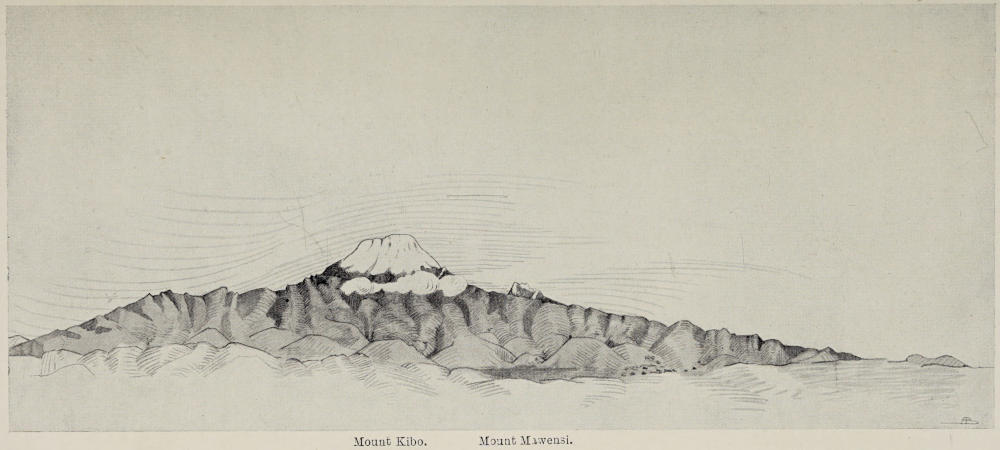
At the time of the Rains, too, fresh snow
fell on Mount Kilimanjaro, the highest mountain
in Africa, with the elevation of over
19,700 feet. In 1915 the first fresh snowfall
was on 25th November, and on the morning
of that day a new white coat of snow mantled
the peaks of Kibo and Mawensi, and well
down their slopes.
A native once told me that if he could climb
to the far-off glistening snows, he would find
rupees. And he seemed seriously to believe
that the snows, which glinted silver-like in
the sun, were unattainable wealth.
On the frontier, when not scouting, or on
patrol, or on picket, it sometimes fell to our
lot to have a day in camp.
ROUTINE IN CAMP
In camp, “Réveillé” was at 5.30 a.m.—just
about daybreak. The able men then
dressed, and, outside their tents, shook out
their dust and insect-ridden blankets, in which
they had slept on the bare hard ground. The
lazy, and the seedy, and the really sick men,
slept on fitfully until the last possible moment
before the “Fall In,” at 6.30 a.m.; then
reluctantly to turn out in cheerless spirit.
On early morning parade “the roll” was
first called. The sick were then excused from
duty, and the remainder marched off with
shovels and picks and axes to dig trenches
and construct overhead shell-shelters, wherever
the fortifications of our encampment required
strengthening.
Such mornings passed quickly, and work
went ahead, for, in the cool of the rising day,
the labours were not unpleasant. Most men
made light of their morning’s work, and
enjoyed getting up a keen healthy appetite
ere the “Fall Out” for 8 o’clock breakfast.
Breakfast consisted generally of a measured
ration of bread, cheese, and tea: sometimes
bacon replaced the cheese, sometimes jam.
The second morning parade fell in at 9 a.m.,
and again the men in camp were sent on to
the fortifications. But now work was carried
on in the heat of the tropic sun, for a soldier’s
duties are at any hour of the day or night,
and in any weather, in any hemisphere. They
laboured on in the heat, swearing and joking
(I think a soldier will joke, aye, even in
H⸺) and perspiring, and with faces and
clothes smothered in the fine red lava sand,
which was raised by the labouring picks and
shovels, or which incessantly wafted down-wind
in gusts off the bare compound of the
encampment. But, nevertheless, the work
went forward, for it had to go, and defences
became duly more and more impregnable.
About noon the working party fell out for
lunch, which consisted of a ration of bread,
jam, and tea.
Lunch over, the men rested until 4.30 p.m.
Some fitfully slept under stifling hot canvas,
others washed clothes down by the trough,
or bathed themselves with water from a
bucket, standing naked in the open; while
still others gambled, mildly, over halfpenny
nap and threepenny bridge.
The afternoon parade fell in at 4.30 p.m.
and worked as before on trenches for another
hour and a half. It was then time to “Fall
Out” for dinner.
Dinner consisted always of badly cooked
stew, an unchanging dish which became deadly
monotonous, and which, in time, many men
could not touch, their palate revolted so strongly
against the unseasoned, uninviting mixture.
SHORT RATIONS
I have particularly mentioned food, because,
even when rations were full—and they were
often not—our soldiers were nearly always
troubled with that subject throughout the
East Africa Campaign. It is wonderful what
men, living outdoors, can subsist on, but, at
the same time, I will never believe that the
cut-and-dry army ration, as served in Africa,
is sufficient for men carrying on arduous
operations in an intensely tropical climate.
All units experienced a tremendous amount
of sickness, and I am certain, in my own
mind—and many others agree with me—that
at least half of the sickness was caused, directly
or indirectly, from lack of full and proper
nourishment for a prolonged period. Transport
difficulties, and the greater wars in Europe,
no doubt had a strong guiding influence with
the commissariat; and for such, allowances
must be made. I have but little inclination
to raise the subject now, for the roughness of
war is always to be expected and borne, but
for the future it is well to write down the
harsh experiences of the past so that others,
in like undertakings, may gain an insight
into such things, and prepare for them, or
seek to obtain a reconstruction. Food was a
big question in Africa, and, if such a campaign
should be called for again in any far-off
country, administrators would do well to give
serious thought to a serious subject that
might well in the end save the nation both
life and expenditure.
On the frontier, men had very few means
of adding to their rations. Parcels from
home, in many cases, found them most of the
luxuries they ever enjoyed. Again, at some
places a venturous Goanese trader set up
small wood-framed shack-stores, and dispensed
to the troops a few odds and ends in very
limited quantities. The chief luxuries (?) which
the men sought I give below, and a comparison
in African and English prices:
Trader’s Price.
English Price, 1915.
s.
d.
s.
d.
Tea, per lb.
2
6½
1
10
Sugar, per lb.
0
6½
0
1½
Butter, per lb.
1
4
1
2
Milk, condensed
0
11
0
6½
Worcester Sauce
2
0
0
9
Soap, per lb.
0
10½
0
3½
Cigarettes, “King Stork,” per 10 packet
0
2
—
On those groceries, or such-like, every penny
of a man’s pay was often spent the day he
received it. Whenever the trader received
a fresh lot of goods the news would fly about
camp, and, as soon as night-fall came and
liberated the soldiers from duty, he would be
besieged by toil-worn troops hungry for
luxuries, and speedily everything in demand
would be sold out.
In one other way was it sometimes possible
to obtain a change of diet: that was by
game shooting. A good many buck, wart-hog,
guinea-fowl, and partridges found their way
into camp at one time or other, and furnished
a few fortunate ones with a very welcome
addition to the routine fare.
GAME HUNTING WITH SELOUS
One of the first hunting outings which I
experienced was with Capt. W., Lieut. F. C.
Selous, and the “Doc.,” when I accompanied
them on a trek to make a sketch of certain
country they were going into. We were at
this time camped in the open upland bush near
Kajiado. Mounted on mules we had travelled
overnight to a selected camp. Selous—fine
sportsman that he was—was as keen as ever on
a hunt, and the party were merry as sand-boys.
Next morning all were astir at daylight.
Before breakfast some spur-fowl were shot
close to the near-by water-hole, and fried for
the meal. They were delicious eating. After
breakfast the mules were saddled and mounted,
and we rode onward. In the forenoon we
sighted one lion—which escaped under cover
of a thickly bushed valley—two wart-hog,
three waterbuck, a few hartebeeste and
mpala, and many giraffe. Selous had an unsuccessful
shot at an mpala, but, otherwise,
the game were allowed to go unmolested, as
all were wild and no exceptionally good heads
were singled out. We made the noon halt in
rolling, somewhat open bush country and
haltered the mules, to picket them there.
After lunching the party went in divergent
directions on foot. Capt. W. and self proceeded
to the highest hill-crest in the neighbourhood,
and I there settled for the afternoon
to pencil a panoramic sketch of the
country before me. Capt. W. then left me.
Later I learned he had, on his return tramp
to camp, shot a hartebeeste for meat. But
game proved very wary. Selous and the
“Doc.” returned without securing a single
head, though they had seen mpala, eland,
giraffe, and a rhinoceros. Masai natives were
grazing many cattle in this area at the time
of our visit, and the game were evidently kept
moving and wild by constant disturbance of
the cattle and their cattle-herds. At any rate,
as far as game heads, and meat, were concerned,
it was not a successful outing. But it was all
very enjoyable and a holiday from soldiering.
To me it was a memorable outing because it
recalls to mind one of my first meetings with
Selous. It was the first of many meetings, for,
in after days, we joined in many a successful
hunt, the old hunter and the young attracted
together by a mutual enthusiasm for Nature
and the Open Road.
These, above, are a few notebook entries.
It will be seen that a soldier’s life in 1915 was
not without variety and adventure in a theatre
of war of which the outer world, in those days,
heard very little. Yet it was the beginning of
a great undertaking which, in its turn, has been
overshadowed, almost overlooked, on account
of the gigantic world-war raging in Europe,
and resounding on England’s doorstep.
Towards the end of 1915 rumours were
prevalent that strong South African forces
were to arrive in the country.
About the same time the Germans, who
apparently had information of our movements,
increased their activities on the border
from Voi to Kilindini. Perhaps their biggest
effort at interference was when a strong
force of Germans occupied the prominent hill
position of Kasigau and threatened the Uganda
Railway from the S.E. of Voi. Obviously, if
they could break on to our only up-country
railway and line of communication, at such a
time, they had much to gain. However, in
this they were forestalled. Forces were sent
to oppose them in their mountain stronghold,
on the heels of their arrival, and eventually
they were forced to evacuate without accomplishing
anything.
At this period signs were not wanting of the
coming of forces. Around the old camps
extensive spaces were cleared of bush in readiness
for camping grounds. Supplies of all
kinds arrived daily, by train or by wagon
transport, and were stacked in huge piles in
the open. Everywhere, in the frontier camps,
could be seen added activities and increased
optimism.
For two months this sort of thing had been
going on, until one fine day—the 16th of
January, 1916—the first large contingent of
South African troops passed through Voi,
and detrained at Maktau. The critical period
was over; here was compensation at last for
long months of waiting and watching.
Daily the arrival of troops, horses, mules,
and baggage went on, and daily our spirits
rose at the prospect of the coming advance
into the enemy’s country.
CHAPTER III CATTLE RAIDERS
Note.—The figures in this adventure are fictional: otherwise
the setting and the theme are real.
Saidi-bin-Mohammed, native of East Africa,
had been to the war a year. When the English
had gone to the borders of his country to face
the German enemy, Saidi had followed his
white master.
One day in June, about 5 o’clock—about
that time of day most pleasant in Africa, when
the sun is lowering in the west and losing its
intensive piercing heat—Saidi, tall, and straight
and athletic, was busied outside his small grass
hut, cleaning his equipment and rifle with the
interest and care of one who had pride in dearly
loved possessions. Across the dry, bleached,
much-trampled opening of the encampment,
which lay in the midst of virgin bush-land,
appeared the gaunt figure of a British officer.
He stooped, as with age, and his dark, tanned
face bore heavy traces of exposure and hardship,
in the deep-lined furrows which covered
his forehead, and in the fine lines that contracted
to the corners of his tired eyes. But,
though worn and lean, he had still about him
the bearing of resolute manhood—the bearing
of one who is strong to endure and conquer,
even under difficulties and a merciless tropic
sun. Clive Clifford had, in the old days,
been a pioneer of unbound frontiers, and a
hunter of big game: to-day he was a famous
scout; a man whose knowledge and whose
word carried weight in the highest quarters
of command.
He approached Saidi, who smiled broadly
seeing that his master, whom he held in high
regard, came to him. Clifford spoke in the soft,
halting consonants of the Swahili language,
and addressed his “boy” in kindly manner, as
a man speaking to a trusted servant. “Saidi,”
he said, “get ready. We go out to-night,
you and I, and stay out many days. Eat
food now; and be ready to leave in an hour.”
SINGLE-HANDED ADVENTURE
Some hours before, half a dozen Masai warriors
had run into camp to report that enemy
had stolen many of their cattle, and were
driving them off across the border. Clifford
heard the story. He knew the country the
enemy were plundering, and volunteered at
once to go in pursuit. It was an adventure
dear to his heart.
At dusk they quietly left the noisy, troop-filled
camp—the master leading, Saidi following.
They were mounted on wiry, donkey-like
Somali mules, animals so small that they
appeared disproportionately overburdened with
their load and their well-filled saddle-bags.
But in this they were deceptive. Clifford
knew them, from long experience, to have no
equal in animal transport in the country.
Tireless little animals they were, grit to the
back-bone, and strong to endure long, heart-breaking
treks.
Clifford was fully armed, with rifle and cartridge-filled
bandolier; as was his boy. A
“slouch” hat, a sleeveless khaki shirt, open
at the neck; and a pair of shorts, leaving the
scarred, sun-burned knees bare and free, was
Clifford’s uniform. Undress, but near to coolness
and comfort as possible—and protective
in colour, for, when smothered in dust, as all
would soon be, his light drill khaki would be as
a tussock of sun-bleached grass or a hillock of
sand, if danger bid him take cover....
NIGHT AND WILDERNESS
Some hours later, after making good time
in the cool of early night, the travellers began
to work clear of the low thorn-bush, and
emerged into open, somewhat mountainous
country. Clifford was travelling west now,
and travelling fast; feeling his way over the
country to some distant prearranged destination.
Saidi, the expert guide, was out in the
lead—for no white man has eyes or hearing
equal to the black in his native country. Both
travellers were dismounted and led their mules.
They wound their way through tall valley
grass, breast high and dust-laden; over pools
of mud, long sun-baked and waterless; then
out, finally, on to rising ground strewn with
lava rock and volcanic boulders. It was
weird wilderness country, barren of habitation—virgin
and waterless as on the day of Africa’s
dawning.
The night progressed uneventfully. Nothing
suspicious was encountered. No tracks of
the cattle raiders were crossed. The air was
breathlessly still, and it was oppressively hot
in the valleys.
Toward midnight the waning moon drooped
lower and lower on the horizon—and went out.
Travelling then became slower and more
wary; occasionally man or mule stumbled
over a boulder painfully and noisily in the
breathless darkness. No conversation passed
between man and servant. Tirelessly they
padded on, each certain of the other’s knowledge
almost as animals are certain of the bypaths
to their lair. For them the night held
little mystery. They were startled not by
the grim silhouettes of zebra, or hartebeeste,
when, at a dozen yards, they chanced upon
game herds which galloped off into the night
like riderless squadrons. Nor did the whir
of wings and frightened cackle of guinea-fowl,
disturbed at their very feet, more than
startle the mules to one brief backward jerk of
their bridle reins.
Day was dawning when Saidi, who had for
some hours been following an obscure track
through the dark with his lynx eyes, gave a
grunt of satisfaction as a gap loomed visible
between two dull grey hills in front. Soon they
entered a narrow pass and prepared to make
camp in the hidden cavity between the hills.
Here was water, and camp, and the first halt
in the march; for a dry rocky river-bed, cut
by the torrents of the brief rainy season, ran
down the pass, and there, in a deep pocket in
the solid rock, worn smooth and circular as a
gigantic porridge pot, was a pool of water,
green-slimed and stagnant, it is true, but priceless,
nevertheless, in the sun-parched desert.
The mules were off-saddled, rubbed down, and
fed; and picketed under cover of the hill-side—for
they were now in country where the
raiders might be encountered, and every precaution
was being taken to lie low and outwit
the enemy.
Saidi busied himself over a small smokeless
fire, making tea for his master, while Clifford
lay idly on the ground watching the doves and
grass-finches, which in thousands were endlessly
arriving at the water-hole to drink, fearless
of human presence in their haste and need to
quench their thirst.
“Water far, Saidi,” said Clifford, pointing
to the fluttering flock over the pool. “Birds
come long distance to drink here?”
“Yes, Bwana” (master), answered Saidi.
“No other water nearer than one day.”
By turns Clifford and Saidi slept and kept
watch throughout the day. The camp was
in the foothills of a low range, east of the
Guaso Nyero Valley. Away to the west, out
to the Nguruman Mountains, blue in the
farthermost distance, lay the far-reaching
Guaso Nyero Valley; and it was on this great
plain, somewhere, that the enemy were raiding
the Masai cattle. Clifford hardly expected to
find trace of the enemy until after another
march, when he would be well over the western
side of the valley, and where he knew there
was a sluggish stream and an abundance of
water—that physical essential, to man and
beast, anywhere in the land. But he was
taking no risks—nothing for granted—for a
little mistake meant life or death to the enterprise,
if not to himself.
So all day long watchful eyes scanned the
western plain, but only to be rewarded with
the familiar sight of occasional dust-clouds;
sometimes kicked up by the feet of moving
game, such as zebra, hartebeeste, wildebeeste,
or buffalo; and sometimes the sport of a
whirlpool gust of wind which swiftly sweeps
the ground, finally to rear a thin spiral dust-column
tapering from the ground to a point
high in the sky.
MASAI CATTLEMEN
Toward sundown three Masai were sighted,
worming their way in and out of the long
yellow grass toward the water-hole. They
came from the west, and were travelling
hurriedly, perhaps fearfully—for ever and
anon the rear man of the trio would cast a
hasty backward glance over his shoulder.
Cunningly, in fear that foe might be at the
water, they swung wide of the pass before
approaching, and lay down while one of
their number started to steal forward in the
grass to investigate. But a shout from Saidi,
and then an exchange of a reassuring word or
two, brought them speedily to their feet, and
into camp.
Like all of the Masai race, they were strange,
red-skinned fellows, those wandering cattle
men of the open uplands; wholly naked but
for a loin cloth, and physical pictures of the
aboriginal of the plain. For arms, they had
each a long assegai, and a large mat-laced
shield. They were covered with dust—otherwise,
their bearing conveyed nothing untoward.
It would be difficult to guess that beneath
those features, cool and collected, expressionless,
almost sullen, there lurked the emotions
of men who had been near to death an hour
or two ago.
After they had all drunk copiously of water,
at a little distance from Clifford, they squatted
on the ground with their knees drawn up under
their chins, and told their hurried, broken
story.
In their own language they arrived crudely
and directly at essential facts.
GERMAN FREEBOOTERS
“Germans, master, many Germans,” said
their spokesman, showing, for the first time, a
spark of excitement. “This day, when sun
there”—pointing to the mid-horizon south-east—“our
cattle quiet—we cooking food;
at that time he come—one German, two German,
three German, on horse—after him come
plenty Askaris [native soldiers] driving many
cattle—cattle footsore, for long way he made
go too fast. One German ride among us—he
got small gun, and promise shoot to kill if we
try to run away—Askaris come soon and bind
our hands with cord; then one man stay to
watch us. In little while Germans make fire
and eat—plenty talk—plenty bottle [beer]—German
pleased. By and by German sleep.
By and by Askaris, who watch us, he sleep
too—he plenty tired. Headman, he find stone
beneath him and work cord binding hands
against it. Sometime, cord cut—soon, then,
we all free. We crawl in grass, far—afterwards
we wait and watch. When the sun there”
(pointing to sun’s position about three hours
later) “German wake—find no boy. Plenty
noise—Askari who watch us, he get plenty
beating—afterwards they tie him prisoner—German
afraid we run far and fast and go tell
British. Soon German go—driving all cattle—our
cattle too. But other cattle tired,
master, he no go quick now; and German near
his own country. He go Shombole and Lake
Natron, one day’s trail, after that, soon he
reach big German camp.”
Clifford was lost in thought—the Masai had
ceased talking, and the youngest of them, a
mere lad, had fallen asleep, hunched up awkwardly,
on the bare, hard ground, weary beyond
further caring. Saidi, who had listened attentively
to all, moved off and busied himself
over a fire and his master’s evening meal.
The customary evening breeze had not arisen,
it was close and oppressively hot, and a subdued
spirit lay over the land. Clifford restlessly
stirred the gravel beneath his feet, lost
in his conjectures. He was wide awake and
his keen, roving eyes betokened an intelligent
mind stirred to unusual degree. The enterprise
had taken on a serious aspect. Clifford
had anticipated, if he were fortunate, he
would run up against a small raiding party of
one or two whites and a native soldier or two.
His original difficulty, he thought, would be to
track them, and overtake them. He found
himself, instead, pitted against four whites
and some dozen armed Askaris, whom he could
head off, on their southward trail, in a single
night’s march.
The odds were great—too great—but he
was too far from his base to call for reinforcements;
he must go on as he was, or return to
camp mortified at having had the enemy
within reach while admitting his inability to
strike.
Clifford rose impatiently to his feet and paced
to and fro.
But slowly a new resolution crept into his
face and bearing, and at last his mind was
made up. He called his boy. “Saidi,” he
said, “I’m not going to stop here and go back;
I’m going on. I may not fight, for the Germans
are many; but I mean to get as near to
the raiders as I can, and, for the rest, trust
to luck and opportunity. You, Saidi, are free
to go back if you please. I cannot order you
to run the risks ahead against such odds. This
is my ‘show.’”
But Saidi was staunch and true. “Where
master go, I want to go—me not afraid,” he
said; and indeed he did not look one whit
abashed—rather was there a new-found pride
in his bearing.
The undertaking thus promoted, Clifford,
with mind relieved, partook of the substantial
meal which Saidi had prepared. They then
saddled the mules, and were ready again to
take up the trail of the raiders. The exhausted
Masai were given some food from Saidi’s
saddle-bags and told to sleep at the water-hole
for the night. They were directed to follow
Clifford’s tracks in the morning, and remain at
a discreet distance from the enemy, unless sent
for.
On leaving camp Clifford headed out into
the south-west, for it was his intention to
cut across the German line of flight, well in
front of them, and, before daybreak, to hide
among the low kopjes east of Lake Natron.
To carry this out he must travel hard all night.
Accordingly the pace he set off at was determined
and sustained. Man and beast perspired
freely as they toiled onward; for relentlessly
the night breeze held off, and the still, humid
air hung, like the vapours of a hot-house,
over the breathless valley. To add to the
discomfort, the trotting mules raised, from
the dust-laden grass, a fine dust which remained
suspended in the air to irritate the
nostrils and throats of the travellers, and
induce a quenchless, vexing thirst. However,
until midnight Clifford held on his course
unfalteringly. At that hour, just before the
moon went down, he halted to rest and ease
the saddle-girths of the tired mules.
Half an hour later he resumed the journey;
but on foot, now that it was pitch dark, the
mules led, and faithful, tireless Saidi out in
front trailing, with his keen eyes, over unseen
landmarks, for the low hills his master had
named.
ACROSS THE GUASO NYERO VALLEY
They were in rough country now—rough
with awkward boulders and ragged lava rocks.
Moreover, the travellers were repeatedly confronted
with yawning chasms—deep, dry,
tortuous river-beds—which barred their path.
In the inky darkness to surmount these
obstacles was difficult and delaying, and
Clifford cursed them roundly while he
“barked” his shins in scrambling up and
down banks of unknown depth, forcing his
way across in the wake of Saidi, whose
presence he could feel rather than see.
To add to their difficulties, the mules were
restless. They were in fear of lions, for
twice, away northward, the night stillness had
vibrated with the awesome whouh——whouh——whouh——whouh——whouh——whouh——wwho——wwho——wwho——wwho——wwho——wwho
of the King of Beasts.
The sound brought terror to the hearts
of the mules, and delayed progress. But,
at the same time, it brought a note of good
cheer to the party, for to the experienced
ears of Clifford and Saidi the lions’ roar was
a good omen, coming, as it did, from the
north-west of their position: for they guessed
that the lions were among the beasts of prey
following in the track of the trekking cattle,
ready to drag down and devour the weaker
ones which became too exhausted to go on
and were outcast from the herd. If the
surmise was correct, Clifford felt sure he was
cutting in well ahead of the cattle raiders—and
only that result could compensate him
for the toil of travelling this ghastly country
in the dark.
About 4 a.m. Clifford, in spite of short halts,
was feeling done up with his exertions in
keeping pace with Saidi. Hardened though
he was, he inwardly admitted he was about
finished on this trek. He halted and whistled
peculiarly to Saidi, who stopped likewise.
Saidi came back to his master, apparently
cool and tireless as ever, and sure of his untraced
road. Clifford asked him how far he
thought they were from the hills. In answer,
Saidi pointed into the darkness a little to the
left. “There, master,” he said, “close now—river
we cross last, near to hills—soon we
camp.”
Thus cheered, they started on the final
tramp; but Saidi’s hills were deceptive, his
“short distance” stretched out to a good
two miles before the tired party reached their
chosen hiding-place.
LAKE NATRON AT DAWN
At the first inkling of dawn, Clifford moved
well into the hills and secreted the mules in
the bottom of a valley thickly grown with
cactus. From there Clifford and Saidi made
their way to a spur overlooking the plain on
the west and north. Here they concealed
themselves among some acacia bushes, after
they had made sure that, in the event of
discovery, there was a line of retreat down
either slope of the spur to thicker cover—whence
their hidden rifles could put up a
reasonable defence against odds, if need be.
From where he stood in the early morning
dawn, Clifford had a wonderful view of the
wild life and of the country. Below him a
small herd of graceful antelope, known as
Grant’s gazelle, was browsing quietly in the
immediate foreground of the plain—a plain
of dry, buff-coloured grass which stretched
some two miles to the west, to the shores of
Lake Natron. In the intermediate distance
was a great herd of unsymmetrical hartebeeste
(buck of size and colour of red deer),
and pony-like zebra, moving along, in ever-changing
attitudes, busy on their morning
feed, and lending life and colour to the peaceful
scene. Along the shores of Lake Natron, white
soda deposit glistened like silver in the
lightening day, whilst the waters of the lake
appeared dyed in pink where countless
flamingoes rested. A mile or two up the
valley, at the head of Lake Natron, and to
the east of the swamp of tall green grass which
is there, rugged old Shombole mountain stood
prominent with its furrowed surface of deep
ravines and back-bone ridges, the whole overawed
by the sheer cliff face, and the inaccessible
plateau at the towering crest, of the most
westerly range. In many places the outer
slopes of Shombole were buff with the dry,
yellow grass of the plains, but in the ravines,
and on sheltered slopes, dark-green foliage
grew where overcrowded masses of impenetrable
cactus had found root, and an existence,
amongst the rocks.
Meantime there was no sign of the enemy—nothing
moved, except droves of game in
this hunter’s paradise.
Clifford estimated that he was an hour or
two ahead of the raiders, and soon he dozed
in the cool of the morning—leaving Saidi on
guard. He trusted the boy completely, for
the experience of long months had proved him
always faithful and fearless to serve. Faithful
as a wonderful dog was Saidi, and “greater
faith hath no man.” Saidi worshipped his
master.
Some hours passed—Clifford had fallen into
profound sleep after his long night’s exertion,
for he was more easily tired now than in the
old days before he knew the impairing ravages
of fever. The heightened day found Saidi
still at his post. But he was now tense and
alert, and his eyes were eagerly fixed on a
cloud of dust approaching from the north.
There were the raiders! of that he was sure;
for he had seen a horseman break off to the
right, clear of the dust, for a moment or two.
However, he would not wake his master yet;
the raiders were far out at present, and the
cattle they herded moved very slowly.
In a short time, however, he espied two
horsemen riding forward, at an easy gallop,
clear of the herd. They were probably coming
on ahead to select their noon camp, confident
that the plain was uninhabited but by themselves.
Seeing this, Saidi woke Clifford, who
was instantly on his feet, and eager to sight
the enemy.
DARING
Immediately a daring scheme of attack
flashed through Clifford’s mind—the enemy
were playing into his hands in separating
their forces. Hastily he lifted his rifle, spoke
a few excited words to Saidi, and started to
steal through the grass down to the plain on
the west. Once on the plain they scrambled
and crawled, under cover of a dry, shallow
rivulet, seeking to reach the probable line
over which the advancing horsemen would
pass. Over a mile they laboured, slowly,
awkwardly, until, scratched, torn, and breathless
with their mad haste, they lay still;
near to the place on which the enemy were
bearing.
As Fate would have it, the horsemen bore
straight down on them, utterly unaware of
danger. Clifford whispered to Saidi that he
was to shoot the nearest horse at the same
time as he (Clifford) fired. With their rifles
in the grass, and with heads low, they watched
and waited. Grim was the expression on their
faces now, all outward excitement had gone:
nerves were set, and “steeled” against the
coming effort. Suddenly—when the horses
were barely fifteen yards away, Clifford whispered
tersely, “Now!” Simultaneously, both
rifles spoke, and all was violent struggle and
confusion on the ground in front. Clifford
stood upright and fired quickly again. Then,
harshly, he called out a command in German,
while like a flash his rifle swung to his right
and remained aimed at its object. Unmoved,
he ordered Saidi from his hiding-place. Both
horses were down, and the nearest German;
the other German had his hands up, covered
by Clifford. Saidi removed the German’s rifle,
which lay on the ground where it had been
thrown when the horse, with its rider, fell.
The prisoner was then speedily bound and
gagged, so that he could not warn the others,
and concealed in the rivulet ditch. The other
German was dead, and both horses. The
horses could not be moved, so, to disguise them
from sight at a distance, the carcases were
hastily covered with prairie grass.
Meantime the main body of the enemy
was approaching, but, luckily, at a slow pace.
The scene enacted had been lost to the other
raiders, for a low rise lay between them and
the ground, gently falling to the lake, where
Clifford had ambushed the leaders. The rifle
shots they must have heard, but, as they were
not expecting enemy, they would probably
think that their comrades were after game,
for meat for their natives, as was common
practice.
CLIFFORD STRIKES
After making certain that the prisoner was
securely bound and concealed, and unable to
move away, Clifford now moved hastily forward;
his intention being to reach the protection
of a small knoll about six hundred
yards nearer to the approaching enemy and
away from the condemning signs of catastrophe.
But before he got there, dust, over the rise,
warned him and his boy to take cover. So
they lay on the open veldt, in the hay grass,
not daring to move to better cover, for, at
any instant now, horsemen, or keen-sighted
Askari, might appear in view. Lying there,
Clifford gave his orders to Saidi, who grinned
still over the success of their first attack.
“Fire like H⸺, Saidi! at Askaris—make
plenty noise—make him think plenty British
here. Make him run!”
Clifford was confident of the outcome now,
and eager for the fray. By an extraordinary
piece of luck the white opposition had been
evened up: and now he had the advantage
of surprise, and the consequent target for his
deadly rifle.
Slowly the raiders appeared in view over
the rising ground, and drew on. Together
the Germans scanned the plain ahead, but
beyond a word or two they, apparently, did
not trouble about the non-appearance of their
comrades—they thought, no doubt, that theirs
was only a momentary disappearance behind
some low ridge in the distance.
The raiders sat their horses idly, and watched
the tired cattle being herded on; they swore
at their Askaris and urged them, time without
number, to lash on the many laggards. Apparently
they were weary of their work, and tired
of the trek.
Clifford and Saidi were waiting breathlessly.
The herd was a bit to the right, but was
going to pass them at about fifty yards.
Steadily they drew on. Again the rifles were
ready in the grass; again Clifford’s terse,
“now!” was whispered, and startling shots
rang out. And then the scene was like a
battle. Shots poured from their hidden haven
in the grass, as fast as they could load and
fire, simply to disguise their strength and
frighten the blacks.
ROUTING THE RAIDERS
Clifford had brought down his first man, but
the second white he missed, as his startled
horse plunged and threw the rider. For a
time the German replied vigorously to their
fire, but luckily he couldn’t see through the
grass, and no bullet got home. Suddenly he
rose and scrambled on to one of the horses
and galloped off. Twice Clifford fired and
missed, but at the third shot the German
crumpled up and slid limply from his mount.
Clifford now ran forward, and caught the
remaining horse; Saidi following at his heels.
Shots whistled and cracked around them, but
all were wide of the mark; for the Askari
is a poor marksman. Into the blacks rode
Clifford, reckless and wild, driving them to
panic and confusion. Two went down with
his first shots, the rest, five in number, leapt
from the grass and fled in frantic disorder.
One more fell, sprawling, to Clifford’s marksmanship,
and another was winged. But by
that time the remainder had spread and got
farther afield, and Clifford gave up the chase,
afraid to get too far away from Saidi, who
might be in difficulties.
Returning, Clifford found Saidi broadly
smiling, as was his wont when greatly pleased.
He had accounted for three Askaris. Clifford
praised the boy—though he seldom gave
praise to a native—and told him, now, to
make “plenty big feed” for himself, and
then to sleep—the boy had had no rest since
the day before.
While Saidi busied himself lighting a fire,
Clifford counted the cost.
One German was dead, one wounded. Four
Askaris were dead, and three wounded. After
he had gone back and brought the prisoner to
camp, Clifford attended to the wounded. When
that gruesome work was finished, he sought a
vantage-point on a rise, and, from there, sent
three piercing whistles out over the plain.
He was soon rewarded by the sight of
natives, showing in the grass, about a mile
to the east. They were the three Masai left
behind overnight; and he signalled to them
to come on.
In a short time the Masai came up.
Fear was first in their approach, then
astonishment, when they sighted the destruction
of the enemy, and Clifford and Saidi in
complete possession of the cattle. Their
usually passive faces broke into broad smiles,
they gesticulated excitedly in their exclamations
over the extraordinary scene; and,
finally, they came, one by one, before Clifford,
to voice their timid gratitude, and to salaam
profoundly, as vassals to their lord. He was,
in their eyes, indeed a mighty and wonderful
white chief.
A “chit” was written to G.H.Q. asking
for a mounted patrol to be sent out to conduct
the cattle back to a safe area, and a Masai
runner was dispatched with it to camp—with
instructions, also, to send word to his
tribe to furnish some men to dig graves.
The remaining Masai counted the cattle.
They numbered close on seven hundred head—a
substantial meat ration for the Europeans
over the border, if the raid had succeeded.
Clifford directed the Masai to drive the cattle
slowly back to the Guaso Nyero River, and
to wait for him at the bend beyond the northern
slopes of Mount Shombole. Before leaving,
they released the hidden mules, and drove
them also to water.
Three days later an officer and a native
soldier rode into the British camp, dust-covered
and with clothes torn. Dismounting,
the officer left his mule in the care of the
native and passed on to the encampment of
G.H.Q.
Down the dry dust-thick lanes of the camp
stalked the well-known figure of the famous
scout—the lean, the brown, the worn bushman,
scarred and tired with exposure and
climate—a thing of the wild world and the
silent places—unassuming, almost shy. But,
on a thousand lips the news flew among the
troops that Clive Clifford was back—and
glad men came from their tents to cheer him
past.
And Saidi, unsaddling the mules in the horse
lines, hearing the welcome, smiled in content.
CHAPTER IV THE FIRST ADVANCE
The dusty road through dense tropical thorn-bush
followed the “lie” of the mountain,
and to approach Longido West you came
round the bend from the west, and swung
easterly, to find the camp, an irregular,
partly cleared space in the midst of trees.
The camp, with cunning purpose, was under
cover, for it was within the timber line, which
hung densely in colour and form along, and
all around, the mountain base. Beyond, at no
great distance to the south and west, the bush
terminated, and open yellow veldt stretched
far out to the hill-marked distance where
sheltered the considerable town of Arusha.
The whole was a wilderness country, neither
bush nor veldt held human creature! All
that lived was of nature’s giving! In the
forest of thorns, and by the mountain-fed
streamlet which gave the camp sparingly of
priceless water, bird, insect, and plant life,
in myriad forms, were habited in abundance.
Beyond the jungle of low-stature trees, the
veldt lay in expressionless vagueness and
silence, with but the slow, dark movement of
a small number of ostrich and wildebeeste,
and the flight of a ranging vulture, to attract
and hold the wandering eye.
GERMAN EAST AFRICA THREATENED
And it was here that our forces were congregating,
over the German border, under
the south-western continuance of Longido
Mountain. We had been days in coming, and
we had come from many places—British, South
African, Indian, and native African—and we
knew by the unwonted stir of traffic that
there was “something on.” A day passed,
two days, and still the gathering grew!
Troops and transport—ox wagons, mule
wagons, and motors—and the hundred-and-one
oddments that accompany a large force, came
into view at the clearing entrance, passed
down the road and camped, and thenceforth
became part of us. In time, it came to be
the evening of the second day, and a great
stir arose in camp.
Orders were out: we were to commence the
advance to-morrow! Suppressed excitement
was in the air! Down the dust-smothered road,
as I passed to camp, there trooped to water a
hurrying continual line of thirsty, road-tired,
sad-visaged horses, mules, and oxen, accompanied
by gesticulating, chattering, khaki-clad
attendants. The men were discussing
the news, and the prospect ahead, in many
different ways and in different tongues of
English, Dutch, Hindu, and Swahili. It was
nigh to the common hour of peacefulness—that
is, peace as near as it is ever realised in
the army—when half-clad, begrimed, talkative
soldiers grub and wash up around the evening
camp fires. But to-night there was no peace.
Sergeants were calling out orders on every
rustle of the wind, fatigue parties were falling-in
here, there, and everywhere. Final preparations
were in full swing, and—what use to
deny it?—fuss and confusion held sway, as if in
devilish glee. Rations, the most vital care of
the army, were discussed and arranged. Kits
to go, 25 lb. per man, including his blanket
and spare boots, and surplus kits to be left
behind were packed and loaded on wagons,
or stored. Sick men, and men not particularly
robust, were sorted out and detailed for garrison,
for commanders realise that only the very
fittest can endure the hardship of a long trek
in Africa. Finally all was arranged and the
sleep of night settled on the camp.
A FIGHTING COLUMN
Next day we were off to the south on a
narrow dust-laden track. We were an infantry
column, a column made up of variously dressed
soldiers of different races, a column of various
kind and equipment, eloquent of the brotherhood
of colonies. We streamed out in column
of route, after scouts had preceded us by half
an hour or so. The 129th Baluchis, olive-hued
Indian soldiers in turbans and loose-kneed
trousers, were in advance; then their
maxim battery of gunners and side-burdened,
bridle-led mules. Then came the 29th Punjabis,
another regiment of similar kind, followed
closely by some battalions of South African
artillery—a bold array of gun-carriages and
ammunition wagons, each drawn by eight
span of sturdy South-American-bred mules,
and driven by reckless Cape boys mounted on
the line of near mules. Then followed more
infantry, the 25th Royal Fusiliers, of familiar
face and colour, of our own kind, but soiled
and sunburnt with long exposure; the 1st King’s
African Rifles, well-trained natives of stalwart
appearance, khaki-clad as the rest, but with
distinctive dark-blue puttees and light close-fitting
headgear. And so on, and so on, down
the line, except that one might mention the
ammunition column in the rear, a long line of
two-wheeled carts, drawn by two span of
patient, slow-gaited oxen. In the rear, trailing
far behind, came the miscellaneous transport—some
motors, large four-wheeled mule-wagons,
Scotch carts, and water carts, an
assortment of varied, somewhat gipsy-like
kind. The wagons, which were most in
evidence, and which carry from three thousand
to four thousand pounds, were drawn by ten
span of mules, or by sixteen to twenty span of
oxen, and all were ordered and driven by capable
management of men from South Africa,
who had long experience in trekking in their
own country. In all it was probably a column
of a fighting strength of from 4,000 to 5,000
men, with its necessary large following of
accoutrements.
When the column reached far out into the
grass-grown, sandy plain—for it was open
highland here—one could look back, almost as
far as the eye could distinguish, and see the
course of the column, as the fine line of a
sinuous thread drawn across the blank space
of an incomplete map! To-day, the map was
marked; to-morrow, the thin dust-line would
be gone onward, and the desert veldt would
again lie reposed in vagueness.
Thus did we leave our harbour of safety to
venture far into the enemy’s country on “the
long trek”; to travel amidst dust, and dryness,
and heat, for many days.
It was on a Sunday morning, the 5th of
March, 1916, that the advance began. This
column leaving Longido was to operate round
the west of Kilimanjaro and finally converge
on Moschi, the terminal of the Usambara
railway—the only railway in the northern area
of German territory. The column was acting
in conjunction with large forces operating,
also on the border, away to the east of Kilimanjaro:
forces which were largely South
African, and that were opposite the long-standing
enemy line defending Taveta and
barring the main thoroughfare into German
territory. This marked the commencement
of the offensive campaign under General Smuts—an
offensive that time proved was to last
twenty-one months before German East Africa
was to be cleared of the enemy and completely
in our hands.
However, as I have said, one Sunday morning,
at the beginning of March, found us moving
out on the big game, eagerly, and with a great
gladness to be “up and doing.”
WE ADVANCE FROM THE BORDER
The column travelled east along the line of
Longido Hill, then struck south across the
flat, sandy plain before us until the shelter
of the Sheep Hills was reached. Here the
column was halted under the northern slopes
of the hills, thus making use of the protection
which they afforded from observation from the
south—for the south held ever the danger of
the enemy. The column had trekked about
eight miles across trackless country, making a
road as they went merely by the commotion
and pressure of wheels and of thousands of
feet of troops and their transport animals.
Marching was unpleasant in the soft, powdered
dust which lay ankle-deep underfoot, and was
kicked in the air in a hanging cloud to choke
both throat and nostrils, and adhere to every
visible part of one’s clothing.
Under the Sheep Hills we lay in the heat of
the sun, waiting our orders. At 6.30 p.m. the
column moved out on a long night march. A
two hours’ halt was called at midnight, but
otherwise we trekked steadily on all through
the night. At midnight, detachments went off
on our left flank to attack at dawn the enemy
post on Ngasseni Hill. The enemy were engaged,
but the fight was short-lived, and in
due course the hill was occupied by our troops.
The main column encountered no opposition,
though opposition had been expected at the
Engare Naniuki water.
The column camped at 10.30 the following
morning at water at Engare Naniuki. We had
travelled all night into the south over a level
sandy plain, covering, roughly, twenty miles.
Entrenchments were dug in camp, and the
swamp grass, bordering the water-holes, was
burnt. Camp was unmasked to all eyes, friend
or foe, by a continually rising cloud of fine chalk-like
lava sand. Profusion of troops and transport
were everywhere, and made an animated
picture while moving here and there on quest
of their unending duties.
I picked up two young hares (Sungura) in
camp, paralysed with fear at finding themselves
surrounded by such overwhelming commotion.
Overhead, many flocks of sand-grouse passed
in the morning and evening; apparently they
haunt these plains in their migrations.
The following morning we moved out at
8 o’clock and made slow progress during the
march. The column skirted the river-course
of Engare Naniuki and passed through open
country. A long delay was caused getting
the column across the “drift” at Nagasseni
Bridge, when we intercepted the Aruscha—Engare
Nairobi road; the river was, here,
about 25 feet wide and the water swift flowing.
The bridge over the river had been destroyed
before our arrival. The column, in the late
afternoon, camped, when across the Engare
Naniuki, at Nagasseni.
NAGASSENI EVACUATED
Nagasseni, which had been hastily evacuated,
was a prominent hill with a small boma and
fort on the crest commanding the river and
the bridge. At 2.30 in the morning the
camp was stirred afoot, and the column
moved out in the dark an hour later. The
travelling was east, then south-east, through
fairly level country commanded by many cone-shaped
bare kopjes. We are still free of bush
country. To-day we march through forsaken
desert, sparsely grass-grown, and of a surface
nature of metallic lava crustings. A small
party of enemy was engaged, on our left front,
about noon. The enemy fired on our mounted
advance scouts from a low kopje which they
occupied. But our scouts had previously
sighted the enemy, and had sent back word to
the column. Mountain Battery guns, already
trained on the target, opened fire the instant
the enemy showed his hand, and with deadly
shooting put the enemy to flight in no time,
followed by rounds of vicious shrapnel. It
proved to be a mere outpost of enemy reported
at thirty-five strong.
All are beginning to wonder where we are
to “bump” the enemy. Is there to be no
resistance offered to an advance from this
side of Kilimanjaro? Has an advance here
been thought impossible? Is it completely a
surprise?
Soon after the short moment of excitement,
above mentioned, Geraragua River was reached,
and camp was pitched on the north bank.
Here our position was entrenched, and camp
for the night prepared.
Next day we spent in camp while a convoy
returned to Engare Nairobi to assist in bringing
forward rations, which were being delayed
owing to the heavy half-broken tracks. Near
here, at Kakowasch, an enemy camp, hastily
evacuated, was found among the bush of the
Kilimanjaro foothills. This was set fire to and
burned so that the grass huts could not be
reoccupied.
MOSCHI IN SIGHT
The following day the column moved out at
noon—our destination said to be Ngombe,
which is across the Aruscha line of the enemy’s
retreat from Moschi, should the eastern forces
attack it from the Taveta side. We travelled
until dark through level country, pimpled with
numerous pigmy hills; breaking road through
the country as we went. About darkening we
entered bush country, which offered splendid
concealment to the enemy, but they did not
put in an appearance. About this time, however,
some of our artillery, who were having
difficulty in getting along on the heavy tracks,
were attacked by the enemy in the open, some
distance in our rear. Forward, with the
column, the rifle-fire was heard, and the boom
of our thirteen-pounders. Detachments were
ordered to retire and reinforce the rear. Our
battalion went back about three miles, but did
not go into action, as the enemy by that time
had been beaten off. Again we moved on in
the darkness, and about 3 a.m. rejoined the
column. It had been uncertain, awkward
marching, the night was very dark, the track
broken, and heavy with dust. About the time
we rejoined the column it began to rain. A
halt was called, and we slept in our tracks,
for the remaining three hours, until daylight—then
up and away again. It was bitterly
cold sleeping in the open in the rain, but we
were too dog-tired to care. A number of horses
and mules are now dying by the roadside with
horse sickness and tsetse fly. Mosquitoes
numerous since entering the bush. Marched
about eighteen miles to-day.
Saturday, 11th March.—Just one week
since we left Longido. Marched at 2 p.m.,
heading south through the bush, with Kilimanjaro
Mountain on our left, and Meru Mountain
on our right. Towards dusk, on reaching
open country, the column swung easterly and
crossed the plain, pursuing a line parallel with
the southern slopes of Kilimanjaro, but well
away from the mountain. The German town
of Moschi was sighted away to the north-east,
and eager were the eyes that witnessed it,
because there was probably our objective and
the enemy. About dusk, scouts engaged in
a short bout of firing with opposing scouts,
but soon the bush was “all clear.” Marched
until 9 p.m. and camped, before Kilimanjaro,
on River Sanja. Fires were observed between
us and Moschi, and were thought to be those
of the East African Mounted Rifles, who were
reconnoitring nearer in to the mountain base.
Marched about fifteen miles to-day.
“Stand to” was at 5 o’clock on Sunday
morning, but dawn broke undisturbed. A few
shots were fired by our sentries overnight at
prowling scouts. Part of column moved out
at 9 a.m.; and returned in evening, without
having been in action. Our present camp is
on the Aruscha road, about five miles from
Ngombe. The column is now about sixty miles
away from its starting-point at Longido.
Marched on Monday for Masai Kraal,
hoping there to intercept the enemy’s retreat
from Moschi. Reached Ngombe about 11 a.m.
A number of houses were still inhabited, by
Goanese and Greeks, and they had white flags
erected to protect themselves from attack.
The small river Kware flowed through the
village. Transport and considerable artillery
were left behind here, while the column continued
eastward on the low road or, more
properly, track, to Moschi. The bush is now
becoming more luxuriantly tropical in country
that is apparently well watered. Marched
until 2 a.m. in the dark, through rain, and
over a track narrow and unused. On camping
everyone was so done up that fires were allowed
for warmth, and to make tea. Few of us could
sleep, we were so very wet, and the remainder
of the night was spent cowering over our fires
in poor endeavour to keep some circulation
alive in our numbed bodies. Marched about
fifteen miles to-day.
THE ENEMY FLEE
The following day, in the early morning, our
course was changed, and the column marched
direct for Moschi, news having been received
that the town had been evacuated and was
occupied by South African forces from the
eastern column. During the march our
column forded four rivers in the course of the
day—the Kikafu, the Weruweru, the Kiladera,
and the Garanga. It is slow, patience-trying
work transporting animals and wagons
through such river-drifts; not one or two
heavily burdened mules, not one or two
wagons, had to be coaxed down steep banks,
and across the ford, and up the opposite bank,
but the endless number of an entire column.
However, in the end the last river was passed,
and we marched into Moschi just after dark,
a weary and footsore column; both man and
beast thoroughly done up. Torrential rain fell
all night, and all were very thankful for the
shelter of the various buildings and barns into
which we were crowded. But even then our
sleep was a broken one, lying on the cold hard
floor, or on the ground, without blanket covering.
For the past three days we have been
without our kits or blankets, only our bare
rations having been transported with us in our
haste onwards.
Moschi—which is the Swahili for “smoke,”
and which aptly refers to the mists daily hanging
over Kilimanjaro mountain-top—had been
captured without any resistance, though it
had been thought that the enemy would make
a long stand there. It proved an extensive,
well-built town, nestling in the pleasant and
picturesque surroundings of the Kilimanjaro
foothills. A mile or so above the new town
were the old fort and residences of Old Moschi.
Coffee and rubber were extensively grown in
the district, and well-developed plantations
abounded in the neighbourhood of the town.
There was a large civil population left in the
town at the time of occupation, principally
natives, Goanese, and Greeks.
On the 15th, 16th, and 17th March we lay
in Moschi resting, while it daily, and gaily,
rained in torrents. Apparently the rainy
season had begun in this locality.
On the evening of the 18th, however, all was
again stir and movement, and the column
marched out at dusk on the good made road
that strikes south-east to Muë Hill. We
marched pleasantly all night, for it was dry
overhead and the moon was full. We reached
Muë Hill at 4 a.m. and slept on the roadside
for a brief three hours; clad only in our shirts,
as we had marched out. After our brief spell
of rest the wagons and pack-mules were loaded
up, and we stood ready to march at a moment’s
notice. While waiting, some dead horses were
burnt by the roadside, for the poor animals
continue to die in considerable numbers each
day, and if not burnt soon create, in the heat
of the sun, a vile penetrating smell, repulsive
to all who pass. The column marched out
at 1 p.m. in a southerly direction on the road
to Kahe, which was a railway station some
distance down the Moschi-Tanga line. Our
advance guard engaged the enemy in the thick
bush, which bordered either side of the road,
at about 3 p.m. and firing kept up steadily for
about half an hour. From there on we intermittently
engaged the enemy, who were retiring
in good order and taking up fresh
positions about every half-mile.
ONWARD AGAIN BY NIGHT
About 2 p.m. aeroplanes from the eastern
forces were sighted coming out from Taveta,
and they flew over our front. They were
trying to locate the enemy’s position ahead,
and the direction of their retirement. All the
afternoon heavy big-gun firing was heard,
seemingly from somewhere west of Kitowo
Mountains. The eastern column is evidently
in action to-day, while we, too, are at last in
touch with the main enemy forces. Camped
for the night at Store—an open space with a
few long-limbed cocoa-nut palms therein, and
enclosed on all sides by thick forest, with the
Defu River immediately on our right. No
blankets to-night, and no fires possible on
account of the proximity of the enemy. Camp
fired on on three occasions overnight, but disturbances
were short-lived. These alarms were
at 2 a.m., 4 a.m., and at daylight.
The following day we remained in camp.
No rations until noon, for owing to bad river-drifts,
and wagon accidents in the darkness,
the toiling transport had been outpaced, and
left far behind, on the past two days of trekking.
Much rejoicing among the breakfastless men
when rations turned up. Aeroplanes scouting
south of us in forenoon. The enemy, under
the command of Kraut, is said to be holding
the entire front on the Ruwu River, between
Kahe Station (extreme west of line) and the
marshes west of Mokinni Mountain (extreme
east of line).
ATTACKED IN THE DARK
About 5 p.m. an enemy patrol crept up to
the river where our troops were bathing and
watering their animals, and opened fire on
them. Confusion ensued on the river-bank.
Unarmed bathers beat a precipitous retreat;
mules and horses broke away in all directions.
One of our men, stark naked, rushing back to
our trench line for his arms, was amusingly
confronted by the General and the Colonel of
our battalion, who stopped him to inquire
the cause of the disturbance. The poor fellow
felt much abashed, and, no doubt, wished the
ground would open up and swallow him.
The firing soon ceased, and the excitement
it had caused gradually quietened down. But
peace was doomed to be short-lived, for at
8 a.m. at a suddenly given signal, tremendous
fire swept the camp and startled everyone
to frightful wakefulness. Bugle calls of the
enemy rang out immediately after the first
burst of firing, and thenceforward a deafening,
close-grappling, vicious battle held forth. Time
after time the enemy came on at our trench
line, always to be held up and driven back.
In all they made about twenty charges in
frontal attack, and were once almost into our
line. The engagement raged without pause
for about four hours. The frontal attack,
which could be rapidly reinforced from the
road from the south, was the heaviest, but
both flanks, at the same time, underwent
considerable pressure, though from a farther
range. German bugles sounded the advance
from time to time, whenever there was a lull
in the firing, as if the moment’s pause had been
to take in breath for a fresh effort; and when
one bugle sounded, the call would be caught
up and repeated all around us in the darkness
of the bush. The enemy fire, fortunately for
us, was bad, for it was mostly too high, also
many bullets were obstructed in their flight
through the dense forest. Otherwise, our
casualties must have been extremely heavy,
for many of the column were without any
trench cover, and lay exposed on the open
ground. As it was our casualty return, eventually,
was only three killed and seventeen
wounded, and a number of horses destroyed,
while, next day, the enemy were reported to
have had fully one hundred casualties.
Next day—the memorable 21st of March,
1916—in the early morning, our column was
reinforced from the eastern command with
two battalions of South African Infantry,
armoured cars, and some field guns. Orders
had been received to attack Kahe. Our right
was to be on the main road, when we advanced
into battle. It transpired that General Van
Deventer’s mounted brigade had passed
through Moschi last night, and was to advance
on the right flank and attack west and south
of Kahe Station, while, at the same time,
the eastern column was to operate along the
line of the Himo River on the left flank.
HARD FIGHTING AT KAHE
Our column moved out at 9 a.m. Contact
with the enemy was very soon found thereafter.
At 11 a.m. our artillery opened fire on
the enemy positions, while meantime our
fighting line had formed and advanced slowly
until about 400 to 800 yards off the enemy’s
entrenched and prepared positions in the
bottle-neck formed by the Soko-Nassai River
at its junction with the Defu River. Here
our forces were held, and the battle raged
bitterly for some hours. Some of the enemy
machine-guns were faultlessly handled, and
inflicted heavy casualties. The fight was across
a dead-level open grass space, terminating in
bush at either fighting line. It was in the
bush, on the enemy’s side, that their death-dealing
machine-guns were concealed, and
throughout the day our artillery failed to search
them out. I saw those machine-gun emplacements
later—there were two outstanding ones—and
one proved to be on a raised platform,
eight feet above ground, and skilfully concealed
amongst the trees; the other was in
a dug-out pit, with a fire-directing observation
post in a tall tree standing just behind it.
Where each gun had stood lay a huge stack
of empty cartridge-cases, telling clearly that
their gunners had found a big target. But
where the raised gun had been, blood in all
directions, and torn garments, and dead natives,
told that not without payment had they held
their post. But I digress. The battle raged
unceasingly until dusk, with all its grime,
and thirst, and heart-aching bloodshed. With
darkness the firing ceased, as if by mutual
consent, and immediately we commenced to
strengthen our hastily dug trenches—dug
during the action with bayonets, knives, hands—anything.
And there they laboured, those
grim, dirt- and blood-bespattered men of the
firing lines while movement became general
on all occupations. Ambulances and doctors
were being sought on all sides, while many
men passed along looking for water, in desperate
need of quenching their thirst. In that bush
forest, after dark, wandering parties, unfamiliar
with the encampment as it lay after battle,
seemed to be looking for every regiment, and
water-cart, and doctor in creation. Late into
the night the labours of readjustment and
of organisation went on, while in the trenches
dog-tired men, one by one, dropped off to
sleep. About midnight peace settled over the
camp, and the remainder of the night passed
without further disturbance. At dawn, patrols
went out and found the enemy had evacuated
the entire front of prepared entrenchments,
and had retired rapidly south under cover of
the bush and the darkness. At the same
time, news came in that General Van Deventer’s
mounted troops had occupied Kahe Station,
and the two commanding kopjes to the south.
So, for the time being, the storm of arms
was over, and the enemy had staved off defeat
by evading a prolonged battle.
GERMANS USE GUNS FROM BATTLESHIP
At 9 a.m. our battalion moved forward and
took up a new defensive line, facing the south,
across the Ruwu River. South of the Ruwu
River, on the left flank of the enemy’s position,
lay the ruins of a 4·1 naval gun, laboriously
transported inland from the Koenigsberg battleship,
which, in the early days of the war, our
naval forces had crippled and rendered unseaworthy
after chasing it to its lair in the mouth
of the Rufiji River. About 7 o’clock on the
previous night all had heard a terrific explosion,
and there now lay the wreckage of it. The
gun had been set up completely and with
ingenious labour. Iron girders carried the
heavy plank platform which received the
deck mountings of the gun. Tools, and ironmongery,
and rope, of ship-board nature, lay
about the gun in profusion. In all construction
the equipment and labour were thorough
and workmanlike. The labour of carrying the
material from Kahe Station, and the labour
of erection, must have been colossal, one would
think almost impossible. The observation
post for the gun—a crow’s-nest platform with
a rude ladder access—was in a high thorn
tree towering above all its neighbours; and
during the late battle, from this look-out,
they had been able to direct the fire of the
gun on to both Van Deventer’s column and
our own. Close to the gun were the many
grass huts of an encampment of some weeks’
standing, while all about those dwellings were
native stores of mealie-meal, peas and beans,
and calabashes and empty bottles, the leavings
of a settled camp suddenly unsettled.
The bridges over the Soko-Nassai and the
Ruwu Rivers had been partially destroyed,
and a party of us was selected to repair them,
as soon as camp was established. Much of
the old bridge timber was reclaimed from
the floating ruins, wherever it was found to
have jammed down-stream, and this saved us
much labour, for otherwise make-shift timber
would have had to be cut from the surrounding
trees. Toward the end of the day the reconstruction
was successfully completed. A rail
was then run along either side of those bridges,
and laced with broad banana leaves, so that
transport animals would not see the drop
to the river surface underneath. Grass and
earth were then laid over the planking of the
bridge, and again this was to assist the timid
mules and cattle to face the crossing of an
obstacle that they all instinctively feared.
On 23rd and 24th March, the column remained
camped at Ruwu River. The day
after the battle some interesting information
was obtained from prisoners and is here noted:
Two companies of the enemy were at Engare
Nairobi at the time of our march from the
border, and were to have held up our advance
on Moschi. They retired on Moschi without
offering any prolonged or determined resistance,
and it transpired that the Major in
command was severely reprimanded by the
O.C. there; and took it so much to heart that
he committed suicide the same night.
Sixteen companies—varying from 150 to
260 rifles per company—retired on Kahe from
Moschi district.
The night attack on Store on the 20th inst.
was made by three companies, while seven
were held in reserve at Kahe. The enemy
are stated to have had information that our
strength was four infantry battalions. If that
is correct, they were exceedingly courageous,
or very foolish, to attack a force more than
double their averred strength.
In the action before Kahe the enemy were
said to have employed eight companies. After
the engagement they were reported to have
retired from the Ruwu front on to Lembeni,
which is some twenty miles farther south on
the railway. It is estimated that twenty companies
have congregated at Lembeni, and that
another stand is likely to be made there.
A doctor in the R.A.M.C. told me our
casualties in the Kahe action were about 200.
German intelligence notes, captured later,
showed that their casualties had been eighteen
Europeans and 146 Askaris. So that, if one
recalls that we were attacking the enemy in
their prepared positions, without cover for
our troops, the result was not discouraging.
Moreover, as I have said, their machine-guns
were most skilfully handled and accounted for
a large percentage of our casualties.
HEAVY RAINS STOP OPERATIONS
During the two days in camp at Ruwu,
block-houses were built at the bridge crossing,
for the rains had seriously commenced, and
the line was here to be held until it was feasible
to continue the advance. During the rains it
would be impossible to go on, for the country
would then be impassable for transport and
guns; indeed much of it would be under water.
Moreover, it was necessary to lay the railway
line on from our base at Maktau to link up
with the railway terminus at Moschi. So,
meantime, a battalion of Baluchis were detailed
to hold the line on the Ruwu, while the column
retired to Moschi, which had the advantage
of being on higher and dryer ground, and
was nearer to the base of supplies. On 25th
March the column commenced the return
march, through heavy rain, and on terrible
roads. The rain had coagulated the loose
dust into a sticky holding mud that adhered,
like a weight of lead, to the marching feet.
Late at night, after a very trying march, the
column reached Muë Hill and camped below
the hill in an open space which resembled a
marsh, for it was six inches deep in mud and
water. In this way we lay down and slept as
best we could, and passed a bad night.
Next day, which was Sunday, we marched at
dawn; again through mud and rain. Many of
our battalion fell out to-day, unable to go on,
and were picked up by the following ambulances.
No evening meal last night, and no
breakfast this morning; and the men are feeling
the acute strain that has been put on their
endurance. We reached Moschi about noon,
and the battalion was billeted in deserted
buildings in the town.
And there our travels for a time ended, for
it transpired that we were fated to lie in Moschi
for a month and a half while it rained incessantly.
The first trek was over, a trek that,
since crossing the frontier, had entailed, for
our column, a march of some 148 miles.
ADVANCE from FRONTIER to MOROGORO
CHAPTER V THE SECOND TREK
On 14th May, 1916, I received orders to take
the entire transport from Kibosho, west of
Moschi, back to Mbuyuni, on the Taveta side,
where the column was rapidly outfitting for
another advance. The rains were over. Our
rest at Moschi was at an end.
After a few days’ hurried preparation we
marched out from Mbuyuni in the afternoon
of the 18th of May, and continued on the way
all through the night. It was a memorable
march. I happened to be temporarily in
charge of battalion transport, and had to set
out with a batch of “green” mules which had
been allotted to me on the previous day, and
some of which had never had a saddle on. All
through the trek it was incessantly a case of
chasing escaped mules across country, repairing
broken harness, and resaddling the rearing,
frightened, stubborn brutes. I, and my comrades,
spent the whole night on horseback,
rounding up runaways, on the outskirts of the
column, and we had our hands full. During
our labours, four mules were completely lost
in the dark; they had been either overrun
and left far behind, or they had been caught
by others. However, we got into camp in
the end with two over our complement, for
others had experienced the same difficulties
as ourselves all along the column; and when in
a tight corner, there is a popular old army
maxim which says that “the Lord helps those
that help themselves.” So we had helped
ourselves, when we found stray animals without
an owner. This first day out was the worst,
in dealing with the transport animals, and
very soon hard work and experience had won
them all over to steady-going patient beasts of
burden.
The column marched in stages from Mbuyuni
to Taveta, from Taveta to Himo River, and
from Himo River to Kahe; the battle-field of
the 21st of March, and the line at which operations
ceased when the rains overtook us. From
Mbuyuni to Kahe was a trek of forty-two
miles, and it was accomplished in three days,
which was good going for a burdened column
over bad roads.
OFF DOWN THE PANGANI RIVER
At Kahe we rested a day and marched at
midnight on 22nd-23rd May. The column
was now trekking through bush and following
the course of the Pangani River, about a
quarter of a mile east of its banks. Thus, we
hold well west of the Usambara Railway, but
are travelling parallel to it. This is a sound
manœuvre, for our position here will always
worry the enemy in front of our forces operating
on, or near, the railway in conjunction with
us. It is clearly seen that, should the enemy
on the railway make a stand, they would at
once be threatened with a flank or rear movement
from this side, unless they had sufficient
forces to oppose, and hold, both columns.
The country through which we are passing is
flat, and mostly grown with thorn bush. There
are no hills, excepting the distant ranges far
out on our right and left. The soil here is
sandy, and sometimes lava-strewn. Signs of
game are plentiful. The column marched for
ten hours before, in the forenoon of the following
day, halt was called, and we camped. All
were tired out, for, under any circumstances,
a night march is trying; but we had been
losing sleep for some days now, and were feeling
strained accordingly. Regarding night
marching, it is extraordinary how difficult it
becomes to keep awake, either marching or on
horseback, when monotonously plodding along.
Commonly you will see a man dozing on his
feet, but marching unsteadily on, and if the
man in front of him should have occasion to
halt, the sleeping man behind will walk forcibly
into him, as an unseeing pedestrian may bump
into a lamp-post.
During the early morning, on to-day’s march,
an astonishing incident occurred. Some of us,
on the transport line, were suddenly startled
by the rush of an animal from the bush, and
were amazed to witness a buck jump clean
across the road, over the top of a double line
of mules. Half a dozen white men and some
natives saw this almost unbelievable feat.
The buck landed on the far side of the road
only two yards away from me, and I think
it was a hartebeeste, but in the half-light
I was unable to be quite certain of the
species.
BREAKING WAY THROUGH BAD BUSH
The following day, though we started at
3 a.m., the column had only got forward about
eight miles when halt was called in the evening.
Heavy bush had been encountered and was
responsible for our slow progress, for laboriously
a roadway had to be cut before the column
could pass onwards. After camp was established,
working parties went out ahead to continue
hacking a clear way onward. About
midnight we loaded our transport up, and
moved out on the march about 3 a.m. We
trekked all day slowly forward, and did not
camp until after dark. It was a long, hard
day, and everyone is feeling the pinch of
meagre rations and want of sleep. The trail,
being obstructed by heavy bush, continued
bad, until in the afternoon the column emerged
into an open grass-grown valley and made
headway thenceforward smoothly and rapidly.
To-day we have passed well beyond, and outflanked,
Lembeni, on the railway—the point
at which the German forces congregated on
retiring from Kahe. Apparently the enemy
have cleared.
The following day, the 26th of May, the
column did not trek until 1 p.m., so that all,
thank God, had the opportunity of securing
a complete night’s sleep. Much refreshed and
more cheerful was the column that marched
out to-day. Late in the evening we camped
near the Pangani River, about opposite Same
Station, which lay away to the east of us on
the railway. The weather continues rainless,
and very hot.
27th May.—Trekked all day—a hot and
wearisome march. The country we passed
through was level and open, and we pushed
on rapidly. The enemy are, apparently, fleeing
far, for no resistance has been encountered,
and our pace is accordingly as fast as man
and beast can stand. Last night, ten Askaris
and one white were captured in a patrol
encounter.
28th May.—This Sunday morning we were
astir at 3 a.m. and trekked until the late afternoon.
The pace, and the heat, and the lack
of water between camps are beginning to wear
down the endurance of man and animal. The
men were very tired, and cheerless, when they
reached camp to-day; they had been loaded
with equipment and on their feet for thirteen
hours, and were almost past exerting themselves
to cook food and look after their odd
accoutrements. The oxen and mules, too,
were about “all in” ere they reached the end
of to-day’s trek, and the poor brutes, who
must needs endure all in dumb suffering,
get little enough care when the men who look
after them are so very tired out at the end
of such a day as this. Still passing through
good game country. One herd of buffalo
and many zebra were seen to-day.
29th May.—At 4 a.m. loaded up transport
ready to march, but did not move off until
two hours later. No rations this morning;
supplies are stuck on the road behind. When
the battalion marched out I received orders
to stay back in camp to try to secure rations.
This was accomplished during the forenoon,
and I then proceeded forward with three food-loaded
carts drawn by poor jaded oxen that
were very far gone—during the drive forward
two completely exhausted oxen had to be
turned loose and a make-shift arranged by
lightening one cart and driving it with a single
span of oxen.
The Neck at “German Bridge”: Engagement 30th May, 1916.
“GERMAN BRIDGE”
Meantime the enemy had been shelling the
column ahead with one of their 4·1 naval
guns, in position on the railway. When I
approached the column, they were halted in
extended formation in the bush. Before reaching
them I had to cross an extensive open
sandflat where the carts raised a cloud of dust,
and this caught the enemy’s eye, for suddenly
their gun—which had ceased firing for a space—boomed
forth, and their shells, one by one,
whizzed wickedly in close proximity. Some
fifteen to twenty shells were sent at us before
we had crossed that open space, but none found
the mark, though three of them landed,
straight in the centre of the trek, uncomfortably
close in front. When we got through, it
amused us to think that those innocent old
carts had drawn the enemy’s fire—perhaps
we were mistaken for artillery, or the dust-cloud
of moving troops. On joining the
battalion there was general rejoicing at the
sight of rations, and something to eat was
issued forthwith. About sunset the column
drew off to the right, and camped near the
river. To-day, instead of heading south
as usual, we have followed the river-course
almost due east, and have approached close
to the railway and the South Pare Mountains.
The advance troops of our column are to-day
in touch with the enemy. We have been
placed with the reserve force and remain in
readiness close behind. The enemy’s position
is at the entrance of the narrow neck formed
by the meeting of the Pangani River and the
hills at the south end of the Pare Mountains.
Through this narrow fairway goes the Usambara
Railway on its route to Tanga.
Next day, 30th May, the troops in front,
under General Sheppard, attacked the enemy
positions across the neck, and fighting continued
throughout the day; the 2nd
Rhodesians bearing the brunt of the battle.
Close on darkness the enemy force retired,
and escaped overnight. Casualties were fairly
severe on both sides, for the fighting was
stubborn, and the enemy stuck gamely to
their positions. While our column was thus
attacking, the eastern column—on the railway—had,
some distance back, gone over the
Pare Mountains and closed in on Buiko from
the eastern side of the range, thus threatening
to surround the enemy, in the neck, if they
should determine to hold on there.
Meantime, everyone in reserve, though keenly
disappointed not to be called into the fight,
made the most of a halt that was needed by
all, while starving oxen and mules were fully
watered, and turned loose to graze on the scant
grass and low woody shrubs which grew on
the ill-nourished sandy surface in the somewhat
open bush.
No fires were permissible, since smoke might
give our position away, and draw artillery
fire or a night attack; and accordingly our
grub consisted of “straight” bully and biscuit,
and water, a fare we were very familiar with
now.
In the small hours of the following morning
we loaded up the wagons and pack-mules, and
moved out again. But we did not go any
considerable distance before halt was called
on the battle-ground of yesterday. The battalion
to which I belonged was then ordered
ahead, but the transport remained behind,
and I with it, much to my disgust—we were
very keen in those days, and no one liked to
miss the smallest chance of a fight.
While in camp I looked over the enemy’s
positions of yesterday. The entrenchments
were all newly dug, and a splendid bridge was
half constructed over the Pangani River.
Apparently this was to have become a very
strong position had time been allowed for its
completion, and here we realised the wisdom
of our forced marching. General Smuts in
pressing on is giving the enemy little time to
rest, and prepare for our on-coming. We have
marched 145 miles, from Mbuyuni to Buiko,
in the past thirteen days, and, since leaving
Kahe, have had to break trail through uninhabited
country, most of it standing thorn-bush
forest. And, so that one may realise
the extreme length of our day, I have been
particular in recording the hours at which we
started out on those treks. It will be seen
that sometimes we trekked all night, sometimes
we started at midnight, but most often
it was a case of getting up at 2 a.m. or 3 a.m.,
or 4 a.m. in the cold, chill night, and away
soon after.
DELAYED AT BUIKO
However, our arrival at Buiko next day
marked a pause in operations, for we were
destined to remain in that locality for the
next eight days, while the German railway
was being repaired to this point, and our
insufficient supplies were augmented.
The enemy had passed on through Buiko
in their flight, and it was unoccupied by either
them or civilian inhabitants. It was a small
station composed of a few stone-built houses
with cactus-fenced compounds, but with an
extensive railway siding, and siding sheds.
After resting here four days, the battalion
crossed the Pangani River, opposite Buiko,
by pontoon bridge, and were then employed
in cutting a road, through dense bush, back
north to the almost completed “German
Bridge” at the entrance to “the neck.”
Where the open valley grass—which stretched
north and south, following the river’s course—joined
with the rugged edge of the bush, we
had pitched camp, and it was here that, short
of rations, a comrade and I ventured to hunt
for meat for the pot.
It was about 4.30 on the second morning
in camp. I turned over luxuriously in my
blankets, and lay on my back blinking hazily
at the overhead stars. It was within that
dreamless hour before rising time, when the
many disturbances of night on war service
had passed away, and given place to peaceful
rest and deep, delicious comfort and content.
Half consciously I saw that dawn was breaking,
and was aware that overnight I had promised
to go on a surreptitious game hunt at daylight.
What a fool’s promise I thought that now!
and I nestled snugly into the blankets for just
“five minutes more.”
“Buck! Come on!”
Rudely I was startled to active wakefulness,
as the words of Lieutenant Gilham broke into
my slumbers in a low voice.
“Right!” I called back as I sat upright.
It was full daylight. Gilham was pulling his
boots on in his lair under a bush a few yards
away. We grinned at each other and dressed
rapidly, silently; we knew the value of
stealth.
RATIONS VERY LOW
Rations were low. Flour, and half a pound
of bully beef, had been yesterday’s issue, and
Gilham, a veteran from South Africa, had
come to me with the scheme to clear into the
bush at daylight on the morrow. It was
against orders to shoot, and perhaps against
orders to leave the camp, but, being old hunters,
and hungry, the old instinct got the better of
discipline, and we had agreed to “chance it”
in the morning.
All ready! Gilham lit a cigarette—that
was in the days when we still had a few—lifted
a service rifle, and started off, with a nod to
me to come on. Signing to my black boy,
Hamisi, I followed out, between the line of
sleeping trek-tired soldiers, who lay along the
west front of our perimeter. Immediately we
were in the dense thorn-bush and wending our
way laboriously, carefully, westward through
the cruel-fanged jungle of countless cactus
needles and grasping hook-thorns. It was the
familiar type of African bush—dry, waterless,
gravel and sand surface, grown with low wide-branching
thorn-trees at fairly open intervals,
filled in with a dense undergrowth of smaller
shrubs, sisal, cactus, and grasses, until only
narrow sand washes, or game paths, remain
open, for short intervals, here and there.
Through this one wends his way, zigzagging,
dodging, stooping, and always on the look-out
to move along the line of least resistance.
It is rough going, as rough as one will meet
with in many travels. If one who has not
experienced it can think of a hard mountain
climb, or of a long march at the end of twenty
miles, or of stiff canoe-going up-river, one
may realise something of the stress of endurance.
For the rest—the scratching, patience-trying
obstacles—if you would picture the
worst of them—the thorn-tree Mgoonga—imagine
half a dozen groups of Stewart tackle
clutching along your arm or leg or helmet,
while another lot threatens to tear your shirt
back to rags. When you are hooked, you
cannot free yourself by forcing forward; you
must draw gingerly back, and extricate each
barb with commendable patience; be impatient,
and you will instantly be hooked up
worse than ever. I will carry memories of
Mgoonga as long as I live. But the bush is not
all dense, and this morning, after an hour’s
travelling, we found more open spaces, along
which one could sometimes look to right or
left or in front, for fifty yards or so. We were
then well out from camp, and, with a cross wind
from the south aiding us, we judged we could
safely fire our rifles without fear of sound of
report reaching back to head-quarters.
HUNTING FOR FOOD
In whispers we agreed “all clear,” and the
locks of our rifles clicked, as cartridges were
slipped into place, ready for action, while the
boy dropped fifty yards behind, as we moved
ahead in Indian file, silently, alertly, Gilham
leading. We were hungry, and we meant to
have meat!
We had not gone more than half a mile,
when suddenly a single buck jumped from
behind a bush, close in, and showed for an
instant, in full view, as it bounded behind the
cover of the jungle. One breathless instant,
and it was gone, untouched. There had been
no time to shoot, though we had seen enough
to name it a Lesser Koodoo doe, a delicate,
graceful thing, near to the size of a red deer,
with prominent widespread ears. Eagerly we
had realised the valued prize; keenly we
realised it had vanished—alarmed, and impossible
to follow. In undertone I “swore,”
and Gilham muttered “bad luck,” each in
mind appraising the venison’s goodly proportions,
and hungry friends waiting rations in
camp. Regrets were vain. More keen than
ever, we moved on again, the actual sight of
game whetting our appetite for a kill. But
no! the Fates were unkind. At the end of
two miles of careful stalking we halted, and
had not fired a shot. Spoor in plenty had been
encountered, principally the sharp-pointed
sand-print of Mpala hoofs or the untidy
scraping and burrowing of a family of wart
hog. Many were fresh tracks, and promised
the momentary appearance of game, but the
shadow of the bush held motionless and lifeless,
blank cover from which the treasures we
sought had travelled at first suspicion of
danger’s footfall. Twice we had flashed large
flocks of guinea-fowl, magnificent birds and
king of spoil for shot-gun in Africa; but,
armed with rifles only, we were this day in
mind to be impatient with the flutter and
disturbance of their cackling, and heavy-winged
rise from cover, when we rudely chanced in
upon their morning breakfasting. And so, as
duty demanded our presence in camp at 9 a.m.,
we were halted at the turning-point—empty-handed
and disconsolate. Gilham wasn’t
saying much. He never did when hunting,
but one might judge he was mourning his
luck, as none too gently he rolled an uncouth
cigarette out of notepaper and rough-cut
Boer tobacco. While he smoked, we decided
to circle up-wind, southward to begin with,
and then, when clear of our outbound line, to
strike for camp over fresh ground.
GERENUK ANTELOPE KILLED
We were soon off again. The sun was now
up and beginning to make itself felt in the
bush. In an hour it would be stifling hot in
those enclosed surroundings. We had not
gone far—a half-mile or so—and we were
crossing some open bush—abreast in open
order—when a low whistle from Gilham, on
my right, warned me to halt my cautious walk
abruptly. He was not in view, but I caught
the movement of his rifle rising, and almost
instantly the report followed. Fifty yards
ahead a buck jumped from behind a bush and
stood face on, startled; fearful astonishment
and bewilderment apparently making it unable
to run for its life. Hurriedly, too
hurriedly! I fired—and missed to the left,
and off went our quarry bounding through the
bush, we following at a run, not certain the
animal was unscathed, and hoping it might be
wounded. But the buck had vanished, and
no sight of blood rewarded an inspection of his
tracks. We had missed. Fools we felt, and
deserved our self-condemnation—too keen!
over-anxious! the certain temperament to
make even the old hand miss “a sure thing.”
The buck had attracted my notice. During
our fourteen months of patrolling the German-East-British-East
frontier I had not seen its
kind before. It was a buck like an Mpala
antelope, but it stood slightly taller, and was
of extremely delicate build, while the neck
was noticeably very long and very slender; the
horns curved back, as with the buck Mpala,
but were more closely set together than with
that species. Gilham named it a Gerenuk
antelope.
Again we moved on, and by and by drew
near to the distance from camp where we dare
not fire. Suddenly a shot rang out, again from
Gilham, on my right. I could neither see him
nor his object as the bush was dense, and I
paused anxiously. A moment, and a cheery
shout rang out—“All right, come on!” and I
hurried over to find my partner proudly surveying
a prostrate Gerenuk doe, for, strangely
enough, it was again this novel species which
Gilham had spotted and dropped with a bullet
high in the shoulder. It was a beautiful beast,
though a doe, killed by fate of the pot-hunter’s
need, slender and delightfully delicate of build,
with a coat of close, short, glossy hair, dark
chocolate brown, above the central sides,
where a distinctive horizontal line clearly
separated the darker upper parts from those a
shade or two lighter below. Many were our
ejaculations of joy over our prize! Here was
meat at last!—and venison!—fit reward for
our strenuous stalk. Proudly now we would
steal in upon our camp comrades and revel in
a goodly feed all round. For one day at least
bully beef would not plague our palate.
Without loss of time we cut the meat up,
loaded the black boy, and, carrying the remainder
ourselves, we set off for camp, deciding
we were now too close in to shoot further.
Nearing camp, half an hour later, we put up
at intervals, singly, numbers of dainty dodging
Dik Dik, the smallest African antelope, which
lairs and jumps off like a British hare, and
which in size it barely exceeds. These little
animals are usually sought with shot-guns,
and give very tricky shooting. They are a
much-prized table delicacy.
Our entrance to camp was a masterpiece of
secret movement, and bush-cutting parade
found us on duty outwardly severe but inwardly
rejoicing over our morning’s outing.
And so had we a glimpse of sport in this
famous big-game land while we passed on trek,
keen on the trail of even bigger game.
On 9th June, the entire column—which
had crossed the river from Buiko and had
assembled at our bush camp on the previous
day—again marched out on trek, and continued
down the Pangani. In the late afternoon,
the advanced troops at the head of the
column engaged rear-guards of the enemy,
and heavy fighting for a time ensued before the
native village of Mkalamo. Our position then
was about opposite Wilhelmstal and Mombo,
two of the principal stations of the Usambara
Railway.
ENEMY LEAVING USAMBARA RAILWAY
On entering Mkalamo, next day, it was
found to be a village composed of a few
wrecked trading stores—burnt down by the
enemy—and a large number of grass-built
native Shambas. Here an important light
trolley-line, from Mombo, crossed the Pangani
and passed through the village, and on into the
bush where it continues a course to Handeni,
which is a town, some thirty miles farther
south, on the broad trade road from the mouth
of the Pangani into the interior. The fighting
took place last evening a short distance north
of the village, and the rear-guard action of the
enemy was, apparently, solely to hold us off
until darkness, for it is reported now that
over 2,000 enemy were here yesterday, and
that they evacuated the village and neighbourhood
overnight. Rumours are persistent
that the remainder of the Usambara line
down to Tanga is almost completely clear of
German forces, and that all enemy are now
making for the Central Railway. The length
of railway line from Mombo out to Tanga on
the east coast is about seventy-five miles. It
should greatly assist the forwarding of supplies
if the port of Tanga and this section of railway
fell into our hands; if it is not already
seriously destroyed.
But it soon became evident that General
Smuts intended to continue the pursuit south,
toward the Central Railway, without waiting
for the complete clearing of the remainder of
the line.
We remained two days at Mkalamo, holding
on while operations on the railway in this
neighbourhood progressed. On 12th June
we marched some six miles forward to the
angle of the Pangani River where it changes
direction and flows east to the sea, and there
we again halted for a couple of days. Rations
have been short for the past two weeks, and
transport difficulties are evidently increasing
behind. Moreover, most of the bridges on
the railway from Moschi have been destroyed,
or partly destroyed, by the enemy, so that
there is delay in making use of any railway
line, until hasty repairs are completed.
Regarding food we are limited at present to
flour, and bully beef, and tea, and sugar, no
bacon, no jam, no biscuit—and bare flour,
without bacon fat or lard to cook it with, is
almost a “straw” ration, for flour and water
dropped into a dry canteen lid doesn’t make
anything digestible or palatable. But if one
is hungry it is eaten, and really the men were
wonderfully patient over their “dough-nuts,”
and such scanty grub, even though they grew
lean—for you know the popular old song beginning:
“What’s the use of worrying?”
which is the never-dying axiom of our ever
plucky soldiers. Being much in need of meat
now, I went out hunting in the afternoon of
both days, but without success. Many tracks
of rhinoceros were crossed in this neighbourhood,
but small game is apparently very
scarce. Some day, in hunting in proximity
to the enemy, I expect the game will be Germans
instead of buck, but it’s worth that risk of
adventure, and if Germans are about in the
bush, it’s as well to know it.
WE BRANCH OFF FROM PANGANI RIVER
15th June.—Réveillé at 4 a.m., and soon
after the column marched out. This morning
we bid good-bye to the Pangani River, after
having followed its course for 135 miles, and
headed south in the direction of the far-off
Central Railway, and Morogoro—to reach
which a great area of wilderness bush would
have to be penetrated. Marched to-day over
unmade dust-deep tracks, and camped in the
bush at night after advancing some sixteen
miles. Rations dwindling; flour, tea, and
sugar only issued to-day.
The following day we continued onward,
and, after completing some twelve miles,
camped at 8 p.m., at Gitu, north-west of the
considerable station of Handeni, on to which
the eastern column was advancing. Rations
to-day, ½ lb. bully beef, coffee, and biscuits.
Next day the column continued onward
into the south, and during the day emerged
from wilderness bush into a country of plentiful
small-croft cultivation—the first country of
this kind that we have encountered since
leaving Moschi. Native huts and mealie
patches were on all sides amongst the bush,
which is now fairly open and of fertile growth.
Toward noon we crossed the broad, well-made
caravan road which comes from the
coast station of Pangani, and runs far west
into the interior. Soon after crossing this
road we climbed into low hill country, and
camped at Ssangeni, a native village west
of Handeni—some houses of which were now
visible, about eight miles distant, at the foot
of an isolated, prominent, cone-shaped kopje.
To-day’s meagre rations, sugar (no tea), 1 lb.
meat, and biscuits.
Sunday, 18th June.—Lay all day in position
occupied last night. South African
troops went out from the column in the early
morning under operation orders. Recent information
as to the enemy’s strength estimates
that the force opposed to us, in the Handeni
neighbourhood, is twelve companies of infantry,
two 4·1 naval guns, and fourteen maxim
machine-guns.
HANDENI NEIGHBOURHOOD
19th June.—In camp. To-day the news
reached us that Handeni had been occupied
by General Sheppard’s column, and also that
the South Africans operating from our column
had engaged the enemy near here yesterday,
and inflicted some casualties, but the enemy
would not long stand their ground, and fought
their familiar bush-covering retreating fight.
To-day, from the native habitations, some
food was collected by our hungry troops. My
orderly obtained some welcome delicacies in
the following strange manner: he bartered an
old shirt for two chickens, an under-vest for
seven eggs, and an old football sweater
for six vegetable-marrows. Money held little
inducement to the natives here; they were in
great need of clothing, and it was apparel
they sought. They say that sugar and clothes
are finished in the German camps.
German Paper Rupee.
Crude, locally minted brass coins and
printed paper one-rupee notes were plentiful
among the natives, here and elsewhere.
Those they have received from the Germans
since war began in payment for food collected,
by native consent or by force. If the war
failed for the German this very doubtful
currency would be unredeemable and valueless,
and so the ignorant natives were warned
that it was poor, if not totally false, this wealth
which they held.
On the 20th and 21st of June we remained
at Ssangeni. In the evening of the 20th
advanced South African troops engaged the
enemy ahead, and heavy conflict ensued,
and lasted some two or three hours. Later,
one of the returned wounded reported that
the South African casualties were 15 killed
and 75 wounded, and that the enemy had had
some 200 casualties, but none of this information
was authentic, though it was sufficient
to show that a sharp encounter had taken
place.
Next day, the 22nd of June, the column
accomplished a long march forward, trekking
on from 9 a.m. until 8 p.m., with but one
hour halt, and camped, at the end of the day,
at the native village of Kangata some twenty-five
miles ahead of our last camp. It was a
long, hot, trying day, and particularly wearisome
when sheer exhaustion laid hold of the
heavily burdened soldiers toward the evening
of the day. On the march, the column passed
through Ssonjo about noon, having travelled
easterly across country on a native bush-path
until the Handeni-Ssonjo road had been intersected.
Our course thenceforth had been due
south. The retreating enemy, falling back from
Handeni, held up our advance by occasional
sharp short-lived rear-guard actions—bursts of
firing on the advance guard—and the country,
which was bush-grown on either side of the
narrow native road, was well suited to their
hide, and strike, and run away manœuvres.
A number of oxen and horses were left dead
on the roadside to-day. No “feed” ration is
available for issue to transport animals at
present, and this unfortunate state of affairs is
telling heavily on the live-stock. Our own
rations have been somewhat better during the
last three days.
WE MARCH ON LUKIGURA RIVER
On the 23rd of June rations of meat and
flour were cooked before the column marched
at 4 a.m. We were in for a long trek, and were
told to expect a fight at the end of it. Our
objective was the bridge-head, and the hills
commanding it, where the bush-road crossed
the Lukigura River, and where the enemy had
dug in. The eastern column was, in conjunction,
to advance down the narrow native
road, which runs through the bush from
Handeni to Makindu at the northern end of
the populated Nguru Mountains, while we
were to circle away wide to the west and
attack at the heart of the hill position. All
night we trekked, excepting for one halt at
midnight. It was slow, monotonous work for
this column, which must have stretched to a
sinuous length of miles; for it was necessary,
on account of the density of bush and jungle
growth, to feel the way along in single file, on
a narrow native bush-path over which a native
guide was leading us to our goal. Moving,
then halting till the kink in the line straightened
out, then on again, so dragged the night
hours wearily on; and progress was made,
though we travelled as sheep in a strange defile,
led we knew not where. After midnight bitter
cold set in and chilled our scanty shirt-clad
bodies, and when dawn broke the red-hot sun
was for once welcomed in Africa, as it warmed
us to life again. But still, when the day
dawned, the trekking column held onwards,
and all through the day we marched, until
4.30 p.m.—and then to battle. I have never
seen men more utterly tired and woebegone
than our men at the time of their approach on
Lukigura River. They had been marching
twenty-four and a half hours, kit-laden and
without substantial food; and yet, when they
went into battle all fatigue was forgotten, or
they were careless of further physical trial;
and they fought like madmen—and as heroes.
It was for us a short, hot engagement, and
the height and the village of Kwa-Direma were
stormed at the point of the bayonet, and in
our hands ere the fall of dusk. It transpired
that the enemy had confined all their attention
to the bush-road from Handeni, down which
the eastern column was advancing, and they
were taken completely by surprise when our
attack pounced on them from the west, and
inflicted complete defeat and heavy loss.
Meantime the eastern column attacked below,
on the road in the bush, east of Kwa-Direma,
and carried the bridge-head over the Lukigura
River, inflicting further punishment on the
beaten enemy.
During the early part of the night our new
positions on the hill-crest were shelled by the
enemy’s naval guns. A few casualties resulted,
but most of the shells were high and
went over the hill to burst in the vacant bush
below.
AN AFTER-BATTLE PAUSE
The next few days were spent in camp at
Kwa-Direma. Here I made some sketches
of the position and neighbourhood for G.H.Q.,
and spent some time in the bush, much of
which was breast-high in tangled undergrowth
and rank grass, but which nevertheless showed
traces of where the enemy had scattered and
hidden at the time of our attack.
Here, one morning, my porters captured a
small antelope—Harvey’s Duiker, ♀—even at
the door of my native-erected grass hut, where
it had rushed in fear and bewilderment on
being disturbed near by.
Here, also, I had some practice with a 1-in.
Krupp gun which we had captured in the late
engagement. Though completely out of date,
it was a vicious and accurate little piece, and,
as long as the captured ammunition lasts, it
has been decided to have it added for service
to the Machine-gun Section of which I am in
charge. A day later, too, I took part in some
tests of armoured-car armour plate, at the
request of Major Sir John Willoughby. The
armour plate withstood the blow of the Krupp
gun shell at 100 yards range, and was merely
dented. We then tested the German made-up
iron-plate shield on the Krupp gun. Our
service rifle failed to penetrate the plate, but
a ·245 high-velocity sporting rifle of Sir John
Willoughby’s put a neat hole clean through
it.
Sunday, 2nd July.—And for once, as it
rarely is on service, it has been a quiet day,
and like a Christian “day of rest.” And being
a Sunday it recalls our homes, from which we
are longing very much for news. Mails reach
us at very long intervals of a month or more,
and for weeks we have been hoping for home
news. The column has lain a week at Kwa-Direma,
and we are said to be waiting here
until supplies come up in quantity. We have
had no full ration since getting here, and we
are all feeling the effect of the shortage. From
two natives, whom I persuaded two days ago
to go to their home in the hills to forage for
food for me, I have to-day purchased, in exchange
for old clothing, some mealie-meal
flour and thirteen fowls. Great the rejoicing,
for this is, in these bad days, a windfall for
myself and some of the men. One hen, a
white-plumaged one, I kept a few days, and
by then it had proved so friendly and tame
that I decided to spare its life and keep it as
a pet. Thereafter, here and on trek, it caused
much amusement and comment. It lived with
me a few months before it was stolen by someone
whose hunger overcame his scruples, and
each day, whether on trek or in camp, it
laid me an egg. Very peculiarly this hen
learned to come to roost wherever I lay, and,
more curious still, it was never at a loss as to
my whereabouts when released among the
feet of hurrying soldiers in strange surroundings
at the end of a trek. On trek she was
generally tied down in a horse-bucket, and
carried by my native servant.
The next few days passed uneventfully,
except that much time was given over, on my
part, to increasing the proficiency of the
machine-gunners and to the training of mules,
both old and new, to complete familiarity with
their saddles and loads. Once during those
days the camp was sniped at night, but in the
darkness no damage was done.
On 7th July we loaded up and marched
out south-west, on the bush-road over the
Lukigura River. In the afternoon Makindu,
which had already been occupied by General
Sheppard’s column, was reached, and there
we camped. Immediately on camping we
were shelled by the enemy for about an hour,
but little damage was done.
260 MILES FROM THE FRONTIER
Makindu, this village on the Msiha River,
which we had reached and where we were
destined to stay for a time, is still some
seventy-five miles north of our objective—Morogoro,
and the Central Railway. But a
great trek has been accomplished, for we are
now 260 miles from Mbuyuni, our starting-point
on the frontier. Needless to say this
exceedingly long line of communication has
made the transport of supplies a tremendous
undertaking, therefore it was not unreasonable
that, for the next month, we lay at
Makindu while transport difficulties were
mastered and clearly organised, and the shorter
line, in from Tanga by rail, was opened and
brought to our assistance.
This long pause, too, was beneficial to the
overstrained troops. Speaking of our own
battalion, they were very far through in
physique at the time we reached Makindu,
and in numerical strength they were, all told,
under 200 strong. True, they were “the
flower of the flock” in endurance, this remnant
of the 1,200 which sailed from England, but
even they were withered, and withering, with
long fight, on short commons, against unhealthy
soul-exhausting climate. Nine officers
remain who have gone through all since the
beginning, including the doctor, the O.C.,
and the second-in-command.
UNDER PROLONGED SHELL-FIRE
At Makindu we had our first prolonged
experience of shell-fire, for throughout our
occupation of this place we were continually
shelled by the enemy’s naval guns, and sometimes
suffered considerable loss. The enemy’s
fire was throughout particularly accurate, as
if the camp were directly under observation
from some undetected look-out in the high
ranges of the Nguru Mountains, on our south-west—which,
at some points, had an extreme
elevation of some 6,100 feet. It was here
seen that the native Africans were very nervous
and fearful of shell-fire, and their raw instincts
with difficulty stood the strain. It is a trying
thing for anyone to wait idly inactive for a
shell’s vicious death-dealing on-coming, but it
is much more trying to the half-wild senses
of a black man than to a white man. We had
no artillery with a range sufficient to reach the
enemy’s naval guns, so that the only retaliation
on our part was accomplished by dropping
bombs from our aeroplanes. As soon as the
enemy ceased firing, invariably our ’planes
went up, and, when over the German positions—cunningly
though they were concealed in the
bush—bombs were dropped on every likely
target. It became amusing when the intention
of the opposite foe became clear, this persistent
blow for blow “strafe” between the enemy
guns and our aircraft.
At Makindu two delayed mails were received,
and great was the rejoicing; even though
some of the letters were six months old.
It was at Makindu, too, that, one evening,
my pet white hen, which had been with me
since the fight at Lukigura River, killed a
small snake 15 inches long. This I had never
seen done before by domestic fowl. She was
very timid and wary in pecking at the snake
until very sure she had stricken it to death,
whereafter, with much exertion, she swallowed
it whole as if it were a worm. She is indeed
a funny old hen. Still she never gets lost
amongst all the confusion of camp life, and each
night she comes home, often after roaming
far, to roost within a yard or two of me.
RECONNAISSANCE ON ENEMY’S FLANK
While at Makindu I did some reconnaissance
and sketching for G.H.Q., and saw much of
the bush country beyond the camp. The
following notes of one such reconnaissance
will serve to give an idea of its nature and the
type of country.
Reconnaissance Patrol
With View to Flanking Enemy’s Position in Ruhungu Hills
Patrol undertaken to investigate country
on east flank out to the track crossing from
Massimbani to Legero, which is well behind
the German position. Patrol left Makindu at
4 a.m. on the 1st of August, 1916, and returned
to Makindu 3 p.m. on the 3rd of August, 1916.
Our southerly direction, from point of setting
out, was held on a bearing of 160 degrees
throughout the advance to Massimbani track.
The distance, reckoned by time, from starting-point
to Massimbani track is about twelve
miles. The distance to intermediate grass track
crossing from Mssente to Ruhungu is about
4¼ miles. The first seven miles is good and
fast-going for vehicle road through open forest—little
forest cutting should be necessary,
and no grading. The last five miles of the total
distance passes through some parts of less
open forest, and some timber felling will be
necessary in places. In this locality a few
narrow “islands” of dense bush—lying east
and west—will be encountered, but these
may always be evaded by keeping round their
western extremities. No rivers, or soft river-beds
were encountered; throughout the surface
soil is dry and hard. Where the Mssente
track was crossed, the bearing on to the
Ruhungu position was 260 degrees. Said bearing
follows down an open grass valley which is
unobstructed by forest and in full view of
Ruhungu hills. The mountain range appeared
close at the Mssente track, at most some two
to four miles distant, but the range viewed
from the Massimbani track appeared far off,
and as if viewed from a lower level. By eye
I judged the distance here to be eight to ten
miles, and later, sketching out the course of
the patrol, I find it to be 8½ miles. The impression
given me, and this is borne out, was
that in avoiding Massimbani village we were
very wide of the hills and the enemy’s line of
communication to his positions in front. In
regard to this I might state that, after crossing
over the Mssente track about a mile, a bearing
of 5 degrees to 7 degrees would draw in more
closely to the mountain foothills, and might
have better results. From the Massimbani
track a long, fairly low range of hills was
apparent in the distance, tailing off south
beyond the prominent peak of Kanga (elevation
3,280 ft.). The Mssente track was a mere
path in the grass and had no appearance of
being much in use. The broad Massimbani
track is apparently one of long standing, and
had appearance of being much used by the
enemy, though no movement was observed
while for some hours we lay hidden on watch.
There was no telephone line on the Massimbani
track.
On the return journey the patrol held slightly
easterly until, after going three miles, the
Lukigura River was struck. The course of the
river was then followed for about 2½ miles.
Kwa-Beku, where shown on field map, was
not observed. Kraals were seen on the opposite
side of a lagoon on the river, after we had
followed its course for about a mile, and signs
of grazing cattle were noticed near here, but
the huts across the river appeared uninhabited.
The route by the course of the Lukigura River
is obstructed by dense patches of jungle, and
the going is bad. If it were necessary to
approach the river for purpose of securing
water for animals and troops, I would state
that a short distance north of the Massimbani
track, say two miles, the open forest runs out
to the river-bank and access to water could
here be easily accomplished.
Such was a manner of unravelling the
mystery of the important and unknown details
of the map in this ever new and strange country.
5th August, 1916.—At 3.30 a.m. the camp
was astir—to-day we were to march, to-day
we were again to begin active operations.
After great overnight operations, this morning
we trekked out from Makindu on the road
back to Kwa-Direma, for it transpired that we
were, as Divisional Reserve, to take part in
an encircling right flank movement through
the Nguru Mountains between the main block
of hills and the Kanga-Kilindi range, on the
eastern side of which the enemy stronghold
sheltered. Arriving at Kwa-Direma about
midday, we found a large concentration of
forces there composing General Hannyngton’s
Brigade and part of the Divisional Reserve.
Previous to our arrival mounted South African
troops under General Brits had already left to
commence the advance through the hills.
The following two days I have no wish to
recall, but that they are necessary to this
narrative. We began, and laboured incessantly
to advance our column of troops and
transport into hill country that proved to be
quite impassable, for any but unburdened
man or beast, owing to its succession of deep
valley bottoms and steep untracked hills. But
nevertheless we laboured on for two days, on
such strenuous work as cutting roads through
forest, laying corduroy logging over swamp
marsh, and, at the hills, inspanning two to
three complete teams of mules or oxen to
drag each wagon with excessive effort up the
stupendous grades. At the end of the second
day, after we had in all covered some eight to
ten miles, the project was abandoned, and we
received orders to return the way we had come.
OPERATIONS AGAINST RUHUNGU FAIL
Next day we again reached Kwa-Direma,
and none were sorry to be out of those hills.
Meantime the operations that had been going
on, on both flanks, with a view to attacking or
surrounding the Ruhungu positions unaccountably
failed to get to grips with the enemy, who,
probably in fear of a rear attack, succeeded in
secretly evacuating their stronghold while
the mounted troops were working their way
through the hills. This was to all a big disappointment,
but the extremely awkward nature
of the country proved again the enemy’s disconcerting
ally and for him his saving. This
operation was, perhaps, meant to be our
greatest effort to force a decision—at least so
did we, at the time, regard it.
On the 9th of August we were back in
Makindu, and on the 10th we proceeded along
the road toward the Ruhungu position. Soon
we found the road completely blocked by great
trees that had been felled across it by the
enemy, and in some places the road was also
mined. Slowly we went forward throughout
the day, investigating the level bush and the
hill-sides as we went. Once about fifty enemy
were sighted, and lost again in the bush. Once
a mounted patrol of Sepoys fell in with the
enemy, who surprised them when dismounted,
and they lost their horses, and then their
heads, while an advancing line of our men raked
the bush with rifle-fire beyond them. Next
day those horses, six of them, were found running
free in the bush, and were caught and
returned to their owners, one or two of them
suffering from bullet wounds.
In the late afternoon we built a boma (bush
fence) protection and camped for the night on
the road; and again moved forward in the
morning into the Ruhungu position. Progress
was slow while the position, which was a very
strong one in its systematic completeness, was
carefully investigated, covered by machine-guns
trained on the hill-slopes ahead. The
position was completely occupied at 11 a.m.
and all reported clear.
RUHUNGU STRONGHOLD
Going over the position I was astonished at
the work that had been spent on it. For
instance, on the low ground at the position
defending the road, a wide carpet of sharply
pointed, dangerous-looking, hand-cut pegs had
been staked out in front of the whole trench
line to protect it, apparently, from cavalry
charge. This original and ingenious “entanglement”
could not have been constructed
without many, many days of labour by many
men. Then, too, in the hills above, regular
subterranean caves, and pits, had been excavated
everywhere for protection from the
attacks of our aeroplanes, some of them even
hewn out of the solid rock by the industry of
many hands.
In the afternoon we passed beyond Ruhungu,
and in the evening camped by a small rivulet
in low country east of the high Kanga mountain-top.
Many small bush-log culverts on the
road have here been destroyed by the enemy
as they retired, and this has left the road impassable
for transport until repairs are made.
The following day we advanced until the
Russongo River was reached, and then camped,
while working parties busily constructed a new
bridge over the river.
At early dawn of the next day, which was
Sunday the 13th of August, we trekked again
onward through tree-covered hill country, and
made a long march in a south-westerly direction,
camping in the afternoon at Kinjumbi
on the Luăle Liwăle River. The timber bridges
destroyed, over streamlets and rivers, coursing
numerously from the mountain watersheds,
are now everywhere being roughly and speedily
repaired, and the forces are hurrying forward
in the wake of the escaping enemy. General
Smuts is himself here to-day and hustling
things forward.
Worked all through the night repairing
the bridge over the deep-banked Luăle Liwăle
River; then off over the river in the morning
and onward, until again held up at Turiani,
before which flows the large River Mwúhe,
where two bridges had been blown up to block
our passage. We have now descended into
low, unhealthy marsh country, where the
atmosphere is close and damp, and fly-ridden.
For the remainder of the day and the next
two days, swarms of us, like busy ants, laboured
to and fro on the construction of the large
timber-buttressed bridge being thrown across
the high-banked river. At the end of the
latter day fever laid hold of me, and left me
with just enough energy doggedly to carry on.
Toward evening, too, of the latter day the work
drew to a close, and we marched out forthwith,
at 7 p.m., to camp about midnight at Kwe
d’Hombo.
Meantime the forces ahead had pushed on
south to reach, on the 17th of August, the
Wami River, there, at the bridge-head at the
village of Dakawa, to enter into an all-day
battle with the strongly entrenched enemy.
The struggle was a fierce one, and again
the enemy suffered severe punishment, but,
nevertheless, they stubbornly defended their
positions, on the opposite banks of the river,
until night-fall, then to escape under cover of
the screening darkness.
MOROGORO OCCUPIED
On the 19th, 20th, and 21st of August, I was
employed going over and making plans of the
Dakawa position, though still continuing a
victim of vile malaria. This, however, was the
last work I did for seven days, for I went hopelessly
down with fever next day, and went
into field hospital, while the force continued on,
and on 26th August occupied Morogoro, and
cut the Central Railway without meeting
further enemy resistance.
I left ambulance quarters, and Dakawa,
on the 28th of August, and reached Morogoro
in the forenoon two days later, there to find
that the battalion was still fifteen miles ahead.
So, not to be done, I borrowed a mule and a
broken-down German saddle, and caught up
the column before night-fall, at Killundi, east
of Morogoro on the low road south of the
Central Railway. Over the country I had
passed in coming from Dakawa great stretches
of the bush grass had been burnt down by the
enemy in their retirement, presumably so that
there would not be even dry poor grazing for
our already lean-flanked horses and cattle.
So we had reached Morogoro—which was a
large, picturesque town below the northern
foothills of the Ulugúru Mountains, with
colonial well-built houses and bungalows, and
palm-shaded, sand-carpeted streets, wherein
moved native pedestrians in bright-coloured
cotton garments swathed loosely over their
shoulders and bodies. And here I must halt;
though the columns halted not, and relentlessly
continued their pursuit of the fleeing enemy.
To reach Morogoro we had trekked some 355
miles, and in attaining our objective had taken
part in the fall of the entire Central Railway;
for in conjunction with our operation, and
almost simultaneously, naval forces captured
the port of Bagomayo, near Dar-es-Salaam;
General Van Deventer’s column cut the railway
at Kilossa and Mpapua—over 100 miles west
of Morogoro—while the Belgian forces, from
the Congo, threatened and eventually captured
Tabora—the interior terminal of the railway.
A few days later news came through that
Dar-es-Salaam, the capital and chief port of
the Protectorate, had surrendered to naval
forces on the 4th of September.
After wrecking all the important steel-constructed
bridges, and all the rolling stock on the
railway, the enemy had now fled to the south
into the only country that remained free to
them—even though it was, beyond the Ulugúru
Mountains, a country of bush and swamp and
wilderness to which they fled, and entailed their
final irrevocable departure from the last of
their civilised settlements and trade-centres,
and from their all-important railway.
Indeed, at this stage, it must have been
patent to most of them that, in suffering this
disaster, their country was lost; prolong the
final capitulation though they may.
MOROGORO—RUFIJI RIVER
CHAPTER VI THE THIRD STAGE
This was to be an advance less in ultimate
distance than those previously undertaken, and
accomplished, but proved to be through
country much more attractive, in its early
stages, yet, in its latter stages, more unhealthy
and trying than anything we had so far experienced.
The operations began in the very
mountainous and beautiful Ulugúru mountains,
south of Morogoro, mountains which were
cultivated and habited by large numbers of
natives, and which were rich in crop and
pasturage and water, and truly the first fair
country we had seen—if we except the Moschi
area—that was not barren of almost everything
but bush and wilderness. But thereafter,
when we cleared those mountains, we bade
good-bye to the last of fair scene and entered,
for the remainder of the trek, the low-lying,
unhealthy bush country that stretches like a
great unruffled carpet right away to the banks
of the Rufiji River, and beyond.
Our object was, first, to follow the enemy,
and, secondly, to clear all the country north of
the Rufiji River of enemy. To reach the
Rufiji River from Morogoro was a trek in all
of some 130 miles, the first fifty-five miles of
which was through mountainous country. To
clear the hills our column was to proceed
through them on the east of the highest range;
some ten miles east of us the eastern column
was to work along parallel south-going tracks;
while a column composed entirely of South
African troops, in co-operation, was to work
down the country, west of the mountains, to
close ultimately on the Fort of Kissaki.
Setting out on the 31st of August we trekked
to begin with on a good “made” road, cut
through the hills, and free of impossible grades,
and encountered no opposition until we had
got beyond Matombo village and mission
station.
Meantime, in continuing without halt to
follow the enemy from Morogoro, we were
adding to supply difficulties, and saw little
prospect of full rations in the near future. At
Killundi, one day’s march from Morogoro, no
rations reached us, and the battalion in their
need had a much-wasted trek-ox killed, and
issued as emergency ration. Otherwise we
had to make shift as best we could, and were
hard put to it to assuage our hunger. A few
small things were gathered from the neighbourhood,
such as sugar-cane stalks to chew at,
a few pawpaws (Papáyu), and wild tomatoes, a
chicken or two; and one great find, a grey-marked
goat from the hills.
IN THE ULUGÚRU MOUNTAINS
On the 3rd of September we encamped at
Ruwu River, an enemy encampment far down
in a beautiful valley into which we had descended
on a zigzag, well-engineered road cut
out of the steep hill-sides in pre-war days at the
expense of gigantic labour. The existence of
this road through the hills was unknown to
our command until the enemy retired by it
from Morogoro. Fine tropical trees, on either
side of the road, were tall and dark-foliaged
and majestic, and the undergrowth luxuriant
and flower-lit, while through the trees, every
now and then, one glimpsed the fair valley and
hills below and beyond. Everyone was filled
with admiration for the beauties of the scenes
we encountered on the final day of our march
to Ruwu River. It was indeed very beautiful
country!
The wide-spanned bridge over the river had
been destroyed, but though the river was wide
at this season it was shallow and not more than
waist-deep, and the troops and the transport
laboriously and successfully forded the firm
gravel and sand-bedded stream. The Germans
had had stores at Ruwu River, and here, in
their hasty flight—for the enemy had apparently
just abandoned the place—large quantities
of shells and grenades were found dumped
in the river-bed.
On the 4th of September, leaving all transport
behind, we marched out at 6.30 a.m., and
again trekked through lovely hill country,
especially in the early part of the day, when the
road ran along parallel to the river, we being
then on a regular mountain pass cut in the
precipitous hill-sides that fell abruptly to the
broad, bank-forested river, flowing below us
on our right. The Pass was a cutting that
worked a way round to open country, penetrating,
in its course, the great base of a mountain
spur that abutted on to the very river-bank.
In two or three places large boulders
and rocks had been blown out of the upper
side of the Pass from perpendicular rock cliffs,
and effectually blocked the way for all but
nimble-footed men and mules. It was, though
strange and very beautiful, a dangerous bit
of road, and difficult, and would give our
engineers and pioneers a very considerable
task to make it again passable for transport.
However, bad though the road was, the marvel
was that the enemy had not completely blocked
the way, for a few sticks of dynamite, well
placed, could so easily have accomplished that
purpose. It proved perhaps again that the
enemy was hard pressed and flustered.
During the morning the Pass was negotiated,
and we proceeded along a good road. After
the column had passed Matombo village,
the battalion received orders to occupy Magali
Ridge—a high, long-backed hill off the road,
on the left flank. This entailed a long five-mile
drag up steep hill-sides, on narrow native
footpaths, that were awkwardly rutted and
bouldered. However, by 4 p.m. we had
laboured to the crest, and took up position
for the night there.
WARFARE IN THE HILLS
Meantime, the Gold Coast Regiment—who
had been landed at Dar-es-Salaam to augment
our forces on this trek—engaged the enemy
on the right of the road in open, tree-clear hill
country. This engagement, which continued
on through the next two days, was like open
guerilla warfare, and different therefore from
all previous encounters which had taken place
in thick bush country. We, from our high
position—as all was quiet on this flank except
for one short encounter—watched the fortunes
of battle of our friends across the valley.
Artillery was in action on both sides, and the
white puffs of smoke told us plainly where the
flying shells burst, and where the opposing
forces were located, and holding on.
Gallantly the Gold Coast blacks, led by
British officers, fought the blacks of the
country, and steadily they dislodged them
out of bush-patches, and from behind rocks,
to drive them, bit by bit, up the many hill-slopes
toward the Kihunsa ridge; behind which
lay the track to Mgata, and their second
road of retreat to the south through Tulo or
Kissaki.
Meantime, on our flank, as I have said, all
was quiet except for one short “dust-up.”
This was when, on the evening of the 5th, on
a prominent knoll on the opposite ridge, south
of Magali ridge, we discovered and destroyed,
with mountain battery and machine-gun fire,
the enemy’s observation post which had been
directing the fire of their naval guns—long-range
guns—which shelled from positions some
six miles in rear, and which our artillery could
not attempt to reach, for at best ours were
light pieces which had been got through the
part-blocked pass at Ruwu River. As soon
as this vital observation post was wiped out,
the enemy’s guns ceased fire, for there, far
forward of the guns, had hidden the eyes that
saw all—eyes that scanned the whole countryside,
and the road, with the intentness of a
bird of prey—and there had been the cunning
hand on the wires of the telephone that told
off every pulse-beat of the booming guns.
On the evening of the 6th the troops on
the right flank had worked far out and up to
the main ridge crest—some had even gone over
it, in pursuit of fleeing enemy—and, on the
approach of dusk, the firing died down altogether
and fighting ceased. Natives whom I
questioned, who live in these hills, and have
not deserted their homes in fear of approaching
conflict, state that the force on the right flank
is not the big one, but that the larger force is
on the main road between here and Bukubuku,
in which village, where a road joins in from
the west, there is a large camp of enemy. On
the last day of the fight the natives, who are
extraordinarily quick in flashing news from
hut to hut amongst their tribes, stated that all
the enemy were preparing to leave the hills,
and that they would go toward Kissaki Fort.
The 7th of September was a quiet day, and
was spent in camp on the sun-hot ridge, while
we grew impatient at our inactivity. Though
all was quiet on our front, we could hear the
battle call of big guns firing to the east, where
the eastern column was “somewhere” in
action.
ENEMY HARD-PRESSED
8th September, 1916.—Camp afoot at 4 a.m.,
and the battalion trekked at daylight; at
that time commencing the descent from
Magali ridge to the road, where we joined in
with the column. About 10 a.m. we passed
through Bukubuku, then deserted, but where
large, carefully built barrack hutments extensively
lined the road. This place had the
aspect of being a large military centre, probably
a training station for natives recruited
from these populated hills. Late in the day,
as we advanced steadily, the road began to
wind down out of the hills until, to the south,
there appeared before us a great level stretch
of haze-softened bush country, reaching out
as far as eye could follow. From noon onward,
to-day, small but troublesome enemy
rear-guards harassed our advance, until finally,
in the evening, we drew in on larger forces
and entered into a short engagement at Mwuha
River and village. It promised, at one time,
to be a hot set-to, but mountain-battery guns
subjected the village to very heavy fire, and,
when extended infantry proceeded to attack,
the village was entered without noteworthy
incident, for the enemy were found to be again
retiring, and, as it was getting dark, we could
not follow on their heels.
During the trek to-day quantities of abandoned
stores were passed from time to time
upon the road, principally field-gun ammunition,
wagons, dump-barrows, and pioneering
implements. We continue close on the heels
of the enemy, and, fearful of standing up to our
superior forces, they are apparently being
hustled uncomfortably to get away each night,
and must now be a much-harassed force.
ABANDONED BUILDINGS AND STORES
Early next morning, when we moved out,
we had not trekked far before we came on the
enemy’s rear-guard camp of last night, where
some fires were yet kindled and freshly killed
meat lay about, quantities having been but
partly used. Shortly after midday, the
column marched into Tulo, which the enemy
had hastily cleared from. Here, as at Bukubuku,
were countless grass huts which had
been built and used as barracks. The interiors
of all were in disorder—rude furnishings, such
as grass-laced couches and chairs, were upturned
everywhere; mealie-meal flour, peas,
beans, and paper lay scattered on the ground,
or lay about in half-empty sacks against the
walls, and all gave one the impression of a
looted and abandoned camp, from which the
occupants had fled in uncontrolled haste. An
hour or two ago the enemy had been here—now
they were fleeing through the bush and
down the road leading south-west in the
direction of Kissaki. Here, as at Ruwu, large
quantities of shells and other ammunition were
found dumped in the Mwuha River and abandoned.
Besides the barrack huts already
mentioned, there were the many native kraals
of the permanent village of Tulo, and a number
of these still contained their peaceful occupants.
The following day, as I had lost a considerable
number of machine-gun carriers, I recruited,
for temporary service, twenty-one sturdy,
ragged-garbed, almost naked natives from
amongst the inhabitants of the village. These
natives appeared friendly and willing to serve
under us, although we had been but a few
hours their masters. In their own dull way I
suppose they reasoned that we were a great
and powerful people, since we were driving
their late masters before us.
The next four days we remained in reserve
at Tulo, while the column went ahead to
Nkessa’s village, some thirteen miles farther
on, on the Dunthumi River, and entered on
an extensive encounter on a wide front.
My diary entries at this time again record
great food shortage, and declare that the men
have not enough food to keep together their
sorely tried, used-up systems. And this was
really so. Daily the ambulances took in
men we lost on the march from sickness and
exhaustion.
Being short of food at Tulo, and as the conditions
did not improve, on the third and
fourth day I went out to hunt for the pot, and,
as we were now on the border of a large German
game reserve, I found game plentiful, and shot
five antelope, three Reedbuck, and two Mpala.
Other officers did likewise, and soon there was
no shortage of buck meat in the camp.
PROLONGED FIGHT AT NKESSA’S
Meantime, during the 10th, 11th, 12th, and
13th of September, a stern struggle had been
raging at Nkessa’s, and not until the evening
of the 13th were the enemy dislodged from
their many positions and driven back some
three miles south, and the hills and the river
and the village occupied.
The day following I went forward to make
a sketch survey of the battle-field, which,
owing to the extensiveness of the operations,
I did not complete until four and a half days
later; throughout that time labouring from
daylight to dusk to get over the many positions.
While I was at Nkessa’s enemy movements
were fairly quiet, excepting for some night
shooting on 15th, 16th, and 18th. The enemy
were entrenched across the Mgeta River about
three and a half miles south of Nkessa’s, and
some of our forces were dug-in opposite them.
For, for reasons beyond my knowledge, operations,
and the active chase, had, for the time
being, come to an end.
A WELL-CHOSEN POSITION
I give here a description of the country held
by the enemy before Nkessa’s village:
To advance to the encounter Nkessa’s was
approached from the east on the Tulo-Kissaki
road—a narrow, inferior road through the low
country, and running westerly parallel with
the southern foothills of the Ulugúru mountains,
which were always visible well off to
our right. The road throughout was over
level grade, and passed through country of
thorn-bush growth and tall, dense grass.
Approaching Nkessa’s, the foothills draw in
to close proximity of the village, and, about
2,100 yards north of the road, a prominent
bush-covered hill, and a long ridge trending
west, rise to an elevation of about 300 feet
from dense, bush-grown bases, and command
the flat country south and east; over which
our forces advanced to attack.
South of the prominent hill, between the
hill base and the road, the low ground formation
is irregular, with small nullas and mounds
and the whole surface a dense tangle of bush
growth and tall grass.
Adjoining this, and continuing to the eastern
edge of the village, there is a square-planned
rubber plantation, while above the northern
boundary of it there is a low spur, on which is
situated a group of planters’ buildings. From
those buildings, which are clearly in view from
the low ground, a narrow road runs down,
between the village boundary and the plantation,
to the main road.
Across the main road, opposite the rubber
plantation and the low ground below the hills,
there is a large level mealie-field, clear of crop,
which parallels the road for 1,000 yards or so
from the village, and which has a narrow
width at the village, but which opens out
fan-wise to a depth of 550 yards at its easterly
extremity, where it is bordered by a cotton-field
in crop. East of the cotton-field, where some
of our forces dug in, the country is level, with
a surface of tall rank grass and a few bushes.
Bordering the south margin of the mealie-field,
and continuing some distance east, is a
belt of dark jungle composed of tall trees and
tangled bush.
Immediately south of the tree belt, at the
south-west margin, there is a village of native
kraals hidden by some fields of tall-stalked
mealies and by the tall, rank grass common
to the low ground of the Dunthumi River, which
in the rains is flooded.
Farther south of this there are no decided
landmarks, the country running out like prairie,
low and level, and grown with tall, rank grass,
and screening the Dunthumi River, which swings
on to an easterly course after it has left the
hills and passed through Nkessa’s village and
beyond about a mile.
Turning now from the south aspect to the
west aspect:
Immediately west of the prominent hill above
the road, there runs north and south, across
a deep parallel valley, a long ridge which, at
its southern extremity, descends abruptly to
the Dunthumi River, and from the ridge the
course of the river is clearly seen below, in the
immediate foreground, and running out south
through its margins of tall grass. Across the
river, and just north of the village, the country
rises brokenly into low, bush-covered foothills.
Those foothills were unoccupied by enemy.
From the ridge Nkessa’s village is not seen,
it being under cover of the large mango trees,
and palms, and thick forest, amidst which it
is situated. However, it is a large village of
native huts, with a broad white road running
through the centre of it which is shaded with
avenues of great densely leafed mango trees,
and lined on either side with native dwellings,
grass-thatched, mud-walled, sand-floored.
From the village, a track runs out south
along the west bank of the Dunthumi River.
The track is narrow but level, and passes
through low country with the usual perplexing
growth of tall, rank grass and thorn bush.
One may gather, from this detailed description,
the immense natural difficulties of the
country, and how hard it may be to turn an
enemy out of such positions. Here the only
area of open space—viz. the mealie-field—down
which an attacking force might push
rapidly forward, was ruthlessly exposed to
enemy fire from no less than three sides—from
the village, from the low bush north of the
road, and from the dark tree-belt south of the
road. It meant death to too many to attempt
it. The alternative attack was to advance
slowly, through the all-screening, hampering
bush, upon those concealed entrenchments in
the grass; never sure, even when the enemy
are located by their fire, of the exact position
of the foe; never sure, at any time, what the
next twenty yards of jungle hold in store for
you. You are blind from the time you enter
the rank jungle growth until you reach the
enemy’s position, and you are lucky if at the
end you have sighted an enemy at all, though
you have been blazing away at one another
at some fifty yards. And picture the difficulty
of keeping in touch with your own people in
such jungle, which, the moment you enter it,
swallows you up in its depth of undergrowth
as if you were a rabbit taking cover in a field
of ripe corn. Not only is it difficult—I might
say impossible, sometimes—to know where
your own people are, who are advancing on
the right or left, but also it is difficult to know
the movements of the enemy. One moment
they may be in front of you; a few moments
more, and they may be gone, undetected—all
but a few bluffing rifles—to a new position, or
may be working round on an open flank.
Truly the enemy chooses his positions well,
and it is the country, not he, well though he
fights, that robs us again and again of decisive
battle. Their positions are, with rare exceptions,
chosen where they and their movements
cannot be seen, and thus their strength,
at the many points of battle, may be either a
handful of men or a dozen companies. Moreover,
under cover of the bush, their lines are
flexible to any change, while always, in the rear,
they have sure and safe lines of retreat by
which they can escape in the bush, in a dozen
directions, to meet again at a given point
when their flight is over. Moreover, the enemy
is always on his own soil, whereas each new
battle-front is, in all its details, for us an
unmapped riddle of which eye and mind have
no clear conception.
BUSH FOILS DECISIVE COMBAT
I have often been asked, “What were the
difficulties of the campaign?”—for the uninitiated
have sensed that there were difficulties—and
I have answered, “Our greatest
enemy to overcome was the ever-blinding,
ever-foiling bush and jungle growth; our
second enemy was the intensely hot climate,
and subsequent disease; the third enemy was
the shortage of adequate rations; and the
fourth enemy was the grim tenacity of a
stubborn and worthy foe.” There you have
the four essential conditions that made the
East African Campaign a long one. But,
undoubtedly, the main condition, the one that
can never be overlooked, is that, in a territory
176,210 square miles larger than Germany—which
is seven-eighths larger than the whole
area of the German Empire—the country was
a vast, unbounded wilderness of bush, with
ready cover to conceal all the armies of the
world. Into that blank area were placed our
tiny pawns of armies, to move and counter-move,
with the touch of blind men, in pursuit
of peoples who were, in their knowledge of
the country, like wild animals in their native
haunts.
And there for a time we must leave this
subject, and the enemy—free like wild animals
in the bush—while I return to our camp life
at Tulo.
On the 19th of September, leaving Nkessa’s,
I rejoined my unit at Tulo, and remained there
ten days, while the operations of our column
stood more or less at a standstill. Apparently
our chase from Morogoro had entailed even
greater difficulties than usual to our line of
communication, and a breathing space had
become imperative to attend to road repairs
in the hills behind, and to augment our failing
supplies.
Ultimately it transpired that our onward-pressing
advance had come to a prolonged
halt that was to confine us to this unhealthy
area for three and a half wearisome months,
while rains fell incessantly in the Ulugúru hills
in the rear and blocked the road to almost
all traffic. Hence we were constrained to
wait in patience, holding on to our front in this
low country, and subsisting on such rations
as could be got through to us, while here too
it rained, though in lesser quantity than in
the hills. When we came down out of the
hills into the low country our battalion camped
for nineteen days at Tulo, before moving on,
on the 30th of September, to take over permanent
positions at Old and New Kissaki on
the Mgeta River.
DELAYED AT TULO
A few records of Tulo may be interesting,
and I will endeavour to follow our existence
there for a few days.
Tulo, 21st Sept., 1916.
Heavy rains overnight and all to-day, causing
much discomfort, since we have no shelter or
clothing against such weather. We have been
camping under mere sun-shelters, hastily
erected, and protection only from the heat.
We had been caught unprepared, and as penalty
slept the night in soaking blankets on the
sodden ground, while to-day has passed without
chance to dry anything, not even our wet
blankets. To-morrow, the ambulance will attend
more fever cases than ordinarily.
Tulo, 22nd Sept.
Rain has ceased, and everyone in camp is
to-day employed rectifying their shelters against
a recurrence of downpour by rigging, over their
camp spaces, steep-pitched roofs, framed with
green poles cut from the bush, and thatched
with compact layers of long grass gathered
from the surrounding country by our porters.
In the afternoon I rode out south-west across
the river to look for game, and secured three
Reedbuck in open, dried-out swamp country.
Tulo, 23rd Sept.
Remained in camp all day. Overnight heavy
firing was heard in the direction of Nkessa’s
village. To-day a crocodile was shot in the
Mwuha River: it measured 13 feet 1 inch.
Tulo, 25th Sept.
KILLING GAME FOR HUNGRY PORTERS
Nothing new to-day. No fresh news of
“our” war, or of the European war, of which
we get but scraps of information at intervals.
Spent the morning on battery drills and on
machine-gun instruction. In this country,
where sickness is so rife, it is impossible to keep
an efficient gun team together for any length
of time. Old hands slip away each week, and
men to replace them have endlessly to be
instructed in the intricate mechanism of the
gun whenever halt gives opportunity. In the
afternoon out for a hunt, to keep fit, and to
look for buck meat, chiefly for porter food,
as their ration issue is very short. But to-day
I searched without success, principally through
having a local native with me who purposely,
or foolishly, took me over what proved to be
very poor game country. Nearing camp on
the way home, I shot four of those delicious
table birds—the wild guinea-fowl, which I
have—wanting a shot gun—taken to shooting
with our ·303 service rifle; which indeed now
serves for the killing of anything from a
partridge upwards.
Next day, still wanting meat, I rode out
on horseback and, with the assistance of my
porter followers, brought in the meat of four
Reedbuck. On the 28th of September I again
went out with the same purpose, and secured
three Waterbuck, animals about the size of
a mule and of the same dark mouse colour.
In this way were the natives tided over some
bad ration days.
Before passing on, I must mention a strange
incident that occurred last night. A great
pack of hyenas, like a pack of timber wolves,
came from the bush to the east, right through
the centre of the camp, snarling and howling
and fighting at our very hut doors as they
passed, arousing the whole camp to wakefulness
and astonishment with their gruesome,
fiendish uproar. The camp, in pitch darkness,
was a regular wolf garden for some minutes,
ere the last of the howling, quarrelling mob
had gone through, and passed beyond the
camp. Why such a thing occurred no one
could tell next morning; the impression given
was that the whole band was chasing something,
a wounded buck perhaps, or one or two
outcasts of their own kind; but, in any case,
they were so intent on their business that
they knew no fear of our presence, for they
went through our camp, in their wild excitement,
just as if they were going down a main
city street, though in ordinary temperament
such surroundings would have filled them
with the greatest suspicion and fear.
So much for the small events of bush life
while we lay at Tulo.
After the usual reorganising, preparatory to
abandon a camp we had been settled in for
some days, we left Tulo in the early morning
of 30th September, and trekked forward
to Nkessa’s, en route for Kissaki; there to
take over the positions captured some time
ago by South African forces, in conjunction
with operations on this side.
Meantime we had learned that we were to
remain on in the country, a reduced but a
hard-dying Imperial unit, though in the latter
months of this year a great many exhausted
white troops were sent back to better climes—I
believe, in all, some 12,000, the larger number
of whom, excepting a battalion of the Loyal
North Lanes, and the 2nd Rhodesians, had
landed in the country in the early part of the
year. These troops were replaced, in time,
by newly raised battalions of King’s African
Rifles, and by the Nigerian Brigade—all of
them native regiments, accustomed to the hot
African climate.
ADVANCE TO RUFIJI POSTPONED
The advance to the Rufiji had by this time
been definitely postponed, and our command
was now concerned in holding the Mgeta
River front at all vital points, and in patrolling,
continuously and alertly, the intervening country
from post to post. Our battalion was
ordered to Kissaki Fort, and to Camp A—the
old Arab fort of Kissaki, and about two
miles south of the present fort. In taking up
these positions we were on the extreme right
of the Mgeta front, a front that lay virtually
east and west along the course of the river.
Our camp at Old Kissaki was within a square
compound, walled in by an ancient hedge of
impenetrable, needle-leaved cactus. Within
the compound were some old stone foundations
of long-demolished buildings, and in the centre
an old unused stone-built well. Outside the
compound a road ran in from the east to the
very entrance of the square, to turn off abruptly
there and head north on the way to New
Kissaki Fort. The road outside the compound,
in both directions, was bordered with solid-looking
avenues of large, thick-leaved mango
trees, while underneath those trees, on the
road from the east, nestled the shaded grass
huts of a score or two of peaceful natives. In
the neighbourhood of the fort some land was
cultivated, but where not, it grew dense and
rank, with tall grass and low bush. In the
big rains of February—April the entire country
adjacent to the river is two or three feet under
water, say the natives; and they tell of how
they then go to live in the hills. This locality
had a considerable native population, and
their huts and mealie patches are to be found
at intervals near to the banks of the river along
its course.
Native Kraal.
PEACEFUL NATIVES AT KISSAKI
These native habitations have with them a
certain human homeliness, a certain attractiveness,
that is altogether foreign. Picture
a group of tall, full-bodied trees with thick
foliage, dark and green, from which issues
the pensive, melodious “co-coo-oo” of African
doves toward the eve of a throbbing, sun-scorched
day, when the air is cooling, and you
are fortunate to have leisure to notice that
the scenes and the sounds are pleasant and
restful. These are the mango tree (Mwembe)—trees
of blessed shade against the hot sun,
and trees that, when the leaves are ready to
fall, in October or November, give a rich
harvest of delicious mango fruit.
It is here, close to their sheltering shade,
that the native huts are grouped; huts with
a great proportion of steep roof of weather-darkened
grass, and with low squat walls of
baked reddish mud. Here naked children
play around the tree-trunk roots, in the shade,
while old shrivelled-up women, or labouring
wives, together under the hut-eaves, croon
their soft Swahili folk-songs, in tune with the
doves in the trees, in tune, indeed, with all
that is African. About the habitations are
some patches of cultivation—a not extensive
irregular area of ground cleared, without choice
of fair angles or straight lines, in any old haphazard
way, wherever the bush could most
easily be cleared, or where the soil held most
richness and moisture. Here and there in the
clearing stands a great wintry looking, sparsely
leaved wild fig tree (Mcuyu), a landmark to
the eyes of all. On those clearings are grown
millet (Mtama) and maize (Mahindi), which
is the harvest of the native—his bread, as it
were, his chief staple food. Part of the crop
is standing, twice the height of man, tall,
clustering reed-canes with long ribbon leaves
and bending, burdened seed-heads, caught
into motion, and rustling in the light, undulating
wind. Here, moreover, from the neighbouring
bush, numerous doves fly, swift-winged and
grey, to feed on the ground among the stems;
to search out the broken heads that have
fallen, or to perch, with some effort to balance,
on swinging plant top to plunder the ripened
head. Part of the crop has been cut as need
required, and, in the open, the stem-strewn
stubble lies, straw brown, and level, and tinder
dry.
Such is the common aspect of the native
habitations in this neighbourhood.
Within the compound we built our huts of
shelter—for owing to transport difficulties we
never had tents—and strongly entrenched the
perimeter against attack. Water we carry
from the river, which is about half a mile south
down a dusty track between bushes; and since
this same water is essential to existence here,
vigilant pickets guard the river drift, day and
night.
Here at Camp A, as the old fort was designated,
we had a period of heavy duties, busily
fortifying the position, while rations became
shorter and shorter.
UNDER-FED, UNDERCLOTHED SOLDIERS
On 3rd October I record:
Another day of fatigues. Every one more
overstrained than usual, for we are now in low
country that is excessively hot and relaxing.
It is difficult to keep up good spirits all round.
Unfortunately there is no ration improvement,
and no word of fresh kit coming, of which all are
much in need. Notice shirtless men in camp,
with badly sun-burned backs, and men on the
march without socks. One sees, in the brave
suffering of men, many things in these days
to make one’s heart sore and sad. To-day
General Sheppard, the man who has won the
popularity of our men, and of all, visiting the
camp from Dakawa, paraded the remnant of
our force and spoke encouragingly of the
ration shortage, thanking all for enduring the
hardships so cheerfully, and promising at least
some improvement in four days’ time.
At this time, too, most men are without even
the solace of tobacco, having run completely
out of it, though some tackle the crude native
stuff, and make of it cigarettes by rolling it
in paper or in dry mealie-cob sheaths. At
best this was a hot, rank smoke which some
could put up with, but which many had to
forgo, after a brave trial or two.
But light may glint through even the worst
of shadows, and a day or two later some
parcels reached camp from home, and priceless
were they to their lucky recipients. I wish
those at home who had sent those gifts could
have witnessed, even though it might have
brought tears to their eyes, those ragged men
rejoicing over the gifts that meant so much
to them in their need, and were not to be
bought for their weight in gold. Yet, after
all, they were but little things; such as a
pair of socks, some packets of Gold Flake
cigarettes, a cake of soap, a candle or two,
and a few tins of sardines or biscuits. Nothing
at all when you are living in civilisation or near
to it, but everything to men heart-hungry and
half-starved of any luxury for nigh on two
years.
Yes! we had our “mean” days in Africa,
plenty of them. We had had them before,
we were having them here, and we are certain
to experience them again, but in all our roughing
it those dark days at Kissaki cannot be
surpassed, and they were the days that found
our spirits at the lowest ebb.
During our stay in the Kissaki area, I will
ramble over some of the incidents of daily life
as they chanced to come along. If they
should appear more personal than ought to
be, in my endeavour to be accurate, through
describing incidents that were known directly
to me, I would like you to forget the “I” and
imagine any one of us in that character, for,
besides the regular routine of patrols, all were
employed on a variety of similar duties, arduous
and otherwise, and found our little
pleasures, one in the manner of the other,
when the opportunity chanced our way.
Kissaki, 5th Oct.
Carrying out orders received, to make sketch
survey of Mgeta River and neighbourhood
east of drift. Found the river-banks of tall
grass in many places impenetrable, and therefore,
to secure the principal bearings and
distances, I, and the two men who were with
me, took to the water and waded, waist-deep,
some two miles down the centre of the broad
stream. It was, since the water was warm,
not such an unpleasant proceeding as it would
appear, so long as no enemy, or crocodiles,
put in an appearance; and neither were seen.
On the spits of sand on the river-side, where
they occasionally appeared, were many fresh
footprints of elephant and hippopotamus, telling
that they habit this district in numbers,
and haunt the river at night and at daybreak.
To-day fifteen German Askaris passed wide
of our picket at the river drift. In the evening,
cavalry reported a company of the enemy
camped close to the drift, and additional
precautions were taken in camp against an
attack. But the night passed quietly, and no
attempt was made by the enemy, to seize
and hold the river-bank, as was thought they
might do. Our forces here are small—growing
smaller daily through sickness—and a strong
attack of the enemy might now make our
position difficult to hold.
Kissaki, 8th Oct.
INCIDENTS OF CAMP LIFE
This afternoon one of my porters rushed
excitedly into camp and breathlessly told that
three Germans were cutting the telegraph
wires on the road north of the camp. Not, on
the spur of the moment, being able to find the
O.C., I went unauthorised in chase with two
machine-gun volunteers, after I had left word
that I had gone to keep in touch with the enemy,
and asking that reinforcements follow on later.
I found that the enemy had been alarmed by
our porters, who were in numbers in the
bush, cutting wood, and had got a start of
us, but we went in pursuit nevertheless, and
after a hot chase of about three miles we
came in sight of the enemy. We had crossed
the river away back, and had followed out the
chase over native tracks, and were now far
over our front. In passing a group of native
kraals we learned that the enemy, who had
just passed through ahead of us, were eleven
strong, so when we sighted them, on the other
side of a bare mealie-field, we paused, awaiting
developments. And while we thus lay watching
under cover of some bush, up came seven
Indian cavalry, who had been sent out from
camp. Immediately they charged on the
enemy, whom we pointed out to them, outpacing
us altogether down the side of the field,
though we followed at a run. I thought then
that we had the raiders sure—but we were
doomed to disappointment. The enemy, before
the cavalry reached them, scattered in
the bush, to the left or to the right?—the
cavalry, nor we, could tell not where—and
escaped under the rank jungle cover. Reluctantly,
and after much unsuccessful searching
of likely groups of bush, we gave up at
dusk and returned to camp, feeling that our
little adventure had deserved a more fitting
finish. However, I think we thoroughly
frightened the enemy, for the wires were not
again interfered with while we lay at Kissaki.
Kissaki, 15th Oct.
Seven German Askaris gave themselves up
overnight. They report food scarce, and also
that numbers of natives are deserting and
going off west through the bush, their purpose
to try to find their way back to their homes.
They also say, as we have heard before, that
the German carriers are partially bound when
in camp, so that they cannot run away in the
night, if they wanted to escape.
Then I find a few entries when all was not
as it should be and a little cry of impatience
had crept in:
Kissaki, 16th Oct.
Bad night; suffering from dysentery. Weak
and lay on my grass-bed all day.
17th Oct.
Little better to-day and trying to get around
duties. Feeling about “all in” now, but
must stick it out with the others, and trust
that the sickness will pass off.
19th Oct.
OVERSTRAINED AND LANGUISHING
Feeling better to-day and cheerier, but I
wish, since I’ve lost patience, that we could
get along with “the Show,” and then be quit
of Africa for a time, for I have a passionate
desire that we should be free to change, just
for a little, the colour and the quality of a
long-familiar picture whose strange characteristics
are now indelible. Sometimes, I’m
afraid, I feel as if I was in prison, and long
for the freedom of the life beyond these prison
walls. Those are times when thoughts quickly
fly in and out the old scenes—dear old familiar
scenes—and they are touched now with a deep
and a sure appreciation. Would that they
could stay; would that, by the strength of
their willingness, they could lift me in body
over the vast space and set me in some fair,
peaceful land! But, alas! so quickly as I
write they are back again, exhausted, and
fluttering in the bated African sun-glare.
Nevertheless, for the hour, I am restless as
those thoughts. This campaign, this adventure
of war, has been a long Game of Patience,
and I feel mad, poor wight, at times to chuck
away the cards and run. But, after all, I
know that all is as it should be, and that the
hand must be strong to win. Yet it would
be a very beautiful day in my eyes were it
ever to come to pass, this pictured freedom
from war and bloodshed, though for the
present it is so far down the long blind trail
of the uncertain road before me that I may
but carry the memory of things that have
been, and of things that are ideal.
So may I ponder—so may others here,
though they are but thoughts that well up for
a moment, and then fade away into the far
distance of space, where, like the setting sun,
or the mists on the hills, they may mingle
with the mysteries of Beyond. However, I
have paused long enough with such thoughts,
and will leave them now, perhaps a little
reverently, and go on with the record of other
days for neither thought nor the span of a
day can hold steadfast for long, without the
intervention of onward passing time, and
change to other scenes.
Kissaki, 3rd Nov.
SEEKING A ROADWAY THROUGH HILLS
I am back in camp again, after being away
seven days on reconnaissance up into the
Ulugúru mountains, to try to find a suitable
track, back over the hills to Matombo, for
porter transport during the approaching rains,
when the low road, via Tulo, will be flooded.
My party was made up of privates Taylor and
Wilson, six native carriers, and a shrewd old
native who was supposed to know the country,
and, contrary to usual experience, did know
it. We found the outermost point of our
journey at Kasanga, overlooking Matombo,
and high up in the mountains—elevation,
3,900 feet—amongst majestic hill-slopes and
fair deep valleys which were cultivated by the
numerous inhabitants of the hills, who dwelt
everywhere, in their little bits of “crofts,”
like the ancient highlander of mediæval ages.
We were two days out from camp when we
found ourselves in this land of plenty, and
land of great beauty; for the scenery surpassed
anything we had previously seen in
Africa. Up in the mountain heights the air
was cool, almost cold; mists fitfully swept
over the peaks and dropped like waterfalls
into the valleys; it rained, then cleared
again—all ever-changing the picture, and the
lights and shades on the mountain slopes, and
in the valleys—truly it was a most enchanting
country. The trail outward, up hill and down
valley, and along the line of least resistance,
proved to be thirty-one miles in distance, all
of which was measured by counting the paces
as we trudged along, and surveyed by many
compass bearings. From such data I was
able completely to map the route, on my
return to camp, and this was the manner
in which I carried out all such work, when
detailed information was wanted.
ELEPHANTS
On the return journey, after descending
from the highest ranges, and when drawing
away from the last of the cultivated area, the
party encountered a small herd of elephant
feeding amongst bamboos, and loudly breaking
their way along a wide valley bottom. Taylor
and I, both armed with ·303 rifles, cut off
the track and went to try to get a shot at
the beasts—both very keen to bag an elephant.
Successfully we worked up-wind on them,
and finally drew near to two animals partly
hidden in the fringe of the bamboo belt. I
doubted the killing capacity of our rifles, but,
when we fired, it transpired that both animals
dropped—though in the thick cover, for the
moment, we couldn’t be sure of the full effect
of our shots—one dead, and the other emitting
the most dreadful trumpet blasts, that echoed
and re-echoed, like thunder, in the enclosed
valley. The wounded animal could, apparently,
not run away, but we dared not, meantime,
go any nearer to him, in case he should
charge us down in the tall, tangled grass,
where, for us, running was well-nigh impossible.
Therefore we decided to leave him for a time,
and return to where we had left Wilson and
the porters. We found our porter loads scattered
broadcast on the track, but not a black
was to be seen, for, at the trumpeting of the
wounded elephant, they had scattered and
fled in mortal terror. Wilson, who was armed
with a revolver only, and could not take part
in the shooting, in the midst of the uproar
had been, while standing on the track, almost
knocked down by the rush past of a startled
Waterbuck. We shouted for the porters, and,
one by one, they appeared, reluctantly, from
various directions, to be chaffed and laughed
at. They were all wildly excited when we
said we had one or two elephants shot, and
lying in the bamboos below. Taylor and I
had both been suffering from malaria throughout
the day—brought out by the cold in the
hills—so we decided on a drink of tea to
refresh us, and hurried the boys about it, while
excited talk ran high. Twenty minutes later,
though we could still hear an occasional
movement in the bamboos, we decided to
venture down to our quarry, but nothing on
earth would tempt any of the blacks to come.
Soon I saw our quarry, badly wounded, but
still able to move about a bit. A moment
later I put the elephant down like a log, with
a fatal bullet, and we could hear him venting
great sobbing breaths as life gave out. We
now ventured close up, and saw him lying on
his side with all legs out. Now and again his
huge head raised, but only to relax to the
ground again. By and by he was quite still,
and then we went up to him. We were
looking at him, highly delighted, since it was
our first elephant, when Wilson cried “Look
out!” pointing, as he did so, to our right.
We wheeled round to see, indistinctly through
the canes and grass, the head and the great
forward-thrust ears of an elephant quite close
to us—I fired, and again rang out that appalling
trumpet cry. Soon, as all was quiet, we went
forward cautiously, to exclaim our surprise
when we found a great cow elephant dead—killed
by one of our first shots—and a young
bull fatally wounded beside her. The wounded
animal was dispatched, and, after some trouble,
and assurances that there was not another
elephant alive in Africa, we persuaded the
black boys to venture down, and to start
cutting out the tusks from the skull base with
their long-bladed, heavy, wood-chopping
knives. I left them, then, to get under the
shade of a tree, and to roll myself in my
blanket, for by this time I was absolutely
exhausted, and in high fever. Water had been
found near-by, and I had given orders that
we would camp here till the morning. I
hazily remember looking out of my blanket
about 5 p.m., when the sun was lowering, to
see the tusk trophies lying close to me and the
native boys, “happy as kings,” smoking huge
pieces of elephant trunk, placed on bamboo
racks over well-fed fires.
Next day, in the morning before we moved
on, troops of natives began to arrive from the
hills to cut up, and smoke, and part roast, the
elephant meat—to carry it off, when ready,
to their homes. It was good to see their
simple rejoicing at securing such plentiful
food.
On one other occasion I ran across elephants
when on reconnaissance work. This was about
six miles south-west of Kissaki, at hot springs
at the northern end of Magi-ya-Weta hill. I
had been out looking over the country, with
the view to finding a road route, when I found
that large herds of elephant had been recently
at the water below the springs, and in some
places had wrecked the bush-forest when
feeding—for an elephant, if wanting to reach
the upper growth, thinks nothing of grasping
a tree-trunk, and pulling downwards with
his mighty weight (a large elephant weighs
about seven tons) until the tree, which has
commonly a diameter of six to eight inches,
snaps off like a broken match, a yard or two
above the ground.
On my return to camp from reconnaissance
I happily received permission to go out again
in quest of the elephants; and set out next
day with my fellow-officer, Martin Ryan—a
Rhodesian, who was an experienced elephant
hunter.
Kissaki, 5th Dec.
AN ELEPHANT HUNT
TWO FINE ELEPHANTS KILLED
Left camp at 6 a.m., Captain Ryan, self,
and nine natives. We camped about a mile
from the springs at 12 noon. On viewing
the ground, which was new to Ryan, we
decided to make the noon camp our base, and
here left six of the boys when we started out
again at 3 p.m. About 4.30 p.m., when still
searching for the large fresh track of bull
elephant, we had the extraordinary luck to see
three large elephants, with fine tusks, coming
along the edge of a belt of forest, on our right
flank and towards us. Ryan, beckoning to
me, immediately set out after them—after he
had dropped a handful of dust to test the
wind—and, crouching and running, we were
soon very close to them, while the short-sighted
brutes, intent on feeding as they moved
along in single file, were still unaware of our
presence. When at not more than fifteen
yards from our quarry, Ryan dropped on his
knees, and fired on the elephant opposite him
(the centre one of the three), trying to get in
the brain shot, just in front of the ear. On
the report of Ryan’s shot the rear elephant
cleared off the way it had come, while the
leading elephant swung wide and then crossed
back, at full run, attempting to rejoin its
companion. This elephant I now gave my
attention to—for I had hesitated, while the
huge bulk of Ryan’s elephant interrupted my
view—and got in four shots which apparently
had no effect, though I felt fairly certain that
the second and fourth shots had been true.
I followed the brute at a run, but, for the
moment, couldn’t find trace of him where he
had disappeared in thicker forest. Meantime
Ryan’s elephant had recovered, and had got
away with six shots in him, delivered at hand-to-hand
range; so I rejoined my comrade, to
find him empty-handed and fearing he had
“mulled” his chance. However, we now set
about tracking his elephant over ground very
difficult to follow tracks on, as it was hard and
dry, and strewn with dead leaves, and had
been trampled over recently by numerous
elephants. Again and again we went off on a
false track, until Ryan, whose keen eye was
looking for such minute signs as a single
freshly crushed leaf, or a small broken twig,
stem, or grass, would declare he was at a loss
once more. At last, nearing dusk, Ryan said,
“We’ll have one more try and then go to
camp,”—and the “one more try” found our
prey, outstretched and dead, under the trees
of a thick growth of forest. He was a great
brute with a splendid pair of tusks, the largest
Ryan had ever secured, and this was his
fifty-seventh elephant. A few measurements
I took next day were:
ft.
in.
Length—from snout of trunk to root of tail
19
3
Length of trunk
6
6
Height to shoulder
10
6
Girth of body
18
0
Length of tusks
6
1½
Weight of tusks, 58 lb. and 59½ lb. = 117½ lb.
A Good Bag: 268½ lb. of Ivory.
We returned to camp highly delighted with
our success, and reached it with difficulty in
the dark. On the way to camp we encountered
a cow elephant feeding in a swamp, and Ryan
took considerable pains to pass it, at some
distance, without being detected, for he was
afraid that if it had a calf and scented danger,
it would charge, and prove a furious, fearless
brute. I, in my ignorance, would, perhaps,
not have foreseen danger there, but it afterwards
made me think a bit of the risk of
elephant-hunting, when I saw this seasoned
hunter treating a single animal with such
great respect and care. But Ryan told me
that you may only have to make a mistake
once, and pay the full penalty of it with your
life. He said there are few men, who have
hunted elephants long, who are not in the end
caught; and long is his list of those who have
been killed in Rhodesia by an enraged elephant,
at the far end of their hunting days.
We could hear many elephants moving near
camp during the night—a herd of cow elephants,
Ryan conjectured, for at this season the bulls
roam singly or in very small numbers.
At daybreak next morning we set out for
the scene of yesterday’s adventure, taking all
the boys with us. On reaching our quarry
we started the natives to break in the skull
to the root of each tusk, an undertaking that,
even with axes that we had brought for the
purpose, kept the boys incessantly labouring
for nigh on two hours, so hard and so great
are the bones of an elephant’s head. Meantime,
I and a native had gone off to try to track
my elephant, starting from the point of shooting
and working out to where I’d last seen him.
Soon, following his track step by step, we
found he had swung to the right, and I then
knew I had overrun him yesterday. In a
quarter of an hour more, great was my joy to
come on him stone dead, not 500 yards from
where Ryan’s elephant lay. Again he proved
to be all that he had looked (for Ryan had
yesterday declared the leading elephant to be
the best one), a grand old bull, with a beautiful
pair of tusks, weighing, it later proved,
74 lb. and 77½ lb., = 151½ lb., and measuring
6 ft. 5½ in. in length. He was shot through
the lungs, and his right hind-leg was crumpled
up under him, so probably he was hit somewhere
there also, though it was, of course,
impossible to move him and see.
We got back to camp in the late afternoon
with our loads of ivory, which took six men
to carry, and next day trekked to Kissaki,
where our arrival with such fine trophies caused
much interest and not a little excitement.
PREPARING TO ADVANCE AGAIN
The last weeks of the year 1916 marked
various activities on our front, in preparation
for another advance. Trees were felled in large
numbers in the river neighbourhood, and with
such crude timber more than one stout bridge
was thrown across the Mgeta River, opposite
our camps.
Away, even to Kirengwe, ten miles west of
the old boma, a party of us went out to cut a
twelve-foot road through an otherwise impenetrable
forest belt, in preparation for a
wide flank advance. In those last weeks of
the year, also, some of us did considerable
reconnaissance work, and were interested in
gaining as much knowledge as possible of the
enemy’s country across the river, particularly
in the direction of Wiransi hill, which was on
the enemy’s line of retreat from Dakawa.
Supplies, too, had improved; and our forces
were strengthened and augmented by other
units. Captain Selous, who had been invalided
home to England some months before, arrived
in camp on the 16th of December with a draft
of 150 fresh men; and at a time when our
effective strength was very much reduced
through sickness and exhaustion.
Selous looked hale and hearty, and the grand
old man he was. How fine an example of loyalty
he gave, in thus, at his great age, returning
again to the front to fight his country’s battles!
It was pleasant to see him back amongst us
again, for his own sake, and for the additional
joy of hearing directly of the old country,
and of how we were faring in the great war at
home. Of course talk drifted to hunting, and
we had to exchange news since last we met:
he of a large butterfly collection which he had
collected in the first year and had taken home,
and we of our hunting since he left. Meantime
machine-gun porters were building the Bwana
M’Kubwa (the Big Master) a grass “banda,”
and soon Selous was comfortably sheltered
among us. I mention this because it was
here, at the old Kissaki boma, that Selous was
destined to have his last brief rest from travel,
his last sleep in comfort, ere he met his death
on the field of battle some two weeks later.
On the 20th of December it was known that
a move was anticipated, and preparations for
trekking were commenced. It was decided,
in due course, that we advance on the 27th,
but on that date, and on the day previous,
heavy rains fell and the move was postponed,
while at the same time it was reported that,
owing to the storm, our heavy guns were stuck
on the road beyond Tulo. If rains continued
it would be most unfortunate. Undoubtedly
the wet season was near, and, I remember,
Selous had grave doubts of the weather at this
period, and feared that the whole operation
might be stopped, for he knew the swift change
the big rains would bring about, and how
flooded and impassable the country would
become. However, after five days of rain,
the weather cleared somewhat, and we had
orders on New Year’s Eve that to-morrow
the Mgeta position would be attacked.
Meantime, on the 30th, a column, under
General Beves, moved through our camp, en
route to Kissaki Fort and thence to Kirengwe,
to advance, away on the right flank, on Mkalinso
on the Rufiji River.
ATTACK ON TWENTY-MILE FRONT
The early morning of New Year’s Day found
our forces across the river at points along a
wide twenty-mile front, and attacking the
enemy’s elaborate entrenchments wherever
they were known to exist.
Under the direction of General Sheppard,
the fighting on our column took place opposite
Dakawa. Part of the force made a frontal
attack on the enemy’s first-line trenches, and
the remainder, after crossing the river by the
new bridge south of our camp, advanced from
a westerly direction, and successfully intercepted
the enemy in their retirement from
their first line on to their second line. Here
hand-to-hand fighting ensued, and the foiled
enemy Askaris three times charged with fixed
bayonets in their attempts to break through
in ordered formation, but in all they were
defeated and scattered in the bush, in the end
to escape in disorder.
The 130th Baluchis did splendidly in this
fighting and bore the brunt of the attack.
Losses on both sides were severe, as a result
of the closeness and the fierceness of the
fighting. Toward noon the fighting on our
front had eased off, and, with the enemy
scattered and in full retreat in the bush, we
continued southward on the Behobeho road,
camping at 11.30 p.m., when the column had
advanced some fifteen miles, and was in
touch with our force in occupation of Wiransi:
for a small detachment, travelling through the
bush the previous night, had surprised and
captured Wiransi early in the day, taking
some white prisoners and some stores.
During the day operations to our east had
been progressing with equal success. On the
centre General Cunliffe, with the Nigerians,
had advanced from Nkessa’s out to Kiderengwe,
clearing the enemy from the strong
entrenchments before him on the south bank
of the Mgeta River.
On the left flank, a column under General
Lyall made a hard cross-country trek in crossing
westerly from Kiruru to cut the Duthumi—Kiderengwe
road, on reaching which they
intercepted enemy retiring from before the
central force. Among other incidents during
the fighting, a company from this column
charged and captured one of the renowned
4·1 Koenigsberg guns.
MGETA RIVER IN OUR HANDS
Thus evening found the whole network of
entrenchments on the Mgeta River front—so
long the halting-place of operations—completely
in our hands, and the enemy in full
retreat.
The night of 1st January passed uneventfully.
Bugleless, drumless “Réveillé”—silent
as always in enemy country—was at
4.30 a.m. and we trekked soon afterwards, but
only into Wiransi, where we halted until
4 o’clock in the evening; then continuing, we
advanced out on the Behobeho track some
three to four miles, before striking off south-westerly
through tall grass and fairly open
bush in the direction of the Fuga hills. Aided
by the light of a full moon, the column kept
on until midnight, when the hitherto level
bush became more uneven, and thick bush
belts were encountered among low hills and
“dongas” of rough gravel surface. Halt was
called in a fairly clear space of tall grass, but
almost immediately exclamations of pain and
acute irritation were heard on all sides from
much-provoked individuals, and the air was
literally full of abuse—we had camped among
a swarm of fighting ants, who straightway
attacked the bare legs and arms and faces
of everyone, in no half-hearted manner, but
with all the malice of their angered millions.
It was suggested that we move to another
camping-ground at once, but no order came
to that effect, and by and by, when the attacks
abated, we dropped off to sleep, one by one,
too tired to continue to kill the more vengeful
of the ants that still bit deep into quivering
weather-toughened skins.
Next day we continued on, but made
progress slowly in the neighbourhood of Mount
Fuga, hampered by river-beds and their
precipitous descents and ascents. We put in
a trying day’s trek, considerably exhausted
by the heat and oppressive atmosphere of the
enclosed bush, and finally made camp at dusk
between Mount Fuga and Behobeho—which
was known to be occupied by the enemy.
In conjunction with our force a column to
the east are advancing on the Behobeho track,
and we heard that column in action to-day.
We, on our part, now outflank the enemy from
the west.
On 4th January we moved before daylight,
and slowly headed in toward Behobeho.
An hour or two later we made a prolonged
halt, and lay hidden under cover of
the bush in widely extended formation, while
north-east we could hear the other column in
heavy action. Anxiously we waited—impatiently—but
no enemy fell into the ambush.
After a time scouts, who had been watching
the track which was but a short distance
ahead, hurriedly reported that enemy in
scattered forces were retiring along it. We
then moved forward on the track-road, to take
up positions closely viewing it. As we drew
near to the road some enemy were seen approaching.
On these we immediately opened
machine-gun and rifle fire, surprising them
completely, and inflicting severe casualties.
Notwithstanding this they retaliated, gamely
enough for a little, but our firing wore them
down, and soon those that remained were
silent, and fleeing in the bush. We were now
astride the road in the rear of enemy forces,
but to the wily foe, aided by the nature of the
country, this only meant the brief blocking
of their line of retreat. They would, and did,
avoid the danger in their path by taking to
the wide area of vacant bush to the east of
the track, and scattered there to meet at some
prearranged rendezvous, in a distant zone of
safety.
TRYING FIGHT AT BEHOBEHO
F. C. SELOUS KILLED IN ACTION
Meantime, having cut on to the track very
close to the village of Behobeho—which we
later learned harboured a large German camp—a
lively action soon developed with forces
entrenched before the village. Directly north
of the level ground on which Behobeho is
situated, there are some low, gravel-covered
ridges, facing the village, and those we advanced
on to, and there a line was established,
while fierce fighting continued for some hours,
with our men lying on the almost red-hot
ground of the ridge crests, beneath a scorching,
merciless sun. Men who had been exposed
to African sun for nigh on two years, and were
skin-hardened and browned to the colour of
leather, nevertheless suffered serious sunburn,
and were blistered and peeled like delicately
skinned children, on the following day, so
great had been the heat reflected from the
white gravel crystals on which they had lain.
It was a trying fight in other uncommon ways,
for, though we were in fair positions against
the enemy before the village, we were fully
exposed to sniping from the tall trees which
shaded the village, and we suffered a considerable
part of our casualties on that account.
It was here that Captain Selous was killed,
when commanding his company in attack.
His death caused a deep-felt whisper of gravity
and regret to pass along the line of faithful
soldiers, who loved him in uncommon manner,
as their officer and as their grand old fearless
man. Here occurred an incident which speaks
volumes for Selous’s understanding of natives—on
the just consideration of whom he held
strong opinions, and a broad generous view
of kindliness toward untutored humanity in
any form, tempered with the latent authority
of a strong man. When Selous was killed, his
native servant, Ramazani—who had been a
gun-bearer of Selous’s before the war—was
overcome with grief and swore to avenge his
master’s death, and through the remainder
of the engagement he exposed himself in
absolute fearlessness in his grim rage against
the foe. At the end of the day he claimed
with conviction that he had killed the man
who had killed his master. About 4 p.m.
Behobeho was occupied, and the enemy in full
retreat to Rufiji, which was now but another
day’s march farther on. Later in the evening the
eastern column, which had had severe fighting in
dislodging the enemy from entrenched positions
on the road farther back, joined our force
here. At Behobeho Captain Selous and a
few of the faithful “lean brown men” were
buried in the shade of a great baobab tree.
Thus the famous hunter finished a career that
had been full of great risks and great adventures,
fighting for his country, at the age of
sixty-five years—seeing through his last undertaking
in Africa as, perhaps, he would have
chosen it should be, for this was the continent
he had explored the outer frontiers of, more
than any other living man, and in the early
days, when Africa was “darkest” Africa, and
primitive races and strange diseases far more
difficult to contend with than they are to-day.
Here he had found his life’s work, and had
risen to renown; and here, on the soil of
Africa, he was destined to die.
The next four days, being wounded, I
remained behind, and missed our occupation
of the north bank of the great Rufiji River.
But bandaged, and fit but for a crippled left
“wing,” I was able to rejoin my battalion
at Kibambawe, and again take on my machine-gun
command, which was otherwise without
an officer, since few remained fit at this stage.
I found all our forces on the banks of the
Rufiji, and dug in against the enemy away
across the marsh-banked stream which, from
memory, had a width of from 700 to 1,000
yards.
The opposite bank had been subjected to
searching machine-gun fire during the first
two days, and now the enemy were quiet, and
to effect a crossing of our forces we—and
also the western column, which had reached
Mkalinso—were apparently but waiting the
construction of rafts, and the arrival of the
row-boats which were being brought up, all
this distance inland, from Dar-es-Salaam to
surmount the difficulty of bridging this river.
However, our battalion remained but three
more mildly eventful days on the Rufiji front:
then, being relieved, we had to commence a
long fourteen days’ march back to Morogoro,
there to enter rest-camp, and ultimately, some
time later, to be sent from Dar-es-Salaam to
South Africa to recuperate for three months
at “the Cape.”
The big rains were approaching. It transpired
that they broke on 25th January, soon
after our forces had crossed and effected a
lodgment on the south shores of the Rufiji—and
there active operations ended for some
months, while the country was deluged with
torrential tropical rains.
A dispatch of General Hoskins, then commanding
the East Africa Forces—since General
Smuts had a few weeks previously been called
to the War Cabinet in London—stated:
“By the 27th January the lines of communication
from Mikessa (on the Central
Railway) to Kibambawe were interrupted by
the washing away of bridges and the flooding of
roads, and operations in all areas were henceforth
seriously hampered by the untimely rains.
“In the Mgeta and Rufiji valleys roads
constructed with much skill and labour, over
which motor transport ran continually in
January, were traversed with difficulty and
much hardship a month later by porters
wading for miles in water above their waists.”
To native regiments was left the unpleasant
task of “holding on” under those dreadfully
trying conditions, and there they remained,
through the months to come, marooned on
their little bits of dry islands, with flood water
ankle deep around them; while we, lucky
people, were out of it for the time being, and
were at last to enjoy rest and change, and to
witness, in South Africa, the civilisation and
society to which our long-bushed eyes and
minds had been completely estranged for nigh
on two years.
LINDI AREA
CHAPTER VII THE END OF THE CAMPAIGN ON GERMAN SOIL
Our glorious rest of three months at “the
Cape” came to an end—months which had
been filled with the joy and appreciation of
men who had come out of scenes that had
borne something of nightmare into the full
light of life, among people of their own kind,
in a beautiful, peaceful land. The intellectual
uplifting was supreme. Minds that were fever-weakened,
and depressed, and unresponsive—and
few had not been affected by prolonged
hardship and equatorial climate—came again
to life and ordinary buoyant activity.
But our rest was over. On 12th May, 1917,
we regretfully bade good-bye to Cape Town
and travelled by train overland through
the bleak Karroo Veldt, and on to Durban,
to embark again there for East Africa on
19th May. Durban had for some days been
the gathering-point for this movement, and
many troops were congregated here when we
arrived. Five ships, loaded with troops and
stores, made up the convoy which sailed from
Durban for East Africa, a considerable reinforcement
that promised an immediate recommencement
of offensive operations now
that the rainy season was over. Then, too,
on the Caronia, which was one of the ships
of the convoy, were General Van Deventer
and General Beves, and their staffs, hastening
back to take again the field. This great liner,
the Caronia, was on her way to India with
troops, and was only to touch in on the East
African coast, but serious combustion set in
in her coal bunkers and threatened to delay
her voyage, and therefore, on nearing our
destination, those of us going to East Africa
transferred to naval craft at sea, and thenceforward
proceeded to port.
On the morning of 29th May, I and a few
comrades, who had been travelling overnight
on an auxiliary cruiser, found ourselves
on deck, and the ship standing off the low
white sand shore of Lindi Bay, a mile or more
from land. Thus we had again come in sight
of East Africa—again we looked on the silent
land that lay before us, darkened with that
unforgettable growth of bush thicket that
reached to the very borders of the sea. We
viewed the shore with mixed feelings: adventure
still held an attraction to us, but the
country had, in its latent possibilities, the
power to appal the searchings of imagination,
and it was with feelings more sober than
otherwise that we contemplated the land
before us. For there lay the bush-land, as it
had always lain before us, an over-dark picture
which no man could surely read, though he
knew, since he had seen it in another light,
and had looked at it closely, that behind the
foreground in view there was concealed the
vague lines of startling drama.
LINDI
Meantime a small steam tug had put out of
Lindi, and when this drew alongside we boarded
her, and, bidding cheery good-bye to the officers
of the cruiser, who had been brief but the
best of comrades, the little tug “jug-jugged”
earnestly in for shore. Approaching shore we
again transferred—this time to a row-boat,
which in turn grounded on the shallow beach
before the town; and we finally landed dry-shod
on the backs of the native crew, who
waded ashore.
Lindi, a town of some 4,500 native inhabitants,
is about sixty miles north of the Portuguese
border, and about eighty-five miles
south of Kilwa (Kivenje). Lindi, before it
fell into our hands, had been the southern
head-quarters of the Protectorate, and at the
north end of the town there is a large, stone-built
fort and extensive barrack buildings.
Along the shore front, facing the sea, there are
a number of large, colonial, commercial buildings
and residences: otherwise the town,
which extends inland from the sea, is comprised
of palm-shaded streets of grass-roofed, mud-walled
huts, with an odd whitewashed hut
inset here and there—the barter-den of an
Arab or Goanese trader. Lindi is low-lying
and unhealthy, as is the Lukuledi Valley,
south of the town, where the broad swamp
estuary of the Lukuledi River flows into the
bay. Moreover, the brackish-flavoured well
water of the town was very bad, and added
to the tremendous difficulty that was experienced
in maintaining the health of white troops
in this area. Behind Lindi the ground rises
to a low hill-crest, the ridge of which runs
north parallel to the coast line, and it was
along this crest, overlooking the roads inland,
that our present line terminated. In pre-war
days sisal, palm oil, and rubber had been the
chief products developed in this area by
settlers, and large, carefully cultivated estates
were plentiful in this neighbourhood.
VON LETTOW’S FORCES
At Lindi we were soon fully occupied preparing
for active operations. The main force
of the enemy—excepting the smaller force near
Mahenge under Tafel, and opposed to General
Northey—were now confined to a limited area
in the south-east corner of the Colony, and
were facing our forces at Lindi and Kilwa.
This force, under General von Lettow-Vorbeck,
was estimated to be 4,000 to 5,000 strong.
Against these forces a new offensive began
under the command of General Van Deventer,
who at the end of May relieved General
Hoskins; and from June onward was carried
on relentlessly, while the enemy, with their
backs to the wall, as it were, fought desperately.
Behind the Kitulo hill, which rose immediately
west of Lindi, lay a broad flat swamp
through which crossed the Mtupiti and Ngongo
Rivers on their course to the Lukuledi estuary.
Across this waste the enemy were holding a
strong line, on a nine-mile front, in the rubber
plantations and bush, with particularly strong
fortifications at Schaafer’s Farm and Mingoyo
village on this line.
On 10th June it was decided to attack,
and on that day columns left Lindi to flank
widely those positions on their north and south
extremes. The force to the north, which
marched inland from Lindi, was composed
mainly of a battalion of King’s African Rifles
and some artillery. The force operating south
was comprised of another battalion of King’s
African Rifles, our own battalion—the 25th
Royal Fusiliers—and South African Field
Artillery. Under cover of darkness the latter
force was to proceed some miles inland up the
wide river estuary, and effect a landing, if
possible, in the centre lagoon of the three at
the head of the estuary, where a trolley line
from Mkwaya terminated at a small timber
landing-stage. General O’Grady was in command
in this area, and the operations were
carried out under his direction, and personal
supervision in the field.
On the evening of 10th June, toward
sundown, scenes that were strange, and that
must have astonished the native inhabitants,
were afoot on the water-front at Lindi. Out
in the sultry, windless channel, with their
bows up-stream, lay the active-looking warships
H.M.S. Hyacinth and H.M.S. Thistle,
while between them and shore fleet motor-boats
plied busily on ordered errand. Inshore wide-beamed
lighters with steam tugs in attendance
lay off the end of the shallow-draught pier, while
a number of large open boats, linked together
in twos and threes by their bow ropes and
towed by motor-craft, lay outside in the
current—all in readiness to take aboard their
human freight. And then, into the town
marched soldiers in fighting kit; a battalion
of British infantry appearing from the north,
while black troops and some artillery came
down from the hills: all to come to a halt in
a long column on the dust-thick road on the
shore front near to the pier. As dusk approached,
embarkation commenced, under
naval and military direction, and under orders
of strict silence—and gradually the boats filled
while the line on the road melted away until
none remained on shore!... All were aboard!
and we drew off shore and lay to in the bay
waiting for darkness—an ominous force, in
their silence that was nigh to sullenness, but
in reality filled with suppressed excitement
over the novelty and promise of adventure.
We had not long to wait for darkness. Soon
it crept down rapidly, as is its habit in Africa.
Under naval direction the craft then cast
loose one by one, and the dark forms on the
water, each in the wake of the other, followed
silently on their way up-stream. In the lead
were the patrol launches armed with machine-guns,
and some of the intermediate motor-boats
were likewise prepared for emergency.
A NIGHT LANDING
Hour after hour we crept up the wide stream
with black, threatening shores on either beam,
and all remained quiet, and nothing stirred
on land to break the stillness of the sultry
night nor our pent-up expectancy. Our
destination was eight miles up-stream. About
half-way we passed through the narrow neck
between Kombe and Kala islands, and a short
time later our motor-boat, when hugging the
east bank, had the misfortune to ground on a
sand-bar and hold fast. While we lay there,
phantom dark craft passed us, going up-stream
and returning down. One heard a low, tense
word or two spoken across the gloom, the
muffled beat of the engines; and then the
darkness swallowed everything. After some
delay and much exertion with poles and oars,
we got afloat again and proceeded, now more
slowly, up-stream, keeping our course by
following a tiny bright light, like a firefly,
that showed now and again in the distance
ahead, where the leaders were in the stream
or had landed at an important bend in the
channel.
About midnight, when we were still persistently
working up the channel, which had
narrowed considerably, exclamations and low
voices drifted to us out of the darkness ahead.
In a moment more we knew that we were at
our destination, while voices directed us to the
landing-place close on our right. It was very
dark—so dark that one could at best see a
yard or two—so, groping along the boat-bottom,
you got near to where a voice said “jump,”
and in doing so found yourself immersed to
your very knees in deep, holding mud through
which, after you had got rifle and equipment
clear of the mess, you waded heavily ashore;
no longer dry and fairly comfortable, but wet,
mud-plastered and chilled, and thoroughly
uncomfortable.
On our arrival we learned that, at the landing,
a German picket had been alarmed and
driven in, and therefore we knew that the
enemy command would soon be warned that
danger threatened.
Back from the landing there was a long,
narrow, level mud-flat, clear of the bush that
bordered it blackly on either side, and here
our forces formed up as they landed. Finally,
when all were accounted for and in position,
word was passed round that we were to remain
here for an hour or two, and men stretched
themselves on the hard tidal-damp ground
and shivered; yet slept as only tired soldiers
can sleep.
At 3 a.m. we were up and on the move
again; slowly marching up the trolley line
that led inland, in a southerly direction,
toward Mkwaya. Breaking the stillness of a
bush-land that apparently lay asleep and
without inhabitant, I remember a solitary
cock, at some near-by dwelling, crowed clear
and full-voiced as we neared Mkwaya; declaring
habitations, and promising the coming
of dawn. Almost immediately afterwards the
first faint shade of daylight was heralded by
the boom of artillery from the direction of
Mingoyo.
ARTILLERY ENGAGED
Overnight the monitors had moved into the
estuary, and it was on H.M.S. Thistle, who
had nosed her way far up-stream, that the
Germans opened fire. Reply came immediately
from the ships, and, as soon as it was full
daylight, they were heavily shelling all enemy
positions within range. During the action
H.M.S. Thistle received one disturbing direct
hit, but not a vital one, and she remained
seaworthy through the action. Aeroplanes
were up all morning busily “spotting” for
our guns, and observing enemy movements as
best they could in the darkly screened bush.
ZIWANI
Meantime, our turning-point had been
reached at Mkwaya, and we now headed
westerly in the direction of the Mohambika
valley, behind Mingoyo, while the King’s
African Rifles, who were an hour or so in
advance of us, were now well out on our left
flank and moving parallel to us. Some two
hours later we had reached the valley crest at
Ziwani, and overlooked the Mohambika valley
and across to the opposite crest where lay
hidden, in the bush and forest, the large native
village of Mrweka and Schaadel’s Farm. Large
numbers of the enemy were seen, about 1,500
yards distant, moving along the edge of the
bush in rear of Mrweka, while smoke-puffs of
gun-fire from the enemy artillery could be
plainly seen farther down the valley toward
Mingoyo. An advance was attempted down
into the valley, and action thereafter commenced,
but the valley was found to be almost
impenetrable—a wide sugar-cane swamp in
which the enemy were already located, and
which they commanded from the opposite
valley crest—and, as the left column were by
this time heavily engaged and not making
progress, we were ordered, meantime, to dig
in on the Ziwani crest while the enemy kept
up persistent long-range machine-gun fire on
us. Enemy soon appeared to be everywhere
on our front and left, for whenever patrols
left the ridge and commenced descent into the
valley they encountered enemy in force, and
were driven in. Finally, the situation culminated
when, about 2 p.m., the enemy
launched a terrific attack on our left flank and
attempted to storm our position. On the left
the ground fell away, as in front, and they had
crept up the valley side in the grass and bush,
until no more than thirty yards from our line—when
their fire burst on us like a thunder-clap.
From then on one lost all reckoning of time,
all reckoning of everything, except that there
was something big on that kept every energy
alive and working at fever speed. In the end,
toward night, we had won, and won handsomely;
finally routing the foe from their
offensive at the point of the bayonet, and
capturing two of the three machine-guns which
they had in the line. To add one final trial
to this grim encounter, hives of bees had been
shot down from the trees during the action,
and their inmates descended on us at the end
of the day in infuriated swarms to drive us
almost crazy with the agony of their stings.
They inflicted such punishment that many
men could barely see through their half-closed
eyelids on the following day, while everyone
suffered from cruel yellow-poisoned face scars.
The attack had been a tremendously bold
venture on the part of the enemy, who were,
for the present, under Von Lettow in person,
apparently in large and even superior force in
the neighbourhood, and it gives an idea of
their strength and desperation, and the gameness
of their fighting—which one cannot help
but admire. Had we been native troops, the
result of such a daring blow might have been
different; and even as it was, one looked back
and thanked God for one thing—and that was
that, even at point-blank range, the enemy’s
shooting had been bad, for their deadly sweep
of fire was, in general, too high. Had they
got the correct elevation, their machine-guns
alone were sufficient to deal terrible havoc
along our short, hastily and half-entrenched
line.
Meantime the column in the bush—wide
on our left—had met with opposition that
they could not well break through; and no
word had come in from the inland column
that was operating in the north, which was
momentarily expected to converge on to the
position across the valley, and relieve the
pressure on that side; and so, for the night,
there was nothing for it but to hold on where
we were.
One had here a striking example of the
difficulties of bush operations; of the disappointments,
of the almost impossible task of
keeping in touch with each force, across wide
areas of dense, untouched, unfamiliar bush miles
ahead of the base. One never knows, at the
commencement of a day, the full difficulties to
overcome; one can never altogether foresee
the obstacles that will be encountered to
enforce delay, be it an impassable swamp,
impenetrable forest, an unbridged river, a loss
of direction, or an unknown enemy force. It
has been called a difficult campaign; but the
difficulties have been so gigantic that the
wonder one has is that the men who direct it
have not grown old and grey with the weight
of the anxieties imposed.
Next morning, too late, the force on the
north occupied Mingoyo and Mrweka, for overnight,
under cover of darkness, the enemy had
evacuated their positions, and had fallen back
on their second line of defence across the trolley
rails at Mohambika village.
The battalion remained the day at Ziwani,
and the following day, leaving other troops to
hold the line, we crossed the valley and proceeded
by stages, overland, back to Lindi.
The enemy force, through the sudden appearance
of new companies on this front, apparently
now outnumbered ours, and it was, it
appeared, necessary to hold on and recuperate
our forces, as far as possible, which were
becoming increasingly difficult to keep up
to reasonable establishment owing to overwhelming
sickness and lack of proportionate
reinforcements. Also, our column was operating
in conjunction with the Kilwa column,
which had a much longer distance to advance
before both would close in on Massassi, the
enemy base of operations. Therefore those
causes accounted for our again “holding on”
for a period at Lindi.
SICKNESS RIFE
On 15th June we were again back in
Lindi. A week later the battalion was experiencing
a fell wave of coast fever, which
thinned our ranks at an appalling rate. On
26th June the S.M.O. inspected the men
remaining on duty, to inquire into their general
physique and endeavour to trace the plague to
any local fault, and at that time less than half
our fighting strength were on parade. Other
units were suffering in similar manner, but
were losing men somewhat less rapidly. Next
day camp was moved to higher ground, above
Lindi, but though sickness abated it still
continued to find daily victims, and it was
heart-breaking to be thus weakened of our
fighting strength; more especially as we were
not long returned from our rest at the Cape,
which it had been thought would surely resuscitate
our health for further campaigning.
But looking back now it is apparent that the
hardships of the first two years in Africa had
sapped far more than the mere surface strength
of the men, and the short change, though it
brightened everyone outwardly, had not time
to repair completely the debilities of thoroughly
exhausted systems. Moreover Lindi,
and the Lukuledi valley, were undoubtedly
the most unhealthy country it was ever our
misfortune to enter, and we had been in more
than one bad area in the past.
On 1st July I received orders to take up a
position on Mtanda Plateau, with fifty rifles and
two machine-guns, and there to establish an
outpost one and a half mile from Lindi on
the Noto Road, defending the approach on
Lindi from the north-west, and north, where
coast tracks led away to Kilwa, on which the
enemy might retire, from before the Kilwa
column, and here congregate. Mtanda Plateau
was a broad ridge, overlooking Lindi and the
sea from its south-east bank, and, crossing to
the other side, where the ground again fell
away to low country, its north-west aspect overlooked
great distances of hill-broken, bush-covered
country. The plateau was a jungle of
breast-high grass and low bush, within a
forest of stately mango trees.
Routine on the outpost was to have strong,
alert pickets posted near the road at night,
and, through the day, to patrol the country
out before us, sometimes to an outward-bound
distance of ten miles. In view of the possibility
of a night attack, on one or two dark
nights the monitor H.M.S. Severn experimented
with her flash-lights, turning them on
to our position from where she lay in the bay,
and weirdly those lights, lit up the jungle.
We remained twenty-four days on this
outpost, but experienced in that time no untoward
incident. One or two German natives
came in and gave themselves up, claiming at
the same time to be porters, but sometimes
such deserters had the military bearing of
Askaris, and no doubt were really such, and
had discarded their equipment and rifle in
fear of terrible punishment for having fought
against us—which was a belief taught them by
their white masters.
ON OUTPOST AT LINDI
On the morning of 25th July the detachment
evacuated the outpost, and rejoined
the battalion at Lindi in preparation to
again resume the offensive. On the 26th the
battalion trekked from 4.30 a.m. until 2 p.m.
via Naitiwi, to Mayani, a planters’ station,
having then come thirteen miles, by track, out
into the country of our June operations.
We stayed a few uneventful days at Mayani,
and on the night of 1st August moved on into
Mingoyo, there to join the column, on the eve
of an offensive against the enemy, who were
holding a front which had its centre before
Mohambika village, on the trolley line, its
extreme north flank on Kipanya Ridge, and
its extreme south flank on Tandamuti Hill:
in all a front of some four miles. The next day
we were in action, which I can, perhaps, best
describe in quoting the following notes:
FIGHTING AGAINST LARGE FORCES
One a.m., night of 2nd August, up and
getting ready to move. Left Mingoyo at
3 a.m.—our battalion, with the main column,
which was to operate on the left flank, and
which advanced slowly through thick bush in
the direction of Tandamuti Hill. Enemy first
encountered about 6 a.m. Engaged in force
9 a.m. and 3/4 King’s African Rifles in attack.
They were a newly recruited battalion, and
this was their first time in action, and the
wear of attack told heavily on them, particularly
when finally opposed to the fortifications
on Tandamuti Hill crest. It was then
that two companies of our unit went forward
to reinforce the front line. They lost no time
in charging the enemy position, but found
themselves, ultimately, against a dense, thorn-built
boma fence, through which they could
not break and, under telling fire, they swung
off to the left flank, and withdrew. The battalion
machine-guns were now established fifty
yards from the boma, after casualties had
lost me four of the most able and invaluable
gunners, and thenceforward the boma and fort
were raked with heavy machine-gun fire, and
shelled by Stoke’s guns; until finally, about
3.30 p.m., the enemy response was completely
silenced within the fort, while German bugles
rapped out their rallying calls in the valley in
the rear of the hill. But orders were now
received to retire, as the other two columns
on the right had been held up; in fact, the
central force, operating immediately south of
the trolley line near to Mohambika, had even
been forced to retreat, by weight of the numbers
opposed to them. This was indeed a day
brimful of adventure and expectancy, while
everyone was aware of the great strength
opposed to us, and the desperation of the
fighting. But this was not the end of it.
Soon after commencing the retirement heavy
firing broke out in our original rear. It transpired
that Kraut, in command of a company,
had broken into our line of communication, and
had attacked and scattered the whole of the
1st-line transport porters and their escort.
The defenceless porters had flung away their
loads and fled, leaving everything to the mercy
of the enemy, and we encountered inconceivable
disorder on the baggage-littered track
when we came along. But, just before reaching
this point, we, too, were pounced on by an
ambush on the left, and terrific firing again
ensued until the enemy were driven off. We
then came to the advanced Field Hospital,
where it was found the German raiders had
entered, and even had had the audacity to
order the native orderlies to supply the German
whites with tea, while they removed all the
quinine and such medicines of which they
were in need. But the whites had treated the
wounded with consideration, and, with revolvers
drawn, had ordered their wildly excited blacks
to stand clear of any possibility of interference.
Tandamuti.
Finally we marched wearily into Ziwani,
to camp about 11 p.m., very tired after being
twenty-two hours on our feet. So ended
another day of battle, one of hard fighting and
heavy casualties, and one which goes to show
that at periods we had not got it all our own
way by force of numbers, nor by superior
fighting qualities, and that the final defeat of
the enemy was the result of many a hard knock,
given and taken. As General Van Deventer
said, later, in a dispatch dated 21st January,
1918:—“The completion of the conquest of
German East Africa could only be brought
about by hard hitting and plenty of it”—which
has, has it not? much of the theory which
General Foch had on the battle-fields of France.
On 9th August preparations were again
afoot to resume the offensive, and a column
under Colonel Taylor—which contained, in
part, the remnants of the 8th South African
Infantry, lately landed in Lindi from farther
up the coast—left about midday to strike east
into the Lukuledi River, and, thence, southward,
to be in a position to outflank widely
Tandamuti on the following day.
TANDAMUTI FRONT CLEAR
On 10th August our force advanced up the
Mohambika Valley in touch with the trolley
line, which was on our right. At evening we
camped west of the old Tandamuti position,
having passed Mohambika village and come
to our halting-place without encountering any
sustained resistance.... On the morning of
this day at 7 o’clock, and again recommencing
at 1 p.m., Tandamuti Hill was heavily shelled
by the long-range guns of the monitors Severn
and Mersey, from where they lay up the river
estuary some eight to ten miles to the north-east,
and also by the howitzers of the Royal
Garrison Artillery, and the field guns of the
South African Artillery. And this cannonade,
and the threat of impending attack of the
same severe nature as in the preceding week,
apparently decided the enemy’s retirement,
for by the evening we had advanced and were
in possession of all the positions which we had
fought so hard for a week before. Next day,
but now leaving the trolley track and striking
deeply into the bush, the advance continued,
and during the forenoon we joined in with the
left column, which then preceded us in a
southerly direction, through tall grass and much
bad bush. Light engagements occurred from
time to time with the advance guard, but the
column kept moving on, though progress was
painfully slow, while every new aspect of the
country ahead was being carefully investigated,
for well was it known that any 100 yards of
fresh ground might hold an ambush and a
trap. At the end of a wearisome day we
reached the Lukuledi River, where it flows
for some miles on a course due east, and then
camped about 1½ mile west of Narunyu, which
was reported occupied by the enemy.
12th August.—Thoughts recall the grouse
moor, and this day of days at home, but again
it passes with but memories. All porters have
gone back to bring forward rations, while we
halt here near Narunyu.
From 13th August to 18th August we remained
closely in one area, where low hills
and ridges encompassed us on all sides. West
of us the enemy had established a line defending
the approach to Narunyu, and our line dug in
before them, while engagements daily occurred
here and in the neighbourhood, and we were
fitfully subjected to shelling by the enemy’s
artillery.
The weather at this time broke down, and we
had five consecutive days of heavy rain, which,
as we had no blankets or grass-hut shelters,
made us very cold, wet, and miserable, while
during the nights we slept lying in rain-soaked
mud—a condition of things that brought out
even more fever than usual.
FIERCE FIGHTING
18th August.—Overnight, under cover of
darkness, part of our forces evacuated camp
and travelled northerly, and then westerly,
until we drew in to the trolley line: then we
lay down and waited until early morning. At
3 a.m. we were moving again, and the column
had crossed the open avenue of the trolley line,
and were lost again in the bush, before daybreak.
All morning we moved, through truly
terrible thorn-bush country, in a south-westerly
direction, thereby widely circling round to
attack the Narunyu position from the west,
while our other forces, at the camp we had left,
would hold the enemy’s attention on the east.
About 11 a.m., when drawing in to the hill-crest
overlooking Narunyu, which is situated
in a valley bottom, the first-second King’s
African Rifles, in the lead, encountered large
forces of the enemy, and entered into action.
On their establishing a firing line, the rear
of the column was drawn in, and a perimeter
was formed, for, in the thick bush we were then
in, attack might threaten from any direction.
This was a wonderfully wise and fortunate
precaution, for no sooner were our lines on all
sides established than the enemy opened a
determined attack on our right flank; and, as
the fight continued, fierce and sustained attacks
developed later, even in our rear and on
our left. In other words, the enemy were all
around us and trying to break through our
“square” in the bush. It was a day of
tremendous battle. There were, within the
circle, the first-second King’s African Rifles,
25th Royal Fusiliers, and Stoke’s Guns, and
back to back they fought, without one minute’s
cease in the deafening fusillade, until long after
dark. It was here that one saw, and realised,
the full fighting courage to which well-trained
native African troops can rise. The first-second
King’s African Rifles was one of the
original pre-war regular battalions, and magnificently
they fought here; and we, who were
an Imperial unit, felt that we could not have
wished for a stouter, nor a more faithful, regiment
to fight alongside of. About 8 p.m. the
firing ceased and we had at last a breathing
space and could hear each other speak in normal
voice. But all was not yet over. At 9.30 p.m.
an enemy whistle blew sharply—and instantaneously
a great burst of enemy fire swept the
square from the right flank, and from closer
quarters than before. An enemy force had
crept in in the darkness and silence, and tried
to take us by surprise. But they reckoned
wrongly, and in the end, after a fierce encounter,
they were driven off and silenced: though
movement and groans, from beyond our front,
continued long into the night while the enemy
collected their dead and wounded.
There was now opportunity to review the
situation and its vital points: the King’s
African Rifles were very short of ammunition,
and it was felt that the situation might become
serious in the event of a sustained
night attack—what ammunition could be
spared was handed over to them by our
battalion.
Casualties, after such extremely heavy fighting,
were not excessively heavy, which was
undoubtedly due to the lie of the ground, for
our position was in a slight dip that could not
be detected from the enemy lines. We were
out of touch with G.H.Q. and the reserve
column, and a patrol was sent out to try to
get through to Head-quarters, though we had
now no fear of joining up, for we had confidence
we could hold on, and had in the fighting
worn down the enemy’s will to strike. Water
was our greatest need—there was none within
our square.
AN ANXIOUS NIGHT
At last our anxieties ceased. Weary, powder-blackened,
mud-filthy, thirsty beyond the
telling, the line slept fitfully through the
remainder of the night.
Dawn found everyone standing to, and
patrols investigating the bush out in front of
the lines. Some patrol fighting took place
close in, but the enemy trenches of yesterday
were found to be evacuated, and the enemy
line now some 700 yards away on our right
flank and front. At 9 a.m. General O’Grady
arrived in camp, and relief was felt that we
were again in communication.
Heavy fighting had been experienced at all
points yesterday, and casualties of comrade
acquaintances, in other units, were learned of
with regret.
It was decided that we were to hold on here,
and arrangements were made to bring water
to camp, while bully and biscuit would be our
ration—no tea, no cooked food, for no fire
could be allowed on account of the smoke,
which would have marked our position to
enemy artillery. The enemy were shelling
the square and shooting dangerously close,
but were unable to locate us exactly, or tell
where their shells were landing, in the dense
bush. To-day all ranks were very exhausted
after the past week of blanketless, half-sleepless
nights and the extreme strain of yesterday.
For five days we lay in the confined square
in our shallow trenches, drinking sparingly of
foul water, and holding impatiently on, while
smaller engagements went on with the enemy,
who continued to invest our front closely and
right flank. Our porters had a bad time here.
In time cooked food was sent up for them from
the rear, but on the first two days it was
common to see the poor creatures hungrily
munching their uncooked ration of hard rice-grains.
At the end of the five days, many of
them were almost unable to walk, and could
not be burdened with an ammunition load.
On 22nd August our battalion received
orders to withdraw under cover of night to the
reserve column at the main camp back some
miles on the trolley line and west of Tandamuti—a
camp which was designated C.23.
The withdrawal was quietly accomplished,
and at 9.30 p.m. we camped at C.23. And
then we had, what in the past few days we had
come to dream of—tea, tea, tea. Camp-fires
were started everywhere, and we sat there and
feasted our fill of tea that tasted threefold more
fragrant and delicious than ever before, and on
cooked food, warm and palatable, and long we
sat into the hours when weary heads should
have been asleep.
We remained at C.23 until 4th September,
and at intervals each day were shelled by
the enemy’s long-range guns, at aggravating
intervals.
TERRIBLY UNHEALTHY COUNTRY
A large camp had sprung up at C.23, and
additional forces and additional stores were
daily arriving. But we were in terribly unhealthy
country; the air was close and oppressive,
and the sun merciless; and men went
about their duties with listless bearing. The
hospitals were full of sick, and troops and
porters were being evacuated in hundreds
every few days. The native African was
suffering as much as if not more than the
European. The 25th suffered no less than
other units, and our forces were sadly growing
smaller and smaller.
On 4th September the battalion left C.23
and advanced to the centre and left camps
before Narunyu, to occupy the front line there;
relieving the 8th South African Infantry, who
were tottering with sickness and unfit for
further service in active fields.
Here utter physical exhaustion, and fever,
which had gripped me for some time, began
slowly to master endurance. For a few days
I struggled on, having just enough strength
to “stand to” by the machine-guns in the
early mornings, and afterwards to direct the
day’s routine. Those days were commonplace—there
was sometimes some exchange of firing
at daybreak, and on some occasions the camp
was shelled; while we were gratified to see
considerable numbers of porter and Askari
deserters come in and give themselves up.
On 5th September we had news that the
Kilwa column had progressed considerably and
were at Mssinoyi River on 4th September,
sixty miles south-west of Kilwa, and some 110
miles off their ultimate objective—Massassi.
On 9th September I had not strength to
walk, and later in the morning I was taken
to hospital. I was beaten, hopelessly overcome,
though no man likes to give in. General
O’Grady came to see me when I lay on my
stretcher at the Field Hospital—perhaps the
bravest man I have fought under, and the
kindest—and, in my weakness, when he had
gone, I hid my face in the gloom of the low
grass hut and broke down like a woman. I
had worked under his direction many times, on
reconnaissance and other special work, when
he was Chief of Staff, and when he commanded
a brigade, and now he was sorry I was done—and
I, ah well! my heart was breaking because
I could not stay on, as he and the last of my
comrades were doing.
THE END
There remains little more to add. By
stages I was transported by ambulance to Lindi,
and thence by sea to Dar-es-Salaam, where at
the end of September I lay for a few days
dangerously ill, and was pulled through only by
the tireless care of the doctor and sisters. On
2nd October I was borne aboard the Oxfordshire
and sailed for South Africa.
My actual experience of the German East
Africa campaign thus ended. The Lindi
column were, at the time of my departure,
reinforced by the Nigerians, and fighting of the
same severe nature as I have described, against
Von Lettow and his concentrated forces, continued
1½ month more in the fever-stricken
Lukuledi Valley before the Kilwa and the Lindi
forces effected a junction.
Not long after that was accomplished, on
25th and 26th November, Von Lettow avoided
final surrender by crossing the Rovuma River
south-west of Massassi, and escaped up the
Luyenda River into Portuguese territory;
while Tafel’s force—of some 2,000 to 3,000—which,
too late, tried to effect a junction with
the main force, was cut off, and on 28th
November surrendered unconditionally.
On our side, there is one sorrowful disaster
to record which touches this narrative deeply.
In the final action which my unit undertook—the
only one after my departure—the remnants
of the band, steel-true men who had come
through everything till then, were pitted against
overwhelming odds, when covering a retirement,
and fought till they were cut to pieces.
It was a tragic ending.
CHAPTER VIII NATURE NOTES — LIST OF SPECIES COLLECTED
It would be difficult to picture East Africa
without her vivid abundance of Nature, for
it is “the creatures of the earth” that for ever
astonish all who enter this country of vast
wildernesses and few habitations of white men.
In this connection I will endeavour to describe
some of the forms of wild life that were
most closely associated with camp and trek
during the campaign.
NATIVES OF EAST AFRICA
To begin with, if I may bring them into the
category of wild things, there were the natives
of the country—who aided us tremendously
during the campaign, and without whose aid
it would have been well-nigh impossible for
our columns to traverse the country. Broadly
speaking, we had to deal with four distinct
types of native—the Swahili-speaking tribes,
the Kavirondos, the Kikuyus, and the Masai.
The Swahili-speaking natives, whose tribes
were numerous and included such fighting
peoples as the Whahamba, Diruma, and Nandi,
were most generally recruited from the coast
areas; they were the most intelligent and
adaptable natives in our service. Many of
them made splendid Askaris, while as trained
porters, for machine-guns, signalling sections,
and stretcher-bearers, they were extremely
useful, and many thousands were utilised for
such work. Those natives were extraordinarily
keen on their drills—in which they were daily
instructed, whenever opportunity arose, to
ensure combined movement without confusion,
and quick obedience to orders—and it was a
common thing to see them, after a parade had
been dismissed, continue their drill within
their own lines, under the direction of one of
their enthusiastic headmen. They were simple,
good-natured people, those blacks, and very
easy to deal with if one took the trouble to
understand them and their language, and
ruled with a strong yet considerate hand. But
they were unfortunate, and at a loss, when
they came under the charge of strangers who
had not had opportunity to understand them
or their language—which often occurred, owing
to loss of experienced men through sickness
or casualties, and their replacement by men
freshly arrived in the country.
When we entered German territory many
Swahili natives, of the inhabited districts we
passed through, were hired by all ranks as
personal servants, and thenceforth became
followers of the column. Those were usually
boys of from fifteen years to twenty-five years.
They subsisted on any kind of diet, and often
foraged for scraps in camp and for fruits in the
bush, with much of the instinct of animals.
Those who were ignorant were taught to cook,
and to do the many little duties of body-servant;
and were a great boon to trek-tired
men when camp was reached and they were
available to cut grass for the bed on the
ground, fetch water, kindle camp fires, and
help in the cooking of food.
The Kavirondos from the Lake District,
and the Kikuyus from the Nairobi area, were
used almost exclusively for carriers and camp
cleaners, and were perhaps less intelligent
than the average Swahili native, and of lower
type. Nevertheless, some of them were very
useful, and I have used picked men from both
tribes as higher-grade machine-gun porters, and
found them come very close to the standard
of the good Swahili.
The warlike nomad Masai roamed the upland
grass-lands of their great reserves and held
aloof from warfare. Only as guides in the
early days on the frontier were they of usefulness
to our forces, and at that time they
were often seen about our camps. They were
remarkable for their knowledge of direction
in a country of few apparent landmarks,
and for the speed at which they could cover
long distances, with their ungainly shuffling
run.
BIG GAME
I turn now to the big game of the country.
I know no more interesting and wonderful
sight than that we often witnessed, and that
may be to-day witnessed, on the Kajiado
Plains, and in the neighbourhood of the Guaso
Nyero valley. Not even the wonderful migration
of the vast bands of caribou in the far
Canadian North can surpass the sight of game
one will see here in a day. In a single day’s
march herd after herd of game may be passed
feeding plainly in view in the open grass veldt—herds
of wildebeeste, hartebeeste, zebra,
and Grant’s gazelle, are the most plentiful;
and small groups of Thomson’s gazelle, oryx
antelope, giraffe, and ostrich. While in the
Guaso Nyero valley it may be your good
fortune to sight a large herd of buffalo.
Ostriches.
Eland antelope I only remember seeing in
two localities—at Maktau on the frontier, and
in the Rufiji valley.
Within German territory no such vast numbers
of game were encountered: but that may
have been because we did not again travel
through open veldt of the same nature as contained
the herds on the frontier. Most game,
in German territory, were seen in the low-lying
Mgeta and Rufiji valleys. At Tulo and
Kissaki, some species of game were plentiful.
At Tulo, reedbuck, waterbuck, mpala, and
wart-hog were numerous, while a number of
hippopotamus haunted the sluggish Mwuha
River. At Kissaki, bushbuck, Harvey’s duiker,
and wart-hog were the principal small game,
while here, and out to the great Ruaha and
Rufiji Rivers, the territory was renowned for
elephant.
Elephant tracks, old and new, were everywhere
in the neighbourhood of Kissaki, but
animals were seldom seen, since they were very
wary, and extraordinarily quick in scenting
danger. If they detect human scent—which
they will pick up a mile or more down-wind—they
are at once alarmed and fast travel away
from the danger, very often covering great
distances before reassured that they have
reached a zone of safety.
HIPPOPOTAMUS, RHINOCEROS
At the Rufiji River a remarkable number of
hippopotamus were seen. North of Kibambawe
village there is a chain of lakes no great
distance apart, and I have passed one of those
lakes, Lake Tágalala, when there have been
scores of hippo, visible in the water. I should
think the marsh-banked Rufiji River throughout
its course teems with those strange, cumbersome,
uncomely animals.
Rhinoceros were perhaps most plentiful on
the frontier, and were often encountered when
patrolling the thick bush, or bush-covered hill-country.
During the many times I have met
those animals at close quarters—and I have
stumbled across as many as four separate
animals in a single night when on particular
reconnaissance—I have never known them to
charge seriously when not wounded. I have
experienced them rush straight on to the sound
of a stick crackling underfoot, but, when they
drew close and got my wind, they veered off
instantly to one side, and escaped in the bush
rapidly and fearfully. I remarked my experiences
to Selous, for they were not what I had
been led to expect, and he corroborated them
by saying that he also had never seen one
charge a man when unmolested.
Selous, too, in discussing lions, in his quiet,
practical way, laid very little stress on the
dangers of hunting those animals. He said
there was little danger of their ever venturing
to attack unless wounded, and then the greatest
danger was in going into long grass to search
for an animal that in all probability would be
lying there concealed, and at bay, and ready
to spring on an over-hasty pursuer. Selous’s
advice was that, “in hunting lions you should
try to get a clean clear shot at your quarry,
at fairly close quarters, and to shoot to kill
with your first shot.” “Don’t attempt snapshots
and wild shooting, which only lead to a
bad hit, and a dangerous lion at bay to be
dealt with.”
The eerie roar of lions was often heard at
night outside our camps, or near to the bivouac
of a lonely outpost, and sometimes, through
the day, they were seen by our outlying pickets;
but I only know of three being shot by members
of our battalion during our service in East
Africa.
BIRD LIFE
I turn now to the bird life of the country.
In the bush, in the neighbourhood of water,
birds, of various kinds, were often plentiful,
and were remarkable, as a rule, for their brilliant
plumage. But they were seldom conspicuous
in numbers in the open, for, as a rule,
they kept closely within the cover of the bush
and jungle grass; and on this account I have
often heard unobservant men remark on how
little bird life they saw during the campaign in
East Africa. Their unobtrusiveness, too, was
added to by the fact that very few African
birds are songsters.
I think the bird most commonly seen
throughout the campaign was the Red-eyed
Turtle Dove (Streptopelia semitorquata), and
their soft cooing in the quiet evenings was
certainly the outstanding note of bird life in
the country. It is a truly African sound—a
sound which one who has heard it will always
associate with African fantasy—and which
sometimes strikes the ear as most pleasant and
soothing, and, at other times, haunts you with
its persistent hint of native sadness.
A more remarkable call, but only heard
in certain localities, was the strange bottle-bubbling
echoing call of the Lark-heeled
Cuckoo—a largish partridge-barred brown bird
with a long tail—which was usually uttered
at dark, or through the night, by a lone bird
perched somewhere on the topmost twig of
an outstanding bush or tree, sending his soft
note-clear call out over the ocean of misty
leaf-tops; where it would be picked up and
responded to by another like sentinel at some
other distant signal-post.
The most common bird to enter our encampments
was the White-necked Raven, a bird
similar in habit and colour to the British Rook,
but with a large white mark on the nape of the
neck. He was the chief scavenger of our
camps, though, sometimes, he was ably aided
by the Egyptian Kite, one, or a pair, of which
species was commonly with us.
Common varieties of the neat little mouse-like
Waxbills were, on occasions when we were
near to permanent habitations, the only
“sparrows” to visit camp.
In odd hours, when the chance occurred, I,
and one or two others who became interested,
collected some specimens of bird life, chiefly
with catapult and trap, in the absence of
better weapons, and, notwithstanding the
difficulties of storage and transport of the skins,
at the end of the campaign had secured the
specimens below recorded; which, along with
a collection of butterflies, eventually, by purchase,
passed into the magnificent collection
in Lord Rothschild’s museum at Tring, where
such splendid scientific research in world-wide
zoology is being extensively and actively
prosecuted.
The correct nomenclature of all species has
been very kindly formulated by Dr. E. J. O.
Hartert, Director of the Tring Museum.
This was, under the circumstance of soldier
life, but a small collection, but it is interesting
to note that they proved useful and of interest.
Dr. Hartert wrote concerning them:
“Nos. 1 and 26. It is surprising that a new
species should still be found in British East
Africa. It seems, however, probable that the
specimens mentioned by Reichenow from Ugogo
as probably—judging by the somewhat poor
description and figure in the Proceedings of the
Zoological Society—being Serinus donaldsoni,
are not the latter, but this new species, which
I have described as Serinus buchanani at the
January meeting of the British Ornithological
Club, 1919. I have compared the specimens
with the types and other examples of S.
donaldsoni in the British Museum, from
Somaliland, and it is evident that S. buchanani
differs by its larger and less curved bill, longer
wing, and more yellowish colour, especially
the sides being yellow with faint stripes, not
green with black streaks.
“The nest of S. buchanani was found at
Maktau in the fork of a thorn tree about eight
feet above the ground, on 26th September,
1915. It is a somewhat flat structure of fibres
and rootlets, interwoven with cobwebs and
wool. The three eggs are pale blue with
purplish black dots and short lines around the
wide pole. They measure 20 by 14·8 and
19·3 by 14·7 mm. They closely resemble the
eggs of the Trumpeter Bullfinch.
(init.) “E. H.”
“No. 13, Oenanthe oenanthe (European
Wheatear) collected at Maktau, B.E.A., on
28th September, 1915. This appears to be an
early date for the occurrence of the European
Wheatear so far south.
(init.) “E. H.”
“No. 36. Colius leucocephalus (White-headed
Coly). This species is still very rare in
collections. It is at once distinguished from
all other colies by its well-marked white head.
The first example was obtained by Fisher at
Wapokomo, B.E.A., in 1878, and long remained
a unicum. The trader Abdu Jindi sold a skin
from Bardera to the Paris Museum. The
British Museum possesses specimens obtained
on the Guaso Nyero, B.E.A., by Lord Delamere,
and by Atkinson at Logh, Somaliland. The
late Baron Erlanger collected five specimens
in Southern Somaliland. The bird is figured
in Coliidae, Genera Avium VI, 1906. Quite
recently Zedlitz received three males and one
female from Afgoi, South Somaliland.
(init.) “E. H.”
“No. 105. Laniarius funebris degener
(Lesser Sombre Shrike), collected at Moschi,
Kilimanjaro Area, is from a locality that is
remarkable. Hitherto only known from South
Somaliland, but agrees perfectly with degener,
being smaller than atrocaeruleus, and much
less deep black than L. funebris funebris.
(init.) “E. H.”
“Nos. 115, 116. Treron calva brevicera
(Hartert’s Green Pigeon). In Novitates Zoologicae,
XXV. 1918, I have, with the help of
Arthur Goodson, reviewed the African Green
Pigeons of the calva group. We were able to
distinguish not less than nine sub-species, and
there seem to be one or two other, still doubtful
ones, in N.E. Africa. In the Catalogue of
Birds in the British Museum all these nine
forms were united, while Reichenow separated
two, and recently four different ones. The
specimens from East Africa have given us the
greatest trouble. It is evident that a distinct
form with a very short naked ‘cere’ or basal
portion of the beak, and with a sharply defined
lavender-grey nuchal collar, is found in East
Africa around Kilimanjaro and thence to the
Athi River, Machakos, Matabato Hills, and to
the Kikuyu Mountains and Escarpment. This
form we called Treron calva brevicera.
(init.) “E. H.”
“No. 152. Motacilla clara (Long-tailed Pied
Wagtail). This is the bird which used to be
called for many years Motacilla longicauda, but
as this name had been preoccupied, Sharpe
named it Motacilla clara in the fifth volume
of the Hand-list of Birds.
(init.) “E. H.”
PLANTS COLLECTED
I collected also during our travels some
specimens of plants for Dr. A. B. Rendle of
the British Museum, and was fortunate to secure
some interesting species, four of which were
new, and not formerly recorded, and have
been described in the Journal of Botany
(October, 1916), while others, unfortunately,
were too fragmentary to determine, or to give
more than a genus name, though nine of
them are possibly new species.
The East African plants obtained were:
CAPPARIDEAE
Cleome hirta Oliv.
PORTULACACEAE
Talinum cuneifolium Willd.
TILIACEAE
Grewia canescens A. Rich.
GERANIACEAE
Pelargonium sp.
LEGUMINOSAE
Vigna fragrans Bak. fil.
Rhynchosia sp.
RUBIACEAE
Pentas carnea Benth. (forma)
Oldenlandia Bojeri Hiern
COMPOSITAE
Erlangea Buchananii S. Moore (sp. nov.)
Vernonia Hoffmanniana S. Moore
Vernonia lasiopus O. Hoffm.
Ageratum conyzoides L.
Notonia abyssinica A. Rich.
Wedelia abyssinica Vatke
Melanthera Brownei Sch. Bip.
Senecio disciflorus Oliv.
Berkheyopsis diffusa O. Hoffm.
Aspilia, sp.
Achyrocline luzuloides Vatke
Zinnia multiflora L. (New World plant; an escape from gardens.)
Erythrocephalum longifolium Benth.
Triplocephalum Holstii O. Hoffm.
Mikania scandens Willd.
Pluchea dioscoridis D. C.
Polycline (sp. nov.?)
OLEACEAE
Jasminum Buchananii S. Moore (sp. nov.)
APOCYNACEAE
Adenium coetaneum Stapf
ASCLEPIADACEAE
Daemia extensa R. Br.
Sarcostemma viminalis R. Br.
BORAGINACEAE
Cynoglossum lanceolatum Forsk.
CONVOLVULACEAE
Ipomaea Wightii Choisy
Hewittia bicolor Wight
SOLANACEAE
Solanum panduraeforme E. Mey.
SCROPHULARIACEAE
Rhamphicarpa Heuglinii Hochst.
Rhamphicarpa serrata Klotzsch. var. longipedicellata Engl.
Striga elegans Thunb.
GESNERIACEAE
Streptocarpus caulescens Vatke (Ulugúru Mts.)
Streptocarpus sp. (Ruwu River)
PEDALINEAE
Sesamum (sp. nov.?)
ACANTHACEAE
Thunbergia affinis var. pulvinata S. Moore
Thunbergia alata Bojer
Barleria maculata S. Moore (sp. nov.)
Ruellia, sp.
Eranthemum Hildebrandtii C. B. Clarke
Ecbolium namatum C. B. Clarke
Barleria, spp.
Barleria ramulosa C. B. Clarke
Somalia (sp. nov.).
Blepharis linariaefolia Pers.
Justicia Fischeri Lindau
VERBENACEAE
Priva leptostachya Thunb.
LABIATAE
Leucas, sp.
Erythrochlamys spectabilis Gürke
Coleus decumbens Gürke
Plectranthus buraeensis S. Moore (sp. nov.)
Leucas leucotricha Baker
NYCTAGINEAE
Boerhaavia plumbaginea Cav.
Boerhaavia pentandra Burch.
AMARANTACEAE
Aerua lanata Juss.
Aerua brachiata Mart.
Digera arvensis Forsk.
Centema rubra Lopr.
CHENOPODIACEAE
Chenopodium album L.
EUPHORBIACEAE
Phyllanthua amarus Schum. & Thonn.
(Species possibly new when genus only is given.)
A. B. Rendle.
British Museum (Nat. Hist.)
30th May, 1916.
In collecting in this way, in odd hours, one
was constantly moving about, and to that,
strange as it may seem, I ascribe my good
fortune in keeping fit and free of sickness
during the first two years of service in the
tropics. I feel sure, even if one feels listless
and exhausted, that it is a mistake to lie about
camp in the oppressive heat when off duty,
pestered by flies and camp dust, and brooding
over your discomforts. Some of the men of
the battalion became interested in this searching
for curious things, and, after a time, it was
noticeable that they were the ones most contented
with the hardships they endured, and
among the fittest on trek. Africa had undoubtedly
the power to depress men’s spirits
in no light manner, and thus, to find something
to do and think about, in any interval
of idleness, was a good thing.
PESTS OF CAMP AND TREK
Lastly, I will refer to the pests of camp-life
and trek.
The common house-fly was a terrible pest at
all times. They swarmed over everything,
and were a particular source of annoyance
when food was being prepared, or being eaten.
It was impossible to take steps to reduce their
number in the limitless areas through which
we were constantly passing, and there was
nothing for it but to endure the plague, while,
whenever camp was established for a few days,
all rubbish was scrupulously burned or buried
so that they would have as little to attract
them to our neighbourhood as possible.
A large glossy “blue-bottle”—following the
ghastly trail of dying transport animals, was
also a common and disease-carrying pest.
When the elephants—mentioned previously—were
shot in the Ulugúru Mountains, they were
miles from any habitation, and in vague bush
country, which one would judge was no habitat
of “blue-bottles,” yet in an hour they were in
millions on the dead carcases—so many that
the standing grass was weighed down with the
blackness of flies settled on each stem. The
sense that brought such swarms to one small
centre in so short a time is beyond understanding.
Should a horse die on the roadside,
but a day will elapse before it becomes a seething
mass of “blue-bottle” larva and terrible
to look upon.
Mosquitoes, in regard to their irritating
bite and their nocturnal activities, were, on
the whole, not very troublesome, and in no
instance have I a record of their being particularly
bad, but they carry the malaria germ,
and, in that they did so, they were our most
deadly enemy. As protection against them
everyone was supposed, by S.M.O. order, to
sleep beneath mosquito net, but that was often
quite impossible when trekking, and our kit
miles in rear.
In some parts we passed through, especially
if riding, the tsetse fly was a terrible pest,
for they bite hard and deep, and follow you
persistently on your way for many miles.
It is that fly which is credited with carrying
the germ of that dread disease sleeping
sickness—while, as is well known, its
bite is particularly fatal to imported horses
and mules, and, in lesser degree, to cattle.
ANTS AND BEES
Ants, too, were among our enemies. And
once you have been amongst red fighting ants
in long marsh grass you are never likely to
forget them. Sometimes, too, those species
trek during the night, and I have seen a sleeping
camp turned out in the middle of the night by
those insects swarming over everyone and biting
furiously. And, after a day of hard trekking,
this kind of disturbance is very far from
pleasant, as may be judged by the vicious
exclamations of abuse that arise out of the darkness.
These red ants were the worst of their
tribe, and many an uncomfortable experience
we had with them. Again, there was a tiny
species of ant that was always with us. It
infested every article of our belongings, and
particularly anything edible, and on that score
was a great nuisance, though quite harmless
otherwise. As if there was not enough to
plague the life of man, spiders, tarantulas, and
scorpions on occasions found their way into
your blanket, and they were insects that were
dreaded, for their stings were very painful
and poisonous and inflamed and irritated the
part afflicted for days.
There are a great many bees in East Africa,
and the natives place hives for them in the
trees and collect the wild honey from time to
time. These bees, if annoyed, are the most
dreadful insect in Africa. On two occasions
hives were disturbed by our battalion, and
swarms of the annoyed inmates descended to
inflict terrible punishment on all those in the
neighbourhood. On the first occasion their
attack was more than human flesh could endure,
and an entire company was routed in disorder
from the neighbourhood. I have never before
seen bees attack with such ferocity nor sting
so poisonously. On the first occasion of attack
one unfortunate man was completely overcome,
and lay on the ground groaning and screaming,
while bees were apparently biting him to
death. From this he was rescued, but not
before he was mentally unbalanced, and had
to be removed to hospital. On the second
occasion of attack another individual suffered
almost equally severely.
Many snakes were killed about camp, but
no one of our battalion, so far as I know, was
ever seriously bitten by one. One python
was killed and a number of puff-adders, and
a great many of the smaller grass snakes. I
have seen men, when sleeping in the open,
awake at daylight to find a snake, 4 to 6 feet
long, curled against their body for warmth,
but, on being disturbed, they slid off quietly
into the grass, and were gone without attempting
to be antagonistic.
At Kissaki camp we experienced a bad
plague of mice. At the time we were there,
the entire neighbourhood had been burnt out
by the natives in clearing their cultivated
ground of undergrowth, and this had driven
the mice into camp. There were thousands of
them—they lived in your grass roof by the
score, they scuttled about the floor of your hut
o’ nights, and while you slept they played
“hide and seek” over your blankets. It was
a common thing for half a dozen biscuit-tin
traps—make-shift traps made by ingenious
Tommies—to catch a hundred mice in a night.
Those are but brief references to the forms
of Nature that were closely associated with
the campaign; some giving us pleasure, some
adding to our trials and discomforts—but all
memorable to those who have bivouacked and
trekked under the tropic sun.
CHAPTER IX HERE AND HEREAFTER — War — War Material — Routine — Character and Command — Leadership — Criticism — Alone
War is as a storm of the clouds—a human
storm. Dark frowning clouds, commotion
and strife, and outbursts of thunder—and
before the threatening disaster we tremble,
and hope and fear.
It is the changing of the Universe, this mighty
upheaval within nations, and there is the
impulse of Destiny in it. As a storm will
clear the atmosphere, afterwards there will be
sunshine and better things. Not for to-day,
and the present, is this warring of nations, but
for the future, and the wisdom of those who
in generations will follow us.
Was not the world growing fast into a
plaything? Something in the form of a pleasure-giving
empty bubble, growing larger, floating
uncertainly, the surface substance—that which
is visible to the eyes and mind—transparent,
and weak, and unworthy of the clear and
vigorous world from which it had risen, brightly
coloured, and to which it was fast descending,
colourless and vague. As a bubble will burst,
so was a climax imminent.
Does not war, this drastic liberation of opposite
forces, hold for us a lesson? Are we not
passing through the throes of upheaval to
change the mind of our race from vanity to
wisdom? The world to-day is steeped in blood
and sorrow; and all the suffering would be in
vain, were there not hope that the world will
arise in the end sobered, and humbled, and
eager to live anew.
THOUGHTS FROM THE FRONT
Is not to enter war to enter an arena of
great possibilities, wherein a great game may
be played, or a bad game? but, in any case,
it is so closely and seriously fraught with
terrible issues that it bares the character of
men to the very bone. And there are many
characters—not one character, but a thousand
characters; some great, some small, some
active, some dormant, but out of all such elements
it is a wise man’s wish to weld a universal
organisation of strength; and an ignorant
man’s folly to look at no other ambition but
his own.
And therein lie the factors of all troubles
of organisation, and the tremendous internal
difficulties of army or national construction.
One man—or body of men—may plan to build
well, but can only succeed if the material
is good: if the material is bad, there results
failure, with credit neither to the builder nor the
material. And human character is material—the
most delicate material great builders may
know and direct, in war, or commerce—just so
many human beings prone to be directed so
far, and for the rest to rise or fall, in the world’s
estimate, as our characters decide. But out
of this mass of human character, out of these
manifold qualities of a multitude, is formed the
final whole which goes to mark the characteristics
of an era of history, and a national
greatness or littleness.
Like unto axe-men felling trees in a forest
is the destructive hand of warfare. The land
is depopulated of its finest timber, and that
which will take a lifetime to replace.
Wholesale destruction reaches far beyond
the actual crime of killing. It breaks the
evolution of growth, retards or destroys the
life-history of a species, and leaves, through
the age it occurs in, an irreplaceable blank
in the population and wealth of a country.
This is not the first war, nor has anyone in
the present authority to state that it is the
last. If war and the felling of our forests
must be, it is well to cling stoutly to the old
features of the race and cultivate, in place of
the fallen giants, clean-limbed sturdy saplings
of full-worthy quality to serve the generations
of the future.
It will concern us greatly in the future to
cultivate a race strong enough to endure the
buffeting of great elements, and true and
straight as the best of the race of the past.
For the country will want a race that is fine-grained
and sure-rooted, and fit to stand up
against the stress of the many storms of a
restless world’s brewing.
How little we are, we pawns of a universe:
how far-reaching is war in the destruction of
our plans! At the beginning of life it has
picked us up in its whirlwind, from every stage
of life, and left our poor ambitious castles in
the air, tiny long-forgotten dust-heaps on the
plain.
And yet we laugh and hide our sorrow, and
go on, on our new-found task, our future now
no farther ahead than we can see, and trusting
in God that all will come right in the end.
We learn at the front and at home that
nothing else matters, that nothing really counts
in the greatness of a nation but clean, unshaken,
sacrificing purpose, and ceaseless
industry: worthless are all our little deceits
and vanities, and greed of personal gain.
That nation will find religion and prosperity
which holds on to the deeper lessons of war,
long after war is over. To forget those lessons
will be to sin against God and conscience, and
the great silent grave-yard of our dead, who
died that their nation might live.
NEED OF INDUSTRY
Industry will greatly concern us after the
war. On that will our nation depend for its
solid existence hereafter, as it does to-day, on
the activities of our war-worn, long-enduring
men-at-arms. We should be glad that there
will be much to do, for work is a fine thing. It
is sincere in its object—it accomplishes, and it
satisfies the strongest trait in our character:
that wish of all men to establish a stable place
of existence where they can support an acknowledged
standing of manhood.
Had we not to provide for ourselves, the
chief care of our lives would be taken away
from us. In idleness we would become brainless
and degenerate.
Nature has decreed her purposeful laws of all
existence. Everything that lives must industriously
seek to find its means of livelihood,
and its means of defence against its
enemies. For instance, in wild nature, do not
birds and animals without cease spend all
their lives providing themselves with food, and
defending themselves against storms and their
enemies? In similar manner so must we;
so must all things.
There are centuries of Time.
The World is very, very old, and a mighty
universe in which a man is but an infinitesimal
activity of creation. After all, in spite of the
breathless, concentrated ambitions of a lifetime,
we are a little people and we only live on
earth for a very little while. Let us then,
above all, make our fireside, and that of our
neighbours, as pleasant as we can. For love
and beauty have a powerful influence to
promote the better religion, the stronger
manhood of our race, and it is those intimate
characteristics, wisely planted, that may take
root and grow, and be everlasting long after
we have travelled over the line and are gone.
It is sometimes our misfortune to misunderstand
the scene or the life around us. Forgetting
our humility, it is often our temperament
to find fault, rather than reason, with the
picture we view; and fault-finding causes
uneasiness, pain, and strife.
Perhaps our first care should be to perfect
ourselves, and, next, to harmonise with the
endeavours of our neighbours. It would be
well to go pleasantly forward to find the best
that is in anything—to look for the little
gleams of beauty which throw light across
most pictures, no matter how dark the background.
IMPULSES OF CHARACTER
Some men, like a giant moth in its full beauty
of life when it breaks from its chrysalis cell,
fail to accomplish anything before they are
lured to the bright lights of the lamps of civilisation.
Like an unfortunate moth to a lamp,
it is their fate to be inevitably drawn towards
the attraction, to seek an elusive something,
and a possible happiness. Persistently they
damage their manhood and their strength in
trying to reach a luminous star within the
radiant unattainable circle. Again and again
they return to flutter madly to their doom;
and have no wish to stay away. Until, at
last—unless the will and mind overmaster
the weakness, and they go soberly away—the
body drops to the darkness, wasted and broken,
and lies seriously damaged or dead. Ah, the
pity of it!—the sadness! There lies a creature
of unknown possibilities come to untimely
grief.
Some men have no luck. Why are the strong
impulses of a character born in a creature
without the one great saving grace of control?
It is the mystery of life, and it is impossible
to criticise justly the man or the ultimate end.
It would be wise and kind to be very generous
to all acts and to all characters, since it is,
above all else, “Destiny that shapes our ends.”
The moth could not damage its wings if the
lamps were not there, and alight, and yet for
generations they have hung in their places by
the custom of our race, if not by the will of
our God.
Judge no man hastily or harshly. Know a
man long enough and, in most cases, you will
know him, in some phase of life, do an act of
nobleness.
Environment has a great and often a deciding
influence on man’s behaviour; and sometimes
it is a man’s misfortune never to have had a
chance.
Justice is not so straightforward as it seems.
To bring blame home to the true offender, or
the true origin of offence, is often a task beyond
human breadth of mind and human skill.
We attempt, as best we can, what is God’s
work—He who sees and knows all things.
It is not always what appears on the surface
that really counts; it is when the storms of
battle are at their bitterest that the true
materials are found out, and the pure metal
most praised.
How thoroughly in us is instilled the knowledge
of right and wrong! How clearly we
know our wickedness when we err! That alone
should be sufficient to prove that there is a
God and a sound foundation to religion.
WAR’S SCHOOLING
Sleepless night—the bare hard ground an
awkward resting-place, and our look-out on
the outer edges of outer civilisation. Over on
the left of camp a tireless, cheerful youngster,
with spirit undaunted, is holding the long,
dreary watches through the night. Once he
was a dandy-dressed youth of a great city.
He has come through a lot since then, he has
learned his lesson and his position in a grim
world of naked realities. He has risen from
nothing to become a man—stripped of the fine
clothes of his drifting butterfly days, and
aware now of how little they were. For him
the war has held more than loyalty to his
country, for it held for him, in its own time, and
in its own way, the finding of himself.
A boy changed to a man, and the man seeing
a world that is not as he built it. He has
sighed and fretted for lost dreams, but he
knows the battle-ground of Life’s conflict must
be in the arena before him, and, headstrong
and vigorous, he accepts the challenge against
strange weapons and foes, and is of the stuff
to prove that he has grown to be a worthy
defender of his race.
At your post there are some days when mists
are in your eyes, and you cannot clearly see;
there are days when mountains must be climbed
with aching limbs and burdened back; and
there are days when you are humbled in
wretchedness, and glad of the kindliness of
natives. Those days we all experience, but,
thank God, there are days when the sky is blue
and sunshine is in everything, and it is good to
be alive.
Eighty per cent. of the rank and file are good
fellows, glad to do their best if treated with
consideration, humanity, and a little love.
They are all very human, and you cannot prevent
them from thinking in a human way.
What they expect and desire is a strong command
that lays down a just and reasonable
order of things, and carries them through
without confusion and change. To supply
such command is often difficult—for, again,
it is human nature that has to be dealt with.
Perhaps thirty per cent. of young officers are
in part ignorant or forgetful of their trust and
its bearing on good or bad organisation. They
are sometimes inclined to imagine themselves
set on a pedestal above the rank and file,
spending more thought than should be on
rivalling one another for rank, and stylishness,
and a well-catered mess, while their men go
forgotten, and left to look after themselves.
One may truly say that one does not always
find strong men in large majorities down the
list of young officers of a battalion—men who
have a prolonged determination and ambition
to endure the hard fight for a complete, wholesome,
and wholly dangerous and united force.
Here and there one may pick out the strong
men, who never lose their military interest and
who will brave anything, and then look at the
remaining line which clearly shows, in the
chain which is to bind the whole of a battalion,
some weakness of strength, and the full extent
of our failing.
It is a chain of some usefulness, thank God,
but not capable, with its weaknesses, of everlasting
service, nor as strong as it might be if
time and material had allowed of a faultless
welding.
By nature it is impossible to find all men of
equal resolution, but at the same time we of
some means and education are often a thoughtless
people inclined to travel the line of least
resistance in a difficult, self-seeking world.
And that is where, in part, the fault springs
from—the country from which we draw our
stock has falteringly halted or fallen back in
producing men of refinement and chivalry,
and has encouraged in its stead a temperament
of peculiar self-set vanity.
In a strong commander, a man who is loved
by his men, you will always find there is refinement
and generosity and bravery, and little
selfish vanity—whether he be gentle-born or
not. And look on the men who play the clean,
straight game in any field of life, and one cannot
fail to see that they are loved of all true-minded
humanity. It is, they know, the only
game to play, the only game that wins a mighty
battle.
The control of an ordered parade is a simple
thing, and for the drill sergeant. But do not
let us confuse the drill and discipline of the
barrack square, which is something of an
ornament and impressive, with the state of
mind and aspect of a vital battle.
Gifted leadership is that which takes hold
of and controls disorder—not order. No matter
what we have read and have preached about
discipline, the eternal fact which human nature
will put before you on the awesome field is
that we are of many tempers, that all has not
been calculated or understood, and that Fate
or Circumstance has, in part, destroyed the
plan so carefully arranged before setting out.
Out of such a situation nothing can lift the
force, that is confronted with difficulties, but
quick thought, speedy action, and sure command.
And that is the leadership so hard to
obtain.
Men essentially want strength in their leaders.
They will go through fire and brimstone for a
good leader, and never be at a loss. Is it not
a mistake to rely too much on discipline as a
factor of strength? May it not be misleading
to judgment of fighting strength? Drill and
discipline are somewhat automatic and ornamental,
and it is just that surface which is
rudely swept aside in the first shock of battle.
Drill and discipline, in moderation, are good,
but one should not overdo it or overvalue it.
Husband the high spirit of youth as long as
one can—it is the spirit that fights a winning
battle.
Above all it should be remembered that
soldiers are not schoolboys, or mere tools, but
men, often with high-strung feelings, who have
put their lives at the disposal of their country.
The British soldier is essentially a practical
man; he has, in peace time, been an engineer,
a boiler-maker, an electrician, a mason, a
farmer, or in a score of other trades, and he
does not easily lose the character of his long
training; nor should we expect it. He wants
to be considered seriously, and as a man. He
wants to do his best, within reason, and, given
a fair chance, he never fails you. And, finally,
he considers he has the right, at all times, to
be the keeper of his own soul.
Leadership imposes a wide knowledge of
human nature, and a wide responsibility;
but tact, great patience, and a durable enthusiasm
will carry one far on an undertaking
that is full of difficulties.
A soldier said to me the other day: “I have
been fifteen months out here—I may be fifteen
more—I may be shot to-morrow.”
To him it was a commonplace remark
without a note of complaint. He merely wished
to show he had had time to think of the subject
he was discussing from a serious point of view.
And he had been discussing the folly, the
uselessness, the narrowness, the meanness of
some of the newspaper and political criticisms
so rife in his home papers—the home that now
he passionately hoped would emerge from
bloody battle-fields purified, serious, content,
and aged to a greater wisdom.
He thought some journalism at home and,
incidentally, politics had been, since the date
of war, very disappointing. War had brought
the golden opportunity, while the State was
in trouble and distress, to raise the standard
of thought to high Idealism. Yet had it carried
on, on the whole, as before, the chief forte
criticism; sometimes uttered in weak alarm
or blundering foreboding—always in attack or
defence of a narrow circumstance.
DISTURBING CRITICISM
And, having warmed to his subject, the soldier
went on to condemn criticism—and his arguments
were these:
There is far too much freedom of field
given to fractious, unfounded criticism. Criticism
is nearly always, in some aspect, unjust;
certainly it is always unkind. For it
aims at striking a down-felling blow while it
hits but one surface of the many-sided views
of complex humanity. The surface that is
struck at may be bruised or even destroyed,
if the blow be straight, but there are others
of the many surfaces which will merely recoil
and revolt, with cause, against the blow. And
there are times when the blow misses the mark
altogether, and revolt is complete from all sides.
Criticism can only be justified in two forms:
when it condemns a great wrong or a grave
deceit—and then we should see to it that it is
our law, not criticism, that deals out judgment
with certain understanding; and, in the other
case, when it is uttered in good spirit with
helpful purpose—and then it were more rightly
called advice. Surely it is wrong entirely to
condemn, in bitter and unsubstantiated speech,
the thoughts and purpose of another body
which dares to see a phase of life, or government,
in other light, and with another brain.
Were it not far better to prove by deed, by
clear-sighted example—not merely by words—the
value of thought? And, if the opponent
be a man, he will come to thank you, and both
views, in the process of discussion, will become
enlightened and instructive.
If he is not ‘a man’ his scheme of things
opposed to yours should crumble away if our
laws are right, and concur with the common
law of decay which decrees that ill-fed roots
cannot live and flourish. Does any man do
right to sit on a stool at home looking for
trouble in the machinery of the nation, when
millions toil in endless endeavour, his object
to descry weakness or fault, or to direct to his
temple of ideas, while he raises no active hand
to prove his knowledge or his understanding?
Is he certain of his usefulness? Does his position
as a man of letters entitle him, by self-appointment,
to be king of people? Is there
not a more noble, if harder, method of reasoning
a cause to greatness? If we are to be truly
great we must see the main views together,
listening to all from every human standpoint—and
framing the final law with certain wisdom—for
the greatness of nations must spring
from absolute unity of purpose, and with an
honesty near to the goodness of God. And
is it not by example, by action, and thereafter
with broader vision, by help and advice, that
mankind should build together their fortresses
of strength against the battles of to-day and
of the future? Have you seen a grim figure,
grimly occupied during an action, defending
his yard of trench—which is to him his Britain’s
all—and dealing death with certain purpose
and unshakable resolution? He has nothing
to say—only by deed can he hope to hold this
little yard for Britain’s honour.
He has no need for criticism. He has risen
beyond any fault-finding or narrowness.
He may live but to-day, but he lives those
hours for the good and the greatness of his
motherland.
Should he criticise, if he comes through,
methinks his words will be measured with a
new seriousness, and with warmth of comradeship
more than with enmity and bitterness.
And does not that common picture show
the nobleness of action, and its accomplishment—while
criticism, ignorant and powerless, is
blown back into the four winds ashamed of its
fragility?
I have been a lone sentry many nights now
in this distant outpost, and, like a single plover
seeking out the flock, I could utter his weird,
wild cry of loneliness. Love is surely the
strongest motive in our lives, and ah! it is
cruel, and cold, and barren without any of
it.... Yet I carry on, though sometimes
losing control of wariness and pitching among
the far-off fields of dream-land in search of
the old home ... then back to this lone, wild
beat as before.
Is it an untamed spirit beating its life out
because it has not the saving faculty of control?
or is it lost for a time on unbeaten tracks, out
of the course that it was intended to keep?
The virtue of life is not in learning to get
what you want, but in learning to do without
what you want; and a soldier may have to do
without everything.
A motto is no good if it is only an ornament
on the wall. If we live up to it, then only
does it become worth while.
There is one thing greater than strength
that will carry one far, and that is endurance.
UNDERLYING SADNESS
It is the fate of youth, in simple trustfulness,
to venture forth on the broad highway of life
a dreaming idealist; and to return, if the wars
go against him, with deep-cut scars and bowed
head. He knows that there are plans made
otherwise than his, and that they will remain
unalterable, while he must break his spirit to
change, and self-denial, and humbleness.
There is something of bitterness in the
struggle, but it is that bitterness which makes
for deeper experience and ultimate strength,
though underlain with haunting sadness.