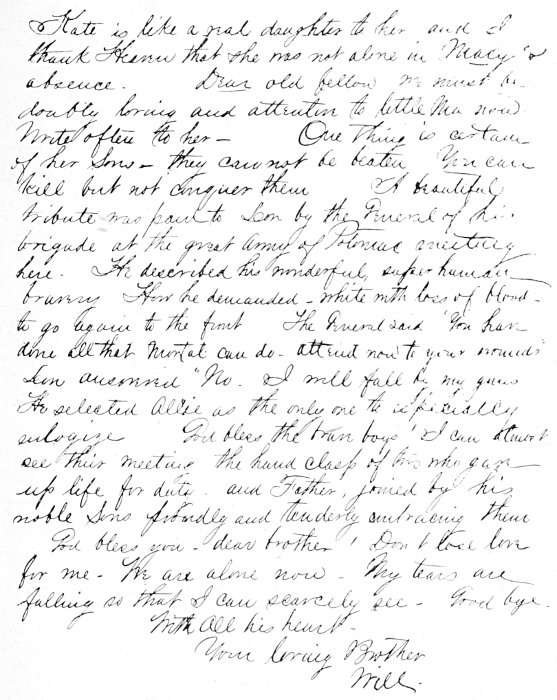
In the "seven days" before Richmond, his conduct
was such as to receive very high praise from
Sumner. Before the end of July, an order of
transfer was made for him to become an officer of
the Topographical Engineers, the most intellectually
elevated of all the branches of the army.
To foregather with the military high-brows
was not an aspiration of this soldier, however, and
he respectfully declined the honor. Notwithstanding
his preference for artillery work, McClellan
ordered him to perform the duties of assistant
topographical engineer at his own headquarters
when he set out on the Maryland campaign,
and kept him at the work as long as he
himself was in command of the Army of the Potomac.
The general had a keen eye for unusual
merit in young soldiers; one of the causes of
the personal affection felt towards him by the
great bulk of his officers and men was his promptness
to acknowledge their merits.
On November 5, McClellan was superseded
by General Burnside, and the Army of the Potomac
was soon after re-organized by separation
into three "grand divisions" under the respective
commands of Generals Sumner, Franklin, and
Hooker, for the right, the left, and the centre.
The right grand division was naturally to take
the initiative in future movements, and Sumner
wanted Cushing for topographical work at his
headquarters. The required surveying and map-making
were not objectionable to the young man,
so long as no active operations were in sight, and
his labors in this direction also received warm
commendation from the commanding officers.
Indeed, no task was ever placed upon the shoulders
of Alonzo Hersford Cushing, whether in
civil or in military life, so far as I have been able
to ascertain, that was not well and cheerfully
done.
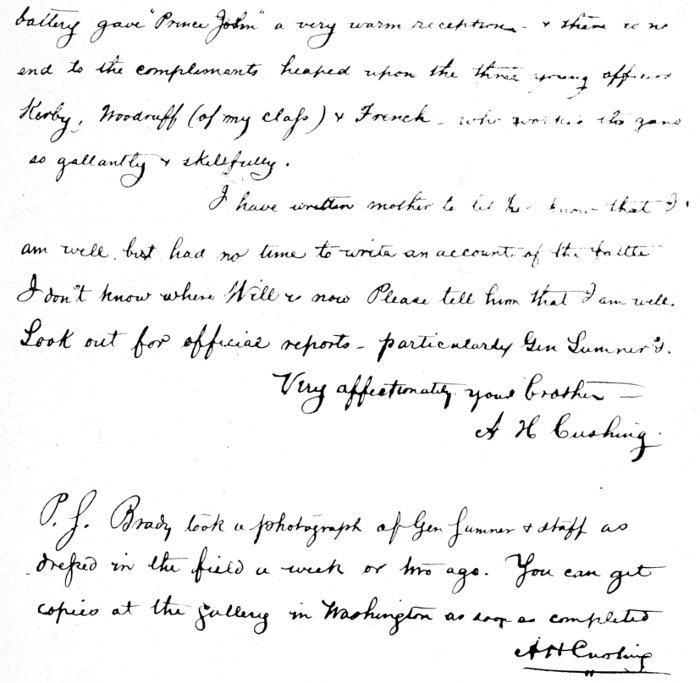
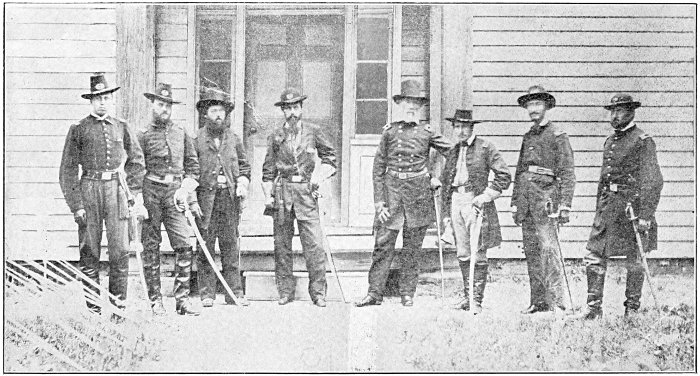
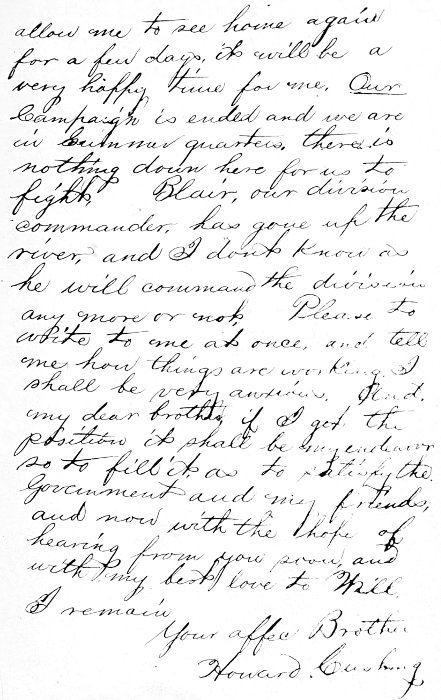
Facsimile of part of letter from Alonzo H. Cushing to his brother Milton;
written after the fights before Richmond in 1862. For group
photograph alluded to in postscript, see frontispiece to this volume.
The disastrous battle of Fredericksburg occurred
on December 13, and Lieutenant Cushing cut
loose for the day from grand division headquarters,
taking position by the side of General Couch,
commanding the Second Corps, with whom he
found ample opportunity for deeds of heroic daring,
which were acknowledged in a general way
in Couch's report of the part taken by his corps in
the fight. "Lieutenant Cushing," he says, "was
with me throughout the battle, and acted with his
well-known gallantry." Such further representation
of Cushing's conduct was made to the War
Department that President Lincoln brevetted him
captain, to date from the 13th of December, "for
gallant and meritorious services at the battle of
Fredericksburg, Va." A leave of absence for a
three weeks' visit home was also accorded to him
from January 26, 1863—his last opportunity for
a glimpse of life among his relatives and friends.
On returning to Virginia, Cushing resumed command
of his battery, and never afterwards left it
until his glorious death on the third day at Gettysburg.
The battle of Chancellorsville was prefaced by
several tentative actions, beginning at Fitzhugh's
Crossing on the Rappahannock, below Fredericksburg
(April 29, 1863), and continuing at
Spottsylvania Court House, Fredericksburg, Salem
Heights and Marye's Heights before culminating
in "The Wilderness" on May 3.
What Cushing did in this fighting, I have not
been able to ascertain; but that it partook of the
character of his service is evident because the
President gave him the brevet of major, dating
from May 2, 1863, "for gallant and meritorious
services at the battle of Chancellorsville." It may
incidentally be mentioned that in those days a
presidential brevet was of more importance than it
afterwards became under subsequent acts of Congress.
Originally it entitled the officer, if he
pleased, to wear the uniform of his brevet rank, to
be addressed by his brevet title, and to serve as of
his brevet rank when specially detailed. Under
later laws he could not properly wear the uniform
of rank above that which belonged to him by regular
commission.
It was a short two months from Chancellorsville
to Gettysburg, and the concluding two weeks
were full of incident for the men engaged, though
history has not considered it worth while to note
the incidents in any length of detail. Even the
Rebellion Records published by the national government
have little to say of the marches of the
two great opposing armies from the Rappahannock
to the sources of the Monocacy and beyond.
But the destiny of the Republic was entwined
in the serpentine paths of Lee's army going down
the west side of the Blue Ridge, and Hooker's on
the east side, both headed towards the north. A
change of commanders of the Army of the Potomac
was also impending, of which the soldiers
knew nothing, but which was all the time a puzzle
and worry to the corps and division leaders.
Cushing, with an ever cheerful face, was found
with his battery in front of each successive mountain
pass reached by the advance of Lee's forces,
as the latter moved along the valley of the Shenandoah
on the western side of the range.
On June 25, Hancock concentrated the Second
Corps, of which he was now the head, at Haymarket,
only a few miles from Manassas and
Thoroughfare Gaps. There the Confederate
cavalry general, Stuart, was surprised to find so
large a force and went back over the mountains—again
northward, in the track of Lee, instead of
delaying the Union army by a raid on its rear, as
he had expected to do when he was detached
from the main Confederate army before crossing
the Potomac.
That Hancock should parallel Stuart's march
was a matter of course, and on June 30 he was in
bivouac at Taneytown, half a dozen miles south
of Gettysburg. The next day the curtain was
partially withdrawn from the most magnificent
spectacle of a conflict of ideas, supported by fighting
men, that the Western Continent, at least,
ever witnessed. Hancock's corps, to which
Cushing was attached, was resting at Taneytown
all day; but after the death of General Reynolds,
Hancock was on the battlefield north of the town;
and although the battery was with the rest of the
corps, there can be little doubt that Cushing was
with him personally as a temporary aide. My
reason for assuming this is, that the brevet of lieutenant-colonel,
made out for him the next day,
stated that the honor was conferred "for conspicuous
gallantry at the battle of Gettysburg, Pa.,
July 1, 1863."
I wish that I had even one letter written by
Lieutenant Cushing between Chancellorsville
and Gettysburg, but I have knowledge of none.
Such a document would admit us to his inner feelings.
From his acts alone, and from what his
most intimate acquaintances in the army have
written, our judgment must be formed. A history
of the great battle can not be given here; but
fortunately no account of the engagement by a
reputable writer fails to take notice of the part
taken by the brave young son of Wisconsin in
stemming the high tide of rebellion on the third
day of the conflict. In Colonel Haskell's absorbing
story, a tribute is also paid to Cushing's endeavors
on the second day.[6] To that narrative
the reader is referred for that, among other living
pictures of the deadly struggle.
For me, it must be sufficient to portray as well
as I can the final stand of Battery A and its
commander at the focus of the last day's fighting.
Our line of battle stretched along the ridge overlooking
the valley between it and the southern
armies; along its whole length, fighting was either
imminent or actually in evidence. The thunder
of artillery was like a continuous roar that filled
the atmosphere. The fire of most of the one
hundred and fifteen Confederate cannon then in
action seemed to be directed by a kind of instinct
towards the point in our line where the batteries
of Cushing, Woodruff, and Rorty were belching
destruction in the faces of their assailants, a mile
and a half away. The artillery practice of the
Southerners was good. Between the afternoon
hours of 1 and 3, many of our artillery organizations
suffered severe losses by the bursting of ammunition
chests, the breaking of wheels of gun
carriages, and the overthrow of horses that lay in
death struggles on the ground. Men were hit,
also. Among the first to receive a serious wound
that fateful afternoon was Cushing himself.
Both thighs were torn open by a fragment of
shell—under which ill fortune, said General
Webb in his report, "he fought for an hour and a
half, cool, brave, competent."
The commander of his brigade, Colonel Hall,
reported that:
he challenged the admiration of all who saw him.
Three of his limbers were blown up and changed with the
caisson limbers, under fire. Several wheels were shot off
his guns and replaced, till at last, severely wounded himself,
his officers all killed or wounded, and with but cannoneers
enough to man a section, he pushed his gun to
the fence in front and was killed while serving his last
canister into the ranks of the advancing enemy.
Hall's last reference is to a later hour of July 3
than that to which I at present wish to call attention.
It is near 3 o'clock in the afternoon. To
give them an opportunity to cool off somewhat, our
eighty cannon have been ordered to cease firing.
The artillerymen throw themselves on the ground
to rest, or help clear away dead horses and other
debris from about the guns. Our infantry line is
closely fronted by stone walls and other fences
along the Emmetsburg road, or a short distance
back from that thoroughfare. The protection
thus afforded is not at all certain, even when sods
are packed against the fences, for a solid cannon
shot or fragment of shell may penetrate such an
earthwork, when reinforced only by a wooden
fence, as though it were a row of cigar boxes. It
affords some defense, however, against bullets
which strike diagonally, or are fired over a considerable
distance. Down in front of the hill
called "Round Top," Kilpatrick's cavalry are
worrying the right of the enemy; but that fails to
disturb those in the neighborhood of Cushing,
who was almost in the middle of the outstretched
line of Union troops.
Now Pickett's splendid column of 17,000 Virginians
emerge from the woods on the farther
side of the valley, and direct their course towards
the point where Cushing is holding a front place.
Other Union batteries are hurling solid shot at the
enemy, as they start on their fatal journey across
the valley. Confederate cannon send volleys of
shell over the heads of their infantry, into the
groups of our cannoneers, who continue to pelt the
advancing column. The iron shells burst in midair,
with puffs of smoke, like sporadic ejections
from the smoke-pipe of a locomotive engine, but
with resounding clangs. If the puff from a bursting
shell is behind you, or directly overhead, you
are safe from the effects of that explosion; but if
seen in front, the iron fragments are likely to cut
through the flesh and bones of some of you; for
the forward motion of the shell is not lost by its
explosion, although the pieces acquire additional
directions of flight. There is a composite of demoniac
noises, every missile splitting the atmosphere
with its own individual hum, whir, or
shriek; the musketry rattle like hail, and the deep
boom of cannonry lends its all-pervading basso to
the symphony of thousands of instruments and
voices.
As the grim column hurries on, our batteries
change from solid shot to shell, tearing great gaps
in the advancing lines; but these resolutely close
up, and move forward to attain a distance from
which their rifled muskets shall be used effectively
against us. This reached, they begin blazing
away. Cushing and his neighbors open upon
them with canister and case, every discharge sending
a shower of small metal into the approaching
ranks. However, the survivors press onward,
firing as they come, and the batteries behind them
send their shell among our cannon, killing horses
and men, and overthrowing guns, but not yet
harming afresh the young hero whom we are particularly
noting. Woodruff and Rorty are slain,
though, at the head of other batteries close at
hand.
At last a bullet pierces Cushing's shoulder.
He simply laughs at the hurt, calling to Webb,
his division commander, "I'll give them one more
shot. Good-by!" As he serves the last round
of canister, another bullet strikes him in the mouth,
passing through the base of his brain, and he falls
forward, bereft of life, into the arms of his clarion-voiced,
resolute, and fearless orderly sergeant,
Frederick Fuger, whom he has called to his side
to convey his orders to the men.
The Union line of infantry was also making
use of its muskets, in trying to stop the Confederate
assault. The aim of the soldiers was more or
less accurate in proportion to the nerve-control exercised
by the respective individuals engaged.
For not all of the forces attacking or attacked are
fully conscious of what they are doing, when the
surrounding air is pregnant with death. Some
try to shoot with their eyes shut, and others forget
to place a percussion cap on their firearm.
Out of over thirty-seven thousand muskets left on
the Gettysburg battle-ground by soldiers of both
sides, no longer able to carry them, nearly a third
were loaded with more than one cartridge each,
and many with more than two. We pardon the
confusion of mind exhibited before his audience,
by a young actor or speaker, and it surely is no
less to be expected that unaccustomed soldiers
should often feel trepidation when face to face
with death.
Despite the firing from our side, a hundred of
Armistead's men kept close to their chief, leaping
the fence next to Cushing's battery, just behind
him, and in time to see their leader lay hand
on Cushing's last cannon and fall dying with a
bullet through his body—only a few yards from
where his late indomitable opponent lay dead.
By the side of that field-piece, went out the
lives of two as gallant warriors as ever wielded
sword on battlefield, and Cushing still lacked six
months of completing his twenty-third year of life.
The Southern soldiers who thought they had
taken the battery, now rushed back or surrendered
on the spot, and the flood tide of rebellion began
to recede, never again to attain so dangerous a
height, although often rising somewhat uncomfortably.
The loss of a son so high in aspiration and so
capable for the achievement of necessary tasks,
must have been a grievous stroke for his mother to
bear—she who had placed her greatest reliance
upon him, rather than upon his brothers. For her
compensation for such a loss, she was allowed a
pension of seventeen dollars per month until the
year of her death (which happened March 26,
1891), when the allowance was increased to fifty
dollars. In this case the national government was
certainly very much the reverse of liberal in its
recognition of the services of a noble mother, who
had formed the character of a noble son whose life
was joyfully laid upon the altar of his country.
It is pleasant to be able to state that Sergeant
Fuger, who took command of the battery after the
death and disablement of its three commissioned
officers taking part in the battle, was promoted
to a lieutenancy in the regiment. He served in
the regular order of grades until retired (about
1900) on account of age, as colonel, since which
he has lived in the city of Washington. From a
letter recently written by him to Mrs. Bouton, I
am permitted to make the following transcript:
In answer to your letter received yesterday morning, I
would say that the best friend I had was your dear
brother, Alonzo H. Cushing, First Lieutenant 4th Artillery,
commanding Battery A, 4th Artillery, at the battle
of Gettysburg. On the morning of July 4, 1863, I
received an order from Gen. Hancock, commanding 2d
Corps, to send your brother's body to West Point for
burial. I placed the body in care of two non-commissioned
officers who were slightly wounded, to take it to
West Point.
The manner of your brother's death was this: When
the enemy was within about four hundred yards, Battery
A opened with single charges of canister. At that
time Cushing was wounded in the right shoulder, and
within a few seconds after that he was wounded in the
abdomen; a very severe and painful wound. He called
and told me to stand by him so that I could impart his
orders to the battery. He became very ill and suffered
frightfully. I wanted him to go to the rear.
"No," he said, "I stay right here and fight it out, or die
in the attempt."
When the enemy got within two hundred yards,
double and triple charges of canister were used. Those
charges opened immense gaps in the Confederate lines.
Lieut. Milne, who commanded the right half-battery, was
killed when the enemy was within two hundred yards of
the battery. When the enemy came within about one
hundred yards, Lieutenant Cushing was shot through the
mouth and instantly killed. When I saw him fall forward,
I caught him in my arms, ordered two men to take
his body to the rear, and shouted to my men, as I was left
in command, to fire triple charges of canister.
Owing to dense smoke, I could not see very far to the
front, but to my utter astonishment I saw the Confederate
General Armistead leap over the stone fence with quite
a number of his men, landing right in the midst of our
battery, but my devoted cannoneers and drivers stood
their ground, fighting hand to hand with pistols, sabers,
handspikes and rammers, and with the assistance of the
Philadelphia brigade, the enemy collapsed and Pickett's
charge was defeated. The gall and behavior of the
men in Battery A was entirely due to your brother's
training and example set on numerous battlefields.
Lieutenant Cushing, my commander, was a most able
soldier, of excellent judgment and great decision of character.
Devoted to his profession, he was most faithful
in the discharge of every duty, accurate and thorough in
its performance. Possessed of mental and physical
vigor, joined to the kindest of hearts, he commanded the
love and respect of all who knew him. His superiors
placed implicit confidence in him, as well they might.
His fearlessness and resolution displayed in many actions
were unsurpassed, and his noble death at Gettysburg
should present an example for emulation to patriotic defenders
of the country through all time to come.
General Armistead fell, mortally wounded, where I
stood, about seven yards from where Lieutenant Cushing,
his young and gallant adversary, was killed. In
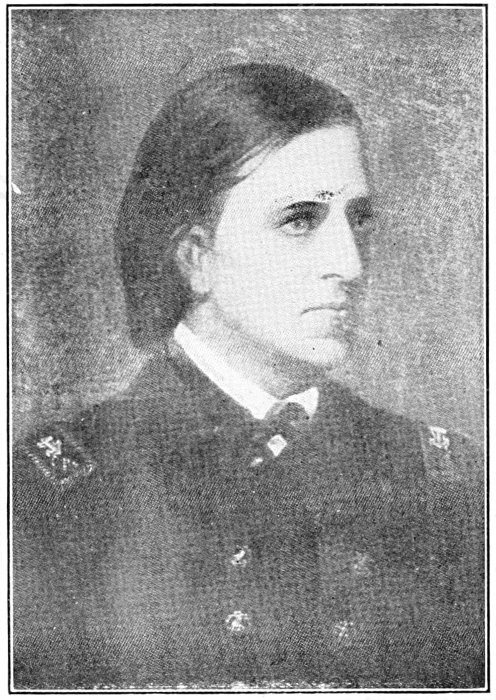
height your brother was five feet nine inches, in weight
about one hundred and fifty pounds, good long limbs,
broad shoulders, blue eyes, dark brown hair, smooth face,
without beard or mustache, and rather swarthy complexion.
From other communications of the colonel, addressed
to myself, I learn that Lieutenant Cushing
personally saved the battery from capture at the
battle of Antietam; that its loss at Gettysburg was
two officers killed and one wounded, seven enlisted
men killed and thirty-eight wounded, and
eighty-three horses killed out of ninety taken into
the action. Not an uninjured wheel remained,
and nine ammunition chests were blown up.
Ninety enlisted men belonging to the battery were
on duty at the beginning of the fight.
Corporal Thomas Moon has also written his
recollections of the day, and although his memory
seems somewhat at fault in relation to certain matters,
his description is worth reading. He says:
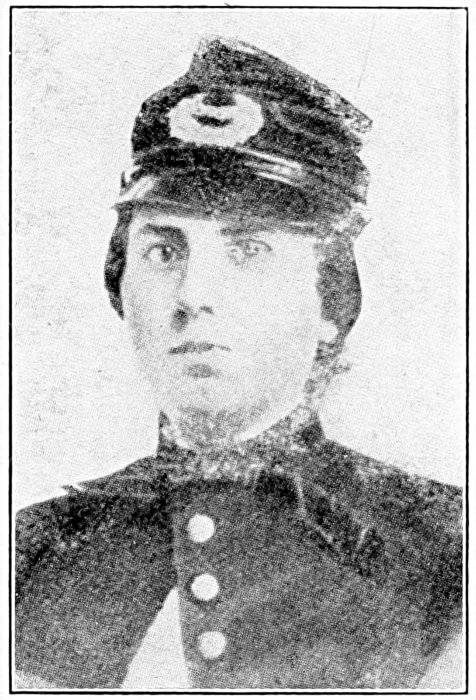
Cushing was a small-sized man with blue eyes, smooth
face and auburn hair, and looked more like a school girl
than a warrior; but he was the best fighting man I ever
saw. Our battery arrived on the field July 2 and took
position on the left of the 2d corps. I was sent to the rear
with the 4th caisson. We went back over the hill close
to General Meade's headquarters. When the heavy
cannonading commenced on the 3d we went further to
the rear. About the time that Pickett was ordered to
charge, I was ordered to the battery. I was informed by
the courier that I would find the battery on the right of
the 2d corps, at the grove and angle. My horse made a
good run for about a mile. I found my piece, the 4th,
still on her wheels, and all the canister we had piled up
around her. I had been on the ground but a few minutes
before I found the gun hot and firing slow. A very
few minutes passed until the smoke raised, and we saw
the head of Pickett's column within three hundred yards
of us. We had the opportunity of our lives; just what
an artilleryman wants. We had a flank fire on them and
enough canister to stop them, but before they got to the
stone wall in front we were out of ammunition and my
gun was dismounted. Lieutenant Cushing was on the
right. We both got to the piece in front about the same
time. I found the piece out of canister, started back to
the limber, looked back and saw General Armistead with
his hat on his sword yelling to his men, and Cushing being
held up by some infantry officer. If I had stayed at
the gun as long as Cushing did, I would have been there
yet. Our guns were all disabled, limbers and caissons
blown up, men and horses killed and wounded, and the
battery under command of a First Sergeant (afterwards
lieutenant) Frederick Fuger, a 10-year man, and as fine
a soldier and officer as ever faced an enemy. I was on
duty that night—had three men under me. All we had
to guard was a few dead men. We took Lieutenant
Cushing and three or four men off the field. It rained all
night.
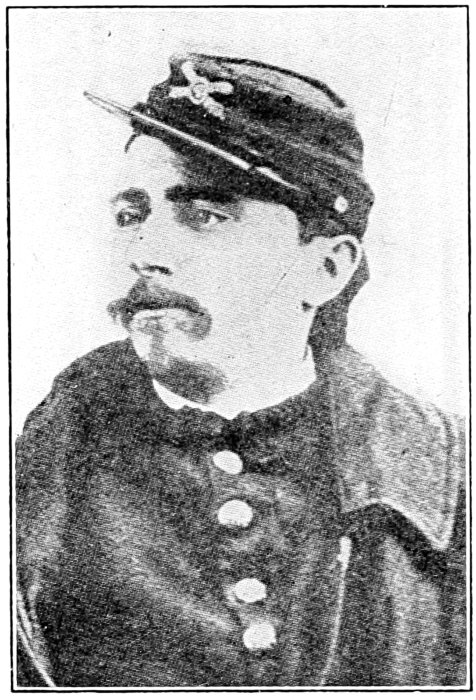
Now, as to Cushing's wounds. One piece of shell
struck him in the thighs; another piece struck him in the
shoulder; but he stuck to the guns until a ball struck him
right under the nose. He fell on one side of the piece
and General Armistead on the other. His right thumb
was burned to the bone, serving vent without a thumb-pad.
We were all tired, powder-burned and bruised;
so we laid the dead men together and lay atop of them
all night. The next morning we took Cushing's fatigue
blouse off, and his cook got that after I took off the
shoulder-straps. I carried them till the next winter, and
gave them to his brother (Howard) at Brandy Station.