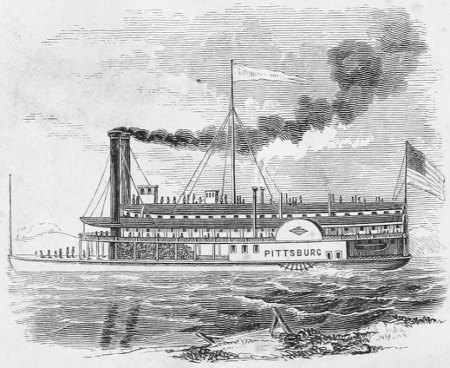
The morning had come, and we were now approaching Pittsburg. It was just
about sunrise when we came in view of its spires and buildings. The
passengers were scrambling up, now, in every direction.
Some of the passengers were now at the end of their journey. Others had
to go further; and some of us many hundred miles further. However, we
were all alike glad to get on shore.
But our trunks—where were they? They had, for the greater part, been
piled together in a certain place on the deck of the boat, under the
care of the steward: they were safe, only it was difficult, at first, to
find them.
Here is mine. It must be marked for the railroad across the Alleghany
Mountains to Philadelphia. All this was easily disposed of. And now it
is to go with a baggage-wagon, and to be taken to the railroad depot.
On removing the trunk to the baggage-wagon, the steward reminded me that
it was his custom to receive a small sum of each traveler for taking
care of his trunk while on board. I asked him how much. Anything, said
he, you please to give.
I was not satisfied with the charge; for I supposed he had his pay by
the month, or in some such way, and his regular compensation was
sufficient for every purpose: but though a colored man, he was quite a
gentleman, and I could not well refuse him.
How many little taxes one must pay, in a busy world like this! Well, an
honest, Christian man has no very strong objection to paying them
whenever, in so doing, he does not go contrary to the principles of
right; and these little taxations, as you travel along, by servants and
porters, and stewards, though they are annoyances, seem to me to be of
this description.
I was at length in Pittsburg. I had always heard that it was a smoky
city, and was not, therefore, at all disappointed. In truth, I did not
see it to be more sooty than several other places below it on the river.
Pittsburg is about half as large as Cincinnati; and is pleasantly
situated, at the junction of two large rivers. It seems to be a very
busy, bustling place; for though it was yet early in the morning—quite
early—the streets were pretty well filled with travelers and carriages.
Opposite Pittsburg—that is, across the Alleghany River—is Alleghany,
which of itself would make quite a large city. It is at least as large
as New-Haven, or Salem, or, perhaps, Troy.
And now, though I am soon to proceed, yet as the cars are not yet ready,
I have a little time for reflection, and I avail myself of it.
The world, itself, seems to me like a great steamboat—larger, indeed,
than the Pittsburg, and yet a huge passenger-boat. People are
continually coming on board, and continually leaving it.
To-day we form an acquaintance with a few of the vast variety of faces
we see; to-morrow, perhaps, they are separated from us, to go, we know
not whither.
One striking difference there is in the two cases. When the passengers
separated at Pittsburg—and so also of other separations at Wheeling and
other places below—it was not with a certainty that the separation was
final, for this world. There was, at the least, a possibility of meeting
again, somewhere, and at some time.
But when we separate in the great steamboat of the world at the verge of
eternity, when we step forth upon its immeasurable shore, it is with
positive certainty of meeting no more in this world.
We may meet again—we shall, most undoubtedly. We shall meet at the
sound, not of the little bell to which we are accustomed on board the
boats of Western rivers, but of the trump of God. We shall meet, but it
will be at the general judgment. We shall meet, but it will be in the
immediate presence of God.
Will our meeting be a pleasant one? Will it be pleasant to all, or only
to a part? And who will be the happy ones, and who the unhappy? Shall
you, reader, or I, be of the former number; or shall it be our lot to be
of the latter?
God, in his mercy in Christ, has left the matter to our own choice. This
is right, is it not? He has made us free to choose about other
matters—why not about this? He certainly would not compel us to a
joyful meeting.
Be it our first business, then, our great business, our only business,
so to conduct while on the passage-boat of life, that whether we are
sailing on the Ohio River, or traveling elsewhere, we may always be
found in the path of duty, and always ready for anything whatever to
which we may be called, here or hereafter.
THE END.