According to the judicious Norfolk antiquary John Kirkpatrick, who
accumulated vast collections of material relating to Norwich, “There
was a design of erecting a Public Library in this City, in the reign of
Edward the Fourth, as appears by this legacy, in the will of John
Leystofte, vicar of St. Stephen’s church, here, A.D. 1461,
namely,—“Item. I will that, if a library be begun in
Norwich, within two years after my decease, I bequeath to the same, my book
called Repyngton.” [4] Kirkpatrick was unable to say whether the
legacy was effected, and no record remains.
The first City Library of which there is any record was founded on the
3rd May, 1608, and by the following order of Assembly which was then
recorded, it will be observed that it had an ecclesiastical basis, like so
many libraries of previous centuries: “Ordered, with the consent of
Jerrom Goodwyne, sword-bearer, that iij chambers, parcel of his
dwelling-howse, which he hath by lease of the cyttie, shal be converted to
a lybrary for the use of the preachers, and for a lodging chamber for such
preachers as shall come to this cittie, to preach on the sabboth-dayes, and
at other tymes, in the common place, and elsewhere, within this cittie;
where the said Jerrom Goodwyn shall fynd beddyng, lynnynge, and other
necessaries for lodging, for the preachers that so shall come, during their
abode in the cittie for the intent aforesaid: which said romes for the
lybrary shal be made fytt at the charge of this cittie; and the said
Goodwyn to allowe one of his servants to attende the preachers. In
consideration whereof, the said Goodwyne shal be allowed yearly the rent
which he now payeth, and his lease, notwithstanding, to stand good for the
terme therein expressed.” [4]
The Library, however, was not intended solely for ministers. The
wording of the title-page of the first donation book, commenced in 1659,
states that it was founded for students: “Bibliotheca publica
Norvicensis communi studiosorum bono instituta incœpta et inchoata
fuit Ano Domini MDCVIII.” (See reproduction, facing
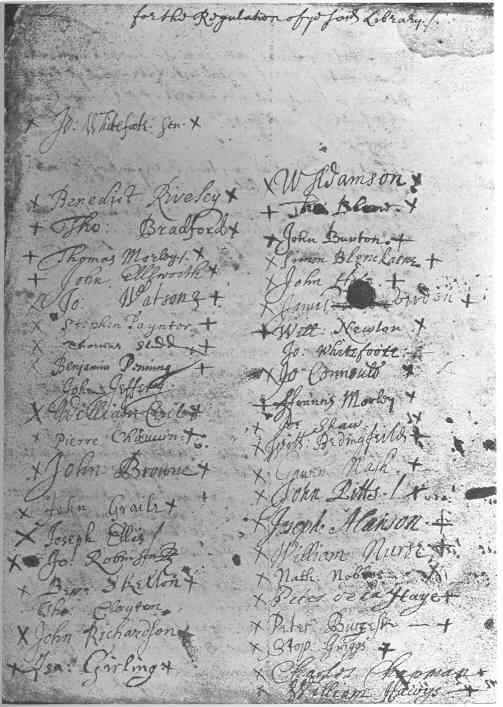
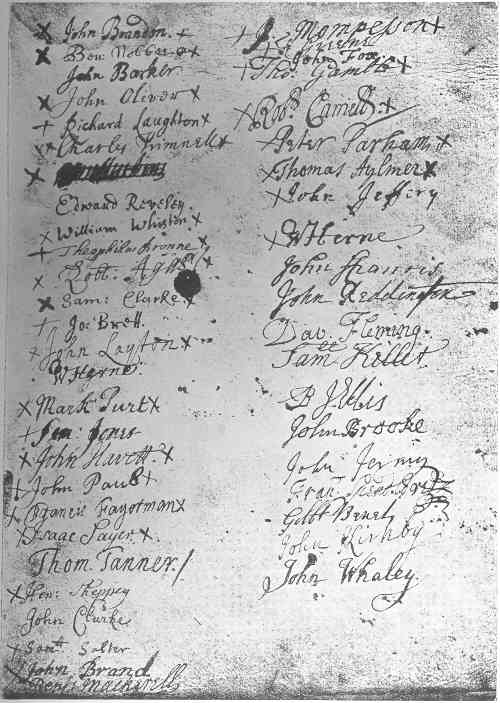
page 46). Moreover, the list of the early members of the Library
includes the names of people who were not ministers. Facing pages 4
and 6 are facsimiles of the two pages in the Minute Book bearing signatures
of early members who subscribed to the rules of the Library. Perhaps
the most notable autographs are those of Charles Trimnell, Bishop of
Norwich, William Whiston, translator of Josephus, and chaplain to John
Moore, Bishop of Norwich, Thomas Tanner, Bishop of St. Asaph, and Benjamin
Mackerell, a Norfolk antiquary and Librarian of the Norwich Public
Library.
To
Judge by the existing records, the City had then received no books for
placing in the rooms. Mr. J. C. Tingey, [5a] however, considers it
“rather strange that when, in 1608, three rooms were fitted up for
the reception of the library at the New Hall there should be no existing
books to be placed in the presses, though promises of donations may have
been given. As a matter of fact the compilers of the old catalogues
mention several works without being able to say by whom they were
presented, and as many of these were printed in the 16th century it is not
impossible that some of them constituted a primary stock. On the
other hand many books whose donors are unknown were issued after the
library was inaugurated, so of these it is certain that they were presented
later.” The number of works whose donors are not stated in the
first printed catalogue of 1706 is 51, but in the second printed catalogue
of 1732 the donors of 36 of these are stated, so there remain only 15 works
in the first printed catalogue of which the donors are unknown. Of
these fifteen one was printed after the establishment of the Library, and
so the primary stock suggested by Mr. Tingey could not have consisted of
more than 14 works.
There is a hiatus in the records of the Library proceedings from its
establishment to 1656. Possibly the books presented to the Library
from 1608 to 1656 were simply allowed to accumulate in the Library rooms,
without any regulations in regard to their use and safe-keeping. That
the books were sadly neglected is very evident from a codicil to the will
dated September 18th, 1655, of John Carter, Rector of St. Laurence’s
Church, Norwich, giving to the Library “divers books,
etc.” He revoked his bequest by the following codicil, and
“instead thereof gave £5 to each of the three united parishes
of St. Laurence, St. Swithin, and St. Margaret, for a stock of coals for
ever”: “nowe seeinge (to my no small grief) that that library
is locked up, ministers shut out of it, and that it is never like to be of
publique use againe, but that the books are devoted to the wormes, dust,
and rotteness, to the dishonour of God, the damage of the ministry, and the
wrong of the benefactors, the dead, and the living, &c.” [5b]
By
1656, the year of Carter’s death, the Assembly had evidently realised
the necessity for making regulations for the use of the Library, and had
drawn them up before the 16th January in that year, when it was
“ordered that the Articles moved touching the ordering of the Library
be continued.”
On the ninth day of the following month eight ministers met at the
Library, when they received the “Orders” of the Council for the
regulation of the Library, and having subscribed to them, they were
admitted to the use of the Library. At this meeting they ordered two
frames for the “Orders”; that Mr. John Collinges should be
Library Keeper until January, 1657; that each minister admitted to the use
of the Library should pay 12d. quarterly; and that “a book should be
bought for registring the acts of the mins at their severall
meetings in the Library, and sheets of parchment fit for the engrossing of
the orders, and that the library keeper be desired to provide these against
the next meeting.” This minute book is still in the City
Library, but it has been overlooked by all previous writers of notices of
the Library. It commences with the proceedings of the meeting on the
9th February, 1656, and records the meetings until April 3rd, 1733.
As the Assembly Minute Books for the years 1632 to 1682 are missing the
actual “orders” previously mentioned cannot be quoted, but
fortunately the other end of the Minute Book was used to write in the
declaration of admission and the rules for the conduct of the
Library. They are as follows:—
“We whose names are hereunto annexed upon our admission to ye use
of ye Publick Library in ye City of Norwch, in Complyance
wth an Act of ye Common Council of ye said City dated ye 16th
January 1656, do faithfully engage and promise,
“Imprimis That we will not at any time Carry out of ye said
Library any booke belonging to it.
“2 ly That we will not Leave any booke belonging to ye said
Library (after our using it) out of its due place, nor write any thing in
any of ye bookes, nor Leave them wth any Leaves turned
downe.
“3 ly That we will not prejudice any other pson by our use of ye
said Library, to which purpose we shall not at any time delay our going to
ye Library after ye receipt of ye Keyes from ye Keeper, nor ye
restoring them when we Come out of ye said Library.
“4 ly That we shall as to all these Articles be Responsabl for our
friends who shall goe wth us to ye said Library, as for our
selves.
“5 ly We shall (being duly Chosen thereto) not above once in
seaven yeares, discharge ye office of Library-Keeper.
“6 ly We shall faithfully pay our proportions to ye under-Keeper
of ye said Library quarterly, and also our equall share wth ye
rest of our brethren in all Charges they shall be at for ye better
preserving of ye said Library.
“All these things we shall endeavour faithfully to observe &
keep, if through our negligence we shall fail in any of them, we Agree to
subject our selves to ye Penalties mentioned in ye orders Confirmed by the
Court of Common Councill in ye said City.”
The Library at this time was clearly a Reference Library, and its
maintenance partly depended on the members who agreed to pay their
“proportions” of 12d. quarterly, and also their equal share in
any charges made for the “better preserving of the
Library.” The earlier entries in the Minute Book give a fair
record of the proceedings at the meetings: they record the names of the
members present, the names of new members admitted to the use of the
Library, the quarterly payments of the members, the donations of books,
books purchased with money given to the Library, duplicate books exchanged
for other books, the appointments of the Library Keepers and Under Library
Keepers, and other matters connected with the administration of the
Library; but the fulness of the entries gradually diminishes until the
records are little more than lists of members present, and notes of
quarterly payments.
The meetings were held monthly, and on February 6th, 1656, it was
resolved that the meetings should be held on the second Monday in each
month between 2 and 3 o’clock. At that meeting a levy on the
members was recorded: “All the mins present at this
meeting deposed Sixpence a piece in Mr. Collinges hand towards the
providing of frames and parchment for the orders for the regulation of the
library, in all 5/-: and ordered such as were not present if admitted
already, or such as hereafter should be admitted, should at their admission
or next appearing at meeting lay down so much towards the frames and
parchment aforesaid, and the buying of a book to register the Acts of the
mins in.”
That the members were permitted to enjoy the fragrant weed on the
library premises is evident from an entry under date October 12th, 1657:
“Threepence was laid out for tobacco pipes,” and on April 1st,
1690 it was recorded, “That Mr. Pitts is this day discharged from ye
office of Library Keeper, and is endebted to ye under=Library=Keeper for
his 2 years for fire, candle, pipes, pens, ink and paper, nine
shillings.”
From many records it is obvious that the City Authorities closely
controlled the administration of the Library. According to the Minute
Book on January 12th, 1673, the members “consented yt
Mr Riveley and Mr Morley should attend yppon the
Court to craue their Order for appoynting the time for ye Ministers Meeting
at the Library for future to be uppon the first Tuesday in every
moneth.” The request was granted. On 29th March, 1673,
the Court ordered “36s. to be paid for six Russia leather
chairs for City Library.” [8]
The library receipts from fees and charges are not regularly entered,
but throughout the Minute Book there are occasional records of receipts and
payments, and under date March 3, 1684, is the following: “This day
ye account of ye Last year was stated. The Library keeper had
received 4ll 3s & 4d and had expended
4l 11s 10d—due to Him 8s
6d.”
Either as a means of raising additional money for the Library or of
securing a better attendance of members at the meetings it was ordered on
Jan. 15th, 1677 “that all persons that will continue the use &
benefitte of the librarie shall pay for every omission of meeting upon the
day appointed the forfeiture of 2 pence, no excuse to be admitted for
absence; & the said forfeitures are to be dispos’d of every halfe
year according as the major part of psons at yt meeting shall
determine.” The Minute Book does not show that the fines for
absence were usually disposed of half-yearly, but the following memorandum
was made
therein on April 1st, 1690: “That this day we present cast up ye
forfeitures of ye two last years, viz. 1688, 1689 And the several persons
are indebted in all two pounds, ten shillings & four pence as appears
by ye particulars in ye Book of forfeitures.”
For the first 108 years of the Library’s existence it remained a
reference library, and books were not lent, but surreptitious borrowing
probably took place occasionally. At any rate on December 2nd, 1684,
the following memorandum was made: “That Bp J. Ushers treatise de Macedonum et
Assyriorum [Asianorum] anno solari was missing this meeting yt
was, by ye under-library-keepers attestation here the last
meeting and has bin missing this three weeks, ’tis desired that he
that has it would be pleased to restore it, and not to do any such thing as
is contrary to wt he hath subscribed.” By 1716 the
members had considered it desirable to allow the borrowing of books for
home reading, and on May 7th, 1716, occurs the following record of the
petition of the members to the City Court:
“This Society having requested ye Court to give leave
yt an order might be made to render ye Library more
usefull it was accordingly ordered by ye Court
“Norwich. At an Assembly held the third day of May Anno Dnj
1716
“The Petition of ye Clergy about ye Books in
ye Library is now agreed to, so as such care be taken by ye
Library-keeper yt there be no loss of ye Books.
P Cur: Chappell.
“The Articles or Conditions of borrowing any book out of
ye Library are order’d to be written in ye
first leave of a Register to be provided for ye use of
ye Society.”
“These Articles or Conditions are fortunately written at the end
of the Minute Book, and are as follows:
“First, That every Person taking out any Book, shall enter
ye same into a Book to be provided for yt
purpose.
“2dly: That He shall be obliged to return ye same Book
or Books wthin one month from ye time of borrowing,
& enter ye return of ye sd Book in a
Column of ye Register opposite to that wherein ye borrowing of
ye sd Book is mention’d.
“3dly: That No Person shall have above ye
Number of three Books (from this Library) at one time, unless
ye leave of ye Society be first Ask’d &
obtain’d.
“4thly: That if any damage be done to any Book, He in
whose hands it is shall make it good, & to prevent disputes, if
ye Book be damag’d before taken out of ye
Library it shall be shown to ye Under=library=Keeper.
“5thly: That there be some Persons appointed to assist
ye Upper Library Keeper in calling over ye sd Books
ye first Monday of January next, & so yearly & every
year, & yt ye Library Keeper shall have power to
send for & call in such Books as are ytt abroad, & every
person in whose hands any Books have been above ye limited time
of one Month at such days of calling over ye sd Books
shall forfeit two shillings & six pence to be applied to such use as
ye Society shall adjudge proper.
“6thly: That No Person shall be admitted to
ye use of this Library, (Those of this Court excepted) Nor have
ye liberty of borrowing any Book from ye
sd Library who are not already, or shall not hereafter be
admitted to ye use of ye sd Library
according to ye usages & Customs of the Society Now in great
measure entrusted wth ye Care & Charge of
ye Books of ye sd Library, except such
Person shall first give unto ye sd Library
ye sum of fourty shillings or Books to yt value.
“7thly: Tis agreed yt there be two fair
Catalouges made, One to be & remain wth ye Court
of this City, & ye other to be kept in ye
Library, yt ye Library Keeper do get ye
sd Catalouges made wth all convenient speed,
yt ye Books be rang’d into some method &
order, yt ye Library Keeper shall take in such
assistance as is wanting, & his charge & trouble be allow’d
according to ye discretion of ye Society.”
These rules show that borrowers were permitted to record the books they
borrowed, that they were allowed to retain them for a month, that damaged
books should be reported to the Under Library Keeper before being taken
away, and that a stocktaking fine of 2s. 6d. was provided for in the event
of books not being returned in the January of each year.
The Minutes between 1716 and 1731 chiefly record formal matters, and
little of note regarding the administration of the Library. On
February 7th, 1731, “It was then unanimously agreed that the Members
meet for the future on the first Tuesday in every Month at two
o’Clock in ye afternoon.” On the 7th of the
following month two delinquent borrowers were dealt with: “Whereas
the Revd Mr. Francis Johnson took some time since the
Works of Bishop Bull in 4 volumes 8vo out of this Library, &
has return’d only ye 1st, 3rd &
4th Vols & instead of ye 2d
Sherlock on providence, it Was then Order’d, that that shd
be return’d him again, & that he be requir’d either to send
back ye sd 2d vol. or take the remaining
three, & send an entire Sett. Order’d likewise that
Mr Morrant be requir’d to return B-p. Stillingfleets
Origines Sacrae, being ye 2d vol. of his works, Long
since taken out by Him.”
The regulations for the administration of the Library were again revised
in 1732/3 by the City Council: [11]
“At an ASSEMBLY held on Feb. the 24th, 1732/3. the Right
Worshipful the MAYOR, Sheriffs, Aldermen, and
Common-Council this Day assembled, for the better Regulation of the
Publick Library, have unanimously appointed the following ORDERS to
be observed, upon Pain of Exclusion from the said Library.
“ORDERED, That the Catalogues already printed be Six Hundred; and
that one Half of them be kept in the Town-Clerk’s Office, to be
delivered out to the Members of the Corporation; and the other Half be left
in the Library, to be delivered out to the Subscribers.
“ORDERED, That the Books in the said Library be Annually called
over, in the first Week of June, in the Presence of the
Chamberlain; and that such books as are found to be Duplicates, be
sold by the Chamberlain and Library-Keeper; and that the
Money arising by Sale thereof, be laid out in the Purchasing of such Books
as shall be thought proper by the said Subscribers.
“ORDERED, That after the said Annual Call is finished, the
Subscribers to the said Library, upon their next Monthly Meeting, have
Liberty to choose a Library-Keeper for the Year ensuing.
“ORDERED, That on the Reception of any Book or Books given to the
said Library, the Donor’s Name shall be written on the inside
Cover of the Book, and that the Library-Keeper shall Register the
same in the Vellum Book.
“ORDERED, That no Person shall have more than Three Books out of
the said Library at one Time, nor keep them longer than one Month, without
the Consent of the Majority of the Subscribers present at their Monthly
Meeting: And that an Account of every Book Lent, and the Return thereof, be
duly made and enter’d in a Book for that Purpose.
“ORDERED, That every Person who shall be admitted to the Use of
the said Library, shall declare his full and free Consent to comply with
the said Orders, as far as to him may appertain, according to the true
Intent and Meaning of the same; and particularly with the following Orders
or Articles, by subscribing his Name in the said Library-Book upon
his Admission: And also that all the said Orders, and the following
Articles, shall be entred in the said Library-Book, viz:
“First, That every Subscriber upon Admission shall pay to
the Under Library-Keeper one Shilling, and also one Shilling
Quarterly, for his Care of, and Attendance at the said Library: And every
Subscriber shall also pay his Proportion of all Charges that may be thought
necessary by the Subscribers, for the better preserving of the Books in the
said Library; or shall be excluded the Use thereof.
“Secondly, That if any Book be lent out, and lost or
damaged, the Borrower shall be obliged to make good such Loss or
Damage.
“Thirdly, The Subscribers have Leave to meet the first
Tuesday in every Month, to inspect the said Library, and take out
such Books as they may have Occasion for, then or at any other Time; and
see that the said Orders and Articles be duly observed.
“Per Curiam,
“LODGE.” [i.e., Nehemiah
Lodge, Town Clerk].
The Minute Book which finishes on April 3rd, 1733, is silent regarding
these new regulations, but Benjamin Mackerell (Librarian of the City
Library from 1724 to 1731) writing in 1737 shewed that they did not result
in improving the management of the Library:
“For some few years it has been a Lending Library and some
persons have had books two or three years together contrary to an order to
the contrary. Here is no salary given by the city for anyone to take
care and the charge of the books upon him only the keys thereof are left at
the house of the Clark of St. Andrews Parish, and any man may be admitted
that will but give him twelve-pence a quarter, but unless the Corporation
would be at the expence of a salary for any sober discreet person to take
the charge of the said books upon himself and have the sole custody of
them, and pecuniary mulcts inflicted upon such as break the orders already
made, there is little hopes of keeping the books there, or in any good
order long together, besides this is also made use of upon the account of
the trustees for the Charity Schools who frequently meet here,
notwithstanding there are so many more convenient rooms in the said
hall. Especially that in which the Grand Jury meet in at every
Assizes. Persons may borrow two books out of this Library at a time
but ought not to keep them above one month without giving notice to the
Library keeper.” [13a]
Mackerell’s remarks, and the fact that the Minute Book was not
filled, seem to indicate that the Library was neglected for some
years. On September 21st, 1801, the Assembly complied with the
request of the Committee of a subscription library, with the misnomer
“Public Library” (established in 1784 in St. Andrew’s
Hall) by granting them leave “to have the use of the books in the
City Library, to be kept under the care of their Librarian apart from other
books, the President giving a receipt for the safe return of the same on
demand.” [13b] The City Committee reported to the
Assembly in 1805 “that the books in the City Library have not of late
been carefully preserved, that some valuable works have been mutilated and
others lost or mislaid.” [13c] The Assembly thereupon
rescinded the order of September 21st, 1801, requested the President and
Committee of the “Public Library” to “make good all
losses and injuries,” and committed the custody of the City Library
to the Steward. In 1815 the City Library was again entrusted to
the “Public Library.” Ten years afterwards, the
“Public Library,” which still housed the City Library, was
removed to a building in St. Andrew’s Street. The admission fee
to this Library in 1825, as stated in the Catalogue of the Library of that
date, was five guineas, and the annual subscription was one guinea.
This Catalogue contains the following rules regarding the City Library:
“LIV. The books belonging to the City Library having been
deposited in the Library Room of the Public Library, by permission of the
Corporation, are accessible to the subscribers, and may be delivered out
under a written order of the president, or vice-president, countersigned by
an officer of the Corporation.
“LV. The Librarian shall have charge of the books belonging
to the City Library, and shall procure the necessary authority for the
delivery of books to subscribers applying for them.
“LVI. The books belonging to the City Library shall be
returned to the Librarian every quarter day; and the same fines and
penalties shall apply to subscribers not attending to this regulation, or
to losing, lending or injuring books belonging to the City Library, which
are laid down by the laws for the protection of the books belonging to the
Public Library.”
In the same catalogue it was stated that the City Library was under the
particular inspection of the Mayor and seven members of the Council who
constituted the Library Committee of the Corporation. “The
Right Worshipful the Mayor of Norwich, for the time being, is an Honorary
Member of the Public Library; and the Members of the Library Committee of
the Corporation, together with the Speaker of the Commons, the Town Clerk,
and the Chamberlain, if not already Members of the Society, have the
privilege of constant access to the Library Rooms during their continuance
of office.” [14] These rules were in force in 1847, and were
reprinted in a new edition of the Catalogue printed in that year. The
members of the rival subscription library, called “The Norfolk and
Norwich Literary Institution,” which was established in 1822, were
also allowed to borrow books from the City Library, by an order from
the Chamberlain of the City. [15a] In 1835 the
“Public Library” with the City Library was removed to a new
building opposite the north door of the Guildhall, on the site of the
present Norfolk and Norwich Subscription Library.
Ostensibly the City Library was adequately cared for by the
“Public Library,” but in reality it was greatly
neglected. At a meeting of the Council on July 10th, 1856, the Town
Clerk read a report from the City Library Committee, stating that they had
inspected the books of the City Library, and “considered them in a
very disorderly and dirty condition, that they could not be compared with
the catalogue till they were re-arranged. They recommended that a
grant of £25 should be made for the rearrangement of the books, and
that Mr. Langton [the Librarian] be employed for that purpose.” [15b] In the discussion that ensued Mr. Ling
said some of the books “were lying on the floor, damaged by dust and
cobwebs, and an extremely valuable manuscript of Wickliffe’s Bible
was in a bad state.” [15c] Mr. Brightwell suggested that the City
Library would be a capital foundation for the Free Library, and the matter
was referred back for the consideration of the City Library
Committee. Those interested in the “Public Library”
strove hard to retain the City Library, and on November 20th, 1856, the
following memorial signed by the President was presented to the Council and
discussed:—
To the Mayor, Aldermen, and Citizens of Norwich, in Council assembled.
[15d] The Memorial of the Committee of the
Norwich Public Library
Sheweth,—That at a quarterly assembly of the Corporation, held
June 19th, 1815, a certain Report of the Library Committee was agreed to,
and consent given for the city books to be taken to the Public Library
under the direction of the same Committee.
That your memorialists have learned with deep regret that it is
contemplated to apply to the Council for power to remove the city books to
the Free Library.
That upon the faith of their tenure of these books, as long as the
conditions imposed were satisfactorily complied with, various sums of
money, to a considerable amount, have from time to time been expended by
your
memorialists from the funds of the Public Library in their
preservation.
That the books of the City Library have been embodied in the catalogues
of 1825 and 1847, under the same scientific arrangement as the books which
are the property of the Public Library, distinguishing those which are the
property of the Corporation by a prominent and appropriate designation; and
that therefore by the removal of the City Library, the catalogue, to which
your memorialists have recently published the first appendix, will be
rendered quite useless and an expense, otherwise unnecessary, will be
incurred.
That although the books of the City Library were recently found in a
very dusty condition; yet that during the 40 years they have been in the
custody of your memorialists, they have suffered no deterioration from
damp, loss, or otherwise.
That the contiguity of the Public Library to the Guildhall affords the
greatest convenience of application to the Town Clerk for permission to
take out books from the City Library, and of the access of the Library
Committee of the Corporation to inspect their property.
That it is in contemplation to place a fire in the room appropriated to
the City Library, and further to improve it by the insertion of a large
bay-window, which will make it a light and cheerful place for all who need
reference to these ancient and valuable books.
That your memorialists venture to point out the entire unsuitableness,
in their judgment, of works in learned languages, on abstruse subjects or
in black letter, to the objects of the Free Library.
And your memorialists therefore pray that the books of the City Library
be allowed to remain, as heretofore, in their keeping.
Signed on behalf of the Public Library Committee.
Norwich, Nov. 10th, 1856.
G. W. W. FIRTH, President.
Edward Edwards, in his monumental “Memoirs of Libraries,”
1859, (vol. 1, p. 739) printed the above memorial which he said carried
“its refutation on its face.” “On so puerile a
production,” he continued, “it were idle to waste words.
One remark, however, may be appropriate in anticipation of the history and
objects of the Act of Parliament in pursuance of which the Free City
Library of Norwich has been created. No Institution established under
that Act can with justice address itself to any “class” of the
population in particular. Rate-supported Libraries are ipso
facto “Town Libraries.” Their cost is defrayed by
ratepayers of all degrees. It is the imperative duty of every
Town-Council so to manage them as to make them conduce, in the utmost
possible measure, to the researches, the pursuits, and the profit of
every class of the townspeople. For some readers it may also
be desirable to add that the so-called “Public” Library by whose
managers this Memorial is drawn up, is Public in name only.”
Notwithstanding the persistent attempts of the “Public
Library” on futile pretexts to retain the City Library, the Council
on February 17th, 1857, decided by a large majority in favour of the
removal of the City Library to the new library building under its own
control. Even then the Free Library Committee had difficulty in
securing the books, and it was only after their repeated applications that
the City Library was installed in the Library in 1862. Mr. John
Quinton, the Librarian of the Norfolk and Norwich Literary Institution,
superintended the removal of the books, and arranged them in their new
quarters. The book-plate in the volumes was printed from a wood-block
engraved by his daughter, Miss Jane Quinton, a student of the Norwich
School of Art, which at that time occupied the top floor of the
Library. The books were shelved in cases on the ground floor until
1879 when they were removed to their present glass cases in the News
Room.
The Council on the 17th March, 1868, agreed to the recommendation of the
City Committee “that the Wyckliffe Bible and other books be committed
as a loan into the custody of the trustees of the [Norfolk and Norwich]
Museum, proper provision to be made for the exhibition and preservation
thereof.” [17] Several manuscripts and printed books were
sent to the Museum, and Mr. J. J. Colman, the Mayor in that year, presented
to the city a glass case for the exhibition of the books.
In 1872 the Norfolk and Norwich Law Library, which had just been
established, applied for the loan of between 30 and 40 legal works in the
City Library, and the Council acceded to its request on condition that any
person not a member of the Law Library should have access to the books, and
that the books should be returned to the City Library on request. A
list of the books lent was printed in the Catalogue of the Law Library
published in 1874. The books were returned during the year ending
March, 1900.
The Catalogue of 1883 stated that the following was the rule for the use
of the City books: “A loan of these books may be obtained at the Free
Library, from 11 to 4 on any day of the week excepting Thursday, by
application to the Town Clerk, who will supply a Form to be filled up by
the applicant and forwarded to the Chairman of the Libraries
Committee.” Now the books are issued by and at the discretion
of the City Librarian, for use in the Reference Library, in accordance with
the rules of the Public Library.
The City Committee, which is responsible for the City Library, provided
in 1912 a large exhibition case in the Reading Room for the display of some
of the more rare and interesting books.
The Library was formed almost entirely by donations, principally from
local residents, including bishops, deans, and other clergy, magistrates,
merchants and tradesmen. The donations from the inception of the
Library in 1608 to 1737 are enumerated in the Vellum Book provided for the
purpose in 1659, to which reference is made on page 46. The first
donation was a gift of fifteen volumes from Sir John Pettus who was Mayor
during the year of the foundation of the Library, viz., Severinus
Binius’ “Concilia generalia et provincialia,” 4 vols. in
5, (Cologne, 1606), “Centuriones Magdeburgh,” 7 vols., (Basel),
and Bellarmine’s “Disputationes de controversiis Christianae
Fidei,” 3 vols., (Paris, 1608). His gift was followed by one in
the same year from Susannah Downing, wife of Alderman George Downing, who
had been Mayor in the previous year. She gave Hieronymus
Zanchius’ “Opera theologica,” 8 vols. in 3, 1605
(Excudebat Stephanus Gamonetus). In the following year Thomas Corye,
merchant, gave Luther’s Works in 7 vols. and three volumes of Ludwig
Lavater’s Commentaries, (Zurich); Sir Thomas Hirne, the Mayor, gave
ten volumes of Calvin’s works, and a polyglot Bible—Biblia
Sacra, Hebraice, Græce, et Latine (1599), 2 vols.; Thomas Corbett
gave St. Augustine’s Works (Basel, 1569); and Henry Doyly gave St.
Bernard’s Works (Paris, 1586).
The three chief benefactors to the Library were Richard Ireland, who at
the time of his death was rector of Beeston, Norfolk; Thomas Nelson, rector
of Morston, Norfolk; and John Kirkpatrick, a linen merchant, of Norwich,
the eminent antiquary.
Ireland’s bequest was made in 1692, and the entry in the Vellum
Book is as follows:
“Mr Richard Ireland, Formerly Rector of Beeston and
sometime also of St Edmonds in the Citty of Norwich where he was
born, gave by his last Will all his Bookes to the publick Library of the
Citty: where they are set up on Shelves, and accordingly specifyed in the
Catalogue of the Library, viz, the Folios on Classis. 16 and the smaller
bookes on Classis 20 and 21. with some others of the Old Citty Library
distinguished in the said Catalogue.
“Memorandum. Some of Mr Irelands bookes which the
Library was furnished with before, are set up in the outward Library to be
Sold and exchanged for others, as he gave leave.” The total
number of volumes shown in the Library Catalogue of 1732 to have been given
by Ireland is 142.
The entry in the Vellum Book regarding Nelson’s bequest in 1714
reads: “Mr Thomas Nelson Late Rector of Morston in the
County of Norfolk gave by his Last Will and Testament All his Books unto
the Publick Library of this City where they are placed upon Six Shelves by
Themselves in the Inner Room belonging to the said Library with his Name
Over them in Gold Letters.” Numerically his gift was the
largest to the Library, 570 volumes being assigned to him in the Catalogue
of 1732.
The bequest of Kirkpatrick is recorded as follows under date 1728:
“Mr John Kirkpatrick Mercht and Treasurer to
the Great Hospital in this City did by his last Will and Testament Give
(Note the following are the very Words of his Will) To the Maior Sheriffs,
Citizens & Commonalty aforesaid All my Ancient Manuscripts and all my
Medals and Ancient Coins of Silver & Brass to be reposited in their
Library at the New-Hall. Also my Printed Books in the Anglo-Saxon
Language, & all such of my Books which were Printed before the Year of
our Lord 1600 as are not already in the said Library, together with
Mountfaucon’s Antiquities, & Maddox’s Firma Burgi lately
printed; and I will & desire that all these things be kept there For
Publick Use as the other Books in the said Library are. (Thus Far his
Will.—
“Sometime after the Decease of the said Mr John
Kirkpatrick there was more than Two Hundred Books sent to this Library
According to his Will and Desire which are inserted in the Catalogue with
his Name before Each Book.
“N.B. The Medals and Coins are not yet delivered But are
still in the Hands of John Custance, Esq.” Although the
memorandum following the extract from the will states that more than 200
books were sent to the Library, the total number of books assigned to him
in the 1732 catalogue is 168. Possibly the remainder were duplicates,
and were sold or exchanged for other books.
Many other donations are worthy of special mention, but it is impossible
to enumerate all of them. Gabriel Barbar, in the name of the Society
of Virginia, gave 11 vols. in 1614, in which year, says Blomefield,
“the Lords of the privy council, by letters dated the 22nd of
March, desired the city to given [sic] encouragement to a
lottery, set on foot for the benefit of the English Virginia
plantation, . . . and by another letter dated 21 Dec. 1617, they desired
them to assist Gabriel Barbor, &c in the management of a running
lottery, to be by them kept in Norwich.” [20a] In 1618 Thomas Atkins, Merchant of
Norwich, gave seven volumes and £5 for books.
During the mayoralty of Thomas Cory, 1628-29, the City of Norwich gave a
copy of the second edition of John Minsheu’s “The Guide into
Tongues” (London: John Haviland, 1627) for which twenty shillings
were paid. [20b] This work is still of value as a
dictionary of Elizabethan English. In 1659 the City also gave a set
of the famous English Polyglot Bible, edited by Bryan Walton, in 6 vols.,
(London, 1657)—a work which was a fine scholarly achievement of the
Church of England at a time of great depression.
In 1658 Joseph Paine, Alderman of Norwich, who was Mayor in 1660, gave
one book and £20 for the purchase of books. In the Minute Book
the donation is described thus under date Dec. 13, 1658: “Mr.
Whitefoot, Mr. Harmar, and Dr. Collings made report to ye rest
of the Brethren mett this day That Mr. Joseph Paine Alderman of the City of
Norwich uppon Munday preceding this meeting, sent for ye 3 minrs.
aforesaid to his house, and there did give into the hands of Mr. John
Whitefoot one of the aforesaid minrs. twenty pounds declaring it his mind
that it should be laid out at the discretion of ye 3 minrs.
aforesaid together with Mr. George Cock to bee added to them to buy such
bookes with it as they shall judge most fit for ye City
Library.”
The ministers evidently desired to mark especially their appreciation of
Paine’s gift. On February 9th, 1662/3 “The brethren
taking notice that no bookes were yet markd as the guift of Sr
Jos. Paine, and Mr. Whitefoot acquainting the brethren that he had procured
printed paps to this purpose—Ex Dono Dni Josephi
Paine militis hujus Civitatis prætoris, they ordered that some of
those papers should bee affixed to the 9 vol. of ye Criticks:
wch cost 15l & to the 4 vol. of Gerard’s
Comon places wch cost 3l 13s & to the
2 vol. of Theophilact. wch cost 1l 02s: in
all 19l 17s: the other 3s: beeing
accounted for ye Carriage: they also ordered that a like paper
be affixed to Ravanella before giuen to the library by ye said
Sr Jos. Paine.”
In the Vellum Book under date Dec. 12th, 1659, are entered 29 volumes as
a gift from Thomasine Brooke, “Widow & Relict of Wm
Brooke, Gent.” These were evidently purchased with a donation
of £20, as under the same date in the Minute Book is the following:
“Mr. Whitefoot acknowledged himself to have received of
Mrs Brooke wid. to the use of the library to bee laid out uppon
bookes by ye Consent of ye minrs. the summe of twenty pounds.”
Sir Thomas Browne, who made Norwich his home from 1637, gave in 1666
eight volumes of Justus Lipsius’ Works, (Antwerp, 1606-17), and under
the entry recording this gift, which describes the donor as “Thomas
Browne, Med: Professor”, has been written in a different hand,
“Opera sua, viz. Religio Medicj, Vulgar Errors, &c.”
(A reproduction of the page in the Vellum Book recording Browne’s
gift faces page 46.) The latter volume was evidently a copy of his
“Pseudodoxia Epidemica . . . together with the Religio Medici,”
sixth edition, (London, 1672), which is still in the Library.
Another eminent benefactor was Thomas Tenison, who became Archbishop of
Canterbury in 1694, and is noteworthy to librarians as having
established a public library in his parish of St. Martins-in-the-Fields,
London, in 1695. Tenison was educated at the Norwich Free School, and
in 1674 he was chosen “upper minister” of St. Peter Mancroft,
Norwich, having been previously preacher at that Church. He was
admitted to the use of the City Library on February 9th, 1673, and on March
2nd, 1674 and April 6th, 1675, he gave the following five volumes: Georgius
Codinus’ “De Officijs et Officialibus Magnæ
Ecclesiæ et Aulæ Constantinopolitanæ” (Paris,
1625); Edward Herbert’s “De religione gentilium”
(Amsterdam, 1663); Peter Heylyn’s “Historia
Quinqu-Articularis” (London, 1660); Archbishop James Ussher’s
“Chronologia sacra” (Oxford, 1660); and the “Racovian
Catechism,” which is entered in the 1732 catalogue as
“Moscorrow’s Catechism.”
Nathaniel Cock, described as a Merchant of London, but who was doubtless
connected with the county, is credited with a donation of 33 volumes in
1674. These volumes were evidently purchased with the legacy of
£20 which Edmund Cock, his executor, paid to the
Library-Keeper. This legacy is mentioned in the Minute Book, and also
by Blomefield, [22] who states that he was the brother of Edmund
Cocke, and that he also “gave the city chamberlain
100l, to be freely lent to five honest poor weavers,
housekeepers and freemen, without interest, they giving security for the
repayment at three years end.”
In 1676, the year of the death of Edward Reynolds, Bishop of Norwich,
the Vellum Book records a donation from him of 24 volumes. These
books, however, were probably purchased with a legacy, as in the Assembly
Book, 21st Sept., 1676, it is stated that the Clavors [Keepers of City
Chest] to pay Robt Bendish Esq. £20 to be pd to
Mr John Whitefoot senr. to buy bookes for City Library according
to will of Edward [Reynolds] late Bp. of Norwich.
Dean Humphrey Prideaux, the orientalist, was another distinguished
benefactor. In August, 1681, he was installed as a Prebendary of
Norwich, and in the following March he gave a copy of his edition of two
tracts by Maimonides which he published with the title “De jure
pauperis et peregrini apud Judæos” (1679), “and other
money [£1] from many others received” with which were purchased
Joannes Caspar Suicerus’ “Thesaurus Ecclesiasticus,” 2
vols. (Amsterdam, 1682), and J. J. Hoffman’s “Lexicon
Universale Historico-Geographico-Chronologico-Poetico-Philologicum,”
2 vols. (Basel, 1677). When Dean of Norwich he gave a copy of the two
works upon which his literary fame rests, “Life of Mahomet” and
“The Old and New Testament Connected,” 2 vols. (1716-18), and
also his “Validity of the Orders of the Church of England,” and
“The Original and Right of Tithes,” (Norwich, 1710).
Three citizens and Aldermen of Norwich gave donations of money in 1678
amounting to £11, with which ten volumes were purchased: Augustine
Briggs £5, Thomas Wisse £3, and Bernard Church £3.
In 1700 William Adamson, Rector of St. John’s Maddermarket,
Norwich, who was buried therein in 1707, “gave to this Library three
shelves full of books, viz. Classis 17, 18, and 19, the first in Folio, the
Second in quarto, the third in Octavo, and are Specifyed in the Catalogue
of the Library.” The total number of the books assigned to him
in the 1732 catalogue is 118 vols.
In 1706 John Moore, Bishop of Norwich “gave to this Library
Eusebij, Socratis, Sozomeni, Theodoriti, & Evagrij Hist. Ecclesiast. in
3 vol., Paris, 1678,” and Thomas Tanner, who had been made Chancellor
of the Norwich Diocese in 1701, gave a copy of La Bigne’s
“Sacræ Bibliothecæ Sanctorum Patrum,” 5 vols.
(Paris, 1589). Tanner also gave a large donation in 1726 which was
thus recorded: “Thomas Tanner, S.T.P. and Chancellor of the Diocess
of Norwich This year added more than an Hundred Books to those which he had
formerly Given to this Publick Library; Which are particularly inserted in
the Catalogue, with his Name before each Book.” Possibly some
of the books he gave were duplicates and were exchanged for others, as the
1732 Catalogue credits him with only 92 vols.
During the years 1707 to 1709 several Fellows of Trinity and other
Cambridge Colleges gave donations of books (See List of Donors at the end
of Part I., pp. 52-56). The Minute Book records that on August 5th,
1707 “was brought into the Library by Mr. Reddington, Fellow of
Trinity College, in Cambridge, these following books being the gift of several
persons of the said college, as here follows.” These donations,
numbering 28 volumes, were the gift of twelve Fellows, and may have been
the result of an organised effort by Reddington to increase the
Library. John Reddington was Rector of St. Edmund, Norwich, 1712,
Rector of Rackheath, 1711-39, and of Hethel, 1737-39, and master of Norwich
Grammar School from 1732 to 1737. He died in 1739, aged 57. In
1708 the Minute Book states that on Sept. 6th Mr. Reddington brought in
five books the gift of five Fellows of Trinity College; and on Oct. 4, Mr.
Brett brought in 8 volumes the gift of John Lightwin, the President of
Caius College, and four other Cambridge men.
Benjamin Mackerell, described as “of the City of Norwich,
Gent.”, gave two volumes in 1716, and 13 volumes in 1731, when he
held the office of Library Keeper.
John Jermy was stated in 1729 to “have sent & Given to this
Library several Law Books and others; which are particularly inserted in
the Catalogue, with his Name before Each Book.” In 1733 he gave
forty books, and in 1737 fourteen books. In the 1732 Catalogue he is
credited with 67 volumes.
Edmund Prideaux, the son of Dean Prideaux, in 1730 “gave to this
Library more than Threescore Books which are all of them inserted in the
Catalogue with his Name before each Book.” In the 1732
Catalogue only 49 volumes are shown to have been given by him.
The last entry in the Vellum Book records a gift from Robert Nash,
Chancellor of the Diocese of Norwich, of a copy of “A Defence of
Natural and Revealed Religion: being an abridgment of the Sermons preached
at the Lecture founded by the Hon. R. Boyle,” 4 vols. (London, 1737),
by Gilbert Burnet, vicar of Coggeshall, which was published in that
year.
Possibly it was the misfortune of the Library to lose a donation of
manuscripts from Peter Le Neve relating to Norfolk that would have been of
inestimable value, as the collector’s work, said Mr. Walter Rye,
“was characterised by strictest honesty,” and the material
“formed the backbone of the well-known county history, begun by
Blomefield, and completed by Parkin.” [24] Bishop Tanner, one of
Le Neve’s executors, stated in a letter to Dr. Rawlinson in 1735 that
“There was an ugly Codicil made a few days before his death in favour
of his wife, upon which she set up a claim for several of his Norfolk
Collections, and has hindered the execution of that part of his will, which
relates to the putting those papers into some public library in
Norwich. But I have hopes given me that she is coming into better
temper, and will let us perform our trust without entering into a chancery
suit.” [25a] There is no codicil to the will at
Somerset House, and the actual words relating to his collections are as
follows: “I give and bequeath unto the Revd. Doctor Tanner Chancellor
of Norwich and Mr. Thomas Martin of Palgrave all my abstracts out of
Records old Deeds Books pedigrees seals papers and other collections which
shall only relate to the antiquities and history of Norfolk and Suffolk or
one of them upon condition that they or the survivor of them or the Exors
or Admors of such survivor do & shall within 12 months next after my
decease procure a good and safe repository in the Cathedral Church of
Norwich or in some other good and publick building in the said city for the
preservation of the same collections for the use and benefit of such
curious persons as shall be desirous to inspect transcribe or consult the
same.” Le Neve’s widow evidently impeded his purpose, as
his collections did not come to the city.
A donation, the loss of which, however, cannot be regretted, is referred
to in the Court Book for 1677: “The Chamberlain, with the advice of
Rob’ Bendish & Jo: Manser, Esqrs are to consult a good
workeman about ye making of a Case of Deale for ye skeleton of a
Man given to the City Librarie & to report ye charge.”
[25b] Kirkpatrick quotes this and remarks:
“But it seems it was not made, for there is no skeleton in the
library now.” [25c] Since the days of Rameses II., whose
Egyptian Library bore the inscription “Dispensary of the Soul,”
libraries have often been properly so regarded, as their contents are
undoubtedly remedial agents of vigour and virtue, but it is not clear why a
library should be regarded as a repository for man’s mortal
frame.
The Library having been established primarily but not exclusively for
the clergy, by whom it was chiefly used, its contents were designed to
facilitate their studies, and pre-eminence was given to theological works,
and other works of particular interest or value to them. Regarding
the contents of the Library in 1706, when the first printed catalogue was
published, the Rev. Joseph Brett said in the preface: “It may be more
proper to observe, that upon the first Foundation of this Library many and
great Benefactions, (by which alone it was first raised, and still
encreases) were given by the Magistrates, Gentlemen and Tradesmen of this
City, by which means, here is no inconsiderable Collection of Divinity
Book, [sic] for that time especially. But considering the great
Advance of Learning, in the last Century, the fine Editions of many of the
Fathers, and the many learned Books that were then published, it must be
owned, that this Library is now very deficient, even in Divinity
itself. Besides here are very few Humanity Books, few or none of Law,
Physick, Mathematicks, or indeed of any science but Divinity.”
Large donations from the Rev. Thomas Nelson, John Kirkpatrick, and others
greatly increased the usefulness of the Library, and accordingly Mackerell,
in his preface to the 1732 Catalogue, considered that “this Library
is far from being meanly provided with Books (I wish I could say in all
Faculties).”
While time has caused many of the works to decrease in value and
practical interest, it has greatly enhanced the value of the few
manuscripts and the considerable number of early printed books in the
Library. The following are the most interesting and valuable
manuscripts, some of which are on loan at the Castle Museum for
exhibition. Dr. Montague Rhodes James, the Provost of King’s
College, Cambridge, one of the greatest authorities on early manuscripts,
has kindly examined and dated four of them, and he has also supplied
detailed descriptions which it is hoped will be published on another
occasion.
Anon. In Apocalypsin. XIIIth
century.
Vellum, 10¼ x 7½ inches, ff. 5 + 74 + 28, double columns,
the number of lines varies. Bound in wooden boards. Presented
to the Library in 1618 by Thomas Atkins, merchant, Norwich.
Contains: 1. Anonymous comment on the Apocalypse, with a few very
rough pictures, coloured.
2. The Summa of Richard de Wethersett, Chancellor of Cambridge,
called Qui bene praesunt.
Biblia Hieronymi, or
Bible of St. Jerome. XIIIth Century.
Vellum, 9 2/10 x 7 1/10 inches, double columns of 52-53 lines. The
illuminated initial letters are unfinished. Brown leather
binding.
Presented to the Library in 1614 by Bassingbourne Throckmorton.
Contains: Genesis—2 Chron. (imperfect),
Proverbs—Ecclus. Then the prologue to Wisdom and a small piece
of the text of Wisdom repeated. Matthew, 1 leaf of Mark.
Philippians, Col. 1, 2 Thess. Laodiceans
(apocryphal) 1, 2 Tim. Tit. Phil. Heb.
Apoc.
Medica. XIIIth century.
Vellum, 7½ x 5½ inches, ff. 62, double columns of 40
lines, in a small clear hand which Dr. James thinks may be South
French. Initials in green and red and blue. There is no
binding; the first page is much soiled.
Contains thirteen items: medical tracts, list of materia medica,
etc.
Manuale. XVth century.
Vellum, 9 7/8 x 7¼ inches, ff. 1 + 62 + 1, double columns of 27
lines, early XVth century, well written.
Original binding, white skin with circuit edge over wooden boards
bevelled at the edges; remains of two strap and pin fastenings.
On the fly-leaf: John Kirkpatrick, Sept. 12, 1704. An old
pressmark: 4to K 147. An illegible (not early) note of price.
The covers are lined with four half-leaves of a folio XVth century
Missal in double columns, with parts of the Offices for St. Thomas of
Canterbury and Sundays after Epiphany. At the end are bound in 7
smaller leaves of paper on which Kirkpatrick (?) has carefully facsimiled
alphabets and abbreviations, and arranged the latter in alphabetical
order.
Contents: The occasional offices to be used by a priest, according to
Sarum use. The first page has a rather rough border in gold, red, and
blue, and an initial of the same. Other like initials head the
principal offices.
Bible: Genesis to Psalms. Wycliffe’s Translation. XVth century.
Vellum, 17 2/10 x 12 inches, ff. 208 + 1, double columns of 59
lines.
Original sides of brown leather have been laid down on modern binding;
ornamented in blind with rectangular panel formed by two roll stamps,
enclosing another panel formed by the same stamps. Illuminated page
at beginning of each book.
It belonged to Sir James Boleyn of Blickling Hall, who died in 1561, and
was presented to the Library in 1692 by Richard Ireland.
Astrological Tractates. XVth
century.
Paper, 5 3/4 x 4½ inches, ff. 120, 32 lines to a page. In
three hands; clearly written.
Original binding, wrapper of skin lined with linen. Contains
thirteen items: astrological treatises, tables, etc.
Precedentia Tempore Regni Hen. VIII.
Circa 1500.
Vellum, 11½ x 8½ inches, ff. 124 (imperfect, commences at
f. 10), 37 lines to a page. Rough calf binding.
Book of Precedents of Royal Writs.
Search Boke For Lynn, Swaffham, Walsyngham, and
Fakenham. XVIIth century.
Paper, 11 x 7½ inches, ff. 81. Vellum binding.
Alphabetical index of offenders at various sessions courts held at
Fakenham, Walsingham, Lynn and Swaffham, from 1651 to 1669.
The early printed books in the Library include no less than twenty-eight
incunabula, four of these being from English presses, and two, the 1483
“Scriptum super logica,” printed at St. Albans, and the 1497
“Expositio Hymnorum et Sequentiarum,” printed by Pynson, are of
great rarity. Several of the incunabula are imperfect, but Mr. Alfred
W. Pollard, M.A., the Hon. Secretary of the Bibliographical Society and an
eminent authority on early printed books, very kindly identified them, and
he also undertook to edit the list of incunabula. To Mr. Pollard the
writer’s thanks are tendered for the following annotated list,
arranged chronologically, and giving the place of printing and the name of
the printer:—
B.M. = Catalogue of Books printed in the XVth century now in the British
Museum. Parts 1-111. 1908-1913.
Campbell. = Annales de la typographie néerlandaise au
XVe siecle. Par M. F. A. G. Campbell. 1874.
Copinger. = Supplement to Hain’s Repertorium
Bibliographicum. By W. A. Copinger. 1895-1902.
Hain. = Repertorium bibliographicum in quo libri omnes ab arte
typographica inventa usque ad annum MD typis expressi ordine alphabetico
vel simpliciter enumerantur vel adcuratius recensentur. Opera
Ludovici Hain. 1826-1838.
Proctor. = An Index to the Early Printed Books in the British Museum
from the invention of printing to the year MD. By Robert
Proctor. 1898.
|
1480
|
COLOGNE. Conrad Winters de Homborch.
Jacobus de Voragine. Legenda
Aurea. Quarto.
B.M. p. 248 (IB. 4043).
|
|
1481
|
NUREMBERG. Anton Koberger
Nicolaus de Lyra. Postillae super
Biblia cum additionibus Pauli Burgensis. Folio.
Hain *10369. B.M. p. 419 (IC 898).
|
|
[1482, after July end]
|
WESTMINTSER. Wm. Caxton.
Higden, Ranulphus. Polychronicon.
Folio.
Blades 46. De Ricci no. 19, copy 38. Imperfect at beginning
and end.
|
|
[1483]
|
[ST. ALBANS. Schoolmaster printer.]
Andreae, Antonius. Scriptum super
logica. Quarto.
Imperfect copies at Jesus College, Cambridge, and Wadham College,
Oxford.
|
|
[About 1483-85.]
|
LONDON. Wilhelmus de Machlinia.
Albertus Magnus. Liber aggregationis
seu De virtutibus herbarum. Quarto.
Proctor 9770.
|
|
[1485?]
|
LOUVAIN. Johannes de Westphalia.
[Rolewinck, Werner]. De Regimine
Rusticorum. Quarto.
Campbell *1480. Proctor 9274.
|
|
1487
|
VENICE. Georgius de Arrivabenis.
Biblia Latina. Quarto.
Hain *3099. Proctor 4912.
|
|
1490
|
STRASSBURG. [Printer of Jordanus de Quedlinburg].
Modus legendi abbreuiaturas in utroque iure, etc. Folio.
Hain 11485. B.M. p. 140 (IB. 2030).
|
|
1491
|
MAINZ. Jacobus Meydenbach.
Hortus Sanitatis. Folio.
Hain *8944. B.M. p. 44 (IB. 343).
Imperfect, wanting seven leaves at the end.
|
|
1492
|
PARIS. Antoine Caillaut.
Guillermus Parisiensis. Super septem
sacramentis. Quarto.
?Hain 8313. Not described.
|
|
1493
|
NUREMBERG. Anton Koberger.
Schedel, Hartmann. Liber
Cronicarum. Folio.
Hain *14508. B.M. p. 437 (1C. 7451).
|
|
1494
|
NUREMBERG. Anton Koberger.
Duranti, Guilelmus. Rationale diuinorum
officiorum. Quarto.
Hain *6497. B.M. p. 439 (IB. 7478).
|
|
1494
|
NUREMBERG. Anton Koberger.
Herolt, Joannes. Sermones de tempore et
de sanctis. Folio.
Hain *8504. B.M. p. 440 (IB. 7485).
|
|
1494
|
STRASSBURG. [Martin Flach].
Marchesinus, Joannes. Mammotrectus
super Bibliam. Quarto.
Hain *10573. B.M. p. 153 (IA. 2184).
|
|
1495
|
PARIS. Jean Petit.
Postilles des dimenches et des festes de lanee. Quarto.
Not described.
|
|
[1495?]
|
VENICE. Bernardus Benalius.
Tertullianus. Apologeticus aduersus
Gentes. Folio. Hain 15443. Proctor 4899.
|
|
[About 1495]
|
[FRANCE?]
Burley, Walter. De vita et moribus
philosophorum. Quarto.
Copinger 1387. Copy in University Library, Cambridge.
|
|
1496
|
NUREMBERG. Anton Koberger.
Gregory IX. Decretales cum
summariis. Folio.
Hain *8034. B.M. p. 442 (IB. 7519).
|
|
1496
|
VENICE. Baptista de Tortis.
Gregory IX. Decretales cum
summariis. Folio.
Hain *8035. Proctor 4656.
|
|
1497
|
BOLOGNA. Benedictus Hectoris Faelli.
Pico della Mirandola (Giov. Fran.). De
morte Christi, etc. Quarto.
Hain * 13002. Proctor 6634.
|
|
1497
|
LONDON. Richard Pynson.
Expositio Hymnorum secundum usum Sarum.
Expositio Sequentiarum secundum usum Sarum. Quarto.
Other copies known are at the Bodleian Library and St. John’s
College, Oxford.
|
|
1497
|
NUREMBERG. Anton Koberger.
Biblia Latina cum postillis Nicolai de Lyra et additionibus Pauli
Burgensis. Folio.
A complete copy has four parts. This contains only the first and
about half of the second. Wrongly lettered 1481.
Hain *3171. B.M. p. 443 (IB. 7535).
|
|
1497
|
VENICE. Simon Bevilaqua.
Lactantius. De diuinis institutionibus,
etc. Folio.
Hain *9818. Proctor 5401.
|
|
1497
|
VENICE. Bonetus Locatellus for Octavianus Scotus.
Guainerius, Antonius. Practica.
Folio.
Hain * 8099. Proctor 5076.
|
|
1498 etc.
|
BASEL. Johann Froben & Johann Petri.
Biblia Latina cum glosa ordinaria et expositione Nicolai de Lyra.
Folio.
Hain *3172. B.M. p. 791 (IB. 37895).
Imperfect, wanting parts 3, 5 and 6.
|
|
1499
|
VENICE. Simon de Luere for Andreas Torresanus.
Bartholomaeus Montagnana. Consilia
medica. Folio.
Proctor 5622.
|
|
1499
|
STRASSBURG. Johannes Grüninger.
Sibylla, Bartholomaeus. Speculum
peregrinarum quaestionum. Quarto.
Hain *14720. B.M. p. 113 (IA. 1486).
|
|
1500
|
VENICE. Johann Emerich for L. A. Giunta.
Joannes Franciscus Brixianus. Quattuor
viuendi regulae. Quarto.
Hain *13827. Proctor 5504.
|
In addition to the foregoing early printed books the Library includes
examples from the English presses of Wynkyn de Worde, Julian Notary, Peter
Treveris, Thomas Berthelet, Richard Grafton, John Day, Richard Tottell,
Christopher Barker, Robert Barker, John Norton (celebrated for his
magnificent edition of St. Chrysostom’s Works in 8 vols., printed at
Eton, 1610-1612—a copy of which is in the Library—which T. B.
Reed described as “one of the most splendid examples of Greek
printing in this country”), Thomas Roycroft, etc. Continental
typography is also represented by specimens from many presses, including
those of Jean du Pré, Jodocus Badius Ascensius (Josse Bade of Asch),
the Estiennes, the Elzevirs, Christopher Plantin, John Koberger, H. Petrus,
Peter Perna, etc.
Coming to early Norwich printed books there are unfortunately no
examples of the rare works from the first Norwich press set up about 1566
by Anthony de Solemne or Solempne, whose first extant printed work is dated
1570, and whose last is dated 1579. The Library, however, possesses
an example from the press established by Francis Burges, who in 1701 styled
himself “the first printer in Norwich.” It is a copy of
Erasmus Warren’s “A Rule for Shewing Mercy,” printed by
F. Burges, and “sold by the widow Oliver, Bookseller in Norwich,
1706.” When Burges died in 1706 his business was carried on by
his widow, and the 1706 catalogue of the City Library (see page 47)
“Printed by Eliz. Burges, near the Red-Well,” is a specimen
from her establishment. The press of Freeman Collins is represented
by Dean Prideaux’s “The Original and Right of Tithes,”
printed in 1710. The second catalogue of the City Library, printed in
1732, (see page 48) was printed by “William Chase, in the Cockey
Lane,” who founded the Norwich Mercury.
A perusal of the 1883 catalogue will shew that the Library had indeed
“no inconsiderable Collection of Divinity Book[s], for that time
especially,” as was said by Brett in his Catalogue of 1706, and
repeated by Mackerell. There are sixteen printed Bibles and five New
Testaments in the Library, including the second and fourth of the great
Polyglots, the Plantin edition (1572) and Brian Walton’s (1655-57),
and the following English versions: Matthew’s Bible (1549), The Great
Bible (1553), and the first edition of the Geneva version (1560). It
is curious that there should be no copy of any edition of the
Bishops’ Bible.
Most of the principal Fathers are represented by some of their
writings. Of the ante-Nicene Fathers there are writings by Justin
Martyr, Irenæus, Clement of Alexandria, Tertullian, Origen and
Cyprian, and of the post-Nicene Fathers there are writings by Eusebius of
Cæsarea, Hilary of Poitiers, Athanasius, Basil, Cyril of Jerusalem,
Ambrose, Epiphanius, Chrysostom, Augustine, Cyril of Alexandria, Gregory
the Great, and John of Damascus.
The literature of the theological controversies which raged in the
sixteenth and seventeenth centuries, and the writings of the principal
theologians of those centuries are fairly well represented in the
Library.
Belonging to the period of the Revival of Learning are Hugh
Latimer’s “Frutefull Sermons” (1575) Cranmer’s
“Defence of the True and Catholike doctrine of the sacrament of the
body and bloud of our Savior Christ” (London: R. Wolfe, 1550), Thomas
Becon’s Works (London: various dates), and others. The
theological literature of the Elizabethan period is represented by such
works as the “Ecclesiastical Polity” (London, 1622) by Richard
Hooker—that great champion of Anglicanism—and some of the
published writings of the famous controversy between Bishop Jewel and the
Roman Catholic Thomas Harding.
The works of Dutch scholars of the first half of the seventeenth
century, when Dutch scholarship was the ripest in Europe, are represented
by five works of G. J. Vossius (a German by birth), including his valuable
“Historia Pelagiana” (Leyden, 1618), three works of Daniel
Heinsius, and five works of Hugo Grotius, the great Dutch jurist and
theologian. The latter include an edition of “De
Jure Belli ac Pads” (Amsterdam, 1667), which was translated into the
principal European languages, and “De veritate religionis
Christiana” (Paris, 1640), a popular treatise which became for a time
the classical manual of apologetics in Protestant colleges.
The “Annales Ecclesiastici” of the Italian Cardinal,
Cæsar Baronius—of which the Library has an edition in twelve
volumes, (Cologne, 1609)—a work characterized by great learning and
research, greatly stimulated Protestant study no less than it provoked
criticism. Its most important critic was Isaac Casaubon, who issued a
fragment of the massive criticism which he contemplated,
“Exercitationes in Baronium.” The Library has a copy of
the edition printed in Frankfort, 1615.
The Jacobean period was “The Golden Age of the English
Pulpit,” the period when sermons were extremely popular, and
discharged, with the playhouse, some of the functions of the modern
newspaper. At this time Lancelot Andrewes, Bishop of Winchester, who
was eminent in the capacities of prelate, preacher, and writer, was
generally regarded as the very “stella
prædicantium.” Of his published sermons the Library now
possesses “XCVI Sermons,” 3rd ed. (London, 1635), and
“Nineteen Sermons concerning Prayer” (Cambridge, 1641).
The most erudite of theologians in this erudite time was James Ussher,
Archbishop of Armagh, described by Selden as “learned to a
miracle.” Of his works the Library contains eight, including
his “Annales Veteris et Novi Testamenti” (London, 1650), which
is regarded as his most important production, and his “Britannicarum
Ecclesiarum Antiquitates” (London, 1687).
Joseph Hall, Bishop and satirist, who took an active part in the
Arminian and Calvinistic controversy in the English Church, is of
particular interest to Norwich, of which he became Bishop in 1641. In
the Library are his “Works” (London, 1647), “Resolutions
and Decisions of Cases of Divers Practicall Cases of Conscience”
(London, 1649) and “Remaining Works” (London, 1660). Just
before he came to Norwich he wrote “An Humble Remonstrance to the
High Court of Parliament” (1640), in which he skilfully vindicated
liturgies and episcopacy. This provoked an answer by
“Smectymnuus,” the pseudonym of five puritan divines, the
initials of whose names made up the word. This “Answer” (2nd
ed., London, 1654), a subsequent “Vindication” in reply to the
Bishop’s “Defence” (London, 1641), and Milton’s
“Apology for Smectymnuus” (London, 1642) are all in the
Library.
An important theologian in the Caroline period was Jeremy Taylor, whose
works are only represented by “The Great Exemplar of Sanctity”
(London, 1667), “Ductor Dubitantium” (London, 1696), which is
still the chief English treatise on casuistry, and “A Collection of
Polemical and Moral Discourses” (London, 1657). The Library
contains two editions of the works (1683 and 1716) of Isaac Barrow, whom
Charles II. described as “the best scholar in England.”
Other eminent writers of this period represented in the Library are Thomas
Fuller, Richard Baxter, William Chillingworth, Henry Hammond, who has been
called “the Father of English Biblical Criticism,” Robert
Sanderson, Bishop of Lincoln, John Gauden, Bishop of Worcester, and Bishop
Pearson, a Norfolk man, whose famous “Exposition of the Creed”
(the Library has a copy of the 3rd edition, 1669), is a masterpiece of the
doctrinal exposition of the time.
The theological writers of the Augustan age are also fairly represented
in the Library. For example, there are three works by Gilbert Burnet,
Bishop of Salisbury, including a copy of his “Exposition of the
Thirty-Nine Articles” (London, 1700), which was for more than a
century as famous as Pearson’s “Exposition of the Creed,”
and his “History of the Reformation,” 2 vols. (London,
1681-83); the works (6 volumes, London, 1710) of Edward Stillingfleet,
called because of his personal beauty and piety “the beauty of
holiness”; the works (6th edition, London, 1710) and
“Sermons” of John Tillotson, who rose to be Archbishop of
Canterbury as much through the pulpit as through politics; the “Opera
Omnia” of George Bull (London, 1703), and others.
Works of history, antiquities and travel form the class which is next in
importance and extent to the theological works. In proportion to the
size and character of the Library, the selection in this class is
moderately good. Most of the chief or popular English historians from
Matthew Paris to Strype and Dugdale are represented by some of their
works. There are, for example, Fabyan’s Chronicle
(London, 1559), Hall’s “Union of the . . . famelies of
Lancastre and Yorke” (London, 1550), Grafton’s Chronicle
(1569), Holinshed’s Chronicles, first and second editions (1577 and
1587), Stow’s “Annales” (1615), Speed’s
“Theatre of the Empire of Great Britaine” (1611),
Camden’s “Remains concerning Britain” (1657),
“History of Queen Elizabeth” (in “A Complete History of
England,” London, 1706), “Annals of King James I.”, and
“Britannia”, (1695), Sir Thomas Smith’s
“Commonwealth of England” (1633), Foxe’s
“Ecclesiasticall Historie” (1597), Sir Walter Raleigh’s
“History of the World” (1676), [35] Rushworth’s
“Historical Collections” (1659), Bacon’s “Life of
Henry VII.” (in “A Complete History of England,” London,
1706), Herbert’s “King Henry VIII.” (in “A Complete
History of England,” London, 1706), Heylyn’s
“Cosmographie” (1669), Clarendon’s “History of the
Rebellion” (odd vols. of the 1706 edition), Bulstrode
Whitelocke’s “Memorials of the English affairs” (1682),
Burnet’s “History of the Reformation” (1681-83),
Strype’s “Annals of the Reformation” (1709),
Dugdale’s “Monasticon Anglicanum” (odd vols.), and his
“Antiquities of Warwickshire” (1730), and Anthony à
Wood’s “Athenæ Oxonienses” (1691-92).
Other historical and geographical works are Munster’s
“Cosmographiae Universalis” (Basel, 1559), the first detailed,
scientific and popular description of the world; Foresti’s
“Supplementum Supplementi Chronicarum” (Venice, 1506), a
universal history written by an Italian monk and historian;
Lonicerus’ “Chronicorum Turcicorum in quibus Turcorum
origo” etc. (Frankfort, 1578); and Braun and Hogenberg’s
“Civitates Orbis Terrarum” (Cologne, 1577-88), containing the
earliest general collection of topographical views of the chief cities of
the world, including one of Norwich.
The Rev. Joseph Brett in 1706 pointed out that the Library possessed
“very few Humanity Books, few or none of Law, Physick, Mathematicks,
or indeed of any science but Divinity,” and it never became strong in
these subjects. It is weak in the ancient classics,
but the following are some of the authors represented: Aristotle, Cicero,
Cornelius Nepos, Diogenes Laertius, Euclid, Eutropius, Juvenal, Livy,
Lucan, Plato, Pliny, Plutarch, Seneca, Suetonius, and Tacitus. In
English belles-lettres the chief works are Chaucer’s Works (London,
1721), Abraham Cowley’s Works (1668), Michael Drayton’s
“Poly-Olbion” (1613), Gower’s “Confessio
Amantis” (London, 1554), and George Herbert’s “The Temple
and other Sacred Poems” (1633).
The outstanding scientific works are Sir Isaac Newton’s
“Opticks” (1704), Burnet’s “Theory of the
Earth” (1691), The Grete Herball (London: Peter Treveris, 1526),
Walter Charleton’s “Physiologia
Epicuro-Gassendo-Charltoniana” (London, 1654) and his
“Œconomia Animalis” (London, 1659), J. B. Duhamel’s
“Elementa astronomica” (Cambridge, 1665), Galileo’s
“Systeme of the World,” transl. by T. Salusbury (London, 1661),
Gassendi’s “Institutio astronomica” (London, 1653),
Johannes de Sacro Bosco’s “Opus sphericum” (Cologne,
1508), Munster’s “Rudimenta mathematica” (Basel, 1551),
“Hortus Sanitatis” (Mainz, 1491), vol. 3 of John Ray’s
“Historia Plantarum” (London, 1704), and Thomas Willis’
“Cerebri anatome” (London, 1664).
The bias of local patriotism is declared by Mr. Havelock Ellis in his
“Study of British Genius” to be “an unfailing sign of
intellectual ill-breeding,” notwithstanding which no apology is
herein made for drawing special attention to the fact that the Library
includes some of the writings of more than a score of authors—most of
whom achieved some eminence—who are connected with Norfolk or
Norwich, either by birth or residence. Taking the names in
alphabetical order, the first of the Norfolk men whose writings are
represented is Thomas Becon or Beacon, who took orders in 1538, and
preached in Norfolk and Suffolk. The edition of his
“Works,” is that printed by John Day [? 1560-64], containing a
tract on “The Common-places of Holy Scripture,” dedicated
“To my deare countrymen and faythfull Ministers of Iesu Christ
watching and attending upon the Lordes flocke in the Parishes of Norfolke
and Suffolke,” dated 1562. Francis Blomefield’s
“History of the Ancient City and Burgh of Thetford,” printed at
the author’s residence at Fersfield in 1739, contains a book-plate,
apparently printed by the author, stating that the book was presented to
the City Library. Samuel Clarke, who was born at Norwich in 1675,
became chaplain to Bishop Moore of Norwich, and afterwards rector of
Drayton, is represented by his “Scripture-Doctrine of the
Trinity,” 1712, and his Boyle lectures of 1704 and 1705, viz.,
“Demonstration of the Being and Attributes of God,” 1705, and
“Discourse concerning the unchangeable obligations of Natural
Religion,” 1706. Of the works of the great Sir Edward Coke,
judge and law writer, who came of an old Norfolk family, there are the
“First Part of the Institutes of the Lawes of England,” 1629,
and “Les Reports de Edward Coke . . . donnes . . . per les judges, et
sages de la ley,” 11 vols. The “Scholastic History of the
Canon of the Holy Scripture” (London, 1684) is the only volume of the
works of John Cosin, Bishop of Durham, who was born at Norwich in
1594. In the preparation of this, his most elaborate and important
work, he injured his eyesight. Thornhagh Gurdon, a receiver-general
for Norfolk, who is included in Mr. Walter Rye’s “Norfolk
Families,” and who resided mostly at Norwich, presented a copy of the
first edition of his “History of the High Court of Parliament”
(London, 1731). The only work of Hamon Le Strange, a Norfolk
historian and theologian, is “The Alliance of Divine Offices”
(London, 1690), in the preface of which he speaks of having undergone an
eight years’ sequestration, apparently between 1643-1651. John
Pearson, Bishop of Chester, whose “Exposition of the Creed” has
already been referred to, was born at Great Snoring on 28th Feb.,
1612/3.
Again taking the names in alphabetical order, the first author who is
connected with the county by residence is Edward Boys, who became rector of
Mautby in 1639, where he died in 1667. Of his publications the
Library contains “Sixteen Sermons preached upon several
occasions” (London, 1672). William Bridge, whose
“Works” (London, 1649) are in the Library, was born at
Cambridge, became rector of St. Peter Hungate, Norwich, in 1636, and
afterwards settled at Yarmouth. John Collinges, a Presbyterian, who
came to Norwich in 1646, published controversial and devotional tracts and
sermons. He is only represented by “A Short Discourse against
Transubstantiation” (London, 1675), and “On the Intercourse
of Divine Love” (1676), but the Local Collection of the Public
Library contains many of his writings. “The Notion of
Schism” (London, 1676) is the work of another parson who came to
Norfolk, Robert Connould, rector of Bergh Apton. John Graile, rector
of Blickling, whom Blomefield referred to as “This learned and pious
pastor,” presented to the Library his “Youth’s Grand
Concern” (London, 1711) and “Sacra Privata” (London,
1699). Reference has already been made to the works of Bishop Hall
(see p. 33). There are two volumes, “The Open Door for
Man’s approach to God” (London, 1650) and “A
Consideration of Infant Baptism” (London, 1653), by John Horne, who
was beneficed at All Hallows, King’s Lynn. John Jeffery, who
was elected to the living of St. Peter Mancroft, Norwich, in 1678, and
became Archdeacon of Norwich in 1694, is represented by “Select
Discourses” (London, 1710), “Complete Collection of Sermons and
Tracts,” 2 vols. (London, 1753), and “Forms of Prayer”
(1706). Dr. Peter de Laune, a minister of the French Church in
Norwich during the early years of the seventeenth century, presented to the
Library a copy of his translation of the English Prayer Book into French,
entitled “La Liturgie Angloise; ou, le livre des prieres
publiques” (London: John Bill, 1616). His name is not printed
in the book, but the copy in the Library bears on the title-page the
following inscription which was probably written by him: “Liber
bibliothecæ publicæ Nordouicensis ex dono doctoris Petri
Launæi quo authore Anglicanæ hæc ecclesiæ liturgia
facta est Gallicana.” [38] This book is the first French edition of
the English Prayer Book entered in the Catalogue of the British
Museum. Francis Mason’s “Vindiciæ Ecclesiæ
Anglicanæ,” is the work of an Archdeacon of Norfolk, who is
remembered for his vigorous defence of the authority of the church, which
earned for him the title of “Vindex Ecclesiæ
Anglicanæ.” Another preacher with the memorable title
“Apostle of Norwich,” procured by a great reputation, was John
More, minister of St. Andrew’s Church, Norwich, whose posthumous work
“Table from the Beginning of the World to this Day” (Cambridge,
1593) is in the Library. “An Explanation of the Epistle of St.
Jude” (London, 1633) is a series of sermons preached in the parish
church of North Walsham by Samuel Otes, rector of South Repps, Norfolk, who
was chaplain to the Lord Chief Justice Hobart. Reference has already
been made to the works of Humphrey Prideaux, Dean of Norwich. Anthony
Sparrow, Bishop of Norwich, who was born in Suffolk, published
“Rationale upon the Book of Common Prayer” (London, 1661),
which was often reprinted and is still of some value, and a companion
volume “Collection of Articles, Canons,” etc. (London,
1684). Last but not least to be mentioned is the “Increpatio
Barjesu” (London, 1660) of Matthew Wren, who was successively Bishop
of Hereford, Norwich and Ely. It is a volume of polemical
interpretations of Scripture, in reply to the Racovian catechism—a
copy of which was in the Library—written during the author’s
imprisonment in the Tower, and edited by his son Matthew.
Many of the books have autographs of their former owners, and some have
inscriptions and annotations. Edward Lhuyd’s
“Archæologica Britannica” contains some notes made by
George Borrow, who also wrote an English translation of some Arabic in
Thomas Erpenius’ “Grammatica Arabica.” The second
folio of the “Golden Legend” (1503) bears the signature of
Thomas Kirkpatrick, and the first fly-leaf has the following inscription:
“This book was given to the Publick Library of the City of Norwich,
A.D. 1728, by Mr. Thomas Kirkpatrick, merchant there, and was bound at the
expence of Isaac Preston, Esq., 1742, that it might the better be
preserv’d being an Authentick & antient Evidence of the
extravagant Foppery and Superstition of the Church of Rome, & of the
necessity of the Reformation. Vide the Commandments page ye 20th in
the life of Moses.”
An interesting request from Archbishop Wake for the loan of a Prayer
Book, which was not returned, is recorded in the Minute Book under date
February 2nd, 1718/9: “This day a Book wch has for some
years been lodged in ye Library of ye City entituled—The
Book of Common-prayer & Administration of ye Sacraments
& other Rights & Ceremonies of the Church of England, printed at
London by Robert Barker, 1632—Wherein are several Marginal Notes in
Writing done by ye order of King Charles ye first was
delivered to Mr Brand of this city Clerke to be by Him
transmitted to the Arch-Bishop of Canterbury He having requested the said
Book might be sent to Him.” A memorandum against this entry
reads: “The order of the Court dated Jan. 28, 1718, and enter’d
in this book was alter’d May ye ninth 1719, and ye Common prayer book
there nam’d deliver’d by Mr. Mott yn Mayor to Dr.
John Clark to be by Him sent to ye A: Bp: of Canterbury.” The
Dean of Christ Church, Oxford (the Very Rev. Thomas B. Strong, D.D.), after
receiving a copy of the foregoing quotation, examined the Prayer Books in
the Wake Collection at Christ Church, and found one which answers to the
description. He has kindly consented to the publication of the
following quotation from his correspondence thereon: “I took the book
to the Bodleian Library yesterday; and Dr. Craster (the Sub-Librarian), who
is an expert in these matters, has verified the facts for me. The
book is a quarto book, ‘printed by Robert Barker, Printer to the
King’s Most Excellent Majesty and by the assignees of John Bull,
1632.’ There are no marks of any kind in the book except the
mark K11 (I suppose a shelf-mark [40]) on the inside of the
cover. It is bound in limp vellum. A blank sheet of paper has
been cut out in front of the title-page. On the page opposite the
beginning of the Morning Prayer, and under the Ornaments Rubric, there is
the signature of Charles I. Under the signature is the following
note, in a clear and formal hand, which Dr. Craster has proved to be the
handwriting of Archbishop Laud’s secretary:—
‘I gave the Arcbbp. of Canterburye comand to make the Alterations
expressed in this Booke, and to fitt a Liturgy for the Church of
Scotland. And whersoever they shall differ from another Booke signed
by Us at Hampt. Court September 28, 1634, Our pleasure is to have these
followed rather than the former, unless the Archbp. of St. Andrews, and his
Brethren who are upon the place, shall see apparent reason to the
contrary. At Whitehall Apr. 19, 1636.’
The same hand has made various alterations in the book; and has written
the collect for Easter Even, which appeared first in the Scottish
Prayer-Book of 1637, in its place. The remaining notes and alterations
are in the hand of Archbishop Laud. The 1637 edition of the Scottish
Prayer-Book follows exactly, as far as I have been able to verify them, all
the notes in the book. One note is perhaps worth mentioning. In
the Quicunque, the verse, ‘He therefore that will be saved must thus
think of the Trinity,’ is altered as follows: ‘He therefore
that would be saved, let him thus think’; and this alteration appears
in the 1637 book.”
A fair number of the books are still in their original bindings or have
been so rebound that their original covers have been preserved. Of
these most are ornamented in “blind,” i.e., impressed with
tools or panel stamps without being gilt or coloured, but a few have
centre-pieces in gold. A few examples may be noted. In the
early Tudor period panel stamps with heraldic or pictorial designs were
frequently used by English and foreign binders practising their craft in
England. A number of English binders adorned their books with a pair
of large heraldic panel stamps, the different binders making slight
variations in the designs. A fairly good example of a binding stamped
with two such panels is that of a copy of “Anticella cum quamplurimis
tractatibus superadditis,” (Venice, 1507) in the Library, which has
had its original covers repaired and laid down again. The lower cover
shows the arms of Henry VIII. (France and England) supported by two angels;
the upper cover has a large Tudor rose surrounded by two ribbons, supported
by two angels, and bearing the distich:
Hec rosa virtutis de celo missa sereno
Eternum Florens regia sceptra feret
which has been rendered:
Virtue’s a rose, which born of heaven’s clear ray
Shall ever flourish and bear kingly sway.
In the upper left-hand corner of the panel is the cross of St. George on
an escutcheon, and in the right-hand corner the arms of the city of London,
indicating that the binder was a citizen. Underneath the rose is the
mark of the London binder, G.G., who was one of the noteworthy binders to
use these panel stamps at the beginning of the sixteenth century.
Several of the bindings are adorned with rectangular panels formed by
fillets and bands, the enclosed space being divided, after the German
system, into lozenge-shaped compartments. Two such examples are the
following. The first is the binding of “Cathena aurea super
Psalmos ex dictis sanctorum” (Paris: Jehan Petit, 1520). The
rectangular frame is formed by vertical and horizontal three-line fillets,
and adorned with a roll-stamp representing a hound, a falcon, and a bee,
amid sprays of foliage and flowers. Above the hound is the
binder’s mark composed of the letters I.R, i.e., John Reynes, a
notable London binder of the earlier part of the 16th century. The
enclosed panel is divided by three-line fillets, forming four
lozenge-shaped and eight triangular compartments stamped with a foliated
ornament. The second example is the binding of an edition in Latin of
Plato’s Works, printed by Jodocus Badius Ascensius in 1518. The
rectangular frame is formed by parallel vertical and horizontal fillets
intersecting each other at right-angles, and adorned with a roll-stamp
representing a portcullis, a pomegranate, a griffin, a Tudor rose, a hound,
and a crown. The enclosed panel is divided by diagonal three-line
fillets forming four lozenge-shaped and eight triangular compartments,
stamped with foliated ornaments. The Library now contains about 2,000
volumes.
When the Library was organised in 1656 it was made a condition of
membership that being duly chosen thereto a member should discharge the
office of Library-Keeper “not above once in seaven
yeares.” The Library-Keeper elected in that year was Mr.,
afterwards Dr., John Collinges, a well-known Presbyterian divine, who was a
prolific writer and a keen controversialist. Apparently the office
was to be held for a year, and the first three Library-Keepers held the
office for that period, but afterwards the usual period was two
years. The Minute Book records the appointment of the following
thirty-six Library Keepers who held office during the years 1656 to 1731:
John Collinges, 1656-57; John Whitefoote, 1658-59;—Harmar, 1660-61;
George Cock, 1662;—Smith, 1664; Thomas Morley, 1667; Ben Snowden,
1669;—Norgate, 1671: [Benedict] Rively, 1673; [Jo:] Watson, 1675; Dr.
Jon Elsworth, 1677; [Thomas] Studd, 1679; [William] Cecil, 1681;
John Whitefoote, the younger, (Mr. Painter was chosen but declined to
serve), 1682; [John] Jeffery, [Archdeacon of Norwich] 1683; [Jo:] Shaw,
1685-86; John Pitts, 1687-89; [W.] Adamson, (Burges was chosen but declined
to serve), 1690-91; [John] Graile, 1692; [John] Richardson, 1694-96;
[Joseph] Ellis, 1696-97; [Isa:] Girling, 1698; [Tho:] Clayton, 1699; [John]
Barker, 1700; [Edward] Riveley, 1702; [Joseph] Brett, 1704; [John] Havett,
1706-07; [W.] Herne, 1708-09; [Sam:] Jones, 1710-11; [Francis] Fayerman,
1712; [Sam: or John] Clark, 1713-14; [John] Brand, 1715-16; [Sam.] Salter,
1719;—Morrant, (John Fox was chosen but declined to serve), 1722-23;
Benjamin Mackerell, 1724-31; William Pagan, 1731. Benjamin Mackerell,
who held the office from 1724 to 1731, is the best-known of the
Library-Keepers. He wrote a History of King’s Lynn, which was
published in the year of his death, 1738, and several works relating to
Norwich, which are still in manuscript; Mr. Gordon Goodwin, the writer of
his biography in the “Dictionary of National Biography,” says
Mackerell was “an accurate, painstaking antiquary, and left work of
permanent value.” Although he compiled the second edition of
the catalogue during his extended tenure of office, his services were
either not appreciated, or the members thought that the rule regarding the
period of office should not be indefinitely ignored, for on December 6th,
1731, the following memorandum was made: “It was then Order’d
by the psons whose Names are above written that Peter Scott wait upon Mr.
Mackerell, Library Keeper, and desire him to meet them the next Library
day; they intending to proceed to the Election of a new one The time for
such Election being long since lapsed.”
The office of Library Keeper was an honorary one, a condition that
agrees with the opinion expressed by John Dury in his “Reformed
Librarie-Keeper” published in 1650, but it is doubtful whether the
Library Keepers fulfilled all his other qualifications: “His work
then is to bee a Factor and Trader for helps to Learning, and a Treasurer
to keep them, and a dispenser to applie them to use, or to see them well
used, or at least not abused.” [43] The duties of the
Library Keeper appear to have included general responsibility for the
Library, the cataloguing of the Library, and the recording of the donations
in the Vellum Book provided for the purpose. To relieve the Library
Keeper of the routine part of his charge, an Under Library Keeper was
appointed from time to time. The sixth condition to which members had
to subscribe from 1656 included a promise to “pay our proportions to
ye under-Keeper of ye said Library quarterly.” This
“proportion” was 12d. upon admission, and 12d. quarterly, and
was the Under-Library-Keeper’s remuneration for services
rendered. This payment was still in force when the regulations were
revised in 1732, and were specifically provided for in the first
“Article.” The Minute Book constantly records payments of
arrears due to the Under Library Keeper, showing that many of the Members
were very dilatory in their payments. Some of the Library Keepers
were also dilatory in their repayments to him of incidental expenses.
On April 1st, 1690, a memorandum was made “That Mr. Pitts is this day
discharged from ye office of Library Keeper, and is endebted to ye
under=Library=Keeper for his 2 years for fire, candle, pipes, pens, ink,
& paper, nine shillings,” and on Feb. 16th, 1699, it was recorded
that the Library Keeper, “Mr. Girling owe to the vnder libarey keeper
for three years and A half Fourten shillings
00ll-14s-00d.”
Provision was made for relieving members from the obligation to assume
the office in their turn, upon payment of a fine. On March 6th,
1682/3 “Mr. Painter being chosen Library keeper for this yeare
desired upon the paymt of 20sh to the use of the
library according to the order in that case made to be excused and he was
dismissed from his office, and Mr. John Whitefoot the younger was chosen
library keeper for the same yeare in his stead.”
The Library was under the care of William Sayer, the Librarian of the
“Public Library,” from 1801 to 1805, when it was committed to
the custody of the Steward. The Library was again entrusted to the
“Public Library” in 1815, and came under the care of its
librarian Richard Langton, until 1833, when he was succeeded by Edward
Langton, who retained the office until the Library was housed at the Free
Library in 1862. Henceforth the books came under the charge of the
following Librarians to the Corporation for the periods stated:
Mr. George Harper, 1862-76, Mr. George Easter, 1877-1900, Mr. J. Geo.
Tennant, 1901-11, and Mr. Geo. A. Stephen, 1911-.
The first reference in the Minute Book to a catalogue is under date 8th
June, 1657: “The library keeper this day brought in catalogues of the
books wch were affixed. Sixpence was ordered to bee given
to a boy for pasting up the Catalogues.” It may perhaps be
assumed that these catalogues were written lists which were displayed in
the Library.
At the meeting on Jan. 11th, 1657, an order was given for “a book
consisting of 3 qrs of thick venice paper, to be bound up to
make a book to contain Catalogues of the bookes in the library,” and
“Mr. Collinges was desired to keep the office of library keeper
untill the aforesaid book be bought and the Catalogues made.”
On Dec. 13th, 1658 “The library keeper brought in a paper book
ruled containing a Classicall and an alphabetical catalogue of all
ye bookes in the library” . . . “He further informed
them that hee had laid out 3s for paper and 4s. for
ye ruling & binding ye said book, in all
7s wch is more then he received 2s
10d. That he had procured 2 catalogues to be wrote in it
fairly, that for ye catalogue of Comentators it was begun &
should before ye next meeting be pfected by his own
hand.” This book has fortunately been preserved, and is in good
state. It is a folio volume, measuring 13½ by 9½
inches, and is in three sections. The first section is a classified
catalogue of the books on the east side of the Library, which were arranged
in two groups of sizes, (1) Folio, divided into ten classes, and (2) Quarto
and Octavo, divided into four classes. At first an attempt was made
to classify the books according to subjects, the classification of the
folios being I Bibles; II and III Old Commentaries, etc.; IVa Theology, IVb
History; V Canon Law; VI The Fathers; VII Lexicons, Dictionaries, etc.;
VIII Reformation Commentaries; IX Ecclesiastical History; X
Miscellaneous. The four classes in the quarto and octavo section were
not grouped according to subjects. A heading was started in the catalogue
for a classification of the books on the west side, but that part of the
work was not done. The second section is an author catalogue of the
books with two columns, the numbers in the first column denoting the class
and those in the second the book. The third section of the catalogue,
ruled in double columns, has a heading in Latin, to this effect:
“Catalogue of the authors whose books are to be found in the Library
of Norwich, who either illustrated the whole book of Sacred Scripture or
any part of it with their most illuminating annotations or
commentaries. The column towards the left indicates the authors who
have written on the whole Book, the other indicates those who have written
on any part of it.” Following the names of the authors are the
class and book numbers.
At the meeting on July 11th, 1659, “The library keep brought in a
Catalogue of the bookes & Benefactors names fairly written in a
parchment booke; For the wrighting wherof hee pd to the cleark
7s; For the repaymt of wch monye it was aggreed every
minister should pay viijd: wch monye was paid by as many as were
then present.” This catalogue or “Donation Book” is
a folio volume measuring 14 3/4 by 9½ inches, and is bound in rough
calf, with three small brass clasps. Later, in the Minute Book it is
generally referred to as the Vellum Book. In it are entered in
chronological order the names of the donors, the date of each gift, brief
author and title entries of the books, and frequently their date and place
of publication. The entries are all very clearly written, from the
date of the first donation in 1608, the year of inauguration, to
1737. Facsimiles of the title-page, with the initials
“J.S.” in the lower corners, and two typical pages face this
page. The lettering of these pages is characteristic of the period,
and shows the decadence of the art of manuscript writing.
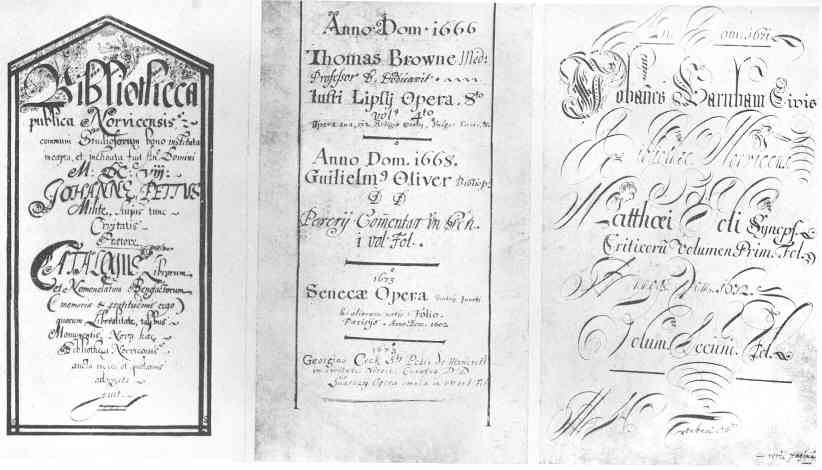
In the “Extracts from the Court Books of the City of Norwich,
1666-1688,” edited by Mr. Walter Rye, there is one on Jan. 15, 1669,
stating that “Mr. Thos. Morly, clerk, keeper of the Library of
the City, brought in a catalogue of all the books there,” but there
is no reference to this in the Library Minute Book. On January 12th,
1673, however, the ministers “did appoynt yt Mr
Norgate should agt their next meeting bring in a Catalogue of
the Bookes to be dd to the Court and yt he shall see yt
the Bookes given to the Library in his time be fayrely written in the
Vellam-booke appoynted to yt purpose.” It is
evident, therefore, that reports regarding the stock of books had to be
made to the Court.
The first printed catalogue was an author catalogue, with brief
particulars of about 923 volumes, and was printed in 1706/7. On
December 3rd, 1706, it was “Ordered then that ye
Alphabeticall Catalogue of ye City Library be printed by the
Widow Burges,” and on February 4th, 1706/7, when Joseph Brett was
Library Keeper he “brought in the Catalogue of Books, printed,
wch cost two pds sixteen shillings & three pence
& he was allow’d also a shilling for printing an
advertisement.” This catalogue, which is exceedingly scarce, [47] is
entitled “A Catalogue of the Books in the Library of the City of
Norwich in the year 1706.” It is a crown 8vo volume, consisting
of 38 pages. The catalogue proper is preceded by an alphabetical list
of the benefactors to the Library, giving the dates of their donations, and
abbreviations of their surnames, (e.g., Ad. for Adamson, All. for
Allen). The entries in the catalogue are extremely brief, and
frequently occupy only one line. Each entry is preceded by an
abbreviation for the author’s name, and is followed by the class and
book numbers.
In the preface it was confessed that while the catalogue would be useful
to the members of the Library, the “great motive, and main end of
Publishing this Catalogue was to encourage donations to the
Library.” Possessors of the catalogue were recommended to
interleave it with “spare paper, on which may be added such books as
shall be given, it may serve for many Years, even till the number of Books
here be doubled, which when, (as is greatly to be wished for) it shall be,
a new Edition of the Catalogue may be expected.”
The cost of the catalogue involved the members in debt. Under the
date May 2nd, 1709, in the Minute Book is the following memorandum:
“It is this day Agreed by us whose Names are underwritten
yt ye fourteen shillings & three pence now paid
by Mr Herne the present library keeper to Mr Joseph
Brett to clear his disbursemts for catalogus &c for
ye service of ye Library shal be repaid ye
said Mr Herne by the succeeding Library keeper upon his Election
unles paid before.” A further memorandum dated May 6th, 1709,
shows that a book was sold to raise the money: “Recd of
the Under-library keeper Fourteen Shillings for Sr
Waltr Raileigh: A super-numerary book sold to Mr.
Lillington by order of the Society which is towds ye discharge
of the above sd 14s 3d paid to Mr. Brett by me. W. Herne.”
The second edition of the author catalogue was compiled by Benjamin
Mackerell, the late Library Keeper, and published in 1732, the preface
being dated April 15th, 1732. Mackerell closely followed the plan of
the previous catalogue, using part of the preface for his
“Dedication” “To the Right Worshipful Robert Marsh, Esqr;
Mayor, The Worshipful The Sheriffs, Aldermen, and Common Council of the
City of Norwich.” The entries are limited to one line each, and
there is a column showing the sizes. The catalogue consisting of 54
printed pages, and measuring 8½ by 6½ inches, is entitled
“A New Catalogue of the Books in the Publick Library of the City of
Norwich, in the year 1732, to which is added, An Account of the Orders
prescribed by the Court and Common Council for the regulation of the same,
together with an account of Mr. John Kirkpatrick’s Roman and Other
Coins,” printed by William Chase, in the Cockey Lane. Neither
of the two copies of this catalogue in the Library contains the account of
Kirkpatrick’s coins, and Mr. F. Kitton, the compiler of the 1883
catalogue, had not seen a copy containing it. As all the pages of the
catalogue except the last one have a catchword it is reasonable to assume
that the account of the coins was not included.
The next catalogue was published in 1817 as a supplement to that of the
“Public Library” where the City Library was housed.
Unfortunately the present writer has been unable to trace a copy of this
catalogue, which, however, is recorded in Samuel Woodward’s
“Norfolk Topographer’s Manual,” 1842: “A Catalogue
of Books belonging to the Norwich City Library, which, by permission of the
Corporation, are now deposited in the Norwich Public-Library Room; 35 pp.,
8 vo. Norwich (1817).” This catalogue, according to a
paragraph in the Catalogue of the Public Library, 1825, had an
“alphabetical arrangement, in divisions of languages and
sizes.” Perhaps this catalogue served as the “copy”
for the catalogue of the City Library which is printed at the end of the
“Second Catalogue of the Library of the Norfolk and Norwich Literary
Institution,” 1825, pp. 105-137, as its arrangement is by languages
and sizes. This arrangement not being “calculated to be
conveniently accessible” it was deemed advisable by the Committee of
the Public Library that “it should be subjected to the same
scientific arrangement as the books which are the property of the Public
Library; and in order to prevent the obvious inconvenience of two
references, the Committee have included both sets of works under the same
arrangement, distinguishing those which are the property of the Corporation
. . . by a prominent and appropriate designation,” i.e., the letters
C. L. in black letter. This catalogue is a classified catalogue with
the following nine classes, seven of which are subdivided, and the
arrangement in each class is alphabetical by authors’ names: I.
Theology; II. Ethics, Metaphysics, and Logic; III. Sciences and
the Arts; IV. Jurisprudence, Government, and Politics; V.
History and Biography; VI. Geography, Topography, Voyages and
Travels; VII. Polite Literature and Philology; VIII. Poetry and
Dramatic Works, Novels and Romances; IX. Transactions of Literary and
Scientific Societies, Reviews, Magazines and Reports.
A new edition of the Public Library Catalogue was published in 1847, the
arrangement being the same as in the preceding one.
The Library books having been repaired in 1879 and 1880, the City
Committee decided in 1882 to issue a new catalogue, with the view of making
the books accessible to the citizens. The work of compiling the
catalogue was entrusted to Mr. Frederic Kitton, Hon. F.R.M.S., an eminent
microscopist of his day, who resided in Norwich for many years, but who
apparently had no bibliographical knowledge or library experience.
This appointment was made in the days when it was the common fashion to
regard the work of compiling a library catalogue as within the capacity of
any intelligent person; whereas there are, in fact, many rules to be
observed, and much practical experience is necessary if the thousand and
one pitfalls which beset the path of the cataloguer are to be
avoided. The catalogue [50a] was on much more ambitious
lines than its predecessors, and the compiler claimed to “have
carefully copied the title pages, retaining their abbreviations, antique
spelling, inaccuracies, or other peculiarities.” An examination
of it, however, shows that it abounds in inaccuracies, and exhibits most of
the errors that can be made in an author catalogue. A catalogue of
the City Library compiled in accordance with modern bibliographical
practice is still a desideratum.
The first home of the Library, as stated on page 4, was parcel of the
dwelling house of Jerrom Goodwyne, the sword-bearer of the City. This
house was built over the south porch of the Church of the Black Friars, now
known as St. Andrew’s Hall, which had been acquired by the City at
the Dissolution. It is clearly shewn in the frontispiece, which is a
reproduction of Daniel King’s engraving of Black Friars’ Hall,
probably executed about 1650. The Local Collection contains two
copies of the engraving which have different plate numbers: one, numbered
78, is from the edition of Dugdale’s “Monasticon”
published in 1718, but the book from which the other one, numbered 50, was
taken, has not been traced.
Writing in 1857 Henry Harrod remarked that “If the view engraved
by King correctly represents this house, it was by no means an ornamental
feature; still it was as good as the far more pretentious structure which
has replaced it.” [50b]
In regard to the building of this house Kirkpatrick gives an extract
from a record of 34th Henry VIII, showing that the city granted to John
Kempe, the chaplain, “in consideration that he, of his benevolence
hath bestowed about the buylding of a lodgyng with three chambers, over the
porch of the house, late the black friars, now the common hall of the city,
and on either side of the same porch, above sixty pounds;—that,
therefore, the said J. Kempe shall have the same lodgyng, with the office
called the Chapleyn of the Chappell, belonging to the said hall
called, St. John’s Chapel, with all the oblacions; also,
liberty of the garden and yard called the prechyng-yard.” [51]
The first of the few entries in the Minute Book regarding the library
rooms shows that the books were not too well protected from the elements,
for on 10th August, 1657, “Mr. Collinges gaue an acct of
1s. laid out for coale and wood for the drying of ye bookes
harmed by ye raine.”
From the instructions, in Latin, to the Librarian which are set out in
the classified and alphabetical catalogue of 1658 we learn that the library
was arranged in two parts, East and West, and that the books were
classified. “On the East part the treasury of the books is
double, major and minor. The larger part is divided into ten classes
folio. The smaller has only four classes of books in 4to and
8vo. The numbering of all classes must always be begun from the
bottom. On the West part the treasury of books is single, arranged in
five larger classes. Here the number must always be reckoned from the
top.”
In 1664 the development of the Library necessitated the enlargement of
the accommodation, and on 11th July “All the minrs.
present agreed in a petition to ye Mayr Sherriffs
Aldn. &c in Court of Comon Councell for ye addition of a
roome to ye library, and ye better shelving of
it. They further desired Mr. George Cock and Mr. Beresford to present
ye petition to ye Comon Councell at their next
assembly. Mr. Chamberlain hauing first viewed ye roome
& computed ye charge.” On the 12th January 1673
the members decided to petition the Court for removing some wainscot doors,
and on March 9th it was recorded that by order of the Court of Assembly
“we haue also leaue to take downe ye waynscott Doores
wch now conceale the Bookes.”
The Library was removed about 1801, when it was lent to the
“Public Library” (see p. 13), to a building formerly a Roman
Catholic Chapel, in what is now St. Andrew’s Street, which afterwards
became a portion of the old Museum Building, now the offices of the Norwich
Guardians. In 1835 the City Library, still on loan to the
“Public Library,” went with it to its new building in the Market
Place opposite the north door of the Guildhall, on the site of its
successor, the present Norfolk and Norwich Subscription Library. The
City Library returned to the direct control of the Corporation in 1862, and
was housed in the present Public Library building then recently
erected.
DONATIONS TO THE CITY LIBRARY, 1608-1737.
(Extracted from the Vellum Book.)
|
DATE.
|
DONOR.
|
VOLS.
|
|
1608
|
Pettus, Sir John, Knt., Alderman of Norwich
|
15
|
|
1608
|
Downing, Mrs. Susannah, wife of Alderman George Downing
|
3
|
|
1609
|
Corye, Mr. Thomas, Merchant
|
10
|
|
1609
|
Hirne, Sir Thomas, Knt.
|
12
|
|
1609/10
|
Corbett, Thomas, Esq.
|
6
|
|
1609/10
|
Doyly, Henry, Esq.
|
2
|
|
1610
|
Doyly, Charles, Gent.
|
11
|
|
1610
|
Sedgwick, Robert, Merchant
|
12
|
|
1610
|
Peade, Michael, Notary Public and Registrar to the Archdeacon of
Norwich
|
2
|
|
1610
|
Mingay, John, Gent.
|
2
|
|
1610
|
Pettus, Augustine, Son and heir of the said [Sir] John [Pettus]
|
4
|
|
|
Howlett, Laurence, S.T.B., Minister of St. Andrew’s
|
1
|
|
1611
|
Newhowse, Thomas, A.M., & Minister of God’s Word
|
4
|
|
1611
|
Hannam, William, Gent., A.M.
|
3
|
|
1612/3
|
Garsett, Robert, Esq.
|
7
|
|
1613
|
Blowe, Joanna, widow
|
4
|
|
1613
|
Thurston, Hamond, Merchant
|
3
|
|
1613
|
Peckover, Mathew, late Sheriff of Norwich
|
3
|
|
1614
|
Launey, Peter, Minister of the Walloon Church [in Norwich]
|
2
|
|
|
Wells, William, Theologiæ Baccalaureus
|
5
|
|
|
Throkmorton, Bassingbourne
|
2
|
|
1614
|
Cropp, John, Physician and Surgeon
|
4
|
|
|
Bird, Henry
|
1
|
|
1615
|
Ross, Richard, Gent., late Sheriff of Norwich
|
1
|
|
1614
|
Barbar, Gabriel, Gent., in the name of the Society of Virginia
|
11
|
|
1616/7
|
Nutting, Edward, late Sheriff of Norwich
|
5
|
|
1616/7
|
Batho, William, B.T.
|
1
|
|
1617
|
Anguish, John, Gent., and Citizen
|
7
|
|
1617
|
Anguish, Edmund, Gent.
|
9
|
|
1617
|
Catelyn, Thomas, Esq.
|
7
|
|
|
Corbett, Anne, widow of Thomas Corbett, Esq.
|
1
|
|
1618
|
Atkins, Thomas, Merchant, Norwich
|
£5 and 7
|
|
1621
|
Scottowe, Augustine
|
17
|
|
|
Gallard, Robert, formerly minister of St. Andrew’s
|
1
|
|
1625/6
|
Page, Francis
|
1
|
|
1628
|
City of Norwich
|
1
|
|
|
Remington, Nathaniel, Alderman [of Norwich]
|
4
|
|
1631
|
Borage, John
|
7
|
|
1633
|
Chapman, Samuel, Merchant
|
2
|
|
1633
|
Barret, Thomas, Merchant
|
2
|
|
1634
|
Mingay, Antony, Gent.
|
11
|
|
|
Mingay, Mrs., Widow
|
7
|
|
1634
|
Freeman, John
|
Map of Canaan
|
|
1634
|
Blosse, Prudence, Widow, Relict of Alderman T. Blosse
|
8
|
|
|
Chappell, John, S.T.B., Minister of St. Andrew’s
|
4
|
|
1658
|
Payne, Joseph, Alderman [afterwards Sir]
|
£20 and 1
|
|
|
Thornback, John, Minister of St. Andrew’s
|
1
|
|
|
Stinett, William, S.T.B., Rector of St. John Maddermarket
|
7
|
|
1658/9
|
Collinges, John, S.T.: Dr.
|
£1 and 6
|
|
[1657]
|
Whitefoote, John, Rector of Heigham, next Norwich
|
4
|
|
1659
|
Brooke, Thomasine, Widow & Relict of Wm. Brooke, Gent.
|
29 [53a]
|
|
[1659]
|
Allen, Thomas
|
1
|
|
[1659/60]
|
City of Norwich
|
6
|
|
1661
|
Payne, Sir Joseph, Knt., late Mayor of this City
|
16
|
|
|
Scottowe, Augustine, Merchant.
|
7 [53b]
|
|
[1661]
|
Smyth, John, Rector of St. Michael Coslany
|
1
|
|
[1661]
|
Barret, Thomas
|
5 [53c]
|
|
1662
|
Norris, Francis, Citizen and Alderman [of Norwich]
|
14
|
|
[1664]
|
Morley, Thomas, Curate of St. Peter Hungate
|
2
|
|
1664
|
Mann, John, Citizen and Alderman [of Norwich]
|
38
|
|
1665
|
Fromentell, Samuel, Citizen
|
1
|
|
1666
|
Meene, Joshua, formerly Curate of St. Peter Per Moutergate
|
3
|
|
1666
|
Browne, [Sir] Thomas, Professor of Medicine
|
9
|
|
1668 and 1673
|
Oliver, William, Bookseller
|
2
|
|
1673
|
Cock, George, Curate of St. Peter of Mancroft
|
18
|
|
1671-1676
|
Barnham, John, Citizen
|
5
|
|
1673
|
Norris, Anthony, Merchant of Norwich
|
3
|
|
[1674]
|
Ellsworth, John, Physician
|
2
|
|
[1674/5]
|
Tenison, Thomas, S.S.T.B. [afterwards Archbishop of Canterbury]
|
5
|
|
1674
|
Cock, Nathaniel, Merchant of London
|
33 [53d]
|
|
1676
|
[Reynolds,] Edward, [D.D.] Bishop of Norwich
|
24
|
|
1678
|
Watson, John, Vicar of Wroxham
|
2
|
|
1678
|
Clarke, Samuel, Rector of Rainham
|
1
|
|
1681
|
Gardiner, Francis, Citizen and Alderman [of Norwich]
|
2
|
|
[1681]
|
Nurce, William, Clerk
|
2
|
|
[1681/2]
|
Prideaux, Humphrey, S.T.P., and Prebendary [afterwards Dean of
Norwich]
|
£1 [54a] and 1
|
|
1691
|
Adamson, William, Rector of St. John in Maddermarket
|
2
|
|
1678
|
Brigges, Augustine, Citizen and Alderman [of Norwich]
Wisse, Thomas, Citizen and Alderman [of Norwich] Church, Bernard,
Citizen and Alderman [of Norwich]
|
[10] [54b]
|
|
1696
|
Penning, Benjamin, A.M., and Rector of St. Clement’s, Norwich
|
1
|
|
1692
|
Ireland, Richard, formerly Rector of Beeston and sometime also of St.
Edmond’s, Norwich, where he was born
|
His Library
|
|
1700
|
Adamson, William, Rector of St. John’s Maddermarket
|
3 shelves of books
|
|
1704
|
Trimnell, Dr., Archdeacon of Norfolk, and Prebendary of Norwich
[afterwards Bishop of Norwich]
|
3
|
|
1704
|
Gardiner, Stephen, Esq., Recorder of this City
|
1
|
|
1706
|
Gurdon, Thornaugh, Esq., [Letton]
|
2
|
|
1706
|
Resbury, Benjamin, Rector of Cranworth cum Letton
|
1
|
|
1706
|
Adams, Archibald
|
1
|
|
1706
|
Moore, John, [D.D.], Lord Bishop of Norwich
|
3
|
|
1706/7
|
Tanner, Thomas, D.D., Chancellor of Norwich [afterwards Bishop of St.
Asaph]
|
5
|
|
1706/7
|
Bacon, Waller, Esq.
|
1
|
|
1706/7
|
Beverley, Michael, Esq., Citizen and Alderman of Norwich
|
8
|
|
1707
|
Potts, Algernon, Esq. [of Norwich]
|
1
|
|
1707
|
Nelson, Thomas, Rector of Morston, in Norfolk
|
3
|
|
1707
|
Cook, Sir William, Bart.
|
9
|
|
1707
|
Eden, Henry, Fellow of Trinity College, Cambridge
|
4
|
|
1707
|
Laughton, John, Trinity College, Cambridge, and Library Keeper to the
University
|
4
|
|
1707
|
Rudd, Edward, Fellow of Trinity College, Cambridge
|
3
|
|
|
Bradshaw, Samuel, A.B., Trinity College, Cambridge
|
1
|
|
|
Granger, Gilbert, A.B., Trinity College, Cambridge
|
1
|
|
|
Snow, Matthew, Trinity College, Cambridge
|
1
|
|
|
Chamberlain, William, Fellow of Trinity College, Cambridge
|
1
|
|
|
Bourchier, Ralph, Trinity College, Cambridge
|
1
|
|
|
Cotes, Roger, Fellow of Trinity College, Cambridge
|
3
|
|
|
Eusden, Lawrence, of Trinity College, Cambridge
|
5
|
|
|
Smith, Edward, of Trinity College, Cambridge
|
3
|
|
|
Fleming, David, A.B., of Trinity College, Cambridge
|
1
|
|
[1707/8]
|
Ganning, Nathaniel, Rector of Reyme[r]ston, in Norf.
|
1
|
|
1708
|
Doyly, Samuel, Fellow of Trinity College, Cambridge
|
1
|
|
|
Farewell, Mr. [of Trinity College, Cambridge]
|
1
|
|
|
Andrews, Mr., [of Trinity College, Cambridge]
|
1
|
|
|
Foulis, [J.] Mr. [of Trinity College, Cambridge]
|
1
|
|
|
Hill, Mr., Fellow of Trinity College, Cambridge
|
1
|
|
[1708]
|
Lightwin, John, President of Caius College, Cambridge
|
2
|
|
1708
|
Gurdon, Brampton, Fellow of Caius College, Cambridge
|
2
|
|
|
Hawys, Roger, Fellow of Caius College, Cambridge
|
1
|
|
|
Crask, Dr., of Cambridge
|
1
|
|
|
Dodd, Mr., Fellow of Clare Hall
|
1
|
|
|
Worts, William, A.M., of Cambridge
|
1
|
|
1709/10
|
Bedingfield, James, als De Grey, Fellow of Gonvil and Caius College,
Cambridge
|
1
|
|
1709/10
|
Prideaux, Humphrey, D.D., and Dean of Norwich
|
1
|
|
1712
|
[Trimnell], Charles, Lord Bishop of Norwich
|
3
|
|
1713/4
|
Peck, John, Esq., of Bracondale
|
2
|
|
1714
|
Nelson, Thomas, Late Rector of Morston, in Norfolk
|
His Library
|
|
1715
|
Herne, Clement, Esq., of Heverland
|
2
|
|
[1715/6]
|
Seaman, Thomas, Esq., of Heigham
|
2
|
|
1716
|
Mackerell, Benjamin, of the City of Norwich, Gent.
|
2
|
|
[1716]
|
Helwys, Nicholas, Esq., Citizen and Alderman of Norwich
|
1
|
|
1717 and 1718
|
Prideaux, Humphrey, D.D., and Dean of Norwich
|
2
|
|
1718
|
Clark, Thomas, Esq.
|
3
|
|
1719
|
Houghton, William
|
1
|
|
1721
|
Grayle, John, Rector of Blickling
|
9
|
|
1725
|
Knyvett, John, of this City, Esq.
|
1
|
|
1726
|
Tanner, Thomas, S.T.P., and Chancellor of the Diocese of Norwich
[afterwards Bishop of St. Asaph]
|
100 [55a]
|
|
1727
|
Reveley, Edward
|
4
|
|
1728
|
Kirkpatrick, John, Merchant and Treasurer to the Great Hospital in this
City
|
His Library
|
|
1729
|
Jermy, John, Esq.
|
[?] [55b]
|
|
1730
|
Prideaux, Edmund, Esq.
|
60 [55c]
|
|
1730
|
Wingfield, Robert, Writing master
|
13
|
|
1731
|
Pagan, William
|
7
|
|
1731
|
Gurdon, Thornaugh, [Letton]
|
[2?] [55d]
|
|
|
King, Reuben, Primier [sic] English Schoolmaster in this City
|
1
|
|
1731
|
Mackerell, Benjamin, the present Library Keeper
|
13
|
|
1733
|
Whaley, John
|
1
|
|
|
Bennet, Gilbert
|
2
|
|
1733
|
Jermy, John
|
40
|
|
1732
|
Ellis, Ben-Jos[eph], Minister of St. Andrew’s in Norwich
|
2
|
|
1737
|
Jermy, John, Esq.
|
14
|
|
1737
|
Nash, Robert, Esq., Chancellor of this Diocese
|
4
|


