in the Trial of an action for assault, brought by Thomas Redford against
Hugh Hornby Birley and others, members of the Manchester Yeomanry, before
Mr. Justice Holroyd and a Special Jury, at Lancaster on the 4th, 5th, 6th,
7th, 8th, and 9th of April, 1822.
Second day of the Trial.
The Rev. Edward Stanley examined by
Mr. Serjeant Blackburne (Counsel for the Plaintiff).
You, I believe, are the Rector of Alderley, in Cheshire?—I am.
Brother to Sir Thomas Stanley?—Brother to Sir John Stanley.
On the 16th of August, 1819, had you any business with Mr. Buxton?—I had.
How far do you live from Manchester?—Between fifteen and sixteen miles.
You came into Manchester on the morning; about what time?—As near twelve
o’clock as possible I entered Mosley Street.
In your passage up Mosley Street, did you meet with any number of
people?—I did.
Walking?—Walking.
In what manner?—They were coming down the street, walking in a
procession, six, or seven, or eight abreast, and arm in arm.
Were you on horseback?—I was.
Was there any interruption to your passage?—No. Should I explain?
Tell us the reason?—As I was going down the street, some persons on the
pavement desired me—
I do not wish to know what the persons on the pavement desired you to do;
I do not wish you to tell us the conversation, but simply to relate what
happened?—I passed through them.
By their opening to give you way?—Certainly.
Did you go on that day to Mr. Buxton’s house, and what time did you get
there? I got to Mr. Buxton’s house, I should think, a quarter after one.
Did you go into a room there where the magistrates were assembled?—I did.
How long did you remain there?—I should think about from eight to ten minutes.
During the time you were in the room, did Mr. Hunt arrive on the
ground?—He was called Mr. Hunt; he was in a barouche.
And a multitude accompanying him?—A vast multitude.
I believe there was a cheer given by the populace at the time when he did
arrive?—A tremendous shout.
Did you remain in the room or did you go elsewhere?—I did not remain
there; I went into the room above it.
Were there any other persons in the room besides you?—Several.
Did you see the Manchester Yeomanry come on to the ground?—I did.
And form in front of Mr. Buxton’s house?—They formed with their left
flank a little to the right of the special constables, and a few yards to
the right of Mr. Buxton’s house.
You say to the left of the line of special constables?—Their left flank
was on the right of Mr. Buxton’s house.
You saw the line of constables; where did it extend to?—It extended from
the door of Mr. Buxton’s house, apparently up to the hustings.
Was there more than one line of constables?—There were two lines of
constables.
What was the interval between them?—Near Mr. Buxton’s house and the mob,
three or four feet.
Afterwards, the line was closed by the pressure of the mob, expanding
again when they came near the hustings?—According to my observation; to
the best of my judgment; such is the impression on my mind.
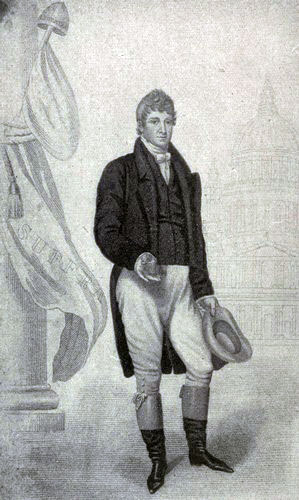
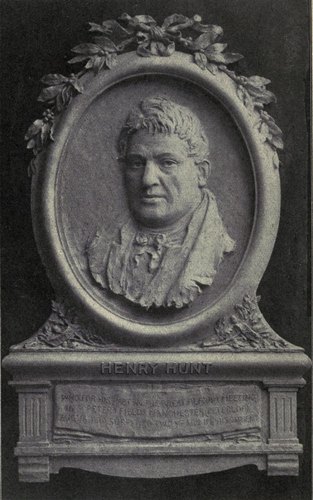
“Orator” Hunt, 1773-1835
Chairman of the Peterloo Meeting
To face page 27
Of course you saw the people collected?—Certainly.
In a large mass?—In a very large mass.
What was it enabled you to distinguish the special constables from the
rest?—They were superior-dressed people, had their hats on, and their
staffs were constantly appearing, and they were nearer the hustings.
And the people round the hustings had their hats off?—My general
impression is, all, to speak accurately.
The people on this side of the area of St. Peter’s field were not so
numerous?—There were more stragglers, and no crowd.
You saw colours and caps of liberty on the ground?—I did.
What number of either the one or the other? Perhaps you do not distinctly
recollect?—I cannot say.
You heard Mr. Hunt speak?—No, I could just hear his voice, but I was not
able to distinguish what he said.
How long had that taken place before you saw the cavalry advance towards
the hustings?—From their halt, I should think three minutes.
From the time you heard Mr. Hunt?—Not from the time I heard Mr. Hunt; he
was speaking before I arrived.
Then from the time of the halt?—Two or three minutes.
When you saw them advance towards the hustings, with what speed did they
go?—They were formed in an irregular mass. Those on the left advanced in
some sort of order. They went on at first, for a few paces, at no very
quick pace; but they soon increased their speed, till it became a sort of
rush or race amongst them all towards the hustings.
Did you observe the effect that this had upon the people, whether it
caused them to disperse or not?—They could not disperse instantly.
But on the outside of them?—On the right, in front of the hustings, they
immediately began to melt away, as it were, as far as they could at the
extreme.
The outward edge of the meeting?—The outward edge, in front of the
hustings.
Did you observe the cavalry when they got first among the thick part of
the meeting?—Their speed was diminished as soon as they came in contact
with the dense mob.
Well?—But they worked their way to the hustings still, as fast, under
existing circumstances, as they could.
From the place in which you were, I believe you had a very commanding view
of the hustings?—I looked down upon it like a map.
I understood you, you had also been in a room below that, and looked
through there?—I had.
Which, in your opinion, was the better place for a correct observation of
what passed after the meeting?—Decidedly, the highest room.
Did you watch the advance of the cavalry from their place up to the
hustings?—I did.
Did you see either sticks, or stones, or anything of the kind used against
the cavalry in their advance up to the hustings?—Certainly not.
Did you see any resistance whatever to the cavalry, except the thickness
of the meeting?—None.
Do I understand you to say you saw them surround the hustings, or
not?—Surround I could not say, for the other side of the hustings, of
course, was partially eclipsed by the people upon it.
But you saw them encircle part?—Encircle part.
Did you see what was done when they got there?—Yes.
Will you tell us what it was that you saw done?—I saw the swords up and
down, the orators tumbled or thrown over, and the mob dispersed.
In your judgment, what length of time elapsed between the cavalry first
setting off into the meeting and the time of their complete
dispersion?—Starting from their halt to the complete dispersion of the
meeting, I should think from three to five minutes; but I cannot speak to
a minute.
In your judgment it took from three to five minutes? You did not observe
it by a watch?—No.
Did you see any other troops come into the field?—I did.
What were they?—
Mr. Justice Holroyd: He says he saw what?—
Mr. Serjeant Blackburne: Other troops come into the field.
When was it that you saw them come into the field?—When the mob around
the hustings were dispersing rapidly, and I think Mr. Hunt was taken off.
What were those troops that you saw come into the ground then?—First came
in, on the left of Mr. Buxton’s row of houses, the Cheshire Yeomanry, who
filed to the left.
Mr. Justice Holroyd: You mean to the left, looking from the house,
then?—From the house.
Mr. Serjeant Blackburne: Where did the Cheshire Yeomanry take up their
position when they came on the ground?—They took up their position in the
rear of the hustings, rather in advance, I think, of some mounds of earth.
Do you know Windmill Street?—I know no street.
You don’t know its name?—I know no name.
You say near a rising ground?—There is a sort of little elevated bank or
ground.
Had the multitude from that part been dispersed?—The multitude in the
rear were pretty much as they had been at first. I think they were
dispersing, but not so rapidly.
Do you mean in the rear of the cavalry?—In the rear of the hustings.
The Cheshire Yeomanry’s position was in the rear of the hustings?—Part
near amongst these people.
What other troops beside the Cheshire Yeomanry did you see come on to the
ground?—Soon after the Cheshire Yeomanry had come in and taken their
position, a troop of Dragoons, I think the 15th, came in under the windows
of Mr. Buxton’s house.
You say you think they were the 15th Hussars?—They were called the 15th
Dragoons; they had Waterloo medals.
Where did they take up their position?—
Mr. Justice Holroyd: “Near Mr. Buxton’s house,” he said.
Mr. Serjeant Blackburne: Did they continue there?—They halted or paused
for a moment or so, a little to the left of Mr. Buxton’s house, a very
little to the left, almost in front, inclining to the left.
What others did you see come on the ground, besides them and the Cheshire
Yeomanry?—At the close of the business I saw some artillery driving
through the place.
Was there any other besides those that you saw take up any position on the
ground?—None, on the ground.
At this time, was the whole of the multitude dispersed?—It was dispersing
most rapidly; I may say dispersed, except in partial spots.
After leaving the hustings, to which part of the field did the Manchester
Yeomanry go?—To all parts. I think more behind the hustings, and on the
right; they did not come back to me so much.
Do you know the Quakers’ meeting-house?—I have heard where it is since;
then I did not know.
Was it that way that they went?—If you could point out, in a plan, the
Quakers’ meeting-house, I could tell you if they went that road.
There is the Quakers’ meeting-house, you will see written on the
plan?—Some went that way.
Some of the people, too, dispersed in that direction, did they?—The
people dispersed in every direction.
I am not sure whether I asked you before, whether from your situation in
this window, if any stones, or brickbats, or sticks, had been raised
against the cavalry, on their way to the hustings, you must have seen
it?—I think I must have seen it.
Cross-examined by Mr. Serjeant Hullock:
Will you venture to swear, Mr. Stanley, that no stones nor brickbats would
be thrown during the advance of the cavalry towards the hustings, without
your perceiving it?—I can only venture to say that I saw none.
I believe you have favoured the public with an account of this
transaction?—No, I have not.
You printed or wrote something?—It was in circulation among my friends. I
wrote something which was never published.
There was a document, written by you, circulated among your
friends?—Among my friends.
Before that time, had you seen yourself and read any publication, either
in manuscript or print, on this subject?—I had read the reports in some
papers, naturally, after that time, and I might have seen a pamphlet
printed at Manchester.
Then you had seen several accounts which had been given to the world
before you wrote?—Yes, I saw the reports of the papers immediately after
the meeting.
Whose account did you see, besides the reports in the paper?—A Mr.
Phillips’s.
You, it seemed, entertained a different view of the transactions that had
taken place upon this day from those which had been given to the world
before that time?—I do not know; I should say a different view from some,
perhaps, and coinciding with the views of others.
Coinciding with the views of some, and differing from the views of
others?—Respecting stones.
No matter what. You are a magistrate, I understand?—I am not.
Of neither Cheshire nor Lancashire?—No.
I beg your pardon. You, however, were in the magistrates’ room, I think
you said, at Mr. Buxton’s?—I was.
Of course you had an acquaintance with the gentlemen who were there
assembled, as acting magistrates of the committee for the counties of
Chester and Lancaster?—With two or three I had.
Probably upon terms of intimacy with one of them?—Certainly.
Was that gentleman there at that time?—He was.
Did it occur to your mind at the time that the cavalry were sent for
(because you went back to a window, and saw the messenger crossing the
field, for the purpose of bringing them to the place, and were told or
heard there was a rumour in the room above, that the cavalry had been
sent for) did it occur (attend to my question) to you, at the time, from
the observations which you had made on the subject, that that step was
improper or premature?—I don’t think it occurred to me either one way or
the other.
Am I to understand from that then that you exercised no judgment upon the
subject at that time?—I certainly did exercise some judgment, some
opinion on it, at that time.
Having exercised some judgment upon the subject, I ask you whether, in
your judgment, such as you exercised upon that point, the step was either
improper or premature?—I saw no necessity for it.
Then you deemed it premature?—I saw no necessity for it.
It struck you then as an unnecessary act?—Certainly.
Then you would go down, of course, immediately and speak to your friend
upon the subject?—No.
Nor ever expressed to that friend or to any other, at the time, your
opinion with respect to the impropriety of the step?—I had no other
friend to speak to.
Did you speak to him?—I did not go down into the room again.
Probably you might, being a gentleman of considerable acquaintance, meet
with some friend on going home, and might ride home with some gentleman,
at least part of the road?—Part of the road I did.
Mr Markland, I presume?—I overtook Mr. Markland.
Did you express any opinion to Mr. Markland upon these
proceedings?—Probably I did; but I have not the most distant
recollection.
I ask you, upon your oath, Mr. Stanley, if you did not express to him your
entire concurrence in, and approbation of, the measures adopted by the
magistrates?—I answer, upon my oath, that I do not recollect having said
any such thing.
Can you tell me whether you expressed any disapprobation of the measures
which it had been deemed necessary to adopt?—I have no recollection
whatever of the conversation.
Then you mean to represent to us now, that your feelings upon the subject
were so indifferent, that you cannot tell now, whether you approved or
disapproved of these steps at the time?—I have not the most distant
recollection of any conversation I had with Mr. Markland.
That is not an answer to my question. I ask you whether you mean to state
that at this time, you don’t remember whether you entertained feelings of
approbation or disapprobation of those steps?—I thought it was a dreadful
occurrence; but I hoped that there were some grounds for it.
Mr. Justice Holroyd: You are
speaking of what you thought?—It was in answer to the question.
Mr. Serjeant Hullock: I am speaking of what you thought then. As I
understand you, you cannot recall to your recollection the impression
under which you laboured at the time you travelled home with Mr.
Markland?—I thought it a dreadful occurrence, but I hoped there were
grounds for it.
Did you mention that to Mr. Markland?—I cannot recollect.
It is very important that I should endeavour to extract from you, Mr.
Stanley, without meaning the slightest disrespect to you, every fact
within your knowledge on the subject; you say that after the meeting had
been dispersed, the first cavalry which appeared on the ground was the
Cheshire Yeomanry?—Not after the meeting had dispersed, but whilst in
progress to dispersion.
Do you mean to state now, to the best of your recollection, that the
Cheshire Yeomanry were the first cavalry advancing on the ground after
that?—It depends on what you call the ground; the Cheshire Yeomanry were
the first, after the Manchester cavalry, that advanced at the left.
Tell me, according to the best of your recollection, which of these troops
came first upon the ground?—The Cheshire Yeomanry; but you will observe
that, at this time, the disposition of the hustings occupied a good deal
of my attention, and I did not expect the others.
The Cheshire Yeomanry came over broken and uneven ground?—I cannot tell.
I observe that you use the word “apparently” twice, in answer to two
questions which were put to you, which were a repetition of the same
question—whether the two lines of constables surrounded the hustings or
not; I think you said they “apparently” did?—Apparently they did.
Mr. Justice Holroyd: Surround the hustings?—Apparently.
Mr. Serjeant Hullock: Do you mean to state, then, that in your judgment
the avenue which was formed by the two lines of constables extended from
the house to the hustings?—At that time the impression on my mind was,
and it now is, that it certainly did.
But of course you won’t swear that it did?—I cannot swear; I can only
speak to the impression on my mind.
In the same way that you swear to the existence of brickbats and
stones?—To the non-existence.
I think you say you saw Hunt come upon the ground?—I saw the barouche.
You saw the ladies and gentlemen both. Did you see any female?—I saw a
female.
What was her use?—I have no conception of that.
Mr. Justice Holroyd: Of what?—
Mr. Serjeant Hullock: I asked whether she was for use or show.
You did not know any of the parties inside?—I had not the most distant
knowledge of them.
You had heard of Carlile?—I heard of him in London.
You have heard since he was in Manchester that day?—I have heard it
to-day, in the course of another examination. I never heard it before.
Hunt, when he saw the cavalry coming, I think, intimated his
knowledge—his cognisance of the fact—by desiring them to give three
cheers?—I could not hear.
There was some cheering given?—There was a very loud cheer.
From the hustings?—From all the mob.
You say when he was addressing the mob, you did not hear his words, “but I
think, whatever his words were, they excited a shout from those
immediately about him, which was re-echoed with fearful animation by the
rest of the multitude”?—Certainly, that is the impression on my mind;
those were my own words.
It was tremendous—the shout?—It was not so tremendous as the shout with
which Hunt was received on the ground; the first was the loudest shout.
And the most appalling?—The first, when Hunt was received on the ground;
I never heard so loud a shout.
“Terrific,” was your word?—I should say terrific.
You say that the people who were immediately contiguous to the hustings
heard what Hunt said?—I cannot say.
You inferred that from their shouting?—Certainly.
Then that shout was re-echoed by the mob at a distance?—I conceived so.
What proportion, do you think, of the mass of the people, with their eyes
up, and mouths open, looking at that man during the time, could hear one
word he said?—I should think no one beyond ten yards from the hustings,
in the bustle of such a day—that is guess.
I daresay it is a good guess, too; how do you think they would carry the
resolutions at the outside, at the right flank, the left flank, and beyond
the ten yards, upon the propositions made by this orator?—I have no
opinion to give about that.
It certainly is a difficult point. It appeared to you that Hunt, as far as
his voice could reach, had a pretty absolute control over his friends;
they shouted as he spoke; it appeared that he was
commander-in-chief?—The thing never occurred to me; I cannot speak
positively.
Have not you an opinion that he was head and leader of the party?—My
opinion certainly is, that he was.
And now, I will ask you this question, as a clergyman, and as a man of
character, which I believe you to be—I ask you, upon your oath, whether,
in your judgment, the public tranquillity and the peace of Manchester were
not endangered by a mob of that description, composed in that manner, and
having such a man as Hunt at its head—Hunt and Carlile, for
instance?—Hunt and Carlile are dangerous people, and any mob under their
control must be dangerous.
Re-examined by Mr. Serjeant Blackburne:
Do you know, Mr. Stanley, whether this meeting was under the command of
either Hunt or Carlile?—No.
When you say there was a shout given on the Manchester Yeomanry coming
into the field, was there any other shout besides that given by the
multitude?—There was.
Whose shout was that?—The Manchester Yeomanry, the special constables,
and the people round the pavement in front of our house.
May I ask you whether you were terrified by those shouts?—Personally,
certainly not.
Mr. Justice Holroyd: Explain what you
mean by that?—I myself was not alarmed about them.
Mr. Serjeant Blackburne: And whether it did not create terror and
alarm?—Not to me individually, certainly not.
You have said that you presented a description of what you saw at the
meeting, to some of your friends?—I did.
How soon was that written after the meeting?—I can scarcely say; I should
think perhaps two months, but I cannot speak accurately. It was when the
impression was clear on my mind.
Clear and fresh in your recollection. Will you have the goodness to tell
me whether you heard or saw any person read the Riot Act?—I neither heard
it read nor saw it read.
Mr. Serjeant Hullock: If it was read you did not hear it?—I did not hear
it.
If it should turn out to have been read, and read loudly, there might have
been something else done—but that is conclusion—that is reason.
Mr. Evans: Your Lordship has on your note that McKennell said that he did
not[8] hear the Riot Act read.
Mr. Serjeant Cross: He said so.
Mr. Justice Holroyd: Yes, I have.
Mr. Serjeant Blackburne: Then that is my case, my Lord.
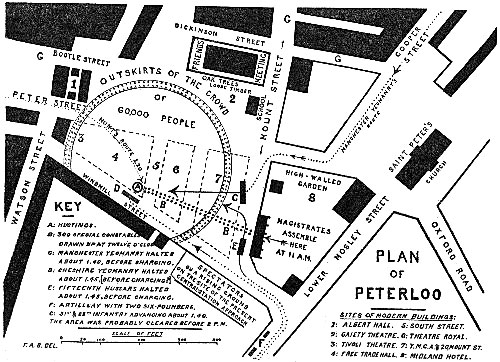 Larger Image
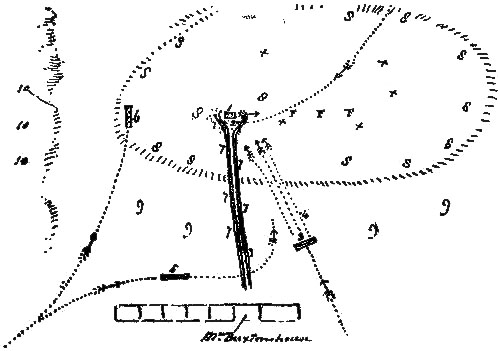
Plan of Peterloo.
Larger Image
Plan of Peterloo. (
F. A. B.)
By permission of Mr. H. Guppy.
Compiled from a number of Contemporary Plans, and showing (in dotted outline)
the position of modern blocks of buildings.