“OUR feet shall stand within thy gates, O
Jerusalem.”[139] Drawn by an irresistible
attraction, pilgrims flock hither from the
very ends of the earth. The crumbling
walls, the squalid filthy streets, the
mouldering ruins, are regarded with a
profound and reverential interest by millions
of mankind, such as no other spot
on earth can excite. To the Jew it is
the centre alike of his patriotism and his
religion. The Christian remembers that
here the Son of God was crucified for the
sins of the world. The Mohammedan,
retaining in a mutilated and distorted
form, the great facts of Jewish and of Christian scripture, and adding to them
the legends of his own prophet, regards Jerusalem as second, and hardly second,
in sanctity to Mecca itself. Nowhere else are the representatives of such various
nationalities to be found as in this meeting-place of the three great monotheistic
faiths which have spread so widely over the habitable globe. Jews
who have travelled on foot from Poland or Morocco, may be seen weeping
outside the temple walls. Greeks, Latins, Armenians, Copts, kneel side by
side with worshippers from America, from Australia, and from every nation in
Europe. Nubians, Hindoos, Affghans, Persians, Tartars, Arabs, prostrate
90themselves before the sacred rock from whence their prophet commenced his
fabled journey to heaven, or gaze with awe on the spot to which he will, as
they believe, return to judge the world.
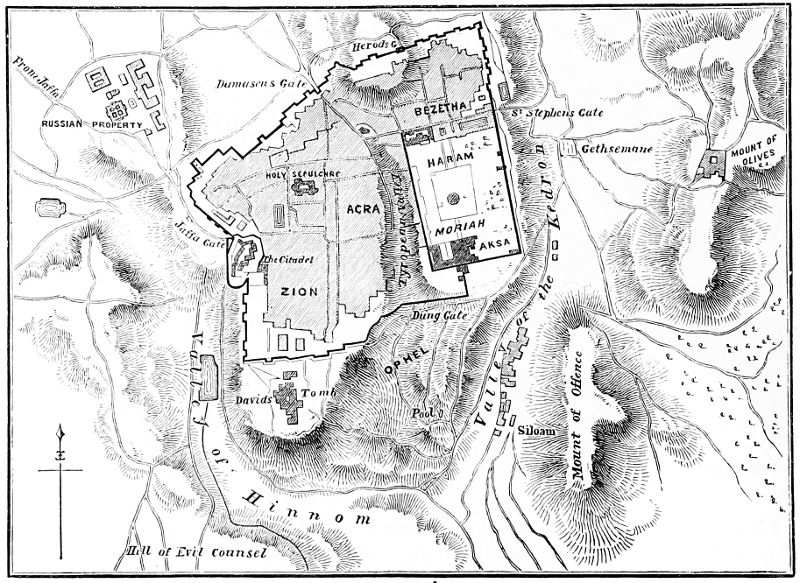
PLAN OF JERUSALEM, FROM THE ORDNANCE SURVEY.
The city, which holds so conspicuous a place in the later Scriptures, is in
the earlier ones only referred to incidentally or obscurely. It is commonly
identified with the Salem of which Melchizedec was king; and Mount
Moriah, upon which Abraham was about to offer up Isaac, is thought to be
the same with that on which the Temple was afterwards built. Dean
Stanley argues strongly against this view, and would transfer the city of
Melchizedec to a town, the site of which is marked by a village still bearing
the name of Salem, near the ancient Shechem. The sacrifice of Isaac he
would likewise place in the same neighbourhood on the summit of Gerizim.
Though his arguments are weighty and deserve serious consideration, they
cannot be accepted as conclusive. That the king of Jerusalem, in the days
of Joshua,[140] bore a name or title almost the precise equivalent of that of the
king of Salem, who was Abraham’s friend, is an important fact in the
discussion. Adonizedec, the Lord of righteousness, would be a probable
successor of Melchizedec, the King of righteousness.
But whilst Jerusalem was thus probably associated with two most
memorable events in the life of Abraham, it was not till the time of David
91that the city rose into prominence. In his day it was regarded as an
impregnable stronghold. The Jebusites, confident in the strength of their
position, treated the attacks of the besiegers with derision, and placed upon
their walls, the blind and the lame as an adequate garrison, “thinking,
David cannot come in hither.... Nevertheless David took the stronghold
of Zion.”[141] Stung by the taunt and incited by the promise of the king, Joab
stormed the citadel and received the command-in-chief of the army as a
reward of his desperate exploit. David, who had hitherto reigned in Hebron,
now removed his capital to Jerusalem. The reasons for this are obvious.
At Hebron he was isolated from the great bulk of his subjects; Jerusalem,
though not central, was yet not very remote from the Northern tribes; it was
on the frontier of his own tribe of Judah and partly within that of Benjamin,
whose allegiance he thus secured. Military considerations were even more
decisively in favour of the new capital. Nor must we overlook the divine
guidance which thus prepared the way for the erection of the Temple on the
chosen and favoured spot. Little did the rude rough soldier, when “getting
up by the gutter and smiting the Jebusites,” think for what mighty events he
was preparing the way.
The city fortified by David, enriched and adorned by Solomon,[142] has
continued, with varying fortunes, to occupy the same spot to the present
day. Its continuity, however, like that of the human body, is a constant
sequence of destruction and reconstruction, ever perishing yet ever renewed.
In addition to the corroding influence of time and the destructive agencies of
earthquake and fire, it has suffered yet more severely from the violence of
man. Perhaps no city in the world has undergone so many or such
disastrous sieges. Roman, Persian, Saracen, Christian, Turk, have succeeded
one another in the work of devastation. Again and again it has been laid
utterly waste, and continued for years to be desolate and forsaken.
The result of this long succession of destructive agencies is, that of
ancient Jerusalem scarcely a trace or vestige remains. The city of David
and Solomon lies buried far beneath the ruins of edifices which have
succeeded it. It is even difficult to say, with certainty, that we can find
undoubted remains above the soil of the city of Herod. The great Tyropæan
valley which divided Zion from Acra has been filled up with débris,
leaving only a slight depression. We cannot even trace the line of the
ancient walls except where they ran along the edge of the ravine, which
bounds the city on the east and south. The whole topography of Jerusalem
is hence involved in the utmost confusion. The most elementary facts as to
the localities indicated by the inspired narrative, have been for years the theme
of keen and angry dispute. Whilst the controversial literature on the subject
might fill a moderately-sized library, we seem almost as far from a satisfactory
settlement of the question as ever.
92
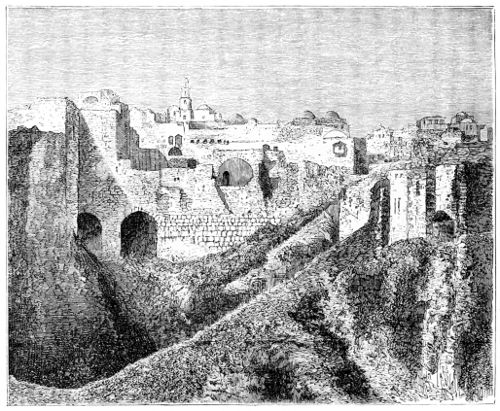
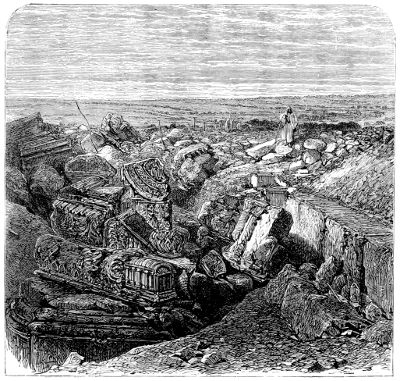
RUINS NEAR THE CHURCH OF THE HOLY SEPULCHRE.
The general outline of the country and the great natural features of the
landscape are, indeed, distinct and unmistakeable. The mountains round
about Jerusalem, the valleys which encompass it, and the ridge on which it
stands, remain as they were in the days of the patriarchs and prophets and
apostles. Looked at from any of the surrounding heights, we feel no
difficulty in identifying the objects which meet our view. The scene which
lies outstretched before us from the summit of the Mount of Olives, has
been so truthfully and graphically sketched by Lady Strangford, that we
cannot do better than reproduce her description:
“Let us sketch in slightly what we see: the bare hill to the south of
the city, with one miserable wind-worn tree on its brow, is the Hill of Evil
Counsel (where Caiaphas and the elders are said, upon no authority, however,
to have taken counsel together[143]). It is rocky and irregular, sloping off to
the west and dying down in the Plain of Rephaim. On the north, long
ridges of low barren hills or plains, stony and bare, though dotted with
93olives here and there, stretch one behind another. They seem to rise gently
from the city until the monotony is broken by the low peak of Neby
Samwil, marked by a tower, the ruin of an old convent church, since
converted into a mosque.
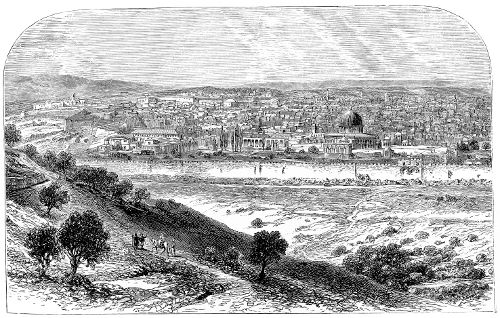
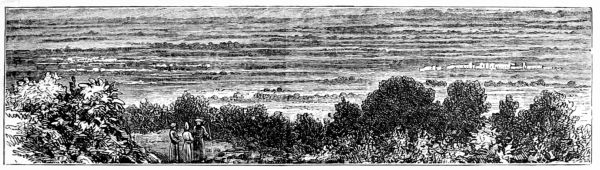
JERUSALEM FROM THE MOUNT OF OLIVES.
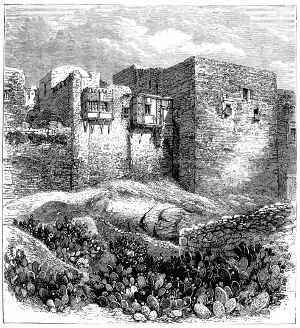
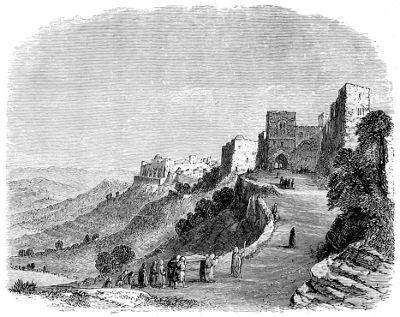
WALLS OF JERUSALEM.
From a Photograph.
“Between these two sides of the picture the Holy City stands, apparently
on a square, rocky hill, enclosed in crenelated walls, with here and there a
bastion or a zigzag—very quaint and very sad those old walls look, and yet
something proudly, too, they stand—while beyond them a long, dull, flat
96ridge rises slightly towards the west, and two deep narrow ravines sweep
round the holy mountain—the one is the valley of Jehoshaphat, or of the
Kedron, commencing from some distance to the north of the city, and
running along the eastern side of it to the south. The other is the Valley
of Hinnom, coming round from the western side and uniting with the Kedron
at the south-east corner, embracing at that point, between them, the spur of
Mount Moriah, which is called Ophel. Farthest from us, on the western
wall, is the Tower of Hippicus. Near it, to the right, is the Latin Convent
and the two domes of the Church of the Holy Sepulchre. To the left, on
Mount Zion, the extensive Armenian
Convent, the domes of some
new synagogues, the English Church,
and the tomb of David are seen
(the last outside the wall). These
are almost the only buildings on
which the eye can rest among the
confused mass of little brown and
white domes and grey walls: nor are
any of these seen at first, for the
Mosque of Omar, in the famous
Harâm, the second most beautiful
building in all the world, rivets all
the spectator’s attention. The wall
enclosing the mosque occupies more
than half the eastern side of the
city—in the centre of which stands
the mosque, an octagonal building,
pierced with seven windows on each
side, narrowing above into a small
circle also pierced with windows, and
surmounted by a most graceful dome,
bearing aloft the gilt crescent of
Islam; the whole building is cased
entirely in encaustic tiles—chiefly blue, green, purple, and yellow, formed
into intricate and delicate arabesques, and so mingled that it is impossible
to say whether the building is green or blue. The cornice is replaced by
an Arabic inscription in large and prettily interlaced letters. The mosque
stands on a marble platform, which is reached by broad flights of steps, and
round the edge of which are several groups of slender arches and small houses,
while little circular mihrabs, or praying-places, shaded by a light canopy of
fretted stone, are dotted over its surface. Round this platform are grassy slopes,
with noble cypresses and a few other trees, the bright and dark green of which
contrast beautifully with the white and coloured marbles of the buildings.
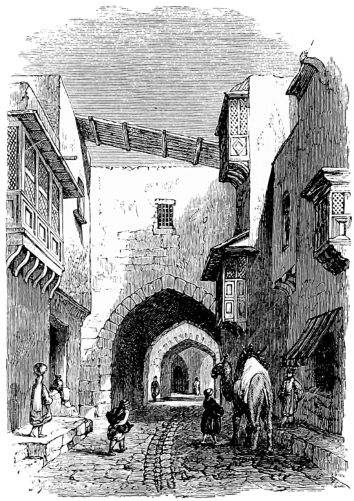
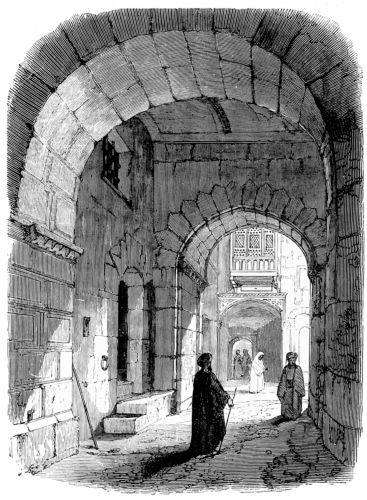
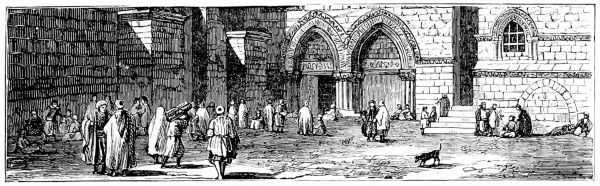
STREET OF MODERN JERUSALEM.
97“At the southern end of the enclosure is the mosque of El Aksa,
ornamented with a dome and covered by a sloping roof. The mosque of
the Mogharibeh, the college of the Dervishes, and the Serai, the residence
of the pasha, stand on the west and north sides—while the whole extent
of the eastern side of the city is only broken by St. Stephen’s Gate,
and the long-closed ‘Golden Gate,’ with its two round arches and small
domes.
“This is the view over which Jesus wept, when He beheld its beauty,
and thought upon its ruin and desolation; and strange and thrilling, indeed,
is the feeling it gives to one now: the gloomy ravines lose much of their
effect seen from above: the surrounding hills are, one and all, the very
dreariest, barrenest, and ugliest one can find anywhere, and yet the whole is
beautiful, and even the fastidious and trifling are impressed by it.”
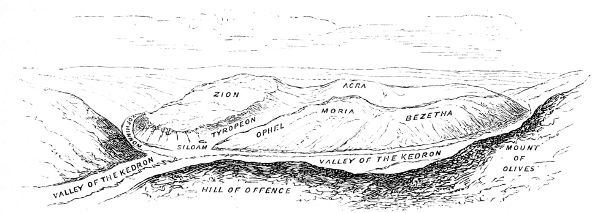
SKETCH PLAN OF SITE OF JERUSALEM.
After Robinson.
It is when we endeavour to fill in the details of the city itself that our
difficulties and perplexities commence. They are caused partly by the vague
and indefinite language of ancient historians and topographers, and partly by
the fact that valleys have been filled up, hills have been levelled and
successive cities have arisen upon the ruins of those which have preceded
them, thus effacing the landmarks which would otherwise have guided us.
Mediæval and monkish traditions have likewise done much to obscure and
pervert the true topography of Jerusalem. Learning and labour have been
wasted in the endeavour to defend theories which have nothing in their
favour but ecclesiastical authority. Theological controversies have thus been
imported into questions which ought to have been discussed only in the
light of historical and geographical science.
We know from Josephus that the city stood on two hills, divided by
the Tyropæan Valley. One of these was Zion, the other Acra. We read
likewise of Bezetha, Moriah, and Ophel. Did these last form a separate
ridge or were they names given to parts of one of the former? If so, to
which—Zion or Acra? The sketch plan given above shows the conclusion
98arrived at by Dr. Robinson, who maintains that there were three separate
hills. Other writers of scarcely inferior authority identify the Temple ridge
with Zion—others again with Acra. Notwithstanding the confident dogmatism
with which each of these views has been maintained, I cannot say that
any of them have carried full conviction to my own mind. It is to be hoped
that the explorations now in
progress may throw some light
upon these obscure questions.
No less conflicting are the
views as to the sites of the
Sepulchre and of the Temple.
Though the Temple claims
priority in the order of historical
sequence, yet, for reasons which
will subsequently appear, we
first consider the site of the
Sepulchre.
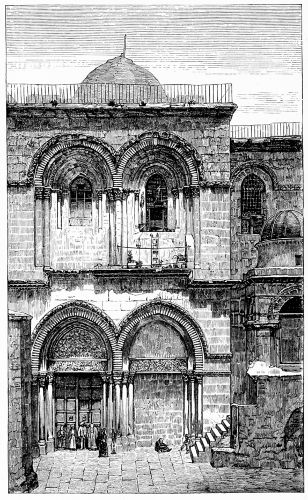
ENTRANCE OF CHURCH OF HOLY SEPULCHRE.
The church of the Holy
Sepulchre stands in a crowded
part of the city, at some distance
to the north-west of the Temple
area. It is a comparatively
modern structure, no portion
being probably older than the
period of the Crusades. It is
entered through a courtyard, in
which a market is now held for
the sale of trinkets, rosaries,
pictures and curiosities. And
just inside the principal entrance
a Turkish guard is stationed to
keep order, and repress disturbances
amongst the hostile sects
and nationalities who visit it.
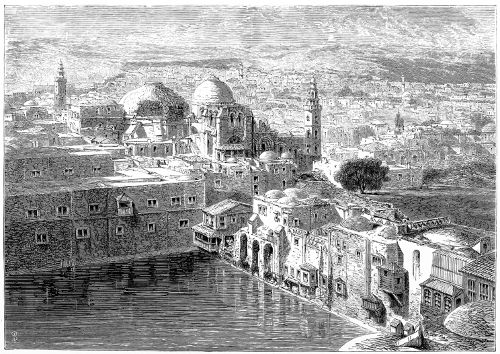
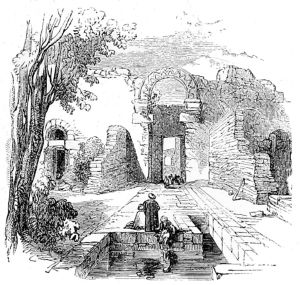
THE POOL OF HEZEKIAH AND THE CHURCH OF THE HOLY SEPULCHRE.
In passing round the church,
attention is distracted and incredulity
excited by the aggregation under one roof of numerous shrines and holy
places. Here are shown not only the sites of the crucifixion and the resurrection,
but the tombs of Adam, Melchizedec, Joseph of Arimathea, and of Nicodemus;
the place where our Lord was crowned with thorns, and where He
appeared to Mary Magdalene; the pillar to which he was bound during the
scourging; the slab upon which His body was laid for the anointing; the spot
where He first appeared to His mother after the resurrection; the centre of the
101world; the place whence the earth was taken from which Adam was made,
with many other marvels. Even those who come, with simple faith, to “see
the place where the Lord lay,” depart indignant at the frauds and lying
legends palmed off upon them. This feeling is increased by the tinsel and
frippery which abound everywhere. The very Chapel of the Resurrection is
made offensive by puerile ornamentation and tawdry finery. Yet in spite of
all, it is strangely affecting to see the agony of earnestness, the passionate
fervour of devotion, displayed by pilgrims, many of whom have travelled on
foot from incredible distances to pray at the sacred shrines.
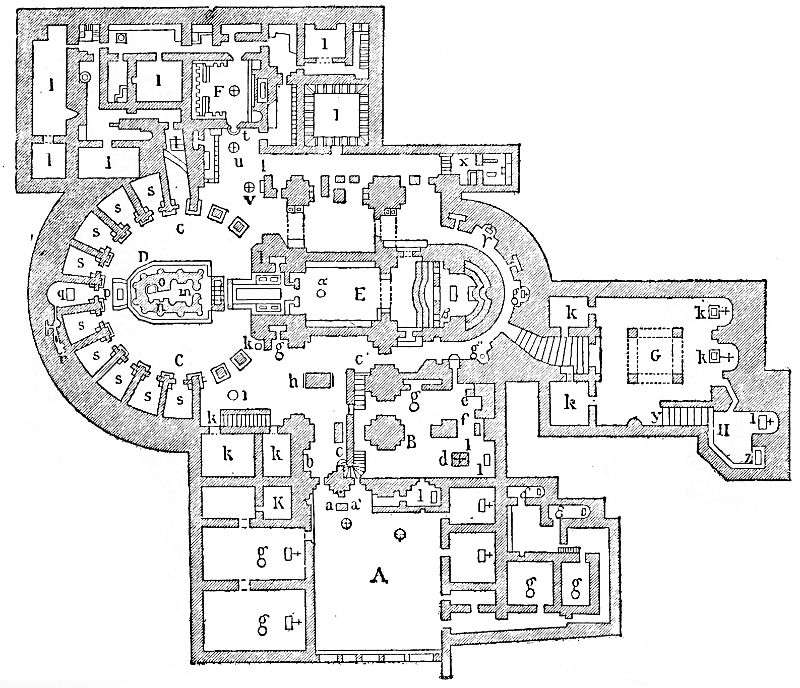
PLAN OF THE CHURCH OF THE HOLY SEPULCHRE.
a. Entrance to the Church of the Holy Sepulchre.
b. Divan of the Turkish Guards.
c. Staircase of the Latins, leading to Golgotha.
c'. Ditto of the Greeks.
d. The Place of Crucifixion.
e. Greek Altar, where is found the Hole of the Cross.
f. Cleft of the Rock.
gg. Greek Chapels.
g'. Parting of Garments.
g". Crowning of Thorns.
h. Stone of Anointing.
i. Position of the three Maries.
kk. Staircase and Armenian Chapels.
ll. Chapels attached to Latin Convent.
m. Chapel of the Angel.
n. Inner Chapel.
o. The Holy Sepulchre.
p. Coptic Chapel.
q. Ditto of Schismatic Syrians.
r. Tombs of Joseph and Nicodemus.
ss. Greek, Armenian, and Coptic Chapels.
t. Staircase to Latin Church.
u. Station of Mary Magdalene.
v. Place where Christ appeared to Mary Magdalene.
x. Christ’s Prison.
y. Steps leading to Chapel of the Finding.
z. Place where the Cross was found.
A. Entrance Court.
B. Chapel of Calvary.
C. Great Cupola.
D. Chapel of Holy Sepulchre.
E. Greek Church.
F. Church of the Franciscans.
G. Chapel of St. Helena.
H. Chapel of the Finding of the Cross.
K. Ruined Steeple.
α. Centre of the World.
β. Most Holy Place of the Greeks.
δ. Chapel of Longinus.
δ. Place of Abraham’s Sacrifice.
ε. Place where Melchisedek blessed the Bread.
We may dismiss, without a moment’s hesitation, the legends which
cluster around the main central tradition; but have we reasonable ground for
believing that our Lord was crucified and buried upon this spot? What is
the evidence upon which the authenticity of the site rests?
In the reign of Constantine the city had been laid utterly waste; its very
name had ceased to be used, and Christians and Jews had been banished
from it for generations. The superstitious zeal of the Empress Helena,
prompted her to visit the sacred places, and the site of Calvary had been
fixed by the alleged discovery of the three crosses which were found in a
pit, and their authenticity is said to have been attested by the miracles which
102were worked. Constantine now resolved to recover the Sepulchre and to
erect a church, the splendour and beauty of which should surpass all others.
Eusebius tells us, that the pagans had piled a mound of earth over the cave,
had paved the surface and placed upon it a temple to Venus; the emperor
caused these to be removed, when “as soon as the original surface of the
ground, beneath its covering of earth appeared, immediately and contrary to
all expectation, the venerable and hallowed monument of our Saviour’s resurrection
was discovered.” The cave was adorned with marbles, a colonnade
was erected round it, and a basilica was built in honour of the Anastasis, or
Resurrection.
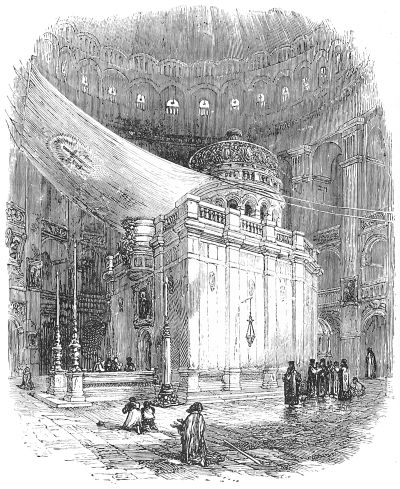
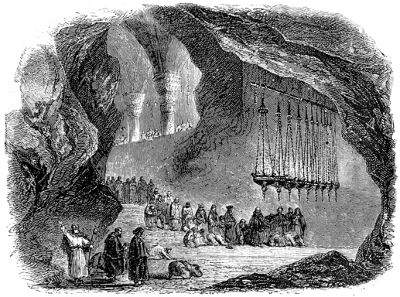
INTERIOR OF THE CHURCH OF THE HOLY SEPULCHRE.
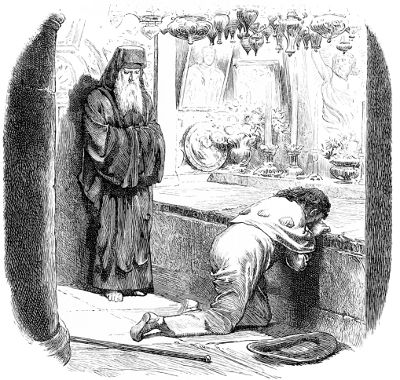
CHAPEL OF THE HOLY SEPULCHRE.
Two questions at once suggest themselves. Did Constantine discover
103the true site? Does the present church stand upon the same spot with his
basilica? To these questions the most contradictory answers are given. By
some it is maintained that the emperor was guided, in his search, by accurate
information, that a continuous tradition connects his edifice with the present
church, and that, consequently, we have the very places of the entombment
and resurrection fixed beyond reasonable doubt. Others, holding that the
true site was discovered by Constantine, yet assert that during the intervals
in which Christians were banished from Jerusalem by Persian and Mohammedan
conquerors, the original edifice was destroyed, the locality forgotten,
and that a new church sprang up upon a different site, around which legends
have clustered in the lapse of ages which have no historical basis. Others,
104again, assert that Constantine was the dupe either of superstition or of
imposture, and that there was absolutely no evidence that the sepulchre was
where he sought for it.
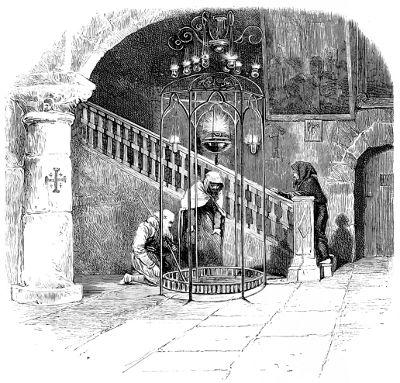
Into the protracted and angry discussions which have raged upon these
questions, I do not propose to enter here. But after a careful examination of
the site and of the arguments urged by the various disputants, I come to the
conclusion that the place of the crucifixion and entombment must be sought
elsewhere, and not on the spot which tradition points out. Though the
indications of Scripture may be insufficient to show us where it was, they are
yet quite adequate to tell us where it was not.
1. It was outside the city, yet near to it (John xix. 20; Hebrews xiii. 12).
1052. It was a place where interments were permitted, and as a matter of
fact did take place (Matt. xxvii. 59, 60; Mark xv. 46, 47; Luke xxiii. 53;
John xix. 41, 42).
3. There was a garden in “the place” (John xix. 41).
4. It was by the side of a road leading up from the country (Matt. xxvii.
39; Mark xv. 21, 29; Luke xxiii. 26).
5. It was a spot capable of being seen by a considerable number of
persons from a distance (Matt. xxvii. 55; Mark xv. 40; Luke xxiii. 49).
6. It was within sight and hearing of a place whence the priests could stand
without danger of defilement (Matt. xxvii. 41; Mark xv. 31; John xviii. 28).
7. It was not far from the barracks of the Roman soldiers, some of
whom ran and fetched the vinegar—the ordinary posca, or sour drink of the
legionaries—when Jesus on the cross cried, “I thirst” (Matt. xxvii. 48;
Mark xv. 36).
8. The language of the evangelists seems to imply that the procession, on
leaving the judgment hall, passed not through the city but outside it (Matt.
xxvii. 31, 32; Mark xv. 20; Luke xxiii. 26; John xix. 17).
106The present site fails to satisfy any one of these conditions. It is not
only far within the walls, but apparently must have been so in the time of
our Lord when the city was much larger and more populous than now, though
in the time of Constantine, when the walls were demolished and the city
desolate, it may have been outside the inhabited district.[144] Even if by any
sudden bend, or re-entering angle the line of circumvallation left it outside,
which, however, is very unlikely, it must still have been in the midst of
houses, for we find that Agrippa, twelve years afterwards, constructed a
third line of wall to enclose an extensive suburb which had sprung up on
this side; and we know that the ceremonial law and social usages of the
Jews forbad the formation of graves among the abodes of the living.
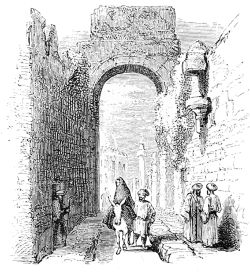
Where could the priests have stood who so feared[145] defilement, that they
would not enter the judgment hall amongst a crowd of Roman soldiers and
rabble? In a place of public execution
and interment, they must have been
defiled.
If, as seems certain, houses were all
round the present site, where could the
great multitude have watched from “afar
off?”
The judgment hall and the barracks
are believed to have been in the Castle
of Antonia. In this case the Via Dolorosa
must have led, as tradition now marks it,
through the heart of the city, crowded at
the time to its utmost capacity by the
multitudes who had come up to the feast.
The rulers feared “an uproar among the
people,” many of whom “believed on
Him;” hence the need for taking Him by subtlety, and for hurrying over the
trial in an illegal and stealthy manner. Is it likely that they would run the
risk of a disturbance and a rescue in the crowded street? especially with a
guard of only four soldiers.[146] We can hardly doubt that, in accordance
with the indications of the narrative the rulers would choose some place
for the execution to which they could pass immediately from the prætorium
into the open country.
We have but to transfer the scene of the crucifixion from the northern
to the eastern side of the city, in the valley of the Kedron, to find all the
requirements of the narrative satisfied. It is, and always must have been,
outside the walls. It was a recognised place of interment, the valley to this
107day being full of graves, many of them very ancient and cut in the rock.
Irrigated by the river, by wells and fountains, there were numerous gardens.
The slope of Olivet would allow a great multitude to watch the scene afar
off, and the priests, standing on the Temple cloisters, would be within sight
and hail of Calvary without fear of defilement. One of the two main roads
leading from the country into Jerusalem passed close to the spot. And the
procession, leaving the prætorium, would emerge at once from the city into
the open country. Assuming then that the site of Calvary is to be sought
on the eastern side, the whole narrative becomes clear and consistent.
If this be conceded a new and unexpected conformity between the type
and the great Antitype is discovered. The Epistle to the Hebrews, written at
a time when the Temple was yet standing and its sacrifices were being offered,
says, respecting the sin-offering, “the bodies of those beasts whose blood is
brought into the sanctuary by the High Priest for sin, are burned without
the camp; wherefore Jesus, also, that He might sanctify the people with His
own blood suffered without the gate.”[147] Not merely “a gate,” but “the gate,”
through which the bodies of the sacrifices were carried out to be burned.
The great sin-offering for the world was thus led forth to be crucified through
the very gate and in sight of the very spot in which the typical sacrifices
had been burned in the valley of Hinnom.
Again the rending of the veil at the moment of our Lord’s death gains a
new significance if this view be adopted. The Temple, as we know, opened to
the east. It would be within sight of Calvary. How striking, how suggestive
that the typical veil should thus be “rent in twain from the top throughout”
just when we received “boldness to enter into the holiest by the blood of
Jesus by a new and living way which he consecrated for us, through the veil,
that is to say, his flesh.”[148]
And yet further, the fact that the place of our Lord’s death, burial, and
resurrection was in close proximity to the Temple, would give additional
significance to the taunt of those “that passed by saying, Thou that destroyest
the temple and buildest it in three days save thyself.”[149] Here again the type
and the antitype come into close juxtaposition.
The site of the Temple claims our next attention.
In any view of Jerusalem from the eastward the vast enclosure known
as the Haram esh Sherîf, or the Noble Sanctuary, arrests the eye from its
size, its beauty, and the profound interest which attaches to it. Within its
limits stood the Temple, and the world can hardly afford a nobler, worthier
site for the house of the Lord. Standing on a ridge, guarded by valleys on
every side, it formed a natural and almost impregnable fortress. Psalmists
108and prophets only gave expression to the feelings of the whole people when
they celebrated, in exulting and rapturous strains, the strength, the beauty, and
the glory of the city of God. It was a saying of the Rabbis that “the world
is like an eye. The ocean surrounding it is the white of the eye; the earth
is the coloured part; Jerusalem is the pupil; but the sanctuary is the image
within the pupil. There the being of God is at once mirrored and beheld.”
The walls of the Temple area enclose a rectangle of about fifteen
hundred feet from north to south by nine hundred feet from east to west.
Its stones are many of them of great size; Capt. Warren measured one
which was thirty-eight feet nine inches in length. The peculiar bevel which
characterises early Jewish and Phœnician work may be observed on most of
them. Occasionally, especially in the lower courses, they appear to occupy
their original position, though whether placed there by Solomon, Nehemiah, or
Herod, cannot be ascertained at present; more frequently the stones have been
replaced by later and more modern hands than those of the original builders.
A careful examination often shows that the original materials have been used
over and over again in successive walls, and commonly reduced in size so as
to be worked more easily. Columns of the finest marble, porphyry and
serpentine built in amongst the blocks of limestone, are by no means rare.
These are sometimes whole and erect, but more often broken across and laid
in horizontally with the ends projecting. They evidently formed part of the
Temple, and have been used by later builders as being ready to hand.
Examining these massive remains of ancient power and wealth it was impossible
not to remember the words of the disciples, “Master, see what
manner of stones and what buildings are here.” The stability of the edifice
seemed to be ensured not only by the size of the blocks but by the excellence
of the Jewish masonry, which was so perfect that it is often impossible to
insert the point of a knife between the joints. Yet the dilapidated condition
of the walls shows how wonderfully our Lord’s words have been verified,
“Seest thou these great buildings? there shall not be left one stone upon
another that shall not be thrown down.”[150]
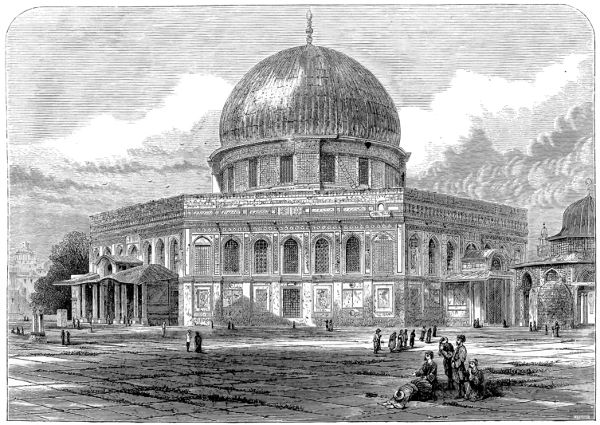
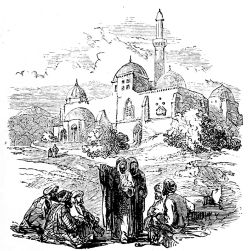
THE MOSQUE OF OMAR.
From a photograph by Mr. Bergheim, Jerusalem.
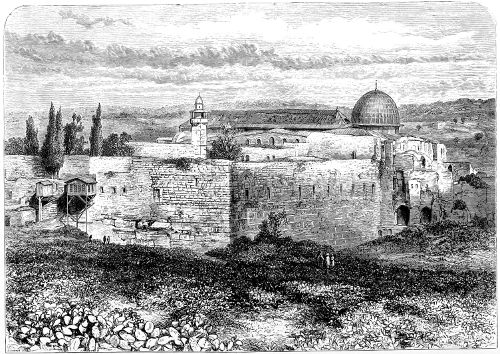
Starting at the north-east angle, and going eastward, with the valley of
the Kedron and the Mount of Olives on our left hand, the Temple area on
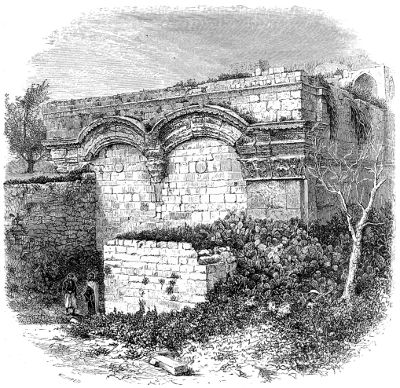
our right, we come to the Golden Gate, a remarkable double gateway the date
and purpose of which are unknown. Some have supposed it to be the
Beautiful Gate at which the lame man sat begging,[151] but from the style of
architecture it can hardly be older than the age of Constantine. It is now
walled up, in consequence of a Mohammedan tradition that the Christians
will again take possession of Jerusalem, and that their King will enter
victoriously through this gate. Another tradition is that the last judgment
will take place in the valley of Jehoshaphat or of Kedron, just below us,
and that Mohammed will stand upon one of the projecting pillars over the
111entrance, and Issa—their name for Jesus—on the Mount of Olives opposite,
and together judge the world.
Along the southern side there is little to detain us. We have on our
right the wall surmounted by the roof of the mosque of El Aksa and on our
left the slope of Ophel running down to the point at which the Valleys of
Hinnom and Kedron meet. But immediately after turning the south-west
corner we come upon an object of profound interest. The Temple was on
this side divided from the city by a valley, now nearly filled up. From the
wall which here bears traces of extreme antiquity and appears to be a part
of the original structure, some huge blocks of stones are seen to project.
These were found by Robinson to form the first courses of an arch. Captain
112Wilson, acting on behalf of the Palestine Exploration Fund, caused a line
of shafts to be sunk due westward from this point, and discovered a series of
piers upon which other arches had rested, so that we have here the remains
of a bridge which ran across the valley connecting the Temple with the city.
We learn from Josephus that the valley was spanned by a bridge leading
from the Temple to the palace. All subsequent researches have tended to
establish the conclusion at which Robinson arrived that, “This arch could
only belong to THE BRIDGE, and it proves incontestably the antiquity of that
portion of the wall from which
it springs.” The only difficulty
in the way of ascribing this great
work to Solomon or his successors
is that the principle of the
arch was not then known. A
more thorough acquaintance with
Egyptian architecture, however,
proves that this statement is not
strictly true. Examples of the
arch, though rare, may yet be
found in buildings of undoubted
antiquity. In the narrative of
the visit of the Queen of Sheba
to Solomon we read that, “When
she had seen ... his ascent by
which he went up unto the house
of the Lord, there was no more
spirit in her.”[152] This seems to be
spoken of as the climax of all
the wonders which were shown
her. If we may venture to identify
the arched bridge across the
valley with “the ascent” thus
spoken of it will adequately
explain the astonishment with which it was regarded.
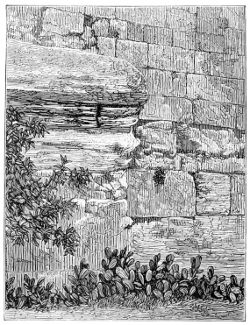
PROJECTING STONES OF ROBINSON’S ARCH.
WAILING-PLACE OF THE JEWS.
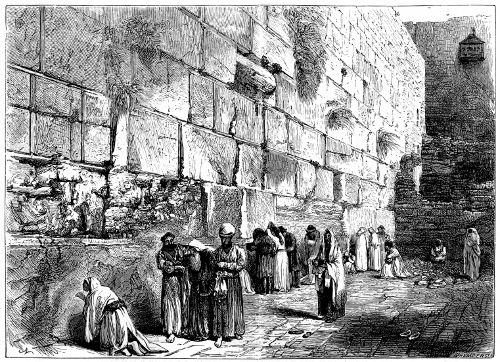
A little farther along the western wall we come to the Wailing Place of
the Jews. It is close to the Jewish quarter—the foulest, most squalid and
wretched part of the city. The masonry here is the finest, and in the best
preservation, of any part of the enclosure. Many of the stones are twenty-five
feet in length and apparently have remained undisturbed since the time
of the first builder.[153] Here the Jews assemble every Friday to mourn over
115their fallen state, especially their exclusion from “the holy and beautiful
house,” where their fathers worshipped God. Some press their lips against
crevices in the masonry as though imploring an answer from some unseen
presence within, others utter loud cries of anguish. Here is one group joining
in the prayers of an aged rabbi; yonder another sitting in silent anguish,
their cheeks bathed in tears. The stones are in many places worn smooth
with their passionate kisses. The grief of the new-comers is evidently deep
and genuine. But with the older residents it has subsided into little more than
a mere ceremonial observance and an empty form. But in either case the
scene is strangely affecting, leading back our thoughts to the self-invoked curse
of eighteen hundred years ago—“His blood be on us, and on our children.”[154]
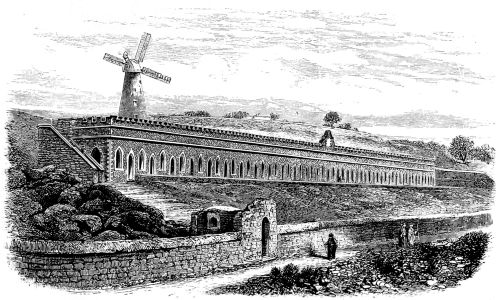
JEWISH ALMSHOUSES, ERECTED BY SIR MOSES MONTEFIORE, NEAR THE JAFFA GATE.
The northern wall has nothing to detain us, except the pool of Bethesda,
so called, but of which the identification is doubtful.[155] There are still traces of
what may have been “the five porches,” but the pool is now little more than
a pit or ditch choked with filth and ordure, and, only after heavy rains,
containing a little stagnant, fetid water.
We now enter the Temple area and find ourselves in an enclosure of
extraordinary beauty. In spring and early summer the turf is of a brilliant
green, enamelled with a profusion of wild flowers, and dotted over with
trees, most of them cypresses, many of which are of great size. The
birds, free from molestation, are exceedingly tame. Doves and sparrows are
116especially numerous, reminding us of the words of the psalmist, when,
“longing, yea, even fainting for the courts of the Lord,” “the sparrow hath
found a house, and the swallow a nest for herself, where she may lay her young;
even thine altars, O Lord of hosts, my King and my God.”[156] Cloisters,
colonnades, fountains, cupolas and shrines, are seen here and there within the
spacious area. But the eye is arrested and detained by a marble platform
from the centre of which rises one of the most exquisite domes in the world.
This is the Kubbet es Sakhrah, “the Dome of the Rock,” better known to
Europeans as “the Mosque of Omar,” next after Mecca the most sacred,
next after Cordova the most beautiful of all moslem shrines.[157] There are
several other mosques within the Temple area, but none that claim special
notice except the one at the south end—that of El Aksa. This is a large
building, the date and original purpose of which, however, is involved in
much obscurity.
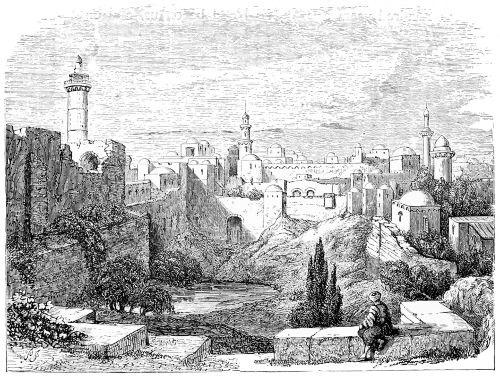
The rock itself is honey-combed with excavations, most of them cisterns
or conduits. Some of these are supplied with water from Solomon’s Pools
beyond Bethlehem. The aqueduct may yet be traced along the edge of the
117Wady Urtas. It is said that, in addition to the water brought from a
distance, there are natural springs within the rock itself; this, however, is
doubted. From whatever source the supply was derived it was so abundant
that it was never known to be exhausted. In some of these vast underground
reservoirs which I visited, I found the water to be deliciously cold,
sweet and clear. It was in reference to these inexhaustible stores from
which the priests drew so plentifully, that our Lord, “in that great day of
the feast ... stood and cried, If any man thirst, let him come unto Me and
drink. He that believeth on Me, as the Scripture hath said, out of his belly
shall flow rivers of living water. This spake He of the Spirit, which they
that believe on Him should receive.”[158]
Among the subterranean chambers is one dedicated to the Lord Issa,
or Jesus. Here according to Mohammedan
tradition he was born;
his cradle is shown, and the chapel,
for such it is, is regarded as one of
peculiar sanctity.
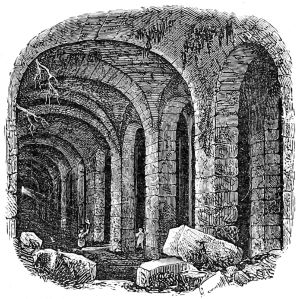
SUBSTRUCTIONS UNDER THE SOUTHERN END OF THE TEMPLE AREA.
Beneath the southern end of the
area is an extraordinary series of
substructions which used to be called
Solomon’s stables, and were believed
to have been erected for that purpose
by the magnificent king. Their
real design is obvious, though when
and by whom they were built cannot
be determined. The Temple
area is constructed on the summit
of Mount Moriah. As the hill sloped
downward on the east, west, and
south it was necessary to level the
top to secure a plane surface. But on the southern side or Ophel, the descent
was rapid. To have secured a level platform here, it would have been necessary
to cut away so much from the summit as seriously to have reduced its
height. These arches were, therefore, built up from beneath. The same
method was adopted at Rome to enlarge the level area of the Palatine.
In what part of the extensive area thus formed did the Temple stand?
It has been commonly assumed that the marble platform in the centre marks
the site, and that the Mosque of Omar stands over the spot occupied by the
altar or the Holy Place. This view, however, is beset with doubts. The
mosque encloses a mass of rock sixty-feet in length, fifty-five in breadth, and
standing up about fifteen feet above the earth around it. Now we know
118that the Temple was built upon the threshing-floor of Araunah the Jebusite.[159]
This mass of rock, however, with its inequalities of surface could never have
been a threshing-floor. It has been said that probably the rock was cut
away around it, leaving this portion untouched. But this explanation is
equally inconsistent with the facts of the case. For the rock is unhewn, and
only in one or two places bears marks of the chisel. Besides which, if it
had stood within the precincts of the Temple it could hardly have escaped
mention, yet neither the Scriptures, the writings of Josephus, nor those of the
Talmudists allude to it.[160] Where could it have stood? What purpose could
it have served? Its size is fatal to the theory that it was in the most
Holy Place, which was a small chamber. It is possible, though not very
probable, that being covered with plates of brass it formed the core of the
altar of burnt-offerings. Standing on the summit and in the centre of the
ridge of Moriah, it is the likeliest place for the site of the Temple, yet the
difficulties, in the way of placing the Temple over it, are very great.
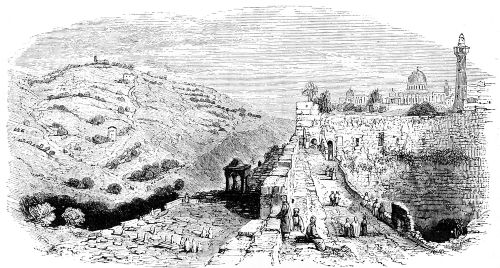
THE TEMPLE AREA AND MOUNT OF OLIVES, FROM THE CITY WALL.
Another theory propounded by Mr. Fergusson, and ably supported by
Messrs. Lewin and Sandie, finds the Temple site on the south or south-west
of the Haram area. But this theory is likewise beset with great difficulties.
For the threshing-floor must then have been in a deep hollow, contrary to
the invariable practice of the Easterns, who constructed them on the tops of
hills where the wind might winnow the grain as it fell from the ears.
Besides which, the language of the psalmist and prophets implies that the
119Temple stood on an elevated site; they speak invariably of going up to the
house of the Lord. It is true that the southern end of the Temple area is
now on the same level with the rest, but this is secured by the vast
substructions which have been built up from the valley below; and it can
hardly be pretended that the threshing-floor of Araunah occupied this artificial
elevation; nor has any reason been suggested why, with the whole ridge of
Moriah to choose from, a site should have been selected which either buried
the Temple in a hollow, or required an amount of work below the surface
greater than that above it to bring up the platform to the necessary level.
The startling theory of Mr. Fergusson as to the site of the Holy
Sepulchre demands brief notice here. He maintains that the Mosque of Omar
is the basilica of Constantine, that the mysterious rock which it encloses is
that of which the evangelist speaks, and that a cave about fifteen feet square in
the side of the rock is the very cave in which our Lord was entombed.
His argument, to which full justice cannot be done in a brief summary, may
be thus stated. He pledges his professional reputation that the Kubbet es
Sakhrah is a building of the date of Constantine, that it is not and never
could have been intended for a mosque, that it does not possess a single
characteristic of Saracenic architecture, but that in its main features it is
identical with the sepulchral basilica of Diocletian, at Spalatro, a type which
Constantine is likely to have followed. The Golden Gate he regards as the
grand entrance from the eastern side to the area of the basilica, and maintains
that it is of the same style and date with the Dome of the Rock. Assuming
the accuracy of his theory that the Temple occupied the south-western angle of
the present area, he shows that there was ample space for places of the crucifixion
and entombment to have been here without entrenching upon the Temple
precincts from which it was then separated by a deep fosse or valley, now
filled up. He then seeks to show that the indications of the Gospel narrative,
the statements of Eusebius, and the language of early pilgrims agree in fixing
upon this as the true site of the burial and resurrection of our Lord. The
absence of any tradition pointing to this spot and the fact that for nearly a
thousand years the site of the sepulchre has been supposed to be where the
church now stands, he explains by the statement that after the rock with its
dome, had been appropriated by the Mohammedans, the Christians were
banished for a long period from the city; even on their return they were not
allowed to approach the Holy Place; a new church in another site was
therefore built for the use of the pilgrims around which the legends sprang
up in mediæval fashion, so that what was at first a mere myth or pious fraud,
came at last to be accepted as an historical fact.
There is much that is attractive in this theory, and it is supported by a
great weight of argument and learning. But it will hardly bear the test of
examination. The basilica of Constantine was not built over the sepulchre but
near it; the Kubbet es Sakhrah encloses and covers the rock. Constantine’s
120building was destroyed by Chosroes II., and the church that rose upon its
site suffered the
same fate under
El-Hakem. This,
therefore, cannot
be it. Constantine
constructed a colonnade
eastward
from the church
at the end of which
was an agora, or
market-place. The
Kubbet es Sakhrah is so near the eastern wall over the valley of
the Kedron that space cannot be found for this arrangement.
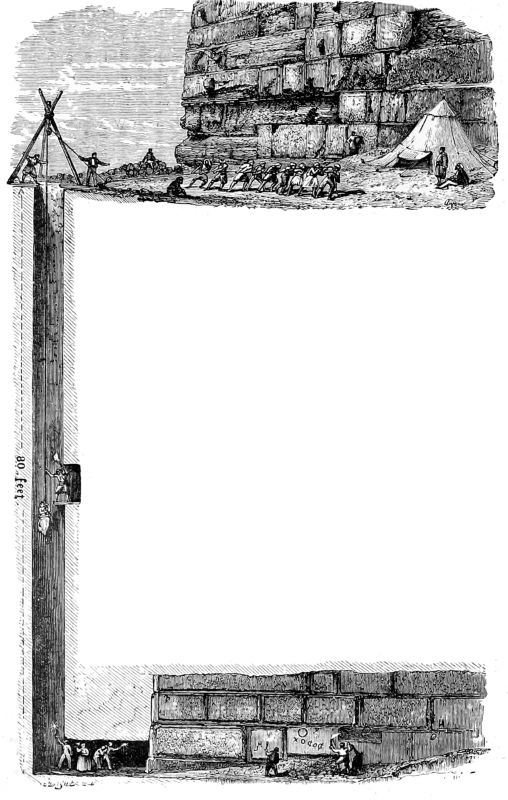
TUNNEL AND SHAFT OF THE PALESTINE EXPLORATION FUND OUTSIDE THE WALL OF THE TEMPLE.
Whilst, therefore, the site of the sepulchre must, in my
judgment, be sought somewhere on this side of the city, I cannot
accept Mr. Fergusson’s identification as accurate or sustained by
facts. It is with reluctance that we yield ourselves to the conclusion
that accurate knowledge is, at least, for the present beyond
our reach. Most eagerly and gratefully should we welcome any
means of determining the spot so endeared by hallowed memories
and associations. But our very ignorance may have been designed
or permitted for wise purposes. A superstitious, an almost
idolatrous, worship has been fostered by pilgrimages to the holy
places. We shall do well to remember the conversation by
Jacob’s well: “The woman saith unto him, Sir, I perceive that thou
art a prophet. Our fathers worshipped in this mountain; and ye
say that in Jerusalem is the place where men ought to worship.
Jesus saith unto her, Woman, believe me, the hour cometh when
ye shall neither in this mountain nor yet at Jerusalem, worship the
Father ... the hour cometh and now is, when the true worshippers
shall worship
the Father in
spirit and in truth:
for the Father
seeketh such to
worship Him.”[161]
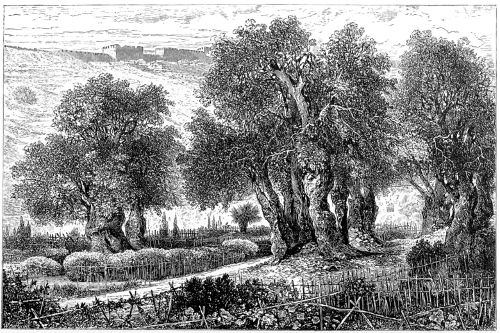
THE GARDEN OF GETHSEMANE.
From a Photograph, 1866
Light may ultimately
be thrown
upon these difficult
and perplexed questions
by the labours of the Palestine Exploration Fund. Hitherto, however,
123the obstacles thrown in their way by the Turkish government,
have been almost insuperable. It is only by extraordinary energy and
ingenuity that they have been able to accomplish anything in Jerusalem.
The sketch on the preceding page will illustrate this. Not being allowed to
excavate within a certain distance of the Temple area, a shaft was sunk
through the mass of débris, to the depth of eighty feet, just outside the
proscribed limit. A tunnel was then run from the bottom of the shaft to the
wall of the Temple. The result was the discovery of courses of masonry of
the original edifice, and upon some of the blocks of stone, mason’s marks in
ancient Phœnician characters were found.
It now only remains for us to notice briefly some of the memorable
spots in the immediate neighbourhood of Jerusalem. These, for the most
part, lie along the valley of the Kedron.
First in interest is the Garden of Gethsemane. Leaving the city by
St. Stephen’s Gate, a steep path leads us down into the valley and across the
bed of the Kedron. Soon after beginning the ascent of Olivet, we come to
an enclosure about eighty yards square. Knocking at a low door, we are
admitted by an aged monk, the guardian of the place, and find ourselves in
a trim garden. The flower-beds are neatly kept and fenced with sticks. A
number of olive-trees stand among them, hollow, gnarled, and, apparently,
extremely old. They yet bear a few berries, which are carefully gathered
and given to pilgrims, for which, of course, backshish is expected in return.
Old as the trees are it cannot be supposed that they have stood here for
eighteen centuries, though it is quite credible that they may have sprung as
suckers from the roots of yet older trees. The passion for localising all the
incidents of the narrative is not absent here. We are shown the bank
upon which the disciples slept, the grotto—all mediæval legends select a grotto—where,
as a Latin inscription informs us, “the sweat like blood ran down upon
the ground,” and the place where Judas betrayed his Master with a kiss.
The Custode however, with a courtesy and consideration very rare in his
class, does not pester us with talk, but, retiring to a distance, leaves us
to our meditation.[162] On this spot then, or near it, happened the most solemn
and pathetic event in the life, even of “the man of sorrows.” Under the
shade of these grey olives, he endured his bitter and heart-breaking agony; along
yonder path, lighted by the full passover moon, “with lanterns, and torches,
and weapons,” came the betrayer, leading “a band of men and officers;”[163]
here, deserted and forsaken by all, He meekly surrendered Himself to his
murderers, and was led away to be condemned and crucified. Callous must
that heart be which, on such a spot as this, does not breathe the prayer:
“By Thine agony and bloody sweat; by Thy cross and passion; by Thy
precious death and burial: Good Lord deliver us!”
124Leaving the scene of our Lord’s bitter agony, we pass along the Valley of
the Kedron, sometimes called the Valley of Jehoshaphat. Jews and Mohammedans,
alike, believe that this will be the scene of the final judgment.
Hence has arisen an eager desire to be buried here, and the soil is, in many
places, literally paved with tombstones, and the whole valley is one vast
cemetery. Shortly before reaching the point of junction of the valleys of
Hinnom and Kedron, we reach a cluster of remarkable tombs, called by the
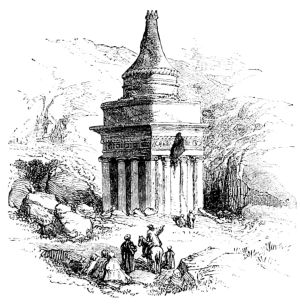
names of Zacharias, Absalom, and St. James. The tradition respecting them
is quite modern, and has no historical basis. Those of Zacharias and
Absalom are similar in design, being cut out of the solid rock. The
former is said to be the burial-place of the Zacharias who was “slain
between the temple and the altar.”[164] The latter, tradition asserts to be the
pillar which the rebellious son “reared up for himself during his lifetime in
the king’s dale, for he said, I have no son to keep my name in remembrance.”[165]
Its base is now buried beneath a heap of stones, upon which
each Jew, as he passes, throws one in detestation of his memory.
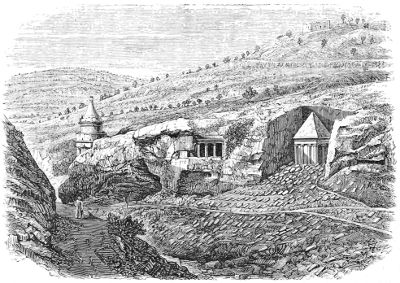
MOUNT OF CORRUPTION IN THE VALLEY OF JEHOSHAPHAT, WITH THE TOMBS OF ABSALOM, ST. JAMES, AND ZACHARIAS.
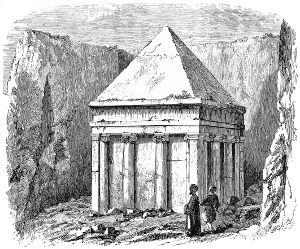
The tomb of St. James is a remarkable chamber, cut out of the side of
the hill, with rock-hewn Doric columns in front. A modern tradition declares
125that here St. James retired after our Lord’s crucifixion, and vowed neither to
eat nor drink till He had risen again. On the third day the risen Saviour
appeared to him, saying, “Arise and eat, for I have now risen from the
dead.” The marked resemblance between this sepulchre and the temple-tombs
at Beni-hassan, in Egypt, has given rise to the suggestion that here we have
the idol temple constructed by Solomon for his queen, the daughter of
Pharaoh, in “the hill that is before Jerusalem.”[166] The site and the style of
architecture afford a certain measure of probability to the conjecture.
Just above us on the left is Silwan, the ancient Siloam—a collection of
wretched hovels, inhabited by peasantry, who have the reputation of being
the most dangerous, turbulent, and thievish in the district. Though I have
often passed through the village alone, or with only a single companion, I
have never had anything to complain of, beyond a demand for backshish,
more than usually clamorous. In this village, and in other places round
126Jerusalem, I found many of the peasantry occupying old tombs which formed
abodes at least as commodious as the huts in which their neighbours lived.
The pool of Siloam is at the foot of the hill on our right. It and the
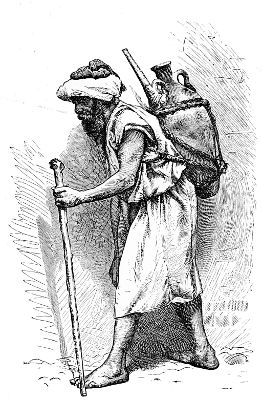
neighbouring well of En Rogel are still much used, not only by the villagers,
but by the water sellers of Jerusalem.
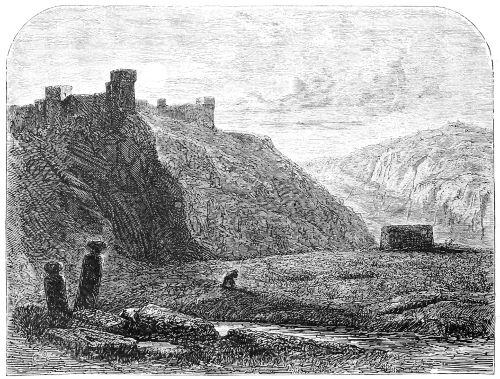
Turning to the right up the Valley of Hinnom, we see, on the dark and
gloomy Hill of Evil Counsel, Aceldama. Down to a very late period, it
continued to be used as “a field to bury strangers in.”[167] Skulls brought
away from this spot and submitted to the examination of competent ethnologists,
have been pronounced to be those of negroes and other non-semitic
races.
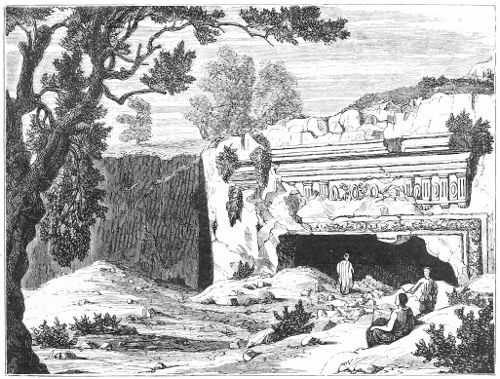
Another tomb, on the north side of the city, demands brief mention here.
It used to be called the tomb of the kings, but it has now been identified as
that of Queen Helena, a Jewish Proselyte, who in the first century of our era
died, and was buried at Jerusalem. It is remarkable not only for the extent
and perfect preservation of the sepulchral chambers, but for the ingenious
127mechanism by which the entrance was closed or opened—a huge stone being
rolled to or from the mouth of the entrance. It thus affords an interesting
contemporary illustration of the words of the evangelists, “Who shall roll
away the stone from the door of the sepulchre? And when they looked
they saw the stone rolled away, for it was very great.”[168]
But it would be impossible, with the space at our disposal, to describe,
however briefly, all the objects of interest in and around Jerusalem. Whole
volumes have been devoted to the subject without exhausting it. This brief
and inadequate sketch may be brought to a close by recalling to memory a
Sabbath morning service in Christ Church on Mount Zion, as the Protestant
church, recently erected there, is called. The liturgy had gained a deeper
significance and impressiveness from the associations of the place. The
sermon had set forth Christ crucified as the hope alike of Jew and Gentile.
128And the concluding hymn brought tears to many eyes; solemn penitential
thoughts to many hearts. Not a few of the congregation, overcome by
emotion, were unable to join audibly as we sang:—
Jerusalem, Jerusalem,
Enthronéd once on high,
Thou favoured home of God on earth,
Thou heaven below the sky;
Now brought to bondage with thy sons,
A curse and grief to see,
Jerusalem, Jerusalem!
Our tears shall flow for thee.
O hadst thou known the day of grace,
And flocked beneath the wing
Of Him who called thee lovingly,
Thine own anointed King:
Then had the tribes of all the world
Gone up thy pomp to see,
And glory dwelt within thy gates,
And all thy sons been free.
“And who art thou that mournest me?”
Jerusalem may say,
“And fear’st not rather that thyself
May prove a castaway!
I am a dried and abject branch,
My place is given to thee;
But, woe to every barren graft
Of thy wild olive-tree!
“Our day of grace is sunk in night,
Our time of mercy spent,
For heavy was my children’s crime,
And strange their punishment:
Yet gaze not idly on our fall,
But, sinner, warnéd be;
Who sparéd not His chosen seed,
May send His wrath on thee!
“Our day of grace is sunk in night,
Thy noon is in its prime;
O turn, and seek thy Saviour’s face,
In this accepted time!
So Gentile, may Jerusalem
A lesson prove to thee,
And in the new Jerusalem
Thy home for ever be.”