When I am dead, my body shall go back
To the hills between the Ridgeway and the Sea—
To the Earthworks and terracing and ancient bridle-track
To the Dorset hills my heart has held in fee;
My limbs that thrived on them shall be their very own,
I shall live again in little wayside flowers;
My flesh and bones and sinew shall give life to mighty trees
And my spirit shall abide in ancient towers.
When I am dead, my dust shall mix with clay,
And "puddle" some lone dew-pond on the hill,
So every Dorset lad who drinks upon his way
Will somehow lead me back to Dorset still.
Anonymous.
Dorchester deserves to be chosen as the headquarters of the earliest of
a series of excursions in Dorset, not only by reason of the premier
position which it holds in the country, but also on account of the
multitude of interesting surroundings which claim the attention of the
literary pilgrim, the antiquary and the archæologist. The town is
situated on a hill which slopes on the one side to the valley of the
Frome, and extends on the other in an open country, across which run the
Roman roads, still used as the highways. The principal thoroughfares
divide Dorchester pretty equally, the High Street intersecting it from
east to west, the South Street and North Market in the opposite
direction. On the south-west is the suburb of Fordington. The principal
street—on the line of the Via Iceniana—ends abruptly at the fields,
and on the south and west is the rampart, planted with rows of sycamore
and chestnut trees as a walk.
Daniel Defoe, in his whimsical description of his pilgrimage From
London to Land's End, published in 1724, gives an entertaining survey
of the town at that period. He says: "Dorchester is indeed a pleasant,
agreeable town to live in, and where I thought the people seemed less
divided in factions and parties than in other places; for though here
are divisions, and the people are not all of one mind, either as to
religion or politics, yet they did not seem to separate with so much
animosity as in other places. Here I saw the Church of England clergyman
and the Dissenting minister or preacher drinking tea together, and
conversing with civility and good neighbourhood, like Catholic
Christians and men of a catholic and extensive charity. The town is
populous, though not large; the streets broad; but the buildings old and
low. However, there is good company, and a good deal of it; and a man
that coveted a retreat in this world might as agreeably spend his time,
and as well, in Dorchester as in any town I know in England.... There
are abundance of good families and of very ancient lines in the
neighbourhood of this town of Dorchester, as the Napiers, the Courtneys,
Strangeways, Seymours, Banks, Tregonwells, Sydenhams, and many others,
some of which have very great estates in the county, and in particular
Colonel Strangeways (ancestor of the present Earl of Ilchester), Napier
(ancestor of the present Lord Arlington) and Courtney."
As to the healthiness of Dorchester, the editors of Hutchins's second
edition wrote: "The pleasant and healthy situation of this town deserves
an encomium. The famous Doctor Arbuthnot, coming hither in his early
days with a view to settle in it, gave as a reason for his departure
that 'a physician could neither live nor die in Dorchester.'"
St Peter's Church, a venerable edifice, occupies a prominent position at
the intersection of the four streets and rises in its tower to a height
of ninety feet. It is a well-proportioned building, with Norman porch
and some monuments, with effigies, to Lord Holles of Ifield and to two
unknown Crusaders, in coats of mail, with their legs crossed.
In the north wall of the chancel is placed an altar-tomb, which is
supposed to be that of the founder. A mural tablet on the south wall
commemorates THOMAS HARDY, Esquire, of Melcombe Regis, who founded and
endowed the Free Grammar School.
There were two brasses, now lost, one on the chancel floor, on grey
stone, over the effigy of a woman kneeling, reading:
"Miserere mei d's s'dum magnum mi'am tuam."
The other:
"Hic jacet Johanna de Sto. Omero, relicta Rob'bi More, qui obiit in
vigilia ste. Trinitatis sc'do Die mensis Anno D'ni MCCCCXXXVI.
Cuj'. a'ie p'piciet' D. Amen."
Tradition says that the church was erected by "Geoffrey Van, his wife
Anne and his maid Nan." Two of the six bells are mediæval. Close to the
south porch is a bronze statue of William Barnes. His learning, his
writings and poems in the Dorset dialect, his kindliness to his poor and
his parish made him universally beloved. The pedestal bears the simple
inscription: "William Barnes. 1801-1886," and the following lines from
his poem, Culverdell and the Squire:
"Zoo now I hope his kindly feace
Is gone to vind a better pleace,
But still we' vo'k a-left behind,
He'll always be a-kept in mind."
On 3rd September 1685 Judge Jeffreys opened his Bloody Assize at
Dorchester. Lord Macaulay says: "By order of the Chief Justice, the
court was hung with scarlet, and this innovation seemed to the multitude
to indicate a bloody purpose. More than 300 prisoners were to be tried.
The work seemed heavy, but Jeffreys had a contrivance for making it
light. He let it be understood that the only chance of obtaining pardon
or respite was to plead guilty. Twenty-nine who put themselves on their
country, and were convicted, were ordered to be tied up without delay.
The remaining prisoners pleaded guilty by the score. Two hundred and
ninety-two received sentence of death." Thirteen were executed here on
7th September. The formidable judge's chair is preserved in the Town
Hall, and visitors are shown the picturesque timber house in High Street
West at which, tradition hath it, this brutal judge lodged.
Dorchester derives its name from the ancient Roman name of Durnovaria,
and Thomas Hardy has transferred part of this Latinity in writing of
Fordington as "Durnover" in his novels. Close to the London and
South-Western Railway station, on the Weymouth Road, is a field, now a
municipal pleasure ground, containing what is called Maumbury Rings—a
large, oval, grassy mound, curved like a horseshoe. This great earthen
ring, which it is estimated would hold 10,000 spectators, is supposed to
be the work of prehistoric man, adapted by the Romans to the purposes of
an amphitheatre. Extensive excavations were carried on in the
amphitheatre by the British Archæological Association and the Dorset
Field Club during five summers—1908, 1909, 1910, 1912 and 1913—and
among many interesting finds by the archæologists' spade must be
mentioned the oblong cave at the east end, probably for the confinement
of beasts, prehistoric shafts in which picks of red-deer antlers, worked
flints, etc., were found, sundry human skeletons interred, and a well of
the Civil War period, during which the symmetrical terraces were
apparently added to the original ancient banks.
A crowd of 10,000 people is said to have been gathered upon it at the
execution of Mary Channing, the wife of a grocer at Dorchester, who was
strangled and burnt in the arena for poisoning her husband in 1705.
The Via Iceniana or Icknield Street came out of Wiltshire by Blandford
to Dorchester and strikes on towards the west by Eggerdun Hill, about
ten miles from the town, where it is clearly marked.
A Roman road went from Dorchester to Ilchester, by Bradford and
Stratton, so called as the Stret-tun, the village on the Roman stratum
or road.
"It is impossible," writes Mr Hardy, "to dig more than a foot or two
deep about the town, fields and gardens without coming upon some tall
soldier or other of the Empire, who had lain there in his silent,
unobtrusive rest for one thousand five hundred years. He was mostly
found lying on his side, in an oval scoop in the chalk, like a chicken
in its shell, his knees drawn up to his chest, sometimes with the
remains of his spear against his arm, a fibula or brooch of bronze on
his breast or forehead, an urn at his knees, a jar at his throat, a
bottle at his mouth, and mystified conjecture poring down upon him from
the eyes of boys and men who had turned to gaze at the familiar
spectacle as they passed on."
In the excavations made when Mr Hardy's house at Max Gate was commenced
graves were discovered, of which Mr Hardy wrote: "In two of them, and I
believe in a third, a body lay on its right side, the knees being drawn
up to the chest and the arm extended downwards, so that the hand rested
against the ankles. Each body was fitted with, one may almost say,
perfect accuracy into the oval hole, the crown of the head touching the
maiden chalk at one end and the toes at the other, the tight-fitting
situation being strongly suggestive of the chicken in the egg-shell."
Maiden Castle, the Mai Dun or "Hill of Strength," one of the finest
old camps in England, is situated most conspicuously to the right of a
Roman road (now the Weymouth highway). It may astonish the traveller by
the scale of its three earthen ramparts, the innermost being sixty feet
in height and a mile or more in circumference. It is about two and a
quarter miles south-west from the centre of the town, and may be reached
by continuing on through Cornhill, crossing the bridge over the Great
Western Railway and turning to the right just beyond it. Here, where the
road reaches the open, the left-hand track must be followed. On climbing
to the camp the pilgrim will find that these ramparts are as steep as
they are lofty, and that they are pierced by intricate entrances formed
by the overlapping ends of the valla and additionally strengthened by
outworks. The view is commanding, but not remarkable for beauty, the
principal features being the Roman roads diverging from Dorchester and
the innumerable barrows which dot the hills near the sea. Opinions
differ as to the origin of this remarkable hill fortress, but the weight
of authority is in favour of its construction by the Britons and its
subsequent occupation as a summer camp by the Roman troops stationed at
Dorchester.
The visitor will be interested in the old inns of Dorchester. In High
Street East stands, just as described in The Mayor of Casterbridge,
that fine and most comfortable of country hotels—the King's Arms. From
a doorway on the opposite side of the street Susan and Elizabeth-Jane,
amid the crowd, witnessed the dinner given to the mayor. Through the
archway of this inn Boldwood carried Bathsheba, fainting at the news of
her husband's death. From the diary of a landowner of the neighbourhood
(Mr Richards, of Warmwell), written more than a hundred and fifty years
ago, we find that the King's Arms and Antelope were Dorchester inns in
his days, as he writes that on Saturday, 13th October 1697, he "agreed
wth Captn Sidenham, at the Antelope in Dorchestr, for 100 great
bushells of his choice oats, at 6s. 8d. pr sack," and at other times
dined and transacted other business there; and at the King's Arms bought
"choice early pease for seed at 3s. 6d. per bushell."
At the Antelope Hotel, which is in South Street, Lucetta, passing
through the town on her way to Budmouth (Weymouth), appoints to meet
Henchard, but is not on the coach she mentioned. The White Hart Tavern
stands at the east entrance to the town, close to the bridge. Here Troy
lay in hiding, planning his surprise return to Bathsheba; we also
encounter this inn again in The Withered Arm. Gertrude Lodge came here
on her fatal visit to Casterbridge gaol.
On the opposite side of the road to the King's Arms the pilgrim may
still take his ale at the Phœnix, the scene of Janny's last dance in
Wessex Poems. In The Mayor of Casterbridge Hardy mentions a low inn
in Mixen Lane (Mill Lane, Dorchester) frequented by all sorts of bad
characters. In early editions it is called "St Peter's Finger," and it
would seem that the author borrowed this curious name from a genuine inn
sign at Lychett Minster. The real inn was called the King's Head, which
has now been pulled down.
The Grammar School is in South Street, an Elizabethan foundation,
built in 1569, endowed with a small farm at Frome Vauchurch, and some
houses in the town, by Thomas Hardy, Esq., of Melcombe Regis. Additions
were made to it in 1618, on ground given by Sir Robert Napper.
Close to the school are Napier's Almshouses, called Napper's Mite,
founded in 1616 by Sir Robert Napier for ten poor men, who have a weekly
dole and a small section of garden ground. The front, which opens into
a small cloister, bears a clock, on a large stone ogee-corbelled
bracket, a model of one that bears the sign of the old George, or
Pilgrim's, Inn at Glastonbury.
The Hangman's Cottage, mentioned in the story of The Withered Arm, is
still extant. It is a small grey cottage in the meadows by the Frome,
opposite the gaol. It is one of a cluster of cottages built of flint and
chalk, faced with red brick and strengthened with iron ties.
The Bull Stake and the gaol, both of which figure in the novels, are in
North Square, near St Peter's and the Corn Exchange. Approaching the
Frome, we pass close to the Friary Mill (the old mill of the suppressed
Franciscan Priory), near which was Jopp's cottage, to which Henchard
retired after his bankruptcy. "Trees, which seemed old enough to have
been planted by the friars, still stood around, and the back hatch of
the original mill yet formed a cascade which had raised its terrific
roar for centuries. The cottage itself was built of old stones from the
long dismantled Priory, scraps of tracery, moulded window-jambs and
arch-labels being mixed in with the rubble of the walls." The remains of
the Priory ruins were used up as building material and no trace is left.
The prison was largely built from its remains, while in its turn it is
said to have been erected from the ruins of a castle built by the
Chidiocks.
In South Street we shall find the High Place Hall, which was Lucetta's
house. It stands at the corner of Durngate Street, but the façade has
been modernised and the lower portion has been converted into business
premises. The depressing mask which formed the Keystone of the back door
was taken from Colyton House, in another part of the town. If we go to
the bottom of South Street and take the turning to the left we quickly
come to a quiet byway on the right near the shire hall, called Glydepath
Road. On the left of this narrow thoroughfare is the early
eighteenth-century mansion called Colyton House. Here will be found the
long filled-in archway, with the mask as its keystone: "Originally the
mask had exhibited a comic leer, as could still be discerned; but
generations of Casterbridge boys had thrown stones at the mask, aiming
at its open mouth, and the blows thereat had chipped off the lips and
jaw as if they had been eaten away by disease." The building to which
the archway belongs was formerly the county town residence of the
Churchills. This is Lucetta's house as to character, though not as to
situation.
Just beyond the White Hart we come to the first of the two bridges (the
second, Grey's Bridge, being only a few hundred yards farther along)
which have their parts in The Mayor of Casterbridge. Thomas Hardy has
quaintly described these bridges and has discoursed upon the habits of
their frequenters:
"Two bridges stood near the lower part of Casterbridge (Dorchester)
town. The first, of weather-stained brick, was immediately at the end of
High Street, where a diverging branch from that thoroughfare ran round
to the low-lying Durnover lanes, so that the precincts of the bridge
formed the merging-point of respectability and indigence. The second
bridge, of stone, was farther out on the highway—in fact, fairly in the
meadows, though still within the town boundary.... Every projection in
each was worn down to obtuseness, partly by weather, more by friction
from generations of loungers, whose toes and heels had from year to year
made restless movements against these parapets, as they had stood there
meditating on the aspect of affairs.
"To this pair of bridges gravitated all the failures of the town....
There was a marked difference of quality between the personages who
haunted the near bridge of brick and the personages who haunted the far
one of stone. Those of lowest character preferred the former, adjoining
the town; they did not mind the glare of the public eye.... The
miserables who would pause on the remoter bridge were of a politer
stamp."
Dorchester has now lost its fame for brewing beer. But about 1725 the
ale of this town acquired a very great name. In Byron's manuscript
journal (since printed by the Chetham Society) the following entry
appears:—
"May 18, 1725. I found the effect of last night drinking that foolish
Dorset, which was pleasant enough, but did not at all agree with me, for
it made me stupid all day."
A mighty local reputation had "Dorchester Ale," and it still commands a
local influence, for this summer I was advised by the waiter of the
Phœnix Hotel to try a bottle of "Grove's Stingo" made in the town. It
is a potent beverage—and needs to be treated with respect, to be drunk
slowly and in judicious moderation. Thomas Hardy thus describes this
wonderful stuff, the "pale-hued Dorchester" in his novel, The Trumpet
Major:
"In the liquor line Loveday laid in an ample barrel of Dorchester strong
beer.... It was of the most beautiful colour that the eye of an artist
in beer could desire; full in body, yet brisk as a volcano; piquant, yet
without a twang; luminous as an autumn sunset; free from streakiness of
taste; but, finally, rather heady."
Francis Fawkes, in his song of the Brown Jug (1720-1777), mentions the
"Dorchester Butt," and perhaps the Dorset reader, with, it may be, some
tender memories of his own, will fancifully identify "sweet Nan of the
Vale" with another maid down Blackmore Vale way.
"Dear Tom, this brown jug that now foams with mild ale
(In which I will drink to sweet Nan of the Vale),
Was once Toby Fillpot, a thirsty old soul
As e'er drank a bottle or fathom'd a bowl;
In boosing about 'twas his praise to excel,
And among jolly topers he bore off the bell.
It chanced as in dog-days he sat at his ease
In his flow'r-woven arbour as gay as you please,
With a friend and a pipe puffing sorrows away,
And with honest old stingo was soaking his clay,
His breath-doors of life on a sudden were shut,
And he died full as big as a Dorchester butt.
His body, when long in the ground it had lain,
And time into clay had resolved it again,
A potter found out in its covert so snug,
And with part of fat Toby he form'd this brown jug:
Now sacred to friendship and mirth and mild ale,—
So here's to my lovely sweet Nan of the Vale!"
Far from the Madding Crowd is a novel concerned with Dorchester and
the immediate neighbourhood, most of the incidents happening in
"Weatherbury" (Puddletown) and "Casterbridge" (Dorchester). On market
day at Dorchester one still meets prosperous farmers, stiffly dressed
children, lean, tanned, rough-necked labourers caged in their Sunday
clothes and stout horse-dealers in grey gaiters and black hats, and it
is not difficult to conjure up a picture of the hiring fair mentioned by
Hardy, where Gabriel Oak appeared in search of a situation as bailiff.
It will be recalled that Bathsheba was in the habit of attending the
Casterbridge market to sell her corn, and here she met William Boldwood,
who attracted her attention on account of his indifference to her.
Bathsheba comes vividly before us with her "debut in the Forum" in the
place of her uncle. We can picture her with her beautiful black hair and
soft, misty eyes attracting considerable attention as she displayed her
sample bags, "adopting the professional pour into the hand, holding up
the grains in her narrow palm for inspection in perfect Casterbridge
manner." There was "an elasticity in her firmness that removed it from
obstinacy," and "a naïveté in her cheapening which saved it from
meanness." In a "Casterbridge shop Bathsheba bought the valentine which
she sent anonymously to Boldwood to tease him. It was this fatal
valentine that drew his attention to Bathsheba, and caused him to fall
strongly in love with her, and in the end to shoot Sergeant Troy dead.
After this deed Boldwood travelled over Mellstock Hill and Durnover Moor
(Fordington Moor) into Casterbridge, and turning into "Bull-Stake
Square," halted before an archway of heavy stonework which was closed by
an iron-studded pair of doors," and gave himself up for murder.
The White Hart Tavern at "Casterbridge" serves to call to the reader's
mind the reappearance of Sergeant Troy, in propria persona, after
playing the part of Turpin in a circus at Greenhill Fair.
Yellowham Wood, "Yallam" Wood locally, and the "Yalbury Wood" of Far
from the Madding Crowd, is about three miles from Dorchester on the
road to Puddletown. In a keeper's cottage here dwelt sweet Fancy Day,
and here it was, as told in another novel, that Joseph Poorgrass had the
experience the recounting of which used to put that most bashful of men
to the blush. "Once he had been working late at Yalbury Bottom, and had
had a drop of drink, and lost his way as he was coming home along
through Yalbury Wood.... And as he was coming along in the middle of the
night, much afeared, and not able to find his way out of the trees
nohow, a' cried out, 'Man-a-lost! Man-a-lost!' An owl in a tree
happened to be crying 'Whoo-whoo whoo!' as owls do, you know, Shepherd,
and Joseph, all in a tremble, said, 'Joseph Poorgrass, of Weatherbury,
sir!' 'No, no, now, that's too much,' said the timid man.... 'I didn't
say sir.... I never said sir to the bird, knowing very well that no
man of a gentleman's rank would be hollerin' there at that time o'
night. "Joseph Poorgrass, of Weatherbury," that's every word I said, and
I shouldn't ha' said that if't hadn't been for keeper Day's metheglin.'"
Here, as in many other passages, Hardy shows his minute knowledge of
nature. He appears to know every sight and sound of animal and bird
life, at all seasons of the year. Some readers have perhaps, as they
walked in the woods just before the thrushes and blackbirds have
finished their evensong, heard the note of the brown owl—a long and
somewhat tremulous "Whoo-oo." It is a very musical note, and it does not
at all resemble Shakespeare's "To-whit, tu-whoo," which so many other
writers have copied. Long may the brown owl live to chant his dim song
in "Yallam" Wood—and long may he escape the gun and trap of the
gamekeeper! For, of all the cursed and vile things in this world, there
is nothing that is worse than the trap that snares some beautiful wild
thing and keeps it prisoner for long hours in patient suffering,
unrelieved of any hope but of being torn from the cruel teeth and dashed
to death against a wall. Yet thousands of owls have been destroyed for
the sake of a few pheasants in the coverts, and after all the mischief
done by hawks and owls has been greatly exaggerated—it is part of the
hereditary ignorance of the rustic. Perhaps if we are in ferny glades of
Yellowham Woods "when light on dark is growing" we may hear that curious
sound which has been compared to the quacking of a duck with a sore
throat, and after it a sniffing sound not unlike a dog might make while
scratching at a rat-hole. This is a hedgehog taking his constitutional.
The witch in Macbeth says, "Thrice the hedgepig whines," but as my
acquaintance with "hedgepigs" goes, their conversation is limited to a
"quack" and a "snuff."
Fordington is a large suburb adjoining Dorchester. The Church of St
George is a fine old edifice, with a tall battlemented tower which is a
landmark for those approaching the town by road. Within is a stone
pulpit dated "1592, E.R." Over the top of a doorway of the south porch
there is a carving of great antiquity representing a vision of St George
at the battle of Antioch. The saint, mounted, has thrust his spear into
the mouth of a Saracen soldier with great force and unerring aim. He
looks very bored and might be saying: "This is very tame sport to one
who is accustomed to slaying dragons." No doubt the semi-prone Saracen,
who is trying to pull the spear out of his mouth, feels very bored
too!
Away to the east of Fordington is the little village of Stinsford, which
is reached by leaving Dorchester by the road leading east to Puddletown
and bearing to the right soon after leaving the town. This is the
"Mellstock" of the idyllic tale, Under the Greenwood Tree. In the
churchyard of the ivy-covered church there are tombstones of members of
the Hardy family, and on the face of the tower there is a bas-relief of
St Michael. The parish school is one in which Fancy Day is introduced as
the new teacher at Mellstock in Under the Greenwood Tree. "The Fiddler
of the Reels," Mop Ollamore, whose diabolical skill with the fiddle
produced a "moving effect" on people's souls, lived in one of the
thatched cottages of this village.
To the south of Dorchester are the Winterborne villages, all places of
rural content, in the shallow valley of a stream which only becomes
visible in the winter. The church of Winterborne Steepleton possesses an
ancient stone steeple. In the porch—a cool grey place on the hottest
day—there are stone seats and flagstones of hoary antiquity, and on
the outer wall is an angel carved in stone which is said to date from
before the Conquest. The most interesting of the Winterbornes is Came.
Barnes, the Dorset poet, was rector here for the last twenty-five years
of his life. The church is a thirteenth-century building, hidden in a
hollow among flowers, winding paths, outbuildings and cottages of an
unattractive mansion. Barnes is buried beneath a simple cross in the
churchyard. Herringtone adjoins Came, and its chief feature is the old
manor-house, the seat of the Herring family, and, since James I.'s
reign, of the Williamses. Winterborne Monkton and Winterborne St Martin
are both contiguous to Maiden Castle. The old church of the former has
been much restored; that of the latter contains a Norman font and some
old stone shafts near the altar.
The pilgrim who shall elect to reach Abbotsbury will find a road, which
forks by a picturesque old pond, about half-an-hour's walk towards
Winterborne Abbas.
It will be noticed in some of Hardy's novels that the name of a village
or town will often crop up in the name of a character, as, for instance,
Jude Fawley living in Marygreen, which may be identified with the
village of Fawley Magna, in Berkshire; and the name of the schoolmaster
of Leddenton, really the village of Gillingham, near Shaftesbury, is
Gillingham. It was at Fawley Magna church that Phillotson and Sue were
married after she had parted from Jude: "A tall new building of German
Gothic design, unfamiliar to English eyes, had been erected on a new
piece of ground by a certain obliterator of historic records who had run
down from London and back in a day. The site whereon so long had stood
the ancient temple to the Christian divinities was not even recorded on
the green and level grass-plot that had immemorially been the
churchyard, the obliterated graves being commemorated by ninepenny
cast-iron crosses warranted to last five years."
The unusual way in which the town of Dorchester met in one line with the
open country is picturesquely described by Hardy: "The farmer's boy
could sit under the barley mow and pitch a stone into the office window
of the town clerk ... the red-robed judge, when he condemned a
sheep-stealer, pronounced sentence to the tune of Baa, that floated in
from the remainder of the flock browsing hard by; and at executions the
waiting crowd stood in a meadow immediately before the drop out of which
the cows had been temporarily driven to give the spectators room."
The intermixture of town and country life is again touched upon in a
sketch of Fordington: "Here wheat ricks overhung the old Roman street,
and thrust their eaves against the church tower; great thatched barns
with doorways as high as the gates of Solomon's Temple opened directly
upon the main thoroughfare. Barns, indeed, were so numerous as to
alternate with every half-dozen houses along the way. Here lived
burgesses who daily walked the fallow—shepherds in an intramural
squeeze."
The original manuscript of The Mayor of Casterbridge, which is
described in the Dorchester Guide by Harry Pouncy (published by
Longman, Cornhill Press, Dorchester), as "an example of rare beauty of
penmanship and of absorbing interest, especially in regard to the
alterations" is now in the Dorset County Museum. The leaves of the
manuscript have been bound in book form, and Captain Acland, the
Curator, informs me the binding has resulted in the edges of the paper
being cut, and the top edges being gilt. Let us hope that the marginal
notes have not been maimed by the binder's guillotine—that is, if any
marginal notes were added. However, the "absorbingly interesting
alterations" are not yet for the public gaze, and Captain Acland was
immovable before my entreaties to be allowed to make notes on them.
A most interesting jaunt from Dorchester is along the Sherborne Road
northward for eight miles to Cerne Abbas. The road from Dorchester
bears to the left not far from the Great Western Railway and follows the
River Frome. A mile along the road on the right, lying back and
surrounded by trees, is Wolverton House, which figures in Hardy's Group
of Noble Dames. This was formerly the seat of the knightly Trenchards,
and is an interesting fifteenth-century house which has obtained a niche
in history thus: "In this house John Russel, Esq., of Berwick, laid the
foundation of the honours and fortunes of the illustrious family of the
Duke of Bedford. Having resided some years in Spain, he was sent for by
his relation, Sir Thomas Trenchard, to attend and entertain the
Arch-Duke of Austria, King of Castile, who recommended him to the notice
of King Henry VII., who took him into favour, and appointed him one of
the Gentlemen of his Privy Chamber; and afterwards recommended him to
his son Henry VIII." (Hutchins). The Russels were seated at Kingston
Russel, where their old manor-house still remains. Wolverton was in
later days the scene of a dread omen recorded by credulous Aubrey. The
chief feature of the hall was a screen carven with the effigies of the
kings of England; and "on the third of Nov., 1640, the day the Long
Parliament began to sit, the sceptre fell from the figure of King
Charles the First, while the family and a large company were at dinner
in the parlour." No wonder, when the Trenchard of that day proved a
sturdy rebel, and did yeoman service for the Parliament in the county.
Lady Penelope, in Hardy's A Group of Noble Dames, was not an imaginary
character, but a noble dame in real life. She was a daughter of Lord
Darcy and in turn married George Trenchard, Sir John Gale and Sir
William Hervey. She is described in Hardy's story as "a lady of noble
family and extraordinary beauty. She was of the purest descent.... She
possessed no great wealth ... but was sufficiently endowed. Her beauty
was so perfect, and her manner so entrancing, that suitors seemed to
spring out of the ground wherever she went." The three suitors mentioned
above would not be repulsed, and she jestingly promised to marry all
three in turn. In the end Fate determined that her jest should fall
true. First Penelope married Sir George Trenchard, who in the course of
a few months died. A little while after she became the wife of Sir John
Gale, who treated her rather badly. Two or three years after he died and
Sir William Hervy came forward. In a short time she became Hervy's wife,
and thus her promise, which was made so lightly, became an established
fact. But the canker-worm of rumour attributed the death of Sir John
Gale to poison given him by his wife, and Sir William, believing it,
went abroad and remained there. Penelope divined the cause of his
departure, and she grieved so much that at last nothing—not even Sir
William's return—availed to save her, and she died broken-hearted. Sir
William afterwards was assured by the doctor who had examined Gale's
body that there was no ground for the cruel suspicions, and that his
death resulted from natural causes.
The road continues through Charminster, a large and scattered village,
and steadily ascends to Godmanston, five miles from Dorchester.
A mile beyond, the road still rising, is Nether Cerne, with a tiny
church, prettily situated. Steadily climbing another two miles, we reach
Cerne Abbas, an exceedingly interesting little place, surrounded by
chalk hills, on the River Cerne. It derives its distinguishing name from
an abbey, which was founded in memory of Edmund the Martyr, King of
East Anglia, who met his death at the hands of the Danes A.D. 870. It
was erected about a hundred years later and was a place of some
importance. Canute plundered the church. Here Margaret of Anjou sought
refuge on the day following her landing at Weymouth, when she received
tidings of the defeat of her cause at the battle of Barnet, 1471. The
remains consist of a gate-house, bearing the escutcheon of the abbey,
and those of the Earl of Cornwall, Fitz-James and Beauford; the
abbey-barn, a long, buttressed building, and some traces of the park
and gardens.
The church, dedicated to St Mary, is of Perpendicular style and supposed
to have been built by the abbots.
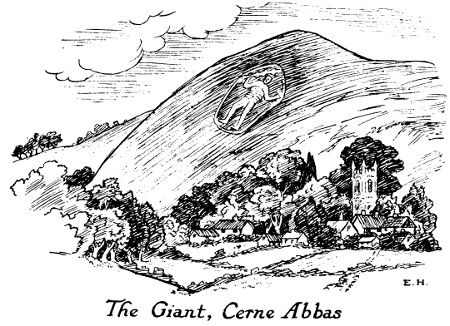
Immediately above the town rises a lofty eminence, popularly called the
Giant's Hill, from an uncouth colossal figure cut on its chalky
surface. It represents a man, 180 feet in height, holding in his right
hand a club and stretching forth the other. "Vulgar tradition," says
Britton, "makes this figure commemorate the destruction of a giant, who,
having feasted on some sheep in Blackmoor, and laid himself to sleep on
this hill, was pinioned down, like another Gulliver, and killed by the
enraged peasants, who immediately traced his dimensions for the
information of posterity." On the summit of the hill is an entrenchment
called Trendle (i.e. a circle, Saxon). The Cerne giant is believed
by some authorities to be of Phœnician origin and to represent Baal,
but no one really knows much about him, and, it must be also added, the
Dorset rustic cares very little about the matter.