As has been shown, Thomas Berthelet lived in troublous times for
bookbinding. He doubtless knew of the rich Mediæval bindings, which in
his day were rapidly becoming scarce, and he was of course familiar with
the old blind-stamped leather work as well as the brown panel stamps
which were common at his time. He probably knew, also, the beautiful
gold-tooled Italian bindings which came over from the Continent as
rarities about the beginning of the sixteenth century. It will never be
known with certainty whether Italian workmen came over here and taught
Berthelet the art of gold-tooling on leather. If this was not the case,
then Berthelet experimented for himself and soon became proficient, but
several of his earlier bindings betray the hand of a tyro in this
difficult art. In favour of the theory that an Italian gilder came to
this country about the time that Berthelet became royal printer to Henry
VIII. is the fact that there was at least one binding made for James V.,
King of Scotland, adorned with gold-tooling, executed on calf by some
craftsman endowed with greater technical skill than Berthelet ever
showed. This binding is, however, of a weaker design than Berthelet’s
are: his designs are never frittered as this one is; nevertheless, it
must be noted that there are on the Scottish bindings some of the same
stamps that Berthelet used, as well as others of a slighter and more
ornate character. The volume is figured in the Dictionary of English
Book Collectors, Part V., and in 1894 it belonged to the late Mr.
Bernard Quaritch, of 15 Piccadilly, London.
Berthelet must have foreseen the very decorative possibilities that lay
in the direction of gold-tooling on leather, promising indeed to
compensate to a great extent for the loss of the beautiful and
fast-disappearing Mediæval bindings in gold, silver, or ivory. He worked
very energetically at his new art and quickly mastered it, the gilding
on the majority of his books being excellent. His stamps were cut
“solid,” closely after Italian models, even if those he started with
were not actually Italian stamps purchased by him from his problematical
teacher. In time these designs became largely modified, but always
retained much of the Italian feeling. Indeed, although Berthelet
eventually developed a style of his own, the Italian inspiration is
evident throughout. He could not have gone to a better school, as it is,
with much justification, often held that the Italian gold-tooled
bindings on leather of the late fifteenth and early sixteenth centuries
are the finest in taste and altogether the most admirable ever produced.
In consequence of the number of foreign books that came over here, it
was incumbent on the native English workmen to do what they could to
introduce a good style of indigenous work, and Berthelet was the most
noted of the sixteenth-century binders who endeavoured to do this. The
old English idea of the circle entered largely into his later and more
ornamental designs, as also did the diamond, not in itself so original a
style, as it frequently occurs elsewhere, amongst other places on books
bound for Jean Grolier.
The bindings of the books printed by Thomas Berthelet have already in
many instances been noticed as examples of fine workmanship, but he has
not by any means always been credited with their authorship.
There are certain volumes which belonged to Henry VIII. at a period when
Berthelet was royal printer, some of which were
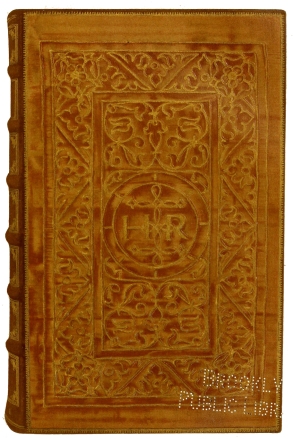
PLATE XI.
VELVET BINDING OF A BIBLE PRINTED AT ZURICH IN 1543. MADE FOR HENRY
VIII.
actually printed by him, on which certain stamps impressed in gold occur
with great frequency. Several of these stamps are peculiar, and all of
them bear the characteristics of being designed by the same artist, one
who quite understood the art of designing curves for bookbindings. There
is now little doubt that these bindings issued from Berthelet’s
workshop, and they may be safely considered to be his workmanship.
Unfortunately none of the bindings attributed to Berthelet are signed.
There are numerous instances of signed bindings made in England both
before and during his time, but these are always on panel stamps, which
in all probability were seldom made by Englishmen. The fashion of
signing a binding outside has indeed been seldom followed here, although
it has been common on continental bindings for a long period. When
English workmen have signed their bindings it has generally been by
means of a small paper ticket pasted on the inside, or in very small
letters or initials impressed at the lower edge of the inside of the
boards.
Most of the bindings of the late fifteenth and early sixteenth centuries
had silken ties fixed to the front edges of the boards. This peculiarity
was probably a survival of an old custom which prevailed during the
Middle Ages, when books were largely written on vellum, which is very
apt to curl; the ties helped the thick, heavy boards to counteract this
tendency. The ties on Berthelet’s bindings are now nearly all rubbed
off, but signs of them can be traced in most cases.
In default of a signed binding, we are driven, in Berthelet’s case, to
probability only with regard to fixing some standard by which to judge
his work. The stamps used on all the books printed by Berthelet which
are still in their original bindings are fortunately few in number, and
nearly all these stamps are found on the first binding described in my
list below. The gilding on this binding is bad, and evidently the work
of a beginner, and I think it is the first English book ornamented with
actual gold-tooling. It is dedicated to Henry VIII. and belonged to him,
and my theory is, that the king desired Berthelet to try the new form of
decoration on one of his own books, to be marked with his own heraldic
devices and special royal badges. Berthelet doubtless considered the
gold-tooling, which at that time he alone understood here, was a more
distinguished manner of marking his work than the commoner plan of
signing his name, as the foreign workmen were in the habit of doing on
their large panel stamps.
The finest of Berthelet’s bindings are all royal; those he made for
private owners are rarely very highly ornamented. It is not known what
kind of binding he executed before the time of his appointment as royal
printer; indeed, it is quite possible that he did not begin binding
until about that period; i. e., 1530. The chief official printing that
he did was in the form of statutes, proclamations, single sheets, and
other publications, which required no binding; but following the fashion
of his time, when he did print an actual book, it is highly probable
that he also bound it. The stamps he used on his earliest bindings were
new to English work, and it seems probable that if they were not
actually sent over to him from Italy he cut them closely resembling some
Italian model. They were not used after his death, and this disuse of a
binder’s stamps after his own time is always something of a mystery.
Stamps cut in metal for gilding designs on leather are very strong, and
as the work they have to do is very light, they would, as a matter of
fact, last much longer than they appear to if they were not destroyed
purposely. Most great binders seem to have taken steps to insure the
discontinuance of the use of their special stamps after their death,
and so it is usually conceded that if the general design as well as the
special stamps on any binding are similar to those found on any
acknowledged work of a particular binder, this binding must then be his
own work. Of course, other matters must be in proper accordance with
such attribution,—leather, date, and heraldic marks, if any. Also in
the case of a binder who produced much work, the fact of a binding
having issued from his workshop would entitle it to be called his work,
although his own hand may never have touched it.
The most important works in which figures and notices of Berthelet’s
bindings will be found are Mr. H. B. Wheatley’s book on the “Remarkable
Bindings in the British Museum,” London, 1889, in which five specimens
are figured in colour, none of them attributed to Berthelet, and they
are all very bad plates; in Mr. R. R. Holmes’s fine book on “Specimens
of Royal Bookbinding from the Royal Library, Windsor Castle,” London,
1893, in which two examples are figured, being fine plates in colour by
Mr. Griggs, which two plates, with one other, are reproduced in the
illustrated Catalogue of the Exhibition of Bookbindings held at the
Burlington Fine Arts Club in 1891; Mr. W. Y. Fletcher’s “English
Bookbindings in the British Museum,” London, 1895, in which several of
Berthelet’s finer bindings are naturally included, all shown in splendid
colour plates by Mr. Griggs; and in my own monograph on “Royal English
Bookbindings,” published in 1896, in which there is one bad colour plate
and one excellent half-tone (both by Evans) of acknowledged Berthelet
bindings. Besides these few there are no good plates to be found;
indeed, colour plates of bookbindings have been a source of much
tribulation to authors until late years, when Mr. William Griggs,
chromo-lithographer to the queen, has made a special study of their
production, with the result that he can now produce the finest work of
the kind to be found anywhere.
The immense majority of bookbindings made since the introduction of
printing into England are in some sort of leather, and there is a very
wide difference between the most elaborately decorated leather binding
and the usual rich Mediæval bindings in precious metals, which they
virtually superseded. In Berthelet’s bill, quoted in the second chapter,
will be found one or two entries which remind us that there really was a
sort of connecting link between these two widely divergent schools of
book decoration. This link is to be found in the embroidered bindings,
some of which, in all probability bound by Berthelet, still remain.
These bindings, without being intrinsically valuable, are very
ornamental indeed, and as far as appearance goes, they may well have
given satisfaction even to the magnificent taste of Henry VIII., without
adding to their beauty the strong temptation of being worth relegating
to the melting-pot. In the bill already quoted we find entries of books
bound in velvet and in satin, and as a fact we also find among Henry
VIII.’s books some which not only fit the descriptions to some extent,
but having curves and designs upon them which, allowing for the
unavoidable differences due to the material, strongly resemble some of
Berthelet’s curves as used on leather. The velvet bindings, some of
which remain that belonged to Henry VII., also take their place as very
decorative work; these are adorned in many cases with enamels, a form of
ornamentation having, in common with embroidery, a strong claim to
preservation because of its beauty, although equally of no intrinsic
value. There is nothing to connect these earlier bindings with
Berthelet. The one or two embroidered bindings which I venture to
attribute to him, and describe below in their chronological order, have
certainly in two instances some evidence to that effect inherent in
themselves, inasmuch as they have on their edges Berthelet’s usual
legend painted in gold.
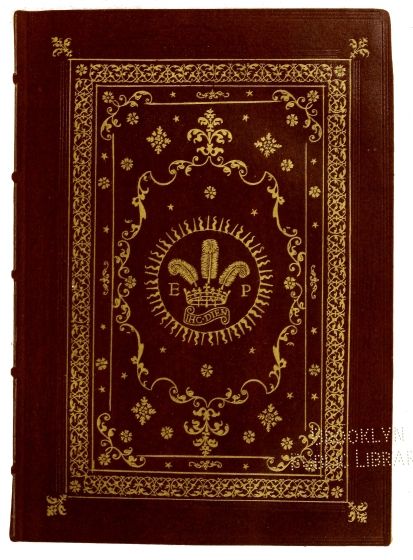
PLATE XII.
CALF BINDING OF “TROGUS POMPEIUS. CHOROGRAPHICA, 1546” MADE FOR PRINCE
EDWARD.
There are other embroidered books of the time of Henry VIII., which were
worked for him by his daughter Elizabeth, but although these probably
enough were put together for her by Berthelet, the designs upon them
have nothing of his about them, having in all probability been designed
by the princess herself. Some of these are at the Bodleian Library at
Oxford, and others in the British Museum; the finest of them have been
already figured and described.[A]
There certainly are enough specimens left of such ornamental bindings to
show that plain leather bindings were not always considered elaborate
enough in appearance to compensate entirely for the loss of the
gold-jewelled and enamelled productions which immediately preceded them;
and it seems wonderful that bindings made in such apparently fragile
materials as velvet and satin should not only be in existence but
actually in a very good state of preservation, though faded in colour.
They are really much more enduring than is generally imagined, but
unquestionably numbers of them, worked on velvet, satin, and canvas,
have perished or been worn out long ago. Embroidered books were made for
all the Tudors, mostly on velvet, and a little later, in the time of
Charles I., numbers of them, usually small, were embroidered on satin.
The dates of the manuscripts bound in embroidered velvet and satin by
Berthelet are not quite certain, but it is probable that his work of
this kind in both these materials is the earliest made in England.
The greater number of bindings made by Thomas Berthelet belonged, as
might be expected, to Henry VIII., Edward VI., or Mary; that is to say,
they formed part of the old Royal Library of England. This old Royal
Library, or as much as was then left of it, was given by George II. to
the British Museum in 1757, and it forms perhaps the most valued
special collection in that institution. It must not, however, be
supposed that every old English royal book was really included in this
library, for by some means or other a very considerable number of them
were separated from the rest, and now exist scattered all over England,
in private libraries as well as at Windsor. Such books now seldom come
into the open market, and if they do, they are generally purchased by
the state, and so return to their old companions. Also, royal
bookbinders did some work outside their official limits, and small
bindings of an unimportant kind, evidently the work of Berthelet, are
not uncommon in England. They are always charming, and the simplicity of
the quiet blind lines running side by side with others in bright gold on
the rich brown calf is quite delightful; such simple covers usually have
a rectangular panel with small Italian fleurons at the outer corners,
and usually an initial, monogram, or heraldic ornament in the centre.
Before printing was used in England, the commonest leather for bindings
was goat or sheep, but Berthelet found his favourite Italian bindings
were largely bound in calf, a leather having a beautiful surface, and in
some ways easier to gild than goat. I believe he was the first English
binder to use this leather exclusively; it was rarely used in England
before his time, although it was common on the Continent. His calf
bindings, with few exceptions, are still in excellent condition, and are
always of a beautiful rich brown colour. Many of these volumes have
been, I think unnecessarily, rebacked; certainly in all such cases the
old backs should have been preserved, which has not always been done.
There is, however, no doubt that the calf used on Berthelet’s bindings
may still be considered quite sound, whereas books bound in that leather
within the last fifty years, or even less, are now all powdering away.
In spite of greater chemical knowledge and presumably better processes
of tanning and preparing leather, the conclusion that this material, as
produced to-day, is not a fitting one for books is forced upon us.
Berthelet used also a very decorative white leather, supposed to be
deerskin or doeskin, prepared with lime in the same manner as vellum.
This leather is soft and creamy in colour; it has a smooth surface and
takes gilding to perfection. There are not many instances of its use,
but those that do exist are always perfectly strong and sound, except
where they show signs of fair wear and tear. The taste for white gilded
leather began with Berthelet, and it has been highly esteemed as a style
in England almost ever since. Such work was done for all our Tudor
sovereigns, but the white deerskin soon gave place to vellum, especially
during the time of our Stuart kings; and this, to some extent, has been
used to the present day. Probably the strongest and most durable
materials used for bookbinding at any time have been the white deerskin,
white vellum, and white pigskin, the first two mentioned being chiefly
used in England, and the last in Germany. This durability is most likely
due to the method of preparation and the absence of any dye. Bark-tanned
goatskin is also an excellent leather, and was much used in England from
the twelfth century onwards.
Several of Berthelet’s bindings bear legends, and texts, dates, and
names, on their sides. These inscriptions are variously arranged, but as
a rule they are contained in small long panels, sometimes in circles,
and rarely simply impressed on the side of the book as its chief
ornament. In the cases where coats of arms are given, the initials of
the owner are generally added as well. The lettering on the sides of the
books is either in Greek, Latin, French, or English, examples of each of
which are described below, and there is never any lettering on the backs
of any of them.
Except in so far as the wording of these inscriptions is concerned,
which often reads consecutively on both sides, the ornamentation is
alike on both boards of all Berthelet’s bindings. The fondness for
lettering sentences on the outside of his books did not stop, however,
at the binding, as Berthelet carried it out also in several instances on
the edges of the leaves themselves. The edges of these leaves were
usually made a creamy colour, and a legend was painted upon them with
gold paint. This legend, “Rex in Aeternum Vive,” is a quotation from the
Book of Daniel; it is sometimes followed by the mysterious word “Neez”
or “Nez,” which Mr. Edward Scott of the British Museum considers to be
the three first letters of the words, Ναβουχοδονοσωρ Εσαει Ζηθι, as the
phrase was addressed to that king. Whenever this legend is found on a
decorative binding of the time of Henry VIII., I should say it is a sure
sign of Berthelet’s royal work.
Fortunately this legend, on some of Berthelet’s earliest bindings, is
associated with certain stamps of marked character, which can thus be
safely considered his, and which enable us, even when they are found on
other bindings without the legend, to attribute the work with certainty
to him. It is my opinion that all the existing bindings in calf or white
deerskin that were made for Henry VIII. and Edward VI., as well as most
of those for Queen Mary, were Berthelet’s work.
The legend on the edges of the leaves of some of Berthelet’s books was
not, however, the only way in which he decorated them. There are other
instances where the whole edge is painted with heraldic designs in
colour. This fore-edge decoration was not a new thing even in
Berthelet’s time, but he seems to have been the first to adopt it in
England. To some extent the ornamentation of the edges of rare volumes
has been practised ever since, both in this country and abroad. The most
elaborate work of the kind was, I believe, from the hand of Samuel
Mearne, royal binder to Charles II., and about a hundred years after his
time the fashion was revived by James Edwards of Halifax. Both these
binders painted the edges of their books so that the pictures showed
only when held in a certain position. Possibly the lettering on the
edges of some of Berthelet’s books may have been suggested to him by the
fact that in Mediæval times, when books were large and were kept on
their sides with the front edges forward, it was no uncommon thing to
write the title on these edges in large letters.
This title lettering is, however, very rarely ornamentally treated; it
is only used as an eminently useful expedient. Berthelet makes it a
decorative feature, and substitutes a legend, which may be considered as
a sign of royal ownership, for the more usual title of the book.
From such collections and libraries in England as have been available to
me I have chosen a few typical examples of Berthelet’s work for detailed
description. I have illustrated as many as possible of the finest
specimens in colour plates by Mr. William Griggs, to whom my best thanks
are due for the patience with which he has endured my superintendence of
his work, and my compliments for the admirable results of his unequalled
skill in this particular branch of colour-printing. Each of these colour
plates must yet be a little discounted as to the apparent freshness of
their appearance. I think that in all prints and photographs old objects
gain in this way; nevertheless, most of the books illustrated are really
wonderfully preserved. The half-tone and process blocks are also by Mr.
Griggs, some of them from my own drawings; the methods of producing tone
blocks capable of being printed with type have made great advances in
late years, but I feel that in America better results are obtained in
this particular branch of art than as yet can be made by English
workmen. I have arranged the bindings which I have chosen for detailed
descriptions in chronological order, taking the printed date as correct;
it may not be actually so in all cases, but under the circumstances I
think these dates are probably near enough for all present purposes.
1528-1530 (?). Galteri Deloeni Libellus de tribus Hierarchiis. MS.
Dedicated to Henry VIII. Bound in brown calf, and tooled in gold with a
few blind lines. The ornamentation consists in a filling in the spaces,
mostly triangular, left by the intersections of a parallelogram aligned
with the edges of the boards, and a diamond. In the centre is the royal
coat of arms, crowned, cleverly outlined by reversed curves. Between the
crown and the top of the shield are two double roses; above the crown
are two stars; at the sides are two cornucopias. Below the shield are
arabesques; four single daisies, the daisy being a badge used by Henry
VIII. and Edward VI. in remembrance of their descent from Margaret of
Beaufort; four stars, and stamps representing the crucifixion, and a
serpent, with references to texts. The four large triangular spaces
between the rectangle and the diamond are ornamented with arabesques,
the upper and lower spaces bearing also a stamp of the single daisy.
Beyond the diamond come the four large corners, each of which is
decorated in a similar way. This binding is a remarkable one, inasmuch
as it contains nearly all the small stamps that Berthelet subsequently
used in so many combinations, and it is probably the earliest example of
gold-tooling on an English leather binding. The gilding is not well
executed, and it is likely enough that this is one of his first finished
attempts at such work. It is rougher than any other example, but in
spite of that it is very effective and rich in appearance.
Vitae illustrium Virorum. MS. Bound in brown calf, and gold-tooled with
a few lines in blind, and measuring 14½ by 9½ inches.
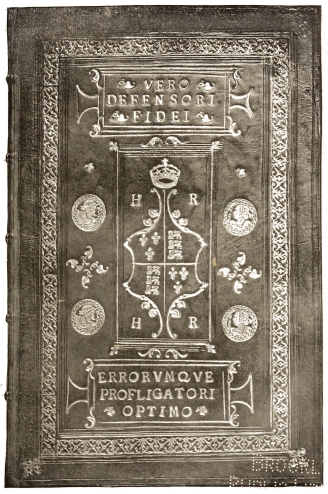
PLATE XIII.
CALF BINDING OF A MS. COMMENTARY ON THE CAMPAIGN OF THE EMPEROR CHARLES
V. AGAINST THE FRENCH IN 1544. MADE FOR HENRY VIII., TO WHOM THE MS. IS
ADDRESSED.
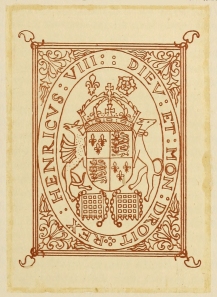
About 1528 Henry VIII. made a change in the supporters of his royal
shield. His father, Henry VII., who was very proud of his descent from
Cadwallader, the last of the British kings, adopted and used as one of
his supporters the red dragon which had been a badge of that king. The
red dragon was used by both Henry VII. and Henry VIII. as their dexter
supporter, and with it, as a sinister supporter, they both also used the
white greyhound. In or about 1528 Henry VIII. adopted a crowned lion
statant as his dexter supporter, transferring the dragon to the sinister
side, and leaving out the greyhound altogether. This lion still remains
the dexter supporter of the royal coat of arms of England, but the
dragon was discontinued on the accession of James I. to the throne of
England, a unicorn, one of the supporters of the ancient Scottish coat
of arms, being substituted for it. So that the stamp which forms the
principal ornament on this book was probably cut about 1528, certainly
not much later; indeed, it is possible that this was one of the books
bound by Berthelet for the king before his appointment as royal printer.
The coat of arms is contained within an oval ribbon bearing the words,
“REX HENRICVS VIII. DIEV ET MON DROIT.” The coat is ensigned with a
large royal crown, has a dragon supporter on the dexter side and a
greyhound on the sinister; above the crown is a fleur-de-lys and a
double rose, and two portcullises depend by chains from the lower edge
of the shield. The oval is contained within a close rectangular panel,
the inner angles of which are filled with an arabesque design. At each
outer corner is a leaf of Venetian character.
Above and below the rectangle is a crowned double rose, flanked by the
letters K H,—mysterious letters, the meaning of which is not yet
understood. Beyond this again comes a broad double border of a narrow
running pattern containing a fleur-de-lys and a triple floral ornament.
This same border occurs on several of Berthelet’s earlier bindings. The
inner corners of the rectangular border are filled with a symmetrical
design of a vase with flowers and two curves terminating in human masks.
There were originally some outer lines of small gold-tooling, but these,
as well as the corners, have been “repaired” away.
On a fly-leaf in this volume is a note which says: “Codex hic fuit olim
Henrici VIII., ei Jo. Leylandus Titulum fecit—Vitae illustrium virorum,
etc.” John Leyland, the antiquary, was keeper of the king’s library
about 1530.
This book undoubtedly should be with the rest of the old royal library
at the British Museum, and its inclusion among the books at Oxford is
explained by the Rev. W. Dunn Macray in his book, “The Annals of the
Bodleian Library,” in which he mentions the interesting fact that in
August, 1605, King James I. visited the Bodleian and offered to present
to Sir T. Bodley, “from all the libraries of the royal palaces,
whatever precious and rare books he might choose to carry away.” So
that, in fact, instead of feeling that we in London should have the few
“outside” royal books returned to us, we should perhaps feel a debt of
gratitude to Sir T. Bodley for leaving anything at all in the libraries
of the royal palaces, in face of King James’s generous offer.
1530 (?). The third volume of a copy of the Works of St. Chrysostom,
printed at Basle in 1530, has very kindly been shown to me by Mr. E.
Gordon Duff, librarian of the Ryland’s Library, Manchester. It is bound
in calf, and one side is almost completely destroyed, but the other is
in a fairly good condition. It measures 15 by 10 inches, is tooled with
gold and blind lines, and bears as a centre ornament a rectangular panel
with the royal coat of arms of Henry VIII. ensigned with a large crown,
having as a dexter supporter a greyhound and on the sinister side a
dragon. This arrangement of the supporters is wrong, but it is possibly
unintentional, and due to the forgetfulness of the engraver when he drew
the design on his metal plate. Above the crown are two double roses, and
above it are scattered impressions of a ring with a dot in the middle.
Below the shield are two portcullises, chained, with a few tufts of
grass. This handsome coat of arms is enclosed by a border on which are
the words, “DIEV ET MON DROIT,” and small stamps of a leaf, a single
rose, and a fleur-de-lys; above and below are impressions of a stamp of
a large double rose, crowned, flanked by the letters K H. These initials
are somewhat of a puzzle. They have been interpreted as simply meaning
King Henry, and perhaps this solution is the easiest way out of the
difficulty; but it is not altogether satisfactory. Besides “King,” the
only other word for which the letter K is likely to stand is the name
“Katherine,” and it could only then have stood for either Katharine of
Aragon, who was divorced in 1533; Katherine Howard, who was married in
1540 and was beheaded in 1543; or Katharine Parr, who was married in
1543 and survived the king.
A very decided objection to the theory that the initial K belonged to
any of these queens is found in the fact that it precedes that of the
king himself, which is not at all likely to have occurred under the
circumstances. In the volume to be described presently, where the
initials H A are presumed to be those of “Henry” and “Anne,” an example
is found of the more likely way in which such initials would occur.
The inner panel is enclosed, at a considerable distance, by a broad
triple border, and the inner corners of this border are curiously
ornamented with ornamental gold-tooling arranged in quarter-circle form.
This style of corner ornamentation was common in Italy, but very rare in
England, at the time this book was made. The inner angles of each
quarter-circle bear triple impressions from a stamp of trefoil shape
bearing small scroll-work of Oriental character upon it, the ground gold
and the design showing in the leather. The segments of circles beyond
this inner angle are ornamented consecutively with a row of fleur-de-lys
and single roses alternately; a row of small long-shaped knots, often
found on Italian books, and also occurring on one bound for King James
V. of Scotland; a row of wavy flames; and beyond all, in the center of
the quarter-circle, impressions in gold of a leaf with stalk flanked by
two roses.
These corners, as well as the inner rectangular panel and the inner line
of the outer panel, are all marked by lines of blind-tooling, which are
mitred at the corners.
The outer border consists of an inner line of wavy flames, a broadish
line of circles crossed with arabesques, and an outer line of numerous
impressions from the small long-shaped knot stamp, and beyond all are a
few blind lines.
This binding is in many ways a very remarkable one. The gold-tooling
upon it is rough, but among the tools which are evidently Berthelet’s
are others which are not found on any other of his bindings. I think it
is an early work, and that the existence upon it of the few delicate
Italian stamps can be accounted for only by the theory that an Italian
workman brought them over with him and taught Berthelet the art of
gold-tooling. In the case of this particular volume, it is possible that
it was one of those done by Berthelet under the eye of his master, and
that he used some of his foreign tools as well as others belonging to
himself.
Whatever may be the true explanation of these difficulties, there is no
doubt that the binding is a most valuable and interesting one, and I
thank Mr. E. Gordon Duff very sincerely for having allowed me to see it
and to have it photographed for this monograph. The edges are gilded and
ornamented with an arabesque design marked upon them by means of
successive impressions from a small ring-shaped stamp.
The decoration of the corners of the boards of a binding with
ornamentation arranged as a quarter-circle was very rare in England
until the reign of Queen Elizabeth, at which time it was often found;
then under the Stuart Kings James I. and Charles I. it probably reached
its fullest development, and was especially favoured at Little Gidding.
It is found on fifteenth-century Italian bindings, used with great
skill, so that its occurrence on one of Berthelet’s early bindings is
not to be wondered at, the curious thing being rather that he did not
use it more. As it now is, I think this book is the earliest existing
English specimen of the use of this kind of ornamentation.
1530 (?). An interesting example in which the decoration of a binding is
arranged with some reference to the contents of the book occurs on the
cover of a French manuscript on “La Science de Geometrie,” dedicated to
King Henry VIII., and bound for him in white deerskin by Thomas
Berthelet. This volume should always have been with the rest of the old
Royal Library of England now in the British Museum, but by some means it
became separated, and was recently purchased by the trustees of that
institution from Mr. Cornish of Manchester.
The sides are ornamented with blind lines and gold-tooling; a large
rectangular panel is marked out near the edges of the boards with
fleurons at each outer corner; inside the panel near the top are the
words, “VIVAT REX,” in an ornamental cartouche of architectural
elevation; below this, and filling up most of the remaining space, are
three narrow elongated pyramids with triangular bases; the ground is
dotted irregularly with small stars and dots. In the lower part of the
panel is the word “GEOMETRIA” and a decorative scroll. This is the only
instance I know in which the lettering outside any of Berthelet’s
bindings has any reference to the contents of the book.
On the white edges are the words, “REX IN AETERNVM VIVE NEZ,”
ornamentally written in gold in large capital letters.
1534. Bible, Antwerp, 1534. In two volumes. Bound in brown calf, tooled
in blind and gold, and measuring 14½ by 9 inches. The design on each
of these fine volumes is the same, but the lettering upon them is
different. The words on volume I. are, “AINSI QUE TOUS MEURENT PAR
ADAM—AVSSY TOVS SERONT VIVIFIES PAR CHRIST”; and on volume II., “LA LOY
A ESTE DONNEE PAR MOYSE—LA GRACE ET LA VERITE EST FAICTE PAR JESU
CHRIST.” These words are in large gilt capitals in short lines, each
word where necessary being divided from the next by a
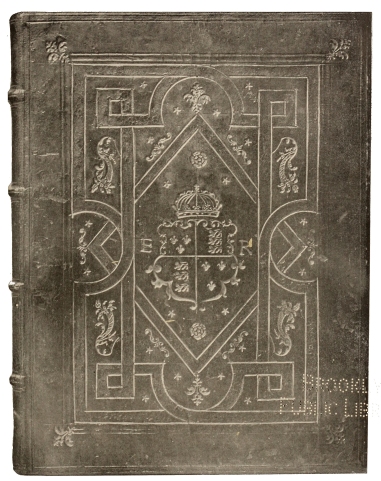
PLATE XIV.
CALF BINDING OF “LA CYROPEDIE DE XENOPHON. PARIS, 1547.” MADE FOR EDWARD
VI.
small cross-crosslet. The lines are contained in a rectangular panel,
with large corner stamps of a vase with flowers and two floral curves
terminating in human masks. The triangular spaces thus left above and
below the inscription are each filled by a double rose, crowned, flanked
by the letters H A, perhaps standing for “Henry” and “Anne.” Beyond the
panel and touching it is a broad border, made up of a double line of
stamps cut in the form of an ornamental fleur-de-lys and a three-lobed
flower. Beyond the border is a space broken at the corner with a
repetition of the vase stamp, enclosing which was in all probability a
narrow fillet variously ornamented with small designs like that which
occurs below the lettering on the second volume.
Both these volumes have been unfortunately restored in places, but the
old patterns have to some extent been preserved, and new stamps cut on
the lines of the old ones, as can be seen by reference to a binding now
at Oxford which is treated in a very similar way, and which, although it
also has received some attention from an inferior binder, has not been
restored in a like disastrous manner.
1534. Opus de vera differentia regiae potestatis. Londini, T. Berthelet,
1534; measuring 8 by 5¼.
This volume is very like that at the Bodleian, already fully described
on page 69. The centre stamp is the same, and so are the outer border
and corners, but the handsome double border is wanting. The book has
been badly repaired; in some cases stamps have been cut after the old
patterns, but in others, as for instance the corners next to the oval
label, they have been made in a modern arabesque pattern, not like the
original. The book itself is a fine specimen of Berthelet’s printing on
vellum. The heraldic centre stamp, bearing the dragon and greyhound
supporters, is really an anachronism; properly the supporters should be
a lion and a dragon; the stamp, however, was seldom used, so Berthelet,
having it by him, did not trouble to cut another, as he should have
done.
1536. A charming little specimen of Berthelet’s private binding is now
in the Ryland’s Library at Manchester, and by the courtesy of the
librarian, Mr. E. Gordon Duff, I am enabled to describe it.
It is a remarkably fine copy of the New Testament, Tyndale’s version,
printed in London in 1536; there is an inscription inside which shows
that in 1676 it belonged to Henry, Duke of Newcastle, and later to Dr.
Charles Chauncey.
It is bound in brown calf, and has on each side a long upright panel
within a border of ornamented circles of Italian design. The panel has
on one side a unicorn in the centre, and on the other a talbot, the
crest of the Heydon family. There are also some initials upon it, but
these do not seem to throw any light upon its ownership. The badges are
surrounded with scrolls made up of reversed curves, in Berthelet’s usual
manner. At the outer corners of the border are large Italianate
fleurons, and the gold lines are supported by others in blind, running
parallel to them. There are the remains of two silk ties.
1536. An historically interesting volume has just been bequeathed to the
British Museum by the late Baron Ferdinand Rothschild, formerly member
of Parliament for Waddesdon, who left altogether a very valuable
collection of jewels and manuscripts to the British nation.
This volume is very large, measuring about 19¼ by 13½; it is a
manuscript translation in French of the Decameron of Boccaccio, by
Laurent de Premierfait, made from a Latin version by Antoine de Aresche,
in 1414. The manuscript itself, which is illuminated, was probably made
late in the fifteenth century.
The binding is in very dark calf, and is tooled in gold, with a few
blind lines; it was made for Edward Seymour, first Duke of Somerset, the
Protector, who was beheaded on Tower Hill in 1552.
The duke’s motto, “FOY POVR DEBVOIR,” is contained within an ornamental
cartouche in the centre of each cover. The cartouche is enclosed, at
some distance, in a diamond stamped with a small roll pattern; near each
of the outer sides of the diamond is an ornament made of two impressions
of a cornucopia stamp. Along the edges of the boards is a broad
Italianate arabesque border; the inner angles of the border are filled
with either the stamp of Plato or that of Dido, already described,
enclosed in arabesques, and the outer corners have small fleurons.
The volume has been rebacked and some of the gold-tooling restored. The
stamps found upon it are generally such as were used by Berthelet early
in his career; but as there is no other indication of the date, it must
be remembered that my attribution of the work as having been made about
1536 is only conjectural.
1538. Berthelet’s “leather” curves turned into gold cord may be clearly
seen on the red satin binding of a collection of sixteenth-century
tracts bound probably about 1538. This curious volume is, as far as can
be ascertained at present, the earliest English book bound in satin. It
is very probably Berthelet’s work,—indeed, it may actually be one
referred to in the Letters and Papers of Henry VIII., Vol. 13, Part 2,
p. 539, concerning which we are told that the king paid 6s. 8d. to
“Bartlett the king’s printer’s servant that brought a book covered with
crimosin saten embrodered.” It measures 12 by 8 inches, and has been
stupidly rebacked with leather, but is otherwise in good condition.
There is an arabesque border parallel with the edges of the boards, made
full at each of the four corners, and amplified across the centre into a
kind of ornamental bridge. Not only are the curves and scrolls strongly
suggestive of Berthelet’s designs, but on the cream-coloured edges of
the book are the words, “REX IN AETERNVM VIVE NEZ,” which, as has
already been remarked, may of itself be taken as an almost sure sign of
Berthelet’s work. Many of the scrolls are very similar to those which
are used on a velvet binding described under the date 1543, which I
think was also bound by Berthelet.
1540 (?). Jul. Claud Iguini oratio ad Hen. VIII. MS. This is bound in
dark brown calf, and is ornamented very simply with gold-tooling and
blind lines. In the centre is a well-designed stamp of the royal coat of
arms, ensigned by a very large crown, and encircled by a garter with
buckle, and bearing the motto, “Honi soit qui mal y pense.” This design
is enclosed between four Greek words, ΗΑΙΟΣ ΠΑΝΤΑΣ ΑΛΑΙΕΝΟΝ ΕΞΑΡΚΤΟΤ,
the signification of which is not clear. A simple rectangular border in
gold, made up of successive impressions of one of Berthelet’s happily
designed curves, completes a design which, although plain, is yet very
charming.
1540. There is a fine specimen of one of Berthelet’s bindings in white
doeskin in the library of Trinity College, Oxford. It measures about 9
by 6 inches, and is a copy of “Theophylacti in omnes divi Pauli
epistolas enarrationes, etc. Basileae, 1540.” The sides are fully gilt,
and ornamented with scroll-work and royal badges. In the centre is the
crowned royal coat of arms of Henry VIII., surrounded by four chief
decorative points, bearing, respectively, the royal initials, crowned,
and crowned badges, double rose, fleur-de-lys, and portcullis. Each of
these small designs is contained within a framework of golden scrolls,
and the remaining space is rather closely filled with a rich tracery of
scrolls and arabesques symmetrically arranged. The broad edges are cream
coloured, and on them in large capitals are the words, “REX IN ETERNUM
VIVE.”
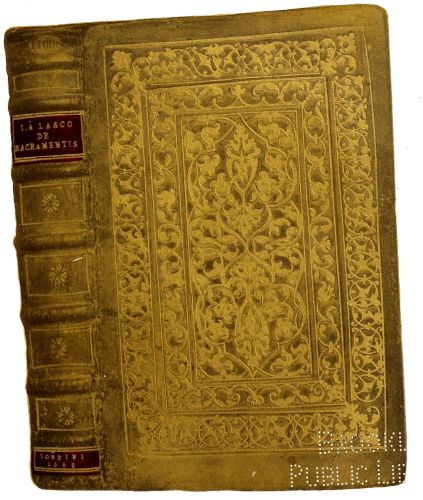
PLATE XV.
WHITE LEATHER BINDING OF “JOANNES A LASCO. BREVIS DE SACRAMENTIS ECC.
CHRISTI TRACTATIO. LONDON 1552.”
1541. Elyot. The Image of Governance. T. Berthelet, London, 1541. Bound
in white deerskin, and tooled in gold with a few blind lines. In the
centre is an irregular panel made up with curves and arabesques, within
which are the words, “DIEU ET MON DROIT.” The panel is enclosed within
an outer line of cleverly arranged scrolls, at the sides of which are
the letters H R. An outer rectangular border of small S-shaped stamps,
with fleurons at the outer corners, encloses the whole, the inner
corners being filled with more scroll-work and arabesques. The ground is
dotted with stamps of a daisy, a small circle stamp, and a five-pointed
star.
A single daisy is impressed in gold in the centre of each of the panels
on the back, and on the white edges of the book itself the words, “REX
IN ETERNUM VIVE,” are written in gold in capital letters.
1543. A Bible printed at Zurich in 1543, bound in orange-coloured
velvet, which was probably originally some shade of crimson, is
embroidered with designs outlined in gold cord. It measures 15 by 9¼
inches, and has been ruinously rebacked with leather. It forms part of
the old English Royal Library at the British Museum, and belonged to
King Henry VIII.
The king’s initials, tied together by a knot, are in the centre, within
a circle, above and below which are symmetrical curves of like character
to those on several of Berthelet’s leather bindings, from which no doubt
these are taken. A broad rectangular border encloses the central panel,
and is ornamented with large double Tudor roses at each corner, the rest
of the border space being cleverly filled with repetitions, right and
left, of a simple fleuron with leaves.
The central circle, as well as the forms of the scrolls used in this
binding, are all suggestive of Berthelet’s methods of design; and in
consideration of the fact that he actually mentions velvet books in his
bill as having been bound by himself (p. 43), I think that this binding
may be claimed as his with some degree of probability. If the designs
were on leather, one or other of Berthelet’s known stamps would fit them
all. Several of the curves are very similar to those worked on the satin
bindings of 1536, already described. The edges of the leaves are
elaborately painted in colour, the groundwork being creamy white; on the
upper edge at the top is a winged cherub, in the centre is a large gold
fleur-de-lys on a blue ground, enclosed in a red eight-pointed
framework, and beneath this is a square panel in which is a flying dove;
the remainder of the space is filled with graceful arabesques, with
figures and fleurons in gold and colour. The front edge is not in good
condition, as it naturally has been more affected by use, and some of
the painting is obliterated. It is ornamented with five principal
designs, all of which are connected by an ornamental
framework,—scrolls, flowers, and arabesques in gold and colour. The
five designs, beginning at the top, are: a small rectangular cartouche
with a figure of God the Father; the royal coat of arms, crowned, within
a laurel wreath tied with white ribbon; a broad oblong of dark colour,
on which was most probably the word “BIBLIA” in gold; a large red rose
with white centre within a circle; and a small rectangular panel, the
design upon which has been worn off. The lower edge, at the bottom of
the book, has nearest the back a satyr upholding scrolls, in the middle
a circle, the design upon which has been obliterated by wear, and near
the front edge an arabesque pattern.
This is the most highly decorative book edge which exists on any English
book of the early sixteenth century, and when it was first done must
have attracted much attention and admiration, as it is excellently
painted. There is hand-painting in colour inside the book, especially
on the title-page, and it is very probable that the same artist executed
all this work, both inside and outside, as there is a great similarity
of style.
1546. In Trogum Pompeivm sive Ivstinvm chorographica ad excellentiss.
Dominum D. Edwardvm Principem, etc., 1546. A manuscript list of
countries and cities mentioned in Trogus Pompeius and in the Epistles of
Cicero, addressed to Prince Edward by Petrus Olivarius.
Bound in brown calf, rather lighter than usual, measuring 10¼ by
7¼ inches, and bearing in the centre the badge of three ostrich
feathers within a prince’s coronet, with a label bearing the words, “IHC
DIEN,” and flanked by the initials E P.
Prince Edward never was Prince of Wales, a title which is conferred on
the eldest son only at the pleasure of the sovereign. The triple-feather
badge, which certainly has been associated with this title ever since
Edward VI., and has been used as a special badge by all the Princes of
Wales since his time, is, however, originally not connected especially
with Wales or with any particular son of the sovereign. It was first
used by the descendants of Edward III., and appears to have been
considered a family badge, borne by them because of their ancestress,
Queen Philippa of Hainault. The feathers were the cognizance of the
Province of Ostrevant, an appanage of the eldest sons of the House of
Hainault. The motto, “IHC DIEN,” seems really to have been used by the
Blind King of Bohemia, who was killed at Crecy, and the Black Prince
adopted it as his own; the two have been inseparable ever since.
On this binding the ostrich plume and its belongings are enclosed within
a circle of flames, alternately straight and wavy; the circle is within
an oval cleverly marked by a succession of curved arabesques, in the
designing of which Berthelet was very skilled, several of them being
capable of effective and even surprising combinations. They have
something of the quality so valued by designers of wall-papers, and fit
each other in a very remarkable way. The ground is ornamentally dotted
with roses, stars, and a diamond-shaped floral ornament. The arabesque
oval has a handsome symmetrical fleuron at the top and bottom, and is
enclosed within a rectangular border of rather elaborate design. First
is a gold line with ornamental corners; within it is another gold line,
the intermediate space being dotted with small arabesques, single roses,
and five-pointed stars; then comes a richly designed Italianate fillet
with roses at each outer corner, and an outer line with fleurons at each
of the outer corners. The book is divided into four panels. As is usual
on all Berthelet’s bindings in calf, there are a few blind lines as
well.
1544. A Commentary in Latin on the Campaign of the Emperor Charles V.
against the French in 1544, addressed by Antonius de Musica to Henry
VIII.; in manuscript; measures 12¼ by 8¼ inches.
It is bound in deep brown calf, and tooled in gold with some lines in
blind. In the centre, within an upright panel of gold and blind lines
with small fleurs-de-lys at the corners, is the royal coat of arms of
Henry VIII., cleverly outlined with reversed curves, crowned, and
flanked with the letters H R, repeated twice. Directly above and below
the central panel are two broad rectangular cartouches made in gold
lines, and small arabesques with “anvil” handles. In each of these
cartouches is a legend; those on the upper cover contain the words,
“VERO DEFENSORI FIDEI | ERRORVMQVE PROFLIGATORI OPTIMO”; those on the
lower cover, “MAXIMO HENRICO OCTAVO | REGI ANGLORVM FRANC. HIBERNIEQVE,
P. M. P. P. D. G.” No one has yet elucidated the signification of these
last letters. The centre panel is flanked on
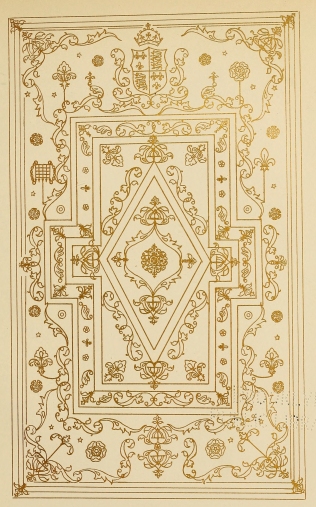
PLATE XVI.
WHITE LEATHER BINDING OF “D. AURELII AUGUSTINI HIPPONENSIS EP. TAM IN
VETUS QUAM IN NOVUM TEST. COMMENTARII. BAS., 1542.” MADE FOR QUEEN MARY.
one side by two impressions of a portrait stamp of Plato, and on the
other two of Dido, the remaining spaces being sparsely filled with leaf
stamps. An outer border of Italian design, with fleurons at each outer
corner, encloses the whole. The small medallion stamps containing
portraits of Dido and Plato, which are found on this volume, were often
used by Berthelet as the chief ornamentation on small books bound by
him. They usually occur singly as a centre ornament within a gold line
panel, with small fleurons at the outer corners.
1547. Xenophon. La Cyropedie. Paris 1547.
Bound in rich brown calf, and ornamented with gold-tooling, black
fillets, and some blind lines. In the centre is the royal coat of arms
of Edward VI., very effectively outlined with arabesques, crowned, and
flanked by the letters E R. Above and below the coat is a double rose
and two five-pointed stars.
The royal shield is contained within two interlaced fillets, outlined in
gold and stained black; the inner is in the shape of an upright
diamond; the outer is turned and curved upon itself so as to make a
double border. The spaces left between these various curves and lines
are filled with gold ornaments, the most noticeable of which is a large
stamp of a cornucopia. The other small stamps are arabesques and
five-pointed stars. The outer corners are marked by a gilt fleuron, and
on the front edge of each board are the remains of two ties. The back
probably had double roses stamped in gold between each of the bands, but
the book, which is, with this exception, in excellent condition, has
recently been restored here with new stamps cut after the old pattern.
1547 (?). In the Advocates’ Library at Edinburgh is a fine specimen of
Berthelet’s work in binding. It was bound for Edward VI. in calf, and
bears in the centre his coat of arms flanked by the initials E R, and
above and below the coat, on each side, is a long rectangular panel with
a kind of handle at each end, like those found afterwards on the
horn-books. The legends on the panels read, on the upper cover, “An idle
or deceitful hande maketh pore | But a diligent Labourynge hand maketh
ryche. Proverb. 10”; and on the under cover, “No man lyghteth a candle
and putteth it | in a privie place—neither under a bushell. Luke II.”
In the panels of the back are, alternately, a small upright lion and a
fleur-de-lys.
1548. Among the books bound by Berthelet for King Edward VI. is a small
copy of Ptolemy’s Geografia, printed at Venice in 1548. It is simply
bound in calf, with a plain gilt line along the edges of the boards, and
the words, “Omnis potestas a Deo,” in a cartouche in the middle of the
side. As far as the binding goes, this volume is one of Berthelet’s
simplest, and I should not, for that reason, have noticed it here; but
the book is remarkable because of the way he has painted the edges.
These are pale blue, and are ornamented with heraldic designs on
shields. On the upper edge is
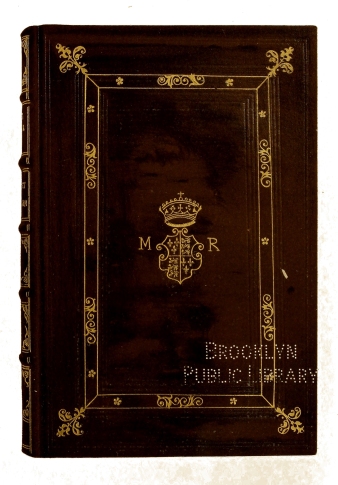
PLATE XVII.
CALF BINDING OF QUEEN MARY’S PRAYER BOOK. MS. ON VELLUM. BOUND FOR THE
QUEEN.
the coat of arms of France, on the front edge that of England, and on
the lower that of Ireland. These shields are flanked by the initials of
the king, and the rest of the space is filled with a very prettily
arranged interlaced strap-work in black, in and out of which wind
delicate, graceful curves and flowers painted in gold.
1548. Bude. Commentarii linguae Graecae, etc. Parisiis, 1548. 13-3/4 by
9.
Bound in brown calf, and ornamented with gold-tooling and some blind
lines. In the centre the royal coat of arms of Edward VI., crowned, is
flanked by the letters E R, above and below each of which is a small
five-petalled flower. The coat is enclosed between two interlaced
squares, outlined in gold and stained black. At each of the four corners
of the horizontal square is a floral arabesque in gold, with a spray of
pear.
The centre design is enclosed at a considerable distance by a broad
black fillet, outlined in gold, parallel to the edges of the board,
mitred in gold at the corners, and decorated alternately at short
intervals along its length with scrolls and small five-petalled flowers
stamped in gold. The inner angles of the fillet are marked by a gold
double rose, and the outer angles by an elaborate fleuron in outline.
1550. Andreasius. De amplitudine misericordiae Dei, etc. Basileae, 1550;
measures 6 by 4 inches. It is bound in rich brown calf, the royal coat
of arms of Edward VI. being placed in the centre, flanked by the letters
E R. Parallel with the edges of the boards are lines in gold and blind,
with small fleurs-de-lys in gold at the four inner corners and arabesque
fleurons at the outer corners. Although this little book is very simple,
it is nevertheless very charming, the beautiful brown colour of the calf
being well brought out by the bright gold lines and the dark blind
lines.
1552. Bembo. Historiae Venetae. Lib. XII. Venetiis, 1551; measures 12 by
9 inches. It is bound in brown calf, and ornamented with gold-tooling,
blind lines, and black fillets. In the centre is the royal coat of arms
of Edward VI., to whom the book belonged, enclosed in a very cleverly
interwoven fillet outlined in gold and stained black. This fillet is so
arranged in straight and curved pieces as to give the general effect of
being arranged in eight circles and eight semicircles. The coat of arms,
ensigned with the royal crown, is outlined by arabesques and surrounded
by ten small stars, six of which are within a single curved-line border
having fleurons and daisies at its four extremities, and four without
it, beyond which comes the inner broken line of the fillet, spreading
out at the top into a large circle, within which are the words, “DIEV ET
MON DROYT,” and below into another circle, also large, bearing the date
MDLII. Flanking the coat of arms are two small circles, within which are
the crowned initials E R. The fillet now takes a rectangular form, and
extends upwards and downwards from these small circles, while the
irregular corner spaces left between this rectangle and the outer edges
of the inner line of the fillet are each ornamented with one handsome
reversed arabesque, with fleuron, two stars, and a double daisy. Four
large circles of equal size to that enclosing the royal motto are
arranged over the right-angled corners of the mitred parallelogram which
is part of the fillet, and the spaces within these circles are each
filled with an ornament made up of a graceful reversed arabesque, with a
fleuron and three small flowers. Where the fillet becomes the outer
border of the design it is rectangular in form, broken by semicircular
indentations in the centre of each of the four sides; in these hollows
are arabesques and double daisies. The remaining spaces just within the
outer border are filled, top and bottom, with short lines of the
cornucopia stamp, with double daisies and stars, and at each side by an
impression of a handsome arabesque curve with one small flower. At each
of the outer corners is a double daisy. As a book this is a curious
specimen, the back being arranged and gilded so as to resemble the
front, and unless the volume is carefully examined it appears to have no
back at all. This is the earliest instance of this peculiarity known to
me, but I have met with a few similar cases of later date and in Italian
work. It has nothing to recommend it, and is useless and ugly as well as
being constructively vicious. It is interesting to note that Berthelet
here reverts, perhaps unknowingly, to the old English appreciation of
the decorative use of the circle. This is probably, in all details, the
finest binding he ever made.
1552. Joannes a Lasco. Brevis de Sacramentis Ecclesiae Christi
Tractatio, etc. London, 1552; measures 5½ by 3½ inches, and is
bound in cream-coloured deer or doe skin and tooled in gold. There are
two holes for tie-ribbons near the front edge of each board.
The decoration consists of a central rectangular panel closely filled
with solid arabesques symmetrically arranged. The panel is enclosed in a
double border, the inner division of which has an arabesque filling and
small fleurons at each angle; the outer is ornamented with repetitions
of a circular stamp intersected by arabesque forms of a pattern very
commonly found on Berthelet’s work, and closely copied from an Italian
original; at each of the angles is a large fleuron. The narrow space
between the edge of the boards and the outer border is ornamented with
scattered impressions of a small crescent and a diamond.
Each of the panels of the back contains a single impression from a small
four-petalled flower stamp. The edges of the leaves are gilded, and upon
them is a wavy spray of vine, with leaves and grape clusters, impressed
by means of a small ring stamp.
1552. The King’s Revenues. The original certificate of the state of the
revenues of King Edward VI., drawn up on the 10th of Decr. 1552, by
Thomas Lord Darcy, Thomas (Thirlby), Bishop of Norwich, Sir Richard
Cotton, Sir John Gate, Sir Robert Bowes, and Sir Walter Mildmay, His
Majesty’s Commissioners. With their signatures appended. MS. on vellum,
measuring 15-3/4 by 11 inches.
Bound in brown calf, tooled in blind and gold. In the centre is the
royal coat of arms of England flanked by the letters E R, and crowned.
The outline of the shield is skilfully made by impressions from the
pair of arabesque stamps used in the ornamentation of the two decorative
rectangular cartouches above and below it. On the upper of these small
panels are lettered the words, “THE KYNGES REVENVES,” and on the lower,
“Anno quinto Regis Edwardi Sexti”; and they are further adorned with
“solid” stamps in gold of an Italian character. The border has a
handsome gilt-tooled design enclosed within eight lines in blind; the
pattern of the gilt part is taken from an Italian model. There are gilt
fleurons at the outer and inner corners of the panel.
1553. Strena Galteri Deloeni, ex Capite Geneseos quarto deprompta, etc.
MS. Dedicated to Edward VI., and measuring 5-3/4 by 4 inches.
Bound in cream-coloured deerskin and tooled in blind and gilt. In the
centre is the royal coat of arms flanked by the initials E R, and
surmounted by a double rose, above which is a royal crown. Just below
the coat of arms is another stamp of the double rose. Above and below
each of the initial letters is a very graceful stamp of a cornucopia.
The upper part of the panel is filled with stamps of two arabesque
scrolls, two double roses, and a daisy; the lower part has two double
roses, and a daisy with stalk and two leaves. The inner corners of the
panel are marked with long stems, at the end of each of which is a small
fleuron, and the remaining spaces are dotted freely with a small
six-rayed star. All these stamps are found constantly on Berthelet’s
bindings.
This is the only book bound in white deerskin for Edward VI. at present
known.
1553. D. Aurelii Augustini Hipponensis episcopi, tam in vetus quam in
nouum Testamentum Commentarij, etc. Basileae, 1542.
Bound in white deerskin for Queen Mary, and measuring 12¼ by 8
inches. The coat of arms on this volume is put in a very unusual
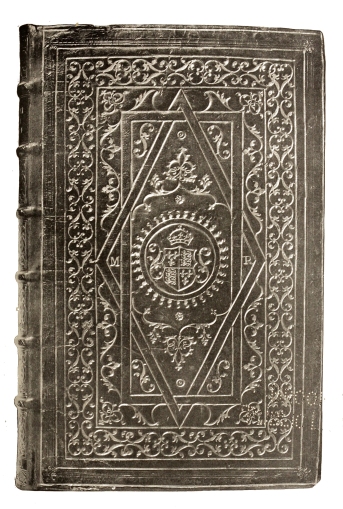
PLATE XVIII.
CALF BINDING OF “EPITOME OMNIUM OPERUM DIVI AURELII AUGISTINI. COL.,
1549.” MADE FOR QUEEN MARY.
place. It is near the top of the design, the centre ornament being
merely an arabesque. The boards have an irregular rectangular
double-lined panel with right-angled projections at each side, outlined
in gold; within these lines are small fleurons at the angles, and small
scrolls, fleurs-de-lys, and rosettes. Between the centre and the inner
edge of the plain panel is a double-lined diamond, edged with curves and
scrolls, the corners ornamented with fleurons. Between the outer edge of
the panel and the edge of the book are curves and Tudor badges, each
held up either by a curved or a straight stalk, the royal coat of arms
forming the chief ornament at the top, and two double roses at the
bottom. The corners are closely and cleverly filled with a few curves
reversed again and again. The original book is in a perfectly sound
state, but the gilding upon it became rubbed, and many years ago it fell
into the hands of an unscrupulous restorer, who regilded it all over
with stamps cut to some extent like the old ones, but not exactly. The
impressions of the old stamps still remain quite sufficiently to be
recognized, and I have made a drawing of this binding, which shows the
original form of its decoration. It is one of the latest bindings made
by Berthelet, and in some ways it must have been one of his finest.
However much it may be considered advisable or necessary to replace old
leather on bindings by new, it is quite certain that no state of decay
can under any circumstances justify the regilding or restamping of any
gold-tooled work. This unfortunately has been a favourite proceeding
with many binders, with disastrous effects, and it cannot be too
strongly condemned from every point of view.
1553 (?). A manuscript poem of controversy against the Reformers is
addressed to Queen Mary by Myles Haggard; bound in calf, and tooled in
gold and blind, by Berthelet. It measures about 9 by 6 inches, and has
the remains of green silk ties on the front edges of the boards. In the
centre is the royal coat of arms, crowned, and flanked by two scrolls,
all contained within a circle stained black and outlined with gold
lines, the outer edge being ornamented with a series of impressions of a
small flame-shaped stamp on a narrow, slightly curved foot. The initials
of Queen Mary, M R, are shown twice, arranged squarely, just beyond the
flamed circle.
There is a gold line, with blind, parallel and near to the edges of the
boards, and at the outer angles of this rectangle are arabesque
fleurons. In the panels of the back are single impressions of small
roses.
1554 (?). Horae Beatae Mariae Virginis, etc., or Queen Mary’s
Prayer-Book, written on vellum and beautifully illuminated in colours,
is bound in deep brown calf, delicately ornamented with gold and blind
tooling, and measures 8¼ by 5½ inches.
In the centre is a small royal coat of arms with a specially cut border,
ensigned with a large royal crown and flanked by the initials M R. A
broad rectangular fillet of gold and blind lines runs parallel with the
edges of the boards, the gold being the inner of all, and mitred at the
corners. This fillet marked by gold lines is ornamented along its length
by impressions of a small arabesque cluster and a rosette, and at each
of the outer corners is a large fleuron.
This binding is one of the most finely executed of any that can without
doubt be attributed to Berthelet. The stamps used upon it are original
in design, and although the Italian feeling is still evident, it is not
so marked as in many other instances. The curious plan of adorning a
fillet with impressions of small detached stamps is, I think, originally
an Italian idea, but it is found more frequently on Berthelet’s bindings
than it is on those of any other master. Sometimes it occurs on fillets
which are stained black, in which case a little bare place is left for
the gold impression,—it is not gilded over the stain. Sometimes, as on
this book, the fillet is left uncoloured. The unknown binder who worked
for James I. and his sons used dots on fillets, but never stained them;
and Samuel Mearne, royal binder to Charles II., revived the plan of
gilding on a black fillet, but he did not carry it out to such an
elaborate extent as did Berthelet, only using dots or dotted lines.
1554. Expositio Beati Ambrosii episcopi super apocalypsin. Lutetiae,
1554; measures 9¼ by 6½ inches, and is bound by Berthelet in dark
brown calf, tooled in gold, with a few blind lines. In the centre is an
ornamental cartouche enclosed within a rectangular border, and bearing
the royal coat of arms of Queen Mary, crowned, and flanked by two
scrolls; this is enclosed by a circle of wavy flames, and again by an
outer irregularly shaped border of curves, straight lines, and
arabesques. The space between the flamed circle and the outer arabesque
line is filled with a powdering of small circular stamps.
The rectangular outer border is composed of straight lines in gold and
blind, with centre fillet of an ornamental circular stamp crossed with
arabesques of Italian character. The inner corners of the rectangle are
filled with a trefoil stamp and the outer corners with an ornamental
fleuron. There are the remains of two green silk ties on the front edge
of each of the boards. The book is not in a good condition, the back
having been entirely spoiled and tooled with recent stamps.
1555. Epitome omnium operum divi Aurelii Augustini, etc. Coloniae, 1549;
measures 12½ by 8¼ inches, and is bound in brown calf, tooled in
gold, with some blind lines. In the centre is the royal coat of arms of
Queen Mary, crowned, and flanked by two arabesque curves, contained
within a circle stained black, with waved rays of gold issuing outwards.
The coat is enclosed by a long upright rectangular fillet stained black,
interlaced by another in diamond shape of similar width, also stained
black. The spaces within these two fillets are filled with gold curves
and arabesques, except the two small triangles flanking the centre,
which have the initials M R.
The black fillets are enclosed by a double border; the inner one, broken
in four places by the points of the diamond, is thickly ornamented with
corner fleurons and arabesque scrolls, the outer closely filled with a
handsome arabesque made with two reversed curves. Outside all is another
black rectangular fillet, with fleurons at the outer corners.
This is one of the finest calf bindings Berthelet made for Queen Mary,
and it is wonderfully well preserved, the leather being only a little
discoloured and the gold bright and clear. The black on the fillets is
also in good condition.
1555. Bonner. A profitable and necessarye doctrine. London (1555); is
bound in pale brown calf for Queen Mary, and tooled in gold, without
any black in the fillets. In the centre is the royal coat of arms
flanked by two scrolls and enclosed within a flanked circle. This circle
is contained in a diamond-shaped fillet, with leaf stamps in the upper
and lower corners, beyond which is a rectangular border of Italian
fashion, made by small circles intersected by arabesques,—a favourite
pattern of Berthelet’s, and very effective. The four inner corners of
the parallelogram are filled with arabesque ornaments, and the outer
corners have small fleurons. All the stamps are well known.


