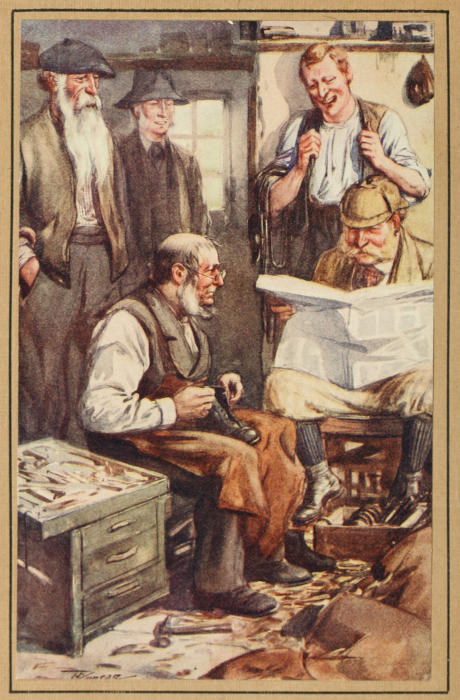
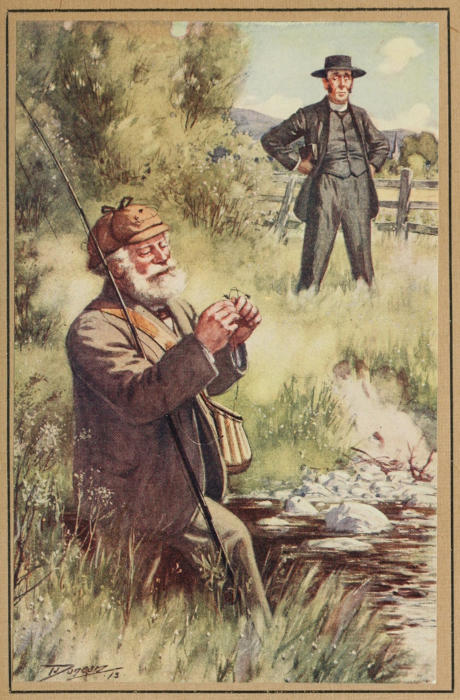
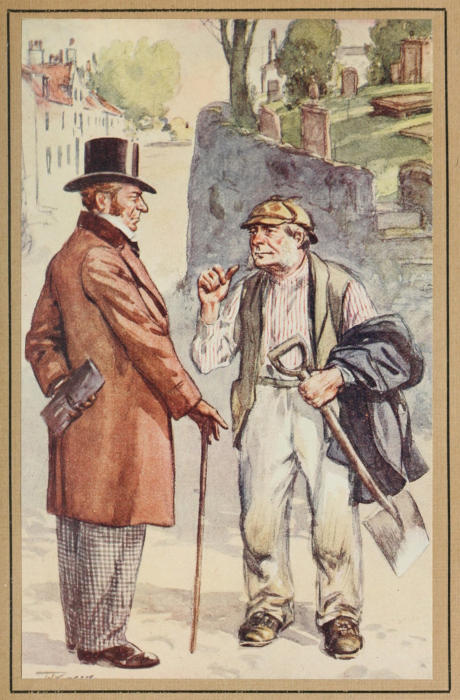
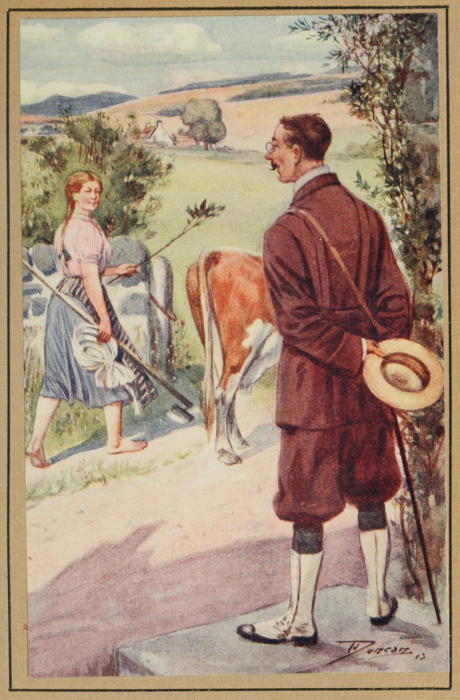
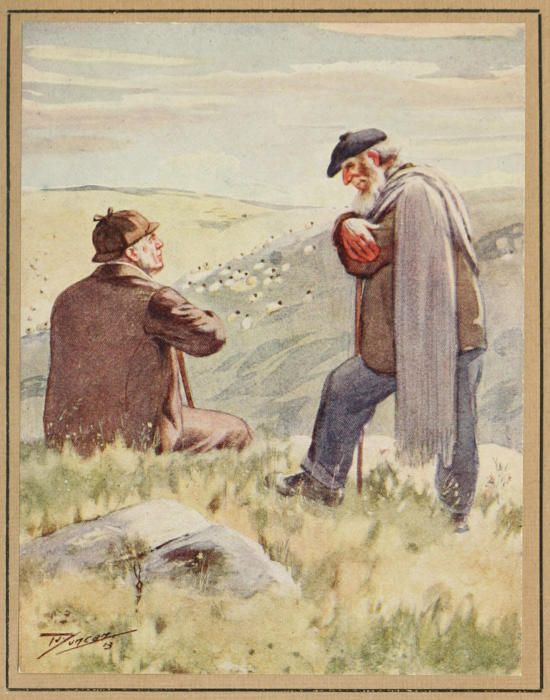
Scotch folks humour, being the common gift of Nature to all and
sundry in the land, differing only in degree, slips out most frequently
when and where least expected. Famous specimens of it come
down from our lonesome hillsides—from the cottage and farm
ingle-nooks.—Page 34.
Frontispiece.
THISTLEDOWN
A BOOK OF SCOTCH HUMOUR
CHARACTER, FOLK-LORE
STORY & ANECDOTE
BY
ROBERT FORD EDITOR OF
“BALLADS OF BAIRNHOOD,” “AULD SCOTS BALLANTS”
“VAGABOND SONGS,” ETC.
WITH ILLUSTRATIONS
BY JOHN DUNCAN
PAISLEY: ALEXANDER GARDNER Publisher by Appointment to the late Queen Victoria
PREFACE
An eminently learned and genial ex-Professor of
one of our Universities not long since pointed
out how Scotland was remarkable for three things—Songs,
Sermons, and Shillings. And whilst it may
not be disputed that she has enormous and ever-increasing
store of these three good things—and
that, moreover, she loves them all—there is a fourth
quality of her many-sided nature which is more
distinctly characteristic of Auld Caledonia and her
people, and that is the general possession of the
faculty of original humour. Not one in ten thousand
of the Scottish people may be able to produce a good
song, or a good sermon; not one in twenty thousand
of them may be able to “gather meikle gear and
haud it weel thegither;” but every second Scotsman
is a born humourist. Humour is part and parcel of
his very being. He may not live without it—may
not breathe. Consequently, it is found breaking
out amongst us in the most unlikely as well as in
the most likely places. It blossoms in the solemn
assemblies of the people; at meetings of Kirk-Sessions;
in the City and Town Council Chambers; in our
Presbyteries; our Courts of Justice; and in the high
Parliament of the Kirk itself. Famous specimens of
it come down from the lonesome hillsides; from the
cottage, bothy, and farm ingle-nooks. It issues
from the village inn, the smiddy, the kirkyard; and
functions of fasting and sorrow give it birth as well
as occasions of feasting and mirth. It drops from
the lips of the learned and the unlearned in the land;
and is not more frequently revealed in the eloquence
of the University savant than in the gibberish of the
hobbling village and city natural.
Humorous Scottish anecdotes have been an abundant
crop; and collectors of them there have been
not a few. Dean Ramsay’s garrulous and entertaining
Reminiscences, and Dr. Charles Rogers’ Familiar
Illustrations of Scottish Life excepted, however, the
published collections of our floating facetiæ have
been “hotch-potch” affairs. Revelations each of
some little industry, no doubt, but few of them
affording any proof of the compiler’s familiarity with
the subject. And as none of them have reached
farther back than Dean Ramsay, and all have been
content to take the more familiar of Ramsay’s and
Rogers’ illustrations and anecdotes, and supplement
these in hap-hazard fashion with random clippings
from the variety columns of the daily and weekly
newspapers, the individual result has been such as
Voltaire’s famous criticism eloquently describes:—They
have contained things both good and new;
but what was good was not new, and what was new
was not good.
To the present work the critical aphorism of
the “brilliant Frenchman” may not in fairness be
applied. In any attempt to afford an adequate
representation of the humours of the Scottish people,
illustrations must of necessity be drawn from widely
different sources, and I have, consequently, to confess
my indebtedness to various earlier gleaners in the
same field, chiefly to Dean Ramsay, Dr. Rogers, and
the genial trio, Carrick, Motherwell, and Henderson.
But for representative illustrations of Scottish life
and character I have gone further back and come
down to a later period than any previous writer on
the subject. And so, whilst the reader will discover
here much that is old and good, he will find very
much that is new, which, as illustrative of Scottish
humour and character, will compare with the best of
the old.
No pointless or dubiously nationalistic anecdote or
illustration has been admitted. The work has been
carefully and elaborately classified under eighteen
distinct headings, each class, or section, being introduced
by an exposition of the phase or phases of life
and character to which it applies, and cemented from
first to last by reflective and expository comment.
Essentially a book of humour, it is hoped that
the reader will find it to be something more than a
merely funny book. If he does not, the writer will
have failed to realize fully his aim.
THISTLEDOWN — CHAPTER I THE SCOTTISH TONGUE—ITS GRAPHIC FORCE AND POWERS OF PATHOS AND HUMOUR
We are frequently told—and now and again
receive unwelcome scraps of evidence in confirmation
of the scandal—that our dear old mother
tongue is falling into desuetude in our native land.
Already, it must be confessed, it has been abrogated
from the drawing-rooms of the ultra-refined upper
circles of Scottish society. The snobbish element
amongst the great middle-class, ever prone to imitate
their “betters,” affect not to understand it, and
blush (the sillier of them) when, in an unguarded
moment, a manifest Scotticism slips into their conversation.
There is a portion of the semi-educated
working population, again, who, imitating the snobbish
element of the middle grade, speak Scotch freely
only in their working clothes. On Sundays, and extra
occasions, when dressed in their very best, there is
just about as much Scotch in their talk as will show
one how poorly they can speak English, and just
about enough English to render their Scotch ridiculous.
Observing all this, and taking it in conjunction
with the other denationalising tendencies of the age,
there are those who predict that the time is not far
distant when Burns’s poems, Scott’s novels, and
Hogg’s tales will be sealed books to the partially
educated Scotsman. That there is a growing tendency
in the direction indicated is quite true, but
the disease, I believe, is only skin deep as yet, and
the bone and sinew of the country remain quite
unaffected. That there will be a sudden reaction
in the patient must be the sincere desire of every
patriotic Scot. If the prediction of obsoletism is
ever to be realized, then, “the mair’s the pity.”
Scotland will not stand where she did. For very
much—oh, so much—of what has made her glorious
among the nations of the world will have passed
away, taking the sheen of her glory with it. What
Scotsmen, as Scotsmen, should ever prize most is
bound up inseparably with the native language.
Ours is a matured country, and the stirring scenes
of her history on which the mind of the individual
delights to dwell, are so frequently enshrined in
spirited ballad and song, couched in the pithy Scottish
vernacular, that, to suppose these latter dead—they
are not translatable into English—is to suppose
the best part of Scottish history dead and buried
beyond the hope of resurrection. For its own sake
alone the Scottish tongue is eminently deserving of
regard—of cultivation and preservation. Scotsmen
should be—and so all well-conditioned Scotsmen
surely are—as proud of their native tongue as they
are of their far-famed native bens and glens. For
why, the rugged grandeur of the physical features
of our country are not more worthy of admiration
than the language in which their glories have been
most fittingly extolled. They have characteristics
in common; for rugged grandeur is as truly a feature
of the Scottish language as it is the dominant feature
of Scottish scenery. True, its various dialects are
somewhat tantalising. The Forfar man is vividly
identified by his “foo’s” and his “fa’s,” and his
“fat’s” and his “fans”; and the Renfrewshire man
by his “weans,” his “wee weans,” and his “yin
pound yin and yinpence,” etc. Taking a simple
phrase as an example—(Anglice):—“The spoon is
on the loom.” The Aberdonian will tell you that
“The speen’s on the leem.” The Perthshire man will
say “That spun’s on the luim”; and the Glasgow
citizen will inform you that “The spin’s on the lim.”
In a fuller example, a Renfrewshire person will vouchsafe
the information that he “Saw a seybo synd’t doon
the syvor till it sank in the stank.” A native of
Perthshire will only about half understand what the
speaker has said, and may threaten to “rax a rung
frae the boggars o’ the hoose and reeshil his rumple
wi’t,” without sending terror to the soul of his West
country confederate. Latterly, an Aberdonian may
come on the scene and ask, “Fa’ fuppit the loonie?”
and neither of the forenamed parties will at once
perceive the drift of his inquiry. To illustrate how
difficult it may be for the East and the West to
understand each other, I will tell a little story. An
Aberdonian not long ago got work in Glasgow
where they used a quantity of tar, and was rather
annoyed to see his fellow-workmen wash the tar off
their hands while he washed and rubbed at his in
vain. His patience could stand it no longer, and
going up to the foreman, and, stretching out his
hands, he asked:—“Fat’ll tak’ it aff?” “Yes,”
replied the foreman, “fat’ll tak’ it aff.” “Fat’ll tak’
it aff?” “Yes, I said fat would tak’ it aff.” “But
fat’ll tak’ it aff?” persisted the Aberdonian. The
foreman pointed to a tub, and roared: “Grease,
you stupid eediot!” “Weel than,” retorted the
Aberdonian, “an’ fat for did you no say that at
first?”
There are, however, dialects and provincialisms in
the language of every country and people under the
sun, and the Scottish vernacular is not worse—not
nearly so bad as many are. Our dialects are mainly
the results of a narrowing and broadening of the vowel
sounds, as exemplified in the instance of the words
“spoon” and “loom.” I have spoken of the rugged
grandeur of the Scottish Doric, and its claims to preservation.
There are single words in Scotch which
cannot be adequately expressed in a whole sentence
in English. Think of “fushionless,” “eerie,” “wersh,”
“gloamin’,” “scunner,” “glower,” “cosie,” “bonnie,”
“thoweless,” “splairge,” and “plowter,” etc., and try
to find their equivalents in the language of the school.
Try and find a sentence that will fairly express some
of the words. “A gowpen o’ glaur” is but weakly
expressed in “a handful of mud”; “stoure” is not
adequately defined by calling it “dust in motion”;
“flype yer stockin’, lassie,” is easier said than “turn
your stocking inside out, girl.” “Auld lang syne”
is not expressible in English. “A bonnie wee lassie”
is more euphonious and expressive by a long way than
“a pretty little girl.” “Hirsle yont,” “my cuit’s
yeukie,” “e’enin’s orts mak’ gude mornin’ fodder,”
“spak’ o’ lowpin’ ower a linn,” and “pree my mou’,”
are also good examples of expressive Scotch. Nowhere,
perhaps, is the singular beauty and rare
expressiveness of the Scottish national tongue seen
to better advantage than in the proverbial sayings—those
short, sharp, and shiny shafts of speech,
aptly defined as “the wit of one and the wisdom of
many,”—and of which the Scottish language has
been so prolific. “The genius, wit, and wisdom of
a nation are discovered by their proverbs,” says
Bacon; and, verily, while the proverbs of Scotland
are singularly expressive of the pith and beauty
of the vernacular in which they are couched, they
also reveal in very great measure the mental and
social characteristics of the people who have perpetuated
them. “A gangin’ fit’s aye gettin’, were’t
but a thorn;” “Burnt bairns dread the fire;” “A’e
bird in the hand’s worth twa in the bush;” “A
fool an’ his siller’s sune parted;” “Hang a thief
when he’s young an’ he’ll no steal when he’s auld;”
“There’s aye some water whaur the stirkie droons;”
“Moudiwarts feedna on midges;” “When gossipin’
wives meet, the deil gangs to his dinner;” “Hungry
dogs are blythe o’ bursten puddin’s;” “He needs a
lang-shankit spune that wad sup wi’ the deil;” “A
blate cat maks a prood mouse;” “Better a toom house
than an ill tenant;” “Lippen to me, but look to
yoursel’;” “Jouk an’ lat the jaw gang by;” “Better
sma’ fish than nane;” “The tulziesome tyke comes
hirplin’ hame;” “Ha’ binks are sliddery;” “Ilka
cock craws best on his ain middenhead;” “Lazy
youth mak’s lowsy age;” “Next to nae wife, a guid
wife’s best;” “Lay your wame to your winnin’;”
“It’s nae lauchin’ to girn in a widdy;” “The
wife’s a’e dochter an’ the man’s a’e coo, the tane’s
ne’er weel, an’ the tither’s ne’er fu’.” These give
the evidence.
Ours is a language peculiarly powerful in its use
of vowels, and the following dialogue between a
shopman and a customer is a convincing example.
The conversation relates to a plaid hanging at a
shop door:—
Customer (inquiring the material)—“Oo?” (wool?).
Shopman—“Aye, oo.” (yes, wool).
Customer—“A’ oo?” (all wool?).
Shopman—“Ay, a’ oo” (yes, all wool).
Customer—“A’ a’e oo?” (all one wool?).
Shopman—“Ou, ay, a’ a’e oo” (oh, yes, all one
wool).
A dialogue in vowel sounds—surely a thing
unique in literature!
In his Scotch version of the Psalms—“frae
Hebrew intil Scottis”—the late Rev. Dr. Hately
Waddell, of Glasgow, gives many striking illustrations
of the force and beauty of idiomatic Scotch.
His language partakes rather much of the antique
form to be readily perceptible to the present generation,
but its purity is unquestionable, and its beauty
and power inexpressible in other words than his own.
Let us quote the familiar 23rd Psalm.
“The Lord is my herd; na want sal fa’ me.
“He louts me till lie amang green howes; He airts
me atowre by the lown waters.
“He waukens my wa’gaen saul; He weises me
roun for His ain name’s sake, intil richt roddins.
“Na! tho’ I gang thro’ the dead-mirk dail; e’en
thar sal I dread nae skaithin; for Yersel’ are nar-by
me; Yer stok an’ Yer stay haud me baith fu’ cheerie.
“My buird Ye ha’e hansell’d in face o’ my faes;
Ye ha’e drookit my head wi’ oyle; my bicker is fu’
an’ skailin’.
“E’en sae sal gude guidin’ an’ gude gree gang wi’
me ilk day o’ my livin’; an’ ever mair syne i’ the
Lord’s ain howff, at lang last, sal I mak bydan.”
Hear also Dr. Waddell’s translation of the last
four verses of the 52nd chapter of Isaiah, they are
inexpressibly beautiful:—
“Blythe and brak-out, lilt a’ like ane, ye bourocks
sae swak o’ Jerusalem; for the Lord He has hearten’d
His folk fu’ kin’; He has e’en boucht back
Jerusalem.
“The Lord He rax’d yont His hailie arm, in sight
o’ the nations mony, O; an’ ilk neuk o’ the yirth
sal tak tent an’ learn the health o’ our God sae
bonie, O!
“Awa, awa, clean but frae the toun: mak nor
meddle wi’ nought that’s roun’; awa frae her bosom;
haud ye soun’, wi’ the gear o’ the Lord forenent ye!
“For it’s no wi’ sic pingle ye’se gang the gate;
nor it’s no wi’ sic speed ye maun spang the spate;
for the Lord, He’s afore ye, ear’ an’ late; an’ Israel’s
God, He’s ahint ye!”
These suggest “The Lord’s Prayer intill Auld
Scottis,” as printed by Pinkerton, and which is cast
in more antique form still:—“Uor fader quhilk
beest i’ Hevin, Hallowit weird thyne nam. Cum
thyne kinrik. Be dune thyne wull as is i’ Hevin,
sva po yerd. Uor dailie breid gif us thilk day.
And forleit us our skaths, as we forfeit tham quha
skath us. And leed us na intill temtation. Butan
fre us fra evil. Amen.”
No writer of any time—Burns alone excepted—has
handled the native tongue to better purpose for
the expression of every feeling of the human heart
than has Sir Walter Scott; and in Jeanie Deans’
plea to the Queen for her sister’s life there is the
finest example of simple pathos, dashed with the
passion of hope struggling with despair, that is to
be met with anywhere in literature. It shows the
extent in this way of which the native speech is
capable.
“My sister—my puir sister Effie, still lives, though
her days and hours are numbered! She still lives,
and a word o’ the King’s mouth might restore her
to a heart-broken auld man, that never, in his daily
and nightly exercise, forgot to pray that His Majesty
might be blessed with a lang an’ a prosperous reign,
and that his throne, and the throne o’ his posterity,
might be established in righteousness. O,
madam, if ever ye kend what it was to sorrow for
and with a sinning and a suffering creature, whase
mind is sae tossed that she can be neither ca’d fit to
live or dee, hae some compassion on our misery!
Save an honest house from dishonour, and an unhappy
girl, not eighteen years of age, from an early
and dreadful death! Alas! it is not when we sleep
saft and wake merrily oursel’s that we think on other
people’s sufferings. Our hearts are waxed light within
us then, and we are for righting our ain wrangs
and fighting our ain battles. But when the hour of
trouble comes to the mind or to the body—and
seldom may it visit your leddyship—and when the
hour of death comes, that comes to high and low—lang
and late may it be yours!—oh, my leddy, then
it isna what we hae dune for oursel’s, but what we
hae done for others, that we think on maist pleasantly.
And the thought that ye hae intervened to
spare the puir thing’s life will be sweeter in that
hour, come when it may, than if a word o’ your
mouth could hang the haill Porteous mob at the
tail o’ a’e tow.”
Then the vigour and variety of the Scottish idiom
as a vehicle of description has perhaps never received
better illustration than in Andrew Fairservice’s account
of Glasgow Cathedral:—“Ay! it’s a brave
Kirk,” said Andrew. “Nane o’ yere whigmaleeries
and curliwurlies and open steek hems aboot it—a’
solid, weel-jointed mason wark, that will stand as
lang as the warld, keep hands and gunpowther aff
it. It had amaist a douncome lang syne at the
Reformation, when they pu’d doon the Kirks of
St. Andrews and Perth, and thereawa’, to cleanse
them o’ Papery, and idolatry, and image-worship,
and surplices, and sic like rags o’ the muckle hure
that sitteth on the seven hills, as if ane wasna braid
enough for her auld hinder end. Sae the commons
o’ Renfrew, and o’ the Barony, and the Gorbals, and
a’ aboot, they behoved to come into Glasgow a’e fair
morning, to try their hand on purging the High
Kirk o’ Popish nick-nackets. But the townsmen o’
Glasgow, they were feared their auld edifice might
slip the girths in gaun through siccan rough physic,
sae they rang the common bell, and assembled the
train-bands wi’ took o’ drum. By gude luck, the
worthy James Rabat was Dean o’ Guild that year
(and a gude mason he was himsell, made him keener
to keep up the auld bigging). And the trades
assembled, and offered downright battle to the commons,
rather than their Kirk should coup the crans,
as others had done elsewhere. It wasna for love o’
Papery—na, na!—nane could ever say that o’ the
trades o’ Glasgow. Sae they sune came to an
agreement to tak a’ the idolatrous statues o’ sants
(sorrow be on them) out o’ their neuks—and sae
the bits o’ stone idols were broken in pieces by
Scripture warrant, and flung into the Molendiner
burn, and the Auld Kirk stood as crouse as a cat
when the flaes are kaimed aff her, and a’ body was
alike pleased. And I hae heard wise folk say that
if the same had been dune in ilka Kirk in Scotland,
the Reform wad just hae been as pure as it is e’en
now, and we wad hae mair Christianlike Kirks; for
I hae been sae lang in England, that naething
will drive out o’ my head, that the dog-kennel at
Osbaldistone-Hall is better than mony a house o’
God in Scotland.”
No man, it is well known, had ever more command
of the native vernacular than Robert Burns. In a
letter written at Carlisle, in June 1787, to his friend
William Nicol, Master of the High School, Edinburgh,
he has left a curious testimony at once to the
capabilities of the language and his own skill in it.
“Kind, honest-hearted Willie,” he writes, “I’m sitten
doon here, after seven-and-forty miles’ ridin’, e’en as
forjeskit and forniaw’d as a forfoughten cock, to gie
you some notion o’ my land-lowper-like stravaigin’
sin’ the sorrowfu’ hour that I sheuk hands and parted
wi’ Auld Reekie.
“My auld ga’d gleyde o’ a meere has huchyall’d
up hill and doun brae in Scotland and England, as
teuch and birnie as a vera deevil wi’ me. It’s true,
she’s as puir’s a sang-maker, an’ as hard’s a kirk, and
tipper taipers when she tak’s the gate, jist like a
lady’s gentlewoman in a minuwae, or a hen on a het
girdle; but she’s a yauld, poutherie girran for a’ that,
and has a stamach like Willie Stalker’s meere, that
wad hae digeested tumbler-wheels, for she’ll whip me
aff her five stimparts o’ the best aits at a down-sitten’,
and ne’er fash her thoom. Whan ance her ring-banes
and spavies, her crucks and cramps, are fairly soupl’d,
she beets to, beets to, and aye the hindmost hour
the tightest. I could wager her price to a thretty
pennies, that for twa or three wooks, ridin’ at fifty
miles a day, the deil-stickit a five gallopers acqueesh
Clyde and Whithorn could cast saut on her tail.
“I hae dander’d owre a’ the country frae Dunbar
to Selcraig, and ha’e forgather’d wi’ mony a gude
fallow, and mony a weel-faur’d hizzie. I met wi’ twa
dink queynes in particular. Ane o’ them a sonsie,
fine, fodgel lass, baith braw and bonnie; the ither
was a clean-shankit, straught, tight, weel-faur’d
wench, as blythe’s a lintwhite on a flowerie thorn,
and as sweet and modest’s a new blawn plum-rose in
a hazel shaw. They were baith bred to mainers by
the beuk, and ony ane o’ them had as muckle smeddum
and rumblegumption as the half o’ some Presbytries
that you and I baith ken. They played me
sic a deil o’ a shavie, that I daur say if my harigals
were turn’d out ye wad see twa nicks i’ the heart o’
me like the mark o’ a kail-whittle in a castock.
“I was gaun to write you a lang pystle, but, Gude
forgi’e me, I gat mysel’ sae noutourously bitchify’d
the day, after kail-time, than I can hardly stoiter
but and ben.
“My best respecks to the guidwife and a’ our
common friens, especiall Mr. and Mrs. Cruikshank,
and the honest guidman o’ Jock’s Lodge.
“I’ll be in Dumfries the morn gif the beast be to
the fore, and the branks bide hale.
“Gude be wi’ you, Willie! Amen!”
That letter might fairly be made the “Shibboleth”
in any case of doubt regarding one’s ability to read
Scotch. It would shiver the front teeth of some of
your counterlouper gentry. Yet it is not an overdone
example of the Scotch Doric as it was spoken
in Edinburgh drawing-rooms a hundred years ago—vide,
Henry Cockburn’s Memorials. Between it and
the “braid Scotch” of half a century earlier there
is a marked difference.
In the Scots Magazine for November, 1743, the
following proclamation is printed:—
“All brethren and sisters, I let you to witt that
there is a twa-year-auld lad littleane tint, that ist’
ere’en.
“It’s a’ scabbit i’ the how hole o’ the neck o’d,
and a cauler kail-blade and brunt butter at it, that
ist’er. It has a muckle maun blue pooch hingin’ at
the carr side o’d, fou o’ mullers and chucky-stanes,
and a spindle and a whorle, and it’s daddy’s ain jockteleg
in’t. It’s a’ black aneath the nails wi’ howkin’
o’ yird, that is’t. It has its daddy’s gravat tied about
the craig o’d, and hingin’ down the back o’d. The
back o’ the hand o’d’s a’ brunt; it got it i’ the smiddy
ae day.
“Whae’er can find this said twa-year-auld lad littleane
may repair to M⸺o J⸺n’s, town-smith in
C⸺n, and he sall hae for reward twall bear scones,
and a ride o’ our ain auld beast to bear him hame,
and nae mair words about it, that wilt’r no.”
Hogg, in his “Shepherd’s Calendar,” referring to
the religious character of the shepherds of Scotland
in his day, tells that “the antiquated but delightful
exercise of family worship was never neglected,” and,
“formality being a thing despised, there are no
compositions I ever heard,” he continues, “so truly
original as those prayers occasionally were; sometimes
for rude eloquence and pathos, at other times
for an indescribable sort of pomp, and, not infrequently,
for a plain and somewhat unbecoming
familiarity.” He gives several illustrations, quite
justifying this description, from some with whom
he had himself served and herded. One of the most
notable men for this sort of family eloquence, he
thought, was a certain Adam Scott, in Upper
Dalgleish. Thus Scott prayed for a son who seemed
thoughtless—
“For Thy mercy’s sake—for the sake o’ Thy puir,
sinfu’ servants that are now addressing Thee in their
ain shilly-shally way, and for the sake o’ mair than
we daur weel name to Thee, hae mercy on Rab. Ye
ken fu’ weel he’s a wild, mischievous callant, and
thinks nae mair o’ committin’ sin than a dog does o’
lickin’ a dish; but put Thy hook in his nose, and Thy
bridle in his gab, and gar him come back to Thee wi’
a jerk that he’ll no forget the langest day that he
has to live.” For another son he prayed:—“Dinna
forget puir Jamie, wha’s far awa’ frae us this nicht.
Keep Thy arm o’ power about him; and, oh, I wish
Ye wad endow him wi’ a little spunk and smeddum to
act for himsel’; for, if Ye dinna, he’ll be but a bauchle
i’ this warld, and a back-sitter i’ the neist.” Again:—“We’re
a’ like hawks, we’re a’ like snails, we’re a’
like slogie riddles; like hawks to do evil, like snails
to do good, and like slogie riddles to let through a’
the gude and keep a’ the bad.” When Napoleon I.
was filling Europe with alarm, he prayed—“Bring
doon the tyrant and his lang neb, for he has done
muckle ill this year, and gie him a cup o’ Thy wrath,
and gin he winna tak’ that, gie him kelty” [i.e.,
double, or two cups].
Very graphic, is it not! It reminds us of the
prayer of one Jamie Hamilton, a celebrated poacher
in the West country. As Jamie was reconnoitring a
lonely situation one morning, his mind more set on
hares than on prayers, a woman approached him from
the only house in the immediate district and requested
that he should “come owre and pray for auld Eppie,
for she’s just deein’.”
“Ye ken weel enough that I can pray nane,”
replied Jamie.
“But we haena time to rin for ony ither Jamie,”
urged the woman, “Eppie’s just slippin’ awa’; and
oh! it wad be an awfu’ like thing to lat the puir bodie
dee without bein’ prayed for.”
“Weel, then,” said Jamie, “an I maun come, I
maun come; but I’m sure I kenna right what to
say.”
The occasion has ever so much to do with the
making of the man. Approaching the bed, Jamie
doffed his cap and proceeded:—“O Lord, Thou kens
best Thy nainsel’ how the case stands atween Thee
and auld Eppie; and sin’ Ye hae baith the heft and
the blade in Yer nain hand, just guide the gully as
best suits her guid and Yer nain glory. Amen.”
It was a poacher’s prayer in very truth, but a
bishop could not have said more in as few words.
But it is easy to be expressive in Scotch, for it is
peculiar to the native idiom that the simpler the language
employed the effect is the greater. Think how
this is manifested in the song and ballad literature of
the country. In popular ballads like “Gil Morrice,”
“Sir James the Rose,” “Barbara Allan,” and “The
Dowie Dens o’ Yarrow”; in Jane Elliot’s song of
“The Flowers of the Forest”; in Grizzel Baillie’s
“Werena my heart licht I wad dee”; in Lady Lindsay’s
“Auld Robin Gray”; in Lady Nairne’s “Land
o’ the Leal”; in Burns’s “Auld Lang Syne”; in
Tannahill’s “Gloomy Winter”; in Thom’s “Mitherless
Bairn”; and in Smibert’s “Widow’s Lament.”
I do not mean to say that the making of these songs
and ballads was a simple matter; but the verbal
material is in each case of the simplest character,
and the effect such that the pieces are established
in the common heart of Scotland. Burns did not
go out of his way for either language or figures of
speech to describe Willie Wastle’s wife, yet see the
graphic picture we have presented to us by a few
strokes of the pen:—
“She has an e’e—she has but ane,
The cat has twa the very colour;
Five rusty teeth, forbye a stump,
A clapper-tongue wad deave a miller;
A whiskin’ beard about her mou’,
Her nose and chin they threaten ither—
Sic a wife as Willie has,
I wadna gie a button for her.
“She’s bow-houghed, she’s hein-shinn’d,
Ae limpin’ leg, a hand-breed shorter;
She’s twisted right, she’s twisted left
To balance fair in ilka quarter:
She has a hump upon her breast
The twin o’ that upon her shouther—
Sic a wife as Willie has,
I wadna gie a button for her.”
No idea there is strained. Every word is common.
The same may be said of Hew Ainshe’s lyric poem
in a different vein, “Dowie in the hint o’ Hairst,”
which I make no apology for quoting in full:—
“It’s dowie in the hint o’ hairst.
At the wa’-gang o’ the swallow,
When the wind grows cauld, and the burns grow bauld,
An’ the wuds are hingin’ yellow;
But oh, it’s dowier far to see
The wa’-gang o’ her the heart gangs wi’,
The dead-set o’ a shinin’ e’e.
That darkens the weary warld on thee.
“There was meikle love atween us twa—
Oh, twa could ne’er be fonder;
And the thing on yird was never made,
That could ha’e gart us sunder.
But the way o’ Heaven’s aboon a’ ken,
And we maun bear what it likes to sen’—
It’s comfort, though, to weary men,
That the warst o’ this warld’s waes maun en’.
“There’s mony things that come and gae,
Just kent, and just forgotten;
And the flowers that busk a bonnie brae,
Gin anither year lie rotten,
But the last look o’ yon lovely e’e,
And the deein’ grip she ga’e to me,
They’re settled like eternitie—
Oh, Mary; gin I were wi’ thee.”
By these illustrations I have endeavoured to shew
forth, to all whom it may concern, the verbal beauty,
the graphic force, and the powers for the expression
of pathos and humour there is in the vernacular speech
of Scotland. Like our national emblem—the thistle—it
is, of course, nothing in the mouth of an ass.
But well spoken, it is charming alike to the ear and
the intellect; and, for the reasons already urged in
this paper, is worthy of more general esteem and more
general cultivation than the current generation of
Scotch folk seem disposed to award it. Lord Cockburn
pronounced it “the sweetest and most expressive
of living languages;” and no unprejudiced reader of
his Memorials will dispute the value of his opinion
on the subject. He wrote excellent Doric himself,
and made it the vehicle of his conversation in his
family, and casually throughout the day, as long as
he lived. Ho! for more such good old Scottish
gentlemen! Ho! for another Jean, Duchess of
Gordon, to teach our Scottish gentry how to speak
naturally! That we had more men in our midst,
with equal influence and education, and charged with
the fine spirit of patriotism which animates Scotland’s
ain “grand auld man”—Professor Blackie! It has
been the fashion for English journalists with pretensions
to wit, to animadvert by pen and pencil on what
they regard as the idiosyncracies of Scottish speech
and behaviour. Punch is a frequent offender in this
way. I say offender advisedly, for no Punch artist,
so far as I have seen—and I have scanned that journal
from the first number to the last—ever drew a Scotsman
in “his manner as he lived.” The originals of
the pictures may have appeared in London Christmas
pantomimes, but certainly nowhere else. Then the
language which in their guileless innocence they expect
will pass muster as Scotch, is a hash-up alike revolting
to the ears of gods and men. We don’t expect very
much from some folks, but surely even a London
journalist should know that a Scotsman does not say
“mon” when he means to say “man.” Charles
Macklin put it that way, and the London journalist
apparently can never get beyond Macklin. Don’t go
to London for your Scotch, my reader! Listen to it
as it may still be spoken at your granny’s ingleside.
Familiarise yourself with it as it is to be found in its
full vigour and purity in the Waverley Novels; in
Burns’s Poems and Songs; in the “Noctes Ambrosianæ”
of Professor Wilson; in Galt’s Tales; in the
writings of the Ettrick Shepherd; in the stories of
George MacDonald, J. M. Barrie, and S. R. Crockett;
in the pages of “Mansie Wauch,” “Tammas Bodkin,”
and “Johnny Gibb.” Don’t learn English less;
but again, I say, read, write, and speak Scotch more
frequently. And, when doing so, remember you are
not indulging in a mere vulgar corruption of good
English, comparable with the barbarous dialects of
Yorkshire and Devon, but in a true and distinct, a
powerful and beautiful language of your own, “differing
not merely from modern English in pronunciation,
but in the possession of many beautiful words, which
have ceased to be English, and in the use of inflexions
unknown to literary and spoken English since the days
of Piers Ploughman and Chaucer.” “The Scotch,” as
the late Lord Jeffrey said, “is not to be considered as
a provincial dialect—the vehicle only of rustic vulgarity
and rude local humour. It is the language of
a whole country, long an independent kingdom, and
still separate in laws, character, and manners. It is
by no means peculiar to the vulgar, but is the common
speech of the whole nation in early life, and with
many of its most exalted and accomplished individuals
throughout their whole existence; and though it be
true that, in later times, it has been in some measure
laid aside by the more ambitious and aspiring of the
present generation, it is still recollected even by them
as the familiar language of their childhood, and of
those who were the earliest objects of their love and
veneration. It is connected in their imagination not
only with that olden time which is uniformly conceived
as more pure, lofty, and simple than the present,
but also with all the soft and bright colours of
remembered childhood and domestic affection. All
its phrases conjure up images of school-day innocence
and sports, and friendships which have no pattern in
succeeding years.”
CHAPTER II CHARACTERISTICS OF SCOTCH HUMOUR
Various writers have attempted to define
Scotch humour, but it is a difficult task, and
in all my reading of the subject I do not remember to
have ever seen a very satisfactory analysis of the subtle
quantity. The famous Sydney Smith did not admit
that such an element obtained in our “puir cauld
country.” “Their only idea of wit which prevails
occasionally in the North,” said he, “and which,
under the name of ‘wut,’ is so infinitely distressing
to people of good taste, is laughing immoderately at
stated intervals.” Further to this, the same sublime
authority declared that it would require a surgical
operation to get a joke well into a Scotch understanding.
It has been presumed that the witty Canon was
not serious in his remark; that it was a laboured effort
of his to make a joke. This may be true; and the
idea of a surgical operation was possibly suggested
by feeling its necessity on himself in order to get his
joke out. Be that as it may, but for the fact that
the genial Charles Lamb, curiously, entertained a
somewhat similar notion on the subject, the rude
apothegm of the Rev. Sydney Smith would never
have misguided even the most hopelessly opaque of
his own countrymen. No humour in Scotch folk!
No humour in Scotland! There is no country in the
world that has produced so much of it. Of no other
country under the sun can it be so truly said that
humour is the common inheritance of the people.
Much of the kind of humour that drives an Englishman
into an ecstacy of delight, would, of course, only
tend to make a Scotsman sad; but that is no evidence
that the Scotch are lacking in their perceptions of
the humorous. It only shows that “some folks are
no ill to please.” “The Cockney must have his puns
and small jokes,” says Max O’Rell. “On the stage
he delights in jigs, and to really please him the best
of actors have to become rivals of the mountebanks
at a fair. A hornpipe delights his heart. An actor
who, for an hour together, pretends not to be able
to keep on his hat, sends him into the seventh heaven
of delight. Such performances make the Scotch smile—but
with pity. The Scotsman has no wit of this
sort. In the matter of wit he is an epicure, and only
appreciates dainty food.” In so far as the above
quotation applies to the denizens of the “North,” it
is perfectly true. In such circumstances the Scotch
will “laugh immoderately at stated intervals,” but
the laughs will be like angels’ visits, “few and far
between.”
Superficially regarded, Scotland is a hard-featured
land; yet Scotch folk are essentially humorous. Do
not go to the places of public amusement—to the
theatres and music halls—particularly in the larger
towns, where the populations are so mixed; do not go
there to learn the Scottish taste and humour. This
practice has led to the proverbial saying that “a
Scotchman takes his amusement seriously.” In such
places you may learn something of the English character
and humour, but nothing of the Scotch. For
an Englishman’s wit (he has little or no humour)
being an acquired taste, comes out “on parade”—it
is a gay thing—while Scotch folks’ humour being the
common gift of Nature to all and sundry in the land,
differing only in degree, slips out most frequently
when and where least expected. Famous specimens
of it come down from our lonely hillsides—from the
cottage and farm ingle-nooks. It blossoms in the
solemn assemblies of the people—at meetings of Kirk
Sessions, in the City and Town Council Chambers, in
our Presbyteries, our Courts of Justice, and occasionally
in the high Parliament of the Kirk itself. In
testimony of this read the Reminiscences of Dean
Ramsay, Dr. Rodgers’ Century of Scottish Life,
The Laird of Logan, and other similar collections
of the national humour; or study the humours of
our Scottish life and character as they are abundantly
reflected in the immortal writings of Burns, and Scott,
and Galt, and Wilson.
One of the chief characteristics of Scotch humour,
as I have already indicated, is its spontaneity, or utter
want of effort to effect its production. Much of it
comes out just as a matter of course, and without the
slightest indication on the part of the creator that he
is aware of the splendid part he is playing. Then it
has nearly always a strong practical basis. The Scotch
are characteristically practical people, and very much
of what is most enjoyable in humorous Scotch stories
and anecdotes, as Dean Ramsay truly says, arises
“from the simple and matter-of-fact references made
to circumstances which are unusual.”
There are others, of course, but these are the main
characteristics of Scotch humour. Our best anecdotes
illustrate this. Here is a good instance of the native
wit and humour:—
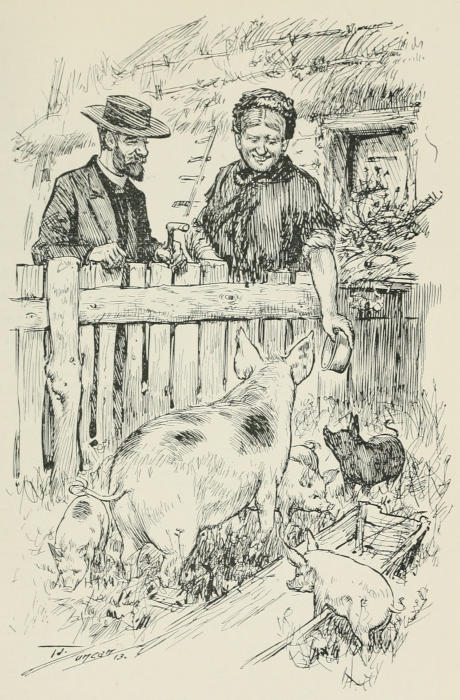
“Jock,” cried a farmer’s wife to her cowherd,
“come awa’ in to your parritch, or the flees ’ill be
droonin’ themsel’s in your milk bowl.”
“Nae fear o’ that,” was Jock’s roguish reply.
“They’ll wade through.”
“Ye scoondrel,” cried the mistress, indignantly,
“d’ye mean to say that ye dinna get eneuch milk?”
“Ou, ay,” said Jock, “I get plenty o’ milk for a’
the parritch.”
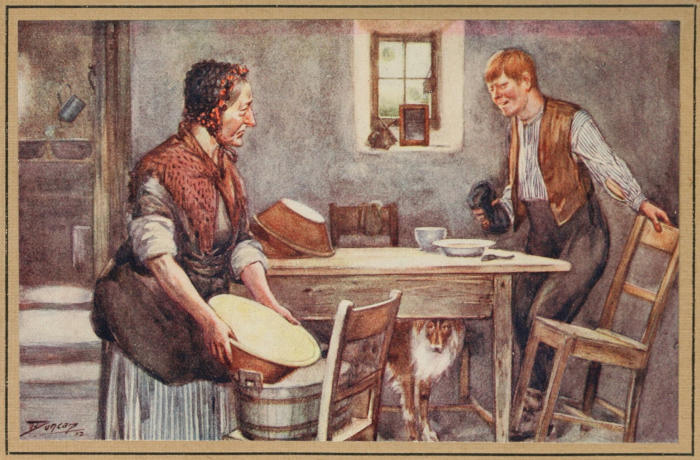
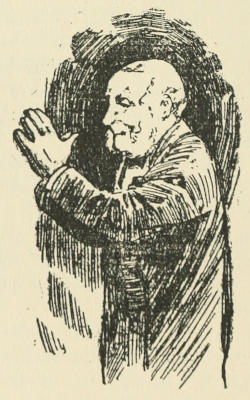
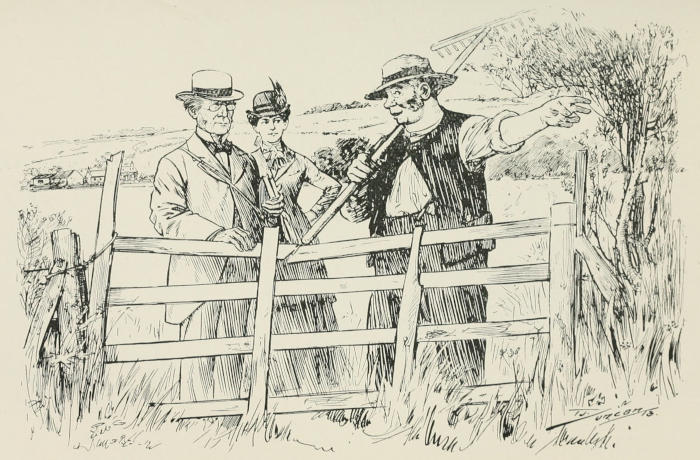
“Jock,” cried a farmer’s wife to her cowherd, “come awa’
in to your parritch, or the flees ’ill be droonin’ themsel’s in your
milk bowl.” “Nae fear o’ that,” was Jock’s roguish reply. “They’ll wade
through.” “Ye scoundrel,” cried the mistress, indignantly, “d’ye mean to
say that ye dinna get eneuch milk?” “Ou, ay,” said Jock, “I get plenty o’
milk for a’ the parritch.”—Page 35.
The colloquy was richly humorous, and at the
same time sublimely practical. The same may be
said of the following:—
During the time of the great Russian War a
countryman accepted the “Queen’s shilling,” and
very soon thereafter was sent to the front. But he
had scarcely time to have received his “baptism of
fire” when he turned his back on the scenes of
carnage, and immediately struck of in a bee line for
a distant haven of safety. A mounted officer, intercepting
his retreat, demanded to know where he was
going.
“Whaur am I gaun?” said he. “Hame, of course;
man, this is awfu’ walk; they’re just killin’ ane anither
ower there.”
A brother countryman took a different view of the
same, or a similar situation. Just before his regiment
entered into an engagement with the enemy, he was
heard to pray in these terms:—“O, Lord! dinna be on
oor side, and dinna be on the tither side, but just stand
ajee frae baith o’ us for an oor or twa, an’ ye’ll see the
toosiest fecht that ever was fochen.” What a fine,
rough hero was there!
Speaking of praying prior to entering into engagements,
recalls another good and equally representative
anecdote. It is told of two old Scottish matrons.
They were discussing current events.
“Eh, woman!” said one, “I see by the papers
that oor sodgers have been victorious again.”
“Ah, nae fear o’ oor sodgers,” replied the other.
“They’ll aye be victorious, for they aye pray afore they
engage wi’ the enemy.”
“But do you no think the French ’ill pray too?”
questioned the first speaker.
“The French pray!” sneered her friend. “Yatterin’
craturs! Wha wad ken what they said?”
What a charmingly innocent auld wife! Surely
it was this same matron who once upon a time
entered the village grocery and asked for a pound
of candles, at the same time laying down the price
at which the article in question had stood fixed for
some time.
“Anither bawbee, mistress,” said the grocer. “Cawnils
are up, on account o’ the war.”
“Eh, megstie me!” was the response. “An’ can
it be the case that they really fecht wi’ cawnil licht?”
A Scotch blacksmith, being asked the meaning of
metaphysics, explained as follows:—“Weel, Geordie,
ye see, it’s just like this. When the pairty that listens
disna ken what the pairty that speaks means, an’ when
the pairty that speaks disna ken what he means himsel’,
that’s metapheesics.” Many a lecture of an hour’s
length, I am thinking, has had no better results.
No anecdote can better illustrate the practical basis
of the Scotch mind than the following:—“John,”
said a minister to one of his congregation, “I hope
you hold family worship regularly.”
“Aye,” said John, “in the time o’ year o’t.”
“In the time o’ year o’t! What do you mean,
John?”
“Ye ken, sir, we canna see in the winter nichts.”
“But, John, can’t you buy candles?”
“Weel, I could,” replied John, “but in that case
I’m dootin’ the cost would owergang the profit.”
And practical in the management of their devotional
exercises, there is a practical side to the grief
of Scotch folk. “Dinna greet amang your parritch,
Geordie,” said one to another, “they’re thin eneuch
already.” And the story is told of an Aberdeenshire
woman who, when on the occasion of the death of
her husband the minister’s wife came to condole with
her, and said—“It is a great loss you have sustained,
Janet.”
She replied, “Deed is’t, my lady. An’ I’ve just
been sittin’ here greetin’ a’ day, an’ as sune as I get
this bowliefu’ o’ kail suppit I’m gaun to begin an’ greet
again.”
“You have had a sore affliction, Margaret,” said a
minister once to a Scotch matron in circumstances
similar to the heroine of the above story. “A sore
affliction indeed; but I hope you are not altogether
without consolation.”
“Na,” said Margaret, “an’ I’m no that, sir; for gin
He has ta’en awa’ the saul, it’s a great consolation for
me to think that He’s ta’en awa’ the stammick as
weel.”
Ah, poor body! No doubt she gave expression to a
thought that had for some time been having a prominent
place in her mind. As Tom Moore reminds us,
in the midst of a serious poem, “We must all dine,”
and if the bread-winner has been laid aside for a time,
the means of subsistence are sometimes difficult to
obtain, and when “supply” is wholly cut off, a decrease
in “demand” is sometimes not unwelcome.
A splendid instance of the matter-of-fact view of
things celestial frequently taken by the Scotch mind
is in that story which Dean Ramsay tells of the old
woman who was dying at Hawick. In this Border
seat of tweed manufacture the people wear wooden-soled
boots—clogs—which make a clanking noise on
the pavement. Several friends stood by the bedside
of the dying person, and one of them said to her—
“Weel, Jenny, ye’re deein’; but ye’ve done the
richt gaet here, an’ ye’ll gang to heaven; an’ when ye
gang there, should you see ony o’ oor fouk, ye micht
tell them that we’re a’ weel.”
“Ou,” said Jenny half-heartedly, “gin I see them
I’se tell them; but ye maunna expect that I’m to be
gaun clank, clankin’ about through heaven lookin’ for
your fouk.”
Of all the stories of this class, however, the following
death-bed conversation between a husband and wife
affords perhaps the very best specimen of the dry
humour peculiar to Scotch folk:—An old shoemaker
in Glasgow was sitting by the bedside of his wife,
who was dying. Taking her husband by the hand,
the old woman said, “Weel, John, we’re to pairt. I
hae been a gude wife to you, John.”
“Oh, middlin’, middlin’, Jenny,” said John, not
disposed to commit himself wholly.
“Ay, I’ve been a gude wife to you, John,” says she,
“an’ ye maun promise to bury me in the auld kirkyard
at Stra’von, beside my ain kith and kin, for I couldna
rest in peace among unoo fouk, in the dirt an’ smoke
o’ Gleska’.”
“Weel, weel, Jenny, my woman,” said John,
soothingly, “I’ll humour ye thus far. We’ll pit ye in
the Gorbals first, an’ gin ye dinna lie quiet there,
we’ll tak’ ye to Stra’von syne.”
And yet there is on record a retort of a Scotch
beadle, which is almost equally moving. Saunders
was a victim to chronic asthma, and one day, whilst
in the act of opening a grave, was seized with a violent
fit of coughing. The minister, towards whom Saunders
bore little affection, at the same time entering
the kirkyard, came up to the old man as he was
leaning over his spade wiping the tears from his
eyes, and said, “That’s a very bad cough you’ve got,
Saunders.”
“Ay, it’s no very gude,” was the dry response, “but
there’s a hantle fouk lyin’ round aboot ye that wud be
gey glad o’t.”
Speaking of beadles reminds me of another good
illustration of the “practicality,” if I may dare to
coin a word, of the Scottish mind. A country beadle
had had repeated cause to complain to his minister
of interference with his duties on the part of his
superannuated predecessor. Coming up to the minister
one day, “John’s been interfeerin’ again,” said
he, “an’ I’ve come to see what’s to be dune?”
“Well, I’m sorry to hear it,” said the minister,
“but as I have told you before, David, John’s a silly
body, and you should try, I think, some other means
of getting rid of his annoyance than by openly resisting
him. Why not follow the Scriptural injunction given
for our guidance in such cases, and heap coals of fire
on your enemy’s head.”
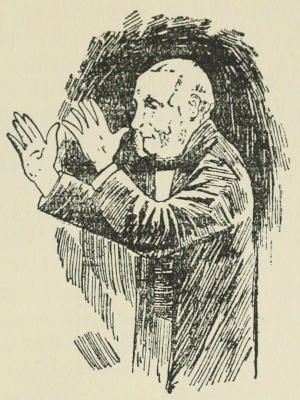
“Dod, sir, that’s the very thing,” cried David,
taking the minister literally, and grinning and rubbing
his hands with glee at the prospect of an early
and effectual settlement of the long-standing feud.
“Capital, minister; that’ll sort him; dod, ay—heap
lowin’ coals on his head, and burn the wratch!”
We are proverbially a cautious people. “The
canny Scot” is a world-wide term; but the Paisley
man who described Niagara Falls as “naething but a
perfect waste o’ water,” was canny to a fault. And
yet the Moffat man—his more inspiring native surroundings
notwithstanding—was scarcely more visibly
impressed by the same scene. “Did you ever see
anything so grand?” demanded his friend who had
taken him to see the mighty cataract.
“Weel,” said the Moffat man, “as for grand, I maybe
never saw onything better; but for queer, man, d’ye
ken, I ance saw a peacock wi’ a wooden leg.”
How naturally the one thing would suggest the
other will not readily appear to most folks.
He was more of a true Scot who, when the schoolmaster
in passing along one day said to him, “I see
you are to have a poor crop of potatoes this year,
Thomas,” replied—
“Ay, but there’s some consolation, sir; John Tamson’s
are no a bit better.”
“Hame’s aye hamely,”—some homes are more so
than others. The “Paisley bodies” have some reason
for being proud of their native burgh, as they are.
I have heard of one who was on a visit to Edinburgh
many years ago, and during his brief stay there was
discovered by one of the city guides lying on his
face on the Calton Hill, apparently asleep. The
summer sun was scorching the back of his uncovered
head, and the guide thought it his duty to
rouse him up.
“I’m no sleepin’,” responded the Paisley man, to
the touch of the guide’s staff, “I’m just lyin’ here
thinkin’;” then turning himself round and looking
up, “Ay, freend,” continued he, “I was just lyin’
thinkin’ aboot Paisley.”
“Well,” responded the guide, “I don’t see why any
thought of Paisley should enter your head while you
can feast your eyes on fair ‘Edina, Scotia’s darling
Seat,’ as the Poet Burns has called our city here.”
“Maybe ay, an’ maybe no, freend; but it’s no easy
gettin’ the thocht o’ Paisley oot o’ a Paisley man’s
head, even although he is in the middle o’ Edinburgh.
Up in yer braw college there, the maist distinguished
professor in it is John Wilson, a Paisley man. In
St. George’s kirk, ower there, yer precentor, R. A.
Smith—an’ there’s no his marrow again in a’ Scotland—is
a Paisley man. In the jail ower by fornent us
there’s mair than a’e Paisley callan’ the noo. Syne,
ye see the Register House doon there, weel, the
woman that sweeps out the passages—an’ my ain
kissen to boot—is a Paisley woman. An’ so ye see,
freend, although ane’s in Edinburgh it’s no sae easy
gettin’ thochts o’ Paisley kept oot o’ his head.”
The next illustration is also truly Scotch. Two
Lowland crofters lived within a few hundred yards of
each other. One of them, Duncan by name, being
the possessor of “Willison’s Works,” a rarity in the
district, his neighbour, Donald, sent his boy one day
to ask Duncan to favour him with a reading of the
book. “Tell your father,” said Duncan, “that I
canna lend oot my book, but he may come to my
hoose and read it there as lang as he likes.” Country
folk deal all more or less in “giff-gaff,” and in a few
days after, Duncan, having to go to the market, and
being minus a saddle, sent his boy to ask Donald to
give him the loan of his saddle for the occasion.
“Tell your father,” said Donald, “that I canna lend
oot my saddle; but it’s in the barn, an’ he can come
there an’ ride on it a’ day if he likes.”
The cannyness characteristic of our countrymen,
sometimes as a matter of course, is found manifesting
itself in ways which, to say the least of them, are
peculiar, as witness: A Forfar cobbler, described
briefly as “a notorious offender,” was not very long
ago brought up before the local magistrate, and being
found guilty as libelled, was sentenced to pay a fine
of half-a-crown, or endure twenty-four hours’ imprisonment.
If he chose the latter, he would, in accordance
with the police arrangements of the district,
be taken to the jail at Perth. Having his option,
the cobbler communed with himself. “I’ll go to
Perth,” said he; “I’ve business in the toon at ony
rate.” An official forthwith conveyed him by train
to the “Fair City”; but when the prisoner reached
the jail he said he would now pay the fine. The
Governor looked surprised, but found he would have
to take it. “And now,” said the canny cobbler, “I
want my fare hame.” The Governor demurred, made
inquiries, and discovered that there was no alternative;
the prisoner must be sent at the public expense to the
place where he had been brought from. So the crafty
son of St. Crispin got the 2s. 8½d., which represented
his railway fare, transacted his business, and went
home triumphant, 2½d. and a railway journey the
better for his offence.
Our next specimen is cousin-german to the above.
It is of two elderly Scotch ladies—“twa auld maids,”
to use a more homely phrase—who, on a certain Sunday
not very long ago, set out to attend divine service
in the Auld Kirk, and discovered on the way thither
that they had left home without the usual small
subscription for the “plate.” They resolved not to
return for the money, but to ask a loan of the necessary
amount from a friend whose door they would pass
on the way. The friend was delighted to be able to
oblige them, and, producing her purse, spread out on
the table a number of coins of various values—halfpennies,
pennies, threepenny, and sixpenny pieces.
The ladies immediately selected a halfpenny each and
went away. Later in the course of the same day they
appeared to their friend again, and said they had
come to repay the loan.
“Toots, havers,” exclaimed old Janet, “ye needna
hae been in sic a hurry wi’ the bits o’ coppers; I could
hae gotten them frae you at ony time.”
“Ou, but,” said the thrifty pair, in subdued and
confidential tones, “it was nae trouble ava’, for there
was naebody stannin’ at the plate, so we just slippit
in an’ saved the bawbees.”
Now that is just the sort of anecdote which an
Englishman delights to commit to memory and retail
in mixed companies of his Scotch and English friends;
and, lest he may have heard that one already—may
have worn it threadbare, indeed—I will tell another
which, if not quite so good, has the advantage of
being not so well known. A Scotchman was once
advised to take shower baths. A friend explained
to him how to fit up one by the use of a cistern and
colander, and Sandy accordingly set to work and had
the thing done at once. Subsequently he was met
by the friend who had given him the advice, and,
being asked how he enjoyed the bath—
“Man,” said he, “it was fine. I liked it rale weel,
and kept mysel’ quite dry, too.”
Being asked how he managed to take the shower
and yet remain quite dry, he replied—
“Dod, ye dinna surely think I was sae daft as
stand ablow the water without an umbrella.”
That’s truly Scotch. So is the next specimen, as
you will presently perceive. Two or three nights
before the advent of a recent Christmas, a Scotch
laddie of ten years old, or so, was sitting examining
very gravely a somewhat ugly hole in the heel of one
of his stockings. At length he looked towards his
mother and said—
“Mither, ye micht gie me a pair o’ new
stockin’s?”
“So I will, laddie, by and by; but ye’re no sair
needin’ new anes yet,” said his mother.
“Will I get them this week?”
“What mak’s ye sae anxious to hae them this
week?”
“Because, if Santa Claus pits onything into thir
anes it’ll fa’ oot.”
How naturally a Scotsman drops into poetry, too,
will be seen from the following:—
Mr. Dewar, a shopkeeper in Edinburgh, being in
want of silver for a bank note, went into the shop of
a neighbour of the name of Scott, whom he thus
addressed—
“I say, Master Scott,
Can you change me a note?”
Mr. Scott’s reply was—
“I’m no very sure, but I’ll see.”
Then going into the back-room, he immediately returned
and added—
“Indeed, Mr. Dewar,
It’s out o’ my power,
For my wife’s awa’ wi’ the key.”
It is by furnishing him with choice and representative
examples that one can best convey to a stranger
a knowledge of the characteristics of our national
humour. So much of it depends often on the quaintness
of the Scottish idiom, that it defies explanation,
and must be seen, or better still, be heard, to be
understood. This course I have pursued in the present
paper; and the examples deduced, I think, fairly
demonstrate the strong substratum of practical common-sense
which underlies, and yet manifests itself
in, the lighter elements of the Scottish character,
frequently making humour where pathos was meant
to be. Take a few more:—
The wife of a small farmer in Perthshire some time
ago went to a chemist’s in the “Fair City” with two
prescriptions—one for her husband, the other for her
cow. Finding she had not enough of money to pay
for both, the chemist asked her which she would take.
“Gie me the stuff for the coo,” said she; “the morn
will do weel eneuch for him, puir body. Gin he were
to dee I could sune get another man, but I’m no sure
that I could sae sune get anither coo.”
The late Rev. Dr. Begg, was wont to tell of a Scotch
woman to whom a neighbour said, “Effie, I wonder
hoo ye can sleep wi’ sae muckle debt on your heid;”
to which Effie quietly answered, “I can sleep fu’ weel;
but I wonder hoo they can sleep that trust me.”
“Are you a native of this parish?” asked a sheriff
of a witness who was summoned to testify in a case
of distilling.
“Maistly, yer honour,” was the reply.
“I mean, were you born in this parish?”
“No, yer honour, I wisna born in this parish; but
I’m maistly a native for a’ that.”
“You came here when you were a child I suppose,
you mean?” said the sheriff.
“No, sir; I’m here just aboot sax year noo.”
“Then how do you come to be mostly a native of
the parish?”
“Weel, ye see, when I cam here, sax year syne, I
just weighed eight stane, an’ I’m fully seventeen stane
noo; so, ye see, that aboot nine stane o’ me belangs
to this parish, an’ I maun be maistly a native o’t.”
Not very long ago a countryman got married, and
soon after invited a friend to his house and introduced
him to his new wife, who, by the by, was a person of
remarkably plain appearance. “What do you think
o’ her John?” he asked his friend, when the good
lady had retired from the room for a little. “She’s
no’ very bonnie!” was the candid and discomforting
reply. “That’s true,” said the husband; “she’s no
muckle to look at, but she’s a rale gude-hearted
woman. Positeevly ugly outside, but a’ that’s lovely
inside.” “Lord, man, Tam,” said the friend gravely,
“it’s a peety ye couldna flype her!”
At a feeing market in Perth a boy was waiting to
be hired, when a farmer, who wanted such a servant,
accosted him, and after some conversation, enquired
if he had a written character. The lad replied that
he had, but it was at home. “Bring it with you
next Friday,” said the farmer, “and meet me here at
two o’clock.” When the parties met again, “Weel,
my man,” said the farmer, “ha’e ye got your character?”
“Na,” was the reply, “but I’ve gotten
yours, an’ I’m no comin’!”
“There’s anither row up at the Soutars’,” said
Willie Wilson, as he shook the rain from his plaid
and took his accustomed seat by the inn parlour fire.
“I heard them at it as I cam’ by just noo.”
“Ay, ay; there’s aye some fun gaun’ on at the
Soutars’,” said another of the company, with a laugh.
“Fun? I shouldn’t think there’s much fun in those
disgraceful family disturbances,” said the schoolmaster.
“Aweel, it’s no’ so vera bad, after a’,” said the
other, who had his share of matrimonial strife. “Ye
see, when the wife gets in her tantrums she aye
throws a plate or brush, or maybe twa or three, at
Sandy’s head. Gin she hits him she’s gled, and gin
she misses him he’s gled; so, ye see, there’s aye some
pleasure to a’e side or the ither.”
The Laird of Balnamoon, riding past a high, steep
bank, stopped opposite a hole in it, and said, “John,
I saw a brock gang in there.”
“Did ye?” said John; “will ye haud my horse,
sir?”
“Certainly,” said the Laird, and away rushed John
for a spade.
After digging for half an hour, he came back nigh
speechless to the Laird, who had regarded him
musingly.
“I canna find him, sir,” said John.
“Deed,” said the Laird, very coolly, “I wad hae
wondered if ye had, for it’s ten years an’ mair sin’ I
saw him gang in.”
On one occasion, when the gallant Highlanders
were stationed at Gibraltar, Sandy Macnab was sergeant
of the guard, and in due course of duty had
sent his corporal to make the last relief before four
o’clock in the morning. Whilst proceeding to one of
the outlying posts the corporal missed his footing, fell
over the cliff, and was killed. Meantime Sergeant
Macnab had been filling up the usual guard report,
preparatory to dismounting. Now, at the foot of
the form on which such reports are made out there
is a printed inquiry—“Anything extraordinary
occurred since mounting guard?”
Macnab, unaware of the accident to his corporal,
filled the query space up with the word “Nil,” and,
having no spare copy of the form, sent this in to the
orderly-room to take its chance. When the Colonel
and Adjutant attended in the orderly-room at ten
o’clock, learned of the mishap, and read Macnab’s
report, the latter was peremptorily ordered to appear
before them.
“Macnab,” cried the Colonel, in a rage, “what the
devil do you mean by filling up your guard report in
this way? You say ‘Nothing extraordinary occurred
since mounting guard,’ and yet your poor comrade
fell over the cliff and was killed.”
Sandy, finding himself in a fix, pulled himself
together, and after a moment or two of deliberation
answered, coolly, “Weel, sir, I dinna see onything
very extraordinar’ in that. It would hae been something
very extraordinar’ if he hadna been killed; he
fell fowr hunder feet!”
In Mr. Barrie’s Little Minister, a discussion takes
place in the village Parliament as to whether it is
possible for a woman to refuse to marry a minister.
“I once,” said Snecky Hobart, “knew a widow who
did. His name was Samson, and if it had been Tamson
she would hae ta’en him. Ay, you may look,
but it’s true. Her name was Turnbull, and she had
another gent after her, named Tibbets. She couldna
make up her mind atween them, and for a while she
just keeped them dangling on. Ay, but in the end
she took Tibbets. And what, think you, was her
reason? As you ken, thae grand folk hae their initials
on their spoons and nichtgowns. Ay, weel, she thocht
it would be mair handy to take Tibbets, because if
she had ta’en the minister, the T’s would have to be
changed to S’s. It was thochtfu’ o’ her.”
Our next two specimens show how waggish the
Scotch can be.
A farmer, returning from a Northern tryst, accompanied
by his servant Pate, not many years ago,
halted for refreshment at the Inn of Glamis, where,
meeting with a number of friends, a jolly party was
soon formed. Under the cheering hospitality of the
gude wife of the inn they cracked their jokes and told
their tales, till at length the farmer proposed that
his attendant, Pate, should enliven the meeting with
a song. One of the party, who professed to have an
estimate of the shepherd’s vocal abilities, sneeringly
replied, “Whaur can Pate sing?”
“What d’ye say?” answered the farmer. “Can
Pate no sing? I’m thinkin’ he’s sung to as good fouk,
an’ better than you, in his time. I’ll tell ye o’ a’e
place whaur he has been kent to sing wi’ mair honour
to himsel’ than ye can brag o’, and that’s before the
Queen. Ay, an’ if it will heighten him ony in your
estimation, I’ll prove to you, for the wager o’a bottle
o’ brandy, that he even sleepit, an’ that no’ sae lang
syne, in the same hoose she was in.”
Thinking this latter assertion outstretched the
limits of all probability, the wager was immediately
taken by the party, when, to the satisfaction of all
the others present, the worthy farmer proved the
truth of his allegations by telling how, accompanied
by Pate, he had been to the Kirk of Crathie on the
Sunday previous, and that during the service, and in
presence of Her Royal Majesty, Pate had both sung
and slept. The farmer won the wager, and the bottle
circulated, amid continued outbursts of stentorian
laughter.
A worthy laird in a Perthshire village made the,
for him, wonderful journey to see the great Exhibition
of 1851. On his return, his banker, a man who
was well known to have the idea that he was by far
the most influential and potent power in the shire,
invited the laird, with some cronies, to a glass of
punch. The banker meant to amuse the company
at the old laird’s expense, to trot him out, and get
him to describe the sights of London. “An’ what,
laird, most of all impressed you at the great glass
house?” asked the banker, with a sly wink at the
company. “Ah, weel, sir,” replied the laird, as he
emptied his glass, “I was muckle impressed wi’ a’ I
saw—muckle impressed! But the thing abune a’ that
impressed me maist was my ain insignificance. Losh,
banker, I wad strongly advise you to gang; it would
do you a vast amount o’ guid, sir!”
The next example affords the promise of an abundant
harvest of humour off the rising generation of
Scotsmen.
A little boy, whom we shall call Johnnie, just because
that is his name, was not very long since
employed as message-boy to a grocer in a small
country town in the west, said grocer being an ardent
advocate and supporter of the Conservative party in
the State. One morning Johnnie was an hour or so
late in turning out for duty, and on entering was
promptly interrogated by his master as to the cause.
“The cat’s had kittlins this mornin’,” asseverated
the lad, assuming a look of great earnestness; “four
o’ them, an’ they’re a’ Conservatives.”[1]
[1] By the simple transposition of the words “Conservatives”
and “Leeberals” the politics of this story may be adapted to
suit any select company or association of individuals in these
realms, as by the same practice I have seen it made to serve
the interests of various Liberal and Conservative newspapers
since I first printed it in the People’s Journal some years ago.
“Get in bye and tidy up that back shop,” said the
shopkeeper gruffly, not at the moment in a mood to
enquire fully into the extraordinary feline phenomenon.
One day, nearly a fortnight afterwards, the
following sequel added itself, however, and there was
a perfect understanding established. A commercial
traveller, who is also a true-blue Tory, called at the
shop, and was discussing with the grocer the chances
of victory or failure to their party in an approaching
bye-election. Said the grocer, “Our party is gaining
strength in the country, of that I am convinced, and
with reason; why, my message-boy was telling me
recently that his mother’s cat has had kittens—four
of them—and they are all Conservatives.” The
traveller laughed, as only travellers who are anticipating
an order can laugh. When Johnnie entered
the premises with his basket on his arm and a tune
in his mouth.
“Hillo, Johnnie!” exclaimed the commercial,
“and so your cat has had kittens, has she? Eh?”
“Ay,” replied Johnnie, “four o’ them.”
“And all Conservatives, too, I believe?” remarked
the traveller.
“Na,” said Johnnie: “they’re Leeberals.”
“Liberals! you told me a fortnight ago they were
Conservatives,” interposed the master.
“Ou, ay; of course,” returned Johnnie, with the
utmost gravity. “They were Conservatives yon
time, but they’re seein’ noo!”
Just one more here. There is a cobbler in a little
town in the North—a worthy old soul, as it would
appear, whose custom has been for many years to
hammer and whistle from morn to night in his little
shop, and to discharge both functions so lustily as to
be easily heard by the passers-by in the street. One
day not long since the minister, happening to pass,
missed the whistling accompaniment to the measured
click on the lapstone, and looked in to ascertain the
cause. “Is all well with you, Saunders?” he asked.
“Na, na, sir; it’s far frae bein’ a’ weel wi’ me. The
sweep’s gane an’ ta’en the shop ower my head.”
“Oh, that’s bad news, indeed,” responded the
minister, “but I think you might see your way
out of the difficulty soon if, as I always urge in
cases of emergency, you would make the matter a
subject of earnest prayer.” Saunders promised to
do this, and the preacher departed. In less than
a week he returned, and found the old cobbler
hammering and whistling away in his old familiar
“might and main” fashion. “Well, Saunders,
how is it now?” “Oh, it’s a’ richt, minister,”
was the reply. “I did as ye tell’d me, an’—the
sweep’s deid.”
CHAPTER III HUMOUR OF OLD SCOTCH DIVINES
The late Lord Neaves, himself a man of a genial,
humorous nature, was wont to complain pleasantly
of his friend Dean Ramsay for having drawn
so many specimens of Scottish humour from the
sayings and doings of the native clergy. But the
worthy Dean, to employ a figure of his own recording,
simply “biggit’s dyke wi’ the feal at fit o’t;” in
other words, he gathered most grain from the field
which had produced the most abundant crop—the
field of clerical life and work. Your typical pastor,
it is true, has not to any extent been remarkable as
a humourist—the reverse may with more truth be
said of him. At the same time the Scottish pulpit
has contained many earnest, good men, who were
also genuine humourists. Yea, than the good old
Scotch divines, certainly no other class or section of
the community has laid up to its credit so many
witty and humorous sayings that are destined to live
with the language in which they are uttered. Every
parish in the land has stories to tell of such pastors.
It is only necessary to mention such prominent
names as the Revs. Robert Shirra, of Kirkcaldy;
Walter Dunlop, of Dumfries; John Skinner, of
Longside, the author of “Tullochgorum”; Mr. Thom,
of Govan; and the late Drs. Norman Macleod and
William Anderson, of Glasgow, to suggest many
other bright and shining lights. There have been
many ministers of the Gospel, of course, who, not
at all witty themselves, yet, by reason of certain
idiosyncrasies of nature and eccentricities of character,
have been the cause of wit in others. These,
however, do not come within the scope of the present
paper. Here we shall deal not with negative but
with positive clerical humorists only.
Much of the old clerical humour of Scotland came
direct from the pulpit, and was part and parcel of
the pastoral matter and method of the time. The
preaching of to-day gives but the faintest idea of the
preaching of a hundred years ago. The sermon of
the old divine was very much in the style of an easy
conversation, interspersed with occasional parentheses
applicable to individual characters or to the circumstances
which arose before his eyes in church.
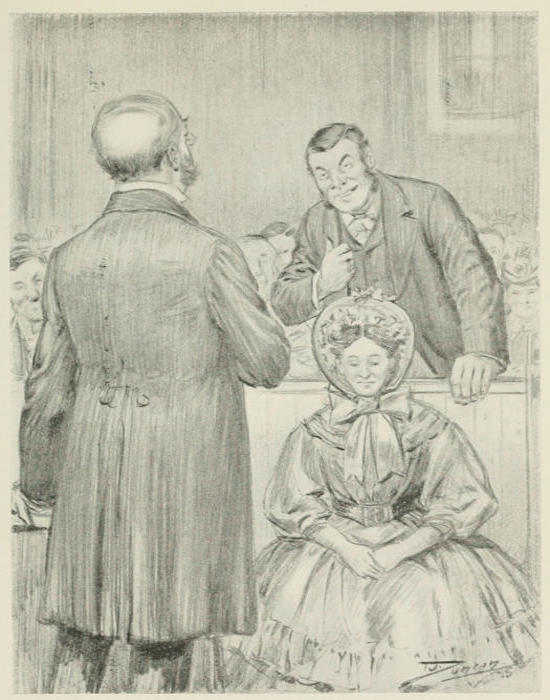
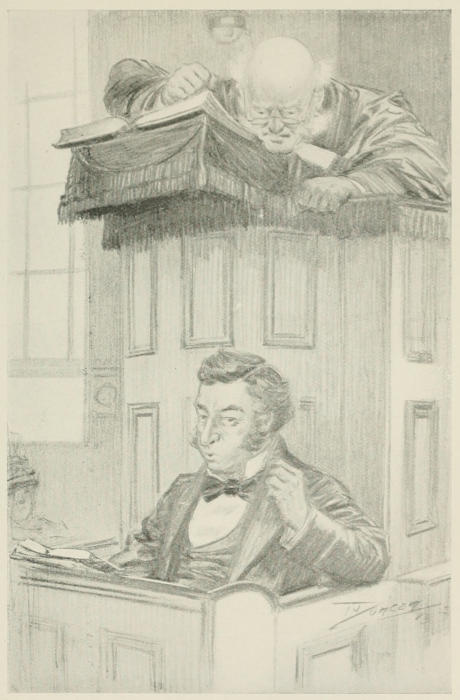
Dean Ramsay, in his faithful Reminiscences, tells
of a clergyman who, observing one of his flock
asleep during his sermon, paused, and called him to
order, thus—“Jeems Robson, ye are sleepin’. I
insist on your wauking when God’s word is preached
to ye.”
“Look at your ain seat and ye’ll see a sleeper
forby me,” answered Jeems, pointing to the clergyman’s
lady in the minister’s pew.
“Then, Jeems,” said the minister, “when ye see
my wife asleep again haud up your hand.”
By and by the arm was stretched out, and sure
enough the fair lady was caught in the act. Her
husband solemnly called upon her to stand up and
receive the censure due to her offence, and thus
addressed her—“Mrs. B., a’body kens that when I
got ye for my wife I got nae beauty; yer freens ken
I got nae siller; and, if I didna get God’s grace, I
hae gotten a puir bargain indeed.”
It is fortunate for some folks, both you and I
know, my reader, that Church discipline is not so
rigorously enforced nowadays.
Mr. Shirra, of Kirkcaldy, distinguished for his
homely and remarkable sayings, both in the pulpit
and abroad, was greatly given to personal reproof in
the course of divine service, and had a happy knack
of sometimes killing two birds with one stone. One
day, observing a young girl with a large and rather
gaudy new bonnet, with which she herself seemed
immoderately pleased, and also noticing or suspecting
that his wife was indulging in a quiet nap, he paused
in the middle of his sermon and said—“Look ony o’
ye there if my wife be sleepin’, for I canna see her
for thae fine falderals on Jenny Bain’s new bonnet.”
One day a weaver entered Shirra’s kirk dressed in
the new uniform then procured for the volunteers,
just raised. He kept walking about for a time as if
looking for a seat, but really to show off his finery,
which he perceived was attracting the attention of
some of the less grave members of the congregation.
He came to his place, however, rather quickly on
Shirra quietly remarking, “Just sit down there, my
man, and we’ll a’ see your new breeks when the kirk
skails.”
This same Shirra was addicted to parenthetical
remarks when reading the Scriptures, and one day,
when reading from the 116th Psalm, “I said in my
haste, all men are liars,” he quietly remarked—“Indeed,
Dauvid, gin ye had lived in this parish ye
might hae said it at your leisure.”
This, good as it is, was almost equalled by the
remarks of an Edinburgh minister. The Rev. Mr.
Scott, of the Cowgate, was a man of some popularity,
but was seldom on good terms with his flock. One
day, as he was preaching on Job, he said—“My
brethren, Job, in the first place, was a sairly tried
man; Job, in the second place, was an uncommonly
patient man; Job, in the third place, never preached
in the Cowgate; fourthly, and lastly, if Job had
preached here, gude help his patience.”
The Rev. James Oliphant, of Dumbarton, was
especially quaint in the pulpit. In reading the
Scriptures, his habit was to make parenthetical
comments in undertones. On this account the
seats in nearest proximity to the pulpit were
always best filled. Reading, one day, the passage
which describes the possessed swine running into
the deep and being there choked, he was heard to
mutter, “Oh, that the deevil had been chockit too.”
Again, in the passage as to Peter exclaiming, “We
have left all and followed Thee,” the remark was,
“Aye boasting, Peter, aye bragging; what had ye
to leave but an auld, crazy boat, and maybe twa
or three rotten nets?” There was considerable
ingenuity in the mode by which Mr. Oliphant
sought to establish the absolute wickedness of the
devil. “From the word devil,” said Mr. Oliphant,
“which means an enemy, take the d and you have
evil; remove the e and you have vil (vile); take
away the v and it is ill; and so you see, my brethren,
he’s just an ill, vile, evil devil!”
A late minister of Crossmichael, in Galloway, did
not disdain to illustrate his subjects with such images
and allusions as were within the comprehension of
his homely hearers. Accordingly, one Sabbath
morning, he read a verse from the book of Exodus,
as follows—“And the Lord said unto Moses—shut
that door; I’m thinkin’ if ye had to sit beside the
door yersel’ ye wadna be sae ready leavin’ it open;
it was just beside that door that Yedam Tamson,
the bellman, gat his death o’ cauld, an’ I’m sure,
honest man, he didna let it stey muckle open.—And
the Lord said unto Moses—put oot that dog;
wha is’t that brings dogs to the kirk, yaff-yaffin’?
Lat me never see ye bring yer dogs here ony mair,
or I’ll put you an’ them baith oot.—And the Lord
said unto Moses—I see a man aneath that wast laft
wi’ his hat on; I’m sure ye’re clean oot o’ the souch
o’ the door; keep aff yer bonnet, Tammas, an’ if yer
bare pow be cauld, ye maun jist get a grey worset
wig like mysel’; they’re no sae dear; plenty o’ them
at Bob Gillespie’s for tenpence.” This said, he again
began the verse, and at last made out the instructions
to Moses in a manner more strictly in accordance
with the text and with decency.
Another, remarkable for the simplicity and force
of his style, was discoursing from the text, “Except
ye repent ye shall all likewise perish,” and in order
to impress upon his hearers the importance of
attending to the solemn truth conveyed in the
passage—“Yes, my freens,” he emphatically exclaimed,
“unless ye repent ye shall all perish, just
as surely as I’m gaun to ding the guts oot o’ that
muckle blue flee that’s lichtit on my Bible.” Before
the blow was struck the fly got away, upon which he
struck the book with all his might and exclaimed at
the top of his voice, “My freens, there’s a chance for
ye yet!”
Dr. Paul, in his Past and Present of Aberdeenshire,
tells of a minister who, while preaching on the subject
of the wiles and crafts of Satan, suddenly paused,
and then exclaimed—“See him sittin’ there in the
crap o’ the wa’. What shall we do wi’ him, my
brethren? He winna hang, for he’s licht as a feather;
neither will he droon, my brethren, for he can soom
like a cork; but we’ll shoot him wi’ the gun o’ the
Gospel.” Then putting himself in the position of
one aiming at an object, and imitating the noise of
a shot, the minister called out exultingly, “He’s
doon like a dead craw!”
This incident would have greatly delighted the
man who thus described the kind of minister he was
in search of—“Nane o’ your guid-warks men, or
preachers o’ cauld morality for me! Gie me a
speerit-rousin’ preacher that’ll haud the deil under
the noses of the congregation and mak’ their flesh
creep!”
It is related of a certain divine, whose matrimonial
relations are supposed not to have been of the most
agreeable kind, that one Sabbath morning, while
reading to his congregation the parable of the
Supper, in which occurs the passage—“And another
said, I have bought five yoke of oxen, and I go to
prove them; I pray thee have me excused. And
another said, I have married a wife, and therefore
cannot come,” he suddenly paused at the end of this
verse, drew off his spectacles, and, looking on his
hearers, said with emphasis—“The fact is, my
brethren, one woman can draw a man farther away
from the kingdom of heaven than fifty yoke of oxen.”
They were hard nuts to crack, many of these old
preachers.
A late Earl of Airlie, when Lord High Commissioner,
had the retiring Moderator to dinner with
him on the evening previous to the opening of the
General Assembly. In a spirit of mischief, the Earl
tried to unfit him for his duties on the following
day. As often as the reverend gentleman would
endeavour to retire, the Earl met him with the
exclamation, “Another glass, and then!” In spite
of his late potations, the minister was in his place on
the following day, and preached from the words,
“The wicked shall be punished, and that right
early.” Notwithstanding the manifest impatience
of the Commissioner, the sermon was spun out to
an inordinate length, the minister repeating with
meaning emphasis each time that the sand glass
which showed the half-hours was turned, “Another
glass, and then! The wicked shall be punished, and
that right early.”
A certain divine—or perhaps we should say an
un-certain divine—preaching a sermon from the
parable of the prodigal son, took as his text the
words, “And when he came to himself,” and gave a
reading of the passage at once unique and original.
“We have here, brethren,” said he, “an instance of
the wonderful depth of meaning there is in Scripture.
We see how low this unprincipled young man had
fallen. ‘When he came to himself’—what does it
mean? Well, look at home. What do we do when
our money’s gone and we’ve no credit? What do
we turn to? The pawnshop. So did he. First,
his coat would go; he might live a week on that.
Then his waistcoat; that wouldn’t serve him long.
Lastly, his shirt would follow; and then—ah, then,
my friends, he came to himself! He couldn’t pawn
himself, and so he went home to his father.”
The older style of preaching was often wonderfully
graphic as well as amusing. Preaching from that
text in Ecclesiastes—“Dead flies cause the ointment
of the apothecary to send forth a stinking savour;
so doth a little folly him that is in reputation for
wisdom and honour,” a north country divine illustrated
his subject by this example:—“See John at
the kirk, an’ he looks amon’ folk like a man o’ mense;
but follow him to the peat-moss, an’ ye’ll hear him
tellin’ coorse stories to the loons an’ queans, haudin’
them lauchin’ at sin. There’s a dead flee in John’s
sowl.” Sometimes, in his endeavour to give a vivid
description, this same preacher became delightfully
grotesque. Referring to Jonah—“The whawl,” he
said, “shoutherin’ awa’ the waves, got at last geyan
near the shore, and cried Byock-up. But Jonah
didna come. Then the whawl cried [speaking it
louder, and imitating the whale retching], Byock-up!
But na! Jonah aye stack. Then the whawl cried
[speaking it very loud and slow], Byock-up! Noo,
sirs, divna ye see Jonah rinnin’, dreepin’, up the
beach.” Once he described the progress of a sinner
in a course of vice to the last stage of his hopelessness,
when there is nothing left for him but a cry of
pain—“Sirs, oot owre yon knowe there’s a sheepie
tether’t, an’ in o’ reach o’ its tether there’s a breem
buss [broom bush], an’ it gangs roond the buss, an’
roond the buss, till it’s hankit at the head, an’ then,
what does it dee? It cries, Bae! That’s just the
sinner cryin’ oot in its meesery.” In the same
sermon, looking down upon the old women who sat
near the pulpit and on the pulpit stair for the
purpose of better hearing, in their clean white
mutches, he said—“Here ye’re a’ sittin’, wi’ yer
auld wither’t faces, that’s bonnier to me than a lass
in her teens, for I ken ye hae seen sixty or seventy
years, ilka ane o’ ye, an’ yer auld faces just say to
me, ‘We hae served our Maister threescore years
thegither, an’ we’re no tired servin’ Him yet.’” It
does not surprise one to be told that this reference
to the old women put them in a state of visible
emotion.
The quaint homeliness thus manifested in the
lesson and in the sermon found a place now and
again in the prayers; and a west country divine, in
the course of a wet harvest, in praying for more
suitable weather, expressed himself thus:—“O Lord,
gie us nae mair watter for a season, but wind—plenty
o’ wind, an’ yet, O Lord, nane o’ yer rantin’,
tantin’, tearin’ winds, but an oughin’, soughin’,
winnin’ wind.”
Another, similarly circumstanced, prayed “that
the floodgates of heaven might be shut for a season.”
This was towards the close of a protracted period of
rain and storm, and the weather had never been
worse than on this particular Sabbath. And, just as
the good man persisted in his petition, a fierce gust
of wind bore the roof-window of the church down
with a crash, which was succeeded by a terrific
clatter of broken glass. “Oh,” he exclaimed,
assuming an attitude of despair, “O Lord, this is
perfectly ridiculous!”
He was more of a philosopher who, when his good
lady told him that he did not insist enough when
praying for a change of weather, replied, “Nae use
o’ insistin’, Marget, until the change o’ the mune.”
The pastor of a small congregation of Dissenters
in the West of Scotland, who, in prayer, often
employed terms of familiarity towards the Great
Being whom he invoked, was praying one day that
such weather would be granted as was necessary for
the ripening and gathering in of the fruits of the
earth, when, pausing suddenly, he added in a lower
tone of voice—“But what needs I talk! When I
was up at the Shotts the other day, everything was
as green as leeks!”
The Rev. Dr. Young, of Perth, used to be annoyed
by a couple coming to church, sitting away in the
gallery, “ssh-ssh” as they talked in lovers’ language
all through the service. He could stand it no
longer, so one Sunday he stopped in the middle of
his sermon, looked up to the gallery, and said, “If
that couple in the right hand gallery there will
come to me on Monday I will marry them for
nothing, if they will stop that ‘ssh-ssh’!”
The Rev. John Ross, of Blairgowrie, indulged a
propensity for versifying in his pulpit announcements,
and one day, at the close of the service,
intimated that
“The Milton, the Hilton, Rochabie, and Tammamoon,
Will a’ be examined on Thursday afternoon.”
And now we are induced to follow our subject out
of the pulpit and into the wider sphere of pastoral
life. It was here more particularly that the pungent
and ready wit of the famous Watty Dunlop got full
reign and enjoyed free play. The best known
anecdote of this worthy relates to an occasion when
he happened to be accompanying a funeral through
a straggling village in the parish of Caerlaverock.
Entering at one end of the hamlet he met a man
driving a flock of geese. The wayward disposition
of the feathered bipeds at the moment was too much
for the driver’s temper, and he indignantly cried out,
“Deevil choke ye!” Mr. Dunlop walked a little
further on, and passed a farm-stead where a servant
was driving a number of swine, and banning them
with “Deevil tak’ ye!” Upon which Mr. Dunlop
stepped up to him, and said, “Ay, ay, my man,
yer gentleman’ll be wi’ ye i’ the noo; he’s just
back the road there a bit chokin’ some geese till
a man.”
Than Mr. Dunlop few ministers were more esteemed
by their congregations as faithful and affectionate
pastors, and so much respected by all denominations.
And no doubt his freedom of speech and frankness
of manner were important factors in bringing about
this happy result. Here we have a capital example
of his free and easy manner. While pursuing his
pastoral visitations among some of the country
members of his flock, he came one evening to a
farmhouse where he was expected; and the mistress,
thinking that he would be in need of refreshment,
proposed that he should take his tea before engaging
in exercise, and said she would soon have it ready.
Mr. Dunlop’s reply was, “I aye tak’ my tea better
when my wark’s dune. I’ll just be gaun on. Ye
can hing the pan on, an’ lea the door ajee, an’ I’ll
draw to a close when I hear the ham fizzlin’.”
With the frankness so characteristic of him, this
divine did not hesitate occasionally to intimate how
agreeable certain presents would be to himself and
his better-half. Accordingly, on a further “visitation”
occasion, and while at a “denner-tea,” as he
called it, at the close of a hard day’s labour, he kept
incessantly praising the ham, and stated that Mrs.
Dunlop at home was as fond of ham as he was. His
hostess took the hint, and kindly offered to send
Mrs. Dunlop the present of a ham. “It’s unco kind
o’ ye—unco kind o’ ye,” replied the divine; “but I’ll
no put ye to sae muckle trouble. I’ll just tak’ it
hame on the horse afore me.” On leaving, he
mounted, and the ham was put into a sack, but
some difficulty was experienced in getting it to lie
properly. His inventive genius, however, soon cut
the Gordion knot. “I think, mistress,” said he,
“a cheese in the ither end o’ the poke would mak’ a
grand balance.” The gudewife could not resist an
appeal so neatly put, and, like another John Gilpin,
the crafty and facetious divine moved away with
his “balance true.” Mr. Dunlop’s penchant for
“presents” was, of course, well known, and on one
occasion at least brought him into rather an awkward
predicament. While engaged in offering up prayer
in a house at which he was visiting, a peculiar sound
was heard to issue from his greatcoat pocket. This
was afterwards discovered to have proceeded from
a half-choked duck which he had “gotten in a
present,” and whose neck he had been squeezing
all the time to prevent its crying.
On one occasion two irreverent young fellows
determined, as they put it, “to taigle (confound)
the minister.” Therefore, coming up to him in the
High Street of Dumfries, they accosted him with
much apparent solemnity, saying—
“Mr. Dunlop, hae ye heard the news?”
“What news?”
“Oh, the deil’s dead.”
“Is he?” quoth Mr. Dunlop; “then I maun pray
for twa faitherless bairns.”
On another occasion, Mr. Dunlop met, with characteristic
humour, an attempt to play off a trick on
him. It was known that he was to dine with a
minister whose house was situated close to the
church, so that his return walk must be through
the churchyard. Accordingly, some idle and mischievous
fellows waited for him in the middle of
the kirkyard, dressed in the popularly accredited
habiliments of a ghost, hoping to put him in a
terrible fright. “Is’t a general risin’?” inquired
Watty, as he leisurely passed by the unco figure,
“or are ye just takin’ a daunder yer lane?”
The celebrated Edward Irving had been lecturing
at Dumfries, and a man who passed as a wag in the
locality had been to hear him. He met Watty
Dunlop the following day, who said—
“Weel, Willie, man, an’ what do you think o’
Mr. Irving?”
“Oh,” said Willie, contemptuously, “the man’s
crackit.”
“Ah, Willie,” rejoined Dunlop, patting the man
quietly on the shoulder, “but ye’ll aften see a bright
light shinin’ through a crack.” No rejoinder was
ever more pat.
Of similar grit with the facetious Watty Dunlop
was another Watty: to wit, the Rev. Walter
Morrison, a well-known north country divine. It
is told of this worthy that when he was entreating
the commanding officer of a regiment at Fort-George
to pardon a poor fellow who had been sent to the
halberts, the officer declared he would grant the
culprit a free pardon on the condition that Mr.
Morrison should accord with the first favour he
(the officer) asked. The preacher at once agreed.
The favour was to perform the ceremony of baptism
for his young puppy. A merry party was invited to
the christening, and much fun was expected at the
minister’s expense. But they had been reckoning
without their host. On his arrival, Mr. Morrison
desired the officer to hold up the pup. “As I am a
minister of the Kirk of Scotland,” said he, “I must
proceed accordingly.” The Major said he asked no
more. “Well then, Major, I begin with the usual
question—You acknowledge yourself the father of
this puppy?” The Major saw he had been over-reached,
and threw away the animal amid the loud
laughter of his brother officers.
The humour of John Skinner, for sixty-four years
the Episcopal minister of Longside, who was the
friend and correspondent of Robert Burns, and the
author of “Tullochgorum,” “The Ewie wi’ the
Crookit Horn,” “John o’ Badenyon,” and many
other capital songs, was of the finest quality, standing
in that respect in striking contrast to the humour of
the U.P. minister of Dumfries. One specimen will
suffice here, and I give it exactly as recorded by
Dean Ramsay. Being present at a party (I think,
says the Dean, at Lord Forbes’s), where were also
several ministers of the Establishment, the conversation
over their wine turned, among other things, on
the Prayer Book. Skinner took no part in it till
one minister remarked to him—
“The great fault I hae to your Prayer Book is
that ye use the Lord’s Prayer sae aften. Ye just
mak’ a dishclout o’t.”
Skinner’s rejoinder was, “Verra true; ay, man,
we mak’ a dishclout o’t, an’ we wring’t, an’ we
wring’t, an’ the bree o’t washes a’ the lave o’ our
prayers.” The reply was witty and clever, and
without gall.
Here you have another admirable example of the
retort courteous. An old Edinburgh Doctor of
Divinity, whose nose and chin were both very long,
lost his teeth, and the nose and chin were thus
brought, like the nose and chin of Willie Wastle’s
wife, to “threaten ither.” A friend of his, accordingly,
looking him broad in the face, jokingly
observed—
“I am afraid, Doctor, your nose and chin will
fight before long; they approach each other very
menacingly.”
“I am afraid of it myself,” was the ready and
good-humoured reply, “for a great many words
have passed between them already.”
The Rev. Dr. Lawson, of Selkirk, a pious, able,
and esteemed man, was reputed for indulging in
those sallies of humour which not unfrequently avail
in conveying salutary council when a graver method
would prove ineffectual. His medical advisor, says
Dr. Charles Rogers, had contracted the unworthy
habit of using profane oaths. The Doctor had sent
for him to consult him upon the state of his health,
when, after hearing a narrative of his complaints,
the physician rather angrily said, “Damn it, sir, you
are the slave of a vile habit, and you will not soon
recover unless you at once give it up.”
“And what is the habit you refer to?” inquired
the patient.
“It is your practice of smoking—the use of
tobacco is injuring your constitution.”
“I find it is an expensive habit,” said Dr. Lawson,
“and if it is injuring me I shall abandon it; but
will you permit me to give you a hint, too, as to a
vile habit of your own; and which, were you to give
it up, would be a great benefit to yourself and comfort
to your friends?”
“What is that?” inquired the M.D.
“I refer to your habit of profane swearing,”
replied the divine.
“True,” said Dr. ⸺, “but that is not an
expensive habit, like yours.”
“Doctor!” rejoined Lawson, “I warn you that
you will discover it to be a very expensive habit
indeed when the account is handed to you.”
Another anecdote of a similar nature is recorded
of this divine. He was dining at a friend’s house.
A gentleman of the party was, in conversation,
frequently employing the words, “The devil take
me.” Dr. Lawson at length arose, and ordered his
horse. The host was surprised, and insisted upon
his remaining, as dinner had scarcely begun. But
nothing could prevail on him to do so; and when
pressed to give a reason for his abrupt departure, he
replied, “That gentleman there” (pointing to him)
“has been praying that the devil would take him;
and as I have no wish to be present at the scene, I
beg to be allowed to depart.”
At a subsequent period of his ministry, Dr. Lawson
was appointed Professor in the Divinity Hall of the
Associate Church. One morning he appeared in the
Hall with his wig somewhat tousie and all on one
side. A student whispered to his neighbour, “See,
his wig is no redd the day.” The Doctor heard, but
took no notice of it at the time; but when it came
to the turn of this student to deliver a discourse, he
was invited to the pulpit with these words from the
professor—“Come awa, Mr. ⸺, and we’ll see wha’s
got the best redd wig.”
Dr. Macfarlane, in his biography of Dr. Lawson,
gives a story of another Selkirk minister—Mr. Law,
afterwards of Kirkcaldy—who was equally remarkable
with Dr. Lawson for wit and satire, piety and
talent. There was a sort of scoffing character in the
town in which Mr. Law lived, commonly called Jock
Hammon. Jock had a nickname for Mr. Law, which,
though profane, had reference to the well-known
evangelical character of his ministry. “There’s the
grace of God,” he would say, as he saw the good
man passing by; and he actually talked of him
under that designation. It so happened that Mr.
Law had on one occasion consented to take the
chair at some public meeting. The hour of meeting
was past, the place of meeting was filled, but no
minister appeared. Symptoms of impatience were
manifested, when a voice was heard from one corner
of the hall—“My freends, there will be nae ‘Grace
of God’ here this nicht!” Just at this moment the
door opened and Mr. Law appeared, casting, as he
entered, a rather knowing look upon Jock Hammon,
as Jock ejaculated these words. On taking the chair
Mr. Law apologised for being so late. “I had,” he
said, “to go into the country to preside at the
examination of a village school, and really the
young folks conducted themselves so well that I
could scarce get away from them. If you please, I
will give you a specimen of the examination. I
called up an intelligent-looking girl, and asked her
if she had ever heard of any one who had erected a
gallows for another and who had been hanged on it
himself? ‘Yes,’ replied the girl, ‘it was Haman.’
With that up started another little girl, and she
said, ‘Eh, minister, that’s no true; Hammon’s no
hanged yet, for I saw him at the public-hoose door
this forenoon, and he was swearing like a trooper!’”
(Upon this there was a considerable tittering among
the audience, and eyes were directed to the corner
where Jock was sitting.) “You are both quite right,
my dears,” said Mr. Law. “Your Haman was really
hanged, as he deserved to be; and” (turning towards
the other) “your Hammon, my lammie, is no
hanged yet—by ‘the grace of God,’” he added,
with a solemnity of tone which removed every
thought of irreverence from the allusion.
Very sharp and stinging was the wit and satire of
the well-known Thom of Govan. One day when he
was preaching before the magistrates, he is reported
to have suddenly halted and said, “Dinna snore sae
loud, Bailie Broon, ye’ll wauken the Provost.” On
another occasion, the circumstances of which were
very similar, he suddenly stopped in his discourse,
took out his snuff-box, tapped it on the lid, and took
a pinch of snuff with the greatest of deliberation.
By this time the whole congregation was agog with
eager curiosity to know what was wrong. Mr. Thom,
after a little, gravely proceeded to say, “My friends,
I’ve had a snuff, and the Provost has had a sleep,
and, if ye like, we’ll just begin again.”
A country laird, near Govan, who had lately been
elevated to the position of a county magistrate,
meeting Mr. Thom one day on horseback, attempted
jocularity by remarking that he was more ambitious
than his Master, who was content to ride upon an
ass. “They canna be gotten noo,” replied Thom;
“they’re a’ made Justices o’ the Peace.”
Of the Rev. James Robertson, of Kilmarnock, who
was possessed of high attainments as a theologian
and scholar, there are many good stories. Like
many another divine, Mr. Robertson was often
annoyed by those busybodies who take charge of
everyone’s business but their own. One day, when
preaching upon the besetting sins of different men,
he remarked, using a well-known Scottish saying—“Every
ane, my friends, has his ain draff-pock.
Some hae their draff-pock hingin’ afore them; ithers,
again, hae their draff-pock hingin’ ahent them; but
I ken a man that sits in my ain kirk that has draff-pocks
hingin’ a’ around him. An’ wha dae ye think
that is? A’body kens wha I mean—nae ither than
Andro’ Oliphant.”
Mr. Robertson’s precentor displeased him very
much by his loud singing, and accordingly was not
only often reproved, but even stopped by him after
commencing the psalm. One morning a tune was
started upon a key a little higher even than usual,
when Mr. Robertson rose up in the pulpit, and,
tapping the musical worthy on the head, thus
addressed him—“Andro’, Andro’, man, do you no
ken that a toom barrel aye soonds loudest?”
Preaching before the Associate Synod at Glasgow,
he introduced the probability of a French invasion as
a punishment for national sin; and while admitting
the immoral character of the infliction, he assured
his hearers that “Providence wasna always nice in
the choice of instruments for punishing the wickedness
of men.” “Tak’,” he continued, “an example
frae amang yersel’s. Your magistrates dinna ask
certificates o’ character for their public executioners.
They generally select sic clanjamphrie as hae rubbit
shouthers wi’ the gallows themsel’s. And as for this
Bonyparte,” continued the preacher, “I’ve tell’d ye,
my friends, what was the beginning o’ that man,
and I’ll tell ye what will be the end o’ him. He’ll
come doon like a pockfu’ o’ goats’ horns at the
Broomielaw!”
The Rev. Dr. M’Cubbin, of Douglas, had a
humorous faculty peculiarly his own, and once at
least was able to turn the tables on such an incorrigible
joker as the Hon. Henry Erskine. They met
at the dinner-table of a mutual friend. There was a
dish of cresses on the table, and the doctor took
such a hearty supply, and devoured them with such
relish, using his fingers, that Erskine was tempted
to remark that his procedure reminded him of
Nebuchadnezzar. “Ay,” retorted Dr. M’Cubbin,
“that’ll be because I’m eatin’ amang the brutes, I
suppose.”
But the wit of the old fathers and brethren was
generally keenest when turned against the wearers of
their own cloth.
On one occasion, when coming to church, Dr.
Macknight, who was a much better commentator
than preacher, having been caught in a shower of
rain, entered the vestry soaked through. Every
means were employed to relieve him from his discomfort,
but as the time drew on for divine service
he became very querulous, and ejaculated over and
over again, “Oh, I wish that I was dry! Do you
think that I am dry? Do you think I am dry
enough now?”
Tired by these endless complaints, his jocose colleague,
Dr. Henry, the historian, at last replied,
“Bide a wee, Doctor, an’ ye’ll be dry enough, I’se
warrant, when ye get into the poopit.”
It was a very dry joke indeed.
The Rev. Dr. Dow, of Errol, and the Rev. Dr.
Duff, of Kilspindie, long maintained a warm and uninterrupted
intimacy. Once, on a New Year’s Day,
Dr. Dow sent to his friend, who was a great snuffer,
a snuff-box filled with snuff, and inscribed thus—
“Dr. Dow to Dr. Duff,
Snuff! Snuff! Snuff!”
The minister of Kilspindie resolved not to be outdone
either in generosity or pungent humour. The
pastor of Errol, though withal a sober and exemplary
man, was known to enjoy a glass of toddy with his
friends. So his clerical brother retaliated on him
with the present of a hot-water jug, bearing on the
lid this couplet—
“Dr. Duff to Dr. Dow,
Fou! Fou! Fou!”
Shortly after the disruption of the Church of
Scotland, two clergymen—father and son—were discussing
the comparative merits of the Churches to
which they belonged. The father, an upholder of
Erastianism, had remained faithful to the Church in
which he had been ordained; the son had joined the
Non-intrusion party, and attached himself to the
Free Church. The son expatiated at great length
on the superiority of his Church over that of his
father; of the advantages of its freedom from State
control; of the privilege of its members to elect
their own ministers; of its activity and zeal for the
diffusion of religion, etc.; and while he did so, did
not hesitate to pick holes large and many in the
discipline and government of the Church with which
his father had been so long connected, and from
which he himself had so recently seceded. In his
estimation the Auld Kirk had faults innumerable,
the Free Church none. After hearing him for a
while, the father closed the conversation by saying—
“When your Kirk’s lum, Andrew, has been as
lang reekin’ as mine, I’m thinkin’ ye’ll find, lad, it
will then need sweepin’ too.”
The Rev. Dr. Gillan, of Inchinnan, was a ready
wit, of whom a number of capital stories are told,
among them being the following:—One day a young
elder, making his first appearance in the Glasgow
Presbytery, modestly sat down on the very edge of a
bench near the door. By and by the minister who
had been sitting at the other end rose, and the young
elder was just falling off when the door opened and
Dr. Gillan entered, who, catching him in his arms,
with his usual readiness exclaimed, “Sir, when you
come to this place you must try and stick to the
forms of the Church.”
Among the preachers who occupied the pulpits in
Scotland in the days of other years, these fitful
glances tend to reveal, were men not less famous for
their eloquence and earnest preaching than for their
wit and humour and popular eccentricities of character;
and they were certainly not the less effective
as pastors and preachers that they now and again
gave reign to their fancies, and were moved to
laughter like ordinary men. How much have the
keen humorous sensibilities of Spurgeon, and Moody,
and M’Neill, and others that might be named,
contributed to the effectiveness of their pulpit
ministrations? Indeed, there have been few great
preachers, in any time or place, who have not had a
lively sense of humour; although the converse, of
course, does not obtain. The great Dr. Guthrie;
the grand Dr. Norman Macleod; the erudite Dr.
Anderson, of Glasgow; and the eloquent Gilfillan,
of Dundee, were all humourists of the first water.
Referring to the fact that each successive generation
considers itself a vast improvement on its
predecessor, Dr. Guthrie once said, “I thocht that
my father really didna ken very muckle, but my
laddies seem to think I’m a born idiot.”
Dr. Norman Macleod’s faculty of humour was well
known everywhere, for it manifested itself in various
ways—most effectively, perhaps, in lyrical measures
such as “The Waggin’ o’ oor Dog’s Tail,” “Captain
Frazer’s Nose,” etc., but always to the order of
uproarious fun. It is told of Norman that when
walking down Buchanan Street, Glasgow, arm-in-arm
with a merchant friend of the West, one day, the
two were passed, first by the Most Rev. Bishop
Irvine, of Argyll, then by the Bishop’s valet,
following a few steps behind him; the one short
and slim and the other long and thin, but both
dressed clerically and seeming much alike. They
each saluted the popular minister of the Barony as
they passed, whereupon his merchant friend turned
to him and enquired, “Who was the man with the
choker on, walking behind the Bishop, who saluted
you just now, Doctor?”
“Oh,” said Norman, “that’s the valet of the
shadow of death.”
When Norman, not yet great, began his ministry
in the Ayrshire parish of Loudoun, among his
parishioners were some rather notable freethinkers,
whose views the young divine, with the energy and
earnestness characteristic of him, thought it proper
to assail and denounce. Naturally this caused a
good deal of commotion and excitement in what
had hitherto been rather a sleepy parish. One of
his elders, who thought his minister’s zeal outran
his discretion, one day thus addressed him—“Mr.
Macleod, hoo is it we ne’er heard o’ unbelievers
hereaboot till ye cam’ among us?” “John,” said
the ready minister, “saw ye ever a wasp’s bike?”
“Hoot aye, aften.” “Weel, lat them be, and they’ll
lat you be; but put your stick through the heart of
it, and it’ll be anither story.”
No minister was ever more beloved by his people
than was Dr. Macleod by the inhabitants of the
Barony parish. There is a story which reveals this
with rare effect, and which the great Norman himself
told with much gusto. A dissenting minister in the
district had been asked to come to a house in the
High Street, and pray with a man who was thought
to be at the point of death. He knew by the name
and address given that the people were not connected
with his congregation. Still, he went off at once as
desired. When he had read and prayed—having
previously noted how tidy everything looked about
the room, and being puzzled by the thought of a
family of such respectable appearance having no
church connection—he turned to the wife and
mother of the household, and asked if they were
not connected with any Christian body in the city?
“Ou, ay,” she replied, “we’re members o’ the
Barony.”
“You are members of the Barony! Then why
didn’t you call in Dr. Macleod to pray with your
husband, instead of sending for me?”
“Ca’ in the great Dr. Norman Macleod?” skirled
the matron, with uplifted hands. “The man’s surely
daft. Dinna ye ken it’s a dangerous case o’ typhus?”
Norman Macleod, Anthony Trollope, the novelist,
and John Burns of Castle Wemyss, were great friends,
and went together once on a tour in the Highlands.
On arriving at an inn late at night they had supper,
and then told stories, and laughed without stint half
the night through. In the morning an old gentleman,
who slept in a bedroom above them, complained
to the landlord that he had not been able to sleep
on account of the noise from the party below; and
added that he regretted that such men should “take
more than was good for them.”
“Well,” replied the landlord, “I am bound to
say there was a good deal of loud talking and
laughing; but they had nothing stronger than tea
and herrings.”
“Bless me,” rejoined the old gentleman, “if that
is so, what would Dr. Macleod and Mr. Burns be
after dinner!”
“Willie” Anderson’s well-known “three-a-penny”
story is perhaps the very best one which rumour
persistently attaches to his name. The Doctor had
been walking towards John Street Church one
Sunday evening, when it suddenly commenced to
rain, very much to the discomfiture of three well-dressed
young men, who had come out to air their
clothes and to see and be seen, who occupied the
pavement immediately in front of the popular
preacher. “What’s to be done?” exclaimed one;
“we canna walk the streets in a nicht like this.”
“We’re just comin’ on to John Street Kirk,” remarked
another, “we’ll go an’ hear Willie Anderson
preachin’.” The mention of his name caused the
minister to play the part of eavesdropper for a
moment, during which the young gentlemen made
the discovery that two halfpennies formed the sum
total of their united small cash. This fact, however,
was not to be allowed to bar their entrance to the
place of worship, “for,” said one, addressing the
other two, “I’ll drap in a bawbee, an’ he’ll drap in
a bawbee, an’ ye’ll mairch past the plate atween the
twa o’s, an’ the thing’ll never be noticed.” Immediately
this was agreed to, the erratic divine shot past
the objects of his temporary attention. When they
reached the church door he was standing beside the
elder at the plate, and as they marched past a second
later, and the “twa bawbees” were noisily dropped
in, “There they go,” exclaimed the Doctor, “three-a-penny—three-a-penny!”
Dr. Anderson was a man of very fine musical taste,
and one Sabbath, in John Street, after the first
psalm had been sung, and sung badly, he addressed
the congregation thus—“Are ye not ashamed of
yourselves for offering up to God such abominable
sounds? If you had to offer up a service of praise
before Queen Victoria in her presence, then you
would have met every night, if necessary, for weeks
on end, but as God is unseen you evidently think
anything is good enough for Him. I am ashamed
of you.” Then, taking a pinch of snuff out of his
waistcoat pocket, he said solemnly, “Let us pray.”
Gilfillan of Dundee was distinguished for his
largeness of heart and generosity as well as for his
erudition and oratorical powers. No deserving—seldom
an undeserving—beggar went from his door
unaided. To the poor of his own flock he was a
true friend and faithful pastor. On a melancholy
occasion, a member of School Wynd Church called
at the manse in Paradise Road to invite the Rev.
George to come and officiate in his clerical capacity
at the funeral. After the usual condolence, the
preacher remarked to the bereaved, “By the by, I
have missed you from the church for some time.
What is wrong?”
“Well, to be plain with you, Mr. Gilfillan,” said
the man, “my coat is so bare, I’m ashamed to
come.”
The big man immediately disrobed himself of his
coat, and handing it to the distressed member of his
congregation, said, “There, my man, let me see that
coat every Sabbath until it becomes bare, and then
call back.”
After so delivering himself, the divine returned to
his study in his shirt-sleeves, and being observed by
his worthy spouse, she approached and asked what
he had done with his coat. His answer was, “I
have just given it to God, my dear.”
To correct the popular but erroneous idea that the
child receives its name at baptism from the minister,
Gilfillan’s practice on occasions of the kind was not
to mention the child’s name at all. Once, however,
when the sacrament was asked to be administered,
the parents insisted beforehand that the child’s name
should be announced. “Very well,” was the reply.
Accordingly, when the little one had been with all
due solemnity received into the Church visible, the
minister, looking abroad over the congregation,
raised his voice and exclaimed, “The parents of this
child wish the congregation to know that its name
is John.”
George was never again asked to announce the
name in a case of baptism.
Kindly and generous in the main, that Gilfillan
could be severe too when he liked, is well known.
Speaking of the county town of Forfarshire, which
has no very high character for morality, he said,
“When Satan was showing our Lord all the kingdoms
of the earth, we may be sure he kept his thumb
on Forfar.”
CHAPTER IV THE PULPIT AND THE PEW
When discoursing on the humours of old
Scotch divines, I designedly recounted only
such anecdotes as revealed the minister holding the
“heft end” of the argument. In the present paper,
which is wider in its scope, the honours will be
found more equally divided, and the illustrations of
the national character and humour laid under contribution
will, on that account, prove not less entertaining
and amusing.
To “get the better” of the minister has always
meant fame of a kind—largely because of the rarity
of such an achievement—and one can imagine how
the parish would ring during the proverbial “nine
days” with the fame of the old dame who, when her
spiritual adviser called at her house to enquire of
her the reason why recently she had suddenly turned
“Seceder,” retorted, “Weel, ye just took a hale
fortnicht to put Jonah into the whawl’s belly, and
anither hale fortnicht to tak’ him oot; and what
sort o’ fool’s preachin’ d’ye ca’ that?”
A Fifeshire laird, in a somewhat similar way,
scored heavily against the minister of his parish.
The latter had called on the laird to solicit a subscription
from him to aid in putting a stove in the
church, which, he said, the congregation found very
cold. “Cauld, sir, cauld?” snorted the chief heritor;
“then warm them up wi’ your doctrine, sir. John
Knox never askit for a stove in his kirk.”
Equally pungent was the retort which issued from
a country pew on the north of the Tay. “Ye’re
sleepin’, John,” said the minister, pausing in the
middle of a humdrum discourse, and looking hard in
the direction of the drowsy member thus addressed—“Tak’
a snuff, John.” “Put the snuff in the
sermon,” grunted John; and the broad grin that
scampered over the upturned faces of the congregation
showed how much the suggestion was deemed
fit. But it is seldom the sleeper is found so wide-awake,
if the expression will be allowed. His mental
condition for the time being acts against the ready
exercise of wit, and he is generally caught napping
in a double sense. And, indeed, many who are
popularly termed “pillars of the kirk,” might with
equal appropriateness be termed sleepers. In a
certain church in Forfarshire, there was no worse
offender in this way than the minister’s own wife.
One Sabbath she was actually asleep before the text
was given out, a fact which her husband was not
slow to observe. The minister had a quiet humour
of his own; and the passage chosen for treatment
that day had more than its original meaning to
many present, when, “fixing his glassy eye” on the
family pew he said, “The words, my brethren, to
which I wish to direct your particular attention at the
present time, are these—‘He giveth His beloved
sleep.’”
Some folks apparently make a mistake in not
taking their nightcaps to church with them. It has
been told of a Dumbartonshire cattle-dealer that,
going to hear (?) a young minister of repute who
was preaching for a day in the parish kirk at Bonhill,
immediately after the opening devotional services and
the reading of chapter, he spread his hands on the
book-board, forming them into a temporary pillow,
on which he laid his drowsy head and prepared to
enjoy a comfortable “snooze.” The preacher’s voice
was powerful, and the style of his declamation such
as to admit of considerable grandiloquence. Accordingly,
after some minutes, minister and people were
attracted by Bauldy raising his head just a little,
and saying, quite audibly, “Ye’re just fully lood for
me—ay, fully lood.” He laid down his head again,
and the preacher, proceeding, waxed more eloquent
and more vociferous as he warmed with his theme.
At length, after a grand burst which closed some
great passage, Bauldy sat right bolt up, and looking
up at the minister, said, “Hang it! ye’re far ower
lood. There’s nae mortal man could sleep wi’ a
noise like that.”
It is frequently only one step from the sleeping to
the wide-awake members, and, the latter being
preferable company, we will now see how some of
those have conducted themselves. Perhaps the
prejudice against read sermons lingered longer in
Scotland than anywhere else; and, of course, it was
among the class that distinguished clearly between
the legitimate uses of a pew and a bed that the
individuals who concerned themselves in these matters
were found.
“Eh, he’s a grand preacher!” whispered an old
spinster to her sister, as they listened for the first
time to a young minister.
“Wheesht! Bell,” was the reply, “he’s readin’!”
“Readin’, is he?” said the eulogist, changing her
tone. “The paltry fellow! We’ll gang hame,
Jenny, and read our Book.”
In 1772, when Dr. Thomas Blacklock, the well-known
poet, who was blind, was preaching one of
his trial discourses on the occasion of his being
presented, by the Earl of Selkirk, to the living of
Kirkcudbright, an old woman who sat on the pulpit
stairs inquired of a neighbour if she thought he was
a reader.
“He canna be a reader,” was the reply, “for he’s
blind.”
“I’m glad to hear it,” said the ancient dame; “I
wish they were a’ blind!”
The ladies have always exercised a lively surveillance
of the pulpit, and vended many an apt
criticism.
“How did you like that young man we had
to-day?” was once asked of a discerning village
matron.
“Weel, I had just three fauts to his sermon,” was
the reply.
“And what were these, if I may ask?”
“Weel,” said she, “firstly, it was read; and,
secondly, it wasna weel read; and, thirdly, it wasna
worth readin’!”
“Weel, I had just three fauts to his sermon: firstly, it was read;
and, secondly, it wasna weel read; and, thirdly, it wasna worth
readin’!”—Page 91.
A sweeping criticism, and no mistake.
Dr. Norman Macleod was once preaching in a
district in Ayrshire, where the reading of a sermon
was regarded as the greatest fault a minister could
be guilty of. When the congregation dispersed, an
old woman, overflowing with enthusiasm, addressed
her neighbour with, “Did ye ever hear onything sae
grand? Wasna that a sermon?”
“Oh, ay,” replied her friend sulkily, “but he read
it.”
“Read it,” reiterated the other with indignant
emphasis, “I wudna hae cared gin he had whustled
it.”
How the great Norman would enjoy this we can
easily imagine! And yet it was not always plain
sailing with the preacher who was a victim to “the
paper.”
A certain minister had a custom of merely writing
the heads of his discourses on small bits of paper,
which he arranged and placed on the Bible before
him, to be used in succession. One day, while he
was expounding the second head, he became so
excited in his manner that by a wave of his arm the
ensuing slip was, unperceived by himself, swept over
the edge of the pulpit, and, being caught in an air
current in falling, was carried right out through the
window, which for ventilation sake had been left
partly open. On reaching the end of the second, he
looked down for the third slip, but, alas! it was
not to be found. “Thirdly,” he cried, looking round
him with great anxiety. After a little pause,
“Thirdly,” he again exclaimed, but still no thirdly
appeared. “Thirdly, I say, my brethren,” pursued
the bewildered clergyman, but not another word
could he utter. At this point, while the congregation
were partly sympathising in his distress, and
partly rejoicing in such a decisive instance of the
evil of using notes in preaching, an old woman came
to the minister’s rescue with the remark—“Deed,
sir, ye needna fash yersel’, for thirdly gaed oot at
the window a quarter o’ an hour syne.”
That clergyman had not the inventive ingenuity
of a Perth minister I have heard about. The latter
had one really good sermon, which he styled the
“White Horse,” and on occasions when he was
called out to preach, which were few and far between,
he invariably trotted out his “White Horse.” On
one occasion he arranged to conduct the forenoon
service in a church at some considerable distance, the
regular minister of which being from home expected
to return in time to preach himself in the afternoon.
In the forenoon, the “White Horse” did the usual
gallant service, but in the interval of public worship,
the intelligence arrived that some untoward circumstance
had prevented the native clergyman’s return,
and that he (the Perth divine) would require to
conduct the afternoon service also. Here was a
demand which our Boanerges from the Fair City had
not calculated on. He had brought no other sermon
with him, and, even although he had, it would not
have sustained the impression made by the “White
Horse.” What was to be done? A moment’s
reflection, and the difficulty was removed. “My
dear brethren,” said he, when he stood up in the
place of execution in the afternoon, “it was told to
me in the interval that some of you when leaving
the church were saying that the sermon which I
preached from this place in the forenoon was not
sound doctrine. I maintain that it was perfectly
sound; and as I wish to convince everyone of you
that it was so, I now ask you to give me your
attentive hearing and I will preach the sermon over
again.” And he did.
The hero of the next story was like unto the
author of the “White Horse”:—
A Scotch gentleman, previous to a Continental
tour, engaged as a travelling companion, a rather
dissolute and ignorant Highland student, named
Alexander Macpherson. Before they had been long
abroad, the gentleman, to his regret, found himself
compelled to part with his compagnon de voyage
owing to his intemperate habits, and heard no more
about him for several years. Happening, however,
to drop into a secluded little Dissenting chapel in
Wales, presided over by the Rev. Jonas Jones, as
the board at the little gate revealed, he was astonished
to find his dismissed servitor officiating in the
pulpit, and astounded to hear him several times
during the reading of the preliminary chapter turn
the English into Highland Gaelic, prefacing his
translation always in a sententious manner by the
words, “or, as it is in the original,” and he was
further astonished to hear from several of the
congregation that Mr. Jones passed among them as
a man of deep learning. After the conclusion of
the service, he accosted the minister as he was leaving
the church without any signs of recognition on that
worthy’s part. “Do you not know me?” cried the
gentleman, grasping his hand.
“Really, I beg your pardon, but there must be
some mistake,” said the minister, endeavouring to
move on.
“Oh, no mistake whatever, I assure you,” returned
the gentleman. “Are you not Mr. ⸺?”
“I am Mr. Jonas Jones,” put in the pastor,
hastily.
“Aye,” replied the gentleman, sarcastically, observing
that he was determined to ignore all recollection
of him, “or, as it is in the original, Sandy Macpherson
o’ Inveraray!”
To be “sound” was the main essential in those
days. A certain clergyman had been suspected of
leanings towards Arminianism, or of being a
Rationalist, and much anxiety in consequence was
felt by the flock he was called on to superintend.
He put their fears suddenly to flight, however, for he
turned out to be a sound divine as well as a good
man. On the Monday after his sermon had been
delivered, he was accosted in his walk by a decent
old man, who after thanking him for his able
discourse, went on—“Od, sir, the story gaed that
you was a rational preacher; but glad am I, and a’
the parish wi’ me, to find that you are no’ a rational
preacher after a’.” The minister thought it a
dubious compliment, no doubt.
An old farmer, wishing to pay his minister a
compliment on the occasion of his being made a
D.D., said, “I kent ye wad come to something, sir,
for, as I have aye said, ye neither fear God nor
regard man.”
Speaking of the old-fashioned “rousing sermons”
with which some ministers used to delight and
terrify their hearers, Mr. Inglis, in his recent work
Our Ain Folk, relates a conversation that took
place between two severe old Covenanters after
hearing a sermon of this type. “What do you
think o’ that sermon, Jamie?” said Willie, as they
wended their way down the street. “Think o’t,”
said Jamie. “Man, it was jist a gran’ sermon. I
havena heard ane I likit better for mony a day.
What do you think o’t yersel’?” “Ae, man,” said
Willie, “it was an awfu’ sermon, a fearfu’ sermon.
It fair gar’d my flesh a’ grue. I’m shiverin’ yet, an
I’m sure I canna tak’ my denner.” “What?” said
Jamie, wi’ a snort o’ indignation; “what do you
want? What wad ye ha’e, man? Do you want
the man to slide ye down to hell on a buttered
plate!”
A little band of old women on their way home
from the kirk on the evening of a special day’s
preaching, shortened the road by discussing the
merits of the various divines who had addressed
them, when one worthy dame thus honestly expressed
herself, “Oh, leeze me abune them a’,” exclaimed
she, “for yon auld, beld, clear-headed man that
spoke sae bonnie on the angels. When he said,
‘Raphael sings, and Gabriel tunes his goolden herp,
and a’ the angels clap their wings wi’ joy,’ oh, but
it was grand! It just put me in mind o’ oor geese,
at Dunjarg, as they turn their nebs to the south an’
clap their wings when they see rain comin’ after a
lang drouth.”
The Rev. Mr. Yule, a Perthshire divine, was in
the habit of going through the village on the
Sabbath afternoons in summer, and inviting the
people to open-air service on the green in the
evening. Entering one afternoon where there were
a number of the inhabitants congregated for no
special purpose further than the discussion of current
local events, the good man had not time to declare
his mission when a douce village matron folded her
hands complacently on her lap, and, looking towards
the minister, said, “Eh! yon was a grand sermon
ye ga’ed us this forenoon, Mr. Yule.”
“I am glad you were pleased with it, I am sure,”
the minister modestly replied.
“Pleased!” echoed the matron. “I was just so
perfectly feasted wi’ it that I cam’ hame an’ ga’rd
Tammas turn up ‘Matthew Hendry,’ and read it a’
ower again to me.”
In Perth, about twenty years ago, there lived one,
Kirsty Robertson, who earned her living by washing.
The poor body had to work from morning till night
to keep herself in food and clothing. She managed,
however, to make a respectable appearance on Sundays,
and was a regular attender of the kirk. The
minister observed her decent and obvious poverty,
and thought he ought to call on her, and see if he
could assist her. He accordingly did so, and going
in one night he saw Kirsty sitting by the fire,
wearied out with her day’s labour. On hearing the
minister come in Kirsty started up with an exclamation
of surprise. He bade her be seated, and kindly
enquired into her welfare, both spiritual and
temporal. Before leaving, he inquired: “And I
hope, Mrs. Robertson, you receive much good from
your regular attendance at the ordinances?” “Ou
ay, sir,” replied Kirsty, “it’s no’ every day I get sic
a nice seat to sit on, an’ sae little to think aboot.”
Two men were talking about sermons. “Hoo did
your minister get on last Sabbath?” asked the one.
“Get on!” said the other; “he got on—just like
a taed amang tar.”
A well-known Edinburgh lecturer—the late
“Sandy” Russel of the Scotsman—was some years
ago, it is said, enjoying a brief holiday in a quiet
Highland retreat, which afforded excellent scope for
the plying of the “gentle art,” and the Sabbath
coming round in due course, he resolved, in order to
dispel the tedium of the day, to attend the village
church. The worthy parson noted the intellectual-looking
stranger among his sparse congregation, and,
on making enquiries, was informed of his personal
identity. On the Monday following, the parson
took a walk along the river side and very soon
encountered the popular editor busy with rod and
line.
“You are a keen fisher, I believe, Mr. Russel,”
was the preacher’s introductory remark.
“Yes, I am, pastor,” was the instant and decided
reply.
“I am a fisher too,” remarked the minister dreamily,
“but a fisher of men;” the latter words were
delivered with great unction.
“Oh, indeed,” dryly responded the editor, “I had
a keek into your creel yesterday; ye didna seem to
ha’e catch’d mony.”
“I’m a fisher too,” remarked the minister dreamily, “but a fisher
of men;” the latter words were delivered with great unction. “Oh,
indeed,” dryly responded the angler, “I had a keek into your creel
yesterday; ye didna seem to ha’e catch’d mony.”—Page 98.
Taking a walk through his parish one day a
minister came upon a woman seated at her door
reading a book, which he at once concluded was the
New Testament, but which was really Blind Harry’s
Wallace. Expressing his gratification at finding her
so well employed, he said it was a book which no
one would ever grew weary reading.
“Atweel, sir,” said she, “I never weary o’t; I’ve
read it through an’ through I dinna ken hoo aften,
an’ I’m just as fond o’t yet as ever.”
“Ah, Janet,” exclaimed the enraptured divine,
“I am glad to hear you say so; and how happy I
would be if all my parishioners were of the same
mind, and what benefit it would be to themselves,
too! For oh, to think, Janet, what He did and
suffered for us!”
“Deed, ay, sir, an’ that’s true,” answered Janet,
“an’ to think how he soom’d through the Carron
water on a cauld frosty mornin’, wi’ his braidsword
in his teeth. It was awfu’!”
The Rev. Mr. M’Dougall was one of those
preachers who keep their hearers awake by sheer
strength of lung. Preaching one day in a strange
church, he espied an old woman applying her handkerchief
very frequently to her eyes. Attributing
her distress to a change for the better, he kept his
eye on her, and at the close of the service, found an
opportunity to speak to her, and said, “You seemed
to be deeply affected, my good woman, while I was
preaching to-day?”
“Ay, sir, I was rale muckle affected,” she replied.
“I am truly glad of that,” quoth the minister;
“and I hope the impression may be a lasting one.”
“I doot, sir,” said she, “ye’re takin’ me up wrang.
I was only thinkin’ on Shoozie.”
“Shoozie!” exclaimed the astonished divine;
“what do you mean by Shoozie?”
“Oh, ye ken, sir,” replied the matron, “that was
a cuddie we had. She dee’d twa or three weeks
syne, and she was a kindly beast; an’ I just thocht
whiles when I heard ye in yer raptur’s the day it
was her roarin’, an’ I fairly broke doon wi’t.”
It was customary long ago to speak of the topic
of a sermon as its ground or grund, and the story is
told of an old woman bustling into church rather
late one day. The preacher, a young man, had
commenced his sermon. The old dame, opening
her Bible, nudged her next neighbour with the
inquiry, “What’s his grund?”
“Oh,” rejoined the other, “the silly elf’s lost his
grund lang syne; he’s just soomin’!”
It was no use trying to throw dust in the eyes of
such practical people.
Another plain-spoken dame said of a preacher of
diminutive stature, who occasionally officiated in the
church in which she was a regular hearer, and to
whom she cherished some antipathy, “If there’s
an ill text in a’ the Bible, that ugly wratch o’ a
creatur’ is sure to tak’ it.”
A city congregation not long since presented
their minister with a sum of money, and sent him
off to the Continent for a holiday. Soon after, a
gentleman, just returned from the Continent, meeting
a prominent member of the congregation, said,
“Oh, by the by, I met your minister in Germany.
He was looking very well—he didn’t look as if he
needed a rest.” “No,” said the member calmly,
“it wasna him, it was the congregation that was
needin’ a rest.”
Shortly after a Congregational chapel had been
planted in a small burgh in the North, an incident
occurred which showed that the powers of its minister
were appreciated in certain quarters. A boy named
Johnnie Fordyce had been indiscreet enough to put
a sixpence in his mouth, and accidentally swallowed
it. Mrs. Fordyce, concerned both for her boy and
the sixpence, tried every means for its recovery,
consulted her neighbours, and finally, in despair,
called in the doctor, but without result. As a last
resort, a young girl present suggested that they
should send for the Congregationalist minister. “The
minister?” chorused mother and neighbours. “Ay,
the minister,” rejoined the girl. “My faither says if
there’s siller in onybody he’ll tak’ it oot o’ them.”
The following illustrates how careful a minister
should be to fulfil his promises. A poor old deaf
man, residing in Fife, was visited one day by the
parish minister, who had been recently inducted.
Talking with the spouse of the afflicted parishioner,
the minister professed to be greatly interested in
the old man’s case, and promised before leaving that
he would call regularly and pray with him. He,
however, did not darken the door of their home
again until about two years after, when happening
to go through the street in which the old man lived,
he found the wife standing at the door, and of course
made anxious inquiry regarding her husband.
“Well, Margaret,” said he, “how is Thomas?”
“Nane the better o’ you,” was the rather curt
reply.
“How, how, Margaret?” inquired the minister.
“Oh, ye promised twa years syne to ca’ and pray
ance a fortnicht wi’ him, and ye hae never ance
darkened oor door sin’ syne.”
“Well, well, Margaret, don’t be so short. I
thought it was not so very necessary to call and
pray with Thomas, for he’s so deaf, you know, and
couldn’t hear me.”
“Ay, but, sir,” rejoined the woman, “the Lord’s
no’ deaf!”
He was well answered.
That story suggests another which I have heard
told by the worthy divine in whose experience it
happened. He had on his “sick list” an old male
parishioner, on whom he made frequent calls, and
invariably read and prayed with the family before
leaving. One day there were only the old man and
the old woman in the house. The customary chapter
was read, after which the divine engaged in prayer.
On looking round at the conclusion of the latter, he
was astonished to discover that the woman had
disappeared. He had scarcely recovered from the
bewilderment of the occasion, however, when she
came timidly slipping through the doorway.
“Hech, sirse!” she exclaimed, in a tone of surprise,
“are ye dune already?” then added, by way of
explanation, “Ye see, sir, the Kirkintilloch flute
baund gaed by there a maument syne; oor Jamie’s
in’t, an’ I just ran oot to see the crood, thinkin’
I wad be back again afore ye wad ken.”
Here is a worthy companion story to the above.
A country minister had occasion to call upon one of
his parishioners who kept a toll-bar, and after some
conversation he proceeded to pray with him. He
had not uttered many words when he was interrupted
by an exclamation from the tollman—“Wheest
a minute, sir; I think I hear a cairt!”
and out he went.
A Rev. Dr. Henderson of Galashiels in the course
of his pastoral visitation, called on a widow with a
large family, and asked how they all were, and how
things were getting on. She said, “A’ richt, except
Davie; he’s been troubled wi’ a sair leg, and no fit
for wark.” The doctor could not remember which
one Davie was, but did not like to hurt the widow’s
feelings by betraying his ignorance, and in his prayer
he pled that David’s affliction might be blessed to
him. On going home, he said to his wife, referring
to his call, “Which of the sons is David?”
“Hoot,” she exclaimed, “Davie’s no a son, Davie’s
the cuddie!”
It was the minister there. In the next story it
was the other way about. A former minister in the
parish of Kilspindie, in the Carse of Gowrie, in the
course of his parochial visitation called at the house
of a ploughman where the oldest boy, a lad of ten,
had been severely coached by his mother in anticipation
of the “visit,” and with the hope of his making
a good show. When, by and by, the minister took
notice of the boy, “Ay,” interposed the mother,
“an’ he can say his Carratches, too.” “Indeed!”
exclaimed the minister, still eyeing the lad, “how
nice! Who made you?”
“God.”
“Quite correct. Who redeemed you?”
“Christ.”
“Right again. You’re a clever little fellow, and
[putting his hand on his head] who cut your hair?”
“The Holy Ghost,” was the reply; and the
interview terminated.
“Sir,” said the long-haired lessee of a small farm
in the North one day as he came up to the door of
the Free Church Manse, “this is awfu’ weather w’
drooth; an’ I ha’e come across to see if you wad put
up a petition for a shooer o’ rain, for my neeps are
just perishin’.”
“You are a member of the Established Church,”
said the clergyman addressed; “why not ask your
own minister to intercede on behalf of your turnips?”
“It’s no very likely he’ll pray for rain for my
neeps,” was the blunt response, “when his ain hay’s
no in yet.”
It is quite true that—
“If self the wavering balance shake,
It’s rarely richt adjusted.”
But perhaps this worldly-minded agriculturist
wronged his minister. There have been many kind,
generous souls among them. I remember, says
Dr. John Brown, a story of a good, old Anti-Burgher
minister. It was in the days when dancing was held
to be a great sin, and was dealt with by the Sessions.
Jessie, a comely, blythe, and good young woman,
and a great favourite of the minister, had been
guilty of dancing at a friend’s wedding. She was
summoned before the Session to be “dealt with”—the
grim old fellows sternly concentrating their eyes
upon her as she stood trembling in her striped
short-gown and her petticoat. The Doctor, who
was one of divinity, and a deep thinker, greatly
pitying her and himself, said, “Jessie, my woman,
were ye dancin’?”
“Yes,” sobbed Jessie.
“Ye maun e’en promise never to dance again,
Jessie.”
“I will, sir; I will promise” (with a curtsey).
“Noo, what were ye thinkin’ o’, Jessie, when ye
were dancin’?—tell us truly,” said an old elder, who
had been a poacher in youth.
“Nae ill, sir,” sabbed out the dear little woman.
“Then, Jessie, my woman, aye dance!” cried the
delighted Doctor.
It was capital!
When the Rev. Mr. (now the esteemed Dr.) Macgregor,
of Edinburgh, settled in Glasgow as minister
of the Tron Kirk, he had occasion, a few weeks after,
to visit a family in one of the poorer districts, where
he was as yet unknown to the eyes of his flock,
although their ears had heard his name, and his
personal appearance had become in some vague way
familiar to their minds. He inquired of the goodwife
whether the head of the house was at home,
and, being informed that he was not, was kindly
invited to await his arrival. This not occurring so
soon as the goodwife had expected, she suggested to
her visitor, who had not acquainted her with his
name or station, that he should “gang oot an see
the pigs,” the mother-pig having brought into the
world a fine litter, a few days before. This, of
course, Mr. Macgregor cheerfully consented to do.
The inmates of the sty having been duly inspected,
and the virtues of the mother-pig extolled till the
old woman’s vocabulary refused to supply another
adjective, she informed her visitor that “the young
piggies had a’ been named aifter different fouk;”
according as their personal appearances seemed to
offer points of resemblance. And she indicated this
and that one, as the bearer of some well-known
name, honoured or otherwise, until she came to the
last one, a rather diminutive, but active specimen of
the porcine breed. “An’ this ane,” said she to her
unknown and attentive listener, “this wee black
deev’luck, we ca’ Wee Macgregor o’ the Tron!”
“An’ this ane,” said she to her unknown and attentive
listener, “this wee black deev’luck, we ca’ Wee Macgregor o’ the
Tron!”—Page 106.
The genial Doctor himself has frequently told the
above story with great and unaffected gusto.
The Christenin’, the Waddin’, the Catakeezin’
(now an unknown institution), and the Burial—these
were occasions which brought the occupants of the
pulpit and the pew into the closest relationship, and
from which many capital illustrations of the national
humour and character have arisen.
Baptism, of course, sometimes had a different
significance for different persons. “What is Baptism,
John?” a minister, in the course of a public catechising,
asked his beadle.
“Baptism?” answered John, scratching his head,
“weel, ye ken, it’s sometimes mair and sometimes
less, but, as a general rule, it’s auchteenpence to me
and a shillin’ to the precentor.”
“Hoo mony o’ the Elect will there be on the
earth the noo, think ye, Janet?” said one old crone
to another. “Ten?”
“Na: naething like it, woman.”
“Hoots, Janet, ye think there’s naebody good
enough for heaven but yersel’, and the minister.”
“Deed,” replied Janet, “I hae sometimes very
grave doots aboot the minister.”
Here was a more generous spirit. The late Dr.
Wilberforce, while paying a visit at Taymouth
Castle during the lifetime of the last Marquis of
Breadalbane, a devoted adherent of the Free Church,
was taken by Lady Breadalbane (nee Baillie of
Jerviswoode) into one of the cottages on the estate
occupied by an old Highland woman—a “true blue”
Presbyterian—who was greatly pleased by the
Bishop’s frank and friendly manner. A few days
afterwards the Bishop left the castle, and Lady
Breadalbane paid another visit to her old friend,
when the following conversation took place:—“Do
you know who that was, Mary, that came to see you
last week?” “No, my lady,” was the reply. “The
famous Bishop of Oxford,” said her ladyship. On
which the denizen of the mountains quietly remarked,
“Aweel, my lady, he’s a rale fine man; and a’ I can
say is, that I trust and pray he’ll gang to heaven—Bishop
though he be!”
“I hope you have made due preparation, and are
in a fit state to have the Sacrament of Baptism
administered to your child, John,” said a minister to
one of his parishioners, a ploughman, who had called
at the manse in connection with a recent event in
his domestic circle.
“Weel,” said the ploughman, “I haena been ower
extravagant in the way o’ preparation, maybe. I’m
a man o’ sma’ means, ye ken; but I’ve gotten in a
bottle o’ whisky and the best hauf o’ a kebbuck o’
cheese.”
“Tuts, tuts!” interrupted the minister, “I do
not mean preparation of the things that perish.
Is your mind and heart in proper condition?”
“Do you mean that I’m no soond in the head?”
queried the ploughman.
“No, I do not mean that at all,” said the divine.
“You do not appear to have an intelligent idea of
the matter that has brought you here.”
Then, after a minute’s reflection, he continued—“How
many Commandments are there, John?”
“I couldna tell ye jist exactly on the spur o’ the
meenit,” said John, scratching his head, “but there’s
an auld beuk lyin’ i’ the hoose yonder, gin I had it
here I could sune answer yer question.”
“John,” said the minister, “I am afraid you are
not in a fit state to hold up your child for baptism.”
“No fit to haud him up?” echoed the ploughman,
starting to his feet, and posing in the attitude best
calculated to display his great muscular form.
“Me? Man, I could haud him up gin he were
a bull stirk!”
And ludicrous incidents have occurred even in the
supreme moment occupied by the ceremony of the
baptism of a child, and when no one was very
seriously to blame. In Paisley, some time ago, the
father of a child was from home at the time of its
birth, and was not expected to return for two or
three months. The mother, desiring that the
baptism of the child should not be delayed so long,
was consequently obliged to present the infant
herself, the ordinance being administered in private.
The officiating clergyman was an old man, who,
when in the act of dispensing the sacrament, asked
the name by which the child was to be called. The
mother, who had a thickness in her speech, politely
said, “Lucy, sir.”
“Lucifer!” exclaimed the old and irritable divine,
in exasperated horror, “I shall baptise no child by
the name of the Prince of Darkness, madam. The
child’s name is John.”
But perhaps the very best specimen story on
record is the well-known one which is associated
with the name of Ralph Erskine, the father of the
Scottish Secession Kirk, and which the late Robert
Leighton, the poet, rendered so happily into rhyme
under the title of “The Bapteezement o’ the Bairn.”
Mr. Erskine was a most proficient performer on the
violin, and so often beguiled his leisure hours with
this instrument that the people of Dunfermline
believed he composed his sermons to its tones, as a
poet writes a song to a particular air. But to the
story:—A poor man in one of the neighbouring
parishes having a child to baptise resolved not to
employ his own clergyman, with whom he was at
issue on certain points of doctrine, but to have the
office performed by some minister of whose tenets
fame gave a better report. With the child in his
arms, therefore, and attended by the full complement
of old and young women who usually minister on
such occasions, he proceeded to the manse of ⸺,
some miles off (not that of Mr. Erskine), where he
inquired if the clergyman was at home.
“Na; he’s no at hame the noo,” answered the
servant lass; “he’s doon the burn fishing; but I can
sune cry him in.”
“Ye needna gie yersel’ the trouble,” replied the
man, quite shocked at this account of the minister’s
habits, “nane o’ yer fishin’ ministers shall bapteeze
my bairn.”
Off he then trudged, followed by his whole train,
to the residence of another parochial clergyman, at
the distance of some miles. Here, on his inquiring
if the minister was at home, the lass answered:
“Deed, he’s no at hame the day; he’s been oot
since sax i’ the mornin’ at the shooting. Ye needna
wait, neither; for he’ll be sae dune oot when he
comes back, that he’ll no be able to say boo to a
goose, lat-a-be kirsten a wean.”
“Wait, lassie!” cried the man, in a tone of
indignant scorn; “wad I wait, d’ye think, to haud
up my bairn afore a minister that gangs oot at sax
i’ the mornin’ to shoot God’s creatur’s? I’ll awa
doon to gude Mr. Erskine at Dunfermline; and he’ll
be neither oot at the fishin’, nor shootin’, I’m
thinkin’.”
The whole baptismal train then set off for Dunfermline,
sure that the father of the Secession,
although not now a placed minister, would at least
be engaged in no unclerical sports to incapacitate
him for performing the sacred ordination in question.
On their arriving, however, at the house of the
clergyman, which they did not do till late in the
evening, the man, on rapping at the door, anticipated
that he would not be at home any more than
his brethren, as he heard the strains of a fiddle
proceeding from the upper chamber. “The minister’ll
no be at hame,” he said, with a sly smile to the
girl who came to the door, “or your lad wadna be
playin’ that gate to ye on the fiddle.”
“The minister is at hame,” quoth the girl, “mair
be token it’s himsel’ that’s playin’, honest man; he
aye tak’s a tune at nicht, afore he gangs to bed.
Faith, there’s nae lad o’ mine can play that gate;
it wad be something to tell if ony o’ them could.”
“That the minister playin’!” cried the man, in a
degree of horror and astonishment far transcending
what he had expressed on either of the former occasions.
“If he does this, what may the rest no do?
Weel, I fairly gie them up a’ thegither. I have
travelled this hale day in search o’ a godly minister,
an’ never man met wi’ mair disappointment in a
day’s journey. I’ll tell ye what, gudewife,” he added,
turning to the disconsolate party behind, “we’ll just
awa’ back to oor ain minister after a’. He’s no a’
thegither soond, it’s true; but lat him be what he
likes in doctrine, deil ha’e me, if ever I kenn’d him
to fish, shoot, or play on the fiddle in a’ his days!”
Weddings have been the occasion of much joy in
the world, and are clustered around with capital
stories. “Jeanie, lassie,” said an old Cameronian to
his daughter, who was asking his permission to
marry, “mind ye, it’s a solemn thing to get married.”
“I ken that, faither,” returned the sensible lass,
“but it’s a solemner thing no to be married.”
“It’s the road we’ve a’ to gang,” said the short-sighted
old maid, solemnly, mistaking a passing
wedding party for a funeral procession. So also
seemed to think the heroine of the following anecdote
and no mistake about it:—A clergyman, having
three times refused to marry a man who had as often
come before him drunk, on the third occasion said
to the woman, “Why do you bring him here in
that state?”
“Please, your reverence,” said she, “he’ll no come
when he’s sober.”
The Rev. Dr. Wightman, of Kirkmahoe, was a
simple-minded clergyman of the old school. When
a young man, he paid his addresses to a lady in the
parish, and his suit was accepted on the condition
that it met with the approval of the lady’s mother.
Accordingly, the Doctor waited upon the matron,
and, stating his case, the good woman, delighted at
his proposal, passed the usual Scottish compliment,
“’Deed, Doctor, ye’re far ower gude for our Janet.”
“Weel, weel,” was the instant rejoinder, “ye ken
best; so we’ll say na mair aboot it.” And he never
did, although the social intercourse of the parties
continued as before; and forty years after Doctor
Wightman died an old bachelor, and the affiancee
of his youth died an old maid. Ah, it’s a solemn
thing marriage!
A humorous old divine, who had strong feelings
on the subject, was in the habit of prefacing the
ceremony thus—“My friends,” he would say, “marriage
is a blessing to some, a curse to many, and a
great risk to all. Now, do you venture?” And no
objections being made—“Then let us proceed.”
A clergyman, in marrying a couple, failed at the
crucial part of the service to obtain any indication
from the bridegroom as to whether he would accept
the bride as his helpmeet. After a considerable
pause, the bride indignant at the stolidity of her
intended husband, pushed down his head with her
hand, at the same time ejaculating, “Canna ye boo,
ye brute?” That young lady should have been
courted by the hero of the next story.
Some time ago a couple went to a clergyman to
get united in the bands of wedlock. As the custom
is, before pronouncing their doom, the minister
asked the bridegroom if he was willing to take the
young woman whom he now held by the hand to be
his lawful wife. He nodded assent. The bride was
then asked the same question.
“No sir,” said she.
“What are your reasons,” asked the worthy
divine, “for drawing back after you have come this
length?”
“Oh,” replied she, hanging down her head, “I
ha’e just ta’en a scunner at him.”
They accordingly went away; but in about a week
they returned. When the minister asked her if she
now consented to take this man to be her husband,
“Yes, sir,” was the answer.
He then asked the bridegroom if he was willing
to take this woman to be his wife.
“No, sir,” he replied.
“And what has come over you now?” inquired
the minister, in a tone of surprise.
“Oh,” said he, “I ha’e just ta’en a scunner at her.”
And so away they went a second time without
being married.
They came back a third time, however, in about
a fortnight after, now both thoroughly resolved;
but when the minister saw them coming, he hurried
downstairs and shut the door, and, returning to his
study, cried over the window to them—
“For gudesake, gae awa’ hame, you twa, for I’ve
ta’en a scunner at you baith!”
“Eh, minister, I maist think shame to come to
ye,” said an old dame, who had sought the clergyman’s
offices in this way on four previous occasions.
“What’s the matter, Margaret, that you should
think shame to come to me?”
“’Deed, sir, it’s just this, I’m gaun to be married
again.”
“Well, Margaret, I do not see that you have any
cause for shame in coming to me for such a purpose.
Marriage, you know, is honourable in all.”
“Nae doot, sir, nae doot. But eh! (bursting
into tears) there never was surely ony puir woman
fash’d wi’ sic a set o’ deein’ men as I’ve had.”
Another dame who had a similar experience in
husbandry, took a brighter view of the situation.
“Ay,” she said, “first it was John Tamson, then it
was Dawvit Soutar, syne Peter Anderson, then
Tammas M’Farlane. Noo it’s Willie Simpson; and
eh! I wonder whase dear lamb I’ll be next?”
The practice of house-to-house visitation and
congregational catechising have yielded a host of
anecdotes, one or two of which must suffice here. A
country minister, accompanied by one of his elders,
was visiting in the most outlying parts of his parish,
and early in the afternoon arrived, after a long walk,
at the house of a maiden lady, who kept a cow, a
pig, and a few hens, etc. The house was so far
removed from every other human habitation that
anyone who reached it was in instant need of refreshment.
On the arrival of her minister and elder, the
good lady accordingly produced the kebbuck, a
dish of milk, and a quantity of cakes. They were a
welcome feast, for the visitors were famishing of
hunger after their long and arduous walk. They
therefore “laid their lugs amang” the eatables in
a style which struck terror to the heart of their
extra frugal hostess. By and by, and still “pegging
away” at the pile of cakes and whangs of well-seasoned
cheese, the minister looked over to Janet
and remarked that he was very glad to see her in
the church on Sabbath last, and asked her if she
remembered the subject of his discourse.
“Ay, fine that,” said she; “’twas the parable o’
the loaves an’ the fishes.”
“Exactly, Janet,” said the minister; “and what
useful lesson did you derive from the exposition of
the parable?”
“Weel, naething particular at the time, sir, but I
was just sittin’ thinkin’ aboot it there a meenit
syne.”
“Well, Janet, that is very interesting; and what
thought occurred to you a minute since in connection
with the subject?”
“Weel, sir, I was just thinkin’ that gin the elder
an’ you had been amang the multitude there wadna
have been sae mony basketfu’s left.”
The answers vouchsafed in diets of catechetical
examinations were often shrewd, if sometimes ridiculous.
“What are the decrees of God?” was once
asked of an old dame.
“’Deed, sir, He kens that best Himsel’,” was the
shrewd reply.
“Why did the Israelites make a golden calf?”
was the question put to a little girl.
“Because they hadna as muckle siller as wad mak’
a coo,” she replied.
These examinations were invariably intimated
from the pulpit, and the families in each district
were invited to meet the minister on a certain day,
at an appointed hour, and in a particular house.
The farmers’ wives, not better informed than
the humble parishioners, yet considered themselves
superior persons, and afraid lest they should be
affronted by having a question put to them that
they could not answer, the catechiser was frequently
bribed by a basketful of eggs and a few pounds of
fresh butter being sent over to the manse on the
morning of the diet. Thus, a certain minister was
intercepted whilst crossing a moor on his way to the
house of meeting one day.
“Good morning, Janet,” said the divine; “but are
you not to present yourself at the diet of examination
in the house of John Anderson, at noon to-day?”
“Ay am I, sir. Ou, deed, ay. But you see, sir,
I just sent ower the lassie to the manse this mornin’
wi’ twa or three rows o’ fresh butter and a curn eggs,
d’ye see; an’ I was just wantin’ to say to ye, sir,
that ye micht speir some easy question at me. It’s
no that I dinna read my Book, an’ dinna ken, but I
just get in a state o’ the nerves, like, afore fouk, an’
micht mak’ a fule o’ mysel’; an’ that’s the reason I
wad like ye just to ask some very simple question
when my turn comes.”
“I’m surely obliged to you for your present,
Janet,” said the minister, “and, depend upon it, I
shall be careful to give you a question that will be
easily answered.” So saying, he bade her good
morning and rode on. Janet was forward in time;
and when her turn came to be examined, the minister,
remembering his promise, said—
“Janet Davidson, can you tell me which is the
Seventh Commandment?”
Simple as the question would have been to many
present, Janet could not answer it, and no voice
responding, the question was repeated slowly and
with emphasis on the words—Seventh Commandment.
Janet cast a beseeching look at the minister, and in
a half-reproving tone said—
“Eh, sir, after yon on the muir the day, I didna
think ye wad hae askit me that question!”
The people looked to one another with astonishment,
whereupon the minister prudently explained
the whole matter.
When the venerable Ebenezer Erskine was minister
of Portmoak, his brother, the equally well-known
Ralph, afore-mentioned, paid him a visit. On his
entering the manse Ebenezer exclaimed—
“Ralph, man, I’m glad to see you, ye hae come in
gude time. I have a diet of examination to-day,
and I have also important business to attend to at
Perth. Ye’ll tak’ the examination, will ye, and let
me gang to Perth?”
“With all my heart,” said Ralph.
“Weel,” said Ebenezer, “ye’ll find a’ my fouk
easy to examine but ane, and him, I reckon, ye had
better no meddle wi’. He has an auld-fashioned
Scotch way o’ answering a’e question by putting
anither, an’ he’ll maybe affront ye.”
“Affront me!” said Ralph indignantly. “Do you
think he’ll foil me wi’ my ain weapons?”
“Aweel,” said his brother, “I gi’e ye fair warning,
ye had better no ca’ him up.”
The individual thus referred to was Walter
Simpson, the village blacksmith, who at former diets
of examination had proved himself rather troublesome
to his minister. The gifted Ralph, indignant
to the last degree at the idea of an illiterate blacksmith
perplexing him, determined to encounter him
at once by putting a grand, leading, unanswerable
question. Accordingly, after putting a variety of
simple preliminary interrogations to some of the
senior members of his brother’s congregation present,
he cried out with a loud voice, “Walter Simpson.”
“Here, sir,” responded the smith.
“Now, Walter, attend,” said the examiner. “Can
ye tell me how long Adam continued in a state of
innocence?”
“Oh, ay, sir; just till he got a wife,” said Vulcan;
“but can ye tell me how lang he remained innocent
after that?”
“Sit down, Walter,” said the discomfited divine,
and proceeded to examine another.
“Can ye tell me how long Adam continued in a state
of innocence?”—Page 120.
Scotch folks have each a mind of their own, which
they respect. Still they are seldom found to be
doggedly unreasonable. When it was proposed by
the Secession congregation at Haddington to give
a call to the afterwards celebrated Mr. John Brown,
one of the adherents of the church expressed his
decided opposition. Subsequent to his ordination,
Mr. Brown waited on the solitary dissentient, who
was threatening to leave the meeting-house. “Why
do you think of leaving us?” mildly enquired Mr.
Brown. “Because,” said the sturdy oppositionist,
“I don’t think you a good preacher.” “That is
quite my own opinion,” replied the minister; “but
the great majority of the congregation think the
reverse, and it would not do for you and me to set
up our opinion against theirs. I have given in, you
see, and I would suggest you might just do so too.”
“Weel, weel,” said the grumbler, quite reconciled by
the candidate’s frank confession, “I think I’ll just
follow your example, sir.” All differences were
ended; and afterwards, than this same individual,
the Rev. John Brown had no greater admirer in the
town of Haddington.
Old Hackstoun of Rathillet one day said to Mr.
Smibert, the minister of Cupar, who, like himself,
was blessed with a foolish, or rather wild, youth for
a son—“D’ye ken, sir, you and I are wiser than
Solomon.”
“How can that be, Rathillet?” inquired the
startled clergyman.
“Ou, ye see,” said Hackstoun, “Solomon didna
ken whether his son was to be a fool or a wise man:
but baith you and I are quite sure that our sons are
fools.”
These anecdotes and illustrations possess a value
distinct from the rich ore of humour they reveal.
They are redolent of the soil, and serve as “keek-holes”
through which fitful glances are obtained of
the manners and customs of the “rude forefathers of
the hamlet,” and the easy relationship which in
bygone days existed between the occupants of the
pulpit and the pew.
Here endeth this lesson.
CHAPTER V THE OLD SCOTTISH BEADLE—HIS CHARACTER AND HUMOUR
The beadle, or betheral—frequently gravedigger,
church officer, and minister’s man
all in one—bulks largely in every representative
collection of the Scottish national humour and
character—next to the minister here, indeed, as
elsewhere—and furnishes the collector with his
choicest specimens of Scotch wit and humour of the
dry and caustic order. The type of beadle, of course,
which fifty or a hundred years ago gave tone and
character to the class, and has made them famous in
story and anecdote, is now almost a defunct species.
This being so, let us turn aside and review the
“bodie” where he is preserved, “in his manner as he
lived,” in the many stories and anecdotes which have
survived him. See him there! He is a shrewd,
canny-going, scranky-looking individual. Fond of
snuff, and susceptible to the allurements of a sly
dram. He is proud of his office—the more solemn
and conspicuous duties of which he performs with a
dignity of deportment and solemnity of countenance
which casts the minister almost hopelessly into the
shade. He is heard to speak of “me and the
minister;” and should there chance to come a young
probationer to occupy the pulpit for a day, who
appears flurried and nervous just before he is to
ascend to the “place of execution,” he (the preacher)
will receive a kindly tap on the shoulder, and be
warned not to let his feelings get the better of him.
“I can never see a young chap like you gaun up into
the poopit,” he will continue, “without bein’ reminded
o’ the first Sawbath that I took up the
Bible. I shook like the leaf o’ a tree! I dinna
shak’ noo: an’ ye’ll get ower yer nervousness, too, sir,
wi’ practice, just as I ha’e dune. I fand it the best
plan—an’ dootless sae will ye, gin ye’ll try it—never
to think aboot what ye’re doin’, nor wha’s
lookin’ at ye, but just stap up the stair and gang
through wi’ the business as if you didna care a rap
for a livin’ sowl o’ them.”
His intimacy with the minister—the semi-private
work he performs about the manse, and elsewhere,
affording him an occasional keek behind the solemnity
that doth hedge a clergyman—places him on easy
conversation with his reverend master, and of this
circumstance much of his humour is born and given
to the world. The minister’s condescendences towards
him not unfrequently have had the effect of giving
him an exaggerated notion of his own importance.
His knowledge of what is going on at the manse
makes him a welcome visitor at the houses of the
gossiping members of the congregation; and Dean
Ramsay tells a story which admirably illustrates this
interesting phase of his character.
A certain country beadle had been sent round the
parish to deliver notices at all the houses of the
catechising which was to precede the preparation for
receiving the Communion. On his return it was
evident that John had partaken rather freely of
refreshments in the course of the expedition. The
minister rebuked him for his improper conduct.
The beadle pleaded the pressing hospitality of the
parishioners. The preacher would not admit the
plea, and added, “Why, John, I go through the
parish, and you do not see me return home fou’, as
you have done.”
“Ay, minister,” replied John, with an emphatic
shake of the head, “but, then, ye’re no sae popular
in the parish as I am.” The self-complacency of the
reply could scarcely be surpassed.
It is told of another of the consequential breed
that being asked by a member of the kirk—one of
the humbler order—if he knew whether or not the
minister was to be preaching himself on the approaching
Sabbath, he dryly replied, “It’s ill for me to ken
a’ that the minister intends doin’. Come ye to the
kirk, an’ whether the minister’s there or no, ye’ll see
me in the poopit as usual, at ony rate.”
“Indeed, sir,” said Robert Fairgrieve, the beadle
of Ancrum, one day to the minister, “Huz (us) that
are offish-bearers (meaning the minister and himself)
should be examples to the flock.”
The self-same functionary when on his death-bed
was visited by the minister, who was a little concerned
to find him in a restless and discontented
humour. On enquiring into the cause of his uneasiness,
Robert replied, “Weel, sir, I was just
mindin’ that I have buried 598 fowk since I was
made bedral o’ Ancrum, and I was anxious, gin it
were His will, that I micht be spared to mak’ it the
sax hunder.”
When beadle meets beadle, as is the common
practice with persons in other walks of life, they
enter glibly into a free-and-easy criticism of their
respective chiefs. One is admittedly “strong in
prayer,” whilst another is set aside as “weak in
doctrine,” and so forth.
“I think oor minister does weel,” said one. “Man!
hoo he gars the stoure flee oot o’ the cooshions!”
“Stoure oot o’ the cooshions!” sneered another.
“If ye’ve a notion o’ powerfu’ preachin’, come owre
an’ gie us a day’s hearin’. Wad ye believe it?—for
a’ the short time yon man o’ ours has delivered the
Word amang us, he has knockit three poopits a’ to
shivers, an’ has dung the guts out o’ five Bibles!”
“The last minister I was wi’,” said one, “had a
great power o’ water; for he grat, an’ swat, an’ spat
like the very mischief.”
“Well, Saunders,” said a country clergyman to
his beadle on Monday morning, “how did you like
that minister who was preaching for me yesterday?”
“Oh, just very middlin’ ways, sir,” replied Saunders.
“Just very middlin’ ways. He was far owre plain
and simple for me. I like a preacher that jummils
the joodgement and confoonds the sense awee; and
dod, sir, I never heard ony o’ them that could beat
yersel’ at that.”
Well said, Saunders! There are many people
about who estimate a preacher much in the same
fashion—measure his eloquence by his success in
“jummlin’ their joodgement” and “confoondin’ their
senses.” They desire sermons so “deep” that they
cannot see to the bottom of them; the more incomprehensible
the preaching, the more profound the
preacher is declared to be.
“Eh, he was grand the day!” said an old lady on
her return from church.
“In what respect?” inquired her lord and master.
“Just terrible deep,” said she. “I didna understand
a word o’t; but, eh! it was grand!”
“What makes you laugh, James?” inquired a
country minister of his beadle one Sabbath in the
Session-house between the preachings, as the humbler
functionary stirred up the fire and “hottered and
leuch,” in a semi-suppressed manner. “It is unseemly,
James. What is there to amuse you?”
The minister, it should be explained, had a reputation
for giving his people what is well understood
when described as “cauld kail het again.”
“Eh, naething particular,” said Jamie, still laughing.
“I was only thinkin’ o’ something that
happened when the kirk was skailin’ a maument
syne.”
“What was it? Tell me about it.”
“Weel, minister, dinna be angry wi’ me,” said
Jamie, “an’ I’ll tell ye. Whether ye ken it or
no, sir, ye’re blamed for preachin’ an auld sermon
noo an’ than, an’ I think I rather got the better
o’ some o’ them the day—some o’ the kirk-fouk,
I mean.”
“How so, James?”
“’Deed, simply eneuch, an’ I’ll tell ye hoo. Just
as soon as the hinmost psalm was finished, ye see, I
gaed aff as usual an’ opened first the West door, and
syne ran round and opened the East door, and as I
was comin’ back round the kirk again, wha should I
meet but Newmains, an’ twa or three ither o’ the
farmers, an’ by the way they were lauchin’ an’ nudgin’
ane anither wi’ their elbucks, I kent fine what they
were ettlin’ to say, so I tak’s the first word wi’ them,
an’ says I, ‘Weel, lads,’ says I, ‘ye canna say that
yon was an auld ane ye got the day, for it’s no
abune sax weeks since ye got it afore.’ An’ I think
I got the better o’ them, sir. An’ that’s hoo I canna
help lauchin’.”
The beadle of a northern city kirk was a pavior
to trade, and the minister with whom he was
regularly “yokit” every Sabbath coming up one
day to where John was busily engaged laying
causey, was struck with a fine simile, as he thought,
and said, “John, you and I toil daily with the
same object in view, namely, to mend the ways of
our fellow-men. But, I am afraid, you make much
better progress than I do.”
“Ay,” replied the pavior-beadle, dryly, “but
maybe if ye was as muckle on your knees at your
wark as I am, sir, you would come better speed.”
A capital rejoinder.
One of the beadle’s weaknesses is the “dram,” as
has been already hinted here, and as this must be
taken on the sly, his defence must be strong, even
though unscrupulous. Alexander M’Laughlan, a
Blairgowrie beadle, had contracted a habit of
tippling, and entering the Session-house one morning
with the evidence of guilt in his breath, the minister
deemed the occasion a fitting one on which to administer
a reproof, and said—
“Saunders, I much fear that the bottle has
become——”
“Aye, sir,” interrupted the officer, “I was just
about to remark that there was surely a smell o’
drink amang’s!”
In another case of the same kind, the defence was
less equivocal.
“You have been drinking again, John,” said the
minister. “Why, John, you should really become
a teetotaler.”
“Do you never tak’ a drap yersel’, sir?” inquired
John.
“I do; but, John, you must consider the difference
between your circumstances and mine.”
“Very true, sir,” said John; “but do ye ken hoo
the streets o’ Jerusalem were keepit clean?”
“No, I am not sure that I do, John.”
“Weel, then, I’ll tell ye. It was just by ilka
bodie keepin’ their ain door-stane soopit.”
The argument, doubtless, was not further continued
on that occasion.
The minister of one of the Dundee parish churches
had a beadle called Donald, who was a worthy and
useful man. No fault could be found against him
except his being too fond of a dram. At a meeting
of the Session one night Donald was so unsteady in
his gait that, to prevent an accident, one of the
elders had to go to his assistance in lighting the gas,
which could only be reached by a chair, or steps.
The habit had become so marked of late that it was
decided to have Donald “up.” On his appearing,
the minister, in his most impressive manner, said,
“Donald, the Session has asked me to remonstrate
with you on your intemperate habits, which seem to
have become worse recently.”
Donald, with as great a look of offended dignity
as in the circumstances he could assume, replied,
“I never takes more than what’s good for me, shir;
did you ever see me the—(hic)—worse of drink?”
The Session was not a little amused; but the
minister, still keeping his gravity, said, “Well,
Donald, we have pretty plain evidence to-night.
And not very long ago I saw you clinging to a
railing in the Nethergate, and, so that you might
not know I saw you, I crossed to the other side of
the street.”
Drawing himself up to his full height, the beadle
replied, “Well, you did wrong, shir—very far
wrong; it was your duty, shir, to have stopped
and admonished me.” The minister was pleased
enough to see Donald’s back, as by this time it was
very apparent the sympathies of the Session were
with the accused.
We rarely find the beadle at loggerheads with
the minister, however. He rather inclines to regard
the minister’s and his own interests as identical, and
is disposed to be friendly and confidential. So
confidential, indeed, that it is recorded of one that,
when the minister was in a state of exasperation
about something or other, John looked sympathisingly
towards him and said, “Gin ye think that an aith
wad relieve ye, sir, dinna mind me!”
“John,” said a parish minister in Perthshire to his
beadle not very long ago, “that Disestablishment
cry is becoming serious. Dr. Hutton and his crew
are apparently not to rest until they have us all put
out of church and manse together. Why, I see
there’s to be a set of agitators from Glasgow and
elsewhere to be holding a meeting in our very own
parish this week.” “Dinna ye bother yersel’,
minister,” was the beadle’s reply, “dinna ye bother
yersel’. If the kirk continues to do her duty, the
very gates o’ hell will no prevail against her. We
have Scripture for that. As an instance, sir. Ye
mind o’ yon five dissenters wha tried to put me oot
o’ the grave-diggin’ twa years syne, I’ve happit four
o’ them noo!”
“Drunk again, John,” said a north country
minister one day to his beadle, meaning, of course,
that John was clearly the worse of liquor.
“Don’t mention’t,” replied John, with a bleary
wink, “I’m geyan weel on mysel’, sir.”
“Drunk again, John,” said a north country minister to his beadle
(meaning, of course, that John was clearly the worse of liquor).
“Don’t mention’t,” replied John, with a bleary wink, “I’m geyan
weel on mysel’, sir.”—Page 131.
“That’s a damp, cold morning,” said the minister,
as he entered the Session-house, chaffing both hands
and feet.
“Deevilish, sir, deevilish!” replied John, catching
the sense perhaps, although the sound reached him
imperfectly.
And, by the by, the word sound just reminds me
of a very good beadle anecdote, and one which
illustrates how expressive a monosyllable may sometimes
be made. A certain country congregation
had been hearing candidates, with a view to filling
the pulpit. The third on the short leet, a young
spark of a fellow, had preached, as it were, yesterday,
and desiring to ascertain, not only what impression
he had himself made, but also the esteem in which
the members of the kirk held those who had
preached before him, he sauntered around, looking
for some suitable person to sound on the matter.
In course of time he espied the beadle busily
exercised in opening a grave, and, going towards
the digger, he talked with him quietly for a time
on matters likely to interest the rural inhabitant,
and gradually arrived at the subject which was
uppermost in his own mind.
“And what are the people saying about the
candidate who preached first?” at length asked
the budding divine.
“Soond!” replied John, throwing up a spadeful.
“And of the second one?” queried the preacher.
“No soond!” was the ready and emphatic answer.
“And do you know what opinion they entertain
of myself?”
“A’ soond!” snorted the beadle, and drove the
spade into the loam with a thud that was even more
eloquent than the words of his mouth.
Perhaps it was to this self-same functionary that
a gentleman one day remarked—
“Ye hae been sae lang aboot the minister’s hand,
John, that I dare say ye could preach a sermon
yersel’ noo.”
“Oh, na, sir,” was the modest reply; “I couldna
preach a sermon.” Then, after a brief pause, he
remarked, “But maybe I could draw an inference,
though.”
“Well, John,” said the gentleman, humouring the
quiet vanity of the beadle, “what inference could
you draw from this text—‘A wild ass snuffeth up
the wind at her pleasure’ (Jer. ii. 24)?”
“Weel,” replied John, “the only naitural-like inference
that I could draw frae it is just this, that she
wad snuff a lang time before she wad fatten on’t.”
In a country parish in the Lothians the dwelling-house
of the beadle was in close proximity to the
manse, and both were on the summit of a hill
overlooking the neighbouring village. The minister
was greatly esteemed for his piety, and it was Sandy’s
ambition to be regarded as the one other unco gude
man in the parish. They frequently foregathered
and exchanged experiences and views, and always on
the basis of their spiritual superiority to all their
neighbours. During a certain Saturday night, a
great storm of wind and snow had caused such
drifts to accumulate about the doors of the villagers
that when Sunday dawned all were prisoners within
their dwellings except the minister and the beadle.
Mr. Blank emerged from the manse, and stood on
the hill-top surveying the scene. In a little while
he was joined by Sandy; and whether the minister
could interpret the situation or not, the beadle had
fully mastered its significance. “Gude mornin’,
Maister Blank,” said Sandy; “ye mind what the
Word says, ‘He causeth His rain to fall upon the
just and the unjust.’” Then slowly sweeping his
outstretched arm over the imprisoned village, he
added, with a peculiar emphasis, “But faith, sir,
the snow finds the sinners oot.”
Several capital examples of our subject’s power of
withering sarcasm have been already quoted, but the
following would be difficult to rival:—
“Gin ye mention our local magistrates in yer
prayers, sir,” said the beadle of a small burgh town
to a clergyman who had come from a distance to
officiate for a day—“gin ye mention our local
magistrates in yer prayers, dinna ask that they
may be a terror to evil-doers, because the fack o’
the maitter is, sir, the puir, auld, waefu’ bodies
could be nae terror to onybody.”
To a notorious infidel, who gloried in his profanity,
and was once denouncing the absurdity of
the doctrine of original sin, a Falkirk beadle
remarked, “It seems to me, Mr. H., that you
needna fash yersel’ aboot original sin, for to my
certain knowledge you’ve quite as muckle ackual
sin as will do for you.”
An infidel citizen of an Ayrshire burgh built a
handsome mausoleum for himself and family in the
local cemetery. He spared no expense, and was
rather proud of his family burial-place. Indeed,
he closely superintended the operations of the
workmen, and noted their progress. As he was
going to the place one day, he met the beadle of
the Secession kirk, and asked him if he had seen the
new vault. “Ou ay,” was all the answer he got.
Nothing daunted, he proceeded to expatiate on the
theme, and concluded by saying, “Yon’s a gey
strong place. It’ll tak’ us a’ our time to rise out
o’ yonder at the last day.”
“My man,” said the beadle, “dinna gie yersel’
ony trouble about risin’, for they’ll maybe just ding
the bottom out an’ let ye gang doun instead.”
They are generally found having a single eye to
business, and one is reported to have rejoiced to
hear that an epidemic had broken out in the parish;
“for,” said he, “I haena buried a livin’ sowl for the
last six weeks, binna a scart o’ a bairn.”
John Prentice of Carnwath put his plaint in a
more pleasant form. “Hech wow!” he would say,
when told of the death of any person. “Ay, man,
an’ is So-and-So dead? Weel, I wad rather it had
been anither twa!”
A person once asked John Prentice if he considered
himself at liberty to pray for his daily bread. “Dear
sake, sir,” he answered, “the Lord’s Prayer tells us
that, ye ken.”
“Ay, but,” said the querist, “do you think you
can do that consistently with the command which
enjoins us to wish no evil to our neighbours?”
“My conscience!” cried John, in astonishment,
“the folk maun be buried!”
“Rin awa’ hame, bairns,” a well-known Perthshire
beadle was in the habit of saying to such of the
children as curiosity or playfulness had brought to
the churchyard. “Awa’ wi’ ye! an’ dinna come
here again on yer ain feet.”
Just after an interment one day in the same
churchyard, and as the mourners were returning
towards the gate, one of the party gave a cough,
which caused the beadle to prick his ears, and,
looking towards a friend who stood by, “Wha ga’e
yon howe hoast (hollow cough)?” said he. “He’ll
be my way gin March!”
“I’m gettin’ auld an’ frail noo, Jamie,” said a
timorous and “pernickity” old lady one day to this
same functionary; “there’s a saxpence to ye to buy
snuff. An’ if I sud be ta’en awa’ afore I see ye
again, Jamie, ye’ll mind an’ lay me in oor wastmost
lair.”
“A’ richt,” said Jamie, “but there may be ithers
i’ the family that wad like the wastmost lair as weel
as you, so, to save disappointment, ye’d better hurry
up an’ tak’ possession.”
The late Rev. Mr. Barty, of Ruthven, was a man
brimful of humour, and many good stories are told
of him. A vacancy having occurred in the office
of gravedigger, one, Peter Hardie, made application
for the appointment. The parish is small, consisting
of five farms. The rate per head having
been duly fixed, the minister and Peter had just
about closed the bargain, when Peter, with an eye
to self-interest, said, “But am I to get steady
wark?” “Keep’s a! Peter,” answered Mr. Barty,
“wi’ steady wark ye wad bury a’ the parish in a
fortnicht!”
But the beadle sometimes meets with folks as
inhumanly practical as himself.
“What’s to pey, John?” asked a scrubby farmer
of the sexton of Kilwinning, as the finishing touches
were being given to the sod on the grave of the
farmer’s wife.
“Five shillin’s,” said John.
“Five shillin’s for that sma’ job? It’s oot o’ a’
reason. Ye’re weel pey’d wi’ hauf-a-croon.”
“She’s doon seven feet,” said John; “an’ I’ve
tell’t ye my chairge.”
“I dinna want to quarrel wi’ ye here the day,
John,” said the farmer, gruffly; “so there’s four
shillin’s, but I winna gi’e ye a fardin’ mair!”
“See here!” said John, holding the money on the
palm of his left hand just as he had received it,
whilst he seized the handle of the spade in a businesslike
way with the other, “doon wi’ the ither shillin’,
or up she comes!”
Another was remonstrated with for making an
overcharge. “Weel, you see,” said the beadle,
making a motion with his thumb to the grave,
“him and me had a bit troke about a watch a
dizzin o’ years syne, and he never paid me the
difference o’t. Noo, says I to mysel’, this is my last
chance. I’ll better tak’ it.”
“Ay, man, it’s a bonnie turff,” one is reported to
have said. “It’s a peety to see it putten doon on
the tap o’ sic a skemp!”
Of another deceased person another beadle said,
“He was sic a fine chield I howkit his grave wi’ my
new spade.”
Not long ago a funeral party in the North on
arriving at the kirkyard and placing the coffin over
the grave, discovered that the latter was not long
enough to admit of the interment. “Man, John,”
said the chief mourner to the beadle, “ye’ve made
the grave ower short.”
“It canna be,” retorted John very gruffly, “I
measured the coffin wi’ my ain hand, and was very
particular about it.”
“Ye made a mistak’ in the measuring, then,
John,” said the party, “or ye’ve gane wrang wi’ the
howkin’.”
“Me wrang!” snorted the beadle, livid with rage;
“see that ye haena brocht the wrang corp.”
A physician in Dumfries, who was also a member
of the Kirk-Session, meeting the beadle “the waur
o’ a dram,” threatened to expose him.
“Man, doctor,” said the gravedigger, with a
twinkle in his eye, “I hae happit mony a faut o’
yours, an’ I think ye micht thole ane o’ mine.”
“Man, doctor,” said the gravedigger, with a twinkle in his eye,
“I hae happit mony a faut o’ yours, an’ I think ye micht thole ane
o’ mine.”—Page 138.
The translation of the Rev. Donald Macleod from
Linlithgow to Glasgow was deeply resented by the
beadle, who also held the office of sexton. When
Mr. Macleod first went to Linlithgow, the beadle
took him into the graveyard, and, showing him the
resting-places of his predecessors, said, “There’s
whaur Dr. Bell lies; and there’s whaur Dr. Dobie
lies; and there’s whaur you’ll lie if you’re spared.”
As Mr. Macleod was taking his departure, the beadle
said, “Weel, sir, ye’re the first minister that was
ever lifted out o’ Linlithgow except to the grave.”
In the memoir of the late Dr. William Lindsay
Alexander there are some choice beadle anecdotes;
and the following, which is identified with his first
pulpit appearance in the congregation which had
known him “man and boy,” the rev. doctor himself
told in a church meeting not very long before his
death. “As well as I remember,” he said, “I discharged
the duty to the best of my ability. But,
on coming down to the vestry, one of the worthy
deacons came to me and said some very disparaging
things about my sermon, saying plainly that this
sort of thing would never do! Among other things
he said it was too flowery. Saunders, the church-officer,
who was in the vestry and was standing with
his hand on the door, turned round and said,
‘Flooers! an’ what for no? What ails ye at flooers?’
After the deacon went out I went up to Saunders
and thanked him for taking my part. ‘Weel,
Maister Weelum, I jist didna like to see him ower
ill to ye; but, atween oorsel’s, he wasna far wrang,
ye ken. Yon’ll no dae!”
The Doctor one day told “Jimms,” who had been
gardener and minister’s man at Pinkieburn when he
(the minister) was a boy, that he had planned a new
approach to the house, and intended to set about
and have it made at once.
“Na, na, Doctor, that’ll no dae at a’,” Jimms
sturdily exclaimed, when explanations of the plan
had been laid before him.
“Well, but I have resolved to have it done,” Dr.
Alexander said, and quietly reminded Jimms that
he was there to carry out orders.
“Nae doot, Doctor, in a certain sense that’s true,”
was the prompt reply. “Still I’m here to prevent
ye frae spoilin’ the property.”
When, however, the new walk was an accomplished
fact, and approved of by the visitors, Jimms took
his full share of the credit.
“Ou, ay,” he would say, “nane o’ yer landscape
gardeners here. Me an’ the Doctor, we managed
it a’.”
In course of time this “Jimms” went where all
good beadles go, and his mantle fell on his successor,
John Sloan. This worthy and the Doctor got on
capitally together.
“There were never words atween me an’ the
Doctor,” said Sloan. “I did my wark, and said
straicht what cam’ into my head, an’ the Doctor
liked it.”
Sloan seldom volunteered advice, but when he did,
it was always with good effect. On one occasion he
found himself in the Deacons’ vestry putting coals
on the fire, when the subject under discussion was
whether a service, at which a special collection was
to be asked, should be held on Sunday afternoon or
evening. Dr. Alexander had just said that he would
prefer the afternoon, when Sloan paused for a
moment, coal-scuttle in hand, and facing round,
said, “The Doctor’s richt. In the afternoon we’ll
ha’e oor ain fouk; at nicht there’ll be a wheen Presbyterians—I
reckon them at thruppence a dizzen!”
He did not wait to see the effect of his shot, but
it ended the discussion.
“I don’t think I should put on my gown to-day,
John,” said a country minister to his beadle, “the
weather is so very hot. I will preach better without
it.”
“Put on the goun, sir,” said John, “it mak’s ye
mair impressive like, an’ ye need it a’.”
In a congregation in the North the beadle had
been systematically pilfering just as much of the
church-door collection money as would keep himself
in snuff. The acting elder habitually counted the
money in the presence of the minister, put it in the
box, turned the key in the lock, and left it there.
By and by it was discovered that small sums were
being regularly abstracted. Suspicion fell on the
beadle. So one Sabbath after the minister had seen
the elder count over the day’s drawings, and place it
in the box in the usual way, he returned to the
Session-house after the Sabbath School was dismissed,
and, counting over the money again, noticed that
the usual small portion had disappeared. He accordingly
summoned the beadle. “David,” said the
minister, “there is something wrong here. Some
one has been abstracting the church money from the
box; and you know that no one has access to it but
you and I.”
The minister thought he had the beadle thoroughly
cornered, and that he would confess his guilt.
But David cleared his conscience, and dumfoundered
the minister by this strange proposal:
“Weel, minister,” said he, “if there is a deficiency,
it’s for you and me to mak’ it up ’atween us, and
say naething about it!”
A highly respectable minister, who had no preaching
gifts, was one day going to officiate for a country
brother who was from home. The manse to which
he was going was some miles from the railway station,
and the minister’s man, John, was in waiting with
the conveyance for the stranger when the train
arrived in the winter afternoon. John, after receiving
him kindly, told him that he had some messages
to do in the town close by the station, which would
take him about half an hour, and that if he would
go along to the hotel the landlord would give him a
comfortable seat at the fireside till he was ready.
The minister readily agreed, but when, instead of
half an hour, considerably more than an hour elapsed
before John appeared, he upbraided him when he
came for his unnecessary delay, and threatened to
report him to his master. At length John could
stand it no longer, and said, “Weel, sir, if ye maun
hae the truth, I was tell’t by the maister to put aff
at the toun till it was dark, so that the folk in the
parish micht na see wha was to preach the morn.”
When the Rev. Mr. Mitchell had been translated
from a country parish to a church in Glasgow, a
friend of his, visiting the old parish, asked the beadle
how he liked the new minister.
“Oh,” said the beadle, “he’s a very good man, but
I would rather hae Mr. Mitchell.”
“Indeed,” said the visitor; “I suppose the former
was a better preacher?”
“No; we’ve a good enough preacher now.”
“Was it the prayer of Mr. Mitchell, or his reading,
or what was it you preferred him for?”
“Weel, sir,” said the beadle, “if you maun ken
the reason, Mr. Mitchell’s auld claes fitted me best.”
It is a truism that much depends upon the way
in which a thing is done. A young spark of a fellow
had been made a minister, neither very wisely nor
very well, as we may in fairness suppose, for, being
appointed to a country charge where the manse was
situated at a considerable distance from the church,
he very soon shocked the finer sensibilities of the
lieges by driving tandem to and from the Sunday
service—that is, having two horses yoked to his
machine, the one running in front of the other.
The like had never been seen nor heard of before.
He would require to be spoken to about it at once.
Driving of itself was tolerable, but tandem was out
of the question. Accordingly, the elders laid their
heads together, and one of them tackled the reverend
gentleman on the question at the close of the service.
“Why, you drive to church yourself,” said the
minister to the elder.
“Ay, but in a very different manner frae that
heathenish way that you do it,” retorted the elder—“that
tandem way.”
“I see nothing more scandalous in driving horses
tandem than running them abreast,” coolly argued
the minister; “but if you can convince me that there
is, I will cease from doing it.”
“I just dinna like it,” said the elder, failing to
discover a better argument at the moment.
“That’s just it,” sneered the minister. “You
don’t like it. It’s a sheer case of conventionality
and narrow-minded prejudice.”
“Maybe it is. But it disna look weel,” insisted
the elder.
“Look! Look is nothing,” returned the minister,
“but a mere matter of taste.”
“The elder’s richt,” broke in the beadle, who had
been standing aside listening to all the argument.
“Look has a hantle to do wi’t. An’ if ye’ll aloo
me, sir, I’ll convince ye o’ that by a very simple
illustration. See ye here noo, sir. When ye pronounced
the benediction twa or three minutes since,
it lookit grand an’ consistent-like when ye did it
This way!
But what gin ye had dune it
That way?”
The minister stood convinced, and never proposed
tandem again as long as he lived.
Of a Durisdeer beadle it is told that having received
from the minister—a comparative new-comer—the
gift of a half-worn coat, he sidled to the door,
and turning round gave him a lesson in the traditions
of his office by explaining, “Mr. Smith used to gi’e
me the waistcoat too.”
The greatly esteemed Principal Caird was minister
of Errol before he was appointed Professor of Divinity
in Glasgow. While there the Doctor discovered the
acoustic properties of the church to be by no means
of the best, and his congregation being scanty, he
suggested to the beadle that an improvement might
be effected by boarding up one of the side aisles.
“That may do very weel for you,” replied the shrewd
old Scotchman, “but what will we do for room if we
should get a popular preacher to follow you?”
Robert Burns tells us that
“The fear o’ hell’s a hangman’s whip
To haud the wretch in order,”
and the asseveration of the bard received favourable
commentary at the instance of a sage country beadle
not very long ago. The minister had for some time
previously been favouring the free and easy theology
which excludes belief in eternal punishment. He
had, indeed, told his people from the pulpit that
such an arrangement was not, in his opinion, consistent
with the character and being of the Creator
of the universe. From this point there was a
marked falling off in the attendance at church on
the Sabbath, and the preacher was, naturally, concerned.
“John,” he said to the beadle one day between
the preachings, “the people are not turning out to
public worship nearly so well as they used to do.”
“I dinna blame them for’t,” was John’s dry reply.
“You what, John?”
“I dinna blame them for’t, I’m sayin’.”
“You do not blame the people for absenting
themselves from divine service! Do you mean to
insinuate, John, that my preaching is less able, less
adequate to their needs, and——?”
“Yer preachin’ may be a’ ye wad claim for it, sir,
an’ I’ll no argue wi’ ye aboot it: but I say this, an’
I’ll stick till’t, a kirk withoot a hell’s just no worth
a d⸺ docken.”
’Twas coarse, but strong, and true.
In a Forfarshire parish, a number of years ago,
the old beadle was an outstanding character even
among his kind. The minister—a recent appointment—entered
the churchyard one day accompanied
by a gentleman friend—also a recent importation
into the district—and approaching the beadle the
following colloquy ensued:—
Minister—“This is Mr. So and So, John, he
wishes to purchase a lair.”
Beadle—“Imphm! Ou, ay. Just that. Is it
for himsel’?”
Gentleman—“No. It’s for my brother. He died
last night.”
Beadle—“Ou, ay. Weel it’s a’ the same to me,
of course, ye ken; but d’ye ken hoo he wad like
to lie?”
Minister—“What do you mean, John?”
Beadle—“Weel, ye see, there’s some likes to lie
wi’ their feet to the east, some wi’ their feet to the
wast. There, just for instance, ahent ye, lies the
auld minister an’ his wife; him wi’ his feet to the
east, an’ her wi’ her feet to the wast. They were
contrar’ a’ their days, an’ they’re contrar’ yet.”
In a short time a lair was selected, after which
the minister enquired of John how long he had been
about the place.
Beadle—“I’ve been howkin’ awa’ in this corner for
mair than fifty year, sir.”
Minister—“And I suppose you have buried one
or more out of every house in the parish, John?”
Beadle—“Na’, sir, na’. Thae folk o’ Todhills
there have run nearly twa tacks o’ their farm, an’
they havena’ broken grund yet.”
Minister—“Indeed, that’s very remarkable, John,
and old Todhills himself looks wonderfully hale and
hearty still.”
Beadle—“Hale an’ hearty, ay, hale an’ hearty
eneuch, an’ tichtenin’ his grip on the warld every
day. But folk sud live an’ lat live, sir. I say, folk
sud live an’ lat live.”
The minister and his friend thought John should
take the same advice to himself, but preferred not
to say so, and the interview terminated.
CHAPTER VI HUMOUR OF SCOTCH PRECENTORS
Hand and personal labour of every kind in
Scotland, as everywhere else, has in recent
years been largely superseded by machinery, and no
one can have failed to notice that even the office
of “lettergae,” or precentor, is a rapidly decaying
institution in our midst. How rapid the progress of
the decay is will be recognised from a consideration
of the fact that, within the memory of many persons
still alive, “reading the line” was the general custom
in congregational praise. Then there was no such
thing as an organ, or “kist o’ whustles,” in any
Presbyterian kirk in the land, and choirs were the
exception. In the North hymns were not mentioned,
except with scorn and shaking of the head, and repeating
tunes were regarded as a frivolity demanding
extermination. By and by the repeating tune was
tolerated, hymns were introduced here and there,
choirs became the fashion; and thus far the precentor
was a sine qua non. Ultimately the kirk doors
were opened to the introduction of the organ, and
precentors became known as “choirmasters” and
“conductors of psalmody.” Now the “whustles”
are heard bumming in kirks, bond and free.
“Whustle kirks” will very soon be the rule rather
than the exception, and the precentor will, in the
course of a few years, have become an almost
unknown quantity. Some of us who have already
cut our wisdom teeth may live to see him a totally
defunct species. And yet, if we do, we will not
behold the spectacle without acute twinges of regret,
for many pleasing memories of the pleasantest period
of our lives cluster around the familiar form of the
village-kirk precentor as he appeared in the desk
with clean-shaven chin, black “stock,” stiffly-starched,
high-rimmed linen collar, and ample shirt-front as
white as the drifted snaw; and by the mildest effort
of the imagination we can even now hear the familiar
snap of his snuff-box lid, see him prime the one
nostril, then the other, and hear the equally familiar
dirl of the “pitchfork” on the book-board, and the
reading of the line on the key-note of “Balermo,” or
“Devizes,” “Coleshill,” “St. Asaphs,” or the “wild
warbling measures of ‘Dundee.’”
Of course it is just as the study of music progresses
in Scotland, and the taste for the highly-refining art
becomes general, that organs increase and precentors
decay. It is to the olden times, however, when he
who had a “fairish gude lug” and a thoroughly
sound pair of lungs was, irrespective of musical
education, elected to “fill the desk,” that the
humours of precenting almost exclusively belong.
And, truly, of that time many a sufficiently funny
and ludicrous story may be told.
The late and lamented David Kennedy, the
eminent Scottish vocalist, began his career, as most
people are aware, as a precentor in his native city
of Perth, where his father before him held a similar
office for many years in one of the larger Presbyterian
kirks. Of the time of the elder Kennedy’s
precentorship, “Dauvit” remembered a well-known
old character in Perth, an inveterate snuffer, who
sang with all his might, and was in the habit of
stopping short in the middle of a verse, blowing his
nose in his red pocket-napkin, and, having carefully
marked the place, would recommence where he left
off, oblivious to the fact that the precentor and the
rest of the congregation were two lines in advance
of him. That man’s singing resembled the dancing
of a Perthshire ploughman I have heard of. This
latter individual, who hobbled on the floor like a
“hen on a het girdle,” and never modulated the
action of his limbs to fast or slow music, said he
“maybe wasna a very elegant dancer, but he was
awfu’ constant.”
Mr. Kennedy, also, when introducing one of his
songs, used to tell a good story of the times when
the minister did not choose his Psalms as at present,
but the precentor simply went through the Psalm book,
taking so many verses each time. The singer’s
father and some others, when lads, managed to take
advantage of this custom to play a good practical
joke on an old precentor. Gaining access to the
vestry on the Saturday night they took his Psalm-book
and, turning to the part which was to be used
on the morrow, neatly pasted in the first page of
the well-known ballad “Chevy Chase,” the type in
which the two books were printed being nearly
similar.
On the day following, the precentor, as was the
general custom in those days, read each line before
singing it, and so managed to get to the end of the
third line without noticing anything out of place:—
“God prosper long our noble king,
Our lives and safeties all;
A woeful hunting once there did”—
Having reached the fourth line he read—
“In Chevy Chase befall.”
Muttering, “Hoots! I maun be turning blind,” he
adjusted his spectacles, and held the book close to
his nose. Finding the exact words there, he gazed
round him for a second as if he had doubts of his
own sanity, and said, “Weel, freends, I am clean
bambaized. I’ve sung the Psalms o’ Dauvit for
thretty year, but never saw ‘Chevy Chase’ mentioned
in them before.”
The feeling against repeating tunes approached
to something like horror in certain parts of the
country, even in the second and third decades of the
present century, and I have heard my father tell how,
when he was a young man, he accompanied a friend
to the kirk in Logiealmond. The friend’s father
was an elder in the kirk in question, and he, the
young man, was to occupy the precentor’s desk for
the day. In the course of the service he introduced
a repeating tune, and the scene in the kirkyard at
the “skailin’ o’ the kirk” made the occasion memorable.
The young man’s father had hurried out
immediately after the benediction was pronounced,
and placing himself at the cheek of the kirk door, as
soon as the budding precentor appeared he seized
him by the neck, threw him to the ground, and,
belabouring him with hands and feet, he exclaimed—“You
abominable scoundrel! if you dare again to
profane the word of God in my hearing, I’ll slay you
with my own hands in the presence of the whole
congregation!”
A precentor of age and experience was once as
effectively corrected for the same practice. Thinking
to steal a march on the minister, whose mind on
the subject was well known, he started a repeating
tune one day. As soon as his drift was evident the
minister’s hand was over the pulpit and his fingers
among the “lettergae’s” hair, and, “Stop, Dauvit!
stop!” he shouted, “when the Lord repeats we’ll
repeat; but no till then.”
Of course, then, even as now, repeating tunes had
to be chosen with neat discrimination, as much of
our sacred verse does not yield itself gracefully to
such treatment. Repeats generally occur in the
last line of a stanza, and the praise of a congregation
has not infrequently been rendered ludicrous from
the want of good taste and common-sense in the
selection of tunes suited to the words, as well as to
the sentiment of a psalm or hymn. To the well-known
Hundredth Psalm a repeating tune has sometimes
been applied, which, from a peculiarity in its
arrangement, has rendered the line—“And for His
sheep He doth us take”—thus, “And for His sheep
he’d—And for His sheep he’d—And for His sheep
he’d—oth us take.” From the same indiscretion
multitudes of people have been made to exclaim—“Oh!
send down Sal—Oh! send down Sal—Oh!
send down sal—va—tion to us,” and solicit the
privilege to “Bow—wow—wow before the throne.”
But surely the most ludicrous example of the kind
ever produced was when the female voices in a choir
had to repeat by themselves—“Oh! for a man—Oh!
for a man—Oh! for a man—sion in the skies.”
Occasions have also been made memorable by precentors
from ignorance or accident launching into a
tune in a different measure from the psalm. In this
way a “lettergae” in a rural parish in the North, far
from perfect in his profession, astonished the congregation
one Sabbath many years ago. In the psalm
which was intimated, the second line to be sung
ended with the word “Jacob,” said psalm being a
common metre. The precentor, who sang “by the
lug” and used no tune-book, went off on a peculiar
metre tune, and not discovering the error until he
had reached the word “Jacob,” and then finding he
was short of verbal material, he improvised for the
occasion, and sang it “J—a—jay—fal—de—riddle—cob,”
and so on, as necessity demanded, until the
verses were finished. On coming out of the church
some of his neighbours approached him and said—
“O’d, yon was a new ane ye ga’e us the day,
Geordie.”
“Ay,” replied Geordie; “yon’s ‘Kinnoull Hill,’”
and away he went, avoiding further question as much
as he could.
Geordie’s impromptu was not disingenuous by any
means, and his after-fencing was admirable; but he
would have shown better discretion had he, when he
discovered the incompatibility of the metres, acted
after the manner of a well-known precentor of the
same shire, lately deceased. This latter functionary
was guided also more by the “lug” than the music-book,
and in raising the psalm one day, even although
he had hummed the tune to himself while the
minister was reading the verses, his memory played
him false at the critical moment of entering into
action, and off he went on a tune the measure of
which did not suit the psalm. The instant he discovered
his error—which was at the end of the first
line—he stopped, looked round the congregation—not
a blush—and in a firm voice said, “I am wrong.”
Then he mused for a moment, caught up the tune he
meant to sing, and away he went with it, and, as I
have heard him tell, never sang with better “birr”
in all his life. As he left the church his arm was
touched by the factor’s lady, a woman of rare intelligence
and vivacity of manner, who exclaimed, “Now,
Joseph, I see that a well-corrected mistake looks
first-rate.” So it does; and is often the making of
a man. This Joseph was acknowledged to be the
best “reader of the line”—that is, of reading each
line on the key-note before singing it—within a
radius of twenty miles. He only once “put his foot
in it,” so far as I have heard. It was in connection
with the word “snow,” to which he at first applied
the wrong vowel sound, and in attempting to correct
himself made it altogether “Snee-snaw-snow.”
In connection with the practice of reading the
line, I have heard several good stories. One of them
is that a young man who looked even younger than
he was, had been granted “a day in the desk” by
the regular precentor of a country congregation.
The first psalm given out was the fifth part of 119th,
beginning “Teach me, O Lord, the perfect way;”
and this line he declaimed with quite exceptional
and inspiring eloquence. But on returning to sing
it he failed to catch on the tune somehow. He read
the line again; but, no, it would not go. Once
more he tackled the subject by the “heft end,” and
exclaimed, “Teach me, O Lord, the perfect way.”
Still being unable to raise the tune, an old farmer in
the church blurted out, “Dod, laddie, I’m thinking
He has muckle need;” and rising to his feet, in
response to a nod from the minister, he went off
with the line and the tune both, much to the relief
of the unfledged precentor. The next time that
young man essayed to lead the praise in the same
edifice, the service curiously enough opened with the
48th Paraphrase, the first line of which runs, “Let
Christian faith and hope dispel;” and it was with
him even as the words requested, for he disported
himself to the complete satisfaction of all present.
The Rev. Sir Henry Moncrieff, Bart., was for
some years minister of the parish of Blackford, prior
to his translation to St. Cuthbert’s in Edinburgh.
During his incumbency at Blackford (about 1774),
he had, as Doctor Rodgers tells, one Sabbath opened
divine service by giving out a portion of the 71st
Psalm, at the seventh verse. The conductor of the
psalmody followed the practice then in vogue, and
enunciated the opening line—
“To many I a wonder am.”
Immediately the congregation seemed to be overpowered
by an inclination to indulge in laughter,
which, indeed, some were unable to restrain. The
precentor faltered, but proceeded to read the line
again. This tended only to increase the excitement;
and while some quickly withdrew from the church,
others concealed their faces under the pews, or
buried them in their handkerchiefs. Sir Henry rose
up, and, looking down at the precentor, called to
him, “So you are a wonder, John; turn your wig.”
The oddity of the precentor’s appearance with his
wig misplaced, viewed in connection with his proclamation,
had produced the mistimed merriment.
A precentor of humour, when Lord Eglinton’s
family were crowded out of sitting room in the kirk,
exclaimed, “Stand back, Jock, and let the Eglinton
family in;” then continued to read—
“Nor stand in sinners’ way.”
Dr. Chalmers attempted to abolish the practice of
reading the line, and used to tell a story of an old
woman in his congregation who stoutly maintained
that the change was anti-scriptural. On being asked
by the great preacher what was the scripture of
which she regarded the change as a contravention,
the good old dame at once replied by citing the text,
“Line upon line,” which, as she fancied, settled the
matter.
It has been a common ambition among musical
young men in country places to have “a day in the
desk,” and many sorrowful experiences might be
related in connection therewith—experiences which
would go to show that the late James Smith’s
account of “Barebones’ First Day in the Desk” was
not a severely overdrawn picture. Barebones’ account
is in “common metre,” and the crisis of the occasion
is thus graphically described:—
“Forth like a martyr then I went,
Quench’d were Hope’s smould’ring embers;
And walk’d into a lofty church,
Well filled with country members.
With fear I saw each icy glance
That like a serpent stings;
Then mounted quickly to the desk,
And seemed to mount on wings.
Then when the psalm was given out,
I raised my fork on high
With energy of fierce despair,
And felt inclined to cry.
Again the line was thunder’d o’er,
Cold drops ran down my face;
A burning throb rush’d through my brain,
For I had lost the place.
I seized the first that came to hand,
And sang with deadly shudder!
‘Blessed is he that wisely doth
The poor man’s case consider.’
With knocking knees I slew Montrose,
And then ’mid some surprises,
I called at York and Manchester,
Then landed at Devizes!
At length St. Lawrence glided by,
’Mid stillness most unpleasant,
When suddenly a voice exclaimed—
‘Stop! that’ll do at present!’
I started, ceased, and looking round,
Beheld the congregation
Wild staring, with distended jaws.
In speechless consternation.
First one began to shake his head—
Another—and another;
Then, blinded with despair, I cried,
‘My mother! Oh, my mother!’
Down from the desk I swiftly sprang,
And reached the vestry door;
Then rent the sable gown in twain,
And cast it on the floor.”
In a rural village in Perthshire, a number of years
ago, a tailor’s apprentice, who was fain to thrill the
congregation with a display of his vocal powers,
failed even more conspicuously than Barebones
aforesaid. This individual was allowed a “day,”
only after repeated entreaty, the habitual occupant
of the “letteran” being dubious about the success of
the venture. However, when sanction was at length
given, the “Psalms” were early secured from the
minister, and elaborate preparations ensued. Sabbath
came, and on the last toll of the bell our hero
emerged from the Session-house and stepped with
jaunty and self-confident air into the desk in front
of the pulpit. He was a sight to behold, and not
soon to forget. Every hair was in its right place,
and shone from the superabundance of scented
pomade, and his whole demeanour was that of one
who had come forth to conquer, or to die. While
the first psalm was being read he kept sounding his
pitchfork. As the time for rising drew near a
nervous twitching of the mouth and eyes ensued,
which was accompanied by sudden paleness of the
features. Promptly as the minister sat down, however,
he banged to his feet, once more struck the
pitchfork on the book-board, once more sounded his
doh. Then he raised his book—turned his eyes on
the congregation—opened his mouth—and—and—no—not
a sound would come. Perceiving the
situation, the precentor, who was in his own family
pew, opportunely threw his voice into the breach,
and led off with the tune which he had previously
directed should be sung to the first psalm. At the
same moment his young substitute disappeared below
the desk, and there he remained throughout all the
rest of the service, and until every soul but himself
and the beadle had quit the sacred edifice, the
precentor having, as each successive psalm was given
out, stood in his family pew and led the congregation.
But, though baffled for the time being,
Willie was not altogether discomfited, and before
many months had passed he appealed for an opportunity
to “redeem his character,” as he put it. The
request was by and by conceded, and he “stack” a
second time. Again he essayed to “redeem his
character,” and once more the opportunity was
afforded. This time it was to be “now or never,”
and no effort was to be spared to ensure success. He
was himself thoroughly confident, as heretofore, and
in marching proudly kirkwards he came up on the
village wiseacre of the time, who was stepping
leisurely in the same direction.
“Well, Mr. C⸺, I am going to redeem my
character to-day,” said Willie.
The old man stopped and looked reflectively.
“Ay! are ye gaein’ to be precentin’ the day,
Willie?”
“Yes,” replied Willie, proudly.
“Weel, then,” said Mr. C⸺, “I’m gaein’ hame;”
and home he went.
He might have gone to church that day, however,
for Willie came off with flying colours and, though
he has precented many a year and day since, he has
never had occasion again to “redeem his character.”
But precentors have “stuck” after they have had
years of experience, and I have heard of one in a
country kirk who frequently pitched his tunes too
high, and when he failed in his efforts to carry them
through, he would stop and shake his head and
exclaim, “It’ll no do, chaps; we’ll need to try’t a wee
thocht laicher.”
Another, after repeated ineffectual attempts to
raise the tune on a certain occasion, turned round,
and looking up to the minister, exclaimed, “Dod,
sir, that psalm’ll no sing ava.”
One who was suffering from cold occupied the
desk so imperfectly that the minister whispered to
him over the pulpit—
“What’s the matter wi’ ye, John?”
“’Deed, sir,” replied John, “I’m fash’d wi’ an
unco kittlin’ i’ the paup o’ my hass.”
“A kittlin’, do ye ca’t?” exclaimed the minister,
loud enough for all the congregation to hear him.
“It soonds to my lug mair like the catterwaw o’ an
auld tam-cat.”
And there have been humorous incidents connected
with the praise of the Church for which the precentor
could only be held directly responsible. Thus in
the Statistical Account we read that, in the days
of Mr. Cumming, the late Episcopal minister in the
parish of Halkirk, in Caithness-shire, there was no
singer of psalms in the church but the “lettergae”
and one Tait, gardener in Braal. This Tait sang so
loud, and with such a large open mouth, that a
young fellow of the name of Inverach was tempted to
throw a small round stone into his mouth, whereby
his teeth were broken and his singing stopped at
once, and he himself almost choked. Inverach
immediately took to his heels; the service was
converted to laughter; two of Tait’s sons chased and
overtook him; and the scene was closed with a
desperate fight.
Precentors, like musical men generally, of course,
have not suffered from an overstock of modesty.
Dr. Blair used to tell the following anecdote of his
precentor with a great deal of glee. Happening to
preach one day at a distance, he next day met that
official as he was returning home—
“Well,” said the Doctor, “how did matters proceed
yesterday at church in my absence?”
“’Deed,” replied the man of song, “no very weel,
I’m dootin’: for I wasna there, Doctor, ony mair
than yoursel’.”
I have heard how the vanity of a choirmaster was
effectually crushed. It was in a certain church in
one of our large towns some years ago. The rev.
Doctor had given out a well-known psalm, which he
expected would be sung to the tune of Martyrdom.
Instead of that it was sung to a new tune which
none of the congregation knew, and the choir had
thus the whole singing to themselves. When they
had finished, the Doctor rose, with an angry look on
his face, and remarked, “Since the choir have sung
to their own praise and glory, we shall now sing to
the praise and glory of God.” Forthwith he began
the words to the tune of Martyrdom, and the whole
of the people joined with great warmth.
The reading of the proclamations, or marriage
banns, etc., was long a duty which in country parish
churches generally devolved on the precentor, and
many sufficiently funny blunders was the result. In
a small seaport town in the North, many years ago,
when vessels left port, those of the crew who were
members of the visible Church in the midst thereof
were recommended publicly to the prayers of the
congregation. Captain M’Pherson and his lady
were prominent members, and the Sabbath succeeding
the captain’s departure on one occasion, the
written intimation which was handed to the precentor
read as follows:—“Captain M’Pherson having
gone to sea, his wife desires the prayers of the
congregation in his behalf.” By the simple displacement
of the comma after “sea,” the people were
told that “Captain M’Pherson having gone to see
his wife, desires the prayers of the congregation in
his behalf.”
Precentors have sometimes received compliments
which might be envied by those occupying higher
places. The late Rev. Mr. M’Dougall, of Paisley,
used to tell of having been accosted by a man on
leaving some meeting, with—
“You’re Mr. M’Dougall, I think?”
“Yes, I am. How do you happen to know me?”
“Oh! I’m whiles in your kirk.”
“Do you live in Paisley?”
“No, I live in Gleska’.”
“Then, I suppose you sometimes stay with friends
in Paisley?”
“No, I just walk out on the Sundays.”
“That’s a long walk, surely?”
The minister was beginning to feel quite proud of
his power of drawing a congregation, and said—
“Do you stay over the night after going to
church?”
“No, I just walk back again.”
“That is a very long walk.”
“Oh, ay, it’s a bit gude walk; but ye see I think
a deal o’ your precentor.”
It was the minister here:—In a rural parish the
old preacher felt out of sorts one Sabbath, and to
provide a rest for himself before delivering the
sermon, he gave out a long psalm to be sung, not
taking into account the precentor’s bad cold, which
was a chronic complaint. The first four verses were
finished not so badly, but at the fifth Tammas stuck,
and no amount of tuning could get him started
again. At last the minister had to get to his feet,
and in no very pleasant mood. Accordingly, leaning
over the pulpit, he addressed the precentor
thus:—“Tammas, if ye mak’ sic a wark about
skirlin’ out four verses o’ a psalm noo, hoo do ye
expect ye’re to manage to sing through a’ the ages
o’ eternity?”
The story of “The Foxes’ Tails,” so admirably
elaborated to the dimensions of a public “reading”
by Dr. Moxey of Edinburgh, I was accustomed to
hear, more than twenty years ago, as having transpired
between a country minister and his precentor,
Sandy Johnston; and in this way. In the course of
a twa-handed crack one day, the minister had
ventured on some friendly criticism of Sandy’s
singing, whereupon Sandy retaliated by remarking
that he thought the singing would compare favourably
with the preaching any day.
“Don’t let us quarrel, Sandy,” said the minister;
“we may each benefit by the other’s criticism. Now,
tell me candidly, what the chief faults of my preaching
are?”
“Ou, I’m no sayin’ I ha’e ony fauts till’t, but just
this, that I’ve noticed ye—weel—that is to say—ye
exaggerate a wee.”
“Well, Sandy, if I exaggerate the truth in the
pulpit, I am certainly not aware of it.”
“Ye do’t a’ the same, though,” insisted the
precentor.
“Sandy, I respect your opinion,” said the minister,
“but I am so satisfied that I am innocent of the
charge you have preferred against me, that I now
call upon you, if ever on any future occasion you shall
hear me exaggerate in the pulpit, you will pull me up
there and then, just by emitting a low, thin whistle.”
Sandy agreed to this arrangement. Several
Sabbaths passed, and nothing out-of-joint was said
or heard. The precentor, however, still kept his
“lug on the cock,” and at length his patience was
rewarded. Lecturing one day on that chapter of
the Scriptures which describes Samson as catching
three hundred foxes, tying them tail to tail, casting
firebrands in their midst, starting them among the
standing corn of the Philistines, and burning it
down.
“My friends,” said he, “you will be wondering in
your minds how Samson could tie so many foxes tail
to tail, for the best man in Scotland couldn’t tie two
of our foxes’ tails together. Samson, however, was
the strongest man the world has ever seen, and these
Eastern foxes, travellers tell us, had very long tails—tails,
indeed, forty and fifty feet long. [Precentor
emits a low thin whistle.] I should have said,” continued
the preacher, “that—that—is the account
given by the earliest travellers to the East, and that
recent investigation had proved its inaccuracy, and
that these foxes’ tails could not have exceeded about
twenty feet in length. [Sandy whistles again.]
Twenty feet did I say,” continues the minister, “yes!
but the matter has very recently been commanding
attention in scientific circles, and it is doubted
whether foxes’ tails, in any part of the world, ever
at any time, exceeded ten or twelve feet in——”
[Sandy whistles.] At this crisis, the minister strikes
his book with his clenched fist, and leans over the
pulpit and exclaims, “I’ll tell you what it is, Sandy
Johnstone, I’ll no tak’ anither inch aff thae foxes’
tails tho’ ye sit there and whistle till the day o’
joodgment!”
“I tell you what it is, Sandy Johnston, I’ll no tak’
anither inch aff thae foxes’ tails tho’ ye sit there and whistle till the
day o’ joodgement!”—Page 168.
Yes! as already stated here, the Scotch precentor
is a decaying institution; yet luckily for his peace
of mind there are still a respectable number in the
land who think with the old lady who remarked,
“Organs, nae doot, mak’ unco grand music; but, eh!
it’s an awfu’-like way o’ spendin’ the Sawbath!”
CHAPTER VII HUMOURS OF DRAM-DRINKING IN SCOTLAND
“Leeze me on drink, it gie’s us mair
Than either school or college:
It kindles wit, it waukens lear,
It pangs us fu’ o’ knowledge.
Be’t whisky gill or penny wheep,
Or ony stronger potion,
It never fails, in drinking deep,
To kittle up oor notion
By night or day.”
So sang Scotland’s greatest, Scotland’s sweetest
poet; and whether in his heart of hearts he
believed the sentiment which in those lines we find
so vigorously expressed, he has undoubtedly reflected
therein, for the enlightenment of his countrymen
through succeeding ages, the popular notion of
his own time regarding the potency of the “dram.”
In Burns’ day, and for some time thereafter, happiness
and whisky were regarded as almost synonymous
terms; deep drinking was fashionable; and “the
last beside his chair to fa’” was verily the hero of
the social community. “We’re happiest when we’re
fou,” is a well-worn proverb. “We’ll aye sit an’
tipple owre a wee drappie o’t,” croons an old song-writer,
evidently impressed with the conviction that
a man could not be better occupied than in consuming
malt liquors. “Freedom and whisky gang
thegither—tak’ aff your dram!” shouts Burns. Yes.
But the same sweet singer has fervidly prayed—
“Oh, wad some power the giftie gi’e us,
To see oursel’s as ithers see us.”
And happily, whilst the shout is going in at the one
ear and out at the other—is failing to command
obedience—the prayer is gradually being answered.
Old customs, like old prejudices, no matter how
absurd they may be, die hard; but with the general
advance of education in Scotland, and the dissemination
of cheap and healthy literature, the people are
becoming day by day more distinctly convinced of
the many ludicrous absurdities connected with our
social habits, particularly with the old-fashioned
ideas relating to hospitality and conviviality, and
with the practice of persistent and indiscriminate
dram-drinking. A man may be merry nowadays
without being “half fou,” and yet not be considered
“daft,” and we have been realising that there are
other ways of hospitably entertaining a friend than
by filling him to the chin with whisky. Our dram-drinking
tendencies have made us the butt of the
Continental jokist, and no wonder. How utterly
absurd the practice in general has been—in many
instances how highly humorous! Your teetotal
lecturer, I have often thought, dwells too frequently
on the tragedy of the subject. It has a tragic side,
no doubt, and a woefully pathetic one; but very
much connected with it, like the antics of a half-tipsy
individual, is ludicrously humorous, and needs
only to be dangled before the eye of sober sense to
render the persistent and indiscriminate participator
more than half-ashamed of his connection with it.
Let our active teetotallers instruct themselves fairly in
the art of photography, and go around photographing
respectably-dressed persons in their various stages
of intoxication, afterwards circulating copies of the
photos amongst the subject’s friends, being careful
not to neglect sending a few to the tippler himself,
and they will do more service to the temperance
cause in one month than perhaps all the labour of
their lives has hitherto achieved. But to come
directly to look at the humours of dram-drinking.
What have been the facts of the case? Whisky
has been made the cure for all diseases, and
the “saw for a’ sairs.” Was Sandy cold, he
took a dram to warm him. Was he hot, he
took a dram to cool himself. Did he feel hungry,
and the dinner not quite ready, he took a dram
to appease his appetite. Did he not feel very
hungry when dinner was set before him, he took a
dram to sharpen his appetite, and another one after
dinner to aid his digestion. Was he sad, he took
a dram to make him “bear his heart abune.” Was
he merry, he took a dram to tone himself down,
or to increase the jollity according as he might
desire. Did he feel sleepy, a dram was called in to
hold him wide-a-wake. Did he feel too wide-a-wake,
he required a dram to induce sleep. Did he drink
so much at night that he had a headache in the
morning he required “a hair more of the dog that
bit him,” and so on. Was there a birth in the
family, the dram had to circulate to handsel the
young Scot. The “kirstenin’” had equal honour
awarded it. The “waddin’,” the “lyke-wake,” the
“burial,” the “foondin’,” the “hoose-heatin’,” the
“foy,” the “maiden,” and dozens of inevitable
occasions demanded that the “grey-beard” should
be filled and emptied within a brief space of time.
Did Sandy buy a cow, he “stood a dram;” did he
sell a cow he did the same. There is an old woman
still living in Dundee who some years ago actually
went and took a dram to herself because her cat had
died. It was called in to solder every bargain, and
the “luck-penny,” and the “arle-penny,” and the
“Queen’s-shilling” demanded in the enlistment of
every soldier, meant just so much money to be spent
in drink which should be consumed on the spot.
Not of “Tam o’ Shanter” alone might it be said
that “ilka melder wi’ the miller he drank as lang as
he had siller; that ilka naig was ca’d a shoe on, the
smith an’ he got roarin’ fou on.” Two friends could
not meet and part in town or country but there had
to be a dram both given and taken, or the one would
have suspected the other of entertaining a grudge
towards him. It was the unequivocal pledge of
friendship, and “surely you’ll be your pint-stoup,
and surely I’ll be mine,” was the spirit principle of
their social creed. Were quarrels made over the
dram they had to be settled over it also—
“For aye the cheapest lawyer’s fee
’S to pree the barrel.”
In houses of quality, as late as the end of last
century, it was the custom to keep a household
officer, whose duty it was to prevent the drunk
guests from choking. Old Henry Mackenzie, the
author of The Man of Feeling, Lord Cockburn tells,
was once at a festival at Kilravock Castle, towards
the close of which the exhausted topers sank gradually
back and down on their chairs, till little of
them was seen above the table but their noses; at
last they disappeared altogether and fell on the
floor. Those who were too far gone lay still there
from necessity; while those who, like the Man of
Feeling, were glad of a pretence for escaping, fell
into a dose from policy. While Mackenzie was in
this state he was alarmed by feeling a hand working
about his throat, and called out, when a voice
answered, “Dinna be fear’d, sir; its me.” “And who
are you?” “I’m the lad that lowses the graavats.”
It was employed, I have said, as the cure for all
diseases, and the “saw for a’ sairs;” and the
practice finds apt illustration in the story of a schoolmaster
who had been appointed to “teach the young
idea” in a sparsely populated country district.
Sallying forth one day soon after his settlement in
the neighbourhood to spy out the land, and discover
whether or not he was within a day’s march of
any person of intelligence, he came up, after walking
about two miles, to a man breaking stones by the
roadside. Interrogating the workman as to the
amenities of the locality in general, the dominie
proceeded to make enquiries in particular, and said—
“How far distant is the nearest minister?”
“Ou, about four mile,” said the roadman.
“Indeed. And how far are we from a doctor?”
“Ten mile an’ a bittock, e’en as the craw flees,”
replied the roadman.
“Dear me, that’s very awkward. How do you do
when anyone turns suddenly ill?”
“Ou, just gi’e him a gless o’ whisky.”
“But if a glass of whisky has not the desired effect;
what then?”
“We just gi’e him anither ane.”
“But if two does not set him right?”
“Weel, just gi’e him three.”
“But if neither three nor four either will cure
him?”
“Weel, then, fill him fou, and put him till his bed.”
“Yes; but if filling him fou does not even suffice?”
“Weel, just lat him lie in his bed and drink until
he’s better.”
“Yes, yes, my friend, but if whisky administered
to him in any quantity will not cure him?”
“Ou, weel, then, sir,” gravely replied the roadman,
“if whisky winna cure a man, he’s no worth curin’,
an’ may weel be latten slip.”
Oh, they had sublime confidence in the “dram”
as a revivifying agent, and no mistake about it!
Indeed, it was regarded in some quarters as a
necessity to existence. And “be carefu’ o’ the
mercies” was a stock phrase relating to it. The
Highlander, content to pray for “a mountain of
snuff,” wanted “oceans o’ whisky.” It was called
in to act as “an eye-opener,” and to serve also as
“a night-cap.”
So regularly had a certain Scotch laird used it in
the latter capacity, that once in his lifetime—so he
said himself—he “got an awfu’ fricht.” “We ran
short o’ the mercies,” said he, “and I had to gang
to my bed sober. I dinna feel ony the waur the
day; but, Lodsake, man, I got an awfu’ fricht.”
A well-known Scotch laird of the old school,
Dean Ramsay tells us, expressed himself with great
indignation when someone charged hard drinking
with having actually killed people. “Na, na,” said
he; “I never knew onybody that was killed wi’
drinking, but I hae kenned some that dee’d in the
training.”
So have we all, laird—a great many! And yet
the students have been numerous and persistent.
That Highlander who, when the minister shook his
reverend head towards him, and said, “Whisky is a
bad, bad thing, Donald,” replied, “Ay, sir, especially
bad whisky,” thought, no doubt, that he had made a
concession in opinion that would greatly mollify his
clerical mentor. Many of your tipplers possessed a
rough and ready wit, and from that fact no little
humour has sprung. A Perthshire blacksmith,
whom I myself knew intimately, was once remonstrated
with by the Free Church minister who lived
near by anent his frequent and excessive indulgences.
“Was ye ever drunk, sir?” inquired the smith.
“No, Donald,” said the minister, “I am glad to
say I never was.”
“I thocht as muckle,” said the smith; “for, man,
if ye was ance richt drunk, ye wad never like to be
sober a’ your days again.”
“There’s death in the cup!” exclaimed a violent
teetotal lecturer as he rushed up to where an old
farmer was carefully toning his dram with water
from a huge decanter. More of the pura had
flowed forth than was intended, and eyeing his glass
critically, “Hech, an’ I think ye’re richt, freend,”
was the response, “for I’ve droon’d the miller.”
“There is good whusky, and there is better
whusky,” said an old Highlander, “but there never
yet was bad whusky.” Many Lowlanders act as if
they held the same opinion.
“You’re just a sot, man, John,” once said a wife
to her tippling husband; “ye ha’e drucken a hoose
in your time.”
“Ah, weel, Kate, I think its been a thack ane,”
was the reply; “an’ there’s some o’ the stoure in my
throat yet.”
“It’s an awful thing that drink,” exclaimed a
clergyman, when the barber, who was visibly
affected, had drawn blood from his face for the
third time.
“Ay,” replied the tonsorial artist, with a wicked
leer in his eye, “it mak’s the skin tender.”
Told that whisky was a slow poison; “It maun
be awfu’ slow, then,” said an old veteran, “for I’ve
toothfu’d an’ toothfu’d awa’ at it this saxty year, an’
I’m aye livin’ yet.”
Neil Gow honestly declared that, when in a
certain condition, “it wasna the length o’ the road,
but the breadth o’t,” that bothered him. Another,
“wha leeward whiles against his will” was taking
“a bicker,” on being asked by a passing acquaintance
if he was getting home, eloquently replied in
the word, “Whiles.”
“You are reeling, Janet,” remarked a country
parson, meeting one of his parishioners carrying
more sail than ballast, as a preliminary to lecturing
her on the evils of her conduct.
“Troth, an’ I canna aye be spinnin’, sir,” returned
she, casting anchor in the middle of the road, and
leering blandly up into the face of her interrogator.
“You do not seem to catch my meaning clearly,
Janet,” continued the divine. “Do you know where
drunkards, go?”
“Indeed, they generally gang whaur they get the
whisky cheapest and best, sir.”
“Yes, Janet, but there is another place where
they go. They go where there is weeping and
wailing and gnashing of teeth.”
“Humph!” sneered the case-hardened old sinner.
“They can gnash teeth that have teeth to gnash. I
hav’na had but a’e stump this forty year.”
A Perthshire village tradesman, recently deceased,
as a rule “took a drappie mair than was gude for
him” when he visited the county town. Indeed, he
occasionally got “on the batter” and did not return
home until after the lapse of several days. Returning
from one of these “bouts” his wife met him in
the door with the question, “Whaur ha’e ye been a’
this time?”
“Perth,” was the sententious reply.
“Perth!” echoed the wife. “An’ what was ye
doin’ sae lang at Perth? Nae mortal man could be
doin’ gude stayin’ in Perth for three hale days on
end.”
“Awa! an’ no haiver, woman,” was the dry reply;
“plenty o’ fouk stay a’ their days in Perth an’ do
brawly.”
The parish minister, in reproving this same
character warned him that there would be a day of
reckoning for it all yet. “I wish a day may do it,
sir,” said the immovable Peter, “it’ll tak’ a day an’
a hauf I doubt. Deed, a day an’ a hauf, sir, ilka
minute o’t,” and leisurely moved on.
One festive old Scot recently visited another in
the English capital. They had not met before for
many years, and a good deal of hot water and sugar
joined by a corresponding quantity of “barley bree”
was stowed away within their waistcoats before it
was considered that full justice had been done to the
occasion. By this time the night was well advanced,
and the visitor began to speak of making tracks for
his hotel, when a cab was accordingly called and
brought to the door. Now came the supreme
moment of parting, and the host having led his
friend by the arm in devious fashion to the head of
the stair, halted and solemnly addressed him.
“John,” said he, “I winna gang doon the stair
mysel’ for fear I mayna get up again. I’m real gled
to have seen you, and we’ve had a grand nicht.
Good-nicht, John, good-nicht; and mind your feet
on the stair. And John, hark ye! when ye gang oot
at the door you’ll see twa cabs, but tak’ the first ane—the
tither ane’s no’ there.”
John M’Nab, though withal an industrious crofter,
got “roarin’ fou” every time he went to Perth,
which was once a fortnight or so, and like every
other person who so conducted himself, found always
some excuse for his behaviour, however far-fetched
it might be. John could not have a glass, as his
wife said, but “a’ the toon boot ken, for he was ane
o’ the singing kind, an’ waukened a’ the country-side.”
On the morning which succeeded one of his periodical
“bursts,” the minister happening to pass just
as John was watering the cow at the burn a little
beyond the door of his house, saw, as he thought, in
the incident a fine opportunity for improving the
occasion.
“Ah, John,” said he, “you see how Crummie
does. She just drinks as much as will do her good,
and not a drop more. You might take an example
of the poor dumb brute.”
“Ah,” said John, “it’s easy for her.”
“Why more easy for her than you, John?”
“Oh, just because it is. Man, there’s nae temptation
in her case.”
“Temptation, John? What do you mean?”
“Weel, you see, sir, it’s no the love o’ the drink
a’thegether that gars a body get the waur o’t. It’s
the conveeviality o’ the thing that plays the plisky.
Ye see, sir, ye meet a freend on the street, an’ ye tak’
him in to gie him a dram, an’ ye crack awa’ for a
while, an’ syne he ca’s in a dram, an’ there ye crack
an’ ye drink, an’ ye drink an’ ye crack, an’ dod, ye
just get fou afore ye ken whaur ye are. It’s easy for
Crummie, as I said, she has naebody to lead her aff
her feet, as ye may say. She comes oot here an’
tak’s her drink, an’ no anither coo says Crummie ye’re
there. But, certes, sir, had Dauvit Tamson’s coo
just come to the ither side o’ the burn a meenit syne,
an’ as Crummie was takin’ her first toothfu’, had
flappit hersel’ doon on her hunkers an’ said, ‘Here’s
to ye, Crummie,’ I’ll eat my bonnet if she wadna hae
flappit hersel’ doon on her hunkers an’ said, ‘Here’s
to you, Hornie.’ An’ there the twa jauds wad hae
sitten an’ drunken until they were baith blind fou.
I tell you again, sir, it’s the conveeviality o’ the
thing that plays the plisky.”
And yet there are instances to show that some of
those old tipplers repented somewhat of their folly.
The celebrated teetotaller, the Rev. Dr. Ritchie, of
Potterrow, Edinburgh, once went to form a teetotal
society at Peebles, and a man and wife who heard
the speeches were conscience-smitten, and after they
went home the wife said—
“’Od, John, I think we’ll hae to set doon our
names to that thing yet.”
“We’ll gang to anither o’ the meetin’s yet afore
we decide,” said the husband.
Next meeting showed the picture of a young man
ruined by drink, and the two went forward at the
close to set their names down.
“But are we never to taste it ava’?” they asked
simultaneously.
“Never,” quoth the minister, “unless for a
medicine.”
Nothing daunted by this the old couple took the
pledge, and went home, taking a bottle of whisky
with them—the which Janet stowed away in the
ben-house press to wait on cases of emergency.
More than a fortnight elapsed before drink was
again mentioned by one to the other, when one
night John complained of an “awfu’ pain in his
stammack,” and suggested that it might not be safe
to go to bed without taking just half a glass or so.
“O, man, John, it’s a pity ye hae been sae lang o’
speakin’,” said Janet, “for ’odsake, I’ve had sae mony
o’ thae towts mysel’ this auchtdays that there’s no a
drap o’ yon to the fore.”
An old woman, who was a rigid total abstainer,
was very ill. The doctor told the nurse that she
must give her a little toddy the last thing at night.
So when night came the nurse said to her patient,
“The doctor says ye maun tak’ some toddy.” “Oh,
no, no!” whined the poor old body; “it’s against
my principle.” “But,” remonstrated the nurse, “the
doctor says ye maun tak’ it.” “Aweel,” replied the
old woman resignedly, “I suppose we maun use the
means; but mak’ it strong, and gar me tak’ it—gar
me tak’ it.”
Tam Forsyth was one of those who went from bad
to worse with the dram, and never repented of his
folly. One night in going home the breadth of the
road fatigued him so, that, coming to a quiet corner,
he lay down, and was soon fast asleep. Some young
fellows finding him lying snoring, resolved to have
some fun out of the reprobate, so they gently
removed him to a dark cellar. Getting some phosphorus,
they rubbed it on their own and Tam’s
hands and faces, and then awakened their victim.
Tam seeing the state those around him were in,
inquired, fearfully—
“Whaur am I?”
“Ye’re dead,” said one of the young men.
“Hoo lang have I been dead?”
“A fortnicht.”
“An’ are ye dead, too?”
“Yes.”
“Hoo lang have you been dead?”
“Three weeks.”
“Then,” said Tam, without a tremour in his
voice, “you’ll be better acquaint here aboot than
me: there’s a shillin’, skirt awa’ roond an’ see if ye
can get hauf a mutchkin, for I’m as dry’s a wooden
leg.”
I have remarked on how strongly the practice of
dram-drinking had established itself in the social
life of Scotland. It is the sore spot in our national
character—a distinct characteristic (happily on the
wane)—and the inducements to participation have
been often novel and therefore humorous. Well-to-do
individuals long ago frequently gave instructions
to their relatives likely to survive them to be sure
and have plenty of whisky at their funerals. A
Montrose tradesman, feeling the near approach of
his dissolution, signalled his wife to his bedside and
very gravely said, “Ye’ll get in a bottle o’ whisky,
Mary, for there’s to be sad cheenge here this nicht.”
The association of the “dram” with our marriage
festivities has been happily hit off by Robert
Buchanan in “The Wedding of Shon MacLean,”
where “every piper was fou—twenty pipers together;”
but surely the stupidity, the folly, the
humour of dram-drinking to excess was never better
illustrated than by Burns in the tale of “Tam o’
Shanter.” To have attributed such hair-lifting
experiences to any sober Carrick farmer, as he “frae
Ayr a’e nicht did canter,” would have been absurd,
and the author knew it. Such a phantasmagoria of
“warlocks and witches in a dance” could be patent
only to the heated imagination of a “bletherin’,
blusterin’, drunken blellum,” such as the poet has
represented his hero to have been.
Of whisky the poet has said—
“It makes a man forget his woes,
It heightens all his joys;
It makes the widow’s heart to sing
Though the tears are in her eyes.”
And so it does; but it reduces all who imbibe it for
such effects, mentally to the level of the ring-tailed
monkey, and makes them cut capers as fantastic as
were ever performed by the most agile “Jacko.” To
this showing let our further illustrations here tend.
A West country farmer on a certain moonlight
night, setting out towards home from the market
town where he had sat too long and drunk too deep,
had reached the burn near to his own house, attempting
to cross which by the stepping-stones he missed
his footing and came down with a splash into the
burn. Unable to raise himself beyond his hands and
knees, he looked down into the clear water, in which
the moon was vividly reflected. In this position,
and with the water streaming from his forelock and
beard he began to shout to his wife. “Marget!
Marget!”
The good woman heard and distinguished the
well-known voice of her husband, and rushed out
crying, “Ho, John! My, John! Is that you,
John? Whaur are you, John?”
“Whaur am I?” rejoined the voice from the
burn. “Gudeness kens whaur I am, Marget, but I
see I’m far abune the mune.”
A country laird on one occasion sent his gardener,
John by name, to his cellar to bottle a barrel of
whisky, and cautioned him at the same time to be
sure and drink one whole glass of the liquor before
starting to the work, or else the fumes might go to
his head and seriously affect him. John was a
careful man, generally speaking, so took extra
precautions, though these were not attended with
satisfactory results. Entering the cellar the laird
was astonished to find his trusted retainer staggering
about stupidly in the place.
“Ah, John, John,” exclaimed the laird, “you
have not acted on my advice, I fear, and taken a
dram before starting.”
“Dram be hang’d!” blurted out John. “It’s no
a bit o’ use. I hae ta’en nearly a dizzen o’ them, an’
I’m gettin’ aye the langer the waur.”
A Forfarshire agriculturist, somewhat given to the
dram, coming home one evening fully “three sheets
to the wind,” took a seat by the fire, and, what with
the heat and the fumes of the whisky he had imbibed,
he soon became sick, and possessed of an irresistible
desire to turn himself inside out. At his feet sat a
“coal baikie,” which for the nonce was occupied by a
brood of young ducklings that had been deserted by
their foster mother, and for the sake of preservation
had been brought into the kitchen and placed thus
near the fire. Into this utensil our hero deposited
the cause of his internal derangement. And his
good wife appearing on the scene, observing but
unobserved, a minute or two later, she found her
husband peering critically down into the “baikie,”
and muttering to himself—
“Eh! megstie me. It surely canna be possible.
I mind weel eneuch o’ eating that cheese, an’ (hic)
thae biscuits, an’ the beef. An’ I mind perfectly
weel o’ suppin’ thae (hic) kail, an’ the barley amon’
them; but, in the name o’ a’ that’s wonderfu’,
whaur in a’ the world did I get (hic) thae young
deucks!”
He learned next morning, doubtless, on the deafest
side of his head.
Even so stern an institution as total abstinence (?)
has its humorous side:—
An old “wifie,” who had a weakness for whisky,
had been prevailed upon to take the pledge.
Shortly afterwards she called upon a rather
“drouthie neebor,” who was not aware of her
visitor’s reformation.
The bottle was at once, as usual, produced, and
the recent convert to total abstinence was sorely
tempted.
She made, however, a gallant effort to remain
true to principle, and, holding up deprecating hands,
she said, “Na, thank ye, Mrs. Mitchell, I’ve ta’en
the pledge. I have made a solemn vow not to pit
han’ or lip to gless again.”
But then, seeing Mrs. Mitchell was about to remove
the spirits, she hesitatingly said, “I daur say
if you wad put a wee drappie in a tea-cup I could
maybe tak’ it.”
A young countryman went a considerable distance
to pay a visit to his uncle and aunt and cousins, who
were reputed a family of strict teetotallers. During
his first meal at his kinsman’s table the young man
commented on the absence of spirituous liquors.
“We are a’ temperance folk here, ye ken,” interrupted
the old man. “No spirituous liquors are
allowed to enter this house.”
After dinner the old man went up stairs to take
his customary “forty winks,” the girls started off to
Sunday School, and the boys lounged away to smoke
in the stable. As soon as Aunt Betty found herself
alone in the kitchen she put her initial finger to her
lips, to enjoin silence on the part of her youthful
nephew, and going to a dark nook in the pantry she
drew therefrom a little black bottle, and filling a
glass held it out to him, and said—
“Here, John, tak’ a taste o’ that. Our gudeman’s
sic a strict teetotaller that I daurna let him ken that
I keep a wee drap in the hoose—just for medicine.
So dinna mention it.”
A few minutes later the old man cried from the
stairhead, “Are you there, John?”
The nephew went upstairs, when the head of the
house took him to his own bedroom, where he
promptly produced a gallon-jar of whisky from an
old portmanteau under the bed, and pouring out a
hearty dram, said—
“Teetotalin’ doesna prevent me frae keepin’ a wee
drap o’ the ‘rale peat reek’ in case o’ illness, or
that; so here, lad, put ye that in your cheek; but
(confidentially) not a word aboot it to your auntie,
or the laddies.”
Strolling out of doors soon after this second surprise,
and entering the stable, the cousins beckoned
their relative into the barn, where, after fumbling
among the straw for a few seconds, they handed
him a black bottle, with the encouraging words—
“Tak’ a sook o’ that, cousin, ye’ll find it gude;
but not a word to the old fouks, mind, for twa mair
infatuated teetotallers were never born.”
I have said that our drinking customs have made
us the butt of the foreign “jokist.” Here is the
proof, in the following clever skit—a burlesque
report of the celebration of St. Andrew’s Day in
Calcutta—which appeared some years ago in the
columns of the Indian Daily News, under the title
of—
Ye Chronicle of Saint Andrew.
1. It came to pass in the year one thousand eight
hundred and four score and one, in the City of
Palaces, dwelt certain wise men from a far country
beyond the great sea.
2. (In that year the rulers of the city did that
which was right in their own eyes).
3. Now these wise men assembled themselves together,
and they said one to the other, Go to, let us
remember our brethren whom we have left.
4. For, behold, we be in a far country, and it
shall come to pass that men shall say to us, Ye be
nameless on the earth; ye have fled from the land
of your nativity, because the land of your nativity
is poor.
5. This thing, therefore, will we do; we will make
a great feast, so that the nose of whomsoever smelleth
it shall tingle, and we will call to mind the ancient
days and the mighty deeds of our fathers.
6. So they appointed a day, and many were
gathered together—a mixed multitude from the
Land of Cakes and of Thistles, from the West and
from the North, and from the Isles of the Sea.
7. And, behold, a great feast was prepared, and
men in white raiment ministered unto them, and a
ruler of the feast was appointed, and set in the
midst.
8. And forthwith to each man was given a writing
of the good things of the feast, and the writing was
in a tongue no man could understand, for the
language was the language of the Crapaud, which
signifieth in the heathen tongue, a frog.
9. And some there were who pretended to know
the writing, and the interpretation thereof; now
these were hypocrites; for they knew but six letters
of the writing, and those letters were HAGGIS,
and even this much was a great mystery.
10. And the dishes no man could number; the
people ate mightily, as it were the space of one
hour. And no man spoke to his neighbour till his
inner man was comforted.
11. And while they ate, behold there drew near
three mighty men of valour, clothed in many-coloured
garments; and they bore in their arms
musical instruments shaped like unto a beast of prey.
12. And they blew mightily upon what seemed
the tail thereof, and straightway came there forth
shrieks and sounds as if it were the howlings of the
damned.
13. And the hearts of the people were comforted,
for this is that wherein their great strength lieth.
14. And wine was brought in vessels, but the
children of the North would have none of these;
for they quenched their thirst with the Dew of the
Mountain, which is the water of fire.
15. Then spake the wise men of the congregation
unto them, and called to mind the ancient days and
mighty deeds of their fathers. And the people
rejoiced exceedingly.
16. Now it came to pass when they had eaten and
drunk greatly, even unto the full, that the hinges of
their tongues were loosened—yea, even the joints
of their knees.
17. And the ruler of the feast fled to his home,
and a third part of the multitude followed, and a
third part remained, saying, We thirst; and a third
part rose up to play.
18. And they played after the fashion of their
country, and their movements resembled the peregrinations
of a hen upon a girdle which is hot. Yet
they seemed to think it pleasant, for they shouted
with joy.
19. Now, as for them that were athirst, behold,
their drinking was steady, but their limbs were not
so; yea, they also shouted for joy and sang amazingly.
20. And they answered one to another, and said
that, notwithstanding the crowing of the cock or
the dawning of the day, they should still partake
of the juice of the barley. So they encouraged one
another with these words.
21. Now it came to pass that, as they sat, one
came and said he had seen a strange fire in the sky,
but what it was he could not tell.
22. And some said, It is the moon; and others
said, It is the sun; and some said, Doth the sun rise
in the west? and others said, This is not the west,
but the east; and some said, Which is it, for we
perceive two in the sky.
23. And one said, I see nothing. Now the name
of that man was Blin’ Foo. He was the son of
Fill Foo, and his mother’s name was Haud Foo; and
his brethren—Bung Foo, Sing Foo, Greet Foo, and
Dam Foo—were speechless.
24. Then each man bade his neighbour farewell,
embracing and vowing eternal friendship, and some
were borne home by men in scanty raiment, and
others in carriages which jingled as they went; and
others drove their own chariots home, and saw many
strange sights, for they found grass growing and
ditches in the midst of the way where they had not
perceived them before.
25. And it came to pass that in the morning
many lamented, and took no breakfast that day;
and the men in white raiment brought unto them
many cunningly-devised drinks, yea, pick-me-ups,
for their tongues clove unto the roofs of their
mouths, and the spittle on their beard was like
unto a small silver coin, even a sixpence.
26. But, when they thought on the previous day,
they rejoiced again, for they said, Our brethren
whom we have left will hear of it at the Feast of
the New Year, and they will remember us and bless
us, and our hearts and hands shall be strengthened
for our labour here.
That is quite delicious! And now we will
allow George Outram to close the chapter with his
inimitable poem:—
DRINKIN’ DRAMS,
OR, “THE TIPPLER’S PROGRESS.”
He ance was holy
An’ melancholy,
Till he fand the folly
O’ singin’ psalms;
He’s now as red’s a rose,
An’ there’s pimples on his nose,
An’ in size it daily grows,
By drinkin’ drams.
He ance was weak,
An’ couldna eat a steak
Without gettin’ sick,
An’ takin’ qualms;
But now he can eat
O’ ony kind o’ meat,
For he’s got an appeteet,
By drinkin’ drams.
He ance was thin,
Wi’ a nose like a pen,
An’ hands like a hen,
An’ nae hams;
But now he’s roond an’ ticht,
An’ a deevil o’ a wicht,
For he’s got himsel’ put richt
By drinkin’ drams.
He ance was saft as dirt,
An’ as pale as ony shirt,
An’ as useless as a cart
Without the trams;
But now he’d face the deil,
Or swallow Jonah’s whale—
He’s as gleg’s a puddock’s tail,
Wi’ drinkin’ drams.
Oh! pale, pale was his hue,
An’ cauld, cauld was his broo,
An’ he grumbled like a ewe
’Mang libbit rams;
But now his broo is bricht,
An’ his een are orbs o’ licht,
An’ his nose is just a sicht,
Wi’ drinkin’ drams.
He studied mathematics,
Logic, ethics, hydrostatics,
Till he needed diuretics
To lowse his dams;
But now, without a lee,
He could mak’ anither sea,
For he’s left philosophy,
An’ ta’en to drams.
He fand that learning, fame,
Gas, philanthropy, an’ steam,
Logic, loyalty, gude name,
Were a’ mere shams;
That the source o’ joy below,
An’ the antidote to woe,
An’ the only proper go,
Was drinkin’ drams.
It’s true that he can see
Auld Nick, wi’ gloatin’ e’e,
Just waitin’ till he dee
’Mid frichts an’ dwams;
But what’s Auld Nick to him,
Or palsied tongue or limb,
Wi’ glass filled to the brim,
When drinkin’ drams.
CHAPTER VIII THE THISTLE AND THE ROSE
Fifty years ago native opinion generally would,
I believe, have corroborated the statement of
the inspired Shepherd of the “Noctes,” that “the
Englishers are the noblest race o’ leevin’ men—except
the Scotch.” That very decided compliment,
notwithstanding, however; and even although nowadays
so many Scotchmen are fain to emulate the
Cockney speech and fashion in all things, it is
putting the case in the mildest terms to say that,
up to and even beyond the period indicated, there
had never been much love lost between the denizens
of the sister nations, Scotland and England. On all
pre-eminent occasions, subsequent to the Union, to
the credit of both be it often told, their cherished
antipathies—trifles mayhap at the best—have
magnanimously been allowed to lapse for the time
being, and “shoulder to shoulder, knee to knee,”
John Bull and Sandy Cawmil, aided and abetted at
all times by their brow-beaten half-brother Paddy,
have presented a brave and unbroken front of steel
to the enemies of their United Kingdoms. But,
the conflicts over—the sword sheathed—the old
animosity, the chronic jealousy, has again and
again manifested itself between the Thistle and the
Rose. Into the causes of this little estrangement
in friendly feeling which so long obtained, but has
now almost entirely disappeared, though some of
them are obvious, we shall not trouble ourselves
here particularly to inquire, but will rather review
some of their effects as they are illustrated in the
records of the many witty skirmishes which have
taken place here and there between them, and in
which the Thistle has fairly justified its popular
motto of “Nemo me impune lacessit!” Yes! and
surely it is remarkable—is an extraordinary circumstance,
indeed, when viewed in the light of the fact
that the English deny to the Scotch any idea of
wit—that in nearly every witty encounter that has
taken place between them Sandy has had the best
of it. They are “a noble race o’ leevin’ men,” as
the Shepherd averred. But, no, blustering John
Bull is no match for canny Sandy Cawmil. He
would have delighted in coercing him—would have
given his right hand to have been able to say,
“Sandy, you must.” But, as the late David Kennedy,
the Scottish singer, used to put it, when introducing
the song of “Scots wha hae,” “must was buried at
Bannockburn.” And thenceforth, whilst strife with
the sword had ceased between them, “a wordy war”—a
war of wit and ridicule—long obtained instead.
It has been a favourite sarcasm of John that the
finest view in all Scotland to the eye of the Scot
is the road that leads from it into England. To
which Sandy has made the withering reply, “There’s
nae doot, John, a hantle o’ us hae fund oor way to
Lunnon, but it’s been gude for you as it’s been gude
for us, for everybody kens ye wad be puir things
withoot’s.” Notable features in the characteristics
of the two are these, that each has been inclined
to over-estimate himself and to under-estimate his
neighbour. In the opinion of many a living London
Cockney, a Scotsman is a being only slightly superior
to a Red Indian savage. ’Arry entertains in all
seriousness the conviction that every home-bred
Scotsman is red-headed; and that we all wear kilts,
play on the bagpipes, drink whisky ad lib., snuff,
and feed exclusively on kail-brose and bannocks of
barley meal. Sandy, on the other hand, has regarded
himself individually as the ideal man—the noblest
work of his Creator—and has declared the English
to be “maybe no sae very bad considerin’, but even
at the best neither mair nor less than a parcel o’
upsettin’, ignorant, pock-puddin’s.” It has been
English money in general, but Scotch brains in
particular, he has asserted time and again, that
have made London what it is. “All the brightest
intellectual luminaries of your London firmament,”
he has told John Bull, “have been nursed and reared
amid the hills o’ Bonnie Scotland.”
“What of Shakespeare?” John has asked. “You
don’t claim him as a Scotchman, do you?”
“No; oh no,” Sandy has replied, “I’ll no say
that Shakespeare was a Scotchman; although the
way ye brag o’ him ye seem to think he was maist
clever eneuch to be ane.”
And as in the opinion of the typical Scotsman
there is no man to equal a Scotsman, so there is to
his mind no land on earth like his own Scotland.
He may have wandered far away from it, but
distance only made his heart grow fonder, and lent
enchantment to the view. And, as almost every
Scotsman is a poet, if he took to sing its praises
he would do so with such enthusiasm as is revealed
in these lines:—
“Land of chivalry and of freedom,
Land of old traditional fame,
May thy noble sons and daughters
Long uphold thy honoured name.
Land where foreign foe ne’er ventured,
Land where tyrant never trod,
Land whose sons are ever foremost,
Treading nobly life’s high road.
Land of simple-hearted kindness,
Land of patriotic worth,
May thy virtues ever flourish,
Hardy clansmen of the North!
Land where rest in silent chambers
Ashes of our honoured sires,
May their memories long be cherished
Round our humble cottage fires.”
To the critical eye of John Bull the scene would
appear different; and could he have sung as pithily
in the vernacular speech of Auld Scotland, his vocal
description would have been thus severely censorious—
“Land of ancient bloody tyrants,
Sneaking traitors deep and sly;
Land of thieving ‘Heclan’ teevils,’
Kilted rogues and stolen kye.
Land o’ bribes and kirks and bastards,
Saints and lasses awfu’ frail.
Drunkards, shebeens, godly deacons,
Parritch, thistles, brose, and kail.
Land o’ canny, carefu’ bodies—
Foes to a’ ungodly fun;
Those wha sum up man’s whole duty—
Heaven, hell, and number one.
Land of droning psalms and sermons,
Pauky wit and snuffy bores;
Fair fa’n chields so fond o’ country
That they leave it fast in scores.”
And when each had had his fling the true account
would be found about midway between the two.
But, oh! John did like to get a hair in Sandy’s
neck; and does so still. Nothing delighted Dr.
Johnson, the eminent lexicographer, more. He had
the meanest opinion of the Scotch, it is well known,
and never missed an opportunity of casting ridicule
upon them. Thus, when compiling his famous
Dictionary, he defined the word oats as “food for
men in Scotland and for horses in England.” The
definition afforded unmixed delight to the English
mind, until, by and by, it was “cast in the teeth”
of a witty Scottish Lord, who retorted with—
“Yes; and where will you find such men and
such horses?”
Since then, the fun of it has not been quite so
apparent. But the Doctor frequently met his match,
and got paid back in his own coin. Soon after his
return from Scotland to London, a Scotch lady
resident in the capital invited him to dinner, and in
compliment to her distinguished guest ordered a
dish of hotch-potch. When the great man had
tasted it, she asked him if it was good, to which he
replied, with his usual gruffness, “Very good for
hogs, I believe!”
“Then, pray,” said the lady, “let me help you to
a little more;” and she did.
Of course John Bull had never been loquacious to
any great extent on the subject of Bannockburn;
and Sandy, I suppose, remembering Flodden, has
not reminded him too frequently of the incident.
Occasions have arisen, however, when enlightenment
was necessary. Thus, when, many years ago, a
little company of Englishmen were travelling by
railway between Glasgow and Stirling, having an
old Scotchman and his wife as fellow-travellers, the
weather being wet, they abused the Scottish climate,
“the doocid weathaw, you know,” and everything
Scotch to their hearts’ content. Latterly one of
them asserted that “no Englishman could ever
settle down in such a region.” By this time the
train was emerging from Larbert station, and—
“Nae Englishman sattle doon in this region?”
echoed the old Scotsman, who had hitherto not
spoken. “Toots, man, ye’re haiverin’ nonsense.
I’ll let ye see a pairt alang the line-side a bit here,
whaur a gey wheen o’ yer countrymen cam’ mair
than five hunder year syne, and they’re no thinkin’
o’ leavin’t yet, tho’ they maun be gey weel sattled
doon by this time.”
“Where is that?” asked several of the Englishmen
at once.
“Bannockburn!” replied the Scot, and “silence
deep as death” fell on the little company.
A similar reminder was more delicately given
when two English tourists a few years ago visited the
scene of what has been aptly termed “the best day’s
work ever performed in Scotland.” A local cartwright
pointed out with intelligence the positions
of the contending armies; the stone where Bruce’s
standard was fixed, and other features of interest;
and the visitors before leaving pressed their informant’s
acceptance of a small money gratuity.
“Na, na,” replied the native with noticeable pride,
“put up yer siller, I’ll hae nane o’t. It’s cost ye
eneuch already.”
Speaking of Flodden, Sir Walter Scott was wont
to tell a good story of a Scotch blacksmith whom he
had formerly known as a horse doctor, and whom he
found at a small country town South of the Border,
practising medicine among the natives, with a reckless
use of “lowdomar and calomy,” and who
apologised for the mischief he might do by the
assurance that it “would be a lang time afore it
made up for Flodden!”
Nothing galls the national pride of the true-blue
Scot more than the liberties that have been taken
with that article of the Union which expressly
declared that Britain should be the only recognised
designation of the United Kingdoms of Scotland and
England. The Queen of England, the English
Ambassador, the English army, the English fleet,
and similar expressions still in common use, despite
the courageous and persistent protests of the Rev.
David Macrae, and others, are therefore terms particularly
offensive to a sensitive Scottish ear. A
striking instance of this feeling occurred at the
Battle of Trafalgar. Two Scotsmen, messmates and
bosom cronies, from the same little clachan, happened
to be stationed near each other when the now
celebrated signal was given from the Admiral’s ship—England
expects every man to do his duty.
“No a word o’ puir Auld Scotland on this
occasion,” dolefully remarked Geordie to Jock.
Jock cocked his eye a moment, and turning to his
companion—
“Man, Geordie,” said he, “Scotland kens weel
eneuch that nae bairn o’ hers needs to be tell’t to do
his duty—that’s just a hint to the Englishers.”
A North country drover once, returning homewards,
after a somewhat unsuccessful journey to the
South, was, in consequence, not in very good humour
with the “Englishers.” On reaching Carlisle he
saw a notice stuck up offering a certain sum to
any one who could do a piece of service to the
community by officiating as executioner of the law
on a noted criminal then under sentence of death.
Sandy herein perceived an opportunity of making up
for his bad market; and comforted and encouraged
that he was a perfect stranger in the town, he undertook
the office, hanged the rogue, and got the fee.
When moving off with the money, he was twitted
with being a mean, beggarly Scot, doing for money
what no Englishman would.
“’Deed,” replied Sandy, with a wicked leer in his
eye, “I would hang ye a’ at the same price.”
A Scotch family lately removed to London, wished
to have a sheep’s head prepared as they were
accustomed to it at home, and sent a servant to the
butcher’s to procure one. She was a Scotch lassie,
and on entering the shop—
“My gude man,” said she to the butcher, “I
want a sheep’s head.”
“There’s plenty of them there,” said he; “choose
which you will.”
“Na,” said she, “but there’s nane o’ thae that
will do; I want a sheep’s head that will sing” (singe).
“Go, you idiot,” said the butcher, “who ever
heard of a sheep’s head that could sing?”
“Why,” replied the girl in wrath, “an’ it’s you
it’s the eedyit, I’m thinkin’; for ony sheep’s head in
Scotland can sing; but I jalouse yer English sheep
are just as grit fules as their owners, and they can
do naething as they ocht.”
A Scotch gentleman, visiting some friends in England,
displayed in conversation such contempt for the
memory of England’s most illustrious sons that one
of the family resolved to pay him off in his own
coin. He therefore took down a steel engraving of
John Knox, which adorned the dining-room wall,
and hung it up in a lumber room. The Scotsman,
missing the picture, asked what had become of it.
“We no longer consider your Reformer worthy of a
place here,” said his friend, “therefore we have hung
him up in a dark closet.”
“You could not have done better,” said the Scotsman.
“I consider the situation very appropriate;
for if ever a man could throw light on a dark subject,
that was the man.”
Another Scot being in England at the time the
nightingales were in song, was invited by his host
one evening to come and hear one singing. As the
nightingale is never heard in Scotland it was considered
this would prove a rare treat to the Scotsman.
After listening for a considerable time to the beautiful
melody, and becoming somewhat impatient at
hearing no expression of surprise or pleasure from
his Scottish guest, the Englishman asked if he was
not delighted. “It’s a’ very gude,” replied the canny
Scot, “but I wadna gie the wheeple o’ a whaup for a’
the nightingales that ever sang!”
Shortly after the accession of James I., when
Scotch gentlemen were beginning to feel a little
more at home than formerly in London, Lord Harewood
gave a dinner party, to which there were
invited a large number of courtiers and officers—both
civil and military. The feast was ended, and
with the flow of wine the company prepared for a
corresponding flow of wit and jollity. After the
bottle had circulated a few times, and the spirits of
the assembly had begun to rise, General S⸺, an
English trooper of fame, and a reckless bon vivant,
arose and said, “Gentlemen, when I am in my cups,
and the generous wine begins to warm my blood, I
have an absurd custom of railing against the Scotch.
Knowing my weakness, I hope no gentleman of the
company will take it amiss.”
He sat down, and a Highland chief, Sir Robert
Bleakie, of Blair Athol, presenting a front like an
old battle-worn tower, quietly arose in his place, and
with the utmost simplicity and good-nature remarked,
“Gentlemen, I, when I am in my cups, and the
generous wine begins to warm my blood, if I hear a
man rail against the Scotch, have an absurd custom
of kicking him at once out of the company. Knowing
my weakness, I hope no gentleman of the company
will take it amiss.”
It need scarcely be added that General S⸺ did
not on that occasion suffer himself to follow his
usual custom.
And despite the heavy odds against him there
have yet been times when Sandy stood in high favour
in high quarters in the English capital. Thus in
the year 1797, when the Democratic notions ran
high, the King’s coach was attacked as His Majesty
was going to the House of Peers. A gigantic
Hibernian on that occasion was conspicuously loyal
in repelling the mob. Soon after, to his no small
surprise, he received a message from Mr. Dundas to
attend at his office. He went, and met with a
gracious reception from the great man, who, after
passing a few encomiums on his active loyalty, desired
him to point out any way in which he would wish to
be advanced, His Majesty having particularly noticed
his courageous conduct, and being desirous to reward
it. Pat scratched and scraped for a while, as if
thunderstruck—
“The devil take me if I know what I’m fit for.”
“Nay, my good fellow,” cried Henry, “think a
moment, and do not throw yourself out of the way
of fortune.”
Pat hesitated another moment, then smirking as if
some odd idea had taken hold of his noddle, he said—“I
tell yez what, mister, make a Scotchman of me, and,
by St. Patrick, there’ll be no fear of my getting on.”
The Minister gazed a while at the mal-apropos wit—“Make
a Scotsman of you, sir, that is impossible,
for I cannot give you prudence.”
Prudence is just what Paddy has always lacked,
and what to all appearance he is never to learn.
Had it been a special characteristic of John Bull, it
would have saved him from many a coup he has
received at the instance of his cautious and calculating
brother Sandy, the following among the rest.
A stout English visitor to one of the fashionable
watering-places on the West Coast some years ago
was in the habit of conversing familiarly with Donald
Fraser, a character of the place, who took delight in
talking boastfully of his great relations, who existed
only, the stranger suspected, in the Highlander’s
own lively imagination. One day, as the Englishman
was seated at the door of his lodging, Donald
came up driving a big fat boar.
“One of your relations, I suppose, Donald?”
exclaimed the visitor, chuckling, and nodding his
head in the direction of the “porker.”
“No,” quietly retorted Donald, surveying the
proportions of his interlocutor, “no relation at all,
sir, but just an acquaintance, like yoursel’.”
“My late esteemed friend, Mr. John Mackie,
M.P. for Kirkcudbrightshire,” writes the garrulous
and entertaining author of Reminiscences of Fifty
Years, “used to describe an extensive view which
one of his friend’s hills commanded. This he never
failed to call to the attention of his English visitors
when the weather was clear. Willy the shepherd
was always the guide on such occasions, as he knew
precisely the weather that would suit.
“One forenoon an English friend was placed
under Willy’s charge to mount the hill in order to
enjoy the glorious view. ‘I am told, shepherd, you
are going to show me a wonderful view.’ ‘That’s
quite true, sir.’ ‘What shall I see?’ ‘Weel, ye’ll
see a feck o’ kingdoms—the best o’ sax, sir.’ ‘What
the deuce do you mean, shepherd?’ ‘Weel, sir, I
mean what I say.’ ‘But tell me all about it.’ ‘I’ll
tell you naething mair, sir, until we’re at the tap o’
the hill.’ The top reached, Willy found everything
he could desire in regard to a clear atmosphere.
‘Noo, sir, I houp ye’ve got guid een?’ ‘Oh, my
eyes are excellent.’ ‘Then, that’s a’ richt, sir. Noo,
div you see yon hills awa’ yonder?’ ‘Yes, I do.’
‘Weel, sir, those are the hills o’ Cumberland, and
Cumberland’s in the kingdom o’ England; that’s a’e
kingdom. Noo, sir, please keep coont. Then, sir,
I maun noo trouble you to look ower yonder. Div
ye see what I mean?’ ‘I do.’ ‘That’s a’ richt.
That’s the Isle o’ Man, and that was a kingdom and
sovereignty in the families of the Earls o’ Derby and
the Dukes o’ Athol frae the days o’ King David o’
Scotland, if ye ken onything o’ Scotch history.’
‘You are quite right, shepherd.’ ‘Quite richt, did
you say; I wadna ha’e brocht ye here, sir, if I was
to be wrang. Weel, that’s twa kingdoms. Be sure,
sir, to keep coont. Noo, turn awee aboot. Div ye
see yon land yonder? It’s a bit farrer, but never
mind that, sae lang as ye see it.’ ‘I see it distinctly.’
‘Weel, that’s a’ I care aboot. Noo, sir, keep coont,
for that’s Ireland, and mak’s three kingdoms; but
there’s nae trouble aboot the neist, for ye’re stannin’
on’t—I mean Scotland. Weel, that mak’s four
kingdoms; div you admit that, sir?’ ‘Yes, that
makes four, and you have two yet to show me.’
‘That’s true, sir, but dinna be in sic a hurry.
Weel, sir, just look up aboon yer head, and this is
by far the best o’ a’ the Kingdoms: that, sir, aboon,
is Heaven. That’s five: and the saxth kingdom is
that doon below yer feet, to which, sir, I houp ye’ll
never gang; but that’s a point on which I canna
speak wi’ ony certainty.’”
I have said that the Scotch and English are each
inclined to over-estimate themselves and under-estimate
their neighbours; but to this should be
added the fact, that the canny craftiness of Sandy—his
characteristic prudence—has shown him how
much he might gain by familiarising himself with
all John’s ways, and this he has done, whereas John
has thought it sufficient to assume a knowledge of
Sandy’s affairs, even although he possessed it not.
And this contemptuous assumption of knowledge
has led to some sublime blundering on John’s part.
We scarcely expect our Cockney brethren to be
familiar with our Northern tongue, or even to have
very much sympathy with it. Yet, while they
actually do not know it, and readily express contempt
for it, they still continue to affect a knowledge,
and so, to apply a well-known Irishism, “seldom
open their mouth on the subject but they put their
foot in it.” Thus, not very long ago, one Cockney
told another that he had learned a beautiful Scotch
song, and would write out for him a copy of the
words. The song was, “The Lass o’ Gowrie,” and
the first two lines came from his pen as follows:—
“’Twas on a summer’s afternoon,
A week before the sun went doon.”
The prospect of such a long continued spell of daylight
in Scotland proved too much for the risible
susceptibilities of the party who looked over the
writer’s shoulder, and the pen had to be thrown aside,
amid a roar of laughter. Not many years ago I
myself saw the printed programme of a London
Scottish concert, an item in which appeared as
“Ye Banks and Brays of Bonnie Doon,”
and I thought what an ass he must have been who
prepared the “copy”! Punch—I think it was
Punch—once made one Scotsman threaten to give
another “A richt gude Willie-waucht in the side o’
the head.” Great dubiety existed in the London
journalistic mind some time ago about the signification
of the phrase, “The Land o’ the Leal,”—was it
the poetical designation of Scotland, or Heaven?
“Old long since ago,” and “Scots with him” are
Anglicised Scotticisms as familiar as proverbs. But
surely the very funniest results from Cockney intermeddling
with things Scotch that ever appeared are
to be found in a cheap edition of Burns’s poems,
which was issued some time since by John Dicks, the
well-known Strand publisher. From this copy it is
made apparent that Tam o’ Shanter was not the
hero of Burns’s humorous masterpiece at all, but one
Tam Skelpit—vide the following lines:—
“Tam Skelpit on through mud and mire,
Despising wind and rain and fire.”
Then the family name of the householder immortalised
in the “Cottar’s Saturday night,” according to
this Cockney edition, was not Burns, as is popularly
believed in Scotland, but Hafflins. The revelation
appears in these lines:—
“The wily mother sees the conscious flame
Sparkle in Jenny’s e’e and flush her cheek,
Wi’ heart-struck anxious care inquires his name;
While Jenny Hafflins is afraid to speak;
Weel pleased the mother hears it’s nae wild, worthless rake.”
Tam Skelpit and Jenny Hafflins! My conscience!
What next? Well, a cursory glance finds such
improved readings as these (I will italicise the
improvements):—
“The heapit happier’s ebbing still.”
“I held awe to Annie.”
“They reeled, they set, they crossed, they cleckit.”
“And well tak’ a cup o’ kindness yet.”
“Or wake the bosom-smelting throe.”
And there are many other blunders quite as
ludicrous. Experience is a severe school, and when
the Scotch becomes the universal tongue John Bull
will perceive this; but perhaps not before.
A very humorous instance of the almost incomprehensibility
of things Scotch by the English mind
occurred during one of the earlier visits of the
Royal Family to Balmoral. The late Prince Consort,
dressed in a simple manner, was crossing one of the
Scottish lochs in a steamer, and was curious to note
everything relating to the management of the vessel,
and, among other things, the cooking. Approaching
the galley, where a brawny Scot was attending
to the culinary matters, he was attracted by the
savoury odours of a dish of hotch-potch which
Sandy was preparing.
“What is that?” asked the Prince, who was not
known to the cook.
“Hotch-potch, sir,” was the reply.
“How is it made?” was the next question.
“Weel, there’s mutton intill’t, and neeps intill’t,
and carrots intill’t, and——”
“Yes, yes,” said the Prince, “but what is
intill’t?”
“Weel, there’s mutton intill’t, and neeps intill’t,
and——”
“Yes, I see; but what is intill’t?”
The man looked at him, and, seeing that the
Prince was serious he replied—
“There’s mutton intill’t, and neeps intill’t, and——”
“Yes, certainly, I know,” still argued the Prince;
“but what is intill’t—intill’t?”
“Gudesake, man,” yelled the Scotsman, brandishing
his big ladle, “am I no thrang tellin’ ye what’s
intill’t? There’s mutton intill’t, and——”
Here the interview was brought to a close by one
of the Prince’s suite, who fortunately was passing,
explaining to His Royal Highness that “intill’t”
simply meant “into it,” and nothing more!
An incident of a somewhat similar nature, and
even more humoursome than the above, which was
happily paraphrased by the late Robert Leighton,
the Scottish poet, under the title of “Scotch Words,”
occurred to an English gentlewoman, a number of
years ago, in the course of a brief tour “here awa’.”
One night she rested at a respectable inn in a country
village, and on being shown to her bedroom by the
rustic chambermaid, the question was put to her—
“Would you like to have a het crock in your bed
this cauld nicht, mem?”
“A what?” asked the lady.
“A pig, mem. Shall I put a pig in your bed to
keep you warm?”
“Leave the room, young woman!” was the
indignant response, “your mistress shall hear of your
insolence.”
“Nae offence, mem,” insisted the lassie, “it was
my mistress that bad me speir: and I’m sure she
meant it a’ in kindness.”
The lady looked in the girl’s face, and now
satisfied that no insult was intended, said, in a
milder tone, “Is it common in this country, my
girl, for ladies to have pigs in their beds?”
“Ay, and gentlemen ha’e them too, mem, when
the weather’s cauld.”
“But you would not surely put the pig between
the sheets?”
“If you please, mem, it would do maist gude
there.”
“Between the sheets? It would dirty them, girl.
I could never sleep with a pig between the sheets.”
“Nae fear o’ that, mem! You’ll sleep far mair
comfortable. I’ll steek the mouth o’t tightly, and
tie it up in a poke.”
“Do you sleep with a pig yourself in cold
weather?”
“Na, mem, pigs are only for gentry like yersel’
wha lie on feather beds.”
“How do you sleep, then?”
“My neebor lass and I just sleep on cauf.”
“What! you sleep with a calf between you?”
“Ou, no, mem, ye’re jokin’ noo. We lie on the tap
o’t.”
When the two came to perfectly understand each
other history deponeth not.
Dean Ramsay tells an amusing story of a Stirlingshire
farmer’s visit to a son, engaged in business in
Liverpool. The son finding the father rather de trop
in his office, one day, persuaded him to cross the
ferry over the Mersey, and inspect the harvesting,
then in full operation, on the Cheshire side. On
landing, he approached a young woman reaping
with the sickle in a field of oats, when the following
dialogue ensued:—
Farmer—“Lassie, are yer aits muckle bookit the
year?”
Reaper—“Sir?”
Farmer—“I am speirin’ gif yer aits are muckle
bookit the year?”
Reaper (in amazement)—“I really don’t know
what you are saying, sir.”
Farmer (in equal astonishment)—“Gude—save—us—do
ye no understand gude plain English? Are—yer—aits—muckle—bookit?”
He might as well have asked the road to Stronachlacher,
Auchtermuchty, Ecclefechan, or Ponfeigh.
The reaper decamped to her nearest companion
declaring him a madman; while the farmer shouted
in great wrath, “They are naething else than a set
o’ ignorant pock-puddin’s.”
“My girl,” enquired a Cockney tourist of a Scotch
lassie whom he met tripping lightly barefoot, “is it
the custom for girls to go barefooted in these parts?”
“Pairtly they do,” she replied, “and pairtly they
mind their ain business.”
“My girl,” enquired a Cockney tourist of a Scotch lassie whom
he met tripping lightly barefoot, “is it the custom for girls to go
barefooted in these parts?” “Pairtly they do,” she replied, “and
pairtly they mind their ain business.”—Page 215.
The dour, plodding, persevering nature of the
Scot, by virtue of which he has often prevailed over
his less crafty English brother, is well exemplified in
the following little narrative, which humorously
describes the opening of a large mercantile business
between the West of Scotland and the English
capital:—
A West country Scot, who had engaged in the
manufacture of a certain description of goods, then
recently introduced into that part of the country,
found it necessary, or conjectured it might be
profitable, to establish a permanent connection with
some respectable house in London. With this
design he packed up a quantity of goods, equipped
himself for the journey, and departed. Upon his
arrival he made diligent enquiry as to those who
were likely to prove his best customers, and accordingly
proceeded to call upon one of the most
opulent drapers, with whom he resolved to establish
a regular correspondence. When Saunders entered
the shop in question he found it crowded with
customers, and the salesmen all bustling about
making sales, and displaying their wares to prospective
purchasers. Saunders waited what he considered
a reasonable time, then in a lull of the
business, laid down his pack, his bonnet, and staff,
upon the counter, and enquired for “the head o’ the
hoose.”
One of the clerks asked him what he wanted.
“I’m wantin’ to see gin he wants ocht in my
line,” was the answer.
“No!” shouted the foreman.
“Will ye no tak’ a look o’ the gudes, sir?”
inquired Saunders.
“No, not at all; I have not time. Take them
away.”
“Ye’ll maybe find them worth your while; and
I dootna but ye’ll buy,” said Saunders, as he coolly
proceeded to untie his pack.
“Go away, go away!” was reiterated half a dozen
times with great impatience, but the persevering
Scotsman still persisted.
“Get along, you old Scotch fool,” cried the foreman,
completely out of temper, as he pushed the
already exposed contents of the pack off the counter.
“Get along!”
Saunders looked up in the individual’s face with a
wide mouth and enlarged pair of eyes, then looked
down to his estate that lay scattered among his feet,
looked up again, and exclaimed—“And will ye
no buy ocht? But ye dinna ken, for ye haena seen
the gudes,” and so saying he proceeded to replace
them on the counter.
“Get out of the shop, sir!” was the peremptory
and angry command which followed this third appeal.
Saunders, with great gravity and self-possession,
said—“Are ye in earnest, freend?”
“Yes, certainly,” was the reply, which was succeeded
by an unequivocal proof of sincerity on the
part of the person who made it, when he picked up
Saunders’s bonnet and whirled it into the street.
The cool Scotsman stalked deliberately and gravely
in quest of his Kilmarnock headgear, and after
giving it two or three hearty slaps upon the wall
outside the door, he re-entered very composedly,
wringing the muddy moisture out of it, looked over to
the person who had served him so meanly, and said,
with a genuine Scotch smile—“Man, yon was an
ill-faured turn; you’ll surely tak’ a look o’ the gudes
noo?”
The master draper himself, who was standing all
the while in the shop admiring the patience and
perseverance of the old man, and feeling a little
compunction for the unceremonious manner in which
he had been treated, came now forward, examined
the contents of the pack; found them to be articles
he stood in need of; purchased them; ordered an
additional regular supply; and thus laid the foundation
of an opulent mercantile house that has now
flourished for several generations.
The subjoined well-known and diverting story
may not inappropriately conclude this chapter—
The Professor of Signs, or Two Ways of
Telling a Story.
King James the Sixth, on removing to London,
was waited upon by the Spanish ambassador, a man
of erudition, but who had an eccentric idea in his
head that every country should have a Professor of
Signs to enable men of all languages to understand
each other without the aid of speech. The
ambassador lamenting one day, before the king,
this great desideratum throughout all Europe, the
king, who was an outré character, said to him, “I
have a Professor of Signs in the most northern
college in my dominions, viz., at Aberdeen; but it
is a great way off—perhaps 600 miles.”
“Were it 10,000 leagues off, I shall see him,”
said the ambassador, and expressed determination
to set out instanter, in order to have an interview
with the Scottish Professor of Signs.
The king, perceiving he had committed himself,
wrote, or caused to be written, an intimation to
the University of Aberdeen, stating the case, and
desiring the professors to put him off, or make
the best of him they could. The ambassador
arrived, and was received with great solemnity.
He immediately inquired which of them had the
honour to be Professor of Signs, but was told that
the professor was absent in the Highlands, and
would return nobody could say when.
“I will,” said he, “wait his return though it were
for twelve months.”
The professors, seeing that this would not do,
contrived the following stratagem:—there was in
the city one, Geordie, a butcher, blind of an eye—a
droll fellow with much wit and roguery about
him. The butcher was put up to the story, and
instructed how to comport himself in his new
situation of “Professor of Signs,” but he was
enjoined on no account to utter a syllable. Geordie
willingly undertook the office for a small bribe.
The ambassador was then told, to his infinite
satisfaction, that the Professor of Signs would be
at home next day. Everything being prepared,
Geordie was gowned, wigged, and placed in a chair
of state, in a room in the college, all the professors
and the ambassador being in an adjoining room.
The Spaniard was then shown into Geordie’s room,
and left to converse with him as best he could, the
whole of the professors waiting the issue with
considerable anxiety. Then commenced the scene.
The ambassador held up one of his fingers to
Geordie; Geordie held up two of his. The ambassador
held up three; Geordie clenched his fist
and looked stern. The ambassador then took an
orange from his pocket, and showed it to the new-fangled
professor; Geordie in return pulled out a
piece of barley cake from his pocket, and exhibited
it in a similar manner. The ambassador then bowed
to him, and retired to the other professors, who
anxiously inquired his opinion of their brother.
“He is a perfect miracle,” said the ambassador,
“I would not give him for the wealth of the Indies.”
“Well,” exclaimed one of the professors, “to
descend to particulars, how has he edified you?”
“Why,” said the ambassador, “I first held up
one finger, denoting that there is one God; he held
up two, signifying that there are the Father and
Son. I held up three, meaning Father, Son, and
Holy Ghost; he clenched his fist to say that these
three are one. I then took out an orange signifying
the goodness of God, who gives His creatures not
only necessaries, but the luxuries of life; upon
which the wonderful man presented a piece of
bread, showing that it was the staff of life, and
preferable to every luxury.”
The professors were glad that matters had turned
out so well; and having got quit of the ambassador,
they called in Geordie to hear his version of the
affair.
“Well, Geordie, how have you come on, and
what do you think of yon man?”
“The scoundrel,” exclaimed the butcher, “what
did he do first, think ye? He held up a’e finger, as
muckle as to say, you have only a’e e’e! Then I
held up twa, meaning that my ane was as gude as
his twa. Then the fellow held up three o’ his
fingers, to say that there were but three een between
us; and then I was so mad at the scoundrel that I
steeked my neive, and was gaun to gi’e him a whack
on the side o’ his head, and would hae done’t too,
but for your sakes. He didna stop here wi’ his
provocation; but, forsooth, he took out an orange,
as much as to say, your puir, beggarly, cauld country
canna produce that! I showed him a whang of a
bere bannock, meaning that I didna care a farthing
for him nor his trash either as lang as I had this!
But, by a’ that’s gude,” concluded Geordie, “I’m
angry yet that I didna break every bane in his
sun-singit, ill-shapen body.”
Two sides of a story could not be more opposed
to each other, and nothing could better illustrate
the burly innocent humour of the Scottish character.
CHAPTER IX SCREEDS O’ TARTAN—A CHAPTER OF HIGHLAND HUMOUR
Differing from the Lowland Scotch in
personal appearance, in language, in style
of dress, and in other respects, the Highlander’s
humour also presents characteristics which are distinctively
local. Though often rich, for example,
it is never boisterous, never sparkling—is rarely
spontaneous—but is nearly always slow, sly, severe,
and insinuative. For, slow in muscular action,
Donald is slow in mental action also. He has to
be stimulated or induced to physical activity; and,
naturally of a serious cast of mind, his humour, in
its richest ore, comes out nearly always as the
result of provocation. But rouse his Highland
blood by insult—and a word will do it sometimes—or
awaken his drowsy wits by banter, then get
out of the reach of both his arms and his tongue
instanter, for his hand is heavy, his eye is sure, and
his speech is a hurricane. Much of what passes for
Highland humour, as everybody knows, arises from
the difference which exists between the Gaelic and
the English and the Scottish idiom; and from the
efforts of the semi-educated or non-educated Gaelic-speaking
Highlander to express himself in English,
or in the colloquial tongue of the Lowland Scot.
The English language, “as she is spoke” by the
Scottish mountaineer—felicitous examples of which
we find in the lighter writings of John Donald
Carrick, the first editor of “Whistle Binkie,” in
Sandy Roger’s song of “Shon M’Nab,” in Alexander
Fisher’s song, “Ta Offish in ta Mornin’,” and
“Ta Praise o’ Ouskie,” and in the old ballad of
“Turnumspikeman”—is fearfully and wonderfully
made. He transposes his tenses; calls yesterday
“to-morrow,” and to-morrow “yesterday.” He
confuses his genders; calls everything “she,” except
his wife and the cat, and these he calls “hims.”
He makes his nouns qualify his adjectives, and
places the cart before the horse in every second
sentence. “Ze can never learn zat tamn English
langvidge,” once exclaimed a French student in
despair. “Ze spell von vord A-S-S, zen ze bronounce
it DONKEY.” Synonyms equally vex the spirit of the
Scottish Highlander. Thus Donald Roy M’Vean,
when interrogated in regard to the quality of his
potato crop, provided amusement to the Lowlanders
around him by replying—“They are just ferry goot,
inteed, but fery seldom whatefer.” Another fertile
source of amusement is found in the difficulty with
which the unkempt Highlander adapts himself to
the usages of low country, and, particularly, to city
life. A happy depiction of his speech and behaviour
in such a circumstance is found in Rodger’s familiar
song of “Shon M’Nab,” already referred to. On
coming to Glasgow, “Shon” said—
“Ta first thing she pe wonder at,
As she came doun ta street, man,
Was mans pe traw ta cart himsel’,
Shust ’pon his nain twa feet, man.
Och on! och on! her nainsel’ thought,
As she wad stood and glower, man;
Poor man, if they mak’ you ta horse—
Should gang ’pon a’ your four man.
And when she turn ta corner round,
Ta black man tere she see, man;
Pe grund to music in ta kist,
And sell him for pawpee, man.
And aye she’ll grund, and grund, and grund,
And turn her mill aboot, man:
Pe strange! she will put nothings in,
Yet aye teuk music out, man.”
There are some choice specimens of Donald’s
English extant, and, before passing on to the richer
ore of his natural humour, it will be worth while
to glance at a few. First, there is the famous
Inveraray proclamation, which I do not remember
to have seen in print, but which, when a boy, I
learned from the lips of a droll old man in Central
Perthshire. It is a unique production, but is said
to have actually been delivered at the Market Cross
of Inveraray towards the close of the last century.
Here it is—
“Ta-hoy!—a tither ta-hoy!—three times ta-hoy!—and
ta-hoy! Wheesht!! By command of Her
Majesty King Sheorge and Her Grace ta Tuke o’
Argyll! Any persons found fishing abune ta loch
or below ta loch, afore ta loch or ahent ta loch, in
ta loch or on ta loch, roun ta loch or about ta loch,
will pe persecuted with three persecutions—First
she’ll pe troon’d, and syne she’ll pe hang’d, and
ten she’ll pe prunt; and if she’ll come back any
more she’ll pe persecuted with a far worse persecution
tan all that. Got save the King and Her Grace ta
Tuke o’ Argyll!”
If we admit the above to be bona-fide, we can
scarcely doubt the genuineness of the following
prayer, which is said to have emanated from a
contemporary of the Inveraray bellman:—
“Gracious Providence! Bless all ta Macdonalds,
and ta Macdonalds’ children, tere sons’ sons and tere
daughters’ daughters, for a thoosand years langsyne.
Be gracious to send us mountains of snuff and
tobacco, and send us oceans of whisky—ta very
finest of whisky! Oh, yes! And send us hills of
potatoes, and breads and cheeses as big as all ta
Howe of Strathmore. And, moreover, likewise,
send us floods of water, tat tere may pe grass for
plenty to man and beast, and some to spare to ta
poor of ta parish. Send us guns and pistols as
more as ta sea and ta sand-shore; and swords, too,
likewise, to kill all ta Grants and ta Macphersons
for evermore. Bless ta wee stirk, and mak’ him a
big coo pefore Martinmas. Bless ta wee soo, too,
and mak’ him a big boar likewise. Oh, yes! Put
the strength of Samson into Donald’s arms, and send
us parley, kail, and corn prodigious. Bless all ta
pairns—Duncan and Rory and Flora, and you,
Donald, and you, Lauchie, and you, Peter; and
glorious, yours for evermore.”
I do not ask any one to swallow the above, minus
the proverbial “grain of salt.” I like to take it that
way myself. And yet there are well-authenticated
instances and occasions revealing deliverances quite
as ludicrous and absurd. Witness the following
fragment of a pulpit homily which appears in
Hugh Boyd’s admittedly veracious Reminiscences of
Fifty Years, and which the recorder appears to
have heard himself, or received on highly credible
authority:—
“Ah, my friends,” exclaimed the preacher, “what
causes have we for gratitude! Oh, yes! for the
deepest gratitude! Look at the place of our
habitation. How grateful should we be that we
do not leeve in the far North, Oh, no! amid the
frost and the snaw, and the cauld and the weet,
Oh, no! where there’s a lang day the a’e half o’ the
year, Oh, yes! and a lang nicht the tither, Oh, yes!
That we do not depend upon the aurawry boreawlis,
Oh, no! That we do not gang shivering aboot
in skins, Oh, no! snookin’ amang the snaw like
mowdiewarts, Oh, no, no! And how grateful should
we be that we do not leeve in the for Sooth, beneath
the equawter, and the sun aye burnin’, burnin’.
Where the sky’s het, Ah, yes! and the earth’s het,
and the water’s het, and ye’re burnt black as a
smiddy, Ah, yes! Where there’s teegurs, Oh, yes!
And lions, Oh, yes! And crocodiles, Oh, yes! And
fearsome beasts growlin’ and girnin’ at ye amang the
woods. Where the very air is a fever, like the burnin’
breath o’ a fiery drawgon; that we do not leeve
in these places—Oh, no, no, no, no! But that we
leeve in this blessit island of ours, call’t Great Britain,
Oh, yes, yes! and in that part of it named Scotland,
that looks up at Ben Nevis—Oh, yes, yes, yes!
Where’s neither frost, nor cauld, nor wund, nor
weet, nor hail, nor rain, nor teegurs, nor lions, nor
burnin’ suns, nor hurricanes, nor——”
“Here,” says the narrator, “a tremendous burst
of wind and rain from Ben Nevis blew in the windows
of the kirk, and brought the preacher’s eloquence to
an abrupt conclusion.”
Highlanders have the habit when talking their
English, so-called, of interjecting the personal pronoun
“he” when it is not required—such as “the
doctor he has come,” or “the postman he is going”—and
often in consequence a sentence or an expression
is rendered sufficiently ludicrous, as the sequel will
show. A reverend and pious gentleman once began
his discourse thus:—“My dearly beloved brethren,
you will find the subject of our observations this
afternoon in the First Epistle General of Peter, the
fifth chapter and the eighth verse, and in these
words, ‘The devil, as a roaring lion, walketh about,
seeking whom he may devour.’ Now, my brethren,
with your leave, we will divide the subject of our
text into four heads. First, we shall endeavour to
ascertain who the devil he was. Secondly, we shall
inquire into his geographical position—namely,
where the devil he was going. Thirdly—and this
is of a personal character—we will ask ourselves
who the devil he was seeking. Fourthly, and lastly,
my beloved brethren, we shall endeavour to solve a
problem that has never been solved to this day—namely,
what the devil he was roaring at.”
Recently a Highland policeman, not many weeks
imported from the island of Jura, approached to
where a number of young men were standing in a
knot on the pavement of one of the busier streets of
the Western metropolis, and pushing them somewhat
roughly, exclaimed, “If you’ll be going to stand
here, my lads, you’ll have to be moving about.”
“Is this not a free country?” demanded one of
the fellows, somewhat sharply.
“This is not ta country at all, you tam sheep’s
head,” shouted the now enraged member of the law,
“this is one of the largest cities in the town of
Glasgow!”
But if Donald’s uttered speech is sometimes
ludicrous, what are we to say concerning some
specimens which we have seen of his written address!
The Glasgow Herald a number of years ago gave its
authority for the following being a verbatim copy
of a letter which, a short time previously, had been
received by a local coal-agent, the writer’s name
alone being mercifully withheld from publication:—
“Turbert,
27 February, 180074
“Sur,—I was understand that you was a cole pit.
i was want to knew what was your monish for to
supplie coal to be deliver to turbert at the Quay
most nearust to the city of turbert loch fine side
was I used to got my coal from a agent at Greenock
but he was charge me a great dale much more than
i was understand he was pae for them and though
am always used to was a onest man i was not have
many monish to spare, and was wish to have as
chape a prise as I could got. I was tuk 2 cargos
as wad full a smak about 20 tons twice as more
every week to land on thursdae, and the monish
wood be sented to you wunst every fridae by the
agint of the bank a very dacent man and his wife
too and has aulways pai his way and never was spoke
an ill about any man as I was knew before, if you will
rite your price to me the smallest you can took I will
rite you a answer when the day after will come.
“I was like to deal with a highlandman, and
always did use to like very more aul the Campbell’s,
my wife’s cuisin’s faither’s uncle was a Campbell—a
very civil lad as was a fishing smak and was made
a dale of monish and was lefe a legacie to my wife
who will be glad to see you with myselfe and gave
you a bed if you was kum and spoke the prise you
wood tuke for the coles and save you the trubel of
wrighting a letter to was to tell the prise of the coles.
“If U cannot come ureself write to ⸺ ⸺.
“I was got my son Lachie was a goot riter to rite
the name of your shop in Glesco. He would tuke a
place if you could get him wan.”
Not long ago a stalwart west country Highlander
was describing to a company of Lowlanders the
wonderful power and facility in drawing possessed
by his brother Donald, “Hooch ay,” he said, “he’ll
juist tak’ a bit cawk (chalk) the size o’ her thoom’s
nose, and he’ll draw a man there, and a horse there,
and you couldn’t tell which was which.” The
company laughed. “Ay,” continued the speaker in
a more impassioned vein, “and he wad tak’ a piece
o’ cawk, and he wad draw a horse there and a cart
there, and you couldn’t tell which was which. They
was juist beautiful!”
We have so far here been looking at Donald’s
humour on its least favourable side; having been
viewing it, so to speak, in the garb of the Sassenach
only. Let us now glance at a few examples in full
Highland costume. And here at once is an instance
showing rare shrewdness and wit combined. A
Highland piper having a pupil placed in his hands
by his chief, and not knowing the notes of music—the
semibreves, minims, crotchets, and quavers, etc.—by
the proper designations, although he knew
each one by head mark, and its musical value very
well, set to work in this way.
“Here, Donald,” said he, “took your pipes, my
goot lad, and blow a blast.”
Donald did as requested.
“So, so!” exclaimed the old man, “tat iss very
well blown, inteed—just beautiful. But what is
sound, Donald, without sense? Just so. You may
blow for ever without making a tune of it if I do
not tell you how ta queer things on ta paper are to
help you. Look here, lad. You see tat big fellow
with ta round, open face (pointing to a semibreve
between the two lines of a bar), he moves slowly
from tat line to tis while you beat one with your
foot and give a long blast. Now you put a leg to
him. You make two of him, and he will move
twice as fast. If you blacken hims face he will run
four times faster as ta fellow with ta white face;
but, besides blackenin’ hims face, if you will bend
hims knees, or tie hims legs, he will hop eight times
faster as ta white-faced fellow I showed you ta first
time. And now whenever you blow your pipes,
Donald, remember tis, the tighter you will tie tese
fellows legs ta faster they will run, an’ ta quicker
they will be sure to dance.”
There is a characteristic story which Highlanders
themselves delight to tell, to the effect, that, once
upon a time, when one of their countrymen was
passing a farm-steading, the dog attached thereto
came rushing and barking towards him, and latterly
added injury to the insult which had been offered
by inserting its fangs in the naked calf of one of
the brawny Celt’s legs. Maddened by the pain,
the Highlander seized a hayfork which happened
to be conveniently near, and with one fell thrust
transfixed the snarling tyke to the earth. The
howls of agony quickly brought the farmer on the
scene, who, on seeing his favourite collie writhing
on the ground, exclaimed in wrath, “Why the devil
did ye no tak’ the other end o’ the fork to the dog,
you stupid ass?” “And why the dog did the deevil
no tak’ his other end to me, you stupid ass yourself?”
the Highlander replied.
It is the Ettrick Shepherd, I think, who tells of
two Highlanders who set out on a reiving expedition
to steal the litter of a wild sow, which lay in a
narrow-mouthed cave. Seizing the opportunity of
Madame Grumphie’s absence, one of the men crept
in, and the other kept a watch at the mouth.
Presently, down the hillside came the distracted
and angry sow, and rushed with menacing tusks
towards her den. The guard, as she slipped into
the passage, had just time to lay hold of her tail,
give it a firm twist round his strong hand; and,
throwing himself down and setting his feet against
the sides of the den, he held her fast. The
Highlander in the cave was too much engaged
with the screaming little pigs to hear the tussle
going on outside; but finding himself in darkness,
he called out to his mate, “Donald, fat the
deil’s the maitter? I canna see.” Donald, who
by this time had found a pig’s tail a most uneasy
tenure, and who had no wind left for explanations,
briefly but significantly answered, “Gin the
tail breaks, Dougal’, my lad, you’ll see fat’s the
maitter.”
“Hillo, Donald!” exclaimed one Highlander to
another, as they met on a country road recently,
“what are you doing here at all? I socht you was
always with M’Lachlan down in the Glen.”
“So I was a long time with M’Lachlan too,”
replied Donald, “but I have left him, whatever.”
“Why did you leave him? He’s a good master
I’m sure.”
“Hooch, ay, a good master enough; but I left
him about the salt beef.”
“Did you not like salt beef?”
“Hooch, ay, I like salt beef well enough.”
“Did you get too much salt beef?”
“This is how it was, you see. There was a cow
that died, and he salted the cow, and we got nothing
but salt cow as long as she lasted. And I like salt
cow well enough. But then there was a sheeps that
died, and he salted that too, and we got nothing but
salt sheep as long as she lasted; and I like salt
sheeps well enough. But some time after there was
a pig that died, and he salted her too, and we got
nothing but salt pig as long as she lasted. And
I like salt pigs well enough. But just when the
pig was nearly all done, one day his grandmother
died, and he comes out to the stable, and says
he, ‘You’ll have to go away for a stone of salt,
Donald.’
“‘Hooch ay,’ thinks I to myself, ‘my man; but
if you’ll thought that I was going to eat your
grandmother you’re very far mistaken,’ and I never
says a word to him at all, but just comes away.”
Highlanders make good soldiers, good policemen,
and faithful watchmen and shepherds. Forgathering
with one tending his sheep on the verdant slopes of
a Northern mountain one day, a company of English
tourists thought to have some entertainment at his
expense, and began by remarking that he seemed to
be enjoying himself.
“Ou, ay,” said the shepherd, “I’m shoost lookin’
aboot me here.”
“And what are you looking about you for?”
inquired another.
“Oh, shoost because it’s a fine view from this side
o’ the hill.”
“Yes, but what can you see from here?”
“Well, if there was no mist ta day I would see
ta town, and ta boats on ta loch, and many more
things, whatever.”
“I suppose you can see a great distance from here
on a clear day?” remarked one.
“Oh, yes, shentlemen, a great distance, indeed,”
said the shepherd.
“I suppose, on a clear day now, you can see
London from this extreme altitude?” exclaimed one
of the Cockneys, quizzing the countryman, and
nudging his companions.
“Och, ay, and much further than that too,”
replied the shepherd, who had perceived the nudge.
“Farther than London?” gasped two of the
somewhat alarmed tourists.
“Ay, to be shurely, and further than America
too,” replied the Highlander.
“Farther than America?” shouted all the Cockneys
together. “Impossible!”
“It’s shoost true what I tell you whatever,” said
Donald; “but if you’ll won’t believe me, shoost sit
doon there, and took out your flasks and took a
dram, and wait for twa oors and more, and if the
mist will clear awa’ you will see the moon from here.”
We may suppose that the next shepherd who
came in the way of these tourists would not be
unduly interrogated.
A Highland lassie whom I have heard of was not
quite so successful in an encounter with the Sassenach
postmaster. She had gone to the Post Office to take
out a money order.
“Where is your order to go?” demanded the clerk,
with the snappishness which only Post Office officials
can command, and which roused the inflammable blood
of the young countrywoman of Helen Macgregor.
“What you’ll ask for? You’ll look your book,
and you’ll saw there,” the girl tartly replied (she
had got an order a short time previous).
“I must know where your order is to go to,” said
the clerk, firmly.
The girl goes to the door and brings in a
companion who explained that the order was for
Tobermory.
“Who is to get the order?”
“My mother, to be surely.”
“What is your mother’s name?”
“My mother’s name is Mrs. M’Tavish.”
“What is your mother’s Christian name?”
“What you’ll want to know whether my Christian
be a mother or not?” demanded the girl, now in a
perfect rage with anger. “My mother be a good
Christian woman, and will go to the Free Church
in Tobermory every Sabbath, which is maybe more
than you’ll do.”
“I don’t want to know anything about what
church your mother goes to; I only wish to know
her Christian name,” now, somewhat mildly, explained
the clerk.
“My mother’s name is Mrs. M’Tavish,” replied
the girl, “and she’s the decenter married womans
than you are, and I’ll not tell any mans born any
more, whatever,” and off she marched in the very
highest dudgeon.
Donald is proud of his native heath, proud of his
native dress, proud of his name and clan, proud of
everything pertaining exclusively to his native hills.
He claims for the Gaelic that it is not only the best
but one of the oldest languages in the world. He
would not like to say just the very oldest. The
humorous poet no doubt has asserted that—
When Eve, all fresh in beauty’s charms,
First met fond Adam’s view,
The first word that he’ll spoke to her
Was “Cia mar a tha thu an duidh?”
“But did you’ll opserve,” says Donald, “if it was
ta Gaelic that was spoket in ta Garden of Eden,
maybe they’ll say ta Teevil was a Hielandman, and
she wouldn’t like that to pe at all, whatever!”
I have said that the Highlander is proud of his
name and clan, and there are stories that reveal to
what extent.
“Did you’ll know what day this is, Donald?”
inquired one Celt of another, on the morning of a
certain national occasion which will come out in the
sequel.
“Hooch, ay,” replied Donald; “it’s just ta day
after ta morn, Dugald.”
“Yes, Donald, to be shurely,” replied his friend.
“But did you’ll forgot this was ta day ta Queen’s
dochter was to be married to ta Tuke o’ Argyll’s
son—ta Marquis o’ Lorne?”
“Ay, ay, did you’ll told me that? Well, well,
it’s the prood, prood mans ta Queen will be this
day.”
On the occasion aforesaid there was, of course,
great national rejoicing, and the town of Inverness
was, like every other municipality, illuminated at
night.
“Dear me, Donald,” exclaimed one local shopkeeper
to another, as he issued from his own door,
“did you ever behold the likes of that? There’s
five-fourths of the whole town under luminations
this nicht!”
“Toots, man, Angus, I’ll thought that you know
better than spoke like that,” replied his neighbour.
“A fourth is a quarter, and five quarters would be
more than the whole.”
“Och, Donald Fraser, my lad,” retorted Angus,
“I’ve seen too many snowy days not to know what
I’ll say. I’ve got cloths in my own shop six-quarters,
and that is more—there, now, with your ignorance.”
The following is an amusing instance of the
tenacity with which the Highlanders hold to the
honours and antiquity of their kindred. A dispute
arose between a Campbell and a M’Lean upon the
never-ending subject. The M’Lean would not allow
that the Campbells had any right to rank with his
clan in the matter of antiquity, who, he insisted,
were in existence as a clan from the beginning of
the world. Campbell had a little more Biblical lore
than his antagonist, and asked him if the Clan
M’Lean was before the Flood.
“Flood! what flood?” demanded the M’Lean.
“The Flood that you know drowned all the world
but Noah and his family, and his flocks and herds,”
said Campbell.
“Pooh! you and your flood too,” said the M’Lean.
“My clan was before ta Flood.”
“I have not read in my Bible,” said Campbell,
“of the name of M’Lean going into Noah’s Ark.”
“Noah’s Ark!” snorted the M’Lean; “who ever
heard of a M’Lean that had not a boat of his own?”
There was a fine exhibition of clan pride afforded
during the years the late Earl of Airlie acted as
Lord High Commissioner to the General Assembly
of the Church of Scotland. Amongst his attendants
at Holyrood were two pipers, who, at every dinner
given to the clergy and other guests at the Palace,
marched several times round the large dining-hall
playing the wild and inspiriting music of the
Highlands. One evening the Moderator of the
Assembly, at some one’s request, asked his Grace
whether he had any objections to instruct the pipers
to play “The Bonnie House o’ Airlie.”
“None whatever,” replied the Earl, “but I doubt
whether we shall get it, for the one piper is an
Ogilvie and the other is a Campbell; but we shall
see.”
Calling the butler, he gave orders that when the
pipers next came in they should play “The Bonnie
House o’ Airlie.”
The butler went at once with the message. By
and by the pipes were heard approaching, and in a
little, one piper, the Ogilvie, marched in, playing
the desired tune with great dignity and vigour.
“I expected this,” said the Earl in a jocular way
to the Moderator.
Summoning the butler again, he asked whether
his message had been delivered.
“Yes, my lord.”
“Then why has Campbell not come in with
Ogilvie?”
“I gave him your message, my lord.”
“What did he say then?”
The man hesitated.
“What did Campbell say?” again demanded the
Earl.
“He said—eh—eh,” still hesitating—“he said he
would see your Lordship——”
The rest of the sentence was lost in a cough and
the skirl of Ogilvie’s pipes.
“It must be frankly admitted,” says Dr. Norman
Macleod, “that there is no man more easily offended,
more thin-skinned, who cherishes longer the memory
of an insult, or keeps up with more freshness a
personal, family, or party feud than the genuine
Highlander. Woe to the man who offends his pride
or vanity! ‘I may forgive, but I cannot forget,’ is
a favourite saying. He will stand by a friend to
the last; but let a breach be once made, and it is
most difficult ever again to repair it as it once
was. The grudge is immortal.” Here is a case
in proof:—
A Highlander was visited on his death-bed by his
clergyman, who exhorted Donald to prepare himself
for another world by a sincere repentance of all the
crimes he had committed on earth, and strongly
urged the absolute necessity of forgiving his enemies.
Donald shrugged up his shoulders at this hard
request; yet he at last agreed to forgive every
person who had injured him except one, who had
long been the Highlander’s mortal foe, and of whom
Donald hoped the parson, knowing all the circumstances
of the case, would make an exception. The
holy man, however, insisted so much on this point,
that Donald at last said—
“Weel, weel, sir, since there be no help for it,
Donald will forgive her; but,” he added, turning to
his two sons, “may G⸺d d⸺n you, Duncan
and Rory, if you’ll forgive her too!”
To be the means of causing a Highlander to
emigrate from one locality to another, either by
purchasing the property on which he resides, or
obtaining a lease without his concurrence, is a sin
not to be forgiven. A Glasgow gentleman wished
to feu the patch of ground on which the Bellman’s
house stood at Kilmun, with the stripe of garden
attached to it, at which the Highland ire of the
latter could scarcely be restrained.
“Did you’ll know?” queried he at an acquaintance,
“a fellow—shentleman he is not; no, nor his mother
before him—from your Glasgow, is going to put me
away from my wee placie, where I was for all my
days, an’ they’ll call her Macsmall—eh?”
“No,” replied the Glaswegian, “I don’t.”
“I was thought so, nor no decent mans. Well,
maybe ay, and maybe no. A stone will put up his
house or a stone will put it down; I’ll never did a
mischiefs to no bodie, and I’ll not put my hand to
a murder too. But, you see, there’s many friends
in the glen will take a friend’s part—and they’ll be
taking walks up the hill, an’ there’s many bigger
stones there nor a house itself, and they’ll just be in
the way, so they will; a bit dunch with the foot
will make them come down without any carts and
wheels, they’re heavy—very heavy—teet are they,
and no easy to put a stop to when rinnin’, poor
dumb creatures; and they canna help though they
were taking the house of this trouster mosach (dirty
scoundrel) with her. I wad just like, quietly between
ourselfs, to see his house, six weeks after it was biggit,
and the sclates on’t. Ay would I.”
Donald is dour and “thrawn as the wuddie,” and
is consequently loath to eat his words. Yet there
have been occasions when he has made the amende
honorable. A notable case of the kind occurred not
many years ago on board one of the West Highland
steamers. One of the deck porters, whom we shall
here call Duncan—just because his name was Donald—was
much annoyed by a “pernickity” and, to say
the least of it, rather troublesome lady passenger,
who, without on any occasion producing the expected
“tip,” kept Duncan shifting her baggage here and
there about the boat. Greatly irritated by these
frequent interruptions, Duncan at length so far
forgot himself as to tell her to “go to Jericho,”
or some other place in that direction. The lady,
greatly shocked and insulted, complained to the
captain, and insisted on an apology, failing which,
she would communicate with the owners of the
steamer. The captain promised to see the matter
righted, and forthwith summoned Duncan to the
state-room.
“Duncan,” said he, “you have been charged with
gross incivility to a lady passenger, who threatens
that, unless you apologise, she will inform the owners
of the boat as soon as she reaches Glasgow. Now,
you have just until we reach Greenock to do so.
Off you go and apologise to her at once.”
Duncan bit his lip pretty hard, but the thing had
to be done, so he went upstairs and snooved about
rather sulkily until, by and by, he discovered the
object of his quest, approaching whom, he said, with
half-averted face, and eyes fixed on vacancy—
“Was you the old lady I was told to go to
Jericho?”
“Yes,” replied the lady, snappishly.
“Well, the Captain says you’re not to go now!”
said Duncan; and off he went, and had half a dozen
passengers’ trunks in confusion on deck before the
lady had time to adjust her spectacles and see where
he had vanished to.
Speaking of boats. Not long ago a couple of
Highland farmers, recognised as folks of some
importance in their own immediate neighbourhood,
left Stornoway by steamer with the view of attending
an important market in the South. The weather
looked good at the start, and considering this in
conjunction with the fact that it would be so much
cheaper, and few, or none, of those on board would
know them, they resolved on travelling steerage.
So far so good. But they had not been long out
on the billowy deep when it commenced to blow a
perfect hurricane, and all on board became alarmed
as to the safety of their lives, and there was running
to and fro and many anxious inquiries concerning
the vessel’s chances of weathering the storm. Not
the least perturbed in spirit were the two farmers.
“Oich! Oich!” said the one to the other, “it will
be awful if anything happens, and we’ve only got
steerage tickets in oor pockets.” “Indeed, and it’s
very true what you say, Mr. M’Donald, and that’s
what troubles me most of all,” responded the
other, looking, if possible, more doleful than his
friend. “But I’ll tell you what we’ll do. We’ll
go abaft the bridge this moment, and if the worst
comes, which the goodness forbid, we’ll fling awa’
our tickets, and gang doon as cabin passengers
anyway.”
Another example here, in evidence of the Highlander’s
peculiar powers of reasoning. Donald
Macgregor, like his more illustrious namesake, Rob
Roy, was a notorious sheep and cattle-lifter in the
Highlands of Perthshire. At last he was overtaken
by the grim tyrant of the human race, and was
visited by the minister of the parish in which he
resided. The holy man warmly exhorted the dying
reiver to reflect upon the long and black catalogue
of his sins before it was too late; otherwise, he
would have a tremendous account to give at the
great day of retribution, when all the crimes he had
committed in the world would appear in dreadful
array as evidence of his guilt.
“Och, sirse,” cried the dying man, “and will all
ta sheeps and all ta cows and all ta things that
Donald has helped hersel’ to, be there?”
“Undoubtedly,” replied the parson.
“Och, that will pe all right then; shust let every
shentlemans took her own, and Donald Macgregor
will be ta honest man again.”
And now, as the universal “Auld Lang Syne”
has formed the parting-song of so many merry
meetings at home and abroad, let the following
clever set of verses, the reputed composition of a
talented Perthshire divine of the “Auld Kirk,”
afford the finishing touch to the present sederunt
of anecdotal fun:—
AULD LANG SYNE, DONE UP IN TARTAN.
Should Gaelic speech be e’er forgot,
And never brocht to min’,
For she’ll be spoke in Paradise
In the days o’ auld lang syne.
When Eve, all fresh in beauty’s charms,
First met fond Adam’s view,
The first word that he’ll spoke to her
Was “Cia mar a tha thu an duidh?”
And Adam, in his garden fair,
Whene’er the day did close,
The dish that he’ll to supper teuk
Was always Athol brose.
When Adam from his leafy bower
Cam’ out at break o’ day,
He’ll always for his morning teuk
A quaich of usquebae.
And when wi’ Eve he’ll had a crack,
He’ll teuk his sneeshin’ horn,
And on the tap ye’ll weel micht mark
A braw big Cairngorm.
The sneeshin’ mull is fine, my frien’s,
The sneeshin’ mull is grand;
We’ll teuk a hearty sneesh, my frien’s,
And pass’t from hand to hand.
When man first fand the want o’ claes,
The wind and cauld to fleg,
He twisted round about hims waist
The tartan philabeg.
And music first on earth was heard
In Gaelic accents deep,
When Jubal in his oxter squeezed
The blether o’ a sheep.
The braw bagpipes is grand, my frien’s,
The braw bagpipes is fine;
We’ll teuk another pibroch yet,
For the days o’ auld lang syne.
CHAPTER X HUMOUR OF SCOTTISH POETS
There have been few great poets—few poets
of any appreciable quality, indeed—anywhere,
who have not had a lively and appreciative sense of
humour, if they have not actually been positive and
productive humourists. It is a faculty of the human
mind without which no man can be intellectually
great—without which no view of life can be
comprehensive and true; a faculty without which
Shakespeare could no more have sounded the gamut
of human feeling as he did than a man who is
colour-blind could describe the glowing iridescence
of the rainbow. In Burns and Scott, the most
notable among Scottish poets—and mighty influences
both in the republic of letters—the faculty of
original humour was revealed to an extraordinary
degree. In the case of Scott the playfulness of his
fancy was made manifest essentially, no doubt, in
the Waverley Novels, and in conversations with
individuals; his poetry being mainly martial and
moving, and severe rather than lightsome. In
Burns, the greater poet, and the more impulsive
genius, there was revealed the greater humourist and
the readier wit, as well as the finer sentimentalist.
Alone amid the sublimities of Nature, or touched
by the muse in her diviner moods, he was reverent
in spirit and glowed with adoration as fervid and
sincere as ever animated the breast of the royal
Hebrew bard himself; but prompted to join the
social circle at the festive board, and fired by the
spirit of fun, he would dazzle and delight a party
for hours together by the brilliance and rapidity of
his flashes of ready wit and humorous satire. The
most ample and effective examples of Burns’s humour
occur, of course, in his poems—notably in “Tam o’
Shanter,” and “The Jolly Beggars”; in his songs
“Duncan Gray,” “Tam Glen,” and “Sic a Wife as
Willie had”; and in some of the rhymed epistles.
The impromptu epitaphs and epigrams, etc., which
find a place in nearly every edition of his works,
afford convincing evidence of the pungency of his
electric wit, and the annihilating weight of his
equally ready satire. But with all of these—particularly
the poems and the songs—every adult
person in Scotland is so familiar that to quote from
one or other of them here would be something like
superfluous labour. A few of the nimbler of the
impromptu rhymes and epigrams, with descriptions
of the circumstances under which they were provoked,
may, however, be reproduced en passant. The process
will freshen the reader’s memory, if it does not
actually enlighten his mind.
Burns, like true steel, was ever ready to give fire
at the touch of the flint, and being present in a
company where an ill-educated parvenu was boring
everyone by boasting of the many great people he
had lately been visiting, the poet gave vent to his
feelings in the following impromptu stanza, which
we may be sure effectually silenced the babbling
snob before him:—
“No more of your titled acquaintances boast,
And in what lordly circles you’ve been;
An insect is only an insect at most,
Though it crawl on the curls of a queen.”
Having been storm-sted one Sunday at Lamington,
in Clydesdale, the poet went to church, but the day
was so cold, the place so uncomfortable, and the
sermon so poor, that he left this protest on the pew
which he had occupied:—
“As cauld a wind as ever blew,
A caulder kirk, and in ’t but few;
As cauld a preacher’s ever spak’—
Ye’ll a’ be het ere I come back.”
While in Edinburgh, he visited at the studio of a
well-known painter, who was at that time engaged
on a picture of Jacob’s dream. Burns embodied his
criticism of the work in the following lines, which he
wrote on the back of a sketch still preserved in the
painter’s family:—
“Dear ⸺, I’ll gie ye some advice,
You’ll tak’ it no uncivil;
You shouldna paint at angels mair,
But try and paint the devil.
To paint an angel’s kittle wark,
Wi’ Auld Nick there’s less danger;
You’ll easy draw a weel-kent face,
But no sae weel a stranger.”
Never perhaps was there a neater compliment paid
to feminine loveliness than that paid by Burns to
Miss Ainslie in an impromptu rhyme. During the
poet’s Border tour he went to church on Sunday,
accompanied by the sister of his travelling companion,
Mr. Robert Ainslie, of Berrywell, Dunse. The text
for the day happened to contain a severe denunciation
of obstinate sinners, and the poet, observing the
young lady intently turning over the leaves of her
Bible in search of the passage, took out a small
piece of paper, and wrote the following lines, which
he immediately passed to her:—
“Fair maid, you need not take the hint,
Nor idle texts pursue;
’Twas guilty sinners that he meant,
Not angels such as you.”
Ready-witted “graces before meat” were evolved
by the poet on demand, time and again. Having
met some friends to dine with them at the Globe
Tavern, Dumfries, on one occasion, when a sheep’s
head happened to be the fare provided, he was asked
to give something new as a grace, and instantly
delivered the following, which has certainly little
wit to recommend it:—
“O Lord, when hunger pinches sore,
Do Thou stand us in stead,
And send us from thy bounteous store
A tup, or wether’s head.”
After having dined, however, and greatly enjoyed
the repast, he was appealed to to return thanks,
and did so in four lines revealing native wit, by
saying:—
“O Lord, sine we have feasted thus,
Which we so little merit,
Let Meg now take away the flesh,
And Jock bring in the spirit.”
Than Burns’s epitaph “On a Suicide,” nothing
more scathingly sarcastic was ever written. It is
as if he could not express too much scorn of the
miserable coward who would eschew the obligations
of life by an act of self-destruction:—
“Earth’d up, here lies an imp o’ hell,
Planted by Satan’s dibble;
Poor, silly wretch, he’s damned himsel’
To save the Lord the trouble.”
Burns was standing one day on the quay at
Greenock, when a wealthy merchant belonging to
the town had the misfortune to fall into the harbour.
He was no swimmer, and would certainly have been
drowned had not a sailor, at the risk of his own life,
plunged in and rescued him from his dangerous
situation. The merchant, upon recovering a little
from his fright, put his hand into his pocket and
presented the sailor with a shilling. The crowd,
who were by this time collected, loudly protested
against the insignificance of the sum; but Burns,
with a smile of ineffable scorn, entreated them to
restrain their clamour, “For,” said he, “the gentleman
is, of course, the best judge of the value of his
own life.”
A writer who happened to be present in a company
along with Burns when the conversation turned on
“Tam o’ Shanter,” and stung, perhaps, with the
sarcastic touch on the legal fraternity—
“Three lawyers’ tongues turned inside out,
Wi’ lees seemed like a beggar’s clout,”
remarked that he thought the witches’ orgies obscure.
“Obscure, sir,” exclaimed the poet; “ye know not
the language of the great master of your own art;
the devil! If you get a witch for your client, you
will not be able to manage her defence.”
Burns lived five months in a house which was
occupied by an old man named David Cully, or
Kelly. The poet sometimes read books not usually
seen in people’s hands on the Sabbath. His landlord
checked him for this, when the bard laughingly
replied—
“You’ll not think me so good a man as Nancy
Kelly is a woman, I suppose?”
“Indeed, no.”
“Then I’ll tell you what happened this morning.
When I took a walk by the banks o’ the Nith, I
heard Nancy Kelly praying long before I came to
her. I walked on, and before I returned I saw her
helping herself to an armful of my fitches.” The
parties kept a cow.
On one occasion Nance and the bard were sitting
in the “spence,” when the former turned the conversation
on her favourite topic—religion. Burns
sympathised with the matron, and quoted so much
Scripture that she was fairly astonished. By and by
she said to her husband, “Oh, Dauvit, how they
have wranged that man; for I think he has mair o’
the Bible on his tongue than Mr. Inglis himsel’.”
Mr. Inglis was the Anti-burgher minister. Burns
enjoyed that compliment, and almost the first thing
he communicated to his wife on her arrival was the
lift he had got from old Nance.
Than “the glorious ploughman,” no one was
kinder to such helpless creatures as were weak in
mind, and who sauntered harmlessly about. A poor
half-witted creature—the Madge Wildfire, it is said,
of Scott—always found a mouthful ready for her at
the bard’s fireside. He was equally kind, Allan
Cuningham tells, to a crazy and tippling prodigal
named Quin.
“Jamie,” said the poet one day, as he gave this
character a penny, “you should pray to be turned
from the evil of your ways; you are ready now to
melt that penny into whisky.”
“Turn!” exclaimed Jamie, who was a wit in his
way, “I wish some ane wad turn me into the worm
o’ Will Hyslop’s whisky-still, that the drink micht
dribble through me for ever.”
“Weel said, Jamie,” responded the poet; “you
shall have a glass of whisky once a week for that
if you will come sober for it.”
A friend rallied Burns for indulging such creatures.
“You don’t understand the matter,” said he;
“they are poets; they have the madness of the
muse, and all they want is the inspiration—a mere
trifle!”
A prophet has no honour in his own country, and
few of the peasantry personally acquainted with
Burns were willing to allow that his merit exceeded
their own. Mrs. M’Quistan, the housekeeper at
Dunlop House, where the poet was a frequent
visitor, saw nothing in his writings calling for
special admiration, and doubted the propriety of
her mistress entertaining a mere ploughman who
made rhymes. As regarded “The Cottar’s Saturday
Night,” she declared to Mrs. Dunlop, with much
shaking of the head, that “Nae doubt gentlemen
and ladies think muckle o’ that, but, for me, it’s
naething but what I saw in my ain faither’s house
every day, and I dinna see who he could hae tauld
it ony other way.” It was a splendid compliment.
Yet the author once received perhaps a better—in his
own hearing, too—one, at least, which he appreciated
more. A little boy was asked which of the poet’s
works he liked best. “I like ‘The Cottar’s Saturday
Night’ far best,” he exclaimed, “though it made me
greet when my father made me read it to my mother.”
The poet, with a sudden start, looked into the
boy’s face intently, and, patting him on the cheek,
said, the tear glistening in his eye the while, “Well,
my callant, it made me greet, too, more than once,
when I was writing it at my father’s fireside.”
Scott, when about seventeen years of age, saw
Burns in Edinburgh, and has afforded the most
truthful and graphic account of his personal appearance
extant. It was at a literary dinner at Professor
Fergusson’s that they met. The wondrous boy
enlightened the party as to the authorship of the
line—
“The child of misery baptized in tears,”
by telling them it was Langhorne’s,[2] whereupon
Burns looked towards him and exclaimed, “You
will be a man yet.” No prophecy received fuller
fulfilment; for if Sir Walter Scott did not rise to
the full stature of true manhood, no mere man ever
did. Scott brought pleasure with him into every
party he chose to enter. His rich, racy humour in
telling stories and giving anecdotes, always on the
spur of the moment, was delightful. He had an
anecdote ready, a story to match, or “cap,” as he
used to call it, every one he heard, and with most
perfect ease and hearty good humour. His first
publisher, says one, Robert Millar, gave anecdotes
very pleasantly, and one day, after dinner, he was
telling the company that he, or some friend, had
been present at an Assize Court in Jedburgh, when
a farm servant had summoned his master for non-payment
of wages, which he, the servant, had justly
forfeited through some misconduct. After a great
deal of cross-questioning—
“I’m sure, my lord,” said the pursuer, “I’m
seeking nowt but what I’ve rowt for!”
“Ay, my man,” responded the judge, “but I’m
thinking ye’ll hae to rowt a wee langer afore ye get
it, though;” and nonsuited him.
[2] The company had been admiring a print of Banbury’s,
representing a soldier lying dead on the snow—the dog sitting
in misery on the one side—on the other, his widow with a child
in her arms. These lines were written underneath:—
“Cold on Canadian hills, or Minden’s plain,
Perhaps that parent wept her soldier slain;
Bent o’er her babe, her eye dissolved in dew,
The big drops mingling with the milk he drew,
Gave the sad presage of his future years—
The child of misery baptized in tears.”
Burns was so much affected by the picture, or rather the ideas
which it suggested to his mind, that he actually shed tears.
He asked whose the lines were, and it chanced that among
all who were present, and the company included the celebrated
Dugald Stewart, and other men of letters, young Scott alone
remembered that they occur in a half-forgotten poem of
Langhorne’s, called by the unpromising title of “The Justice
of the Peace.”
Scott, with the others, was well pleased with this
dialogue, and, in his easy unaffected manner, said—
“Well, something of a similar nature occurred
when a friend of mine was present at the Justice
Court at Jedburgh. Two fellows had been taken
up for sheep-stealing; there was a dense crowd, and
we were listening with breathless attention to the
evidence, when, from what reason I have forgotten,
there was a dead pause, during which the judge,
observing a rosy-cheeked, chubby-faced country
boy, who seemed to pay the utmost attention to
what was going on, and continued to fix his eyes
on his Lordship’s countenance, cried out to the
callant—
“‘Well, my man, what do you say to the cause!’
“‘Eh, gosh!’ answered the boy, ‘but that’s a
gude ane! What div I say? I whiles say, Pui
hup! and whiles I say Pui ho! to the caws,’ meaning,
of course, the calves. But the business was quickly
decided, for the whole Court, judge and jury, were
thrown into such convulsions of laughter that nothing
more could be said or done.”
“It is interesting to observe,” says Gilfillan, “how
not a few of the familiar names known to Scott in
his youth or boyhood have been preserved on his
written pages and are now classical. Thus Meg
Dods was the real name of a woman, or ‘Luckie,’
in Howgate, ‘who brewed good ale for gentlemen.’
In the account of a Galloway trial, in which Scott
was counsel, occurs the name ‘Mac-Guffog,’ afterwards
that of the famous turnkey in Guy Mannering.
The name ‘Durward’ may still be seen on the signs
of Arbroath and Forfar, and Scott had doubtless
met it there; as well as that of ‘Prudfute,’ or
‘Proudfoot,’ in or near Perth; ‘Morton,’ in the
lists of the Western Whigs; and ‘Gilfillan,’ in the
catalogue of the prisoners in Dunnottar Castle.
Nothing, in fact, that ever flashed on the eye or
vibrated on the ear of this extraordinary man but
was in some form or other reproduced in his
writings.” In a remarkable sense here the child
was father of the man. When a lad at school, a
boy in the same class was asked by the dominie
what part of speech “with” was.
“A noun, sir,” answered the boy.
“You young blockhead,” cried the pedagogue,
“what example can you give of such a thing?”
“I can tell you, sir,” interrupted Scott. “You
know there’s a verse in the Bible which says—‘They
bound Samson with withs!’”
Mrs. Cockburn, authoress of the popular version
of “The Flowers of the Forest,” the one beginning
“I’ve seen the smiling of fortune beguiling,” has left
a curious account of an interview which she had with
Scott, when a boy not quite six years old. He was
reading a poem to his mother when the lady entered,
the subject of which was the description of a shipwreck.
His passion rose with the storm, and he
lifted up his eyes and hands—
“There’s a mast gone,” says he; “crash it goes;
they will all perish!”
After his agitation, he turned to Mrs. Cockburn,
and said—
“That is too melancholy. I had better read you
something more amusing.”
Mrs. Cockburn preferred a little chat, and asked
his opinion of Milton and other books which he had
been reading, which he gave wonderfully. One of
his observations was—“How strange that Adam,
just new come into the world, should know everything.
That must be the poet’s fancy,” said he.
But when told he was created perfectly by God
Himself, he instantly yielded.
When he was taken to bed the same evening, he
told his aunt that he liked Mrs. Cockburn, “for I
think,” said he, “she is a virtuoso like myself.”
“Dear Walter, what is a virtuoso?” inquired his
aunt.
“Don’t you know?” said he. “Why, it’s one
that will know everything.”
He was still a boy, when a lady friend remarked
in company on the almost perpetual drizzle which
prevails in the West of Scotland, and declared herself
at a loss to account for it.
Popping his head up from below the table, “It
is,” said he, “only Nature weeping for the barrenness
of her soil.”
It was Sir Walter Scott who said that “his friends
werna great book-readers, but they were maistly a’
grand book-keepers”—a common accomplishment of
the friends and acquaintances of all men, alas!
Tom Purdie, Sir Walter’s favourite servant,
appeared before the Sheriff first as a poacher; when
Scott became so interested in his story, which he
told with a mixture of pathos, simplicity, and pawky
humour, that he granted him forgiveness, and
ultimately engaged him as a sort of factotum at
Abbotsford. Tom served him long and faithfully.
Only “leeward whiles he took a bicker” towards the
dram. Scott is said to have proposed for Tom’s
epitaph the words—“Here lies one who might have
been trusted with a purse of untold gold, but not
with a barrel of unmeasured whisky.” But more
pungent than this even was his remark at the
funeral ceremony of the eccentric Earl of Buchan.
In accordance with the Christian mode of burial, the
body should have been carried into the chapel, where
it was to be interred, feet first. Sir David Brewster
was one of the mourners, and was the first to observe
that the head of the coffin was first in. He said—“We
have brought the Earl’s head in the wrong
way.”
“Never mind,” replied Scott. “His Lordship’s
head was turned when he was alive, and it is not
worth our while to shift it now.”
Long before the secret of the Waverley novels had
been blown about, the Ettrick Shepherd divined it,
and as the novels appeared he had them re-bound
and lettered “Scott’s Novels.” While visiting Hogg
at Altrive, the author ventured to remark in a dry
humorous tone, “Jamie, your bookseller must be a
stupid fellow, to spell Scott’s with two t’s.” Hogg
replied, “Ah, Watty, I am ower auld a cat to draw
that strae before.”
Mrs. John Ballantyne tells a story of Scott and
Hogg not to be found in Lockhart.
At her dinner table in Hanover Street, she says,
the Shepherd was present, and was amusing the
company very much by his attempts to dissect “twa
teugh auld chuckies,” and was making the legs and
wings and gravy fly in every direction, to the annoyance
of every one in his neighbourhood. Suddenly
he stopped, dipped a napkin in the finger-glass, and
began to mop his face, which was “a’ jappit wi’ the
juice.”
Scott saw his friend’s dilemma, and out of the
goodness of his heart determined to create a diversion
in his favour. Addressing Mrs. Ballantyne, he
asked this question—“Mrs. John, once on a time all
the letters of the alphabet were invited out to their
dinner—they all came but U. Why did not U
come?” On giving it up, Scott said, “Why, then,
the reason why U did not come to dinner is very
clear—because U never comes till after (T).”
Sometimes a very trifling joke or anecdote adds to
the gaiety of a company. It was so in this case, the
story passed round, but Hogg could not understand
it, and he asked what they were all laughing at.
“It’s about U (you),” cried Mrs. Ballantyne, and
this made Hogg quite indignant. He rose and
brandished his knife, and inquired in a blood-thirsty
sort of way what they could possibly see about him
to speak and laugh about. This made the joke tell
all the better, when it was explained to him.
Carlyle recites with approbation a saying of
somebody to the effect that no man has written
so many volumes as Scott having so few sentences
that can be quoted, and Gilfillan, replying to the
charge, says he is prepared to prove that in no
other novelist—not even Cervantes, or Bulwer, or
Goodwin—is there to be found a greater number
of separate and quotable beauties than in Scott.
Gilfillan’s offer is not extravagant. Regarding the
humorous side of the Waverley novels alone, which
is all that concerns us here, one has only to think
of Caleb Balderston, of Edie Ochiltree, of Cuddie
Headrigg, of Andrew Fairservice; has but to utter
aloud to himself the familiar “Ma conscience!” of
Bailie Nicol Jarvie; the “Prodigious!” of Dominie
Samson; the “Jeanie, woman!” of the Laird of
Dumbiedikes—to have his mind peopled like a
market-place with familiar figures, and his memory
serving his tongue with passage upon passage, page
upon page, and all with the freedom and rapidity of
electric telegraphy. The temptation to quote now
is strong; but I must resist it in order to overtake
less familiar, though perhaps less delectable matter.
How humour will serve one in circumstances where
sheer eloquence might pall is well illustrated by
an important incident in the life of Scott. When
George IV. visited Scotland in 1812, Sir Walter
was largely “in evidence” in Edinburgh, eager to
greet his Sovereign and afford him a royal welcome.
Elaborate preparations had been made in the Capital
in order that the reception might be worthy of the
illustrious visitor, but when the royal yacht arrived
in the Forth, the rain poured down in torrents.
Sir Walter accordingly visited the King on board,
and, in asking him to defer his landing on account
of the inclemency of the weather, made one of the
happiest speeches of his life—a speech which we
may be sure delighted no one more than the King
himself:—
“Impatient, Sire,” said he, “as your loyal subjects
are to see you plant your foot upon their soil, they
hope you will consent to postpone your public entry
until to-morrow. In seeing the state of the weather,
I am myself forcibly reminded of a circumstance
which once occurred to me. I was about to make
a tour through the Western Highlands with part
of my family. I wrote to the innkeeper of a certain
hostelry, where I meant to halt a day or two, to
have rooms prepared for me. On the day appointed
it rained, as it does to-day, ceaselessly. As we drew
near our quarters, we were met on the hill over his
house by our Boniface, with bared head, and backing
every yard as I advanced, who thus addressed me:—
“‘Guid guide us, Sir Walter! This is just awfu’!
Siccan a downpour! Was ever the like? I really
beg your pardon! I’m sure it’s nae faut o’ mine;
I canna think how it should happen to rain this way,
just as you, o’ a’ men in the warld, should come to
see us! It looks amaist personal! I can only say
for my part, I’m just ashamed o’ the weather!’
“And so, Sire, I do not know that I can improve
upon the language of the honest innkeeper; I cannot
think how it should rain this way, just as your
Majesty, of all men in the world, should have
condescended to come and see us. I can only say
in the name of my countrymen, I’m just ashamed
o’ the weather!”
Sir Walter welcomed his Majesty not only in
person, but also in song, by writing a long ballad
in two parts, to the old tune of “Carle, and the
King Come.” Simultaneously with this loyal piece
there, however, appeared in the London Examiner
a satirical effusion, entitled, “Sawney, now the
King’s Come,” which caused some stir, and greatly
annoyed the sensitive loyalty of the author of
Waverley.
The writer was Alexander Rodger, of Glasgow,
the well-known author of “Robin Tamson’s Smiddy,”
“Behave yersel’ before Folk,” and other popular
humorous songs; and the ultra-radical opinions for
which he had already languished in “Bridewell,”
it cannot be denied, rendered the humour of this
counterblast rather too broad for general circulation.
Its cleverness, however, was undoubted. A poet of
admitted quality, Rodger had a rich and ready
humour which helped him through many a difficulty.
Whilst for the treasonable character of his contributions
to the Spirit of the Union he lay in a Glasgow
prison, where he was used with reprehensible harshness,
he solaced himself in his solitude by singing, at
the top of his lungs, his own political song compositions,
some of which were so spiced with humorous
satire that they could not be very grateful to the ears
of his jailors. Once, when his house was searched for
seditious publications (terrible bugbears at that time
to the local authorities of Glasgow), Sandy handed
the Family Bible to the Sheriff’s officer, with the
remark that that was the only treasonable book in
his possession; and for proof he referred the aghast
official to the chapter on Kings, in the first Book of
Samuel. Rodger’s contributions to Whistle-Binkie
form perhaps the most delightsome items of that
perennial collection of Scottish lyrics, none of them
being a whit less felicitous than his lyrical address
to Peter M’Kay—“Ane sober advice to ane drucken
souter in Perth”—of which the following forms the
first verse:—
“O, Peter M’Kay! O, Peter M’Kay!
Gin ye’d do like the brutes, only drink when ye’re dry,
Ye might gather cash yet, grow gaucy and gash yet,
And carry your noddle Perth-Provost pow-high;
But poor, drucken deevil, ye’re wed to the evil
Sae closely, that naething can sever the tie;
Wi’ boring and boosing, and snoring and snoozing,
Ye emulate him that inhabits—the sty.”
George Outram, another Glasgow poet, claims
particular attention when and wherever the humour
of Scottish poets and poetry is the subject of consideration.
Such of his pieces as “The Annuity,”
“Drinkin’ Drams,” and “Soumin’ an’ Roumin’,” are
amongst the most humoursome effusions in the
native tongue. The temperance cause has made
great progress since the bacchanalian heroic above
named was penned, and it is now the teetotallers who
laugh most over the ironical humour expressed in
the lines. His “Annuity” is familiar to everybody,
and the same may be said of “Soumin’ an’ Roumin’.”
The following illustration of his wit in the shape
of an epigram, which he composed on hearing a lady
praise a certain reverend Doctor’s eyes, is, however,
not so well known as it deserves—
“I cannot praise the Doctor’s eyes,
I never saw his glance divine;
He always shuts them when he prays,
And when he preaches he shuts mine,”
and the whimsical humour contained in the subjoined
little sketch will warrant its quotation:—
“My twa swine on the midden,
Wi’ very fat their een are hidden;
Their wames are swell’d beyond dimension,
Their shapes!—ye hae nae comprehension.
Sic a sicht!—their tails are curly,
Their houghs sae round, their necks sae burly;
In the warld there’s naething bigger
Than the tane—except the tither.”
The next prominent among Scottish poet-humourists
that occurs here is Professor Wilson, whose
claim is made perfect by the unique and incomparable
“Noctes Ambrosianæ,” originally contributed
to Blackwood’s Magazine under the pen name of
“Christopher North.” Here there is humour to the
knees, humour to the loins, humour to swim in—a
great river! But we dare not enter, even though
the temptation is strong. One solitary example
of Wilson’s genial humour, gleaned outside of the
“Noctes,” must serve here. It involves the name of
another poet-humourist of almost equal renown—namely,
Professor Aytoun, author of the celebrated
Lays of the Scottish Cavaliers and joint-author with
Sir Theodore Martin of the Bon Gaultier Ballads.
Aytoun, as everybody knows, married Wilson’s
daughter, Miss Emily Jane. When, after the usual
preliminaries, he made a proposal of marriage to her,
the young lady, as a matter of course, referred him
to her father. Aytoun was uncommonly diffident,
and said, “Emily, my dear, you must speak for me.
I could not summon courage to speak to the Professor
on the subject.”
“Papa is in the library,” remarked the lady.
“Then you had better go to him,” said the suitor,
“and I will wait here for you.”
There being apparently no help for it, the lady
proceeded to the library, and, taking her father affectionately
by the hand, mentioned that Aytoun had
asked her in marriage, and added, “Shall I accept
his offer, papa; he is so shy and diffident that he
cannot speak to you himself?”
“Then we must deal tenderly with him,” said the
hearty old man; and writing his reply on a slip of
paper, he pinned it on her back.
“Papa’s answer is on the back of my dress,” said
Miss Wilson, as she re-entered the drawing-room.
Turning her round, the delighted swain perceived
these words—“With the author’s compliments.”
Susanna, Countess of Eglinton, Allan Ramsay’s
patroness, to whom he dedicated his immortal
“Gentle Shepherd,” once sent him a basket of fine
fruit. No poet of the last century could let such a
circumstance pass unsung; accordingly, honest Allan
composed the following complimentary epigram,
which he sent with his note of acknowledgment to
the Countess:—
“Now Priam’s son, ye may be mute,
For I can bauldly brag with thee;
Thou to the fairest gave the fruit—
The fairest gave the fruit to me.”
Neatly turned, you say! Yes; but, not content
with sending the epigram to the person for whom
it was particularly intended, he enclosed a copy to
his friend Budgell, who soon sent him back the
subjoined comment upon it, which, we need not
doubt, severely wounded the vanity of the wig-maker
poet:—
“As Juno fair, as Venus kind,
She may have been who gave the fruit;
But had she had Minerva’s mind,
She’d ne’er have given ’t to such a brute.”
The following epigram, by a living Scottish writer,
is decidedly pointed and clever, and has the additional
merit of being self-explanatory:—
“He was a burglar stout and strong,
Who held ‘It surely can’t be wrong,
To open trunks and rifle shelves,
For “God helps those who help themselves.”’
But when before the court he came,
And boldly rose to plead the same,
The judge replied—‘That’s very true;
You’ve helped yourself—now God help you!’”
I have spoken of Professor Aytoun, and his connection
with the Bon Gaultier Ballads. As everybody
knows, “The Massacre of the Phairshon,”
“With four-and-twenty men
And five-and-thirty pipers,”
is from Aytoun’s pen. In the Memoirs of the poet,
written by his friend and collaborator, Sir Theodore
Martin, there is this capital story of the ballad.
“Being asked to get up an impromptu amusement
at a friend’s house in 1844, for some English visitors,
who were enthusiastic about the Highlanders and
the Highlands, he fished out from his wardrobe the
kilt with which he had electrified the men of Thurso
in his boyish days. Arraying himself in this, and
a blue cloth jacket with white metal buttons, which
he had got years before to act a charity boy, in a
charade, he completed his costume by a scarf across
his shoulders, short hose, and brogues! The brevity
of the kilt produced a most ludicrous effect, and not
being eked out with the usual ‘sporran’ left him
much in the condition of the ‘Cutty Sark’ of Burns’s
poem. With hair like Katterfelto’s, on end in wild
disorder, Aytoun was ushered into the drawing-room.
He bore himself with more than Celtic dignity, and
saluted the Southrons with stately courtesy, being
introduced to them as the famous Laird of Macnab.
The ladies were delighted with the Chieftain, who
related many highly exciting traits of Highland
manners. Among other things, when his neighbours,
as he told them, made a foray, which they
often did, upon his cattle, he thought nothing
of ‘sticking a tirk into their powels,’ when the
ladies exclaimed, in horror, ‘O, laird, you don’t
say so!’
“‘Say so!’ he replied, ‘on my saul, laties, and
to pe surely, I to it.’
“At supper he was asked to sing a song. ‘I am
fery sorry, laties,’ he replied, ‘that I have no voice;
but I will speak to you a translation of a fery ancient
Gaelic poem,’ and proceeded to chant ‘The Massacre
of ta Phairshon,’ which came upon all present as if
it were the invention of the moment, and was greeted
with roars of laughter. The joke was carried on
until the party broke up, and the strangers were not
undeceived for some days as to the true character of
the great Celtic chief.”
Adam Skirving, author of the popular song of
“Johnnie Cope,” and the equally facetious and felicitous
ballad of “Tranent Muir,” was a wealthy
farmer near Haddington, and a man of athletic
body as well as of strong mind. Among the
various persons referred to in “Tranent Muir”
was a certain Lieutenant Smith, an Irishman,
who displayed much cowardice in the battle. Says
the poet:—
“And Major Bowle, that worthy sowl,
Was brought down to the ground, man;
His horse being shot, it was his lot,
For to get many a wound, man;
Lieutenant Smith, of Irish birth,
Frae whom he called for aid, man,
Being full of dread, lap owre his head,
And wadna be gainsaid, man.
“He made sic haste, sae spurred his beast,
’Twas little there he saw, man;
To Berwick rade, and safely said,
The Scots were rebels a’, man;
But let that end—for weel ’tis kenn’d
His use and wont to lee, man,
The league is nought, he never fought
When he had room to flee, man.”
Immediately on the satire and its source of emanation
being communicated to the heroic (?) Lieutenant
Smith, he despatched a junior officer to Skirving,
with a challenge to the poet to meet him in single
combat.
The bard’s reply was of a piece with his attack—“Gang
back,” said he, “and tell Lieutenant Smith
that I hae nae leisure to come to Haddington; but
tell him to come here, and I’ll tak’ a look o’ him, and
if I think I’m fit to fecht, I’ll fecht him; and if no,
I’ll do as he did—I’ll rin awa’.”
Hard and stinging things have been uttered against
poets, but the hardest and sharpest have been those
hurled by one poet against another. As instance,
the “Flyting” of Dunbar and Kennedy, the less
remote encounter between Tennyson and Bulwer
Lytton in the pages of Punch, and the more recent
scalping scuffle which took place between Buchanan,
Swinburne, and Rossetti. The wit of the poet is
indispensable for affording the proper point to the
sting of humorous satire. Here is a good example:—A
few years ago the late William C. Cameron, of
Glasgow, a shoemaker to trade, and author of a
meritorious volume of verses, entitled Light, Shade,
and Toil, contributed a little poem to the columns
of the Weekly Herald, each succeeding stanza of
which opened somewhat ostentatiously with the request—“Write
me my epitaph!” one entire verse
being:—
“Write me my epitaph! short let it be,
Say that here, ’neath the sod, lies one of the free,
One who has wrote and sung the lays of the poor,
One who has loved more than gold, field, wood, and moor.”
Responsive to the poet’s request a local bard wrote,
and the Herald of the following week contained
“His Epitaph,” in these words:—
“Toil over, Light snuffed out, himself a Shade,
For evermore removed from pitiless chaff,
Hic jacet!—A judicious reader made
(Excuse his tears) this touching epitaph.”
Poets there have been, too, who were their own most
merciless censors. Robert Chambers tells that when
the General Assembly of the Church of Scotland
determined on extending their body of psalmody,
they addressed a circular to the clergy, praying that
those who were so inclined would compose paraphrases
of scripture, and transmit them to Edinburgh
for the inspection of the Assembly, that a proper
selection might be made for use. A very old man,
and very primitive minister in Caithness, was roused
by this request from prosaic lethargy of a whole lifetime,
and felt a latent spark of poetry suddenly arise
in his bosom. So instantaneous was the effect of
this inspiration, that on the very Sunday after he
had received the Assembly’s circular, he had prepared
a paraphrase which he determined to read
aloud to his congregation. The first verse ran as
follows:—
“The Deil shall ryve them a’ in rags,
That wicked are in vain;
But if they’re gude and do repent,
They shall be sew’d again.”
But this was quite enough, the audience burst out
into such a transport of laughter on hearing it that
the ingenious author saw fit to suppress the rest, and
abandon his poetical attempt.
Then Zachary Boyd, of facetious memory, minister
of the Barony Church, Glasgow, in the time of
Charles I., and who translated the Bible into verse,
the MS. of which is preserved in the library of the
University of Glasgow to this day, must have been a
frank fellow. He sings:—
“There was a man called Job,
Dwelt in the land of Uz;
He had a good gift of the gob,
The same thing happens us.”
A fatal “gift o’ the gob,” alas!—for perfectly convincing
proof of which see the following verses from
his “History of Jonah”—a gem per se. Jonah—according
to the poet—soliloquiseth—
“What house is this, where’s neither coal nor candle,
Where I no thing but guts of fishes handle;
The like of this on earth man never saw,
A living man within a monster’s maw.
Noe in his ark might goe and also come,
But I sit still in such a straitened roome,
As is most uncouth, head and feet together,
Among such grease as would a thousand smother.
In all the earth like unto me is none,
Farre from all living I heere lye alone,
Where I entombed in melancholy sink,
Choak’t, suffocat, with excremental stink.”
On Burns’s first visit to Edinburgh he was introduced,
among many others, to a Mr. Taylor, then
parochial schoolmaster at Currie, and, in his own
estimation, a poet of no mean order. The meeting
was effected at the house of Mr. Heron, at whose
table Burns was a frequent guest. Taylor brought
with him his book of manuscript poems, a few of
which were read to Burns for his favourable opinion
previous to printing. Some of the passages were odd
enough, such as this, on the title-page—
“Rin, bookie, rin, round the warld lowp,
Whilst I lie in the yird wi’ a cauld dowp,”
at which Burns laughed heartily. Next morning
Mr. Heron meeting Taylor, enquired of him what he
thought of the Ayrshire poet.
“Hoot,” quoth the self-admiring pedagogue, “the
lad’ll do; considering his want o’ lear, he’s weel
eneuch.”
Though not like it, the foregoing recalls a good
anecdote of the poet Campbell, which recently appeared
in print for the first time, in the columns of
the Christian Leader.
The author of “The Pleasures of Hope” being on
a visit to Ayrshire, happened to go into a bookseller’s
shop in Kilmarnock. The bookseller, as he entered,
whispered something over the counter to a portly
and comely old lady, who was making a small purchase
of sealing-wax and notepaper. “Lord save
us,” she replied, in an audible whisper, “ye dinna
mean it!”
“It’s true, I tell ye,” said the bookseller, also in a
whisper.
The old lady turned towards the poet and said,
not without betraying a slight embarrassment: “An’
sae ye’re the great Thomas Campbell; are ye? I’m
vera prood to meet ye, sir, and didna think when I
left hame in the mornin’ that sic a great honour was
to befa’ me.”
The poet felt much flattered by this tribute; but
confusion took entire possession of him, as the worthy
old soul continued: “There’s no a man in Ayrshire
that has the great skill ye hae, Mr. Campbell, and I
wad be greatly obleeged to ye if ye wad come and
see my coo before ye leave this part o’ the country,
an’ let me ken if ye can do onything for her. She’s
a young beastie, and a guid beastie, and I shouldna
like to lose her.”
There was an eminent veterinary surgeon, or cow
doctor, in the neighbouring county of Dumfries, whose
name was also Thomas Campbell, and the worthy
woman had mistaken the poet for this celebrated
and doubtless highly respectable person.
Of Campbell and Leyden, Gilfillan tells an interesting
and instructive story in his Life of Sir Walter
Scott. The former thought the latter boastful and
self-asserting; Leyton thought Campbell jealous and
envious. And there was perhaps a modicum of truth
in their estimates of each other. Campbell had been
unfortunate and not over well conducted in his
youth; had been hindered by circumstances in his
path to the pulpit; and this, along with poverty,
had soured him. Yet he was a fine-hearted fellow
in the main, as well as a thoroughly true one.
Leyden had something of the self-glorification of
the wild Indian chief, fond of showing his strings of
scalps, and chanting fierce war-songs over his fallen
foes; but he, too, was sincere, warm-hearted and
guileless. When he read Campbell’s “Hohenlinden,”
he said to Scott, “Dash it! I hate the fellow,
but he has written the best verses I have read for
ever so long;” to which Campbell replied, “I detest
Leyden with all my soul, but I know the value of
his critical approbation.”
Every Scottish reader is familiar with Burns’s
weird and inimitable “Address to the Deil,” and
some are aware that more than one of our native
bards—from a desire to “give the deil his due,” as
we may suppose—have essayed to catch up the grim
humour of the original effusion, and compose a suitable
reply to it. I have myself seen three efforts of
the kind, each of them more or less clever: one by
Ebenezer Picken, of Paisley, who died in 1816; and
two of unknown authorship. For pungency of wit
and skill of versification, one of the latter—cut from
a Scottish newspaper published in Burns’s lifetime—indisputably
“bears the gree,” and forms a not unworthy
companion-poem to the original “Address.”
It is somewhat lengthy, but its rarity, considered in
conjunction with its merit, will justify its quotation
in full:—
THE DEIL’S REPLY TO ROBERT BURNS.
O waes me, Rab! hae ye gane gyte;
What is’t that gars ye tak’ delight
To jeer at me, and ban, and flyte,
In Scottish rhyme,
And fausely gie me a’ the wyte
O’ ilka crime?
O’ auld nicknames ye hae a fouth,
O’ sharp sarcastic rhymes a routh,
And as ye’re bent to gie them scouth,
’Twere just as weel
For you to tell the honest truth,
And shame the deil.
I dinna mean to note the whole
O’ your confounded rigmarole,
I’d rather haud my tongue, and thole
Your clishmaclavers,
Than try to plod through sic a scrole
O’ senseless havers.
O’ warlocks and o’ witches a’,
O’ spunkies, kelpies, great or sma’,
There isna ony truth ava
In what you say,
For siccan frichts I never saw,
Up to this day.
The truth is, Rab, that wicked men,
When caught in crimes that are their ain,
To find a help, are unco fain,
To share the shame,
And so they shout, wi’ micht and main,
The deil’s to blame.
Thus, I am blamed for Adam’s fa’.
You say that I maist ruined a’;
I’ll tell ye a’ e thing, that’s no twa,
It’s just a lee;
I fasht na wi’ the pair ava,
But loot them be.
I’d nae mair haun’ in that transgression,
You deem the source o’ a’ oppression,
And wae, and death, and man’s damnation,
Than you, yersel’;
I filled a decent situation
When Adam fell.
And, Rab, gin ye’ll just read your Bible,
Instead o’ blin’ Jock Milton’s fable,
I’ll plank a croon on ony table
Against a groat,
To fin’ my name you’ll no’ be able
In a’ the plot.
Your mither, Eve, I kent her brawly;
A dainty queen she was, and wally,
But destitute o’ prudence wholly,
The witless hizzie,
Aye bent on fun, and whiles on folly,
And mischief busy.
Her Father had a bonnie tree,
The apples on’t allured her e’e;
He warned her no’ the fruit to pree,
Nor clim’ the wa’,
For if she did, she’d surely dee,
And leave it a’.
As for that famous serpent story,
To lee I’d baith be shamed and sorry,
It’s just a clever allegory,
And weel writ doon;
The wark o’ an Egyptian Tory—
I kent the loon.
Your tale o’ Job, the man o’ Uz,
Wi’ reekit claes, and reested guiz,
My hornie hooves, and brockit phiz,
Wi’ ither clatter,
Is maistly, after a’ the bizz,
A moonshine matter.
Auld Job, I kent the carl right weel;
An honest, decent, kintra chiel’
Wi’ head to plan, and heart to feel,
And haun’ to gie—
He wadna wrang’d the verra Deil
A broon bawbee.
The man was gay and weel to do,
Had horse, and kye, and ousen, too,
And sheep, and stots, and stirks enow
To fill a byre;
O’ meat and claes, a’ maistly new,
His heart’s desire.
Forby he had within his dwellings
Three winsome queans and five braw callans
Ye wadna, in the hail braid Lallans,
Hae fand their marrow,
Were ye to search frae auld Tantallans
To Braes o’ Yarrow.
It happened that three breekless bands
O’ caterans came frae distant lands,
And took what fell amang their hands,
O’ sheep and duddies.
Just like your reivin’ Hielan’ clans,
Or Border bodies.
I tell thee, Rab, I had nae share
In a’ the tulzie, here or there,
I lookit on, I do declare,
A mere spectator,
Nor said, nor acted, less or mair,
Aboot the matter.
Job had a minstrel o’ his ain,
A genius rare, and somewhat vain
Of rhyme and lear, but then again,
Just like yersel’,
O’ drink and lasses unco fain,
The ne’er-do-weel.
He’d sing o’ lads and lasses fair,
O’ love, and hope, and mirk despair,
And wond’rous tales wad whiles prepare,
And string together,
For a’ he wanted was a hair
To mak’ a tether.
So with intention fully bent,
My doings to misrepresent,
That Book o’ Job he did invent,
And then his rhymes
Got published, in Arabic prent,
To suit the times.
You poets, Rab, are a’ the same,
O’ ilka kintra, age, and name,
Nae matter what may be your aim,
Or your intentions,
Maist a’ your characters of fame,
Are pure inventions.
Your dogs are baith debaters, rare,
Wi’ sense, galore, and some to spare,
While e’en the verra Brigs o’ Ayr,
Ye gar them quarrel—
Tak’ Coila ben to deck your hair
Wi’ Scottish laurel.
Yet, Robin, lad, for a’ your spite,
And taunts, and jeers, and wrangfu’ wyte,
I find, before you end your flyte,
And wind yer pirn,
Ye’re nae sae cankered in the bite
As in the girn.
For when you think I’m doomed to dwell,
The lang for-ever-mair in hell,
Ye come and bid a kind farewell—
And, guid be here,
E’en for the very Deil himsel’,
Let fa’ a tear.
And, Rab, I’m just as wae for thee,
As ever thou can’st be for me,
For less ye let the drink abee,
I’ll tak’ my aith,
Ye’ll a’ gang wrang, and, maybe, dee
A drunkard’s death.
Sure as ye mourned the daisy’s fate,
That fate is thine, nae distant date,
Stern Ruin’s ploughshare drives elate,
Full on thy bloom,
And crushed beneath the furrow’s weight
May be thy doom.
Much more might be written under this heading,
for of the humours of living and recent poets I have
scarcely dared to speak. Yea, of the humours of
those about whom one may write with perfect freedom,
the half has not been told; and to the bookish
reader, I feel, the chapter will be interesting as much
for what it suggests as for what it contains.
As a last item, the following humorous “dig” at
the rigid and narrow Sabbatarianism of the early
Dissenters, which has had a wonderful vitality—living
as it has done for generations, more in the
memory of what we may call the “long-headed”
order of the community than in printed books—will
be enjoyed. Its authorship—presumably a secret
from the first—is still unknown; and it has no
history or interesting particular other than is expressed
by itself, further than this, that it is occasionally
sung to a standard Psalm tune, under the
old fashion of “reading the line,” and, when so rendered,
sounds inexpressibly droll:—
THE CAMERONIAN’S CAT.
There was an auld Seceder’s cat
Gaed hunting for a prey,
And ben the house she catch’d a mouse
Upon the Sabbath day.
The Whig, he being offended
At such an act profane,
Laid by the Book, the cat he took,
And bound her in a chain.
“Thou damned, thou cursed creature,
This deed so dark with thee,
Think’st thou to bring to hell below
My holy wife and me?
“Assure thyself that for the deed
Thou blood for blood shall pay
For killing of the Lord’s own mouse
Upon the Sabbath day.”
The presbyter laid by the Book,
And earnestly he pray’d
That the great sin the cat had done
Might not on him be laid.
And straight to execution
Poor pussy she was drawn,
And high hang’d up upon a tree—
The preacher sang a psalm.
And when the work was ended,
They thought the cat was dead,
She gave a purr, and then a meow,
And stretched out her head.
“Thy name,” said he, “shall certainly
A beacon still remain,
A terror unto evil doers
For evermore, Amen.”
CHAPTER XI ’TWEEN BENCH AND BAR—A CHAPTER OF LEGAL FACETIÆ
The Scottish Law Courts have been long and
justly celebrated as an arena of wit and
humour of the richest sort. But the facetious
counsel and the witty and eccentric judge, like the
humorous and quaint divine, no longer prevail; and
the current collector of the native legal facetiæ who
would present brilliant specimens and illustrations
must riddle the records of past generations to find
them, or else adopt the simpler method, which
has been most frequently followed, of riddling the
riddlings of those who have successfully riddled
the records before them. Despising neither of the
courses indicated, I shall partially here pursue both;
and, first of all, will turn to the Memorials of the
late Lord Henry Cockburn, the most extraordinary
passages of which perhaps are the writer’s memories
of the law lords. Of Lords Braxfield, Eskgrove,
Eldon, Hermand, and Meadowbank, and others,
most of whom he knew personally, Cockburn tells
some “unco” stories. And, surely, if we may
express regret that the wit and humour of some
of those are not inherited by the present occupiers
of the judicial bench, we may be very thankful that
the brutal severity which was practised by the first
named is no longer possible. Braxfield’s maxim
seems to have been, “Hang a thief when he’s young
and he’ll no steal when he’s auld.” It may be
doubted, says Cockburn, if he was ever so much
in his element as when tauntingly repelling the
last despairing claim of a wretched culprit, and
sending him to Botany Bay or the gallows with
an insulting jest, over which he would chuckle
the more from observing that correct people were
shocked. To an eloquent culprit at the bar he once
said—“Ye’re a vera clever chield, my man, but ye
wad be nane the waur o’ a hanging,” and perhaps he
got it. “Let them bring me prisoners and I’ll find
them law,” used to be openly stated as his suggestion
when an intended political prosecution was marred
by anticipated difficulties. And Mr. Horner, the
father of Francis, who was one of the juniors in
one Mair’s case, told that when he was passing the
bench to get into the box, Braxfield, who knew him,
whispered, “Come awa’, Mr. Horner, come awa’,
and help us to hang ane o’ thae damned scoondrels.”
In another political case it was pled in defence that
“Christianity was an innovation, and that all great
men had been reformers, even our Saviour himself.”
“Muckle He made o’ that,” chuckled Braxfield, in
an under voice, “He was hangit.”
Eskgrove succeeded Braxfield as the head of the
Criminal Court, and a more ludicrous personage
surely never existed. “His face,” says Cockburn,
“varied according to circumstances, from a scurfy
red to a scurfy blue; the nose was prodigious; the
underlip enormous, and supported by a huge, clumsy
chin, which moved like the jaw of an exaggerated
Dutch toy.” When addressing a jury, if a name
could be pronounced in more ways than one he gave
them all. Syllable he invariably called sylla-bill,
and wherever a word ended with the letter “g,” the
letter was pronounced, and strongly so. And he
was very fond of meaningless successions of adjectives.
The article “a” was generally made into one; and a
good man he would describe as “one excellent, and
worthy, and amiabill, and agreeabill, and very good
man.” Condemning a tailor to death for murdering
a soldier by stabbing him, he addressed him thus:—“And
not only did you murder him, whereby he was
bereaved of his life, but you did thrust, or push,
or pierce, or project, or propell the le-thal weapon
through the belly-band of his regimen-tal breeches,
which were his Ma-jes-ty’s!”
In the trial of Glengarry, for the murder of
Sir Alexander Boswell in a duel, a lady of great
beauty was called as a witness. She came into
court veiled. But before administering the oath,
Eskgrove gave her this exposition of her duty in the
situation: “Young woman, you will now consider
yourself as in the presence of Almighty God, and
of this High Court. Lift up your veil; throw off
all modesty, and look me in the face.” Having
to condemn two or three persons to death who
had broken into a house at Luss, and assaulted
Sir James Colquhoun and others, and robbed them
of a large sum of money, he first, as was his almost
constant practice, explained the nature of the various
crimes—assault, robbery, and hamesucken—of which
last he gave them the etymology. He then reminded
them that they had attacked the house and the
persons within it, and robbed them, and then came
to this climax—“All this you did; and God preserve
us! joost when they were setten doon to their denner!”
A common arrangement of his logic, when addressing
juries, was—“And so, gentlemen, having shown
you that the panell’s argument is utterly impossibill,
I shall now proceed to shew you that it is extremely
improbabill.”
Brougham delighted to torment him. Retaliating,
Eskgrove sneered at Brougham’s eloquence by calling
it, or him, the Harangue. In his summing up he
would say—“Well, gentlemen, and what did the
Harangue say next? Why, it said this——.”
Candidly, however, he had to declare that “that
man Broom, or Broug-ham, was the torment of his
life.” Lord Eskgrove, of course, was an unconscious
humourist. So also in great measure was Lord
Hermand. When Guy Mannering was first published,
Hermand was so much delighted with the picture of
the old Scottish lawyers in the novel that he could
talk of nothing else but Pleydell and Dandie Dinmont
and High Jinks for many weeks. He usually carried
a volume of the work about with him; and one
morning on the bench his love for it so completely
got the better of him that he lugged in the subject—head
and shoulders—into the midst of a speech
about a dry point of law. Getting warmer every
moment he spoke of it, he at last plucked the volume
from his pocket, and, in spite of the remonstrances
of his brethren, insisted upon reading aloud the
whole passage for their edification. He went
through the task with his wonted vivacity, gave
great effect to every speech and most appropriate
expression to every joke; and, when it was done, the
court had no difficulty in confessing that they had
very seldom been so well entertained. During the
whole scene, Mr. Walter Scott himself was present,
in his official capacity as Clerk of the Court of
Session, and was seated close under the Judge.
Before Hermand was elevated to the bench, and
was known among men as Mr. George Fergusson,
his addresses were delivered with such animation
and intense earnestness that when it was known he
was to speak the court was sure to be filled. His
eagerness made him froth and splutter, and there
is a story to the effect that, when he was pleading
in the House of Lords, the Duke of Gloucester,
who was about fifty feet from the bar, and always
attended when “Mr. George Fergusson, the Scotch
counsel,” was to speak, rose and said, with pretended
gravity, “I shall be much obliged to the learned
gentleman if he will be so good as to refrain from
spitting in my face.”
Hermand was very intimate at one time with
Sir John Scott, afterwards Lord Eldon. They were
counsel together, says Cockburn, in Eldon’s first
important Scotch entail case in the House of Lords.
Eldon was so much alarmed that he wrote his
intended speech, and begged Hermand to dine with
him at a tavern, where he read the paper and asked
him if it would do.
“Do, sir? It is delightful, absolutely delightful!
I could listen to it for ever! It is so beautifully
written and so beautifully read! But, sir, it is the
greatest nonsense! It may do very well for an
English Chancellor; but it would disgrace a clerk
with us.”
Bacon’s advice to judges is to “draw your law out
of your books, not out of your brains.” Hermand
generally did neither. He occasionally showed great
contempt for statute law, and would exclaim, “A
statute! What’s a statute? Words—mere words!
And am I to be tied down by words? No, my
Laards, I go by the law of right reason, my
Laards. I feel my law—here, my Laards”—striking
his heart.
Drinking, in this old fellow’s estimation, was a
virtue rather than a vice; and when speaking to
a case where one Glasgow man was charged with
stabbing another to the death in the course of a
night’s carousal, “They had been carousing the
whole night,” exclaimed Hermand, “and yet he
stabbed him! After drinking a whole bottle of
rum with him! Good God, my Laards, if he will
do this when he’s drunk, what will he not do when
he’s sober?”
William Maconochie (Lord Meadowbank), was an
able but curious man. Before he spoke, Cockburn
says, it would often have been a fair wager whether
what he said would be reasonable or extravagant.
All that was certain was, that even his extravagance
would be vigorous and original, and he had more
pleasure in inventing ingenious reasons for being
wrong than in being quietly right. Sir Harry
Moncrieff, who was present at his marriage, told
that the knot was tied about seven in the evening,
and that at a later hour the bridegroom disappeared,
and on being sought for, was found absorbed in the
composition of a metaphysical essay on “pains and
penalties.”
There has been no more famous legal notability in
Scotland than John Clerk of Eldin, afterwards Lord
Eldin. When Meadowbank was yet Mr. Maconochie,
he one day approached his facetious professional
brother, Clerk, and after telling him that he had
prospects of being raised to the bench, asked him
to suggest what title he should adopt.
“Lord Preserve Us!” said Clerk, and moved off.
When pleading before the same learned senator,
after he had assumed the judicial title of Lord
Meadowbank, it was suggested to Clerk by his
Lordship that in the legal document which he had
submitted to the Court he might have varied the
frequently recurring expression “also,” by the occasional
use of “likewise.”
“I beg your pardon, my Lord,” said Clerk, “but
the terms are not always synonymous.”
“In every case,” retorted Meadowbank, gruffly.
Clerk still dissented.
“Then cite an instance,” demanded the Judge.
“Well,” remarked Clerk, doubtless chuckling inwardly
the while, “your Lordship’s father was a
Judge of Session. You are a Judge of Session also,
but not likewise.”
Clerk’s ready wit helped him well on many an
occasion. In pleading, he frequently dropped into
broad Scotch, and once when arguing a Scotch
appeal case before the House of Lords, in which his
client claimed the use of a mill-stream by a prescriptive
right, he contended that “the watter had
run that way for forty years.”
“Indeed,” argued Clerk, “naebody kens how lang,
and why should my client now be deprived of the
watter?” etc.
The Chancellor, much amused at the pronunciation
of the Scottish advocate, in a rather bantering
tone, asked—“Mr. Clerk, do you spell water in Scotland
with two t’s?”
Nettled at this hit at his national tongue, Clerk
immediately replied—“No, my Lord, we dinna spell
watter in Scotland wi’ twa t’s, but we spell manners
in Scotland wi’ twa n’s.”
On one occasion, when he had been pleading a
case before Lord Hermand, already mentioned, after
he had finished and sat down to receive judgment,
his Lordship took up the case rather warmly, and
when in the heat of an excited harangue, the saliva
from his lips was spurted in the face of the sarcastic
advocate.
“I have often heard o’ the dews o’ Hermon,” remarked
Clerk, “but I never felt them before.”
Mr. James Wolfe-Murray became a Judge of the
Court of Session, under the title of Lord Cringletie.
When he was appointed, doubts were expressed by
some as to his legal acquirements, and Clerk expressed
his view in the following clever epigram:—
“Necessity and Cringletie
Are fitted to a tittle;
Necessity has nae law,
Cringletie has as little.”
When in his sixty-fifth year he was raised to the
Bench, Clerk took the title of Lord Eldin, from his
family estate. Some one remarked to him that his
title nearly resembled that of the Lord-Chancellor
Eldon.
“The difference,” said he, “is all in my eye (i).”
Clerk had a halt in his gait, and when passing
along on the street one day, he overheard a lady
remark to a friend—“That’s John Clerk, the lame
lawyer.”
He was about in a minute.
“No, madam,” said he, “I am a lame man, but
not a lame lawyer.”
Quite right; also, but not likewise.
Another out-of-doors story in connection with this
witty advocate refers to an occasion when he had
been dining rather freely at the house of a friend in
Queen Street, Edinburgh. Wending his way homewards
“early in the morning, merrily, O,” he failed
to discover his own house in Picardy Place, and
observing a housemaid busily engaged in cleaning a
doorstep—“My good girl,” says he, “can you tell
me whaur John Clerk lives?”
“Awa’ wi’ yer nonsense,” exclaimed the astonished
girl, “you’re John Clerk himsel’.”
“That’s true enough, lassie,” said he, “but it’s no
John Clerk I’m seekin’ for, it’s John Clerk’s house.”
Sir James Colquhoun, Bart. of Luss, Principal
Clerk of Session, was one of the odd characters of
his time, and was much teased by the wags of the
Parliament House. On one occasion, whilst Henry
Erskine was at the Inner House Bar, during the
advising of some important case he amused himself
by making faces at Sir James, who was sitting at the
Clerk’s table, beneath the Judges. His victim was
much annoyed at the strange conduct of the tormenting
lawyer, and, unable to bear it, disturbed
the gravity of the Court by rising, and exclaiming—“My
Lord, my Lord, I wish you would speak to
Harry, he’s aye making faces at me!”
Harry, however, looked as grave as a judge.
Peace ensued, and the advising went on, when Sir
James, casting his eyes towards the Bar, witnessed a
new grimace from his tormentor, and convulsed
Bench, Bar, and audience by roaring out, “There,
my Lord, he’s at it again!”
Erskine was remarkable for his ready wit and
stinging repartee. Like the illustrious John Clerk
of Eldin, he was indifferent to the rules of pronunciation,
and in pleading before a learned senator he
spoke of a curator bonis.
“Allow me to correct you,” said his Lordship,
“the word is curaator.”
“Thank you, my Lord,” said Erskine. “I doubt
not your Lordship is right, since you are so learned
a senaator, and so eloquent an oraator.”
Mr. Erskine of Alva, subsequently Lord Bargaig,
was a person of short stature. Having been counsel
in a case in which Henry Erskine appeared on the
opposite side, he was obliged on account of the
crowded state of the court to have a chair brought
forward on which to raise himself when addressing
the judge.
“This,” remarked Henry, “is one way of rising at
the Bar.”
To a Judge of the Commissary Court, who talked
in an inflated and pompous manner, who told him
that his brother in the country had fallen from a
stile and sprained his foot—
“It was fortunate for your brother,” remarked
Henry, “that it was not from your style he fell, or
he had certainly broken his neek.”
For the foregoing anecdotes relating to this well-known
witty lawyer, as well as for the one that
follows, I am indebted to the late Dr. Charles
Rogers’ Illustrations of Scottish Life. On a change
of ministry, Erskine was appointed to succeed
Harry Dundas (subsequently Lord Melville), as
Lord-Advocate. On the morning of his appointment,
he met Dundas in the Parliament House,
who had resumed the ordinary gown worn by all
practitioners at the Scottish Bar, excepting the
Lord-Advocate and the Solicitor-General. After a
little conversation, Erskine remarked that he must
be off to order his silk gown.
“’Tis not worth your while,” said Dundas, “for
the short time you’ll want it; you had better borrow
mine.”
“I have no doubt your gown,” replied Erskine,
“is made to fit any party; but however short may
be my time in office, it shall not be said of Henry
Erskine that he put on the abandoned habits of his
predecessor.”
The late Lord Rutherford was a very able lawyer,
but exceedingly affected in his manner and speech,
and when addressing either the Bench or a jury
spoke extra-superfine English. When, however, he
broke out in a passion, which was by no means an
unusual occurrence, he expressed his feelings in the
broad vernacular. Lord Cockburn said to him one
day, “It is strange, Rutherford, that you should
pray in English and swear in Scotch.”
Mr. Strang and Mr. Bruce were two members of
the faculty in Parliament House, Edinburgh, who
were nearly equally matched in cleverness, but most
unlike as to stature. Strang was quite an Anak in
height, whilst Bruce was so diminutive that he was
facetiously known as “Zaccheus.” When Sheriff
Barbour, of Inverness, was appointed a Lord of
Session, under the title of Lord Skelton, he was
naturally ignorant of the new members of the bar
in Parliament House, from which he had been away
for twenty years.
On an early day after Lord Skelton began his
duties in the Court of Session he was hearing a case
in which Bruce appeared for the prosecution, while
Strang had been retained for the defence. Bruce,
duly arrayed in wig and gown, the latter of which
effectually hid his short legs, was standing behind
the Advocate’s table, and had got under weigh in
his opening remarks for the prosecution, when his
Lordship interposed, with the slightest manifestation
of feeling—
“It is usual, Mr. Bruce, for an advocate to stand
when he addresses the Court.”
“I am standing, my Lord,” replied Bruce, deferentially.
“Oh, I beg a thousand pardons!” resumed Lord
Skelton, feeling bitterly his unfortunate remark, and
bowing his head for a few minutes towards his papers.
Bruce continuing his opening address, his Lordship
took courage and looked up, when he saw at the
other end of the bar the tall figure of Strang,
towering up above his fellows. Thinking he had
risen to interpose some remark against the opposing
counsel’s speech, he hurriedly said—
“Kindly sit down, Mr. Strang; Mr. Bruce is
before the Court just now. I shall gladly hear you
afterwards.”
“I am sitting, my Lord,” explained Strang, to the
utter discomfiture of the astounded judge, and amidst
the roars of laughter of all the members of the bar.
It was of these two able fellows that a waggish
brother-barrister made the impromptu epigram—
“To the heights of the law, though I hope you will rise,
You will never be judges, I’m sure of a(s)size.”
Lawyers, like editors, have been frequently made
the butt of the satirist; but illustrations of their
wit and humour, such as are here deduced—and
they could be multiplied almost to any extent—show
how well able they have been to hold their own—yea,
to rout the enemy. Jeffrey was frequently
more than equal to the occasion. When addressing
a jury in a certain trial, he had occasion to speak
freely of a military officer who was a witness in the
cause; and having frequently described him as “this
soldier,” the witness, who was present, could not
restrain himself, but started up, and called out—
“Don’t call me a soldier, sir; I am an officer!”
“Well, gentlemen of the jury,” proceeded Jeffrey,
“this officer who, according to his own statement, is
no soldier,” etc.
And what cause could the livelier of them not
extract fun from? At a jury trial in the town of
Jedburgh, in which Moncrieff, Jeffrey, and Cockburn
were engaged as counsel, while the former was addressing
the jury, Jeffrey passed a slip of paper to
Cockburn, with the following case for his opinion:—
“A legacy was lately left by an old lady to the
Peer of Aberdeen. As the will was written by the
Dowager herself, and by no means distinguished for
correctness of orthography or expression, a dispute
has arisen as to the intent of the testator; and the
following claimants have appeared for the legacy:—1st,
the Earl of Aberdeen; 2nd, the Commissioners
for erecting the pier at Aberdeen; and, 3rd, the
Manager of the Charity Workhouse, who grounds
his right on the fact that the old lady was in the
habit, more majorum, of pronouncing poor peer. To
which of the parties does the money belong?”
Cockburn immediately wrote in answer—“To
none of the three; but to the Horticultural Society
of Scotland for the purpose of promoting the culture
of a sort of fruit called, or to be called, the Pear of
Aberdeen.”
Many humorous instances of attempts to evade
the law, and successful and unsuccessful attempts to
get the better of it, could be cited; but most of
them, of necessity, have been wicked as well as witty,
and lie somewhat outside of my subject. One or
two, however, may be tolerated, and the first, which
reveals a biter neatly bitten, will be enjoyed. A
dealer having hired a horse to a lawyer, the latter,
either through bad usage or by accident, killed the
beast, upon which the hirer insisted on payment of
its value; and if it was not convenient to pay costs,
he expressed his willingness to accept a bill. The
writer offered no objection, but said he must be
allowed a long date. The hirer desired him to
fix his own time, whereupon the writer drew a
promissory note, making it payable at the day of
judgment. An action ensued, when, in defence, the
lawyer asked the judge to look at the bill.
Having done so the judge replied—
“The bill is perfectly good, sir; and, as this is
the day of judgment, I decree that you pay to-morrow.”
Steenie Stuart, a recently deceased and well-known
inhabitant of a populous northern burgh, got “roarin’
fou’ ilka pay nicht,” and, in consequence, had frequently
to appear and answer for his sins at the bar
of the Police Court. As he approached the rail
with a leer of recognition and compromise in his eye
one Monday morning, the magistrate hailed him
with “Here again, Steenie?”
“Ou, ay, Bailie,” Steenie replied.
“An’ are you no ashamed o’ yersel’?”
“’Deed, am I, Bailie; black ashamed.”
“Then what brings ye here ilka ither week?”
“Dinna blame me, Bailie. I canna help it.
There’s a curse on the name.”
“A curse on whatna name?”
“On my name, Bailie; on the name o’ Stuart.”
“What d’ye mean, sir?”
“The Stuarts, ye ken, ha’e aye been unfortunate.
James the First fell by the hands o’ assassins in the
toun o’ Perth; James the Second was killed at the
siege o’ Roxburgh Castle; James the Third was
murdered by his rebellious subjects; James the
Fourth lost his life in the Battle o’ Flodden Field;
James the Fifth died o’ a broken heart; Mary, puir
Mary, lost her head an’ her croon baith thegether;
Charlie had neither a head nor a croon to lose, or he
wad ha’e lost the ane or the ither, or baith.”
“Ay, ay, Steenie,” interjected the witty Bailie,
“there’s nae doot the Stuarts have had a fatal habit
o’ losin’ their heads an’ their croons, but yours is a
case of an especially aggravated nature. They lost
nae mair than a’e croon and a’e head each, but you
ha’e lost mair heads an’ mair croons than a’ the lave
putten thegether, for you lose yer head maistly every
Saturday nicht in Tam Johnstone’s public house, an’
yer croon afore the Court here ilka Monday mornin’.
It’ll no do, Steenie lad. It’ll no do. Five shillings,
or seven days.”
A Coupar-Angus man, not many years ago, was
sued for debt in the Sheriff Court at Perth, and on
the day of the trial was met by a friend on the High
Street of the Fair City.
“By the by,” said the friend, “ye’ve a case in the
Coort the day.”
“Hoch! it’s owre an oor syne,” was the reply.
“An’ hoo cam’ ye on?” inquired the friend.
“I wan.”
“Ye wan!” exclaimed the surprised interrogator,
who knew that the debt was a just enough one.
“Hoo did ye manage to win?”
“Daugon’d!” exclaimed the erewhile defendant,
“I couldna but win; the thing was left to my ain
oath.”
Swearers, of course, who view the oath as a thing
of expediency, as evidently that man did, come in
handy about Courts of Law, and not very long since,
in the same Sheriff Court, a batch of witnesses
“swore” a young man so clearly out of a charge of
assault that a party in Court, who was subsequently
to be called on a similar charge, was heard whispering
to a friend—“Lord, Tam, I wad gie a pound for
half an oor o’ thae witnesses.”
Witnesses are a widely various lot, and are often
the source of much amusement ’tween Bench and
Bar. Great tact is required by the lawyer who
would get “the truth, the whole truth, and nothing
but the truth,” out of some of them; and this sometimes,
not because of any desire on the witnesses’ part
to prevaricate, but from perfectly innocent causes.
Cockburn was exceedingly happy in the management
of some of those who hailed from country places, and
one case in which Jeffrey and he were engaged as
counsel is memorable. A vital question in the cause
was the sanity of one of the parties primarily concerned.
“Is the defendant, in your opinion, perfectly
sane?” said Jeffrey, interrogating one of the witnesses,
a plain, stupid-looking country man.
The witness gazed in bewilderment at the questioner,
and gave no answer. Jeffrey repeated the
question, altering the words—
“Do you think the defendant is perfectly capable
of managing his own affairs?”
Still in vain.
“I ask you,” said Jeffrey, “do you consider the
man is perfectly rational?”
No answer yet.
“Let me tackle him,” said Cockburn.
Jeffrey sat down, whereupon Cockburn assumed
his broadest Scottish tone and accent, and turning
to the obdurate witness, began—
“Hae ye your mull wi’ ye?”
“Ou, ay!” said the awkward countryman, and
diving his hand into his coat pocket he drew forth his
snuff-horn and handed it over to the witty counsel.
“Noo, hoo lang hae ye kent John Sampson?”
inquired Cockburn, tapping the mull familiarly
with his finger, and taking a pinch.
“Ever since he was that heicht,” was the ready
reply, the witness indicating with his hand the
alleged altitude.
“An’ d’ ye really think noo, atween you an’ me,”
said the advocate, in his most insinuating Scotch
manner, “that there’s onything ava intill the
cratur’?”
“I wadna lippen him wi’ a bull-stirk,” was the
instant and brilliant rejoinder; and Jeffrey admitted
that Cockburn had fairly extracted the essence of
the evidence.
Cockburn, who entered the faculty in the year
1800, was in his day the most eloquent and persuasive
orator at the Scottish Bar. With his
impressive oratory, writes one, his expressive face
and fine eye, his mellow voice, and his pure and
homely Scottish dialect, he was almost irresistible
with a jury, or in the General Assembly of the
Church, where he was often engaged as counsel. On
the trial of the infamous Burke and his wife, in 1829,
for numerous murders of unfortunate creatures whom
they had lured into their den and murdered, and
whose bodies they sold to the Edinburgh doctors
for dissection purposes, he acted as counsel for the
woman. The trial lasted till five in the morning of
the second day, and after sixteen or seventeen hours’
previous exertion, he addressed the jury, in one of
the most impassioned, and powerful speeches he
ever delivered. He spoke for an hour, and literally
held the jury and the audience spell-bound. His
chief aim was to break down the evidence of Hare,
and his wife, who were socii criminis, and had been
admitted by the Crown as approvers. While the
miserable woman was giving her evidence, she had a
child in her arms, who continued to scream almost
incessantly. After drawing, in scathing and terrible
words, a picture of her and Hare’s atrocities, whom
he represented as the real criminals, he ascribed the
screaming of the child to terror, “as if it had felt
the fingers of the murderous hag clutching its little
innocent throat.” His peroration, delivered with a
glistening eye, in tones of the utmost solemnity and
pathos, put it to the jury that there was no real
evidence except that of the approvers, and that if
they found the accused guilty upon such evidence as
that of the two Hares, “these [pointing with a
tremulous hand to the accused] will be murdered,
and these [pointing to the jury] will be perjured.”
Horrified as all in Court had been at the fearful
atrocities disclosed on the trial, there was, when he
sat down, a universal hum of sympathy from the
large audience. His speech saved the woman’s life;
for, while the jury found the man guilty, their
verdict in the case of the woman was “not proven.”
For racy wit and humour Cockburn was equally
distinguished as he was for eloquence. On one
occasion he was engaged in a case in which some
miscreant had ill-used and maimed a farmer’s cattle
by cutting off their tails. At the conclusion of a
consultation, at which the farmer was present, some
conversation took place as to the disposal of the
animals. Turning to him, Cockburn said the cattle
might now be sold, but that he must be content to
sell them wholesale, because he could not retail
them. On another occasion he was counsel for a
man accused of a capital crime, for which, if found
guilty, the punishment was death. The evidence
was quite conclusive as to the man’s guilt. When
the jury had retired to consider their verdict, his
client roundly taxed him with not having done him
justice in the defence. He bore the fellow’s insolence
for some time, but at last he gave him the pithy
reply—“Keep your mind easy, my worthy friend,
you’ll get perfect justice about this time six weeks”—six
weeks being then the period allowed to elapse
between a sentence of death and its execution.
That recalls a story told by Dr. Rogers concerning
Sir John Hay, Bart., at one time Sheriff-Substitute
of Stirlingshire, and one of the most
facetious members of his order. Sir John had a
habit, even when sitting on the bench, of crooning,
or whistling, in an undertone, one or other of the
Scottish airs. A youthful panel was in his court,
found guilty of an act of larceny, for which in those
days a sentence of banishment might be pronounced.
After awarding him a sentence of imprisonment for
a period, Sir John added, “and take care you don’t
come here again, my man, or——,” and he closed the
interview by humming the tune “Ower the Water
to Charlie,” affording a gentle hint, which was no
doubt well enough understood.
The Judges and Counsel engaged in our Scottish
Law Courts, it has been seen, have been a peculiarly
witty and entertaining set, and the same may be said
of some of the witnesses who have passed through
their fingers. The following examination, which took
place in a question tried in 1817, in the Jury Court,
between the Trustees on the Kinghorn Passage and
the town of Kirkcaldy, affords a striking illustration
of the cannieness of one.
The witness was called on the part of the trustees,
and apparently full of their interest. The counsel
having heard that the man had got the present of a
coat from the clerk to the trustees before coming to
attend the trial, thought proper to interrogate him
on that point; as, by proving this, it would have
the effect of completely setting aside his testimony.
The examination was as follows:—
“Pray, where did you get that coat?”
The witness (looking obliquely down on the sleeve
of his coat, and from thence to the counsel), with a
mixture of effrontery and confusion, exclaimed—
“Coat, coat, sir! Whare got I that coat?”
“I wish to know where you got that coat?”
“Maybe ye ken whare I got it?”
“No; but we wish to know from whom you got it?”
“Did ye gi’e me that coat?”
“Tell the jury where you got that coat?”
“What’s your business wi’ that?”
“It is material that you tell the court where you
got that coat?”
“I’m no obleeged to tell about my coat.”
“Do you not recollect whether you bought that
coat, or whether it was given to you?”
“I canna recollect everything about my coats—whan
I get them, or whare I get them.”
“You said you remembered perfectly well about
the boats forty-two years ago, and the people that
lived at Kirkcaldy then, and John More’s boat; and
can you not recollect where you got that coat you
have on at present?”
“I’m no gaun to say onything about coats.”
“Did Mr. Douglas, clerk to the trustees, give you
that coat?”
“Hoo do you ken onything about that?”
“I ask you, did Mr. Douglas, clerk to the trustees,
give you that coat?”
“I’m no bound to answer that question, but merely
to tell the truth.”
“So you won’t tell where you got that coat?”
“I didna get the coat to do onything wrang for’t;
I didna engage to say onything that wasna true.”
The Lord Chief Commissioner, when the witness
was going out of the box, called him back and
observed, “The Court wish to know from you something
farther about this coat. It is not believed or
suspected that you got it improperly or dishonestly,
or that there is any reason for your concealing it.
You may have been disinclined to speak about it,
thinking that there was something of insult or
reproach in the question put from the bar. You
must be sensible that the bench can have no such
intention: and it is for your credit, and the sake of
your testimony, to disclose fairly where you got it.
There may be discredit in concealing, but none in
telling where you got it.
“Where did you get the coat?”
“I’m no obleeged to tell about my coat.”
“True, you are not obliged to tell where you got
it, but it is for your own credit to tell.”
“I didna come here to tell about coats, but to tell
about boats and pinnaces.”
“If you do not tell, I must throw aside your
evidence altogether.”
“I’m no gaun to say onything about my coat;
I’m no obleeged to say onything about it.”
Witness went away, and was called back by Lord
Gillies.
“How long have you had that coat?”
“I dinna ken how lang I ha’e had my coat. I
ha’e plenty o’ coats. I dinna mind about this coat
or that coat.”
“Do you remember anything near the time: have
you had it a year, a month, or a week? Have you
had it a week?”
“Hoot, ay, I daresay I may.”
“Have you had it a month?”
“I dinna ken: I cam’ here to speak about boats,
and no about coats.”
“Did you buy the coat?”
“I dinna mind what coat I bought, or what coat
I got.”
The upshot of it was, that their lordships were
forced to reject the evidence of the witness.
Your city and burgh magistrates, too, by the
sublime naturalness with which they “open their
mouth and put their foot in it,” have afforded much
fun to the world. A boy being brought before a
newly-installed West country bailie for stealing a
turnip, he sentenced him to seven days’ imprisonment,
adding, in profoundly solemn tones, “And
may the Lord have mercy on your soul.”
A Glasgow magistrate had a young lad brought
before him accused with abstracting a handkerchief
from a gentleman’s pocket. Without waiting for
proof of the accused’s guilt, the bailie addressed
him, remarking, “I ha’e nae doot but ye did the
deed, for I had a handkerchief ta’en oot o’ my ain
pouch this vera week,” and passed sentence.
The same magisterial logician was on another
occasion seated on the bench, when a case of
serious assault was brought before him by the public
prosecutor. Struck by the powerful phraseology of
the indictment, the bailie proceeded to say, “For
this malicious crime you are fined half a guinea.”
The assessor remarked that the case had not been
proven. “Then,” continued the magistrate, “we’ll
mak’ it five shillings.”
An unfortunate fellow, many years ago, appeared
at the bar of the Glasgow Police Court for being
drunk and disorderly. Both the culprit and the
bailie were characters in their way. The case was
conclusively proved, and the bailie fined the man in
fifteen shillings.
“Fifteen shillin’s!” exclaimed the man. “Bailie,
you’re surely no’ in earnest! Bless ye! whan will I
win fifteen shillin’s to gie ye!”
“Well,” said the bailie, “I’ll make it half a guinea,
and not a farthing less.”
“Hauf a guinea! If ye fine me in hauf a guinea
what’s to come o’ my puir wife an’ weans? They
maun starve; there’s nae ither way o’t!” returned
the offender, in a most lugubrious tone. “Ay, we
maun a’ starve, or beg!”
“Well,” said the bailie, relenting, “I’ll make it
seven and six, and not a farthing less!”
“Seeven an’ six! That’s just the hauf o’ my
week’s wages—and there’s no’ a grain o’ meal in the
hoose, nor a bit coal to mak’ it ready, even supposin’
there was! Oh, bailie, think what an awfu’ lot
seven an’ six is to a workin’ man wi’ a sma’ family!”
“Well, well,” returned the good-natured magistrate,
“I’ll make it five shillings, and I’ll not make
it a farthing less though you were the king on the
throne!”
“Weel, weel, bailie, Mary an’ me an’ the weans
maun just submit,” said the knave, pretending to
have broken into tears, at the same time saying to
himself, “Blessed is he that wisely doth the poor
man’s case consider.”
The soft-hearted bailie couldn’t stand the silent
appeal of tears nor the apt quotation the artful
dodger had made, so, gathering together all the
poor stock of savage energy he possessed, he turned
on the prisoner, and said—
“Look here! I’ll mak’ it hauf a crown, and though
you were ma ain brither I couldna mak’ it less!”
Bailie Robertson of Edinburgh had not the advantage
of an early education, nor the prudence to
conceal his ignorance. A case was brought before
him, in which the owner of a squirrel presented a
claim of damages against a person who had it in
charge, but who had allowed it to escape. The case
was one of great complication, and the bailie was
rather at a loss for a time. At length, collecting
his faculties, he said to the defendant, “Hoo did it
manage to get awa’?”
“The door o’ the cage was open, and it gaed oot
through the window,” was the reply.
“Then, hoo did you no’ clip its wings?”
“It’s a quadruped, your honour,” said the defendant.
“Quadruped here, or quadruped there,” argued
the magistrate, “if ye had clippit the brute’s wings
it couldna hae flown awa’. I maun decide against
ye.”
CHAPTER XII HUMOURS OF SCOTTISH RURAL LIFE
Affording better opportunities for the
development of individual character than are
to be found in the busy town and crowded city,
country life is more congenial also to the growth and
exercise of the faculty of original humour. In the
denser populations information on every intelligible
subject is so readily accessible through the medium
of books, magazines, morning and evening newspapers,
and courses of lectures, etc., that it is not incumbent
on any one to form his or her own idea of any
particular matter. Ideas here are supplied ready-made,
like everything else, and warranted free from
adulteration; and thus your city and townspeople
see very generally eye to eye; and from frequency
of contact with each other, and the causes already
indicated, are forcibly rubbed into something like a
general mental, as well as physical, similitude.
In the rural districts of the country it is altogether
different. Books are scarce, daily newspapers rarely
appear, there are no courses of scientific or other
lectures, and so the individual mind has largely to
form its own idea of every particular subject; and
as very much of what is most enjoyable in humorous
Scottish stories and anecdotes arises from “simple
and matter-of-fact references made to circumstances
which are unusual,” thus it is that the best as well
as the most of our Scottish humour is bred of rural
life. Every book of native anecdotes—every bout
of story-telling—reveals this fact. And in the
present chapter I shall recount, irrespective of consecutive
order and design, the choicest illustrations
of the humours of Scottish rural life which have not
already appeared in these pages, and with which my
memory shall serve me, committing them to paper
simply as they rise in my mind. And, just to set
the ball a-rolling, let the first story relate to the
first day of the week, and be one that to some extent
contrasts the town with the country notion as to the
proper observance of the day of rest. It is a story
which Mr. Henry Irving told, and did not tell well,
some years ago, in the course of an after-dinner
speech in (I think) New York, and which, with
questionable propriety, he related as having happened
in his own experience whilst, shortly before, he had
been journeying in the vicinity of Balmoral, although
it had been told in pithier form in select circles in
Scotland for ten years and more. The story is
to this effect:—A well-known and esteemed city
Established Kirk minister, in the course of a summer
vacation in the North, was prevailed upon by a
brother clergyman a little distance off to occupy his
pulpit for a day, during his, the local preacher’s,
peremptory call from home. The service consisted
of a “single yokin’,” which ended a little after
mid-day, and the weather being fine, the D.D., for
he was such, when he had “cuisten the goon” and
refreshed the inner man, took his familiar staff in
his hand and emerged from the manse to enjoy a
stroll along the quiet country road. A few hundred
yards distant from the manse gate he passed a little
farm steading on the roadside, the abode of the
ruling elder of the congregation, and one of the
sternest Calvinists and strictest Sabbatarians in the
whole parish, but had hardly done so when he heard
footsteps behind him, and the next moment an
arresting hand was laid on his shoulder.
“Ye’ll excuse me, sir,” said the farmer and elder,
“but ye’re the Edinborough minister that was
preachin’ to us the day, an’ I would like to ken if
ye’re walkin’ oot the gate for mere pleasure on the
blessed day, or if ye’re on a mission o’ mercy?”
“Oh, it’s a delightful afternoon,” replied the
divine, “and I am just enjoying a meditative walk
amid the beauties of Nature, so rich and——”
“I just suspectit as muckle,” broke in the elder;
“but you that’s a minister o’ the Gospel sud ken
that this is no a day for ony sic thing.”
“Well,” returned the Doctor, “we find good
precedent for walking on the Sabbath. You remember
that even the Master himself walked in the
fields with His disciples on the Sabbath day.”
“Ou, I ken a’ aboot that brawly,” snorted the
elder; “but I dinna think ony mair o’ Him for’t
either!” and immediately turning on his heel, he
strode sulkily towards the steading.
But, of course, the ministers are more commonly
the accusers than the accused in the matter of supposed
or actual Sabbath desecration—both in town
and country.
“Wherefore did you go and shoot the hare on the
Sabbath day, John?” asked a reverend gentleman
once of a parishioner who was “before the Session”
for the misdeed in question.
“Weel, ye see,” replied John, not unphilosophically,
“I had a strong dreed that the beastie
michtna sit till Monday, say just dressed his drodrum
when I had the chance.”
But a certain minister and elder in Perthshire
once combined to transact dubious business, even
“between the preachin’s.”
“Had it not been the Sabbath day, Mr. Blank,”
remarked the preacher, “I would have asked you
how the hay was selling in Perth on Friday?”
“Weel, sir,” replied the sessional confrere, “had
it no been the day that it is, I wad just hae tell’t ye
it was gaun at a shillin’ the stane.”
“Indeed! Well, had it been Monday instead of
Sabbath, I would have told you that I have some
to sell.”
“Imphm, ay, ou ay, sir. An’ had it been Monday,
as ye say, then, I wad just hae tell’t ye I wad gie ye
market price for’t.”
The significant nod which the minister gave to
this last remark brought the elder with a couple of
carts to the manse on Monday morning, and before
mid-day the minister’s hay-stack was non est.
These fellows were wise as serpents, though
scarcely as innocent as doves.
The Dumfries old lady who was accustomed to
employ the wet Sundays in arranging her wardrobe
had less cunning. “Preserve me!” she would
exclaim, “another gude Sabbath! I dinna ken
whan I’m to get thae drawers redd up.”
Dr. Guthrie says “our ancestors might have been
too scrupulous. I don’t say they did not fall into
glaring inconsistencies” in connection with Sabbath
observance, and tells a story of his going to preach
for a clerical friend in Ross-shire. Before retiring
to rest on Saturday night, he asked his friend if he
could get warm water in the morning to shave with.
“Wheesht! wheesht!” returned his host. “Speak
of shaving on the Lord’s day in Ross-shire, and you
need never preach here again.”
And yet at the same time, in the same locality,
a little warm water and whisky would have been
supplied on the self-same morning without question,
being regarded as a work of necessity and mercy.
Speaking of necessity and mercy. It is Dr. Guthrie
also, I think, who tells of a maid-servant who refused
to feed the cows on the Sabbath, although she was
willing to milk them. The explanation being, “The
cows canna milk themsel’s, so to milk them is a clear
work o’ necessity, but let them out to the fields and
they’ll feed themsel’s weel enough.” And speaking
of milking reminds me of a good country story. It
is a native of Glenisla, in Forfarshire, and belongs
to the time when Matthew Henry’s famous Bible
Commentary was the apple of every leal Scotsman’s
eye. One Geordie Scott, thereaway, was so fain to
possess a copy of “Matthew Henry,” as this Bible
was long familiarly termed, that he suggested to his
wife (the two lived alone together) that they might
sell the cow and purchase one with the price she
would realise. The wife demurred at first, but
latterly consented, with one proviso—namely, that
Geordie would be willing to take “treacle ale” to
his porridge every morning. This the good man at
once agreed to. So crummie departed, and “Matthew
Henry” arrived. A few weeks passed, and the big
ha’ Bible gave great delight, but the “treacle ale”
was like to turn Geordie’s stamach a’thegither.
“Dod, wife,” said he one morning, “I doot that
treacle ale’s no gaun to do wi’ me, we’ll need to try
an’ get a wee drap milk to the parritch. What do
ye think?”
Janet had been missing her troke with the cow,
and was rueing that she had consented to the
“niffer.”
“’Deed, gudeman,” says she, “a bargain’s a bargain.
An’ gin ye will hae milk, an’ winna want it,
ye maun just gang an’ milk ‘Matthew Henry.’”
Your rural Scot is reflective and argumentative to
a degree.
“Dinna tell me,” said a sapient Forfarshire laird
of the old school, “dinna tell me that the earth’s
shaped like an orange, an’ that it whirls roond aboot
ilka twenty-four ’oors. It’s a’ nonsense. The
Seidlaw Hills lie to the North and the Tay to the
Sooth at nicht when I gang to my bed; i’ the
mornin’ when I rise I find them the same; an’ that’s
gude proof that the earth disna turn roond. I’ll
tell ye what it is—an’ I speak wi’ authority of ane
wha’s gi’en the maitter a deal o’ thocht—the earth’s
spread oot just like a muckle barley scone, in which
the Howe o’ Strathmore represents a knuckle mark.”
Reflective, I said. Very! And the ordinary
Scotch farmer’s love of gain is proverbial. Life in
his eyes is valuable chiefly as a season in which to
make money. Thus, not very long ago, while about
half a dozen farmers were returning home by train
from the Perth weekly market, they talked about
how this friend and that friend was in his health;
and about some others who had died recently, and
how much money each of them must have left.
“Ay, but men dinna live nearly sae lang nooadays
as they did in the Bible times!” remarked one, with
a heavy sigh.
“Eh, man, na,” broke in another, who had hitherto
not spoken. “An’ I was just thinkin’ there to
mysel’ a minute syne, that Methuselah must have
been worth a power o’ money when he dee’d, if he
was onything o’ a savin’ kind o’ a man ava.”
Waggish some of them, and wild not a few. There
are many rare good fellows among the farmers of
Perthshire; genuine humourists, too. Here was how
one of them proposed the toast of “The Queen” at
a recent Cattle Show dinner. He was Chairman,
and, “Noo, gentlemen,” said he, “fill a’ your glasses,
for I’m aboot to bring forrit ‘The Queen.’ (Applause.)
Our Queen, gentlemen, is really a wonderfu’
woman, if I may say it. She’s ane o’ the gude auld
sort; nae whigmaleeries or falderalls aboot her, but
a douce, daicent bodie. Respectable, beyond a’ doot.
She’s brocht up a grand family o’ weel-faur’d lads
and lasses—her auldest son wad be a credit to ony
mither; and they’re a’ weel married—a’e dauchter is
nae less than married to the Duke o’ Argyle’s son
and heir. (Cheers.) Gentlemen, ye’ll maybe no
believe it, but I ance saw the Queen. (Sensation.)
I did. It was when I took my auld broon coo to
the Perth Show. I mind o’ her weel—sic colour!
sic hair! sic——(Interruptions, and cries of “Is it
the coo or the Queen ye’re proposin’?”) The Queen,
gentlemen. I beg your pardon, but I was talkin’
aboot the coo. Hooever, as to the Queen; somebody
pointed her out to me at the Perth station. And
there she was, smart and tidy-like; and says I to
mysel’, ‘Gin my auld woman at hame slips awa’
ye needna remain a widow anither hour langer.’
(Cheers.) Noo, gentlemen, the whisky’s gude, the
nicht’s lang, the weather’s weet, and the roads are
saft and will harm naebody that comes to grief. So
aff wi’ ye; every gless to the boddom—‘The Queen!’”
Many forces in Nature and circumstances in life
conspire to disturb the peace of the farmer. Amongst
them—trespassers. But, if he is a man of resource,
he may summon a species of artillery that will “hold
the field” against all comers. It is told of one in
the South that, while some members of the Ordnance
Survey were plodding here and there through growing
grain and everything else on his farm, and perhaps
more than was necessary, just to irritate the farmer,
who, they had learned, was a crusty customer.
They had not manœuvred long when the farmer
approached.
“What are ye dancin’ aboot there for?” he
demanded.
“Oh, we have a right to go anywhere,” returned
one of the company. “We are surveying, and here
are our Government papers.”
“Papers here or papers there,” returned the farmer,
“oot ye gang oot o’ my field.”
“No, we shan’t,” was the reply; “and, remember,
you are rendering yourself liable to prosecution for
interrupting us.”
The farmer said no more; but going over to a
shed which opened into the field, and at the time
chanced to contain a vicious bull, he gently opened
the door and stood aside. The bull no sooner saw
the red coats than he, of course, rushed at them
in full career. The surveyors snatched up their
theodolite and ran for their lives, while the old
farmer held his sides with laughter, and yelled after
them—“What are ye a’ rinnin’ for? Can ye no show
him yer Government papers?”
“What are ye a’ rinnin’ for? Can ye no show him yer
Government papers?”—Page 322.
Speaking of trespassing, I am reminded of a story
which reveals how ready-witted the rural inhabitants
can sometimes be. One day, many years ago, Willie
Craig, a Perthshire village worthy, found himself in
the near vicinity of Scone Palace, and by cutting
through the woods there he would reach his destination
much sooner than by holding to the public road.
The old Earl of Mansfield could never distinguish
between a trespasser and a poacher, and Willie knew
this, and that if he was seen he would, at the very
least, be turned back. Still the nearer road was so
tempting that he ventured it, trusting his own ready
wit to cope with the vigilance of the terror-striking
game-preserver. All went well until about three-fourths
of the forbidden ground had been traversed,
when, lo and behold, the Earl appeared. Willie,
alert to every sight and sound, eyed the Earl ere the
Earl had time to eye him, so instantly turned on his
heel and commenced to retrace his steps.
“Hi, sir!” cried the Earl, “where are you going?”
Willie snooved along and made no reply.
“Halt, sir!” cried the Earl, rushing up to where
Willie was; “turn this moment, and go back the
way you came.”
Willie meekly and instantly obeyed. He had not
gone many paces when the Earl, straining a point in
favour of so pliable a culprit, again stopped him and
said he might go for this time. Willie hesitated
for a moment, but, mastering the situation with one
bright idea, he quickened his step, and, glancing
over his shoulder, retorted with energy—
“Na, na, my lord; ye’ve turned me ance, but ye’ll
never turn me twice. I’ll lat ye see, noo, that I’m
just as independent as ye’re fit to be.”
Speaking of Perthshire worthies reminds me of
another characteristic story. A thrifty middle-aged
crofter of that ilk, until a year or two ago, lived a
life of easy bachelorhood, his only domestic companion
being an antiquated maiden sister. About the period
indicated, however, following the example of the
majority of his sex, he took unto himself a wife,
whom he brought home to reside together with his
sister and himself. “Twa women is ane ower mony
in ony house,” says the proverb, and this instance
proved no exception. The new-comer soon made
the situation so hot for her sister-in-law that the
crofter perceived that a reconstruction of his household
was instantly necessary. He was equal to the
occasion; the wife was dismissed sans ceremonie.
On being interrogated by a neighbour on the policy
of his action, Peter made reply—
“Was I gaun, think ye, to hae my sister abused
by a woman that isna a drap’s bluid to ony o’ the
twa o’ us?”
Very good! And Peter’s philosophic reply brings
vividly before me the characteristic figure of honest
Tammas Broon, a well-known denizen of a small
Perthshire village. Tammas had little or no idea of
things humorous; yet, as if by the inspiration of
accident, he was continually passing remarks and
answering questions in language and manner the
most provocative of laughter. One day a Free
Church minister—now of world-wide fame—was
passing along while Tammas was busily engaged at
the thatching of a stack in his own little barn-yard,
and snatching readily at the circumstance as a means
to the improvement of the moment, the divine called
out—
“You are thatching, I see, Thomas. Do you
think you will require to do any such work in the
future existence?”
“Not at all, sir,” was the instant and innocent
rejoiner; “this is only to hold out water.”
Tammas’s daughter, rumour said, at one time was
about to marry with a young man of the village of
whose family Tammas did not approve. Village
gossips are active creatures, and the spirit, if not the
exact letter, of Tammas’s dissent was early conveyed
to the young man’s mother, a bit of a randy. The
result was a forced meeting on the king’s highway,
when the enraged matron demanded to know if
Tammas had ever said that her son wasna a match
for his dochter?
“I never said such a thing, lady,” Tammas replied
coolly, “I simply remarked that he was a hawk out
of a bad nest.” And the matter ended.
To be called “Fifish” is not a compliment, but
there is much pawky humour in the typical Fife
character. Here is a specimen:—Recently a tattered
son of Orpheus attached to the end of a tin whistle
penetrated the land as far as Kingsbarns, in the
East Neuk. Entering at one end, he whistled himself
right out at the other, without receiving a
copper. As he passed the last door he turned
towards an old native who sat sunning himself on
a low dyke. “Man,” said he, “I havena got a
farden in the hale toon.”
“Na, I’m no thinking ye wad,” replied the ancient
Fifer; “ye see, we do a’ our ain whistlin’ here.”
“Man, I havena got a farden in the hale toon.” “Na,
I’m no thinking ye wad; ye see, we do a’ our ain whistlin’
here.”—Page 325.
Every one who has seen much of country life has
noticed with what patient skill and anxiety a ploughman
builds, say, a load of hay or straw which he is
afterwards to cart to the town, and the pride there
is in his eye as he marches with it along the road,
guiding his pair of horses with cheering words and
gentle touches of the reins. Not many years ago a
Perthshire ploughman was proceeding in the manner
indicated when, in a narrow part of the road, he was
met by a hearse and a funeral party on foot behind
it. On either side of the road was a deep ditch,
and it was at once evident that every inch of room
would be required to effect a safe passage. The
funeral party were, very naturally, most concerned
about the safety of the hearse, and not less than
half a dozen voices kept assailing the ploughman
with “Haud t’ye! haud t’ye! haud t’ye!” The
ploughman held to him, and held to him, and still
being implored to yield further, he held to him just
an inch too far, and heels-over-head the horses and
cartload of hay went into the ditch. Jock viewed
the wreck for one brief moment, then, turning to
those around him, he exclaimed, “Ye see what ye’ve
dune noo wi’ yer d—d—dawmed burial.”
There is room for the play of humour sometimes
on the occasion of a “coupit cart.” One day a
country lad approached a man who was ploughing
in a field near the highway, and said—
“Od man, I’ve coupit my cart.”
“Coupit yer cart! That’s a peety, man. Whaur
is’t, and what had ye on’t?”
“It’s doon on the road yonder, an’ it was laden
wi’ hay. Do you think you could come an’ help me
to lift it?”
“Weel, I canna leave my horses in the middle o’
the field, but as sune as I get doon to the end o’ the
furr’, I’ll come an’ help ye.”
“Man, div ye no think ye can come i’ the noo?”
he asked, scratching his head.
“No; ye see weel eneuch I canna come i’ the noo.”
“Aweel,” he said, in a tone of resignation, “I
maun just wait then, but it would have suited better
if ye could have come i’ the noo, for the hanged
thing is, my—my—faither’s below’t!”
“Man, div ye no think ye can come i’ the noo?” “No; ye
see weel eneuch I canna come i’ the noo.” “Aweel,” he said, in a tone of
resignation, “I maun just wait, then, but it would have suited better if
ye could have come i’ the noo, for the hanged thing is, my—my—faither’s
below’t!”—Page 326.
I said burial a minute ago, and the word recalls a
little story revealing much dry humour. A country
cottar lay, as was evident, on his death-bed. His
wife, true and faithful, sat on a chair by his side
knitting a stocking, and ready to minister to his
wants. Through the half-open door of the sickroom
the dying man could see into the kitchen,
from the roof of which there was suspended a nice
fresh stump of bacon ham. “Marg’et,” he said, by
and by, “there’s a nice bit of ham hangin’ in the
kitchen roof, if ye wad fry a slice o’ that, woman, I
think I could tak’ it.”
The ham had evidently not been expected to
meet John’s eye, and the request disconcerted
Marg’et.
“Eh, John,” she replied “there’s few things in
the warld I cud bear to refuse ye, but I canna brak’
on that bit ham. It’ll tak’ it a’ to ser’ the fouk at
the funeral.”
A farmer not far from Coupar-Angus happened
to go into the bothy and seeing all his men sitting
by the fire doing nothing, he said he would bring
them some books to read. On going back some
weeks after he saw his books lying up on a shelf
with about an inch of dust on them, and he asked
if they had been reading them. One of the ploughmen
said they hadn’t much time, and he said he
would take them back then, and did so. After he
had gone one of the men said, “Does the eediot
think we will wirk his wark and read his books for
the same siller?”
That is humour of the unconscious type. The
next illustration belongs to the other class, and is
quite as fresh, being as a matter of fact only a few
months old. A Glasgow dignitary, with a very
fine handle to his name, was recently rusticating in
Western Perthshire; and expressing the desire to
his host to know at first hand the feeling of the
rural mind on the subject of Disestablishment, he
was taken to the nearest roadside smithy and introduced
to the smith. On being interrogated on
the matter, the smith’s reply was, “O’d, sir, I dinna
ken verra weel what to say aboot it. This Kirk
affair seems to me a’thegither just like a bee’s skep
that’s cuisten twa or three times. First there was
the Anti-Burgher, or auld Licht, hive that cam aff.
Syne there was the Seceders, or U.P.’s, as ye ca’
them. Then there was the Free hive. An’ noo,
because it’s no like to cast ony mair, they wad fain
hae us to start an’ smeek the auld skep—a gey
ungratefu’ like piece o’ wark.”
There is an old proverb which says—“Fules shudna
use chappin’-sticks, nor weavers guns.” Drawing an
inference therefrom, townspeople should be careful
how they express themselves on country affairs to a
country-bred person.
After the late Lord Cockburn had become proprietor
of Bonaly, at the foot of the Pentland Hills,
he was sitting on the hillside with his shepherd one
day, and observing the sheep reposing in the coldest
situation, he remarked—
“John, if I were a sheep, I would lie on the other
side of the hill.”
“Ah, my Lord,” said the shepherd, “but if ye
was a sheep, ye wad hae mair sense.”
“John, if I were a sheep, I would lie on the other side of
the hill.” “Ah,” said the shepherd, “but if ye was a sheep, ye wad hae
mair sense.”—Page 328.
Lord Rutherford, having entered into conversation
with a shepherd on the Pentland Hills one day,
complained bitterly of the weather, which prevented
him enjoying his visit to the country. In specially
forcible language he denounced the mist, and expressed
his wonder how, or for what purpose, an
East wind was created.
The shepherd, a tall, grim figure, turned round
sharply upon him, and—
“What ails ye at the mist, sir?” he said. “It
wats the sod, it slockens the yowes, and,” adding
with much solemnity, “it’s God’s wull,” he turned
away with lofty indignation.
Lord Rutherford used to repeat this with much
candour as a fine specimen of rebuke from a sincere
and simple mind.
Fine-spun theories and a high-falutin form of
address may be wasted energy when applied to
your ordinary rural inhabitant; but, even when his
ignorance comes out, it is frequently seen in the
garb of humour.
When Dr. Johnson was travelling in Scotland, he
came up one day to a peasant who was busily engaged
cutting turf, i.e.—casting divots.
“Pray, sir,” inquired the lexicographer, “can you
point out the way to the most contiguous village,
for we are dreadfully fatigued, having deviated from
our road these two hours?”
“Tired wi’ divoting twa hours!” exclaimed the
rustic, with scornful surprise. “I have been divoting
here since four o’clock this morning, and maun do
sae as lang as I can see, tired or no.”
A burly Clydesdale farmer visiting Glasgow a
number of years since, entered a chemist’s shop to
purchase a quantity of salts and senna for domestic
purposes, and found the man of drugs—a bit of a
wag—busily engaged with a galvanic battery. The
farmer looked on for some time at the operations of
the chemist, and, his curiosity becoming aroused—
“What kind o’ a machine do ye ca’ that, maister?”
said he.
“Oh, man, that’s the new patent machine for
sawin’ turnips,” was the reply.
“For sawin’ neeps!” cried the astonished son of
the soil. “Hoo dis’t work?”
“Take hold of the handles,” said the chemist,
“and I’ll show you.”
No sooner had he taken hold of the handles than
the chemist set the thing in motion. In less than a
minute the farmer was dancing and howling in the
most dreadful manner.
“Throw the handles on the counter, man,” cried
the chemist.
This the farmer was, of course, unable to do.
At length he cried, “Woa! woa! man! Dod,
it’s perfect murder haudin’ that thing.”
The chemist then stopped the current of electricity;
and as soon as he was released the farmer rushed from
the shop, shouting, “By the Lord Harry, I’ll stick
to the auld-fashioned barrow yet!”
At a sale of an antiquarian gentleman’s effects in
Roxburghshire, which Sir Walter Scott happened to
attend, there was one little article—a Roman patera—which
occasioned a good deal of competition,
and was eventually knocked down to the author of
Waverley at a high price. Sir Walter was excessively
amused during the time of the bidding to observe
how much the price being realized was exciting the
astonishment of an old woman who had evidently
come there to buy culinary utensils on a more
economical principle. When the sale of the article
was affected—“Lord, bless me,” she exclaimed, “if
the parritch pan gangs at that, what will the kail
pat gang for?”
When, some years ago, an old woman in Perthshire
had occasion for the first time in her life to make a
journey by rail, she hied to the nearest station and
demanded a ticket.
“First or third?” inquired the clerk.
“Oh, a first ane,” said she, “for I’m in an awfu’
hurry, an’ wad like to be hame again afore it’s dark.”
Burns prayed that the deil might “tak a thocht
an’ mend.” “Janet, ’oman,” said a Perthshire cottager
to his wife, “d’ye ken, I was prayin’ last nicht
that the deil micht dee.”
“Dinna fash doin’ onything o’ the kind again,
then,” replied Janet. “I’m thinking we micht get
a waur ane.”
“Hoo’s yer mither the day?” was once asked of a
country laddie.
“She’s nae better,” was the reply; “but there’s
waur than that, the coo’s turned ill this mornin’.”
“I’m thinkin’, Nanny,” said an aged country
cottager to his faithful spouse, one day, while he
lay in bed contemplating his end, “I’m thinkin’ it
canna be lang noo. I feel as if this very nicht the
end wad come.”
“Indeed, gudeman,” said Nanny, in the most
pensive tones. “If it were the Lord’s will it wad
be rale convenient, for the coo’s gaun to calve, and I
dinna weel see hoo I’m to be able to attend to you
baith.”
Dr. Alexander Fraser, of Aberdeen, was a homely
and somewhat gruff but skilful physician. Among
his patients was a sturdy country wife of the working
class order, who had, upon very slight pretence, as
Fraser felt satisfied, taken into her head that she
was unwell—indeed, “was just dwynin’ awa,” as she
herself phrased it. “And fat could he do for her?”
The doctor did not feel called upon to search the
pharmacopœia very deeply, and asked if she thought
she could eat a herring.
“Ay,” she said, “I rather like them.”
“Weel,” said he, “ye canna do better than haud
tichtly at them.”
On his next visit the patient was asked if she had
felt herself equal to carrying out the prescription.
“Ou ay.”
“An’ how many herrin’ did you contrive to eat?”
“Weel, sir, I managed eleven.”
“Eleven! indeed; that is quite as many as I
expected. How did you manage them?”
“Weel, they were rather strong, sir,” replied the
patient, “but I just conquered them wi’ bread.”
I have heard of another country wife in the North
who was “sairly fashed wi’ her stamach.” “Eh,”
said she, “the time was when I could hae ta’en a
harl o’ onything that was gaun, but noo, gin I sud
eat a bittie o’ bawcon to my dinner twice the buik
o’ yer steekit neive, sorra’s in me, but I’ll hae the
ruft o’t the hale aifternoon.”
Mr. Inglis, in his book, Our Ain Folk, tells a story
of a grand dinner that was given inside the ruins of
Edzell Castle in honour of Fox Maule, who had
succeeded his father, Lord Panmure. Sandie Eggo,
a small landowner from Glenesk, had got seated
between two burly farmers, who were too much
taken up cracking their own jokes to heed the
meek, shrinking Sandie, who, starving with hunger,
could not attract the attention of any of the busy
waiters. Dish after dish was whipped away from
the table without his tasting it; and though he had
paid a guinea for his ticket, he sat unnoticed and
unattended to. At length, in desperation he seized
a spoon and attacked a dish in front of him, which
turned out to be mashed turnips, on which he gorged
himself. By and by Mr. Inglis, the minister, met
Sandie in the grounds, and asked how he enjoyed
the grand dinner.
“Graund denner!” growled Sandie; “ye can ca’t
graund if ye like; but I can only say the fodder’s
michty dear at ane an’ twenty guid shillin’s for a
wheen chappit neeps no fit to set doon to a stirk.”
The same banquet gave rise to another story
concerning a sheep farmer from Lethnot. He was
a hard-headed man, and could stand any amount of
whisky at a market fair without “turning a hair,”
but a banquet fairly bambaized him. He had got
among some lawyers, who were drinking champagne,
and looking with the utmost contempt on the
potency of the “thin fizzin’ stuff,” he quaffed
bumpers of it at every toast. Some time after
Mr. Inglis came upon him at another table covered
with toddy tumblers and whisky bottles, and arrived
at that state of intoxication known as “greetin’
fou.” On the minister inquiring what was the
matter with the poor man, he replied, weeping
copious tears—
“Ah, Maister Inglis, I’m failin’; I’m failin’ fast.
I’m no lang for this warl’!”
“Oh, nonsense,” said the minister, “don’t be
foolish! You look hale and hearty yet. You just
try to get away home.”
“I’m clean dune, sir! I’m clean failed,” persisted
the lachrymose farmer, with intense pathos. “As
fac’s death, sir, I’ve only haen aucht tumblers, and
I’m fou, sir—I’m fou!”
The Carlyles were a country-bred family, and
the country roadman’s criticism of them would
have made “Teufelsdröckh” laugh as only readers
of Sartor know how. “I ken them a’,” said he.
“Jock’s a doctor aboot London. Tam’s a harem-scarem
kind o’ chiel’, an’ wreats books, an’ that.
But Jamie—yon’s his farm you see ower yonder—Jamie’s
the man o’ that family, an’ I’m proud to
say I ken him. Jamie Carlyle, sir, feeds the best
swine that come into Dumfries market.”
“I ken them a’. Jock’s a doctor aboot London. Tam’s a
harem-scarem kind o’ chiel’, an’ wreats books, an’ that. But Jamie—yon’s
his farm ye see ower yonder—Jamie’s the man o’ that family, an’ I’m proud
to say I ken him. Jamie Carlyle, sir, feeds the best swine that come into
Dumfries market.”—Page 335.
He was a country boy—the son of the village
blacksmith—who, when he joined the evening singing
class at the schoolhouse, and the precentor asked him
if he had an ear for music, replied, “I dinna ken,
but ye can tak’ a cawnil an’ look.”
Love has been described in rural phraseology as
“a yeukieness o’ the heart that the hand canna
claw.”
It was a country lass who defined it as “just an
unco fykieness i’ the mind.” It is very often, alas!
nothing more. Another declared that unsalted porridge—“wersh
parritch”—“just tasted like a kiss
frae a body ye dinna like.” It was a country wife
who said to Dr. Chalmers, in answer to the question
if she knew what was meant by believing, “Ou, ay;
it’s just to lippen, sir.”
Any apt illustrations and choice examples of
the humours of Scottish rural life might be multiplied
to almost any extent. Only one or two
more here, however, and first, one of Sir Walter
Scott’s, which should convey a lesson to those
who cater for cheap compliments. A jolly dame,
says Scott, who, not “sixty years since,” kept the
principal caravansary at Greenlaw, in Berwickshire,
had the honour to receive under her roof a very
worthy clergyman, with three sons of the same profession,
each having a cure of souls. Be it said, in
passing, none of this reverend party were reckoned
very powerful in the pulpit. After dinner was over,
the worthy senior, in the pride of his heart, asked
Mrs. Buchan, the landlady, whether she ever had
had such a party in her house before.
“Here sit I,” said he, “a placed minister in the
Kirk of Scotland, and here sit my three sons, each a
placed minister of the same Kirk. Confess, Lucky
Buchan, you never had such a party in your house
before.”
“Indeed, sir,” replied Lucky Buchan, “I canna
just say that I ever had such a party in my house
before, except ance in the forty-five, when I had a
Highland piper here and his three sons, a’ Highland
pipers, and the deil a spring could they play amang
them!”
The simplicity of rural love-making, to unsuccessful
as well as successful issues, has found illustration
in many a humorous tale of Scottish life and character,
but seldom with truer naivete than in the subjoined
narrative of Betty’s courtship and marriage,
from the pen of an unknown author. It first appeared
in an Edinburgh newspaper many years ago, and
afforded the ground plan of the late Alexander
M’Laggan’s popular and really clever song, “Tibby
and the Laird.”
“Come noo, Betty,” said an acquaintance, “an’
gie me a sketch, an’ tell me a’ about your courtship
an’ marriage, for we dinna ken what’s afore us, an’ I
may have a chance mysel’ yet.”
“Deed,” says Betty, “there’s was little about it
ava’. Our maister was awa’ at the fair a’e day, sellin’
the lambs, an’ it was gey late afore he cam hame.
Our maister very seldom stays late, ony place, for
he’s a douce man as can be. Weel, ye see, he was
mair hearty than I had seen him for a lang time,
but I opine he had a gude market for his lambs, and
there’s room for excuse when ane drives a gude
bargain. Indeed, to tell ye the even-doun truth,
he had rather better that a wee drap in his e’e. It
was my usual to sit up till he cam’ hame, when he
was awa’. When he cam’ in that nicht an’ gied up
stairs he fand his supper ready for him. An’ ‘Betty,’
says he, ‘what’s been gaun on the day?—A’s richt,
I houp?’ ‘Ou, ay, sir!’ says I. ‘Very weel, very
weel,’ says he, in his ain canny way, an’ gae me a
clap on the shouther an’ said I was a gude lassie.
When I had telt him a’ that had been dune through
the day, just as I aye did, he gae me anither clap on
the shouther, an’ said he was a fortunate man to hae
sic a carefu’ person about the house. I never had
heard him say sae muckle to my face afore, though
he had aften said mair ahent my back. I really
thocht he was fey. When he had got his supper
finished, he began to be very jokey ways, an’ said
that I wasna only a gude but I was a bonnie lassie.
I ken that fouks arena themsel’s when they have a
dram, an’ say rather mair than they wad do if they
were sober, sae I cam’ awa’ doun into the kitchen—Na,
the maister never offered to kiss me; he was
ower modest a man for that.
“Twa or three days after, our maister cam’ into
the kitchen. ‘Betty,’ says he. ‘Sir,’ says I. ‘Betty,’
says he, ‘come upstairs; I want to speak to ye,’ says
he. ‘Very weel, sir,’ says I. Sae I went upstairs
after him, thinking a’ the road that he was gaun to
tell me something aboot the feedin’ o’ the swine, or
something like that. But when he tellt me to sit
doun, I saw there was something serious, for he never
bid me sit doun afore but ance, an’ that was whan
he was gaun to Glasgow Fair. ‘Betty,’ says he, ‘ye
ha’e been lang a servant to me,’ says he, ‘an’ a gude
an’ an honest servant. Since ye’re sae gude a servant,
I aften think ye’ll mak’ a better wife. Ha’e ye ony
objections to be a wife, Betty?’ says he. ‘I dinna
ken, sir,’ says I; ‘a body canna just say hoo they
wad like a bargain until they see the article.’ ‘Weel,
Betty,’ says he, ‘ye’re very richt there again. I ha’e
had ye for a servant these fifteen years, an’ I never
knew that I could find faut wi’ ye for onything.
Ye’re carefu’, honest, an’ attentive. And——’ ‘Oh,
sir,’ says I, ‘ye aye paid me for’t, an’ it was only my
duty.’ ‘Weel, weel,’ says he, ‘Betty, that’s true;
but then I mean to mak’ amends to ye for the evil
speculation that Tibby Langtongue raised about you
an’ me, an’ forby—the world are taking the same
liberty; sae, to stop a’ their mouths you an’ I sall
be married.’ ‘Very weel, sir,’ says I; for what could
I say?
“Our maister looks into the kitchen anither day,
an’ says, ‘Betty,’ says he. ‘Sir,’ says I. ‘Betty,’
says he, ‘I’m gaun to gie in our names to be cried
in the kirk, this and next Sabbath.’ ‘Very weel,
sir,’ says I.
“About anither eight days after this, our maister
says to me, ‘Betty,’ says he. ‘Sir,’ says I. ‘Betty,’
says he, I think we’ll ha’e the waddin’ put owre
neist Friday, if ye ha’e nae objections.’ ‘Very weel,
sir,’ says I. ‘An’ ye’ll tak’ the grey yad, an’ gang
to the toun on Monday, an’ get your bits o’ waddin’
braws. I ha’e spoken to Mr. Cheap, the draper, an’
ye can tak’ aff onything ye want, an’ please yoursel’,
for I canna get awa’ that day.’ ‘Very weel, sir,’
says I.
“Sae I gaed awa’ to the toun on Monday, an’
bought some wee bits o’ things; but I had plenty
o’ claes, an’ I couldna think o’ bein’ extravagant. I
took them to the manty-maker to get made.
“On Thursday nicht our maister says to me—‘Betty,’
says he. ‘Sir,’ says I. ‘The morn is our
waddin’-day,’ says he; ‘an’ ye maun see that a’
thing’s prepared for the denner,’ says he, ‘an’ see
everything dune yoursel’, says he; ‘for I expect
some company, an’ wad like to see a’thing feat an’
tidy, an’ in your ain way,’ says he. ‘Very weel, sir,’
says I. Sae I got everything in readiness.
“On Friday mornin’ our maister says to me, ‘Betty,’
says he. ‘Sir,’ says I. ‘Betty,’ says he, ‘gang awa’
an’ get yoursel’ dressed,’ says he. ‘For the company
will sune be here, an’ ye maun be decent. An’ ye
maun stay in the room upstairs,’ says he, ‘until ye’re
sent for,’ says he. ‘Very weel, sir,’ says I. But
there was sic a great deal to do, an’ sae many grand
dishes to prepare for the denner, to the company,
that I couldna get awa’, an’ the hale fouk were come
afore I got mysel’ dressed.
“Our maister cam’ dounstairs an’ tell’t me to go
up that instant an’ dress mysel’, for the minister was
just comin’ doun the loan. Sae I was obleeged to
leave everything to the rest o’ the servants, an’ gang
upstairs an’ put on my claes.
“When I was wanted, Mr. Brown o’ the Hazelybrae
cam’ an’ took me into the room amang a’ the grand
fouk an’ the minister. I was maist like to fent, for
I never saw sae mony grand fouk thegether a’ my
born days afore, an’ I didna ken whaur to look. At
last our maister took me by the hand, an’ I was
greatly relieved. The minister said a great deal to
us, but I canna mind muckle o’t; an’ then he said
a prayer. After this I thocht I should hae been
worried wi’ fouk kissin’ me; mony ane shook hands
wi’ me I had never seen afore, an’ wished me much
joy.
“After the ceremony was owre, I slippit awa’ doun
into the kitchen again amang the lave o’ the servants,
to see if the denner was a’ richt. But in a maument’s
time, our maister cam’ into the kitchen, an’ says—‘Betty,’
says he. ‘Sir,’ says I. ‘Betty,’ says he,
‘ye maun consider that ye’re nae langer my servant,
but my wife,’ says he, ‘an’ therefore ye must come
upstairs an’ sit amang the rest o’ the company,’ says
he. ‘Very weel, sir,’ says I. Sae what could I do
but gang upstairs to the lave o’ the company, an’ sit
doun amang them? Sae, Jean, that was a’ that was
about my courtship an’ marriage.”
CHAPTER XIII HUMOURS OF SCOTTISH SUPERSTITION
It is consistent with the earnestness of the Scottish
character that, so long as the light of intelligence
was but feebly diffused in the land, there should be a
strong tendency towards superstitious imagining in
the minds of the people. For superstitious notions,
be it noted, have not been wont to spring so much out
of listless as out of restless ignorance. Each notion
and theory they embrace, however wild and wide of
the mark, has been a guess at the truth. In the
dim days of the Middle Ages, ere yet the sunshine
of science had lit the hilltops of our country, whatsoever
came within the living experience of the
people, and was not palpable to sense, was readily
attributed to supernatural agency, good or bad—generally
the latter. Thus it was that the heavens
above, and the earth beneath, and even the waters
under the earth, became peopled with fairies, brownies,
hobgoblins, waterkelpies, warlocks, ghosts, and witches.
The powers attributed to these—each monster and
spirit in its place—afforded to the popular mind an
explanation of what, in the circumstances, was otherwise
inexplainable, and thus, so long as ignorance
abounded, superstition did much more abound. As
the world has grown older the people have, happily,
grown wiser. The grosser superstitions of Scotland
have entirely disappeared. No living mortal outside
of Bedlam, nowadays, believes in witches’ cantrips—that
ghosts walk the earth—or that fairies dance
beneath the dim light of the moon. No; and the
stories of faerie machinations, and of warlocks and
witches, which our great-grandmothers related, in
the light of the “oilie cruizie,” to the wide-mouthed
horror and bewilderment of our youthful grandfathers
and grandmothers, would excite the youth of the
present generation only to laughter. While saying
that the grosser superstitions are gone, however, it
must be admitted that some of the milder forms of
superstitious belief—such as “freits” and omens—still
find acceptance among us. “Marry in May,
an’ ye’ll rue’t for aye,” says an old “freit”; and an
examination of the Registrar’s books, in town and
country, will reveal that, comparatively, very few
have the temerity yet to defy the ill-favoured prediction.
It is an old “freit” that when children are
brought to church for baptism, if the females receive
sprinkling before the males, the latter will grow up
effeminate, and the former will develop beards; and
not very long ago I witnessed myself in a city church
a rather unseemly scramble by a parent to have his
boy brought to the front in preference to a neighbour’s
girl. It is not half a dozen years since a
friend of mine in the West of Scotland was advised
to pass her children through below a donkey’s belly
to cure them of whooping-cough. The night howling
of a dog is still believed by many to betoken the
early demise of some person in the near neighbourhood
of that in which it occurs. “Dream o’ the
dead and you’ll get news o’ the livin’,” is a prediction
one may hear vented almost any day yet. The
practice of “first-footing” at New Year time is
a remnant of superstition; as is also the practice,
still adhered to in country districts, of throwing a
“bauchle” at the heels of a bride as she is quitting
her father’s and mother’s house. An old rhyme has
come down embracing a number of omens, thus—
“West wind to the bairn when gaun for its name,
Rain to the corpse carried to its lang hame;
A bonnie blue sky to welcome the bride
As she gangs to the kirk wi’ the sun on her side.”
And better confidence is inspired in many when the
conditions of each case are favourably meted out.
But to get at the broader humours of superstition,
we have to go back a hundred years or more, when the
broader superstitions were in vogue; when fortune-tellers
and dealers in incantations plied a roaring
trade—when the devil—not figuratively, but really—went
about like a roaring lion seeking whom he
might devour; and when—
“——guidly folks gat many a fricht
When the mune was set an’ the stars ga’e nae licht,
At the roarin’ linn in the howe o’ the nicht,
Wi’ soughs like Aiken Drum.”
One’s journey through life was fairly beset with
supernatural agents, excitements, and influences.
Much, indeed, depended on what day in the week
one made his or her “first appearance on any stage,”
for, as that day was lucky or unlucky, so would their
life be. Thus it was rhymed and written:—
“Monday’s bairn is fair o’ face,
Tuesday’s bairn is fu’ o’ grace,
Wednesday’s bairn’s the child of woe,
Thursday’s bairn has far to go,
Friday’s bairn is loving and giving,
Saturday’s bairn maun work for its living,
But the bairn that’s born on the Sabbath day
Is lucky, and bonnie, and wise, and gay.”
During the period of infancy—particularly, prior
to receiving the sacrament of baptism—the utmost
watchfulness had to be maintained lest the fairies
should steal away a healthy child and leave a weakly
infant of their own in its stead. A fairy child, it
seemed, when it fell ill could be restored to health
only by human milk. When there was a suspicion
that a substitution of the kind had been effected—and
this was jaloused if a child became extra
fractious—a common and effectual test was to hold
the youngster over the fire. If it was a changeling
it would disappear up the lum with a “puff.” If
not, it would remain, perhaps to be burned, and
be more fractious than before. Still there was
satisfaction if it stood the test. Various superstitious
rites were practised by the skilly wives to prevent
catastrophe. The child immediately after birth
might be turned three times contrary to the course
of the sun. The bed containing the mother and
child might be drawn to the centre of the floor,
where the nurse would wave an open Bible over them
three times—once for each person in the Holy Trinity—and
adjure the evil spirits, by the name of all that
was sacred, to depart to whatever place they came
from. The sign of the cross made on the floor in
front of the bed, or on the husband’s nether garments
laid at the foot of it, might suffice also to keep the
elves aloof.
After a birth the mother was not permitted to
cross the threshold of the door after the hour of
sunset till she was “kirkit,” lest the fairies should
carry her off to nurse their children.
Baptismal customs were more ceremonious then
than now. A young unmarried woman invariably
carried the child to church. In her hand she took
with her a slice of bread and cheese, wrapped up,
and fastened with a pin taken from the child’s dress,
and this she presented to the first male passer she
met. This person constituted the child’s “first-foot”—it
had not previously been allowed to cross the
doorstep; and if he was a dark-haired man, there
was good luck for the child; if fair, the reverse would
happen to it.
Connected with this practice, Dr. Classon tells an
amusing story. An English Duke had arrived in
Glasgow on a Sunday, and was wandering in the
streets during the time of afternoon service, when
a young woman came up to him with a child in her
arms, and offered him a piece of bread and cheese.
In vain he protested that he did not know what she
meant—that he had nothing to do with her or her
child—that he was an entire stranger—that he had
never been in Scotland before—that he knew nothing
of the usages of the Presbyterian Kirk, being of the
Church of England, and that she should give the
“piece” to somebody else. The young woman was
deaf to all his arguments, and held out authoritatively
the bread and cheese. Thinking, probably, that the
lass had not given him credit for what he had said,
he told her in perfect simplicity that he was the
Duke of ⸺, and that he had just arrived at a
hotel in the city, which he named. Her answer shut
his mouth—“Though ye were the king on the throne,
sir, ye maun tak’ that bread an’ cheese.”
Marriage was set about with rites and usages, some
of which were peculiarly funny. First of all, in respect
to date, the fateful month of May had to be avoided.
If the “send,” or bridal party, in going to or from
the manse, met a funeral procession or a hearse
on the way, it was a bad omen. When the bride
entered her house for the first time, she had to be
careful to step over the threshold, if she would be
lucky. An oaten cake, or a cake of shortbread, was
broken over her head, usually by the mother of the
bridegroom, as she entered. In some instances the
bread was placed on a plate and thrown over her
head. If the plate was broken, so much the better
luck. Then the links of the crook were put round
her neck, and she was led to the meal girnal and
compelled to take up a handful of meal. On the
morning after marriage, in some parts of the country,
the youth of both sexes, or perhaps females, would
assemble out of doors, along with the newly-married
couple. A basket would be transmitted among them,
and gradually filled with stones until it reached the
bridegroom, when it would be suspended from his
neck. On receiving some more additional load, his
affectionate helpmate, to testify her sense of the
caresses he had lavished on her, would cut the cord
and relieve him of the oppressive burden. The person
who declined to comply with the latter ceremony
would have come under a certain degree of discredit.
Liable at all times to the malevolent influences of
the “Evil Eye,” in addition to the many other ills
already indicated, human life in the olden time was
a serious matter. If a person died suddenly, or was
laid aside by any sickness or disease, which the
doctor might not readily comprehend the nature of,
he was declared to have fallen the victim to an evil
eye. When a death occurred the corpse was dressed
and laid out in the manner still in practice, but with
this addition—the friends laid on the breast of the
deceased a wooden platter containing a small quantity
of salt and earth, separate and unmixed—the earth
an emblem of the corruptible body; the salt an
emblem of the immortal spirit. No fire was allowed
to be lit in a room where a corpse was kept; and it
was reckoned so ominous for a dog or a cat to pass
over it, that the poor animal was at once laid by the
heels and killed without mercy. If a mourner’s tear
falls on the shroud, the spirit of the deceased might
in consequence be so disturbed that it could not rest
in the grave. During the several nights that intervened
betwixt death and interment, the friends and
neighbours took their turn at “sittin’ up wi’ the
corpse,” and were provided with a candle, a Bible,
and a bottle of whisky. This practice was known as
the “Lykewake,” and its main purpose was to protect
the body of the deceased person from supernatural
interference. If a funeral cortege proceeded to the
kirkyard in an irregular and straggling manner, it
was accepted as a portent that there would ere long
be another funeral in the same family.
In a village in Aberdeenshire, we read in the
Statistical Account, where it was believed that the
ghost of the person last buried kept the gate of
the churchyard till relieved by the next victim of
death, a singular scene frequently occurred when
two burials were to take place in one churchyard on
the same day. Both parties hurried forward as fast
as possible to consign their respective friend in the
first place to the dust. If they met at the gate, the
dead were thrown down till the living decided by
blows whose ghost should be condemned to porter it.
Suicides were denied the right of Christian burial,
and were interred either within the crossing of two
public roads, with a stake driven through the body
to hold it down, or were deposited in the march or
ditch dividing two lairds’ lands—as in the case of
“Jenny Nettles,” the heroine of the old song—and
had a huge cairn of stones raised over the spot for
the same purpose of protection.
Ghosts, of course, were numerous enough, and
there was little need to make reckless additions to
their number. The floating ballads were studded
with them, and each district had its tales of ghostly
horror. Among the ghosts of national celebrity
there was “Pearlin’ Jean,” of whom the traditional
catch runs—
“O Pearlin’ Jean! O Pearlin’ Jean!
She haunts the house, she haunts the green,
And glowers on us a’ wi’ her wul’-cat een.”
“In my youth,” says Mr. Charles Kirkpatrick Sharpe,
“Pearlin’ Jean was the most remarkable ghost in
Scotland, and my terror when a child. Our old
nurse, Jenny Blackadder, had been a servant at
Allanbank, and often heard her rustling in silks up
and down stairs and along the passages. She never
saw her, but her husband did. She was a French
woman, whom the first Baronet of Allanbank, then
Mr. Stuart, met with at Paris during his tour to
finish his education as a gentleman. Some people
said she was a nun; in which case she must have
been a Sister of Charity, as she appears not to have
been confined to a cloister. After some time young
Stuart either became faithless to the lady, or was
suddenly recalled to Scotland by his parents, and
had got into his carriage, at the door of his hotel,
when his Dido unexpectedly made her appearance,
and, stepping on the fore-wheel of the coach to
address her lover, he ordered the postillion to drive
on, the consequence of which was that the lady fell,
and one of the wheels going over her forehead, killed
her.
“In a dusky autumnal evening, when Mr. Stuart
drove under the arched gateway of Allanbank, he
perceived Pearlin’ Jean sitting on the top, her head
and shoulders covered with blood. After this, for
many years, the house was haunted—doors shut and
opened with great noise at midnight; the rustling
of silks and pattering of high-heeled shoes were heard
in bedrooms and passages. Nurse Jenny said there
were seven ministers called in together at one time
to lay the spirit; ‘but they didna muckle good,
my dear.’ The picture of the ghost was hung up
between those of the lover and his lady, and kept
her comparatively quiet; but when taken away she
became worse-natured than ever.”
Another was “Thrummy Cap,” a kindly ghost,
celebrated in popular verse by John Burness, the
cousin-german of the national poet. Then there
were “Lady Greensleeves,” who haunted the castle of
Huntingtower, in Perthshire; the “Ghost o’ Mause,”
a Blairgowrie spectre, who revisited the glimpses of
the moon in the shape of a fox; but such a fox as
had the power of speech, and to which no farmer’s
dog in the parish would be induced to give chase—and
many besides. One of “Lady Greensleeves’”
appearances was mercifully opportune. In a lone
house on the estate of Huntingtower there lived
an old man, the sole occupant of the building, and
reputed to have hidden riches in some secret place
in his dwelling. One night a number of masked
villains broke in upon him and demanded, on pain
of death, that he should show them where his money
was concealed. In vain did he protest that he had
no money in the house, save a few shillings, to which
he made them welcome. Laying hands on him,
dragging him to the floor, and brandishing their
drawn knives over his hoary head, they swore that
he must die for the lie which he had told them. As
the oath was on their lips their intended victim
uttered a wild shriek, and stretched out his hands
imploringly towards a small two-paned window in
the wall of the house. To that window the ruffians
turned their eyes keenly, when lo! through the under
pane a female face, pale as death, but with eyes
sparkling like diamonds, stared in on them. “Oh,
Lady Greensleeves,” cried the old man, “winna ye
come an’ help me?” The name was as terror-striking
as was the weird face at the window, and throwing
down their knives, the robbers rushed from the house,
and fled through the darkness, as if all the rogue-catchers
of the shire had been at their heels.
Belief in the supernatural, it is worth noting, has
not been confined exclusively to the ignorant classes.
Lord Byron was sensitively superstitious. Sir David
Brewster admitted it to have a certain power over
him. James Thomson, the author of the “Seasons,”
had a great horror of the supernatural; and his fear
of ghosts and goblins afforded much amusement to
his fellow-collegians at Edinburgh. His bedfellow,
knowing that he was afraid to remain alone in the
dark, quietly slipped away from him one night when
he was asleep. On waking, he rushed out of the
room like a frightened child, and called loudly on
his landlady for assistance. Dr. Somerville, who
relates this anecdote upon the authority of Mr.
Cranston, late minister of Ancrum, who lodged in
the same room with the poet at Edinburgh, attributes
his weakness on this subject to the following circumstance:—
“The belief in ghosts, witches, fairies, etc., was so
exceedingly prevalent at the beginning of this
century that it would have been deemed heretical in
any clergyman to have called in question their
existence, or even their palpable interposition. One
of the last appearances of these tremendous agents
happened (I am speaking in the language of the
vulgar) at Woolie, in the parish of Southdean, where
Mr. Thomson was minister. Ever since I entered
into life, it was necessary to speak guardedly upon
the subject of the Woolie Ghost, as I myself have
more than once given offence by my silence on the
subject. The sequel of the story I heard, not at
second-hand, but from the lips of a person, and that
of rank and education, above the vulgar. Mr.
Thomson, the father of the poet, in a fatal hour, was
prevailed upon to attempt laying the evil spirit.
He appointed his diet of catechising at Woolie, the
scene of the ghost’s exploits, and behold, when he
had just begun to pray, a ball of fire strikes him on
the head. Overwhelmed with consternation, he
could not utter another word, or make a second
attempt to pray. He was carried home to his house,
where he languished under the oppression of diabolic
malignity, and at length expired. Only think what
an impression this story—I do not say fact, I say
this story, for of it there can be no doubt—must
necessarily have made upon the vigorous imagination
of the young poet.”
The ghost stories of Scotland would fill a large
volume. Pennant tells of a poor visionary in
Breadalbane who had been working in his cabbage
garden, and imagined that he was suddenly raised
into the air and conveyed over the fence into a corn
field, where he found himself surrounded by a crowd
of men and women, many of whom he knew to be
dead. On his uttering the name of God they all
vanished, except a female sprite, who obliged him to
promise an assignation at the very same hour of the
same day next week. Being left, he found his hair
tied in double knots, and that he had almost lost the
use of speech. However, he kept his appointment
with the spectre, whom he soon saw coming floating
through the air towards him; but she pretended to
be in a hurry, bade him go on his way, and no harm
should befall him. Such was the dreamer’s account
of the matter. But it is incredible, adds the narrator,
what mischief this story did in the neighbourhood.
The friends and relatives of the deceased, whom the
old dotard had named, were in the utmost distress
in finding them in such bad company in the other
world; and the almost extinct belief in ghosts and
apparitions seemed for a time to be revived.
Next to ghosts, witches ranked as objects of preternatural
dread; and “for ways that were dark, and
tricks that were vain,” the witches, no doubt, were
peculiar. And yet, surely most of the poor wretches
who suffered and died at the stake because of the
suspicion that they practised the forms of diablerie
popularly attributed to warlocks and witches, were
more sinned against than sinning.
The burning of witches—based, no doubt, on the
command given in the twenty-second chapter of
Exodus, namely—“Thou shall not suffer a witch
to live”—forms a black chapter in the history of
Scotland, and one in which we look in vain for the
discovery of much humour. In the powers popularly
assigned to these “withered beldams, auld and droll,”
there was, however, a world of humour. They were
accused of having intercourse with Satan, and making
bargains with the Evil One to serve him—of attending
meetings of witches—of raising storms at sea—of
taking away milk—of blasting the corn—of spoiling
the success of the fishing—of curing diseases, and
of inflicting diseases, and of receiving money in
payment for the one and the other. Among the
warlocks and witches who danced to satanic strains
in “Alloway’s auld haunted kirk,” the poet was
careful to note—
“There was ae winsome wench and walie,
That night enlisted in the core,
Lang after kenn’d on Carrick shore:
For mony a beast to dead she shot,
And perish’d mony a bonnie boat,
And shook baith meikle corn and bear,
And kept the country-side in fear.”
“It is astonishing,” says one, “that the Reformed
clergy could have believed that his sable majesty,
to whom they ascribed so much cunning, should
have employed only ignorant, old, and decrepit
women as his instruments in carrying out his war
against mankind.” It is equally matter for astonishment,
surely, that many of these ignorant, old, and
decrepit women themselves believed that they possessed
the powers of diablerie popularly attributed
to them. Isobel Gowdie, who was burned as a
witch in 1662, gives the following as the charm
which had to be repeated when she resolved to
change into a hare—
“I sall go intill a hare,
With sorrow, sigh, and muckle care;
And I sall go in the devil’s name,
Ay while I come back again.”
This from her Confessions, as reported in the
Appendix to Pitcairn’s Criminal Trials, is of
interest:—“He (the devil) would send me now and
then to Auldern on some errands to my neighbours,
in the shape of a hare, and Patrick Papley’s servants,
in Kilhill, being going to their labouring, his hounds
being with them, ran after me, being in the shape of
a hare. I ran very long, but was forced, being
weary, at last to take to my own house. The door
being left open I ran in behind a chest, and the
hounds followed in; but they went to the other
side of the chest, and I was forced to run forth
again, and ran into another house, and there took
leisure to say—
‘Hare, hare, God send thee care;
I am in a hare’s likeness now,
But I sall be a woman e’en now;
Hare, hare, God send thee care,’
and so I returned to my own shape, as I am at this
instant, again. The dogs will sometimes get some
bites of us when we are in hares, but will not get us
killed. When we turn out of a hare’s likeness to
our own shape we will have the bites and rives and
scratches on our bodies. When we would be in the
shape of cats we did nothing but cry and wraw, and
riving, and, as it were, worrying one another; and
when we come to our shapes again we will find the
scratches and rives on our skin very sore. When
one of us, or more, are in the shape of cats, and
meet with any others, our neighbours, we will say—
‘Devil speed thee,
Go thou with me!’
and immediately they will turn into the shape of a
cat and go with us. When we will be in the shape
of crows we will be larger than ordinary crows, and
will sit upon branches of trees.”
The spells, incantations, and cantrips, employed
by witches when working out their diableries were
quaint and curious enough. Students of Shakespeare
are familiar with the
“Toil and trouble, toil and trouble,
Fire burn, and cauldron bubble,”
of the witches in the play of Macbeth, as well as the
request of the first witch, to
“Pour in sow’s blood, that hath eaten
Her nine farrow; grease that’s sweaten
From the murderer’s gibbet throw
Into the flame,”
making an uncouth mixture. But think of the
following—one of two snatches of cantrip rhymes
quoted by M’Taggart in the Scottish Gallovidian
Encyclopedia—
“In the pingle or the pan,
Or the haurnpan o’ man,
Boil the heart’s blude o’ the tade,
Wi’ the tallow o’ the gled;
Hawcket kail, and hen dirt,
Chow’d cheese, and chicken-wort;
Yellow paddocks champit sma’,
Spiders ten, and gelloch’s twa;
Sclaters twall, frae foggy dyke,
Bumbees twenty, frae their byke;
Asks frae stinkin’ lochens blue,
Aye will mak’ a better stew;
Bachelors maun hae a charm,
Hearts hae they a’ fu’ o’ harm,
Aye the aulder, aye the caulder,
Aye the caulder, aye the baulder.
Taps snaw white, and tails green,
Snappin’ maiden’s o’ fifteen,
Mingle, mingle, in the pingle,
Join the cantrip wi’ the jingle;
Now we see, and now we see,
Plots o’ poachin’ ane, twa, three.”
By tugging at a hair-rope, in the usual manner of
milking a cow—said rope being made up of tufts of
hair drawn from cows’ tails, and having on it a knot
for each cow—and chanting the following, or a
similar charm—
“Cow’s milk, and mare’s milk,
And every beast that bears milk,
Between St. Johnstone’s and Dundee,
Come a’ to me, come a’ to me,”
it was vulgarly believed, as late as the beginning of
the century, that a witch could draw away every
drop of milk from the cattle in her neighbourhood.
Only a horse-shoe nailed to the byre door, and sprigs
of rowan-tree tied with red thread to the cow’s tail,
was a certain protection here; for
“Rowan-tree and red thread
Gar the witches tyne their speed.”
Where such protection was neglected, to discover
the witch, the gudeman’s breeks might be put upon
the horns of the cow—a leg upon each horn—when,
for certain, crummie being let loose, would run
straight to the door of the guilty party.
When the late Reverend Dr. Andrew A. Bonar as
a young man laboured in the position of assistant
minister in Collace parish, less than half a century
ago, I have been told, he found the practice of
wearing horse-shoes on byre doors so prevalent there
that he tried to reason the people out of the
absurdity. He so far succeeded, but no further
than this, that they took them off the outsides of
the door and fastened them upon the insides—where,
I believe, some are to be seen even to this day and
hour.
“Scoring abune the breath” (executing with a
rusty nail, to the effusion of blood, the sign of the
Cross, on the upper parts of the face of a suspected
witch) was another means of protection. Whoso
performed this ceremony was henceforth secure
against personal attack from the particular witch, or
witches, he may have “scored.” An old joiner, or
“wricht,” in a Perthshire village, with whom I was
well acquainted in my boyhood, had a belief in
witches which no human argument could dissolve.
He suspected a neighbour’s wife of witchcraft, and
lived in terror of her until, one day, finding a
favourable opportunity of performing the operation,
he “scored” her “abune the breath” with a rusty
nail, which he carried with him concealed for the
purpose; and, this done, he started back, and
shaking his clenched fist in her face, bragged her to
“do her warst noo.”
In Hogg’s tale of “The Witch of Fife,” is to be
found the pleasantest stories of witches’ “ongauns”
to be met with anywhere. Hogg had no peer in the
delineation of the mysterious and uncanny, and the
students of fairy mythology will ever esteem his
picture of “Kilmeny,” as one of the most beautiful
and perfect of its kind.
“Bonnie Kilmeny gaed up the glen,
But it wasna to meet Duneira’s men.”
Like many another, before and since, she was
taken possession of by the fairies, and led to a land
where
“The emerald fields were of dazzling glow,
And the flowers of everlasting blow.”
Fairies were popularly believed to inhabit certain
round grassy eminences, where they celebrated their
nocturnal festivities by the light of the moon. It
was believed that if, on Hallowe’en, any person
should go round one of these hillocks nine times,
contrary to the course of the sun, a door would open,
by which he would be admitted into the realms of
fairyland. Many, it has been said, of mortal race
have been entertained in their secret recesses,
there to have been received into the most splendid
apartments, and regaled with the most sumptuous
banquets and delicious wines. Their females surpassed
the daughters of men in beauty, and fairy
life was one eternal round of festivity and dancing.
Unhappy was the mortal, however, who dared to
join in the joys, or ventured to partake of their
dainties, as, by this indulgence, he forfeited for ever
the society of men, and was bound down irrevocably
to the conditions of a Shi ich, or “man of peace.”
There is a Highland tradition to the effect that a
woman, in days of yore, was conveyed into the
secret recesses of the Daoine Shi, or men of peace.
There she was recognised by one who had formerly
been an ordinary mortal, but who had, by some
fatality, became associated with the fairies. This
acquaintance, still retaining some portion of human
benevolence, warned her of her danger, and counselled
her, as she valued her liberty, to abstain from eating
and drinking with them for a certain space of time.
She complied with the counsel of her friend; and
when the period assigned was elapsed, she found
herself again upon earth, restored to the society of
mortals. It is added, that when she examined the
viands which had been presented to her, and which
had appeared so tempting to the eye, they were
found, now that the enchantment was removed, to
consist only of the refuse of the earth.
“It is the common opinion,” says Sir Walter
Scott, “that persons falling under the power of the
fairies, were only allowed to revisit the haunts of
men after seven years had expired. At the end of
seven years more, they again disappeared, after
which they were seldom seen among mortals. The
accounts they gave of their situation differ in some
particulars. Sometimes they were represented as
leading a life of constant restlessness, and wandering
by moonlight. According to others, they inhabited
a pleasant region, where, however, their situation
was rendered horrible by the sacrifice of one or
more individuals to the devil every seventh year.
This circumstance is mentioned in Alison Pearson’s
indictment, and in the ‘Tale of the Young Tamlane,’
where it is termed ‘The paying the kane to hell’;
or, according to some recitations, ‘the teind,’ or
tenth. This is the popular reason assigned for the
desire of the fairies to abstract young children as
substitutes for themselves in this dreadful tribute.
Concerning the mode of winning or recovering
persons abstracted by the fairies, tradition differs;
but the popular opinion supposes that the recovery
must be effected within a year and a day, to be held
legal in the Fairy Court. This feat, which was
reckoned an enterprise of equal difficulty and danger,
could only be accomplished at Hallowe’en at the
great annual procession of the Fairy Court.” Burns
refers to this fairy pageant in the opening lines of
his “Hallowe’en,” thus—
“Upon that night, when fairies light,
On Cassilis Downan’s dance,
Or ower the lays, in splendid blaze,
On sprightly coursers prance.”
It was at Miles Cross, on Hallowe’en, that fair
Janet succeeded in the rescue of her lover, “The
Young Tamlane”:—
“She pu’d him frae the milk-white steed,
And loot the bridle fa’;
And up there raise an eldritch cry,
‘He’s won among us a’!’
“They shaped him in fair Janet’s arms
An ask, but and an adder:
She held him fast in every shape—
To be her bairn’s father.
“They shaped him in her arms at last
A mother-naked man;
She wrapped him in her green mantle,
And sae her true love wan.”
Hallowe’en as it is popularly observed in Scotland
nowadays, is a “merry meeting,” and nothing
more; but in the times from which Burns drew his
inimitable picture of it, it was a festival pregnant
with superstitious significance and prophetic awe,
and some of the olden time customs are worth
recounting:—The first ceremony of Hallowe’en was,
pulling each a stock or plant of kail. The parties
went out hand in hand with eyes shut, and pulled
the first they met with. Its being big or little,
straight or crooked, was prophetic of the size and
shape of the grand object of all their spells—the
husband or wife. If any yird or earth stuck to the
root, that meant tocher or fortune, and the taste of
the custock—that is the heart of the stem—indicated
the temper or disposition. The “runts” were
placed over the doorway; and the christian names
of the people whom chance brought into the house,
were, according to priority of placing the “runts,”
the names in question. When burning the nuts,
they named the lad and lass to each particular nut,
as they laid them in the fire, and, according as they
burned quietly together, or started from beside
one another, the course and issue of the courtship
would be. Among various other charms to be
practised were those:—To take a candle and go
alone to the looking-glass, and eat an apple before
it—combing your hair all the time—when the face
of your conjugal companion would be seen in the
glass as if peering over your shoulder. To steal out,
unobserved, and sow a handful of hemp seed, harrowing
it with anything you could conveniently draw
after you—a grape or a rake or the like—repeating
now and again—
“Hemp seed I saw thee, hemp seed I saw thee,
Whaever’s to be my true-love, come after me and maw thee,”
and, on looking over your shoulder, you would see
the appearance of the person invoked, in the attitude
of reaping hemp. To take the opportunity of going
unnoticed to a bean-stack, and in fathoming it
three times round with both arms, in the last
fathom of the last round you would embrace the
appearance of your future yoke-fellow. To go to a
south-running spring or rivulet, where “three lairds’
lands meet,” and dip your left shirt-sleeve. Go to
bed in sight of a fire, before which you had previously
hung the wet sleeve to dry. Lie awake, and
about midnight an apparition having the exact
figure of the grand object in question, would come
and turn the sleeve, as if to dry the other side of it.
Take three dishes: put clean water into one, foul
water into another; leave the third empty. Blindfold
a person (say a male) and lead him to the
hearth where the dishes are ranged. If he dips the
left hand by chance into clean water, his future
wife will come to the bar of matrimony a maid; if
into the empty dish, he will have no marriage at all;
if into the foul, he will marry a widow. This charm
had to be repeated three times, and every time the
arrangement of the dishes had to be altered.
There are other decayed and rapidly decaying
forms of popular superstition—such as those relating
to animals and places, the characteristics of the
Brownies, and the various, vast, and extravagant
ideas which have been entertained concerning the
personality and behaviour of that much abused
party known as “Auld Hornie, Satan, Nick, or
Clootie”—but these must suffice here.
CHAPTER XIV HUMOUR OF SCOTCH NATURALS
Humour, I have already asserted, is part and
parcel of a Scotsman’s being, and is common
to all classes of the Scottish people; and the remark
receives point from the fact that even the daft folk
in our land are touched with a rough-and-ready
sense of it. Idiocy, unhappily, has obtained in all
countries, and among all peoples, and “Naturals,”
and persons of sadly inferior intellect, have not been
uncommon in Scotland. Like many another familiar
figure in recent Scottish life, the village or parish
idiot, however, is no longer apparent in the native
highways and byways. He has been legislated on,
and from his listless and perilous wanderings hither
and thither in the earth, has mercifully been placed
within the confines of some private or charitable
institution. When he roamed “at lairge” he was a
striking individual, and claimed no little attention.
The children laughed and ran at his heels, attracted
thereto by the eccentricities of his speech and
behaviour. Adult men and women, sound of head
and heart, indulged his idiotic fancies, and treated
him kindly for pity’s sake; while the thoughtless
and cruel-minded among the robust order of the
community too often teased his silly soul into a
frenzy, and made him the butt of their cruel and
wanton jokes. That he might be secure from the
torment of the latter class is partly the reason why
he has been deprived of his liberty. Every parish
has its daft Jamie, daft Willie, or daft Davie, as the
case might be; and being all touched, less or more,
with a sense of humour, as we have said, and daring
to give audible speech to unpleasant truths, which
sane persons dared not more than think, many good
stories are told of them. Not unfrequently they
exhibited a degree of cunning and readiness of wit
quite unlooked for in members of their class. Thus,
whilst lounging listlessly along the roadside one day,
a North country natural was accosted by a late
Professor in one of our Universities.
“Pray, sir,” inquired the learned servant, “how
long may a man live without brains?”
“I dinna ken,” responded the natural, scratching
his head, and eyeing the Professor critically from
top to toe; “how auld are you yersel’?”
Remonstrated with for his do-nothing kind of life,
one was told he might at least herd cows.
“Me herd kye!” said he; “I wonder to hear ye.
I’m far ower daft. Man, I dinna ken grass frae
corn.”
Previous to the amelioration in the Poor Law,
men of the imbecile class were found constantly as
“hangers-on” about hotels and coach offices, as well
as churchyards on occasions of funerals. About
seventy years ago there lived one of this class in
Dunbar, who regularly frequented the kitchen of the
“White Swan,” where he received all his meals.
His appetite was of no common order, and when
remonstrated with for eating all food that came in
his way, he was wont to exclaim, “Better belly burst
than gude meat spoil;” and the saying has become
a proverb.
Daft Willie Law was the descendant of an ancient
family nearly related to the famous John Law of
Laurieston, the celebrated financier of France.
Willie, on that account, was often spoken to and
taken notice of by gentlemen of distinction. Posting
one day through Kirkcaldy with more than
ordinary speed, he was met by Mr. Oswald of
Dunnikier, who asked him where he was bound for
in such a hurry.
“Gaun!” says Willie, with apparent surprise at
the question. “I’m gaun to my cousin, Lord Elgin’s
burial.”
“Your cousin, Lord Elgin’s burial, you fool! Lord
Elgin’s not dead,” responded Mr. Oswald.
“Ah! deil ma care,” quoth Willie, “there’s sax
doctors out o’ Embro’ at him, an’ they’ll hae him
dead afore I win forrit,” and off he posted at an
increased rate.
These poor creatures, as Dean Ramsay observes,
had invariably a great delight in attending funerals.
In most country places hardly a funeral ever took
place without the attendance of the parochial idiot.
And habit has such a powerful influence that it
seemed almost a necessary association. Funeral
scenes of this description had been familiar to the
experience of Sir Walter Scott, who thus portrays a
funeral incident in Guy Mannering:—
“The funeral pomp set forth,” says he, “saulies
with their batons and gamphions of tarnished white
crape. Six starved horses, themselves the very
emblems of mortality, well cloaked and plumed,
lugging along the hearse, with its dismal emblazonry,
crept in slow pace towards the place of interment,
preceded by Jamie Duff, an idiot, who, with weepers
and gravat made of white paper, attended on every
funeral, and followed by six mourning coaches filled
with the company.”
It was the free and ample feast of fat things, of
course, that generally proved the attraction; and it
serves as a commentary on the social life of Scotland,
in the days of our grandfathers, to find a “natural”
declaring that a certain funeral, which he had
attended, “was a puir affair; there wasna a drunk
man at it.”
Asked why he never went to church, a Fife
“natural”—at least a Fifer more Fifish than his
fellows—struck a dramatic attitude and exclaimed—“I
love the lark that rises from the green sod with
the dew sparkling from his breast, and soars far up
in the blue heavens—that’s my religion.” Many
perfectly sane persons have not so much. And your
“natural” could admonish a stinging reproof when
the occasion seemed to demand it. About the year
1820, at the time of the trial of Queen Caroline,
Dr. Wightman was the popular and esteemed
minister of Kirkmahoe, in the County of Dumfries,
and he, like all the old Established clergymen, had
been ordered to omit the Queen’s name from his
public prayers. In those days the Doctor was often
seen in the streets of the County town on market
days, and on one of those occasions he happened to
meet with daft Jock Gordon, and as usual stopped
to have a little chat with him.
“Good morning, Jock, and how are you to-day?”
said the kindly divine.
“Oh, gaily weel, gaily weel, Doctor,” replied
Jock; “but, man, they tell me ye dinna pray for the
Queen noo.”
“Quite true, Jock, for I’m afraid she is not a
good woman,” replied Dr. Wightman.
“God bless me, Doctor, ye ken I’m a puir daft
creature, and maybe kens nae better,” said Jock,
“but I aye thocht, the waur a body was they aye
wanted the prayin’ for the mair.”
Dr. Wightman felt he had been justly rebuked,
and quietly slipped away.
It has become a proverb that “everybody has his
bubblyjock,” and the well-known aphorism rose
from the remark of a Scottish half-wit. The
circumstances which produced it occurred in the
experience of Sir Walter Scott, and deserves to be
told.
A gentleman conversing with the illustrious
author, remarked that he believed it possible that
perfect happiness might be enjoyed, even in this
world.
Sir Walter dissented.
“Well,” said the gentleman, “there is an idiot
whom I am certain will confirm my opinion, he
seems the very beau-ideal of animal contentment.”
The daft individual was moving along humming
to himself, when Sir Walter addressed him.
“Weel, Jamie, hoo are ye the day?”
“Brawly, ou brawly,” answered he.
“Have you plenty to eat and drink, Jamie?”
“Ou ay.”
“There,” said the poet’s antagonist, crowing, “is
a perfectly happy creature.”
“Not so fast,” continued Sir Walter. Then to
Jamie—
“Is there nathing that bothers ye ava, Jamie?”
“Ou ay,” said the idiot, changing his merry look,
“I’m sair hadden doon by the muckle bubblyjock;
he follows me whaurever I gang.”
“Now,” said Sir Walter, “you see from this that
the simplest and most stupid of mankind are
haunted by evil of some kind or another—in short,
sir, everybody has his bubblyjock.”
Dour and self-willed, your Natural is frequently
moved by the strongest prejudices either for or
against persons and things. I knew of one in
Perthshire who could never be induced to go into a
boat, and this although he was born and lived all
his lifetime within a few hundred yards of the
river Tay. “Gang into a boat! Na, na,” he would
say, “just a wee thin dealie atween ye and eternitie!”
Of this same individual a good story is told, which
happened in this way. Jock was a frequent visitor
at the “big hoose,” and being neither lame nor
lazy, was always ready to perform a needed turn for
a small gratuity. Some years ago, on the occasion
of a shooting battue over the estate, when each
sportsman was appointed a separate bag-carrier,
Jock got apportioned to one who occasioned more
deaths among the birds than the majority of the
sportsmen, and consequently he soon made a bag
which was not easily lugged o’er field and fence.
Still, on the party hurried, each short interval adding
to Jock’s burden. The sweat oozed from every pore
of his sonsy face, and trickled from his chubby chin;
still he complained not. However, ’tis the last
straw that breaks the camel’s back, and a crisis was
imminent. One of the “beaters,” a boy, who had
been several times found fault with by the sportsmen,
was sternly rebuked, and was told by Jock’s
man that if he did not steer clear of the guns he
would blow his brains out. Jock saw in the threat
an impending big addition to his already too heavy
load, and throwing the bag at the sportsman’s feet,
he wiped his steaming temples, and exclaimed in his
own peculiar stuttering manner—
“Ye can sh-sh-shoot him gin ye like, but I’ll be
h-h-hanged if I’m to c-c-carry him,” and in the
highest dudgeon he quitted the field.
Another, who was employed about a farm town,
showed, at least on one occasion, a “sma’ glimmerin’
o’ common sense.” Some one had given him a penny,
and this he went and hid in a crevice in the barn
wall. The farmer, observing what had been done,
watched the opportunity, and, extracting the penny,
placed in the crevice a two-shilling piece.
“Strange,” said Jock, when he went to look at
his treasure; “turned white in the face—maun hae
catched the cauld,” so rolled the florin in a rag and
put it back.
Next day the farmer changed the coin to a shilling.
“Getting to be a case o’ consumption, I doot,”
said Jock on his next visit.
Next day the rag contained a sixpenny piece.
“Gallopin’ consumption!” exclaimed the natural,
and replaced the coin with a dowie shake of his head.
The farmer next day substituted a half-sovereign.
“Noo ye’ve ta’en the jaundice,” exclaimed Jock
on a subsequent visit. “Ye’ll need to be keepit
warm,” and so saying, he placed the coin in his
breek-pooch and kept it there.
A minister of the North of Scotland, who was not
too ready at paying his debts, but very fond of a
joke, meeting a fool he was in the habit of teasing,
asked him how the potatoes were selling in the moon
just now. “Oh, very cheap, and plenty of them,”
said the fool.
“But don’t you think,” said the minister, “that
there might be a difficulty in getting them down?”
“Nae fear o’ that,” answered the fool. “Send up
the money, and they’ll soon send them down.”
A Perthshire tradesman, recently deceased, who
was not naturally weak-minded, but whose intellect
had been partially ruined by dissipation, was confined
for several months, a number of years ago, to
Murthly Asylum. On his liberation, he received,
in accordance with the custom of such institutions,
the written assurance of two doctors that he was a
person perfectly sane, and safe to be at large. Some
time subsequently, when he was engaged on a “job”
along with a number of his fellow craftsmen at a
country farm, a wordy war arose which waxed so hot
and furious that one of the combatants turned
savagely on our hero and told him he was “daft.”
“Daft!” echoed he, plunging his hands into the
oxter pocket of his jacket. “Daft! blast ye!
Look here, I can show twa certificates that I’m wise,
and there’s not anither man on the job that can
produce ane!”
He was right.
About the middle of the last century there lived
in the neighbourhood of Denholm a natural named
Daft Jamie, who was occasionally employed by the
Laird of Cavers and his brother, Captain Douglas,
who resided at Midshields, to transport them on his
back across the water which flowed between their
places of abode. One day Captain Douglas resolved
to have a little fun at the expense of his brother,
and bribed Jamie to drop the Laird in the middle of
the river.
Accordingly, having taken Cavers on his back, and
proceeded to the middle of the stream, “Oh! Laird,”
exclaimed Jamie, standing stock-still, “my kuit’s
yeukie!”
“Well, well; never mind that,” exclaimed Cavers.
“Ay, but I maun mind it;” and, notwithstanding
orders, entreaties, and threats, Jamie plumped the
Laird down into the water and began scratching
his ankle to the infinite amusement of the Captain,
who stood on the bank laughing like to split his
sides. Jamie soon returned for the Captain, who,
thinking of no other trick than his own, was speedily
mounted and carried to the middle of the stream.
At exactly the same spot where he had dropped the
Laird, Jamie again stood still.
“Noo, Captain,” said he, “gin ye dinna gie me
twa shillin’s mair, I’ll lat you doon too.”
It is almost needless to say the Captain had to
“purchase his discharge” from the threatened
immersion, besides suffering the retributive ridicule
of his brother.
Jock Scott, a half-witted lad, who had been
employed by the minister to cart some firewood,
finding he had got the worst of the bargain, the
reverend gentleman remarked severely, “Jock, when
I came here they told me you were a fool.” “Ay,
sir,” replied Jock; “and they told me ye wis a
grand preacher; but,” he added in a lower tone,
“it’s never safe to believe a’ that ye hear!”
In Perthshire, not long ago, a gang of workmen
were digging a trial pit previous to some excavations
being done. While they were at work throwing up
the earth a half-wit named Jock Howe, belonging to
the district, appeared on the scene, and addressing
the foreman, said, “What are ye howking doon
there for?” The foreman, taking in at a glance the
character of his questioner, answered, “O, we’re
diggin’ doon to Australia. Would you like to
come?” Jock, after thinking for a minute, answered,
“Ay man! Howkin’ doon to Australia, are ye?
Lo’d! ye maun be far dafter than me yet. Can ye
no’ sail to Australia an’ howk up, an’ ye wad be
saved a’ the bother o’ liftin’ the earth oot, for a’ yer
stuff wad then fa’ awa’ frae ye?”
Of our native half-wits, four at least have enjoyed
a national reputation. These are Jamie Fleeman,
the Laird of Udny’s fool, who will have a chapter
here all to himself; Daft Rab Hamilton, Daft Jock
Amos, and Daft Will Speir. Of the latter three—as
well as of Fleeman—there are many good and
interesting stories extant.
Rab Hamilton, like others of his class, was an
example to some sane folks from the fact that he
was a frequent, if not regular, attender of the church.
In Ayr he was well known as a staunch Seceder.
One day, however, he went to hear a sermon in a
church belonging to the Establishment, and produced
a sensation which was not soon forgotten by those
who witnessed it. He took his seat on an inside
stair, which had what is known as a “wooden rail,”
and having put his head through the railing, in
attempting to pull it back he found himself caught
by the ears. He shouted at the utmost pitch of his
stentorian voice—
“Murder!—my head’ll be cuttit aff! Holy
minister! congregation!—oh, my head maun be
cuttit aff! It’s a judgment for leaving my ain
godlie Mr. Peebles at the Newton, an’ comin’ to
hear a paper minister.”
After being extricated, and asked why he put his
head there, he said, “It was to look on wi’ anither
woman!”
Rab was one day offered the choice of a sixpence
or a penny.
“I’ll no be greedy,” said he, “I’ll jist tak’ the
wee white ane.”
Receiving a gratuitous dinner at a favourite inn
in Kilmarnock one day, and dining to his heart’s
content, the waiter remarked, as he was preparing
to leave the table—
“I’m sure ye’ve gotten a guid dinner the day,
Rab!”
“Ou, ay,” replied Rab; “atweel have I; but if
the folk o’ Ayr speir if I got a dram after’t, what
will I say?”
Rab’s dream is well known. Dr. Auld often
showed him kindness, but being once addressed
by him when in a hurry, and out of humour, he
said—
“Get away, Rab—I’ve nothing for you to-day.”
“Whaw! whew!” cried Rab, in a half howl, half
whining tone, “I dinna want onything the day,
Mister Auld. I wanted just to tell you aboot an
awsome dream I had; I dreamed I was dead.”
“Well, what then?” asked Dr. Auld.
“Ou, I was carried far, far, far, and up, up, up,
till I cam’ to heaven’s yett, whaur I chappit, an’
chappit, till at last an angel keeked out an’ said,
‘Wha are ye?’
“‘I’m puir Rab Hamilton,’ says I.
“‘Whaur are ye frae?’ says he.
“‘Frae the wicked toun o’ Ayr,’ says I.
“‘Hech, man,’ says the angel, ‘I’m glad to see ye
here. I ken the place, but there’s naebody come
this gate frae the toun o’ Ayr sin’ the year’” so and
so (mentioning the year when Dr. Auld was inducted
into the parish).
Finding Jock Amos busily engaged with a knife
on a piece of wood one Sabbath day, Mr. Boston,
the minister, approached him, and said, “John,
can you tell me which is the Fourth Commandment?”
“I daresay, Mr. Boston, it’ll be the ane after the
third,” was the reply.
“Can you repeat it?” asked the divine.
“I’m no sure aboot it,” answered Jock. “I ken
it has some wheeram by the rest.”
Mr. Boston repeated it, and tried thereby to show
Jock his error, but—
“Ay, that’s it, sir,” said Jock, and kept whittling
away.
“Why, what is the reason you never come to
church, John?” inquired the minister.
“Oh, because you never preach on the text I want
you to preach on.”
“What text would you have me to preach on,
John?”
“On the nine-and-twenty knives that cam’ back
frae Babylon.”
“I never heard of them before.”
“Ha! ha! the mair fool ye! Gang hame an’
read yer Bible, Mr. Boston! Sic fool; sic minister.”
Subsequently Mr. Boston found the text sure
enough in Ezra i. 9th, and wondered greatly at the
’cuteness of the fool, considering the subject on
which he had been reproving him. And now, “The
mair fool ye, as Jock Amos said to the minister,” is
a well-worn proverb.
It was to this same Jock Amos that a female
acquaintance, following a common Scotch idiom,
said one day, “Jock, how auld will you be?” They
had been talking of ages.
“Humph! It wad tak’ a wiser head than mine
to tell ye that,” was Jock’s reply.
“It’s unco queer that ye dinna ken how auld ye
are?” returned she.
“I ken weel enough how auld I am,” said Jock,
“but dinna ken how auld I’ll be.” Jock had to be
addressed by the book.
Will Speir was the eldest son of the Laird of
Camphill, Dairy, Ayrshire, and many witty stories
are put to his credit. Report had it that the cause
of his mental aberration arose in this simple way.
When a boy, some of his companions, in mere frolic,
caught him, and suspended him by the heels over
the parapet of a bridge of very considerable height,
and from that hour the hitherto lively boy became
dull, absent, and unsociable in his habits. Will,
when he chanced to visit the village of Dalry, lodged
with two personages—Souple Sandy, and Rab Paik,
or Pollock—whose intellects were at a greater
discount than even his own. Robert Speir, the
brother of the witty natural, was precentor in the
Parish Church of Dalry, and, when present, Will
usually threw in the whole strength of his lungs to
assist his brother, so that no voice but his own
sometimes could be heard within the range of a
dozen pews. Rab Paik, his fellow-lodger, tried to
keep up with him, but could not muster such volume
of voice as his associate. This annoyed Will rather
than otherwise, and one day he glared over in the
direction of his confederate, and shouted—
“Sing, man, Rab, sing, for the hail burden o’ the
Psalm lies on you and me an’ our Rab.”
Will was accustomed to assist the beadle of the
church, whereof he was an unworthy member, in
some of the less important functions of his office.
On one occasion, during service, a fight took place
between two sturdy collies, in one of the aisles of
the church, which interrupted the service for a time.
Will rushed to the scene of the riot, and belabouring
the belligerents with a stick, he exclaimed, “If
you would pay mair attention to what the minister’s
sayin’ to you, it would be muckle better for you than
tearing your tousie jackets at that gate. Tak’ better
care o’ your claes, you blockheads, for there’s no a
tailor in Beith can either mend thae, or mak’ new
anes to you when they’re dune,” and having delivered
such stinging reproof, the censor gravely returned
and resumed his seat.
Seated on the bench below the pulpit, Will one
Sabbath joined in the psalmody with such noisy
zeal that Mr. Fullerton, the minister, tapped him
on the head, saying, “Not so loud, Will.”
“What, sir,” retorted the natural, “will I no
praise the Lord with a’ my micht?”
Mr. Fullerton had advertised from the pulpit that
he was to hold a diet of examination in a certain
district of the parish, and meeting Will on his way
thither, he inquired of the half-wit why he never
appeared on such occasions.
“Because ye dinna gi’e fair play,” was the reply.
“Why,” said the minister, “what do you mean
Will?”
“Ye should aloo question aboot,” returned Will.
This point was conceded by the minister, and
Will, accordingly, appeared at the next diet.
“How many Gods are there, William?” the
catechiser asked.
“There is but one only, the living and true God,”
replied Will.
Mr. F. was proceeding with the next question,
“How many persons,” etc., when he was interrupted
with, “Na na, minister, a bargain’s a bargain; it’s
my turn noo. How many deevils are there?”
“I really cannot tell,” replied the divine.
“Is that the gate o’ ye already?” exclaimed Will,
and made off with himself as quickly as possible.
Will was a sort of half-privileged haunter of
Eglinton Castle and grounds, and knew the Earl
very well. Discovering him crossing a fence one
day preparatory to making a “short cut” towards
some point in the demesne, the Earl called out,
“Come back, sir; that is not the road.”
“Do you ken,” asked Will, “whaur I’m gaun?”
“No,” replied his Lordship.
“Weel, hoo the deil do you ken whether this be
the road or no?” and having said so, away he went.
The Earl called out, “Come back, sir: that is not the
road.” “Do you ken,” asked Will, “whaur I’m gaun?” “No,” replied his
Lordship. “Weel, hoo the deil do ye ken whether this be the road or
no?”—Page 383.
Entering the house of a clergyman in Beith,
famed as a skilful performer on the violin, and
hearing the minister playing on the fiddle, Will
began to dance, and continued in his own unmeasured
style till the clergyman was fairly tired. The practical
commentator on catgut then handed Will a shilling.
“Hech,” said Will, “this world’s uncoly changed,
for in my young days it was the dancers that aye
pay’d the fiddler.”
Passing along the road by the side of the minister’s
glebe one morning, whilst haymaking was in progress,
the minister asked Will if he thought the weather
would keep up, as it looked rather like rain.
“Weel,” says Will, “I canna be sure sae early in
the day, but I’ll be passin’ this way the nicht again,
an’ I’ll ca’ in and tell ye.”
On making his way to a farmhouse one day
where he was usually quite at home, Will accidentally
lighted on a young cow of his host’s, which had got
swamped in a bog.
The poor creature was sunk so deep that no more
than the ridge of the back, the head, and half the
neck was to be seen. Will ran to the house at his
utmost speed, and threw open the kitchen door flat
against the wall, which rebounded back again with
a noise like the discharge of a piece of artillery.
The whole family, who were engaged at morning
prayers, started from their knees. “Ye’re losin’
mair than ye’re winnin’,” exclaimed Will, almost out
of breath. “There’s ane o’ yer stirks doun in the
bog there. Rin an’ tak’ her out, or she’ll sune be
o’ nae mair value to you than the hide an’ horns.
Prayers are a’ richt, an’ ye’re no sae aften at them
maybe as ye should; but dinna be prayin’ when ye
should be puttin’ to hands.” Will’s gospel was
thoroughly orthodox.
Surely, my reader, these anecdotes and illustrations,
besides revealing the strong and ready sense
of humour which obtains in the mind and manifests
itself in the speech of the ordinary Scottish natural,
serve to corroborate the witty saying of the Rev.
Walter Dunlop of Dumfries, namely, that “Ye’ll
often see a bricht licht shinin’ through a crack.”
CHAPTER XV JAMIE FLEEMAN, THE LAIRD OF UDNY’S FOOL
Jamie Fleeman, the Laird of Udny’s Fool,
the most illustrious, was probably the very
last of his order in Scotland. A real “natural,”
Jamie had, notwithstanding, rare “glimmerings of
common-sense,” as Bailie Nicol Jarvie avowed concerning
the Dugal Craitur, and possessed a pungency
of ready wit and humour and withering sarcasm
which caused him to be dreaded as a foe and trusted
as a friend. Without troubling to follow the details
of Jamie’s career, interesting as these are, we will
simply glance en passant at his strange personality,
and proceed to account some well-authenticated
stories in which he was a prime actor.
Biographically, suffice it to say that, according to
one writer, he was a native of Longside, in Aberdeenshire,
and was born on the 7th April, 1713, whilst
an earlier chronicler asserts that the place of the
great man’s birth is so uncertain that the eighty-and-one
parishes of Aberdeenshire might, if they
pleased, contend for that honour in like manner as
the seven cities of Greece contended for the glory
of having been the birthplace of Homer. Jamie
spent the days of his boyhood about the house of
Sir Alexander Guthrie of Ludquharn, and at a very
early period of life began, by his bluntness of manner
and shrewdness of remark, to attract the notice of
his superiors. By and by he gravitated to Udny,
which remained his “head-quarters” during many
pleasant years. He had a strange appearance.
“His countenance—indescribably, and even painfully,
striking—wore that expression which at once
betrays the absence of sound judgment; his head
large and round—his hair perhaps naturally brown,
but rendered, by constant exposure to the weather,
of a dingy fox-colour, and not sleek, but standing
on end—as if Jamie had been frightened out of his
wits—indicated that his foolishness was not assumed
but real.” A person of strong and reliable affection,
Jamie had equally strong and confirmed prejudices.
The latter had respect to places, persons, and
animals. No red-haired woman, for example, could
gain his respect. “Whaur saw ye ever a lady wi’
scarlet hair?” he would growl. He had a prejudice
in favour of dogs, and a hatred of cats, and this,
he said, was “gentlemanny.” All the curs in the
country knew him, and were glad to see him.
Wherever he stayed, the dog was generally permitted
to share his bed and board. At Waterton he taught
a large house-dog to observe a line drawn across the
porridge pot. On one side of the line the porridge
belonged to Jamie, on the other the dog was permitted
to feed, Jamie’s spoon making the boundary
line to be duly respected. One morning the dog
being from home, the cook insisted that the cat
should be permitted to take Curry’s place. Fleeman’s
countenance fell at the suggestion, but he did not
venture to remonstrate and run the risk of losing
the cook’s favour. Pussy was accordingly placed at
the opposite side of the pot from Jamie, but ignorant
of the law of the pot, she speedily transgressed by
putting her nose across the marshes. Fleeman
suspended operations, and viewed her for a moment
with an eye of sovereign contempt. A like transgression
on the part of the dog would have been
adequately punished by a slap over the head with
the back of his spoon; but less mercy must be shown
to the cat, so, quietly slipping his hand down on
the enemy’s head, he, with a sudden jerk, plunged
her over the ears into the scalding mess, gravely
remarking the while, “Desperate diseases require
desperate cures, ye curst wretch!”
Factors were no favourites with Jamie either, and
it was a trait in his character that he employed
every opportunity that presented itself to annoy
those whom he held in aversion. One day a proprietor,
at whose house he was on a visit, was
walking out with his factor, and showing him a field
of hill-land which he had cultivated at considerable
expense, but which had proved very unproductive.
“I have tried many things,” said the gentleman;
“what do you think, if planted, would be likely to
thrive in it?”
The factor, a very corpulent man, put on an air
of great consequence, and stood musing for a time,
during which Jamie was overheard saying—
“O’d, I could tell ye what would thrive in’t.”
“Well, Fleeman,” said the Laird, “and what
would that be?”
“Plant it wi’ factors, Laird,” said the fool, “they
thrive in every place; but for a’ that,” added he,
“deil curse the crap, it’s no a very profitable ane.”
The proprietor of an estate near by Udny was
held in special aversion by Jamie, and one day
when the fool was lolling on the bank of the Ythan,
basking himself in the sun, he was hailed from the
other side of the water by this laird, who asked him
where was the best ford. The malicious knave
directed the laird to the deepest pool in the river,
and the laird attempting to cross narrowly escaped
drowning. When he arrived, sorely drenched and
“forfouchen,” on the other side, he made up to
Fleeman, and in a voice hoarse with passion, accused
the poor fool of a design to drown him. “Gosh
be here, Laird!” said Jamie, “I’ve seen the geese
and the deucks crossin’ there hunders o’ times,
and I’m sure your horse has far langer legs than
they ha’e.”
To try if Jamie was proof against the allurements
of pelf, some one about the place scattered a few
copper coins on the way between the house and the
well, and kept watch at the time when he would be
sent out for water. Fleeman, carrying his buckets,
came to the place where the coins lay, and, eyeing
them for a moment, he muttered to himself—just
loud enough to be heard by those who watched his
conduct—“When I carry water, I carry water; and
when I gather bawbees, I gather bawbees,” and
passed on. This shows that if Jamie was a fool, he
possessed a virtue which many who are not accounted
so cannot lay claim to.
Another story illustrates his extraordinary sagacity.
On one occasion he was sent all the way to Edinburgh
with a letter to the Laird, who had gone thither
some short time previously. Jamie arrived in Edinburgh
safely, but he was quite ignorant of the
Laird’s address; and this he set about to discover.
And thus—as he wandered about in the streets, he
narrowly inspected every dog he met, and was at
last sufficiently lucky to recognise one of his old
bed-fellows. Seizing him in his arms, he ran into
a shop, and, asking a coil of rope, measured off five
or six yards, and fastening the end of this round the
dog’s neck, he set him down, and giving him a few
hearty kicks, cried, “Hame wi’ you, ye scoonging
tyke! hame wi’ ye!” and, following at the heels of
the half-frightened-to-death dog, he discovered the
Laird’s temporary dwelling-place.
Fleeman’s wit was sometimes of a playful cast,
sometimes of a grave and didactic nature; but grave
or gay, it rarely failed to effect the object for which
it was called forth. Passing along the road one day,
he was accosted by a foppishly-dressed individual,
who eyed him from head to foot, and exclaimed in
a rather impertinent manner, “You are Udny’s fool,
are you not?”
“Ay,” replied Jamie, with an odd stare, peculiar
to himself, “I’m Udny’s feel. Fa’s feel are ye?”
Being at Peterhead, Fleeman was one day on the
shore near the “Wine Well,” where several gentlemen
belonging to the town were assembled, and looking
very earnestly through a telescope at some distant
object. Always of an enquiring nature, Jamie asked
one of the gentlemen what it was they were so intently
surveying. “Oh, Jamie,” said he, bantering
the fool, “we are looking at a couple of limpets
that are trying a race on the Skerry! D’ye no see
them?”
“I canna just say that I do,” replied Jamie, as
grave as a judge. Then, turning up one side of his
head as if listening intently, he all of a sudden
assumed an animated expression of countenance, and
exclaimed with ludicrous gravity, “Lo’d bless me,
sir, I hear the sound o’ their feet as they scamper up
the face o’ the rock!” and passed on.
Jamie’s practice was never to call any person a
liar, but when any one told him what he considered
was a deliberate falsehood, he just capped the initial
lie with a bigger one.
“Man, Jamie,” exclaimed an individual whom he
met on the road one day, “have ye heard the news?”
(Jamie had a well-known penchant for news).
“Na, faith I,” said Jamie, all expectation. “What
news, man?”
“O’d man,” said he, “there’s seven miles o’ the
sea burned at Newburgh this morning.”
“Ay, man,” replied Jamie, apparently very much
in earnest. “Weel, I little ferlie, for I saw a flock
o’ skate that darkened the very air fleein’ ower this
way about breakfast-time. They gaed ower by
Waterton to the woods o’ Tolquhon, and they’ll
likely be biggin’ their nests there.”
As is often the case with naturals, Jamie was possessed
of extraordinary strength, particularly in his
arms; and in this connection there is a good story
told of him. There happened to be in Aberdeen an
English regiment, the commander of which was a
gasconading fellow, who constantly bragged of the
extraordinary strength of his men. One day the
Laird of Udny and this officer were of the same party
at dinner. When the glass began to circulate, the
officer began to boast, and, as was his wont, got
louder and louder in praise of his men, as he became
more and more heated with wine. At length, Udny,
believing that the insult was levelled at his countrymen,
by the pertinacity of the officer’s boast, said
rather smartly—
“From all accounts, these famous grenadiers of
yours are the best wrestlers that England can produce.
I’ll take you a wager of twenty guineas that the lad
who herds my cows, and carries peats and water to the
kitchen, will throw the best man in your regiment.”
The officer was in a paroxysm of rage, but confident
that his men were as good as he had represented them
to be, he readily took the bet, clenching it with an
oath, and added that the pride of the Scotch would
soon be laid as low as it was on Drummossie Moor.
Time and place for the trial of strength being
appointed, Udny, after ordering his servant to purchase
half a pound of fine twist tobacco, set off to
his residence. Fearing that Jamie might not relish
the job he had prepared for him, Udny thought it
the wisest course to coax him a little, and knowing
his passionate fondness for tobacco, he presented the
half-pound, at the same time remarking—
“I have got myself into a scrape, Fleeman, and no
man but you can take me out of it.”
Jamie eyed the tobacco with a look of great
satisfaction, clapped a couple of inches from the end
of it in his cheek, and looking Udny in the face, with
an air of great seriousness, said—
“What is’t Laird?”
“You must shak’-a-fa’ for me, Fleeman,” said
Udny.
“Is that a’?” cried Jamie.
“But it is with soldiers, Jamie; and if ye throw
them, ye shall get another half-pound of tobacco.”
Jamie began to gambol and cut capers, as was his
custom when in good humour, and Udny saw his
point was gained.
On the appointed day Jamie appeared at the Cross
of Aberdeen bareheaded, his hair standing on end as
on ordinary occasions, and dressed in the sackcloth
coat which he usually wore. The soldiers, not deeming
that they jested with their antagonist, were playing
on him all sorts of tricks. When the hour approached
the Colonel appeared, and had his men drawn up in
order. Seeing no person with Udny, he demanded
him, with an air of triumph, to produce the cowherd
who was to throw the best man that England could
produce. Udny beckoned to Jamie, who came
capering forward. The officer looked with an air of
contempt on Udny and his cow-boy, whilst a loud
laugh burst from the soldiers when they saw the
poor idiot whom they had lately been jeering
brought forward as a match for any man in the
company. As the soldiers were really fine men, and
expert wrestlers, their commander, instead of selecting
the strongest of his party, ordered out one of
the weakest, determined, as he thought, to turn the
laugh, as well as the bet, against Udny.
“Do you take the first shake?” inquired the
soldier, approaching Jamie not without some evidence
of aversion.
“Na, na,” replied Jamie; “tak’ ye the first shake,
for fear ye getna anither,” and he threw the soldier
from him as he would have done a child.
Another and more powerful man shared the same
fate. The Colonel now began to suspect that Udny’s
man was better than he looked. He was likewise
irritated by the smiles on the faces of the bystanders,
and ordered out the best man in his regiment.
Jamie, too, was beginning to be in earnest, and
the champion was seized and dashed to the ground
in an instant, which done, Jamie ran up to the
Laird and inquired—
“Lo’d! have I a’ that dyke o’ men to throw,
Laird? If sae, tell their maister to ca’ oot twa or
three o’ them at ance, for I maun be hame in time
to tak’ in the kye.”
The Castlegate rang with shouts of laughter, and
the bet was declared off.
Jamie liked to accompany the Laird whithersoever
he went, and, mounted on a huge “rung,” he could
keep pace with his master’s pony, if the journey was
not a very long one. One year the Laird set out for
Perth Races, and, as the sequel indicates, without—purposely
or forgetfully—making Fleeman aware of
his intention. Udny had not proceeded far on his
journey, however, until the scene of his sojourn
was being talked about the house. Jamie’s ears,
always on the cock, caught the word, and, taking
to his rung, he cut across the country, and reached
St. Johnstone before his master. Jamie had a friend
in the kitchen of every house at which Udny was in
the habit of visiting, and, calling on one or other of
his Perthshire benefactors, he had got served with
the larger half of a leg of mutton. With this he
repaired to the Brig of Perth to make a meal, and
wait the Laird’s arrival. It was not long until the
Laird of Udny made his appearance.
“Hilloa, Fleeman,” said he, reining up his nag,
“are you here already?”
“Ca’ awa’, Laird,” said Jamie, smacking his lips,
and not deigning to look his interrogator in the
face—“ca’ awa’! Ye ken a body when they hae
something.”
It is recorded of him that one day when travelling
along the road he found a horse shoe. Shortly after
Mr. Craigie, the minister of St. Fergus, came up to
him. Jamie knew the minister well, and, holding
up the shoe and examining it carefully all round the
while—
“Od, minister,” he said, “can ye tell me what
that is?”
“That!” said the minister, “you fool, that’s a
horse shoe!”
“Ah!” said Fleeman, with a sigh, “sic a blessin’
it is to hae book lear! I couldna tell whether it
was a horse’s shoe or a mare’s!”
The following is about the only anecdote recorded
of Fleeman which exhibits a mingling of the rogue
with the fool:—He had been sent to Haddo House
to fetch some geese thence to Udny Castle. Finding
the task of driving them before him a very arduous
one, by reason of their many perverse digressions
from the public road, Jamie, when his patience was
fairly exhausted, procured a straw rope, and twisting
this about their necks, he took the double of it over
his shoulder and walked swiftly on, dragging the
geese after him, and never casting “one longing,
lingering look behind.” On his arrival at Udny, he
discovered to his horror, that the geese were all
strangled and stone-dead. The breed was a peculiar
one, and strict injunctions had been given to him to
be careful in conducting the geese safely home. So
his ingenuity, which never failed him, had to be
drawn upon to devise a plan that would free him
from disgrace. Accordingly, dragging his victims
into the poultry yard, he stuffed their bills and
throats with food, then boldly entered the castle.
“Well, Jamie, have you brought the geese?”
“Ay have I.”
“And are they safe?”
“Safe! I put them into the poultry yard, an’
they’re goble, goblin’ an’ eatin’ yonder as if they
hadna seen meat this twalmonth. I only hope they
haena chokit themsel’s afore noo!”
If Jamie Fleeman’s wits were “ravelled,” his heart
was generally found sound and in the right place.
His sympathies invariably went with the weak, the
suffering, the poor, and the oppressed; and many
anecdotes, not a few of them quite pathetic in their
character, are on record, in illustration of this
delightful side of his nature. Just one here:—There
was a young fellow, a servant about a farmhouse
where Fleeman sometimes stayed for a day or
two at a time, who had seduced a poor girl in the
neighbourhood, and added to his first fault by
resolutely denying that he was the father of the
child, and strenuously endeavouring to make it be
believed that the girl’s reputation had always been
of a very doubtful nature. Before the Kirk-Session
he appeared again and again, where he declared his
own innocence, and denounced the poor girl as a liar
and worse, although, up to that time, she had really
borne an unimpeachable character. With all these
facts Jamie was, along with everybody else in the
district, perfectly familiar, and he formed his own
opinion regarding them. One evening at the farmhouse
aforesaid, when the servants were gathered
round the kitchen fire, and, with the fool in their
midst, were playing off little jokes upon Jamie, in
order to get amusement by his quick repartee, no
one teased him more than he who had lately figured
so conspicuously before the Kirk-Session.
“Man, Jamie,” said he, “ye’re sic a fool that I’ll
wager ye that ye canna tell whether ye be your
father’s son or your mither’s? Fat answer ha’e ye
got to that? Just tell me?” And he burst into a
loud fit of laughter, as if he had got the better of
Jamie.
“Tell ye me first, then,” said Fleeman, gravely,
“fat answer ye have to gie your Maker at the last
day, when He asks you if ye didna break the lass’s
character, and then swear that ye did nae sic thing.
It will maybe then be asked of you if you can tell
whether her boy be not your son as well as his
mither’s; and, faith, I’m thinking it will puzzle you
to mak’ it out that his being the son o’ the ane
hinders him from being the son o’ the ither.”
Some of those present laughed, others looked as if
they did not know what to do. But the upshot of
the matter was that, in the course of a few days
after, the man waited on the minister, declared
himself mis-sworn, confessed he had purposely endeavoured
to injure the girl’s character, and begged
to be absolved from Church censure.
To an accident which befell him when following
his avocation of cowherd, is to be ascribed the origin
of a proverb very current in Buchan—“The truth
aye tells best.” Fleeman had, in repelling the
invasion of a corn-field by the cattle under his
charge, had recourse to the unwarrantable and
unherd-like expedient of throwing stones. One of
his missiles, on an evil day and an hour of woe,
broke the leg of a thriving two-year-old. Towards
sunset, when the hour of driving the cattle home
had arrived, Jamie was lingering by a dykeside,
planning an excuse for the fractured limb of the
unfortunate stot. “I’ll say,” he soliloquised, “that
he was loupin’ a stank an’ fell an’ broke his leg.
Na! that winna tell! I’ll say that the brown
stallion gied him a kick and did it. That winna
tell either! I’ll say that the park yett fell upon’t.
Na! that winna tell! I’ll say—I’ll say—what will
I say? Od, I’ll say that I flung a stane and did it!
That’ll tell!”
“Ay, Jamie,” cried the Laird, who had been an
unseen listener, “ay, ay, Jamie, the truth aye tells
best.”
In course of time Jamie was waited on to pay the
debt of Nature, and, while standing round his death-bed,
one said to another—
“I wonder if he has any sense of another world or
a future reckoning?”
“Oh, no, he is a fool!” replied the other. “What
can he know of such things?”
Jamie opened his eyes, and looking this man in
the face said, “I never heard that God seeks where
He did not give.”
After this he lay quiet for a short time, when he
again opened his eyes, and looking up into the face
of one standing near, whom he respected, he said in
a firm tone, “I’m of the gentle persuasion, dinna
bury me like a beast!”
His remains lie in the churchyard of Longside, in
close proximity to the grave of the Rev. John Skinner,
the author of “Tullochgorum”; and in kindly recognition
of the humanity in poor Jamie, a handsome
polished granite obelisk has been erected as near as
is known to his grave, which bears the following
inscription:—
Erected
in 1861
to indicate the grave
of
JAMIE FLEEMAN,
in answer to his prayer,
“Dinna Bury Me like a Beast.”
CHAPTER XVI “HAWKIE”—A GLASGOW STREET CHARACTER
The streets and lanes, highways and byeways, of
our large cities form platforms on which many
a quaint and curious character appears and cuts capers
to draw forth the surplus coppers of the impressionable
portion of the lieges. Here it is a fiddler—there
it is a ballad singer—here a clog-dancer—there
a spouter—now a mute, hungry-looking soul, whose
rags appeal to the crowd with a thousand tongues—anon
one who rends the air with a manufactured tale
of woe. But amongst all the tatterdemalion class of
public entertainers, street beggars, etc.—and their
name is legion—there has not perhaps appeared
within the memory of living men one who was better
known whilst he lived, and whose memory is likely
to remain longer green, than the animated bundle of
rags and bones known amongst men by the self-created
pseudonym which stands at the head of this
paper. Verily, who has not heard of Hawkie; and
where in broad Scotland have not his jibes and jests,
his flashes of wit and humour, not been told and
retold? Every book of Scottish humorous anecdotes
of any account, from The Laird o’ Logan downwards,
contains specimens of his smart repartee, biting sarcasm,
and reckless wit, as its choicest bits; and a
brief biographical sketch, interspersed with the most
telling of the tellable witticisms of this king of Scottish
beggars, will be read with interest, if not with profit.
His real name was William Cameron, and he was
born at a place called Plean, in the parish of
St. Ninians, in Stirlingshire, where his maternal forbears
had been residenters for generations unknown.
His mother’s name was Paterson. His father, Donald
Cameron, was a native of Braemar, and claimed
distant relationship to the Camerons of Lochiel. At
the time of our subject’s birth, he (the father) was
engaged as a mashman at a distillery in the neighbourhood
of Plean. His parents were very poor,
and during the harvest season his mother went forth
to the shearing, leaving William in charge of a girl
about six years of age. Whilst thus imperfectly
nursed and attended he caught damage to his right
leg, so serious that it left him a cripple for life. At
the age of four he was sent to school. His teacher,
he said, was an old, decrepit man, who had tried to
be a nailer, but at that employment he could not
earn his bread. He then attempted to teach a few
children, for which undertaking he was quite unfit.
Writing and arithmetic were to him secrets dark as
death, and as for English, he was short-sighted, and
a word of more than two or three syllables was either
passed over, or it got a term of his own making. At
this school he continued four years, but was not four
months advanced in learning, although, he said, he
was as far advanced as his teacher. He next went
to a school at a place called Milton, about a mile
distant, where he racked his memory learning psalms,
chapters of the Bible, and the catechisms, till he
could begin at the Song of Solomon, and by heart
go on to the end of Malachi. At the age of twelve
he was bound apprentice to a tailor in Stirling, and
in the course of his Autobiography, which, at the
request of the late David Robertson, of Whistle Binkie
fame, Hawkie wrote whilst he was a winter inmate of
the Glasgow Hospital, between the years 1840-1850,
he gives the following graphic account of this engagement:—
“The first glisk that I got o’ this slubberdegullion
o’ a maister gied me the heartscad at him. Quo’ I
to mysel’, bin’ me as ye like, I’ll no rowt lang in your
tether, I’se warrant ye. We’re no likely, for a’ that
I can see, to rot twa door-cheeks thegither, and if a’
reports were to be believed, better at padding the
inside o’ the pouch-lids than handlin’ the goose. The
first job that he gied me was to mak’ a holder (needle-cushion)
to mysel’, and to it I set. I threaded the
best blunt, and waxed the twist till it was like to
stick in the passage. I stour’d awa’, throwing my
needle-arm weel out, so that my next neighbour was
obliged to hirsel’ awa’ frae me to keep out o’ harm’s
way. I stitch’d it, back-stitch’d it, cross-stitch’d it,
and then fell’d and plaed it wi’ black, blue, and red,
grey, green, and yellow, till the ae colour fairly kill’d
the ither. My answer to every advice was, I kent
what I was doin’, did I never see my mither makin’
a hussey? By the time I had gi’en my holder the
last stitch, my maister hinted that it wasna likely
that I wad e’er mak’ saut to my kail sowthering
claith thegither, and that though the shears were
run through every stitch o’ the indenture it wadna
break his heart. Thinks I to mysel’, there’s a pair
o’ us, as the coo said to the cuddie, and my crutch
can do the job as weel as your clippers, so I laid
the whip to my stilt, and took the road hame.”
William was again sent to school, his anxious
parents still thinking that his habits would settle
down, and that he might be fitted for acting as a
dominie in some country district. There was, however,
no “settlement” in his nature, and he broke
away from the dominie as abruptly as he had
previously done from the tailor. Wandering to
Glasgow he joined a journeyman tailor’s house-of-call,
then in the Pipe Close, High Street, and
soon found employment. At this time, walking in
Glasgow Green in company with a brother tradesman
one Sabbath morning, they came across a field
preacher holding forth to a large audience, “while
the lining of his hat spoke more for the feelings of
his hearers than himself.”
“I could beat him myself,” said Cameron.
The remark was carried to the workshop by his
companion, and next day—
“You think you could beat the preacher,” said
one of the tailors, addressing our subject.
“And so I could,” retorted Cameron, not expecting
the thing would be continued further.
On Saturday night, however, he fell in with some
tailors, and the “preaching” was again the subject
of remark. Cameron still maintained that he could
beat him, and it was agreed that he should be
put to the test on the following day. About forty
or fifty of the principal journeymen in the city
accordingly assembled next day in the house-of-call,
when the unfledged orator was dressed in a borrowed
suit of “blacks,” in order to try his mettle in the
preaching art. At about twelve o’clock they set out,
and Westmuir, on the road leading to Airdrie, was
selected as the scene of action.
“My father and mother,” writes Hawkie, “were
Burghers, and possessing the works of Ralph Erskine
of Dunfermline, whose sermons my mother took great
pleasure in reading and hearing read. I had often
to read them aloud to her, which, although to her
a pleasure, was to me a punishment; and having a
good memory, which was much improved at school,
I preached one of Ralph Erskine’s sermons. I had
got a number of lessons in elocution, for which I
had a peculiar liking, and my voice at that time not
being broken, I made a favourable impression on the
people. We had an elder chosen to go round with
the hat, but the money came in so quick that there
was no need for that.” Such was Hawkie’s first
public appearance as an orator.
For the following Sabbath another sermon was
planned, but in the interim the budding preacher
vacated the city. He is next found keeping a school
at Bloack, in Ayrshire, behaving exemplary, and
carefully studying the nature of his scholars. Soon
again he is in Glasgow, working at the tailor trade,
and anon keeping a school at a coal work at Plean
Muir, in the vicinity of his birthplace. Next move,
the tawse are thrown once more aside. He attaches
himself to a band of strolling players, and “stars”
it through part of the county of Fife. The stage
turns out an unprofitable speculation, and the scene
again changes. He is now a toy manufacturer. This
proves too laborious an occupation, and he next
becomes a china-mender. No cement will, however,
bind the unsettled changeling. At the end of nine
months he abandons the china trade, starts for
Newcastle, and embarks in field-preaching among
the collier population, who were nearly all Methodists.
This he found to be a lucrative job.
“I got so dexterous at that craft,” he writes, “that
I might have had a church, and was approved to be
admitted into the brotherhood, but was afraid that
the holes of my robe would not hold a button, and a
small breeze of wind would expose the inside work.”
He abandons preaching, quits Newcastle, sets out
for Carlisle, and remains there until his money is
done. He then starts for Scotland, coming through
Annandale, and asks charity for the first time in his
life in the village of Ecclefechan, Dumfriesshire.
In his brief career he has already acted many and
varied parts, and each one has left him a little lower
down than it found him. At the age of thirty he
lets slip the spirit of independence that had hitherto
struggled against his natural inclination towards
utter depravity, and becomes a common beggar.
Attempts to rescue him had been put forth time
and again, but all to no purpose; his nature was
predisposed gutterwards, and down he went.
“Oh, man,” he was once heard to say, when
remonstrated with about his dissolute life, “if I
hadna the heart o’ a hyena, my mither’s tears would
hae saftened it lang afore now. My conscience yet
gies me sair stangs when I think aboot her, and I
hae just to huzzh’t asleep wi’ whisky.”
Begging from door to door, and occasionally selling
chap books in the streets, he wandered over the most
of Scotland, as well as over a large part of England,
and had many strange experiences, which, in course
of time, were faithfully recorded in his “Autobiography”
already referred to. These records, I
may state in passing, edited by John Strathesk, the
well-known author of Bits from Blinkbonny, were
recently published by David Robertson & Co., of
Glasgow. The book is a revelation of beggar-life
well calculated to do good, as its perusal will convince
any unbiased mind that ninety-nine per cent. of your
door-to-door beggars are arrant rogues and vagabonds.
Read alongside of Hawkie’s Autobiography,
Burns’s “Jolly Beggars” is found to be no fancy
picture. In his description of Beggars’ Dens of any
consequence all over the land there are found life-like
portraits of the various “randie gangrel bodies,”
who, “in Poosie Nansie’s held the splore to drink
their orra duddies.” Andrew Gemmells, the original
of Scott’s “Edie Ochiltree,” averred, in his remoter
time, that begging had become scarcely the profession
of a gentleman. As a trade it was forty pounds in
the year worse than when he practised it, and, if he
had twenty sons, he would not be easily induced to
breed one of them up in his own line. Even in
Hawkie’s time the profession, however, was not quite
played out. The Canonmills Road in Edinburgh,
when he first started, was, he says, worth on an
average five shillings and a few pence daily. The
King’s Park was not worth anything except on
Sunday, but the first Sunday he begged in it,
standing hat in hand from three in the afternoon
until nine at night, he lifted over seventeen shillings.
Paisley and a number of villages in the neighbourhood
are admitted to be excellent ground for the
“cadger.” A beggar may remain in Paisley, Hawkie
avers, and live on the best of the land. Gangrel
bodies will therefore do well to take Hawkie’s experience
along with Lord Beaconsfields hint and
“keep” their “eye on Paisley.”
But we must return to what is more particularly
our present subject—Hawkie and his witticisms.
Glasgow was the scene of his triumph as a street
orator and wit. Whilst he wandered to and fro
in the earth, he was a nameless, unknown gangrel,
drifting towards a “cadger pownie’s death at some
dykeside.” But settling down in the mercantile
capital, the keen struggle for existence which obtains
there roused his dormant energies into full play, and
he soon became a “man of mark.” Diogenes with
his tub was not better known in the streets of Athens
than was Hawkie with his crutch for many years in
the streets of St. Mungo. He first made his presence
felt there some time subsequent to 1818. About
this time an impostor of the name of Ross had been
gulling the gaping mob with a prediction that the
Bridgegate of Glasgow, with its swarm of motley
inhabitants, was doomed to sudden and complete
destruction. Cameron possessed a ready turn for
satirical burlesque; so, envying Ross his following,
he set up a claim for prophetic vision also, and
made his Seer “Hawkie, a twa-year-auld quey frae
Aberdour, in the County of Fife, and sister-german
to Ross.” She also foretold the destruction of the
Bridgegate, but from a different cause than that
given by Ross. “It is to be destroyed,” said the
Aberdour stirk, “by a flood o’ whisky, and the wives
will be ferrying in washing tubs frae ae door to
anither, and mony o’ their lives will be lost, that
itherwise micht hae been saved, by louting ower their
tubs to try the flood, whether it was Sky-blue or the
real Ferintosh.” This production was a profitable
speculation for some time, and Cameron continued
to cry it so frequently that the name of the “stirk”
took the place of his own.
Hawkie was ever ready to enter into a religious
discussion, and frequently showed great skill in the
management of an argument. One day he fell into
a discussion on the doctrine of Baptism with a spirit-dealer
in the city, who maintained that the mere
observance of the external ceremony was all that was
required.
“Do you,” says the gangrel, “insist that sprinkling
wi’ water constitutes baptism?”
“Yes, I do,” replied the bar-master.
“Weel, then, gin that be a’ that’s necessary,
your whisky casks may dispute Christianity wi’
ony Protestant Bishop in the hale country.” This
clinched the argument.
Hawkie’s besetting sin was an inveterate love of
ardent spirits. “I am surprised, Hawkie,” said a
person remonstrating with him one day on his
dissolute life, “that a person of your knowledge and
intellect can degrade himself by drinking whisky
until you are deprived of reason, and with whom
the brute could justly dispute pre-eminence. I
would allow you two glasses per day, if you can’t
want it, but not more.”
“Now, that’s fair,” replied the wit; “but will ye
lodge’t in a public-house? Man, ye dinna ken what
I hae to do. My forefathers, and foremithers, too,
were a’ sober folk, and I hae had to drink for them a’.
Ye see, they ran in debt to the British Government,
and left me to pay’t; and when I cudna do’t I got
an easy settlement wi’ the folks o’ the Exchequer,
on condition that I was to pay’t up by instalments,
and wherever I saw a house wi’ reading abune the
door-head, ‘British spirits sold here,’ to pay in my
dividend; and there was nae fear o’ it comin’ to
them.”
Hawkie once had a watch, and the only one,
moreover, that ever beat in his fob. “It didna cost
me muckle,” he said. “I bocht it at a sale ae nicht,
and the match o’t against time was never in onybody’s
pouch, for it gaed a’ the four-and-twenty hours in the
first ane after I row’d it up.”
“You are well acquainted with the but and
ben end of the ‘Land of Cakes,’ Hawkie,” said a
gentleman to him.
“Ay, man,” replied the wit; “I micht throw the
halter ower the neck o’ my stilt, and it would turn
in o’ its ain accord to its quarters for the nicht,
without happin’ or windin’ in ony corner o’t.”
“It’s a wonder, Hawkie, that ye can live,” said
another. “A man o’ your intellect, trampin’ up and
down among a’ the riff-raff that beg the country.”
“Oh, but man, is that a’ ye ken,” replied the
indomitable one; “I hae a profession to support—I’m
a collector o’ poor’s rates.”
“You must have a surplus of funds,” continued
the gentleman; “for I think you are a talented and
industrious collector.”
“Weel, man,” returned Hawkie, “I admit baith;
but for a’ that I ne’er got what paid the collector
decently.”
“I have myself something to do with collecting
accounts, Hawkie, but if your rates are as difficult
to call in as my accounts are, you must have battle
enough in your profession?”
“Oh, man, you’re no up to your business. Ye’re
but a green hand. I could learn you to get your
accounts! I ca’ in accounts regularly whaur there’s
naething awin’ to me.”
“Hae, Hawkie,” said one of his almoners, “there’s
a penny to you, and gae awa’, man, and get your
beard ta’en aff; ye micht draw lint through’t for a
heckle, I’m perfectly ashamed to see you gaun about
like a Jew.”
“Oh!” replied Hawkie, “but you forget, freend,
that it disna suit a beggar to be bare-faced.”
“I shall endeavour to provoke Hawkie into retort,”
said a gentleman who was well known to the wit, to
a friend. And passing the beggar, with head turned
away to avoid recognition, he remarked, in a voice
sufficiently audible, “He’s a perfect blackguard and
impostor, that Hawkie. He should be sent to
Bridewell!”
“Hech, man,” retorted Hawkie, “you’re the only
neebour-like person I hae seen the day.”
“What will you charge to teach me the profession
of begging, Hawkie?” inquired one.
“Man, ye couldna come to a better hand for your
education,” replied Hawkie; “and I’ll just tak’ ye
on the terms the poor weavers used to tak’ their
apprentices; I’ll gie you the half o’ your winning.”
“That’s a shocking-like hat you have got on your
head, Hawkie,” said one. “You never had anything
like a decent one, but that is certainly the worst I
ever saw you have.”
“I got it in Paddy’s Market,” said the wit, “and
it’s made on the sliding scale,” said he, taking it off,
and lifting off the upper portion. “Man!—I kent
the sliding scale afore Peel.”
“Did you ever hear an ass, bray, Hawkie?”
queried a young whiskered puppy.
“Never till the noo,” was the instant reply.
The street orator entered a shop one day where
there happened to be a gentleman from Perth standing
at the counter.
“Were you ever in Perth, Willie?” said he.
“Yes, I hae been there,” said Hawkie; “and I
hae gude reason to mind Perth. I gaed in at a
street ill-lichted, and I thocht, nae fear o’ the police
here; so I commenced my story. But I hadna weel
begun when a voice frae a window cries out, ‘Get
you gone, sir, or the police will find quarters for ye.’
I ne’er loot on that I heard the threat, but cried
awa’ till I got to the end o’ the street, and then took
the road to my lodgings. I hadna been there mony
minutes when in comes ane o’ the police, and lugs
me aff to jail, whaur they keepit me till Monday—this
was Friday—and just let me out then wi’ as
much daylicht as would let me see across the brig.
That’s a’ that I ken about the Fair City.” Standing
for a few minutes, he held out his left hand, and,
gathering the fingers of his right to a point, he
dipped them into the hollow of his left, saying,
“Weel, sir, what are ye gaun to gie to redeem the
character o’ your town?”
Hawkie entered the shop of one of his almoners
one day whilst a process of painting was going on.
“Take care of your clothes!” shouted an attendant
at the counter.
“Tak’ ye care o’ your paint,” retorted the ragged
wit. “It’s mair likely to be damaged by me than I
am by it.”
The orator was addressing an audience in the
street one day when he was interrupted by a passer-by—“I
see you are preaching, as usual, Hawkie.”
“Yes, I am,” said he, holding out his open hand,
“and there’s the plate for the collection.”
A little carpenter, with a shaving tied round as a
hat-band, observing Hawkie standing at a corner,
accosted the orator with, “Man, Hawkie, do you see,
I’m gaun in mournings for you?”
“Is’t no,” replied Hawkie, appealing to the crowd,
“a puir account o’ Presbyterian Glasgow, when
a brat like that is permitted to gang about in
mournings for a man before he’s dead?”
Our orateur du pavè, by reason of his calling and
behaviour together, got into frequent conflict with
the police.
“Take the road, sir, and not obstruct the street,”
was the imperative demand of a batonman to him
one day.
“I hae nae richt till’t,” replied the wit; “I pay
nae road money.”
On another occasion he was told to be off and not
disturb the street by collecting mobs.
“Dinna blame me,” was the reply, “but the
congregation.”
“Don’t stand there, sir, and collect a crowd,”
exclaimed a gentleman in blue to him one day.
“Man,” responded Hawkie, “there’s a power o’
hearers, but few believers.”
Calling on a shopkeeper somewhat late one evening
soliciting a trifle to help to pay his lodgings, the
merchant remarked that he had surely come little
speed during the day when he had not made so much
as would defray that small matter.
“That’s a’ ye ken,” replied Hawkie; “my lodging
costs mair than yours does.”
“How do you make that out?” was asked.
“I’ll tell ye,” said the vagrant. “In the first
place, it tak’s fifteenpence to mak’ me drunk—boards
and banes mak’ up the bed and contents, and unless
I were drunk I couldna sleep a wink—the bed that
I hae to lie doon on wad mak’ a dog yowl to look
at; and then the landlady maun be paid, though a
week’s lodgings wad buy a’ the boards an’ bowls
that’s in the house. I hae made but little the day.
I was up at the Cowcaddens, whar they hae little to
themsel’s, an’ less disposition to spare; an’, wearied
oot, I lay doon on the roadside to rest me. The
laddies as they passed were sayin, ‘Hawkie’s drunk!
Hawkie’s drunk!’ An’, man, my very heart was
like to brak’, I was sae vex’d to think it wasna true.”
Some forty years ago, when the Very Rev. Bishop
Murdoch was Bishop in Glasgow, Hawkie, in his
rambles often made his way to the Bishop’s residence
in Great Clyde Street, and as the Bishop was well
acquainted with Hawkie and his pawky sayings, he
often rewarded him with a plate of soup or a glass
of spirits, whichever he appeared to be most in need
of. On one occasion a clergyman from the Highlands
was paying a visit to the Bishop, and as they both
chanced to be standing at the window conversing,
they saw Hawkie slowly making his way in their
direction. The Bishop, turning to the clergyman,
told him that that was one of Glasgow’s characters,
famous for his witty sayings, etc., and that he would
call him in, when he would probably hear for himself.
Accordingly, Hawkie was brought in and shown into
the room beside the reverend gentlemen. The Bishop
spoke a few words to him, and then, as he saw Hawkie
looking at the pictures on the walls, he asked him if
he knew any of them.
“Maybe,” was the answer.
The Bishop, pointing to a likeness of himself
which was hanging on the wall, asked him if he
knew it, and if it was a good likeness.
“Ou, ay,” said Hawkie, “it’s no bad.”
He was then shown an engraving of the Pope,
and, being told who it was, he said, “I dinna ken,
I never saw him.”
“Well,” said the Bishop, pointing to a picture of
the Crucifixion, which was hanging between the two
likenesses, “you surely know that?”
Hawkie gazed intently at it for a minute, and
then said, “I aye heard that Christ was crucified
between twa thieves, but I ne’er kent wha they were
afore.”
It is needless to say Hawkie was rewarded with
his glass of spirits, and both the gentlemen enjoyed
a good laugh at the witty answer.
On one of the Glasgow half-yearly Fasts (now an
unknown institution) Hawkie took his beat on the
Dumbarton Road, between Glasgow and Partick.
As the day happened to be fine, the “collector of
poor’s rates” justly calculated that this district would
be well frequented. “I am sent out here this afternoon,”
said the ever fertile “collector” to the objects
of his assessment, “I am sent out here this afternoon
by the clergy of Glasgow to put a tax on a’ you
gentry that hae mista’en the country for the kirk
the day.”
He cherished an inveterate hatred of the Irish,
and the lash of his satirical tongue never wagged
with more delight than when it was flaying the
back of poor Paddy. “Gae hame to your bogs and
ditches!” he would shout. “Blast ye! the Glasgow
folk canna get the honest use o’ their ain gallows for
ye!”
“I’m neither,” said our public lecturer, “a Tory
nor a Radical. I like middle courses—gang ayont
that, either up or doon, it disna matter—it’s a wreck
ony way ye like to tak’ it.”
A few gentlemen going home from a supper party,
amongst whom was the amiable John Imlah, the
writer of many popular Scottish songs, were accosted
by Hawkie for the beggar’s impost.
“There’s a bawbee,” said Mr. Imlah, “will that do?”
“No,” says the collector, “it winna pay for ye a’.”
“How much, then, are we owing to you?”
“I was looking ower my books last nicht, and I
think you are owing me tippence.”
“How much will you let us off for—present, past,
and to come?”
“Pope Leo X.,” said Hawkie, “in the sixteenth
century, commenced the sale of indulgences, for the
purpose of aggrandising his Church, and the harlot
kirk never fairly damned hersel’ till then. I’m no
gaun to follow such an example.”
This ingenious argument, we may be sure, brought
forth more than the stipulated amount.
Our “collector of poor’s rates” frequently took
his stand at the north end of Glasgow Bridge. On
the occasion of a special public rejoicing, a grand
floral arch had been thrown over there, bearing in
its very appearance the evidence of a lavish expenditure
of the public funds.
“What height do you think that arch will be?”
asked some one of Hawkie.
“The heicht o’ hanged nonsense,” was the instant
reply.
During the latter years of his life the poor waif
had to take winter shelter in the Town’s Hospital,
leaving which, in the spring, Dr. Auchincloss, surgeon,
who was very attentive to him, gave him some money,
remarking, “Weel, Hawkie, I’ll tak’ a bet that the
first place ye land in is a spirit-cellar.”
“I’ll tak’ odds on your side, doctor,” replied
Hawkie.
On his first appearance in the street to follow his
wonted calling, he thus addressed his hearers,—“Weel,
ye’ll hae been thinkin’ I was dead, but I
needna tell ye that that’s no true, for I’m a living
evidence to the contrary. I have been down in the
Town’s Hospital this while taking care o’ mysel’, for
I hae nae notion o’ puttin’ on a fir jackit as lang as
I can help it. But I’m nae better otherwise than
when I gaed in, and, if I may believe my ain een,
there’s as little improvement on you.”
The “fir jacket” so much dreaded encircled the
poor gangrel in 1851, and the streets and lanes which
once knew him so well, will know him no more for
ever.
The following genuine illustration of Hawkie’s
street oratory, contributed by William Finlay, a
Paisley poet, to the pages of Whistle Binkie, will
fitly conclude the present paper.
“A-hey! bide a wee, bodies, and dinna hurry awa’
hame, till ye hear what I hae gotten to tell ye; do
you think that I cam’ out at this time o’ nicht to
cry to the stane wa’s o’ the Brig-gate for naething,
or for onything else than the public guid?—wearing
my constitution down to rags, like the claes on my
carcase, without even seeking a pension frae Her
Majesty; though mony a poor beggar wi’ a star o’er
his breast has gotten ane for far less.”
(Voice from the crowd)—“Hawkie, ye should hae
been sent to Parliament, to croak there like some
ither Parliamentary puddocks till yer throat were
cleared.”
(Reply)—“Tak’ aff yer hat when ye speak to a
gentleman—it’s no the fashion in this country to
put hats on cabbage stocks—a haggis would loup
its lane for fricht afore ye—ye’ll be a king where a
hornspoon is the emblem of authority!” (Resumes)—“Here
ye hae the history of a notorious beggar,
the full and particular account of his birth and
parentage—at least on his mither’s side. This heir
to the wallets was born in the byre o’ a kintra farmer,
an’ just in the crib afore the kye, an’ was welcomed
to the world by the nose of honest Hawkie.”
(From the crowd)—“Was this a sister o’ yours,
Hawkie?”
(Answer)—“Whatna kail yard cam’ ye out o’?
That’s yer brither aside ye, is’t? You’re a seemly
pair, as the cow said to her cloots.” (Continues)—“It
ne’er could be precisely ascertained the hour of
this beggar’s birth, though the parish records hae
been riddled to get at the fact. I maun also tell ye,
for I dinna like to impose on my customers, that
there is a great doubt about the day o’ the month,
an’ even about the month itsel’; but that he was
born hasna been disputed, though it might hae been,
if we hadna an account o’ his life and death to
convince the gainsayers. He arrived sooner at the
years o’ discretion than usual; an’ if ye dinna ken
the period when a beggar’s bairn comes to his estate
duly qualified, I’ll tell you—it’s when he ceases to
distinguish between ither folk’s property and his
ain.”
(From the crowd)—“What a poor stock ye maun
hae; ye hae been yelling about that beggar, till the
story is as bare as your ain elbows.”
(Retort)—“Hech, man, but you’re witty—when
ye set out on the tramp, dinna come to me for a
certificate, for I really couldna recommend ye; ye
havena brains for a beggar, and our funds are no in a
condition to gi’e ony pensions the now.” (Continues)—“Ye
hae an account o’ the education which he
received riding across the meal pock; and the lair
that he learnt aff the loofs o’ his mither, which was
a’ the school craft he e’er received; but sic a proficient
did he himsel’ grow in loof lair, that, like a’ weel
trained bairns, he tried his hands on the haffits of
his auld mither in turn, and gied her sic thunderin’
lessons, that she gied up her breath and business in
begging at the same time to her hopeful son and
successor.”
(Voice from the crowd)—“Ye should hae keepit a
school amang beggars, and micht hae taen your stilt
for the taws.”
(Retort)—“Oh, man, I would like ither materials
to work wi’ than the like of you! it’s ill to bring out
what’s no in; a leech would as soon tak’ blood out
o’ my stilt as bring ony mair out o’ you than the
spoon put in.” (Resumes)—“Ye hae an account of
his progress in life after he began business on his
ain account, and what a skilful tradesman he turn’d
out—he could ‘lay on the cadge’[3] better than ony
walleteer that e’er coost a pock o’er his shouther.
[3] Skilful address in begging—Dict. of Buckish Slang.
“Ye hae an account o’ his last illness and death—for
beggars dee as weel as ither folk, though seldom
through a surfeit; ye hae also a copy o’ his last Will
and Testament, bequeathing his fortune to be drunk
at his dredgy—the best action he ever did in his
life, and which mak’s his memory a standing toast
at a’ beggars’ carousals—when they hae onything to
drink it wi’; and really, you’ll allow me to remark,
if we had twa or three mae public-spirited beggars
in our day that would do the like, the trade might
yet be preserved in the country—for it has been
threatening to leave us in baith Scotland and England,
in consequence of the opening up of the trade wi’
Ireland, and the prices hae been broken ever since;
we hae a’ this to contend wi’ to preserve the pocks
frae perishing, for the sake o’ our children.”
(Voice from the crowd)—“Och, Willie, is it your
own self that I’m hearing this morning? and how
did ye get home last night, after drinking till the
daylight wakened ye? troth, ye did not know your
own crutch from a cow’s tail.”
(Retort)—“Oh, man, Paddy, it’s naething new to
me to be drunk, but it’s a great rarity to you—no
for want o’ will, but the bawbees. What way cam’
ye here, Paddy? for ye hae naething to pay for your
passage; and your claes are no worth the thread
and buttons that haud them thegither; gin I had a
crown for every road that your trotters could get
into your trowsers by, it would be a fortune to me.
‘Take me over,’ said you, to your ould croak-in-the-bog;
‘I wish I had my body across agin, out of this
starvation could country, for there’s nothing but
earth and stones for a poor man to feed on; and in
my own country I’ll have the potato for the lifting.’
Hech, man—but the police keeps ye in order—and
ye thought when ye cam’ o’er to live by lifting?
man! aff wi’ ye to your bogs—there’s nae place like
hame for ye, as the Deil said when he found himsel’
in the Court o’ Session.
“Ye hae an account o’ this beggar’s burial, and
his dredgy.”
(Boy’s voice from the crowd)—“Was ye there,
Hawkie? surely, if the stilt could haud ye up!”
“Och, sirs, are ye out already—you’re afore your
time—you should hae staid a wee langer in the nest
till ye had gotten the feathers on ye, and then ye
would hae been a goose worth the looking at.”
(Continues)—“Sic a dredgy as this beggar had
wad mak’ our Lords o’ Session lick their lips to
hear tell o’—thae gentry come down among us like
as mony pouther-monkeys—with their heads dipped
in flower-pocks, to gie them the appearance o’
what neither the school nor experience in the world
could teach them—gin hangie would gie them a dip
through his trap-door, and ding the dust aff their
wigs, there’s no a beggar frae John o’ Groats to the
Mull o’ Galloway that wadna gie his stilts to help
to mak’ a bonfire on the occasion.
“Ye hae the order o’ the procession at the burial—it’s
the rank in the profession that entitles to tak’
precedence at a beggar’s burial—ye never hear tell
o’ blood relations claiming their right to be nearest
the beggar’s banes. We’ll be thinking the warld is
on its last legs, and like to throw aff its wallets too,
when sic an event occurs.”
(Interrupted)—“Your stilt would, nae doubt, be
stumpin’ at the head o’ them a’.”
(Reply)—“Stan’ aside, lads, I’m just wantin’ to
see if he has cloots on his trotters, for horns are sae
common, nowadays, amang the gentry o’ the blood,
whar we should look for an example, that they hae
ceased to distinguish the class that nature intended
them for.” (Goes on)—“First in order was Tinklers,
the beggars’ cavalry, wha being in constant consultation
with the gentry of the lang lugs, hae some
pretensions to wisdom; next Swindlers, wha mak’
the best bargains they can wi’ their customers, without
pretendin’ to hae ony authority for doin’t—no
like our black coats, wha can only get authority on
ae side, to gang to a scene of mair extensive usefulness,
whar the preaching pays better—our brethren
of the pock a’ follow this example; they never stay
lang whar there’s naething either to get or to tak’—but
I’m forgetting mysel’; at their heels were Pickpockets,
wha just tak’ the hangman’s helter wi’ them,
and gang the length o’ their tether—for hangie aye
keeps the hank in his ain hand.
“Next, Chain-drappers—the jewellers in the camp,
wha are ready to sell cheap, or half the profits wi’
everybody they meet, and wha are like mony o’ our
public instructors—aye get mair than they gie—then
Prick-the-loops, wha are sae familiar wi’ the
hangman’s loop that they’ve turned the idea into
business, and set up wi’ their garter—which they
can easily spare, as they hae seldom ony stockings
to tie on wi’t; by this simple expedient they mak’
large profits on sma’ capital. Next, Chartered-beggars,
or Blue-gowns—wha get a licence frae the
authorities to cheat and lie over the whole country.
“Next, the hale clanjamfrey o’ Vagrants—for
they’re a’ but beggars’ bairns the best o’ them—Randies,
Thieves, Big-beggars, and Wee-beggars,
Bane-gatherers and Rowley-powleys. Criers o’
Hanging-speeches—wha, generally, should hae been
the subject o’ their ain story—some wi’ weans, but
a’ wi’ wallets, broken backs, half arms, and nae arms;
some only wi’ half an e’e—ithers, wi’ mair een than
nature gied them—and that is an e’e after everything
that they can mak’ their ain; snub-noses, cock-noses,
and half-noses; Roman-noses, lang-noses—some o’
them like a chuckie-stane, ithers like a jarganell
pear; hawk-noses, and goose-noses; and mind ye I
dinna find fault wi’ the last kind, for nature does
naething in vain, and put it there to suit the head;
but whatever the size and description o’ the neb,
they could a’ tak’ their pick, for the hale concern,
man and mither’s son, had mouths, and whar teeth
were wanting, the defect was mair than made up by
desperate willin’ gums.
“Some were lame, though their limbs were like
ither folks. There are mae stilts made than lame
folk, for I maun tell you some gang a-begging and
forget their stilts, and hae to gang back for them
afore they can come ony speed; ithers hae nae legs
to be lame wi’; a few, like mysel’, had only ae guid
ane, like the goose in a frosty morning, but made
up the loss by the beggars’ locomotive—a stilt—which
a poor goose canna handle wi’ advantage.
“The rear o’ this pock procession was closed by
bands o’ sweeps, wha are ready for a’ handlings, whar
there’s onything to do for the teeth; an’ they hae
the advantage o’ us, for they’re aye in Court-dress,
and, like honest Collie, dinna need to change their
claes.
“In the hame-coming there was a scramble, wha
should be soonest at the feast, and a quarrel, an’
you’ll maybe be surprised that there was but ae
quarrel, but I maun tell you that they were a’
engaged in’t, an’ maist o’ them kentna what they
were gettin’ their croons cloored for, but just to be
neighbour-like. The cracking o’ stilts, the yelly-hooings
o’ wives and weans, and the clatter o’ tinklers’
wives, wad hae ca’m’d the sea in the Bay of Biscay—do
ye ken the distance at which a beggar fights his
duel?—it’s just stilt length, or nearer, if his enemy
is no sae weel armed as himsel’.
“Ye hae a return o’ the killed and wounded—four
Blind Fiddlers wi’ their noses broken—four
Tinklers’ wives wi’ their tongues split, and if they
had keepit them within their teeth, as a’ wives’
tongues should be, they would have been safe—there’s
nae souder or salve that can cure an ill
tongue—five Croons crackit on the outside—sixteen
torn Lugs—four-and-twenty Noses laid down—four
Left Hands with the thumb bitten aff—ten Mouths
made mill doors o’—four dozen Stilts wanting the
shouther-piece—twenty made down for the use of
the family—in ither words, broken in twa! an’ they
are usefu’, for we have a’ sizes o’ beggars. After
a’ this, the grand dredgy; but I havena time to tell
you about it the night; but ye see what handlings
beggars would hae if the public would be liberal.
“Buy this book; if ye hae nae bawbees I’ll len’
ye, for I’m no carin’ about siller. I hae perish’d the
pack already, an’ I am gaun to tak’ my Stilt, the
morn’s morning, and let the Creditors tak’ what
they can get.”
Closing the extraordinary scene, the poet adds, as
a sort of epilogue—
“This is the end of all,
High and low, great and small;
This finishes the poor vain show,
And the King, with all his pride,
In his lifetime deified—
With the beggar is at last laid low.”
CHAPTER XVII THE LAIRD O’ MACNAB
No collection of the national humours could be
regarded as representative or complete that
did not contain more than a passing reference to the
Laird of Macnab, who was the hero of many a
ludicrously funny story, and who, like Sir John
Falstaff, was not only witty himself, but frequently
the cause of wit in others. The Macnabs were
originally the proprietors of extensive estates in the
Highlands of Perthshire, and were sometimes styled
“The Macnabs of Auchlyne,” at other times “The
Macnabs of Bovain,” “The Macnabs of Kinnell,”
and “The Macnabs of Glendochart.” Francis—our
hero—was the last relic of the ancient, stern, feudal
system. His obtrusive peculiarities were pride of
family antiquity and rank, and a withering scorn
of the trousered Sassenach. He was extremely poor,
but was extremely proud, and, having no money
to boast of, he boasted all the more of his “lang
pedigree.” On this latter, indeed, he could scarcely
ever speak dispassionately. As compared with the
Macnabs, the Campbells and the M’Leans and such
like were creatures of yesterday. These might trace
their ancestral line even to the Flood, but that
afforded them next to nothing in the comparison,
for the Macnab, bless you—the chief of all the
Macnabs—why, he had a boat of his own, and
would never condescend to be beholden to Noah, or
any such plebeian individual. No, no, the Macnab
recognised no superior, and there were doubtless
many Maister Macnabs, “but the auld black lad
may hae my saul,” he would say, “if I ken but o’
ae Macnab.” How it would have roused the Laird’s
ire had he lived to see the Highlands overrun with
Cockney tourists—and not only so, but to see many
ancient family seats passing into the hands of wealthy
brewers and manufacturers—we can from his own
words form some idea.
“Macnab, are you acquainted with Macloran of
Dronascandlich, who has lately purchased so many
acres in Inverness-shire?” asked a fellow-guest of
the Laird one day at a dinner party.
“Ken wha?” burst in the Macnab, thus easily
sent off on his genealogical steed. “The puddock-stool
o’ a creature they ca’ Dronascandlich, wha no
far bygane daured, curse him! to offer siller, sir, for
an auld ancient estate, sir? An estate as auld as
the Flood, sir; a hantle deal aulder, sir. Siller, sir,
scrapit thegether by the miserable sinner in India,
sir, not in an officer or gentleman-like way, sir; but,
hang him, sir, by makin’ cart wheels and trams, sir,
and barrows, and the like o’ that wretched handicraft.
Ken him, sir? I ken the creature weel, and whaur
he comes frae, sir; and so I ken that dumb tyke, sir,
a better brute by half than a score o’ him.”
“Mercy on us, Macnab! you surprise me,” interjected
the querist; “I thought from the sublime
sound of his name and title, that, like yourself, he had
been a chief of fifteen centuries’ standing, at least.”
“By the saul o’ the Macnabs, sir,” rejoined the
Laird, snorting like a mountain whirlwind with
rage at the daring comparison, “naething but yer
diabolical Lowland ignorance can excuse ye for siccan
profanation! Hear me, sir! It’s fifty years and
mair bygane, a’e time I was at Glasgow, wanting
some tyking, or Osnaburgs, or what the fiend ca’ ye
them, what ye mak’ pillows and bowsters, o’? Weel,
sir, I was recommended to an auld decent creature
o’ a wabster, wha pickit up a miserable subsistence
in the Gallowgate. I gaed east a bit past the
Spoutmouth, then up a’e pair o’ stairs—twa—three—four
pair o’ stairs—a perfect Tower o’ Babel in
meeniature, sir. At last I quat the regions o’ stane
an’ lime an’ cam’ to timmer, sir—about twenty or
thirty rotten boards, that were a perfect temptation
o’ Providence to venture the fit o’ a five-year-auld
bairn on. I gaed in at a hole—door it was nane—and
there I found a miserable anatomy—the picture
o’ famine, sir; wi’ a face as white as a clout, an auld
red Kilmarnock night-cap on his poor grey pow, an’
treddle, treddling awa’ wi’ his pitifu’ wizened trotters.
Wha think ye, sir, was this abortion o’ a creatur—this
threadbare, penniless, and parritchless scrap o’ an
antediluvian wabster? This was Macloran’s grandfather,
sir! This was the origin o’ Dronascandlich,
sir!! And a bonnie origin for a Highland chief, by
the saul o’ the Macnabs!!!”
Recognising no superior, the Laird was consequently
a law unto himself, or rather claimed the
right to be so. He rarely, however—never in fact—was
known to concede another’s title to exception
from the strictures of law and order. “Like the
Laird o’ Macnab’s Volunteers,” has become a Scotch
proverb, and thereby hangs the following tale, which
shows that the Laird’s ideas of volunteering were as
original as any Irishman’s could possibly be. When
the French war broke out the Laird organised a corps
of infantry, which he styled “Macnab’s Volunteers.”
A kenspeckle lot they were, we may be sure; but to
our tale.
One day while Lord Breadalbane was driving
down Strathyre on his way from Taymouth Castle
to Stirling, he encountered a horse and cart, the
latter containing the living carcasses of six brawny
Highlanders tied neck and heel, and the whole in
charge of a cordon of armed gillies. On his lordship
inquiring as to the meaning of the strange spectacle,
he was informed by the kilted driver that—
“Tem are six tam scoundrels, my Lort, that refuse
to pe the Laird o’ Macnab’s Volunteers, and we’re
just takin’ tem doon to Stirling, ta curst hallions tat
ta are, to see if ta cauld steel will mak’ tem do their
duty.”
This is quite as good as the wife’s request to her
husband to “gang awa quietly and be hangit, and
no anger the Laird.”
Speaking of the Laird and his volunteers calls to
memory an episode which exhibits our hero in the
character of a strategist of the first water. Macnab
was proceeding from the West, on one occasion,
towards Dunfermline, in charge of a company of
the Breadalbane Fencibles. In those days, the
Highlanders were notorious for their smuggling propensities,
and an excursion to the Lowlands, whatever
might be its cause or import, was an opportunity
by no means to be neglected. The Breadalbane
men, accordingly, contrived to store a considerable
quantity of the genuine “peat reek” into the baggage
carts. On the party reaching Alloa, the excisemen
located therein got a hint as to the contents of the
carts, so hurried out and intercepted them. Meanwhile,
Macnab, accompanied by a gillie, in true
feudal style, was proceeding slowly at the head of
his men, and the intelligence reaching him that the
baggage had been seized by a posse of excisemen, at
once roused the lion within his breast.
“Did the lousy villains dare to obstruct the
march of the Breadalbane Fencibles?” he exclaimed,
inspired with the wrath of a thousand heroes, as
away he rushed to the scene of contention.
“Who the devil are you?” he demanded as soon
as he reached the excisemen.
“Gentlemen of the Excise,” was the answer.
“Robbers, thieves, you mean!” shrieked the Macnab.
“How dare you lay hands on His Majesty’s
stores? If you be gaugers, show me your commissions.”
Unfortunately for the excisemen, they had not
deemed it necessary to bring such documents with
them.
“Ay! just what I took you for; a parcel of
highway robbers and scoundrels. Come, my good
fellows” (addressing the soldiers in charge of the
baggage, and extending his voice with the lungs of
a Stentor) “prime! load!”
The excisemen did not wait the completion of the
order, but fled at full speed.
“Now, my lads,” said the Laird, “proceed—the
whisky’s safe.”
Another anecdote illustrates how equal he was
to a delicate occasion. The Laird was a regular
attender at Leith races. He rode a most wretched-looking
steed, which gave occasion for many jibes at
his expense, and one year, while rushing in to see
the result of a heat, his horse fell and was seriously
injured. The year following, a puppy, who thought
he might raise a laugh at Macnab’s expense, looked
up to him as he passed by, and enquired—
“Is that the same horse ye had here last year,
Laird?”
“No,” retorted Macnab, bringing his whip-shaft
down on his interrogator’s head with a force that
made him bite the dust, “but it’s the same whup!”
But the Laird’s grand escapade—his coup d’état—remains
yet to be related. It happened to be the
last in his life, and it forms a fitting climacteric to
a truly wonderful career. It is narrated at great
length in a MS. scrap book of his adventures still
preserved at Breadalbane Castle, and is briefly as
follows:—
The pressure of a declining revenue began to tell
heavily on the Laird, and he had occasionally to
grant bills for his purchases. For many years these
bills were regularly discounted at the Perth Bank,
the Directors of which, knowing their money to
be sure, though perhaps not soon, humoured his
idiosyncracies, and took his acceptances although
signed “The Macnab.” Unluckily for the Laird,
one of these “cursed bits o’ paper,” as he termed
them, found its way to the Stirling Bank, an establishment
with which he had no direct connection,
and, having no personal friend to protect his credit
at Stirling, it was duly noted and protested, and
notice was sent to him. These formalities the Laird
treated, of course, with the most lofty indifference.
He was effectually roused, however, when the alarming
information reached his ear that a “caption and
horning” had been issued against him, and that a
clerk, accompanied by two messengers, would proceed
to Auchlyne House on the following Friday for the
purpose of taking him into custody. The Laird
called a council of war. Janet, his faithful old
housekeeper, and other two trusty retainers, were
made familiar with the disgrace that was threatening
to fall on the Chief of all the Macnabs. Janet was
a diplomatist of the true Caleb Balderstone type, and
the Laird trusted chiefly to her wit and ingenuity
in the emergency. “To clap me within four bare
stane wa’s,” said he, addressing his female major-general,
“and for what, think ye? A peetifu’ scart
o’ a goose’s feather—deil cripple their souple shanks.
It would ill become me to hae ony hobble-show wi’
siccan vermin, so I’ll awa’ doun to my Lord’s at
Taymouth, and leave you, Janet, my bonnie woman,
to gie them their kail through the reek.” And off he
went, leaving Janet to master the situation as best
she could. This was on Friday morning. In the
course of the day the officers made their appearance
at Auchlyne House.
“O, sirs,” quoth Janet, receiving them blandly,
“ye maun be sair forfouchten wi’ your langsome
travel. Sit down, and get some meat. The Laird’s
awa’ to see a friend, and will be back momently.
What gars ye gloom that gate? There’s a’ ye want,
and muckle mair, locked up in that kist there, in
bonnie yellow gowd, fairly counted by his honour
this very mornin’,” and, so saying, she spread before
the wayworn travellers a plentiful store of Highland
cheer—including kippered salmon and braxtie ham,
and a “good willie-waucht” of the “rale peat reek.”
The gloaming came, but brought no signs of the
Laird’s returning. “Nae doot,” said Janet, “his
honour will be down at the Earl’s, so ye’ll just e’en
mak’ yer beds here for the nicht, and the first thing
ye’ll get for your handsel in the mornin’ will be a
sonsie breakfast and weel-counted siller.”
The terms were sufficiently tempting, and were
accordingly closed with. The two limbs of the law
were quartered in a room the window of which faced
the East, while the clerk was, in deference to his
social status, bestowed in a room the window of which
looked towards the setting sun.
Now, opposite the window of the room in which
the officers slept there grew a huge tree, the great
spreading branches of which creaked and moaned
beneath the blast during the entire night, and now
and again made a crash which caused the drowsy
beagles to start in their sleep, and shiver when they
had fairly awakened. Being utterly ignorant of the
cause of these disturbances, and anxious to ascertain,
the first glimmer of daylight brought one of the
officers to the window, when, horror! there, before
his eyes, swinging backwards and forwards, suspended
from one of the main branches of the tree, was the
body of the clerk, coated, booted, and fully attired,
as if he had been taken and lynched just when ready
for the road. The poor man gave a howl which
nearly lifted the roof off the house. Five minutes
later the domestics were alarmed by the officers
rushing headlong down the stairs, and making in
the direction of the door, and by Janet demanding
of them in fierce tones—“What the foul fiend d’ye
mak’ sic a din for?”
“W—what’s that on the t—t—tree!” gasped out
the officers, simultaneously.
“Oh,” said Janet, with an eldritch laugh, “it’s a
bit clerk bodie frae the Bank o’ Stirling that cam’
here last nicht to deave the Laird for siller. We’ve
ta’en and hangit the silly elf.”
Not another word was needed. The limbs of the
law disappeared like water poured on quick-sand, and
were beyond the reach of Janet’s voice ere she had
well finished her sentence. During this brief parley
Janet’s confederates slipped out and cut down the
man of straw, which, for the occasion, had been
filling the clerk’s clothes; and, quickly divesting it
of the latter, they had these deftly replaced on the
chair beside the bed where lay their still soundly
sleeping owner.
By and by the all-unconscious clerk came tripping
leisurely downstairs.
“Are my companions not astir yet?” said he to
Janet.
“Yer companions?” queried Janet, with a grim
leer in her eyes; “the Laird’s gillies have ta’en
them awa’ to the Holy Loch at Crianlarich and
droon’d them—and they’ll be here for you
directly.”
“I hear them comin’!” cried Janet, as the clerk’s
heels disappeared out at the doorway.
Whether the money was ever paid history deponeth
not. One thing however, is certain, and it is this,
that not all the estates of all the Macnabs that ever
existed would have tempted another embassy of the
same three to Auchlyne.
The Laird o’ Macnab paid the debt of Nature
(there was no shirking this creditor!) in the early
part of the present century. His portrait—full
length, and in Highland costume—painted by Raeburn,
is still in the possession of the Breadalbane
family.
CHAPTER XVIII KIRKYARD HUMOUR
“God’s acre” should be about the last place in
the world to which any mind blessed with
an average sense of consistency, not to employ a
stronger term, would turn with deliberate purpose
in search of entertainment of a frivolous and amusing
character. And yet, paradoxical as it may appear,
the most serious of all events, solemn of all ordinances,
and weird of all situations—death, burial, and the
grave—have been the subjects of the most mirth-provoking
puns and jokes; whilst some of the wittiest
and most audaciously sarcastic of epigrammatic compositions
are among those which have been discovered
among the tombs in the silent cities of the dead.
Like the dry and caustic humour of the Scottish
beadles, to which, in essence and order they are
nearly related, humorous and curious epitaphs no
longer prevail amongst us. This is not to be regretted,
for they have yielded to a more decorous, if
perhaps less truthful and enlivening order of things.
The wonder is that they ever obtained favour at
all, here or elsewhere. I say elsewhere, because
eccentricities of the kind under notice have not been
peculiar to the kirkyards of the North. In England
the punning and eccentric epitaph has prevailed to
a greater extent even than in Scotland. Every representative
collection of tombstone literature reveals
this fact. Scotland alone, however, has produced an
abundant crop. So much, indeed, as to form quite a
distinct and interesting department of the humour
of the country. The utter unpreparedness of the
mind for the reception of humour in such a place as
a kirkyard has occasionally, no doubt, helped what
was incongruous to pass for humorous, as from the
sublime to the ridiculous there is but one step; but
the following, which is still “to the fore,” though
more than two hundred years old, and may be seen
and read of all men in the Reid kirkyard, in the
parish of Gairtney, in Annandale, is sufficiently
ludicrous in itself to tickle the risible sensibilities
of any rightly organized person independently of
circumstance or association:—
“I, Jocky Bell o’ Brakenbrow, lyes under this stane,
Five of my awn sons laid it on my wame;
I liv’d aw my deyes, but sturt or strife
Was man o’ my meat, and master o’ my wife;
If you’ve done better in your time than I did in mine,
Take the stane aff my wame, and lay it on thine.”
The same may be said of the next.
Many years ago a strolling musician, of remarkable
appearance, of the name of Abercromby, or
“Crummy,” as he was usually called, was well known
throughout the north of Scotland. He supported
himself and his partner by his penny whistle, with
which he had no difficulty in charming the musical
of any village. He was buried in the churchyard of
Cruden, in Aberdeenshire. He composed his own
epitaph in these words:—
“Here Crummy lies, enclosed in wood,
Full six feet one and better,
When tyrant Death grim o’er him stood,
He faced him like a hatter.
Now lies he low without a boot,
Free from a world of bustle,
And silent now is Crummy’s flute,
And awful dry his whustle.”
The following is copied from a tombstone in the
East Neuk o’ Fife—Crail, I think:—
“Here lies my good and gracious Auntie,
Wham Death has packed in his portmanty,
Threescore and ten years God did gift her,
And here she lies, wha de’il daurs lift her?”
On a tombstone in the old churchyard of Peterhead
there was wont to appear this interrogatory
inscription:—
“Wha lies here?
John Sim, ye needna’ spier.
Hullo, John, is that you?
Ay, ay, but I’m deed noo.”
This is from Haddington kirkyard:—
“Underneath this stone doth lie
As much beauty as could die,
Which while it lived did vigour give
To as much virtue as could live.”
The next is from the same place:—
“Hout, Atropos, hard-hearted Hag,
To cut the sheugh of Jamie Craig;
For had he lived a wheen mae years,
He had been owre tough for all your sheirs;
Now Jamie’s deed, sua man we a’,
And for his sake I’ll say this sa,
In Heiven Jamie be thy saul!”
Mr. Pryse Gordon relates, in his Autobiography,
that a sailor having thought proper to enclose the
parish churchyard of Deskford, near Cullen, in order
to keep it decent, his executor placed a tombstone
over him after death, on which was the following:—
“Hic jacet Joannes Anderson, Aberdoniensis,
Who built this churchyard dyke at his own expenses.”
That suggests another which is like unto it:—
“Here lies the laird o’ Lundie,
Sic transit gloria Mundi.”
The following curious specimen of sepulchral literature
is said to be copied from an old tombstone
which marks the grave of a soldier in the kirkyard of
Dumfries:—
“Here lies Andrew M’Pherson,
Who was a peculiar person;
He stood six foot two
Without his shoe,
And was slew
At Waterloo.”
The following is a copy of an epitaph on an old
tombstone at Logiepert, in the neighbourhood of
Montrose:—
“Here lies the Smith—to wit—Tam Gouk,
His Faither and his Mither,
Wi’ Tam, and Jock, and Joan, and Noll,
And a’ the Gouks thegither.
When on the yird Tam and his wife
Gree’d desprate ill wi’ ither,
But noo, without e’en din or strife,
They tak’ their Nap thegither.”
In Bothwell there appears:—
“Erected by Margaret Scott in memory of her husband,
Robert Stobo, late smith and farrier, Goukthrapple, who
died, May 1834, in the 70th year of his age.
“My sledge and hammer lies declined
My bellows-pipe has lost its wind;
My forge’s extinct; my fire’s decayed;
And in the dust my vice is laid.
My coals is spent; my iron is gone;
My nails are drove; my work is done.”
In Cullen churchyard, in Banffshire, there is this
graphic verse:—
“Here lies interred a man o’ micht,
His name was Malcolm Downie:
He lost his life ae market nicht
By fa’in aff his pownie.
Aged 37 years.”
In the churchyard of Newtyle, Ruthven, Perthshire,
is the following, bearing date 1771:—
“Here lies the body of Robert Small,
Who, when in life, was thick not tall;
But what’s of greater consequence,
He was endowèd with good sense.”
The following sublimely confused inscription will
be found on the headstone, No. 41,242, of the Old
Howff in Dundee:—
“1830.
In memory of James
and another son
and five other friends
Who died in infancy.
Erected by
James Stewart,
spirit merchant, Dundee,
and his spouse
and three other children.”
Here is another Dundee epitaph:—
“J. P. P.,
Provost of Dundee—
Hallelujah,
Hallelujee.”
Again:—
“Here lie the banes o’ Tammy Messer,
Of Tarry woo’ he was a dresser;
He had some fau’ts and mony merits,
And died o’ drinking ardent spirits.”
And again:—
“Here lies old John Hildibrodd
Have mercy on him, good God,
As he would do if he was God,
And Thou wert old John Hildibrodd.”
Marion Scott died at Dunkeld, November 21,
1727, aged 100, and was buried in the Abbey. She
lived in the reigns of James VI., Charles I., Oliver
Cromwell (Commonwealth), Charles II., James II.,
William III., and Mary II., Anne, George I., and
George II. Her tombstone bears this inscription:—
“Stop, passenger, until my life you’ve read;
The living may get knowledge by the dead.
Five times five years I liv’d a virgin life;
Five times five years I was a virtuous wife;
Ten times five years I liv’d a widow chaste
Now, tir’d of this mortal life, I rest.
I, from my cradle to my grave, have seen
Eight mighty kings of Scotland and a queen.
Full twice five years the Commonwealth I saw;
Ten times the subjects rose against the law.
Twice did I see old prelacy pull’d down!
And twice the cloak was humbled by the gown.
An end of Stuart’s race I saw: nay more!
I saw my country sold for English ore.
Such desolations in my time have been;
I have an end of all perfection seen.”
Thomas Tyre, pedlar, died on the 2nd day of
January, 1795, and was buried in the graveyard
of West Kilbride, where his monument, with the
following descriptive lines, may any time be seen.
He was over 72 years of age:—
“Here lye the banes of Thomas Tyre,
Wha lang had drudg’d through dub and mire
In carrying bundles and sic like,
His task performing wi’ small fyke.
To deal his snuff Tam aye was free,
And served his friends for little fee.
His life obscure was naething new,
Yet we must own his faults were few,
Although at Yule he sip’d a drap,
And in the kirk whiles took a nap.
True to his word in every case,
Tam scorned to cheat for lucre base.
Now he is gone to taste the fare,
Which none but honest men will share.”
At Redkirk, in the parish of Gretna, Dumfriesshire,
there was formerly a churchyard, which the sea has
completely swept away. The only vestige of it is a
monumental stone, lying about 150 feet within high
water mark, and which will no doubt be soon sanded
up. The inscription upon it merits preservation:—
“Here lieth I—N. Bell, who died in ye yhere
MDX., and of his age cxxx. years.
Here bluidy Bell, baith skin and bane,
Lies quietly styll aneath this stane;
He was a stark mosstrooper shent
As ever drave a bow on bent.
He brynt ye Lockwood tower and hall,
An’ flang ye lady o’er ye wall;
For whilk ye Johnstone, stout and wyte,
Set Blacketh a’ in low by nyght,
Whyle cryed a voice, as if frae hell,
‘Haste, open ye gates for bluidy Bell.’”
An eccentric character named John So, a native
of Inverkip, bequeathed his property to a friend, on
the condition that he would get engraved on his
tombstone the following epitaph written by himself:—
“Here lies John So,
So so did he so,
So did he live,
So did he die,
So so did he so,
So let him lie.”
This, to be seen on the south wall of Elgin Cathedral,
is repeated in various churchyards throughout
the country:—
“The world is a city full of streets,
And death the mercat that all men meets,
If lyfe were a thing that monie could buy,
The poor could not live, and the rich would not die.”
The next is found near Rob Roy’s grave, in
Balquhidder:—
“Beneath this stane lies Shanet Roy,
Shon Roy’s reputed mother;
In all her life save this Shon Roy
She never had another.
’Tis here or hereabout, they say,
The place no one can tell;
But when she’ll rise at the last day,
She’ll ken the stane hersel’.”
Andrew Sharpe, who practised the arts of the
drawing-master and poet, and enjoyed some reputation
as a flute-player, is thus celebrated in the
churchyard of Kinnoul, Perth:—
“Halt, for a moment,
Passenger, and read—
Here Andrew dozes
In his daisied bed.
Silent his flute,
Torn off its key,
His genius scattered
And the Muse set free.”
This curious example is found in Arbroath:—
“Here lyes Alexander Peter, present treasurer of Arbroath,
who died 12th January, 1630.
Such a Treasurer was not since, nor yet before,
For common work, calsais,[4] brigs,[5] and schoir;[6]
The following lines are said to be in the churchyards
of Stirling, Ordiquhill, Dundee (Old Howff),
Fort Augustus, and Hamilton:—
“Our life is but a winter day
Some only breakfast and away,
Others to dinner stay and are full fed,
The oldest man but sups and goes to bed,
Large is his debt that lingers out the day,
He that goes soonest has the least to pay.”
Close by St. Regulus Tower, St. Andrews, the
ashes of a sea captain and his spouse have anchored
safely in their last haven, which is marked by a
simple tombstone with these words:—
“Here we lie
In horizontal position,
Like a ship laid up
Stript of her mast and riggin’.”
Captain Hill, who rests in the kirkyard of Cleish,
has his virtues thus pithily extolled on the stone
which marks the spot:—
“At anchor now in Death’s dark road,
Rides honest Captain Hill,
Who served his king and feared his God,
With upright heart and will.
In social life sincere and just,
To vice of no kind given;
So that his better part, we trust,
Hath made the Port of Heaven.”
The following quaint inscription, copied from the
Abbey of Melrose, consecrated in 1146, is of much
historical value. From it, it would appear that one
John Murdo superintended most of the ancient
ecclesiastical edifices in Scotland:—
“John Murdo some tym callit was I,
And born in Parysse certainly,
And had in kepying all mason werk
Of Sanctandroys, the hye kyrk
Of Glasgu, Melros, and Paslay,
Of Nyddysdale, and of Galway,
Pray to God, and Mari baith,
And sweet St. John, keep this holy kyrk fra skaith.”
In Forfar cemetery we find:—
“’Tis here that Tibby Allan lies,
’Tis here, or here about,
But no one till the Resurrection day,
Shall the very spot dispute.”
Loch Ranza has this:—
“Here lies Donald and his wife,
Janet M’Fee;
Aged 40 hee,
Aged 30 shee.”
In the Necropolis of Glasgow, which is separated
from the Cathedral and its olden cemetery by the
Molendinar Burn, stands a plain stone with the
grave warning:—
“Stranger, as you pass o’er the grass,
Think seriously, with no humdrumming,
Prepare for death, for judgment’s coming.”
In the same place may be seen:—
“Here lies Mess Andrew Gray,
Of whom ne muckle good can i say
He was ne Quaker, for he had ne spirit;
He was ne Papist, for he had ne merit;
He was ne Turk, for he drank muckle wine;
He was ne Jew, for he eat muckle swine;
Full forty years he preached and leed,
For which God doomed him when he deed.”
The subject of the next epitaph, owing to her
bravery at the battle of Ancrum Moor, is celebrated
in heroic verse still to be seen in a country churchyard
in Roxburghshire:—
“Fair Maiden Lilliard lies under this stane,
Little was her stature, but great was her fame;
Upon the English louns she laid many thumps,
And when her legs were cutted off she fought upon her stumps.”
In the churchyard of Hoddam is found:—
“Here lyes a man, who all his mortal life
Past mending clocks, but could not mend his wyfe,
The ’larum of his bell was ne’er sae shrill
As was her tongue—aye clacking like a mill.
But now he’s gane—oh! whither nane can tell—
I hope beyond the sound o’ Mally’s bell.”
Over the last lair of a Glasgow magistrate there is
written:—
“Here lyes—read it with your hats on—
The bones of Bailie William Watson,
Who was famous for his thinking,
And moderation in his drinking.”
The following has been deciphered from an inscription
on a tombstone in Skye:—
“Here lie the bones
O’ Tonald Jones,
The wale o’ men
For eating scones.
Eating scones
And drinking yill,
Till his last moans
He took his fill.”
In the kirkyard of Horncliffe, on the Tweed, may
be seen:—
“Here lies the Horner of Horncliffe,
Puir Tam Gordon, cauld and stiff,
Wha in this narrow hole was puttin
For his lawless love of wedder mutton.”
There is a neatly expressed compliment to the
memory of a dead wife in these lines, said to be
copied from a gravestone in Meigle:—
“She was—but words are wanting,
To say what.
Think what a wife should be—
She was that.”
The writer of William Mathieson’s epitaph, in
the West Churchyard, Tranent, was not nearly so
happy in his diction. It runs limpingly thus:—
“William Matthison here lies,
Whose age was forty-one;
February seventeenth he dies,
Went Is’bel Mitchell from.
Who was his married wife,
The fourth part of his life.
The soul it cannot die,
Tho’ th’ body be turn’d to clay;
Yet meet again must they
At the last day.
Trumpets shall sound, archangels cry,
Come forth Is’bel Mitchell and meet
William Matthison in the sky.”
Seldom has there been a better excuse for an
epitaph than appears in the following, from the
burial-place of Inchchapel, near Montrose:—
“Janet Milne, spouse to James Lurie, her Monument.
We do this for no other end
But that our Burial may be ken’d.”
These, though the choicest specimens of their
kind, form not more than a tithe of the humorous
and curious epitaphs which are readily accessible
to the writer. But—though we have not laughed
once irreverently—perhaps, my reader, we have
laughed long enough over the “cauld clay biggin’s”
of gloomy Death, where rests in awful solemnity
much that is sainted and sacred to us both. No
more, then.