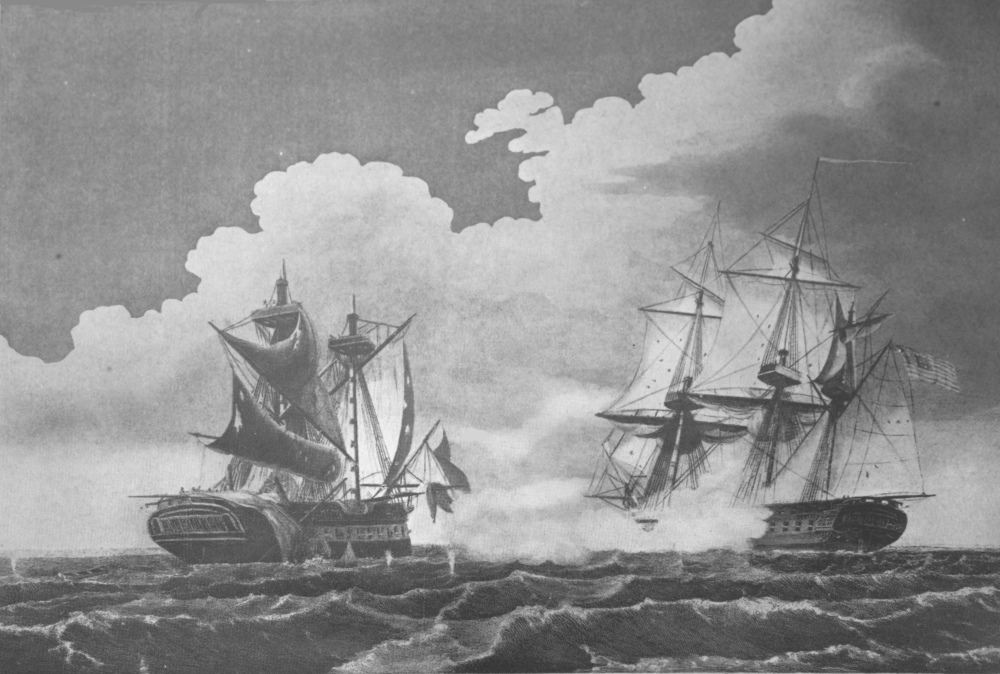
Stations are also assigned at the guns, to the whole crew.
When at sea, the drummer beats to quarters every night. This
beat, by which the men are summoned to quarters, is a regular tune.
I have often heard the words sung which belong to it; this is the
chorus:
“Hearts of oak are our ships, jolly tars are our men,
We always are ready, steady, boys, steady,
To fight and to conquer again and again.”
At the roll of this evening drum, all hands hurry to the guns.
Eight men and a boy are stationed at each gun, one of whom is captain
of the gun, another sponges and loads it, the rest take hold of
the side tackle-falls, to run the gun in and out; while the boy is employed
in handing the cartridges, for which he is honored with the
singularly euphonious cognomen of powder-monkey.
Besides these arrangements among the men, there are from
thirty to forty marines to be disposed of. These do duty as sentries
at the captain’s cabin, the ward-room, and at the galley during
the time of cooking. They are also stationed at the large guns at
night, as far as their numbers run. When a ship is in action, and
small arms can be brought to bear on the enemy, they are stationed
on the spar-deck; they are also expected to assist in boarding, in
conjunction with several seamen from each gun, who are armed
with pistols and pikes, and called boarders.
The great disparity of numbers between the crew of a merchant
ship and that of a man of war, occasions a difference in their
internal arrangements and mode of life, scarcely conceivable by
those who have not seen both. This is seen throughout, from the
act of rousing the hands in the morning to that of taking in sail.
In the merchantman, the watch below is called up by a few strokes
of the handspike on the forecastle; in the man of war, by the boatswain
and his mates. The boatswain is a petty officer, of considerable
importance in his way; he and his mates carry a small silver
whistle or pipe, suspended from the neck by a small cord. He receives
word from the officer of the watch to call the hands up. You
immediately hear a sharp, shrill whistle; this is succeeded by another
and another from his mates. Then follows his hoarse, rough
cry of “All hands ahoy!” which is forthwith repeated by his mates.
Scarcely has this sound died upon the ear, before the cry of “Up all
hammocks ahoy!” succeeds it, to be repeated in like manner. As
the first tones of the whistle penetrate between decks, signs of life
make their appearance. Rough, uncouth forms are seen tumbling
out of their hammocks on all sides, and before its last sounds have
died upon the air, the whole company of sleepers are hurriedly preparing
for the duties of the day. No delay is permitted, for as
soon as the before-mentioned officers have uttered their imperative
commands, they run below, each armed with a rope’s end, with
which they belabor the shoulders of any luckless wight upon whose
eyes sleep yet hangs heavily, or whose slow-moving limbs show him
to be but half awake.
With a rapidity which would surprise a landsman, the crew
dress themselves, lash their hammocks and carry them on deck,
where they are stowed for the day. There is system even in this
arrangement; every hammock has its appropriate place. Below,
the beams are all marked, each hammock is marked with a corresponding
number, and in the darkest night, a sailor will go unhesitatingly
to his own hammock. They are also kept exceeding clean.
Every man is provided with two, so that while he is scrubbing and
cleaning one, he may have another to use. Nothing but such precautions
could enable so many men to live in so small a space.
A similar rapidity attends the performance of every duty.
The word of command is given in the same manner, and its prompt
obedience enforced by the same unceremonious rope’s-end. To
skulk is therefore next to impossible; the least tardiness is rebuked
by the cry of “Hurrah my hearty! bear a hand! heave along! heave
along!” This system of driving is far from being agreeable; it
perpetually reminds you of your want of liberty; it makes you feel,
sometimes, as if the hardest crust, the most ragged garments, with
the freedom of your own native hills, would be preferable to John
Bull’s “beef and duff,” joined as it is with the rope’s-end of the
driving boatswain.
We had one poor fellow, an Irishman, named Billy Garvy, who
felt very uneasy and unhappy. He was the victim of that mortifying
system of impressment, prevalent in Great Britain in time of
war. He came on board perfectly unacquainted with the mysteries
of sea life. One of his first inquiries was, where he should find his
bed, supposing they slept on shipboard on beds the same as on shore.
His messmates, with true sailor roguishness, sent him to the boatswain.
“And where shall I find a bed, sir?” asked he of this
rugged son of the ocean.
The boatswain looked at him very contemptuously for a moment,
then, rolling his lump of tobacco into another apartment of
his ample mouth, replied,
“Have you got a knife?”
“Yes, sir.”
“Well, stick it into the softest plank in the ship, and take that
for a bed!”
Poor fellow! what was sport for others was pain to him. He
had been used to kind treatment at home. After he had received
his hammock, when turning out in the morning, with the boatswain’s
mates at his heels, he used to exclaim, “When I was at home, I
would walk in my father’s garden in the morning, until the maid
would come and say, ‘William, will you come to your ta, or your
coffee ta, or your chocolarata?’ But, oh! the case is altered now;
it’s nothing but bear a hand, lash and carry. Oh, dear!”
I confess that Billy Garvy was not the only one who contrasted
the present with the past, or who found the balance to be greatly
in favor of the former. I often looked back to the village of Bladen,
and thought how preferable would be the bright hearth-side
and pleasant voices of that quiet home, to the profane, rough, uncomfortable
life we led on shipboard. As these reflections were
anything but pleasurable, I banished them as quickly as possible,
with a determination to be as happy as I could in my station of
servant to the surgeon of His Britannic Majesty’s frigate Macedonian:
a resolution which I commend to all lads, who, like me, are
foolish enough to quit the quiet scenes of a native village, for the
noisy, profane atmosphere of a man of war.
As our fare was novel and so different from shore living, it
was some time before I could get fully reconciled to it: it was composed
of hard sea biscuit, fresh beef while in port, but salt pork and
salt beef at sea, pea soup and burgoo. Burgoo, or, as it was sportively
called, skillagallee, was oatmeal boiled in water to the consistency
of hasty pudding. Sometimes we had cocoa instead of burgoo.
Once a week we had flour and raisins served out, with which
we made “duff” or pudding. To prepare these articles, each mess
had its cook, who drew the provisions, made the duff, washed the
mess kids, etc. He also drew the grog for the mess, which consisted
of a gill of rum mixed with two gills of water for each man. This
was served out at noon every day: at four o’clock, P. M., each man
received half a pint of wine. The boys only drew half this quantity,
but were allowed pay for the remainder, a regulation which
could have been profitably applied to the whole supply of grog
and wine for both boys and men. But those were not days in
which Temperance triumphed as she does now; though, I believe,
the British navy has not yet ceased to dispense the “drink that’s
in the drunkard’s bowl” to her seamen.
Shortly after our captain came on board, his servant died somewhat
suddenly, so that I had an early opportunity of seeing how
sailors are disposed of in this sad hour. The corpse was laid out on
the grating, covered with a flag; as we were yet in the river, the
body was taken on shore and buried, without the beautiful burial-service
of the church of England being read at his grave—a ceremony
which is not omitted at the interment of the veriest pauper in
that country.
I have purposely dwelt on these particulars, that the reader
may feel himself initiated at once into the secrets of man-of-war
usages. He has doubtless seen ships of war with their trim rigging
and frowning ports, and his heart has swelled with pride as he has
gazed upon these floating cities—the representatives of his nation’s
character in foreign countries: to their internal arrangements,
however, he has been a stranger. I have endeavored to introduce
him into the interior: a desire to make him feel at home there, is my
apology for dwelling so long on these descriptions.
After various delays, we were at last ready for sea and under
sailing orders. The tide and wind were both propitious; then came
the long-expected cry of the boatswain, “All hands up anchor
ahoy!” The crew manned the capstan in a trice, and running
round to the tune of a lively air played by the fifer, the huge anchor
rapidly left the mud of the Thames, and hung at the bows of our
taut frigate. Then came the cry of “All hands make sail ahoy!”
As if by magic, she was immediately covered with canvas; the
favoring breeze at once filled our sails, and the form that had lain
for weeks inert and motionless on the waters, now bounded along
the waves like a thing of life. Rapidly we ran down the Channel,
and before we had well got under weigh came to an anchor again
at Spithead, under shelter of the garden of England—the Isle of
Wight.
Short as was the period between weighing anchor off Gravesend
and our arrival at Spithead, it gave opportunity for one of
those occurrences which are a disgrace to the naval service of any
nation, and a degradation to our common humanity, which the public
opinion of the civilized world should frown out of existence: I
allude to the brutal practice of flogging.
A poor fellow had fallen into the very sailorlike offence of getting
drunk. For this the captain sentenced him to the punishment
of four dozen lashes. He was first placed in irons all night: the
irons used for this purpose were shackles fitting round the ankles,
through the ends of which was passed an iron bar some ten or twelve
feet in length: it was thus long because it was no unfrequent case
for half a dozen men to be ironed at once. A padlock at the end
of the bar held the prisoner securely. Thus placed in “duress
vile,” he was guarded by a marine until the captain bade the first
lieutenant prepare the hands to witness the punishment. Upon
this the lieutenant transmitted the order to the master at arms.
He then ordered the grating or hatch full of square holes to be
rigged: it was placed accordingly between the main and spar decks,
not far from the mainmast.
While these preparations were going on, the officers were dressing
themselves in full uniform and arming themselves with their
dirks: the prisoner’s messmates carried him his best clothes, to
make him appear in as decent a manner as possible. This is always
done, in the hope of moving the feelings of the captain favorably
towards the prisoner.
This done, the hoarse, dreaded cry of “All hands ahoy to
witness punishment!” from the lips of the boatswain, peals along
the ship as mournfully as the notes of a funeral knell. At this
signal the officers muster on the spar deck, the men on the main
deck. Next came the prisoner; guarded by a marine on one side
and the master at arms on the other, he was marched up to the
grating. His back was made bare and his shirt laid loosely upon
his back; the two quartermasters proceeded to seize him up; that is,
they tied his hands and feet with spun-yarns, called the seizings,
to the grating. The boatswain’s mates, whose office it is to flog on
board a man of war, stood ready with their dreadful weapon of
punishment, the cat-o’-nine-tails. This instrument of torture was
composed of nine cords, a quarter of an inch round and about two
feet long, the ends whipt with fine twine. To these cords was
affixed a stock, two feet in length, covered with red baize. The
reader may be sure that it is a most formidable instrument in the
hands of a strong, skilful man. Indeed, any man who should whip
his horse with it would commit an outrage on humanity, which
the moral feeling of any community would not tolerate; he would
be prosecuted for cruelty; yet it is used to whip MEN on board ships
of war!
The boatswain’s mate is ready, with coat off and whip in hand.
The captain gives the word. Carefully spreading the cords with
the fingers of his left hand, the executioner throws the cat over his
right shoulder; it is brought down upon the now uncovered herculean
shoulders of the MAN. His flesh creeps—it reddens as if
blushing at the indignity; the sufferer groans; lash follows lash,
until the first mate, wearied with the cruel employment, gives place
to a second. Now two dozen of these dreadful lashes have been
inflicted: the lacerated back looks inhuman; it resembles roasted
meat burnt nearly black before a scorching fire; yet still the lashes
fall; the captain continues merciless. Vain are the cries and
prayers of the wretched man. “I would not forgive the Saviour,”
was the blasphemous reply of one of these naval demi-gods, or
rather demi-fiends, to a plea for mercy. The executioners keep on.
Four dozen strokes have cut up his flesh and robbed him of all
self-respect; there he hangs, a pitied, self-despised, groaning, bleeding
wretch; and now the captain cries, forbear! His shirt is thrown
over his shoulders; the seizings are loosed; he is led away, staining
his path with red drops of blood, and the hands, “piped down” by
the boatswain, sullenly return to their duties.
Such was the scene witnessed on board the Macedonian, on the
passage from London to Spithead; such, substantially, is every
punishment scene at sea; only carried, sometimes, to a greater
length of severity. Sad and sorrowful were my feelings on witnessing
it; thoughts of the friendly warnings of my old acquaintance
filled my mind, and I inwardly wished myself once more
under the friendly roof of my father, at Bladen. Vain wish! I
should have believed the warning voice when it was given. Believe
me, young man, you will often breathe that wish, if ever you
wander from a father’s house.
Flogging in the navy is more severe than in the army, though
it is too bad to be tolerated there, or indeed anywhere. Other modes
of punishment might be successfully substituted, which would deter
from misconduct, without destroying the self-respect of the man.
I hope the day will come, when a captain will no more be allowed
to use the “cat” than he is now to use poison. It should be an
interdicted weapon.
Though I have spoken severely of the officers of the navy, let
it not be thought that the whole class of naval officers are lost to
the finer feelings of humanity. There are many humane, considerate
men among them, who deserve our highest respect. This
was the case with the first lieutenant of the Macedonian, Mr. Scott.
He abhorred flogging. Once, when a poor marine was under sentence,
he plead
hard and successfully with the captain for his respite.
This was a great victory; for the captain had a profound hatred
of marines. The poor soldier was extremely grateful for his intercession,
and would do anything for him to show his sense of the
obligation; indeed, the sailors, in their odd way, showed their preference
for him by describing him as a man who had a soul to be
saved, and who ought to go to heaven; while of the captain, they
whispered that if he did not go to perdition, “the devil would be
cheated of his due.” These are, in a manner, proverbial expressions
of like and dislike, on board a British man of war.
One of the effects of this exhibition of cruelty was seen during
the short time we lay at Spithead. The two boys, who were servants
to the first and second lieutenants, conceiving a special dislike
to the idea of being flogged, took it into their heads to run
away. Being sent on shore, they shaped their course for the country.
It was well for them that they were not re-taken.
Our frigate had orders to convey between two and three hundred
troops from Portsmouth to Lisbon, to assist the Portuguese
against the French. The soldiers were stowed on the main decks,
with very few conveniences for the voyage; their officers messed
and berthed in the ward-room. Having taken them on board, we
again weighed anchor, and were soon careering before the breeze
on our way to Lisbon.
As usual, we who were landsmen had our share of that merciless,
nondescript, hateful, stultifying disease, yclept sea-sickness;
as usual, we wished the foolish wish that we had never come
to sea; as usual, we got over it, and laughed at ourselves for our
sea-sick follies. Our good ship paid little attention, however, to
our feelings; she kept along on her bounding way, and, after a
week at sea, we were greeted with the pleasant cry of “Land ho!”
from the mast-head. As it was now near night, we lay off and on
until morning; at day-break we fired a gun for a pilot. The wind
being nearly dead ahead, we had to beat about nearly all day.
Towards night it became fair, and we ascended the Tagus. This
river is about nine miles wide at its mouth, and is four hundred
and fifty miles in length; it has a very rapid current, with steep,
fertile banks. Aided by a fine breeze, we ascended it in splendid
style, passed a half-moon battery, then shot past Belem Castle
into the port of Lisbon, about ten miles from its mouth. Here we
found a spacious harbor, filled with shipping. Besides numerous
merchantmen, there were two ships of a hundred guns, several
seventy-fours, frigates and sloops of war, with a large number of
transports; all designed for the defence of Lisbon against the
French.
Lisbon has a fine appearance from the harbor. A stranger,
after a long sea-voyage,
while standing on the deck of his vessel,
and gazing on its battlements and towers, might fancy it to be
a terrestrial paradise; but, on landing, his admiration would certainly
sink below zero, as he plodded his way, beset by saucy beggars
at almost every step, through its narrow, filthy streets. Such,
at least, was my impression, as I perambulated the city. Among
other things, I noticed a great variety of churches and convents,
which furnished swarms of plump, good-natured friars, under
whose spiritual domination the good people of Lisbon were content
to rest. I also counted thirteen large squares. One of them contained
a huge black horse, standing in its centre, with the figure
of a man upon his back, both much larger than life. What this
monument represented,
I did not learn. That square is denominated
Black Horse Square.
On the day after our arrival, the Macedonian was the scene
of considerable bustle. The troops, who seemed to forget their
proximity to a field of carnage, in the delight they felt at escaping
from the confinement on shipboard, were landed; several boats’
crews were also sent up the river to assist in the defence of the
place.
While we lay here, our ship was well supplied with fruits from
the shore. Large bunches of delicious grapes, abundance of sweet
oranges, water-melons, chestnuts, and also a bountiful supply of
gigantic onions, of peculiar flavor, enabled our crew to gratify
their palates in true English style. Poor fellows! they feasted,
laughed, and joked, as if the future had nothing to develop but
fairy scenes of unmixed delight. Little thought, indeed, does
your true tar take of the morrow.
Amid these feastings, however, there rose something to trouble
Macbeth, in the shape of an order from the admiral to prepare for
a cruise. This was peremptory;—for a cruise, therefore, we prepared.
Our boats’ crews came on board; the officers stored their
larder with the means of gustatory gratifications; and we stood out
to sea again.
The port of Corunna, in Spain, was the next place at which we
anchored. While lying in this spacious and safe harbor, our little
world was thrown into temporary confusion by the loss of the ward-room
steward, Mr. Sanders. This man could speak in the Spanish
tongue; he had accumulated a considerable sum of money by long
service, prize money, and an economy little known among sailors.
For some cause or other he had become dissatisfied; so, one day, he
engaged a Spaniard to run his boat under the stern of our frigate;
dropping from one of the stern ports into the boat, unperceived by
the officers, the wily Spaniards covered him with their loose garments
and sails, and then conveyed him to the shore. This was
running a great risk; for had he been detected in the act, or taken
afterwards, he would have felt the cruel strokes of the lash. Fortunately
for himself, he escaped without detection.
From Corunna, we returned to Lisbon, where, at the cheerful
cry of “All hands bring the ship to an anchor, ahoy!” we once
more placed our frigate, taut and trim, under the battlements of
the city.
As servant to the surgeon, it was one part of my duty to perform
the task of carrying his clothes to be washed. As great attention
to cleanliness, in frequently changing their linen, is observed
among naval officers, a good washerwoman is considered quite a
desideratum. In attending to this matter for my master, I had
frequent opportunities to go on shore. This gave me some means
of observation. On one of my visits to our pretty laundress, I saw
several Portuguese running along, gesticulating and talking with
great earnestness. Being ignorant of their language, my washerwoman,
who spoke good English, told me that a man had been
stabbed, in consequence of some ground for jealousy, afforded by
the conduct of the deceased. Hastening to the spot, I saw the
wounded man, stretched out on a bed, with two gaping wounds in
his side, the long knife, the instrument of the deed, lying by his side.
The poor sufferer soon died. What was done to the murderer, I
could not discover.
Though very passionate, and addicted to the use of the knife,
for the purpose of taking summary vengeance, the Portuguese are
nevertheless arrant cowards. Indeed, it is a question by no means
settled, whether all classes of men, in any country, who fly to cold
steel or to fire-arms in every petty quarrel, are not cowards at
heart. We had an evidence of Portuguese cowardice in an affray
which occurred between some of the citizens of Lisbon and a party
of our marines. Six of the latter, ignorant of the palace or municipal
regulations, wandered into the queen’s gardens. Some
twenty of the Portuguese, on witnessing this bold intrusion on the
privacy of the queen, rushed upon them with long knives. The
marines, though so inferior in number, faced about with their bayonets,
and, after much cursing and chattering, their enemies, considering
perhaps that the better part of valor is discretion, took to
their heels, leaving the six marines masters of a bloodless field.
These recontres were quite common between them and our men; the
result, though sometimes more serious, was uniformly the same.
As an illustration of the manners of this people, I cannot forbear
the insertion of another fact. I was one day walking leisurely
along the streets, quite at my ease, when the gathering of a noisy
multitude arrested my attention. Looking up, I was shocked at
seeing a human head, with a pair of hands beneath it, nailed to a
pole! They had just been taken from the body of a barber, who,
when in the act of shaving a gentleman, was seized with a sudden
desire to possess a beautiful watch, which glittered in his pocket; to
gain this brilliant bauble, the wretched man cut his victim’s throat.
He was arrested, his hands were cut off, then his head, and both
were fastened to the pole as I have described them. Upon inquiry,
I ascertained that this was the ordinary method of punishing murder
in Portugal; a striking evidence that civilization had not fully
completed its great work among them. Civilization humanizes
the feelings of society, throwing a veil of refinement and mercy over
even the sterner acts of justice; at any rate, it never tolerates such
barbarism as I saw at Lisbon.
While in port we experienced a change of officers by no means
agreeable to the crew. Mr. Scott, our first lieutenant, an amiable
man, decidedly hostile to the practice of flogging, left us; for what
cause, we could not ascertain. His successor, Mr. Hope, though
bearing a very pleasant name, was an entirely different person, in
manners and conduct, from his predecessor. He was harsh, severe,
and fond of seeing the men flogged. Of course, floggings became
more frequent than before; for, although a lieutenant cannot flog
upon his own authority, yet, such is the influence he exerts over a
captain, that he has the utmost opportunity to gratify a thirst for
punishment. It may appear strange to the reader that any gentleman—and
all officers of the navy consider themselves gentlemen—should
possess such a thirst; yet such was the case with Mr. Hope.
Nor was his a solitary example; many a man, who, on shore, in
presence of ladies of fashion, appeared too gentle to harm an enemy,
too kind to injure an insect, was strangely metamorphosed into a
genuine unprincipled tyrant, upon assuming command in a man of
war.
We had already witnessed a number of punishments, especially
at sea: in port, the officers were more condescending, lest their men
should desert; but at sea, when this was impossible, they flogged
without mercy. Cases of offence which occurred while in the harbor,
were looked up; sometimes a half dozen were flogged at once;
every man trembled lest he should be a victim; the ship’s crew were
made wretched; a sword seemed impending over every head. Who,
in such a case, could be happy? Not even a sailor, with all his habitual
thoughtlessness. Yet it is said we must flog, to maintain discipline
among sailors. Pshaw! Flogging may be needful to awe
a slave writhing under a sense of unmerited wrong, but never
should a lash fall on a freeman’s back, especially if he holds the
safety and honor of his country in his keeping.
Poor old Bob Hammond! Never was man more reckless than
this honest-hearted Irishman; never was sailor more courageous
under punishment. For being drunk he received four dozen
lashes; he bore the infliction with profound silence, uttering neither
groan nor sigh; neither casting one imploring look at his tormentors.
On being taken down, he applied himself most lustily to his bottle,
and before night was drunk again. Rushing to the quarter deck,
with a madness peculiar to a phrensied drunkard, he ran up against
the captain with such force that he nearly knocked him down.
With a boldness that seemed to strike the great man dumb, Bob
hiccupped and said,
“Halloo, Billy, my boy, is that you? You are young and foolish;
just fit for the launch. You are like a young lion—all your
sorrows are to come.”
The captain was excessively proud; even his officers scarcely
dared walk the quarter deck on the same side with him. He never
allowed himself to be addressed but by his title of “my Lord.”
Should a sailor, through design or forgetfulness, reply to a command,
“Yes, sir,” the lordly man would look at him with a glance
full of dignity, and sternly reply, “What, sir?” This, of course,
would put the offender in mind to correct himself by saying, “Yes,
my Lord.” Judge then of his surprise, indignation, nay, of his
lordly horror, when poor old drunken Bob Hammond called him
“Billy, my boy!” Doubtless it stirred up his nobility within him,
for, with a voice of thunder, he exclaimed, “Put this man in irons!”
It was done. The next morning, his back yet sore, poor Bob received
five dozen more strokes of the hated cat-o’-nine-tails. Most
heroically was it borne. No sound escaped him; the most profound
silence was observed by all, broken only by the dead sound of the
whip, as it fell every few moments on the wounded back. The
scene was sickening in the extreme. Let me throw a veil over its
details, simply remarking that it is questionable which of the two
appears to the best advantage; poor drunken Bob, suffering degrading
torture with heroic firmness, or my Lord Fitzroy, gloating
on the scene with the appetite of a vulture! Let the reader decide
for himself.
These statements may at first sight appear incredible. It may
be asked how a man could endure whippings which would destroy
an ox or a horse. This is a very natural question, and but for the
consciousness I feel of being supported in my statements by the
universal testimony of old men-of-war’s-men, I should hesitate to
publish them. The worst species of this odious torture, however,
remains to be described—flogging through the fleet.
This punishment is never inflicted without due trial and sentence
by a court-martial, for some aggravated offence. After the
offender is thus sentenced, and the day arrives appointed by his
judges for its execution, the unhappy wretch is conducted into the
ship’s launch—a large boat—which has been previously rigged up
with poles and grating, to which he is seized up; he is attended by
the ship’s surgeon, whose duty it is to decide when the power of
nature’s endurance has been taxed to its utmost. A boat from
every ship in the fleet is also present, each carrying one or two officers
and two marines fully armed. These boats are connected by
tow lines to the launch.
These preparations made, the crew of the victim’s ship are ordered
to man the rigging, while the boatswain commences the tragedy.
When he has administered one, two or three dozen lashes,
according to the number of ships in the fleet, the prisoner’s shirt is
thrown over his gory back; the boatswain returns on board, the
hands are piped down, the drummer beats a mournful melody,
called the rogue’s march, and the melancholy procession moves on.
Arriving at the side of another ship, the brutal scene is repeated,
until every crew in the fleet has witnessed it, and from one to three
hundred lashes have lacerated the back of the broken-spirited tar to
a bleeding pulp. He is then placed under the surgeon’s care, to be
fitted for duty—a ruined man—broken in spirit! all sense of self-respect
gone, forever gone! If he survive, it is only to be like his
own brave bark, when winds and waves conspire to dash her on the
pitiless strand, a wretched, hopeless wreck; a living, walking
shadow of his former self. Shameful blot! most foul and disgraceful
stain on the humanity of England! How long before this
worse than barbarism will disappear before the mild influences of
civilization and Christianity?
No plea of necessity can be successfully urged in behalf of
whipping men; for, if subordination or faithful adhesion to orders
is expected to follow such terrible examples, I know, from my acquaintance
with the sufferers themselves, that the expectation is
vain. One of two results always follows. The victim either lives
on, a lone, dark-minded, broken-spirited man, despising himself
and hating every one, because he thinks every one hates him; or he
lives with one fearful, unyielding purpose; a purpose on which he
feeds and nourishes his galled mind, as food affords life and energy
to his physical constitution—that purpose is REVENGE. I have
heard them swear—and the wild flashing eye, the darkly frowning
brow, told how firm was that intent—that if ever they should be in
battle, they would shoot their officers. I have seen them rejoice
over the misfortunes of their persecutors, but more especially at
their death. That it has frequently led to mutiny, is well verified.
I have known such severity to result in actual murder. While we
lay at Lisbon, a sergeant of marines, on board a seventy-four, made
himself obnoxious by repeated acts of tyranny. Two marines determined
upon his death. One night, unperceived by any, they
seized him, hurried him to the gangway, and pitched him overboard.
The tide was running strong; the man was drowned! But for
themselves his fate would have remained a secret until the great
day of judgment; it was discovered by an officer, who accidentally
overheard them congratulating each other on their achievement.
He betrayed them. A court-martial sentenced them. They were
placed on deck with halters on their necks. Two guns were fired,
and, when the smoke cleared away, two men were seen dangling
from the foreyard-arm. Only one day previous, a letter had
brought a discharge from the service for one of them. Poor fellow!
it came too late. He was fated to a summary discharge from
all service, in a manner appalling and repulsive to every finer human
feeling.
Such are the actual consequences of severity of discipline on
board men of war. Punishment leads to revenge; revenge to punishment.
What is intended to cure, only aggravates the disease;
the evil enlarges under the remedy; voluntary subordination
ceases; gloom overspreads the crew; fear fills the breasts of the officers;
the ship becomes a miniature of the house of fiends. While, on
the other hand, mild regulations, enforced without an appeal to
brute force, are easily carried into operation. The sailor has a warm
heart; show him personal kindness, treat him as a man, he will then
be a man; he will do anything for a kind officer. He will peril his
life for him; nay, he will cheerfully rush between him and danger.
This was done at Tripoli, when the brave James[3] offered his own
arm to receive the fell stroke of a Turkish scimitar, aimed at the life
of the bold Decatur, on board the frigate Philadelphia. Let naval
officers, let all ship-masters, once fairly test the effect of kind treatment,
and I am sure they will never desire to return to severity;
unless, indeed, they are tyrants at heart, in which case, the sooner
they lose their commands the better for their country; for no tyrant
is truly brave or trustworthy. Cowardice and meanness lie curled
up in the heart of every tyrant. He is too despicable, too unsafe
to be trusted with the responsibilities of a naval command. Such,
at least, is the opinion of an old sailor.
One of the greatest enemies to order and happiness in ships of
war is drunkenness. To be drunk is considered by almost every
sailor as the acme of sensual bliss; while many fancy that swearing
and drinking are necessary accomplishments in a genuine man-of-war’s-man.
Hence it almost universally prevails. In our ship the
men would get drunk, in defiance of every restriction. Were it not
for the moral and physical ruin which follows its use, one might
laugh at the various contrivances adopted to elude the vigilance of
officers in their efforts to procure rum. Some of our men who belonged
to the boats’ crews provided themselves with bladders; if
left ashore by their officers a few moments, they would slip into the
first grocery, fill their bladders, and return with the spoil. Once
by the ship’s side, the favorable moment was seized to pass the interdicted
bladders into the port-holes, to some watchful shipmate, by
whom it was carefully secreted, to be drunk at the first opportunity.
The liberty to go on shore, which is always granted while in port,
was sure to be abused for drunken purposes. The Sabbath was
also a day of sensuality. True, we sometimes had the semblance
of religious services, when the men were summoned aft to hear the
captain read the morning service from the church prayer-book;
but usually it was observed more as a day of revelry than of worship.
But at Christmas our ship presented a scene such as I had
never imagined. The men were permitted to have their “full
swing.” Drunkenness ruled the ship. Nearly every man, with
most of the officers, was in a state of beastly intoxication at night.
Here, some were fighting, but were so insensibly drunk, they hardly
knew whether they struck the guns or their opponents; yonder, a
party were singing libidinous or bacchanalian songs, while all were
laughing, cursing, swearing or hallooing; confusion reigned in glorious
triumph; it was the very chaos of humanity. Had we been
at sea, a sudden gale of wind must have proved our destruction;
had we been exposed to a sudden attack from an enemy’s vessel, we
should have fallen an easy prey to the victor; just as the poor Hessians,
at Trenton, fell before the well-timed blow of the sage Washington,
during the war of the revolution.
Of all places, the labors of temperance men are most needed
among sailors; and I am glad to know that much has been accomplished
among them already. From what I know of the sufferings
and difficulties growing out of intemperance at sea, I most
heartily desire to see a temperance flag floating at the mast-head
of every ship in the world. When this is seen, sailors will be a
happier class than ever they have yet been, from the time when the
cautious Phenicians crept timidly round the shores of the Mediterranean,
to the present day of bold and fearless navigation.

Shortly after the Christmas debauch, mentioned in the
preceding chapter, news was brought to the admiral that nine
French frigates were cruising on the Spanish coast: immediately,
all was excitement, bustle, preparation through the fleet. The
Hannibal and Northumberland, both seventy-four gun ships, the
Cæsar of eighty guns, called by the sailors the Old Bull-dog, a gun
brig, and some others, I forget the names, and the Macedonian,
were ordered to sail in pursuit of the French. This formidable
force dropped down the river, every man composing it eagerly desiring
to meet the enemy. The enterprise however, was unsuccessful;
after cruising in vain for several days, the admiral signalled
the fleet to return. Before reaching port we fell in with a Scotch
ship from Greenock, in a most perilous condition; her masts and
rudder were gone, while her numerous leaks were fast gaining on
the labors of the already exhausted crew at the pumps. Finding
it utterly impossible to save the vessel, we took off the crew; and
thus our cruise, though defeated in its main design, proved the
means of rescuing several poor wretches from a watery grave. It
is a question worthy of consideration, whether this was not a really
higher result than if we had found and beaten the French, and had
returned in a crippled state, leaving some hundreds killed and
wounded. Humanity would answer, yea.
So far as the effects of this cruise concerned our own little
frigate, they were really quite serious. We were reefing topsails
one night, at sea, when the sailing-master, Mr. Lewis, in a fit of
ill-humor, threatened to flog some of the men. The captain overheard
him. Feeling himself hurt by this assumption of his own
prerogative, he told Mr. Lewis that he was captain in the ship, and
it was his business to flog the men. Sharp words followed; the
captain was exasperated; he ordered the sailing-master to be put
in irons. Here, however, he exceeded his own power, for, though
he might place the common sailor in irons, he might not do so by
an officer with impunity. Accordingly, when we reached Lisbon,
a court-martial sat on the case, which resulted in their both being
broken or cashiered.
This was a hard blow for Lord Fitzroy, and he obviously felt
it most keenly. It also cut off my expectations of being elevated
to the quarter deck; for, although I had never received any direct
encouragement from his Lordship, yet I had always nourished the
hope that ultimately he would keep the promise he made to my
mother, and do something for my advancement. Now, however,
my hopes were destroyed. I was doomed to the forecastle for life.
Lord Fitzroy was succeeded by Captain Carson. He however,
was soon removed to make way for Captain Waldegrave, who
proved to be far more severe than Fitzroy. He and Lieutenant
Hope were kindred spirits: cruelty seemed to be their delight, for
at the presence of culprits tied to the gratings, a gleam of savage
animation stole over their faces. Punishment was now an almost
every-day scene; even the boys were not permitted to escape. A lad
was appointed boatswain over them, and they were consigned to
the care of Mr. Hope, who took especial delight in seeing them
flogged. What a mean, dastardly spirit for a British officer!
How utterly contemptible he appears engaged in whipping a few
helpless sailor boys! Yet thus he did constantly appear, causing
them to be flogged for every trifling offence. One poor little fellow,
unable to tolerate the thought of the lash, hid himself in the
cable tier for several days. He was discovered, only to be most
shamefully punished.
These severities filled our crew with discouragement. A sailor
dreads the dishonor of the lash. Some, urged by a nice sense of
honor, have preferred death to its endurance. I have heard of one
man who actually loaded himself with shot and deliberately walked
overboard. Among our ship’s company the effects of these severe
measures showed themselves in frequent desertions, notwithstanding
the great risk run by such a bold measure; for, if taken, they
were sure to meet with a fearful retribution. Still, many preferred
the chance of freedom; some ran off when on shore with the boats,
others dropped overboard in the night, and either swam on shore or
were drowned. Many others were kept from running away by the
strength of their attachment to their old messmates and by the hope
of better days. Of those who escaped, some were retaken by the
Portuguese, who delighted to hunt them up for a small sum of
money. Two of my messmates, named Robert Bell and James
Stokes, were taken in this manner. I felt greatly affected at losing
their company, for they were pleasant fellows. I felt a peculiar
attachment to poor Stokes; he had taught me many things
which appertain to seamanship, and had cared for my interests with
the faithfulness of a parent. O how anxiously did I desire they
might not be detected, because I knew, if they were, that they were
doomed men. But they were taken by a band of armed Portuguese;
barefooted, desponding, broken in spirit, they were brought
on board, only to be put in irons immediately. By a fortunate
chance they escaped with fifty lashes, instead of being flogged
through the fleet.
We had another man who escaped, named Richard Suttonwood;
he was very profane, and was much in the habit of using the
word “bloody;” hence he was nicknamed “Bloody Dick” by his
shipmates. Well, Dick ran off. He succeeded in getting on board
an English brig in the merchant service. But how chop-fallen was
poor Dick when he found that this brig was laden with powder for
his own frigate! Resolving to make the best of the matter, he said
nothing of his relation to our frigate, but as soon as the brig dropped
alongside of the Macedonian, he came on board and surrendered
himself; by this means he escaped being flogged, as it was usual to
pardon a runaway who voluntarily returned to his duty. The
crew were all delighted at his return, as he was quite popular
among them for his lively disposition and his talents as a comic
singer, which last gift is highly prized in a man of war. So joyous
were we all at his escape from punishment, that we insisted
on his giving a concert, which went off well. Seated on a gun
surrounded by scores of the men, he sung a variety of favorite
songs, amid the plaudits and encores of his rough auditors.
By such means as these, sailors contrive to keep up their spirits
amidst constant causes of depression and misery. One is a good
singer, another can spin tough forecastle yarns, while a third can
crack a joke with sufficient point to call out roars of laughter. But
for these interludes, life in a man of war, with severe officers, would
be absolutely intolerable; mutiny or desertion would mark the voyages
of every such ship. Hence, officers in general highly value
your jolly, merry-making, don’t-care sort of seamen. They know
the effect of their influence in keeping away discontented thought
from the minds of a ship’s company. One of these official favorites
paid our frigate a visit while we lay in Lisbon. We had just finished
breakfast, when a number of our men were seen running in
high glee towards the main hatchway. Wondering what was going
forward, I watched their proceedings with a curious eye. The
cause of their joy soon appeared in the person of a short, round-faced,
merry-looking tar, who descended the hatchway amid cries
of “Hurrah! here’s happy Jack!” As soon as the jovial little man
had set his foot on the berth deck, he began a specimen of his vocal
powers. The voice of song was as triumphant on board the Macedonian,
as it was in days of yore in the halls of Ossian. Every
voice was hushed, all work was brought to a standstill, while the
crew gathered round their favorite, in groups, to listen to his unequalled
performances. Happy Jack succeeded, while his visit
lasted, in communicating his own joyous feelings to our people, and
they parted from him at night with deep regret.
A casual visitor in a man of war, beholding the song, the dance,
the revelry of the crew, might judge them to be happy. But I
know that these things are often resorted to, because they feel miserable,
just to drive away dull care. They do it on the same principle
as the slave population in the South, to drown in sensual gratification
the voice of misery that groans in the inner man—that lives
within, speaking of the indignity offered to its high nature by the
chain that eats beyond the flesh—discoursing of the rights of man,
of liberty on the free hills of a happier clime: while amidst the
gayest negro dance, not a heart among the laughing gang but
would beat with high emotions and seize the boon with indescribable
avidity, should it be offered its freedom on the spot.
So in a man of war, where severe discipline prevails, though
cheerfulness smiles at times, it is only the forced merriment of
minds ill at ease; minds that would gladly escape the thraldom of
the hated service to which they are bound.
Nor is this forced submission to circumstances universal.
There are individuals who cannot be reached by these pleasantries;
in spite of everything, their spirits will writhe under the gripe of
merciless authority. We had a melancholy instance of this species
of mind on board our frigate. His name was Hill, the ward-room
steward. This man came on board with a resolute purpose to give
satisfaction, if possible, to his superiors. He tried his utmost in
vain. He was still scolded and cursed, until his condition seemed
unendurable. One morning a boy entered the after ward-room,
when the first object that met his astonished eye was the body of
the steward, all ghastly and bleeding. He had cut his throat, and
lay weltering in his gore. The surgeon was called, who pronounced
him to be yet alive. The wound was sewed up, the poor sufferer
carried to the hospital-ship, which was in attendance on the fleet,
where he recovered, to be returned to his former ship, though in
another and worse capacity, that of common sailor.
We had on board a colored man whose name was Nugent, who
possessed a remarkably fine person, was very intelligent, exceedingly
polite in his manners, and easy in his address. He soon grew
weary of the caprices of our officers, and ran away. He was taken,
however, in rather a curious manner. The officers frequently
walked the deck with their spy-glasses. As one of them was spending
a few leisure moments in looking at the surrounding shipping,
what should appear within the field of his glass, but the person of
the fugitive Nugent on the deck of an American vessel! Upon
this, a boat was despatched, which soon returned with the crestfallen
deserter, who was
unceremoniously thrown into irons. By
some fortunate chance, however, he escaped a flogging.
Of course, my situation was as unpleasant as that of any other
person on board. I could not witness the discomfort and ill-usage
of others, without trembling for my own back. I, too, had thoughts
of running away, as opportunities frequently offered themselves.
But, being ignorant of the Portuguese language, I wisely concluded
that my condition among them, if I got clear, would, in respect to
my present state, bear about the same analogy as the fire does to the
frying-pan. My little adventures on shore gave me full assurance
of this fact. I remember going ashore on Good Friday. Like good
Catholics, the Portuguese had the masts of their vessels crossed,
with effigies of the traitor Judas hanging very significantly at their
jib-booms. On shore, they were exhibiting the blasphemous mimicry
of the solemn scene of the crucifixion. One was bearing the
cross, another a sponge, a third the vinegar. The streets were
crowded with images of the saints, to which all reverently bowed.
Woe betide that sacrilegious wretch who refused this tribute to their
darling images. He was sure of being knocked down; he was not
sure of getting home alive. I was fain to yield my knees to save
my skull; so for the time I was as good a Catholic as any of them,
at least in the matter of bowing and crossing: it was done, however,
with true Protestant mental reservation, and with a sincere determination
to prefer my man-of-war’s life to a life in Portugal.
On another occasion, some of our officers took me on shore to
help them attend to some purchases. After following them a considerable
distance, they gave me a small commission to execute, with
directions to return to the ship as soon as it was attended to. This
was no easy task, however: they had conducted me to a strange
part of the city, and I knew scarcely a word of Portuguese. There
I stood, then, surrounded only by foreigners, who neither understood
my language nor I theirs. All I knew of my destination was,
that our boat lay near the Fish-market; so, for Fish-market I inquired.
Speaking in English, I asked the first man I met to direct
me. He looked at me with the empty stare of an idiot, and passed
on. To the next, I said, partly in broken Portuguese and partly in
my own tongue, “John,” (they call everybody John, whose true
name they do not know,) “do show me the fish-market.” He could
not understand me; so, shrugging his shoulders, he said, “No entender
Englis,” and passed on. I asked several others, but invariably
received a shrug of the shoulder, a shake of the head, and a
“no entender Englis,” for an answer. I grew desperate, and began
to feel as if I had lost myself, when, to my unutterable satisfaction,
I saw an English soldier. I ran up to him and said, “Good
luck to you; do tell me where the fish-market is, for these stupid
Portuguese, bad luck to them, can’t understand a word I say; but
it is all, no entender Englis.” My countryman laughed at seeing
my English temper ruffled, and placed me in the way of reaching
the fish-market. I hurried thither, when, to my chagrin, the boats
were all gone. Here, then, was another difficulty; for, though
there were plenty of Portuguese boatmen, they could not understand
which ship I wished to reach. Here, however, my fingers did
what my tongue refused; our ship had its mainmast out, so, holding
up two fingers and pointing to the mast, they at last comprehended
me and conveyed me on board. Coming alongside, I gave them
what I thought was right; but they and I differed in opinion on
that point; they demanded more, with considerable bluster, but the
sentry shouted, “Shove off there!” and pointed his musket at them.
Whether they thought a reasonable fee, and a timely retreat, better
than a contest which might give them the taste of a musket-ball, I
cannot determine; at all events, I know that boat never left ship
faster than theirs, when they beheld the gleam of the sentry’s musket
flashing in their dark faces.
Just after this adventure, I came very near being flogged, to my
no small alarm. Happening on shore with two more of the officers’
servants, named Yates and Skinner, we stayed so late, the
ship’s boats had all gone off. Finding the boats gone, we strayed
back into the city; night came on, and our return until morning was
impossible. We had to wander about the city all night, in constant
fear of being apprehended by the Portuguese as deserters. To
prevent this no very desirable result, my comrades made me a midshipman;
for the satisfactory reason, that if an officer was supposed
to be in our company, no one would trouble us. The summary
process by which I was inducted into my new station, was by means
of a stripe carefully marked on my collar with a piece of chalk, to
imitate the silver lace on a middy’s coat. Thus exalted, I marched
my company about Lisbon until dawn, when I again found myself
the self-same Samuel Leech, servant to the surgeon of H. M. frigate
Macedonian, that I was the previous evening, with this additional
fact, however, I was now liable to be flogged. So, in the true
spirit of a Jeremy Sneak, we went on board, where, with due ceremony,
we were parted for separate examinations. What tale my
fellow-wanderers invented, I know not; for my own part, I told
the truth of the matter, excepting that I suppressed that part of it
which related to my transformation into an officer. Luckily for us
all, one of the party was the first lieutenant’s servant; if he flogged
one, he must flog the whole. To save the back of his own boy, he
let us all escape.
We were now ordered on another cruise. Being in want of
men, we resorted to the press-gang which was made up of our most
loyal men, armed to the teeth; by their aid we obtained our full
numbers. Among them were a few Americans; they were taken
without respect to their protections, which were often taken from
them and destroyed. Some were released through the influence of
the American consul; others, less fortunate, were carried to sea, to
their no small chagrin.[4]
The duties of the press-gang completed, we once more weighed
anchor, and were soon careering before the gales of the bay of Biscay.
Our reception in this proverbially stormy bay was by no
means a civil one. We met with an extraordinarily severe gale, in
which we came very near foundering. We had just finished dinner,
when a tremendous sea broke over us, pouring down the hatchway,
sweeping the galley of all its half-cooked contents, then being
prepared for the officers’ dinner, and covering the berth deck with
a perfect flood. It seemed as if old Neptune really intended that
wave to sink us to Davy Jones’ locker. As the water rolled from
side to side within, and the rude waves without beat against her, our
good ship trembled from stem to stern, and seemed like a human
being gasping for breath in a struggle with death. The women
(there were several on board) set up a shriek, a thing they had
never done before; some of the men turned pale; others cursed and
tried to say witty things; the officers started; orders ran along the
ship to man the chain-pumps, and to cut holes through the berth
deck to let the water into the hold. These orders
being rapidly obeyed, the ship was freed from her danger. The confusion of the
moment was followed by laughing and pleasantries. That gale
was long spoken of as one of great danger.
It is strange that sailors, who see so much peril, should treat
religion with such neglect as it is usual for them to do. When
danger is imminent, they send up a cry for help; when it is past,
they rarely return a grateful thank-offering. Yet how truly and
eloquently has the Psalmist shown, in the 107th Psalm, what should
be the moral effect of the wonders of the deep. What but a deep-rooted
spiritual perversity prevents such an effect?
The next incident that disturbed the monotony of our sea-life,
was of a melancholy character. We had been giving chase to two
West Indiamen the whole of one Sabbath afternoon; at night it
blew so hard we had to reef top-sails; when a poor fellow, named
John Thomson, was knocked from the yard. In falling, he struck
some part of the ship, and the wave which opened to receive him,
never disclosed his form again. He was a pressed man, an American
by birth, greatly beloved by his messmates, by whom his death
was as severely felt as when a member of a family dies on shore.
His loss created a dull and gloomy atmosphere throughout the ship:
it was several days before the hands regained their wonted elasticity
of mind and appearance.
My recollections of this cruise are very feeble and indistinct,
owing to a severe injury which confined me to my hammock nearly
the whole period. The accident which ended in a severe illness had
its origin in the following manner. The duty of cleaning knives,
plates, dish-covers, &c., for the ward-room, devolved alternately on
the boys employed in the ward-room. Having finished this task,
one day, in my regular turn, the ward-room steward, a little hot-headed
Malay, came to me at dinner-time to inquire for the knives.
Not recollecting for the moment, I made no reply; when he angrily
pushed me over a sack of bread. In falling my head came in contact
with the corner of a locker. Feeling much pain, and the blood
flowing freely, I went to Mr. Marsh, the surgeon’s mate, who
dressed it, and bade me take care of it. Probably it would have
healed speedily but for the freak of a sailor a few days after, while
holy-stoning the decks. By holy-stoning, I mean cleaning them
with stones, which are used for this purpose in men of war. These
stones are, some of them, large, with a ring at each end with a rope
attached, by which it is pulled backwards and forwards on the wet
decks. These large stones are called holy bibles; the smaller hand
ones are also called holy-stones, or prayer-books, their shape being
something like a book. After the decks are well rubbed with these
stones, they are wiped dry with swabs made of rope-yarns. By
this means the utmost cleanliness is preserved in the ship. It was
customary in our ship, during this scrubbing process, for the boys
to wash themselves in a large tub provided for the purpose on the
main deck. The men delighted in sousing us with water during
this operation. After being wounded, as just mentioned, I endeavored
to avoid their briny libations; but one morning, one of the sailors,
seeing my anxiety, crept slily up behind me, and emptied a pail
of water directly over my head. That night I began both to look
and to feel sick. My messmates said I was sea-sick, and laughed
at me. Feeling violent pains in my head, ears and neck, I felt relieved
when it was time to turn in. The next morning, being rather
behind my usual time in waiting upon the surgeon, he began to scold
me. I told him I was unwell. He felt my pulse, examined my
tongue, and excused me. Growing worse, my messmates got down
my hammock. I entered it very sick; my head and face swelling
very large, and my eyes so sunken I could scarcely see.
I remained in this sad situation several weeks, carefully attended
by the surgeon, and watched by the men as tenderly as their
rough hands could perform the office of nurse. My destiny was
considered as being sealed, both by the crew and by myself. I was
much troubled at the thought of dying: it seemed dark and dreary
to enter the valley of the shadow of death without the presence
of a Saviour. To relieve my feelings, I frequently repeated the
Lord’s prayer, taught me by my indulgent mother in my earlier and
brighter years. But my mind was dark and disconsolate; there
were none among that kind-hearted but profligate crew to point
my soul to its proper rest.
While lying in this state, my life hanging in a doubtful balance,
one of the crew, named Black Tom, an African, was taken
sick. His hammock was hung up in the sick bay, a part of the main
deck appropriated to hospital purposes. Poor Tom, having a constitution
already undermined by former excesses, soon fell under
the attack of disease. He was then sewed up in his hammock, with
some shot at his feet: at sundown the ship’s bell pealed a melancholy
note, the ship was “hove to,” all hands mustered on deck, but myself;
and, amid the most profound silence, the body of the departed
sailor was laid upon the grating and launched into the great deep,
the resting-place of many a bold head. A plunge, a sudden opening
in the water, followed by an equally sudden return of the disparted
waves, and Black Tom was gone forever from his shipmates!
In a few moments the yards were braced round, and our frigate was
cutting her way again through the wide ocean waste. It seemed
to me that she was soon destined to heave to again, that I might
also be consigned to an ocean grave. But in this I was happily disappointed.
By the blessing of a watchful Providence, the aid of a
sound constitution, assisted by the skill of our surgeon and the kindness
of my shipmates, I was at last able to leave my hammock.
Shortly after our return to Lisbon, I was pronounced fit for duty,
and the surgeon having obtained another boy, I was placed on the
quarter deck, in the capacity of messenger, or errand boy for the
captain and his officers.
With my return to active life, came my exposure to hardships,
and, what I dreaded still more, to punishment. Some of the boys
were to be punished on the main deck; the rest were ordered forward
to witness it, as usual. Being so far aft that I could not hear
the summons, as a matter of course, I remained at my post. The
hawk-eye of the lieutenant missed me, and in a rage he ordered me
to be sent for to receive a flogging for my absence. Excuse was
vain; for, such was the fiendish temper of this brutal officer, he only
wanted the shadow of a reason for dragging the poor helpless boys
of his charge to the grating. While I stood in trembling expectation
of being degraded by the hated cat, a summons from the captain
providentially called off our brave boy-flogger, and I escaped.
The offence was never mentioned afterwards. The reader can
easily perceive how such a constant exposure to the lash must embitter
a seaman’s life.
Already, since the Macedonian had been in commission, had
she changed captains twice. Why it so happened, it is not in my
power to explain; but while at Lisbon, after the cruise last mentioned,
our present captain was superseded by Captain John S. Carden.
His arrival excited a transitory hope of a brighter lot, as he
was an older man than the others, and, as we vainly trusted, a kinder
one. Here, however, we were mistaken; he was like all the rest,
the same heartless, unfeeling lover of whip discipline. At first the
men under sentence tried their powers at flattery with the grave old
man; but he was too experienced a sea-dog to be cajoled by a long-faced
sailor under sentence: when, therefore, they told him he was
a kind-hearted fatherly gentleman, he only replied by a most provoking
laugh, and by saying they were a set of very undutiful sons.
Captain Carden was mercilessly severe in punishing theft. He
would on no account forgive any man for this crime, but would flog
the thief almost to death. Of this, we soon had a cruel instance.
A midshipman named Gale, a most rascally, unprincipled fellow,
found his pocket handkerchief in possession of one of the crew. He
charged the man with stealing it. It was in vain that the poor
wretch asserted that he found it under his hammock. He was reported
as a thief; a court-martial sat upon him, and returned the
shamefully disproportionate sentence of three hundred lashes
through the fleet, and one year’s imprisonment! Any of my shipmates
who are living, will certify to the truth of this statement, brutal
and improbable as it may appear.
Nor was that sentence a dead letter; the unhappy man endured
it to the letter. Fifty were laid on alongside of the Macedonian,
in conformity with a common practice of inflicting the most strokes
at the first ship, in order that the gory back of the criminal may
strike the more terror into the crews of the other ships. This poor
tortured man bore two hundred and twenty, and was pronounced
by the attending surgeon unfit to receive the rest. Galled, bruised,
and agonized as he was, he besought him to suffer the infliction of
the remaining eighty, that he might not be called to pass through
the degrading scene again; but this prayer was denied! He was
brought on board, and when his wounds were healed, the captain,
Shylock-like, determined to have the whole pound of flesh, ordered
him to receive the remainder.
But for my desire to present the reader with a true exhibition
of life on board a British man of war, it would be my choice to suppress
these disgusting details of cruelty and punishment. But this
is impossible; I must either draw a false picture or describe them.
I choose the latter, in the hope that giving publicity to these facts
will exert a favorable influence on the already improving discipline
of ships of war.
The case of our ship’s drummer will illustrate the hopelessness
of our situation under such officers as commanded our ship; it will
show that implicit, uncomplaining submission was our only resource.
This drummer, being seized up for some petty offence, demanded,
what no captain can refuse, to be tried by a court-martial; in the
hope, probably, of escaping altogether. The officers laughed
among each other, and when, a few days afterwards, the poor, affrighted
man offered to withdraw the demand and take six dozen
lashes, they coolly remarked, “The drummer is sick of his bargain.”
He would have been a wiser man had he never made it; for the
court-martial sentenced him to receive two hundred lashes through
the fleet:—a punishment ostensibly for his first offence, but really
for his insolence (?) in demanding a trial by court-martial. Such
was the administration of justice (?) on board the Macedonian.
“Why did not your crew rise in resistance to such cruelty?” is a
question which has often been proposed to me, when relating these
facts to my American friends. To talk of mutiny on shore is an
easy matter; but to excite it on shipboard is to rush on to certain
death. Let it be known that a man has dared to breathe the idea,
and he is sure to swing at the yard-arm. Some of our men once
saw six mutineers hanging at the yard-arm at once, in a ship whose
crew exhibited the incipient beginnings of mutiny. Let mutiny be
successful, the government will employ its whole force, if needful,
in hunting down the mutineers; their blood, to the last drop, is the
terrible retribution it demands for this offence. That demand is
sure to be met, as was the case with the crew of the Hermione[5] frigate,
and with the crew of the ill-fated Bounty, whose history is imprinted
on the memory of the whole civilized world. With such
tragedies flitting before our eyes, who need ask why we did not resist?
Just before we left Lisbon for another cruise, my position was
once more changed by my appointment to the post of servant to
the sailing-master; whose boy, for some offence or other, was
flogged and turned away. Here, too, the captain procured a fine
band, composed of Frenchmen, Italians and Germans, taken by the
Portuguese from a French vessel. These musicians consented to
serve, on condition of being excused from fighting, and on a pledge
of exemption from being flogged. They used to play to the captain
during his dinner hour; the party to be amused usually consisting
of the captain and one or two invited guests from the ward-room;
except on Sundays, when he chose to honor the ward-room
with his august presence. The band then played for the ward-room.
They also played on deck whenever we entered or left a
port. On the whole, their presence was an advantage to the crew,
since their spirit-stirring strains served to spread an occasional
cheerful influence over them. Soon after they came on board, we
had orders to proceed to sea again on another cruise.
A few days after we had fairly got out to sea, the thrilling
cry of “A man overboard!” ran through the ship with electrical
effect; it was followed by another cry of, “Heave out
a rope!” then by still another, of “Cut away the life buoy!” Then
came the order, “Lower a boat!” Notwithstanding the rapidity
of these commands, and the confusion occasioned by the anticipated
loss of a man, they were rapidly obeyed. The ship was then hove
to. But that time, however, the cause of all this excitement was at
a considerable distance from the ship. It was a poor Swede, named
Logholm, who, while engaged in lashing the larboard anchor stock,
lost his hold and fell into the sea. He could not swim; but, somehow,
he managed to keep afloat until the boat reached him, when he
began to sink. The man at the bow ran his boat hook down, and
caught the drowning man by his clothes: his clothes tearing, the man
lost his hold, and the Swede once more sunk. Again the active
bowsman ran the hook down, leaning far over the side; fortunately,
he got hold of his shirt collar: dripping, and apparently lifeless,
they drew him into the boat. He was soon under the surgeon’s
care, whose skill restored him to animation and to life. It was a
narrow escape!
Rising one morning, I heard the men talking about having been
called to quarters during the night. They said a strange vessel having
appeared, the drums beat to quarters, the guns were got ready,
those great lanterns, which are placed on the main deck, called
battle lanterns, were got out, and the officers began to muster the
men at each division; when they discovered the supposed vessel of
war to be nothing more than a large merchant ship. Upon this the
hands were sent below. All this was news to me; I had slept
through all the noise, confusion and bustle of the night, utterly ignorant
of the whole matter. It was fortunate for me that the real
character of the strange ship was discovered before my name was
called, otherwise the morning would have found me at the gratings
under punishment. Never was boy happier than myself, when
made acquainted with my hair-breadth escape from the lash.
We had now reached the island of Madeira, occupied by the
Portuguese, and producing fine oranges, grapes and wine. It is
some sixty miles in length, about forty in breadth; the climate is
hot, but salubrious; its harbor, or rather roadstead, is by no means
commodious or safe—so that our stay was short. Here, the Portuguese
lad who had supplied my place as servant to the surgeon, was
sent on shore, for attempting a crime unfit to be mentioned in these
pages, but quite common among the Spaniards and Portuguese.
My old master made an effort to obtain me again, but did not succeed.
Sailing from Madeira, we next made St. Michael’s. At this
pace we had an increase to our crew, in the person of a fine, plump
boy—born to the wife of one of our men. The captain christened
the new comer, Michael, naming him after the island. This birth
was followed by another. Whether the captain did not like the
idea of such interesting episodes in sea life, or whether any other
motive inspired him, I cannot tell; but when, shortly after, we returned
to Lisbon, he ordered all the women home to England, by a
ship just returning thither. Before this, however, one of our little
Tritons had died, and found a grave under the billows, leaving its
disconsolate mother in a state little short of distraction. A man of
war is no place for a woman.
Short cruises are very popular with man-of-war’s men. On
many accounts they love being in harbor; on others they prefer being
at sea. In harbor they have to work all day, but in return for
this they have the whole night for sleep. At sea, the whole time is
divided into five watches of four hours each, and two shorter ones,
called dog watches, of two hours each, or from four to six and from
six to eight, P. M. The design of these dog watches is to alternate
the time, so that each watch may have a fair proportion of every
night below.
While at our station this time, our old friend, Bob Hammond,
met with some little difficulty, which we will here make matter of
record. He was below, and one of his messmates did something
that vexed him exceedingly. Now Bob was not a man to bear vexations
tamely, where he had the power to resist them; so, lifting his
huge fist, he struck at the offender; missing his real opponent, the
blow fell upon another who stood near him. Bob was too much of
a bully to offer any apology; he merely laughed, and remarked that
he had “killed two birds with one stone.”
Whether the bird, who, in Bob’s figurative language, was killed,
did not like being called a bird, or whether he conceived a strong dislike
to being a mark for Bob to shoot at, is not for me to say; but he
certainly disliked the one or the other, for the next morning he reported
the matter to the officers, which complaint was considered a
most unsailor-like act by the whole crew.
Fighting was a punishable offence, so Bob was called up the
next morning. The captain mentioned what was reported concerning
him. He acknowledged it was all true, and without any
signs of contrition said, “I only killed two birds with one stone.”
The angry captain ordered two dozen lashes to be laid on; it was
done without extorting a sigh or a groan. He was then loosed from
the grating, and questioned; but he merely replied, in a gruff tone,
that “the man who reported him was a blackguard!” For this,
he was seized up again and another dozen lashes inflicted; he bore
them with the same dogged and imperturbable air. Finding it impossible
to extort any acknowledgment from the stubborn tar, the
captain ordered him below.
About the same time one of our crew, named Jack Sadler, a
fine, noble-hearted seaman, growing weary of the service, determined
to desert. Dropping into the water, he began swimming
towards the shore. It was not very dark, and he was discovered;
the sentry was ordered to fire at him, which he did, but missed his
prey. A boat was next lowered, which soon overtook and dragged
him on board. The officer commanding the boat said, “Well, Mr.
Sadler, you thought you had got away, did you?” “You are not
so sure that you have me now,” replied Sadler, as he sprung over
the side of the boat. Nor would they have captured him, had not
another ship’s boat arrived to their assistance.
The next day, he was seized up and received three dozen lashes,
which, considering his offence, was a very light punishment. I suppose
that his noble bearing, his lion-hearted courage, and his undaunted
manner, produced a favorable feeling in the captain’s
mind; especially as he afterwards became his favorite—a fancy man—as
those men are called who win the favor of their superior officer.
One of Sadler’s failings was that too prevalent evil among seamen,
drunkenness. Soon after the above affair, he got drunk. Being
seen by the captain, he was ordered to be put in irons. Sadler was
Bob Hammond’s messmate; this worthy, finding his comrade in
trouble, made himself drunk, and purposely placed himself in the
way of the officers, that he might be put in irons also, to keep his
friend Sadler company. The plan succeeded. Bob had his wish,
and the two fearless tars were soon ironed together. Nothing
daunted, they began to sing, and through the whole night they kept
up such a hallooing, shouting and singing as might have served for
a whole company of idle roysterers. Being near the ward-room,
they prevented the officers from sleeping nearly all night.
As usual, after being in irons, they were brought up for punishment
the next morning. “Well, Mr. Sadler,” said the captain,
“you were drunk, were you, last night?”
“I was, sir,” replied the offender.
Had he been any other man, he would have been ordered to
strip: as it was, the captain proceeded,—
“Do you feel sorry for it, sir?”
“I do, sir.”
“Will you try to keep sober if I forgive you?” continued
Captain Carden.
“I will try, sir.”
“Then, sir, I forgive you:” and no doubt he was glad to witness
that contrition in his favorite which made it consistent to forgive
him. Having dismissed Sadler, he turned to Hammond: assuming
a sterner look and a harsher voice, he said, in a tone of irony,
“Well, Mr. Hammond, you got drunk last night, did you, sir?”
Bob shrugged up his shoulders, and removed his enormous quid
into a convenient position for speaking, and then replied, “I can’t
say but that I had a horn of malt.”
The captain looked thunder at the stalwart man, as he answered,
“A horn of malt, you rascal! what do you call a horn of
malt?”
“When I was in Bengal, Madras, and Batavia,” said he, “I
used to get some stuff called arrack—we used to call it a horn of
malt; but this was some good rum.”
Bob’s manner was so exquisitely ridiculous while delivering this
harangue, that both officers and men broke out into an involuntary
laugh. The captain looked confounded, but recovering himself, he
said to Mr. Hope, the first lieutenant, “Put that rascal in irons; it
is of no use to flog him.”
One of the peculiarities of Captain Carden was an ardent desire
to have a crew of picked, first-rate men. The shiftless, slovenly
seaman was his abhorrence. Had he dared, he would gladly have
given all such their discharge; as it was, he never attempted their
recovery, by offering a reward for their detection, if they ran away;
while he spared no pains to catch an able, active, valuable man like
Sadler. He even gave these drones opportunity to escape, by
sending them on shore at Lisbon, to cut stuff to make brooms for
sweeping the deck. The men sent out on these expeditions were
nicknamed “broomers.” Now, although Bob Hammond was as
expert a sailor as any man in the ship, yet his unconquerable audacity
made the captain fear his influence, and wish to get rid of
him; hence, a few days after this drunken spree, Bob was called on
deck to go with the broomers. “You may go, Mr. Hammond,”
said the captain, eyeing him in a very expressive manner, “with
these fellows to cut broom.”
Bob understood the hint perfectly, and replied, “Aye, aye, sir,
and I will cut a long handle to it.” I scarcely need remark that the
broomers returned without Bob. Whether he remained on shore to
cut the long handle, or for some other purpose, he never informed
us: certain it is, however, that the presence of Bob Hammond never
darkened the decks of the Macedonian again.
About this time the prevailing topic of conversation among our
men and officers was the probability of a war with America. The
prevailing feeling through the whole fleet was that of confidence in
our own success, and of contempt for the inferior naval force of our
anticipated enemies. Every man, and especially the officers, predicted,
as his eye glanced proudly on the fine fleet which was anchored
off Lisbon, a speedy and successful issue to the approaching
conflict.
We now received orders to sail to Norfolk, Virginia, with despatches.
The voyage was accomplished without any occurrence of
note. We found ourselves on the American coast, with no very
pleasant impressions. It was late in the fall, and the transition
from the mild, soft climate of Spain and Portugal, to the bleak,
sharp atmosphere of the coast of Virginia, was anything but delightful.
The most disagreeable duty in the ship was that of holy-stoning
the decks on cold, frosty mornings. Our movements were never
more elastic than when at this really severe task. As usual, it gave
occasion to a variety of forecastle yarns about cold stations.
Among these was one which was attested by many witnesses, and
there can be no doubt of its truth:
A British frigate was once stationed in a cold climate. The
first lieutenant was a complete tyrant, delighting in everything that
caused the crew to suffer. Among other things, he took especial
care to make the work of holy-stoning as painful as possible, by
forcing them to continue at it much longer than was necessary. Although
he had no watch on deck, he would contrive to be up in season
to annoy the men with his hated presence. One morning, the
weather being unusually severe, the men sprang to their task with
unwonted agility, and contrived to finish it before the appearance of
their persecutor. To their vexation, however, just as they had
completed their work, he bounced on deck, with a peremptory order
to wash the decks all over a second time.
The men dropped on their knees with the holy-stones, and
prayed, as the tyrant went below, that he might never come on deck
again alive. Whether God heard the cry of the oppressed crew, or
whether it was the action of the ordinary natural laws, the reader
must determine for himself; but when the lieutenant again appeared
on deck, he was brought up “feet foremost,” to be buried. He was
taken sick that morning: his disease baffled the skill of the surgeon,
and in a few days he was a corpse. The opinion that he died a
monument of the divine displeasure against cruel, hard-hearted men
of power, and of disregard for the miseries and tears of the oppressed
poor, is at least worthy of serious consideration.
Soon after we had descried land, an American pilot came on
board to pilot us into Hampton Roads. The sound of our own
familiar tongue from a stranger, was very agreeable to men who
had been accustomed to hear the semi-barbarous lingo of the Portuguese,
and a thrill of home remembrances shot through our hearts,
as, stepping on deck, the pilot exclaimed, “It is very cold!”
While at anchor in Hampton Roads, we fared well. Boats
were alongside every day with plenty of beef and pork, which was
declared, by universal consent, to be infinitely superior to what we
obtained from Portugal. Our men said that the Yankee pork
would swell in the pot, which they very sagely accounted for on the
supposition that the pigs were killed at the full of the moon. But
I suppose that Virginia corn had more to do in this matter than
lunar influences; though our men most doggedly maintained the
contrary and more mystical opinion.
The principal draw-back on the enjoyment of our stay at Norfolk,
was the denial of liberty to go on shore. The strictest care
was taken to prevent all communication with the shore, either personally
or by letter. The reason of this prohibition was a fear lest
we should desert. Many of our crew were Americans: some of
these were pressed men; others were much dissatisfied with the severity,
not to say cruelty, of our discipline; so that a multitude of
the crew were ready to give “leg bail,” as they termed it, could they
have planted their feet on American soil. Hence our liberty was
restrained.
Our officers never enjoyed better cheer than during our stay at
this port. Besides feasting among themselves on the fine fat beef,
geese and turkeys, which came alongside in abundance, they exchanged
visits with Commodore Decatur and his officers, of the frigate
United States, then lying at Norfolk. These visits were seasons
of much wassail and feasting. I remember overhearing Commodore
Decatur and the captain of the Macedonian joking about
taking each other’s ship, in case of a war; and some of the crew said
that a bet of a beaver hat passed between them on the issue of such
a conflict. They probably little thought that this joking over a
wine-cup, would afterwards be cracked in earnest, in a scene of
blood and carnage.
It was at this port that the difficulty between the British ship
Leopard and the American frigate Chesapeake took place. Several
American seamen, having escaped from the former, took refuge
on board the latter. The captain of the Leopard demanded their
restoration; the captain of the Chesapeake refused submission to the
demand. The Leopard fired into the frigate, which, being of inferior
force, struck to her opponent. As it was a time of peace,
the Chesapeake was not kept as a prize; the claimed men were taken
from her, and she was restored. This was among the circumstances
which led to the war of 1812.
The despatches delivered, and the object of the voyage accomplished,
we once more put to sea; having first laid in a liberal store
of our favorite beef, together with a quantity of Virginia beans,
called Calavances, which were in high favor with our men. To
those of our crew who were Americans, this was rather an unpleasant
event. Like the fabled Tantalus, they had the cup at their
mouths, but it receded before they could taste its contents. They
had been at the threshold of “home, sweet home,” but had not been
permitted to step within its doors. Some of them felt this very
keenly, especially a boy, who belonged to New York, named Jesse
Lloyd. In truth, it was a hard lot.
A quick winter passage brought us to Lisbon, where the arrival
of the English mail-bag, and orders to proceed to England with a
convoy of merchantmen, put us all into a tolerably good humor.
The arrival of the mail-bag is a season of peculiar interest on
board a man of war. It calls the finer feelings of human nature
into exercise. It awakens conjugal, fraternal, and filial affection
in almost every breast. The men crowd around, as the letters are
distributed, and he was pronounced a happy fellow whose name was
read off by the distributor; while those who had none, to hide their
disappointment, would jocularly offer to buy those belonging to
their more fortunate messmates.
During the two years of our absence I had received several letters
from my mother, which afforded me much satisfaction. To
these I had faithfully replied. I now experienced the advantage
of the primary education I had received when a boy. Many of my
shipmates could neither read nor write, and were, in consequence
either altogether deprived of the privilege of intercourse with their
friends, or were dependent on the kindness of others, to read and
write for them. For these I acted as a sort of scribe. I also solaced
many weary hours by reading such works as could be obtained
from the officers; and sometimes I perused the Bible and prayer
book which my mother so wisely placed in my chest, on the eve of
my departure. The pack of cards, which so inappropriately accompanied
them, I had loaned to one of the officers, who took the
liberty to keep them. This was, perhaps, more fortunate than
otherwise, since their possession might have led to their use, and
their use might have excited a propensity to gambling, which would
have ended in my ruin.
After remaining a very short time at Lisbon, we one morning
fired a gun to give notice to our convoy to get under weigh. Immediately
the harbor was alive with noise and activity. The song of
the sailors weighing anchor, the creaking of pulleys, the flapping of
the sails, the loud, gruff voices of the officers, and the splashing of
the waters, created what was to us, now that we were “homeward
bound,” a sweet harmony of sounds. Amid all this animation, our
own stately frigate spread her bellying sails to a light but favoring
breeze; with colors flying, our band playing lively airs, and the captain
with his speaking trumpet urging the lagging merchant-ships
to more activity, we passed gaily through the large fleet consigned
to our care. In this gallant style we scudded past the straggling
ruins of old Lisbon, which still bore marks of the earthquake that
destroyed it. Very soon the merry fishermen, who abound in the
Tagus, were far at our stern. Next, we glided past the tall granite
pinnacles of towering mount Cintra; the high-lands passed from our
vision like the scenes in a panorama, and in a few hours, instead of
the companionship of the large flocks of gulls, which abound in this
river, we were attended by only here and there one of these restless
wanderers of the deep. We were fairly at sea, and, what was the
more inspiring, we were enjoying the luxury of fond anticipation.
Visions of many an old fire-side, of many a humble hearth-stone,
poor, but precious, flitted across the visions of our crew that night.
Hardships, severe discipline, were for the time forgotten in the
dreams of hope. Would that I could say that everything in every
mind was thus absorbed in pleasure! There were minds that
writhed under what is never forgotten. Like the scar, that time
may heal, but not remove, the flogged man forgets not that he has
been degraded; the whip, when it scarred the flesh, went farther; it
wounded the spirit; it struck the man; it begat a sense of degradation
he must carry with him to his grave. We had many such on
board our frigate; their laugh sounded empty, and sometimes their
look became suddenly vacant in the midst of hilarity. It was the
whip entering the soul anew. But the most of our crew were,
for the time, happy. They were homeward bound!
After running a few days before a fair wind, the delightful
cry of “Land ho!” was heard from the mast-head; a cry
always pleasant to the inhabitant of a ship, but most especially
so when the distant hills are those of his native land. Soon
after the cry of the man aloft, the land became dimly visible from
the deck, and our eyes glistened, as the bright, emerald fields of old
England, in all the glory of their summer beauty, lay spread out
before us. Ascending the British Channel, we soon made the spacious
harbor of Plymouth, where we came to an anchor. One of
our convoy, however, by some unskilful management, ran ashore
at the mouth of the harbor, where she went to pieces.
We found Plymouth to be a naval station of considerable importance,
well fortified, possessing extensive barracks for the accommodation
of the military, and having a magnificent dock-yard,
abundantly supplied with the means of building and refitting the
wooden walls.
Nothing would have afforded me a higher gratification, than a
trip to the pleasant fields and quiet hearth-sides of dear old Bladen.
I longed to pour out my pent-up griefs into the bosom of my
mother, and to find that sympathy which is sought in vain in the
cold, unfeeling world. This privilege was, however, denied to all.
No one could obtain either leave of absence or money, since a man
of war is never “paid off” until just before she proceeds to sea.
But, feeling heartily tired of the service, I wrote to my mother, requesting
her to endeavor to procure my discharge. This, with the
promptitude of maternal affection, she pledged herself to do at the
earliest possible opportunity. How undying is a mother’s love!
When a man of war is in port, it is usual to grant the crew occasional
liberty to go on shore. These indulgences are almost invariably
abused for purposes of riot, drunkenness and debauchery;
rarely does it happen, but that these shore sprees end in bringing
“poor Jack” into difficulty of some sort; for, once on shore, he is
like an uncaged bird, as gay and quite as thoughtless. He will then
follow out the dictates of passions and appetites, let them lead him
whither they may. Still, there are exceptions; there are a few who
spend their time more rationally. Were the principles of modern
temperance fully triumphant among sailors, they would all do so.
I resolved not to abuse my liberty as I saw others doing; so
when, one fine Sabbath morning, I had obtained leave from our
surly first lieutenant, I chose the company of a brother to a messmate,
named Rowe, who lived at Plymouth. At the request of my
messmate, I called to see him. He received me very kindly, and
took me in company with his children into the fields, where the
merry notes of the numerous birds, the rich perfume of the blooming
trees, the tall, green hedges, and the modest primroses, cowslips
and violets, which adorned the banks on the road-side, filled me with
inexpressible delight. True, this was not the proper manner of
spending a Sabbath day, but it was better than it would have been
to follow the example of my shipmates generally, who were carousing
in the tap-rooms of the public houses.
At sunset I went on board and walked aft to the lieutenant,
to report myself. He appeared surprised to see me on board so
early and so perfectly sober, and jocosely asked me why I did not
get drunk and be like a sailor. Merely smiling, I retired to my
berth, thinking it was very queer for an officer to laugh at a boy for
doing right, and feeling happy within myself because I had escaped
temptation.
By and by, three other boys, who had been ashore, returned, in
a state which a sailor would call “three sheets in the wind.” They
blustered, boasted of the high time they had enjoyed, and roundly
laughed at me for being so unlike a man-of-war’s-man; while they
felt as big as any man on board. The next morning, however, they
looked rather chop-fallen, when the captain, who had accidentally
seen their drunken follies on shore, ordered them to be flogged, and
forbade their masters to send them ashore while we remained at
Plymouth. Now, then, it was pretty evident who had the best
cruise; the joke was on the other side; for while their drunken behavior
cost them a terrible whipping and a loss of liberty, my temperance
gained me the real approbation of my officers, and more
liberty than ever, since after that day I had to go on shore to do errands
for their masters, as well as for my own. The young sailor
may learn from this fact the benefit of temperance, and the folly of
getting drunk, for the sake of being called a fine fellow.
My frequent visits to the shore gave me many opportunities
to run away; while my dislike of everything about the Macedonian
inspired me with the disposition to improve them. Against this
measure my judgment wisely remonstrated, and, happily for my
well being, succeeded. Such an attempt would inevitably have
been followed by my recovery, since a handsome bounty was paid
for the delivery of every runaway. There are always a sufficient
number to be found who will engage in pursuit for the sake of
money—such men as the Canadian landlord, described by Rev.
Wm. Lighton, in his interesting narrative,[6] a work with which, no
doubt, most of my readers are acquainted, since it has enjoyed an
immense circulation. Endurance, therefore, was the only rational
purpose I could form.
Perhaps the hope of a speedy discharge, through my mother’s
efforts, tended somewhat to this result in my case; besides, my situation
had become somewhat more tolerable from the fact, that by
dint of perseverance in a civil and respectful behavior, I had gained
the good will both of the officers and crew. Yet, with this advantage,
it was a miserable situation.
There are few worse places than a man of war, for the favorable
development of the moral character in a boy. Profanity, in its
most revolting aspect; licentiousness, in its most shameful and
beastly garb; vice, in the worst of its Proteus-like shapes, abound
there. While scarcely a moral restraint is thrown round the victim,
the meshes of temptation are spread about his path in every direction.
Bad as things are at sea, they are worse in port. There,
boat-loads of defiled and defiling women are permitted to come
alongside; the men, looking over the side, select whoever best pleases
his lustful fancy, and by paying her fare, he is allowed to take and
keep her on board as his paramour, until the ship is once more ordered
to sea. Many of these lost, unfortunate creatures are in the
springtime of life, some of them are not without pretensions to
beauty. The ports of Plymouth and Portsmouth are crowded with
these fallen beings. How can a boy be expected to escape pollution,
surrounded by such works of darkness? Yet, some parents
send their children to sea because they are ungovernable ashore!
Better send them to the house of correction.
There is one aspect in which life at sea and life in port materially
differ. At sea, a sense of danger, an idea of insecurity, is
ever present to the mind; in harbor, a sense of security lulls the
sailor into indulgence. He feels perfectly safe. Yet, even in harbor,
danger sometimes visits the fated ship, stealing upon her like
the spirit of evil. This remark was fearfully illustrated in the loss
of the Royal George, which sunk at Spithead, near Portsmouth, on
the 29th of August, 1782.
This splendid line of battle ship of one hundred and eight
guns, had arrived at Spithead. Needing some repairs, she was
“heeled down,” or inclined on one side, to allow the workmen to
work on her sides. Finding more needed to be done to the copper
sheathing than was expected, the sailors were induced to heel her
too much. While in this state, she was struck by a slight squall;
the cannon rolled over to the depressed side; her ports were open,
she filled with water, and sunk to the bottom!
This dreadful catastrophe occurred about ten o’clock in the
morning. The brave Admiral Kempenfeldt was writing in his
cabin; most of the crew, together with some three hundred women,
were between decks: these nearly all perished. Captain Waghorn,
her commander, was saved; his son, one of her lieutenants, was lost.
Those who were on the upper deck were picked up by the boats of
the fleet, but nearly one thousand souls met with a sudden and untimely
end. The poet Cowper has celebrated this melancholy event
in the following beautiful lines:
Toll for the brave!
The brave that are no more!
All sunk beneath the wave,
Fast by their native shore.
Eight hundred of the brave,
Whose courage well was tried,
Had made the vessel heel,
And laid her on her side.
A land breeze shook the shrouds,
And she was overset;
Down went the Royal George,
With all her crew complete.
Toll for the brave—
Brave Kempenfeldt is gone,
His last sea fight is fought—
His work of glory done.
It was not in the battle;
No tempest gave the shock;
She sprang no fatal leak;
She ran upon no rock.
His sword was in its sheath;
His fingers held the pen,
When Kempenfeldt went down,
With twice four hundred men.
Weigh the vessel up,
Once dreaded by our foes!
And mingle with our cup
The tear that England owes.
Her timbers yet are sound,
And she may float again,
Full charged with England’s thunder,
And plough the distant main.
But Kempenfeldt is gone,
His victories are o’er;
And he, and his eight hundred,
Shall plough the wave no more.
To return to my narrative: Our ship, having been at sea two
years, needed overhauling. She was therefore taken into one of the
splendid dry docks in the Plymouth dock-yard, while the crew were
placed, for the time being, on board an old hulk. A week or two
sufficed for this task, when we returned to our old quarters. She
looked like a new ship, having been gaily painted within and without.
We, too, soon got newly rigged; for orders had reached us
from the Admiralty office to prepare for sea, and we were paid off.
Most of the men laid out part of their money in getting new clothing;
some of it went to buy pictures, looking-glasses, crockery ware,
&c., to ornament our berths, so that they bore some resemblance to a
cabin. The women were ordered ashore, and we were once more
ready for sea.
The practice of paying seamen at long intervals, is the source
of many evils. Among these, is the opportunity given to pursers
to practise extortion on the men—an opportunity they are not slow
in improving. The spendthrift habits of most sailors leave them
with a barely sufficient quantity of clothing, for present purposes,
when they ship. If the cruise is long, they are, consequently,
obliged to draw from the purser. This gentleman is ever ready
to supply them, but at ruinous prices. Poor articles with high
prices are to be found in his hands; these poor Jack must take of
necessity, because he cannot get his wages until he is paid off.
Hence, what with poor articles, high charges and false charges, the
purser almost always has a claim which makes Jack’s actual receipts
for two or three years’ service, wofully small. Were he paid at
stated periods, he could make his own purchases as he needed them.
The sailor is aware of this evil, but he only shows his apprehension
of it in his usually good-humored manner. If he sees a poor, ill-cut
garment, he will laugh, and say it “looks like a purser’s shirt
on a handspike.” These are small matters, but they go to make up
the sum total of a seaman’s life, and should therefore be remedied
as far as possible.
Our preparations all completed, the hoarse voice of the boatswain
rang through the ship, crying, “All hands up anchor, ahoy!”
In a trice, the capstan bars were shipped, the fifer was at his station
playing a lively tune, the boys were on the main deck holding
on to the “nippers,” ready to pass them to the men, who put them
round the “messenger” and cable; then, amid the cries of “Walk
round! heave away, my lads!” accompanied by the shrill music of
the fife, the anchor rose from its bed, and was soon dangling under
our bows. The sails were then shaken out, the ship brought before
the wind, and we were once more on our way to sea. We were
directed to cruise off the coast of France this time; where, as we
were then at war with the French, we were likely to find active
service.
We first made the French port of Rochelle; from thence, we
sailed to Brest, which was closely blockaded by a large British
fleet, consisting of one three-decker, with several seventy-fours, besides
frigates and small craft. We joined this fleet, and came to
an anchor in Basque Roads, to assist in the blockade. Our first
object was to bring a large French fleet, greatly superior to us in
size and numbers, to an engagement. With all our manœuvring, we
could not succeed in enticing them from their snug berth in the harbor
of Brest, where they were safely moored, defended by a heavy
fort, and by a chain crossing the harbor, to prevent the ingress of
any force that might be bold enough to attempt to cut them out.
Sometimes we sent a frigate or two as near their fort as they dared
to venture, in order to entice them out; at other times, the whole
fleet would get under weigh and stand out to sea; but without success.
The Frenchmen were either afraid we had a larger armament
than was visible to them, or they had not forgotten the splendid
victories of Nelson at the Nile and Trafalgar. Whatever they
thought, they kept their ships beyond the reach of our guns.
Sometimes, however, their frigates would creep outside the forts,
when we gave them chase, but seldom went beyond the exchange
of a few harmless shots. This was what our men called “boy’s
play;” and they were heartily glad when we were ordered to
return to Plymouth.
After just looking into Plymouth harbor, our orders were
countermanded, and we returned to the coast of France. Having
accomplished about one half the distance, the man at the mast-head
cried out, “Sail ho!”
“Where away?” (what direction?) responded the officer of
the deck. The man having replied, the officer again asked, “What
does she look like?”
“She looks small; I cannot tell, sir.”
In a few minutes the officer hailed again, by shouting, “Mast-head,
there! what does she look like?”
“She looks like a small sail-boat, sir.”
This was rather a novel announcement; for what could a small
sail-boat do out on the wide ocean? But a few minutes convinced
us that it was even so; for, from the deck, we could see a small boat,
with only a man and a boy on board. They proved to be two
French prisoners of war, who had escaped from an English prison,
and, having stolen a small boat, were endeavoring to make this perilous
voyage to their native home. Poor fellows! they looked sadly
disappointed at finding themselves once more in British hands.
They had already been in prison for some time; they were now
doomed to go with us, in sight of their own sunny France, and then
be torn away again, carried to England, and imprisoned until the
close of the war. No wonder they looked sorrowful, when, after
having hazarded life for home and liberty, they found both snatched
from them in a moment, by their unlucky rencontre with our frigate.
I am sure we should all have been glad to have missed them.
But this is only one of the consequences of war.
Having joined the blockading fleet again, we led the same sort
of life as before: now at anchor, then giving chase; now standing in
shore, and anon standing out to sea; firing, and being fired at, without
once coming into action.
Determined to accomplish some exploit or other, our captain
ordered an attempt to be made at cutting out some of the French
small craft that lay in shore. We were accustomed to send out
our barges almost every night, in search of whatever prey they
might capture. But on this occasion the preparations were more
formidable than usual. The oars were muffled; the boat’s crew increased,
and every man was armed to the teeth. The cots were got
ready on board, in case any of the adventurers should return
wounded. Cots are used to sleep in by ward-room officers and captains;
midshipmen and sailors using hammocks. But a number of
cots are always kept in a vessel of war, for the benefit of wounded
men; they differ from a hammock, in being square at the bottom,
and consequently more easy. The service on which the barge was
sent being extremely dangerous, the cots were got ready to receive
the wounded, should there be any; but notwithstanding these expressive
preparations, the brave fellows went off in as fine spirits
as if they had been going on shore for a drunken spree. Such is the
contempt of danger that prevails among sailors.
We had no tidings of this adventure until morning, when I
was startled by hearing three cheers from the watch on deck; these
were answered by three more from a party that seemed approaching
us. I ran on deck just as our men came alongside with their
bloodless prize—a lugger, laden with French brandy, wine and
Castile soap. They had made this capture without difficulty; for
the crew of the lugger made their escape in a boat, on the first intimation
of danger. As this was our first prize, we christened her
the Young Macedonian. She was sent to the admiral; but what
became of her, I never heard.
Before sending her away, however, the officers, having a peculiar
itching for some of the brandy, took the liberty of replenishing
their empty bottles from the hold. This, with true aristocratic
liberality, they kept to themselves, without offering the smallest
portion to the crew. Some of them showed, by their conduct afterwards,
that this brandy possessed considerable strength. We had
no further opportunity to signalize either ourselves or our frigate
by our heroism at Brest; for we were soon after ordered back to
Plymouth, where, for a short time, we lay at our old anchorage
ground.
At Plymouth we heard some vague rumors of a declaration
of war against America. More than this, we could not
learn, since the utmost care was taken to prevent our being
fully informed. The reason of this secrecy was, probably, because
we had several Americans in our crew, most of whom were pressed
men, as before stated. These men, had they been certain that war
had broken out, would have given themselves up as prisoners of
war, and claimed exemption from that unjust service, which compelled
them to act with the enemies of their country. This was a
privilege which the magnanimity of our officers ought to have offered
them. They had already perpetrated a grievous wrong upon
them in impressing them; it was adding cruelty to injustice, to compel
their service in a war against their own nation. But the difficulty
with naval officers is, that they do not treat with a sailor as
with a man. They know what is fitting between each other as
officers; but they treat their crews on another principle; they are
apt to look at them as pieces of living mechanism, born to serve,
to obey their orders, and administer to their wishes without complaint.
This is alike a bad morality and a bad philosophy. There
is often more real manhood in the forecastle than in the ward-room;
and until the common sailor is treated as a man, until every feeling
of human nature is conceded to him in naval discipline—perfect,
rational subordination will never be attained in ships of war, or in
merchant vessels. It is needless to tell of the intellectual degradation
of the mass of seamen. “A man’s a man for a’ that;” and
it is this very system of discipline, this treating them as automatons,
which keeps them degraded. When will human nature put more
confidence in itself?
Leaving Plymouth, we next anchored, for a brief space, at
Torbay, a small port in the British Channel. We were ordered
thence to convoy a huge East India merchant vessel, much larger
than our frigate, and having five hundred troops on board, bound
to the East Indies, with money to pay the troops stationed there.
We set sail in a tremendous gale of wind. Both ships stopped two
days at Madeira to take in wine and a few other articles. After
leaving this island, we kept her company two days more; and then,
according to orders, having wished her success, we left her to pursue
her voyage, while we returned to finish our cruise.
Though without any positive information, we now felt pretty
certain that our government was at war with America. Among
other things, our captain appeared more anxious than usual; he was
on deck almost all the time; the “look-out” aloft was more rigidly
observed; and every little while the cry of “Mast-head there!” arrested
our attention.
It is customary in men of war to keep men at the fore and main
mast-heads, whose duty it is to give notice of every new object that
may appear. They are stationed on the royal yards, if they are
up, but if not, on the top-gallant yards: at night a look-out is kept
on the fore-yard only.
Thus we passed several days; the captain running up and
down, and constantly hailing the man at the mast-head: early in
the morning he began his charge “to keep a good look-out,” and
continued to repeat it until night. Indeed, he seemed almost crazy
with some pressing anxiety. The men felt there was something
anticipated, of which they were ignorant; and had the captain heard
all their remarks upon his conduct, he would not have felt very
highly flattered. Still, everything went on as usual; the day was
spent in the ordinary duties of man-of-war life, and the evening
in telling stories of things most rare and wonderful; for your genuine
old tar is an adept in spinning yarns, and some of them, in respect
to variety and length, might safely aspire to a place beside
the great magician of the north, Sir Walter Scott, or any of those
prolific heads that now bring forth such abundance of fiction to feed
a greedy public, who read as eagerly as our men used to listen. To
this yarn-spinning was added the most humorous singing, sometimes
dashed with a streak of the pathetic, which I assure my readers
was most touching; especially one very plaintive melody, with a
chorus beginning with,
“Now if our ship should be cast away,
It would be our lot to see old England no more,”
which made rather a melancholy impression on my boyish mind,
and gave rise to a sort of presentiment that the Macedonian would
never return home again; a presentiment which had its fulfilment
in a manner totally unexpected to us all. The presence of a shark
for several days, with its attendant pilot fish, tended to strengthen
this prevalent idea.
The Sabbath came, and it brought with it a stiff breeze. We
usually made a sort of holiday of this sacred day. After breakfast
it was common to muster the entire crew on the spar deck, dressed
as the fancy of the captain might dictate; sometimes in blue jackets
and white trousers, or blue jackets and blue trousers; at other times
in blue jackets, scarlet vests, and blue or white trousers; with our
bright anchor buttons glancing in the sun, and our black, glossy
hats, ornamented with black ribbons, and with the name of our ship
painted on them. After muster, we frequently had church service
read by the captain; the rest of the day was devoted to idleness.
But we were destined to spend the Sabbath, just introduced to the
reader, in a very different manner.
We had scarcely finished breakfast, before the man at the
mast-head shouted, “Sail ho!”
The captain rushed upon deck, exclaiming, “Mast-head
there!”
“Sir!”
“Where away is the sail?”
The precise answer to this question I do not recollect, but the
captain proceeded to ask, “What does she look like?”
“A square-rigged vessel, sir,” was the reply of the look-out.
After a few minutes, the captain shouted again, “Mast-head
there!”
“Sir!”
“What does she look like?”
“A large ship, sir, standing toward us!”
By this time, most of the crew were on deck, eagerly straining
their eyes to obtain a glimpse of the approaching ship, and murmuring
their opinions to each other on her probable character.
Then came the voice of the captain, shouting, “Keep silence, fore
and aft!” Silence being secured, he hailed the look-out, who, to
his question of “What does she look like?” replied, “A large frigate,
bearing down upon us, sir!”
A whisper ran along the crew that the stranger ship was a
Yankee frigate. The thought was confirmed by the command of
“All hands clear the ship for action, ahoy!” The drum and fife
beat to quarters; bulk-heads were knocked away; the guns were
released from their confinement; the whole dread paraphernalia of
battle was produced; and after the lapse of a few minutes of hurry
and confusion, every man and boy was at his post, ready to do his
best service for his country, except the band, who, claiming exemption
from the affray, safely stowed themselves away in the cable
tier. We had only one sick man[7] on the list, and he, at the cry of
battle, hurried from his cot, feeble as he was, to take his post of
danger. A few of the junior midshipmen were stationed below, on
the berth deck, with orders, given in our hearing, to shoot any man
who attempted to run from his quarters.
Our men were all in good spirits; though they did not scruple
to express the wish that the coming foe was a Frenchman rather
than a Yankee. We had been told, by the Americans on board,
that frigates in the American service carried more and heavier
metal than ours. This, together with our consciousness of superiority
over the French at sea, led us to a preference for a French antagonist.
The Americans among our number felt quite disconcerted, at
the necessity which compelled them to fight against their own countrymen.
One of them, named John Card, as brave a seaman as
ever trod a plank, ventured to present himself to the captain, as a
prisoner, frankly declaring his objections to fight. That officer,
very ungenerously, ordered him to his quarters, threatening to
shoot him if he made the request again. Poor fellow! He obeyed
the unjust command, and was killed by a shot from his own countrymen.
This fact is more disgraceful to the captain of the Macedonian,
than even the loss of his ship. It was a gross and a palpable
violation of the rights of man.
As the approaching ship showed American colors, all doubt of
her character was at an end. “We must fight her,” was the conviction
of every breast. Every possible arrangement that could insure
success, was accordingly made. The guns were shotted; the
matches lighted; for, although our guns were all furnished with
first-rate locks, they were also provided with matches, attached by
lanyards, in case the lock should miss fire. A lieutenant then
passed through the ship, directing the marines and boarders, who
were furnished with pikes, cutlasses, and pistols, how to proceed if
it should be necessary to board the enemy. He was followed by
the captain, who extorted the men to fidelity and courage, urging
upon their consideration the well-known motto of the brave Nelson,
“England expects every man to do his duty.” In addition to
all these preparations on deck, some men were stationed in the tops
with small-arms, whose duty it was to attend to trimming the sails,
and to use their muskets, provided we came to close action. There
were others also below, called sail trimmers, to assist in working the
ship, should it be necessary to shift her position during the battle.
My station was at the fifth gun on the main deck. It was my
duty to supply my gun with powder, a boy being appointed to each
gun in the ship on the side we engaged, for this purpose. A woollen
screen was placed before the entrance to the magazine, with a
hole in it, through which the cartridges were passed to the boys; we
received them there, and covering them with our jackets, hurried to
our respective guns. These precautions are observed to prevent
the powder taking fire before it reaches the gun.
Thus we all stood, awaiting orders, in motionless suspense.
At last we fired three guns from the larboard side of the main deck;
this was followed by the command, “Cease firing; you are throwing
away your shot!”
Then came the order to “wear ship,” and prepare to attack
the enemy with our starboard guns. Soon after this I heard a firing
from some other quarter, which I at first supposed to be a discharge
from our quarter deck guns; though it proved to be the roar
of the enemy’s cannon.
A strange noise, such as I had never heard before, next arrested
my attention; it sounded like the tearing of sails, just over
our heads. This I soon ascertained to be the wind of the enemy’s
shot. The firing, after a few minutes’ cessation, recommenced.
The roaring of cannon could now be heard from all parts of our
trembling ship, and, mingling as it did with that of our foes, it
made a most hideous noise. By-and-by I heard the shot strike the
sides of our ship; the whole scene grew indescribably confused and
horrible; it was like some awfully tremendous thunder-storm, whose
deafening roar is attended by incessant streaks of lightning, carrying
death in every flash, and strewing the ground with the victims
of its wrath: only, in our case, the scene was rendered more horrible
than that, by the presence of torrents of blood which dyed our
decks.
Though the recital may be painful, yet, as it will reveal the
horrors of war, and show at what a fearful price a victory is won
or lost, I will present the reader with things as they met my eye
during the progress of this dreadful fight. I was busily supplying
my gun with powder, when I saw blood suddenly fly from the
arm of a man stationed at our gun. I saw nothing strike him; the
effect alone was visible; in an instant, the third lieutenant tied his
handkerchief round the wounded arm, and sent the groaning
wretch below to the surgeon.
The cries of the wounded now rang through all parts of the
ship. These were carried to the cockpit as fast as they fell, while
those more fortunate men, who were killed outright, were immediately
thrown overboard. As I was stationed but a short distance
from the main hatchway, I could catch a glance at all who were
carried below. A glance was all I could indulge in, for the boys
belonging to the guns next to mine were wounded in the early part
of the action, and I had to spring with all my might to keep three
or four guns supplied with cartridges. I saw two of these lads fall
nearly together. One of them was struck in the leg by a large
shot; he had to suffer amputation above the wound. The other
had a grape or canister shot sent through his ankle. A stout Yorkshireman
lifted him in his arms, and hurried him to the cockpit. He
had his foot cut off, and was thus made lame for life. Two of the
boys stationed on the quarter deck were killed. They were both
Portuguese. A man, who saw one of them killed, afterwards told
me that his powder caught fire and burnt the flesh almost off his
face. In this pitiable situation, the agonized boy lifted up both
hands, as if imploring relief, when a passing shot instantly cut him
in two.
I was an eye-witness to a sight equally revolting. A man
named Aldrich had one of his hands cut off by a shot, and almost at
the same moment he received another shot, which tore open his
bowels in a terrible manner. As he fell, two or three men caught
him in their arms, and, as he could not live, threw him overboard.
One of the officers in my division also fell in my sight. He
was a noble-hearted fellow, named Nan Kivell.[8] A grape or canister
shot struck him near the heart: exclaiming, “Oh! my God!”
he fell, and was carried below, where he shortly after died.
Mr. Hope, our first lieutenant, was also slightly wounded by
a grummet, or small iron ring, probably torn from a hammock clew
by a shot. He went below, shouting to the men to fight on. Having
had his wound dressed, he came up again, shouting to us at the
top of his voice, and bidding us fight with all our might. There
was not a man in the ship but would have rejoiced had he been in
the place of our master’s mate, the unfortunate Nan Kivell.
The battle went on. Our men kept cheering with all their might.
I cheered with them, though I confess I scarcely knew for what.
Certainly there was nothing very inspiriting in the aspect of things
where I was stationed. So terrible had been the work of destruction
round us, it was termed the slaughter-house. Not only had we
had several boys and men killed or wounded, but several of the guns
were disabled. The one I belonged to had a piece of the muzzle
knocked out; and when the ship rolled, it struck a beam of the upper
deck with such force as to become jammed and fixed in that position.
A twenty-four pound shot had also passed through the
screen of the magazine, immediately over the orifice through which
we passed our powder. The schoolmaster[9] received a death wound.
The brave boatswain, who came from the sick bay to the din of battle,
was fastening a stopper on a back-stay which had been shot
away, when his head was smashed to pieces by a cannon-ball; another
man, going to complete the unfinished task, was also struck
down. Another of our midshipmen also received a severe wound.
The unfortunate ward-room steward, who, the reader will recollect,
attempted to cut his throat on a former occasion, was killed. A
fellow named John, who, for some petty offence, had been sent on
board as a punishment, was carried past me, wounded. I distinctly
heard the large blood-drops fall pat, pat, pat, on the deck; his
wounds were mortal. Even a poor goat, kept by the officers for
her milk, did not escape the general carnage; her hind legs were
shot off, and poor Nan was thrown overboard.
Such was the terrible scene, amid which we kept on our shouting
and firing. Our men fought like tigers. Some of them pulled
off their jackets, others their jackets and vests; while some, still
more determined, had taken off their shirts, and, with nothing but
a handkerchief tied round the waistbands of their trousers, fought
like heroes. Jack Sadler, whom the reader will recollect, was one
of these. I also observed a boy, named Cooper, stationed at a gun
some distance from the magazine. He came to and fro on the full
run, and appeared to be as “merry as a cricket.” The third lieutenant
cheered him along, occasionally, by saying, “Well done, my
boy, you are worth your weight in gold.”
I have often been asked what were my feelings during this
fight. I felt pretty much as I suppose every one does at such a
time. That men are without thought when they stand amid the
dying and the dead, is too absurd an idea to be entertained a moment.
We all appeared cheerful, but I know that many a serious
thought ran through my mind: still, what could we do but keep up
a semblance, at least, of animation? To run from our quarters
would have been certain death from the hands of our own officers;
to give way to gloom, or to show fear, would do no good, and might
brand us with the name of cowards, and ensure certain defeat. Our
only true philosophy, therefore, was to make the best of our situation,
by fighting bravely and cheerfully. I thought a great deal,
however, of the other world; every groan, every falling man, told
me that the next instant I might be before the Judge of all the
earth. For this, I felt unprepared; but being without any particular
knowledge of religious truth, I satisfied myself by repeating
again and again the Lord’s Prayer, and promising that if spared I
would be more attentive to religious duties than ever before. This
promise I had no doubt, at the time, of keeping; but I have learned
since that it is easier to make promises amidst the roar of the battle’s
thunder, or in the horrors of shipwreck, than to keep them
when danger is absent, and safety smiles upon our path.
While these thoughts secretly agitated my bosom, the din of
battle continued. Grape and canister shot were pouring through
our port-holes like leaden rain, carrying death in their trail. The
large shot came against the ship’s side like iron hail, shaking her to
the very keel, or passing through her timbers, and scattering terrific
splinters, which did a more appalling work than even their own
death-giving blows. The reader may form an idea of the effect of
grape and canister, when he is told that grape shot is formed by
seven or eight balls confined to an iron and tied in a cloth. These
balls are scattered by the explosion of the powder. Canister shot
is made by filling a powder canister with balls, each as large as two
or three musket balls; these also scatter with direful effect when
discharged. What then with splinters, cannon balls, grape and
canister poured incessantly upon us, the reader may be assured that
the work of death went on in a manner which must have been satisfactory
even to the King of Terrors himself.
Suddenly, the rattling of the iron hail ceased. We were ordered
to cease firing. A profound silence ensued, broken only by
the stifled groans of the brave sufferers below. It was soon ascertained
that the enemy had shot ahead to repair damages, for she
was not so disabled but she could sail without difficulty; while we
were so cut up that we lay utterly helpless. Our head braces were
shot away; the fore and main top-masts were gone; the mizzen mast
hung over the stern, having carried several men over in its fall: we
were in the state of a complete wreck.
A council was now held among the officers on the quarter deck.
Our condition was perilous in the extreme: victory or escape was
alike hopeless. Our ship was disabled; many of our men were
killed, and many more wounded. The enemy would without doubt
bear down upon us in a few moments, and, as she could now choose
her own position, would without doubt rake us fore and aft. Any
further resistance was therefore folly. So, in spite of the hot-brained
lieutenant, Mr. Hope, who advised them not to strike, but
to sink alongside, it was determined to strike our bunting.[10] This
was done by the hands of a brave fellow named Watson, whose saddened
brow told how severely it pained his lion heart to do it. To
me it was a pleasing sight, for I had seen fighting enough for one
Sabbath; more than I wished to see again on a week day. His
Britannic Majesty’s frigate Macedonian was now the prize of the
American frigate United States.
Before detailing the subsequent occurrences in my history, I
will present the curious reader with a copy of Captain Carden’s letter
to the government, describing this action. It will serve to show
how he excused himself for his defeat, as well as throw some light
on those parts of the contest which were invisible to me at my station.
My mother presented me with this document, on my return
to England. She had received it from Lord Churchill, and had
carefully preserved it for twenty years.
“Admiralty Office, Dec. 29, 1812.
Copy of a letter from Captain John Surman Carden,
late commander of His Majesty’s ship the Macedonian,
to John Wilson Croker, Esq., dated on board the American
ship United States, at sea, the 28th October, 1812:—
“Sir: It is with the deepest regret, I have to acquaint
you, for the information of my Lords Commissioners of
the Admiralty, that His Majesty’s late ship Macedonian
was captured on the 25th instant, by the United
States ship United States, Commodore Decatur commander.
The detail is as follows:
A short time after daylight, steering N. W. by W., with
the wind from the southward, in latitude 29° N., and
longitude 29° 30′ W., in the execution of their Lordships’
orders, a sail was seen on the lee beam, which I immediately
stood for, and made her out to be a large frigate,
under American colors. At nine o’clock I closed with
her, and she commenced the action, which we returned;
but from the enemy keeping two points off the wind, I
was not enabled to get as close to her as I could have
wished. After an hour’s action, the enemy backed and
came to the wind, and I was then enabled to bring her to
close battle. In this situation I soon found the enemy’s
force too superior to expect success, unless some very
fortunate chance occurred in our favor; and with this hope
I continued the battle to two hours and ten minutes;
when, having the mizzen mast shot away by the board,
topmasts shot away by the caps, main yard shot in pieces,
lower masts badly wounded, lower rigging all cut to
pieces, a small proportion only of the fore-sail left to the
fore-yard, all the guns on the quarter deck and forecastle
disabled but two, and filled with wreck, two also on the
main deck disabled, and several shot between wind and
water, a very great proportion of the crew killed and
wounded, and the enemy comparatively in good order,
who had now shot ahead, and was about to place himself
in a raking position, without our being enabled to return
the fire, being a perfect wreck and unmanageable log;
I deemed it prudent, though a painful extremity, to surrender
His Majesty’s ship; nor was this dreadful alternative
resorted to till every hope of success was removed,
even beyond the reach of chance; nor till, I trust their
Lordships will be aware, every effort had been made
against the enemy by myself, and my brave officers and
men, nor should she have been surrendered whilst a man
lived on board, had she been manageable. I am sorry to
say our loss is very severe; I find by this day’s muster,
thirty-six killed, three of whom lingered a short time
after the battle; thirty-six severely wounded, many of
whom cannot recover, and thirty-two slightly wounded,
who may all do well; total, one hundred and four.
The truly noble and animating conduct of my officers,
and the steady bravery of my crew, to the last moment
of the battle, must ever render them dear to their
country.
My first lieutenant, David Hope, was severely wounded
in the head, towards the close of the battle, and taken below;
but was soon again on deck, displaying that greatness
of mind and exertion, which, though it may be
equalled, can never be excelled. The third lieutenant,
John Bulford, was also wounded, but not obliged to quit
his quarters; second lieutenant, Samuel Mottley, and he
deserves my highest acknowledgments. The cool and
steady conduct of Mr. Walker, the master, was very great
during the battle, as also that of Lieutenants Wilson and
Magill, of the marines.
On being taken on board the enemy’s ship, I ceased to
wonder at the result of the battle. The United States
is built with the scantling of a seventy-four gun-ship,
mounting thirty long twenty-four pounders (English
ship-guns) on her main deck, and twenty-two forty-two
pounders, carronades, with two long twenty-four
pounders, on her quarter deck and forecastle, howitzer
guns in her tops, and a travelling carronade on her upper
deck, with a complement of four hundred and seventy-eight
picked men.
The enemy has suffered much in masts, rigging, and
hull, above and below water. Her loss in killed and
wounded I am not aware of; but I know a lieutenant and
six men have been thrown overboard.
Jno. S. Carden.
To J. W. Croker, Esq., Admiralty.”
Lord Churchill sent the above letter, with a list of the killed
and wounded annexed, to inform my mother that the name of her
son was not among the number. The act shows how much he
could sympathize with a mother’s feelings.
I now went below, to see how matters appeared there. The
first object I met was a man bearing a limb, which had just
been detached from some suffering wretch. Pursuing my
way to the ward-room, I necessarily passed through the steerage,
which was strewed with the wounded: it was a sad spectacle, made
more appalling by the groans and cries which rent the air. Some
were groaning, others were swearing most bitterly, a few were
praying, while those last arrived were begging most piteously to
have their wounds dressed next. The surgeon and his mate were
smeared with blood from head to foot: they looked more like butchers
than doctors. Having so many patients, they had once shifted
their quarters from the cockpit to the steerage; they now removed
to the ward-room, and the long table, round which the officers had
sat over many a merry feast, was soon covered with the bleeding
forms of maimed and mutilated seamen.[11]
While looking round the ward-room, I heard a noise above,
occasioned by the arrival of the boats from the conquering frigate.
Very soon a lieutenant, I think his name was Nicholson,[12] came into
the ward-room, and said to the busy surgeon, “How do you do,
doctor?”
“I have enough to do,” replied he, shaking his head thoughtfully;
“you have made wretched work for us!” These officers
were not strangers to each other, for the reader will recollect that
the commanders and officers of these two frigates, had exchanged
visits when we were lying at Norfolk, some months before.
I now set to work to render all the aid in my power to the
sufferers. Our carpenter, named Reed, had his leg cut off. I
helped to carry him to the after ward-room; but he soon breathed
out his life there, and then I assisted in throwing his mangled remains
overboard. We got out the cots as fast as possible; for most
of them were stretched out on the gory deck. One poor fellow
who lay with a broken thigh, begged me to give him water. I
gave him some. He looked unutterable gratitude, drank, and
died. It was with exceeding difficulty I moved through the steerage,
it was so covered with mangled men, and so slippery with
streams of blood. There was a poor boy there crying as if his heart
would break. He had been servant to the bold boatswain, whose
head was dashed to pieces. Poor boy! he felt that he had lost a
friend. I tried to comfort him by reminding him that he ought to
be thankful for having escaped death himself.
Here, also, I met one of my messmates, who showed the utmost
joy at seeing me alive, for, he said, he had heard that I was
killed. He was looking up his messmates, which he said was always
done by sailors. We found two of our mess wounded. One
was the Swede, Logholm, who fell overboard, as mentioned in a
former chapter, and was nearly lost. We held him while the surgeon
cut off his leg above the knee. The task was most painful to
behold, the surgeon using his knife and saw on human flesh and
bones, as freely as the butcher at the shambles does on the carcass
of the beast! Our other messmate suffered still more than the
Swede; he was sadly mutilated about the legs and thighs with
splinters. Such scenes of suffering as I saw in that ward-room,
I hope never to witness again. Could the civilized world behold
them as they were, and as they often are, infinitely worse than on
that occasion, it seems to me they would forever put down the barbarous
practices of war, by universal consent.
Most of our officers and men were taken on board the victor
ship. I was left, with a few others, to take care of the wounded.
My master, the sailing-master, was also among the officers, who
continued in their ship. Most of the men who remained were unfit
for any service, having broken into the spirit-room and made themselves
drunk; some of them broke into the purser’s room and helped
themselves to clothing; while others, by previous agreement, took
possession of their dead messmates’ property. For my own part
I was content to help myself to a little of the officers’ provisions,
which did me more good than could be obtained from rum. What
was worse than all, however, was the folly of the sailors in giving
spirit to their wounded messmates, since it only served to aggravate
their distress.
Among the wounded, was a brave fellow named Wells. After
the surgeon had amputated and dressed his arm, he walked about
in fine spirits, as if he had received only a slight injury. Indeed,
while under the operation, he manifested a similar heroism—observing
to the surgeon, “I have lost my arm in the service of my
country; but I don’t mind it, doctor, it’s the fortune of war.”
Cheerful and gay as he was, he soon died. His companions gave
him rum; he was attacked by fever and died. Thus his messmates
actually killed him with kindness.
We had all sorts of dispositions and temperaments among our
crew. To me it was a matter of great interest to watch their various
manifestations. Some who had lost their messmates appeared
to care nothing about it, while others were grieving with all the tenderness
of women. Of these, was the survivor of two seamen, who
had formerly been soldiers in the same regiment; he bemoaned the
loss of his comrade with expressions of profoundest grief. There
were, also, two boatswain’s mates, named Adams and Brown, who
had been messmates for several years in the same ship. Brown
was killed, or so wounded that he died soon after the battle. It
was really a touching spectacle to see the rough, hardy features of
the brave old sailor streaming with tears, as he picked out the dead
body of his friend from among the wounded, and gently carried it
to the ship’s side, saying to the inanimate form he bore, “O Bill,
we have sailed together in a number of ships, we have been in
many gales and some battles, but this is the worst day I have seen!
We must now part!” Here he dropped the body into the deep,
and then, a fresh torrent of tears streaming over his weather-beaten
face, he added, “I can do no more for you. Farewell! God
be with you!” Here was an instance of genuine friendship, worth
more than the heartless professions of thousands, who, in the fancied
superiority of their elevated position in the social circle, will
deign nothing but a silly sneer at this record of a sailor’s grief.
The circumstance was rather a singular one, that in both the
contending frigates the second boatswain’s mate bore the name of
William Brown, and that they both were killed; yet such was the
fact.
The great number of the wounded kept our surgeon and his
mate busily employed at their horrid work until late at night; and
it was a long time before they had much leisure. I remember passing
round the ship the day after the battle. Coming to a hammock,
I found some one in it apparently asleep. I spoke; he made
no answer. I looked into the hammock; he was dead. My messmates
coming up, we threw the corpse overboard; that was no time
for useless ceremony. The man had probably crawled to his hammock
the day before, and, not being perceived in the general distress,
bled to death! O War! who can reveal thy miseries!
When the crew of the United States first boarded our frigate,
to take possession of her as their prize, our men, heated with the
fury of the battle, exasperated with the sight of their dead and
wounded shipmates, and rendered furious by the rum they had obtained
from the spirit-room, felt and exhibited some disposition to
fight their captors. But after the confusion had subsided, and
part of our men were snugly stowed away in the American ship,
and the remainder found themselves kindly used in their own, the
utmost good feeling began to prevail. We took hold and cleansed
the ship, using hot vinegar to take out the scent of the blood that
had dyed the white of our planks with crimson. We also took hold
and aided in fitting our disabled frigate for her voyage. This being
accomplished, both ships sailed in company toward the American
coast.
I soon felt myself perfectly at home with the American seamen;
so much so, that I chose to mess with them. My shipmates
also participated in similar feelings in both ships. All idea that
we had been trying to shoot out each other’s brains so shortly before,
seemed forgotten.
We ate together, drank together, joked,
sung, laughed, told yarns; in short, a perfect union of ideas, feelings,
and purposes, seemed to exist among all hands.
A corresponding state of unanimity existed, I was told, among
the officers. Commodore Decatur showed himself to be a gentleman
as well as a hero in his treatment of the officers of the Macedonian.
When Captain Carden offered his sword to the commodore,
remarking, as he did so, “I am an undone man. I am the
first British naval officer that has struck his flag to an American:”
the noble commodore either refused to receive the sword, or immediately
returned it, smiling as he said, “You are mistaken, sir;
your Guerrière has been taken by us, and the flag of a frigate[13] was
struck before yours.” This somewhat revived the spirits of the
old captain; but, no doubt, he still felt his soul stung with shame
and mortification at the loss of his ship. Participating as he did
in the haughty spirit of the British aristocracy, it was natural for
him to feel galled and wounded to the quick, in the position of a
conquered man.
We were now making the best of our way to America. Notwithstanding
the patched-up condition of the Macedonian,[14] she was
far superior, in a sailing capacity, to her conqueror. The United
States had always been a dull sailer, and had been christened by
the name of the Old Wagon. Whenever a boat came alongside of
our frigate, and the boatswain’s mate was ordered to “pipe away”
the boat’s crew, he used to sound his shrill call on the whistle, and
bawl out, “Away, Wagoners, away,” instead of “away, United
States men, away.” This piece of pleasantry used to be rebuked
by the officers, but in a manner that showed they enjoyed the joke.
They usually replied, “Boatswain’s mate, you rascal, pipe away
United States men, not Wagoners. We have no wagoners on
board of a ship.” Still, in spite of rebuke, the joke went on, until
it grew stale by repetition. One thing was made certain however
by the sailing qualities of the Macedonian; which was, that if we
had been disposed to escape from our foe before the action, we
could have done so with all imaginable ease. This, however, would
have justly exposed us to disgrace, while our capture did not.
There was every reason why the United States should beat us.
She was larger in size, heavier in metal, more numerous in men,
and stronger built than the Macedonian. Another fact in her
favor was, that our captain at first mistook her for the Essex, which
carried short carronades, hence he engaged her at long shot at first;
for, as we had the weather gage, we could take what position we
pleased. But this manœuvre only wasted our shot, and gave her
the advantage, as she actually carried larger metal than we did.
When we came to close action, the shot from the United States
went through and through our ship, while ours struck her sides,
and fell harmlessly into the water. This is to be accounted for
both by the superiority of the metal and of the ship. Her guns
were heavier and her sides thicker than ours. Some have said that
her sides were stuffed with cork. Of this, however, I am not certain.
Her superiority, both in number of men and guns, may
easily be seen by the following statistics. We carried forty-nine
guns; long eighteen-pounders on the main deck, and thirty-two
pound carronades on the quarter deck and forecastle. Our whole
number of hands, including officers, men and boys, was three hundred.
The United States carried four hundred and fifty men and
fifty-four guns: long twenty-four pounders on the main deck, and
forty-two pound carronades on the quarter deck and forecastle.
So that in actual force she was immensely our superior.
To these should be added the consideration that the men in the
two ships fought under the influence of different motives. Many
of our hands were in the service against their will; some of them
were Americans, wrongfully impressed, and inwardly hoping for
defeat: while nearly every man in our ship sympathized with the
great principle for which the American nation so nobly contended
in the war of 1812. What that was, I suppose all my readers understand.
The British, at war with France, had denied the Americans
the right to trade thither. She had impressed American seamen,
and forcibly compelled their service in her navy; she had violated
the American flag by insolently searching their vessels for
her runaway seamen. Free trade and sailors’ rights, therefore,
were the objects contended for by the Americans. With these objects
our men could but sympathize, whatever our officers might do.
On the other hand, the crew of our opponent had all shipped
voluntarily for the term of two years only; (most of our men were
shipped for life.) They understood what they fought for; they
were better used in the service. What wonder, then, that victory
adorned the brows of the American commander? To have been
defeated under such circumstances would have been a source of
lasting infamy to any naval officer in the world. In the matter of
fighting, I think there is but little difference in either nation. Place
them in action under equal circumstances and motives, and who
could predict which would be victor? Unite them together, they
would subject the whole world. So close are the alliances of
blood, however, between England and America, that it is to be
earnestly desired, they may never meet in mortal strife again. If
either will fight, which is to be deprecated as a crime and a folly,
let it choose an enemy less connected by the sacred ties of consanguinity.
Our voyage was one of considerable excitement. The seas
swarmed with British cruisers, and it was extremely doubtful
whether the United States would elude their grasp, and reach the
protection of an American port with her prize. I hoped most sincerely
to avoid them, as did most of my old shipmates; in this we
agreed with our captors, who wisely desired to dispose of one conquest
before they attempted another. Our former officers, of
course, were anxious for the sight of a British flag. But we saw
none, and, after a prosperous voyage from the scene of conflict,
we heard the welcome cry of “Land ho!” The United States entered
the port of New London; but, owing to a sudden shift of the
wind, the Macedonian had to lay off and on for several hours. Had
an English cruiser found us in this situation, we should have been
easily recovered; and, as it was extremely probable we should fall
in with one, I felt quite uneasy, until, after several hours, we made
out to run into the pretty harbor of Newport. We fired a salute
as we came to an anchor, which was promptly returned by the people
on shore.
With a few exceptions, our wounded men were in a fair way
to recover by the time we reached Newport. The last of them,
who died of their wounds on board, was buried just before we got
in. His name was Thomas Whittaker; he had been badly wounded
by splinters. While he lived, he endured excessive torture. At
last his sufferings rendered him crazy, in which sad state he died.
He was sewed up in his hammock, by his messmates, and carried on
a grating to the larboard bow port. There Mr. Archer, a midshipman
of the Macedonian, read the beautiful burial service of the
church of England. When he came to that most touching passage,
“we commit the body of our brother to the deep,” the grating was
elevated, and, amid the most profound silence, the body fell heavily
into the waters. As it dropped into the deep, a sigh escaped from
many a friendly bosom, and an air of passing melancholy shrouded
many a face with sadness. Old recollections were busy there, calling
up the losses of the battle; but it was only momentary. The
men brushed away their tears, muttered “It’s no use to fret,” and
things once more wore their wonted aspect.
At Newport our wounded were carried on shore. Our former
officers also left us here. When my master, Mr. Walker, took his
leave of me, he appeared deeply affected. Imprinting a kiss on
my cheek, the tears started from his eyes, and he bade me adieu.
I have not seen him since.
While we lay here, a few days, several of our men contrived to
run away. I should have done so too, but for the vigilance of the
prize officers, who were ordered to keep us, that we might be exchanged
for those Americans who had fallen into British hands.
After staying a short time in this port, we got under weigh and
ran into New London. Here we fired a gun as a signal; it was
answered by the United States, and both ships were presently sailing
in company to New York. We found the Sound plentifully
dotted with sloops, carrying passengers, for this was before the
days of modern steamboating. After we reached Hurl-gate, vessels
here gave us plenty of employment. Most of them honored us
with three cheers, as they passed. Of course, the prize crew could
do no less than cheer again, so that we passed our time amidst continued
cheering. While here, we were favored with abundant
visitors, curious to see the captive frigate. Finding these visitors
extremely inquisitive, and being tolerably good-natured myself, I
found a profitable business in conducting them about the ship, describing
the action, and pointing out the places where particular
individuals fell. For these services, I gained some money and
more good will. The people who had been to see us, used to tell
on shore how they had been on board of us, and how the English
boy had conducted them over the ship, and told them the particulars
of the fight. It soon became quite common for those who came
to inquire “if I was the English boy that was taken in her.” This
civility on my part was not without a motive; it was productive of
profit, and I wanted money to aid me whenever I got clear, which
I was fully determined to do, the first opportunity.
To this step I was encouraged by our pilot, who brought us
from New London, Mr. Tinker. He promised to take me as his
apprentice, if I ran away. Also a gentleman who visited us told
me to call at his house in Pearl street, and he would give me a dinner.
Many others advised me to get away if possible. But I was
so closely watched that my mind was haunted with fear, lest, after
all, I should be sent back to England in the Cartel, which was expected
every day for the release of the prisoners. To fail in the
attempt, exposed me to the danger of being reported to the officer
who might come for us, and thus I was liable to be flogged whenever
I arrived in a British port. Great caution was therefore necessary
in making the effort; since it was better not to try at all, than
to fail of success.
Christmas was now drawing near. The day before Christmas
day, the Americans contrived to get well supplied with wine from
a barrel they found below. As they had no funds, I bought my
messmates some apples and a turkey, so that on the morrow they
were quite taken up with feasting. We also had a great many
visitors that day; many of them were ladies, and the officers got a
chair out, which Captain Carden had rigged up, to lift ladies on
board. It was made from an old hogshead, in the following manner.
One head was knocked out and the barrel scooped out in
front; a seat was then inserted, with a flag thrown over the whole;
so that when it was lowered into a boat alongside, the lady had but
to step in and throw the flag round her feet; in a trice, the chair
was whipt upon deck by the halyards, when the lady could step out
with perfect ease. This contrivance afforded a great deal of
amusement, and kept the officers busily occupied in waiting upon
their lady visitors. Now then, thought I, is my time for escape, or
not at all. I had already made a friend of the American boatswain,
Mr. Dawson, who promised to carry my clothes to New
York, if I got clear. So, looking over the ship’s side, I saw a small
colored boy in a boat. “Can you tell me,” said I, hailing him,
“where I can get some geese and turkeys on shore for our officers?”
“I guess you can at some of the houses,” responded the lad.
“Well, then,” I continued, “will you set me ashore? I want
to get some for our officers.”
To this he replied, “Yes, if you will go and ask my master,
who is on board your ship.”
This was a damper on my young hopes, since it was not likely
that his master would give permission. I went below, somewhat
disconcerted. There I met a boy named James Day, two years
younger than myself. I told him I was going to run away, and
urged him to go with me. He declined at first, saying, “I have no
money to pay my expenses.”
“But I have money,” returned I, “and as long as I have a
shilling, you shall have half of it.”
“Besides,” continued he, “I am afraid we cannot get away
without being caught, and so get a thorough flogging.”
“Never mind that,” said I; “I have contrived that business.
The boat’s waiting to set us ashore. Come along, Jim; don’t be
frightened; ‘Nothing venture, nothing have,’ you know. Come,
come, here’s the boat alongside.” At length he consented; we returned
to the ship’s side, and told the boy his master was willing,
provided he would make haste. We jumped into the boat, and
were soon hurrying towards the shore, full of the hope of freedom.
Never did my heart misgive me as it did when we were on our
way to the shore; the voice of the boy’s master came echoing along
the waves. “Where are you going with that boat?” he shouted.
Recovering myself, I persuaded the boy he was only bidding him
to make haste. So the lad replied, “I am going to get some geese,
sir!” and pulled on. A few minutes more, and, to my unspeakable
delight, I stood on American soil. Giving the boy a half dollar,
we pushed on for New York, some ten miles distant.
For this act of running away, I have never blamed myself; for
the means by which it was effected, I have frequently done so. As
the reader has seen, it was done at the expense of truth. I told several
deliberate lies to the deceived boy in the boat. This is inexcusable,
and the only palliation that can be offered is, my want of
religious instruction. I was not then a Christian. Still, the act
of lying was an offence before God, and no man should purchase
his liberty at the price of a lie. He who saves his life at the cost
of offending God, pays dearly for the purchase. I am thankful
I have since learned this lesson, at the foot of the cross of Jesus
Christ.
Not having our “land legs” on, we soon became excessively
fatigued. When within two or three miles of the city, we concluded
to stop all night at a tavern on the road.
The inmates looked somewhat surprised to see two sailor lads
inquiring for lodgings; so I at once told them we were runaways
from the captured frigate. This made them our friends! The evening
passed quite pleasantly; we relating the particulars of the battle,
and singing sea songs, and they listening with the utmost good
humor.
It seemed strange to us to find ourselves in a bed, after sleeping
two years and a half in a hammock; nevertheless, we slept
soundly, and to our inexpressible pleasure arose in the morning at
our leisure, without being driven by the swearing boatswain at our
heels. After breakfast, our generous host having refused to receive
any payment for his hospitality, we set out for the city of New
York.
Here I very fortunately alighted on one of the crew of the
Macedonian, named Fitzgibbons, who informed me that most of
our men had been landed at New London, and confined as prisoners
in an old barn; but that, not being over closely guarded, most
of them had run away. He also introduced me to a sailors’ boarding-house,
kept by a widow named Elms, near the old Fly Market
in Front street.
After spending a week in roving about the city, I heard a tremendous
roaring of cannon in the harbor; it proceeded from the
two frigates—which had dropped down from Hurl-gate and hauled
up off the navy yard. What was more to my satisfaction, however,
was the news that the Cartel had arrived and carried off the
British crew, or, rather, the fragment that remained of them. Had
I delayed my escape three days longer, instead of spending the rest
of my days in America and in the American service, I should have
been chained to the obnoxious discipline of the British navy. The
reader may be assured that the narrowness of my escape very
greatly enhanced the value I set upon my freedom.
I now ventured on board the Macedonian again to obtain my
clothes. As I stepped on board, my mind misgave me, as Lieutenant
Nicholson eyed me somewhat sternly; but I was reassured,
when, kindly speaking, he informed me that the Cartel was gone,
and I was safe. The sailors, also, congratulated me on my success
in getting clear.
The officers and crew were about to have a public dinner, and
to visit the theatre in commemoration of their achievement. The
sailors invited me to join them. To this I agreed. But overhauling
my clothes, and contriving how I should appear as well as any
shipmates, who were all going to have new suits for the occasion,
the bright anchor buttons, which shone on my best suit, presented
an insuperable objection. For how could I appear among them
with the badge of the British service on my coat? This dilemma
was removed, however, by the skill of my landlady, the widow, who
very carefully covered the buttons with blue cloth.
There was great excitement in New York, when the brave tars
of the victorious United States, walked in triumphant procession
through the streets, in the presence of countless citizens. First,
came Captain Carden’s band, which had now shipped with Decatur;
they were followed by the commodore and his officers, and
these by the crew. At the City Hotel, all hands partook of a
sumptuous dinner. This was followed by rather more than a usual
amount of drinking, laughing, and talking; for as liquor was furnished
in great abundance, the men could not resist the temptation
to get drunk. As they left the room to go to the theatre, the poor
plates on the sideboard proclaimed that “Jack was full three sheets
in the wind.” Almost every one, as he passed, gave them a crack,
crying out as they fell, “Save the pieces;” thus illustrating the old
proverb, “When rum is in, wit is out.”
The visit to the theatre passed off very much like the dinner,
to wit, there was an abundance of shouting and cheering all the
evening. After the close of the play, all hands scattered to see
their friends, with orders to be on board next day. It was a week
before they all returned.
I was much struck with the appearance of Decatur that evening,
as he sat in full uniform, his pleasant face flushed with the excitement
of the occasion. He formed a striking contrast to the
appearance he made when he visited our ship on the passage to New
York. Then, he wore an old straw hat and a plain suit of clothes,
which made him look more like a farmer than a naval commander.
Never had men more friends than the crew of the United
States at this period. Every boarding-house was open to them;
every merchant would trust them; every one was willing to lend
them money. What was it that gained them such public favor?
“O their victory, of course,” replies the reader. Stop; I will reveal
the secret. They had some prize money coming to them in a
few weeks! That was the key that unlocked coffers; the warmth
that melted the heart; the spirit that clothed the face with smiles.
But for that—THE PRIZE MONEY—poor Jack’s credit and favor
would, as usual, have been below par.
Of course, this profusion, this universal popularity, almost
turned the brains of some of those old tars; and at every opportunity
they would steal ashore for a spree. This brought them
into trouble; it brought some of them to the gangway to be flogged.
These floggings, however, were not very severe; they were rather
a species of farce, enacted to preserve alive the forms of discipline.
To avoid even these forms, the men were accustomed, after staying
on a spree for several days, to visit the commodore’s lady, with some
piteous tale, begging her to intercede for them with their captain.
This she did with almost constant success. The lucky tar would
then go on board, telling his messmates that she was the sailor’s
friend, and using the usual saying in such cases, “Good luck to her—she
has a soul to be saved.”
By this time, the late crew of the Macedonian, or those of them
who had not gone home with the Cartel, were pretty well scattered
over the country. One of the marines, named Luke Oil, went to
Springfield, Mass., where he was employed as a file-cutter by Colonel
Lee, of the U. S. armory, at the rate of $75 per month. This
prosperity, and an unfortunate marriage, led him into unsteady
habits. He enlisted into the U. S. army; but growing sick of that,
Colonel Lee procured his discharge. He afterwards enlisted
again, which is the last I ever heard of Luke Oil. Two more of
our marines, named Shipley and Taylor, also went to Springfield,
and were employed by a Mr. Ames.
Several of the others enlisted to serve in the fort at New London.
One of these, whose name was Hawkins, was very highly
esteemed for his excellence as a soldier, and was soon made sergeant.
But being an inveterate drunkard, he lost his office, and
was degraded to the ranks.
I have a characteristic anecdote to record of Sadler, the messmate
of Bob Hammond. He enlisted in the American army, and
was quartered at Hartford. He was so delighted with everything
American, that he had grown to be an enthusiast in his encomiums
on the government, as was exhibited one day in a somewhat peculiar
way. The company to which he belonged was marched to
church, one Sabbath, to hear (I think it was) priest Strong.[15] The
text was, “Fear God and honor the king.” This was too much for
the newly-made American; and he put the congregation into a
broad grin, by exclaiming aloud, “Don’t let us hear about the
King, but about Congress.” The good people of Hartford would
have pardoned this violation of Puritan propriety, if they had seen
that brave fellow flogged, as I had, in the king’s service.
Our fifer, Charles Robinson, also enlisted in the same regiment.
Perhaps some of the inhabitants of Hartford still remember
the soldier who amused them, during his stay, by playing on the
bugle in the morning, from the top of the court-house. Robinson
was perfect master of several instruments, especially the fife and
the bugle.
One of our boys, named William Madden, but better known
in the Macedonian by the nick-name of “Billy O’Rook,” from his
practice of singing a song about that hero, enlisted in the army, and
afterwards performed a signal service for his adopted country, at
Sacket’s Harbor. The Americans were in full retreat before the
British troops, whose general,[16] mounted on a superb charger, was
at their head, shouting, “Huzza, my boys, the day is ours!” when
young Madden rendered desperate by the certainty of being shot,
if taken by his countrymen, deliberately aimed his rifle at the general.
The shot struck him, he fell, and the British retreated. This
brave lad lost his life in a subsequent action. I make this statement
on the authority of Captain Badger, of Williamstown, Mass.,
confirmed by the testimony of several other persons.
The reader has probably not forgotten the name of “Bloody
Dick.” He shipped on board the Hornet, sloop of war, and with
that vessel very narrowly escaped falling into the hands of the
English. I met him afterwards in New York. He told me how
he trembled during the chase, knowing that if captured he should
be hung for entering the American service; the British having
given express orders for a strict look-out after our crew, that they
might make examples of them.
Besides the men just mentioned, others of our crew shipped
and wandered in every direction; some in men of war, some in merchant
vessels; some, fearful of the risk of being retaken, settled
ashore. In short, it is impossible to trace them, so variously did
they diverge from each other. I have been particular in mentioning
the history of a few, to gratify the parties, should they be living,
and ever see my book; to confirm the reader in the truthfulness
of my account, and to show some of the changes that followed in
consequence of the victory of the United States over the Macedonian.
It would be an interesting task, were it possible, to trace out
all the results of that victory. Having detained the reader thus
long in following the fate of my shipmates, I will resume the record
of my own in the following chapter.
Nearly two weeks had passed since I left the Macedonian.
I and my companion were living upon the sums I
had saved from the presents I received for my civilities to
her numerous visitors. One day, as I was sauntering round the
wharves, with my protégé, I met a number of men-of-war’s men.
Stepping up to them, I perceived some of the old Macedonians.
Of course, I hailed them. They were glad to see me. They had
shipped on board the John Adams, guard ship, to which they were
returning, having been enjoying a few days’ liberty. Nothing
would satisfy them, but for us to accompany them, and ship too.
The midshipman who was with them, joined his entreaties to theirs,
and we at last consented.
To avoid being detected by the British, it was usual for our
men to assume new names, and to hail from some American port,
on shipping in an American vessel. My shipmates advised me to
do the same. To this I had some objections, because I knew that
changing my name would not make me a Yankee, while it might
bring me into as awkward a position as it did an Irishman, who was
found by an English cruiser on board an American vessel. After
he had declared himself an American, the officer asked him, “What
part of America did you come from?”
“I used to belong to Philamadelph, but now I belong to Philama
York,” replied Paddy, concealing his brogue as much as possible.
“Well,” continued the officer, “can you say pease?”
“Pase, sir,” said Pat in true Irish style. The officer laughed
and replied, “Mr. Pase, you will please to get into the boat.” The
poor Irishman was unsuccessful in playing the Yankee.
Mentioning these fears, the midshipman said, “Call yourself
William Harper, and hail from Philadelphia;” then turning to my
companion, he added, “and call yourself James Wilson.”
“But,” said I, “suppose the officer should ask any questions
about Philadelphia, what should I do?”
“O say you belong to Pine street.”
“But what if he asks me in what part of the city Pine street
is situated, and what streets join it?” I answered, determined
not to take a step in the dark if I could avoid it.
The midshipman assured me that no such questions would be
put; and, partly confiding and partly doubting, I resolved to make
the experiment. Going on board, we were paraded before the officers.
Addressing me, one of them said, “Well, my boy, what is
your name?”
Mustering all the confidence I could command, I boldly answered,
“William Harper, sir.”
“What part of America do you belong to, my boy?”
“Philadelphia, sir.”
Here one of the officers smiled and remarked, “Ah, a townsman.”
I trembled at hearing this, inwardly hoping that they
would ask me no more questions. To my increased alarm, however,
he continued by asking, “What street in Philadelphia?”
“Pine street, sir,” said I, with the air of a man who feels himself
drawn toward a crisis he cannot escape.
“What street joins Pine street, my lad?” asked my tormentor,
with a knowing laugh.
This was a poser; for further than this my instructions had not
proceeded. However, I rallied the little confidence which remained,
and said, “I don’t remember, sir.”
The officer who had claimed me as a townsman, mentioned the
next street, and my examiner went on by asking me what street
joined the one mentioned by the officer.
My colors, which had fallen to half-mast before, were now
fairly struck. I had to surrender at discretion; but thinking to
get off with the honors of war, I answered, “Gentlemen, it is so
long since I was in Philadelphia, I have forgotten all about it.”
This point blank shot might have saved me, when, as if Providence
had determined to make my attempt at lying a total failure,
one of them detected a glittering anchor button, which had contrived
to get rid of the covering placed over it by the fingers of the
widow. Pointing it out to the others, he said, “Where did you get
that English button? Did you pick it up in Philadelphia?”
This was a shot which raked me fore and aft. I hauled down
my colors and stood silent. The officers laughed heartily as one of
them said, “Go below, my lad; you will make a pretty good Yankee.”
Through all this procedure the reader will perceive how perfect
was the disregard of truth among all parties, from my humble
self to the officers, who were evidently rather pleased than otherwise
at my attempt to pass for an American. Such an absence of
moral rectitude is deplorable; it exhibits the unfitness of the parties
for a mansion in His kingdom who is a God of truth: it lays the
foundation for a mutual distrust and suspicion among men, and it
leaves the offender to meet a fearful weight of responsibility in the
day that shall try every man’s work. I am thankful that the influences
of Christianity have fallen upon me since that time, in such
abundance as to renew the spirit of my mind, and to fill me with
abhorrence towards a violation of truth.
The next morning I and my companion, who had escaped
the ordeal that had proved too much for me, were summoned to go
ashore to the rendezvous, that we might sign the ship’s articles;
or, in sailor phrase, get shipped. The officer of the watch shouted,
“Boatswain’s mate!”
“Sir,” answered a deep, gruff voice.
“Pipe away the cutter,” said the officer.
“Aye, aye, sir.”
“Pass the word for James Wilson and William Harper.”
“Aye, aye, sir.”
Then followed a loud, shrill whistle, accompanied with the cry
of, “Away, there, cutters, away!” We were also summoned to
appear, and told to take our seats in the cutter, which by this time
lay alongside, manned by her crew of six men, who sat each with
his oar elevated in the air, waiting the word of command. We
were soon seated, the lieutenant passed the words, “Let fall, and
give way;” the oars fell into the water with admirable precision,
and away we flew towards the shore.
On our way to the rendezvous, I told my companion I should
not ship in the John Adams, because so many of the Macedonians
were already there, and it was impossible for us to pass for Americans.
After some debate, we agreed together not to sign the articles.
On entering the house where the stars and stripes were flying
over the door, in token of its being the naval rendezvous, being
anxious to have my friend Wilson pass the ordeal first, I affected
to stumble, and then continued apparently engaged in fixing my
shoe-string. “Well, my boy, what is your name? Just sign it
here, will you?” said the officer.
I took no notice, but remained very busy with my shoes. My
shipmate replied in a low, bashful voice, “I don’t like to ship, sir.”
“Very well, then go below,” said the officer. At this juncture,
feeling encouraged by his remark, I looked up; when, to my discomfiture,
the officer, fixing his eyes on my retreating companion,
observed, “That fellow will certainly be hung;” meaning that he
would get caught by the English. Then, addressing me, he said,
“Now, my lad, just sign your name.”
“Sir,” said I, “I had better not ship alone. The other boy
is only frightened; let me talk to him a little, and I can persuade
him to ship with me.”
The shipping officer was too old a bird to be snared with such
chaff as this. So, speaking rather sharply, he said, “Let him go,
sir, and ship yourself; then he’ll come back and join you; and”—he
smiled as he spoke—“I will let you come ashore to persuade him,
in a day or two.”
Still I pretended not to be convinced, and, after considerable
debate, he let me off. Once more clear, I joined my young shipmate,
and we proceeded together to our boarding-house, congratulating
ourselves on our fortunate escape, as it appeared to us.
Two weeks of idleness had nearly exhausted the little stock of
funds I had picked up on board my old ship, and it was becoming
necessary for me to find some means or other of supporting myself;
for although the prim widow, with whom I boarded, was quite
obliging while her bills were paid, it was altogether probable that
she would become a little crusty if they should be neglected. At
this crisis I fortunately met with an Englishman, who had visited
our frigate at Hurl-gate. His name was Smith; he was a deserter
from the British army; but was now settled in New York, as a
boot-maker, in the employment of the firm of Benton & Co., Broadway.
He offered to take me and initiate me into the art, science
and secrets of boot-making. Seeing no better opportunity before
me, I accepted his kind offer, and at once entered on my novitiate.
Behold me then, kind reader, transformed from the character
of a runaway British sailor, into that of a quiet scholar, at the feet
of St. Crispin, where in the matter of awls, wax-ends, lapstones and
pegs, I soon became quite proficient.
It is altogether probable that the rest of my life would have
glided away in this still and quiet manner, but for a report that
reached me, one Sabbath, as I was wasting its precious hours in
wandering about among the shipping. This was, that there was a
tall, stout seaman on board the United States, named George Turner.
From the name and description, I had no doubt that this was
my cousin, who (the reader has not forgotten I presume) presented
himself so unceremoniously to my aunt at Wanstead.
This intelligence determined me to pay that frigate a visit.
Going on board, I found her crew living in a complete Elysium of
sensual enjoyment. They had recently received their prize money.
Salt beef and pork were now rejected with disdain: Jack’s messkids
smoked with more savory viands, such as soft tack (bread) and butter,
fried eggs, sausages, &c.; the whole well soaked with copious
streams of rum and brandy.
Those of the crew who had been in the Macedonian, hailed me
with a hearty welcome; those for whom I had bought the turkey
and apples at Christmas repaid me fourfold, so that when I went
ashore that night my purse was as heavy as on the afternoon when
I quitted my ship. My cousin did not recognise me at first; but
by referring him to his visit to my old abode, he at last felt satisfied
that I was his cousin. He then charged me not to mention our relationship,
because he wished to pass for an American. Having
given me this charge, he surveyed me from head to foot, and then
said, “What are you doing in New York?”
“I am learning to make boots and shoes.”
“I am sorry you are bound to a shoemaker,” said he; “I don’t
like that business.”
“I am not bound to Mr. Smith, but can leave him when I
please.”
“Well, then,” he remarked thoughtfully, “I don’t want you
to go to sea again. Go to Salem, in the state of Massachusetts.
I have a wife and children there, and shall be at home in a few
weeks.”
This was a kind offer, and I at once agreed to take his advice.
I had already grown somewhat weary with the confinement of my
new mode of life, though, on the whole, considering my education,
and the character of the influence exerted upon me in the Macedonian,
I was a steady lad. Mr. Smith had left me pretty much to
my own inclinations during the two months of my residence with
him; yet my utmost misconduct had been the drinking of a little
spirit, and the violation of the Sabbath by roaming about the docks
and wharves. My Sabbath evenings I had usually spent in a more
profitable manner, it being my habit to spend them at the Methodist
chapel in Duane street.
On returning to the house of my kind employer, I lost no time
in communicating to him my change of purpose. He objected, and
justly too, to be left just as the pains he had taken to instruct me
were about to be requited by my usefulness. However, as I offered
him five dollars, he consented to my departure.
At that time there were no steamboats ploughing the waters of
the Sound, so I engaged a steerage passage to Providence, for five
dollars, on board a packet sloop, and, with a light heart and elastic
step, carried my clothes-bag on board. Here, however, I met with
a trifling loss. While ashore waiting for a fair wind, a negro, who
had engaged a passage in the sloop, robbed my bag of several articles
of wearing apparel, and took French leave. In consideration
of this mishap, the captain exacted only three dollars passage-money.
From Providence a stage, chartered exclusively by a party
of sailors, conveyed me to Boston; from whence I soon reached the
house of my cousin in Salem.
Mrs. Turner received me with great kindness; indeed, she pretended
not to be surprised at my visit, assigning as a reason the very
satisfactory fact that she had seen me with my bag on my shoulder
in the grounds of a teacup! She was a believer in fortune-telling
and dreams, having, for aught I know, received her convictions as
an heirloom from her witch-burning[17] ancestors. At any rate she
was strongly confirmed in her favorite theory by my timely arrival;
verifying, as it did, to the very particular of the bag on the shoulder,
the truth-telling tea-grounds.
She gave me another proof, after I had been there a few weeks,
of the truthfulness and verity of dreams, by calling me up one
morning, with an injunction to make haste to the post-office, for she
had dreamed of catching fish. Sure enough, if she caught no fish
in her dreams, she caught a very fine one in the letter I brought to
her, for it contained a one hundred dollar bill from her husband,
with information that his ship was blockaded in the port of New
London by Commodore Hardy.
Accident or curiosity, I forget which, led me to attend the religious
services of the Baptists in Salem. They were enjoying a
season of religious refreshing: several were baptized. The hymn
beginning with the line—
“Oh, how happy are they who their Saviour obey,”
was sung as the converts came out of the water, and made a strong
impression on my mind. Had some devoted Christian made himself
acquainted with my feelings, and given me suitable advice, there
is no doubt but that I should have been led to embrace the Lord
Jesus Christ. How many divine impressions are destroyed,
through lack of faithfulness in Christians!
Perhaps the great reason why these serious impressions were so
transient, was because the company I kept was so unfavorable to
their growth. Most of my time was spent about the shipping:
among these were many privateers, the profanity of whose crews
was such that it had passed into a proverb. It was usual to say to
a gross swearer, “You swear like a privateer’s-man.” Religion
could not flourish in an atmosphere tainted by their vices.
Among my favorite pursuits was that of fishing. Sometimes
I went with mixed parties of males and females; at others, with a
few sailor companions. One of these excursions came very near
costing rather more than it was worth. We had been out all night;
towards morning we thought we would get a little sleep, and for
this purpose laid ourselves down under the top-gallant forecastle.
Luckily for us, we had an old sailor, named Lewis Deal, on board.
He had been quartermaster on board the United States. Knowing
that the coast was strictly guarded by British cruisers, he kept
awake. Just at dawn the bang of a single gun led him to call us,
saying, “There, I told you to look out for Johnny Bull.”
Looking about us, we saw an English gun brig in chase after
a Boston sloop. This was a sight that inspired us with a very sudden
and wonderful agility, since we had a decided repugnance to a
free passage in the aforesaid brig to Halifax; especially as in my
case it might have the rather unpleasant termination of an airing
at the yard-arm; which, for very strong reasons I chose to avoid if
possible.
By dint of strong arms and quick movements, we succeeded in
hauling in our anchor and getting under weigh, without attracting
the Englishman’s attention. Expecting a shot at our heels every
moment, we sat breathlessly measuring our distance from the brig.
Fortunately, we escaped notice, and reached Salem in safety.
Shortly after this adventure, the good citizens of Salem were
thrown into a high state of excitement by the noise of a heavy cannonading.
A general rush took place from all quarters towards
the Neck. I followed with the rest. We found it to be occasioned
by the engagement between the Chesapeake and Shannon,
in compliance with a challenge, sent by the latter, which was accepted
by Captain Lawrence, of the former. The result is well
known. After a short action, the Chesapeake struck to the Shannon,
and was carried away by the victors, in triumph, to Halifax.
One reason for the defeat of the American frigate, may perhaps be
found in the fact that her crew were newly shipped; some of them
were volunteer landsmen, while none of them had what sailors call
their sea-legs on. No ship is fit for action until she has been at sea
at least a month. In this action the captain, first lieutenant, and
several men, were killed. Mr. George Crowninshield sent a vessel
to Halifax for the bodies of those gallant officers; they were interred
in Salem with naval honors.
My cousin, having now reached home, was desirous to have me
devote myself to some business. He proposed that of a sailmaker;
but by this time I had quite a desire to go to sea again.
The Constitution, the Frolic sloop of war, and the gun brig
Siren, were all shipping hands in Boston. My feelings inclined me
towards old Ironsides; but my cousin, having sailed with Captain
Parker,[18] of the Siren, recommended that officer so strongly, that I
was induced to join his ship, in company with the quartermaster and
several of the former hands of the United States. My cousin also
overruled my design of shipping in a false name; so that, in defiance
of my fears, I suffered myself to be entered as Samuel Leech,
on the books of the U. S. brig Siren, of sixteen guns. The payment
of three months’ advance, with the sum I brought with me
from New York, enabled me honorably to discharge my board bills
at my cousin’s, and to purchase a little clothing necessary to fit me
for sea. I was then in the seventeenth year of my life.
Once more in a man of war, my seriousness all vanished like
mist before the sun. Alas, it was poor soil to nourish the seed of
life! barren of everything that related to purity, religion, and immortality.
My first impressions of the American service were very favorable.
The treatment in the Siren was more lenient and favorable
than in the Macedonian. The captain and officers were kind, while
there was a total exemption from that petty tyranny exercised by
the upstart midshipmen in the British service. As a necessary effect,
our crew were as comfortable and as happy as men ever are
in a man of war.
While we lay in Boston harbor, Thanksgiving-day arrived.
Some of our Salem men inquired if I was not going home to keep
Thanksgiving, for they all supposed I belonged to Salem. What
they meant by Thanksgiving, was a mystery to me, but, dissembling
my ignorance, I obtained leave, determined to learn what it
meant. The result of my visit was the idea that Thanksgiving was
one in which the people crammed themselves with turkeys, geese,
pumpkin-pies, &c.; for, certainly, that was the chief business of the
day, so far as I could perceive. With too many people, I believe
that this is the leading idea associated with the day even now.
Our brig had before this taken in her guns, consisting of two
long nine-pounders, twelve twenty-four pound carronades, and two
forty-two pounders. Our crew was composed of some one hundred
and twenty-five smart, active men. We were all supplied
with stout leather caps, something like those used by firemen.
These were crossed by two strips of iron, covered with bearskin,
and were designed to defend the head, in boarding an enemy’s ship,
from the stroke of the cutlass. Strips of bearskin were likewise
used to fasten them on, serving the purpose of false whiskers, and
causing us to look as fierce as hungry wolves. We were also frequently
exercised in the various evolutions of a sea-fight; first using
our cannon, then seizing our cutlasses
and boarding-pikes, and cutting
to the right and left, as if in the act of boarding an enemy’s
ship. Thus we spent our time from early in the fall until after
Christmas, when we received orders to hold ourselves in readiness
for sea.
As we lay waiting for our final orders, a report reached us
that a large English brig of war, called the Nimrod, lay in
a cove somewhere near Boston bay. Upon this information,
our officers planned a night expedition for the purpose of effecting
her capture. Our intended mode of attack was to run close
alongside, pour a broadside upon her, and then, without further
ceremony, board her, cutlass in hand. So we took in our powder,
ground up our cutlasses, and towards night got under weigh. A
change in the wind, however, defeated our designs, and we put into
Salem harbor, with no other result than the freezing of a man’s fingers,
which happened while we were furling our sails. Thus ended
our first warlike expedition in the Siren.
Shortly after this affair, we received orders to start on a cruise
to the coast of Africa, and, in company with the Grand Turk,[19] a
privateer, set sail from Salem. Passing the fort, we received the
usual hail from the sentry, of “Brig ahoy! where are you bound
to?”
To this salutation the first lieutenant jocosely answered,
“There, and back again, on a man of war’s cruise.” Such a reply
would not have satisfied a British soldier; but we shot past the fort
unmolested. After two days we parted company with the Grand
Turk, and by the aid of a fair wind soon found ourselves in the Gulf
Stream; where, instead of fearing frozen fingers, we could go bare-footed
and feel quite comfortable.
We now kept a sharp look-out at the mast-head, but met with
nothing until we reached the Canary Islands, near which we saw a
boat-load of Portuguese, who, coming alongside, talked in their
native tongue with great noise and earnestness, but were no more
intelligible to us than so many blackbirds.
While off the African coast, our captain died. His wasted
body was placed in a coffin, with shot to sink it. After the service
had been read, the plank on which the coffin rested was elevated,
and it slipped into the great deep. The yards were braced round,
and we were under weigh again, when, to our surprise and grief, we
saw the coffin floating on the waves. The reason was, the carpenter
had bored holes in the top and bottom; he should have made them
only in the top.
After the funeral, the crew were called aft, and the first lieutenant,
Mr. Nicholson,[20] told us that it should be left to our decision
whether he should assume the command and continue the
cruise, or return home. We gave him three hearty cheers, in token
of our wish to continue the cruise. He was a noble-minded man,
very kind and civil to his crew; and the opposite, in every respect, to
the haughty, lordly captain with whom I first sailed in the Macedonian.
Seeing me one day with rather a poor hat on, he called me
aft and presented me with one of his own, but little worn. “Good
luck to him,” said I, in sailor phrase, as I returned to my messmates;
“he has a soul to be saved.” We also lost two of our crew,
who fell victims to the heat of the climate.
One morning the cry of “Sail ho!” directed our attention to a
strange sail, which had hove to, with her courses hauled up. At
first, we took her for a British man-of-war brig. The hands were
summoned to quarters, and the ship got ready for action. A nearer
approach, however, convinced us that the supposed enemy, was no
other than our old friend, the Grand Turk. She did not appear to
know us; for no sooner did she see that our craft was a brig of war,
than, supposing us to belong to Johnny Bull, she crowded all her
canvas, and made the best of her way off. Knowing what she
was, we permitted her to escape without further alarm.
The first land we made was Cape Mount. The natives came
off to a considerable distance in their canoes, clothed in nothing but
a piece of cloth fastened round the waist, and extending downward
to the feet. As we approached the shore, we saw several fires burning;
this, we were told, in the broken English spoken by our sable
visitors, was the signal for trade. We bought a quantity of
oranges, limes, cocoanuts, tamarinds, plantains, yams and bananas.
We likewise took in a quantity of cassava, a species of ground root,
of which we made tolerable pudding and bread; also a few hogs
and some water.
We lay here several days looking out for any English vessels
that might come thither for purposes of trade.
Meanwhile, we began to experience the inconvenience of a hot
climate. Our men were all covered with blotches or boils, probably
occasioned by so sudden a transition from extreme cold to extreme
heat. What was worse than this, was the want of a plentiful supply
of water. In the absence of this, we were placed on an allowance
of two quarts per diem, to each man. This occasioned us much
suffering; for, after mixing our Indian for puddings, our cassava
for bread, and our whisky for grog, we had but little left to assuage
our burning thirst. Some, in their distress, drank large quantities
of sea water, which only increased their thirst and made them sick;
others sought relief in chewing lead, tea-leaves, or anything which
would create moisture. Never did we feel more delighted than
when our boat’s crew announced the discovery of a pool of fine clear
water. We received it with greater satisfaction than ever prodigal
did tidings of the death of some rich old relative, to whose well-laden
purse he was undisputed heir. We could have joined in the
most enthusiastic cold-water song ever sung by either hermit or
Washingtonian.[21]
While cruising along the coast, we one night perceived a large
ship lying at anchor near the shore. We could not decide whether
she was a large merchantman or a man of war; so we approached
her with the utmost caution. Our doubts were soon removed, for
she suddenly loosed all her sails and made chase after us. By the
help of their glasses, our officers ascertained her to be an English
frigate. Of course, it was folly to engage her; so we made all the
sail we could carry, beat to quarters, lighted our matches, and lay
down at our guns, expecting to be prisoners of war before morning.
During the night we hung out false lights, and altered our
course; this baffled our pursuer; in the morning she was no more to
be seen.
The next sail we made was not so formidable. She was an
English vessel at anchor in the Senegal river. We approached her
and hailed. Her officer returned an insolent reply, which so exasperated
our captain that he passed the word to fire into her, but recalled
it almost immediately. The countermand was too late; for
in a moment, everything being ready for action, we poured a whole
broadside into our unfortunate foe. The current carried us away
from the stranger. We attempted to beat up again, but our guns
had roused the garrison in a fort which commanded the river; they
began to blaze away at us in so expressive a manner, that we found
it prudent to get a little beyond the reach of their shot, and patiently
wait for daylight.
The next morning we saw our enemy hauled close in shore, under
the protection of the fort, and filled with soldiers. At first,
it was resolved to man the boats and cut her out; but this, after
weighing the subject maturely, was pronounced to be too hazardous
an experiment, and, notwithstanding our men begged to make the
attempt, it was wisely abandoned. How many were killed by our
hasty broadside, we never learned, but doubtless several poor fellows
were hurried to a watery and unexpected grave, affording another
illustration of the beauty of war. This affair our men
humorously styled “the battle of Senegal.”
After visiting Cape Three Points, we shaped our course for
St. Thomas. On our way, we lost a prize through a display of
Yankee cunning in her commander. We had hoisted English colors;
the officer in command of the stranger was pretty well versed
in the secrets of false colors, and in return he ran up the American
flag. The bait took: supposing her to be American, we showed the
stars and stripes. This was all the merchantman desired. It told
him what we were, and he made all possible sail for St. Thomas.
We followed, crowding every stitch of canvas our brig could carry;
we also got out our sweeps and swept her along, but in vain. The
merchantman was the better sailer, and succeeded in reaching St.
Thomas, which, being a neutral port, secured her safety. Her name
was the Jane, of Liverpool. The next morning, another Liverpool
merchantman got into the harbor, unseen by our look-out until she
was under the protection of the laws of neutrality.
Our next business was to watch the mouth of the harbor, in the
hope of catching them as they left port. But they were too cautious
to run into danger, especially as they were expecting a convoy
for their protection, which might make us glad to trust more to
our canvas than to our cannon.
Shortly after this occurrence, we made another sail standing
in towards St. Thomas. Hoisting English colors, our officers also
donning the British uniform, we soon came near enough to hail her;
for, not doubting that we were a British brig, the merchantman
made no effort to escape us. Our captain hailed her, “Ship ahoy!”
“Halloa!”
“What ship is that?”
“The ship Barton.”
“Where do you belong?”
“To Liverpool.”
“What is your cargo?”
“Red-wood, palm oil and ivory.”
“Where are you bound to?”
“To St. Thomas.”
Just at that moment our English flag was hauled down, and, to
the inexpressible annoyance of the officers of the Barton, the stars
and stripes supplied its place.
“Haul down your colors!” continued Captain Nicholson.
The old captain, who, up to this moment, had been enjoying a
comfortable nap in his very comfortable cabin, now came upon deck
in his shirt sleeves, rubbing his eyes, and looking so exquisitely
ridiculous, it was scarcely possible to avoid laughing. So surprised
was he at the unexpected termination of his dreams, he could not
command skill enough to strike his colors; which was accordingly
done by the mate. As they had two or three guns aboard, and as
some of the men looked as if they would like to fight, our captain
told us, if they fired to not “leave enough of her to boil a tin pot
with.” After this expressive and classical threat, we lowered our
boats and took possession of this our first prize.
After taking out as much of her cargo as we desired, just at
night we set her on fire. It was an imposing sight, to behold the
antics of the flames, leaping from rope to rope, and from spar to
spar, until she looked like a fiery cloud resting on the dark surface
of the water. Presently, her spars began to fall, her masts went by
the board, her loaded guns went off, the hull was burned to the
water’s edge, and what, a few hours before, was a fine, trim ship,
looking like a winged creature of the deep, lay a shapeless, charred
mass, whose blackened outline, shadowed in the clear, still waves,
looked like the grim spirit of war lurking for its prey.
This wanton destruction of property was in accordance with
our instructions, “to sink, burn and destroy” whatever we took
from the enemy. Such is the war-spirit! Sink, BURN and DESTROY!
how it sounds! Yet such are the instructions given by
Christian (?) nations to their agents in time of war. What Christian
will not pray for the destruction of such a spirit?
The crew of the Barton we carried into St. Thomas, and placed
them on board the Jane, excepting a Portuguese and two colored
men, who shipped among our crew. We also took with us a fine
black spaniel dog, whom the men called by the name of Paddy.
This done, we proceeded to watch for fresh victims, on which to
wreak the vengeance of the war-spirit.
The next sail we met, was an English brig, called the Adventure;
which had a whole menagerie of monkeys on board. We captured
and burned her, just as we did the Barton. Her crew were
also disposed of in the same manner. One of them, an African
prince, who had acquired a tolerable education in England, and who
was remarkably polite and sensible, shipped in the Siren. His
name was Samuel Quaqua.
We now remained at St. Thomas several days, carrying on a
petty trade with the natives. Our men bought all kinds of fruit,
gold dust and birds. For these things, we gave them articles of
clothing, tobacco, knives, &c. For an old vest, I obtained a large
basket of oranges; for a hand of tobacco, five large cocoanuts: a
profitable exchange on my side; since, although I drew my tobacco
of the purser, I fortunately never acquired the habit of using it; a
loss I never regretted. My cocoanuts were far more gratifying and
valuable when we got to sea, parched with thirst, and suffering for
water, than all the tobacco in the ship.
While in this port, I had to throw myself on the protection of
the officers, to avoid the disposition to abuse which existed in one of
the petty officers. Several of these gentlemen, who messed together,
had a large boy to wait on them. He was unacquainted
with naval usages, and somewhat awkward withal. This led them
to oppress him: they frequently knocked him round, and even ventured
to flog him with a rope’s-end. The poor lad used to cry, and
fret about it, leading quite a miserable life. By some means, it
happened that I was ordered to take his place; and I determined to
resist their habit of punishing their servant; so, one day, when the
gunner came below for his share of the whisky, and found it was
gone, his messmates having drank the whole, and asked me for his
whisky, I boldly answered “I know nothing about it.”
At this, he broke out into a furious passion, declaring that if I
did not find his whisky he would have my heart’s blood.
To this dignified and manly threat I made no reply, but proceeded
forthwith to the first lieutenant, and laid the facts before
him. The gunner was sent for, reprimanded, and threatened with
degradation, if ever he either struck or offered to strike me again.
Of course, I had no further trouble with these would-be tyrants.
The only other difficulty I ever had on board the Siren, was
with a young midshipman, who was on his first voyage—who was,
in sailor’s language, “a real green-horn.” He ordered me, one
day, to wash his clothes. I refused, saying it was not my duty.
Putting on the air of a pompous man, he told me it was my duty to
obey an officer, and I should do it. I persisted in resisting this
sprig of American aristocracy, and as I heard no more of it, I suppose
he learned that he was in the wrong.
The effect of my conduct on the gunner was seen a short time
afterwards, in the following little incident, which will also show the
reader the nature of the pranks practised in men of war, by the
hands. The gunner was a very selfish man, and somehow, when
we were on short allowance of water, he contrived to keep a keg
filled, which he kept in a small state-room; and a man might choke
before he would part with a drop. One night, when my throat was
parched with thirst, I met the boatswain’s mate, and said, “If I
were minded to play the rogue, I could hook some water.”
The mate, who was as dry as myself, looked mightily gratified
at this piece of news, and asked, “Where?”
“I have a key that will fit the lock of the room where the gunner
keeps his water keg.”
“Well,” said he, “give me the key. I will be the rogue, while
you keep watch for the old gunner.”
After drinking all we desired, we locked the door and returned
to our posts, wondering how the gunner would feel when he found
that some one had been practising the arithmetical rule, called reduction,
on his water keg.
The next day the offended gunner threw out sundry hints to
his messmates about his loss, indirectly charging them with the robbery.
This drew down their wrath upon him, and he was compelled
to be content with swallowing his choler, and getting a new lock for
his state-room. In all his rage he never uttered a word to me: he
had not forgotten my appeal to his superiors.
From St. Thomas we proceeded to Angola, where we staid
long enough to clean, paint and refit our brig, from stem to stern.
This was the last port we intended to touch at on the coast of Africa.
Our next anchorage was to be in Boston harbor—at least so we
purposed; but Providence and the British ordered it otherwise.
To accomplish our object, we had to run the gauntlet through
the host of English cruisers that hovered about, like birds of prey,
along both sides of the Atlantic coast. This enterprise appeared
so impossible to my mind, while we lay at Angola, and the fear of
being retaken and hung operated so strongly on my imagination,
that, more than once, I determined to run away and find a refuge
among the Africans; but my better judgment prevailed at last, and
I continued at my post.
Still, I used every possible precaution to escape detection in
case of our capture. In accordance with the custom of our navy at
that period, I let my hair grow long behind. To change my looks
more effectually, instead of tying mine in a cue as the others did, I
let it hang in ringlets all round my face and neck. This, together
with the effect of time, caused me to appear quite a different lad
from what I was, when a boy, on board the Macedonian. I also
adopted that peculiarity of dress practised by American men-of-war’s-men,
which consisted in wearing my shirt open at the neck,
with the corners thrown back. On these corners a device was
wrought, consisting of the stars of the American flag, with the British
flag underneath. By these means I hoped to pass for a genuine
Yankee, without suspicion, in case we should fall into English
hands.
Having finished our preparations, we left Angola for Boston.
We reached the island of Ascension in safety, where was a post-office
of a truly patriarchal character. A box is nailed to a post near
the shore. Ships that pass send to the box and deposit or take out
letters, as the case may be. This is probably the cheapest general
post-office establishment in the world.
We had scarcely left this island before the cry of “Sail ho!”
arrested every ear. Supposing her to be a large merchantman, we
made towards her; but a nearer approach made it doubtful whether
she was an Indiaman or a man of war. The captain judged her to
be the latter, and tacked ship immediately. He was unwilling to
place himself in the situation of an American privateer, who, mistaking
a seventy-four for a merchantman, ran his ship close alongside,
and boldly summoned her to haul down her colors. The captain
of the other ship coolly replied, “I am not in the habit of striking
my colors.” At the same moment the ports of his ship were
opened, and disclosed her long ranges of guns, yawning over the
decks of the privateer. Perceiving his mistake, the privateer, with
admirable tact and good humor, said, “Well, if you won’t, I will,”
and pulling down his bunting, surrendered to his more powerful
foe. To avoid such a mistake as this, our captain made all sail to
escape the coming stranger, which was now bearing down upon us
under a heavy pressure of canvas, revealing, as she gained upon
our little brig, that she bore the formidable character of a seventy-four
gun ship, under English colors.
Of course, fighting was out of the question. It would be like
the assault of a dog on an elephant, or a dolphin on a whale. We
therefore crowded all possible sail, threw our guns, cables, anchors,
hatches, &c., overboard, to increase her speed. But it soon became
apparent that we could not escape. The wind blew quite fresh,
which gave our opponent the advantage: she gained on us very fast.
We shifted our course, in hopes to baffle her until night, when we
felt pretty sure of getting out of her way. It was of no use, she
still gained, until we saw ourselves almost within gun-shot of our
opponent.
In this extremity, the captain ordered the quartermaster,
George Watson, to throw the private signals overboard. This was
a hard task for the bold-hearted fellow. As he pitched them into
the sea, he said, “Good-bye, brother Yankee;” an expression which,
in spite of their mortifying situation, forced a smile from the lips of
the officers.
The sound of a gun now came booming through the air. It
was a signal for us to heave to, or to look out for consequences.
What might have been, we learned afterwards, for a division of the
crew of the seventy-four had orders to sink us if we made the least
show of resistance. Finding it useless to prolong the chase, our
commander reluctantly ordered the flag to be struck. We then
hove to, and our foe came rolling down upon us, looking like a huge
avalanche rushing down the mountain side to crush some poor peasant’s
dwelling. Her officers stood on her quarter deck, glancing
unutterable pride, while her captain shouted, “What brig is that?”
“The United States brig Siren,” replied Captain Nicholson.
“This is his Britannic Majesty’s ship Medway!”[22] he answered.
“I claim you as my lawful prize.”
Boats were then lowered, the little brig taken from us, and our
crew transferred to the Medway, stowed away in the cable tier,
and put in messes of twelve, with an allowance of only eight men’s
rations to a mess; a regulation which caused us considerable suffering
from hunger. The sight of the marines on board the Medway
made me tremble, for my fancy pointed out several of them as having
formerly belonged to the Macedonian. I really feared I was
destined to speedily swing at the yard-arm; it was, however, a
groundless alarm.
This event happened July 12, 1814. Only eight days before,
we had celebrated the independence of our country, by dancing and
splicing the main-brace. Now we had a fair prospect of a rigorous
imprisonment. Such are the changes which constantly occur under
the rule of the war-spirit.
The day subsequent to our capture, we were marched to the
quarter deck with our clothes-bags, where we underwent a strict
search. We were ordered to remove our outside garments for this
purpose. They expected to find us in possession of large quantities
of gold dust. What little our crew had purchased was taken
from them, with a spirit of rapacity altogether beneath the dignity
of a naval commander.
Our short allowance was a source of much discomfort in this
our prison-ship. But, in the true spirit of sailors, we made even
this a subject of coarse jests and pleasant remark. Some would
sit and paint the luxuries of shore life until our mouths watered
at the idea of soft tack, fried eggs, sausages, and those other delicacies
which go to make up a sailor’s idea of a sensual paradise.
Others would discourse about roast beef, boiled lamb, and caper
sauce; to which some old weather-beaten tar would answer, “Give
me the lamb and a knife and fork, and I will cut capers enough.”
This would draw out peals of laughter, to be followed by various
yarns of feasts gone by, and of sprees enjoyed on liberty and paydays.
Thus we beguiled our time; though, with all our laughing,
we could not laugh away the clamors of our hungry stomachs; and
when I took my turn of a few minutes on deck, the gift of a piece of
hard, dry biscuit, afforded me more gustatory delight, than would
the taste of the richest pound-cake, now that I have an abundance
of food.
Enduring this evil, we proceeded on our course. When the
Medway arrived at Simon’s Town, about twenty-one miles from
the Cape of Good Hope, we met the Denmark, seventy-four, on
her way to England, with prisoners from Cape Town. The captain
had hitherto intended to land us at the latter place, but the
presence of the Denmark led him to change his purpose, and land
us at Simon’s Town.
The journey from this place to the Cape was one of great suffering
to our crew. We were received on the beach by a file of
Irish soldiers. Under their escort we proceeded seven miles,
through heaps of burning sand, seeing nothing worthy of notice on
the way, but a number of men busily engaged in cutting up dead
whales on the sea-shore.
After resting a short time, we recommenced our march,
guarded by a new detachment of soldiers. Unused to walking as
we were, we began to grow excessively fatigued; and, after wading
a stream of considerable depth, we were so overcome, that it seemed
impossible to proceed any farther. We lay down, discouraged and
wretched, on the sand. The guard brought us some bread, and
gave half-a-pint of wine to each man. This revived us somewhat.
We were now placed under a guard of dragoons. They were very
kind, and urged us to attempt the remaining seven miles. To relieve
us, they carried our clothes-bags on their horses; and overtaking
some Dutch farmers, going to the Cape with broom-stuff and
brush, the officer of the dragoons made them carry the most weary
among us in their wagons. It is not common for men to desire the
inside of a prison, but I can assure my readers we did most heartily
wish ourselves there, on that tedious journey. At last, about nine
o’clock, P. M., we arrived at Cape Town, having left one of our
number at Wineburg, through exhaustion, who joined us the next
day. Stiff, sore, and weary, we hastily threw ourselves on the hard
boards of our prison, where, without needing to be soothed or
rocked, we slept profoundly until late the next morning. For a
description of our prison, with what happened to us there, the
reader is referred to the succeeding chapter.
The next morning we took a survey of our new quarters.
We found ourselves placed in a large yard, surrounded by
high walls, and strongly guarded by soldiers. Within
this inclosure, there was a building, or shed, composed of three
rooms, neither of which had any floor. Round the sides stood three
benches or stages, one above the other, to serve for berths. On
these we spread our hammocks and
bed-clothes, making them tolerably
comfortable places to sleep in. A few of the men preferred
to sling their hammocks, as they did at sea. Here, also, we used to
eat, unless, as was our frequent practice, we did so in the open air.
Our officers had been sent thirty miles inland, so that we had
lost the natural exactors of discipline among seamen. To remedy
this deficiency, our first step was to adopt a set of regulations in respect
to order, cleanliness, &c., and to appoint certain of our number
to enforce them.
We experienced some unpleasantness, at first, from the insolence
of some of the sergeants commanding the prison guard. Most
of these petty officers were very friendly and kind, but two or three
of them manifested a surly, tyrannical temper, annoying us in many
little things, enough to embitter our enjoyment, while they were on
duty. This petty despotism we soon cured, by returning their
abuse in a rather provoking kind of coin. We used to plague them
by causing a long delay when the hour arrived for them to be relieved.
They were required to muster us every morning, that we
might be counted before the new guard took us in charge. On
those occasions some would purposely absent themselves; others
were sent to find the absentees; these, in their turn, would hide
themselves, and require to be sought by others. This was excessively
vexatious to the soldiers, and as it occurred only when a tyrannical
sergeant was on guard, they soon understood its meaning.
The plan was successful, and we thus got rid of one source of discomfort.
Our next difficulty was with the old Dutchman, named Badiem,
who furnished our prison with provisions. He had already learned
the difficulty of cheating a Yankee; for the Americans who were carried
away in the Denmark had been in this same prison, and had
taught the old man that they were rougher customers than the
Frenchmen who had preceded them. We gave him another lesson.
He undertook to wrong us and benefit himself by furnishing a
very inferior article of bread. After counselling among ourselves,
we took the following plan to bring him to his senses:
We were visited every day by a superior officer, called the officer
of the day. He was a kind old man, who had seen service in the
war of the revolution, and was at the battle of Bunker Hill. He
had a profound respect for the American character, and could not
speak of that great action without tears. One day a friendly sergeant
being on duty, we gave him a piece of the old Dutchman’s
bread, complaining bitterly of its quality. When the old officer
came round as usual, on a fine, dashing charger, and asked his customary
question of “All right?” our friend the sergeant replied,
“No, sir!”
“What is the matter?” asked the venerable old gentleman.
“The prisoners complain of their bread, sir,” said the sergeant.
“Let me see it,” answered the general. The sergeant gave him
a small piece. He examined it, wrapped it up carefully in some
paper, clapped the spurs to his horse, and rode off. The next day,
we had better bread than ever before, and an order came for a man
from each room to go with the sentry to the town every morning, to
examine our daily provision; and, if not what it should be, to reject
it. This completely upset the golden visions of the old Dutchman.
With much choler he exclaimed, “I had rather have one tousand
Frenchmen, than one hundred Yankees.”
We could not now complain of our fare. We had an abundance
of beef and mutton, beside a full allowance of bread, &c. The
beef, to be sure, was poor, lean stuff, but the mutton was excellent.
The sheep at the Cape have a peculiarity, which may cause the
reader to smile. They have enormously large, flat tails, weighing
from twelve to twenty pounds. These are regularly sold by the
pound for purposes of cookery. Should any one treat this statement
as a forecastle yarn, I refer him to the descriptions of these
sheep, given by travellers and naturalists.[23]
Besides our prison allowance, we had opportunity to purchase
as many little luxuries and niceties as our slender finances would
permit. These were furnished by a slave, who was the property of
the old Dutchman, and who was so far a favorite as to be indulged
with two wives, and the privilege of selling sundry small articles to
the prisoners. This sable polygamist furnished us with coffee,
made from burnt barley, for a doublegee (an English penny)[24] per
pint; the same sum would purchase a sausage, a piece of fish, or a
glass of rum. On equally reasonable terms, he furnished us with
blackberries, oranges, &c. Our men, who, by the way had eaten
fruit in every quarter of the globe, and were therefore competent
judges, pronounced the latter the best in the world. The berries afforded
me a rich treat at Christmas.
To obtain means for the purchase of these dainties, our men
braided hats, wrought at mechanical employments, or at such pursuits
as their respective tastes and capacities suggested. These occupations
served to beguile our confinement of much of its tediousness.
Still, we had many vacant, listless hours. To fill them, we resorted
to the demoralizing practice of gambling. A game with
balls, called shake-bag, loo, venture, all-fours, &c. occupied our evening
hours, and sometimes the whole night. It was not uncommon for
the game to be protracted beyond the midnight hour of Saturday,
into the sacred moments of the holy Sabbath. On one of these guilty
mornings, some of us, on retiring to a shed, found the dead body of
a black slave, hanging by the rope, with which, in a moment of unpardonable
despair, he had committed the horrid crime of suicide.
The hour, the scene, the place, our recent guilty profanation of
God’s holy day, conspired to fill many of us with profound dread.
In my own mind it led to a few transient purposes of amendment.
Alas! when the bright sun arose, these purposes had vanished. The
influence of vice triumphed. I grew more and more hardened in
wickedness.
Cape Town contained a large slave population. These poor
wretches had been extremely degraded under the rule of the Dutch.
It was said that their condition had been essentially improved since
the conquest of the place by the English. Still, as the suicide just
mentioned demonstrated, slavery was a bitter draught. The British
have done wisely since then in granting freedom to the slaves in
all their colonies. May the whole world imitate the noble example!
We were subjected to frequent and violent gales of wind while
here. The approach of these storms was always faithfully proclaimed
by the mountain that towered up behind us; a large white
cloud, resting on its summit, like a tablecloth, was a certain indication
of the elemental warfare. Whenever this phenomenon appeared,
our men used to remark, “Look out for a blow, the cloth is
beginning to spread.” Very soon the vessels in the bay could be
seen striking their top-gallant masts and yards, and sometimes even
housing their top-masts. In a few minutes the ocean would give
signs of the coming commotion; the waves became crested with
clouds of foam, and the spirit of the storm was seen careering in
triumph over the liquid mountains of the angry deep.
Besides Table mountain, there was another near it, called the
Lion’s Rump, from its similarity to that noble animal in a sitting
posture. On the summit of this mountain was a telegraph, which
informed us, in common with the people of the Cape, of the approach
of shipping to the harbor.
At the town, the British had a hospital for the accommodation
of their army and navy. The advantages of this institution
were humanely and properly offered to us, whenever we
were sick. Happening to be quite unwell one day, my shipmates
advised me to go thither. Now, on board the Siren, when in
a similar state, the surgeon had administered an ounce of Glauber
salts. The dose caused such nausea, that from that time I held salts
in profound abhorrence. When the hospital was suggested to me,
I associated it with the idea of salts, and, shuddering, remarked
that “I would go if I thought they would not give me salts.” My
shipmates all said they thought I should not have salts prescribed:
so, under the guard of a sentry, I sallied forth to the hospital.
“Well, my boy,” said the doctor, “what’s the matter with you?”
With many wry faces, I told him my symptoms; when, to my
inconceivable mortification and disgust, he spoke to a sort of lob-lolly
boy, who waited upon him, and said, “Doctor Jack! bring this
boy six ounces of salts.”
This was intolerable. One ounce had sickened me for months
at the bare mention of salts, and now I was to swallow six! It
seemed impossible. The remedy was worse than the disease. I
wished myself back at my quarters. This was, however, in vain,
unless I took a dangerous leap from the window. I must submit.
The salts were brought, but they were not so bad, either in quality
or quantity, as my dose in the Siren. The reason I found to consist
in the fact, that they were Epsom instead of Glauber, and that the
six ounces included the weight of the water in which they were dissolved.
So well was I pleased with my visit to the hospital, and
especially with the privilege afforded me of walking about the
streets of Cape Town, that I afterwards feigned illness to gain another
admission. I was willing to take the salts for the sake of the
liberty of jaunting about the streets. Of the sin of lying I thought
nothing. I was a sailor, caring little for aught but present gratification.
The beauty of truth I had never seen; the hatefulness of a
lie I had never learned. Most gratefully do I acknowledge that
Divine goodness, which has since effectually taught me both the one
and the other.
At Cape Town there was a small prison, called the “Trunk.”
To this place those of our number, who were disorderly, were sent,
to be closely confined, on no other diet than bread and water, for as
many days as the commandant might designate. We always
quietly permitted any offender among us to be sent thither without
resistance: but when, on one occasion, an attempt was made to confine
two of our shipmates unjustly, we gave them a demonstration,
which saved us afterwards from any similar attempt.
Two of our men had hung out some clothes, they had just
washed, in our yard, near their own shed. Now, it happened that
the doctor to the military stationed at the Cape, had an entrance to
his office through our yard. The clothes were undesignedly hung
across his path, compelling him either to stoop a little in passing, or
to ask their removal. He was too proud to adopt either of these
peaceful methods, but, with manifest spitefulness, he took out his
knife and cut the line, so that the clothes fell into the dirt. The
owners, seeing their wet clothing in this condition, broke out into
passionate inquiries after the offender. “It was the English doctor,”
replied one of our shipmates, who had witnessed the whole affair.
This brought forth a volley of sailors’ oaths from the offended
parties. The enraged doctor overheard their wrathful ebullitions,
and, without further ceremony, ordered the two men to be
carried to the “Trunk.”
Here, then, was a manifest case of injustice. We resolved not
to submit to it, let the consequences be what they might. When the
sergeant came in for the doctor’s victims, we all turned out in a
body, declaring we would all go to the “Trunk” together. The sergeant,
seeing us in this state of rebellion, called out the whole guard,
and ordered them to load and fire upon us. We were not however so
easily scared. We shouted, “Fire away! You will have but one fire,
and then it will be our turn.” At the same time we picked up all the
broken glass, sticks, stones, &c., which were within our reach, and
stood waiting for their firing as the signal for a general mêlée. The
sergeant, seeing our resolution, and wisely considering that our superiority
in numbers, might secure us a victory over the handful
composing his guard, ordered the soldiers to retire. We never heard
any more of the little doctor’s indignation: it probably evaporated,
like the moisture from the clothes his petty indignation had thrown
to the ground. How insignificant such acts appear, in men professing
to be gentlemen!
Shortly after this event, we were thrown into confusion and
temporary excitement, by the approach of a large party to our
prison, at midnight, attended by a band of music. We turned out
and rushed to the gate of our yard. The guard turned out likewise,
trembling under the impression that our countrymen had captured
the town and were coming to give us our liberty. Their fears and
our wonder were quieted, however, by a speedy discovery of the true
character of this midnight party. It was a Dutch wedding, coming
to the house of the old Dutchman, our caterer; the entrance to which
being in our yard, the party had to pass directly through our territories;
which they did, their band playing the tune of “A free and
accepted Mason.”
Notwithstanding we were in tolerably comfortable circumstances,
our confinement soon became exceedingly irksome. We
pined for freedom; we longed to get once more where the “old
gridiron” floated in fearless triumph. A report of the burning of
Washington by the British added not a little to our desire. We began
to talk of home. This led to other suggestions; these to the
formation of plans
for our escape. We at length concerted a measure,
which was, to break from the prison in the night, disarm and
confine the guard, help ourselves to boats, and cut out some large
ship, in which we might make our escape to America. The success
of this plot, however, was never tested; for, reaching the ears of the
commander, the guards were strengthened; the light dragoons ordered
out to patrol the harbor; and such other preventive measures
adopted, as cut off all hope of forcible escape. Our only remedy
for this disappointment, was submission, and boasting of what we
would have done, had we got into the strife for liberty.
As the period of our imprisonment drew towards a close, we
were informed that the Rev. George Thom,
a missionary, was desirous to come and preach to us. Some of our men objected, because,
they said, he would preach about his king, and they had no desire
to hear anything about kings. Others said, “Let him come; we will
hear him with attention, and if we don’t like him we can afterwards
stay away. At any rate, don’t let us abuse him; but rather show
him that Americans know what is good behavior.”
This reply shows the true spirit of the mass of seamen in respect
to religion; for though they care little about personal piety,
they will not, usually, unless intoxicated, insult a minister. This
was once shown in the experience of the eccentric Rowland Hill;
when a mob threatened the old gentleman with mischief, some sailors
present rallied round him, threatening vengeance on any who
dared to insult the preacher.
Accordingly, we sent our respects to Mr. Thom, inviting him
to favor us with a visit. We then cleaned and fitted up one room
with benches. The following Sabbath he came. His preaching
was earnest, simple and interesting. Instead of discoursing about
kings, as some had predicted, the only king about whom he
preached, was the King of heaven. We invited him to come again.
He accepted the invitation, and our meetings soon began to be
profitable and interesting. We had singing, for several of our
men were tolerable singers, and they were aided by the presence of
some pious soldiers from the garrison, and occasionally by Mrs.
Thom, the amiable lady of our excellent preacher. Our officers,
too, frequently came from their residence, and were pleased to see
the good order and happiness apparent on these occasions. I assure
my readers, that the most delightful moments of our imprisonment
were those we spent in singing some sweet hymn, in the
good old-fashioned tunes of Bridgewater, Russia, Wells, &c.
Among the texts used by Mr. Thom, I remember the following:
“Turn ye to the strong-hold, ye prisoners of hope;” Zech.
ix. 12. “Behold, I stand at the door and knock,” &c.; Rev. iii.
20. “And yet there is room;” Luke xiv. 22. It was really pleasing
to hear the various remarks made by our men, after listening
to faithful discourses from these and similar texts. One would
remark, “He hit me a clew.” To this another would reply, “He
shot away my colors.” A third would add, “He shot away my
rigging;” while a fourth would say, “He gave me a shot;” and
a fifth, “He gave me a broadside.” Thus, in their rough way,
did they express the impressions made on their minds by the discourse.
Mr. Thom was a faithful servant of his Master, the Lord
Jesus Christ. He did not rest satisfied with these public efforts,
but, during the week, he visited us for the purpose of serious conversation.
Several of us were really under strong conviction, and
would confess, at these inquiry meetings, and to each other as we
paced the yard, how often we had sinned, even cursing our Maker
when on the yard at night, amid the roaring of the storm, the bellowing
of the thunder, and the angry flashing of the lightning. A
happy practical effect followed. Gambling ceased, cards and
shake-bag lost their charms. The time was spent in reading useful
books. Bibles and religious books were given or loaned to us.
Among these were Baxter’s Call, Doddridge’s Rise and Progress
of Religion, &c. To some extent we were altered men. Had we
remained much longer under these gracious influences, most of us,
I think, would have become experimental Christians. As it was,
the seed was not wholly wasted. Impressions were made, which,
no doubt, have, in many cases, yielded rich fruit long before this.
My own mind was strongly wrought upon. A singular
dream added to my seriousness. In my dream, I saw myself
drowning, while a fierce-looking soldier was pointing his loaded
musket at my head. Thus death threatened me from two sources.
In this extremity my anguish was very great. All my gracious
opportunities passed before me, but now it seemed too late for salvation.
“Oh,” thought I in my sleep, “what would I give, if this
were only a dream! How faithfully would I serve the Lord when
I awoke.” Just at that moment I did awake, scarcely able to convince
myself that the ideal scene was not an awful reality. That
day I eagerly sought the missionary, and sat with serious delight
listening to his instructions. Still I did not give myself up to the
service of Christ. So difficult was it for me to make the requisite
sacrifice of my beloved sins.
Just at this interesting crisis, a glad report of peace between
England and America reached our prison. With joyful faces we
assembled round the good man, when he came that day, to inquire
if it was really so. While he assured us of its truth, he mildly asked
“if it was peace with Heaven;” assuring us that it was a matter of
the greatest importance for us to be at peace with God.
As a memento of our esteem for Mr. Thom, we made him several
little presents. One of them was a hat made from a bullock’s
horn. The horn was peeled into narrow slips, these were scraped,
split, and braided like straw, and then sewed together. We also
made him a model of a ship, fully rigged from stem to stern. The
missionary received these marks of our regard with evident pleasure;
and, no doubt, when looking upon them afterwards, offered
many a prayer for the salvation of the prisoners, who were, for
many weeks, the subjects of his anxiety and labors. Blessings rest
on him, if he yet lives! Peace to his ashes, if he slumbers among
the dead!
Great was the joy of my companions, when the news reached
us that we were to embark shortly, in the Cumberland, seventy-four,
for England. Little was now said or done, except what related
to our departure. With strange, yet common perversity of
conduct, serious matters were laid aside for the one absorbing
thought, “We shall soon be free!” Thus, an event which should
have given birth to gratitude and religious service, only served for
an occasion of further neglect and unthankfulness. How
strangely wicked is the human heart!
For myself, the tidings filled me with fear. Directly to
America I would have gladly gone; but to be carried to England,
in one of her ships of war, was like going to certain death. How
was it possible for me to escape detection? How could I avoid
meeting with some old Macedonians, who would, of course, recognise
and betray me? These questions had resolved me to volunteer
to remain at the Cape, a short time before, when some of our
number were sent to England. Now, they tortured me beyond endurance.
I felt like an escaped criminal with the officers of justice
at his heels. Death at the yard-arm haunted me day and night,
like the fancied ghost of a murdered man, staring ghastly at the
window of his murderer. No one can imagine my uneasiness, unless
he has been placed in a similar situation. I made many promises
to God that if he would carry me in safety to America, I would
cease to be a swearer, and would most punctually attend his house
every Sabbath. These things constituted my highest ideas of human
duty at that time; but even these promises, like those made
during the heat of the battle in the Macedonian, were made to be
broken.
After a little delay, we were conveyed on board the Cumberland,
where we soon heard the well-known summons of “All hands
up anchor, ahoy!” A cloud of canvas dropped from her gigantic
yards; the sportive breeze came obedient to our wish; and the huge
form of the Cumberland, accompanied by a large convoy of merchant
vessels, was borne rapidly along upon the yielding waves.
Cape Town, Table Mountain, the Lion’s Rump, and our prison-yard,
were soon left far behind, leaving no traces of their existence
on the distant horizon; they were to be known to us hereafter only
among the images of the brain—as recollections, not as realities.
We had spent eight months in the prison of Cape Town.
Our treatment in this ship was superior to what we received
in the Medway. Instead of the cable tier, we had berths on the
upper gun deck, and our allowance of food was sufficient for our
wants.
Arriving at St. Helena, we remained a few days in port. This
rough, rock-bound island had not yet received its future prisoner,
the emperor of France. Here we were removed from the Cumberland.
Twenty-four of us were sent on board the Grampus, of fifty
guns, the rest were sent home in our old conqueror, the Medway;
my lot being cast among the former.
This transfer to the Grampus greatly alarmed me; since the
more men I saw, the greater, of course, was my chance of detection.
I had already escaped being known on board of two seventy-fours;
but I could not promise myself the same impunity
much longer. However, as I saw no one whose face was familiar,
when I went on board, I felt a little more easy. But that night,
I had occasion for great trepidation and alarm. About nine
o’clock, I heard the order from an officer, of “Pass the word for
the boy Leech.” This was followed by several voices hallooing,
“Boy Leech! boy Leech!” My heart beat like a trip-hammer
against my bosom, and a cold sweat crept over my whole
body. My shipmates said they meant me; but I would not
reply. After a few moments, I breathed more freely, and the fear
of death passed away. I heard some one saying, “Your master
wants you;” which convinced me that there was a “boy Leech”
among the crew of the Grampus, as well as another boy Leech
among the American prisoners.
On our passage, we made a strange sail. Coming up to her,
to our infinite satisfaction we beheld the stars and stripes at her
mast-head. “Brother Jonathan has come to town,” said one of our
men. “He is a most welcome visitor,” the rest replied; for indeed
“the old gridiron” never looked so pleasant as it did then. This
meeting confirmed us in the report of peace between the two nations.
This was as gratifying to the crew of the Grampus as to
us; for they had recently heard that the war with France was
ended, and they were all hoping to get discharged. This expectation
was defeated, however, by intelligence from some passing ship,
that Napoleon was at Paris again, with a force of sixty thousand
men.
Nothing could exceed the joy of the officers, and the vexation
of the crew, at this piece of information. The former dreaded a
peace, because it would place many of them on half-pay; while the
chances of war inspired them with hopes of promotion; hence they
ran alongside almost every ship in the fleet, shouting, “Have you
heard the news? Bonaparte has got to Paris with sixty thousand
men!” Really, some of them seemed crazy with joy at the idea of
protracted war. Not so, however, the seamen; they longed for
peace, since war only brought them hard usage, wounds and death.
While, therefore, the officers were rejoicing, they were muttering
curses and oaths, wishing Bonaparte and his army at perdition.
Nor was it strange that they felt thus; for the discipline on board
the Grampus was excessively severe. They were constantly flogging
in the most harsh and cruel manner. The Sirens were astonished
at what they saw; for on board our brig, we seldom saw
more than a dozen lashes inflicted at one time, and that not very
often.
At last we came in sight of the white cliffs of old England.
To avoid suspicion, I appeared much interested in everything I
saw on the coast, and asked the men all those questions which are
natural to a stranger, when he sees a new country for the first time.
These inquiries they answered with the utmost good humor; for an
Englishman is proud of his country, notwithstanding he may find
hard usage from her hands.
My American friends have frequently asked if my language
did not excite suspicion that I was English. It never did to my
knowledge; indeed, so free was I from English provincialisms, that
it was often remarked to me, that I “needed no protection;” meaning,
that I should be taken for a Yankee, without offering proof.
With all this in my favor, I could not behold myself approaching
my native soil, without many misgivings. To a man who
knows a halter is hanging over his head, everything furnishes cause
for alarm; a piercing look, a whisper, or the sudden mention of his
name, is a cause of disquietude, sufficient to stir his inmost soul.
Captain Nicholson gave me no little uneasiness, by sending for me
one day, just before we arrived in port, to make some inquiries
about Mr. Crowninshield, of Salem, Mass. Luckily, I could say
I had seen him; beyond that, I could give no further information.
He supposed me to be a native of Salem, while I was quaking,
through a fearful expectation of being found nearly as ignorant
of that city, as I had been, on another occasion, of the city of Philadelphia.
At length we reached Spithead, and were removed to an old
prison-ship, called the Puissant, which had once belonged to the
French. Here we were treated with great lenity; we were even
allowed liberty to go on shore. Had I dared, I would have run
away; the dread of the halter restrained me! I did not even venture
to write, lest my mother should be tempted to visit me, or
even to write; since even a letter from any place in England, might
awaken suspicion concerning my true character.[25]
After a stay of several weeks in the old Puissant, orders came
for our transfer to the Rover, a gun-brig, which had orders to carry
us to Plymouth. Here was a double risk again before me. I had
to risk being known by the crew of the Rover, and by the many
persons who had known me at Plymouth. However, the good
hand of Providence was with me to preserve me. We reached our
port in safety, where, to our great delight, we heard that the Woodrop
Simms, of Philadelphia, was to be the Cartel to convey us to
America.
Before we were allowed to tread her decks, however, we had to
spend two or three days on board the Royal Sovereign, of one hundred
and ten guns, because the Woodrop Simms was not quite
ready to receive us. Here I was exposed to the gaze of eight hundred
men; but none of them knew me. Indeed, this was my most
hazardous situation; for the Sovereign and Macedonian had sailed
in company before the capture of the latter. Whenever any of her
men came near our quarters, I endeavored to look cross-eyed, or
closed one eye so as to appear partially blind; and in various other
ways altered my appearance, so that even an old shipmate would
have been puzzled to recognise me at first.
At last, the grateful news reached us that the Cartel was ready.
We went on board with great gaiety, where we met our shipmates
who had left the Cape before us. They had been confined in the
celebrated Dartmoor prison, with a number of other prisoners,
where they had met with rather rough treatment and rougher fare.
They were present at what they called the Massacre. Several of
the prisoners were detected in an effort to escape. To strike terror
into the poor victims, Captain Shortland ordered his men to fire
in upon them. Quite a number were killed, and more wounded,
by this cold-blooded act; the rest sought the shelter of the prison
walls. Several Americans suffered in this wanton assault. Our
meeting at this juncture was a source of mutual gratulation.
Our ship was now surrounded with boats containing provisions
of all descriptions. To our surprise, the Dartmoor men
bought freely of everything. Where they obtained their money,
we could not imagine. We learned afterwards that their stock
consisted of counterfeit coins, manufactured by the prisoners! It
was well for them that our ship put to sea before John Bull’s peace
officers received information of the fraud. What a school for every
species of vice is opened by war! The corruptions and vices occasioned
by the operation of this system, are beyond the power of the
imagination to conceive.
My feelings were peculiar as I beheld my native land receding
from my vision. I was happy, and yet sad. Happy, because I
was now safe; sad, because I was again leaving the soil which held
my mother and my friends. On the whole, my joyous feelings
prevailed.
A few days out, we were hailed by an English frigate. She
sent a boat alongside to make some inquiries, and left us to pursue
our way in peace. We were all in good spirits; our men being
divided into watches to assist the crew of the ship; our officers all
snugly quartered in the cabin, and myself appointed to assist the
steward; an office quite agreeable to one who had lived on prisoners’
fare more than a year,[26] because it brought me a few of the
spare luxuries from the officers’ table.
One morning, shortly after the English frigate had boarded us,
Captain Nicholson asked me something about Salem. I smiled.
He inquired why I laughed. “Sir,” said I, “Salem is not my native
place by considerable.”
“What do you mean?” asked the captain, looking somewhat
puzzled at my manner of treating the subject.
I then unfolded the secret of my having been one of the crew
captured in the Macedonian. They seemed amazed at the risks I
had encountered since the capture of the Siren, and congratulated
me very warmly on my really hair-breadth escape from the halter.
It was a fortunate escape indeed, for which I can never be sufficiently
thankful to that All-seeing Eye, that watched for my
safety in the moment of peril.
During this voyage, a great deal was said about quitting the
seas and settling down in quietness ashore. One of our shipmates,
named William Carpenter, who belonged to Rhode Island, had a
particular enthusiasm in favor of farming. He promised to take
me with him, where I could learn the art of cultivating the soil.
Many of us made strong resolutions to embark in some such enterprise.
The pleasures of agriculture were sung and praised
among us in so ardent a manner, that he must have been incredulous
indeed, who could have doubted, for a moment, the certainty
of quite a number of our hands becoming farmers, whenever we
should gain the land.
One night we lay in our hammocks, talking with great earnestness
about our favorite scheme, the wind blowing quite freshly on
deck. Said one, “If I ever get home, you won’t catch me on board
of a ship again.” “Yes,” said another; “farmers live well, at
any rate. They are not put on allowance, but have enough to eat:
if they work hard all day, they can turn in at night; and if it blows
hard, the house won’t rock much, and there’s no sails to reef.”
While this and similar conversation was going on, the wind was
blowing harder and harder: from occasional heavy puffs, it at last
grew to be a tremendous gale. Hearing so much wind, though
there were hands enough on deck to manage the ship, some of us
got up to assist if we were needed. It was now blowing most fearfully;
the wild howling and whistling among the rigging, the wilder
roar of the angry sea, the hallooing of the captain, and the impenetrable
darkness which lent its horrors to the scene, were appalling
even to a sailor’s breast. Just as I stepped upon deck she shipped
a heavy sea, which drenched me to the skin. Presently, we heard
the crash of falling timbers, and away went a top-mast, and a yard
in the slings. There were now so many men on deck that we were
in each other’s way; some of us went below and turned in, with the
full expectation that our ship would founder before morning; and
thinking it would be as well to go down in our hammocks as on
deck.
While this state of gloomy foreboding continued, some of my
shipmates manifested great alarm about eternity. They prayed
aloud, in deep distress. Others only cursed, and said, as if in bravado,
“We are all going to hell together.” For my own part I
kept repeating the Lord’s prayer, and renewing those promises so
often made in the moment of apparent destruction.
At length the day dawned, revealing the sad havoc made by
the winds, of our masts and rigging. We also saw a number of
those dwellers on the ocean, called Mother Carey’s chickens. Our
shattered aspect reminded me of the Macedonian after the battle,
excepting that we had no wounded and dead about us now.
Captain Jones, who had not left the deck a moment during the
night, declared that, though he had been twenty-five years at sea,
he had never witnessed such a gale before. Our ship was nearly
new, and an excellent sea-boat, or she would have shared the fate
of many a ship in that terrible gale. As the wind abated with the
approach of day, we repaired our damages and proceeded on our
voyage, frequently passing vessels which had suffered as severely
as ourselves. This gale was on the 9th and 10th days of August,
1815. Probably many, both sailors and landsmen, will recollect
this and the September gale of that year, which occasioned such
destruction of life and shipping.
Sailors are superstitious. Our men attributed this mishap to
the presence of some Jonah in the ship. The man they pitched
upon, as the probable offender, was an old sea-captain, who had
been cast away several times. That he had done some fearful
deed, was a matter of undoubted truth among them; but not being
so resolute as the mariners of Tarshish, they did not cast him into
the sea; neither did this liberality on their part cost us our lives,
for, after several days of pleasant weather, we one morning found
ourselves safely anchored at the quarantine ground, near the city
of New York.
The crew of the Siren having obtained leave to go on shore,
full of my good purposes to lead a steady life on the land, I hurried
directly to Broadway, to inquire for my former employer, the
kind-hearted boot-maker. To my disappointment, he had gone
to Philadelphia; so that I returned on board, somewhat chagrined
at the failure of my plan.
The next morning we were conveyed, in a large sail-boat, on
board the Tom Bowling, an hermaphrodite brig. Here I was congratulated
by the old quartermaster, Lewis Deal, who was with
me when we narrowly escaped capture at the mouth of Salem harbor,
while on a fishing excursion. He said he had felt much anxiety
for my safety all the voyage, especially as it was reported that
my former captain had made strict search for the Macedonians
among all the American prisoners who were carried to England.
The kind-hearted old man wept tears of gladness at my safe return.
While we staid in the Tom Bowling, the September gale, mentioned
above, took place. We were right glad, as it broke its fury
over our anchorage in vain, to think we were so safely housed in a
good harbor, instead of being exposed to its wrath on the deep.
Many a brave heart perished in that memorable storm.
The two years having expired for which we shipped, we were
paid off. With the sum of one hundred dollars, I hurried on shore
and deposited my funds in the hands of my landlord, at a sailor’s
boarding-house. Now followed a life of dissipation and folly.
The grave resolutions, passed at sea, to settle down as steady
farmers, vanished into air. Drinking, swearing, gambling, going
to the theatre, and other kindred vices, took up all our time as long
as our money lasted. Our religious vows were equally slighted
and forgotten: instead of being better, we became worse than ever.
We felt as if New York belonged to us, and that we were really
the happiest, jolliest fellows in the world.
For my own part, I fell deeper into wickedness than ever before:
drinking, swearing, and gambling as I had never done on
any former occasion. How could it be otherwise? Who cared
for the sailor then? Not one. He was left to his own depraved
heart’s promptings. Bethels and religious boarding-houses did
not then throw their genial influences round his path, to charm his
footsteps to the shrines of virtue and religion. Near the very spot
where the Bethel church now stands in New York, I have frequently
gambled for hours, with a bottle of spirits on the table,
uncaring and uncared for by any human being. Thrice blessed
be the man who first established Bethels and temperance boarding-houses!
They are the sailor’s life-boats, which snatch him from
the gory jaws of the unprincipled landsharks who fatten on his
ruin.
Sometimes, in a sober moment, I thought I would break away
from this wicked mode of life. I even engaged myself to a boot-maker,
to complete my knowledge of his business; but, the dread of
the confinement to the shoe-bench, which my riotous fancy painted
as being worse than a prison, drove me from my purpose, and left
me still among my shipmates.
At last my landlord told me my money was all expended, and
that I must look out for something to do. My shipmates were in
a similar dilemma, their number decreasing every day, as one after
another shipped in the various merchant vessels preparing for sea.
Alas! for our farmers in perspective. Their dreams of ploughing
the land evaporated, leaving them what they were before, and what
most of them remained until death, the ploughmen of the ocean.
My landlord’s gentle hint put a stop to my excesses, for the very
sufficient reason that it was attended with a protest on my further
checks for funds. For a while, I found employment in loading
and unloading ships, and in assisting to fit them for sea. But this
proving an uncertain employment, I was induced to join a number
of my fellow-boarders in going to the rendezvous of the United
States brig Boxer. Here we shipped for two years more. I was
then eighteen years of age, and was rated as an ordinary seaman,
with ten dollars per month wages. Behold me then, dear reader,
once more on board a man of war, in spite of all the dangers I had
escaped, and the promises I had made to risk myself no more on
the ocean! The next chapter will unfold the events which transpired
while I sailed in the Boxer.
On shipping in the Boxer, I received three months’ advance,
which, excepting a small sum expended for clothing, fell
into the hands of my rapacious landlord. How much this
gentleman contrived to filch from me, it is not in my power to say;
but that he was well paid, I have no doubt. He had my hundred
dollars, my advance, all I earned for working on the wharves, and
nine dollars beside, which I obtained from the purser. All this,
according to his account, I spent in a few weeks, with the exception
of a very small sum laid out for clothing. As I had no means
of proving his statements false, there was no alternative but submission,
and a return to a life of toil and danger, to earn a fresh
supply.
As the method by which I obtained the nine dollars, above
mentioned, from the purser, will exhibit one of the modes in which
seamen are sometimes cheated, I will relate it. While in the Siren
I drew but half my allowance of grog. By the rules of the service,
I could claim the balance in money. This I overlooked when we
were paid off, but, when my funds got low, it came into my mind.
I proposed to some of the boys, who had a similar claim, to visit
the purser. They only laughed at me, and said it would be of no
use, for he would not pay it now we were discharged. Finding
they would not join me, I went alone to the City Hotel, where the
purser boarded, and inquired for him of the bar-tender. He came
down stairs, and I spread out my complaint before him. He blustered
and said I had no such claim allowed; I insisted, and told
him it was my right, and he must pay it. Hoping to get rid of
me, he told me to call again the next day. This I did, when he
paid me nine dollars. This will show the reader one of the ways
in which poor Jack is plundered, and that too by GENTLEMEN!
The Boxer lay at the navy yard, whither we were conducted.
The vacillation of a seaman’s character was illustrated before we
got on board, by one of our hands running away: another went a
little beyond the first. He went on board, where he pretended to
lose his hat overboard. Begging permission to recover it, he
seized the rope which fastened the boat to the shore, dropped over
the stern into the boat, and pushing up to the wharf, leaped ashore
and made off. Such fickle-mindedness is not uncommon among
sailors.
We lost another of our crew in a more melancholy manner; he
was in my mess, an Englishman by birth, who had just left a British
vessel to enter the American service. He was at work on the
main yard, and by some means or other, losing his foothold, he fell.
Unfortunately, he struck a carronade screw in his descent, which
inflicted a terrible wound. The poor man suffered excruciating
agonies for a short time, and died. We buried him on shore, in a
plain coffin, without form or ceremony. Such are the contingencies
which wait to hurry seamen to the grave!
We were kept busily at work upon the brig for some time;
after which our commander, Captain Porter, came on board. We
soon found him to belong rather to the race of Fitzroys and Cardens,
than to that of Decaturs, Parkers or Nicholsons. He was
inclined to tyranny and severe discipline.
He soon gave us a specimen of his character in a most illegal
act of punishment. We lay alongside the Hornet or Peacock, I
forget which. It happened that her captain and most of her officers
were gone ashore one day. Our captain accidentally saw one
of her men engaged in some act of misconduct: instead of entering
a complaint against the man to his own officers, he ordered him
to be seized up and severely flogged, notwithstanding the earnest
entreaties of the offender for pardon. Why the captain of that
vessel did not call Captain Porter to an account for this manifest
invasion of his prerogatives, I never knew, for we put to sea
shortly afterwards. An officer who would thus gratuitously volunteer
his services to punish a man, must be a tyrant at heart.
So at least we thought; while many misgivings, concerning the
future, troubled our minds.
As I was now rated an ordinary seaman, and not a boy, as
heretofore, I had a station assigned me in the fore-top, instead of
being a servant to any of the officers. I was also appointed to be
one of the crew of the captain’s gig. This made my lot one of
more fatigue and exposure than in any former voyage; a proof of
which, I very soon experienced. It being now late in the fall, the
weather became very cold. One afternoon, the pennant having
got foul of the royal mast, an officer ordered me to go up and clear
it. I had no mittens on; it took me some time to perform my task,
and before I came down one of my fingers was frozen. Thus it
is, however, with the poor tar; and he thinks himself happy to escape
his dangers with injuries so slight as this.
The disposition of our commanding officer was still further
revealed to my discomfort one day, while we were at work on the
cables. Something I did, not happening to suit him, he gave me
a severe blow on the head with his fist, not far from the place where
I had been previously injured by the malice of the Malay boy.
This unmanly blow occasioned me violent pains for several days.
Since that time, I have felt a peculiar hostility to a practice,
which is lamentably common in some schools and families; I mean
that of rapping children on the head with a thimble, or with the
knuckles, or anything else. The practice is the result of irrational
passion, it is dangerous, and cannot therefore be too severely
reprobated. If it is pleaded as necessary to enforce obedience and
ensure respect, I know it will fail of such effects; it will only excite
feelings of revenge, ill-will and malice.
We now received sailing orders, and were very soon under
weigh, bound to the Balize at the mouth of the Mississippi. On
this passage we had further opportunities of learning the character
of our officers. Although Captain Porter was stern and severe,
yet he never used bad language. He always spoke with the
utmost deliberation, but with such obvious indications of feeling,
that we often trembled to hear his voice. Most of the other officers
were by no means novitiates in the art of swearing; but our
sailing-master exceeded all the rest in this diabolical habit. Whenever
it was his watch on deck, he exercised his voice, and practised
the use of his choice and varied vocabulary of oaths, by hallooing
and threatening the men continually. Whenever we had to set on
sail, or to reef, he was especially diligent in these matters; mingling
with his curses, threats of the lash to those who were tardy, or
whose movements did not exactly suit his taste. If such officers
could only apprehend the profound contempt and bitter hatred
with which they are regarded by their maddened crew, they would
both tremble for safety, and despise their own littleness of soul.
No really great man would enact the childish vagaries of a petty
tyrant.
There was one respect in which we were more annoyed in the
Boxer than I had been in the Macedonian. In this latter ship,
none but the captain could order a man to be flogged; in the
Boxer, the lieutenant or the officer of the watch could send a man
to the gangway, and order the boatswain to lay on with a rope’s-end.
This is a liberty which the laws of the navy should prohibit.
A man should be secured the rights of a citizen, as well on the
planks as on the soil of his country. True, it may be said, severity
of discipline is necessary to good order in a ship. Not severity,
but strictness, is what is wanted. Let a strict discipline be enforced,
with pleasant looks, and a “Hurrah my lads, bear a hand!”
and obedience will be more prompt and more perfect than when
every order is accompanied with a “Damn you,” and with an exhibition
of the rope’s-end or cat-o’-nine-tails. Common sense, as
well as experience, will sustain this opinion.
While these matters were passing on board, our little brig was
dashing through the waves in fine style. We arrived at the Balize,
from whence we dropped down to Ship Island, where we took
in water. A share of this severe task fell to my lot, for I was here
taken out of the gig, and placed in the jolly-boat, to make way for
a smaller and lighter lad in the former. We obtained our water
by digging large holes in the sand, into which we placed our casks;
the salt water, by passing through so much sand, would be so thoroughly
filtrated, that by the time it reached our casks it was fit for
use. We then emptied it into ten-gallon kegs, called breakers,
which we carried on our shoulders to the boat. This of itself was
hard work, but we had certain tormentors on this island, which
made it a task of much suffering. These were hosts of hungry,
gigantic moschetos, which assailed our persons, and especially our
naked feet, in flying squadrons, with a ferocity that indicated an
uncontrollable thirst for blood. But even these were not our worst
persecutors. They were attended by armies of large, yellow horseflies,
which our men called gallinippers. These merciless insect
savages were always sure to attack the very spot we had rubbed
sore, after the bite of a moscheto. Their bite felt like the thrust
of a small sword; I still retain scars on my feet occasioned by these
fierce gallinippers.
This island bore marks of the battle of New Orleans; for we
found various articles bearing the broad arrow and stamped G. R.
We also remarked several mounds, which had the appearance of
being large graves. We afterwards learned that this was the place
where the British brought their dead, after their unsuccessful attack
on the city of New Orleans.
From Ship Island, we proceeded to New Orleans. This was
a laborious passage; the current ran down the river with amazing
force, bearing huge logs on its bosom, which, if suffered to strike
either our bows or cables, were capable of doing much damage: to
avoid them required no trifling exertions. Sometimes we endeavored
to track her, or draw her along with ropes, as canal-boats are
drawn by horses. But, as this brought us into shallow water, it
was abandoned.
The banks of the river displayed large numbers of alligators,
luxuriating on the numerous logs that were fast in the mud. We
made many attempts to get near enough to these scaly monsters to
pierce them with a boat-hook; but they kept too sharp a look-out
for us; invariably diving into the stream before our boat got near
enough for us to strike them. But, if we failed in capturing alligators,
we obtained an abundance of palm-leaf, from the shore,
with which we furnished ourselves with hats.
An instance of our commander’s tyranny occurred while we
were ascending the river. He had requested a seaman, named
Daily, who was somewhat acquainted with the river, to act as pilot.
By accident or negligence, he suffered the brig to strike the bottom,
though without the least injury. The captain flew into a
passion, ordered him to the gangway, and commanded the boatswain’s
mate to lay on with his rope’s-end. I did not witness this
flogging, for the hands were not called up to witness punishment,
unless administered by the cat-o’-nine-tails, but one of my messmates
said that he received at least one hundred lashes. I saw him
several days afterwards, with his back looking as if it had been
roasted, and he unable to stand upright. He wore the same shirt
in which he was flogged for some time afterwards. It was torn
to rags, and showed the state of his back beneath. His object in
wearing it was to mortify and shame the captain for his brutality.
The severity of flogging with the rope’s end is
justly described in Mr. Dana’s excellent book, called “Two Years before the
Mast.” Though not so cruel as the cat, it is nevertheless a harsh,
degrading punishment. Our men used to say that “they would as
lief be cut up on the bare back with the cat, as have back and shirt
cut up together,” as was poor Daily’s. In truth, that flogging was
both unjust and illegal. The articles of war provide, that not
more than twelve lashes shall be given for a crime; but here one
hundred were inflicted for no crime—for an accident, which might
have happened to the best pilot who ever ascended the Mississippi.
But though the captain was thus rendered amenable to the law,
who would believe a poor sailor? Had he complained, it would
doubtless have been to his own injury; for law, and especially
naval law, is always on the side of the strong. This was not the
only case of illegal flogging; but the justification of these excessive
whippings, was found in the pretended existence of several
crimes in the helpless offenders.
On one occasion we were at our quarters, exercising in the
various evolutions of war; now at our guns, and then going through
the forms of boarding an enemy; now running aloft, as if in the
act of cutting down our enemy’s rigging, and then rushing below,
as if to board her, firing our pistols, stabbing with our boarding-pikes,
and cutting on all sides with our cutlasses. In the midst of
this excitement, the movements of one of the men not happening
to please the captain, he seized a cutlass and struck him a tremendous
blow with its flat side; heated with passion, he let it glance
as he struck, and the edge, entering the man’s back, made a deep
flesh wound, which was very sore a long time. Some of our men
swore that if they had been the sufferer, they would have shot the
captain dead on the spot! Are men of such brutal tempers fit to
command a man of war? Is it not wonderful that mutiny is so
rare under such a discipline? Such an officer might do to command
a crew of pirates, but not of freemen, such as Americans feel
proud to entrust with the keeping of their national honor on the
deep.
On reaching New Orleans, our ship was overhauled and repaired.
We were sent on board the Louisiana, an old guard-ship,
but had to cross the river every morning to assist in working on the
brig. Several of our men, and myself among them, were quite
sick here, owing to the free use of river water. The Louisiana had
a number of men confined on board, for some crime; they wore
chains round their legs, which were fastened to a large ball: the
nature of their offence I did not ascertain.
The effects of Captain Porter’s severity were seen here in the
loss of two of the crew. They belonged to the gig, and ran away
while he was on shore. He made a strict, but unsuccessful, search
after them. To deter others from a like attempt, or because he
wanted an object on which to wreak his vengeance, he gave one
poor fellow a cruel flogging for what, in sober fact, was no offence
at all. The man was on shore, with some others, fixing the rigging,
and, for some purpose or other, had walked a short distance
from the rest, without the slightest intention to run away. But the
captain wanted a victim, and this served for an excuse.
Our brig being finished, we returned on board, and were soon
back at our old station off Ship Island, where we found several
other small naval craft. While here I saw a man flogged through
the fleet, or, as this might more properly be called, the squadron.
His was the only instance of the kind I saw while in the American
navy, and, although his back was most brutally mangled, yet I do
not think he suffered equal to those who are flogged through an
English fleet. Still, the indignity and brutality are the same in
kind, though differing in degree: a MAN should never be made to
endure it.
Not far from our station, at a place called St. Lewis’ Bay,
our captain purchased some land, and actually sent some of our
men to make a clearing upon it, and to erect a log house. Whether
this was a legal employment of the strength and skill of his men
or not, I cannot decide; but it struck me as being a perversion of
the national resources to his own private benefit. Why should a
captain of a ship of war be permitted to employ the time and energies
of his men for private uses, while an officer of the government,
who should employ its funds for his own advantage, would be
charged with embezzlement and fraud? The cases are precisely
alike, except that one uses the public money, the other what costs
that money. It is a fraud on the country, and an imposition on
the men.
A tragic event occurred at Lewis’ Bay on the 4th of July,
which occasioned a fearful sensation throughout the ship. I was
sent thither that day in the launch. Feeling fatigued, I remained
with another in the boat, which was anchored near the shore. After
some time one of the crew, named Thomas Hill, came back for a
pistol, for there were several in the boat, and deliberately charged
it. My companion, an old Macedonian, named Cox, asked him
what he wanted with a pistol. Hill, who was a very desperate fellow,
told him to mind his own business, or he would shoot him.
Cox, knowing his character, thought it best to let this insult pass,
supposing he was only going off to shoot a dog or snake, as the
latter creature abounded there. Having loaded his pistol, Hill
went off, and we thought no more of the matter. Presently a man
came running down to the boat to inform us that two of our men
were quarrelling. Just at that moment, we heard the report of
a pistol: hurrying to the spot, described by our informant, we
found a shipmate, by the name of Smith, bleeding on the ground,
with a pistol-shot lodged in his breast by Hill. We gathered
round him; in his agony he begged us to shoot him dead, for his
suffering was not to be endured. Supposing he was dying, our
testimony to his statement that Hill was his murderer, was taken
on the spot. The victim was then removed to a suitable place to
be taken care of; the next day he was carried on board the brig,
and from thence to a sort of hospital on shore, where, after lingering
a few days, he died. The murderer was seized and placed
in irons on board the brig. He was afterwards removed to another
ship, but what was done with him I never heard with certainty;
it was reported that he was pardoned.
The cause of this fatal affray was that great instigator of
crimes, Rum. The men were both under its influence; fired with
its fumes, they lost all discretion, and commenced a quarrel: from
words they proceeded to blows. In this struggle Smith had the
advantage. Finding himself worsted, the other ran down to the
boat for a pistol. With this, he returned and threatened to shoot
his adversary. Smith demanded a pistol for himself, that, as he
said, he might have fair play. At that instant his cowardly opponent
shot him! Had they both been sober, this tragedy would
never have been enacted. Who can reveal the effects of alcohol?
From this station we sailed to Tampico, where we lay but a
short time, meeting with nothing worthy of remark, except that
we found abundance of turtle in the river; during the day we could
see their heads peeping up from the river in all directions. At
night we used to send our men ashore to take them. This was done
by tracking them on the sand, whither they went to deposit their
eggs. We used to turn them over on to their backs, and drag
them down to the boat. When alongside they were hoisted on
board with a tackle; some of them weighing four or five hundred
weight. They were then killed, and converted into a soup for the
whole ship’s company.
The day after we left Tampico on our passage to Vera Cruz,
I was looking out on the cat-head or starboard bow; seeing a sail,
I shouted, “Sail ho!” when three other vessels hove in sight.
These were all patriot privateers, so we were ordered to our quarters;
but the vessels, discovering our character, kept clear of our
guns, and we pursued our own course.
About ten o’clock, A. M., we saw two more of these privateers,
crowded with men, but mounting only one long gun. Mistaking
us for a Spanish brig, with money on board, they fired most
lustily for us to heave to. We mounted short carronades, excepting
two long nines at the bows, so we bore down, all hands being
at their quarters, to bring our short guns to bear upon them.
Meanwhile we kept one of the long nines in full blast. I was stationed
at this gun; and it being my duty to sponge and load, I had
to exert every muscle and strain every nerve, as, firing only one
gun, it was necessary to discharge it as often as possible. Before,
however, we came near enough to injure them, they discovered
what we were, fired a leeward gun in token of friendship, and
hauled off. If they had not, our men very elegantly observed,
they would have found they had taken the wrong pig by the ear.
We soon came in sight of the beautiful revolving light, which
throws its friendly beams on the port of Vera Cruz, where, as in
the former places, we lay a short time, and then, after visiting
some other ports, we returned to our former station at Ship Island.
Here, however, we remained for only a brief period, before
we were under weigh for New Orleans, from which place we
sailed to Havana. Such is the constant change kept up by men
of war on a cruise.
On this passage, I was placed in a position which exposed me
to the punishment of the lash, though by a mere accident I escaped.
There was a habit indulged in among us, which is common
among all sailors at sea; I mean that of stealing a nap during
our watch at night. Seated on the carriage of a gun, or on a shot-locker,
with folded arms, we indulged in many a minute of sweet
sleep, notwithstanding it was contrary to the rules of the ship. To
prevent this as much as possible, the officer of the watch used to
give the first man he caught napping, a handspike, with which he
was compelled to walk the deck until he found another sleeper, to
whom he was allowed to transfer his burden. One night I was
caught dozing, and had to perform the consequent march with the
handspike. After walking about, without success, in search of a
sleeper, for some time, I thought it might be well to try my fortune
in the tops. Scarcely had I set foot on the top, before the
officer below cried, “Fore-top, there!”
“Sir?”
“Aloft, and take in the fore-top-gallant sail!”
This order caused every man to spring to his station. Supposing
no one would pass before the mast, I stood my handspike
upright against it. But there happened to be a man, by the name
of Knight, dozing there; and when he was aroused by the command
of the officer, he passed before the mast to get on to the starboard
side. As sailors usually grasp something when aloft, he missed his
hold of what he intended to catch, and seized my handspike, which
of course fell. To my consternation, he fell with it. Tumbling
out of the fore-top, he fortunately struck the foot-rope of the fore-yard,
which broke the force of his fall. When he reached the deck,
he came bouncing on a tall, stout Irishman, named Tom Smith,
who, not imagining the cause of so rough and sudden an assault,
roared out, as they both fell together on the deck, “Och! indeed
you have killed me!” Here, however, he was mistaken; he was
more frightened than hurt; and the innocent cause of his fright
was able to resume his duties, after two or three days’ respite.
Very fortunately for my back, the unlucky handspike was not suspected;
and my share in this serio-comic accident remained a secret
within my own breast.
It has often been a subject of surprise to my mind, that men
so seldom fall from the tops, in the long night-watches they keep
there. Often have I stood two hours, and, sometimes, when my
shipmates have forgotten to relieve me, four long, tedious hours,
on the royal yard, or the top-gallant yard, without a man to converse
with. Here, overcome with fatigue and want of sleep, I
have fallen into a dreamy, dozy state, from which I was roused by
a lee lurch of the ship. Starting up, my hair has stood on end with
amazement at the danger I had so narrowly escaped. But, notwithstanding
this sudden fright, a few minutes had scarcely elapsed
before I would be nodding again. How wonderful that more are
not swallowed in the hungry deep!
When the weather was rough, we were indulged with permission
to stand on the fore-top-sail yard, or on the top-gallant cross-trees;
and, if the ship rolled heavily, we lashed ourselves to the
mast, for greater safety. I can assure my readers, there is nothing
desirable in this part of a sailor’s duty. In whatever the
pleasure of a life at sea consists, it is not in keeping a look-out
from the mast-head at night.
But the most disagreeable of all is, to be compelled to stand
on these crazy elevations, when half dead with sea-sickness. Some
suppose that sailors are never sea-sick after the first time they go
to sea. This is a mistake; it is very much with them as it is with
landsmen, in respect to being sick in a coach. Those who are of
bilious temperaments, are always affected, more or less, when they
ride in a stage or sleigh; while others are never sick on these occasions.
So with seamen; some are never sea-sick, others are sick
only when going out of port, while some are so in every gale of
wind. Mr. Dana mentions some of the crew in his ship, who were
sick, after being at sea two years, as they came to Boston. I was
usually sick after laying some time in port, and have often stood at
the mast-head when so sick that any landsman on shore, in a similar
state, would think it hard if he could not lie abed. For a sailor,
there is no allowance made for sea-sickness; he must remain at his
post until it is time to be relieved.
When we entered Havana, we came to anchor near the Spanish
fort, and fired a salute, which was courteously returned by the
Spaniards. We had been here but a short time, before an Irishman,
named Dougherty, who had formerly deserted from the
Spanish garrison, took it into his head to run away from our brig.
This he accomplished by the assistance of some Spaniards, to whom
he made himself known. Several others also left us, in this port,
among whom was our swearing sailing-master; and a great deal was
said about running away throughout the ship. The man who was
flogged on suspicion at New Orleans, now endeavored to get off in
reality. He strayed from the boat, but the officer, meeting him,
endeavored to force him back. He resisted; a struggle ensued;
the officer fell to the ground, and the man called to the Spaniards
to assist him. They left him, however, to fight his own battles;
and the officer, having succeeded in getting the advantage, presented
a pistol to his breast, and he surrendered. For this offence,
he was flogged most fearfully. In the British service, he would
have been hung! It is certain death with them, to strike an officer.
Hearing so much said about running away, and feeling almost
as unhappy as when in the Macedonian, I began to think of it myself.
Sometimes I thought of trying to get into the Spanish garrison
as a soldier; at others, of joining some of the numerous slavers
that lay there, and in which our men said a good chance could
be had. Sad chances, as they now appear, especially the latter;
but I was young and ignorant. My feelings and the advice and
opinion of my shipmates influenced me more than the dictates of
an enlightened understanding. Resolving to make a trial, if opportunity
offered, I one day put on an extra shirt and drew on a
second pair of pantaloons. When thus prepared, the officer of the
deck happened to discover the two waistbands of my trousers; he
questioned me with a suspicious curiosity. I told him as specious
a tale as I could invent on the spot; which was, that I had been
mending my trousers, and, before they were finished, was called to
go ashore in the boat, and not having time to put them away, had
slipped them on. Fortunately, a needle and some thread which
I had about me, confirmed my story and saved me from difficulty.
It was pretty obvious, however, that the officer, though silenced,
was not satisfied; for I was so closely watched, after that day, I
gave up the idea of escape as utterly futile and hopeless.
From Havana we returned to the mouth of the Mississippi,
where we captured the Comet, a patriot schooner, on suspicion that
the patriotism of her crew had degenerated into something less respectable.
Harsh as it must have sounded in the ears of her officers,
we charged them with piracy; took possession of the vessel,
and brought her hands, as prisoners, on board our brig. Her master’s
name was Mitchell; his crew were all stout, fierce-looking
blacks, having all sorts of odd names, such as Monday, Friday, &c.
She had a rich cargo, and contained large sums of money. It was
reported that they had attacked an island somewhere in the Gulf
of Mexico, and murdered its governor. We put them in irons,
with sentries over them, who were charged to cut off their heads if
they dared to lift them above the hatchway. I performed this duty
a part of the time, parading round the hatch with a drawn cutlass;
but they showed no symptoms of resistance, and were sent in their
vessel to New Orleans. Their fate I never ascertained.
This adventure cost one of our own crew, an Irishman, by the
name of Tom Smith, a severe flogging. Smith was quite a moral
philosopher in his way; though it is to be regretted that his philosophy
was a little infected with lunacy. Its premises were certainly
sound, but, unfortunately, its conclusions bore but little relation
to the parent of whom they boasted. He taught that man was
born to do good; that his chief good was the promotion of his own
interests; and that, per consequence, he should help himself to
whatever he could lay his hands on, without regard to the rights of
others. With these views, Tom earnestly defended the rightfulness
of piracy, and could he have managed to get on board a pirate
vessel, or even have contrived to wrest our own ship from the hands
of her officers, and hoist the black flag, he would have cheerfully
done so. But somehow, although he had made a number of disciples
among his shipmates, our captain paid no manner of respect
to his theories; for, when Tom, in consistency with his often declared
principles, deliberately carried off a large sum of money
from our capture, to his own quarters, the captain, who perceived
the theft himself, ordered him to the gangway, and administered as
many hard lashes, as if Tom had had no philosophy at all.
But, although Tom Smith’s philosophy did not save its unlucky
advocate from the unphilosophic punishment of the whip, it nevertheless
exerted a baneful influence on the morals of our crew.
Many of them were doubtless bad enough when they came on
board; but a more complete school for the practise of iniquity
never existed, than that on board our brig. Profanity, blasphemy,
lying, licentious conversation, and even a system of petty
stealing,
were practised on a large scale. Many of the men were
ripe for any crime within the power of depraved humanity to commit,
and I have often thought that even the decks of a privateer or
a pirate, could not lead one faster and deeper into the extremes of
wickedness, than did the influence of our main deck.
With what a voice do such pictures of sailor immorality, call
for exertion on the part of an enlightened Christian community, in
behalf of seamen? Where is the presence of the meek spirit of
Christianity more needed, than on the decks of our merchant and
naval vessels? Where would missionaries and Bibles accomplish
more than here? There is no sphere of Christian usefulness so
important, so promising as this. Every vessel in the navy should
have its chaplain. Not one of your proud, fun-loving, graceless
wine-bibbers, but a humble, devoted man, who would not think it
beneath his dignity to mingle with the common sailors, as a pastor
among the flock of his affections, moulding their rough, but susceptible
natures into the image of virtue, by the force of his pious
example, and the influence of his effectual prayers. Then, in the
merchant service, a species of itinerant missionary might be indefinitely
useful. He might be sent out by a society, pledged for his
support; and, by permission of the owners, sail in a ship on her outward
passage. Arrived at her port, he might sail to another place,
in a different ship, and then return home in a third. In this way,
a score of devoted men of the right stamp, could exert an unparalleled
influence on the character of sailors. Vice, irreligion, profanity,
and insubordination, would presently flee away before the
beautiful purity of religion, and our ships, instead of being designated
as floating hells, would become houses of God, arks of holiness,
consecrated Bethels! Pray, Christian, that this desirable consummation
may be speedily attained; and be not satisfied with
merely praying; add action to your prayers. Stir up your church
to the claims of seamen! Give your money to assist in supporting
sailors’ missionaries, Bethels, and the like. Make it the settled
purpose of your heart, not to rest until you behold the sailor elevated
to his proper position, which is that of a Christian man!
After a short stay at the Balize, we put to sea once more,
for the purpose, as it was understood, of touching at Havana,
and then returning to New York. This was a cheerful
voyage; the idea of a speedy return to America, spread a feeling
of exquisite delight over the whole crew, and converted the performance
of our duty into a pleasure. One effect was, to set those
hands, who were gifted with the talent, so highly prized in a man
of war, of “spinning yarns,” busily at work during every spare
moment, when a group could be gathered to listen. Foremost
among these intellectual time-killers was Richard Dickinson, a
messmate of mine, a good-natured Englishman. He called himself
the son of Old Dick, by which epithet he was usually called.
Dick’s powers were now in great demand, and he exercised them to
our universal satisfaction, but with how great regard for truth I
cannot determine. It is probable, however, that truth entered
very little into Dick’s productions. He was a sort of off-hand novelist;
all he cared for was effect, and where truth failed him, fiction
generously loaned her services. So bewitching were Dick’s stories,
that I used to long for the hour when we could lay in our
hammocks and listen. My first salutation, when we lay for the
last time in the port of Havana, was, “Come, Dick, tell us a yarn.”
“What is the use? you will go to sleep,” he used to reply.
“No I won’t, Dick; I can listen to your yarns all night,” was
my usual answer.
Dick would then begin some yarn, which, if not so interesting
as the thousand-and-one stories in the Arabian Nights’ entertainments,
was at least as true to nature, and, in respect to its humor,
might be compared to some of the sayings of that illustrious personage,
Sancho Panza, the renowned squire of the immortal Don
Quixote; but, in spite of my promises, I usually gave notice of my
condition after a short time, by performing a concord of nasal
sounds, vulgarly called snoring, which would set Dick to swearing,
and often put an end to his performances for the night.
I need scarcely say, that these “yarns” were by no means
favorable in their moral effects on the listener. They generally
consisted in fictitious adventures on the sea and on the shore, plentifully
interlarded in their recital with profane oaths and licentious
allusions. When seamen become elevated, and are properly instructed,
these filthy stories will be superseded by reading good
and useful literature, with an abundance of which every ship
should be supplied by the benevolence of the Christian public.
On the passage to Havana, Dick and myself fell under the
displeasure of the captain. We were stationed one night in the
fore-top, where we were comfortably dozing away the time. The
captain was on deck. The officer of the watch hailed the fore-top.
We did not hear him until the call was repeated two or three times.
For this we were ordered below, and told by the captain that we
should be flogged the next day before the whole crew. With this
consolatory information we returned to our station, without the
least inclination to sleep again for that watch. With a sort of
philosophic desperation, I laughed and said, “Dick, which would
you rather do—have your grog stopped awhile, or take a flogging?”
Dick was very fond of his grog; so he replied, “Oh, I had
rather they would stop my wind than my grog, and would sooner
be flogged by considerable than lose that.” I question, however,
if he had been left to choose between grog and whip at the gangway,
whether he would not have altered his tone in favor of his
grog. Still, his answer shows, how strongly sailors are attached
to their beloved rum. I am happy to know that this regard is
dying away, and that temperance is doing something among sailors.
May it go on, until cold water is as popular in a man of war,
as grog was twenty years since. We never heard, however, of
our offence again. Dick was quite a favorite with the officers,
and, except a blow in the head, given me by the captain, I had
never been punished. Perhaps these were the reasons why we escaped
the gangway.
At Havana we got a large amount of Spanish dollars aboard
for some merchants in New York. These were smuggled from
the shore. Our men were sent off in the boats, with their pockets
and bosoms well stuffed with the precious metal; and in this way
we soon got it all safely lodged in our hold, except that the captain’s
servant, falling desperately in love with them, furnished
himself with all he could carry, and ran away from the ship.
After adding to our freight of dollars a fine supply of
oranges, lemons, pine-apples, &c., we cheerfully weighed anchor
and set sail for New York. We reached that port after a short
and prosperous voyage; meeting with no incident, except that the
cold weather caused us a little suffering, and enabled the purser
to add a few dollars to the profits of the voyage, by supplying us
with a lot of red flannel shirts.
When I was on board the Siren, I was contented. The officers
were kind, the crew were peaceful and well-behaved; but in
the Boxer, some of the officers were severe, and the crew corrupt,
and I did not enjoy myself at all. Some said that in time of war
the men were better treated than in time of peace; but though this
may be true to a limited extent, yet I think the difference in these
two brigs was owing more to the character of their respective officers
than anything else. Be this as it may, my experience in the
Boxer had completely sickened me of man of war life, and I determined,
if possible, to get free of it at once and forever.
My station, as one of the crew of the jolly-boat, gave me
frequent opportunities to accomplish my purpose. So, one day,
at the solicitation of a shipmate, I resolved to make the attempt.
Cruel treatment was my excuse; yet I have sometimes been
ashamed of my course in this instance; and would heartily advise
all boys in the naval service to stay their time out. We were successful
in escaping; and as we had but little money, I therefore
proceeded directly from the shore to a pawn shop, and there disposed
of our pea-jackets, which were new, and for which the purser
had charged us ten dollars apiece. We obtained the pitiful
sum of six dollars for the two. With this, we started in a hack,
which was to carry us outside of the city. We then travelled hard
all day, resting at night in a barn, where we suffered extremely
from the cold. The next day we pursued our way towards New
Haven. The day after, we were still on the road. This was the
Sabbath, and we felt strangely at seeing the good people of the village,
through which we passed, going to meeting. The foot-stoves,
that the grave matrons bore in their hands, were things I
had never seen before; so, to the great merriment of my companion,
I observed that they were excellent contrivances to carry
their books in to meeting! We reached New Haven on Monday
evening, where we put up at a sailors’ boarding-house for the night.
Here my shipmate left me, and I proceeded alone to Hartford,
begging my support by the way, for my money was by this time
all exhausted.
At Hartford I tried to ship on board some merchant vessel.
Not succeeding, I strove to find some one to take me as an apprentice
to instruct me in the art of bootmaking, but with no better
success. These repulses discouraged me. It was Christmas day,
and the associations connected with the day—the merry-makings
of my early boyhood—were anything but pleasant to me in my
distress. The bell was tolling for the funeral of priest Strong,
and it seemed as if the melancholy of the mourners fully accorded
with my feelings, and was preferable in my mind to the spirit of
rejoicing that prevailed among those who were keeping merry
Christmas in merry mood. Perhaps, if they had invited me to
partake of their cheer, I should have changed my opinion. As
it was, with only five cents in my pocket, I wandered lonely and
sad through the city. With a feeling of despair I stepped into a
cellar for something to drink. They charged me five cents, and
left me at once friendless and penniless. At the bridge, the toll-keeper
demanded a cent. I looked at him fiercely, and told him I
had nothing. He let me pass over toll free. Towards night, feeling
tired and hungry, I endeavored to hire myself. But who
would employ an utter stranger? I went to a number of houses,
imploring a lodging for the night. With freezing coldness, I experienced
repulse after repulse, until my heart chilled with horror,
with the fear of spending that long, cold night out of doors. At
last I called on a kind-hearted Presbyterian, who gave me a supper,
lodging and breakfast. Their morning and evening devotions
were peculiarly interesting to me; for, excepting while a
prisoner at the Cape of Good Hope, I had never listened to an
extemporaneous prayer.
The next morning I left this truly hospitable family, and pursued
my inquiries for employment. Some asked if I could chop
wood; others, if I knew anything about farming; and when I answered
“No,” they shook their heads, and I trudged on. Sometimes
I offered to work for my board, but, being a sailor, and having
no recommendations, people were afraid to take me into their
families. Still I pushed on. A man overtook me in the town of
Coventry, and began a very interesting and faithful discourse
about religion. I listened respectively; he took me home with
him, where, although he was a deacon, he gave me some cider-brandy:
but these were not the days of temperance. After this he
sent me to Pomeroy’s tavern, where he thought they would hire
me. This application failing, he advised me to apply at the glass
works which were a little distance from that place. With this advice,
I took leave of Deacon Cook, and proceeded towards the
glass-houses.
Before reaching them, however, night came. A family, who
occupied a red house, received me, whose hospitality I returned by
singing a number of sea songs. Early the next morning, I tried
to get work at the glass-house, but though I was willing to stay for
my board, they would not take me. Mr. Turner, the agent, very
kindly gave me a breakfast, and then I left him, determined to
get to Boston if possible, and go to sea once more.
My situation was really a trying one: my only clothing was a
blue jacket and trousers; shoes more than half worn out, and a little
tarpaulin hat stuck on the back of my head, in genuine sailor
fashion.[27] Mittens and money were alike far off from my fingers,
and friends were as scarce as money. People, too, seemed afraid
of a sailor; and this, in addition to all my other troubles, rendered
me an object of suspicion. At such times, I assure my young
reader, that the picture of a kind mother and a good home, are but
too faithfully presented to the mind, filling it with a thousand vain
and useless regrets. No young man need desire to be in the outcast
prodigal condition in which I stood, in the depth of that cold
winter.
When I reached the town of Mansfield, I called at the house
of a Mr. Nathaniel Dunham; the kind manners and friendly language
of whose lady I shall never forget. She told me that if I
was honest, Providence would shortly open some way by which I
could live. Her words fell on my ear like a prophecy, and I left
the house, confident of some favorable turn in my affairs before
long. At Mansfield Four Corners, I inquired of Dr. Waldo,
who, with several others, sat under a piazza, and afterwards of a
Mr. Edmund Freeman, for employ. They gave me no encouragement.
Persevering, I at last met with a Mr. Peter Cross,
who, seeing my sailor garb, asked what ships I had sailed in. Hearing
me mention the Macedonian, he said, “There is a man here
whose name is William Hutchinson. He was taken in her. Do
you know him?”
“Yes,” said I, after a moment’s recollection; “he was our
armorer’s mate.”
Of course, I lost no time in seeking for my old shipmate.
After crossing various lots, and getting vexed and perplexed for
want of proper direction, I reached his comfortable homestead.
He did not recognise me at first, on account of the great alteration
a few years had made in my size and appearance; but, when
he did recall me to his recollection, with the generous frankness of
a sailor, he offered me all the hospitality and assistance in his
power. A good supper was speedily spread; and then, seated before
his ample fireplace, sparkling and crackling with a cheerful
blaze, we recounted our adventures. He had wandered into Connecticut,
and married a very respectable woman. They now
owned a house and some land, and were in tolerably comfortable
and thriving circumstances. With such discourse, we talked away
the better part of the night, when the old tar showed me my chamber,
archly observing that “my bed would not rock much.”
The next morning, he said I should not leave him until I was
provided for in some way or other. Through his influence, a Mr.
James, his brother-in-law, employed me to work in his cloth-dressing
establishment. As I was ignorant of the business, and was
not really needed, my board was to be my only compensation.
My new situation soon grew delightful to me, and I felt happier
than I had ever done since I left Bladen. My time passed
very pleasantly, especially my evenings, when the neighbors came
in to hear me spin sea yarns and forecastle songs. Some of the
young men of the “baser sort” judged me to be a fit instrument
to act Samson for their enjoyment, in the house of God. So
they invited me to attend the meetings of the Methodist Episcopal
church in that place. But they greatly misjudged the character
of seamen; who, as before remarked, usually pay respect to the
ordinances and ministers of religion. I attended the meeting, but
not to make sport. The result of this ill-designed invitation on
myself will appear hereafter.
The winter months fled, and the spring found me unfurnished
with means co-extensive with my wants. Determined to remain
ashore, if possible, I hired myself to a farmer for my board. In
the evenings I braided straw hats, and thus obtained a scanty supply
of clothing. A little incident, illustrative of the thoughtless
playfulness of sailor character, may not be displeasing to my
young readers.
Whoever has seen a perfect novice undertake to guide an ox-team,
may form some idea of the ludicrous adventures through
which I passed during my agricultural novitiate with these horned
animals. Perseverance, however, gave me some little control over
our team, when, as fate would have it, my employer “swapped”
them for another pair. When they came home, after some little
hallooing and whipping, I succeeded in “yoking” them; then
seizing the goad-stick, with as much dignity as ever Neptune
wielded his trident, I mounted the tongue, (which I called the bowsprit,)
and with the ladders rigged up at both ends I gave the
word of command to my team. They, however, showed signs of
mutiny, and, taking to their heels, bore me
off in triumph. This was sport indeed; there I stood, my head and shoulders passed between
the front rigging, laughing as if my sides would burst, while
rakes, forks and boards were playing leap-frog, at the tail of my
cart, and my master’s boy was half frightened out of his wits. At
length the angry voice of my master roused me from my sportive
mood; he did not relish the rough usage his farming tools were receiving,
and coming up with my horned steeds, he speedily stopped
their speed and my sport. I need only add that his rebukes made
me more careful afterwards.
When the haying season commenced, I left my first employer,
and obtained the sum of eight dollars per month, and board; the
wages, however, in accordance with the true Yankee method of
making money out of everything, were to be payable at the village
store. This change led me into a situation which proved another
link in the chain, which ended in my conversion to God. The son
of my employer died; he was about fourteen years of age; in company
with a pious member of the Methodist church, I sat up one
night with the corpse. With the faithfulness of a true Christian,
he improved the occasion by seriously conversing with me on the
great concerns of immortality. His discourse, together with the
funeral services, had a very softening and gracious influence on my
feelings, though the only present, practical effect was a more punctual
attendance on the services of the sanctuary.
Towards winter, I went to live with Mr. Joseph Conant, to
learn the business of filing augers and steelyards. Here my acquaintance
was considerably enlarged, as several young men were
attached to the establishment. Among them was one who made a
profession of religion. As is usual among the young, we were devoted
triflers; and he, to my astonishment, was as jocose and merry
as the rest. Ignorant as I was of religion, his conduct appeared
strangely inconsistent; I wondered he did not converse with me
about my soul. One day I took him aside and faithfully expressed
my views of his conduct. He acknowledged his guilt.
Afterwards we attended meetings in company, and he was faithful
in speaking with me about the things that belonged to my salvation.
He urged upon me the importance of giving myself up
to God at once, and affectionately invited me to attend class-meeting.
My mind was seriously inclined, but I could not yet venture
upon so close an intercourse with the people of God.
One Sabbath evening, my friend, Ela Dunham, who had
dealt so faithfully with me, when we watched together over the
corpse of Orson Kidder, asked me, “When do you intend to set
out and seek religion?”
I replied, somewhat evasively, “Any time.”
“Well,” said he, “are you willing we should pray for you, and
will you go forward for prayers to-night?”
To this I replied, that I would think of it. The meeting
proved to be intensely interesting. My desire to express the inward
workings of my mind, grew strong. Of the forms and practices
of Christians in revivals, I was altogether ignorant, having
never witnessed a conversion in my life; still, it seemed to me
highly proper to declare my feelings in the presence of Christians,
that they might give such instructions as were necessary to lead me
into the right way. With these views, I determined to rise and
speak, though the evil one whispered, “Not yet! not yet!” in my
ears. Just as I stood up, some one, not seeing me, began to sing;
this, I took to be a suitable excuse for further delay, and sat down,
heartily wishing that no one had seen me. Fortunately, my friend
Dunham had witnessed my movement. He requested them to
stop singing, because a young man wished to speak. Thus encouraged,
I told them I was then nineteen years of age, and it
seemed to me too much of life to spend in sin; that eternity was a
solemn idea, and I desired them to tell me how to prepare to enter
upon it with joy. They proposed to pray with me. We then all
kneeled down together. Most fervently did they pray for the
divine blessing to rest on the stranger youth, bowed in penitence
before them, and most sincerely did I join my prayers with theirs
before the throne of God. After prayer, they sung the following
familiar lines, which I insert both for their intrinsic excellence, and
for the pleasantness of the associations connected with them in
my own mind.
“Alas, and did my Saviour bleed!
And did my Sovereign die!
Would he devote that sacred head,
For such a worm as I?
O the Lamb! the loving Lamb!
The Lamb on Calvary,
The Lamb that was slain,
Yet lives again,
To bleed and die for me.”
Although these words were very sweetly applied to my mind,
I did not feel any evidence of the favor of God that night. The
next day, with a strong purpose to live for eternity, I entered on
my daily tasks. Religion was the theme of my thoughts and discourse;
during the day, a sweet calm came over me; peace and joy
filled my soul. It was the pardoning love of God applied to my
guilty spirit.
Ah! thought I, this must be religion; but desiring to be right,
I went to my employer and communicated my feelings to him.
His reply rather damped my joy. He was a moralist; morality,
he said, was all-sufficient to secure a man’s well being both in this
life and in that to come. This, however, did not satisfy my mind.
To me it seemed certain that genuine repentance, and a change of
heart, were all-essential to my happiness; and these, if not already
mine, I determined to possess.
The remarks and experience of the Methodists, at their prayer
meetings, were greatly blessed to my comfort. Gradually the light
broke; the day-star shone. Peace, like a river, filled my breast;
joy, as from an unfailing fountain, bubbled up within me; love
animated my affections; by day and by night I sang the praises of
God, and the society of Christ’s dear people seemed precious indeed
to my soul. I thought this sweet frame would last forever.
I determined it should, so far as my efforts were necessary for its
continuance. Alas! I knew not my own heart: a dreary wilderness
state was before me, and I, like many an unwary soul before
me, heedlessly stumbled into its gloomy shadows.
By a sudden change in the condition of my employer, I was
led to seek employment in Ashford. Here, in the shop of Mr.
Giles Stebbins, I was surrounded by many light-minded, trifling
young men. Falling into the same snare for which I had reproved
a professor before I was converted, my peace and calm
were lost, every evidence darkened, and the wretchedness of a
backslider in heart filled my soul. This apostacy lasted several
months, when, through the love and long-suffering of a gracious
God, I was once more restored to a state of salvation. Since that
time, though I have not gained all that is desirable, and that is
offered in an abundant gospel, yet I have been trying to stem the
torrent of iniquity, which runs through the earth, and striving to
make my way to the port of Glory.
The next fall I walked eighteen miles to a camp-meeting in
Thompson, Conn., the first I had ever attended. Though the
scene was novel, I soon took a deep interest in the services; especially
when informed that a sailor was going to preach one evening.
This sailor was no other than the well-known Rev. E. T.
Taylor.[28] His text was in Philippians iv. 19: “But my God shall
supply all your needs;” which he handled in his usual happy and
eccentric, powerful manner. I had never before seen a religious
sailor; to hear one preach, therefore, in such forcible and effective
style, was to me a source of unutterable delight. Nor were the
listening masses before the stand, who hung with intense eagerness
on his lips, less pleased than myself. They broke out into loud
expressions of praise to God for his wonderful mercies. “This,”
said the speaker, “is but a drop from a bucket! What will it be
when we drink from the mighty ocean itself?”
At this meeting I saw sinners yielding to Christ with tears of
sacred penitence, for the first time in my life. Never in all my
life had a spectacle more sublimely beautiful met my eye. I do
not believe the world affords a more grateful sight than that of a
sinner weeping and repenting before his Creator.
The parting scene of that meeting left an indelible impression
on my memory. Even now I see that affectionate company
marching in regular and joyful procession before the stand, each
shaking hands, as he passed, with the preachers. Still I feel the
tears chasing each other down my cheeks, as I grasped the hand
of the sailor preacher so firmly, that it seemed I should never let it
go; while he, seeing my emotion, observed, “Never mind, brother;
we are on board of Zion’s ship now.” I had stood tearless alike
amidst the wailings of the tempest and the roar of the battle, but
here, among a few Christians at a camp-meeting, my heart was
soft as a woman’s, and my tears flowed like rain. Does the reader
inquire what made the difference? I answer, it was the love of
God.
When I returned home, one of my first acts was to unite myself
with the Methodist Episcopal church: an act which has led
to the formation of many pleasant friendships, and which has
proved the source of much religious enjoyment to my soul.
My mind often reverts, with a mixture of joy and sorrow, to
the fate of the three hundred men and boys who sailed with me
in the Macedonian, when I left England for the first time. Of
these, alas! how many perished in battle! The rest were scattered
over the four quarters of the globe. Beside myself, I never
heard of but one of them who embraced religion. This was John
Wiskey, one of our quartermasters. He settled in New London,
and when he met in class, for the first time, he said he blessed God
he had got out of that floating hell, the Macedonian. He afterwards
removed to Catskill, on the North River, where he maintained
a good Christian reputation.
My shipmate, who received me so hospitably in Mansfield,
became unfortunate, lost his property, and died, but not before I
had the satisfaction of offering a prayer at his bedside.
The little fellow who escaped from the Macedonian with me
met with a melancholy fate. This I learned one day from the following
paragraph in a newspaper: “Drowned, out of a pilot boat,
off Charleston Bar, Mr. James Day, one of the crew of His Britannic
Majesty’s late frigate Macedonian.” Thus have I been
signally favored—a brand plucked from the fire. For this special
favor I hope to render my heavenly Father the eternal tribute of
a grateful heart.
During the various scenes, dangers and wanderings of
these years of my youth, I had not forgotten the home of
my boyhood; and, now that I was becoming somewhat
settled in my prospects, I wrote an affectionate letter to my
mother. After a delay of several months, I received two letters
in reply, one from my mother, and the other from my sister. That
from my mother is inserted in this narrative, for the purpose of
exhibiting to the young reader, who may fancy that his parents feel
no very great interest in his welfare, another instance of the deep,
undying love of a mother’s heart.
Bladen, December 23, 1818.
My dearly beloved Child:—
I cannot describe the sensations I felt when I received
a letter from your dear hands. It was the greatest
pleasure I have enjoyed since you left me. I have
never been sorry but once since you left, and that has
been ever since; but I hope the Almighty has ordered it
all for the best. I have never forgotten to pray for you
morning, night, and many times in the day, though I
talked very little about you to any one, because I did not
wish to make any one else uncomfortable. But that
God, who knows the secrets of all hearts, sees how sincerely
thankful I am because he has been pleased to hear
my prayers that I might hear from you again; for I was
fearful I never should. But now I have great hopes that
the blessed Lord will protect you, and spare our lives to
see each other again.
My dear child, you have not stated how you came to be
separated from the crew when the ship was taken, nor
how you have been employed since. You must be the
best judge whether it will be safe for you to venture
home. It would be a great pleasure for me to see you,
but if there is danger of bad consequences, on account of
your having been in the service against your country,
and if any bad consequence should follow your coming
home, it would make me more unhappy than I have ever
been yet. If there is no danger, I should be very happy to
have you come home and learn a trade; as, thank God, I
have it in my power to do something for you; and nothing
shall be wanting to make you comfortable, that I can do.
You say it may be one or two years before you come; but
pray come the first opportunity, as you will be gladly received
by us all. If it is a want of money that prevents
you from coming, and you cannot work your passage,
perhaps you can get one by showing the captain of some
ship my letter, and he may depend on being paid as soon
as you arrive in England. If neither will do, send me
word; and if there is any place in London where your
passage money can be paid, I will pay it there for you.
You are right in supposing yourself twenty-two years of
age on the nineteenth of March (1819). Your sister
Maria is twenty. She is grown a fine young woman; I
am happy to say is very steady and thoughtful; though
not of a very strong constitution. She is at service in
London. She has written to you, and I hope you will
receive her letter with this.
I hope, my dear child, you will not fail to come home.
Send me all the particulars of your life, at the first opportunity.
I am afraid you have gone through a great deal
of trouble and hardship since I saw you. But the merciful
Lord has been pleased to bring you through the
whole, and He is able to carry you through more, if you
put your trust in Him. It gave me great comfort to hear
that you are so well disposed, as I am sure you are, from
the spirit of your letter; it was more pleasure to me than
if you had gained all the riches in the world. I wish I
was as well acquainted with religion as yourself; but I
will try to make a better use of my time, and should it
please God to let you come home, I hope you will be the
means of great good to me.
There are a number of Methodist meetings about us.
The people who live in our yard are very strict ones. I
never disliked the Methodists; I think they have a great
gift of religion. I sent your letter to Lady Churchill,
formerly Lady Francis Spencer. Both Lord and Lady
Churchill were glad to hear from you, and are your well-wishers.
The Duke and Duchess of Marlborough are
both dead. Blenheim is much altered for the worse, since
his son has become Duke. Lord Francis, that was,
makes a very good master; and when the Duke died, he
left Blenheim. His country house is in the forest. Your
father is his carpenter in the timber yard; he has filled
this situation six weeks. He comes home every Saturday;
and next spring they are going to place me and
the children in a lodge near him. We hope to have the
happiness of seeing you there.
It is eight years the twelfth of last July, since you left
us. * * * Your father, brothers and sisters all join
with me in hearty prayers to Almighty God, that his
blessing may be upon you; and if it is his blessed will, we
shall see you again; if it is not, we must be resigned to
what is fitting for us, and pray that we may all meet in
heaven, where all tears shall be wiped away. That God
may bless you, my dear child, is the sincere prayer of
Your ever loving mother,
Susan Newman.
Notwithstanding the earnestness of my mother’s spirit,
breathed out so ardently for my return in this letter, I dared not
risk myself on British soil. Her expression of sorrow, if bad consequences
should ensue, had its weight in determining me to remain;
but a conversation with the celebrated Lorenzo Dow, who
had recently returned from his English tour, settled the question.
He said he had seen four men hung, who, like me, had been in the
service of some other country, after deserting from their own.
This was quite sufficient; for, much as I longed to visit the homes
of my childhood, I had no disposition to do it with a gallows suspended
over my head. I therefore wrote my mother, that, not
having a regular discharge from the navy, it would be best for me
to continue where I was; but I begged them to seriously think of
emigrating themselves; since my father-in-law, being an excellent
carpenter, could do well in New England. Alas! it was not for
him ever to consider of this proposition; for, when my letter arrived,
they were performing the sad obsequies of death over his
breathless corpse. A prevailing fever had terminated a life of
fifty-seven years, after a sickness of two weeks. My mother, now
a widow the second time, after twelve years of pleasant union with
her last husband, thought it unfitting, at her time of life, to venture
across the ocean; and therefore all my plans for collecting my
relatives on American soil, were blasted in the bud.
Perhaps, after following me through the changes of my life
at sea, the reader may feel a little interest in knowing how I succeeded
as landsman. He has seen me escaping the breakers that
met me on my first approach to the shore; and now, if his patience
be not entirely exhausted, he may pursue my fortunes a little further.
He left me, when my episode about home led him away from
the thread of the narrative, busily at work as a filer of steel-yards,
at Mansfield, Conn. From thence, I returned to Ashford, where
I continued a year or two. At last, doubting the stability of my
employer, and fearing lest what he owed me might be lost, I took
up the whole in the shape of a wagon and a stock of steel-yards;
then, purchasing a horse, I travelled from place to place to sell
them; and in this manner got into a business which I have followed
more or less ever since. After acquiring, by economy and
diligence, a few hundred dollars, I opened a small store in Mansfield,
with the intention of leading a still more settled life; though
about that time my mind was strongly exercised with a desire to
devote myself to the religious benefit of seamen. My sense of
unfitness for so great a work, at last prevailed; and I proceeded
with my plans of worldly business.
The days of which I write were those on which the bright star
of temperance had scarcely shone. Ministers, deacons, Christians,
all used the deadly drinks. Was it surprising, therefore, that I,
but so short a time before a rum-loving sailor, fell into the common
current, and became a rum-seller? No, it was not strange!
but it was a strange, a glorious display of restraining grace, that
prevented me from being drawn into the snare I was thus
thoughtlessly spreading for the poor drunkard.
But even in those early days of temperance, I was not without
my trials of mind in respect to the unholy traffic. Once, when at
Hartford, making purchases for my store, of which rum formed
no inconsiderable article, I accidentally heard of a lecture on temperance,
to be delivered at Dr. Hawes’s[29] church. This was the
first discourse on the subject I ever heard. The speaker excited
a deep interest in my mind, as he told of the origin of rum, its primary
costliness and rank among medicines, of the growth of distilleries,
the consequent decline in its price, and the attending
spread of drunkenness. So deadly a plot against the peace of
the world, he said, could only have been contrived in hell.
This discourse fell like a light on some dark opaque; it illuminated
my understanding, disturbed my conscience. No sleep visited
my eyes that night. Duty said, “Send back your team without
rum in the morning.” Fear of men, public opinion, interest
said, “No. Every other store-keeper sells it, and so may you.”
The latter argument prevailed. Conscience was rebuked; the rum
went to my store.
Shortly after this struggle, I married a member of the Methodist
church in Hartford. We removed to Somers, Connecticut,
where I continued to sell rum, though, as before, with great caution
and with much inward struggling of mind. At last I could
hold out no longer, and in spite of the example of ministers, (some
of whom often drank, though sparingly, at my house,) in spite of
the sneers of the scornful, and of the fear of loss to my trade, I
gave it up! It was for the poor, untaught sailor to set the example
of sacrifice to the store-keepers of Somers. Three others imitated
me in a short time. Not to me, but to the grace of God, be
the glory of my decision and resolution. I can assure the modern
rum-seller, whose lashed and tortured soul still cleaves to the
rum barrel and the toddy stick, for the sake of the profit, that I
have ever regarded that act as among the best of my life.
Finding my present residence ill adapted to a
successful prosecution of business, I closed up my concerns, and removed to
Wilbraham, Mass., the place of my present abode; a pleasant town,
but which is rendered more so by the very superior opportunities
it affords for the education of children, in its most excellent and
flourishing academy.
Here my life glided pleasantly and quietly along, affording
no incidents worthy of special record. Happiness presided at my
domestic board, prosperity accompanied my temporal enterprises,
and religion reigned as the ruling genius over the whole. My
ways were committed unto the Lord, and he directed my steps;
for which I praise him with my whole heart.
In this delightful manner several years fled away; when, my
business having led me, on one occasion, to New York, I heard
that my old ship, the Macedonian, was in port. Animated with
that regard for an old ship, which always inspires a genuine seaman,
I went on board. She was so altered, I scarcely recognised
her. Change, with an unsparing hand, had remodeled the decks
and cabins, so that I felt somewhat lost where once every timber
was familiar. This was rather a disappointment; however, I stood
on the spot where I had fought in the din of battle; and with many
a serious reflection recalled the horrors of that dreadful scene.
The sailors, on witnessing the care with which I examined every
thing, and supposing me to be a landsman, eyed me rather closely.
Seeing their curiosity, I said, “Shipmates, I have seen this vessel
before to-day: probably before any of you ever did.”
The old tars gathered round me, eagerly listening to my tale
of the battle, and they bore patiently, and with becoming gravity,
the exhortation to lead a religious life, with which I closed my address.
They appeared to be very susceptible of religious feeling;
as, indeed, sailors are generally. Should any doubt this fact, let
them hear the Rev. Mr. Chase, in New York, or Rev. E. T. Taylor,
in Boston, in whose usually crowded houses of worship, the
face of the rough, weather-beaten son of the ocean may be seen
bedewed with penitential tears; especially at the church of the latter
gentleman—than whom none know better how to adapt discourse
to a sailor’s soul.
During the flight of these years a constant correspondence
had been kept up between me and my mother. She had constantly
urged me to revisit my native land. To remove the last obstacle,
she addressed a letter to Lady Churchill, to ascertain if I might
safely return. She sent her the following note, the original of
which is still in my possession:
Lower Brook Street, Nov. 7, 1821.
Mrs Newman,—
I consulted my brother William upon the subject on which you wished for advice,
as neither Lord C. nor myself could undertake to answer your inquiry; and
I am glad to hear from him the following explanation in reply: “There is nothing
to prevent Mrs. Newman’s son from coming home; for when the war was
terminated, he was safe, even if he had entered into the enemy’s service; but he
will of course forfeit the pay and any prize money due to him.”
I am, much yours,
F. Churchill.
This note relieved me of all fear, but now it had become no
small undertaking for me to go to Europe. To go alone would
be very expensive; but to take my family, consisting now of a wife
and three children, was much more so. Hence, I put it off year
after year, still writing and begging them to visit me. When the
late lamented Dr. Fisk[30] was in England, he visited my mother and
brother, and related to them some of the facts in my life, which he
had often heard me mention. She sent me two silver table spoons,
which had belonged to my father, by the Doctor’s hands. My
mother wrote about this visit of that “great, good man” with evident
satisfaction.
At last, I received a letter from home, which decided me to
undertake the often postponed and long delayed voyage to my
native land. This letter stated that there was a young man in Albany,
with whose friends they were all well acquainted, and that
he was about to visit his mother. I found this gentleman, whose
name was William Warrington, and agreed to join him with my
family in his intended voyage. This agreement made, we set
about making preparations for the undertaking. If the reader
desires to know the events of that visit, he must consult the ensuing
chapter.
Weighed down under a pressure of despondency, arising
partly from temporary illness, and partly from the
greatness of the enterprise I had undertaken, and whose
event was so uncertain, I left Wilbraham on Thursday morning,
June 3d, 1841. A pleasant passage, by the way of Springfield
and Hartford, brought us into New York early the next morning.
By the following Monday, the 7th of June, we were all
snugly stowed in a state-room of the second cabin[31] on board the
splendid packet-ship, George Washington, bound for Liverpool.
Before we sailed, however, I was fleeced of seven dollars by
the cook of the ship. As passengers in the second cabin, we had the
privilege of furnishing ourselves with provisions. For the sum
just mentioned, the cook had agreed to do all our cooking at the
galley, insisting, however, on being paid in advance, because, he
averred, several passengers, on former occasions, had obtained his
services and failed to pay him; besides, he wanted to leave all the
money he could with his wife. These arguments were, of course,
unanswerable, and I paid him the sum demanded. Judge, then,
of my surprise, when, a few minutes before we hauled off, the captain
engaged another cook; the first having suddenly made himself
among the missing. Should the reader ever have occasion to voyage,
he may profit by the remembrance of this anecdote.
We then hauled off into the stream; towed by a steamboat,
we soon cleared the harbor of New York. Sandy Hook speedily
lay behind us; the pilot wished us a pleasant voyage, and away we
dashed into the wide Atlantic, buoyed up by the confidence of the
hope that a few weeks would behold us safely landed on the shores
of dear old England.
The details of a voyage across the Atlantic have been so often
laid before the public by travellers, that they have now lost most
of that interest which they would possess were they less familiar.
I shall not, therefore, detain the reader with the particulars of my
passage, except to quote the experience of one day from my journal.
Saturday, June 12th. Went on deck early in the morning;
found it very warm. We passed two ships on the same course
with ourselves. I saw a rainbow on our starboard quarter, which
reminded me of the old saying among sailors, “Rainbow in the
morning, sailors take warning.” It was then blowing a stiff
breeze from the west. All the sails were up, studding sails out below
and aloft. The wind increased during the morning, with rain.
We soon had heavy thunder, with sharp lightning; the weather
growing squally, we took in our studding sails. Passed another
ship; wind increasing with violent rain.
One o’clock, P. M. Sailors have plenty to do to shorten sail.
Furled top-gallant sails, reefed mizzen topsail, fore topsail, and
main topsail. We are running before the wind like a race-horse,
at the rate of twelve knots an hour.
Two o’clock, P. M. More thunder and lightning, which
threatened vengeance on our poor ship. The lightning is very
sharp; we have no conductor up; it plays all around us, and, as it
strikes the water, it hisses like red-hot iron. Several of the sailors
felt a shock in descending the rigging, especially the first and second
mates. We expected it would strike us every moment, but a
kind Providence protected us. The sea runs very high, and the
ship flies about as if crazy. We have two men at the helm, who
can scarcely keep her right; it seems that she will pitch under every
moment.
Eight and one-half o’clock, P. M. Sea still rolling heavily;
we have shipped several heavy seas.
Nine o’clock, P. M. Wind has shifted, and the weather is
clearing off.
During the whole of this gale, many of the passengers were
much alarmed, and some of them spent their time in praying and
crying to the Lord. How strange that men will leave their eternal
interests to an hour of danger, and forget them again the moment
it passes away!
The first Sabbath of our life at sea, by permission of Captain
Barrows—who, by the way, was a very gentlemanly, kind commander—I
held a religious meeting on the quarter or poop-deck.
My audience contained all the cabin passengers, with most of those
in the steerage, the captain and his mates, together with most of
the crew. I told them I was not a parson, but I would talk to
them as well as I could. After singing and prayer, I spoke from
Jonah i. 6; alluding, among other things, to the late storm, and
exhorting them not to trust to storm religion, but to become the
followers of God from genuine principle. My audience favored
me with profound attention. Whether they were benefitted or
not, the great day must determine. It was in this same ship that
the eloquent Robert Newton returned to England. He favored
her crew and passengers, every Sabbath of the voyage, with one
of his excellent and powerful discourses.
The following Sabbaths, owing to the weather and adverse
circumstances, I contented myself with distributing tracts and
with discoursing personally with the passengers and crew.
On the 26th of June, we saw the Irish coast on our weather-beam,
and on the evening of the 27th, we came to an anchor off
Liverpool, after a short passage of twenty days. Here, a steamboat
came alongside, bringing several custom-house officers, who
came on board, and carrying our cabin passengers ashore. The
next morning we hauled into the magnificent docks of this celebrated
city of commerce, where our baggage was landed under the
spacious sheds that surround the wharves. From thence it was
conveyed, in small carts,
drawn by donkeys, to the custom-house
for inspection. This tedious process over, the passengers separated,
each bound to his respective home; for, having passed the
ordeal of the custom-house, every man is left at full liberty to go
whither he pleases. I and my family proceeded to a tavern, contrasting,
as we went along, the dark, dingy aspect of Liverpool,
everywhere discolored by the fumes of coal-smoke, with the light,
cheerful aspect of our American cities; and giving the preference
to the latter, notwithstanding my English prejudices.
The next morning we all took seats in the railroad cars for
Stafford, some seventy miles distant from Liverpool. After
passing through the tunnel, under the city, of more than a mile in
length, we emerged into a beautiful country, adorned on all sides
with antique buildings and rural scenery. These passed before
us like the scenes in a panorama, and, by ten o’clock, A. M., we
reached the stopping-place, a short distance from Stafford. Here
we were literally in danger of being torn asunder by the eagerness
of two hackmen, who, as we were the only passengers left at the
dépôt, were especially zealous for our patronage. A police officer,
one of whom is stationed at every dépôt on the road, speedily
relieved us from their importunity. Stepping up, he asked me
which man I would employ. Pointing to one of them, the other
dropped my baggage, and in a few minutes, we were at the door
of my brother-in-law, Mr. William Tills.
Although I had not seen my sister for thirty years, yet, no
sooner did she see me, than, throwing her arms around my neck,
she exclaimed, “Oh, my brother!” I need not add, that our reception
was cordial, and our stay with them characterized by every
trait of genuine hospitality.
The town was alive with the bustle of an election; flags and
streamers were floating over every tavern-sign and public building.
Men, women and children crowded the streets, flushed with
the excitement of party rivalry, while the continual pealing of the
bells added a vivacity and liveliness to the scene, of which an
American, who has never heard the merry ding-dong of a full peal
of bells, can form no adequate conception. By five o’clock that
afternoon, the polls closed, and the ceremony of chairing the successful
candidates took place. First came a band of music, playing
lively airs; next followed the members elect, richly dressed,
with ribbons on their hats, and seated on chairs wreathed with
flowers and ribbons, and surrounded with banners bearing various
devices. These chairs were borne on men’s shoulders, who proceeded
through the streets, amid immense cheering from the
crowds who followed, and from the ladies and citizens, who appeared
waving their handkerchiefs from the windows; the members,
meanwhile, bowing, with their hats in their hands, until they
reached the spot where their chaises waited to convey them to their
respective homes. The sight was one of great interest to a stranger,
and I advise every American who visits England, by all
means, to witness an election day if possible.
We remained with my brother-in-law about a week, visiting
the various places and buildings whose antiquity or public character
clothed them with especial interest. The town itself contains
about eleven hundred inhabitants, and is the shire town of the
county of Staffordshire. Its chief business is the manufacture of
shoes. Among its ancient buildings, are the remains of a baronial
castle, whose moss-covered battlements insensibly conduct the
meditations of the beholder back to the days of feudal grandeur
and knightly chivalry. St. Mary’s Church is also a venerable
Gothic structure, of solid masonry, whose walls have withstood
the storms and changes of about ten centuries. They were about
to expend £10,000 in repairing the dilapidations of time. I heard
one discourse from the curate, and was especially delighted with
the grandeur and sublimity of the music from its magnificent
organ, as it pealed along the aisles of the time-worn building, with
an effect never witnessed in our smaller and more modern structures
in America.
Here also is the county prison, modelled, in most of its arrangements,
after the state-prisons of America. It contained five
hundred prisoners. A lunatic asylum and a hospital, or infirmary,
for the poor, are found among the products of its benevolence:
the former contained three hundred unfortunate occupants.
The poor-house is a large commodious building, constructed
of brick and stone, surrounded with large airy yards and gardens.
It has also yards or courts within its walls, used as play-grounds
for the children. The order within was excellent; every room
looked remarkably neat and clean; the children were comfortably
clothed, and wore an air of satisfaction and contentment. The
whole house was under the control of a governor and matron who
were subject to the inspection of the board of overseers, chosen by
the people. One excellent rule of the house struck me as being
very useful: it provided for the admission of poor travellers to a
supper and lodging; requiring them, if dirty, to undergo a thorough
ablution and to change their linen. In the morning two or
three hours’ work was exacted as payment, and they were suffered
to depart. The house had its teacher and chaplain; and altogether
I thought that a great improvement had taken place in the
poor-laws of the country.
Having been so long away from England, everything peculiarly
English struck me with almost as much force as it would a
native American. Hence, my feelings revolted at the sight of the
innumerable beggars and vagrants, who crowded the streets.
Italians, with their organs, white mice, or monkeys; poor barefooted
children, with their baskets of matches; and, worse than
either, houseless families imploring a crust for their half-naked
little ones, with many a tale of sorrow and woe, were sights which
greeted my eye and pained my heart every day. A sad spectacle
indeed, and one which robs the lustre of the British crown of many
a brilliant ray. The true glory of a people is their internal prosperity,
and not the extension of their territory.
The fifth of July renewed the excitement of the day I arrived.
It was the time appointed for the county election. Similar
scenes to those before described took place, accompanied with
excessive drunkenness. Every tavern, and the number seemed
endless, was crowded, mostly with the laboring classes, who were
spending their hard-earned pence, for foaming tankards of English
ale, the favorite beverage of John Bull, and one of the greatest
hindrances to the progress of the temperance cause in that country;
though it is hoped that the triumphs of tee-totalism will ultimately
overcome this national love for John Barleycorn, as beer
is humorously called in the old song.
After spending an extremely pleasant week in Stafford, we
bade adieu to my affectionate sister and her husband, and, aided by
omnipotent steam, we soon reached the great manufactory of
Britain—Birmingham. From thence we took stage for Woodstock,
subject, however, to the incessant exactions of the host of
waiters, guards and coachmen, that constantly assail the traveller
in England, with a request to be “remembered” for every little
service rendered. The country through which we rode was delightful;
all nature wore her greenest, brightest garments; the
roads were level, and as smooth as the most thorough Macadamizing
could make them. Soon after seven in the evening, the stage
drew up at the Marlborough Arms, the very hotel from whence I
started thirty years since to go to sea. The first object that arrested
my eye, was the revered form of my mother, waiting on the
sidewalk, eager to embrace her much-loved, but long-absent son.
Springing to the ground, I felt myself locked in her fond embrace.
That was a moment of exquisite enjoyment, both to me and to my
mother. Though deeply moved, she maintained a calm dignity
of manner. In a few moments, she was showing the way, with
the agility of a young woman, leading a new-found grand-child
in each hand, to her residence, which was close at hand. Very
soon we were all seated round the well-loaded board, the happiest
family party in the world.
Though it afforded me and my family great pleasure to visit
scenes round Woodstock and Bladen, which had been familiar to
me in my boyhood, yet, as the description would only prove tedious
to the reader, it is omitted. A brief account of our visit to Oxford,
so celebrated for its university and colleges, may not be uninteresting.
Oxford contains nineteen colleges and five halls. Of these,
we visited only Christ Church and Lincoln colleges. Christ
Church is the largest college in Oxford. We were forcibly struck
with the magnificence of the octagonal tower, which is over the
principal gateway. It has a dome top, and is ornamented in the
Gothic style, from designs by that renowned architect, Sir Christopher
Wren. It is also remarkable as containing the celebrated
bell, known by the familiar name of “Great Tom,” and weighing
17,000 pounds. It is 7 feet 1 inch in diameter, 6 feet 9 inches
high, 6⅛ inches in thickness. I got under this massive piece of
metal, and found abundant room to move about; by standing on
the clapper I could reach the top over my head. This is the largest
bell in England; though Russia contains several of a much
larger size. I also gratified myself by a survey of the splendid
picture galleries and the spacious library, the former containing
some of the finest specimens of painting in the country, and the
latter a large and valuable collection of books, manuscripts, prints,
coins, &c.
I made inquiries of our attendant for the room in which
Charles Wesley studied while a member of this college; but, although
quite communicative on other subjects, he manifested a peculiar
sensitiveness on this; and I declined pressing the question.
After quitting the college, happening to pass the residence of the
Wesleyan minister, Mr. Rodgers, I called upon him, and related
to him how the porter
avoided my questions. He smiled, and said
that they regarded the Wesleys as dissenters, and would therefore
do them no honor. Mr. Rodgers was extremely obliging; he conducted
us over his beautiful chapel, and then bore us company to
Lincoln college, where he pointed out the room in which John
Wesley studied when a member of this institution. He also
showed us the other localities of Oxford, made sacred to me by
their association with the person of Wesley’s grandfather, the
preaching of the Wesleys themselves, and the studies of Dr. Coke,
the great missionary hero of the Methodist church.
He then led us into Broad street, to the consecrated spot
where Latimer, Ridley and Cranmer sealed their faith by enduring
a martyr’s death. Three stones mark the spot where their
ashes fell; and never did I feel a holier feeling than that which
thrilled my heart, while I and my family stood on those time-worn
stones: the spirits of the martyrs seemed to hover around us,
breathing the same high, religious determination into our minds
that filled their own bold and daring spirits. That moment amply
repaid us for all the toil of our journey home.
The following Sabbath I attended the chapels of the Wesleyans
at Woodstock and Bladen, and in the evening had the pleasure
of saying a word to my old Bladen associates, in the prayer-meeting.
After receiving the utmost kindness, hospitality and evidences
of friendship from my family and friends, I took leave of them
forever. Many of the neighbors, with my mother, accompanied
me to Woodstock. There I wished her adieu, and when the coach
whirled away, she stood following us with her eyes, the last of the
company, until a projection of the park wall hid us from each
other. Who could forbear a tear in such a moment? I could
not, and therefore suffered the big drops to roll down my cheeks
at will. There is a luxury in such grief.
That evening beheld us rolling through Hyde Park into the
city of London, where I tarried a few days with my brother, by
whom I was very cordially entertained. Here also I found several
cousins, in prosperous circumstances whose kindness contributed
not a little to my enjoyment. Having visited St. Paul’s, the
Museum, Madame Tussaud’s magnificent collection of wax figures,
and other curious and remarkable places, I took a trip to
Walthamstow, the former residence of my aunt Turner. This
good lady was dead, and almost forgotten by the people; her
twenty-two children were all either dead or wandering, the neighbors
knew not whither. Alas for the mutations of time!
A walk of two miles farther on, brought us to Wanstead, my
birth-place. Here everything seemed natural, though great
changes had passed over the people since I lived there, a thoughtless
child. My common school teacher and my Sunday school
teacher had gone to their spiritual destiny. My aunt was yet
alive. My brother asked her if she knew me. Peering through
her spectacles, and summoning up the imagery of the past, she at
length called to mind her former protégé, and clasped me to her
arms, with evident gratification. It occasions melancholy feeling
to see the ravages of time on the persons and places one has not
visited for years!
After a hasty visit to that noble home for the worn-out sailor
at Greenwich, and a glance at the arsenal at Woolwich, I returned
to London.
We next visited the City Road Chapel, built by the exertions
of the great Wesley himself. The sexton told us that when that
wonderful man held the collection plate, one Sabbath, it was thrice
filled with gold by the enthusiastic generosity of the congregation:
a striking example of his personal influence over his hearers. After
examining the chapel, I walked over the parsonage adjoining, and
while standing in the room where, with his dying lips, the immortal
founder of Methodism exclaimed, “The best of all is, God is with
us,” I felt inspired with his great spirit, and mentally resolved, like
him to laboriously live, that like him I might triumphantly die.
From this sacred chamber I visited the tombs of Wesley, Clarke,
Benson, Watson, Cooper, and other illustrious men of the departed
army of faithful warriors in the cause of Christ; and, as I stood
over their ashes, my heart said with Peter on the mount of transfiguration,
“Master, it is good for me to be here!”
Crossing the road into Bunhill fields, I stood before the tombstones
of the celebrated Dr. Isaac Watts, and the less learned but
equally renowned John Bunyan. Here the wicket gate, the wanderings
of the pilgrim, the land of Beulah, and the river of death
passed vividly before my mind’s eye, until, overcome with a rush
of powerful feeling, I wept and walked away, a better man than
when I entered those solemn resting-places of the glorious dead.
The time allotted for my visit having nearly expired, my mind
began to look towards the country of my adoption, filled with a
strong desire once more to tread its free soil. Strong as is the love
of home, it was not strong enough to induce a preference in my
mind for England. America had become the dearer of the two.
Indeed, I saw so many unpleasant things amidst the grandeur and
pageantry of the rich, that I often felt disgusted. Such hosts of
street beggars, such troops of poverty-stricken children, such a mass
of degraded laborers, such enormous taxation, made me shrink
from bearing any part of so great a burden, and desire to link my
future destiny with the rising fortunes of America. How the laborer
of England lives, with such low wages, and such high prices
for the staple commodities of life, is above my comprehension.
Meat was from twelve to twenty-four cents per pound; tea from
one to two dollars; coffee from twenty-five to forty cents, and other
things in proportion. To this add the intemperate habits of the
poor, and how they live becomes a problem I know not how to
solve. Yet, with all this poverty and woe, taxation is laid upon the
public with merciless severity, to furnish means to maintain the
splendor and fatten the minions of royalty. First, they have to
pay the annual interest of eight hundred million pounds, then
come the enormous salaries of the monarch and the satellites of the
throne. The queen, for her private purse, has £150,000; the
queen dowager, £100,000; Prince Albert, £30,000; the Lord High
Chancellor, £20,000; the Bishops, an average of £20,000 each. Besides
these, follow sinecures and pensions innumerable, until the
resources of the nation are preyed on by the throne, with the unsatisfied
appetite of the grave—taking all, and still crying, “give,
give!” I felt happy, when beholding these things, that Providence
had, after many trials in early life, cast my lot in America.
On the 25th of August, we all sailed from London, in the
cabin of a fine ship, commanded by Captain Eldridge, bound for
Boston. The particulars of our stormy and tedious voyage would
neither gratify nor amuse the reader, and they are therefore omitted.
Suffice it to say, that the Atlantic passage could scarcely be
more unpleasant than it was to us; but, by the care of divine Providence,
after being seventy-five days at sea, exposed to every variety
of wind and weather, deprived of religious advantages, and surrounded
only by the ungodly, we safely landed, and found comfortable
quarters at the United States Hotel, in Boston. From
thence we proceeded to Worcester, and then to Wilbraham, where
we were hailed with joyful congratulations by our neighbors, who
had begun to mourn us as among the lost at sea. Most gratefully
did we all unite with the minister, the following Sabbath, in a
thank-offering to Almighty God, for his goodness in preserving
us from the dangers of the stormy sea.
Thus, courteous reader, I have conducted thee through the
mazes of my changeful life. Should the facts detailed in these
pages lead thee to feel more interest hereafter in the elevation of
the sailor, my labors will not have been in vain; and should the recital
of my Christian experience induce thee to embrace the same
Saviour, who has become my redemption and sacrifice, I shall joyfully
hail thee, when we meet together in the port of eternity.
To my brothers of the sea, let me add one word. Yours is a
life of danger, of toil, of suffering. Few men care for your souls;
but Jesus regards you. He watches you in all your wanderings;
he woos you to be his! Will you not be persuaded, by a fellow-sailor,
to heed his voice. O sailor, “Turn, turn, for why will
ye die!” Go! rest in His bosom, who says to you, “Come unto
me all ye that are weary and heavy laden, and I will give you rest.”
TRANSCRIBER’S NOTE
Obvious typographical errors and punctuation errors have been
corrected after careful comparison with other occurrences within
the text and consultation of external sources.
Except for those changes noted below, all misspellings in the text,
and inconsistent or archaic usage, have been retained: for example,
top-sail, topsail; boot-making, bootmaking; fire-side, fireside;
phrensied; disparted; yclept; wofully; apostacy; whisky.
Pg 15: ‘special attenton to’ replaced by ‘special attention to’.
Pg 31: ‘hard and succesfully’ replaced by ‘hard and successfully’.
Pg 32: ‘whle standing on’ replaced by ‘while standing on’.
Pg 33: ‘I dd not learn’ replaced by ‘I did not learn’.
Pg 48: ‘unceremonously thrown’ replaced by ‘unceremoniously thrown’.
Pg 51: ‘being rapdly’ replaced by ‘being rapidly’.
Pg 98: ‘We eat together’ replaced by ‘We ate together’.
Pg 125: ‘and boarding-spikes’ replaced by ‘and boarding-pikes’.
Pg 133: ‘degredation, if ever’ replaced by ‘degradation, if ever’.
Pg 140: ‘bed-clothes, makng’ replaced by ‘bed-clothes, making’.
Pg 147: ‘for our ecsape’ replaced by ‘for our escape’.
Pg 147: ‘a mssionary, was’ replaced by ‘a missionary, was’.
Pg 166: ‘is justy described’ replaced by ‘is justly described’.
Pg 176: ‘were prastised on’ replaced by ‘were practised on’.
Pg 185: ‘off in trumph’ replaced by ‘off in triumph’.
Pg 197: ‘successful prosecuton of’ replaced by ‘successful prosecution of’.
Pg 204: ‘drawn by donkies’ replaced by ‘drawn by donkeys’.
Pg 209: ‘avoided my questons’ replaced by ‘avoided my questions’.
Pg 213: ‘thence we proceded’ replaced by ‘thence we proceeded’.
Footnote 5: ‘and run the ship’ replaced by ‘and ran the ship’.