IN the following pages I shall describe the circumstances of the murder
of the Imperial family as they appear from the depositions of the
witnesses and evidence examined by the enquiry. From the six thick
manuscript volumes in which it is contained I have extracted the
essential facts of this drama about which, alas! there can be no longer
any doubt. The impression left by reading these documents is that of a
ghastly nightmare, but I do not feel justified in dwelling on the
horror.
About the middle of May, 1918, Yankel Sverdlof, President of the Central
Executive Committee at Moscow, yielding to the pressure of Germany,[75]
sent Commissary Yakovlef to Tobolsk to arrange for the transfer of the
Imperial family. He had received orders to take them to Moscow or
Petrograd. In carrying out his mission he met with resistance which he
did his best to overcome, as the enquiry has established. This
resistance had been organised by the divisional government of the Ural,
whose headquarters were at Ekaterinburg. It was they who, unknown to
Yakovlef, prepared the trap which enabled them to seize the Emperor en
route. But it appears to have been established that this plan had been
secretly approved by Moscow. It is more than probable, indeed, that
Sverdlof was playing a double game, and that, while pretending to accede
to the pressure of General Baron von Mirbach in Moscow, he had arranged
with the Ekaterinburg commissaries not to let the Czar escape. However
this may be, the installation of the Czar at Ekaterinburg was carried
out on the spur of the moment. In two days the merchant Ipatief was
evicted from his house and the construction of a strong wooden fencing
rising to the level of the second-floor windows begun.
To this place the Czar, Czarina, Grand-Duchess Marie Nicolaïevna, Dr.
Botkin, and three servants accompanying them were brought on April 30th.
Also Anna Demidova, the Czarina’s maid, Tchemadourof, the Czar’s valet,
and Sednief, the Grand-Duchesses’ footman.
At first the guard was formed by soldiers picked at random and
frequently changed. Later it consisted exclusively of workmen from the
Sissert workshops and the factory of Zlokazof Brothers. They were under
the command of Commissary Avdief, commandant of the “house destined for
a special purpose,” as Ipatief’s house was named.
The conditions of the imprisonment were much more severe than at
Tobolsk. Avdief was an inveterate drunkard, who gave rein to his coarse
instincts, and, with the assistance of his subordinates, showed great
ingenuity in daily inflicting fresh humiliations upon those in his
charge. There was no alternative but to accept the privations, submit to
the vexations, yield to the exactions and caprices of these low, vulgar
scoundrels.
On their arrival in Ekaterinburg on May 23rd, the Czarevitch and his
three sisters were at once taken to Ipatief’s house,
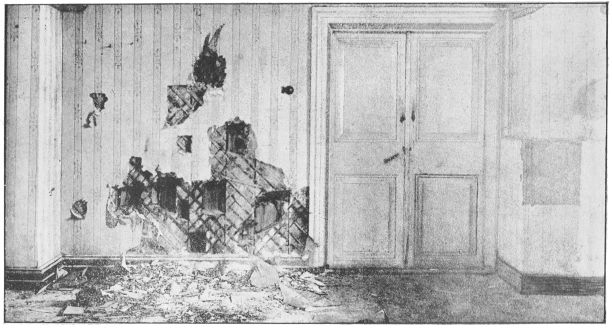
THE ROOM ON THE GROUND FLOOR OF IPATIEF’S HOUSE IN WHICH
THE IMPERIAL FAMILY AND THEIR COMPANIONS WERE PUT TO DEATH.
where their parents were awaiting them. After the agony of separation
this reunion was a tremendous joy, in spite of the sadness of the
present and the uncertainty of the future.
A few hours later Kharitonof (the chef), old Troup (footman), and little
Leonide Sednief (scullery-boy) were also brought. General Tatichtchef,
Countess Hendrikof, Mlle. Schneider, and Volkof, the Czarina’s
valet-de-chambre, had been taken direct to the prison.
On the twenty-fourth, Tchemadourof, who had been taken ill, was
transferred to the prison hospital; there he was forgotten, and so,
miraculously, escaped death. A few days later Nagorny and Sednief were
also removed. The number of those who had been left with the prisoners
decreased rapidly. Fortunately Dr. Botkin, whose devotion was splendid,
was left, and also a few servants whose faithfulness was proof against
anything: Anna Demidova, Kharitonof, Troup, and little Leonide Sednief.
During these days of suffering the presence of Dr. Botkin was a great
comfort to the prisoners; he did all he could for them, acted as
intermediary between them and the commissaries, and did his best to
protect them against the coarse insults of their guards.
The Czar, Czarina, and Czarevitch occupied the room in the angle formed
by the square and Vosnessensky Lane; the four Grand-Duchesses the
adjoining room, the door of which had been removed; at first, as there
was no bed, they slept on the floor. Dr. Botkin slept in the
drawing-room and the Czarina’s maid in the room in the angle of
Vosnessensky Lane and the garden. The other prisoners were installed in
the kitchen and adjacent hall.
Alexis Nicolaïevitch’s ill-health had been aggravated by the fatigue of
the journey; he spent the greater part of the day lying down, and when
they went out to take the air it was the Czar who carried him as far as
the garden.
The family and servants took their meals with the commissaries, who
occupied the same floor as themselves, and so lived in constant
proximity with these coarse men, who more often than not were drunk.
The house had been surrounded by a second fence of boards; it had been
turned into a veritable prison fortress. There were sentries stationed
outside and within, machineguns in the building and garden. The room of
the Commissary Commandant—the first on entering the house—was occupied
by Commissary Avdief, his adjutant Mochkine, and some workmen. The rest
of the guard lived in the basement, but the men often came upstairs and
strolled into the rooms of the Imperial family as they liked. The
courage of the prisoners was, however, sustained in a remarkable way by
religion. They had kept that wonderful faith which at Tobolsk had been
the admiration of their entourage and which had given them such
strength, such serenity in suffering. They were already almost entirely
detached from this world. The Czarina and Grand-Duchesses could often be
heard singing religious airs, which affected their guards in spite of
themselves.
Gradually these guards were humanised by contact with their prisoners.
They were astonished at their simplicity, attracted by their gentleness,
subdued by their serene dignity, and soon found themselves dominated by
those whom they thought they held in their power. The drunken Avdief
found himself disarmed by such greatness of soul; he grew conscious of
his own infamy. The early ferocity of these men was succeeded by
profound pity.
The Soviet authorities in Ekaterinburg comprised:
(a) The Divisional Council of the Urals, consisting of about thirty
members under the presidency of Commissary Bieloborodof.
(b) The Presidium, a sort of executive committee of several members:
Bieloborodof, Golochtchokine, Syromolotof, Safarof, Voïkof, etc.
(c) The Tchrezvytchaïka. The popular title of the “Extraordinary
Commission for Combating Counter-Revolution and Speculation,” with its
centre at Moscow and branches throughout Russia. This is a formidable
organisation which is the very foundation of the Soviet régime. Each
section receives its orders direct from Moscow and carries them out
through its own resources. Every Tchrezvytchaïka of any importance
commands the services of a band of nondescript agents, generally
Austro-German prisoners of war, Letts, Chinese, etc., who are in reality
nothing more than highly-paid executioners.
In Ekaterinburg the Tchrezvytchaïka was all-powerful. Its most
influential members were Commissaries Yourovsky, Golochtchokine, etc.
Avdief was under the immediate control of the other commissaries,
members of the Presidium and Tchrezvytchaïka. They were not long in
realising the change which had come about in the feelings of the guards
towards their prisoners, and resolved to adopt drastic measures. At
Moscow, too, there was uneasiness, as was proved by the following
telegram sent from Ekaterinburg by Bieloborodof to Sverdlof and
Golochtchokine (who was then at Moscow): “Syromolotof just left for
Moscow to organise according to instructions from centre. Anxiety
unnecessary. Useless to worry. Avdief revoked. Mochkine arrested. Avdief
replaced by Yourovsky. Inside guard changed, replaced by others.”
This telegram is dated July 4th.
On this day Avdief and his adjutant Mochkine were arrested and replaced
by Commissary Yourovsky, a Jew, and his subordinate Nikouline. The guard
formed—as has already been mentioned—exclusively of Russian workmen,
was transferred to a neighbouring house, that of Popof.
Yourovsky brought with him ten men—nearly all Austro-German prisoners
of war—“selected” from among the executioners of the Tchrezvytchaïka.
Henceforward these formed the inside guard, the outside sentries being
still furnished by the Russian guard.
The “house destined for a special purpose” had become a branch of the
Tchrezvytchaïka, and the lives of the prisoners became one long
martyrdom.
At this time the death of the Imperial family had already been decided
upon in Moscow. The telegram quoted above proves this. Syromolotof left
for Moscow “to organise according to instructions from centre”; he was
to return with Golochtchokine, bringing instructions and directions from
Sverdlof. Meanwhile Yourovsky made his arrangements. On several days in
succession he went out on horseback. He was seen wandering about the
neighbourhood looking for a place suitable for his plans, in which he
could dispose of the bodies of his victims. And this same man, with
inconceivable cynicism, on his return visited the bedside of the
Czarevitch!
Several days pass; Golochtchokine and Syromolotof have come back. All is
ready.
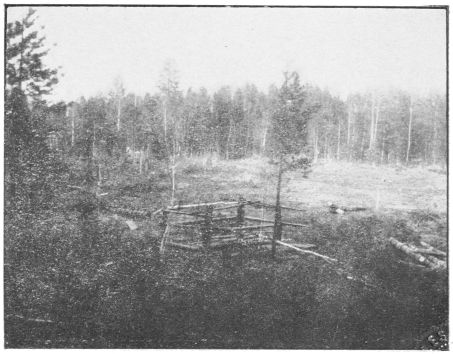
MINE-SHAFT WHERE THE ASHES WERE THROWN.
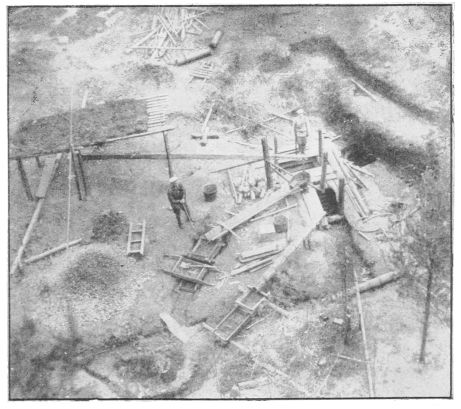
THE SEARCH IN THE MINE-SHAFT.
On Sunday, July 14th, Yourovsky summons a priest, Father Storojef, and
authorises a religious service. The prisoners are already condemned to
death and must not be refused the succour of religion.
The next day he gives orders for the removal of little Leonide Sednief
to Popof’s house, where the Russian guard are quartered.
On the sixteenth, about 7 p.m., he orders Paul Medvedief, in whom he has
every confidence—Medvedief was in control of the Russian workmen—to
bring him the twelve Nagan revolvers with which the Russian guard are
armed. When this order has been carried out he tells him that all the
Imperial family will be put to death that same night, directing him to
inform the Russian guard later. Medvedief informs them about 10 p.m.
Shortly after midnight, Yourovsky enters the rooms occupied by the
members of the Imperial family, wakes them up, together with their
entourage, and tells them to get ready to follow him. The pretext he
alleges is that they are to be taken away, that there are disturbances
in the town, and meanwhile they will be safer on the floor below.
Everyone is soon ready. They take a few small belongings and some
cushions and then go down by the inner staircase leading to the court
from which they enter the ground-floor rooms. Yourovsky goes in front
with Nikouline, followed by the Czar, carrying Alexis Nicolaïevitch, the
Czarina, the Grand-Duchesses, Dr. Botkin, Anna Demidova, Kharitonof, and
Troup.
The prisoners remain in the room indicated by Yourovsky. They are
persuaded that the carriages or cars which are to take them away are
being fetched, and as the wait may be long they ask for chairs. Three
are brought. The Czarevitch, who cannot stand because of his leg, sits
down in the middle of the room. The Czar takes his place on his left,
Dr. Botkin standing on his right a little to the rear. The Czarina sits
down near the wall (to the right of the door by which they entered), not
far from the window. A cushion has been placed on her chair and that of
Alexis Nicolaïevitch. Behind her she has one of her daughters, probably
Tatiana. In the corner on the same side Anna Demidova—still holding two
cushions in her arms. The three other Grand-Duchesses are standing with
their backs to the wall furthest from the door, and in the corner to
their right are Kharitonof and old Troup.
The wait is prolonged. Suddenly Yourovsky re-enters the room with seven
Austro-Germans and two of his friends, Commissaries Ermakof and Vaganof,
accredited executioners of the Tchrezvytchaïka. Medvedief is also
present. Yourovsky comes forward and says to the Czar: “Your men have
tried to save you but haven’t succeeded, and we are forced to put you to
death.” He immediately raises his revolver and fires point-blank at the
Czar, who falls dead. This is the signal for a general discharge of
revolvers. Each of the murderers has chosen his victim. Yourovsky has
reserved for himself the Czar and Czarevitch. For most of the prisoners
death is instantaneous. But Alexis Nicolaïevitch is moaning feebly.
Yourovsky finishes him off with a shot from his revolver. Anastasie
Nicolaïevna is only wounded, and begins to scream as the murderers
approach; she is killed by their bayonets. Anna Demidova, too, has been
spared, thanks to the cushions which she holds in front of her. She
rushes about, and finally falls under the bayonets of the assassins.
The depositions of the witnesses have made it possible for the enquiry
to reconstruct the ghastly scene of the massacre in all its details.
These witnesses are Paul Medvedief,[76] one of the murderers; Anatole
Yakimof, who was certainly present at the drama, although he denies it,
and Philip Proskouriakof, who describes the crime from the story of
other spectators. All three were members of the guard at Ipatief’s
house.
When all is over, the commissaries remove from the victims their jewels,
and the bodies are carried, with the help of sheets and the shafts of a
sledge, to a motor-wagon which is waiting at the courtyard door, between
the two wooden fences.
They have to hurry for fear of the dawn. The funeral procession crosses
the still-sleeping town and makes for the forest. Commissary Vaganof
rides ahead, as a chance encounter must be avoided. Just as they are
approaching the clearing for which they are making, he sees a wagon
driven by peasants coming towards him. It is a woman of the village of
Koptiaki, who set out in the night with her son and daughter-in-law to
sell fish in the town. He orders them to turn round and go home. To make
doubly sure he goes with them, galloping alongside the cart, and forbids
them under pain of death to turn round or look behind them. But the
peasant woman has had time to catch a glimpse of the great dark object
coming up behind the horseman. When she gets back to the village she
tells what she has seen. The puzzled peasants start out to reconnoitre,
and run into a cordon of sentries stationed in the forest.
However, after great difficulties, for the roads are very bad, the
motor-wagon reaches the clearing. The bodies are placed on the ground
and partly undressed. It is then that-the commissaries discover a
quantity of jewellery that the Grand-Duchesses carry concealed under
their clothes. They at once seize them, but, in their haste, let a few
fall on the ground, where they are trodden into the soil. The bodies are
then cut in pieces and placed on great bonfires, which are made to burn
more fiercely by the application of benzine. The parts which resist the
flames are destroyed with sulphuric acid. For three days and three
nights the murderers toil at their labour of destruction under the
direction of Yourovsky and his two friends Ermakof and Vaganof. One
hundred and seventy-five kilogrammes of sulphuric acid and more than 300
litres of benzine are brought to the clearing.
At last, on July 20th, all is finished. The murderers efface all traces
of the fires, and the ashes are thrown into a mine-shaft or scattered
about the neighbourhood of the clearing, so that nothing may reveal what
has taken place.
. . . . . .
Why did these men take so much trouble to efface all traces of their
deed? Why, since they professed to be acting as the servants of justice,
did they hide like criminals? And from whom were they hiding?
It is Paul Medvedief who explains this in his evidence. After the crime
Yourovsky came up to him and said, “Keep the outside sentries at their
posts in case there is trouble with the people!” And during the
following days the sentries continued to mount guard round the empty
house as if nothing had happened, as if the fences still shut in the
prisoners.
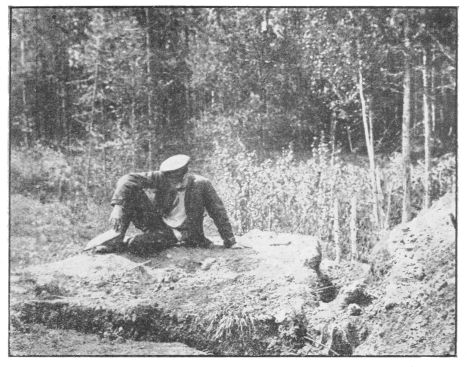
M. SOKOLOFF EXAMINING THE ASHES OF THE FIRE NEAREST TO
THE MINE-SHAFT.
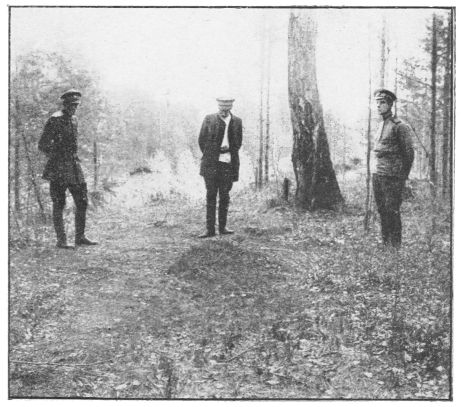
M. SOKOLOFF EXAMINING THE TRACES OF ONE OF THE FIRES AT
THE FOOT OF AN OLD PINE.
Those who must be deceived, must not know, are the Russian people.
Another fact proves this: the precaution taken on July 4th of sending
away Avdief and the Russian guard. The commissaries no longer had
confidence in these workmen from the Sissert workshops and the factory
of Zlokazof, who had, however, rallied to their cause and enlisted
voluntarily to guard “bloody Nicholas.” They knew that none but paid
assassins, convicts, or foreigners would consent to carry through the
infamous task they were proposing. These assassins were Yourovsky (a
Jew), Medvedief, Nikouline, Ermakof, Vaganof, Russian convicts, and
seven Austro-Germans.
Yes, it was from the Russian people that they were hiding, the men whose
agents they professed to be. It was of them they were afraid; of their
vengeance.
At last, on July 20th, they decided to speak and announce the death of
the Emperor to the people in a proclamation published in the following
form:
DECISION
of the Presidium of the Divisional Council of Deputies of Workmen,
Peasants, and Red Guards of the Urals:
In view of the fact that Czecho-Slovakian bands are threatening the
Red capital of the Urals, Ekaterinburg; that the crowned
executioner may escape from the tribunal of the people (a White
Guard plot to carry off the whole Imperial family has just been
discovered), the Presidium of the Divisional Committee, in
pursuance of the will of the people, has decided that the ex-Czar
Nicholas Romanoff, guilty before the people of innumerable bloody
crimes, shall be shot.
The decision of the Presidium of the Divisional Council was carried
into execution on the night of July 16th-17th.
Romanoff’s family has been transferred from Ekaterinburg to a place
of greater safety.
The Presidium of the Divisional Council
of Deputies of Workmen, Peasants, and
Red Guards of the Urals.
DECISION
of the Presidium of the Central Executive Committee of All the
Russias of July 18th, a.c.
The Central Executive Committee of the Councils of Deputies of
Workmen, Peasants, Red Guards, and Cossacks, in the person of their
president, approve the action of the Presidium of the Council of
the Urals.
The President of the Central Executive Committee,
Y. Sverdlof.
In this document mention is made of the sentence of death passed, it is
alleged, by the Presidium of Ekaterinburg, on the Czar Nicholas II. A
lie! The crime, we know, was decided on in Moscow by Sverdlof, his
instructions being brought to Yourovsky by Golochtchokine and
Syromolotof.
Sverdlof was the head and Yourovsky the arm; both were Jews.
The Czar was neither condemned nor even judged—and by whom could he
have been?—he was assassinated. And what of the Czarina, the children,
Dr. Botkin, and the three servants who died with them? But what does it
matter to the murderers? They are sure of impunity; the bullet killed,
the flame destroyed, and the earth covered what the fire could not
devour. Oh, they are very easy in their minds; no one will talk, for
they are united by infamy. And it seems to be with reason that
Commissary Voïkof can exclaim, “The world will never know what we have
done with them!”
These men were mistaken.
After months of groping, the enquiry commission undertook methodical
investigation in the forest. Every inch of ground was searched,
scrutinised, examined, and soon the mine-shaft, the soil of the
clearing, and the grass of the vicinity revealed their secret. Hundreds
of articles and fragments, for the most part trodden into the ground,
were discovered, identified, and classified by the court of enquiry.
Amongst other things, they found in this way:
The buckle of the Czar’s belt, a fragment of his cap, the little
portable frame containing the portrait of the Czarina—the photograph
had disappeared—which the Czar always carried about him, etc.
The Czarina’s favourite ear-rings (one broken), pieces of her dress, the
glass of her spectacles, recognisable by its special shape, etc.
The buckle of the Czarevitch’s belt, some buttons, and pieces of his
cloak, etc.
A number of small articles belonging to the Grand-Duchesses: fragments
of necklaces, shoes, buttons, hooks, press-buttons, etc.
Six metal corset busks. “Six”—a number which speaks for itself when
the number of the female victims is remembered: the Czarina, the four
Grand-Duchesses, and A. Demidova, the Czarina’s maid.
Dr. Botkin’s false teeth, fragments of his eyeglasses, buttons from his
clothes, etc.
Finally charred bones and fragments of bones, partly destroyed by acid
and occasionally bearing the mark of a sharp instrument or saw; revolver
bullets—doubtless those which had remained embedded in the bodies—and
a fairly large quantity of melted lead.
A pathetic list of relics, leaving, alas! no hope, and showing up the
truth in all its brutality and horror. Commissary Voïkof was mistaken:
the world now knows what they did with them.
Meanwhile the murderers were growing uneasy. The agents they had left at
Ekaterinburg to set the enquiry on false trails kept them in touch with
its progress. This they followed step by step. And when they understood
finally that the truth was about to be revealed, that the whole world
would soon know what had happened, they became afraid, and tried to
throw on to others the responsibility for their crime. It was then that
they accused the socialist-revolutionaries of being the authors of the
crime and of having tried this means of compromising the Bolshevik
party. In September, 1919, twenty-eight persons were arrested by them at
Perm, falsely accused of having participated in the murder of the
Imperial family, and tried. Five of them were condemned to death and
executed.
This odious farce forms one more illustration of the cynicism of these
men who did not hesitate to send innocent people to
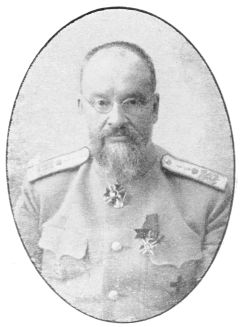
DR. BOTKIN, WHO WAS KILLED WITH THE IMPERIAL FAMILY.
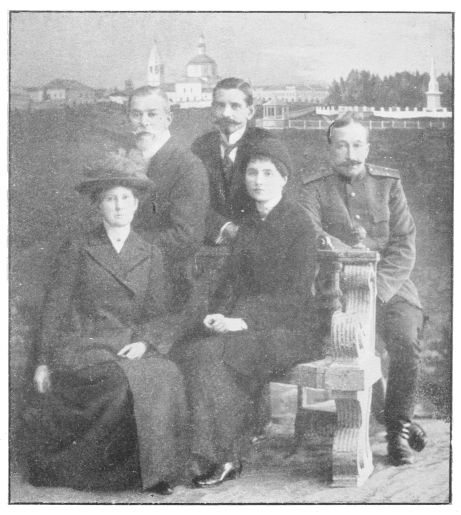
GROUP TAKEN AT TOBOLSK, WHEN WE WERE COMPELLED TO BE
PHOTOGRAPHED.
Left to right, in front: Mlle. Schneider and Countess Hendrikof (shot at
Perm). Behind: General Tatichtchef (shot at Ekaterinburg), the author,
Prince Dolgorouky (shot at Ekaterinburg).
their death rather than incur the responsibility for one of the greatest
crimes of history.
. . . . . .
It remains to mention the tragedy of Alapaevsk, which is closely
connected with that of Ekaterinburg, and caused the death of several
other members of the Imperial family.
The Grand-Duchess Elizabeth Feodorovna, sister of the Czarina, the
Grand-Duke Sergius Michaïlovitch, cousin of the Czar, Princes Jean,
Constantin, and Igor, sons of the Grand-Duke Constantin, and Prince
Palée, son of the Grand-Duke Paul, had been arrested in the spring of
1918 and taken to the little town of Alapaevsk, situated 150 versts
north of Ekaterinburg. A nun, Barbe Yakovlef, the Grand-Duchess’s
companion, and S. Remes, secretary of the Grand-Duke Sergius, shared
their captivity. Their prison was the school-house.
In the night of July 17th-18th, twenty-four hours after the Ekaterinburg
crime, they were fetched and, under pretext of being removed to another
town, were driven about twelve versts from Alapaevsk. There, in a
forest, they were put to death. Their bodies were thrown into the shaft
of an abandoned mine, where they were found, in October, 1918, covered
with the earth thrown up by the explosion of hand-grenades by which the
sufferings of the victims had been terminated.
The autopsy revealed traces of death by shooting only on the body of the
Grand-Duke Sergius, and the enquiry has failed to establish exactly how
his companions were killed. It is probable that they were beaten down
with rifle-butts.
This crime of unexampled brutality was the work of Commissary Safarof,
member of the Ekaterinburg Presidium, who, however, was acting
entirely on the orders of Moscow.
Some days after the capture of Ekaterinburg, when order was being
restored in the town and the dead buried, two bodies were found not far
from the prison. On one of them was found a receipt for 80,000 roubles
made out to Citizen Dolgorouky, and, according to the descriptions of
witnesses, it seems certain that this was the body of Prince Dolgorouky.
There is every reason to believe that the other was the body of General
Tatichtchef.
Both died, as they had expected, for their Czar. General Tatichtchef
said to me one day at Tobolsk: “I know I shan’t come out alive. I only
ask one thing, not to be separated from the Czar and to be allowed to
die with him.” Even this supreme consolation was denied him.
Countess Hendrikof and Mlle. Schneider were removed from Ekaterinburg a
few days after the murder of the Imperial family and taken to Perm.
There they were shot in the night of September 3rd-4th, 1918. Their
bodies were found and identified in May, 1919.
As for Nagorny, Alexis Nicolaïevitch’s sailor, and the footman, Ivan
Sednief, they were put to death in the neighbourhood of Ekaterinburg in
the beginning of June, 1918. Their bodies were found two months later at
the place of execution.
All, from General to seaman, did not hesitate to sacrifice their lives
and go bravely to meet death. This seaman, however, a humble peasant
from the Ukraine, had only to say one word to be saved. He had only to
deny his Czar. This word remained unspoken.
For a long time, with simple and sincere faith, they had devoted their
lives to those they loved, who had been able to inspire those who
surrounded them with so much affection, courage, and self-sacrifice.