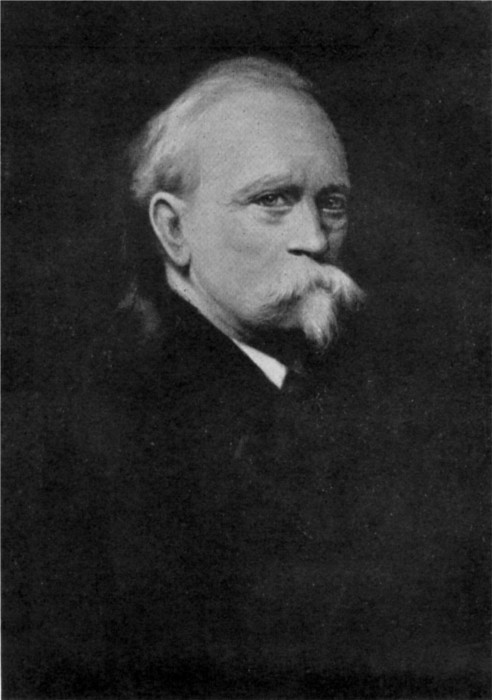
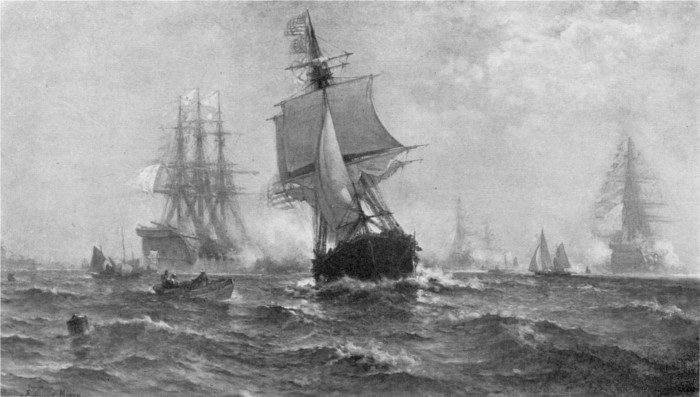
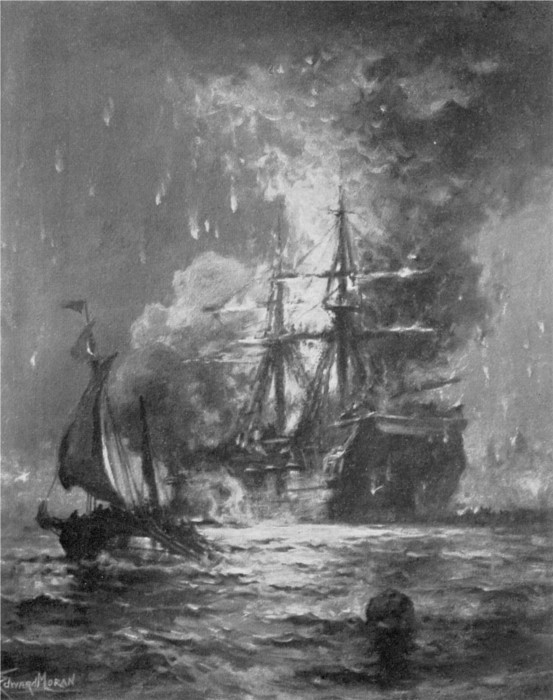
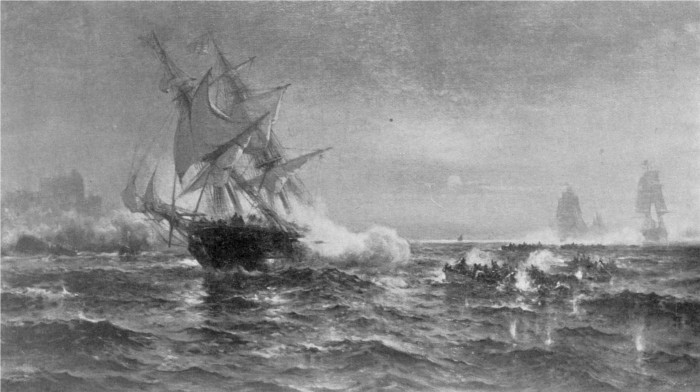
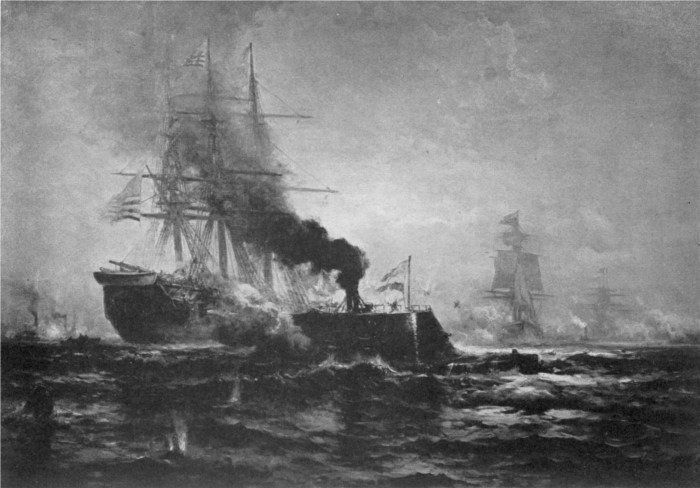
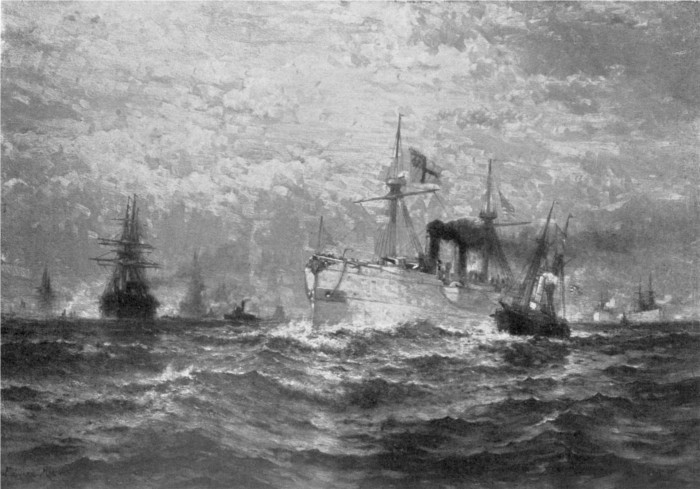
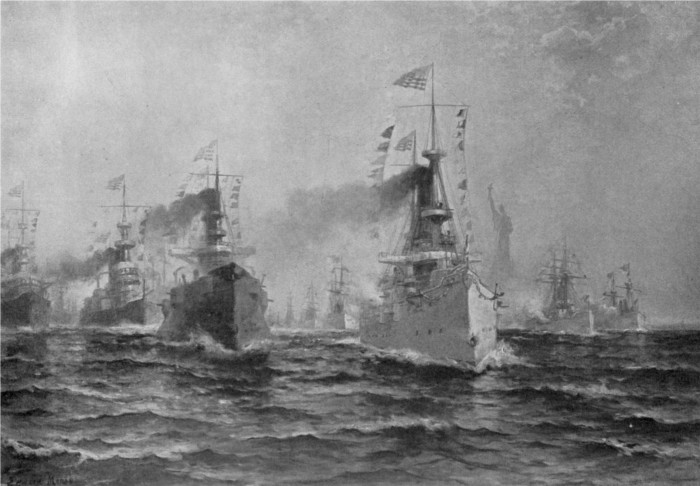
Edward Moran was almost seventy-two years of age when he died in the
City of New York on June 9, 1901, having been born at Bolton,
Lancashire, England, on August 19, 1829. He was the oldest son of a
large family of children, and when a mere child was put to work at the
loom, the humble vocation of his father who, the same as his ancestors
had been for several generations, was a hand-loom weaver. Already while
so employed the child was frequently caught sketching with charcoal on
the white fabric in his loom instead of continually plying the shuttle.
Whence and how he derived this inborn talent is one of those unsolvable
problems which seem to set at defiance all the accepted canons of
heredity. At all events, his talent was recognized by a local village
celebrity, a decorator, who guided the child, then only nine years of
age, in a crude way to a development of these artistic instincts, in
consequence of which it is related that he was soon able to "cut
marvellous figures from paper and afterwards draw their outlines on
walls and fences."
The hardship of their pursuit, offering little hope of a brighter future
for their large family of growing children, induced the parents about
the year 1844 to join the tide of emigration to that land of golden
promise, the United States, in immortalizing whose history and in
furthering whose artistic development through his glorious marine
pictures, the little Edward was destined to play so important a part.
The family settled in Maryland, and in the struggle for existence soon
awakened from their golden dream of a new Eldorado and returned to
their old vocation. Edward again found employment at the loom, until the
spirit of adventure and the desire of following the artistic bent of his
mind impelled him one day, without a dollar in his pocket, to walk all
the way to Philadelphia, where the boy hoped to find better
opportunities. There also, however, he was disappointed, and after
employment in various capacities, first with a cabinetmaker, then in a
bronzing shop, and then at house painting, he finally returned to the
loom at the munificent salary of six dollars per week. While so employed
he attracted the attention of the proprietor, who one day surprised him
while engaged in a superb drawing, stealing time for this purpose from
his work. The intelligence of this man in recognizing young Moran's
exceptional talent, and, as a result, advising him to quit mechanical
labor, and introducing him to one of the then famous landscape painters
of Philadelphia, Mr. Paul Webber, was the turning point in his career.
Subsequently another artist, James Hamilton, guided him in his
particular bent of marine painting, and after the usual hardships and
struggle for recognition, the fate of all young artists, he finally was
enabled to open a little studio in a garret over a cigar store with an
entrance up a back alley. The works which emanated from there attracted
such wide attention that he gradually rose to fame and fortune. His
pictures were accepted by all the American academies, as well as the
London Royal Academy and the Paris Salon, and he received many medals
and awards. He was a member of the Water-Color Societies of this country
and of London, of the Philadelphia Academy of Fine Arts, an Associate of
the National Academy of Design, also Vice-President of the Lotos Club
and connected with many other artistic and social organizations and
societies.
Why his artistic tastes should have been particularly directed to
marine painting can be demonstrated just as little as the possession of
his extraordinary talents at all; and yet for the former a possible
solution may be found in the fact that his childish imagination and
predilections may have been moulded through his sea-coast experiences in
old Lancashire, that picturesque maritime county of northwestern
England, which is bounded on the west by the Irish Sea. At all events
Edward Moran loved the sea, and this love guided every stroke of his
brush in depicting his favorite element. No artist in this country, or
perhaps in the world, has ever painted such water, and it was not many
years after his first successes in Philadelphia that his fame spread
throughout the United States, and he was easily recognized as its first
marine painter. Fame and prosperity, however, did not turn his head, as
they so frequently do with little men, but never with men of true
genius. On the contrary, he worked with redoubled zeal and industry as
he grew older, so that the number of works which he produced is
marvellous.
Among his famous paintings, besides the thirteen herein described, may
be mentioned the following:
"Virginia Sands."
"A Squally Day off Newport."
"Massachusetts Bay."
"New York Harbor."
"The Yacht Race."
"The Battle of Svold."
"Philadelphia from the New Park."
"Minot's Ledge Light-House."
"White Cliffs of Albion."
"Off Block Island."
"Return of the Fishers."
"Outward Bound."
"Low Tide."
"The Gathering Storm."
"Sentinel Rock, Maine."
"Toilers of the Sea."
"Launching of the Life-Boat." (1865.)
"View on Delaware Bay." (1867.)
"Evening on Vineyard Sound." (1867.)
"Pinchyn Castle, North Wales." (1867.)
"Moonrise at Nahant." (1867.)
"The Lord Staying the Waters." (1867.)
"Coast Scene Near Digby." (1868.)
"Departure of the United States Fleet for Port Royal." (1868.)
"After a Gale." (1869.)
"On the Narrows." (1873.)
"The Commerce of Nations Paying Homage to Liberty" (1877)—the great
picture which came into the possession of Mr. Joseph Drexel, the
banker—an allegory suggested by the then proposed Statue of Liberty in
New York Harbor.
"Young Americans out on a Holiday." (1882.)
"Life-Saving Patrol: New Jersey Coast." (1889.)
"Melodies of the Sea." (1890.)
"South Coast of England." (1900.)
But space forbids the complete enumeration of even his more notable
works, which may be counted by the hundreds.
Mr. Moran, like all men of genius, felt his own strength, though he
never overrated it; but as a result of this self-consciousness he would
not brook depreciation, and when, in May, 1868, the Philadelphia Academy
of Fine Arts, of which he was a member, had hung some of his pictures in
an inconspicuous and detrimental position in its gallery, he resorted to
a novel expedient for showing his displeasure. On "varnishing day,"
prior to the opening of the exhibition to the public, he used a mixture
of beer and porter, combined with a dry light red, for the purpose of
"varnishing" his paintings, but the effect of which was that they were
all coated with a beautiful opaque red substance, so that none of them
could be recognized, and yet a substance which he could remove, when so
inclined, without injuring the pictures at all. This called forth a
storm of criticism from the "Hanging Committee" and the wiseacres of the
Academy, but he was fully sustained in his course by public opinion and
the press, and, instead of diminishing, it added to his fame as an
artist and certainly to his reputation for the courage of his
convictions.
Mr. Moran was not only a great artist, but a man of genial and
companionable qualities, which endeared him to all with whom he came in
contact. He, furthermore, was not only an artist who used oil,
water-color and pastel with equal facility, and painted landscapes and
figure pieces as well as marines, but was versatile in his talents. His
musical instincts were marked, and, although self-taught, he played on a
number of instruments, and he had also, through years of industrious
reading and study, become thoroughly well-informed and an interesting
conversationalist. He was of a most generous nature, and was not only
ever ready to assist young artists with advice and material aid as well,
but also, when the occasion arose, to devote the fruit of his labors to
any meritorious charitable object. Thus, for example, in March, 1871, he
exhibited in Philadelphia seventy-five of his landscapes and marines,
all of which he used in illustrating a beautiful catalogue entitled
"Land and Sea," and not only gave the entire profits of this exhibition
and of the sale of the catalogue, but also the price obtained for one of
his important paintings, entitled "The Relief Ship Entering Havre," to
aid the sufferers of the Franco-Prussian war.
He did not reach the culminating point of excellence in his work in
middle life or shortly thereafter, like so many other painters, but on
the contrary grew in breadth and power with advancing years, so that the
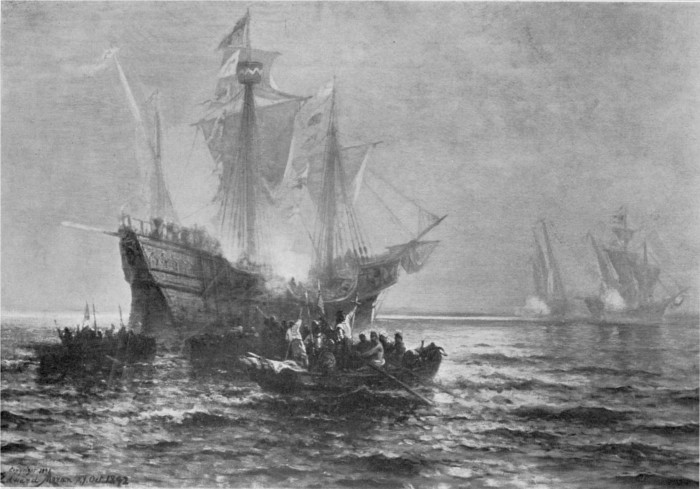
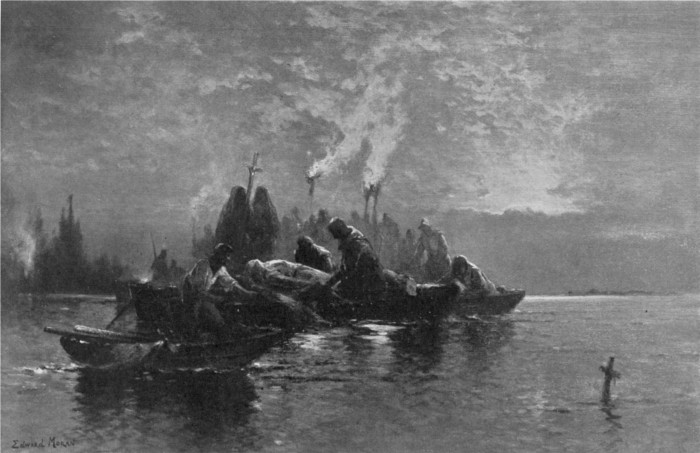
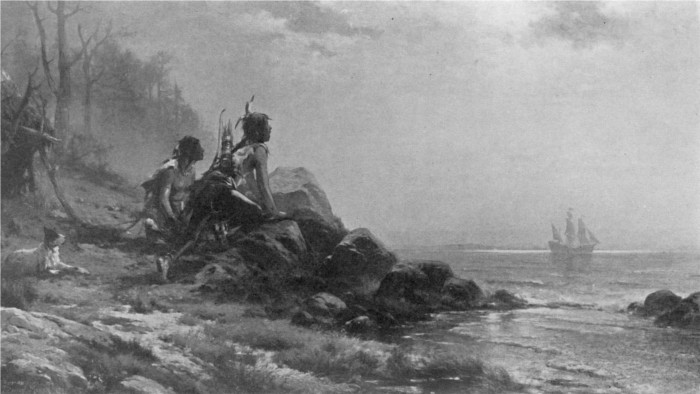
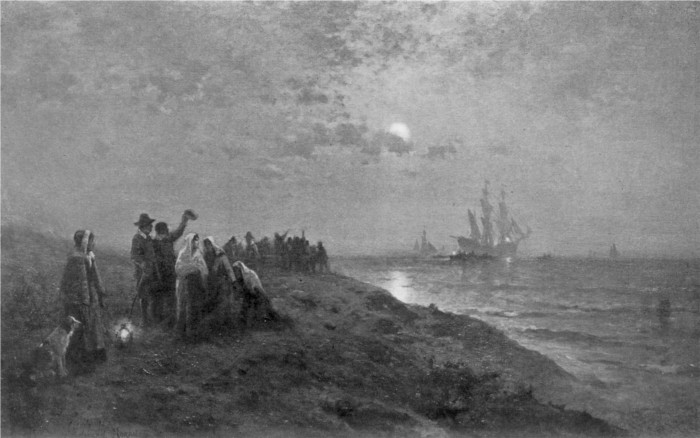
Thirteen Historical Paintings, described in this little book, although
he gave them the finishing touches only shortly before his death,
constitute his greatest achievement.
About the year 1872 Mr. Moran sought a still wider field for his
activities in removing from Philadelphia to the City of New York, where
for thirty years he was a conspicuous and admired figure in metropolitan
life, and in his studios, surrounded by all the luxury and comfort that
prosperity could suggest, he and his talented and hospitable wife drew
around them a circle of artists, authors, musicians and notable men of
all classes, among whom may be mentioned actors like Joseph Jefferson,
F. F. Mackay (both pupils of Mr. Moran) and Charles W. Couldock, writers
like Richard Watson Gilder and John Clark Ridpath, lawyers like Col.
Edward C. James and Robert Ingersoll, art connoisseurs like Samuel P.
Avery and William Schaus, sculptors like Frederic A. Bartholdi and James
W. A. Macdonald, and of course a host of artists such as Edwin Abbey,
Albert Bierstadt, Edwin H. Blashfield, John C. Brown, Thomas B. Craig,
Hamilton Hamilton, Constant Meyer, Paul de Longpré, Henry W. Ranger,
Vasili Vereschagin and Napoleon Sarony.
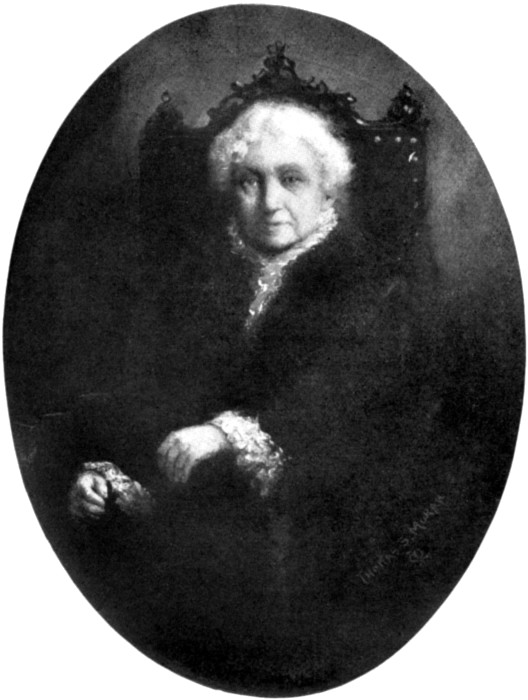
Copyright, 1905, by Theodore Sutro.
MRS. EDWARD MORAN
(NÉE ANNETTE PARMENTIER)
From a painting by Thomas Sidney Moran
It may be added that Mrs. Moran's maiden name was Annette Parmentier,
and that she was a Southern girl of French descent from the noted
scientist Antoine Augustin Parmentier, who was the first to introduce
the potato into France, for which he was decorated by Louis XVI as a
public benefactor, and honored by a statue erected in his native town of
Bordeaux. Mr. Moran married Annette (his second wife) in the year 1869,
and under his instruction and guidance her own talent as an artist was
developed, and some of her paintings, among them landscapes entitled "A
Staten Island Study," "The Fisherman's Return," and other pictures, were
not only exhibited and greatly admired, but were deemed of sufficient
importance to be reproduced by prominent art publishers. She survived
her husband by about three and one-half years, having died, at an
advanced age, in the City of New York on November 7, 1904.
In his art Mr. Moran followed mainly the bent of his own genius, though
if he was influenced by any other artists to any extent it was by
Clarkson Stanfield and Turner, whom he greatly admired and many of whose
pictures, for the sake of practice, he copied. He was undoubtedly also
influenced in a general way, as are all eminent artists, by studying the
master works of the world in Europe, where for that purpose he spent
some time in the year 1861 and again in 1878 and also in subsequent
years.
Of Edward Moran it may be truly said that he is another notable example
of the fact that true genius is not baffled or impaired through adverse
circumstances or the most humble beginnings, but soars ever upward and
onward until it achieves its mission, and compels the recognition and
admiration of the world, to which it is entitled.