Judges and officers shalt thou make thee in all thy gates
. . . and they shall judge the people with just judgment.
Deut. xvi, 18.
There is nothing so potent in a public
debate as the picturesque catchwords
in which leaders of thought sum up their
convictions. Logic makes fewer converts in a
year than a taking phrase makes in a week.
For catchwords are the popular substitute
for logic, and the man in the street is reduced
to silence by a good round phrase of
the kind that sticks.
Two classes of citizens are especially prone
to fall under the tyranny of phrases: those
whose horizon, through no fault of their own,
is limited by the rim of an empty dinner-pail;
and those whose view of the universe is
obstructed by the kitchen-middens of too
many dinners. There is no clear thinking on
an empty stomach, and equally muddled are
the thoughts of the over-full. When I hear
of a public measure that is largely supported
by these two classes of citizens, I know at
once that the measure appeals to human prejudices
rather than to divine reason.
Thus I became suspicious of the restrictionist
movement when I realized that it was
in greatest favor among the thoughtless poor
and the thoughtless rich. I am well aware that
the high-priests of the cult include some of the
most conscientious thinkers that ever helped
to make history, and their earnestness is attested
by a considerable body of doctrine, in
support of which they quote statistics and
special studies and scientific investigations.
But I notice that the rank and file of restrictionists
do not know as much as the titles of
these documents. They have not followed
the argument at all; they have only caught
the catchwords of restrictionism. And these
catchwords are the sort that appeal to the
mean spots in human nature,—the distrust
of the stranger, the jealousy of possession, the
cowardice of the stomach. Nothing else is
expressed by such phrases as “the scum of
Europe,” “the exploitation of America’s
wealth,” or “taking the bread from the
mouth of the American workingman.”
Even the least venomous formula of restrictionism,
“immigration isn’t what it used
to be,” raises such a familiar echo of foolish
human nature that I am bound to challenge
its veracity. Does not every generation cry
that the weather isn’t what it used to be,
children are not what they used to be, society
is not what it used to be? “The good old
times” and “the old immigration” may be
twin illusions of limited human vision.
If it is true that immigration is not what
it used to be, the fact will appear from a
detailed comparison of the “old” and the
“new” immigration. But which of the immigrant
stocks of the good old times shall be
taken as a standard? Woman’s wisdom urges
me to go right back to the original pattern,
just as I would do if I went to the shops to
match samples. And the original pattern
was brought to this country in the year 1620.
Surely comparison with the Mayflower stock
is the most searching test of the quality of
our immigration that any one could propose.
The predominant virtue of the Pilgrims
was idealism. The things of the spirit were
more to them than the things of the flesh.
May we say the like of our present immigrants?
Of very many of them, yes; a thousand
times yes. Of the 8,213,000 foreigners
landed between the years 1899 and 1909,
990,000 were of that race which for nineteen
centuries has sacrificed its flesh in the service
of the spirit. It takes a hundred times
as much steadfastness and endurance for a
Russian Jew of to-day to remain a Jew as it
took for an English Protestant in the seventeenth
century to defy the established
Church.
Those who think that with the Spanish
Inquisition Jewish martyrdom came to an
end are asked to remember that the Kishinieff
affair is only eight years behind us, and
that Bielostock has been heard from since
Kishinieff, and Mohileff since Bielostock.
And more terrible than the recurrent pogrom,
which hacks and burns and tortures a
few hundreds now and then, is the continuous
bloodless martyrdom of the six million
Jews in Russia through the operation of the
anti-Semitic laws of that country. Thirty
minutes spent in looking over a summary of
these laws recently compiled by an English
historian will convince any reader with a
spark of imagination that every Russian
Jewish immigrant to-day is a fugitive from
religious persecution, even as were the English
immigrants of 1620.
But while nobody questions the idealism
of the Jew in religion, the world has been
very slow to credit him with any degree of
civic devotion. The world did not stop to
think that a man has to have a country before
he can prove himself a good citizen. But happily
in recent times he has been put to the
test of civic opportunity, notably in America;
with the result that he was found to possess
a fair share of the civic virtues, from the generosity
displayed in the town meeting, when
citizens vote away their substance to support
a public cause, to the brute heroism of the
battle-field, where mangled flesh gives proof
of valiant spirit. And what the Jews of West
European stock proved in the American wars
for freedom the Jews of Eastern Europe have
proved more recently, by their forwardness
in the Russian revolution of 1905.
No group of people of all the heterogeneous
mass that constitutes the Russian
nation were half so prominent as the Jews in
that abortive attempt at freedom. Witness
the police records of the revolutionary period,
which show that sixty-five out of every hundred
political offenders were Jews, in districts
where the population was fifteen parts
Jewish and eighty-five parts Gentile. When
I visited my native town in the Pale, several
years after the revolution, it was hard to find,
among the young men and women I talked
with, one in a dozen who had not shared in
the dangers of 1905. If we really want to
know how heartily the Jews played their
part in the revolution, we need only ask the
Russian Government why the anti-Semitic
laws have been so vengefully enforced since
a certain crimson year within the present
decade. And the whole significance of these
things, in the present study, lies in the fact
that precisely that spirit which prompts to
rebellion in despotic Russia rallies in free
America to the support of existing institutions.
If it was a merit in 1620 to flee from
religious persecution, and in 1776 to fight
against political oppression, then many of
the Russian refugees of to-day are a little
ahead of the Mayflower troop, because they
have in their own lifetime sustained the
double ordeal of fight and flight, with all
their attendant risks and shocks.
To obtain a nice balance between the relative
merits of these two groups of rebels, we
remind ourselves that, for sheer adventurousness,
migration to America to-day is not
to be mentioned on the same page with the
magnificent exploit of 1620, and we reflect
that the moral glory of the revolution of 1776
is infinitely greater than that of any subsequent
revolt; because that, too, was a path-finding
adventure, with no compass but
faith, no chart but philosophical invention.
On the other hand, it is plain that the Russian
revolutionists moved against greater
odds than the American colonists had to
face. The Russians had to plot in secret,
assemble in the dark, and strike with bare
fists; all this under the very nose of the Czar,
with the benighted condition of the Russian
masses hanging like a cloud over their enterprise.
The colonists were able to lay the
train of revolution in the most public manner,
they had the local government in their
hands, a considerable militia obedient to
their own captains, and the advantage of
distance from the enemy’s resources, with a
populace advanced in civic experience promising
support to the leaders.
And what a test of heroism was that which
the harsh nature of the Russian Government
afforded! The American rebels risked their
charters and their property; for some of them
dungeons waited, and for the leaders dangled
a rope, no doubt. But confiscation is not so
bitter as Siberian exile, and a halter is less
painful than the barbed whip of the Cossacks.
The Minutemen at Concord Bridge defied a
bully; the rioters in St. Petersburg challenged
a tiger. And first of all to be thrust into the
cage would be the rebels of Jewish faith, and
nobody knew that better than the Jews
themselves.
The superior zeal and high degree of self-sacrifice
displayed by the Jewish revolutionists
would naturally be explained by the fact
that, of all the peoples held in chains by the
Russian Government, the Jews are the ones
who have suffered the cruelest oppression.
But there is proof, proof that will go down
with the stream of history, that the Jewish
participants in the Russian revolution of
1905 were actuated by the highest patriotism,
their peculiar grievances being forgotten
in the grievances of the nation as a whole.
The sinking of the Jewish question in the
national question was an important article of
the revolutionary propaganda among the
Jews; so much so, that when a prominent
Jewish leader attempted to demonstrate, on
philosophical grounds, that that was a false
position to take, he was hotly repudiated,
although up to that time he had stood high
in the councils of the leaders.
If we find such a high degree of civic responsiveness
in what we have been trained to
think the most unlikely quarter, shall we not
look hopefully in other corners of our world
of immigrants? If the Jewish spirit of freedom
leaps from the grave of Barkochla to the
hovels of the Russian ghetto, half across the
world and half across the civilized era, shall
we not look for similar prodigies from the
more recent graves of Kosciuszko and Garibaldi?
If the hook-nosed tailor can turn hero
on occasion, why not the grinning organ-grinder,
and the surly miner, and the husky
lumber-jack? We experienced a shock of surprise,
a little while ago, when troops of our
Greek immigrants deserted the bootblacking
parlors and fruit-stands and tumbled aboard
anything that happened to sail for the Mediterranean,
in their eagerness—it’s hard to
bring it out, in connection with a “Dago”
bootblack!—in their eagerness to strike a
blow for their country in her need.
But that’s the worst of calling names: it
deceives those who do so. The little bootblacks
would not have fooled us as they did
if we had not recklessly summed up the
Greek character in a contemptuous epithet.
It is quite proper for street urchins to invent
nicknames for everybody—that is what
street urchins are for; but let us not hand
down the judgment of the gutter where the
judgment of the senate is called for. Between
Leonidas at the pass and little Metro under
the saloon window, fawning for our nickels,
is indeed a dismal gap; and yet Metro, when
occasion demanded, reached out his grimy
hand and touched the tunic of the Spartan
hero.
From these unexpected exploits of the
craven Jew and the degenerate Greek, it
would seem as if the different elements of the
despised “new” immigration only await a
spectacular opportunity to prove themselves
equal to the “old” in civic valor. But if contemporary
history fails to provide a war or
revolution for each of our foreign nationalities,
we are still not without the means of
gauging the idealistic capacity of the aliens.
Next after liberty, the Puritans loved education;
and to-day, if you examine the registers
of the schools and colleges they founded, you
will find the names of recent immigrants
thickly sprinkled from A to Z, and topping
the honor ranks nine times out of ten. All
readers of newspapers know the bare facts,—each
commencement season, the prize-winners
are announced in a string of unpronounceable
foreign names; and every
school-teacher in the immigrant section of
the larger cities has a collection of picturesque
anecdotes to contribute: of heroic
sacrifices for the sake of a little reading and
writing; of young girls stitching away their
youth to keep a brother in college; of whole
families cheerfully starving together to save
one gifted child from the factory.
Go from the public school to the public
library, from the library to the social settlement,
and you will carry away the same
story in a hundred different forms. The good
people behind the desks in these public
places are fond of repeating that they can
hardly keep up with the intellectual demands
of their immigrant neighbors. In the experience
of the librarians it is the veriest commonplace
that the classics have the greatest
circulation in the immigrant quarters of the
city; and the most touching proof of reverence
for learning often comes from the illiterate
among the aliens. On the East Side
of New York, “Teacher” is a being adored.
Said a bedraggled Jewish mother to her little
boy who had affronted his teacher, “Don’t
you know that teachers is holy?” Perhaps
these are the things the teachers have in
mind when they speak with a tremor of
the immense reward of work in the public
schools.
That way of speaking is the fashion among
workers of all sorts in the educational institutions
where foreigners attend in numbers.
Get a group of settlement people swapping
anecdotes about their immigrant neighbors,
and there is apt to develop an epidemic
of moist eyes. Out of the fullness of their
knowledge these social missionaries pay
the tribute of respect and affection to the
strangers among whom they toil. For they
know them as we know our brothers and sisters,
from living and working and rejoicing
and sorrowing together.
The testimony of everyday experience is
borne out by the sudden revelations of
catastrophic circumstances, as reported by
a librarian from Dayton, Ohio. In Dayton
they had branch libraries located in different
parts of the city, not in separate library
buildings, but in convenient shops or dwelling-houses,
where they were left in the care
of some responsible person in the neighborhood.
After the recent flood, when the
panic was over and the people began to dig
for their belongings underneath the accumulated
slime and wreckage, the librarian tried
to collect at the central library whatever
was recovered of the scattered collection.
Crumpled, mutilated, slimy with the filth
of the disemboweled city, the books came
back—all but one collection, which had
been housed in the midst of the Hungarian
quarter. These came back neatly packed,
scraped clean of mud, their leaves smoothed,
dried,—as presentable as loving care could
make them.
If that was not a manifestation of pure
idealism, then is human conduct void of symbolism,
and our public squares are cumbered
in vain with monuments erected in commemoration
of human deeds. But we read men’s
souls in their actions, and we know that they
who flock to the schools are the spiritual
kindred of those who founded them; they
who cherish a book are passing along the
torch kindled by him who wrote it. They pay
the highest tribute to an inventor who show
the most eagerness to adopt his invention.
The great New England invention of compulsory
education is more eagerly appropriated
by the majority of our immigrants than
by native Americans of the corresponding
level. That is what the school-teachers say,
and I suppose they know. They also say,—they
and all public educators in chorus,—that
while one foreign nationality excels in
the love of letters, another excels in the love
of music, and a third in the love of science;
and all of them together constitute an army
whose feet keep time with the noble rhythms
of culture.
Let a New Yorker on Friday night watch
the crowd pushing out of a concert hall after
one of Ysaye’s recitals, and on Saturday
afternoon let him take the subway uptown,
and get out where the crowd gets out, and
buy a ticket for the baseball game. If he can
keep cool enough for a little study, let him
compare the distorted faces in the bleachers
with the shining faces of the crowd of the
night before; and let him say which crowd
responded to the nobler inspiration, and then
let him declare in which group the foreigners
outnumbered the Americans.
The American devotion to sport is no reproach
to the descendants of the Puritans,
since it can be demonstrated from various
angles that the baseball diamond may supplement
the schoolroom and the pulpit in
the training of American citizens. Indeed, it
is not difficult to accept that interpretation of
the national sport which reduces a good game
of baseball to an epitome of all that is best in
the lives of the best Americans. At the same
time we need to remember that the love of
art is more generally accepted as a mark of
grace than the love of sport. Thus, when we
speak of the glory of old Athens we have in
mind not the Olympian games, noble as they
were, but the poets and sculptors and philosophers
who uttered her thoughts. The
original of the Discobolus must have been a
winner,—I can imagine Athenian mothers
lifting up their beautiful bare babies to see
the hero over the heads of the throng,—but
who can tell me his name to-day? Meanwhile
the name of Myron has been guarded
as a talisman of civilization.
We shall not look in the sporting columns,
then, for the names of contemporary Americans
who are likely to secure us a place of
honor on the scrolls of history. We look
under the current book reviews, in theatre
programmes, in the announcements of art
galleries. As a by-product of such a search
we announce the discovery that the prizefighters
seem to be near cousins of certain
Americans of turbulent notoriety in politics,
themselves derived from one of the approved
immigrant stocks of the “old” dispensation;
while the singer and painter and writer folk
very often hail from those parts of Europe at
present labeled “undesirable” as a source of
immigration. Nay, is it not a good joke on
the restrictionists that an American singer
who aspires to be a prima donna must trick
herself out with a name borrowed from the
steerage lists of recent arrivals at Ellis
Island?
If it is the scum of Europe that we are
getting in our present immigration, it seems
to be a scum rich in pearls. Pearl-fishing, of
course, is accompanied by labor and danger
and expense, but it is reckoned a paying
industry, or practical men would not invest
their capital in it. The brunt of the business
falls on the divers, however. Have we divers
willing to go down into our human sea and
risk an encounter with sharks and grope in
the ooze at the bottom? We have our school
teachers and librarians and social missionaries,
whose zest for their work should shame
us out of counting the cost of our human
fishery. As to the accumulations of empty
shells, we are told that in the pearl fisheries
of South America about one oyster in a
thousand yields a pearl; and yet the industry
goes on.
The lesson of the oyster bank goes further
still. We know that the nine hundred and
ninety-nine empty shells have a lining, at
least, of mother-of-pearl. We are thus encouraged
to look for the generic opalescence
of humanity in the undistinguished mass of
our immigrants. What do the aliens show of
the specific traits of manhood that go to the
making of good citizens? Immersed in the
tide of American life, do their spiritual secretions
give off that fine lustre of manhood that
distinguished the noble Pilgrims of the first
immigration? The genius of the few is obvious;
the group virtue of the mass on exalted
occasions, such as popular uprisings, has been
sufficiently demonstrated. What we want to
know now is whether the ordinary immigrant
under ordinary circumstances comes anywhere
near the type we have taken as a model.
There can be no effective comparison between
the makers of history of a most romantic
epoch and the venders of bananas on
our own thrice-commonplace streets. But
the Pilgrims were not always engaged in
signing momentous compacts or in effecting
a historic landing. In a secondary capacity
they were immigrants—strangers come to
establish themselves in a strange land—and
as such they may profitably be used as a
model by which to measure other immigrants.
The historic merit of their enterprise aside,
the virtue of the Pilgrim Fathers was that
they came not to despoil, but to build; that
they resolutely turned their backs on conditions
of life that galled them, and set out to
make their own conditions in a strange and
untried world, at great hazard to life and
limb and fortune; that they asked no favors
of God, but paid in advance for His miracles,
by hewing and digging and ploughing and
fighting against odds; that they respected
humankind, believed in themselves, and
pushed the business of the moment as if the
universe hung on the result.
The average immigrant of to-day, like the
immigrant of 1620, comes to build—to
build a civilized home under a civilized government,
which diminishes the amount of
barbarity in the world. He, too, like that
earlier newcomer, has rebelled against the
conditions of his life, and adventured halfway
across the world in search of more acceptable
conditions, facing exile and uncertainty
and the terrors of the untried. He
also pays as he goes along, and in very much
the same coin as did the Pilgrims; awaiting
God’s miracle of human happiness in the
grisly darkness of the mine, in the fierce glare
of the prairie ranch, in the shrivelling heat of
coke-ovens, beside roaring cotton-gins, beside
blinding silk-looms, in stifling tailor-shops, in
nerve-racking engine-rooms,—in all those
places where the assurance and pride of the
State come to rest upon the courage and patience
of the individual citizen.
There is enough of peril left in the adventure
of emigration to mark him who undertakes
it as a man of some daring and resource.
Has civilization smoothed the sea, or
have not steamships been known to founder
as well as sailing vessels? Does not the modern
immigrant also venture among strangers,
who know not his ways nor speak his tongue
nor worship his God? If his landing is not
threatened by savages in ambush, he has to
run the gauntlet of exacting laws that serve
not his immediate interests. The early New
England farmer used to carry his rifle with
him in the fields, to be ready for prowling
Indians, and the gutter-merchant of New
York to-day is obliged to carry about the
whole armory of his wits, to avert the tomahawk
of competition. No less cruel than
Indian chiefs to their white captives is the
greedy industrial boss to the laborers whom
poverty puts at his mercy; and how could
you better match the wolves and foxes that
prowled about the forest clearings of our
ancestors than by the pack of sharpers and
misinformers who infest the immigrant quarters
of our cities?
Measured by the exertions necessary to
overcome them, the difficulties that beset the
modern immigrant are no less formidable
than those which the Pilgrims had to face.
There has never been a time when it was
more difficult to get something for nothing
than it is to-day, but the unromantic setting
of modern enterprises leads us to underestimate
the moral qualities that make success
possible to-day. Undoubtedly the pioneer
with an axe over his shoulder is a more picturesque
figure than the clerk with a pencil
behind his ear, but we who have stood up
against the shocks of modern life should
know better than to confuse the picturesque
with the heroic. Do we not know that it
takes a man to beat circumstances, to-day as
in the days of the pioneers? And manliness is
always the same mixture of courage, self-reliance,
perseverance, and faith.
Inventions have multiplied since the days
of the Pilgrims, but which of our mechanical
devices takes the place of the old-fashioned
quality of determination where obstacles are
to be overcome? The New England wilderness
retreated not before the axe, but before
the diligence of the men who wielded the axe;
and diligence it is which to-day transmutes
the city’s refuse into a loaf for the ragpicker’s
children. Resourcefulness—the ability to
adjust the means to the end—enters equally
in the subtle enterprises of the business man
and in the hardy exploits of the settler; and
it takes as much patience to wait for returns
on a petty investment of capital as it does to
watch the sprouting of an acre of corn.
Hardiness and muscle and physical courage
were the seventeenth-century manifestations
of the same moral qualities which to-day
are expressed as intensity and nerve and
commercial daring. Our country being in
part cultivated, in part savage, we need citizens
with the endowment of the twentieth
century, and citizens with the pioneer endowment.
The “new” immigration, however interpreted,
consists in the main of these two
types. Whether we get these elements in the
proportion best suited to our needs is another
question, to be answered in its place. At this
point it is only necessary to admit that the
immigrant possesses an abundance of the
homely virtues of the useful citizen in times
of peace.
We arrived at this conclusion by a theoretical
analysis of the qualities that carry a man
through life to-day; and that was fair reasoning,
since the great majority of aliens are
known to make good, if not in the first generation,
then in the second or the third. Any
sociologist, any settlement worker, any census
clerk will tell you that the history of the
average immigrant family of the “new”
period is represented by an ascending curve.
The descending curves are furnished by degenerate
families of what was once prime
American stock. I want no better proof of
these facts than I find in the respective vocabularies
of the missionary in the slums of
New York and the missionary in the New
England hills. At the settlement on Eldridge
Street they talk about hastening the process
of Americanization of the immigrant; the
country minister in the Berkshires talks
about the rehabilitation of the Yankee
farmer. That is, the one assists at an upward
process, the other seeks to reverse a downward
process.
Right here, in these opposite tendencies of
the poor of the foreign quarters and the poor
of the Yankee fastnesses, I read the most
convincing proof that what we get in the
steerage is not the refuse, but the sinew and
bone of all the nations. If rural New England
to-day shows signs of degeneracy, it is
because much of her sinew and bone departed
from her long ago. Some of the best blood of
New England answered to the call of “Westward
ho!” when the empty lands beyond the
Alleghanies gaped for population, while on
the spent farms of the Puritan settlements
too many sons awaited the division of the
father’s property. Of those who were left
behind, many, of course, were detained by
habit and sentiment, love of the old home
being stronger in them than the lure of adventure.
Of the aristocracy of New England
that portion stayed at home which was fortified
by wealth, and so did not feel the economic
pressure of increased population; of
the proletariat remained, on the whole, the
less robust, the less venturesome, the men
and women of conservative imagination.
It was bound to be so, because, wherever
the population is set in motion by internal
pressure, the emigrant train is composed of
the stoutest, the most resourceful of those
who are not held back by the roots of wealth
or sentiment. Voluntary emigration always
calls for the highest combination of the physical
and moral virtues. The law of analogy,
therefore, might suffice to teach us that with
every shipload of immigrants we get a fresh
infusion of pioneer blood. But theory is a
tight-rope on which every monkey of a logician
can balance himself. We practical
Americans of the twentieth century like to
feel the broad platform of tested facts beneath
our feet.
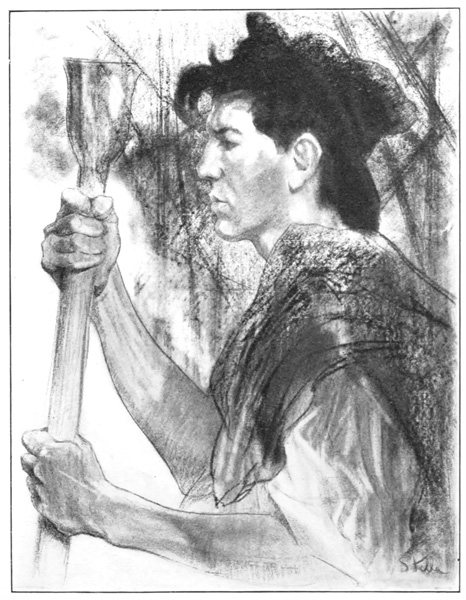
ROUGH WORK AND LOW WAGES FOR THE IMMIGRANT
The fact about the modern immigrant is
that he is everywhere continuing the work
begun by our pioneer ancestors. So much we
may learn from a bare recital of the occupations
of aliens. They supply most of the animal
strength and primitive patience that are
at the bottom of our civilization. In California
they gather the harvest, in Arizona
they dig irrigation ditches, in Oregon they
fell forests, in West Virginia they tunnel coal,
in Massachusetts they plant the tedious
crops suitable to an exhausted soil. In the
cities they build subways and skyscrapers
and railroad terminals that are the wonder of
the world. Wherever rough work and low
wages go together, we have a job for the
immigrant.
The prouder we grow, the more we lean on
the immigrant. The Wall Street magnate
would be about as effective as a puppet were
it not for the army of foreigners who execute
his schemes. The magic of stocks and bonds
lies in railroad ties and in quarried stone and
in axle grease applied at the right time. A
Harriman might sit till doomsday gibbering
at the telephone and the stock exchange
would take no notice of him if a band of
nameless “Dagos” a thousand miles away
failed to repair a telegraph pole. New York
City is building an aqueduct that will surpass
the works of the Romans, and the average
New Yorker will know nothing about it until
he reads in the newspapers the mayor’s speech
at the inauguration of the new water supply.
Our brains, our wealth, our ambitions flow
in channels dug by the hands of immigrants.
Alien hands erect our offices, rivet our
bridges, and pile up the proud masonry of
our monuments. Ignoring in this connection
the fact that the engineer as well as the
laborer is often of alien race, we owe to mere
muscle a measure of recognition proportionate
to our need of muscle in our boasted
material progress. An imaginative schoolboy
left to himself must presently catch the resemblance
between the pick-and-shovel men
toiling at our aqueducts and the heroes of the
axe and rifle extolled in his textbooks as the
“sturdy pioneers.” Considered without prejudice,
the chief difference between these two
types is the difference between jean overalls
and fringed buckskins. Contemporaneousness
takes the romance out of everything;
otherwise we might be rubbing elbows with
heroes. Whatever merit there was in hewing
and digging and hauling in the days of the
first settlers still inheres in the same operations
to-day. Yes, and a little extra; for a
stick of dynamite is more dangerous to
handle than a crowbar, and the steam engine
makes more widows in a year than ever
the Indian did with bloody tomahawk and
stealthy arrow.
There is no contention here that every fellow
who successfully passes the entrance
ordeals at Ellis Island is necessarily a hero.
That there are weaklings in the train of the
sturdy throng of foreigners nobody knows
better than I. I have witnessed the pitiful
struggles of the unfit, and have seen the failures
drop all around me. But no bold army
ever marched to the field of action without a
fringe of camp-followers on its flanks. The
moral vortex created by the enterprises of
the resolute sucks in a certain number of the
weak-hearted; and this is especially true in
mass movements, where the enthusiasm of
the crowd ekes out the courage of the individual.
If it is not too impious to suggest it,
may there not have been among the passengers
of the Mayflower two or three or half a
dozen who came over because their cousins
did, not because they had any zest for the
adventure?
When we remember that the Pilgrim
Fathers came with their families, we may be
very sure that that was the case, because the
different members of a family are seldom of
the same moral fibre. No doubt the austere
ambitions of the voyagers of the Mayflower
made them stern recruiting masters, but our
knowledge of men in the mass forbids the
assumption that they were all heroes of the
first rank who stepped ashore on Plymouth
Rock.
I have little sympathy with declaimers about
the Pilgrim Fathers, who look upon them all
as men of grand conceptions and superhuman
foresight. An entire ship’s company of Columbuses
is what the world never saw.
It takes a wizard critic like Lowell to chip
away the crust of historic sentiment and
show us our forefathers in the flesh. Lowell
would agree with me that the Pilgrims were
a picked troop in the sense that there was
an immense preponderance of virtue among
them. And that is exactly what we must say
of our modern immigrants, if we judge them
by the sum total of their effect on our country.
Not a little of the glory of the Pilgrim
Fathers rests on their own testimony. Our
opinion of them is greatly enhanced by the
expression we find, in the public and private
documents they have left us, of their ideals,
their aims, their expectations in the New
World. Let us judge our immigrants also out
of their own mouths, as future generations
will be sure to judge them. And in seeking
this testimony let us remember that humanity
in general does not produce one oracle in
a decade. Very few men know their own
hearts, or can give an account of the impulses
that drive them in a particular direction.
We put our ears to the lips of the eloquent
when we want to know what the
world is thinking. And what do we get when
we sift down the sayings of the spokesmen
among the foreign folk? An anthem in praise
of American ideals, a passionate glorification
of the principles of democracy.
Let it be understood that the men and
women of exceptional intellect, who have
surveyed the situation from philosophical
heights, are not trumpeting forth their own
high dreams alone. If they have won the
ear of the American nation and shamed the
indifferent and silenced the cynical, it is because
they voiced the feeling of the inarticulate
mob that welters in the foreign quarters
of our cities. I am never so clear as to the
basis of my faith in America as when I have
been talking with the ungroomed mothers of
the East Side. A widow down on Division
Street was complaining bitterly of the hardships
of her lot, alone in an alien world with
four children to bring up. In the midst of her
complaints the children came in from school.
“Well,” said the hard-pressed widow, “bread
isn’t easy to get in America, but the children
can go to school, and that’s more than bread.
Rich man, poor man, it’s all the same: the
children can go to school.”
The poor widow had never heard of a document
called the Declaration of Independence,
but evidently she had discovered in American
practice something corresponding to one of
the great American principles,—the principle
of equality of opportunity,—and she
valued it more than the necessaries of animal
life. Even so was it valued by the Fathers of
the Republic, when they deliberately incurred
the dangers of a war with mighty England
in defense of that and similar principles.
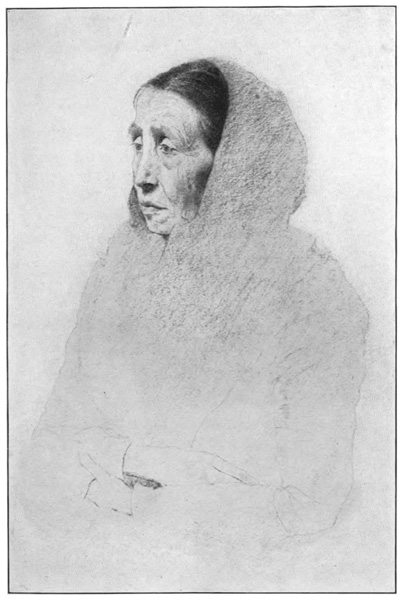
THE UNGROOMED MOTHER OF THE EAST SIDE
The widow’s sentiment was finely echoed
by another Russian immigrant, a man who
drives an ice-wagon for a living. His case is
the more impressive from the fact that he
left a position of comparative opulence in the
old country, under the protection of a
wealthy uncle who employed him as steward
of his estates. He had had servants to wait
on him and money enough to buy some of the
privileges of citizenship which the Russian
Government doles out to the favored few.
“But what good was it to me?” he asked.
“My property was not my own if the police
wanted to take it away. I could spend thousands
to push my boy through the Gymnasium,
and he might get a little education as a
favor, and still nothing out of it, if he isn’t
allowed to be anything. Here I work like a
slave, and my wife she works like a slave, too,—in
the old country she had servants in the
house,—but what do I care, as long as I
know what I earn I got it for my own? I got
to furnish my house one chair at a time, in
America, but nobody can take it away from
me, the little that I got. And it costs me
nothing to educate my family. Maybe they
can, maybe they can’t go to college, but all
can go through grammar school, and high
school, too, the smart ones. And all go together!
Rich and poor, all are equal, and I
don’t get it as a favor.”
Better a hard bed in the shelter of justice
than a stuffed couch under the black canopy
of despotism. Better a crust of the bread of
the intellect freely given him as his right than
the whole loaf grudgingly handed him as a
favor. What nobler insistence on the rights
of manhood do we find in the writings of the
Puritans?
Volumes might be filled with the broken
sayings of the humblest among the immigrants
which, translated into the sounding
terms of the universal, would give us the
precious documents of American history over
again. Never was the bread of freedom more
keenly relished than it is to-day, by the very
people of whom it is said that they covet
only the golden platter on which it is served
up. We may not say that immigration to our
country has ceased to be a quest of the ideal
as long as the immigrants lay so much stress
on the spiritual accompaniment of economic
elevation in America. Nobly built upon the
dreams of the Fathers, the house of our
Republic is nobly tenanted by those who
cherish similar dreams.
But dreams cannot be brought before a
court of inquiry. A diligent immigration
commission with an appropriation to spend
has little time to listen to Joseph. A digest of
its report is expected to yield statistics rather
than rhapsodies. The taxpayers want their
money’s worth of hard facts.
But when the facts are raked together and
boiled down to a summary that the business
man may scan on his way to the office, behold!
we are no wiser than before. For a host
of interpreters jump into the seats vacated
by the extinct commission and harangue us
in learned terms on the merits and demerits
of the immigrant, as they conceive them, after
studying the voluminous report. That is, the
question is still what it was before: a matter
of personal opinion! The man with the vote
realizes that he has to make up his mind what
instructions to send to his representative in
Congress on the subject of immigration. And
where shall he, a plain, practical man, unaccustomed
to interpret dreams or analyze
statistics, find an index of the alien’s worth
that he can read through the spectacles of
common sense?
There is a phrase in the American vocabulary
of approval that sums up our national
ideal of manhood. That phrase is “a self-made
man.” To such we pay the tribute of
our highest admiration, justly regarding our
self-made men as the noblest product of our
democratic institutions. Now let any one
compile a biographical dictionary of our self-made
men, from the romantic age of our history
down to the prosaic year 1914, and see
how the smell of the steerage pervades the
volume! There is a sign that the practical
man finds it easy to interpret. Like fruits
grow from like seeds. Those who can produce
under American conditions the indigenous
type of manhood must be working with the
same elements as the native American who
starts out a yokel and ends up a senator.
Focused under the microscope of theoretical
analysis, or viewed through the spectacles
of common sense, the average immigrant of
to-day still shows the markings of virtue
that have distinguished the best Americans
from the time of the landing at Plymouth to
the opening of the Panama Canal. But popular
judgment is seldom based on a study of
the norm, especially in this age of the newspaper.
The newspaper is devoted to the portrayal
of the abnormal—the shining example
and the horrible example; and most men
think they have done justice when they have
balanced the one against the other, leaving
out of account entirely the great mass that
lies between the two extremes. And even of
the two extremes, it is the horrible example
that is more frequently brought to the attention
of the public. Half a dozen Italians
draw knives in a brawl on a given evening,
and the morning newspapers are full of the
story. On the same evening hundreds of
Italians were studying civics in the night
schools, inquiring for classics at the public
library, rehearsing for a historical pageant at
the settlement—and not a word about them
in the newspapers. One Jewish gangster
makes more “copy” than a hundred Jewish
boys and girls who win honors in college. So
also it is the business of the police to record
the fact that a Greek was arrested for peddling
without a license, while it is nobody’s
business to report that a dozen other Greeks
chipped in their spare change to pay his fine.
The reader of newspapers is convinced that
the foreigners as a whole are a violent,
vicious, lawless crowd, and the fewer we
have of them the better.
Could the annual reports of libraries and
settlements be circulated as widely as the
newspapers, the American public would not
be guilty of such errors of judgment. But
who reads annual reports? The very name of
them is forbidding! It becomes necessary,
therefore, to explain the newspaper types
that jump to the fore in every discussion of
the immigrant.
First of all we must get a good grip on our
sense of proportion. To speak of the immigrants
as undesirable because a few of them
throw bombs or live by gambling is about
as fair as it would be for the world to call us
Americans a nation of dissolute millionaires
and industrial pirates because a Harry Thaw
drank himself into an insane asylum and a
Rockefeller swept a host of competitors to
ruin.
But the bomb-thrower and the gambler are
extremely undesirable. Look at the Black
Hand outrages, look at the Rosenthal case!
Aye, I have looked, and I see plainly that
these horrible examples are due to the same
causes as any shining example that could be
named. Each is the product of the qualities
the immigrant brought with him and the
opportunities he found here to exercise them.
The law-abiding, ambitious immigrant who
came here a beggar and worked himself into
the ranks of the princes found his opportunity
in our laws and customs, which enable the
common man to make the most of himself.
The blackmailer’s opportunity was provided
by the operation of corrupt politics, which
removes police commissioners and impeaches
governors for trying to enforce the law. The
Rosenthal case brought forth Lieutenant
Becker, and an investigation of the spread
of the Black Hand terror discovers political
bosses behind the scenes. We have laws
providing for the deportation of alien criminals.
Why are they not always enforced?
When we have found the broom that will
sweep the political vermin from our legislatures,
we shan’t need to look around for a
shovel to keep back the scum of Europe. The
two will go together.
In the whole catalogue of sins with which
the modern immigrant is charged, it is not
easy to find one in which we Americans are
not partners,—we who can make and unmake
our world by means of the ballot. The
immigrant is blamed for the unsanitary conditions
of the slums, when sanitary experts
cry shame on our methods of municipal
house-cleaning. You might dump the whole
of the East Side into the German capital and
there would be no slums there, because the
municipal authorities of Berlin know how to
enforce building regulations, how to plant
trees, and how to clean the streets. The
very existence of the slum is laid at the door
of the immigrant, but the truth is that the
slums were here before the immigrants. Most
of the foreigners hate the slums, and all but
the few who have no backbone get out of
them as fast as they rise in the economic
scale. To “move uptown” is the dearest ambition
of the average immigrant family.
If the slums were due to the influx of foreigners,
why should London have slums, and
more hideous slums than New York? No,
the slum is not a by-product of the steerage.
It is a sore on the social body in many civilized
countries, due to internal disorders of
the economic system. A generous dose of
social reformation would do more to effect a
cure than repeated doses of restriction of
immigration.
A whole group of phenomena due to social
and economic causes have been falsely
traced, in this country, to the quantity and
quality of immigration. Among these are the
labor troubles, such as non-employment,
strikes, riots, etc. England has no such
immigration as the United States, and yet
Englishmen suffer from non-employment,
from riots and bitter strikes. Whom does the
English workingman blame for his misery?
Let the American workingman quarrel with
the same enemy. If wage-cutting is a sin
more justly laid at the door of the immigrant,
a minimum wage law might put a stop to
that.
The immigrant undoubtedly contributes
to the congestion of population in the cities,
but not as a chief cause. Congestion is characteristic
of city life the world over, and the
remedy will be found in improved conditions
of country life. Moreover, the immigrant has
shown himself responsive to direction away
from the city when a systematic attempt is
made to help him find his place in the country.
There is the experience of the Industrial
Removal Office of the Baron de Hirsch
Foundation as a hint of what the Government
might accomplish if it took a hand in
the intelligent distribution of immigration.
The records of this organization, dealing with
a group of immigrants supposed to be especially
addicted to city life, kill two immigrant
myths at one stroke. They prove that
it is possible to direct the stream of immigration
in desired channels and that the Jew is
not altogether averse to contact with the
soil; both facts contrary to popular notions.
A good deal of anti-immigration feeling has
been based on the vile conditions observed
in labor camps, by another turn of that logic
which puts the blame on the victims. A labor
camp at its worst is not an argument against
immigration, but an indictment of the brutality
of the contractor who cares only to
force a maximum of work out of the workmen,
and cares nothing for their lives; an indictment
also of the Government that allows
such shameful exploitation of the laborers to
go on. That a labor camp does not have to
be a plague spot has been gloriously demonstrated
by Goethals at Panama. What
Goethals did was to emphasize the man in
workingman, with the result that Panama
during the vast operations of digging the
Canal was a healthier, happier, more inspiring
place to live in than many of our proudest
cities; the workmen came away from the
job better men and better citizens; and the
work was better done and with more dispatch
and at less expense than any such
work was ever done by the old-fashioned
method, where the workers are treated not as
men but as tools.
There may not be another Goethals in the
country, but what a great man devises little
men may copy. The labor camp must never
again be mentioned as a reproach to the immigrant
who suffers degradation in it, or the
world will think that we do not know the
meaning of the medals which we ourselves
have hung on Goethals’s breast.
Immigrants are accused of civic indifference
if they do not become naturalized, but
when we look into the conditions affecting
naturalization we wonder at the numbers
who do become citizens. Facilities for civic
education of the adult are very scant, and
dependent mostly on the fluctuating enthusiasm
of private philanthropies. The administration
of the naturalization laws differs
from State to State and is accompanied by
serious material hindrances; while the community
is so indifferent to the civic progress
of its alien members that it is possible for a
foreigner to live in this country for sixteen
years, coming in contact with all classes of
Americans, without getting the bare information
that he may become a citizen of the
United States if he wants to. Such a case, as
reported by a charity worker of New Britain,
Connecticut, makes a sensitive American
choke with mortification. If we were
ourselves as patriotic as we expect the immigrant
to be, we would employ Salvation
Army methods to draw the foreigner into the
civic fold. Instead of that, we leave his citizenship
to chance—or to the most corrupt
political agencies.
I would rather not review the blackest of
all charges against the immigrant, that he
has a baleful effect on municipal politics: I
am so ashamed of the implications. But sensible
citizens will talk and talk about the
immigrant selling his vote, and not know
whom they are accusing. Votes cannot be
sold unless there is a market for them. Who
creates the market for votes? The ward politician,
behind whom stands the party boss,
alert, and powerful; and behind him—the
indifferent electorate who allow him to
flourish.
Among immigrants of the “new” order,
the wholesale prostitution of the ballot is
confined to those groups which are largely
subjected to the industrial slavery of mining
and manufacturing communities and construction
camps. These helpless creatures, in
their very act of sinning, bear twofold witness
against us who accuse them. The foreman
who disposes of their solid vote acquires
his power under an economic system which
delivers them up, body and soul, to the man
who pays them wages, and turns it to account
under a political system which makes
the legislature subservient to the stock exchange.
But let it be definitely noted that to
admit that groups of immigrants under economic
control fall an easy prey to political
corruptionists is very far from proving any
inherent viciousness in the immigrants themselves.
Neither does the immigrant’s civic reputation
depend entirely on negative evidence.
New York City has the largest foreign population
in the United States, and precisely in
that city the politicians have learned that
they cannot count on the foreign vote, because
it is not for sale. A student of New
York politics speaks of the “uncontrollable
and unapproachable vote of the Ghetto.”
Repeated analyses of the election returns of
the Eighth District, which has the largest
foreign population of all, show that “politically
it is one of the most uncertain sections”
in the city. Many generations of campaign
managers have discovered to their sorrow
that the usual party blandishments are
wasted on the East Side masses. Hester
Street follows leaders and causes rather than
party emblems. Nowhere is the art of splitting
a ticket better understood. The only
time you can predict the East Side vote is
when there is a sharp alignment of the better
citizens against the boss-ridden. Then you
will find the naturalized citizens in the same
camp with men like Jacob Riis and women
like Lillian Wald. And the experience of
New York is duplicated in Chicago and in
Philadelphia and in every center of immigration.
Ask the reformers.
How often we demand more civic virtue of
the stranger than we ourselves possess! A
little more time spent in weeding our own
garden will relieve us of the necessity of
counting the tin cans in the immigrant’s
back yard.
As to tin cans, the immigrants are not the
only ones who scatter them broadcast. How
can we talk about the foreigners defacing
public property, when our own bill-boards
disfigure every open space that God tries to
make beautiful for us? It is true that the
East Side crowds litter the parks with papers
and fruit-skins and peanut shells, but they
would not be able to do so if the park regulations
were persistently enforced. And in the
mean time the East Side children, in their
pageants and dance festivals, make the most
beautiful use of the parks that a poet could
desire.
There exists a society in the United States
the object of which is to protect the natural
beauties and historical landmarks of our
country. Who are the marauders who have
called such a society into being? Who is it
that threatens to demolish the Palisades and
drain off Niagara? Who are the vulgar folk
who scrawl their initials on trees and monuments,
who chip off bits from historic tombstones,
who profane the holy echoes of the
mountains by calling foolish phrases through
a megaphone? The officers of the Scenic and
Historic Preservation Society are not watching
Ellis Island. On the contrary, it was the
son of an immigrant whose expert testimony,
given before a legislative committee at Albany,
helped the Society to save the Falls of
the Genesee from devastation by a power
company. This same immigrant’s son, on
another occasion, spent two mortal hours
tearing off visiting-cards from a poet’s grave—cards
bearing the names of American vacationists.
Some of the things we say against the
immigrants sound very strange from American
lips. We speak of the corruption of our
children’s manners through contact with
immigrant children in the public schools,
when all the world is scolding us for our children’s
rude deportment. Finer manners are
grown on a tiny farm in Italy than in the
roaring subways of New York; and contrast
our lunch-counter manners with the table-manners
of the Polish ghetto, where bread
must not be touched with unwashed hands,
where a pause for prayer begins and ends
each meal, and on festival occasions parents
and children join in folk-songs between
courses!
If there is a corruption of manners, it may
be that it works in the opposite direction
from what we suppose. At any rate, we ourselves
admit that the children of foreigners,
before they are Americanized, have a greater
respect than our children for the Fifth Commandment.
We say that immigrants nowadays come
only to exploit our country, because some of
them go back after a few years, taking their
savings with them. The real exploiters of our
country’s wealth are not the foreign laborers,
but the capitalists who pay them wages. The
laborer who returns home with his savings
leaves us an equivalent in the products of
labor; a day’s service rendered for every
day’s wages. The capitalists take away our
forests and water-courses and mineral treasures
and give us watered stock in return.
Of the class of aliens who do not come to
make their homes here, but only to earn a
few hundred dollars to invest in a farm or a
cottage in their native village, a greater number
than we imagine are brought over by
industrial agents in violation of the contract
labor law. Put an end to the stimulation of
immigration, and we shall see very few of the
class who do not come to stay. And even as
it is, not all of those who return to Europe
do so in order to spend their American fortune.
Some go back to recover from ruin encountered
at the hands of American land
swindlers. Some go back to be buried beside
their fathers, having lost their health in unsanitary
American factories. And some are
helped aboard on crutches, having lost a
limb in a mine explosion that could have been
prevented. When we watch the procession
of cripples hobbling back to their native villages,
it looks more as if America is exploiting
Europe.
O that the American people would learn
where their enemies lurk! Not the immigrant
is ruining our country, but the venal
politicians who try to make the immigrant
the scapegoat for all the sins of untrammeled
capitalism—these and their masters.
Find me the agent who obstructs the movement
for the abolition of child labor, and I
will show you who it is that condemns able-bodied
men to eat their hearts out in idleness;
who brutalizes our mothers and tortures
tender babies; who fills the morgues
with the emaciated bodies of young girls, and
the infirmaries with little white cots; who
fastens the shame of illiteracy on our enlightened
land, and causes American boys to grow
up too ignorant to mark a ballot; who sucks
the blood of the nation, fattens on its brains,
and throws its heart to the wolves of the
money market.
The stench of the slums is nothing to the
stench of the child-labor iniquity. If the
foreigners are taking the bread out of the
mouth of the American workingman, it is
by the maimed fingers of their fainting little
ones.
And if we want to know whether the immigrant
parents are the promoters or the
victims of the child labor system, we turn to
the cotton mills, where forty thousand native
American children between seven and sixteen
years of age toil between ten and twelve
hours a day, while the fathers rot in the
degradation of idleness.
From all this does it follow that we should
let down the bars and dispense with the
guard at Ellis Island? Only in so far as the
policy of restriction is based on the theory
that the present immigration is derived from
the scum of humanity. But the immigrants
may be desirable and immigration undesirable.
We sometimes have to deny ourselves
to the most congenial friends who
knock at our door. At this point, however,
we are not trying to answer the question
whether immigration is good for us. We are
concerned only with the reputation of the
immigrant—and incidentally with the reputation
of those who have sought to degrade
him in our eyes. If statecraft bids us lock the
gate, and our national code of ethics ratifies
the order, lock it we must, but we need not
call names through the keyhole.
Mount guard in the name of the Republic
if the health of the Republic requires it, but
let no such order be issued until her statesmen
and philosophers and patriots have consulted
together. Above all, let the voice of
prejudice be stilled, let not self-interest chew
the cud of envy in full sight of the nation, and
let no syllable of willful defamation mar the
oracles of state. For those who are excluded
when our bars are down are exiles from Egypt,
whose feet stumble in the desert of political
and social slavery, whose hearts hunger for
the bread of freedom. The ghost of the Mayflower
pilots every immigrant ship, and Ellis
Island is another name for Plymouth Rock.
III
THE FIERY FURNACE