COMPILED BY
THE SECRETARY OF THE YOUNG PEOPLE’S
FORWARD MOVEMENT
FOR MISSIONS
TORONTO:
The Missionary Society of the Methodist Church
The Young People’s Forward Movement for Missions
F. C. STEPHENSON, Secretary
“They’re a Multitoode”
“We ain’t expected to do only our part.”
Christopher Morton, Jr., was looking through the
morning mail in the office when there came a knock at
the door. He glanced at the clock and frowned. It
was too early for visitors by five minutes, and this
vigilant young man of business was very careful of
his minutes.
While he hesitated, the door opened without ceremony
and admitted a gaunt, unfashionable figure,
hollow-chested and sallow-faced.
“Hello, Christy, old chap!” cried the intruder,
stretching out a hearty hand and feeling apparently
no doubt of a welcome. “How are you?”
For an instant the other looked at him vaguely, the
crease still showing in his forehead. Then his eyes
lit.
“Why, Jim Perry, is it you!” he shouted, getting
around the table with a bound.
“Part of me,” said Jim, sinking into a chair. He
panted a little, but he smiled yet.
Christy looked him over discontentedly.
“What have you been doing to yourself?” he asked.
“Caught a fever,” explained Jim, with a nod. “The
missionaries sent me home. I might better have stuck
it out there, but I had no breath to argue with them,
so they packed me off. I am to go back in September.”
“I have always believed in foreign missions,” said
Christy, “but when they took you out of the country
I found it hard to keep my faith. And now—” he
stopped abruptly.
“It was a mighty good day for me when I went,”
said Jim Perry. “I have got a good deal out of living
these past three years.”
There was no mistaking the ring in his voice.
“You have snug quarters here,” said Perry. “They
tell me that you are a prosperous man of affairs.”
“I am getting on,” said Christy, modestly, “I have
some turn, I think, for making money.”
“We out in China,” said Jim, with a chuckle,
“haven’t any; it is the last thing we can do. Our
strong point is spending. We claim that nobody on
earth can surpass us in that. We will invest for you
if you like. By the way—” He plunged his hand into
his pocket and brought out a flat strip of cardboard
which he proceeded to fit together into a money box.
“There!” he said, setting it up gravely on the corner
of the mantelpiece. “You will kindly contribute.”
“What is it?” asked Christy, regarding the small
object distrustfully, very much as if it were a dynamite
bomb.
“We are trying,” explained Jim, “to raise a special
Christmas offering for missions. Along with the rest
of her Christmas giving, the church is asked to give to
those who have never learned what Christmas is.”
There was a slight pause.
“Could anything,” Jim asked, “be more acceptable
to Him in whose name our festival is kept?”
“The original meaning of Christmas has been overlaid
in a good many minds,” commented Christy,
briefly.
“To their loss,” said Jim, “and to the bitter loss
of many besides.”
He rose from his seat and began to pace back and
forth over Christy’s thick carpet. But he was
weak; he soon came back to his old place.
“I have walked,” he said musingly, “the swarming
streets of heathen cities, I have gone into heathen
homes, I have stood face to face with weary, heavy-laden,
heathen souls, and I have been taught what
Darkness is. But then, thank God, I have time and
again seen the Star of Bethlehem break in the black
sky and stand still over some place where the Christ
was born, and I know, yes, I know, the brightness of
its rising!”
There was another silence.
Again Jim was the first to speak. “No doubt,” he
said, “you give a number of Christmas presents.”
“I don’t think of them in September,” said Christy.
“That is fortunate,” responded Jim, tranquilly. “It
will give you more leisure to think of this betimes.”
He looked at his watch and said that he must go.
They walked together to the corner where he took
the car, and then Christy hurried back to his work.
“That man will never go to China next September,”
he muttered to himself, as he rang up the elevator.
“It will be another Celestial Kingdom for which he
will start, unless the signs are wrong.”
For the rest of the morning, Mr. Morton was not so
undivided in his attention to business as was customary
with him. Many times his mind wandered to the
face that was like, and so unlike, the face of his old
college mate. It was aged. It was lined. It was tired.
“But you could trust it,” Christy concluded, “to
the uttermost.”
“Jim Perry,” he said, facing at last the crucial idea
which he had sought to evade, “has got much out of
life. What am I getting?”
The roar of the city came in at the open windows.
Christy did not hear.
“If I should die to-night—that is too trite a supposition.
If I should have softening of the brain to-night,
or advancing paralysis, what satisfaction would
there be to which I could hold fast, as I sat with my
face to the wall while life passed me by?”
The breeze fluttered the papers on his desk.
“If my plans stopped now, nothing would be left
from the failure. They need the future in order to
amount to anything. If Jim Perry never gets back
to China, why”—he leaned his head on his hand and
thought came slowly—“he has lived for an object and
attained it as he went along.”
Christy was still thinking of the look in Jim’s eyes
and the sound of his voice when footfalls along the
corridor foretold an interruption.
Several men followed on the heels of one another.
When they were all gone, Christy’s mind had largely
recovered its ordinary temper.
“Jim Perry is an awfully decent chap; it was upsetting
to see him looking so done. If he had stayed
in this country, three-quarters of a lifetime of work
would probably be before him. One can’t help remembering
it. But—I can accept the logic of missions.”
He took the little cardboard box from the drawer
into which he had thrust it and read every Scripture
verse on all its sides.
“Yes, the arguments are strong. I don’t pretend to
gainsay foreign missions. But yet it can’t be denied
that thousands of the holiest of saints have lived their
lives out within the limits of Christendom and found
more than their hands could do with their might.
However, that sort of incompatibility between the two
sides of a truth is the commonest thing in the world.
It does not shake the claim of the missionaries.”
“I wonder,” he meditated, “how much genuine
missionary spirit there is in the church of to-day. I
don’t mean among the specialists, the experts, like
Jim (and me)”—Christy had the grace to laugh a little—“but
in the rank and file.”
He lifted the contribution box and regarded it with
a new expression. By-and-bye he smiled broadly.
“It will be an interesting experiment,” said Christy.
“Let us try it.”
He put the box up again on the mantelpiece, where
Jim had first set it, clearing a space about it that it
might stand unshadowed in a small rim of black
marble.
Another hour of the afternoon passed as many other
hours had done. Christy had returned to his habit of
absorption in what was in hand.
An old woman, rich and “crotchety,” had been talking
business with him for the last fifteen minutes.
“The old dame is as keen as a weasel,” thought
Christy, as he listened with bowed head, deferentially.
“Not many men could fool her on a deal. She is
honest herself, and she doesn’t mean to be cheated.
The most of her time is given to padlocking and
double-barring her money chest.”
Finally she came to a pause. She pointed across the
room.
“You have something new there. What is it?”
“A collection box,” answered Christy, accepting his
cue, promptly. “A college classmate of mine, a missionary
to China, left it. The missionaries are calling
for a special offering at Christmas.”
The old lady heard him out patiently. When he had
finished, she began to speak of further precautions and
provisos that had occurred to her as to her affairs.
Then she arose stiffly to go.
At the mantelpiece she stopped, took a bill from her
full purse and slipped it into the narrow opening of
the missionary box. She had given the first contribution
to Jim’s heathen.
“Of her abundance,” quoth Christy, as he shut the
door behind her.
Miss Craig, his stenographer, was moving at the
other end of the office. She shut up her typewriter;
it was the hour for her to leave.
A little time before Christy had felt a sensation in
regard to Miss Craig. He did not often do this, which
was one of his chief virtues.
But, just now, in the midst of his discourse on
foreign missions, he had been arrested for an instant
by meeting the straight, intent gaze of the young
woman who always, unless directly addressed, kept
her discreet eyes upon her work.
Miss Craig put on her hat and gathered up her
handkerchief and purse.
“May I trouble you to post these, Miss Craig?”
said Christy, giving her a handful of letters. “Thank
you. Good afternoon.”
She laid the letters down on the mantelpiece while
she opened her purse, which was shapely but thin.
Out of it she took a dollar bill, leaving some silver,
and put it in the money box.
Christy had started up to expostulate. He sat down
to recover.
“She was as calm and matter-of-course about it,”
he gasped, “as if it were only natural for poor working
girls to help evangelize China out of their slim
wages.”
During the next two or three days much notice was
taken of the missionary box.
The notice was diverse in kind. The curiosity of
some was quickly satisfied. Some stared politely.
Others openly scoffed.
One fashionable club man put in a penny.
“To see how it feels,” he said.
“The shock can’t be very great,” observed Christy,
“even to so new a subject as yourself.”
“But you know,” said the club man with a grin,
“it comes on top of finding you running the machine.
My nerves are all gone.”
A clergyman who coughed gave liberally.
“If I could have guessed that he was coming,”
said Christy, with chagrin, “I would have covered the
thing up. Some men can no more pass a collection
basket than a drunkard can a corner saloon. But they
are few.”
A hard-headed merchant furtively dropped in a gold
piece.
“I got it in change,” he apologized, when he met
Christy’s gaze. “It is as well to make some special
use of it before I pay it out for a quarter.”
A circuit judge lifted the box in his hand and read
the verses as Christy had done. When he set it down
again he stood before it in silence while Christy looked
up, wondering, and did not disturb him.
At last the judge aroused himself. He made a large
donation.
“My daughter was interested in all these things,”
he said. Christy remembered then the young girl who
had died the year before.
In one way and another, Jim Perry’s missionary
box grew heavy. Then it was full.
Christy took it apart, put the money in a pigeon-hole
in his desk and set it back into place. He did not allow
himself to comment.
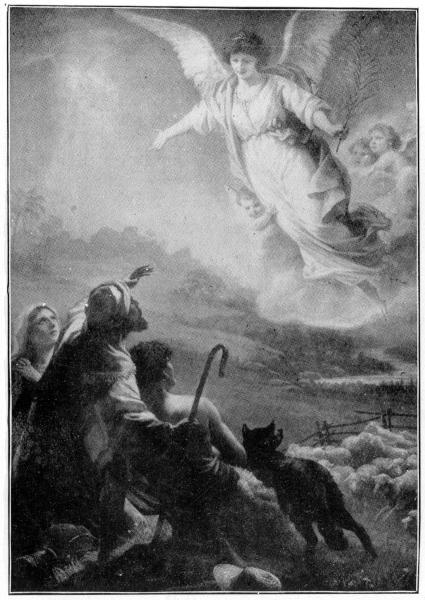
“Behold, I bring you good tidings of great joy which shall
be to all people.”
On the same afternoon, Chippy Black, the errand
boy, was waiting in the office for a note. Chippy was
a new boy; Christy did not feel sure of him. Lifting
his head now to give directions, Chippy was caught in
the act of “hefting” the missionary box.
“Ah,” said Christy to himself, with vexed enlightenment.
Hunting office boys was a bore.
“Why, this is empty!” said Chippy, facing round on
him and holding out the box. “Did you send it off?”
“No,” answered Christy, uncertainly. “It was full.
I took the money out.”
“I see,” said Chippy. There was relief in his voice
and in the clever, dark, little face.
He plunged his hand into his jacket and brought out
a small newspaper parcel tied with twine.
“I promised Lin to bring it to you,” he said. “It
would have been too bad if I’d been too late.”
“What is it?” asked Christy, receiving the packet
with no show of distrust in its dinginess. And he was
fastidious. “Who is Lin?”
“It’s money. She’s my sister,” answered Chippy.
“She wants it to go with the rest.”
Christy pushed a chair towards him. “Sit down,”
he said. “Tell me all about it. Take your time.”
Chippy crossed his knickerbockered legs, and by
tilting forward a little managed to keep one toe on
the carpet.
“There’s two of us boys home,” he began. “And
there’s Lin. My brother Bob and me are like lots
of other fellows. But Lin is extry. I’d call her quite
extry myself. She’s like—well, she’s like Lin. That’s
all I can say.”
“I have seen one or two such persons,” said Christy.
“One Sunday night one of those foreign preachers
was talking about the heathen. If it hadn’t been for
Lin,” said Chippy, “we’d have forgotten all about
them inside of a week. But Lin was bound that something
had got to be done. ‘There’s so many of them,
Lin,’ says Miss Loretta Pease. (Miss Loretta lives
on the next floor to us; she’s educated.) ‘They’re a
multitoode,’ she says. ‘You can’t never reach ’em.’
‘Not all of them at once,’ says Lin to her. ‘Not just
us alone by ourselves. We ain’t expected to do only
our part.’”
“Miss Lin is sagacious,” said Christy.
“‘It isn’t any more than right for us to do our
part,’ she told Miss Loretta. ‘And for one I won’t
back out of it,’ Nor, you may be sure, she wouldn’t.
Lin is the sort that wouldn’t.”
“An uncommonly good sort,” said Christy.
“You are like that, too, ain’t you!” said Chippy,
looking over at him kindly.
“Miss Loretta came round all right after Lin had
worked over her a while. She ain’t obstinate. She’s
genteel. So Lin fixed it up that we was all to chip
in together and make up a purse for the heathen. So
we did it. And there it is.”
He nodded proudly toward the newspaper parcel.
“You must have worked hard,” said Christy.
“It’s savings, mostly. I mean our part of it is, Lin’s
and my brother’s and mine. Lin got off the neighbors,
too, you know; it’s all there together.”
“You saved yours?” questioned Christy.
“Yes, sir. Lin is grand on saving. She scatters it.
She don’t bunch it all on one thing till it appears as
nothing else but just that was worth eating. First
it’s sugar, and then it’s sausage, and then it’s something
different again. And sometimes it ain’t anything
at all. You don’t hardly miss it that way.”
Chippy slipped still farther forward on his seat and
felt for his cap. He glanced at Christy’s unfolded
note.
Christy got out an envelope and dipped his pen in
the ink. Then he let it rest over the edge of the desk,
where it dried.
He picked up the roll of money.
“You must have been collecting this for some time.”
“All summer,” said Chippy. “There’s a good deal
of it. Lin and Miss Loretta had just begun to talk
about where they would carry it when you first began
to take up money here. I told them about it and I told
them that, so long as this was where I worked, I
thought you’d ought to get it. So after a bit they
decided on that.”
Chippy plainly felt that the bestowal of Lin’s patronage
was no light thing.
Christy agreed with him.
“I’m very much obliged to you,” he said heartily.
“This will help me along splendidly. Let’s put it in at
once.”
He pulled at the twine string, which was tied in a
very secure knot, and laid open the hoard.
It was made up of all the original pennies and
nickels; there was also one dime among them. The
sum total was $2.11.
Christy handed Chippy a nickel and held one himself.
He brought the missionary box.
“Now, drop yours in,” he directed. “Then I will
drop mine. We’ll take turn about.”
Chippy was eager. His interest grew with every
rattling coin until the last was safely inside. Then he
straightened himself with a long breath.
“Lin said she was going to do it, and she’s done it,”
he said.
“And she doesn’t know how much she has done,”
said Christy, soberly.
“That’s so,” answered Chippy, with quick perception.
“That’s the best of it, I suppose. The best of
everything, Lin says, is what the Lord can make out
of it. Anything will go twice as far with Him, she
says. You talk a great deal like her.”
Christy lifted the box.
“It’s about full,” he said. “It’s just about ready to
empty again. But there is a little space yet. We will
leave it. I shall be glad to see what gift will be put
in on top of this.”
The weeks passed. Several times over the missionary
box was emptied into the pigeon-hole. On a
foggy December afternoon a Mr. Richards was alone
with Christy in the office. He had brought the young
man a windfall of $1,000.
“It is by happy strokes like these,” said Mr.
Richards, “that a man grows rich.”
Many such strokes of various kinds had come in the
way of Mr. Richards during a long life.
“I have built up my own fortunes,” he continued,
“from the stub. From what I see of you, Mr. Morton,
I predict you success.”
He regarded Christy with a glint of favor in his iron-gray
face as he added in climax, “You are very much
like I was at your age. You are like myself.”
Christy was rather silent. When he was left alone
he thought of Jim Perry. He often thought of Jim
now. His late visitor and his classmate stood side by
side before his mind.
“There is wealth and wealth,” he mused. “Mr.
Richards has one kind, Jim has another. I am not so
awfully pleased,” he thought resentfully, “with my
likeness to Richards. I don’t fancy being a cash
register. All the man’s fortunes are in money.”
Christy looked down at the cheque in his hands;
he looked at Jim’s box.
“I said the real Christmas was forgotten. I said
that all the missionary spirit of the present resided in
the missionaries and me. I doubt whether Mr.
Richards at my age was such a fool. Poor Richards!
He is old. I shall have a good part of my life yet, I
trust.”
He wrote on the back of the cheque and folded it
small.
“Richards, and Jim, and Lin, and the others have
spoiled my taste a little for happy strokes, however
innocently come by. The mission shall enjoy this
one.”
He pushed the cheque through the slit in the money
box, which was getting frayed and worn.
Christy met Mr. Richards on the street soon afterwards.
“I hope,” said Mr. Richards, “that you have found
a good investment for your money.”
“I have,” said Christy.
“Is it reasonably sure?”
“Perfectly.”
“Nothing in this world can be perfectly sure, Mr.
Morton.”
“But there is another world,” said Christy.
“It may be,” he said.
As the man of millions passed on, Christy heard a
faint sigh. Three days later the office door burst open
and in walked Jim Perry, broad and brown.
Christy stared at him speechlessly.
“I’m well again,” announced Jim, superfluously.
Christy shook him by the hand, clapped him on the
shoulder and thumped him on the chest.
“Providence knows how to give to missions!” he
said.
Jim turned to the mantelpiece and shook his money
box. It was empty. He was openly disappointed.
“You lazy beggar,” he cried. “Are you leaving all
the giving to Providence?”
“I am not a lazy beggar,” said Christy. “I am a
very industrious one. Look at this.”
He put the contents of the pigeon-hole in front of
Jim and watched him fall upon them, and enjoyed
tremendously his blank delight.
“Why,” stammered Jim, “what does it mean? Is
it all for us?”
“It means,” said Christy, “that a week from to-day
will be Christmas.”—Y. P. M. M.
The Penny Ye Meant to Gi’e
There’s a funny old tale of a stingy man,
Who was none too good, though he might have been worse;
Who went to church on a Sunday night,
And carried along his well-filled purse.
When the sexton came with his begging plate,
The church was but dim with the candles’ light;
The stingy man fumbled all through his purse,
And chose a coin by touch, and not sight.
It’s an odd thing now that guineas be
So like unto pennies in shape and size,
“I’ll give a penny,” the stingy man said;
“The poor must not gifts of pennies despise.”
The penny fell down with a clatter and ring;
And back in his seat leaned the stingy man,
“The world is so full of the poor,” he thought,
“I can’t help them all—I give what I can.”
Ha, ha! How the sexton smiled to be sure,
To see the gold guinea fall into his plate;
Ha, ha! How the stingy man’s heart was wrung,
Perceiving his blunder, but just too late!
“No matter,” he said, “in the Lord’s account
That guinea of gold is set down to me,
They lend to Him who give to the poor;
It will not so bad an investment be.”
“Na, na, mon,” the chuckling sexton cried out;
“The Lord is no cheated—He kens thee well;
He knew it was only by accident
That out of thy fingers the guinea fell.
“He keeps an account, no doubt, for the puir;
But in that account He’ll set down to thee
Na mair o’ that golden guinea, my mon,
Than the one bare penny ye meant to gi’e!”
There’s a comfort, too, in the little tale—
A serious side as well as a joke;
A comfort for all the generous poor
In the honest words the sexton spoke.
A comfort to think that the good Lord knows
How generous we really desire to be,
And will give us credit in His account
For all the pennies we long to “gi’e.”
Rue’s Heathen
The long line of blue check aprons followed the
other line of small blue jackets through the wide hall,
up the bare, polished stairs, and into the clean, airy
chapel. Then, at a signal, every apron and jacket was
still. Little Rue’s apron had been about midway in the
procession, and so she found a seat near the middle of
the chapel, where, swinging the small feet that could
not quite touch the floor, she looked listlessly out
through the window opposite, over a beautiful view
of grove and meadow, and then up at the white ceiling,
where a great fly buzzed at his pleasure, without
having to walk in line.
On the platform a man in fine broadcloth and gold
spectacles was beginning to talk; but Rue only listened
dreamily.
“My dear children, I am delighted to visit this
grand institution—to see so many of you in this beautiful
home, so well cared for, so well instructed, and
so happy.”
Rue wondered why all the men who talked there said
that. She wondered if he really would like to eat and
sleep and walk in a row and always wear a blue check
apron. Then she forgot all about him, in watching
the sunlight play on the small head immediately in
front of her. What a brilliant red head it was! And
then a bright thought occurred to Rue. A few of those
hairs, twisted together, would make a beautiful chain
for the neck of her china doll, her one treasure; and,
of course, Mary Jane Sullivan would never miss them,
if she only pulled out one here and there.
Forward crept Rue’s eager little fingers; but they
were too nervous in their haste to be sure that they
held but a single coarse hair before they twitched, and
the result was a sudden explosive “Ow!” from Mary
Jane, the turning of a battery of eyes in that direction,
and an immediate investigation by the authorities into
the cause of the disturbance. Poor little Rue was
marched off in disgrace; but, as she reached the door,
she heard the speaker say:—
“I am sorry this has happened; sorry that any one
should miss what I am going to say; for I hoped to
interest all these dear children in the work of sending
the gospel to the heathen.”
It was kind of him to call them all dear children
after that dreadful event, Rue reflected, as, with burning
cheeks and tearful eyes, she stood, with a number
of other little culprits, in one of the wide halls, for
even punishment was in rows at the Home. Shifting
her weight from one restless foot to the other, yet
trying to stand sufficiently upright to answer the requirements
of the penance, Rue did sincerely wish that
she had been a good girl and remained quietly in the
chapel, partly because of the humiliation that had befallen
her, but also because she wanted to hear what
he had to say on the particular subject he had named.
“Why didn’t he begin with that, and then I’d have
listened!” she thought, rather resentfully. For back
among Rue’s shadowy memories of the past, of love,
and mother, and a home that was not the Home, was
a dim recollection of some curious articles which her
baby hands had only been allowed to touch carefully,
because they were mementoes of an uncle who had
died far away on a mission field. “So it would have
been most like hearing about my relations; only I
haven’t got any,” mused Rue. “Oh, dear! I wish I’d
stayed good and hadn’t pulled Mary Jane’s hair. I
didn’t mean to, anyway.”
She tried to find out about it afterwards by inquiring
of one of the other girls.
“Oh! he wanted the children to try and save up
something, so they could help send Bibles to the
heathen. Guess, if he lived here long, he’d find we
hadn’t anything to save,” was the hurried reply.
Bibles! That was where Rue was rich. She actually
had two that had been brought from that faintly remembered
home.
“I don’t suppose I’ll read one of ’em to pieces; not if
I used it till I’m a big woman,” she said to herself. “I
might give the other one. I ought to help, ’count of
being a relation, somehow, and I want to be good. I
just do.”
Later in the day she ventured another inquiry:
“How will he get those to the heathen?”
“I don’t know. Why, yes, he’ll send ’em through
the post-office, of course. What do you care so much
about it for?”
That was what Rue did not mean to tell. She chose
her prettiest Bible, spent the play-hours of two days
in writing an epistle on the fly-leaves, and tied it up
in a piece of brown paper. Her knowledge of the post-office
and its requirements was exceedingly limited,
but she supposed it would be necessary to put something
on the outside of the packet, to tell for whom it
was intended. She wanted it to go where it was
needed most, and of course the post-office people would
know where that was, she reflected; so she carefully
printed, in very uneven letters, “For the greatest
heathen,” and then laid the precious package away to
await a future opportunity. She would trust her
secret to no one, lest some unforeseen interference
might result, and she cautiously sought information.
“How do you do when you put anything into the
post-office?” she demanded of Mary Jane Sullivan.
“Why, you just put ’em in. You go in the door,
and there’s an open place where you drop ’em right
down,” exclaimed Mary Jane, lucidly.
How good Rue was for days after that. How she
washed dishes in the kitchen, under the care of Miss
Dorothy, and made beds in the dormitories, under the
supervision of Mrs. Mehitable, and so at last earned
the privilege of being the one sent to town on some
trifling errand for the matron.
Thus it happened that one bright morning the clerks
in the post-office were surprised by a little packet tossed
in upon the floor, and a glimpse of a blue check apron
vanishing hurriedly through the door. Unstamped,
and with its odd address, it created a ripple of amusement.
“‘For the greatest heathen.’ That must be you,
Captain,” declared one; and the postmaster laughingly
took charge of it, and then forgot it until, at home that
evening, he found it in his pocket.
Rue writing the letter to “The Greatest Heathen.”
“What is it?” asked his wife, presently, as she saw
him silent and absorbed, and, looking over his shoulder,
she read the little letter with him. Original in spelling
and peculiar in chirography it certainly was, but they
slowly deciphered it:
“I haven’t any money to give ’cause I’m one of the
little girls at the Home. Some of them have relations
to send them things sometimes; but I haven’t. I have
two Bibles; but I wouldn’t give this to any one but the
heathen ’cause my own mamma gave it to me. It’s
nice to have a mamma to cuddle you up and love you
just by your own self, and tuck you into bed at night,
and not have to be in a row all the time. It makes a
lump all swell up in my throat when I think of it, and
my eyes get so hot and wet I can hardly see. I wish
God did have homes enough, so He could give every
little boy and girl a real one, and we needn’t be all
crowded up in one big place, that’s just called so.
Sometimes, when I see all the houses it ’most seems
as if there must be enough to go ’round; but I suppose
there isn’t. I guess it’ll be the real kind we’ll have up
in heaven, and I want to go there; and that’s why I
send you this Bible, so you can learn about it. You
must read it and be good. Oh, dear! it’s dreadfully
hard to be good when you haven’t any mamma. I hope
you’ve got one, if she is a heathen, for I’m most sure
that’s better than no kind. Good-bye.
“Rue Lindsay.”
“Poor little thing!” exclaimed the lady, half laughing,
but with a sudden moisture in her brown eyes.
Captain Grey looked around the beautiful room.
“I’m inclined to believe that letter was properly
directed, and has reached its rightful destination,” he
said, thoughtfully. “Think of it, Mary—all these
cosy, pretty rooms, and no one to occupy them but you
and me, while there are so many little home-sick
souls in the world! You have spoken of it before; but
I was too selfishly contented to care about it. If I’m
not ‘the greatest heathen’ I have certainly been far
enough from the sort of Christianity this book requires.”
“Well?” questioned Mrs. Grey, with shining eyes,
waiting for the conclusion of the matter.
“Shall I go to-morrow and bring this little midget
home with me—for a visit, say—and see what will
come of it?”
It did not occur to little Rue that the stranger she
met in the hall the next day, and who had a long interview
with the matron, could be of any possible interest
to her small self, until she was summoned down stairs
to see him.
“Would you like to go home with this gentleman,
for a visit of a week or two, Rue? He has come to
ask you,” said the matron.
“Me?” questioned Rue, oblivious of grammar lessons,
and with a dozen exclamation points in her voice.
There was no danger of her declining. The prospect
of a visit anywhere was delightful, and the possibility
of such a thing almost as wonderful as a fairy tale. So
it was a very bright little face that Captain Grey found
beside him in the carriage, and Rue looked up at him
shyly through her rings of sunny hair, to ask, as the
only imaginable solution of the happy problem: “Are
you one of my relations?”
“Yes, but I didn’t remember it until last night,” he
answered gravely.
The weeks that followed were brimful of joy to Rue,
and she won her way straight into the home and the
hearts that had opened to receive her.
“And so you think I may tell the matron that you
do not care to go back, but are willing to stay here?”
questioned the Captain, when the allotted time had expired.
“I guess,” replied Rue, looking down at her dainty
dress, and suddenly flinging her arms around Mrs.
Grey’s neck, “that you didn’t ever live there, and eat
soup, and wear check aprons, and have nobody like
this to love, ’r else you’d know.”
But she has not learned yet that it was her own missionary
effort that brought so great reward.
How Yin-Dee Changed Her Name — CHAPTER I. — CHAPTER II. — CHAPTER III. — CHAPTER IV. — CHAPTER V. — CHAPTER VI. — CHAPTER VII. — CHAPTER VIII.
“Lead Along a Brother.”
The first thing I know about myself is that I was
born; and that I had a father and mother, too, just
as you have. I thought I had better tell you this, as
I have often heard ignorant country people ask the
missionary if in his country children are born the same
as in China, just as they will ask him if there are a sun
and moon, rivers and hills, there as here. My grandfather
used to say that foreigners belonged to a
country where people had holes in their chests and
were carried about on a long pole by two men. But
he had never seen any foreigners at all.
Of course when I was born nobody wanted me.
Whoever wants girls? I was the first child; so my
parents were bitterly disappointed. Well, I couldn’t
help it; and I have often thought how hard it was that
I should be badly treated, as if it were my fault. My
father said bitter things to mother, so she called me
“Yin-dee,” which means, “Lead along a brother.”
After a time they got more used to me, and were not
more unkind than most parents. Sometimes when I
was extra good mother would take me in her arms and
call me her “precious,” for, as the proverb says, “All
have the parent heart.” Now, if I had been a boy how
different it would have been—there would have been
no end of rejoicing and feasting! My mother’s
parents would have supplied me with a cradle and lots
of pretty clothes. When a month old there would
have been another feast, and the barber would have
come to shave my head and mix the hair with rice and
give it to the dog to eat, to make me brave. I should
always have had my own way and have been petted
by all. When a year old, they would have called my
relations together and spread before me a lot of things,
to see what my future was to be. There would be
books and pens, scissors and scales, a rule, and some
money; and they would have waited to see which was
the thing I grabbed. If it had been books how it would
have pleased them, for it would have meant that I was
to be a scholar; if scissors, then a tailor; and so on.
Now, I wonder which I should have chosen? Not
books, I’m afraid; for I don’t like learning—do you?
Well, as I wasn’t a boy, I had none of this, so had
to be content. As smallpox was very bad, I had a
label on my back to say I had already had it (though
I hadn’t), but that was to deceive the goddesses. Then,
to make quite sure, I had a cloth monkey strung round
my neck, which made a nice plaything. I am afraid I
wasn’t always good at night—I am sure you all are!—but
cried, for I didn’t have enough to eat most of the
time; so father got the teacher next door to write a
verse and paste it on the wall outside. This is how it
goes:
Tien hwang, hwang, dee hwang, hwang,
Ngo jah yo go yea coo long,
Go wong jwin dz nien san bien,
Ee jo shway dao da tien liang.
In English it is—
Ye gods in the heavens, ye powers on the earth,
My baby began from the hour of her birth
With horrible screams to rend the night!
O passing stranger, these my rhymes
Read, I pray you, through three times,
And then she will sleep till broad daylight.
But I’m afraid there were not many who read them
three times, for it didn’t make much difference. Still,
it was the correct thing to do, so mother felt satisfied.
Orphaned Through Opium.
According to our Chinese books, when a son is born
he sleeps on a bed, he is clothed in robes, he plays
with gems, his cry is princely loud; as an emperor,
he is clothed in purple, and he is the king of the home.
But when a daughter is born she sleeps on the ground,
she is clothed in a wrapper, she plays with a tile;
she cannot be either good or evil, and has only to prepare
wine and food without giving any cause of grief
to her parents. So, being a girl, I learned to play
with broken tiles, and found them as good as gems.
When I was about three years old, something dreadful
happened. Another baby was born—and it was a girl.
I didn’t mind at all, as I wanted someone to play with,
and a girl is as good as a boy—better, I think. But
our proverb says, “Eighteen beautiful daughters are
not equal to one son, even though he be lame.” My
father was dreadfully angry, and beat mother; so she
was miserable, and cried a good deal. After a few
days I missed my baby sister, and when I asked where
she was, someone laughed, and pointed to a pond, near
by. I didn’t know then what he meant; but sister
never came back, so I had to play alone.
About this time I was betrothed. Practically all
girls are, in China, and at a very early age. My father
said girls were a useless expense, so he wanted to get
me off his hands as soon as possible. So a lucky day
was chosen, and two middlemen engaged, who came
and compared the day and the hour of my birth with
that of the lad they suggested. Then followed a feast,
when the agreement was made and my future fixed.
The home of my future husband was some little way
off, and his father was a broken-down scholar, who
kept a small school, and was a slave to opium. The
lad was his youngest son. The mother bore a bad
reputation for quarrelling and scolding, so you may
imagine I didn’t look forward with much pleasure to
entering my new home, and hoped the day was far
off. But it came sooner than I expected.
When I was about seven years old, I began to notice
that father was away a great deal at night, and that we
didn’t get much to eat. The furniture slowly disappeared,
and our clothes were poor and scanty. My
mother seemed anxious, and cried much. I found out
the meaning of it one day when I caught sight of father
slinking into a dirty hovel near by, which I knew to be
an opium den. Alas, he had become a victim to the
“foreign smoke”! Day by day the craving grew upon
him, and every scrap of money he could get went in
opium, and mother had to support herself and me by
making shoes and washing clothes. Father ate but
little, and gave mother so little money that we were
nearly starved. In the morning, before the craving
came on again, he was very miserable and bad-tempered.
He cursed himself and the English who,
he said, had brought this evil on China; yet he couldn’t
break away from the habit, and things grew worse and
worse.
Very soon we had to move into a smaller house,
and had hardly any possessions. Mother did the best
she could, but no money was safe from father; and
one day she said she could bear it no longer, and
went out with a wild look on her face. She soon
returned with some black stuff that looked like paint,
and went into the bedroom crying. After a while she
was quiet, and I thought she was sleeping, so I went
away to play.
It was some time before I returned, but mother was
still sleeping. She looked so strange that I ran next
door to ask them to come. They came; and at once
there was a great hubbub, and somebody ran for
father, but he was smoking opium and wouldn’t come.
Then I knew that the black stuff mother had bought
was opium, and that she had swallowed it to end her
troubles.
Her relatives came and made a great row. They
abused father, and he abused them; and they
demanded a lot of money, now mother was dead,
though they never tried to help her when she was alive.
Father didn’t seem to care much, as opium eats all the
spirit and manhood out of its victims. He hadn’t any
money, so thought the best thing was to send me at
once to my future husband’s home, and so obtain the
amount they had practically bought me for. With
this he was enabled to satisfy mother’s relatives, and
I soon found myself transferred to my new home. I
never saw my father again. The cruel opium had
made me worse than an orphan.
Little Golden Lilies.
When I was about four my feet were bound. You
must know that in China the smaller the feet the more
a woman is admired. For over a thousand years the
custom has been observed, and only a few give it up,
even though, as the common saying has it, “For every
pair of small feet there has been shed a bucket of
tears.” So as my mother wished me to have “little
golden lilies,” as they were called, she commenced to
bind my feet early.
The calendar was consulted for a lucky day (it
would never do to commence anything on an unlucky
day), and mother brought some strips of calico a few
inches wide and several yards long. With these she
tightly bound my feet, making them narrow and
pointed.
At first I went nearly crazy with crying. No one
took any notice of it, and mother tried to console me
by saying that no one would marry a woman with
large feet. She told me that when she was married
hers were only two and a half inches long. Day by
day the binding was done until I wished I could die
and be rid of the pain. Gradually it became less as
the feet ceased to grow, and I was able to hobble about
the house.
But with it all I was much more fortunate than little
“Pearl,” my friend next door. They left the binding
of her feet until she was nearly eight, and then bound
them very tightly. She was only scolded and beaten
when she cried, and the pain was so great she nearly
died; and when one of her feet got very bad they called
in the native doctor. He said it was a demon in her
left leg, so they heated needles and poked them in her
legs to let the evil spirit out. But she didn’t get better,
so they took her to a charm priest some miles away.
They couldn’t afford a chair, so little Pearl was forced
to walk part of the way. The priest wrote some
characters on paper, put them in water, and Pearl
drank it. Then they paid a good sum of money and
returned.
The long walk was too much for Pearl, and she had
a long illness, and is now lame. They say it was
because she, in her previous life, was a bad man—so
she was born again as a woman, and has had all this
pain.
I have heard that in the mission-schools of the
foreigners the girls all have large feet; but I am sure
they must look very coarse—and whoever will marry
them? Still, I daresay it’s nice to be able to run about
without falling. I remember once mother slipped on
the ladder going into the loft, and fell, hurting her
back; but she didn’t blame her feet. “Little golden
lilies make an insecure footing,” says the proverb.
I was about eight when I was taken to my new home,
and the following years were so full of sorrow that
I hardly dare tell you about them. I was just a little
slave-girl, nothing more. There are many thousands
in the same plight in China. I was the property of
my mother-in-law, and she was a bad-tempered and
cruel woman. She seemed to take a delight in beating
me, and was always thinking of some new way to
make my life miserable; while from morning to night
I had to work far beyond my power. The opium-eating
father used to grab all the money he could, so
the rice often barely went round, and I was continually
being half-starved—only having gruel, and
but little of that. All the menial work of the house
fell to my lot, and, as I was at the beck and call of all,
I was at it from morning to night.
The brothers, too, expected me to wait on them, and
struck me if I didn’t obey their wishes. My mother-in-law’s
cruel tongue and crueller hand drove me on
all day, and late at night I was glad to rest my weary
bones on the straw bed in the loft.
Things went from bad to worse. Not only was the
father given to opium, but the mother and sons were
all bad—continually drinking, card-playing, and
quarrelling, till the house bore a bad name all round.
Surrounding the house were several fields. Once
there had been a large farm, but one by one the fields
were sold for opium, until only a few were left. These
were tilled by the sons and so brought in a little money.
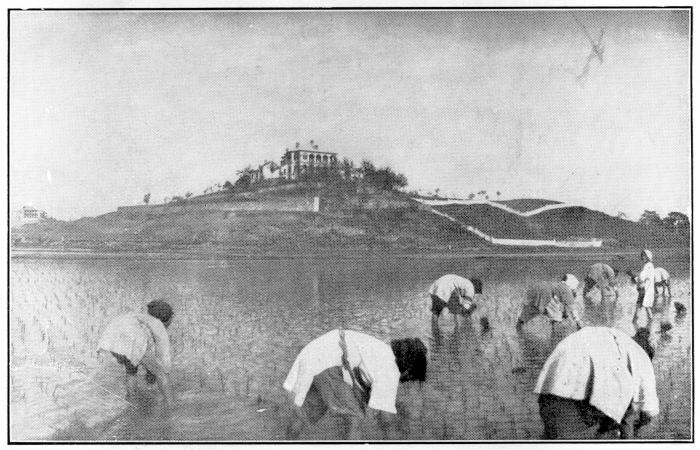
The women and girls work all day transplanting rice.
The thing we depended on most was cotton, and I
had to take my share in cultivating it. The fields
had to be constantly weeded, and that was done by the
women and girls. As with our bound feet it is difficult
to stand, we used to take small stools into the
fields and sit with our hoe in our hands busily digging
out the weeds. Then came cotton-picking—back-aching
work, with the sun fiercely shining overhead,
and plenty of angry words when the amount picked
wasn’t as much as my mother-in-law thought it ought
to be.
In the autumn and winter I learned to wind the
cotton, and then to work at the loom, weaving the
coarse white cloth of which our garments were made.
This, with making shoes and cooking rice, was my
chief work; and though I suffered much I dared not
complain—for I was like the dumb man eating wormwood,
unable to utter my misery.
A Village School.
I should like to tell you something about the school
my father-in-law kept. It was held in a little dark
room at the back of the house, and there were a dozen
or so boys of about six to twelve, who came daily,
as soon as it was light, and studied till dusk. They
brought their own desks and stools, paid for their own
ink and pens and books, and gave a little to the teacher,
either in money or farm produce. They were mostly
farmers’ boys, and in the busy season often had to
help at home; so their education proceeded slowly.
Their chief work was to learn by heart long strings
of words, of the meaning of which they knew nothing.
They began with the three-character classic, and went
on to the works of Confucius and Mencius. But what
they learnt was of little good; for they repeated the
sentences like so many parrots, and with just as much
understanding of the meaning.
Then there was writing—following a copy set by the
teacher, with a brush pen and ink rubbed on a stone
slab. That was all. No geography, or arithmetic, or
history; it was dull indeed. Then, too, there was no
discipline to speak of; for the teacher was often under
the influence of opium, so the boys did as they liked.
The biggest boy in the school was called “Seven
Pounds,” because he weighed that when he was born.
He was a bad boy and a regular bully, lording it over
the small ones and helping himself to their pens and
paper. No one dared to reprove him, least of all the
teacher, for he was the son of the village pawnbroker,
the most wealthy and powerful man in the neighborhood.
Large numbers of Chinese regularly pawn their
summer clothes in the winter, and their winter clothes
when the warmer weather returns; so the pawnbrokers
make a good harvest, and are usually very wealthy
and powerful. So, you see, it didn’t pay to quarrel
with Seven Pounds, and he knew this well enough.
Now, although my father-in-law was reckoned a
scholar, he was, like all in the house, very superstitious.
In the large room, which was dirty and dusty in the
extreme, the place of honour was given to the God of
Riches. There he sat in fat dignity, presiding over
the house, though we never saw any of his riches. In
fact, since the coming of wealthy foreigners into the
country, it is often said that the god has moved to
foreign parts, and is now bestowing his riches on the
Western nations. Certainly I never saw the use of
him, for our circumstances got worse and worse.
Then on the outside door we had pasted a pair of
door gods. These pictures represent famous warriors
who now are regarded as gods, and they have to protect
the house from calamities. Certainly they are
ugly enough for anything; but I have never known
them ward off robbers. But perhaps it is only the
spirits that are afraid of them; men aren’t, I am sure.
To frighten off the spirits we had a looking-glass hung
over the front door, so that when the spirits came
round and were about to enter, they should see their
ugly faces and retire in a fright.
The calendar was invariably consulted for lucky
days on which to begin everything; and when there
was an eclipse we joined our neighbors with gongs
and drums to prevent the heavenly dog swallowing the
sun. Every spring there were the sacrifices at the
ancestral graves, and much cash paper was burnt lest
the spirits of our ancestors should not have enough
to pay current expenses. Sacrifices were offered to
them, and it was a general holiday. Any paper on
which there was any writing or printing was carefully
burnt. By this act merit was stored up.
On All Souls’ Day my mother would burn incense
and cash paper for the release of those wandering
spirits who had no descendants to do it for them. Near
by was a Buddhist temple, where a few lazy priests
idled away the day in opium-smoking and gambling,
bearing out the common saying, “Nine priests, ten
rogues.” My brothers-in-law often went there to try
to find out whether any proposed undertaking was
going to turn out successfully. So by all these things
you will see there was plenty of religion in our house,
though but little goodness.
New Year, which is the great Chinese festival,
brought only added sorrows to me; for the time was
given up to gambling, and I was busier than ever
attending to the wants of the gamblers, and only
received blows in return. Only at the new year itself
was there a little rest from abuse, for at that time it
is unlucky to use bad words. To name the evil spirits
is to cause them to appear. I have heard missionaries
say that they feel free to go where they like then without
fear of abuse, for no one calls them “foreign
devil” then, even though they make up for it later on.
Gods Many and Lords Many.
Over our stove was a paper figure of the kitchen
god. He presides all the year round over the cooking
arrangements, and listens carefully to all that is said.
A few days before the close of the year he goes up to
heaven to report all he has heard to the gemmy emperor,
his master. He must have had a lot to tell about
our house; so my mother-in-law took the precaution to
daub his lips with sticky treacle so that he could not
open his mouth and tell of her doings. Most of our
neighbors did this, too; so I suppose they didn’t feel
any too comfortable about his report of them. At the
new year he came down again—at least we put up a
new one in the place of the one we had burned, which,
I suppose, comes to the same thing.
The goddess of smallpox was much dreaded in our
district. She usually got to work at the beginning of
the summer, and unless big gifts were given to her,
she revenged herself by killing large numbers of little
children as well as grown-ups. I remember well how
she came one summer. One by one of the children fell
ill of “heavenly flowers,” as the disease was called,
and the temple was thronged with worshippers, while
every house had its image of Niang-niang, to which
incense was burned to ward off her anger. As nothing
availed, a great procession was arranged for, in which
many children took part. They were gaily dressed and
carried aloft on the shoulders of men to call forth the
pity of the cruel goddess.
Then we had a great theatrical performance which
Niang-niang watched from her shrine opposite the
stage. It lasted for over a week, and crowds came
from far and near. The only result I know of was
that the disease was carried into a number of villages
near and many more died. The expenses were paid
by the people round, and during the performances the
gambling and opium dens reaped a rich harvest. I
was too busy to care for any of these things, and so
miserable that I prayed Niang-niang to come and end
my weary life by sending me the “heavenly flowers.”
But a worse calamity than the smallpox was to come
upon us. All the year but little rain had fallen, and
the fields were parched and dry. It was the time for
planting out the rice. This rice is our staple food, and
if anything happens to the rice harvest we are in the
greatest difficulty. The rice is sown on flooded fields,
and when planted out has to be well watered for a
month or more, or the plants will dry up.
In spite of all the prayers at the temples, the processions,
and the crackers, the rain refused to fall, and
ruin stared us in the face. The following winter was
dry and cold, and prices went up so that the poor
began to be in great want. Still it was hoped the
spring rains would put things right again. The
farmers sowed what little grain they had left; but
the heat set in earlier than usual, and the fierce sun
scorched up all, and men prayed in vain for the rains
that never came. In their place came famine, gaunt
and relentless.
Our family was one of the very first to suffer.
Gradually clothes and goods were sold, for my father-in-law’s
opium craving had to be satisfied somehow,
and with it all my miseries increased. Yet I dare not
run away, for that meant certain death. In the wake
of the famine came fever. Weak with constant opium-smoking,
my father-in-law was an early victim, and
we buried him hastily outside the village. The two
eldest sons left secretly, and bitterly my mother-in-law
cursed them for leaving her thus in her distress.
There should have been some help obtainable from
the Benevolent Halls; but though many subscriptions
had been given in the good years, the money could
not be accounted for now that it was wanted, and the
man in charge committed suicide when faced by the
angry people. The wealthy hid their money lest it
should be stolen by the bands of fearless robbers who
prowled everywhere. Our home was now sold, and as
we soon used up the money, there was nothing for it
but to join the crowds of starving people going into
the cities to seek for help.
In the Grip of Famine.
On the way to the town, in the blazing heat, and
living mostly on roots dug from the wayside, the
youngest son, my prospective husband, died of exhaustion.
I don’t think any of us minded, as we were
too far gone ourselves. I only remember feeling some
relief that now I need never be married into that
family. How we reached the town I don’t know; but
we got there at last, and for a few days lived on a little
rice doled out from a temple near the river. The
stores of grain supposed to be reserved in every town
against famine were found to be bad from neglect,
and it was only with difficulty a riot was prevented.
The official dared not show his face, as there were
rumors that he had been pocketing some of the relief
money given by the Government.
On the third day we were all of us too weak to fight
our way through the crowd to where rice was being
distributed. Near by was a shop where a kind of
coarse wheat bread was sold. My mother-in-law eyed
it hungrily. There were few about, so she went up
to the man and whispered to him. He looked across
to me, and then I saw him give her a lump of bread,
which she clutched eagerly and disappeared down a
back street. I never saw her again. She had sold me
to the baker for a piece of bread!
I was at the time too starved and ill to be frightened,
and the man appeared to be kind and good, and told
me not to be afraid. He brought me to his wife, a
pleasant woman with a kind face, who gave me a little
food, and after a while I slept. Then began a new
life for me. At first I was terribly afraid lest my old
enemy should come back and try to get me away. My
new-found friends I soon began to like. The man was
a small trader, who had done well in previous years,
and though, like all the others, they were hard pressed
by the famine, they had money enough to tide them
over the worst. They had no children, so the man
bought me as a servant for his wife, and I found in
her a good mistress.
Meanwhile the distress grew. Many of the officials
were so corrupt as to try to make money out of the
calamities of the people. Transit by water was very
slow, so it was long before relief came. At last we
heard that kindly foreigners were bringing up some
boat-loads of flour for the destitute people. It was
when these boats arrived that I saw a foreigner for
the first time in my life. There were two of them who
attended to the transport of the rice from the boats to
a temple. A strong force of soldiers prevented the
rush of the hungry crowd, and the foreigners used to
steal out late at night and early in the morning giving
tickets to the destitute and taking care that they were
not imposed upon by those whose need was not so
great.
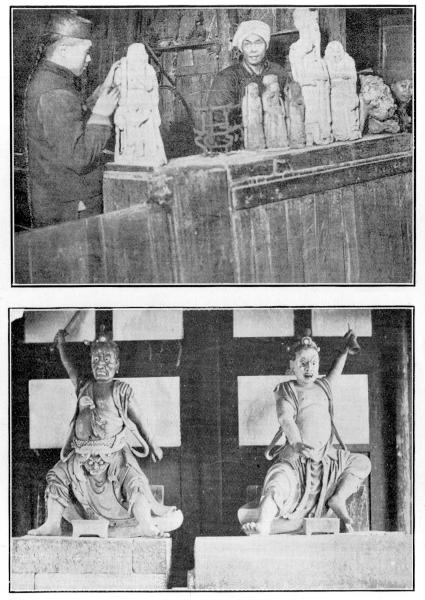
Making idols in China.
“The idols in the temple could not help.”
They told from time to time a strange story of a
new religion of love, and of Someone called the Lord
Jesus, who had sent them in to save the starving. They
were very kind, and gave the people work, widening
and draining the road. My new father was greatly
impressed by all this, and I overheard him say that
such a doctrine as this was worth listening to.
It was at that time that my new-found friends
determined to leave that part and retire to their home
far away in the country. A long boat journey brought
us at last to a small farm, lying at the foot of a steep
hill, crowned, as is usual, by a temple. Here in this
new home I began a new life. My friends were very
religious, and belonged to the vegetarians. Nearly all
the best and most spiritual people in China belong to
this sect. They are earnest worshippers of idols, and
give large sums of money to priests, and in their life
are careful and self-denying. One of their chief
reasons for becoming vegetarians was that they had no
son. This they regarded as the sure sign of the wrath
of the gods. To appease them they had made many
pilgrimages to famous shrines, but without finding
peace.
When New Year came, there was a celebrated and
much-attended festival on the Fairy Hill, near our
home. From far and near crowds came to worship in
the temple of the goddess, bestower of sons and healer
of smallpox. Beggars, in all stages of filthiness, lined
the roads reaping a rich harvest from the worshippers,
eager to accumulate merit by acts of charity. My
father joined the procession that started one day from
our village. Fasting and in silence they wended their
way across the fields, each man with a stick of burning
incense in his hand, and preceded by banners and an
idol in a shrine. Arrived at the temple the noise was
deafening. Drums and gongs clashed, innumerable
crackers spluttered, and the air was heavy with the
smoke of incense. My father knelt before the grim
idol. The priest shook together a lot of bamboo slips,
from which my father took one, and the priest handed
to him the corresponding response of the idol.
Anxiously he stepped outside and read. Would it
be favorable? Would the angry gods regard his
prayer at last? He read the printed slip, and a look
of intense disappointment passed over his face, for
he read thus:
From sickness no release;
In lawsuits no success;
Your children hard to rear;
From false charges no redress;
The lost will not be found,
Nor flocks nor herds increase;
From marriage no good luck,
And from labor no release.
Such was the result of many prayers and much
fasting. Truly the gods keep their wrath for ever.
I Receive a New Name.
Sadly my father wended his way down the mountain.
All was hopeless. Heaven had forgotten to
smile upon him. Then he noticed ahead of him a small
crowd surrounding a foreigner. He was a missionary
from the neighboring town, and was busy selling books
and preaching to the worshippers of the goddess.
Father stepped up, partly out of curiosity and partly
remembering the good deeds of the foreigners in
the famine district.
The crowd were inclined for some fun at the
stranger’s expense; but he answered with such good
humor and politeness as to win their good opinions.
Then he commenced to preach. He did not abuse the
idols—there might have been trouble had he done
so—but he told of a True Spirit who was loving and
good. Father listened. Who could that Spirit be, so
full of love? Not the god of thunder whom everybody
feared, for he struck men dead in his wrath.
Not the fierce god of war, or the pitiless Niang-niang
rejoicing in the sufferings of the smallpox victims.
As the missionary spoke his face glowed. He told
of Jesus, who went about doing good and at last died
for men. There were no Chinese gods who would do
that, father thought. They would take your money,
but die for you?—well, that was nonsense. Eagerly
he listened to the wonderful story. The stranger
noticed him. At the close of his address he approached
father. “Your name, honorable sir?” he asked.
“My unworthy name is Lee,” was the response.
Quietly and earnestly the stranger looked into father’s
face. “Sir,” he said, “I noticed you listening intently
just now; may I respectfully ask you, Is there peace in
your heart? Do you yet know the grace of God in
forgiving sin?” Forgiving sin—that was what my new
parents had sought for so long; and the missionary’s
words went home. My father made a confused
answer, but bought a book the stranger recommended
him, and hurried home lest it should be known that he
had talked with the foreigner, and was in danger of
eating the foreign doctrine.
That meeting was the turning-point in my father’s
life. The book he had bought pointed out a new
and living way of obtaining release from sin. Many
visits were paid to the chapel; and once the missionary
came to our village and stayed at our house. Little
by little my father’s prejudices were overcome, and the
new doctrine entered his heart. At first mother was
bitterly opposed to it. To draw her away from her
gods and win her to this persecuted faith was no easy
task; but gradually the light dawned for her, too.
The neighbors got to hear of the visits to the chapel,
and much petty annoyance was the result; but father’s
patience and sincerity disarmed suspicion, and his
happiness was so manifest as to be a constant witness
to the truth. They were happy days for me, and my
new life was such a change from the old that it all
seemed a dream. One day the missionary heard my
story. “You have come out of much tribulation,”
he said. Then turning to father, he remarked, “Why
not give her a new name?” “Yes,” said father, “we
will not call her Yin-dee any more, but Ping-an—Rest
and Peace—for that is what I have now found in
Christ.” So that is how my name was changed.
Then it was suggested that I ought not to grow up
ignorant, but should learn to read and write; for in
the Christian religion there is no difference made
between girls and boys—all are alike precious to Jesus.
The missionary told us that at Han-yang there was a
school for girls, where many were living and being
taught useful things, and, best of all, were taught the
story of Christ. How excited I was at the prospect
of going, though not a little afraid of so strange a
place!
At last the longed-for day came and I found myself
with my father landing at Han-yang. At first I was
bewildered by the busy crowds and clung to father’s
gown as I walked along. How I trembled with excitement
as we reached the school, and I think father felt
as nervous as I did. But we were inside the gates at
last. In a large yard we saw a group of girls playing.
I gave a gasp of surprise. How could they run so?
Then I saw that their feet were unbound, and the
small, pointed shoes had given place to comfortable
ones, which didn’t cause them to hobble along. I
smiled a welcome at them, and wondered how long it
would be before I could run as they did.
We were shown in and introduced to the matron, a
Chinese lady, who made us feel quite at home, and
after a chat two foreign ladies came in. At first I
could only stare, and I nearly forgot my manners;
but I found that though they were dressed strangely
they spoke my language; so my fear left me and I
was soon enrolled as a scholar in the David Hill Girls’
School, and proud I was of the fact, too. Truly my
new name suited me—I had found rest and peace.
The Girls’ School.
So began my school-life. There is not time to tell
you all about it now. There were about seventy of
us there, from five to seventeen years old. Some of
them had been slave girls, and could tell a story to
match mine. Twice a day we gathered for meals, and
we learnt to clean out our rooms, mend and wash our
clothes, and make our own shoes, so as to be useful
when we returned home. Then there was study and
drill, and all of it was so interesting—not a bit like
the dry way they teach in Chinese schools. Yet, best
of all, were the Sunday services in the chapel and the
class-meeting and Bible-study in the week. My feet
were gradually loosened, and as they grew again I
learned to skip and run with the other girls; and when
I went home it was wonderful the impression made on
the people in our out-of-the-way village.
Several years have gone by since I went to school
and entered upon that new life. Now I am learning
to teach others; for teachers are badly needed in our
schools and women teachers are difficult to get. To-day
I have been thinking over my life. Like a dreadful
dream there rises before me the picture of Yin-dee,
the neglected little slave of a cruel woman. I see
myself hobbling over the ground picking cotton, or in
the evil home making tea for opium-smokers and
gamblers. I almost expect to hear the harsh tones of
my mother-in-law calling me to do some menial duty.
Then I remember the famine and its horrors. I can
scarcely believe that it is all a thing of the past, and
I have become Ping-an, the child of rest and peace.
And what has done it all? Just this—the love of
Jesus. It was Jesus who sent the missionary with the
message of love and pardon, and it is Jesus who now
fills my heart with joy. Yet I cannot forget that there
are many—oh, so many!—of my sisters in China in
the same sad plight as I was. I wonder how long it
will be before the message will come to them? How
long before they will enter the land of rest and peace?
In the city of Pekin there hangs a great bell, and
there is a legend connected with it on which I love to
ponder. Twice had the labor of years been lost at the
time of casting. The third time, just as the molten
metal was to be poured into the mould, the lovely
daughter of the maker, knowing that by no other
means could a perfect bell be cast, flung herself into
the cauldron and gave her life to save her father from
disappointment and shame.
China now is waiting to be moulded. Old things
are passing. It is a new China we are beholding.
Many ways have been tried for her regeneration. The
cold morality of Confucius is powerless. Buddhist
monks and Taoist priests have come in vain. Only
by the cleansing Gospel of Christ can China be purified
and made a vessel meet for the Master’s use. Ages
ago this girl sacrificed herself that the bell might be
perfect. What we women and girls of China need is
that more missionary teachers should come to us,
bringing the love of the Lord on their lips and in
their lives—then will China be saved and won for
Christ. It is worth it a thousand times. Will some of
you come? Will more of you give? Will all of you
pray? There is something each can do, if you will
only try. Out of death springs life, and out of your
sacrifice for Christ shall spring a new China, free from
the sins which have bound her in the past.
David Livingstone
By a Fellow-Townsman.
At Blantyre, Scotland, on the 19th March, 1813, a
child was born to Neil and Agnes Livingstone. We
never know when is happening an epoch-making event.
Every new soul ushered into the world is a shut casket
of possibilities. The boy born in the humble home consisting
of a “but and a ben,” was destined to become
one of the greatest missionaries; and the most conspicuous
and intrepid explorer the world has ever seen;
to achieve for himself a deathless fame, a name of
imperishable memory, and to leave to mankind a heritage
of truth and influence. His cradle was in the
peasant’s cottage, but his grave is in Westminster
Abbey. I have many times visited the house where
he was born, and the mill where he worked, and oftentimes
I have read the inscription that is over his grave.
I esteem it a great privilege to have lived for years near
the birthplace of the great and good David Livingstone.
His home was one of those which are the glory of
Scotland, the abode of the godly and intelligent working
class. His mother was a sweet, gentle woman,
and his father was a good man.
When ten years of age he went to work. His working
hours were from six a.m. to eight p.m. His first
week’s wages, sixty cents, he gave with pride to his
mother. He saved a few pence and purchased a “Rudiments
of Latin,” over which he pored when the day’s
work was done. His thirst for knowledge was intense.
At the age of sixteen he had read many of the classical
authors and knew Horace and Virgil well.
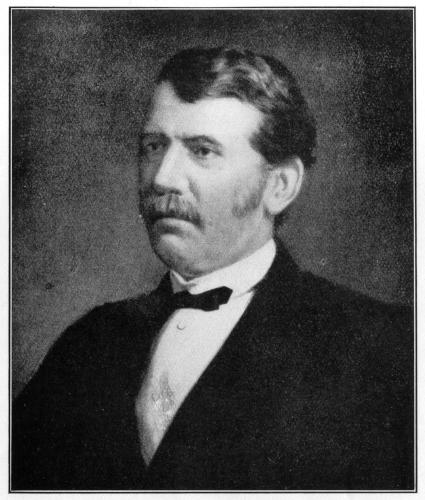
DAVID LIVINGSTONE (1813-1873)
The Great Missionary Explorer. Went to Africa 1840. Died in Africa 1873.
How David Livingstone gave.—
“I will place no value upon anything I have or may possess
except in relation to the Kingdom of Christ.”
It was about his twentieth year that the great spiritual
change took place, which was to determine Livingstone’s
future life. At that time he definitely received
Christ as his personal Saviour, and there can be no
doubt that his heart was thoroughly penetrated by the
new life that then flowed into it. Religion became the
everyday business of his life and his daily prayer was
that he might resemble Christ, a petition fulfilled in no
ordinary degree. A desire was born within him to
preach Christ in China, and that he might be fitted for
that work he entered as a medical student in the University
of Glasgow, and in due time was graduated in
medicine. He received not a cent of aid from anyone.
What a struggle he had! What economy he had to
practice! Frequently his meal consisted entirely of
oatmeal porridge.
He was accepted by the London Missionary Society
and sent out in 1840—not to China—but to Africa.
To God and to Africa he gave his manhood’s prime.
No grander work was ever done than that accomplished
by David Livingstone. In him life’s fire glowed.
With magnanimous and self-sacrificing devotion,
with undaunted courage, in the midst of manifold
sufferings, through days of hunger and
weariness, and nights of dreadful loneliness, he
worked for Africa’s salvation. He loved the
natives, and they loved the man who was ever kind and
good. He worked amongst them with a vision ever
before him of the men and women, whom they, by
God’s grace, might become, and that vision shaped and
controlled and sustained him in all his efforts. With
the vision of the latter day before him he addressed
himself nobly and well to the work of the present.
God alone knows what Africa owes to Livingstone.
This full and overflowing life closed to earth’s activities
in May, 1873. His spirit marches on. Such men
never die. His spirit has entered into the great stream
of the ever-swelling life of mankind, and continues,
and will continue, to act there with its whole force
for evermore. He lives in minds made better by his
noble example. He lives in the Livingstonia Mission,
that great beacon light; he lives in great numbers of
the regenerated natives of Africa; he lives in all who
are constrained to work for Christ in that dark land.
I pray our Epworth Leaguers to read the story of his
life, that they may know what one consecrated man did
in a lifetime, that they may have a revelation of the
possibilities in man, that they may be inspired to emulate
him in his noble simplicity, high resolve, invincible
courage, exalted self-sacrifice; that they may be possessed
with the overmastering purpose which guided
and drove him on. Read his life and be inspired with
the thought that life is a high and noble calling. Reading
of his toils and struggles and victories, pray God
for grace to “follow in his train.” His motto was:
“Fear God, and work hard.” Make it your motto.
The greatest of all tragedies is to live and die without
a thing done by the sweat of the soul.
—Loch Ranza.
Christmas in Our Boys’ School, Junghsien, West China
By Edward Wilson Wallace, B.A., B.D.
If you were a Chinese, and every day ate two meals
of rice and some vegetables, with meat only twice a
month, if as often; if you worked from daylight to
dark seven days in the week, and had no summer
vacation or Christmas holidays; if you had no books
to read except possibly (if you were lucky) one or
two greasy and tattered volumes of ancient philosophy,
not one word of which you understood; in other words,
if you were an average Chinese boy or girl, don’t you
think that you would look forward even more eagerly
than you did this year to Christmas? I think you
would. At any rate the boys and girls connected with
the church in Junghsien were expecting a great treat,
and we were planning to give them all that they expected,
and more.
Then suddenly, unexpectedly, a terrible thing happened
that put an end to all these hopes and plans.
Can you guess what it was? It was not a fire, or an
earthquake, or a riot on the mission. But one morning
there came word that the Emperor of China and his
step-mother had suddenly died, and that everyone must
go into mourning. And that was the end of the two
Christmas concerts, the Christmas tree, and the feast.
For the rules for mourning for a dead Emperor in
China are quite strict. No one could marry for a
month—that rule did not affect us, for the only wedding
arranged for by anyone connected with the
church, that of Mr. McAmmond’s teacher, took place
a few days before. No one was to be allowed to have
his head shaved for a hundred days. Every Chinese
boy and man allows just enough hair to grow on the
top of his head to form his “pig-tail”; all the rest of
his head is shaved clean. But imagine what a messy
effect it is to have the head covered with a couple of
months’ growth around the long cue, as there is now.
It is the Chinese way of going into black; for, of
course, every man’s hair is as black as pitch. Another
rule was that no one could wear satin clothes for a
hundred days, and the little red knobs on the top of
the caps had to be changed to blue, which is the second
degree mourning color in China, white being the first.
So far the rules did not interfere with our Christmas
entertainment. But now we come to the fatal order,
“There must be no music and no celebrations for a
month.” Alas! for our Chinese boys and girls.
Christmas fell within the month.
It is true that we might have got around the trouble
by claiming that ours was a foreign church, and so did
not fall within the common rules. This, I believe, was
done in other places. But our church here is a large
one, and we are constantly trying to make the members
understand that it is a Chinese church, not a foreign
one, and we decided that this was a splendid opportunity
to impress on the people the fact that when a
man joins the Christian Church he does not in any
way become less of a Chinese, and that our Church
believes in honoring the rulers of the country. As soon
as it was finally decided that we should follow the
regulations the members agreed that we had done the
correct thing.
In one way it was rather fortunate for the boys in
the school that we had no entertainment to prepare for.
Just at Christmas last year came the examinations, and
some of the boys were working very hard to prepare
for the entrance examination. So it gave them a better
chance to study. And during Christmas week they
had four examinations.
We did not intend, however, that Christmas should
pass without something to make the boys remember the
day and what it means. If they could not have a
Christmas tree, I determined to give them the next best
thing—in fact, when I was a boy a year or two ago, I
thought it was away ahead of a mere tree—that is
hanging up the stockings. The boys had never even
heard of such a custom, so it was great fun for them.
One morning in school, after prayers, I solemnly asked
the boarders, “How many of you have two pairs of
socks?” There was blank amazement. Why did I
wish to know that? I only smiled, as I began with the
boy in the front, little “Georgie Bond.” “Have you
two pairs of socks?” “Yes, but the extra pair have
holes.” Then to the next boy, “Have you a second
pair?” “I have three pair, but they all have holes,
some of them as big as this,” and he made a circle with
his thumb and finger. “Have them mended,” I replied,
and passed on down the line. I found that all the nine
boys had extra pairs and all of them, as is the case
with the stockings of every decent fellow I ever knew,
had holes. I maintain that in China, as at home, it is
a sign that a boy is a real boy when he wears holes in
his stockings. So I advised them to have one pair
mended and washed before Christmas Eve, and bring
it to me. And then—well, we should see what we
should see.
The boys of the Junghsien School who had a good
time at Christmas.
Great was the excitement among the boys, and not
a sock was missing when the great night arrived. I
did not let the boys hang up their own socks, but
packed them all off to the school study-room upstairs,
while one of the teachers and I pinned the socks up
in a row in the class-room under the blackboard. You
know we have no fires in the schools here, and so
there are no chimneys. All the same Santa Claus
found a way, for next morning—but wait a bit.
When I got down to the school on Christmas morning
at half-past seven I found the boys already at
breakfast. They were casting anxious eyes in the
direction of the room with the closed door, and like
other boys I have known they did not take long to
eat their Christmas-morning breakfast. When they
were all ready they filed into the room. I am not
going to tell you how those stockings were filled. You
may decide for yourselves how, and by whom it was
done. I don’t think the boys stopped to think anything
about “how.” They were too much interested in the
sight of twelve white Chinese socks in a row, all bulging
out in a knobby fashion, with things sticking out
of them, and a flat, red parcel behind every sock. On
the blackboard was written in Chinese, “Jesus’ Holy
Birthday.” After they had looked for a minute I
suggested that they take down their socks and see
what was in them. Then for the first time in their lives
they had the joy of exploring the mysteries of a Christmas
stocking. Their presents were not very much, you
would say, perhaps. Each boy found a story-book and
a photograph of the school, and then down in the sock
were nuts and candies, and right in the toe an orange.
The two teachers each got a New Testament with the
Chinese and English on the same page.
They did not say much, and I wondered if they were
disappointed, until one of the teachers, Mr. Jang, came
up to me with tears in his eyes, saying, “You say we
must not thank you, so I think we ought to thank God.
Can’t we do it just now?” It touched me deeply.
“Yes,” I said, and we all went up to the study-room
and, standing there about the long table, one after
another of the boys made a short, simple prayer of
thanks to God, not only for the gifts of the morning,
but especially for the greatest Gift of all, Jesus Christ.
At nine o’clock we had our regular morning prayers,
and then I gave to the day-boys their presents, a New
Testament and a bag of nuts and candy to each one.
We had a nice little service in the church for all the
church people, but our real Christmas service was held
the next Sunday. On that day we had a special musical
service, led by the boys, who had been practising for
months under Mr. and Mrs. McAmmond. It would
have done you good to hear them open the service with
“Come, Thou Almighty King,” with Georgie Bond
singing one verse as a solo. The anthem was “Hark,
the Herald Angels Sing,” and our Chinese angels sang
splendidly.
On Christmas morning the church members gave
away free rice to five hundred poor people. So that
altogether the boys, even if their Christmas was quieter
than usual, have had something to remind them of the
joy of this beautiful season.
God Wants Them All
God wants the boys—the merry, merry boys,
The noisy boys, the funny boys,
The thoughtless boys;
God wants the boys with all their joys,
That He as gold may make them pure,
And teach them trials to endure.
His heroes brave
He’ll have them be,
Fighting for truth
And purity.
God wants the boys.
God wants the girls, the happy-hearted girls,
The loving girls, the best of girls,
The worst of girls;
God wants to make the girls His pearls,
And so reflect His holy face,
And bring to mind His wondrous grace,
That beautiful
The world may be,
And filled with love
And purity.
God wants the girls.
Li Liang Chen Student, Soldier, Trader, Evangelist.
Rev. J. L. Stewart, B.A., B.D.
It was on the street of the Temple of the Four Sages,
in the capital city, Chengtu, Szechuan. There, to-day,
its low, grey gable abutting the entrance gates, stands
also the Worship Hall to the Western God, who is
surely becoming Father of the East and of all. Within
the temple, only the smoke of a few incense sticks
mingled with the tobacco and opium fumes curled upward
through cobwebs and tiles to the heavens. In
the Worship Hall, three score and more of China’s
youth, black-haired, bright-eyed, brilliant-minded hopes
of her future greatness, were gathered. But half the
hall was theirs. Up the centre ran a wooden wall past
which presumably not even a wandering glance might
go. That part beyond was sacred to the women and
school girls. As not even these latter were present to
embarrass the situation, native eloquence found full
fling.
It was the weekly meeting of the Epworth League of
the College boys. Moreover, it was missionary night,
and members were all attention. The leader was in
fine form. With flushed cheek and fervid voice he
called his hearers to see visions.
“Jesus came to found a kingdom among men. All
within the four seas are brethren. The kingdom must
then include all under heaven. Jesus founded it first
among His fellows, the Jews. These carried the message
to Greeks and Romans. These bore it to barbarians
in Europe and Britain. These have wafted it
round the world, and to our land of the Middle Kingdom.
And we? We must bear the glad tidings on to
Thibet, to the tribesmen and to the aborigines....”
Just then there was a commotion in the rear of the
church. Someone was trying to make himself heard.
At this persistent interruption all turned. A ripple
of indignation quickly changed to interest as they saw
the new speaker, a big, broad-faced, burly fellow, whose
countenance beamed forth a happy combination of
courage and child-like simplicity.
“Your younger brother begs his elders’ pardon,” he
ventured, “but here in the seat just in front of mine
are two of these strangers from the tribes country.
Why wait indefinitely some future date? They may
leave before our leader is through. Why not begin
here and now?”
A voice of assent and approval ran around the room.
For ten minutes the speaker, bending forward, chatted
pleasantly with the wanderers from the great ranges to
the west, well diggers, it seemed, seeking work on the
plain, welcomed them to the meeting and told them
simply and sympathetically of the Saviour of all and
His message of love to men. Then the meeting went
on as before.
A simple enough little incident, surely, but it is an
index to the speaker, sincere, sympathetic, fearless,
practical. It was Li Liang Chen, that is, Li of Perfect
Virtue, as his parents had named him in hope. To attain
the Chinese goal of greatness by becoming an official
was likewise a longing, and to that end he was sent
early to school. There, year by year, through youth
and young manhood, he had repeated his history,
rhymed his poetry, patiently traced the puzzling characters
and later written countless stereotyped essays
under a still famous teacher of the district. More than
once he had gone up with the picked men of his
county to try for the coveted degree, that opening door
to official life. Alas! how few could hope for success;
oft-times scarce two in a hundred. His heart was,
moreover, ever too great for his head, so those with
more self-abstraction or secret alliances with the examiners,
won the day.
In military matters, literary attainments played a
lesser part, the physical was the all-important, so thither
his ambitions turned. Here, though some surpassed
him in lifting the two and three hundred weight stone,
success came surprisingly. He soon bent a strong
bow and sent his arrow clean and quivering to the
heart of the target. In feats with fists his stature,
strength and courage placed him among the envied few,
while in swinging great swords he was scarce surpassed.
China, however, cares not for war. In the long life of
no other nation has history written so large, “Blessed
are the meek, for they shall inherit the earth.” Her
list of honor runs, scholar, farmer, mechanic, merchant.
The scholar sways by thought, so is first. The
farmer and mechanic each produces, so come next.
The merchant does neither, but distributes, so is fourth.
The soldier is not even mentioned, for he exists but
to destroy. Such being the sentiment, in times of peace
but few are maintained or indeed needed to follow the
profession of arms among these most easily ruled of
the millions of earth. Li, like the many of his fellows,
must have other means of support.
His father was a merchant in the market village of
the Chao family, near Jenshow. By dint of industry
and economy, he had also added a small farm to his
possession. Li was placed in the shop. Affability
won friends, time and tact got him trade, while his
fearlessness gradually carried him far afield. Back
from the borders of the aborigines he brought white
wax and ponies; from the province of Uin Lan he led
pack mules laden with tea. In Kweichow, south and
east, he sought silks and horses. From the far-flung
tribes to north and west he bought musk and medicines,
and from the Thibetans wools and hides. Soon
agencies were established, compass-like, all about his
centre, and Li, the trader, was known to big firms in
scores of cities, towns, and in the great capital.
But travels had touched more than trade. In larger
centres he had seen the much-talked-of foreigner, with
his ever-present hospitals, schools, and churches, and
had heard him discussed from province to province in
countless inns and teashops. Once, only once, he had
paused one day in his busy life to listen to a street
preacher. He carried away little of what was said.
How could such things concern him and his sole
search for goods and gold? Thus ten years fled by.
He lost much, but made more, and at length decided
to settle in his native village, among his own, the better
to be a filial son to his now aging father.
About that time mission problems assumed a new
phase. After the dramatic events culminating in the
Boxer cataclysm in 1900, the missionary found himself
received in a new light. Previously permitted, as
a matter of indifference, or in many places despised,
insulted, persecuted, he now found himself pushed into
unsought prominence. Foreign troops had defeated
the forces of the Son of Heaven. Foreign officials
had but to say the word, and China bowed to obey.
Were not the missionaries friends of these consuls,
indeed might they not themselves be officials or paid
to act as such? In fact, one nation, France, openly
allowed their “fathers” official status. The bishop
ranked with a viceroy, the humblest priest with the
local magistrate.
The fruit of it all came fast. People flocked to the
churches, not to be bettered by Christian teaching, but
to gain power with which to threaten and coerce their
enemies. This, it is not unfair to say, was particularly
true among Roman Catholic native priests and their
converts, where the worst characters of the community
carried the day with high hand. It was at least true
of the Jenshow district, where, abetted by the church,
“converts” coerced, blackmailed, robbed, assaulted
their helpless neighbors. Should reprisals arise they
were at once labelled “persecutions,” appeal was made
to the priests, then to the bishop, and thus to the chief
officials of the province, or locally to the magistrates.
The honest, hard-working citizen’s lot seemed hopeless
and helpless.
Then the knowledge slowly gained ground that there
were two parties among these foreigners. Protestants,
it was said, had equal power, but did not countenance
such coercion. Why not invite these into the county,
and join their organization? The plan was plausible
and prevailed. Representative men went to the capital
to invite the Protestant missionaries. After a time
they came, received everywhere with honor and acclaim.
Villages, a score and more, organized and sent
representatives to support the movement. A central
organization sprang up and a big building was secured.
Among the many villages that thus sent representatives
was that of the Chao family. Who should be
sent but Li, the scholar, soldier, merchant, man of
affairs. He went to Jenshow, listened, gave hearty support,
bought books said to be necessary and went his
way. He was more interested now, however, and read
his books carefully. Though his motives could scarce
be called Christian, he was being led and to lead in a
way that he knew not.
Some months later, a convention for leaders was
summoned in the provincial capital. Li was ready and
receptive. He returned to his native village, moved
as not before to pilot his people. Many became converts,
not of convenience, but of conviction, among
these his former teacher and his own family and
friends.
Another year, and again a conference of those most
worthy was called. Li came gladly. This time his
home-going meant the giving over of business interests
to others while he went forth in his own village,
county town, and all the surrounding district, this time
persuading men to make the greatest of all investments,
those eternal investments in the Kingdom of
God. Henceforth for him he felt his life’s chief business
lay in the extension of the reign of righteousness,
peace and joy throughout his native land.
Two years have passed since then, but he is still as
of old—fervent, fearless, faithful. A year’s study at
college in Chengtu has given him greater grip and
wider vision. To-day he is again out in the work he
loves, the scholar seeing even more clearly the signs of
his times, the soldier going courageously forward in the
great commission, the trader offering in all market-places
treasure that death cannot corrupt, the evangelist
heralding the glad tidings of great joy to a great
people.
Of such stuff are China’s first apostles in the far
west. Of such appeal is the message of the Son of
Man to draw alien races unto Himself. To this end
let us have firmer faith in all.
Bo and Nare, or Found Out
“Rub-a-dub-dub! rub-a-dub-dub!”
Little Bo heard the music, and ran after it. He had
been fishing in a pool with a bent pin for a hook. “It
is lots more fun to run after the band than to fish with
a pin and not catch anything,” thought Bo. So he
gave the line to his little sister Nare. Nare wanted to
fish before, but Bo had said, “Girls don’t know anything
’bout fishing.”
Bo lived in a far country where even fathers don’t
love little girls. Bo did not share his playthings with
his sister, as you have done. He made her wait on
him. He didn’t know any better. That was the way
Bo’s father treated his mother. Bo was not white,
as are the boys and girls who read this. He was
brown as a berry. So was his little sister Nare. So
were all the people Bo and Nare knew, except two
ladies. These white missionary ladies were Bo’s
teachers. They told him about Jesus. But Bo’s
father taught him to worship idols. Bo sometimes
wondered which was the true God. But at this
particular minute he only thought about the music,
and ran after it. He saw a great crowd and a priest
in the midst beating a drum. He heard the priest cry
in a loud voice, “Let every one keep silence.” Then
the priest looked fiercely at the small boys. Bo began
to tremble, and wish he were back fishing. “On this
day week,” again shouted the priest, “at noon a god
will arise from the ground in the field near our temple.”
A second time the drum sounded, and the
priest moved on to convey the news to other villages.
Everybody began to talk excitedly. “A god rise
from the ground!” said they; “can it be possible?”
Bo was delighted. “Now I’ll find out,” thought he,
“if men make our gods out of wood and stone, as the
missionaries say. I’ll go and see for myself.”
That week seemed the longest Bo had ever spent.
But the great day came at length, and Bo was very
happy. Nare was not. Nare wanted to go too. She
begged Bo to take her, but Bo answered, “You are
only a girl; it doesn’t make any difference what you
think. By-and-bye I’ll be a man; so I ought to know
what is right.” Bo thought it manly to speak so
rudely. Why, even mothers are treated very badly
by boys in countries where Jesus’ teachings are not
known.
So Bo started off alone. He found the largest
crowd he had ever seen in the great field near the temple.
In the centre was a vacant space, where only
priests stood. Bo made straight for that spot. But
a priest took him roughly by the shoulder, and said,
“The new god will kill any one who comes inside this
circle.” Bo ran back and hid behind a tall man, who
didn’t look afraid.
It was a silent crowd. Most of the people seemed
awe-struck. Every one was eagerly looking toward
the vacant space where the god would rise. At noon
more priests in long white robes came out of the
temple. They began to mutter and wave their hands.
The tall man next to Bo said, “Something black is
coming out of the ground!” Bo stood on tip-toe and
strained his eyes to see.
The something grew larger and larger. Every eye
was fixed upon the spot. Could it be the top of a
head? Yes, for the brow, eyes, nose, and mouth
slowly appeared. All this time the priests never once
went near. The big black idol seemed to rise of itself.
The crowd, almost wild with excitement, cried out,
“A miracle! a miracle!”
Bo thought the priests looked much pleased when
the people shouted, “’Tis a miracle!” Soon the priests
went into the temple. They didn’t think any one would
dare go inside the circle.
Now it happened that the tall man who stood next
to Bo no longer believed that idols were gods. “The
priests are trying to cheat us,” thought he. “A rival
temple is the favorite, where most money is given.
The priests of this temple are poor. They have made
up this miracle in order to draw more offerings here.”
So this wise man said to a friend near, “Let us make
this god grow faster.” The other agreed. They went
boldly forward and took hold of the idol.
Bo heard people say, “They will surely fall down
dead.”
But no; the god came up quickly—head, hands,
body—all complete. Still the two brave men stood
unharmed and actually laughing. They cried out, “The
priests have fooled us; come and see for yourselves!”
Then, pell-mell, pushing and tumbling over each
other, all rushed to the spot. What do you think they
saw? A great pit full of soaked peas. The priests
knew that peas grow larger when left in water; so
they filled the pit with peas, poured on water, placed
the idol on top, and covered it lightly with soil. By-and-bye,
when the peas had begun to swell, the idol
was pushed through the ground.
The people were very angry. They nearly killed
the priests, whom they found feasting in the temple.
After one long look backward, Bo trudged home in
disgust. He could never again believe in their priests.
That evening Bo told Nare his decision: “We’ll not
be afraid of make-believe gods any more. We must
pray to the great Father who lives up in the sky.”—Selected.
Results of a One-Cent Investment in One of Our Country Sunday Schools
At a Sunday School missionary meeting, the Superintendent
received a number of letters from the
scholars, giving an account of how they had traded
with a cent which had been given them a year ago. It
is needless to say that this was by no means the least
attractive part of the programme. The following are
some of the letters as received, in which we have made
no corrections:—
“I bought a cent’s worth of radish seed and sowed
them in a plot of ground which my Mother gave me.
I tended to them with care and sold them at 5 cts. a
dozen. I sold 12 dozen and made 60 cts.”
“Two years ago I took a cent to see how much I
could make for missions. One year ago I took another
cent. I spent them both and gained nothing with them.
You can’t speculate much with a cent. A lady wanted
me to do some work for her and said she would pay
me, so I got $1.15 for last year, but didn’t get it in time
for the meeting, and this year I have added 35 cts.
more. Total amount, $1.50.”
“Bot lead pencils at wholesale and sold them out
retail, with the proceeds bot some sugar and made
taffy and sold it for missionaries, making in all, 58
cts.”
“I have twenty-five cents to give you for the missionaries.
I sold some cucumbers to a lady for five
cents, and the rest Ma gave me for doing errands.”
“I earned this money buying and selling rhubarb,
20 cts.”
“I bought one egg, raised a Pullet and sold one
dozen for 20 cts., one dozen eggs for 15 cents, then
sold the hen for 20 cts. Total amount made, 55 cts.”
“I ernt this fifteen cents by buying and selling
eggs.”
“I bought a patch of potatoes for one cent and
tended to them and sold them for 10 cts., making a
profit of 9 cts.”
“I have just 51 cts. I went errands and washed
dishes and did other little things for it.”
“I bought beans and planted them and sold them
for 3 cts.”
“I bought with my cent some radish seed, and Mr.
Wilson gave me a plot to sow it in. I watered and
weeded them and sold them at 5 cts. a bunch, and
made $1.”
“I blacked the boots for a month and earned 15 cts.
I will try to do better next time.”
“My cent I invested in potatoes. I planted and
tended them and arranged with a gentleman to take
the potatoes at 40 cts. per bag. I am glad to hand in
my $1 as the result.”
“I am a very little boy, but I ain’t too small to work.
Last year you did not give me a copper to work with,
but I thought I would try and do something for poor
little boys and girls away off in heathen lands, so last
summer I picked dandelions, tied them in bunches,
and sold them around the town, total amount, 5 cts.”
“Total proceeds, $12.12.”
“I first bought a can with my cent, and picked
berries and sold them. Received twenty cents.”
“I bought a row of carrots of my Father for a cent,
and had five pails, and sold them at 10c. per pail,
which is fifty cents.”
“I bought a cents worth of knitting cotton and knit
a pair of garters and sold them for Ten cents. (10c.)”
“We Bought 2 cents worth of Eggs and Sett them,
got 2 chickens, and sold them for 20 cents.”
“Bought one ct’s worth of Bootblacking, blackned
boots for five cts. bought five ct’s worth, blackned
boots for five cts. a week, got one dollar.”—Missionary
Outlook.
The Schoolmaster’s Lesson
The schoolmaster, with the savings of two laborious
years, had treated himself to a fine large microscope.
This instrument, in its mahogany case, occupied a
place of honor on a side table. It was a world of
wonder, a more than Aladdin’s lamp to the children,
who looked with joy to the occasions when the schoolmaster
revealed to their wondering gaze its enchantments.
Whenever the schoolmaster took a little key
from his vest pocket and approached the sacred altar,
where reposed the marvel, the children stowed their
books under the blue desks, and fairly held their
breath with expectation. Any one of them might have
the honor of being summoned as officiating acolyte of
the occasion.
On this afternoon the schoolmaster had a bowl of
water and some small green weeds from the nearest
pond. He put some of the green plant in a large, clear
glass. As it floated, the children coming near to look,
one by one saw that the plant seemed supplied with
minute green sacs filled with air.
“Now, take your seats,” said the master. “This
is called a bladder-plant, from these wee, green bladders,
whereby it floats. Listen, and Nathan will tell
you what he sees. Nathan, come forward.”
Nathan came gladly.
“Now, tell us what you see in the water, Nathan.”
“I see little live things; some have little shells on
them like mussels, only they look about as big as
tiny pin-heads. Some have little whirling wheels on
their heads. A good many are like very, very wee
caterpillars.”
“Those last are the water-bears,” said the schoolmaster.
“Now look at the bladder-plant.”
“The bladders,” said Nathan, “are little bags.
Their mouths are open. They are set round with
hairs. Some of the bags look full of something, and
dark. Some of them seem to have some live thing
kicking in them. Some are empty, and as you look in
at the door it is like a little clear green room. Oh!
I see a water-bear swimming up to one! He looks
in. He seems to think it is pretty. I guess he wants to
know where there is something kicking. He looks in
there. Now he goes to an empty one. Now he swims
by. No, he changes his mind. He thinks he will go
in. He pokes in his head. The little hairs at the
door bend inward: they let him go in easy. He is in!
Oh! now he is trying to come out!”
Great excitement in the listening school—eyes wide
open, heads bent forward.
“Can he get out?” cried someone.
“No! no! he can’t,” exclaimed Nathan, all eager.
“The hairs bend in, and let him in, but he cannot get
by them to go out! They won’t bend out. Oh, he
can’t get out.”
The schoolmaster now took one of the dark, full
sacs, cut it open with a very fine, sharp instrument,
and put it under the glass.
“Now what, Nathan?”
“Oh, that bag is full of dead things, of what you
might call the bones of these bits of creatures, the
shells off one of those tiny things like mussels. They
are things that have gone in and have got all melted
up.”
“Here is another,” said the schoolmaster, putting
a lighter green sac in place, also cut open. “What
now?”
“That is the very sac the water-bear looked into to
see something kicking. The kicking thing was another
water-bear. Now it is dead. The one that went in
just now is kicking, too.”
The schoolmaster took that sac also, opened it, and
released the struggling water-bear.
“What now, Nathan?”
“He is out, but he doesn’t feel good. He doesn’t
swim round as he did before he went in. I think he
is going to die, schoolmaster. Oh, here is another bear
just going into a sac. Let him out quick, won’t you?”
The schoolmaster opened the sac and the freed little
animal swam off.
“He got out, right off, and nothing but him,” said
Nathan. “Schoolmaster, isn’t it queer that when they
look in and see the dead ones, and the bones and skins,
or see other ones caught and kicking, and can’t get
out, that they don’t learn better than to go in themselves?
I should think they’d have sense to keep out!”
“People do not have sense to keep out when the circumstances
are just about the same. Now, all of you
children, listen. You know that Nathan has told you
of these little, gay palace-rooms, where the doors open
in and not out, and the things which swim by seem
curious to know what is inside. Some of these gay
places hold struggling captives; others are full of the
relics of the dead. Now, that is a little parable to
you. Let the little green sacs stand for places where
strong drink is sold. Those who enter such places
form the drinking habit, and then they cannot get free
from it. Persons, yet free, look into these dens for
drinking. They see in them people all ragged, dirty,
poor, unhappy, bloated, crazy, sick, wrecked and ruined
victims of the habit. They see yet others who mourn
that they are enslaved, who have a sense of shame and
danger, and struggle to get rid of the appetite that
makes prisoners of them, and will destroy them. In
this little plant, when the little animals get into the
sacs, the plant melts up their bodies and seems to suck
up their juice and feed on it until nothing is left but
the fine bony parts. So the unhappy person who goes
into a grog shop finds that the dealer feeds on him
until his health and happiness, and money and respectability
are all gone, and perhaps nothing is left of him
but the poor body that is ready for the Potter’s field.
Is it not strange that when we see how many persons
are utterly ruined by drink, any will venture into places
where drink is sold, and will even begin to taste the
fatal liquor? Whenever you see a place for selling
whiskey, I want you to think of the little water-bears
and other water creatures which enter the snares of
the bladder-plant.”—Selected.
Liu Tsi Chuin Rioter and Evangelist.
Rev. J. L. Stewart, M.A., B.D.
“Ninety-five” is a date of dates among the pioneer
workers in West China. All winter rumors of the
doings of foreigners had been floating about the city
of Chengtu, old stories of suspicion and superstition
scarce heard to-day: “Foreigners ate children.”
“Doctors pulverized eyes for medicines, hence their
wonderful cures.” “Bodies were buried beneath the
church floors.” “Foreigners having, many of them,
blue eyes, could see into soil and discover hidden
treasure as the dark-eyed people of China might see
stones on the bottom of streams.” “Foreigners were
there to seek treasure or territory.” Even high
officials, ’tis said, fed the flame with the hope that it
would soon become so hot the “foreign devils” would
flee.
There were, however, few open acts of hostility during
these days. Then suddenly, like a bolt from the
blue, it came. It was the fifth of the fifth month feast.
According to time-honored custom, the crowds assembled
on the great east parade ground, scarce a stone’s
throw from the Mission compound, for the throwing
of plums. Vendors, their big baskets well filled with
the fruit still green, had booths, or pushed through the
people everywhere. Everyone bought, sowed his
plums broadcast in the air, then scrambled with the
rest, for, aside from the sport, the plums so obtained
were said to ward off sickness, demons, disaster, and
brought good luck for the year to come. As the day
grew, masses of roughs and toughs, many from the
yamen, some say, mingled with the thoughtless, and
jammed and jostled together till the air was filled with
the hum and hue of voices, and hearts and heads were
half-hysterical for mischief and riot.
Already as evening came, the crowd had overflowed
past the gateway of the mission premises.
“Here’s where the foreign devils live,” said one.
“Let’s hurl a stone at the gate,” said another.
“Who dares?”
Soon one stone by stealth, then a volley, rattled
against the big black doors. The gateman’s rebuke
only made the ringleaders more bold. They fell back
when the foreigner appeared; but were at his heels, a
howling mob, when the gates again closed behind him.
The rabble rushed to the point, restraint was thrown to
the winds. A riot was on in earnest.
Into the blackness of the night, two men, strangers,
homeless in a strange, inhospitable land, fled with their
heroic wives and hushed little ones. Then and for
hours afterwards, as hiding from street to street they
sought their way to our W.M.S. home, they heard afar
the frenzied shouting, and saw the flames pierce high
into the darkness as church, and hospital, and homes,
and goods, and gifts, and many a treasured heirloom
from half round the world became fuel for the fires.
Next day saw the mob’s return to its work of destruction
till every building of every mission in the city,
Protestant and Catholic alike, was in ruins, and the
foreigners, irrespective of sex or creed, huddled
together in a few low outer rooms of one of the official
yamens.
Such was Liu Tsi Chuin’s first introduction to the
foreigner, for he was in the thick of the fray on the
first night, and followed on next day as one by one the
missionary families fled, and the buildings were looted
and burned. It was a full decade before he came in
touch with them again and then—how changed the
circumstances!
Liu Tsi Chuin was of good family. His name, Tsi
Chuin, “Be princely,” would give a hint, at least, of
his parents’ goodness of heart. His father was the
trusted treasurer of a district magistrate not far from
Chengtu. Alas, when Liu was but a child of three the
father died. Shortly after, his little sister also died,
and Liu and the little widowed mother were left alone.
His father, however, had been a man of thrift, so that
even after the exorbitant funeral ceremonies were
over, enough was left to buy a neat little home on the
Great Well Corner in the provincial capital, and even
some over to be invested for interest. Little Liu was
sent to school. He had friends of his father in official
circles. That would mean influence in the days to
come, and that position, promotion, power, so hope was
high in the little household.
At the age of thirteen a change came in Liu’s life. A
relative, of whom there are ever plenty in Chinese
families, had persuaded the little widow that mints of
money might be made by embarking in business. After
much persuasion, she yielded. Was not the interest
small? And would not her boy need more as he grew
older? And was she not ambitious for him? The
sums loaned were called in, and the little home mortgaged.
Soon a great double shop displayed a new and
euphonious name. Big lanterns swung below the eaves.
Long boards with letters of gold told of the virtues of
the place, while within hams swung from the ceilings,
various confections covered the counters and long
strings of tobacco lined the shop front close by the
street. For five years business went on briskly. By
degrees, however, other relatives and friends attached
themselves till “the money failed to fill the mouths,”
and, in brief, business failed and had to be abandoned.
Another venture was made in the then flourishing
opium trade, but their capital was limited and larger
firms outsold them.
Liu was now a youth of twenty. With the little
capital left he tried running a sox shop. Alas, in his
last venture he had lost more than money. He had lost
manhood as well. His countrymen have a proverb,
“You can’t work in a dye shop and keep your clothes
unstained.” Liu had himself fallen a victim to the
opium he sold to others.
The evangelist and his family.
The record of his ruin is the old story of China’s
sorrow after that. Sucking his pipe, sleeping, sliding
about stealthily from spot to spot, seeking relief from
the fiend which haunted him by day and by night, he
had little time for business, his thoughts were busy
with baubles, trade fell off, goods disappeared, his last
cash left him, and despair and destruction followed
fast. It was during those days that he found himself
one of the throng of thoughtless and rowdies, assembled
for plum throwing. The sacking of the missions
was but a new excitement with a possible gain to all,
and what could it matter anyhow to frighten away a
few foreigners whom nobody wanted? But that story
we have told.
Liu had married meantime. A little daughter had
come to his home. Then later his wife died. He left
the city and sought employment with his father’s
former official friend. The latter gave him a small
position as messenger. But official life is precarious.
His benefactor lost his position, and Liu was once
more down and out. He wandered back to the capital
and to his child.
No one visits Chengtu who does not find his way
some time or many times, if he has the opportunity,
to the Great East Street at night. By day it is filled
with busy buyers at the great silk, tea and porcelain
shops, but by night it is more animated still. When the
great shops close their shutters at sundown, the curbstones
are immediately pre-empted by swarms of junk
dealers, curio sellers, vendors of fans, needles, chopsticks,
pictures, rare old bronzes, ink slabs and vases.
Here, too, are diviners, fortune-tellers and fakirs. It is
the bazaar of the capital, once seen not to be forgotten,
with its twinkling candles stretching far away, its lines
of squatting vendors, its hum of busy voices, its clattering,
chattering, crowding thousands who throng the
thoroughfare. There with his little store of stuff about
him, Liu might be found each night. The day he
spent picking up a few curios from house to house,
when not too busy with his pipe.
One day he rambled again along the street where in
former days he, with the rabble, had wrought such ruin
to the cause of missions. The church, a new and larger
one since those days, stood open. Numbers of people
were crowding in, so he, with an uncle and two friends,
sons of his former official patron, joined the stream.
They listened half curiously, half carelessly, to the
prayers and singing, all so strange to them. Something
in the sermon, however, brought Liu to attention. The
speaker said that this God of love could so fill and
thrill a man with His Spirit that even the passion for
opium could no longer hold him. Could it be possible?
Liu was no willing victim to the habit. He had tried
all kinds of pills and strange concoctions guaranteed to
cure, or recommended by friends. He had fought by
his own will power till that became so weak he scarce
struggled longer. But here was a new thought from
the truth-telling foreigner, and a new hope. Perhaps
this foreign God could help. So at invitation he, with
his companions, waited for the after meeting, where
all are welcomed who have questions or seek further
light.
He became even more interested and came again and
again, bringing his friends with him. Then the
ancestral tablet fell down in the official home one night.
The two sons took it as a sign that their ancestors were
angry with their worship of the foreign God, so they
came no more. A month later a storm burst over the
city. The thunder, a somewhat rare thing on the
Chengtu plain, so frightened the uncle that he, too,
never returned to the church.
But Liu was not to be balked in his search. He met
others among the members who had been helped by the
foreign pastors and doctors, and he was determined
to be free. The rest of the story is readily told. It
is the story of an ever-increasing number of New
China’s sons. Foreign medicine, earnest counsel from
his pastor, daily reading of the Word which is Spirit
and which is Life, prayer and service and the inflooding
of the Spirit of God brought a new power and
peace to a life which for long had struggled and
suffered, and been all but slain through sin.
With health and hope and freedom came also a great
longing that others might know the glad Gospel message.
He took to selling books up and down the very
streets where men knew him best. As he went he told
his story in shops, at corners and in the homes of
friends. Seeing his sincerity and ability, our mission
soon sent him farther afield, till he traversed much of
the northern district. Then he served for a time faithfully
and effectively in Kiating and Chin Ien. He has
now been a year at college as a probationer. His little
daughter is a promising pupil in our girls’ school. He
himself married recently a beautiful young woman,
rescued and reared by our Chengtu orphanage, and
they to-day are together laboring earnestly for the
coming of His Kingdom. Thus Liu Tsi Chuin is
realizing in a way his father never dreamed the hope
of the “Princely man,” for the greater Father had
need of him.
Where Do You Live?
I knew a man, and his name was Horner,
Who used to live on Grumble Corner—
Grumble Corner, in Crosspatch Town;
And he never was seen without a frown;
He grumbled at this, he grumbled at that;
He growled at the dog, he growled at the cat;
He grumbled at morning, he grumbled at night,
And to grumble and growl were his chief delight.
He grumbled so much at his wife that she
Began to grumble as well as he;
And all the children, wherever they went,
Reflected their parents’ discontent.
If the sky was dark and betokened rain,
Then Mr. Horner was sure to complain;
And, if there was never a cloud about,
He’d grumble because of a threatened drought.
His meals were never to suit his taste;
He grumbled at having to eat in haste;
The bread was poor, or the meat was tough,
Or else he hadn’t had half enough.
No matter how hard his wife might try
To please her husband, with scornful eye
He’d look around, and then, with a scowl
At something or other, begin to growl.
One day, as I loitered along the street,
My old acquaintance I chanced to meet,
Whose face was without the look of care
And the ugly frown that it used to wear.
“I may be mistaken, perhaps,” I said,
As, after saluting, I turned my head;
“But it is, and it isn’t, the Mr. Horner,
Who lived for so long on Grumble Corner.”
I met him next day, and I met him again,
In melting weather and pouring rain,
When stocks were up, and when stocks were down;
But a smile somehow had replaced the frown.
It puzzled me much; and so one day
I seized his hand in a friendly way,
And said: “Mr. Horner, I’d like to know
What can have happened to change you so!”
He laughed a laugh that was good to hear,
For it told of a conscience calm and clear,
And he said, with none of the old-time drawl,
“Why, I’ve changed my residence, that is all!”
“Changed your residence?” “Yes,” said Horner,
“It wasn’t healthy on Grumble Corner,
And so I moved—’twas a change complete—
And you’ll find me now on Thanksgiving Street!”
Now, every day, as I move along
The streets so filled with the busy throng,
I watch each face, and can always tell
Where men and women and children dwell;
And many a discontented mourner
Is spending his days on Grumble Corner,
Sour and sad, whom I long to entreat
To take a house on Thanksgiving Street.
—Josephine Pollard.
A Bible for a Pistol
A True Story
“See, mother, see what I have brought you!” exclaimed
a young Brazilian, holding up to view a well-bound,
gilt-edged book. “Antonio Marques told me
that the priest ordered him to burn it, but he did
not like to destroy so good a book, and was afraid to
displease the priest by keeping it, so I offered to trade
my old double-barreled pistol for it. I thought you
might like to have the book, for they say it is all about
religion, and you are so religious. It might be of
some use when you go to repeat your prayers for
people who are dying.”
The mother took the book from her son’s hands,
and slowly reading the title, “A Santa Biblia,” said:
“Ah! this is good; this is the ‘Rule of Life,’ I am glad
to have it.” Then beginning at the first of Genesis,
she glanced over several chapters until she reached the
tenth. “Yes, you are right, my son; here is just the
kind of prayer I want. Here is a long list of names,
and as they are all in the Bible, they must all be of
saints, and some of them will surely help the poor
creatures.”
The youth frequently found his mother with the
book before her when he came in from his work, and
had he taken the trouble to look over her shoulder he
would have found her always reading the tenth chapter
of Genesis.
The woman, who had the fame of knowing by heart
a great many prayers, was often sent for to go even
long distances to repeat them for the hope and comfort
of the dying; and she was faithfully trying to master
the long names, so as to say them off glibly to serve
as a prayer.
One day, as they sat taking their noon-day coffee, a
messenger came from a neighboring plantation,
begging her to go at once to see a young girl who was
very ill. With book in hand, she set out, and arriving
at the house a sad, though to her not unusual, sight
met her eyes. A girl of about fifteen lay upon the bed,
her beautiful black eyes looking strangely bright in
contrast with the pale features. The parents and
sisters, instead of caring for her, were wringing their
hands and wildly crying out, “She is dying! She is
dying!” The sick girl feebly stretched out a wasted
hand, gasping: “They say that I am dying; teach me
quickly how to die; tell me, what must I do?” The
old woman gently took her hand and in a soothing
voice said: “Don’t be nervous, dear; if you will repeat
after me the Pater Noster, the Ave Maria, the prayer
to St. Joseph and the rest, and then a new prayer that
I have learned from this good book, you need not be
afraid.”
A sight never to be forgotten by one who knows that
there is but the one “name under heaven, given among
men whereby we must be saved,” was this death-bed
scene. The old woman, in clear tones, rapidly repeated
among other things, “Shem, Ham, Japheth, Gomer,
Magog, Madai, Javan,” and so on through the long
list. The dying girl vainly tried to follow her as her
voice grew fainter and fainter, for she was, with all
her failing strength, clinging to this false hope as she
passed out into eternity.
Some years later, the young man who had gotten the
Bible in such a curious way, married and left the old
house to live at the wife’s homestead. One evening,
as the old father sat in his usual place reading, the
husband said: “Anninha, what is that book your father
is always reading?”
“That,” she replied, “is the Bible. He often tells
me about what he reads, and it is very interesting.
I wish I could read it for myself; but it is a French
book, and I can read only Portuguese.”
“If it is called the ‘Holy Bible,’” said he, “then
my mother has it in Portuguese, for I gave it to her
long ago. I never read it myself, but she used to learn
things out of it for prayers. They never sounded very
interesting to me.”
“Could you get it for me, Jose?” she asked.
“Yes; I will go over and ask mother for it to-morrow,”
promised he.
When the wife got the Bible, she carried it to her
father, who was much pleased to find this favorite
book in his native tongue, and, opening it at the New
Testament, he began to read aloud. The young couple
listened and soon grew so interested that they begged
him to go on, till they kept him reading late into the
night. Deeply touched by the “old, old story of Jesus
and His love,” they began to read for themselves.
Soon they learned that pardon and peace had already
been purchased for them, and that what God required
of them was not penances and a bondage to fear
through life, and masses and the agonies of purgatory
after death, but child-like faith and loving obedience—that
godliness which gives promise of the life that
now is, and that which is to come.
The son’s first wish was to have his mother learn
the good news, so he carried back the Bible, saying:
“Why, mother, you never got the best out of this
book! You only looked for something to die by, and it
is full of good words to live by as well. Let me read
you some.”
“No, my son,” responded she, “I got what I wanted
out of the book, and that is enough for me. I do not
care to look for more.”
“But, mother,” pleaded he, “you would be so much
happier if you knew the true way to live and to die.”
“Hush, Jose,” said the mother, indignantly. “Do
you dare to hint that I, who have taught so many how
to die, do not know how myself? Let me alone, and
do not trouble me any more about the book.”
The man went back to his wife troubled and disappointed.
The more they studied the book, however,
the better they understood that it was God’s Spirit who
had opened their eyes, and to Him they must look to
perform the same miracle upon their mother, that
blind one leading the blind, and for this they are still
daily watching and praying.—Selected.
The Giving Alphabet
All things come of thee, and of thine own have we
given thee.—1 Chron. xxix. 14.
Bring ye all the tithes into the storehouse, that there
may be meat in mine house, and prove me now
herewith, saith the Lord of Hosts, if I will not
open you the windows of heaven, and pour you
out a blessing, that there shall not be room enough
to receive it.—Mal. iii. 10.
Charge them that are rich in this world ... that they
do good, that they be rich in good works, ready to
distribute, willing to communicate.—1 Tim. vi.
17, 18.
Do good unto all men, especially unto them who are
of the household of faith.—Gal. vi. 10.
Every man according as he purposeth in his heart, so
let him give, not grudgingly or of necessity.—2
Cor. ix. 7.
Freely ye have received, freely give.—Matt. x. 8.
God loveth a cheerful giver.—2 Cor. ix. 7.
Honor the Lord with thy substance and with the first
fruits of all thine increase.—Prov. iii. 12.
If there be first a willing mind, it is accepted according
to that a man hath, and not according to that he
hath not.—2 Cor. viii. 12.
Jesus said, It is more blessed to give than to receive.—Acts
xx. 35.
Knowing that whatsoever good thing any man doeth,
the same shall he receive of the Lord, whether he
be bond or free.—Eph. vi. 8.
Lay not up for yourselves treasure upon earth, where
moth and rust doth corrupt, and where thieves
break through and steal; but lay up for yourselves
treasure in heaven, where neither moth nor
rust doth corrupt, and where thieves do not break
through nor steal.—Matt. vi. 19, 20.
My little children, let us not love in word, neither in
tongue, but in deed and in truth.—1 John iii. 18.
Now concerning the collection for the saints ... upon
the first day of the week let every one of you lay
by him in store as God hath prospered him.—1
Cor. xvi. 1, 2.
Of all that thou shalt give me I will surely give the
tenth unto thee.—Gen. xxviii. 22.
Provide yourselves bags which wax not old, a treasure
in the heavens which faileth not, where no thief
approacheth, neither moth corrupteth.—Luke xii.
33.
Quench not the Spirit.—1 Thess. v. 19.
Render unto God the things that are God’s.—Matt.
xxii. 21.
See that ye abound in this grace also.—2 Cor. viii. 7.
The silver is mine, and the gold is mine, saith the Lord
of Hosts.—Hag. ii. 8.
Unto whomsoever much is given, of him shall be much
required.—Luke xii. 48.
Vow and pay unto the Lord your God.—Ps. lxxvi. 11.
Whoso hath this world’s goods, and seeth his brother
have need, and shutteth up his bowels of compassion
from him, how dwelleth the love of God
in him?—1 John iii. 17.
’Xcept your righteousness shall exceed the righteousness
of the Scribes and Pharisees, ye shall in no
case enter into the kingdom of heaven.—Matt. v.
20.
Ye know the grace of our Lord Jesus Christ, that
though he was rich, yet for your sakes he became
poor, that ye through his poverty might be rich.—2
Cor. viii. 9.