One day a stranger came to ask Leschetizky for a few finishing
lessons. "Will a mud pie give you a fair idea of a mountain?" was the
Professor's reply. "No," said the stranger, "but then I don't want
the mountain." "Well, you must go somewhere else for your mud pie; we
don't keep them here."
The stranger went away to supply his needs elsewhere. Any one in
Vienna could have told him that Leschetizky inexorably refuses to dole
out a slice of his system of study. It is not to be had in a popular
and abridged edition. It is a course of work for serious students, and
can only be commanded in its entirety.
Leschetizky will only acknowledge as his "qualified pupils" those
who have had regular lessons with him for at least two years, and
preferably longer. He considers it impossible for any pupil, however
gifted, to grasp more than the grammar of his teaching in a few
months—as some pianists have tried to do. "For," he says, "your house
still remains to be built when the foundations are laid."
Giving but three lessons a day, he himself is able to undertake very
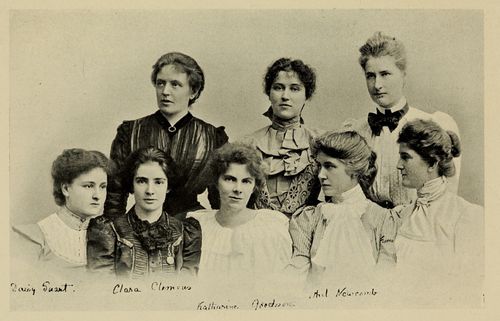
few of the hundred and fifty pupils studying his method, and these few
must necessarily be chosen from among the best. The others have to
content themselves with the crumbs that fall from his assistants, till
they are considered ready to join the elect. This preparation may last
a few weeks, a few months, a year or even longer, the time varying
with the pupils' progress.
Every now and then they play to the Professor, who, according to
the stage at which they have arrived, agrees to give them lessons
fortnightly, monthly—or perhaps not at all for the present.
In former days, when he had more strength, he took the most talented
of his pupils through the technical training himself; but the present
plan is better, for he is not naturally of a patient disposition.
Emerson says a man should be judged by his intentions. If that is
so, Leschetizky stands high in the scale, for he is full of good
intentions. They are with him always; but, as a dilapidated American
was heard to murmur at the end of a bad lesson: "They must have paved
a considerable stretch of the side-walks in hell by now," for they
invariably leave him at the moment when they are most wanted.
The Professor intends to make allowances for all difficulties. He
knows how tenaciously bad habits will stick, how hard they are to
dislodge, and how long the fingers retain their old established ways,
in spite of the best will in the world to train them to the new. He
quite realises what a tax this minute and detailed method of analysis
is to the unpractised mind, and how irksome are the first steps on
the road to it. He is full of benevolent sympathy. But when the time
for the lesson comes, everything but the immediate need of getting
the thing done in the right way is obliterated from his mind, and in
the enthusiasm of the moment all traces of this benevolence speedily
disappear. He forgets the pupil is full of original sin and cannot
wait for the signs of grace.
This leads to misunderstanding. It leads also to the sudden exit
of the pupil; to the slamming of doors; to the crushing of music
on the floor; to grim remarks about a future better spent "in
tomato-planting." Once it led to total darkness. In the intensity of
his feelings the master arose, hastily put out the gas, rushed away,
and left his pupils sitting round the class in silence and gloom until
things were patched up by some comforting soul outside.
Leschetizky loves his pupils as if they were his own children; but,
as a good father, he considers his duty better done through the
aid of discipline than of sympathy, believing the scourge to be of
greater profit to their musical souls than the prop. Especially
if he sees they are suffering from parental pampering. He is much
troubled by parents. They come to him imbued with the notion that
their particular offspring is quite unusually and supremely gifted,
and the offspring himself is still more imbued with that notion. It
is expedient, therefore, to remove these parents to a distance, in
order that the mist of adoration may disperse, and leave the field
clear for the child to find his true level. Otherwise valuable time
may be wasted in making headway against the inability of the parent to
view discipline in any light but that of cruelty, and of the pupil to
consider himself other than a sacrifice on the altar of his master's
whims.
Leschetizky makes unsparing use of his power to analyse character in
his teaching, unhesitatingly saying anything, however hard to bear,
that he thinks may be a spur to the pupil's development. He has the
gift of insight to a very remarkable degree, and although his own
nature is not pliable enough to unbend to every other, he makes few
mistakes in his summing up as a whole. Like all highly-strung people
he is extremely sensitive to personality. This sensibility affects
him in various ways. In the morning when the door-bell announces the
arrival of the first pupil, should the Professor chance to be in a
fastidious frame of mind, he steals downstairs to find out who it
is, and if on peeping surreptitiously into the room he sees some one
antipathetic to him, he promptly steals upstairs again and stays there
a quarter of an hour or more to recover the blow. If the pupil has
caught a glimpse of his face, he would generally prefer to go home,
but knowing that if he does, he may never have another lesson, he
elects to face the worst and wait till the Professor feels inclined to
come down again. When he comes down—if he has resigned himself to the
inevitable, and if the pupil be of a tactful disposition—all may yet
go well; the sinner be received into favour again, and sent home proud
in the knowledge that he has gained the day and left a legacy of happy
relations behind him after all.
The early lessons with Leschetizky are at once a revelation and
an ordeal. If the quality of the pupil's intellect be at all
strained—and his horizon too circumscribed for him to have found it
out before—it will now be made quite clear to him.
In the first place he is expected to make all his corrections on the
spot, for to Leschetizky's rapid brain comprehension is synonymous
with performance—to understand is to be able to do. He is expected
to hold these corrections firmly in his head, and to have the wit
to apply them to new cases immediately. Nerve, quick observation,
retentive memory, presence of mind must all be his. He must be
neither too quick nor too slow, being careful not to step in before
the master has finished what he has to say and the illustration is
complete, lest there be a sudden pause, and Leschetizky, regarding
him with a baleful eye, sit back with folded hands, and inquire which
of the two is to play: "Are you giving the lesson, or am I?" He must
follow the different kinds of touch, the pedalling, the fingering, the
variety of effects that may be drawn out of the instrument—all so
difficult and puzzling in the initial stages—and be able to reproduce
them on the spot. The most vivid and concentrated interest is exacted
from him in every detail, infinite patience and unwearied effort.
Leschetizky cannot endure half-heartedness. Caring so intensely for
music and for all that concerns it, an apathetic attitude is as
unbearable to him, as disloyalty to his country would be to a patriot,
and he resents it with his whole nature. Nor does he hesitate to show
it. Enthusiasm he must and will have. A temperament devoid of it is
an enigma he cannot solve. He expects a ready appreciation. He likes
people to talk, to ask him questions, to be cheerful. He cannot bear
dismal solemnity. If the pupil be of a taciturn order, Leschetizky is
quite sure something must be seriously wrong with his mind; or that he
has not understood what he has been told, and is afraid to say so; or,
what is most probable, that he possesses a very disagreeable character.
With one of these unfortunate dispositions—feminine, strange to
say—it is on record that Leschetizky once went through an hour
without a single word. She would not speak, he said, so why should
he? On coming into the room he softly closed the door, tip-toed to
the piano, bowed to the pupil, sat down and gave her the whole lesson
in solemn and mysterious silence, indicating all he wanted by signs
and dumb show. When the hour was over he rose, bowed with impressive
gravity as before, glided to the door, and disappeared as silently as
he had come in.
He enjoys experimenting with his pupils, and inventing special
fingerings, or special exercises for unusual cases.
He had a pupil who played so accurately by ear that she could not be
persuaded to study in any other way. It served her faithfully for
a long time, until one day, when playing in the class, her memory
failed, and she could not collect herself. Nemesis came at the next
lesson, for Leschetizky shut down the cover of her keyboard, and left
her, bereft of all sound, to learn a page of unfamiliar music by means
of her eyes alone. Another, who was unnerved by the merest trifle, he
cured by accustoming her to shocks. One day, suddenly jumping up from
the piano, he stared intently into the garden, exclaiming, "Ha! what
is that I see out there?" Of course the pupil hurried to the window,
but, seeing nothing exciting, turned back, startled and perplexed.
"It's all right," nodded the master suddenly; "go on exactly where
you left off." This kind of treatment continued till she could stand
any disturbance with composure.
To another, whose ear was not fine enough to distinguish exactly what
notes made up a chord when he heard it, Leschetizky taught an entire
composition by playing it to him bar by bar, bit by bit, until he
realised it all, both piecemeal and in combination. The harder the
patient's case, the keener the doctor's interest. Nothing gives him
greater satisfaction than to find the remedy for some unusual defect.
He is as proud and pleased as a gleeful child with a new toy, and as
delightful to watch.
Buried deep in contemplation of the difficulty, he sits perfectly
silent, motionless save for a periodic puff at his cigar. Presently a
smile steals cautiously over his face—the clue is signalled. For an
instant, still tentative and expectant, his hand poised in mid-air,
he awaits discovery, then all at once up goes the head, out comes the
pencil, and with an exultant shout he announces: "Now I've got it!"
As simply and clearly as it can be put, he then explains the point in
question and why this is its best solution.
One explanation ought to suffice for all time, and the pupil is
expected to adopt it at once. If he cannot do this and the same
mistake is made twice, the Professor begins to feel offended; if a
third time, he shuts up the music in disgust; a fourth (having opened
it again), he hurls it far away; a fifth (if the pupil is still
there) one of the two invariably leaves the room. Sometimes, a little
remorseful, the Professor comes back and stands half hesitating at
the door of the dining-room, looking sweet and sorry, wishing things
could have been otherwise, but quite unable for the moment to say
a single word of comfort to the sufferer. His own powers of memory,
and of doing instantly with his hands what his brain suggests, are so
remarkable that he cannot realise in the least what it means to be
less highly gifted.
He appreciates courage, and respects the buoyant nature that can right
itself after every rebuff, and bravely holds on, whatever happens,
seeing in this a token of the best kind of self-confidence. With
Stevenson he agrees that most of a man's opinions about himself are
true, and he who finds himself most comfortable on the footstool is
probably in his right place.
By reason of the Professor's own strong individuality, the adaptable
pupil has, as a rule, calmer lessons than the more original nature
that cannot amalgamate itself easily with another person's views.
Leschetizky's powers of discernment seldom fail him in prophesying who
will make a stir in the world, and it is precisely by these few that
his keenest interest is excited, and with whom the storm bursts out
most easily.
He does not always use his singularly penetrating qualities to
sad issues. When the initial steps have been overcome, and the
difficulties thinned out a little, the lesson is a delight from
beginning to end.
Full of apt similes, weaving them in at every turn, Leschetizky has
a knack of hitting upon exactly the appropriate figure to make a
suggestion intelligible and permanent in the mind.
"To make an effective accelerando you must glide into rapidity
as steadily as a train increases its speed when steaming out of a
station."
"Teach yourself to make a rallentando evenly by watching the drops
of water cease as you turn off a tap."
"A player with an unbalanced rhythm reminds me of an intoxicated man
who cannot walk straight."
"Your fingers are like capering horses, spirited and willing, but
ignorant of where to go without a guide. Put on your bridle and curb
them in till they learn to obey you, or they will not serve you well."
On the whole he theorises very little. Everything he says is
practical, to the point, and can be immediately used to some good end.
"If you are going to play a scale, place your hand in readiness on the
keyboard in the same position as you would if you were going to write
a letter—or to take a pinch of snuff."
"The bystander ought to know by the attitude of your hand what chord
you are going to play before you play it, for each chord has its own
physiognomy."
"If you play wrong notes, either you do not know where the note is
or what the note is."
"If there is anything you cannot do after a fair trial, either there
is something the matter with your hand, or with the way you are
practising."
"If your wrists are weak, go and roll the grass in the garden."
"If you want to develop strength and sensitiveness in the tips of your
fingers, use them in every-day life. For instance, when you go out for
a walk, hold your umbrella with the tips instead of in the palm of
your hand."
"Practise your technical exercises on a cushion or upon a table
sometimes. You do not always need the piano to strengthen your
muscles."
And so on, intermingling advice with illustration, until the lesson
becomes as entertaining as instructive.
When all goes well, a lesson with Leschetizky is a really wonderful
experience. His point of view is so interesting, the depth of his
comprehension so profound, his power of clear exposition so great,
the parallels he draws between art and life so unexpected, that his
listener is held under a spell of wondering enthusiasm throughout.
Both his ear and his memory are very remarkable. He is able to retain
accurately in his mind every detail in a piece of music on hearing
it for the first time; and not only to play it through immediately
afterwards, but to discuss points in it, making a suggestion here, an
alteration there, exactly as if the music were before his eyes. He
plays a great deal during the lesson in a fragmentary way, but rarely
anything straight through. His piano is on the left of the pupil, the
two instruments standing side by side, their keyboards level.
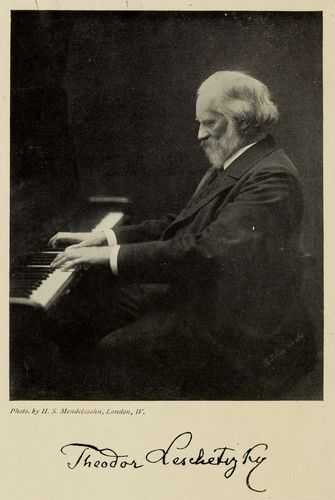
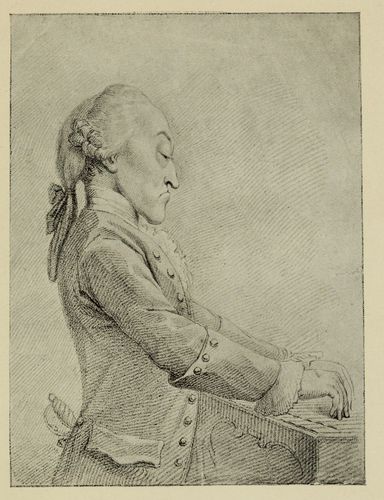
He sits very still and very straight, never stooping over the keys,
or swaying about. His hands, often partially resting on the notes,
are almost flat, the wrists low, the fingers doing all the work, his
whole figure taut with the tension of concentrated thought.
His playing is as difficult to describe as himself, for it is the
translation of his nature into sound. Then, as at no other time, his
varied temperament discloses itself, its contrasts finding in music
their best interpretation. These sonorous chords weighed out by so
masterful a hand; this steady beat of measured emphasis; the lilt and
swing of the rhythm; the fine-pointed staccato; the piquant charm
with which the dainty notes come dancing off the keys; the melancholy
tenderness of the soft caressing tone, stealing in unawares—these
tell the story, more faithfully than any other language, of his
nature, not only as a musician, but as a man.