It would be hardly proper for me to lay down my pen and
make no mention of the Yellowstone National Park, which is in
the heart of the “Rockies.” Besides, in my letter headed
“Stampede to the Yellowstone,” I stated that “Wonderland was
not known then.” That indicated that there was such a region
in existence somewhere. Therefore it is necessary, at this
time, to give a brief sketch of this wonderful place. The time
of its first exploration was in 1869–70. It lays mostly in the
northwest corner of Wyoming, extending a few miles into Montana
on its north and Idaho on its west. It extends from a
few miles east of 110 degrees to a few miles west of 111 degrees
west longitude from Greenwich. Here the United States
government, by an act which passed both houses of congress
unanimously, and was approved March 1, 1872, has withdrawn
from sale and occupation and set apart as a National Park or
perpetual pleasure ground, for the use and enjoyment of the
people, a region fifty-four by sixty-two miles and covering an
area of 3,312 square miles or 2,119,680 acres. Its average elevation
above the sea is from 7,000 to 7,500 feet, while its highest
peak rises to the height of 11,155 feet.
A tourist wrote that in this remarkable region nature has assembled
such a surprising number of the most sublime and
picturesque objects, and amidst the grandest scenery of mountains,
lakes, rivers, cataracts, canyons, and cascades exhibits
such a variety of unique and marvelous phenomena of spouting
geysers, of boiling and pulsating hot springs and pools of steam
jets, solfataras, femerells and salses, rumbling and thundering
and pouring out sulphurous hot water, or puffing out clouds
of steam and throwing out great masses of mud that its early explorers
gave it the name of “Wonderland.”
The first public conveyance to enter the Yellowstone National
Park was a stage coach, owned by J. W. Marshall, which made
its first trip, leaving Virginia City, Montana, at daylight, Oct.
1, 1880, following the beautiful Madison valley for over thirty
miles, crossing the Rockies and thence going by Henry Lake,
which is a sheet of water two miles wide and five miles long.
One of the passengers described the lake as being then “full of
salmon trout.” Ten miles farther, and in a northwesterly direction,
was Cliff Lake, another remarkable sheet of water having
a total length of three miles and a breadth of half a mile,
in whose azure depths 1,400 feet of line failed to reach bottom.
It took sixteen hours to make the trip, a distance of ninety-five
miles, from Virginia City to the National Park House,
Lower Geyser basin, then the only hotel in the park. This
pioneer hotel was a two-story, hewed log structure, the property
of Mr. Marshall.
And now the Monida & Yellowstone Stage Company, in connection
with the Oregon Short Line railroad and the transcontinental
lines, conducts a line of Concord coaches from Monida
to all points in the Yellowstone National Park.
Monida is a station on the Oregon Short Line railroad, and
the starting point for the stage ride, and is less than one day
coaching distance from the Yellowstone Park. It is on the
crest of the Rocky mountains, 7,000 feet above the tide. The
lower Geyser basin in the park is about the same elevation.
The name “Monida” is a composite of the first syllables of
“Montana” and “Idaho.”
The Rev. T. De Witt Talmage writes: “A stage ride from
this place to the park ‘is a day of scenery as captivating and
sublime as the Yellowstone Park itself.’
“The road threads the foothills of the Rocky mountains, skirting
beautiful Centennial valley, the Red Rock Lakes, and after
passing through Alaska basin, crosses the divide to Henry Lake
in Idaho, whence it recrosses the range into Montana via Targhe
Pass near the western entrance to the park. Red Rock Lakes
are one of the sources of the Missouri river, and in Henry
Lake originates one of the branches of the Snake. From Henry
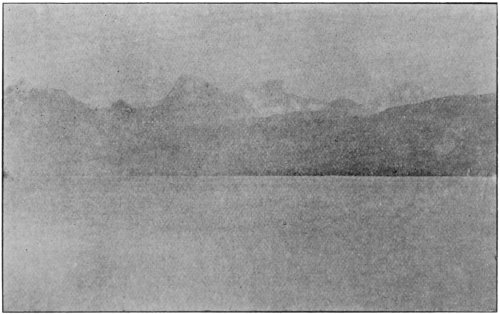
Lake are distinctly visible the famous Teton peaks. Near the
western entrance to the park, prettily situated on the south fork
of the Madison river, is Grayling Inn (Dwelles), the night
station for tourists going in and out of the park. After passing
Grayling Inn the road enters the reservation, winding through
Christmas Tree Park to Riverside Military Station, following
the beautiful Madison river and canyon to the Fountain Hotel
in Lower Geyser basin.”
I will not attempt to write a description of this wonderful
region myself, but will give the picturesque sketch of it written
by my friend, Olin D. Wheeler, for the Northern Pacific
railway’s Wonderland series of books. After reading the account
of this trip given by Mr. Wheeler, the reader will find
that there is a great contrast in the way of getting into the
National Park now in comparison to what it was in 1880, and
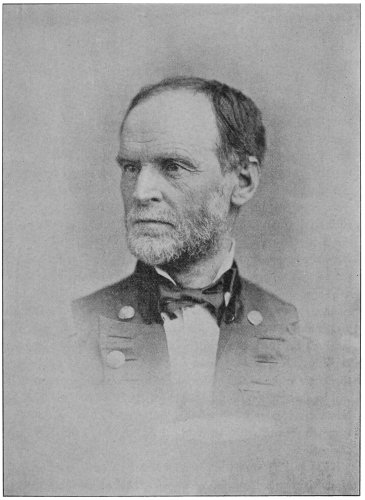
that vast change has taken place since General Sherman made
his trip through the “Sioux Country” in 1877.
Speaking of the train he was about to take passage on, and
which was standing in the station awaiting the hour of departure,
Mr. Wheeler says: “At its head is a huge, ten-wheeled
Baldwin locomotive. On each side of this machine there are
three driving wheels sixty-two inches in diameter. As it stands,
its length from peak to pilot, or in common parlance, cow-catcher
to end of tender, is about fifty-five feet. From the
rails to top of smokestack it stands fourteen feet five inches.
With its tender loaded with coal and water it weighs nearly
ninety-four tons. Behind this noble combination of iron, brass
and steel extends a long train. First comes the mail car, in
which Uncle Sam’s messengers run a traveling postoffice. Then
follows the express car, carefully guarded by ever vigilant
expressmen. The third car is the principality of the baggage
man. Then follow the various classes of passenger coaches—the
free colonists’ sleeping car, where man or woman may find
a fair bed at night and a comfortable seat by day. The smoking
car, and the first-class coaches with their high-backed, easy,
reclining seats, are succeeded by the Pullman tourist car. Behind
the tourist car is the dining car, which is a feature of this
train. Behind the dining car are the first-class Pullman sleeping
cars—from two to four of them. These are of the most
approved type, with heavy trucks and wheels of large diameter,
insuring smoothness of motion. This entire train is vestibuled
and the car wheels are of paper and steel tired.
“But the bell of that monster engine is ringing, the conductor
is signaling to start. Jump aboard and we will continue our
dissertation as we glide swiftly along.”
The Northern Pacific through trains from St. Paul to Portland,
Oregon, a distance of 2,050 miles, are of the same description,
only on a larger scale. The average time these trains
make is twenty-seven miles an hour, schedule speed, including
all regular stops.
After describing his journey through Dakota and up the great
valley of the Yellowstone for 341 miles in Eastern Montana
until arriving at Livingstone, where the National Park branch
of the Northern Pacific began and on which the tourist train
continued to the country of wonders, fifty-one miles away, Mr.
Wheeler was still in his observation seat taking notes of the
grand scenery that the swiftly moving train brought to view.
Again he said:
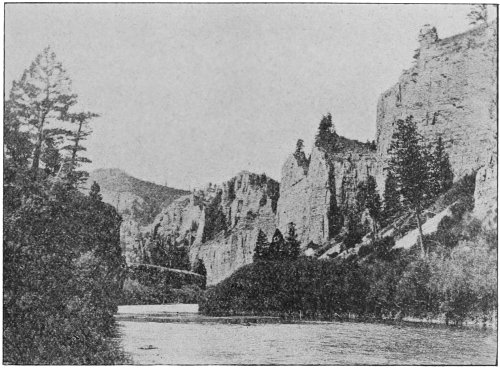
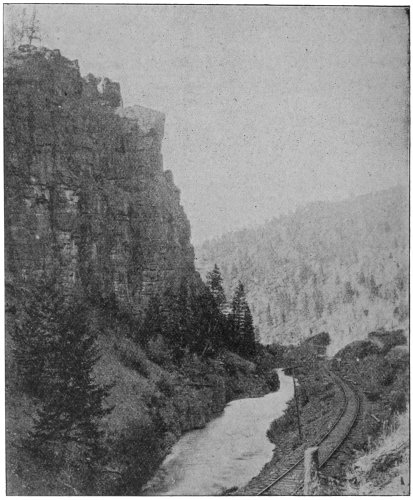
“The entrance to the heart of Wonderland is through an
enormous gateway. The gateway, or opening, was made by
a river, through a mountain wall, and it is known as The Gate
of the Mountains.
“Through this gateway pours the river, fresh from the eternal
snows far back in the mountains; from the great lake, a
vast reservoir into which the melting snow banks drizzle in a
million streamlets; from the wondrous canyon between whose
divinely sculptured and colored walls it throws itself in an
ecstasy of fury. Beside the stream lies a railway, which, following
it in its sinuosities, leads the pilgrim to the very border
of Wonderland. As the river flows out of the mountain gate
into the broad, unpent valley, it seems to sing, in the words of
Colonel Norris, whose name is indissolubly connected with
Wonderland, of the region it is leaving far behind:
‘I sing in songs of gliding lays
Of forests scenes in border days;
Of mountain peaks begirt with snow,
And flowery parks, pine girt below;
Of goblins grim and canyons grand,
And geysers spouting o’er the strand
Of Mystic Lake, of Wonderland.’
“After having passed through the gate of the mountains one
is in Paradise valley, for such is the name of the beautiful
valley which stretches up to the portals of Wonderland. The
farther one invades these precincts, the more one comes to feel
that the valley is rightly named. The great mountains, the
very temples of the gods, loom high above. Mighty canyons,
rocked ribbed, ragged, gloomy, forest-garbed, deep and fascinating,
have been gouged from their very vitals. From out these
latter the mountain streams rush, singing songs of deliverance
as they dance down the long, sweeping slopes to the mightier
river. In their courses the streams have been harnessed by
man, and their fructifying influences are seen in the broad
fields of waving grain and alfalfa that checker the slopes.
“Mountains, fields, streams, trees, slopes, form truly enough
such a picture that the thought of paradise is borne in upon me.
“The scene changes! The mountains crowd together, the
valley contracts, the rocky sides of the former rise high above,
the river is throttled by craggy canyons and rushes madly
along far below us—we are in a wild eyrie where the echoes
of the iron horse’s brazen throat reverberate among the crags
and cliffs. Sweeping through this scene of wildness we reach
the threshold of the Wonderland of Wonderlands, nature’s
greatest wonderland—
“The scene here hinted at is that beheld by the tourist as he
rides from Livingstone, on the main line of the Northern
Pacific, up the valley of the Yellowstone to Cinnabar, the
terminus of the National Park branch line at the northern
edge or boundary of the great park.
“The valley is indeed one to arouse enthusiasm. At two
places it becomes constricted, forming small but ragged canyons
that but pave the way for the grander visions which, in
the days to follow, are to break upon the eye.
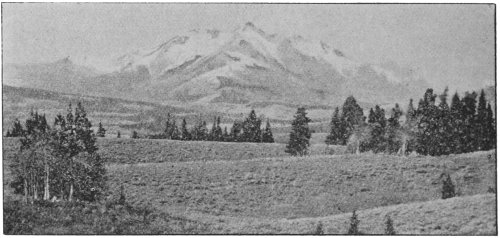
“Well up the valley Emigrant Peak, a noble, snow-capped
mountain of august mien, stands sentinel, thrusting his crown
above brawny shoulders to a height of 10,629 feet.
“Just before reaching Cinnabar, Cinnabar Mountain, famous
for its Devil’s Slide, is rounded. Soon there comes into view
the giant peak of the region, Electric Peak, which, with its
11,155 feet of altitude, may well be termed the guardian
peak of the park. Facing it, but of lower altitude, stands
Sepulcher Mountain, a rough, imposing mountain, the origin
of its name involved in obscurity.
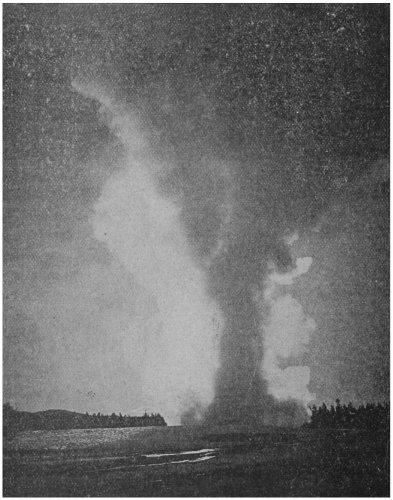
OLD FAITHFUL GEYSER, YELLOWSTONE PARK.
“On the opposite side of the valley rise the sister peaks of
the Emigrant and its companion, the Absaraka, the range
swinging to the eastward and forming the eastern boundary
and mountain wall of the park. High up on the flanks of the
range in and about the town of Crevasse, men are toiling with
more or less of success for the gold that everybody covets.
“But our train has stopped at the platform at Cinnabar. We
step from the cars, ready, with our hand bags and bundles,
for the next move on the program.
“Soon there come prancing round the corner six splendid
horses, drawing behind them a huge Wonderland stage coach.
Another appears, and, if necessary, still others come swinging
up to the platform to transport the waiting throng on to Wonderland.
How the people scramble aboard! Some climb up
the sides of the coaches to the broad, open seats on the roof,
where they will obtain, as they ride along, unobstructed views
of the landscape. Other, less agile or venturesome, clamber
into the interior of the coaches, satisfied with less elevation,
less sun, and nearly as much advantage in sightseeing. The
bags and valises are strapped on the trunk racks behind the
vehicles or thrown into the boots, the conductor calls out, “All
set,” the driver tightens the reins, speaks to his horses, and the
stage is off and away over the hills bound for Mammoth Hot
Springs, seven miles distant.
“After a short ride, a collection of low and in some cases mud-roofed
houses is seen. Through the heart of the little frontier
town, Gardiner, the coaches carry us, when, swinging at right
angle, we are soon skirting the Gardiner river, a typical
mountain stream with which one falls in love at first sight.
For several miles, first on one side then on the other of this
torrential, beautiful river, the coach is slowly dragged up an
ascending grade. The stream is beset with boulders against
which, over which, under which, yea, through which, as one
will easily see, the tremendous current dashes in a chorus of
sound and a mass of spray. It is a royal trout stream and the
heart of the angler leaps within him even as does the trout
itself leap within the boiling waters.
“This stream of turmoils and fascination gathers its streamlet
threads from widely extended sources. Much of it comes
from the northern slopes of some of the mountains about the
Grand Canyon, Observation Peak, Storm Peak, etc. Another
branch swings around Bunsen Peak, forming an elongated
horseshoe, and insinuates its watery tentacles among the slopes
of Electric Peak—the south side—Quadrant Mountain, and
Antler Peak. A sub-system of this branch stream—the Middle
Gardiner, so-called—extends southward from the toe of
the horseshoe, past Obsidian Cliff and Beaver Lake to the
region about Roaring Mountain, nearly to Norris Geyser
Basin.
“The scenery along the Gardiner is striking. The dun-colored
clay and conglomerate walls rise in massive buttressed
slopes surmounted by palisades, to a height of a few hundred
feet on one side and 1,000 and 1,200 feet on the other. The
eastern walls are by far the finer. Spires and pinnacles have
been eroded from the soft earthen slopes and form conspicuous
objects. The most striking and noted is Eagle Nest Crag,
a solitary, rounded column upon the inaccessible apex of which
is perched an eagle’s nest. Yearly the parent birds raise
broods of young eagles whose protruding heads can frequently
be seen and whose plaintive cries are plainly heard.
“Soon after crossing the stream for the last time a sharp
ascent is begun. This continues until the hotel plateau is
reached at Fort Yellowstone. As the coaches mount the grade
the outlet of a river is seen on the western bank of the Gardiner.
The rocky ground there is more or less broken and
quantities of steam arise. This river flows from the hot
springs of the terraces at Mammoth Hot Springs, underground
through the hill over which the road winds.
“In olden days this was a favorite camping place. The hot
water made bathing agreeable, culinary and laundry work
easy, and if one was inclined he could easily catch his trout
in the Gardiner and then, swinging his line, plunge the victim
into Boiling river and cook his fish, all at one operation—so
they say.
“Passing Fort Yellowstone when the plateau is reached, the
coaches are whirled swiftly across a geyserie or travertine
plaza, upon which the fort or cantonment—and it is one of
the best posts in the country—fronts to the hotel, a mammoth
structure which commands a fine view to the south.
“At last we are fairly within the great Yellowstone Park—the
heart of Wonderland.
“From the time our train started from Livingstone until it
again sets us down there, six days will have passed. When
we leave the coach at the hotel the first half of the first day
has passed into history. The afternoon will be spent in
clambering over the parti-colored terraces of Mammoth Hot
Springs.
“After the tourist has registered, retired to his or her room,
performed the usual ablutions, and shaken off the dust of
travel from one’s garments, the luncheon is eaten. It is
then customary to make all arrangements with the transportation
company, as a new order of exercises will be inaugurated
upon the morrow.
“When next, we start, the coach, horses and driver, to which
we are assigned, became ours for the entire round of the park.
It is advisable, therefore, if particular acquaintances or
friends desire to ride in company, to explain this to the powers
that be, that such an arrangement may be effected. By
the time this matter is attended to, the voice of the guide is
heard announcing that all is ready for the event of the day—the
visit to the formation, as it is termed.
“To the right, from the hotel front, rises Terrace Mountain.
At the extremity of the plaza and at the base of the mountain
as viewed from here, and a part of the mountain, rise the
wonderful terraces. Even at this distance they present a remarkable
appearance. As we approach them the singularity
of their origin and appearance becomes more and more pronounced;
but as we climb the slopes and view the pools of
rainbow colored waters, and examine the terrace fronts with
their infinite patterns of etchings and bead work, we stand in
open-eyed amazement at what seems a miracle of creation.
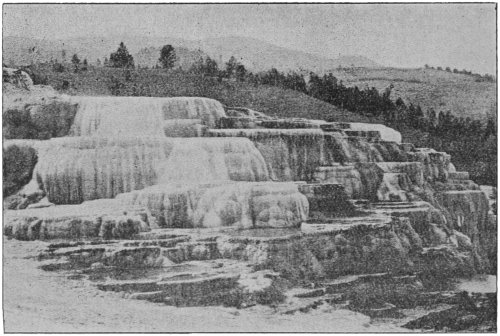
MAMMOTH HOT SPRINGS.
“Whether we stand in front of the terrace walls and examine
the exquisite chased work, built up by minute secretions from
the hot waters as they trickle slowly down; whether we stand
on the heights above and gaze upon acres of water divided and
subdivided into many shaped basins, and so brilliantly colored
as to seem impossibly colored; or whether, as we climb
higher, and are transfixed almost, at the beautiful, delicate,
fragile and algaic forms seen—it is all the same, we now
begin to understand what the word Wonderland means, and
are prepared for whatever we may stumble upon, and ready
to admit that the half has not been told and cannot be—seeing
only, if not believing, is certainly understanding.
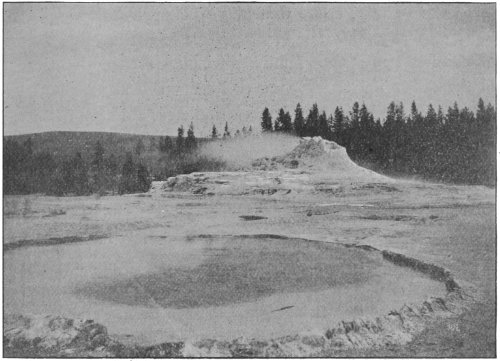
CASTLE GEYSER CONE AND DIANA’S POOL, YELLOWSTONE PARK.
“The water found in these pools varies in temperature, but it
is all hot. Some of the pools are very small, others almost
lakelets.
“Such brilliancy of coloring was never excelled, and the
variety of color, sometimes even in the same pool, is simply
astounding. What one sees here is found upon successive terraces
on the mountain side, and is reached by easy gradations
by using foot paths or trails. After a time we are somewhat
bewildered as to where we are, whether in the infernal regions;
with the ancient deities; in a zoological garden; among Egyptian
queens and mummies; where angels tread, orange trees
bloom, or where railways are being built, or cupids shoot
arrows.
“The Upper Geyser Basin is the goal of the tourist, so far
as the geysers are concerned. There are here about a dozen
geysers that expel the contents of their reservoirs to heights
ranging from one hundred to two hundred and fifty feet.
There are as many more that play to elevations less than one
hundred feet. This family of geysers is like a large family
of children; a strong family resemblance runs through all
of them, but individually no two are much alike.
“The Castle has a very large, castellated, siliceous cone; the
Grand has none whatever, nor is there any resemblance in
their eruptions. The Oblong and the Giantess each expel
their contents from deep, pit-like reservoirs, but there the resemblance
between them ends. The Bee Hive and Old Faithful
each have cones, as entirely unlike as are their splendid
columns of water and vapor. Some throw the water as straight
in the air as a tree stands; others hurl it out at various angles,
or even in arches. Some send it forth in a solid, steady,
majestic column; others in an irregular, churn-like fashion.
“But there are other things than the geysers here. Emerald
Pool, Sunset Lake, and Black Sand Pool are, with one possible
exception, the most delicate, beautifully colored bowls of
water to be found in the park. The word color acquires a
new significance as one stands at the verge of these truly heavenly
pools, shut in among mountains.
“The particular attraction at the Fountain Hotel has been
the Fountain Geyser near the hotel. This geyser has a basin
some thirty feet in diameter, connected with another of about
the same size just north of it. Much of the time these basins
are full of water, thus, apparently, forming a large double
crater.
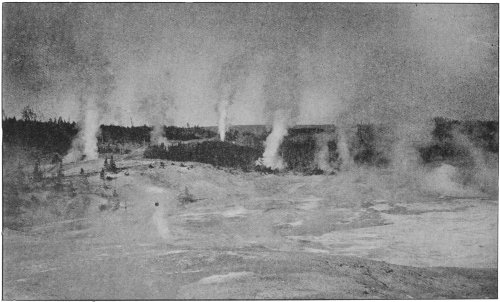
NORRIS GEYSER BASIN, YELLOWSTONE PARK.
“In 1899 a new geyser, called the New Fountain, broke out
in the north basin, resulting in a decided curtailment of the
old Fountain Geyser’s eruptions. The new geyser is not yet
old enough so that its periodicity and peculiarities are fully
known. Its eruptions, however, are more stupendous and
much beyond those of any other geyser which the writer has
seen. Excelsior Geyser at Midway Basin, the greatest geyser—when
it plays—in the world, is closely approached by this
new giant, in both the magnitude and the grandeur of the
display.
“The geyser is rather spurty in character, and when in full
operation plays from three orifices. In its general action it
is not unlike the Fountain or the Great Fountain. It will
boil furiously and throw the water quite regularly to a height
of ten to fifteen feet. Then, becoming semi-quiescent for a
few moments, it will again break loose, and simply hurl into
the air, with almost inconceivable force, a solid body of water
of immense bulk, to a height of fifteen to thirty feet. Then
changing again it will send upward an enormous volume of
water to a height of 100, 150, or even, in exceptional spurts,
200 feet.
“After a period of momentary quiescence, the geyser will
often break out with a violent explosion, when the scalding
flood, transformed into millions of white, beautiful beads of
crystal and spray, is sent in all directions, to all heights, at
all angles, from the three apertures. The water is all torn
to pieces and is thrown out and comes down, in a perfect
avalanche. The geyser then is a very leviathan at play. It
throws out pieces of geyser formation, bits of trees, and geyser
eggs, as they are called, small, white, rounded, polished stones.
When the eruption ends it comes abruptly, at once, not as
the Great Fountain’s, with a series of dying, tremendous throbs
as if its great heart were broken. The eruption ceases, the
great body of water drops rapidly down into the central cistern
and runs into it from the geyser knoll in pretty little cascades,
until the surplus is thus carried away and the water level outside
of the basin is lowered. Then it is all over.
Regarding the Canyon let me again quote from Dr. Hill:
“And now I want to say a word in regard to the Grand
Canyon. You stand on Inspiration Point and look down 100,
200, 300, 1,000 feet, and there, away below, is a green ribbon,
worked in and out as if to hold together the lower edges
of the canyon’s walls. It is the Yellowstone river. You
look off toward the south and see, in a sort of recess, a little
column of white. It is the Great Falls of the Yellowstone,
308 feet high. You examine the slanting walls of this tremendous
canyon and you see such a display of color as the
eye of man never looked upon. Someone has said that it
looks like a blown-up paint shop. Just there to the right some
huge pots of white and yellow and red paint have been tipped
over, and it has flowed right down in parallel streaks to the
water’s edge. Farther along is a gigantic tower carved out
of a solid crimson rock. Here to the left all along are turrets
and castles and cathedrals, there a Parthenon, over there St.
Mark’s glittering in gold, there Taj Mahal, as white as spotless
alabaster. Colors green and brown and saffron and orange
and pink and vermillion and russet cover every rock until
the scene is bewildering. What shall one say as he looks
upon such a scene? Nature teaches us about God. Then the
Grand Canyon has been cut and painted by the divine hand
as if to give us some idea of John’s vision of heaven. Walls
of jasper, streets of gold, gates of pearl, foundation stones of
emerald and sapphire, and topaz and amethyst. Yes, they
are all there. Who can look upon such a scene and say there
is no God and no heaven?
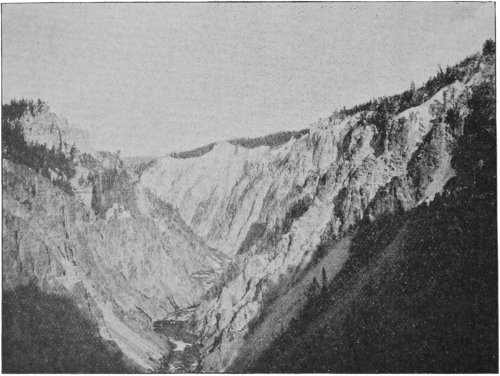
GRAND CANON OF THE YELLOWSTONE.
“If the enthusiast wishes to get a sight of the canyon much
different from any other, and in the opinion of many the finest
obtainable, he should go beyond Inspiration Point. The
Lower Mount Washburn trail leaves the road near Inspiration
Point. There is an enormous boulder right at the intersection,
of which more anon. Follow this trail for a mile perhaps,
and a projection will be noticed leading well out into
the canyon. From this crag the walls are emblazoned with
every color or combination of colors that are probably to be
found anywhere in the canyon. It is perhaps less brilliant
than the magnificent array found at Grand View. In each
case it is a canyon view pure and simple. The Lower Falls,
so conspicuous a factor of the landscape from both Lookout
and Inspiration Points, do not appear in either of these.
“I have mentioned a boulder at the junction of the main road
and the Washburn trail. This boulder is worthy of inspection
by tourists. It is of granite, eighteen feet high and twenty-four
feet long by twenty feet in breadth, dark in color. It
was transported from its native heath by a glacier and deposited
where it now lies when the glacier receded. Mr.
Arnold Hague of the United States Geological Survey states
that the nearest point from whence it could have been torn
is at least thirty or forty miles distant.
“To thoroughly appreciate, yes, I will say to fall in love
with the canyon, one must needs see it under different conditions.
See it when the sun is flooding it with noon-day radiance;
when the winds sweep the masses of vapor through it, deluging
its walls with moisture; when the sun is vanished from
earth and evening’s shadows slowly creep from crag to crag
and base to summit. To look upon the canyon when in the
full glare of the sun, one would never realize what a softness
and mellowness comes over it when the clouds hide the golden
orb.
“I had seen the walls under varying lights and shades, but
upon one occasion I saw it in a new dress. It had snowed
somewhat during the night. When I reached the road at the
canyon brink, everything seemed transformed. The trees
were cottoned over with snow, the road was a white avenue,
the rocks were whitened. But the canyon itself—what a
change had come over it! The sun, of course, was invisible.
The heavy masses of foliage that on either side crown the
precipice with a ribbon of green were powdered with snow.
The crevices and moderate angles of the walls wore a soft
mantle of purest white. The other parts of the canyon were
gently sprinkled with the fleecy material. The leaden clouds
hung in parallel ridges above the gorge. Nature was in exquisite
attire, and how softened! I wouldn’t have missed
it for a good deal.”
After returning to the Mammoth Hotel with his soul filled
with the wonders of nature, Mr. Wheeler said:
“As we leave behind these scenes, now almost sacred, we
muse and then regret—regret that we had not arranged to
spend at least another week here, and see more of what we
have seen, and search out much that we have not seen.
“There are so many side trips that can be made, so much
to study, such comfort and health in this elevated region, that
now, when it is too late, we see where we made a mistake in
not planning for a two-weeks’ trip. Well, there is this silver lining
to our cloud: We can take the trip over again and spend a
month, if necessary.
“And that is just what we determine to do some other year.
So we reach Mammoth Hot Springs in a happier frame of
mind, eat our last dinner in the park, mount the outgoing
coach, and end our sixth and last day of our park tour by
stepping into the Pullman car at Cinnabar and being whirled
homeward at forty miles an hour.
“In 1885 Mr. Charles T. Whitmell of Cardiff, Wales, in a
paper read before the Cardiff Naturalist Society regarding the
Yellowstone National Park, said: ‘Were there but a living
glacier and an active volcano the cup of wonders would be full.’
The volcano is yet to be found, but the glacier is there, was there
when Mr. Whitmell made his address, but the existence of
perpetual ice was not known then.
“About eleven miles southeast of the Hoodoo Basin, between
Stinkingwater Peak (11,600 feet high) and Sunlight Peak
(11,977 feet above sea level), the United States Geological
Survey found a large glacier, or, indeed, a series of them.
They gave to it the name of Sunlight Glacier. It is more
than a mile across. The surface is crevassed with walls of
clear green ice, and it has a typical terminal moraine. It is
deep within the mountains, and in the summer of 1895 Col.
W. S. Brackett of Peoria, Ill., and others saw it from a distance.
Residents of Montana have also seen it. While it
lies just outside the limits of the park proper, it is, notwithstanding,
part and parcel of the wonders of the Park region.
It is difficult of approach, owing to the rough character of the
country.
“There are glaciers in the Bear Tooth Range, south of Red
Lodge, east of the Park, and several on the Three Tetons, just
south of it.”
Verily, the variety of wonders in “Wonderland” are many,
and still they come. Many people have heard of Death Gulch,
in a portion of Yellowstone National Park, where beasts
soon die. This summer (1899) a party of Montana Scientists
visited Death Gulch. “Truth is stranger than fiction,
and Dame Nature herself has surprises that are past all perfect
explanation.” The following is from the Helena Independent
Sept. 16, 1899:
“Many persons have heard of the wonderful gulch in the
northeastern part of the Yellowstone National Park named
Death Gulch, but while accepting many other stories of Wonderland,
have only passed this particular story by as a fabrication.
The story is that all things living that enter this
gulch never come out again. That was the story as it was
once told, but a year or two ago a member of the United States
Geological Survey wrote a scientific article about the canyon
in which it was explained that only under certain conditions
was animal life taken in the mysterious gulch. Even after
that article appeared many who heard of the gulch and its
strange secret called it all a fairy tale.
“A semi-scientific expedition of well known Montanians
has just returned from a visit to Death Gulch and the Granite
range. The party was composed of Rev. James Reid, President
of the Agricultural College, Bozeman; Dr. Frank Traphagen,
who has the chair of natural sciences at the college and
who is a chemist of wide reputation; Peter Koch, cashier of
the Bozeman National Bank and treasurer of the college, and
his son, and Ed. C. Alderson of Bozeman, one of the best
known mountaineers and guides in the state. Rev. Mr. Reid,
who came over from Bozeman last week, said that the party had
visited Death Gulch and that Dr. Traphagen, the scientist of
the party, had made some interesting investigations. The
trip was begun more than a month ago, and although the
weather was not at all times propitious, it was on the whole
an enjoyable outing.
“Death Gulch, said President Reid, is in the National
Park, on Cache creek, about three miles from the point where
it empties into the east fork of Yellowstone river, and twenty
miles from Cooke City. Its sides are steep and high, but wild
animals have no difficulty in creeping down to the bottom
where there is a little stream. In the gulch, and within the
space of a quarter of a mile, we saw the carcasses and bones of
eight bears, one or two coyotes and an elk. All had met
death in a strange, but, in the light of science, not mysterious
way. They had been asphyxiated, nothing more nor less.
Rising out of the bottom of the gulch is a gas resembling, and
which practically is, sulphuretted hydrogen. The smell of the
gas was strong upon us and could not be mistaken. This gas
is poisonous, and I can readily see how, on a still, sultry day
or night, the gulch might become filled with the gas and be a
menace to every breathing thing that entered there. The day
we visited the gulch there was a strong breeze blowing up the
canyon, but, in spite of that, the odor of the gas was strong.
“The theory has been that the gas, being heavier than the
air, settles in the bottom of the gulch, and that animals might
die of it where a man who was taller than they would feel no
bad effects. That theory may be all right, but I noticed that
our dogs, who accompanied us, didn’t seem to feel any bad
effects from the gas; however, as I said, the wind was blowing
up the canyon, and I believe that on a sultry, still day the
gulch would not even be a safe place for man.
“The bodies of the animals that met death in the gulch have
been well preserved, the gas seeming to have the effect of embalming
them to a certain extent. Two of the bears that we
saw must have weighed in life in the neighborhood of four
hundred pounds each. I suppose some of the bears have been
attracted into the gulch by the smell of elk or other animals
that have died there, entered in and been overcome themselves.
“Dr. Traphagen took several samples of the gas, intending
to make some experiments with them upon arriving at his
laboratory. How did he obtain them? That was a simple
thing. He filled several bottles with water then emptied them
at the bottom of the gulch. The air, impregnated with the
gas, rushed into the bottles as the vacuums were formed. The
bottles were then securely corked and preserved. Of course
the gas obtained in that form was diluted, but it will be sufficiently
strong, I believe, to answer Dr. Traphagen’s purpose.
“The Bozeman party visited the famous Grasshopper mountain,
near Cooke City, the first published description of which
appeared in the Independent less than a year ago. On this
mountain, buried in solid ice and snow, are two strata of grasshoppers.
“There are many persons, perhaps, said President Reid,
who may doubt the story of this wonderful mountain, but,
after all, it is not such a strange phenomenon. The grasshoppers
are certainly there, and while it is not an easy task to
reach this mountain, which is in the heart of the Granite
range, any one of a scientific or curious mind can convince
himself by going there. The presence of the grasshoppers in
the glacier may be explained by the probable fact that two
great flights of the insects attempted to pass the mountain at
different times, and, becoming exhausted or stiffened by the
cold, lit upon its side and were buried in the snow storm.
“The expedition saw many glaciers and little lakes high
up in the mountains of the Granite range, which was explored
for the first time in 1898 by Dr. Kimball of New York and
party under the guidance of Ed Alderson. Many of the lakes
visited, said President Reid, are still frozen and most of them
are surrounded by vast snow fields. Kersey lake, the largest
one of these explored by the party, empties into the Broadwater,
a stream larger than Clark’s Fork. The lake is about
half a mile long, and was the only one visited where there
was good fishing.
“The party had intended to make the ascent of Granite
Peak, believed to be the highest mountain in the state, but
owing to storms it was unable to reach the top. The mountain
is about 13,000 feet high, and with Dewey Peak, 11,400
feet, and Snow Bank, 11,750 feet high, were named by Dr.
Kimball and party. The East and West Rosebuds rise in
the glaciers of the Granite range. The Granite range has
been visited by but few white men. There is no big game
among its glacier-locked peaks, and even the prospector has
not penetrated its vastnesses.”
On account of its vastness the depth of its canyons, its perpendicular
cliffs, and its high and rugged mountains, there is
no doubt but that there are many wonders in the Yellowstone
National Park region yet to be found.
It is not strange that foreign travelers have named it “The
Wonderland of the World.” Professor Hayden, the chief
of a division of the United States Geological Survey, said:
“Such a vision is worth a lifetime, and only one of such marvelous
beauty will ever greet human eyes.” I often think of
the time myself and companions, in 1864, were within a few
miles of this marvelous place prospecting for gold, and that
those geysers were there then puffing and spitting out brimstone;
and the indications show that they have been carrying
on this wonderful performance for ages—wild animals and
birds of the forest being the only audience to witness the play—not
a civilized soul knew of such a place then, and, for that
matter, for several years after.
All the natural scenery in the park is carefully guarded and
is now as it was when first discovered. But millions of dollars
have been expended in a mechanical way to improve the park.
The drive that begins at the railway depot is 150 miles in length
and is stocked with elegant stage coaches and cabs made especially
for the mountain roads. Hundreds of horses are constantly
at work during the summer season conveying the thousands
of people from all over the world to and fro from one
hot spring and geyser to another. There are hotel accommodations
for a thousand people. The Mammoth Hot Springs
Hotel, which is located at Mammoth Hot Springs, is a very
large one. At other points hotels and lunch stations are maintained
through the park season. These hotels are heated by
steam, lighted by electricity, and supplied with bath rooms,
and in one case—the Fountain Hotel—with water from one of
the hot springs. There is also telegraph communication from
this place in the heart of the Rockies with all the civilized
world.
And it would not surprise me to hear that Old Faithful and
Mount Ætna were whispering to each other through the means
of the wireless telephone one of these days. Thus are the
wonders of nature and of science—all in one.
The management of the park is under the exclusive supervision
of the government. The military has general control
of everything. A garrison of two or three troops of cavalry is
stationed here, who are distributed in small patrols all through
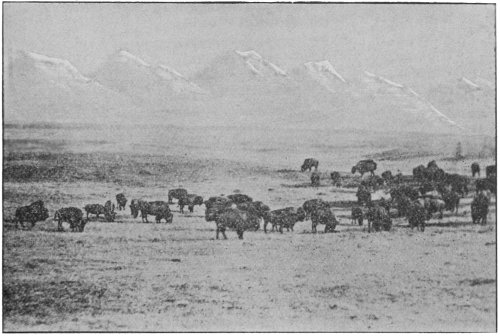
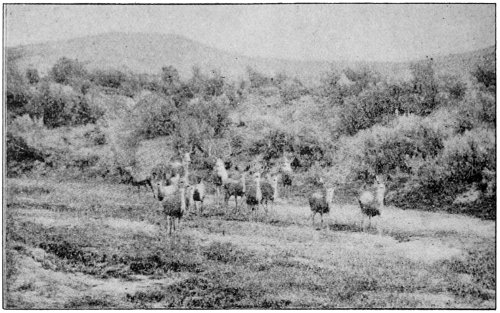
the park during the summer to protect the wild game that is
there in abundance, principally elk, deer, buffalo and bears;
also to see that no one carries away any of the curiosities in
the way of specimens of the various formations, and to see
that the forest is not destroyed by fire or otherwise. For the
violation of any of the laws that govern the park a severe penalty
is imposed. The same military force serves as a police
protection to the people as well.
While this Wonderland is the property of the general government,
it is in fact the pleasure ground of all nations.
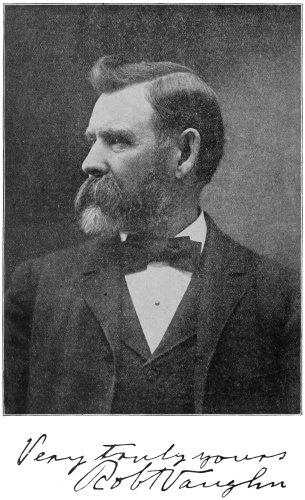
Robert Vaughn.
April 2, 1900.