CHAPTER I. — FOOTNOTES:
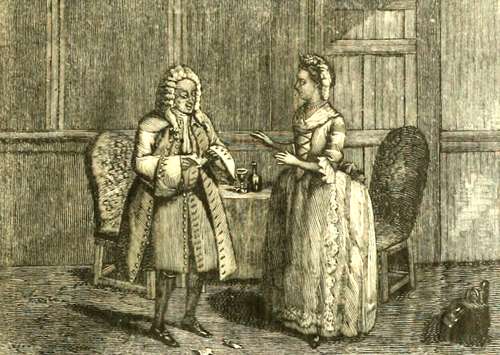
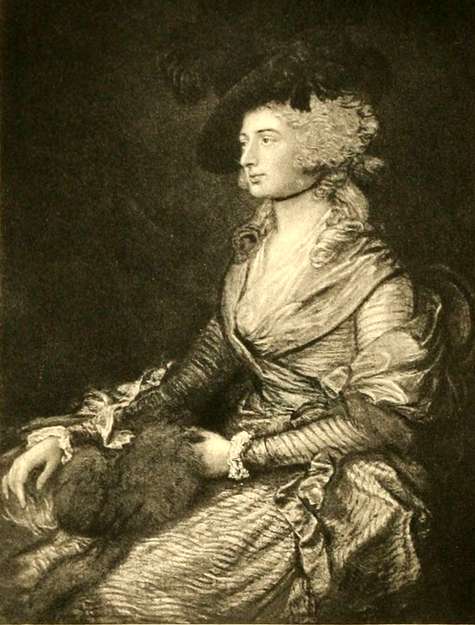
MR. PARSONS AND MISS POPE IN "THE DRUMMER."
OF AUTHORS, AND PARTICULARLY OF CONDEMNED AUTHORS.
A glance at the foregoing list[1] will serve to show that,
from the retirement of Garrick to the close of the
eighteenth century, tragic literature made no progress.
It retrograded. It did not even reach the height of
Fenton and Hughes, in whom Walpole discerned
some faint sparkling of the merit of the older masters.
After Shakspeare's time, "Theatric genius," says
Walpole, "lay dormant;" but he adds, that "it
waked with some bold and glorious, but irregular
and often ridiculous flights, in Dryden; revived in
Otway; maintained a placid, pleasing kind of dignity
in Rowe, and even shone in 'Jane Shore.' It trod
in sublime and classic fetters in 'Cato;' but was
void of nature, or the power of affecting the passions.
In Southerne it seemed a genuine ray of nature and
Shakspeare, but falling on an age still more Hottentot,
was stifled in those gross and barbarous productions,
tragi-comedies. It turned to tuneful nonsense
in the 'Mourning Bride;' grew stark mad in Lee,
whose cloak, a little the worse for wear, fell on
Young, yet in both was still a poet's cloak. It
recovered its senses in Hughes and Fenton, who
were afraid it should relapse, and accordingly kept it
down with a timid, but amiable, hand; and then it
languished."
And continued to languish; I cannot more fully
show to what extent, than by remarking that the
century which opened with Rowe concluded with
Pye—both Poets Laureate, but of different qualities.
"Tamerlane" and "Jane Shore" have not yet
dropped from the list of acting plays; but who
knows anything more of "Adelaide" than that it
was insipid, possessed not even a "tuneful nonsense,"
and was only distinguished for having made
Mrs. Siddons and John Kemble appear almost as
insipid as the play. Godwin's "Antonio," played in
1800, was as complete a failure as Pye's "Adelaide."
For the tragic poets who occupy the period between
Garrick's retirement and the coming of Pye and Godwin,
a few words will suffice. Mason's "Caractacus"
was a noble effort, but it produced less effect than
D'Egville's ballet on the same subject in the succeeding
century. Cumberland's "Battle of Hastings"
was as near Shakspeare as Ireland's "Vortigern"
was; and Home's "Alfred" died, three days old.
Jephson was, after all, the favourite playwright of
Walpole, who says of his "Law of Lombardy," that
it was even "too rich" in language! but then
Jephson always improved the passages to which
Walpole objected. Walpole gave orders for alterations
in Jephson's plays, as he might for the repairs
of a cabinet. Sometimes his criticism is excellent,
and at others, it involves a social illustration, as in
that on the "Count of Narbonne." Raymond, in
the last scene, says, "Show me thy wound; oh, hell!
'tis through her heart!" "This line," says Walpole,
"is quite unnecessary, and infers an obedience in
displaying her wound, which would be shocking;
besides, as there is often a buffoon in an audience,
at a new tragedy, it might be received dangerously.
The word 'Jehovah!' will certainly not be suffered
on the stage." Walpole praises Miss Younge's
acting, and says, "the applause to one of her
speeches lasted a minute, and recommenced twice
before the play could go on." Jephson, however,
wrote fair acting pieces, which is more than can be
said for Bentley's "Philodamus," which, in spite of
being pronounced by Gray the best dramatic poem
in the language,[2] was hilariously laughed off the
stage. It was at least original, which can hardly be
said of any of Cumberland's plays, except the "Carmelite,"
a tragedy that terminates merrily! Cumberland
was as much out of his line in tragedy as
Reynolds, whose "Werter" and "Eloisa" brought
him eight pounds!
"And very good pay too, sir!" said Macklin, "so
go home, and write two more tragedies, and if you
gain £4 by each of them, why, young man! the
author of Paradise Lost will be a fool to you!"
Hayley, of whom Walpole said, "That sot Boswell
is a classic in comparison;" and Murphy, with undeniable
powers, failed in their attempts at tragedy during
this period. Boaden may be said to have been below
the level of Pye himself. On the former's "Aurelio
and Miranda" some criticism was made before it was
acted. The author was reading his play to the actors,
when he remarked, that he knew nothing so terrible
as having to read it before so critical an audience.
"Oh, yes!" exclaimed Mrs. Powell, "there is something
much more terrible." "What can that be?"
asked Boaden foolishly. "To be obliged to sit and
hear it," was the reply of Lady Emma Hamilton's
old fellow-servant.
But if tragedy languished miserably, comedy was
vivacious and triumphant. This period gave us the
"School for Scandal," perhaps the most faultless
comedy of the whole century. It gave us Murphy's
"Know your own Mind;" the "Critic," that admirable
offspring of the "Rehearsal;" Macklin's "Man
of the World," the most muscular of comedies, which
contrasts so forcibly with the sketchy sentimental,
yet not nerveless comedies of Holcroft; General
Burgoyne's "Heiress," which is not only superior to
General Conway's "False Appearances" (a translation
from a comedy by Boissy), but is, perhaps, the second
best comedy of the period; Cumberland's "Jew" and
"Wheel of Fortune;" Colman's serio-comic "Mountaineers,"
and the rattling "five-act farces" of Reynolds.
At the head of all these, and of many others,
stood Sheridan's immortal comedy. He may, as he
said, have spoiled Vanbrugh's "Relapse," in converting
it into the "Trip to Scarborough;" but the
"School for Scandal"[3] has been accepted as the
best comedy of the English stage. In its dazzling
brilliancy, the labour expended to effect it is all forgotten.
Garrick took the greatest interest in its
success, and when a flatterer remarked to him that
its popularity would only be ephemeral, and that
with Garrick himself the Atlas of the stage had
departed, the latter calmly replied that, in Mr. Sheridan,
his successor in the management, the stage had
a Hercules equal to any labour it might require at
his hands.
I turn, less to newspapers than to private contemporary
sources, to see what was thought of this comedy
on its first appearance. Walpole was present at the
acting, and he says: "To my great astonishment,
there were more parts performed admirably in the
'School for Scandal,' than I almost ever saw in any
play. Mrs. Abington was equal to the first of her
profession; Yates, Parsons, Miss Pope and Palmer,
all shone. It seemed a marvellous resurrection of
the stage. Indeed, the play had as much merit as
the actors. I have seen no comedy that comes near
it, since the 'Provoked Husband.'" The chief characters
were thus represented: Sir Peter, King; Sir
Oliver, Yates; Backbite, Dodd; Charles Surface,
Smith; Joseph Surface, Palmer; Crabtree, Parsons;
Lady Teazle, Mrs. Abington; Mrs. Candour, Miss
Pope; and Maria, by Miss P. Hopkins, daughter of
the prompter,—soon to be the wife of Brereton, and
subsequently that of John Kemble.
Walpole objected, that the comedy was too long,
despite great wit and good situations; and that there
were two or three bad scenes that might be easily
omitted, and which, to his thinking, wanted truth of
character. He does not specify the scenes, and he
acknowledges that he had not read the play, and that
he "sat too high to hear it well." When he had
read it, he came to the conclusion that it was "rapid
and lively, but far from containing the wit he had
expected, on seeing it acted."
To Walpole, the "Heiress," by Burgoyne, was
"the genteelest comedy" in the English language.
Of Macklin's "Man of the World," the same writer
says:—"Boswell pretended to like it, which would
almost make one suspect that he knows a dose of
poison had already been administered; though, by
the way, I hear there is little good in the piece,
except the likeness of Sir Pertinax to twenty thousand
Scots."
It was the great merit of nearly all these writers,
that while they caricatured folly, they scourged vice;
and not only showed society what it was, but instructed
it in what it should be. Cumberland wrote
his "Jew" expressly to create a feeling of sympathy
for a despised people. Howard, the philanthropist,
walked, under fictitious names, through more than
one piece,—inculcating the duties of love and
charity; and the too fashionable or foolish people
of the day, by being rendered ridiculous, served to
demonstrate, merrily, their own defects. In this
application of dramatic literature, the ladies, whom
I have not yet mentioned, were as busily engaged as
the gentlemen.
If we glance at the ladies who wrote for the stage
during the latter half of the last century, and some
of them before, we shall find a marked contrast
between them and their sisters of the preceding century.
There is Hannah More, who introduces into
"Percy" a sermon, of which the first part denounces
war, and the second draws a character of the Saviour.
Of Mrs. Cowley, kinswoman to Gay—the unknown
Anna Matilda who corresponded with Della Crusca
(Merry), the fastidious Walpole unjustly declared
that she was as freely spoken as Aphra Behn. She
was the first lady who held an "At Home day,"
on which to receive her friends. She affected, like
Congreve, to despise being an "author," and showed
skill in shaping old characters into new, in comedies
which still survive; as well as in defending herself
against the acute people who had "a good nose
for inuendo." In tragedy, she was not so successful;
and she winced at the epigram of Parsons, on
her "Fate of Sparta," which said:—
"Ingenious Cowley! while we view'd
Of Sparta's sons the lot severe,
We caught the Spartan fortitude,
And saw their woes, without a tear."
Of Mrs. Griffith's plays not one is now remembered;
but the author and actress is remarkable for
having published, as guides to young people, the
correspondence of herself and husband, before marriage,
under the title of The Letters of Harry and
Frances; and if they describe all the love making,
the lady was not likely to have resembled the Platonic
Wife, in her own play so called, who laments, throughout,
that her husband will not be exactly what he
was when he was her lover. An incident, connected
with this play, will show how ungallant players could
be to female poets, and how free they could be with
their audience. In the third act, when Powell and
Holland were on the stage, the hissing was universal;
and at the end of it the two actors thrust their heads
out from behind the drop curtain, and implored the
house to damn the piece at once, and release them
from having to utter any more nonsense!
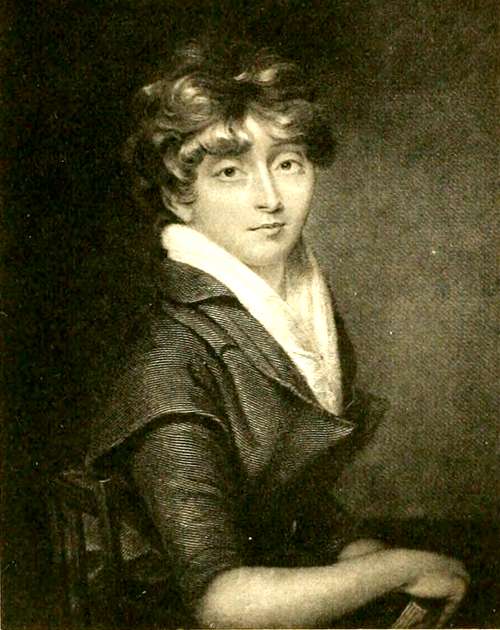
The gentle Frances Brooke's novels are better than
her dramas,—save the pretty musical farce, "Rosina,"
in which she has so cleverly secularised the scriptural
story of Ruth and Boaz. Unlike Mrs. Brooke, Elizabeth
Inchbald's plays are as good as her novels;—in
both, the romantic daughter of a Suffolk farmer exhibited
a skill and refinement, the latter of which she
must have acquired after the period when, a wayward
and beautiful girl of sixteen, she ran away from home,
and manifested wonderful ability in framing stories of
her own, to mislead the curious. After the death of
her husband,—the "Garrick of Norwich,"—whose
marriage with her was as romantically begun as it
singularly ended, she took to writing for the stage,
on which she was a respectable actress. In her
plays, the virtues are set in action; and there is
much elegance in her style. She was so successful,
that a friend accused her of inculcating sedition in
"Every One Has His Fault." Sometimes, her success
was owing more to the actors than herself. King and
Mrs. Jordan, as Sir Adam and Lady Contest, in the
"Wedding Day," were such a pair as have never
been quite approached by their successors.
Petulant Sophia Lee, daughter of a country actor,
excelled all the foregoing ladies in one point,—the
skill with which she mingled broad comedy with
natural pathos,—as in her "Chapter of Accidents."
The Lady Wallace was a thousand times more petulant
than Miss Lee, without even a thousandth part
of her ability. She resembled the female writers of
the last century only in her vulgarity, and not in their
poor wit. Then, there was Hannah Brand, school-mistress,
like Hannah More; poet and actress, mad
with much learning,—or with very little, of which
she thought very much; and proud as an artchangel,
as she pronounced the word! The great feat of imperious
Miss Brand was in her "Huniades," which,
on its failure, she altered, by leaving the whole part
of Huniades out! She called the incomprehensible
fragment "Agmunda," and heard it hissed (she playing
the heroine), to her great disgust.
The century was within a year of its close, when
Miss De Camp taught parents not to cross the first
love of their children, in "First Faults." Then
Joanna Baillie finished one and began another century,
with her series of Plays of the Passions; none
of which was intended for the stage, or succeeded
when it was represented. The old Scots, who shuddered
at "Douglas" being written by a minister,
must have been stricken with awe, at the idea of the
daughter of the divinity professor at Glasgow composing
three profane tragedies in a single year.
In the supplement to the last chapter, indications
will be found of the progress of Opera on the English
stage. Music and singing were not uncommonly introduced
into our early plays, and they ranked among
the chief attractions of our masques, down to the reign
of Charles I. Under the Commonwealth, and in the
reign of Charles II., we had pieces sung in recitative,
till Locke awoke melodious echoes by his music for
the operas of "Psyche," "Macbeth," and the "Tempest;"
and Purcell excelled Lawes in vigour and in
harmony, and composed music to the words of Dryden.
Our first English male stage-singers were simply
actors, with good, but not musically trained voices.
Walker, the original Macheath, could "sing a good
song," but he was a tragedian; and some of our
songstresses might be similarly described. Mrs.
Tofts, at the beginning of the eighteenth century,
and Miss Campion, were trained vocalists. In Beard
and Miss Brent—he, living to marry an earl's
daughter, and realise a large fortune; she, to want
bread, and (as Mrs. Pinto) to thank the elder
Fawcett for a shilling—Garrick found his most
dangerous opponents. The "Beggar's Opera" and
"Artaxerxes," mark epochs; and after Arne arose
Linley, Jackson, Arnold, Dibdin, and Shield, as
composers; and Leoni and Miss Browne—the former
sweeter than Vernon, and the lady rich in expression,
secured rare laurels for themselves and the "Duenna,"
in which opera they played the principal characters.
Jackson's music in "The Lord of the Manor,"
brought Mrs. Crouch, then Miss Phillips, into notice;
but it was not till Stephen Storace began his career,
that concerted pieces and grand finales were introduced
by him, and English opera rendered more
complete. With his operas are most associated the
names of Crouch, Kelly, and Braham—which last
name, and that of Mrs. Billington, are the brightest
in the operatic annals of the close of the eighteenth,
and opening of the nineteenth century.
With operas and musical entertainments, the
romantic drama greatly flourished for awhile. Indeed,
the beautiful and hapless Mrs. Cargill made a
romantic hero of Macheath; her tremor, when the
bell sounded for execution, was a bit of natural
tragedy which excited tears. But of real romantic
drama, the most successful was the sensational
"Castle Spectre," the merit of which was pointed out
by a joke of Sheridan's. In a dispute with Lewis,
the author, the latter offered, in support of his
opinion, to bet all the money which that drama had
brought into the treasury. "No," said Sheridan,
"I'll not do that; but I don't mind betting all it's
worth!"
So few of the plays in the preceding list have
survived even in memory, that there must necessarily
have been much suffering among disappointed authors.
But it was not merely those of this half century who
incurred disappointment. I have incidentally mentioned
some of these before. I may add one more
sample of the condemned in Flecnoe, who was
among the worst of the writers of the seventeenth
century, and was also the most independent, or the
most truculent, in denouncing his critics. When
the managers rejected his "Demoiselles à la Mode,"
he printed the piece with a preface, in which he
remarked that:—"For the acting this comedy, those
who have the government of the stage, have their
humour, and would be entreated; and I have mine,
and won't entreat them; and were all dramatic
writers of my mind, the Masters should wear their
old plays threadbare ere they should have any new,
till they better understood their own interest, and how
to distinguish between good and bad."
But poets better skilled than this ex-Jesuit had to
endure disappointment. Rowe ranks among the condemned
(the hilarious condemned), by his failure in
comedy. His idea was good. In the early part of
the century, society was beset by the "Biters." These
were the would-be jokers of the day, who, on hoaxing
their friends, exclaimed "bite!" and exposed the
trick they had played. An instance is afforded in
the Spectator, of a condemned felon, who sold his
body to a surgeon, but who, on receiving the purchase-money,
called out "bite! I'm to be hung in
chains!" Rowe took one of these humorists for
the hero of his bustling three-act comedy or farce,
entitled the "Biter." This part, Pinch, was played
by Pack, at Lincoln's Inn Fields, in 1704; but that
clever actor rattled through it in vain. The jokes fell
lifeless, to the great disgust of Rowe, who was in the
pit. As the audience would not, or could not laugh,
but rather yawned or hissed, the author set them the
example he would have them follow, and at every jest
he led the way with an explosion of laughter, which
must have become the more lugubrious on every repetition.
A good man struggling against evil destiny is
said to be a sublime spectacle to gods and men; but
a dramatic author, known to half the audience, upholding
his own piece, and striving to rescue it from
ruin by a convulsive hilarity, must have been a sight
as astonishing to his foes as to his friends. The poor
fellow laughed vehemently; but the house could not
be tempted to sympathise with him, and the "Biter"
was condemned under the applause and laughter of
its hysterical author.
Aaron Hill took his failures more calmly. The
public of 1710, at Drury Lane, would not tolerate
his "Elfrid." Aaron shared the public opinion, and
devoted twenty years to re-writing his tragedy, which
was subsequently produced under the title of "Athelwold."
Mrs. Centlivre was not equally patient with
her public; from whom, a month earlier, she withdrew
in pique her coolly-received comedy, "The Man's
Bewitched." Elkanah Settle was so systematically
visited with damnation, that he was at last compelled
to bring out his plays under fictitious names, and
during the long vacation, lest when the town was full,
some enemy should discover him. Pope was as sensitive
as Settle, if the story be true that he was one
of the authors of "Three Hours after Marriage," and
that the cool reception of this piece caused him to
express dislike for the players. Dennis, however,
was perhaps the most irritable of his race. When
his adaptation of "Coriolanus" ("The Invader of his
Country") failed, in 1719, to draw £100 to the house,
and was consequently shelved by the management,
Dennis thundered against the insolence, incapacity,
and disloyalty of Cibber and his colleagues, and invoked
against them the vengeance of the Duke of
Newcastle, the Lord Chamberlain! Theobald took
another course; and when the pit hissed his pieces,
he abused the "little critics," in a preface, scorned
their "ill nature," and appealed to "better judges."
Gay, considering his dramatic failures in tragedy,
found more consolation than most damned authors.
The public of 1724 had no sympathy for his "Captives;"
which, despite Booth, Wilks, and Mrs. Oldfield,
soon disappeared from the stage. To console
the author, the Princess of Wales requested him to
read this play in presence of herself and little court.
On being ushered into the august company, Gay,
nervous from long waiting, tragedy in hand, bashful
and blundering, fell over a stool, thereby threw
down a screen, and set his illustrious audience in a
comical sort of confusion, which, notwithstanding
the kindness of the princess, marred the self-possession
of the poet. The piece, however, went off
more merrily at Leicester House than it had done
at Drury Lane.
More touching than this was the way in which
the aged Southerne, in 1726, took the condemnation
of his "Money, the Mistress," at Lincoln's Inn
Fields. The audience refused the request made in
the prologue to protect the man who had filled their
mothers' eyes with tears. They had no particular
reverence for "the last of Charles's bards;" nor
especial regard for "great Otway's peer and greater
Dryden's friend." The audience hissed mercilessly.
The old man was standing at a wing with Rich, who
asked him, if "he heard what they were doing."
"No, sir," said Southerne, calmly, "I am very deaf!"
So quietly did he see fall from his grey head, the
wreath "for half a century with honour worn."
But "Money" was not more unequivocally damned
on the first night than was the "Provoked Husband,"
in 1728, at Drury Lane. The difference was that the
last piece suffered shipwreck, on political grounds,
but survived the storm. All the Jacobites in town
united to condemn a play, by the author of the
"Nonjuror," with Vanbrugh for colleague. Cibber
played Sir Francis Wronghead, in the face of the
hurricane, and never forgot his part, though he gave
up all as lost when, in the fourth act, the play was
brought to a "stand-still," by the fierce antagonism
of the house. Nevertheless, Colley persevered, and
the comedy went on to the end. The critics acknowledged
or boasted that it had been a miserable failure,
but Cibber would not confess himself beaten. The
"Provoked Husband" ran for eight-and-twenty
successive nights, and on the last of those nights
drew £140, "which happened," says the naturally-exulting
Cibber, "to be more than in fifty years
before could be said of any play whatsoever."
Gay read his tragedy, after it had been consigned
to the limbo of such pieces, to a court circle; Tracy
read his heavy "Periander" before it was damned
at Lincoln's Inn Fields, in 1731, to a circle of
friends, who were regaled on the occasion with a
magnificent supper. Dr. Ridley spoke on behalf of
himself and brother critics, and assured the author
that they had been exceedingly well-pleased with
the entertainment provided; he alluded particularly,
he said, to the supper. This was held for wit, but
it was not so neat, so happy, or so friendly as Carl
Vernet's reply to the author of the Maison à Vendre.
As the curtain fell, Carl remarked, "J'ai cru voir
une Maison à Vendre, et je ne vois qu'une pièce à
louer!"
Fielding took disapprobation with infinite indifference.
In 1743, his "Wedding Day" was produced
at Drury Lane, with Garrick as Millamour, and
Macklin as Stedfast. Garrick had asked the author
to suppress a scene which, he thought, would imperil
the piece. Fielding refused. "If the scene is not
a good one," said he, "let 'em find it out." This
scene did excite violent hissing; and Garrick left
the stage for the green-room, as violently disturbed.
"There," says Murphy, "the author was indulging
his genius, and solacing himself with a bottle of
champagne. He had, at this time, drunk pretty
plentifully; and cocking his eye at the actor, while
streams of tobacco trickled down from the corner of
his mouth, 'What's the matter, Garrick?' said he;
'what are they hissing now?' 'Why, the scene I
begged you to retrench. I knew it wouldn't do;
and they have so frightened me, that I shall not be
able to collect myself the whole night.' 'Oh! d—— 'em!'
replies the author, 'they have found it out,
have they?'"
Fielding suffered as severely as most authors at
the hands of the critics, but he was bold enough to
publish one unlucky play, not "as it was acted,"
but "as it was damned at the Theatre Royal." He
accounted, however, for such failures, in himself and
others, through Fustian, his tragic poet, in "Pasquin."
"One man," says Fustian, "hisses out of resentment
to the author; a second, out of dislike to the house;
a third, out of dislike to the actor; a fourth, out of
dislike to the play; a fifth, for the joke's sake; a
sixth, to keep the rest in company;—enemies abuse
him; friends give him up; the play is damned; and
the author goes to the devil." Fielding might have
given another illustration,—such as that of the
Frenchman who clapped and hissed at the same
moment, and explained his apparent inconsistency,
by stating that he had received a free ticket from
the author, and that he clapped out of gratitude to
the donor, but that he hissed for the satisfaction of
his own conscience. Again, there was one French
critic who took a more singular way still of expressing
his opinion. In the tragedy of "Antony and
Cleopatra," a mechanical asp was introduced, which
hissed as "dusky Egypt" took it up to apply to her
bosom. The Parisian critic, on hearing the sound,
arose and said to the pit—"Gentlemen, I am of the
same opinion as the asp!"
Fielding published his play, "as it was damned,"
but he did not add, "as it deserved to be." He was
less candid than Bernard Saurin, a French dramatist
of the last century. Saurin's comedy, the "Trois
Rivaux," was pitilessly hissed. The author printed
it, not to shame the critics, but to confess the justice
of their verdict. "Authors who have been humiliated,"
he says, "are not always the more humble on
that account. Self-love supports itself." After enumerating
many instances, he adds: "There are few unlucky
playwrights who do not look beyond their
piece for the cause of an effect which their play alone
has produced. After wearying the public by their
insipidity, they disgust it by their pride, displayed in
some haughty preface to their drama. Perhaps there
is a refinement of self-love in what I am myself now
doing, when I candidly confess, that my comedy of
the 'Three Rivals' thoroughly merited its fate."
Less reasonable than Saurin was Anthony Brown,
the Templar, who produced his "Fatal Retirement,"
at Drury Lane, in 1739. This conversational tragedy,
in which nobody is excited much above the level
of every-day talk, fell at the first representation.
Anthony Brown attributed the failure to Quin, who,
after selecting one part, chose another, and finally
threw up both. This conduct, according to Brown,
rendered the other players indifferent, and brought
on a catastrophe, which the condemned poet, of
course, held to be unmerited. Accordingly, down
went Templars and the Templars' friends, night after
night, to hiss the offending Quin. He was commanded
to make an apology, and he did so in his
characteristic way. Addressing the audience, he
said, blandly, that he had read "Fatal Retirement,"
at the author's request, and, under like impulse, had
given him his sincere opinion of the tragedy, namely,
that it was the very worst he had ever read, and that
he could not possibly take a part in it. The audience
were amused at the apparent frankness of this communication,
and the Templars, allowing Anthony
Brown to be non-suited, satisfied their indignation
by visiting it upon poor Parson Miller, who had been
so ungallant to Mistress Yarrow and her daughter.
The "Hospital for Fools" was not brought out in
Miller's name, but the Templar champions of the
fair knew it to be his, and hissed it from the stage
accordingly, despite the acting of Yates, Woodward,
and Mrs. Clive, and that part of the audience who
would fain have listened, if the noisy Templars would
only have allowed them. Out of Miller's fiasco,
Garrick subsequently made a success, and on the
"Hospital for Fools" founded his "Lethe," in which
he was famous in the character of Lord Chalkstone.
There is one anonymous author who exhibited a
strange humour in his protest against the condemnation
of his tragedy, the plot of which had been
pronounced improbable. "You (critics)," says the
dolorous author, "harp eternally on my improbabilities.
You deal rigorously with inferior dramatists,
on the score of their delinquencies as to the probable;
but when the same fault is found in some great master,
like Shakspeare, oh! then you give the word probability
quite a liberal and kindly latitude of interpretation.
And is not improbability as great a sin in
the richest as it is in the poorest dramatic genius?"
Campbell's just reply is, "No: we forgive the fault,
in proportion as it is redeemed by wit and genius."
This author, so angry at being damned, should not
have ventured his plays on the stage. He would
have done well to imitate Thomas Powell, who wrote
dramas, but did not wish the public to know it. So
fearful of condemnation was he, that when a friend,
who thought well of a tragedy he had written, called
"Edgar," on the same subject as Ravenscroft's and
Rymer's, offered to present it to Garrick, in order
to its being acted,—"No, no!" exclaimed sensitive
Powell, "by no means would I wish even to be
known as an author, attackable by all." The mere
pleasure of writing was enough for him. He fancied
his triumphs; and they were thus never marred by
hiss from the pit, or howl from adverse critic.
Some have taken their fate swaggeringly, with a
protestation that the public were not so enlightened
as they might be. Others have whistled, some have
sung, a few have reasoned over it, one or two have
acknowledged the condemnation; not one, except
Bentley, has confessed that it was just. When the
best scenes in the "Good-natured Man" were bringing
down hisses and imperilling the comedy, Goldsmith
fell into a tremor, from which the bare success
of the play could not relieve him. But he concealed
his torture, and went to the club and talked loud and
sang his favourite songs, but neither ate nor drank,
though he affected to do both. He sate out the
whole of the company save Johnson, and when the
two were alone, the disappointed author burst into
tears, and swore, something irreverently, that he
would never write again. Johnson behaved like a
true man, for he comforted Goldsmith, and never
betrayed his friend's weakness. That, of course,
Goldsmith was sure to do for himself. Long after,
when they were dining with Percy, at the chaplain's
table at St. James's, Goldsmith referred to the dreadful
night, the hisses, his sufferings, and his feigned
extravagance. Johnson listened in astonishment.
"I thought it had all been a secret between you and
me, Doctor," said he, "and I am sure I would not
have said anything about it for the world."
Some poets thought the players had the better
time of the two; but if poets incurred one peril,
the players of this period incurred another. For
instance, in 1777, the Edinburgh company going to
Aberdeen by sea, were snapped up by an American
privateer, and carried off captives to Nantz. How
they were ransomed, I am unable to show.
Walpole may be registered, if not among the
damned, yet among the discontented authors of this
half century. Chute might be pleased, and even
Gray approve; but Garrick seems to have had small
esteem for Horace as a dramatic poet. Hence was
Garrick, in Walpole's eyes, but a poor writer of prologues
and epilogues, a worse writer of farces, and
a patron of fools who wrote bad comedies, which
they allowed Garrick to make worthless; but yet
worthy of the town which had a taste for them!
Walpole wished to see his "Mysterious Mother"
acted, although he well knew that the story, and the
inefficient way in which he had treated it, would
have insured its failure. Indisposed to be numbered
among the condemned, he ascribed his reluctance to
venture, to two causes: Mrs. Pritchard was about to
retire, and she alone could have played his Countess;
"nor am I disposed," he says, "to expose myself to the
impertinences of that jackanapes, Garrick, who lets
nothing appear but his own wretched stuff, or that
of creatures still duller, who suffer him to alter their
pieces as he pleases." In this strain Walpole was
never weary of writing. Of Garrick's "Cymon" the
disappointed Horace was especially jealous, and he
sneered at its pleasing "the mob in the boxes as
well as the footman's gallery," which privileged
locality was not yet abolished in 1772. Garrick
might be the best actor, but, said Walpole, he is
"the worst author in the world!"
I have noticed the mirthful dénouement of Cumberland's
tragedy, the "Carmelite." Such dénouements
were approved by some part of the French public.
When the "Gamester" was adapted to the French
stage, under the title of "Beverley, a tragedy of Private
Life," the adapter was the Saurin of whom I
have spoken, and his attempt excited the critics, and
divided the town. The poisoning fascinated some
and revolted others. One French poet protested
against the "horrible" in tragedy, and exclaimed:—
"Laissons à nos voisins ces excès sanguinaires,
Malheur aux nations que le sang divertie,
Ces exemples outrés, ces farces mortuaires
Ne satisfont ni l'âme ni l'esprit.
Les Français ne sont point des tigres, des feroces
Qu'on ne peut amouvoir que par des traits atroces."
The ladies united with the poet, and Saurin found
himself compelled to give two fifth acts, and, as the
piece was attractive, the public were informed
whether the dénouement on that particular night
would be deathless, or otherwise! In the former
case, as Beverley was about to take the poison, his
wife, friend, and old servant rushed in just in time
to save him, and, in common phrase, to assure him
that things were "made comfortable," in spite of his
follies, his weakness, and rascality. Grimm jokes
over plots admitting of double dénouements, and
alludes to the Norman vicar of Montchauvet, who
wrote a tragedy on the subject of Belshazzar. The
vicar thought that dramatic catastrophes depended
on how the poet started. In his tragedy everything
turned upon whether Belshazzar should sup or not,
in the fifth act. If he does not sup, there can be
no hand on the wall, and so "good-night" to the
piece. Accordingly, the poet says, in the first act,
that the king will sup; in the second, that he will
not; in the third, that he will; in the fourth,
that he will not; and, consequently, in the fifth,
that he must, and will. Had the vicar intended
otherwise, he would have begun, he says, in different
order!
Ducis adapted Shakspeare's "Othello" to the
French stage, for which he furnished two versions.
In the first, he killed Desdemona according to tradition.
At this, ladies fainted away, and gentlemen
protestingly vociferated. Ducis altered the catastrophe,
whereat Paris became divided into two parties,
who supported the happy or the tragic conclusion, as
their feelings prompted them. Talma played the
Moor; and, bred as he had been in the shadow and
the sunlight of the English stage, he was disgusted
with the liberty taken with Shakspeare. One night,
when the piece was to end as merrily as a comedy,
and the last act was about to begin, Ducis heard
Talma muttering at the wing, "I will kill her. The
pit will not suffer it, I am sure; well, I will make
them endure, and enjoy it. She shall be killed!"
Ducis tremblingly acquiesced, and Talma restored the
old catastrophe. There was some opposition, and a
little fainting on the part of the susceptible, but, in
presence of the marvellous talent of the actor, all
antagonism gave way, and Talma, with reasonable
pride, notified to his friends on the English stage the
successful effort he had made in support of the integrity
of the Shakspeare catastrophe.
Some authors have altogether refused to despair
of the success of their piece, however adverse or indifferent
the audience may have been. Take, as a
sample, the case of Joseph Mitchell, the Scottish
stonemason, but "University-bred." Towards the
middle of the last century, the public sat, night after
night, quite incapable of comprehending the mysteries
and allusions of his "Highland Fair, or the Union
of the Clans." At length, on the fourth night, the
audience took to laughing at the nonsense served
up to them, and as the last act proceeded, the louder
did the hilarity become. Poor Mitchell took it all
for approval, and going up to Wilks, with an air of
triumph, he exclaimed, "De'il o' my saul, sare, they
begin to taak the humour at last!"
Hoole, another of the stage-damned, was less self-deluding.
When his "Cleonice" was about to be
played, a publisher gave him a liberal sum for the
copyright, Hoole's reputation, as a poetical translator
from the Italian, being then very great. The play,
however, was condemned, and Hoole was the first to
acknowledge the unwelcome truth. He accordingly
returned a portion of the sum he had received to the
publisher. He had intended, he said, that the tragedy
should be equally profitable to both, and now that it
had failed, he would not allow the chief loss to fall
on him who had bought the copyright. The watchmaker's
son was a gentleman.
Hoole was as indifferent to condemnation as the
French dramatist, Hardy, with less greed for money
than influenced the latter, who, however, was moved
by the proper sense of the value of labour. This
French author, Hardy, who died about the year
1630, saw his plays damned with as much indifference
as he wrote them. He composed between six
and eight hundred, published forty of them, and did
not see one live a fortnight. A couple of thousand
lines a day were nothing to this ready dramatist,
who furnished the players for whom he composed,
with a new drama every third day. And it was a
day when French dramas were full of incident. We
hear of princesses who are married in the first act;
the particular heroine is mother of a son in the
second, whose education occupies the third; in the
fourth he is a warrior and a lover; and in the fifth
he marries a nymph who was not in existence when
the play began. Hardy was the best of these inferior
poets, and was original in this; he was the first who
introduced the custom of getting paid for his pieces,
a thing unknown till then, and which the poets, his
successors, have not failed, says a French writer, "to
observe very regularly ever since."
Mrs. Siddons's Bath friend, Dr. Whalley, was not
so indifferent to the success of his muse as Monsieur
Hardy; but he ranks among damned authors who
have accepted condemnation or neglect with a joke.
His "Castle of Montval" was yawned at rather than
hissed; but as it was acted beyond the third night,
the Doctor went down to Mr. Peake, the treasurer, to
know what benefit might have accrued to him. It
amounted to nothing. "I have been," said the
author, an old picquet player, to an inquiring friend,
"I have been piqued and re-piqued;" and therewith
he went quietly back to Bath, where he lived
upon a private fortune, and the rich stipend from
an unwholesome Lincolnshire living, which a kind-hearted
bishop had given him on condition he never
resided on it!
The tragedy of the other friend of Mrs. Siddons,
Mr. Greatheed (the "Regent"), was not much, if
any, more successful, than Dr. Whalley's; but the
author was so satisfied with his escape, that he gave
a supper—that famous banquet, which was followed
by a drinking bout at the Brown Bear, in Bow Street,
at which a subordinate actor, named Phillimore, was
sufficiently tipsy to have courage to fight his lord
and master, John Kemble; who was elevated enough
to defend himself, and generous enough to forget
the affair next morning.
Sheridan kept his self-possession under merrier
control than this. His "Rivals" was at first a
failure. Cumberland, the most sensitive author in
the world, under condemnation, declared that he
could not laugh at Sheridan's comedy. "That is
ungrateful of him," said Sheridan, to whom the comment
was reported by a particular friend—"for I
have laughed at a tragedy of his from beginning to
end!" But this not having been said in Cumberland's
hearing, was less severe than a remark made
by Lord Shelburne, who could say the most provoking
things, and yet appear quite unconscious of
their being so. In the House of Lords he referred
to the authorship of Lord Carlisle. "The noble
lord," said he, "has written a comedy." "No, no!"
interrupted Lord Carlisle, "a tragedy! a tragedy!"
"Oh! I beg pardon," resumed Lord Shelburne, "I
thought it was a comedy!" The piece thus adjudged
of was the "Father's Revenge," an adaptation from
Boccaccio, of "Tancred and Sigismunda," never played
and seldom read.
Cumberland, who bore his own reverses with impatience,
and was ever resolute in blaming the lack
of taste on the part of the public, rather than ready
to acknowledge his own shortcomings, endured the
triumphs of his fellow-dramatists with little equanimity.
During the first run of the "School for
Scandal," he was present, with his children, in a
stage-box, sitting behind them. Each time they
laughed at what was going on, on the stage, he
pinched them playfully, and asked them at what
they were laughing. "There is nothing to laugh at,
my angels," he was heard to say; and if the juvenile
critics laughed on, he less playfully bade them be
silent—the "little dunces!"
The dramatists whom he "adapted," declined to
be involved in his reverses. After his "Joanna," an
adaptation from Kotzebue, had been damned, the
German author took care to record in the public
papers that the passages hissed by the English
public were not his, but additions made by Cumberland.
Sir Fretful found consolation. "If I did not
succeed," says this frequently damned author, "in
entertaining the audience, I continued to amuse
myself.... I never disgraced my colours by abandoning
legitimate comedy, to whose service I am sworn,
and in whose defence I have kept the field for nearly
half a century—till at last I have survived all true
national taste, and lived to see buffoonery, spectacle,
and puerility so effectually triumph, that now to be
repulsed from the stage is to be recommended to the
closet; and to be applauded by the theatre is little
less than a passport to the puppet-show." This
spirit of self-satisfaction, and depreciation of the
public taste, was nothing new. The author or
adapter of "Richard II." (Nahum Tate), finding his
piece prohibited by authority, published it with a
self-congratulatory preface; but he had already done
more in the epilogue; mindful of past reverses, and
anticipatory of present condemnation, he made Mrs.
Cook say:—
"And ere of you, my sparks, my leave I take,
For your unkindness past these prayers I make—
Into such dulness may your poets tire,
Till they shall write such plays as you admire!"
This was thoroughly in the old spirit of Flecknoe;
but of samples of the spirit of "damn-ed authors,"
having given enough, let us pass among the audiences
of the last half of the eighteenth century,
whose "censure," in the old signification of the term,
was challenged by the playwrights.
CHAPTER II. — FOOTNOTES:
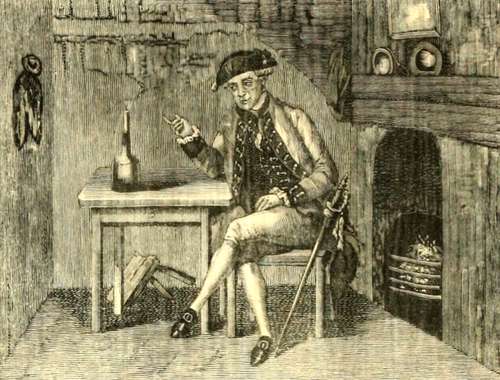
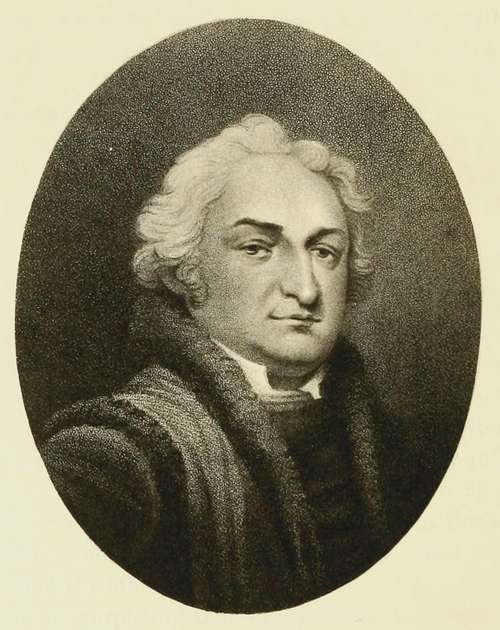
MR. KING IN "RULE A WIFE."
THE AUDIENCES OF THE LAST HALF OF THE EIGHTEENTH CENTURY.
In the first half of the above century, if a quiet man
in the pit ventured on making a remark to his neighbour,
who happened to be a "nose-puller," and who
disagreed with the remark, the speaker's nose was
sure to be painfully wrung by the "puller." In the
same period, those very nose-pullers sat quietly,
merely grimacing, when the great people in the boxes
found it convenient to spit into the pit! But, sometimes
the house, pit and all, was full of great people.
Thus, on the night of the 7th March 1751, Drury
presented a strange appearance. The theatre had
been hired by some noble amateurs, who acted the
tragedy of "Othello," thus cast in the principal
characters. Othello, Sir Francis Delaval; Iago, by
John, subsequently (1786) Lord Delaval; Cassio, E.
Delaval; Roderigo, Captain Stephens; Desdemona,
Mrs. Quon (sister of Sir Francis, and later, the wife of
Lord Mexborough); Emilia, Mrs. Stephens. Macklin
superintended the rehearsals, and Walpole was present;
for he says of the amateurs, in his characteristic
way: "They really acted so well, that it is astonishing
they should not have had sense enough not to act
at all!... The chief were a family of Delavals,
the eldest of which was married by one Foote, a
player, to Lady Nassau Poulett, who had kept the
latter. The rage was so great to see this performance,
that the House of Commons literally adjourned
at three o'clock on purpose. The footman's gallery
was strung with blue ribands. What a wise people!
what an august senate! Yet my Lord Granville once
told the prince, I forget on occasion of what folly:
'Sir, indeed your royal highness is in the wrong to
act thus; the English are a grave nation.'"
The prince, and other members of the royal family,
were present in the stage-box on this occasion; and
the presence of blue ribands, in place of livery tags,
in the footman's gallery, was owing to the circumstance
that tickets were issued numerously enough to
completely fill the house, but without indicating to
what part of the house the bearers would be admitted.
The first who arrived took the best places; and tardy
peers, knights of the garter, their wives and ladies,
were content to occupy the gallery, for once, rather
than have no places at all. Such an audience was
never seen there before, and has never been seen
there since.
At this time swords were still worn, and evil
results followed, to others, as well as to the wearers.
On the night of Saturday, September 21, 1751, as
the "Way of the World" was being played at
Drury, a quarrel, and then a fight with swords took
place, between two gallants in the box-lobby. From
some cries which arose, the audience thought the
house was on fire, and fearful confusion, with fierce
struggling, and terrible injury ensued. Many women
attempted in their terror to drop from the gallery to
the pit. This was not so frightful as it might at
present seem, for in those days the front of the lower
gallery came down to the roof of the lower boxes.
The occupants were a recognised power in the house,
often appealed to, and were of very great intelligence
and respectability, in one especially favourite
locality, the Old Haymarket, as long as the house
lasted. Professional men, and poets, and merchants
and their wives, sat there to see, hear, and enjoy,
whose grand-daughters now sail into stalls, unconscious
that there is a gallery in the house, and ignorant
that they are of a race who once condescended
to sit in it.
In those days royalty's presence formed a great
attraction at the theatre; and royalty enjoyed a
"row" as heartily as the most riotous there.
When Garrick, in 1754, found that he could not
fill Drury Lane,—notwithstanding the ability of his
company of actors, unless he played himself, and
that his own strength was not equal to the task of
playing without intermission,—he brought forward a
magnificent ballet-pantomime, called the "Chinese
Festival." It was composed by Noverre,—who had
treated of his art, dancing, as a branch of philosophy!
As many competent English dancers as
could be found, were engaged; and there was a
supplementary, but prominent and able body of
foreign dancers. Little would have been thought
of this but for the circumstance, that when the gorgeous
show was set before the public, in the autumn
of 1754,[4] war had recently broken out between England
and France. Thereupon, John Bull was aroused
in a double sense,—his patriotism would not allow
of his tolerating the enemy on the English stage;
and his sense of religious propriety, not otherwise
very remarkable at that time, was shocked at the
idea of his condescending to be amused by Papists.
His offended sense was further irritated by the circumstance,
that George II., by his presence, on the
first night, seemed to sanction favouritism of the
enemy and the hostile church. Aggravated by that
presence, which they did not at all respect, the pit
heaved into a perfect storm, which raged the more
as the old King sat and enjoyed,—nay, laughing at
the tempest! The Brunswick dynasty was included
within the aim of the hisses and execrations which
prevailed. Had Garrick followed Lacy's counsel,
he would have withdrawn the piece; but Davy was
reluctant to lose his outlay, striving to save which,
he lost hundreds more. As the "spectacle" was
repeated, so was the insurrection against it; but the
"quality" interfering,—as they deemed it the ton
to uphold what great Brunswick approved,—a new
element of bitterness was superadded. The boxes
pronounced pit and galleries "vulgar;" and those
powers waged war the more intensely, because of the
arrogance of the boxes, whose occupants were assailed
with epithets as unsavoury as any flung at the dancers.
Then ensued strange scenes and encounters. Gentlemen
in the boxes drew their swords, leaped down into
the pit, pricked about them in behalf of "gentility,"
and got terribly mauled for their pains. The galleries
looked on, shouting approbation, and indiscriminately
pelting both parties. Not so the fair,
who occupied the boxes. They, on seeing the champions
of propriety and of themselves, being menaced
or overpowered in the pit, pointed the offenders out
to the less eager beaux who tarried in their vicinity,
and who, for their very honour's sake, felt themselves
compelled to out with their bodkins, drop into the
surging pit, and lay about them, stoutly or faintly,
according to their constitutions. The stronger arms
of the plebeians carried the day; and when these
had smitten their aristocratic opponents, they celebrated
their victory with the accustomed Vandalism.
They broke up benches, tore down hangings, smashed
mirrors, crashed the harpsichords (always the first of
the victims in the orchestra); and finally, charging
on to the stage, cut and slashed the scenery in all
directions. Some evidence of the improved civilisation
of the audiences of this half of the century is
afforded by the circumstance that no one suggested
that the house should be set on fire. But, the pious
and patriotic rioters rushed out to Mr. Garrick's
house, in Southampton Street (now Eastey's hotel),
and broke every window they could reach with missile,
from basement to garret. The hired soldiery
could not protect him; nor on their bayonets could
he prop up the "Chinese Festival," wooden shoes
and popery. This affair cost him a sum of money,
the loss of which made his heart ache for many a
day.
On our side of the Channel, royal personages have
been more amusingly rude than the inferior folk. A
good instance of this presents itself to my memory,
in the person of the young King of Denmark, who
married the sister of George III., and who frequently
visited the theatres in London, in 1768. At the play
of the "Provoked Husband," it was observed that he
applauded every passage in which matrimony was
derided; which was commented on as an uncivil
proceeding, as his wife was an English princess.
This wayward lad offended audience and actors
on another occasion, in quite a different way. In
October, he commanded the edifying tragedy of
"Jane Shore," during the performance of which he
fell fast asleep, and remained so to the amusement
of the audience and the annoyance of Mrs. Bellamy,
who played Alicia. That haughty and hapless
beauty was not likely to let the wearied King sleep
on; and accordingly, having to pronounce the words,
"O thou false lord!" she approached the royal box,
and uttered them expressly in such a piercing tone,
that the King awoke in sudden amazement, but with
perception enough to enable him to protest that he
would not be married to a woman with such a voice
though she had the whole world for a dowry. Two
nights later[5] he went to see "Zara," Garrick being
the Lusignan; and it is to his credit that he sat
through that soporific sadness without winking.
The greatest excitement prevailed among the audience
when the King went to see Garrick act Ranger,
in the "Suspicious Husband." The pit was so crowded
and so hot, that every man (and there were few or no
women there) took off his coat and sat in his shirt
or waistcoat sleeves, in presence of the King. The
various hues formed a queer sight; but many of the
men fainted. At the thunder of the cheers which
greeted his coming, Denmark looked frightened, but
bowed repeatedly; and when at Garrick's appearance,
the roar of applause was renewed, his majesty appropriated
it to himself, and again bowed to all sides of
the house, while Ranger waited to congratulate himself
on "having got safe to the Temple."
There was little indecorum in Mrs. Bellamy's act
of rousing the sleepy King of Denmark with a scream,
but greater, and what would now seem gross and unpardonable
liberties, were taken by the actors, with
their patron George III. For instance, in the "Siege
of Calais," there is a scene between two carpenters
who erect the scaffold for the execution of the patriots.
Parsons played chief carpenter, in which character it
was put down for him to say, "So, the King is coming!
an the King like not my scaffold, I am no true man."
George III. and family were present, one night, at
the Haymarket, when this piece was played by command,
and Parsons gave this unseemly turn to the
set phrase. Advancing close to the royal box, he
exclaimed: "An the King were here and did not
admire my scaffold, I would say, D—n him! he has
no taste!" At this sally the King laughed louder
and longer than even the hilarious audience!
Sir Robert Walpole was readier to take offence than
King George. He could smile at the inuendoes of
the "Beggar's Opera;" but when he was deeply interested
in the success of his Excise Bill, and an actor
sneeringly alluded to it, in his presence, the minister
went behind the scenes, and asked if the words uttered
were in the part. It was confessed that they were
not; and thereupon Sir Robert raised his cane, and
gave the offending player a sound thrashing.
In Parsons' case, monarch and audience alike,
knew that no offence was intended, in detection of
which loyalty rendered the audience over acute; as
in the case when Jack Bannister got into disgrace
with the house. "God Save the King" was being
sung, and Jack, dressed for Lenitive in the "Prize,"
stood among an undistinguished group of choristers
at the back of the stage. Gentlemen in the boxes
called upon him vociferously to come into the front
rank, and sing so as to be heard. There was great
disapprobation, in which the press joined, and poor
Jack, as loyal a Briton as any in those days, had to
explain, that being dressed in an extravagant costume,
he had kept in the background, out of respect, as
his caricatured garb seemed to him to be out of keeping
with the words of the national anthem, which,
to his thinking, were as something sacred.
Indeed, the loyalty of the actors to "King and
Country" could not be doubted. When the Emperor
of the French was collecting a host for the invasion
of this country, the actors were among the first to
enrol themselves as volunteers; and it was not an
unusual thing to find the theatre closed, on account
of the unavoidable absence of the principal performers,
summoned to drill, or other military service
then rigidly enforced.
On the other hand, there were what was then
called disloyal factions among the audiences, and
these drove "Venice Preserved" from the stage for
a time by the furious applause which they gave to
passages in favour of Liberty, and which applause
was supposed to indicate hostility to the British
Constitution!
Yet many of these factious people, who did not
dislike the King because they loved liberty, were
delighted to mark the unrestrained enjoyment of
the royal family at the theatre. If George III.
roared at the oft-repeated tricks of the clown, little
Queen Charlotte shook with silent laughter at the
intelligible action of the great comic performers.
Once, when Foote, caricaturing an over-dressed
lady, with a head-tire a yard in height, and nearly
that in breadth, accidentally let fall the whole
scaffolding of finery, and stood bare-polled upon the
stage, the Queen's laughter was then audible through
the house. Perhaps it was all the higher as she
herself wore a modest and becoming adornment for
the head. Indeed, she was proud only of her
beautiful arms, and these the plain-featured lady
contrived to display to the lieges assembled, with a
dexterity worthy of the most finished coquette.
There was great homeliness, so to speak, in this
intercourse between royal and lay folk, in those
days, and much familiarity. The young Princes
were often behind the scenes. On one of these
occasions, the "sailor-prince," the Duke of Clarence,
saw Bannister approach, dressed for Ben, in "Love
for Love." The actor wore a coloured kerchief
round his neck. "That will never do for a man-of-war's
man," said the Prince; who, forthwith, ordered
a black kerchief to be sent for, which, putting round
the pseudo-sailor's neck, he tied the ends into the
nautical slip-knot, and pronounced the thing complete.
The royal patronage and presence did not always
give rise to hilarity. Tragedy sometimes attended
it. I can remember nothing more painful in its way
than a scene, at the Haymarket, on the third of
February 1794. The King and Queen had commanded
three pieces, by Prince Hoare—"My Grandmother,"
"No Song, No Supper," and the "Prize."
Fifteen lives were lost that night in the precipitate
plunge down the old pit-stairs, as the little green
doors were opened to the loyal and eager crowd.
Whether those who rushed over the fallen bodies
were conscious of the extent of the catastrophe, cannot
be determined; but the royal family were kept
in ignorance of it, from their arrival till the moment
they were about to depart. While they had been
laughing to the utmost, many a tear had been flowing
for the dead, many a groan uttered by the
wounded who had struggled so frightfully to share
in the joyousness of that evening, and the King's
own two heralds, York and Somerset, were lying
crushed to death among the slain.
On another occasion, tragic enough in the character
of a chief incident, the conduct of the simple-minded
King rose to the dignity of heroism. I allude to
the night of the 11th of May[6] 1800, at Drury Lane,
when George III. had commanded Cibber's comedy,
"She Would and She Would Not." He had preceded
the other members of the royal family, and was standing
alone at the front of the box, when Hatfield fired
a pistol at him from below. The excitement, the
dragging of the assassin over the orchestra, the shouts
of the audience, the fear that other would-be regicides
might be there, moved everybody but the King, who
calmly kept his position, and, as usual, looked round
the house through his monocular opera-glass. The
Marquis of Salisbury, very much disconcerted and
alarmed, if not for himself, at least for the King,
urged the latter to withdraw. "Sir," said George
III., "you discompose me as well as yourself; I shall
not stir one step." He was a right brave man in this
act and observation; and while the comedy was got
through confusedly, the avenues to the stage crowded
by people eager to see the assailant, the audience
breaking spasmodically into cries in behalf of the
King, and the Queen and Princesses in tears throughout
the evening, George III. alone was calm, cheerful,
self-possessed, and bravely undemonstrative.
Before we leave these august personages, let us
take one glance at them, as they sit among the
audience, "in State."[7]
When their Majesties, with the Prince of Wales,
the Princess Royal, and the Princess Augusta, went
thus, in state, on October 8, 1783, to see Mrs. Siddons
play Isabella, there was much quaint grandeur employed
to do them honour. The sovereign and his
wife sat under a dome covered with crimson velvet
and gold; the heir to the throne sat under another
of blue velvet and silver; and the young ladies under
a third of blue satin and silver fringe. My readers
may desire to know how royalty was attired when it
went to the play in state some fourscore years ago.
There was some singularity about it. George III.
wore "a plain suit of Quaker-coloured clothes with
gold buttons. The Queen a white satin robe, with
a head-dress which was ornamented by a great
number of diamonds. The Princess Royal was
dressed in a white and blue figured silk, and Princess
Augusta in a rose-coloured and white silk of
the same pattern as her sister's, having both their
head-dresses richly ornamented with diamonds. His
Royal Highness the Prince of Wales had a suit of
dark blue Geneva velvet, richly trimmed with gold
lace." The handsome young fellow, as he was then,
must have looked superbly, and in strong contrast
with his sire,—King in Quaker-coloured suit, and
Prince in blue Genoa velvet.
George III. was not always lucky in his Thursday-night
commands, and people laughed, when, after
the solemn funeral of his uncle, the Duke of Cumberland,
he ordered "Much Ado about Nothing" to
be played in his presence. For Shakspeare he had
less regard than his father. Prince Frederick once
suggested that the whole of Shakspeare's plays should
be represented, under his patronage—at the rate of
a play a week, but difficulties supervened, and the
suggestion made no progress.
Let us turn from these royal to less noble folk.
We find, on a July night of 1761, Mr. Walpole at
Drury Lane, to witness the performance of Bentley's
"Wishes." He has left a pleasant sketch of the
audience-side of the house, whither he went "actually
feeling for Mr. Bentley, and full of the emotions he
must be suffering." But—"what do you think in a
house crowded was the first thing I saw? Mr. and
Madame Bentley perched up in the front boxes, and
acting audience at his own play! No, all the impudences
of false patriotism never came up to it! Did
one ever hear of an author who had courage to see
his own first night in public! I don't believe Fielding
or Foote himself ever did. And this was the modest,
bashful Mr. Bentley, that died at the thought of being
known for an author, even by his own acquaintance.
In the stage-box was Lady Bute, Lord Halifax, and
Lord Melcombe. I must say the two last entertained
the audience as much as the play. Lord Halifax was
prompter, and called out to the actor every minute
to speak louder. The other went backwards and
forwards behind the scenes, fetched the actors into
the box, and was busier than Harlequin. The curious
prologue was not spoken, the whole very ill acted.
It turned out just what I remembered it; the good
parts extremely good, the rest very flat and vulgar;
the genteel dialogue, I believe, might be written by
Mrs. Hannah. The audience were extremely fair;
the first act they bore with patience, though it promised
very ill; the second is admirable, and was
much applauded; so was the third; the fourth woeful;
the beginning of the fifth it seemed expiring,
but was revived by a delightful burlesque of the
ancient chorus, which was followed by two dismal
scenes, at which people yawned, but were awakened
on a sudden, by Harlequin's being drawn up to a
gibbet, nobody knew why or wherefore,[8]—at last
they were suffered to finish the play, but nobody
attended to the conclusion. Modesty and his lady
sat all the while with the utmost indifference. I
suppose Lord Melcombe had fallen asleep before
they came to this scene." The piece was condemned,
and the author was the first to recognise
the fitness of such a fate. His nephew, Cumberland,
sat on one side of him, and when Harlequin
was hanged in the sight of the audience, as the fulfilment
of the last of the "Three Wishes," Bentley
whispered into his complacent kinsman's ear: "If
they don't damn this, they deserve to be damned
themselves!" The piece lingered for a few nights,
and an unsuccessful attempt was made to revive it
in 1782. So ended the (not first) experiment of
introducing a witty-speaking Harlequin, in place of
the dumb hero of pantomime.
At the period when this play was first acted, Garrick
and his fellows laboured under a serious disadvantage,
when attempting to give full effect to
stage illusions,—I allude to the crowding of the
stage by a privileged part of the public. In spite
of this, Garrick could render perfect and seemingly
real, on the same evening, the frantic sorrows of old
Lear, and the youthful joyousness of Master Johnny,
in the "School Boy." In Dublin, there was often
more annoyance than what resulted from mere
crowding. Garrick was once playing Lear there, to
the Cordelia of Mrs. Woffington, when one Irish
gentleman, who was present, actually advanced, put
his arm round Cordelia's waist, and thus held her,
while she answered with loving words to her father's
reproaches. Our sparks never went so far as this, in
face of the public, but their intrusion annoyed the
great actor. Such annoyance was not felt by his
colleagues, and when Garrick resolved once and for
ever, in 1762, to keep the public from the stage,
there was an outcry on the part of the players, who
declared that on benefit nights, when seats and boxes,
at advanced prices, were erected on the stage, they
should lose the most munificent of their patrons, if
these were prohibited from coming behind the curtain.
A compromise followed, and Garrick agreed
to compensate for driving a part of the audience from
the stage, by enlarging the house, and thus affording
more room, and the old advantages on benefit nights.
Thus, one evil was followed by another, for the larger
houses were less favourable to the actor and less profitable
to managers,—but stage spectacle became more
splendid and effective than ever.
At this time amateur-acting was a fashionable pastime,
and it had princely countenance. The Blake
Delavals led the taste in this respect at their neat
little theatre in Downing Street. The Duke of York,
who had distinguished himself early at the Leicester
House theatricals, which Quin, I believe, superintended,
was a very efficient actor, and he especially
merited praise for the grace and spirit with which he
played Lothario to the Calista of Lady Stanhope, a
Delaval by birth. Admission to these performances
was not easily obtained. Walpole did not lack
curiosity, but he would not solicit for a ticket, lest
he should be refused. "I did not choose," he says,
in his comic-jesuitical way, "to have such a silly
matter to take ill!"
English and French audiences essentially differed
in one pleasant feature, at this time. In France it
was not the custom for young unmarried ladies to
appear at the great theatres, especially the Opera.
As soon as they were married they appeared at the
latter in full bridal array, and the plaudits of the
house indicated to them the measure of their success.
With us, it was otherwise. Ladies, before marriage,
appeared at the Opera more frequently than at
church; and with much the same feelings, regarding
both. "I remember," says Lady M. W. Montague,
writing to her daughter, Lady Bute, "to have dressed
for St. James's Chapel with the same thoughts your
daughters will have at the Opera."
At the latter house, one of the most conspicuous
young ladies of her day was Miss Chudleigh, afterwards
Duchess of Kingston. She was constantly
challenging the attention of the house. On one occasion,
when a chorus-singer happened to fall on his
face in a fit, Miss Chudleigh drew more notice than
sympathy to herself, by pretending to fall into
hysterics, and accompanying the pretence with a
succession of shrieks and wild laughter. Walpole
characteristically ridicules this affectation: "As if
she had never seen a man fall on his face before!"
But ordinary confusion was as nothing, compared
with that made on benefit nights, when audiences
stood, or were seated in a "building on the stage."
When Quin returned to play Falstaff for Ryan's
benefit, the impatience of the house was great to
behold their old favourite; but he was several
minutes forcing his way to the front, through the
dense crowd which impeded his path. As for Mrs.
Cibber, Wilkinson had seen her as Juliet, lying on an
old couch, in the tomb of the Capulets, all solitary,
with a couple of hundred of the audience surrounding
her. This occurred only on benefit nights, but
even Garrick was unable to abolish it altogether.
It was really high time for this reformation, seeing
that on one occasion, when Holland was acting
Hamlet, for his benefit, and all Chiswick (his father's
bakery still exists close to the churchyard) was there to
support their fellow-villager, a young girl, seeing him
drop his hat, the three-cornered cock, which Hamlet
still wore, she ran, picked it up, and clapped it on
his head, wrong side before, in such a way that gave
the Dane a look of tipsiness; but see the respect of
audiences for Shakspeare; they refrained from laughing,
till Hamlet and the Ghost were off the stage,
and then gave way to peal on peal of unextinguishable
hilarity.
The author of a "Letter to Mr. Garrick," whom
the writer treats with very scant courtesy, remarks,
in contrasting the French and English audiences of
his time, that it was then usual in France, for the
audience of a new and well-approved tragedy, to
summon the author before them, that he might personally
receive the tribute of public approbation due
to his talents. "Nothing like this," he says, "ever
happened in England!" "And I may say, never
will!" is the comment of the author of a rejoinder
to the above letter, who adds:—"I know not how
far a French audience may carry their complaisance,
but were I in the author's case, I should be unwilling
to trust to the civility of an English pit or gallery.
We know it is the privilege of an English audience
to indulge in a riot, upon any pretence. Benches
have been torn up, and even swords drawn, upon
slighter occasions than the damning of a play. Suppose,
therefore, upon your principle, that every play
that is offered should be received, and suppose that
some one of them should happen to be damned,
might not an English audience, on this occasion,
call for the author, not to partake of their applause,
indeed, but to receive the tokens of their displeasure.
Maugre the good opinion which I have received of
my own talents, I would not run the hazard of having
my play acted upon these terms; for I think it less
tremendous and much safer to bear at distance the
groans and cat-calls of ill-disposed critics, than to
stand the brunt against half-eaten apples and sour
oranges from the two galleries." These calls, however,
are now common enough; but the French
were before us in adopting the fashion.
Truculent as were the fine gentlemen in our theatres,
in the days when swords were worn, they were
less pugnacious than Irish audiences in their wrath.
Mossop found this, when he was manager at Cork,
in 1769. On one night of the season the house was
unusually thin, but especially in the pit, where sat
one little Major, determined to see all, though he sat
alone. Mossop, unwilling to play at a loss, and to
save his having to pay the actors whose salaries were
regulated by the number of days on which they performed,
came forward, announced that there would
be no play, and intimated that all the admission
money would be returned. The little Major insisted
that the play should proceed. Mossop remonstrated,
but kept to his purpose. The Major drew his sword
and continued to insist. Mossop gently put his hand
to his and declined to act. In a couple of leaps the
Major was on the stage, where the soldier and the
player's swords were speedily crossed, and the two
men fighting as fiercely as for some dear and noble
purpose in peril. The actors and the audience seem
to have enjoyed the spectacle; at least no attempt
was made to part the combatants till the Major had
run his sword through the fleshy part of Mossop's
thigh, and Mossop had more slightly wounded the
Major in the arm. Both sides claimed a victory;
for the manager, unable to act, closed the theatre;
and the soldier, too much hurt to be immediately removed,
remained in the house, as he had declared
his intention to do.
Since that period the manners of most Irish audiences
have unfortunately improved, because the old
fun and humour have departed with the exercise of
the old license. Not that the old license was not
frequently of a somewhat uncivilised nature, as
when the Irish footmen in attendance upon masters
and mistresses within, being angered by the withdrawal
of some privilege, flung their lighted torches
into the house, and nearly succeeded in burning
both theatre and audience. Sometimes the license
had an aspect of rough gallantry. When an actress
was more than ordinarily pretty, it was the custom
of ardent officers and gentlemen to insist upon
escorting the lady home after the play. An incident
of this sort once put John Kemble's life in peril.
The father of Miss Phillips (afterwards Mrs. Crouch)
being, through illness, unable to attend his daughter,
procured for her the guardianship of Kemble, who
was but too happy to afford it. After the play Miss
Phillips's dressing-room door was beset by a crowd
of adorers, sword in hand, and hearts burning beneath
their waistcoats, sworn to see her home, whether she
would or no. The lady was too alarmed to leave her
room; but her deputed and faithful Squire urged her
to do so, and as she appeared, he gave her his arm,
announced the commission he held from the young
lady's father, and he declared that he would resent
any affront offered to her or to him. Therewith he
moved forwards, with his charge under determined
escort, and the riotous champions gave way, in
good-natured admiration of his resolute courage. It
was the more resolute, as the gentleman is said to
have then entertained a tender regard for the lady;
though, as with that for Mrs. Inchbald, it was all
in vain.
Mr. Maguire, Mayor of Cork, and M.P. for Dungarvan,
has recently stigmatised the Cork theatre as
being a locality which has preserved all the ferocity,
and lost all the accompanying fun of the olden time.
But even a Cork audience, in the last century, could
be shocked. The Rev. C. B. Gibson, in his History
of the County and City of Cork, tells us of a tailor
there who was hanged for robbery, but who was
restored to life by an actor named Glover, who probably
was in his debt, and dreaded the summary
demands of executors. The process of restoration
was long and difficult; after it had been accomplished,
the tailor arose, went forth, and got drunk,
in which state he went to the theatre in the evening,
told his story, exhibited the mark of the rope, and
tendered very tipsy acknowledgments to the actor
for the service rendered. The audience did not at
all relish this part of the evening's entertainment.
At present the Cork gallery seems to be as vulgar
and witless as that of the Sheldonian Theatre at Oxford,
when filled with undergraduates. The liberty
of English audiences has never been dealt with so
harshly as that of audiences in continental theatres.
In 1772, a theatrical riot took place in the Copenhagen
Theatre. In a burlesque piece, a critic, who
had dealt severely with the author, was quite as
severely satirised, and a fierce tumult ensued. To
prevent its recurrence, hissing and all equivalent
marks of disapprobation were magisterially prohibited.
This prohibition was long in force, and it is
still maintained in continental theatres, when crowned
heads are present. On these occasions the audience
neither applaud nor hiss, but leave all demonstrations
of approval or censure to the illustrious visitors, as
if they alone were endowed, for the nonce, with
critical acumen.
Charles Fox wound up the idler part of his early
life by joining in private theatricals. Before he
seriously commenced his career as a public man, in
1774, he played Horatio, in the "Fair Penitent," to
the Lothario of his lively friend, Fitzpatrick, at Winterslow
House near Salisbury, the seat of the Hon.
Stephen Fox. In the after-piece, "High Life Below
Stairs," Fox played Sir Harry's Servant with immense
spirit; and after the curtain fell the house
was burnt to the ground.
On the 10th of January, two days later, the Duke
of Gloucester and his Duchess, formerly Lady Waldegrave,
were at Covent Garden, "for the first time,
in ceremony." The Duchess was confounded with
the excessive applause; turned pale, coloured, and
won by her modesty, confusion, and beauty the acclamations
which the audience were willing to spare
her, on account of the apparent condition of her
health. The marriage of this pair had offended the
King. The piece selected by them was "Jane
Shore," as illustrative, perhaps, of the evils of dishonourable
connections between princes and ladies
of lower degree. Two nights after this visit of ceremony,
the King and Queen went in state to Drury
Lane, and saw the "School for Wives." It is only
to be wondered at that numerous applicable passages
in both plays were not noticed by the applause or
murmurs of the audience.
Walpole gives a pretty picture of the audience
side of Drury Lane, on the 25th of May 1780, on
which night Lady Craven's comedy, the "Miniature
Picture," which had been once privately played at
her own house, was acted for the first time in public.
"The chief singularity was that she went to it herself
the second night 'in form,' sat in the middle of
the front row of the stage-box, much dressed, with a
profusion of white bugles and plumes, to receive the
public homage due to her sex and loveliness. The
Duchess of Richmond, Lady Harcourt, Lady Edgecumbe,
Lady Aylesbury, Mrs. Damer, Lord Craven,
General Conway, Colonel O'Hara, Mr. Lennox, and
I were with her. It was amazing to see a young
woman entirely possess herself; but there is such an
integrity and frankness in the consciousness of her
own beauty and talents, that she speaks of them with
a naïveté, as if she had no property in them, but only
wore them as the gift of the gods. Lord Craven,
on the contrary, was quite agitated by his fondness
for her, and with impatience at the bad performance
of the actors, which was wretched indeed; yet the
address of the plot, which is the chief merit of the
piece, and some lively pencilling, carried it off very
well, though Parsons murdered the Scotch Lord
(Macgrinnon), and Mrs. Robinson, who is supposed
to be the favourite of the Prince of Wales, thought
on nothing but her own charms, or him. There was
a very good, though endless, prologue, written by
Sheridan, and spoken in perfection by King, which
was encored (an entire novelty) the first night; and
an epilogue that I liked still better, and which was
full as well delivered by Mrs. Abington, written by
Mr. Jekyll."
The prologue was called for a second time, at the
conclusion of the play, which was acted after the
"Winter's Tale." King had long before left the
house, but though it was past midnight, the audience
waited till he was sent for from his own residence,
whence he returned to speak the address!
"The audience," adds Walpole, "though very civil,
missed a very fair opportunity of being gallant; for
in one of those logues, I forget which, the noble
authoress was mentioned, and they did not applaud
as they ought to have done exceedingly, when she
condescended to avow her pretty child, and was there
looking so very pretty. I could not help thinking to
myself, how many deaths Lady Harcourt would have
suffered rather than encounter such an exhibition;
yet Lady Craven's tranquillity had nothing displeasing—it
was only the ease that conscious pre-eminence
bestows on sovereigns, whether their empire consists
in power or beauty. It was the ascendant of Millamant,
of Lady Betty Modish, and Indamore; and it
was tempered by her infinite good nature, which
made her make excuses for the actors, instead of
being provoked at them."
Nineteen years later, Lady Craven, then Margravine
of Anspach, "having with unprecedented kindness
and liberality lent Mr. Fawcett the manuscript of her
magnificent and interesting opera, the 'Princess of
Georgia,'" that actor announced it for his benefit,
April 19th, 1799, with an assurance that "nothing
should be wanting on his part to render it as acceptable
to the public as it was to the nobility who had
the pleasure of seeing it at Brandenburgh House
Theatre." On this occasion, however, the house was
not so splendidly attended as when the "Miniature
Picture" was represented, and in spite of the melody
of Incledon, the grimaces of Munden, the humour of
Fawcett, the grace of Henry Johnston, and the energy
of his wife, the "Princess of Georgia" was heard of
no more.
There is one circumstance which made a striking
difference between the aspects of the French and English
pit. One of the popular grievances which the
French Revolution did not redress, was the appearance
of an armed guard, with fixed bayonets, within the
theatre. When the curtain rises, the menacing figures
withdraw a little; but they are at hand. In the last
century they remained throughout the performance,
and they kept the pit in a purely passive condition,
whatever might be its displeasure, disgust, or discomfort.
Under the gleam of the bayonet, a spectator no
more dared to laugh too loudly at a comedy, than to
sob too demonstratively at a tragedy. But Gaul and
Frank were not always to be restrained, and they
would hiss heartily at times. Ah "Il est bien des
sifflets mais nous avons la garde!" A too prominent
dissentient was sure to be seized by the sentinel,
who escorted him to the captain of the guard, who
judged him militarily, and, after procuring the signature
of the commissary of police, a pure matter of
form, sent the offender, for the night, to prison.
With this restraint, it is not wonderful that the
French audiences were coerced into brutality, and
that they readily took offence, were it only to show
their manhood. With us it was different. The whole
house laughed aloud, or smiled contemptuously at
sarcasms fired at them from prologue or epilogue, or
by implication in the play. It is singular, too, that
so late as 1782, though French audiences would
express an opinion, the actors themselves cared little
for its being unfavourable, and careless players grew
accustomed to be hissed, without being the more
careful for it. To remedy this, Mercier proposed
the appointment of a writer who should watch the
theatres and register the insults inflicted on the
public by incompetent or indifferent actors, and by
incapable poets. It was a proposition, in fact, for
the establishment of a theatrical critic, whose judgments
were to be recorded in the journals. There
was public criticism of all other arts, but up to this
time the art of acting was exempt from the censure
of the French journals. So, at least, says Mercier,
who seems, however, to have forgotten that when
the Abbé Raynal conducted the Mercure some thirty
years previously, the merits of actors were occasionally
discussed.
French sentinels grew careless, or French individuals
waxed bolder. Our own gallery was once
famous for the presence of a trunkmaker, whose loud
applause or shrill censure used to settle the destiny
of authors. The house followed, according as the
trunkmaker howled or hammered. I know nothing
in French audiences to compare with this, except the
notorious Swiss in the days of towering feathers and
broad headdresses—a double fashion, which he succeeded
in suppressing. When seated in the back
row of a box, unable to see the stage for the fashionable
impediments in front, it was his custom to produce
a pair of shears and cut away all the obstructions
between him and the delights for which he had
paid, but could not enjoy. It was probably only a
demonstration of destruction which he made, but the
result was effectual. At first the ladies made way
for him to come to the front; but ultimately they
took down their feathers, and narrowed their head-gear,
and the Swiss, shorn of his grievance, was soon
forgotten.
This intruder must have often marred the efforts
of the best actor; but I remember a case in which
the best actor of his day was entirely discountenanced
by the quietest and most attentive auditor in
the house. John Kemble was playing Mark Antony,
in Dublin, when his eye happened to fall on a sedate
old gentleman, who was eagerly listening to him
through an ear-trumpet. The first sight caused the
actor to smile, and that at an inappropriate moment,
for he was surrounded by his wife Octavia (Mrs.
Inchbald) and her children, the play being Dryden's
"All for Love," and the situation affecting. The
more John Kemble endeavoured to suppress his inclination
to smile, the less he was able to control
himself; as his agitation increased, the ear-trumpet
was directed towards him more pertinaciously;
seeing which the actor broke forth into a peal of
laughter, and rushed in confusion from the stage.
The audience had discovered the cause, and laughed
with him; while the deaf gentleman, unconscious of
his own part in the performance, and marking the
hilarious faces around him, dropped his trumpet with
the vexed air of a man who had lost a point, and
could not account for it.
Then, if there were infirm, so were there sentimental,
auditors. In the Morning Post, of September
27, 1776, we are told that:—"A gentleman, said to
be a captain in the army, was so very much agitated
on Miss Brown's appearance on Wednesday night,
that it was imagined it would be necessary to convey
him out of the house; but a sudden burst of
tears relieved him, and he sat out the farce with
tolerable calmness and composure. The gentleman
is said to have entertained a passion for that lady
last winter, and meant to have asked her hand as a
man of honour, but—!" There were other curiosities
in front, besides this sentimental captain. The
famous Lady Hamilton drew large audiences to
Drury Lane towards the close of the century, when
it was announced that the performance would be
honoured by the attendance of herself and her husband,
Sir William, our minister to the Neapolitan
court. The house gazed upon the beauty, and the
beauty was deeply interested in the acting of Mrs.
Powell, who, in her turn, was as deeply interested
in my lady. Between the two women a connection
existed which was little suspected by the audience.
The ambassador's wife and the tragedy queen had
first met under very different circumstances, in the
house of Dr. Budd, in Blackfriars, where Jane
Powell filled the office of housemaid, and Emma
Harte, as she was then called, was employed as
under maid in the nursery.
At this period I do not know that our galleries at
least were more civilised than they were in earlier
days—that is, our provincial galleries: that of Liverpool,
for instance—as the obese, little low comedian,
Hollingsworth, once experienced. He was looking
at the house through the aperture in the curtain,
when the twinkle of his eye being detected by a
ruffian aloft, the latter, running a penknife through
an apple, hurled it, perhaps at random, but so fatally
true, that the point of the knife struck the unoffending
actor so close to the eye that for some time his
sight was despaired of. The gallery patrons of the
drama in London were as rude, but less cruel, in
their ruffianism. An orange, flung at a lady in
court dress, seems to have been a favourite missile
for a favourite pastime. I meet with one of these
ruffians in presence of a magistrate, who solemnly
assures him, that if he is ever guilty of a similar outrage,
he will be taken on to the stage and compelled to
ask pardon of the house—an honour at which the fellow
would, probably, have been exceedingly gratified.
We have a sample of the coolness of an Irish debutant
and the patience of an audience of the last
century; the first, in the person of Dexter, whom
Garrick, on the secession of Barry from his company,
brought over, with Ross and Mossop, from Dublin.
Dexter, on the night of his first appearance, in
"Oroonoko", was comfortably seated in the pit, where
he remained chatting with his friends and supporters
until the "second music" commenced. This music,
in the old days, was ordinarily played half an hour
before the curtain rose. This was a long period for
an audience to be kept further waiting; but it was
a short period wherein a tragedian might prepare
and deck himself for a sort of solemn ordeal. The
début proved successful; and Garrick generously
expressed great admiration and hopefulness of the
young actor, who, nevertheless, soon fell out of estimation
of the audience, as might have been expected,
from the cool and careless proceeding of his first
night, when he walked out of a crowded pit to
hastily dress himself for an arduous part.
This was a sort of liberty which a French pit would
not have tolerated. It bore, however, with other
freedoms. When it laughed, as the children were
brought in, in "Inez de Castro," Madame Duclos,
who was the weeping Inez, turned suddenly round,
and exclaimed, "Fools! it is the most touching part
of the piece!" and then resumed weeping. Again:
Du Fresne, acting Sévère, in "Polyeucte," speaking
low as he was confiding a perilous secret to a friend,
was interrupted by cries of "Louder! louder!"
"And you, sirs, not so loud!" cried the calmly-angry
actor, to a pit which took the rebuke meekly;—as
meekly as our public took the verdict of Foote,
who says, in his Treatise on the Passions,—"There
are twelve thousand playgoers in London; but not
the four and twentieth part of them can judge correctly
of the merits of plays or players."
Then, considering the measure of respect which
actors used to profess that they entertained for audiences,
the liberties which the former occasionally
took with the latter was remarkable. When Mrs.
Griffiths's "Wife in the Right" was coldly received,
she laid the blame on Shuter (Governor Andrews), who
had neglected to attend rehearsal. On a succeeding
night, accordingly, the audience hissed Shuter as soon
as he appeared. He defended himself by asserting
that illness had kept him from rehearsal; "but,
gentlemen," said he, "if there is any one here who
wants to know if I had been drunk three days before,
I acknowledge that I had, and beg pardon for that."
The audience forgave the rude actor and condemned
the play.
Again: a few years subsequently, at York, Mrs.
Montagu was cast for the Queen in Hull's romantic
play, "Henry II." She was a great favourite; and
she claimed the more agreeable part of Rosamond,
which had been taken by Mrs. Hudson,—the play
being acted for her benefit. Mrs. Montagu refused
to study the part of Queen Eleanor; and under the
plea of illness preventing study, she sent an actor
forward to state that she would read the part. Mrs.
Hudson's friends insisted on Mrs. Montagu appearing,
to explain her own case; and then the imperious
lady swept on to the stage, with the saucy exclamation,
"Who's afraid?" and the equally saucy
intimation that she would read the part, for she had
not had time to learn it. This excited the wrath of
the house; and some one cried out that the audience
would rather hear it read by the cook-wench at the
next ale-house than by her. Then, dame Montagu,
as she was called, fired by the remark, and by cries
forbidding her to read and commanding her to act,
looked scornfully at the pit, flung the book which
she held into the centre of the crowd, and with a
"There!—curse you all!" swept off the stage, amid
the mingled hisses and laughter of the house. But
she was not permitted to act again.
Covent Garden audiences were more patient with
saucy actresses; and they could even bear with Mrs.
Lesingham, the handsome and too intimate friend of
Harris, the proprietor, coming on to speak a prologue,
in which she was so imperfect, that a man stood close
to her with a copy, to prompt her in the words. For
less disrespect than this, the same audience had demanded
the dismissal of an actor, and condemned him
to penury. Macklin suffered twice in this way, from
the capricious but cruel judgment of the house; and
having here mentioned his name, I will proceed to
notice the career of a man who belongs to so many eras.
CHAPTER III. — FOOTNOTES:
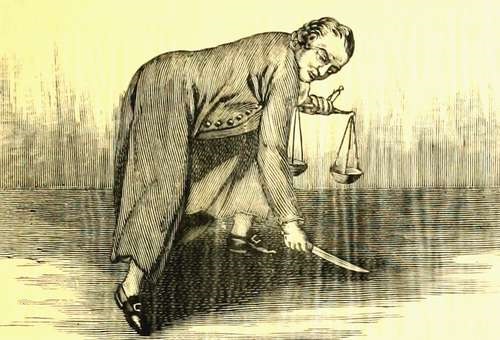
MR. MACKLIN AS SHYLOCK.
CHARLES MACKLIN.
A little child, about the last year of the reign of
William III.,—a boy who is said to have been born,
Anno Domini 1690, was taken to Derry, to kiss the
hand of, and wish a happy new year to, the old head
of his family, Mr. M'Laughlin. This ceremony was
kept up in the family circle, because the M'Laughlins
were held to be of royal descent, and the Mr.
M'Laughlin in question to be the representative of
some line of ancient kings of Ireland!
In the summer of 1797, an old actor is dying out
in Tavistock Row, Covent Garden. Hull and Munden,
and Davies and Ledger, and friends on and off the
stage, occasionally look in and talk of old times with
that ancient man, whose memory, however, is weaker
than his frame. He has been an eccentric but rare
player in his day. He had acted with contemporaries
of Betterton; had seen, or co-operated with, every
celebrity of the stage since; and did not withdraw
from that stage till after Braham, who was among us
but as yesterday, had sung his first song on it. He
gave counsel to old Charles Mathews, and he may
have seen little Edmund Kean being carried in a
woman's arms from the neighbourhood of Leicester
Square to Drury Lane Theatre, where the pale little
fellow had to act an imp in a pantomime. The old
man, carried, in the summer last named, to his grave
in the corner of St. Paul's, Covent Garden, was the
child who had done homage to a traditional king
of Ireland, so many years before. If Macklin (as
Charles M'Laughlin came to call himself) was born
at the date above given, the incidents of his life connect
him with very remote periods. He was born
two months before King William gained the battle
of the Boyne;[9] and he lived to hear of Captain
Nelson's prowess, to read of the departure to India
of that Lieutenant-Colonel Wellesley, whose career
of martial glory culminated at Waterloo, and to have
seen, perhaps, a smart young lad, just then in his
teens, the Hon. Henry Temple,—now Viscount
Palmerston and Prime Minister of England! Five
sovereigns and five-and-twenty administrations, from
Godolphin to Pitt, succeeded each other, while
Charles Macklin was thus progressing on his journey
of life.
Charles Macklin represents contradiction, sarcasm,
irritability, restlessness. It came of a double source,—his
descent and the line of characters which he
most affected. His father was a stern Presbyterian
farmer, in Ulster; his mother, a rigid Roman Catholic.
At the siege of Derry, three of his uncles were among
the besiegers, and three among the besieged; and he
had another,—a Roman Catholic priest, who undertook
to educate him, but who consigned the mission
to Nature. I have somewhere read that at five-and-thirty,
Macklin could not read, perfectly; but that
is a fable; or at eight or nine, he could hardly have
played Monimia, in private theatricals, at the house
of the good Ulster lady, who looked after him more
carefully than the priest, and more tenderly than
Nature.
In after years, Quin said of Macklin that he had—not
lines in his face, but cordage; and again, on
seeing Macklin dressed and painted for Shylock,
Quin remarked that if ever Heaven had written
villain on a brow it was on that fellow's! One can
hardly fancy that the gentle Monimia could ever
have found a representative in one who came to be
thus spoken of; but he is said to have succeeded
in this respect, perfectly, and in voice, feature, and
action, to have counterfeited that most interesting of
orphans with great success.
It was a fatal success, in one sense. It inspired
the boy with a desire to act on a wider stage. It
created in him a disgust for the vocation to which
he was destined,—that of a saddler,—from which he
ran away before he was apprentice enough to sew a
buckle on a girth; and the lad made off for the
natural attraction of all Irish lads,—Dublin. His
ambition could both soar and stoop; and he entered
Trinity College as a badge-man or porter, which illustrious
place and humble office he quitted in 1710.
Except that he turned stroller, and suffered the
sharp pangs which strollers feel,—and enjoyed the
roving life led by players on the tramp, little is here
known of him. He seems to have served some five
years to this rough and rollicking apprenticeship,
and then to have succeeded in being allowed to appear
at Lincoln's Inn Fields, in 1725, as Alcander, in
"Œdipus." His manner of speaking was found too
"familiar," that is, too natural. He had none, he
said, of the hoity-toity, sing-song delivery then in
vogue; and Rich recommended him to go to grass
again; and accordingly to green fields and strolling
he returned.
I suppose some manager had his eye on Macklin
at Southwark Fair, in 1730, for he passed thence
immediately to Lincoln's Inn Fields. He played
small parts, noticed in another page, and was probably
thankful to get them, not improving his cast
till he went to Drury Lane, in 1733, when he played
the elder Cibber's line of characters, and in 1735
created Snip in the farce of the "Merry Cobler,"
and came thereby in peril of his life. One evening,
a fellow actor, Hallam, grandfather of merry Mrs.
Mattocks, took from Macklin's dressing-room, a wig,
which the latter wore in the farce. The players were
in the "scene room," some of them seated on the
settle in front of the fire, when a quarrel broke out
between Hallam and Macklin, which was carried on
so loudly that the actors then concluding the first
piece were disturbed by it. Hallam, at length, surrendered
the "property," but, after doing so, used
words of such offence that Macklin, equally unguarded
in language, and more unguarded in action,
struck at him with his cane, in order to thrust him
from the room. Unhappily the cane penetrated
through Hallam's eye, to the brain, and killed him.
Macklin's deep concern could not save him from
standing at the bar of the Old Bailey on a charge of
murder. The jury returned him guilty of manslaughter,
without malice aforethought, and the contrite
actor was permitted to return to his duty.
Among the friends he possessed was Mrs. Booth,
widow of Barton Booth, in whose house was domiciled
as companion a certain Grace Purvor, who
could dance almost as well as Santlow herself, and
had otherwise great attractions. Colley Cibber loved
to look in at Mrs. Booth's to listen to Grace's well-told
stories; Macklin went thither to tell his own
to Grace; and John, Duke of Argyle, flitted about
the same lady for purposes of his own, which he had
the honesty to give up, when Macklin informed him
of the honourable interest he took in the friend of
Mrs. Booth. Macklin married Grace, and the latter
proved excellent both as wife and actress—of her
qualities in the latter respect I have already spoken.
For some years Macklin himself failed to reap the
distinction he coveted. The attainment was made,
however, in 1741, when he induced Fleetwood to
revive Shakspeare's "Merchant of Venice," with
Macklin for Shylock.
There was a whisper that he was about to play the
Jew as a serious character. His comrades laughed,
and the manager was nervous. The rehearsals told
them nothing, for there Macklin did little more than
walk through the part, lest the manager should prohibit
the playing of the piece, if the nature of the
reform Macklin was about to introduce should make
him fearful of consequences. In some such dress as
that we now see worn by Shylock, Macklin, on the
night of the 15th of February,[10] 1741, walked down
the stage, and looking through the eyelet-hole in the
curtain, saw the two ever-formidable front rows of
the pit occupied by the most highly-dreaded critics
of the period. The house was also densely crowded.
He returned from his survey, calm and content, remarking,
"Good! I shall be tried to-night by a
Special Jury!"
There was little applause, to Macklin's disappointment,
on his entrance, yet people were pleased at the
aspect of a Jew whom Rembrandt might have painted.
The opening scene was spoken in familiar, but earnest
accents. Not a hand yet gave token of approbation,
but there occasionally reached Macklin's ears, from
the two solemn rows of judge and jury in the pit, the
sounds of a "Good!" and "Very good!" "Very
well, indeed!"—and he passed off more gratified by
this than by the slight general applause intended for
encouragement.
As the play proceeded, so did his triumph grow.
In the scene with Tubal, which Dogget in Lansdowne's
version had made so comic, he shook the hearts, and
not the sides of the audience. There was deep emotion
in that critical pit. The sympathies of the house
went all for Shylock; and at last, a storm of acclamation,
a very hurricane of approval, roared pleasantly
over Macklin. So far all was well; but the trial scene
had yet to come.
It came; and there the triumph culminated. The
actor was not loud, nor grotesque; but Shylock was
natural, calmly confident, and so terribly malignant,
that when he whetted his knife, to cut the forfeit
from that bankrupt there, a shudder went round the
house, and the profound silence following told Macklin
that he held his audience by the heart-strings, and
that his hearers must have already acknowledged
the truth of his interpretation of Shakspeare's Jew.
When the act-drop fell, then the pent-up feelings
found vent, and Old Drury shook again with the
tumult of applause. The critics went off to the
coffee-houses in a state of pleasurable excitement.
As for the other actors, Quin (Antonio) must have
felt the master-mind of that night. Mrs. Pritchard
(Nerissa), excellent judge as she was, must have
enjoyed the terrible grandeur of that trial-scene; and
even Kitty Clive (Portia) could not have dared, on
that night, to do what she ordinarily made Portia do,
in the disguise of young Bellario; namely, mimic the
peculiarities of some leading lawyer of the day. And
Macklin?—Macklin remarked, as he stood among his
fellows, all of whom were, I hope, congratulatory,
"I am not worth fifty pounds in the world; nevertheless,
on this night am I Charles the Great!"
That Pope was in the house on the third night,
and that he pronounced Macklin to be the Jew that
Shakspeare drew, is not improbable; but the statement
that Macklin, soon after, dined with Pope and
Bolingbroke at Battersea is manifestly untrue, for the
latter was then living in retirement, at Fontainbleau.
It could not have been in such company, at this
period, that Pope asked the actor, why he dressed
Shylock in a red hat, and that Macklin replied, it was
because he had read in an old history that the Jews
in Venice were obliged, by law, to wear a hat of that
decided colour;—which was true.
Macklin was proud and impetuous, and often lost
engagements, by offending; and regained them by
publicly apologising. He was an actor well established
in favour, when, in the season of 1745-46, he
made his first appearance as an author in an àpropos
tragedy for the '45 era, "Henry VII., or the Popish
Impostor." The anachronism in the title is only to
be matched by the violations done to chronology and
propriety in the play,—a crude work, six weeks in
the doing. It settles, however, in some degree, the
time when Macklin left the Church of Rome for that
of England. It must have been prior to the period
in which he wrote the above-named piece. After it
took place, he used to describe himself "as staunch
a Protestant as the Archbishop of Canterbury, and
on the same principles;"—a compliment, I suppose,
to John Potter!
After playing during four seasons at Drury Lane,
Macklin spent from 1748 to 1750 in Dublin, where
he and his wife were to receive £800 a year. He
delighted the public, and helped to ruin the manager,
Sheridan, who was unable to fulfil his engagement,
and got involved in a lawsuit. From 1750 to 1754[11]
Macklin was at Covent Garden, where one of his
most extraordinary parts was Mercutio, to Barry's
Romeo!—a part for which he was utterly unfit, but
which he held to be one of his best!—not inferior
to Woodward's! His view of the rival Romeos, too,
had something original in it. Barry, he said, in the
garden scene, came on with a lordly swagger, and
talked so loud that the servants ought to have come
out and tossed him in a blanket; but Garrick
sneaked into the garden, like a thief in the night.
And at this critical comment the latter did not feel
flattered.
In 1754[12] Macklin introduced his daughter, with
a prologue, and withdrew himself from the stage, to
appear in a new character, that of master of a tavern,
where dinners might be had at 4s. a head,[13] including
any sort of wine the guest might choose to ask for!
The house was under the Piazza, in Covent Garden;
and Mr. Macklin's "Great Room in Hart Street"
subsequently became George Robins' auction-room.
I do not like to contemplate Macklin in this character,
bringing in the first dish, the napkin over his
arm, at the head of an array of waiters, who robbed
him daily; that done, he steps backwards to the
sideboard, bows, and then directs all proceedings by
signs. The cloth drawn, he advances to the head of
the table, makes another servile bow, fastens the
bell-rope to the chair, and hoping he has made
everything agreeable, retires!
The lectures on the drama and ancient art, and
the debates which followed, in his Great Room, the
"British Inquisition," were not in much better taste.
The wits of the town found excellent sport in interrupting
the debaters, and few were more active in
this way than Foote. "Do you know what I am
going to say?" asked Macklin. "No," said Foote,
"do you?" On the 25th of January 1755, Charles
Macklin was in the list of what the Gentleman's
Magazine used to politely call the "B—ts," as failing
in the character of vintner, coffee-man, and
chapman. His examination only showed that he
had failed in prudence. He had been an excellent
father, and on his daughter's education alone he had
expended £1200.
He remained disengaged till December 12th, 1759,
when he appeared at Drury Lane, as Shylock, and
Sir Archy Macsarcasm, in "Love à la Mode," a piece
of his own. From the profits received on each night
of its being acted, Macklin stipulated that he should
have a share during life. The arrangement was
advantageous to him, although this little piece was
not at first successful. After a season at Drury, he
passed the next at the Garden, and in 1763[14] reappeared
in Dublin, at Smock Alley, then at Crow
Street, and Capel Street, under rival managers
Mossop, Sheridan,[15] or Barry, and with more profit
to himself than to them. In 1773 he returned to
Covent Garden, where he made an attempt at Macbeth,
which brought on that famous theatrical "row"
which Macklin laid to the enmity of Reddish and
Sparks, and of which I have spoken, under that
year. With intervals of rest, Macklin continued to
play, without increase of fame, till 1780,[16] when he
produced his original play, the "Man of the World,"
and created, at the age, probably, of ninety years, Sir
Pertinax Macsycophant, one of the most arduous
characters in a great actor's repertory. The Lord
Chamberlain licensed this admirable piece with great
reluctance, for though the satire was general, it was
severe, and susceptible of unpleasant and particular
application. Shylock, Sir Pertinax, and Sir Archy,
were often played by the old actor, whose memory
did not begin to fail till 1788, when it first tripped,
as he was struggling to play Shylock. The aged
actor tottered to the lights, talked of the inexplicable
terror of mind which had come over him, and asked
for indulgence to so aged a servant; and then he
went on, now brilliantly, now all uncertain and
confused. He was to play the same character for
his benefit, on May 7th, 1789, and went into the
green-room dressed for the part. Whether he was
then in his 90th or his 100th year, the effort was
a great one; and, anticipating it might fail, the
manager had requested Ryder, an actor of merit,
who had been a great favourite and a luckless
manager in Ireland, to be ready to supply Macklin's
place.
The older performer seeing good Miss Pope in the
green-room, asked her if she was to play that night.
"To be sure I am, dear sir," she said; "you see I
am dressed for Portia." Macklin looked vacantly at
her, and, in an imbecile tone of voice, remarked, "I
had forgotten; who plays Shylock?" "Who? why
you, sir; you are dressed for it!" The aged representative
of the Jew was affected; he put his
hand to his forehead, and in a pathetic tone deplored
his waning memory; and then went on the stage;
spoke, or tried to speak, two or three speeches,
struggled with himself, made one or two fruitless
efforts to get clear, and then paused, collected his
thoughts, and, in a few mournful words, acknowledged
his inability, asked their pardon, and, under
the farewell applause of the house, was led off the
stage, for ever.
As an actor, he was without trick; his enunciation
was clear, in every syllable. Taken as a whole, he
probably excelled every actor who has ever played Shylock,
say his biographers; but I remember Edmund
Kean, and make that exception. He was not a great
tragedian, nor a good light comedian, but in comedy
and farce, where rough energy is required, and in
parts resembling Shylock, in their earnest malignity,
he was paramount. He was also an excellent
teacher, very impatient with mediocrity, but very
careful with the intelligent. Easily moved to anger,
his pupils, and, indeed, many others stood in awe of
him; but he was honourable, generous, and humane;
convivial, frank, and not more free in his style than
his contemporaries; but naturally irascible, and naturally
forgiving. Eccentricity was second nature to
him, and seems to have been so with other men of
his blood. His nephew and godson, the Rev. Charles
Macklin, held an incumbency in Ireland, which he
lost because he would indulge in a particular sort of
Church discipline. At the close of his sermon he
used to administer the benediction, and the bagpipes.
With the first he dismissed the congregation, and,
taking up the second, he blew his people out with
a lusty voluntary.
When Macklin left the stage, his second wife, the
widow of a Dublin hosier, and a worthy woman,
looked their fortune in the face. It consisted of
£60 in ready money, and an annuity of £10. Friends
were ready, but the proud old actor was not made to
be wounded in his pride; he was made, in a measure,
to help himself. His two pieces, "Love à la Mode,"
and the "Man of the World," were published by subscription.
With nearly £1600 realised thereby, an
annuity was purchased of £200 for Macklin's life,
and £75 for his wife, in case of her survival. And
this annuity he enjoyed till the 11th of July 1797,
when the descendant of the royal M'Laughlins died,
after a theatrical life, not reckoning the strolling
period, of sixty-four years.
If Macklin was really of the old school, that school
taught what was truth and nature. His acting was
essentially manly, there was nothing of trick about
it. His delivery was more level than modern speaking,
but certainly more weighty, direct, and emphatic.
His features were rigid, his eye cold and colourless;
yet the earnestness of his manner, and sterling sense
of his address, produced an effect in Shylock that has
remained, with one exception, unrivalled.
Boaden thought Cooke's Sir Pertinax noisy, compared
with Macklin's. "He talked of booing, but it
was evident he took a credit for suppleness that
was not in him. Macklin could inveigle as well as
subdue; and modulated his voice almost to his last
year, with amazing skill."
In his earlier days, Macklin was an acute inquirer
into meaning; and always rendered his conceptions
with force and beauty. In reading Milton's lines—
"Of man's first disobedience and the fruit
Of that for-bid-den tree—whose mortal taste
Brought Death into the world, and all our woe,"
the first word in capitals was uttered with an awful
regret, the suitable forerunner, says Boaden, "to the
great amiss" which follows.
Macklin's chief objection to Garrick was directed
against his reckless abundance of action and gesture;
all trick, start, and ingenious attitude were to him
subjects of scorn. He finely derided the Hamlets
who were violently horrified and surprised, instead of
solemnly awed, on first seeing the Ghost. "Recollect,
sir," he would say, "Hamlet came there to see
his father's spirit."
Kirkman gives us a picture of Macklin, in his old
age, which is illustrative of the man, and his antagonism
to Quin. The scene is at the Rainbow Coffee
House, King Street, Covent Garden, in 1787, where
some one of the company had asked him if he had
ever quarrelled with Quin. "Yes, sir," was the
answer. "I was very low in the theatre as an actor,
when the surly fellow was the despot of the place.
But, sir, I had—had a lift, sir. Yes; I was to play
the—the—the boy with the red breeches;—you know
who I mean, sir;—he, whose mother is always going
to law;—you know who I mean!" "Jerry Blackacre,
I suppose, sir?" "Aye, sir,—Jerry. Well,
sir, I began to be a little known to the public; and
egad, I began to make them laugh. I was called the
Wild Irishman, sir; and was thought to have some
fun in me; and I made them laugh heartily at the
boy, sir,—in Jerry.
"When I came off the stage, the surly fellow, who
played the scolding Captain in the play; Captain—Captain—you
know who I mean!" "Manly, I
believe, sir?" "Aye, sir,—the same Manly. Well,
sir, the surly fellow began to scold me; told me I
was at my tricks, and that there was no having a
chaste scene for me. Everybody, nay, egad, the
manager himself, was afraid of him. I was afraid of
the fellow, too; but not much. Well, sir, I told him
I did not mean to disturb him by my acting, but to
show off a little myself. Well, sir, in the other scenes
I did the same, and made the audience laugh incontinently;—and
he scolded me again, sir. I made the
same apology; but the surly fellow would not be
appeased. Again, sir, however, I did the same; and
when I returned to the green-room, he abused me
like a pickpocket, and said I must leave off my
d——d tricks. I told him I could not play otherwise.
He said I could, and I should. Upon which,
sir, egad, I said to him flatly,—'you lie.' He was
chewing an apple at this moment; and spitting the
contents into his hand, he threw them in my face."
"Indeed!" "It is a fact, sir! Well, sir, I went
up to him directly (for I was a great boxing cull in
those days), and pushed him down into a chair, and
pummelled his face d——bly."
"You did right, sir."
"He strove to resist, but he was no match for me;
and I made his face swell so with the blows, that he
could hardly speak. When he attempted to go on
with his part, sir, he mumbled so, that the audience
began to hiss. Upon which, he went forward and
told them, sir, that something unpleasant had happened,
and that he was really very ill. But, sir, the
moment I went to strike him, there were many
noblemen in the green-room, full dressed, with their
swords and large wigs (for the green-room was a sort
of state-room then, sir). Well, they were all alarmed,
and jumped upon the benches, waiting in silent amazement
till the affair was over.
"At the end of the play, sir, he told me I must
give him satisfaction; and that when he changed
his dress, he would wait for me at the Obelisk, in
Covent Garden. I told him I would be with him;—but,
sir, when he was gone, I recollected that I
was to play in the pantomime (for I was a great
pantomimic boy in those days). So, sir, I said to
myself, 'd—— the fellow; let him wait; I won't go
to him till my business is all over; let him fume and
fret, and be hanged!' Well, sir, Mr. Fleetwood,
the manager, who was one of the best men in the
world,—all kindness, all mildness, and graciousness
and affability,—had heard of the affair; and as
Quin was his great actor, and in favour with the
town, he told me I had had revenge enough; and
that I should not meet the surly fellow that night;
but that he would make the matter up, somehow or
other.
"Well, sir, Mr. Fleetwood ordered me a good
supper, and some wine, and made me sleep at his
house all night, to prevent any meeting. Well, sir,
in the morning he told me, that I must, for his sake,
make a little apology to him for what I had done.
And so, sir, I, to oblige Mr. Fleetwood (for I loved
the man), did, sir, make some apology to him; and
the matter dropped."
Macklin's character has been described in exactly
opposite colours, according to the bias of the friend
or foe who affords the description. He is angel
or fiend, rough or tender, monster, honest man or
knave,—and so forth; but he was, of course, neither
so bad as his foes nor so bright as his friends made
him out to be. One thing is certain, that his judgment
and his execution were excellent. In a very
few tragic parts, he acted well; in comedy and farce,
where villainy and humour were combined, he was
admirable and original. Of characters which he
played originally (and those were few), he rendered
none celebrated, except Sir Archy, Sir Pertinax, and
Murrough O'Doherty, in pieces of which he was
the author. His other principal characters were
Iago, Sir Francis Wronghead, Trappanti, Lovegold,
Scrub, Peachum, Polonius, and some others in pieces
now not familiar to us.
That Macklin was a "hard actor" there is no
doubt; Churchill, who allows him no excellence, says
he was affected, constrained, "dealt in half-formed
sounds," violated nature, and that his features, which
seemed to disdain each other,—
"At variance set, inflexible, and coarse,
Ne'er know the workings of united force,
Ne'er kindly soften to each other's aid,
Nor show the mingled pow'rs of light and shade."
But "Cits and grave divines his praise proclaimed,"
and Macklin had a large number of admiring friends.
In his private life, he had to bear many sorrows, and
he bore them generally well, but one, in particular,
with the silent anguish of a father who sees his son
sinking fast to destruction, and glorying in the way
which he is going.
Ten years before Macklin died, he lost his daughter.
Miss Macklin was a pretty and modest person; respectable
alike on and off the stage; artificially
trained, but yet highly accomplished. Macklin had
every reason to be proud of her, for everybody loved
her for her gentleness and goodness. As a child,
in 1742, she had played childish parts, and since
1750, those of the highest walk in tragedy and
comedy, but against competition which was too
strong for her. She was the original Irene, in
"Barbarossa," and Clarissa, in "Lionel and Clarissa,"
and was very fond of acting parts in which the lady
had to assume male attire. This fondness was the
cause, in some measure, of her death; it led to her
buckling her garter so tightly that a dangerous
tumour formed in the inner part of the leg, near the
knee. I do not fancy that Miss Macklin had ever
heard of Mary of Burgundy, who suffered from a
similar infirmity, but the actress was like the Duchess
in this,—from motives of delicacy she would not
allow a leg which she had liberally exhibited on the
stage, to be examined by her own doctor. Ultimately,
a severe operation became necessary. Miss
Macklin bore it with courage, but it compelled her
to leave the stage, and her strength gradually failing,
she died in 1787,[17] at the age of forty-eight, and I
wish she had left some portion of her fortune to her
celebrated but impoverished father.
Miss Macklin reminds me of Miss Barsanti, the
original Lydia Languish, whose course on the
London stage dates from 1777.[18] The peculiarity
of Miss Barsanti,—a clever imitator of English and
Italian singers,—was the opposite of that which
distinguished Miss Macklin. She had registered a
vow that she would never assume male attire; nevertheless,
she was once cast for Signor Arionelli, in the
"Son-in-Law," a part originally played by Bannister.
This was after her retirement from London, and when
she was Mrs. Lisley,—playing in Dublin. The time
of the play is 1779, but the actress, who might
have worn a great coat, if she had been so minded,
assumed—for a music-master of that period, in
London—the oriental costume of a pre-Christian, or
of no period, worn by Arbaces, in Artaxerxes!
Miss Barsanti was an honest woman who, on
becoming Mrs. Lisley, wished to assume her husband's
name, but that gentleman's family forbade
what they had no right to prohibit. Her second
husband's family was less particular, and in theatrical
biographies, she is the Mrs. Daly, the wife of the
active Irish manager, of that name; who is for
ever memorable as being the only Irish manager
who ever realised a fortune, and took it with him
into retirement.
There remain to be noticed, before we pass to the
Siddons period, several actresses, of higher importance
than the above ladies, as well as actors, whose
claims are only second to those of Macklin.
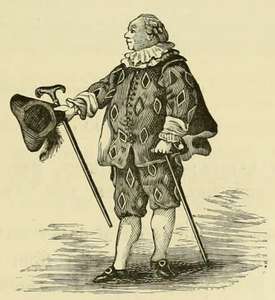
Mr. Foote as the Devil upon Two Sticks.
CHAPTER IV. — FOOTNOTES:
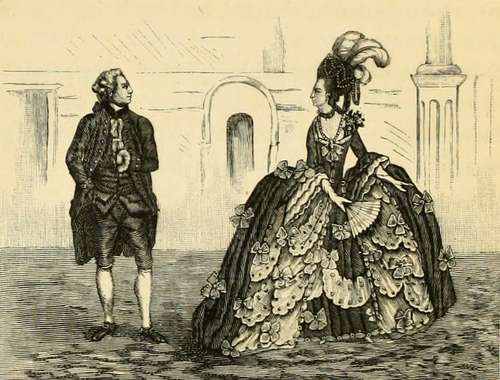
MR. SMITH AND MRS. YATES IN THE "PROVOKED HUSBAND."
A BEVY OF LADIES;—BUT CHIEFLY, MRS. BELLAMY,
MISS FARREN, MRS. ABINGTON, AND "PERDITA."
A dozen more of ladies, all of desert, and some of
extraordinary merit, passed away from the stage
during the latter portion of the last century. Mrs.
Green, Hippisley's daughter, and Governor Hippisley's
sister,—the original Mrs. Malaprop, and, but
for Mrs. Clive, the first of petulant Abigails, finished
in 1779[19] a public career which began in 1730.[20] In
the same year,[21] but after a brief service of about eight
years, Mason's Elfrida and Evelina, the voluptuous
Mrs. Hartley, in her thirtieth year, went into a retirement
which she enjoyed till 1824. She was "the
most perfect beauty that was ever seen,"—more perfect
than "the Carrara," who was "the prettiest
creature upon earth." Her beauty, however, was of
feature, lacking expression, and though an impassioned,
she was not an intelligent actress, unless her
plunging her stage-wooers into mad love for her
be a proof of it. No wonder, had Smith only not
been married, that he grew temporarily insane about
this young, graceful, and fair creature.
Then, from the London stage, at least, fell Mrs.
Baddeley, at the end of the season, 1780-81. She
was a pretty actress with a good voice, and so little
love for Mr. Baddeley and so much for George Garrick
that a duel came of it. The parties went out,
to Hyde Park, on a November morning of 1770.
Baddeley was stirred up to fight Davy's brother, by
a Jewish friend, who, being an admirer of the lady,
wanted her husband to shoot her lover! The two
pale combatants fired anywhere but at each other, and
then the lady rushed in, crying, "Spare him!" without
indicating the individual! Whereupon, husband
and friend took the fair one, each by a hand, and
went to dinner; and the married couple soon after
played together in "It's well it's no worse!"
But worse did come, and separation, and exposure,
and Memoirs to brighten Mrs. Baddeley, which, like
those of Mrs. Pilkington, only blackened her the
more. She passed to country engagements, charming
audiences for awhile with her Polly, Rosetta,
Clarissa, and Imogen, till laudanum, cognac, paralysis,
and small sustenance, made an end of her,
when she had lost everything she could value, save
her beauty.
The third departure was of as mad a creature as
she, Miss Catley—the Irish songstress, all smiles and
dimples, and roguish beauty; who loved, like Nell
Gwyn, to loll about in the boxes, and call to authors
that she was glad their play was damned; and to
ladies, to stand up that she might look at them,
and to display the fashion of her dress, which those
ladies eagerly copied. Her "Tyburn top," which
she wore in Macheath, set the mode for the hair for
many a day; and to be Catley-fied was to be decked
out becomingly.
A more illustrious pair next left the stage more
free to Mrs. Siddons, or her coming rendered it less
tenable to them; namely, Mrs. Yates and George
Anne Bellamy—the former appearing for the last
time for the benefit of the latter. More than thirty
years before, as Mrs. Graham, young, fat, and weak-voiced,
she failed in Dublin. In 1753-54, she made
almost as unsatisfactory a début at Drury Lane in a
new part, Marcia, in "Virginia," in which she only
showed promise. Richard Yates then married and
instructed her, and she rapidly improved, but could
not compete with Mrs. Cibber, till that lady's illness
caused Mandane ("Orphan of China") to be given
to Mrs. Yates, who, by her careful acting, at once
acquired a first-rate reputation. In the classical
heroines of the dull old classical tragedies of the last
century, she was wonderfully effective, and her Medea
was so peculiarly her own, that Mrs. Siddons herself
never disturbed the public memory of it by acting
the part.
When Mrs. Cibber died in 1765,[22] Mrs. Yates
succeeded to the whole of her inheritance, some
of which was a burthen too much for her; but she
kept her position, with Mrs. Barry (Crawford) for a
rival, till Mrs. Siddons promised at Bath to come
and dispossess both. Mrs. Yates recited beautifully,
was always dignified, but seems to have wanted
variety of expression. With a haughty mien, and a
powerful voice, she was well suited to the strong-minded
heroines of tragedy; but the more tender
ladies, Desdemona or Monimia, she could not compass.
To the pride and violence of Calista she was
equal, but in pathos she was wanting. Her comedy
was as poor as that of Mrs. Siddons; her Jane Shore
as good; her Medea so sublime as to be unapproachable.
I suspect she was a little haughty; for impudent
Weston says in his will: "To Mrs. Yates I
leave all my humility!"
In one character of comedy she is said, indeed, to
have excelled—Violante, in the "Wonder," to the
playfulness, loving, bickering, pouting, and reconciliations,
in which her "queen-like majesty" does
not seem to have been exactly suitable. Her scorn
was never equalled but by Mrs. Siddons, and it would
be difficult to determine which lady had the more
lofty majesty. In passion Mrs. Yates swept the
stage as with a tempest; yet she was always under
control. For instance, in Lady Constance, after
wildly screaming,
"I will not keep this form upon my head,
When there is much disorder in my wit,"
she did not cast to the ground the thin white cap
which surmounted her headdress, but quietly took it
from her head, and placed it on the right side of the
circumference of her hoop! Mrs. Yates died in 1787.
George Anne Bellamy is unfortunate in having
a story, which honest women seldom have. That
pleasant place, Mount Sion, at Tunbridge Wells, was
the property of her mother, a Quaker farmer's
daughter, named Seal, who, on her mother falling
into distress, was taken by Mrs. Gregory,[23] the sister
of the Duke of Marlborough, to be educated.
Miss Seal was placed in an academy in Queen's
Square, Westminster, so dull a locality, that the
rascally Lord Tyrawley had no difficulty in persuading
her to run away from it, in his company,
and to his apartments, in Somerset House. When
my lord wanted a little change, he left Miss Seal
with her infant son, and crossed to Ireland to make
an offer to the daughter of the Earl of Blessington.
She was ugly, he said, but had money; and when
he got possession of both, he would leave the first,
and bring the latter with renewed love, to share with
Miss Seal.
The lady was so particularly touched by this letter,
that she sent it, with others, to the earl, who, rendered
angry thereat, forbade his daughter to marry my lord,
but found they were married already. Tyrawley
hoped thus to secure Lady Mary Stewart's fortune;
but discovering she had none at her disposal, he
naturally felt he had been deceived, and turned his
wife off to her relations. Having gone through this
amount of villainy, King George thought he was
qualified to represent him at Lisbon, and thither
Lord Tyrawley proceeded accordingly.
He would have taken Miss Seal with him, but
she preferred to go on the stage. Ultimately she
did consent to go; and was received with open
arms; but she was so annoyed by the discovery of a
swarthy rival, that she listened to the wooing of a
Captain Bellamy, married him, and presented him
with a daughter with such promptitude, that the
modest captain ran away from so clever a woman,
and never saw her afterwards.
Lord Tyrawley, proud of the implied compliment,
acknowledged the little George Anne Bellamy, born
on St. George's day, 1733, as his daughter. He
exhibited the greatest care in her education. He
kept her at a Boulogne convent from her fifth to her
eighth year, and then brought her up at his house
at Bexley, amid noble young scamps, whose society
was quite as useful to her as if she had been at a
"finishing" school.
Lord Tyrawley having perfected himself in the
further study of demi-rippism, went as the representative
of England to Russia, leaving an allowance
for his daughter, which so warmed up her mother's
affections for her, that George Anne was induced to
live with her, and George Anne's mother hoped that
her annuity would do so too, but my lord, having
different ideas, stopped the annuity, and did not
care to recover his daughter.
The two women were destitute; but the younger
one was very youthful, was rarely beautiful, had
certain gifts, and, of course, the managers heard of
her. She had played Miss Prue for Bridgewater's
benefit, in 1742, and gave promise. In 1744, Rich
heard her recite, and announced her for Monimia.
Quin was angry at having to play Chamont to "such
a child;" but the little thing manifested such
tenderness and ability, that he confessed she was
charming. Lord Byron thought so too, and carried
her off in his coach to a house at the corner of
North Audley Street, which looked over the dull
Oxford Road to the desolate fields beyond. Much
scandal ensued; amid which Miss Bellamy's half-brother
appeared, shook his sister as a pert baggage,
and sorely mauled my lord; but Lord Byron lived to
murder Mr. Chaworth in a duel, to be found guilty of
slaughtering the poor man, and consequently, being
a peer, to be discharged on paying his fees!
Then Miss Bellamy went among some Quaker
relations who had never previously seen her, and
charmed them so by her soft, and winning, and simple
Quakerish ways, that they would have made an idol
of her, if Friends ever made an idol of anything, but
lucre and themselves. A discovery that she was an
actress brought this phase of her life to an end, and
it was followed by a triumphant season on the Dublin
stage, from 1745 to 1747, where she made such a
sensation, reigned so like a queen, and was altogether
so irresistible and rich, that Lord Tyrawley's family
acknowledged her. My lord himself became reconciled
to her, through old Quin, and would have
spent her income for her after she was re-engaged
at Covent Garden, in 1748, if she would only have
married his friend, Mr. Crump. Rather than do that,
she let a Mr. Metham carry her off from Covent
Garden, dressed as she was to play Lady Fanciful, to
live with, quarrel with, and refuse to wed with him.
What with the loves, caprices, charms, extravagances,
and sufferings of Mrs. Bellamy, she excited
the wonder, admiration, pity, and contempt of the
town for thirty years. The Mr. Metham she might
have married she would not,—Calcraft and Digges,
whom she would have, and the last of whom she
thought she had married, she could not; for both
had wives living. To say that she was a syren who
lured men to destruction, is to say little, for she went
down to ruin with each victim; but she rose from
the wreck more exquisitely seductive and terribly
fascinating than ever, to find a new prey whom she
might ensnare and betray.
Meanwhile, she kept a position on the stage, in
the very front rank, disputing pre-eminence with the
best there, and achieving it in some things; for this
perilous charmer was unequalled in her day for the
expression of unbounded and rapturous love. Her
looks glowing with the passion to which she gave
expression, doubled the effect; and whether she
gazed at a lover or rested her head on the bosom of
her lord, nothing more tender or subduing was ever
seen, save in Mrs. Cibber. She was so beautiful, had
eyes of such soft and loving blue, was so extraordinarily
fair, and was altogether so irresistible a
sorceress, that Mrs. Bellamy was universally loved
as a charming creature, and admired as an excellent
actress; and when she played some poor lady distraught
through affection, the stoutest hearts under
embroidered or broad-cloth waistcoats, crumbled
away, often into inconceivable mountains of gold-dust.
She laughed, and scattered as fast as they piled it,
and in the gorgeous extravagance of her life began
to lose her powers as an actress. She had once
almost shared the throne assumed by Mrs. Cibber,
but she wanted the sustained zeal and anxious study
of that lady, and cared not, as Mrs. Cibber did, for
one quiet abiding home, by whomsoever shared, but
sighed for change, had it, and suffered for it. When
her powers began to decay, her admirers of all schools
deplored the fact. In tragedy, natural as she was
in feeling, she belonged to the old days of intoned
cadences; and the old and the rising school mourned
over her, yet both were compelled to avow that only
in the ecstasy of love was Mrs. Bellamy equal to the
Cibber, and in that Mrs. Cibber, when acting with
Barry, in the younger days of both, was often George
Anne's superior.
From reigning it like a queen on and off the stage,—imperious
and lovely, and betraying everywhere,—to
the figure of a poor, bailiff-persecuted, famishing
wretch, stealing down the muddy steps of old Westminster
Bridge to drown herself in the Thames, how
wide are the extremes! But in both positions we
find the original Volumnia of Thomson, the Erixine
of Dr. Young, and the Cleone, to whom Dodsley
owed the success of his heart-rending tragedy. To
the last, she was as unfortunate as she had been
reckless. Two old lovers, one of whom was Woodward,
bequeathed legacies to her, which she never
received. Those sums seemed as life to her; but, in
the days of her pride and her power, and wicked but
transcendent beauty, she would have scorned them
as mere pin-money; and so she grew acquainted
with gaunt misery, till some friends weary, perhaps,
of sustaining the burthen she imposed upon them,
induced the managers to give her a farewell benefit,
in 1784,[24] on which occasion Mrs. Yates returned to
the stage to play for her the Duchess, in "Braganza."
More than forty years before, the brilliant little
sylph, Miss Bellamy, had floated on to the same
Covent Garden stage, confident in both intellectual
and material charms. Now, the middle-aged woman,
still older through fierce impatience at her fall,
through want, misery, hopelessness, everything but
remorse, had not nerve enough to go on and utter a
few words of farewell. These were spoken for her
by Miss Farren, before the curtain, which ascended
at the words,—
"But see, oppress'd with gratitude and tears,
To pay her duteous tribute she appears;"
and discovered the once beautiful and happy syren, a
terrified, old-looking woman, lying, powerless to rise,
in an arm-chair. But the whole house—some out
of respect for the erst charmer, others out of curiosity
to behold a woman of such fame on and off the stage—rose
to greet her. George Anne, urged by Miss
Catley, bent forward, murmured a few indistinct
words, and, falling back again, the curtain descended,
for the last time, between the public and the Fallen
Angel of the stage.
Half-a-dozen minor lights are extinguished before
we come to a name, a desert, and a fortune, more
brilliant and lasting than that of George Anne
Bellamy,—the name, merit, and fortune of Miss
Farren. Mrs. Wilson, the original Betty Hint, in
the "Man of the World," is not now remembered
either for her genius or her errors. Mrs. Belfille
made but one appearance on the London stage,
as Belinda, in "All in the Wrong." She wanted
animation and humour, but was distinguished for
the splendour of her stage wardrobe, which was all
her own. She joined Whitlock and Austin's company
in the north. Whitlock married Mrs. Siddons'
sister Elizabeth, and took her to America, where her
acting drew rather the admiration than the tears of
the Indians. Mrs. Belfille and Mrs. Whitlock were
together in the company named above. On the back
of one of their bills I find a MS. note made by
Austin, in which he says that Mrs. Belfille was an
elegant actress, very fashionable, and genteel in dress
and manner; and, he adds, "Mrs. Whitlock could
not keep her temper while Mrs. Belfille was with
me, in Newcastle, Chester, &c."
A year later, in 1789, the charming Bacchante,
Mrs. Beresford, Goldsmith's Miss Richland and Miss
Hardcastle, and Sheridan's Julia, in the "Rivals,"
left the London stage for Edinburgh, where, says
Jackson, "her Lady Racket will be remembered as
long as one of her audience remains alive."
Pretty Mrs. Wells, famous for her imitations, now
disappears. She was O'Keefe's Cowslip. She was
the Jewish gentleman, Mr. Sumbell's, wife, which he
denied; and she so far rivalled Mrs. Siddons, that,
in "Isabella," as it was the fashion for the house
to shriek when the actress shrieked, so, when Mrs.
Wells shrieked, her friends shrieked louder than
those of Mrs. Siddons', and, therefore, thought Cowslip
was the greater tragedian of the two. Then, the
first of the Miss Bruntons, the Louisa Courtney of
Reynold's "Dramatist," finished her seventh and last
season, in London, in 1792, as the wife of Della Cruscan
Merry. She began as an expected rival of Mrs.
Siddons, but London did not confirm the testimony
of Bath. Three other actresses passed away before
Miss Farren: mad Hannah Brand, who was a sort of
female Mossop; Mrs. Esten (who tried to disturb
Mrs. Siddons, Mrs. Jordan, and Miss Farren, but
who, failing, settled in the north, and very much
disturbed the heart and the purse of the Duke
of Hamilton), and Mrs. Webb, the original Mrs.
Cheshire to the above Cowslip; than whom actress
of more weight never made the boards groan, and
who turned her corpulence to account by playing
Falstaff.
The first glimpse to be caught of Miss Farren is as
picturesque as can well be imagined. Her father,
once a Cork surgeon but now manager of a strolling
company, is in the lock-up of the town of Salisbury;
he fell into durance through an unconscious infringement
of the borough law. The story is told,
at length, in my Knights and their Days. On a
wintry morning, a little girl carries him a bowl of
hot milk, for breakfast, and she is helped over the
ice to the lock-up window by a sympathising lad.
The nymph is Miss Farren, afterwards Countess of
Derby; the boy is the very happy beginning of Chief
Justice Burroughs.
The incident occurred in 1769. Three years later,
Elizabeth was playing Columbine at Wakefield. She
could sing as well as she could dance, gracefully;
and, out of very love for the beautiful girl, Younger
brought her out, at Liverpool, where her maternal
grandfather had been a brewer of repute and good
fortune, and where his grand-daughter proved such
a Rosetta, that more than half the young fellows
were more deeply in love with her than the paternal
Younger himself.
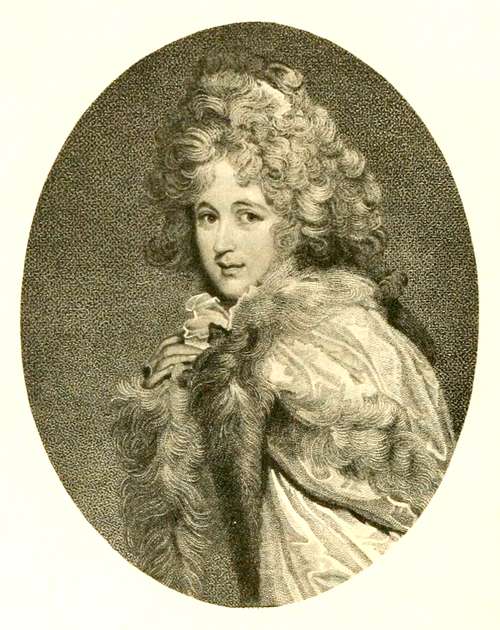
After five years' training, the now radiant girl,
glowing with beauty and intelligence, first charmed a
London audience, on June the 9th, 1777, by appearing
at the Haymarket, as Miss Hardcastle; Edwin
making his appearance on the same night, as Old
Hardcastle. In that first year of London probation,
her Miss Hardcastle was a great success; the town
was ecstatic at that and her Maria, in the "Citizen,"
was rapt at her Rosetta, rendered hilarious by her
Miss Tittup, and rarely charmed by her playfulness
and dignity, as Rosara (Rosina), in the "Barber of
Seville." Of this character she was the original
representative. Colman omitted the scene in which
the Count was disguised as a tipsy dragoon, on the
ground of its being injurious to morality! The same
Colman thought the Fool, in "Lear," too gross for
a London audience.
In the following year, the success of her Lady
Townly transferred her to Drury Lane, where she
divided the principal parts with Miss Walpole, Miss
P. Hopkins (Mrs. Kemble, subsequently), and Perdita
Robinson; and not one of the four was twenty years
of age.
Her Lady Townly was no new triumph. She had
produced such an effect in it at Liverpool, where, after
her father's death, Younger had engaged the whole
family, that, on the strength of the promise of fortune
to come, tradesmen offered them unlimited credit.
For about a score of years she maintained a pre-eminence
which she did not, however, attain all at
once, or without a struggle; her most powerful and
graceful opponent being Mrs. Abington. Her early
days had been of such stern and humble aspect,
such a strolling and starving with her stage-mad and
improvident father, that an anonymous biographer
says of her: "The early parts of the history of
many eminent ladies on the stage must be extremely
disagreeable to them in the recital; and to none,
we apprehend, more than to Miss Farren, who, from
the lowest histrionic sphere, has raised herself to the
most elevated."
During the years above-named, she played principally
at Drury Lane and the Haymarket, and chiefly
the parts of fine ladies, for which she seemed born;
though she attempted tragedy, now and then; and
assumed low comedy characters, occasionally; but
her natural elegance, her tall and delicate figure, her
beautiful expression, her superbly modulated voice,
her clear and refined pronunciation, made of her fine
lady a perfect charm; not merely the Lady Betty
Modish, and similar personages, but the sentimental
Indianas and Cecilias.
Walpole says emphatically of Miss Farren, that, in
his estimation, she was the most perfect actress he
had ever seen. Adolphus praises "the irresistible
graces of her address and manner, the polished
beauties of her action and gait, and all the indescribable
little charms which give fascination to the
woman of birth and fashion," as among the excellences
which secured a triumph for Burgoyne's "Heiress."
In that play she acted Lady Emily Gayville.
Among her original characters were Rosara (Rosina),
in the "Barber of Seville;" Cecilia, in "Chapter of
Accidents;" Sophia, in "Lord of the Manor;" Lady
Emily Gayville, in the "Heiress;" Eliza Ratcliffe, in
the "Jew;" and Emily Tempest, in the "Wheel of
Fortune." In the "Heiress" Adolphus again says of
her:—"Whether high and honourable sentiments,
burning and virtuous sensibility, sincere and uncontrollable
affection; animated, though sportive reprehension;
elegant persiflage, or arch and pointed
satire were the aim of the author, Miss Farren amply
filled out his thought, and, by her exquisite representation,
made it, even when faint and feeble in itself,
striking and forcible." In fewer words, she had
feeling, judgment, grace, and discretion.
It was when playing Rosara that her life became
in danger, by her long gauze mantilla taking fire
from the side-lights. She was not aware of her peril,
till Bannister (Almaviva) had quietly thrown his
Spanish cloak around her, and had put out the flames
with his hands.
During her stage career she was the manageress of
the private theatricals at the Duke of Richmond's,—those
most exclusive of dramatic entertainments. She
moved, as it is called, in the best society, where she
was Queen "amang them a'." Charles James Fox
is said to have been more or less seriously attached
to her; but long before she withdrew from the stage
it was said, and was printed, that when "one certain
event should happen, a Countess's coronet would fall
on her brow."
And thereby hangs a tale that has something in
it extremely unpleasant; for this one event, waited
for during a score of years, was the death of the
Countess of Derby, the only daughter of the Duke
of Hamilton.
To the Duchess of Leinster, who knew something
of Miss Farren's family in Ireland, the actress was
indebted for introductions to Lady Ailesbury, Mrs.
Damer, and others, through whom Miss Farren
became acquainted with the Earl of Derby, who
was himself a clever actor, in private theatricals. A
Platonic affection, at least, was soon established.
Walpole writing, in 1791, to the Miss Berrys, says:
"I have had no letter from you these ten days,
though the east wind has been as constant as Lord
Derby," not to his wife, whom he had married in
1774, but to Miss Farren, who first came to London
three years later.
On the 14th of March 1797, the long-tarrying
Countess departed this life; on the 8th of April following,
Miss Farren took final leave of the stage, in
Lady Teazle. After the play, Wroughton led her
forward, and spoke a few farewell words for her,
at the end of which she gracefully curtseyed to all
parts of the house; and that once little girl who
carried milk to her father in the Round House, went
home, and was married to the Earl, on the May Day
of the year in which he had lost his first wife! Six
weeks 'twixt death and bridal! and yet we hear that
Miss Farren's greatest charm consisted in her "delicate,
genuine, impressive sensibility, which reached
the heart by a process no less certain than that by
which her other powers effected their impression on
their fancy and judgment."
At all events, Miss Farren never acted so hastily,
nor Stanley so uncourteously to the memory of a dead
lady, as on this occasion, and it was not one for
which youthful widowers might find an apology, for
the erst strolling actress was considerably past thirty,
and her swain within five years of the age at which
Sir Peter Teazle married "my lady."
Of the three children of this union, only one survived,
Mary, born in 1801, and married, twenty years
afterwards, to the Earl of Wilton. Through her,
the blood of an actress once more mingles with that
of the peerage; with the same result, perhaps, as
followed the match of Winnifred, the dairymaid, with
the head of the Bickerstaffes.
No marriage of an English actress with a man of
title ever had such results as that which followed
the union of Fleury's beautiful sister with the gallant
Viscount Clairval de Passy. When the match was
proposed, the parents of the lady were in a fever of
delight that their daughter should be a viscountess.
Doubtless she became so in law and fact; but instead
of taking place as such with the Viscount, he laid by
his title, and out of love for his wife and her profession,
turned actor himself! The happy pair played
together with success, and when you meet with the
names of Monsieur and Madame Sainville in the
annals of the French stage, you are reading of that
very romantic pair—the happy Viscount and Viscountess
Clairval de Passy.
In 1796,[25] after more than a quarter of a century
of service, Mrs. Pope, once Garrick's favourite, Miss
Younge, withdrew to die, and leave her younger
husband to take a less accomplished actress for his
second wife. But the loss which the stage felt as
severely as it did that of Miss Farren was, in 1798,
in the person of a lady, with whom we first become
acquainted as a vivacious and intelligent little girl
selling flowers in St. James's Park. She is known
as "Nosegay Fan." Her father, a soldier in the
Guards, mends shoes, when off duty, in Windmill
Street, Haymarket, and her brother waters the horses
of the Hampstead stage, at the corner of Hanway Yard.
Who would suppose that this little Fanny Barton,
who sells moss-roses, would one day set the fashions
to all the fine ladies in the three kingdoms; that
Horace Walpole would welcome her more warmly to
Strawberry Hill than an ordinary princess, and that
"Nosegay Fan" would be the original and never-equalled
Lady Teazle?
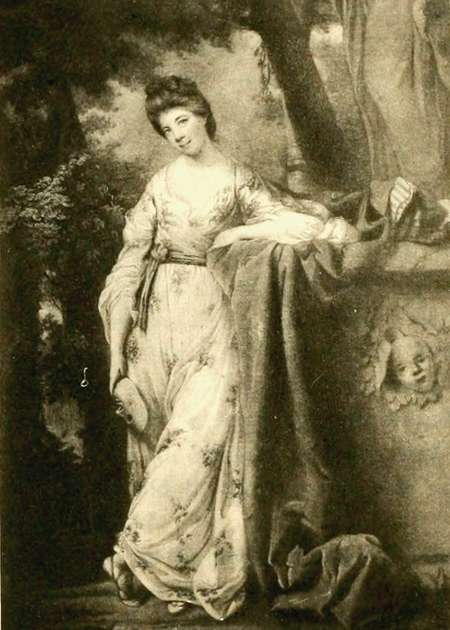
Humble, however, as the position of the flower-girl
is, there is good blood in her very blue veins. She
comes of the Bartons of Derbyshire, and not longer
ago than the accession of King William, sons of
that family held honourable office in the Church, the
army, and in government offices. Fanny Barton ran
on errands for a French milliner, and occasionally
encountered Baddeley, when the latter was apprenticed
to a confectioner, and was not dreaming of
the Twelfth Cake he was to bequeath to the actors
of Drury Lane. Then ensued some passages in her
life that remind one of the training and experience
of Nell Gwyn. The fascinating Fanny, in one way
or another, made her way in the world, and, for the
sake of a smile, lovers courted ruin. This excessively
brilliant, though not edifying, career did not last
long. Among the many friends she had acquired
was that prince of scamps and Bardolphs, Theophilus
Cibber, who had just procured a licence to open the
theatre in the Haymarket. He had marked the
capabilities of the "vivacious" Fanny, and he
tempted her to appear under his management, as
Miranda, in the "Busy Body," to his Marplot. This
was on the 21st of August 1755, when the débutante
was only seventeen years of age. She immediately
excited attention as an actress of extraordinary
promise; and, in the short summer season, she exhibited
her versatility by playing Miss Jenny, in the
"Provoked Husband;" Desdemona, Sylvia, in the
"Recruiting Officer," and finally enchanted her audience
as Prince Prettyman, in the "Rehearsal."
From the Haymarket this clever girl went to Bath
and fascinated King, the manager; thence to Richmond,
where Lacey, the manager there, fell equally
in love with her, and engaged her for Drury Lane
(1756-57), where, however, the presence, success,
and claims of Miss Pritchard, Miss Macklin, and
Mrs. Clive, kept her out of the line of characters for
which she was specially qualified. She was, moreover,
ill-educated, and she forthwith placed herself
under tuition. Fanny took for music-master Mr.
Abington, who, of course, became desperately in love
with her, and married his pupil. The young couple
established a splendid home in the then fashionable
quarter, St. Martin's Lane; but soon after, the
convenient Apollo disappears, and even the musical
dictionaries fail to tell us of the being and whereabout
of a man whose wife made his name famous.
After four seasons at Drury, she went on a triumphant
career to Dublin. There she acquired all she had
hitherto lacked, and when, in the season of 1765-66,
she reappeared at Drury Lane, as Cherry,[26] upon terms
granted by Garrick, which were no longer considered
extravagant, so conspicuous was her talent, the playgoing
world was in a fever of delight. Her career,
from 1755 to 1798, lasted forty-three years, and,
though like Betterton, Time touched her person, it
never weakened her talent. Critics praise her elegant
form, her graceful address, the animation and expression
of her looks, her quick intelligence, her perfect
taste. Expression served her more than beauty, and
her voice, once hardly better than Peg Woffington's,
became perfectly musical by her power of modulation.
Every word was pronounced with a clearness
that made her audible in the remotest parts of the
theatre, and this was a charm of itself in such parts
as Beatrice, and Lady Teazle, where "every word
stabbed," as King was wont to remark. In short,
she was one of the most natural, easy, impressive, and
enchanting actresses that ever appeared on the stage.
Reynolds took her for his Comic Muse, and it is worth
a pilgrimage to Knowle Park to look on that wonderful
impersonation, and realise something of the grace
and perfection of Mrs. Abington. In 1771, Walpole
wrote to her, "I do impartial justice to your merit,
and fairly allow it not only equal to that of any actress
I have seen, but believe the present age will
not be in the wrong if they hereafter prefer it to
those they may live to see." On one occasion, he
describes her, in Lady Teazle, as "equal to the first
of her profession." She "seemed the very person,"
an "admiration of Mrs. Abington's genius made him
long desire the honour of her acquaintance." He
goes to sup with her, hoping "that Mrs. Clive
will not hear of it;" and he throws Strawberry
open to her, and as many friends as she chooses to
bring with her. When the fever of his enthusiasm
had somewhat abated, and he remembered the
"Nosegay Fan" of early days, his admiration was
more discriminating. Mrs. Abington, then, "can
never go beyond Lady Teazle, which is a second-rate
character, and that rank of women are always
aping women of fashion without arriving at the
style." Out of the line of the affected fine lady, says
Lady G. Spencer, "Mrs. Abington should never go.
In that she succeeds, because it is not unnatural
to her." This criticism is just, for Lady Teazle is
a parvenu. The country-bred girl apes successfully
enough the woman of fashion, but in her early home,
as we are told, she wore a plain linen gown, a bunch
of keys at her side, her hair combed smooth over a
roll; and her apartment was hung round with fruits
in worsted, of her own working. Her girlish occupation
was to inspect the dairy, superintend the
poultry, make extracts from the family receipt-book,
comb her aunt Deborah's lap-dog, draw patterns for
ruffles, play Pope Joan with the curate, read a sermon
aloud, and strum her fox-hunting father to sleep at
the spinnet. This "fine lady," by accident and not
by birth, Mrs. Abington could play admirably; better
than she could Lady Modish, who was a lady by birth
and education. But even in the latter character she
is described as having been the accomplished and
well-bred woman of fashion. Her intercourse with
ladies of rank, an intimacy which made her somewhat
vain, was of use to her in such impersonations;
but she was not received so unreservedly as Mrs.
Oldfield, for many remembered her early wild course,
and saw no compensation for it in the later and better
regulated life. She turned such schooling as she
could obtain in drawing-rooms to the best account;
but Mrs. Oldfield, in the University of Fashion, took
first-class honours.
Coquettes, chambermaids, hoydens, country girls,
and the women of the Lady Teazle, Lady Fancyful,
and Lady Racket cast, she played without fear of a
rival. Her chambermaids seem to have been over-dressed,
and this superfluity attended some of her
other characters, in which she was as much beplumed
as the helmet in the Castle of Otranto. For more
than a quarter of a century, her Widow Belmour, in
the "Way to Keep Him," was a never-failing delight
to the public. Murphy says that her graces of
action gave to this part brilliancy, and even novelty,
every time she repeated it. She was the original representative
of thirty characters, among which we
find,—Lady Bab, in "High Life Below Stairs;" Betty,
in the "Clandestine Marriage;" Charlotte, in the
"Hypocrite;" Charlotte Rusport, in the "West
Indian;" Roxalana, in the "Sultan;" Miss Hoyden,
in the "Trip to Scarborough;" and her crowning
triumph, Lady Teazle.
Like other clever players, she committed a fault,—hers
was in acting Scrub, for a wager,—at her benefit,
in 1786. Genest says, "In point of profit, it no
doubt answered; but she is said to have disgraced
herself in Scrub, and to have acted the part with her
hair dressed for Lady Racket," which she played in
the after-piece! Her portrait, as Scrub, with her
hair thus dressed, gives her an absurd appearance.
She figured in the private theatricals, at Brandenburgh
House, of the Margravine of Anspach. In one of
the plays represented—the "Provoked Wife"—the
piece was cut down, in order that no female character
should have equal prominence with that of Lady
Brute, played by the Margravine herself; but Mrs.
Abington asserted her professional right, and played
her once famous scene of Lady Fancyful, straight
through, to the united delight of herself and audience.
In her later years she lost her old grace and fine
figure; and she, who had snatched the mantle from
Kitty Clive, found it taken from her, in her turn, by
the gentle yet all-conquering Miss Farren, whom,
however, she survived on the stage. From 1798 to
1815, Mrs. Abington lived in retirement, active only
in works of charity; and when she died in the latter
year, few remembered in the deceased wealthy lady,
the vivacious "Nosegay Fan" of three-quarters of a
century before.
There remains to be noticed one who, in the annals
of the stage, appears like a brief but charming episode,—a
fair promise, hastily made, and not realised; an
actress of whom Garrick augured well, and whom he
gave to the stage, from which she was snatched by a
prince. Miss Darby was a native of Bristol, and a
pupil of Hannah More. She was the heiress of a fair
fortune, which her philanthropic father dissipated in
attempts to civilise the Esquimaux Indians. Having
thereby beggared his wife and child, the man, with a
heart for all mankind, but not for his home, left the
latter; and the mother then was supported by what
Miss Darby could earn as a governess. What she
could then spare, she devoted to acquiring "the usual
accomplishments." Among the latter was dancing;
and her master (a Covent Garden ballet-master) introduced
her to Garrick. After some training, she
recited Cordelia, like a pretty and clever child, as
she was; and then disappeared.
She was not sixteen when she married Mr. Robinson,—a
young man of good fortune, apprenticed to
the law. The happy couple ran through their fortune
in splendid haste; and Mrs. Robinson spent more
than a year with him in prison. Misery drove her
again to Garrick, who, though now withdrawn from
the stage, rehearsed Romeo to her Juliet; and sat in
the orchestra on the night of the 10th of December
1776, when she played the latter part to the Romeo
of Brereton. She was then only eighteen; and her
success was all that could be expected from her talent
and beauty, and a voice which reminded Garrick of
his darling, Mrs. Cibber. Thus commenced the brief
stage career which ended in May 1780 with the
"Winter's Tale," and her own farce, the "Miniature
Picture,"[27] on which occasion she played Perdita and
Eliza Camply.[28]
In the interval, she had played the tender or proudly
loving ladies in tragedy, and the refined and sprightly
nymphs in comedy; and she was the original Amanda,
in the "Trip to Scarborough." Since Mrs. Woffington
and the first blush of Mrs. Bellamy, such peculiar
grace and charms had not been seen on the stage. The
critics extolled both, the fine gentlemen besieged her
with billets-doux, and the artists protested that they
had never beheld better taste than hers in costume.
On the 3d of December 1779 their Majesties' servants
played, by command, at Drury Lane, the "Winter's
Tale," for the sixth time. Gentleman Smith was
Leontes; Bensley, Polixenes; Brereton, Florizel; Miss
Farren, Hermione; and Mrs. Robinson, Perdita.
The King, Queen, and royal family were in their
box, when Perdita entered the green-room, dressed
more exquisitely and looking more bewitching than
ever. "You will make a conquest of the Prince, to-night,"
said Smith laughingly; "I never saw you
look so handsome as you do now!" He was a true
prophet. The Prince was subdued by her beauty,
and subsequently wrote letters to her, which were
signed "Florizel," and were carried by no less noble
a go-between than William Anne Capel, Earl of
Essex; but others ascribe this messengership of
love to his son Viscount Malden, who subsequently
married Miss Stephens, the vocalist, and present
dowager-countess.[29]
The messenger of love wooed her for the Prince,
while he adored her himself,—at least he said so.
He gave her the Prince's portrait, and a heart,—not
in precious metal, but in paper,—a symbol of the
worth and tenacity of the Prince's. On this token
was a double motto, in French, for the air of the
thing: "Je ne change qu'en mourant;" and in
English, for the emphasis of it: "Unalterable to my
Perdita through life."
This young creature's husband was living in
profligacy on her salary, which he received at the
treasury, and she was wooed by a young Prince, with
a magic of wooing which, she said, she should never
forget. The first step she made towards the latter
was, by meeting him in a boat, moored off Kew.
The second, was by meeting him by moonlight, in
Kew Gardens. But then, the "Bishop of Osnaburgh"
was present! And the lady herself was a
furbelowed Egeria to a powdered Numa. "During
many months of confidential correspondence," she
says, "I always offered his royal highness the best
advice in my power."
Deathless was to be the young Prince's love, and
his munificence was to be equal to his truth. In
proof of the latter, he gave her a bond for £20,000,
to be paid to her on his coming of age. In a few
months he attained his majority, refused to pay the
money, and made no secret to the lady of his deathless
love having altogether died out. He passed
her in the park, affecting not to know her; and
the spirited young woman, who had given up a
lucrative profession for his sake, flung a remark at
him, in her indignation, that ought to have made
him blush, had he been to that manner born.
However, she was not altogether abandoned. The
patriotic Whig statesman, Charles Fox, obtained
for the Prince's cast-off favourite an annuity of
£300,—out of the pockets of a tax-paying people!
Perdita would fain have returned to the stage, but
her friends dissuaded her. No one could tell how a
moral people would receive the abandoned of "Florizel!"
So, restless, she dwelt, now here, now there;
now in France, where Marie Antoinette gave a purse,
knitted by her luckless fingers, to "la belle Anglaise;"
now in Brighton, where also resided, in the brightest
of her beauty and the highest of her splendour, Mrs.
Fitzherbert;—the married Polly and the royal Macheath's
neglected Lucy?
Perdita was not idle; she wrote poems and novels;
the former, tender in sentiment and expression; the
latter, not without power and good sense. She had
undertaken to supply the Morning Post with poetry,
when she died, after cruel suffering, in the last year
of the last century (1800); and she herself the last
of the pupils of David Garrick.
There was good in this hapless creature. Throughout
life she was the loving and helping child of her
mother; the loving and helping mother of her child,
for both of whom she laboured ungrudgingly to
the last. Hannah More, herself, would not harshly
construe the conduct of her pupil. "I make the
greatest allowance for inexperience and novel passions,"
was the comment of Horace Walpole. "Poor
Perdita!" said Mrs. Siddons, "I pity her from my
very heart!"
She fell into bad hands—beginning with those of
her father. In her husband's she was still less cared
for, though she spent nearly a year with him in a
sponging-house, to leave which she was importuned
by worthless peers and equally worthless commoners—from
ancient dukes down to young city merchants.
There was a public admiration for her which scarcely
any other actress so practically experienced. Thus, on
the night in 1776, when the "Trip to Scarborough"
was undergoing temporary but loud condemnation,
Mrs. Yates, yielding to the storm, suddenly withdrew,
and left Mrs. Robinson, as Amanda, standing alone
on the stage, where she was so bewildered by the
continued hissing, that the Duke of Cumberland
stood up in his box, requested her not to be alarmed,
and cheered her by calling out, "It is not you, but
the piece, they are hissing."
She gave rather the promise than the actuality of
a fine actress; she had good taste, and manifested it
in an attention to costume, when propriety therein
was not much cared for. She describes the outward
presentment of her Statira ("Alexander the Great"),
by saying, "My dress was white and blue, made after
the Persian costume; and, though it was then singular
on the stage, I wore neither a hoop nor powder.
My feet were bound with sandals, richly ornamented;
and the whole dress was picturesque and
characteristic."
Between this period and the time when she lay
stricken by paralysis, the interval was not long; and
then the forsaken creature, if vanity abided with her,
was obliged to content herself with reminiscences of
the past—when she was the Laura Maria of Della
Crusca, and when Merry declared that future poets
and ages would join "to pour in Laura's praise their
melodies divine." During that same time Peter
Pindar called her, "The nymph of my heart;" Burgoyne
pronounced her "perfect as woman and artist;"
Tickle proclaimed her "the British Sappho;" John
Taylor hailed her, "Pensive Songstress;" Boaden
recorded her, "mentally perfect;" the Hon. John
St. John asserted that "Nature had formed her
queen of song;" Kerr Porter saluted her in thundering
heroics; and two theatrical parsons, Will Tasker
and Paul Columbine, flung heaps of flowers at her
feet, with the zeal of heathen priests before an incarnation
of Flora.
And so passes by this vision of fair last-century
women to make way for a group of actors of the
Garrick school—standing a little apart from whom
is John Henderson, whom the town was willing to
take for David's successor.
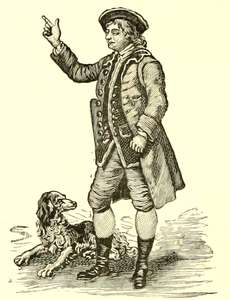
Mr. Beard as Hawthorn.
CHAPTER V. — FOOTNOTES:
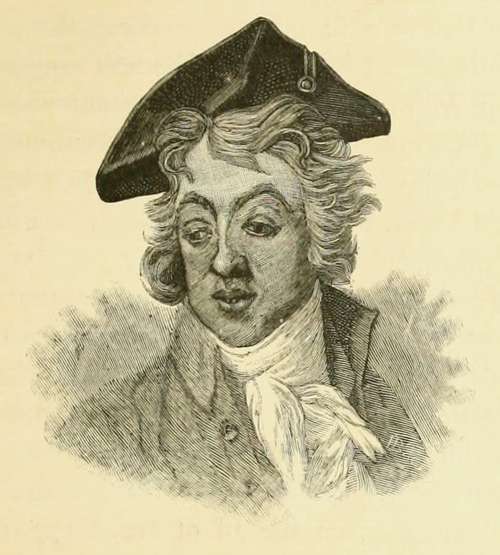
MR. PALMER AS TAG.
A GROUP OF GENTLEMEN.
The players of the Garrick period and the years immediately
succeeding it, followed in due time their
great master. Of these, Samuel Reddish was a
player of that great epoch, who, for some especial
parts, stood in the foremost rank. We first hear of
him in the season of 1761-62, strengthening Mossop's
company in Smock Alley, Dublin, by his performance
of Etan, in the "Orphan of China." Of his origin,
no one knows more than what he published of himself
in the Irish papers,—that he was "a gentleman
of easy fortune." This description was turned against
him by his old enemy, Macklin, on one occasion,
when Reddish in a part he was acting, threw away
an elegantly-bound book, which he was supposed to
have been reading. Macklin's comment was that,
however unnatural in the character he was representing,
it was quite consistent in Mr. Reddish himself,
who, "you know, has advertised himself as a gentleman
of easy fortune."
In September 1767, Reddish first appeared in
London, at Drury Lane, as Lord Townly, to Mrs.
Abington's "My Lady." A few nights after, he
played Posthumus to the Imogen of Mrs. Baddeley.
It was in this last character that he took his melancholy
leave of the stage at Covent Garden, shaken in
mind and memory, on the 3d of May[30] 1779; Mrs.
Bulkley was then the Imogen. His career in London
was but of twelve years, and it might have been
longer and more brilliant but for that fast life which
consumed him,—and for one illustration of which,
when he was rendered incapable of acting, he made
humble apology on the succeeding evening.
Within those dozen years, Sam Reddish played
an infinite variety of characters, from tragedy to farce.
Among those he originated were Darnley ("Hypocrite,")
Young Fashion ("Trip to Scarborough"),
and Philotas ("Grecian Daughter"). As an actor,
his voice and figure were highly esteemed in Dublin,
but the latter was not considered so striking in London.
I gather from his critics, that Reddish was
easy and spirited; that he spoke well in mere declamatory
parts, but, for want of feeling and variety in
the play of his features, failed in parts of passion.
His most attractive character was Edgar, in "King
Lear;" Posthumus stood next; he thought Romeo
was one of his happiest impersonations, but the public
preferred his Macduff and Shylock. As Alonzo
("Revenge") he made a favourable impression; his
Castalio, Lothario, and Orlando were indifferent, and
his Alexander bad. Reddish was, however, an impulsive
actor, often feeling more than the immobility
of his features would permit him to show; and he
endeavoured to make up for it by violence and impetuosity
of action. He was once acting Castalio,
when the part of his brother Polydore was played
by Smith. In the last act of the "Orphan," Polydore
gives his brother the lie, calls him "coward!"
adds "villain!" and at length so exasperates Castalio
that the latter, drawing his sword, exclaims,
"This to thy heart, then, though my mother bore
thee!" and before Smith was well ready for the
fight, Reddish thrust his sword into him and stretched
him bleeding on the stage. The next words Castalio
should have uttered were, "What have I done?
My sword is in thy breast!" but the poor fellow
could only exclaim, "My sword was in thy breast!"
and the play came to an end. Smith, however, did
not die (as in the play) with a "How my head swims!
'tis very dark! good night!" He recovered of his
wounds, and lived to die again.
When Churchill said, "With transient gleam of
grace Hart sweeps along," he was praising the lady
whom Reddish married soon after he came to London,
and who lost the "transient gleam" in ungracefully
growing fat. His second wife was a woman of
very different quality,—a respectable, but impoverished,
widow in Mary-le-bone, named Canning,
whose first husband had, in 1767, published a translation
of the first book of Cardinal Polignac's Anti-Lucretius.
The widow Canning's son, George, subsequently
became Prime Minister of England, "for
giving birth to whom," says Genest, "she was in
due time rewarded with a handsome pension," which
she enjoyed as Mrs. Hunn, down to 1827. Reddish,
I suppose, met with her on the stage of Drury Lane,
where the lady made her first public appearance
(6th of November 1773) in "Jane Shore," Reddish
playing her husband; while Garrick acted Hastings,
at the request of several ladies of rank who patronised
Mrs. Canning. She repeated Jane Shore, and
subsequently played Perdita to the Florizel of
"gentle" Cautherley,—who was said to be a
natural son, certainly a well-trained pupil of Garrick.
Her next part was Mrs. Beverley to Garrick's Beverley;
her fourth, Octavia (in "All for Love") to the
Antony of Reddish, whose wife she became, or at
least is said to have become, at an unlucky season.
As early as the year 1773, Reddish exhibited one
symptom of the malady which compelled him ultimately
to retire, namely the want of memory, which
indicates weakness of the brain. In March of that
year, he played Alonzo, in Home's tragedy so called;
he was the original representative of the part. Although
Alonzo is the hero, he does not appear till
the play is half over, and when the piece came to
nearly that point on the particular night, Reddish
was missing; a riot ensued, and his part was read by
one of the Aikins. Just before the curtain fell, the
truant appeared, declaring that he had only just
remembered that it was not an oratorio night. His
comrades believed him, and for fear the public
should be less credulous he ran from the theatre to
Bow Street Office, and there, in presence of Sir
Sampson Wright, made oath to that effect. The
affidavit was published the next day, and he thereto
adds, "that this unhappy mistake may not be misconstrued
into a wilful neglect of his duty, he most
humbly begs pardon of the public for the disappointment."
The public forgave him, and received him
kindly on his next appearance. His wife, who was
a favourite in the provinces, was ultimately hissed
from the stage of Old Drury.
Gradually, his memory grew more disturbed, till
it could no longer be at all relied on. During the
season 1777-78, he was incapable of acting, and was
supported by the fund. In the following season, he
essayed Hamlet, but it was almost as painful as the
Ophelia of poor, mad Susan Mountfort. Later in
the season, in May 1779, the managers gave him a
benefit, when "Cymbeline" was acted, and Reddish
was announced for Posthumus. An hour or two
before the play began, he called at a friend's house,
vacant, restless, and wandering. Some one congratulated
him on being well enough to play. "Aye,
sir! and I shall astonish you in the garden scene!"
He thought he was to act Romeo. He could neither
be persuaded nor convinced to the contrary, for a
long time, and then only to fall into the old delusion.
"Am I to play Posthumus? I'm sorry for it, but
what must be, must be!" and then he walked to the
theatre, his friend accompanying him, and pitying
the poor fellow, who went on rehearsing Romeo, by
the way. He was so impressed by his false idea,
that his colleagues of the green-room, who had
vainly striven to keep him to Posthumus, saw him
go to the wing, with the expectation on their part
that he would look for Benvolio's cue, "Good
morrow, cousin!" and would be prepared to answer,
"Is the day so young?" With that expectation, they
pushed him on the stage,—where the old situation
wrought a temporary cure in him. To the welcoming
applause he returned a bow of modest
respect, and by the time the Queen had uttered the
words—
"'twere good
You leaned unto his sentence with what patience
Your wisdom may inform you,—"
his eye had lighted up, and he answered with calm
dignity—
"Please your highness,
I will from hence to-day,"
and went through the scene with more than his
usual ability. But he had no sooner passed the wing
than the old delusion returned; he was all Romeo,
waiting for and longing to begin the garden scene
with—
"Soft! what light from yonder window breaks?
It is the East, and Juliet is the sun!"
And many were the fears that at his second going
on, he would be disturbed. He stood dreamingly
waiting at the side, but when Philotas had exclaimed,
"Here comes the Briton! Let him be so
entertained amongst you as suits with gentlemen of
your knowing, to strangers of his quality,"—Reddish
was Posthumus again, and to the remark of the
Frenchman,—"Sir, we have known together in
Orleans," he replied in the clear, level tone which
distinguished him,—"Since when I have been
debtor to you for courtesies, which I will be ever to
pay and yet pay still." Thenceforward, his mind
became healthy, and he played to the close with a
burst of inspiration and talent, such as he had not
shown, even in his best days.
His mind, however, was healthy only for the night;
fitful seasons there were in which he tried to act in
the country; but he soon became diseased again, and,
shut up in a madhouse, poor Reddish might be seen
on visitors' days at St. Luke's, a sad and humiliating
spectacle, herding among the lunatics in that once
popular place of cruel exhibition. Two old feelings
survived the otherwise complete wreck—his love of
good living, and his dislike of inferior company. He
drank greedily his draught of milk, out of a wooden
bowl, but the "gentleman of easy fortune" complained
bitterly of his forced association with the
low people who thronged the gallery. Poor Reddish!
he was moved to better air, improved diet, and less
plebeian society,—in the Asylum at York. The outside
world had been by him long forgotten, and he
forgotten by the world, when he happily died there,
not one hour too soon, in the last month of the year
1785. Little more than eight years later his stepson,
George Canning, made his maiden-speech in
the Commons, as Tory member for Newport, and
failed; but like noble actors in another house, he
gained ultimate success, by turning his experience
to advantage.
About the same time disappeared from the London
stage, Ross, who, like Barton Booth, was a Westminister
boy, and the son of a gentleman. Less
fortunate than Booth, his father discarded him, for
going on the stage. Ross, the actor, had for school-fellow
Churchill, the poet—John Nicoll then being
master; and Booth had for condiscipulus the poet
Rowe, under the famous mastership of Busby. Like
Booth, Ross first tried his fortune on the Dublin
stage in 1749, when he came to London to be of the
school of Garrick, as Booth came to be a follower
of Betterton. Both men had pleasing and powerful
voices and fine figures, but Ross's countenance lacked
expression. Ross, like Booth, played Young Bevil
with great ability, and, as the Ghost of Banquo,
produced almost as much effect as Booth in the
Ghost of Hamlet's father. Here, however, all parallel
ends. Wanting Booth's industry, Ross never raised
himself to Booth's level; he originated very few
characters, wasted his powers, grew fat and indolent,
and lost what Barry kept to the last,—
"A voice as musically clear
As ever pour'd, perhaps, upon the ear."
With a passion for the stage, and every qualification
but industry, he marred his prospects by letting
"mere chance conduct him every night," till the
town wearied of him. He had been at Drury Lane,
from 1751, when he first appeared as Young Bevil,
to 1757; and at Covent Garden, where he commenced
with Hamlet,[31] from that year to 1768, when he became
manager of the new theatre in the Canongate,
Edinburgh.[32]
In Edinburgh, Ross is remembered, however, as
the founder of the legal stage. That is, he was the
patentee of the first theatre that had the sanction of
the law. When the new town of Edinburgh was
projected, in 1767, care was taken for the lawful
establishment of the Scottish stage, and Ross built
that pleasant house which, till 1859, occupied the
site where now stands the New Post Office. It
says something for Ross's prudence, despite his
defects, that he had saved £7000, which he expended
on the construction and completion of this house.[33]
It was opened in December 1769. "Strange," says
Mr. Robert Chambers, "to recall the circumstances
of its opening. No Princes Street then, for the
belles and beaux—no new town whatever, only one
or two houses building at wide intervals. The North
Bridge unfinished and broken down; ladies and
gentlemen obliged to come to these mimic scenes
through Leith Wynd, and other and still narrower
alleys." Thence came failure; and Ross let the
house to Foote, and subsequently to Digges, "a
spendthrift gentleman of good connexions," for
£500 a year.
At the end of four years, Ross was back at Covent
Garden; but he had ceased to attract, and he ultimately
fell into distress (the Edinburgh Theatre failing
to be profitable to him), from which he was
relieved by receiving annually from an anonymous
donor the sum of £60. It was by mere accident
that Ross discovered the gallant seaman, Barrington,
to be his munificent friend; but what connection
existed between the two men, I am not aware.
Such is the record of a player who entirely threw
his chance away by his neglect. Possessing power, he
wanted will, and was always looking to others for
help; and, indeed, he often got it. He played George
Barnwell with such effect that dissipated and felonious
apprentices were turned from their evil ways; and
young men given to philandering with Milwoods and
to thoughts of killing their uncles, were frightened
into a better state of things. One who was thus
rescued used to send, anonymously, ten guineas yearly
to Ross, with a suitable acknowledgment on his benefit
night. "You have done more good by your acting,"
said Dr. Barrowby to him, "than many a parson by
his preaching." The fact is, that Ross's Barnwell
was a sermon which went home to the bosoms of the
Athenians.[34]
The next to disappear from our group is Yates
(1736-1782),[35] the only actor of his day who had a just
notion how to play Shakspeare's fools; he was ever
natural, but frequently imperfect; in low comedy, not
to be surpassed; but in fine gentlemen, he "looked
like Tom Errand in Beau Clincher's clothes." Philip
in "High Life Below Stairs," Sir Bashful Constant,
Major Oakley, and Sir Oliver Surface, were among
his original characters. His forte was old men; but
in stolid clowns, he was inimitable. Yates did not act
so well off the stage as on, for he declined to subscribe
to the theatrical fund, on the ground that he was not
likely ever to need its assistance!
Next passes from the stage to private life, Gentleman
Smith, son of a city grocer, and one of the few
players who have been pupils at Eton. Cambridge
he left in some disgrace, to avoid being compelled to
leave. In 1753, as the pupil of Barry he first appeared
as Theodosius. In 1786[36] he retired, after playing his
original character, Charles Surface. Meanwhile, he
had earned the honourable addition to his name. If
the stage had no greater clown and old man than
Yates, it had no more perfect gentleman than Smith;
who, besides Charles Surface, originally represented
(in London) Glenalvon, Mason's Athelwold, and
Edwin. In gay comedy lay his strength, but he was
the most refined of light tragedians, and played
Richard with effect even in Garrick's days. His
qualifications for both comedy and tragedy were
without a single drawback, save a monotony of voice,
the enunciation of which, in other respects, was perfect.
His Faulconbridge was not surpassed till Charles
Kemble made the part his own.
Smith made two remarkable marriages. His first
was with a daughter of that Viscount Hinchinbroke,
who did not live to succeed his father, the third Earl
of Sandwich. This lady was the young widow of a
Courtenay of Devon, and her union with an actor
was described as a disgrace to her family. Smith
offered to withdraw from the stage, if the family
would secure to him an annuity equal to his salary;
but this was refused, and the player continued his
vocation, in order that he might make suitable provision
for his wife. The union was dissolved by her
death in 1762.
Smith was indefatigable in his profession, and
proud of his own position in it, congratulating himself
on never having had to act in a farce, or sink
through a trap. On his retirement, he married a
widow with a fortune ample enough, when added to
his own, to enable him to live like a country gentleman
at Bury St. Edmunds, whence he came, in
1798, to play Charles Surface, at sixty-six, with
some fat, and legs a little shaky, but with youthful
spirit, for the farewell benefit of King.[37]
Then there is Tate Wilkinson, whose reverend
father of the Savoy Chapel, Garrick had contributed
to transport, by informing against him for illegally
performing the ceremony of marriage. Garrick, in
return, helped forward the son—an exotic, as he
said, rather than an actor; but as an imitator never
equalled, for he represented not only the voice and
manner of other persons, but could put on their
features, even those of beautiful women! He played
in tragedy and comedy well; but only when he
mimicked some other actor throughout the piece.
He used also to reproduce Foote's imitations of the
older actors, and I remember Mathews's imitations
of the imitations of Wilkinson. He had been long
connected with York, and very little with London,
if at all, at the period of Smith's retirement. Wilkinson,
who has added to the literature of the
drama, is further to be remembered for having prohibited
his York actors from soliciting, bill in hand—the
latter ready to grasp the usual fee of half a
crown—patronage for their benefits; a custom
which, I think, did not survive 1784, though Wilkinson
lived till 1805.
From 1765 to 1790—beginning at Dublin, and
ending at Covent Garden[38]—indicates the career of
poor Edwin. He was execrable when he began, in
Sir Philip Modelove; but two years of practice in
Dublin, and nine in Bath, fashioned him into a
perfect actor for the metropolis. When a stage-struck
youth there, and vexing his friends, and
about to lose his clerkship in the Pension Office,
Ned Shuter used to say to him, "You'll be a great
actor when I am laid low." The town, at first, did
not relish his humour; but, at last, relished it so
much, that they allowed him any liberty. He might
go out of his part, and make appeals to them, or
forget his words through "the drink, dear Hamlet"—his
pardon was sure to follow. When young, he
played old men; when old, young; and to his
humour and ability O'Keeffe owed such obligation,
that it was said whenever Edwin died, O'Keeffe
would be d——d!
His fault was his remembrance of the audience.
He was always playing to them, not with his fellows;
but it was so exquisitely done, that the audience least
of all objected. "He was sure of applause, whether
he had to utter the humour of Shakspeare, the wit
of Congreve or Sheridan, or merely to sing 'Tag-rag-merry-derry;'"
says Adolphus. Henderson pronounced
his bye-play as unequalled. In Sir Hugh
Evans, when preparing for the duel, Henderson had
seen him, we are told, for many minutes together,
keep the house in an ecstasy of merriment, without
uttering a single word. Edwin was the original
Lingo, Darby, Peeping Tom, Sheepface, Ennui
("Dramatist"), and a hundred other light parts, in
which he wore that peculiar smile which had not
passed away when his comrades, in October 1790,
looked on his shrouded face before they escorted him
to the grave.
The two Aikins, belonging to the last century,
demand no further notice than that one brother was
distinguished as "Tyrant Aikin;" the other for
having fought a bloodless duel with John Kemble,
on some stage-management dispute, in which Bannister
acted as second to both parties.
West Digges, proud of the blood of the Sackvilles,
not less than of being Home's original Norval, and
of being called the "Gentleman Actor," was a player,
who, like Brereton, was always struggling to reach
the highest eminence, only to fall short of it. Digges
died of paralysis, and Garrick's pupil, Brereton, of
madness.
Lee Lewes, a sort of counterfeit Woodward, also
struggled and failed, though not without merits,
either in Harlequin or Flutter, of which latter he
was the original representative. His self-estimation
could not maintain him before a London audience,
and he travelled to India, in search of others which
cared even less for him; and, after all, came back
to read, lecture, live straitly, and die.
In contrast with this erst deputy-postman, passes
grave and dignified Bensley, whom not even the idea
that he was poisoned, could induce to forget his
identity with this part. Sensitive in other respects,
this scholarly actor, with a glare in his eye, a prominence
in his gait, and a peculiar tone in his voice,
earnestly implored Bannister to omit him from his
imitations in Dick ("Apprentice").
Bensley's great part was Eustace de St. Pierre, in
Colman's "Surrender of Calais," in which he was
remarkable for his mingling of churlish humour with
the most tender sympathy. His career extended
from 1765 to 1795; and there was no actor with so
many natural defects who so ably surmounted them.
His Pierre, his Ghost (in "Hamlet"), his Iago,
Clytus, and Malvolio were excellent.
The ex-lieutenant Bensley may be said to have
made his first appearance in the drama, in Richmond
Park, where he unconsciously had the park-keeper for
his admiring audience. The part was Pierre, for some
instructions in which he was indebted to Colman,
and which he used to rehearse in the park at early
morn, with the "six tubs," or trees, planted on Queen
Caroline's Mount, for scene and senate. The park-keeper,
who had often seen him wending that way,
full of thought, once lay hidden near, and watched
his proceedings. Bensley was rehearsing the scene
before his judges, and the listener must have been
sorely puzzled, as he heard allusions made to chains
and conquests, and the centre tub addressed as a
"great duke," who "shrunk, trembling, in his
palace;" and references to the Duchess Adriatic,
in terms that must have perplexed his judgment.
He simply set the poor gentleman down as mad, and
left him to teach the loose Venetians "the task of
honour, and the way to greatness," without farther
molestation.
About the same time that Bensley left the stage to
become barrack-master at Knightsbridge, Moody retired
from the public scene. Lady Morgan, when
contrasting her father with Moody, does great injustice
to the latter. She cites Cumberland as saying
to Mr. Owenson, after seeing the latter play Cumberland's
Major O'Flaherty:—"Mr. Owenson, I am the
first author who has brought an Irish gentleman on
the stage, and you are the first who ever played it like
a gentleman." Moody was the original Major; and
Lady Morgan remarks, that he "knew as much of
Ireland as he did of New Zealand. English audiences,
however," she adds, "were satisfied, for they
had not yet got beyond the conventional delineation
of Teague and Father Foigard, types of Irish savagery
and Catholic Jesuitism. Cumberland and Sheridan
both thanked my father for redeeming their creations
from caricature." Hereby does Moody suffer retribution.
The best actor of Irishmen of his time, he
was ashamed of being taken for one. His name was
Cochrane; he was a native of Cork, where he had
been apprenticed to his father, a hairdresser; but he
chose to call himself Moody, and to declare that he
was not born in Cork, but somewhere near Clare
Market. Foolish ambition! Taking him at his
word, Sydney Owenson rejoins that he knew as much
of Ireland as he did of New Zealand! Nevertheless,
Moody knew a good deal of Ireland, and something
at least of Jamaica, to which island he ran away from
his own, and played the leading tragic characters
there for several years. He made no effect at Covent
Garden, till he was cast for Captain O'Cutter, in
Colman's "Jealous Wife"—an Irish gentleman before
Cumberland's Major O'Flaherty. His fine humour
and correct judgment gained for him the universal applause.
Hitherto all stage Irishmen had been funny
ruffians. Churchill has recorded the merit of Moody:—
"Long, from a nation ever hardly used,
At random censured, wantonly abused,
Have Britons drawn their sport, with partial view
Form'd general notions from the rascal few;
Condemn'd a people as for vices known,
Which from their country banish'd, seek our own.
At length, howe'er, the slavish chain is broke,
And sense, awaken'd, scorns her ancient yoke;
Taught by thee, Moody, we now learn to raise
Mirth from their foibles, from their virtue, praise."
The Dramatic Censor speaks of Moody as the best
Teague the stage ever knew, but the crown of his
reputation was set by his representation of Major
O'Flaherty, for which he reaped as golden a harvest
of fame as the author did by his piece. Indeed, he
was the first who brought the stage Irishman into
repute, and rendered the character one of a distinct
line whereby a performer might acquire reputation.
The Thespian Dictionary says of Owenson, for whose
sake Lady Morgan disparaged Moody, "he chiefly
supported Irish character, in which he was a
favourite, particularly with the galleries; but his
representation of them (as it was in the country itself)
was high coloured, and would therefore have been too
coarse for an English audience. He has now (1802)
quitted the stage for business, which is still in the
public line."
More careful Moody combined stage and business.
Like many of his profession, he had his suburban
villa; and in his garden by the side of Barnes Common,
he not only raised vegetables, but carted them,
and carried them thence to market. The original
Lord Burleigh selling cabbages!
Moody, however, could very well support the
dignity of his character as man and actor. In the
Half-Price Riots of 1763, he supported Garrick.
Moody stood between him and the angry audience
with a good humour which so exasperated the latter,
that they insisted on his begging pardon on his
knees, a humiliation to which he refused to submit,
though the refusal might drive him from his profession.
Honest John Moody, however, kept his
own, and had no rival till Johnstone appeared in
1784,[39] without any idea of rivalry, for the latter
began his career as an operatic singer. Moody
created Sir Callaghan O'Brallaghan, in "Love à la
Mode;" Captain O'Cutter, in the "Jealous Wife;"
the Irishman, in the "Register Office;" Major
O'Flaherty, in the "West Indian;" Sir Patrick
O'Neale, in the "Irish Widow," and other Irish
characters of less note. His range of character
beyond this was indefinite, for he played Iago and
Sir Tunbelly Clumsey; Henry VIII. and Dogberry;
Shylock, Peachum, and a hundred other opposites,
between the years 1759 and 1796. Towards the end
of that period, he grew torpid with good luck. His
Sir Lucius was without humour and his Major
lacked spirit, but Johnstone was at hand to supply
a place from which Moody retired a few years too
late.
In 1796, another of the players, who dated from
the Garrick days, passed away from the stage,—and
from life;—I mean little Dodd. Like Moody and
the Kembles, he had a sire who was connected with
hair-dressing, but who gave his boy a very excellent
education. At a London school, he played Davus,
in the "Andria," to such purpose, that at sixteen,
he was off to Sheffield, where he commenced his
histrionic course as Roderigo, in "Othello." He
served the hard apprenticeship of itinerancy, and
then so distinguished himself on the Bath stage, by
his comic acting, although he had been engaged
for general business, that Garrick beckoned him up
to London, and by consigning to him the part of
Faddle, in the "Foundling," showed that he took
perfect measure of his ability. From that year 1765
to 1796, Dodd was the darling of the public in his
peculiar line. For fops of the old school, or old
men who would pass for young fops, for simpletons
and cunning knaves, for wearing a now obsolete
modish costume, for "the nice conduct of a clouded
cane," for carrying a china snuff-box, and, above
all, for his unsurpassable style of taking a pinch,
Dodd was really a wonderful actor. He wore his
sword, cocked or carried his hat, displayed his ruffle,
and moved about in a poising, tottering sort of way
which was all his own, and always perfect. His
Abel Drugger stood next to Weston's, if not to Garrick's,—but
Garrick said Weston's was the finest the
stage had ever seen; and his Sir Andrew Aguecheek
was as truly Shakspearian as the author could have
desired. Master Slender, Master Stephen, Watty
Cockney, were among the parts which were said to
die with him; and in his original characters of Lord
Foppington ("Trip to Scarborough"), Sir Benjamin
Backbite, Dangle, Le Nippe, and Adam Winterton[40]
("Iron Chest"), he has never been "touched," probably
by the most able of his successors. Of Dodd
dying no one dreamt till it was done. I can only
think of him as going forward on the tips of his
toes, mincingly, hat in one hand, cane in the other,
a smile on his face, and with a bow to the Summoner,
sinking contentedly back on a convenient sofa,—one
little sigh perhaps of weariness, and little, fresh,
cheery, gentleman-like Dodd is gone, sir!
That he once loved Mrs. Bulkley, the Miss Wilford
of earlier days, does not surprise me; for had
the fiercest of the stage-hating Presbyterians in
Edinburgh, where her Lady Racket was talked of
by old men, at the beginning of this century, with
their hand on their heart and over their waistcoat-pocket,—had
one of the severer stock only seen her,
he would have loved her too. Dodd and Mrs. Bulkley
went into house-keeping together, like Booth
and Susan Mountfort, but the nymph was faithless,
and there was a scandal, and a separation. The
public condemned the lady, as she one night learnt
by their hissing, but the saucy beauty stepped unabashed
to the front, and told her censurers that if
she failed in her duty or powers as an actress, they
were right in their reproof; "but," she added with
an air of Woffington about her, "as for my private
affairs, I beg to be excused!" The audience condoned
the erring beauty; they could not be angry
with a Lady Grace of peculiar elegance; and the
original Miss Hardcastle, and Julia in the "Rivals,"
was allowed to have her pretty way unreproved.
She was on the London stage from 1764[41] to 1789,
and at the time of her death had been known for
two years as Mrs. Barresford.
About the same time as Bensley, Moody, and
Dodd, the stage of the last century lost Baddeley.
He is said to have been a confectioner, to have even
acted as cook to Foote, and to have travelled in some
humble capacity abroad, where he learnt French, and
the way to play French valets and similar characters.
Baddeley was the original Canton ("Clandestine
Marriage"), and Moses ("School for Scandal"), and
he was dressed for this part when, in 1794, he was
taken ill and shortly after expired.
Baddeley, before dying, thought of his old comrades,
and of his successors, in his own good-natured
way. He bequeathed his cottage at Moulsey to the
Drury Lane Fund, desiring that four poor comedians,
not disinclined to live sociably together, might therein
have a joint home. There was ample accommodation
for such a company, in four bed-chambers and two
sitting-rooms. He assigned to them a little bit of
acting also;—that they might not appear dependents,
he bequeathed a trifle to each, which each was to
give away in charity, with an air of its being his
own! Mindful, too, of their ease, habits, and sentiment,
he left funds for the building of a "smoking
summer-house," out of wood from Old Drury, and
in sight of the temple to Shakspeare in Garrick's
garden at Hampton. In remembrance of his own
old vocation as a pastry-cook, and in token of love
for brothers and sisters of his later calling, he left
£100 Three per Cents. for the purchase of a Twelfth
Cake and Wine, to be partaken of annually, "for
ever," by the company of Drury Lane, in green-room
assembled.
Kelly says, the trustees of the Theatrical Fund
sold Baddeley's house at Moulsey. Adolphus thinks
that the deviser infringed the statute of mortmain,
and that the property, for want of heir, escheated to
the crown. Strange, that of property left by players
for the use of players, the poor actors should be
cheated, at Moulsey as elsewhere.
Baddeley is said to have challenged Foote to a
duel with swords, as he did George Garrick to
one with pistols:—"Here's a pretty fellow!" cried
Foote; "I allowed him to take my spit from the
rack and stick it by his side, and now he wants
to stick me with it!" Baddeley is reported to
have been cook, not only to Foote, but to Lord
North.
A greater artist than Baddeley left the stage soon
after him, in 1795, after three and thirty years of
service; namely, Parsons, the original Crabtree, and
Sir Fretful Plagiary, Sir Christopher Curry, Snarl to
Edwin's Sheepface; and Lope Tocho, in the "Mountaineers."
Parsons was a Kentish man,[42] who might have
been an apothecary, or an excellent artist, but that
he preferred the stage. He was a merry, honest
fellow, who kept the house in a roar by his looks as
well as words, and loved to make the actors laugh,
who were on the stage with him, by some droll
remark, uttered in an undertone.
His forte lay in old men, his picture of whom, in all
their characteristics, passions, infirmities, cunning, or
imbecility, was perfect. When Sir Sampson Legend
says to Foresight, "Look up, old star-gazer! Now
is he poring on the ground for a crooked pin, or an
old horse-nail, with the head towards him!" we are
told "there could not be a finer illustration of the
character which Congreve meant to represent, than
Parsons showed at that time in his face and attitude."
He was finely discriminating, too. His Skirmish
in the "Deserter" presented, says Adolphus, "a
shrewd, quick-witted fellow, whose original powers
were merged, but not absolutely drowned, in drink."
In his own estimation, Corbaccio was his best played
character; but, said he, generously, "All the merit
I have in it I owe to Shuter."
The last character he acted was Elbow, on the 30th
of December 1794,[43] when Kemble revived "Measure
for Measure;" but asthma had then reduced him to
a shadow, and he had to yield the part to Waldron.
He died soon after, and then ensued a singular
domestic incident. His second wife was Dorothy
Stewart, niece to the Earl of Galloway, whom he
had married after the lively young lady had run
away from a convent at Lille. Of this marriage
there was a little son, who had for tutor a reverend
young clergyman; and this tutor Dorothy Parsons
married, four days after her husband's decease. So
that she had two husbands in the house; one dead
and the other living![44] The first had left her a
fortune. The second spent it, and left herself and
son destitute.
The town had not an old comic actor it esteemed
more highly, except, perhaps, Palmer. The early
life of John Palmer was full of disappointment; the
latter end of trials; the middle, of some follies; but
nothing more. When he was in hopes of employment
in the theatre, he had been told to go for a
soldier. Garrick would not have him; Foote pronounced
his tragedy bad; but thought his comedy
would do. He "strolled," struggled, starved; and
then was engaged first by Garrick, then by Foote,
to do anything he was told to do, at a salary which
barely found him in bread. Again he went to the
country; married, or was married by a lady of expectations,
which came to nothing, as she had mated
with an actor.
When again in London, Palmer was too frightened
at Barry, to play Iago to his Othello; Garrick eventually
engaged him, but ridiculed his alleged powers
of study, on which point, however, Davy soon changed
his mind. Palmer slowly made his way, but it was
very nearly stopped for ever, by Mrs. Barry, in the
"Grecian Daughter," stabbing him (Dionysius) with
a real dagger. He subsequently built and opened
the Royalty Theatre, in Wellclose Square, but was
compelled to close it, by the patentees. From the
difficulties in which this involved him he never
relieved himself, and his life became a struggle
between bailiffs eager to catch him, and Palmer
eager to escape from bailiffs. Sometimes he passed
a week together in the theatre; at others, he was
carried out of it in some mysterious bit of theatrical
property. From 1761[45] to 1798 he was on the London
stage, one of the best general actors it ever had,
except in singing parts and old men, and some tragic
characters. His fine figure, nevertheless, was always
a help to him. His Young Wilding was pronounced
"perfect;" and among the best of his characters
were Face, Captain Flash, Dick, Stukely, Sir Toby
Belch, Captain Absolute, Young Fashion, Joseph
Surface, Prince of Wales, Sneer, Don John, Volpone,
Sir Frederick Fashion, Henry VIII., Father Philip,
Villeroy, Brush, &c. Among those he originated
were Joseph Surface, Count Almaviva, Sneer, Lord
Gayville, Cohenberg, Sydenham, and Dick Dowlas.
He was often careless, and would go on the stage
very imperfect, trusting to his wits, his impudence,
and the "usual indulgence" of the audience. On
one occasion he delivered a prologue without knowing
a line of it. The prompter was beneath a toilet
table, and to Palmer standing near, he gave line for line,
which Palmer repeated, with abounding smile and
action to make up for dropped words. On another
occasion, this actor took advantage of an uproar in
front, to seem to deliver a prologue of which he knew
nothing. He moved his lips, extended his arms,
touched his heart, and said nothing. Suddenly came
a lull, and then Palmer looked reproachfully as if
the noise had embarrassed him; whereupon one half
of the house stormed at the other, for not keeping
silence, and, under cover of the storm, Palmer seemed
to conclude the prologue, and made a grateful bow,
as if pleased with the fact of having been enabled to
perform a pleasant task.
After playing Father Philip and Comus at Drury
Lane, on the 19th of June 1798, Palmer proceeded
to Liverpool. He had finished at Drury as radiant
with gaiety, on the stage, as if his heart were not
breaking. Death had taken from his family circle his
wife and the most dearly loved of his sons. Sorrow
for those who had departed, and anxiety for the remaining
children who depended on him, affected him
deeply, and, despite all effort, even when acting, he
could not keep the dead or the living for a moment
out of his memory. At length the night came when
he was to repeat the character of the "Stranger,"
and then there was no simulation in his mournful aspect.
He had got through his part to the middle of
the opening scene of the fourth act. He had answered
"I love her still," to the query of Baron Steinfort
(Whitfield) respecting his wife; and then to the question
as to his children, he gave the reply, "I left them
at a small town hard by;" but the words, falteringly
uttered, had scarcely passed his lips, when he fell,
dead, at Whitfield's feet!
The sensation which this caused was most painful;
and it was not allayed by those pious persons
who saw in this sudden death an especial judgment
launched by Heaven on the head of a man who exercised
an unrighteous calling. To support their theory,
they invented the story that Palmer was stricken after
uttering the quotation, in the first scene of the third
act, "there is another and a better world!" These
words suited the inferences they wished to draw.
They did not agree with the facts: but it was the old
story, "so much the worse for the facts!" The lie
yet lives.
Poor Palmer! One cannot help having a kindly
feeling for "Plausible Jack." Can you not see him
coming up to Sheridan, when reconciliation had followed
quarrel, with his head bent blandly forward, his
eyes turned up, his hand on his heart, and a phrase
after the manner, if not of the very matter, of Joseph
Surface, of which he was the original representative?
"If you could but see my heart, Mr. Sheridan!" and
Sheridan's pleasantly remonstrating remark, "Why,
Jack, you forget I wrote it!"
And then he was so modest. "Plausible, am I?"
he once asked; "you really rate me too highly. The
utmost I ever did in that way was, on once being
arrested by a bailiff; when I persuaded the fellow to
bail me!"
After many of these actors had commenced their
career, and long before some of them concluded it, a
great player came, charmed, and departed, leaving a
name and a reputation which render him worthy of
a chapter to himself. I allude to Henderson.
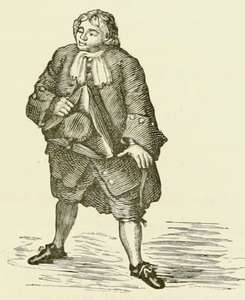
Mr. Dunstall as Hodge.
CHAPTER VI. — FOOTNOTES:
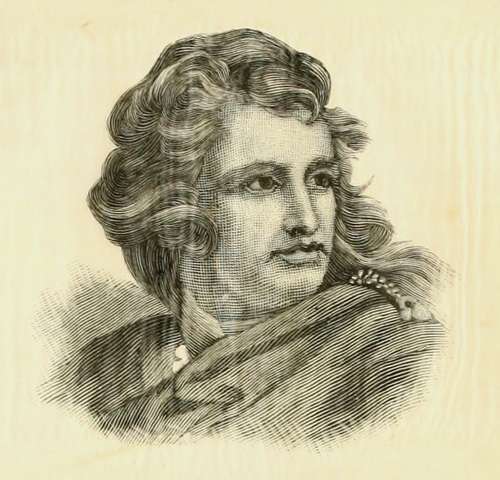
MR. HENDERSON AS ROLLA.
JOHN HENDERSON.
In the bill of the Bath Theatre for October the 6th,
1772, the part of Hamlet is announced to be performed
"by a young gentleman." On the 21st of the
month,[46] we read, "Richard III., by Mr. Courtney, the
young gentleman who acted Hamlet." Mr. Courtney
repeated those characters, and subsequently played
Benedick, Macbeth, Bobadil, Bayes, Don Felix, and
Essex; and on the 26th of December, having thus
felt his way and become satisfied of his safety, we have
"Henry IV.," with "Hotspur by Mr. Henderson."
After being anonymous and pseudonymous, he
added, under his last and proper designation, the
following characters to those he had previously
acted: Fribble, Lear, and Hastings, Alonzo and
Alzuma; and Mr. Henderson was an established
Bath favourite.
At this time, Henderson was five-and-twenty years
of age. Descended from Scottish Presbyterians and
English Quakers, with a father who was an Irish
factor, Henderson is the sole celebrity of the street
in which he was born, in March 1747,[47] Goldsmith
Street, Cheapside. The father died too soon for his
two sons to remember him in after life; but the
boys had an excellent mother, who unconsciously
trained one of her sons to the stage, by making him
familiar with the beauties of Shakspeare.
Having succeeded so far in art as to obtain a prize
when he was Fournier's pupil, for a drawing exhibited
at the Society of Arts; and having been as reluctant
as Spranger Barry to be bound apprentice to a silversmith,
Henderson longed to win honour by the sock
and buskin. This desire was probably fostered by
the sight of Garrick in the shop of Mr. Becket the
bookseller, a friend of Henderson's. Garrick seldom
went to coffee-houses, and never to taverns, but at
Becket's shop he held a little court, and Henderson
sighed to be as great as he.
The weakly-voiced lad, with no marked presence,
and a consumptive look, could obtain audience or
favour from no one; least of all from Roscius. He
went up to remote Islington, and, in the long room
of an inn there, delivered Garrick's Ode on the
Shakspeare Jubilee. After this, and, perhaps, in
consequence, Garrick received him, heard him recite,
shook his head at a voice which was more woolly
than silvery, and, after some counsel, procured for
him an engagement at Bath, and at a trifling salary.
For five seasons he was a rising, improving, and
then cherished actor at Bath. But his fame did not
influence the London managers. At length, exeunt
Garrick, Barry, Woodward, and Foote! and Colman,
lacking novelty at the Haymarket, invites, somewhat
unwillingly, young Henderson from Bath. He
appeared at the Little Theatre in 1777, and, in a
little more than a month of acting nights, put £4500
into the manager's pocket. He played Shylock,
Hamlet, Leon, Falstaff (in "Henry IV.," and in the
"Merry Wives,"), Richard III., Don John, and Bayes.[48]
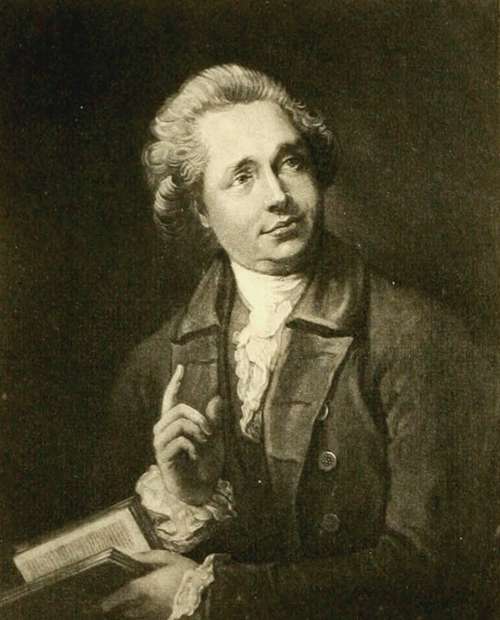
In this first season he played three of his greatest
parts—Shylock, Hamlet, and Falstaff. The first was
selected for his début, contrary to his own inclination.
Macklin's Shylock was the Shylock of all
playgoers; but the difference between it and Henderson's
attracted attention and audiences. Old Macklin
himself praised his young rival's conception of the
part with energetic liberality. "And yet, sir," said
Henderson, "I have never had the advantage of
seeing you in the character." "It is not necessary
to tell me that, sir," said Macklin, with no conceited
modesty. "I knew you had not, or you would have
played it differently." Garrick also saw Henderson
in the part, and remarked that Tubal was very creditably
played indeed! It is said that Henderson, after
delighting Garrick, when breakfasting with him in
1772, by imitations of Barry, Woodward, Love (whose
single character of note was Falstaff), and some
others, offended him by a close imitation of Garrick
himself. Colman is reported to have been equally
offended by an imitation of himself, at his own table,
by Henderson, who did not, as Foote would have
done, watch his host, and mimic him at other tables.
Henderson seems to have been so little willing to
offend, that in playing Bayes, he omitted the imitations
of contemporary performers, by which all
other actors of the parts had been wont to reap rich
harvests of applause.
Macklin said of him that the young man had
learned a great deal; but what remained for him
was to unlearn much of it, in order that he might
learn to be an actor. In this oracular manner there
was more kindness than Henderson met with from
Foote, previous to his first season in London, and of
which Genest has compiled this account:—
"Henderson, accompanied by two friends, waited
on Foote, and was received with great civility.
Foote's imagination was so lively, his conceptions
were so rapid as well as so exuberant, that by a torrent
of wit, humour, pleasantry, and satire, he kept
the company for a considerable time in convulsions
of laughter; however, Henderson's friends thought
it, at last, time to stop the current of Foote's vivacities,
by informing him of the reason of their visit,
and Henderson was permitted to begin a speech in
'Hamlet;' but before he could finish it, Foote continually
interrupted him by some unlucky joke or
droll thought.... At the conclusion Henderson
was, without interruption, allowed to speak Garrick's
prologue on his return from the continent. This
being no caricature, but a fair representation of Garrick's
manner, did not make any impression on Foote;
however, he paid the speaker a compliment on the
goodness of his ear—dinner was now announced, and
when Henderson took his leave, Foote whispered one
of the company, he would not do.
"Henderson once requested Palmer 'not to bring
him forward in too many parts;' observing that it
must be for the manager's interest, as well as his own
credit, to have him studied in the parts he was to
appear in: he added, 'to learn words, indeed, is no
great labour, and to pour them out no very difficult
matter; it is done on our stage almost every night,
but with what success I leave you to judge—the
generality of performers think it enough to learn the
words; and thence all that vile uniformity which
disgraces the theatre.'" This was rather proud
criticism, as it referred to his early Bath colleagues;
but Henderson's standard of propriety would not
allow him to speak otherwise.
In his second character in London, Hamlet, he
came into more direct contrast with Garrick, whose
greatest idolaters found heavy fault in Henderson's
young Dane for flinging away his uncle's picture—subsequent
to the famous speech in which he compares
the portraits of his father and uncle. On a
following night he retained the picture in his hand,
and the same party ridiculed him, on the ground
that if he was right the first night, he must necessarily
have been wrong on the second! He was
said, too, not to have managed his hat properly on
first seeing the Ghost; and similar carpings were
made against the new actor, only to hear whose
words, "the fair Ophelia!" people went as to the
most exquisite music. But what was that to the Garrick
faction who pronounced him disqualified, because
in the closet scene he did not, in his agitation,
upset the chair. "Mr. Garrick, sir, always overthrew
the chair."
During his short, but brilliant and honourable
career, he originated no new character that may be
found in any acting play of the present day. I think
he was the first actor who, with Sheridan, gave public
readings. They filled Freemason's Hall, and their
own pockets, by their talents in this way, and Henderson
could as easily excite tears by his pathos, as
he could stir laughter by a droll way of reciting
Johnny Gilpin, which gave wild impetus to the sale
of that picturesque narrative.
His own temperament, however, was naturally
grave, derived from that mother whose occasional
melancholy was nearly allied to insanity. Yet he
was not without humour, or he could not have played
Falstaff with a success only inferior to Quin, nor
have founded the Shandean Club in Maiden Lane,
nor have written so quaint a pastoral love-song as
his Damon and Phyllis. In acting Æsop, he delivered
the fables with great significance. The chief
characteristic of the part lay in its grim splenetic
humour, such as he himself showed when he, the
high-spirited pupil of Fournier, had to drive his
master when he gave drawing-lessons, and to clean
the horse and chaise after reaching home again!
He loved praise, honestly owned his love, and
worked hard to win public favour. When he was
cast for a new character he read the entire play,
learned his own part, read the play again, and troubled
himself no more about it, although a fortnight might
elapse between the last rehearsal and the first performance.
Previous to which latter occasion, it was
his custom to dine well, and sit at his wine till summoned
to rise and go forth. A Garrick-worshipper
told him he was wrong.[49] Mr. Garrick, on such
occasions, shut himself up for the day, and dined
lightly. Henderson was the last of the school of
Garrick, and once imitated his master in his diet.
The result was a cold and vapid performance of
Bireno, in the "Law of Lombardy;" and Henderson
registered a vow, to be original and dine generously
on like occasions, in future.
Henderson was, in every respect a gentleman; his
social position was as good as that of any gentleman
of his time. In Dublin, as in London, he was a
welcome guest in the best society, even in that for
which the stage had few attractions. Personally, he
had natural obstacles to surmount. He was short,
not gracefully moulded, lacked intelligent expression
of the eye, and had a voice too weak for rage and
not silvery soft enough for love. But he had clear
judgment, quick feeling, ready comprehension, and
accurate elocution. Cumberland names Shylock,
Falstaff, and Sir Giles as his best characters, but
there were portions of others in which he could not
be excelled; "in the variety of Shakspeare's soliloquies,
where more is meant than meets the ear, he
had no equal," and this is high praise, for the difficulty
of the task is work for a genius.
Never strong, his poor health failed him early, and
on the 8th of November 1785 he acted for the last
time. The part was Horatius, in the "Roman Father."
In less than three weeks, and at the early age of
thirty-eight, troops of friends escorted the body of
the man they had esteemed to Westminster Abbey,—one
more addition to the silent company of the
great of all degrees and qualities, from actors to
kings. Professionally, Henderson did not die prematurely.
Kemble had already been two years at
Drury Lane, and the new school of acting was supplanting
the old.
Let me add a word of Henderson's brother. He,
too, belonged to art, and promised to be a great engraver,
but consumption struck him down early. He
was residing, for his health, on the sunny side of a
house in then fashionable Hampstead, when death
came suddenly upon him. Among the company in
the same house was the most beautiful and gay of
gay women,—Kitty Fisher. But she was true woman
too, and hearing of a lonely stranger menaced with
death, she went straightway to tend him, and Henderson's
brother died in Kitty's arms.
His readings were attended frequently by Mrs.
Siddons and John Kemble; his voice was so flexible
that his tones conveyed every phase of meaning.
Even his way of reading the words, "They order
this matter," said I, "better in France," had a world
of significance in it, not to be found when uttered
by others; and the letter of Mrs. Ford to Falstaff,
when he read it on the stage, shook the house with
such laughter as was seldom heard, save indeed when
he imitated Garrick and Dr. Johnson, the former
reciting his ode, and the latter interrupting him by
critical objections. I do not wonder that both
Munden and John Kemble who, all their lives, had
a longing to play Falstaff, abandoned the idea when
they remembered Henderson's excellence.
At the period of Henderson's death, his early prophecy
had been fulfilled with regard to Mrs. Siddons;—to
whose career we will now direct our notice.
CHAPTER VII. — FOOTNOTES:
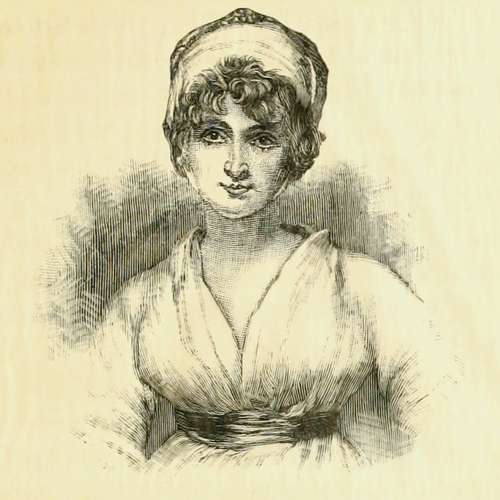
MRS. SIDDONS AS MRS. HALLER.
SARAH SIDDONS.
On the 13th of June 1755,[50] when Garrick and Mrs.
Cibber, Yates and Mrs. Pritchard, Woodward and
Mrs. Clive, were the leaders in the Drury Lane Company,—while
Barry and Mrs. Bellamy, Ryan and
Mrs. Woffington, were among the "chiefs" of Covent
Garden, Sarah Kemble was born, the first of twelve
children, at a public-house, in Brecon, in which
town, exactly a score of years later, was born her
youngest brother, Charles.
By both parents she belonged to the stage. Her
mother's maiden name was Ward. This lady's father
had been a respectable actor[51] under Betterton, and
was a strolling manager, when the hairdresser of the
company, a handsome fellow, poor, of course, and
a Roman Catholic, eloped with and married the
manager's daughter. His name was Roger Kemble.
He was an actor too; love, at first, had helped to
make him a very bad one. Fanny Furnival, of the
Canterbury company, drilled him into the worst Captain
Plume[52] that ever danced over the stage; but Mrs.
Roger Kemble, a woman who illustrated the truth
that beauty is of every age, used in her latter days to
look at the grand old man, and assert that he was
the only gentleman-like Falstaff she had ever seen.
Mr. and Mrs. Kemble were "itinerants" when the
first child of their marriage was born,—a child who
made her début on the London stage long before her
father;—the latter playing, and playing very well, the
Miller of Mansfield, at the Haymarket, in 1788, for
the benefit of the wife of his second son, Stephen.
When Roger carried off Miss Ward, her father with
difficulty forgave her,—and only on the ground that
she had, at all events, obeyed his injunction,—not to
marry an actor. "He will never be that," said the
old player of the Betterton era. With which remark,
his discontent was exhausted.
Her grandsire acted under Betterton and Booth;
her parents had played with Quin;—she herself fulfilling
a professional career which commenced with
Garrick, and ended with her performing Lady Randolph
to Mr. Macready's Glenalvon;—when I add to
this record that she saw the brilliant but chequered
course of Edmund Kean to nearly its close, and witnessed
the début of Miss Fanny Kemble,—the whole
history of the stage since the Restoration seems
resumed therein.
Roger Kemble's itinerant company, as his children
were born, received them as members. They played,—Sarah,
John, Stephen, Elizabeth,—almost as soon as
they could speak. Sarah's first audience compassionately
hissed her, as too young to be listened to; but
she won their applause by reciting a fable. At thirteen,
she played in the great room of the King's Head, Worcester,—among
other parts, Ariel, in the "Tempest,"
her father, mother, sister Elizabeth, and brother John
acting in the same piece. For the next four or five
years, there was much of itinerant life, till we find
her at Wolverhampton, in 1773, acting in a wide
range of characters, from Lee's heroines to Rosetta,
in "Love in a Village." In the latter case, the
young Meadows was a Mr. Siddons, who had acted
Hippolito in Dryden's "Tempest," when she played
Ariel. In her father's company she was always
the first and greatest. She played all that the
accomplished daughter of a manager chose to play,
among her father's strollers,—and she attracted
admirers both before and behind the curtain. The
Earl of Coventry[53] and sundry squires were among
the former. Among the latter was that poor player,
an ex-apprentice from Birmingham, named Siddons,
between whom and Sarah Kemble there was true
love, for which, however, there was lacking parental
sanction. The country audiences sympathised with
the young people, and applauded the lover, who introduced
his sad story into a comic song, on his
benefit night. As he left the stage, the stately
manageress received him at the wing, and there
greeted him with a ringing box of the ears.
This led to the secession of both actors from the
company. Mr. Siddons went,—the world before
him where to choose; Sarah Kemble,—to the family
of Mr. Greatheed, of Guy's Cliff, Warwickshire.
"She hired herself," says the Secret History of the
Green Room, published in the very zenith of her
fame,—"as lady's maid to Mrs. Greatheed, at £10
per annum." "Her station," says Campbell, "was
humble, but not servile, and her principal employment
was to read to the elder Mr. Greatheed." She
probably fulfilled the double duty,—no disparagement
at a time when the maids of ladies were often
decayed ladies themselves.
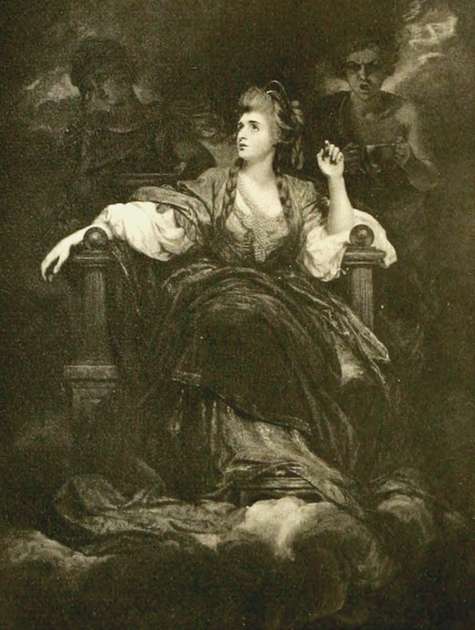
Old Roger Kemble is said to have been very unwilling
that any of his children should follow that
profession, in exercising which he had wandered far,
suffered much, and profited sparingly. The unwillingness
was natural, but he seems to have put it in
practice when too late;—after he had allowed his
attractive young people to enjoy some of the perilous
delights of the stage. There are bills extant which
show that some of them, at least, were playing in his
company, when they were of tender years. When
Sarah Kemble went to Guy's Cliff, it was with no
idea of permanently leaving the stage; and if it be
true, as alleged in the series of dramatic biographies,
published by Symonds at the beginning of the present
century, that Roger Kemble apprenticed his daughter
Elizabeth to a mantua-maker in Leominster, and
Frances to a milliner in Worcester, he narrowly
missed marring their good fortunes. A similar vocation
could not keep Anne Oldfield from the stage,
and though Elizabeth and Frances Kemble were not
actresses of extraordinary merit, they had not to
regret that they abandoned the vocations chosen for
them by their parents, for that which was followed
by their parents themselves.
From Guy's Cliff, Sarah Kemble was ultimately
taken by her persevering wooer, to whom her father
reluctantly gave her at Trinity Church, Coventry, on
the 6th of November 1773. The bride was in her
nineteenth year. The married couple continued but
for a brief period in the Kemble company. A month
after the marriage, the name of "Mrs. Siddons" was,
for the first time, in the playbill, at Worcester,[54]
to Charlotte Rusport, in the "West Indian," and
Leonora, in the "Padlock." Shortly after, Roger
Kemble saw Mr. and Mrs. Siddons depart for Chamberlain
and Crump's company, in Cheltenham.
Here Mrs. Siddons at once took her place. Her
Belvidera excited universal admiration. Lord Ailesbury,
the cousin of the Pretender's wife, the Countess
of Albany, mentioned her to Garrick; and Lord Dungarvon's
daughter, Miss Boyle, directed her wardrobe,
lent her many of her own dresses, and helped
to make others for her with her own hands.
The Cheltenham "properties" were of the poorest;
but there were some that even the Honourable Miss
Boyle could not supply. Thus, for the male disguise
of the Widow Brady, Mrs. Siddons found, on the
night of performance, that no provision had been
made; but we are told that a gentleman in the
boxes lent her his coat, while he stood at the side-scenes,
with a petticoat over his shoulders, and ready
to receive his property when done with!
Garrick, on Lord Ailesbury's report, sent King
down to see this actress of promise, and on King's
warrant, engaged her for Drury Lane, at £5 per
week. Others say that it was on the warrant of
Parson Bate, of the Morning Post, who greatly
praised her Rosalind.[55]
Her first appearance was on the 29th of December
1775, as Portia, "by a young lady," to King's Shylock.
On January 2d, 1776, she repeated Portia,
"by Mrs. Siddons." On the 18th,[56] she played
Epicœne, but the part was subsequently assigned to
another. On the 2d of February she acted Julia,
in a new and poor farce, the "Blackamoor washed
White," and on the 15th, Emily, in Mrs. Cowley's
new comedy, the "Runaway," which part she had to
surrender to Mrs. King. She was not more fortunate
in Maria, her third original character, in "Love's
Metamorphoses;" nor in a subsequent part, that of
Mrs. Strictland to Garrick's Ranger, did she excite
any further remark save that it was played in a
pathetic manner. Her second appearance with Garrick
was as Lady Anne to his Richard, which she
repeated twice, the last time on June 5, in presence
of the royal family. Five nights later, Garrick took
his farewell of the stage, and Mrs. Siddons's engagement
was at an end.
In Belvidera, for which she had been praised by
King, she was not permitted to appear. Bate had
commended her Rosalind, but she had to see it
played by Miss Younge. Even Miss Hopkins, who
became her sister-in-law, had better parts than she;
and there was Mrs. Yates keeping Calista and
Isabella, and Mrs. King playing Lady Macbeth, and
Mrs. Canning (mother of the future statesman)
allowed on the benefit of Reddish, whom she married,
to play Monimia. Mrs. Siddons concluded that the
other actresses who plagued Garrick's life out, hated
her, because Garrick was polite and even kind to
her. Sheridan alleged, as a reason for not re-engaging
her, that Garrick did not recognise in her a
first-rate actress (which she was far from being at
that time). Woodfall thought her sensible, but too
weak for London. "You are all fools!" said buxom
Mrs. Abington.
The fragile, timid, faltering actress acquired strength
in the country. Henderson, himself rising to excellence,
acted with, and spoke well of, her. York
pronounced her perfect, and Bath took her with the
warrant, and retained her, its most cherished tragic
actress, object of public applause and private esteem,
till the year 1782. It was here, in truth, that the
great actress was perfected, and that amid as many
matronly as professional duties. On leaving the
Bath stage, she pointed to her children as so many
reasons for the step; and therewith went up, with
no faint heart, this time to the metropolis. "She is
an actress," said Henderson, "who has never had an
equal, and will never have a superior." "My good
reception in London," writes Mrs. Siddons, "I cannot
but partly attribute to the enthusiastic accounts
of me which the amiable Duchess of Devonshire had
brought thither, and spread before my arrival." Poor
Henderson!
With broken voice, the old nervousness, and a
world of fears, she rehearsed Isabella, in Southerne's
tragedy. When the night of the 10th of October
1782 arrived, she dressed with a desperate tranquillity,
and many sighs, and then faced the public, her
son Henry, then eight years of age, holding her by
the hand, and her father, Roger, looking on with a
dismay that was soon converted into delight. Smith
played Biron, and Palmer, Villeroy,—but Siddons
alone was heeded on that night, in which she gave
herself up so thoroughly to the requirements of the
part, that her young son, who had often rehearsed
with her, was so overcome by the reality of the dying
scene, that he burst into tears.[57] "I never heard,"
she writes, "such peals of applause in all my life.
I thought they would not have suffered Mr. Packer
to end the play."
With the echoes of the shouting audience ringing
in her ears, she went home solemnly and silently.
"My father, my husband, and myself," she says,
"sat down to a frugal, neat supper, in a silence uninterrupted,
except by exclamations of gladness from
Mr. Siddons." With succeeding nights, the triumph
went on increasing. The management gave her Garrick's
dressing-room, and gentlemen learned in the
law presented her with a purse of a hundred guineas.
After the tender Isabella came the heroic loveliness
of Euphrasia, with Bensley for Evander, her
success in which shook the laurels on the brows of
Mrs. Yates, and the widow of Spranger Barry. Having
given new life to Murphy's dull lines in a play which,
nevertheless, does not lack incident, she appeared as
Jane Shore to Smith's Hastings, and with such effect
that not only were sobs and shrieks heard from the
ladies, but men wept like children, and "fainting
fits," says Campbell, "were long and frequent in
the house."
To the Lothario of Palmer and Horatio of Bensley,
Mrs. Siddons next played Calista, in another of Rowe's
tragedies, the "Fair Penitent,"—that impersonation
of pride, anguish, anger, shame, and sorrow, and
with undiminished success. But in Belvidera (to
the Jaffier of Brereton, and Pierre of Bensley) she
seems to have surpassed all she had hitherto accomplished
over the minds and feelings of the audience,
whom she fairly electrified. Her Belvidera, with its
honest, passionate, overwhelming love and truth, was
well contrasted with her scorn and magnificence of
demeanour in Zara. The whole season was one of
triumph,—the only dark spot in which was the
failure of Hull's "Fatal Interview," in which she
played Mrs. Montague, but with so little effect,
where, indeed, no opportunity was given her of
creating any, as to injure for a moment a prestige
which grew all bright again by her performance of
Calista.
It is singular that she liked her part in Hull's
play—"a new tragedy, in prose," she writes; "a
most affecting play, in which I have a part that I
like very much;" but she adds, from her house,
149 Strand, "the 'Fatal Interview' has been played
three times, and is quite done with. It was the
dullest of all representations."
Of Mrs. Crawford (Barry) the new actress entertained
some small fears, which are not too generously
expressed in a letter to Dr. Whalley. "I should
suppose she has a very good fortune, and I should
be vastly obliged if she would go and live very comfortably
upon it ... let her retire as soon as she
pleases!" At this time, when her second benefit
brought her nearly £700, her ideas of supreme bliss
were limited to a cottage in the country, and a
capital of £10,000.
Her success brought her many an enemy, the most
virulent and unmanly of whom was an anonymous
paragraph-writer in the newspapers, who slandered
her daily, and for a brief moment excited against
her the ill will of the public. "He loaded her with
opprobrium," says an anonymous contemporary, "for
not alleviating the distresses of her (alleged) sister,"[58]
Mrs. Curtis, a vicious woman, who, according to the
quaintly circumstantial writer, "would not conform
to modesty, though offered a genteel annuity on
that condition." Mrs. Curtis read lectures at Dr.
Graham's Temple of Health, and the wayward woman
attempted to poison herself in Westminster Abbey.
The enemies of Mrs. Siddons somehow connected
her with both circumstances, as they subsequently
did with that of old Roger Kemble applying, humbly,
for relief from some charitable fund, in the hands of
a banker. Probably the ex-hairdresser was proud, and
may have preferred to apply for aid to a fund which
he had helped to sustain than to take it from his
children. The story is detailed by Genest, who
seems inclined to place some faith in it!
Ireland eagerly invited the new actress, and she
crossed from Holyhead to Dublin in a storm, which
she looked on or endured with a "pleasing terror."
Landing in the middle of a wet night in June, no
tavern even would then receive a woman and a
stranger, and it was with difficulty that her companion
Brereton, a promising Irish actor, whom she
had instructed in Jaffier, procured accommodation
for her, in the house where he himself lodged. She
played with equal success at Cork as at Dublin, particularly
in Zara. From the former place she writes
to Dr. Whalley:—"I have sat to a young man in
this place who has made a small full length of me
in Isabella, upon the first entrance of Biron ... he
has succeeded to admiration. I think it more like
me than any I have ever yet seen." Who was this
unnamed artist? Where is this young Isabella?
Mrs. Siddons returned to England, richer by
£1000 by her Irish summer excursion, and with an
antipathy against the people, which could only be
momentary in the daughter of a lady born in Clonmel.
Her season of 1783-84 at Drury was doubly
marked: she played two Shakspearian characters—Isabella,
in "Measure for Measure," to Smith's
Duke; and Constance, in "King John," to the
King of her own brother, John Kemble. The first
was a greater success than the second; but Constance
became ultimately one of the most perfect
of her portraitures.
To see her Isabella, in the "Fatal Marriage," the
whole royal family went in quaint state. To her
brother's Beverley, she played the wife, in a way
which affected the actors as much as it did the
audience. In the Countess of Salisbury, one of Mrs.
Crawford's great parts, and Sigismunda, she comparatively
failed; but she achieved a double triumph
in Lady Randolph. It will be remembered how she
had desired the retreat of Mrs. Crawford. The old
actress had been famous for her performance of Lady
Randolph, which she played on her reappearance
at Covent Garden in November 1783. Her oldest
admirers (some critics excepted) confessed that her
powers were shaken. A month afterwards Mrs.
Siddons played the same character, for her benefit,
to the Young Norval of Brereton, when the old
actress succumbed at once, by comparison; but it is
doubtful if Mrs. Siddons excelled her, if the comparison
be confined to the period when each actress
was in youth, strength, and beauty. "Mrs. Siddons,"
says Campbell, "omitted Mrs. Crawford's scream, in
the far-famed question, 'Was he alive?'" In 1801,
the year when Mrs. Crawford was laid by the side
of her husband, Barry, in Westminster Abbey, Mr.
Simons, says Genest, "in a small party at Bath,
went through the scene between Old Norval and
Lady Randolph,—his imitation of Mrs. Crawford
was most perfect, particularly in 'Was he alive?'
Mrs. Piozzi, who was present, said to him,—'do not
do that before Mrs. Siddons; she would not be
pleased.'"
The King shed tears, however, at her acting; and
the Queen, turning her back to the stage, styled it
in her broken English "too disagreeable;" but she
appointed Mrs. Siddons preceptress in English reading
to the Princesses, without any emolument, and
kept her standing in stiff and stately dress, including
a hoop, which Mrs. Siddons especially detested, till
she was ready to faint! The King, too, praised her
correct emphasis, mimicked the false ones of other
actors, and set her above Garrick on one point, that
of repose, whereas, he said, "Garrick could never
stand still. He was a great fidget."
The Countesses entrapped her into parties where
crowds of well-bred people stood on the chairs to
stare at her. One invalid Scotch lady, whose doctor
had forbidden her going to the theatre, went unintroduced
to Mrs. Siddons's residence, then in Gower
Street, and calmly sat down, gazed at her for some
minutes, and then walked silently away. Sir Joshua
Reynolds painted his name on the hem of her garment,
in his portrait of her as the Tragic Muse, and
Dr. Johnson kissed her hand, and called her "My
dear Madam," on his own staircase. Statesmen were
glad, when she played, to sit among the fiddlers;
and the fine gentlemen of the day, including him of
"Wales," visited her in her dressing-room, after the
play, "to make their bows." And then she rode
home in "her own carriage!"
Edinburgh was impatient to see her, but slow in
making up its mind about her. One supreme effort
alone, in Lady Randolph, elicited from a generous
critic in the pit, the comment, uttered aloud, "That's
nae bad;" after that sanction the house shook with
applause. Glasgow, not to be behindhand, gave her
not only applause but a service of plate. In Dublin,
where, probably, her expressed dislike of the Irish
people had been reported, there was great opposition
to her. Her engagements stood in the way of charitable
benefits, and no sacrifices she made to further
the latter, whether for societies or individuals, were
allowed to her credit. I think, too, that the Irish
actors little relished her stage arrangements made for
proper effect, and Irish managers were not delighted
with her terms of half the receipts; altogether Mrs.
Siddons returned to London in saddened temper. In
Dublin she had raised a storm; in Edinburgh, where
crowds of unwashed people were crammed nightly to
see her, in an unventilated theatre, a fever, such as
used to be in crowded gaols, broke out, and spread
over the city. As once in the case of Garrick, so
now with the great actress; it was called the
Siddons' fever, as if she were responsible for it!
The anecdote of "That's nae bad!" then, is not to
be quoted to the disadvantage of Scottish audiences.[59]
The Edinburgh people, moreover, had been told that
Mrs. Siddons was unwilling to be interrupted by
applause, which, however, was not true; as she herself
alleged that the more applause the less fatigue,
as she had more breathing time. Indeed, the Edinburgh
enthusiasm anent the great actress surpassed
all such manifestations elsewhere. Fancy the General
Assembly of the Kirk being obliged to arrange their
meetings with reference to Mrs. Siddons's acting, as
the younger members followed the artist, as Bossuet
used to follow contemporary actors, to study elocution.
People, during her first engagement of three weeks,
assembled in crowds, hours before the doors were
opened, sometimes as early as noon. As soon as
admission was given, there ensued a fierce struggle
which disregarded even the points of bayonets, whose
bearers were called in to quell disorder; and, as soon
as the play was over, and the doors were closed,
porters and servants took up a position, standing,
lying, sleeping, but all ready to secure places on the
opening of the box-offices on the following day.
On one occasion there were applications for 2557
places, of which the house numbered but 630;
and when, at night, the struggle was renewed for
these, the loss of property, in costume and its
attendant luxuries of jewellery and the like, was
enormous.
One night, as Mrs. Siddons was playing Isabella,
and had uttered the words by which she used to
pierce all hearts, words uttered on discovering her
first husband, in whose absence she had remarried,
"Oh, my Biron! my Biron!" a young Aberdeenshire
heiress, Miss Gordon of Gight, sent forth a scream
as wild as that of Isabella, and, taking up the words
in a hysterical frenzy, was carried out still uttering
them. Next year this impressible lady was wooed
and won by a Byron, the honourable John of that
name, by whom she became the mother of one more
famous than the rest, Lord Byron, the "lord of himself,
that heritage of woe." Lady Gray, of Gask,
told my friend, Mr. Robert Chambers, that she
"never could forget those ominous sounds of, 'Oh,
my Biron!'"
Notwithstanding all this success, I find contemporary
critics expressing an opinion that she played
too frequently. "If she hopes," says one, "to have
the gratification of being followed by crowds, she
should never perform more than once a week, or
twelve times in a season." The arithmetical computation
seems defective; but it is singular that
Mrs. Delaney made a similar remark with respect to
Garrick.
Mrs. Siddons was, however, equal to more fatigue
than some of her admirers would have had her
undergo. I find it recorded, with admiration, in a
paper three-quarters of a century old, that in four
days she had achieved the (then) incredible task of
acting in three theatres, so wide apart as London,
Reading, and Bath!
Walpole thus speaks of her in Isabella, "I have
seen Mrs. Siddons; she pleased me beyond my expectation,
but not up to the admiration of the ton,
two or three of whom were in the same box with
me, particularly Mr. Boothby, who, as if to disclaim
the stoic apathy of Mr. Meadows in "Cecilia," was
all bravissimo. Mr. Crawfurd, too, asked me if I did
not think her the best actress I ever saw? I said,
'By no means; we old folks were apt to be prejudiced
in favour of our first impressions.' She is a
good figure, handsome enough, though neither nose
nor chin according to the Greek standard, beyond
which both advance a good deal. Her hair is rather
red, or she has no objection to its being thought so,
and had used red powder. Her voice is clear and
good; but I thought she did not vary its modulations
enough, nor ever approach enough to the
familiar; but this may come when more habituated
to the awe of the audience of the capital. Her
action is proper, but with little variety; when without
motion her arms are not genteel. Thus you see,
madam, all my objections are very trifling; but what
I really wanted, but did not find, was originality,
which announces genius, and without both which I
am never intrinsically pleased. All Mrs. Siddons
did, good sense or good instruction might give. I
dare to say that, were I one-and-twenty, I should
have thought her marvellous; but, alas! I remember
Mrs. Porter and the Dumesnil; and remember every
accent of the former in the very same part." Subsequently,
he says:—"I cannot think Mrs. Siddons
the greatest prodigy that ever appeared, nor go to
see her act the same part every week, and cry my
eyes out every time; were I five-and-twenty, I suppose
I should weep myself blind, for she is a fine
actress, and fashion would make me think a brilliant
what now seems to me only a very good rose-diamond."
That Mrs. Siddons abandoned the reddish-brown
powder then in fashion, we shall see in the chapter
on costume. Meanwhile, let us keep to her career on
the London stage. On her return thither from Ireland,
she found the town possessed by reports of her
pride, arrogance, and lack of kindness to her poorer
colleagues. A cabal interrupted her performance
during several nights; but even when she triumphed
over it, by proving the injustice of her accusers, she
did not entirely recover her peace of mind. She felt
that she had chosen a humiliating vocation. There
were, however, bright moments in it. In Franklin's
absurd tragedy, the "Earl of Warwick," her superb
Margaret of Anjou caused the playgoers who had
applauded Mrs. Yates to acknowledge that, great as
the original representative was, a greater had arisen
in Mrs. Siddons. But when the latter played Zara,
the supremacy of Mrs. Cibber was only divided. In
Cumberland's "Carmelite," in which she played
Matilda to the Montgomeri of Kemble, she produced
little effect.[60] The great actress had no such poets as
the great Mrs. Barry had, to fit her with parts; and,
lacking such, fell back upon the old. Her Camiola,
in Massinger's "Maid of Honour," was, however,
only a passing success.
She made ample amends for all by her triumph in
Lady Macbeth, in 1785. With this character her
name and fame are always most closely associated.
Walpole himself could hardly have questioned the
grand originality of her conception of the part.
Mrs. Siddons imagined the heroine of this most tragic
of tragedies to be a delicate blonde, who ruled by her
intellect, and subdued by her beauty, but with whom
no one feeling of common general nature was congenial;
a woman prompt for wickedness, but swiftly
possessed by remorse; one who is horror-stricken
for herself and for the precious husband, who, more
robust and less sensitive, plunges deeper into crime,
and is less moved by any sense of compassion or
sorrow.
From this night, Mrs. Pritchard, the Lady Macbeth
of past days, was unseated from her throne in the
hearts of many old admirers. Mrs. Siddons certainly
never had a superior in this part, the night of her
first success in which formed an epoch in dramatic
history. Sheridan, the manager, had dreaded a fiasco,
for no other reason than that in the sleep-walking
scene Mrs. Siddons would not carry the candlestick
about with her! Mrs. Pritchard had always done so,
and any omission in this respect—so he thought—would
be treated by the audience as a mark of disrespect
to the memory and to the observances of the
older actress. The audience were too enthralled
by the younger player to think of such stage trifles.
Mason, the poet, hated Mrs. Siddons for surpassing
his idol, Pritchard, and friends abstained from pronouncing
her name in his presence. She subdued
him, of course, and they played duets together at
Lord Harcourt's; but she could make nothing of the
old poet's Elfrida, played to the Athelwold of Smith—and
Mrs. Pritchard was never displaced from the
shrine she occupied in his memory.
Lord Harcourt's judgment of Mrs. Siddons, in
Lady Macbeth, is thus expressed:—"To say that
Mrs. Siddons, in one word, is superior to Mrs. Pritchard
in Lady Macbeth, would be talking nonsense,
because I don't think that it is possible; but, on the
other hand, I will not say with those impartial
judges, Mr. Whitehead and Miss Farquhar, that she
does not play near as well. But there are others
too, and in the parts for Mrs. Siddons, that are of
this opinion; that she has much more expression
of countenance, and can assume parts with a spirit,
cannot be denied; but that she wants the dignity,
and above all, the unequalled compass and melody of
Mrs. Pritchard. I thought her wonderful and very
fine in the rest of that scene. She throws a degree
of proud and filial tenderness into this speech, 'Had
he not resembled,' &c., which is new and of great
effect. Her 'Are you a man!' in the banquet scene,
I thought inferior to Mrs. Pritchard's; and for the
parts spoken at a great distance her voice wanted
power. Her countenance, aided by a studious and
judicious choice of head-dress, was a true picture of
a mind diseased in the sleeping scene, and made one
shudder; and the effect, as a picture, was better in
that than it had ever been with the taper, because it
allows of variety in the actress of washing her hands;
but the sigh was not so horrid, nor was the voice so
sleepy, nor yet quite so articulate as Mrs. Pritchard's."
This is a less summary criticism than that of the
Calais landlady, on whom Mrs. Siddons had made an
impression. "She looks like a Frenchwoman; but
it will be a long time before she gets the grace and
dignity of a Frenchwoman!"
If Walpole may be trusted, Mrs. Siddons's ideas
of Lady Macbeth had not always been identical. I
find this in a pretty picture painted by Walpole, in
1783:[61]—"Mrs. Siddons continues to be the mode,
and to be modest and sensible. She declines great
dinners, and says her business and the cares of her
family take her whole time. When Lord Carlisle
carried her the tribute money from Brooks's, he said
she was not maniérée enough. 'I suppose she was
grateful,' said my niece, Lady Maria. Mrs. Siddons
was desired to play Medea and Lady Macbeth.
'No,' she replied, 'she did not look on them as
female characters.'"
At that time she had not made up her mind to
attempt a part in which Mrs. Pritchard had been
unrivalled. As far as Medea was concerned, Mrs.
Siddons left the laurels of Mrs. Yates unshaken, and
declined to play that supremely tragic part. One of
her chief desires was that Walpole should see her in
Portia, in which she had failed; Walpole preferred
witnessing her Athenais. In the passionate scenes
of so poor a play as "Percy," Walpole greatly
admired her; but he found her voice hollow and
defective in cool declamation.
Of course, there were various individuals who were
said to be—who affected to be—or who really were
in love with the great actress. Among these was
Brereton, son of the major of that name, and who
was a poor actor till rehearsing Jaffier to Mrs. Siddons's
Belvidera she inspired him, as Malibran did
Templeton, into something like excellence. Mrs.
Siddons having thus effected for him what Garrick had
failed to do, Brereton was exceedingly grateful, and
his good-natured friends not only conduced to Mrs.
Brereton's peace of mind, by reporting that he was
in love with the great actress, but when "a malady
not easily accounted for," as the theatrical biographies
call the insanity which impeded his performances
with Mrs. Siddons in Dublin, compelled him to leave
the stage, the madness was set down to over much
regard for, and a little difference with "a great tragic
actress, of whom he is said to be very fond." To
this matter Mrs. Siddons doubtless alludes in a
curious letter to Dr. Whalley, dated March 13, 1785.
"I have been very unhappy; now 'tis over, I will
venture to tell you so, that you may not lose the
dues of rejoicing. Envy, malice, detraction, all the
fiends of hell have compassed me round about to
destroy me; 'but blessed be God who hath given
me the victory,' &c. I have been charged with
almost everything bad, except incontinence; and it
is attributed to me as thinking a woman may be
guilty of every crime, provided she retain her chastity.
God help them, and forgive them; they know but
little of me."
Poor Brereton died in confinement, in 1787; and
if his wife had ever been rendered unhappy by the
report of his love for Mrs. Siddons, his widow was
rendered happy by the love of Mrs. Siddons's brother
for herself; and Mrs. Brereton, the lively Priscilla
Hopkins of the old days when her father was prompter,
became Mrs. John Kemble. Meanwhile, at other
adorers of her own, Mrs. Siddons only laughed. "If
you should meet a Mr. Seton," she writes to Dr.
Whalley, "who lived in Leicester Square, you must
not be surprised to hear him boast of being very
well with my sister and myself, for since I have been
here I have heard the old fright has been giving it
out in town. You will find him rather an unlikely
person to be so great a favourite with women."
But her Desdemona certainly increased the number
of her lovers, old and young. The character is in
such strong contrast with that of Lady Macbeth,
that the public were not prepared for the new and
more delicate fascination. "You have no idea,"
she writes, "how the innocence and playful simplicity
of my Desdemona have laid hold on the hearts of the
people. I am very much flattered by this, as nobody
has ever done anything with that character before."
Nevertheless, the sense of humiliation does not
seem to have left her. She announces the marriage
of her sister Elizabeth with Mr. Whitelock, a "worthy
man," though an actor; but that of another sister,
Frances, has a more jubilant tone in the proclaiming:
"Yes, my sister is married, and I have lost one of the
sweetest companions in the world. She has married
a most respectable man, though of small fortune;
and I thank God, that she is off the stage." This
was Mrs. Twiss. Of another sister, we only remember
her as the old-fashioned novelist, "Anne" (Hatton)
"of Swansea."[62]
Of theatrical gossip, Mrs. Siddons's letters do not
contain much, but it is generally epigrammatic;
"Miss Younge," she writes to Dr. Whalley, "is
married to Mr. Pope, a very boy, and the only one
she will have by her marriage." In 1786, she says,
"We have a great comic actress now, called Mrs.
Jordan. She has a vast deal of merit, but, in my
mind, is not perfection." What Mrs. Siddons had
acquired already by the stage, we learn from her
own words: "I have at last, my friend, attained the
ten thousand pounds which I set my heart upon,
and am now perfectly at ease with respect to fortune."
From lodgings, at 149 Strand, she had gone to a
house of her own, in Gower Street, Bedford Square,
"the back of it is most effectually in the country,
and delightfully pleasant." There, in then suburban
Gower Street, was established a happy and flourishing
household, the master of which had friends who
borrowed four hundred pounds at a time, and the
mistress others to whom she lent smaller sums, and
who thought her exceedingly ungrateful when she
asked, as she did without scruple, for her money.
Mrs. Jordan, "to my mind, is not perfection,"
wrote Mrs. Siddons, but the former was more perfect
than the latter in Rosalind, which Mrs. Siddons played
for her benefit in April 1785, to the Orlando of Brereton;
King played Touchstone; Palmer, Jacques.
Mrs. Siddons dressed the character ill, as the disguised
Rosalind; her costume was severely handled
by the critics. As Miss Seward magniloquently put
it, "the scrupulous prudery of decency produced an
ambiguous vestment, that seemed neither male nor
female." The character was "totally without archness,"
said Young; "how could such a countenance
be arch?" Campbell, like Walpole, says that in
comedy she gathered no laurels. Miss Farren and
Mrs. Jordan excelled her there; and her Mrs. Lovemore,
in the "Way to Keep Him," must be reckoned
amongst her failures. That some of her heroines,
in dull and defunct tragedies, rank only next to
failures, must be laid to the account of the poets.
Throughout the kingdom she was recognised as
Queen of Tragedy. In Scotland, a sensitive man
in the Glasgow gallery exclaimed, "She's a fallen
angel!" and Edinburgh fishwives looked with interest
on the lady who had "gar'd them greet, yestreen!"
"I am going to undertake your adored Hermione
this winter," writes Mrs. Siddons to Dr. Whalley.
"You know I was always afraid of her, and I am
not a bit more bold than I was." This timidity was
not justified; her Hermione, indeed, was not equal
to that of a later actress, Rachel, but it had grand
points. The simple words, "Why, Pyrrhus!" when
Orestes (Smith) asked her whom she would have
him murder, thrilled the remotest auditor by their
emphasis. But she could thrill actors as well as
auditors; playing Ophelia for her second benefit,
1786, in the mad scene, she spoke some words in so
strange a manner, as she touched the arm of the
Queen, that the memory of so practised a player as
Mrs. Hopkins was disturbed, and she stood awed and
silent.
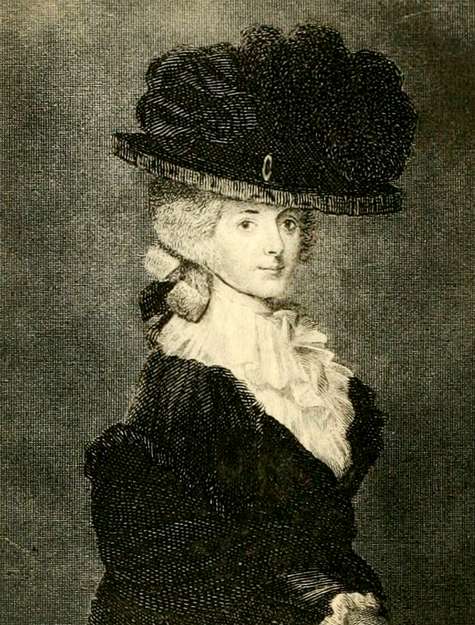
Though Ophelia was not a triumph, nor the Lady
in "Comus," nor Cleone, to which nobody went on
the second night, for the strange reason, that Mrs.
Siddons was too affecting!—her position was unassailably
established. Mrs. Jordan she put out of all
competition with her in certain parts, by playing
Imogen; for which she asked of the artist Hamilton
to sketch for her "a boy's dress to conceal the person
as much as possible."
Whether she desired to set aside Mrs. Jordan altogether
as a rival in comedy, is doubtful; but she
certainly continued to try comic parts, but the laugh
excited was not hearty; her Lady Townly had no
airiness; her smiles are spoken of as glorious condescensions;
when Bannister was asked if her comic
acting had ever pleased him, he "shook his head,
and remarked," says Campbell, "that the burthen of
her inspiration was too heavy for comedy," in which,
according to Colman, she was only "a frisking Gog."
Miss Baillie, on the other hand, insists that but for
unfair discouragement she would have been a great
comic actress. In private life, she had great relish
for humour, and told laughable stories in her slow
way, as well as read scenes in comedy with great
effect. And yet Katharine, with its passionate expression,
was as little thought of as Rosalind. One
would have thought this character would have fitted
her; her own judgment as to what suited her is not
satisfactorily exhibited in her preference of Tate's
Cordelia and of Dryden's Cleopatra to those of
Shakspeare. But she distrusted her own judgment
in some things. "Mr. Siddons," she remarks to Dr.
Whalley, "is a much better judge of the conduct of
a tragedy than myself."
This remark occurs in a letter written in September
1787 under perplexing circumstances. Young
Mr. Greatheed, of Guy's Cliff, was the author of a
tragedy, the "Regent," the heroine in which he designed
for her acting. She liked neither the play
nor her own part in it; but how could she disoblige
the present head of a family where she had found an
asylum, when love had disturbed the tenor of her
life. Therefore, she wrote this letter to her friend
Dr. Whalley, who did not burn it, as he ought to
have done:—"September 1, 1787.—Mrs. Piozzi may
be an excellent judge of a poem possibly, but it is
certain that she is not of a tragedy, if she has really
an opinion of this. It certainly has some beautiful
poetry, but it strikes me that the plot is very lame,
and the characters very, very ill-sustained in general,
but more particularly the lady, for whom the author
had me in his eye. This woman is one of those
monsters (I think them) of perfection, who is an
angel before her time, and is so entirely resigned to
the will of heaven, that (to a very mortal like myself)
she appears to be the most provoking piece of still
life one ever had the misfortune to meet. Her
struggles and conflicts are so weakly expressed, that
we conclude they do not cost her much pain, and
she is so pious that we are satisfied she looks upon
her afflictions as so many convoys to heaven, and
wish her there, or anywhere else but in the tragedy....
Mr. G. says that it would give him too great
trouble to alter it, so that he seems determined to
endeavour to bring it on the stage, provided I will
undertake this milksop lady.... Mr. Siddons says
it will not do at all for the stage in its present state,
for the poetry seems to be all its merit; and if it is
to be stripped of that—which it must be, for all the
people in it forget their feelings to talk metaphor
instead of passion—what is there to support it? I
wish, for his own sake, poor young man, that he
would publish it as it is....
"Your truly affectionate S. Siddons."
The event justified her sentiments, and the "Regent"
did not live. She continued, however, to reap
her harvest of laurels, gathering them most profusely
by her acting in that Queen Katharine, which
had been recommended to her by Dr. Johnson. We
continue to associate her name with this part, in
which she was more queenly and dignified, I suspect,
than Katharine herself; certainly more imposing,
if it be true that by simply saying, "You were the
Duke's Surveyor, and lost your office on the complaint
o' the tenants," she put the surveyor, to whom the
words were addressed, into such perspiring agony,
that as he came off, crushed by her earnestness, he
declared he would not for the world meet her black
eyes on the stage again!
I doubt, however, if the poor fellow could afford
to give up his engagement; and I know that some
of these "affectations" are assumed by inferior
actors. I have heard of a lady so audibly affected,
as she stood at the wing, by the acting of her manager,
then on the stage, that she was invited to
his room to partake of cake and wine. But Mrs.
Siddons undoubtedly possessed power above all other
actresses of attracting and subduing. In the procession
scene, in her brother's barbarous mutilation
of Shakspeare's Coriolanus, which he played so inimitably,
her dumb show, as Volumnia, triumphing
in the triumph of her son, attracted every eye, touched
every heart, and caused the pageant itself to be as
nothing, except as she used it for her purpose. It is
strange that one so gifted should have ventured, at
four-and-thirty, to act Juliet, who
"Even or odd, of all days in the year,
Come Lammas-eve at night, shall be fourteen!"
and to Lammas-eve it wanted "a fortnight and odd
days."
But authors, of course, make as many mistakes as
actresses. When the King, in Miss Burney's tragedy,
"Edwy and Elgiva," cried, "Bring in the Bishop,"
the audience, thinking of the pleasant mixture so
called, broke into laughter, which was only exceeded
by that which broke forth when Mrs. Siddons died,
under a hedge and on a superb couch! I do not
believe, with Genest, that anybody ever laughed at her
dying Zara; but when, in "Edward and Eleanora,"
the two babes were brought in, in imperial frocks
and long coating, and were handed into the bed of
their dying mother, the audience did break forth
into loud hilarity. Indeed, babies in arms were
stumbling-blocks to Mrs. Siddon's dignity. At a
later period than that above-mentioned, when acting
in Sotheby's "Julian and Agnes," she had to make
her exit, carrying an infant. The exit was made
precipitately, and in the doing of it she so violently
struck the passive baby's head against a door-post
as to discover that the said head was made of wood.
The audience laughed again, and Agnes, Countess of
Tortona, all taken aback as she was, laughed heartily
too. Once also, when Mrs. Siddons was playing
Agnes in Lillo's "Fatal Curiosity," and the flesh of
the audience crept at her suggestion of murdering
the stranger, who is her son,—as the scene proceeded
towards the murder, one gentleman in the pit laughed
aloud; he would have been roughly treated by the
audience, but for the discovery that he was in hysterics
at her acting.
At other times, the actress was overcome by herself.
In the pretended fainting scene of Arpasia, in
"Tamerlane," after the wild cry, "Love! Death!
Moneses!" Mrs. Siddons fell back violently, clutching
her drapery, and her dress all disordered,—a swoon
in earnest, which caused a rush, from the pit and
boxes, of part of the excited and sympathising audience.
The agitation of the actress was almost perilous
to her life!
There were occasions, however, on which that
audience refused to be sympathetic. When she
and her brother acted in Jephson's dull "Conspiracy,"
we are told that they "acted to vacancy: the
hollow sound of their voices was the most dreary
thing in the world." This was among the least of
her troubles; at the moment of her greatest exertions,
family cares and sorrows pressed on her. Mr. Siddons's
speculations alarmed her prudent mind. Mr.
Sheridan's money, when he held the purse at Drury
Lane, flowed but slowly and intermittently into her
banker's coffers; and if this, or even illness, drove
her into temporary retirement, she had enemies who
reported that her brain was not as well as it might be.
At the beginning of the present century Mrs. Siddons
more than once expressed a desire "to be at
rest." The labours of her life, and the troubles of
it, too, were equal in magnitude to her triumphs.
Could she but realise £300 a year above that she
had already acquired for her family by her sole and
brilliant exertions, she would begin to be "lazy,
saucy, and happy." Nevertheless, when the period
of 1812 arrived, and she had determined on retirement,
she was less bold in spirit. It was like taking
the first step of the ladder, she said, which led to
the next world. Once she was in peril of taking that
first step less agreeably. While standing as the
statue in the "Winter's Tale," the flowing white
drapery of her dress caught fire from behind, but it
was extinguished by the courage and prudence of
a poor scene-shifter, before she knew the whole of
her danger. He saved her life; and she not only
rewarded him liberally, but saved his son, a deserter
from the army, from the horrible punishment which
was then inflicted on such offenders.
She upheld the dignity of her vocation, by refusing
to act with the "young Roscius," while to act inferior
parts in the same piece with her, actresses of reputation
esteemed it an honour. Miss Pope, on having
the part of Lucy, in "George Barnwell," sent to her,
returned it with some anger; but when she was told
that Mrs. Siddons was about to play Milwood to
Charles Kemble's Barnwell, Miss Pope resumed the
character with eagerness. On the stage, and even
in the green-room, she seldom departed from the
humour of the part she sustained on that particular
evening; but she had no sooner concluded it than
she was herself again. Miss Seward records with
particular delight, after seeing the great actress in
Beatrice, at Birmingham, that Mrs. Siddons having
made a curtesy generally to the house, made one in
particular, with an especial smile of benignity, to
Miss Seward and her friends in the stage-box.
She began and ended her London theatrical life
with Shakspeare,—commencing in 1775 with Portia,
and terminating in June 1812 with Lady Macbeth.
Some few subsequent appearances, indeed, there were.
When her son, Henry Siddons, was the somewhat
unlucky proprietor of the Edinburgh Theatre, he
thought that if his mother and uncle would but play
for him in the same pieces, on the same night, he
should retrieve his fortunes. He wrote separately to
both, and received respective answers. That from
Mrs. Siddons intimated that she would act, for half
the receipts and a free benefit. The reply from John
Kemble expressed his readiness to act,—for a free
benefit and half the receipts! Henry Siddons, much
perplexed, had to look elsewhere for less expensive
aid. After his death, and subsequent to his mother's
farewell to the London stage, she played several
nights, in Edinburgh, gratis, for the benefit of his
family; and critics saw no other change in her, than
that she looked older. Her "last" appearance in
public was in June 1819, when she played Lady
Randolph, for the benefit of Charles Kemble. The
Shakspearian characters for which she enjoyed the
greatest fame, are Lady Macbeth and Queen Katharine;
and these were included in the readings which
she continued to give during a few years. These
last were especially relished by Queen Charlotte and
her family;—the guerdon for many of which, including
Othello, read aloud at Windsor one Sunday
evening, was a gold chain with a cross of many-coloured
jewels.
Her beauty, personal and mental, she retained to
the last,—the former only slightly touched by time.
That was marked, in the Gallery of the Louvre, even
amid the finest examples of mortal and godlike beauty
from the hands of Greek sculptors. Her sense of the
beautiful was also fresh to the last. Standing rapt
at the sublimity of the scenery in the neighbourhood
of Penmanmawr, she heard a lady remark, "This
awful scenery makes me feel as if I were only a
worm, or a grain of dust, on the face of the earth!"
Mrs. Siddons turned round and said: "I feel very
differently."
She had the misery to outlive all her children, except
her daughter Cecilia, but in successive visitations
she was so well-tempered as to create the means of
consolation, and in modelling statuary, often found
at least temporary relief from sorrow. Hannah More
as heartily applauded her in private life as the warmest
of her admirers ever did in public; and in truth her
religion was cheerful, and her rule of life honest.
She was not only a great artist, but a thoroughly
English lady, a true, honest, exquisite woman; one
of the bravest and most willing of the noble army of
workers. Proud, she may have been, and justly so.
Simple she was, and simple-minded, in many respects.
The viola amœna was her favourite flower; and, from
the purple borders of her garden in spring time up
at then secluded Westbourne, her managing hand-maid
acquired the name of Miss Heartsease.
Those who knew her best have recorded her beauty
and her grace, her noble carriage, divine elocution,
and solemn earnestness; her grandeur and her pathos,
her correct judgment, her identification of whatever
she assumed, and her abnegation of self. Erskine
studied her cadences and intonations, and avowed
that he owed his best displays to the harmony of her
periods and pronunciation. According to Campbell,
she increased the heart's capacity for tender, intense,
and lofty feelings, and seemed something above
humanity, in presence of which, humanity was
moved, exalted, or depressed, according as she
willed. Her countenance was the interpreter of her
mind, and that mind was of the loftiest, never stooping
to trickery, but depending on nature to produce effect.
She may have borne her professional habits into
private life and "stabbed the potatoes," or awed a
draper's assistant by asking, "Will it wash?" but
there was no affectation in this;—as she said, still in
her tragic way, "Witness truth, I did not wish to be
tragical!"
I have alluded to the apparent lack of judgment in
her assuming, at thirty-four, the character of Juliet, a
girl not yet fourteen. Miss Weston, however, writes,
"a finer performance was never seen. She contrived
to make her appearance light, youthful, and airy,
beyond imagination, and more beautiful than anything
one ever saw. Her figure, she tells me, was
very well fitted by previous indisposition."
In carrying into private life her stately stage
manner, Mrs. Siddons undesignedly imitated Clairon,
the "Queen of Carthage," as the French called her,
from her marvellous acting as Dido. "If," said
Clairon, "I am only a vulgar and ordinary woman
during twenty hours of the day, I shall continue to
be a vulgar and ordinary woman, whatever efforts
I may make, in Agrippina or Semiramis, during the
other four."
There remains but to be said that this "lofty-minded
actress," as Young called Mrs. Siddons,
died on the 8th of June 1831—leaving a name in
theatrical history second to none, and deep regret
that the honoured owner of it had departed from
among the living. Of the latter was the elder
brother, who owed much of his greatness to her,
and who is noticed in the next chapter.
CHAPTER VIII. — FOOTNOTES:
JOHN P. KEMBLE.
JOHN KEMBLE.
On the 1st of February 1757, John Philip Kemble
was born at Prescot, in Lancashire. His father's
itinerant life not only led to his appearance on the
stage when a child, but to his being placed at
school at Worcester, whence he passed through
Sedgley to Douay, where he was remarkable for his
elocution. He had for college fellow Miller, or
Milner, as he chose to call himself—and who, when a
Roman Catholic prelate, used to affirm that, in point
of elocution, he was considered equal to Kemble!
In 1776, the year in which Garrick retired,
Kemble may be said to have made his first public
appearance as an actor at Wolverhampton, and
Boaden thinks he was too good for his audience.
In various northern towns he endured a stern probation,
and made sundry mistakes. He played Plume,
Ranger, and Archer, which were totally unsuited to
him; and he was actually laughed at in tragedy—by
some persons of distinction in the boxes at York.
He resented this with such dignity, that the York
fine people, who could not understand the latter
feeling, insisted on an apology; and when the rest
of the house declared he should make none, he
thanked them with such a weight of heavy argument
to show they and he were right, that those
bewildered Yorkists demanded of him to beg pardon
immediately.[63]
Subsequently, John Kemble published fugitive
poems, which he was afterwards glad to burn; wrote
a tragedy, "Belisarius," and a comedy, the "Female
Officer;" composed a Latin ode, Ad Somnium, and
a Latin epitaph for his dead comrade, Inchbald;
laid the foundations of friendship with the Percys;
gave lectures on oratory; and, at twenty-three, made
an attempt to improve Shakspeare's "Comedy of
Errors," by turning it into a farce, called "Oh, it's
impossible!" the chief point in which was that
the audience should be as puzzled about the two
Dromios, of whom he made a couple of niggers, as
their masters themselves.
If, at York, the admirers of the now forgotten
Cummins contended that he was superior to Kemble,
so in Ireland those who remembered their old favourite
Barry, were slow to admit Kemble's equality. But,
though he nearly made shipwreck of his fame by
playing comedy, he rose in Irish estimation by his
acting in tragedy; and he won all hearts by his
finished performance of Jephson's "Count of Narbonne,"
in which he represented the Count, to the
Adelaide of Miss Francis—the Mrs. Jordan of later
years. Jephson was an Irishman, and Dublin was
grateful to the actor who helped him to a triumph.
Black Rock, I dare say, is to this day proud of the
author.
On the 30th of September 1783, John Kemble
first appeared in London, at Drury Lane, as Hamlet.
The fierceness and variety of the criticism denote
that a new and a great actor had come before the
critics. His novel readings were severally commented
on—some of them were admirable, but bold.
The utmost one critic could urge was that the player
was "too scrupulously graceful;" and objection was
fairly made to his pronouncing the word "lisp," to
Ophelia, as "lithp." Boaden calls this "a refinement;"
but he is forced to allow that it was "below
the actor."
Just previous to this successful début at Drury
Lane, John Kemble's brother Stephen had very
moderately succeeded in Othello, at Covent Garden,
where the management had secured the big, instead
of the great, Mr. Kemble. Just subsequent to the
former first appearance, two sisters of these players,
Elizabeth and Frances Kemble (afterwards Mrs.
Whitelock and Mrs. Twiss), made an attempt to
share in a theatrical and family glory, in which,
however, they had no abiding part.[64] These ladies
passed away, and left that glory to be divided by
John Kemble, and his sister, Mrs. Siddons. But
some time elapsed before the latter were permitted
to play in the same piece. Smith had possession of
parts of which custom forbade his being deprived;
and it was not till each had played singly in various
stock pieces, that they came together in "King
John," and subsequently in the "Gamester."[65] Previous
to Kemble's undertaking the former character,
the old actor, Sheridan, read the part to him as
Sheridan was used to play it; but grandly as the
King was played, the Constance in the hands of
Mrs. Siddons was the magic by which the audience
was most potentially moved. It was the same in
the "Gamester;" the sufferings of Mrs. Beverley
touched all hearts; but the instability, selfishness,
cowardice, and maudlin of the wretched husband,
excited both contempt and execration—but that was
precisely what the author, as well as the actor,
intended.
This union of genius was not, however, permanent;
when Mrs. Siddons played Lady Macbeth, Smith
acted, with graceful indifference, the Thane; and it
was not till March 1785, that brother and sister
appeared together in another play,[66] and then in
"Othello"—the Moor and Desdemona being assigned
to them. Neither player was ever identified with
the character respectively acted; but what could
even John Kemble do, who performed the Moor in
the uniform of a British general of the actor's own
time? He made a more certain flight by selecting
"Macbeth" for his benefit, and playing the chief
part to his sister's Lady; but it was only for one
night. The Thane belonged by prescriptive right to
Smith, and as long as he remained a member of the
company, the original Charles Surface was entitled
to one of the sublimest parts in all the range of
tragedy. Even when Mrs. Siddons selected the
"Merchant of Venice" for her benefit, and played
Portia, Shylock fell, as by right, to King, and John
Kemble had to be content with Bassanio![67]
He had his revenge; not in playing the insipid
heroes of the new tragedies, which were then more
or less in fashion, but in acting Lear to his sister's
Cordelia, on occasion of her benefit in January 1788.
The greatest admirers of Garrick confessed that
Kemble's Lear was nearly equal to that of their
idol; but Boaden records that he never played it so
grandly and so touchingly as on that night.
Kemble is said to have been so much attached to
Miss Phillips (afterwards Mrs. Crouch), that he was
exceedingly moved on reading the epitaph on her
tomb, by Boaden. He is reported also to have been
tenderly affected by Mrs. Inchbald—for he composed a
Latin epitaph for the tomb of her defunct husband. I
find further mentioned "a young lady of family and
fortune at York," whose cruel brother interfered menacingly
in the matter, and also that "the daughter
of a noble lord, once high in office, was strongly
attached to him, and that the father bought off the
match with £3000. It is certain that Mrs. Siddons
was highly offended at the alliance (subsequently with
Mrs. Brereton)—perhaps she looked with anxious
hope to a consanguinity with the noble house of
G——." So sneers old legend, and here follows
truth.
The lady he did marry was a very excellent lady
indeed. Her own parents had fought their way well
through life, for Mr. Hopkins was a strolling player
when he married the daughter of a Somersetshire
Boniface; but the bridegroom became Prompter, and
Mrs. Hopkins a respectable actress at Drury Lane.
One of their daughters, Priscilla, subsequently belonged
to the company, when young Brereton persuaded
her to take his name, and share his fortunes.
Whether excess of admiration for Mrs. Siddons,
with whom he frequently acted, drove Brereton
mad or not, his widow kept her senses under cool
control, and about a year after the death of her first
husband, one of Garrick's ineffective pupils, she
said to Mrs. Hopkins, "My dear mother, I cannot
guess what Mr. Kemble means: he passed me just
now, going up to his dressing-room, and chucking
me under the chin, said, 'Ha, Pop! I shouldn't
wonder if you were soon to hear something very
much to your advantage!' What could he mean?"
"Mean!" the sensible mother answered—Adolphus
so styles her—"why he means to propose
marriage; and if he does, I advise you not to refuse
him."
The wedding was dramatic enough. Mrs. Hopkins,
her daughter, Jack Bannister and his wife,
walked from Jack's house in Frith Street, to John's
in Caroline Street, Bedford Square, to breakfast with
the bridegroom, who did not seem to expect them.
Thence, on a December morning, 1787, in two
hackney coaches, the party went to church and were
married by "the well-known Parson Este." The
bride—no dinner having been thought of by any
one else—dined early, the bridegroom late, at the
Bannisters'; at whose house Kemble remained with
Mrs. Bannister, or rather taking his wine without
her, while Mr. Bannister and Mrs. Kemble went to
Drury Lane, where they had to act in the "West
Indian." The lady's former name was in the bill.
On her return to Frith Street, Kemble took his good
wife home, and the next acting day, Monday, Lady
Anne was acted by Mrs. Kemble to the Richard of
Mr. Smith. On the 14th, man and wife played together,
Sir Giles and his daughter Margaret; the
delicate audience seizing on a marked passage in the
play, and laughing as they applauded, to indicate
they knew all about it. Sir Giles remained grave
and self-possessed.
Subsequently, Kemble attained the management
of Drury Lane, succeeding King, who had been
merely the servant of the proprietor, in 1788-89.
He could now play what parts he chose,—and his
first character was Lord Townly; his second, Macbeth.[68]
In the first, he was second only to Barry;
in Macbeth, from the weakness of his voice, he failed
to rise to an equality with Garrick. Leon followed,
with some state; Sciolto, in which he rendered the
stern paternal principle sublime; Mirabel, in which
he was to be altogether distanced by his brother,
Charles; and Romeo, in which he never approached
the height of Barry. On his first revival of "Henry
VIII.," he left Bensley in possession of his old part,
Wolsey, and for the sake, it is said, of giving a
"duteous and intelligent observance" to his sister
in the heavier scenes, doubled the parts of Cromwell
and Griffith, in his own person. His great Wolsey
triumph was a glory of a later time; so was the
triumph of his Coriolanus,—not yet matured; but in
which he was not only never surpassed, but never
equalled. His first season as manager was a decided
success, as regards the acting of himself and sister,
and also the novelties produced.
His second was marked by some revivals, such
as "Henry V." and the "Tempest," and adaptations
of the "False Friend" of Vanbrugh, and the
"Rover" of Aphra Behn. In the first piece, in which
Kemble played the King better than he did his other
Kings,—Richard and John, he made a fine point in
starting up from prayer and expression of penitence,
at the sound of the trumpet. In lighter pieces he
was less successful. His Don John, the Libertine,
was as far beyond his powers as were the songs of
Cœur-de-Lion in Burgoyne's pretty recasting of "Sedaine".
How he cared to attempt such a feat as the
last is inexplicable—but did not droll little Quick,
George III.'s favourite actor, and almost personal
friend, once play the Hunchback Richard? and did
not Kemble play Charles Surface? and also take
as a compliment Sheridan's assurance that he had
"entirely executed his design?"
Nevertheless fortune attended the Kemble management,
although George III.'s especial patronage was
bestowed on the rival house. It had its perils, and
once brought him to a duello with James Aikin, a
spirited actor, who had caused the destruction of the
Edinburgh Theatre through his refusal to beg pardon
of the audience on his knees. His only offence was
in having succeeded a favourite, but discharged actor,
named Stayley. In this duel, fought in Marylebone
Fields, with Jack Bannister as sole second to both
combatants, Aikin's fire was not returned by his
manager, and the adversaries were soon reconciled.
With a short interval John Kemble was manager
of Drury Lane till 1801.[69] In the following year he
went abroad, the affairs of Drury having fallen into
confusion; and in 1803, having purchased a sixth
share of Covent Garden, he succeeded Lewis in the
management of that theatre, and remained there till
his retirement in 1817, at the close of the season in
which Mr. Macready made his first appearance in
London, as Orestes; and Lucius Junius Booth, as
Richard, flashed promise for a moment and straightway
died out.
With Kemble's departure from Drury Lane closes
the first part of his career. He had begun it with
£5 per week, and ended it with a weekly salary
strangely reckoned of £56, 14s. He had borne
himself well throughout. He had a lofty scorn of
anonymous assailants; was solemn enough in his
manners not to give a guinea, for drink, to the
theatrical guard, without stupendous phrases; but
he could stoop to "knuckle down" at marbles with
young players on the highway; and to utter jokes
to them with a Cervantic sort of gravity.
He addressed noisy and unappreciative audiences
with such neat satire that they thought he was apologising,
when he was really exposing their stupidity.
I do not know if he were generous in criticism of
his fellow actors; he said of Cooke's Sir Pertinax,
that comedy had nothing like it. This had been
called "liberal;" but it looks to me satirical; and
he certainly never praised Cooke's tragedy. The
utmost, indeed, he ever said of Kean was, that "the
gentleman was terribly in earnest." On the other
hand, his own worshippers nearly choked him with
incense. Boaden may not have been far wrong
when he said that Kemble was at the head of the
Academics, but he certainly was so in describing
Cooke as merely at the head of the vulgar; and he
approached blasphemy when he tells us that Kemble's
features and figure as the Monk in "Aurelio
and Miranda" reminded him, and could only be
compared with, those of One, to name Whom would
be irreverent!
Kemble's secret of success lay in his indefatigable
assiduity. In studying the part of the Stranger he
neglected for weeks, that for which he was particularly
distinguished,—neatness of costume. Whatever
the part he had to play, he acted it as if it were the
most important in the piece; and, like Betterton,
Booth, Quin, Barry, and Garrick, he made his impersonation
of the Ghost[70] as distinct a piece of art as
Hamlet, when that character fell to him, in its turn.
Even in Earl Percy, in the "Castle Spectre," an inferior
character, he took such pains as nearly to break
his neck, and in the scene of the attempted escape,
fell back, from the high window to which he had
climbed, to the sofa below, from which he had painfully
ascended, with the agility and precision of a
harlequin.
Rolla would have seemed to me unworthy of him,
but that I remember Pitt, on seeing him in that
character, said, "there is the noblest actor I ever
beheld!" Sheridan had almost despaired of
Kemble's success in Rolla; but Kemble felt that
everything was in his favour, and gave all his own
admiration to his sister, who, in Elvira, rendered so
picturesque "a soldier's trull."
I have heard eyewitnesses describe his Octavian,
not as a heart-rending, but a heart-dissolving display,
the feelings of the spectators being all expressed by
tears; and yet he could win a laugh from the same
spectators in Young Marlow, and shake their very
hearts again in that mournful Penruddock, his finest
effort in comedy; but in comedy full of tragic echoes.
Next to Penruddock, Boaden classes his Manly,
for perfection; I have heard that parts of his Lord
Townly surpassed them both. There the dignity and
gravity were of a quality quite natural to him.
In Henry V. he was so much the King that an
earl, Guilford, wrote an essay by way of eulogy on
it; and his Hotspur had but one fault, that of being
incorrectly dressed. In Roman parts, and in the
Roman costume, he seemed native and to the manner
born. His Coriolanus and Hamlet are the characters
the most associated with his name. Nevertheless, I
do not discern any great respect, on Kemble's part,
for Shakspeare, in his revival of Coriolanus or of
any other of the plays of the national poet. The
revival of Coriolanus was a mixture of Thomson and
Shakspeare's tragedies, with five of the best scenes
in the latter omitted, and what was judicious in the
former, marred. I cannot help thinking that Kemble
had only that sort of regard for Shakspeare which
people have for the picturesque, who tear away ivy
from a church tower in order to whitewash its walls.
Then, again, in that matter of Ireland's forgery
of "Vortigern," as Shakspeare's, it is not clear
what opinion Kemble held of it previous to the
night of its performance. Mrs. Siddons declined to
play Edmunda; but Kemble's consenting, or rather
resolving, to play the principal character in the
tragedy, would seem to indicate that, at the best, he
had no opinion, and was willing to leave the verdict
to be pronounced by the public. I take from a communication
to Notes and Queries, by an eyewitness,
an account of what took place on that eventful night
when an alleged new piece, by William Shakspeare,
was presented to the judgment of a public tribunal.
"The representation of Ireland's tragedy took
place on Saturday, April 2, 1796. Being one of those
who were fortunate in gaining admittance and a
seat on the second row in the pit, I am anxious,
while my life is spared, to state what I saw and
heard on this memorable occasion. The crowd and
the rush for admittance were almost unprecedented.
I do not think that twenty females were in the pit,
such was the eagerness of gentlemen to gain admittance.
Mr. Ireland's father, I remember, sat in the
front box on the lower tier, with some friends around
him. His son was behind the scenes. There was
little or no disapprobation apparently shown by the
audience until the commencement of the fifth act,
when Mr. Kemble, it was probable, thought the deception
had gone on long enough." Such, I think,
was Ireland's own opinion; for in his Confessions,
published in 1805, I find the following account of
the disapproval of the audience given by himself.
"The conduct of Mr. Kemble was too obvious to
the whole audience to need much comment. I must,
however, remark, that the particular line on which
Mr. Kemble laid such a peculiar stress was, in my
humble opinion, the watchword agreed upon by the
Malone faction for the general howl. The speech
alluded to ran as follows; the line in italics being
that so particularly noticed by Mr. Kemble:—
"'Time was, alas! I needed not this spur.
But here's a secret and a stinging thorn,
That wounds my troubled nerves. O Conscience! Conscience!
When thou didst cry, I strove to stop thy mouth,
By boldly thrusting on thee dire Ambition:
Then did I think myself, indeed, a god!
But I was sore deceived; for as I pass'd,
And traversed in proud triumph the Basse-court,
There I saw death, clad in most hideous colours:
A sight it was, that did appal my soul;
Yea, curdled thick this mass of blood within me.
Full fifty breathless bodies struck my sight;
And some, with gaping mouths, did seem to mock me;
While others, smiling in cold death itself,
Scoffingly bade me look on that, which soon
Would wrench from off my brow this sacred crown,
And make me, too, a subject like themselves:
Subject! to whom? To thee, O sovereign Death!
Who hast for thy domain this world immense:
Churchyards and charnel-houses are thy haunts,
And hospitals thy sumptuous palaces;
And, when thou wouldst be merry, thou dost choose
The gaudy chamber of a dying king.
O! then thou dost ope wide thy bony jaws,
And, with rude laughter and fantastic tricks,
Thou clapp'st thy rattling fingers to thy sides:
And when this solemn mockery is o'er,
With icy hand thou tak'st him by the feet,
And upward so; till thou dost reach the heart,
And wrap him in the cloak of 'lasting night.'
"No sooner was the above line uttered in the
most sepulchral tone of voice possible, and accompanied
with that peculiar emphasis which, on a subsequent
occasion, so justly rendered Mr. Kemble
the object of criticism (viz., on the first representation
of Mr. Colman's 'Iron Chest'), than the most
discordant howl echoed from the pit that ever assailed
the organs of hearing. After the lapse of ten
minutes the clamour subsided, when Mr. Kemble,
having again obtained a hearing, instead of proceeding
with the speech at the ensuing line, very politely,
and in order to amuse the audience still more, redelivered
the very line above quoted with even more
solemn grimace than he had in the first instance
displayed."
During John Kemble's fourteen years' connection
with Covent Garden, he created no new character
that added to his fame, except, perhaps, Reuben
Glenroy, in Morton's "Town and Country." His
other original parts were in poor pieces, more or less
forgotten. In old characters which he assumed for
the first time during his proprietorship in Covent
Garden, the most successful was Gloucester, in
"Jane Shore," to which he gave a force and prominency
which it had never previously received. His
Prospero was a marvel of dignity and beautiful
elocution, and his Brutus perfect in conception and
execution. Of other parts his Pierre was good, but
his Iago was below the level of more than one
fellow-actor; his Eustace de St. Pierre was, perhaps,
as fine as Bensley's, but his Valentine, in the
"Two Gentlemen of Verona," could have been
better played, even then, by his brother Charles.
In judgment, he sometimes erred as Garrick did.
He peremptorily rejected Tobin's "Honeymoon,"
which, with Elliston as the Duke Aranza and Miss
Duncan as Juliana, became one of the most popular
comedies of the day. He acknowledged his mistake;
and he was as ready to acknowledge the sources of
some of his best inspirations. His Wolsey, for instance,
was one of his finest parts, but he confessed
that his idea of the Cardinal was taken from West
Digges. He was sensitive enough as to public criticism,
and when about to try Charles Surface, he
wrote to Topham, "I hope you will have the goodness
to give orders to your people to speak favourably
of the Charles, as more depends on that than you
can possibly be aware of." The act was facetiously
characterised as "Charles's Martyrdom," rather than
"Charles's Restoration," and Kemble himself used
to tell a story how, when offering to make reparation
to a gentleman, for some offence, committed "after
dinner," the gentleman answered that a promise on
Mr. Kemble's part never to play Charles Surface
again, would be considered ample satisfaction. Wine
is said to have always made Kemble dull, but not
offensive. Naturally dull he was not, though he
was styled so by people who would have called
Torrismond dull, because he said, "Nor can I think;
or I am lost in thought!" Kemble was lively
enough to make a good repartee, when occasion
offered. He was once rehearsing the song in
"Cœur-de-Lion,"—which he used to sing to the
blaring accompaniment of French horns, that his
voice might be the less audible,—when Shaw, the
leader, exclaimed, "Mr. Kemble, Mr. Kemble, you
really murder the time!" "Mr. Shaw," rejoined
the actor, taking coolly a pinch of snuff, "it is
better to murder Time than to be always beating
him, as you are."
He bore misfortune manfully. When Covent
Garden, Rich's old house, with the royal arms in
the centre of the curtain, which had hung on the
old curtain at Lincoln's Inn Fields, was burnt down
after the performance of "Pizarro," on the night of
the 19th of September 1808, he was "not much
moved," though, in the fire, perished a large amount
of valuable property. Mrs. Kemble mourned over
the supposed fact that they had to begin life again,
but Kemble, after long silence, burst into a rhapsody
over the ancient edifice, and straightway addressed
himself to the rearing of that new building which
has since gone the way of most theatres. In the
completion of that second playhouse on this spot, he
was nobly aided by his patron, the Duke of Northumberland,
who lent him £10,000, and at the dinner
by which the opening was celebrated, sent the actor
his bond, that he might, as a crowning effect, commit
it to the flames. It was a princely act, and he who
was thought worthy of being the object of it, must
have been emphatically a gentleman.
In earlier days, Kemble was accustomed to be with
the first of gentlemen. One of the finest of the few
left makes some record of him. Walpole notices
Kemble twice; and we find that he held him superior
to Garrick in Benedick, and to Quin in Maskwell.
In September 1789, Walpole writes from Strawberry
Hill to the Miss Berrys: "Kemble, and Lysons the
clergyman, passed all Wednesday here, with me.
The former is melting the three parts of 'Henry VI.'
into one piece. I doubt it will be difficult to make
a tolerable play out of them." The only other notice
is dated April 1791; when the writer says to Miss
Berry: "Apropos to Catherine and Petruchio, I
supped with their representatives, Kemble and Mrs.
Siddons, t'other night, at Miss Farren's ...," at
the bow-window house in Green Street, Grosvenor
Square. "Mrs. Siddons is leaner, but looks well.
She has played Jane Shore and Desdemona, and is
to play in the 'Gamester,' all the parts she will act
this year. Kemble, they say, shone in Othello."
Othello was one of Kemble's effective, yet not his
most successful character; but his figure was well
formed for it. He bore drapery with infinite grace,
and expressed every feeling well, by voice, feature,
and glance of the eye—though in the first, as with
his brother Charles, lay his chief defect. It wanted
strength. We are accustomed, perhaps, to associate
him most with Hamlet, and old playgoers have told
me of a grand delivery of the soliloquies; a mingled
romance and philosophy in the whole character; an
eloquent bye-play, a sweet reverence for his father, a
remembrance of the prince, with whatever companion
he might be for the moment, of a beautiful filial affection
for his mother, and of one more tender which he
could not conceal for Ophelia. When Kemble first
appeared in Hamlet, the town could not say that
Henderson was excelled, but many confessed that
he was equalled. That confession stirred no ill-blood
between them. "I never had an opportunity,"
said Kemble, later, "to study any actor better than
myself, except Mr. Henderson."
Of the grandeur and sublimity of the passion-tossed
Orestes he gave so complete a picture that it was
said—by that single character alone he might have
reaped immortal fame.
On the other hand, his Biron was only a respectable
performance; his Macbeth on a level with his
Othello; his Richard and Sir Giles very inferior to
Cooke's, still more so to those of Edmund Kean;
and in comedy, generally, he was a very poor actor
indeed, except in parts where he had to exercise
dignity, express pathos, or pronounce a sentiment
of moral tendency.
"Whene'er he tries the airy or the gay,
Judgment, not genius, marks the cold essay."
The judgment was not always sensibly exercised, for
Kemble was undoubtedly
"For meaning too precise inclined to pore,
And labour for a point unknown before."
I think, in the old Roman habit he was most at his
ease; there art, I am told, seemed less, nature more.
In this respect he was exactly the reverse of Garrick,
who could no more have competed with him in delineating
the noble aim of the stern Coriolanus, than
Kemble could have striven successfully against Garrick's
Richard, or Abel Drugger.
And yet all the characters originally played by
him, and successfully established on the stage, are
of a romantic and not a classical cast. The prating
patriot Rolla, the stricken, murmuring, lost Octavian,
by which he sprung as many fountains of tears as his
sister in the most heart-rending of her tragic parts;
his chivalrous Cœur-de-Lion, his unapproachable Penruddock,
his Percy ("Castle Spectre"), his Stranger,
his de l'Epée, his Reuben Glenroy (the colloquial
dialogue of which character, however, was always a
burthen to him), and his De Montfort, are all romantic
parts, to many of which he has given permanent
life; while more classical parts for which he seemed
more fitted, and in plays of equal merit at least,
such as Cleombrotus ("Fate of Sparta"), Huniades
(which certainly is not romantic),—his Pirithous,
and his Sextus ("Conspiracy"), are all forgotten.
That his sympathies were classical, may in some sort
be accepted from the fact, that he began his public life
in 1776 (the year of Garrick's farewell), at Wolverhampton,
with Theodosius, and closed it, at Covent
Garden, in 1817, with Coriolanus. That Kemble's
own departure from the stage did not, as was once
expected, prove its destruction, is to be gathered from
the circumstance that while his farewell performances
were in progress, Sheil's tragedy of the "Apostate"
was produced at the same theatre, with a cast including
the names of Young, Macready, C. Kemble, and
Miss O'Neill!—and Kean was then filling Drury Lane
with his Richard, Shylock, and Sir Giles.
Kemble's nearest approach to a fiasco was on his
playing Sir Edward Mortimer. The "Iron Chest"
had been ill-rehearsed, and Kemble himself was in
such a suffering condition on the first night that he
was taking opium pills as the curtain was rising.
The piece failed, till Elliston essayed the principal
part; and, on its failure, Colman published the most
insulting of prefaces to the play, in which he remarked
that "Frogs in a marsh, flies in a bottle,
wind in a crevice, a preacher in a field, the drone of
a bagpipe, all—all yielded to the inimitable and
soporific monotony of Mr. Kemble!"
In one class of character Kemble was pre-eminent.
He was "the noblest Roman of them all." His name
is closely associated with Coriolanus, and next with
Cato. He was not a "general" actor, like some of
his predecessors, yet he excelled in parts which Garrick
declined to touch. A contemporary says of
him, "He is not a Garrick in Richard, a Macklin in
Shylock, a Barry in Othello, or a Mossop in Zanga,"
and adds, that "there is more art than nature in his
performance; but let it be observed that our best
actors have always found stage trick a necessary
practice, and Mr. Kemble's methodical powers are so
peculiar to himself, that every imitator (for there
have been some who have endeavoured to copy his
manners) has been ridiculous in the attempt." Nevertheless,
there was a Kemble school, the last of whose
members is Mr. Cooper, who made his first appearance
in London, at the Haymarket, in 1811, and has
not yet, after more than half a century of service,
formally retired from the stage. Not the least merit
of actors formed on the Kemble model, was distinct
enunciation, and this alone, in our large theatres, was
a great boon to a listening audience.
As a dramatic author, Kemble has achieved no
great reputation; he was, for the most part, only an
adapter or a translator, but in both he manifested
taste and ability, save when he tampered with Shakspeare.
His solemn farewell, on the 23d of June
1817, in Coriolanus, was made not too soon; his
great powers had begun, after more than forty years
assiduous service, to fail, and he becomingly wished,
"like the great Roman i' the Capitol," that he might
adjust his mantle ere he fell. The memory of that
night lives in the heart of many a survivor, and it
lived in that of its hero till he calmly died, after less
than six years of retirement at Lausanne, in February
1823. The old student of Douay never formally
withdrew from the Church, of which his father once
destined him to be a priest, but he remained a true
Catholic Christian, with a Protestant pastor for friend
and counsellor, who was at his side, with a nearer
and dearer friend, when the supreme moment was at
hand. Such was the man. As an actor, he lacked
the versatility and perfection of Garrick and Barry;
and, says Leigh Hunt, "injured what he made you
feel, by the want of feeling himself."
Of John Kemble's brothers, Stephen and Charles,
the former was the less celebrated, but he was not
without merit. The fame of his sister induced him
to leave a chemist's, or an apothecary's counter, for
the stage, as, later in life, the reputation of the eldest
brother tempted Charles Kemble to abandon an
appointment in the Post Office, in order to try his fortune
as a player. In these respective trials Stephen
was less fortunate than Charles. Born in 1758, on
the night his mother played Anne Boleyn, he was by
seventeen years the elder of the latter. His theatrical
life commenced in Dublin, after an itinerant
training; but there John extinguished Stephen; and
when, in 1783, he appeared at Covent Garden, as
Othello, to the Desdemona of Miss Satchell, afterwards
his wife, whatever impression he may have
made, Stephen was speedily swept from public favour
by the greater merit of John. After subsequently
playing old men at the Haymarket, Stephen opened
a house in Edinburgh, against Mrs. Esten at the
established theatre. The opposition led to, in some
sense, a dignified strife. The Duke of Hamilton
loved Mrs. Esten, and the Duke of Northumberland
was a friend to the Kembles. In the law proceedings
which followed, each Duke gave material
support to his favourite, and here was the old
feud of Douglas and Percy again raging in the
north!
Ultimately Stephen left Edinburgh with no great
amount of luck to boast of, and, after a wandering
life, appeared, in 1803,[71] at Drury Lane, as Falstaff,
after the delivery by Bannister of a heavy set of
jocular verses, making allusion to his obesity, which
enabled him to act Falstaff without stuffing! He did
not act it ill; but Henderson had not yet faded from
the memory of playgoers, and Stephen Kemble could
not attain higher rank than a place among the best
of the second class of actors. Again he disappeared
from the metropolis, but returned, and played a few
of the parts to which he was suited, rather by his
size than his merits; and in 1818, at Drury Lane,
where he assumed the office of manager, opened the
season by introducing his son Henry, from Bath, as
Romeo. In 1819 he played Orozembo; and "therewith
an end." The theatre was then let to Elliston;
Henry Kemble sank from Drury to the Coburg,[72] and
Stephen withdrawing to a private life, not altogether
ill provided, died in 1822.
In that last year his younger brother Charles had
attained, had perhaps rather passed, the zenith of
a reputation of which his early attempts gave no
promise whatever. Hard work alone made a player
of him. He could not have been a post-office clerk
long after he left the Roman Catholic College at
Douay, for he was but seventeen when he first acted,
at Sheffield, in 1792, Orlando, in "As You Like
It." He began with Shakspeare, and he ended with
him; his farewell being in Benedick, at Covent
Garden, in 1836. On both occasions he played the
part of a lover, and at the end of forty years he probably
played it with more grace, tenderness, ardour,
and spirit, than when he began.
There was much judgment in selecting Malcolm
for his first appearance in London on the 21st of
April 1794, on the opening of New Drury Lane
Theatre, the house built by Holland, and burnt in
1809,—to the Macbeth and Lady Macbeth of John
Kemble and Mrs. Siddons. He had little in his
favour but good intentions. He was awkward in
action, weak in voice, and ungraceful in deportment.
All these defects he corrected, except the weakness
of voice, which he never got over. It did not arise
from the asthmatic cough which so often distressed
his brother, but from simple debility of the organ, and
this weakness always marred parts in which he was
called upon for the expression of energetic passion.
Gradually, Charles Kemble became one of the
most graceful and refined of actors. He was enabled
to seize on a domain of comedy which his brother
and sister could never enter with safety to their
fame. In his hands, secondary parts soon assumed
a more than ordinary importance from the finish
with which he acted them. His Laertes was as
carefully played as Hamlet, and there was no other
Cassio but his while he lived, nor any Faulconbridge
then, or since, that could compare with his; and in
Macduff, Charles Kemble had no rival. Rae's
Edgar was considered one of that gentleman's most
effective parts, but Charles Kemble may be said to
have superseded him in it. In the tender or witty
lover, the heroic soldier, and the rake, who is nevertheless
a gentleman, he was the most distinguished
player of his time. Of all the characters he originated,
that of Guido, in Barry Cornwall's "Mirandola,"
was, perhaps, his most successful essay: it was certainly
among the most popular of his performances
during the run of that play. I find his Jaffier,
indeed, praised as being superior to that of any
contemporary; but whatever be the character he
represented, I also find critics occasionally complaining
of a certain languor, and now and then a
partial loss of voice, after it had been much exercised,
which interfered with the completeness of the
representation. Sheridan always thought well of
him, particularly after his performance of Alonzo in
"Pizarro;" the grateful author used to address him
as "my Alonzo!"
Charles Kemble's Hamlet was as fine in conception
but inferior in execution to his brother's. Such, at
least, as I am credibly informed, was the judgment
delivered by Mrs. Siddons. That it was finely conceived,
yet weaker in every point than Young's, I
can well remember. In tragic parts there was a
certain measured, however musical enunciation, of
which Charles Kemble never got rid, and in the
play of the features, the actor, and not the man represented,
was ever present. This was particularly
the case in Hamlet, in which his assumed seriousness
rendered his long face so much longer in appearance
than ordinary, that in the rebuke to his mother
his eyebrows seemed to go up into his hair, and his
chin down into his waistcoat.
That his voice ill-fitted him for passionate, tragic
heroes they will recollect who can recall to mind his
Pierre and that of Young! Charles Kemble looked
the part to perfection, and dressed it with the taste of
a gentleman and an artist. Nothing could be finer,
more gallant, more easy and graceful, than his entry;
but he had scarcely got through "How fares the
honest partner of my heart?" than the pipe raised
a smile; it was so unlike the full, round, hearty,
resonant tone in which Young put the query, and
indeed played the part.
Nor was Charles Kemble invariably successful in
all the comic parts he assumed. His Falstaff I would
willingly forget. It was a mistake. When Ward, as
the Prince, exclaimed "Peace, chewet, peace!" the
command seemed very well timed. But his Mercutio!
In that he walked, spoke, looked, fought, and died
like a gentleman. Some of his predecessors dressed
and acted it as if this kinsman to the Prince and
friend to Romeo had been a low-bred, yet humorous
fellow, cousin to the lacqueys, Abraham and Peter;
but Charles Kemble was as truly Shakspeare's Mercutio
as ever Macklin was Shakspeare's Jew. In
comedy of another degree; in Young Mirabel, for
instance, in the "Inconstant," he was unequalled by
any living actor. Indeed his spirits here sometimes
overcame his judgment; as in the last scene, when
he is saved by the arrival of the "Red Burgundy,"
he leaped into the air like a man who is shot, and
snapping his fingers, danced about the stage in a very
ecstasy of delirium, too great, I thought, for a brave
young fellow extricated from an awful scrape. But,
whatever may be the worth of such thought, it is
certain that in his Mirabel the delighted audience
saw no fault; and who ever did in his Benedick?
Happy in his successes, he was thrice happy in
his pretty and accomplished wife. Maria Theresa
Decamp was one year his junior; and, like himself,
was born in the purple. Miss Decamp's real name
is said to have been De Fleury. She was a Viennese
by birth. Her family belonged to the ballet and the
orchestra, and she herself, at six years of age, was
dancing Cupid in Noverre's ballets at the London
Opera House; and, ultimately, was a leading, very
young lady in those at the Circus, now the Royal
Surrey. From the sawdust of the Transpontine
Theatre she was transferred, on the recommendation
of the Prince of Wales, it is said, to figure in similar
pieces, at Colman's house in the Haymarket.
She was reserved, however, for better things than
this: but Miss De Camp was not to attain them
without study; she had to learn English—to speak
and to read it; music, and other accomplishments.
By a genius all this may be speedily effected; and
Miss De Camp, in the season of 1786-87, appeared
at Drury Lane as Julie, in "Richard Cœur de Lion,"
her future brother-in-law playing the King. At this
time she was scarcely in her teens; but she was full
of such promise, that she bade adieu for ever to
ballet and the sawdust of the Royal Circus, and
henceforth, and for upwards of thirty years, belonged
to the regular drama. A score of years was to
elapse before she was to change her name; but long
previously she had made that first name distinguished
in theatrical annals. She had exhibited unusual
merit in singing and acting Macheath to the Polly
of Charles Bannister, and the Lucy of Johnstone;
and she created characters with which her name is
closely associated in the memory of playgoers or playreaders.
She was the original Floranthe in the
"Mountaineers," Judith in the "Iron Chest," Irene
in "Bluebeard," Maria in "Of Age To-morrow,"
Theodore in "Deaf and Dumb," Lady Julia in "Personation,"
Arinette in "Youth, Love, and Folly,"
Variella in the "Weathercock," and Morgiana in the
"Forty Thieves."
And while the glory she derived from this last
performance was still at its brightest, Miss De Camp
in 1806 married Mr. Charles Kemble—some rather
tempestuous wooing, for so tender and gallant a
stage-lover, but for which he rendered public apology,
not impeding the match.[73] In the year of her marriage
Mrs. C. Kemble joined the Covent Garden
Company, and on making her appearance as Maria
in the "Citizen," she was congratulated, on the part
of the audience, by three distinct rounds of applause.
Between this period and 1819, when she withdrew
from the stage, she created two parts in which she
has had no successor, Edmund in the "Blind Boy,"
and Lady Elizabeth Freelove in "A Day after the
Wedding;" and, in the last year of her acting,
Madge Wildfire in the "Heart of Mid-Lothian."
Ten years later, Mrs. Charles Kemble returned to
the stage (October 5, 1829), to do for her daughter
what Mrs. Pritchard, on a like occasion, had done
for her's—namely, as Lady Capulet, introduce the
young débutante as Juliet. This one service rendered,
Mrs. Charles Kemble finally withdrew.
She had a pleasant voice; charming, but not
powerful in her early days, as a vocalist. In sprightly
parts, in genteel comedy, in all chambermaids, in
melodramatic characters, especially where pantomimic
action was needed, she was excellent. Genest,
who must have known her well, remarks, that "no
person understood the business of the stage better;
no person had more industry; at one time she
almost lived in Drury Lane Theatre. The reason
of her not being engaged after 1819 is said to have
been that she wanted to play the young parts, for
which her time of life, and her figure (for she had
grown fat), had disqualified her; whereas if she
would have been contented to have played Mrs.
Oakly, Mrs. Candour, Flippanta, and many other
characters of importance, which were not unsuitable
to her personal appearance, it would have been
greatly to her own advantage, and to the satisfaction
of the public."
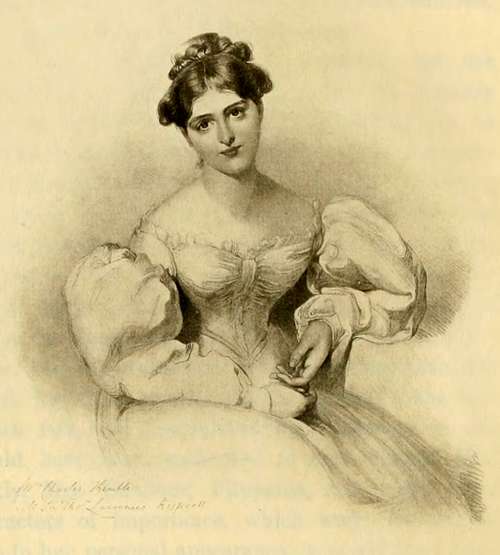
Charles remained on the stage till December 1836,
but he returned for a few nights, a year or two later,
when he went through a series of his most celebrated
parts, for the especial gratification of the
Duchess of Kent and the Princess Victoria, and for
the gratification of the public generally. Occasionally
he reappeared as a "Reader," in which vocation,
his refined taste, his judgment, and his graceful,
though not powerful elocution, were manifest to
the last.
Mr. and Mrs. Charles Kemble added something to
our dramatic literature; the lady's contribution to
which, "A Day after the Wedding," still affords
entertainment whenever it is performed. Her other
piece, "First Faults," is now forgotten. Charles
Kemble's additions to the literature of the stage,
comprise the "Point of Honour," "Plot and
Counterplot," and the "Wanderer;" the first two
being translations from the French, and the third
from the German.
In his later days Charles Kemble was afflicted
with deafness, so complete that he could not hear
the pealing thunder, but could fancy it was in the
air; for, as he once remarked amid the crash, "I
feel it in my knees!" It was, perhaps, this affliction
which occasionally gave him that look of fixed
melancholy which he occasionally wore. Of anecdotes
of his later time, there are few known to me of
any interest, except the following, which I cull from
the Athenæum. It is in reference to his son, Mr. J.
M. Kemble's Lectures at Cambridge, On the History
of the English Language, which were unsuccessful.
"After making a good deal to do about them," says
the correspondent of the Athenæum, "he obtained
the use of the Divinity School to lecture in, and it
was pretty well crowded at the first lecture; but the
lecture itself was such a sickener, and so unintelligible,
that at the second, myself, and I think two
others, formed the whole audience. The appearance
was so absurdly ridiculous in the large room, that
Kemble gave notice, in announcing the day of his
third lecture, that in future he should deliver them
at his own private apartments. Meanwhile his
father, Charles Kemble, the actor, came to see him,
and on the day fixed for the third lecture, nobody
was there to hear him but his said father and I;
upon which, when we had waited in vain nearly an
hour for an increase of audience, I moved, and his
father seconded the proposal, that instead of inflicting
the lecture upon us two, the lecturer should
send into Trinity College buttery, as it was then
the hour it was open, and procure a quantity of
ale and cheese, for the excellence of both which
Trinity College was celebrated, and with the aid of
these we passed the afternoon. Such was the end of
Kemble's lectures."
Rogers has left in his Table Talk some record of
the Kembles, which, as coming from an eye and ear
witness, may find admission here. From this we
learn that Mrs. Siddons, to whom he had been telling
an anecdote showing that, when Lawrence
gained a medal at the Society of Arts, his brothers
and sisters were jealous of him, remarked:—"Alas!
after I became celebrated, none of my sisters loved
me as they did before!" And then, when a grand
public dinner was given to John Kemble on his
quitting the stage, the great actress said to the poet,
"Well, perhaps, in the next world women will be
more valued than they are in this." "She alluded,"
says Rogers, "to the comparatively little sensation
which had been produced by her own retirement
from the boards; and, doubtless, she was a far, far
greater performer than John Kemble."
When young, she had superseded Mrs. Crawford
(Barry), then in her old age, and she rejoiced in
being rid of so able a rival; but when other competitors
crossed her own path, Mrs. Siddons rather
unfairly remarked that the public were fond of
setting up new idols, in order to mortify their old
favourites. She had herself, she said, been three
times threatened with eclipse; first, by means of
Miss Brunton (afterwards Lady Craven); next, by
means of Miss Smith (Mrs. Bartley); and, lastly, by
means of Miss O'Neill—"nevertheless," she is reported
to have said, "I am not yet extinguished."
She then stood, however, with regard to Miss
O'Neill exactly as Mrs. Crawford (Barry) had stood
with respect to herself—the younger actress carried
away the hearts, the older lived respected in the
memories of the audience. But over audiences,
Mrs. Siddons had, in her day, deservedly reigned
supreme; and that should have been enough of
greatness achieved by one whom Combe remembered
to have seen, "when a very young woman, standing
by the side of her father's stage, and knocking
a pair of snuffers against a candlestick, to imitate
the sound of a windmill during the representation
of some harlequinade."
When she had departed from the scene of her
glory, the remembrance of that glory did not suffice
her. When Rogers was sitting with her, of an afternoon,
she would say, "Oh, dear! this is the time I
used to be thinking of going to the theatre; first
came the pleasure of dressing for my part; and then
the pleasure of acting it; but that is all over now."
This was not vanity, but the natural wail of an active
spirit forced to be at rest. There was less dignity
in the retirement of John Kemble, if what Rogers
tells us be true, that "when Kemble was living at
Lausanne, he was jealous of Mont Blanc; and he
disliked to hear people always asking, 'How does
Mont Blanc look this morning?'"
The two greatest rivalries that John Kemble had
to endure, before the final one, in which Kean
triumphed, emanated from two very different persons—George
Frederick Cooke and Master Betty.
The success of both marks periods in stage history,
and demands brief notice here.
CHAPTER IX. — FOOTNOTES:
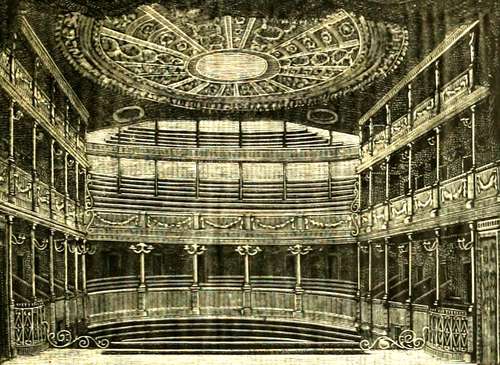
INTERIOR OF DRURY LANE THEATRE.
GEORGE FREDERICK COOKE.
About the time when Garrick was reluctantly bidding
farewell to his home on the stage, at Drury Lane, a
hopeful youth, of twenty years of age, born no one
can well tell where, but it is said, in a barrack, of
an English sergeant and a Scottish mother, was
making his first grasp at the dramatic laurel, in the
little town of Brentford.
With the exception of a passing appearance at the
Haymarket, for a benefit, in 1778, as Castalio,—when
London was recognising in Henderson the true successor
of Garrick—the town knew nothing of this
ambitious youth for more than twenty years; then he
came to Covent Garden to dethrone John Kemble;
and he disquieted that actor for awhile. In ten years
more, his English race was done, and while Kemble
was beginning the splendid evening of his career,
Cooke passed over to America, prematurely ending
his course, in disgrace and ruin, and occupying a
grave which a civilised Yankee speedily dishonoured.
If Cooke was an Irishman, it was by accident.
He was certainly educated in England; and he early
acquired, by reading Otway and seeing Vanbrugh, a
taste for the drama. In school theatricals, he made
his Horatio outshine the Hamlet of the night; and
his Lucia,—though the boy cried at having to play
a part in petticoats,[74]—win more applause than his
schoolfellow's Cato. School-time over, the wayward
boy went to sea, and came back with small liking for
the vocation; turned to "business," only to turn from
it in disgust; inherited some property, and swiftly
spent it; and then we find him in that inn-yard at
Brentford, enrolled among strollers, and playing
Dumont in "Jane Shore," to the great delight of the
upper servants from Kew, Gunnersbury, and parts
adjacent, sent thither to represent their masters, who
had not the "particular desire" to see the play, for
which the bills gave them credit.
The murmur of London approval, awarded to his
Castalio, was the delicious magic which drew him for
ever within the charmed circle of the actors, and
George Frederick passed through all the heavy trials
through which most of the vocation have to pass. He
strolled through villages, thence to provincial towns,
and I think, when in 1786, he played Baldwin to the
Isabella of Mrs. Siddons, that lady must have been
compelled, perhaps was willing, to confess, that there
was a dramatic genius who, at least, approached the
excellence of her brother.
From York, after much more probation, Cooke
went over to Dublin, where he acted well, drank
hard, and lost himself, in one of his wild fits, by
enlisting. Fancy the proud and maddened George
Frederick doing barrack scullery-work, and worse!—he
who had played the Moor in presence of a vice-regal
court! If his friends had not purchased his
discharge, Miss Campion would certainly soon have
heard that her Othello had hanged himself. The
genius who would not be a soldier, though born in a
barrack, found an asylum in the Manchester theatre;
and subsequently Dublin welcomed him back to its
well-trod stage. There, he and John Kemble met
for the first time.
John took the lead, George Frederick played,—I
can hardly call them secondary parts, for Booth had
acted some of them to Betterton, Garrick to Sheridan,
and one great performer to another,—such parts, in
fact, as Ghost to Kemble's Hamlet, Henry to his
Richard, Edmund to his Lear, and a similar disposition
of characters. What Kemble then thought
of his acting, I cannot say, but he complained of
being disturbed by Mr. Cooke's tipsily defective
memory. George Frederick was stirred to anger and
prophecy. "I won't have your faults fathered upon
me," he cried; "and hark ye, Black Jack,—hang me if
I don't make you tremble in your pumps one day yet."
He kept his word. On the 31st of October 1801,[75]
he acted Richard, at Covent Garden, to the Henry
of Murray, the Richmond of Pope, the Queen of Miss
Chapman, and the Lady Anne of Mrs. Litchfield;—and
Kemble was present to see how Cooke would
realise his promise. Kemble had played Richard
himself that season at Drury Lane, to the Richmond
of his brother Charles,—Henry, Wroughton; Queen,
Mrs. Powell; Lady Anne, Miss Biggs. I fancy he
was satisfied that in the new and well-trained actor
there was a dangerous rival. Kemble acted Shylock
and one or two other characters against him. They
stood opposed in some degree as Quin and Garrick
were, at Covent Garden and Drury Lane, in 1742-43.
In that season, Garrick played Richard eleven times.[76]
In Cooke's first season at the Garden, he acted the
same part double the number of times. Shylock,
Iago, and Kitely, he acted each ten times. Macbeth,
seven; Sir Giles Overreach, five; the Stranger, twice;
and Sir Archy Macsarcasm, several times.
Of his first reception in Richard, Cooke speaks,
as being flattering, encouraging, indulgent, and warm,
throughout the play and at the conclusion. Cooke
was not blinded by this triumphant season. Long
after he said, when referring to having played with
and also against John Kemble: "He is an actor.
He is my superior, though they did not think so in
London. I acknowledge it!" Having made Black
Jack "tremble in his pumps," Cooke honestly acknowledged,
in homely phrase, that he could not
stand in Kemble's shoes.
Kemble, however, was not superior to Cooke in all
his range of characters. In the very first season of
their opposition, after an obstinate struggle, Kemble
gave up Richard, but in Macbeth he remained
unapproachable by Cooke, who, in his turn, set all
competition at defiance in his Iago, in which, says
Dunlap, "the quickness of his action, and the strong
natural expression of feeling, which were so peculiarly
his own, identified him with the character."
In Kitely, his remembrance of Garrick confessedly
served him well. In Sir Giles, he excelled Kemble;
but the Stranger was speedily given up by Cooke,
and it remained one of his rival's glories to the last.
Cooke's general success, the position he had attained,
and the prospect before him, steadied his
mind, strengthened his good purposes, made him
master of himself under a healthy stimulus, careful
of his reputation, and strict in performing his duties.
I record this, as his previous biographers have registered
the character. Consequently, on the night he
was announced to appear, to open his second season
of anticipated triumph—September 14th, 1801—as
Richard, a crowded audience had collected about the
doors, to welcome him, as early as four o'clock. At
that hour no one could tell where he was, and a bill
was issued, stating that it was apprehended some accident
had happened to Mr. Cooke; and the play was
changed to "Lovers' Vows." In five weeks the truant
turned up, played magnificently, and was forgiven.
During his truant time, young Henry Siddons
made his first appearance at Covent Garden. He
played Herman in a dull new comedy, "Integrity,"
and Hamlet; but the Charter-house student would
have done better if he had accepted the vocation
to which his mother would have called him—the
Church. Henry Siddons acted Alonzo to Cooke's
Zanga, Hotspur to Cooke's Falstaff, and Ford to the
other's Sir John, in the "Merry Wives." Cooke's
criticism on his own performance was, that having
acted all the Falstaffs, he had never been able to
please himself, or to come up to his own ideas
in any of them. His great failure was Hamlet, in
which even young Siddons excelled him, but a
triumph which compensated for any such failures,
and for numerous offences given to the audience—made
victims of his "sudden indispositions"—was
found in Sir Pertinax, in which, even by those
who remembered Macklin, he was held to have fully
equalled the great and venerable original.
In the season of 1802, Cooke's indispositions became
more frequently sudden, and lasted longer. On
the days of his acting nights, his manager was accustomed
to entertain him, supervise his supply of liquor,
and carry him to the theatre; but George Frederick
often escaped, and could not be traced. In many
old characters he sustained his high reputation, but
his Hamlet and Cato only added to that of Kemble.
Perhaps his Peregrine, in "John Bull," of which he
was the original representative, would have been a
more finished performance but for—not the actor,
but the author's indiscretion. "We got 'John Bull'
from Colman," said Cooke to Dunlap, "act by act, as
he wanted money, but the last act did not come, and
Harris refused to make any further advances. At
last necessity drove Colman to make a finish, and he
wrote the fifth act, in one night, on separate pieces
of paper. As he filled one piece after the other, he
threw them on the floor, and, finishing his liquor,
went to bed. Harris, who impatiently expected the
dénouement of the play, according to promise, sent
Fawcett to Colman, whom he found in bed. By his
direction Fawcett picked up the scraps, and brought
them to the theatre."
In the season of 1803-4, when Kemble became part
proprietor and acting manager at Covent Garden, he
played in several pieces with Cooke. They were thus
brought into direct contrast. Kemble acted Richmond
to Cooke's Richard; Old Norval to his Glenalvon;
Rolla to his Pizarro; Beverley to his Stukely;
Horatio to his Sciolto—Charles Kemble playing
Lothario, and Mrs. Siddons, Calista,—such a cast as
the "Fair Penitent" had not had for many years!
John Kemble further played Jaffier to Cooke's
Pierre; Antonio to his Shylock; the Duke, in
"Measure for Measure," to his Angelo; Macbeth,
with George Frederick for Macduff; Henry IV. to
Cooke's Falstaff; Othello to his Iago; King John,
with Cooke as Hubert, and Charles Kemble as
Faulconbridge—Mrs. Siddons being, of course, the
Constance; Kemble also played Ford to Cooke's
Falstaff, and Hamlet to Cooke's Ghost; and, in a
subsequent season, Posthumus to his Iachimo, with
some other parts, which must have recalled the old
excitement of the times of Garrick and Quin, but
that audiences were going mad about Master Betty,
to the Rolla of which little and, no doubt, clever
gentleman, George Frederick, needy and careless,
was compelled to play Pizarro!
For a few seasons more he kept his ground with
difficulty. He did not play many parts well, it has
been said, but those he did play well, he played
better than anybody else. But dissipation marred
his vast powers even in these; and recklessness reduced
this genius to penury. After receiving £400
in banknotes, the proceeds of a benefit at Manchester,
in one of his summer tours, he thrust the whole into
the fire, in order to put himself on a level to fight
a man, in a pothouse row, who had said that Cooke
provoked him to battle, only because he was a rich
man, and the other poor!
It is not surprising that prison locks kept such a
man from his duties in the playhouse; but the public
always welcomed the prodigal on his return. When
he reappeared at Covent Garden, as Sir Pertinax, in
March 1808, after a long confinement, it was to "the
greatest money-house, one excepted, ever known at
that theatre. Never was a performer received in a
more flattering or gratifying manner."
But he slipped back into bad habits, was often
forgetful of his parts, and was sometimes speechless;
yet he was generally able to keep up the
Scottish dialect, if he could speak at all, and his
part require it. Once, when playing Sir Archy
Macsarcasm, he forgot his name, called himself Sir
Pertinax Macsycophant, and was corrected by a
purist in the gallery. Cooke looked up, and happily
enough remarked, "Eet's aw ane blude!"
He was hardly less happy, when, for some offence
given by him, on the stage, at Liverpool, he was called
on to offer an apology to the audience. Liverpool
merchants had much fattened, then, by a fortunate
pushing of the trade in human flesh. "Apology!
from George Frederick Cooke!" he cried; "take it
from this remark: There's not a brick in your infernal
town which is not cemented by the blood of a
slave!"
The American Cooper found him in the lowest of
the slums of Liverpool, and tempted, or kidnapped
him to America, whence this compound of genius
and blackguard never returned. On one of his
early appearances, in New York, he is said, being
elated, to have refused to act till the orchestra had
played "God Save the King;" and then he insisted,
with tipsy gravity, that the audience should be "upstanding."
In seventeen nights following the 21st
of November 1810, when he first appeared in New
York, as Richard, the treasury was the richer by
twenty-one thousand five hundred and seventy-eight
dollars. He felt and expressed, however, such a
contempt for the Yankee character, that New York
soon deserted him, and Philadelphia paid him little
or no homage. Once he was informed that Mr.
Madison was coming from Washington, expressly to
see him in a favourite character.
"Then, if he does, I'll be —— if I play before him.
What, I, George Frederick Cooke, who have acted before
the Majesty of Britain, play before your Yankee
President! No! I'll go forward to the audience, and
I'll say, Ladies and gentlemen,—
"The King of the Yankee-doodles has come to
see me act; me, George Frederick Cooke, who have
stood before my royal master, George III., and received
his imperial approbation ... it is degradation
enough to play before rebels; but I'll not go on
for the amusement of a king of rebels, the contemptible
King of the Yankee-doodles!"
From among the "Yankee-doodles" Cooke found,
however, a lady with the old dramatic name of Behn,
who became his second wife; but his condition was
little improved thereby. Dr. Francis, in his Old
New York, gives the following picture of him at this
time:—
"After one of those catastrophes to which I have
alluded, I paid him a visit at early afternoon, the
better to secure his attendance at the theatre. He
was seated at his table, with many decanters, all
exhausted, save two or three appropriated for candlesticks,
the lights in full blaze. He had not rested
for some thirty hours or more. With much ado,
aided by Price the manager, he was persuaded to
enter the carriage waiting at the door to take him
to the playhouse. It was a stormy night. He repaired
to the green-room, and was soon ready. Price
saw he was the worse from excess, but the public
were not to be disappointed. 'Let him,' says the
manager, 'only get before the lights and the receipts
are secure.' Within the wonted time Cooke entered
on his part, the Duke of Gloster. The public were
unanimous in their decision, that he never performed
with greater satisfaction. As he left the house he
whispered, 'Have I not pleased the Yankee-doodles?'
Hardly twenty-four hours after this memorable night,
he scattered some 400 dollars among the needy and
the solicitous, and took refreshment in a sound sleep.
A striking peculiarity often marked the conduct of
Cooke: he was the most indifferent of mortals to the
results which might be attendant on his folly and his
recklessness. When his society was solicited by the
highest in literature and the arts, he might determine
to while away a limited leisure among the illiterate
and the vulgar, and yet none was so fastidious in the
demands of courtesy. When the painter Stuart was
engaged with the delineation of his noble features,
he chose to select those hours for sleeping; yet the
great artist triumphed and satisfied his liberal patron,
Price. Stuart proved a match for him, by occasionally
raising the lid of his eye. On the night of his
benefit, the most memorable of his career in New
York, with a house crowded to suffocation, he abused
public confidence, and had nothing to say but that
Cato had full right to take liberty with his senate."
In this strange being, there are two phases of character
that are beyond ordinary singularity. The first
was his "mental intoxication," of which he thus speaks
in one of his journals: "To use a strange expression,
I am sometimes in a kind of mental intoxication;
some, I believe, would call it insanity. I believe it
is allied to it. I then can imagine myself in strange
situations and strange places. This humour, whatever
it is, comes uninvited, but it is nevertheless
easily dispelled,—at least, generally so. When it
cannot be dispelled, it must, of course, become madness."
Here was a decided perception of the way
he might be going,—from physical, through mental,
intoxication, to the madhouse!
His common sense is another phase in the character
of this great actor, who manifested so little for his
own profit. He was the guardian of female morals
against the perils of contemporary literature! "In
my humble opinion," he says, "a licencer is as necessary
for a circulating library, as for dramatic productions
intended for representation; especially when
it is considered how young people, particularly girls,
often procure, and sometimes in a secret manner,
books of so evil a tendency, that not only their time
is most shamefully wasted, but their morals and
manners tainted and warped for the remainder of
their lives. I am firmly of opinion that many females
owe the loss of reputation to the pernicious publications
too often found in those dangerous seminaries."
Cooke may be said to have been dying, from the
day he landed in the, then, United States. His
vigorous constitution only slowly gave way. It was
difficult for him to destroy that; for in occasional
rests he gave it, when he sat down to write on
religion, philosophy, ideas for improving society, and
diatribes against drinking, in his diary, his constitution
recovered all its vigour, and started refreshed
for a new struggle against drunkenness and death.
The former, however, gave it a mortal fall, in July
1812, when Death grasped his victim, for ever.
Cooke was taken ill, while playing Sir Giles Overreach,
at Boston, on the 31st of the above month.[77]
He went home, irrecoverably stricken, met his fate
with decency, and calmly breathed his last in the
following September, in full possession of his mental
faculties to the supreme moment.
He was buried in the "strangers' vault," of St.
Paul's Church, New York, with much respectful
ceremony, on the part of friends who admired his
genius and mutilated his body, as I shall presently
show. Meanwhile, let me record here, that Cooke
was of the middle size, strongly and stoutly built, with
a face capable of every expression, and an eye which
was as grand an interpreter of the poets, as the tongue.
He was free from gesticulation and all trickery, but he
lacked the grace and refinement of less accomplished
actors. In soliloquies, he recognised no audience;
and his hearers seemed to detect his thoughts by some
other process than listening to his words.
Kemble excelled Cooke in nobleness of presence,
but Cooke surpassed the other in power and compass
of voice, which was sometimes as harsh as
Kemble's; and indeed I may say the Kemble voice
was invariably feeble. In statuesque parts, and in
picturesque characters,—in the Roman Coriolanus,
and in Hamlet the Dane,—Kemble's scholarly and
artistic feeling gave him the precedence; but in
Iago, and especially in Richard, Cooke has been adjudged
very superior in voice, expression, and style;
"his manner being more quick, abrupt, and impetuous,
and his attitudes better, as having less the
appearance of study." Off the stage, during the
progress of a play, he did not, like Betterton, preserve
the character he was acting; nor like Young,
tell gay stories, and even sing gay songs; but he
loved to have the strictest order and decorum,—he,
the most drunken player that had glorified the
stage, since the days of George Powell! Could
he have carried into real life the scrupulousness
which, at one time, he carried into the mimicry of
it, he would have been a better actor and a better
man.
When Edmund Kean was in America, Bishop
Hobart gave permission for the removal of Cooke's
body, from the "strangers' vault," to the public
burial-ground of the parish, where Kean was about
to erect a monument to the memory of his ill-fated
predecessor. On that occasion, "tears fell from
Kean's eyes in abundance," says Dr. Francis; but
those eyes would have flashed lightning, had Kean
been aware that there was a headless trunk beneath
the monument; and that, whoever may have been
the savage who mutilated the body and stole the
head,—that head was in the possession of Dr.
Francis! To what purposes it has been turned, this
gentleman may tell in his own words.
"A theatrical benefit had been announced at the
Park, and 'Hamlet,' the play. A subordinate of the
theatre hurried at a late hour to my office, for a skull.
I was compelled to loan the head of my old friend,
George Frederick Cooke. 'Alas, poor Yorick!' It
was returned in the morning; but on the ensuing
evening, at a meeting of the Cooper Club, the
circumstance becoming known to several of the
members, and a general desire being expressed to
investigate, phrenologically, the head of the great
tragedian, the article was again released from its
privacy, when Daniel Webster, Henry Wheaton,
and many others who enriched the meeting of that
night, applied the principles of craniological science
to the interesting specimen before them.... Cooper
felt as a coadjutor of Albinus, and Cooke
enacted a great part that night." If Cooke could
have spoken his great part, he would assuredly
have added something strong to his comments on
what he used to call the civilisation of Yankee-doodle.
The monument, erected by Edmund Kean, consists
of a pedestal, surmounted by an urn, with this
inscription:—"Erected to the memory of George
Frederick Cooke, by Edmund Kean, of the Theatre
Royal, Drury Lane, 1821;" and, beneath, this not
very choice, nor very accurate distich:—
"Three kingdoms claim his birth.
Both hemispheres pronounce his worth!"
And below this superscription lies all that has not
been stolen of what was mortal of one among the
greatest and the least of British actors.
During his career, flourished and passed into
private life a boy, who still survives, rich with the
fortune rapidly acquired in those old playgoing days,—Master
Betty.[78]
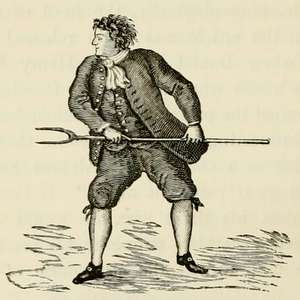
Mr. Moody as Simon.
CHAPTER X. — FOOTNOTES:
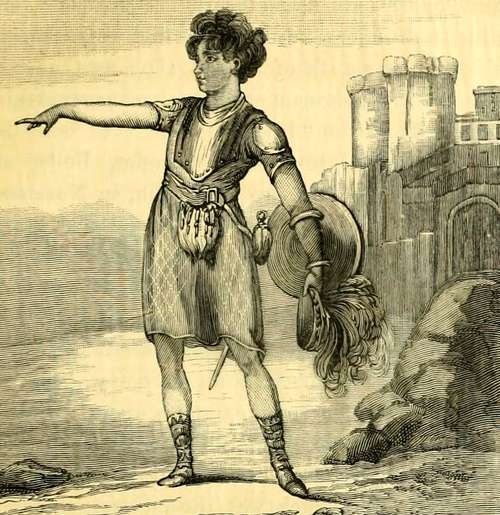
MASTER BETTY.
MASTER BETTY.
William Henry West Betty was born at Shrewsbury,
in 1791,—a Shropshire boy, but of Irish descent.
His father, a man of independent means, taught him
fencing and elocution, and was unreasonably surprised
to find that a histrionic affection came of this
double instruction.
"I shall certainly die, if I do not become an
actor!" said the boy, when residing near Belfast,
and after seeing Mrs. Siddons in the ungrateful part
of Elvira, in "Pizarro." Ho was then ten years old;
was a boy with a will and decision of character; and,
in his twelfth year, he made his first appearance at
Belfast, on the 11th of August 1803, as Osmyn, in
"Zara." The judgment of the Irish manager, Atkins,
was that he was an "Infant Garrick."
Master Betty also played Douglas, Rolla, and
Romeo; and he went up to Dublin, in November,
with the testimony of the Belfast ladies that he was
"a darling." In the Irish capital, he acted Douglas,
Frederick, Prince Arthur, Romeo, Tancred, and Hamlet.
As he is said to have learned and played the
last part within three days, I have small respect for
his precocious cleverness and do not wonder that
the Dublin wits showered epigrams upon him.
"The public are respectfully informed that no
person coming from the theatre will be stopt till after
eleven o'clock." Such was the curious announcement
on the Irish playbill which invited the public
to go and see Master Betty, and advised them to get
home early, if they would not be taken for traitors.
Those days were the days of United Irishmen, when
Ireland was divided into factions, and Dublin not
quite at unity as to Master Betty's merits.
The majority, however, worshipped the idol, before
which Cork, Waterford, Londonderry, and other
cities, bowed the knee. The popular acclaim wafted
him to Scotland. In Glasgow, there was one individual
who was not mad, and would criticise; but
in return for "a severe philippic" administered by
him, the wretch "was compelled to leave the city!"
If he went to Edinburgh, he found more excess
of dotage than he had left in Glasgow. It was not
merely that duchesses and countesses caressed the
boy, but there was Home himself, at the representation
of his own "Douglas," blubbering in the boxes,[79]
and protesting that never till then had young Norval
been acted as he had conceived it! And he had
seen West Digges, the original, in Edinburgh; and
Spranger Barry, the original, in London. Critics
said the Infant Roscius excelled Kemble; and Lords
of the Court of Session presented him with books,
and gave him old men's blessings!
Birmingham next took him up, and the English
town confirmed the verdicts of Ireland and Scotland.
Miss Smith (afterwards Mrs. Bartley) played mother
to him one night, and maid beloved the next; and
at the close of a dozen performances, the Infant Roscius
was celebrated by a Bromwicham poet as having
crushed the pride of all his predecessors, and being
"Cooke, Kemble, Holman, Garrick, all in one!"
"Theatrical coach to carry six insides, to see the
young Roscius," was the placard on many a vehicle
which carried an impatient public from Doncaster
races to Sheffield, where crowds of amateurs from
London fought with the country-folk for admission
to the theatre, and a poetic Templar, rather loose in
his Italian, remarked in a long poem in his praise:—
"Would Sculpture form Apollo Belvidere,
She need not roam to France, the model's here!"
Liverpool, Chester, Manchester, Stockport, all
caught the frenzy, and adored the boy,—to whom
Charles Young played subordinate parts! Occasionally,
Master Betty played twice in the same day,
and netted about £500 a week! Royal dukes expressed
their delight in him, grateful managers
loaded him with silver cups, and John Kemble wrote
to Mr. Betty père, to express the happiness he and
Mr. Harris would have in welcoming the tenth
Wonder to Covent Garden Theatre,—at £50 per
night and half a clear benefit.[80]
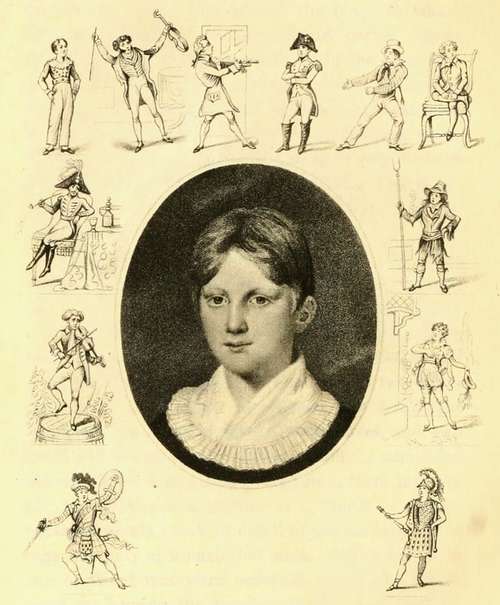
Accordingly, on Saturday, the 1st of December
1804, at ten in the morning, gentlemen were "parading"
under the Piazza. By two o'clock serried
crowds possessed every avenue, and when the doors
were opened, there was a rush which ultimately cost
some persons their lives. "The pit was two-thirds
filled from the boxes. Gentlemen who knew that
there were no places untaken in the boxes, and who
could not get up the pit avenues, paid for admission
into the lower boxes, and poured from them into the
pit, in twenties and thirties at a time." Contemporary
accounts speak in detail of the terrible sufferings
not only of women, but men. "The ladies in
one or two boxes were occupied almost the whole
night in fanning the gentlemen who were beneath
them in the pit.... Upwards of twenty gentlemen,
who had fainted, were dragged up into the boxes....
Several more raised their hands as if in the act
of supplication for mercy and pity." As for the
play, "Barbarossa," the sensible public would have
none of it before the scene in the second act, in
which Selim (Master Betty) first makes his appearance.
When that arrived, he was not disturbed by
the uproar of applause which welcomed him; and he
answered the universal expectation. "Whenever he
wished to produce a great effect he never failed."
He was found to be "a perfect master." His
whisper was "heard in every part of the house,"
says a newspaper critic; "there is something in it
like the undernotes of the Kembles; but it has
nothing sepulchral in it.... The oldest actor is
not equal to him, he never loses sight of the scene....
His judgment seems to be extremely correct....
Nature has endowed him with genius which we
shall vainly attempt to find in any of the actors of
the present day;"—after which last sweeping judgment
comes the qualifying line, "If he be not even
now the first, he is in the very first line; and he
will soon leave every other actor of the present day,
at an immeasurable distance behind him."
The critics evidently had small confidence in their
own judgments, but princes led the applause; their
Majesties were charmed with their new "servant;"
royalty received him in its London palace, and to
the Count d'Artois (future King of France) and an
august party at Lady Percival's, the small-eyed and
plump-faced boy shook his luxuriant auburn curls,
and acted Zaphna, in French.
The philosophers went as mad as the "quality"
and critics. Quid noster Roscius egit was given by
Cambridge University as the subject for Sir William
Brown's prize-medal. Old "Gentleman Smith," the
original Charles Surface, came up from Bury St.
Edmunds, and presented him with a seal bearing
the likeness of Garrick, and which Garrick, in his
last illness, had charged him to keep only till he
should "meet with a player who acted from nature
and from feeling." Having found such actor,
Smith consigned to him the keeping of the precious
relic.
Then, if the overtaxed boy fell ill, as he did more
than once, the public forgot the general social distress,
the threats of invasion, war abroad and sedition
at home, and evinced such painful anxiety, that
bulletins were daily issued, as though the lad were
king-regnant or heir-apparent.
Subsequently, Drury Lane and Covent Garden
shared him between them. In twenty-three nights,[81]
at the former house, he drew above £17,000, and
this double work so doubled his popularity, that on
one night, having to play Hamlet, the House of
Commons, on a motion by Pitt, adjourned, and went
down to the theatre to see him! This flattery from
the whole Senate was capped by that of a single
legislator; Charles Fox read Zanga to the little
actor, and commented on Young's tragedy, with
such effect, that the young gentleman never undertook
the principal character.[82]
Except John Kemble and Mrs. Siddons, there was
scarcely an actor of celebrity who did not play in
the same piece with him, including Suett and Joey
Grimaldi, who were the Gravediggers to his Hamlet.
At the close of the season he passed through the
provinces, triumphant, and returned to Drury Lane
in 1805, to find "garlick amid the flowers," and a
strong sibilant opposition, which he, however, surmounted,
and again played the usual round of tragic
heroes, carrying heaps of gold away with him to the
country, where he easily earned large additions to
the heap.[83]
But the London furore henceforth subsided. The
provinces continued their allegiance for a year or two,
but the metropolis no longer asked for, or thought of
him. His last season was at Bath, in 1808; in the
July of which year he entered Christ's College, Cambridge,
as a Fellow Commoner; subsequently hunted
in the vicinity of the Shropshire estate, purchased for
him by his father, and became Captain Betty of the
North Shropshire Yeomanry Cavalry.
So ended Master Betty! But, in 1812, his father
being dead, Mr. Betty longed again for the incense of
the lamps and the dear homage of applause, and he
went through a course of provincial theatres, ending
with a month at Covent Garden, with questionable
success. His old admirers would have it that he was
the English, as he had been the Infant, Roscius; but
the treasury account told another tale, and Mr. Betty
could only take rank as a respectable actor.
His name, however, was still a tower of strength
beyond the metropolis; and, in country towns, the
intelligent young man drew audiences still. In
Edinburgh, Mr. Macready played Edward to Mr.
Betty's Warwick; in which last character, after fitful
appearances in the country, and acting for a single
night now and then in London, as an additional
attraction for a benefit, Mr. Betty took his final farewell
of the stage, at Southampton, on August the
9th, 1824, being then but thirty-two years of age.
There can be no doubt of Master Betty having
been the most "promising" young actor that ever
delighted his contemporaries, and disappointed those
that were to be so hereafter. His wonderful memory,
his self-possession, his elegance of manner, his natural
and feeling style of acting—all but his habit of
dropping his h's, were parts of a promise of excellence.
But his early audiences took these for a
whole and complete performance. He was master
of words but not of ideas, and in his boyhood was
imperfectly educated. He could learn Hamlet in
three or four days, and, no doubt, he played it
prettily; but to play prettily and to act masterly, are
different things. Hamlet is no matter for a boy to
handle. Betterton acted it for fifty years, and, to his
own mind, had not thoroughly fathomed the profoundest
depths of its philosophy even then. Master
Betty commenced too early to learn by rote; and
the habits he then formed never permitted him to
study as well as learn, by heart. The feeling and
the nature, for which he was once praised, were
those of a boy; they kept by him, and they were
found weak and nerveless in the man. But therewith
he reaped a large fortune, and he has prudently
kept that too. May the old man long enjoy what
the young boy, between natural abilities and the
madness of "fashion," earned with happy facility.
There remains but one name more of exceeding
greatness to be mentioned,—that of Edmund Kean;
but, ere we let our curtain fall on him, I have to
notice something of the manners, customs, sayings,
and doings of a past time, which differed greatly
from that in which Kean was reared, flourished, and
fell. Let us glance at that olden period before we
summon him to occupy our final scene.
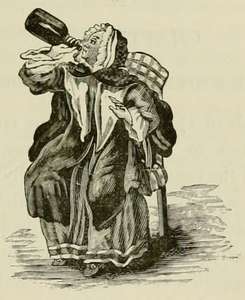
Mr. Foote as Mrs. Cole.
CHAPTER XI. — FOOTNOTES:
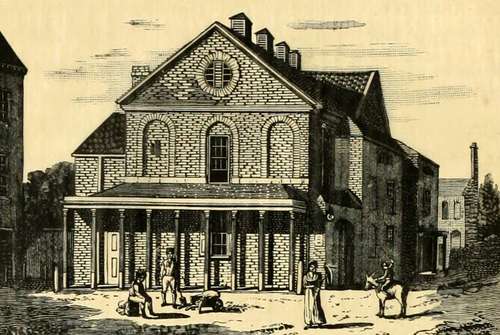
NORWICH THEATRE.
STAGE COSTUME AND STAGE TRICKS.
In the journals of 1723 I find various complaints of
the deficiencies in the theatrical wardrobe. The
shabbiness of the regal robes is especially dwelt upon,
though those were splendid enough which were worn
by a leading actor. Duncan and Julius Cæsar, at the
above date, had worn the same robes for a century;
and it was suggested that monarchy was brought into
contempt by poorly-clad representatives.
It is said of Betterton, in Hamlet, that when he
first beheld his father's spirit, he turned as white as
his own neckcloth. Betterton wore the laced kerchief
then in fashion. There was a worse fashion in part
of Garrick's time. That actor dressed the young
Dane in a court suit of black,—coat, waistcoat, and
kneebreeches, short wig with queue and bag, buckles
in the shoes, ruffles at the wrists, and flowing ends
of an ample cravat hanging over his chest. Then,
Woodward as Mercutio! This young nobleman of
Verona, kinsman to a prince, and friend to the love-sick
Montagu, did not walk his native city capped,
plumed, and bemantled, according to the period,
but in the dress of a rakish squire of Woodward's
own days. On the top of a jaunty peruke was cocked
one of those three-cornered hats, popularly known
as an "Egham, Staines, and Windsor," from the
figure of the finger-post on Hounslow Heath pointing
to those three towns. The hat was profusely
gold-laced at the borders. Round the neck of the
Veronese gentleman was negligently wound a Steinkirk
cravat of muslin with point of Flanders ends.
The rest of the attire was that of a modern state
coachman on a drawing-room day, save that the
material was chiefly of velvet, and that Woodward
wore high heels to his gold-buckled shoes. The
waistcoat descended over the thighs, and into its
pocket Woodward thrust one hand, as, with a finger
of the other knowingly laid to his nose, he began
the famous lines, "Oh! then, I see Queen Mab hath
been with you!"
Booth's dress for Cato was not more or less absurd
than Betterton's in "Hamlet." The Cato of Queen
Anne's days wore a flowered gown and an ample wig!
Garrick's Macbeth was a modern Scottish serjeant-major,[84]
his Romeo "a beau in a new birthday embroidery."
His Richard, fancifully but more correctly
decked, is preserved to us in Hogarth's picture; but
when the King was thus attired, all the other persons
of the drama wore court suits, powdered wigs, bags,
cocked hats, and drawing-room swords! And yet the
grandeur of the performance seems to have been in
no way marred. When we smile at these things, we
should remember that all managers who allow our old
comedies to be played in modern costume, offend
equally against good sense. I would have Ranger
acted in a wig, as Garrick, and not in the dress of
the actor's time, as Elliston played it. The chronology
of costume is worthy of every manager's notice,
however accustomed the eye may become to anachronisms,—as
with the dress worn in 1806, by
Matthews, as Old Foresight, in "Love for Love,"
which was the very famous and fashionable suit,
worn for many a season by the graceful Wilks in
that most airy of his parts, the youthful rake and
gentleman, Sir Harry Wildair.
In Macklin's Macbeth, there was nothing of antiquity
about the costume, which was a semi-military
uniform of no, or of several periods, with a masquerade
look about a good portion of it. His
Hamlet was a modern gentleman in a black suit,
such as might have been seen any day in the Mall.
John Kemble dressed the sad young Dane, whose
father had just been murdered by Hamlet's worst
enemy, one who stood between him and his inheritance,
in a fancy suit defying chronology, a carefully
curled and powdered wig, such as never sat on Scandinavian
head, and a blaze of jewelled orders—on
the breast of him who courted seclusion! Altogether,
there were strange things done on the stage in those
days, not the least, perhaps, were comic solo dances,
or compound hornpipes of a score of "merry sailors,"
with Highland reels, danced between the acts of the
most solemn of Shakspeare's tragedies!
Reddish played Hamlet in a bag-wig, which Whitfield,
as Laertes, once carried off on the point of his
sword! Henderson, who acted the Dane so well,
dressed him ill,—in a three-cornered cock and flap
hat, like my uncle Toby! Why not? since Lewis as
Hippolitus, attired that hapless young man, of the era
of Neptune and sea-calves, in knee breeches, a jaunty
silk jacket, tight-fitting boots, and a little court bodkin
on his thigh—the thigh of the son of Theseus!
As for the ladies, they were as careless on the subject
as the men, whether it was Mrs. Pritchard in
Lady Macbeth, or Miss Younge as Zara, or Mrs. Yates
as Cleopatra, they were all decked alike, court skirts
over huge hoops, and trains tucked up to the waist,
with powdered hair surmounted by a forest of feathers.
Mrs. Siddons, when she made her first appearance in
1775, in Portia, played the part in a salmon-coloured
sack and coat; and her Euphrasia, to judge from her
portrait, more nearly resembled an English than a
Grecian matron, in the costume. But she soon improved
in taste, or was able to exercise her own without
interference; and Sir Joshua approved of her
innovation of appearing in her natural hair, without
marischal powder—of a reddish brown tint, then in
fashion, and worn with abundance of pomatum in the
tubular curls of the ladies' head-dresses. She braided
her locks into a small compass, in accordance with the
size and shape of the head; and when long stiff stays
and hoop petticoats were universally worn by stage
heroines, as well as ladies in general, Mrs. Siddons had
the courage to appear in a dress far from ample, with
a waist of the very shortest; and King George III.
himself warned Mrs. Siddons against using white
paint (blanc d'Espagne, I suppose) on her neck, as
dangerous to health.
Mrs. Esten depended for effect almost entirely on
her dresses, and a languishing manner. Her success,
when she first appeared in Belvidera, was attributed
to "the picturesque and elegant manner" in which
she dressed the character. This lady was the
daughter of Mrs. Bennett, the author of Juvenile
Indiscretions, and could have afforded her mother
with matter for a dozen more volumes, had not the
older lady been indiscreet enough to possess abundant
material in her own experiences.
I think that the custom of noblemen presenting
their cast-off court-suits to great players (Betterton
played Alexander the Great in one), went out before
the middle of the last century. A better custom
prevailed in France. Not only princes of the house
of Bourbon, but noblemen at court, sent theatrical
costumes to Lekain—according to the stage fashion
of the period—but the actor never wore any other.
There was as little variety in this actor's wardrobe
as in the style of his acting, which was very circumscribed.
With two or three tunics and a turban, one
expression and a single attitude, he carried about
with him "French tragedy."
In France, not only Hamlet, as once with us, but
Orestes, wore powder! But in this there was nothing
more absurd than was to be found in Quin's Chamont,
a young Bohemian nobleman of a remote romantic
era. At the age of sixty, Quin played this youthful
lover "in a long, grisly, half-powdered wig, hanging
low down on each side the breast, and down the
back; a heavy scarlet coat and waistcoat, trimmed
with broad gold lace, black velvet breeches, a black
silk neckcloth, black stockings, a pair of square-toed
shoes, with an old-fashioned pair of stone buckles,
and a pair of stiff, high-topped white gloves, with a
broad, old scolloped hat. Were the youthful, fiery
Chamont," adds the anonymous biographer, "to
appear on the stage in such a dress now, the tragedy
would cause more laughter than tears." Absurd as
this may seem in Quin, it was not more absurd than
the dress worn by Hale, an actor of Garrick's time,
who, playing Charles I. in Havard's tragedy, wore a
full-bottomed wig of the reign of Queen Anne—of
the lightest colour, and flowing over back and
shoulders; in short, a perfect "cataract peruke!"
Hale always fancied himself fascinating in this head-piece,
as Mrs. Hamilton thought herself irresistible
in jewels, with which she used so to load her dark
hair, that they were compared to glow-worms in a
furze-bush.
That there is much in a wig beyond the head it
covers is, however, certain. No actor ever had such
a wonderful collection of them as Suett, or looked
so comic in them; though his horrible depression,
and his terrific and painful dreams, nearly drove him
mad. Such importance was attached to these wigs,
that when the entire collection was burnt in the fire
that destroyed the Birmingham Theatre, a friendly
writer expressed a hope, that "until Mr. Suett can
replace them,—the public will make an allowance
for the great drawback their loss must be upon his
comic abilities."
In some theatres, one coat has served successive
generations of actors. It was not so with the dress
which Garrick wore when he first appeared at Goodman's
Fields, as Richard. This fell into the keeping
of a man named Carr, who, when a strolling
manager, used to act in it—let the character he had
to represent be what it might! Greater actors than
Carr were as negligent with respect to costume.
Gentleman Smith, for instance, I meet with, complaining
of the shabbiness of his Richard III.'s hat,
and asking if he cannot have that which Powell
wore as King John!
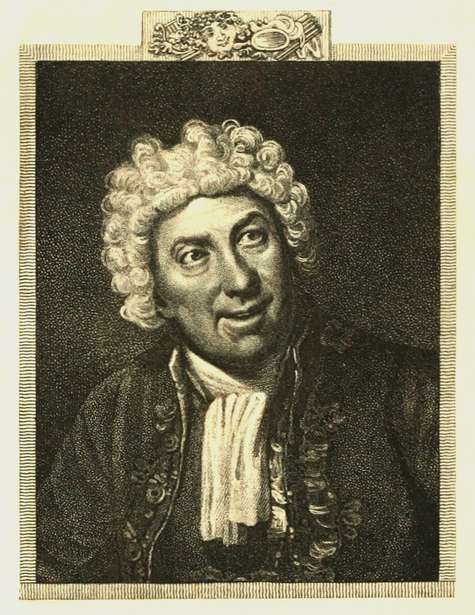
The Morning Chronicle for November 14, 1783,
after extolling Mrs. Crawford's Lady Randolph as a
triumph of acting which no competitor could reach,
assails the costumes. "Lord Randolph and Glenalvon
were as fine as if they were designed for the
soft service of Venus, and meant to be present in an
Eastern ballroom; and yet the whole scene of the
play lies in the hardy region of the North, &c., &c.
Old Norval's dress," it is added, "had not the most
distant semblance of the ordinary habit of a Scotch
shepherd."
Of John Kemble's anachronisms in Hamlet, I may
add to the record, that in that play, the period of
which is before the Norman conquest, he wore the
order of the Elephant, which was not instituted till
the middle of the fifteenth century! In Hotspur, too,
he always wore the order of the Garter, even after
proof was laid before him that young Harry Percy
had never been a member of the order. Elliston
imitated Kemble; but when he heard that Hotspur
did not belong to that chivalrous fraternity, he took
the garter from his knee, as he was one night at the
wing, ready to go on.
Originally, Kemble even acted Hamlet with the
order of the Garter beneath his knee! He also
wore the riband and star, with a black velvet court-dress,
diamond buckles; and his powdered hair
dishevelled, in the mad scene. The Vandyke dress,
with black bugles, and dark, curled wig,—a dress
which knew but little change till Mr. Fechter introduced
a portrait-costume more appropriate from
Albert Durer,—was first worn by John Kemble
during his own management of Drury Lane. In
one respect, the latter actor was the exact reverse of
Henderson, who was so careless in the matter of
costume, that he once boasted of having played ten
different characters, in one season, in the same
dress! Lewis was nearly as negligent as Henderson.
His Earl Percy, for instance, was a marvel of
anachronism and indifference. The noble Northumbrian
was attired in a light summer attire of no
possible age, and suited to no possible people. His
hair was flowing, but profusely powdered; and these
pendant locks were prettily tied up in a cluster of
light blue streamers, which his airiness made flutter
in the breeze. But those were days in which everything
was borne with and nothing questioned. The
beautiful Mrs. Crouch, for example, acted one of the
Witches in "Macbeth," in a killing, fancy hat, her
hair superbly powdered, rouge laid on with delicate
effect, and her whole exquisite person enveloped in
a cloud of point lace and fine linen.
In 1791 Bensley acted Mortimer in the Hon.
Frank North's jumble of tragedy, comedy, and opera,
at the Haymarket,—the "Kentish Barons." The
date of the piece was of the period of Richard II.,
but the costume was of an earlier time; and the
figure which solemn Bensley cut, when skating
through a scene in shoes with the peaks so long that
they were turned up and fastened to his girdle, must
have been one provocative of fun. Other players
have been as incorrect, and infinitely more absurd.
Take, for example, Edmund Kean himself in Orestes.
He had seen Talma in that part, in Paris, and the
excellence of the French actor fired Kean to attempt
the same character. But Edmund imitated him
neither in correctness of costume, nor in having the
part correct, by heart. Kean played Orestes only in
Bath and Edinburgh. His dress, and that of his
faithful Pylades (Ward) at the first place, were
covered with ribbons. Neither of the ancient heroes
had seen such silken manufacture in his life; but
both of the actors had frequently seen ribbons, and
that was enough. Defective in costume, Kean was
also deficient in memory. At Bath he stumbled
through the character; at Edinburgh he improvised
a good deal of it; and in the mad scene substituted
fragments from any other mad character he had in
his mind for the moment, particularly Sir Giles Overreach!
All this flustered the Pyrrhus especially, and
his embarrassment was so marked that the Edinburgh
critics took care to tell him that he ought to
have exercised more industry in mastering the words
of his part, when he had to play with so great a
master as Mr. Kean!
A taste for mere finery in costume was long prevalent;
and I have seen Young's dress for Macbeth,
and that for Hamlet, censured as "too finical." In
the latter part, not contented with the order of the
Elephant, he sometimes wore a thick golden cord
round his waist, with heavy bullion tassels. In
Coriolanus and Brutus, Young introduced the toga,
for the first time, in a perfect form on the English
stage. But it was found that a perfect toga was not
always the most proper dress, and Talma's senatorial
robes were adopted by Charles Young, who, taught
to wear them by the great French player, instructed
in his turn, the ever-willing-to-learn Charles Kemble.
The latter dressed Charles Surface in the costume
of his own day. It looked well enough, no doubt,
but now, in Deighton's portrait, its absurdity is
striking.
In my younger days of playgoing there was a
certain action of the hand and wrist on the part,
especially, of actresses playing chambermaids, and
rather lively young ladies, which was a trick of Mrs.
Abington's, and had become, perhaps still is, a tradition.
O'Keeffe says: "Mrs. Abington's manner was
charmingly fascinating, and her speaking voice melodious.
She had peculiar tricks in acting, one was
turning her wrist, and seeming to stick a pin in the
side of her waist. She was also very adroit in the
exercise of her fan; and though equally capital in
fine ladies and hoydens, was never seen in low or
vulgar characters! On her benefit night the pit was
always railed into the boxes; her acting shone
brightest when doing Estifania to Brown's Copper
Captain." This refers to the season 1759-60, when
she was in Dublin, and before she had received "the
stamp of a London audience." Her Kitty in "High
Life Below Stairs" created a sort of infatuation for
her at the Smock Alley Theatre. Her name was, so
to speak, on the public lip, "and in ten days her
cap was so much the fashion that there was not a
milliner's shop but what was adorned with it, and
'Abington' appeared in large letters to attract the
passers-by." The men "toasted" and adored her,
the women paid her the highest homage by imitating
her style in dress and carriage.
With old costumes, the actors of bygone days
had quaint tricks and ideas,—as strange to us now
as their dresses. I may class with the former one
circumstance of Quin's Falstaff in his later days.
After the fight, when Falstaff, somewhat wearied
and disposed to moralise, used to seat himself on
the stump of a tree and give way to philosophising,
Quin calmly sank down into a crimson velvet chair
with gold claws and blue fringe, conveniently pitched
on the field of battle!
There used to be an old stage-trick for effect, employed
in "Venice Preserved." Pierre, railing at
the conspirators in defence of Jaffier, addresses himself,
among the rest, to a pale, lean, haggard fellow,
who, in such a picture, should be kept in the shade.
But in the old days this fellow,—all exaggerated
ghastliness and horror, used to stand forth and exhibit
his caricature of fright and famine, by sundry
actions, the applause for which was even less reasonably
given than that to the Gravedigger in "Hamlet,"
when he deliberately doffed some score of waistcoats
before he took to digging.
Mossop, too, had his trick in tragedy, which was
sometimes akin to pantomime. In Macbeth, when
with his truncheon he smote that white-livered loon
of a messenger, he invariably broke in two the
symbol of authority over the unlucky envoy's skull.
People applauded the earnestness of the tragedian
as thus displayed; but the fact was, that Mossop
always carried a truncheon made to fly in two when
dealt on a victim's head. The absurdity of the act
never struck himself.
More unmeaning, but much more costly; more pantomimic,
and much more improbable, was Barry's
great trick in Alexander. He never, indeed, tried it
in London; and I cannot account for its toleration
by so refined and critical an audience as that of
Dublin a century ago. In the triumphal entry into
Babylon he was drawn down the stage in his car by
unarmed soldiers. When he alighted to address
them, each man placed his hand on some portion of
the chariot, the machinery of which broke up into
war accoutrements; the wheels into bucklers, the
axles into sheaves of spears, the body of the vehicle
into swords, javelins, lances, standards, and so forth.
All which likely work having been accomplished,
and the soldiers having arranged themselves in
battle array, Alexander addressed his easily provided
army amid a hurricane of applause; and O'Keeffe
protests that it was not only beautiful, but that he
"never saw anything to equal it, for simplicity!"
Oh, sancta Simplicitas!
And this "simplicity" reminds me of the three
separate ways in which Cibber, John Kemble, and
Young, used to suit, or not suit, the action to the
word in a passage of Wolsey:—
"This candle burns not clear. 'Tis I must snuff it;
Then, out it goes."
Cibber's trick, to gain applause, was to fairly
snuff the candle out. John Kemble, taking this
in the light of an accomplished fact, was wont to
look as one offended by the stink. Young, finding
nothing more to do, always crossed his arms at this
passage, smiled, and did nothing.
O'Keeffe remarks, that it is a method with an old
stager, who knows the advantageous points of his art,
"to stand back out of the level with the actor who
is on with him, and thus he displays his own full
figure and face to the audience; but when two
knowing ones are on together, each plays the trick
upon the other. I was much diverted," he adds,
"with seeing Macklin and Sheridan, in Othello and
Iago, at this work; both endeavouring to keep back;
they at last got together, up against the back scene.
Barry was too much impassioned to attend to such
devices." Edmund Kean is said to have practised
this trick when playing with actors or actresses taller
than himself; but in so doing he was only putting
himself on an equality with his taller colleague. I
remember when, in my boyish days, the actors of the
Théâtre Français used to take me behind the scenes,
observing that when Talma was seated on the stage
by the side of Mademoiselle Duchesnois, the seat of
his chair was gradually raised towards the back, like
a driving-box, and thus enabled him to appear as
tall as that ugly and able lady.
Garrick, too, had his chair-trick in "Hamlet."
When the Ghost appeared between the young Dane
and his mother, Garrick, starting from his chair, used
always to overturn the latter,—which was differently
constructed from that used by the Queen. The legs
of the actor's chair were, in fact, tapered to a point,
and placed so far under the seat, that it fell with a
touch.
Dr. Burney seems to think that "the elocution of
Garrick and Mrs. Cibber was but exquisite trickery,
and that a notation of their tones for a sort of musical
declamation would be a good practical lesson for inferior
actors, and would be the means of conveying
it" (the notation) "to posterity, who will so frequently
meet with their names and eulogiums in the
history of the stage, and be curious to know in what
manner they acquired such universal admiration."
Very young children on the stage are sometimes
as difficult to manage as "sagacious dogs," and other
animals. The tricks resorted to, in order to preserve
propriety, are amusing. When Mrs. Siddons was
selected to play Venus, in Garrick's revived "Jubilee"
(for which she was sneeringly called "Garrick's
Venus"), she had little Tom Dibdin for Cupid.
They were seated in the front of the stage; and it
was necessary that the son of the goddess should
smile in his mother's face,—but Tom was too much
cowed to take any liberty of that sort. Whereupon
Venus looked fondly on him and asked, in a stage
whisper, if he loved sugar-plumbs?—and what sort?
and wouldn't he like some of the best quality when
the piece was over? At all which, Cupid's face
expanded into wreathed smiles, and he gazed on
Venus with a laughing admiration,—in mental anticipation
of the sweets in the hereafter. In 1785,
Mrs. Siddons was the Tragic Muse in the "Jubilee,"
in which the Venus was represented by Mrs. Crouch,
who might have smitten with jealousy Anadyomene
herself.
Some actors have made audiences merry by a mistake;
others, by spontaneous wit. When Quin, in
Coriolanus, bade his soldiers lower their fasces (in
which he pronounced the a long), down went their
faces in the lowest of bows,—and up went the laughing
shout of the audience. A similar effect was once
produced by Charles Kemble, by transposing, unconsciously,
two letters in the phrase, "Shall I lay perjury
upon my soul?" and making of it, "Shall I lay
surgery upon my poll? No, not for all Venice!"
More intentionally did Lewis once raise a foolish
laugh, when playing with little Cherry, who, as
Drugget, exclaimed, "He looks as if he were going
to eat me!" "Eat you!" exclaimed Sir Charles
Racket (Lewis), and out of his character, "I could
swallow you; I needn't make two bites of a cherry!"
On the other hand, one individual, at least, raised
fun, and made money out of his own deformity;
namely, Coffey, who was monstrously hunchbacked,
and who, for his own benefit, acted Æsop. There
was more method in a whim like this than in the
madness of Cassans, a promising actor of the last
century, who lost his chance on the stage by preferring
to sing ballads in the streets, or acting as
waiter at a tavern, both of which offices he undertook
seriously, and acted to perfection.
Off the stage, there were performers whose fame
was extended, by the second skill of a brother player,
as was the case with Deighton, of Drury Lane, who
(like Emery) was a clever painter, and was the first
who exhibited slightly-caricatured likenesses of his
colleagues,—enough to indicate some queer peculiarity,
but not enough to give offence. These used
to attract the public round his shop-window, in
Charing Cross, till Deighton (or Dighton, as the
Sadler's Wells bills used to record) had to make his
exit. The "Hundred Guilder Print," by Rembrandt,
was missing from the British Museum; and to that
print access had been given by Beloe, the keeper of
the prints, to Deighton. There was a scandal which
sent the actor into exile, and cost the translator of
Herodotus his place.
From an incident between actor and audience, the
more gorgeously dressed than elegantly spoken Mrs.
Hamilton acquired the name of Tripe Hamilton.
She had been hissed by the pit, for refusing to play
for Mrs. Bellamy's benefit; and she explained wherefore.
The language of the poets she could learn
quickly, and deliver with dignity; but her own was
of that sort which sponsors are supposed to be bound
to teach. Mrs. Hamilton said: "Gentlemen and
ladies,—I suppose as how you hiss 'cause I didn't
play for Mrs. Bellamy. Well, I wouldn't, 'cause she
said as how my audience, on my benefit night, were
nothing but tripe people, and made the house smell!"
Yet this woman could play Lady Graveairs admirably.
There was another actress of the last century who
had great power and much grace in addressing an
audience, namely, Mrs. Fitzhenry. She is better
remembered in Dublin than here; but I notice her
on account of a curious circumstance, when she finally
left the stage, there. On that occasion, she not only
thanked the audience for past indulgence, but asked
for future favour,—not for herself,—but for Mr. John
Kemble, who had played several characters with her,
but without being appreciated! Mrs. Fitzhenry gave
assurance that there was sterling stuff in that young
man, and hoped he would be encouraged!
This reminds me of another benefit night in Dublin,
that of Mrs. Melmoth, wife of Courtenay Melmoth,
whose real name was Pratt. To fill the house, the
actress gave out that she was about being converted
to the Roman Catholic religion, and she went daily
and ostentatiously to mass. The house, however,
was but a poor one, and Mrs. Melmoth became
thereby convinced that the Romish Church had not
that efficacy she had hoped to find in it; and she
remained in her original belief,—the chief point of
which was, that Courtenay was by no means so wise
as he looked, nor so great as he thought himself.
I know of no other case of conversion on the part
of an actress, except that of Mrs. Wells, who, being
confined in the Fleet, met there with Mr. Sumbell,
of the Hebrew faith, and, on her enlargement, which
she physically did not need, declared that she had
married him, and had turned Jewess. This she had,
indeed, done, at a splendid barbarico-comic marriage
ceremony; but the ancient people doubted its
validity, and so did Mr. Sumbell.
There was an actor of the last century, named
Wignell, who was so doubly-refined that he could
not deliver an ordinary message without trying to
make blank verse of it. "Wignell," said Garrick,
"why can't you say, 'Mr. Strickland, your coach is
ready,' as an ordinary man would say it, and not
with the declamatory pomp of Mr. Quin, or Mr.
Booth, when playing tyrants!" "Sir," said poor
Wignell, "I thought in that passage I had kept
down the sentiment!" That, he never could do;
his Doctor, in "Macbeth," was so wonderfully
solemn, that his audience was always in fits of
laughter at it.
If this was rather taking a liberty with an actor,
the actors often took liberties with the audience.
Just after Mrs. Bland was confined for the first time,
her husband, in Arionelli ("Son-in-law"), had to
say, "Marriage! oh, that is quite out of my way."
The actor of Cranky immediately responded with a
speech, for which he ought to have been fined,—to
the effect,—if that were the case, what about the
little incident at home. But Emery once went
further than this and, when acting the Sentinel, in
"Pizarro," contrived to let Rolla and the whole
house know that Mrs. Emery had increased the
number of his family circle. This freedom would
be found to have no "fun" in it now.
No one better supported the dignity of the profession
than Charles Murray, a son of Sir John
Murray, of Broughton, and originally intended for
the medical profession. In his younger days, before
he fell into the line of old men, at Covent Garden,
he was playing at Wakefield, where he so spiritedly
resented an insult flung at him as an actor, that the
party he thereby offended made a public quarrel
of it, and the town was divided into two factions.
Murray refused to ask pardon on the stage, and on
a night he was to play in the "Beaux' Stratagem,"
knowing the intentions of his enemy in front, he
entered booted and spurred, and announced that,
aware of the opposition, he was about to set out for
Doncaster. Whereupon, his friends leaped from the
boxes to the stage, declared he should not be driven
from the theatre, and guarding the wings, they compelled
Murray, dressed or undressed, as he was, to
go through his part, and to remain on the stage
throughout the piece, lest he should profit by an
exit, to make his escape.
On the other hand, poor Jack Owen, the "successor"
of Henry Mossop, and the "real Zanga," as
he used to call himself, was always able to defend his
own cause. He was one night hissed while playing
Polydore, in the "Orphan," when under the influence
of the grape. He had just dismissed the
Page, with "Run quickly, then, and prosperous be
thy wishes," when his imperfect utterance raised a
storm of hisses. But he turned the first words of
the succeeding soliloquy to good account,—and advancing
to the footlights, growled to the house,
"Here I am alone and fit for mischief,"—putting
himself in a fighting attitude, and moving the house
to laughter by his new reading.
The discipline of preparation for the stage in the
older days was greater than it is now. It included
strolling, slaving at country theatres, a course of probation
at Norwich, Bath, York, and such towns,—after
which there was an assured trial for an ambitious
player, at every fresh season in London. But ere this
point was reached, there was much to be endured.
Blisset and Dimond, for instance, walked from
London to Bath, with half-a-crown between them,
and the former ever after kept the shoes in which
he had done it, as a memento of his hard days. Some
strolling managers have flourished much better than
their actors. Smith, proprietor of the Margate
Theatre, had been a hostler; Copeland, of the Dover
Theatre, a groom. At the former house, it was
customary for the company to parade in front in full
dress, on a balcony, while the house was filling, or
was not filling. The Birmingham company used to
send round a bellman or a drummer to announce
and praise the coming performances, and Dick Yates
is said to have filled one or other office more than
once. To these managers, candidates came with an
ignorance that was only to be exceeded by that of
their employers. "How ought I to look when I see
the Ghost?" said a sucking Hamlet to the Margate
manager. "Look!" said the latter; "well; oh!—look?
why as much as to say, 'Confound it, here's
a rig!'"
Humble enough were some of these houses. The
old Margate was over a stable, whence came all sorts
of unpleasant reminiscences. The Tunbridge Wells
house was of such dimensions that the audience part
was in Kent, the stage in Sussex, and between the
two ran a ditch, which players in debt found convenient,
when bailiffs were after them, as they
speedily evaded jurisdiction by escaping into another
county. It was here that the ubiquitous, yet
stationary, Mrs. Baker, the proprietress, stood at
three pay places and took money at all!
In matters of costume, affairs were in a primitive
condition. In a garrison town, Cato and the senators
were generally decked out in old regimentals, lent
by the Fort-Major; and there and in ordinary towns
ladies who commanded plays provided the wardrobe
for the actresses. Benefits, however, were seldom
so to those for whom they were technically "given."
Tate Wilkinson himself once, at Maidstone, netted
only two pieces of candle and eighteenpence. This
theatre was so near the river that the tide overflowed
the pit, and threatened to float away the house. I
do not know that "Hamlet" was really ever played
without the principal character, but it is recorded of
Waldron, at Windsor, that his company acted the
"Suspicious Husband," without a Mr. Strickland,
and "She Stoops to Conquer," without a Miss Hardcastle.
Windsor, nevertheless, was patronised by
the old King, who went thither in much less state
than the Margravine of Anspach to the little theatre
at Newbury.
In the hurry, anxiety, and disappointments in
which the old strollers lived, study was imperfect,
and I have heard of a play acted almost entirely
from the prompting supplied from a book borrowed
from one of the audience, the actors neither knowing
the piece nor having a copy to learn it from!
That such a life should have any attraction may seem
surprising, but Incledon left the musical band of a
man-of-war to sing ballads, on country stages, and
to get little more than bread to keep him in voice.
Occasionally, the strollers played in very good company,—as
at Plymouth, where Sir Charles Bampfylde
would play Captain Brazen, or any other part,
"by particular desire of Sir Charles," as the bills had
it! The Plymouth house is the only house, except
the old Dublin, in which performances took place
before the roof was on! On one night of Shuter's
benefit, the gallery was so crowded that the beam
visibly bent, and two uprights were placed under it,
to prevent the people, who came to be amused, from
being killed. It must have been a cheerful night,
free from anxiety!
Between country actors and audiences, there was
an easy freedom. Miller, of Birmingham, played
Frenchmen well and Hamlet abominably, for which
last he was hissed, and thereupon he told the audience
that since they wouldn't have his Hamlet, they
shouldn't have his Frenchman! Mrs. Charke records
that one night, as she was playing Pyrrhus, she was
called upon to deliver some speeches of Scrub, in
which she had distinguished herself the night before.
In like manner, when Incledon was singing the most
pathetic ballad, his rude hearers would demand some
coarse popular song, nor let him off till he had
sung it!
"Oh! take more pity in thine eyes!" said a
Portsmouth Richard to Lady Anne. "Would they
were battle-axe," said Miss White (instead of "basilisks")
"to strike thee dead!" This, however, was
probably only a slip.[85] At all events, it was not so
shocking as Brereton's first indications of his insanity
when, at a country theatre, and playing with
his wife (afterwards Mrs. Kemble), he made her
dance a minuet with him, when she ought to have
been weeping; and when she died in character, the
poor fellow (a star in the country) would, if not
watched, walk up to her and seriously bewail the sad
condition of his darling wife.
Brereton, in his day, had seen as much misery
while strolling as Bensley,—a gentleman as well-born
as himself. The latter once tramping it with
Robinson, they found that they had but a penny
between them. They tossed as to who should have
the mutton pie which it could purchase, and Bensley
burst into tears while the winner devoured the prize.
Their next dinner was purchased by their cutting off
their hair, then worn long, and selling it. And this
incident of the hair reminds me of Fox, the manager's
son at Brighton, who, when hair-powder was
worn by some and denounced by others, because of the
tax upon it, appeared, in some fine gentleman's part,
with his head half in powder and half without. To
allay the uproar that ensued, he explained that he
did it to please both parties, and of course gratified
neither. Some old strolling companies, on the tramp,
walked very many hundreds of miles during the
year. Even the richer brethren of the craft sometimes
suffered tribulation. As once happened with
the Bath Company, when their scenery, machinery,
dresses, and "property" of every theatrical sort, were
burnt in their caravans, as they were crossing Salisbury
Plain.
I return again to the old houses, for a moment, to
consider three subjects not yet touched upon,—the
old rage for prologues and epilogues,—the "dedications"
of plays, and the "benefits" of the actors.
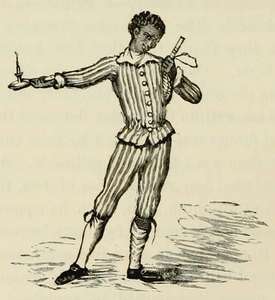
Mr. Dibdin as Mungo.
CHAPTER XII. — FOOTNOTES:
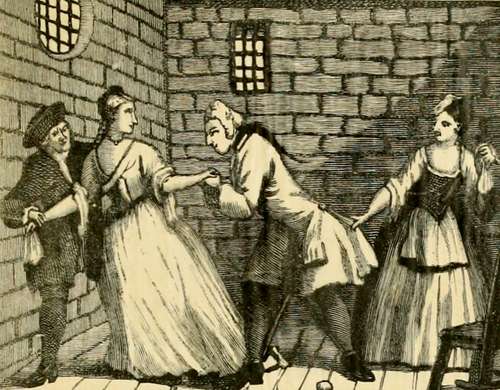
MILWARD'S "BENEFIT TICKET."
(Hogarth)
PROLOGUE, EPILOGUE; DEDICATIONS AND BENEFITS.
In looking over the poetical addresses made to
audiences in former days, our regret is that such
abundant illustration, as they give, of life in and out
of the theatre, is rendered unavailable by a licentiousness
which runs through every line. From those of
Aphra Behn, and her contemporaries and immediate
successors, filthy missiles, as it were, were flung at
morals generally, and at the audience in particular.
Nevertheless, and down to a later period, the British
appetite for prologue and epilogue was for many
years insatiable. The public, though often insulted
in both, with that sort of licence which belonged
to the old jester, whose master, however, could as
readily chastise as laugh at him, listened eagerly; and
only with reluctance saw the time arrive when the
play was considered safe enough to go on without
the introduction. Even when old plays were revived,
the audience expected the prologue to enjoy resuscitation
also. So, when "Cato" was reproduced at
Covent Garden, for Sheridan, and the play commenced
without the famous introductory lines by
Pope, there was a vociferous shout from the house
of "prologue! prologue!" That eccentric actor,
Wignell, was then on the stage as Portius, and in
his fantastically pompous way had pronounced the
opening passage of his part,
"The dawn is overcast, the morning lowers,
And heavily, with clouds, brings on the day,"—
when he was interrupted by renewed vociferations
for the prologue. Wignell would neither depart
from his character, nor leave the house without
satisfactory explanation; and accordingly, after the
word "day," without changing feature or tone, he
solemnly went on, with this interpolation:—
"(Ladies and gentlemen: there has not been
For years a prologue spoken to this play—).
The great, the important day, big with the fate
Of Cato and of Rome."
Sometimes the prologue, in preceding the piece,
did so in mournful verse, "As undertaker walks
before the hearse;" and in the case of tragedy, it was
etiquette for the speaker to be attired in solemn
black, generally a court suit. Occasionally, the
prologue to an historical tragedy was a brief lecture,
for the enlightenment of an ignorant audience. At
all times it was held to be a better means of instruction
than that followed by French writers of tragedy,
through confidants,—
"Who might instruct the pit,
By asking questions of the leading few,
And hearing secrets, which before they knew."
Few men wrote more of them than Garrick,
though in that to "Virginia" he says that—
"Prologues, like compliments, are loss of time,
'Tis penning bows and making legs in rhyme.
'Tis cringing at the door, with simp'ring grin,
When we should show the company within."
But he subsequently wrote in the epilogue to the
"Fathers," that—
"Prologue and epilogues—to speak the phrase—
Which suits the warlike spirit of these days—
Are cannons charged, or should be charged, with wit,
Which, pointed well, each rising folly hit."
Garrick, however, only wrote according to the
humour of the hour, for elsewhere he describes prologues
as "the mere ghosts of wit;" and proposes
their abolition. Their alleged falseness of promise
he illustrates, in a "Prologue upon Prologues,"
spoken when none at all was needed, by a story:—
"To turn a penny, once, a wit,
Upon a curious fancy hit,
Hung out a board on which he boasted,
'Dinner for threepence, boiled and roasted!
The hungry read, and in they trip
With eager eye and smacking lip:
'Here bring this boiled and roasted, pray!'
Enter potatoes, drest each way!
All stared and rose, the house forsook,
Cursed the dinner, and kicked the cook."
It is a singular thing that authors had little or no
control over the prologues or epilogues attached to
their plays. In this respect, the manager acted as he
pleased, licensed such sentiments as he approved of,
and was irresponsible. Thus, the refined Dr. Young
was insulted by an unclean epilogue attached to his
"Brothers," which was played for the benefit of the
Society for the Propagation of the Gospel, and Dr.
Browne, one of the vainest of authors, was horrified
by hearing Garrick, in the epilogue to "Barbarossa,"
make Woodward ask the public—referring to the
doctor, to "Let the poor devil eat! allow him that!"
Home, however, seems to have exercised, in some
respect, his own judgment, when "Douglas" was
played. That is, he refused to tag a satirical address
to so solemn a tragedy; but another poet laughed at
him, through Barry, who came on exclaiming—
"An epilogue I asked! but not one word
Our bard would write! He vows 'tis most absurd
With comic wit, to contradict the strain
Of tragedy, and make your sorrows vain."
But Shenstone, in his epilogue to Dodsley's "Cleone,"
a few years later, followed a double course.
After that tragedy of anguish, the address began
with,
"Well, ladies, so much for the tragic style—
And now the custom is—to make you smile."
Then came hints that had the absent husband Lefroy
lived in modern times, his Cleone would have proved
a different damsel to her depicted by the poet; but
Shenstone adds, in his moral strain:—
"'Tis yours, ye fair, to bring those days again,
And form anew the hearts of thoughtless men.
Make beauty's lustre amiable as bright,
And give the soul, as well as sense, delight;
Reclaim from folly a fantastic age,
That scorns the press, the pulpit, and the stage."
This was a good attempt to raise the character of
women by pointing to a duty which they might perform;
and a similar moral strain was adopted long
after by Sheridan. In the epilogue to his "Rivals,"
spoken by Mrs. Bulkley, he says:—
"Our moral's plain, without more fuss,
Man's social happiness all rests on us;
Through all the drama, whether damned or not,
Love gilds the scene, and women guide the plot."
Among the curiosities of prologues and epilogues,
may be reckoned the boasts, promises, and little confidences,
in those delivered on the occasion when
"Cato" was played at Leicester House, by the children
of Frederick, Prince of Wales, and some of the
young nobility. The prologue, indeed (spoken by
Prince George, afterwards George III.), was not
especially remarkable. It lauded the wisdom of men
who declared that—
"To speak with freedom, dignity, and ease,
To learn those arts which may hereafter please,"—
nothing was required, but that "youth in earliest
age" should "Rehearse the poet's labours on the
stage." As for patriotism, said Prince George,—"Know,—'twas
the first great lesson I was taught!"
And, of course, he gloried that he was "A boy, in
England born, in England bred!" Artists, who
may hereafter paint the scene, will do well to remember
what pictures were suspended on the walls:
"Before my eyes those heroes stand,
Whom the great William brought to bless this land;—
To guard, with pious care, that gen'rous plan
Of power well bounded, which he first began."
The epilogue was spoken by Lady Augusta (as
Prince Frederick called his daughter) and Prince
Edward, afterwards Duke of York. It was mere
doggerel; but Augusta flouted at the fine phrases of
the prologue, and Edward—entrusted with a sly hit
at George's boast of being English born—declared
that George had—
"Vouchsafed to mention
His future gracious intention,
In such heroic strains, that no man
Will e'er deny his soul a Roman."
There was an allusion to the imperial sway the
elder brother was to enjoy, and the obedience the
younger was to observe; after which, the latter,
addressing the little sister, to whom he had been a
suitor (Juba) in the play said—
"But, sister, now the play is over,
I wish you'd get a better lover."
To which the already destined bride of Brunswick,
and future mother of that Caroline, who was so luckless
and unlovely a Queen of England, made reply,
wherein we see something of the training for high
duties, then adopted in high places:
"Why—not to under-rate your merit,
Others would court with diff'rent spirit;
And I, perhaps, might like another
A little better than a brother,
Could I have one of England's breeding.
But 'tis a point they're all agreed on,
That I must wed a foreigner,
Across the seas—the Lord knows where!"
Whereupon, Prince Edward congratulated himself on
being "wedded to the nation;" and, alluding to his
mimic command in the tragedy, he hoped that future
times would see him "general in reality," adding,—
"Indeed, I wish to serve this land;—
It is my father's strict command."
And so forth, in like strain, wherein great purpose
took the guise of low impertinence.
This address is said to have been extremely well
delivered. On the regular stage, Woodward and
King were remarkable as prologue speakers. A biographer
of the latter says: "As a prologue speaker,
in the comic style, he is undoubtedly unapproachable.
There is a happy distinction in his ease, manner,
familiarity, and acting those dramatic exordiums,
so as to render them, in his possession, entertainments
of the first kind. Indeed, the audience are so
sensible of this, that they never omit calling for them
on those nights the pieces are represented, with an
avidity and impatience that strongly indicate their
pleasure." From the earliest times, indeed, it was
the ambition of an actor to be considered an efficient
speaker of prologues. Wilks was never so angry as
when the office was entrusted to another; Cibber
never so proud as when Dryden made selection of
him.
If the audience were almost invariably insulted in
these old addresses, individual patrons were grossly
flattered by authors in the dedication of their plays.
Mrs. Behn leads the way decently enough with her
"good, sweet, honied, sugar-candied reader," prefixed
to her "Rover;" but she speedily turns from abstract
to actual personages, and then the address out-Herods
Herod. Passing from her, to select another sample
from the hundreds about me, I come to Dryden's
horrible farce of "Amboyna," with its unsavoury
jokes, Bacchanalian chaunts, hymn from the Basia,
and unspeakable atrocities. It is dedicated to the
first Lord Clifford, of Chudleigh. This patron of the
poet was the grandson of a Protestant clergyman, but
he became a Romanist before the Restoration. He
was one of the defamers of Clarendon. In the Commons
he was as bold as he had ever been in any of
his volunteer actions at sea. Pepys speaks of him
as "a very fine gentleman, and one much set by at
court, for his activity in going to sea, and strictness
everywhere, and stirring up and down." Evelyn
alludes to him in unrestrained terms of admiration
and affection; and as far as Lord Clifford's private
character is concerned, he was worthy of such praise.
But he betrayed his country's liberties; and he
vehemently desired to establish Popery. Clifford
was a magnificent Lord High Treasurer, and one of
the Cabal. Dryden's dedication to him, of his anti-Dutch
farcical tragedy, probably rests on Clifford's
deeds in sea-fights against the Dutch. But here we
have an English poet lauding to the skies an un-English
peer, who is said to have avowed, that he
would rather see our King dependent on the French
monarch than on five hundred kings in parliament.
Dryden says, that despairing of "repaying his obligements"
to my lord, he is driven to "receive only
with a profound submission the effects of that virtue
which is never to be comprehended but by admiration;"
and he receives my lord's "favours as the Jews
of old received their law,—with a mute wonder."
Perhaps there is a little satire in this, as there seems
to be in the reference to his lordship's doings at the
Treasury, where "no man attended to be denied."
"Had that treasure been your own," says Dryden,
"your inclination to bounty must have ruined you!"
Which sounds very much like complimenting a man
for robbing his master in order to distribute charity.
In the dedication of his plays, Dryden twice approaches
royalty,—legitimate royalty,—in the persons
of James, Duke of York, and Mary of Modena, his
Duchess. To the former, he dedicates his Conquest
of Granada; and the poet runs mad in praising the
Prince's valour. To the Duchess, he dedicates his
State of Innocence; and the bard runs wild in lauding
the Princess's beauty!
The Almanzor of the play is a faint image of
James himself! whose youth of bright deeds left his
manhood nothing to perform, but to outdo himself!
He was an honour to England, when England was
a reproach to itself!—"and when the fortunate
usurper sent his arms to Flanders, many of that adverse
party were vanquished by your fame, ere they
tried your valour. The report of it drew over to
your ensigns whole troops and companies of converted
rebels, and made them forsake successful
wickedness to follow an oppressed and exiled virtue!"
Armies, beaten by the Duke, learned from him to
conquer! When he was not present, the guardian
angel of the nation was careless as to how inferior
generals got bruised! If James and Charles were
concerned more with one thing than with another, it
was in watching over the honour of England! In
the former, the poet had found his model for the
extraordinarily heroic Almanzor. He adds, with a
spice of satire, which is to be found in most of
Dryden's dedications, that there is, to be sure, in
Almanzor, "a roughness of character, impatience of
injuries, and a confidence of himself, almost approaching
to an arrogance!" "But these errors," says the
crafty bard, "are incident only to great spirits!"
There is more of insanity and insolence in the
adulation with which Dryden deluges the Duchess.
Her beauty is a deity, her grandeur a guardian
angel! Of her beauty, he will rave. "I would not,
without extreme reluctance, resign the theme to any
other hand!" He is proud that he cannot flatter,
and then pelts her with flattery as with missiles.
The Creator had placed her near the crown that her
beauty might give lustre to it! There would have
been no contest for the apple, had she been alive
when the prize was to be awarded! As it is, he
cannot describe her wondrous excellence. "Like
those who have surveyed the moon by glasses, I can
only talk of a new and shining world above us, but
not relate the riches and the glories of the place!"
So resplendent is she, that she makes men false to
other ladies, and then scorns the homage of the
traitors. And, having libelled the men, he defames
the women, by saying: "Your conjugal virtues have
deserved to be set as an example to a less degenerate,
less tainted age. They approach so near to singularity
in ours, that I can scarcely make a panegyric to your
royal highness, without a Satyr on many others!"
Finally, having outraged all propriety, he can still
go further, by the addition of a little blasphemy;
and her royal highness is informed by her most
obedient, most humble, and most devoted servant,
John Dryden, that her "person is so admirable, it
can scarce receive addition when it shall be glorified!"
Therefore, the Duchess is to dwell for ever
in Elysium, in her mundane body, unchanged, "for
your soul, which shines through it," says the vile
adulator, "finds it of a substance so near her own,
that she will be pleased to pass an age within it,
and to be confined to such a palace." Such was
the incense which the greatest living poet of his day
expected even a shrewd princess like Mary of Modena
to inhale!
Otway crawls at the feet of the King's concubine,
the rapacious Duchess of Portsmouth, in his dedication
of "Venice Preserved," and almost invites her
to void her rheum upon his head. However generous
the woman may have been to him, the man is abject.
The play he presents is but as the poor apple offered
by a clown to an emperor! "Next to Heaven," all
his gratitude is due to her Grace! It was she who
dragged him from the mire, and set him to bask in
"those royal beams whose warmth is all I have, or
hope, to live by." Then, after asserting his loyalty
and his scorn of republicanism, the poet thus tumbles
for the amusement of, or by way of homage to, this
handsome and painted Jezebel!—"Nature and fortune
were certainly in league when you were born, and as
the first took care to give you beauty enough to enslave
the hearts of all the world, so the other resolved
to do its merit justice that none but a monarch fit
to rule that world should e'er possess it; and in it he
had an empire. The young prince you have given
him, by his blooming virtues early declared the
mighty stock he came from;" and so forth. That
this prince, the first Duke of Richmond of the
present line, will always aid the cause of the Stuarts
and smite all rebels, is part prayer, part prophecy, on
the side of the poet, who in this case was no Vates,
for the Duke served as aide-de-camp to William in
Flanders, and died a Lord of the Bedchamber to
King George I.
In course of time, as the little Duke grows to
manhood, the poets keep him in view, and in their
dedications oppress him with praise of his parents'
qualities and his own. Southern is among the foremost
and the most flattering of these eulogists. He
dedicates his first venture, the "Loyal Brother"
(1682), to the Duke. "Could my vanity," says the
author, when dedications were paid for at a rate
varying from five to twenty guineas, "carry me to
the hopes of succeeding in things of this kind, I am
confident my surest way would be to draw my characters
from you, in whom the fairest images in
nature are shown in little. Your royal father's
Greatness, Majestic Awfulness, Wit, and Goodness,
are promised all in you. Your mother's conquering
beauty triumphs again in you. Nothing is wanting
to crown our hopes, but time, to make you in England
what Titus was in Rome,—the Delight of Mankind."
The Russian Admiral, Livsoski, claims that
title now for the Czar,—the holy master of the Mouravieffs
and De Bergs,—whose shedding of human
blood is gratefully acknowledged by the new Titus,—athirst
for vengeance.
Etherege, ordinarily so impudent, pretends, in
dedicating his "Man of Mode" to the Duchess of
York, that his patroness's virtues and perfections are
things not to be treated of in humble prose, and that
he will address himself to the sublime subject some
day in poetry! Wycherley presents his "Love in a
Wood" (1672), to the Duchess of Cleveland, who
had gone two successive nights to see it acted. It
is his first attempt, he says, at dedication; and he
cannot lie, like other dramatists, who wreathe garlands
for their patron's brow only to enjoy the perfume
of them, themselves! And then he sings a
long song of praise for his guineas, or in whatever
other way his guerdon may have come, in which he
tells the lady, among other fine things, that she has
that perfection of beauty which others of her sex
only think they have; "that generosity in your
actions which others of your quality have only in
their promises, with a spirit, wit, and judgment
which fit heroes for command, and which fail to
make her proud." It is not to be supposed that
Wycherley believed this, for when he dedicated his
"Plain Dealer" (1674) "to my Lady B——," or
Mother Bennet, the most infamous woman in London,
he especially praises her for her modesty, in keeping
away from the representation of his play, even on the
first day,—a play which he pretends to believe ought
not to be witnessed by modest people!
Congreve sometimes insinuates praise, at others he
flings it. In the dedication of his "Old Batchelor,"
to Lord Clifford (Lanesborough), afterwards Earl of
Burlington, he says, "I cannot give your Lordship
your due, without tacking a bill of my own privileges."
His "Double Dealer" goes to Charles,
Lord Montague, with an assurance that poetry is
my Lord's mistress, and the mother by him of a
"most beautiful issue." He addresses his "Love
for Love" to the Earl of Dorset, and hails him as
the undisputed monarch of poetry! Dorset, whose
best claim to being considered a poet, rests on the
song, "To all ye ladies now on land," of his being
the author of which there is no positive assurance!
In the eighteenth century a man was killed in the
streets of Morpeth, for maintaining that the blood of
the Dacres was as good as that of the Ogles. Of the
excellence of the latter, Shadwell entertained very
exalted ideas. In 1680 there was living, and in the
same year died, the Earl of Ogle, to whom was contracted
in her infancy the famous Lady Elizabeth, sole
heiress of the last of the Earls of Northumberland.
Her subsequent contract with Tom Thynne led to the
murder of the latter by Count Königsmark. In the
year above-mentioned, Shadwell produced at Dorset
Gardens, and published, his "Woman Captain," in
dedicating which to the Earl of Ogle, the Marquis
of Newcastle's son, Shadwell says, "one virtue of
your Lordship's I am too much pleased with not to
mention, which is, that in this age, when learning
is grown contemptible to those who ought most to
advance it, and Greek and Latin sense is despised,
and French and English nonsense applauded, when
the ancient nobility and gentry of England, who not
long since were famous for their learning, have now
sent into the world a certain kind of spurious brood
of illiterate and degenerate youth, your Lordship
dares love books, and labours to have learning."
This is fine testimony and not flattery to one of
the most promising young gentlemen of the day.
His child-wife subsequently married the proudest of
dukes, and Swift has immortalised the red-haired
beauty as "the d——d Duchess of Somerset!"
In one of the greatest of moral writers,—the Rev.
Dr. Young, we meet with one of the most fulsome
of adulators. This divine dedicated his "Revenge"
to his friend Philip, Duke of Wharton, the most
profligate and unprincipled, but one of the most
accomplished men of his age. Young assures us
that his Grace leads a virtuous pastoral life, such as
your town rakes know nothing of; that his is given
to study, and that he is a perfect master of all history,
as well as of many languages; that he is as well
skilled in men as in books, and that he "can carry
from his studies such a life into conversation, that
wine seems only an interruption to wit." The Duke
has, we are told, "so sweet a disposition that no one
ever wished his abilities less, but such as flattered
themselves with the hope of shining when near him."
The poet even makes the peer his collaborateur in
the piece, and acknowledges that he not only "suggested
the most beautiful incident, but made all
possible provision for the success of the whole."
But, although authors may have been ready enough
to flatter their patrons, the appetite of the latter was
sometimes stronger than could be met by the supply.
Peter Motteux, of whom I have already spoken, had
a patron of this quality, whose name was Heveningham,
and who, having accepted the dedication of one
of Peter's dramatic trifles, was so little satisfied with
the copy which was sent to him for approval, that he
wrote one to himself, subscribed it with Motteux's
name, and sent it to the press! Unluckily, Heveningham
had mentioned therein an incident which
could have been known only to himself; and the
epigrammatic wits found their account in the oversight.
There is something more touching in the dedication
of "Merope" to Bolingbroke, by poor Aaron
Hill, when "hard up," through speculation, indiscreet
generosity, and a profuse hospitality, in
which there was no discretion at all! Aaron felt
his position, and was conscious of an end approaching,
to which the sad poet thus alludes:—
"Covered in Fortune's shade, I rest reclined,
My griefs all silent and my joys resigned.
With patient eye Life's ev'ning gleam survey,
Nor shake th' out-hasting sands, nor bid them stay;
Yet while from life my setting prospects fly,
Fain would my mind's weak off'ring shun to die;
Fain would their hope, some time through light explore,
The name's kind passport, when the man's no more."
I fear Bolingbroke had few means to materially
help the writer, beyond the dedication fee. Even
the profits of the author's three nights brought to his
family little more than a hundred and odd pounds.
Murphy and Fielding were the first dramatic poets
who departed from the old beaten track. Murphy
dedicated his "Zenobia," not to an earl, but to an
actress,—Mrs. Barry, who had saved his tragedy by
her glorious acting. This dedication is gracefully
worded, and is a faithful testimony to the ability of
a great artist. Unfortunately, flattery could creep
into such homage as this. For fulsomeness of
praise, Soane's dedication of the "Dwarf of Naples,"
to Edmund Kean; and Sheil's, of his "Adelaide,"
to Miss O'Neill, equal any similar offence of the
olden time.
I could cite more, but will only add that, of all
the writers of dedications, by far the most amusing
is the man who wrote none! This ingenious person
called himself Adam Moses Emanuel Cooke, but
his sole Christian name was simply Thomas. He
was a Northumbrian by birth, an Oxonian by education,
and a beneficed clergyman who drove all his
parishioners mad by his superstitious practices, his
mystical enthusiasm, and his turn for unintelligible
mysteries. He took all the loving promises to the
Jews so much to heart as to believe that the more
nearly he approached them in all their old observances,
the more true he should be to the Christian
dispensation. Accordingly, he practised them all,
did not hesitate at the most painful and characteristic,
and was very much astonished that other men declined
to follow his example.
Cooke was mad, in this one matter, no doubt; but
considering that episcopal patience bore with the
theatre-haunting Rev. Dr. Dodd, I think Cooke's
bishop treated him a little harshly by procuring his
deprivation, and driving him out to starve.
To starvation, however, the poor man had reasonable
objections; and to obviate such an end, he
turned dramatic author, as if to justify those who
called him mad. It was then that he showed that
there was method in his madness. Having nothing,
he denounced the rights of property. Possessing
nothing he could throw in to the common lot, he
preached communism. At Will's, or Tom's, or
Button's, at the Grecian, or any other well-frequented
coffee-house, the hungry author of two unrepresented
and unrepresentable plays who might have
thanked heaven that he was not worth a ducat,
would coolly enter and seat himself at the first table
which he saw ready furnished with a meal for which
he longed, and thought not of paying. The rightful
owner, if ignorant of the ways of Adam Moses
Emanuel, would blandly smile at the absent man,
thinking sighingly of the mighty labours which had
brought him to such a pass, and quietly move off.
If the gentleman whose chocolate, toast, and eggs
Cooke appropriated, knew of the mystic's ways, he
would smilingly submit to them, and await the
moment which should bring the Gastronome sans
argent and mine host into collision.
However this might be, the breakfast concluded,
Cooke returned thanks, rose, shook his faded suit of
sables, and made, calmly satisfied, for the door. Between
that and himself ever stood the landlord, or
head waiter, and then ensued a controversy, to hear
which, old beaux, middle-aged bucks, and younger
bloods crowded with more eagerness than would have
marked their going to a sermon. Cooke's theory was
not "base is the slave that pays," but that, payment
lacking on his part, it would be base to deprive him
of breakfast. To the simple and conclusive reasoning
of the master he opposed texts from the Talmud,
maxims from the Rabbis, and a clincher from Moses,
according to whose legislation even a thief was not
to be punished, if his so-called offence originated in
the natural necessity of satisfying his stomach. Of
course, when the audience grew tired of the argument,
they clubbed the amount required, and sent
the cunning author rejoicingly on his way.
That way took him from the landlord, who was
quite "agreeable" to have him for a customer,—he
drew so many others—to the patron from whom
Cooke hoped to extract sufficient whereon to dine,
have his claret, and spin out his evening, like a
gentleman. He was always about to publish one
of, perhaps both, the mad plays he had written:
"The King cannot Err," and the "Hermit Converted,
or the Maid of Bath Married." Or he was on the
point of giving to the public some treatise on mystical
divinity. For suitable patrons he had as fine a scent
as for breakfast. He selected them among wealthy
old Creoles, or rich young lords just returned from
the grand tour; or peers who would be glad to give
a guinea to get rid of him; or baronets who would
think the fun got out of him well worth the fee;
or simple 'squires and gentlemen honestly ready to
contribute to the support of literature and distressed
authors.
With the guinea for subscription in his pocket,
Cooke withdrew on that day, to call on the same or
some other patron the next, for permission to dedicate
his drama to one of whose virtues, talents, magnanimity,
divine endowments, and the like, the town
was giving hourly assurance. The fish thus tickled
generally proved a gold-fish, and with a dedication
fee of, at least, five guineas, Cooke disappeared as
solemnly as the Ghost in "Hamlet."
Like that shadowy majesty of Denmark, our dramatic
author was a "revenant." He always returned.
A happy thought had struck him. A copper-plate
engraving of his patron's shield of arms, at the head
of the dedication, would magnify every party concerned,
and especially him of whose house it was
the blazon! There were little incidental expenses,
no doubt; but what were they to one so munificent
and so disposed to promote the best interests of
learning! And, accordingly, Cooke withdrew, all
the richer by ten guineas,—for the engraver!
When Cooke's goose ceased to lay golden eggs—when
no other was to be found, and managers
cruelly refused to have anything to do with his
dramas, the reverend gentleman let his beard grow,
turned street preacher, and, as the Bearded Priest,
railed against sin generally, and those connected
with plays and players, in particular. That drama
having been played out, Cooke became a peripatetic,
traversing the three kingdoms on foot, and meeting
more examples and incidents for the History of a
Vagabond than ever entered into the experience or
the imagination of Goldsmith. He contrived to fall
into the way of scholars and universities,—and from
these, whether they were in Oxford, Dublin, or
Edinburgh, he never turned hungry. It is hardly
necessary to say that his eccentricities brought him,
by the way, to "Bedlam," that hell upon earth,
where men were driven fiendishly mad, who were
only harmlessly so before. Cooke, recovering his
liberty, never recovered method with his madness.
The latter was intensified by an aggravation in its
old mystic element, and this poor fellow, who is said
to have realised more money in fees for dedications,
which he never wrote, to plays which were never
acted, died, characteristically enough, according to
report, of the consequences of following an example
set in heathen days, by Atys, and in a Christian
period by Origen,—without, however, having had
the cause pleaded by the one, or the reason alleged
by the other.
To conclude this chapter with a word on Benefits.
These are of royal invention, and the first, already
recorded, was awarded by King James to Elizabeth
Barry,—a tribute to her genius.[86] The fashion has
not died out, but that of announcing them, as of
yore, has. For example, the Spectator often put in
a good word for George Powell. Sometimes there
was an intimation that George, well qualified, but
ever and anon careless, would distinguish himself,
if the public would only patronise the "Conquest
of Mexico," to be acted, for his benefit. When,
in April 1712, he was, on a like occasion, to play
Falstaff, in the first part of "Henry IV.," it was
after this fashion that the Spectator did a good turn
for its particular friend. "The haughty George
Powell hopes all the good-natured part of the town
will favour him whom they applauded in Alexander,
Timon, Lear, and Orestes, with their company this
night, when he hazards all his heroic glory in the
humbler condition of honest Jack Falstaff."
It is pleasant, too, to observe that though actors
lost their engagements and endured much privation
in consequence, they were not forgotten. I frequently
meet with announcements of benefits "for
some distressed actors, lately of this house;"—and,
occasionally, if circumstances rendered the benefit
less productive than was expected, a second is
gratuitously given to make up for the deficit.
Again, "For the benefit of a gentleman who has
written for the stage," shows a delicate feeling for
a modest, or a damned, author. And as "for sufferers
from fire," "wards in Middlesex Hospital,"
or "for the building of churches and chapels," or
for "Lying-in Hospitals," the stage was never weary
of lending itself to such good purposes of relief. It
was not till May 1766 that the profession began to
think of doing something for itself, and I find a
benefit announced "towards raising a fund for the
relief of those who, from their infirmities, shall be
obliged to retire from the stage." Garrick played
Kitely on this occasion.
In 1719,[87] Spiller advertised a performance at Lincoln's
Inn Fields, "for the benefit of himself and
creditors." The announcement, in the shape of a
letter, is a curious document. "I think," says this
one-eyed comedian, "I have found out what will
please the multitude.... I have tolerable good
luck, and tickets rise apace, which makes mankind
very civil to me, for I get up every morning to a
levee of at least a dozen people, who pay their compliments
and ask the same question, 'When shall
we be paid?' All I can say is, that wicked good
company has brought me into this imitation of
grandeur. I loved my friend and my jest too well
to grow rich: in short, wit," says the comedian,
sporting with his own infirmity, "is my blind side."
Theophilus Cibber was often as candid, sometimes
more impertinent. In May 1722 he announces
"Richard III." for his benefit, "for the entertainment
of those who will come." He sometimes
advertised his benefit as being for himself and
creditors conjointly, and in April 1746 we find
him, a comedian of the first rank, thus appealing
to the consideration of the public,—"As I have, in
justice to my creditors, assigned over so much of
my salary as reduces the remainder to a very small
pittance, I very much depend on the indulgence and
encouragement of the town at my benefit, whose
favours shall be gratefully remembered, by their very
humble servant,—Theophilus Cibber." Such an
announcement would sound curiously in these days,
but it was, perhaps, exceeded in singularity by Lillo's
advertisement, in 1740, of the performance, on the
third, or author's night, of his "Elmeric," "for the
benefit of my poor relations." The frankness of the
avowal and the liberality suggested are social traits
worth preserving.
One of the observances which beneficiaires were
expected to follow, has long gone out of usage,—namely,
that of personally calling on those whose
patronage was hoped for. Apologies for the omission
are very common. In 1723, Bickerstaffe announces
the "Mourning Bride" and "Stage Coach," with
this appendix to his bill,—"N.B. Bickerstaffe being
confined to his bed by his lameness, and his wife
lying now dead, has nobody to wait on the quality
and his friends for him; but hopes they'll favour
him with their appearance."
Again, Bullock, in 1739, advertises the "Spanish
Friar," with himself as Dominic. The once lively
fellow thus pleads his excuse:—"Bullock hopes his
great age, upwards of threescore years and twelve,
will plead his excuse that he cannot pay his duty to
his acquaintance and friends, whose good nature may
engage them to assist him in his decline of life, in
order to make the remainder of his days easy and
comfortable to him. In his younger days he had
the pleasure and happiness of entertaining the town,
and Sir Richard Steele, in his Tatler, has been
pleased to perpetuate his memory in honouring him
with a memorial there. As this is the last time he
may possibly beg the favour of the town, he hopes to
receive their indulgence, which, for the few remaining
days, shall be gratefully acknowledged by
him."
In like half friendly, half humble, style, and with
something, too, of the same reflective element, Chapman
of Covent Garden, about to play Modely, in the
"Country Lasses," adds the apologetic "N.B." to
his advertisement:—"I, being in danger of losing
one of my eyes, am advised to keep it from the air,
therefore stir not out to attend my business at the
theatre,—on this melancholy occasion, I hope my
friends will be so indulgent as to send for tickets to
my house, the corner of Bow Street, Covent Garden,
which favour will be gratefully acknowledged by
their obedient humble servant, Thomas Chapman."
Chapman was only under misfortune, he was not
like the younger Cibber, who was as extravagant
and as deeply in debt in 1740 as in 1722. At the
foot of the advertisement for his benefit in the first-named
year are some singular but not altogether
unsatisfactory words;—whereby his creditors are
requested to meet and receive a fourth dividend of
his salary! His creditors were interested in all his
benefits.
In the following year, at the Goodman's Fields
Theatre, Blakes and Miss Hippisley had a joint
benefit, which was curiously announced as "for the
entertainment of several of the ancient and honourable
society of Free and Accepted Masons." The
pieces were the "Miser," and "Lethe," Blakes
playing Clerimont and the Frenchman, and Miss
Hippisley, Lappet and Miss Lucy. The patronising
brethren met at the Fleece Tavern, and walked processionally
and "cloathed," to that part of the pit
which was especially railed in for them.
When Woodward advertised his benefit in 1745,
at Covent Garden, on which occasion he played Sir
Amorous la Foole, in the "Silent Woman," and
Harlequin, in the "Rape of Proserpine," he made
no especial appeal to the public. But Merchant
Tailors did not forget their old schoolfellow, and a
letter in the General Advertiser called upon Merchant
Tailors, generally, to rally round their condiscipulus,
for,—"The original design of forming
ourselves into a society was, as I take it, to serve
and promote the interest of our schoolfellows," &c.
The benefits of the greater actors, however profitable
to themselves, must have afforded but few
pleasant stage illusions to the public. On these
occasions, the stage itself was converted into an
amphitheatre, or was built round with boxes for the
convenience of ladies, while the pit, if necessary,
was turned into ground tiers of boxes, at increased
prices. Remembering how fierce the spirit and
unscrupulous the actions of that pit could be, when
offended, the patience with which it endured being
turned out was especially remarkable. The public
of that day seems to have been treated with alternate
contempt and servility. When Yates took his
benefit at Goodman's Fields, he advertised the impossibility
of his calling personally on theatrical
patrons in the neighbourhood, on the ground that
he had got into such a strange part of the town, he
could not find his way about the streets!
Sometimes an appeal was made to the compassion
of the public, as by generally hilarious Hippisley,
who, about to play Scrub for his benefit, at Covent
Garden, in 1747, announces in the General Advertiser,
"he is so far recovered from his late illness, that
though considerably altered in his physiognomy, and
lowered in spirits, he persuades himself a crowded
house on Thursday next, at the 'Stratagem,' for his
benefit, will create a smile on his countenance, raise
his spirits, and make him appear as much a Scrub
as ever."
In the same year there was an ambitious young
actor at Goodman's Fields, named Goodfellow, who
played Hamlet and Fribble, two of Garrick's best
characters, for his benefit; for taking which he gave
the singular reason, that "my friends having expressed
a great dislike to my being on the stage, I
have resolved upon taking this benefit to enable me
to return to my former employment." The public
accordingly patronised him in order to get rid of
him, and the young fellow was so grateful that he
remained on the stage!
These examples are cited as they occur to me, and
I will not add to them; but rather turn away, to
mark some eminent actors flitting from the stage,
and some samples of the public opinion connected
with it, before the coming of Edmund Kean.
CHAPTER XIII. — FOOTNOTES:
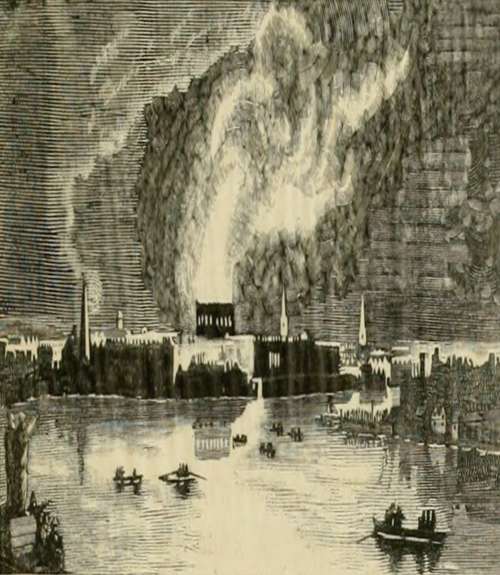
BURNING OF DRURY LANE THEATRE, 1809.
OLD STAGERS DEPARTING.
Of the old actors who entered on the nineteenth
century, King was the first to depart. He is remembered
now, chiefly, as the original representative
of Sir Peter Teazle, Lord Ogleby, Puff, and Dr.
Cantwell. He began his London career at the age
of eighteen, in 1748, on Drury Lane stage, as the
Herald in "King Lear," and made such progress,
that in the next year[88] Whitehead selected him to
play Valerius in his "Roman Father." By 1756 he
was an established favourite, and he remained on
the London stage, with hard summer work during
the holidays, till the 24th of May 1802, when he
took his leave in Sir Peter, to the Lady Teazle of
Mrs. Jordan. At the end of upwards of half a century
he withdrew, to linger four years more, a man
of straitened means—one whom fondness for "play"
would not at first allow to grow rich; nor, after that
was accomplished, to remain so. I have noticed a
few of his principal original characters; of others,
his Touchstone has not been equalled, nor his
Ranger, save by Garrick and Elliston. He was a
conscientious actor, and a prime favourite during the
greater part of his career—but the once rapid, clear,
arch, easy, versatile Tom King, remained on the stage
somewhat too long.
Suett was to "low," what King was to "genteel,"
comedy; and the stage lost Dicky in 1805, in which
year he died. Dicky Suett was the successor, but
not the equal of Parsons. For a comic actor he had
a very tragical method of life—indicated by a bottle
of rum and another of brandy being among the
furniture of his breakfast table. From 1780 to 1805
he was a favourite low comedian; he killed his
audiences with laughter, and then went home (the
tavern intervening) to bed, where his sleep was
merely a night of horror caused by hideous dreams,
and mental and bodily agony. John Kemble
appreciated him, in Weazle particularly, which he
played to the tragedian's Penruddock, and by his
impertinent and persevering inquiries, peering into
Penruddock's face, used to work him up into a
condition of irritability required by the part. He
was tall, thin, and ungainly; addicted to grimace
and interpolations; given to practical jokes on his
brother actors on the stage; and original in everything,
even to encountering death with a pun excited
by a sign of its dread approach. Suett was one
of those perversely conscientious actors, that when
he had to represent a drunkard, he took care, as
Tony Lumpkin says, to be in "a concatenation
accordingly."
In 1809 Lewis withdrew, in his sixty-third year.
He was a Lancashire man, well descended, though a
draper's son, and was educated at Armagh. He left
linen-drapery for the stage,[89] played with success in
Dublin and Edinburgh, and came to Covent Garden
in 1773, where, however, he did not displace Barry,
as in Dublin he had vanquished Mossop.[90] He remained
at Covent Garden from 1773, when he
appeared in Belcour (a compliment to Cumberland,
who had helped to bring him thither), till the 29th
of May 1809, when he took his farewell in the
Copper Captain, the best of all his parts. He died
in 1813, and out of part of his fortune bequeathed
to his sister, the beautiful new church at Ealing was
chiefly erected. His various styles are indicated by
some of the parts he created. Pharnaces and Sir
Charles Racket; Arviragus (Caractacus) and Millamour;
Percy and Doricourt; Sir Thomas Overbury
and Count Almaviva; Herodian and Lackland;
Aurungzebe ("Prince of Agra") and Young Rapid;
Faulkland and Jeremy Diddler: he played Carlos in
the "Revenge," and created the Hon. Tom Shuffleton
in "John Bull;" acted Posthumus, and originated
Vapid; began his course of original parts
with Witmore, in Dr. Kenrick's "Duellist;" and
ended them with Modern, in Reynolds's "Begone
Dull Care"—both of which plays were failures.
In Morton and Reynolds's comedies, his breathless
and restless style told well; but Lewis's reputation
is connected with the authors of an older period.
His Copper Captain was a masterpiece; and Cooke
recorded of him, that during the last thirty years
of his life, he was "the unrivalled favourite of the
comic muse, in all that was frolic, gay, humorous,
whimsical, eccentric, and at the same time elegant."
During twenty-one years he was manager of Covent
Garden; and the same writer testifies that Lewis
was "a model for making every one do his duty, by
kindness and good treatment." As early as 1802 he
had been warned by an epileptic fit, while rehearsing
Sapling, in Reynolds's "Delays and Blunders;"
but he recovered, played two years longer, and in less
than two years more died, leaving a handsome fortune
to his wife, children, and other members of his
family.
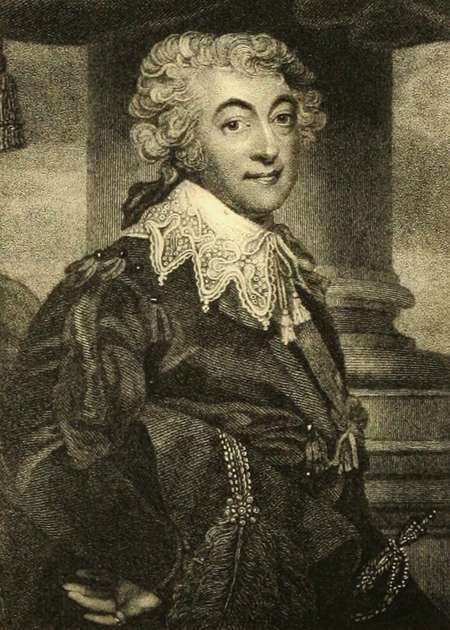
The greatest loss to the stage, in the early years of
the present century, was in the person of Miss Pope,
the only real successor of Kitty Clive. She withdrew
on the 26th of May 1808, after playing Deborah
Dowlas in the "Heir-at-Law," for the first and last
time. She had played as a child when Garrick was
in the fullest of his powers; won his regard, and
the friendly counsel of Mrs. Clive; played hoydens,
chambermaids, and half-bred ladies, with a life, dash,
and manner, free from all vulgarity; laughed with
free hilarity that begot hilarious laughing; and the
only question about her was not if she were an excellent
actress or not, but as an actress, in what she
most excelled. She gave up young parts for old as
age came on, and would have done it sooner, but that
managers found her still attractive in the younger
characters. In them she had been without a rival;
and when she took to the Duennas and Mrs. Heidelbergs,
she became equally without a rival. She was
the original Polly Honeycombe, Miss Stirling, Mrs.
Candour, Tilburina, and of two or threescore other
parts less known.
Miss Pope was as good a woman, and as well bred
a lady, as she was a finished actress, and was none
the less a friend of Garrick for having little theatrical
controversies with him touching costume, salary, or
other stage matters. In the year she played Cherry,
Polly Honeycombe, Jacinta, Phædra, Beatrice, Miss
Prue, Miss Biddy, and other buoyant ladies and
lasses, a poet said of her:—
"With all the native vigour of sixteen,
Among the merry groups conspicuous seen,
See lively Pope advance to jig and trip,
Corinna, Cherry, Honeycombe, and Snip!
Not without art, but yet to nature true,
She charms the town with humour, just, yet new,
Cheered by her promise, we the less deplore,
The fatal time when Clive shall be no more."
Such was she in Churchill's eyes, in 1761. The
fairy of that day; but, in 1807, the fairy had expanded
into "a bulky person, with a duplicity of
chin." Such was she in the eyes of James Smith,
to whom she told her love for handsome but fickle
Holland, losing—or casting off whom—she never
after heeded suit of mortal man.
In the drawing-room of her and her brother's
house in Queen Street, Lincoln's Inn Fields, two
doors east of the Freemasons' Tavern, in that richly-furnished
apartment, where, for forty years, Miss
Pope lived—among choice portraits of Mrs. Oldfield
and her little son, afterwards General Churchill; of
Lord Nuneham, who, as Earl of Harcourt, visited
Miss Pope with as much ceremonious courtesy as if
she had been a princess; of Garrick and of Holland—the
old lady told the tale of her young love, her
hopes and her disappointment, to James Smith.
Garrick, or "Mr. Garrick," as Miss Pope, with the
old habit of reverence, used to call him, had observed
the intimacy and growing attachment between the
young actor and actress, and, guardian of the happiness
of those whom he regarded, he warned the lady
of the waywardness, instability, and recklessness of
the swain. But Holland could persuade in his own
cause more successfully than Garrick could urge
against him; and Miss Pope, trusting the man she
loved, looked confidently forward to the day when
she would become his wife. Ere that day arrived,
she went in the old Richmond coach, on her way
to pay a visit to Mrs. Clive at Twickenham; and on
the road she passed a postchaise, in which were
Holland and a lady. The perplexed Miss Pope rode
thoughtfully on, and, alighting at Richmond Bridge,
walked meditatively along the meadows to Strawberry
Hill. Her jealous attention was attracted by
a boat on the river, opposite Eel Pie Island, the
rower of which could not so hurriedly but confusedly
pull through the weeds to the Richmond side, before
she saw that he was her faithless swain, Holland,
making a day of it with that seductive piece of mischief,
Mrs. Baddeley. Poor Miss Pope might fairly
confess to the "pang of jealousy," which she then
endured.
Shortly after they met at rehearsal. He, being
conscious of wrong and incapable of confessing it,
assumed a haughty bearing, but the injured woman
was as proud as he; and from that time they never
exchanged a word, except in acting. The foolish,
weak, and ungrateful fellow went philandering on;
"but I have reason to know," said Miss Pope, "that
he never was really happy." And forty years after
this rude waking from a happy illusion, and in
presence of the counterfeit presentment of her faithless
lover, the lady, whose heart at least never grew
old, shed tears as she told the one love passage of
her life, and thought of the dream of the bygone
time.
Out of life she faded gradually away; and one
of the merriest and most vivacious actresses of her
day lost, mutely, sense after sense ere she expired.
Previous to this, she had left her old familiar house
in Queen Street; much as she was attached to it,
she found the Freemasons too lively neighbours.
"From the Tavern, on a summer's evening, when
windows are perforce kept open, the sounds of
'Prosperity to the Deaf and Dumb Charity!' sent
forth a corresponding clatter of glasses, which made
everybody in Miss Pope's back drawing-room, for
the moment, fit objects of that benevolent institution."
Mr. James Smith alludes to the pleasant
parties she gave at the house in Newman Street, in
which she died. She was attacked by "stupor of
the brain;" and gradually passed away. "She sat
quietly and calmly in an arm-chair by the fireside,
patting the head of her poodle dog, and smiling at
what passed in conversation, without being at all
conscious of the meaning of what was uttered."
Miss Pope had a sort of doublure in Mrs. Mattocks,
granddaughter of the Hallam unhappily killed by
Macklin. Her father was the founder of the English
drama in America. Under his management, the first
play ever regularly performed beyond the Atlantic,
was at Williamsburg, in Virginia, on the 5th of September
1752, namely, the "Merchant of Venice," in
which Malone acted Shylock; Hallam, Launcelot
Gobbo; and Mrs. Hallam, Portia.[91] During Mrs.
Mattocks's long career, from 1752, when a child, to
1808, she played a variety of characters, commencing
with tragedy; but, as she used to say, in her old
age, "so long ago, I have almost forgotten it." She
thence passed through light, young, comic characters,
to old women; and played the latter very happily.
In her widowhood, she bestowed a rich marriage
dowry on her daughter, reserving for herself the interest
of £6000 in the five per cents., on which to
live, at Kensington. Her son-in-law held her general
power of attorney, and received her dividends; but
he one day made away with both interest and principal,
and the old actress was left penniless. A free
benefit, however, produced upwards of £1000, with
which a life annuity was purchased, on which the
aged player lived till 1826. If human art could
have prolonged her life, it would have been done
by her friend and medical adviser, the late Mr. Merriman,
to whom, in testimony of her respect, Mrs.
Mattocks bequeathed her portrait.
I add a passing word to record the passing away
of Mrs. Litchfield, in 1806, after a brief career in
London of nine years. She came at a time when
competition with Mrs. Siddons was impossible; but
Mrs. Litchfield was pre-eminent in having the finest
voice that was ever heard on the stage,—from an
actress.
Bannister, Charles or John, father or son,—the
name had a pleasant sound in our fathers' ears. The
elder was a bass singer, with a voice that would
crack a window-pane. "A pewtiful foice! your
father had," said a German Jew to the son; "so
deep, so deep! He could go so low as a bull!"
Handsome Jack played, in his salad days, with Garrick;
in his glowing maturity, with Edmund Kean,—in
whose brilliancy, as he said, he almost forgot
his old master, David. John Bannister might have
been a painter, but he chose to be a player; and, in
his line, he was one of the best. He felt, and made
feel; could exact tears as easily as laughter; and
was never out of temper but once, when a critic denounced
him for acting ill, on a night when he was
too ill to act. For this malicious deed, the player
recovered damages from his assailant.
There was nothing he could not do well. There
were many things he did inimitably. His Hamlet
belonged to the first—a host of comic parts to the
second category. His author was never dissatisfied
with him, however exigent; and he engaged the
immediate attention of the audience, by seeming to
care nothing about it. Applause interrupted his
speech—never his action. In depicting heartiness,
ludicrous distress, grave or affected indifference,
honest bravery, insurmountable cowardice, a spirited,
young, or an enfeebled old fellow, yet impatient;
mischievous boyishness, good-humoured vulgarity,—there
was no one of his time who could equal
him. In everything he acted he was natural, except
in Mercutio, which, strangely enough, did not suit
him;—he made of that elegant and vivacious gentleman,
simply an honest, jolly fellow. In parts, combining
tragedy and comedy, he was supreme. Such
was his Walter; such, too, his Sheva,—though in
some parts of the latter he was, perhaps, surpassed
by Dowton. His features were highly expressive
and flexible, and he had them in supreme command.
In 1772, he played Calippus, in the "Grecian
Daughter," and then had a time of probation; but,
from 1778, when he played Zaphna, in "Mahomet,"
to 1815, when the curtain finally descended on him,
as Walter,—a part which he created in 1793,—there
was no more pleasant actor before an audience.
Walpole thus speaks of the last-named part in the
year just named:—
"I went on Monday evening, with Mrs. Damer,
to the Little Haymarket, to see the 'Children in
the Wood,' having heard so much of my favourite,
young Bannister, in that new piece, which, by the
way, is well arranged and near being fine. He more
than answered my expectation, and all I had heard
of him. It was one of the most admirable performances
I ever saw. His transports of despair and joy
are incomparable; and his various countenances
would be adapted to the pencil of Salvator Rosa.
He made me shed as many tears as I suppose the old
original ballad did, when I was six years old. Bannister's
merit was the more striking, as, before the
'Children in the Wood,' he had been playing the
sailor, in 'No Song, No Supper,' with equal nature.
I wish I could hope to be as much pleased to-morrow
night, when I am to go to Jerningham's play, the
'Siege of Berwick;' but there is no Bannister at
Covent Garden."
He left the stage with a handsome fortune, the
fruits of his labour; and younger actors visited him
and called him "father!" Among the very long
list of characters he created at Drury Lane or the
Haymarket, were Don Ferolo Whiskerandos, Inkle,
Sir David Dunder, Robin ("No Song, No Supper"),
Leopold ("Siege of Belgrade,"), Lenitive ("Prize"),
Walter ("Children in the Wood"), Will Steady,
Sheva, Michael ("Adopted Child"), Sylvester Daggerwood,
Three Singles, Wilford ("Iron Chest"),
Sponge, Frank Heartall, Rolando ("Honey Moon"),
Ali Baba, Storm, and Sam Squib, in "Past Ten
o'Clock." A print, from a miniature, by Edridge,
shows how goodly was his presence in young manhood
off the stage; his well-known portrait, as
Colonel Feignwell, reveals a handsome presence on
the stage; and in his features, which Leslie borrowed
for his "Uncle Toby," we may see (in the picture
at Kensington) a presence fine, frank, and simple,
which was that of his older age.
Mrs. Jordan was another of the players whose
youth belonged to the last century, but who did not
retire till after Edmund Kean had given new life to
the stage. She came of a lively mother, who was
one of the many olive branches of a poor Welsh
clergyman, from whose humble home she more undutifully
than unnaturally eloped with, and married,
a gallant Captain, named Bland. The new home
was set up in Waterford, where Dorothy Bland was
born in 1762; and nine children were there living
when the Captain's friends procured the annulling
of the marriage, and caused the hearth to become
desolate.
Dorothy was the most self-reliant of the family,
for at an early age she made her way to Dublin, and
under the name of Miss Francis, played everything,
from sprightly girls to tragedy queens. As she produced
little or no effect, she crossed the Channel to
Tate Wilkinson, who inquired what she played,—tragedy,
comedy, high or low, opera or farce? "I
play them all," said the young lady,—and accordingly
she came out as Calista, in the "Fair Penitent;"
and Lucy, in the "Virgin Unmasked."[92] Previously
to this, Wilkinson, addressing her as Miss Francis,
was interrupted by her,—"My name," she said, "is
Mrs. Jordan,"—her Irish manager had called her
flight over the Channel "crossing Jordan," and she
took the name with the matronly prefix. Wilkinson
looked at her, and saw no reason why she should
not.[93]
Three years after, she was acting some solemn
part, at York, when Gentleman Smith saw her, and
forthwith recommended her to the managers of Drury,
as a good second to Mrs. Siddons; and in that
character she was engaged. But Dorothy Jordan
was not going to play second to anybody; she
resolved to be first in comedy, and came out in 1785,
as the heroine of the "Country Girl." Her success
raised her from four to eight, and then twelve pounds
a week. Her next character was among her best;
namely, Viola; in which the buoyant spirit oppressed
by love and grief was finally rendered. Equal to it
was her Hypolita. Rosalind, also one of her great
achievements, she did not play till the next season;
and Lady Contest ("Wedding Day"), which was
born with, and which died with her, she did not
create till the season of 1795-96.[94]
When she first appeared in London, she was in
her twenty-fourth year. Just previous to the commencement
of the Drury Lane season of 1789-90,
the season in which she added Polly Honeycombe,
Laetitia Hardy, and Lydia Languish, to her parts;
and created Little Pickle, in the "Spoiled Child,"
I find indications of another condition which she had
reached. On the 4th of September 1789, Walpole
writes from Strawberry Hill to the Miss Berrys:—"The
Duke of Clarence has taken Mr. Henry
Hobart's house (Richmond), point blank over against
Mr. Cambridge's, which will make the good woman
of that mansion cross herself piteously, and stretch
the throat of the blatant beast at Sudbrook (Lady
Greenwich) and of all the other pious matrons à la
ronde; for his royal highness, to divert lonesomeness,
has brought with him ——, who being still
more averse to solitude, declares that any tempter
would make even Paradise more agreeable than a
constant tête à tête." The Duke's companion is not
named; but Mrs. Jordan is supposed to be alluded
to. But in September 1791 Walpole writes to the
same ladies: "Do you know that Mrs. Jordan is
acknowledged to be Mrs. Ford?" They could not
know it, for Ford (the magistrate) never married her,
though he kept household with her, where all the
signs of matrimony at least were abundant.
In the previous March of that year Mrs. Jordan
played Cœlia, in an adaptation of the "Humourous
Lieutenant," called the "Greek Slave," for her
benefit. Cœlia is the mistress to a king's son; and
this, coupled with a prophetic allusion in the modern
epilogue, to a future condition in her life, which was
not then, in the remotest degree, contemplated, is
noted in Mr. Boaden's life of the actress, as a coincidence.
At whatever period she first became the
intimate friend of the Duke, she certainly was never
married to Ford. "Her husband," the wits used to
say, "was killed in the battle of Nubibus."
When she said that "laughing agreed with her
better than crying," and gave up tragedy, she both
said and did well. John Bannister declared that
"no woman ever uttered comedy like her;" and
added, that "she was perfectly good-tempered, and
possessed the best of hearts." She partook of the
fascination of Mrs. Woffington, having a better voice,
with less beauty. She surpassed Mrs. Clive and
Miss Farren in some parts, but fell short of the
former in termagants, and of the latter in fine, well-bred
ladies. Her voice was sweet and distinct, and
she played rakes with the airiest grace and the handsomest
leg that had been seen on the stage for a long
time. Simple, arch, buoyant girls,—with sensibility
in them; or spirited, buxom, lovable women,—in
these she excelled. She liked to act handsome hoydens,
but not vulgar hussies. In later days she grew
fat, but still dressed as when she was young. The
hints of critics were unheeded by her, as were those
of her friends, that "she should assume an older
line." Mr. Charlton, the Bath manager, once proposed
to her to play the "Old Maid." "No," she
answered: "I played it in a frolic, for my benefit, but
do not mean to play such parts in a common way."
After a London career of little less than thirty
years,—long after her home with the Duke had been
broken up, she suddenly left London, without any
leave-taking. Her finances, once so flourishing, had
become embarrassed,—and the old actress with whom
"laughing used to agree," withdrew without friend
or child or ample means, to St. Cloud, in France,
where she assumed her third pseudonym, Mrs. James.
She was neglected, but she was not destitute; for,
at the time of her death, in 1815, she had a balance
of £100 at her bankers. She was buried without
a familiar friend to follow her, and the police seized
and sold her effects,—"even her body-linen," says
Genest, who wrote her epitaph, "was sold amidst
the coarse remarks of low Frenchwomen." Her
wealth had been largely lavished on the Duke of
Clarence and their family; and she had calls upon
it from other children. In the days when she was
mistress of the house at Bushey she was often, with
more or less ill humour, saluted as "Duchess."
When the Duke became King, he ennobled all their
children, raising the eldest of Mrs. Jordan's sons to
the rank of Earl of Munster, and giving precedence
to the remaining sons and daughters. Thus the
blood of this actress, too, runs in the English peerage,—in
the line of the Earls of Munster, and by
her daughter Sophia, whom the King raised to the
rank of a Marquis's daughter, in that of the Lords
De L'Isle and Dudley. If the portrait of the
Monarch hangs from the walls of their mansions,
that of Dora or Dorothea Bland should not be
absent; for, despite appearances, the worth, the
virtue, and the endowments of the mother were, in
many respects, greater than those of the sire.
Robert William Elliston, like Mrs. Jordan and
some others, belongs to two centuries. Born in
Bloomsbury, in 1744, he had, in due time, the choice
of two callings,—that of his father, a watchmaker;
or of his uncle, the Rev. Dr. Elliston, master of
Sidney Sussex College, Cambridge,—"the Church."
He declined both; and having been applauded in
his delivery of a thesis, at St. Paul's School, on
the subject: "Nemo confidat nimium secundis," he
threw up his own happy prospects, and ran away
to Bath, at sixteen, to seek an engagement on the
stage. While waiting for it, he engaged himself
as clerk in a lottery-office; but he eagerly changed
his character, when opportunity was afforded him to
act Tressel, in "Richard III." Between that and
the Duke Aranza, the greatest of his parts, he had
far to go; but his energies were equal to the task.
The first success was small, and Elliston resorted
to Tate Wilkinson, at York; where he had few
opportunities of playing leading characters; and in
disgust and want he came up to London.[95] Kemble
advised him to study Romeo, and in that character
he charmed a Bath audience, and laid the foundations
of a future prosperity. Subsequently, after
playing a few nights at Covent Garden, he appeared
at the Haymarket, in 1797,[96] as Octavian and Vapour.
In the first part, a rival to the throne of Kemble was
recognised; in the latter, one who had gifts which
were wanting even in Bannister. A few nights later,
he played Sir Edward Mortimer, and obtained a
triumph in the character in which Kemble had
signally failed. From that time, the "greatness" of
Elliston was an accepted matter in his lofty mind.
But it suffered much mutation between that time
and 1826, when, at the end of nearly thirty years,
after being proprietor of the Olympic, the Surrey, and
Drury Lane, disregarding the prudence of Kemble
in refraining from such an attempt, he tried Falstaff,
failed thereby to recover his ruined fortunes, and sank
again to the Surrey. Famous for putting the best
face on everything, he comforted himself, by observing,
that he had "quite an opera pit!"
For a brief period after his first appearance,
Elliston was held to have excelled Kemble in truth
and inspiration. Elliston's Hamlet was accounted
superior in two points, the humour of the Dane, and
his princely youth;—but in the deep philosophy of
the character Robert William was not above respectability.
And yet, by his universality of imitation,
he was pronounced to be the only genius that had
appeared since the days of Garrick. Perhaps he
never manifested this more clearly than when, on
the same night, he played Macbeth and Macheath!
His soliloquies were too declamatory! he forgot
that a soliloquy is not an address to the audience, but
simply a vehicle to enable them to be familiar with
the speaker's thoughts. His voice was here too
pompously deep, and a certain catching of his breath,
at the end of energetic words, sounded like sobbing.
Nevertheless, it was said that Elliston was not less
than Kemble in genius;—but only in manner.
With study and a more heroic countenance he would
have been on the same level. As it was, in general
excellence, he may be said, when in his prime, to
have been one of the greatest actors of the day.
A more complete stage "gentleman," our fathers
and some of ourselves never knew. He was well
made; had a smile more winning and natural than
any other actor; and perhaps a lover so impassioned
never made suit to a lady; one so tender never
watched over her; one so courteous never did her
offices of courtesy; the gentleman was never forgotten.
He was never a restless gentleman, like Lewis, nor
a reserved or languid one, like Charles Kemble.
All the qualities that go to the making of one were
conspicuous in his Duke Aranza,—self-command,
kindness, dignity, good humour, a dash of satire, and
true amatory fire. The only fault of Elliston's low
comedy was that he could not get rid of his gentility.
The only fault of his real gentlemen was that he
dressed them uniformly. Summer or winter, day or
night, they were always in blue coats, white waistcoats,
and white knee-breeches.
Leigh Hunt loved the actor; Charles Lamb reverenced
the man,—that is the actor also: for Robert
William, wherever he might be, was in presence of
an audience; it was his nature to be artificial; or he
was so great an artist that all things in his bearing
seemed natural; that is natural to him, Robert
William Elliston. When he seemed to be enacting
the "humbug," he was perfectly consistent, without
being the thing at all. Young Douglas Jerrold
saved the Surrey with his "Black-eyed Susan," and
Elliston thought such service worthy of being
acknowledged by the presentation of a piece of
plate. The anxious author wondered in what form
Mr. Elliston would make the gift; but Mr. Elliston
only asked him, if he, the author, could not get his
friends to do him this service? He was not joking.
He thought the young fellow's friends ought to be
proud of him, and ought to manifest their pride
by endowing him with testimonial plate,—towards
which he, Robert William, had largely contributed
by starting the idea.
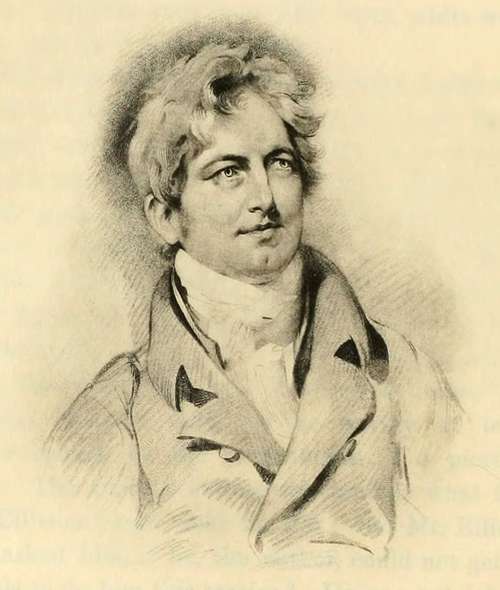
Of his lofty remonstrances with audiences, his
magnificence of matter and of manner, the awe with
which he inspired the humbler actors of his company
by believing in his own lofty manner,—there are
samples enough to fill a volume. The "bless you,
my people!" which he uttered as George IV., in the
coronation procession, sprung, it was said, from a
vinous excitement; but it was thoroughly in his
manner. He would have believed in the efficacy
of a sober benediction of the pit! He outlived his
fame, as he did his fortune; his powers to act well
failed, but not his acting. He was imposing to the
last; and, perhaps beyond that limit, if we might
accept that gracefully fantastic sketch which Charles
Lamb has addressed to his shade,—the "joyousest
of once embodied spirits!"
There were few actors on the stage for whom Elliston
had more regard than he had for the veteran, Hull.
In 1807, worn out with a career which dated from
1759, heavy, useful, and intelligent Hull played his
last character, the Uncle, in "George Barnwell," and
he died soon after. Mason had a good opinion of
him, for in consigning the Chief Bard, in "Caractacus,"
to be played by him, the poet remarked:—"Any
instruction from me will be unnecessary;
your own taste and judgment will direct you." To
Hull is owing the establishment of the Covent Garden
fund for the benefit of decayed actors. He proposed
that sixpence in the pound should be contributed
weekly from each actor's salary, and that such
contributors only should have claim upon the fund.
From this proposal issued the two "funds,"—once
so useful, and now so rich. Hull never acted so
well as during the Lord George Gordon riots, when
a mob assembled in front of his house, roared for
beer, and threatened dire results, if the roar was
unheeded. Hull appeared on the balcony, bowed
thrice, assured the "ladies and gentlemen" that
the beverage should be immediately forthcoming,
and in the meantime asked them for "their usual
indulgence."
To the last century, too, and to this, belong Holman,
Munden, and Dowton. All began their careers
as tragedians. Holman was graceful, but in striving
to be original fell into exaggeration, and excited
laughter. His London course only lasted from 1784
to 1800, when he wandered abroad with his daughter,
whose mother was a grand-daughter of the famous
Lady Archibald Hamilton, the daughter of the sixth
Earl of Abercorn. Thus a family, into which had
married the daughter of Miss Santlow, "famed for
dance," gave to the stage the Miss Holman, who
soon ceased to figure there.
Munden was the most wonderful of grimaciers.
He created laughter on the London stage, from 1790,
when he appeared at Covent Garden, as Sir Francis
Gripe, to 1823,[97] when he quitted it, in good condition,
financially, as Sir Robert Bramble and Dozey.
It was said of him that he lost half his proper effect,
by the very strength of his powers. The breadth of
his acting is now hardly conceivable, so farcical was
its character. Of another trait of his disposition, an
incident, on his farewell night, affords an illustration.
As he was bowing, and retiring backwards, from the
audience, and wishing to avoid coming into collision
with the wings, he once or twice asked in a whisper,
of those standing there:—"Am I near?" "Very!"
answered Liston, "nobody more so!"
Dowton, who came to us in 1796, as Sheva,
backed by a recommendation from Cumberland, retired
less richly endowed than Munden. He was
most felicitous in representing testy old age, but
especially where extreme rage was combined with
extreme kindness of heart; and he acted the opposite
of this just as felicitously—as they will acknowledge
who can remember both his Sir Anthony
Absolute and his Dr. Cantwell, the composure and
rascality of which last are exasperating in the very
memory of them.
Willy Blanchard, who opens the period commencing
with the year 1800, was as natural as Dowton; but
he was a mannerist, always walking the stage with
his right arm bent, as if he held it in a sling. I find
him often preferred to Fawcett, whom I remember
as a superior actor, to whom some stern critics
denied all feeling—but they had not seen his Job
Thornberry; and of whose famous Caleb Quotem
they could say no more than that the actor of it was
a speaking harlequin.
Mathews, who first appeared in London, at the
Haymarket, in 1803, as Jabal to Elliston's Sheva,
was as superior to Dowton in many parts as he was
to Bannister in a few. As a mimic he has never
been excelled in my remembrance. Through the
whole range of lower comedy he was supreme; and
his M. Malet showed what power this great artist
could exercise over the most tender feelings. No
comedian ever compelled more hearty laughter, or,
when opportunity offered, as in M. Malet, more
abundant tears.
Liston, who followed him at the Haymarket, in
1805, making his début as Sheepface, belonged rather
to farce than comedy. Like Suett he excited more
laughter than he ever enjoyed himself. He suffered
from attacks of the nerves, and, in his most humorous
representations, was the more humorous from his
humour always partaking of a melancholy tone. He
seemed to be comic under some great calamity, and
was only upheld by the hilarity of those who witnessed
his sufferings, and enjoyed his comedy under
difficulties. Perhaps he had a settled disappointment
in not having succeeded in tragedy; or some remorse,
as though he had killed a boy when, under the name
of Williams, he was usher at the Rev. Dr. Burney's,
at Gosport; as he subsequently was at the old school
in St. Martin's. However this may be, he ever and
anon wooed the tragic muse, with a comically
serious air, and on three several occasions I trace
him playing, for his benefit, Romeo, Octavian, and
Baron Wildenheim! It was more absurd than Mrs.
Powell's mania for acting Hamlet.
Two years later, in 1807, appeared Young, as
Hamlet, at the Haymarket, and Jones, as Goldfinch,
at Covent Garden. If the word "respectable" might
be used in a not disparaging sense, I would apply
it to Young, who was always worthy of respect—whether
he played Hamlet, Rienzi, which he originated,
Falstaff, or Captain Macheath. He belonged
to the Kemble school, but he never delivered soliloquies
in that ludicrous, self-approving style which
I find laughingly noticed by the critics, as a great
blot in John Kemble's acting. Young had more
natural feeling, and he liked to play with those who
could feel in like manner—whereas I have read of
John Kemble that, in a love scene, he was not only
coldly proper himself, but insisted on the same coldness
of propriety in the lady who played his mistress.
As for airy Jones, I have only space to remark, that
he acted rakes, at night, and taught clergymen to read
their prayers decently, by day! Jones was a naturally
serious man; but his combination of callings was
something incongruous.
Of other actors, mention will be made incidentally
in other places. There are some ladies of the time
before Edmund Kean who will receive, or have received,
like notice—my eye falls but upon three
others, of whom I need make record here. One is
that beautiful Louisa Brunton—member of a gifted
family, who, in the bud of her brilliant promise,
was "erept the stage" by honourable love, and
died but the other day—Countess of Craven. The
other lady is Miss Duncan, subsequently Mrs. Davison,
the original Juliana to Elliston's Duke Aranza;
and who, when she came upon the town as Lady
Teazle, satisfied her audiences that Miss Farren had a
worthy successor, and that Mrs. Jordan's possession of
certain characters must thenceforth be surrendered.
The dramatic life of this admirable actress commenced
as soon as she could walk, and lasted almost with her
natural life. I have a Margate bill before me, of the
year 1804, where the bright and gifted young actress,
the "Little Wonder," as Miss Farren called her, was
playing high comedy. The music there was led by
Frederic Venua, who, at the distance of threescore
years, still delights his friends with the memories of
that period, and with its music, in the rendering of
which, Time has strengthened and improved the
hand of the artist.
With a passing notice of a survivor of all these—coming
on the stage near fourscore years ago, with
the honoured name of Betterton, and leaving it, or
dying on it, but the other day, as Mrs. Glover, I close
this section of my labour. From youth to old age
she acted appropriate parts, and acted all in a way
that would require Cibber, Hazlitt, and Leigh Hunt
to describe, analyse, and grow pleasantly fanciful
upon. Her life was one of self-denial, unmerited
suffering, and of continual gratification to others.
She was the support of three generations, the evidences
of which she bore in her face,—in its beautiful
expression of a felicity it knew not wherefore.
With a pleasanter name, a more finished actress,
or a truer woman, I could not bring this chapter to a
close. The list which follows by way of supplement,
will enable the reader to trace what the poets were
doing for the drama, and who the actors were that
carried out their intentions,—between the commencement
of the century and the night when
Edmund Kean flashed upon the town.
LIST of the Principal New Pieces produced by their Majesties' Servants,
from the beginning of the century till the appearance
of Edmund Kean.
1801.—Drury Lane.
"Deaf and Dumb" (Holcroft; from the French). De l'Epée, Kemble;
Theodore, Miss De Camp; St. Alme, C. Kemble; Mdme. Franval, Miss
Pope.
"Julian and Agnes" (Sotheby). Julian, Kemble; Agnes, Mrs. Siddons.
"Adelmorn" (Monk Lewis). Adelmorn, C. Kemble; Innogen, Mrs.
Jordan.
1801.—Covent Garden.
"Poor Gentleman" (Colman, Jun.). Sir Robert Bramble, Munden; Ollapod,
Fawcett; Emily, Mrs. Gibbs.
"Pérouse" (Fawcett). Kanko, Farley; Umba, Mrs. Mills.
"Blind Girl" (Morton). Sligo, Johnstone; Clara, Mrs. H. Johnstone.
1801-2.—Drury Lane.
"Lovers' Resolutions" (Cumberland). Worthiman, J. Bannister; Mapletoft,
Suett; Mrs. Mapletoft, Miss Tidswell.
1801-2.—Covent Garden.
"Integrity" (Anonymous). Herman, H. Siddons his first appearance;
Albert Voss, Brunton; Julia, Miss Murray.
"Folly as it Flies" (Reynolds). Peter Post Obit, Munden; Georgiana,
Mrs. Gibbs.
"Alfonzo" (Monk Lewis). Orsino, Cooke; Ottilia, Mrs. Litchfield.
"Cabinet" (T. Dibdin). Prince Orlando, Braham; Lorenzo, Incledon;
Curvoso, Emery; Floretta, Signora Storace.
1802-3.—Drury Lane.
"Hear Both Sides" (Holcroft). Fairfax, Dowton; Eliza, Mrs. Jordan.
"Hero of the North" (Dimond). Gustavus, Pope; Frederica, Mrs.
Mountain.
"Marriage Promise" (Allingham). Merton, C. Kemble; Emma, Mrs.
Jordan.
1802-3.—Covent Garden.
"Delays and Blunders" (Reynolds). Henry Sapling, Lewis; Lauretta,
Mrs. H. Siddons.
"Tale of Mystery" (Holcroft). Romaldi, H. Johnston; Francisco,
Farley; Fiametta, Mrs. Mattocks.
"Family Quarrels" (T. Dibdin). Charles, Braham; Foxglove, Incledon;
Mrs. Supplejack, Mrs. Davenport.
"John Bull" (Colman, Jun.). Job Thornberry, Fawcett; Peregrine,
Cooke; Hon. Tom Shuffleton, Lewis; Mary, Mrs. Gibbs.
1803-4.—Drury Lane.
"Wife of Two Husbands" (Cobb). Carronade, Bannister, Jun.; Montenero,
Kelly; Eugenia, Mrs. Mountain.
"Hearts of Oak" (Allingham). Ardent, Dowton; Fanny, Mrs. Harlowe.
"Caravan" (Reynolds). Arabbo, Dignum; Rosa, Miss De Camp.
"Soldier's Daughter" (Cherry). Governor Heartall, Dowton; Widow
Cheerly, Mrs. Jordan.
"Sailor's Daughter" (Cumberland). Varnish, Russell; Julia, Mrs. H.
Johnston.
1803-4.—Covent Garden.
"Raising the Wind" (Kenney). Diddler, Lewis; Sam, Emery.
"English Fleet in 1342" (Dibdin). Valentine, Braham; Fitzwalter,
Incledon; Katherine, Signora Storace.
"Valentine and Orson" (T. Dibdin). Valentine, Farley; Orson, Dubois;
Eglantine, Mrs. St. Leger.
1804-5.—Drury Lane.
"Matrimony" (Kenney, from the French). Delaval, Elliston; Clara, Mrs.
Jordan; Lisetta, Mrs. Bland.
"Land We Live In" (Holt). Melville, Elliston; Robert, Mathews; Lady
Lovelace, Mrs. Jordan.
"Honeymoon " (Tobin). Duke Aranza, Elliston; Juliana, Miss Duncan;
Volante, Miss Mellon.
1804-5.—Covent Garden.
"Blind Bargain" (Reynolds). Giles, Emery; Mrs. Villars, Mrs. Gibbs.
"School of Reform" (Morton). Tyke, Emery; General Tarragon, Munden;
Ferment, Lewis; Julia, Miss Brunton.
"To Marry or Not to Marry" (Mrs. Inchbald). Sir Oswin, Kemble; Lord
Danberry, Munden; Lady Susan, Mrs. Glover.
"Who Wants a Guinea" (Colman, Jun.). Solomon Gundy, Fawcett;
Oldskirt, Simmons; Mrs. Glastonbury, Mrs. Mattocks.
1805-6.—Drury Lane.
"Weathercock" (Allingham). Tristram Fickle, Bannister.
"School for Friends" (Miss Chambers). Matthew Daw, Mathews; Lady
Courtland, Miss Pope.
"Travellers" (Cherry). Koyan, Braham; Celinda, Mrs. Mountain.
"Forty Thieves" (Colman, Jun.). Ali Baba, Bannister; Morgiana, Miss
De Camp; Cogia, Mrs. Bland.
1805-6.—Covent Garden.
"Rugantino" (Monk Lewis). Rugantino, H. Johnston.
"Delinquent" (Reynolds). Delinquent, Kemble; Nicholas, Liston.
"We Fly by Night" (Colman, Jun.). Bastion, Munden.
"Hints to Husbands" (Cumberland). Lord Transit, C. Kemble.
"Edgar" (Manners). Edgar, Miss Smith; Emma, Miss Brunton.
1806-7.—Drury Lane.
"Vindictive Man" (Holcroft). Goldfinch (from the "Road to Ruin"),
De Camp; Charles, Bartley.
"Tekeli" (Theodore Hook). Tekeli, Elliston; Christine, Mrs. Bland.
"Mr. H——" (Charles Lamb). Mr. H——, Elliston.
"False Alarms" (Kenney). Sir Damon, Wroughton.
"Curfew" (Tobin). Fitzharding, Elliston; Florence, Miss Duncan.
"Adelgitha" (Monk Lewis). Lothair, Elliston; Adelgitha, Mrs. Powell.
1806-7.—Covent Garden.
"Town and Country" (Morton). Reuben Glenroy, Kemble; Rosalie
Somers, Miss Brunton.
1807-8.—Drury Lane.
"Faulkener" (Goodwin). Faulkener, Elliston; Countess Orsini, Mrs.
Powell.
"World" (Kenney). Index, Mathews; Lady Bloomfield, Mrs. Jordan.
"Jew of Mogadore" (Cumberland). Nadab, Dowton; Zelma, Mrs.
Mountain.
1807-8.—Covent Garden.
"Blind Boy" (Hewetson). Edmund, Mrs. C. Kemble; Kalig, Farley.
"Wanderer" (C. Kemble, from Kotzebue). Sigismond, C. Kemble.
"Begone Dull Care" (Reynolds). Modern, Lewis.
1808-9.—Drury Lane.
"Venoni" (Monk Lewis, from Monvel). Venoni, Elliston.
"Man and Wife" (Arnold). Sir Willoughby and Lady Worrett, Dowton
and Mrs. Harlowe.
Theatre burnt down 24th February 1809. The Company played at the
Opera House and the Lyceum during the remainder of the season.
1808-9.—Covent Garden.
Theatre burnt down 19th September 1808, after the play of "Pizarro."
The Company acted at the Opera House, where the only new piece of any
merit that was produced was the "Exile" (Reynolds). Daran, by Young,
from the Haymarket.
1809-10.
The Drury Lane Company continued at the Lyceum without producing any
novelty of mark.
1809-10.
Covent Garden opened at increased prices for admission on the 18th of
September. No new piece deserving of record was produced throughout the
season.
1810-11.
The Drury Lane Company played at the Lyceum, but without bringing forward
any piece of particular merit. The same may be said of Covent Garden,
where, however, the season was rendered memorable and profitable by the run
of "Blue Beard" and "Timour the Tartar," with horses. Before these
Shakspeare, and all other of the tuneful brethren, gave way.
1811-12.
The Drury Lane Company were still at the Lyceum, where they produced
Moore's "M.P.," the more successful "Devil's Bridge," by Arnold, with
Braham as Count Belino, and Mrs. Dickens as the Countess Rosalvina.[98] The
greatest success was with a piece called "Quadrupeds," altered from the
"Tailors, or a Tragedy for Warm Weather," and intended to ridicule the
equestrian performances at Covent Garden. The corresponding season at
Covent Garden saw no new piece which is now remembered; but it is remarkable
as the one in which an elephant made its first appearance as an actor—after
which Mrs. Siddons withdrew, but not on that account, from the stage.
1812-13.—Drury Lane.
The season opened on the 10th of October 1812, in the present house, built
by Wyatt. Mr. Whitbread and a committee erected the house, and purchased
the old patent rights, by means of a subscription of £400,000. Of this,
£20,000 was paid to Sheridan, and a like sum to the other holders of the
patent. The creditors of the old house took a quarter of what they claimed,
in full payment; and the Duke of Bedford abandoned a claim of £12,000.
With the remainder of the sum subscribed, the house was established—Elliston,
Dowton, Bannister, Rae, Wallack, Wewitzer, Miss Smith, Mrs.
Davison, Mrs. Glover, Miss Kelly, and Miss Mellon, leading. Except Coleridge's
"Remorse," which was acted about a score of times, they brought out
no new piece.[99] Covent Garden was equally unproductive, its most profitable
drama being "Aladdin, or the Wonderful Lamp" (Aladdin, Mrs. C. Kemble;
Kazrac, Grimaldi). In the next season, as in this, Covent Garden had a
stronger company, with John and Charles Kemble, Conway, Terry, Mathews,[100]
and a troop of vocalists, than Drury Lane possessed. At the latter house,
neither new pieces nor new players succeeded, till, on the 20th of January
1814, the playbills announced the first appearance of an actor from Exeter—whose
coming changed the evil fortunes of the house, scared the old, correct,
dignified, and classical school of actors, and brought back to the memories of
those who could look back as far as Garrick the fire, nature, impulse, and
terrible earnestness—all, in short, but the versatility of that great master in
his art.
While Kean is dressing for Shylock, I will briefly
notice a few incidents connected with both sides of
the curtain, and which chiefly belong to that part of
the century when he was not yet known in London.
CHAPTER XIV.
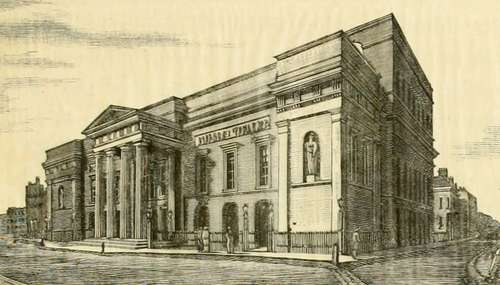
COVENT GARDEN THEATRE.
NEW IDEAS; NEW THEATRES; NEW AUTHORS; AND THE NEW ACTORS.
Early in the present century, Mr. Twiss published
his Verbal Index to Shakspeare; and this led to an
attack upon the poet and the stage, as fierce, if not
so formidable, as the onslaught of Prynne and the
invective of Collier. The assailant, in the present
case, was an anonymous writer, in the Eclectic Review,
for January 1807. As an illustration of the feeling
of dissenters towards the bard and players generally,
this attack deserves a word of notice. The writer,
after denouncing Mr. Twiss as a man who had no
sense of the value of time, in its reference to his
eternal state; sneering at him as one who would
have been more innocently employed in arranging
masses of pebbles on the sea shore; and bewailing
"the blind devotion which fashion requires to be
paid at the shrine of Shakspeare," professes to recognise
"the inimitable excellences of the productions
of Shakspeare's genius;" and then proceeds to
illustrate the sense of the recognition, and to pour
out the vials of his wrath, after this fashion:—
"He has been called, and justly, too, the 'poet of
Nature.' A slight acquaintance with the religion of
the Bible will show, however, that it is of human
nature in its worst shape, deformed by the basest
passions, and agitated by the most vicious propensities,
that the poet became the priest; and the
incense offered at the altar of his goddess will continue
to spread its poisonous fumes over the hearts
of his countrymen till the memory of his works is extinct.
Thousands of unhappy spirits, and thousands
yet to increase their number, will everlastingly look
back with unutterable anguish, on the nights and
days in which the plays of Shakspeare ministered to
their guilty delights. And yet these are the writings
which men, consecrated to the service of Him who
styles Himself the Holy One, have prostituted their
pens to illustrate! such this writer, to immortalise
whose name, the resources of the most precious arts
have been profusely lavished! Epithets amounting
to blasphemy, and honours approaching to idolatry,
have been and are shamelessly heaped upon his
memory, in a country professing itself Christian, and
for which it would have been happy, on moral considerations,
if he had never been born. And, strange
to say, even our religious edifices are not free from
the pollution of his praise. What Christian can pass
through the most venerable pile of sacred architecture
which our metropolis can boast, without having his
best feelings insulted, by observing, within a few
yards of the spot from which prayers and praises
are daily offered to the Most High, the absurd and
impious epitaph upon the tablet raised to one of the
miserable retailers of his impurities? Our readers
who are acquainted with London, will discover that
it is the inscription upon David Garrick, in Westminster
Abbey, to which we refer. We commiserate
the heart of the man who can read the following
lines, without indignation:—
'And till eternity, with power sublime,
Shall mark the mortal hour of hoary time,
Shakspeare and Garrick like twin stars shall shine
And earth irradiate with a beam divine.'
"'Par nobile fratrum!' your fame shall last during
the empire of vice and misery, in the extension of
which you have acted so great a part!"
There is much more in this style, and it seems
rather over-strained, however well meant. I must
confess, too, that the writer had some provocation
to express himself strongly, not in the writings of
Shakspeare, nor in Twiss's Concordance, but in
the meanness and blasphemy which Mr. Pratt, or
Courtenay Melmoth, infused into his wretched epitaph
on Garrick's monument. Charles Lamb has
hardly gone further in attacking the monument itself.
"Taking a turn the other day, in the Abbey," he
says, "I was struck with the affected attitude of a
figure which I do not remember to have seen before,
and which, upon examination, proved to be a whole
length of the celebrated Mr. Garrick. Though I
would not go so far, with some good Catholics
abroad, as to shut players altogether out of consecrated
ground, yet I own I was not a little scandalised
at the introduction of theatrical airs and
gestures into a place set apart to remind us of the
saddest realities. Going nearer, I found inscribed,
under this harlequin figure, a farrago of false thoughts
and nonsense."
Such falsehood and nonsense helped to bring the
stage into disrepute; and the pulpits, for seven or
eight years, often echoed with disparaging sentiments
on the drama—and quotations from Shakspeare.
Nevertheless, those who never worked, as well as
those who were over-worked, needed amusement; and
what was to be done?
"The devil tempts the industrious; idle people
tempt the devil," was a saying of good Richard
Baxter. Good men took it up in 1815. Well-intentioned
preachers denounced the stage, and recommended
rather an unexceptionable relaxation;
the sea side, pure air, and all enjoyments thereon
attending. But, while audiences were preached
down to the coast, and especially to Brighton, there
were zealous pastors at the latter place, who preached
them back again. One of these, the Rev. Dr. Styles,
of Union Street, Brighton, did his best to stop the
progress of London-on-sea. He left the question
of the stage for others to deal with; but, in his published
sermons, he strictly enjoined all virtuously-minded
people to avoid watering-places generally,
and Brighton in particular, unless they wished to
play into the devil's hands. He denounced the
breaking up of homes, the mischief of minds at rest,
and the consequences of flirting and philandering.
He looked upon a brief holiday as a long sin,—at
the sea side; and, with prophecy of dire results
attending on neglect of his counsel, he drove, or
sought to drive, all the hard workers, in search of
health and in the enjoyment of that idle repose
which helps them in their search, back to London!
Then, as now, England stood shamefully distinguished
for the indecorum of its sea-coast bathers; but, with
certain religious principles, whereby to hold firmly, the
good doctor does not think that much ill may befall
therefrom; and he sends all erring sheep with their
faces towards London, and with a reference to Solomon's
Song, above all things!—bidding them to
wait for the south wind of the Holy Spirit to blow
over their spices!
On the other hand, good men in France were then
seeking to render theatrical amusements universally
beneficial; and a pamphlet, by Delpla, suggested a
few reforms which evoked notice in this country.
In some respects, the project was a development of
that proposed in England, in 1732, when the idea of
turning Exeter Change into a theatre and college
was first started. M. Delpla held, that the public
required stage exhibitions, but that they did not
always know what was good for them. He thought
that in every country there ought to exist a theatrical
board, or censorship, composed, not of government
officials, but of poets, reviewers, retired actors, and
men of letters generally. There would then be, he
thought (poor man!), a reconstruction of theatrical
literature: the beautiful, preserved; the exceptionable,
omitted; and the instructive, imported. Historic
truth was never to be departed from; local
costume was to be strictly observed; dénouements,
in which virtue looked ridiculous, or vice seemed
triumphant, were to be severely prohibited; and
poets, critics, and ex-actors were to be charged with
this responsibility! M. Delpla considered that, by
such means, the theatre and the pulpit would be on
a level, as public instructors; or, if any difference
could be between them, the greater efficiency of
instruction would rest with the stage. If they were
simply equal, the writer concluded that bishops
themselves would show their exemplary presence in
the side boxes!
The French Government only adopted that part of
M. Delpla's project which spoke of a censorship;
but as the censors were not competent persons,—poets,
critics, actors, literary men,—but "officials,"
they often came to grief. Their greatest calamity
I may notice here, though it befell them at a later
period, when a new law rendered the old censorship
more stringent. To the authorised officials two well-known
dramatic writers sent a new tragedy for examination
and approval. It was returned in a few
days, with 1500 erasures. The authors were required
to modify 300 lines, replace 500 words,
shorten 12 scenes, and change a score of names, all
of which, in the original, was considered obnoxious
to public tranquillity, political order, and dramatic
propriety. On receiving the corrected manuscript,
the rebuked authors addressed the following note to
the censors:—"Gentlemen, we have the honour to
acknowledge the receipt of our censured manuscript,
with an accompanying letter. We agree with you
in thinking that the passages marked for erasure
may be of that perturbative character which you
suppose; but as we do not dare to cut or modify
the verses of Pierre Corneille, we prefer foregoing
the representation of 'Nicomède' at the 'Théâtre
Français.'"
But let us get back to our own theatres, and to
the manners of audiences, between the commencement
of this century and the coming of Edmund
Kean. Such manners are most strikingly illustrated
by the O. P., or old price riots of 1809. In ten
months a new Covent Garden Theatre had risen, at
an expense of £150,000. Smirke had taken for his
model the Acropolis of Athens, and in a narrow, flat
street, had built, or hidden, his imitation of the
mountain fortress of the Greeks. The house was
unnecessarily large, and attendant costs so heavy,
that the proprietors raised the price of admission to
the boxes from 6s. to 7s., and to the pit, from 3s. 6d.
to 4s. They had also converted space, usually allotted
to the public—the third tier, in fact—into private
boxes, at a rental of £300 a year for each. The pit
and box public resolved to resist, and the gallery
public having a grievance in its defective construction,—the
view being impeded by solid divisions, and
the run of the seats being so steep that the occupants
could see only the legs of the actors at the back of
the stage,—joined the insurrection.
The house opened on the 18th of September 1809,
with "Macbeth," and the "Quaker." The audience
was dense and furious. They sat with their backs
to the stage, or stood on the seats, their hats on, to
hiss and hoot the Kemble family especially; not a
word of the performance was heard, for when the
audience were not denouncing the Kembles, they
were singing and shouting at the very top of their
then fresh voices. The upper gallery was so noisy,
that soldiers, of whom 500 were in the house, rushed
in to capture the rioters, who let themselves down
to the lower gallery, where they were hospitably
received. The sight of the soldiers increased the
general exasperation. "It was a noble sight," said
the Times, "to see so much just indignation in the
public mind;" and that paper scorned the idea that
the prices were to be raised, to pay such vanities as
were exhibited by Mrs. Siddons and John Kemble,
who were on the stage "with clothes on their backs
worth £500."
Such was the first of nearly seventy nights of riot,
out of which the public issued with a cry of "victory,"
but under a substantial defeat. In alluding to this
matter, it is only necessary to notice the additions to,
or the variations in, the riot—in the conduct of which
the proceedings of the first night were imitated, with
this exception, that the insurrectionists did not enter
the theatre till half-price.
First came the introduction of placards and banners,
for furnishing pins to affix one of which, in
front of the boxes, a lady received an ovation; then
speeches were made against the exorbitant salaries
of the Kembles, and prisoners were made of the
speakers; magistrates appeared on the stage to read
the Riot Act, and the public, preparing to rush on the
stage itself, were deterred by the sudden opening of
all the traps.
The proprietors then assembled partisans by distributing
orders, and this introduced fighting. Between
the combats, post-horns confounded the confusion.
Pigeons were let loose—symbols that the public were
pigeoned, and Kemble, compelled at last to come forward,
only gave double fury to the storm, by asking
"what they wanted," and, on being told, by replying
that such demand was not reasonable, and they would
think better of it! Lawyers addressed the house
from the boxes, encouraging the rioters, and, in
allusion to the expensive engagements of Catalani
and others, declared that "the British stage should
not be contaminated by Italian depravity and French
duplicity"—at which declaration the modest and
candid public flung some highly-seasoned aspersions
at the immoral private-boxes, and retired, cheering.
Watchmen's rattles and "artillery whistles" next
added to the storm which tore the public ear. Placards
increased. Cheers were given for the British
Mrs. Dickons, and groans for Madame Catalani. The
very name seemed to give birth to cat-calls. The
actors in no way interrupted the uproar. The Times
remarked that this was kind, as the public had so
often sat without interrupting them.
Kemble made stiff-necked speeches, and the house
called him "fellow" and "vagrant," said his head
was "full of a-ches," declared they would obey King
George and not King John, and protested that they
would be sung to by "native nightingales, not foreign
screech-owls." The boxes looked like booths, so
hung were they with placards and banners—the
most loudly cheered of which former was one which
announced that the salaries of the Kembles and
Madame Catalani amounted, for the season, to
£25,575. "Mountain and Dickons, no Cats, no
Kittens!" Such is a sample of the O. P. row—the
first series of which ended by Kemble announcing, on
the sixth night, that Catalani's engagement had been
cancelled, and that the house would be closed until
the accounts of the proprietors had been examined
by competent gentlemen. "Britons who have humbled
a prince will not be conquered by a manager!"—in
that form was reply made by huge placard; and,
next day, the Times told the public that they would
not be bound by the report of the examiners of the
accounts, as the people had no voice in the choice of
arbitrators.
The report appeared in a fortnight. In few words,
it amounted to this:—If the present prices were
reduced, the proprietors would lose three-fourths per
cent. on their capital; but as the reporters could not
even guess at the possible profits, the award was null.
Meanwhile, the Times suggested that it would be
better to reduce the exorbitant salaries. There was
Mrs. Siddons with £50 per night! Why, the Lord
Chief Justice sat every day in Westminster Hall,
from 9 to 4, for half the sum.
The house re-opened on the 4th of October, with
the "Beggar's Opera," and "Is he a Prince?" The
war was resumed with increase of bitterness in feeling,
and of fury in action. Jewish pugilists, under
the conduct of Dutch Sam, were hired to awe and
attack the dissentients. The boxer, Mendoza, distributed
orders, by dozens, to people who would support
the pugilists. The speech-makers were dragged away
in custody, and Bow Street magistrates sat, during
the performances, ready to commit them to prison-companionship
with the worst class of thieves; and
they lent Bow Street runners to the managers, and
these runners, armed with bludgeons, charged and
overwhelmed the dauntless rioters in the pit. Dauntless,
I say; for, on a succeeding night, they fell upon
the Jews in great number, and celebrated their
triumph in a bloody fray, by hoisting a placard with
the words, "And it came to pass that John Bull smote
the Israelites sore!"
The incidents present themselves in such crowds,
that it is hardly possible to marshal them. Among
them I hear the audience called a "mob," from the
stage; and I see Lord Yarmouth and Berkley Craven
fighting in the pit, on the part of the managers; and
there are "middies" and "gallant tars," or people
so attired, addressing the house, in nautical and nonsensical,
and rather blackguard style, from upper
boxes and galleries; and Brandon is rushing in to
point out rioters, and rushing out to escape them;
and gentlemen, with "O. P.," in gold, on their
waistcoats, laugh at him; and there is up above an
encounter between two boxes, the beaten party in
which slide down the pillars to the tier below; and,
suddenly, there is a roar of laughter at an accident
on the stage. Charles Kemble, in Richmond, has
stumbled in the fight, with Mr. Cooke as Richard,
and fallen on his nose, and the house is as delighted
as if he had been their personal enemy!
Then the ear is gratefully sensible of a sudden
hush! and the voices of the actors, for once, are
heard; but it is not to listen to them the house is
silent. A gentleman in the boxes has begun playing
"Colleen" on the flute; the piece goes on the while,
but it is only the instrumentalist who is listened to
and cheered. Then, there is an especially noisy
night, when rows of standing pittites are impelled
one row over the other, in dire confusion. Anon,
we have a night or two of empty houses; the rioters
seem weary, and the managers' friends do not care
to attend to see a Jubilee procession in honour of
George III., in which the cars of the individualised
four quarters of the globe are drawn by scene-shifters
and lamplighters, in their own clothes!
Because the public were thus kept away, the proprietors
thought they had gained a victory, and on
the first appearance of a Mrs. Clark, in the "Grecian
Daughter," Cooke alluded, in a prologue, to the late
"hostile rage." This little scrap of exultation stirred
the house to fury again; and when Charles Kemble
died as Dionysius, the half-price rioters shouted as if
one of their most detested oppressors had perished.
Then came the races up and down the pit benches,
while the play was in progress; and the appearance
of men with huge false noses, making carnival, and
of others dressed like women, who swaggered and
straddled about the house, and assailed the few bold
occupants of private boxes in terms of more coarseness
than wit. Then, too, was introduced the famous
O. P. war dance in the pit, to see which alone,—its
calm beginning, its swelling into noise and rapidity,
and its finale of demoniacal uproar and confusion,
even Princes of the Blood visited the boxes; and
having beheld the spectacle, and heard the Babel
of roaring throats, laughed, and went home.
Not so the rioters; these sat or danced till they
chose to withdraw, and then they went in procession
through the streets, howling before the offices of
newspapers which advocated the managerial side,
and reserving their final and infernal serenade for
John Kemble himself, in front of his house, No. 89
Great Russell Street, Bloomsbury.
The lack of wisdom on the part of the management
was remarkable. The introduction of Jewish
pugilists into the pit had been fruitless in good; and
now I find them and other questionable-looking
people admitted to the boxes. Of course, increase
of exasperation followed. The rioters celebrated the
jubilee of their row on its fiftieth night. Ladies
who came wearing O. P. medals were cheered as if
they had been goddesses, and gentlemen who had
lost hats in the previous night's fray came in cotton
night-caps, or with kerchiefs round their heads.
The pit was in a frenzy, and so was the indefatigable
Brandon, who captured two offenders that night, one
of whom he charged with calling "Silence!" and
the other with "unnaturally coughing!" The Bow
Street runners also carried off many a prisoner, half-stripped
and profusely bleeding, to the neighbouring
tribunal; and altogether the uproar culminated on
the jubilee night.
The acquittal of leading rioters gave a little spirit
to some after displays; but it led to a settlement.
Audiences continued the affray, flung peas on the
stage to bring down the dancers, and celebrated their
own O. P. dance before leaving; but, at a banquet
to celebrate the triumph of the cause in the acquittal
of the leaders, Mr. Kemble himself appeared. Terms
were there agreed upon; and on the sixty-seventh
night, a banner in the house, with "We are satisfied"
inscribed on it, proclaimed that all was over.
After such a fray the satisfaction was dearly bought.
The 4s. rate of admission to the pit was diminished
by 6d., but the half-price remained at 2s. The
private boxes were decreased in number, but the
new price of admission to the boxes was maintained.
Thus, the managers, after all, had more of the victory
than the people; but it was bought dearly. In a
few years the prices were lowered, but the audiences,
except on particular occasions, were not numerous
enough to be profitable. In fact the house was too
large. The public could not hear with ease what
was uttered on the stage, and spectacle was more
suited to it than Shakspeare or old English comedy;—and
huge houses, high prices, and exorbitant salaries,
soon brought the British Drama to grief in the
patented houses. Into this melancholy question I
do not wish, however, to enter. I have only noticed
the O. P. affair, as it marks an improvement in the
manners and customs of our audiences. In the
preceding century, at Lincoln's Inn Fields and Old
Drury, rioters on less provocation went more desperate
lengths. Destruction even by fire was often
resorted to by them. In the O. P. matter, the insurrectionists
did not even break a bench. Mixed
with the fury of fight there was an under-current of
fun. The combatants declared that they would attain
their end by perseverance. They persevered, and did
not attain it!
I have previously shown that the second George did
not dislike to witness an insurrection of a theatrical
audience. The third George was of a more placid
temperament, and not only laughed at clowns who
swallowed sausages, but at allusions to his own agricultural
tendencies, which he accepted with a half-delighted:
"I! I! good; they mean my sheep!"
or some equally bright exclamation. As guests, he
did not invite actors to his house; but his eldest son
was more, and unnecessarily, condescending.
When Prince of Wales, and subsequently as Prince
Regent, actors and managers were not unfrequently
invited to Carlton House. The former seem to have
appreciated their position better than the latter, at
least as far as we may learn from instances afforded
by the elder Bannister and the younger Colman.
Charles Bannister told Mr. Adolphus, who had
questioned him as to the Prince's bearing, whether
it resembled that of Prince Hal, amid his boon
companions? "The Prince never assumed familiarity
with us, though his demeanour was always most
gracious. We public performers sat all together, as
all guests took their places, according to their rank;
our conversation was to ourselves, and we never
mixed in that of the general party, further than to
answer questions. At proper moments, with inimitable
politeness, he would suggest that he should be
pleased with a song, and the individual selected
received his highest reward in praises which his royal
highness bestowed with an excellent judgment, and
expressed with a taste peculiar to himself."
When the younger Colman obtained a day-rule
from the King's Bench, in 1811, to dine at Carlton
House, whither he was conveyed by the Duke of
York, dramatic literature was not so pleasantly represented
as the stage had previously been in the
persons of Charles Bannister and his comrades.
The guest behaved like a boor, the host still like
a gentleman. Among the offensive queries put by
the former to the Duke, was—"Who is that fine-looking
fellow at the head of the table?" The
Duke urged him to be silent, lest he get into a
scrape. Colman would not be anything but ruffianly,
and raising his voice, he exclaimed,—"No! no! I
want to know who that fine square-shouldered magnificent-looking,
agreeable fellow is, at the end
of the table!" The Duke remonstrated; saying,
"You know it is the Prince." "Why, then," said
George, "he is your elder brother! I declare he
doesn't look half your age. Well! I remember the
time when he sang a good song, and as I'm out for
a lark, for one day only, he will not refuse an old
playfellow, if he is the same good fellow that he
used to be." The Prince, with more condescension
than was warrantable, laughed, and then sang a
song, which, being done, Colman roared out applause
at the magnificent voice, and with a round oath,
expressed his determination to engage the singer for
the next season at his own theatre! Peake, who tells
the story in fuller detail, in his Memoirs of the
Colman Family, adds that the Prince was not
offended, and that Colman was, subsequently, his
guest. If so, the former had forgotten, since Charles
Bannister's days, that propriety which the actor so
justly admired.
To the list of pieces by which this chapter is preceded,
I direct the attention of those who desire to
know the character of our stage literature half a
century ago. I will not go so far as Gifford, who,
on contemplating a similar list, remarked: "All the
fools in the kingdom seem to have risen up and
exclaimed, with one voice,—Let us write for the
Theatres!" But the censure of Leigh Hunt is
almost as strong, when he says, that being present at
the comedies of Reynolds and Dibdin, he laughed
heartily at the actors; but, somehow or other, never
recollected a word of the dialogue! The truth is,
that the actors, tragic as well as comic, were superior
to the authors, especially to those who wrote parts
expressly for them, and composed tipsy grimacers
for Munden, and chatterers for Fawcett, and voluble
gentlemen for Lewis; and, let the scene of the play
be in what remote part of the world it might, always
introduced an Irishman, because Johnstone was
there, ready and richly able, to play it. The authors
thus depended on the actors, and not on themselves;
and this was so much the case that Leigh Hunt
remarked, that the loss of Lewis would be as rheumatism
to Reynolds; and the loss of Munden, "who
gives such agreeable variety of grin, would affect
him little less than lock-jaw!" The old sentimental
comedy was bad enough, and we rejoice to this day
that Goldsmith overthrew it; but he was followed
by writers who mingled sentiment and farce together,
who extorted tears, exacted rude laughter, and violated
nature in every sense. With all this, however,—vapid
in the reading, as some of these productions
now appear, they reflected, with great
distortion, no doubt, the manners of the times, and
suggested, with some awkwardness, how those manners
might be improved. The more obtrusively loyal
such writers affected to be, the more loudly their
clap-traps were applauded. The absence of servile
sentiment, and the suspicion of the author being led
by liberal principles in politics, could only bring
down upon him condemnation. Poor Holcroft, who
went through so many painful varieties of life, and
who was a radical before the radical era, was one
of the ablest writers of what was then called comedy,
but he often failed, because of his politics, and was
then taunted for his failure, and that by brother
dramatists. "Holcroft has done nothing for literature,"
says Charles Dibdin; "because, perhaps, he
has done little for morality, less for truth, and nothing
for social order!" Holcroft belongs, indeed, to two
centuries; but if the Administration had hanged
him, as they wished to do, in 1794, when he took
his trial for high treason, the author of the Road to
Ruin would not have added his adaptation of "Deaf
and Dumb," and the very first of melodramas,
the "Tale of Mystery," to the list of his deserved
successes.
The younger Colman justified the writing of nonsense,
by metrically asking:—
"If we give trash, as some poor critics say,
Why flocks an audience nightly to our play?"
Nevertheless, there were authors who, in the
French phrase, had frequently to "sup at the 'Bagpipes,'"
like the minor French playwright, Dancourt,
who was accustomed to failure, but who used to find
solace under the catastrophe by supping joyously
with his friends, at an inn with the above sign.
One night, his candid daughter was present at the
first representation of one of Dancourt's little
comedies. At the close of the second scene, the
sibilations commenced, and mademoiselle thereupon
turned gaily to her sire, with the pleasant remark,
"Papa, you are going to sup to-night at the 'Bagpipes!'"
The Regent Duke of Orleans was less
tender towards a dramatist who bitterly complained
to him, not merely that his piece had been hissed,
but that he had been horsewhipped by some of the
audience, who disliked the coarse raillery of his
satire. "Well," said the Duke, having listened to
the complaint, "what is it you now want?" "Justice,"
answered the author. "I think," replied his
highness, coolly, "I think you have had that already!"
English managers found authors quite as unreasonable.
Early in the present century, there
existed a writer of tragedies, named Masterton.
Failing to get any of them represented, he printed
one, the "Seducer," in 1811;—promising to publish
all his rejected pieces, if his specimen tragedy
obtained approval. His object, of course, was to
shame the managers. Like most of the authors
of this century, Mr. Masterton took Otway for his
model,—but he did it after this wise—
"Beware, Olivia, of the wiles of man!—
You've seen one suck an orange in the street;
And when he's feasted, fling the rind away?
So will a man, who has despoiled a woman,—
When all's ta'en from her, cast her in the dirt."
Hayley was angry enough when the public damned
his "Eudora," which act he thought, manifested
only the bad taste of the public, seeing that his play
had received the sanction of Lieutenant-General
Burgoyne; but if Hayley knew little of practical
triumphs of temper, and exhibited small discretion
in printing his rejected tragedy, he at least showed
that his tragedy was free from such nonsense as we
find in Mr. Masterton's.
The two authors who most strongly contrast with
each other as to their feelings under a disagreeable
verdict, were Charles Lamb and Godwin. The
former was present on the night that his farce,
"Mr. H.," was played, and he heartily joined in the
shower of hisses with which it was assailed by the
audience. This was in juster taste than the conduct
of Godwin, who sat in the pit, stoically indifferent,
in all appearance, to the indifference of the audience
to his tragedy—"Antonio." As the act-drop descended,
without applause or disapprobation, the
author grimly observed that such was exactly the
effect he had laboured to produce. And as the
piece proceeded amid similar demonstrations of contemptuous
indifference, "I would not for the world,"
said poor Godwin, "have the excitement set in too
early."
I question, however, if anything superior to "Antonio"
was produced between 1800 and the first
appearance of Edmund Kean. Soon after that event
came Sheil, Maturin, Proctor, and a greater than any
of them, Sheridan Knowles. Sheil wrote his tragedy,
"Adelaide," expressly for Miss O'Neill; everything
was sacrificed to one character,—and "Adelaide"
proved a failure. The poem, however, contained
promise of a poet. There was originality, at least
there was no servile imitation, in the style, which
was not indeed without inflation, and thundering
phrases and conceits,—but there was, withal, a
weakness, from which, if the writer ever extricated
himself, it was only to fall into greater defect. The
story is romantic, and something after the fashion of
the day, in which there was an apotheosis for every
romantic villain. Such a villain is Lunenberg, who,
as he remarks in an early part of the play, had lured
Adelaide's unsuspecting innocence,—
"And with a semblance of religious rites,
Abused thy trust, and plunged thee into shame."
This sorry rascal treats the lady so ill that she is
driven to take poison, and Lunenberg, after fighting
her brother Albert, and heroically running on his
sword, dies with sentimental phrases in his mouth
of pure and hallowed happiness to come, and with
the prophecy that "when the sound of heaven shall
raise the dead," he and Adelaide would "awake in
one another's arms," which is a very bold image, to
say the least of it.
Adelaide herself is so feeble a personage, in nothing
superior to the heroines of the Leadenhall Street
romances of the time, that she fails to win or to
exact sympathy. How very silly a young lady she
is, may be seen by her dying speech to the villain
who had deceived her by a false marriage—
"When I am dead,
As speedily I shall be, let my grave
Be very humble in that mournful spot.
I pray thee, sometimes visit it at eve,
And when you look upon the fading rose
That grows beside a pillar down the aisle,
And watch it drooping in the twilight dews,
Then think of one who bloomed a little while,
E'en as that sickly rose, and bloomed to die."
There is more here of the small sweets of Anna
Matilda than of the pathos and harmony of Otway,
or the vigour of Lee.
Whatever promise this first tragedy gave, there was
nothing of realisation in the author's next tragedy,
the "Apostate." In this piece, Hermeya, the
Moslem hero, renounces his faith, for love of the
Christian lady Florinda, who is so perplexed between
love and duty, even more than he between love and
patriotism, that she at length finds expression for her
condition in the unusually majestic line—"This is
too much for any mortal creature!"—a line which
was echoed by more than one critic. "Adelaide"
was feeble; the "Apostate," in place of being
stronger, was only furious. There was the bombast
of Lee, but none of his brilliancy; the hideousness
of his images without anything of their grand picturesqueness.
Florinda, looking on at the execution
of Hermeya, exclaims—
"Lo! they wrench his heart away:
They drink his gushing blood!"
—and when a compassionate gentleman requests that
the lady may be removed, she sets forth this series
of screaming remarks:—
"You shall not tear me hence; No!—Never! never!
He is my lord!—My husband!—Death!—'twas death!
Death married us together!—Here I will dig
A bridal bed, and we'll lie there for ever!
I will not go!—Ha! You may pluck my heart out,
I will never go!—Help!—Help!—Hermeya!
They drag me to Pescara's cursed bed!
They rend the chains of fire that bind me to thee!
Help!—Help!"
—and so, screaming, she dies. Not thus, despite
some raving, was Belvidera frantic, calling on Jaffier;—and
the audience failed to see a second Otway in
Lalor Sheil.
It has hardly fared better with Maturin, who
wrote especially for Edmund Kean. The year 1816
produced this new dramatic writer, and also a new
actress of great promise, in Miss Somerville, who
made her first appearance at Drury Lane, in Maturin's
tragedy of "Bertram, or the Castle of St. Aldobrand,"
which was played for the first time on May the 9th.
The plot is of the romantic school. Imogine, loving
and loved by an exiled ruffian (Bertram), marries,
in his absence, Bertram's enemy, St. Aldobrand, in
order to save her sire from ruin. Bertram, the outcast,
is wrecked near the castle of the wedded pair;
and of course the old lovers encounter each other.
From this time, with some hesitations of decency,
all goes wrong. Imogine forgets her duty to her
husband, whom Bertram kills, after seducing his
wife. He, moreover, treats the lady very ungallantly;
and Imogine, gaining nothing by her lapse from
righteousness of life, goes mad, and dies; whereupon,
Bertram, finding the world emphatically
unpleasant, kills himself, with considerable self-exultation
that he, captain of a robber band, who
had lived with desperate men in desperate ways,—
"Died no felon's death;
A warrior's weapon freed a warrior's soul!"
There is no moral to this piece; but there is some
beauty of language, with a load of bombast, and an
old-world amount of fierce sentiment and grotesque
horrors. Among the last may be enumerated, Bertram
sitting with the body of the murdered Aldobrand;
and Imogine sitting with that of her child,—who
had been a good angel, of the best intentions,
but never in time to save his mother from mischief.
The German element—in story, style, speech, and
minute stage-directions—prevails throughout the
piece, which had a greater success than it deserved.
If Maturin, in this tragedy, followed the German
model rather than strove to imitate the touching
melody of Rowe, and the unaffected but energetic
tenderness of Otway,—he brought back to the stage
some of the grosser features of the dramas of the
preceding centuries, which lowered the standard of
woman, and made her not less eager to be won than
dishonest lovers were to woo. The same villainous
spirit marked the epilogue, furnished by the Hon.
George Lamb (afterwards Viscount Melbourne). In
it, the villainous Bertram was covered with the
dignity of a hero; and of woman, generally, it was
said by the writer, that—"Vice, on her bosom, lulls
remorseful care."
As in the case of Sheil, Maturin's second tragedy,
"Manuel," did not fulfil even the small promise of
his first; and, after "Bertram," "Manuel" was found
insipid,—but more pretentious, roaring, and bombastic.
The interest of the play hangs on one incident.
Manuel's son is reported as slain in battle;
but Manuel accuses his kinsman, and once heir,
before that son was born (De Zelos), of having
murdered him. Trial by battle ensues, between
Torrismond, son of De Zelos, and a stranger, who
offers himself as champion of Manuel. This champion
(Murad) is vanquished: and he confesses to
have been the murderer, at the instigation of De
Zelos; but, having been uneasy in his mind ever
since, he had come to risk and render his own life,
by way of expiation. The instigator stabs himself;
Manuel dies; and of course there is no wedding for
Victoria, the daughter of the latter, and her lover
(Torrismond), the son of De Zelos.
A droll, minor incident, in this tragedy, is that in
which De Zelos, when hiring the assassin, and very
much desiring to be unknown, gives him a dagger,
with the owner's name upon the haft. Thereby, of
course, he is ultimately known and betrayed; and it
was suggested, that the incident might have authorised
the writer to call his tragedy a comedy, and to
give it the name of the "Absent Man." For violation
of nature, common sense, and I may add, sound,
this tragedy of Maturin's equals anything of the kind
produced in the earliest ages of the drama. To
Edmund Kean, in the very bloom of his fame and
best of his strength, was raving, like the following,
consigned. De Zelos has just died,—hiding his face,—probably
ashamed of the whole business, whereupon
Manuel exclaims, spasmodically:—
"False!—False!—ye cursed judges!—do ye hide him?
I'll grasp the thunderbolt! rain storms of fire!
There!—There!—I strike! The whizzing bolt hath struck him.
He shrieks! His heart's blood hisses in the flames!
Fiends rend him! lightnings sear him! hell gapes for him!
Oh! I am sick with death! (Staggering among the bodies.)
Alonzo! Victoria!—I call, and none answer me!
I stagger up and down, an old man, and none to guide me:
Not one! (Takes Victoria's hand.) Cold! cold! That was an ice-bolt!
I shiver! It grows very dark! Alonzo! Victoria!—Very—very
dark! (Dies.)"
There is no such nonsense as this in the tragedies
of Proctor, Milman, or Sheridan Knowles. "Mirandola,"
"Fazio," and "Virginius," will never want
readers; and "Virginius," especially, will never
want an audience, if it be but fittingly represented.
The principal character in "Virginius" was written
expressly for Edmund Kean; but mere and lucky
accident conveyed it to Mr. Macready, who found
therein golden opportunity, and knew how to avail
himself of it. To the former, with a sketch of whose
career I close my contributions towards a History of
the English Stage, may be happily applied the lines
of the French poet:—
"Ce glorieux acteur,
Des plus fameux héros fameux imitateur;
Du théâtre Anglais, la splendeur et la gloire,
Mais si mauvais acteur dedans sa propre histoire."
CHAPTER XV. — FOOTNOTES:
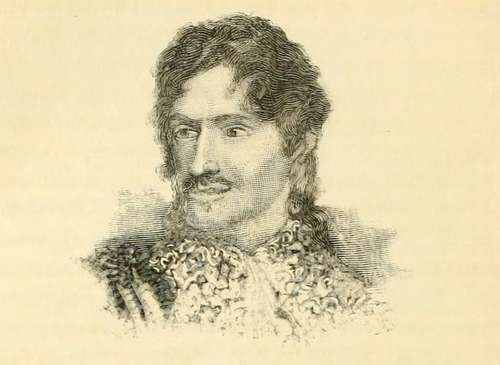
KEAN AS SIR GILES OVERREACH.
EDMUND KEAN.
"It is, perhaps, not generally known," says Macaulay,
when closing his narrative of the death of the great
Lord Halifax, in 1695, "that some adventurers who,
without advantages of fortune or position, made
themselves conspicuous by the mere force of ability,
inherited the blood of Halifax. He left a natural
son, Henry Carey, whose dramas once drew crowded
audiences to the theatres, and some of whose gay and
spirited verses still live in the memory of hundreds
of thousands. From Henry Carey descended that
Edmund Kean who, in our own time, transformed
himself so marvellously into Shylock, Iago, and
Othello."
This reminds me of an anecdote of Louis Philippe,
when Duke of Orleans, who happened one day to
speak of Louis XIV. as "my august ancestor." The
remark was made to a young clerk in his household,—a
future novelist and dramatist, Alexandre Dumas.
This gentleman opened his eyes in amazement, knowing
that the duke was legitimately descended from
the brother of the "Grand Monarque." The duke,
however, was thinking of the inter-marriages between
members of his family and the illegitimate descendants
of Louis XIV.; but he noticed the surprise of
Dumas, and then calmly added:—"Yes, Dumas; my
august ancestor, Louis XIV.! to descend from him,
only through his bastards, is, in my eyes at least, an
honour sufficiently great to be worth boasting of!"
In like manner Edmund Kean might have boasted
of his descent from George Saville, Marquis of Halifax;
but I think he was prouder of what he had
achieved for himself through his genius, than of any
oblique splendour derived to him from the author of
the Maxims and the great chief of the Trimmers,—if,
indeed, he knew anything about him.
A posthumous son of Henry Carey, well known as
George Saville Carey, inherited much of his father's
talents. After declining to learn the mystery of printing,
he tried that of playing; produced little effect,
but by singing, reciting, and above all by his imitations,
lived a vagabond life, and managed to keep his
head above water, with now and then a fearful dip
into the mud below, for forty years; when paralysis
depriving him of the means to earn his bread, he
contrived to escape further misery here by strangling
himself.[101] He was a man of great genius not unmixed
with a tendency to insanity.
He was cursed in one fair and worthless daughter,
"Nance Carey," whose intimacy with Aaron Kean,—a
tailor,—or as some say, Edmund Kean, a builder,
but at all events brother to Moses Kean, a tailor, and
as admirable a mimic as George Carey himself,[102]—resulted
in her becoming the mother of a boy, her
pitiless neglect of whom seems to have begun even
before his birth.
Whether that event took place in an otherwise unoccupied
chamber in Gray's Inn, which had been lent
to her vagabond father, or in a poor room in Castle
Street, Leicester Square, or in a miserable garret in
Ewer Street, Southwark,—for all of which there are
respective claimants, Miss Carey's son had a narrow
escape from being born in the street. But for Miss
Tidswell, the actress, and another womanly gossip or
two, this would have happened. It seemed all one to
"Nance Carey," who having performed her part in
this portion of the play, deserted her child, and left
him to the cruelty, caprice, or humanity of strangers.
Little Edmund Kean, born in 1787, or in the following
year,[103] for the date is uncertain, had a hard life
of it from the first. In a loving arm he never was
held,—a loving eye never looked down upon him.
Had he not been a beautiful child, perhaps the charity
of Miss Tidswell and of whomsoever else extended it
to him, would have failed. It is certain that they
took the earliest opportunity of deriving profit from
him; and before he was three years old, Edmund
Kean figured as a Cupid in one of Noverre's ballets
at the Opera House. He owed his election to this
dignity to his rare personal beauty, an endowment
which went for nothing in his subsequent appointment,
when four or five years of age, to act as one
of the imps attendant on the witches in "Macbeth."
John Kemble was then supreme at Drury Lane, and,
of course, little conscious that among the noisy and
untractable young imps, the wildest by far would
prove to be, what Mrs. Siddons would have called,
one of those new idols which the public delight to
set up, in order to mortify their old favourites!
One night the goblins fell over one another in the
cavern-scene, Edmund going down first, out of weakness,
or of mischief. This led to the dismissal of the
whole troop; and some good Samaritan then sent
young Kean to school. In Orange Court, Leicester
Square, was the fountain whence he drew his first
and almost only draught of learning. In that dirty
locality may be found the shrine of three geniuses.
There, Holcroft was born, Opie was housed, and
Edmund Kean instructed.
Thereafter comes Chaos; and it is only by glimpses
that the whereabout of the naturally-gifted but most
unhappy lad can be detected. A little outcast, with
his weak legs in "irons," day and night, he sleeps
between a poor married couple whose sides are hurt
by his fetters. Miss Tidswell takes him, ties him to
a bedpost, to secure his attention, teaches him elocution,
and corrects him a little too harshly, though
out of love. He dances and tumbles at fairs and
in taverns, performs wonderful feats, is kicked and
starved, thrives nevertheless,—and conceives that
there is something within him which should set him
above his fellows in hard work and lean fare. And
then, when he is becoming a bread-winner, he is
claimed by his evil genius, Nance Carey.
His mother has been a stroller; she is a vagabond
still; tramps the country with pomatums, and perfumes,
and falballas, and her son is her pack-horse;—and
the bird, to boot, that shall lay golden eggs for
her. He is savage at having to plod through mud
and dust, but he has a world of his own beyond it
all; and he not only learns soliloquies from plays, but
recites them in gentlemen's houses. To the audiences
there, he goes confident but sensitive; proud and
defiant, even when wounded by many a humiliation.
By reciting, selling the wares in which Nance Carey
dealt, and exhibiting in every possible and impossible
play and posture, at fairs, he earned and received some
small but well-merited wage. "She took it all from
me!" cried the boy, in his anguish and indignation.[104]
A London Arab leads an easier life. It was a dark
and hard life to Edmund,—Miss Tidswell occasionally
appeared to do him a kindness, to give him bread,
and more instruction for the stage. Of his father,
we hear nothing save his rascal gallantry with Miss
Carey; of his mother, nothing but her rapacity; of his
uncle, Moses Kean, only that Miss Tidswell turned
his wooden leg to account. When her young pupil,
studying Hamlet, had to pronounce the words, "Alas,
poor Yorick!" she first made him say, "Alas, poor
uncle!" that the memory of the calamity the latter had
suffered might dispose Edmund's face to seriousness!
And then he is abroad again; not easily to be followed.
His sensitive pride renders him hasty to take
offence, and then he rushes from some friendly roof,
and disappears, sinks down some horrible gulf, issues
not purified, nor softened, nor inclined to give account
of himself. A more sober flight took him to Madeira
as a cabin-boy, whence he returned, disgusted with
Thalatta. Finally, he runs the round of fairs again,
and starves and has flashes of wild jollity, as such
runners have; and pauses in his running at Windsor.
He was just then the property of crafty old Richardson,
and at Windsor Fair made such a local reputation
by his elocution, that King George sent for him,
and so enjoyed a taste of his quality that the young
player carried away with him the bright guerdon of
two guineas,—either to his manager or his mother,
I forget which.
I think, however, this speaking in presence of
royalty was the getting the foot on the first round
of the slippery ladder which he was so desirous to
ascend. He spoke a speech or two at some London
theatres, when benefit nights admitted of extraordinary
performances; and he now went the round of country
theatres, and not of country fairs. It was not a less
weary life; he starved as miserably as before, and he
began to find a means of reinvigoration in "drink."
Had his labour been paid according to its worth, the
devil could not have flung this temptation in his
way. "A better time will come by and by," said
the poor stroller, who was always promising to himself,
or to others, a happy period in which all would
be right.
In the course of his wanderings he played at Belfast.
Mrs. Siddons passed that way too, and acted
Zara and Lady Randolph. Edmund Kean, not then,
I believe, nineteen, played Osmyn and Young Norval.
In the first part I think he was imperfect, and the
Siddons shook her majestic head at the apparent
cause. Nevertheless, her judgment was, that he
played "well, very well; but there was too little of
him wherewith to make a great actor!"
If painstaking could do it, he was resolved to be
one. No amount of labour to this end daunted him.
However poor the task entrusted to him, he did his
utmost for it. When playing some worthless fifth-rate
character at the Haymarket, a generous colleague
remarked:—"Look at the little man, he is trying to
make a part of it."
I find by the bills of the Haymarket Theatre,
which Mr. Buckstone kindly placed at my disposal,
that Dubbs, in the "Review" to Fawcett's Caleb
Quotem, was about the best character he played.
Considering that he was at this time under twenty,
his position was not a very bad one; but it seemed
to him to promise no amendment—and he again
passed to the country, to play first business, and to
be hungry three or four days out of the seven.
He could not earn enough to enable him to travel
from one place of engagement to another. He
journeyed on foot, and when he came to a river,
swam it (particularly when a press-gang was near),
as readily as an Indian would have done. In some
towns his Hamlet was not relished, but his Harlequin
filled the house. The Guernsey critics censured
his acting, on the ground that he would rudely turn
his back on the audience, and make no more account
of them than if they were the fourth side of a room
in which he was meditating! When the Guernsey
pit hissed him in Richard III., his cry, pointedly
addressed to them:—"Unmannered dogs! Stand
ye, when I command!" rendered them silent. He
tried the same trick, and not without effect, when the
pit of Drury Lane was hissing him, not for being a
bad actor, but an immoral man.
"Who is that shabby little man?" said Mary
Chambers, a young Waterford girl, who had been a
governess, and who was going through her probationary
time as an actress in Gloucester. "Who the
devil is she?" asked Kean, after being soundly
rated by her, for spoiling her performance through
his unsettled memory. She was what Kean never
thoroughly knew her to be—his good genius—worth
more than all the kinsfolk he had ever possessed,
including Miss Tidswell, who once gave him a home
and the stick. The imprudent young couple, however,
fell in love; they married; and the manager
paid his congratulations to them, by turning them
out of his company.[105]
They loved, slaved, and starved. The misery of
their lives is unparelleled, except by the heroic uncomplainingness
with which it was endured by Mrs.
Kean. His industry was really intense; his study
of every character he had to play careful, earnest,
conscientious; and after acting with as much anxiety
as if he had been performing before a jury of critics,
he would return to his miserable home, saddened,
furious, and unsober. "I played the part finely;
and yet they did not applaud me!"
Gleams of good fortune occasionally lit up their
path. An engagement at Birmingham, at a guinea
a week to each, was comparative wealth to them;
and there Kean found the applause for which he
sighed. His Octavian was preferred to Elliston's;
and Stephen Kemble told him that his Hotspur and
Henry IV. were superior to those of his brother,
John Kemble. Kean thought of London. "If I
could only get there, and succeed! If I succeed,
I shall go mad!"
There was much to be suffered by Kean and his
wife before that triumph came. For lack of means,
they have to walk from Birmingham to Swansea.
Two hundred miles, and that poor lady may be a
mother before she accomplishes half of them! They
wend painfully on, pale, hungry, and silent; twelve
miles a day; not asking alms, but not above receiving
that hospitality of the poor which is true, because
self-denying, charity. Needing many things, and
obtaining none of those she most needed, Mrs. Kean
reached Bristol more dead than alive. A cast in a
boat, more weary suffering, a son born, and an
audience at Swansea who preferred Bengough, an
elephantine simpleton, with large unmeaning eyes,
to Edmund—tells the outline of his tale before they
crossed from Wales to Waterford.
Soon in this troop, under Cherry, at Waterford,
there were two men, destined to be at the very head
of their respective vocations, as player and dramatic
poet—Edmund Kean and Sheridan Knowles. At
present they are only strolling players. The training
of the two men had been totally different. Kean
was "Nobody's Son," and had passed through the
misery, degradation, and blackguardism attendant on
such a parentage—his genius not slumbering, but
ready to flash, like the diamond, when light and
opportunity should present themselves.
Knowles, on the other hand, was the son of a scholar
and a trainer of scholars. He came of a literary race.
His sire compiled a dictionary; Sheridan, the lexicographer,
was his uncle; Richard Brinsley, his cousin.
At an early age he was removed from his native city,
Cork, to London, where the boy wrote boyish plays,
and the youth grew up in friendship with Hazlitt,
Coleridge, and Lamb. Then he went into the world,
to fight his fight, and at four and twenty, that is, in
1808, I find him a tolerable actor, on the old Dublin
stage in Crow Street, and a very acceptable guest at
firesides where merit, wit, and a harmonious voice
were appreciated. Subsequently he joined the troop
of vivacious Cherry, in Waterford. There he met with
the little, bright-eyed, swarthy young man, who was
Richard in the play, and Harlequin in the pantomime,
on the same evening; who, in short, could do anything
and did everything well. For him, Edmund
Kean, Knowles wrote his first serious play, a melo-dramatic
tragedy, "Leo, the Gipsey;" and in that
piece Kean achieved so notable a triumph, that he
would have chosen it for his first appearance in London,
but that, luckily for him, he had lost the copy.
Edmund seems to have worked steadily in the
ancient Irish city. Of the general business I can say
nothing, except that Mrs. Kean played a Virgin of
the Sun, at a time when the character least suited
her; but for a reminiscence of a benefit night, I take
half a page from Mr. Grattan.
"The last thing I recollect of Kean in Waterford,
was the performance for his benefit. The play was
Hannah More's tragedy of "Percy," in which he of
course played the hero. Edwina was played by Mrs.
Kean, who was applauded to her heart's content.
Kean was so popular, both as an actor, and from the
excellent character he bore, that the audience thought
less of the actor's demerits than of the husband's
feelings; and besides this, the débutante had many
personal friends in her native city, and among the
gentry of the neighbourhood, for she had been
governess to the children of a lady of good fortune,
who used all her influence at this benefit. After the
tragedy, Kean gave a specimen of tight-rope dancing,
and another of sparring with a professional pugilist.
He then played the leading part in a musical interlude,
and finished with Chimpanzee, the monkey, in
the melo-dramatic pantomime of La Pérouse, and in
this character he showed agility scarcely since surpassed
by Mazurier or Gouffe, and touches of deep
tragedy in the monkey's death scene, which made
the audience shed tears."
What cause broke the connection of the Keans
with Cherry, I do not know; but the former were
one day without an engagement, and among the
separations that ensued was that of Kean and
Knowles. They were both to find what they thirsted
for in London; but for the former many were the
trials, and terrific the ascent, before he was to reach
that pinnacle which he occupied so gloriously and
so briefly.
From Waterford, Edmund and his wife took with
them no more than they had brought, except an
additional son, the day of whose birth was a happy
day in the mother's calendar of sorrows. They
suffered, and the children with them, all that humanity
could suffer and yet live. I find them at
Dumfries, depending for food and shelter upon the
receipts at an "entertainment," given by Kean, in a
room at a tavern. There was one auditor, and he
paid sixpence! There were even worse disappointments
than these; and, under their accumulation, I
do not wonder that Kean broke into curses at his
perverse destiny; or that Mrs. Kean, looking at her
children, prayed to God that He would remove them
and her!
And so from town to town they pursued their hapless
pilgrimage. He sometimes driven to fury and to
drink; she only asking for death to her and the two
younger sufferers. Now and then a divine charity
enabled them to rest and refresh; and once, a divine
by profession, in a country town, forbade them the
use of a school-room, because they were actors! The
reverend gentleman himself, probably, thought it
very good amusement to listen to his own boys
enacting the "Eunuchus" of Terence.
Famine, rage, drink, and tears, mark the way of
the wanderers. Brief engagements enabled them to
exist, just to keep themselves out of the grave; and
then came vacation and want to let them slip back
again to the very brink of that grave. Amid it all,
Kean did succeed in making a reputation. Passing
through London he saw John Kemble and Mrs. Siddons,
in Wolsey and Constance—and he registered a
vow that he would be there a great actor, too! And
so again to the country, to work hard, gain little, and
wait; but also to enjoy some antepast of metropolitan
triumph at Exeter, where his success was great, but
not remunerative; where, with a greatcoat flung over
his stage-dress, he might too often be seen at the bar
of the tavern near the theatre, and where he enlarged
his means by teaching dancing and fencing, elocution
and boxing—or "a word and a blow," as some wag
styled the latter two accomplishments. Exeter foretold
that he would not have to wait long, but all the
prophetic patronage of Exeter did not furnish him
with means to get to Dorchester by any other process
than on foot, and with his son Charles on his back.
The poor sick little Howard, the elder son, had to be
conveyed thither by his mother. Howard had shown
some promise of histrionic talent already, and he
helped to win a little bread for the family before he
died. For this, perhaps, the father loved him; and
toiled on till the tide came in his affairs which promised
to raise him at its flood to highest fortune.
That tide began to flow, after Dr. Drury had seen
him act, and reported well to the Drury Lane Committee
of his acting; it was running fast in the same
direction when Kean saw a gentleman, in the boxes
at Dorchester, so attentive to his playing, that Edmund
acted to him alone, as Booth had done in his
day, but under other influences, to Mr. Stanyan, the
judicious gentleman from Oxford. Kean's gentleman
was Arnold, stage-manager from Drury Lane,
and he commenced negotiations with Kean for an
engagement, before they parted for the night. The
poor player rushed home, hysterical with agitation
and delight, and all his good impulses uppermost.
He announced the glad intelligence to his wife, with
the touching comment—"If Howard only get well,
we shall be all happy yet!"
Howard died, and Kean played, danced, sorrowed,
and hoped—for the time at which he was to go up to
London was at hand; and thither they went at the
close of the year 1813. When that season of 1813-14
opened, Drury was in a condition from which it could
be relieved only by a genius;—and there he stood, in
that cold hall, a little, pale, restless, dark-eyed man, in
a coat with two or three capes, and nobody noticed
him. In Cecil Street, his family was living on little
more than air; and he was daily growing sick, as he
stood, waiting in that hall, for an audience with the
manager; and subject to the sneers of passing actors.
Even Rae, handsome and a fool, affected not to know
him, though they had played together, when Rae's
mother was matron at St. George's Hospital, and they
had acted together at the Haymarket, in 1806, when
Rae led the business, and Kean was but a supernumerary.
Arnold treated him superciliously, with a
"young man!"—as he condescended to speak, and
put him off. Other new actors obtained trial parts,
but there was none for that chafed, hungry, restless
little man in the capes. Even drunken Tokely, like
himself, from Exeter, could obtain a "first appearance,"
but Kean was put off. Stephen Kemble
played Shylock, and failed! why not try a new
actor? The Committee did so, and Mr. Huddart,
from Dublin, went on as Shylock, and was never
heard of more. And the poor stroller looked through
the darkness of that miserable passage the while,
and murmured, "Let me but get my foot before the
floats, and I'll show them—!"
The permission came. Would he,—no, he must
play Richard. "Shylock, or nothing!" was his
bold reply. He was afraid of the littleness of his
figure,—which he had heard scoffed at, being exposed
in the "trunks" of Glo'ster. He hoped to
hide it under the gown of Shylock. The Jew, or
nothing! The young fellow, he was not yet six
and twenty, was allowed to have his way.
At the one morning rehearsal he fluttered his
fellow-actors, and scared the manager, by his independence
and originality. "Sir, this will never
do!" cried Raymond, the acting manager. "It is
quite an innovation; it cannot be permitted." "Sir,"
said the poor, proud man, "I wish it to be so;" and
the players smiled, and Kean went home, that is, to
his lodgings, in Cecil Street, on that snowy, foggy,
26th of February 1814,[106] calm, hopeful, and hungry.
"To-day," said he, "I must dine."
Having accomplished that rare feat, he went forth
alone, and on foot. "I wish," he remarked, "I was
going to be shot!" He had with him a few properties
which he was bound to procure for himself,
tied up in a poor handkerchief, under his arm. His
wife remained, with their child, at home. Kean
tramped on beneath the falling snow, and over that
which thickly encumbered the ground,—solid here;
there in slush; and, by and by, pale, quiet, but
fearless, he dressed in a room shared by two or three
others, and went down to the wing by which he was
to enter. Hitherto no one had spoken to him, save
Jack Bannister, who said a cheering word; and
Oxberry, who had tended to him a glass, and wished
him good fortune. "By Jove!" exclaimed a first-rater,
looking at him, "Shylock in a black wig! Well!!"
The house could hold, as it is called, £600; there
was not more than a sixth of that sum in front.
Winter without, his comrades within;—all was
against him. At length, he went on, with Rae, as
Bassanio, in ill-humour; and groups of actors at the
wings, to witness the first scene of a new candidate.
All that Edmund Kean ever did, was gracefully
done; and the bow which he made, in return to the
usual welcoming applause, was eminently graceful.
Dr. Drury, the head-master of Harrow, who took
great interest in him, looked fixedly at him as he
came forward. Shylock leant over his crutched
stick, with both hands; and, looking askance at
Bassanio, said: "Three thousand ducats?" paused,
bethought himself, and then added: "Well?" He
is safe, said Dr. Drury.
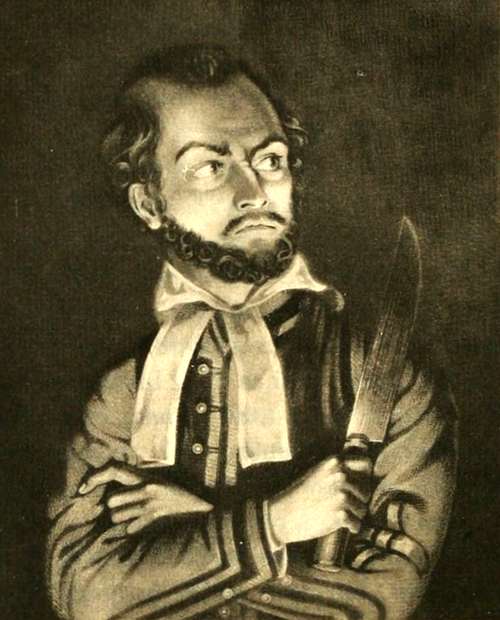
The groups of actors soon after dispersed to the
green-room. As they reached it, there reached there,
too, an echo of the loud applause given to Shylock's
reply to Bassanio's assurance that he may take the
bond. "I will be assured I may!"—later came the
sounds of the increased approbation bestowed on the
delivery of the passage ending with, "and for these
courtesies, I'll lend you thus much moneys." The
act came to an end gloriously; and the players in
the green-room looked for the coming among them
of the new Shylock. He proudly kept aloof; knew
he was friendless, but felt that he was, in himself,
sufficient.
He wandered about the back of the stage, thinking,
perhaps, of the mother and child at home; and sure,
now, of having at least made a step towards triumph.
He wanted no congratulations; and he walked cheerfully
down to the wing when the scene was about to
take place between him and his daughter, Jessica, in
his very calling to whom:—"Why, Jessica! I say"—there
was, as some of us may remember, from an
after night's experience, a charm, as of music. The
whole scene was played with rare merit; but the
absolute triumph was not won till the scene (which
was marvellous in his hands) in the third act, between
Shylock, Solanio, and Salarino,—ending with the
dialogue between the first and Tubal. Shylock's
anguish at his daughter's flight; his wrath at the
two Christians who make sport of his anguish; his
hatred of all Christians, generally, and of Antonio in
particular; and then his alternations of rage, grief,
and ecstasy, as Tubal relates the losses incurred in
the search of that naughty Jessica, her extravagances,
and then the ill luck that had fallen upon Antonio;—in
all this, there was such originality, such terrible
force, such assurance of a new and mighty master,—that
the house burst forth into a very whirlwind
of approbation. "What now?" was the cry in the
green-room. The answer was, that the presence
and the power of the genius were acknowledged with
an enthusiasm which shook the very roof. How so
select an audience contrived to raise such a roar
of exultation, was a permanent perplexity to Billy
Oxberry.
They who had seen Stephen Kemble's Shylock,
and that of Huddart, this season, must have by this
time confessed that the new actor had superseded
both. He must himself have felt, that if he had not
yet surpassed Cooke, and Henderson, and Macklin,
he was tending that way; and was already their
equal. Whatever he felt, he remained reserved and
solitary; but he was now sought after. Raymond,
the acting manager, who had haughtily told him
his innovations "would not do," came to offer him
oranges. Arnold, the stage manager, who had
young-manned him, came to present him, "sir!"
with some negus. Kean cared for nothing more
now, than for his fourth and last act; and in that
his triumph culminated. His calm demeanour at
first; his confident appeal to justice; his deafness,
when appeal is made to him for mercy; his steady
joyousness, when the young lawyer recognises the
validity of the bond; his burst of exultation, when
his right is confessed; his fiendish eagerness, when
whetting the knife:—and then, the sudden collapse
of disappointment and terror, with the words,—"Is
that—the Law?"—in all was made manifest, that
a noble successor to the noblest of the actors of old
had arisen. Then, his trembling anxiety to recover
what he had before refused; his sordid abjectness,
as he finds himself foiled, at every turn; his subdued
fury; and, at the last (and it was always
the crowning glory of his acting in this play), the
withering sneer, hardly concealing the crushed heart,
with which he replied to the jibes of Gratiano, as
he left the court,—all raised a new sensation in an
audience, who acknowledged it in a perfect tumult
of acclamation. As he passed to his dressing-room,
Raymond saluted him with the confession, that he
had made a hit; Pope, more generous, avowed that
he had saved the house from ruin.
And then, while Bannister was dashing through
Dick, in the "Apprentice," I seem to see the hero
of the night staggering home through the snow,
drunk with delicious ecstasy, all his brightest dreams
realised, and all his good impulses surging within
him. He may be in a sort of frenzy, as he tells of
his proud achievement; but, at its very wildest, he
exclaims: "Mary, you shall ride in your carriage
yet!" and, taking his son Charles from the cradle,
swears he "shall go to Eton;" but therewith something
overshadows his joy, and he murmurs, "If
Howard had but lived to see it!"
That poor wife and mother must have enjoyed,
on that eventful night, the very brightest of the few
gleams of sunshine that fell upon her early, hapless
life. Thenceforth, there was never to be misery or
sorrow in that household again! Poor lady! She
did not, perhaps, remember that Edmund had said,
"If I succeed,—it will drive me mad!"
But not yet: all was triumph for awhile; and
worthily it was won. His audiences rose, from
one of a £100 to audiences of £600; and £20
a week rewarded efforts, for far less than which
he subsequently received £50 a night. He was
advanced to the dignity of having a dressing-room
to himself. Legislators, poets, nobles, thronged his
tiring-room, where Arnold took as much care of
him, as if on his life hung more than the well-being
of the theatre. Friends flocked to him, as they are
wont to do, where there is an opportunity of basking
in pleasant sunshine, imparted by genius. And old
Nance Carey turned up, to exact £50 a year from
her not too delighted son, and to introduce a Henry
Darnley, who would call Edmund, "dear brother!"
Some years later, in 1829, Moore was talking with
Mrs. Kean of this critical period in Edmund's career.
The poet suggested, that some memorial of his first
appearance should be preserved. "Oh!" exclaimed
Mrs. Kean; "will you write his life? You shall
have half the profits;" adding, as she probably remembered
the dark time which had come upon her since
the sunshine,—"if you will only give me a little."
But success was not to be considered as achieved,
by playing one character supremely well. Kean
had, in the general memory, shaken Macklin from
his supremacy in Shylock. He was now summoned
to show himself worthy of being the successor of
Garrick,—by acting Richard III. A few nights
before he played that part, it was performed at
Covent Garden, by John Kemble; and a short time
after Kean had triumphed, it was personated by
Young; but Kemble could not prevent, nor Young
impede, the triumph of the new actor, who now
made Richard his own, as he had previously done
with Shylock.
His Richard settled his position with the critics;
and the criticism to which he was subjected was, for
the most part, admirably and impartially written.
He is sometimes spoken of as "this young man;"
at others, "this young gentleman." "Even Cooke's
performance," says one, "was left at an immeasurable
distance." A second adds, "it was the most
perfect performance of any that has been witnessed
since the days of Garrick." Of the grand effects
followed by a storm of applause, a third writes that
"electricity itself was never more instantaneous in
its operation." They are, however, occasionally
hypercritical. The able critic of the Morning
Chronicle objected that in the young man's Richard
"too great reliance was placed on the expression of
the countenance, which is a language intelligible only
to a part of the house;" and a contemporary thought
that when the young gentleman, as Richard, crossed
his hands behind his back, during his familiar
colloquy with Buckingham, the action was altogether
too natural! Others point to attitudes
which Titian might have painted. Such use of eye,
and lip, and muscle, had never had anything comparable
to it since the best days of Garrick. Even
Sylvanus Urban aroused himself, and declared, that
Mr. Kean's success had given new interest to the
biography of Richard III.
Indeed, this second glory was greater than the
first, for the difficulties were greater, and they were
all surmounted. Joyous and sarcastic in the opening
soliloquy; devilish, as he passed his bright
sword through the still breathing body of Lancaster;
audaciously hypocritical, and almost too exulting, in
the wooing of Lady Anne; cruelly kind to the young
Princes, his eye smiling while his foot seemed restless
to crush the two spiders that so vexed his heart;—in
representing all this there was an originality and
a nature which were entirely new to the delighted
audience. Then they seemed to behold altogether
a new man revealed to them, in the first words
uttered by him from the throne.—"Stand all apart!"
from which period to the last struggle with Richmond,
there was an uninterrupted succession of
beauties; even in the bye-play he found means to
extort applause, and a graceful attitude, an almost
silent chuckle, a significant glance,—even so commonplace
a phrase as "Good night, my lords," uttered
before the battle of the morrow, were responded to
by acclamations such as are awarded to none but
the great masters of the art.
The triumph was accumulative, and it was crowned
by the tent-scene, the battle, and the death. Probably
no actor ever even approached Kean in the
last two incidents. He fenced with consummate
grace and skill; and fought with an energy that
seemed a fierce reality.
Rae had sneered at the "little man," but Rae now
felt bound to be civil to the great tragedian, and referring
to the passage of arms in "Richard III.," he,
having to play Richmond, asked, "Where shall I hit
you, sir, to-night?" "Where you can, sir," answered
Kean; and he kept Richmond off, in that famous
struggle, till Rae's sword-arm was weary with making
passes.
His attempt to "collar" Richmond when his own
sword had fallen from him was so doubtful in taste
that he subsequently abandoned it;[107] but in the faint,
yet deadly-meant passes, which he made with his
swordless arm, after he had received his death-blow,
there was the conception of a great artist; and there
died with him a malignity which mortal man had
never before so terribly pourtrayed. Young, in his
dying scene of Richard used to fling his sword at
Richmond, a trick which the critics very properly
denounced.
They who said that Mr. Kean's figure and voice
were against him, unconsciously exalted the genius
which had triumphed over the difficulties of Shakspeare
and Cibber's Richard. They who accepted
rather than rejoiced in his triumph, called him "The
Fortunate Actor!" They did not know that under
slavery, starvation, and every disadvantage but despair,
Kean had silently and solitarily studied these
characters, and had come to conclusions which he
hoped would enable him to achieve a success which,
if accomplished, he was, after all, afraid would drive
him mad.
At this time, 1814, Moore speaks of "poor Mr.
Kean," as being "in the honeymoon of criticism;"
and then the bard speaks disrespectfully of the critics.
"Next to the pleasure," he says, "of crying a man
down, your critics enjoy the vanity of writing him
up; but when once up, and fixed there, he is a mark
for their arrows ever after."
His other characters this season were Hamlet, when
to John Bannister was assigned the first of the two
Grave-diggers, whom he had restored to the stage
from which they had been abolished by Garrick;
Othello, to the Iago of Pope; and Iago, to the Othello
of Sowerby, Pope, Rae, and Elliston; Miss Smith,
who refused to play the Queen, in "Richard," being
his Desdemona. He also acted Luke, in "Riches"
("City Madam"), to the Lacy of Wallack; and the
Lady Traffic of Mrs. Edwin. Of these, he was always
inclined to think Hamlet his best character. He had,
perhaps, studied it more deeply than the others, and
Mrs. Garrick took such especial interest in his representation
of it, that on comparing it with her husband's,
she saw only one great defect,—in the closet
scene. Garrick was severer with the Queen of Denmark
than Kean, and Mrs. Garrick persuaded him,
though unconvinced by her, to throw more sternness
into this celebrated scene. The good old lady merited
some, yet not such concession; but then she invited
Kean to Adelphi Terrace, and sent him fruit from
Hampton, and made him a present of Garrick's stage-jewels.
The young man was in a fair way of being
spoiled, as Pope said of Garrick, when thinking of
the laborious, but splendid time of his friend and
favourite, Betterton.
Tenderness to Ophelia, affection for his mother,
reverential awe of his father, and a fixed resolution to
fulfil the mission confided to him by that father, were
the distinct "motives," so to speak, of his Hamlet.
The critics especially dwell on the tender vibration
of his voice when uttering the word "father" to
the Ghost; they approve of his sinking on one knee
before the solemn spirit, and they are lost in admiration
of his original action when, instead of keeping
the Ghost off with his sword, when he bids it, "go
on," he pointed it back at his friends to deter them
from preventing his following the visionary figure.
This, and another original point, have become stage-property.
I allude to the scene in which he seems
to deal so harshly with Ophelia. At the close of it,
Kean used to return from the very extremity of the
stage, take Ophelia's hand, kiss it with a tender rapture,
look mournfully loving upon her, with eyes full of
beautiful significance, and then rush off. The effect
never failed, and the approbation was tumultuous.
Gracefully and earnestly as his Hamlet[108] was played,
it yielded in attractiveness to his Othello, which despite
some little exaggeration of action, when told to
beware of jealousy, was, perhaps, the greatest of his
achievements. In the tender scenes, and love for
Desdemona was above all other passion, even when
for love he jealously slew her, he had as much power
over his "bad voice," as his adversaries called it, as
John Kemble over his asthmatic cough, and attuned
it to the tenderness to which he had to give expression.
In the fiercer scenes he was unsurpassable,
and in the great third act none who remember him
will, I think, be prepared to allow that he ever had,
or is ever likely to have, an equal.
John Kemble himself said of Kean's Othello:—"If
the justness of its conception had been but equal to
the brilliancy of execution it would have been perfect;
but," added the older actor, with some sense, perhaps,
of being disturbed by the younger player, "the whole
thing is a mistake; the fact being that Othello was a
slow man,"—to be moved, he was; but being moved,
swift and terrible in moving to consequent purpose.
Iago, curiously enough, was not so welcome a part
to Kean as Othello. Its characteristic was the concealment
of his hypocrisy, and in the delineation of
such a part Kean was usually unrivalled. Some of
his admirers considered his Iago as fine as his Richard,
but he never played the two with equal care and equal
success. On the other hand, he was pleased with the
strong oppositions in the character of Luke, but his
audiences were not satisfied in the same degree, and
it fell out of his repertory. He of course thought
them in the wrong; lamented on the few competent
judges of acting, and limited these to lawyers, doctors,
artists, critics, and literary men. He was then the
(often unwilling) guest of noblemen who, I doubt not,
were excellent judges too; but Kean thought otherwise:
"They talk a great deal," he said, "of what
I don't understand,"—politics, and equally abstruse
matters; "but when it comes to plays, they talk such
nonsense!"
I am not about to follow this actor through his score
of seasons, but as a sample of his value to the treasury
of Drury Lane, at this time, and therefore to the stage,
I may just make record of the fact that in this first
season, he played Shylock fifteen times, Richard
twenty-five, Hamlet eight, Othello ten, Iago eight,
and Luke four; and that in those seventy nights, the
delighted treasurer of Drury Lane struck a balance
of profit to the theatre, amounting in round numbers
to £170,000.[109] Previous to the appearance granted
to him so tardily, there had been one hundred and
thirty-nine nights of continual loss. Mr. Whitbread,
a proprietor, might well say of him that "he was
one of those prodigies that occur only once or twice
in a century."
In this same season, Kemble stood his ground
against Kean in the one character played by both—Hamlet;
but two new actors—tall, earnest, handsome,
but ungainly Conway, from Dublin, and Terry,
from Edinburgh—only took a respectable position.
The Othello of the first, and the Shylock of the
second, were never heard of after Kean had played
and made them his own.
In Kean's second season, he added to his other
characters, Macbeth, which had some magnificent
points, but in which Kemble had personal advantages
over him: Romeo, which continues the traditional
glory of Barry; Reuben Glenroy and Penruddock,
in neither of which he equalled Kemble; Zanga,
played in a style which made the fame of Mossop
pale, and shook Young and Kemble from an old
possession; Richard II., in an adaptation by Merivale,[110]
acted with a new grace to the expression of
melancholy; Abel Drugger, concerning which he
answered the legendary—"I know it," to the "you
can't play it," of Mrs. Garrick; Leon, performed
with moderate success, and Octavian, with rare
sweetness, but not with such rare ability as to make
John Kemble uneasy.
Kean also acted his first original character, Egbert,
in the tragedy of that name,[111] by Mrs. Wilmot. His
prestige suffered a little in consequence, for Egbert
was condemned on the first night. He had compensation
enough in Zanga. As one who stood among
the crowd in the pit passage heard a shout and
clamour of approbation within, he asked if Zanga had
not just previously said, "Then lose her!" for that
phrase, in the country, when uttered by Kean, used
to make the walls shake; and he was answered that
it was so. I remember having read that some one
was with Southey, when the "Revenge" was played,
and that when Zanga consummated his vengeance in
the words, "Know then 'twas I"—lifting up his
arms, as he spoke, over the fainting Alonzo, and
seeming to fill the theatre—the same image was
simultaneously presented to the minds of the two
friends. "He looks like Michael Angelo's rebellious
Archangel!" thought one. "He looks like the
Arch-Fiend himself," said the other.[112]
Covent Garden struggled nobly, with its old and
strong company, against the single power of Kean at
the other house; but found its best ally in a new
actress. On the 13th of October 1814,[113] Miss O'Neill
made her first appearance in Belvidera. It is not
my intention to do more than record the names of
the players who made their début after the coming
of Edmund Kean, but there is something so singular
in the lucky chance which led to Miss O'Neill's well-merited
fortune, that I venture to tell it in the words
of Michael Kelly.[114]
Let me first remark that, no doubt, some of us are
old enough to have seen, as many of us have heard,
of Miss Walstein, that "sort of Crow Street Bonaparte,"
who struggled so bravely, though so briefly,
at Drury Lane against Miss O'Neill, when the latter
carried the town by her superior charms and talents.
Miss O'Neill was furnished by her undoubtedly
great rival with the means of supplanting her. Had
not Walstein been arrogant, the famous Juliet of
our infantine days might never have sighed on the
Covent Garden balcony. Her first step, however, was
made on the stage at Crow Street, and Miss Walstein
unwittingly helped her to obtain a secure footing.
The story is thus told by garrulous Mike Kelly:—"Miss
Walstein, who was the heroine of the Dublin
stage, and a great and deserved favourite, was to
open the theatre in the character of Juliet. Mr.
Jones received an intimation from Miss Walstein
that without a certain increase of salary, and other
privileges, she would not come to the house. Mr.
Jones had arrived at the determination to shut up
his theatre sooner than submit to what he thought
an unwarrantable demand, when Mac Nally, the
box-keeper, who had been the bearer of Miss Walstein's
message, told Mr. Jones that it would be a
pity to shut up the house; that there was a remedy
if Mr. Jones chose to avail himself of it. 'The
girl, sir,' said he, 'who has been so often recommended
to you as a promising actress, is now at an
hotel in Dublin with her father and brother, where
they have just arrived, and is proceeding to Drogheda,
to act at her father's theatre there. I have
heard it said by persons who have seen her, that she
plays Juliet extremely well, and is very young and
very pretty. I am sure that she would be delighted
to have the opportunity of appearing before a Dublin
audience, and if you please I will make her the proposal.'
The proposal was made, and accepted; and
on the following Saturday, 'the girl,' who was Miss
O'Neill, made her début on the Dublin stage as
Juliet.[115] The audience was delighted; she acted the
part several nights, and Mr. Jones offered her father
and brother engagements on very liberal terms, which
were thankfully accepted. In Dublin," adds Kelly,
"she was not only a great favourite in tragedy, but
also in many parts of genteel comedy. I have there
seen her play Letitia Hardy; she danced very gracefully,
and introduced my song, 'In the rough Blast
heave the Billows,' originally sung by Mrs. Jordan,
at Drury Lane, which she sang so well as to produce
a general call for its repetition from the audience.
She was in private life highly esteemed for her many
good qualities. Her engagement in Dublin wafted
Miss Walstein from Dublin, where she had been for
many years the heroine of Crow Street, to Drury
Lane, where she made her appearance as Calista, in
'The Fair Penitent,' on the 15th November 1814,
but only remained one season."
It would seem as if Drury Lane were weary by this
time of its success, for early in 1815-16 that excellent
actor, Dowton, who disliked seeing Kean's
name in large type, tried to extinguish him by
playing Shylock! The Kentish baker's son could
play Sheva and Cantwell, and many other parts
admirably; but Shylock!—No, let us pass to more
equal adversaries; in a contest between whom, Kean
did fairly extinguish his antagonist. In this season
Kean acted all his old and many new parts, among
the latter, Shakspeare's Richard II.,[116] Bajazet, Duke
Aranza (in which Elliston had the better of him),
Goswin ("Beggars' Bush"), Sir Giles Overreach,
and Sforza. Among these, Sir Giles stands pre-eminent
for its perfectness, from the first words,
"Still cloistered up," to the last convulsive breath
drawn by him in that famous one scene of the fifth
act, in which, through his terrible intensity, he once
made so experienced an actress as Mrs. Glover faint
away,—not at all out of flattery, but from emotion.
Now, Sir Giles had been one of Kemble's weaknesses;
and he affected it as he might have done
Coriolanus. He had played it since Mr. Kean had
come to London, but as no comparison could be
drawn, his performance was accepted, as even an indifferent
but honest effort by a great artist deserves
to be. But after Edmund Kean had added another
rose to his chaplet, by his marvellous impersonation
of Sir Giles, Kemble played it again, as if to
challenge comparison. I am sorry to say it, but
John Kemble was hissed! No! It was his Sir
Giles that was hissed. Two nights later he acted
Coriolanus, the merits of which were acknowledged
with enthusiasm by his audience. But he never
ventured on Sir Giles again! In this last character,
all the qualities of Kean's voice came out to wonderful
purpose, especially in the scene where Lovel
asks him,
"Are you not moved with the sad imprecations
And curses of whole families, made wretched
By your sinister practices?"
to which Sir Giles replies:—
"Yes, as rocks are
When foamy billows split themselves against
Their flinty ribs; or as the moon is moved
When wolves with hunger pined, howl at her brightness."
I seem still to hear the words and the voice as I
pen this passage; now composed, now grand as the
foamy billows; so flute-like on the word "moon,"
creating a scene with the sound; and anon sharp,
harsh, fierce in the last line, with a look upward
from those matchless eyes, that rendered the troop
visible, and their howl perceptible to the ear;—the
whole serenity of the man, and the solidity of his
temper, being illustrated less by the assurance in
the succeeding words than by the exquisite music
in the tone with which he uttered the word
"brightness."
It was on the night he played Sir Giles for the
first time in London, that Mrs. Kean, who seems to
have been too nervous to witness his new essays,
asked him what that hanger-on at the theatres,
Lord Essex, had thought of it. You know the
jubilant reply:—"D—— Lord Essex, Mary! The pit
rose at me!"
But to Sir Giles were not confined Kean's triumphs
of this year. He created the part of Bertram, in
Maturin's tragedy of that name; and he alone stands
associated with the part. It suited him admirably,—for
it is full of passion, pathos, wild love, and
tenderness. One great point made by the actor
(whose Imogine was Miss Somerville, afterwards
Mrs. Bunn) was in the exquisite delivery of the
words, "God bless the child!" They have made
many a tear to flow, and he acquired the necessary
pathos and power by first repeating them at home,
while he looked on his sleeping boy; and I do not
know a prettier incident in the life of this impulsive
actor. Would there were more of them!
In the season of 1816-17 John Kemble withdrew,
full of honours, though his laurels had been a little
shaken. As opponents to the now well-established
actor at Drury Lane, two gentlemen were brought
forward, Mr. Macready, from Dublin, and Mr. Junius
Booth, from Worthing. The former is the son of
the respectable actor and dramatic author, whose
abandonment of upholstery, in Dublin, did something
towards giving to the stage the son who long
refined and adorned it. Mr. Macready made all
the more progress by not coming in contrast, or
comparison with Kean. He was of the Kemble
school, but with ideas of his own, and he made his
way to fame, independently. But Booth was so
perfectly of the Kean school that his Richard appeared
to be as good as his master's. Indeed, some
thought it better. Whereupon, Kean counselled the
Drury Lane management to bring him over to that
theatre. It was done. They played in Othello,—the
Moor, by Kean; Iago, by Booth. The contact
was fatal to the latter. He fell ingloriously, even
as a Mr. Cobham had done before him in an audacious
attempt on Richard; but both gentlemen
became heroes to transpontine audiences.
Kean's other achievements this season were his
fine interpretation of Timon, after Shakspeare's text,
"with no other omissions than such as the refinement
of manners has rendered necessary;" his
creation of Maturin's "Manuel," and his last
triumph over Kemble, in doing what the latter had
failed to do, stirring the souls, raising the terror,
and winning the sympathy of his audience by one of
the most finished of his impersonations,—Sir Edward
Mortimer. Oroonoko, Selim, and Paul were the
other characters newly essayed by him during this
season. The last two were for his benefit,[117] and
therewith he closed a season,—the last very fruitful
in great triumphs, but not the first in the chronicle
of his decline.
He was now the oft-invited guest of people with
whom he did not particularly care to associate.
Moore chronicles his name as one of the guests with
Lord Petersham, Lord Nugent, the Hon. William
Spencer, Colonel Berkeley, and Moore, at an "odd
dinner," given by Horace Twiss, in Chancery Lane,
in 1819, in "a borrowed room, with champagne,
pewter spoons, and old Lady Cork." Lord Byron
was reluctant to believe in him, but after seeing him
in Richard, he presented the actor with a sword,
and a box adorned by a richly-chased boar-hunt;
when Lord Byron had seen his Sir Giles, he sent to
the player a valuable Damascus blade. His compliments,
at Kean's benefit, took the shape of a
fifty-pound note; and he once invited him to dinner,
which Kean left early, that he might take the chair
at some pugilistic supper!
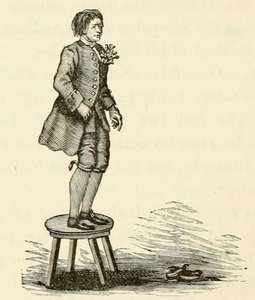
Mr. Weston as Dr. Last.
CHAPTER XVI. — Epilogue. — FOOTNOTES:
J. B. BOOTH.
EDMUND KEAN—CONTINUED.
Between the last-named period, and the time when
Edmund Kean played Virginius, there is but one
character in which he produced any extraordinary
effect, namely King Lear. This sustained, but I do
not think it increased, his glory. His other characters
only seem to glide past, and disappear. Such
are Richard, Duke of York, in a compilation from
several of Shakspeare's plays; Barabas, in Marlowe's
"Jew of Malta," the heaviness of which he relieved
by a song, sweetly warbled; Selim, in Dimond's
melodramatic "Bride of Abydos;" Young Norval,
in which he was graceful and affecting; King John,
which did not disturb the repose of Kemble; and
Alexander the Great, which could as little stir the
dead sleep of Verbruggen. Something more effective
was his Brutus, in Payne's compilation. The
scene of his simulated folly was skilfully played;
that with the son whom he condemns to death, full
of tenderness and gravity. He could not sustain
Miss Porter's "Switzerland," and he would not
support Mr. Bucke's "Italians." Soane literally
measured him for Malvesi, in the "Dwarf of Naples,"
and misfitted him grievously. Mr. Twiss had no
better success with the "Carib Chief," in which
Kean played Omreah; and my recollections of his
Rolla are not so agreeable as those which I have of
Young, and even Wallack. Well do I remember
his Coriolanus, for which he was physically unfitted;
but only a great actor could have played the scene
of the candidateship, and that of the death, as Kean
did—who, however, gave more pleasure to the followers
of the Kemble school by this performance,
than he did to his own. He made up for all, by the
grandeur, the touchingness, and the sublimity of his
King Lear. It was throughout thoroughly original
in conception and in execution, and by it he maintained
his pre-eminency, and sustained, as I have
said, without increasing his old glory. He did not
quite realise his own assertion: "I will make the
audience as mad as I shall be."
His laurels were menaced. Frederick Yates came
from the camp, and flashed a promise in tragedy
which moved the hearts of playgoers, who saw his
later devotion to comedy with early regret, but an
ultimate delight. Mr. Macready was steadily rising
from melodrama to the highest walks of tragedy, and
his golden opportunity came in Virginius. Hitherto,
Kean had been shaking the secondary actors of the
old Kemble type into fits of jealousy, fear, disgust,
and admiration. Expressly for him did Knowles
write the "Virginius," which gave a lasting celebrity
to Mr. Macready. Already, however, had a play on
the subject, by Soane, been accepted at Drury Lane,
and in the Roman father Kean was for the first time
designedly opposed to the younger actor, He utterly
failed; while Mr. Macready, in the part written expressly,
and by an able hand, for Kean, won a noble
victory. Kean might have said as the captured
French Marshal said to Marlborough:—"Change
sides with me, and I'll fight it out again, to a very
different issue."
A range through his principal parts, and a running
salute of thundering puffs on the part of Elliston,
heralded his visit to America in 1820. He played
at Liverpool before embarking, and like George
Frederick Cooke, had a hit at the audience before
he left them. They were the coldest people, he said,
in whose presence he had ever acted. That was true:
but though Liverpool was chary of approbation, it
had applauded ungrateful Edmund more cordially
than any other actor.
From his first trip to America he brought back
much solid gold, a detestation of the Boston people,
who would not patronise the theatre at an unfashionable
season of the year, and one of the toe-bones
of Cooke, over whose translated and mutilated
remains he raised the monument of which I have
already spoken.
Some ill-health he brought back with him too;
but he rallied, drank, relapsed, and struggled into
strength again. It was wasted on Miss Baillie's
"De Montfort;" though parts of this were played
in his grandest style. He seemed conscious that
something was expected of him by the public, and
he flung himself, as it were, at everything. He
played Hastings to the Jane Shore of a Miss Edmiston—whose
success was predicted by aristocratic
poets, and who is now, I believe, painfully "strolling."
With Sir Pertinax he did not move the dead
Macklin as his Shylock may have done; though it
was better played, save in the accent, than any
living actor could have played it. His Osmond gave
some dignity to the "Castle Spectre," and his
Wolsey but little to "Henry VIII."
For Miss Tidswell's farewell benefit, after forty
years of useful subalternship, he attempted Don
Felix. He would have done more for her had he
been asked; for in his breadless, boyish days, she
had beaten, taught, fed, and clothed him—till Nance
Carey claimed him for her own, and stole all his
earnings. Edmund's good impulses made him fail
in affection to this parent. Thinking of Miss Tidswell,
he used to say—"If she wasn't my mother, why
was she kind to me?"
For his own benefit, in this season of 1821-22,
he played the Roman actor, Octavian, and Tom
Tug—the songs in which last part he sang with great
feeling. The whole proceeds of this benefit he gave
to the fund for the starving Irish. It was not
exactly like Mrs. Haller's charity, who gives her
master's wine to the sick poor; but, that virtue,
which is said to begin at home, might have sent the
amount in a different direction.[118]
In November 1822 he played out the first of
his two great struggles with Young at Drury Lane.
Since Quin and Garrick, or Garrick and Barry, no
conjunction of great names moved the theatrical
world like this. Both men put out all their powers,
and the public profited by the magnificent display.
Kean and Young acted together Othello and Iago,
Lothair and Guiscard, Jaffier and Pierre, Alexander
and Clytus, Posthumus and Iachimo, eliciting enthusiasm
by all, but by none so much as by Othello
and Iago. The two great wrestlers won equal
honour; but that was not enough for one of them.
"How long, sir," said Kean to Elliston, the manager,
"how long am I to play with that—Jesuit, Young?"
Certainly, if he feared competition with experienced
actors, Kean was very encouraging to beginners.
"You are the best Iago I ever played to," he once
remarked to an earnest, youthful gentleman at Edinburgh.
The latter smiled; and Kean asked him
wherefore? "Because, sir," was the answer, "I
know of seven poor Iagos, to whom you have kindly
said the same thing!"
In a revival of Shakspeare's "King Lear," Kean
showed good taste, sublime acting, and an appreciation
of opportunity for self-distinction. He was not
always equally in the vein, but on some nights he
excelled all he had done before. Genest says, that
"his personal appearance was better than Kemble's or
Young's, and his manner more natural. In the mad
scenes he seemed to copy Murphy's account of Garrick."
The only drawback I have heard of to this
noble, and last of his noble and complete performances
was, that he was neither tall enough nor
strong enough to carry off the body of Cordelia
(Mrs. W. West).
He might have begun a fresh career, however, from
this new starting-point, had he been so minded. But
this success did not brace him to new effort, except a
quietly ineffectual one to make the world forget the
Stranger of John Kemble. His failing strength was
probably the chief cause of his avoiding or refusing
to appear in the same piece with Mr. Macready, of
whom he rather rudely remarked—"He is no actor,
sir; he is a player!"
But the satirist himself was fast ceasing to be either.
He had never recovered from the madness which he
prophesied would follow his success in London.
Gradually he lost all self-control, plunged into terrible
excesses, courted rather than fell into evil company,
took tribute, indeed, most willingly of the noble and
intellectual who heaped rich gifts upon him, but
he scorned or feared their society. He affected to
feel that they invited him simply to stare at him, and
that they would have despised him as a poor actor.
He had not common sense enough to see that when
the noble and intellectual opened their doors to him
they rendered graceful homage to his genius,—and I
have heard that where he did accept such homage,
and was himself subdued to the refinements of the
society where it was liberally, yet delicately rendered,
his easy bearing was that of a man who had not lost
his self-respect, and his manners and conversation
emphatically "charming."
But this was under restraint, and to be thus "charming"
was irksome to Edmund Kean; by this time it
had become almost impossible, and he could charm
only those on whom the magic was not worth expending.
He had not broken his word to his wife—that
she should ride in her carriage, nor to his son—that
he should go to Eton,—but he had not made the first
happier, nor the second the more attached to him. His
home, indeed, was broken up, and in the season of
1824-25, after failing in the poor melodramatic part
of Masaniello, came out the great scandal—that he
loved his neighbour's wife better than his own. All
its necessary consequences followed,—a fierce, an
almost ruffianly hostility on the part of his audiences,
damage to his fortune, and irretrievable ruin to his
reputation.[119] Reckless and defiant as he was, he was
glad to endure exile, for such was his voyage to, and sojourn
in, America during this and the following year.
Let me notice that he bore himself in presence of a
cruel audience, with an almost ferocious courage. His
pride was greater than his humiliation. As at Drury,
he applied every strong epithet in his part to the howling
pit, so, when running his erratic course through
the minor theatres, he could treat audiences that were
ignorant, as well as insolent, with strong terms and
lofty contempt. He had one night played Othello to
a "Coburg" public. Iago was acted by Cobham, the
performer who had once vainly attempted to dethrone
him, by acting Richard at Covent Garden, to a house,
however, which would not listen to him to the end.
The New-Cut costermongers adopted him; they applauded
him, on this particular night, more than they
did the great Kean, who received £50 for condescending
to exhibit himself in Othello. Nevertheless, at the
fall of the curtain, there was such an uproar in front,
apparently a call for Kean, that he came slowly forward,
and bluntly asked, "What do you want?" A
thousand voices answered, "You! you!" Well, said
Kean, after a slight peroration, "I have played in every
civilised country where English is the language of the
people; but I never acted to an audience of such unmitigated
brutes as you are!" He walked slowly off
as Cobham, to a shout for him from the sweet voices
of his Lambeth-marsh patrons, rushed on the stage,
proud and radiant, to tell Edmund's "unmitigated
brutes" that they were the most enlightened and
liberal audience that had ever sat as judges of acting,
and that the happiest night of his life was that on
which he had the opportunity of telling his friends
and admirers that incontrovertible truth. A cry that
might have been heard across St. George's Fields
proclaimed him to be "a trump!"—and Cobham
won the honours of the night!
Kean, as before recorded, betook himself again to
America. Since his previous visit to the Northern
States he was greatly changed; but that the seeds of
insanity were in him at the earlier period, a passage
from Dr. Francis's Old New York will mournfully
show. Some hospitable friends exerted themselves to
render his earlier stay agreeable, and this is an incident
of the time—one out of many:—
"A few days after, we made the desired visit at
Bloomingdale. Kean, with an additional friend and
myself, occupied the carriage for a sort of philosophical
exploration of the city on our way there.
On the excursion he remarked, he should like to see
our Vauxhall; we stopped, he entered the gate,
asked the doorkeeper if he might survey the place,
gave a double somerset through the air, and in the
twinkling of an eye stood at the remote part of the
garden. The wonder of the superintendent can be
better imagined than described. Arriving at the
Asylum, with suitable gravity he was introduced to
the officials, invited to an inspection of the afflicted
inmates, and then told if he would ascend to the
roof of the building a delightful prospect would be
presented to his contemplation; many counties, and
an area of sea, rivers, and lands, mountains, and
valleys, embracing a circuit of forty miles in circumference.
His admiration was expressed in delirious
accents:—'I'll walk the ridge of the roof of the Asylum,'
he exclaimed, 'and take a leap! it's the best
end I can make to my life;' and forthwith started
for the western gable end of the building. My associate
and myself as he hurried forward seized him
by the arms, and he submissively returned. I have
ever been at a loss to account for this sudden freak
in his feelings; he was buoyant at the onset of the
journey; he astonished the Vauxhall doorkeeper by
his harlequin trick, and took an interest in the various
forms of insanity which came before him. He
might have become too sublimated in his feelings,
or had his senses unsettled (for he was an electrical
apparatus) in contemplating the mysterious influences
acting on the minds of the deranged, for there is an
attractive principle, as well as an adhesive principle,
in madness; or a crowd of thoughts might have oppressed
him, arising from the disaster which had
occurred to him a few days before with the Boston
audience, and the irreparable loss he had sustained
in the plunder of his trunk and valuable papers,
while journeying hither and thither on his return to
New York. We rejoiced together, however, when
we found him again safely at home at his old lodgings
at the City Hotel."
That the fit had not decreased by lapse of time,
another extract from the same volume will amply
demonstrate. Kean was not so satisfied with the
success he achieved professionally, as he was of a
visit to an Indian tribe who had enrolled him among
their chiefs. It was a freak which he took seriously,
as will be seen by what follows:—
"Towards the close of his second visit to America,
Kean made a tour through the northern part of the
State, and visited Canada; he fell in with the Indians,
with whom he became delighted, and was chosen a
chief of a tribe. Some time after, not aware of his
return to the city, I received at a late hour of the
evening a call to wait upon an Indian chief, by the
name of Alantenaida, as the highly finished card
left at my house had it. Kean's ordinary card was
Edmund Kean, engraved; he generally wrote beneath,
'Integer vitæ scelerisque purus.' I repaired
to the hotel, and was conducted upstairs to the folding-doors
of the hall, where the servant left me. I
entered, aided by the feeble light of the room; but
at the remote end I soon perceived something like a
forest of evergreens, lighted up by many rays from
floor-lamps, and surrounded by a stage or throne;
and seated in great state was the chief. I advanced,
and a more terrific warrior I never surveyed. Red
Jacket or Black Hawk was an unadorned simple
personage in comparison. Full dressed, with skins
tagged loosely about his person, a broad collar of
bear-skin over his shoulders, his leggings with many
stripes, garnished with porcupine quills; his moccasins
decorated with beads, his head decked with
the war-eagle's plumes, behind which flowed massive
black locks of dishevelled horse-hair, golden-coloured
rings pendant from the nose and ears, streaks of
yellow paint over the face, massive red daubings
about the eyes, with various lines in streaks about
the forehead, not very artistically drawn. A broad
belt surrounded his waist, with tomahawk; his arms
with shining bracelets, stretched out with bow and
arrow, as if ready for a mark. He descended his
throne, and rapidly approached me. His eye was
meteoric and fearful, like the furnace of the Cyclops.
He vociferously exclaimed, Alantenaida, the vowels
strong enough. I was relieved, he betrayed something
of his raucous voice in imprecation. It was
Kean. An explanation took place. He wished to
know the merits of the representation. The Hurons
had honoured him by admission into their tribe, and
he could not now determine whether to seek his
final earthly abode with them, for real happiness, or
return to London and add renown to his name by
performing the Son of the Forest. I never heard
that he ever after attempted in his own country the
character. He was wrought up to the highest pitch
of enthusiasm at the Indian honour he had received,
and declared that even old Drury had never conferred
so proud a distinction on him as he had received
from the Hurons."
I shall not soon forget that January night of 1827,
on which he reappeared at Drury Lane, in Shylock.
A rush so fearful, an audience so packed, a reconciliation
so complete, acting so faultless, and a dramatic
enjoyment so exquisite, I never experienced.
Nothing was heeded,—indeed, the scenes were passed
over, till Shylock was to appear; and I have heard
no such shout since, as that which greeted him.
Fire, strength, beauty;—every quality of the actor
seemed to have acquired fresh life. It was all deceptive,
however. The actor was all but extinguished,
after this convulsive, but seemingly natural effort.
He lay in bed at the Hummums' hotel, all day,
amusing himself melancholily with his Indian gewgaws,
and striving to find a healthy tonic in "cognac."
While immolating himself, he still clung to
a hope of rescue; and he strove to create one more
new character, Ben Nazir, in Mr. Colley Grattan's
tragedy of that name. His power of memory was
gone; but he had a fatuitous idea that he had
mastered his part, and this is how he figured in it,
as told by the author of that hapless drama, himself.
The picture has been often exhibited; but it must
needs be looked upon once more:—
"He did at length appear. The intention of the
author, and the keeping of the character, required
him to rush rapidly on the stage, giving utterance to
a burst of joyous soliloquy. What was my astonishment,
to see him, as the scene opened, standing in
the centre of the stage, his arms crossed, and his
whole attitude one of thoughtful solemnity. His
dress was splendid; and thunders of applause greeted
him from all parts of the house. To display the one,
and give time for the other, were the objects for
which he stood fixed for several minutes, and sacrificed
the sense of the situation. He spoke; but
what a speech! The one I wrote, consisted of eight
or nine lines; his, was of two or three sentences,—but
not six consecutive words of the text. His look,
his manner, his tone, were to me quite appalling; to
any other observer, they must have been incomprehensible.
He stood fixed; drawled out his incoherent
words, and gave the notion of a man that had been
half hanged and then dragged through a horse pond.
My heart, I confess it, sank deep in my breast. I
was utterly shocked. And as the business of the
play went on, and as he stood by, with moveless
muscle and glazed eye, throughout the scene which
should have been one of violent, perhaps too violent
exertion,—a cold shower of perspiration poured from
my forehead, and I endured a revulsion of feeling
which I cannot describe, and which I would not for
worlds one eye had witnessed. I had all along felt
that this scene would be the touchstone of the play.
Kean went through it like a man in the last stage
of exhaustion and decay. The act closed; a dead
silence followed the fall of the curtain; and I felt,
though I could not hear, the voiceless verdict of
'damnation.' ... When the curtain fell, Mr. Wallack,
the stage manager, came forward, and made an
apology for Kean's imperfection in his part, and an
appeal in behalf of the play. Neither excited much
sympathy; the audience was quite disgusted. I now,
for the first time during the night, went behind the
scenes. On crossing the stage towards the green-room,
I met Kean, supported by his servant and
another person, going in the direction of his dressing
room. When he saw me, he hung down his head,
and waved his hand, and uttered some expressions of
deep sorrow, and even remorse. 'I have ruined a
fine play, and myself; I cannot look you in the face,'
were the first words I caught. I said something in
return, as cheering and consolatory as I could. I
may say, that all sense of my own disappointment
was forgotten, in the compassion I felt for
him."
The descent now was rapid, but it was not made at
one leap. Penniless, though he might have been lord
of "thousands," he caught at an offer to provide for
his son by a cadetship; but the son refused to accept
the offer—as such acceptation would have exposed
his mother to worse than the destitution of her earlier
days—before hope of a bright, though closing future,
had died away. To lose her son was to lose the best
friend she had; for she had none now in her faithless
and suicidal husband. Edmund Kean heard of his
son's determination to go on the stage, in order to
support his mother, with grim dissatisfaction, and, I
should hope, some sense of reproach and abasement.
They parted in anger, it is said, as far as the father
was concerned; the more angry, perhaps, that in his
temporary wrath he cast off the son whom he, in his
heart, must have respected.
Consequently, the season of 1827-28, at Drury
Lane and Covent Garden, had a singular incident to
mark them;—the struggle of the son to rise, at the
former; the struggle of the father not to fall, at the
latter. Mr. Charles Kean opened the season, in
Norval. Mr. Cole, in his biography of the son,
quotes a letter, written by a friend of the father, to
the latter, in which the writer, who watched the
attempt, remarks:—"The speech, 'My name is
Norval,' he hurried, and spoke as though he had a
cold, or was pressing a finger against his nose."
The attempt, in short, was unsuccessful; so had
that of many an aspirant been who subsequently
reaped triumphs at his will; and Mr. Charles Kean
might find consolation. The attempt, at all events,
enabled him to fix his foot on the first step of the
giddy ascent; and, let it be said, he owed the possibility
of doing so entirely to his father's name. So
young a man, without a great name, would have
found no access to Drury open to him; and I like to
think, that if he missed the fortune which his half
mad, yet kindly impulsive father had promised him,
he owed to that father the foundations on which he
raised another. He inherited a great name and a
great warning.
While the son was anxiously and painfully laying
those foundations, the sire was absolutely electrifying
audiences at Covent Garden by old flashes of his
might, or disappointing them by his incapacity, or
his capricious absence. He reminded me of Don
Juan, who, though he went with open eyes recklessly
to destruction, flung off the fiends who at last
grasped him, with a fearful, but vainly expended
energy. On one night, when he played Othello to
Young's Iago, the Cassio of Charles Kemble, the
Roderigo of Farley, and the Desdemona of Miss
Jarman, I saw strong men clamber from the pit, over
the lower boxes, to escape suffocation, and weak
men, in a fainting condition, passed by friendly
hands towards the air, in the same way. I remember
Charles Kemble, in his lofty, bland way, trying
to persuade a too-closely packed audience to fancy
themselves comfortable, and to be silent, which they
would not be till he appeared, who, on that, and
some after nights, could subdue them to silence or
stir them into ecstasy, at his will.
To those who saw him from the front, there was
not a trace of weakening of any power in him. But,
oh ye few who stood between the wings where a chair
was placed for him, do you not remember the saddening
spectacle of that wrecked genius—a man in
his very prime, with not merely the attributes of age
about him, but with some of the infirmities of it,
which are wont to try the heart of love itself. Have
you forgotten that helpless, speechless, fainting mass
bent up in that chair; or the very unsavoury odour of
that very brown, very hot, and very strong brandy-and-water,
which alone kept alive the once noble
Moor? Aye, and still noble Moor; for when his
time came, he looked about as from a dream, and
sighed, and painfully got to his feet, swayed like a
column in an earthquake, and in not more time than
is required for the telling of it, was before the audience,
as strong and as intellectually beautiful as of
old;—but only happy in the applause which gave
him a little breathing space, and saved him from
falling dead upon the stage.
During a few nights of another year or two, he
acted under the exacting conditions of a nature that
had been violated. He gained a little strength from
his island home in Bute, and even acted in Glasgow,
Cork, and Dublin with his son, in whose success he
took a father's part. Thrice he essayed fresh study,
and once he nearly conquered; his Virginius, in
Knowles's play, was superbly affecting, in fragmentary
passages, but he tried it at too late a period, not of his
natural life, but of his professional career. Richard
II. was magnificently got up for him, but as the curtain
was about to rise, it was discovered that he was
not in the house—and days passed before he emerged
into the world and decency. His last essay in a new
part was in "Henry V.;" but he broke down, addressed
the audience deprecatorily, muttered something
about being the representative of Shakspeare's
heroes, and lamented, at little more than forty, what
Macklin did not plead till he was past ninety—his
decaying memory.
Now and then the town saw him, but his hold on
it was nearly gone. He was now at the Haymarket;
and then, uncertainly, at Drury Lane; and again at
the Haymarket in 1832, where I saw him for the last
of many times, in Richard. The sight was pitiable.
Genius was not traceable in that bloated face; intellect
was all but quenched in those once matchless
eyes; and the power seemed gone, despite the will
that would recall it. I noted in a diary, that night,
the above facts, and, in addition, that by bursts he was
as grand as he had ever been,—that though he looked
well as long as he was still, he moved only with difficulty,
using his sword as a stick. I find, and perfectly
remember, that there was a murmur of approbation at
the pause and action of his extended arm, as he said—"In
the deep bosom of the ocean,—buried!"—as if
he consigned all lowering clouds to the sea. At—"The
dogs bark at me, as I halt by them;" the action
was so expressive as to elicit a round of applause; and
in the last of the lines—
"Why what a peevish fool was he of Crete,
Who taught his son the office of a fowl,
And yet for all his wings, the fool was drowned,"
the playful yet fiendish sarcasm was delivered with
marvellous effect. His words, after "Die, prophet,
in thy speech,"—"For this among the rest was I
ordained," seemed like a devilish joke after a burst
of fury. In—
"Villains, set down the corse, or by St. Paul,
I'll make a corse of him that disobeys,"—
his voice was scarcely distinguishable; but his old
attitude of leaning at the side scene, as he contemplated
Lady Anne, was as full of grace as ever,—save
that the contemplator had now a swollen and
unkingly face. Then—
"Shine out, fair sun, till I have bought a glass,
That I may see my shadow as I pass,"—
was sportive in accent as in the very action of saluting;
and there was a world of argument and resolution in
the delivery of the simple words—"The tower?—Aye;
the Tower!" The chuckle at "So much for
Buckingham!" I always considered wanting in
dignity, but it brought a roar of applause. In the
scene with the Mayor and Buckingham, he displayed
talent unsurpassable;—the scarcely-subdued triumph
that lurked in his eyes, as he refused the crown; his
tone in "Call him again;" his acceptance of the
throne, and his burst of joy, when he had dismissed
the petitioners, were perfect in their several ways;
but he was exhausted before the fifth act, and when,
after a short fight, Richmond (Cooper) gave him his
death-wound in Bosworth Field, as he seemed to deal
the blow, he grasped Kean by the hand, and let him
gently down, lest he should be injured by a fall.
The end was at hand. He could no longer even
venture, after the play, to Offley's symposium, in
Henrietta Street, Covent Garden, that lively singing-room,
with a window looking into the mouldiest of
churchyards,—where, however, slept some noble
actors. To and from Richmond he occasionally travelled,—a
feeble bundle of humanity, that seemed to
lie unconsciously in one corner of his carriage. But,
I think, conscience was there, too, and rage, and
remorse,—that a life had been so wasted, and mighty
powers, almost as divine as the poet's, so irretrievably
abused. He aroused himself to make his last appearance,
as it proved, on the stage, in conjunction with
his son, in Othello, Mr. Charles Kean playing Iago.
The night was the 25th of March 1833. Edmund
Kean was so shattered in frame, that he had scarcely
strength to pass over him the dress of the Moor; so
shattered in nerve, that he dreaded some disaster.
Brandy gave some little heart to the greatly fallen
actor, but he anxiously enjoined his son to be ever
near him, in case of some mischance, and he went
through the part, dying as he went, till after giving
the sweet utterance, as of old, to the celebrated
"Farewell," ending with "Othello's occupation's
gone!" he attempted to utter the next speech, and
in the attempt fell on his son's shoulder, with a
whispered moan, "I am dying,—speak to them for
me!" The curtain here descended on him for ever,
and the rest was only slow death, with intervals of
hope. He, the faithless, and now helpless, husband
sent a note, which sounds as a cry of anguish, to
that good Mary Chambers of old, who had had the
ill-luck to listen to his wooing. But, having so
listened, she would not now be deaf to the wail of
the man who said that he had gone wrong in judgment,
not in feeling; in head, not in heart, and
who cried, "Come home; forget and forgive!" She
went, and forgave; an angel could not, however,
have forgotten all; but she acted as if she had, and
the true-hearted young partner of his early miseries
was the gentle alleviator of his last sufferings. She
stood by him till, on the 15th of May, death came
upon the unconscious man after some old tag of
Octavian had passed his restless lips, of "Farewell,
Flo—, Floranthe!"
Come home! was the dying actor's cry to his wife.
Dead; there was no home for the widow; for creditors
took possession of it, and its contents. To such end
had come the humble and hapless wedding of Mary
Chambers and Edmund Kean at Gloucester, the brief
glory after long suffering,—sorrow and want at the
end as at the beginning; with him, an added shame;
with her, uncomplainingness. Yes, and consolation.
The happiness she lacked with her husband was
vouchsafed to her through her son, and the union of
the two strolling players at Gloucester was thus not
altogether barren of good and happy fruits.
And over the grave of one of the greatest of actors
something may be said in extenuation of his faults.
Such curse as there can be in a mother's indifference
hung about him before his birth. A young Huron,
of whose tribe he subsequently became a member,
could not have lived a more savage,—but certainly
enjoyed a more comfortable and better-tended boyhood.
Edmund Kean, from that very time of boyhood,
had genius, industry, and ambition,—but, with
companionship enough to extinguish the first, lack of
reward sufficient to dull the second, and repeated visitations
of disappointment that might have warranted
the exchange of high hopes for brutal despair,—he
nourished his genius, maintained his industry, and
kept an undying ambition under circumstances when
to do so was a part of heroism. Compare his young
and hard and blackguard life with the disciplined
boyhood of Betterton, the early associations of Booth,
the school career of Quin, the decent but modest
childhood of Macklin, the gentlemanly home of the
youth Garrick, the bringing up of Cooke, and the
Douay College life of the Kembles. Kean was
trained upon blows, and curses, and starvation, and
the charity of strangers. It was enough to make all
his temper convert to fury, and any idea of such a
young, unnurtured savage ever becoming an inheritor
of the mantle worn by the actors I have named, would
have seemed a madness even to that mother who
soon followed him in death, Nance Carey. But
Edmund Kean cherished the idea, warm in his
bosom, never ceased to qualify himself for the attempt,
studied for it while he starved,—and when about to
make it, felt and said that success would drive him
mad. I believe it did; but whether or not, I can
part from the great actor of my young days only with
a tender respect. I do not forget the many hours of
bright intellectual enjoyment for which I, in common
with thousands, was indebted to him, and, in the
contemplation of this actor's incomparable genius,
I desire to forget the errors of the man.
Over his remains, in Richmond churchyard, a
plain tablet arrests the eye. I never look at it without
a crowd of memories of the old and brilliant
scene he for awhile adorned, nor without thinking
of the words of Lesingham, in the Elizabethan
drama:—
"Oh! what our wills will do,
With over-rash and headlong peevishness,
To bring our calm discretion to repentance!"
I leave the history of the great players who rivalled
or succeeded Edmund Kean, to other chroniclers.
They belong—the great players—to a vocation which
is next in dignity to that of the poet. In the far off
Ionian Islands, Demodocus first inspired his countrymen
with that taste for dramatic representation which
has overrun the world. Five centuries later, Thespis
invented tragedy; and after seven centuries more had
elapsed, and there was a new dispensation upon earth,
and heathenism was fiercely fighting out its last
struggle with Christianity, the stage yielded two of
the noblest martyrs to the faith, in the persons of
the then renowned actors,—Genesius of Rome, and
Gelasinus of Heliopolis.
Looking, recently, at the old patent granted by
Charles II. to Killigrew and Davenant (now in Drury
Lane Theatre), I could not help remarking, that the
parchment for which so many hundreds of thousands
of pounds had been given, was now virtually worthless,
save for the superb portrait of Charles, within the
gigantic initial letter of his name. When that patent
for two theatres was granted, London was less populous
than Manchester is now; and as the population
increased, theatres (beginning with that in Goodman's
Fields) sprung up in spite of the patent or
Lord Chamberlain. The latter granted licenses to
a few, with great restrictions. At the Lyceum, for
instance, not even a tragedy could be produced
unless there were at least five songs or concerted
pieces in each act; and the tragedy even then must
be called a burletta. The licenser's powers did not
extend to St. George's Fields, where political plays
forbidden on the Middlesex side of the river were
attractive merely because they were forbidden.
Subsequently, at the minor theatres, plays, which
could only be legally acted at the patent houses, were
performed, without being converted into burlettas.
The proprietors of the patents prosecuted the offenders;
but the levying of penalties (£50 nightly)
against Englishmen, for producing or acting in
Shakspeare's plays, seemed so absurd, that after some
toying with the question, in 1842, the government
brought forward the bill of 1843, which passed both
houses, after Lord Campbell had deprived it of some
tyrannic authority it conferred upon the Lord Chamberlain.
A "free trade" principle was thereby introduced.
The patent houses lost all their privileges,
save that of being exempt from a yearly renewal of
license to act; and the legitimate drama could be
performed in any licensed theatre. At Sadler's
Wells, for instance, it was long and worthily upheld
by Mr. Phelps, without fear of every actor therein
incurring a penalty of £300 weekly, as when he
played every night, contrary to law.
Since 1843, then, the term of "Their," or "Her
Majesty's Servants," is a mere formality, as there is
no especial company now privileged to serve or solace
royalty. Mr. Webster, who occupies Garrick's chair,
in the management of the Theatrical Fund, tells me,
that Baddeley was the last actor who wore the uniform
of scarlet and gold, prescribed for the "gentlemen
of the household," who were patented actors;
and that he used to appear in it at rehearsal. He
was proud of being one of their "Majesties' servants;"—a
title once coveted by all nobly-aspiring
actors. They were sometimes nearest to the desired
end when they seemed farthest off. "Have you
ever heard," asks Garrick, in an unpublished letter
to Moody, then at Liverpool, "of a Mrs. Siddons,
who is strolling about somewhere near you?" Four
months later, Garrick brought her out at Drury Lane.
That space of time intervened, between the periods
when Edmund Kean was starving and triumphing.
And now, in the green-room of Drury Lane Theatre,
the busts of Mrs. Siddons and Kean face each other;
while that of Shakspeare, opposite Garrick, seems to
smile on all three,—his great interpreters, as well
as Their Majesties' Servants.
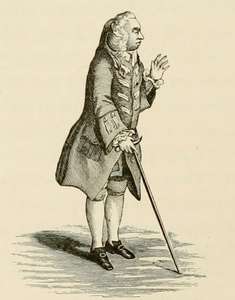
Mr. Foote as Sir Thomas Lofty.
INDEX.
Abington, Mrs., 102;
account of her career, 102-108;
her début, 103;
her marriage, 104;
her qualities as an actress, 104;
Reynolds's comic muse, 105;
and Walpole, 105;
as Lady Teazle, 105;
as Widow Belmour, 107;
her original characters, 107;
her death, 108; her manner and mannerisms, 258;
the "Abington" cap, 258.
Accidents at the theatre, 32, 40.
Actors' loyalty, 38.
Aikin, F., 128.
Aikin, James, 128;
his duel with J. P. Kemble, 197.
Amateurs, noble, 45, 52;
at Drury Lane, 30, 31.
Arnold, S. J., 372.
Audience on the stage, 44.
Audiences of the last half of the 18th century, 30.
Authorship at a low ebb, 348.
Baddeley, Robert, 85;
fights a duel with George Garrick, 85;
his original characters, 136;
bequeaths a cottage to the Drury Lane Fund, 136;
his twelfth cake, 137;
and Foote, 137;
the last actor who wore the uniform of "Their Majesties' Servants," 419.
Baddeley, Mrs., 85;
her death, 86.
Baillie, Joanna, 10.
Bannister, Charles, 309.
Bannister, John, 37, 310;
an admirable actor in every line, 310;
his career, 310-312;
his great part of Walter in "The Children in the Wood," 311;
his original characters, 312;
portraits of him, 312;
as first grave-digger, 382.
Barry, Mrs., accidentally stabs Palmer, 140.
Barry, Mrs. Elizabeth, 294.
Barry, Spranger, 260.
Barsanti, Miss (Mrs. Daly), 82.
Barton, Fanny (See Mrs. Abington), 102.
Beard, John, 11.
Behn, Aphra, 280.
Belfille, Mrs., 94.
Bellamy, George Anne, and the King of Denmark, 36;
account of her career, 88-94;
her birth, 88;
her early career, 90;
her appearance as Monimia, 90;
carried off by Lord Byron, 90;
and Mr. Metham, 91;
her lovers, 91, 92;
her powers as an actress, 92;
her varying fortunes, 93;
her farewell to the stage, 93.
Benefits, 294.
Bensley, William, 256;
as Eustace de St. Pierre, 129;
his excellences, 130;
his retirement, 130.
Bentley, Richard, dramatist, 3;
his "Wishes," 42.
Beresford, Mrs., 95.
Betterton, his dress as Hamlet, 248.
Betty, Master William Henry West, 239;
account of his career, 239-247;
his birth, 239;
appears at Belfast when only eleven years of age, 240;
his popularity in Ireland, 240;
his popularity in Scotland, 240;
praised by Home for his Norval, 241;
in the provinces, 241;
his first appearance in London, 242;
the frantic excitement caused, 242;
as Selim, 243;
presented with Garrick's seal, 244;
flattery from the House of Commons, 244;
the mania declines, 245;
retirement from the stage, 245;
return to the stage, 245;
his comparative failure, 245;
his final retirement, 246;
critical account of him, 246.
Bickerstaffe, 296.
Blanchard, William, 323.
Bland, Dorothy (see Jordan, Mrs.)
Boaden, James, 4;
and Mrs. Powell, 4.
Booth, Barton, his dress as Cato, 249.
Booth, Junius Brutus, 392;
his rivalry with Kean, 392.
Brand, Hannah, 9, 95.
Brent, Miss, singer, 11.
Brereton, William, 129;
and Mrs. Siddons, 174;
his madness, 175;
his death, 175.
Brereton, Mrs. (afterwards wife of John Kemble), 175, 194.
Brooke, Frances, dramatist, 8.
Brown, Anthony, dramatist, 19.
Browne, Dr., 276.
Brunton, Miss, 95.
Brunton, Louisa (Countess of Craven), 221, 325.
Bulkley, Mrs., 135;
her self-assertion, 135;
her career, 136.
Bullock, 297.
Bunn, Mrs., 392.
Burgoyne, General, dramatist, 5.
Byron, Lord, his present to Kean, 394.
Canning, George, 118.
Canning, Mrs., wife of S. Reddish, 118.
Carey, George Saville, 359.
Carey, Henry, 359.
Carey, Nance, 360.
Cargill, Mrs., as Macheath, 11.
Carlisle, Lord, his tragedy, 28.
Catalani, Madame, and the "O. P." riots, 340.
Catley, Anne, 86.
Cautherley, 118.
Centlivre, Mrs., 14.
Chambers, Mary (wife of Edmund Kean), 366.
Chapman, 299.
Charlotte, Queen, at the theatre, 39.
Cherry, 263.
Cibber, Colley, 15, 260.
Cibber, Mrs., 47.
Cibber, Theophilus, and his benefit, 296.
Clarence, Duke of, 39.
Cobham, Mr., 393, 402.
Colman, George, the younger, 5;
his furious attack on Kemble in the preface to the "Iron Chest," 209;
his "John Bull," 229;
his ruffianly conduct at Carlton House, 346.
Congreve, 286.
Conway, W. A., 385.
Cooke, George Frederick, 223;
account of his career, 223-238;
theatricals at school, 224;
early struggles, 225;
quarrel with John Kemble, 225;
his first appearance in London, 226;
rivalry with Kemble, 226, 229;
as Richard III., 226;
his irregularities, 227, 228, 230;
his failure in Hamlet, 228;
his success in Sir Pertinax, 228;
his apologies to audiences, 231;
his visit to America, 231;
his eccentricities there, 231, 233;
his success, 231;
his second marriage, 232;
his mental intoxication, 234;
his last appearance, 235;
his death, 235;
his excellence as an actor, 235;
compared with Kemble, 236;
removal of his body, 236;
his skull, 237;
his monument, 238.
Cooke, Thomas, a dishonest dramatist, 290-294.
Cooper, the last of the Kemble school, 210.
Cork theatre, the, 50-51.
Costume, dramatic, 248.
Covent Garden Theatre burnt, 205, 329;
rebuilt, 337;
the "O. P." riots, 337-345.
Cowley, Mrs., 7.
Craven, Lady, authoress, 53, 54.
Crawford, Mrs., 162, 165;
her costume as Lady Randolph, 254, 255.
Crouch, Mrs., 254.
Cumberland, Richard, 3, 27;
his "Jew," 7;
and Sheridan, 27, 28.
Curtis, Mrs. (sister of Mrs. Siddons), 163, 176.
Daly, Richard, Dublin manager, 83.
Daly, Mrs., 82, 83.
Darby, Miss (Robinson, Mrs.), 108.
Davison, Mrs., 325.
De Camp, Miss, 10, 216;
her youthful experience as a dancer, 216;
her appearance at Drury Lane, 216;
plays Macheath, 217;
her marriage with Charles Kemble, 217;
her retirement from the stage, 217;
returns to the stage for one night, 218;
her characteristics, 218;
as an authoress, 219.
Deighton, actor, 264.
Delpla, 335.
Denmark, King of, at the play, 35.
Dennis, John, 14.
Derby, Lord, and Miss Farren, 100.
Dexter, 59; his carelessness, 60.
Dibdin, Tom, 262, 348.
Dickons, Mrs., 340.
Digges, West, Edinburgh manager, 124;
his death, 129.
Dodd, James, 134;
his great powers as an actor, 134;
as Abel Drugger, 134;
as Sir Andrew Aguecheek, 134;
his death, 135.
Dowton, 323;
as Dr. Cantwell, 323;
as Sir Anthony Absolute, 323;
as Shylock, 389.
Drama denounced by the Eclectic, 331.
Drury, Dr., 371.
Drury Lane, opening of new theatre, 213;
burned down, 329;
rebuilt, 330.
Dryden's prologues, epilogues, and dedications, 280-283.
Ducis, French author, 24.
Duncan, Miss (Mrs. Davison), 325;
as Juliana in the "Honeymoon," 325.
Eclectic Review on the stage, 332.
Edinburgh theatre, the, 123.
Edmiston, Miss, as Jane Shore, 398.
Edwin, John, his popularity, 128;
O'Keeffe's obligations to Edwin's acting, 128;
his original characters, 128;
his death, 128.
Elliston, Robert William, 317;
account of his career, 317-321;
his birth, 317;
with Tate Wilkinson at York, 318;
his success in London, 318;
as Sir Edward Mortimer, 318;
his large experience of management, 318;
his Hamlet, 318-319;
his versatility, 319;
his abilities, 319;
as Duke Aranza, 319;
his loftiness, 320.
Epilogues, 273.
Esten, Mrs., 95, 211, 252.
Etherege, 285.
Farren, Miss Elizabeth (Lady Derby), account of her career, 96-101;
her origin, 96;
her first appearance, 97;
as Lady Hardcastle, 97;
as Lady Townly, 97;
her qualities as an actress, 98;
her original characters, 98;
her farewell to the stage, 100;
her marriage to Lord Derby, 100;
her children, 101.
Fawcett, John, 323, 348;
as Job Thornberry, 323;
as Caleb Quotem, 323.
Fielding, Henry, 16, 289;
his nonchalance, 17.
Fitzgerald, Percy, his "Lives of the Kembles," 176 n.
Fitzhenry, Mrs., 264.
Flecnoe and his critics, 12.
Foote, Samuel, 137;
in Edinburgh, 124;
and Henderson, 147.
Francis, Dr., 232, 403.
Francis, Miss (see Mrs. Jordan).
Freemasons at the play, 298.
French audiences, 55, 56, 60.
Garrick, David, 275;
and Sheridan, 5;
and "The Chinese Festival," 33;
his costume in various parts, 250;
his tomb, 333.
Garrick, Mrs., and Edmund Kean, 382.
Garrick, George, 85.
Gay, John, 14.
George III. at the theatre, 38, 41, 345;
fired at by Hatfield, 40.
George IV. and actors, 346.
Glover, Mrs., 326;
a good actress and a good woman, 326.
Godwin, 351.
Goldsmith and his "Good-natured Man," 21.
Goodfellow, actor, 300.
Grattan, Colley, on Edmund Kean, 407.
Greatheed's "Regent," 27.
Green, Mrs., 84.
Griffiths, Mrs., 8.
Grimaldi, Joseph, 245.
Hale as Charles I., 253.
Hallam killed by Macklin, 67.
Hamilton, Lady, 58.
Hamilton, Mrs., actress, 264.
Harcourt, Lord, on Mrs. Siddons, 172, 173.
Hardy, French dramatist, 26.
Harlequin, a speaking, 44.
Hartley, Mrs., actress, 85.
Hayley, 4, 351.
Haymarket, loss of life at, 39, 40.
Henderson, John, 251, 256;
account of his career, 144-151;
his first appearance at Bath, 144;
his descent, 145;
his first appearance in London, 146;
his success, 146;
as Shylock, 146;
waiting on Foote, 147;
his high aims, 148;
creates a great sensation as Hamlet, 148, 149;
his public readings, 149;
as Falstaff, 150, 152;
as Æsop, 150;
his carefulness, 150;
his death, 151.
Hill, Aaron, 13, 289.
Hippisley, 299.
Holcroft, Thomas, dramatist, 5, 349.
Holland, Charles, 47;
and Miss Pope, 306.
Hollingsworth, a provincial actor, 59.
Holman, 322.
Home, John, 3, 276.
Hoole, as a dramatist, 25.
Huddart, 373.
Hull, Thomas, 321;
establishes the Covent Garden Fund, 321.
Hunt, Leigh, 320, 348.
Inchbald, Mrs. Elizabeth, 8.
Ireland's forged play of "Vortigern," 201.
Jephson, R., his plays, 3;
and Horace Walpole, 3.
Jerrold, Douglas, and Elliston, 320.
Johnstone, John, 133.
Jones, Richard, 324, 325.
Jordan, Mrs., 177, 312;
account of her career, 312-17;
her birth, 312;
her early experiences, 313;
her versatility, 313;
her appearance in London, 313;
her parts, 314;
as Lady Contest, 314;
her connection with the Duke of Clarence, 314;
her excellence as a comedian, 315;
reputed marriage with Ford, 315;
her retirement, 316;
her sad death, 316;
her children ennobled, 317.
Kean, Charles, 409;
becomes an actor, 409, 410;
plays with his father on the last appearance of the latter, 414;
his goodness to his mother, 416.
Kean, Edmund, 315;
his monument to G. F. Cooke, 237;
his carelessness in costume as Orestes, 256;
his origin, 358;
claimed to be the son of the Duke of Norfolk, 360 n.;
his birth, 361;
as a Cupid at three years old, 361;
as an imp in "Macbeth," 361;
his early struggles, 362;
plays before the king, 364;
plays with Mrs. Siddons, 364;
his marriage, 366;
his privations, 366, 367, 370;
programme of his benefit at Waterford, 369;
his success at Exeter, 371;
engaged at Drury Lane, 372;
his first appearance, 373;
plays Shylock, 373;
account of his triumph, 374-377;
as Richard III., 379, 412;
the critics on his Richard, 379;
description of his Richard, 379-382;
characteristics of his Hamlet, 382, 383;
his Othello, perhaps his greatest part, 384;
his Iago, 384;
his enormous drawings, 385;
saves Drury Lane from bankruptcy, 385;
characters played in his second season, 386;
as Zanga, 386;
his Sir Giles Overreach, 390;
as Bertram, 392;
his contest with J. B. Booth, 393;
as Timon, 393;
as King Lear, 395, 400;
as Brutus in "Brutus," 396;
as Coriolanus, 396;
plays at Liverpool, 397;
his visit to America in 1820, 397;
his struggle with Young, 399;
his dissipation, 400, 401;
the scandal of the Cox case, 401;
hooted by his audiences, 401, 402;
again visits America, 402;
Dr. Francis's account of his eccentricities there, 403;
admitted a member of the tribe of the Hurons, 405;
Alantenaida, 406;
his return to England, 406;
his breakdown, 407;
his hopeless failure in Ben Nazir, 407;
his last attempt at a new character, 412;
his last appearance, 414, 415;
his death, 415;
extenuating circumstances, 416, 417.
Kean, Mrs., and Moore, 378.
Kemble, Anne, 163, 176.
Kemble, Charles, 210, 211, 212, 263, 411;
first appearance in London, as Malcolm, 213;
as Laertes, 213;
as Cassio, 213;
as Faulconbridge, 213;
in Macduff, 213;
as Edgar, 213;
as Jaffier, 214;
as Hamlet, 214;
compared with Young, 214, 215;
a bad Falstaff, 215;
a perfect Mercutio, 215;
as Young Mirabel, 215;
his Benedick, 216;
his wife, 216;
his departure from the stage, 218;
he returns for a few nights, 218;
as a reader, 219;
an author, 219;
his deafness, 219.
Kemble, Mrs. C., 10, 216;
her youthful experience as a dancer, 216;
her appearance at Drury Lane, 216;
plays Macheath, 217;
her marriage with Charles Kemble, 217;
her retirement from the stage, 217;
returns to the stage for one night, 218;
her characteristics, 218;
as an authoress, 219.
Kemble, Elizabeth, 157, 176, 192.
Kemble, Fanny, 218.
Kemble, Frances, 157, 176, 192.
Kemble, Henry, 212.
Kemble, John M., 219.
Kemble, John Philip, 57, 220-222, 260;
his defence of Miss Phillips, 50;
account of his career, 189-210;
his birth and early life, 189;
as an author, 190;
first appearance in London, as Hamlet, 191;
as Macbeth, 193;
as Lear, 193;
married to Mrs. Brereton, 194;
becomes manager of Drury Lane, 196;
as Henry V., 197;
duel with James Aikin, 197;
becomes part proprietor of Covent Garden, 198;
his assiduity, 199;
in the "Castle Spectre," 199;
as Rolla, 199;
Pitt's opinion of him, 199, 200;
his best characters, 200, 203;
his Roman parts, 200, 209;
and the Irelands' forged play of "Vortigern," 201;
his Charles Surface, 204;
the princely conduct of the Duke of Northumberland when Covent Garden Theatre was burned, 205;
as Othello, 206;
as Hamlet, 206;
his successful parts, 208;
his failure in Colman's "Iron Chest," 209;
his farewell to the stage, 210, 392;
his death, 210;
his costume in various parts, 251, 255;
specially attacked by the "O. P." rioters, 337-345.
Kemble, Roger, father of John Philip Kemble, 154;
plays in London, 154.
Kemble, Mrs. Roger, 154.
Kemble, Sarah (see Mrs. Siddons).
Kemble, Stephen, 191, 210, 211, 373;
manager at Edinburgh, 211;
as Othello, 211;
as Falstaff, 211;
his death, 212.
Kemble family specially attacked by the "O. P." rioters, 338.
King, Thomas, 54;
as a speaker of prologues, 279;
his original characters, 301, 302;
his retirement, 302;
his love of play, 302.
Knowles, Sheridan, 352, 357, 367;
his training, 368;
an actor, 368;
an author, 368.
Lamb, Charles, 320, 334, 351.
Lee, Sophia, 9.
Lessingham, Mrs., actress, 62.
Lewes, Lee, 129.
Lewis, "Monk," 11.
Lewis, William, 251, 263, 348;
his dress as Earl Percy, 256;
his original characters, 303, 304;
as the Copper Captain, 303, 304;
his death, 303;
his excellence in Morton and Reynolds's comedies, 304.
Licences, 418.
Liston, John, 324;
the peculiarity of his comic acting, 324;
his desire to play tragedy, 324.
Litchfield, Mrs., 309.
Liverpool audience, 59.
Macklin, Charles, 4;
his "Man of the World," 6;
account of his career, 63;
his parentage, 63, 65;
his great age, 64;
as Monimia at the age of nine, 65;
his first appearance, 66;
as Snip, 67;
kills Hallam, 67;
his marriage, 68;
his Shylock, 68-70, 75;
his "Henry VII.," 70;
Pope's opinion of him, 70;
in Dublin, 71;
as Mercutio, 71;
his opinion of Garrick and Barry as Romeo, 71;
his retirement from the stage to keep a tavern, 72;
his "British Inquisition," 72;
his reappearance on the stage, 73;
as Sir Archie Macsarcasm, 73;
as Macbeth, 73;
his daughter, 72, 81, 82;
as Sir Pertinax Macsycophant, 73;
failure of his memory, 74;
his death, 76;
his characteristics, 76;
his objection to Garrick, 77;
antagonism with Quin, 77;
his character, 80;
his original and principal characters, 80;
his costume in various parts, 250.
Macklin, Mrs., 68.
Macklin, Miss, 72, 81;
her death, 82.
Macready, W. C., 392, 400;
his Virginius, 396, 397.
Mason, William, 3.
Masterton, dramatist, 350.
Mathews, Charles, 323;
his extraordinary ability as a mimic, 323;
his M. Malet, 323.
Mattocks, Mrs., 308;
her career, 308, 309;
her characters, 309.
Maturin, 354-357.
Melmoth, Mrs., actress, 265.
Miller, James, dramatist, 19.
Milman, 357.
Mistakes on the stage, 263.
Mitchell and his "Highland Fair," 25.
Montagu, Mrs., actress, 61.
Moody, John, 130;
as Major O'Flaherty, 131, 132;
the best Irish actor of his time, 131;
Churchill on Moody, 132;
a market gardener, 132;
his original characters, 133.
Moore and Mrs. Kean, 378.
More, Hannah, 7.
Mossop, Henry, 259;
and the Major, 48.
Motteux, P. A., 288.
Munden, Joseph S., 322, 348;
his wonderful powers of grimace, 322;
the breadth of his acting, 322;
his parsimony, 323.
Murphy, Arthur, 4, 289.
Murray, Charles, actor, 267.
O'Neill, Miss, 221, 387;
her first opportunity, 388.
"O. P." riots, 337-345.
Opera, progress of, 10.
Otway, 283.
Owen, John, actor, 267.
Owenson, 130.
Palmer, John, 139;
account of his career, 139-143;
accidentally stabbed by Mrs. Barry, 148;
his endeavours to open the Royalty Theatre, 140;
his original characters, 140;
his coolness, 140;
his death on the stage, 141, 142;
the original Joseph Surface, 142.
Parsons, William, 137;
his impudent "gagging," 37;
a great comedian, 138;
as Foresight, 138;
as Skirmish, 138;
as Corbaccio, 138;
his last character, 138;
his death, 139;
story about his wife, 139.
Patents, 418.
Phelps, Samuel, his worthy support of the legitimate drama, 419.
Phillips, Miss (Mrs. Crouch), 50.
Plays, list of, from 1800 to 1813, 327-330.
Pope, Alexander, 14;
on Macklin's Shylock, 70.
Pope, Mrs. (Miss Younge), 102.
Pope, Miss, 74, 304;
account of her career, 304-308;
her retirement, 304;
her original parts, 305;
Churchill's opinion of her, 305, 306;
her love affair with Holland, 306;
her last illness and death, 308.
Powell, George, and the Spectator, 294.
Powell, Mrs., actress, 58.
Powell, Thomas, a nervous author, 20.
Pritchard, Mrs., 172.
Proctor, B. W. (Barry Cornwall), 352, 357.
Prologues, 273.
Purvor, Grace (Mrs. Macklin), 67.
Pye, poet laureate, 2.
Quin, James, 47, 259, 263;
and "Fatal Retirement," 19;
antagonism with Macklin, 77;
his carelessness in costume, 253.
Rae, 372, 374.
Raymond, 373.
Reddish, Samuel, 115;
account of his career, 115-122;
his first appearance, 116;
his characters, 116;
as Edgar in "King Lear," 117;
as Posthumus, 117;
accidentally stabs Smith, 117;
his marriage, 118;
his loss of memory, 118;
his sad mental condition, 119;
his last appearance, 119;
in a lunatic asylum, 121;
his death, 122.
Reddish, Mrs., 118.
Reynolds, Frederic, 348.
Riot at Drury Lane, 33.
Riots, 51.
Robinson, Mrs. ("Perdita"), 108;
account of her career, 108-114;
her marriage, 108;
as Juliet, 109;
her excellences, 109;
as Perdita, 109;
her amour with the Prince of Wales (George IV.), 110, 111;
her death, 111;
her character, 111;
her taste in dressing, 112.
Romantic drama, 11.
Ross, David, 122;
his indolence, 122;
the first patentee in Edinburgh, 123;
as Barnwell, 124;
his death, 125.
Rowe, Nicholas, and his "Biter," 12.
Sainville, Monsieur and Madame, 101.
Satchell, Miss, as Desdemona, 211.
Saurin, French dramatist, 18, 23.
"School for Scandal," 5.
Settle, Elkanah, 14.
Shadwell, 287.
Sheil, Lalor, 352, 354.
Shenstone, 276.
Sheridan, R. B., 5, 27, 277;
and "The Castle Spectre," 12;
end of his connection with Drury Lane, 330.
Shuter, Edward, 61.
Siddons, Mrs., 152, 220-222, 262;
account of her career, 153-188;
her birth, 153;
her parentage, 154;
on the stage as a child, 155;
her strolling experiences, 155, 156;
her marriage, 157;
engaged by Garrick, 158;
her failure in London, 159;
a great favourite in Bath, 160;
her second appearance in London, 160;
her triumphant success, 160, 161;
as Jane Shore, 161;
as Calista, 161;
as Belvidera, 162;
as Zara, 162;
and Mrs. Crawford, 162;
her enemies, 163, 170, 175;
in Ireland, 163, 166;
as Isabella in "Measure for Measure," 164;
as Constance, 164;
as Lady Randolph, 165;
appointed preceptress to princesses, 165;
her portrait by Reynolds, 166;
in Scotland, 166;
her enthusiastic reception, 167;
as Margaret of Anjou, 171;
as Lady Macbeth, 171;
her great triumph, 171;
as Desdemona, 176;
not successful as Rosalind, 177;
as Hermione, 178;
as Ophelia, 178;
as a comedian, 179;
her opinion of Greatheed's "Regent," 180;
as Queen Katherine, 181;
as Volumnia, 182;
in "Edwy and Elgiva," 182;
in "Edward and Eleanora," 182;
faints while playing Arpasia, 183;
her robe takes fire, 184;
her retirement, 185;
her last appearance, 186;
her high character, 187;
her death, 188;
her costume, 251, 252;
specially attacked by the "O. P." rioters, 337-345
Siddons Henry, 228.
Siddons fever, the, 167.
Smith, Miss (Mrs. Bartley), 382;
a rival to Mrs. Siddons, 221.
Smith, "Gentleman," 125;
stabbed by Reddish, 117;
his career, 125;
his original characters, 125;
his remarkable marriages, 126;
his retirement, 126.
Somerville, Miss (Mrs. Bunn), 392.
Southerne, 15, 284.
Sowerby, 382.
Spiller's benefit for himself and his creditors, 295.
Stage costume, 248-258.
Stage tricks, 258.
Strollers, 267, 268.
Strolling managers, 268.
Styles, Rev. Dr., 335.
Suett, Richard, 245;
and his collection of wigs, 254;
his great powers as a comedian, 302;
his love of drink, 303.
Talma, 24.
Terry, Daniel, 385.
Theobald, Lewis, 14.
Tidswell, Miss, 362, 398.
Tokely, 373.
Tracy, dramatist, 16.
Tricks, stage, 258.
Twiss's Verbal Index to Shakespeare, 331.
Vanbrugh, Sir John, 15.
Walker, Thomas, 10.
Wallace, Lady, 9.
Wallack, 396.
Walpole, Horace, as a dramatist, 22;
on theatrical genius, 1, 2;
on Miss Younge's acting, 3;
on the "School for Scandal," 5;
on the "Man of the World," 6;
on the Delavals' amateur performances, 31;
on the "Wishes," 42;
on the "Miniature Picture," 53;
on Mrs. Abington, 105;
on Mrs. Siddons, 169, 174, 206;
on Kemble, 206; on John Bannister, 311;
on Mrs. Jordan, 314.
Walpole, Sir Robert, 37.
Walstein, Miss, 387;
strikes for higher salary, 388.
Webb, Mrs., 96.
Wells, Mrs. (Mrs. Sumbell), 95, 265.
Whalley. Dr., 26.
Whitelock, Mrs. (sister of Mrs. Siddons), 94.
Wignell, actor, 266, 274.
Wilkinson, Tate, 126;
his extraordinary power as a mimic, 127;
patentee at York, 127.
Wilson, Mrs., 94.
Woodward, Henry, 299;
his dress as Mercutio, 249.
Wycherley, 285.
Yates, Frederick, 396.
Yates, Richard, 299;
his characteristics as an actor, 125;
his parsimony, 125.
Yates, Mrs., her career, 86-88;
as Medea, 87;
in strong-minded heroines, 87;
her Violante, 87;
her death, 88.
Young, Charles Mayne, 260, 324;
his costume in various parts, 257;
of the Kemble school, 325;
his great contest with Kean, 399.
Young, Dr. E., 276, 287.
Younge, Miss, 3, 177;
her withdrawal from the stage, 102.
THE END.
PRINTED BY BALLANTYNE, HANSON AND CO.
EDINBURGH AND LONDON.
LONDON,
14 KING WILLIAM STREET, STRAND, W.C.
JOHN C. NIMMO'S
AUTUMN LIST OF NEW BOOKS
FOR
OCTOBER 1887.
A NEW ILLUSTRATED WORK BY THE AUTHOR OF
"FLEMISH INTERIORS."
In large crown 8vo. With One Hundred Illustrations by R. Caulfield
Orpen. Cloth elegant, gilt top, price 7s. 6d.
"De Omnibus Rebus."
An Old Man's Discursive Ramblings on the Road of
Everyday Life.
By the Author of "Flemish Interiors."
With One Hundred Illustrations by R. Caulfield Orpen.
Note.—These pages are written in the character of a shrewd, observant,
and perhaps satirical, but not ill-natured, old bachelor who knows how to
find in his journeyings, by omnibus or otherwise, matter for reflection and
comment, and who communicates familiarly his impressions of men and
things, turning them about so as to get at their humorous, their practical,
and their pathetic aspect. With these he mingles past and present experiences
of life, congenial episodes, and representative types of character as
they suggest themselves to his memory; but his gossip is always popular
in character, bearing on subjects of social economy and contemporary
ethics necessarily interesting to our common humanity.
New Historical Work by F. G. Lee, D.D.
Large crown 8vo, cloth, price 8s. 6d.
REGINALD POLE,
CARDINAL ARCHBISHOP OF CANTERBURY.
An Historical Sketch. With an Introductory Prologue and
Practical Epilogue by
FREDERICK GEORGE LEE, D.D.
With an Etched Portrait of Cardinal Pole.
Note.—This volume, besides dealing with the life and character of
Cardinal Pole, will specially set forth the nature of his great work as an
ecclesiastical statesman and diplomatist,—unpublished details of which
will be provided from the Archives of the Vatican, his Register at Lambeth,
and various publications and letters of himself and his contemporaries.
Incidentally, the further policy of Queen Mary and her great statesman,
Bishop Gardiner, will be dealt with; as also the personal characteristics of
the Queen herself, and some of the chief Englishmen of Pole's era.
New Volumes of the Elizabethan Dramatists Series.
In Two Volumes, post 8vo, cloth, price 7s. 6d. per vol. net.
Also fine large paper copies, medium 8vo, cloth.
The Works of George Peele.
Edited by A. H. BULLEN, B.A.
Note.—A new Library Edition of Peele's works is needed; for
Pickering's beautiful volumes are rare and costly. In the present edition
some interesting facsimiles of title-pages, &c., will be given.
A New Volume of Elizabethan Lyrics.
Post 8vo, hand-made paper, 750 copies, each numbered, price 10s. 6d. net.
Also 250 large paper copies, in half German calf, each numbered.
More Lyrics from the Song-Books of
the Elizabethan Age.
Edited by A. H. BULLEN, B.A.
Note.—Many of the poems in this collection are from unique books
preserved in the British Museum, the Bodleian Library, the Royal
College of Music, and Mr. Halliwell-Phillipps' Library at Hollingbury
Copse. Others are printed, for the first time, from MSS. The Editor
has been careful to include only such songs as are "choicely good."
Small 4to, Two Volumes, handsomely bound in half-German
calf, gilt top, price 36s. net.
Also 100 copies on fine super royal 8vo paper.
The Life of Benvenuto Cellini.
NEWLY TRANSLATED INTO ENGLISH.
By JOHN ADDINGTON SYMONDS.
With Portrait and Eight Etchings by F. Laguillermie.
Also Eighteen reproductions of the Works of the Master, printed
in Gold, Silver, and Bronze.
500 copies of this Edition printed for England and 250
for America.
Note.—A book which the great Goethe thought worthy of
translating into German with the pen of Faust and Wilhelm
Meister, a book which Auguste Comte placed upon his very
limited list for the perusal of reformed humanity, is one with
which we have the right to be occupied, not once or twice,
but over and over again. It cannot lose its freshness. What
attracted the encyclopædic minds of men so different as Comte
and Goethe to its pages still remains there. This attractive or
compulsive quality, to put the matter briefly, is the flesh and
blood reality of Cellini's self-delineation. A man stands before
us in his Memoirs unsophisticated, unimbellished, with all his
native faults upon him, and with all his potent energies portrayed
in the veracious manner of Velasquez, with bold strokes
and animated play of light and colour. His autobiography is
the record of action and passion. Suffering, enjoying, enduring,
working with restless activity; hating, loving, hovering
from place to place as impulse moves him; the man presents
himself dramatically by his deeds and spoken words, never by
his pondering or meditative broodings. It is this healthy externality
which gives its great charm to Cellini's self-portrayal,
and renders it an imperishable document for the student of
human nature.
NEW ILLUSTRATED EDITION OF DR. DORAN'S GREAT WORK.
In Three Volumes, demy 8vo, Roxburghe binding,
gilt top, price 54s. net.
Also large paper copies, royal 8vo, with Portraits in duplicate.
"THEIR MAJESTIES' SERVANTS."
Annals of the English Stage
FROM
THOMAS BETTERTON TO EDMUND KEAN.
By DR. DORAN, F.S.A.
Edited and Revised by R. W. Lowe from Author's
Annotated Copy.
With Fifty Copperplate Portraits and Eighty Wood Engravings.
Note.—The following are some of the chief features of this
new edited and revised edition of Dr. Doran's well-known
work.
It is illustrated for the first time with fifty newly engraved
copperplate portraits of the leading and best known actors and
actresses, all of which are printed as India proofs.
There are also fifty-six illustrations, newly engraved on wood,
printed on fine Japanese paper, and mounted at the head of
each chapter, as well as some twenty or more character illustrations,
also newly engraved on wood, and printed with the
text at end of the chapters.
There are numerous new and original footnotes given, as
well as a copious and exhaustive Index to each volume.
Besides the demy 8vo edition, a limited number will be
printed on royal 8vo, fine deckle-edged paper, with a duplicate
set of the fifty portraits, one on Japanese paper and the
other on plate paper, as India proofs.
Each of these copies will be numbered.
A Bibliography of Theatrical Literature.
In demy 8vo, 400 pages, cloth, price 18s. net. Also, One Hundred Copies
on fine deckle-edge royal 8vo paper, each numbered.
A BIBLIOGRAPHICAL ACCOUNT
OF
English Theatrical Literature
FROM
THE EARLIEST TIMES TO THE PRESENT DAY.
By ROBERT W. LOWE.
Note.—There is as yet no Bibliography of the general literature of the
stage. Plays have been catalogued many times, and some of our greatest
bibliographers have directed their attention to Shakespearian literature;
but no attempt has been made to give even the baldest catalogue of the
large and curious mass of books relating to the History of the Stage, the
Biography of Actors and Actresses, the Controversy regarding the Influence
of the Stage, the numerous curious Theatrical Trials, and the many
scandalous attacks on the personal character of celebrated performers. In
the last two classes especially there are many curious pamphlets dealing
with the strangest scandals, and often containing the most disgraceful
accusations, of which no account is to be found except in the originals
themselves, which, having been in many cases suppressed, are of extreme
rarity.
The present work is intended to supply in some measure the want
which has been felt by all writers on theatrical subjects, as well as by all
collectors of theatrical books. It consists of about 2000 titles, the great
majority of which are taken directly from the works described. These
will be arranged alphabetically, with exhaustive cross-references. Notes
regarding each actor and actress will be given, and also an account of the
occurrences to which particular works refer, special attention being paid
to the less known and more curious pamphlets. Thus, it is hoped, the
work will have a historical as well as bibliographical value, and will
form a History of the Stage, especially in those details of which regular
histories take little or no cognisance. Plays will be excluded, except
where they have prefaces, &c., of historical or controversial interest; and
of Shakespeariana, only such works will be included as relate to the
performance of Shakespeare's plays or the representation of his characters
by particular actors.
Quotations of prices at recent famous sales will be given, and the rarity
of scarce books will be pointed out.
Third Edition, newly Revised and Corrected, and greatly Enlarged, in 2
vols. medium 8vo, cloth, Three Hundred Engravings and Twelve
Full-Page Plates, price 21s.
The Rosicrucians:
THEIR RIGHTS AND MYSTERIES.
By HARGRAVE JENNINGS.
Allen's Indian Mail.
"Valuable, interesting, and instructive, the work teaches how dangerous it is
to condemn what is not understood, or to criticise what is imperfectly realised.
Liberality of judgment should be the motto of mankind in these days of intelligence
and enlightenment, and a study of the mysterious will clear the path in
this direction from many of the notions conceived in intolerance and nurtured
in hardness of heart. Read, gentle reader, and be wise!"
Uniform with A. H. Bullen's "Lyrics from the Song-Books of the Elizabethan Age."
Post 8vo, hand-made paper, 500 copies, each numbered, price 10s. 6d.
net. Also 250 copies, large paper, in half-German calf, each numbered.
England's Helicon.
A Collection of Lyrical Poems published in 1600.
Edited by A. H. BULLEN.
The Spectator.
"With what pleasure would Leigh Hunt, Hazlitt, or Charles Lamb have
taken into their hands this new edition of the Elizabethan song-book, 'England's
Helicon;' and how gladly would they acknowledge the influence of sixty
years, the advance in taste, themselves its leaders, which will win for such a
book delight and admiration, rather than 'patronage!' The book consists of
a collection of lyrical and pastoral poems, and the modern editor, who, one
need hardly say, has done his work with perfect care and taste, has prefaced the
poems with an introduction telling us all we want to know about almost every
one of them."
Imperial 8vo, half-bound crushed morocco, price 21s.
Reynard the Fox.
After the German Version of Goethe.
By THOMAS JAMES ARNOLD, Esq.
With Sixty Illustrations from the Designs of Wilhelm von Kaulbach,
and Twelve India Proof Steel Engravings by Joseph Wolf.
Note.—One of the specialities of the present edition consists in the illustrations,
faithfully engraved by English artists from the designs of Kaulbach, as
well as twelve clever full-page steel engravings by Augustus Fox, from the
drawings of Joseph Wolf.
Saturday Review.
"We are more concerned with the engravers' skill, the veracity with which
Kaulbach's rich fancy and racy humour are reproduced, together with the
congenial spirit of Mr. Wolf's clever drawings, and in these essential particulars
the present edition is worthy of warm commendation."
THE NEW EDITED AND COMPLETE EDITIONS
OF
The Elizabethan Dramatists.
This is the first instalment towards a collective edition of the Dramatists
who lived about the time of Shakespeare. The type will be distributed
after each work is printed.
One of the chief features of this New Edition of the Elizabethan Dramatists,
besides the handsome and handy size of the volumes, will be the fact
that each Work will be carefully edited and new notes given throughout.
Algernon Charles Swinburne
(IN THE NINETEENTH CENTURY, January 1886)
ON THE
Elizabethan Dramatists.
"If it be true, as we are told on high authority, that the greatest glory
of England is her literature, and the greatest glory of English literature is
its poetry, it is not less true that the greatest glory of English poetry lies
rather in its dramatic than its epic or its lyric triumphs. The name of
Shakespeare is above the names even of Milton and Coleridge and Shelley;
and the names of his comrades in art and their immediate successors are
above all but the highest names in any other province of our song. There
is such an overflowing life, such a superb exuberance of abounding and
exulting strength, in the dramatic poetry of the half century extending from
1590 to 1640, that all other epochs of English literature seem as it were but
half awake and half alive by comparison with this generation of giants and
of gods. There is more sap in this than in any other branch of the national
bay-tree; it has an energy in fertility which reminds us rather of the forest
than the garden or the park. It is true that the weeds and briars of the
underwood are but too likely to embarrass and offend the feet of the rangers
and the gardeners who trim the level flower-plots or preserve the domestic
game of enclosed and ordered lowlands in the tamer demesnes of literature.
The sun is strong and the wind sharp in the climate which reared the fellows
and the followers of Shakespeare. The extreme inequality and roughness
of the ground must also be taken into account when we are disposed,
as I for one have often been disposed, to wonder beyond measure at the
apathetic ignorance of average students in regard of the abundant treasure
to be gathered from this widest and most fruitful province in the poetic
empire of England. And yet, since Charles Lamb threw open its gates to
all comers in the ninth year of the present century, it cannot but seem
strange that comparatively so few should have availed themselves of the
entry to so rich and royal an estate. Mr. Bullen has taken up a task than
which none more arduous and important, none worthier of thanks and
praise, can be undertaken by any English scholar."
Volumes now Ready of the new Edited and Complete
Editions of the Elizabethan Dramatists.
Post 8vo, cloth. Published price, 7s. 6d. per volume net; also large
fine-paper edition, medium 8vo, cloth.
The following are Edited by A. H. Bullen, B.A.:—
| THE WORKS OF GEORGE PEELE. | Two Volumes. |
| THE WORKS OF JOHN MARSTON. | Three Volumes. |
| THE WORKS OF THOMAS MIDDLETON. | Eight Volumes. |
| THE WORKS OF CHRISTOPHER MARLOWE. | Three Volumes. |
Others in active preparation.
SOME PRESS NOTICES.
Athenæum.—"Mr. Bullen's edition deserves warm recognition. It is intelligent,
scholarly, adequate. His preface is judicious. The elegant edition of
the Dramatists of which these volumes are the first is likely to stand high in
public estimation.... The completion of the series will be a boon to bibliographers
and scholars alike."
Saturday Review.—"Mr. Bullen has discharged his task as editor in all
important points satisfactorily, his introduction is well informed and well
written, and his notes are well chosen and sufficient.... We hope it may
be his good fortune to give and ours to receive every Dramatist, from Peele to
Shirley, in this handsome, convenient, and well-edited form."
The Spectator.—"Probably one of the boldest literary undertakings of our
time, on the part of publisher as well as editor, is the fine edition of the Dramatists
which has been placed in Mr. Bullen's careful hands; considering the comprehensiveness
of the subject, and the variety of knowledge it demands, the
courage of the editor is remarkable."
Notes and Queries.—" ... Appropriately, then, the series Mr. Bullen edits
and Mr. Nimmo issues in most attractive guise is headed by Marlowe, the
leader, and in some respects all but the mightiest spirit, of the great army of
English Dramatists."
The Academy.—"Mr. Bullen is known to all those interested in such things
as an authority on most matters connected with old plays. We are not surprised,
therefore, to find these volumes well edited throughout. They are not
overburdened with notes."
Scotsman.—"Never in the history of the world has a period been marked
by so much of literary power and excellence as the Elizabethan period; and
never have the difficulties in the way of literature seemed to be greater. The
three volumes which Mr. Nimmo has issued now may be regarded as earnests of
more to come, and as proofs of the excellence which will mark this edition of
the Elizabethan Dramatists as essentially the best that has been published.
Mr. Bullen is a competent editor in every respect."
The Standard.—"Throughout Mr. Bullen has done his difficult work remarkably
well, and the publisher has produced it in a form which will make
the edition of early Dramatists of which it is a part an almost indispensable
addition to a well-stocked library."
Pall Mall Gazette.—" ... If the series is continued as it is begun, by
one of the most careful editors, this set of the English Dramatists will be a
coveted literary possession."
Daily Telegraph.—"The introduction to this new edition of Marston is of
exceeding interest, and is honourable to the earnest spirit in which Mr. Bullen
is steadfastly pursuing the object set before him in this notable series."
Standard Historical Works.
Twelve Volumes, demy 8vo, cloth, uncut edges, price £5, 5s. net;
also in Tree calf, gilt top, Rivière's binding.
THE WORKS OF
The Right Hon. Edmund Burke.
With Engraved Portrait from the Painting
By Sir JOSHUA REYNOLDS.
Carefully Revised and Collated with the Latest Editions.
Note.—The publication of this Complete Library Edition
of the Writings and Speeches of a great Writer and Orator,
whose works have been so frequently quoted of late in the British
Houses of Parliament, the publisher feels may be opportune to
many readers and admirers of one of the greatest of the sons of
men. Viewed in the light of the present age, how great is our
admiration of that foresight which foretold, and that wisdom which
would have averted, the storms which menaced the peace and well-being
of his country! His public labours present a continuous
struggle against the stupidity, the obstinacy, and the venality of
the politicians of his day.
So long as virtue shall be beloved, wisdom revered, or genius
admired, so long will the memory of this illustrious exemplar of
all be fresh in the world's history; for human nature has too
much interest in the preservation of such a character ever to
permit the name of Edmund Burke to perish from the earth.
CONTENTS.
Vindication of Natural Society.
The Sublime and Beautiful.
Observations on a Late Publication
on "The Present State of the
Nation."
Thoughts on the Cause of the Present
Discontents.
Reflections on the Revolution in
France.
Thoughts on French Affairs.
Thoughts and Details on Scarcity.
Hints for an Essay on the Drama.
An Essay towards an Abridgment
of the English History.
Papers on India.
Articles of Charge against Warren
Hastings.
Speeches in the Impeachment of
Warren Hastings.
Miscellaneous Speeches.
Letters.
Index, &c.
Medium 8vo, fine paper, with Four Etched Portraits, &c., cloth,
21s. net.
The Autobiography of Edward,
LORD HERBERT OF CHERBURY.
With Introduction, Notes, Appendices, and a
Continuation of the Life.
By SYDNEY L. LEE, B.A., Balliol College, Oxford.
Notes and Queries.
"Lord Herbert's autobiography is an absolute masterpiece, worthy of the
place assigned it by Mr. Swinburne among the best one hundred books.
Quite fascinating are the records of adventure Lord Herbert supplies, and the
book, when once the preliminary statement of pedigree, &c., is got over, will
be read to the last line by every reader of taste. A new lease of popularity is
conferred upon it by the handsome and scholarly reprint Mr. Lee has given to
the world. The volume itself belongs to the series of library reprints of Mr.
Nimmo, which are simply the most attractive of the day. Mr. Lee, meanwhile,
has executed in the most scrupulous, careful, and competent manner the task
of editing."
Medium 8vo, fine paper, with Four Etched Portraits, &c., cloth,
21s. net.
The Life of William Cavendish,
DUKE OF NEWCASTLE,
To which is added the True Relation of My Birth,
Breeding, and Life.
By MARGARET, DUCHESS OF NEWCASTLE.
Edited by C. H. FIRTH, M.A.
Saturday Review.
"The book is, without doubt, a pleasant one. In the midst of the stony-hearted
Restoration, its naive enthusiasm, its quaint and embroidered eloquence,
its flavour of a bygone day, give it a curious charm. It is like a Shirley
flourishing on into the age of Shadwell and Etherege."
The Scotsman.
"It has a distinct value as a contemporary picture of the life, modes of
thought, and habits of a great Royalist nobleman, who played a prominent
part in some of the most memorable episodes of English history."
Medium 8vo, fine paper, with Ten Etched Portraits, &c., cloth,
Two Volumes, 42s. net.
MEMOIRS OF THE LIFE OF COLONEL
HUTCHINSON.
By his Widow, LUCY.
Revised and Edited by CHARLES H. FIRTH, M.A.
Athenæum.
"Is an excellent edition of a famous book. Mr. Firth presents the 'Memoirs'
with a modernised orthography and a revised scheme of punctuation. He
retains the notes of Julius Hutchinson, and supplements them by annotations—corrective
and explanatory—of his own. Since their publication in 1805, the
'Memoirs' have been a kind of classic. To say that this is the best and fullest
edition of them in existence is to say everything."
Medium 8vo, fine paper, Roxburghe binding, gilt top, and
Two Etchings, price 15s.
A Chronicle History of the Life and
Work of William Shakespeare.
PLAYER, POET, AND PLAYMAKER.
By F. G. FLEAY, M.A.
From Professor A. W. Ward's Preface to the Second Edition
of Marlowe's "Dr. Faustus."
"Mr. Fleay's new Life of Shakespeare will, in my opinion, before long be
acknowledged as one of the most important works on the history of the Elizabethan
drama which this age has produced."
Extract from a Letter to the Author from Dr. H. H. Furness.
"The man himself was always unreal to me, and I never could bring myself
to believe that he ever really existed. But your book has left upon me the
impression, as deep as it is strange, that such a man did really live, and that
he belonged to the noble army of workers.
"I had confidence in you and followed holding your hand, at times lost in
wonder and admiration over the miraculous memory and indefatigable research
of my guide."
Copyright Edition, with Ten Etched Portraits. In Ten Vols., demy 8vo,
cloth, £5, 5s. net.
Lingard's History of England.
FROM THE FIRST INVASION BY THE ROMANS TO THE
ACCESSION OF WILLIAM AND MARY IN 1688.
By JOHN LINGARD, D.D.
This New Copyright Library Edition of "Lingard's History of England,"
besides containing all the latest notes and emendations of the Author, with
Memoir, is enriched with Ten Portraits, newly etched by Damman, of the
following personages, viz.:—Dr. Lingard, Edward I., Edward III., Cardinal
Wolsey, Cardinal Pole, Elizabeth, James I., Cromwell, Charles II.,
James II.
The Times.
"No greater service can be rendered to literature than the republication, in
a handsome and attractive form, of works which time and the continued
approbation of the world have made classical.... The accuracy of Lingard's
statements on many points of controversy, as well as the genial sobriety of his
view, is now recognised."
The Tablet.
"It is with the greatest satisfaction that we welcome this new edition of Dr.
Lingard's 'History of England.' It has long been a desideratum.... No
general history of England has appeared which can at all supply the place of
Lingard, whose painstaking industry and careful research have dispelled many
a popular delusion, whose candour always carries his reader with him, and
whose clear and even style is never fatiguing."
The Spectator.
"We are glad to See that the demand for Dr. Lingard's England still continues.
Few histories give the reader the same impression of exhaustive study.
This new edition is excellently printed, and illustrated with ten portraits of the
greatest personages in our history."
Dublin Review.
"It is pleasant to notice that the demand for Lingard continues to be such
that publishers venture on a well-got-up library edition like the one before us.
More than sixty years have gone since the first volume of the first edition was
published; many equally pretentious histories have appeared during that
space, and have more or less disappeared since, yet Lingard lives—is still a
recognised and respected authority."
The Scotsman.
"There is no need, at this time of day, to say anything in vindication of the
importance, as a standard work, of Dr. Lingard's 'History of England.' ...
Its intrinsic merits are very great. The style is lucid, pointed, and puts no
strain upon the reader; and the printer and publisher have neglected nothing
that could make this-what it is likely long to remain—the standard edition of
a work of great historical and literary value."
Daily Telegraph.
"True learning, untiring research, a philosophic temper, and the possession
of a graphic, pleasing style were the qualities which the author brought to his
task, and they are displayed in every chapter of his history."
Two Volumes, 8vo, Sixty-four Portraits, Roxburghe binding,
gilt top, price 30s. net.
MEMOIRS OF COUNT GRAMMONT.
By ANTHONY HAMILTON.
A New Edition, Edited, with Notes, by SIR WALTER SCOTT.
With Sixty-four Portraits Engraved by Edward Scriven.
Hallam.
"The 'Memoirs of Grammont,' by Anthony Hamilton, scarcely challenge a
place as historical; but we are now looking more at the style than the intrinsic
importance of books. Every one is aware of the peculiar felicity and fascinating
gaiety which they display."
T. B. Macaulay.
"The artist to whom we owe the most highly finished and vividly coloured
picture of the English Court in the days when the English Court was gayest."
Medium 8vo, fine paper, Eighty-eight Illustrations, cloth, gilt top,
price 21s. net.
OLD TIMES:
A PICTURE OF SOCIAL LIFE AT THE END OF THE
EIGHTEENTH CENTURY.
Collected and Illustrated from the Satirical and other
Sketches of the Day.
By JOHN ASHTON.
Author of "Social Life in the Reign of Queen Anne."
With Eighty-eight Illustrations.
Daily Telegraph.
"That is the best and truest history of the past which comes nearest to the
life of the bulk of the people. It is in this spirit that Mr. John Ashton has
composed 'Old Times,' intended to be a picture of social life at the end of
the eighteenth century. The illustrations form a very valuable, and at the
same time quaint and amusing, feature of the volume."
Saturday Review.
"'Old Times,' however, is not only valuable as a book to be taken up for
a few minutes at a time; a rather careful reading will repay those who wish
to brush up their recollections of the period. To some extent it may serve as
a book of reference, and even historians may find in it some useful matter concerning
the times of which it treats. The book is in every respect suited for a
hall or library table in a country house."
THE MONKS OF THE WEST,
FROM ST. BENEDICT TO ST. BERNARD.
By the COUNT DE MONTALEMBERT,
Member of the French Academy.
Authorised Translation. Seven Volumes 8vo, cloth, £4, 4s. net.
(Published by Messrs. W. Blackwood & Sons, Edinburgh.)
CONTENTS OF THE WORK.
Introduction.
The Roman Empire after the Peace
of the Church.
Monastic Precursors in the East.
Monastic Precursors in the West.
St. Benedict.
St. Gregory the Great—Monastic
Italy and Spain in the Sixth and
Seventh Centuries.
The Monks under the First Merovingians.
St. Columbanus—The Irish in Gaul
and the Colonies of Luxeuil.
Christian Origin of the British Isles.
St. Columba, the Apostle of Caledonia,
521-597.
St. Augustin of Canterbury and the
Roman Missionaries in England,
597-633.
The Celtic Monks and the Anglo-Saxons.
St. Wilfrid establishes Roman Unity
and the Benedictine Order, 634-709.
Contemporaries and Successors of St.
Wilfrid, 650-735.
Social and Political Influence of the
Monks among the Anglo-Saxons.
The Anglo-Saxon Nuns.
The Church and the Feudal System—The
Monastic Orders and Society.
St. Gregory, Monk and Pope.
The Predecessors of Calixtus II.
Times.
"Whatever the Count touches he of necessity adorns. He has produced a
great and most interesting work, full of curious facts, and lit up with most noble
eloquence."
Freeman's Journal.
"Of the translation, we must say it is in every respect worthy the original.
The nervous style of the author is admirably preserved. It is at the same time
spirited and faithful."
Standard.
"No library of English history will be complete without these glowing pictures
of the 'Monks of the West.'"
Note.—Very few sets of this important and well-known work are now
left for sale.
The Lives of the Queens of Scotland,
AND ENGLISH PRINCESSES CONNECTED WITH THE
REGAL SUCCESSION OF GREAT BRITAIN.
By AGNES STRICKLAND.
With Portraits and Historical Vignettes.
Eight Volumes, post 8vo, cloth, £4, 4s. net. Also in full calf and half
calf bindings.
(Published by Messrs. W. Blackwood & Sons, Edinburgh.)
CONTENTS OF THE WORK.
Life of Margaret Tudor, Queen of
James IV.
Life of Magdalene of France, First
Queen of James V.
Life of Mary of Lorraine, Second
Queen of James V.
Life of the Lady Margaret Douglas,
Countess of Lennox.
Life of Mary Stuart, Queen of Scotland.
Life of Elizabeth Stuart, First Princess
Royal of Great Britain.
Life of Sophia, Electress of Hanover.
English Review.
"Miss Strickland has not only been fortunate in the selection of her subject,
but she has sustained to the full her high reputation for research."
The Standard.
"In 'The Queens of Scotland' Miss Strickland prosecutes her original task
with as careful research as in her first work, and with undiminished spirit and
unaltered delicacy."
The Guardian.
"We discern freedom and ease of manner, a judicious selection of materials,
an evenly balanced judgment, and the sobriety and decision which are the fruits
of wide historical knowledge."
Blackwood's Magazine.
"Every step in Scotland is historical; the shades of the dead arise on every
side; the very rocks breathe. Miss Strickland's talents as a writer, and turn
of mind as an individual, in a peculiar manner fit her for painting a historical
gallery of the most illustrious or dignified female characters in that land of
chivalry and song."
Note.—Very few sets of this delightful work are now left for sale.
OCTAVE UZANNE'S ILLUSTRATED WORKS.
Royal 8vo, cloth, gilt top, Illustrations engraved in colours,
price 42s. net.
The Frenchwoman of the Century.
FASHIONS—MANNERS—USAGES.
By OCTAVE UZANNE.
Illustrations in Water Colours by Albert Lynch. Engraved in Colours
by Eugène Gaujean.
Morning Post.—"Graceful and light as is this book by M. Octave Uzanne, the
clever author of 'The Fan' and 'The Sunshade, Muff, and Glove,' and other works
marked by a rare originality, it affords a more complete insight into the ideas of the
women of France of this century and of the influence exercised by them than is apparent
on the surface. An idea can be formed of the prodigality and luxury that prevailed at
the Court of the First Empire by 'a serio-comic document' circulated in 1807 as 'an
account of the annual expense of a female fop of Paris.' Its different items amount to
the sum of 190,000fr., or £7600 sterling. The women of fashion of a later period are not
less well photographed. There are some sparkling pages on those of 1830, at the time
when Balzac discovered and sang 'La Femme de Trente Ans,' 'whose beauty shines
with all the brightness of a perfumed summer.' Speaking the truth always, but with
native gallantry seeking to conceal its harshness, M. Uzanne tells his countrywomen of
to-day that 'the woman of this end of the century reigns despotically still in our hearts,
but has no longer the same happy influence on our spirits, our manners, our society.' To
account for this, as indeed in writing of the moral aspect of all the different social phases
that come within his scope, the author reasons of cause and effect with an able lucidity
that skilfully avoids dulness. The illustrations are, without exception, artistic and
spirituelle, and contribute to make of this elegantly bound work, a veritable 'volume de
luxe,' which worthily continues the series of productions from M. Uzanne's brilliant and
facile pen."
Royal 8vo, cloth, gilt top, 31s. 6d. net.
THE FAN. By OCTAVE UZANNE.
Illustrations by Paul Avril.
Standard.—"It gives a complete history of fans of all ages and places; the illustrations
are dainty in the extreme. Those who wish to make a pretty and appropriate
present to a young lady cannot do better than purchase 'The Fan.'"
Athenæum.—"The letterpress comprises much amusing 'chit-chat,' and is more solid
than it pretends to be. This brochure is worth reading; nay, it is worth keeping."
Royal 8vo, cloth, gilt top, 31s. 6d. net.
The Sunshade, Muff, and Glove.
By OCTAVE UZANNE.
Illustrations by Paul Avril.
Art Journal.—"At first sight it would seem that material could never be found to
fill even a volume; but the author, in dealing with his first subject alone, 'The Sunshade,'
says he could easily have filled a dozen volumes of this emblem of sovereignty.
The work is delightfully illustrated in a novel manner by Paul Avril, the pictures which
meander about the work being printed in various colours."
Charming Editions, Illustrated with Etchings, of Standard Works,
suitable for presentation. Crown 8vo, handsomely bound, either
in cloth or parchment bindings, price 7s. 6d. per volume.
1. THE TALES AND POEMS OF EDGAR ALLAN POE.
With Biographical Essay by John H. Ingram; and Fourteen Original
Etchings, Three Photogravures, and a Portrait newly etched from a lifelike
Daguerrotype of the Author. In Four Volumes.
2. WEIRD TALES. By E. T. W. Hoffman. A New Translation
from the German. With Biographical Memoir by J. T. Bealby, formerly
Scholar of Corpus Christi College, Cambridge. With Portrait
and Ten Original Etchings by Ad. Lalauze. In Two Volumes.
3. THE LIFE AND OPINIONS OF TRISTRAM SHANDY,
Gentleman. By Laurence Sterne.In Two Vols. With Eight
Etchings by Damman from Original Drawings by Harry Furniss.
4. THE OLD ENGLISH BARON: A Gothic Story. By Clara
Reeve. THE CASTLE OF OTRANTO: A Gothic Story.
By Horace Walpole. In One Vol. With Two Portraits and Four
Original Drawings by A. H. Tourrier, Etched by Damman.
5. THE ARABIAN NIGHTS ENTERTAINMENTS. In Four
Vols. Carefully Revised and Corrected from the Arabic by Jonathan
Scott, LL.D., Oxford. With Nineteen Original Etchings by Ad.
Lalauze.
6. THE HISTORY OF THE CALIPH VATHEK. By Wm.
Beckford. With Notes, Critical, and Explanatory. RASSELAS,
PRINCE OF ABYSSINIA. By Samuel Johnson. In One
Vol. With Portrait of Beckford, and Four Original Etchings, designed
by A. H. Tourrier, and Etched by Damman.
7. ROBINSON CRUSOE. By Daniel Defoe. In Two Vols. With
Biographical Memoir, Illustrative Notes, and Eight Etchings by M.
Mouilleron, and Portrait by L. Flameng.
8. GULLIVER'S TRAVELS. By Jonathan Swift. With Five
Etchings and Portrait by Ad. Lalauze.
9. A SENTIMENTAL JOURNEY. By Laurence Sterne. A
TALE OF A TUB. By Jonathan Swift. In One Vol. With
Five Etchings and Portrait by Ed. Hedouin.
10. THE HISTORY OF DON QUIXOTE DE LA MANCHA.
Translated from the Spanish of Miguel de Cervantes Saavedra by
Motteux. With copious Notes (including the Spanish Ballads), and
an Essay on the Life and Writings of Cervantes by John G. Lockhart.
Preceded by a Short Notice of the Life and Works of Peter
Anthony Motteux by Henri van Laun. Illustrated with Sixteen
Original Etchings by R. de Los Rios. Four Volumes.
11. LAZARILLO DE TORMES. By Don Diego Mendoza. Translated
by Thomas Roscoe. And GUZMAN D'ALFARACHE.
By Mateo Aleman. Translated by Brady. Illustrated with Eight
Original Etchings by R. de Los Rios. Two Volumes.
12. ASMODEUS. By Le Sage. Translated from the French. Illustrated
with Four Original Etchings by R. de Los Rios.
13. THE BACHELOR OF SALAMANCA. By Le Sage. Translated
from the French by James Townsend. Illustrated with Four
Original Etchings by R. de Los Rios.
14. VANILLO GONZALES; or, The Merry Bachelor. By Le Sage.
Translated from the French. Illustrated with Four Original Etchings
by R. de Los Rios.
15. THE ADVENTURES OF GIL BLAS OF SANTILLANE.
Translated from the French of Le Sage by Tobias Smollett. With
Biographical and Critical Notice of Le Sage by George Saintsbury.
New Edition, carefully revised. Illustrated with Twelve Original Etchings
by R. de Los Rios. Three Volumes.
The Times.
"Among the numerous handsome reprints which the publishers of the day
vie with each other in producing, we have seen nothing of greater merit than
this series of volumes. Those who have read these masterpieces of the last
century in the homely garb of the old editions may be gratified with the opportunity
of perusing them with the advantages of large clear print and illustrations
of a quality which is rarely bestowed on such reissues. The series deserves
every commendation."
Royal 8vo, cloth extra, printed in colours and gilt top, price 12s. 6d.
An elegant and choicely Illustrated Edition of
GOLDSMITH'S VICAR OF WAKEFIELD.
With Prefatory Memoir by George Saintsbury,
And One Hundred and Fourteen Coloured Illustrations by V. A. Poirson
(Illustrator of "Gulliver's Travels").
Saturday Review.
"Goldsmith's immortal tale is here delightfully illustrated in colour, and
there is a prefatory memoir by Mr. George Saintsbury, full of delicate criticism
and careful research. The illustrations are sketchy, fresh, merry, and in colours
perfectly harmonious. Such a book is a boon to the cultivated reader of every
age."
The Guardian.
"A new edition of the 'Vicar of Wakefield' naturally appears with every fresh
variety of the arts of priming or illustration. M. Poirson showed so keen an
appreciation of the peculiar humour of 'Gulliver's Travels,' that it was only to
be expected that he should try his hand at an even more popular book. Mr.
Saintsbury has prefixed an excellent critical memoir, and altogether, if Goldsmith
could have chosen the garb in which he would best like his Vicar to
appear, his ideas would probably have jumped with those of the present publisher."
The Graphic.
"They are indeed some of the most excellent specimens of artistic colour-printing
now to be seen; and the book is a wonder of cheapness, seeing it is
sold at the low sum of 12s. 6d."
A New and Beautiful Edition of the Imitation of Christ.
In demy 8vo, with Fifteen Etchings, bound in full white parchment,
gilt top, price 21s. net.
The Imitation of Christ.
FOUR BOOKS.
Translated from the Latin by Rev. W. BENHAM, B.D.,
Rector of St. Edmund, King and Martyr, Lombard Street, London.
The text and quaint borders printed in brown ink on fine vellum paper,
and illustrated with Fifteen Etchings by L. Flameng and Ch. Waltner,
from designs by J. P. Laurens and Henry Levy, printed on Japanese
paper, make this, for presentation purposes, one of the most beautiful
editions at present to be had.
Scotsman.
"We have not seen a more beautiful edition of 'The Imitation of Christ'
than this one for many a day."
Magazine of Art.
"This new edition of the 'Imitation' may fairly be regarded as a work of
art. It is well and clearly printed; the paper is excellent; each page has its
peculiar border, and it is illustrated with fifteen etchings. Further than that
the translation is Mr. Benham's we need say nothing more."
Second Edition, post 8vo, cloth elegant, gilt top, price 5s.
Carols and Poems.
FROM THE FIFTEENTH CENTURY TO THE PRESENT TIME.
Edited by A. H. BULLEN, B.A.
Note.—120 copies printed on fine medium 8vo paper, with Seven
Illustrations on Japanese paper. Each copy numbered.
Saturday Review.
"Since the publication of Mr. Sandys's collection there have been many books
issued on carols, but the most complete by far that we have met with is Mr.
Bullen's new volume, 'Carols and Poems from the Fifteenth Century to the
Present Time.' The preface contains an interesting account of Christmas
festivities and the use of carols. Mr. Bullen has exercised great care in verifying
and correcting the collections of his predecessors, and he has joined to
them two modern poems by Hawker, two by Mr. William Morris, and others
by Mr. Swinburne, Mr. Symonds, and Miss Rossetti. Altogether this is one of
the most welcome books of the season."
Two Very Funny and Humorously Illustrated Books by
A. B. FROST.
Crown 8vo, cloth, gilt top, with One Hundred Illustrations, price 5s.
RUDDER GRANGE. By FRANK R. STOCKTON.
The Times.—"Many of the smaller drawings are wonderfully spirited;
there are sketchy suggestions of scenery, which recall the pregnant touches of
Bewick; and the figures of animals and of human types are capital, from the
row of roosting fowls at the beginning of the chapter to the dilapidated tramp
standing hat in hand."
Court and Society Review.—"After looking at the pictures we found ourselves
reading the book again, and enjoying Pomona and her reading, and her
adventure with the lightning rodder, and her dog-fight as much as ever. And
to read it twice over is the greatest compliment you can pay to a book of
American humour."
Art Journal.—"Mr. Stockton, the author, and Mr. Frost, the artist, have
here gone hand in hand to produce the most humorous of stories with the best
results."
Morning Post.—"It will be welcomed in its new dress by many who have
already made the acquaintance of Euphemia and Pomona, as well as by many
who will now meet those excellent types of feminine character for the first time."
Saturday Review.—"The new edition of 'Rudder Grange' has a hundred
illustrations by Mr. A. B. Frost; they are extremely good, and worthy of Mr.
Stockton's amusing book."
Small 4to, One Hundred and Twenty Illustrations, price 6s.
STUFF AND NONSENSE. By A. B. FROST.
CONTENTS.
The Fatal Mistake—A Tale of a Cat.
Ye Æsthete, ye Boy, and ye Bullfrog.
The Balloonists.
The Powers of the Human Eye.
The Crab-Boy and His Elephant.
The Old Man of Moriches.
The Bald-headed Man.
The Mule and the Crackers.
The Influence of Kindness.
Bobby and the Little Green Apples.
The Awful Comet.
The Tug of War.
The Ironical Flamingo.
&c. &c. &c.
Standard.—"This is a book which will please equally people of all ages.
The illustrations are not only extremely funny, but they are drawn with wonderful
artistic ability, and are full of life and action.
"It is far and away the best book of 'Stuff and Nonsense' which has appeared
for a long time."
Press.—"The most facetious bit of wit that has been penned for many a
day, both in design and text, is Mr. A. B. Frost's 'Stuff and Nonsense.' 'A
Tale of a Cat' is funny, 'The Balloonists' is perhaps rather extravagant, but
nothing can outdo the wit of 'The Powers of the Human Eye,' whilst 'Ye
Æsthete, ye Boy, and ye Bullfrog' may be described as a 'roarer.' Mr. Frost's
pen and pencil know how to chronicle fun, and their outcomes should not be
overlooked."
Graphic.—"Grotesque in the extreme. His jokes will rouse many a laugh."
IMAGINARY CONVERSATIONS.
By WALTER SAVAGE LANDOR.
In Five Vols. crown 8vo, cloth, 30s.
First Series—Classical Dialogues, Greek and Roman.
Second Series—Dialogues of Sovereigns and Statesmen.
Third Series—Dialogues of Literary Men.
Fourth Series—Dialogues of Famous Women.
Fifth Series—Miscellaneous Dialogues.
Note.—This New Edition is printed from the last Edition of his Works,
revised and edited by John Forster, and is published by arrangement with
the Proprietors of the Copyright of Walter Savage Landor's Works.
The Times.
"The abiding character of the interest excited by the writings of Walter
Savage Landor, and the existence of a numerous band of votaries at the shrine
of his refined genius, have been lately evidenced by the appearance of the most
remarkable of Landor's productions, his 'Imaginary Conversations,' taken from
the last edition of his works. To have them in a separate publication will be
convenient to a great number of readers."
The Athenæum.
"The appearance of this tasteful reprint would seem to indicate that the
present generation is at last waking up to the fact that it has neglected a great
writer, and if so, it is well to begin with Landor's most adequate work. It
is difficult to overpraise the 'Imaginary Conversations.' The eulogiums
bestowed on the 'Conversations' by Emerson will, it is to be hoped, lead
many to buy this book."
Scotsman.
"An excellent service has been done to the reading public by presenting to
it, in five compact volumes, these 'Conversations.' Admirably printed on good
paper, the volumes are handy in shape, and indeed the edition is all that could
be desired. When this has been said, it will be understood what a boon has
been conferred on the reading public; and it should enable many comparatively
poor men to enrich their libraries with a work that will have an enduring
interest."
BOOK-CORNER PROTECTORS.
Metal Tips carefully prepared for placing on the Corners of Books
to preserve them from injury while passing through the Post Office or
being sent by Carrier.
Extract from "The Times," April 18th.
"That the publishers and booksellers second the efforts of the Post Office
authorities in endeavouring to convey books without damage happening to
them is evident from the tips which they use to protect the corners from
injury during transit."
1s. 6d. per Gross, net.
The American Patent Portable Book-Case.
For Students, Barristers, Home Libraries, &c.
This Book-case will be found to be made of very solid and durable material,
and of a neat and elegant design. The shelves may be adjusted for
books of any size, and will hold from 150 to 300 volumes. As it requires
neither nails, screws, or glue, it may be taken to pieces in a few minutes,
and reset up in another room or house, where it would be inconvenient to
carry a large frame.
Full Height, 5 ft. 11-1/2 in.; Width, 3 ft. 8 inch; Depth of Shelf, 10-1/2 in.
Black Walnut, price £6, 6s. net.
"The accompanying sketch illustrates a handy portable book-case of American
manufacture, which Mr. Nimmo provided. It is quite different from an ordinary
article of furniture, such as upholsterers inflict upon the public, as it is designed expressly
for holding the largest possible number of books in the smallest possible amount of space.
One of the chief advantages which these book-cases possess is the ease with which they
may be taken apart and put together again. No nails or metal screws are employed,
nothing but the hand is required to dismantle or reconstruct the case. The parts fit
together with mathematical precision; and, from a package of boards of very moderate
dimensions, a firm and substantial book-case can be erected in the space of a few
minutes. Appearances have by no means been overlooked; the panelled sides, bevelled
edges, and other simple ornaments, give to the cases a very neat and tasteful look. For
students, or others whose occupation may involve frequent change of residence, these
book-cases will be found most handy and desirable, while, at the same time, they are
so substantial, well-made, and convenient, that they will be found equally suitable for
the library at home."
TRANSCRIBER'S NOTE
Obvious typographical errors and punctuation errors have been
corrected after careful comparison with other occurrences within
the text and consultation of external sources.
Except for those changes noted below, misspelling by the author,
and inconsistent or archaic usage, has been retained. For example,
gravediggers, grave-diggers; head-dress, headdress; riband, ribbon;
ill luck, ill-luck; tragic, tragical; somerset; essay.
See the Note at the front of the book: This etext is derived from #216
of the 300 copies printed. The duplicates of the portraits have been
removed.
p. vii 'Counttess' replaced by 'Countess'.
p. 21 'eat nor' replaced by 'ate nor'.
p. 60 'Oroonoko' replaced by '"Oroonoko"'.
p. 62 'to so many' replaced by 'to so many eras.'.
p. 93 'Westminister' replaced by 'Westminster'.
p. 163 'ex-hairdesser' replaced by 'ex-hairdresser'.
p. 197 'Sedaine' replaced by '"Sedaine"'.
p. 229 'dénoûment' replaced by 'dénouement'.
p. 336 'dénoûments' replaced by 'dénouements'.