CHAPTER I. — FOOTNOTES:
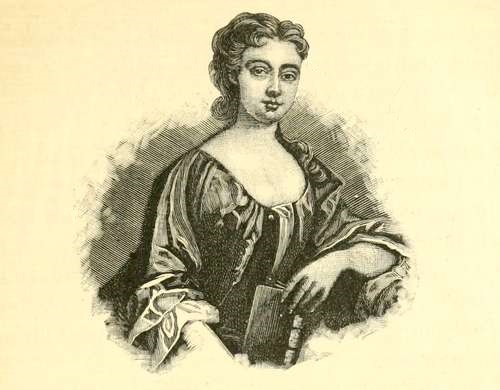
MRS. OLDFIELD.
MRS. OLDFIELD.
Artists who have been wont to look into the Vicar
of Wakefield, Gil Blas, and last century comedies,
for picturesque subjects, would find account in
referring to the lives of our actresses. Here is not
a bad picture of its class. The time is at the close
of the seventeenth century; the scene is at the
Mitre Tavern in St. James's Market, kept by one
Mrs. Voss. It is a quiet summer evening, and after
the fatigues of the day are over, and before the later
business of the night has commenced, that buxom
lady is reclining in an easy chair, listening to a fair
and bright young creature, her sister,[1] who is reading
aloud, and is enjoying what she reads. Her eyes,
like Kathleen's in the song, are beaming with light,
her face glowing with intelligence and feeling.
Even an elderly lady, their mother, turns away from
the picture of her husband, who had ridden in the
Guards, and held a commission under James II.—she
turns from this, and memories of old days, to
gaze with tender admiration on her brilliant young
daughter; who, be it said, at this present reading,
is only an apprentice to a seamstress in King Street,
Westminster.
But the soul of Thalia is under her bodice, into a
neater than which, Anadyomene could not have laced
herself. She is rapt in the reading, and with book
held out, and face upraised, and figure displayed at its
very best, she enthrals her audience, unconscious herself
that this is more numerous than she might have
supposed. On the threshold of the open door stand a
couple of guests; one of them has, to us, no name; the
other is a gay, rollicking young fellow, smartly dressed,
a semi-military look about him, good humour rippling
over his face, combined with an air of astonishment
and delight. This is Captain Farquhar. His sight
and hearing are wholly concentrated on that enchanted
and enchanting girl, who, unmindful of aught but the
"Scornful Lady," continues still reading aloud that
rattling comedy of Beaumont and Fletcher. How
the mother listened to it all is not to be told; but
nearly a century later Queen Charlotte could listen to
her daughters reading "Polly Honeycombe," and no
harm done. We may fancy the young reader at the
Mitre, whose name is Anne Oldfield, in that silvery
voice for which she was famed, half in sadness and
half in mirth, reading the lines in which the lady
says:—
"All we that are call'd woman, know as well
As men, it were a far more noble thing
To grace where we are graced, and give respect
There where we are respected: yet we practise
A wilder course, and never bend our eyes
On men with pleasure, till they find the way
To give us a neglect. Then we too late
Perceive the loss of what we might have had,
And dote to death."
Captain Farquhar, at whatever passage in the play,
betrayed his presence by his involuntary applause.
The girl looked towards him more pleased than
abashed; and when the captain pronounced that
there was in her the stuff for an exquisite actress,
the fluttered thing clasped her hands, glowed at
the prophecy, and protested in her turn, that of all
conditions it was the one she wished most ardently
to fulfil. From that moment the glory and the mischief
were commenced. The tall girl stood up, her
large eyes dilating, the assured future Lady Betty
Modish and Biddy Tipkin, Farquhar's own Sylvia
and Mrs. Sullen, the Violante and the Lady Townley
that were to set the playgoing world mad with delight;
the Andromache, Marcia, and Jane Shore,
that were to wring tears from them; the supreme
lady in all, but chiefest in comedy; and that
"genteel," for which she seemed expressly born.
Farquhar talked of her to Vanbrugh, and Vanbrugh
introduced her to Rich, and Rich took her into
his company, assigned her a beginner's salary, fifteen
shillings a week, and gave her nothing to do. She
had a better life of it at the seamstress's in King
Street. But she had time to spare and leisure to
wait. She was barely fifteen, when, in 1700, she
played Alinda, in Vanbrugh's adaptation from Beaumont
and Fletcher, the "Pilgrim." The next three
or four years were those of probation; and when, in
the season of 1704-5, Cibber assigned to her the
part of Lady Betty Modish, in his "Careless Husband,"
the town at once recognised in her the most
finished actress of such difficult yet effective parts
of her day.
The gentle Alinda suited the years and inexperience
of Mrs. Oldfield; her youth was in her favour, and
her figure, but therewith was such great diffidence,
that she had not courage enough to modulate her
voice. Cibber watched her; he could see nothing
to recommend her, save her graceful person. But
there reached his ear occasional silver tones, which
seemed to assure him of the rare excellence of
the instrument. Still, like "the great Mrs. Barry,"
her first appearances were failures; and such were
those of Sarah Siddons, in after years. Warmed by
encouraging applause, however, the promise ripened,
and with opportunity, the perfection that came was
demonstrated both to watchful Cibber and an expectant
public.
In 1703 the company was at Bath, where Queen
Anne might have been seen in the Pump Room in
the morning,—later in the day, at the play. But the
joyous and brilliant queen of comedy was not there.
Mrs. Verbruggen, the Mrs. Mountfort of earlier days,
was ill in town, nursing a baby, whose birth ultimately
cost the life of the mother. There was a scramble for
her parts. Each of the more influential actresses
obtained several; but to young and unobtrusive Mrs.
Oldfield, there fell but one,—the mediocre part of
Leonora, in "Sir Courtly Nice." Cibber reluctantly
ran over the scenes with her, at her request, in which
the Knight and the Lady meet. He was careless,
from lack of appreciation of the actress; she was
piqued, and sullenly repeated the words set down for
her. There was, in short, a mutual distaste. But,
when the night came, Colley saw the almost perfect
actress before him, and as he says,—"she had a just
occasion to triumph over the error of my judgment by
the almost amazement that her unexpected performance
awaked me to; so sudden and forward a step
into nature I had never seen. And what made her
performance more valuable was, that I knew it all
proceeded from her own understanding,—untaught
and unassisted by any one more experienced actor."
Any other player but Cibber, in his place, would have
laid Anne Oldfield's success to the instruction he had
given her at rehearsal.
Colley Cibber had then in his desk the unfinished
manuscript of his "Careless Husband;" it had long
lain there, through the author's hopelessness of ever
finding an actress who would realise his idea of Lady
Betty Modish. He had no longer any doubt. He at
once finished the piece, brought it on the stage, and
silent as to his own share in the triumph, attributed
it all, or nearly all, to Mrs. Oldfield. "Not only to
the uncommon excellence of her action; but even to
her personal manner of conversing." I must repeat
what Cibber tells us, that many of the sentiments were
Mrs. Oldfield's, dressed up by him, "with a little more
care than when they negligently fell from her lively
humour." Respecting what Cibber adds, that "had
her birth placed her in a higher rank of life, she had
certainly appeared to be, in reality, what in the play
she only excellently acted,—an agreeably gay woman
of quality, a little too conscious of her natural attractions,"
I will remark that, as she really appeared to
be so, her birth (she was a gentleman's daughter)
could not prevent her from appearing so. And Cibber
avows, what the testimony of Walpole confirms,
that he had "often seen her in private societies,
where women of the best rank might have borrowed
some part of her behaviour without the least diminution
of their sense of dignity."
In 1702, the merit of Mrs. Oldfield was not recognised
by Gildon, who, in his "Comparison between
the two Stages," classes her among "the rubbish,"
of which the stage should be swept. Of Mrs. Verbruggen
(Mountfort), he speaks as "a miracle."
He could not see that Oldfield would be her
successor, and would, in some parts, even excel her.
By the year 1706, however, she had risen to be on
an equality with such a brilliant favourite as Mrs.
Bracegirdle, whom, in the opinion of many, her
younger competitor surpassed. The salary of the
latter then, and for some years later, was not, however,
a large one, if measured by modern rule. Four
pounds a week, with a benefit,—in all, little more
than £250 a year, cannot be called excessive guerdon.
Her own benefit was always profitable; but I am
sorry to add, that this joyous-looking creature, apparently
brimful of good nature, was very reluctant
to play for the benefit of her colleagues. Subsequently,
her revenue from the stage-salary and
benefit averaged about £500 a year.
A remark of hers to Cibber, shows how she
entered into the spirit of her parts. Cibber had
replaced Dicky Norris, who was ill, in the part of
Barnaby Brittle, in the "Amorous Widow," in
which Mrs. Oldfield played Barnaby's wife. The
couple are a sort of George Dandin and his spouse.
When the play was over, Cibber asked her, in his
familiar way, "Nancy, how did you like your new
husband?" "Very well," said she; "but not half
so well as Dicky Norris." "How so?" asked
Cibber. "You are too important a figure," she
answered; "but Dicky is so diminutive, and looks
so sneaking, that he seems born to be deceived; and
when he plays with me, I make him what a husband
most dislikes to be, with hearty good will."
Genest cites Cibber, Chetwood, and Davies, in
order to describe her adequately. "After her success
in Lady Betty Modish," he says, "all that nature
had given her of the actress seemed to have risen to
its full perfection; but the variety of her powers
could not be known till she was seen in variety of
characters which, as fast as they fell to her, she
equally excelled in. In the wearing of her person
she was particularly fortunate; her figure was always
improving, to her thirty-sixth year; but her excellence
in acting was never at a stand. And Lady
Townley, one of her last new parts, was a proof that
she was still able to do more, if more could have
been done for her."
Davies, after noticing her figure and expression,
says of her "large speaking eyes," that in some
particular comic situations she kept them half shut,
"especially when she intended to give effect to some
brilliant or gay thought. In sprightliness of air and
elegance of manner, she excelled all actresses, and
was greatly superior in the clear, sonorous, and
harmonious tones of her voice."
How are Wilks and the inimitable She photographed
for posterity? "Wilks's Copper Captain
was esteemed one of his best characters. Mrs. Oldfield
was equally happy in Estifania. When she
drew the pistol from her pocket, pretending to shoot
Perez, Wilks drew back, as if greatly terrified, and
in a tremulous voice, uttered, 'What, thine own
husband!' To which she replied, with archness of
countenance and a half-shut eye, 'Let mine own
husband then be in 's own wits,' in a tone of voice
in imitation of his, that the theatre was in a tumult
of applause."
From Cibber, again, we learn that she was modest
and unpresuming; that in all the parts she undertook,
she sought enlightenment and instruction from
every quarter, "but it was a hard matter to give
her a hint that she was not able to improve." With
managers she was not exacting; "she lost nothing
by her easy conduct; she had everything she asked,
which she took care should be always reasonable,
because she hated as much to be grudged as to be
denied a civility."
Like Mrs. Barry, she entered fully into the character
she had to represent, and examined it closely, in order
to grasp it effectually. When the "Beaux' Stratagem"
was in rehearsal (1707), in which she played Mrs.
Sullen, she remarked to Wilks, that she thought the
author had dealt too freely with Mrs. Sullen, in giving
her to Archer, without such a proper divorce as would
be a security to her honour. Wilks communicated
this to the author. "Tell her," said poor Farquhar,
who was then dying, "that for her peace of mind's
sake, I'll get a real divorce, marry her myself, and
give her my bond she shall be a real widow in less
than a fortnight."
Mrs. Oldfield was the original representative of
sixty-five characters. The greater number of these
belong to genteel comedy, as it is called, a career
which she commenced as peculiarly her own, in 1703,
when chance assigned to her the part of Leonora, in
"Sir Courtly Nice." Her wonderful success in this,
induced Cibber to trust to her the part of Lady
Betty Modish, in the "Careless Husband," the comedy
which he had put aside in despair of finding a lady
equal to his conception of the character. Her mere
conversation in that play intoxicated the house. At
a later period, her audiences were even more ecstatic
at her Lady Townley,—an ecstasy in which the
managers must have shared, for they immediately
added fifty guineas to her salary. It was just the
sum which the benevolent actress gave annually to
that most contemptibly helpless personage, Savage.
Her highest salary never, I believe, exceeded three
hundred guineas; but this was exclusive of benefits,
occasions on which gold was showered into her lap.
Humour, grace, vivacity,—all were exuberant on
the stage, when she and Wilks were playing against
each other. Indeed, one can hardly realise the idea
of this supreme queen of comedy wearing the robe
and illustrating the sorrows of tragedy. She, for her
own part, disliked the latter vocation. She hated,
as she said often, to have a page dragging her tail
about. "Why do not they give these parts to Porter?
She can put on a better tragedy-face than I can."
Earnest as she was, however, in these characters before
the audience, she was frolicsome at rehearsal. When
"Cato" was in preparation, Mrs. Oldfield was cast
for Marcia, the philosophical statesman's daughter.
Addison attended the rehearsals, and Swift was at
Addison's side, making suggestions, and marking the
characteristics of the lively people about him. He
never had a good word for woman, and consequently
he had his usual coarse epithet for Mrs. Oldfield,
speaking of her as "the drab that played Cato's
daughter;" and railing at her for her hilarity while
rehearsing that passionate part, and, in her forgetfulness,
calling merrily out to the prompter, "What
next? what next?"
Yet this hilarious actress played Cleopatra with
dignity, and Calista with feeling. She accepted
with great reluctance the part of Semandra, in
"Mithridates," when that tragedy was revived in
1708; but Chetwood says she performed the part
to perfection, and became reconciled to tragedy by
reason of her success. In these characters, however,
she could be excelled by others, but in Lady Betty
Modish and Lady Townley she was probably never
equalled. In the comedy of lower life she was, perhaps,
less original; at least, Anthony Aston remarks,
that in free comedy she borrowed something from
Mrs. Verbruggen's manner. When Wilks, as Lord
Townley, exclaimed "Prodigious!" in the famous
scene with his lady, played by Mrs. Oldfield, the
house applied it to her acting, and broke into repeated
rounds of applause.
"Who should act genteel comedy, perfectly," asks
Walpole, "but people of fashion that have sense?
Actors and actresses can only guess at the tone of
high life, and cannot be inspired with it. Why are
there so few genteel comedies, but because most
comedies are written by men not of that sphere.
Etherege, Congreve, Vanbrugh, and Cibber wrote
genteel comedy, because they lived in the best company;
and Mrs. Oldfield played it so well, because
she not only followed, but often set the fashion.
General Burgoyne has writ the best modern comedy
for the same reason; and Miss Farren is as excellent
as Mrs. Oldfield, because she has lived with the best
style of men in England. Farquhar's plays talk
the language of a marching regiment in country
quarters. Wycherley, Dryden, Mrs. Centlivre, &c.,
wrote as if they had only lived in the Rose Tavern;
but then the Court lived in Drury Lane, too, and
Lady Dorchester and Nell Gwyn were equally good
company."
In this there is some injustice against Mrs. Centlivre,
for whose name should be supplied that of
Aphra Behn. Walpole judges more correctly of the
comic writers of the seventeenth century, when he
places Molière "Senor Moleiro," as Downes absurdly
calls him, at the head of them all. "Who upon
earth," he says, "has written such perfect comedies?
for the 'Careless Husband' is but one; the 'Non-juror'
was built on the 'Tartuffe,' and if the Man of
Mode (Etherege) and Vanbrugh are excellent, they
are too indelicate; and Congreve, who beat all for
wit, is not always natural, still less, simple."
It has been said of Mrs. Oldfield, that she never
troubled the peace of any lady at the head of a
household; but I think she may have marred the
expectations of some who desired to reach that eminence.
She early captivated the heart of Mr. Maynwaring.
He was a bachelor, rich, connected with
the government, and a hard drinker, according to
the prevailing fashion. He was Cymon subdued by
Iphigenia. He loved the lady's refinement, and she
kept his household as carefully as if she had been
his wife, and presided at his table with a grace that
charmed him. There was something of Beauty and
the Beast in this connection, but the end of the
fable was wanting; the animal was never converted
to an Azor, and a marriage with Zemira was the one
thing wanting.
When Maynwaring died, society almost looked
upon her as an honest widow. Indeed, it had never
rejected her. The standard of morals was low, and
when the quasi widow accepted the proposal of
General Churchill to place her at the head of his
establishment, as she had been in that of Mr. Maynwaring,
no one blamed her. Marriage, indeed, seems
to have been thought of, and Queen Caroline, who
did not at all disdain to stoop to little matters of
gossip, one day remarked to Mrs. Oldfield, who had,
I suppose, been reading to a court circle, "I hear,
Mrs. Oldfield, that you and the General are married?"
"Madam," said the actress, playing her very best,
"the General keeps his own secrets!"
The two love passages in the life of Anne Oldfield
were, in short, founded on sentiment and not on
interest. The Duke of Bedford offered her more
brilliant advantages than the General or the Squire;
but the disinterested actress spurned them, and kept
sisterhood with duchesses. She was to be seen on
the terrace at Windsor, walking with the consorts
of dukes, and with countesses, and wives of English
barons, and the whole gay group might be heard
calling one another by their Christian names. In
later days, Kitty Clive called such fine folk "damaged
quality;" and later still, the second Mrs. Barry
did not value such companionship at a "pin's fee;"
but Anne Oldfield drew from it many an illustration,
which she transported to the stage.
During her last season, her sufferings were often
so acute that when the applause was loudest, the
poor actress turned aside to hide the tears forced
from her by pain. She never gave up till the agony
was too great to be endured, and then she refused to
receive a salary which, according to her articles, was
not to be discontinued in illness. She lingered a
few months in her house in Lower Grosvenor Street;
the details of her last moments, as given by Pope,
mingle a little truth with much error and exaggeration:—
"'Odious! in woollen? 'twould a saint provoke!'
Were the last words that poor Narcissa spoke.
'No, let a charming chintz and Brussels lace
Wrap my cold limbs and shade my lifeless face;
One would not sure be frightful when one's dead.
And, Betty, give this cheek a little red!'"
Betty was the ex-actress, Mrs. Saunders, who resided
with Narcissa. She had quitted the stage in
1720, and, says Mr. Urban, "attended Mrs. Oldfield
constantly, and did the office of priest to the last."
Poor Narcissa, after death, was attired in a Holland
night-dress, with tucker and double ruffles of Brussels
lace, of which latter material she also wore a
head-dress, and a pair of "new kid gloves." This,
another writer calls being "buried in full dress."
The report seems to have been founded on Mrs.
Oldfield's natural good taste in costume. Flavia,
such is her name in the Tatler, "is ever well drest,
and always the genteelest woman you meet; her
clothes are so exactly fitted that they appear part of
her person."
It was in the above described dress that the deceased
actress received such honour as actress never
received before, nor has ever received since. The
lady lay in state in the Jerusalem Chamber, a distinction
not unfrequently, indeed, conceded to persons
of high rank and small merit, but which, nevertheless,
seemed out of place in the case of Anne Oldfield;
but had she been really a queen, the public could not
have thronged more eagerly to the spectacle.
The solemn lying in state of an English actress in
the Jerusalem Chamber, the sorrow of the public over
their lost favourite, and the regret of friends in noble,
or humble, but virtuous homes, where Mrs. Oldfield
had been ever welcome, contrast strongly with the
French sentiment towards French players. It has been
already said, that as long as Clairon exercised the
power, when she advanced to the footlights, to make
the (then standing) pit recoil several feet, by the
mere magic of her eyes, the pit, who enjoyed the
terror as a luxury, flung crowns to her, and wept at
the thought of losing her; but Clairon infirm was
Clairon forgotten, and to a decaying actor or actress
a French audience is the most merciless in the world.
The brightest and best of them, as with us, died in
the service of the public. Monfleury, Mondory, and
Bricourt, died of apoplexy, brought on by excess of
zeal. Molière, who fell in harness, was buried with
less ceremony than some favourite dog. The charming
Lecouvreur, that Oldfield of the French stage,
whose beauty and intellect were the double charm
which rendered theatrical France ecstatic, was hurriedly
interred within a saw-pit. Bishops might be
exceedingly interested in, and unepiscopally generous
to, living actresses of wit and beauty, but the prelates
smote them with a "Maranatha!" and an
"Avaunt ye!" when dead. Even Bossuet would
attend the theatre to learn grace and elocution from
them and their brethren: but when he had profited
by the instruction, he denounced them all as "children
of the devil!" Louis XVIII., however, put an
effectual check on the unseemly practice of treating
as dead dogs the geniuses who had been idolised
when living. When the priests of the Church of St.
Roch closed its doors against the body of Rancourt,
brought there for a prayer and a blessing, Paris rose
against the insulters; and the King, moved by
Christian charity, or dread of a Paris riot, sent his
own chaplain to recite the prayer, give the benediction,
and to show that an honest player was not a
something less than a fellow-creature.
After the lying in state of Mrs. Oldfield, there was
a funeral of as much ceremony as has been observed
at the obsequies of many a queen. Among the supporters
of the pall were Lord Hervey, Lord Delawarr,
and Bubb Dodington, afterwards Lord Melcombe.
The first used to ride abroad with Mrs. Oldfield, as
Mrs. Delaney has recorded. Lord Delawarr was a
soldier who became a great "beau," and went a philandering.
His wife and the Countess of Burlington
headed the Faustina party at the opera against the
faction which supported Cuzzoni. There were anthems,
and prayers, and sermon; and Dr. Parker,
who officiated, remarked, when all was over, to a few
particular friends, and with some equivocation, as it
seems to me, that he "buried her very willingly, and
with much satisfaction." Her sons Maynwaring and
Churchill were present, and the contemporary notices
say that she had no other children. Her friends were
apt to express a different opinion; and Mrs. Delaney,
in one of the very first passages in her Autobiography
says:—"At six years old I was placed under the care
of Mdlle. Puelle, a refugee of a very respectable
character, and well qualified for her business. She
undertook but twenty scholars at a time, among
whom were Lady Catherine Knollys, daughter to
the" (self-styled) "Earl of Banbury, and great aunt
to the present Lord; Miss Halsey, daughter to a
very considerable brewer, and afterwards married to
Lord Temple, Earl of Cobham; Lady Jane Douglas,
daughter of the Duke of Douglas, and Miss Dye
Bertie, a daughter of Mrs. Oldfield the actress, who,
after leaving school, was the pink of fashion in the
beau monde, and married a nobleman." Whom did
this mysterious Diana marry?[2]
This daughter is not mentioned in Mrs. Oldfield's
will; but to the two sons Mrs. Oldfield bequeathed
the bulk of a fortune which she had amassed more
by her exertions than by the generosity of their
respective fathers. She was liberal, too, in leaving
memorials to numerous friends; less so in her bequests
to old relations of her sempstress and coffee-house
days. A very small annuity was Narcissa's
parting gift to her mother, who long survived
her.
In such wise went her money; but whither has
the blood of Oldfield gone? When Winnifred, the
dairymaid, married into the family of the Bickerstaffes,
she is said to have spoilt their blood, while
she mended their constitutions. The great actress
herself was at least an honest man's daughter, a man
of fair descent. Her son, Colonel Churchill, once,
unconsciously, saved Sir Robert Walpole from assassination,
through the latter riding home, from
the House, in the Colonel's chariot instead of alone
in his own. Unstable Churchill married a natural
daughter of Sir Robert, and their daughter Mary
married, in 1777, Charles Sloane, first Earl of Cadogan.
The son of this Mary is the present Earl, the
great grandson of charming Anne Oldfield. When
Churchill and his wife were travelling in France, a
Frenchman, knowing he was connected with poets
or players, asked him if he was Churchill the famous
poet. "I am not," said Mrs. Oldfield's son. "Ma
foi!" rejoined the polite Frenchman, "so much the
worse for you!"
I have seen many epitaphs to her memory, but
there is not one which is so complete and beautiful
as the following, which tells the reader that she lies
amid great poets, not less worthy of praise than they,
whose works she has illustrated and ennobled. It
records the apt universality of her talent, which
made her seem not made, but born for whatever she
undertook. In tragedy, the glory of her form, the
dignity of her countenance, the majesty of her walk,
touched the rudest spectator. In comedy, her power,
her graceful hilarity, her singular felicity, were so
irresistible, that the eyes never wearied of gazing at
her, nor the hands of applauding her.
"Hic juxta requiescit
Tot inter poetarum laudata nomina,
ANNA OLDFIELD.
Nec ipsa minore laude digna,
Quippe quæ eorum opera.
In scenam quotidies prodivit,
Illustravit semper et nobilitavit.
Nunquam ingenium idem ad parties diversissimas
Habilius fuit.
Ita tamen ut ad singulas
Non facta sed nata esse videretur,
In tragœdiis
Formæ splendor, oris dignitas, incessus majestas,
Tanta vocis suavitate temperabantur.
Ut nemo esset tam agrestis, tam durus spectator,
Quin in admirationem totus raperetur.
In comœdia autem
Tanta vis, tam venusta hilaritas, tam curiosa felicitas
Ut neque sufficerent spectando oculi,
Neque plaudendo manus."
I have said that her last original part was Sophonisba.
Among the last words she uttered in it, when
mortal illness was upon her, were these:—
"And is the sacred moment then so near,
The moment when yon sun, these heavens, this earth
Shall sink at once, and straight another state,
New scenes, new joys, new faculties, new wonders,
Rise, on a sudden, round?"
These words were first spoken by her, on the last
day of February 1730. On the 23rd of the following
October she died, in her forty-seventh year. A week
later, Dr. Parker "buried her very willingly, and with
much satisfaction!"
Mrs. Clive as Mrs. Heidelberg.
CHAPTER II. — FOOTNOTES:
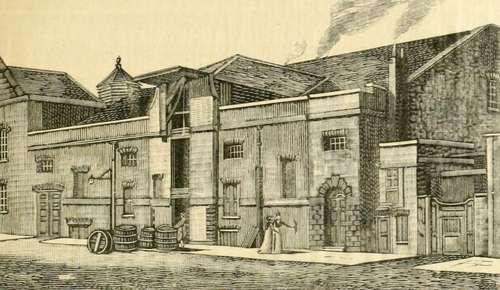
GOODMAN'S FIELDS THEATRE.
FROM THE DEATH OF ANNE OLDFIELD TO THAT OF WILKS.
Between the season of 1729-30, and that of 1733-34,
great changes took place. It is correct to say, that
the stage "declined;" but if we lose Mrs. Oldfield in
the former period, we find some compensation at the
beginning of the latter, by first meeting, in Fielding
and Hippisley's booth, at Bartholomew and Southwark
fairs, with one who was destined to enthral the
town,—modest Mrs. Pritchard, playing Loveit, in a
"Cure for Covetousness."
Meanwhile, Mrs. Porter reigned supreme; but the
stage was deprived, for more than a year, of the presence
of her whom Mrs. Oldfield loved to address as
"mother," by an accident which dislocated her thigh.
Even after her recovery, the tragedy queen was forced
to walk the stage with a crutched stick, which, like
a true artist, she turned to account in her action.
Of actors of eminence, the greatest whom the stage
lost was Wilks, airy and graceful down to the last;—of
him, who died in 1732, I will speak more fully
presently. Death also carried off quaint, squeaking,
little Norris, the excellent comic actor, popularly
known as "Jubilee Dicky." After Norris went
Boheme, the pillar of the Lincoln's Inn Fields, a
dignified and accomplished tragedian, whose Lear
was full of antique grandeur and pathos;—it was,
perhaps, the only character in which the former
young sailor's quarter-deck walk was not discernible.
Colley Cibber, too, must be reckoned among the
departed, since he retired from the stage, at the
end of the season 1732-33, but occasionally returned
to it. He was disheartened by the break-up in the
old partnership, and the manifest close of a period of
prosperity. Booth had sold half of his share in the
patent to a rich and silly amateur actor—Highmore.
Wilks's widow, who inherited her husband's share,
was represented by attorney; Colley was uneasy at
having to encounter new partners, and he ultimately
sold his share to Highmore, for three thousand
guineas.
While the stage failed in players, it was not upheld
by the poets. The gentlemen of the inns of court
hissed Charles Johnson's "Medea," and did not
even applaud the satirical allusion contained in it to
Pope. The town was weary of classical pieces. The
"Eurydice" of Mallet—who had been gate-keeper
at the Edinburgh High School, and had picked up
learning enough to enable him to efficiently exercise
the office of tutor in the Duke of Montrose's family—fared
no better,[3] despite Mrs. Porter. The piece
was as hard and as dry as granite; but the author
thought it had as much pathos as his ballad of
"William and Margaret."
In the prologue, tragedy was especially recommended
to the patronage of ladies, because therein
the character of women is exalted; while in the
comedies of the day it was debased. But the epilogue,
spoken by Miss Robinson, in boy's clothes—"born
for this dapper age—pert, short, and clever"—showed
that the poet did not much care for the
female character.
Jeffreys' "Merope" had no better success. His
cousins of the Chandos family may have laughed at
the young collegian's bathos; but on the second
night there was not audience enough to make a
laugh comfortable; and the curtain did not rise.[4]
Critics complained that all tragic action on our
stage turned on love; and Jeffreys contrived to
make three couple of nymphs and swains sigh or
swear in this story of mother and son! "Who
could believe," says Voltaire, "that love could have
been introduced into such a story? But, since the
times of Charles II., love has taken possession of the
English stage; and one must acknowledge that no
nation in the world has painted that passion so
badly." But Voltaire, you will remember, also said
that Shakspeare was "a savage!"
A Gloucestershire squire, named Tracy, tried his
hand on "Periander," and failed, though he was
guiltless of a false quantity; unlike Addison's
learned friend, Frowde, who tripped in his penultimates,
with the alacrity of Hughes!
It was not altogether because our ancestors were
weary of classical tragedies, that a short, fat, one-eyed,
and well-to-do dissenter and jeweller, of Moorgate
Street, reaped such a triumph, with his modern and
domestic tragedy, "George Barnwell." Mr. Lillo
had previously written a ballad-opera, "Sylvia;" but
now he aimed to show the hideousness and consequence
of vice. "George Barnwell" was first acted at Drury
Lane, at the beginning of the Midsummer holidays of
1731. Theophilus Cibber played the hero; Mrs.
Butler, Milwood. The audience looked for fun, and
took the old ballad,—there was the flutter of a
thousand copies in the house, to compare it with the
play. Pope was present, and expressed an opinion
that the language was often too elevated for the
personages;[5] and the hearers thought only of the
story as illustrated by Lillo, and every eye was
weeping. It was the first fairly honest attempt
made to amend, from the stage, the vices and weaknesses
of mankind; and it certainly, in some degree,
succeeded. It enlisted the sympathies of honest
women. "The distresses of great personages," says
a lady, in the Gentleman's Magazine, "have ceased
to affect the town," and "none but a prostitute could
find fault with this tragedy." Fault, however, was
found; but the objection was answered in this way;—that
"lowness of action was disallowed in a
tragedy, but not lowness of character: the circumstances
here are all important." One critic holds
the story to be improbable; but contemporary
journals furnish a parallel. A mercer's apprentice,
who sleeps in his master's shop, admits a Milwood,
who at a later hour refuses to leave, unless he will
cut off satin enough, to make her a robe. Great
distress! but, at a happy moment, a virtuous porter
arrives, who, on hearing the circumstances, and perhaps
having seen the tragedy, lays hold of the lady,
who had no more drapery about her than Lady Godiva,
claps her into a sack, carries her off, and shoots her
into a cart full of grains, standing unguarded. The
naughty person is suffocated, if I remember rightly;
but the honour of the apprentice is saved!!
"George Barnwell" brought domestic tragedy into
fashion, and Charles Johnson closed his dramatic
career with "Cœlia, or the perjured Lover," which
was a warning to young ladies. Cœlia has a
bad and a good lover,—warring principles! She
prefers the former, with ruin for a consequence. He
lodges her in a bagnio, where she is swept up by the
watch, in the arrest of all the inmates, and taken to
Bridewell. Thence her very heavy father takes her
home, while the good lover kills the bad one in a
duel; but the latter politely requests that the avenger
will consider Cœlia as having been his lawful wife.
The lady, however, dies in her father's arms; the
curtain comes down with a "tag," and then on
tripped the epilogue, to ridicule all those present who
were disposed to profit by the moral of the drama!
Theophilus Cibber's "Lover" was a sort of pendant
to the "Nonjuror,"—Granger being in the habit of
going regularly to church, and daily breaking the ten
commandments. The only enjoyment the audience
had,—who fought for or against the piece till blood
flowed abundantly,—was in the epilogue, in which
Mrs. Theophilus Cibber smartly satirised the failings
of her lord! The audience relished it amazingly.
These were the principal novelties of the period
about which I am treating; but I must add, that at the
Haymarket, and at Goodman's Fields, where Giffard
had created in Ayliffe Street a commodious theatre,
far superior to the old throwster's shop, which had
served an early dramatic purpose, in Leman Street,
sterling old plays, with operettas and burlesques,
were played at irregular seasons. Fielding especially
distinguished and sometimes disgraced himself. He
had not yet struck upon the vein which made him
the first and most philosophical of English novelists;
but he rose from his squibs and farces to the achievement
of the "Miser," in itself an adaptation, but
done by a master hand, and with a double result of
triumph,—to the author, and to Griffin, the clergyman's
son, who played Lovegold. There were
smaller attempts by smaller men, but these I omit,
to record the failure of Quin in Lear,—a character
which it was temerity to touch, so soon after Boheme
had ceased to be the King. Mills made as great a
mistake, when, at nearly sixty, he played for the
first time—Hamlet. The public cared more for the
pantomimic "Harlot's Progress," got up by Theophilus
Cibber for Drury Lane, where this piece, preceded
by "George Barnwell," must have been as
edifying to both sexes as going to church,—a result
in which Hogarth had full share with Lillo.
I have noticed the actors departing and departed,
and the appearance in a booth of Mrs. Pritchard, a
name yet to be famous and respected—like Mrs.
Betterton's. So during this period I find a young
player, Delane, at Goodman's Fields, who will advance
to the first rank; but also a greater than he,
Macklin, quietly playing any little part given him at
Lincoln's Inn Fields, and securing his firm standing
ground by the ability with which he acquitted himself
at that house, when, in 1731, he was suddenly
called upon to play Brazencourt,[6] in Fielding's
"Coffee House Politicians." He had only four
lines to speak; but those he spoke so well, that the
true actor was at once discerned. One may fancy
the tone and manner in which the rascal exclaimed:—"I
was forced to turn her off for stealing four of
my shirts, two pair of stockings, and my Common
Prayer Book." With such small opportunity, Mr.
Maclean, as he was then called, led up to Shylock
and Sir Pertinax Macsycophant!
Macklin was the last of the great actors who
played at Lincoln's Inn Fields; and he did not
leave Covent Garden until after the appearance
there of Braham, who was yet among us but yesterday.
The first-named house had never rivalled the
success of Drury Lane, but Rich had gained enough
to enable him to build a new house, and the last
play acted in the Fields was Ravenscroft's "Anatomist,"
one of the worst of a second-rate author of
King Charles's days. This was on December 5,
1732. Except for a few nights, irregularly, the old
house never opened again. It was the third theatre
which had occupied the site since 1662. In 1756
it was converted into a barrack. As late as 1848, it
was Copeland's China Repository, when the old
stage door and passage, through which Quin had so
often passed, still existed.
There had been a long expressed desire for a new
theatre; that is, not merely a new edifice, but a new
system. The proposal embraced prospective delights
for authors, such as they had hitherto never dreamed
of. In the published prospectus it was stated that
actors and authors should be excluded from the
management, which was to be entrusted to individuals,
who, at least, knew as little about it, namely,
men of quality, taste, figure, and of a fortune varying
from ten to twelve hundred pounds. A committee
was to be appointed, whose duty it would be, among
others, to provide for the efficient reading of new
plays, and for their being listened to with reverence
and attention. It was calculated that the annual
profit of such a theatre would amount to £3000 a
year, and that out of it an annuity of £100 might be
set aside for every author who had achieved a certain
amount of success. In the following year, the
Weekly Miscellany and the Grub Street Journal were
very eager on the subject of theatrical reform. The
former complained that high comedy and dignified
tragedy had deserted the stage; remarked that plays
were not intended for tradesmen! and denounced
pantomimes and harlequinades as infamous. The
Journal was rather practical than reflective. Old
Exeter Change was then to let, and the Journal proposed
that it should be converted into a theatre;
adding a suggestion, which required above a century
and a quarter to be carried into realisation, namely,
that a college should be founded for decayed actors.
This college was to form the two wings of the theatre;
which wings were to be inhabited respectively by the
emeriti among actors, and destitute actresses, whose
new home was to be within sound of the old stirring
echoes of their joyous days. The direction of the
establishment was to be confided to a competent
governor and officers selected from among the decayed
nobility and gentry; and the glory and profit resulting
were calculated at a very high figure indeed!
On one result the Grub Street congratulated itself
with unctuous pride. If the stage were reformed, the
universities and inns of court would supply actors.
Gentlemen, said the Grub Street, with some arrogance,
were reluctant to go among the scamps on the stage.
Then, as for actresses, Grub rudely declared that
every charity school could supply a dozen wenches
of more decent education and character, of better
health, brighter youth, more brilliant beauty, and more
exalted genius, than the common run of hussies then
on the stage; and a season's training, he added,
would qualify them for business. This was a hard
hit at men, among whom there were many well born;
and at women, who, whatever they lacked, possessed
the happy gifts of health, youth, beauty, and genius;
but Grub Street's cynicism was probably founded on
the fact, that he was not invited by the men, nor
smiled on by the women.
A reform before the curtain was, however, now as
loudly called for as behind it. One of the greatest
grievances complained of this year was the insolence
of the footmen. Occupying their masters' places,
they lolled about with their hats on, talked aloud,
were insolent on rebuke from the audience, and when
they withdrew, on their masters' arrival, to their own
gallery, they kept up a continual tumult there, which
rendered their presence intolerable. What with
the fine gentlemen on the stage, and their lacqueys,
selected for their size, personal good looks, or fine
hair, in the gallery, the would-be attentive audience
in the pit were driven well nigh to desperation.
Much of this last grievance was amended when
Covent Garden Theatre was opened on the 7th of
December 1732. The first piece acted was Congreve's
"Way of the World;" Fainall by Quin,
Mirabel by Ryan, who, with Walker, Hippisley, Milward,
Chapman, and Neal, Mrs. Younger, Mrs. Bullock,
and Mrs. Buchanan, formed the principal members of
the company. Gay was not now alive to increase
his own and Rich's fortune in this elegant and well-appointed
theatre; but Rich produced Gay's operatic
piece "Achilles," which represented the hero when
lying disguised as a girl. By the treatment of the
subject, Gay did not manifest the innocency to which
he laid claim, nor show himself either in wit a man,
or in simplicity a child. Theobald's adaptation of
Webster's "Duchess of Malfy" (Bosola, by Quin;
the Duchess, Mrs. Hallam), brought no credit on
"King Log." Generally, indeed, the novelties were
failures, or unimportant. The only incident worth
recording is the debut of Miss Norsa, as Polly. But
before greeting new comers, let us say a word or two
of greater than they who have gone—of Wilks dead,
and, by and by, of Cibber withdrawn. The loss of
such actors seemed irreparable; but during this past
season there had been a lad among the audience at
either house, who was to excel them all. Meanwhile,
he studied them deeply, and after times showed that
the study had not been profitless to this boy of sixteen,
whose name was David Garrick.
Quin's most brilliant days lay between this period
and the ripening into manhood of this ardent boy.
Before we accompany him through that time of
triumph, let us look back at the career of Wilks.
CHAPTER III. — FOOTNOTES:
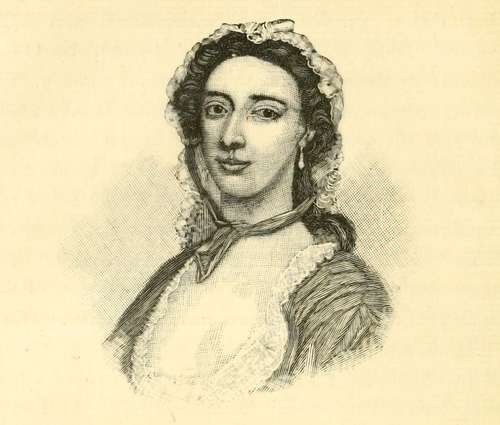
PEG WOFFINGTON.
ROBERT WILKS.
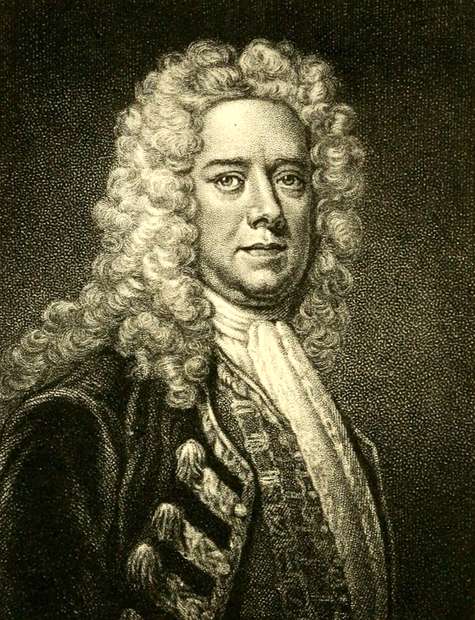
In Mr. Secretary Southwell's office, in Dublin, there
sits the young son of one of the Pursuivants of the
Lord Lieutenant; he is not writing a précis, he is
copying out the parts of a play to be acted in private.
His name is Robert Wilks, and the wise folk of Rathfarnham,
near Dublin, where he was born in 1665,
shake their heads and declare that he will come to
no good.
The prophecy seemed fulfilled when the Irish wars
between James and William forced him, an unwilling
volunteer, into the army of the latter. As clerk to
the camp he is exempt from military duty; but he
tells a good story, sings a good song, and the officers
take him for a very pretty fellow.
Anon, he is back in the old Dublin office. At all
stray leisure hours he may, however, be seen fraternising
with the actors. He most affects one Richards;
he hears Richards repeat his parts, and he speaks the
intervening sentences of the other characters. This
he does with such effect that Richards swears he is
made for an actor, and the young Government clerk,
fired by the fame of Betterton, is eager to leap from
the stool, which his father considered the basis of his
fortune, and to don sock and buskin.
His old comrades of the camp were then about to
vary the monotony of life at the Castle, by getting up
a play to inaugurate the new theatre, re-opened, like
the Temple of Janus, at the restoration of peace.
Judicious and worthy Ashbury was the only professional
player. Young Wilks had privately acted
with him as the Colonel in the "Spanish Friar."
Ashbury now offered to play Iago to his Othello,
and the officers were well pleased to meet again
with their old clerk of the camp. The tragedy was
acted accordingly. "How were you pleased?" asked
Richards, who thought Wilks took it as a pastime.
"I was pleased with all but myself," answered the
Government clerk, who was thoroughly in earnest.
Wilks had gone through many months of probation,
watched by good Joseph Ashbury, and honest
Richards, when one morning the latter called on the
young actor, with an introductory letter to Betterton
in his hand. Wilks accepted the missive with alacrity,
bade farewell to secretaries and managers, and in a
brief space of time was sailing over the waters, from
the Pigeon House to Parkgate.
The meeting of Wilks and Betterton, in the graceful
costume of those days, the young actor travel-worn,
a little shabby, anxious, and full of awe; the elder
richly attired, kind in manner, his face bright with
intellect, and his figure heightened by the dignity of
a lofty nature and professional triumph, borne with a
lofty modesty, is another subject for a painter.
Betterton instructed the stranger as to the course
he should take, and, accordingly, one bright May
morning of 1690,[7] a handsome young fellow, with a
slight Irish accent, presented himself to Christopher
Rich as a light comedian. He was a native of Dublin
county, he said, had left a promising Government
clerkship, to try his fortune on the Irish stage; and,
tempted by the renown of Betterton, had come to
London to see the great actor, and to be engaged, if
that were possible, in the same company.
Christopher Rich was no great judge of acting, but
he thought there was something like promise of excellence
in the easy and gentleman-like young fellow;
and he consented to engage him for Drury Lane, at
the encouraging salary of fifteen shillings a week, from
which half a crown was to be deducted for instruction
in dancing! This left Wilks twelve and sixpence
clear weekly income; and he had not long been enjoying
it, when he married Miss Knapton, daughter
of the Town Clerk of Southampton. Young couple
never began life upon more modest means; but happiness,
hard work, and good fortune came of it.
For a few years, commencing with 1690,[8] Wilks
laboured unnoticed, at Drury Lane, by all save generous
Betterton, who seeing the young actor struggling
for fame, with a small salary, and an increasing
family, recommended him to return to Ashbury, the
Dublin manager, who, at Betterton's word, engaged
him at £50 a year,[9] and a clear benefit. "You will
be glad to have got him," said Betterton to Ashbury.
"You will be sorry you have lost him," said he, to
Christopher Rich. Sorry! In three or four years
more, Rich was imploring him to return, and offering
him Golconda, as salaries were then understood. But
Wilks was now the darling of the Dublin people, and,
at a later period, so universal was the desire to keep
him amongst them, that the Duke of Ormond, Lord
Lieutenant, issued a warrant to prohibit his leaving
the kingdom. But, on the other hand, £4 per week
awaited him in London. It was nearly as high a
salary as Betterton's![10] Wilks, however, caring less
for the terms than for the opportunity of satisfying his
inordinate thirst for fame, contrived to escape, with
his wife. With them came a disappointed actor, soon
to be a popular dramatist, Farquhar; who, in the year
1699, after opening the season with his "Love and a
Bottle," produced his "Constant Couple," with Wilks
as Sir Harry Wildair. On the night of Wilks's first
appearance, in some lines written for him by Farquhar,
and spoken by the debutant, the latter said:—
"Void of offence, though not from censure free,
I left a distant isle, too kind to me;"
and confessing a sort of supremacy in the London
over the Dublin stage, he added:—
"There I could please, but there my fame must end,
For hither none must come to boast—but mend."
This the young actor did apace. Applauded as the
latter had been the year before, in old parts, the approbation
was as nothing compared with that lavished
on him in this his first original character. From the
first recognition of Vizard down to the "tag" with
which the curtain descends, and including even the
absurd and unnatural scene with Angelica, he kept
the audience in a condition of intermittent ecstasy.
The piece established his fame, gave a name to
Norris, the frequently mentioned "Jubilee Dicky,"
and made the fortune of Rich. It seems to have
been played nearly fifty times in the first season. In
its construction and style it is far in advance of the
comedies of Aphra Behn and Ravenscroft; and yet
it is irregular; not moral; as often flippant as witty;
improbable, and not really original. Madam Fickle
is to be traced in it, and the denouement, as far as
Lurewell and Standard are concerned, is borrowed
from those of Plautus and Terence.
Wilks, now the great favourite of the town, justified
all Betterton's prognostications. Like Betterton,
he was to the end convinced that he might become
more perfect by study and perseverance. Taking the
extant score of judgments recorded of him, I find
that Wilks was careful, judicious, painstaking in the
smallest trifles; in comedy always brilliant, in tragedy
always graceful and natural. For zeal, Cibber had
not known his equal for half a century; careful himself,
he allowed no one else to be negligent; so careful,
that he would recite a thousand lines without
missing a single word. The result of all his labour
was seen in an ease, and grace, and gaiety which
seemed perfectly spontaneous. His taste in dress
was irreproachable; grave in his attire on the streets,
on the stage he was the glass of fashion. On the
stage, even in his last season, after a career of forty
years, he never lost his buoyancy, or his young graces.
From first to last he was perfection in his peculiar
line. "Whatever he did upon the stage," says an
eminent critic, quoted by Genest, "let it be ever so
trifling, whether it consisted in putting on his gloves,
or taking out his watch, lolling on his cane, or taking
snuff, every movement was marked by such an ease
of breeding and manner, everything told so strongly
the involuntary motion of a gentleman, that it was
impossible to consider the character he represented
in any other light than that of reality; but what was
still more surprising, that person who could thus
delight an audience, from the gaiety and sprightliness
of his character, I met the next day in a street
hobbling to a hackney-coach, seemingly so enfeebled
by age and infirmities that I could scarcely believe
him to be the same man."
The grace and bearing of Wilks were accounted of
as natural in a man whose blood was not of the
common tap. "His father, Edward Wilks, Esq., was
descended from Judge Wilks, a very eminent lawyer,
and a gentleman of great honour and probity. During
the unhappy scene of our civil wars he raised a troop
of horse, at his own expense, for the service of his
royal master." A brother of the judge was in Monk's
army,[11] with the rank of Colonel, and with more of
honest intention than of commonplace discretion.
The civil wars took many a good actor from the stage,
but they also contributed the sons and daughters of
many ancient but impoverished families to the foremost
rank among distinguished players. Some of the
daughters of these old and decayed houses thought
it no disparagement to wed with these players, or to
take humble office in the theatre. Wilks's first wife,
Miss Knapton, was the daughter of the Town Clerk
of Southampton, and Steward of the New Forest,
posts of trust, and, at one time, of emolument. The
Knaptons had been Yorkshire landholders, the estate
being valued at £2000 a year; and now we find one
daughter marrying Wilks, a second espousing Norris,
"Jubilee Dicky," and a third, Anne Knapton, filling
the humble office of dresser at Drury Lane, and
probably not much flattered by the legend on the
family arms, "Meta coronat opus."
The greatest trouble to Wilks during the period he
was in management, arose from the "ladies" of the
company. There was especially Mrs. Rogers, who,
on the retirement of Mrs. Barry and Mrs. Bracegirdle,
played the principal serious parts. It was
the whim of this lady to act none but virtuous
characters; her prudery would not admit of her
studying others. In the epilogue to the "Triumphs
of Virtue," in which she played the innocent Bellamira,
she pronounced with great effect the lines,
addressed to the ladies, for whose smiles, she said,
"I'll pay this duteous gratitude; I'll do
That which the play has done; I'll copy you.
At your own virtue's shrine my vows I'll pay,
And strive to live the character I play."
In this, however, she did not succeed; but Mrs.
Rogers congratulated herself by considering that her
failure saved Wilks's life, who, when a widower, protested
that he should die of despair if she refused to
smile upon him; but, as Cibber remarks, Mrs. Rogers
"could never be reduced to marry."
Her ambition was great, for she not only looked
on herself as the successor of Mrs. Barry and Mrs.
Bracegirdle; but when the lively and graceful Mountfort
(Mrs. Verbruggen) died, in giving birth to an
infant, Mrs. Rogers aspired to the succession of her
parts also. Wilks, then in power, preferred Mrs.
Oldfield. A public clamour ensued; but, says Victor,
somewhat confusedly, "Mr. Wilks soon reduced this
clamour to demonstration, by an experiment of Mrs.
Oldfield and Mrs. Rogers playing the same part, that
of Lady Lurewell in the "Trip to the Jubilee;" but
though obstinacy seldom meets conviction, yet from
this equitable trial the tumults in the house were
soon quelled (by public authority), greatly to the
honour of Mr. Wilks. I am," adds the writer,
"from my own knowledge, thoroughly convinced
that Mr. Wilks had no other regard for Mrs. Oldfield
but what arose from the excellency of her performances.
Mrs. Rogers' conduct might be censured
by some for the earnestness of her passion towards
Mr. Wilks, but in the polite world the fair sex has
always been privileged from scandal."
As great a tumult ensued when Mrs. Oldfield was
cast for Andromache, a character claimed by her
rival, who, being refused by Wilks, "she raised a
posse of profligates, fond of tumult and riot, who
made such a commotion in the house, that the Court
hearing of it, sent four of the royal messengers and
a strong guard to suppress all disorder." Cibber
laments having "to dismiss an audience of £150
from a disturbance spirited up by obscure people,
who never gave any better reason for it than it was
their fancy to support the idle complaint of one rival
actress against another in their several pretensions
to the chief part in a new tragedy."
A green-room scene, painted by Colley Cibber,
reveals to us something of the shadowy side of
Wilks's character, while that of Booth and Mrs.
Oldfield stand out, as it were, "in the sun." Court
and city in 1725 had demanded the revival of Vanbrugh's
"Provoked Wife," with alterations, to suit
the growing taste for refinement. These alterations
had taken something from the sprightliness of the
part of Constant, which Wilks had been accustomed
to play, and Cibber proposed to give it to Booth, for
whom its gravity rendered it suitable. Wilks, who
was eager to play every night, at first looked grave,
then frowned; as Cibber hinted, that if he were to
play in every piece, a sudden indisposition on his
part might create embarrassment, he sullenly stirred
the fire; but when the chief manager suggested that
as he had accomplished all he could possibly aim at
in his profession, occasional repose would become
him more than unremitting labour, he took Cibber's
counsel and Booth's acquiescence for satire, and
retorted with a warmth of indignation which included
some strong expletives not to be found in the
best poets.
Cibber then accused him of inconsistency, and
expressed indifference whether he accepted or rejected
the part which he then held in his hand, and which
Wilks at once threw down on the table whereupon
the angry player sate, with crossed arms, and "knocking
his heel upon the floor, as seeming to threaten
most when he said least." Booth, good-naturedly,
struck in with a cheerful comment, to the effect that,
"for his part, he saw no such great matter in acting
every day, for he believed it the wholesomest exercise
in the world; it kept the spirits in motion, and
always gave him a good stomach."
At this friendly advance Mrs. Oldfield was seen
laughing behind her fan, while Wilks, after a few
hesitating remarks, which showed some little jealousy
of Booth, proposed that Mrs. Oldfield should herself
select which of the two she would have play with her.
He would be glad to be excused if she selected another.
"This throwing the negative upon Mrs. Oldfield,"
says Cibber, "was indeed a sure way to save himself;
which I could not help taking notice of, by saying, it
was making but an ill compliment to the company, to
suppose there was but one man in it fit to play an
ordinary part with her. Here Mrs. Oldfield got up,
and turning me half round, to come forward, said with
her usual frankness, 'Pooh! you are all a parcel of
fools to make such a rout about nothing!' Rightly
judging that the person most out of humour would
not be more displeased at her calling us all by the
same name."
Finally, Wilks accepted the part, at Mrs. Oldfield's
suggestion, and all went well. Irascible as he was,
yet he was more remarkable for his zeal and industry,
for the carefulness with which he superintended rehearsals,
and for the elaborate pains-concealing labour,
which distinguished him on the public stage. Cibber
renders him full measure of justice in this respect,
and generously confesses: "Had I had half his application
I still think I might have shown myself
twice the actor that, in my highest state of favour,
I appear to be."
Cibber, indeed, has painted his colleague Wilks
with great elaboration. From Colley we learn that
Wilks excelled Powell, and that hot-headed Powell
challenged him to the duello in consequence. So
painstaking was the young Irishman, that in forty
years he was never once forgetful of a single word in
any of his parts. "In some new comedy he happened
to complain of a crabbed speech in his part which, he
said, gave him more trouble to study than all the rest
of it had done." The good-natured author cut the
whole of the speech out; but "Wilks thought it such
an indignity to his memory that anything should be
thought too hard for it, that he actually made himself
perfect in that speech, though he knew it was never
to be made use of." Cibber praises his sober character,
but hints at his professional conceit, and somewhat
overbearing temper; and he calls him "bustle
master-general of the company." If he was jealous
and impatient, "to be employed on the stage was the
delight of his life;" and of his unwearied zeal, unselfishly
exercised for the general good, Cibber cannot
speak too highly. Nothing came amiss to Wilks that
was connected with the stage. He even undertook
the office of writing the bills of performance; but he
charged £50 a year for the trouble.
In the plaintive and tender, this light comedian excelled
even Booth, who used to say that Wilks lacked
ear and not voice to make a great tragedian.[12]
Wilks's greatest successes were in his friend Farquhar's
heroes,—Sir Harry Wildair, Mirabel, Captain
Plume, and Archer. He played equally well, but
with less opportunity for distinction, the light gentlemen
of Cibber's comedies. In Don Felix, in Mrs.
Centlivre's "Wonder," he almost excelled the reputation
he had gained in Sir Harry. "When Wilks
dies," Farquhar once remarked, "Sir Harry may go
to the Jubilee." Of the above characters he was the
original representative, as he was of some fourscore
others of less note,—among them Dumont, in "Jane
Shore," for which he may be said to have been cast
by Mrs. Oldfield. "Nay!" she cried to him, in her
pretty way; "if you will not be my husband, I will
act Alicia, I protest." And accordingly, the two
most brilliant and gleesome actors of their day,
enacted married tribulation, and kept their wreathed
smiles for the crowd which clustered round them at
the wings.
Few men ever loved acting for acting's sake more
than Wilks. At the same time, no one ever warned
others against it with more serious urgency. He
had a nephew, who was in fair prospect of such good
fortune as could be built up in an attorney's office.
How little the young fellow merited the fortune, and
how ill he understood the duties and advantages of
attorneyship he manifested fully, by a madness for
appearing on the stage. No counsel availed against
his resolution; and, in 1714, Wilks despatched him
to Dublin, with a letter to Ashbury, the manager.
"He was bred an attorney," wrote the uncle, despondingly,
"but is unhappily fallen in love with that
fickle mistress, the stage; and no arguments can dissuade
him from it. I have refused to give him any
countenance, in hopes that time and experience
might cure him; but since I find him determined
to make an attempt somewhere, no one, I am sure,
is able to give him so just a notion of the business
as yourself. If you find my nephew wants either
genius or any other necessary qualification, I beg you
will freely tell him his disabilities; and then it is
possible he may be more easily persuaded to return
to his friends and business, which I am informed he
understands perfectly well."
Young Wilks proved as poor an actor as he probably
was an attorney; but his uncle received him
at Drury Lane, after a year's novitiate in Dublin,
where he played, at first, better "business" than
Quin himself. But he never advanced a step, and
died at the age of thirty, having never obtained above
that number of shillings a week. And for that, he
deserted his vocation as an attorney, in the practice
of which he might have gained, if not earned, at a
low estimate, twice that amount in a single morning.
There was a pious young Duke of Orleans, who,
to keep a fair character, was obliged to assume the
fashionable vices of his day. Wilks, with all his
love of home, was a fine gentleman among the fine
gentlemen. His appreciation of matrimony was
shown by the haste with which he espoused the
widow Fell, daughter of Charles II.'s great gun-founder,
Browne, in April 1715, after losing his first
wife in the previous year. During the first union,
he must have trod the stage with many a heart-ache,
while he was exciting hilarity, for eleven of his
children died early, and the airy player was for ever
in mourning. His stepson, Fell, married the granddaughter
of William Penn, and brought his bride to
the altar of St. Paul's, Covent Garden, not to be
married, but christened. Wilks and his wife were
the gossips to the pretty quakeress; and the former,
probably, never looked more imposing than when he
pronounced the names of the fair episcopalian,—Gulielma
Maria.
Betterton used to rusticate in Berkshire; Booth,
at Cowley; Cibber, at Twickenham; his son, at Brook
Green. Wilks, too, had his villa at Isleworth. He
is said to have kept a well-regulated and extremely
cheerful home. He had there seen so much of death
that we are told he was always prepared to meet it
with decency. His generosity amounted almost to
prodigality. "Few Irish gentlemen," says his biographer,
"are without indigent relatives." Wilks had
many, and they never appealed to him in vain. He
died, after a short illness and four doctors, in September
1732,[13] leaving his share in the Drury Lane
Patent, and what other property he possessed, to his
wife. Throughout his life, I can only find one
symptom of regret at having abandoned the Irish
Secretary's office for the stage. "My successor in
Ireland," he once said to Cibber, "made by his post
£50,000."
Exceeding benevolence is finely exhibited in an
incident connected with Farquhar. When the latter
was near the end of his gay yet chequered career in
1707,—death, the glory of his last success, and the
thought of his children pressing hard upon him, he
wrote this laconic, but perfectly intelligible, note to
Wilks:—"Dear Bob,—I have not anything to leave
thee, to perpetuate my memory, but two helpless
girls; look upon them, sometimes; and think of
him that was, to the last moment of his life, thine,—George
Farquhar." Farquhar's confidence in his
friend was like that of La Fontaine, who, having lost
a home, was met in the street by a friend who invited
him to his. "I was going there!" said the
simple-minded poet. Wilks did not disappoint Farquhar's
expectations.
Wilks could be as modest as he was generous.
After playing, for the first time, the Ghost to Booth's
Hamlet,[14] the latter remarked, "Why, Bob, I thought
you were going to knock me down. When I played
the Ghost to Mr. Betterton's Hamlet, awe-stricken
as he seemed, I was still more so of him."
"Mr. Betterton and Mr. Booth," said Wilks,
"noble actors, could always play as they pleased. I
can only play to the best of my ability."[15]
Once only do I find Wilks in close connection with
royalty,—namely, when he took, by command, the
manuscript of "George Barnwell" to St. James's,
and read that lively tragedy to Queen Anne.[16] On
some like occasion, King William once presented
Booth with five pounds for his reward, but history
does not note the guerdon with which Wilks retired
from the presence of "Great Anna!"[17]
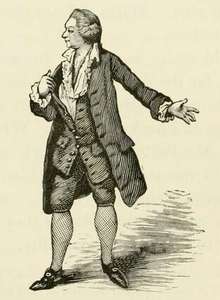
Mr. Clarke as Antonio.
CHAPTER IV. — FOOTNOTES:
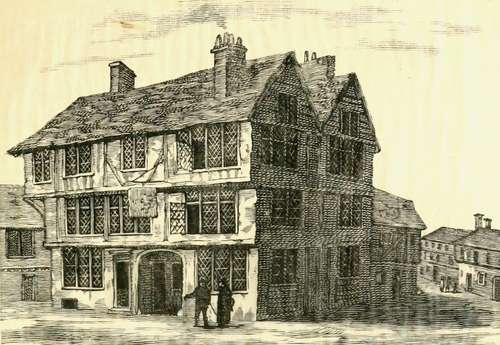
GARRICK'S BIRTHPLACE, HEREFORD.
ENTER GARRICK.
Great was the confusion in, and small the prosperity
of, the theatres after the death of Wilks, and withdrawal
of Cibber. Highmore, now chief patentee,
opened Drury; but Theophilus Cibber, with all the
principal Drury Lane performers, except Mrs. Clive
(for Miss Raftor was now the wife of Judge Clive's
brother), Mrs. Horton, and Mrs. Bridgewater,[18] opened
the Haymarket against him, under the title of "Comedians
of His Majesty's Revels." Highmore had recourse
to the law to keep the seceders to their engagements,
and Harper, a deserter to the Haymarket, was
prosecuted as a stroller; but the law acquitted him,
after solemn discussion. Highmore's chief actor
was Macklin, who first appeared as Captain Brazen,
Cibber's old part in the "Recruiting Officer," and he
subsequently played Marplot, Clodio, Teague, Brass,
and similar characters, with success; but he was cast
aside when the companies became reconciled.
There was no other actor of note in the Drury Lane
company, where good actresses were not wanting.
Mrs. Clive alone furnished perpetual sunshine, and
Mrs. Horton warmed the thin houses by the glow of
her beauty. No piece of permanent merit was produced,
and, sad change in the Drury Lane annals, the
patentee was at a heavy weekly loss.
On the first night that the seceders opened the
Haymarket, 21st September[19] 1733, with "Love for
Love," Mrs. Pritchard played Nell, in the after-piece
("Devil to Pay"). The Daily Post had already extolled
the "dawning excellence" she had exhibited
in a booth, and prophesied that she would charm the
age. She played light comic parts throughout the
season; but her powers as a tragedian do not seem
to have been suspected. Mrs. Pritchard thus entered
on her long and honourable career, a married woman,
with a large family, and an excellent character, which
she never tarnished. Cibber's daughter, Mrs. Charke,
played a round of male parts during the same season,[20]
Roderigo, in "Othello," being one of them. In the
March of 1734, the seceders closed the Haymarket,
and joined the wreck of the old company at Drury
Lane, on which Mrs. Pritchard, like Macklin, was
laid aside for a time. But while those eminent
players were "under a cloud," there appeared Miss
Arne, whose voice charmed all hearers, whose beauty
subdued Theophilus Cibber, but who was not yet
recognised as the tragic actress, between whom and
Mrs. Pritchard and Mrs. Yates, critics, and the town
generally, were to go mad with disputation.
Meantime, no new drama was produced at Covent
Garden, which lived in the public memory a month;
but Quin shed a glory on the house, and quite eclipsed
the careful, but heavy and decaying actor, Mills, who
aspired to the parts which Booth's death had left
unappropriated. In Macbeth and Othello, Thersites,
Cato, Apemantus, and Gonzales, in the "Mourning
Bride," he had at least no living rival. The contest
for superiority had commenced before Booth's death;
but Mills was never a match for Quin, and his name
has not been preserved among us as that of a great
actor.
As it is otherwise with Quin, let us recapitulate
some details of his previous career, before we accompany
him over that period which he filled so creditably,
till he was rudely shaken by the coming of
Garrick.
The father of James Quin was a barrister of a good
Irish family, and at one time resided in King Street,
Covent Garden, where James was born in 1693.
Mrs. Quin happened to be the wife of two husbands.
The first, who had abandoned her, and who, after
years of absence, was supposed to be dead, re-appeared
after Quin's birth, and carried off the boy's mother as
his own lawful wife.[21] Thereby, the boy himself was
deprived of his inheritance; the Quin property, which
was considerable, passed to the heir at law, and at
the age of twenty-one, the young man, intelligent
but uneducated, his illusions of being a squireen in
Ireland being all dissipated, and being specially fitted
for no vocation, went at once upon the stage. His
time of probation was first spent on the Dublin
boards, in 1714, where he played very small parts
with such great propriety, that in the following year,
on the recommendation of Chetwood, the prompter,
he was received, still as a probationer, into the company
then acting at Drury Lane. Booth, Cibber,
Mills, and Wilks were the chief players at that theatre,
and the young actor was at least among noble professors.
Among, but not of them, he remained for
at least two seasons, acting the walking gentlemen,
and fulfilling "general utility," without a chance of
reaching a higher rank. One night, however, in
1716, when the run of the revived "Tamerlane" was
threatened with interruption by the sudden illness of
the most ferocious of Bajazets, Quin was induced,
most reluctantly on the foolish fellow's side, to read
the part. In doing this with conscientiousness and
judgment, he received such testimonies of approval,
that he made himself master of the words by the following
night, and when the curtain fell, found himself
famous. The critics in the pit, and the fine gentlemen
who hung about the stage, united in acknowledging
his merits; the coffee-houses tossed his name about
pleasantly as a novelty, and Mr. Mills paid him the
compliment of speedily getting well.
When Mr. Mills resumed Bajazet, young Quin sank
down to the Dervise; and though, subsequently, his
cast of characters was improved, his patience was so
severely tried, that in the succeeding season he passed
over to the theatre in Lincoln's Inn Fields. Modestly
entering there in the part of Benducar, in "Don Sebastian,"[22]
he at once established himself in the public
favour, and before the close of the season 1718-19, the
chivalry of his Hotspur, the bluntness of his Clytus,
the fire of his Bajazet, the grandeur of his Macbeth,
the calm dignity of his Brutus, the unctuousness of
his Falstaff,[23] the duplicity of his Maskwell, and the
coarse comedy of his Sir John Brute, were circumstances
of which the town talked quite as eagerly as
they did of the Quadruple Alliance, and the musket
shot which had slain the royal Swede in the trenches
before Frederickshall.
It was Quin's success in Bajazet at Drury Lane
that really cost Bowen his life. I have noticed the
subject before, but it will admit of some further
detail. Bowen had taunted Quin with being tame in
Bajazet, and Quin retorted by speaking disparagingly
of Bowen in Jacomo in the "Libertine," preferring
Johnson in that part. Bowen was the more deeply
stung as he prided himself on his acting in Jacomo,
and the company agreed with the adverse critic.
The quarrel, commenced by envy, was aggravated by
politics. Bowen boasted of his honesty and consistency,
a boast, the worthlessness of which was
speedily shown by Quin's remark, that Bowen had
as often drunk the Duke of Ormond's health as he
had refused it. The disputants parted angrily, only
to meet more incensed. They met, on the invitation
of Bowen, and passed from one tavern to another,
till they could find a room which less suited Quin's
purpose than that of his irate companion—that of
"fighting it out." Indeed, the younger player seems
to have been hardly aware of his elder's definite
purpose; for when they entered the room Bowen
fastened the door, clapped his back to it, drew his
sword, and threatened to run Quin through the
body if he did not out with his rapier and defend
himself. Remonstrance from the latter was of no
avail, and he drew simply to keep Bowen off. But
the latter impetuously pressed forward till he ultimately
fell mortally wounded. Before his death,
however, which occurred within three days, he justly
and generously took the blame of the whole transaction
upon himself. This, with corroborative evidence,
secured the acquittal of Quin on his trial for manslaughter.
So died poor, foolish Bowen, at the age
of fifty-two, leaving a widow, for whom the public
had not sufficient sympathy to render her "benefit"
profitable, and a son, known in the London streets
as "Ragged-and-Tough," and whose exploits, recorded
in the Old Bailey Calendar, sent him to the
colonies to found in another hemisphere a line of
Bowens more honest and less angry than the latter
scions of the race in England.
This was a transition period, terminated by the
coming of Garrick. Quin passed over to Drury Lane,
tempted by the annual £500 offered by Fleetwood, a
wealthy personage, who had purchased the chief
share in the patent. "No actor," said Rich, "is
worth more than £300 a year," and declining to
retain Quin at the additional required outlay, he
brought forward a "citizen," named Stephens, to
oppose him. Stephens had caught the exact sound
of Booth's cadences and much of his manner. For
a time audiences were delighted, but the magic of
mere imitation soon ceased to attract; and Quin
decidedly led the town in old characters, but with
no opportunity yet offered him of a "creation."
Mrs. Clive enchanted her hearers at Drury Lane,
while Mrs. Horton took her beauty and happy
assurance to Covent Garden. A greater than either,
Mrs. Pritchard, played mere walking ladies, and
made no step in advance till 1735, when she acted
Lady Townley at the Haymarket. Old Cibber longing
again for a smell of the lamps, and a sound of
applause, played a few of his best parts during this
season, and Macklin slowly made progress according
to rare opportunity. Covent Garden chiefly depended
on Ryan; but suddenly lost his services when they
could be least spared. He was returning home, on
the 15th of March 1735, when he was shot by a
ruffian in Queen Street, Lincoln's Inn Fields, who
robbed him of his sword. "Friend," said the
generous actor, who was badly wounded in the face
and jaw-bone, "you have killed me; but I forgive
you!" In about six weeks, however, he was
sufficiently recovered to appear again, after a general
sympathy had been shown him, from the Prince of
Wales down to the gallery visitors.
Drury Lane, too, lost, but altogether, an useful
actor, Hallam. He and Macklin had quarrelled
about a theatrical wig, and impetuous Macklin,
raising his stick, thrust with it, in such blind fury,
that it penetrated through Hallam's eye to the
brain, and the unfortunate player died the next
day. An Old Bailey jury let the rasher, but grief-stricken
man, lightly off under a verdict of "Manslaughter."
From being a Queen of Song, Mrs. Cibber, the
second wife of Theophilus, first took ground as an
actress this season,[24] at Drury Lane, in Aaron Hill's
adaptation of Voltaire's "Zara." Mrs. Cibber was
the sister of Dr. Thomas Arne, the composer of
"Artaxerxes," and daughter of an upholsterer in the
neighbourhood of Covent Garden. Handel thought
so well of her that he arranged one of his airs in
the "Messiah" expressly to suit her voice. Her
ambition, however, was to be a tragic actress, and
Colley Cibber, who had sternly opposed her marriage
with his son, overcome by her winning ways, not
only was reconciled to her, but instructed her in her
study for Zara, and some part of her success was
owing to so accomplished a teacher.
Milward played Lusignan, a part in acting which
a young actor, named Bond, overcome by his feelings,
died on the stage, while blessing his children.[25]
This occurred at a private theatre, in Great Villiers
Street, where the tragedy was represented, by
sanction of the author, or, as Reed would have it,
of the stealer of it from Voltaire. Bond was not
the only actor who died in harness this year. Obese
Hulett, rival of Quin, in Falstaff, proud of the
strength of his lungs, which he was for ever exercising
to the terror of those who suddenly experienced
it, in making some extraordinary effort of this sort,
broke a blood-vessel, and straightway died, when
only thirty-five years of age; and he was buried
at the expense of his stage-manager, Giffard,
who rented Lincoln's Inn Fields, for awhile, of
Rich.
The success of Mrs. Cibber stirred Rich at Covent
Garden, and when she acted Hermione, the old but
able Mrs. Porter played the part against her, at the
latter house, as she also did Zara.[26] Mrs. Horton was
opposed to her in the part of Jane Shore.[27] In high
comedy, Mrs. Cibber attempted Indiana, in the "Conscious
Lovers," and forthwith Covent Garden put up
the same piece. But the latter house was inferior in
its company; there was no one there to shed sunshine
like Mrs. Clive. Delane and Walker together were
not equal to Quin. Of novelty, Covent Garden produced
nothing. Giffard's young troop, on the other
hand, in the east, and afterwards at Lincoln's Inn
Fields, produced much that was worthless, not excepting
another levy on Voltaire by Hill, in his
"Alzira." Indeed, the new authors of this period
were more remarkable than their pieces. Mrs. Cooper,
now forgotten, was the widow of an auctioneer; and
Stirling, author of the "Parricide," is, perhaps, better
remembered in Maryland, where he was a "popular
parson," than he is here. What is known of him
here, indeed, is not favourable. When he and Concanen
came together from Ireland, to live by their
pens, as political writers, they tossed up as to the
"side" they should take. As it fell to Concanen to
support, and to Stirling to abuse the ministry, the
former was enabled to acquire an ample fortune as
Attorney General of Jamaica, his seventeen years'
tenure of which, Matthew owed to the appreciation
of him by the Duke of Newcastle. But Matthew
was a wit, and a gentlemanlike fellow; whereas the
Rev. Jack Stirling, whose "Parricide" was hissed at
Goodman's Fields,[28] was an unsuccessful parson, who
did very well for a transatlantic minister.
The Haymarket was open in the spring and summer
of 1736, under Fielding, with his "Great Mogul's
Company of Comedians." Fielding, greatly improved
by many failures, found the town in laughter; and
Lillo drowned it in tears. At "Pasquin," that hot,
fierce, hard-hitting, mirth-moving satire, London
"screamed," night after night, for nearly two months;
and at the "Fatal Curiosity," that most heart-rending
of domestic dramas, the same London wept as if it
had the tenderest feelings in the world. In it Cibber's
daughter, erratic Mrs. Charke, condescended to
play a female part; and Davies, the bookseller and
dramatic historian, the part of her son, young Wilmot.
By such means and appliances did the stage support
itself through this year, in which Mrs. Pritchard is
seldom heard of, and Yates and Woodward are only
giving promise of the Sir Bashful Constant and Mercutio,
to come.
And now we reach 1736-7, with Quin especially
eminent in Shakspeare's characters, Mrs. Cibber, stirring
the town as Statira, Monimia, or Belvidera, and
Mrs. Clive—who had quarrelled with her as to the
right to play Polly—beaming like sunshine through
operatic farce and rattling comedy, as gaily as if her
brow had never known a frown.
The old colleague of Quin—Mills (the original representative
of characters so opposite as Zanga and
Aimwell, Pylades and Colonel Briton), died all but
on the stage, which lost in him a heavy "utility,"
whose will was better than his execution. A lady
"utility," too, withdrew after this season,—Mrs. Thurmond,
the original representative, also, of opposite
characters, to wit—Myris, in Young's "Busiris," and
Lady Wronghead.
The same Drury to which these were lost, gained
this season a new author, in the person of Dodsley,—whose
life is comprised in the words,—footman, poet,
bookseller, honest man. As yet, he is only at the
second step,—a poor poet; when he published books
instead of writing them, he became a wealthy, but
remained, as ever, a worthy fellow. It is due to this
ex-lacquey to say, that in his satirical piece, the
"Toy Shop," and in his hearty little drama, the
"King and the Miller of Mansfield," both helped
towards the stage by Pope, Dodsley gave wholesome
food to satisfy the public appetite; and the man who
had not long before stripped off a livery, showed more
respect for decency than any wit or gallant of them
all.
He was the only successful author of the season
at Drury. The Rev. Mr. Miller broke a commandment,
in his "Universal Passion,"—stolen from
Shakspeare and Molière; and classical Mr. Cooke
manifested no humour in converting Terence's
"Eunuchus," into a satirical farce, the "Eunuch,
or the Derby Captain,"—levelled at those English
emeriti whose regiments were disbanded after the
peace of Utrecht, and who sipped their Derbyshire
ale at a famous tavern in Covent Garden.
The chief incident before the curtain was a riot,
caused by the footmen who had been excluded from
their gallery, on the night of Macklin's benefit,—5th
May 1737. But of this incident I shall speak in
another page. Of Mrs. Pritchard there is barely an
appearance; her great opportunity had not yet
arrived.
At Covent Garden there was no new piece, but
something better,—a revival of Shakspeare's "King
John," in which Delane played the King, and Walker,
Falconbridge,—a character for which he was personally
and intellectually fitted, and in which, as in
Hotspur, he gained more laurels than he ever acquired
by his Macheath.
They who pursued novelty might find it with
Giffard's company, playing at the Lincoln's Inn
Fields, where, however, the only successful piece
was "King Charles I.," a tragedy by Havard, a young
actor, already known by his "Scanderbeg," and who
succeeded to the place left vacant by Mills. Giffard
played Charles, a character which is rather exaggerated
by the author, who acted Juxon. Chesterfield
said, in reference to this piece, that "the catastrophe
was too recent, too melancholy, and of too solemn a
nature to be heard of anywhere but in the pulpit."
However this may be, the way in which the tragedy
was composed was anything but solemn. Desultory
Havard had been commissioned by Giffard to write
the piece. It was done to order, and under constraint;
for the patron locked up the poet in a garret,
near Lincoln's Inn, during a certain number of hours,
daily, from which he was not suffered to emerge till
he had repeated, from behind the door, to Giffard,
who was on the landing, a certain number of newly-written
lines,—till the whole was completed, when
the poet became free.
At the Haymarket, Fielding and satire reigned, but
not supreme,—for his pieces were as often hissed as
applauded; but the political allusions in "Tumble-down
Dick, or Phaeton in the Suds," pleased, and
those in the "Historical Register for 1736," made
the audience laugh, and Sir Robert Walpole, satirised
as Quidnunc,[29] winced. The government had for some
time contemplated a restriction of the licence of the
stage. Hitherto, the Lord Chamberlain could stop
a play in its career. It was now proposed to establish
a licenser, according to whose report the Chamberlain
might prohibit the play from entering on a
career at all. The proposal arose out of an officious
act of Giffard's, who took the manuscript of a satirical
piece, called the "Golden Rump," to the minister,
at which piece the latter was so shocked, that the bill
for gagging the stage was at once proceeded with.
It was indecorously hurried through the Commons
and tossed to the Lords, at the close of the session
of 1737. There it met the sturdy opposition of
Chesterfield. He looked upon the bill as an attempt,
through restraining the licence of the stage, to destroy
the liberty of the press; for what was seditious
to act, it would be seditious to print. And, if the
printing of a play could be stopped, there would soon
be a gag on pamphlets and other works.
The very act of Giffard showed that the players
were anxious not to come in collision with government;
and the existing laws could be applied against
them if they offended. But those laws were not
applied, or Mr. Fielding would have been punished
for his "Pasquin," wherein the three great professions—religion,
physic, and law—were represented
as inconsistent with common sense. Chesterfield
thought that the same law might have been put in
force against Havard, for his "King Charles I."
If ministers dreaded satire or censure all they had
to do was so to act as not to deserve it. If they
deserved it, it would be as easy to turn passages of
old plays against them, as to make them, in new.
When the Roman actor, Diphilus, altered the words
"Nostrâ miseriâ tu es magnus!"—a phrase from an
old play—the eyes of the audience were turned on
Pompeius Magnus, who was present; and the speaker
was made to repeat the phrase a hundred times.
Augustus, indeed, subsequently restored "order" in
Rome; but God forbid that order should be restored
here, at such a price as was paid for it in Rome!
False accusations, too, could be lightly made.
Molière complained that "Tartuffe" was prohibited
on the ground of its ridiculing religion, which was
done nightly on the Italian stage; whereas he only
satirised hypocrites. "It is true, Molière," said the
Prince de Conti, "Harlequin ridicules heaven and
exposes religion; but you have done much worse,—you
have ridiculed the first minister of religion."
Against the power of prohibition being lodged in
one single man, Chesterfield protested, but in vain.
One consequence, he said, would be, that all vices
prevalent at court would come to be represented as
virtues. He told the Lords that they had no right
to put an excise upon wit; and said, finely, "Wit,
my Lords, is the property of those who have it,—and
too often the only property they have to depend
on. It is, indeed, but a precarious dependence.
Thank God!" he said, "we, my Lords, have a dependence
of another kind!"
Such is the substance of his famous but unavailing
remonstrance. The bill, not to protect morality, but
to spare the susceptibilities of statesmen and place-men,
passed; and the result was a "job." In the
ensuing spring, Chetwynd was appointed, under the
Chamberlain, licenser of plays, with a salary of £400
per annum; and to help him in doing little, Odell
was named a deputy-licenser, with £200 yearly;—and
therewith the job was consummated; and the
deputy-licenser began to break the law he was
appointed to see strictly observed. When the Act
was passed, his most sacred majesty, who commanded
unsavoury pieces occasionally to be played before him,
prorogued the parliament, after lamenting the spirit
of insubordination and licentiousness which pervaded
the community!
The government made use of its authority, by prohibiting
plays, and the public took their revenge, by
hissing those that were licensed. Among the prohibited,
were Brooke's "Gustavus Vasa;" Thomson's
"Edward and Eleanora;" and Fielding's "Miss Lucy
in Town;"[30]—the first, as dangerous to public order;
the second, as too freely alluding to royal family dissensions;
the third (after it had been licensed) as
satirising "some man of quality!" To these must be
added "Arminius," by Paterson, Thomson's deputy
in his post of Surveyor of the Leeward Islands. The
deputy had copied out his principal's "Edward and
Eleanora;" and as "Arminius" was in the same
hand, it was forbidden, as being, probably, an equally
objectionable piece by the same author! The prohibition
applied to it was profitable; for he published
his play by subscription, and gained £1000 by it,—not
for the reason that it was a good, but because it
was a forbidden drama.[31]
Audiences amused themselves by hissing the permitted
plays, sometimes with the additional luxury of
personal feeling against the author,—as in the case
of the Rev. Mr. Miller's "Coffee House," "Art and
Nature," and "Hospital for Fools." Thomson was
fortunate in saving his "Agamemnon" from the
censors, for it is not unworthy of ranking with the
"Iphigenia" of Racine; and its merit saved it.
Mallet was still more lucky with his "Mustapha;"
and the audience were too pleased to hiss a piece,
the licensers of which were too dull to perceive that
Sultan Solyman and his vizier, Rustan, were but
stage portraits of George II. and Sir Robert Walpole.
They had no such tenderness for the "Parricide" of
William Shirley,—a gentleman who understood the
laws of trade better than those of the drama. A
French company, at the Haymarket, were of course
hissed out of the country. There was no ill-will
against them, personally. It was sufficient that the
Licensing Act authorised them to play, and the public
would not tolerate them, accordingly! If they bore
with Lillo's "Marina," it was, perhaps, because it
was a re-cast of "Pericles;" and if they applauded
his licensed "Elmeric," the reason may have been,
that the old dissenting jeweller, who set so brave an
example in writing "moral" pieces, was then dead;
and the "author's nights" might be of advantage to
his impoverished family.
But there were licensed dramas at which the public
laughed too heartily, to have cared to hiss, or which
so entranced them that they never thought of it.
Thus, Dodsley's merry pieces, "Sir John Cockle,"
and the "Blind Beggar;" Carey and Lampe's hilarious
burlesque-opera, the "Dragon of Wantley," and its
sequel, "Margery;" with "Orpheus and Eurydice,"
one of Rich's burlesques and pantomimes—the comic
operatic scenes not preceding, but alternating with
those of the harlequinade—in which, by the way, the
name of Grimaldi occurs as pantaloon,—rode riotously
triumphant through the seasons, which were otherwise
especially remarkable, by numerous revivals of
Shakspeare's plays, according to the original text;
and not less so by that of Milton's "Comus," in
which graceful Mrs. Cibber played and sang the
Lady, and sunny Kitty Clive gladdened every heart,
as Euphrosyne.
As far as new pieces are concerned, thus stood the
stage till Garrick came. In further continuing to
clear it for his coming, I have to record the death of
Bowman, the best dressed old man at eighty-eight,
and the cheeriest that could be seen. My readers, I
hope, remember him, in the chapter on Betterton.
Miller is also gone,—a favourite actor, in his day,
whose merit in Irish characters is set down in his
not having a brogue, which, at that period, was unintelligible
to English ears. Miller played a wide
range of characters; and he married for the very
singular reason that, being unable to read the manuscript
copy he had to get by heart, his wife might read
it to, and beat it into, him. Bullock, too, the original
Boniface and Gibby; and Harper, the original Jobson;
and Ben. Griffin, quaint in Simon Pure, comic
and terrific in Lovegold; with Milward, the original
Lusignan; and Ben Jonson, always correct and
natural,—have now departed. With them has gone
Mrs. Hallam, an actress of repute,—the original
Duchess of Malfy, in the revival of Webster's tragedy
of horrors. By her death, the boards of old Drury
were relieved from a load of fourteen stone weight!—almost
as great as that of Mademoiselle Georges.
Of those that were left, Quin was the great chief;
but he received a rude shock from Macklin, when the
latter, after playing Roxana, in a burlesque of the
"Rival Queens," achieved his first triumph, by taking
Shylock from low comedy, and playing it as a serious
character.[32] The managers were as nervously afraid
of a riot as those of the Ambigu were, when Frederic
Lemaître, making no impression as the villain, Robert
Macaire, during the first act of "L'Auberge des
Adrets," played it through the rest of the piece as a
comic part! In either case, the greatest success
ensued, but that of Macklin was most honestly
earned; and he took rank forthwith as one of the
noble actors of his time.
Turning to other players, I find Mrs. Pritchard progressing
from Lady Macduff to Isabella,—from Lucy
to Viola and Rosalind. Walker meets a rival in the
Macheath of mellifluous Beard. Woodward and Yates
are rising to fame. Young Mrs. Cibber disappears
for awhile, carrying with her the charms that strike
the sight, and the merit that wins the soul. There is
a terrible scandal in the cause of her disappearance.
"Pistol," her worthless husband, has something more
than pushed her into temptation, that he may make
money by the offence to which he is the prompter.
The public voice condemns him; a jury awards him
damages, which show their contempt for his "sense of
honour;" and the lady, running away from the house
in which he had shut her up, while he was absent,
playing that congenial character, Scrub—took for her
better friend the man who had fallen in love with
her through her husband's contrivance.
As if to compensate for the loss of Mrs. Cibber's
honied tones, the stage was wakened to a new delight,
by the presence of Margaret Woffington. This
Irish actress made her first appearance at Covent
Garden, on the 6th of November, 1740, as Sylvia, in
the "Recruiting Officer;" and when, a few nights
later, she played Sir Harry Wildair,—the ecstatic
town were ready to confess, that in the new and
youthful charmer they had at once recovered both
Mrs. Oldfield and Robert Wilks. And yet this
enchantress, so graceful, so winning, so natural, so
refined, had commenced her public career as one of
the children who were suspended by a rope from the
ancles of Madame Violanti, when that wonder of
her day exhibited her powers in Dublin on the
tight-rope.
Loth to leave entirely, Colley Cibber now and
then, at £50 a night, played a round of characters,
always to crowded houses, but most so when he
enacted some of his old beaux and fops. His Richard
did not so well please; and one night, when playing
this character, he whispered to Victor that he would
give £50 to be in his easy chair again, by his fireside.
There was a Richard at hand who was likely to
drive him there, and keep all others from the stage.
The season of 1741-42 opened at Drury, on September
5, with "Love for Love," and the "Mock
Doctor." The additions to the company, of note,
were Delane, Theophilus Cibber, and Mrs. Woffington.
Quin was absent starring in Ireland. Covent
Garden opened on October 8th with the "Provoked
Wife." On the 19th of the latter month, while
Drury was giving "As You Like It," and Covent
Garden was acting the same piece, the little theatre
in Ayliffe Street, Goodman's Fields, announced the
"Life and Death of King Richard III.," "the part
of King Richard by a gentleman who never appeared
on any stage."
At last! the hour and the man had come.
Throughout this season no new piece was produced
at either of the patent theatres,[33] so influenced were
they by the consequences of this first appearance of
a nameless actor at Goodman's Fields. Of course,
the new actor was David Garrick.
CHAPTER V. — FOOTNOTES:
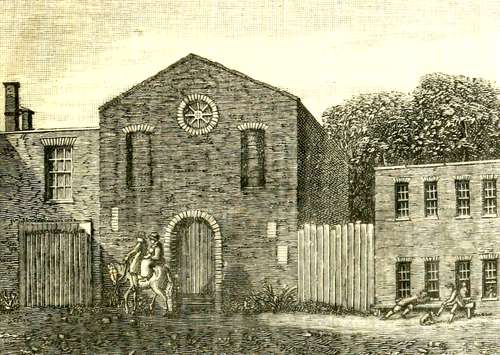
IPSWICH THEATRE.
GARRICK, QUIN, MRS. PORTER.
He had selected the part of Richard III., for reasons
which now appear singular. "He had often declared,"
says Davies, "he would never choose a character that
was not suitable to his person; for, said he, if I should
come forth in a hero, or in any part which is generally
acted by a tall fellow, I shall not be offered a larger
salary than 40s. a week. In this," adds the biographer,
"he glanced at the follies of those managers who used
to measure an actor's merit by his size."
On that 19th of October 1741, there was no very
great nor excitedly expectant audience at Goodman's
Fields. The bill of the day first promises a concert
of vocal and instrumental music, to begin exactly at
six o'clock; admission by tickets "at 3s., 2s., and 1s."
Between the two parts of the concert, it is further announced
that the historical play of the "Life and
Death of Richard III.," with the ballad-opera of "The
Virgin Unmasked," would be "performed gratis by
Persons for their Diversion." The part of King
Richard, "by a gentleman who never appeared on
any stage," is an announcement, not true to the letter;
but the select audience were not troubled therewith.
From the moment the new actor appeared they were
enthralled. They saw a Richard and not an actor of
that personage. Of the audience, he seemed unconscious,
so thoroughly did he identify himself with the
character. He surrendered himself to all its requirements,
was ready for every phase of passion, every
change of humour, and was as wonderful in quiet
sarcasm as he was terrific in the hurricane of the
battle-scenes. Above all, his audience were delighted
with his "nature." Since Betterton's death, actors
had fallen into a rhythmical, mechanical, sing-song
cadence. The style still lingers among conservative
French tragedians. Garrick spoke not as an orator,
but as King Richard himself might have spoken in
like circumstances. The chuckling exultation of his
"So much for Buckingham!" was long a tradition on
the stage. His "points," indeed, occurred in rapid
succession. We are told that the rage and rapidity
with which he delivered
"Cold friends to me! What do they in the North,
When they should serve their sovereign in the West?"
made a wonderful impression on the audience.
Hogarth has shown us how he looked, when starting
from his dream; and critics tell us that his cry of
"Give me another horse!" was the cry of a gallant,
fearless man; but that it fell into one of distress as
he said, "Bind up my wounds," while the "Have
mercy, Heaven," was moaned piteously, on bended
knee. The battle-scene and death excited the utmost
enthusiasm of an audience altogether unused to acting
like this. The true successor of Betterton had,
at last, appeared. Betterton was the great actor of
the days of Charles II., James II., William, and of
Anne. Powell, Verbruggen,[34] Mills, Quin, were unequal
to the upholding of such a task as Betterton
had left them. Booth was more worthy of the inheritance;
but after him came the true heir, David
Garrick, the first tragic actor who gave extraordinary
lustre to the Georgian Era.
And yet, for seven nights, the receipts averaged
but about £30 a night; and Garrick only slowly
made his way at first. Then suddenly the town was
aroused. The western theatres were abandoned.
"Mr. Garrick," says Davies, "drew after him the
inhabitants of the most polite parts of the town.
Goodman's Fields were full of the splendour of St.
James's and Grosvenor Square. The coaches of the
nobility filled up the space from Temple Bar to
Whitechapel." Among these, even bishops might
have been found. Pope came up from Twickenham,
and without disparaging Betterton, as some old
stagers were disposed to do, only "feared the young
man would be spoiled, for he would have no competitor."
Quin felt his laurels shaking on his brow,
and declared that if this young man was right, he
and all the old actors must be wrong. But Quin
took courage. Dissent was a-foot, and he compared
the attraction of Garrick to the attraction of Whitfield.
The sheep would go astray. The throwster's
shop-theatre was, in his eyes, a sort of conventicle.
It would all come right by-and-bye. The people,
he said, who go to chapel will soon come to church
again.
Meanwhile let us trace the new actor through his
first and only season in the far east. During that
season, from the 19th of October 1741, to the 29th
of May 1742, Garrick acted more comic than tragic
characters; of the latter he played Richard (eighteen
times), Chamont, Lothario, the Ghost in "Hamlet"
(Giffard, the manager, playing the Dane), Aboan,
King Lear, and Pierre. In comedy, he played Clodio
("Love Makes a Man"), Fondlewife, Costar Pearmain,
Witwoud, Bayes, Master Johnny ("School
Boy"), Lord Foppington ("Careless Husband"),
Duretete, Captain Brazen, and two characters in
farces, of which he was the original representative;
Jack Smatter in "Pamela," and Sharp in the "Lying
Valet." This is, at least, a singular selection.
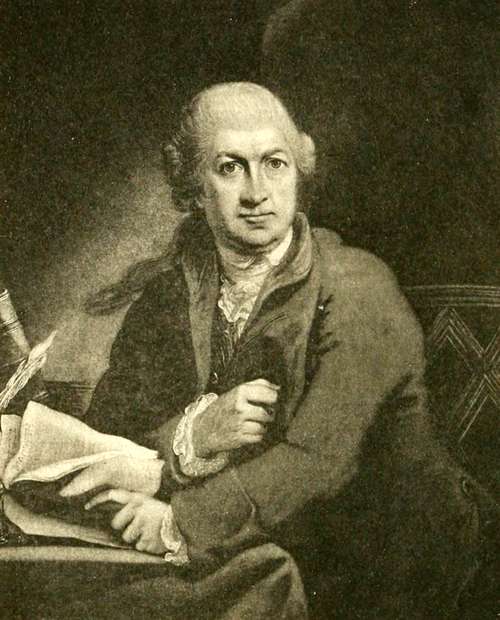
The most important of his comic essays in his first
busy season, when he frequently played in tragedy
and farce, on the same night, without affecting to be
wearied, was in the part of Bayes. His wonderful
powers of mimicry, or imitation, were not known till
then; and in displaying them, his Bayes was a
triumph, although other actors excelled him in that
part, as a whole.
His great scene was at the rehearsal of his play,
when he corrected the players, and instructing them
how to act their parts, he gave imitations of the
peculiarities of several contemporary actors. Garrick
began with Delane, a comedian of merit, good
presence, and agreeable voice, but, we are told, a
"declaimer." In taking him off, Garrick retired to
the upper part of the stage, and drawing his left arm
across his breast, rested his right elbow upon it, raising
a finger to his nose; he then came forward in a stately
gait, nodding his head as he advanced, and in the
exact tone of Delane, spoke the famous simile of the
"Boar and the Sow." This imitation is said to
have injured Delane in the estimation of the town;
but it was enjoyed by no one more than by tall
and handsome Hale of Covent Garden, where his
melodious voice was nightly used in the character
of lover. But when Hale recognised himself in the
soft, plaintive accents of a speech delivered without
feeling, he was as disgusted as Giffard, who was so
nettled by Garrick's close mimicry of his striking
peculiarities that he is said to have challenged the
mimic, fought with him, and wounded him in the
sword-arm. Ryan, more wisely, let Garrick excite
what mirth he might from the imitation of the
hoarse and tremulous voice of the former; and
Quin, always expecting to be "taken off," was left
untouched, salient as were his points, on the ground,
according to Murphy, of Quin's excellence in characters
suited to him.
From a salary of £1 a night, Garrick went up at
once to half profits. The patent theatres remained
empty when he played at Goodman's Fields, and
accordingly the patentees, threatening an application
to the law in support of their privileges, shut up
the house, made terms with Giffard, and Garrick
was brought over to Drury Lane, where his salary
was speedily fixed at £600 per annum, being one
hundred more than that of Quin, which hitherto had
been the highest ever received by any player.
His first appearance at Drury Lane was on May
11, 1742, when he played gratuitously for the benefit
of Harper's widow, taking what was then considered
the inferior part of Chamont, in the "Orphan," of
which he made the principal character in the play.
With Bayes, on the 29th,[35] Lear and Richard, each
part played once, he brought his preliminary performances
at Drury to a close. In June, 1742, after
playing triumphantly during the brief remainder of
the spring season at Drury Lane, Garrick, in company
with Mrs. Woffington, crossed, by invitation,
to Dublin. During an unusually hot summer he
drew such thickly-packed audiences that a distemper
became epidemic among those who constantly visited
the ill-ventilated theatre, which proved fatal to many,
and which received the distinction of being called
the Garrick fever.
Of course, Garrick had not equally affected all
the judges. Neither Gray nor Walpole allowed him
to be the transcendent actor which the town generally
held him to be, from the first night of his
appearance. "Did I tell you about Mr. Garrick,
that the town are horn-mad after?" writes Gray to
Chute; "There are a dozen dukes of a night at
Goodman's Fields, sometimes; and yet I am stiff in
the opposition." In May, 1742, Walpole writes in
like strain to Mann:—"All the run is now after
Garrick, a wine-merchant, who is turned player at
Goodman's Fields. He plays all parts, and is a
very good mimic. His acting I have seen, and may
say to you, who will not tell it again here, I see
nothing wonderful in it; but it is heresy to say so.
The Duke of Argyll says he is superior to Betterton."
The old Lord Cobham, who was then at Stowe
nursing Jemmy Hammond, the poet, who was then
dying for love of the incomparable Miss Dashwood,
was of the same opinion with the Duke; but they
could only contrast Betterton in his decline with
Garrick in his young and vigorous manhood.
In November of the last-named year, Mrs. Pendarves
(Delany) saw the new actor in Richard III.
"Garrick acted," she says, "with his usual excellence;
but I think I won't go to any more such deep tragedies,
they shock the mind too much, and the common
objects of misery we daily meet with are sufficient
mortification." This lady, too, records the great dissensions
that raged among critics with respect to his
merits.
Before we accompany this great actor in his career
of thirty years and upwards, let us close the present
chapter by looking back over the path he has already
passed, and which comes towards us, singularly
enough, from Versailles, and the cabinet of the Great
King!
Yes! When Louis XIV., on the 22nd of October,
1685, signed the revocation of the Edict of Nantes, he
lost 800,000 Protestant subjects, filled Spitalfields,
Soho, St. Giles, and other parts of England, with
50,000 able artizans, and gave David Garrick to the
English stage!
The grandfather of David was among the fugitives.
That he moderately prospered may be believed, since
his son ultimately held a captain's commission in the
English army. Captain Garrick married a lady named
Clough, the daughter of a Lichfield vicar; and the
most famous son of this marriage, David, was born at
Hereford, his father's recruiting quarters, in February,
1716. In the same city was born Nell Gwyn, if
that, and not Margaret Simcott, be her proper name.
Her great grandson, Lord James Beauclerk, was not
yet bishop of the place when Garrick was born, but a
much more dramatic personage, Philip Bisse, was.
This right reverend gentleman was the audacious
individual who, catching the Duchess of Plymouth in
the dark, kissed her, and then apologised, on the
ground that he had mistaken her for a Maid of
Honour. The lively Duchess, who was then the
widow of Charles Fitz-Charles, natural son of Charles
II., by Catherine Peg, married the surpliced Corydon.
Their life was a pleasant comedy; and under
this very dramatic episcopate was Roscius born.
His boyhood was passed at Lichfield, where he became
more remarkable for his mania for acting than
for application to school studies. At the age of eleven
years, chief of a boyish company of players, he acted
Kite, in the "Recruiting Officer," in which one of his
sisters represented the Chambermaid, and to which
Master Samuel Johnson refused to supply an introductory
address. From Lichfield he made a trip to
Lisbon, and therewith an attempt to fix himself in a
vocation. His failure was no source of regret to himself.
His uncle, a wine-merchant in the Portuguese
capital, was not disposed to initiate the volatile lad
into the mysteries of his craft, and David returned to
Lichfield, with such increase of taste for the drama,
that "several of his father's acquaintances," says
Davies, "who knew the delight which he felt in the
entertainment of the stage, often treated him with a
journey to London, that he might feast his appetite at
the playhouse." By this singular liberality, the ardent
youth was enabled to see old Mills and Wilks, the two
Cibbers, Ryan (of whose Richard, Garrick always
spoke with admiration), and Quin. Booth was then
stricken with the illness which ultimately killed
him, and Garrick thus failed to study the greatest of
actors between the era of Betterton and the coming
time of Garrick himself. Of actresses the most important
whom he saw, were Mrs. Porter, Mrs. Cibber,
with whom he was destined to rouse the passions of
many an audience, and Miss Raftor, who, as Mrs.
Clive, was afterwards to rouse and play with his
own.
This ardent youth returned to Lichfield with more
eager desire than ever to achieve fame and fortune
on the stage. To supply what had been lacking in
his education, he became the pupil of Samuel Johnson;
but master and scholar soon wearied of it, and
they together left Lichfield for London, Garrick with
small means and great hopes, Johnson with means
as small, and his tragedy of "Irene."
The resources of David were speedily increased
by the death of his uncle, who bequeathed him a
thousand pounds, with the interest of which David
paid the cost of instruction which he received from
the Rev. Mr. Colson. Other opportunities failing, he
joined with his brother Peter in the wine trade, in
Durham Yard, where, said Foote, in after years, and
with his characteristic ill-nature, "David lived, with
three quarts of vinegar in the cellar, calling himself
a wine-merchant." Had the father of David been at
home, instead of on service at Gibraltar, the latter
would probably have been a Templar student; but
Garrick hated the study of the law, and, out of deference
to his mother, the vicar's daughter, he refrained
from appearing on the stage; but when both parents
had passed away, within the same year, Garrick,
who had studied each living actor of mark, and even
recorded his judgment of them, anonymously and
honestly, in the public papers, left the stock in trade
at Durham Yard to his senior partner and brother.
In 1741, a diffident young gentlemen,
calling himself
Lyddell,[36] made his first appearance on the
stage; at Ipswich. He selected the part of Aboan
for two reasons: that it was a secondary character,
and that Aboan was a "black." The attempt presented
less difficulty, for the first reason; and failure
need not be followed by recognition, seeing that his
features would be half-concealed under "colour."
The attempt, however, was fairly successful, but not
a triumph. David went earnestly into training. He
played every species of character, solemn tragedy
heroes, high and low comedy, and even that incarnation
of the monkey in man, as Alphonse Karr
calls him, the bustling, glittering, active, and potent
Harlequin.
His career of a few months at Ipswich was as the
preparatory canter of the high-mettled racer over the
course. All who witnessed it augured well of the
young actor; and Giffard, the manager, agreed to
bring him out in London in the autumn of the same
year, 1741, at that theatre, in Goodman's Fields,
which had been made, twelve years previously, out
of a throwster's shop. It had been opened, without
competent licence, by Odell, the dramatist, and subsequently
deputy licenser of plays under the famous
Act which Walpole introduced and Chesterfield
opposed. Odell was so conscientious, or so prudent,
that in consequence of a sermon preached against the
theatre, in one of the Aldgate churches, he sold his
interest to Giffard, who enlarged the house, and opened
it in 1732. After a struggle of three seasons' duration,
the determined opposition of the Eastern puritans
drove him to Lincoln's Inn Fields. He returned,
however, at the end of two years; and maintained his
position with varying fortunes, till at length, in 1741,
he brought Mr. Lyddell,[37] now Mr. Garrick, from the
banks of the Orwell to the neighbourhood of the old
gate, where the statues of Love and Charity still stood,
and near which, crowds soon awoke such echoes as
had not been heard in the vicinity since the godlike
effigies were first erected.
In the season of 1742-43, Garrick acted about
eighty nights,—Hamlet, thirteen times; Richard and
Bayes, eleven; Archer, nine; Lear, six; Fondlewife
and Hastings, four; Chamont, three; Plume, Clodio,
and Pierre, twice; Abel Drugger, once; Wildair,
created by him in Fielding's "Wedding Day," Lothario,
Millamour,[38] and Sharp, occasionally.[39] Of these,
Wildair was a decided failure.
Quin played against him at Covent Garden,
Richard, Chamont, Lear, and Pierre, but in these he
proved no competitor. He fell back on his general
repertory, and, among many other characters, played
Falstaff, Macbeth, Othello, and Brutus, none of which
Garrick assumed this year. Garrick's Fondlewife was
opposed by that of Hippisley at Covent Garden, and
that of Cibber, the younger, at Lincoln's Inn Fields.
His Hamlet was encountered by that of Ryan, at
Covent Garden, to Quin's Ghost; and a counter-attraction
to his Lothario was set up in those of
Ryan and of the silly amateur, Highmore, the latter
at Lincoln's Inn Fields. From all competition, Garrick
came out triumphant.
Of Lincoln's Inn Fields, this was the "positively
final" season. Giffard managed the house with judgment,
but he lost there some of the wealth which he
had acquired at Goodman's Fields, and out of which
he purchased the ground on which he built Coventry
Court, locality of gloomy reputation, near the Haymarket.
Dulwich College was a wiser investment
of money acquired in the theatre.
Covent Garden lost, this year, a great actress in
Mrs. Porter, who commenced her theatrical career as
theatrical attendant to Mrs. Barry, and was one of the
old players of King William's days. Among the most
marked of her original representations were Araminta,
in the "Confederacy;" Hermione, Lucia, in "Cato;"
Alicia, in "Jane Shore;" Lady Woodville, in the
"Nonjuror;" Leonora, in the "Revenge;" and Lady
Grace, in the "Provoked Husband." Few details of
her life are known.
Genest combines the testimonies of Victor and
Davies in describing Mrs. Porter as the genuine successor
of Mrs. Barry, to whom the former had long
played the "confidantes" in tragedy, and from the
great mistress learned her noble art. We are told
that Mrs. Porter was tall and well made, of a fair complexion,
but far from handsome; her voice, which was
naturally tender, was by labour and practice enlarged
into sufficient force to fill the theatre, but by that
means a tremor was contracted to which nothing but
custom could have reconciled the audience. She
elevated herself above all personal defects by an exquisite
judgment. In comedy, her acting was somewhat
cold and inefficient; but in those parts of
tragedy where the passions predominate, she seemed
to be another person, and to be inspired with that
noble and enthusiastic ardour which was capable of
raising the coldest auditor to animation. She had a
dignity in her mien, and a spirited propriety in all
characters of rage; but when grief and tenderness
possessed her, she subsided into the most affecting
softness. She acted the tragic parts of Hermione
and Belvidera with great applause. Booth, who was
no admirer of Mrs. Oldfield in tragedy, was in raptures
with Mrs. Porter's Belvidera. She excelled
particularly in her agony, when forced from Jaffier,
in the second act, and in her madness.
After the dislocation of her limb, and in advanced
age, she still acted with vigour and success. In
Queen Elizabeth ("Albion Queens"), she turned the
cane she used on account of her lameness, to great
advantage. After signing Mary's death warrant, she
"struck the stage," says Davies, "with such characteristic
vehemence that the audience reiterated applause."
On Valentine's night, 1743, the Prince and Princess
of Wales were present at her farewell benefit,
when she played this Queen Elizabeth, under august
patronage. The fine old lady seems to have fallen
into some distress, for in 1758 she published, by five
shillings subscriptions, for her benefit, the comedy
of "The Mistakes, or the Happy Resentment," which
had been given to her by Pope's Lord Cornbury, the
son, but not destined to be the heir, of the last of
the Hydes, who bore the title of Earls of Clarendon.
He was a dull writer, but so good a man, that Walpole
says, in reference to Pope's line—
"Disdain what Cornbury disdains"—
"it was a test of virtue to disdain what he disdained."
After his death, by falling from a horse
in France, the decayed tragedy queen published the
play. The old and favoured servant of the public
modestly says, that her "powers of contributing to
their amusement are no more," but that she "always
retains a grateful sense of the indulgence she had
received from those who have had the goodness to
accept her inclination and endeavours to please, as
real merit." Nothing could be more modest, but
the truth is that this was written for Mrs. Porter by
Horace Walpole. The subscription list was well
filled,—the Countess Cowper, whose letters figure in
Mrs. Delany's memoirs, taking fourscore copies.
Let us now return to the renewed struggles of the
rival houses, made fiercer by the rise of a new actor.
CHAPTER VI. — FOOTNOTES:
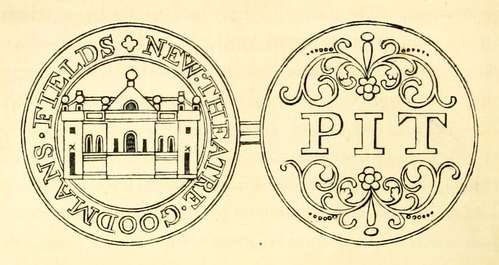
A PIT ADMISSION CHECK.
RIVALRY; AND ENTER, SPRANGER BARRY.
Hitherto, under the mismanagement of the lazy and
reckless patentee, Fleetwood, Drury Lane had fallen
to a level with Sadler's Wells—tumblers and rope-dancers
being put forward as the chief attractions.
Even after Garrick's accession, gross mismanagement
continued, and drove the principal actors, whose salaries
were often unpaid, into open rebellion. They
sought permission from the Lord Chamberlain, the
Duke of Grafton, to open the theatre in the Haymarket
on their own account. But the grandson of
Charles II. sneered at the fact of an actor earning
£600 a year, when a relative of his own, in the navy,
repeatedly exposed his life, in the kings service, for
half that sum. The duke put constraint on them to
return to their allegiance to Fleetwood. The latter
dictated hard terms to most of them, except to Garrick,
and he flatly refused to receive Macklin at all.
This exclusion brought on a remarkable theatrical
riot. The confederate actors had agreed to triumph
or to fall together. To allow Macklin to be sacrificed
to the resentment of Fleetwood, was a betrayal on
their part of the compact. Macklin appealed to the
town, and Roscius would have been driven from the
stage but for Fleetwood's hired pugilists, who pummelled
one portion of the audience into silence, and
enabled the whole house to enjoy, after all, what
they most cared for—the acting of Garrick, undisturbed.
In this season, 1743-4, Roscius did not
appear till the 6th of December,[40] when he acted
Bayes. Between that night, and the close of the
season, on the 31st of May, he played in all seventy
times. His most marked success was in Macbeth,
in the tragedy "written by Shakspeare," when he
had Mrs. Giffard for his Lady; he repeated this part
thirteen times. Covent Garden opposed to him, first
Quin, in Davenant's alteration of Shakspeare, and
subsequently Sheridan, who on the 31st of March
1744, made his first appearance at Covent Garden, in
opposition to Garrick, as Hamlet.
The force of the two theatres will be better understood,
perhaps, if I show the exact amount of the
opposition brought to bear against each other. Garrick's
Richard was met by that of Ryan; the Lord
and Lady Townley of Garrick and Mrs. Woffington,
by those of Ryan and Mrs. Horton; the Hamlet and
Ophelia of the former two, by those of Ryan (and
afterwards of Sheridan) and Mrs. Clive. Garrick
and Mrs. Giffard, in "Macbeth," were opposed, first
by Quin, then by Sheridan and Mrs. Pritchard, who
played everything, from the Thane's wife to Kitty
Pry. To oppose to him an amateur, like Highmore,
in Lothario, was absurd; Quin's Lear had no
weight against the mad old king by his young
rival; and Mrs. Charke's Plume, one of the many
male characters which Cibber's daughter loved to
play, was pale, compared with that of the universal
actor.
All the above were honourable competitors; but
there also appeared this season an actor, who became
Garrick's personal enemy—namely, Foote.
The latter commenced his career at the Haymarket,
February 6, 1744, as Othello, to the Iago of Macklin,
who had opened that house with a "scratch company,"
including "pupils"—while he was disengaged
at Drury Lane. Foote also played Hamlet,[41] to the
Ghost and First Gravedigger of Macklin; and did
not find his vocation, as he thought, in such parts
as Lord Foppington.
At both patent houses the "Beggars' Opera" was
produced; at Drury, the Macheath and Polly were
Blakes and Miss Budgell, an illegitimate daughter
of Eustace Budgell; at the Garden, Cashell's Macheath
gave way to that of Beard, while the Polly
and Lucy of Kitty Clive and Mrs. Pritchard, at the
same theatre, charmed the auditors for a time, and
gave them pleasant memories for a long period to
come.
The literature of the stage did not make progress
this season. Classical Cooke selected an assize case
of murder in Kent, and spoiled its terrible simplicity
in his "Love the Cause." To Havard's cold, declamatory
tragedy, "Regulus," Garrick gave warmth
and natural eloquence; but even his Zaphna, admirable
as it was in "Mahomet," would not have saved
the Rev. Mr. Miller's adaptation from Voltaire, had
that part of the public who hated the adapter, known
to whom they were indebted for it. Miller ended his
uneasy life, during the run of the play, a representation
of which, after his death, contributed a hundred
pounds to the relief of his widow and children.
In the season of 1744-45, the old opposition was
feebly sustained on the part of Covent Garden, but
with some novelty appended—especially in the case
of a ballad-singer like Cashell, attempting Hamlet
against Garrick![42] Further, the King John of the
latter in Shakspeare's play was opposed to old
Cibber's alteration of the same piece, produced at
Covent Garden, as "Papal Tyranny," in which
Quin played the King, and toothless, nerveless
Cibber, Pandulph. The indulgent audience pitied
the quavering old player.
Garrick's King John was a fine, but not the most
perfect of his performances; he was happy in such
a Constance as Mrs. Cibber. Quin congratulated
himself on having such a Hubert as Bridgewater,
the ex-coal-dealer. The value of Cibber's mangling
of Shakspeare, got up to abuse the Pope, because
of the Pretender, may be conjectured by a single
instance—that John is too shy to hint at the
murder of Arthur till Hubert has "shut the window-shutters."
The modesty of the mangler may be
more than guessed at from the fact, that Cibber—in
his own words—"endeavoured to make it more like
a play than I found it in Shakspeare!"
Quin, to witness his rival's impersonation of
Othello to the Iago of Macklin, went to Drury, in
company with Bishop Hoadley's son, the doctor.
Foote, in the previous February, had announced
that his Othello would "be new dressed, after the
manner of his country." Garrick, on his entrance,
looked so ill in Quin's jealous eyes, that he compared
him to Hogarth's black boy, and said to Hoadley,
"Why doesn't he bring in the tea-kettle and lamp?"
Great as Quin was in mere declamation, Garrick
excelled him in the address to the senate.[43] Victor
describes the falling into, and the recovery from, the
trance, as "amazingly beautiful;" but he honestly
told Garrick that the impersonation was short of
perfection. Murphy states that Garrick had the
passions at command, and that in the sudden violence
of their transitions he was without a rival.
Garrick attempted Scrub with less success, and
Quin had no reason to be disquieted by his rival's Sir
John Brute. Quin's Othello was a favourite with the
town; but in that part Garrick had a more formidable
rival in Sheridan, and the most formidable in
Barry. The only original character he played this
season was Tancred, in Thomson's "Tancred and Sigismunda,"
a play too sentimental and stilted, too poor
in incident, and too little varied in character, in spite
of its occasional richness and sweetness, to interest
an audience, in these days. It was otherwise, at the
time of its first appearance, when with Garrick, Tancred;
Sheridan, Siffredi; Delane, Osmond; and Mrs.
Cibber, Sigismunda; the town sighed, wept, and
moaned over the love trials of the celebrated pair.
Garrick's Tancred is warmly eulogised by Davies,
who describes Garrick and Mrs. Cibber as "formed
by nature for the illustration of each other's talents.
In their persons," he says, "they were both somewhat
below the middle size. He was, though short, well
made; she, though in her form not graceful, and
scarcely genteel, was, by the elegance of her manners
and symmetry of her features, rendered very attractive.
From similarity of complexion, size, and countenance,
they could have been easily supposed brother
and sister; but in the powerful expression of the passions,
they approached to a still nearer resemblance.
He was master of all the passions, but more particularly
happy in the exhibition of parts where anger,
resentment, disdain, horror, despair, and madness predominated.
In love, grief, and tenderness, she greatly
excelled all competitors, and was also unrivalled in
the more ardent emotions of jealous love and frantic
rage, which she expressed with a degree of sensibility
in voice, look, and action, that she never failed to
draw tears from the most unfeeling."
A change of proprietorship in the Drury Lane
patent afforded Garrick an excuse for repairing to
Dublin. His rival, Sheridan, invited him, not concealing
his dislike, but professing readiness to meet
all his requirements. With some difficulty the terms
were arranged, and Garrick appeared in various characters,
alternating them with Sheridan, and playing
frequently with a new actor, young Barry, who was
afterwards to become the most dreaded and the most
brilliant of his rivals.
For a long series of years the Irish stage had been,
with rare exceptions, in a pitiable condition. At one
time three houses were open, with a public only sufficient
for one. Managing committees of noblemen
made the confusion worse confounded, and seven
managers, known as the "seven wise men," only exhibited
their folly and incapacity. There were performers
of merit at from twelve shillings to a guinea
a week, who seldom obtained half their salaries. On
one occasion, we hear of the acting managers coming
down to the theatre, one evening, when, on comparing
notes, they were all found to be dinnerless, for
want of cash and of credit. With the first money
that was paid at the doors they obtained a loin of
mutton, with the next they sent for bread, and with
a third supply they procured the generous beverage
they most required; and then dined behind the
scenes while the performance was in progress.
Sheridan's management produced a thorough
reformation; and when Garrick appeared, on the
9th of December 1745, as Hamlet, the sensation was
extraordinary; but it was increased when Garrick,
Barry, and Sheridan acted in the same plays—the
"Orphan" and the "Fair Penitent." Then, the
enthusiasm was unbounded. In the latter play,
Barry is said to have so distinguished himself in
Altamont as to have raised that character to a level
with those of Lothario and Horatio, played respectively
by Garrick and Sheridan. This was the most
successful season ever known in Dublin. During
its progress Garrick played but one character he had
never played before,—Orestes,[44] and that he never
repeated in England. His objection to wear the old
classical costume, or what then passed for it, was
extreme. His sojourn in Dublin was otherwise not
void of incident. There was one thin house, and
that by command of a leading lady of fashion, on
the night of his playing Faulconbridge to Sheridan's
King John. The part of Constance belonged by
right to that sparkling young beauty, Mrs. Bellamy.
Garrick thought her too youthful to enact the mother
of Arthur, and he persuaded Sheridan to give the
part to an older actress, Mrs. Furnival. The angry
Bellamy flew to lay her wrongs before the most
influential woman then in Dublin, the Hon. Mrs.
Butler, whose word, throughout the Irish world of
fashion, passed for law. Mrs. Butler espoused the
suppliant's case warmly, and issued her decree, prohibiting
the world over which she ruled from visiting
the theatre on the night "King John" was to be
played. As she gave excellent dinners and exquisite
balls, she was obeyed by all ages and both sexes,
and the "quality," at least, left the actors to play to
empty boxes.
Garrick had recovered from the attendant mortification,
when he asked Mrs. Bellamy to play Jane
Shore to his Hastings, for his benefit. The lady
declined. If she was too young for Constance, she
was too young for Jane Shore. Garrick applied
to Mrs. Butler to use her influence, but it availed
nothing. He addressed a high-flown letter to Mrs.
Bellamy: "To my soul's idol, the beautified Ophelia;"
but the epistle fell into wrong hands and
found its way into the papers.
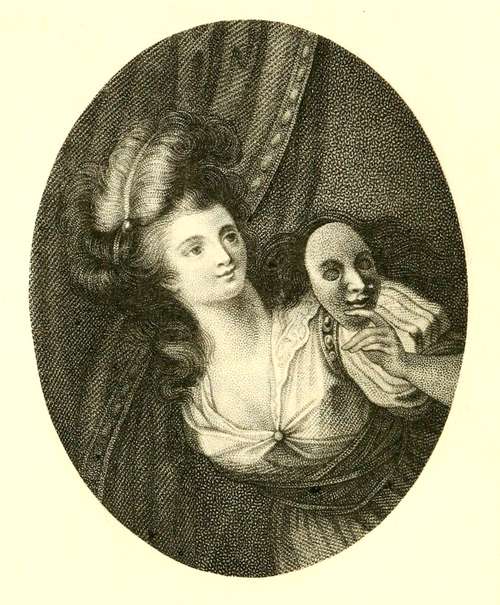
Roscius, before leaving Ireland, paid homage to
the Hon. Mrs. Butler, by taking leave of her in a
formal visit. With equal formality, as the visitor
was about to depart, the lady placed in his hands a
small packet. It contained, she said, her own sentiments
and convictions, and, in presenting it to Mr.
Garrick, all that she requested was, that he would
abstain from too curiously inquiring into its contents
until he had sailed out of Dublin Bay. The actor
had vanity enough to lead him to think that, within
the mysterious packet might be enclosed some token
of affection, perhaps an acknowledgment of love.
He obeyed the lady's injunctions till the ship, which
was conveying him to Holyhead, had passed the Hill
of Howth, then, "by your leave, fair seal!" and he
arrived at the heart of the mystery. Carefully unfolded,
he found a copy of Wesley's Hymns and of
Swift's Discourse on the Trinity. In his disappointment
he is said to have flung both books into the
sea; but I think he may have had better taste, and
that he took Mrs. Butler's remembrances with him to
London.
Before proceeding to chronicle the leading events of
the next London season, it remains to be stated that
in the last season at Covent Garden, there was one
first appearance of note; that of George Anne Bellamy,
on the 22d of November, 1744, as Monimia,
in the "Orphan." Rich persuaded this gifted but
self-willed girl to become an actress, greatly to the
displeasure of Quin, who objected to perform Chamont
to such a child. In the first three acts her
terrors rendered her so incapable, that old Quin's
objections seemed justified; but, recovering her
power with her courage, the brilliant young creature
played with such effect that Quin embraced her after
the act-scene dropped, pronounced her "divine," and
declared that she was of the "true spirit." She sensibly
strengthened a company already strong, in Mrs.
Pritchard, Mrs. Clive, and Mrs. Horton. On the
15th of April, 1745, Shuter, from Richmond, appeared
at Covent Garden, in the "Schoolboy," under the
designation of Master Shuter.
At the Haymarket, Theophilus Cibber revived
some of Shakspeare's plays, and produced his
daughter Jane in Juliet and other parts; but Colley
compelled him to withdraw his daughter, and the
Lord Chamberlain forced him to close an unlicensed
house, which, however, his eccentric sister, Mrs.
Charke, contrived to keep open for a while, playing
there Captain Macheath and other male characters
before she attempted to pass herself off on the
world, or hide herself from it, as a man.
There is this irregularity in the season of 1745-46,
that neither Garrick, nor Quin, nor Mrs. Cibber was
engaged at either house. The public was more concerned
with the Scottish Rebellion than with the
drama. Loyal Lacy, who had succeeded the incapable
Fleetwood in the patent, applied for leave
to raise 200 men in defence of King and Government;
and the whole Company of Drury Lane
players expressed their willingness to engage in it.
The spirit which some hundred years before had
animated the loyal actors, now moved Delane, and
Luke and Isaac Sparks, with Barrington—all three
newly come from Ireland—Mills, with orthodox
Havard, Bridges, Giffard, Yates, Macklin, Neale,
and Foote. The ladies, Clive, Woffington, Macklin,
mother and daughter, Mrs. Giffard, and the rest,
applauded the loyal confederacy. The "Nonjuror"
was revived with Luke Sparks as Dr. Wolf, because
of its political allusions. Macklin in six weeks
wrote his "Henry VII., or the Popish Impostor,"
and distributed it act by act for study, and he sent
the Pretender, Perkin Warbeck, to execution without
much succouring King George. Ford's ultra-monarchical
piece, on the same subject, was revived
at Goodman's Fields, and Covent Garden rehearsed
another to no effect, as the Rebellion was over before
the piece could suppress it. The "Massacre at Paris,"
with its story of the pretensions of the Duke de Guise
(Ryan) and its famous Protestant prologue, was among
the Covent Garden revivals. The Scottish rebellion
being over, Theophilus Cibber congratulated the
audience thereon at Drury; and Mrs. Pritchard, at
the Garden, after acting Arpasia in "Tamerlane,"
recited an exulting prologue, which Dodsley printed
in his best type. Both houses gave benefits for the
"Veteran Scheme" at Guildhall, for which scheme
Mrs. Cibber offered to play three nights, gratis, but
was snubbed by a hyper-Protestant in the papers.
The handsome Catholic actress indignantly replied,
that her love for King George was not diminished
by her faith in the Romish religion. The whole
matter ended merrily by George II. and the entire
royal family repairing to Covent Garden, where
"Macbeth" was performed, and a rebel and regicide
put to death to the great satisfaction of the royal,
noble, gentle, and simple audience there congregated.
I do not know which of the new comers, named
above, so struck Lady Townshend, that she told
Horace Walpole, in September, 1745, "she had seen
a new fat player, who looked like everybody's husband."
Walpole replied, "I could easily believe that
from seeing so many women who looked like everybody's
wives!"
In all other respects, there is little worthy of notice,
save that, at the close, when all was jubilee again, and
Charles Edward no longer an object of fear, Garrick
re-appeared in London. He arrived in town in May,
1746. Rich and Lacy were both eager to engage
him, but the former succeeded, and Garrick closed
the season at Covent Garden, by playing six nights
at £50 per night. Thus he gained more in a week
than Betterton, ere he was a "master," had gained
in a year. Lacy, meanwhile, had secured Barry, and
the town were eager to hear him of the silver-tongue.
Garrick generously said of him, in answer to a query
respecting the merits of the Irish actor, that he was
the most exquisite lover that had ever been seen on
the stage. Barry proved the truth of this criticism,
by excelling Garrick in Romeo, in which the latter
was so fervent, the former so winning and so seductive.
Before we proceed to notice the coming struggle,
let us cast back a glance at the stage from whence
this master came.
CHAPTER VII. — FOOTNOTES:
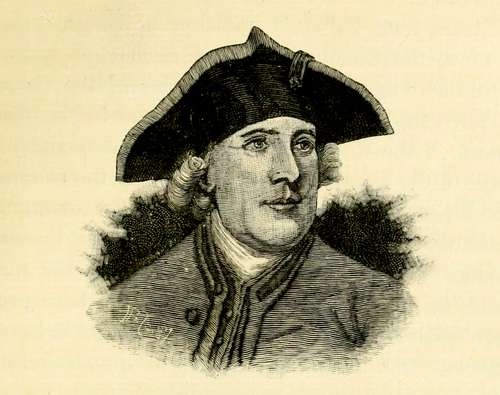
JAMES LACY.
THE OLD DUBLIN THEATRE.
But for a murder in the house of a Mrs. Bungy,
Dublin would not have had its famous old theatre
in that locality, which the popular voice would
call by the name of Smock Alley (from the handsome
hussies who lived there), long after Mrs.
Bungy's house and those adjacent to it had been
swept away, and the newer and finer edifices were
recorded as standing in "Orange Street." The
first theatre in this questionable locality was erected
soon after the Restoration; but at the period
named, this house and theatricals, generally, were
opposed with as much bitterness in Dublin as in
Edinburgh.
I learn from Gilbert's "History of Dublin" that,
in 1662, the Chapter of Christchurch expressed its
horror at "one of the stipendiaries of the church
having sung among the stage-players in the play-house,
to the dishonour of God's service and disgrace
to the members and ministers of the church."
The ultra-religious portion of the Dublin community
hated the theatre, with all their hearts, and to such
persons two little incidents occurred to the play-house
in Smock Alley, which must have been peculiarly
pleasant to their humane yet indignant hearts.
One was, that in 1671, the gallery of the above-mentioned
house being over-crowded, fell into the pit.
The consequences, of course, were lamentable, but,
you see, those godless players were acting Jonson's
"Bartholomew Fair," and what could be expected
when that satire on the super-righteous was raising
a laugh in the throats of the Philistines? Again, in
1701, a part of the same house fell in during a representation
of Shadwell's "Libertine," and nothing
could seem more natural than this catastrophe, to
the logical bosoms of the upright; for at the devil's
jubilee, Satan himself was present, and carried home
with him the lost souls of his children. Even the
play-going public grew a little suspicious of the
stability of the building, but they were re-assured by
the easy certificate of a "Surveyor-general," who
asserted that there was no chance of a failure in the
holdfasts and supports of the edifice, for several years!
In half-a-dozen years, however, the house was down;
and, in seven months, the new house was open to an
eager public. The latter, however, were not quite
so eager to enter as the managers were to receive
them. "So eager were they to open, that they began
to play before the back part of the house was tiled
in, which, the town knowing, they had not half an
audience the first night, but mended leisurely by
degrees."[45] It was in the old house that Elrington,
the great support of Drury Lane when Booth
was indisposed, ruled supreme in the hearts and
houses of his enthusiastic Irish admirers. His old
patrons never forgot him. "I have known," says
one already quoted, "Tom Elrington in the part of
Bajazet to be heard all over the Blind Quay; and I
do not believe you could hear Barry or Mossop out
of the house."
We are here, however, anticipating events. Let
us return to chronological order. In the old houses,
heavy classical tragedy seems to have been most
popular; and when Dublin was tired of it, the company
took it to Edinburgh. Rough times of war
closed the house; but when William's authority was
firmly established, theatrical matters looked up again,
and in March, 1692, Ashbury, who, with Mr. and
Mrs. Betterton, had instructed the Princess Anne
how to speak and act Semandra, in "Mithridates,"
when that piece was played at Whitehall, opened
the house with "Othello," playing Iago to the Moor
of Robert Wilks. Among this early company are
also to be noted Booth, Estcourt, Norris, Bowen,
and Trefusis, contributions from England, and the
latter so admirable for dancing the rustic clown, that
General Ingoldsby once handed him a £5 note from
his box, and gave him a second when Joe went up
to the Castle to thank him,—the General not recognising
him till Trefusis imitated his dialect and
action of the night before.
The ladies were not in force; Mrs. Knightly, Mrs.
Ashbury, and Mrs. Hook, were the principal under
Ashbury, who added the names of Quin and the two
Elringtons, and Mrs. Thurmond, to his company,
before he closed a management of about thirty years.
In that period, Ashbury raised the Irish stage to a
prosperous and respectable position. His son-in-law,
Thomas Elrington, succeeded him in the management.
Under Ellington's rule, young Stirling first awaked
the Irish muse to tragedy, and Charles Shadwell
furnished the house with half-a-dozen pieces of
very inferior merit. Meanwhile, in 1727, Madame
Violanti opened a booth, with her wondrous rope-dancing,
and her Lilliputian company, whose representation
of the "Beggar's Opera" excited a
perfect sensation. The Macheath was a Miss Betty
Barnes; Polly, Miss Woffington; Peachum, Master
Isaac Sparks; and Filch, Master Barrington,—all of
these were, subsequently, players of more or less renown.
Up to this time, the best native actor was Wilks,
now we have Peg Woffington; in 1728 appeared the
handsome, young Delane, of Trinity College; his
graceful figure, full-toned voice, added to his zeal
and application (both too short-lived), rendered him
an unusual favourite. In the same company were
Mr. and Mrs. Ward, whose daughter, born at Clonmel,
was the mother of "the Kembles."
Elrington died in 1732. He was the first actor
who played Zanga in Dublin; much to the admiration
of Dr. Young, who thought Mills mouthed and
growled the character overmuch. After Elrington's
death, disorder sprung up. Smock Alley was opposed
by a new theatre, erected in Rainsford Street, in the
"Earl of Meath's Liberty," and beyond the jurisdiction
of the mayor. At the former, the company, including,
occasionally, some of the best actors from
London, was better than the house which was so decayed,
that a new, a much grander, but in every other
way a less efficient house, was erected in Aungier
Street, at which the tall, cold beauty, the ex-quakeress,
Mrs. Bellamy, mother of George Anne Bellamy, was
a principal actress. A committee of noblemen managed
this house, with the usual result of enormous
loss. Dublin having more theatres than could prove
profitable, the old theatre in Smock Alley was pulled
down; but a new one was erected, which was opened
in December 1735, with "Love for Love."[46] In which
Don Duart was played by Cashel, subsequently a
popular Macheath. He was one of the many actors
who have died, or received their death-stroke, on
the stage. While acting Frankly, in the "Suspicious
Husband," at Norwich, in 1748, he was smitten
by apoplexy and died in a few hours.
The Theatre Royal in Aungier Street had its real
opponent in this house, opened by licence of the
Lord Mayor, in the more central position, in Smock
Alley. The house in Rainsford Street was soon
closed. London performers, who were sure of profitable
benefits, went over to both houses; but I much
prefer to remark that, at Aungier Street, in February
1737, Margaret Woffington, her childhood being
past, first appeared as an actress, in the part of
Ophelia. Her beauty, grace, her ease, simplicity,
her pretty singing, her coquetry, and the wonderful
"finish" of the male characters she afterwards assumed,
gave a fortune to the theatre, which was only
checked by the famine of the severe winter 1739-40,
during which the houses were closed for three months.
This theatre in Aungier Street had a company so
powerful, including Quin, Delane, and Mrs. Cibber,
at the close of the London season, that, on its re-opening,
in 1741, Smock Alley, with Elrington, Isaac
Sparks, and Mrs. Furnival,[47] could not successfully
compete with it; but, in June 1742, Duval, the proprietor,
by engaging Giffard, Mrs. Woffington, and
Garrick, turned the scale, and during three of the
hottest months of the hottest summer ever known,
attracted crowds to Smock Alley, and spread fever
over the city!
After success, and when the great players had disappeared,
came re-action, empty houses, tumblers,
rope-dancers, equestrianism,—and nightly losses.
On the 29th of January 1743, however, the town felt
a new sensation, afforded by the acting of a "young
gentleman" in Richard, at Smock Alley. The Mithridates
of the debutant was as successful as Richard,
and then the young actor was known to be the son
of Dr. Sheridan, a young man of three-and-twenty,
whose appearance on the stage brought great vexation
to all his friends. But also much reputation to
himself in Richard, Brutus, Hamlet, Othello, Cato,
and the highest walks of comedy.
A curious incident carried Sheridan to the rival
house in Aungier Street. One night in July 1743,
his robe for Cato was not forthcoming from the
Smock Alley wardrobe, and Sheridan refused to play
without it. Theophilus Cibber was there among the
London birds of passage. He was cast for Syphax,
and his offer to read the part of Cato and play his
own was accepted. Cato and Syphax are never on
the stage together; but in the second act, Theophilus
must have been put to it, for there, Syphax enters
close upon the heels of the retiring Cato.
How the "numerous and polite audience" enjoyed
the piece thus represented, I cannot say; a paper war
ensued, and Sheridan passed to the other house.
But two houses could not exist, and an agreement
was at length made to consolidate the two companies,
and to open at Aungier Street, whereupon the rejected
actors, of course, opened Smock Alley, and
thence came confusion worse confounded, till
Sheridan, quarrelling with the proprietors at Aungier
Street, passed back to Smock Alley, and did
something towards retrieving its fortunes. But
he was ill seconded, and in March, 1744, flushed by
his new honours, he crossed the Channel and
appeared at Covent Garden.
And now, instead of two companies in one house,
Dublin saw one company alternately playing in two
houses, with little profit, till on the night of February
15th, 1744, "Othello" was given at Smock Alley,
the part of Othello by Spranger Barry (Iago, Wright;
Desdemona, Mrs. Bailey). His noble person, his harmonious
voice, his transitions from love to jealousy,
from tenderness to rage, enchanted the audience,
though in some respects the performance was unfinished.
His principal characters were Othello,
Pierre, Hotspur, Lear, Henry V., Orestes, and that
once favourite comedy-character with young tragedians,
Bevil, jun. Barry filled the house every
night he played; but, I suppose, a feature of Irish
management, he played only occasionally. Foote,
in this his first Irish season, drew a few good houses,
but Barry was the chief attraction. He was opposed
by the old ejected comedians, who opened a temporary
house in Capel Street, which, however, was
soon closed.
Under mismanaging committees of noblemen, three
dozen in number, with seven wise men for a quorum,
affairs went ill, and Sheridan was, at length, invited
from England to take sole government, and restore
order and profit where anarchy and poverty reigned.
This Sheridan effected, by degrees, aided by his
judgment, industry, zeal, perseverance, and unflinching
honesty. During his first season, 1745-46, he
produced, first, Miss Bellamy, on November 11th, at
Aungier Street, in the "Orphan," to the Castalio of
Barry, and his own Chamont; and in the following
month Garrick appeared as Hamlet. In the "Fair
Penitent" Garrick, Barry, and Sheridan played
together to the Calista of Mrs. Furnival; and "All
for Love" was cast with Antony, Barry; Ventidius,
Sheridan; Cleopatra, Miss Bellamy; Octavia,
Mrs. Furnival; Garrick and Sheridan played
Richard and Hamlet alternately, and each in turn
played Iago to Barry's Othello. The following
season brought Barry to England, where he laid the
foundations of a great professional glory which
endured as long as Garrick's, though it was somewhat
tarnished and enfeebled, yet still second only
to Garrick's towards its close.
CHAPTER VIII. — FOOTNOTES:
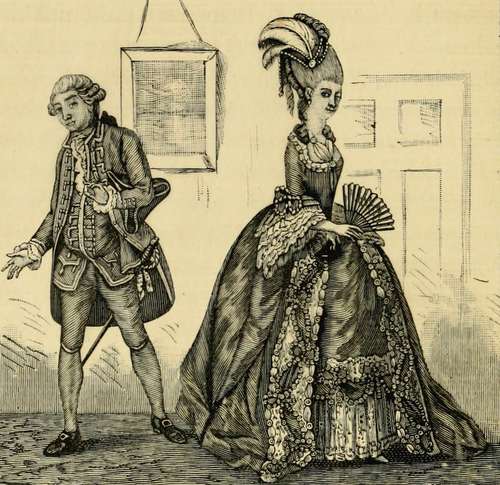
GARRICK AND MRS. ABINGTON IN THE "SUSPICIOUS HUSBAND."
GARRICK AND QUIN; GARRICK AND BARRY.
This new actor, Spranger Barry, who has come to
London to wrestle, as it were, with Garrick, is now
in his twenty-seventh year, and has been but two
years, brief noviciate, on the Irish stage. He had
previously followed, with some reluctance, the vocation
of his father, that of silversmith; but, respectable
and lucrative as it was, the stage had more
attraction for him, and thither he went in pursuit of
fame and fortune, nor missed the object he pursued
so steadily. His success in Ireland was great at a
time when there was a body of players there, which for
ability has certainly never been surpassed. Spranger
was very well connected, and it was by the counsel
of his kinsman, Sir Edward Barry, that he turned
his face towards London, and resolved to try a fall
there with David Garrick.
His first appearance was at Drury Lane, October
2, 1746,[48] in the character of Othello; Iago, Macklin;
Cassio, Mills; Roderigo, Yates; Desdemona, Mrs.
Ridout; Emilia, Mrs. Macklin. What aspirant entering
on a struggle of a similar nature now, would be
gratified with such notice as the press, in the General
Advertiser, awarded to the new actor, on this occasion?
"Barry performed Othello before a numerous
and polite audience, and met with as great
applause as could be expected."
And the triumph was as great as the player could
have hoped for. In some things, Barry profited by
the suggestions and teaching of Macklin; and the
fact that for nearly eighty nights, about half of which
were given to Othello, Lord Townley, and Macbeth,
Barry drew crowded houses, will show that a new
and dangerous rival had sprung up in Garrick's path,
at the moment he was contending with a skilled and
older rival at Covent Garden. In the earlier part of
the season, Garrick had played Hamlet, King Lear,
Richard, Archer, Bayes, and Chamont; Quin had
played Richard, with no success; Cato, Bajazet, and
Sir John Brute. The two met together for the first
time in the same piece, on the 14th of November 1746,
in the "Fair Penitent;" Horatio, Quin; Lothario,
Garrick; Altamont, Ryan; Calista, Mrs. Cibber.
This was the greatest theatrical event that had
occurred for years; and when the actor of the old
school, and he of the new met on the stage, in the
second act, the audience who now first saw them,
as they had long wished to see them, face to face, absolutely
disconcerted them by a hurricane of greeting—a
perfect storm of gratulation, expressed in every
way that applause can be given, but in louder and
longer peals than had ever been heard by actors of
that "generation." When it had passed, every word
was breathlessly listened to; every action marked.
Some were won by the grand emphasis and the
moral dignity of Quin; others by the grace, spirit,
and happy wickedness of Garrick. Between them,
it was difficult to award the palm of supreme distinction
to either—and Mrs. Cibber was, for once,
forgotten. They subsequently played together Falstaff
and Hotspur; and Hastings and Glo'ster, repeatedly,
in "Jane Shore." Glo'ster was one of Quin's
"strut and whisker parts," and Garrick had such
advantage over him in Hastings, that "the scale was
now completely turned in Garrick's favour."
Was it from fear that Garrick declined to play
Jaffier to Quin's Pierre? It could not have arisen
from fatigue, as alleged, for Garrick wrote a capital
farce, "Miss in her Teens," and played Fribble in it,
and then created Ranger, in Dr. Hoadley's "Suspicious
Husband," in which Quin declined the part of
Mr. Strictland, and gave to Bridgwater the one
opportunity which he seized, of being considered an
actor. In Ranger, Garrick surpassed even what old
playgoers could recollect of comic excellence. His
"Neck or nothing; up I go!" became a popular
saying, and the rendering it was a tradition on
the stage, from his days to the days of Elliston,
the gentlemanly impudence, and the incomparable
grace of whose Ranger is still remembered by many
among us.
The originality of style and expression in this
comedy displeased Quin. He was a conservative,
and disliked innovation; contemptuously called the
piece a speaking pantomime—forgetful that the old
comedies were often much more farcical (which is
what he meant) in their incident, and when a name
for it was being discussed, suggested scornfully
"The Hat and Ladder." Some of Hoadley's friends
kindly foretold failure, in order to afford consolation
after a kind. Thence the epigram of one of
them:—
"Dear doctor, if your comic muse don't please,
Turn to your tragic and write recipes."
Not merely as a character piece, but for construction
of plot, simplicity and grace of style, and comparative
purity of speech and action, the "Suspicious
Husband" is the best comedy the eighteenth century
had, up to this time, produced. It has a good story
clearly and rapidly developed, and the persons of the
drama are ladies and gentlemen, and not the dully-vivacious
ruffians and the unclean hussies of the
Aphra Behn, the Etherege, and Sedley period. The
writer was a "royal physician," and son to the
famous bishop who, for his opposition to civil and
ecclesiastical tyranny, was treated as if he were an
infidel. The bishop did not go to witness his son's
play; but as all the Hoadleys had a theatrical turn,
I feel sure he and his family read it, with many a
cheery laugh, in the old room at Chelsea. George
II. certainly did so at Windsor, and saw it, too, at
the Garden, and was so well pleased with his
physician, the author, that he gratefully sent him
the handsome fee of £100.
Garrick came off so well in his contest with Quin,
that he probably had no fears of trying the fall to
which he was challenged, with Barry. For this
struggle Spranger Barry passed over to Drury Lane,
to wrestle with David on his own ground. Drury
may be called peculiarly his, for, by purchasing a
share in the patent, he now commenced that career
of management which lasted during his theatrical
life, and the brilliancy of which was spoken of in
every part of the world where an interest was felt in
the intellectual enjoyments of the people.
The Drury Lane season of 1747-48 found Garrick
joint-patentee with Lacy; Garrick directing the stage
without interference, and receiving between six and
seven hundred a year, as an actor, exclusive of his
profits as part-proprietor. Garrick's company included
Barry, Macklin, Delane, Havard, Mills, Yates,
Barrington, Sparks, Lowe; and Mrs. Pritchard, Mrs.
Cibber, Mrs. Woffington, Mrs. Clive, and other bright
but lesser stars.
In this season the chief attractions were Macklin's
Shylock, Barry's Hamlet, Othello, and Pierre; and
in less degree, his Bajazet, Henry V., and Orestes.
Garrick drew full houses by Archer and Abel Drugger,
Lear and Richard, Sir John Brute and Plume, Hamlet
and Macbeth; but the greatest attraction of all was
when Garrick and Barry played together, as Chamont
and Castalio ("Orphan") Hastings and Dumont
("Jane Shore"), Lothario and Horatio ("Fair Penitent"),
and Jaffier and Pierre. Against such attractions
as were here presented, with the addition of
Mrs. Woffington as Sir Harry Wildair, and Mrs. Clive,
in all that was light, airy, impertinent, and tuneful—Covent
Garden was more than usually weak.
The latter, however, depended on the "Beggar's
Opera," on Ryan and Delane,[49] the younger Cibber,
the Giffards, and especially Mrs. Horton; Woodward
was in Ireland. Quin had withdrawn to
Bath. Garrick's triumphs had soured him. He desired
to be asked back, but Rich would not humour
him. The one wrote, "I am at Bath; yours, James
Quin:" and the other answered, "Stay there and be
d——d; yours, John Rich." The old actor returned,
however, to play Othello, without fee, on occasion
of a "charity benefit." Drury Lane alone produced
a new piece, with new characters for Garrick and
Barry, namely, Moore's "Foundling," in which Garrick
played Young Belmont with great éclat; Barry,
Sir Charles Raymond, with dignity and tenderness,
and Macklin, a knavish fop, Faddle, with wonderful
power.
Moore, like Gay, had originally served in a draper's
shop, and like Gay, wrote "Fables,"—"for the female
sex." His "Foundling" bears some resemblance to
the "Conscious Lovers;" but there is more art in the
construction of the plot, and it is far purer than that
piece which was written to inaugurate an era of
purity. In the part of Faddle, he satirised a well-known
individual, named Russell, who was the delight
of ladies of ton, because of his good looks, crowning
impudence, and his "imitations" of opera-singers.
These qualities made him a guest, for whom ladies
contended; and some displeasure arose, in aristocratic
breasts, at Macklin's close mimicry of the man,—who,
after all, on being arrested for a debt of £40,
was left to pine, starve, and finally to die mad, in
the Fleet prison. Such was the fate of this once
favourite of fashion.
With the season of 1748-49, came increase of
opposition between the two houses. At Drury Lane,
Garrick and Barry played alternately Hamlet and
Macbeth—the Hamlet of Garrick drawing by far the
greater crowds. In the same pieces they played—Barry,
Henry V., Garrick, the Chorus; Garrick,
Horatio, Barry, Lothario; Garrick, Othello, Barry,
Iago;[50] and Mahomet by Barry to the Demetrius of
Garrick in Johnson's "Irene." Garrick also revived
"A New Way to Pay Old Debts," in which King,
springing from a coffee house, acted Allworth with
great spirit and delicacy. It is strange that Garrick
failed to perceive the golden opportunity he might
have had as Sir Giles; he assigned the part to an
inferior actor named Bridges, and preferred playing
Fribble in "Miss in Her Teens." Garrick's greatest
triumph this season was in playing Benedick to the
Beatrice of Mrs. Pritchard. The town had not had
so exquisite a delight for many a long day; and
Garrick's happiness would have been supreme, but
for the fact that Barry and Mrs. Cibber produced
as great a sensation, though of another quality, in
Romeo and Juliet. This last piece was not repeated,[51]
to the great annoyance of Barry; and Garrick, at
the close of the season married the pretty Violetti
to the intense disgust of Mrs. Woffington, who now
joined Rich.
At Covent Garden Quin, Delane, Ryan, Mrs. Woffington,
Mrs. Horton, and Miss Bellamy, were the
chief attractions. Quin played many parts which
Garrick would not attempt. Of those played by
both actors, Quin is said to have surpassed Garrick
in Sir John Brute. But the most exciting event of
this season was the abduction of Miss Bellamy, while
playing Lady Fanciful to Quin's Brute. A gentleman
named Metham begged to be allowed to speak with
her in the hall of the theatre, and thence carried her off
and bore her away, little loth, I think, in his carriage.
Quin explained the matter to the audience, who
enjoyed it as a good thing done and a pleasant thing
to hear of.
While the houses were thus contending, Foote
was filling the little theatre in the Haymarket with
an entertainment of his own; but there were authors
of a higher class offering more intellectual pieces to
the town. Fourteen years before, when Samuel Johnson
was keeping school near Lichfield, he wrote his
tragedy "Irene," which, in its rough state, he brought
to London, when he and Garrick came up together
in search of fortune. With poet, as with actor, the
aspects of life had improved; but most with the
latter. Johnson, now about forty, had been long
known for his London, and had at this time put the
finishing touches to his Vanity of Human Wishes.
Garrick produced his friend's tragedy, and Johnson
was present on the first night in gala dress, but not
to be crowned, as Voltaire was, when the lively old
Frenchman attended the representation of his "Irene."
For nine nights, yielding the poet three benefits—Garrick,
Demetrius; Barry, Mahomet; and Mrs.
Cibber and Mrs. Pritchard as Aspasia and Irene,
exerted themselves—with indifferent success. There
is no local colour in this Turkish piece; the language
and sentiment are elevated, but they are never oriental
in form or spirit. The unities are strictly preserved,
but not nature; and therewith the piece was set
aside, and Johnson never tried the drama again.
In this season, too, kindly, over-speculating, fanciful
Aaron Hill, brought his efforts to a close, with
"Merope;"—and creditably, although he challenged
comparison with Corneille, and in some things was
allowed to have stood it with advantage. The piece
was successful, but the author did not live to profit
by it.[52] His family were weeping for his death, while
audiences were shedding tears at the acting of Garrick,
Dorilas; and Mrs. Pritchard, Merope. Not only
did this tragedy long hold the stage, but the subject
of a mother suffering because of a lost son, was so
agreeable, it would seem, that Browne, Whitehead,
and Home, adopted it in "Barbarossa," "Creusa,"
and "Douglas."
Covent Garden, too, had its classical tragedy, in
"Coriolanus," brought forward by Quin, after his
friend Thomson's death. Quin played the hero of
Thomson's play; Ryan, Tullius; Delane, Galesus;
Mrs. Woffington, Veturia; and Miss Bellamy, Volumnia.
This tragedy is worth reading, if it be only
to see how very civil and colloquial the hot leader
of the Volsci could be made by the Scottish poet in
Kew Lane. In Shakspeare's tragedy, we have the
annals of a life put into action. In Thomson's, as
in Laharpe's "Coriolan," we have a single incident
diluted through five acts;—the secession from Rome,
and its consequences, forming the staple of a play
which ends with a tag of trotting rhymes, which are as
natural, and not half so amusing, as if the grave speaker
of them had danced a hornpipe in his cothurni.
In 1749-50, symptoms were discernible of a break
up in the Drury Lane company. Mrs. Cibber, at
odds with Garrick, withdrew; and Barry, not allowed
to play Romeo, was often indisposed to act in other
plays. So it was said: but he publicly protested
against any feigned indisposition. He repeated
many of his old parts with Garrick, and created Publius
Horatius to Garrick's Horatius, in Whitehead's
"Roman Father." At Covent Garden, Delane
exerted his dying efforts fruitlessly against Barry;
and Woffington opposed Woodward in Sir Harry
Wildair.
The above tragedy, by the son of a Cambridge
baker, and one of Clare Hall's most honoured Fellows,
was not the only novelty produced at Drury;—whither
William Shirley brought from Portugal, where
he had written it in his leisure hours, his "Edward,
the Black Prince." Garrick played Edward; Barry,
Ribemont; and Mrs. Ward, Marianne. It will suffice,
as a sample of Shirley's insight into the Prince's
character, to say, that he makes Edward, for love of
Marianne, desert to the French side! A more absurd
violation of history was never perpetrated by poet.[53]
In the way of novelty, excepting pantomimic trifles,
Covent Garden offered no sign.
The latter house made no acquisitions such as
Drury found in King and in Palmer. Dyer, however,
proved a useful actor, beginning his career with Tom
Errand, and bringing with him his wife, the daughter
of Mrs. Christopher Bullock, the daughter of Wilks.
On the other hand, the Garden lost Delane, whose
first appearance at Goodman's Fields, in 1730,[54] was
temporarily menacing to the supremacy of Quin, as
Garrick's was permanently so, some years later. He
was a graceful and clever actor, but there was only
one character of note of which he was the original
representative—Mahomet.
With this season also departed the actress whom
Wilks and Booth looked upon as the legitimate successor
of Mrs. Oldfield, namely, Mrs. Horton. Steele
highly praised her for her acting Lady Brumpton in
his "Funeral." Long after youth was passed she retained
a luxuriant beauty, which was the envy of less
richly endowed ladies. She loved homage rendered to
her charms, and was grateful for it, however humble
he who paid it. In her best days all young London
was sighing at her feet, and in the meridian of her
sunny time she invited adoration by the most exquisite
coquetry. About this time her powers began so to
decay that Rich only estimated her worth at £4 per
week. Between Mrs. Woffington and Mrs. Pritchard
she suffered shipwreck. Mrs. Horton was an artificial
actress, the other two were of an opposite quality;
Mrs. Pritchard especially captivated the public by
her natural and intelligible style of speaking. Davies
says,—Mrs. Horton had a small annuity, and that
Garrick and Lacy added to it by giving her a "part
of a benefit." She had, however, other resources.
When Lord Orford patronised Lord Luxborough,
eldest son of Knight, of South Sea Company
notoriety, people could not account for it, but
Horace Walpole could. "Lord Luxborough," he
writes to Mann, "keeps Mrs. Horton the player;
we (Orford) keep Miss Norsa, the player. Rich,
the harlequin, is an intimate of all; and to cement
the harlequinity, somebody's brother (excuse me if
I am not perfect in such genealogy) is to marry the
Jewess's sister." In this wise did the stage in those
days act upon politics. The Miss Norsa, above-named,
had been a singer, of some repute, and
Orford, then Lord Walpole, had taken her off the
stage with the concurrence of her parents, to whom
he gave a bond by which he engaged to marry her
as soon as his wife should die! His wife, however,
happily outlived him. Horace Walpole, writing
to Mann from Houghton, in 1743, says:—"Lord
Walpole has taken a dozen pictures to Stanno, a
small house, about four miles from hence, where he
lives with my Lady Walpole's vicegerent. You may
imagine that her deputies are no fitter than she is to
come where there is a modest, unmarried girl." This
girl was Maria Walpole, daughter of Sir Robert, and
subsequently the wife of Colonel Churchill, one of
Mrs. Oldfield's sons.
Six-and-thirty years had Mrs. Horton been on the
stage (1714-1750), and in all that time she was the
original representative of only one character, Mariana,
in the "Miser."
And now we come to the famous Romeo and Juliet
season, that of 1750-51, in which Garrick and Barry
were the rival Romeos, Miss Bellamy and Mrs. Cibber
the opposing Juliets. Barry, by passing to Covent
Garden, was enabled to play with Quin, in "Othello,"
the "Orphan," "Jane Shore," "Henry V.," "Julius
Cæsar," "Distressed Mother," "Fair Penitent,"
"Tamerlane," and "King John." In these, Barry's
Faulconbridge was alone a failure, and Quin held his
own so well that his terms for the season were
£1000, the largest sum ever yet received by English
actor; but his Richard was as little a success as
Barry's Faulconbridge. Garrick, Mrs. Pritchard, and
Miss Bellamy appeared together in "Zara;" at the
other house,[55] Barry, Mrs. Cibber, and Mrs. Woffington,
in the "Conscious Lovers." Mrs. Cibber, as
Indiana, made a great point by her delivery of such
simple words as these: "Sir, if you will pay the money
to a servant, it will do as well!" Barry and Mrs.
Woffington in Lord and Lady Townley, and Quin
and Mrs. Woffington in "Macbeth," were among
the attractions of Covent Garden, added to which
was Rich's Harlequin; but for that also Garrick
found a rival in Woodward, who played the motley
hero as he played everything, with care and
effect.
But all these matters were as nothing when compared
with the rival Romeos and Juliets. They appeared
on the same night, at their respective houses,
the 28th of September, 1750. At Covent Garden,
the public had Romeo, Barry; Mercutio, Macklin;
Juliet, Mrs. Cibber. At Drury, Romeo, Garrick;
Mercutio, Woodward; Juliet, Miss Bellamy. On
the first night Barry spoke a poor prologue, in which
it was insinuated that the arrogance and selfishness
of Garrick had driven him and Mrs. Cibber from
Covent Garden. Garrick, ready to repel assault,
answered in a lively, good-natured epilogue, delivered
saucily by Mrs. Clive.
It was considered a wonderful circumstance that
this play ran for twelve nights successively; Garrick
played it thirteen, to show that he was not beaten
from the field! At that period the Londoners, who
were constant playgoers, demanded a frequent change
of performance; and the few country folk then in
town felt aggrieved that one play should keep the
stage during the whole fortnight they were in
London. Thence the well-known epigram:—
"'Well, what's to-night?' says angry Ned,
As up from bed he rouses;
'Romeo again!' he shakes his head:
'A plague on both your houses!'"
Contemporary journals, indeed, affirm that the
audiences grew thin towards the end of the fortnight,
but this seems doubtful, as Barry's twenty-third
representation, in the course of the season, was
given expressly on account of the great number of
persons who were unable to obtain admission to his
twenty-second performance.
There is no doubt that Mrs. Cibber had the handsomer,
more silver-tongued, and tender lover. She
seemed to listen to him in a sort of modest ecstasy;
while Miss Bellamy, eager love in her eyes, rapture
in her heart, and amorous impatience in every expression,
was ready to fling herself into Romeo's
arms. In Barry's Romeo, the critics laud his harmony
of feature, his melting eyes, and his unequalled
plaintiveness of voice. In the garden scenes of the
second and fourth acts, and in the first part of the
scene in the tomb, were Barry's most effective points.
Garrick's great scenes were with the Friar and the
Apothecary. Miss Bellamy declared that in the scene
with the Friar alone was Garrick superior to Barry;
Macklin swore that Barry excelled his rival in every
scene.
The Juliets, too, divided the public judgment.
Some were taken by the amorous rapture, the loveliness,
and the natural style of Bellamy; others were
moved by the grander beauty, the force, and the
tragic expression of distress and despair which distinguished
Mrs. Cibber. Perhaps, after all, the
truest idea of the two Romeos may be gathered from
the remark of a lady who did not pretend to be a
critic, and who was guided by her feelings. "Had
I been Juliet," she said, "to Garrick's Romeo,—so
ardent and impassioned was he, I should have expected
that he would have come up to me in the
balcony; but had I been Juliet to Barry's Romeo,
so tender, so eloquent, and so seductive was he, I
should certainly have gone down to him!"
Respectively, Barry acted Romeo twenty-three,
Garrick nineteen times this season,—a season of
which there is nothing more to be said, save that
Garrick created the part of Gil Blas, in Moore's
comedy of that name, and that he produced Mallet's
version of "Alfred"—playing the king.
At this time, the poets were not inspired, or managers
could dispense with them, so attractive were
the old actors in old pieces, with new actors—Shuter,
Palmer, and Miss Macklin—aiding them. Thus, in
the season 1751-52, Covent Garden, save in a burletta
called the "Oracle," relied on its stock-pieces;
and Drury only produced Foote's farce, "Taste," in
which Worsdale, the painter, who kept, starved, beat,
and lived upon Laetitia Pilkington, played Lady
Pentweazle, with humorous effect;—and "Eugenia,"
a tragedy, by the Rev. Dr. Francis, the father of Sir
Philip, in which there was the coarseness of sentiment,
but none of the beauty of language or tenderness
of feeling of Otway. Yet it was approved by
Chesterfield, who sneered at the pit and gallery as
"common people who must have objects that strike
the senses, and are only moved by the sufferings they
see, and even then must be dyed with the blood."
But this is untrue, although my lord said it, for
Johnson's "Irene" failed because of the strangling
of the heroine in presence of the audience; and it
was only tolerated, during its brief run, after the
killing was described and not performed.
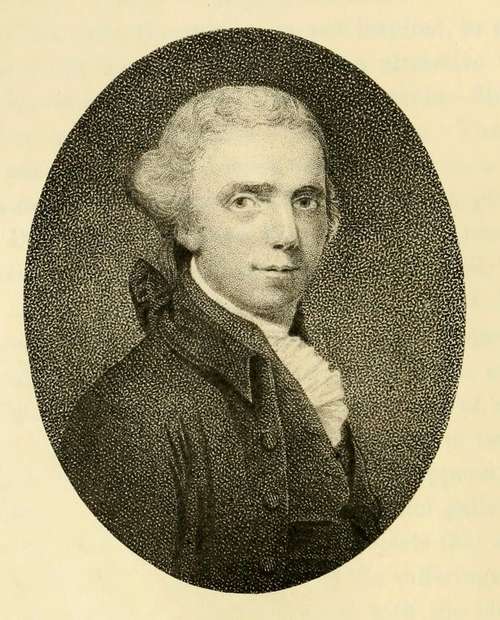
I have said that the managers relied on the actors
and not on the poets. In return, the actors exerted
themselves to the very utmost. Mrs. Cibber was as
much stirred by Miss Bellamy as Barry by Garrick,
and the reverse. In "Jane Shore," for instance, Mrs.
Cibber, who played Alicia to the Jane of pretty and
modest Miss Macklin, seemed, on the 25th of October
especially, to be inspired "with something more
than mortal." Though Alicia had always been
looked on as one of her very best characters, yet this
night's performance she never equalled, before nor
since.
In this season, Barry acted Romeo twelve, Garrick
only six times; but the latter introduced a new opposition
to his formidable rival, in the persons of
Mossop and Ross, both from Ireland. Mossop first
appeared in Richard, which he repeated seven times
with great applause. His Zanga was still more successful;
indeed, he has never been excelled in that
character. Six times he played Horatio to Garrick's
Lothario, and charmed the town more frequently by
his grand Theseus to Mrs. Pritchard's Phædra. In
Macbeth, Othello, Wolsey, and Orestes, he also displayed
great powers. Ross, a gentlemanlike actor,
made his début in Young Bevil, by Garrick's advice,
and acted Lord Townley, Altamont, and Castalio,—the
latter to Garrick's Chamont, with great effect.
Garrick, no doubt, would have reluctantly seen himself
eclipsed by either of those players; but because
inferior actors sought to flatter him by calling Mossop
a ranter, and Ross a sniveller, and epigrammatists
declared indifference to both, it is not conclusive
that the flattery pleased or the sneer delighted him.
Garrick had his own peculiar triumphs. His Kitely,
to Woodward's Bobadil, Yates's Brainworm, Shuter's
Master Stephen, Ross's Young Knowell, and Palmer's
Wellbred, gave new life to Ben Johnson's comedy of
character. Thenceforward was associated the name
of Captain Bobadil with that of the scholar from
Merchant Tailors'—Harry Woodward.
But this has brought us into a new half-century,
Let us pause and look back at the audiences of that
which has gone by.
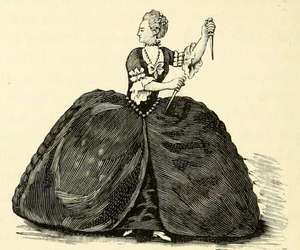
Mrs. Yates as Lady Macbeth.
CHAPTER IX. — FOOTNOTES:
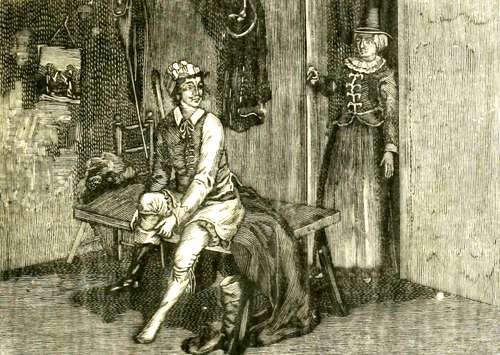
WOODWARD IN "EVERY MAN IN HIS HUMOUR."
THE AUDIENCES OF 1700-1750.
Mr. Isaac Bickerstaffe has laid it down as a rule
that it is the duty of every person in a theatrical
audience to show his "attention, understanding, and
virtue." To the insuperable difficulty of the task
may, perhaps, be attributed the carelessness of audiences
on this point. How is a man, for instance,
to demonstrate his virtue in the public assembly?
Steele answers the query—by showing a regard for
it when exhibited on the stage. "I would undertake,"
he says, "to find out all the persons of sense
and breeding by the effect of a single sentence, and
to distinguish a gentleman as much by his laugh
as his bow. When we see the footman and his
lord diverted by the same jest, it very much turns
to the diminution of the one or the honour of
the other. But," he adds, "though a man's quality
may appear in his understanding and taste, the
regard to virtue ought to be the same in all ranks
and conditions of men, however they make a profession
of it under the names of honour, religion,
or morality."
Steele was gratified by an audience who sympathised
with the distress of an honest but unlucky pair
of lovers. He thinks that the Roman audience which
broke into an ecstasy of applause at the abnegation of
self displayed in the friendship of Pylades and Orestes,
showed qualities which justly made of the Roman
people the leaders of mankind. As if appreciation
of the semblance of good were the same thing as the
exercise of it. The same people applauded as lustily
when they saw the life-blood spilt of the vanquished
gladiator.
Again, he discovers a surpassing excellence in an
Athenian audience,—famed of old for applauding the
virtues which the Lacedemonians practised. That
audience was roused to the utmost fury by the speech
of a man who professed to value wealth far above
good name, family, or natural affection. The uproar
was so great that the author was compelled to come
forward and ask the forbearance of the house till the
last act of the piece, in which he promised that this
wretched fellow would be brought to condign punishment.
Mr. Bickerstaffe very much questions whether
modern audiences would be moved to such a laudable
horror. It would be very undesirable that they
should: or that a person should swing out of the
house in disgust, as Socrates did when he attended
the first representation of a tragedy by his friend
Euripides,—and was excited to anger by a remark of
Hippolitus, to the effect that he had "taken an oath
with his tongue but not with his heart." The maxim
was indefensible, but the action of the play required
it; and Socrates had been truer to his friend had he
remained till the dénouement, and not have hurried
away while that friend's play was being applauded.
On the duties of audiences, Mr. Bickerstaffe is a
little loose, but we may readily acquiesce in one of
his sentiments. "When we see anything divert an
audience, either in tragedy or comedy, that strikes at
the duties of civil life, or exposes what the best men
in all ages have looked upon as sacred and inviolable,
it is the certain sign of a profligate race of men,
who are fallen from the virtue of their forefathers,
and will be contemptible in the eyes of their posterity."
This was said when audiences thought only of the
quality of the actor, and troubled not themselves with
that of the maxims uttered, unless these had some
political tendency, or allusion to well-known popular
circumstance. The Tatler lived before the time when
the stories of Regulus and Virginia were turned into
burlesque, and children received their first impressions
of Alfred and of Tell through the caricature of
extravaganza.
But there was much that was illegitimate in those
legitimate days. If a play was not likely to attract,
an audience was advertised, in order to draw one.
The promised presence of royalty, naturally enough,
helped to fill the house; but so would that of a leash
of savages, or a quack doctoress. Of the latter class,
there was the clever and impudent Mrs. Mapp, the
bone-setter, who came into town daily from Epsom,
in her own carriage, and set bones, or explained her
principle in doing so, at the Grecian Coffee House.
The Lincoln's Inn Field managers invited her to
honour their house and the performance with her
presence, and the astute old lady was well aware that
her presence thus granted would be a profitable advertisement
of herself. That presence I find announced
at the above theatre on the 16th October, 1736, with
that of Taylor, the oculist, at Lincoln's Inn Fields.
The play was the "Husband's Relief," but the full
house was owing to Mrs. Mapp being there. In
honour of this "bone-setter," near whom also sat
Ward, the worm doctor, a song was sung on the
stage,—as the national anthem when a sovereign
sanctions the doings of the evening. Of this chant
I give the first and last verses:—
"Ye surgeons of London, who puzzle your pates,
To ride in your coaches and purchase estates,
Give over, for shame, for your pride has a fall,
And the doctress of Epsom has outdone you all.
Derry down.
* * * * *
"Dame Nature has giv'n her a doctor's degree,
She gets all the patients and pockets the fee;
So if you don't instantly prove her a cheat,
She'll loll in her chariot, while you walk the street.
Derry down!"
Let us now glance at the example set to audiences
by greater folk than Mrs. Mapp.
George I. understood English better than he could
speak it, and he could make ready application of
passages to contemporary events connected with
himself or others. Shakspeare's "Henry VIII."
was frequently played before him, both at Hampton
Court and at Drury Lane; and there was a speech
in that play which never escaped his marked notice.
It is that addressed by Wolsey to his secretary,
Cromwell, after the King has ordered the Cardinal
to write letters of indemnity, into every county
where the payment of certain heavy taxes had been
disputed. "A word with you," says the Cardinal:—
"Let there be letters writ to every shire,
Of the King's grace and pardon.—The grieved commons
Hardly conceive of me. Let it be noised,
That through our intercession, this revokement
And pardon comes.—I shall, anon, advise you
Further in the proceeding."
Cibber, who narrates the incident, states that "the
solicitude of this spiritual minister in filching from
his master the grace and merit of a good action, and
dressing up himself in it, while himself had been
author of the evil complained of, was so easy a stroke
of his temporal conscience that it seemed to raise the
King into something more than a smile whenever
that play came before him. And I had a more
distinct occasion to observe this effect, because my
proper stand on the stage, when I spoke the lines,
required me to be near the box where the King
usually sat. In a word, this play is so true a dramatic
chronicle of an old English court, and where
the character of Harry VIII. is so excellently drawn,
even to a humorous likeness, that it may be no
wonder why His Majesty's particular taste for it
should have commanded it three several times in
one winter."
So far Cibber; we hear from another source that
on one occasion when the above lines were spoken,
the King said to the Prince of Wales, who had not
yet been expelled from Court, "You see, George,
what you have one day to expect."
When George I., wishing to patronise the English
actors, in 1718, ordered the great hall at Hampton
Court to be converted into a theatre, he desired that
it might be ready by June, in order that the actors in
their summer vacation might play before him three
times a week. The official obstacles prevented the
hall being ready before September, when the actors
had commenced their London season, and were, therefore,
enabled to play before the King only seven times.
The performances were under the direction of Steele,
whose political services had been poorly recompensed
by granting him certain theatrical privileges. The
troop commenced on the 23rd of the month with
"Hamlet;" they subsequently played "Sir Courtly
Nice," the "Constant Couple," "Love for Money,"
"Volpone," and "Rule a Wife and Have a Wife."
The King could not have been an indifferent scholar
if he could readily apply passages, and quickly comprehend
others, in plays like these; or could follow
Cibber in Sir Courtly, laugh at the jokes of Pinkethman
in Crack, feel the heartiness of Miller, in Hothead,
be interested in the Testimony of Johnson,
sympathetic with the Surly of Thurmond, enjoy the
periods of Booth in Farewell, or the aristocratic spirit
of Mills in Lord Bellguard. The ladies, too, in some
of the plays acted before him,—Leonora, by Mrs.
Porter, and Violante, by Mrs. Younger,—had also
some phrases to utter, which might well puzzle one
not to the matter born. But George I. must have
comprehended all, for he so thoroughly enjoyed all,
that Steele told Lord Sunderland, the grandson of
Sacharissa, and the son-in-law of Marlborough, that
the King liked the entertainment "so terribly well,
my lord, that I was afraid I should have lost all my
actors; for I was not sure the King would not keep
them to fill the place at Court, which he saw them
so fit for in the play."
In the old days, a play acted before the sovereign
at Whitehall, cost that sovereign but the poor fee of
£20, the actors playing at their own house, in the
afternoon, previous to having the honour of acting
before the Court at night. To the performers at
Hampton Court their ordinary day's wage was given,
with their travelling expenses, for which they held
themselves ready to act there at a day's warning.
The Lord Chamberlain found the wax-lights, and
furnished the "household music," while the players'
wardrobe and "traps" generally were conveyed from
old Drury down to Hampton in a "Chaise Marine"
at his Majesty's expense. The cost of the seven plays
amounted to £350; but King George generously
threw in a couple of hundred more, as a guerdon to
the managers, who had professed that the honour of
toiling to afford his Majesty pleasure was sufficient
recompense in itself! The King did not believe a
word of it; and the Duke of Newcastle, then Lord
Chamberlain (and subsequently the original of
Foote's Matthew Mug, in the "Mayor of Garratt"),
paid the money into the hands of the delighted
Cibber, who was astounded at the Chamberlain's
modesty, which kept him from arrogating to himself,
like Cardinal Wolsey, the merit which belonged
to his royal master.
How things went between audience and actors in
the Hampton Court theatre is admirably told by Cibber
himself:—"A play presented at Court, or acted
on a public stage," he says, "seem to their different
authors a different entertainment. In the common
theatre the guests are at home, where the politer
forms of good breeding are not so nicely regarded.
Every one there falls to, and likes or finds fault,
according to his natural taste or appetite. At Court,
where the Prince gives the treat and honours the
table with his own presence, the audience is under
the restraint of a circle where laughter or applause
raised higher than a whisper would be stared at. At
a public play they are both let loose, even till the
actor is sometimes pleased with his not being able
to be heard for the clamour of them. But this coldness,
or decency of attention at Court, I observed,
had but a melancholy effect upon the impatient
vanity of some of our actors, who seemed inconsolable
when their flashy endeavours to please
had passed unheeded. Their not considering where
they were quite disconcerted them, nor could they
recover their spirits till, from the lowest rank of
the audience, some gaping Joan or John, in
the fulness of their hearts, roared out their approbation."
These little ebullitions appear to have amused the
grave King, for Cibber hints that they raised a smile
on the royal countenance, and he suggests that such
a fact was entirely natural and reasonable. He adds,
"that an audience may be as well too much reserved
as too profuse of their applause. For though it is
possible a Betterton would not have been discouraged
from throwing out an excellence, or elated into an
error, by his auditors being too little or too much
pleased; yet as actors of his judgment are rarities,
those of less judgment may sink into a flatness in
their performance for want of that applause which,
from the generality of judges, they might, perhaps,
have some pretence to; and the auditor, when not
seeming to feel what ought to affect him, may rob
himself of something more that he might have had,
by giving the actor his due, who measures out his
power to please, according to the value he sets upon
the hearer's taste or capacity; but, however, as we
were not here itinerant adventurers, and had properly
but one royal auditor to please, after that
honour was attained to, the rest of our ambition had
little to look after."
And now what of this George's successor as an
"auditor?"
Among the unmerited censures which have been
flung at Charles II., the most conspicuous and the
least reasonable is that the grossness of the dramas
produced in his days was owing to his bad taste exhibited
in his fondness for French comedy. Had the
poets of that period imitated that comedy, they would
not have offended as they did, for, taken altogether,
French comedy was remarkable for its freedom from
utter, abounding, and continual coarseness. I think
that George II. was more blameworthy than his predecessor
Charles, for he encouraged the representation
of immoral dramas, and commanded the restoration
of scenes which actors had begun to deem too indecent
for acting or expression. For didactic plays the
monarch had no stomach; but he savoured Ravenscroft's
beastly comedies—the very worst of them did
he the most delight in, and helped to keep them on
the stage when actors and audiences were alike disgusted
with them. This perverted taste was strong
upon him from the first. When Prince of Wales, he
witnessed the acting of "Venice Preserved," but,
discovering subsequently, on reading the old edition
of the play, there were scenes in it which are flattered
by merely being designated as "filthy," he sent for
the "master" of one of the houses, and commanded
that the omitted scenes should be restored. They
are those which chiefly lie between Aquilia and Antonio,
characters which never take part in modern
representations of Otway's tragedy. The former part
was given to Mrs. Horton, who, though she was something
of the quality of the creature she represented,
was not only young and beautiful, but was draped
in a certain mantle of modesty which heightened the
charms of her youth and her beauty; and she must
have had a painful task, less than the younger Pinkethman
had who played Antonio, in thus gratifying
the low predilections of the graceless Prince, who
then gave ton to audiences.
George II., when Prince of Wales, found Bartholomew
Fair as much to his taste as the theatres. In
1725, he, and a gay posse of companions, went down
the Thames, in barges, to Blackfriars, and thence to
the fair. At the conclusion of the fun for the night,
they entered the old King's Arms Inn, joyously
supped there, and got back to St. James's by four
o'clock in the morning. Some years later, Prince
Frederick, George II.'s son, who valued the stage in
much the same measure as his father did, also visited
the fair by night. He went amid a little army of
yeomen of the guard, and under a blaze of torches,
and cries of "make way there for the prince," from
a mob who were delighted to see among them the
heir apparent, in a bright ruby-coloured frock coat,
thickly laced with gold. There was a gallant company,
too, of gentlemen, all coated and laced, and
besworded like the prince; but the finest and fussiest,
and happiest personage there, was the important little
man who marshalled the prince the way that he
should go, and ushered him to and from the booths,
where short solemn tragedies were played, with a
disjointed farce between the acts. This important
individual was Mr. Manager Rich, and he was as
happy at this night's doings, as if he had gained
something more substantial by them than empty
honour.
On the 3d of May 1736,[56] the audience at Drury
Lane, with the Prince of Wales and his bride among
them, witnessed some unexpected addition to the
entertainment promised them. The footmen chose
that night for an attempt to recover their old and
abused privilege of occupying the upper gallery,
gratis. One body of them entered the gallery by
force, a second fought their way through the stage-door
to dictate terms to the manager, and an active
corps in plush kept the house in alarm by their
shouts for a redress of grievances. Amid the fighting
that ensued the terrified part of the audience
dispersed. Colonel de Veil, with the "authorities,"
came to read the Riot Act, but no respect was paid
either to dignitary or document, whereupon a battle-royal
followed, in which plush was ingloriously
defeated, with a loss of eighteen finely-liveried and
thickly-calved combatants, who, battered, bruised,
and bleeding, were clapped into Newgate for safe
keeping.
In the latter part of the life of George II., he took
advantage of his position to make loud remarks on
the performances at which he was present. One
night, at Drury Lane, he commanded Farquhar's
"Beaux' Stratagem" and Fielding's "Intriguing
Chambermaid." He was amused with the Foigard
of Yates, and the Cherry of Miss Minors. In the
second piece, Kitty Clive played her original part of
Lettice—a part in which she had delighted the town,
which could then be delighted by such parts, for
seventeen years. Walpole, writing of this incident
to Mann, says: "A certain king that, whatever airs
you may give yourself you are not at all like, was
last week at the play. The intriguing chambermaid
in the farce says to the old gentleman: 'You are
villainously old, you are sixty-six, you cannot have
the impudence to think of living above two years.'
The old gentleman in the stage-box turned about in
a passion, and said, 'This is d——d stuff!' and the
royal critic was energetically right."
On some occasions there were more kings in the
house than he of England. Four were once there
among the audience, and as far as their majesties
were concerned, rather against their will. These
poor majesties were American Indian chiefs, to
whom the higher sounding title of "kings" was
given by way of courtesy. The Irish actor, Bowen,
had contrived to secure their presence at his benefit
when "Macbeth" was performed, and a dense mob
was gathered, not so much to hear Shakspeare as to
see the "kings." The illustrious strangers were
placed in the centre box, and as they were invisible
to the occupants of the galleries an uproar ensued.
Wilks blandly assured the rioters that the kings
were really present, as announced. The galleries
did not care; they had paid their money, they said,
to see them, and the kings they would have or there
should be no play. After some negotiating and
great tumult the managers placed four chairs upon
the stage, to which the four Indian kings gravely descended
from their box amid a chorus of "hurrahs!"
from the late dissentients, with whose noisy enthusiasm
the imperturbable gravity of the chiefs
contrasted strangely. They listened seriously to the
play, and with as much intelligence to the epilogue,
which was specially addressed to them, and in which
they were told that as Sheba's queen once went to
adore Solomon, so they had been "winged by her
example" to seek protection on Britannia's shore.
It then proceeded, with some abuse of grammar,
thus:—
"O princes, who have with amazement seen
So good, so gracious, and so great a queen;
Who from her royal mouth have heard your doom
Secur'd against the threats of France and Rome;
Awhile some moments on our scenes bestow;"
which was a singular request to make when the play
was over!
One of the greatest honours ever rendered to a
dramatist by royalty, was conferred by Queen Caroline,
wife of George II., on Mottley. The poet was
but a poet by courtesy; his two stilted tragedies were
soon forgotten, and a better fate has not attended
his other productions. What merit gained for him
the favour of so great a queen was never known.
Mottley's father was an active Jacobite; but the son
was a seeker of places, for which he obtained more
promises than were realised. Yet for this obscure
person, whose benefit night was announced as to take
place soon after the Queen's Drawing Room had been
held, that queen herself, in that very drawing room
(the occasion being the Prince of Wales's birthday),
sold Mottley's tickets, delivering them with her own
royal hand to the purchasers, and condescending to
receive gold for them in return. The money was
handed over to that gravest of the Hanoverian officials,
Colonel Schurtz, privy-purse to the prince, who
presented the same to the highly-honoured, and,
perhaps, much astonished poet, with a handsome
guerdon added to it by the prince himself.
It is due to the audiences at Oxford, where the
actors played in their brief season twice a day, that
it should be said, that the taste of the University
was superior to that of the metropolis. Whatever
modern dramatists might assert with respect to
Shakspeare, and however the "more politely written
comedies" might be acceptable to a licentious
London pit, Oxford asserted the superiority of
Shakspeare and Ben Jonson, "for whose masterly
scenes," says Cibber, "they seemed to have as implicit
a reverence as, formerly, for the ethics of Aristotle."
The flash, and tinsel, and even the sterling
metal mixed up with the dross of the modern illustrative
comedy, had no attractions for an Oxford
audience. Of modern tragedy they only welcomed
"Cato;" but that was written by an Oxford man,
and after the classic model, and to see this, the play
goers clustered round the doors at noon, and the
death of Cato triumphed over the injuries of Cæsar
everywhere.
On the taste of English audiences generally,
Dryden remarks, in his Essay on Dramatic Poesy,
that, "as we who are a more sullen people come to
be diverted at our plays, so the French, who are of
an airy and gay temper, come hither to make themselves
more serious. And this I conceive to be why
comedies are more pleasing to us and tragedies to
them." This appears to me as false as his assertion
that rhymed plays were in their nature and fashion
peculiarly English! A few years later the "polite
taste" of audiences was censured freely by Edmund
Curll, who was very irate that "nothing would go
down but ballad-opera and Mr. Lun's buffoonery;"
but this taste was attributed by him to an imperfect
education. "As for breeding," that delicate gentleman
remarks, "our brewers are now arrived at such
a height of finesse and elegance, that their children
are sent into France for education. But for this, as
a lord mayor himself said, there ought to be some
grains of allowance."
Cibber relates an incident illustrative of the ferocity
of enamoured and rejected beaux among the
audience. One of these, in the year 1717, had incurred
the strongly-expressed contempt of a young
actress, whom Colley does not further designate, for
some insulting language addressed to her as she was
seated in a box. This fellow took his revenge by
outraging the lady, on the stage, and, when she appeared,
he interrupted her performance "with such
loud and various notes of mockery, as other young
Men of honour in the same place have sometimes
made themselves undauntedly merry with." This
disappointed beau, however, went further, and threw
at the lady "such trash as no person can be supposed
to carry about him, unless to use on so particular
an occasion." A champion of the insulted actress
called her assailant "a fool, or a bully," whereupon
the latter challenged him to Hyde Park, and proved
himself craven to boot, by asking for his life.
"Whether he mended it or not," says Cibber, "I have
not yet heard; but his antagonist, a few years after,
died in one of the principal posts of the Government."
The critics were not more tender to a new play,
particularly when provoked by sarcasms against their
judgment in the prologue, than the above offender
was to a well-conducted actress. "They come to a
new play," Cibber tells us, "like hounds to a carcase,
and are all in a full cry, sometimes for an hour together,
before the curtain rises to throw it amongst
them. Sure, those gentlemen cannot but allow that
a play, condemned after a fair hearing, falls with
thrice the ignominy, as when it is refused that
common justice." This was a new race of critics,
unknown to earlier times, and their savageness had
the effect of deterring gentlemen from writing plays.
"They seem to me," says Colley, "like the lion
whelps in the Tower, who are so boisterously gamesome
at their meals that they dash down the bowls
of milk brought for their own breakfasts."
We meet with one instance of forbearance being
asked from the critics, not on the ground that the
piece had merit, but that, as a prince of the blood
was in the house, he should be allowed to listen to
the nonsense undisturbed. The piece was Cibber's
pastoral opera, "Love's Riddle," produced at Drury
Lane, in January 1729. The public were offended
at the recent prohibition of the second part of the
"Beggar's Opera," Cibber was looked upon as having
procured the prohibition for the sake of his own
piece, and a cabal of pit rioters hooted the play, and
were only momentarily silent while Miss Raftor was
singing, whose voice had well nigh saved this operatic
drama. On the second night, which was even more
riotous than the first, Frederick, Prince of Wales,
was present, and it was in order that he might be
decently bored, and not deprived of what he had
never seen, the fun of a playhouse riot, that Cibber
addressed the pit, and undertook that the piece
should be withdrawn after that night, if they would
only remember in whose presence they were, and
allow the drama to be quietly played out. With
this understanding the rioters withdrew, the piece
went dully on, and, at the close of it, a lord in waiting
was sent behind the scenes to compliment Cibber
and to express the Prince's approval of his conduct
on that night.
The pit was always the great court of appeal, and
on one occasion Cibber showed much courage and
good sense, and a due appreciation of his calling as
an actor. At the theatre in Dorset Gardens, where
the Drury Lane Company occasionally played, and on
an evening when he was announced for one of his
best parts, a set of rope-dancers were advertised as
about to make their first appearance. Cibber's scorn
was roused by this companionship, and what he did
may be best told in his own words. "I was hardy
enough," he says, "to go into the pit, and acquainted
the spectators near me that I hoped they would not
think it a mark of my disrespect to them if I declined
acting upon any stage that was brought to so
low a disgrace as ours was like to be by that day's
entertainment." In this he had the support of his
fellow-actors, and the public approved; and the
acrobats were dismissed by the reluctant manager.
The pit was at this period supreme and severe, and
as the witlings used to make remarks on, or exchange
them with, the more audacious beauties in the boxes,
so now did they exercise a cruel humour in making
sarcastic application of the words of a part to the
actress who delivered them. By these they pointed
out the flaws in her character, her deficiency in
beauty, or her effrontery in assuming virtues which
did not belong to her.
I do not find that any special evening was considered
particularly "fashionable" till towards the
close of Cibber's managerial career at Drury Lane,
which, by good administration, had become so much
in fashion, he says, "with the politer part of the
town, that our house, every Saturday, seemed to be
the appointed assembly of the first ladies of quality.
Of this, too," he adds, "the common spectators were
so well apprised, that, for twenty years successively
on that day, we scarcely ever failed of a crowded
audience, for which occasion we particularly reserved
our best plays, acted in the best manner we could
give them."
From the Restoration till late in the reign of
Queen Anne, those "politer" folks, as Cibber,—or
the "quality," as Chesterfield would have called
them, had been accustomed to arrogate to themselves
the privilege not merely of going behind the scenes
but crowding at the wings, and, at last, invading the
stage itself, while the play was being acted. Through
this mob the players had to elbow their way; and
where all illusion was destroyed, difficult must have
been the task, but marvellous the triumph, of those
actors who could make grief appear sincere, and
humour seem spontaneous and genuine. This mob
was not a civil and attentive crowd, but a collection
of impertinent persons, who buzzed and moved
about, and changed salutations with the audience,
or addressed the players—the chief of whom they
must often have supremely exasperated. The
"decency of a clear stage" was one of Cibber's
great objects, and when his importunity and the
decree of Queen Anne drove the erratic part of the
audience back to their proper position in the house,
a change for the better was effected, by which all
parties were gainers. This decree was issued in
January 1704, and it prohibited "the appearance
of any of the public on the stage whatever might be
their quality, the wearing of masks in any part of the
house, entering the house without previous due payment,
and the acting of anything on the stage contrary
to religion and good manners." Previously to
the appearance of this decree, persons were employed
to take down profane words uttered by the performers,
who were thereupon prosecuted, and, on
conviction, fined. The authors who penned the
phrases, for omitting which the actor would have
been mulcted, were neither molested nor censured.
Cibber contrasts French and English audiences
to the disadvantage of the latter; but I think he
is wrong in his conclusions. "At the tragedy of
'Zaire,'" he says, "while the celebrated Mdlle.
Gossin was delivering a soliloquy, a gentleman was
seized with a sudden fit of coughing, which gave the
actress some surprise and interruption, and, his fit
increasing, she was forced to stand silent so long
that it drew the eyes of the uneasy audience upon
him; when a French gentleman, leaning forward to
him, asked him if this actress had given him any
particular offence, that he took so public an occasion
to resent it? The English gentleman, in the utmost
surprise, assured him, so far from it, that he was
a particular admirer of her performance; that his
malady was his real misfortune, and that if he apprehended
any return of it, he would rather quit his seat
than disoblige either the actor or the audience."
Colley adds, that he had seen this "publick decency"
of the French theatre carried so far "that a gentleman
in their Second Loge, or Middle Gallery, being
observed to sit forward himself, while a lady sat
behind him, a loud number of voices called out to
him from the pit—Place à la Dame! Place à la
Dame! when the person so offending, either not
apprehending the meaning of the clamour, or possibly
being some John Trot, who feared no man alive,
the noise was continued for several minutes; nor
were the actors, though ready on the stage, suffered
to begin the play till this unbred person was laughed
out of his seat, and had placed the lady before him."
This, however, was but the mere arrogance of the
pit, towards which, had the lady stood for a moment,
with her back turned, the polite gentlemen there
would have roared lustily, as under similar circumstances
they do at the present time, "Face au parterre!"
And as for the tenderness of the old French
audiences for their actors, I have already given some
taste of its quality, and have only to add here, that
the French magistrates were once compelled to issue
a decree wherein "Every person is prohibited from
doing any violence in the Theatre de Bourgogne, in
Paris, during the time any piece is performing, as
likewise from throwing stones, dust, or anything
which may put the audience into an uproar, or create
any tumult."
The decree of 1704 for keeping the stage clear
does not appear to have been universally observed,
for, on the opening of the first theatre in Covent
Garden, in December 1732, I find it announced that,
on account of the great demand for places, the pit
and boxes were laid together at 5s., the galleries at
2s. and 1s., and to prevent the stage from being
crowded, admission thereto was raised to half a
guinea. In the former year, to appear at the theatre
in a red coat and a laced hat, indicated a rural beau
who was behind his time, and had not yet laid aside
a fashion as old as the days of Great Nassau. Dress,
however, was indispensable. Swift writes to Stella,
on the 31st of August 1711, "Dilly and I walked to
Kensington, to Lady Mountjoy, who invited us to
dinner. He returned soon to go to the play, it being
the last that will be acted for some time. He dresses
himself like a beau, and no doubt makes a fine
figure." No doubt that Dillon Ashe was dressed in
his best that night, on which he went to Drury, and
saw "Love's a Jest," with Pack in Sam Gaymood,
and Mrs. Porter as Lady Single.
As the government procured the passing of the
Licensing Act less for the sake of morality than to
save administration from the shafts of satire, so the
public took it unkindly of them, but unreasonably
revenged themselves on innocent authors. No secret
was made of the determination of playgoers to damn
the first piece that should be stigmatised with the
license of the Lord Chamberlain. That piece happened
to be the "Nest of Plays," by Hildebrand
Jacob, represented at Covent Garden, in January
1738, which was damned accordingly. But the
public sense of wrong was not yet appeased. The
"Parricide" subsequently was condemned, solely
because it was a licensed piece. "That my enemies,"
says William Shirley, the author, "came resolved to
execute before trial, may be gathered from their
behaviour ere the play began, for at five o'clock they
engaged and overthrew the candles in the music-room,
and called a council of war, whether they
should attack the harpsichord or not; but to your
good fortune," he adds, addressing Rich, "it was
carried in the negative. Their expelling ladies from
the pit, and sending for wine to drink, were likewise
strong indications of their arbitrary and violent dispositions."
It is to be observed, however, of a few
condemned pieces of this period, that the authors
rather abused their opportunity of ascribing their ill
fortune solely to the unpopularity of the Licensing
Act.
The ushering of ladies out of the pit was one of
the formal indications that serious mischief was afoot.
This was the first ceremony observed at Drury Lane
in January 1740, when the riot took place consequent
on the non-appearance of a French dancer, Madame
Chateauneuf. When the ladies had been sent home,
a noble marquis suggested, and warmly recommended,
that it would be well and proper to set fire to the
house! This atrocious proposal was considered but
not adopted. The aristocratic rioters contented
themselves with destroying the musical instruments,
fittings, and costly adornments, sweeping down the
panel partitions of the boxes, and finally pulling
down the royal arms. The offence, however, was
condoned, on the most noble marquis sending £100
to the manager, who submitted to defray the remainder
of the cost of reparation rather than further
provoke his excellent patrons.
The mixture of ferocity and gallantry in the audiences
of these times was remarkable. When Miller,
most unlucky of clergymen, produced his farce of the
"Coffee-House," he caused the Temple to heave
with indignation. Under the temple gate there was
a coffee-house, kept by Mrs. Yarrow and her daughter,
and as there was not only a similar pair in Miller's
piece, but a woodcut on the title-page of the printed
copy, which bore some likeness to the snug little
place where Templars loved to congregate, those
gentlemen took offence as at an insult levelled at
their fair hostesses, and went down in a body to the
theatre, whence they procured the expulsion of the
piece. Nor did they ever suffer a subsequent play
of Miller's to succeed. The Templars never forgave
him his unintentional caricature of the buxom hostess,
and Hebe her daughter, who presided over the aromatic
cups dispensed by them beneath the Temple
gates. In contests like these, where opposition was
expected, it was no unusual thing for one or both
parties to hire a body of professional "bruisers."
The side which possessed the greatest number of
these Bashi-Bazouks generally carried the day.
When the town took sides, in 1743, in the quarrel
between Garrick and Macklin, where the right was
altogether with the former, Dr. Barrowby headed
a phalanx of sturdy Macklinites; but Garrick, or
Garrick's friends, sent against them a formidable
band of thirty boxers, who went in, cracked skulls,
cleared the pit, and established tranquillity!
It is curious to mark, at a time when audiences
bore with gross wit, and were accustomed, on slight
provocation, to resort to acts of violence, how sensitive
they were on other points. Poor Hughes, who
died on the first night of the representation of his
"Siege of Damascus," in 1720, was compelled to
remodel the character of Phocyas, a Christian who
turns Moslem, as the managers considered that the
audience would not tolerate the sight of him after
his apostasy. So Charles Killigrew, Master of the
Revels, cut out the whole of the first act from Cibber's
adaptation of "Richard III." on the ground
that the Jacobite portion of the audience, in the
distress of King Henry, would be painfully or
angrily reminded of the sorrows of King James.
After all, susceptible as audiences occasionally were,
the sensibilities of the gallery remained untouched,
or evidence of the fact was offered in an exaggerated
form. When Dryden's Cleomenes, or Rowe's Jane
Shore, used to complain of the hunger under which
they suffered, it was the humour of the "gods" to
fling bread down upon the stage by way of showing
their sympathy, or their want of it.
"All the parts will be played to the best advantage,
the whole of the company being now in town,"
was no unusual bait thrown out to win an audience.
Sometimes the house would fill to see, on great occasions,
the foremost folk in the land, fops and fine
ladies occupying the amphitheatre erected on the
stage, and the players acting between a double
audience. What should we think now of an author
taking a benefit, obtaining at it the presence of the
heir to the throne, and delivering an oration on the
condition and merits of the royal family and the
state of the nation as regarded foreign and domestic
relations? Yet this is what Durfey did, to the delight
and edification of his hearers, at Drury Lane,
in 1715.
On other occasions plays were given "for the
entertainment of the new Toasts and several Ladies
of Quality," whereat crowds flocked to behold the
pretty nymphs whose names consecrated the flowing
bumpers of the beaux, and the married ladies who
had enjoyed that honour in their earlier days.
"The boxes still the brighter circles were;
Triumphant toasts received their homage there."
At other times, there were less friendly and admiring
gatherings; and epilogues laudatory of Eugene
and Marlborough filled the house with friends and
foes of those illustrious men, and furnished reasons
for very unreasonable conflicts. A flourish of the
pen, too, in the Tatler or Spectator, could send half
the town to fight for vacant benches; and it was remarked
that there was scarcely a comedian of merit
who had not been recommended to the public in the
former journal. But to see these, there often only
thronged
"Poets free o' th' house, and beaux who never pay."
These non-paying beaux were as troublesome to
players as to audience. In vain were they warned
off the stage, where, indeed, half-a-guinea could
always find admission for them, even after the managers
had decreed that the way should be barred,
though Potosi itself were offered for a bribe. In
1721, half-a-dozen tipsy beaux, with one among
them of the degree of an Earl, who was wont to be
tipsy for a week together, raised a riot, to avenge an
affront, in the theatre in Lincoln's Inn Fields. His
lordship crossed the stage, while Macbeth and his
lady were upon it, to speak to a boon companion,
who was lolling at the opposite wing. There, too,
stood Rich, the manager, who told the peer that,
after such an act of indecorum, he should never be
admitted behind the scenes again. The Earl looked
up, and, steadying himself, administered to Rich a
smart slap on the face, which Rich returned with
interest. Swords flashed forth in a minute from
half-a-dozen scabbards, whose laced and lordly
owners solemnly decreed that Rich must die. But
Quin, and Ryan, and Walker, rushed to the rescue,
with their own weapons naked in their hands. With
aid of some other members of the company, they,
made front, charged the coxcombs, and drove them
headlong out at the stage door and into the kennel.
The beaux waxed wroth; but executing a great
strategic movement, they stormed the front of the
house, and rushing into the boxes, they cut and
thrust right and left, broke the sconces, slashed the
hangings, and were proceeding to do further mischief,—"fire
the house!" was ever a favourite
threat with these bullies—when doughty Quin, and
a body of constables and watchmen, flung themselves
on the rioters, and carried all they caught before the
magistrates, by whom they were committed for trial.
Ultimately, the affair was compromised; but there is
evidence that the actors were intimidated, inasmuch
as they issued a declaration that they would "desist
from acting till proper care be taken to prevent the
like disorders for the future." The house was closed
for nearly a week; and, to prevent such outrages in
future, the angry King, who took an interest in
theatrical matters, ordered that a guard should attend
during the performances at either house. This was
the origin of the attendance of soldiers,—a custom
which ceased at the patent theatres only a few years
since.[57]
In the sight of an exceedingly "free" people, the
guard was an insult, which the mob, and not the
beaux, resented. It was a popular pastime to pelt
them, till the terrors of the Prison-Gate House terminated
the folly. The mob, indeed, loved a riot
quite as dearly as the "quality," and were especially
ungallant to the aspiring young ladies on the stage.
West's tragedy of "Hecuba" entirely failed at Drury
Lane, in 1726, through the Vandalism of the galleries,
who, as capricious as my lords below, hissed the
"young actresses" from beginning to end; and yet
those "young actresses" were Mrs. Cibber, and other
"darlings" of the town.
Colley Cibber once pleaded the gracious presence
of a prince in order to win propriety of conduct from
an audience; at other times, the more gracious presence
of a poet won respect. This was the case on
that hot night in June 1730,[58] when "George Barnwell"
was first played at Drury Lane. The audience
had supplied themselves with the old ballad on the
subject of that famous apprentice lad,—intending to
make ludicrous contrast between the story there and
that in the tragedy; but Pope was present, serious
and attentive, and the rough critics, taking their cue
from him, followed his example; at least, they threw
away their ballads, took out their handkerchiefs, and
wept over the fate of the wicked lad, so admirably
played by that prince of scamps, Theophilus Cibber.
Such a warning did he hold out to evildoers, that
influential people of quality and reflecting city merchants
used occasionally, for years, to "command"
the playing of this tragedy, as wholesome instruction
for apprentices in particular, and a wicked young
public, generally.
Among the influential part of the audience, may
be numbered the ladies. It was at their particular
request that the part of Bookish, in Fielding's "Old
Man taught Wisdom," was omitted after the first
night, on account of some rude sentiments, touching
the superiority of man over woman,—or of Bookish
over Lucy! Considering how women, and audiences
generally, were roughly handled in prologues and
epilogues, the deference otherwise paid to the latter
seems singular. For instance: the company at the
Haymarket, in 1735, announced that they would
"continue to act on Tuesdays and Fridays, as long
as they shall deserve the favour of the town."
The most exacting portion of the audience, however,
was to be found in the footmen. From the
earliest times, they had been famous for their "roaring;"
and Dryden speaks of them as a nuisance,
than which there was no greater, except "their unpaying
masters." These masters had small chance of
hearing the play, unless their lacqueys gave permission.
The plan of opening the upper gallery to these
fellows, gratis, in 1697, was an aggravation rather
than a palliative of the evil; but the privilege,
although at various times suspended, was not finally
abolished till about 1780. As many as three hundred
of the party-coloured tribe have been known to unite,
armed, in support of the privilege which they invariably
abused. Of authors present at the condemnation
of their own pieces, and of the philosophy, or
lack of it, with which they bore their calamity, I
shall have to speak presently; but I am tempted to
notice here, as illustrations of the audience side of
the theatre, the appearance of dramatists in state,
witnessing the triumphs of their pieces. When the
"Conscious Lovers" was first played at Drury Lane,
in 1722, Steele sat in what was called Burton's box,—an
enclosed part in the centre of the first gallery,
where places were kept at pit prices. From this
lofty elevation, Steele enjoyed the success of a piece
which respected decency throughout, and he awarded
approval to all the actors concerned, except Griffin,
who played Cimberton. Fielding laughed at this
novel comedy, as being "as good as a sermon;" and
later writers have ridiculed the author for preferring
to show what manners ought to be, rather than what
they are; but Steele's play—a leetle dull though it be—was
creditable to him, and a benefit to the stage.
Political application of passages in plays was frequently
and eagerly made by the audiences of those
days,—though Walpole records an incident of lack
of observation in this respect, as well as of readiness.
When his father, Sir Robert, was threatened with
impeachment, in 1742, Horace ridiculed the want of
frankness on the part of the ministry. "The minds
of the people grow much more candid," he says; "at
first, they made one of the actors at Drury Lane
repeat some applicable lines at the end of 'Henry
IV.;' but, last Monday, when his royal highness
(the Prince of Wales) had purposely bespoken 'The
Unhappy Favourite,' for Mrs. Porter's benefit, they
never once applied the most glaring passages; as,
where they read the indictment against Robert, Earl
of Essex, &c. &c."
We have seen kings at the play in presence of
their people; and poets were often there, receiving
as warm welcome as kings. When Thomson's "Agamemnon"
was first played, Pope was present, and
he was received, we are told by Johnson, "with a
general clap." This shows how familiar London
audiences were with their great men, and that the
same men must often have exhibited themselves to
the same audiences;—the Londoners being then the
great playgoers. On the same night, the author of
the drama was himself seated, not near Pope, but in
the centre of the gallery, surrounded by some friends.
There, as soon as Mrs. Cibber and Mrs. Furnival entered
and spoke, he began to accompany them, by
audible declamation, which his friends had some
difficulty in checking. Johnson, when "Irene" was
played, was more dignified and more calm. He sat
forward in a conspicuous side box, solemnly dressed
for the occasion, his wig new curled, a bright scarlet
waistcoat—gold laced, purchased for the nonce,—and
a tranquil, majestic look about him, which the
pit frequently contemplated with approval. The
poet was being judged by the people. But poet and
people were there to heed the players; and let us
now follow their example.
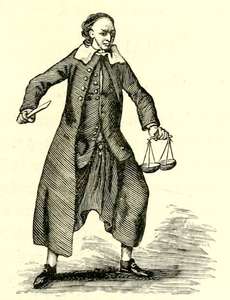
Mr. Macklin as Shylock.
CHAPTER X. — FOOTNOTES:
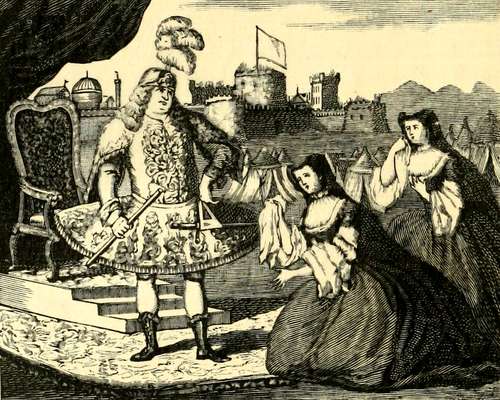
QUIN AS CORIOLANUS.
EXIT, JAMES QUIN.
The opposition between Garrick and Barry was well
sustained during the season of 1752-53. The former
had a forcible second and substitute in Mossop, and
an attractive lady to woo in comedy, or slay in tragedy,
in Miss (or Mrs.) Bellamy; but a more accomplished
still in Mrs. Pritchard. At the Garden, Barry was
at his very best in health and acting, and Mrs.
Cibber in the full bloom of her beauty and powers.
It was a pity that such a pair of lovers should be
separated, "for no two persons were so calculated to
assist each other by voice, manner, and real feeling,
as they were;" but, as Wilkinson records, "at the
close of this season they separated, never to meet
again on the same stage." Meanwhile, fashion
patronised Garrick and Mrs. Pritchard, rather more
lavishly than the rival pair.
Each had their especial triumphs in new pieces.
Garrick and Mrs. Pritchard, in Moore's "Gamester,"
first played on the 7th February 1753 (Beverley,
Garrick; Lewson, Mossop; Stukely, Davies; Mrs.
Beverley, Mrs. Pritchard), and Barry and Mrs. Cibber
in Jones's "Earl of Essex," produced at the Garden,
February 21st. Admirable as Garrick was in
Beverley, Mrs. Pritchard carried off the chief honours,
so natural, so terribly real, and so apparently unconscious
of the audience was she in her acting. She
was quite "at home" in this prose tragedy; the
severe lesson in which, however, after terrifying,
began to displease hearers, who did not relish the
caustic laid to their darling vice.
Let me also mention here Young's tragedy, the
"Brothers," written thirty years before, previous to
his ordination, amended by Lady Wortley Montagu,
and now played in March 1753.
As soon as Young surrendered this piece to the
players, for the benefit of the Society for the Propagation
of the Gospel, he was immersed in the very
thickest of theatrical squabbles, to the disgrace of his
clerical profession. George Anne Bellamy, that capricious
beauty on whom the delighted town showered
fortune, who rode one day in gilded chariots, and the
next was lying on the lowest of the steps at Westminster
Bridge, wrapped in misery, and contemplating
suicide; the irresistible Bellamy was then
the idol of the world of fashion, and Young readily
acceded to her request that she might read "The
Brothers" to the players. The request rendered
Garrick furious, although it was grounded on the
young lady's personal knowledge of the author.
The green-room was in an uproar. Roscius claimed
the principal part for Mrs. Pritchard; and when
George Anne poutingly offered to surrender the character
assigned her by the doctor, Young vehemently
opposed it with an emphatic, "No, no!" Mrs.
Bellamy accordingly read the piece, and assumed the
liberty of criticising it. She expressly objected to
the line, "I will speak to you in thunder," as not
being in a concatenation with the delicacy of the
fine lady who utters it. The reverend author protested
that it was the most forcible line in the piece;
but Mrs. Bellamy thought it would be more so if it
were improved by the introduction of "lightning" as
well as thunder.
The good doctor was something nettled at the
lady's wit; and he declared that "The Brothers"
was the best piece he had ever written. "I am
afraid, doctor," rejoined the lady, pertly, "that you
will do with me as the Archbishop of Toledo did
with Gil Blas on a similar occasion. But I cannot
help reminding you of a tragedy called the 'Revenge!'"
The author took the remark in considerable
dudgeon; but the sparkling young actress, who
sincerely esteemed him, exerted all her powers to
smooth the plumes that her wit had ruffled; and she
did this with such effect, that the doctor, after offering
to cancel the line objected to, invited himself
to dine with her, and did so in company with Garrick
and rough Quin. "The Brothers" was acted
to thin houses for eight nights, and then quietly
shelved. The author realised £400 by it; to which
adding from his private purse £600 more, he gave
the handsome sum of £1000 to the Society for the
Propagation of the Gospel. The author was displeased
alike with the town and with the players.
The truth is, however, that the fault lay as much with
himself as with either. The play was not original, but
taken without acknowledgment, from various sources.
A great portion is almost literally translated from
the French piece, Persée et Démétrius. Many of the
speeches are taken piecemeal from Livy.
The contest in the third act is splendidly phrased;
but the dénouement is so confused and incomplete,
that Young was obliged to add an epilogue to explain
what was supposed to take place at and after
the fall of the curtain! Garrick substituted a coarse
epilogue which was spoken by sprightly Kitty Clive,
who loved to give coarseness all its point; but it
could not save the piece, and it seriously offended
the author. Since then, "The Brothers" has descended
into that oblivion which fittingly enfolds
nearly all the classical tragedies of the last century.
It is not without its beauties; but it does not picture
the period it affects to pourtray. The "sir" and
"madam" sound as harshly as the "citizen Agamemnon,"
which the French Republic introduced
into Racine's plays; and the epithets are only one
degree less absurd than the "Oui, Milor," which
Voltaire's Beersheba addresses to King David.
Barry's Jaffier, played for the first time on the 21st
of November 1752, placed him on an equality with
Garrick in that character; but he was not so great
in this as in Jones's tragedy, the "Earl of Essex,"
which he played on the 21st of February, to Smith's
Southampton, and the Countess of Rutland of Mrs.
Cibber. One sentence in this tragedy, uttered by
Barry, seems to have had an almost incredible effect.
When the Earl, pointing to the Countess of Rutland
in a swoon, exclaimed, "Oh, look there!" Barry's
attitude and pathetic expression of voice were such
that "all the critics in the pit burst into tears, and
then shook the theatre with repeated and unbounded
applause." The bricklayer poet, whom Chesterfield
brought from Drogheda, only to ultimately die, half-starved,
in a garret near Covent Garden, attributed
the success of the piece to his own powers, whereas
it was due to the wonderful acting of Barry and Mrs.
Cibber alone.
With this season James Quin disappeared from
the stage. For a year or two he had not acted.
The triumphs of Garrick, followed by those of Barry,
drove from the scene the old player who, for nearly
forty years, belonged to the now bygone school of
Betterton, but particularly of Booth, whose succession
he worthily held, rather than of Garrick. James
Quin stands, however, worthily among, if not on a
level with, those actors of two different eras, having
something of each, but yet distinct from either.
Such a man deserves a few words in addition to
those I have already written.
The theatrical life of Quin embraces the following
dates. James Quin began his career in Dublin in
1714, and ended it at Bath in 1753. His first
character was Abel in the "Committee;" his last,
Hamlet, played at Bath (whither he had retired), not
for his own benefit, but for that of his friend, Ryan.[59]
Of doing kindnesses to friends, James Quin was
never weary; and if he did say that Garrick in
Othello looked like the black boy in Hogarth's
picture he was only temporarily jealous of Roscius.
Quin was a careless dresser of his characters; and
he had a sharp sarcasm, but not a lasting ill-feeling,
for those who pretended to better taste, and gave it
practical application.
I have already spoken of Quin's early life; his
English birth, his Irish breeding, his disputed legitimacy,
and his succession to an estate, from which he
was debarred by the rightful proprietors. Necessity
and some qualifications directed him to the Dublin
stage, where he played under Ashbury, Queen Anne's
old master of elocution. Quin, then about one-and-twenty,
gave such promise that Chetwood the
prompter recommended him "to try London," where
at Drury Lane, during three seasons, he played
whatever character he was cast for, and made use
of opportunity whenever that character happened to
be a prominent one.
In 1718 Quin passed to Lincoln's Inn Fields,
where for four years[60] he was the great support of
that house.[61] I have previously noticed his misadventure
with Bowen the actor, whom he slew in
honest self-defence under great provocation. It was
kind-hearted, but hot-blooded, Quin's hard fate to
kill two actors. A subordinate player named Williams
was the Decius to Quin's Cato. Williams, in
delivering the line "Cæsar sends health to Cato,"
pronounced the last name so affectedly—something
like "Keeto"—that Quin in his impatience could
not help exclaiming, "Would he had sent a better
messenger!" This greatly irritated the little Welsh
actor—the more that he had to repeat the name in
nearly every sentence of his scene with Cato, and
Quin did not fail to look so hard at him when he
pronounced the name that the secondary player's
irritation was at the highest when the scene
concluded; and Decius turned away, with the
remark—
"When I relate, hereafter,
The tale of this unhappy embassy,
All Rome will be in tears."
That tale, Williams went and told in the green-room,
where he waited for Quin, who came off at the
end of two scenes more, after uttering the word
"death." It was what he brought, without meaning
it, to the irascible Welshman, who attacked him on
the not unreasonable ground that Quin had rendered
him ridiculous in the eyes of the audience; and he
demanded the satisfaction which gentlemen who
wore swords were in the habit of giving to each
other. Quin treated the affair as a mere joke, but
the Welsh actor would not be soothed. After the
play, he lay in wait for the offender in the Covent Garden
Piazza, where much malapert blood was
often spilt. There Quin could not refuse to defend
himself, however ill-disposed he was to accept the
combat, and after a few passes, Williams lay lifeless
on the flag-stones, and Quin was arrested by
the watch. Ultimately, he was absolved from
blame, and no further harm came of it than the
lasting regret of having shed the blood of a fellow-creature.
At a later period, Quin was well-nigh slaying a
more ignoble foe than Williams, namely, Theophilus
Cibber, whose scoundrelly conduct towards his
beautiful and accomplished wife, Quin alluded to,
under a very forcible epithet applied to her husband.
Out of this incident arose a quarrel, and swords were
again drawn in the Piazza, where Quin and Cibber
slashed each other across the arm and fingers, till
they were parted by the bystanders.
In 1732, Quin, with the company from the "Fields,"
established himself in the new theatre in Covent
Garden, whence, after two seasons, he passed to
Drury Lane, where he continued till 1741; after
which, with some intervals, he again enrolled himself
at the "Garden," where he remained till he
quietly withdrew, in 1751. Of his rivalry with
Garrick, I have already said something. If he was
vanquished in that contest, he was not humiliated,
though I think he was a little humbled in spirit.
His great merit is, nevertheless, incontestable. His
Cato and Brutus were good; he was excellent in
Henry VIII., Volpone, Glo'ster, Apemantus, Ventidius,
the Old Batchelor, and "all the Falstaffs." He
was happy only in a few speeches of Pierre, especially,
"I could have hugged the greasy rogues, they
pleased me so!" and his execration of the senate.
His Plain Dealer is commended, and the soliloquies
of Zanga are eulogised. His Macheath and some
other operatic parts, he played and sung extremely
well. His failures were Macbeth, Othello, Richard,
Lear, Chamont, and Young Bevil. His continuing
to play these in opposition to Garrick and Barry
censures his judgment. Davies says, he often gave
true weight and dignity to sentiment by a well-regulated
tone of voice, judicious elocution, and
easy deportment. The expression of the tender, as
well as of the violent, emotions of the heart was
beyond his reach. The plain and the familiar rather
than the striking and the vigorous, became him
whose action was either forced or languid, and whose
movements were ponderous or sluggish. From the
retirement of Booth till the coming of Garrick, Quin
can scarcely be said to have had a rival, unless it
were the clever but lazy Delane, whose self-indulgence
was not accompanied by the energy and
industry which went with that of Quin. As Delane
fell before Quin, so did Quin fall before the younger
energy, and power, and perseverance, of Garrick.
James's prophecy that the latter, in founding a new
religion,—like Whitfield, would be followed for a
time, but that people would all come to church again,
was not fulfilled.
Nevertheless, it produced a very fair epigram:—
"Pope Quin, who damns all churches but his own,
Complains that heresy affects the town.
That Whitfield Garrick now misleads the age,
And taints the sound religion of the stage.
'Schism,' he cries, 'has turn'd the nation's brain!'
'But eyes will open, and to church again!'
Thou great Infallible, forbear to roar,
Thy bulls and errors are rever'd no more.
When doctrines meet with gen'ral approbation,
It is not Heresy, but Reformation."
Quin has left some reputation as a humourist.
Biographers give the name of his tutor in Dublin,
but they add that Quin was illiterate, a character
which is hardly established by the best of his bons
mots. That he was not well read, even in the literature
of that profession, of which he was so distinguished
a member, is certain; but he boasted that
he could read men more readily than books, and it
is certain that his observation was acute, and the
application of what he learned thereby, electrically
prompt.
If he was inexorable in enforcing the payment of
what was due to him, he was also nobly generous
with the fortune he amassed. Meanness was not
among the faults of Quin. The greatest injury has
been done to his memory by the publication of jests,
of a very reprehensible character, and which were said
to be his, merely to quicken their sale. He lived in
coarse times, and his jokes may have been, now and
then, of a coarse quality; but he also said some of
the finest things that ever fell from the lips of an
intellectual wit.
Of all Quin's jests, there is nothing finer than two
which elicited the warm approval of Horace Walpole.
Bishop Warburton, in company at Bath, spoke in
support of prerogative. Quin said, "Pray, my Lord,
spare me; you are not acquainted with my principles.
I am a republican; and, perhaps, I even think that
the execution of Charles I. might be justified."
"Ay!" said Warburton, "by what law?" Quin replied:
"By all the laws he had left them." Walpole
saw the sum of the whole controversy couched in
those eight monosyllables; and the more he examined
the sententious truth the finer he found it. The
Bishop thought otherwise, and "would have got off
upon judgments." He bade the player remember
that all the regicides came to violent ends,—a lie,
but no matter. "I would not advise your Lordship,"
said Quin, "to make use of that inference, for, if I
am not mistaken, that was the case of the twelve
apostles." Archbishop Whately could not have
more logically overthrown conclusions which discern
God's anger in individual afflictions.
There is little wonder, then, that Warburton disliked
Quin; indeed there was not much love lost between
the two men, who frequently met as guests in
the house of Ralph Allen, of Prior Park, Bath,—the
original of Fielding's Squire Allworthy, and the uncle
(Walpole says the father) of Warburton's wife. The
Bishop, seldom courteous to any man, treated Quin
with an offensively patronising air, and endeavoured
to make him feel the distance between them. There
was only a difference in their vocations, for Quin, by
birth, was, perhaps, rather a better gentleman than
Warburton. The latter once, at Allen's house, where
the prelate is said to have admonished the player on
his too luxurious way of living (the bishop, however,
loving custard not less than the actor did John Dory),
requested him, as he could not see him on the stage,
to recite some passages from dramatic authors, in
presence of a large company then assembled in the
drawing-room. Quin made some little difficulty;
but after a well-simulated hesitation consented, and
stood up to deliver passages from "Venice Preserved;"
but in reciting the lines
"Honest men
Are the soft easy cushions on which knaves
Repose and fatten,"
he so pointedly directed his looks, at "honest men"
to Allen, and at "knaves" to Warburton, that the
company universally marked the application, and the
bishop never asked for a taste of the actor's quality
again. And yet he is reported to have imitated this
very act, with less warrant for it. When Dr. Terrick
had been recently (in 1764) promoted from Peterborough
to the see of London, a preferment coveted
by Warburton, the latter preached a sermon at the
Chapel Royal, at which the new Bishop of London
was present, amid more august members of the congregation.
Warburton took occasion to say that a
government which conferred the high trusts of the
Church on illiterate and worthless objects betrayed
the interests of religion;—and on saying so, he stared
Terrick full in the face.
There was no man for whom Quin had such distaste
as this unpleasant Bishop of Gloucester, who
published an edition of Shakspeare. When this was
announced, the actor remarked in the green-room of
old Drury, "He had better mind his own Bible, and
leave ours to us!" Quin was undoubtedly open to
censure on the score of his epicurism. He is said to
have so loved John Dory as to declare, that for the
enjoyment of it, a man "should have a swallow from
here to the antipodes, and palate all the way!" and
we are told that if, on his servant calling him in the
morning, he heard that there was no John Dory in
the market, he would turn round, and lazily remark,
"then call me again to-morrow." But these are
tales more or less coloured to illustrate his way of
life. There is one which has more probability in it,
which speaks of another incident at Bath. Lord
Chesterfield saw a couple of chairmen helping a
heavy gentleman into a sedan, and he asked his
servant if he knew who that stout gentleman was?
"Only Mr. Quin, my lord, going home, as usual, from
the 'Three Tuns.'" "Nay, sir," answered my lord,
"I think Mr. Quin is taking one of the three home
with him, under his waistcoat!"
His capacity was undoubtedly great, but the over-testing
it occasionally affected his acting. An occasion
on which he was playing Balance, in the "Recruiting
Officer," Mrs. Woffington acting Sylvia, his
daughter, affords an instance. In the second scene
of the second act he should have asked his daughter,
"Sylvia, how old were you when your mother died?"
instead of which he said "married." Sylvia laughed,
and being put out of her cue, could only stammer
"What, sir?" "Pshaw!" cried the more confused
justice; "I mean, how old were you when your
mother was born?" Mrs. Woffington recovered her
self-possession, and taking the proper cue, said,
"You mean, sir, when my mother died. Alas! so
young, that I do not remember I ever had one; and
you have been so careful, so indulgent to me, ever
since, that indeed I never wanted one."
In his latest days, his powers of retort never failed
him. He was in that closing season when a fop condoled
with him on growing old, and asked what the
actor would give to be as young as he was? "I
would almost be content to be as foolish!" was
Quin's reply.
Old Hippisley, who, from a candle-snuffer became
a favourite low comedian, owed much of his power
of exciting mirth to a queer expression in his distorted
face, caused by a scar from a severe burn.
Having some intention to put his son on the stage,
he asked Quin's advice as to the preparatory measures.
"Hippy," said Quin, "you had better begin
by burning him."
Nobody bore with his sharp sayings more cheerfully
than Mrs. Woffington. We all know his
remark, when Margaret, coming off the stage as Sir
Harry Wildair, declared that she believed one half
the house thought she was a man. Less known is
his comment when, on asking her why she had been
to Bath, she answered saucily, "Oh, for mere wantonness!"
whereon Quin retorted with, "And have
you been cured of it?"
He was one of the few men who could stand a fall
with Foote, and come off the better man. Foote, who
could not endure a joke made on himself, broke
friendship with Quin on account of such offence.
Ultimately, they were reconciled; but even then
Foote referred to the provocation. "Jemmy, you
should not have said that I had but one shirt, and
that I lay a-bed while it was washed!" "Sammy,"
replied Quin, "I never could have said so, for I
never knew that you had a shirt to wash!"
In the roughest of Quin's jests there was no harm
meant, and many of his jokes manifested the kindliness
of his heart. Here is an obscure actor, Dick
Winston, lying,—hungry, weary, and disengaged,—on
a truckle bed, in the neighbourhood of Covent
Garden. He had wilfully forfeited an old engagement,
turned itinerant, starved, and had returned,
only to find his old place occupied. He is on his
back, in utter despair, as Mr. Quin enters, followed
by a man carrying a decent suit of clothes; and the
great actor hails him with a "Now, Dick, how is it
you are not up and at rehearsal?" Quin had heard
of his distress, got him restored to his employment,
and took this way of announcing it. Winston
dressed himself in a state of bewilderment; a new
dress and a new engagement,—but no cash wherewith
to obtain a breakfast!" Mr. Quin," said he,
unhesitatingly, "what shall I do for a little ready
money, till Saturday arrives?" "Nay!" replied
Quin; "I have done all I can for you; but as for
money, Dick, you must put your hand in your own
pocket." Quin had put a £10 note there!
Again; when Ryan asked, in an emergency, for a
loan, the answer from Quin was, that he had nothing
to lend; but he had left Ryan £1000 in his will,
and Ryan might have that, if he were inclined to
cheat the government of the legacy duty!
Frederick, Prince of Wales, was not half such a
practically good patron to Thomson, as James Quin
was. When the bard was in distress, Quin gave
him a supper at a tavern, for half of which the poet
expected he would have to pay; but the player
designed otherwise. "Mr. Thomson," said he, "I
estimate the pleasure I have had in perusing your
works at £100 at least; and you must allow me to
settle that account, by presenting you with the
money." What are the small or the great faults of
this actor of "all the Falstaffs," when we find his
virtues so practical and lively? In return, the
minstrel has repaid the good deed with a guerdon
of song. In the Castle of Indolence, he says:
"Here whilom ligg'd th' Aesopus of the age;
But, call'd by Fame, in soul ypricked deep,
A noble pride restored him to the stage,
And roused him like a giant from his sleep.
Even from his slumbers we advantage reap:
With double force th' enlivened scene he wakes,
Yet quits not Nature's bounds. He knows to keep
Each due decorum: now the heart he shakes,
And now with well-urged sense th' enlightened judgment takes."
The actor had a great regard for the poet, and was
not only active in bringing forward his posthumous
tragedy, "Coriolanus," in which Quin played the
principal character, in 1749, but spoke the Hon.
George Lyttleton's celebrated prologue with such
feeling, that he could not restrain his tears; and with
such effect, that the audience were moved, it is said,
in like manner:—
"He lov'd his friends;—forgave this gushing tear;
Alas! I feel I am no actor here;"
and Quin's eyes glistened, as he went through the
noble eulogy of a poet, whose
"Muse employ'd her heaven-taught lyre,
None but the noblest passions to inspire;
Not one immoral, one corrupted thought,
One line, which, dying, he could wish to blot."
The last night Quin played as an engaged actor,
was at Covent Garden, on the 15th of May 1751;
the play was the "Fair Penitent," in which he acted
Horatio to the Lothario of Barry, and the Calista of
Mrs. Cibber. After this he quietly withdrew, without
leave-taking, returning only once or twice to
play for the benefit of a friend. In his later years,
his professional income is said to have reached £1000
a year. He was the first English actor who received
£50 a night, during a part of his career. The characters
he created were in pieces which have died off
the stage, save Comus, which he acted with effective
dignity in the season of 1737-8;—a part in which
Mr. Macready distinguished himself, during his
memorable management of Drury Lane.
Quin's social position, after leaving the stage, was
one congenial to a man of his merits, taste, and
acquirements. He was a welcome guest at many
noble hearths—from that of ducal Chatsworth to
that of modest Allen's at Prior Park. At the former
he and Garrick met. There had not been a cordial
intimacy between the two as actors; but as private
gentlemen they became friends. This better state
of things was owing to the kindly feeling of Quin.
The two men were left alone in a room at Chatsworth,
and Quin made the first step towards a reconciliation
by asking a question the most agreeable he could
put—inquiring after Mrs. Garrick's health. In this
scene the two men come before me as distinct as a
couple of figures drawn by Meissonier—quaint in
costume, full of character and life, pleasant to look
at and to remember.
Quin was Garrick's guest at Hampton, when he
was stricken in 1765 with the illness which ultimately
proved fatal. He died, however, in his own
house in Bath. "I could wish," he said the day
before, "that the last tragic scene were over; and I
hope I may be enabled to meet and pass through
it with dignity." He passed through it becomingly
on the 21st of January 1766; and Garrick placed
the following lines on the old actor's tomb in the
Abbey—a pyramid of Sienna marble, bearing a medallion
portrait of Quin, resting on a sarcophagus, on
which the inscription is engraved, supported by the
mask of Thalia and the dagger of Melpomene.
"That tongue which set the table in a roar,
And charmed the public ear, is heard no more;
Clos'd are those eyes, the harbingers of wit,
Which spake, before the tongue, what Shakspere writ.
Cold is that hand which, living, was stretch'd forth
At friendship's call, to succour modest worth.
Here lies James Quin. Deign, reader, to be taught,
Whate'er thy strength of body, force of thought,
In nature's happiest mould however cast,
To this complexion thou must come at last."
Kind-hearted people have remarked that Garrick
never said so much to, or of, Quin when he was
alive. Perhaps not. He struggled with Quin for
mastery—vanquished him; became his friend, and
hung up over his grave a glowing testimony to his
talent and his virtues. This was in the spirit of
old chivalry. What would kind-hearted people
have? Was it not well in Garrick to speak truthfully
of one dead whom, when living, he thus with
pleasant satire described as soliloquising at the tomb
of Duke Humphrey at St. Albans—
"A plague on Egypt's art, I say!
Embalm the dead! On senseless clay
Rich wines and spices waste!
Like sturgeon, or like brawn, shall I
Bound in a precious pickle lie,
Which I can never taste?
Let me embalm this flesh of mine
With turtle fat, and Bordeaux wine,
And spoil th' Egyptian trade!
Than Humphry's Duke more happy I,
Embalm'd alive, old Quin shall die
A mummy ready made."
As a tailpiece to this sketch, I cannot, I think,
do better than subjoin Foote's portrait of Quin,
which, I will hope, was not drawn to disparage any
of Quin's great survivors, but in all honesty and
sincerity. "Mr. Quin's deportment through the whole
cast of his characters is natural and unaffected, his
countenance expressive without the assistance of
grimace, and he is, indeed, in every circumstance, so
much the person he represents, that it is scarcely
possible for any attentive spectator to believe that
the hypocritical, intriguing Maskwell, the suspicious
superannuated rake, the snarling old bachelor, and
the jolly, jocose Jack Falstaff are imitated, but real
persons.
"And here I wish I had room and ability to point
out the severe masterly strokes with which Mr. Quin
has often entertained my imagination, and satisfied
my judgment, but, under my present confinement, I
can only recommend the man who wants to see a
character perfectly played, to see Mr. Quin in the
part of Falstaff; and if he does not express a desire
of spending an evening with that merry mortal, why,
I would not spend one with him, if he would pay my
reckoning."
"With a bottle of claret and a full house," it may
well be concluded, from all concurrent testimony,
Quin was, in fat Jack, unapproachable. In the traditions
of the stage, he still remains the Falstaff, though
Henderson was subsequently thought to have equalled
him in many of the points of that character.
Finally, Quin's will is not uninstructive as an
illustration of the actor's character. There is, perhaps,
not a friend he had possessed, or servant who
had been faithful to him, who is forgotten in it.
Various are the bequests, from £50 to a cousin
practising medicine in Dublin, to £500 and a share
of the residue to a kind-hearted oilman in the
Strand. To one individual he bequeaths his watch,
in accordance with an "imprudent promise" to
that effect. James Quin did not like the man, but he
would not break his word! Requiescat in pace!
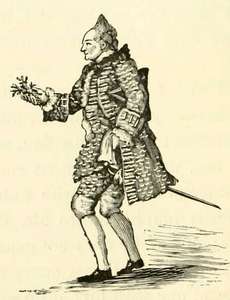
Mr. King as Lord Ogleby.
CHAPTER XI. — FOOTNOTES:
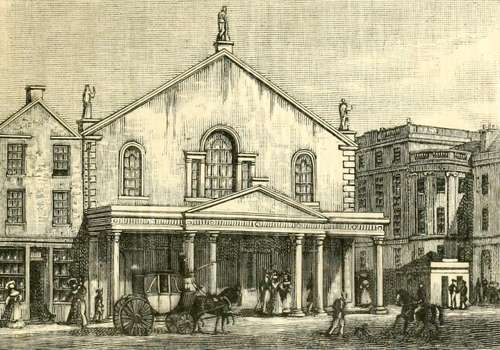
OLD THEATRE ROYAL, EDINBURGH.
ENGLAND AND SCOTLAND.
In 1753-4 Mrs. Cibber returned to Drury; she played
Juliet to Garrick's Romeo, and with him in every
piece that admitted of their playing together. But
Barry gained in Miss Nossiter a Juliet, not, indeed,
equal to Mrs. Cibber, but one who increased his own
ardour and earnestness in Romeo, his tenderness and
anxiety in Jaffier, and his truth and playfulness as
Florizel, inasmuch as that they were mutually in love,
and all the house was in the secret.
Miss Nossiter, however, did not realise her early
promise. Contemporary critics speak of the novice as
being of a delicate figure, graceful in the expression of
distress, but requiring carefulness in the management
of her voice, and a more simple elocution. One of her
judges curiously remarks:—"She frequently alarmed
the audience with the most striking attitudes." The
critic recovers from his alarm when speaking of another
debutante (Mrs. Elmey), who acted Desdemona
to Barry's Othello. "No part," he says, "has been
better represented in our memory," and "we scarce
knew what it was before she acted it."
Of poor Miss Nossiter there is little more recorded
than that, at the end of a brief career, she died, after
bequeathing to Barry, the Romeo, for whom more
than Miss Nossiter professed to be dying,—£3000.
Mossop succeeded Quin, at Drury Lane, with credit.[62]
Foote left "entertaining" at the Haymarket to play
the Cibber parts in comedy, and he was ably seconded
by Woodward, Mrs. Pritchard, and Kitty Clive.
Miss Bellamy and Shuter passed to the Garden, the
latter increasing in favour each night, as opportunity
afforded. With the exception of minor pieces, and a
revival of "King John," in which Garrick was an
unlikely Faulconbridge, and Mossop a superb tyrant,
the audiences were taken back to heavy classical
tragedies. Drury played Glover's "Boadicea," a
criticism of which is amusingly given by Walpole.
"There is a new play of Glover's, in which Boadicea
(Pritchard) rants as much as Visconti screams; but,
happily, you hear no more of her after the third act,
till, in the last scene, somebody brings a card with
her compliments, and she is very sorry she cannot
wait upon you, but she is dead. Then there is a scene
between Lord Sussex and Cathcart, two captains"
(Ænobarbus and Flaminius—Mossop and Havard),
"which is most incredibly absurd; but yet the parts
are so well acted, the dresses so fine, and two or
three scenes pleasing enough, that it is worth seeing."
Archbishop Herring thought the last two acts
admirable. "In the fifth particularly, I hardly ever
felt myself so strongly touched."
Of a second tragedy, Crisp's "Virginia," Walpole
says it flourished through Garrick's acting. Murphy
states that "the manner in which Garrick uttered
two words, crowned the play with success; when in
a low tone of voice that spoke the fulness of a broken
heart, he pronounced, 'Thou traitor!' the whole
audience was electrified, and testified their delight
by a thunder of applause." It was, however, a poor
play, even for a custom-house officer, who, by the
way, made Appius (Mossop) propose to marry
Virginia. Marcia was played by Mrs. Graham;
Garrick did not think much of her; but we shall
hear of her again as the great Mrs. Yates.
The third classical tragedy was Whitehead's
"Creusa," founded on the Ion of Euripides. Walpole
praises the interest, complexity, yet clearness
and natural feeling of the plot. "It is the only new
tragedy that I ever saw and really liked. The circumstance
of so much distress being brought on by
characters, every one good, yet acting consistently
with their principles towards the misfortunes of the
drama, is quite new and pleasing." As a reading
play, I think "Creusa" is the greatest success
Whitehead has achieved.
On the other hand, M'Namara Morgan's romantic
tragedy "Philoclea" owed much of its ephemeral success
to the fire, grace, beauty, and expression of
Barry and Miss Nossiter (Pyrocles and Philoclea), the
two lovers. The house literally "sighed like furnace"
for very sympathy. The Rev. Mr. Genest says truly,
"that the play is a poor play, but that the epilogue
is not bad;"—it is a mass of uncleanness, worthy of
the Ravenscroft whom Genest admired. As for Dr.
Francis's "Constantine," in which Barry and Mrs.
Bellamy played Constantine and Fulvia, it was a
failure; but, therefore, Mrs. Bellamy recommended
the author to the patronage of Fox; and it is certain
that the father of Sir Philip Francis owed his promotion
to the Suffolk rectory of Barrow to Lord Holland.
There is something amusing in the idea of
George Anne Bellamy indirectly nominating to
Church benefices!
In the season of 1754-5, Garrick was relieved by
the absence of Barry, who left Rich for Dublin, taking
Miss Nossiter with him, at a salary of £1300 for
both, for the season, and predicting ruin to Rich. The
latter falsified the prediction, by bringing out Sheridan
in all his best parts against Garrick, and in "Coriolanus,"
against Mossop. Sheridan and Dyer also
played Romeo, greatly to the benefit of Barry; but
Rich got well through his season with the above, and
in spite of a tragedy, called "Appius," the ill success
of which was reasonably attributed by the author,
Moncrieff, to the fact that Sheridan had lopped off the
fifth act; pantomime supplied its place.
Garrick, in addition to his old parts, created Achmet
in "Barbarossa;" Mossop playing the tyrant, and
Mrs. Cibber, Zaphira. His other novelties were the
"Fairies," and the masque of Britannia;" the latter
Apropos to the war. I do not know if Dr. Browne,
the vicar of Great Horkesley, could have civilised the
yet uncivilised dominion of Russia, as Catharine invited
him to do; but he assuredly wrote a poor yet
lucky tragedy, for it has lived while better have sunk
into oblivion. It is "Merope" re-cast and dressed.
"There is not one new thought in it," wrote Walpole;
"and, which is the next material want, but one
line of perfect nonsense. 'And rain down transports
in the shape of sorrow!' To complete it, the manners
are so ill-observed, that a Mahometan princess-royal
is at full liberty to visit her lover in Newgate,
like the banker's daughter in 'George Barnwell.'"
Walpole's criticism on the "Fairies" is not less
smart. "Garrick has produced a detestable English
opera, which is crowded by all true lovers of their country.
To mark the opposite to Italian opera, it is sung
by some cast singers, two Italians, a French girl, and
the chapel-boys; and to regale us with sauce, it is
Shakspeare's 'Midsummer Night's Dream;' which," he
adds, as if he inherited the feelings of Pepys with regard
to this poetical play, "is forty times more nonsensical
than the worst translation of any Italian opera books."
At the short summer season in the Haymarket,
where Theophilus Cibber and his eccentric sister,
Mrs. Charke, were at the head of "Bayes's" new-raised
company of comedians, there appeared on the
21st of August, 1755, Miss Barton, in Miranda, to
Cibber's Marplot. Besides this, and other comic
characters, Miss Barton acted Desdemona. Not
many years before this she was a shoeless flower-girl,
purer looking than any of her own roses, in St.
James's Park. We shall hear of her anon, under a
name than which there is not a brighter in theatrical
annals—the name of Abington.
The season of 1755-6 was remarkable for the fact
that Garrick made three very absurd assaults on
Shakspeare, by producing emendations of the "Winter's
Tale," "Taming of the Shrew," and the "Tempest,"
cutting, clipping, adding, taking away, and
saying the while:—
"'Tis my chief wish, my joy, my only plan,
To lose no drop of that immortal man!"
This season was also remarkable for the riot consequent
on his producing the "Chinese Festival,"
when the public, hating the French, with whom we
were at war, insisted on his asking pardon for the
introduction of Swiss, Germans, and Italians! Garrick
proudly answered, that if they would not allow
him to go on with his part (Archer), he would never,
never, again set foot on the stage! It was, further,
famous for the failure of "Athelstan," by Dr. Browne,
which fell, though it was a better tragedy than
"Barbarossa." The disappointed author, it will be
remembered, destroyed himself.[63] Still more famous
was this season, for the fray between the Rival
Queens, Woffington—Roxana, and Bellamy—Statira;
when the superb dresses of the latter drove poor
Peg into such fury, that she nearly stabbed her
rival in downright earnest. Failing in her attempt,
she stabbed her with words, and taunted Bellamy
with having a minister (Henry Fox) who indulged
her in such extravagances. "And you," retorted
the other "gentle creature," "have half the town
who do not!" But not for these things, nor for
Foote's satirical farces against Murphy, nor for Murphy's
against Foote, was the season so famous, as it
was for being that in which Barry, now returned to
Covent Garden, entered the lists once more against
Garrick, after playing a round of his most successful
characters, by acting King Lear with Miss Nossiter
as Cordelia, which part Mrs. Cibber played to Garrick's
King.
In this contest Garrick carried away the palm.
Barry was dignified, impressive, pathetic, but unequal,
failing principally in the mad scenes, which
appear to have been over-acted. It was precisely
there where Garrick was most sublime, natural, and
affecting. There was no rant, no violence, no
grimacing. The feeble, miserable, but still royal old
man was there; slow of motion, vague of look, uncertain,
forgetful of all things save of the cruelty of
his daughters. It was said for Barry that he was
"every inch a king;" for Garrick, that he was
"every inch King Lear." The wits who admired
the latter repeated the epigram—
"The town has found out diff'rent ways,
To praise the different Lears;
To Barry they give loud huzzas!
To Garrick—only tears."[64]
others quoted the lines alluding to Garrick's jealousy—
"Critics attend! and judge the rival Lears;
While each commands applause, and each your tears.
Then own this truth—well he performs his part
Who touches—even Garrick to the heart."
Drury Lane, in 1756-57, offers little for remark.
Miss Pritchard appeared in Juliet—only to show that
talent is not hereditary; and Garrick ventured King
Lear, with a little less of Tate, and a little more of
Shakspeare; he was as resolute, however, against
introducing the Fool as he was with respect to the
Gravediggers in Hamlet. On the other hand, he
acted Don Felix. Gracefully as Garrick played the
part, Walpole said "he was a monkey to Lord Henry
Fitzgerald" (who played this character admirably in
private). The Violante of Miss Macklin was acted
with astonishing effect. When Garrick was weary,
his parts were "doubled" by handsome Holland,
the son of the Chiswick baker, and destined to
carry grief to the honest heart of Miss Pope. The
dramatic poets raised no new echoes in Drury this
season—some farces excepted. One of these was
the "Reprisal," by Smollet, who showed that if he
could not write a good tragedy at nine-and-twenty,
he could dash off a lively farce at seven-and-thirty.
With this farce the ablest of novelists and harshest
of critics closed his theatrical career. The second
farce was Foote's "Author," in which he and Mrs.
Clive acted Mr. and Mrs. Cadwallader, and the
former exultingly held up to ridicule one of his most
intimate friends, Mr. Apreece, taking care to have
him among the audience on the first night!
At the other house, Barry failed in Richard III.;
but the treasury recovered itself by the production,
in March, of "Douglas," in which Barry, six feet
high, and in a suit of white puckered satin, played
Norval to the Lady Randolph of Mrs. Woffington.
The originals of those parts, when the piece was first
played in Edinburgh, in the previous December, were
Digges and Mrs. Ward. This piece was the glory of
the Scottish stage, and a scandal to great part of the
community. Before the curtain rises let me say a
few words on the growth of that stage.
There have been stringent rules in Scotland with
regard to the theatre, but they have been accompanied
by much general toleration. The Regent
Murray cheerfully witnessed the performance of a
drama; and the General Assembly, in 1574,[65] though
they prohibited all dramas founded on Scripture, permitted
the representation of "profane plays." The
licensers were the Kirk Session, before which body
the piece was first read; and if license was accorded
for its being acted, stipulation was made that nothing
should be added to the text which had been read,
and that "nae swearing, banning, nor nae scurrility
shall be spoken, whilk would be a scandal to our
religion and for an evil example to others."
When, however, James VI. manifested a wish to
see the English company which arrived in Edinburgh
in 1599, by granting it a license to act, the General
Kirk Session of the city denounced all players and
their patrons—the former as unruly and immodest,
the latter as irreligious and indiscreet. This opposition
led to a conference between the Session and the
angry King, at which the former were obliged to
withdraw their denunciations, which had been made
from all the pulpits; and they authorised all men "to
repair to the said comedies and plays without any
pain, reproach, censure, or slander, to be incurred by
them." Individual ministers were sorely discontent
with such proceedings of the Session; and this feeling
increased, when a play, "Marciano, or the Discovery,"
was acted in 1662, "with great applause,
before His Majesty's High Commissioner, and others
of the nobility, at the Abbey of Holyrood House, on
St. John's night." In the preface of this very play,
the drama in Scotland was likened to a "drunken
swaggerer in a country church!"
It does not appear that any regular theatre existed
in Edinburgh previous to 1679, when the brothers
Fountain held from Charles II. the patent of
"Masters of the Revels, within the Kingdom of
Scotland."[66] The Fountains not only erected a playhouse,
but they subsequently sought to suppress all
balls and entertainments held in the dancing-masters'
schools, as discouraging to the playhouse, which "the
petitioners had been at great charge in erecting."
Accordingly, such balls, unless duly licensed, were
suppressed. As Mr. Robert Chambers remarks in
his Domestic Annals of Scotland, "It sounds strange
to hear of a dancing-master's ball in our city, little
more than a month after the battle of Bothwell
Bridge, and while a thousand poor men were lodging
on the cold ground in the Greyfriars' Churchyard!"
There was no regular theatrical season,—players
came and went according to the chances of profit
afforded by the presence of great personages in the
capital. In 1681, the Duke and Duchess of York
were sojourning there; and just at that time, thirty
joyous-looking folk were being detained by the Customs'
authorities at Irvine, in Ayrshire, where they
had landed, and where they were in difficulty, on
questions of duties on the gold and silver lace of
their wardrobe. Laced clothes were then highly
taxed; but, said the gay fellows, who, in truth, were
actors, with actresses from the theatre in Orange
Street, Dublin, "these clothes, mounted with gold
and silver lace, are not for our wear, but are necessary
in our vocation, and are, therefore, exempt."
They had to petition the Privy Council, which body,
submitting to the plea of the actors, that "trumpeters
and stage-players" were exempted from the Act,
sent a certificate to the tax-collector at Irvine, to let
them pass free, and come up and act "Agrippa, King
of Alba, or the False Tiberinus," and other dramas,
before all lieges in Edinburgh, who were inclined to
listen to them.
This incident reminds me of an anecdote of Talma,
which was communicated to me by a French actor.
Talma was stopped, like the Irish players at Irvine,
at the Custom-house on the Belgian frontier, as he
was on his way to fulfil an engagement at Brussels.
His theatrical costumes were undergoing examination,
when an official irreverently spoke of them as
"Habits de Polichinelle." The tragic actor was
offended. "Habits de Polichinelle!" said he, "they
are of the utmost value. That lace is worth fifty
francs a yard, and I wear it constantly in private."
"And must therefore pay for it," said the sharp
Belgian official; "Punch's clothes might pass untaxed,
but Mr. Talma's laced coats owe a duty to
the King," which he was forced to acquit.
With the fall of the Stuarts and the establishment
of Presbytery, a sour feeling against the stage prevailed
in Scotland. Mr. R. Chambers attributes a
later improved feeling to the Southern gentlemen
who were sent northward to hold office, and who
took with them tastes which were gradually adopted;
at first by Episcopalians, and later by Presbyterians
themselves.
There is a smith's shop near Holyrood, which, in
1715, was part of a Tennis Court, which, in that
year, and just before the outbreak, was converted
into a theatre. It was well attended, and furiously
denounced; even solemn kirk folk flocked to listen
to the old and modern playwrights, despite the
threats of their ministers that, from all such, they
would withhold the "tokens to the Sacrament of the
Supper." The presbytery of Edinburgh fulminated
every species of menace against the new stage and
its upholders, but the latter had a fatally amusing
comment to make on such fulminations. Only the
year previously, three of these very ministers, Mitchell,
Ramsay, and Hart, sent as a deputation to congratulate
George I. on his accession, rested on their
way at Kendal, where there was a little theatre,
whither these good men repaired to see Congreve's
"Love for Love" acted, and thought nobody would
tell of their backsliding!
The Scottish Tennis Court theatre did not prosper
even so well as that in Lincoln's Inn Fields. Eleven
years after the above date, although we hear of a performance
of Otway's "Orphan," with a prologue by
Allan Ramsay, it is in "private;"[67] but adverse
critics are informed, that they will have to support
their opinions, by the duello, in the King's Park.
In the same year, 1726, Anthony Aston, that erratic
actor, "after a circuit round the Queen of Isles,"
as another prologue by Mr. Allan Ramsay said of
him, re-appeared in Edinburgh with a theatrical
company.
"The dastards said, 'He never will succeed:'
What! such a country look for any good in,
That does not relish plays, nor pork, nor pudding!"
Aston had to contend against the utmost efforts
of the clergy and magistracy. Nevertheless, ruling
elders, who were peers of the realm, Lords of Session
and other amateurs, went and wept at graceful
Westcombe and handsome Mrs. Millar, in the
"Mourning Bride," and a son of Bishop Ross, and
master of the Beaux' Coffee House, charged a commission
of a penny on every playhouse ticket sold in
his establishment. Then, even Lord Grange, the
most profligate ruffian in all Scotland, was alarmed for
Scottish morals, when he heard that Allan Ramsay
had founded a circulating library, and was lending
out English playbooks. The magistrates, moved by
that arch-villain, Grange,—than whom there was not
a man so given to drink, devilry, and devotion,—sent
inspectors to learn from Ramsay's books the names
of his subscribers. Allan had timely warning; and
he destroyed his list before the obnoxious jurors
presented themselves. The pulpits re-echoed with
denunciations against acting and episcopacy, and
men who were carried to the theatres in sedans,—oh!
what had come to Scottish thews and sinews, when
such a spectacle as this was to be seen in old Edinburgh!
In 1733 and 1734, Shakspeare was in the ascendant
at the theatre at the Tailors' Hall, in the Cowgate,
varied by the works of Gay, Congreve, and Mrs.
Centlivre; pantomime, ballet and farce; with excellent
scenery, and machinery,—the troop occasionally
visiting Dundee, Montrose, and Aberdeen.
Dramatic taste spread to schools, where the pupils
began to act plays. While this was confined to
"Cato," "Julius Cæsar," and the like, there was no
harm done; but when the Perth schoolboys, at
Candlemas 1735, took to acting "George Barnwell,"
the Kirk Session once more bestirred itself, and shut
up the house built by Allan Ramsay, in Carrubber's
Close.[68] Subsequently, Ryan, the actor, laid the first
stone of a new theatre in the Canongate, which was
opened in 1746, but without sanction of law, which,
however, was not so rigorous as in earlier days, when
Lord Somerville, to screen a principal performer
from stern pains and penalties, engaged him in his
household, as butler! To this theatre, in 1756, the
Rev. John Home, then thirty-two years of age,
brought his tragedy of "Douglas." He had been
the successor of Blair (of the Grave), in the living
of Athelstanford; and had left it, to fight against the
Pretender, at Falkirk, where he was captured. The
reverend warrior ultimately escaped to England.
Collins dedicated to him his Ode on the Superstitions
of the Highlands. Home returned northward, full
of the love of poetry, and powerful in the expression
of it. His great dramatic essay was a grievous
offence against the laws of his church, to the practical
duties of which he had again surrendered himself.
Had it not been that Sarah Ward was willing
to help author and friends, even the reading of
"Douglas" would never have come off. Sarah lent
her sitting-room in the Canongate, to Home; and
Digges was present and silent, for once, with Mrs.
Ward, to enact audience. The characters were thus
cast; and a finer group of intellectual persons sitting
as they could best catch the light, in an obscure
room of the Canongate, cannot well be imagined.
Lord Randolph (or Barnard, according to the original
cast) was read by Robertson; Glenalvon, by the
greater historian, David Hume; Old Norval, by the
famous Dr. Carlyle, the minister of Musselburgh; and
Douglas, by Home, in right of authorship. Lady
Randolph was allotted to Professor Ferguson; and
the part of Anna was read by Dr. Blair, the minister
of the High Church, and author of the once popular
sermons!
But the Presbyteries of Edinburgh and Glasgow
speedily denounced author, play, dramatists, and dramas
generally, as instruments and children of Satan;
and excommunicated, not only Home, but actors and
audiences, and all abettors and approvers! The triumph
of the play compensated for everything. The
nation confirmed the sentiment of the critic in the
pit, whose voice was heard in the ovation of the first
night, exultantly exclaiming, "Weel, lads, what do ye
think o' Wully Shakspeare noo?" The tragedy was
offered to Garrick, who refused it. Mrs. Cibber, in
Lady Randolph, would extinguish Norval! Rich accepted
it, as readily as Garrick had declined it; and in
March 1757 London confirmed the judgment of the
city in the north. Gray declared that Home had
retrieved the true language of the stage, which had
been lost for a century. The Prince of Wales conferred
a pension on the expelled minister, and Sheridan
sent to Home a gold medal, worth ten guineas.
Just a century before Home was denounced by the
Presbytery, Adam Seaton, dwelling near John O'Groats,
where Cromwell's troops were encamped, on their way
to the Orkneys, was condemned to make public confession
in the Kirk, for "having masking playes in his
house for the Inglishe men." This extract from the
old Session record of the parish of Canisby (quoted
in Calder's History of Caithness), shows how the
drama "looked up," in remote Scottish localities, in
spite of the decree of 1647. A Presbyterian, lending
his house to amateur, or professional, actors in Cromwell's
army, is a novel illustration in the history of
the stage. Much might be said thereon; but Margaret
Woffington, the original Lady Randolph in
England, now retires from the scene, and waits the
telling of her story.
CHAPTER XII. — FOOTNOTES:
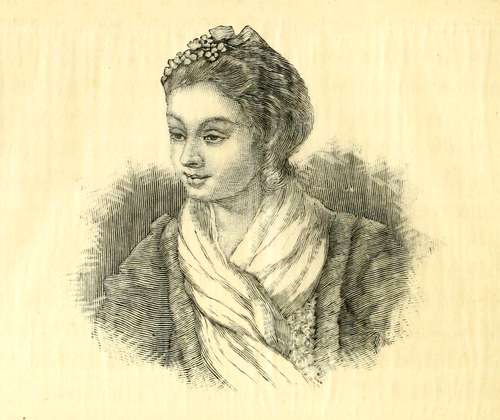
MRS. GARRICK.
MARGARET WOFFINGTON.
That good-tempered woman, who is looking with
admiration at the pretty and delicate child who is
drawing water from the Liffey, is Madame Violante.
She is mistress of a booth for rope-dancing and other
exhibitions in Dame Street. As the young girl turns
homeward, with the bowl of water on her head, the
lady follows, still admiring.
The object of her admiration is as bright and as
steady as a sunbeam. If she be ill-clad, she is exquisitely
shaped, and she will live to lend her dresses
to the two Miss Gunnings, to enable them to attend
a drawing-room at the Castle; their first steps towards
reaching the coronets of countess and duchess that
were in store for them.
This child, meanwhile, enters a shabby huckster's
shop, kept by her widowed mother, on Ormond Quay.
The father was a working bricklayer, and married the
mother when she was as hard-working a laundress.
There is another child in this poor household, a
sister of the water-bearer, fair, but less fair than she.
When Madame Violante first saw Mary and Margaret
Woffington, she little dreamed that the latter
would be the darling of London society, and the
former the bride of a son of one of the proudest of
English earls.
Margaret Woffington, born in 1720,[69] was very
young when Madame Violante induced her mother to
let her have the pretty child as a pupil. The foreign
lady was of good repute, and Margaret became an apt
pupil, performed little tricks while her mistress was
on the rope, learned French thoroughly, and acquired
graces of person, style, and carriage, by which she
gained fortune, and reaped ruin.
As a child, she played Macheath,[70] in Madame's
booth, when the "Beggar's Opera" was acted there
by children. From the age of seventeen to twenty,
she was on the more regular Dublin stage, charming
all eyes and hearts by her beauty, grace, and ability
in a range of characters from Ophelia to Sir Harry
Wildair.[71] Rich at once engaged her, at a moderate
salary, and, in 1740, brought her out, at Covent
Garden, as Sylvia to Ryan's Plume and the younger
Cibber's Brazen. A successful coup d'essai emboldened
her to try Sir Harry. She played it night
after night for weeks, and Wilks was forgotten. It
is said she so enraptured one susceptible damsel,
that the young lady, believing Sir Harry to be a man,
made him an offer of marriage.
Walpole was among the last to be pleased. "There
is much in vogue, a Mrs. Woffington," he writes,
in 1741; "a bad actress, but she has life." Walpole's
friend, Conway, confesses that "all the town
was in love with her;" but to Conway's eyes she
was only "an impudent Irish-faced girl." Even
these fastidious gentlemen became converted, and,
at a later period, Walpole records her excellent acting
in Moore's "Foundling," with Garrick, Barry,
and Mrs. Cibber.
Her Lothario was not so successful as her Sir
Harry; but her high-born ladies, her women of dash,
spirit, and elegance, her homely, humorous females,
in all these she triumphed; and triumphed in spite
of a voice that was almost unmanageable for its
harshness.
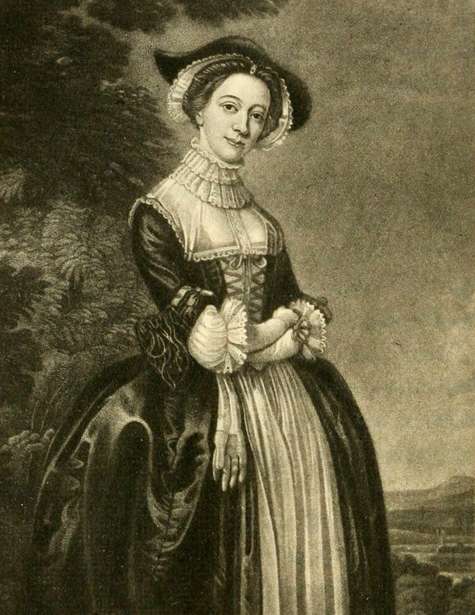
Margaret and Garrick were very soon on very
intimate terms. In the summer of 1742, they were
together in Dublin, and on their return, according
to a tradition of the stage, Garrick and Mrs. Woffington,
living together, alternately supplied the expenses
of the household, each being at the head of
the latter during a month. In Garrick's term the
table is said to have been but moderately furnished;
whereas during the beautiful Margaret's month there
was a banquet and brilliant company daily; all the
fashionable men about town being delighted at
an invitation from the Irish actress. Johnson used
to be among those visitors, and he noticed the
difference in the quality of the housekeeping, after
his usual fashion. "Is not this tea stronger than
usual, madam? It's as red as blood!"[72] It was
Margaret's month, and the liberal lady smiled.
That Garrick ever entertained thoughts of marrying
Margaret, I very much doubt, despite the story, said
to have been told by the lady to Murphy, that he
had gone so far as to buy the wedding-ring, and try
it on her finger. In the early part of the few years
which elapsed between Garrick's début in London
and his marriage with Eva Maria Violetti, he lived
in such affectionate intimacy with the charming Irish
actress, as to address to her the song beginning with
"Once more I'll tune the vocal shell,
To hills and dales my passion tell,
A flame which time can never quell,
Which burns for you, my Peggy!"[73]
Notwithstanding this homage, the lady's infidelities
were so numerous, that whatever may have been her
wrath or disappointment, she had no right to expect
that of so inconstant a mistress of one home, Garrick
was likely to make the wife of another. However
this may have been, it remains undeniable that Garrick
preserved, to his last days, a pair of silver buckles
which once belonged to that Peggy, who, from first
to last, enthralled more hearts than any actress since
the days of Elizabeth Barry;—from those of young
fellows with the down just budding on their lips, to
what was left of those of old Owen Mac Swiney and
older Colley Cibber, between which two ancient
danglers, people compared Margaret to Susanna
between the two Elders.
In good truth, her company was sought after "by
men of the first rank and distinction;" and "persons
of the gravest character, and most eminent for learning,"
felt honoured by her acquaintance, and were
charmed with her conversation. She founded her
avowed preference of the company of men to that of
women, on the alleged fact that the latter never
talked but of satins and silks. She herself was
endowed with a good understanding, which was
much improved by contact with intellectual society,
and by much reading. In short, it seems to have
been impossible to resist this clever, vivacious,
affable, and good-natured creature; one who laughed
most unaffectedly at the joke which touched her own
character nearest; whose errors are forgotten in her
much-abounding and still-enduring charity, and who
not only faithfully kept that part of the decalogue
which says, "Thou shalt not covet thy neighbour's
wife," but provided a home for her neighbours'
wives, through many generations, by building the
asylum for them, which still exists at Teddington.
"Mes enfans, sauvez-vous par la charité!"
Margaret Woffington was the most beautiful and
the least vain of the women of her day. Whatever
character she had to play, she identified herself
therewith; and did it happen to be that of an old or
ordinary woman, she descended to the level of circumstances,
and hid every natural beauty beneath
wrinkles and stolidity, according to the exigencies
of the part.
Her sister, Mary Woffington, whom many living
persons remember well, failed comparatively as an
actress; but she achieved better fortune as a woman
than her more able and attractive sister. By marriage
she connected herself with Walpole's family,
and Walpole, whose mother was the daughter of a
timber-dealer, was disgusted.
"I have been unfortunate in my own family," says
Walpole to Mann, in 1746; "my nephew, Captain
Cholmondeley, has married a player's sister." This
last was Mrs. Woffington's sister, Mary. Captain,
subsequently the Reverend Robert Cholmondeley, was
the second son of the Earl Cholmondeley, who obtained
Houghton, by marrying Walpole's only legitimate
sister, Mary. At the match between the captain
and the player's sister the earl was greatly incensed,
and he went to Mrs. Woffington to tell her as much.
But Margaret so softened him by her winning ways,
and won him by her good sense, and subdued him to
her will, that he, at last, called her his "dear Mrs.
Woffington," and declared that he was happy at his
son's choice, in spite of his having been "so very
much offended previously." This aroused Margaret's
spirit a little. "Offended previously!" she exclaimed,
"I have most cause to be offended now." "Why,
dear lady?" asked the earl. "Because," replied the
actress, "I had one beggar to support, and now I
shall have two!"
Of this marriage, Mrs. Woffington lived to see five
of the nine children born. One of these, married to
Sir William Bellingham, Bart., carried the Woffington
blood back to one of the oldest families in Ireland.
Another of Margaret Woffington's nieces was Maid
of Honour to the Princess of Wales; who, when
driving with her royal mistress through Leatherhead,
in 1806, was killed by the upsetting of the carriage.
Mary Woffington (the Hon. Mrs. Cholmondeley)
survived till 1811.
To see Margaret Woffington and Smith in Sylvia
and Plume was an ecstasy, he being so graceful and
vivacious, while she charmed her audiences in both
the dresses worn by Sylvia, rendering, says the Dramatic
Censor, "even absurdities pleasing by the
elegance of her appearance and the vivacity of her
expression." Mrs. Bellamy was so overcome by her
acting Jocasta in that awful drama of "Œdipus,"
that she fainted on the stage when playing Eurydice
to her. Some persons set this down to affectation;
but George Anne was not a lady likely to affect a
swoon for the sake of complimenting a rival actress.[74]
Mrs. Woffington was the only player who acted
Sir Harry Wildair with the spirit and elegance of
the original—Wilks, to whom Garrick and Woodward
were, in this part, inferior. She was excellent
in Lady Plyant, and admirable in the representation
of females in high rank and of dignified elegance.
Millamant, Lady Townley, Lady Betty Modish, and
Maria, in the "Nonjuror," were exhibited by her
with that happy ease and gaiety, and with such
powerful attraction, that the excesses of these characters
appeared not only pardonable, but agreeable.
Her Jane Shore did not admit of competition with
Mrs. Oldfield's; but that and Hermione were full of
merit notwithstanding. In male attire the elegance
of her figure was most striking; but I cannot suppose
that her Lady Randolph, of which she was the
original representative in London, in any one point
approached that of Mrs. Crawford (Barry), or of
Mrs. Siddons. Indeed her voice unfitted her for
tragic parts. She called it her "bad voice!"
Margaret Woffington's independence was one of
the great traits in her character. About six years
before Mrs. Cibber left the stage[75] she was often too
indisposed to act; and at short notice Mrs. Woffington
was advertised to play some favourite part of
her own instead. Once, when thus advertised, she
pleaded illness, and would not go to the theatre.
The next night, as Mrs. Woffington came on, as
Lady Jane Grey, she was greeted with a hurricane
of hisses for having failed to appear the evening
before. They even called upon her to "beg pardon!"
then her complexion glowed with angry beauty, her
eyes flashed lightning, and she walked off the stage
magnificently scornful. It was with great difficulty
she was induced to return, and when she did, the
imperious fair one calmly faced her excited audience
with a "now then!" sort of look. She expressed
her willingness to perform her duty, but it was for
them to decide; "On or off; it must be as you
please; to me it is a matter of perfect indifference!"
The audience petted this wayward creature, and the
contending parties were friends for ever after.
Margaret and Kitty Clive got on as ill together as
the former and Mrs. Cibber. The green-room was
kept alive by their retorts, joyous by their repartees,
or uncomfortable by their dissensions. But there
were no two dramatic queens who hated each other
so cordially within the theatre as Margaret and
George Anne Bellamy. In rivalry or opposition on
the stage, they entered into the full spirit of their
parts, felt all or more than they said, and not only
handled their daggers menacingly, but losing control
of temper sometimes, used them more vigorously
than law or good manners would allow.
After a career in London of undiminished popularity,
she passed over to Dublin for three seasons,
1751-54, where she was equally the popular idol,
drew thousands of pounds, had a salary, first of
£400, then of £800 for the season, was enthroned
at the Beef Steak Club by Sheridan, addressed
verses, free enough to be what they were not—her
own, to the Lord Lieutenant, and altogether ruled
"the court, the camp, and the grove." Victor extols
all her tragic parts, save Jane Shore; and Mrs.
Delaney confirms his account of her Lady Townley,
as being better than any the town had seen since
Mrs. Oldfield's time; adding, that she pronounced
well, and spoke sensibly; but that her voice was not
agreeable, and that her arms were ungainly. Of her
Maria ("Nonjuror"), Mrs. Delaney says that the
effect in Dublin was marred by the immoderate size
of Mrs. Woffington's hoops!
It was at this time she took a step which was
sharply canvassed,—that of forsaking the church in
which she was born, and putting her arm, as it
were, under that of Protestantism. She went a long
way, and in strange companionship too, in order to
take this step. She and Sheridan made a pleasant
excursion, on the occasion, through Mullingar to
Longford and Carrick on Shannon, and on, by
Lough Allen and Drumshamboe, till they stood on
the verge of the Pot of the Shannon.
Murphy fancies that as Roman Catholics could
not then legally wear a sword, she renounced her
old faith that she might carry one, in male characters,
without offending the law! This is sheer nonsense.[76]
But whatever took her to the little village on the
mountain side, it is impossible to conceive a more
striking contrast than the one between this magnificent
district, where occasionally an eagle may be
seen sweeping between Quilca and Sliev na Eirin,
with Covent Garden or Smock Alley! I do not
know if at that period, as till lately, the Primate of
Ireland had a little shooting-box on a platform of
the mountain, but to the modest residence still existing
of the Protestant pastor, Sheridan and Margaret
took their way; and there the brilliant lady enrolled
herself as a member of the church by law established.
The influences which moved her to this were simply
that she would not lose her chance of an estate for
the sake of the old religion in which she had been
baptized. Her ex-admirer, Mac Swiney, had left
her heiress to his estate of £200 a year; and that
the bequest might be legal, and the succession uncontested,
the frail Margaret qualified for prospective
fortune by declaring herself a Protestant, in the
presence of competent witnesses.
She returned to the "Garden" in the season
1754-55, going through all her best characters in
that, and the two succeeding, and her final seasons.
The last male part she acted was Lothario; the last
original part she created was Lady Randolph (which,
however, had been previously played in Edinburgh
by Mrs. Ward), and in Rosalind, paralysis put an
end to her professional career. Just previously, her
Lothario had not been highly esteemed; and Barry,
in the memorable suit of white puckered satin, had
produced all the effect in "Douglas." This affected
her spirits. Then she was annoyed at young Tate
Wilkinson, whom Foote had just brought on the
stage, and who had audaciously imitated the worst
parts of Margaret's voice. Almost the only unkind
act that can be laid to Mrs. Woffington's charge, was
her consequent attempt to induce Rich not to enter
into an engagement with Wilkinson. Her scorn
drove the unfortunate young gentleman, for his story
was a sad one, from the green-room, despite the interference
of Shuter. One night, as she was playing
Clarissa in the "Confederacy," she saw Wilkinson in
a stage-box with Captain Forbes, and unable to control
her rage, she came close to the box, and absolutely
made him shrink back by the sneering sarcasm with
which she flung at him one of her speeches. A rude
woman in the box above mimicked her peculiar voice
so well, as Clarissa turned away, that Mrs. Woffington
thought it came from Wilkinson. That night she
swept through the green-room, a beautiful fury, and
the next day, at Rich's levee, she assailed Tate with
terrible eloquence, prophesied evil to him, wished the
evil she prophesied, and altogether manifested little
of the kindly nature which was, in truth, her own.
Soon followed thereon the fatal 3d of May 1757.
The play was "As You Like It," in which she acted
Rosalind. Young Tate Wilkinson was standing at
the wing as she passed on to the stage, and on her
way she complimented him, ironically, on his recent
success as a debutant. Wilkinson watched and
studied her throughout the piece, till she came off
early in the fifth act, and suddenly complained of
being ill. Wilkinson offered his arm, leaning on
which she retired to the green-room, rallied, went on,
changed her dress, again trod the stage, defiantly of
fate, and again yielded to the coming blow; but only
for a moment. Once more she recovered, her self-will
being so great, and she began the lines of the
epilogue. She had just uttered, with fearful gaiety,
the words:—"If I were among you, I'd kiss as many
of you as had beards that pleased me——," when
that once saucy tongue became paralysed. A last
flash of courage impelled her to an attempt to proceed;
but it was vain, and at the sense that she was
stricken, she flung up her hands, uttered a wild shriek
in abject terror, and staggering towards the stage
door, fell into the arms stretched to receive her;
and amid indescribable confusion of cheering and
commiserating cries, Margaret Woffington disappeared
from the stage, for ever.
In November of that year, a fine gentleman asked,
"What has become of Mrs. Woffington?" "She has
been taken off by Colonel Cæsar," answered another
fine gentleman. "Reduced to aut Cæsar aut nullus,"
said the smart Lord Tyrawley. "She is gone to be
married," said Kitty Clive; "Colonel Cæsar bought
the license at the same time Colonel Mostyn bought
his." At this time, poor Margaret, in the meridian of
her beauty, somewhat weary of her calling, ashamed,
it is said, of her life, was slowly dying at "Teddington,
in Twickenhamshire," as Walpole loved to call it. So
slowly, that the end did not come till 1760.
In the interval, Margaret Woffington is said to have
lived to good purpose. Unreasonably exalted as her
character has been, it is impossible to contemplate it
at its close without respect. Charity, good works,
sorrow for the past, hope,—all the Magdalen was
there in that beautiful wreck. In a playful time she
and Colonel Cæsar had agreed that the survivor of
the two should be the heir of the other; but Margaret
would not let a jest do injury to her family
and to the poor. Of her few thousands, she left the
greater part to her sister; her mother she had pensioned
and protected; to the poor of Teddington,
among whom she reposes, she left well-endowed almshouses.
The poor, at least, may bless the memory
of that once bright young creature, whom Madame
Violante saw drawing water from the Liffey.
Those almshouses form a better relic of Margaret
Woffington than the poor stage-jewels which her
dresser, Mrs. Barrington, a respectable actress, hoped
to inherit. These were claimed by, and surrendered
to, the Hon. Mrs. Cholmondeley, and were carried
to Ireland by that lady's daughter, on her marriage
with Sir William Bellingham.
Such is the story of one, of whom an anonymous
contemporary has written,—"Mrs. Woffington is a
downright cheat, a triumphant plagiary. She first
steals your heart, and then laughs at you as secure
of your applause. There is such a prepossession
arises from her form; such a witchcraft in her beauty,
and to those who are personally acquainted with her,
such an absolute command, from the sweetness of her
disposition, that it is almost impossible to criticise
upon her." With this criticism, I leave Margaret
Woffington to the tender judgment of all gentle
readers.
But while Margaret Woffington is slowly dying,
here is a funeral passing through Berkeley Square.
"Mr. Colley Cibber" is the name often pronounced
in the crowd. It is one of which we have, for some
time, lost sight; let us return to it, before we pass
on to that of other conspicuous men.
Mr. Powell as Lovewell.
CHAPTER XIII. — FOOTNOTES:
THEOPHILUS CIBBER.
(Hogarth.)
COLLEY CIBBER.
In the year 1671, the coffee-house politicians, the fine
gentlemen, the scholars, and the gossips generally,
were in no lack of themes for discussion. In Bow
Street, the quidnuncs congratulated themselves, from
April to December, at the resolution of the Commons,
whose members had rebuked the Lords for daring
to alter an impost laid on sugar, to the effect that in
all aids given to the King by the Commons, the tax
levied might be agreed to, but it could not be altered
by the Lords. Knots of shabby-looking clergymen
were constantly to be seen in Mr. Brent, the mercer's,
shop, discussing the arrangements just made for the
sustenance of London incumbents, burnt out by the
Great Fire. Upstairs, in the long-room over Mr.
Brent's shop, the "wits' room" at Wills', the company
never wearied of hearing Major Mohun, the
actor, speak of Lord Fairfax who was just dead.
There was much gossip, too, both there and about
town, touching my Lord Manchester, lately deceased,
the parliamentary general who had helped to restore
monarchy. If he was the servant of two masters,
some persons thought he had been sufficiently punished
by being the husband of five wives. The
critics were more genially engaged in canvassing
the merits of Casaubon, the learned prebendary of
Canterbury, who had recently laid aside his critical
acumen with his mortal coil. The artists were
canvassing the merits of a monument which was
that year beginning to rear its head on Fish Street
Hill. The architect was Sir Christopher Wren. A
foreign sculptor from Holstein was, at that moment,
preparing designs for the basso relievo now on the
pedestal. This sculptor lived in Southampton Street,
Bloomsbury, where, on the 6th of November 1671,
while arranging the completion of his figures, his
lady upstairs,—she was of a cavalier family, and had
the blood of William of Wyckham in her veins,—presented
him with a living figure, the counterfeit
presentment of its father. The child thus born, as
it were, with the London Monument, was named
Colley Cibber.
How Colley fared at school, stood his own ground,
and was envied by the dunces he beat, in a double
sense,—how he was determined to succeed in life,
and did succeed, and was therefore denounced, as an
ass or a knave, by those who failed, or who hated
him for his success, or who feared the sarcasms
which he himself delivered, without fear,—is known
to us all.
The success of Colley Cibber, throughout life, may
be ascribed to three circumstances; the acuteness with
which he detected opportunity, the electric rapidity
with which he seized it, and the marvellous unerring
tact by which he turned it to profit. By this he was
distinguished, despite some easy negligence and
luxurious idleness, from his earliest days; and from
his first to his last consequent triumph, he paid for
each in the malevolence of those who envied him his
victories and denied his merit.
When a lad at Grantham Free School, he alone
accepted the magisterial proposal to compose a funeral
oration, in honour of the dead king, Charles II. He
gained such glory by his achievement that his fellows
sent him to Coventry. For succeeding better than
any of them in writing an ode in honour of the new
King, an ode which he modestly owns to have been
as execrable as anything he composed half a century
later, when poet-laureate, they ostracised the bard
whom they could not equal in song. Colley was
satisfied with his glory, and treated his young adversaries
with all the mingled good-nature and audacity
with which he subsequently treated his better armed
enemy, Mr. Pope.
When he "met the Revolution," in 1688, at Nottingham,
failing to obtain military employment, he
gladly availed himself of an opportunity to wait behind
Lady Churchill's chair, as she sat at table with
the Princess Anne. Half a hundred years later he
refers to the friend he acquired by thus performing
lacquey to her; and he happily caps a climax of
glorious compliment to the then Duchess of Marlborough,
by flatteringly alluding to something that
pleasantly distinguished her above all the women of
her time,—a distinction which she received not from
earthly sovereigns, but "from the Author of Nature;"
that of being "a great grandmother without grey
hairs."
He failed, indeed, in obtaining a commission, as
he did in an attempt to enter the Church; but for
those failures Cibber was, in no wise, responsible.
Had he grasped a pair of colours we should have
heard of him, honourably, in Flanders. Had he
received ordination, he would at least have as well
known how to push his way as the reverend Philip
Bisse, who kissed the Countess of Plymouth in the
dark, affecting to take her for a maid of honour, and
who thereby gained that lively widow for a wife, and
through her the bishoprics, successively, of St. Davids
and Hereford.
Colley being alike debarred from ascending the
pulpit, or leading to the imminently deadly breach,
turned to the sock and buskin, alternately donning
the one or the other, for nothing; but watching his
opportunity, and never failing to take advantage of
it. He gladly, after a term of hungry probation,
accepted the little part of the Chaplain, in the
"Orphan;" and when the old comedian Goodman
swore there was the stuff for the making of a good
actor in the young fellow, the tears came into Cibber's
eyes; but they were tears of joy, for he recognised
that his good time had commenced, and he
watched opportunity more indefatigably than ever.
Meanwhile he was happy on ten, and fifteen shillings
a week, with food, and raiment, and lodging,
under his father's roof, and an ardent desire that he
might one day play lover to Mrs. Bracegirdle. When
the ambitious young fellow had induced his sire to
allow him £20 a year, in addition to the £1 a week
which he then gained on the stage, Colley made love
to a young lady off the stage, and married at the
age of twenty-two. He and his wife were as happy
as any young couple that ever took a leap in the
dark. This is his own testimony; but beyond that
darkness he looked eagerly, watching still for opportunity.
It came when Congreve's "Double Dealer"
was to be played before Queen Mary. Kynaston
had fallen suddenly ill, and who could learn and
play the part of Lord Touchwood in a few hours?
Congreve looks at Cibber, and the young actor looks
confidently at Congreve. He undertakes the task,
fired by the thought of promotion, and of performing
before a crowned head. His success was perfect.
Congreve was delighted, and the salary of the
ecstatic comedian was raised some few shillings a
week. His young wife danced round him for joy
at this glimpse of Golconda. The company of
actors began to dislike him, after the fashion of his
Grantham schoolfellows.
Little recked Colley Cibber what men thought of
him, provided only the thought helped him towards
fortune. At a pinch, he supplied a new prologue, for
the opening of a season at Drury Lane, the prosperity
of which was menaced by an opposition from the new
theatre in Lincoln's Inn Fields. The poet begged
hard that he might have the speaking of his own
piece, but he was not accounted actor good enough
for that, and thus he lost, not by error of his own, a
particular opportunity. But the master slipped a
couple of guineas into his hand, and declared that
he, Colley, "was a very ingenious young man."
Cibber was consoled; he had, at all events, profited
by the opportunity, of making way with his "Master."
To be sure, said Colley, "he knows no difference
between Dryden and Durfey;" but that also made
no difference to Colley.
Some weeks subsequently the "Old Batchelor"
was suddenly substituted for the previously announced
tragedy of "Hamlet." When all the parts had been
distributed to the principal actors, Cibber, ever vigilant
and ever ready, quietly remarked that they had
forgotten one of the most telling parts in the whole
play, Fondlewife. It was Dogget's great part. In
it he was unapproachable. He was not a member of
the company. Who could or would dare to face a
public whose sides were still shaking with laughter
at Dogget's irresistible performance of this character?
No one knew the part; midday was at hand; the
curtain must go up by four; the play could not be
changed. What was to be done? Colley, of course,
offered himself to do it, and his offer was treated with
contempt;[77] but the managers were compelled to
accept it. Here was a golden chance which had
golden results for Cibber. He played the part at
night, in dress, feature, voice, and action, so like
to the incomparable Dogget himself, that the
house was in an uproar of delight and perplexity,—delight
at beholding their favourite, and perplexity
as to how it could possibly be he. For
there sat Dogget himself, in the very centre of a
forward row in the pit; a stimulant rather than a
stumbling-block to Cibber; and the astonished witness
of the newly-acquired glory of this young actor,
who always seemed ready to undertake anything,
and who was always sure of accomplishing whatever
he undertook. "It would be too rank an affectation,"
he writes, "if I should not confess that to see
him there, a witness of my reception, was to me as
consummate a triumph as the heart of vanity could
be indulged with."
Surely, this persevering fellow merited success;
but still were his playfellows like his schoolfellows.
They envied and decried him. If he solicited a part,
he was put by, with the remark that it was not in
his way. He wisely replied that any part, naturally
written, should be in the way of every man who pretended
to be an actor. The managers thought otherwise,
and left Colley—but not to despair. He had
just discerned another opportunity, and, more suo, he
clutched it, worked it to a noble end, and with it
achieved a double and a permanent triumph—triumph
as author as well as actor.
For many years there had not been a comedy
written but at the expense of husbands. They were
the dupes and dolts of the piece; were betrayed and
dishonoured; cudgelled and contented in their abject
debasement. Audiences had had something too
much of this, and Cibber was the first to perceive it.
He himself was not yet sufficiently enlightened to
discover that the majority in all theatrical audiences
were gasping for a general purer air of refinement,
and were growing disgusted with the mire in which
such writers as Ravenscroft, and others with more wit
than he, plunged and dragged them. Cibber, at all
events, made the first step out of this slough, by producing
his "Love's Last Shift." It was not readily
accepted, but it forced its way to that consummation,
by the testimony borne to its merits by competent
judges. It was played in January 1695.[78] Its grossness
is scarcely inferior to that of comedies most
offending in this way, and which were produced both
earlier and later. Nevertheless, it marks an epoch.
There was no comically outraged husband in it. The
style is still that of the old, free, coarse-comedy, in all
the other persons of the drama. The women lack
heart and natural affection; the men are unrefined
and uncivil, and both converse too much after the intolerable
mode which was not yet to be driven from
the sadly-abused stage. Sentiment there is, indeed,
after a sort; but when it is not smart and epigrammatic,
it is repulsively low and selfish. Amid the
intrigues of the piece, there stands glitteringly prominent
the first of the brilliant series of Cibber's
fops, Sir Novelty Fashion. This character he wrote
for his own acting, and his success in it established
him as an actor of the first rank. The interest of
the audience in Sir Novelty does not centre in him
as an unprincipled rake (he is, however, sufficiently
unscrupulous), as it is attracted towards him as a
"beau," a man of fashion, who professes to see nothing
tolerable in himself, solely in order to extort
praise for his magnificence from others. He is "ugly,
by Gad!" he is a "sloven!" If he wears hundreds
of yards of trimming, it is to encourage the poor
ribband-weavers. If all the eminent tailors in town
besiege his house, it is to petition him for the pattern
of his new coat. He is the first man who was ever
called "beau," which title he professes to prefer to
"right honourable," for the latter is inherited, while
the former is owing to his surprising mien and unexampled
gallantry. He does not make love to a
lady; his court is paid by indicating to her why she
should love him. He judges of a man of sense by
the fashion of his peruke; and if he enters a lady's
apartment in an unpowdered periwig, she may rest
assured that he has no designs on her admiration.
Sir Novelty is one of those fine gentlemen who go to
both theatres on the same evening; he sits with his
back to the stage, and is assured that he looks like
a gentleman; for, is he not endowed with a "fertile
genius for dress?"
Southerne, who had read this play and liked it,
was fearful of Cibber's own part in it. "Young
man," said he, "I pronounce thy play a good one.
I will answer for its success, if thou dost not spoil it
by thine own action!" When the play was over,
Nell Gwyn's old friend, Sackville, now Earl of Dorset,
Lord Chamberlain, and the "best good man with
the worst-natured muse," declared that "Love's Last
Shift" was the best first play that any author, in his
memory, had produced; and that for a young fellow
to show himself such an actor, and such a writer,
in one day, was something extraordinary. Colley,
always modest, but not through vanity, nicely alludes
to Dorset's known good-nature, and sets down the
compliment not to his deserts, but to Dorset's wish
to "encourage a young beginner." Cibber himself
pronounced his comedy puerile and frothy.
It is due to Cibber to say that in this piece his
own part of Sir Novelty is never so prominent as to
interfere unfairly with the other personages. The
piece itself, gross as it is, had a tendency towards
reforming the stage. Cibber's self-imposed mission
in this direction was consummated when he produced
his "Careless Husband." This was one of two
works of Colley which Walpole pronounced to be
worthy of immortality. The other was the "Apology"
for his life. The progress towards purity, made
between Cibber's first comedy and the last I have
named above, is nothing less than marvellous. In
the "Careless Husband" he produced a piece at
which the most fastidious ladies of those times might
sit, and listen to, unmasked. I say "listen," for the
comedy is a merely conversational piece, sparkling
with wit, and with fewer lines to shock the purer
sense than many an old play which still retains a
place upon the stage. The descriptions here are
as clever as the dialogue is spirited. If evil things
come under notice, they are treated as people of
decency would treat them, often gracefully, never
alluringly. The incidents, told rather than acted,
are painted, if I may so speak, with the consummate
skill, ease, and distinctiveness of a most accomplished
artist. The finest gentlemen are less vicious
here than they are temporarily foolish; and one has
not been long acquainted with Lady Easy before the
discovery is made that she is the first pure and sensible
woman that has been represented in a comedy
since a world of time. There is good honest love,
human weaknesses, and noble triumphs over them, in
this piece. If Mr. Pope sneered at the author as a
"dunce," which he was not, Mr. Pope's neighbour,
Horace Walpole, has registered him rightly as a
"gentleman," and traced his great success in describing
gentlemen to the circumstance of his constant
and familiar intercourse with that portion of
"society."
In this piece, there is the most perfect of Cibber's
beaux, written for his own acting; and it is to be observed,
that as time progressed and fashion changed,
so did he observe the progress, and in his costume
illustrate the change. Lord Foppington is a different
man from Sir Novelty Fashion; my lord does make
love to a lady. With a respectful leer, he stares full
in her face, draws up his breath, and cries, "Gad,
you're handsome!" He is married, too, and has just
sufficient regard for his wife to wish himself sun-burnt
if he does not prefer her to his estate. He
talks French enough to cite an à la what d'ye call it;
has Horace enough at his memory's ends to show
his breeding, by an apt quotation; and evidences his
gentlemanly feeling, albeit a fine-gentlemanly feeling,
on witnessing the happy union of the two wayward
lovers,—Lord Morelove and Lady Betty Modish,—by
the very characteristic exclamation:—"Stap my
breath, if ever I was better pleased since my first
entrance into human nature!"
The example of comparative purity, set in this piece,
was not immediately followed; but for that, Cibber is
not to blame. The "Careless Husband" was produced
in 1704, and nearly seventy years elapsed before the
period when Garrick positively refused to pollute the
boards of Drury Lane, by reproducing thereon, on
Lord Mayors' Days, one of the most filthy of the filthy
plays of Ravenscroft.[79] The critics of Cibber's time
were unreasonable. Because he was sometimes an
adapter, they called him an adapter always; and the
reviewers, sick, sorry, nay maddened at his success,
declared of his most original comedy, that it was
"not his own." But they never had the wit to discover
whence he had stolen it.
He took the adverse criticism with philosophy and
good-humour,—as he took most things. By the last,
he once saved ten shillings a week of his salary. Rich
announced the intended reduction to him, with the
remark, that even then he would have as much as
Goodman ever had,—whose highest salary was forty
shillings a week. "Aye!" said Cibber, laughing, "and
Goodman was forced to go on the highway, to help
him to live!" To save Colley from the same desperate
course, Rich made no reduction in his salary.
We obtain from Croker's Boswell, an instance of
Cibber's care in perfecting a piece, and his readiness
in adapting passing incidents to suit his purpose.
Mrs. Brett, the divorced Countess of Macclesfield, and
long thought to be the mother of Savage, the poet,
was the second wife of that Colonel Brett, whose
opinion as to what would best please the town was
eagerly sought after by authors and actors. His first
wife, a great leader of fashion, had taken the handsome
fellow from the hands of bailiffs, married him,
and ultimately left him a wealthy widower. For the
taste and judgment of the second Mrs. Brett, Cibber
had the highest respect; and he consulted her on every
scene of the "Careless Husband," as he wrote it. At
some one of these consultations, he probably heard of
the too great civility of the Colonel to his wife's maid,
both of whom Mrs. Brett once found fast asleep in
two chairs. The lady was satisfied to leave token of
her presence, by casting her lace handkerchief over
her husband's neck. Of the otherwise painful incident
she never took any notice; and let us hope
that the Colonel profited by the silent rebuke, as Sir
Charles Easy did. However this may be, Cibber
incorporated the incident into his play, where it
heightens the interest of one of the most interesting
scenes.
Cibber was essentially a comic actor. His Richard
partook very much of the manner of his Sir Novelty
Fashion; and his "A horse! a horse!" used to excite
the hilarity of his audience. He avows, gracefully
enough, that his want of a strong and full voice soon
cut short his hopes of making any figure in tragedy.
He adds, with some conceit, and more affected
modesty, "I have been many years since convinced,
that whatever opinion I might have of my own judgment
or capacity to amend the palpable errors that
I saw our tragedians most in favour to commit, yet
the auditors who would have been sensible of such
amendments (could I have made them) were so very
few, that my best endeavour would have been but an
unavailing labour, or what is yet worse, might have
appeared, both to our actors and to many auditors,
the vain mistake of my own self-conceit; for so
strong, so very near indispensable, is that one article
of voice, in the forming of a good tragedian, that an
actor may want any other qualification whatsoever,
and yet will have a better chance for applause than
he will ever have, with all the skill in the world, if
his voice is not equal to it." Colley admirably explains
this, by adding, ... "I say, for applause only;
but applause does not always stay for, nor always
follow, intrinsic merit. Applause will frequently
open, like a young hound upon a wrong scent; and
the majority of auditors, you know, are generally
composed of babblers, that are profuse of their voices,
before there is anything on foot that calls for them.
Not but, I grant, to lead, or mislead, the many, will
always stand in some rank of a necessary merit; yet,
when I say a good tragedian, I mean one, in opinion
of whose real merit the best judges would agree."
Cibber is so perfect as a critic, he so thoroughly
understands the office and so intelligibly conveys his
opinions, that it were well if all gentlemen who may
hereafter aspire to exercise the critical art, were
compelled to study his Apology as medical students
are to become acquainted with their Celsus. No
one should be admitted to practise theatrical criticism
who has not got by heart Cibber's descriptions
of Betterton and Mrs. Oldfield; or who fail on their
being examined as to their proficiency in the Canons
of Colley.
Then, if there be one circumstance more than
another for which Cibber merits our affectionate
regard, it is for the kindly nature with which he
tempers justice, and the royal generosity which he
displays in attributing certain alleged excellences in
his own acting, to his careful study of the acting of
others. If Cibber played Sparkish and Sir Courtly
Nice with applause, it was entirely owing, so he
nobly avows, to the ideas and impressions he had
received from Mountfort's acting of those characters.
Although his Richard was full of defects, yet he
attracted the town by it. He assigns this attraction
to the fact of his attempting to reproduce the style
and method of one of the greatest of Richards,—Sandford.[80]
While praising others he is ever ready to disparage
himself; and he as heartily ridicules his insufficient
voice, his meagre person, and his pallid complexion,
as any enemy might have done for him. He exalts
the spirit, ease, and readiness of Vanbrugh, and denounces
the puerility and frothy stage-language of
his own earlier dramas, accepting heartily Congreve's
judgment on "Love's Last Shift," which "had in it a
great many things that were like wit, that in reality
were not wit." He courageously pronounces the
condemnation of his "Love in a Riddle," to be the
just judgment of an enlightened audience. In the
casting of a play, Colley was contented to take any
part left to him, after the other great men had
picked, chosen, rejected, and settled for themselves;
and a couple of subordinate characters in the
"Pilgrim" were as readily undertaken by him and
as carefully acted as his Richard, Sir Francis, or
Master Slender.
To his own alteration of Shakspeare's "Richard
III.," he alludes with some diffidence. There is no
trace of self-complacency in his remarks. Colley's
adversaries, however, have denounced him for this
act as virulently as if he had committed a great
social crime. But whatever may be said as to our
old friend's "mangling of Shakspeare," the piece
which he so mangled has ever since kept the stage,
and it is Cibber's and not Shakspeare's "Richard"
which is acted by many of our chief players, who
have the coolness, at the same time, to protest that
their reverence for Shakspeare's text is a pure
homage rendered to a divine inspiration.
There were actors of Cibber's days who disliked
to play villains like Richard, lest the audience
should mistake the counterfeit for the real character.
But if people thought Cibber vicious because
he played a vicious fellow to the life, he took it as
a compliment. His voice was certainly too weak
and piping for tragedy, but as he philosophically
remarks, "If the multitude were not in a roar, to
see me in Cardinal Wolsey, I could be sure of them
in Alderman Fondlewife. If they hated me in Iago,
in Sir Fopling they took me for a fine gentleman.
If they were silent at Syphax, no Italian Eunuch
was more applauded than I when I sung in Sir
Courtly. If the morals of Æsop were too grave for
them, Justice Shallow was as simple and as merry
an old rake as the wisest of our young ones could
wish me."
Cibber had a fine perception of the good and
the true. That the "Beggar's Opera" should beat
"Cato" by a run of forty nights does not induce
him to believe that any man would be less willing
to be accounted the author of the tragedy than of
the opera, the writer of which, he says with some
humour, "I knew to be an honest, good-natured
man, and who, when he had descended to write
more like one in the cause of virtue, had been as
unfortunate as others of that class."
Colley had quite as just a perception of the
different value of fair and unfair criticism. Of
theatrical criticism, in the proper sense of the word,
there was, in those days, none. But this lack of
effective criticism was not caused by incapacity for
the task on the part of writers; as may be seen in
the admirable critical sketches in Cibber's "Life."
Indeed, the capability existed from a remote period,—a
fact acknowledged by those who have read Sir
Thomas Overbury's finished summary of the character
of an "Actor."
In place of criticism, however, there was a system
of assault by the means of unfounded reports. Mist's
Journal was foremost in attacking Cibber and his
colleagues, but "they hardly ever hit upon what
was really wrong in us," says Colley, who took these
would-be damaging paragraphs, founded upon hearsay,
with perfect indifference. Wilks and Booth
were much more sensitive, and preferred that public
answer should be made; but Cibber, secure, perhaps
too secure, he says, in his contempt for such writers,
would not consent to this. "I know of but one way
to silence authors of that stamp," he says, "which
was, to grow insignificant and good for nothing, and
then we should hear no more of them. But while
we continued in the prosperity of pleasing others,
and were not conscious of having deserved what they
said of us, why should we gratify the little spleen of
our enemies, by wincing to it, or give them fresh
opportunities to dine upon any reply they might
make to our publicly taking notice of them?"
Cibber cared not for Mist's Journal while such a
man as Sheffield, Duke of Buckingham, made a friend
of him. To this Duke, a dull Earl once expressed
his opinion that Mr. Cibber was not sufficiently
"good company" for his grace. "He is good enough
for me," said the Duke; "but I can believe that he
would not suit you." A peer who, at least, had wit
enough to enjoy Quin's society, had the ill-manners
to say, "What a pity it is, Mr. Quin, you are an
actor!" "Why," said ever-ready James, "what
would you have me be?—A lord?" Cibber, like
Quin, was proud of his vocation. Colley originated
nearly eighty characters during his career, from
1691 to his retirement in 1733. Among them are
the grand old fops, the crafty or the inane old men,
the dashing soldier, and the impudent lacquey. In
tragedy, he was nearly always wrong. Of middle
size, fair complexion, and with a shrill voice, apt to
crack, and therefore to make him ridiculous in
serious parts, he was, of "shape, a little clumsy,"
says one sketcher of his character,—while "his shape
was finely proportioned," is the account of a second.
Mr. Urban says that when Cibber had to represent
ridiculous humour, there was a mouth in every nerve,
and he was eloquent, though mute. "His attitudes
were pointed and exquisite; his expression was
stronger than painting; he was beautifully absorbed
by the character, and demanded and monopolised
attention; his very extravagances were coloured with
propriety." That the public highly appreciated him
is clear from the enthusiasm with which they hailed
his occasional returns to the stage, between 1733
and 1745, when he finally withdrew, after acting
Pandulph in his "Papal Tyranny." His Shallow,
in those occasional days, was especially popular.
"His transition from asking the price of ewes, to trite
but grave reflections on mortality, was so natural,
and attended by such an unmeaning roll of his small
pigs'-eyes, that perhaps no actor was ever superior
in the conception and execution of such solemn
insignificancy."
The general idea of Cibber has been fixed by the
abuse and slander of Pope. In the dissensions of
these two men, Cibber had the advantage of an
adversary who keeps his temper while he sharpens
his wit, and maintains self-respect while courteously
crushing his opponent;[81] but even Pope, who so
hated Cibber, could praise the "Careless Husband;"
and a man, lauded by Pope, who detested him; by
Walpole, who despised players; and by Johnson, who
approved of his "Apology," must have been superior
to many of his contemporaries. He wrote the best
comedy of his time, was the only adapter of Shakspeare's
plays whose adaptation survives—to show his
superiority, if not over the original poet, at least over
all other adapters; and of all borrowers from the
French, not one reaped such honour and profit as he
did by his "Nonjuror," which also still lives in "The
Hypocrite." Of all English managers, he was the
most successful and prosperous—only to be approached
in later days by Garrick. Of all English
actors, he is the only one who was ever promoted to
the laureateship, or elected a member of White's
Club. None laughed louder than he did at the promotion,
or at those friends of his to whom it gave
unmixed dissatisfaction. If a sarcasm was launched
at him from the stage, on this account, he was the
first to recognise it, by his hilarity, in the boxes.
Further, when necessity compelled him to plead in
person in a suit at the bar, his promptitude, eloquence,
and modest bearing, crowned by success, demonstrated
what he might have accomplished, had he
been destined to wear the wig and gown. To sum
up all—after more than forty years of labour, not
unmixed by domestic troubles, he retired, with an
ample fortune, to enjoy which he had nearly a quarter
of a century before him. Such a man was sure to be
both hated and envied—though only by a few.
Of Cibber's being elected to White's Club House,
Davies sneeringly remarks:—"And so, I suppose,
might any man be who wore good clothes, and paid
his money when he lost it. He fared most sumptuously
with Mr. Arthur (the proprietor) and his wife,
and gave a trifle for his dinner. After he had dined,
when the club-room door was opened, and the laureate
was introduced, he was saluted with the loud
and joyous acclamation of, 'Oh, King Coll! come
in, King Coll! Welcome, King Colley!' And this
kind of gratulation," adds Davies, "Mr. Victor
thought was very gracious and very honourable!"
Considering the time, about 1733, such a greeting
had nothing offensive in it. If there had been, Cibber
was just the man to resent it, at the sore cost of the
offender, whether the latter were Chesterfield or
Devonshire, Cholmondeley or Rockingham, Sir John
Cope, Mrs. Oldfield's General Churchill, or, the last
man likely to be so audacious—Bubb Doddington
himself.
Among them all, Colley kept his own to the last.
A short time before that last hour arrived, Horace
Walpole hailed him, on his birthday, with a good
morrow, and "I am glad, sir, to see you looking so
well." "Egad, sir," replied the old gentleman—all
diamonded, and powdered, and dandified, "at eighty-four,
it's well for a man that he can look at all."
Therein lay one point of Cibber's character,—the
making the best of circumstances.
And now he crosses Piccadilly, and passes through
Albemarle Street, slowly, but cheerfully, with an eye
and a salutation for any pretty woman of his acquaintance,
and a word for any "good fellow" whose purse
he has lightened or who has lightened his, at dice
or whist. And so he turns into the adjacent square,
and as his servant closes the door, after admitting
him, neither of them wots that the master has passed
over the threshold for the last time a living man.
In December 1757 I read in contemporary publications
that there "died at his house at Berkeley
Square, Colley Cibber, Esq., Poet Laureate." The
year of his death was as eventful as that of his birth.
In its course Byng was shot, and Calmet died; the
Duke of Newcastle became Prime Minister, Clive won
the battle of Plassy, and the Duke of Cumberland
surrendered Hanover and a confederate army to the
French by the treaty of Closter-seven. Within Cibber's
era the Stuart had gone, Nassau had been, and
the House of Brunswick had succeeded. This house
was never more unpopular than at the time of Cibber's
death, for one of its sons had permanently tarnished
his military fame; but great as the public indignation
was at the convention of Closter-seven, there was a
large fraction of the London population, at least,
who ceased to think of it, while Colley Cibber was
carried to sleep with kings and heroes in Westminster
Abbey. The general conclusion arrived at
seems to have been that he was a well-abused man,
who would speedily be forgotten.
To this, it may be replied, that in spite of the
abuse, often little merited, he was an eminently successful
man throughout life; and accomplished a
career, achieved (and scattered) a fortune, and built
up a fame which will always render him an object
of interest.
A little too careless, perhaps; rather too much
given to gambling and philandering; somewhat more
than might be of the young beau about him, even in
his old days, when, however, he was happy and resigned
under a burthen of years which few men bear
with content or resignation.
At the period of Colley Cibber's death, his daughter-in-law,
Mrs. Susanna Cibber, was enchanting the
town with her Isabella played to Garrick's Biron;
and Barry and Mrs. Bellamy were raising melodious
echoes within the walls of Covent Garden. His son,
Theophilus Cibber, was hanging about the town
without an engagement and in a fine suit of clothes.
Colley had once thus seen him, and had saluted
him with a contemptuous "I pity you!" "You
had better pity my tailor!" said the son, who was
then challenging Garrick to play with him the same
parts alternately! Then, while the body of the Poet
Laureate was being carried to Westminster Abbey,
there was, up away in a hut in then desolate Clerkenwell,
and starving, Colley's own daughter, Charlotte
Charke. Seven and twenty years before she had
first come upon the stage, after a stormy girlhood,
and something akin to insanity strongly upon her.
Her abilities were fair, her opportunities great, but
her temper rendered both unavailable. She appears
to have had a mania for appearing in male characters
on, and in male attire off, the stage. By some terrible
offence she forfeited the recognition of her father,
who was otherwise of a benevolent disposition; and
friendless, she fought a series of battles with the
world, and came off in all more and more damaged.
She starved with strollers, failed as a grocer in Long
Acre, became bankrupt as a puppet-show proprietor
in James Street, Haymarket; re-married, became a
widow a second time, was plunged into deeper ruin,
thrown into prison for debt, and released only by the
subscriptions of the lowest, but not least charitable,
sisterhood of Drury Lane. Assuming male attire,
she hung about the theatres for casual hire, went on
the tramp with itinerants, hungered daily, and was
weekly cheated, but yet kept up such an appearance
that an heiress fell in love with her, who was reduced
to despair when Charlotte Charke revealed her story,
and abandoned the place.
Her next post was that of valet to an Irish Lord,
forfeiting which, she and her child became sausage-makers,
but could not obtain a living; and then
Charlotte Charke cried "Coming, coming, sir!" as
a waiter at the King's Head Tavern, Mary-le-Bone.
Thence she was drawn by an offer to make her
manager of a company of strolling players, with whom
she enjoyed more appetite than means to appease it.
She endured sharp distress, again and again; but was
relieved by an uncle, who furnished her with funds,
with which she opened a tavern in Drury Lane, where,
after a brief career of success, she again became bankrupt.
To the regular stage she once more returned,
under her brother Theophilus, at the Haymarket; but
the Lord Chamberlain closed the house, and Charlotte
Charke took to working the wires of Russell's famous
puppets in the Great Room, still existing in Brewer
Street. There was a gleam of good fortune for her;
but it soon faded away, and then for nine wretched
years this clever, but most wretched of women, struggled
frantically for bare existence, among the most
wretched of strollers, with whom she endured unmitigated
misery.
And yet Cibber's erring and hapless daughter contrived
to reach London, where, in 1755, she published
her remarkable autobiography, the details of which
make the heart ache, in spite of the small sympathy of
the reader for this half-mad creature. On the profits
of this book she was enabled to open, as Landlord, a
tavern at Islington; but, of course, ruin ensued; and
in a hut, amid the cinder heaps and worse refuse in
the desolate fields, she found a refuge, and even wrote
a novel, on a pair of bellows in her lap, by way of
desk! Here she lived, with a squalid handmaiden,
a cat, dog, magpie, and monkey. Humbled, disconsolate,
abandoned, she readily accepted from a publisher
who visited her, £10 for her manuscript. This was
at the close of the year 1755, and I do not meet with
her again till 1759, two years after her father's death,
when she played Marplot, in the "Busy Body," for
her own benefit, at the Haymarket, with this advertisement:—"As
I am entirely dependent on chance
for a subsistence, and desirous of settling into business,
I humbly hope the town will favour me on the
occasion, which, added to the rest of their indulgences,
will be ever gratefully acknowledged by their truly
obliged and obedient servant, Charlotte Charke."
She died on the 6th of April 1760. Her father
was then sleeping in Westminster Abbey; her
brother Theophilus was at the bottom of the Irish
Sea, with a shipful of Irish peers, English players,
pantomimists, and wire-dancers: and her sister-in-law,
Susanna Cibber, was playing Juliet to Garrick's
Romeo, and approaching the time when she was to
be carried to Westminster also.
Cibber had other daughters besides that audacious
Charlotte, who is said to have once given imitations
of her father on the stage; to have presented a pistol
at, and robbed him on the highway; and to have
smacked his face with a pair of soles out of her own
basket. Again may it be said, happy are the women
who have no histories! Let us part kindly with this
poor woman's father—a man who had many virtues,
and whose vices were the fashions of his time. Of
him, a writer has sarcastically remarked, that he
praised only the dead, and was for ever attacking his
contemporaries! He who refrained from evil-speaking
against those who could no longer defend themselves,
and who flung the shafts of his wit and satire
only at those who had tongues wherewith to reply,
was in that much a true and honest fellow. "Mr.
Cibber, I take my leave of you with some respect!"
It is none the less for the satire of the "Craftsman,"
who ordered the players to go into mourning for
the defunct manager; the actresses to wear black
capuchins, and the men of the company "dirty
shirts!"
CHAPTER XIV. — FOOTNOTES:
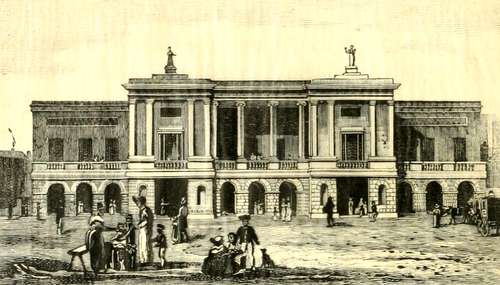
DUBLIN THEATRE ROYAL.
ENGLAND AND IRELAND.
The season of 1757-58 was the last of the series
during which Barry opposed Garrick. At the close
of it, Spranger proceeded to Dublin, taking with him,
from Drury Lane, versatile Woodward, to retain
whom Garrick would not increase his salary.
At Drury, Garrick brought out Home's "Agis,"
with a cast including himself, Mossop, and Mrs.
Cibber; Mrs. Pritchard, and Mrs. Yates! The piece
failed notwithstanding.[82] Walpole would not praise
it, and the angry author would never speak, or even
bow to him, afterwards. Gray compared this piece
to an antique statue which Home had painted white
and red, and dressed in a negligée, made by a York
mantua-maker! Other critics found in "Agis,"
Charles I. treacherously dealt with by the Scots,
whereby the author had intended to punish his nation
for its bigotry with regard to the drama generally, and
"Douglas" in particular. Walpole added that Home
was a goose for writing a second tragedy at all, after
having succeeded so well with the first. It was
unfortunate for this critic that "Agis" was written
before "Douglas," though it followed in succession
of representation.
Murphy, who had been a student at St. Omer's, a
clerk in a city bank, an unsuccessful actor, and a
political writer; who, moreover, was refused a call
to the bar by the benchers of the Temple and Gray's
Inn, on the ground of his having been a player! but
who was admitted by the less bigoted benchers of
Lincoln's Inn,—feeling his way towards comedy
illustrative of character, by farces descriptive of
foibles, very humorously satirised the quidnuncs
who then abounded, in his "Upholsterer, or What
Next?" in which Garrick acted Pamphlet, as carefully
as he did Ranger or King Lear.
But Garrick's chief concern was to replace Woodward,
and in this he as nearly succeeded as he could
expect, by engaging an Irish actor, O'Brien, who, in
the early part of 1758-59 made his appearance as
Captain Brazen, and, by the graceful way in which
he drew his sword, charmed all who were not aware
that his father was a fencing-master. He exulted in
light comedy and young tragic lovers, for half-a-dozen
years, after which he became the hero of a romance
in life, and began to be ashamed of his calling.
The great incident of the season was the acting of
Antony, by Garrick, to the Cleopatra of Mrs. Yates,
but they gained even more laurels as Zamti and
Mandane in the "Orphan of China," a tragedy,
wherein small matters are handled in a transcendental
style. But Mandane lifted Mrs. Yates to an
equality with Mrs. Cibber; and Walpole, who spoke
of Murphy, sneeringly, as a "writing actor," did him
the justice to add that he was "very good company."
Then, Foote played Shylock! Wilkinson delighted
everybody by his imitations, save the actors whom
he mimicked, and Garrick took the "Pupille" of the
Gallo-Irish Fagan, and polished it into the pretty
little comedietta, the "Guardian," in which his
Heartly showed what a man of genius could make
of so small a part. Mozeen, who had left the law
for the stage, found a bright opportunity for Miss
Barton in his "Heiress;" and Dr. Hill showed the
asinine side of his character by describing his farce
of the "Rout" as by "a person of honour!"—
"For physic and farces, his equal there scarce is;
His farces are physic, his physic a farce is!"
So wrote Garrick of Hill, who was a clever man, but
one who lacked tact and judgment, and got buffeted
by men who had not a tithe of his zeal and industry.
His chief defect lay in his intolerable conceit.
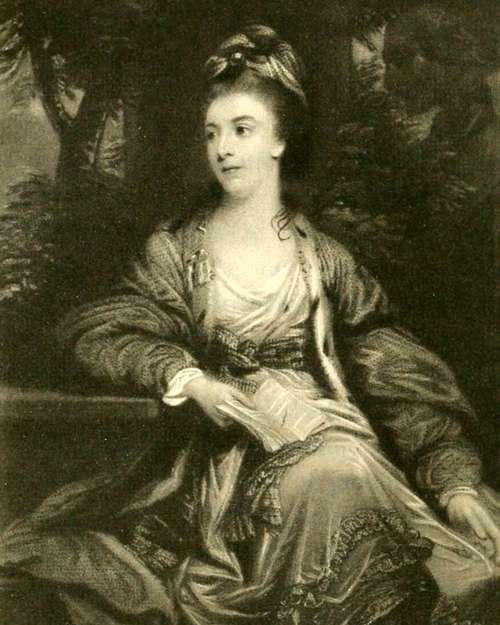
Dodsley's "Cleone," rejected by Garrick, became
the distinction of the Covent Garden season of
1758-59. Ross played Sifroy, and Mrs. Bellamy the
heroine. As a counter-attraction, Garrick essayed
Marplot, in vain. "Cleone" is a romantic tragedy.
The time is that of the Saracenic invasion of the
south of France, and the story bears close resemblance
to the legend of St. Genevieve, where a
faithful young wife and mother suffers under unmerited
charges of treason to her absent husband
and her home. The author extended his drama
from three acts to five, at the suggestion of Pope.
Dr. Johnson subsequently looked upon it as the
noblest effort made since the time of Otway! and
Lord Chesterfield contributed advice which shows
that stage-French was not of the best quality in
those days. "You should instruct the actors," he
said, "not to mouth out the oy in the name of Sifroy
as though they were crying oysters." "People,"
writes Gray to Mason, "who depised 'Cleone' in
manuscript, went to see it, and confess 'they cried
so!'" Dodsley, after some flatness, "piled the
agony" skilfully, and Mrs. Bellamy made hearts
ache and eyes weep, for many successive glorious
and melancholy nights.
The stage lost Mrs. Macklin this year, such an
"old woman" as it was not to see again till the
period of Mrs. Davenport. In October 1759,[83] too,
Theophilus Cibber satisfied people that he was not
born to be hanged. With Lord Drogheda and his
son, Harlequin Mattocks,[84] Miss Wilkinson the wire-dancer,
and a shipload of frippery, he was crossing
the Irish Sea from Parkgate to Dublin, when the
vessel was caught in a gale, and went down with all
on board. Such was the end of a fair player and
a sad rogue. Somewhere off the Scottish coast,
whither the ship had been blown, perished Ancient
Pistol, and the original George Barnwell. His sire,
wife, and sister bore the calamity which had fallen
upon him with philosophical equanimity.
On the retirement of Barry from London, Garrick
travelled abroad, for a year, to recruit his health.[85]
All the intervening time, till Barry returned, has
the appearance of a season of truce. No great tragic
actor arose to seize the wreath of either of the
absent tragedians, though the town was seduced
from its respective allegiances, for a moment, by the
advent and bright promise of young Powell; and
Walpole was eager to recognise a greater than Garrick
in the aspiring city clerk.
Walpole was accustomed to describe Garrick as a
mere machine, in whom the power to express Shakspeare's
words with propriety, was absurdly held to
be a merit! "On the night of Powell's first appearance,
the audience," says Walpole, "not content
with clapping, stood up and shouted." Walpole
adds, that Powell had been clerk to Sir Robert
Ladbroke, and "so clever in business, that his
master would have taken him in as a partner; but
he had an impulse for the stage. His figure is fine,
and voice most sonorous, as they say, but I wait for
the rebound of his fame, and till I can get in, but at
present all the boxes are taken for a month." Walpole
suppresses the fact that Garrick had not only
selected Powell as his substitute, in his absence,
but had carefully instructed him in the part of
Philaster, and thereby helped him to the triumphant
position which the younger actor, then twenty-eight
years of age, held during the first of his few seasons,
from 1763 to 1768, the year of poor Powell's death.
No new tragic poet of eminence now arose, nor
did any old one increase his reputation. Home is
supposed to have been thinking of the siege of
Berwick when, in his "Siege of Aquileia," he pourtrayed
our Edward under the figure of Maximin.
Brooke's boasted purity of language and sentiment
in his "Earl of Essex" was playfully crushed by
Johnson. "Who rules o'er freemen should himself
be free," was a line cited for its beauty, by Sheridan,
the actor. "Who drives fat oxen should himself be
fat," was the stupid comment of the lexicographer.
Farce flourished within this period,—supplied by
the Rev. Mr. Townley, Garrick, Foote, Colman, and
Murphy, the last of whom increased his fame by
such comedies as the bustling, and yet monotonously
bustling, "All in the Wrong," and the "Way to
Keep Him." The authors of this period sought to
correct faults and not to laugh at them. This, perhaps,
gives a didactic turn to the plays of Murphy
and Mrs. Sheridan, which renders them somewhat
heavy when compared with the comedies of those
who were rather among the wits, than the teachers,
of their days. But a new brilliancy, too, was to be
found in the later writers. Colman's "Jealous Wife,"
in which Garrick and Mrs. Pritchard were the Mr.
and Mrs. Oakley, and the "Clandestine Marriage,"
principally Colman's, but in which Garrick had a
share, were full of this brilliancy. With the exception
of Hoadley's "Suspicious Husband," no modern
comedy had such success as these. Every great actor
still tries Mr. Oakley, and the noblest of old beaux
has been the heritage only of the most finished of
our comedians, from King, with whom it originated,
down to Farren, with whom it seems to have died.
While the insolence of servants and the weaknesses
of masters were satirised in "High Life below
Stairs," a piece which George Selwyn was the gladder
to see, as he was weary of low life above stairs—the
disinterestedness of Irish wooers was asserted in
Macklin's "Love à la Mode;" rascality, generally,
was pummelled in Foote's "Minor;" novel-reading
was proved to be perilous, in "Polly Honeycomb;"
sharpers were exposed in Reed's "Register Office;"
Platonic love was shown to be not without its
dangers, in "The Deuce is in Him," and so on, with
other pieces, than which none raised more laughter
than the "Mayor of Garratt," in which Weston
exhibited, in Jerry Sneak, the type of henpecked
husbands, and Foote in Matthew Mug, a portrait of
the Duke of Newcastle. Then Whitehead, in his
"School for Lovers," wrote a dull play on society to
show that society was dull; and Mrs. Sheridan, in
the "Discovery," pointed to the absurdity of young
married people being unhappy. Opera was making
way at both houses, but especially at Covent Garden,
where, with a few other novelties of no note, Arne's
"Artaxerxes," superbly set, was as superbly sung,
by Tenducci, Beard, and Arne's famous pupil, Miss
Brent. Bickerstaffe's "Love in a Village" followed,
warbled by Beard and Miss Brent, as Hawthorn and
Rosetta, and made joyous by Shuter's Justice Woodcock.
The same writer's "Maid of the Mill" succeeded,
in which Mattocks played Lord Aimworth;
Beard, Giles; and Miss Brent, Polly,[86] the latter with
a joyousness that never dreamed of the coming
penury and hunger.
Managers, however, catered drolly for the public.
Thus, on the 12th of October 1758, when Mossop
acted Richard III., Signor Grimaldi relieved the
tragedy, by dancing comic dances between the acts!
Garrick, nevertheless, was not idle. During Barry's
absence, David added to his original characters, Lovemore,
in "The Way to Keep Him," Æmilius ("Siege
of Aquileia"); Oakley ("Jealous Wife"), Sir John
Dorilant ("School for Lovers"), Farmer ("Farmer's
Return"), Alonzo ("Elvira"), and Sir Anthony
Branville ("Discovery"). In the last, he exhibited a
new style, in a new character. "He seemed utterly
to have extinguished his natural talents, assuming a
dry, stiff manner, with an immovable face, and thus
extracted from his pedantic object (who assumed
every passion, without showing a spark of any in his
action or features) infinite entertainment." Barry,
meanwhile in Ireland, found that Sheridan had
had a chequered time of it there. At one period, a
course of prosperity; at another, he was the victim
of gentlemen, from whose rude wooing he protected
his actresses. The wooers called him "scoundrel-player."
Sheridan answered that he was "as good
a gentleman" as those who called him scoundrel;
and, consequently, his life was not safe from these
ruffians, who interrupted the performances, but
against whom the collegians took side with the
player. It was not until some blood was spilt, and
the Lord Chief Justice, Ward, had condemned a
young savage, named Kelly, to pay £500 fine and
suffer three months' imprisonment, that peace was
restored. At this trial, Kelly's counsel remarked,
he had seen a gentleman-soldier and a gentleman-tailor,
but had never seen a gentleman-player. "Sir,"
said Sheridan, with dignity, "I hope you see one
now!"
Sheridan lost money, year after year, by paying
excessive salaries to Woodward, the Macklins, and to
operatic companies. Macklin and Mossop, together,
nearly drove Sheridan mad; he was glad to be rid of
both, and to find greater attraction in the beautiful
Mrs. Woffington, who used to petition for kisses, once
a year, and must have found little difficulty in procuring
what she asked for, on her benefit nights.
At that time, nearly one hundred persons in the
Lord Lieutenant's household claimed free admission,
the government allowing £100 a year, as the price
for which it was purchased! But prosperity attended
Sheridan's management, nevertheless, till he neglected
the stage for claret, toasts, songs, and aristocratic fellowship.
Therewith came a quarrel with his public.
The latter had encored a speech delivered by Digges,
in "Mahomet," which contained a passage applicable,
in a hostile sense, to the viceregal court. Sheridan
forbade Digges repeating this speech a second time,
on the next representation, and Digges declining to
do so, when the audience demanded it, the latter, in
inconceivable rage, pulled the interior of the house
to pieces, destroyed all the properties they could
reach, broke up the wooden fittings, and flinging the
box-doors upon them, set fire to the whole mass!
The building was rescued with difficulty.
After a time it was repaired, and Sheridan let it to
Victor and Sowdon, who in the season of 1754-55
engaged Barry and Miss Nossiter; and it is to be
remarked that of all the characters he played Macbeth
was the most, and Henry V. the least, attractive.
Romeo stood midway in profit between those two.
Mossop was the hero of the succeeding season, with
profit to the management, after which Sheridan resumed
the control; but not till he had been compelled
to undergo a great humiliation. Fearing for the safety
of his house, he consented to make public apology
for his previous conduct in the management, and
Sheridan was then patronised by the public, till
Barry and Woodward, in October 1758, opened a
new theatre in Crow Street, and divided the patronage
and the passions of the town. At Crow Street,
there were Barry, young Mrs. Dancer, whom he afterwards
married, Mossop, King, Woodward, and others.
At Smock Alley, Mrs. Abington alone was a sufficient
counter-attraction. But when Mossop passed over to
manage Smock Alley, and the Countess of Brandon
patronised him, in return for his permitting her to
cheat him at cards, and Mrs. Bellamy joined the
same troop, then Barry was put on his mettle; he
secured Mrs. Abington and Shuter; and the town
became as divided, and as furious and unreasonable,
as if they were at issue on some point of religious
belief. Mrs. Bellamy was arrested by a partisan of
the adverse house, simply that she might be prevented
from acting at the other; and the players
were so often seduced from their engagements by the
respective managers that the performers were sometimes
called to go on the stage of one theatre when
they were actually dressing at another! If Mossop
chose "Othello" for his benefit one night, Barry was
sure to have it for his own, on the same or the following
evening. In short, the rival managers went on
ruining each other. They exerted themselves, however,
indefatigably, Barry playing even Macheath,
and other operatic characters. He and Mossop,
formed extravagant engagements with every great
actor, save Garrick, whom they could win over, down
to clever dogs, and intelligent monkeys. At the end
of a seven years' struggle, Barry found that Dublin
could not support two theatres, and leaving Mossop
in possession of the field, he returned to London,
having ruined himself and Woodward, and lost everything
he possessed but his gentle humour, his suavity,
his plausibility, and his hopes.
As a sample of Dublin theatrical life, in Barry's
time, I cite the following passage from Gilbert's
History of Dublin, and therewith close the subject
for the present. "Dublin was kept in a state of
commotion by the partisans of the rival theatres.
As already noticed, the Countess of Brandon, with
her adherents, attended constantly at Smock Alley,
and would not appear at Crow Street; but Barry's
tenderness in making love on the stage, at length
brought the majority of the ladies to his house. Of
the scenes which commonly occurred during this
theatrical rivalry, on nights when some leading lady
had bespoken a play, and made an interest for all
parts of the house, particularly by pit and gallery
tickets among her tradespeople, we have been left
the following notice: The lady of the night goes
early into the box-room to receive her company.
This lady had sent out pit and gallery tickets to all
her tradespeople, with the threatenings of the loss
of her custom if they did not dispose of them; and
the concern she was under, when the time was approaching
for the drawing up the curtain, at the
sight of a thin pit and galleries, introduced the
following entertainment. The lady was ready to
faint; and after smelling bottles were applied, she
cried out, 'She was ruined and undone! She never
would be able to look dear Mr. B. in the face any
more, after such a shocking disappointment.' At
many of these repeated lamentations, the box-keeper
advanced and said: 'I beg your ladyship will not
be so disheartened; indeed, your ladyship's pit will
mend and your ladyship's galleries, too, will certainly
mend, before the play begins!' At which the lady
cried, 'Out, you nasty flattering fellow! I tell you
I'm undone, ruined, and undone! that's all. But
I'll be revenged. I am resolved. I'll pay off—No—I'll
turn off all my saucy tradesmen to-morrow
morning.'"
During Barry's absence, some excellent actors took
their last farewell of the English stage. Of these I
will speak in the next chapter.
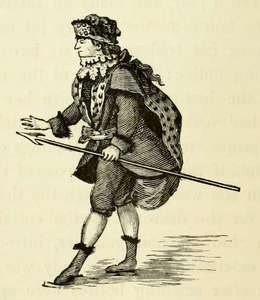
Mr. Powell as Cyrus.
CHAPTER XV. — FOOTNOTES:
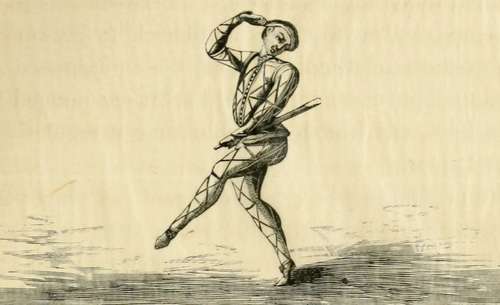
RICH AS HARLEQUIN.
RYAN, RICH, O'BRIEN.
Perhaps the last of the players who had been contemporary
with Betterton, died when Richard Ryan[87]
departed this life, at his house in Crown Court, Westminster,
in August 1760. Westminster claims him as
born within the Abbey precincts, Paul's School for
a pupil, and a worthy old Irish tailor for a son, of
whom he was proud. Garrick confessed that Ryan's
Richard was the one which, in its general features, he
took as the model of his own, and Addison especially
selected him to play Marcus in his "Cato."
He was but a mere boy when he first appeared
with Betterton (who was playing Macbeth) as Seyton,
wearing a full-bottomed wig, which would have
covered two such heads as his. Between this inconvenience,
and awe at seeing himself in presence of
the greatest of English actors, the embarrassed boy
hesitated, but the generous old actor encouraged him
by a look, and young Ryan became a regularly engaged
actor.
From first to last he continued to play young
parts, and his Colonel Standard, in 1757, was as full
of the spirit which defies age, as his Marcus, in 1713,
was replete with the spirit which knows nothing of
age. Easy in action, strong, but harsh of voice, careless
in costume and carriage, but always earnest in
his acting, he obtained and kept a place at the head
of actors of the second rank, which exposed him to
no ill feeling on the part of the few players who were
his superiors.
Quin loved him like a brother; and it is singular
that there was blood on the hands of both actors.
Quin's sword despatched aggressive Bowen and angry
Williams to Hades; and Ryan, put on his defence,
slew one of the vapouring ruffians of the day, to the
quiet satisfaction of all decent persons.
On June 20, 1718, the summer season at the Lincoln's
Inn Fields house had commenced with "Tartuffe."
After the play, Ryan was supping at the Sun,
in Long Acre; he had taken off his sword, placed it
in the window, and was thinking of no harm to any
one, when he saw standing before him, flushed with
drink, weapon in hand, and all savagely athirst for
a quarrel and a victim, one Kelly, whose pastime it
was to draw upon strangers in coffee-houses, force
them to combat, and send them home more or less
marred in face or mutilated in body. Kelly stood
there, not only daring Ryan, but making passes at
him, which meant deadly mischief. The young
actor took his sword from the window, drew it from
the scabbard, and passing it through the bully's
body, stretched him on the floor, with the life-blood
welling from the wound. The act was so clearly
one induced by self-protection, that Ryan was called
to no serious account for it.
He had like to have fared worse on that later occasion,
when, after playing Scipio, in "Sophonisba,"
he was passing home down Great Queen Street, and
a pistol-shot was fired at him by one of three or four
footpads, another of whom seized his sword. In this
fray his jaw was shattered. "Friend, you have killed
me; but I forgive you," said Ryan, who was picked
up by the watch, and committed to surgical hands,
from which he issued, after long suffering, something
the worse for this serious incident in his life.
Ryan was the "esteemed Ryan" of numerous
patrons, and when a benefit was awarded him, while
he yet lay groaning on his couch, Royalty was there
to honour it, and an audience in large numbers, the
receipts from whom were increased by the golden
guerdons forwarded to the sufferer from absent sympathisers.
Perfect recovery he never reached, but
he could still portray the fury of Orestes, the feeling
of Edgar, the sensibility of Lord Townley, the grief
and anger of Macduff, the villainy of Iago, the subtilty
of Mosca, the tipsyness of Cassio,[88] the spirit of
young Harry, the airiness of Captain Plume, and the
characteristics of many other parts, with great effect,
in spite of increasing age, some infirmities, and a
few defects and oddities.
I have already noticed how Quin, in his old days,
declined any longer to play annually for Ryan's
benefit, but offered him the £1000 sterling Quin
had bequeathed to him in his will. Brave old actor!
Dr. Herring, who was then Archbishop of Canterbury,
had not in him a truer spirit of practical benevolence
than James Quin manifested in this act to
Dick Ryan,[89]—who died in 1760.
In the following year, died Rich, the father of
Harlequins, in England. He has never been excelled
by any of his sons, however agile the latter
may have been. Rich (or Lun, as he called himself)
was agile, too, but he possessed every other qualification;
and his mute Harlequin was eloquent in every
gesture. He made no motion, by head, hand, or
foot, but something thereby was expressed intelligibly.
Feeling, too, was pre-eminent with this
expression; and he rendered the scene of a separation
from Columbine as graceful, to use the words of
Davies, as it was affecting. Not only was he thus
skilled himself, but he taught others to make of
silent but expressive action the interpreter of the
mind; Hippisley, Nivelon, La Guerre, Arthur, and
Lalauze, are enumerated by Davies, as owing their
mimic power to the instructions given to them by
Rich, whose action was in as strict accordance with
the sentiment he had to demonstrate, as that of
Garrick himself. The latter, in his prologue to
"Harlequin's Invasion," in which Garrick introduced
a speaking Harlequin, thus alluded to the
then defunct hero:—
"But why a speaking Harlequin? 'tis wrong,
The wits will say, to give the fool a tongue.
When Lun appeared, with matchless art and whim,
He gave the pow'r of speech to ev'ry limb.
Tho' mask'd and mute, convey'd his quick intent,
And told, in frolic gestures, all he meant.
But now the motley coat, and sword of wood,
Require a tongue, to make them understood."
To introduce the speaking Harlequin was, however,
only to restore to speech one of the most
loquacious fellows who ever wore motley. For, as
Colman had it, poor Harlequin—
"Once spoke,
And France and Italy admired each joke.
But Roundhead England, all things who curtails,
Who cuts off monarchs' heads and horses' tails,
By malice led, by rage and envy stung,
Put in his mouth a gag, and tied his tongue."
Rich thought himself so much a better actor than
mimic, that he was ten times happier when giving
foolish instruction to a novice training for Hamlet,
than when he was marshalling his corps of pantomimists,
and admirably teaching them to say everything,
and yet be silent.
A man like John Rich, of course, had his little
jealousies. He was angry when the combination of
Garrick and Quin filled his house and treasury, and
when the season of 1746-47 yielded him a profit of
nearly £9000, to which his wand of Harlequin had
contributed little or nothing. He was wont to look
at the packed audience, through a hole in the green
curtain, and then murmur, "Ah! you are there, are
you? much good may it do you!"
The avidity of the old public, however, to witness
harlequinades, was even more remarkable than that of
the present day. Then, pantomimes went through,
not merely a part of one, but several seasons. Theobald's
"Harlequin Sorcerer," which had often filled
Lincoln's Inn Fields, was even more attractive at
Covent Garden, above a quarter of a century
later. The company assembled at mid-day, and
sometimes broke the doors open, unless they were
opened to them, by three o'clock, and so took the
house by storm. Those who could not gain admittance
went over to Drury Lane, but Garrick found
them without heart for tragedy; the grown-up
masters and misses had been deprived of their puppet
show and rattle, and were sulky accordingly.
Booth, Wilks, and Cibber came under the somewhat
dirty censure of Hogarth, who ridiculed them
in a well-known unsavoury engraving for producing
Harlequin Jack Sheppard. Booth tolerated these
harlequinades, and Garrick acted in like fashion;
remarking—"If you won't come to Lear and Hamlet,
I must give you Harlequin;" and he perhaps gave
them the best the stage ever had, save Rich, in
Woodward, who had worn the party-coloured jacket
before, but who, in "Queen Mab," and in speaking
Harlequins, exhibited an ability, the effect of which
is illustrated in a contemporary print, wherein you
see all the great actors of the day in one scale, and
Harlequin Woodward in the other, who makes them
kick the beam.
From the very first, however, the poets made protest
against the invasion of the stage by foreign
dancers and home-born Harlequins; and Cibber
quotes Rowe as complaining, or asking, in a prologue
to one of his first plays—
"Must Shakspeare, Fletcher, and laborious Ben,
Be left for Scaramouch and Harlequin?"
One of the most curious features connected with
pantomime, and which certainly dignified Harlequin,
was the assumption of that character by such sterling
actors as Woodward and O'Brien. The London
Magazine, a century ago, wished "that so eminent
an actor as Woodward might never be permitted to
put on the fool's coat again." Rich thought himself,
indeed, as good an actor as they; but, though the
son of a gentleman, he was illiterate: sometimes
said turbot for turban; talked of larning Wilkinson
to be a player; told Signora Spiletta always to lay
her emphasis "on the adjutant;" and said to Tate,
"You should see me play Richard!"
Nevertheless John Rich was supreme in his own
particular line. His "catching the butterfly," and
his "statue scene" were salient portions of his
Harlequin, which people went to see because of
their excellence. Still finer was that in which
Harlequin is hatched from the egg by the heat of
the sun. Jackson calls it a masterpiece in dumb
show; "from the first chipping of the egg, his receiving
of motion, his feeling of the ground, his
standing upright, to his quick harlequin trip round
the empty shell, through the whole progression every
limb had its tongue, and every motion a voice which
spoke with most miraculous organ to the understandings
and sensations of the observers."
There was this difference between Rich and
Garrick in their conduct towards authors. Garrick
would decline with courteous commendation a
manuscript he had never looked at; but Rich kept
a drawer full of such copy, and when an author demanded
his piece, Rich would tell him to take which
he liked best, he would probably find it better than
his own.
Rich's good-humour seldom failed him, though he
was warm of temper; he was less witty than Foote,
but he was of a better nature. One night, during
his proprietorship of Covent Garden, a man, rushing
down the gallery, fell over into the pit. He was
nearly killed; but Rich paid all the medical and
other expenses, and the poor fellow, when his broken
bones were whole again, called on the manager and
expressed his gratitude for the kindness shown to
him. "Well, sir," said Rich, "you must never
think of coming into the pit, in that manner,
again!" and, to prevent it, Rich gave him a free
admission.
We should altogether misjudge Rich if we looked
on him as the founder of the modern, miserable,
purposeless, storyless harlequinade. This sort of
entertainment deteriorated soon after his death. In
1782, Walpole saw the pantomime of "Robinson
Crusoe," and his comment is, "how unlike the
pantomimes of Rich, which are full of wit, and
coherent, and carried on a story." Rich left Covent
Garden to his son-in-law, Beard, the vocalist.
Beard's first wife was Lady Henrietta Herbert,
daughter of the Earl of Waldegrave, and this match
was a happy one, though Lord Wharncliffe incorrectly
recorded of Beard that he was "a man of
indifferent character." Beard held Covent Garden,
for himself and second wife, under a not unpleasant
restriction. Rich directed that the property should
be sold, whenever £60,000 could be got for it; and
for that handsome sum the house was ultimately
made over to Colman, Harris, and their partners.
Beard and Lady Herbert remind me of another
mésalliance. In the studio of Catherine Read, the
portrait painter, a good deal of love-making was
carried on. Here is a February morning of 1764,
and a young couple, all the handsomer for a bracing
walk through the eager and nipping air, are conversing
confidentially in one corner of the room
while discreet Miss Read plies her work in another.
The lady is Lady Susan Fox Strangways; the gentleman
owns a villa at Dunstable, and is one of the
airiest actors of the Theatre Royal, Drury Lane, Mr.
O'Brien.
Subsequently, the lady's father, Stephen Fox, the
first Earl of Ilchester, opening his post-bag, hands a
letter to Lady Susan from Lady Sarah Bunbury, his
daughter's dearest friend. The letter was really from
O'Brien, who imitated Lady Sarah's writing. The intrigue
was discovered, and the father's wrath was so
overwhelming, that Lady Susan promised that the
affair should proceed no further, if she were only permitted
to take a last farewell. She waited a few days
for this final meeting, till she became of age, when,
released from lock and key, she went on foot, escorted
by a lacquey, to breakfast with Lady Sarah, and to
call on Miss Read by the way. In the street, she
sent the footman back, for a particular cap in which
she was to be painted; a few moments after he was
out of sight, a couple of chairmen were carrying her
to Covent Garden Church, where Mr. O'Brien was
waiting for her, and, the wedding ceremony being
performed, the happy and audacious pair posted
down to the bridegroom's villa at Dunstable. Only
the night before he had played 'Squire Richard, in
the "Provoked Husband."
This ended O'Brien's brief theatrical career of about
eight years;[90] and therewith departed from the stage
the most powerful rival Woodward ever encountered
upon it; the original actor of Young Clackit, in the
"Guardian;" Lovel, in "High Life Below Stairs;"
Lord Trinket, in the "Jealous Wife;" Beverley, in
"All in the Wrong;" Colonel Tamper, in the "Deuce
is in Him," &c.
In one character O'Brien must have exhibited extraordinary
humour—Sir Andrew Aguecheek. He
was playing it on the 19th of October 1763, a period
when it was the custom to have two sentinels posted
on either side of the stage, and one of these fellows
was so overcome by Sir Andrew's comicality, that he
laughed till he fell, to the infinite amusement of all
who witnessed the circumstance.
O'Brien's marriage caused a sensation in the
fashionable world, and brought sorrow to some
parties. On April the 9th, 1764, Walpole writes to
Mann:—"A melancholy affair has happened to Lord
Ilchester; his eldest daughter, Lady Susan (Strangways),
a very pleasing girl, though not handsome,
married herself, two days ago, at Covent Garden
Church, to O'Brien, a handsome young actor. Lord
Ilchester doated on her, and was the most indulgent
of fathers. 'Tis a cruel blow." Three days later,
Walpole writes to Lord Hereford, "Poor Lady Susan
O'Brien is in the most deplorable situation, for her
Adonis is a Roman Catholic, and cannot be provided
for out of his calling." Sir Francis Delaval, one of
the rich amateur actors of his time, touched by her
calamity, "made her a present of—what do you
think?" asks Horace, "of a rich gold stuff! The
delightful charity! O'Brien comforts himself, and
says it will make a shining passage in his little
history!"
As O'Brien had not the means whereby to live
without acting, his wife's noble family thought it
would be no disgrace, to hide the disgrace which had
fallen upon it, by providing for the young couple—at
the public expense. Accordingly, a grant of lands
in America was procured for them, and thither they
went. On Christmas Day 1764, Charles Fox writes
of his cousin, to Sir George Macartney:—"We have
heard from Lady Susan since her arrival at New York.
I do not think they will make much of their lands,
and I fear it will be impossible to get O'Brien a
place." When Charles Fox wrote this he was about
fifteen, and looked as handsome as he does in the
famous picture at Holland House, which contains
also the portraits of Lady Susan, who married the
actor, and Lady Sarah Lennox (Bunbury), who did
not marry the king.
The Board of Ordnance ultimately provided for
O'Brien, and the player and his aristocratic wife were
away between seven and eight heavy years beyond
the Atlantic. Weary of their banishment they returned
to England, without leave asked of the Board.
O'Brien was not the only officer in England without
leave. In the Last Journals of Horace Walpole, which
I edited in 1858, the Journalist says:—"General
Conway was labouring to reform that department
(the Board of Ordnance), and had ordered all the
officers under it to repair to their posts, those in
America particularly, who had abandoned their duty.
O'Brien received orders, among the rest, to return,
but he refused. Conway declared they would dismiss
him. Lord and Lady Holland interposed; but Conway
was firm, and he turned out O'Brien."
Lord Ilchester, albeit ashamed of his son-in-law,
was not ashamed to write to Lord North, soliciting a
place for O'Brien; but Lord North did not even reply
to the letter. It is just possible that the player
was a proximate cause of Fox's withdrawal from
the administration, and his becoming in permanent
opposition to the Court. Fox had spoken against
Lord North, and the latter endeavoured to conciliate
him. "He weakly and timidly called him aside,
and asked him if he had seen Maclean, who had got
the post which had been asked for O'Brien, and who
would make O'Brien his deputy; but this Fox
received with contempt."
Let me remark here, that in "blood," young
O'Brien was the equal of Lady Susan. In the days
of Charles I., Stephen Fox, her ancestor, was bailiff
to Sir Edward Nicolas, the king's secretary, at Winterbourne,
Wilts; where Stephen (not yet Sir Stephen)
occasionally officiated as clerk of the parish.
At that time the direct ancestor of our lucky actor
was a member of that ancient family of those O'Briens,
who generally contrived to take opposite sides in every
quarrel. William O'Brien's grandfather was faithful
to the cause of James II., and on the capitulation of
Limerick, made his way to France, where he served
in the Irish brigade, under O'Brien, Viscount Clare.
That brigade, many of whose members "took to the
road" in France, in order to support themselves,
turned out first-rate fencing-masters, who lived by
teaching. Such was the father of our O'Brien, and
such was the family history of the actor; and surely
the descendant of King Brien of the Tributes was of
as good blood as the daughter of a house, the first
worthy, that is to say unfortunate, member, of which
was parish clerk in a Wiltshire village.
O'Brien failing to obtain a post, or to enjoy the
laborious luxury of a sinecure, turned his attention to
writing for the stage, and on the night of December 8,
1772, he produced two pieces—at Drury Lane, his
comedy of "The Duel;" at Covent Garden, his
comedietta "Cross Purposes." The first is an adaptation
of the "Philosophe sans le savoir," in which
Barry did not more affect his audience than I have seen
Baptiste ainé do, on the French stage. "The Duel,"
however, failed, through the mawkish, sentimental,
scenes which the adapter worked in, at the suggestion
of some of his noble relatives, who spoiled his play,
but made him pecuniary compensation for its ill-fortune.
"Cross Purposes," also an adaptation—from "Les
trois frères rivaux," was more lucky. It was levelled
at the follies of the day, and every one was amused
by the light satire. In the first piece, Barry was
sublime in his affectation of cheerfulness, on his
daughter's wedding-day, while his son is engaged in a
duel fought under paternal sanction. In the second,
Shuter as Grub, and Quick as Consol, made the house
as hilarious, as Barry, in the scenes in which he was
engaged, made his audience sympathetic.
Mrs. Cibber, addressing Mrs. Woffington, in the
"Dialogue in the Shades," speaks of O'Brien and
Powell as the only actors of eminence who had appeared
since Margaret's time. O'Brien was entirely in
Woodward's line, from Mercutio to Harlequin. I
collect from Genest, that after his aristocratic connections
made a placeman of him, O'Brien grew
ashamed of his vocation. "If we may judge from
... what I was told in 1803, when I resided in his
neighbourhood, O'Brien had, since he left the stage,
wished to sink the player, and to bury in oblivion
those years of his life which are the most worth
being remembered—ashamed, perhaps, of a profession
which is no disgrace to any one who conducts
himself respectably in it, and in which to succeed,
is, generally speaking, a proof of good natural abilities,
and a diligent application of them—Ex quovis
ligno non fit Mercurius. It is not everybody that can
make even a moderate actor."
O'Brien left the stage after playing Squire Richard,
and subsequently he became "William O'Brien, of
Stinsford, County of Dorset, Esq." His wife died
on the 9th of August 1827, on which night the Haymarket
Company acted the "Poor Gentleman!"
Before Barry reappeared in London, the stage
suffered more serious losses than these. At one,
Garrick uttered a cry—as of anguish, at the falling
away of the brightest jewel of the stage.
CHAPTER XVI. — FOOTNOTES:
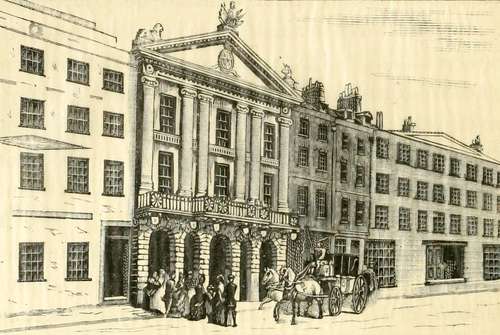
THEATRE ROYAL, DRURY LANE.
SUSANNA MARIA CIBBER.
"Mrs. Cibber dead!" said Garrick, "then tragedy
has died with her!"[91] When he uttered this, on the
31st of January 1766, he little knew that a young
girl, named Sarah Kemble, then in her twelfth year,
was a strolling actress, playing juvenile tragedy, and
light opera, was reciting or singing between the acts,
and was preparing herself for greatness.
Let us look back to the early time and the room
over the upholsterer's shop, in King Street, Covent
Garden, where Tom Arne and his sister, Susanna
Maria, are engaged in musical exercises. Tom ought
to have been engrossing deeds, and that fair and
graceful, and pure-looking girl, to be thinking of
anything but coming out in Lampe's opera, "Amelia,"
the words by Carey. The old Roman Catholic upholsterer
had been sorely tried by the heterodox inclinations
of his children. They lived within sound of
the musical echoes of the theatres, and thereof came
Dr. Arne, the composer, and his sister, the great
singer, the greater and ever youthful actress.
In 1732, Susanna Maria Arne appeared successfully
in Lampe's serious opera, "Amelia," which was
"set in the Italian manner," and brought out at
what was called the "French Theatre," in the
Haymarket. Miss Arne was then about twenty
years of age, with a symmetry of figure and a sweetness
of expression which she did not lose during the
four-and-thirty years she continued on the stage.
In the Venus of her early days, she was as beautiful
as the Venus Populari, whose mother was Dione,
and her Psyche was as timid, touching, and inquiring,
as she who charmed the gods from the threshold
of Olympus.
It is not pleasant to think that on a young creature
so fair, bright, pure, and accomplished,—an honest
man's honest daughter, such a sorry rascal as Ancient
Pistol,—Theophilus Cibber, in fact, should have
boldly cast that one of his two squinting eyes, which
he could bring to bear with most effect upon a lady.
When, as a newly-married couple, they stood before
Colley Cibber, they must have looked like Beauty
and the Beast!
Beauty soon overcame the elder Cibber's antipathy.
Colley could not withstand the new magic to which
he was subjected; and when it was first proposed
that the brilliant vocalist should become a regular
actress, Colley, however much he may have shaken
his head at first, favoured the design, and gave all
necessary instructions to his winning, beautiful, and
docile daughter-in-law. Can you not see the pair
in that first floor in Russell Street? Half the
morning, she has been repeating Zara, never wearied
by Cibber's frequent interruptions. Perseverance
was ever one of her great characteristics; and she
carries herself, and sweeps by with her train, and
speaks meltingly or sternly, in grief or in anger, her
voice silvery and, with its modulation, under command,—a
voice in the very sound of which there
were smiles or tears, sunshine or storm;—all this
she does, or exercises, at Colley's sole suggestions,
you suppose. Not a bit of it! Susanna Cibber has
a little will of her own; and she is quite right, for
she has as much intellect as will, and docile as she
is when she sees the value of Colley's teaching, she
supports her own views when she is satisfied that
these are superior to the ideas of the elderly gentleman
who, standing in an attitude for imitation, to
which she opposes one of her own, lets the frown on
his brow pass off into a smile, as he protests, "fore-gad!"
that the saucy thing could impart instruction
to himself.
On the 12th of January 1736, the great attempt
was made, and Mrs. Cibber came out as Zara, to the
Lusignan of Milward, the Nerestan of her husband,
and the Selima of Mrs. Pritchard, who had not yet
reached the position which this young actress
occupied at a bound, but beyond which Mrs. Pritchard
was destined yet to go.
For fourteen consecutive nights, Susanna drowned
houses in tears, and stirred the very depths of men's
hearts, even her husband's, who was so affected that
he claimed, and obtained, the doubling of the salary
first agreed on for his wife. Theophilus, of course,
did not keep the money; he spent it all, to his great,
temporary, satisfaction. His wife's next appearance
was in comedy,—Indiana ("Conscious Lovers"),
where the neat simplicity of her manners, and the
charm which she seemed to shed on even commonplace
expressions, formed a strong contrast to the
more solemn but stilted dignity of her tragedy
queens, the glory of which faded before the perfection
of her Ophelia. For this character, her voice,
musical qualities, her figure, and her inexpressibly
sweet features, all especially suited her. Wilkinson
states that no eloquence could paint her distressed
and distracted look, when she said: "Lord, we
know what we are, but know not what we may be!"
Charming in all she undertook, all her critics pronounced
her unapproachable in Ophelia, and through
all the traditions of the stage, there is not one more
abiding than that which says that Mrs. Cibber was
identified with the distraught maiden. Her Juliet,
Constance, Belvidera, exhibited rare merits, while
as Alicia, in the mad scene, "the expression of her
countenance, and the irresistible magic of her voice,
thrilled to the very soul of her whole audience,"
says Murphy. Wilkinson was powerless when attempting
to mimic the voice and expression of Mrs.
Cibber. The tone, manner, and method of Garrick,
Quin, Mrs. Bellamy, Mrs. Crawford (Barry), nay,
even the very face of Mrs. Woffington, he could
reproduce with wonderful approach to exactness.
But Mrs. Cibber's excellence baffled him. He remembered
her and it, but he could not do more
than remember. "It is all in my mind's eye," he
would say, with a sigh at his incapacity.
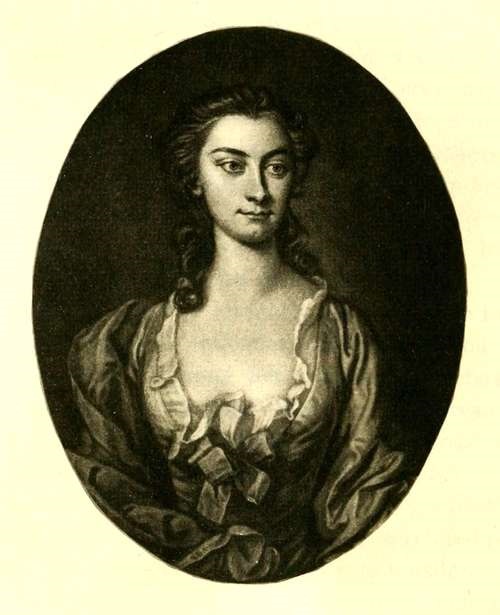
In fine ladies and in sprightly comedy,—save in
the playful delivery of epilogues,—Mrs. Cibber comparatively
failed. Among her original characters
were the Lady, in "Comus," Sigismunda, Arpasia,
in Johnson's "Irene," Zaphira, in "Barbarossa,"
and Cœlia, in Whitehead's comedy, the "School for
Lovers." In these, as in all she played, I collect
from various sources, that Mrs. Cibber was distinguished
for unadorned simplicity, artless sensibility,
harmony of voice, now sweetly plaintive, now grandly
powerful, and eyes that in tender grief seemed to
swim in tears; in rage, to flash with fire; in despair,
to become as dead. Her beauty did not so much
consist in regularity of feature as in variety and
power of expression; with this, she had symmetry
of form: and this, indeed, is true beauty. She preserved
these gifts which age lightly touched, and to
the last it was impossible to look at her figure and
not think her young, or view her face and not consider
her handsome.
Mrs. Cibber would, perhaps, have been one of the
happiest women of her day, had she not been cursed
with a husband who was no more made for her than
Caliban for Miranda. Theophilus could not appreciate
her but as a gold winner, and he so abused the
treasure, of which he was every way unworthy, as to
expose her to temptations by which that unhanged
villain hoped to profit; but by yielding to which she
got rid of her "most filthy bargain," lost nothing
in the public esteem, and acquired a protector and a
home,—neither of which she ought to have wanted.
There she enjoyed all the becomingnesses of life, save
one; and she continued to act with better heart, but
under physical infirmities, which her physicians could
not understand, nor her applauding audiences believe
in, till death struck her down in the very midst of
her labours.
She was not only of good heart to the last, but
apparently as little affected by age as by her domestic
trials. She wore spectacles? Yes! I confess that
much. There she sits, somewhat past fifty, at Garrick's
house, spectacles on nose, reading her part of
Cœlia, in the "School for Lovers." Now Cœlia is
but sixteen, and some one suggests, only seeing those
spectacles, that it would be better to call her at least
twenty-three. Mrs. Cibber looked up smilingly through
her "glasses," quietly dissented, and when the piece
was acted, she played the young and gentle Cœlia
with such effect, that no one present thought of
Mrs. Cibber being older than the part represented
her to be.
King George III. has the reputation of having
killed Mrs. Cibber, indirectly. His Majesty commanded
the "Provoked Wife," in which she was to
play Lady Brute. Ill health, for which physicians
could not account, had reduced her strength; but the
Roman Catholic actress was determined to perform
the duty expected from her, to that most Protestant
King. But she never trod the stage again. The
career which had commenced in 1732, closed in
January 1766;[92] and in the month following all that
was mortal of this once highly, but, perhaps, fatally
gifted lady, was entombed in the cloisters of Westminster
Abbey, not within the edifice, like Mrs. Oldfield,
opposite Congreve's monument, but in the
cloisters, whither had preceded her Aphra Behn, Mrs.
Bracegirdle, and the father of the restored English
stage, "Mr. Betterton, gentleman." Rather more
than seven years had then elapsed since Theophilus
Cibber had gone down, twelve fathoms deep, to the
bottom of the Irish sea; and about the same time,
short of a month or so, had gone by since Colley
Cibber had been brought hither to rest in the neighbourhood
of defunct, but once real, kings and queens.
The voice of Mrs. Cibber, the soul of Mrs. Pritchard,
and the eye of Garrick, formed a combination which in
one actor would, according to Walpole, render him
superior to all actors the world had seen or could see.
Hitherto it has not been seen.
Gentle as Mrs. Cibber was, she could master Garrick
himself. "She was the greatest female plague
belonging to my house," he once said, with the
memory on him of the strong language of Kitty
Clive, and the rough thrusts of other heroines. These
he could parry, but not Susanna Cibber. "Whatever
her object, a new part or a new dress, she
was always sure to carry her point by the acuteness
of her invention, and the steadiness of her
perseverance."
Her misfortunes in life brought some affronts upon
her. Thus, in October 1760, she was at Bath, with
Mr. Sloper, the "protector" of whom I have spoken,
and their daughter, "Miss Cibber." The whole party
went to the Rooms, where the young lady was led out
to dance. She was followed by another couple, of
whom the lady protested against Miss Cibber being
allowed to dance there at all. There would have been
more modesty in this second young lady if she had
been silent. There ensued a fracas, of course. Mrs.
Delaney, in a letter to Mrs. Dewes, says that "Mr.
Cibber" collared Mr. Collett, abused him, and asked
if he had caused this insult to be put on his daughter?
Mr. "Sloper" must be meant, for Theophilus
was then dead. The affront was the result of directions
given by that very virtuous personage, Beau
Nash, then being wheeled about the room. Some
discourse was held with the shattered beau, but
nothing came of it; and pretty Miss Cibber never
danced, or was asked to dance, at Bath again. This
brings us back to the mother, from whom I am
pleased to part with a pleasanter incident. Dr.
Delaney once sat enraptured, as he listened to her
at Dublin, singing in the "Messiah;" and, as she
ceased, he could not help murmuring on behalf of
the accomplished singer, "Woman, thy sins be forgiven
thee!" Amen! And so passes away "the
fair Ophelia," in that character, at least, never to be
equalled.
From Scotland Yard, where she died, the way was
not long to Westminster Abbey Cloisters. With
what rites she was committed to the earth, I cannot
say; but a paper on the doors of the Roman Catholic
Chapel, in Lincoln's Inn Fields, that day, requested
you, "of your charity," to "pray for the soul of Mrs.
Susanna Maria Cibber!"
Amen again! She was a woman more sinned
against than sinning, and so well respected, that Mr.
and Mrs. Garrick visited her and Mr. Sloper at the
country house of the latter, at Woodhay; where
Ophelia taught her parrot snatches of old tragedy,
and exhibited the bird to her laughing friends. The
highest salary this "Tragic Muse" ever received was
£600 for sixty nights; and this £10 per night was
often earned under such tremor and suffering, that
Mrs. Cibber would exclaim, with the applause ringing
in her ears, "Oh! that my nerves were made of
cart-ropes!" But we must leave her, for an actor
who re-enters, and an actress who departs.
CHAPTER XVII. — FOOTNOTES:
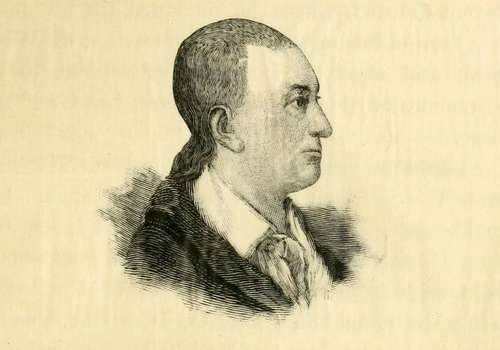
DAVID GARRICK
REAPPEARANCE OF SPRANGER BARRY—RETIREMENT OF MRS. PRITCHARD.
After playing some nights at the Opera House, in
1766, and with Foote at the little house in the Haymarket,
where Thalia and Melpomene reigned on
alternate nights, in 1767, Barry and Mrs. Dancer,—the
former after an absence of ten years,—appeared
at Drury Lane, in October of the last-named year.
Direct rivalry with Garrick there was none: for the
latter and Mrs. Pritchard acted together on one night;
Barry and Mrs. Dancer played their favourite characters
the next; while King, Dodd, Palmer, Parsons,
Mrs. Abington, Mrs. Clive, and Miss Pope, led in
comedy. The two great tragedians acted in the
same company till 1774, when Barry passed to
Covent Garden, where he remained till his death,
in 1777,—a few months only before that of Woodward,
and about half a year subsequent to the
retirement of Garrick, from Drury Lane and the
stage.
"I hear the stage in England is worse and worse,"
wrote Fox to Fitzpatrick, from Nice in 1768. I do
not know what foundation there was for such a
report, save that the school of sentimental comedy
had then come in and established itself,—the founder
being Kelly, an honest, clever, Irish ex-staymaker,
and his essay being made with "False Delicacy"
(Cecil, King; Lady Betty Lambton, Mrs. Abington).
Mrs. Pritchard, too, had then just retired, leaving the
tragic throne to be contended for by Mrs. Yates and
Mrs. Dancer, who subsequently reigned as Mrs.
Barry, and who, as Mrs. Crawford, was finally superseded
by Mrs. Siddons.
So firmly as well as suddenly had sentimental
comedy come into fashion, that when Goldsmith's
"Good-Natured Man" (Croaker, Shuter; Honeywood,
Powell—who disliked his part; Miss Richland,
Mrs. Bulkley) was produced in 1768, at Covent
Garden, it nearly failed, through the scene of the
bailiffs, which was considered too farcical for genteel
comedy! The age was rapidly becoming almost too
fastidious. The reaction was carrying it too far;
and the moral Mrs. Sheridan's first comedy, "The
Dupe," was condemned,[93] for offences which it was
said to contain against decorum. Even Johnson
disapproved of the bailiffs, in Goldsmith's comedy,
though he was the first to enjoy the rich humour of
the lower characters in "She Stoops to Conquer."
The sage did not spare sarcasm. "Are you going to
make a scholar of him?" asked Goldsmith, in reference
to the petted boy who waited on Johnson.
"Aye, sir," was the reply, "scholar enough to write
a bailiff scene in a comedy!"
Garrick now rested entirely on his old triumphs;
but he acted repeatedly with Mrs. Barry. Romeo
dropped from the repertory of Garrick and Barry; but
Lear and Macbeth were played by each of them to the
Cordelia and Lady of Barry's wife, whose versatility
was remarkable, for she was the first, the best, and
the richest-brogued of Widow Bradys, as she was the
most touching and dignified of Lady Randolphs.
As Lord and Lady Townley, the Barrys drew great
houses; but Garrick was not disturbed, for his
Ranger and his Hamlet drew greater still; and none
of the original characters played by Barry during
this, his last engagement at Drury Lane, reached a
popularity which could ruffle Garrick's peace of mind.
These were Rhadamistus, in "Zenobia;" Ronan, in
"Fatal Discovery;" Tancred, in "Almida;" Timon,
in Cumberland's version of "Timon of Athens;"
Aubrey, in the "Fashionable Lover;" Evander (to
his wife's Euphrasia), in the "Grecian Daughter;"
Melville, in the "Duel;" and Seraphis, in "Sethona."
Of these, Evander showed the actor's mastery over
the feelings of his audience; Aubrey was distinguished
for its grave, and Melville for its touching,
dignity. With his admirers, he was still the "silver-tongued
Barry," and the "silver-toned lover;" but
the thick-and-thin adherents to Garrick repeated
these phrases satirically, in allusion only to the
silversmith, who was Spranger Barry's father.
Voltaire had written a criticism against Shakspeare's
Hamlet, which Garrick adopted; and, mangling
the bard whom he professed to love, he put
"Hamlet" on the stage without the Grave-diggers
and without Osrick! This mutilation passed for
Shakspeare, until John Bannister restored the original,
on playing the Dane, for his own benefit, in
1780. Yet, so irreverent to the spirit of Garrick
did this proceeding seem to old Wrighton, that when
Bannister came off the stage, the elder player said to
him: "Well, sir, if ever you should meet with Mr.
Garrick in the next world, you will find that he will
never forgive you for having restored the Grave-diggers
to Hamlet!"[94]
The most serious event, however, of this time, was
the retirement of Mrs. Pritchard—a more serious loss
to the stage, perhaps, than the death of Mrs. Cibber.
She had well earned repose, after five-and-thirty years
of most arduous labour.
In 1733, Mrs. Pritchard, a young and well-reputed
married woman, was acting at our suburban fairs, but
how much earlier, as Miss Vaughan, does not appear.
Her slender cultivation, or rather her total want of
education, is no proof that she was not of a respectable
family; and the pertinacity of her brother, a
clever low comedian, Henry Vaughan, in pursuing a
claim to property left by a relative, Mr. Leonard, of
Lyon's Inn, shows that there was one quality connected
with the family which the world respects.
Mrs. Pritchard did not at once win, but long
worked for her fortune. Her husband held a subordinate
post in the theatre, till her talents raised
him above it. Her history, in one point, resembles
Betterton's; it was a life of pure, honest, unceasing
labour; she was too busy to afford much material for
further record. In another point, it resembled Mrs.
Betterton's, in the unobtrusive virtue of her character.
While Margaret Woffington was pretending to lament
over the temptations to which she yielded, and George
Anne Bellamy yielded without lamenting, honest Mrs.
Pritchard neither yielded nor lamented. It is true,
she was not so inexpressibly beautiful as Margaret,
not so saucily seductive as George Anne, but she
carried with her the lustre of rectitude, and the
beauty of honesty and truth; living, she was welcomed
wherever virtue kept home; and dying, she
left fairly-acquired wealth, a good example, and an
irreproachable name to her children.
At first she fought her way very slowly, but played
everything, from Nell to Ophelia; and throughout
her career she originated every variety of character,
from Selima, in "Zara," to Tag, in "Miss in her
Teens;" from Mrs. Beverley, in the "Gamester," to
Clarinda, in the "Wedding Day;" from Hecuba to
Mrs. Oakley.
We are so familiar with the prints of her as Hermione
and Lady Macbeth, and to hear of her awful
power in the latter, as well as of the force and dignity
of her Merope, Creusa, and Zara, her almost too loud
excess of grief in Volumnia, and the absolute perfection
of her two queens, Katherine and Gertrude,
that we are apt to remember her as a tragedian only.
Her closet-scene, as the queen in "Hamlet," was so
fine and finished in every detail that its unequalled
excellence remains a tradition of the stage, like
the Ophelia of Mrs. Cibber. There was a slight
tendency to rant,[95] and some lack of grace in her
style, which, according to others, marred her tragedy.
On the other hand, there is no dispute as to her
excellence in comedy, particularly before she grew
stout; and, indeed, in spite of her becoming so, as
in Millamant, in which, even in her latest years, her
easy manner of speaking and action charmed her
audience, though elegance of form and the beauty of
youth were no longer there.
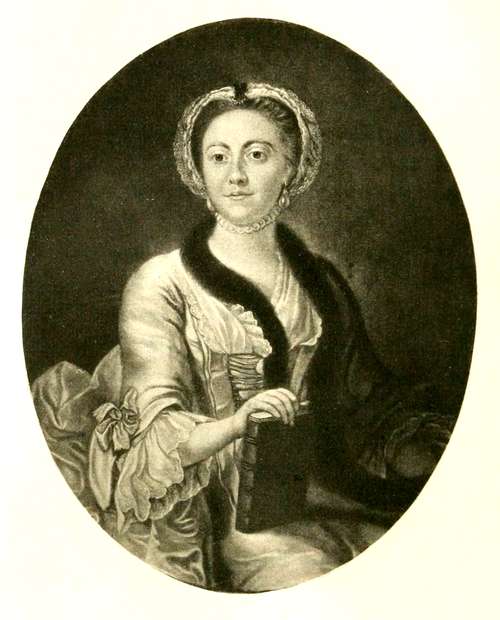
As a perfectly natural actress, she was admirable
in such parts as Mrs. Oakley, Doll Common, and the
Termagant, in the "'Squire of Alsatia." With such
characters she identified herself. I find her less
commended in artificial ladies like Clarissa and
Lady Dainty; and for queens of fashion, like Lady
Townley and Lady Betty Modish. Yet, although
she only pleased in these high-bred personages, she
was "inimitably charming" in Rosalind and Beatrice,
in Estifania and Clarinda, in Mrs. Sullen and
Lady Brute; and in all characters of intrigue, gaiety,
wit, playfulness, and diversity of humour. I may
sum up all by repeating that her distinguishing qualities
were natural expression, unembarrassed deportment,
propriety of action, and an appropriateness of
delivery which was the despair of all her contemporaries,
for she took care of her consonants, and was
so exact in her articulation, that, however voluble
her enunciation, the audience never lost a syllable of
it. Mrs. Pritchard and Mrs. Abington were selected,
at various periods, to represent the Comic Muse, and
nothing can better indicate their quality and merits.
Garrick, Quin, Mrs. Cibber, and Mrs. Pritchard,
acting in the same piece, at Covent Garden! No
wonder that Walpole, in 1746, says, "Plays only are
in fashion," and calls the company, which included
Woodward, Ryan, and Mrs. Horton, as "the best
company that, perhaps, ever were together." In
Mrs. Pritchard's Beatrice, as in Mrs. Clive's Bizarre,
Garrick, as Benedict to the first, and Duretete to
the second, had an antagonism on the stage which
tested his utmost powers. Each was determined to
surpass the other; but Walpole intimates that Mrs.
Pritchard won in her contest, and states that Garrick
hated her because her Beatrice (which he preferred
to Miss Farren's) had more spirit and originality
than his Benedict. Walpole also praised her Maria
("Nonjuror"), and only smiled at her Jane Shore
when she had become so fat, that for her to talk of
the pangs of starvation seemed ridiculous. But the
highest mark of his, never easily won, estimation
of this great actress consisted in his refusal to allow
his "Mysterious Mother" to be acted, as Mrs. Pritchard
was about to leave the stage, and there was
no one else who could play the Countess.
Walpole knew her as a neighbour as well as a
player, for Mrs. Pritchard purchased Ragman's
Castle, a villa on the Thames, between Marble Hill
and Orleans House, which she bought against an
opposing bidder, Lord Lichfield, and resided in it
till Walpole took it of her, for his niece, Lady
Waldegrave. The actress was occasionally his guest,
and he testifies to the becomingness and propriety
of her behaviour; but sneers a little at that of her
son, the Treasurer of Drury Lane, as being better
than he had expected.
Johnson said that it was only on the stage Mrs.
Pritchard was inspired with gentility and understanding;
but Churchill exclaims,
"Pritchard, by Nature for the stage designed,
In person graceful, and in sense refined,
Her wit, as much as Nature's friend became,
Her voice as free from blemish as her fame,
Who knows so well in Majesty to please,
Attempered with the graceful charms of ease?"
And contrasting her great qualities with the increasing
figure which, perhaps, offended, in her later
years, "the eye's too curious sense," Churchill adds,
"But when perfections of the mind break forth,
Honour's chaste sallies, judgment's solid worth,
When the pure, genuine flame by Nature taught,
Springs into sense and every action's thought,
Before such merit all objections fly,
Pritchard's genteel, and Garrick six feet high."
I believe that the French actress, Rachel, was so
ignorant of the true history of that which she represented,
that, to her, all the events, in the various
pieces in which she played, happened in the same
comfortable chronological period "once upon a
time." One of the greatest actresses of the Garrick
period, in some respects perhaps the greatest, was
equally ignorant. Mrs. Pritchard, it is said, had
never read more of the tragedy of "Macbeth" than
her own part, as it was delivered to her in manuscript,
by the prompter, to be got "by heart." Quin
was nearly as ignorant, if a questionable story may
be credited. Previously to Garrick's coming, the
"Macbeth" which was played as Shakspeare's was
really Davenant's, with Locke's music. When
Garrick announced that, for the future, he would
have Shakspeare's tragedy and not Davenant's
opera acted, no man was more surprised than Quin;
"Why!" he exclaimed, "do you mean to say that
we have not been playing Shakspeare all this
while?" Quin had less excuse than Mrs. Pritchard,—for
how was that poor lady—"the inspired idiot,"
Johnson styled her—a strange sort of person, who
called for her "gownd," but whose acquired eloquence
was beautiful and appropriate,—how was poor Mrs.
Pritchard to know anything of the chronology of the
story, when Garrick played the Thane in a modern
gold-laced suit, and she herself might have called on
the Princess Amelia, in her dress for the Thane's
wife? Nevertheless, the incomparable two were as
triumphant as if they had been dressed according to
time and place. Nor were they less so in two other
characters which they dressed to the full as much out
of propriety, though not of grace,—namely, Benedict
and Beatrice.
I have alluded to the essay made by Miss Pritchard.
Let me add that when the young lady first appeared
as Juliet, Mrs. Pritchard as her mother, Lady Capulet,
led her on the stage. The scenes between them were
heightened in interest, for Lady Capulet hovered
about Juliet with such maternal anxiety, and Juliet
appealed by her looks so lovingly to her mother, for
a sign of guidance or approval, that many of the
audience were moved to tears.
The house was moved more deeply still on an after
night,—the 24th of April 1768,—the night of Mrs.
Pritchard's final farewell, when Garrick played Macbeth
in a brown court suit, laced with gold, and she the
"lady," with a terrible power and effect such as even
the audiences in those days were little accustomed to.
Her "Give me the daggers!" on that night was as
grand as her "Are you a man?" and when the curtain
descended, such another intellectual treat was not
looked for in that generation.
There was a "tremendous house," to which she
tremblingly delivered a poetical address, written by
Garrick, in which she said—
"In acted passion tears must seem to flow,
But I have that within that passeth show."
Her old admirers stood by their allegiance, and
even Mrs. Siddons' Lady Macbeth, in long after years,
could not shake it. Lord Harcourt, no lukewarm
friend of Mrs. Siddons, missed in her Lady Macbeth
"the unequalled compass and melody of Mrs. Pritchard."
In the famous sleep-walking scene, his
lordship still held Mrs. Siddons to be inferior,—there
was not the horror in the sigh, nor the sleepiness
in the tone, nor the articulation in the voice,
as in Mrs. Pritchard's, whose exclamation of "Are
you a man?" was as much superior in significance
to that of Mrs. Siddons, as the "Was he alive?" of
Mrs. Crawford's (Barry's) Lady Randolph was, in the
depth of anxious tenderness.
Mrs. Pritchard retired to Bath to enjoy her hard-earned
leisure; but met the not uncommon fate of
those who withdraw from toil, to breathe awhile, and
repose, in the autumn of their days. A trifling accident
to her foot took a fatal turn, and in the August
of the year in which she withdrew, she closed her
honoured and laborious career. Her name, her example,
and her triumphs all deserve to be cherished
in the memory of her younger sisters, struggling to
win fame and resolved not to tarnish it. Garrick's
respect for her was manifested in the remark once
made at the mention of her name: "She deserves
everything we can do for her."
Mrs. Pritchard's daughter failed to sustain the glory
of her mother's name. The season of 1767-68 was
the last for both ladies, as it was for Mrs. Pritchard's
son-in-law, the first and more coxcombical of the two
John Palmers. Mrs. Palmer was short, but elegant
and refined; unequal to tragedy, except, perhaps, in
the gentle tenderness of Juliet; she was a respectable
actress in minor parts of comedy, such as Harriet
("Jealous Wife"), and Fanny ("Clandestine Marriage"),
of which she was the original representative.
Palmer died three months before his mother-in-law,
at the early age of forty, leaving bright stage memories
as the original representative of the Duke's
servant in "High Life below Stairs," Sir Brilliant
Fashion, Brush ("Clandestine Marriage"), &c. His
widow remarried with Mr. Lloyd, a political writer,
and a protégé of Lord North.
The inheritance of Mrs. Cibber and Mrs. Pritchard
was to be won by a young girl, who, about the time
of Mrs. Pritchard's death, was playing Ariel and other
characters in barns and hotel-rooms,—namely, Sarah
Kemble,—subsequently Siddons. Miss Seward saw
the three great actresses; the first two in her younger
days. She never forgot the clear, distinct, and modulated
voice of Mrs. Pritchard, nor the pathetic powers,
the delicate, expressive features, and the silvery voice,
sometimes too highly pitched, of Mrs. Cibber. Mrs.
Pritchard's figure, we are told, was then "coarse and
large, nor could her features, plain even to hardness,
exhibit the witchery of expression. She was a just
and spirited actress; a more perfectly good speaker
than her more elegant, more fascinating contemporary.
Mrs. Siddons has all the pathos of Mrs. Cibber, with
a thousand times more variety in its exertion, and
she has the justness of Mrs. Pritchard, while only
Garrick's countenance could vie with her's in those
endless shades of meaning which almost make her
charming voice superfluous, while the fine proportion
and majesty of her form, and the beauty of her
face, eclipse the remembrance of all her consummate
predecessors." Tate Wilkinson states, in his memoirs,
that Mrs. Siddons always reminded him of Mrs.
Cibber, in voice, manner, and features.
But before we address ourselves to Sarah Kemble,
we have to chronicle the last years of two great
actors, with whose period she is connected by having
played with the greater of the two,—Garrick and
Barry.
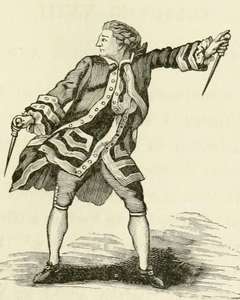
Mr. Garrick as Macbeth.
CHAPTER XVIII. — FOOTNOTES:
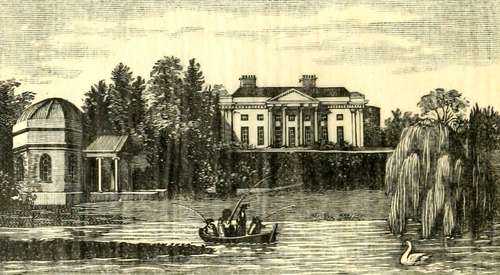
GARRICK'S HOUSE, HAMPTON.
THE LAST YEARS OF GARRICK AND BARRY.
During the remainder of the period that Garrick
and Barry continued at the same house, the stage
seemed to languish as their career drew to a close.
Barry's energies slackened, and Garrick studied no
new part. Within the same period old Havard died,
after a service of utilities and some authorship, which
extended to nearly threescore years.[96] If power may
be judged by effects, Havard was a powerful writer,
for his "Charles I.," when acted at York, excited
such painful emotions in a young lady named Terrot
that she died of it. Kitty Clive now retired, and
Holland died, it is said, of small-pox; but he was
more affected by Powell's death. After this event
he was standing in the green-room, talking mournfully
of his comrade. "The first time we played
together in private," he said, "I acted Iachimo to his
Posthumus. When I first appeared in public, we performed
the same characters; and they were the last we
ever played together!" "And you are dressed for
Iachimo, as you tell it," added a listener. Holland
smiled sadly; and soon after he slept with his old play-fellow,
Posthumus; dying at the age of forty. Love,
in Falstaff only inferior to Quin, died also about this
time. Under that pseudonym he saved his father,
the City Architect, it was supposed, the disgrace
that might attach to him, if his son called himself
by his proper name (Dance) on the stage. Covent
Garden, in losing Powell, lost one who was as
ignorant as Mrs. Pritchard, but he had fine stage
inspirations. Of the acquisitions made at this time,
the most notable was that of Lewis, who first appeared
at Covent Garden in the season of 1773-74
as Belcour, and in light tragic parts.
Playgoers felt that the old school of actors was
breaking up, and the poets did little to render the
finale illustrious. It was the dramatic era of Kelly
and Goldsmith, both of them needy Irishmen, and
hard-working literary men, having many things in
common, except talent, but being especially antagonistic
as the upholders—Kelly of sentimental, Goldsmith
of natural comedy. Kelly was the victor at
first, for his "False Delicacy," of which few now know
anything, brought him a little fortune, while Goldsmith's
"Good-natured Man" would have made shipwreck
but for Shuter's energy and humour. As I
look over the records of this time, I cannot but remark
how many of the dramatic poets toiled in vain.
Taking, for instance, the tragic writers—Hoole, the
watchmaker's son, is still an honoured name as a
translator of the Italian poets, but his "Cyrus" and
"Timanthes" are wrapped in oblivion. Some among
us may still read the story of Hindostan written by
one whose own story was as strange as that of
Gil Blas, and who, driven upon the world as an
adventurer, in consequence of a duel, in which he
was a principal, rose from the condition of a common
sailor to be Secretary to the Governor of Bencoolen,
and a Lieutenant-Colonel. I allude to the Scotchman,
Dow, at whose "Zingis" the public laughed,
more than they shuddered,[97] and whose "Sethona"
even the two Barrys could not render endurable,
despite magnificent acting.[98]
Home fared as badly as Dow. There was a strong
prejudice at this season against Scotchmen, and Home
was obnoxious as a client of Lord Bute's. His "Fatal
Discovery," an Ossianic subject, was mounted with
Roman costumes and Greek scenery, and the audience
threatened to burn the house down if the piece was
not withdrawn![99] The silver tongue of Barry could
not charm them into patience. Equally unsuccessful
was Home's "Alonzo,"[100] the hero of which does
not appear till the play is half over. Home sat by
Barry's bed-side as the tragedy was being acted, and
Mrs. Barry sent every half hour to say how she was,
hoping the best and doing her utmost. But what
could even that great actress do for a piece of which
the story, as Walpole remarks, is that of David and
Goliath, worse told than it would have been if
Sternhold and Hopkins had put it into metre? His
criticism is made in his happiest vein: "A gentlewoman
embraces her maid, when she expects her
husband. He goes mad with jealousy, without discovering
what he ails, and runs away to Persia, where
the post comes in from Spain, with news of a duel
that is to be fought, the Lord knows when. As
Persian princes love single combat as well as if they
had been bred in Lucas's coffee-house, nobody is surprised
that the Prince of Persia should arrive to fight
a duel, that was probably over before he set out. The
wife discovers the Prince to be her own husband, and
the lad her own son, and so, to prevent mischief, stabs
herself, and then tells the whole story, which it was
rather more natural to do first. The language is as poor
as the plot. Somebody asked me what prose Home
had ever written. I said I knew none but his poetry."
Then, to a version of Voltaire's "Orestes," Mrs.
Yates, as Electra, could not give life; and when Craddock
gave to her all the profits he derived from his
tragedy of "Zobeide," he showed his sense of that
lady's value. Kelly could give her nothing, for he
gained nothing by his "Clementina," at which the
audience yawned more than they hissed.[101] Managers
seemed to understand little of the requirements of
the public taste; and Colman still kept the Fool from
"King Lear," as being "such a character in tragedy
as would not be endured on the modern stage." In
our own time, however, it has been not only endured,
but enjoyed. One of the pleasantest of stage memories
is connected with the Fool, as acted by Miss P.
Horton, now Mrs. German Reed.
Garrick taxed all Barry's powers, for he imposed on
him the part of Tancred, in perhaps the most insufferable
of the tragedies of this time, the "Almida" of
Mallett's daughter, Madame Celisia, which Garrick
brought out only because her husband had been hospitable
to him in Italy! Cumberland laid as heavy a
charge on him in his emendation of "Timon," in which
there was more of Cumberland and less of Shakspeare
than the public could welcome. Walpole lets pass
Murphy's imbroglio of "Alzuma," and his over-rated
"Grecian Daughter," the success of which was due to
the Barrys alone, as Evander and Euphrasia; but he
records his impression of Mason's "Elfrida," which
may joyously close the tragic register of this period.
"It is wretchedly acted," he writes to the author
(Mason), in February 1773,[102] "and worse set to
music. The virgins were so inarticulate, that I
should have understood them as well if they had
sung choruses of Sophocles. Orgar (Clarke) had a
broad Irish accent. I thought the first virgin, who
is a lusty virago, called Miss Miller, would have
knocked him down; and I hoped she would. Edgar
(Bensley) stared at his own crown, and seemed to fear
it would tumble off." Miss Catley looked so impudent,
and so manifestly unlike the British virgin whom she
was supposed to represent, "you would have imagined
she had been singing the 'Black Joke,' only that she
would then have been more intelligible. Smith did
not play Athelwold ill. Mrs. Hartley is made for the
part (Elfrida), if beauty and figure would suffice for
what you write; but she has no one symptom of genius.
Still, it is very affecting, and does admirably for the
stage, under all these disadvantages. The tears came
into my eyes, and streamed down the Duchess of
Richmond's lovely cheeks." Those great folk must
have been easily moved, or Mrs. Hartley must have
had more talent than Walpole will acknowledge.
Of her beauty there is no doubt, nor of its effects.
In Hull's poor tragedy, "Henry II.," she played
Rosamond to the Henry of Smith; and this handsome
couple went on making love to one another, on
the stage, till they believed in it, and fairly ran away
together. When Smith, in his older and wiser days,
was living in well-endowed retirement, at Bury St.
Edmunds, a remark made by him, affirming the
fidelity of his married life, caused his excellent wife to
look up at him. He blushed; murmured something
of having forgotten "one slip," and never boasted
again. He had the grace of repentance.
Of comedies, and operas, and farces that have been
forgotten, I will say nothing. Mrs. Lennox showed
more dramatic power in her novels, and Mrs. Griffiths
more good purpose in her hints to young ladies, than
they did in their plays. O'Brien found his pieces condemned,
through his adoption of the suggestions of
his aristocratic friends. Bickerstaffe, ex-page to Lord
Chesterfield, in Dublin, and an ex-officer of marines,
not yet compelled to fly the country in dishonour,
gained less renown by "Lionel and Clarissa" (Mattocks
and Miss Macklin), of the entire originality of
which he boasted, than he did by the "Padlock"
(Mungo, by Dibdin), which he borrowed from the
Spanish; or by the "Hypocrite" (Cantwell, by King),
which was a refitting of Cibber's "Nonjuror," with the
addition of Maw-worm. Kelly's sentimental comedies
were only tolerated by the Wilks party, whom he had
offended by his political writings, when they were
brought forward under an assumed name, but they
had not merit enough of their own to live. Even
Cumberland's "West Indian" (Belcour, King; Major
O'Flaherty, Moody), and his "Fashionable Lover"
(Lord Abberville, Dodd; Aubrey, and Augusta Aubrey,
by the Barrys), have departed from the scene, with
his "Brothers." All Cumberland's dénouements
may be conjectured before the curtain falls on his
second acts. Of the "Brothers," George Montagu
writes to Walpole: "I am glad it succeeds, as he
has a tribe of children, and is almost as extravagant
as his uncle, and a much better man." Cumberland
lacks that most at which he most aims, facility to
delineate character. He has less power of style
than purity of sentiment. Of his fifty-four pieces,
one alone, the "Wheel of Fortune," survives. In
all, he exhibits more regard for modesty than he
furnishes matter for amusement.
But the one comedy of this period, which has
gloriously survived all the rest, and which is being
acted as I write, is Goldsmith's "She Stoops to
Conquer." There is nothing in it of the mawkishness
of Kelly nor of the pompous affectation of
Cumberland. It was so natural, that those who did
not despair, doubted of it; and the author himself
had not the courage to believe in its success, though
Johnson and a faithful few alone augured triumph.
After a world of difficulty, the night of performance
arrived at last,—the 15th of March 1773. From
the Shakspeare tavern, Johnson led a band of
friends to Covent Garden, where he sat in the front
of a side box; and as he laughed, the applause increased.
But the friendly approvers were occasionally
indiscreet, despite the instructions of Cumberland,
who very kindly asserts, that the success of the
comedy was owing to the exertions of those claqueurs,—predetermined
to secure a triumph!
It came, that triumph,—and to a rare son of
genius; one, who showed that drollery was compatible
with decency, and that high comedy could
exist without scoundrelly fine gentlemen to support
it. It gave good opportunities, also, to rising actors,
who, on the refusal of Smith to play Young Marlow,
and of Woodward to play Tony Lumpkin, were cast
for those parts,—namely, Lee Lewes and little Quick.
Goldsmith did not venture to go down to Covent
Garden till the fifth act was on, and then he heard
the one solitary hiss, which was the exception to
the universal applause, and which has been variously
ascribed as issuing from the envious lips of Kelly or
of Kenrick.
Sentimental comedy, ridiculed by Foote at the
Haymarket, in his "Handsome House Maid, or
Piety in Pattens," was dethroned, for a period, by
Goldsmith's comedy. It was time. Sentiment had
been carried to its utmost limits a month or two
before, in a little piece called "Rose." In this
operatic drama, we find Lord Gainlove (Vernon)
celebrating his twenty-first birthday, by inviting
every marriageable lady within five miles. Each of
them is to bring a rose; and my lord is to marry her
who brings one that cannot decay. The roses are
brought by all, save Serina (Mrs. Smith), who, on
being questioned, remarks, that the only rose which
never decays is virtue; and that she brings the
imperishable flower! She is raised to the rank of
Lady Gainlove, forthwith!
To a similar school belongs the "Maid of Kent," of
Francis Godolphin Waldron. The piece has more of
talk than of action in it. Waldron was a respectable
actor, a worthy bookseller, and an honest treasurer
of the Theatrical Fund. A simple man—he once
announced, in the country, that he would play
Richard in humble imitation of the inimitable Mr.
Garrick! Waldron was a Roman Catholic, and on
publishing an appendix to his edition of Ben
Jonson's "Sad Shepherd," he had the courage to
recall public attention to the poems of Father Southwell,
the martyr, of which he gave some specimens.
Through him, and later editors, Southwell has become
as one of those true and familiar friends who are
cherished for their virtues, and are not questioned
on account of their creeds.
Perhaps one of the most important improvements
in stage arrangements was made at Covent Garden,
on the 23d of October 1773, when Macklin first
appeared as Macbeth. The taste of the nation,
according to Whitehead, depended on Garrick; but
Garrick, like his predecessors, had been accustomed
to dress the Thane in the uniform of a modern
military officer. Shakspeare, in his mind's eye, saw
the persons of this drama all in native costume, for
Malcolm recognises Rosse, at a distance, for his
countryman, by his dress. Macklin, bearing this in
mind, dressed all the characters in Scottish suits;
but unfortunately, he himself is said to have looked
more like a rough old Scotch bagpiper, than the
Thane of Cawdor, and King of Scotland. He hoped
to snatch a triumph from Garrick, from Barry, and
from Smith; and, indeed, in his scene with the
witches, his interview with his wife, his hypocrisy
after the king's death, his bearing with the murderers,
and in contrasts of rage and despondency,
he gained great applause. In the other scenes he
failed. On the first two nights there was occasionally
a little sibilation, which Macklin attributed to
Reddish and Sparks, whose friends headed a riot,
which was ended by Macklin, on his third appearance
in the character,[103] being driven from the stage,
with much attending insult.
A few nights later he was announced for Shylock
and Sir Archy Mac Sarcasm; but he could not obtain
a hearing. Bensley, Woodward, and Colman
treated with the enraged audience, in obedience to
whose commands Mr. Macklin was declared to be
discharged from the theatre. Against five of the
rioters Macklin entered an action, and Lord Mansfield
intimated that a jury would give heavy damages
against men who had gone to the theatre with a
preconceived resolution, not of judging of the merits,
but of ruining an actor. Lord Mansfield ordered
the case to be referred to a Master, with directions
that liberal satisfaction be made; but Macklin interposed,
offering to stop all further proceedings, if the
defendants would pay the costs, spend £100 in
tickets for his daughter's benefit, the same sum for
his own, and a third for the advantage of the manager.
And this was agreed to. "You have met with great
applause to-day, Mr. Macklin," said Lord Mansfield;
"you never acted better."
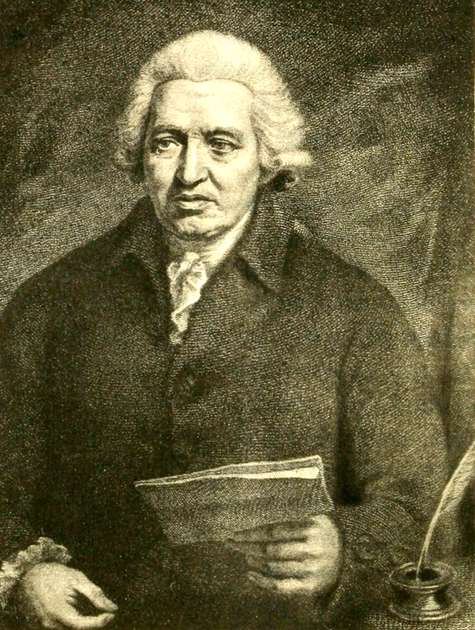
Let us now follow Garrick and Barry to the
close of their professional courses, in 1776 and 1777,
and make record of the principal productions which
were brought forward during the last brilliant years
of the first, and the majestic decline of the latter.
At Drury Lane, came first Burgoyne's "Maid of the
Oaks," as "fine as scenes could make it, and as dull as
the author could not help making it," says Walpole.
This was followed by Cumberland's "Choleric Man,"
the author of which, when accused of stealing a
portion of it from Shadwell's "Squire of Alsatia,"
protested he had never seen that play! Dr. Franklin
was as reluctant to acknowledge how much his
"Matilda" owed to Voltaire's "Duc de Foix." All
Walpole's affirmations that a better tragedy than
Jephson's "Braganza" had not been seen for fifty
years, could not give life to a heavy tragedy, by a man
of such a comic turn of mind, that he was called
"the mortal Momus." These pieces, with others of
less note, were brought forward at Drury Lane, where
Garrick appeared for the last time as Don Felix, in
the "Wonder," on the 10th of June 1776.
He had been accustomed to take his share in the
country dance with which this comedy used to end,
with unabated vigour, down to the latest period; and
he delighted in thus proving that his strength and
spirits were unimpaired. On this final night the
dance was omitted, and Garrick stepped forward, in
front of a splendid and sympathising audience, to
take his one and final farewell. For the first time
in his life he was troubled, and at this emotion, the
house was moved too, rather to tears than to applause.
He could pen farewell verses for others, but he could
neither write nor deliver them for himself. In a few
phrases, which were perhaps not so unpremeditated
as they appeared to be, he bade his old world adieu!
They were rendered in simple and honest prose.
"The jingle of rhyme, and the language of fiction,
would but ill suit my present feelings," he said; and
his good taste was duly appreciated.
Of this season at Drury Lane, I will only notice
here a link which connects this old time with the
present, in the fact, that in the course of it the
name of Kean (Moses Kean, the uncle of Edmund)
appears to Glumdalca, and Mrs. Siddons made her
first appearance in London, as Portia, to King's
Shylock.
Meantime, at Covent Garden, the town damned,
condoned, and finally crowned the "Rivals" of
Sheridan; who showed that a young fellow of
twenty-three could write a comedy, remarkable for
wit, good arrangement of plot, and knowledge of
men and manners. Hoole's dull "Cleonice," and
Hull's as dull adaptation of Thomson's "Edward
and Eleonora," were followed by the gayest and
most popular of operas—Sheridan's "Duenna," which
was acted seventy-five times in one season, eclipsing
the glory even of the "Beggar's Opera." But the
audiences were dulled again by Mason's "Caractacus,"
the acting of which Walpole styles "a barbarous
exhibition." The chief part (given to Clarke), he
cruelly says, "will not suffer in not being sputtered
by Barry, who has lost all his teeth."
In Garrick's last season, he looked youthful parts as
well as ever he did. It was the reverse with Barry,
who gave up Douglas for Old Norval, and who was
so ill, while dressing for Jaffier, that acting it seemed
impossible; and yet the great player, at whom Walpole
sneers, entered on the stage only to be inspired;
he was warmed by the interest of the scene, and,
brightening with the glow of love and tenderness,
communicated his feelings to all around—but he fell
almost into insensibility on reaching the green-room.
He played Evander to Mrs. Barry's Euphrasia, on
the 28th of December 1776[104]—the last time on which
his name appeared in the bills. Death took him,
and Shuter, and Woodward, close upon one another;
but Garrick and Kitty Clive retired to enjoy a season
of luxurious rest—Garrick at Hampton, and Mrs.
Clive, between Margaret Woffington's grave, and
Horace Walpole's mansion at Teddington.
The great actor, in his retirement, used to smile
when his friends told him he had surpassed Betterton.
Whether the smile showed he accepted the
flattery or differed from the opinion, I do not know;
but Garrick would remark, that Booth, in "Cato,"
had never been excelled; and yet, when Quin first
played the part, the pit rang with "Booth outdone!"
and encored the famous soliloquy,—an honour never
enjoyed by either Betterton or Garrick. Let us now
accompany the latter to Hampton, and, sojourning
with him there, look back over his past career.
CHAPTER XIX. — FOOTNOTES:
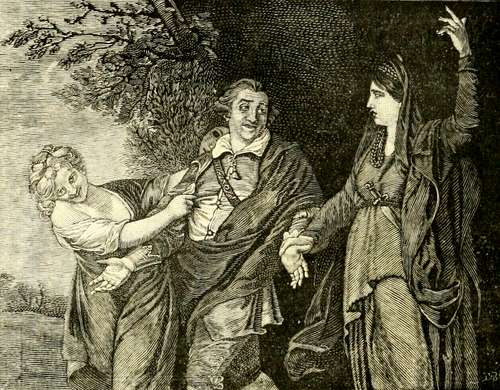
GARRICK BETWEEN TRAGEDY AND COMEDY.
DAVID GARRICK.
When Garrick commenced his career as actor, he was
twenty-five years of age, and, according to Pond's
portrait, a very handsome fellow. In the first burst
of his triumph, Cibber thought the new player "well
enough," but Foote, with the malice that was natural
to him, remarked, "Yes, the hound has something
clever, but if his excellence was to be examined, he
would not be found in any part equal to Colley
Cibber's Sir John Brute, Lord Foppington, Sir Courtly
Nice, or Justice Shallow." This was said, not out of
justice to Cibber, but out of ill-will against Garrick.
How he affected the town may be seen in the criticism
of the Daily Post. "His reception was the
most extraordinary and great that was ever known
upon such an occasion, and we hear that he obliges
the town this evening, with the same performance."
The figure of Betterton looking down upon him from
between Shakspeare and Dryden, on the ceiling of the
theatre, may have stimulated him. Garrick's Hamlet
placed him indisputably at the head of his profession,
and his Abel Drugger and Archer fixed his pre-eminence
in both low and light comedy. In the former
comic part, he "extinguished" Theophilus Cibber,
whose grimaces had been the delight of the gallery.
Garrick's Abel was awkward, simple, and unobtrusive;
there was neither grimace nor gesticulation in it, and
he "convinced those who had seen him in Lear and
Richard that there was nothing in human life that
such a genius was not able to represent."
Walpole never liked him; and he laughed at the
"airs of fatigue which Garrick and other players give
themselves after a long part;"—comparing their labour
with that of the Speaker and of some members of the
House of Commons. The fine gentleman depreciated
the fine actor systematically, but at the close of a score
of years' familiarity with his acting, he rendered a discriminating
judgment on him. "Good and various,"
the player was allowed to be, but other actors had
pleased Walpole more, though "not in so many parts."
"Quin in Falstaff, was as excellent as Garrick in
Lear. Old Johnson far more natural in everything he
attempted. Mrs. Porter surpassed him in passionate
tragedy. Cibber and O'Brien were what Garrick
could never reach, coxcombs and men of fashion.
Mrs. Clive is, at least, as perfect in low comedy, and
yet, to me, Ranger was the part that suited Garrick
the best of all he ever performed. He was a poor
Lothario, a ridiculous Othello, inferior to Quin in Sir
John Brute and Macbeth, and to Cibber in Bayes;
and a woeful Lord Hastings and Lord Townley.
Indeed, his Bayes was original, but not the true part;
Cibber was the burlesque of a great poet, as the part
was designed, but Garrick made it a Garretteer.
The town did not like him in Hotspur, and yet I
don't know if he did not succeed in it beyond all the
rest. Sir Charles Williams and Lord Holland thought
so too, and they were no bad judges." It was less
fair criticism when Walpole wrote, with reference to
Garrick, "I do not mention the things written in his
praise;—because he writes most of them himself."
This last charge was also made in a pamphlet, said
to have been by Foote. It is there asserted that Garrick
had considerable share in the property, and great
influence in the management, of the Public Advertiser,
the Gazetteer, the Morning Post, and the St. James's
Chronicle. The critical and monthly reviews, he
found means (we are told) to keep in his interest.
The Gentleman's Magazine and London Review alone
withstood him. Quin and Mossop, living,—he is said
to have hated; dead,—to have offered to bury their
remains with unusual honours. The Barrys, King,
Lee, Mrs. Abington, and others, he is said to have
mimicked in private; by similar mimicry in public, he
is accused of having broken Delane's heart, and he is
also charged with having ruined Powell, by binding
him to beggarly-paid service, under a bond of £1000,
and by exacting the heavy penalty when the terms
were infringed. He is charged with damning his
brethren with faint praise, and ridiculing the monotony
of Mrs. Cibber's action; he who said that tragedy
had died with her! It was laid as a meanness on him
that he would not engage great actors,—at a time both
the Barrys were in his company, drawing houses as
great as could be drawn by his own powers. Wilkinson
has asserted the youthfulness of his look and action
to the last, but his anonymous detractors, while they
allowed that, as Ranger, he mounted the ladder
nimbly, professed to see that he was old about the
legs. Is he a lover? they mock his wrinkled visage
and lack-lustre eye, in which softness, they say, was
never enthroned; his voice is hoarse and hollow, his
dimples are furrows, his neck hideous, lips ugly,
"the upper one, especially, is raised all at once like
one turgid piece of leather." In such wise, was he
described just before he left the stage; and to embitter
his retirement, he is told that his worst enemy
has got famous materials for his "Life!"
Garrick was proud of his Abel Drugger, but he
was ready to acknowledge the superiority of Weston
in that part, whose acting was described by Garrick
as the finest he ever saw.[105] To this pleasant piece
of criticism was added a £20 note, on Weston's
benefit night.
And yet, from first to last, did his enemies deny
that Garrick was influenced by worthy motives.
Walpole describes him, unjustly, as jealous (even
after his retirement) of rising young players; and
Horace writes, in 1777, "Garrick is dying of yellow
jaundice, on the success of Henderson, a young
actor from Bath. Enfin donc désormais, there must
never be a good player again! As Voltaire and
Garrick are the god and goddess of envy, the latter
would put a stop to procreation, as the former would
annihilate the traces of all antiquity, if there were
no other gods but they."
I have quoted what Walpole said of the actor in
his first year;—this is what he says of him in his
last: "I saw Lear the last time Garrick played it,
and as I told him, I was more shocked at the rest
of the company than pleased with him,—which I
believe was not just what he desired; but to give a
greater brilliancy to his own setting, he had selected
the very worst performers of his troop; just as
Voltaire would wish there were no better poets than
Thomson and Akenside." This is not true. Garrick
played with Gentleman Smith and Bensley; Yates,
Parsons, and Palmer; Mrs. Abington, Mrs. Yates,
and, for a few nights, Mrs. Siddons.
Because Garrick never allowed his judgment to
be overpowered by his emotions, intense as they
were, Johnson thought there was all head and no
heart in his acting. While David was once playing
Lear, Johnson and Murphy were at the wing, conversing
in no subdued tone. As Garrick passed by
them, he observed, "You two talk so loud, you
destroy my feelings." "Punch has no feelings,"
growled Asper, contemptuously.
By pen, as well as by word of mouth, did Johnson
wound the self-esteem of his friend. Although
Boswell asserts that Garrick never forgave the
pointed satire which Johnson directed against him,
under the pseudonym of Prospero, the records of the
actor's life prove the contrary. That it was something
he could never entirely forget is true, for the
assault was made under circumstances by which its
bitterness was much aggravated. Garrick had, just
before, manfully exerted himself to render Johnson's
"Irene" successful. And on the 15th February
1752, on the morning of the night on which Garrick
was to play Tancred, there appeared a paper in the
Rambler, from Johnson's pen, in the two personages
of which, no one could be mistaken. They are
described as coming up to town together to seek a
fortune, which had been found by one of them,
Prospero, who was "too little polished by thought
and conversation to enjoy it with elegance and
decency!"
Asper then describes a visit he reluctantly pays to
Prospero's house. He is tardily admitted, finds the
stairs matted, the best rooms open, that he may catch
a glance at their grandeur, while his friend conducts
him into a back room, suited for inferior company—where
Asper is received with all the insolence of condescension.
The chairs and carpets are covered, but
the corners are turned up that Asper may admire
their beauty and texture. He did "not gratify Prospero's
folly with any outcries of admiration, but
coldly bade the footman let down the cloth."
The host gives the guest inferior tea, talks of his
jeweller and silversmith, boasts of his intimacy with
Lord Lofty, alludes to his chariot, and ladies he
takes in it to the Park, and exhibits his famous
Dresden china, which he "always associates with his
chased tea-kettle." "When I had examined them
a little," says Asper, "Prospero desired me to set
them down, for they who were accustomed only to
common dishes seldom handled china with much
care." Asper takes credit for much philosophy in
not dashing Prospero's "baubles to the ground;"
and when the latter begins to affect a preference for
the less distinguished position of one with whom he
was "once upon the level," Asper quits the house in
disgust.
This attack was ungracious and cowardly, on one
side, as it was undeserved on the other. I can fancy
it disturbed Garrick's performance of Tancred on
that night; the Rambler was universally read, and
the application could not fail. But it disturbed
nothing else. Years later, when Johnson visited
Garrick at his Hampton villa, the spirit of Asper
was softened in his breast, and he was justified in
the well-known remark he made, as he contemplated
the beauty and grandeur around him:—"These are
the things, Davy, that make death terrible!" It
must not be forgotten, however, that Johnson, at
last, allowed no one to abuse Davy but himself, and
he then always mentioned that "Garrick was the
most liberal man of his day."
So great, indeed, was his honesty, too, that Garrick,
having entered thoughtlessly into some bargain, carried
it out with the remark, that "terms made over
our cups must be as strictly observed as if I had
agreed to them over tea and toast." His gallantry,
also, was indisputable. When Mrs. Yates invited
him to her house to discuss a treaty touching "£800
a year, and finding her own clothes," he answered,
"I will be as punctual as I ought to be to so fine a
woman, and so good an actress."
One of the critical years in the life of Garrick—of
whom Chesterfield always strangely asserted, that
although he was the best actor the world had ever
seen, or could see, he was poor in comedy!—was
1746, when he and Quin first appeared together at
Covent Garden in the "Fair Penitent:" the night
was that of the 14th of November. "The 'Fair
Penitent,'" says Davies, "presented an opportunity
to display their several merits, though the balance
was as much in favour of Quin as the advocate of
virtue is superior in argument[106] to the defender of
profligacy.... The shouts of applause when Horatio
and Lothario met on the stage together, in the second
act, were so loud and so often repeated before the
audience permitted them to speak, that the combatants
seemed to be disconcerted. It was observed
that Quin changed colour, and Garrick seemed to be
embarrassed; and it must be owned that these actors
were never less masters of themselves than on the
first night of the contest for pre-eminence. Quin
was too proud to own his feelings on the occasion;
but Mr. Garrick was heard to say, 'Faith, I believe
Quin was as much frightened as myself.'"
Davies, who praises Mrs. Cibber in the heroine,
states that competent judges decided that Quin found
his superior on this occasion. By striving to do too
much, he missed the mark at which he aimed. "The
character of Horatio is compounded of deliberate
courage, warm friendship, and cool contempt of insolence.[107]
The last Quin had in a superior degree, but
could not rise to an equal expression of the other
two. The strong emphasis which he stamped on
almost every word in a line, robbed the whole of
that ease and graceful familiarity which should have
accompanied the elocution and action of a man who
is calmly chastising a vain and insolent[108] boaster.
When Lothario gave Horatio the challenge, Quin, instead
of accepting it instantaneously, with the determined
and unembarrassed brow of superior bravery,
made a long pause, and dragged out the words, 'I'll
meet thee there!' in such a manner as to make
it appear absolutely ludicrous." He paused so
long before he spoke, that somebody, it was said,
called out from the gallery, "Why don't you
tell the gentleman whether you will meet him
or no?"
But there is no one who gives us so lively a picture
of the principal actors in this piece as Cumberland,
who tells us that "Quin presented himself, upon the
rising of the curtain, in a green velvet coat embroidered
down the seams, an enormous full-bottomed
periwig, rolled stockings, and high-heeled, square-toed
shoes. With very little variation of cadence,
and in a deep full tone, accompanied by a sawing
kind of action, which had more of the senate than
the stage in it, he rolled out his heroics with an air
of dignified indifference that seemed to disdain the
plaudits that were showered upon him. Mrs. Cibber,
in a key high pitched but sweet withal, sang, or
rather recitatived, Rowe's harmonious strain. But
when, after long and eager expectation, I first beheld
little Garrick, then young and light, and alive in
every muscle and every feature, come bounding on
the stage, and pointing at the wittol Altamont and
the heavy-paced Horatio (heavens! what a transition),
it seemed as if a whole century had been swept
over in the space of a single scene; old things were
done away, and a new order at once brought forward,
bright and harmonious, and clearly destined to dispel
the barbarisms and bigotry of a tasteless age too long
attached to the prejudices of custom, and superstitiously
devoted to the illusions of imposing declamation."
Foote's imitation of Garrick's dying scene in
Lothario was an annoyance to Garrick and a delight
to the town, particularly at the concluding words:—"adorns
my tale, and che-che-che-che-che-cheers my
heart in dy-dy-dy-dying."
Garrick was again superior to Quin, when playing
Hastings to his Gloucester in "Jane Shore." Davies
describes Quin as "a good commonwealth-man," for
taking an inferior character, one which the actor
himself used to designate as one of his "whisker-parts,"[109]
a phrase which shows that he dressed the
Duke as absurdly as he did Horatio.
Quin had his turn of triumph when he played
Falstaff to Garrick's Hotspur. The former character
he kept as his own, as long as he remained on the
stage; but after a few nights, Garrick resigned
Hotspur, on the ground of indisposition, to careful
Havard. The two great actors agreed to appear
together as Orestes and Pyrrhus, and Cassius and
Brutus; but Garrick did not like the old costume of
Greece or Rome, and the agreement never came to
anything.
It was long the custom to compare the French
actor Lekain with Garrick. The two had little in
common, except in their resolution to tread the stage
and achieve reputation by it. Lekain was born in
1729, the year in which Baron departed the stage.
He was the son of a goldsmith, and had gained wide
notice as a maker of delicate surgical instruments,
when a passion for the stage led him, as in Garrick's
case, to playing frequently in private, especially in
Voltaire's little theatre, in the Rue Traversière, now
known as the Rue Fontaine Molière.
On this stage Lekain exhibited great powers, with
defects, which were considered incurable; but he
was only twenty years of age, and he could then
move, touch, and attract the coldest of audiences.
Voice, features, and figure were against him, and
yet ladies praised the beauty of all, so cunning was
the artist. He played Orosmane, in "Zaire," before
Louis XV., and the King was angry to find that the
actor could compel him to weep! When Voltaire
first heard him, he threw his arms round Lekain, and
thanked God for creating a being who could delight
Voltaire by uttering bad verses! And yet Voltaire
dissuaded him from taking to the stage; but when
Voltaire saw in him the hero of his own tragedies,
then poet and player lived but for one another,
thought themselves France, and that the eyes of the
world were upon them. Voltaire addressed Lekain
as "Monsieur le Garrick of France, in merit though
not in purse!" and as "My very dear and very great
support of expiring tragedy!" When he wrote this
in 1770, there was a boy seven years old in Paris,
who, seventeen years later, began the most splendid
career ever run by French actor,—as Seïde, in Voltaire's
"Mahomet,"—Talma!
Garrick and Lekain equally respected the original
text of an author; but the former, more readily than
the latter, adopted so-called "emendations." When
Marmontel improved the bold phrases of old Rotrou's
"Venceslas," Lekain repeated the improvements at
rehearsal, but at night he kept to the original passages
of the author, and thus created confusion among
his fellow-actors, who lost their cues. In this, Garrick
deemed him unjustifiable.
Lekain, like Betterton, never departed from the
quality of the part he was playing, even when off
the stage. Garrick, like Charles Young, would forget
Lear, to set a group in the green-room laughing at
some good story. Lekain treated his Paris audiences
with contempt. He would affect fatigue after playing
less than a dozen times in a single winter, and
then pass from one country town to another, acting
twice a day! He received a salary from Paris while
he was acting at Brussels. He could not play a
hundred different parts like Garrick, who identified
himself with all; but he carried about with him a
repertory of eight or nine characters, with half that
number of costumes and a turban; and with these
parts, painfully learnt and elaborately acted, he
enthralled his audiences. Voltaire protests that
Lekain's means were as great, and his natural
truthfulness of acting as undeniable as Garrick's;
"but, oh! sublime Garrick!" exclaims Mercier,
"how much more extended are thy means; how
different thy truthfulness!"
This truthfulness was the result of anxious
care. Garrick spent two whole months in rehearsing
and correcting his Benedick, and when he
played it, all the gaiety, wit, and spirit seemed
spontaneous.
In Fribble, he imitated no less than eleven men
of fashion, so that every one recognised them; and
in dancing Mrs. Woffington could not excel him.
"Garrick," says Mrs. Delaney, "is the genteelest
dancer I ever saw."
One of Garrick's distinguishing characteristics was
his power of suddenly assuming any passion he was
called on to represent. This often occurred during his
continental travels, when in the private rooms of his
various hosts,—princes, merchants, actors,—he would
afford them a taste of his quality; Scrub or Richard,
Brute or Macbeth, and identify himself on the instant
with that which he assumed to be. Clairon, the famous
French actress, almost worshipped him for his good-nature,
but more for his talent, particularly on the
occasion when, in telling the story of a child falling
from a window, out of its father's arms, he threw
himself into the attitude, and put on the look of
horror, of that distracted father. The company were
moved to honest tears, and when the emotion had
subsided, Clairon flung her arms round his neck,
kissed him heartily, and then, turning to Mrs.
Garrick, begged her pardon, for "she positively
could not help it!"
Of the French players, Garrick said that Sophie
Arnould was the only one who ever touched his
heart. To a young Englishman of French descent,
subsequently Lord North's famous antagonist, Colonel
Barré, whom he met in Paris, he said, on seeing him
act in private, that he might earn a thousand a year,
if he would adopt playing as a profession.
French ana abound with illustrations of Garrick's
marvellous talent, exercised for the mere joke's sake.
How he deceived the driver of a coucou into believing
his carriage was full of passengers, Garrick having
presented himself half a dozen times at the door,
each time with a different face; how he and Preville,
the French actor, feigned drunkenness on horseback;
and how Garrick showed that his rival, drunk everywhere
else, was not drunk enough in his legs. But
the greatest honour Garrick ever received was in his
own country, and at the hands of Parliament. He
happened to be sole occupant of the gallery in the
Commons, one night of 1777, during a very fierce
discussion between two members, one of whom,
noticing his presence, moved that the gallery should
be cleared. Burke thereupon sprang to his feet, and
appealed to the House; was it consistent with becomingness
and liberality to disturb the great master
of eloquence? one to whom they all owed so much,
and from whom he, Burke, had learned many a grace
of oratory? In his strain of ardent praise, he was
followed by Fox and Townshend, who described the
ex-actor as their great preceptor; and ultimately,
Garrick was exempted from the general order that
strangers leave the House! Senators hailed him as
their teacher, and the greatest of French actors
called him "Master!"
It was Grimm's conclusion, that he who had not
seen Garrick, could not know what acting was. Garrick
alone had fulfilled all that Grimm's imagination
could conceive an actor should be. The player's great
art of identification astounded him. In different parts
he did not seem the same man; and Grimm truly
observed, that all the changes in Garrick's features
arose entirely from inward emotion;—that he never
exceeded truth; and that, in passion alone, he found
the sources of distinction. "We saw him," he says,
"play the dagger scene in 'Macbeth,' in a room, in
his ordinary dress, without any stage illusion; and
as he followed with his eyes the air-drawn dagger,
he became so grand, that the whole assembly broke
into a general cry of admiration. Who would believe,"
he asks, "that this same man, a moment
after, counterfeited, with equal perfection, a pastry-cook's
boy, who, carrying a tray of tartlets on his
head, and gaping about him at the corner of the
street, lets his tray fall in the kennel, and at first
stupefied by the accident, bursts at last into a fit of
crying?" Such was he who fairly frightened Hogarth
himself, by assuming the face of the defunct
Fielding!
Garrick's assertion, that a man must be a good
comic actor to be a great tragedian, gave M. de Carmontelle
the idea of a picture, in which he represented
Garrick in an imposing tragic attitude, with
a comic Garrick standing between the folding-doors,
looking with surprise, and laughing at the other.
While the ever-restless actor was sitting for this, he
amused himself by passing through imperceptible
gradations, from extreme joy to extreme sadness, and
thence to terror and despair. The actor was running
through the scale of the passions.
Grimm approvingly observed, that Garrick's
"studio" was in the crowded streets. "He is always
there," writes Grimm; and, no doubt, Garrick
perfected his great talents by the profound study of
nature. Of his personal appearance, the same writer
remarks: "His figure is mediocre; rather short than
tall; his physiognomy agreeable, and promising wit;
and the play of his eyes prodigious. He has much
humour, discernment, and correctness of judgment;
is naturally monkeyish, imitating all he sees; and
he is always graceful!" Such is the account by a
member of a society, whose kindness was never forgotten
by the English actor. The desire to see him
there again was as strong as Mrs. Woffington's, who,
being reminded by Sir C. Hanbury Williams, that
she had seen Garrick that morning, exclaimed, "but
that's an age ago!"[110]
St. Petersburg caught from Paris the Garrick
fever; but the offer of the Czarina Catherine, to
give Garrick two thousand guineas for four performances,
could not tempt him to the banks of the
Neva. Denmark was fain to be content with his
counterfeit presentment; and a portrait, painted in
London, by order of the King was hung up in the
royal palace at Copenhagen.
I have alluded to some things his enemies laid to
his charge. They are small matters when they come
to be examined; and the more they are examined,
the less obnoxious does Garrick seem to censure.
I find more instances of his generosity than of his
meanness—more of his fairness of judgment than of
his jealousy. He was ever ready to play for the
benefit of his distressed brethren. When Macklin
lost his engagement under Fleetwood, Garrick offered
to allow him £6 per week out of his own salary till
he found occupation. He saw, when his own triumph
was in its freshness and brilliancy, the bright promise
of Barry; and pointed out its great merits, and predicted
his future success. To insure that of young
Powell, he gave him frequent instruction; and when
he brought the soon-forgotten Dexter from Dublin,
he not only gave him "first business," and useful
directions, but expressed his convictions that, with
care and diligence, he would stand in the foremost
rank of actors.
The commonest incidents have been tortured to
depreciate Garrick's character. When, in 1775,
Sheridan's "Duenna" was in the course of its first
run of seventy-five nights, the name of the author
was extraordinarily popular. At this juncture Garrick
did further honour to that name by reviving the
"Discovery," by Sheridan's mother, and acting the
principal part in it himself.[111] The carpers immediately
exclaimed, that the mother had been revived
in opposition to the son. They did not even take
the low ground of the revival being adopted as a
source of profit on account of the author's family
name.
Even Mrs. Siddons's disparagement of Garrick
tells in his favour. She played two or three nights
with him, but her first appearances were comparatively
failures. Garrick observed some awkward
action of the lady's arms, and he gave her good
advice how to use them. But Mrs. Siddons, in telling
the story, used to say: "He was only afraid that I
should overshadow his nose." Years subsequently
Walpole remarked this very action of the arms,
which Garrick had endeavoured to amend!
To those who object that Garrick was personally
vain, it may suffice to point out that he was the first
to allude to his own defect of stature. In the prologue
to the tragedy of "Hecuba," written and
spoken by himself, he mentions the high-soled
buskins of the ancient stage; and adds—
"Then rais'd on stilts, our play'rs would stalk and rage,
And at three steps stride o'er a modern stage;
Each gesture then would boast unusual charms,
From lengthen'd legs, stuff'd body, sprawling arms!
Your critic eye would then no pigmies see,
But buskins make a giant e'en of me."
If he esteemed little of himself personally, he had,
on the other hand, the highest estimation of his profession.
In this he bears a resemblance to Montfleury,
who, being asked, when his marriage articles were
preparing, how he wished to be described, answered:
that ancestry conferred no talent, and that the most
honourable title he desired to be known by, was, that
of "Actor to the King."
Garrick was often severe enough with conceited
aspirants, who came to offer samples of their quality,
to whom he listened while he shaved, and whom he
often interrupted by imitative yaw, yaws! But when
convinced there was stuff in a young man, Garrick
helped him to do his best, without thought of rivalry.
It is pleasant thus to contemplate him preparing Wilkinson,
in 1759, for his attempt at tragedy, in Bajazet,
to the Arpasia of Mrs. Pritchard.[112] Garrick heard him
recite the character in his own private room; gave him
some valuable advice; presided at the making up of
his face; and put the finishing strokes of the pencil,
to render the young face of one and twenty as nearly
like that of the elder Oriental, as might be.
It may be said that this was a cheap sort of generosity,
but it was characteristic of kindliness of heart.
He could make other and nobler sacrifices; on the last
night he ever trod the stage, with a house crammed,
with a profusely liberal audience, Garrick made over
every guinea of the splendid receipts, not to his own
account at his bankers, but to that of the Theatrical
Fund. After this, his weaknesses may surely be forgotten.
He may have been as restless and ignorant
as Macklin has described him; as full of contrasts
and as athirst for flattery as the pencil of Goldsmith
has painted him; as void of literary ability as Johnson
and Walpole asserted him to be; and as foolish as
Foote would have us take him for; his poor opinion
of Shuter and Mrs. Abington may seem to cast reproach
upon his judgment; and his failure to impress
Jedediah Buxton, who counted his words rather than
attended to his acting, may be accepted as proof that
he was a poor player (in Jedediah's eyes); but the
closing act of his professional life may be cited in
testimony of a noble and unselfish generosity. It
was the crowning act in a career marked by many
generous deeds, but marred by many crosses, vexations,
and anxieties.
Colman, even before he quarrelled with Garrick,
assailed him as a "grimace-maker," a "haberdasher
of wry faces," a "hypocrite who laughed and cried
for hire," and so forth; but Garrick, in return, wrote
verses in praise of Colman's translation of Terence;
and when these had softened the translator's resentment,
Garrick chose the most solemn and most joyous
day, Christmas, 1765, to write better verses, in which
he states that failing in health, assailed by enemies,
treated with ingratitude, and weary of his vocation
as he is, that joyous season is made doubly joyous by
the restoration of their friendship.
Garrick could yield, too, to the most exacting of his
rivals. When Barry rather unjustly complained that
Garrick only put him up to play on unlucky days—when
operas, or concerts, or lady's drums, were a
counter attraction, David kindly bade him select his
own days; he himself would be content to play singly
on the others. "Well, sir!" said Barry, "I certainly
could not ask more than you grant!"
Vanity, it has been said, was one of Garrick's
weak points; but he was not so proud of the Prince
of Hesse talking with him at Ranelagh, as people
were of Mr. Garrick telling them what the Prince
had said. His courtesy, discretion, justice, and
firmness are illustrated in a thousand ways, in his
correspondence. His best actresses vexed him to
the heart; but he never lost his temper or his
politeness with the most vexing or capricious of
them all. His counsel to young actors grasping at
fame, was of the frank and useful nature which was
likely to help them to seize it; and his reproof to
foolish and impertinent players,—like the feather-brained
Cautherley,—was delivered with a severity
which must have been all the more stinging, as its
application was as dignified as it was merciless. As
for Garrick's professional jealousy, he seems to me
to have had as little as was consonant with human
nature. I know of no proprietor of a theatre, himself
an actor, who collected around him such a
brilliant brotherhood of actors as Garrick did; yet,
when any one of these left him, or was dismissed by
him, the partizans of the retiring player raised the
cry of "jealousy!"
When Mallet was writing his Life of the Duke of
Marlborough, he dexterously enough intimated to
Roscius that he should find an opportunity of noticing
in that work the great actor of the later day.
The absurdity of this must have been evident to
Garrick, who immediately replied, "My dear friend,
have you quite left off writing for the stage?" As
Mallet subsequently offered to Garrick his reconstruction
of the masque of "Alfred," which he had
originally written in conjunction with Thomson,
and Garrick produced the piece, it has been inferred
that the latter took the bait flung for him
by the wily Scot. It seems to me that Garrick
perceived the wile, but produced the play, notwithstanding.
There was, perhaps, weakness of character rather
than frankness, in the way he would allude to his
short stature,—in his obviating jokes on his marriage,
by making them himself, or getting his friend, Edward
Moore, to make them, not in the most refined fashion.
Sensitive to criticism no doubt he was; but he was
more long-suffering under censure than Quin, who
pummelled poor Aaron Hill in the Court of Requests,
because of adverse comments in the Prompter. Sensitive
as Garrick was, he could reply to criticism merrily
enough. Another Hill, the doctor and dramatist,
had attacked his pronunciation, and accused him of
pronouncing the i in mirth and birth as if it were an
u. On which Garrick wrote:—
"If 'tis true, as you say, that I've injured a letter,
I'll change my note soon, and I hope, for the better.
May the just rights of letters as well as of men,
Hereafter be fixed by the tongue and the pen;
Most devoutly I wish that they both have their due,
And that i may be never mistaken for u."
Again, if he were vain, he could put on a charming
appearance of humility. Lord Lyttleton had
suggested to him that, as a member of Parliament,
he might turn his powers of eloquence to patriotic
account. Such a suggestion would have fired many a
man's ambition—it only stirred Garrick to write the
following lines:
"More than content with what my labours gain;
Of public favour tho' a little vain;
Yet not so vain my mind, so madly bent,
To wish to play the fool in Parliament;
In each dramatic unity to err,
Mistaking time, and place, and character!
Were it my fate to quit the mimic art,
I'd 'strut and fret' no more, in any part;
No more in public scenes would I engage,
Or wear the cap and mask, on any stage."
Burke said of Garrick, that he was the first of
actors, because he was the most acute observer of
nature that Burke ever knew. Garrick disliked
characters in which there was a "lofty disregard of
nature;" yet he resembled Mrs. Siddons in believing
that if a part seemed at all within nature, it was
not to be doubted but that a great actor could make
something out of it.
Garrick's repertory extended to less than one
hundred characters, of which he was the original
representative of thirty-six. Compared with the
half century of labour of Betterton, and the number
of his original characters, Garrick's toil seems but
mere pastime. In his first season, on that little but
steep stage at Goodman's Fields, so steep, it is said,
that a ghost in real armour, ascending on a trap, once
lost his balance and rolled down to the orchestra,
Garrick seems to have been uncertain whether his
vocation lay more with tragedy or with comedy. In
that season he repeated his comic characters eighty-four
times; he appeared but fifty nights in a repetition
of half-a-dozen tragic parts.[113] In the sum of
the years of his acting, the increase of number is
slightly on the side of the latter, while, of his
original characters, twenty belong to tragedy, and
sixteen to comedy. After he had been two-and-twenty
years on the stage, Garrick undertook no new study.
Of his original characters, the best remembered in
stage traditions are, Sharp, in the "Lying Valet,"
Tancred, Fribble, Ranger, Beverley, Achmet ("Barbarossa"),
Oroonoko (in the altered play), Lovemore
("Way to Keep Him"), and Oakley, in the "Jealous
Wife." Of these, only Beverley and Oakley can be
said to still survive.
Of Garrick and his labours I have now said enough;
let us follow him thither where he found repose from
the latter, in company with one whom many of us,
who are not yet old, may remember to have seen in
our early youth, the Mrs. Garrick who is said to
have told Edmund Kean that he could not play Abel
Drugger, and to have been answered by Edmund,
"Dear madam, I know it!"
In June 1749, Lord Chesterfield, who, in his Irish
viceroyalty, had neglected Garrick, just as in London
he ignored Sheridan whom he had patronised in
Dublin, wrote to his friend Dayrolles, "The parliament
is to be prorogued next Tuesday, when the
ministers will have six months leisure to quarrel,
and patch up, and quarrel again. Garrick and the
Violetti will likewise, and about the same time, have
an opportunity of doing the same thing, for they are
to be married next week. They are, at present, desperately
in love with each other. Lady Burlington
was, at first, outrageous; but, upon cooler reflection
upon what the Violetti, if provoked, might say or
rather invent, she consented to the match, and
superintends the writings." Later in June, Walpole
touches on the same subject to Mann, announcing
the marriage itself "first at a Protestant, then at
a Roman Catholic Chapel. The chapter of this
history," he adds, "is a little obscure, and uncertain
as to the consent of the protecting countess, and
whether she gives a fortune or not."
This Eva Maria Violetti was a dancer, who, three
years previously to this marriage, was enchanting
the town with her "poetry of motion." The sister
Countesses of Burlington and Talbot competed for
her with "sullen partiality." The former carried
her to Chiswick, wore her portrait,[114] and introduced
her to her friends. Lady Carlyle entertained her;
and the Prince of Wales paid his usual compliment,
by bidding her take lessons of Desnoyers, the dancing
master, and Prince's companion,—which Eva Maria
did not care to do.
The public were curious to know who this beautiful
young German dancer was, in whom Lord and Lady
Burlington took such especial interest. That she
was nearly related to the former was a very popular
conjecture. However this may have been, she was,
in many respects, Garrick's good genius, presiding
gracefully over his households in the Adelphi and
at Hampton.
"Mr. Garrick," whose early residence was, according
to the addresses of his letters, "at a perriwig
maker's, corner of the Great Piazza, Covent Garden,"
saw good company at Hampton, where Walpole
cultivated an intimacy with him, for Mrs. Clive's
sake, as he pretended. Here is the actor at home,
on August 15th, 1755. "I dined to-day at Garrick's,"
writes Walpole to Bentley; "there were the
Duke of Grafton, Lord and Lady Rochford, Lady
Holdernesse, the crooked Mostyn, and Dabreu, the
Spanish minister; two regents, of which one is Lord
Chamberlain, the other Groom of the Stole, and the
wife of a Secretary of State. This being sur un
assez bon ton, for a player. Don't you want to ask
me how I liked him? Do want, and I will tell you.
I like her exceedingly; her behaviour is all sense,
and all sweetness too. I don't know how, he does
not improve so fast upon me; there is a great deal
of parts, and vivacity, and variety, but there is a
great deal, too, of mimicry and burlesque. I am
very ungrateful, for he flatters me abundantly; but,
unluckily, I know it."
Fifteen years later, Mrs. Delaney describes a day at
Garrick's house at Hampton, and speaks as eulogistically
of the hostess. "Mr. Garrick did the honours
of his house very respectfully, and, though in high
spirits, seemed sensible of the honour done them.
Nobody else there but Lady Weymouth and Mr.
Bateman. As to Mrs. Garrick, the more one sees
her, the better one must like her; she seems never
to depart from a perfect propriety of behaviour,
accompanied with good sense and gentleness of
manners; and I cannot help looking on her as
a wonderful creature, considering all circumstances
relating to her." The above words referring to Garrick
are held by Lady Llanover, the editor of Mrs.
Delaney's correspondence, to be "high testimony to
Garrick's tact and good-breeding, as few persons in
his class of life know how to be 'respectful,' and yet
in 'high spirits,' which is the greatest test of real
refinement." This is severe, oh! gentlemen players;
but the lady forgot that Mr. Garrick was the son of
an officer and a gentleman.
Walpole warned people against supposing that he
and Garrick were intimate. When the actor and
his wife went to Italy:—"We are sending to you,"
wrote Horace to Mann, "the famous Garrick and
his once famous wife. He will make you laugh as
a mimic; and as he knows we are great friends, will
affect great partiality to me; but be a little upon
your guard, remember he is an actor." It is clear
that Garrick, down at his villa, insisted on being
treated as a gentleman. "This very day," writes
Walpole to Mason, September 9,[115] 1772, "Garrick,
who has dropped me these three years, has been here
by his own request, and told Mr. Raftor how happy
he was at the reconciliation. I did not know we
had quarrelled, and so omitted being happy too."
Lord Ossory's intimacy with Garrick was one of
the strictest friendship. Lord Ossory speaks of him,
Gibbon, and Reynolds, who were then his guests,
as all three delightful in society. "The vivacity of
the great actor, the keen, sarcastic wit of the great
historian, and the genuine pleasantry of the great
painter, mixed up well together, and made a charming
party. Garrick's mimicry of the mighty Johnson
was excellent."
Garrick was the guest of Earl Spencer, Christmas
1778, when he was attacked by his last and fatal
illness. He was carried to his town house, No. 5
Adelphi Terrace, where Dr. Cadogan asked him if he
had any affairs to settle. Garrick met the intimation
with the calm dignity of Quin: "I have nothing of
that sort on my mind," he said, "and I am not afraid
to die."
Physicians assembled around him out of pure
affection and respect; Heberden, Warren, and Schomberg.
As the last approached, Garrick, placidly
smiling, took him by the hand, faintly murmuring,
"though last, not least in our dear love." But as
the crowd of charitable healers increased, the old
player who—wrapped in a rich robe, himself all pale
and feeble, looked like the stricken Lusignan, softly
repeated the lines in the "Fair Penitent," beginning
with,
"Another and another still succeeds."
On January 20th, 1779, Garrick expired. Young
Bannister, the night before, had played his old part
of Dorilas to the Merope of Miss Younge. The
great actor was solemnly carried to Westminster
Abbey by some of the noblest in the land, whether
of intellect or of rank. Chatham had addressed him
living, in verse, and peers sought for the honour of
supporting the pall at his funeral. The players,
whose charitable fund he had been mainly instrumental
in raising to near £5000, stood near their
master's grave, to which the statue of Shakspeare
pointed, to do him honour. Amid these, and friends
nearer and dearer still, the greatest of English actors,
since Betterton, was left in his earthly sleep, not very
far from his accomplished predecessor.
They who had accused him of extravagance were
surprised to find that he had lived below his income.
They who had challenged him with parsimony, now
heard of large sums cheerfully given in charity, or
lent on personal security; and the latter often forgiven
to the debtor. "Dr. Johnson and I," says
Boswell, "walked away together. We stopped a
little while by the rails of the Adelphi, looking on
the Thames, and I said to him with some emotion,
that I was now thinking of two friends we had lost,
who once lived in the buildings behind us—Topham
Beauclerk and Garrick." "Ay, sir," said he tenderly,
"and two such friends as cannot be supplied."[116]
And Mrs. Garrick? She wore her long widowhood
till 1822, dying then in the same house on the
Adelphi Terrace. She was the honoured guest of
hosts whom all men honoured; and at the Bishop
of London's table held her own against the clever
men and women who held controversy under Porteus's
roof. Eva Maria Garrick twice refused Lord
Monboddo, who had written a book to show that
humanity was merely apedom without the tail. The
widow of Roscius was higher in the social scale than
the wife of a canny Scotch Lord of Session, with an
uncanny theory.
As I take leave of Garrick, I remember the touching
scene which occurred on the last night but one
of his public performances. His farewell to the stage
was made in a comic character; but he and tragedy
parted for ever the night before. On that occasion
he played Lear to the Cordelia of Miss Younge. As
the curtain descended, they lay on the stage hand in
hand, and hand in hand they rose and went, Garrick
silently leading, to his dressing-room; whither they
were followed by many of the company. There
stood Lear and Cordelia, still hand in hand, and
mute. At last Garrick exclaimed, "Ah, Bessie, this
is the last time I shall ever be your father; the last
time!" and he dropped her hand. Miss Younge
sighed too, and replied affectionately, with a hope
that before they finally parted he would kindly give
her a father's blessing. Garrick took it as it was
meant, seriously; and as Miss Younge bowed her
head, he raised his hands, and prayed that God would
bless her! Then slowly looking round, he murmured,
"May God bless you all!" and divesting himself of
his Lear's dress, tragedy, and one of her most accomplished
sons, were dissevered for ever!
In New Drury, such compliment was not paid to
Garrick as was offered to Betterton in New Lincoln's
Inn Fields Theatre; on the ceiling of which house
was painted a noble group of poets—Shakspeare,
Rare Ben, Beaumont, Fletcher, and some of later
date. These were on a raised terrace, and a little
below them, looking up, stood Betterton, with whom
they were holding conference. Worthier homage
was never rendered to departed merit! From him
to whom it was rendered, and from Garrick who
deserved no less, let us now turn to one who, lingering
somewhat longer on the stage, yet earlier passing
from the scene of life, claims a parting word,—silver-toned
Barry.
Mr. Garrick as Sir John Brute.
CHAPTER XX. — FOOTNOTES:
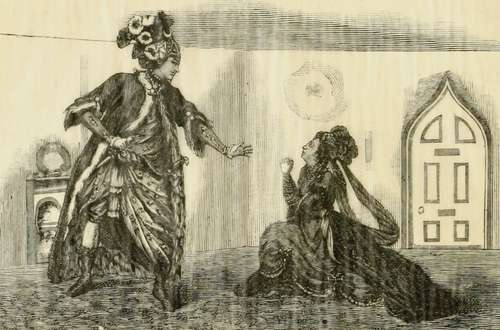
MR. AND MRS. BARRY IN "TAMERLANE."
SPRANGER AND ANNE BARRY.
Outside the five-and-thirty years of Barry's professional
life, little is known of him. As of Betterton,
it may be said, he laboured, loved, suffered losses,
and died. It is the sum of many a man's biography.
Spranger's professional career is traced in preceding
pages; but I may add to it, that Dublin is to this
day, and with reason, proud of Spranger Barry, and of
Margaret Woffington; for mere human beauty they
have never been surpassed; for talents and for genius,
with respect to their profession, they have not often
been equalled. Spranger of the silver tongue, was
the only actor who ever shook Garrick on his throne;
but lacking the fulness of the perfection of Garrick,
Barry only shook him for an instant; he never dethroned
him. He is remembered as the vanquished
wrestler is remembered, who has wrestled his best,
given a heavy fall or two, has succumbed in the last
grapple, and is carried from the arena on loving arms,
amid the acclamations of the spectators, and with the
respect of his conqueror.
In the Irish silversmith's accomplished son, born in
1719, there was very good blood, with some of the
disadvantages attached to that possession. Of fine
personal appearance and bearing, an aristocratic expression,
and a voice that might win a bird from the
nest, Spranger Barry had expensive and too magnificent
tastes. He was a gentleman; but he lived as
though he were the lord of countless thousands, and
with an income on which an earl might have existed
becomingly, with moderate prudence, Spranger Barry
died poor.
From the very first, Barry took foremost ground;
and Mrs. Delaney may well expatiate on the delight
of seeing Garrick, Barry, and Sheridan together in
one piece. Such a triad as those three were, when
young, in the very brightest of their powers, and
achieving triumphs which made their hearts beat to
accomplish something higher still, perhaps, never
rendered a stage illustrious.
From 1747 to 1758, Barry was, in some few characters,
the best actor on our stage. After the above
period, came the brilliant but ruinous Irish speculation
with Woodward. During the time of that disastrous
Dublin management, Barry's powers were
sometimes seriously affected. He has been depicted
as reckless; but it is evident that anxieties were
forced upon him, and a proud man liable to be seized
by sheriffs' officers, ere he could rise from simulated
death upon the stage, was not to be comforted by
the readiness of his subordinates to murder the
bailiffs. Mrs. Delaney had been enraptured with
him in his earliest years; but she found a change in
him even as early as 1759. The gossiping lady thus
exhibits to us the interior of Crow Street, one night
in February, of the year just named, when, despite
the lady's opinion, the handsome and manly fellow
was not to be equalled in the expression of grief, of
pity, or of love.
"Now what do you think? Mrs. Delaney with
ditto company went to the Mourning Bride to see
the new playhouse; and Mrs. Fitzhenry performed
the part of Zara, which I think she does incomparably.
The house is very handsome, and well
lighted; and there I saw Lady Kildare and her two
blooming sisters, Lady Louisa Conolly (the bride)
and Lady Sarah Lennox,"—(the latter lady reckoned
among the first loves of George III.),—"who I
think the prettiest of the two. Lord Mornington"
(afterwards father of the Duke of Wellington) "was
at the play, and looked as solemn as one should
suppose the young lady he is engaged to" (Miss
Hill) "would have done!... The play, on the
whole, was tolerably acted, though I don't like their
celebrated Mr. Barry; he is tall and ungainly, and
does not speak sensibly nor look his part well; he
was Osmyn. Almyra was acted by a very pretty
woman, who, I think, might be made a very good
actress. Her name is Dancer."
Barry did make her an excellent actress, and his
wife to boot. Nevertheless, the Dublin speculation
failed; and I find something characteristic of it
among the properties enumerated in the inventory of
articles made over by Barry to his successor, Ryder.
For instance:—"Chambers, with holes in them;"
"House, very bad;" "One stile, broke;" "Battlements,
torn;" "Garden wall, very bad;" "Waterfall,
in the Dargle, very bad." The same definition
is applied to much more property; with "woods,
greatly damaged;" "clouds, little worth;" "wings,
with holes, in the canvas;" or, "in bad order."
"Mill, torn;" "elephant, very bad;" and Barry's
famous "Alexander's car," is catalogued as "some
of it wanting." Indeed, the only property in good
order, comprised eighty-three thunderbolts!
Of Barry's wardrobe, he seems to have parted only
with the "bonnet, bow, and quiver, for Douglas;"
but Mrs. Barry's was left in Crow Street. It consisted
of a black velvet dress and train; nine silk
and satin dresses, of various hues, all trained;
numerous other dresses, of inferior material; and
"a pair of shepherd's breeches," which Boaden
thinks were designed "for the dear woman's own
Rosalind, no doubt."
The only known portraits of Barry represent him
as Timon and Macheath. They were taken before he
entered upon his last ten years, in London;—years of
gradual, noble, but irresistible decay. Like Betterton,
Barry suffered excruciatingly from attacks of gout;
but, like Betterton, and John Kemble in this respect
resembled them both,—he performed in defiance of
physical pain: mind triumphing over matter.
On the 8th of October 1776, he played Jaffier to
the Pierre of Aikin, and the Belvidera of his wife.
He was then only fifty-seven years of age; but there
was a wreck of all his qualities,—save indomitable
will. The noble vessel only existed in ruins, but
it presented a majestic spectacle still. Barry, on
the stage, was almost as effective as he had ever
been; but, off the charmed ground, he succumbed to
infirmity and lay insensible, or struggling, or waiting
mournfully for renewal of strength between the acts.
He continued ill for many weeks, during which his
chief characters passed into the hands of Lewis, the
great-grandson of Harley's secretary, Erasmus Lewis,
but himself the son of a London linendraper. Lewis,
who had now been three years on the London stage,
played Hamlet, and Norval, Chamont, Mirabel, Young
Bevil, and Lord Townley; but on the 28th of November,
Barry roused himself, as if unwilling that the
young actor, who had excelled Mossop in Dublin,
should overcome, in London, the player who had
competed, not always vainly, with Garrick. On that
night, as I have already recorded, he played Evander
to his wife's Euphrasia, in the "Grecian Daughter;"
but he never played or spoke on the stage again.
On January 10th, 1777, he died, to the great regret
of a world of friends and admirers, and to the
awakening of much poetry of various quality. One
of the anonymous sons of the Muse, in a quarto
poem, remarks:—
"Scarcely recovered from the stroke severe,
When Garrick fled from our admiring eyes,
Resolv'd no more the Drama's sons to cheer,
To make that stroke more fatal,—Barry dies.
He dies: and with him sense and taste retreat;
For, who can now conceive the Poet's fire?
Express the just? the natural? the great?
The fervid transport? or the soft desire?"
The poet then fancies gathering around the player's
tomb, led thither by the Tragic Muse,—the Moor,
"with unrivall'd grace;" ill-fated Antony; injured
Theseus; feeble Lusignan; woe-stricken Evander;
heart-bleeding Jaffier; and, chief of all, Romeo, with
"melting tears," "voice of love and soothing eloquence."
Thalia, too, brings in Bevil and Townley;—
"And oh! farewell, she cries, my graceful son!!"
Graceful, but pathetic as he was graceful. This
was especially the case when, in his younger days, he
played with Mrs. Cibber,—Castalio to Monimia,—at
which a comic actor, once looking on, burst into tears,
and was foolish enough to be ashamed of it. No two
(so critics thought) played lover and mistress, wife and
husband, as they did. Mrs. Cibber, said these critics,
who forgot her Beatrice to Garrick's Benedick, could,
with equal, though different effect, be only the daughter
or sister to Garrick;—Cordelia to Garrick's Lear, but
a Juliet to Barry's Borneo, a Belvidera to his Jaffier.
When Mrs. Bellamy acted with him, the effect was less
complete. Colley Cibber was in the house on the night
of his first appearance as Othello—did what he was not
accustomed to do,—applaud loudly; and is said to have
preferred Barry, in this character, to either Betterton
or Booth. In Orestes, Barry was so incomparable,
that Garrick never attempted the part in London. His
Alexander lost all its bombast, in his hands, and gained
a healthy vigour; while, says Davies, "he charmed the
ladies repeatedly, by the soft melody of his love complaints,
and the noble ardour of his courtship." The
grace of his exit and entrance was all his own; though
he took lessons in dancing, from Desnoyers, to please
the Prince of Wales.
Barry was a well-informed man, had great conversational
powers, and told an Irish story with an effect
which was only equalled by that with which he acted
Sir Callaghan O'Brallaghan. In that accomplishment
and this character, Garrick owned that Barry was not
to be approached; but, said the former, "I can beat
Barry's head off in telling all stories, but Irish ones."
It was in pathos on the stage, not in humour off
it, that Barry excelled. "All exquisitely tender or
touching writing," says an anonymous contemporary,
"came mended from his mouth. There was a pathos,
a sweetness, a delicacy, in his utterance, which stole
upon the mind, and forced conviction on the memory.
Every sentiment of honour and virtue, recommended
to the ear by the language of the author, were rivetted
to the heart by the utterance of Barry." Excessive
sensibility conquered his powers. His heart overcame
his head; but Garrick never forgot himself in his
character. Barry felt all he uttered, before he made
his audience feel; but Garrick made his audience
feel, and was not overcome by his own emotions.
Churchill describes the lofty and admired Barry as
possessing a voice too sweet and soft for rage, and as
going wrong through too much pains to err. The
malignant bard alludes to the "well-applauded tenderness"
of his Lear; to the march of his speeches, line
by line; to his preventing surprise by preparatory
efforts; and to his artificial style, manifest alike in his
passions as in his utterance. This dark portrait was
limned with the idea that it would please Garrick,
whom it could not please. The two actors respected
each other. "You have already," writes Barry, in
1746, to Garrick, "made me happy by your friendship.
It shall be the business and pleasure of my
life to endeavour to deserve it; and I would willingly
make it the basis of my future fortune." This feeling
never waned. Above a score of years later, Barry
writes: "I hear you are displeased with me, which I
beg leave to assure you, I shall feel much more than
all the distresses and disappointments that have
happened to me."
Previous to the earlier date Lord Chesterfield had
said of Barry, "He is so handsome, he will not be
long on the stage; some rich widow will carry him
off." At the later date, Barry was in London, with
the widow, but not a rich widow, he had brought
from Dublin. The only good result of his otherwise
unlucky sojourn there as theatrical manager, was in
his second marriage, with Mrs. Dancer. The lady
was admirably trained by him; and when Garrick
saw Mrs. Barry play the Irish Widow, in his own
farce, after superbly enacting a tragic part, he could
not help exclaiming, sincerely as he admired Mrs.
Cibber, Pritchard, and Yates—"She is the heroine
of heroines!"
In his later days, when infirmity pressed him painfully,
Barry occasionally lost his temper for a moment.
Once this occurred when Miss Pope's benefit interfered
with that of Mrs. Barry, and he wrote an angry
letter to Garrick, the ill-temper in which is indicated
by Garrick's indorsement: "—from Barry; he calls
Miss Pope 'trumpery!'"
Lacy told Davies that the Barrys' salary was £1500
a year (but the cost of their dresses fell heavily on
them). "Mr. Barry is only paid when he plays," said
Garrick to Miss Pope; and this explains Barry's own
remark, "I have lost £48 by the death of the Princess
Louisa."
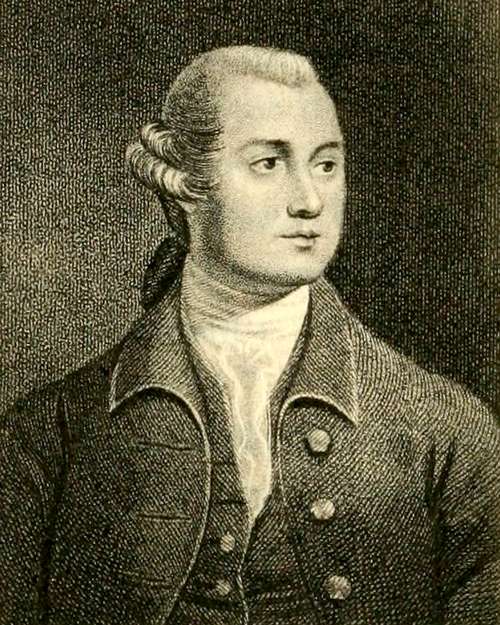
In costume and in stage diet, Barry was the reverse
of Mossop. Near ninety years ago, the former played
Othello in a gold-laced scarlet suit, small cocked hat,
and knee-breeches, with silk stockings, which then
displayed his gouty legs. His wife, as Desdemona,
wore, more correctly, a fascinating Italian costume,
and looked as captivating as the decaying actor
looked grotesque. Barry did not vary his diet according
to the part he had to play. It was his
invariable custom, after acting, to sup on boiled
fowl. His house, first in Broad Street, then in Norfolk,
and lastly in Cecil Street, was visited by the
good among the great. Such was Henry Pelham,
himself an inelegant but frank speaker in Parliament,
who had a great admiration for Barry's graceful elocution.
The actor was in possession of all his powers,
and his voice was at its sweetest, when he had this
honest statesman for friend. Henry Pelham died in
1754, when Barry and Miss Nossiter were playing
Romeo and Juliet, with the relish of real lovers.
Long before that, however, player and minister had
been friends, but it was the player, the Mark Antony,
of the stage, whose vain-glory made wreck of
their friendship. Pelham invited himself to sup with
Barry, and the actor treated his guest as one prince
might another. He invariably did the honours of
his table with great elegance; but on this occasion
there was a magnificent ostentation which offended
Pelham. "I could not have given a more splendid
supper myself," he remarked; and he would never
consent to be Barry's guest again.
Of the nineteen characters, of which he was the
original actor, there stands out, more celebrated than
the rest, Mahomet, in Johnson's "Irene;" Young
Norval, in London (in the white puckered satin
suit); and Evander, in the "Grecian Daughter."
The last was a masterpiece of impersonation, and
Barry drew tears as copiously in this part as ever his
great rival did in King Lear, in which, by the way,
Garrick's too frequent use of his white pocket-handkerchief
was looked upon by the critics as bathos,
with respect to the act; and an anachronism, with
regard to the article!
"Were interred, in a private manner, in the cloysters,
Westminster, the remains of Spranger Barry,
late of Covent Garden Theatre." Such is the simple
farewell, a week after his death, of the public papers,
to young Douglas, old Evander, the silver-toned
actor. Macklin was one of the funeral procession
from Cecil Street to the cloisters. Looking into the
grave, he murmured, "Poor Spranger!" and when
some one would fain have led the old man away, he
said mournfully, "Sir, I am at my rehearsal. Do not
disturb my reverie!"[117]
Mrs. Barry survived her great husband nearly a
quarter of a century. Although that great husband
did not found a school of acting, he had his imitators.
A Barry school required a manly beauty, and
an exquisitely-toned voice, such as fall to the lot of
few actors. Nevertheless, in 1788, a successor
was announced in the person of an Irish player,
Middleton, whose real name was Magann. He had
abandoned the medical profession for the stage, some
obstacles to his reaching which had actually rendered
him partially and temporarily insane. He had fine
powers of elocution, and in Romeo and Othello
reminded the old friends of Barry—perhaps painfully—of
their lost favourite. The imitation was, no
doubt, strong; but it was stronger off the stage than
on; for, with 30s. a week, Middleton strove to live
in Barry's sumptuous style. Thereby, he soon ceased
to live at all, ending a brief career in abject misery,
and leaving his body to be buried by the charity of
his fellow-players.
Mrs. Barry was sufficiently recovered from the
grief of losing her husband, to be able to play Viola,
for her benefit, two months after his decease. When
she resumed her great part of Lady Randolph, she
spoke a few lines, written by Garrick, in memory of
the first and the most elegant and perfect of young
Norvals. In those lines Barry is thus alluded to:—
"Of the lov'd pilot of my life bereft,
Save your protection, not a hope is left.
Without that peace your kindness can impart,
Nothing can calm this sorrow-beaten heart.
Urged by my duty, I have ventur'd here;
But how for Douglas can I shed the tear?
When real griefs the burden'd bosom press,
Can it raise sighs feign'd sorrows to express?
In vain will art, from nature, help implore,
When nature for herself exhausts her store.
The tree cut down on which she clung and grew,
Behold, the propless woodbine bends to you;
Your soft'ning pow'r will spread protection round;
And, though she droops, may raise her from the ground."
I will not divide the sketch of the story of Mrs.
Spranger Barry from that of the greatest and most
worthy of her three husbands. Her father was a gay,
well-to-do, but extravagant apothecary in Bath, whose
daughter, Miss Street, was one of the belles there,
celebrated for her graceful figure, expressive beauty,
and rich auburn hair. The handsome and clever
girl was jilted by a lover, whose affection for the
apothecary's daughter cooled, on a sudden accession
of fortune occurring to himself. Poor Ariadne went
for solace to the North, where, after some while, she
found a Bacchus in a hot-headed, jealous, but seductive
actor, named Dancer, who married her, and
placed her, nothing loath, upon the stage.
Her friends were scandalised, and her widowed
mother bequeathed her a trifling annuity, only on
condition of her ceasing to be an actress. Mrs.
Dancer declined; and the honest man to whom the
annuity was thereby forfeited, surrendered the whole
to her, and bade her prosper!
Prosperity, however, only came after long study
and severe labour, and many trials and vexations.
When Barry assumed the management of the Dublin
Theatre, he found Mrs. Dancer a most promising
actress, and her lord the most jealous husband in
Ireland. Youth, beauty, genius, were the endowments
she had brought to that husband; and he, on
his death, left her in full possession of all she had
brought with her, and nothing more. But these and
a liberal salary were charms that attracted many
admirers. An Irish earl was not ashamed, indeed,
to woo the young, fair, and accomplished creature,
with too free a gallantry; but all the earls in the
peerage had no chance against the manly beauty
and the silver tone of Spranger Barry.
Hand-in-hand with her new husband, she came to
London. Garrick sat in the pit, at Foote's theatre,
to witness her début. He approved; and forthwith
she took a place at the head of her profession,—equal
almost with her great namesake of the previous
century, not inferior to Mrs. Pritchard or Mrs.
Cibber, superior to Mrs. Yates, and not to be excelled
till, in the evening of her days, Sarah Siddons came,
to wish her gone, and to speed the going.
Mrs. Barry was otherwise remarkable, she had "a
modest gaiety in her manners and address;" and
though in Belvidera, Lady Randolph, Rutland, Euphrasia,
Monimia, and Desdemona, she defied rivalry,
she really preferred to act Lady Townley, Beatrice,
the Widow Brady, Rosalind, and Biddy Tipkin. She
acted tragedy, to gratify the house; comedy, to please
herself; and she had a supreme indifference for the
patronage of Ladies of Quality if she could only win
the plaudits of the public at large. In the "Jubilee,"
however, she represented the Tragic muse.
Two years after Barry's death, his widow met with
and married a scampish young Irish barrister, named
Crawford, who spent her money, broke her heart,
and was the cause of her theatrical wardrobe being
seized by a Welsh landlord, for debt. The General
who married the widow of Napoleon treated her
with respect, but young Crawford only regarded the
middle-aged but handsome and accomplished widow
of Spranger Barry as a means whereby he might live.
There is something supremely melancholy in the
story of Mrs. Barry, after this time. She raised her
young husband to such efficiency that in London, he
played Pierre, to her Belvidera; and the bad fellow
might have respected a woman who did this, and
could also earn £1100 in sixteen nights of acting,
in Ireland. In the latter country, whither Mrs.
Crawford, as I regret to call her, went, after playing
Zara, in 1781, thereby leaving a long-desired opening
to Mrs. Siddons,—Mr. Crawford acquired a reputation
for shabbiness. On his benefit night, in a
supper scene, he provided no refreshments on the
table, for the actors seated round it, and this omission
produced a scene of unrehearsed effects,—of exposure
of Crawford's meanness, on the part of the players,
and indignation against him on the part of the
audience. When he became lessee, after Ryder, his
own unhappy wife could not trust him, and often
refused to go on, till Crawford had collected the
amount of her salary from the doorkeepers,—if they
had taken as much. He was reduced to such straits
that one night, on the desertion of his unpaid band, he
himself, and alone, played the violin in the orchestra,
dressed as he was for Othello, which he acted on the
stage. The Irish audience enjoyed the fun, and even
Mrs. Crawford was so attached to him, that when
Jephson's "Count of Narbonne" was first produced,
in which, from her age, she should have played the
Countess, she chose to act Adelaide, that her husband
might still make love to her, as Theodore!
All that she earned, Crawford squandered. Fortunately,
the small annuity left by her mother was
secured to her, and this Crawford could not touch.
What became of this unworthy Irishman I cannot
say; but he helped to spoil Mrs. Crawford, as an
actress. Her health and spirits failed, and her acting
grew comparatively languid. The appearance of
Mrs. Siddons, in the best of her years, strength, beauty,
and ability, quickened the jealous pulses of the older
actress's heart, and she once more played Lady Randolph,
with such effect, that the Morning Chronicle
asserted, no competitor could achieve a like triumph.
The younger actress at last outshone Mrs. Crawford,
whose very benefits became unprofitable. Her last
appearance on the stage was at Covent Garden, on
the 16th of April 1798, in Lady Randolph, a character
which Mrs. Siddons did not play that season,—her
Mrs. Haller being the peculiar triumph of that
glorious year.
Mrs. Barry, the original Euphrasia, died in 1801,
having reaped honour enough to enable her to be free
from envy of others, and having means sufficient to
render her closing days void of anxiety. The Grecian
Daughter, the Widow Brady, and Edwina, in Hannah
More's "Percy," were the best of her original characters;
of her other characters, Lady Randolph is
the most intimately connected with her name. As
between her and Mrs. Siddons, the judgment seems
well-founded which declares that Mrs. Crawford was
inferior to Mrs. Siddons in the terrific, but superior in
the pathetic. At Mrs. Crawford's "Is he alive?" in
Lady Randolph, Bannister had seen half the pit start to
their feet. Mrs. Siddons was but a "demi-goddess," as
Walpole has it, in comedy, where Mrs. Barry was often
inimitable. Walpole saw both actresses in "Percy,"
and he most admired Mrs. Siddon's passionate scenes.
When, years before, he saw Mrs. Barry in the same
play, his mind was pre-occupied with politics, and he
thought less of the actress than of passing events, of
which he was reminded by passages in the play.
Mrs. Crawford, to take leave of her in her last
name, was no admirer of the great actress by whom
she was displaced; and albeit somewhat smartly, the
old lady did not ill distinguish between the school to
which she belonged and that founded by her comparatively
young rival. "The Garrick school," she
said, "was all rapidity and passion; while the Kemble
school is so full of paw and pause that, at first, the
performers, thinking their new competitors had either
lost their cues, or forgotten their parts, used frequently
to prompt them."
As we associate the name of Barry with that of
Garrick, so do we that of Mossop with Spranger
Barry. Mossop, whose career on the stage commenced
in 1749, with Zanga,—type of characters in
which alone he excelled,—died in 1773, at the age of
forty-five. He was the ill-fated son of an Irish clergyman,
and he was always on the point of becoming a
great actor, but never accomplishing that end. His
syllables fell from him like minute-guns, even in
or-din-a-ry con-ver-sa-tion, and the nickname of the
"tea-pot actor," referred to his favourite attitude with
one arm on his hip and the other extended. In London,
an evanescent success in Richard and similar
characters, almost made of him a rival of Garrick.
In Dublin, he ruined Barry by his opposing management,
which also brought down ruin on himself. Of
this "monster of perfection," or the "pragmatical
puppy," as he was variously called, we learn something
from the Dublin Journal of May 8th, 1772,
which says, "A few days ago, the celebrated tragedian,
Mossop, moved to his new apartments in the
Rules of the Fleet." When Mossop repaired to
London his powers had failed. He could not obtain
"first business," declined to accept "second," and
proudly died in poverty, at Chelsea, leaving for all
fortune one poor penny.[118]
Garrick offered to bury him, but a kinsman who
would have nothing to say to the actor, claimed the
satisfaction of consigning him to the grave, whither,
after all, his brother actors carried him. So ended
the promising player who combined gastronomy with
his study of the drama, and ordered his dinner
according to the part he had to act; sausages and
Zanga; rump-steaks and Richard; pork-chops and
Pierre; veal-cutlets and Barbarossa; and so forth!
The antagonism of the two Irish actors seems to
have wearied the Dublin people, who, at last,
"Did not care a toss-up,
If Mossop beat Barry, or Barry beat Mossop."
Of some other actors who left the stage about the
same period I will speak in the next chapter.
CHAPTER XXI. — FOOTNOTES:
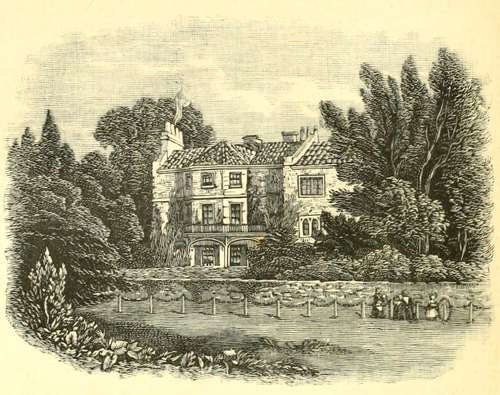
KITTY CLIVE'S HOUSE, TWICKENHAM.
KITTY CLIVE, WOODWARD, AND SHUTER.
As Mr. Wilks passes along, to or from rehearsal,
there are two young girls of about sixteen years of
age who gaze at him admiringly. Day after day the
graceful actor remarks this more graceful couple, the
name of the brighter of whom is Raftor. If not
Irish, she is of Irish parentage, and of good family.
Her father, a native of Kilkenny, had served King
James, and got ruin for his wages. When Catherine
Raftor was born, in 1711, she was born into a poor
household, and received as poor an education as many
countesses, her contemporaries; and here we come
upon her, some sixteen years afterwards, watching
Sir Harry Wildair entering or issuing from that
gate of Elysium, the stage-door of the Theatre Royal,
Drury Lane. If she knew but the "Sesame!" that
would give admission to her she would be as happy
as a houri!
She had the potent magic in her voice which
won access for her to the elder Cibber, who awarded
the young thing fifteen shillings a week,[119] and then
intrusted to her the little part of Ismenes in
"Mithridates." In such solemn guise commenced
the career of the very queen of hoydens and chambermaids.
As for her companion in the occupation of
gazing at Wilks, in the street,—a Miss Johnson, she
was appropriated to himself by Theophilus Cibber,
who made of her his first wife; but she failed to
attain the celebrity of Miss Raftor, who charmed
audiences by the magic of her voice, and authors
by the earnestness with which she strove to realise
their ideas. She had achieved a great reputation as
a comic actress, when, in 1732,[120] Miss Raftor married
Mr. Clive, the brother of Mr. Baron Clive. In the
following year[121] Fielding thus writes a paragraph of
her biography, in his manly dedication to her of the
"Intriguing Chambermaid," in which she played
Lettice: "As great a favourite as you are at present
with the audience, you would be much more so were
they acquainted with your private character, could
they see you laying out great part of the profits
which arise to you from entertaining them so well,
in the support of an aged father; did they see you,
who can charm them on the stage with personating
the foolish and vicious characters of your sex, acting
in real life the part of the best wife, the best
daughter, the best sister, and the best friend."
"Kitty Clive," however, and her not very courteous
husband, could not keep household together, and they
separated. The lady was a little vivacious, and stood
undauntedly persistent for her rights, whether at
home or on the stage—against her husband, or
against Mrs. Cibber, or Edward Shuter, or Garrick
himself, who stood in more awe of her than she of
him. She alone dared take a liberty with him, and,
by a witty word well applied, to so incline him to
irrepressible laughter as to render speaking impossible.
None other dared so interfere with Roscius.
But it was all done out of good nature, in which
Mrs. Clive was steeped to the lips, and of which she
was lavish even to young actresses who came, in her
later days, to dispute the succession to her parts.
To the most formidable and triumphant of these,
good Miss Pope, she gave excellent counsel, warning,
and encouragement, for which "Pope" never ceased
to be grateful.
Mrs. Cibber and Mrs. Clive, as Polly and Lucy,
in the "Beggar's Opera," must have exhibited a
matchless combination of singing and acting. Mrs.
Clive was as ambitious as Mrs. Cibber, and would
fain have played, like her, leading parts with Garrick.
Her most successful attempt in this way was her
Bizarre to his Duretete, in the "Inconstant." One
effect of her careful, earnest, but perfectly natural
and apparently spontaneous acting was to put every
other player on his mettle. That done, Mrs. Clive
took care the victory should not be lost to her for
want of pains to gaily secure it. She was a capital
mimic, particularly of the Italian signoras, whom she
did not call by nice names. For a town languishing
for the return of Cuzzoni, she had the most unqualified
contempt. She herself was inimitable;
she wrung from Johnson the rarest and most unqualified
praise; and over her audiences she ruled
supremely; they felt with her, smiled with her,
sneered with her, giggled, tossed their heads, and
laughed aloud with her. She was the one true
Comic Genius, and none could withstand her.
She had that power of identification which belongs
only to the great intellectual players. She was a born
buxom, roguish chambermaid, fierce virago, chuckling
hoyden, brazen romp, stolid country girl, affected fine
lady, and thoroughly natural old woman of whatever
condition in life. From Phillida, in "Love in a
Riddle," her first original character, to Mrs. Winnifred,
in the "School for Rakes," her last, with forty
years of toil and pleasure between them, she identified
herself with all. But, in parts like Portia and Zara,
which Mrs. Clive essayed, she fell below their requirements,
though I do not know how the most beautifully
expressive voice in the world could have been
"awkwardly dissonant" in the latter part. Her
Portia was too flippant, and in the trial scene it was
her custom to mimic the most celebrated lawyer of
the day. The laughter raised thereby was uncontrollable,
but it was as illegitimately awakened as
Dogget's when he played Shylock as a low comedy
part.
After forty years' service Mrs. Clive took leave of
the stage, April 24, 1769, in Flora, in the "Wonder,"
and the Fine Lady in "Lethe." Garrick played Don
Felix; King, Lissardo; and Mrs. Barry, Violante; a
grand cast in which, we are told, Mrs. Clive made
Flora, in the estimation of the audience, equal to
Felix and Violante. Drury Lane, had it been
capacious enough, would have held twice the number
that gained admittance. From these she took leave,
in an epilogue, weak and in bad taste, written by
her friend Walpole, who affected to despise the
writers of such addresses, and, in this case, did not
equal those whom he despised.
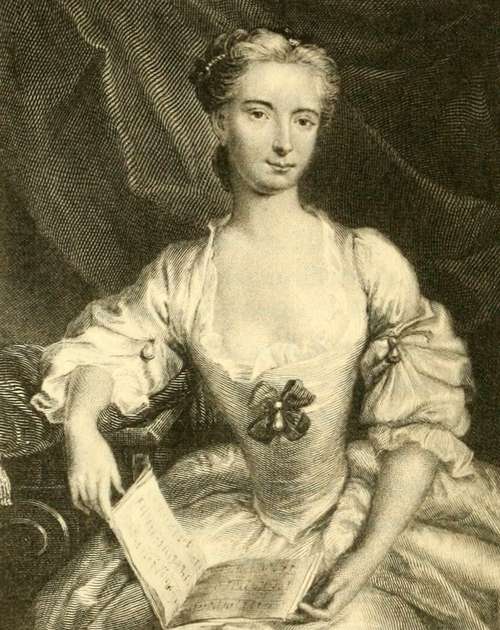
Mrs. Clive has the reputation of being the authoress
of two or three insignificant farces, produced at her
benefits, to exhibit some peculiar talent of her own.
They had no other merit. Such was her theatrical,
let us now accompany her to her private, career. The
last editor of Walpole's Letters states, that to a youth
of folly succeeded an old age of cards. This statement
is mostly gratuitous. Isaac Reed says: "Notwithstanding
the temptations to which a theatre is
sometimes apt to expose young persons of the female
sex, and the too great readiness of the public to
give way to unkind suppositions in regard to them,
calumny itself has never seemed to aim the slightest
arrow at her fame."
She was quick of temper, especially if David
attempted to fine her for absence from rehearsals; and
no wonder, since for one hundred and eighty nights'
performance this charming actress received but £300!
but, as she said, "I have always had good health, and
have ever been above subterfuge." When about to
retire she wrote to Garrick, with some obliviousness
as to dates:—"What signifies 52? They had rather
see the Garrick and the Clive at 104 than any of the
moderns. The ancients, you know, have always been
admired. I do assure you I am at present in such
health and spirits that, when I recollect I am an old
woman, I am astonished."
In her retirement Mrs. Clive passed many happy
years in the house which Walpole gave up as a home
for herself and brother, next to his own at Strawberry,
and which he playfully called "Clive-den." A green
lane, which he cut for her use between the house and
the common, he proposed to call Drury Lane. Here,
at Cliveden, the ex-actress gave exquisite little
suppers after pleasant little card parties, at which, in
Walpole's phrase, she made miraculous draughts of
fishes. Men and women of "quality" and good
character, married and unmarried—actors, authors,
artists, and clergymen—met here; where the brother
of the hostess, a poor ex-actor, ill-favoured and awkward,
told capital stories, and found the company in
laughter and Walpole in flattery.
Of an evening, in summer-time, trim Horace and
portly Clive might be seen walking in the meadows
together; or Walpole and a brilliant company, gossiping,
laughing, flirting, philandering, might be noted
on their way across the grass to Strawberry, after a
gay time of it at "Little Strawberry Hill." Not always
without mishap, as Walpole himself has recorded in
his narrative of his perilous passing of the stile with
Miss Rich; and not invariably in the very sunniest of
humours, for Miss Pope had seen Horace "gloomy
of temper and dryly sarcastic of speech." The place
was, perhaps, at its pleasantest, when Walpole, Mrs.
Clive, and her brother, sat together in the garden, and
conversed playfully of old dramatic glories. She was
so joyous, that Lady Townshend said—her face rose
on Strawberry and made it sultry. And Walpole
himself remarked, in 1766, "Strawberry is in perfection;
the verdure has all the bloom of spring; the
orange trees are loaded with blossoms; the gallery is
all sun and gold; and Mrs. Clive all sun and vermillion."
When Hounslow powder mills blew up,
Walpole described the terrific power of the explosion,
by remarking, that it "almost shook Mrs. Clive!"
Only the death of the last Earl of Radnor, of the
Robartes line, made her almost look sad. The earl
left her £50 as a memorial of his respect; and what
with the heat of the summer of 1757, the unexpected
legacy, and her assumption of respectful grief, she
made up one of the drollest faces imaginable. One
of her dear delights was to play quadrille with George
Montagu, from dinner to supper, and then to sing
Purcell, from supper to breakfast time. She left the
place, even for short intervals, with reluctance; but
her brilliant face was seen for a whole day in Palace
Yard, where she sat to see the coronation procession
of George III., with her great friends around her—Lady
Hertford, Lady Anne Conway, Lady Hervey,
Lady Townshend, Miss Hotham, Mr. Chute, and also
her brother. Her only trials were when the tax-gatherer
ran off, and she was compelled to pay her
rates twice; or when the parish refused to mend her
ways, as she said; or her house was broken into by
burglars; or when she was robbed in her own lane
by footpads. "Have you not heard," she wrote to
Garrick, in June 1776, "of your poor Pivy? I have
been rob'd and murder'd coming from Kingston.
Jimey" (her brother) "and I in a post chey, at half-past
nine, just by Teddington church, was stopt. I
only lost a little silver and my senses; for one of
them came into the carriage with a great horse pistol,
to search for my watch, but I had it not with me."
And then Garrick and other actors, with Governor
Johnstone and his wife, met at Little Strawberry at
dinner, and laughed over past perils.
In 1784 she came up to London to see Mrs.
Siddons act. Mrs. Clive was born in the lifetime of
Elizabeth Barry, who had acted before Charles II.;
she had seen Mrs. Porter, Mrs. Oldfield, Mrs. Cibber,
Mrs. Pritchard, Mrs. Yates, and Anne Barry; and
finally, she saw Mrs. Siddons. Mrs. Clive listened
to the new actress with profound attention; and on
being asked, at the conclusion of the performance,
what she thought of it: "Think!" said the vivacious
old lady, in her ready way; "I think it's all truth
and daylight!"
In the December of the following year, the long
career of this erst comic muse came to a close.
Walpole tells it briefly, unaffectedly and well. "It
did not much surprise me," he says; "and the
manner comforts me. I had played at cards with
her, at Mrs. Gostling's, three nights before I came to
town, and found her extremely confused, and not
knowing what she did; indeed I had seen something
of this sort before, and had found her much broken
this autumn. It seems, that the day after I saw her,
she went to General Lister's burial, and had got
cold, and had been ill for two or three days. On the
Wednesday morning she rose to have her bed made;
and while sitting on the bed, with her maid by her,
sank down at once, and died without a pang or a
groan." So departed the actress, of whom Johnson
said, that she had more true humour than any other
he had ever seen. She originated nearly fourscore
characters; among others, Nell, in the latter "Devil
to Pay;" Lappet ("Miser"); Edging[122] ("Careless
Husband"); half a dozen Kittys; but chief of all,
the Kitty of "High Life Below Stairs;" Muslin
("Way to Keep Him"); and Mrs. Heidelberg, in
the "Clandestine Marriage."
Harry Woodward: to think of him, is to think
of Captain Bobadil,—in which he never had equal,—and
of Harlequin, in which he was second only to
Rich. To remember Harry Woodward, is to remember
the original French Cook, in Dodsley's "Sir
John Cockle," wherein Woodward turned to good
account the French he had learned at Merchant
Tailors' school. He was also the first Beau in
"Lethe;" and his Flash in "Miss in her Teens,"
his Jack Meggot in the "Suspicious Husband," his
Dick in the "Apprentice," his Block in the "Reprisal,"
his Lofty in the "Good Natured Man," his
Captain Ironsides in the "Brothers," and his Captain
Absolute in the "Rivals," were all original and
brilliant creations, in acting which, the best of his
many brightly-endowed successors lacked something
possessed by him, whose Slender and Petruchio are
described as being perfect pictures of simplicity and
manliness.
Look at him, in his boyhood;—he is a tallow
chandler's son, rien que ça! living close by the
Anchor brewery, in Southwark;—Mr. Child's
brewery, whose daughter married with his clerk,
Halsey; and then it was Halsey's brewery; and
Halsey's only daughter married Lord Cobham; and
from this pair, the brewery was bought by Halsey's
manager and nephew, Ralph Thrale, on the death
of whose son, Henry, it passed by purchase to his
chief clerks, Barclay and Perkins. The brewery,
now, is no more like what it was in Woodward's
days than Drury Lane theatre is like the Curtain,
the Fortune, or the Globe. As Woodward played
beneath the Anchor gateway, there was probably little
uneasiness in his mind at the idea of his helping and
succeeding his sire in candle making; but when Woodward
became a pupil at Merchant Tailors', I think it
may have been otherwise. How young Woodward
was ever sent thither, I cannot guess; but I conclude
that his father, "the tallow chandler," was not aware,
that among the statutes of the institution there was
one which said that, "in the schoole at noe time of the
yere, they shall use tallow candle in noe wise, but wax
candles onely." Perhaps old Woodward supplied
them to order.
I think if Woodward had never gone to Merchant
Tailors', he never would have added lustre to the
British stage. He was born about the last year of
Queen Anne's reign,[123] and was in Lawrence Pountney
when he was some ten years old. The quick lad became
a very good classical scholar, and in after years,
he used to astonish and gratify the society which he
most loved, by the aptness and beauty of his quotations;
not for effect, for Harry Woodward, look you,
was as modest as he was clever.
Well, learning to enjoy Horace, you will say, was no
specific for turning a boy into a player. Perhaps not;
but there was less satisfactory customs then prevailing
among the Mercatores Scissores. The masters treated
the boys who missed their election to St. John's, with
canary and cake, as if to teach them that drinking was
a solace for disappointment. Then the discipline was
lax, and young Merchant Tailors of the Bench were
seduced by the rather older Merchant Tailors of the
Table, to taverns, and to ordinaries, where gaming
was practised, and to the playhouse, where they learned
something new from the Vizard Masks in the pit.
Then, there was young Beckingham, the linen-draper's
son, and a Merchant Tailor of the Table, who wrote
a tragedy, "Scipio Africanus," to see which the whole
school occupied a great portion of the Lincoln's Inn
Fields' pit, and sent up applauding shouts for Quin,
who acted Scipio, as well as for their schoolfellow,
the author. These practices and the traditions of
others may have influenced a lively and thoughtless
boy, who was proud to play Peachum in the juvenile
company, who acted the "Beggar's Opera," under
the elder Rich, at Lincoln's Inn Fields. I cannot
find exactly the date when Woodward commenced
as a professional actor; but he was not more than a
mere youth. There was a boy of his name, at Goodman's
Fields, who played pantomime parts before
Harry Woodward appeared there in 1730,—commencing
then a career with Simple, in the "Merry
Wives of Windsor," which ended at Covent Garden,
on the 13th of January 1777, with Stephano, in the
"Tempest." On the 10th of April, the then new
comedy, "Know your own Mind," was acted, for his
benefit, and on that day week, the lad who used to
play under the gateway of the Anchor brewery,—to
trudge, in all weathers, over old London Bridge, to
Merchant Tailors' School, and who preferred the life
of a player to that of a candle-maker, died; and with
him, it was said, as Wildair with Wilks, Captain
Bobadil died too.
Woodward was one of the most careful dressers on
the stage; not as regards chronology, but perfection
of suit; of fitness, no one then made account. Woodward
played Mercutio in the full dress of a very fine
gentleman of Woodward's day; it was unexceptionable
as costume, though not fitting in the play.
Then, he was one of the few lucky actors who never
seemed to grow old. After nigh upon half a century
of labour, his Fitzpatrick,[124] in "News from Parnassus,"
was as young in look and buoyant in manner as the
Spruce of his earlier days. He was also among one
of the few judicious and generous actors, when in
the highest favour with the town; at which season,
he did not disdain, when it was needful, to go on as
a soldier, to deliver a message; but then he delivered
it like a soldier, and the frequenters of the joyous
rooms under and over the "Piazza," made approving
reference to that "clever little bit of Woodward's,
last night."
Woodward always found a defender in Garrick.
Foote, who abused hospitality by mimicking his host,
called Woodward a "contemptible fellow," when he
heard that the latter was about to dress Malagene so
as to look like Foote. "He cannot be contemptible,"
said Garrick, "since you are afraid of him in the very
line in which you yourself excel."
Of course, being naturally a comic actor, Woodward
had an affection for tragedy; but it was not in
him to utter a serious line with due effect. His
scamps were perfect in their cool impudence; his
modern fops shone with a brazen impertinence; his
fops of an older time glistened with an elegant
rascality; his mock heroes were stupendously but
suspiciously outrageous; his every-day simpletons,
vulgarly stolid; and his Shaksperian light characters
brimful and running over with Shaksperian spirit.
Graceful of form, his aspect was something serious
off the stage, but he no sooner passed the wing than
a ripple of funny emotion seemed to roll over his face,
and this, combined with a fine stage-voice, never
failed to place him and his audience in the happiest
sympathetic connection. "Bobadil was his great
part, in which he acquired a vast increase of reputation
and gave a striking proof of his genius;" but
there were two other characters in which Woodward
could hardly have been inferior, for it may be gathered
from Wilkinson, that in Marplot, he was everything
author or audience could wish, and that in Touchstone,
he excelled at least all his contemporaries,
and had no equal in it till Lewis came.
Woodward was at one time a good man, in the
mercantile view of the phrase, for he was a rich man.
Unfortunately, he was induced by Spranger Barry to
become partner with him in the Dublin Theatre,—in
which venture, Woodward lost all he had saved; and
Barry, too, made shipwreck of his fortune. Garrick
passed from the stage to years of repose and enjoyment.
Barry and Woodward could not quit it till,
having had more than enough of labour, Death summoned
them to a, perhaps, not unwelcome rest.
Little is known of the origin of Edward Shuter.
Small trust can be placed in the report that he was
the son of a clergyman—not because he himself was,
at one time, only a billiard-marker, or that he could
with difficulty read his parts, and had much perplexity
in even signing his own name; but because
Ned himself never boasted of it. What is certain
of him is, that he was an actor entirely of the Garrick
period, commencing his vocation as Catesby, at
Richmond, in 1744, and concluding as Falstaff, to
the Prince, in "Henry V.,"[125] of Lewis, played for his
own benefit, at Covent Garden, in May 1776.
I suppose Chapman, who directed the theatre at
Richmond, was struck by the rich humour of the billiard-marker;
but it was strange that a low comedian
should make his début in so level a part as Catesby.
He was then, however, a mere boy. In June 1746,
when he acted Osrick and third Witch in "Macbeth,"
Garrick playing Hamlet and the Thane, he was designated
"Master Shuter." Thence, to the night on
which he went home to die, after playing Falstaff,
his life was one of intense professional labour, with
much jollification, thoughtlessness, embarrassment,
gay philosophy, hard drinking, and addiction to
religion, as it was expounded by Whitfield.
He played through the entire range of a wide
comic repertory, and among the characters which he
originated are Papillion in the "Liar," Justice Woodcock,
Druggett, Abrahamides, Croaker, Old Hardcastle,
and Sir Anthony Absolute. His most daring
effort was in once attempting Shylock! There are
few comic actors who have had such command over
the muscles of the face as Shuter. He could do
what he liked with them, and vary the laughter as
he worked the muscles. Not that he depended on
grimace; this was only the ally of his humour, and
both were impulsive—as the man was by nature;
he often stirred the house with mirth by saying
something better than the author had put down for
him. Off, as on the stage, it was Shuter's characteristic
that he pleased everybody—and ruined himself.
I never pass his old lodgings in Denzil Street
without thinking kindly of the eccentric but kind-hearted
player. Some laughed at him, perhaps, for
taking to serious ways, without abandoning his old
gay paths of delight; but the former was of his
sincerity, the latter of his weakness. That he should
choose to follow Calvinistic Whitfield rather than
Arminian Wesley, does seem singular; but poor Ned
felt that if salvation depended on works, "Pilgarlick,"
as Whitfield called him, was lost; whereas
faith rescued him, and Shuter could believe. He
did something more; works he added to his faith,
though he made no account of them. Of all the
frequenters of Whitfield's Tabernacle in Tottenham
Court Road there was no more liberal giver than the
shattered, trembling, laughing, hoping, fearing, despairing—in
short, much perplexed actor and man,
who oscillated between Covent Garden stage and
the Tabernacle pulpit, and meditated over his pipe
and bottle in Drury Lane upon the infinite varieties
of life. And therewith exit, Shuter; and enter, Mr.
Foote.
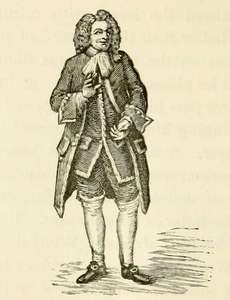
Mr. Shuter as Justice Woodcock.
CHAPTER XXII. — SUPPLEMENT TO CHAPTER XXII. — FOOTNOTES:
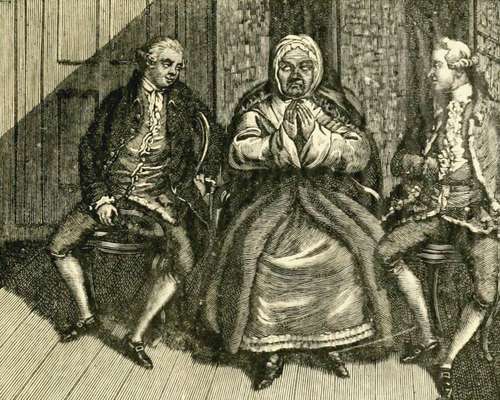
MR. FOOTE AS MRS. COLE IN "THE MINOR."
SAMUEL FOOTE.
"One Foote, a player," is Walpole's contemptuous
reference to him who was otherwise designated as the
"British Aristophanes." But, as often happens, the
player was as good a man by birth, and at least as
witty a man by nature, as he who despised him. His
father was a Cornish gentleman, and an M.P.; his
mother a daughter of Sir Edmund Goodere, Bart.,
through whom Foote called cousins with the ducal
family of Rutland. A lineal successor of this baronet
followed Mrs. Clive, as Walpole's tenant at Little
Strawberry Hill, and Horace called him "a goose."
Young Sam Foote, born at Truro, in 1720, became
a pupil at the Worcester Grammar School. His
kinsfolk on the maternal side used to invite him to
dinner on the Sundays, and the observant, but not
too grateful guest, kept the Monday school hilarious
and idle, by imitations of his hospitable relatives.
The applause he received, helped to make Foote,
ultimately, both famous and infamous.
Later in life, he entered Worcester College, Oxford,
and quitted both with the honours likely to be reaped
by so clever a student. Having made fun of the
authorities, made a fool of the provost, and made the
city turn up the eye of astonishment at his audacity
in dress, and way of living, he "retired," an undergraduate,
to his father's house. There, by successfully
mimicking a couple of justices, who were his
father's guests, he was considered likely to have an
especial call to the Bar. He entered at the Temple,
and while resident there, a catastrophe occurred in
his family. His mother had two brothers; Sir John
Goodere and Captain Samuel Goodere. The baronet
was a bachelor, and the captain in the royal navy,
being anxious to enjoy the estate, strangled his elder
brother on board his own ship, the Ruby. The
assassin was executed. Shortly after, Cooke introduced
his finely-dressed friend Foote, at a club in
Covent Garden, as "Mr. Foote, the nephew of the
gentleman who was lately hung in chains for murdering
his brother!"
Foote succeeded as ill at the Temple as at Oxford;
and his necessities, we are told, drove him on the
stage. As, when those necessities were relieved, he
preferred buying a diamond ring, or new lace for his
coat, to purchasing a pair of stockings, we may fairly
conclude that the stage was a more likely place
wherein he might succeed than the back benches of
a court of law. Indeed, he did not live to make, but
to break, fortunes. Of these he "got through"
three, and realised the motto on his carriage, "Iterum,
iterum, iterumque."
His connection with those great amateur actors, the
Delavals, was of use to him, for it afforded him practice,
and readier access to the stage, where, as a
regular player, he first appeared at the Haymarket,
on the 6th of February 1744, as Othello, "dressed
after the manner of the country." He failed; yet
"he perfectly knew what the author meant," says
Macklin. Others, again, describe his Moor as a
masterpiece of burlesque, only inferior in its extravagance
and nonsense to his Hamlet, which I do
not think he ever attempted. His Pierre and Shylock
were failures, and even his Lord Foppington,
played in his first season, indicated that Cibber was
not to depart with the hope that he was likely to
have in Foote an able successor.
Nevertheless, it is difficult to assign Foote's
position exactly. According to Davies, he was
despicable in all parts, but those he wrote for himself;
and Colman says he was jealous of every other
actor, and cared little how any dramas but his own
were represented. Wilkinson ascribes to him a
peculiar excellence.
In Dublin, 1744-45, he was well received, and
drew a few good houses; and thence came to Drury
Lane. He played the fine gentlemen,—Foppington,
Sir Novelty Fashion, Sir Courtly Nice, Sir Harry
Wildair; with Bayes, and Dick; Tinsel, and the
Younger Loveless, in Beaumont and Fletcher's
"Scornful Lady;" but he could not reach the
height of Cibber, Booth, or Wilks. He had the
defects of all three, and nothing superior to either,
but in the expression of the eye and lip. His thickset
figure, and his vulgar cast of features, he had not
yet turned to purpose. He was conscious of a latent
strength, but knew not where it lay. He had failed
in tragedy, and was pronounced unfit for comedy;
and he asked, almost despairingly, "What the deuce
then am I fit for?" As we find him the next
three years, 1747-49, at the Haymarket, giving his
"Diversions of the Morning," his "Tea," his
"Chocolate," and his "Auction of Pictures," it is
clear that he soon discovered where his fitness lay.
At the outset, he combined the regular drama with
his "Entertainment," Shuter, Lee, and Mrs. Hallam
being with him. The old wooden house being unlicensed,
Foote got into difficulties, for a time, but
he surmounted them by perseverance. He drew
the town, morning after morning, and then night
after night, with imitations of the actors at other
houses, of public characters, and even of members of
private clubs. Some of the actors retaliated, Woodward
particularly. Their only strong point was that
Foote, in striving to enrich himself, was injuring
the regular drama. His Cat Concerts did really
constitute fair satire against the Italians. But
people paid, laughed, and defied law and the constables;
and Foote continued to show up Dr. Barrowby,
the critic; Chevalier Taylor, the quack
oculist; Cock, the auctioneer; Orator Henley; Sir
Thomas De Veil, the Justice of the Peace; and
other noted persons of the day.
How these persons were affected by the showing-up,
I cannot say; but Foote objected to being himself
shown up by Woodward. Whereon Garrick
asked, "Should he dress at you in the play, how can
you be alarmed at it, or take it ill? The character,
exclusive of some little immoralities which can never
be applied to you, is that of a very smart, pleasant,
conceited fellow, and a good mimic."
For a few years Foote was engaged alternately at
either house, on a sort of starring engagement, during
which he produced his "Englishman in Paris" (Buck,
by Macklin;[126] Lucinda, by his clever daughter); "Englishman
Returned from Paris" (Buck, by Foote);
"Taste" (Lady Pentweazle, by Worsdale);[127] and the
"Author" (Cadwallader, by Foote). In the first two
satires, was scourged the alleged folly of sending a
young fellow to travel, by way of education; but in
this instance the satire fails, for Buck, who leaves
home a decided brute, returns in an improved form as
only a coxcomb. "Taste" satirised the enthusiasm
for objects of virtú, the gross humbug of portrait
painters, and the vanity of those who sat to them.
Worsdale was himself an artist, and a scamp. He
kept, half-starved, and kicked Letitia Pilkington, the
very head of all the house of hussies, obnoxious to
such treatment. In the "Author," Foote did not so
much satirise writers, or care for improving their
condition, as he did to caricature one of his own
friends, Mr. Ap Rice (or Apreece), a patron of authors,
who sat open-mouthed and silly, in the boxes, to the
delight of the audience, and mystified by the reflection
of himself, which he beheld on the stage.
In 1760, Foote brought out his "Minor" in Dublin,
he playing Shift, and Woodward, Mrs. Cole. In the
summer of the same year he reproduced it at the
Haymarket, playing Shift, Smirk, and Mrs. Cole.
After occasionally acting at the two larger theatres,
and creating Young Wilding, in the "Liar," he finally
went to the Haymarket, where, from 1762 to 1776,
he acted almost exclusively.
In the "Minor," the author pilloried Langford, the
plausible auctioneer, Mother Douglas, a woman of
very evil life, and, in Shift, the Rev. George Whitfield,
who was nobly, and with much self-abnegation, endeavouring
to amend life wherever he found it of an
evil quality. Here was Foote's weakness. He did
not care for the suppression of vice; but if he who
attempted to suppress it had a foible, or a strongly-marked
characteristic, Foote laid hold of him, and
made him look like a fool or a rascal, in the eyes of
a too willing audience.
The "Minor" failed in Dublin, very much to the
credit of an Irish audience, if they condemned it on
the ground of its grossness and immorality. To the
credit of English society, there was strong protest
made against it here; and also in Scotland—in and
out of the pulpit; but the theatres were full whenever
it was represented, nevertheless! The injury it
effected must have been incalculable, for the wit was
on a par with the blasphemy; but when Saving Grace
and the work of the Holy Ghost are employed to raise
a laugh of derision, the edification of the hearers is as
little to be expected as it was hoped or cared for by
the author. Foote, nevertheless, protested that in
this piece, which brought back the coarseness of Aphra
Behn, with a deeper irreligious tint, he meant no
offence against the pious, but only against hypocrites.
He was merely driven to that excuse. It is one, I
think, that cannot be accepted, for Foote was not a
truthful man. When he was taxed with ridiculing
the Duchess of Kingston as Kitty Crocodile, in the
"Trip to Calais," he assured Lord Hertford, the
Chamberlain, that he had no idea that the allusions
in that piece could apply to the duchess; and when
he failed in procuring a license to play it, he had the
impudence to assert, as the grounds of failure, that
he had refused to put Lord Hertford's son on the
box-keeper's free list—or as a more improbable story
has it, to make the young gentleman box-keeper;
and—hence, denial of the license! Lady Llanover,
in a note in her Memoirs of Mrs. Delaney, roundly
asserts that when Foote had completed his caricature
of the duchess, "he informed her of it, in the hopes
of extorting a large bribe for its suppression;" but
from this assertion I dissent; though it is not improbable,
as Walpole has recorded, that the duchess
offered him a bribe "just as if he had been a member
of parliament!"
Foote's fourteen years' of summer seasons at the
Haymarket, formed an era of their own. There had
never been anything resembling it, nor has anything
like it succeeded. In his first year, 1762, he produced
the "Orators." "There is a madness for
oratorys," writes Walpole, alluding to Macklin's
school, and Foote's lectures. In the satire on public
speakers, Foote caricatured Faulkner, the Irish
publisher; a fact which Chesterfield was the first to
joyfully proclaim to the victim, whose infirmity—he
had but one leg—should have saved him from what
otherwise may have been due to his conceit, if personal
caricature be justifiable at all.
In the "Mayor of Garratt," the more general caricature
of a class—the Sneaks and the Bruins, has
been more lastingly popular; the individual, however,
is included in Matthew Mug, aimed at the
Duke of Newcastle.
In the "Patron," the general satire was levelled
at the enthusiasm of antiquaries, men capable of
falling in love with a lady, because her nose resembled
that of the bust of the Empress Poppœa. The
individual pilloried in this piece was Lord Melcombe,
under the form of Sir Thomas Lofty, played by Foote;
who also laughed at the English Nabob of that day,
in Sir Peter Pepperpot, acted by him, in the same
piece. Foote considered this his best play; but in
this, as in all his pieces, with much original wit,
there was rank, though judicious plagiarism, from
the stores of other writers.
In the "Commissary," Foote, as Zachary Fungus,
aimed his shafts at the gentility of the vulgar; hitting
Dr. Arne, personally, in the character of Dr. Catgut.
In 1766, Foote met with the accident which reduced
him to the condition of one-legged George Faulkner,
whom he held up to ridicule in the "Orators," and
he did not play;[128] but in 1767 he opened the Haymarket
Theatre, after reconstructing the interior.
He wrote no new piece; but he had the Barrys for
a few nights, and brought out that burlesque-tragedy,
the "Tailors," which was said to have been left
anonymously at Dodsley's shop, and which kept
its vitality down to the days of John Reeve. The
fault of this piece is not in having tailors instead of
persons of consequence in a burlesque, but—that the
tailors talk seriously, and like people of consequence,
well brought up.
His great success in 1768, was with his "Devil on
Two Sticks," by which he cleared between three and
four thousand pounds—a golden harvest, of which
scarcely a grain was left at the close of the year.
The satire here is generally laid against medical
quackery, in the person of Dr. Last, by Weston;
but Foote, as the Devil in disguise, took upon him
the burthen of individual caricature. As Dr. Squib,
he rendered ridiculous Dr. Brocklesby; and as the
President of a College of Physicians, he exposed to
derision Sir William Browne, who had taken an
active part in a professional controversy, now without
interest. Sir William's wig, coat, contracted eye
firmly holding an eye-glass, and his remarkably upright
figure, were all there; but the caricaturist had
forgotten Sir William's special characteristic—his
muff, which the good-tempered doctor sent to Foote,
to make the figure complete!
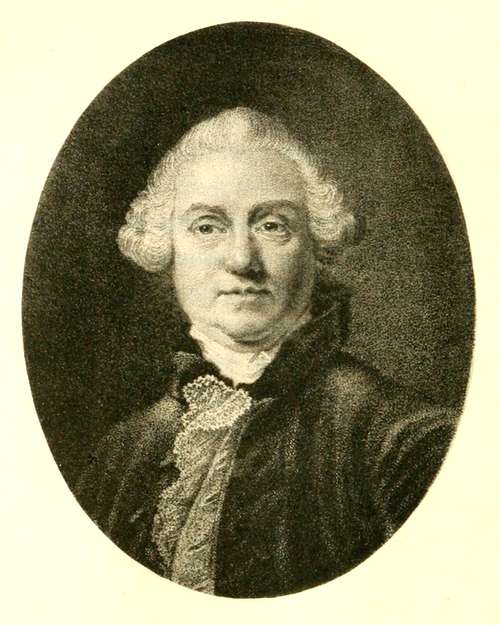
In 1769, Foote produced nothing new of his own;
but the general business was good, and Sheridan drew
good houses in tragedy, both this season and the
next, though Foote described him as "dwindled
down into a mere Cock and Bottle Chelsea Pensioner."
In 1770, Foote, in his "Lame Lover," in
which he acted Sir Luke Limp (Vandermere and
Weston played Serjeant and Jack Circuit), made a
miss in aiming at "those maggots of the law, who
breed in the rotten parts of it." In the following
year, the groundwork of his expected annual play,
was the ungallant conduct of Mr. Walter Long to
Miss Linley, afterwards Mrs. R. B. Sheridan. In
the "Maid of Bath," Long is severely handled under
the name of Flint, and Bath society is roughly illustrated.
The taste, in using a private domestic story
for such a purpose, is questionable. The satire,
however, did not kill Long, who lived till 1807, and
bequeathed then, to the already wealthiest heiress in
England, Miss Tilney, daughter of Sir James Tilney,
Bart., nearly a quarter of a million of money.
It was this heiress's hard fate to marry a more worthless
personage than he who only wooed and was
false to the Maid of Bath; and the small wreck of
her fortune is now being saved—or lost amid the
breakers and breakwaters of the Court of Chancery.
Foote, characterising himself as a "popularity-monger,"
produced in the course of his next season
the "Nabob," in which he made a combined charge
on antiquaries and Anglo-East Indians generally, in
the person of Sir Matthew Mite, in which was involved
the individual caricature of General Richard
Smith, whose father had been a cheesemonger.
Some irascible Anglo-Indians called at Foote's
house in Suffolk Street, behind the theatre, to
administer personal chastisement; but he bore
himself with such tact, convinced them so conclusively
that he had not had Smith in his mind,
and persuaded them, by reading the play, that it was
only naughty old Indians generally against whom he
wrote, that they who came to horsewhip remained to
dine, and make a night of it. The piece was afterwards
supported by the good old ladies, to show their
antagonism to Anglo-Indian naughtiness.
Foote's "Nabob" afforded Walpole an excuse for
withdrawing his name from the Society of Antiquaries.
In the play, Mite is made an F.S.A.; and
reads a foolish address to the Society, on Whittington
and his Cat. This was in ridicule of Pegge, who
had touched on the subject of the illustrious lad, but
who was "gravelled" by the then inexplicable Cat.
Walpole, affecting to see that Pegge and Foote had
rendered the Society for ever ridiculous, took his
name off the books; but not on that account. The
true ground was that, in his own words:—"I heard
that they intended printing some more foolish notes
against my Richard III."
In 1773, Foote produced his Puppet-show-droll,
"Piety in Pattens, or the Handsome Housemaid."
In this he committed a mistake, not unlike that he
had committed in the "Minor," by taking unworthy
means to a certain end. In a dull and occasionally
indecent introductory address, he professed to have
chosen puppets for his actors, because the contemporary
players were marked by inability. This was
said to a densely crowded house, while Garrick and
Barry were still at the head of their profession! In
the piece itself, played by excellently contrived puppets,
Foote intended to ridicule sentimental comedy,
by professedly playing one, showing "how a maiden
of low degree, by the mere effects of morality and
virtue, raised herself to riches and honours." The
sentiment here involved is, of course, made fun of;
but, in fact, the author failed to render it ridiculous,
for the housemaid declines the riches and honours
which she might have taken as the rewards of her
morality and virtue. There ensued a riot, and some
damage, after which Foote resorted to the novel
process of resting the approbation of his piece, on a
show of hands; but though there was a majority in
his favour, the piece was not permanently successful.
The author found compensation in his "Bankrupt,"
which was chiefly aimed at a speculating Baronet, but
generally at all who were concerned in cheating their
creditors. In 1774 a better, but a more cruel piece
of wit, was produced by "Foote, the celebrated buffoon,"
as Walpole had called him the year before.
This was the "Cozeners." Mrs. Grieve, the woman
who had extorted money, on pledge of procuring
government appointments, and who had not only
deceived Charles Fox, by pretending to be able to
marry him to an heiress, but had lent him money
rather than miss his chariot from her door, was fair
game, and was well exposed, in Mrs. Fleecem. This
was delicate ground, however, for Foote, who was
very generally accused of having earned an annuity
from Sir Francis Delaval, by bringing about a marriage
between Sir Francis and the widow Lady
Nassau Powlett, who had been a very intimate friend
of Foote's. The cruelty of the satire lay in the
character of Mrs. Simony, in which the vices of the
once fashionable and lately hanged preacher, Dodd,
were transferred to his then living widow.[129] It was
an insult to that poor woman, and a brutality against
the Rev. Richard Dodd, brother of the criminal, and
the estimable Vicar of Camberwell. The ridicule of
Lord Chesterfield's advice to his son is in far better
taste. But Foote was now beginning to lose spirit,
and he produced only one more piece, the "Capuchin,"
in which he played O'Donovan, in 1776. This
piece was merely an alteration of the unlicensed
"Trip to Calais," in which Foote had gibbetted the
Duchess of Kingston. In the "Capuchin," he more
rudely treated her Grace's Chaplain, Jackson, under
the name of Viper; but the farce had small merit,
and the only thing in connection with it, deserving of
record is, that Jackson, while on trial for treason, in
the time of the Irish Rebellion, destroyed himself.
Such are the dramatic works of the English satirist,
to compare whom with Aristophanes is an injustice
to the Athenian, whose works Plato admired; and
even St. Chrysostom kept them under his pillow!
In the eleven extant comedies, of the fifty-four written
by Aristophanes, we find the inequality of the
distribution of riches pointed at in "Plutus;" in the
"Clouds" the poet is in jest, not in earnest, in denouncing
vice; in the "Frogs" we have a humorous
review of both Euripides and Æschylus; in the
"Knights," a satire against Cleon, which is unequalled
for fun and effect. The "Inhabitants of
Acharnæ" is a "screaming farce" chiefly in favour
of peace-makers. The "Wasps" caricatures the
Athenian disposition to go to law. The "Birds" is
made a vehicle to convince the audience of the
necessity of a change in the government. "Peace,"
in which the heroine, so-called, never utters a word,
was written to bring about the much-desired end of
the Peloponnesian war. The "Female Orators"
exposes the absurdity of women desiring to be
beyond their vocation. The "Feast of Ceres"
demonstrates that the women can both say and act
to the purpose when called upon; and this is more
seriously shown in "Lysistrata." All these, however,
are original, plot and wit are the poet's own
(which is far from being the case with Foote); and
the chief end seems to be the public good, and not
the satirising of particular individuals. Aristophanes,
however, goes in this latter direction, even farther
than Foote; his abuse of Socrates, a great and good
reformer, is not palliated by the wit which accompanies
it; a daring wit, which was carried to such
excess that the downfall of the old comedy ensued,
and Alcibiades forbade that any living person should
be thenceforth attacked by name upon the stage.
The descriptions of Aristophanes are true, however
coarse they may be. He was a patriot and philosopher
as well as a poet, and fearless in attacking
every obstruction to the well-being and improvement
of society. Foote laughed at individuals, denied the
personality, and cared nothing at all as to who might
be the better or the worse for his sarcasm. It has been
said that the satire of Aristophanes killed Socrates.
It really did so no more than that of Foote killed
Whitfield. In this one respect the two men are alike.
Such exhibition of character as Foote made was
described by Johnson, as a vice; and he, like
Churchill, denied the actor's powers. The former
maintained that Foote was never like the person he
assumed to be, but only unlike Foote; and that he
failed altogether, except with marked characteristics.
He was as a painter who can portray a wen; and if
a man hopped on one leg, Foote could do that to
the life. Foote himself acknowledged that he pursued
folly, and not vices, but he never mimicked in
others the follies which were the most strongly marked
in himself; such as extravagance in dress. He did
not aim at improvement of character; his motives in
this respect were of the very lowest: "Who the
devil!" he said, "will give money to be told Mr.
Such-a-one is wiser and better than himself....
Demolish a conspicuous character, and sink him
below our level ... there we are pleased, there we
chuckle and grin, and toss the half-crown on the
counter." Now, bad examples which lower our
standard of right and wrong do infinite harm. At
this sinking of men below our level, the Archbishop
of Dublin has glanced, when he says: "For one who
is corrupted by becoming as bad as a bad example,
there are ten that are debased by becoming content
with being better."
If there was little honesty in Foote's method of
dealing with human weaknesses, so was there small
courage in the spirit of the satirist. He could annoy
Garrick by saying that his puppets would not be so
large as life, "not larger in fact than Mr. Garrick,"
and could mimic him as refusing to engage Punch
and his wife,—Mr. and Mrs. Barry,—for he could do
so with impunity. But, Barry, six feet high, he
never assailed, and he was deterred from bringing
Johnson on the stage, by a threat from the latter
that he would break every bone in his body.
Johnson, personally, disliked Foote, yet was forced
into admiration by Foote's wonderful powers of wit
and laughter-compelling humour. Johnson, probably,
was trying to excuse himself when he said
that if the grave Betterton had come into the room
where Foote was, the latter would have driven him
from it by his broad-faced, obstreperous mirth. But
Foote's conversational powers and wide knowledge,
which charmed Fox, would have charmed Betterton
too, and I do not think either could have been like
Johnson's imaginary hostler, who, encountering Foote
in a stable, thought him a comic fellow, but parted
from him without a feeling of respect. Johnson
thought less of Foote's conversation than Fox did;
he described it as between wit and buffoonery, but
admitted that Foote was a "fine fellow in his way,"
and he hoped somebody would write his life with
diligence. Walpole tersely described him as "a
Merry Andrew, but no fool." So the black boy
thought, who hated the small beer which Foote
(who sneered at Garrick for having been a wine
merchant) at one time brewed and sold, through a
partner. The boy was so delighted with Foote's
wit, as he waited on him at dinner, that he declared,
in the kitchen, he could drink his bad beer for ever,
and would certainly never complain of it again.
Foote had so little moral courage, and was so thin-skinned,
that attacks upon him in the newspapers
caused him exquisite pain, and he stooped so far to
the Duchess of Kingston as to offer to suppress his
"Trip to Calais," if she would put a stop to the
assaults made on him through the press. The
notorious lady, who was tried for bigamy, called
him the "descendant of a Merry Andrew," and
Foote informed her that though his good mother
had lived to fourscore, she had never been married
but once. Something, however, is to be said for
this well-abused person. She did not marry the
Duke of Kingston till the Ecclesiastical Court had
broken her marriage with Lord Hervey. The House
of Lords reversed the decree of the Ecclesiastical
Court, after the lady had married a second time, and
it was this reversal of an old judgment which exposed
her to the penalties of bigamy. When these
facts are remembered, half the jokes against Foote's
adversary fall to the ground.
Neither the claims of friendship nor a sense of
courtesy could restrain Foote from a brutal jest when
opportunity offered to make one. He had no more
intimate friend than Charles Holland, who was at
Drury Lane, from 1755 to 1769; and whose father
was a baker, at Chiswick. Foote attended the funeral
there, and on his return to town, he gaily remarked
that he "had seen Holland shoved into the family
oven!" As for his courtesy, it was on a par with
his sense of friendship and fellowship. When down
at Stratford, on the occasion of the Shakspeare Jubilee,
Garrick's success embittered Foote's naturally bitter
spirit. A well-dressed gentleman there, civilly spoke
to him on the proceedings. "Has Warwickshire,
sir," said Foote, "the advantage of having produced
you as well as Shakspeare?" "Sir," replied the
gentleman, "I come from Essex." "Ah!" rejoined
Foote, remembering that county was famous for calves,
"from Essex! Who drove you?"
The better samples of Foote's wit are to be found
in his own comic pieces. In his "Lame Lover," how
admirable is Mr. Sergeant Circuit's remark when his
wife asks for money, and protests she must have it,
as her honour is in pawn! "How a century will
alter the meaning of words!" cries the Sergeant.
"Formerly, chastity was the honour of women, and
good faith and integrity the honour of men; but now,
a lady who ruins her family by punctually paying her
losses at play, and a gentleman who kills his best
friend in a ridiculous quarrel, are your only tip-top
people of honour! Well, let them go on! It brings
grist to our mill; for while both sexes stick firm to
their honour, we shall never want business either at
Doctors' Commons or the Old Bailey!" Again, in the
"Nabob," a hard hit is made at the bold profligacy
of the period, in the words of Touchet (Baddeley) to
Sir Matthew Mite (Foote), both of whom had been
talking of hanging, or worse, hereafter, to the bribe-taking
members of an election club;—"That's right,
stick to that! for though the Christian Club may
have some fears of the gallows, they don't value
damnation a farthing!"
Some of Foote's apologists have almost worshipped
him as the reformer of abuses, the scourge of hypocrites,
and the terror of evil-doers. But Foote does
not seem to have been moved by any higher principle
than gain. If Mrs. Salmon had a Chamber of Horrors,
the more murders that were committed, the
better she was pleased, for the more she made by the
crime. Foote endeavoured to crush Whitfield by
personal ridicule; but Whitfield was a far more useful
man in his very wicked generation than Foote, who
did not denounce the wickedness, but mimicked the
peculiarities of the reformer. "There is hardly a
public man in England," says Davies, "who has not
entered Mr. Foote's theatre with an aching heart,
under the apprehension of seeing himself laughed at."
Foote certainly read the pieces offered him for
presentation. He kept Reed's "Register Office" for
months, and thought so well of it as to turn its Mrs.
Snarewell into Mrs. Cole, in his "Minor." That was
little compared with his stealing a whole farce from
Murphy; and the last was nothing compared with
his return for the hospitality bountifully afforded him
by Lord Melcombe, at his villa, at Hammersmith.
Foote there studied the peculiarities of his good-natured
host, and then produced him on the stage,
in the character of the Patron!
Foote, again, read old pieces, with a purpose, quite
as attentively as he did new. When he produced
his "Liar," in 1762, he professed to have taken it
from Lopez de Vega, that is, from the original source
from which Corneille took his "Menteur." From
the latter, Steele took his "Lying Lover," and a
comparison of the language of the two pieces will
show that Foote plundered Steele, and hoped to
escape by acknowledging obligations to an older
author, whom he could not read. There is least of
plagiarism in the "Mayor of Garratt," yet even there
Foote is detected in borrowing from "Epsom Wells,"
but with judgment. If he was a picker-up of unconnected
trifles, he chose only those of value, and
he polished and reset them with tact and taste. He
has done this in the "Commissary," in which there
is a theft from "Injured Love," in a joke which
Hook stole, in his turn, from the "Commissary," to
enliven his "Killing no Murder."
Except in ceasing to mimic Whitfield on the stage,
after the death of that religious reformer, I can
scarcely find a trait of delicacy in Foote's character.
He seems to have been as unscrupulous in act, as he
was cruel in his wit. One may forgive him, however,
for his remark to John Rich, who had been addressing
him curtly, as "Mister." Perceiving that Foote
was vexed, Rich apologised, by saying, "I sometimes
forget my own name." "I am astonished you could
forget your own name," said Foote, "though I know
very well that you are not able to write it!"
Foote, who spared nobody, was angry with Dr.
Johnson for saying that he was an infidel, as a dog
was an infidel; he had never thought of the matter.
"I, who have added sixteen new characters to the
drama of my country!" said Foote. When he left
hospitable General Smith's house, after a longer
sojourn than usual, Foote's only comment was: "I
can't miss his likeness now, after such a good sitting."
When Digges first appeared in Cato, we are told that
Foote occupied a place in the pit, and raising his
voice above the sound of the welcome given to the
new actor, exclaimed, "He looks like a Roman
chimney-sweeper on May-day." That Foote "deserved
to be kicked out of the house for his cruelty," is a
suggestion of Peake's, in which all men will concur.
But did he deserve it? Chronology tends to disprove
this story. Foote played for the last time on the
30th of July 1777. His name does not appear in
the bills after that day. Digges made his first appearance
in London, as Cato, on the 14th of the
following August, and if Foote went into the pit on
that occasion, his envy and malevolence must have
supplied him with the energy of which he had been
deprived by paralysis and other infirmities.
Foote's vanity was as great as his cruelty. To indulging
in the former he owed the loss of his leg.
Being on a visit to Lord Mexborough, where the Duke
of York and other noble guests were present, Foote
foolishly boasted of his horsemanship; being invited
to join the hunt the next day, he was ashamed to
refuse, and at the very first burst the boaster was
thrown, and his leg broken in two places. Even
when his leg was amputated, he was helped, by the
incident, to an unworthy thought, namely, that he
would now be able to mimic the one-legged George
Faulkner, of Dublin, to the life! This, however, may
have been said out of courage.
He bore, with fortitude, a visitation which gained
for him a licence to open the Haymarket, from the
15th of May to the 15th of September. It opened
his way to fortune; and though what O'Keefe says
may be true, that it was pitiable to see him leaning
against the wall of his stage dressing-room, while his
servant dressed his cork leg, to suit the character in
which his master was to appear, I can well believe
what O'Keefe adds, that "he looked sorrowful, but
instantly resuming all his high comic humour and
mirth, he hobbled forward, entered the scene, and
gave the audience what they expected, their plenty
of laugh and delight."
Among the fairest of Foote's sayings was the
reply to Mr. Howard's intimation that he was about
to publish a second edition of his Thoughts and
Maxims. "Ay! second thoughts are best." Fair,
too, was his retort on the person who alluded to his
"game leg." "Make no allusion to my weakest part!
Did I ever attack your head?" Then Garrick once
took as a compliment, that his bust had been placed
by Foote in the private room of the latter. "You
are not afraid, I see, to trust me near your gold and
banknotes." "No," retorted the humorist, "you
have no hands!"
Foote was sometimes beaten with his own weapons.
After he had leased the Edinburgh Theatre from Ross,
for three years, at five hundred guineas a year, a dispute
arose, followed by a lawsuit, in which Foote was
defeated. The Scottish agent for the vanquishing
side, called on Foote, in London, with his bill of
costs, which the actor had to defray. The amari
aliquid having been got through, the player remarked
that he supposed the agent was about to return to
Edinburgh, like most of his countrymen, in the
cheapest form possible. "Ay, ay," replied the agent,
drily, tapping the pocket in which he had put the cash,
"I shall travel—on foot!" Foote himself is described
as looking rueful at the joke. Again, Churchill only
said of him that he was in self-conceit an actor, and
straightway Foote, who lived by degrading others,
was "outrageously offended." Foote wrote a prose
lampoon on Churchill and Lloyd, but did not publish
it. Churchill, the bruiser, was not a safe man for
Foote to attack, and the actor was fain to be satisfied
with calling him the "clumsy curate of Clapham."
Foote took Wilkinson to Dublin in 1757, where they
appeared as instructor and pupil, in one of Foote's
entertainments, called a "Tea." Wilkinson imitated
Luke Sparks as Old Capulet; convulsed the house,
instead of being "stoned," as Mrs. Woffington expected,
with his imitation of the two Dublin favourites,
Margaret herself and Barry, in "Macbeth," and,
emboldened by the applause, he imitated Foote in his
own presence. Foote's audacity was tripped up by
the suddenness of the action; and he looked foolish,—wishing
to appear pleased with the audience, but not
knowing how to play that difficult part. Subsequently,
however, Foote called on Wilkinson, and threatened
him with the duel, or chastisement, if he ever dared
take further liberties with him on the stage. Wilkinson
laughed at the impotently-angry ruffian, and all
his brother actors laughed with him. The malignity
of Foote found satisfaction in his writing the part of
Shift, in the "Minor" (as it was first represented, in
Dublin), as a satire on Wilkinson; and he knowingly
misrepresented Wilkinson's origin, in order to bring
him into contempt.
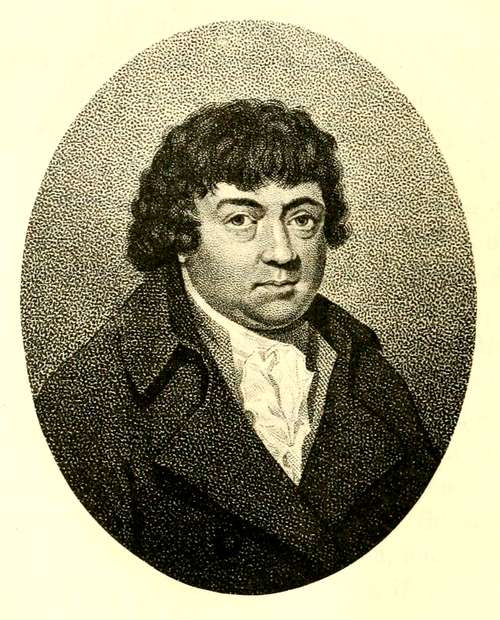
There is no doubt that Foote loved some of those he
jested at. He heard of Sir Francis Delaval's death,
with tears; but he smiled through them, when he was
told that the surgeons intended to examine the baronet's
head. He remarked that it was useless; he had
known the head for nearly a quarter of a century, and
had never been able to find anything in it! But the
wit's testimony to character is never to be taken without
reserve. "Why does he come among us," he said
of Lord Loughborough. "He is not only dull himself
but the cause of dulness in others!" This is certainly
not true, for this Scottish lawyer was remarkable in
society for his hilarity, critical powers, and his store of
epigrams and anecdotes. Lord Loughborough, moreover,
merited the respect of Foote, as an old champion
of the stage. When he was Mr. Wedderburn, and
represented Dunfermline, in the General Assembly of
Scotland, he resisted the motion for an act to prohibit
the presence of either lay or clerical members of the
Church, at dramatic representations. The Assembly
had just before been shaken by the fact that the clergy
had been to witness Home's "Douglas," and it had
smiled grimly at the palliative plea of one offender,
"that he had ensconced himself in a corner, and had
hid his face in a handkerchief to avoid scandal!"
Wedderburn opposed the motion in one of the best
speeches which he ever delivered in Scotland, and
which ended with these words: "Be contented with
the laws which your wise and pious ancestors have
handed down to you for the conservation of discipline
and morals. Already have you driven from your body
its brightest ornament, who might have continued to
inculcate the precepts of the Gospel from the pulpit,
as well as embodying them in character and action.
Is it, indeed, forbidden to show us the kingdom of
heaven by a parable? In all the sermons produced
by the united genius of the Church of Scotland, I
challenge you to produce anything more pure in
morality, or more touching in eloquence, than the
exclamation of Lady Randolph:—
"'Sincerity!
Thou first of virtues, let no mortal leave
Thy onward path, although the earth should gape,
And from the gulf of hell, destruction cry
To take dissimulation's winding way.'"
Johnson rightly pooh-poohed this passage. Foote
was admirable in impromptu. When he once saw a
sweep on a blood-horse, he remarked: "There goes
Warburton on Shakspeare!" When he heard that the
Rockingham cabinet was fatigued to death and at its
wit's end, he exclaimed, that it could not have been
the length of the journey which had tired it! Again,
when Lord Caermarthen, at a party, told him his
handkerchief was hanging from his pocket, Foote
replaced it, with a "Thank you, my lord; you know
the company better than I." How much better does
Foote appear thus, than when we find him coarsely
joking on Lord Kelly's nose, while that lord was
hospitably entertaining him, or sneering at Garrick
for showing respect to Shakspeare, by a "jubilee."
After all, the enemies he had provoked killed him.
His fire and his physical powers were decaying when
some of those enemies combined to accuse him of an
enormous crime.[130] He did not fly, like guilty Isaac
Bickerstaffe, under similar circumstances, but manfully
met the charge, and proved his innocence. The
anxiety, however, finished him. He had an attack
of paralysis, played for the last time on the 30th of
July 1777, in his "Maid of Bath," and after shifting
restlessly from place to place, died on the 21st of
October, at Dover. A few months previously, he had
made over the Haymarket Theatre to Colman, for a
life annuity of £1600, of which Foote lived but to
receive one half-year's dividend. At the age of fifty-six,
he thus passed away—an emaciated old man—and
on Monday, the 27th of October, he was carried,
by torchlight, to the cloisters of Westminster Abbey,
whither Betterton, Barry, Mrs. Cibber, and others
of the brotherhood of players, had been carried
before him.
The Haymarket season of that year indicated a
new era, for in 1777, Edwin, as Hardcastle,[131] Miss
Farren, as Miss Hardcastle, Henderson, as Shylock,
and Digges, in Cato, made their first appearance in
London. The old Garrick period—save in some
noble relics (Macklin, the noblest of them all)—was
clearly passing away.
What the dramatic poets produced from the period
of Garrick's withdrawal to the end of the century
will be best seen by a reference to the Supplement,
which I append to this volume.
List of the principal Dramatic Pieces produced at the Patent
Theatres, from the Retirement of Garrick to the End of the
Eighteenth Century:—
1776-77.—Drury Lane.
"Trip to Scarborough" (altered by Sheridan from Vanbrugh). Miss
Hoyden, Mrs. Abington.
"School for Scandal" (Sheridan). Sir Peter Teazle, King; Charles Surface,
Smith; Lady Teazle, Mrs. Abington.
1776-77.—Covent Garden.
"Caractacus" (Mason). Caractacus, Clarke; Evelina, Mrs. Hartley.
"Know Your Own Mind" (Murphy). Millamour, Lewis; Lady Bell, Mrs.
Mattocks.
1777-78.—Drury Lane.
"Battle of Hastings" (Cumberland). Edgar Atheling, Henderson;
Edwina, Mrs. Yates.
1777-78.—Covent Garden.
"Percy" (Hannah More). Percy, Lewis; Douglas, Wroughton; Edwina,
Mrs. Barry.
"Alfred" (Home). Alfred, Lewis; Ethelswida, Mrs. Barry.
"Poor Vulcan" (Dibdin). Vulcan, Quick; Venus, Miss Brown.
1778-79.—Drury Lane.
"Camp" (Tickell, falsely attributed to Sheridan).
"Fathers, or the Good-natured Man" (newly-discovered Comedy, by
Fielding). Sir George Boncour, King.
"Law of Lombardy" (Jephson). Paladore, Smith; Bireno, Henderson;
Princess, Miss Young.
"Who's the Dupe" (Mrs. Cowley). Gradus, King; Doyley, Parsons;
Elizabeth, Mrs. Brereton.
1778-79.—Covent Garden.
"Buthred" (Anon.). Buthred, Wroughton; Rena, Mrs. Hartley.
"Touchstone, or Harlequin Traveller" (a speaking Pantomime). Harlequin,
Lee Lewes.
"Calypso" (Masque, by Cumberland). Telemachus, Mrs. Kennedy; Calypso,
Miss Brown.
"Fatal Falsehood" (Hannah More). Rivers, Lewis; Julia, Mrs. Hartley.
1779-80.—Drury Lane.
"Critic" (Sheridan). Sir Fretful, Parsons; Puff, King; Tilburina, Miss
Pope.
"Times" (Mrs. Griffith). Lady Mary Woodley, Mrs. Abington.
"Zoraida" (Hodson). Zoraida, Mrs. Yates.
1779-80.—Covent Garden.
"Mirror, or Harlequin Everywhere" (Burletta-Pantomime, by Dibdin).
Harlequin, Bates.
"Widow of Delphi" (Cumberland).
"Deaf Lover" (Pilon). Meadows, Lee Lewes.
"Belle's Stratagem" (Mrs. Cowley). Doricourt, Lewis; Laetitia Hardy,
Miss Younge.
1780-81.—Drury Lane.
"Generous Impostor" (O'Beirne, afterwards Bishop of Meath). Sir Harry
Glenville, Palmer; Mrs. Courtly, Mrs. Baddeley.
"Lord of the Manor" (Burgoyne). Trumore, Vernon; Moll Flagon, Suett.
"Royal Suppliants" (Dr. Delap). Acamas, Smith; Dejanira, Mrs. Crawford.
"Dissipation" (Andrews). Lord Rentless, Palmer; Lady Rentless, Mrs.
Abington.
1780-81.--Covent Garden.
"Tom Thumb" (Fielding's piece turned into an opera, by O'Hara). Tom,
Edwin; Arthur, Quick; Dolalolla, Miss Catley.
"Siege of Sinope" (Mrs. Brooke). Pharnaces, Henderson; Thamyris, Mrs.
Yates.
"Man of the World" (Macklin). Sir Pertinax, Macklin; Egerton, Lewis;
Lady Rodolpha Lumbercourt, Miss Younge.
1781-82.—Drury Lane.
"Fair Circassian" (Pratt,—Courtney Melmoth). Omar, Bensley; Hamet,
Smith; Fair Circassian, Miss Farren.
1781-82.—Covent Garden.
"Duplicity" (Holcroft). Sir Harry Portland, Lewis; Melissa, Mrs. Inchbald.
"Count of Narbonne" (Jephson). Count, Wroughton; Countess, Miss
Younge.
"Which is the Man" (Mrs. Cowley). Lord Sparkle, Lee Lewes; Fitzherbert,
Henderson; Lady Bell Bloomer, Miss Younge.
"Walloons" (Cumberland). Father Sullivan, Henderson.
1782-83.—Drury Lane.
"Fatal Interview" (Hull). Montague, Smith; Mrs. Montague, Mrs.
Siddons.
"School for Vanity" (Pratt). Onslow, Brereton; Ophelia Wyndham, Miss
Farren.
1782-83.—Covent Garden.
"Castle of Andalusia" (O'Keefe). Spado, Quick; Lorenza, Signora
Sestini.
"Philodamus" (T. Bentley). Philodamus, Henderson.
"Rosina" (Mrs. Brooke). Belville, Bannister; Rosina, Miss Harper.
"Mysterious Husband" (Cumberland). Lord Davenant, Henderson; Sir
Edmund, Yates; Lady Davenant, Miss Younge.
"Bold Stroke for a Husband" (Mrs. Cowley). Julio, Lewis; Olivia, Mrs.
Mattocks.
1783-84.—Drury Lane.
"Reparation" (Andrews). Lord Hectic, Dodd; Lady Betty Wormwood,
Miss Pope.
"Lord Russell" (Rev. Dr. Stratford).
1783-84.—Covent Garden.
"Poor Soldier" (O'Keefe). Patrick, Mrs. Kennedy; Dermot, Johnstone;
Bagatelle, Wewitzer; Norah, Mrs. Bannister.
"More Ways than One" (Mrs. Cowley). Bellair, Lewis; Arabella, Mrs.
Stephen Kemble.
"Robin Hood" (Mac Nally). Robin, Bannister; Clorinda, Mrs. Martyr.
1784-85.—Drury Lane.
"The Carmelite" (Cumberland). Montgomerie, Kemble; St. Valori, Smith;
Matilda, Mrs. Siddons.
"Natural Son" (Cumberland). Blushenly, Palmer; Lady Paragon, Miss
Farren.
1784-85.—Covent Garden.
"Fontainebleau; or, Our Way in France" (O'Keefe). Lackland, Lewis.
"Follies of a Day" (Holcroft, from Beaumarchais). Figaro, Holcroft;
Almaviva, Lewis; Susanna, Miss Younge.
1785-86.—Drury Lane.
"Heiress" (Burgoyne). Sir Clement Flint, King; Alscrip, Parsons; Lady
Emily Gayville, Miss Farren.
"Captives" (Dr. Delap). Everallin, Kemble; Malvina, Mrs. Siddons.
1785-86.—Covent Garden.
"Omai." Grand spectacle, by O'Keefe.
1786-87.—Drury Lane.
"Richard Cœur de Lion" (Burgoyne). Richard, Kemble; Antonio, Miss
Romanzini; Matilda, Mrs. Jordan; Laurette, Mrs. Crouch.
"School for Greybeards" (Mrs. Cowley). Alexis and Gaspar (the Greybeards),
King and Parsons; Seraphina, Miss Farren.
"Seduction" (Holcroft). Lord and Lady Morden, Kemble and Mrs. Siddons.[132]
"Julia" (Jephson). Mentevole, Kemble; Julia, Mrs. Siddons.
1786-87.—Covent Garden.
"Richard Cœur de Lion" (Mac Nally). Blondel, Johnstone; Queen
Berengaria, Mrs. Billington.
"He Would be a Soldier" (Pilon). Caleb, Edwin; Charlotte, Mrs. Pope.
"Eloisa" (Reynolds). St. Preux, Pope; Eloisa, Miss Brunton.
"Such Things Are" (Mrs. Inchbald). Elvirus, Holman; Lady Tremor,
Mrs. Mattocks.
1787-88.—Drury Lane.
"New Peerage; or, Our Eyes may Deceive Us" (Harriet Lee). Lady
Charlotte Courtly, Miss Farren.
"Fate of Sparta" (Mrs. Cowley). Cleombrotus, Kemble; Chelonice, Mrs.
Siddons.
"Love in the East" (Cobb). Warnford, Kelly; Ormellina, Mrs. Crouch.
"The Regent" (B. Greatheed). Manuel, Kemble; Dianora, Mrs. Siddons.
1787-88.—Covent Garden.
"The Farmer" (O'Keefe). Jemmy Jumps, Edwin; Molly Maybush,
Mrs. Martyr.
"Ton; or, the Follies of Fashion" (Lady Wallace). Lord Bonton, Wewitzer;
Lady Bonton, Mrs. Mattocks.
"Animal Magnetism" (Mrs. Inchbald). Doctor, Quick; Constance, Mrs.
Wells.
1788-89.—Drury Lane.
"Impostors" (Cumberland). Lord Janus, Palmer; Eleanor, Mrs. Jordan.
"Mary, Queen of Scots" (Hon. John St. John). Norfolk, Kemble; Queen
Mary, Mrs. Siddons; Queen Elizabeth, Mrs. Ward.
"False Appearances" (General Conway). Marquis, Kemble; Cælia, Mrs.
Kemble.
1788-89.—Covent Garden.
"Highland Reel" (O'Keefe). Shelty, Edwin; Moggy, Miss Fontenelle.
"Child of Nature" (Mrs. Inchbald). Almanza, Farren; Amanthis, Miss
Brunton.
"The Toy, or Hampton Court Frolics" (O'Keefe). Alibi, Quick; Lady
Jane, Miss Brunton.
"Dramatist" (Reynolds). Vapid, Lewis; Ennui, Edwin; Willoughby,
Macready; Louisa Courtney, Miss Brunton.
1789-90.—Drury Lane.
"Marcella" (Hayley). Hernandez, Kemble; Marcella, Mrs. Powell.
"Haunted Tower" (Cobb). Lord William, Kelly; Lewis, Suett; Lady
Elinor, Mrs. Crouch.
"Love in Many Masks" (Kemble, from Aphra Behn). Willmore, Kemble;
Valeria, Mrs. Kemble; Helena, Mrs. Jordan.
1789-90.—Covent Garden.
"Marcella" (Hayley). Hernandez, Harley; Marcella, Mrs. Pope.
"Eudora" (Hayley). Raymond, Holman; Eudora, Mrs. Pope.
"Widow of Malabar" (Marianna Starke). Indamora, Miss Brunton.
1790-91.—Drury Lane.
"Better Late than Never" (Reynolds and Andrews). Saville, Kemble;
Flurry, Dodd; Augusta, Mrs. Jordan.
"Siege of Belgrade" (Cobb). Seraskier, Kelly; Peter, Dignum; Katharine,
Mrs. Crouch.
1790-91.—Covent Garden.
"School for Arrogance" (Holcroft). Sheepy, Munden; Lady Peckham,
Mrs. Mattocks.
"Two Strings to Your Bow" (Jephson). Lazarillo, Munden; Ferdinand,
Macready; Clara, Mrs. Harlowe.
"Woodman" (the Rev. Bate Dudley). Wilford, Incledon.
"Modern Antiques" (O'Keefe). Cockletop, Quick; Frank, Munden.
"Lorenzo" (Merry). Lorenzo, Holman; Zoriana, Miss Brunton (afterwards
Mrs. Merry).
"Wild Oats" (O'Keefe). Rover, Lewis; Ephraim Smooth, Munden;
Lady Amaranth, Mrs. Pope.
1791-92.—Drury Lane Company at the King's Theatre, Haymarket.
"Huniades" (Hannah Brand). Huniades, Kemble; Agmunda, by the
authoress, her first appearance on any stage.
"Fugitive" (Richardson). Young Manly, Palmer; Lord Dartford, Dodd;
Mrs. Larron, Miss Pope.
"Dido" (Hoare). Æneas, Mrs. Crouch; Dido, Madame Mara.
1791-92.—Covent Garden.
"Notoriety" (Reynolds). Nominal, Lewis; Sophia, Mrs. Wells.
"Road to Ruin" (Holcroft). Goldfinch, Lewis; Old Dornton, Munden;
Sophia, Mrs. Merry.
"Irishman in London" (Macready). Murtoch Delaney, Johnstone;
Colloony, Macready; Cubba, Mrs. Fawcett.
1792-93.—Drury Lane at Haymarket Opera; except on Tuesdays and
Saturdays, then at the Haymarket Theatre.
"The Prize" (Hoare). Lenitive, Bannister, jun.; Caroline, Signora Storace.
"Rival Sisters" (Murphy). Theseus, Palmer; Ariadne and Phædra, Mrs.
Siddons and Mrs. Powell.
"False Colours" (Morris). Sir Paul Panick, King.
1792-93.—Covent Garden.
"Columbus" (Morton). Columbus, Pope; Cora, Mrs. Pope.
"Every One has his Fault" (Inchbald). Harmony, Munden; Lady E.
Irwin, Mrs. Pope.
"Sprigs of Laurel" (O'Keefe). Nipperkin, Munden.
1793-94.—Drury Lane, under Colman, at the Haymarket.
"Mountaineers" (Colman). Octavian, Kemble; Floranthe, Mrs. Goodall
(was first acted in the summer of 1793, before the company went to Drury
Lane in September).[133]
"Children in the Wood" (Morton). Walter, Bannister, jun.
"Lodoiska" (Kemble). Lovinski, Palmer; Lodoiska, Mrs. Crouch.
1794.—Drury Lane; in the new House built by Holland.
"The Jew" (Cumberland). Sheva, Bannister, jun.; Eliza Ratcliffe, Miss
Farren.
1793-94.—Covent Garden.
"Siege of Berwick" (Jerningham). Seaton, Pope; Ethelberta, Mrs. Pope.
"Love's Frailties" (Holcroft). Sir Gregory Oldwort, Quick.
"Travellers in Switzerland" (Bate Dudley). Dorimond, Johnstone; Sir
Leinster M'Laughlin, Rock.
"Siege of Meaux" (Pye). St. Pol, Pope; Matilda, Mrs. Pope.[134]
1794-95.—Drury Lane.
"Emilia Galotti" (from Lessing, by Thompson).[135] Appiani, C. Kemble;
Orsina, Mrs. Siddons.
"Wedding Day" (Mrs. Inchbald). Young Contest, C. Kemble; Sir Adam,
King; Lady Contest, Mrs. Jordan.
"Wheel of Fortune" (Cumberland). Penruddock, Kemble; Henry Woodville,
C. Kemble; Emily Tempest, Miss Farren.
"Adopted Child" (Birch). Michael, Bannister, jun.; Nell, Mrs. Bland.
"First Love" (Cumberland). Billy Bustler, Suett; Sabina Rosny, Mrs.
Jordan.
1794-95.—Covent Garden.
"The Rage" (Reynolds). Darnley, Holman; Clara, Mrs. Mountain.
"Town before You" (Mrs. Cowley). Tippy, Lewis; Fancourt, Fawcett;
Mrs. Fancourt, Mrs. Mattocks.
"Mysteries of the Castle" (Andrews and Reynolds). Hilario, Lewis.
"England Preserved" (Watson). Surrey, Holman.
"Life's Vagaries" (O'Keefe). George Burgess, Fawcett; L'Œillet, Farley;
Augusta Woodbine, Miss Wallis.
"Deserted Daughter" (Holcroft). Mordent, Pope; Item, Quick; Joanna
Mordent, Miss Wallis.
"Secret Tribunal" (Boaden). Herman, Holman; Ida, Miss Wallis.
1795-96.—Drury Lane.
"Man of Ten Thousand" (Holcroft). Dorington, Kemble; Olivia, Miss
Farren.
"Iron Chest" (Colman). Sir Edward Mortimer, Kemble; Judith, Miss
De Camp.
"Almeyda" (Miss Lee). Alonzo, Kemble; Almeyda, Mrs. Siddons.
"Mahmoud" (Hoare). Mahmoud, Kemble.
"Vortigern" (Ireland, but acted as Shakspeare's). Vortigern, Kemble;
Constantius, Bensley; Fool, King; Edmunda, Mrs. Powell; Flavia, Mrs.
Jordan.
1795-96.—Covent Garden.
"Speculation" (Reynolds). Tanjore, Lewis; Lady Katharine Project,
Mrs. Davenport.
"Days of Yore" (Morton).[136] Voltimar, Pope; Adela, Mrs. Pope.
"Lock and Key" (Hoare). Brummagem, Munden; Fanny, Mrs. Martyr.
1796-97.—Drury Lane.
"Conspiracy" (Jephson). Sextus, Kemble; Vitellia, Mrs. Siddons.
"The Will" (Reynolds). Veritas, R. Palmer; Albina Mandeville, Mrs.
Jordan.
1796-97.—Covent Garden.
"Abroad and at Home" (Holman). Harcourt, Incledon.
"Cure for the Heart Ache" (Morton). Young Rapid, Lewis; Bronze, Farley;
Ellen Vortex, Mrs. Pope.
"Wives as they Were and Maids as they Are" (Inchbald). Bronzely,
Lewis; Miss Dorillon, Miss Wallis.[137]
1797-98.—Drury Lane.
"Cheap Living" (Reynolds). Sponge, John Bannister.
"Castle Spectre" (Lewis). Osmond, Barrymore; Percy, Kemble.
"Blue Beard" (Colman). Abomelique, Palmer; Fatima, Mrs. Crouch.
"Knave or Not" (Holcroft). Monrose, Palmer; Susan, Mrs. Jordan.
"Stranger" (Kotzebue).[138] Stranger, Kemble; Mrs. Haller, Mrs. Siddons.
1797-98.—Covent Garden.
"False Impressions" (Cumberland). Scud, Quick.
"Secrets worth Knowing" (Morton). Undermine, Munden.
"He's much to Blame" (Holcroft).[139] Versatile, Lewis; Lady Jane, Miss
Betterton (afterwards Mrs. Glover).
"Curiosity" (by the late King of Sweden).
"Blue Devils" (Colman the Younger). Megrim, Fawcett.
1798-99.—Drury Lane.
"Aurelio and Miranda" (Boaden). Aurelio, Kemble; Miranda, Mrs.
Siddons.
"Secret" (Morris). Lizard, jun., John Bannister; Rosa, Mrs. Jordan.
"East Indian" (Lewis). Mortimer, Kemble; Zorayda, his daughter, Mrs.
Jordan.
"Castle of Montval" (Whalley). Old Count, Kemble; Matilda, Mrs.
Powell.
"First Faults" (Miss De Camp). Fallible, C. Kemble; Tulip, Miss Mellon.
"Pizarro" (Sheridan). Rolla, Kemble; Alonzo, C. Kemble; Cora, Mrs.
Jordan; Elvira, Mrs. Siddons.
1798-99.—Covent Garden.
"Lovers' Vows" (Inchbald). Frederick, Pope; Amelia, Mrs. H. Johnston.
"Ramah Droog" (Cobb). Sidney, Incledon.
"Jew and the Doctor" (T. Dibdin). Abednego, Fawcett.
"Laugh When You Can" (Reynolds). Gossamer, Lewis.
"Votary of Wealth" (Holman). Leonard, Pope; Julia, Mrs. Pope.
"Five Thousand a Year" (T. Dibdin). Fervid, Lewis; Maria, Miss Betterton.
"Birthday" (T. Dibdin). Captain Bertram, Munden.
"Fortune's Frolic" (Allingham). Robin Roughead, Fawcett.
1799-1800.—Drury Lane.
"Adelaide" (Pye). Richard, Kemble; Adelaide, Mrs. Siddons.
"Of Age To-Morrow" (T. Dibdin). Frederick, John Bannister.
"De Montfort" (Joanna Baillie). De Montfort, Kemble; Jane, Mrs.
Siddons.
"Indiscretion" (Hoare). Maxim, King; Julia, Mrs. Jordan.
"Antonio" (Godwin). Antonio, Kemble; Helena, Mrs. Siddons.
1799-1800.—Covent Garden.
"Management" (Reynolds). Mist, Fawcett; Mrs. Dazzle, Mrs. Davenport.
"Turnpike Gate" (Knight). Crack, Munden.
"Joanna" (Cumberland, from Kotzebue). Joanna, Mrs. Pope.
"Speed the Plough" (Morton). Bob Handy, Fawcett.
"Paul and Virginia" (Cobb;—music by Mazzinghi). Paul, Incledon;
Virginia, Mrs. H. Johnston.[140]
In the next chapter, we will examine something of
the progress of the stage, as indicated by the above
records.
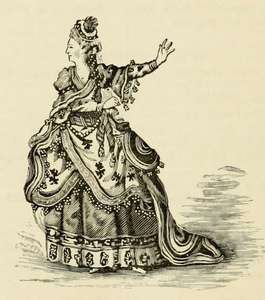
Mrs. Yates as Mandane.
INDEX.
Abington, Mrs., 186, 242.
Actors as volunteers in the '45, 97.
Actors at court, 132.
Aristophanes, Foote often compared to, 384.
Arne, Miss (Mrs. Cibber), 51;
as Psyche, 269;
as Venus, 269.
Arne, Dr., 269.
Arnould, Sophie, 317.
Ashbury, Dublin Patentee, 101.
Aston, Anthony, in Edinburgh, 193.
Aungier Street Theatre, Dublin, 103.
Authors, list of, with their plays from 1776 to 1800, 398-406.
Bannister, John, first to discard Garrick's mutilation of "Hamlet," 280.
Barry, Mrs. Ann, 277, 293, 339, 344, 346, 348;
as Widow Brady, 279, 344;
as Lady Randolph, 279;
her versatility, 279, 344, 349;
as Lady Townly, 279;
Garrick's high opinion of, 344;
as Desdemona, 344;
account of her career, 347-352;
at the head of her profession, 348;
her marriage with Crawford, 349;
eclipsed by Mrs. Siddons, 351;
her death, 351;
her original characters, 351.
Barry, Mrs. Elizabeth, 4.
Barry, Spranger, 92, 98, 107, 118, 121;
as Altamout, 93;
as Othello, 106, 109, 342, 344;
and Garrick, 108, 112, 113, 336, 337;
his first appearance in London, 109;
as Sir Charles Raymond, 114;
as Romeo, 115, 122;
in "The Earl of Essex," 164;
as Jaffier, 164;
as Pyrocles, 184;
in love with Miss Nossiter, 184;
as Constantine, 184;
leaves for Dublin, 184;
as King Lear, 187;
his return to London, 187;
as Norval, 189;
in Dublin, 249;
opens Crow Street in opposition to Sheridan, 249, 338;
retires from Dublin ruined, 250;
his reappearance in London, 277;
joins the Covent Garden Company, 278;
as Lord Townly, 279;
as Evander, 280;
as Aubrey in "Fashionable Lover," 280;
as Melville in "Duel," 280;
as Tancred, 294;
in Cumberland's "Timon," 294;
his physical decay, 303, 340;
his last appearance, 303;
his death, 303, 341;
account of his private life, 336;
portraits of Barry, 339;
his characteristics, 341;
his excellence in Orestes and Alexander, 342;
his pathos, 342;
and Henry Pelham, 345.
Barton, Fanny (Mrs. Abington), 186, 242.
Beard, John, proprietor of Covent Garden, 261.
"Beggar's Opera," 89.
Bellamy, Mrs., 161;
as Constance, 93, 94;
her dispute with Garrick, 94;
début as Monimia, 95;
carried off by Mr. Metham, 115;
as Juliet, 122;
as Statira, 187;
and Mrs. Woffington, 187;
as Cleone, 243.
Bickerstaffe, Isaac, 296.
Boheme, 22.
Bond, died on the stage, 57.
Booth, Barton, 40, 41, 47.
Bowen, Quin's duel with, 53, 166.
Bowman, his death, 67.
Bracegirdle, Mrs., 7.
Brent, Miss, singer, 247.
Bridgwater, actor, 111.
Brooke, Henry, dramatist, 65, 245.
Browne, Dr., 185, 186.
Bullock, 67.
Burgoyne, General, dramatist, 301.
Cashel, actor, 103;
his death, 103, 104.
Catley, Ann, 295.
Charke, Charlotte (daughter of Colley Cibber), 50, 59, 96;
as Captain Plume, 88;
her wretched life, 236-38;
wears male attire, 237;
as a valet to an Irish lord, and as a waiter, 237;
her "Autobiography," 238;
her death, 238.
Chesterfield, Lord, opposes the Licensing Act of 1737, 62, 64.
Chetwynd, licenser of plays, 64.
"Chinese Festival," cause of a riot, 186.
Cibber, Colley, 5, 6, 22, 40, 41, 55, 69, 90, 131;
as Burnaby Brittle, 7;
his "Love's Riddle," 144;
asserts the dignity of his profession, 145;
account of his career, 213-239;
his early life, 214;
a juvenile laureate, 215;
as the Chaplain, 217;
his marriage, 217;
as Lord Touchwood, 217;
improving prospects, 218;
as Fondlewife, in imitation of Dogget, 218;
his triumphant success, 219;
as an author, 220;
his "Love's Last Shift," 220-22;
an attempt at greater purity, 220;
as Sir Novelty Fashion, 221;
his "Careless Husband," 222, 225;
his "Apology," worthy of immortality, 222;
Pope and Cibber, 223, 232;
his great part of Lord Foppington, 224;
his care as an actor, 225;
essentially a comic actor, 226;
a perfect critic, 227;
his candour and modesty, 227-28;
his "Richard III.," 228;
Cibber and his critics, 230;
his person, 231;
his Justice Shallow, 232;
election to White's Club, 233;
his death, 235;
his children, 236;
summary of his character, 239.
Cibber, Colley, quoted—on Mrs. Oldfield, 5, 6;
on Mrs. Oldfield and Wilks, 8;
on plays at Court, 134;
on critics, 143.
Cibber, Jane, as Juliet, 96.
Cibber, Mrs. Susanna Maria, 26, 59, 97, 118, 121, 181, 236, 288, 341;
her first appearance as an actress, 56;
as Hermione, 57;
as Indiana, 58, 121, 271;
as the Lady in "Comus," 67;
and her husband, 68;
as Sigismunda, 91;
and Garrick, 91;
as Juliet, 115, 122;
as Alicia, 125, 272;
as Isabella, 236;
account of her career, 268-76;
her death, 268;
marriage to Theophilus Cibber, 269;
as Zara, taught by Colley Cibber, 270;
success of her Zara, 271;
her perfection as Ophelia, 271;
not successful in sprightly comedy, 272;
her characteristics, 272;
her scoundrelly husband, 273;
plays Cœlia in the "School for Lovers," 273;
her last appearance, 274;
her death, 274;
in a fracas at Bath, 275;
as Polly Peachum, 357.
Cibber, Theophilus, 26, 96, 236;
as George Barnwell, 24;
heads the secession from Highmore, 49;
his treatment of his wife, 68, 273;
his dispute with T. Sheridan, 105;
duel with Quin, 167;
his death, 238, 243.
Clairon, the French actress, 15, 317.
Clarke, actor, 295.
Clive, Kitty, 50, 55, 59, 291, 354;
as Euphrosyne, 67;
as Lettice, 139;
her marriage, 355;
as Bizarre, 357;
as a mimic, 357;
her power over her audiences, 357;
as Lucy, 357;
her original characters, 357, 362;
her farewell to the stage, 358;
in her retirement, 359;
and Horace Walpole, 360;
her death, 362.
Colman, the elder, 245;
his "Jealous Wife," 246;
part author of the "Clandestine Marriage," 246;
and Garrick, 324.
Cooke, Thomas, dramatist, 60, 89.
Cooper, Mrs., dramatist, 58.
Covent Garden, opening of, 30, 31;
sold for £60,000, 261.
Cradock, dramatist, 294.
Crawford, an Irish barrister, marries Mrs. Barry, 349;
becomes an actor, 349;
his bad conduct, 349, 350;
his shabbiness, 350.
Crawford, Mrs. (see Mrs. Barry), overshadowed by Mrs. Siddons, 351;
her last appearance, 351.
Crisp, Henry, his "Virginia," 183.
Critics, 143.
Cumberland, Richard, his "Timon," 294;
his numerous plays, 296, 297;
his "Wheel of Fortune," 297;
his "Choleric Man," 301;
his account of Garrick and Quin's first appearance in the same play, 313.
Dance (stage name, Love), 291.
Dancer, Mrs. (afterwards Mrs. Barry and Mrs. Crawford), 277, 339, 344, 348.
Davies, Thomas, quoted—on Garrick, 71, 73;
on Mrs. Porter, 84;
on Garrick and Mrs. Cibber, 91;
on Quin, 168;
on Cibber's election to White's Club, 233;
on Garrick and Quin in the "Fair Penitent," 311.
Delane, actor, 27, 103;
his death, 119;
as King John, 61.
Delaney, Mrs., on Garrick, 77, 330;
on Barry, 338.
Dexter, actor, 321.
Digges, West, 196, 397;
as Norval, 189.
Dodsley, dramatist, 60;
his "Cleone," 243.
"Douglas," 189, 195, 196.
Dow, dramatist, 292.
Dramatists "in state," 157.
Dublin stage, the, 99, 248-52.
Dyer, actor, 118.
Edinburgh, the theatre in, 190.
Edwin, 397.
Elliston, 111.
Elmey, Mrs., 182.
Elrington, Thomas, a Dublin favourite, 101, 102;
his death, 103.
Farquhar and Mrs. Oldfield, 2.
Farren, Elizabeth, 397.
Farren, William, allusion to, 246.
"Fatal Curiosity," 59.
Fielding, 26, 59, 65, 156.
Fitzgerald, Percy, his opinion of Garrick, 333 n.
Fleetwood, 86, 87.
Foote, Samuel, 88, 116, 174, 371;
as Othello, 88;
as Shylock, 242;
as Matthew Mug, 246;
account of his career, 371-97;
his early life, 372;
his first appearance on the stage, 373;
his abilities, 373;
his "Entertainment," 374;
as author and actor, 374, 375;
his personal satires, 189, 374, 382-84;
his "Minor," 376;
a disgrace to the stage, 377;
his seasons at the Haymarket, 378;
his serious accident, 379, 392;
his ingenuity, 381;
Dr. Johnson on Foote, 385, 386, 387;
his lack of courage, 386;
his quarrel with the Duchess of Kingston, 387;
his wit, 388, 389, 393;
a plagiarist, 390;
his lack of feeling, 391;
his vanity, 392;
obtains a license to open the Haymarket, 392;
imitated by Wilkinson, 394;
admirable in impromptu, 396;
killed by the enemies he had provoked, 396;
his farewell to the stage, 397;
his death, 397.
Foote's description of Quin, 179.
Footmen at theatres, 30, 157;
riot by, 138.
Francis, Dr., dramatist, 124, 184.
French and English audiences compared, 147.
French Theatre, Haymarket, 269.
Furnival, Mrs., 94.
Galleries, brutality of, 152.
Garrick, David, 49, 93;
as Richard III., 70, 71;
description of his first appearance, 72, 73;
as Sharp, 74;
as Jack Smatter, 74;
as Chamont, 74;
as Bayes, 74;
as Pierre, 74;
as the Ghost in "Hamlet," 74;
as Lear, 74;
as Witwoud, 74;
as Captain Brazen, 74;
as Duretete, 74;
as Lord Foppington, 74;
as Master Johnny, 74;
as Costar Pearmain, 74;
as Clodio, 74;
as Aboan, 74, 81;
as Fondlewife, 74;
as Lothario, 74, 93;
his imitation of contemporary actors, 75;
empties the patent theatres, 76;
at Drury Lane, 76;
causes a fever in Dublin, 76;
Walpole's and Gray's opinions of him, 77;
his family and origin, 78;
at Ipswich, 81;
Macklin's riot, 87;
as Macbeth, 87;
as King John, 90;
as Tancred, 91;
and Mrs. Cibber, 91;
in Dublin, 92, 104;
as Orestes, 93;
as Faulconbridge, 93;
and Mrs. Bellamy, 94;
his re-appearance in London, 98;
as Archer, 204;
the "Garrick" fever in Dublin, 104;
and Barry, 108;
and Quin, 110;
as Fribble, 110;
as Ranger, 110;
manager of Drury Lane, 112;
as Young Belmont, 114;
as Hamlet, 114;
as Benedick, 115;
his marriage, 115;
as Horatius, 186;
as Romeo, 122;
as Gil Blas, 124;
as Alfred, 124;
as Kitely, 125;
quarrel with Macklin, 151;
as Virginius, 183;
his emendations of Shakspeare, 186;
the "Chinese Festival," 186;
in "King Lear," 187;
as Don Felix, 188, 301;
and Mrs. Woffington, 200;
as Pamphlet, 241;
as Antony, 242;
as Zamti, 242;
as Heartly, 242;
part author of the "Clandestine Marriage," 246;
as Mr. Oakley, 246;
as Sir Anthony Branville, 247;
his mutilation of "Hamlet," 280;
his dress as Macbeth, 286;
his farewell, 301;
account of his career, 304-335;
his commencement as an actor, 304;
his unparalleled success, 305;
Walpole's opinion of, 305, 308;
said to write the criticisms on himself, 306;
charges of meanness, &c., 306, 307;
attacks on him, 307;
Johnson attacks his self-esteem, 309;
"Asper" and "Prospero" (Johnson and Garrick), 309;
description of the first appearance of Garrick and Quin in the same play, 311-313;
Garrick and Quin, 314;
his careful study, 316;
an excellent dancer, 316, 317;
his power of representing different emotions, 317;
his practical jokes, 317, 318;
honoured in Parliament, 318;
Grimm's opinion of, 318, 319;
picture of him by Carmontelle, 319;
invited to Russia, 320;
his noble-mindedness, 320, 321, 323;
and Mrs. Siddons, 321;
his keen sense of criticism, 326;
his repertory, 327;
his original characters, 328;
his death, 332;
his farewell to tragedy, 334;
compared with Barry, 342, 343;
and Grimm, 258;
and Miss Younge, 334.
Garrick, Mrs. Eva Maria, 328, 333.
Gay, John, 31.
George I., his fondness for Shakspeare's "Henry VIII.," 131.
George II., his love of immoral plays, 136.
"George Barnwell," 24, 156.
Giffard, 26, 57, 62, 81.
Giffard, Mrs., as Lady Macbeth, 87.
Gildon's "Comparison Between the Two Stages," 6.
Glover, Richard, his "Boadicea," 182.
Goldsmith, his "Good-natured Man," 278, 292;
his "She Stoops to Conquer," 297.
Goodman's Fields, 26.
Griffin, Benjamin, 67.
Grimaldi, a Pantaloon, 67.
Grimm's opinion of Garrick, 318.
"Gustavus Vasa," 65.
Hale, actor, 75.
Hallam, killed by Macklin, 56.
Hallam, Mrs., 67.
Harper, 67;
prosecuted as a "rogue and vagabond," 50.
Hartley, Mrs., as "Elfrida," 295;
as Rosamond, 295;
her intrigue with "Gentleman" Smith, 295.
Havard, 61, 89;
his "Charles I," 61;
his death, 290.
Haymarket Theatre, Foote's tenancy of, 378, 392.
Henderson, John, 397.
"High Life Below Stairs," 246.
Highmore, Patentee of Drury Lane, 22, 49.
Hill, Aaron, 58, 117.
Hill, Dr. John, 242, 326.
Hippisley, 173.
Hoadley, Dr., his "Suspicious Husband," 110.
Holland, 188;
his death, 291.
Home, John, 395;
his "Douglas," 189;
his "Agis," 240;
his "Siege of Aquileia," 245;
his "Fatal Discovery," 292;
his "Alonzo," 293.
Hoole, dramatist, 292.
Horton, Miss Priscilla, allusion to, 294.
Horton, Mrs., 50, 55;
her retirement, 119;
her one original character, 120;
as Aquilia, 137.
Hughes, John, dramatist, 152.
Hulett, actor, his death, 57.
Indian kings at the play, 139.
"Irene," 116.
Irish stage, condition of, 92.
Jeffreys, dramatist, 23.
Jephson, dramatist, 301.
Johnson, Benjamin, a famous actor, 67.
Johnson, Charles, dramatist, 23, 25.
Johnson, Dr. Samuel, 159;
and Garrick, 79, 80;
his "Irene," 115, 116;
supports "She Stoops to Conquer," 297;
his unfeeling attack of Garrick in the Rambler, 309.
Johnson, Miss (Theophilus Cibber's first wife), 355.
Kean, Moses, 302.
Kelly, Hugh, founder of the school of "Sentimental Comedy," 278, 294;
and Goldsmith, 291.
King, Thomas, as Allworth, 115;
the first Lord Ogleby, 246.
Lacy, James, patentee of Drury Lane, 96;
partner with Garrick at Drury Lane, 112.
Lecouvreur, 16.
Lekain, 314-16.
Lewes, Lee, 298.
Lewis, William, 291.
License of the stage, restriction of, 62.
Licensed plays and players hissed, 65, 66, 149.
Licensing Act of 1737, 62, 63, 149.
Lillo, George, 24, 66;
his "George Barnwell," 24, 156.
Lincoln's Inn Fields, its last season, 28, 83.
Love, 291.
Macklin, Charles, 27, 28, 50, 55, 97;
as Brazencourt, 27;
kills Hallam, 56;
as Roxana, 68;
as Shylock, 68;
his quarrel with Garrick, and the consequent riot, 87;
as Faddle, 114;
as Mercutio, 122;
as Macbeth, 299;
the first to dress Macbeth in Highland costume, 299;
driven from the stage, 300;
his action against the rioters, 300;
his generous conduct to them, 300;
at Barry's funeral, 346.
Macklin, Mrs., 243.
Macklin, Miss, 125, 188.
Mallet, David, dramatist, 23, 66.
Mason, William, his "Elfrida," 295;
his "Caractacus," 302.
Middleton, James, supposed to be a successor to Spranger Barry, 346;
his wretched end, 347.
Miller, Rev. James, dramatist, 60, 65, 89, 151.
Miller, Josias, actor, 67.
Miller, Miss, 295.
Mills, 51;
attempts Hamlet when sixty years old, 27;
his death, 60.
Milward, actor, 57, 271.
Molière, 16, 63.
Moore, Edward, his "Foundling," 113, 114.
Morgan, M., dramatist, 184.
Mossop, Henry, 125;
as Zanga, 125;
as Richard, 125;
as Horatio, 125;
as Theseus, 125;
as Macbeth, 125;
as Othello, 125;
as Wolsey, 125;
as Orestes, 125;
goes into management at Dublin, 250;
and Barry compared, 344;
account of his career, 352;
his death, 353.
Mottley, dramatist, honoured by Queen Caroline, 140.
Murphy, Arthur, 241, 294;
his increasing reputation, 245.
Norris, 22;
as Barnaby Brittle, 7.
Norsa, Miss, 120;
her début, 31.
Nossiter, Miss, and Barry, 181;
her brief career, 181, 182;
as Philoclea, 184.
O'Brien, William, 241;
as Captain Brazen, 241;
plays Harlequin, 259;
his marriage with Lady Susan Strangways, 261;
his retirement, 262;
as Sir Andrew Aguecheek, 263;
provided for at the public expense, 264;
his ancestry, 265;
a dramatic author, 266.
Odell, deputy licenser of plays, 64.
Oldfield, Mrs. Anne, 1, 42;
her first appearance, 4;
as Alinda, 4;
as Lenora, 5, 9;
as Lady Betty Modish, 6, 9, 11;
as Mrs. Brittle, 7;
as Lady Townley, 8, 10, 11;
as Estifania, 8;
as Mrs. Sullen, 9;
the original representative of sixty-five characters, 9;
her dislike of tragedy, 10;
as Marcia in "Cato," 10;
as Cleopatra, 11;
as Calista, 11;
as Semandra, 11;
in high society, 13;
her death, 14, 20;
her body lying in state, 15;
her funeral, 16;
her descendants, 17;
her last words on the stage, 19;
and Wilks, 40;
and Mrs. Rogers, 40.
Opera, making way, 247.
Oxford and London, 141.
Palmer, John (the first), 288.
Palmer, Mrs. (Miss Pritchard), as Juliet, 188;
her last season, 288.
"Pasquin," 59.
Paterson, William, dramatist, 65.
Pelham, Henry, and Barry, 345.
Pinkethman as Antonio, 137.
Pit, the, 145.
Pope, Alexander, 158.
Pope, Miss, 356, 360.
Porter, Mrs., 21, 57;
her retirement, 83;
a great actress, 83;
as Hermione, 84;
as Belvidera, 84;
her lameness, 84.
Powell, George, challenges Wilks, 43.
Powell, William, his successful début, 244;
trained by Garrick, 245.
Pritchard, Mrs., 21, 55, 288;
as Nell, 50;
as Beatrice, 115, 283;
as Mrs. Beverley, 161;
account of her career, 280-287;
her retirement, 280;
her early struggles, 281;
her versatility, 281;
her Queen Katherine, 282;
as the Queen in Hamlet, 282;
as Lady Macbeth, 282;
her characteristics, 282, 283;
her perfect articulation, 283;
Horace Walpole's high opinion of, 284;
Johnson and Churchill's criticism of, 284, 285;
her final appearance, 286;
compared with Mrs. Siddons, 287;
her retirement to Bath, 287.
Pritchard, Miss, as Juliet, 188, 286;
vide Palmer, Mrs.
"Quality," the, behind the scenes, 146, 153.
Quick, 298.
Quin, James, 27, 31, 51, 121;
his family, 51;
his first appearance, 52;
as Bajazet, 52;
his progress, 52;
duel with Bowen, 53, 166;
at Drury Lane, 55;
eminent in Shakspearian characters, 59;
shaken by Garrick, 74;
plays against Garrick, 82, 110;
and Mrs. Bellamy, 95;
and Garrick, 110, 111;
and John Rich, 113;
as Sir John Brute, 115;
his retirement, 164;
account of his career, 165-80;
his first character and his last, 165;
his progress, 165, 166;
Williams, duel with, 166;
his great character, Falstaff, 166;
Theophilus Cibber, duel with, 167;
his successes and failures, 168;
his characteristics, 168, 179;
as a humourist, 169;
his character, 169, 170;
an epicure, 172;
his powers of retort, 173;
his benevolence, 174-76;
his friendship with Garrick, 177;
his death, 178;
his epitaph written by Garrick, 178;
his will, 180;
his reported ignorance of "Macbeth," 285;
his first appearance in the same play as Garrick (the "Fair Penitent"), 311-13;
and Garrick, 314;
pummels Aaron Hill for adversely criticising him, 326.
Raftor, Catherine (Mrs. Clive), 144, 354;
as Ismenes, 355.
Ramsay, Allan, 193.
Rich, John, 28;
and Quin, 113;
his death, 256;
the extraordinary excellence of his Harlequin, 256;
his oddities, 257, 258;
his humour, 260;
the excellence of his pantomimes, 261;
and the Earl, 154.
Riots, theatrical, 150, 154.
Robinson, Miss, 23.
Rogers, Mrs., 39;
and Mrs. Oldfield, 39.
"Romeo and Juliet" season, 120.
Rope dancers at the theatre, 145.
Ross, David, 125;
as Castalio, 125.
Ryan, Lacy, 31;
shot by a ruffian, 56;
Quin's kindness to, 175, 256;
his death, 253;
account of his career, 253-56;
his début, 254;
kills a ruffian in self-defence, 254;
wounded by a footpad, 255.
Saunders, Mrs., 14.
Scotland, the stage in, 189.
Shadwell, Charles, dramatist, 102.
Sheridan, Richard Brinsley, his "Rivals," 302;
his "Duenna," 302.
Sheridan, Thomas, 87, 93, 106, 184, 380;
his début, 105;
as Hamlet, 88;
as Horatio, 93;
his dispute with Theophilus Cibber, 105;
ill-treated by ruffians in Dublin, 248;
his managerial troubles, 248;
his unfortunate meddling with politics, 249.
Sheridan, Barry, and Garrick, 93.
"She Stoops to Conquer," 297.
Shirley, William, dramatist, 66, 118, 149.
Shuter, Edward, 303, 368;
his first appearance, 96;
account of his career, 368-70;
lowness of his origin, 368;
his original characters, 368;
his facial powers, 368;
his religious mania, 369.
Siddons, Mrs., 4, 288, 289;
compared with Mrs. Pritchard, 287;
and Garrick, 321;
and Mrs. Crawford, 351.
Sloper, Mr., 273, 275.
Smith, "Gentleman," as Plume, 204;
as Ethelwold, 295;
as Henry II., 295;
his intrigue with Mrs. Hartley, 295.
Smock Alley Theatre, Dublin, 99, 103;
accident at, 100.
Smollett as a dramatist, 189.
Soldiers at theatres, origin of their attendance, 155.
Sparks, Luke, as Dr. Wolf, 97.
Steele, Sir Richard, 127, 157.
Stephens an imitator of Booth, 55.
Stirling, Rev. John, dramatist, 58, 102.
Talma, 192.
Theobald, Lewis, 31.
Thomson, James, 65, 158;
his "Coriolanus," 117.
Thurmond, Mrs., actress, 60.
Townley, Rev. Mr., dramatist, 245.
Tracy, dramatist, 24.
Trefusis, Joseph, admirable as a clown, 102.
Vanbrugh, 4.
Vaughan, Miss. See Pritchard, Mrs.
Verbruggen, Mrs., 5, 6.
Violante, Madame, 198.
Violetti, Eva Maria (Mrs. Garrick), account of, 328, 329;
her death, 333.
Voltaire, 315.
Waldron, F. G., 298.
Walker, Thomas, as Faulconbridge, 61;
as Hotspur, 61.
Walpole, Horace, quoted—on "genteel" writing and acting, 11, 12;
on Garrick, 77, 305, 306, 308, 330, 331;
on stage intrigues, 120;
on George II. at the play, 139;
on Glover's "Boadicea," 182;
on Whitehead's "Creusa," 183;
on Browne's "Barbarossa," 185;
on Garrick's "Fairies," 185;
on Mrs. Woffington, 200;
on William Powell, 244;
on O'Brien's marriage, 263;
on Mrs. Pritchard, 283, 284;
on Home's "Alonzo," 293;
on Mason's "Elfrida," 295;
on Mrs. Clive, 360, 362.
Warburton, Bishop, and Quin, 170.
Ward, Mrs., 195;
as Lady Randolph, 189.
Weston, Thomas, as Jerry Sneak, 246.
Whitehead, William, 183.
Wilkinson, Tate, 242;
Peg Woffington's treatment of, 209;
could not mimic Mrs. Cibber, 272;
as Bajazet, tutored by Garrick, 323;
imitates Foote, 394.
Wilks, Robert, 10, 22, 32, 41, 102;
as the Copper Captain, 8;
as Lord Townley, 11;
as Othello, 33;
engaged at Drury Lane, 34;
Betterton and Rich, 34, 35;
a favourite in Dublin, 35;
his first original character, 36;
as Sir Harry Wildair, 36;
his ancestry, 38;
his zeal and industry, 42;
and Powell, 43;
his greatest successes, 44;
as Dumont, 44;
his second marriage, 45;
his nephew, 44, 45;
his generosity, 46;
his death, 46;
and royalty, 48.
Williams as Decius, 166;
duel with Quin, 167.
Winston, Dick, 174.
Woffington, Margaret, 102, 115, 121, 174;
her first appearance, 69;
her first appearance in Dublin, 104;
as Roxana, 187;
her dispute with Mrs. Bellamy, 187;
as Lady Randolph, 189, 208;
account of her life, 198-212;
her youth, 198;
as Sir Harry Wildair, 200, 205;
and Garrick, 200;
her charity, 202, 211;
as Sylvia, 204;
as Jocasta, 204;
her best characters, 205;
in "breeches" parts, 205;
her independence, 205;
her quarrels with Mrs. Clive, 206;
in Dublin, 206;
her religious eccentricities, 207;
as Lothario, 208;
and Tate Wilkinson, 209;
her last appearance, 209;
her death, 210.
Woffington, Mary, 199, 203.
Woodward, Henry, as Mercutio, 122, 366;
as Harlequin, 121, 259;
as Captain Bobadil, 126, 367;
becomes Barry's partner in Dublin, 249;
ruined by the speculation, 251, 367;
his death, 303;
account of his career, 363-68;
his original characters, 363;
his first appearance, 365;
as Fitzfrolick, 366;
a judicious actor, 366.
Worsdale, actor, 124, 376.
Yates, Mrs., 183, 311;
as Cleopatra, 242;
as Mandane, 242.
Young, Dr. Edward, his "Brothers," 161, 163;
offended by Garrick's epilogue to the "Brothers," 163.
Younge, Miss, and Garrick, 334.
END OF VOL. II.
PRINTED BY BALLANTYNE, HANSON AND CO.
EDINBURGH AND LONDON.
TRANSCRIBER'S NOTE
Obvious typographical errors and punctuation errors have been
corrected after careful comparison with other occurrences within
the text and consultation of external sources.
Except for those changes noted below, misspelling by the author,
and inconsistent or archaic usage, has been retained. For example,
coffee house, coffee-house; evildoers, evil-doers; midday, mid-day;
re-married, remarried.
See the Note at the front of the book: This etext is derived from #216
of the 300 copies printed. The duplicates of the portraits have been
removed.
p. vi 'Rarry' replaced by 'Barry'.
p. viii '9. Woodward as Bobadil' replaced by '9. Woodward in "Every Man in his Humour"'.
p. viii '16. Drury Lane Theatre' replaced by '16. Theatre Royal, Drury Lane'.
p. 77 'transcendant' replaced by 'transcendent'.
p. 81 'himself himself Lyddell' replaced by 'himself Lyddell'.
p. 107 'professionial' replaced by 'professional'.
p. 125, 201 'debût' replaced by 'début'.
p. 129, 163 'dénoûment' replaced by 'dénouement'.
p. 256 'intellegibly' replaced by 'intelligibly'.
p. 422 'epelogue' replaced by 'epilogue'.