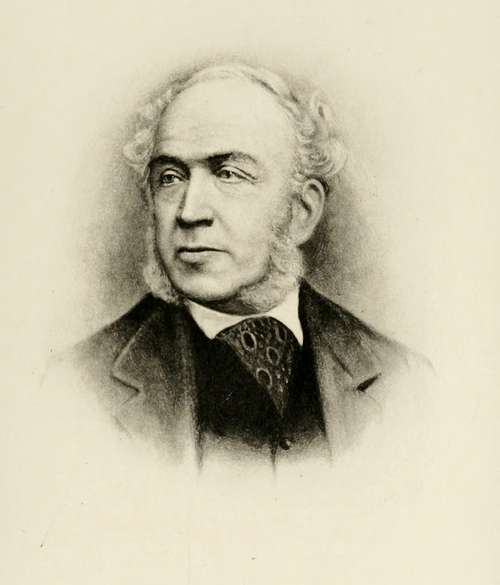
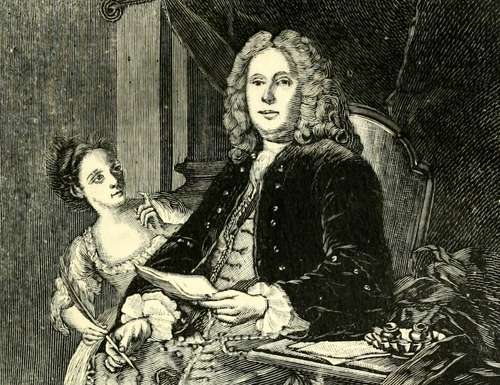
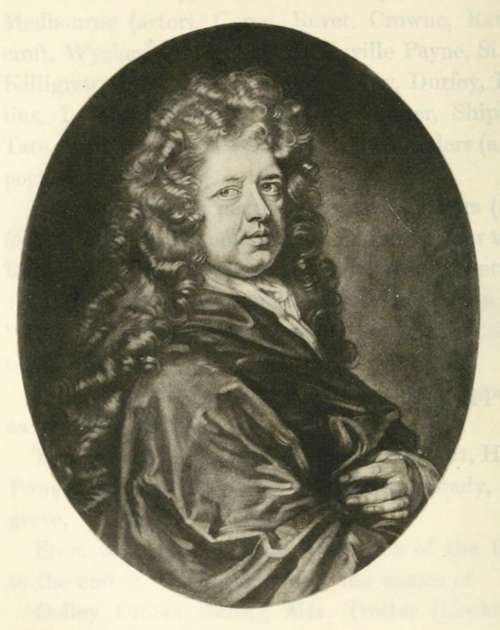
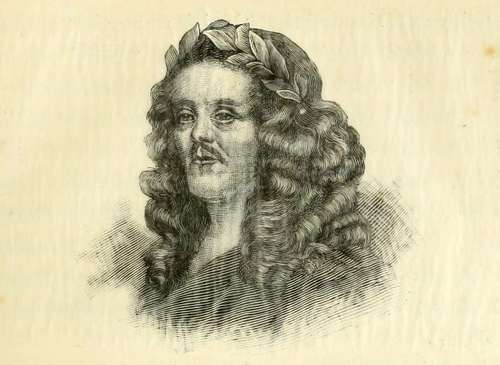
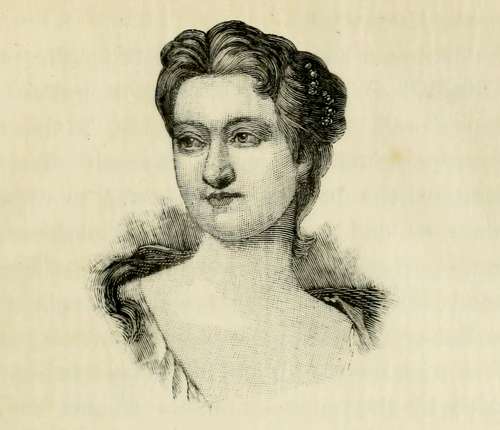
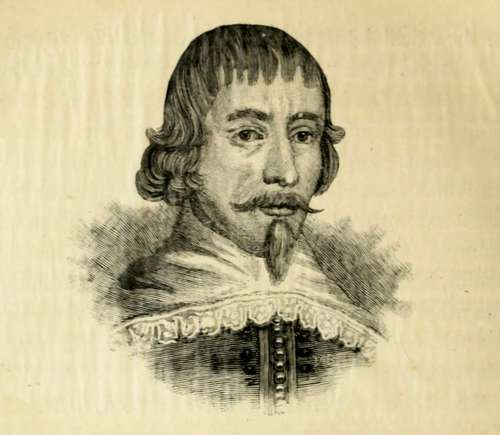
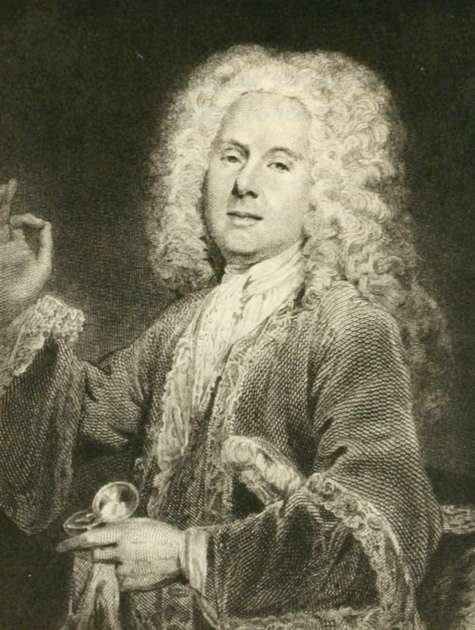
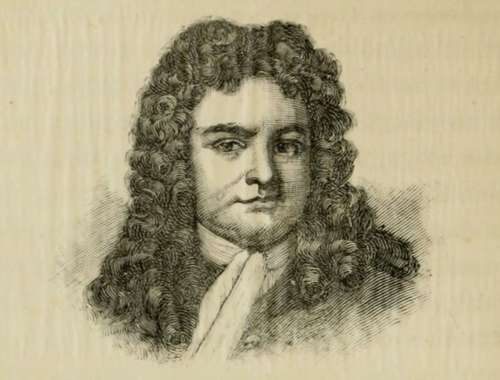
"Their Majesties' Servants" — PREFACE. — CONTENTS. — LIST OF COPPERPLATE PORTRAITS. — LIST OF ILLUSTRATIONS ON WOOD. — LIST OF TAILPIECES ON WOOD.
TRANSCRIBER'S NOTE
Obvious typographical errors and punctuation errors have been
corrected after careful comparison with other occurrences within
the text and consultation of external sources.
Note.—Three Hundred copies of this Edition printed on fine deckle-edge
Royal 8vo paper. The fifty Portraits are given in duplicate, one
on Japanese and the other on plate paper, as India proofs.
Each of these copies is numbered.
No. ........
Dr. DORAN, F.S.A.
VOLUME THE FIRST
Ballantyne Press
BALLANTYNE, HANSON AND CO.
EDINBURGH AND LONDON
"THEIR MAJESTIES' SERVANTS"
ANNALS
OF
THE ENGLISH STAGE
FROM
THOMAS BETTERTON TO EDMUND KEAN
BY
Dr. DORAN, F.S.A.
EDITED AND REVISED BY ROBERT W. LOWE
With Fifty Copperplate Portraits and Eighty Wood Engravings
IN THREE VOLUMES
VOLUME THE FIRST
LONDON
JOHN C. NIMMO
14, KING WILLIAM STREET, STRAND
MDCCCLXXXVIII
It is unnecessary to apologise for a new edition of
Dr. Doran's Annals of the Stage. The two editions
already published have been for many years out of
print, and the first is so rare that copies of it bring a
high price whenever they occur for sale. And this
demand is not a mere bibliographical accident, for
the book has held for many years a recognised position
as the standard popular history of the English
stage. The admirable work of Genest, indispensable
as it is to every writer on theatrical history, and to
every serious student of the stage, is in no sense a
popular work, and is, indeed, rather a collection of
facts towards a history than a history itself.
In preparing this new edition every effort has
been made to add to its interest by the introduction
of portraits and other illustrations, and to its
authority as a book of reference, by correcting
those errors which are scarcely to be avoided by
a writer working among the confused, inaccurate,
and contradictory documents of theatrical history.
No one who has not ventured into this maze can
conceive the difficulty of keeping the true path, and
I can imagine nothing better calculated to sap one's
self-confidence than the task of noting the false
turnings made by such a writer as Dr. Doran. I
can hardly hope that my own work, light as it is
in comparison with his, will be found free from
sins of omission, and even of commission.
My principle has been to pass no error, however
trifling; but, at the same time, I have not thought
myself entitled to discuss matters of opinion, or to
criticise, either directly or indirectly, Dr. Doran's
treatment of his subject. Thus it would be easy to
supplement the information regarding the ancient
theatres and the theatre of Shakspeare's time contained
in the first and second chapters; but, as Dr.
Doran obviously intended that his real work should
begin with the Restoration Theatres, I have not
interfered with his scheme. I trust that, in this, as
in other respects, my work has been done in a spirit
free from captiousness.
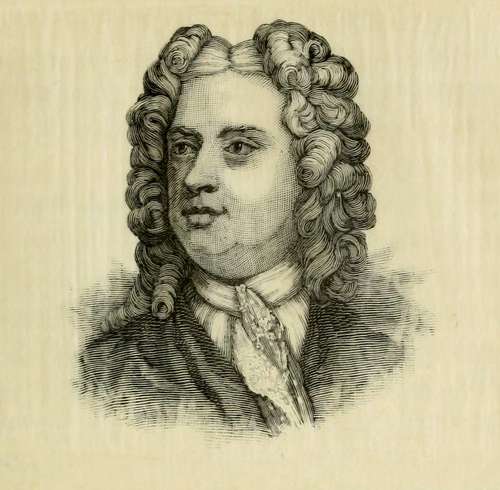
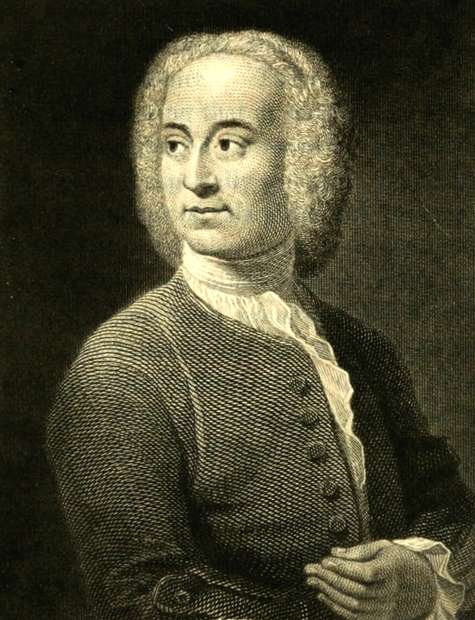
The illustrations to this edition have been chosen,
not from the book "illustrator's" point of view,
but with a serious desire to increase its value as
a history. In the case of the portraits, those which
Dr. Doran specially mentions, have, wherever it was
possible, been selected, and in every instance I
believe the portrait given is an accurate and trustworthy
likeness. The headpieces, intended to form
a supplement to the full-page illustrations, include
portraits of persons whose importance scarcely justified
their place among the larger pictures, drawings
of theatres, and of actors in character. The tailpieces
are reproductions of Sayer's beautiful little
drawings of Garrick and his contemporaries in their
best characters; and in their case no chronological
arrangement is possible.
For many valuable notes I am indebted to the
kindness of Mr. Alban Doran, who intrusted to me
his father's annotated copy of this work. These
notes have in every case been acknowledged and
marked "Doran MS."
The period of the origin of the drama is an unsettled
question, but it has been fixed at an early date, if
we may accept the theory of a recent writer, who
suggests that Moses described the Creation from
a visionary pictorial representation, which occupied
seven days from the commencement to the close of
the spectacle!
Among the most remote of the Chinese traditions,
the theatre holds a conspicuous place. In Cochin-China
there is at this day a most primitive character
about actors, authors, and audience. The governor
of the district enjoys the least rude seat in the sylvan
theatre; he directs the applause by tapping with his
fingers on a little drum, and as at this signal his
secretaries fling strings full of cash on to the stage,
the performance suffers from continual interruption.
For the largesse distributed by the patron of
the drama, and such of the spectators as choose to
follow his example, the actors and actresses furiously
scramble, while the poor poet stands by, sees his best
situations sacrificed, and is none the richer—by way
of compensation.
In Greece the profession of actor was accounted
honourable. In Rome it was sometimes a well-requited,
but also a despised vocation. During the
decade of years when that aristocratic democrat
Pisistratus held power, the drama first appeared (it
is said) at Athens. It formed a portion of the religion
of the State. The theatre was a temple in
which, rudely enough at first, the audience were
taught how the will, not only of men but of gods,
must necessarily submit to the irresistible force of
Destiny. This last power, represented by a combination
of the lyric and epic elements, formed the
drama which had its origin in Greece alone. In
such a sense the Semitic races had no drama at all,
while in Greece it was almost exclusively of Attic
growth, its religious character being especially supported
on behalf of the audience by the ever-sagacious,
morally, and fervently-pious chorus. Lyric tragedy
existed before the age of Thespis and Pisistratus; but
a spoken tragedy dates from that period alone, above
five centuries earlier than the Christian era; and the
new theatre found at once its Prynne and its Collier
in that hearty hater of actors and acting, the legislative
Solon.
At the great festivals, when the theatres were
opened, the expenses of the representations were
borne partly by the State and partly by certain wealthy
officials. The admission was free, until over-crowding
produced fatal accidents. To diminish the latter an
entrance-fee of two oboli, 3¼d., was established, but
the receipts were made over to the poor.[1] From
morning till dewy eve these roofless buildings, capable
of containing on an average twenty thousand
persons, were filled from the ground to the topmost
seat, in the sweet spring-tide, sole theatrical season
of the Greeks.
Disgrace and disfranchisement were the penalties
laid upon the professional Roman actor. He was
accounted infamous, and was excluded from the
tribes. Nevertheless, the calling in Italy had something
of a religious quality. Livy tells us of a company of
Etruscan actors, ballet-pantomimists, however, rather
than comedians, who were employed to avert the
anger of the gods, which was manifested by a raging
pestilence. These Etruscans were in their way the
originators of the drama in Italy. That drama was
at first a dance, then a dance and song; with them
was subsequently interwoven a story. From the
period of Livius Andronicus (b.c. 240) is dated the
origin of an actual Latin theatre, a theatre the glory
of which was at its highest in the days of Attius and
Terence, but for which a dramatic literature became
extinct when the mimes took the place of the old
comedy and tragedy.
Even in Rome the skill of the artist sometimes
freed him from the degradation attached to the
exercise of his art. Roscius, the popular comedian,
contemporary with Cicero, was elevated by Sulla to
the equestrian dignity, and with Æsopus, the great
tragedian, enjoyed the friendship of Tully and of
Tully's friends, the wisest and the noblest in Rome.
Roscius and Æsopus were what would now be called
scholars and gentlemen, as well as unequalled artists,
whom no amount of application could appal when
they had to achieve a triumph in their art. An
Austrian emperor once "encored" an entire opera
(the Matrimonio Segreto); but, according to Cicero,
his friend Æsopus so delighted his enthusiastic audience,
that in one piece they encored him "millies,"
a thousand, or perhaps an indefinite number of times.
The Roman tragedian lived well, and bequeathed a
vast fortune to his son. Roscius earned £32 daily,
and he too amassed great wealth.
The mimes were satirical burlesques, parts of which
were often improvised, and had some affinity to the
pasquinades and harlequinades of modern Italy. The
writers were the intimate friends of emperors; the
actors were infamous. Cæsar induced Decius Laberius,
an author of knightly rank, to appear on the
stage in one of these pieces; and Laberius obeyed,
not for the sake of the honorarium, £4000, but from
dread of disobeying an order from so powerful a
master. The unwilling actor profited by his degradation
to satirise the policy of Cæsar, who did not
resent the liberty, but restored Laberius to the rank
and equestrian privileges which he had forfeited by
appearing on the stage. Laberius, however, never
recovered the respect of his countrymen, not even of
those who had applauded him the most loudly.
The licentious pantomimists were so gross in their
performances that they even disgusted Tiberius, who
forbade them from holding any intercourse, as the
professional histriones or actors of the drama had
done, with Romans of equestrian or senatorial dignity.
It was against the stage, exclusively given up
to their scandalous exhibitions, that the Christian
fathers levelled their denunciations. They would
have approved a "well-trod stage," as Milton did,
and the object attributed to it by Aristotle,—but they
had only anathemas for that horrible theatre where
danced and postured Bathyllus and Hylas, and
Pylades, Latinus and Nero, and even that graceful
Paris, whom Domitian slew in his jealousy, and of
whom Martial wrote that he was the great glory and
grief of the Roman theatre, and that all Venuses and
Cupids were buried for ever in the sepulchre of Paris,
the darling of old Rome.
In this our England, minds and hearts had ever
been open to dramatic impressions. The Druidical
rites contained the elements of dramatic spectacle.
The Pagan Saxon era had its dialogue-actors, or
buffoons; and when the period of Christianity succeeded,
its professors and teachers took of the evil
epoch what best suited their purposes. In narrative
dialogue, or song, they dramatised the incidents of
the lives of the saints, and of One greater than
saints; and they thus rendered intelligible to listeners
what would have been incomprehensible if
it had been presented to them as readers.
In Castle-Hall, before farm-house fires, on the
bridges, and in the market-places, the men who best
performed the united offices of missionary and actor,
were, at once, the most popular preachers and players
of the day. The greatest of them all, St. Adhelm,
when he found his audience growing weary of too
much serious exposition, would take his small harp
from under his robes, and would strike up a narrative
song, that would render his hearers hilarious.
The mixture of the sacred and profane in the early
dialogues and drama prevailed for a lengthened period.
The profane sometimes superabounded, and the higher
Church authorities had to look to it. The monotony
of monastic life had caused the wandering glee-men
to be too warmly welcomed within the monastery
circles, where there were men who cheerfully employed
their energies in furnishing new songs and
lively "patter" to the strollers. It was, doubtless,
all well meant; but more serious men thought it wise
to prohibit the indulgence of this peculiar literary
pursuit. Accordingly, the Council of Clovershoe, and
decrees bearing the king's mark, severally ordained
that actors, and other vagabonds therein named,
should no longer have access to monasteries, and that
no priest should either play the glee-man himself, or
encourage the members of that disreputable profession,
by turning ale poets, and writing songs for
them.
It is a singular fact, that one of our earliest
theatres had Geoffrey, a monk, for its manager, and
Dunstable—immortalised by Silvester Daggerwood—for
a locality. This early manager, who flourished
about 1119,[2] rented a house in the town just named,
when a drama was represented, which had St. Katherine
for a heroine, and her whole life for a subject.
This proto-theatre was, of course, burnt down; and
the managing monk withdrew from the profession,
more happy than most ruined managers, in this, that
he had his cell at St. Albans, to which he could
retire, and therein find a home for the remainder of
his days.
Through a course of Mysteries, Miracle-plays—illustrating
Scripture, history, legend, and the sufferings
of the martyrs,—Moralities, in which the vices
were in antagonism against the virtues, and Chronicle-plays,
which were history in dialogue, we finally
arrive at legitimate Tragedy and Comedy. Till this
last and welcome consummation, the Church as regularly
employed the stage for religious ends, as the
old heathen magistrates did when they made village
festivals the means of maintaining a religious feeling
among the villagers. Professor Browne, in his
History of Greek Classical Literature, remarks:—"The
believers in a pure faith can scarcely understand a
religious element in dramatic exhibitions. They who
knew that God is a spirit, and that they who worship
Him must worship him in spirit and in truth, feel
that His attributes are too awful to permit any ideas
connected with Deity to be brought into contact
with the exhibition of human passions. Religious
poetry of any kind, except that which has been
inspired, has seldom been the work of minds sufficiently
heavenly and spiritual, to be perfectly successful
in attaining the end of poetry, namely the
elevation of the thoughts to a level with the subject.
It brings God down to man, instead of raising man
to Him. It causes that which is most offensive to
religious feeling, and even good taste, irreverent
familiarity with subjects which cannot be contemplated
without awe. But a religious drama would
be, to those who realise to their own minds the spirituality
of God, nothing less than anthropomorphism
and idolatry. Christians of a less advanced age,
and believers in a more sensuous creed, were able to
view with pleasure the mystery-plays in which the
gravest truths of the Gospel were dramatically represented;
nay, more, just as the ancient Athenians
could look even upon their gross and licentious
comedy as forming part of a religious ceremony, so
could Christians imagine a religious element in profane
dramas which represented in a ludicrous light
subjects of the most holy character."
Mysteries kept the stage from the Norman to the
Tudor era. The Moralities began to displace them
during the reign of Henry VI., who was a less beneficial
patron of the stage than that Richard III.
who has himself retained a so unpleasant possession
of the scene. Actors and dramatists have been ungrateful
to this individual, who was their first practically
useful patron. Never, previous to Richard's
time, had an English prince been known to have
a company of players of his own. When Duke of
Gloucester, a troop of such servants was attached to
his household. Richard was unselfish towards these
new retainers; whenever he was too "busy," or "not
i' the vein" to receive instruction or amusement at
their hands, he gave them licence to travel abroad,
and forth went the mirthful company, from county
to county, mansion to mansion, from one corporation-hall
and from one inn-yard to another, playing
securely under the sanction of his name, winning
favour for themselves, and a great measure of public
regard, probably, for their then generous and princely
master.
The fashion thus set by a prince was followed by
the nobility, and it led to a legal recognition of the
actor and his craft, in the royal licence of 1572,
whereby the players connected with noble houses
were empowered to play wherever it seemed good
to them, if their master sanctioned their absence,
without any let or hindrance from the law.
The patronage of actors by the Duke of Gloucester
led to a love of acting by gentlemen amateurs.
Richard had ennobled the profession, the gentlemen
of the Inns of Court took it up, and they soon had
kings and queens leading the applause of approving
audiences. To the same example may be traced the
custom of having dramatic performances in public
schools, the pupils being the performers. These
boys, or, in their place, the children of the Chapel
Royal, were frequently summoned to play in presence
of the King and Court. Boatsful of them
went down the river to Greenwich, or up to Hampton
Court, to enliven the dulness or stimulate the
religious enthusiasm of their royal auditors there.
At the former place, and when there was not yet
any suspicion of the orthodoxy of Henry VIII., the
boys of St. Paul's acted a Latin play before the
sovereign and the representatives of other sovereigns.
The object of the play was to exalt the Pope, and
consequently Luther and his wife were the foolish
villains of the piece, exposed to the contempt and
derision of the delighted and right-thinking hearers.
In most cases the playwrights, even when members
of the clergy, were actors as well as authors. This
is the more singular, as the players were generally
of a roystering character, and were but ill-regarded
by the Church. Nevertheless, by their united efforts,
though they were not always colleagues, they helped
the rude production of the first regularly constructed
English comedy, "Ralph Roister Doister," about
1540. The author was a "clerk," named Nicholas
Udall, whom Eton boys, whose master he was, hated
because of his harshness. The rough and reverend
gentleman brought forth the above piece, just one
year previous to his losing the mastership, on suspicion
of being concerned in a robbery of the college plate.
Subsequently to this, the Cambridge youths had the
courage to play a tragedy called "Pammachus," which
must have been offensive to the government of Henry
VIII. Gardiner, Bishop of Winchester, Chancellor
of the University, immediately wrote a characteristic
letter to the Vice-Chancellor, Dr. Matthew Parker. It
is dated 27th March 1545. "I have been informed,"
he says, "that the youth in Christ's College, contrary
to the mind of the Master and President, hath of late
played a tragedy called 'Pammachus,' a part of which
tragedy is so pestiferous as were intolerable. If it be
so, I intend to travail, as my duty is, for the reformation
of it. I know mine office there, and mind to do
in it as much as I may." Parker answers on the 3d
of April, that the play had been performed with the
concurrence of the College authorities, after means
had been taken to strike out "slanderous cavillations
and suspicious sentences," and "all such matter
whereby offence might greatly have risen. Hitherto,"
adds Parker, "have I not seen any man that was
present at it to show himself grieved; albeit it was
thought their time and labour might be spent in a
better-handled matter." Gardiner is not satisfied
with this, and he will have the subject investigated.
Accordingly, some of the audience are ordered to be
examined to discover if what they applauded was
what the King's government had reproved. "I have
heard specialities," he writes, "that they" (the actors)
"reproved Lent fastings, all ceremonies, and albeit
the words of sacrament and mass were not named,
yet the rest of the matter written in that tragedy,
in the reproof of them was expressed." Gardiner
intimates that if the authorities concurred, after
exercising a certain censorship, in licensing the representation,
they were responsible for all that was
uttered, as it must have had the approval of their
judgments.
A strict examination followed. Nearly the entire
audience passed under it, but not a man could or
would remember that he had heard anything to
which he could make objection. Therewith Parker
transmitted to Gardiner the stage-copy of the tragedy,
which the irate prelate thus reviews:—"Perusing
the book of the tragedy which ye sent me, I find
much matter not stricken out, all which, by the
parties' own confession, was uttered very naught,
and on the other part something not well omitted."
Flagrant lies are said to be mixed up with incontrovertible
truths; and it is suggested, that if any of
the audience had declared that they had heard
nothing at which they could take offence, it must
have been because they had forgotten much of what
they had heard. Ultimately, Parker was left to deal
with the parties as he thought best; and he wisely
seems to have thought it best to do nothing. Plays
were the favourite recreation of the university men;
albeit, as Parker writes, "Two or three in Trinity
College think it very unseeming that Christians
should play or be present at any profane comedies
or tragedies."
Actors and clergy came into direct collision, when,
at the accession of Edward VI. (1547), the Bishop of
Winchester announced "a solemn dirge and mass,"
in honour of the lately deceased king, Henry VIII.
The indiscreet Southwark actors thereupon gave
notice that at the time announced for the religious
service they would act a "solempne play" to try, as
the bishop remarks in a letter to Paget, "who shall
have most resort, they in game or I in earnest."
The prelate urgently requests the interference of the
Lord Protector, but with what effect, the records in
the State Paper Office afford no information.
Some of these Southwark actors were the "servants"
of Henry Grey, Marquis of Dorset, whose
mansion was on the opposite side of the river. In
1551 he was promoted to the dukedom of Suffolk,
but his poor players were then prohibited from playing
anywhere, save in their master's presence.[3]
Severity led to fraud. In the autumn of the following
year Richard Ogle forwarded to the Council a
forged licence, taken from the players—a matter
which was pronounced to be "worthy of correction."
The young king's patronage of his own "servants"
was not marked by a princely liberality; the salary
of one of his players of interludes, John Brown, was
five marks yearly as wages, and one pound three
shillings and fourpence for his livery.
Of the party dramatists of this reign, that reverend
prelate, "Bilious Bale," was the most active and the
least pleasant-tempered. Bale had been a Romanist
priest, he was now a Protestant bishop (of Ossory),
with a wife to control the episcopal hospitality. Bale
had "seen the world." He had gone through marvellous
adventures, of which his adversaries did not
believe a word; and he had converted the most
abstruse doctrinal subjects into edifying semi-lively
comedies. The bishop did not value his enemies at
the worth of a rush in an old king's chamber. He
was altogether a Boanerges; and when his "John,
King of England," was produced, the audience, comprising
two factions in the Church and State, found
the policy of Rome towards this country illustrated
with such effect, that while one party hotly denounced,
the other applauded the coarse and vigorous audacity
of the author.
So powerful were the influences of the stage, when
thus applied, that the government of Queen Mary
made similar application of them in support of their
own views. A play, styled "Respublica," exhibited
to the people the alleged iniquity of the Reformation,
pointed out the dread excellence of the sovereign herself
(personified as Queen Nemesis), and exemplified
her inestimable qualities, by making all the Virtues
follow in her train as Maids of honour.
Such, now, were the orthodox actors; but the heretical
players were to be provided against by stringent
measures. A decree of the sovereign and council, in
1556, prohibited all players and pipers from strolling
through the kingdom; such strollers—the pipers singularly
included—being, as it was said, disseminators
of seditions and heresies.
The eye of the observant government also watched
the resident actors in town. King Edward had ordered
the removal of the king's revels and masques from
Warwick Inn, Holborn, "to the late dissolved house
of Blackfriars, London," where considerable outlay
was made for scenery and machinery—adjuncts to
stage effect—which are erroneously supposed to have
been first introduced a century later by Davenant.
There still remained acting a company at the Boar's
Head, without Aldgate, on whom the police of Mary
were ordered to make levy. The actors had been
playing in that inn-yard a comedy, entitled a "Sack
full of News." The order of the privy council to the
mayor informs his worship, that it is "a lewd play;"
bids him send his officers to the theatre without
delay, and not only to apprehend the comedians, but
to "take their play-book from them and send it before
the privy council."
The actors were under arrest for four-and-twenty
hours, and were then set free, but under certain stipulations
to be observed by them "and all other players
throughout the city,"—namely: they were to exercise
their vocation of acting "between All Saints and
Shrovetide" only; and they were bound to act no
other plays but such as were approved of by the
Ordinary. This was the most stringent censorship
to which the stage has ever been subjected.
Although Edward had commanded the transfer of
the company of actors from Warwick Inn to Blackfriars,
that dissolved monastery was not legally converted
into a theatre till the year 1576, when Elizabeth
was on the throne. In that year[4] the Earl of
Leicester's servants were licensed to open their series
of seasons in a house, the site of which is occupied
by Apothecaries' Hall and some adjacent buildings.
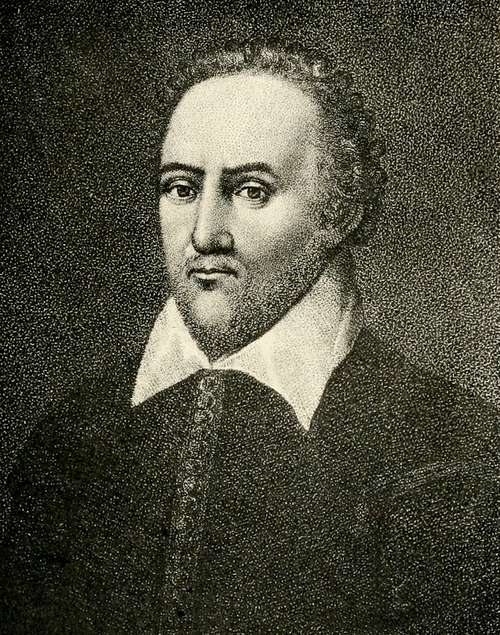
At the head of the company was James, father
of Richard Burbage, the original representative of
Richard III. and of Hamlet, the author of which
tragedies, so named, was, at the time of the opening
of the Blackfriars' theatre, a lad of twelve years
of age, surmounting the elementary difficulties of
Latin and Greek in the Free School of Stratford-on-Avon.
In Elizabeth the drama possessed a generous
patroness and a vindictive censor. Her afternoons
at Windsor Castle and Richmond were made pleasant
to her by the exertions of her players. The
cost to her of occasional performances at the above
residences during two years amounted to a fraction
over £444. There were incidental expenses also,
proving that the actors were well cared for. In the
year 1575, among the estimates for plays at Hampton
Court, the liberal sum of £8, 14s. is set down
"for the boyling of the brawns against Xtmas."
As at Court, so also did the drama flourish at the
Universities, especially at Cambridge. There, in
1566, the coarse dialect comedy, "Gammer Gurton's
Needle"—a marvellous production, when considered
as the work of a bishop, Still, of Bath and Wells—was
represented amid a world of laughter.
There, too, was exercised a sharp censorship over
both actors and audience. In a letter from Vice-Chancellor
Hatcher to Burleigh, the conduct of
Punter, a student of St. John's, at stage-plays at
Caius and Trinity, is complained of as unsteady. In
1581 the heads of houses again make application to
Burleigh, objecting to the players of the Great Chamberlain,
the Earl of Oxford, poet and courtier, exhibiting
certain plays already "practised" by them
before the King. The authorities, when scholastic
audiences were noisy, or when players brought no
novelty with them to Cambridge, applied to the great
statesman in town, and vexed him with dramatic
troubles, as if he had been general stage-manager of
all the companies strolling over the kingdom.
On one occasion the stage was employed as a vantage
ground whereon to raise a battery against the
power of the stage's great patroness, the Queen. In
1599, the indiscreet followers of Essex "filled the
pit of the theatre, where Rutland and Southampton
are daily seen, and where Shakspeare's company, in
the great play of 'Richard II.,' have, for more than
a year, been feeding the public eye with pictures of
the deposition of kings." In June of the following
year, "those scenes of Shakspeare's play disturb
Elizabeth's dreams. The play had had a long and
splendid run, not less from its glorious agony of dramatic
passion than from the open countenance lent
to it by the Earl, who, before his voyage, was a
constant auditor at the Globe, and by his constant
companions, Rutland and Southampton. The great
parliamentary scene, the deposition of Richard, not
in the printed book, was possibly not in the early
play; yet the representation of a royal murder and
a successful usurpation on the public stage is an
event to be applied by the groundlings, in a pernicious
and disloyal sense. Tongues whisper to the
Queen that this play is part of a great plot to teach
her subjects how to murder kings. They tell her she
is Richard; Essex, Bolingbroke. These warnings
sink into her mind. When Lambard, Keeper of the
Records, waits upon her at the palace, she exclaims
to him, 'I am Richard! Know you not that?'"
The performance of this play was, nevertheless,
not prohibited. When the final attempt of Essex
was about to be made, in February 1601—"To fan
the courage of their crew," says Mr. Hepworth
Dixon, from whose Personal History of Lord Bacon
I borrow these details, "and prepare the citizens for
news of a royal deposition, the chiefs of the insurrection
think good to revive, for a night, their favourite
play. They send for Augustine Phillips, manager of
the Blackfriars Theatre, to Essex House; Monteagle,
Percy, and two or three more—among them Cuffe
and Meyrick—gentlemen whose names and faces he
does not recognise, receive him; and Lord Monteagle,
speaking for the rest, tells him that they want
to have played the next day Shakspeare's deposition
of Richard II. Phillips objects that the play is stale,
that a new one is running, and that the company
will lose money by a change. Monteagle meets his
objections. The theatre shall not lose; a host of
gentlemen from Essex House will fill the galleries;
if there is fear of loss, here are 40s. to make it up.
Phillips takes the money, and King Richard is duly
deposed for them, and put to death."
Meanwhile, the profession of player had been assailed
by fierce opponents. In 1587,[5]
when twenty-three summers lightly sat on Shakspeare's brow,
Gosson, the "parson" of St. Botolph's, discharged
the first shot against stage plays which had yet been
fired by any one not in absolute authority. Gosson's
book was entitled, A School of Abuse, and it professed
to contain "a pleasant invective against poets,
players, jesters, and such like caterpillars of a Commonwealth."
Gosson's pleasantry consists in his
illogical employment of invective. Domitian favoured
plays, argal, Domitian's domestic felicity was troubled
by a player—Paris. Of Caligula, Gosson remarks,
that he made so much of players and dancers, that
"he suffered them openly to kiss his lips, when the
senators might scarcely have a lick at his feet;" and
the good man of St. Botolph's adds, that the murder
of Domitian, by Charea, was "a fit catastrophe," for
it was done as the Emperor was returning from a
play!
As a painter of manners, Gosson thus gaily limns
the audiences of his time. "In our Assemblies at
plays in London, you shall see such heaving and
shouting, such pitching and shouldering to sit by
women, such care for their garments that they be not
trodden on, such eyes to their laps that no chips light
on them, such pillows to their backs that they take
no hurt, such masking in their ears, I know not
what; such giving them pippins to pass the time;
such playing at foot-saunt without cards; such ticking,
such toying, such smiling, such winking, and
such manning them home when the sports are ended,
that it is a right comedy to mark their behaviour."
In this picture Gosson paints a good-humoured and
a gallant people. When he turns from failings to
vices, the old rector of St. Botolph's dwells upon
them as Tartuffe does upon the undraped shoulders of
Dorinne. He likes the subject, and makes attractive
what he denounces as pernicious. The playwrights
he assails with the virulence of an author, who, having
been unsuccessful himself, has no gladness in the
success, nor any generosity for the shortcomings of
others. Yet he cannot deny that some plays are
moral, such as "Cataline's Conspiracy,"—"because,"
as he elegantly observes, "it is said to be a pig of
mine own sow." This, and one or two other plays
written by him, he complaisantly designates as "good
plays, and sweet plays, and of all plays the best plays,
and most to be liked."
Let us now return to the year of Shakspeare's
birth. The great poet came into the world when
the English portion of it was deafened with the
thunder of Archbishop Grindal, who flung his bolts
against the profession which the child in his cradle
at Stratford was about to ennoble for ever. England
had been devastated by the plague of 1563. Grindal
illogically traced the rise of the pestilence to the
theatres; and to check the evil he counselled Cecil
to suppress the vocation of the idle, infamous, youth-infecting
players, as the prelate called them, for one
whole year, and—"if it were for ever," adds the
primate, "it were not amiss."
Elizabeth's face shone upon the actors, and rehearsals
went actively on before the Master of the
Revels. The numbers of the players, however, so
increased and spread over the kingdom, that the
government, when Shakspeare was eight years of age,
enacted that startling statute which is supposed to
have branded dramatic art and artists with infamy.
But the celebrated statute of 1572 does not declare
players to be "rogues and vagabonds." It simply
threatens to treat as such all acting companies who
presume to set up their stage without the license of
"two justices of the peace at least." This was rather
to protect the art than to insult the artist; and a few
years subsequent to the publication of this statute,
Elizabeth granted the first royal patent conceded in
England to actors—that of 1576.[6] By this authority
Lord Leicester's servants were empowered to produce
such plays as seemed good to them, "as well," says
the Queen, "for the recreation of our loving subjects
as for our solace and pleasure, when we shall think
good to see them." Sovereign could scarcely pay a
more graceful compliment to poet or to actor.
This royal patent sanctioned the acting of plays
within the liberties of the city; but against this the
city magistrates commenced an active agitation. Their
brethren of Middlesex followed a like course throughout
the county. The players were treated as the
devil's missionaries; and such unsavoury terms were
flung at them and at playwrights, by the city aldermen
and the county justices, that thereon was founded
that animosity which led dramatic authors to represent
citizens and justices as the most egregious of
fools, the most arrant of knaves, and the most deluded
of husbands.
Driven from the city, Burbage and his gay brotherhood
were safe in the shelter of Blackfriars, adjacent
to the city walls. Safe, but neither welcome nor unmolested.
The devout and noble ladies who had
long resided near the once sacred building, clamoured
at the audacity of the actors. Divine worship and
sermon, so they averred, would be grievously disturbed
by the music and rant of the comedians, and
by the debauched companions resorting to witness
those abominable plays and interludes.
This cry was shrill and incessant, but it was unsuccessful.
The Blackfriars' was patronised by a
public whose favours were also solicited by those
"sumptuous houses" the "Theatre" and the "Curtain"
in Shoreditch. Pulpit logicians reasoned, more
heedless of connection between premises and conclusion
than Grindal or Gosson. "The cause of
plagues is sin," argues one, "and the cause of sin
are plays; therefore, the cause of plagues are plays."
Again: "If these be not suppressed," exclaims a
Paul's Cross preacher, "it will make such a tragedy
that all London may well mourn while it is London."[7]
But for the sympathy of the Earl of Leicester it
would have gone ill with these players. He has
been as ill-requited by authors and actors as their
earlier friend, Richard of Gloucester. To this day
the stage exhibits the great earl, according to the
legend contrived by his foes, as the murderer of
his wife.
Sanctioned by the court, befriended by the noble,
and followed by the general public, the players stood
their ground, but they lacked the discretion which
should have distinguished them. They bearded
authority, played in despite of legal prohibitions, and
introduced forbidden subjects of state and religion
upon their stage. Thence ensued suspensions for
indefinite periods, severe supervision when the suspension
was rescinded, and renewed transgression on
the part of the reckless companies, even to the playing
on a Sunday, in any locality where they conjectured
there was small likelihood of their being
followed by a warrant.
But the most costly of the theatrical revels of King
James took place at Whitehall, at Greenwich, or at
Hampton Court, on Sunday evenings—an unseemly
practice, which embittered the hatred of the Puritans
against the stage, all belonging to it, and all who
patronised it. James was wiser when he licensed
Kirkham, Hawkins, Kendall, and Payne to train the
Queen's children of the revels, and to exercise them
in playing within the Blackfriars' or elsewhere all
plays which had the sanction of old Samuel Danyell.
His queen, Anne, was both actress and manager in the
masques performed at court, the expenses of which
often exceeded, indeed were ordered not to be limited
to, £1000. "Excellent comedies" were played
before Prince Charles and the Prince Palsgrave[8] at
Cambridge; and the members of St. John's, Clare,
and Trinity, acted before the King and court in
1615, when the illustrious guests were scattered
among the colleges, and twenty-six tuns of wine
consumed within five days!
The lawyers alone were offended at the visits of
the court to the amateurs at Cambridge, especially
when James went thither to see the comedy of
Ignoramus, in which law and lawyers are treated
with small measure of respect. When James was
prevented from going to Cambridge, he was accustomed
to send for the whole scholastic company to
appear before him, in one of the choicest of their
pieces, at Royston. Roving troops were licensed by
this play-loving king to follow their vocation in stated
places in the country, under certain restrictions for
their tarrying and wending—a fortnight's residence
in one town being the time limited, with injunction
not to play "during church hours."
Then there were unlicensed satirical plays in
unlicensed houses. Sir John Yorke, his wife and
brothers, were fined and imprisoned, because of a
scandalous play acted in Sir John's house, in favour
of Popery. On another occasion, in 1617, we hear
of a play, in some country mansion, in which the
King, represented as a huntsman, observed that he
had rather hear a dog bark than a cannon roar. Two
kinsmen, named Napleton, discussed this matter,
whereupon one of them remarked that it was a pity
the King, so well represented, ever came to the crown
of England at all, for he loved his dogs better than
his subjects. Whereupon the listener to this remark
went and laid information before the council against
the kinsman who had uttered it!
The players could, in James's reign, boast that
their profession was at least kindly looked upon by
the foremost man in the English Church. "No man,"
says Hacket, "was more wise or more serious than
Archbishop Bancroft, the Atlas of our clergy, in his
time; and he that writes this hath seen an interlude
well presented before him, at Lambeth, by his own
gentlemen, when I was one of the youngest spectators."
The actors thus had the sanction of the
Archbishop of Canterbury in James's reign, as they
had that of Williams, Archbishop of York, in the
next. Hacket often alludes to theatrical matters.
"The theatres," he says, in one of his discourses
made during the reign of Charles II., when the
preacher was Bishop of Lichfield and Coventry, "are
not large enough nowadays to receive our loose
gallants, male and female, but whole fields and parks
are thronged with their concourse, where they make
a muster of their gay clothes." Meanwhile, in 1616,
the pulpit once more issued anathemas against the
stage. The denouncer, on this occasion, was the
preacher of St. Mary Overy's, named Sutton, whose
undiscriminating censure was boldly, if not logically,
answered by the actor, Field. There is a letter from
the latter in the State Paper Office, in which he
remonstrates against the sweeping condemnation of
all players. The comedian admits that what he calls
his trade has its corruptions, like other trades; but
he adds, that since it is patronised by the King, there
is disloyalty in preaching against it, and he hints
that the theology of the preacher must be a little out
of gear, seeing that he openly denounces a vocation
which is not condemned in Scripture!
Field, the champion of his craft in the early part
of the seventeenth century, was one of the dozen
actors to whom King James, in 1619, granted a
licence to act comedy, tragedy, history, &c., for the
solace and pleasure of his Majesty and his subjects,
at the Globe, and at their private house in the precincts
of Blackfriars. This licence was made out to
Hemings, Burbage, Condell, Lowen, Tooley, Underwood,
Field, Benfield, Gough, Eccleston, Robinson,
Shancks, and their associates. Their success rendered
them audacious, and, in 1624, they got into trouble,
on a complaint of the Spanish ambassador. The
actors at the Globe had produced Middleton's "Game
at Chess," in which the action is carried on by black
and white pieces, representing the Reformed and
Romanist parties. The latter, being the rogues of
the piece, are foiled, and are "put in the bag."
The Spanish envoy's complaint was founded on
the fact that living persons were represented by
the actors, such persons being the King of Spain,
Gondomar, and the famous Antonio de Dominis,
who, after being a Romish bishop (of Spalato), professed
Protestantism, became Dean of Windsor, and
after all died in his earlier faith, at Rome. On the
ambassador's complaint, the actors and the author
were summoned before the council, but no immediate
result followed, for, two days later, Nethercole
writes to Carleton, informing him that "the comedy
in which the whole Spanish business is taken up,
is drawing £100 nightly." At that time, a house
with £20 in it was accounted a "good house," at
either the Globe or Blackfriars. Receipts amounting
to five times that sum, for nine afternoons successively,
may be accepted as a proof of the popularity
of this play. The Spaniard, however, would
not let the matter rest; the play was suppressed,
the actors forbidden to represent living personages
on the stage, and the author was sent to prison.
Middleton was not long detained in durance vile.
James set him free, instigated by a quip in a poor
epigram,—
"Use but your royal hand, 'twill set me free!
'Tis but removing of a man—that's me."
A worse joke never secured for its author a greater
boon—that of liberty.
With all this, an incident of the following year
proves that the players disregarded peril, and found
profit in excitement. For Shrovetide, 1625, they
announced a play founded on the Dutch horrors at
Amboyna, but the performance was stopped, on the
application of the East India Company, "for fear of
disturbances this Shrovetide." A watch of 800 men
was set to keep all quiet on Shrove Tuesday; and
the subject was not again selected for a piece till
1673, when Dryden's "Amboyna" was produced in
Drury Lane, and the cruelties of the Dutch condemned
in a serio-comic fashion, as those of a people—so
the epilogue intimated to the public—"who
have no more religion faith—than you."
In James's days, the greater or less prevalence
of the plague regulated the licences for playing.
Thus, permission was given to the Queen's Servants
to act "in their several houses, the Curtain, and
the Boar's Head, Middlesex, as soon as the plague
decreases to 30 a week, in London." So, in the
very first year of Charles I., 1625, the "common
players" have leave not only to act where they
will, but "to come to court, now the plague is
reduced to six." Accordingly, there was a merry
Christmas season at Hampton Court, the actors being
there; and, writes Rudyard to Nethercole, "the
demoiselles" (maids of honour, doubtless), "mean
to present a French pastoral, wherein the Queen is
a principal actress." Thus, the example set by the
late Queen Anne and now adopted by Henrietta
Maria, led to the introduction of actresses on the
public stage, and it was the manifestation of a taste for
acting exhibited by the French princess, that led to the
appearance in London of actresses of that nation.
With the reign of Charles I. new hopes came to
the poor player, but therewith came new adversaries.
Charles I. was a hearty promoter of all sports and
pleasures, provided his people would be merry and
wise according to his prescription only. Wakes and
maypoles were authorised by him, to the infinite
disgust of the Puritans, who liked the authorisation
no more than they did the suppression of lectures.
When Charles repaired to church, where the Book of
Sports was read, he was exposed to the chance of
hearing the minister, after reading the decree as he
was ordered, calmly go through the Ten Commandments,
and then tell his hearers, that having listened
to the commands of God and those of man, they
might now follow which they liked best.
When Bishop Williams, of Lincoln, and subsequently
Archbishop of York, held a living, he
pleaded in behalf of the right of his Northamptonshire
parishioners to dance round the maypole.
When ordered to deliver up the Great Seal by the
King, he retired to his episcopal palace at Buckden,
where, says Hacket, "he was the worse thought of
by some strict censurers, because he admitted in his
public hall a comedy once or twice to be presented
before him, exhibited by his own servants, for an
evening recreation." Being then in disgrace, this
simple matter was exaggerated by his enemies into
a report, that on an Ordination Sunday, this arrogant
Welshman had entertained his newly-ordained
clergy with a representation of Shakspeare's "Midsummer's
Night's Dream," the actors in which had
been expressly brought down from London for the
purpose!
In the troubled days in which King Charles and
Bishop Williams lived, the stage suffered with the
throne and church. After this time the names of
the old houses cease to be familiar. Let us take
a parting glance of these primitive temples of our
drama.
The royal theatre, Blackfriars, was the most nobly
patronised of all the houses opened previous to the
Restoration. The grown-up actors were the most
skilled of their craft; and the boys, or apprentices,
were the most fair and effeminate that could be
procured, and could profit by instruction. On this
stage Shakspeare enacted the Ghost in "Hamlet,"
Old Adam, and a similar line of characters, usually
intrusted to the ablest of the performers of the
second class. Blackfriars was a winter house.
Some idea of its capability and pretension may be
formed from the fact, that in 1633 its proprietors,
the brothers Burbage,[9] let it to the actors for a
yearly rent of £50. In 1655 it was pulled down,[10]
after a successful career of about three-quarters of
a century.
Upon the strip of shore, between Fleet Street and
the Thames, there have been erected three theatres.
In the year 1580, the old monastery of Whitefriars
was given up to a company of players; but the
Whitefriars' Theatre did not enjoy a very lengthened
career. In the year 1616, that in which Shakspeare
died, it had already fallen into disrepute and decay,
and was never afterwards used for the representation
of dramatic pieces. The other theatres, in Dorset
Gardens, were built subsequently to the Restoration.
In the parish of St. Giles's, Cripplegate, and in the
street now called Playhouse Yard, connecting Whitecross
Street with Golding Lane, stood the old Fortune,
erected in 1600, for Henslowe (the pawnbroker
and money-lender to actors) and Alleyn, the most
unselfish of comedians. It was a wooden tenement,
which was burned down in 1621, and replaced by a
circular brick edifice. In 1649, two years after the
suppression of plays by the Puritan Act, when the
house was closed, a party of soldiers, "the sectaries
of those yeasty times," broke into the edifice, destroyed
its interior fittings, and pulled down the
building.[11] The site and adjacent ground were soon
covered by dwelling-houses.
Meanwhile, the inn yards, or great rooms at the
inns, were not yet quite superseded. The Cross Keys
in Gracechurch Street, the Bull in Bishopsgate Street,
near which lived Anthony Bacon, to the extreme dislike
of his grandmother; and the Red Bull, in St.
John Street, Clerkenwell, which last existed as late
as the period of the Great Fire, were open, if not for
the acting of plays, at least for exhibitions of fencing
and wrestling.
The Surrey side of the Thames was a favourite
locality for plays, long before the most famous of the
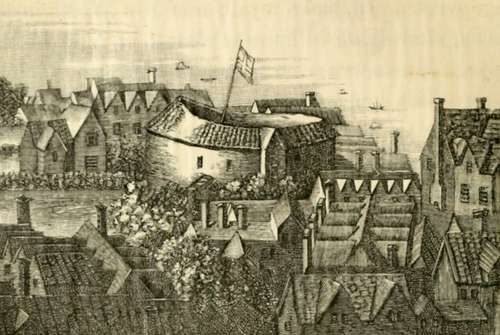
regular and royally-sanctioned theatres. The Globe
was on that old joyous Bankside; and the Little
Rose, in 1584, there succeeded to an elder structure
of the same name, whose memory is still preserved in
Rose Alley. The Globe, the summer-house of Shakspeare
and his fellows, flourished from 1594 to 1613,
when it fell a prey to the flames caused by the wadding
of a gun, which lodged in and set fire to the
thatched roof. The new house, erected by a royal
and noble subscription, was of wood, but it was tiled.
Its career, however, was not very extended, for in
1654, the owner of the freehold, Sir Matthew Brand,
pulled the house down; and the name of Globe Alley
is all that is left to point out the whereabouts of the
popular summer-house in Southwark.
On the same bank of the great river stood the
Hope, a play-house four times a week, and a garden
for bear-baiting on the alternate days. In the former
was first played Jonson's "Bartholomew Fair." When
plays were suppressed, the zealous and orthodox soldiery
broke into the Hope, horsewhipped the actors,
and shot the bears. This place, however, in its
character of Bear Garden, rallied after the Restoration,
and continued prosperous till nearly the close
of the seventeenth century. There remains to be
noticed, Paris Garden, famous for its cruel but well-patronised
sports. Its popular circus was converted
by Henslowe and Alleyn into a theatre. Here, the
richest receipts were made on the Sunday, till the
law interfered, and put down these performances, the
dear delight of the Southwarkians and their visitors
from the opposite shore, of the olden time.
The supposed assertion of Taylor, the Water poet,
has often been quoted, namely, that between Windsor
Bridge and Gravesend there were not less than
40,000 watermen, and that more than half of these
found employment in transporting the holiday folks
from the Middlesex to the Southwark shore of the
river, where the players were strutting their little
hour at the Globe, the Rose, and the Swan, and
Bruin was being baited in the adjacent gardens. A
misprint has decupled what was about the true
number, and even of these, many were so unskilful
that an Act was passed in the very first year of King
James, for the protection of persons afloat, whether
on pleasure or serious business.
In Holywell Lane, near High Street, Shoreditch,
is the site of an old wooden structure which bore
the distinctive name of "The Theatre," and was
accounted a sumptuous house, probably because of
the partial introduction of scenery there. In the
early part of Shakspeare's career, as author and
actor, it was closed, in consequence of proprietary
disputes; and with the materials the Globe, at
Bankside, was rebuilt or considerably enlarged.
There was a second theatre in this district called
"The Curtain," a name still retained in Curtain Road.
This house remained open and successful, till the
accession of Charles I., subsequent to which time stage
plays gave way to exhibitions of athletic exercises.
This district was especially dramatic; the popular
taste was not only there directed towards the stage,
but it was a district wherein many actors dwelt, and
consequently died. The baptismal register of St.
Leonard's contains Christian names which appear
to have been chosen with reference to the heroines
of Shakspeare; and the record of burials bears the
name of many an old actor of mark whose remains
now lie within the churchyard.
Not a vestige, of course, exists of any of these
theatres; and yet of a much older house traces may
be seen by those who will seek them in remote
Cornwall.
This relic of antiquity is called Piran Round. It
consists of a circular embankment, about ten feet
high, sloping backwards, and cut into steps for seats
or standing-places. This embankment encloses a
level area of grassy ground, and stands in the middle
of a flat, wild heath. A couple of thousand spectators
could look down from the seats upon the
grassy circus which formed a stage of more than a
hundred feet in diameter. Here, in very early times,
sports were played and combats fought out, and
rustic councils assembled. The ancient Cornish
Mysteries here drew tears and laughter from the
mixed audiences of the day. They were popular as
late as the period of Shakspeare. Of one of them,
a five act piece, entitled "The Creation of the
World, with Noah's Flood," the learned Davies
Gilbert has given a translation. In this historical
piece, played for edification in Scripture history, the
stage directions speak of varied costumes, variety
of scenery, and complicated machinery, all on an
open-air stage, whereon the deluge was to roll its
billows and the mimic world be lost. This cataclysm
achieved, the depressed spectators were rendered
merry. The minstrels piped, the audience rose and
footed it, and then, having had their full of amusement,
they who had converged, from so many starting
points, upon Piran Round, scattered again on their
several ways homeward from the ancient theatre,
and as the sun went down, thinned away over the
heath, the fishermen going seaward, the miners inland,
and the agricultural labourers to the cottages
and farm-houses which dotted, here and there, the
otherwise dreary moor.
Such is Piran Round described to have been, and
the "old house" is worthy of tender preservation,
for it once saved England from invasion! About
the year 1600, "some strollers," as they are called
in Somer's Tracts, were playing late at night at
Piran. At the same time a party of Spaniards had
landed with the intention of surprising, plundering,
and burning the village. As the enemy were silently
on their way to this consummation, the players, who
were representing a battle, "struck up a loud alarum
with drum and trumpet on the stage, which the
enemy hearing, thought they were discovered, made
some few idle shots, and so in a hurly-burly fled to
their boats. And thus the townsmen were apprised
of their danger, and delivered from it at the same
time."
Thus the players rescued the kingdom! Their
sons and successors were not so happy in rescuing
their King; but the powerful enemies of each suppressed
both real and mimic kings. How they dealt
with the monarchs of the stage, our prologue at an
end, remains to be told.
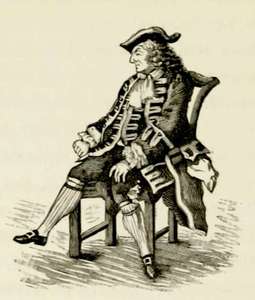
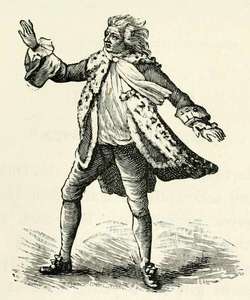
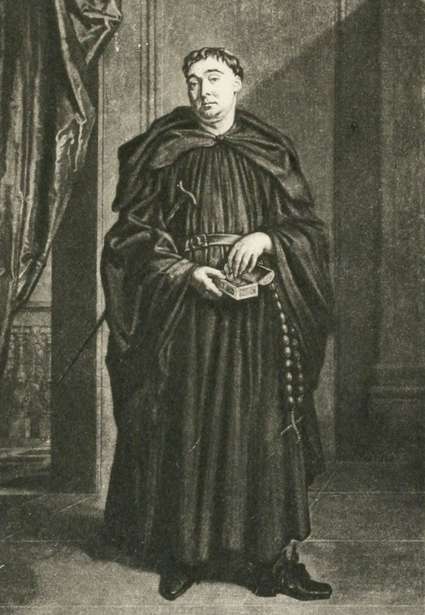
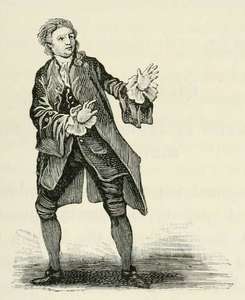
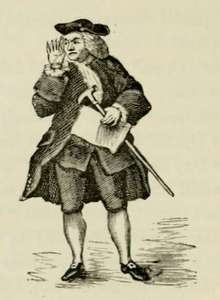
Mr. Garrick as Sir John Brute.
[1] Professor Ward says: "The entrance-money was from the time of
Pericles provided out of the public treasury."
[2] Geoffrey was made Abbot of St. Albans in 1119. The play, of
course, was many years earlier.
[3] It would appear that noblemen's players were prohibited from
acting, even before their masters, without leave from the Privy
Council.
[4] The patent was dated 1574, and does not specify any particular
building or locality.
[11] It was standing in 1661; in which year it was advertised for sale,
with the ground belonging to it.
CHAPTER II. — FOOTNOTES:
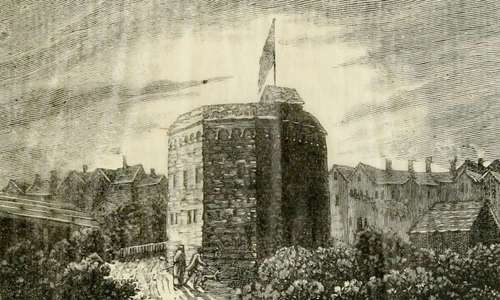
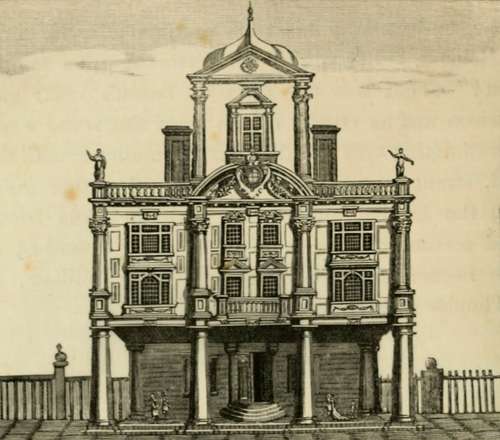
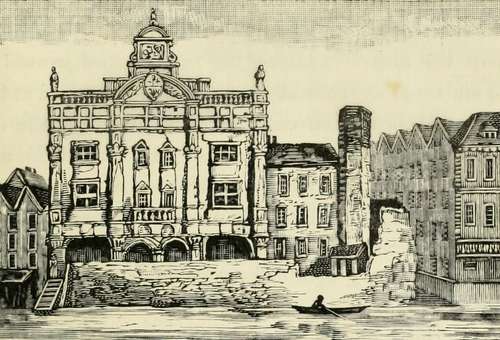
THE SWAN THEATRE.
THE DECLINE AND FALL OF THE PLAYERS.
It was in the eventful year 1587,[12] while Roman
Catholics were deploring the death of Mary Stuart;
while Englishmen were exulting at the destruction
dealt by Drake to a hundred Spanish ships in the
port of Cadiz; while the Puritan party was at angry
issue with Elizabeth; while John Fox was lying
dead; and while Walsingham was actively impeding
the ways and means of Armada Philip, by getting his
bills protested at Genoa,—that the little man, Gosson,
in the parish of St. Botolph, of which he was the
incumbent, first nibbed his pen,[13] and made it fly
furiously over paper, in wordy war against the stage
and stage-players.
When the Britons ate acorns and drank water, he
says, they were giants and heroes; but since plays
came in they had dwindled into a puny race, incapable
of noble and patriotic achievements! And yet
next year, some pretty fellows of that race were
sweeping the Invincible Armada from the surface
of our seas!
When London was talking admiringly of the coronation
of Charles I., and Parliament was barely
according him one pound in twelve of the money-aids
of which he was in need, there was another
pamphleteer sending up his testimony from Cheapside
to Westminster, against the alleged abomination
of plays and players. This writer entitles his work
A short Treatise against Stage Plays, and he makes
it as sharp as it is short. Plays were invented by
heathens; they must necessarily be prejudicial to
Christians!—that is the style of his assertion and
argument. They were invented in order to appease
false gods; consequently, the playing of them must
excite to wrath a true Deity! They are no recreation,
because people come away from them wearied.
The argument, in tragedy, he informs us, is murder;
in comedy, it is social vice. This he designates as
bad instruction; and remembering Field's query to
Sutton, he would very much like to know in what
page of Holy Writ authority is given for the vocation
of an actor. He might as well have asked
for the suppression of tailors, on the ground of
their never being once named in either the Old
Testament or the New!
But this author finds condemnation there of
"stage effects," rehearsed or unrehearsed. You
deal with the judgments of God in tragedy, and
laugh over the sins of men in comedy; and thereupon
he reminds you, not very appositely, that Ham
was accursed for deriding his father! Players
change their apparel and put on women's attire,—as
if they had never read a chapter in Deuteronomy
in their lives! If coming on the stage under false
representation of their natural names and persons
be not an offence against the Epistle to Timothy,
he would thank you to inform him what it is! As to
looking on these pleasant evils and not falling into
sin,—you have heard of Job and King David, and you
are worse than a heathen if you do not remember
what they looked upon with innocent intent, or if
you have forgotten what came of the looking.
He reminds parents, that while they are at the
play, there are wooers who are carrying off the
hearts of their daughters at home; perhaps, the
very daughters themselves from home. This seems
to me to be less an argument against resorting to
the theatre than in favour of your taking places for
your "young ladies," as well as for yourselves. The
writer looks too wide abroad to see what lies at his
feet. He is in Asia, citing the Council of Laodicea
against the theatre. He is in Africa, vociferating,
as the Council of Carthage did, against audiences.
He is in Europe, at Arles, where the Fathers decided
that no actor should be admitted to the sacrament.
Finally, he unites all these Councils together
at Constantinople, and in a three-piled judgment
sends stage, actors, and audiences to Gehenna.
If you would only remember that many royal and
noble men have been slain when in the theatre, on
their way thither, or returning thence, you will have
a decent horror of risking a similar fate in like localities.
He has known actors who have died after the
play was over; he would fain have you believe that
there is something in that. And when he has intimated
that theatres have been burnt and audiences
suffocated; that stages have been swept down by
storms and spectators trodden to death; that less
than forty years previous to the time of his writing,
eight persons had been killed and many more
wounded, by the fall of a London playhouse; and
that a similar calamity had lately occurred in the
city of Lyons—the writer conceives he has advanced
sufficient argument, and administered more than
enough of admonition, to deter any person from
entering a theatre henceforth and for ever.
This paper pellet had not long been printed,
when the vexed author might have seen four actors
sailing joyously along the Strand. There they
are, Master Moore (there were no managers then;
they were "masters" till the Georgian era), Master
Moore, heavy Foster, mirthful Guilman, and airy
Townsend. The master carries in his pocket a royal
licence to form a company, whose members, in
honour of the King's sister, shall be known as
"the Lady Elizabeth's servants;" with permission
to act when and where they please, in and about
the city of London, unless when the plague shall be
more than ordinarily prevalent.
There was no present opportunity to touch these
licensed companies; and, accordingly, a sect of
men who professed to unite loyalty with orthodoxy,
looking eagerly about them for offenders, detected
an unlicensed fraternity playing a comedy in the
old house, before noticed, of Sir John Yorke. The
result of this was the assembling of a nervously-agitated
troop of offenders in the Star Chamber.
One Christopher Mallory was made the scapegoat,
for the satisfactory reason that in the comedy
alluded to he had represented the devil, and in
the last scene descended through the stage, with
a figure of King James on his back, remarking
the while, that such was the road by which all
Protestants must necessarily travel! Poor Mallory,
condemned to fine and imprisonment, vainly observed
that there were two points, he thought, in
his favour—that he had not played in the piece, and
had not been even present in the house!
Meanwhile the public flocked to their favourite
houses, and fortune seemed to be most blandly
smiling on "masters," when there suddenly appeared
the monster mortar manufactured by Prynne, and
discharged by him over London, with an attendant
amount of thunder, which shook every building in
the metropolis. Prynne had just previously seen
the painters busily at work in beautifying the old
"Fortune," and the decorators gilding the horns
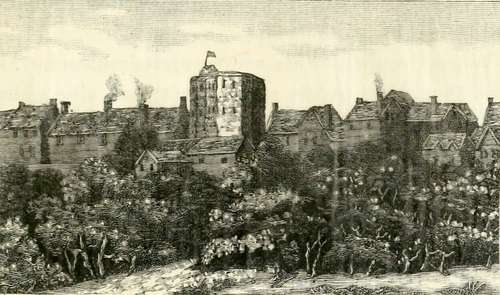
of the "Red Bull." He had been down to Whitefriars,
and had there beheld a new theatre rising
near the old time-honoured site. He was unable to
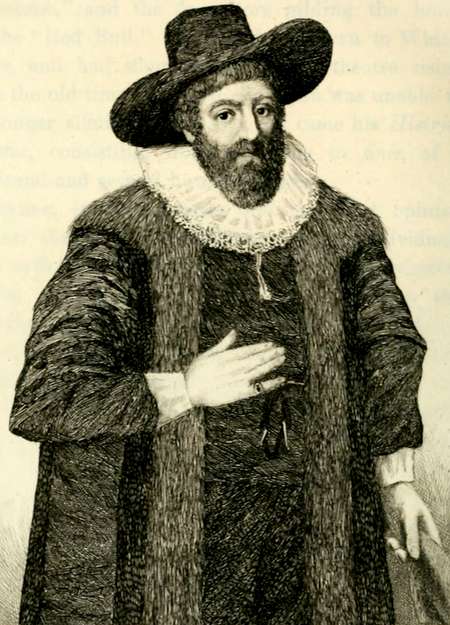
be longer silent, and in 1633 out came his Histrio-Mastix,
consisting, from title-page to finis, of a
thousand and several hundred pages.
Prynne, in some sense, did not lead opinion
against the stage, but followed that of individuals
who suffered certain discomfort from their vicinity
to the chief house in Blackfriars. In 1631, the
churchwardens and constables petitioned Laud, on
behalf of the whole parish, for the removal of the
players, whose presence was a grievance, it was
asserted, to Blackfriars generally. The shopkeepers
affirm that their goods, exposed for sale, are swept
off their stalls by the coaches and people sweeping
onward to the playhouse; that the concourse is so
great, the inhabitants are unable to take beer or
coal into their houses while it continues; that to
get through Ludgate to the water is just impossible;
and if a fire break out Heaven help them,
how can succour be brought to the sufferers through
such mobs of men and vehicles? Christenings are
disturbed in their joy by them, and the sorrow of
burials intruded on. Persons of honour dare not go
abroad, or if abroad, dare not venture home while
the theatre is open. And then there is that other
house, Edward Alleyn's, rebuilding in Golden Lane,
and will not the Council look to it?
The Council answer that Queen Henrietta Maria
is well affected towards plays, and that therefore
good regulation is more to be provided than suppression
decreed. There must not be more than
two houses, they say; one on Bankside, where the
Lord Chamberlain's servants may act; the other in
Middlesex, for which license may be given to Alleyn,
"servant of the Lord Admiral," in Golden Lane.
Each company is to play but twice a week, "forbearing
to play on the Sabbath Day, in Lent, and
in times of infection."
Here is a prospect for old Blackfriars; but it is
doomed to fall. The house had been condemned in
1619, and cannot longer be tolerated. But compensation
must be awarded. The players, bold fellows,
claim £21,000! The referees award £3000, and
the delighted inhabitants offer £100 towards it,
to get rid of the people who resort to the players,
rather than of the players themselves.
Then spake out Prynne. He does not tell us how
many prayer-books had been recently published, but
he notes, with a cry of anguish, the printing of forty
thousand plays within the last two years. "There
are five devil's chapels," he says, "in London; and yet
in more extensive Rome, in Nero's days, there were
but three, and those," he adds, "were three too many!"
When the writer gets beyond statistics he grows rude;
but he was sincere, and accepted all the responsibility
of the course taken by him, advisedly.
While the anger excited by this attack on pastimes
favoured by the King was yet hot, the assault
itself was met by a defiance. The gentlemen of
the Inns of Court closed their law-books, got up a
masque, and played it at Whitehall, in the presence
of a delighted audience, consisting of royal and
noble personages. The most play-loving of the lords
followed the example afforded by the lawyers, and
the King himself assumed the buskin, and turned
actor, for the nonce. Tom Carew was busy with
superintending the rehearsals of his "Cœlum Britannicum,"
and in urging honest and melodious Will
Lawes to progress more rapidly with the music.
Cavalier Will was not to be hurried, but did his
work steadily; and Prynne might have heard him
and his brother Harry humming the airs over as
they walked together across the park to Whitehall.
When the day of representation arrived, great was
the excitement and intense the delight of some, and
the scorn of others. Among the noble actors who
rode down to the palace was Rich, Earl of Holland.
All passed off so pleasantly that no one dreamed it
was the inauguration of a struggle in which Prynne
was to lose his estate, his freedom, and his ears; the
King and the earl their heads; while gallant Will
Lawes, as honest a man as any of them, was, a dozen
years after, to be found among the valiant dead who
fell at the siege of Chester.
Ere this dénouement to a tragedy so mirthfully
commenced had been reached, there were other
defiances cast in the teeth of audacious, but too
harshly-treated Prynne. There was a reverend playwright
about town, whom Eton loved and Oxford
highly prized; Ben Jonson called him his "son,"
and Bishop Fell, who presumed to give an opinion
on subjects of which he was ignorant, pronounced
the Rev. William Cartwright to be "the utmost
that man could come to!" For the Christ Church
students at Oxford, Cartwright wrote the "Royal
Slave," one of three out of his four plays which
sleep under a righteous oblivion. The King and
Queen went down to witness the performance of the
scholastic amateurs; and, considering that a main
incident of the piece comprises a revolt in order
to achieve some reasonable liberty for an oppressed
people, the subject may be considered more suggestive
than felicitous. The fortunes of many of the
audience were about to undergo mutation, but there
was an actor there whose prosperity commenced
from that day. All the actors played with spirit,
but this especial one manifested such self-possession,
displayed such judgment, and exhibited such powers
of conception and execution, that King, Queen, and
all the illustrious audience showered down upon
him applauses—hearty, loud, and long. His name
was Busby. He had been so poor that he received
£5 to enable him to take his degree of B.A. Westminster
was soon to possess him, for nearly three-score
years the most famous of her "masters." "A
very great man!" said Sir Roger de Coverley; "he
whipped my grandfather!"
When Prynne, and Bastwick, and Burton—released
from prison by the Long Parliament—entered London
in triumph, with wreaths of ivy and rosemary round
their hats, the players who stood on the causeway,
or at tavern windows, to witness the passing of the
victims, must have felt uneasy at their arch-enemy
being loose again. Between politics, perverse parties,
the plague, and the parliament, the condition of the
actors fell from bad to worse. In a dialogue which
professedly passed at this time between Cane of the
"Fortune" and Reed of the "Friers," one of the
speakers deplores the going-out of all good old
things, and the other, sighingly, remarks that true
Latin is as little in fashion at Inns of Court as good
clothes are at Cambridge. At length arrived the
fatal year 1647, when, after some previous attempts
to abolish the vocation of the actors, the parliament
disbanded the army and suppressed the players.
The latter struggled manfully, but not so successfully,
as the soldiery. They were treated with less
consideration; the decree of February 1647[14] informed
them that they were no better than heathens;
that they were intolerable to Christians; that they
were incorrigible and vicious offenders, who would
now be compelled by whip, and stocks, and gyves,
and prison fare, to obey ordinances which they had
hitherto treated with contempt. Had not the glorious
Elizabeth stigmatised them as "rogues," and the
sagacious James as "vagabonds?" Mayors and
sheriffs, and high and low constables were let loose
upon them, and encouraged to be merciless; menace
was piled upon menace; money penalties were hinted
at in addition to corporeal punishments—and, after
all, plays were enacted in spite of this counter-enactment.
But these last enactors were not to be trifled with;
and the autumn saw accomplished what had not
been effected in the spring. The Perfect Weekly
Account for "Wednesday, Oct. 20, to Tuesday, Oct.
26," informs its readers that on "Friday an ordinance
passed both Houses for suppressing of stage-plays,
which of late began to come in use again." The
ordinance itself is as uncivil a document as ever
proceeded from ruffled authority; and the framers
clearly considered that if they had not crushed the
stage for ever, they had unquestionably frozen out
the actors as long as the existing government should
endure.
At this juncture, historians inform us that many
of the ousted actors took military service—generally,
as was to be expected, on the royalist side. But,
in 1647, the struggle was virtually over. The great
fire was quenched, and there was only a trampling
out of sparks and embers. Charles Hart, the actor—grandson
of Shakspeare's sister—holds a prominent
place among these players turned soldiers as one who
rose to be a major in Rupert's Horse. Charles Hart,
however, was at this period only seventeen years
of age, and more than a year and a half had elapsed
since Rupert had been ordered beyond sea, for his
weak defence of Bristol. Rupert's major was, probably,
that very "jolly good fellow" with whom
Pepys used to take wine and anchovies to such
excess as to make it necessary for his "girl" to
rise early, and fetch her sick master fresh water,
wherewith to slake his thirst, in the morning.
The enrolment of actors in either army occurred at
an earlier period, and one Hart was certainly among
them. Thus Alleyn, erst of the Cockpit, filled the
part of quartermaster-general to the King's army at
Oxford. Burt became a cornet, Shatterel was something
less dignified in the same branch of the service—the
cavalry. These survived to see the old curtain
once more drawn; but record is made of the death of
one gallant player, said to be Will Robinson, whom
doughty Harrison encountered in fight, and through
whom he passed his terrible sword, shouting at the
same time: "Cursed is he that doeth the work of the
Lord negligently!" This serious bit of stage business
would have been more dramatically arranged had
Robinson been encountered by Swanston, a player of
Presbyterian tendencies, who served in the Parliamentary
army. A "terrific broadsword combat"
between the two might have been an encounter
which both armies might have looked at with interest,
and supported by applause. Of the military
fortunes of the actors none was so favourable as
brave little Mohun's, who crossed to Flanders, returned
a major, and was subsequently set down in
the "cast" under his military title. Old Taylor
retired, with that original portrait of Shakspeare
to solace him, which was to pass by the hands of
Davenant, to that glory of our stage, "Incomparable
Betterton." Pollard, too, withdrew, and lusty Lowen,
after a time, kicked both sock and buskin out of
sight, clapped on an apron, and appeared, with well-merited
success, as landlord of the Three Pigeons, at
Brentford.
The actors could not comprehend why their office
was suppressed, while the bear-baiters were putting
money in both pockets, and non-edifying puppet-shows
were enriching their proprietors. If Shakspeare
was driven from Blackfriars and the Cockpit,
was it fair to allow Bel and the Dragon to be enacted
by dolls, at the foot of Holborn Bridge? The
players were told that the public would profit by
the abolition of their vocation. Loose young gentlemen,
fast merchant-factors, and wild young apprentices
were no longer to be seen, it was said, hanging
about the theatres, spending all their spare money,
much that they could not spare, and not a little
which was not theirs to spend. It was uncivilly
suggested that the actors were a merry sort of
thieves, who used to attach themselves to the puny
gallants who sought their society, and strip them
of the gold pieces in their pouches, the bodkin on
their thighs, the girdles buckled to give them shape,
and the very beavers jauntily plumed to lend them
grace and stature.
In some of the streets by the river-side a tragedy-king
or two found refuge with kinsfolk. The old
theatres stood erect and desolate, and the owners,
with hands in empty pockets, asked how they were
to be expected to pay ground-rent, now that they
earned nothing? whereas their afternoon-share used
to be twenty—ay, thirty shillings, sir! And see,
the flag is still flying above the old house over the
water, and a lad who erst played under it, looks up
at the banner with a proud sorrow. An elder actor
puts his hands on the lad's shoulder, and cries:
"Before the old scene is on again, boy, thy face will
be as battered as the flag there on the roof-top!"
And as this elder actor passes on, he has a word
with a poor fellow-mime who has been less provident
than he, and whose present necessities he
relieves according to his means. Near them stand
a couple of deplorable-looking "door-keepers," or,
as we should call them now, "money-takers," and
the well-to-do ex-actor has his allusive joke at their
old rascality, and affects to condole with them that
the time is gone by when they used to scratch their
neck where it itched not, and then dropped shilling
and half-crown pieces behind their collars! But
they were not the only poor rogues who suffered
by revolution. That slipshod tapster, whom a guest
is cudgelling at a tavern-door, was once the proudest
and most extravagantly-dressed of the tobacco-men
whose notice the smokers in the pit gingerly entreated,
and who used to vend, at a penny the pipeful,
tobacco that was not worth a shilling a cart-load.
And behold other evidences of the hardness of the
times! Those shuffling fiddlers who so humbly
peer through the low windows into the tavern room,
and meekly inquire: "Will you have any music,
gentlemen?" they are tuneful relics of the band
who were wont to shed harmony from the balcony
above the stage, and play in fashionable houses, at
the rate of ten shillings for each hour. Now, they
shamble about in pairs, and resignedly accept the
smallest dole, and think mournfully of the time
when they heralded the coming of kings, and softly
tuned the dirge at the burying of Ophelia!
Even these have pity to spare for a lower class
than themselves,—the journeymen playwrights, whom
the managers once retained at an annual stipend and
"beneficial second nights." The old playwrights
were fain to turn pamphleteers, but their works sold
only for a penny, and that is the reason why those
two shabby-genteel people, who have just nodded
sorrowfully to the fiddlers, are not joyously tippling
sack and Gascony wine, but are imbibing unorthodox
ale and heretical small beer. "Cunctis graviora
cothurnis!" murmurs the old actor, whose father
was a schoolmaster; "it's more pitiful than any of
your tragedies!"
The distress was severe, but the profession had to
abide it. Much amendment was promised, if only
something of the old life might be pursued without
peril of the stocks or the whipping-post. The authorities
would not heed these promises, but grimly
smiled—at the actors, who undertook to promote
virtue; the poets, who engaged to be proper of
speech; the managers, who bound themselves to prohibit
the entrance of all temptations into "the sixpenny
rooms;" and the tobacco-men, who swore with
earnest irreverence to vend nothing but the pure
Spanish leaf, even in the threepenny galleries.
But the tragedy which ended with the killing of
the King gave sad hearts to the comedians, who were
in worse plight than before, being now deprived of
hope itself. One or two contrived to print and sell
old plays for their own benefit; a few authors continued
to add a new piece, now and then, to the stock,
and that there were readers for them we may conjecture
from the fact of the advertisements which began
to appear in the papers—sometimes of the publication
of a solitary play, at another of the entire dramatic
works of that most noble lady the Marchioness of Newcastle.
The actors themselves united boldness with
circumspection. Richard Cox, dropping the words
play and player, constructed a mixed entertainment,
in which he spoke and sang; and on one occasion
so aptly mimicked the character of an artisan, that
a master in the craft kindly and earnestly offered
to engage him. During the suppression, Cowley's
"Guardian" was privately played at Cambridge. The
authorities would seem to have winked at these private
representations, or to have declined noticing
them until after the expiration of the period within
which the actors were exposed to punishment. Too
great audacity, however, was promptly and severely
visited from the earliest days after the issuing of the
prohibitory decree. A first-rate troop obtained possession
of the Cockpit for a few days, in 1648. They
had played unmolested for three days, and were in the
very midst of "The Bloody Brother" on the fourth,
when the house was invaded by the Puritan soldiery,
the actors captured, the audience dispersed, and the
seats and the stage righteously smashed into fragments.
The players (some of them among the most
accomplished of their day) were paraded through the
streets in all their stage finery, and clapped into the
Gate House and other prisons, whence they were too
happy to escape, after much unseemly treatment, at
the cost of all the theatrical property which they had
carried on their backs into durance vile.
This severity, visited in other houses as well as
the Cockpit, caused some actors to despair, while it
rendered others only a little more discreet. Rhodes,
the old prompter at Blackfriars, turned bookseller,
and opened a shop at Charing Cross. There he and
one Betterton, an ex-under-cook in the kitchen of
Charles I., who lived in Tothill Street, talked mournfully
over the past, and, according to their respective
humours, of the future. The cook's sons listened
the while, and one of them especially took delight
in hearing old stories of players, and in cultivating
an acquaintance with the old theatrical bookseller.
In the neighbourhood of the ex-prompter's shop,
knots of very slenderly-built players used to congregate
at certain seasons. A delegate from their
number might be seen whispering to the citizen
captain in command at Whitehall, who, as wicked
people reported, consented, for a "consideration,"
not to bring his red-coats down to the Bull or other
localities where private stages were erected—especially
during the time of Bartholomew Fair, Christmas,
and other joyous tides. To his shame, be it recorded,
the captain occasionally broke his promise, or the
poor actors had fallen short in their purchase-money
of his pledge, and in the very middle of the piece,
the little theatre would be invaded, and the audience
be rendered subject to as much virtuous indignation
as the actors.
The cause of the latter, however, found supporters
in many of the members of the aristocracy. Close
at hand, near Rhodes's shop, lived Lord Hatton, first
of the four peers so styled. His house was in Scotland
Yard. His lands had gone by forfeiture, but
the proud old Cheshire landowner cared more for
the preservation of the deed by which he and his
ancestors had held them, than he did for the loss of
the acres themselves. Hatton was the employer, so
to speak, of Dugdale, and the patron of literary men
and of actors, and, it must be added, of very frivolous
company besides. He devoted much time to the preparation
of a Book of Psalms and the ill-treatment of
his wife; and was altogether an eccentric personage,
for he recommended Lambert's daughter as a personally
and politically suitable wife for Charles II.,
and afterwards discarded his own eldest son for
marrying that incomparable lady. In Hatton, the
players had a supreme patron in town; and they
found friends as serviceable to them in the noblemen
and gentlemen residing a few miles from the
capital. These patrons opened their houses to the
actors for stage representations; but even this private
patronage had to be distributed discreetly. Goffe,
the light-limbed lad who used to play women's parts
at the "Blackfriars," was generally employed as
messenger to announce individually to the audience
when they were to assemble, and to the actors the
time and place for the play. One of the mansions,
wherein these dramatic entertainments were most
frequently given, was Holland House, Kensington.
It was then held and inhabited by the widowed
countess of that unstable Earl of Holland, whose
head had fallen on the scaffold in March 1649; but
this granddaughter of old Sir Walter Cope, who lost
Camden House at cards to a Cheapside mercer, Sir
Baptist Hicks, was a strong-minded woman, and
perhaps found some consolation in patronising the
pleasures which the enemies of her defunct lord so
stringently prohibited. When the play was over, a
collection was made among the noble spectators,
whose contributions were divided between the
players according to the measure of their merits.
This done they wended their way down the avenue
to the high road, where probably, on some bright
summer afternoon, if a part of them prudently returned
afoot to town, a joyous but less prudent few
"padded it" to Brentford, and made a short but glad
night of it with their brother of the "Three Pigeons."
At the most this was but a poor life; but such as
it was, the players were obliged to make the best of
it. If they were impatient, it was not without some
reason, for though Oliver despised the stage, he
could condescend to laugh at, and with, men of less
dignity in their vocation than actors. Buffoonery
was not entirely expelled from his otherwise grave
court. At the marriage festival of his daughter
Frances and his son-in-law Mr. Rich, the Protector
would not tolerate the utterance of a line from
Shakspeare, expressed from the lips of a player;
but there were hired buffoons at that entertainment,
which they well-nigh brought to a tragical conclusion.
A couple of these saucy fellows seeing Sir
Thomas Hillingsley, the old gentleman-usher to the
Queen of Bohemia, gravely dancing, sought to excite
a laugh by trying to blacken his face with a burnt
cork. The high-bred, solemn old gentleman was
so aroused to anger by this unseemly audacity, that
he drew his dagger, and, but for swift interference,
would have run it beneath the fifth rib of the most
active of his rude assailants. On this occasion,
Cromwell himself was almost as lively as the hired
jesters; snatching off the wig of his son Richard,
he feigned to fling it in the fire, but suddenly passing
the wig under him, and seating himself upon
it, he pretended that it had been destroyed, amid
the servile applause of the edified spectators. The
actors might reasonably have argued that "Hamlet"
in Scotland Yard or at Holland House was a more
worthy entertainment than such grown-up follies in
the gallery at Whitehall.
Those follies ceased to be; Oliver had passed
away, and Richard had laid down the greatness
which had never sat well upon him. Important
changes were at hand, and the merry rattle of Monk's
drums coming up Gray's Inn Road, welcomed by
thousands of dusty spectators, announced no more
cheering prospect to any class than to the actors.
The Oxford vintner's son, Will Davenant, might be
seen bustling about in happy hurry, eagerly showing
young Betterton how Taylor used to play Hamlet,
under the instruction of Burbage, and announcing
bright days to open-mouthed Kynaston, ready at a
moment's warning to leap over his master's counter,
and take his standing at the balcony as the smooth-cheeked
Juliet.
Meanwhile, beaming old Rhodes, with a head full
of memories of the joyous Blackfriars' days, and
the merry afternoons over the water, at the Globe,
leaving his once apprentice, Betterton, listening to
Davenant's stage histories, and Kynaston, not yet out
of his time, longing to flaunt it before an audience,
took his own way to Hyde Park, where Monk was
encamped, and there obtained, in due time, from
that far-seeing individual, licence to once more raise
the theatrical flag, enrol the actors, light up the
stage, and, in a word, revive the English theatre.
In a few days the drama commenced its new career
in the Cockpit, in Drury Lane; and this fact seemed
so significant, as to the character of General Monk's
tastes that, subsequently, when he and the Council
of State dined in the city halls, the companies treated
their guests, after dinner, with satirical farces, such as
"Citizen and Soldier," "Country Tom," and "City
Dick," with, as the newspapers inform us, "dancing
and singing, many shapes and ghosts, and the like;
and all to please his Excellency the Lord General."
The English stage owes a debt of gratitude to
both Monk and Rhodes. The former made glorious
summer of the actors' winter of discontent; and the
latter inaugurated the Restoration by introducing
young Betterton. The son of Charles I.'s cook was,
for fifty-one years, the pride of the English theatre.
His acting was witnessed by more than one old contemporary
of Shakspeare,—the poet's younger brother
being among them,—he surviving till shortly after
the accession of Charles II. The destitute actors
warmed into life and laughter again beneath the
sunshine of his presence. His dignity, his marvellous
talent, his versatility, his imperishable fame, are
all well known and acknowledged. His industry is
indicated by the fact that he created one hundred
and thirty new characters! Among them were
Jaffier and Valentine, three Virginiuses, and Sir
John Brute. He was as mirthful in Falstaff as he
was majestic in Alexander; and the craft of his
Ulysses, the grace and passion of his Hamlet, the
terrible force of his Othello, were not more remarkable
than the low comedy of his Old Bachelor, the
airyness of his Woodville, or the cowardly bluster of
his Thersites. The old actors who had been frozen
out, and the new who had much to learn, could not
have rallied round a more noble or a worthier chief;
for Betterton was not a greater actor than he was a
true and honourable gentleman. Only for him, the
old frozen-outs would have fared but badly. He
enriched himself and them, and, as long as he lived,
gave dignity to his profession. The humble lad,
born in Tothill Street, before monarchy and the
stage went down, had a royal funeral in Westminster
Abbey, after dying in harness almost in sight of the
lamps. He deserved no less, for he was the king of
an art which had well-nigh perished in the Commonwealth
times, and he was a monarch who probably
has never since had, altogether, his equal. Off as
on the stage, he was exemplary in his bearing; true
to every duty; as good a country gentleman on his
farm in Berkshire as he was perfect actor in town;
pursuing with his excellent wife the even tenor of
his way; not tempted by the vices of his time, nor
disturbed by its politics; not tippling like Underhill;
not plotting and betraying the plotters against
William, like Goodman, nor carrying letters for a
costly fee between London and St. Germains, like
Scudamore. If there had been a leading player on
the stage in 1647, with the qualities, public and
private, which distinguished Betterton, there perhaps
would have been a less severe ordinance than
that which inflicted so much misery on the actors,
and which, after a long decline, brought about a
fall; from which they were, however, as we shall
see, destined to rise and flourish.
[12] Should be 1579. Stephen Gosson's Schoole of Abuse was entered at
Stationers' Hall, July 22, 1579. Dr. Doran corrects this in the second
edition.
[13] Gosson was not made rector of St. Botolph till 1600.
[14] February 1647-48: that is, February 1648. This act succeeded
the one mentioned in the next paragraph.
CHAPTER III. — FOOTNOTES:
THE GLOBE THEATRE.
THE "BOY ACTRESSES," AND THE "YOUNG LADIES."
The Theatre Royal, Drury Lane, is the "sacred
ground" of the English drama since the restoration
of monarchy. At the Cockpit (Pit Street remains
a memory of the place), otherwise called the
Phœnix, in the "lane" above-named, the old English
actors had uttered their last words before they
were silenced. In a reconstruction of the edifice
near, rather than on, the old site, the young English
actors, under Rhodes, built their new stage, and
wooed the willing town.
There was some irregularity in the first steps
made to re-establish the stage, which, after an
uneasy course of about four years, was terminated
by Charles II., who, in 1663,[15] granted patents for
two theatres, and no more, in London. Under one
patent, Killigrew, at the head of the King's Company
(the Cockpit being closed), opened at the
new theatre in Drury Lane, in August[16] 1663, with
a play of the olden time—the "Humourous Lieutenant"
of Beaumont and Fletcher. Under the
second patent, Davenant and the Duke of York's
Company found a home—first at the old Cockpit,
then in Salisbury Court, Fleet Street, the building
of which was commenced in 1660, on the site of the
old granary of Salisbury house, which had served for
a theatre in the early years of the reign of Charles
I. This little stage was lapped up by the great
tongue of fire, by which many a nobler edifice was
destroyed, in 1666. But previous to the fire, thence
went Davenant and the Duke's troop to the old
Tennis Court, the first of the three theatres in
Portugal Row, on the south side of Lincoln's Inn
Fields, from which the houses took their name.
In 1671, Davenant being dead, the company,
under the nominal management of his widow,
migrated to a house designed by Wren, and decorated
by Grinling Gibbons. This was the Duke's
Theatre, in Dorset Gardens. It was in close vicinity
to the old Salisbury Court Theatre, and it presented
a double face—one towards Fleet Street, the
other overlooking the terrace which gave access to
visitors who came by the river. Later, this company
was housed in Lincoln's Inn Fields again; but it
migrated, in 1732, to Covent Garden, under Rich.
Rich's house was burnt down in 1808, and its successor,
built by Smirke, was destroyed in 1856. On
the site of the latter now stands the Royal Italian
Opera, the representative, in its way, of the line
of houses wherein the Duke's Company struggled
against their competitors of the King's.
The first house of those competitors in Drury
Lane was burnt in 1672, but the King's Company
took refuge in the "Fields" till Wren built the new
house, opened in 1674. The two troops remained
divided, yet not opposed, each keeping to its recognised
stock pieces, till 1682, when Killigrew, having
"shuffled off this mortal coil,"[17] the two companies,
after due weeding, formed into one, and abandoning
Lincoln's Inn to the tennis-players, Dorset Gardens
to the wrestlers, and both to decay, they opened
at the New Drury, built by Sir Christopher, on the
16th of November 1682. Wren's theatre was taken
down in 1791; its successor, built by Holland, was
opened in 1794, and was destroyed in 1809. The
present edifice is the fourth which has occupied a
site in Drury Lane. It is the work of Wyatt, and
was opened in 1812.
Thus much for the edifice of the theatres of the
last half of the seventeenth century. Before we
come to the "ladies and gentlemen" who met upon
the respective stages, and strove for the approval
of the town, let me notice that, after the death of
Oliver,[18] Davenant publicly exhibited a mixed entertainment,
chiefly musical, but which was not held
to be an infringement of the law against the acting
of plays. Early in May 1659, Evelyn writes:—"I
went to see a new opera, after the Italian way, in
recitative music and scenes, much inferior to the
Italian composure and magnificence; but it was
prodigious, that in a time of such public consternation,
such a vanity should be kept up or permitted."
That these musical entertainments were something
quite apart from "plays," is manifest by another
entry in Evelyn's diary, in January 1661:—"After
divers years since I had seen any play, I went to see
acted 'The Scornful Lady,' at a new theatre in
Lincoln's Inn Fields."
Of Shakspeare's brother Charles, who lived to this
period, Oldys says:—"This opportunity made the
actors greedily inquisitive into every little circumstance,
more especially in Shakspeare's dramatic
character, which his brother could relate of him.
But he, it seems, was so stricken in years, and possibly
his memory so weakened by infirmities (which
might make him the easier pass for a man of weak
intellects), that he could give them but little light
into their inquiries; and all that could be recollected
from him of his brother Will in that station,
was the faint, general, and almost lost ideas he had
of having once seen him act a part in one of his
own comedies, wherein being to personate a decrepit
old man, he wore a long beard, and appeared so
weak and drooping, and unable to walk, that he
was forced to be supported and carried by another
person to a table, at which he was seated among
some company who were eating, and one of them
sung a song." This description applies to old
Adam, in "As You Like It;" and he who feebly
shadowed it forth, formed a link which connected
the old theatre with the new.
The principal actors in Killigrew's Company, from
which that of Drury Lane is descended, were Bateman,
Baxter, Bird (Theophilus), Blagden, Burt, Cartwright,
Clun, Duke, Hancock, Hart, Kynaston,
Lacy, Mohun, the Shatterels (William and Robert),
and Wintersel. Later additions gave to this company
Beeston, Bell, Charleton, "Scum" Goodman,
Griffin, Hains, Joe Harris, Hughes, Lyddoll, Reeves,
and Shirley.
The "ladies" were Mrs. Corey, Eastland, Hughes,
Knep, the Marshalls (Anne and Rebecca), Rutter,
Uphill, whom Sir Robert Howard too tardily married,
and Weaver. Later engagements included
those of Mrs. Boutel, Gwyn (Nell), James, Reeves,
and Verjuice. These were sworn at the Lord
Chamberlain's Office to serve the King. Of the
"gentlemen," ten were enrolled on the Royal Household
Establishment, and provided with liveries of
scarlet cloth and silver lace. In the warrants of
the Lord Chamberlain they were styled "Gentlemen
of the Great Chamber;" and they might have
pointed to this fact as proof of the dignity of their
profession.
The company first got together by Rhodes, subsequently
enlarged by Davenant, and sworn to serve
the Duke of York, at Lincoln's Inn Fields, was
in some respects superior to that of Drury Lane.
Rhodes's troop included the great Betterton, Dixon,
Lilliston, Lovel, Nokes (Robert), and six lads employed
to represent female characters—Angel, William
Betterton, a brother of the great actor (drowned
early in life, at Wallingford), Floid, Kynaston (for a
time), Mosely, and Nokes (James). Later, Davenant
added Blagden, Harris, Price, and Richards; Medbourn,
Norris, Sandford, Smith, and Young. The
actresses were Mrs. Davenport, Davies, Gibbs,
Holden, Jennings, Long, and Saunderson, whom
Betterton shortly after married.
This new fashion of actresses was a French
fashion, and the mode being imported from France,
a French Company, with women among them, came
over to London. Hoping for the sanction of their
countrywoman, Queen Henrietta Maria, they established
themselves in Blackfriars. This essay excited
all the fury of Prynne, who called these
actresses by very unsavoury names; but who, in
styling them "unwomanish and graceless," did not
mean to imply that they were awkward and unfeminine,
but that acting was unworthy of their sex, and
unbecoming women born in an era of grace.
"Glad am I to say," remarks as stout a Puritan
as Prynne, namely, Thomas Brand, in a comment
addressed to Laud, "glad am I to say they were
hissed, hooted, and pippin-pelted from the stage, so
that I do not think they will soon be ready to try
the same again." Although Brand asserts "that all
virtuous and well-disposed persons in this town"
were "justly offended" at these women "or monsters
rather," as Prynne calls them, "expelled from
their own country," adds Brand, yet more sober-thinking
people did not fail to see the propriety of
Juliet being represented by a girl rather than by a
boy. Accordingly, we hear of English actresses even
before the Restoration, mingled, however, with boys,
who shared with them that "line of business."
"The boy's a pretty actor," says Lady Strangelove,
in the "Court Beggar," played at the Cockpit, in
1632, "and his mother can play her part. The
women now are in great request." Prynne groaned
at the "request" becoming general. "They have
now," he writes, in 1633, "their female players in
Italy and other foreign parts."
Davenant's "Siege of Rhodes" was privately
acted[19] by amateurs, including Matthew Locke and
Henry Purcell; the parts of Ianthe and Roxalana
were played by Mrs. Edward Coleman and another
lady. The piece is so stuffed with heroic deeds,
heroic love, and heroic generosity, that none more
suitable could be found for ladies to appear in.
Nevertheless, when Rhodes was permitted to reopen
the stage, he could only assemble boys about him
for his Evadnes, Aspasias, and the other heroines of
ancient tragedy.
Now, the resumption of the old practice of
"women's parts being represented by men in the
habits of women," gave offence, and this is assigned
as a reason in the first patents accorded to Killigrew
and Davenant why those managers were authorised
to employ actresses to represent all female characters.
Killigrew was the first to avail himself of the privilege.
It was time. Some of Rhodes's "boys" were
men past forty, who frisked it as wenches of fifteen;
even real kings were kept waiting because theatrical
queens had not yet shaved; when they did appear, they
looked like "the guard disguised," and when the
prompter called "Desdemona"—"enter Giant!"
Who the lady was who first trod the stage as a
professional actress is not known; but that she
belonged to Killigrew's Company is certain. The
character she assumed was Desdemona, and she was
introduced by a prologue written for the occasion by
Thomas Jordan. It can hardly be supposed that she
was too modest to reveal her name, and that of Anne
Marshal has been suggested, as also that of Margaret
Hughes. On the 3d of January 1661, Beaumont
and Fletcher's "Beggar's Bush" was performed at
Killigrew's Theatre, "it being very well done," says
Pepys, "and here the first time that ever I saw
women come upon the stage." Davenant did not
bring forward his actresses before the end of June
1661, when he produced the second part of the
"Siege of Rhodes," with Mrs. Davenport as Roxalana,
and Mrs. Saunderson as Ianthe; both these
ladies, with Mrs. Davies and Mrs. Long, boarded in
Davenant's house. Killigrew abused his privilege
to employ ladies. In 1664, his comedy, the "Parson's
Wedding," wherein the plague is made a comic
incident of, connected with unexampled profligacy,
was acted, "I am told," are Pepys's own words, "by
nothing but women, at the King's house."
By this time the vocation of the "boy-actresses"
had altogether passed away; and there only remains
for me to briefly trace the career of those old world
representatives of the gentle or truculent heroines
depicted by our early dramatists.
There were three members of Killigrew's, or the
King's Company, who were admirable representatives
of female characters before the Civil Wars.
These were Hart, Burt, and Clun—all pupils of
luckless Robinson, slain in fight, who was himself
an accomplished "actress." Of the three, Hart rose
to the greatest eminence. His Duchess, in Shirley's
"Cardinal," was the most successful of his youthful
parts. After the Restoration, he laid down Cassio
to take Othello, from Burt, by the King's command,
and was as great in the Moor as Betterton, at the
other house, was in Hamlet. His Alexander, which
he created, always filled the theatre; and his dignity
therein was said to convey a lesson even to kings.
His Brutus was scarcely inferior, while his Catiline
was so unapproachable, that when he died, Jonson's
tragedy died with him.[20] Rymer styles him and
Mohun the Æsopus and Roscius of their time.
When they acted together (Amintor and Melantius)
in the "Maid's Tragedy," the town asked no greater
treat. Hart was one of Pepys's prime favourites.
He was a man whose presence delighted the eye,
before his accents enchanted the ear. The humblest
character intrusted to him was distinguished by his
careful study. On the stage he acknowledged no
audience; their warmest applause could never draw
him into a moment's forgetfulness of his assumed
character. In Manly, "The Plain Dealer," as in
Catiline, he never found a successor who could equal
him. His salary was, at the most, three pounds a
week, but he is said to have realised £1000 yearly
after he became a shareholder in the theatre. He
finally retired in 1682, on a pension amounting to
half his salary, which he enjoyed, however, scarcely
a year. He died of a painful inward complaint in
1683, and was buried at Stanmore Magna.
There is a tradition that Hart, Mohun, and
Betterton fought on the King's side at Edgehill,
in 1642. The last-named was then a child, and
some things are attributed to Charles Hart which
belonged to his father. If Charles was but eighteen
when his namesake, the King, returned in 1660, it
must have been his father who was at Edgehill with
Mohun, and who, perhaps, played female characters
in his early days.
Burt, after he left off the women's gear, acted
Cicero, with rare ability, in "Catiline," for the
getting up of which piece Charles II. contributed
£500 for robes. Of Clun, in or out of petticoats, the
record is brief. His Iago was superior to Mohun's,
but Lacy excelled him in the "Humourous Lieutenant;"
but as Subtle, in the "Alchymist," he was
the admiration of all playgoers. After acting this
comic part, Clun made a tragic end on the night of
the 3d of August 1664. With a lady hanging on
his arm, and some liquor lying under his belt, he
was gaily passing on his way to his country lodgings
in Kentish Town, when he was assailed, murdered,
and flung into a ditch, by rogues, one of whom was
captured, "an Irish fellow, most cruelly butchered
and bound." "The house will have a great miss of
him," is the epitaph of Pepys upon versatile Clun.
Of the boys belonging to Davenant's Company,
who at first appeared in woman's boddice, but soon
found their occupation gone, some were of greater
fame than others. One of these, Angel, turned from
waiting-maids to low comedy, caricatured Frenchmen
and foolish lords. We hear nothing of him
after 1673. The younger Betterton, as I have said,
was drowned at Wallingford. Mosely and Floid
represented a vulgar class of women, and both died
before the year 1674; but Kynaston and James
Nokes long survived to occupy prominent positions
on the stage.
Kynaston made "the loveliest lady," for a boy,
ever beheld by Pepys. This was in 1660, when
Kynaston played Olympia, the Duke's sister, in the
"Loyal Subject;" and went with a young fellow-actor
to carouse, after the play, with Pepys and
Captain Ferrers. Kynaston was a handsome fellow
under every guise. On the 7th of January 1661,
says Pepys, "Tom and I, and my wife, to the
theatre, and there saw 'The Silent Woman.'
Among other things here, Kynaston, the boy, had
the good turn to appear in three shapes. First, as a
poor woman, in ordinary clothes, to please Morose;
then, in fine clothes, as a gallant—and in them was
clearly the prettiest woman in the whole house; and
lastly, as a man—and then likewise did appear the
handsomest man in the house." When the play
was concluded, and it was not the lad's humour to
carouse with the men, the ladies would seize on
him, in his theatrical dress, and, carrying him to
Hyde Park in their coaches, be foolishly proud of
the precious freight which they bore with them.
Kynaston was not invariably in such good luck.
There was another handsome man, Sir Charles Sedley,
whose style of dress the young actor aped; and
his presumption was punished by a ruffian, hired by
the baronet, who accosted Kynaston in St. James's
Park, as "Sir Charles," and thrashed him in that
character. The actor then mimicked Sir Charles on
the stage. A consequence was, that on the 30th of
January 1669,[21] Kynaston was waylaid by three or
four assailants, and so clubbed by them, that there
was no play on the following evening; and the
victim, mightily bruised, was forced to keep his bed.
He did not recover in less than a week. On the
9th of February he reappeared, as the King of
Tidore, in the "Island Princess," which "he do act
very well," says Pepys, "after his beating by Sir
Charles Sedley's appointment."
The boy who used to play Evadne, and now
enacted the tyrants of the drama, retained a certain
beauty to the last. "Even at past sixty," Cibber
tells us, "his teeth were all sound, white, and even
as one would wish to see in a reigning toast of
twenty." Colley attributes the formal gravity of
Kynaston's mien "to the stately step he had been
so early confined to in a female decency." The
same writer praises Kynaston's Leon, in "Rule a
Wife and have a Wife," for its determined manliness
and honest authority. In the heroic tyrants, his
piercing eye, his quick, impetuous tone, and the
fierce, lion-like majesty of his bearing and utterance,
"gave the spectator a kind of trembling admiration."
When Cibber played Syphax, in "Cato," he did
it as he thought Kynaston would have done, had he
been alive to impersonate the character. Kynaston
roared through the bombast of some of the dramatists
with a laughable earnestness; but in Shakspeare's
monarchs he was every inch a king—dignified
and natural. The true majesty of his Henry IV.
was so manifest, that when he whispered to Hotspur,
"Send us your prisoners, or you'll hear of it,"
he conveyed, says Cibber, "a more terrible menace
in it than the loudest intemperance of voice could
swell to." Again, in the interview between the
dying King and his son—the dignity, majestic grief,
the paternal affection, the injured, kingly feeling,
the pathos and the justness of the rebuke—were
alike remarkable. The actor was equal to the
task assigned him by the author—putting forth
"that peculiar and becoming grace which the best
writer cannot inspire into any actor that is not born
with it."
Kynaston remained on the stage from 1659 to
1699. By this time his memory began to fail and
his spirit to leave him. These imperfections, says
the generous Colley, "were visibly not his own, but
the effects of decaying nature." But Betterton's
nature was not thus decaying; and his labour had
been far greater than that of Kynaston, who created
only a score of original characters, the best known
of which are, Harcourt, in the "Country Wife;"
Freeman, in the "Plain Dealer;" and Count Baldwin,
in "Isabella, or the Fatal Marriage." His
early practice in representing female characters
affected his voice in some disagreeable way. "What
makes you feel sick?" said Kynaston to Powell—suffering
from a too riotous "last night." "How
can I feel otherwise," asked Powell, "when I hear
your voice?"
Edward Kynaston died in 1712, and lies buried in
the churchyard of St. Paul's, Covent Garden. If not
the greatest actor of his day, Kynaston was the greatest
of the "boy-actresses." So exalted was his reputation,
"that," says Downes, "it has since been disputable
among the judicious, whether any woman that succeeded
him so sensibly touched the audience as he."
In one respect he was more successful than Betterton,
for he not only made a fortune, but kept
what he had made, and left it to his only son. This
son improved the bequest by his industry as a
mercer in Covent Garden; and, probably remembering
that he was well-descended from the Kynastons
of Oteley, Salop, he sent his own son to college,
and lived to see him ordained. This Reverend Mr.
Kynaston purchased the impropriation of Aldgate;
and, despite the vocations of his father and grandfather,
but in consequence of the prudence and
liberality of both, was willingly acknowledged by
his Shropshire kinsmen.
Kynaston's contemporary, James Nokes, was as
prudent and as fortunate as he; but James was not
so well-descended. His father (and he himself for a
time) was a city toyman—not so well to do, but he
allowed his sons to go on the stage, where Robert
was a respectable actor, and James, after a brief
exercise of female characters, was admirable in his
peculiar line. The toyman's son became a landholder,
and made of his nephew a lord of the soil.
Thus, even in those days of small salaries, players
could build up fortunes; because the more prudent
among them nursed the little they could spare with
care, and of that little made the very utmost.
Nokes was, to the last night of his career, famous
for his impersonation of the Nurse in two plays;
first, in that strange adaptation by Otway of
"Romeo and Juliet" to a Roman tragedy, "Caius
Marius;" and secondly, in Nevil Payne's fierce, yet
not bombastic drama, "Fatal Jealousy." Of the
portraits to be found in Cibber's gallery, one of the
most perfect, drawn by Colley's hand, is that of
James Nokes. Cibber attributes his general excellence
to "a plain and palpable simplicity of nature,
which was so utterly his own, that he was often as
accountably diverting in his common speech as on
the stage." His very conversation was an unctuous
acting; and, in the truest sense of the word, he was
"inimitable." Cibber himself, accomplished mimic
as he was, confessedly failed in every attempt to
reproduce the voice and manner of James Nokes,
who identified himself with every part so easily, as
to reap a vast amount of fame at the cost of hardly
an hour's study. His range was through the entire
realm of broad comedy, and Cibber thus photographs
him for the entertainment of posterity.
"He scarce ever made his first entrance in a play
but he was received with an involuntary applause,
not of hands only, for those may be, and have often
been, partially prostituted and bespoken, but by a
general laughter, which the very sight of him provoked,
and nature could not resist; yet the louder
the laugh the graver was his look upon it; and sure
the ridiculous solemnity of his features were enough
to have set a whole bench of bishops into a titter,
could he have been honoured (may it be no offence
to suppose it) with such grave and right reverend
auditors. In the ludicrous distresses which by the
laws of comedy folly is often involved in, he sunk
into such a mixture of piteous pusillanimity, and a
consternation so ruefully ridiculous and inconsolable,
that when he had shook you to a fatigue of laughter,
it became a moot point whether you ought not to
have pitied him. When he debated any matter by
himself, he would shut up his mouth with a dumb,
studious pout, and roll his full eye into such a
vacant amazement, such a palpable ignorance of
what to think of it, that his silent perplexity (which
would sometimes hold him several minutes) gave
your imagination as full content as the most absurd
thing he could say upon it."
This great comic actor was naturally of a grave
and sober countenance; "but the moment he spoke,
the settled seriousness of his features was utterly
discharged, and a dry, drolling, or laughing levity
took such full possession of him, that I can only
refer the idea of him to your imagination." His
clear and audible voice better fitted him for burlesque
heroes, like Jupiter Ammon, than his middle
stature; but the pompous inanity of his travestied
pagan divinity, was as wonderful as the rich stolidity
of his contentedly ignorant fools.
There was no actor whom the City so rejoiced in
as Nokes; there was none whom the Court more
delighted to honour. In May 1670, Charles II.,
and troops of courtiers, went down to Dover to meet
the Queen-mother, and took with them the Lincoln's-Inn-Fields
comedians. When Henrietta Maria
arrived, with her suite of French ladies and gentlemen,
the latter attired, according to the prevailing
fashion, in very short blue or scarlet laced coats,
with broad sword belts, the English comedians
played before the royal host and his guests the play
founded on Molière's "Ecole des Femmes," and
called "Sir Solomon." Nokes acted Sir Arthur
Addel, in dressing for which part he was assisted
by the Duke of Monmouth. In order that he might
the better ape the French mode, the duke took off
his own sword and belt, and buckled them to the
actor's side. At his first entrance on the stage,
King and Court broke into unextinguishable
laughter, so admirably were the foreign guests
caricatured; at which outrage on courtesy and hospitality,
the guests, naturally enough, "were much
chagrined," says Downes. Nokes retained the duke's
sword and belt to his dying day, which fell in the
course of the year 1692. He was the original representative
of about forty characters, in plays which
have long since disappeared from the stage. Charles
II. was the first who recognised, on the occasion of
his playing the part of Norfolk, in "Henry VIII.,"
the merit of Nokes as an actor.[22]
James Nokes left to his nephew something better
than the sword and belt of the Duke of Monmouth,
namely, a landed estate at Totteridge, near Barnet,
of the value of £400 a year. Pepys may have
kissed that nephew's mother, on the August day of
1665, when he fell into company near Rochester
with a lady and gentleman riding singly, and differing
as to the merits of a copy of verses, which Pepys,
by his style of reading aloud, got the husband to
confess that they were as excellent as the wife had
pronounced them to be. "His name is Nokes,"
writes the diarist, "over against Bow Church....
We promised to meet, if ever we come both to London
again, and at parting, I had a fair salute on
horseback, in Rochester streets, of the lady."
Having thus seen the curtain fall upon the once
"boy-actresses," I proceed to briefly notice the
principal ladies in the respective companies of Killigrew
and Davenant, commencing with those of the
King's House, or Theatre Royal, under Killigrew's
management, chiefly in Drury Lane. The first name
of importance in this list is that of Mrs. Hughes,
who, on the stage from 1663 to 1676, was more
remarkable for her beauty than for her great ability.
When the former, in 1668, subdued Prince Rupert,
there was more jubilee at the Court of Charles II.,
at Tunbridge Wells, than if the philosophic Prince
had fallen upon an invention that should benefit
mankind. Rupert, whom the plumed gallants of
Whitehall considered as a rude mechanic, left his
laboratory, put aside his reserve, and wooed in due
form the proudest, perhaps, of the actresses of her
day. Only in the May of that year Pepys had
saluted her with a kiss, in the green-room of the
Kings House. She was then reputed to be the intimate
friend and favourite of Sir Charles Sedley.
"A mighty pretty woman," says Pepys, "and seems,
but is not, modest." The Prince enshrined the frail
beauty in that home of Sir Nicholas Crispe, at Hammersmith,
which was subsequently occupied by Bubb
Doddington, the Margravine of Anspach, and Queen
Caroline of Brunswick. She well-nigh ruined her
lover, at whose death there was little left beside a
collection of jewels, worth £20,000, which were disposed
of by lottery, in order to pay his debts. Mrs.
Hughes was not unlike her own Mrs. Moneylove in
"Tom Essence," a very good sort of person till temptation
beset her. After his death she squandered
much of the estate which Rupert had left to her,
chiefly by gambling. Her contemporary, Nell Gwyn,
purchased a celebrated pearl necklace belonging to
the deceased Prince for £4520, a purchase which
must have taken the appearance of an insult, in the
eyes of Mrs. Hughes. The daughter of this union,
Ruperta, who shared with her mother the modest
estate bequeathed by the Prince, married General
Emanuel Scrope Howe. One of the daughters of
this marriage was the beautiful and reckless maid
of honour to Caroline, Princess of Wales, whom the
treachery of Nanty Lowther sent broken-hearted to
the grave, in 1726. Through Ruperta, however, the
blood of her parents is still continued in the family
of Sir Edward Bromley.
Mrs. Knipp (or Knep) was a different being from
Margaret Hughes. She was a pretty creature, with
a sweet voice, a mad humour, and an ill-looking,
moody, jealous husband, who vexed the soul and
bruised the body of his sprightly, sweet-toned, and
wayward wife. Excellent company she was found
by Pepys and his friends, whatever her horse-jockey
of a husband may have thought of her, or Mrs.
Pepys of the philandering of her own husband with
the minx, whom she did not hesitate to pronounce a
"wench," and whom Pepys himself speaks of affectionately
as a "jade" he was always glad to see.
Abroad he walks with her in the New Exchange to
look for pretty faces; and of the home of an actress,
in 1666, we have a sketch in the record of a visit
in November, "To Knipp's lodgings, whom I find
not ready to go home with me; and there staid
reading of Waller's verses, while she finished dressing,
her husband being by. Her lodging very mean,
and the condition she lives in; yet makes a show
without doors, God bless us!"
Mrs. Knipp's characters embraced the rakish fine
ladies, the rattling ladies'-maids, one or two tragic
parts; and where singing was required, priestesses,
nuns, and milkmaids. As one of the latter, Pepys
was enchanted at her appearance, with her hair
simply turned up in a knot, behind.
Her intelligence was very great, her simple style
of dressing much commended; and she could deliver
a prologue as deftly as she could either sing or
dance, and with as much grace as she was wont to
throw into manifestations of touching grief or tenderness.
She disappears from the bills in 1678, after
a fourteen years' service; and there is no further
record of the life of Mistress Knipp.
Anne and Rebecca Marshall are names which one
can only reluctantly associate with that of Stephen
Marshall the divine, who is said to have been their
father. The Long Parliament frequently commanded
the eloquent incumbent of Finchingfield, Essex, to
preach before them. Cambridge University was as
proud of him as a distinguished alumnus, as Huntingdonshire
was of having him for a son. In affairs
of religion he was the oracle of Parliament, and his
advice was sought even in political difficulties. He
was a mild and conscientious man, of whom Baxter
remarked, that "if all the bishops had been of the
spirit and temper of Usher, the Presbyterians of the
temper of Mr. Marshall, and the Independents like
Mr. Burroughs, the divisions of the Church would
have been easily compromised." Stephen Marshall
was a man who, in his practice, "preached his sermons
o'er again;" and Firmin describes him as an
"example to the believers in word, in conversation,
in charity, in faith, and in purity." He died full of
honours and understanding; and Westminster Abbey
afforded him a grave, from which he was ruthlessly
ejected at the Restoration. It is hardly possible to
believe that such a saint was the father of the two
beautiful actresses whom Nell Gwyn taunted with
being the erring daughters of a "praying Presbyterian."
On the other hand, we learn from Sir Peter Leicester's
History of Cheshire, that the royalist, Lord
Gerard of Bromley, retained this staunch Presbyterian
in his house as his chaplain. Further, we are
told, that this chaplain married a certain illegitimate
Elizabeth, whose father was a Dutton of Dutton, and
that of this marriage came Anne and Rebecca. As
Sir Peter was himself connected with both the Gerards
and Duttons by marriage, he must be held as
speaking with some authority in this matter.
Pepys says of Anne Marshall, that her voice was
"not so sweet as Ianthe's," meaning Mrs. Betterton's.
Rebecca had a beautiful hand, was very imposing
on the stage, and even off of it was "mighty
fine, pretty, and noble." She had the reputation
of facilitating the intrigue which Lady Castlemaine
kept up with Hart, the actor, to avenge herself on
the King because of his admiration for Mrs. Davies.
One of her finest parts was Dorothea, in the "Virgin
Martyr;" and her Queen of Sicily (an "up-hill" part)
to Nell Gwyn's Florimel, in Dryden's "Secret Love,"
was highly appreciated by the playgoing public.
With the exception of Mrs. Corey, the mimic, and
pleasing little Mrs. Boutel, who realised a fortune,
with her girlish voice and manner, and her supremely
innocent and fascinating ways, justifying the intensity
of love with which she inspired youthful heroes,
the only other actress of the King's company worth
mentioning is Nell Gwyn; but Nell was the crown
of them all, winning hearts throughout her jubilant
career, beginning in her early girlhood with that of
a link-boy, and ending in her womanhood with that
of the king.
Nell Gwyn is claimed by the Herefordshire people.
In Hereford city, a mean house in the rear of the
Oak Inn is pointed out as the place of her birth.
The gossips there little thought that a child so
humbly born would be the mother of a line of dukes,
or that her great grandson[23] should be the bishop of
her native town, and occupy for forty years the episcopal
palace in close proximity to the poor cottage
in which the archest of hussies first saw the light.
But the claims of Pipe Lane, Hereford, are disputed
by Coal Yard, Drury Lane, and also by Oxford,
where Nell's father, James Gwyn, a "captain,"
according to some, a fruiterer according to others,
died in prison. The captain with his wife Helena,[24]
somewhile a resident in St. Martin's Lane, had two
daughters, Nell and Rose. The latter married a
Captain Capels, and, secondly, a Mr. Foster; little
else is known of her, save that her less reputable
sister left her a small legacy, and that she survived
till the year 1697. Nelly was born early in 1650;
and tradition states that she very early ran away
from her country home to town, and studied for the
stage by going every night to the play. I suspect
Coal Yard was her first bower, that thence she issued
to cry "fresh herrings!" and captivate the hearts of
susceptible link-boys; and passed, from being hander
of strong waters to the gentlemen who patronised
Madame Ross's house, to taking her place in the pit,
with her back to the orchestra, and selling oranges
and pippins, with pertinent wit, gratis, to liberal
fops who would buy the first and return the second
with interest. As Rochester assures us, there was
a "wondering pit" in presence of this smartest
and most audacious of orange-girls. It was natural
enough that she should attract the notice of the
actors, that Lacy should give her instruction, and
that from Charles Hart she should take that and all
the love he could pay her. The latter two were
spoken of in prologues, long after both were dead,
as "those darlings of the stage."
Under the auspices of Charles Hart, Nelly made
her first appearance at the (King's) theatre, in a
serious part, Cydaria, in the "Indian Emperor."
She was then not more than fifteen, though some
say seventeen years of age. For tragedy she was
unfitted: her stature was low, though her figure was
graceful; and it was not till she assumed comic
characters, stamped the smallest foot in England on
the boards, and laughed with that peculiar laugh
that, in the excess of it, her eyes almost disappeared,
she fairly carried away the town, and enslaved the
hearts of city and of court. She spoke prologues and
epilogues with wonderful effect, danced to perfection,
and in her peculiar but not extensive line was, perhaps,
unequalled for the natural feeling which she
put into the parts most suited to her. She was so
fierce of repartee that no one ventured a second time
to allude sneeringly to her antecedents. She was
coarse, too, when the humour took her; could curse
pretty strongly if the house was not full, and was
given, in common with the other ladies of the company,
to loll about and talk loudly in the public
boxes, when she was not engaged on the stage.
She left both stage and boxes for a time, in 1667, to
keep mad house at Epsom with the clever Lord
Buckhurst—a man who for one youthful vice exhibited
a thousand manly virtues. The story, that
Lord Buckhurst separated from Mistress Gwyn for
a money consideration and a title, can be disproved
by the testimony of a character which all Peru could
not have influenced, and of chronology, which sets
the story at nought.
They who would read Buckhurst's true character,
will find it in the eloquent and graceful dedication
which Prior made of his poems to Buckhurst's son,
Lionel. Like the first Sackville, of the line of the
Earls of Dorset, he was himself a poet; and, "To
all you ladies now on land," although not quite the
impromptu it is said to have been, is an evidence
how gracefully he could strike the lyre on the eve of
a great battle. In short, Buckhurst, who took Nelly
from the stage, and who found Prior in a coffee-shop
and added him to literature, was a "man,"
brave, truthful, gay, honest, and universally beloved.
He was the people's favourite; and Pope assures us,
when Buckhurst had become Earl of Dorset, that
he was "the grace of courts, the muses' pride."
After a year's absence,[25] Mistress Gwyn returned
to the stage. In all nature, there was nothing
better than she, in certain parts. Pepys never
hoped to see anything like her in Florimel, with her
changes of sex and costume. She was little, pretty,
and witty; danced perfectly, and with such applause,
that authors would fain have appropriated the approbation
bestowed on her "jig," to the play in which
it was introduced. A play, without Nell, was no
play at all to Mr. Pepys. When, in 1667, she followed
Buckhurst to Epsom, and flung up her parts
and an honestly-earned salary for a poor £100 a-year,
Pepys exclaims, "Poor girl! I pity her; but
more the loss of her at the King's house." The
Admiralty-clerk's admiration was confined to her
merry characters; he speaks of her Emperor's
Daughter, in the "Indian Emperor," as "a great
and serious part, which she does most basely."
Her own party hailed her return; but she did not
light upon a bed of roses. Lady Castlemaine was
no longer her patroness—rather that and more of
Nelly's old lover, Charles Hart, who flouted the
ex-favourite of Buckhurst. That ex-favourite, however,
bore with equal indifference the scorn of
Charles Hart and the contempt of Charles Sackville;—she
saw compensation for both, in the royal homage
of Charles Stuart. Meanwhile, she continued
to enchant the town in comedy, to "spoil" serious
parts in Sir Robert Howard's mixed pieces, and yet
to act with great success characters, in which natural
emotion, bordering on insanity, was to be represented.
Early in 1668, we find her among the
loose companions of King Charles; "and I am
sorry for it," says Pepys, "and can hope for no good
to the state, from having a Prince so devoted to his
pleasure." The writers for the stage were of a like
opinion. Howard wrote his "Duke of Lerma," as a
vehicle of reproof to the King, who sat, a careless
auditor, less troubled than Pepys himself, who expected
that the play would be interrupted by royal
authority. The last of her original characters was
that of Almahide, in Dryden's "Conquest of Granada,"
the prologue to which she spoke in a straw
hat as broad as a cart wheel, and thereby almost
killed the King with laughter. In this piece, her
old lover, Hart, played Almanzor; and his position
with respect to King Boabdelin (Kynaston) and
Almahide (Nelly) corresponds with that in which
he stood towards King Charles and the actress.
The passages reminding the audience of this complex
circumstance threw the house into "convulsions."
From this time, Ellen Gwyn disappears from the
stage. A similar surname appears in the play-bills
from 1670 to 1682; but there is no ground for believing
that the "Madam Gwyn" of the later period
was the Mrs. Ellen of the earlier, poorer, and merrier
times. Nelly's first son, Charles Beauclerc, was
born in her house, in Lincoln's Inn Fields, in
May 1670; her second, in the following year, at
her house in Pall Mall, the garden terrace of which
overlooked the then green walk in the park, from
which Evelyn saw, with shame, the King talking
with the impudent "comedian." This younger son,
James, died at Paris, 1680. The elder had Otway
for a tutor. In his sixth year he was created Earl
of Burford, and in his fourteenth was created a duke.
His mother had addressed him, in the King's hearing,
by an epithet referring to his illegitimacy, on
the plea that she did not know by what title to call
him. Charles made him an earl. Accident of death
raised him to a dukedom. Harry Jermyn, Earl of
St. Albans, of whom report made the second husband
of Henrietta Maria, had just died. Blind as
he had been, he had played cards to the last—some
one sitting near him to tell him the points. At an
age approaching to ninety years, he had passed away.
Charles gave the name of St. Albans, with the title
of duke, to Nell Gwyn's eldest son, adding thereto
the registrarship of the High Court of Chancery,
and the office (rendered hereditary) of Master Falconer
of England. The present and tenth Duke
of St. Albans is the lineal descendant of Charles
Stuart and Ellen Gwyn.
The King had demurred to a request to settle
£500 a year on this lady, and yet within four years
she is known to have exacted from him above
£60,000. Subsequently, £6000, annually, were
tossed to her from the Excise,—that hardest taxation
of the poor,—and £3000 more were added for
the expenses of each son. She blazed publicly at
Whitehall, with diamonds out-flashing those usually
worn, as Evelyn has it, "by the like cattle." At
Burford House, Windsor, her gorgeous country
residence, she could gaily lose £1400[26] in one night
at basset, and purchase diamond necklaces the next
day, at fabulous prices. Negligent dresser as she
was, she always looked fascinating; and fascinating
as she was, she had a ready fierceness and a bitter
sarcasm at hand, when other royal favourites, or
sons of favourites, assailed or sneered at her. With
the King and his brother she bandied jokes as freely
as De Pompadour or Du Barry with Louis XV. By
impulse, she could be charitable; but by neglecting
the claims of her own creditors she could be cruel.
Charles alluded to her extravagance when, on his
deathbed, he recommended those shameless women,
Cleveland and Portsmouth, to his brother's kindness,
and hoped he would "not let Nelly starve."
An apocryphal story attributes the founding of
Chelsea Hospital to Nelly's tenderness for a poor
old wounded soldier who had been cheated of his
pay. The dedications to her of books by such
people as Aphra Behn and Duffet are blasphemous
in their expressions, making of her, as they do, a
sort of divine essence, and becoming satirical by
their exaggerated and disgusting eulogy. For such
a person, the pure and pious Bishop Ken was once
called upon to yield up an apartment in which he
lodged, and the peerage had a narrow escape of having
her foisted upon it as Countess of Greenwich.
This clever actress died in November 1687 of a fit
of apoplexy, by which she had been stricken in the
previous March. She was then in her thirty-eighth
year. She had been endowed like a princess, but
she left debts, and died just in time to allow James
to discharge them out of the public purse. Finally,
she was carried to old St. Martin's-in-the-Fields to be
buried, and Tennison preached her funeral sermon.
When this was subsequently made the ground of
exposing him to the reproof of Queen Mary, she
remarked, that the good doctor, no doubt, had said
nothing but what the facts authorised.
In the time of Nelly's most brilliant fortunes,
the people who laughed at her wit and impudence
publicly contemned her. In February 1680 she
visited the Duke's Theatre, in Lincoln's Inn Fields,
on which occasion a person in the pit called her
loudly by a name which, to do her justice, she never
repudiated. The affront, which she herself could
laugh at, was taken up by William Herbert, brother
of Philip, Earl of Pembroke, who had married the
younger sister of another of the King's favourites,
Henrietta de Querouaille. The audience took part,
some with the assailant, others with the champion
of Nelly. Many swords were drawn, the sorrows
of the "Orphan" were suspended, there was a
hubbub in the house, and more scratches given
than blood spilt. That Nelly found a knight in
Thomas Herbert only proves that a hot-headed
young gentleman may become a very sage as years
grow upon him. This Thomas, when Earl of Pembroke,
was "first plenipotentiary" at the making
of the treaty of Ryswick, and Chief Commissioner
in establishing the Union of England and Scotland.
His excellent taste and liberality laid the foundations
of the collection of antiques which yet attracts
visitors to Wilton. But love for leading play-house
factions did not die out in his family. Four and
forty years after he had drawn sword for the reputation
of Nell Gwyn, his third Countess, Mary, sister
of Viscount Howe, headed the Cuzzoni party at the
Opera-house against the Faustina faction, led by
the Countess of Burlington and Lady Delawar.
Whenever Faustina opened her mouth to sing,
Lady Pembroke and her friends hissed the singer
heartily; and as soon as Cuzzoni made a similar
attempt, Lady Burlington and her followers shrieked
her into silence. Lord Pembroke sat by, thinking,
perhaps, of the young days when he was the
champion of Nell Gwyn, or of Margaret Symcott,
if an old tradition be true that such was Nelly's
real name.
Of the ladies who played at the Duke's House,
under Davenant, the principal were Mrs. Davenport,
Mrs. Davies, Mrs. Gibbs, Mrs. Holden, Mrs. Jennings,
Mrs. Long, and Mrs. Norris. Chief among these were
Mistresses Davenport, Davies, Saunderson, and Long.
Mrs. Davenport is remembered as the Roxalana of
Davenant's "Siege of Rhodes," which she played so
well that Pepys could not forget her in either of her
successors, Mrs. Betterton or Mrs. Norton. She is
still better remembered in connection with a story
of which she is the heroine, although that character
in it has been ascribed to others.
Aubrey de Vere, the twentieth Earl of Oxford, was
the last of his house who held that title, but the one
who held it the longest, namely, seventy years, from
1632 to 1702. Aubrey de Vere despised the old
maxim, "Noblesse oblige." He lived a roystering
life, kept a roystering house, and was addicted to hard
drinking, rough words, and unseemly brawling and
sword-slashing in his cups. The young earl made
love, after the fashion of the day and the man, to Mrs.
Davenport, but he might as well have made love to
Diana; and it was not till he proposed marriage that
the actress condescended to listen to his suit. The
lovers were privately married, and the lady was, in
the words of old Downes, "erept the stage." The
honeymoon, however, was speedily obscured; Lord
Oxford grew indifferent and brutal. When the lady
talked of her rights, he informed her that she was not
Countess of Oxford at all. The apparent reverend
gentleman who had performed the ceremony of marriage
was a trumpeter, who served under this very
noble Lord in the King's own regiment of cavalry.
The forlorn fair one, after threatening suicide, sought
out the King, fell at his feet, and demanded justice.
The award was made in the shape of an annuity of
£300 a year, with which "Lord Oxford's Miss," as
Evelyn calls her, seems to have been satisfied and
consoled; for Pepys, soon after, being at the play,
"saw the old Roxalana in the chief box, in a velvet
gown, as the fashion is, and very handsome, at which
I was glad."
As for Miss Mary Davies, it is uncertain whether
she was the daughter of a Wiltshire blacksmith, or
the less legitimate offspring of Thomas Howard, the
first Earl of Berkshire, or of the earl's son—not the
poet, but the colonel. However this may be, Mary
Davies was early on the stage, where she danced
well, played moderately ill, announced the next
afternoon's performance with grace, and won an
infamous distinction at the King's hands, by her
inimitable singing of the old song, "My lodging is
on the cold ground." Then there was the publicly
furnishing of a house for her, and the presentation
of a ring worth £600, and much scandal to good
men and honest women. Thereupon Miss Davies
grew an "impertinent slut," and my Lady Castlemaine
waxed melancholy, and meditated mischief
against her royal and fickle lover. The patient
Queen herself was moved to anger by the new position
of Miss Davies, and when the latter appeared
in a play at Whitehall, in which she was about to
dance, her Majesty rose and left the house. But
neither the offended dignity of the Queen, nor Lady
Castlemaine "looking fire," nor the bad practical
jokes of Nell Gwyn, could loose the King from the
temporary enchantment to which he surrendered
himself. Their daughter was that Mary Tudor, who
married the second Earl of Derwentwater, whose
son, the third earl, was the gallant young fellow
who lost his head for aid afforded to his cousin, the
first Pretender, in 1715. Before his death, a request
was made to the Duke of Richmond, son of Charles
II., by Madlle. de Querouaille, to present a memorial
to the Lords in order to save the young earl's life.
The Duke presented the memorial, but he added his
earnest hope that their lordships would reject the
prayer of it! In such wise did the illegitimate
Stuarts play brother to each other! Through the
marriage of the daughter of Lord Derwentwater with
the eighth Lord Petre, the blood of the Stuart and
of Moll Davies still runs in their lineal descendant,
the present and twelfth lord.
Happy are the women who have no histories!
Such is the case with Miss Saunderson, better known
to us as Mrs. Betterton. For about thirty years
she played the chief female characters, especially in
Shakspeare's plays, with great success. She created
as many new parts as she played years; but they
were in old-world pieces, which have been long
forgotten. In the home which she kept with her
husband, charity, hospitality, and dignity abided.
So unexceptionable was Mrs. Betterton's character,
that when Crowne's "Calisto" was to be played at
court in 1674, she was chosen to be instructress to
the Lady Mary and the Lady Anne. These princesses
derived from Mrs. Betterton's lessons the
accomplishment for which both were distinguished
when queens, of pronouncing speeches from the
throne in a distinct and clear voice, with sweetness
of intonation, and grace of enunciation. Mrs.
Betterton subsequently instructed the Princess Anne
in the part of Semandra, and her husband did the
like office for the young noblemen who also played
in Lee's rattling tragedy of "Mithridates." Two
individuals, better qualified by their professional skill
and their moral character, to instruct the young
princesses and courtiers, and to exercise over them
a wholesome authority, could not then have been
found on or off the stage. After Betterton's death,
Queen Anne settled on her old teacher of elocution
a pension of £500 a year.
Of the remainder of the actresses who first joined
Davenant, there is nothing recorded, except their
greater or less efficiency. Of Mrs. Holden, Betterton's
kinswoman, the only incident that I can recall
to mind is, that once, by the accidental mispronunciation
of a word, when playing in "Romeo
and Juliet," and giving it "a vehement action, it
put the house into such a laughter, that London
Bridge at low water was silence to it!" Under its
echoes let us pass to the "gentlemen of the King's
Company."
[15] The second and final patents were dated—Killigrew's, 25th April
1662; Davenant's, 15th January 1663.
[16] April (2d edition). The exact date is 8th April, as given by Downes.
[17] Killigrew died after, not before, the union of the two companies.
Chalmers expressly says that he lived to see them united, and gives
March 1683 as the time of his death.
[18] Davenant performed "The Siege of Rhodes" two years before
Cromwell's death, namely, in 1656. [See Mr. Joseph Knight's Preface
to his recent edition of the "Roscius Anglicanus."] Cromwell also permitted
the entertainment named "The Cruelty of the Spaniards in
Peru" to be represented, from political motives.
[19] Mr. Knight, in the Preface before mentioned, quotes some lines
from the Prologue to this performance, showing that it was a public
performance for money. This being so settles the question in the next
paragraph as to the identity of the first professional actress.
[20] Very questionable. Langbaine (1691) says, "This play is still in
vogue on the stage, and always presented with success."
[21] Dr. Doran misreads Pepys, who gives the date as 31st January 1669.
[22] I doubt whether James Nokes ever played the part. Genest evidently
approves of Davies's suggestion that Robert Nokes was the actor of it.
[25] She was absent only about six weeks; Pepys chronicles her departure
under July 13, 1667, and her return under August 22, 1667.
[26] Peter Cunningham says, "1400 guineas, or £5000 at least of our
present money."
CHAPTER IV. — FOOTNOTES:
THE FORTUNE THEATRE.
THE GENTLEMEN OF THE KING'S COMPANY.
Of the King's Company, under Killigrew—Hart,
Burt, and Clun have already been noticed as players
who commenced their career by acting female parts.
Of the other early members of this troop, the first
names of importance are those of Lacy, and little
Major Mohun, the low comedian, and the high tragedian.
Of those who precede them alphabetically,
but little remains on record. We only know of
Theophilus Bird, that he broke his leg when dancing
in Suckling's "Aglaura," probably when the
poet changed his tragedy, in which the characters
killed each other, into a sort of comedy, in which
they all survived. Cartwright, on the other hand,
has left a lasting memorial. If you would see how
the kind old fellow looked, go down to Dulwich
College—that grand institution, for which actors
have done so much and which has done so little for
actors—and gaze on his portrait there. It is the
picture of a man who bequeathed his books, pictures,
and furniture to the College which Alleyn, another
actor, had founded. In early life, Cartwright had been
a bookseller, at the corner of Turnstile, Holborn; and
in his second vocation his great character was Falstaff.
Lacy was a great Falstaff, too; and his portrait, a
triple one, painted by Wright and etched by Hopkins,
one of the Princess Elizabeth's pages, is familiarly
known to Hampton Court visitors. Lacy had
been first a dancing-master, then a lieutenant in the
army, before he tried the stage. In his day he had
no equal; and his admirers denied that the day to
come would ever see his equal. Lacy was handsome,
both in shape and feature, and is to be remembered
as the original performer of Teague, in the "Committee;"
a play of Howard's, subsequently cut down
to the farce of "The Honest Thieves." And eight
years later (1671), taught by Buckingham, and
mimicking Dryden, he startled the town with that
immortal Bayes, in the "Rehearsal;" a part so full
of happy opportunities that it was coveted or essayed
for many years, not only by every great actor, whatever
his line, but by many an actress, too; and last
of all by William Farren, in 1819.
There was nothing within the bounds of comedy
that Lacy could not act well. Evelyn styles him
"Roscius." Frenchman, or Scot, or Irishman, fine
gentleman or fool, rogue or honest simpleton, Tartuffe
or Drench, old man or loquacious woman,—in
all, Lacy was the delight of the town for about a
score of years. The King ejected the best players
from parts, considered almost as their property, and
assigned them to Lacy. His wardrobe was a spectacle
of itself, and gentlemen of leisure and curiosity
went to see it. He took a positive enjoyment in
parts which enabled him to rail at the rascalities of
courtiers. Sometimes this Aristophanic licence went
too far. In Howard's "Silent Woman," the sarcasms
reached the King, and moved his majesty to
wrath, and to locking up Lacy himself in the Porter's
Lodge. After a few days' detention, he was
released; whereupon Howard, meeting him behind
the scenes, congratulated him. Lacy, still ill in
temper, abused the poet for the nonsense he had
put into the part of Captain Otter, which was the
cause of all the mischief. Lacy further told Howard
he was "more a fool than a poet." Thereat the
honourable Edward, raising his glove, smote Lacy
smartly with it over the face. Jack Lacy retaliated
by lifting his cane and letting it descend quite as
smartly on the pate of a man who was cousin to an
earl. Ordinary men marvelled that the honourable
Edward did not run Jack through the body. On
the contrary, without laying hand to hilt, Howard
hastened to the King, lodged his complaint, and the
house was thereupon ordered to be closed. Thus,
many starved for the indiscretion of one; but the
gentry rejoiced at the silencing of the company, as
those clever fellows and their fair mates were growing,
as that gentry thought, "too insolent."
Lacy, soon after, was said to be dying, and altogether
so ill-disposed, as to have refused ghostly
advice at the hands of "a bishop, an old acquaintance
of his," says Pepys, "who went to see him."
Who could this bishop have been who was the old
acquaintance of the ex-dancing-master and lieutenant?
Herbert Croft, or Seth Ward?—or, Isaac
Barrow, of Sodor-and-Man, whose father, the mercer,
had lived near the father of Betterton? But, whoever
he may have been, the King's favour restored
the actor to health; and he remained Charles's
favourite comedian till his death, in 1681.
When Lacy's posthumous comedy, "Sir Hercules
Buffoon," was produced in 1684, the man with the
longest and crookedest nose, and the most wayward
wit in England—Tom Durfey—furnished the prologue.
In that piece he designated Lacy as the
standard of true comedy. If the play does not take,
said lively Tom—
"all that we can say on't
Is, we've his fiddle, but not his hands to play on't!"
Genest, a critic not very hard to please, says that
Lacy's friends should have "buried his fiddle with
him."
Michael Mohun is the pleasantest and, perhaps,
the greatest name on the roll of the King's Company.
When the players offended the King, Mohun
was the peacemaker.
One cannot look on Mohun's portrait, at Knowle,
without a certain mingling of pleasure and respect.
That long-haired young fellow wears so frank an
aspect, and the hand rests on the sword so delicately
yet so firmly! He is the very man who might "rage
like Cethegus, or like Cassius die." Lee could never
willingly write a play without a part for Mohun, who,
with Hart, was accounted among the good actors that
procured profitable "third days" for authors. No
Maximin could defy the gods as he did; and there
has been no franker Clytus since the day he originally
represented the character in "Alexander the Great."
In some parts he contested the palm with Betterton,
whose versatility he rivalled, creating one year Abdelmelich,
in another Dapperwit, in a third Pinchwife,
and then a succession of classical heroes and modern
rakes or simpletons. Such an actor had many imitators,
but, in his peculiar line, few could rival a man
who was said to speak as Shakspeare wrote, and whom
nature had formed for a nation's delight. The author
of the Epilogue to "Love in the Dark" (that bustling
piece of Sir Francis Fane's, from the Scrutinio,[27] in
which, played by Lacy, Mrs. Centlivre derived her
Marplot), illustrates the success of Mohun's imitators
by an allusion to the gout from which he suffered:
"Those Blades indeed, but cripples in their art,—
Mimic his foot, but not his speaking part."
Of his modesty, I know no better trait than what
passed when Nat. Lee had read to him a part which
Mohun was to fill in one of Lee's tragedies. The
Major put aside the manuscript, in a sort of despair—"Unless
I could play the character as beautifully as
you read it," said he, "it were vain to try it at all!"
Such is the brief record of a great actor, one who
before our civil jars was a young player, during the
civil wars was a good soldier, and in the last years of
Charles II. was an old and a great actor still. Of the
other original members of the Theatre Royal, there is
not much to be said. Wintershell, who died in 1679,
merits, however, a word. He was distinguished,
whether wearing the sock or the buskin, majestic
in loftily-toned kings, and absurd in sillily-amorous
knights. Downes has praised him as superior to
Nokes, in at least one part, and his Slender has won
eulogy from so stern a critic as Dennis.
Among the men who subsequently joined the
Theatre Royal, there were some good actors, and a
few great rogues. Of these, the best actor and the
greatest rogue was Cardell Goodman, or Scum Goodman,
as he was designated by his enemies. His
career on the stage lasted from 1677, as Polyperchon,
in Lee's "Rival Queens," to 1688. His
most popular parts were Julius Cæsar and Alexander.
He came to the theatre hot from a fray at Cambridge
University, whence he had been expelled for
cutting and slashing the portrait of that exemplary
Chancellor, the Duke of Monmouth.
This rogue's salary must have been small, for he and
Griffin shared the same bed in their modest lodging,
and having but one shirt between them, wore it each
in his turn. The only dissension which ever occurred
between them was caused by Goodman, who, having
to pay a visit to a lady, clapped on the shirt when it
was clean, and Griffin's day for wearing it!
For restricted means, however, every gentleman of
spirit, in those days, had a resource, if he chose to
avail himself of it. The resource was the road, and
Cardell Goodman took to it with alacrity. But he
came to grief, and found himself with gyves on in
Newgate; yet he escaped the cart, the rope, and
Tyburn. King James gave "his Majesty's servant"
his life, and Cardell returned to the stage—a hero.
A middle-aged duchess, fond of heroes, adopted him
as a lover, and Cardell Goodman had fine quarters,
rich feeding, and a dainty wardrobe, all at the cost of
his mistress, the ex-favourite of a king, Barbara, the
Duchess of Cleveland. Scum Goodman was proud
of his splendid degradation, and paid such homage to
"my duchess," as the impudent fellow called her,
that when he expected her presence in the theatre,
he would not go on the stage, though king and queen
were kept waiting, till he heard that "his duchess"
was in the house. For her he played the mad scene
in Alexander with double vigour, and cared for no
other applause so long as her Grace's fan signalled
approbation.
Scum might have had a rare, if a rascally, life, had
he been discreet; but he was fool as well as knave.
A couple of the Duchess's children in the Duchess's
house annoyed him, and Scum suborned a villainous
Italian quack to dispose of them by poison. A discovery,
before the attempt was actually made, brought
Scum to trial for a misdemeanour. He had the luck
of his own father, the devil, that he was not tried for
murder. As it was, a heavy fine crippled him for
life. He seems, however, to have hung about the
stage after he withdrew from it as an actor. He
looked in at rehearsals, and seeing a likely lad,
named Cibber, going through the little part of the
Chaplain, in the "Orphan," one spring morning of
1690, Scum loudly wished he might be—what he
very much deserved to be, if the young fellow did
not turn out a good actor. Colley was so delighted
with the earnest criticism, that the tears flowed to
his eyes. At least, he says so.
King James having saved Cardell's neck, Goodman,
out of pure gratitude, perhaps, became a Tory, and
something more, when William sat in the seat of his
father-in-law. After Queen Mary's death, Scum was
in the Fenwick and Charnock plot to kill the King.
When the plot was discovered, Scum was ready to
peach. As Fenwick's life was thought by his friends
to be safe if Goodman could be bought off and got out
of the way, the rogue was looked for, at the Fleece,
in Covent Garden, famous for homicides, and at the
robbers' and the revellers' den, the Dog, in Drury Lane.
Fenwick's agent, O'Bryan, erst soldier and highwayman,
now a Jacobite agent, found Scum at the Dog,
and would then and there have cut his throat, had
not Scum consented to the pleasant alternative of
accepting £500 a year, and a residence abroad. This
to a man who was the first forger of bank-notes!
Scum suddenly disappeared, and Lord Manchester,
our Ambassador in Paris, inquired after him in vain.
It is impossible to say whether the rogue died by an
avenging hand, or starvation.
We are better acquainted with the fate of the last
of Scum's fair favourites, the pretty Mrs. Price of
Drury Lane. This Ariadne was not disconsolate for
her Theseus. She married "Charles, Lord Banbury,"
who was not Lord Banbury, for the House of Peers
denied his claim to the title; and he was not Mrs.
Price's husband, as he was already married to a living
lady, Mrs. Lester. Of this confusion in social arrangements
the world made small account, although the
law did pronounce in favour of Mrs. Lester, without
troubling itself to punish "my lord." The Judges
pronounced for the latter lady, solely on the ground
that she had had children, and the actress none.
Joseph Haines! "Joe" with his familiars, "Count
Haines" with those who affected great respect, was
a rogue in his way,—a merry rogue, a ready wit, and
an admirable low comedian, from 1672 to 1701. We
first hear of him as a quickwitted lad at a school
in St. Martin's-in-the-Fields, whence he was sent,
through the liberality of some gentlemen who had
remarked his talents, to Queen's College, Oxford.
There Haines met with Williamson, the Sir Joseph
of after days, distinguished alike for his scholarship,
his abilities as a statesman, the important offices he
held, and the liberality with which he dispensed the
fortune which he honourably acquired.
Williamson chose Haines for a friend, and made
him his Latin secretary when Williamson was appointed
Secretary of State. If Haines could have
kept official and state secrets, his own fortune would
now have been founded; but Joe gossiped in joyous
companies, and in taverns revealed the mysteries of
diplomacy. Williamson parted with his indiscreet
"servant," but sent him to recommence fortune-making
at Cambridge. Here, again, his waywardness
ruined him for a professor. A strolling company at
Stourbridge Fair seduced him from the groves of
Academus,[28] and in a short time this foolish and clever
fellow, light of head, of heart, and of principle, was
the delight of the Drury Lane audiences, and the
favoured guest in the noblest society where mirth,
humour, and dashing impudence were welcome.
In 1673, his Sparkish, in the "Country Wife"—his
original character—was accepted as the type of
the airy gentleman of the day. His acting on, and
his jokes off, the stage were the themes in all coteries
and coffee-houses. He was a great practical jester,
and once engaged a simple-minded clergyman as
"Chaplain to the Theatre Royal," and sent him
behind the scenes, ringing a bell, and calling the
players to prayers! When Romanism was looking
up, under James II., Haines had the impudence to
announce to the convert Sunderland,—unworthy
son of Waller's Sacharissa,—his adoption of the
King's religion, being moved thereto by the Virgin,
who had appeared to him in a dream, saying, "Joe,
arise!" This was too much even for Sunderland,
who drily observed that "she would have said
'Joseph,' if only out of respect for her husband!"
The rogue showed the value of a "profession,"
which gave rise to as many pamphlets as Dryden's,
by subsequently recanting,—not in the church, but
on the stage; he the while covered with a sheet,
holding a taper, and delivering some stupid rhymes,—to
the very dullest of which he had the art of
giving wonderful expression by his accent, emphasis,
modulation, and felicity of application. The audience
that could bear this recantation-prologue could easily
pardon the speaker, who would have caused even
greater errors to have been pardoned, were it only
for his wonderful impersonation of Captain Bluff
(1693) in Congreve's "Old Bachelor." The self-complaisant
way in which he used to utter "Hannibal
was a very pretty fellow in his day," was universally
imitated, and has made the phrase itself proverbial.
His Roger, in "Æsop," was another of his successes,
the bright roll of which was crowned by his lively,
impudent, irresistible Tom Errand, in Farquhar's
"Constant Couple,"—that most triumphant comedy
of a whole century.
The great fault of Haines lay in the liberties
which he took with the business of the stage. He
cared less to identify himself with the characters
he represented than, through them, to keep up a
communication with the spectators. When Hart,
then manager, cast Joe for the simple part of a
Senator, in "Catiline," in which Hart played the
hero, Joe, in disgust at his rôle, spoiled Hart's best
point, by sitting behind him, absurdly attired, with
pot and pipe in hand, and making grimaces at the
grave actor of Catiline; which kept the house in a
roar of laughter. Hart could not be provoked to
forget his position, and depart from his character;
but as soon as he made his exit, he sent Joe his
dismissal.
Joe Haines then alternated between the stage and
the houses of his patrons. "Vivitur ingenio"—the
stage-motto, was also his own, and he seems
to have added to his means by acting the jester's
part in noble circles. He was, however, no mere
"fool." Scholars might respect a "classic," like
Haines, and travelling lords gladly hire as a companion,
a witty fellow, who knew two or three
living languages as familiarly as he did his own.
With an English peer he once visited Paris, where
Joe is said to have got imprisoned for debt, incurred
in the character, assumed by him, of an English
lord. After his release, he returned to England,
self-invested with the dignity of "Count," a title
not respected by a couple of bailiffs, who arrested
Joseph, on Holborn Hill, for a little matter of £20.
"Here comes the carriage of my cousin, the Bishop
of Ely," said the unblushing knave; "let me speak
to him; I am sure he will satisfy you in this matter."
Consent was given, and Haines, putting his head
in at the carriage-door, hastily informed the good
Simon Patrick that "here were two Romanists inclined
to become Protestants, but with yet some
scruples of conscience."
"My friends," said the eager prelate to them, "if
you will presently come to my house, I will satisfy
you in this matter!" The scrupulous gentlemen
were well content; but when an explanation ensued,
the vexed bishop paid the money out of very shame,
and Joe and the bailiffs spread the story. They who
remembered how Haines played Lord Plausible, in
the "Plain Dealer," were not at all surprised at his
deceiving a bishop and a brace of bailiffs.
Sometimes his wit was of a nicer quality. When
Jeremy Collier's book against the stage was occupying
the public mind, a critic expressed his surprise, seeing
that the stage was a mender of morals. "True,"
answered Joe, "but Collier is a mender of morals,
too; and two of a trade, you know, never agree!"
Haines was the best comic actor, in his peculiar
line of comedy, during nearly thirty years that he
was one of "their majesties' servants." He died
at his house in Hart Street, Covent Garden, then
a fashionable locality, on the 4th of April 1701,
and was buried in the gloomy churchyard of the
parish, which has nothing to render it bright but
the memory of the poets, artists, and actors whose
bodies are there buried in peace.
Let us now consider the men in Davenant's, or the
Duke's Company, who acted occasionally in Dorset
Gardens, but mostly in Portugal Row, Lincoln's Inn
Fields. Of these, the greatest actor was good Thomas
Betterton,—and his merits claim a chapter to himself.
[28] Other accounts say that he commenced his theatrical life early, at
the "Nursery."
CHAPTER V. — FOOTNOTES:
THEATRE ROYAL, PORTUGAL STREET, LINCOLN'S INN FIELDS
THOMAS BETTERTON.
The diaries, biographies, journals, and traditions of
the time will enable us, with some little aid from the
imagination, not only to see the actor, but the social
aspects amid which he moved. By aid of these, I find
that, on a December night, 1661, there is a crowded
house at the theatre in Lincoln's Inn Fields. The
play is "Hamlet," with young Mr. Betterton, who
has been two years on the stage, in the part of the
Dane. The Ophelia is the real object of the young
fellow's love, charming Mistress Saunderson. Old
ladies and gentlemen, repairing in capacious coaches
to this representation, remind one another of the lumbering
and crushing of carriages about the old playhouse
in the Blackfriars, causing noisy tumults which
drew indignant appeals from the Puritan housekeepers,
whose privacy was sadly disturbed. But what
was the tumult there to the scene on the south side
of the "Fields," when "Hamlet," with Betterton, as
now, was offered to the public! The Jehus contend
for place with the eagerness of ancient Britons in a
battle of chariots. And see, the mob about the pit-doors
have just caught a bailiff attempting to arrest
an honest playgoer. They fasten the official up in a
tub, and roll the trembling wretch all "round the
square." They finish by hurling him against a carriage,
which sweeps from a neighbouring street at full
gallop. Down come the horses over the barrelled
bailiff, with sounds of hideous ruin; and the young
lady lying back in the coach is screaming like mad.
This lady is the dishonest daughter of brave, honest,
and luckless Viscount Grandison. As yet she is
only Mrs. Palmer; next year she will be Countess
of Castlemaine.
At length the audience are all safely housed and
eager. Indifferent enough, however, they are during
the opening scenes. The fine gentlemen laugh loudly
and comb their periwigs in the "best rooms." The
fops stand erect in the boxes to show how folly looks in
clean linen; and the orange nymphs, with their costly
entertainment of fruit from Seville, giggle and chatter,
as they stand on the benches below with old and young
admirers, proud of being recognised in the boxes.
The whole court of Denmark is before them; but
not till the words, "'Tis not alone my inky cloak,
good mother," fall from the lips of Betterton, is the
general ear charmed, or the general tongue arrested.
Then, indeed, the vainest fops and pertest orange
girls look round and listen too. The voice is so low,
and sad, and sweet; the modulation so tender, the
dignity so natural, the grace so consummate, that all
yield themselves silently to the delicious enchantment.
"It's beyond imagination," whispers Mr.
Pepys to his neighbour, who only answers with a
long and low drawn "Hush!"
I can never look on Kneller's masterly portrait of
this great player, without envying those who had the
good fortune to see the original, especially in Hamlet.
How grand the head, how lofty the brow, what eloquence
and fire in the eyes, how firm the mouth, how
manly the sum of all! How is the whole audience
subdued almost to tears, at the mingled love and awe
which he displays in presence of the spirit of his
father! Some idea of Betterton's acting in this scene
may be derived from Cibber's description of it, and
from that I come to the conclusion, that Betterton
fulfilled all that Overbury laid down with regard to
what best graced an actor. "Whatsoever is commendable
to the grave orator, is most exquisitely perfect in
him; for by a full and significant action of body he
charms our attention. Sit in a full theatre, and you
will think you see so many lines drawn from the circumference
of so many ears, while the actor is the
centre." This was especially the case with Betterton;
and now, as Hamlet's first soliloquy closes, and the
charmed but silent audience "feel music's pulse in all
their arteries," Mr. Pepys almost too loudly exclaims
in his ecstasy, "It's the best acted part ever done by
man." And the audience think so, too; there is a
hurricane of applause; after which the fine gentlemen
renew their prattle with the fine ladies, and the
orange girls beset the Sir Foplings, and this universal
trifling is felt as a relief after the general emotion.
Meanwhile, a critic objects that young Mr. Betterton
is not "original," and intimates that his Hamlet
is played by tradition come down through Davenant,
who had seen the character acted by Taylor, and had
taught the boy to enact the Prince after the fashion
set by the man who was said to have been instructed
by Shakspeare himself; amid which Mr. Pepys remarks,
"I only know that Mr. Betterton is the best
actor in the world."
As Sir Thomas Overbury remarked of a great
player, his voice was never lower than the prompter's
nor higher than the foil and target. But let us be
silent, here comes the gentle Ophelia. The audience
generally took an interest in this lady, and the royal
Dane, for there was not one in the house who was
ignorant of the love-passages there had been between
them, or of the coming marriage by which they were
to receive additional warrant. Mistress Saunderson
was a lady worthy of all the homage here implied.
There was mind in her acting; and she not only possessed
personal beauty, but also the richer beauty of
a virtuous life. They were a well-matched couple
on and off the stage; and their mutual affection
was based on a mutual respect and esteem. People
thought of them together, as inseparable, and young
ladies wondered how Mr. Betterton could play Mercutio,
and leave Mistress Saunderson as Juliet, to be
adored by the not ineffective Mr. Harris as Romeo!
The whole house, as long as the incomparable pair
were on the stage, were in a dream of delight.
Their grace, perfection, good looks, the love they
had so cunningly simulated, and that which they
were known to mutually entertain, formed the
theme of all tongues. In its discussion, the retiring
audience forgot the disinterring of the regicides, and
the number of men killed the other day on Tower
Hill, servants of the French and Spanish ambassadors,
in a bloody struggle for precedency, which
was ultimately won by the Don!
Fifty years after these early triumphs, an aged
couple resided in one of the best houses in Russell
Street, Covent Garden,—the walls of which were
covered with pictures, prints, and drawings, selected
with taste and judgment. They were still a handsome
pair. The venerable lady, indeed, looks pale
and somewhat saddened. The gleam of April sunshine
which penetrates the apartment cannot win
her from the fire. She is Mrs. Betterton, and ever
and anon she looks with a sort of proud sorrow on
her aged husband. His fortune, nobly earned, has
been diminished by "speculation," but the means
whereby he achieved it are his still, and Thomas
Betterton, in the latter years of Queen Anne, is the
chief glory of the stage, even as he was in the first
year of King Charles. The lofty column, however,
is a little shaken. It is not a ruin, but is beautiful
in its decay. Yet that it should decay at all is a
source of so much tender anxiety to the actor's wife,
that her senses suffer disturbance, and there may be
seen in her features something of the distraught
Ophelia of half a century ago.
It is the 13th of April, 1710—his benefit night;
and the tears are in the lady's eyes, and a painful
sort of smile on her trembling lips, for Betterton
kisses her as he goes forth that afternoon to take
leave, as it proved, of the stage for ever. He is in
such pain from gout that he can scarcely walk to his
carriage, and how is he to enact the noble and fiery
Melantius in that ill-named drama of horror, "The
Maid's Tragedy"? Hoping for the best, the old
player is conveyed to the theatre, built by Sir John
Vanbrugh, in the Haymarket, the site of which is
now occupied by the "Opera-house." Through the
stage-door he is carried in loving arms to his dressing-room.
At the end of an hour Wilks is there,
and Pinkethman, and Mrs. Barry, all dressed for
their parts, and agreeably disappointed to find the
Melantius of the night robed, armoured, and be-sworded,
with one foot in a buskin and the other
in a slipper. To enable him even to wear the latter,
he had first thrust his inflamed foot into water; but
stout as he seemed, trying his strength to and fro
in the room, the hand of Death was at that moment
descending on the grandest of English actors.
The house rose to receive him who had delighted
themselves, their sires, and their grandsires. The
audience were packed "like Norfolk biffins." The
edifice itself was only five years old, and when it was
a-building, people laughed at the folly which reared
a new theatre in the country, instead of in London;—for
in 1705 all beyond the rural Haymarket was
open field, straight away westward and northward.
That such a house could ever be filled was set down
as an impossibility; but the achievement was accomplished
on this eventful benefit night; when the
popular favourite was about to utter his last words,
and to belong thenceforward only to the history of
the stage he had adorned.
There was a shout which shook him, as Lysippus
uttered the words "Noble Melantius," which heralded
his coming. Every word which could be applied to
himself was marked by a storm of applause, and when
Melantius said of Amintor—
"His youth did promise much, and his ripe years
Will see it all performed,"
a murmuring comment ran round the house, that
this had been effected by Betterton himself. Again,
when he bids Amintor "hear thy friend, who has
more years than thou," there were probably few
who did not wish that Betterton were as young as
Wilks: but when he subsequently thundered forth
the famous passage, "My heart will never fail me,"
there was a very tempest of excitement, which was
carried to its utmost height, in thundering peal on
peal of unbridled approbation, as the great Rhodian
gazed full on the house, exclaiming—
"My heart
And limbs are still the same: my will as great
To do you service!"
No one doubted more than a fractional part of this
assertion, and Betterton, acting to the end under a
continued fire of "bravoes!" may have thrown more
than the original meaning into the phrase—
"That little word was worth all the sounds
That ever I shall hear again!"
Few were the words he was destined ever to hear
again; and the subsequent prophecy of his own
certain and proximate death, on which the curtain
slowly descended, was fulfilled eight and forty hours
after they were uttered.
Such was the close of a career which had commenced
fifty-one years before! Few other actors of
eminence have kept the stage, with the public favour,
for so extended a period, with the exception of Cave
Underhill, Quin, Macklin, King, and in later times,
Bartley and Cooper, most of whom at least accomplished
their half century. The record of that career
affords many a lesson and valuable suggestion to
young actors, but I have to say a word previously
of the Bettertons, before the brothers of that name,
Thomas and the less known William, assumed the
sock and buskin.
Tothill Street, Westminster, is not at present a
fine or a fragrant locality. It has a crapulous look
and a villainous smell, and petty traders now huddle
together where nobles once were largely housed.
Thomas Betterton was born here, about the year
1634-5.[29] The street was then in its early decline,
or one of King Charles's cooks could hardly have
had home in it. Nevertheless, there still clung to
it a considerable share of dignity. Even at that
time there was a Tothill Fields House of Correction,
whither vagabonds were sent, who used to
earn scraps by scraping trenchers in the tents
pitched in Petty France. All else in the immediate
neighbourhood retained an air of pristine and
very ancient nobility. I therefore take the father
of Betterton, cook to King Charles, to have been
a very good gentleman, in his way. He was certainly
the sire of one, and the circumstance of the
apprenticeship of young Thomas to a bookseller was
no evidence to the contrary. In those days, it was
the custom for greater men than the chefs in the
King's kitchen, namely, the bishops in the King's
church, to apprentice their younger sons, at least, to
trade, or to bequeath sums for that especial purpose.
The last instance I can remember of this traditionary
custom presents itself in the person, not indeed of a
son of a bishop, but of the grandson of an archbishop,
namely, of John Sharp, Archbishop of York from
1691 to 1714. He had influence enough with Queen
Anne to prevent Swift from obtaining a bishopric.
His son was Archdeacon of Northumberland, and of
this archdeacon's sons one was Prebendary of Durham,
while the other, the celebrated Granville Sharp,
the "friend of the Negro," was apprenticed to a linen-draper,
on Tower Hill. The early connection of
Betterton, therefore, with Rhodes, the Charing Cross
bookseller, is not to be accepted as a proof that his
sire was not in a "respectable" position in society.
That sire had had for his neighbour, only half-a-dozen
years before Thomas was born, the well-known Sir
Henry Spelman, who had since removed to more
cheerful quarters in Barbican. A very few years
previously, Sir George Carew resided here, in Caron
House, and his manuscripts are not very far from the
spot even now. They refer to his experiences as Lord
Deputy in Ireland, and are deposited in the library at
Lambeth Palace. These great men were neighbours
of the elder Betterton, and they had succeeded to
men not less remarkable. One of the latter was
Arthur, Lord Grey of Wilton, the friend of Spenser,
and the Talus of that poet's "Iron Flail." The
Greys, indeed, had long kept house in Tothill Street,
as had also the Lords Dacre of the South. When
Betterton was born here, the locality was still full of
the story of Thomas Lord Dacre, who went thence to
be hanged at Tyburn, in 1541. He had headed a sort
of Chevy-chase expedition into the private park of
Sir Nicholas Pelham, in Sussex. In the fray which
ensued, a keeper was killed, of which deed my lord
took all the responsibility, and, very much to his
surprise, was hanged in consequence. The mansion
built by his son, the last lord, had not lost its first
freshness when the Bettertons resided here, and its
name, Stourton House, yet survives in the corrupted
form of Strutton Ground.
Thus, the Bettertons undoubtedly resided in a
"fashionable" locality, and we may fairly conclude
that their title to "respectability" has been so far
established. That the street long continued to enjoy
a certain dignity is apparent from the fact that, in
1664, when Betterton was rousing the town by his
acting, as Bosola, in Webster's "Duchess of Malfy,"
Sir Henry Herbert established his office of Master
of the Revels, in Tothill Street. It was not till the
next century that the decline of this street set in.
Southern, the dramatist, resided and died there, but
it was in rooms over an oilman's shop; and Edmund
Burke lived modestly at the east end, before those
mysterious thousands were amassed by which he was
enabled to establish himself as a country gentleman.
Galt, and the other biographers of Betterton, complain
of the paucity of materials for the life of so great
an actor. Therein is his life told; or rather Pepys
tells it more correctly in an entry in his diary for
October 1662, in which he says—"Betterton is a
very sober, serious man, and studious, and humble,
following of his studies; and is rich already with
what he gets and saves." There is the great and
modest artist's whole life—earnestness, labour, lack
of presumption, and the recompense. At the two
ends of his career, two competent judges pronounced
him to be the best actor they had ever seen. The
two men were Pepys, who was born in the reign
of Charles I., and Pope, who died in the reign of
George II. This testimony refers to above a century,
during which time the stage knew no such player as he.
Pope, indeed, notices that old critics used to place
Hart on an equality with him; this is, probably, an
error for Harris, who had a party at court among the
gay people there who were oppressed by the majesty
of Betterton.[30] Pepys alludes to this partisanship in
1663. "This fellow" (Harris), he remarks, "grew
very proud of late, the King and everybody else
crying him up so high, and that above Betterton, he
being a more aery man, as he is, indeed."
From the day of Betterton's bright youth to that
of his old age, the sober seriousness of the "artist,"
for which Pepys vouches, never left him. With the
dress he assumed, for the night, the nature of the man—be
it "Hamlet" or "Thersites," "Valentine" or
"Sir John Brute," of whom he was to be the representative.
In the "green-room," as on the stage, he
was, for the time being, subdued or raised to the
quality of him whose likeness he had put on. In
presence of the audience, he was never tempted by
applause to forget his part, or himself. Once only,
Pepys registers, with surprise, an incident which took
place at the representation of "Mustapha," in 1667.
It was "bravely acted," he says, "only both Betterton
and Harris could not contain from laughing, in
the midst of a most serious part, from the ridiculous
mistake of one of the men upon the stage; which I
did not like."
Then for his humility, I find the testimony of Pepys
sufficiently corroborated. It may have been politic in
him, as a young man, to repair to Mr. Cowley's lodgings
in town, and ask from that author his particular
views with regard to the Colonel Jolly in the "Cutter
of Coleman Street," which had been intrusted to the
young actor; but the politic humility of 1661 was, in
fact, the practised modesty of his life. In the very
meridian of his fame, he, and Mrs. Barry also, were
as ready to take instruction respecting the characters
of Jaffier and Belvidera, from poor battered Otway,
as they subsequently were from that very fine gentleman,
Mr. Congreve, when they were cast for the hero
and heroine of his comedies. Even to bombastic
Rowe, who hardly knew his own reasons for language
put on the lips of his characters, they listened with
deference; and, at another period, "Sir John and
Lady Brute" were not undertaken by them till they
had conferred with the author, solid Vanbrugh.
The mention of these last personages reminds me
of a domestic circumstance of interest respecting
Betterton. He and Mrs. Barry acted the principal
characters in "The Provoked Wife;" the part of
Lady Fancyfull was played by Mrs. Bowman. This
young lady was the adopted child of the Bettertons,
and the daughter of a friend (Sir Frederick Watson,
Bart.) whose indiscretion or ill-luck had scattered
that fortune the laying of the foundation of which is
recorded by Pepys. To the sire Betterton had intrusted
the bulk of his little wealth as a commercial
venture to the East Indies. A ruinous failure ensued,
and I know of nothing which puts the private
life of the actor in so pleasing a light, as the fact of
his adopting the child of the wholly ruined man who
had nearly ruined him. He gave her all he had to
bestow, careful instruction in his art; and the lady
became an actress of merit. This merit, added to
considerable personal charms, won for her the homage
of Bowman, a player who became, in course of time,
the father of the stage, though he never grew, confessedly,
old. In after years, he would converse freely
enough of his wife and her second father, Betterton;
but if you asked the carefully-dressed Mr. Bowman
anything with respect to his age, no other reply was
to be had from him than—"Sir, it is very well!"
From what has been previously stated, it will be
readily believed that the earnestness of Betterton
continued to the last. Severely disciplined, as he
had been by Davenant, he subjected himself to the
same discipline to the very close; and he was not
pleased to see it disregarded or relaxed by younger
actors whom late and gay "last nights" brought ill
and incompetent to rehearsal. Those actors might
have reaped valuable instruction out of the harvest
of old Thomas's experience and wisdom, had they
been so minded.
Young actors of the present time—time when
pieces run for months and years; when authors prescribe
the extent of the run of their own dramas, and
when nothing is "damned" by a patient public—our
young actors have little idea of the labours undergone
by the great predecessors who gave glory to the
stage and dignity to the profession. Not only was
Betterton's range of characters unlimited, but the
number he "created" was never equalled by any
subsequent actor of eminence—namely, about one
hundred and thirty! In some single seasons he
studied and represented no less than eight original
parts—an amount of labour which would shake the
nerves of the stoutest among us now.
His brief relaxation was spent on his little Berkshire
farm, whence he once took a rustic to Bartholomew
Fair for a holiday. The master of the
puppet-show declined to take money for admission—"Mr.
Betterton," he said, "is a brother actor!"
Roger, the rustic, was slow to believe that the puppets
were not alive; and so similar in vitality appeared to
him, on the same night, at Drury Lane, the Jupiter
and Alcmena in "Amphitryon," played by Betterton
and Mrs. Barry, that on being asked what he thought
of them, Roger, taking them for puppets, answered,
"They did wonderfully well for rags and sticks."
Provincial engagements were then unknown. Travelling
companies, like that of Watkins, visited
Bath, a regular company from town going thither
only on royal command; but magistrates ejected
strollers from Newbury; and Reading would not
tolerate them, even out of respect for Mr. Betterton.
At Windsor, however, there was a troop fairly patronised,
where, in 1706, a Mistress Carroll, daughter of
an old Parliamentarian, was awakening shrill echoes
by enacting Alexander the Great. The lady was a
friend of Betterton's, who had in the previous year
created the part of Lovewell in her comedy of the
"Gamester." The powers of Mrs. Carroll had such
an effect on Mr. Centlivre, one of the cooks to Queen
Anne, that he straightway married her; and when,
a few months later, Betterton played Sir Thomas
Beaumont, in the lady's comedy, "Love at a Venture,"[31]
his friend, a royal cook's wife, furnished but
an indifferent part for a royal cook's son.
In other friendships cultivated by the great actor,
and in the influences which he exerted over the most
intellectual men who were his friends, we may discover
proofs of Betterton's moral worth and mental
power. Glorious Thomas not only associated with
"Glorious John," but became his critic,—one to
whom Dryden listened with respect, and to whose
suggestions he lent a ready acquiescence. In the
poet's "Spanish Friar," there was a passage which
spoke of kings' bad titles growing good by time; a
supposed fact which was illustrated by the lines—
"So, when clay's burned for a hundred years,
It starts forth china!"
The player fearlessly pronounced this passage "mean,"
and it was forthwith cancelled by the poet.
Intimate as this incident shows Betterton to have
been with Dryden, there are others which indicate
a closer intimacy of the player with Tillotson. The
divine was a man who placed charity above rubrics,
and discarded bigotry as he did perukes. He could
extend a friendly hand to the benevolent Arian,
Firmin, and welcome, even after he entered the
archiepiscopal palace at Lambeth, such a visitor as
the great actor Betterton. Did objection come from
the rigid and ultra-orthodox?—the prelate might
have reminded them that it was not so long since a
bishop was hanged, and that the player was a far
more agreeable and, in every respect, a worthier man
than the unlucky diocesan of Waterford. However
this may be questioned or conceded, it is indisputable
that when Tillotson and Betterton met, the
greatest preacher and the greatest player of the day
were together. I think, too, that the divine was,
in the above respect, somewhat indebted to the
actor. We all remember the story how Tillotson
was puzzled to account for the circumstance that
his friend the actor exercised a vaster power over
human sympathies and antipathies than he had
hitherto done as a preacher. The reason was plain
enough to Thomas Betterton. "You, in the pulpit,"
said he, "only tell a story: I, on the stage, show
facts." Observe, too, what a prettier way this was
of putting it than that adopted by Garrick when
one of his clerical friends was similarly perplexed.
"I account for it in this way," said the latter Roscius:
"You deal with facts as if they were fictions; I deal
with fictions as if I had faith in them as facts."
Again, what Betterton thus remarked to Tillotson
was a modest comment, which Colley Cibber has
rendered perfect in its application, in the words
which tell us that "the most a Vandyke can arrive
at is to make his Portraits of Great Persons seem
to think. A Shakspeare goes farther yet, and tells
you what his Pictures thought. A Betterton steps
beyond 'em both, and calls them from the grave, to
breathe and be themselves again in Feature, Speech,
and Motion." That Tillotson profited by the comment
of Betterton—more gracefully than Bossuet
did by the actors, whom he consigned, as such, to
the nethermost Gehenna—is the more easily to be
believed, from the fact that he introduced into the
pulpit the custom of preaching from notes. Thenceforth,
he left off "telling his story," as from a book,
and, having action at command, could the nearer
approach to the "acting of facts."
"Virgilium tantum vidi!" Pope said this of
Dryden, whom he once saw when a boy. He was
wont to say of Betterton, that he had known him
from his own boyhood upwards, till the actor died,
in 1710, when the poet was twenty-two years of age.
The latter listened eagerly to the old traditions which
the player narrated of the earlier times. Betterton
was warrant to him, on the authority of Davenant,
from whom the actor had it, that there was no foundation
for the old legend which told of an ungenerous
rivalry between Shakspeare and Old Ben. The player
who had been as fearless with Dryden as Socrates was
with his friend Euripides—"judiciously lopping"
redundant nonsense or false and mean maxims, as
Dryden himself confesses—was counsellor, rather
than critic or censor, with young Pope. The latter,
at the age of twelve years, had written the greater
portion of an imitative epic poem, entitled Alcander,
Prince of Rhodes. I commend to artists in search
of a subject the incident of Pope, at fifteen or sixteen,
showing this early effort of his Muse to Betterton.
It was a poem which abounded in dashing
exaggerations, and fair imitations of the styles of the
then greater English poets. There was a dramatic
vein about it, however, or the player would not have
advised the bard to convert his poem into a play.
The lad excused himself. He feared encountering
either the law of the drama or the taste of the town;
and Betterton left him to his own unfettered way.
The actor lived to see that the boy was the better
judge of his own powers, for young Pope produced
his Essay on Criticism the year before Betterton died.
A few years later the poet rendered any possible fulfilment
of the player's counsel impossible, by dropping
the manuscript of Alcander into the flames. Atterbury
had less esteem for this work than Betterton.
"I am not sorry your Alcander is burnt," he says;
"but had I known your intentions I would have
interceded for the first page, and put it, with your
leave, among my curiosities."
Pope remembered the player with affection. For
some time after Betterton's decease the print-shops
abounded with mezzotinto engravings of his portrait
by Kneller. Of this portrait the poet himself executed
a copy, which still exists. His friendly intercourse
with the half-mad Irish artist, Jervas, is well
known. When alone, Pope was the poet; with
Jervas, and under his instructions, he became an artist—in
his way, but yet an artist—if a copier of portraits
deserves so lofty a name. In 1713, he writes to
Gay:—"You may guess in how uneasy state I am,
when every day the performances of others appear
more beautiful and excellent, and my own more
despicable. I have thrown away three Dr. Swifts,
each of which was once my vanity, two Lady
Bridgewaters, a Duchess of Montague, half-a-dozen
Earls, and one Knight of the Garter." He perfected,
however, and kept his portrait of Betterton, from
Kneller, which passed into the collection of his
friend Murray, and which is now in that of Murray's
descendant, the Earl of Mansfield.
Kneller's portrait of Betterton is enshrined among
goodly company at princely Knole—the patrimony
of the Sackvilles. It is there, with that of his fellow-actor,
Mohun, his friend Dryden, and his great successor
Garrick—the latter being the work of Reynolds.
The grand old Kentish Hall is a fitting place for
such a brotherhood.
This master of his art had the greatest esteem for
a silent and attentive audience. It was easy, he used
to say, for any player to rouse the house, but to subdue
it, render it rapt and hushed to, at the most, a
murmur, was work for an artist; and in such effects
no one approached him. And yet the rage of Othello
was more "in his line" than the tenderness of Castalio;
but he touched the audience in his rage. Harris
competed with him for a brief period, but if he ever
excelled him it was only in very light comedy. The
dignity and earnestness of Betterton were so notorious
and so attractive, that people flocked only to
hear him speak a prologue, while brother actors
looked on, admired, and despaired.
Age, trials, infirmity, never damped his ardour.
Even angry and unsuccessful authors, who railed
against the players who had brought their dramas to
grief, made exception of Betterton. He was always
ready, always perfect, always anxious to effect the
utmost within his power. Among the foremost of his
merits may be noticed his freedom from all jealousy,
and his willingness to assist others up the height
which he had himself surmounted. That he played
Bassanio to Dogget's Shylock is, perhaps, not saying
much by way of illustration; but that he acted Horatio
to Powell's Lothario; that he gave up Jupiter (Amphitryon)
and Valentine, two of his original parts, to
Wilks, and even yielded Othello, one of the most
elaborate and exquisite of his "presentments," to
Thurmond, are fair instances in point. When
Bowman introduced young Barton Booth to "old
Thomas," the latter welcomed him heartily, and after
seeing his Maximus, in "Valentinian," recognised in
him his successor. At that moment the town, speculating
on the demise of their favourite, had less discernment.
They did not know whether Verbruggen,
with his voice like a cracked drum, or idle Powell,
with his lazy stage-swing, might aspire to the sovereignty;
but they were slow to believe in Booth, who
was not the only young actor who was shaded in the
setting glories of the sun of the English theatre.
When Colley Cibber first appeared before a London
audience he was a "volunteer" who went in for
practice; and he had the misfortune, on one occasion,
to put the great master out by some error on his
own part. Betterton subsequently inquired the young
man's name and the amount of his salary; and hearing
that the former was Cibber, and that, as yet,
he received nothing, "Put him down ten shillings
a week," said Betterton, "and forfeit him five."
Colley was delighted. It was placing his foot on the
first round of the ladder; and his respect for "Mr.
Betterton" was unbounded. Indeed there were few
who did not pay him some homage. The King himself
delighted to honour him. Charles, James, Queen
Mary, and Queen Anne, sent him assurances of their
admiration; but King William admitted him to a
private audience, and when the patentees of Drury
Lane were, through lack of general patronage, suggesting
the expediency of a reduction of salaries, great
Nassau placed in the hands of Betterton the licence
which freed him from the thraldom of the Drury
tyrants, and authorised him to open the second theatre
erected in Lincoln's Inn Fields. Next to his most
sacred Majesty, perhaps the most formidable personage
in the kingdom, in the eyes of the actors, was the
Lord Chamberlain, who was master of the very lives
of the performers, having the absolute control of the
stage whereby they lived. This potentate, however,
seemed ever to favour Betterton. When unstable,
yet useful, Powell suddenly abandoned Drury Lane, to
join the company in Lincoln's Inn Fields, the Chamberlain
did not deign to notice the offence; but when,
all as suddenly, the capricious and unreliable Powell
abandoned the house in the Fields, and betook himself
again to that in the Lane—the angry Lord Chamberlain
sent a "messenger" after him to his lodgings,
and clapped the unoffending Thespian, for a couple
of days, in the Gate House.
While Powell was with Betterton, the latter produced
the "Fair Penitent," by Rowe, Mrs. Barry
being the Calista. When the dead body of Lothario
was lying decently covered on the stage, Powell's
dresser, Warren, lay there for his master, who, requiring
the services of the man in his dressing-room, and
not remembering where he was, called aloud for him
so repeatedly, and at length so angrily, that Warren
leapt up in a fright, and ran from the stage. His
cloak, however, had got hooked to the bier, and this
he dragged after him, sweeping down, as he dashed
off in his confusion, table, lamps, books, bones, and
upsetting the astounded Calista herself. Irrepressible
laughter convulsed the audience, but Betterton's reverence
for the dignity of tragedy was shocked, and he
stopped the piece in its full career of success, until
the town had ceased to think of Warren's escapade.
I know of but one man who has spoken of Betterton
at all disparagingly—old Anthony Aston. But even
that selfish cynic is constrained so to modify his censure
as to convert it into praise. When Betterton was
approaching threescore years and ten, Anthony could
have wished that he "would have resigned the part of
Hamlet to some young actor who might have personated,
though," mark the distinction, "not have acted
it better." Aston's grounds for his wish are so many
justifications of Betterton; "for," says Anthony,
"when he threw himself at Ophelia's feet, he appeared
a little too grave for a young student just from the
University of Wittenberg." "His repartees," Anthony
thinks, "were more those of a philosopher than the
sporting flashes of young Hamlet;" as if Hamlet
were not the gravest of students, and the most philosophical
of young Danes! Aston caricatures the aged
actor only again to commend him. He depreciates the
figure which time had touched, magnifies the defects,
registers the lack of power, and the slow sameness of
action; hints at a little remains of paralysis, and at
gout in the now thick legs, profanely utters the words
"fat" and "clumsy," and suggests that the face is
"slightly pock-marked." But we are therewith told
that his air was serious, venerable, and majestic; and
that though his voice was "low and grumbling, he
could turn it by an artful climax which enforced an
universal attention even from the fops and orange-girls."
Cibber declares that there was such enchantment
in his voice alone, the multitude no more cared
for sense in the words he spoke, "than our musical
connoisseurs think it essential in the celebrated airs
of an Italian Opera." Again, he says, "Could how
Betterton spoke be as easily known as what he spoke,
then might you see the Muse of Shakspeare in her
triumph." "I never," says honest Colley, "heard a
line in tragedy come from Betterton, wherein my judgment,
my ear, and my imagination were not fully
satisfied, which, since his time, I cannot equally say of
any one actor whatsoever." This was written in 1740,
the year before little David took up the rich inheritance
of "old Thomas"—whose Hamlet, however, the
latter actor could hardly have equalled. The next
great pleasure to seeing Betterton's Hamlet is to read
Cibber's masterly analysis of it. A couple of lines
reveal to us the leading principle of his Brutus.
"When the Betterton-Brutus," says Colley, "was
provoked in his dispute with Cassius, his spirit flew
only to his eye; his steady look alone supplied that
terror which he disdained an intemperance in his
voice should rise to." In his least effective characters,
he, with an exception already noted, excelled all other
actors; but in characters such as Hamlet and Othello
he excelled himself. Cibber never beheld his equal
for at least two-and-thirty years after Betterton's
death, when, in 1741, court and city, with doctors of
divinity and enthusiastic bishops, were hurrying to
Goodman's Fields, to witness the Richard of the
gentleman from Ipswich, named Garrick.
During the long career of Betterton he played at
Drury Lane, Dorset Gardens, Lincoln's Inn Fields
(in both theatres), and at the Opera-house in the
Haymarket. The highest salary awarded to this great
master of his art was £5 per week, which included
£1 by way of pension to his wife, after her retirement
in 1694. In consideration of his merits, he
was allowed to take a benefit in the season of 1708-9,
when the actor had an ovation. In money for admission,
he received, indeed, only £76; but in complimentary
guineas, he took home with him to Russell Street
£450 more. The terms in which the Tatler spoke of
him living,—the tender and affectionate, manly and
heart-stirring passages in which the same writer bewailed
him when dead,—are eloquent and enduring
testimonies of the greatness of an actor, who was the
glory of our stage, and of the worth of a man whose
loss cost his sorrowing widow her reason.[32] "Decus et
Dolor." "The grace and the grief of the theatre."
It is well applied to him who laboured incessantly,
lived irreproachably, and died in harness, universally
esteemed and regretted. He was the jewel of the
English stage; and I never think of him, and of some
to whom his example was given in vain, without saying,
with Overbury, "I value a worthy actor by the
corruption of some few of the quality, as I would do
gold in the ore; I should not mind the dross, but
the purity of the metal."
The feeling of the English public towards Betterton
is in strong contrast with that of the French
towards their great actor, Baron. Both men grew
old in the public service, but both were not treated
with equal respect in the autumn of that service.
Betterton, at seventy, was upheld by general esteem
and crowned by general applause. When Baron,
at seventy, was playing Nero, the Paris pit audience,
longing for novelty, hissed him as he came down
the stage. The fine old player calmly crossed his
arms, and looking his rude assailants in the face,
exclaimed, "Ungrateful pit! 'twas I who taught
you!" That was the form of Baron's exit; and
Clairon was as cruelly driven from the scene when
her dimming eyes failed to stir the audience with the
old, strange, and delicious terror. In other guise
did the English public part with their old friend
and servant, the noble actor, fittingly described in
the licence granted to him by King William, as
"Thomas Betterton, Gentleman."
Mr. Garrick as King Lear.
[29] Malone gives the date of his baptism as 11th August 1635.
[30] I see no reason to doubt that Hart rather than Harris was the rival
in question. Hart was an older actor than Betterton, and he and Mohun
were the supports of the old school, which its admirers pronounced infinitely
superior to that of Betterton. See, for instance, the Historia
Histrionica.
[31] Should be Sir Thomas Beaumont in "The Platonic Lady."
[32] It is generally implied, if not stated outright, that Mrs. Betterton
never recovered her reason after her husband's death; but this seems
an error, because she made a Will, which is dated 10th March 1711-12,
when she was presumably sane.
CHAPTER VI. — FOOTNOTES:
THE DUKE'S THEATRE, DORSET GARDEN.
"EXEUNT" AND "ENTER."
After Betterton, there was not, in the Duke's Company,
a more accomplished actor than Harris. He
lived in gayer society than Betterton, and cared
more for the associates he found there. He had
some knowledge of art, danced gracefully, and had
that dangerous gift for a young man—a charming
voice, with a love for displaying it. His portrait
was taken by Mr. Hailes;—"in his habit of Henry
V., mighty like a player;" and as Cardinal Wolsey;
which latter portrait may now be seen in the Pepysian
Library at Cambridge.
Pepys assigns good grounds for his esteem for
Harris. "I do find him," says the diarist, "a very
excellent person, such as in my whole acquaintance
I do not know another better qualified for converse,
whether in things of his own trade, or of other kind;
a man of great understanding and observation, and
very agreeable in the manner of his discourse, and
civil, as far as is possible. I was mighty pleased
with his company," a company with which were
united, now Killigrew and the rakes, and anon,
Cooper the artist, and "Cooper's cosen Jacke," and
"Mr. Butler, that wrote Hudibras," being, says Mr.
Pepys, "all eminent men in their way." Indeed,
Harris was to be found in company even more
eminent than the above, and at the great coffee-house
in Covent Garden he listened to or talked
with Dryden, and held his own against the best wits
of the town. The playwrights were there too; but
these were to be found in the coffee-houses, generally,
often wrapped up in their cloaks, and eagerly
heeding all that the critics had to say to each other
respecting the last new play.
Harris was aware that in one or two light characters
he was Betterton's equal. He was a restless actor,
threatening, when discontented, to secede from the
Duke's to the King's Company, and causing equal
trouble to his manager Davenant, and to his monarch
Charles—the two officials most vexed in the settling
of the little kingdom of the stage.
There was a graceful, general actor of the troop to
which Harris belonged, who drew upon himself the
special observation of the Government at home and
an English ambassador abroad. Scudamore was the
original Garcia of Congreve's "Mourning Bride;"
he also played amorous young knights, sparkling
young gentlemen, scampish French and English
beaux, gay and good-looking kings, and roystering
kings' sons; such as Harry, Prince of Wales. Off
the stage, he enacted another part. When King
James was in exile, Scudamore was engaged as a
Jacobite agent, and he carried many a despatch or
message between London and St. Germains. But
our ambassador, the Earl of Manchester, had his
eye upon him. One of the Earl's despatches to the
English Government, written in 1700, concludes
with the words:—"One Scudamore, a player in
Lincoln's Inn Fields, has been here, and was with
the late King, and often at St. Germains. He is
now, I believe, at London. Several such sort of
fellows go and come very often; but I cannot see
how it is to be prevented, for without a positive oath
nothing can be done to them." The date of this
despatch is August 1700, at which time the player
ought to have been engaged in a less perilous
character, for an entry in Luttrell's Diary, 28th May
1700, records that "Mr. Scudamore of the play-house
is married to a young lady of £4000 fortune, who
fell in love with him."
Cave Underhill was another member of Davenant's
Company. He was not a man for a lady to fall in
love with; but in 1668 Davenant pronounced him
the truest comedian of his troop. He was on the
stage from 1661 to 1710, and during that time the
town saw no such Gravedigger in "Hamlet" as this
tall, fat, broad-faced, flat-nosed, wide-mouthed, thick-lipped,
rough-voiced, awkwardly-active low comedian.
So modest was he also that he never understood his
own popularity, and the house was convulsed with
his solemn Don Quixote and his stupid Lolpoop in
"The Squire of Alsatia" without Cave's being able
to account for it.[33]
In the stolid, the booby, the dully malicious, the
bluntly vivacious, the perverse humour, combining
wit with ill-nature, Underhill was the chief of the
actors of the half century during which he kept the
stage. Cibber avers thus much, and adds that he
had not seen Cave's equal in Sir Sampson Legend
in Congreve's "Love for Love." A year before the
old actor ceased to linger on the stage he had once
made light with laughter, a benefit was awarded him,
viz., on the 3d of June 1709.[34] The patronage of the
public was previously bespoken by Mr. Bickerstaffe,
in the Tatler, whose father had known "honest Cave
Underhill" when he was a boy. The Tatler praises
the old comedian for the natural style of his acting,
in which he avoided all exaggeration, and never added
a word to his author's text, a vice with the younger
actors of the time.
On this occasion Underhill played his old part of
the Gravedigger, professedly because he was fit for no
other. His judgment was not ill founded, if Cibber's
testimony be true that he was really worn and disabled,
and excited pity rather than laughter. The old
man died a pensioner of the theatre whose proprietors
he had helped to enrich, with the reputation of having,
under the pseudonym of Elephant Smith, composed
a mock funeral sermon on Titus Oates; and with the
further repute of being an ultra-Tory, addicted in
coffee-houses to drink the Duke of York's health
more heartily than that of his brother, the King.
With rare exchange of actors, and exclusive right
of representing particular pieces, the two theatres
continued in opposition to each other until the two
companies were formed into one in the year 1682.
Meanwhile, fire destroyed the old edifice of the King's
Company, in Drury Lane, in January 1672, and till
Wren's new theatre was ready for them in 1674, the
unhoused troop played occasionally at Dorset Gardens,[35]
or at Lincoln's Inn Fields, as opportunity
offered. On the occasion of opening the new house,
contemporary accounts state that the prices of admission
were raised: to the boxes, from 2s. 6d. to 4s.;
pit, from 1s. 6d. to 2s. 6d.; the first gallery, from 1s.
to 1s. 6d.; and the upper gallery, from 6d. to 1s.
Pepys, however, on the 19th October 1667, paid 4s. for
admittance to the upper boxes, if his record be true.[36]
Down to the year 1682, the King's Company lost
several old and able actors, and acquired only Powell,
Griffin, and Beeston. George Powell was the son of
an obscure actor. His own brilliancy was marred by
his devotion to jollity, and this devotion became the
more profound as George saw himself surpassed by
steadier actors, one of whom, Wilks, in his disappointment,
he challenged to single combat, and, in the cool
air of "next morning," was sorry for his folly. Idleness
made him defer learning his parts till the last
moment; his memory often failed him at the most
important crisis of the play; and the public displeasure
fell heavily and constantly on this clever but
reckless actor. The Tatler calls him the "haughty
George Powell," when referring to his appearance in
Falstaff for his benefit, in April 1712. "The haughty
George Powell hopes all the good-natured part of the
town will favour him whom they applauded in Alexander,
Timon, Lear, and Orestes, with their company
this night, when he hazards all his heroic glory in the
humbler condition of honest Jack Falstaff." Valuable
aid, like the above, he obtained from the Spectator
also, with useful admonition to boot, from which he
did not care to profit; and he fell into such degradation
that his example was a wholesome terror to young
actors willing to follow it, but fearful of the consequences.
During his career, from 1687 to 1714, in
which year he died, he originated about forty new
parts, and in some of them, such as Brisk, in the
"Double Dealer;" Aboan, in "Oroonoko;" the gallant,
gay Lothario; Lord Morelove, in the "Careless Husband;"
and Portius, in "Cato," he has rarely been
equalled. On the first night of the "Relapse," in
which he played Worthy, he was so fired by his libations,
that Mrs. Rogers, as Amanda, was frightened
out of her wits by his tempestuous love-making.
Powell's literary contributions to the drama were such
as a man of his quality was likely to make,—chiefly
plagiarisms awkwardly appropriated.
Griffin was an inferior actor to Powell; but he was
a wiser and a better man. He belonged to that class
of actors whom "society" welcomed with alacrity.
He was, moreover, of the class which had served in
the field as well as on the stage, and when "Captain
Griffin" died in Queen Anne's reign, the stage lost a
respectable actor, and society a clever and a worthy
member.
The accessions to the Duke's Company were of
more importance than those to the company of the
Theatre Royal. In 1672, the two poets, Lee and
Otway, tempted fortune on the stage: Lee, in one or
two parts, such as the Captain of the Watch, in Payne's
"Fatal Jealousy," and Duncan, in "Macbeth;" Otway
as the King, in Mrs. Behn's "Forced Marriage." They
both failed. Lee, one of the most beautiful of readers,
lost his voice through nervousness; Otway, audacious
enough at the coffee-houses, lost his confidence. There
were eight other actors of the period whose success
was unquestionable and well deserved. Little Bowman,
who between this period and 1739, the year of
his death, never failed to appear when his name was
in the bills. He was a noted bell-ringer, had sung
songs to Charles II., and, when "father of the stage,"
he exacted applause from the second George. Cademan
was another of the company. Like Betterton and
Cartwright, he had learnt the mystery of the book-trade
before he appeared as a player. He was driven from
the latter vocation through an accident. Engaged
in a fencing-scene with Harris, in "The Man's the
Master," he was severely wounded by his adversary's
foil, in the hand and eye, and he lost power not only
of action but of speech. For nearly forty years the
company assigned him a modest pension; and between
the benevolence of his brethren and the small
profits of his publishing, his life was rendered tolerable,
if not altogether happy.
His comrade, Jevon, an ex-dancing master, was one
of the hilarious actors. He was the original Jobson
in his own little comedy, "A Devil of a Wife," which
has been altered into the farce of "The Devil to Pay."
He took great liberties with authors and audience.
He made Settle half mad and the house ecstatic, when
having, as Lycurgus, Prince of China, to "fall on his
sword," he placed it flat on the stage, and falling over
it, "died," according to the direction of the acting
copy.[37] He took as great liberties at the coffee-house.
"You are wiping your dirty boots with my clean napkin,"
said an offended waiter to him. "Never mind,
boy," was the reply; "I'm not proud—it will do for
me!" The dust of this jester lies in Hampstead
churchyard.
Longer known was Anthony Lee or Leigh, that
industrious and mirthful player, who, in the score of
years he was before the public—from 1672 to 1692—originated
above thrice that number of characters.
His masterpiece was Dryden's Spanish Friar, Dominique.
How he looked in that once famous part,
may be seen by any one who can gain access to
Knowle, where his portrait, painted for the Earl of
Dorset, still hangs—and all but speaks. But we may
see how Leigh looked by another portrait, painted
in words, by Cibber. "In the canting, grave hypocrisy,
of the Spanish Friar, Leigh stretched the veil
of piety so thinly over him, that in every look, word,
and motion, you saw a palpable, wicked slyness
shine throughout it. Here he kept his vivacity
demurely confined, till the pretended duty of his
function demanded it: and then he exerted it with
a choleric, sacerdotal insolence. I have never yet
seen any one that has filled them" (the scenes of
broad jests) "with half the truth and spirit of Leigh.
I do not doubt but the poet's knowledge of Leigh's
genius helped him to many a pleasant stroke of
nature, which, without that knowledge, never might
have entered into his conception." Leigh had the
art of making pieces—dull to the reader, side-splitting
mirth to an audience. In such pieces he
and Nokes kept up the ball between them; but with
the players perished also the plays.
Less happy than Leigh was poor Matthew Medbourne,
an actor of merit, and a young man of some
learning, whose brief career was cut short by a too
fervent zeal for his religion, which led him into a
participation in the "Popish Plot." The testimony
of Titus Oates caused his arrest, on the 26th of
November 1678, and his death;—for poor Medbourne
died of the Newgate rigour in the following
March. He is memorable, as being the first who
introduced Molière's "Tartuffe" on the English
stage, in a close translation, which was acted in
1670, with remarkable success. Cibber's "Nonjuror"
(1717), and Bickerstaffe's "Hypocrite" (1768),
were only adaptations—the first of "Tartuffe," and
the second of the "Nonjuror." Mr. Oxenford, however,
reproduced the original in a more perfect form
than Medbourne, in a translation in verse, which was
brought out at the Haymarket, in 1851, with a success
most honestly earned by all, and especially deserving
on the part of Mr. Webster, who played the principal
character.
Sandford and Smith were two actors whose names
constantly recur together, but whose merits were not
all of the same degree. The tall, handsome, manly
Smith, frequently played Banquo; when his ghost,
in the same tragedy, was represented by the short,
spare, drolly ill-featured, and undignified Sandford!
The latter was famous for his villains—from those
of tragedy to ordinary stage ruffians in broad belt
and black wig—permanent type of those wicked
people in melodramas to this day. This idiosyncrasy
amusingly puzzled Charles II., who, in supposed
allusion to Shaftesbury, declared that the greatest
villain of his time was fair-haired.
The public of his period were so accustomed to
see Sandford represent the malignant heroes, that
when they once saw him as an honest man, who
did not prove to be a crafty knave before the end
of the fifth act, they hissed the piece out of sheer
vexation. Sandford rendered villainy odious by his
forcible representation of it. By a look, he could
win the attention of an audience "to whatever he
judged worth more than their ordinary notice;"
and by attending to the punctuation of a passage, he
divested it of the jingle of rhyme, or the measured
monotony of blank verse.
So misshapen, harsh, fierce, yet craftily gentle and
knavishly persuasive could Sandford render himself,
Cibber believes that Shakspeare, conscious of other
qualities in him, would have chosen him to represent
Richard, had poet and player been contemporaneous.
The generous Colley adds, that if there was
anything good in his own Richard, it was because
he had modelled it after the fashion in which
he thought Sandford would have represented that
monarch. Sandford withdrew from the stage, after
thirty-seven years' service, commencing in 1661 and
terminating in 1698.
The career of his more celebrated colleague, Smith,
extended only from 1663 to 1696, and that with
the interruption of several years when his strong
Toryism made him unacceptable to the prejudiced
Whig audiences of the early part of the reign of
William.[38] He originally represented Sir Fopling
Flutter (1676), and Pierre (1682); Chamont (1680),
in "The Orphan," and Scandal (1695), in "Love for
Love." In the following year he died in harness.
The long part of Cyaxares, in "Cyrus the Great,"
overtaxed his strength, and on the fourth representation
of that wearisome tragedy, Smith was taken
ill, and died.
King James, in the person of Smith, vindicated
the nobility of his profession. "Mr. Smith," says
Cibber, with fine satire, "whose character as a
gentleman could have been no way impeached, had
he not degraded it by being a celebrated actor,
had the misfortune, in a dispute with a gentleman
behind the scenes, to receive a blow from him. The
same night an account of this action was carried to
the King, to whom the gentleman was represented
so grossly in the wrong, that the next day his
Majesty sent to forbid him the court upon it. This
indignity cast upon a gentleman only for maltreating
a player, was looked upon as the concern of every
gentleman! and a party was soon formed to assert
and vindicate their honour, by humbling this favoured
actor, whose slight injury had been judged equal
to so severe a notice. Accordingly, the next time
Smith acted, he was received with a chorus of catcalls,
that soon convinced him he should not be
suffered to proceed in his part; upon which, without
the least discomposure, he ordered the curtain
to be dropped, and having a competent fortune of
his own, thought the conditions of adding to it, by
remaining on the stage, were too dear, and from
that day entirely quitted it." Not "entirely," for
he returned to it in 1695, after a secession of eleven
years, under the persuasion, it is believed, of noble
friends and ancient comrades. Dr. Burney states
that the audience made a political matter of it. If
so, Whigs and Tories had not long to contend, for
the death of this refined player soon supervened.
Of the two most eminent ladies who joined the
Duke's Company previous to the union of the two
houses, Lady Slingsby (formerly Mrs. Aldridge, next
Mrs. Lee,) is of note for the social rank she achieved;
Mrs. Barry for a theatrical reputation which placed
her on a level with Betterton himself. Lady Slingsby
withdrew from the stage in 1685, after a brief course
of ten or a dozen years. She died in the spring of
1694, and was interred in old St. Pancras churchyard,
as "Dame Mary Slingsby, Widow." That is the sum
of what is known of a lady whom report connects with
the Yorkshire baronets of Scriven. Of her colleague,
there is more to be said; but the "famous Mrs.
Barry" may claim a chapter to herself.
[33] Anthony Aston, from whom this description is quoted, says that it
was not modesty that prevented his understanding why he was admired,
but sheer stupidity.
[34] He practically retired from the active work of his profession about
1707.
[35] I can find no authority for this. The King's Company appear to
have played regularly at Lincoln's Inn Fields. Dorset Garden was the
new theatre of the Duke's Company.
[36] Pepys is no doubt accurate. The higher prices were charged apparently
from the opening of the old theatre in 1663.
[37] Genest conjectures, I think justly, that this must have happened at
a rehearsal. Downes says nothing about the house being ecstatic.
[38] Very doubtful. The cause of his retirement was no doubt the
quarrel afterwards mentioned. If he was off the stage for eleven years,
as Dr. Doran says, he must have retired in 1684, long before William
was king.
CHAPTER VII. — FOOTNOTE:
RIVER VIEW OF DUKE'S THEATRE.
ELIZABETH BARRY.
The "great Mrs. Barry," the Handbook of London
tells us, lies buried in Westminster Cloisters. I did
not there look for her tomb. To come at the grave
of the great actress, I passed through Acton Vale
and into the ugliest of village churches, and, after
service, asked to be shown the tablet which recorded
the death and burial of Elizabeth Barry. The pew-opener
directed me to a mural monument which, I
found, bore the name of one of the family of Smith!
I remonstrated. The good woman could not account
for it. She had always taken that for Elizabeth
Barry's monument. It was in the church somewhere.
"There is no stone to any such person in this church,"
said the clerk, "and I know 'em all!" We walked
down the aisle discussing the matter, and paused at
the staircase at the west end; and as I looked at the
wall, while still conversing, I saw in the shade the
tablet which Curll says is outside, in God's Acre, and
thereon I read aloud these words:—"Near this place
lies the body of Elizabeth Barry, of the parish of
St. Mary-le-Savoy, who departed this life the 7th of
November, 1713, aged 55 years." "That is she!"
said I.
The two officials looked puzzled and inquiring.
At length the pew-opener ventured to ask: "And
who was she, sir?"
"The original Monimia, Belvidera, Isabella,
Calista"——
"Lor!" said the good woman, "only a player!"
"Only a player!" This of the daughter of an
old Cavalier!
The seventeenth century gave many ladies to the
stage, and Elizabeth Barry was certainly the most
famous of them. She was the daughter of a barrister,
who raised a regiment for the King, and thereby was
himself raised to the rank of colonel. The effort
did not help his Majesty, and it ruined the Colonel,
whose daughter was born in the year 1658.
Davenant[39] took the fatherless girl into his house,
and trained her for the stage, while the flash of her
light eyes beneath her dark hair and brows was as
yet mere girlish spirit; it was not intelligence. That
was given her by Rochester. Davenant was in despair
at her dulness; but he acknowledged the dignity of
her manners. At three separate periods managers
rejected her. "She will never be an actress!" they
exclaimed. Rochester protested that he would make
her one in six months.
The wicked young Earl, who lived in Lincoln's Inn
Fields, near the theatre, became her master, and, of
course, fell in love with his pupil. The pains he
bestowed upon his young mistress were infinite.
Sentence by sentence he made her understand her
author; and the intelligence of the girl leaped into
life and splendour under such instruction. To familiarise
her with the stage, he superintended thirty
rehearsals thereon, of each character in which she
was to appear. Of these rehearsals twelve were in
full costume; and when she was about to enact
Isabella, the Hungarian Queen, in "Mustapha," the
page who bore her train was tutored so to move as
to aid in the display of grace and majesty which was
to charm the town.
For some time, however, the town refused to recognise
any magic in the charmer; and managers
despaired of the success of a young actress who could
not decently thread the mazes of a country dance.
Hamilton owned her beauty, but denied her talent.
Nevertheless, she one night burst forth in all her
grandeur, and Mustapha and Zanger were not more
ardently in love with the brilliant queen than the
audience were. At the head of the latter were
Charles II. and the Duke and Duchess of York.
Rochester had asked for their presence, and they came
to add to the triumph of Colonel Barry's daughter.
Crabbed old Anthony Aston, the actor and prompter,
spoke disparagingly of the young lady. According
to him, she was no colonel's daughter, but "woman
to Lady Shelton, my godmother." The two conditions
were not incompatible. It was no unusual
thing to find a lady in straitened circumstances
fulfilling the office of "woman," or "maid," to the
wives of peers and baronets. We have an instance
in the Memoirs of Mrs. Delaney, and another in the
person of Mrs. Siddons.
Successful as Elizabeth Barry was in parts which
she had studied under her preceptor, Lord Rochester,
she cannot be said to have established herself as the
greatest actress of her time till the year 1680. Up to
this period she appeared in few characters suited to
her abilities. In tragedies, she enacted the confidants
to the great theatrical queens, Mrs. Lee and Mrs. Betterton;
in comedies, the rattling, reckless, and audacious
women, at whose sallies the pit roared approbation,
and the box ladies were not much startled. But,
in the year just named, Otway produced his tragedy
of "The Orphan, or the Unhappy Marriage," in which
Mrs. Barry was the Monimia to the Castalio of Betterton.
On the same night the part of the Page was
charmingly played by a future great actress, Mrs.
Bracegirdle, then not six years old. In Monimia,
Mrs. Barry exercised some of those attributes which
she possessed above all actresses Cibber had ever seen,
and which those who had not seen her were unable to
conceive. "In characters of greatness," says Cibber,
in his Apology, "she had a presence of elevated dignity;
her mien and motion superb, and gracefully majestic;
her voice full, clear, and strong, so that no
violence of passion could be too much for her; and
when distress or tenderness possessed her, she subsided
into the most affecting melody and softness."
From the position which she took by acting Monimia,
Mrs. Barry was never shaken by any rival,
however eminent. Her industry was as indefatigable
as that of Betterton. During the thirty-seven years
she was on the stage, beginning at Dorset Gardens, in
1673, and ending at the Haymarket, in 1710, she
originated one hundred and twelve characters! Monimia
was the nineteenth of the characters of which
she was the original representative; the first of those
which mark the "stations" of her glory. In 1682,
she added another leaf to the chaplet of her own and
Otway's renown, by her performance of Belvidera. In
the softer passions of this part she manifested herself
the "mistress of tears," and night after night the town
flocked to weep at her bidding, and to enjoy the
luxury of woe. The triumph endured for years. Her
Monimia and Belvidera were not even put aside by her
Cassandra, in the "Cleomenes" of Dryden, first acted
at the Theatre Royal, in 1692. "Mrs. Barry," says
the author, "always excellent, has, in this tragedy,
excelled herself, and gained a reputation, beyond any
woman whom I have ever seen on the theatre." The
praise is not unduly applied; for Mrs. Barry could
give expression to the rant of Dryden, and even to
that of Lee, without ever verging towards bombast.
"In scenes of anger, defiance, or resentment," writes
Cibber, "while she was impetuous and terrible, she
poured out the sentiment with an enchanting harmony."
Anthony Aston describes her in tragedy as
"solemn and august;" and she, perhaps, was never
more so than in Isabella, the heroine of the tragic
drama rather than tragedy, by Southerne, "The
Fatal Marriage." Aston remarks, that "her face ever
expressed the passions; it somewhat preceded her
action, as her action did her words." Her versatility
was marvellous, and it is not ill illustrated by the fact
that in the same season she created two such opposite
characters as Lady Brute, in Vanbrugh's "Provoked
Wife," and Zara, in Congreve's "Mourning Bride."
The last of her great tragic triumphs, in a part of
which she was the original representative, occurred in
1703, when, in her forty-fifth year, she played Calista,
in "The Fair Penitent," that wholesale felony of
Rowe from Massinger! Though the piece did not
answer the expectations of the public, Mrs. Barry
did not fall short of them in the heroine; and she
perhaps surpassed expectation, when, in 1705, she
elicited the admiration of the town by her creation
of the sparkling character of Clarissa, in "The Confederacy."
By this time she was growing rich in
wealth as well as in glory. In former days, when
the play was over, the attendant boy used to call
for "Mrs. Barry's clogs!" or "Mrs. Bracegirdle's
pattens!" but now, "Mrs. Barry's chair" was as
familiar a sound as "Mrs. Oldfield's." If she was
not invariably wise in the stewardship of her money,
some portions were expended in a judicious manner
creditable to her taste. At the sale of Betterton's
effects, she purchased the picture of Shakspeare
which Betterton bought from Davenant, who had purchased
it from some of the players after the theatres
had been closed by authority. Subsequently, Mrs.
Barry sold this relic, for forty guineas, to a Mr.
Keck, whose daughter carried it with her as part of
her dowry, when she married Mr. Nicoll, of Colney
Hatch. Their daughter and heiress, in her turn,
took the portrait and a large fortune with her to her
husband, the third Duke of Chandos; and, finally,
Mrs. Barry's effigy of Shakspeare passed with another
bride into another house, Lady Anne Brydges, the
daughter of the Duke and Duchess, carrying it with
her to Stowe on her marriage with the Marquis of
Buckingham, subsequently Duke of Buckingham
and Chandos. The Chandos portrait of the great
dramatist is thus descended.
Mrs. Barry, like many other eminent members of
her profession, was famous for the way in which she
uttered some single expression in the play. The
"Look there!" of Spranger Barry, as he passed the
body of Rutland, always moved the house to tears.
So, the "Remember twelve!" of Mrs. Siddon's Belvidera;
the "Well, as you guess!" of Edmund
Kean's Richard; the "Qu'en dis-tu?" of Talma's
Auguste; the "Je crois!" of Rachel's Pauline; the
"Je vois!" of Mademoiselle Mars's Valerie, were
"points" which never failed to excite an audience
to enthusiasm. But there were two phrases with
which Mrs. Barry could still more deeply move an
audience. When, in "The Orphan," she pronounced
the words, "Ah, poor Castalio!" not only did the
audience weep, but the actress herself shed tears
abundantly. The other phrase was in a scene of
Banks's puling tragedy, "The Unhappy Favourite,
or the Earl of Essex." In that play, Mrs. Barry
represented Queen Elizabeth, and that with such
effect that it was currently said, the people of her
day knew more of Queen Elizabeth from her impersonation
of the character than they did from history.
The apparently commonplace remark, "What mean
my grieving subjects?" was invested by her with
such emphatic grace and dignity, as to call up
murmurs of approbation which swelled into thunders
of applause. Mary of Modena testified her admiration
by bestowing on the mimic queen the wedding-dress
Mary herself had worn when she was united to
James II., and the mantle borne by her at her coronation.
Thus attired, the queen of the hour represented
the Elizabeth, with which enthusiastic crowds became
so much more familiar than they were with the Elizabeth
of history. But this "solemn and august"
tragedian could also command laughter, and make
a whole house joyous by the exercise of another
branch of her vocation. "In free comedy," says
Aston, "she was alert, easy, and genteel, pleasant in
her face and action, filling the stage with variety of
gesture." So entirely did she surrender herself to
the influences of the characters she represented, that
in stage dialogues she often turned pale or flushed
red, as varying passions prompted.
With the audience she was never for a moment
out of favour after she had made her merit apparent.
They acknowledged no greater actress,—with the
single exception of Mrs. Betterton in the character of
Lady Macbeth. Nevertheless, on and behind the
stage Mrs. Barry's supremacy was sometimes questioned
and her commands disobeyed. When she
was about to play Roxana to the Statira of Mrs.
Boutell, in Nat. Lee's "Rival Queens, or the Death
of Alexander the Great," she selected from the wardrobe
a certain veil which was claimed by Mrs. Boutell
as of right belonging to her. The property-man
thought so too, and handed the veil to the last-named
lady. His award was reasonable, for she was
the original Statira, having played the part to the
matchless Alexander of Hart, and to the glowing
Roxana of the fascinating Marshall. I fear, however,
that the lady was not moderate in her victory, and
that by flaunting the trophy too frequently before the
eyes of the rival queen, the daughter of Darius exasperated
too fiercely her Persian rival in the heart of
Alexander. The rage and dissension set down for
them in the play were, at all events, not simulated.
The quarrel went on increasing in intensity from the
first, and culminated in the gardens of Semiramis.
When Roxana seized on her detested enemy there,
and the supreme struggle took place, Mrs. Barry, with
the exclamation of "Die, sorceress, die! and all my
wrongs die with thee!" sent her polished dagger
right through the stiff armour of Mrs. Boutell's stays.
The consequences were a scratch and a shriek, but
there was no great harm done. An investigation followed,
and some mention was made of a real jealousy
existing in Mrs. Barry's breast in reference to an
admirer of lower rank than Alexander, lured from
her feet by the little, flute-voiced Boutell. The deed
itself was, however, mildly construed, and Mrs. Barry
was believed when she declared that she had been carried
away by the illusion and excitement of the scene.
We shall see the same scene repeated, with similar
stage effects, by Mrs. Woffington and Mrs. Bellamy.
If there were a lover to add bitterness to the
quarrel engendered by the veil, Mrs. Barry might
have well spared one of whom she possessed so many.
Without being positively a transcendent beauty, her
attractions were confessed by many an Antony from
the country, who thought their world of acres well
lost for the sake of a little sunshine from the eyes of
this vanquishing, imperious, banquetting, heart and
purse destroying Cleopatra. There were two classes
of men who made epigrams, or caused others to make
them against her, namely, the adorers on whom she
ceased to smile, and those on whom she refused to
smile at all. The coffee-house poetry which these
perpetrated against her is the reverse of pleasant to
read; but, under the protection of such a wit as
Etherege, or such a fine gentleman as Rochester,
Mrs. Barry cared little for her puny assailants.
Tom Brown taxed her with mercenary feelings;
but against that and the humour of writers who
affected intimate acquaintance with her affairs of
the heart and purse, and as intimate a knowledge of
the amount which Sir George Etherege and Lord
Rochester bequeathed to their respective daughters,
of whom Mrs. Barry was the mother, she was armed.
Neither of these children survived the "famous
actress." She herself hardly survived Betterton—at
least on the stage. The day after the great tragedian's
final appearance, Mrs. Barry trod the stage for the
last time. The place was the old Haymarket, the
play the "Spanish Friar," in which she enacted the
Queen. And I can picture to myself the effect of
the famous passage, when the Queen impetuously
betrays her overwhelming love. "Haste, my Teresa,
haste; and call him back!" "Prince Bertram?"
asks the confidant; and then came the full burst,
breaking through all restraint, and revealing a woman
who seemed bathed in love. "Torrismond! There
is no other HE!"
Mrs. Barry took no formal leave of the stage, but
quietly withdrew from St. Mary-le-Savoy, in the
Strand, to the pleasant village of Acton. Mrs. Porter,
Mrs. Rogers, Mrs. Knight, and Mrs. Bradshaw, succeeded
to her theatrical dominion, by partition of
her characters.
If tragedy lost its queen, Acton gained a wealthy
lady. Her professional salary had not been large,
but her "benefits" were very productive; they who
admired the actress or who loved the woman, alike
pouring out gold and jewels in her lap. It was
especially for her that performers' benefits were first
devised. Authors alone had hitherto profited by
such occasions, but, in recognition of her merit, King
James commanded one to be given on her behalf,
and what was commenced as a compliment soon
passed into a custom.
In a little more than three years from the date
when the curtain fell before her for the last time,
Elizabeth Barry died. Brief resting season after such
years of toil; but, perhaps, sufficient for better ends
after a career, too, of unbridled pleasure! "This
great actress," says Cibber, "dy'd of a fever, towards
the latter years of Queen Anne; the year I have
forgot, but perhaps you will recollect it, by an expression
that fell from her in blank verse, in her last
hours, when she was delirious, viz.—
"Ha! ha! and so they make us lords, by dozens!"
This, however, does not settle the year so easily as
Colley thought. In December 1711, Queen Anne,
by an unprecedented act, created twelve new peers,
to enable the measures of her Tory ministers to be
carried in the Upper House. Mrs. Barry died two
years later, on the 7th of November 1713, and the
utterance of the words quoted above only indicates
that her wandering memory was then dealing with
incidents full two years old.
They who would see how Mrs. Barry looked living,
have only to consult Kneller's grand picture, in which
she is represented with her fine hair drawn back from
her forehead, the face full, fair, and rippling with
intellect. The eyes are inexpressibly beautiful. Of
all her living beauty, living frailty, and living intelligence,
there remains but this presentment.
It was customary to compare Mrs. Barry with
French actresses; but it seems to me that the only
French actress with whom Mrs. Barry may be safely
compared is Mademoiselle, or, as she was called
with glorious distinction, "the Champmeslé." This
French lady was the original Hermione, Berenice,
Monimia, and Phædra. These were written expressly
for her by Racine, who trained her exactly
as Rochester did Elizabeth Barry,—to some glory on
the stage, and to some infamy off it. La Champmeslé,
however, was more tenderly treated by society
at large than the less fortunate daughter of an old
royalist colonel. The latter actress was satirised;
the former was eulogised by the wits, and she was
not even anathematised by French mothers. When
La Champmeslé was ruining the young Marquis de
Sevigné, his mother wrote proudly of the actress as
her "daughter-in-law!" as if to have a son hurried
to perdition by so resplendent and destructive a
genius, was a matter of exultation!
Having sketched the outline of Mrs. Barry's career,
I proceed to notice some of her able, though less
illustrious, colleagues.
[39] Curll, in his History of the Stage (1741), says it was Lady Davenant,
a particular friend of Sir William Davenant.
CHAPTER VIII. — FOOTNOTES:
CONTEST FOR DOGGET'S COAT AND BADGE.
"THEIR FIRST APPEARANCE ON THIS STAGE."
On the 16th November 1682, the United Company,
the flower of both houses, opened their season at the
Theatre Royal, in Drury Lane. The theatre in Dorset
Gardens was only occasionally used; and from 1682
to 1695 there was but one theatre in London.
Betterton and Mrs. Barry were, of course, at the
head of this company, to which there came some
accessions of note; among others Mrs. Percival,
better known as Mrs. Mountfort, and finally as Mrs.
Verbruggen. A greater accession was that of the
charming Mrs. Bracegirdle. The third lady was Mrs.
Jordan, a name to be made celebrated by a later and
a greater actress, who had no legal claim to it.
Of the new actors, some only modestly laid the
foundations of their glory in this company. Chief of
these was Colley Cibber, who, in 1691, played Sir
Gentle's Servant in Southerne's "Sir Anthony Love,"
had a part of nine lines in Chapman's "Bussy d'Amboise,"
and of seventeen, as Sigismond in Powell's
"Alphonso." Bowen, too, began with coachmen,
and similar small parts, while that prince of the
droll fellows of his time, Pinkethman, commenced
his career with a tailor's part, of six lines in length,
in Shadwell's "Volunteers." Among the other new
actors were Mountfort,[40] Norris,[41] and Doggett, with
Verbruggen (or Alexander, as he sometimes called
himself, from the character which he loved to play);
Gillow, Carlisle, Hodgson, and Peer.
Amid these names, that of Mrs. Mountfort stands
out the most brilliantly. Her portrait has been so
exquisitely limned by Colley Cibber, that we see her
as she lived, and moved, and spoke.
"Mrs. Mountfort was mistress of more variety of
humour than I ever knew in any one actress. This
variety, too, was attended with an equal vivacity,
which made her excellent in characters extremely
different. As she was naturally a pleasant mimic,
she had the skill to make that talent useful on
the stage. Where the elocution is round, distinct,
voluble, and various, as Mrs. Mountfort's was, the
mimic there is a great assistance to the actor.
Nothing, though ever so barren, if within the bounds
of nature, could be flat in her hands. She gave
many heightening touches to characters but coldly
written, and often made an author vain of his work,
that, in itself, had but little merit. She was so fond
of humour, in what low part soever to be found, that
she would make no scruple of defacing her fair form
to come heartily into it, for when she was eminent in
several desirable characters of wit and humour, in
higher life, she would be in as much fancy, when
descending into the antiquated Abigail of Fletcher,
as when triumphing in all the airs and vain graces
of a fine lady; a merit that few actresses care for.
In a play of Durfey's, now forgotten, called 'The
Western Lass,' which part she acted, she transformed
her whole being—body, shape, voice, language,
look and features—into almost another
animal, with a strong Devonshire dialect, a broad
laughing voice, a poking head, round shoulders, an
unconceiving eye, and the most bedizening, dowdy
dress that ever covered the untrained limbs of a
Joan Trot. To have seen her here, you would have
thought it impossible that the same could ever have
been recovered to, what was as easy to her, the gay,
the lively, and the desirable. Nor was her humour
limited to her sex, for while her shape permitted, she
was a more adroit, pretty fellow than is usually seen
upon the stage. Her easy air, action, mien, and
gesture, quite changed from the coif to the cocked-hat
and cavalier in fashion. People were so fond of
seeing her a man that when the part of Bayes, in
'The Rehearsal,' had for some time lain dormant,
she was desired to take it up, which I have seen her
act with all the true coxcombly spirit and humour
that the sufficiency of the character required.
"But what found most employment for her whole
various excellence at once was the part of Melantha,
in 'Mariage à la Mode.' Melantha is as finished an
impertinent as ever fluttered in a drawing-room, and
seems to contain the most complete system of female
foppery that could possibly be crowded into the
tortured form of a fine lady. Her language, dress,
motion, manners, soul, and body, are in a continual
hurry to be something more than is necessary or
commendable. The first ridiculous airs that break
from her are upon a gallant, never seen before, who
delivers her a letter from her father, recommending
him to her good graces as an honourable lover.
Here, now, one would think that she might naturally
show a little of the sex's decent reserve, though
never so slightly covered. No, sir! not a tittle of
it! Modesty is the virtue of a poor-souled country
gentlewoman. She is too much a court-lady to be
under so vulgar a confusion. She reads the letter,
therefore, with a careless, dropping lip, and an
erected brow, humming it hastily over, as if she
were impatient to outgo her father's commands, by
making a complete conquest of him at once; and
that the letter might not embarrass her attack, crack!
she crumbles it at once into her palm, and pours
upon him her whole artillery of airs, eyes, and
motion. Down goes her dainty, diving body to the
ground, as if she were sinking under the conscious
load of her own attractions; then launches into a
flood of fine language and compliment, still playing
her chest forward in fifty falls and risings, like a
swan upon waving water; and, to complete her impertinence,
she is so rapidly fond of her own wit
that she will not give her lover leave to praise it.
Silent assenting bows, and vain endeavours to speak,
are all the share of the conversation he is admitted
to, which at last he is relieved from, by her engagement
to half a score visits, which she swims from him
to make, with a promise to return in a twinkling."
Happy Mrs. Mountfort, whom, as actress and
woman, Cibber has thus made live for ever! As Mrs.
Percival, she was the original representative of Nell
in the piece now known as "The Devil to Pay;" as
Mrs. Mountfort,—Belinda, in the "Old Batchelor;"
and as Mrs. Verbruggen,—Charlotte Welldon, in
"Oroonoko;"[42] Lady Lurewell, in the "Constant
Couple;" and Bizarre, in the "Inconstant." She
died in 1703.
In some respects, Mrs. Bracegirdle, who was on the
stage from 1680 to 1707, and subsequently lived in
easy retirement till 1748, was even superior to Mrs.
Mountfort. Mrs. Barry saw her early promise, and
encouraged her in her first essays. In her peculiar
line she was supreme, till the younger and irresistible
talent of Mrs. Oldfield brought about her resignation.
Unlike either of these brilliant actresses, she was
exposed to sarcasm only on account of her excellent
private character. Platonic friendships she did cultivate;
with those, slander dealt severely enough; and
writers like Gildon were found to declare, that they
believed no more in the innocency of such friendships
than they believed in John Mandeville; while
others, like Tom Brown, only gave her credit for a
discreet decorum. Cibber, more generous, declares
that her virtuous discretion rendered her the delight
of the town; that whole audiences were in love with
her, because of her youth, her cheerful gaiety, her
musical voice, and her happy graces of manner. Her
form was perfect. Cibber says, "she had no greater
claims to beauty than what the most desirable brunette
might pretend to." Other contemporaries notice
her dark brown hair and eyebrows, her dark, sparkling
eyes, the face from which the blush of emotion spread
in a flood of rosy beauty over her neck, and the intelligence
and expression which are superior to mere
beauty. She so enthralled her audience that, it is
quaintly said, she never made an exit without the
audience feeling as if they had moulded their faces
into an imitation of hers. Then she was as good,
practically, as she was beautiful; and the poor of
the neighbourhood in which she resided looked upon
her as a beneficent divinity.
Her performance of Statira was considered a justification
of the frantic love of such an Alexander as
Lee's; and "when she acted Millamant, all the faults,
follies, and affectation of that agreeable tyrant were
venially melted down into so many charms and attractions
of a conscious beauty." Young gentlemen of
the town pronounced themselves in tender but unrequited
love with her. Jack, Lord Lovelace, sought a
return for his ardent homage, and obtained not what
he sought. Authors wrote characters for her, and
poured out their own passion through the medium of
her adorers in the comedy. For her, Congreve composed
his Araminta and his Cynthia, his Angelica,
his Almeria, and the Millamant, in the "Way of the
World," which Cibber praises so efficiently. That this
dramatist was the only one whose homage was well-received
and presence ever welcome to her, there is
no dispute. When a report was abroad that they
were about to marry, the minor poets hailed the promised
union of wit and beauty; and even Congreve,
not in the best taste, illustrated her superiority to
himself, when he wrote of her—
"Pious Belinda goes to prayers
Whene'er I ask the favour,
Yet the tender fool's in tears
When she thinks I'd leave her.
Would I were free from this restraint,
Or else had power to win her;
Would she could make of me a saint,
Or I of her a sinner."
The most singular testimony ever rendered to this
virtue occurred on the occasion when Dorset, Devonshire,
Halifax, and other peers, were making of that
virtue a subject of eulogy over a bottle. Halifax remarked,
they might do something better than praise
her; and thereon he put down two hundred guineas,
which the contributions of the company raised to
eight hundred,—and this sum was presented to the
lady, as a homage to the rectitude of her private
character.
Whether she accepted this tribute, I do not know;
but I know that she declined another from Lord Burlington,
who had long loved her in vain. "One day,"
says Walpole, "he sent her a present of some fine old
china. She told the servant he had made a mistake;
that it was true the letter was for her, but the china
for his lady, to whom he must carry it. Lord! the
countess was so full of gratitude, when her husband
came home to dinner."
Mrs. Bracegirdle lived to pass the limit of fourscore,
and to the last was visited by much of the wit, the
worth, and some of the folly of the town. On one
occasion, a group of her visitors were discussing the
merits of Garrick, whom she had not seen, and Cibber
spoke disparagingly of his Bayes, preferring in that
part his own pert and vivacious son, Theophilus. The
old actress tapped Colley with her fan; "Come, come,
Cibber," she remarked; "tell me if there is not something
like envy in your character of this young gentleman.
The actor who pleases everybody must be a
man of merit." Colley smiled, tapped his box, took
a pinch, and, catching the generosity of the lady,
replied: "Faith, Bracey, I believe you are right; the
young fellow is clever!"
Between 1682 and 1695, few actors were of greater
note than luckless Will Mountfort, of whose violent
death the beauty of Mrs. Bracegirdle was the unintentional
cause. Handsome Will was the efficient
representative of fops who did not forget that they
were gentlemen. So graceful, so ardent, so winning
as a lover, actresses enjoyed the sight of him pleading
at their feet. In the younger tragic characters
he was equally effective. His powers of mimicry
won for him the not too valuable patronage of Judge
Jeffries, to gratify whom, and the lord mayor and
minor city magnates, in 1685, Mountfort pleaded
before them in a feigned cause, in which, says Jacobs,
"he aped all the great lawyers of the age in their
tone of voice, and in their action and gesture of
body," to the delight of his hearers. On the stage,
he was one of the most natural of actors; and even
Queen Mary was constrained to allow, that disgusted
as she was with Mrs. Behn's "Rover," she could not
but admire the grace, ease, intelligence, and genius
of Mountfort, who played the dissolute hero, sang as
well as he spoke, and danced with stately dignity.
But poor Will was only the hero of a brief hour;
and the inimitable original of Sir Courtly Nice was
murdered by two of the most consummate villains of
the order of gentlemen then in town.
Charles, Lord Mohun, had, a few years previous to
this occurrence, been tried with the Earl of Warwick
for a murder, arising out of a coffee-house brawl;[43] on
being acquitted by the House of Lords, he solemnly
promised never to get into such a difficulty again.
But one Captain Richard Hill, being in "love" with
Mrs. Bracegirdle, who heartily despised him, wanted
a villain's assistance in carrying off the beautiful
actress, and found the man and the aid he needed in
Lord Mohun. In Buckingham Court, off the Strand,
where the captain lodged, the conspirators laid their
plans; and learning that Mrs. Bracegirdle, with her
mother and brother, was to sup one evening at the
house of a friend, Mr. Page, in Princes Street, Drury
Lane, they hired six soldiers—emissaries always then
to be had for such work—to assist in seizing her
and carrying her off in a carriage, stationed near
Mr. Page's house. About ten at night, of the 9th
December 1692, the attempt was made; but what
with the lady's screams, the resistance of the friend
and brother, and the gathering of an excited mob, it
failed; and a strange compromise was made, whereby
Lord Mohun and Hill were allowed to unite in escorting
her home to her house, in Howard Street, Strand.
In that street lived also Will Mountfort, against whom
the captain uttered such threats, in Mrs. Bracegirdle's
hearing, that she, finding that my lord and the captain
remained in the street—the latter with a drawn
sword in his hand, and both of them occasionally
drinking canary—sent to Mrs. Mountfort, to warn
her husband, who was from home, to look to his
safety. Warned, but not alarmed, honest Will, who
loved his wife and respected Mrs. Bracegirdle, came
round from Norfolk Street, saluted Lord Mohun
(who embraced him, according to the then fashion
with men), and said a word or two to his lordship,
not complimentary to the character of Hill. Thence,
from the latter—words, a blow, and a pass of his
sword through Mountfort's body—which the poor
actor, as he lay dying on the floor of his own dining-room,
declared, was given by Hill before Mountfort
could draw his sword. The captain fled from England,
but my lord, surrendering to the watchmen of
the Duchy of Lancaster, was tried by his peers, fourteen
of whom pronounced him guilty of murder; but
as above threescore gave a different verdict, Mohun
lived on till he and the Duke of Hamilton hacked
one another to death in that savage butchery—the
famous duel in Hyde Park.[44]
Mountfort, at the age of thirty-three, and with some
reputation as the author of half-a-dozen dramas, was
carried to the burying-ground of St. Clement's Danes,
where his remains rest with those of Lowen, one of
the original actors of Shakspeare's plays, Tom Otway,
and Nat. Lee. His fair and clever widow became
soon the wife of Verbruggen—a rough diamond—a
wild, untaught, yet not an unnatural actor. So
natural, indeed, was he, that Lord Halifax took
Oroonoko from Powell, who was originally cast for
it, and gave it to Verbruggen. Such was the power
of Lord Chamberlains! He could touch tenderly the
finer feelings, as well as excite the wilder emotions
of the heart. Powell, on the other hand, was a less
impassioned player, who would appear to have felt
more than he made his audience feel, for in the
original Spectator, No. 290, February 1712, Powell
begs the public to believe, that if he pauses long
in Orestes, he has not forgotten his part, but is only
overcome at the sentiment.
Verbruggen died in 1708. Among his many
original characters were Oroonoko, Bajazet, Altamont,
and Sullen. He survived his wife about
five years. I think if she loved Will Mountfort, she
stood in some awe of fiery Jack Verbruggen; who,
in his turn, seems to have had more of a rough
courtesy than a warm affection for her. "For he
would often say," remarks Anthony Aston, "D—— me!
though I don't much value my wife, yet nobody shall
affront her!" and his sword was drawn on the least
occasion, which was much in fashion in the latter
end of King William's reign. And let me add here,
that an actor's sword was sometimes drawn for the
king. James Carlisle, a respectable player, whose
comedy, "The Fortune Hunters," was well received
in 1689, was not so tempted by success as to prefer
authorship to soldiership in behalf of a great cause.
When the threatened destruction of the Irish Protestants
was commenced with the siege of Londonderry,
Carlisle entered King William's army, serving
in Ireland. In 1691, he was in the terrible fray in
the morass at Aghrim, under Ginkell, but immediately
led by Talmash. In the twilight of that
July day, the Jacobite general, St. Ruth, and the
poor player from Drury Lane, were lying among the
dead; and there James Carlisle was buried, with the
remainder of the six hundred slain on the victor's
side, before their surviving companions in arms
marched westward.
Carlisle's fellow-actor, Bowen, was a "low comedian"
of some talent, and more conceit. A curious
paragraph in the Post-Boy, for November 16th, 1700,
shows that he left the stage for a time, and under singular
circumstances. The paragraph runs thus:—
"We hear that this day Mr. Bowen, the late famous
comedian at the new Play-house, being convinced by
Mr. Collier's book against the stage, and satisfied that
a shopkeeper's life was the readiest way to heaven of
the two, opens a cane shop, next door to the King's
Head Tavern, in Middle Row, Holborn, where it is
not questioned but all manner of canes, toys, and
other curiosities, will be obtained at reasonable rates.
This sudden change is admired at, as well as the
reasons which induced him to leave such a profitable
employ; but the most judicious conclude it is the
effect of a certain person's good nature, who has more
compassion for his soul than for his own."
Bowen was not absent from the stage more than a
year. He was so jealous of his reputation, that when
he had been driven to fury by the assertion that Johnson
played Jacomo, in the "Libertine," better than
he did, and by the emphatic confirmation of the assertion
by Quin, he fastened a quarrel on the latter, got
him in a room in a tavern, alone, set his back to the
door, drew his sword, and assailed Quin with such
blind fury, that he killed himself by falling on Quin's
weapon. The dying Irishman, however, generously
acquitted his adversary of all blame, and the greater
actor, after trial, returned to his duty, having innocently
killed, but not convinced poor Bowen, who
naturally preferred his Jacomo to that of Johnson.[45]
Peer, later in life, came to grief also, but in a different
way. The spare man was famous for two parts;
the Apothecary, in "Romeo and Juliet," and the
actor who humbly speaks the prologue to the play in
"Hamlet." These parts he played excellently well.
Nature had made him for them; but she was not
constant to her meek and lean favourite; for Peer
grew fat, and being unable to act any other character
with equal effect, he lost his vocation, and he died
lingeringly of grief, in 1713, when he had passed
threescore years and ten. He had been property-man
also, and in this capacity the theatre owed him, at
the time of his decease, among other trifling sums,
"threepence, for blood, in 'Macbeth.'"[46]
Norris, or "Jubilee Dicky," was a player of an odd,
formal, little figure, and a squeaking voice. He was
a capital comic actor, and owed his by-name to his
success in playing Dicky, in the "Constant Couple."
So great was this success, that his sons seemed to derive
value from it, and were announced as the sons of
Jubilee Dicky. He is said to have acted Cato, and
other tragic characters, in a serio-burlesque manner.
He was the original Scrub, and Don Lopez in the
"Wonder," and died about the year 1733.
Dogget, who was before the public from 1691 to
1713, and who died in 1721, was a Dublin man—a
failure in his native city, but in London a deserved
favourite, for his original and natural comic powers.
He always acted Shylock as a ferociously comic character.
Congreve discerned his talent, and wrote for
him Fondlewife in the "Old Batchelor," Sir Paul
Pliant in the "Double Dealer," and the very different
part of Ben in "Love for Love." This little, lively,
cheerful fellow, was a conscientious actor. Somewhat
illiterate—he spelt "whole" phonetically, without
the w—he was a gentleman in his acts and
bearing. He was prudent too, and when he retired
from partnership in Drury Lane Theatre, with Cibber
and Wilks (from 1709 to 1712), on the admission
of Booth, which displeased him, he was considered
worth £1000 a year. The consciousness of his
value, and his own independence of character, gave
some trouble to managers and Lord Chamberlains.
On one occasion, having left Drury Lane, at some
offence given, he went to Norwich, whence he was
brought up to London, under my Lord's warrant.
Dogget lived luxuriously on the road, at the Chamberlain's
expense, and when he came to town, Chief
Justice Holt liberated him, on some informality in
the procedure.
Little errors of temper, and extreme carefulness in
guarding his own interests, are now forgotten. Of
his strong political feeling we still possess a trace.
Dogget was a staunch Whig. The accession of the
house of Brunswick, dated from a first of August.
On that day, in 1716, and under George I., Dogget
gave "an orange-coloured livery, with a badge, representing
Liberty," to be rowed for by six watermen,
whose apprenticeship had expired during the
preceding year. He left funds for the same race
to be rowed for annually, from London Bridge to
Chelsea, "on the same day for ever." The match still
takes place, with modifications caused by changes on
and about the river; but the winners of the money-prizes,
now delivered at Fishmongers' Hall, have yet
to be thankful for that prudence in Dogget, which
was sneered at by his imprudent contemporaries.
Dogget never took liberties with an audience;
Pinkethman was much addicted to that bad habit.
He would insert nonsense of his own, appeal to the
gallery, and delight in their support, and the confusion
into which the other actors on the stage were
thrown; but the joke grew stale at last, and the
offender was brought to his senses by loud disapprobation.
He did not lose his self-possession;
but assuming a penitent air, with a submissive glance
at the audience, he said in a stage aside, "Odso,
I believe I have been in the wrong here!" This
cleverly-made confession brought down a round of
applause, and "Pinkey" made his exit, corrected,
but not disgraced. Another trait of his stage life is
worthy of notice. He had been remarkable for his
reputation as a speaking Harlequin, in the "Emperor
of the Moon." His wit, audacity, emphasis, and
point, delighted the critics, who thought that "expression"
would be more perfect if the actor laid
aside the inevitable mask of Harlequin. Pinkethman
did so; but all expression was thereby lost.
It was no longer the saucy Harlequin that seemed
speaking. Pinkey, so impudent on all other occasions,
was uneasy and feeble on this, and his audacity
and vivacity only returned on his again assuming the
sable vizard.
Pinkethman was entirely the architect of his own
fortune. He made his way by talent and industry.
He established the Richmond Theatre, and there
was no booth at Greenwich, Richmond, or May-Fair,
so well patronised as his. "He's the darling of
Fortunatus," says Downes, "and has gained more
in theatres and fairs in twelve years than those who
have tugged at the oar of acting these fifty."
After the division of the company into two, in 1695,
the following new actors appeared between that period
and the close of the century. At Drury Lane, Hildebrand
Horden, Mrs. Cibber,[47] Johnson, Bullock, Mills,
Wilks; and, as if the century should expire, reckoning
a new glory,—Mrs. Oldfield. At Lincoln's Inn Fields,—Thurmond,
Scudamore, Verbruggen, who joined
from Drury Lane, leaving his clever wife there, Pack;
and, that this house might boast a glory something like
that enjoyed by its rival, in Mrs. Oldfield,—in 1700
Booth made his first appearance, with a success, the
significance of which was recognised and welcomed
by the discerning and generous Betterton.
Mrs. Oldfield, Wilks, and Booth, like Colley Cibber,
though they appeared towards the close of the seventeenth,
really belong to the eighteenth century, and I
shall defer noticing them till my readers and I arrive
at that latter period. The rest will require but a few
words. Young Horden was a handsome and promising
actor, who died of a brawl at the Rose Tavern,
Covent Garden. He and two or three comrades
were quaffing their wine, and laughing, at the bar,
when some fine gentlemen, in an adjacent room,
affecting to be disturbed by the gaiety of the players,
rudely ordered them to be quiet. The actors returned
an answer which brought blood to the cheek, fierce
words to the lips, hand to the sword, and a resulting
fight, in which the handsome Hildebrand was slain
by a Captain Burgess. The captain was carried to the
Gate-house, from which, says the Protestant Mercury,
he was rescued at night, "by a dozen or more of
fellows with short clubs and pistols." So ended, in
1696, Hildebrand Horden, not without the sympathy
of loving women, who went in masks, and some without
the vizard, to look upon and weep over his handsome,
shrouded corpse. A couple of paragraphs in
Luttrell's Diary conclude Horden's luckless story:
"Saturday, 17th October, Mr. John Pitts was tried
at the session for killing Mr. Horden, the player,
and acquitted, he being no ways accessary thereto,
more than being in company when 'twas done."
On Tuesday, 30th November 1697, the diarist writes:
"Captain Burgess, who killed Mr. Horden, the
player, has obtained his Majesty's pardon."
Of Mrs. Cibber, it can only be said that she was
the wife of a great, and of Bullock, that he was the
father of a good, actor. To Johnson no more praise
can be awarded than to Bullock.[48] William[49] Mills
deserves a word or two more of notice than these
last. He was on the stage from 1696 to 1737,[50] and
though only a "solid" actor, he excelled Cibber, in
Corvino, in Jonson's "Volpone;" surpassed Smith
in the part of Pierre, and was only second to Quin,
in Volpone himself. His Ventidius, in Dryden's
tragedy, "All for Love," to Booth's Anthony, is
praised for its natural display of the true spirit of a
rough and generous soldier. Of his original parts,
the chief were Jack Stanmore, in "Oroonoko;"
Aimwell, in the "Beaux Stratagem;" Charles, in
the "Busy Body;" Pylades, in the "Distressed
Mother;" Colonel Briton, in the "Wonder;"
Zanga, in the "Revenge;" and Manly, in the "Provoked
Husband." That some of these were beyond
his powers is certain; but he owed his being cast for
them to the friendship of Wilks, when the latter
was manager. To a like cause may be ascribed the
circumstance of his having the same salary as Betterton,
£4 per week, and £1 for his wife; but this
was not till after Betterton's death.
At Lincoln's Inn Fields, Thurmond, though a
respectable actor, failed to shake any of the public
confidence in Betterton. Of Scudamore, I have
already spoken. Pack was a vivacious comic actor,
whose "line" is well indicated in the characters of
Brass, Marplot, and Lissardo, of which he was the
original representative. He withdrew from the stage
in 1721, a bachelor; and, in the meridian of life,
opened a tavern in Charing Cross. I have now
named the principal actors and actresses who first
appeared between the Restoration and the year
1701, Betterton and Mrs. Barry being the noblest
of the players of that half century; Cibber, Booth,
and Mrs. Oldfield, the bright promises of the century
to come. It is disappointing, however, to find that
in the very last year of the seventeenth century
"the grand jury of Middlesex presented the two
play-houses, and also the bear-garden, as nuisances
and riotous and disorderly assemblies." So Luttrell
writes, in December 1700, at which time, as contemporary
accounts inform us, the theatres were "pestered
with tumblers, rope-dancers, and dancing men and
dogs from France." Betterton was then in declining
health, and appeared only occasionally; the houses,
lacking other attraction, were ill attended, and public
taste was stimulated by offering the "fun of a fair,"
where Mrs. Barry had drowned a whole house in
tears. The grand jury of Middlesex did not see that
with rude amusements the spectators grew rude too.
The jury succeeded in preventing play-bills from
being posted in the city, and denounced the stage as
a pastime which led the way to murder. The last
denunciation was grounded on the fact, that Sir
Andrew Slanning had been killed just before, on his
way from the play-house. When men wore swords
and hot tempers these catastrophes were not infrequent.
In 1682, a coffee-house was sometimes turned
into a shambles by gentlemen calling the actors at
the Duke's House "Papists." What was the cause
of the fray in which Sir Andrew fell I do not know.
Whatever it was, he was run through the body by
Mr. Cowlan; and that the latter took some unfair
advantage is to be supposed, since he was found
guilty of murder, and in December 1700 was executed
at Tyburn, with six other malefactors, who, on
the same day, in the Newgate slang of the period,
went Westward Hoe!
On the poor players fell all the disgrace; but I
think I shall be able to show, in the next chapter,
that the fault lay rather with the poets. These, in
their turn, laid blame upon the public; but it is the
poet's business to elevate, and not to pander to a
low taste. The foremost men of the tuneful brotherhood,
of the period from the Restoration to the
end of the century, have much to answer for in this
last respect.
[40] Mountfort seems to have acted as early as 1678.
[41] Norris does not appear in the bills till 1699.
[42] Dr. Doran spells "Oroonoko" wrong throughout. In this he follows
Genest; but the latter corrects his blunder in his "errata."
[43] The trial of Mohun and Warwick took place seven years after
Mountfort's death—that is, in 1699.
[44] It is only fair to Hill to say that Dr. Doran adopts a theory regarding
the death of Mountfort which is, at least, doubtful. It is quite
as possible that he was killed in a fair fight with Hill.
[45] Dr. Doran in his MS. gives the following curious and valuable
note regarding Quin's trial and punishment, which states a fact absolutely
unknown to any of Quin's biographers:—"1718. The papers of
the day say that Quin and Bowen fought on the question which was the
honester man. The coroner's inquest found it 'Se Defendendo;' but an
Old Bailey jury returned a verdict of Manslaughter, and at the end of
the Session I find, among the names of malefactors sent to Tyburn, or
otherwise punished, 'Mr. Quin, the comedian, burnt in the hand.'"
[46] This is taken from the Guardian, No. 82. Genest calls it a
humorous account of him.
[48] This is a most inaccurate statement. Benjamin Jonson, or Johnson,
was a comedian of the highest order. Davies calls him "That chaste
copier of nature," and praises him heartily: Victor is enthusiastic in
his appreciation of him: and Lloyd, in his "Actor," specially commends
him. He was very great in his more famous namesake's comedies.
[49] Should be John Mills. William was a much less important actor.
It is a curious fact, that the number of dramatic
writers between the years 1659-1700, inclusive, exceeds
that of the actors. A glance at the following
list will show this.
Sir W. Davenant, Dryden, Porter, Mrs. Behn,
Lee, Cowley, Hon. James Howard, Shadwell, Sir S.
Tuke, Sir R. Stapylton, Lord Broghill (Earl of Orrery),
Flecknoe, Sir George Etherege, Sir R. Howard,
Lacy (actor), Betterton (actor), Earl of Bristol, Duke
of Buckingham, Dr. Rhodes, Sir Edward Howard,
Settle, Caryll (Earl of Caryll, of James II.'s creation),
Henry Lucius Carey (Viscount Falkland), Duke of
Newcastle, Shirley, Sir Charles Sedley, Mrs. Boothby,
Medbourne (actor), Corye, Revet, Crowne, Ravenscroft,
Wycherley, Arrowsmith, Neville Payne, Sir W.
Killigrew, Duffet, Sir F. Fane, Otway, Durfey, Rawlins,
Leanard, Bankes, Pordage, Rymer, Shipman,
Tate, Bancroft, Whitaker, Maidwell, Saunders (a boy-poet),
and Southerne.
Here are already nearly threescore authors (some
few of whom had commenced their career prior to the
Restoration) who supplied the two theatres, between
1659 and 1682, in which latter year began that
"Union," under which London had but one theatre
till the year 1695.
Within the thirteen years of the Union, appeared
as dramatic writers,
The Earl of Rochester;—Jevon, Mountfort, Harris,
Powell, and Carlisle (actors); Wilson, Brady, Congreve,
Wright, and Higden.
From the period of the dissolution of the Union
to the end of the century occur the names of,
Colley Cibber (actor), Mrs. Trotter (Cockburn),
Gould, Mrs. Pix, Mrs. Manley, Norton, Scott, Dogget
(actor), Dryden, jun., Lord Lansdowne (Granville),
Dilke, Sir John Vanbrugh, Gildon, Drake,
Filmer, Motteux, Hopkins, Walker, W. Phillips,
Farquhar, Boyer, Dennis, Burnaby, Oldmixon, Mrs.
Centlivre (Carroll), Crauford, and Rowe.
In the above list there are above a hundred names
of authors, none of whose productions can now be
called stock-pieces; though of some four or five of
these writers a play is occasionally performed, to try
an actor's skill or tempt an indifferent audience.
Of the actors who became authors, Cibber alone
was eminently successful, and of him I shall speak
apart. The remainder were mere adapters. Of
Betterton's eight plays, I find one tragedy borrowed
from Webster; and of his comedies, one was taken
from Marston; a second raised on Molière's "George
Dandin"; a third was never printed; his "Henry
the Fourth" was one of those unhallowed outrages
on Shakspeare, of which the century in which it
appeared was prolific; his "Bondman" was a poor
reconstruction of Massinger's play, in which Betterton
himself was marvellously great; and his
"Prophetess" was a conversion of Beaumont and
Fletcher's tragedy into an opera, by the efficient aid
of Henry Purcell, who published the music in score,
in 1691. There was noble music wedded to noble
words, and for the recreation of those who could
appreciate neither; there was a dance of quaint
figures from whom, when about to sit down, the
chairs slipped under them, took up the measure,
and concluded by dancing it out.
Medbourne produced only his translation of the
"Tartuffe," Jevon only one comedy. Mountfort,
like Betterton, was an indifferent author. His "Injured
Lovers" ends almost as tragically as the apocryphal
play in which all the characters being killed
at the end of the fourth act, the concluding act is
brought to a close by their executors. In Mountfort's
loyal tragedy all the principal personages receive
their quietus, and the denouement is left in the hands
of a solitary and wicked colonel, with a contented
mind. "Edward the Third" is so much more natural
than the above, that it is by some assigned to Bancroft,
while "Zelmane" is only hypothetically attributed
to Mountfort, on the ground, apparently, of
its absurdities. In the preface to his "Successful
Strangers," Mountfort modestly remarks, "I have a
natural inclination to poetry, which was born and
not bred in me." He showed small inventive power
in his bustling comedy, "Greenwich Park," and less
respect for a master in minstrelsy, when he turned
poor Kit Marlowe's "Doctor Faustus" into an impassioned
sort of burlesque, with the addition of Harlequin
and Scaramouch to give zest to the buffoonery!
Carlisle, the actor who fell at Aghrim, was the
author of the "Fortune Hunters;" and Joseph
Harris, who was a poor comedian, and the marrer of
four adapted and unsuccessful plays, resumed under
Queen Anne his original vocation of engraver to the
Mint. The age was one of adapters, whose cry was
that Shakspeare would not attract, and accordingly
George Powell combined authorship with acting,
and borrowed from Shirley, from Brome, and from
Middleton. Mrs. Pix, and the romancers, produced
a few plays, from one of which a recent dramatist has
stolen as boldly as George himself was wont to steal.
I allude to the "Imposture Defeated," in which Artan
(a demon) enables Hernando, a physician, to foretell
the fate of each patient, according as Artan takes his
stand at the foot or at the head of the bed. One
word will suffice for Dogget's contribution to stage
literature. He was the author of one lively, but not
edifying, piece, entitled the "Country Wake," in
which he provided himself with a taking part called
Hob, and one for Mrs. Bracegirdle—Flora. In a
modified form, this piece was known to our grandfathers
as "Flora;" or, "Hob in the Well."
The actors themselves, then, were not efficient as
authors. Let us now see what the noble gentlemen,
the amateur rather than professional poets, contributed
towards the public entertainment, and their
own reputation, during the last half of the seventeenth
century.
They may be reckoned at a dozen and a half, from
dukes to knights. Of the two dukes, Buckingham
and Newcastle, the former is the more distinguished
dramatic writer. He was a man of great wit and no
virtue; a member of two universities, but no honour
to either. He was one who respected neither his
own wife nor his neighbour's, and was faithful to the
King only as long as the King would condescend to
obey his caprices. From 1627, when he was born,
to April 1688, the year of his death, history has
placed no generous action of his upon record, but
has registered many a crime and meanness. He lived
a profligate peer, in a magnificence almost oriental;
he died a beggar; bankrupt in everything but impudence.
Dryden and Pope have given him everlasting
infamy; the latter not without a touch of pity, felt
not at all by the former. Historians have justified
the severity of the poets; Gilbert Burnet has dismissed
him with a sneer, and Baxter has thrown in
a word on behalf of his humanity.
His play of the "Chances" was a mere adaptation
of the piece so named, by Beaumont and Fletcher.
Plays which were attributed to him, but of which he
was not the author, need not be mentioned. The
Duke's dramatic reputation rests on his great burlesque
tragedy, the "Rehearsal;" but even in this
he is said to have had the assistance of Butler, Martin
Clifford, and Dr. Sprat. Written to deride the bombastic
tragedies then in vogue, Davenant, Dryden,
and Sir Robert Howard are, by turns, struck at,
under the person of the poet Bayes; and the irritability
of the second, under the allusions, are perhaps
warrant that the satire was good. The humour is
good, too; the very first exhibition of it excited the
mirth which afterwards broke into peal upon peal of
laughter. The rehearsed play commences with a
scene between the royal usher and the royal physician,
in a series of whispers; for, as Mr. Bayes
remarks, the two officials were plotting against the
King; but this fact it was necessary, as yet, to keep
from the audience!
Mr. Cavendish, whose services in the royal cause
deservedly earned for him that progress through the
peerage which terminated in his creation as Duke of
Newcastle, was the opposite of Buckingham in most
things save his taste for magnificence, in which he
surpassed Villiers. Two thousand pounds were as
cheerfully spent on feasting Charles I., as the Duke's
blood was vainly shed for the same monarch in the
field. He lived like a man who had the purse of
Fortunatus; but in exile at Antwerp, he pawned his
best clothes and jewels, that he and his celebrated
wife might have the means of existence. He was the
author of a few plays, two of which were represented
after the Restoration. The "Country Captain," and
"Variety," were composed in the reign of Charles I.
The "Humourous Lovers," and the "Triumphant
Widow," subsequently. These are bustling but immoral
comedies, suiting, but not correcting the vices
of the times; and singular, in their slip-shod style, as
coming from the author of the pompous treatise on
horses and horsemanship. Pepys ascribes the "Humourous
Lovers" to the Duchess. He calls it a "silly
play; the most silly thing that ever came upon a stage.
I was sick to see it, but yet would not but have seen
it, that I might the better understand her." Pepys is
equally severe against the "Country Captain." The
Duke seems to have aimed at the delineation of character,
particularly in "Variety," and the "Triumphant
Widow, or, the Medley of Humours." Johnson
grieves over the oblivion which, in his time, had fallen
on these works, and later authors have declared that
the Duke's comedies ought not to have been forgotten.
They have at least been remembered by some of our
modern novelists in want of incident.
Of the three earls, all of whose pieces were produced
previous to 1680, there is not much to be said
in praise. The eccentric, clever, brave, inconsistent,
contradictory George Digby, Earl of Bristol, he who
turned Romanist at the instigation of Don John of
Austria, and aiming at office himself, conspired against
Clarendon, was the author of one acted piece, "Elvira,"
one of the two out of which Mrs. Centlivre built up
her own clever bit of mosaic, the "Wonder." Wilmot,
Earl of Rochester, in whom all the vices of
Buckingham were exaggerated; to whom virtue and
honour seemed disgusting, and even the affectation of
them, or of ordinary decency, an egregious folly, found
leisure in the least feverish hour of some five years'
drunkenness, to give to the stage an adaptation of
"Valentinian," by Beaumont and Fletcher, in which
he assigned a part to Mrs. Barry—the very last that
any other lover would have thought of for his mistress.
The noble poet, little more than thirty years
old, lay in a dishonoured grave when his piece was
represented, in 1680;[51] but the young actress just
named, gaily alluded, in a prologue, to the demure
nymphs in the house who had succumbed, nothing
loath, to the irresistible blandishments of this very
prince of blackguards.
The Earl of Caryll was a man of another spirit.
He was the head of the family to which Pope's Carylls
belonged, and being a faithful servant of James II.,
in adversity as well as in prosperity, the King made
him an earl, at that former period, when the law of
England did not recognise the creation. Caryll was
of the party who talked of the unpopularity of Shakspeare,
and who for the poet's gold offered poor tinsel
of their own. His rhymed drama of the "English
Princess, or the death of Richard the Third," owed its
brief favour to the acting of Betterton, who could
render even nonsense imposing. His comedy of "Sir
Solomon, or the Cautious Coxcomb," was "taken from
the French." The chief scenes were mere translations
of Molière's "Ecole des Femmes;" but life, and
fun, and wit were given to them again by Betterton,
who in the comic old Sir Solomon shook the sides of
the "house," as easily as he could, in other characters,
move them to wonder, or melt them to tears.
In 1664, another "lance was broken with Shakspeare"
by Lord Orrery, the Lord Broghill of earlier
days. There was something dramatic in this lord's
life. He was a marvellous boy, younger son of a
marvellous father, the "great Earl of Cork." Before
he was fifteen, Dublin University was proud of him.
At that age he went on the "grand tour," at twenty
married the Earl of Suffolk's daughter, and landed
in Ireland, to keep his wedding, on the very day of
the outbreak of the Rebellion of 1641. The young
bridegroom fought bravely for homestead and king,
and went into exile when that king was slain; but
he heeded the lure of Cromwell, won for him the
victory of Macroom, rescued him from defeat at
Clonmel, and crushed Muskerry and his numerous
Papal host. From Richard Cromwell, Broghill kept
aloof, and helped forward the Restoration, for which
service Charles made him a peer—Earl of Orrery.
The earl showed his gratitude by deifying kings, and
inculcating submissiveness, teaching the impeccability
of monarchs, and the extreme naughtiness of their
people. Pepys comically bewails the fact, that on
going to see a new piece by Orrery, he sees only an
old one under a new name, such wearying sameness
is there in the rhymed phrases of them all.
Orrery's tilt against Shakspeare is comprised in his
attempt to suppress that poet's "Henry V.," by giving
one of his own, in which Henry and Owen Tudor
are simultaneously in love with Katherine of France.
The love is carried on in a style of stilted burlesque;
and yet the dignity and wit of this piece enraptured
Pepys—but then he saw it at Court in December
1666, Lord Bellasis having taken him to Whitehall,
after seeing "Macbeth" at the Duke's House,—"and
there," he says, "after all staying above an hour for
the players, the King and all waiting, which was
absurd, saw 'Henry V.' well done by the Duke's
people, and in most excellent habits, all new vests,
being put on but this night. But I sat so high, and
so far off, that I missed most of the words, and sat
with a wind coming into my back and neck, which
did much trouble me. The play continued till twelve
at night, and then up, and a most horrid cold night
it was, and frosty, and moonshine;" and it might
have been worse.
In Orrery's "Mustapha" and "Tryphon," the theme
is all love and honour, without variation. Orrery's
"Mr. Anthony" is a five-act farce, in ridicule of the
manners and morals of the Puritans. Therein the
noble author rolls in the mire for the gratification of
the pure-minded cavaliers. Over Orrery's "Black
Prince," even vigilant Mr. Pepys himself fell asleep,
in spite of the stately dances. Perhaps he was confused
by the author's illustration of genealogical history;
for in this play, Joan, the wife of the Black
Prince, is described as the widow of Edmund, Earl
of Kent—her father! But what mattered it to the
writer whose only teaching to the audience was, that
if they did not fear God, they must take care to honour
the King? Orrery's "Altemira" was not produced till
long after his death. It is a roar of passion, love (or
what passed for it), jealousy, despair, and murder.
In the concluding scene the slaughter is terrific. It
all takes place in presence of an unobtrusive individual,
who carries the doctrine of non-intervention
to its extreme limit. When the persons of the drama
have made an end of one another, the quietly delighted
gentleman steps forward, and blandly remarks, that
there was so much virtue, love, and honour in it all,
that he could not find it in his heart to interfere,
though his own son was one of the victims!
A contemporary of Orrery, young Henry Carey,
Viscount Falkland, son of the immortal soldier who
fell at Newbury, wrote one piece, the "Marriage
Night," of which I know nothing, save that it was
played in the Lent of 1664; but I do know that the
author had wit, for when some one remarked, as Carey
took his seat in the House of Commons for the first
time, that he looked as if he had not sown his wild
oats, he replied, that he had come to the place where
there were geese enough to pick them up!
The last of the dramatic lords of this century was
that Lord Lansdowne whom Pope called "Granville
the polite," and absurdly compared with Surrey, by
awkwardly calling the latter the "Granville of a former
age." Granville was a statesman, a Tory, a stiff-backed
gentleman in a stiff-backed period, and a sufferer
for his opinions. Driven into leisure, he addressed
himself to literature, in connection with which he
committed a crime against the majesty of Shakspeare,
which was unpardonable. He reconstructed the "Merchant
of Venice," called it the "Jew of Venice," and
assigned Shylock to Dogget. Lord Lansdowne's "She
Gallants" is a vile comedy for its "morals," but a vivacious
one for its manner. Old Downes, the prompter,
sneers at the offence taken at it by some ladies, who,
he thinks, affected rather than possessed virtue themselves.
But ladies, in 1696, were offended at such
outrages on decency as this play contains. They were
not the first who had made similar protest. Even in
this lord's tragedy of "Heroic Love," Achilles and
Briseis are only a little more decent than Ravenscroft's
loose rakes and facile nymphs. The only consolation
one has in reading the "Jew of Venice" (produced in
1701) is, that there are some passages the marrer
could not spoil. As for Shylock, Rowe expressed the
opinion of the public when, in spite of the success of
the comic edition of the character, he said, modestly
enough, "I cannot but think the character was tragically
designed by the author." Dryden, Pope, and
Johnson have in their turn eulogised Granville; but,
as a dramatic poet, he reflects no honour either on the
century in which he was born, or on that in which he
died. Indeed, of the dramatist peers of the seventeenth
century, there is not a play that has survived
to our times.
And now, coming to a dozen of baronets, knights,
and honourables, let us point to two,—Sir Samuel
Tuke and Sir William Killigrew, who may claim precedence
for their comparative purity, if not for decided
dramatic talent. To the former, an old colonel of the
cavalier times, Charles II. recommended a comedy of
Calderon's, which Sir Samuel produced at the Lincoln's
Inn Fields theatre, in 1663, under the title of
the "Adventures of Five Hours." The public generally,
and Pepys especially, were unusually delighted
with this well-constructed comedy. When it was played
at Whitehall, Mrs. Pepys saw it from Lady Fox's
"pew;" and, making an odd comparison, the diarist
thought "Othello" a "mean thing," when weighed
against the "Adventures;" but his chief praise is, that
it is "without one word of ribaldry;" and Echard has
added thereto his special commendation as a critic.
Sir Robert Stapylton says of William Killigrew
what could not be said of his brother Tom (whose
plays were written before the Restoration), that in
him were found—
"—— plots well laid,
The language pure and ev'ry sentence weighed."
Sir William, a soldier of the first Charles's fighting
time, a courtier, and vice-chamberlain to the Queen,
in "Rowley's" days, was the author of four or five
plays, one only of which deserves any notice here,—namely,
his comedy of "Pandora." The heroine of this
drama, resolving to cloister herself up from marriage,
allows love to be made to her in jest, and, of course,
ends by becoming a wife in happy earnest. The
author had, at first, made a tragedy of "Pandora."
The masters of the stage objected to it in that form;
and, it being all the same to the complaisant Sir
William, he converted his tragedy into a comedy!
Sir Robert Stapylton, himself a Douay student converted
to Protestantism; a cavalier, who turned to a
hanger-on at court—but who was always a scholar and
a gentleman,—has received more censure than praise
at the hands of a greater critic and poet than himself.
Pepys took no interest in Stapylton's "Slighted
Maid," even though his own wife's maid, Gosnell, had
a part in it; and Dryden has remarked of it, with too
much severity, that "there is nothing in the first act
that might not be said or done in the second; nor
anything in the middle which might not as well have
been at the beginning or the end." Stapylton, like
the wits of his time, generally wrote more weakly
than he spoke. This was the case, too, with Tom
Killigrew, of whom Scott remarks truly, in a very
awkward simile (Life of Dryden), that "the merit of
his good things evaporated as soon as he attempted
to interweave them with comedy."
But who is this jaunty personage, so noisy at a
rehearsal of one of his own indifferent plays? It is
"Ned Howard," one of the three sons of the dirty
Earl of Berkshire, the first Howard who bore that
title, and whom Pepys saw one July day of 1666,
serving the King with liquor, "in that dirty pickle I
never saw man in, in my life." The daughter of this
Earl was the wife of Dryden.
And what does Ned Howard say at rehearsal? The
actors are making some objection to his piece; but
he exclaims, "In fine,—it shall read, and write, and
act, and print, and pit, box, and gallery it, egad, with
any play in Europe!" The play fails; and then you
may hear Ned in any coffee house, or wherever there
is a company, proclaiming, by way of excuse, that
"Mr. So-and-so the actor didn't top his part, sir!"
It was Ned Howard's favourite phrase.
The old Earl of Berkshire gave three sons to literature,
besides a daughter to Dryden; namely, Sir Robert,
James, and this Edward. The last-named was
the least effective. His characters "talk," but they
are engaged in no plot; and they exhibit a dull lack
of incident. The most of his six or seven dramas
were failures; but from one of them, which was the
most original, indecent, and the most decidedly damned,
Mrs. Inchbald condescended to extract matter which
she turned to very good purpose in her "Every one
has his Fault." Edward Howard gratified the court-party
in his tragedy of "The Usurper," by describing,
under the character of Damocles the Syracusan, the
once redoubted Oliver Cromwell: while Hugo de Petra
but thinly veiled Hugh Peters; and Cleomenes is said
to have been the shadow of General Monk. Lacy
said that Ned was "more of a fool than a poet;" and
Buckingham was of the same opinion.
James Howard came under Buckingham's censure
too; and an incident in the "English Monsieur,"
which, if Pepys's criticism may be accepted, was a
mighty, pretty, witty, pleasant, mirthful comedy, furnished
the satirical touch in the "Rehearsal," where
Prince Volscius falls in love with Parthenope, as he is
pulling on his boots to go out of town. James Howard
belonged to the faction which affected to believe that
there was no popular love for Shakspeare, to render
whom palatable, he arranged "Romeo and Juliet" for
the stage, with a double denouement—one serious, the
other hilarious. If your heart were too sensitive to
bear the deaths of the loving pair, you had only to go
on the succeeding afternoon to see them wedded, and
set upon the way of a well-assured domestic felicity!
This species of humour was not wanting in Sir
Robert Howard,—who won his knighthood by valour
displayed in saving Lord Wilmot's life in that hot
affair at Cropredy Bridge. Sir Robert has been as
much pommelled as patted by Dryden. Buckingham
dragged him in effigy across the stage, and Shadwell
ridiculed the universality of his pretensions by a clever
caricature of him, in the "Impertinents," as Sir Positive
Atall. For the King's purpose, Howard cajoled
the Parliament out of money; for his own purpose, he
cajoled the King out of both money and place; and
netted several thousands a year by affixing his very
legible signature to warrants, issued by him as Auditor
of the Exchequer. The humour which he had in common
with his brother James, he exhibited, by giving
two opposite catastrophes to his "Vestal Virgin,"
between which the public were free to choose. Sir
Robert has generally been looked upon as a servile
courtier; but people were astounded at the courage
displayed by him in his "Great Favourite, or the Duke
of Lerma;" in which the naughtiness of the King's
ways, and still more that of the women about him,
was shown in a light which left no doubt as to the
application of the satire. His bombastic periods have
died away in the echoes of them which Fielding caught
in his "Tom Thumb;" but his comic power is strongly
and admirably manifested in his "Committee," a transcript
of Puritan life, which—applied to Quakers, for
want of better subjects for caricature—may still be
witnessed in country theatres, in the farce of "Honest
Thieves." Like many other satirists, Sir Robert could
not detect his own weak points. In his "Blind Lady,"
he ridicules an old widow in desperate want of a
seventh husband; and at threescore and ten, he himself
married buxom Mistress Dives, one of the Maids
of Honour to Queen Mary.
Of comedies portraying national or individual follies,
perhaps the most successful, and the most laughable,
was James Howard's "English Monsieur," in which
the hero-Englishman execrates everything that is connected
with his country. To him an English meal is
poison, and an English coat degradation. The English
Monsieur once challenged a rash person who had
praised an English dinner, and, says he, "I ran him
through his mistaken palate, which made me think the
hand of justice guided my sword." Is there a damp
walk, along which the Gallo-Englishman passes—he
can distinguish between the impressions previously
left there by English or French ladies,—the footsteps
of the latter being of course altogether the more fairy-like.
"I have seen such bonne mine in their footsteps,
that the King of France's maître de danse could
not have found fault with any one tread amongst
them all. In these walks," he adds, "I find the toes
of English ladies ready to tread upon one another."
Later in the play, the hero quarrels with a friend
who had found fault with a "pair of French tops,"
worn by the former. These boots made so much noise
when the wearer moved in them, that the friend's
mistress could not hear a word of the love made
to her. The wearer, however, justifies the noise as
a fashionable French noise: "for, look you, sir, a
French noise is agreeable to the ear, and therefore not
unagreeable, not prejudicial to the hearing; that is
to say, to a person who has seen the world." The
English Monsieur, as a matter of course, loves a
French lady, who rejects his suit; but to be repulsed
by a French dame had something pleasant in it;
"'twas a denial with a French tone of voice, so that
'twas agreeable." Ultimately, the nymph bids him a
final adieu, and the not too dejected lover exclaims
to a friend: "Do you see, sir, how she leaves us; she
walks away with a French step!"
One word may be said here for Sir Ludovick Carlell,
the old gentleman of the bows to Charles I. Like
Shirley, Killigrew, and Davenant, he had written
plays before the time of the Commonwealth; and he
survived to write more after the Restoration. The
only one, however, which he offered to the players
was a translation of "Heraclius," by Corneille; and
that was returned on his hands. There is another
knight, Sir Francis Fane, from whose comedy of
"Love in the Dark," Mrs. Centlivre, more clever at
appropriation than Mrs. Inchbald, has taken Intrigo,
the man of business, and turned him into Marplot,
with considerable improvements; but as Fane himself
borrowed every incident, and did not trouble himself
about his language, his merit is only of the smallest
order. He wrote a fair masque, and in his unrepresented
"Sacrifice" was little courtier enough to make
his Tamerlane declare that "princes, for the most
part, keep the worst company." He and Sir Robert
Howard, both Tories, could, when it pleased them,
tell the truth, like the plainest spoken Whig.
More successful than Sir Francis was rollicking
Tom Porter, or Major Porter, according to his military
rank. Both were luckless gentlemen; but Tom wrote
one play, the "Villain," which put the town in a
flame, and raised Sandford's fame, as an actor, to its
very highest. Tom was also the author of a rattling
comedy, called the "Carnival," but rioting, and bad
company and hot temper marred him. He and Sir
Henry Bellasys, dining at Sir Robert Carr's, fell into
fierce dispute, out of mutual error; fierce words, then
a thoughtless blow from Sir Henry, then swords crossing,
and tipsy people parting the combatants. They
were really warm friends; but Tom had been struck,
and honour forbade that he should be reconciled till
blood had flown. So Dryden's boy was employed to
track Bellasys, and the Major came upon him in
Covent Garden, where they fought, surrounded by a
crowd of admirers. Tom's honour was satisfied by
passing his sword through the body of his dearest
friend. The knight felt the wound was mortal, but
he beckoned the less grievously wounded major to
him, kissed him, and remained standing, that Tom
might not be obstructed in his flight. The friend and
poet safe, the knight fell back, and soon after died.
There was really noble stuff in some of these dissolute
fine gentlemen! But there are no two of them who
have so faithfully illustrated themselves, and the times
in which they lived, as Sir George Etherege and Sir
Charles Sedley; the former, a knight by purchase, in
order to please a silly woman, who vowed she would
many none but a man of title; the latter, a baronet
by inheritance. Sir George, born in 1636, was the
descendant of a good—Sir Charles, born three years
later, a member of a better—family, reckoning among
its sons scholars and patrons of scholars. Sir George
left Cambridge undistinguished, but took his degree
in foreign travel, came home to find the study of the
law too base a drudgery for so free a spirit, and so
took to living like a "gentleman," and to illustrating
the devilishness of that career by reproducing it in
dramas on the stage.
Sedley left Oxford as Etherege left Cambridge, ingloriously,
bearing no honours with him. Unlike Sir
George, however, he was a home-keeping youth, whereby
his wit seems not to have suffered. He nursed the
latter in the groves, or at the paternal hearth at Aylesford,
in Kent, till the sun of the restored monarchy
enticed him to London. There his wit recommended
him to the King, won for him the hatred of small
minds, and elicited the praise of noble spirits, who
were witty themselves, and loved the manifestation of
wit in others. "I have heard," says honest, brilliant,
and much-abused Shadwell, "I have heard Sedley
speak more wit at a supper than all my adversaries,
putting their heads together, could write in a year."
This testimony was rendered by a man whose own
reputation as a wit has the stamp and the warrant
of Rochester.
Two more atrocious libertines than these two men
were not to be found in the apartments at Whitehall,
or in the streets, taverns, and dens of London. Yet
both were famed for like external qualities. Etherege
was easy and graceful, Sedley so refinedly seductive of
manner that Buckingham called it "witchcraft," and
Wilmot "his prevailing, gentle art." I, humbler witness,
can only say, after studying their works and
their lives, that Etherege was a more accomplished
comedy-writer than Sedley, but that Sedley was a
greater beast than Etherege.
These two handsome fellows, made in God's image,
marred their manly beauty by their licentiousness, and
soon looked more like two battered, wine-soaked demons,
than the sons of Christian mothers. Etherege,
however, fierce and vindictive as he could be under
passion, was never so utterly brutalised in mind as
Sedley, nor so cruel in his humours at any time. If
Sedley got up that groundless quarrel with Sheldon,
Archbishop of Canterbury, the alleged cause of which
was some painted hussey, it was doubtless out of the
very ferocity of his fun, which he thought well spent
on exhibiting the prelate as sharing in the vices
common at court.
Etherege, perhaps, had the stronger head of the
two; he, at all events, kept it sufficiently free to be
able to represent his King on more than one small
diplomatic mission abroad. Sedley, who was nevertheless
the longer liver of the two, indulged in excesses
which, from their inexpressible infamy, betray
a sort of insanity. When he, with other blackguards
of good blood, was brought to trial for public outrages,
which disgusted even the hideous wretches that
lurked about Covent Garden, Chief Justice Foster
addressed him from the bench with a "Sirrah!" and
told him, while the reminiscence of the plague and the
smoke of the Great Fire still hung over the court,
that it was such wretches as he that brought God's
wrath so heavily upon the kingdom. But neither the
heavy fine of 2000 marks, nor his imprisonment, nor
his being bound over to keep the peace for three
years, nor his own conscience, nor the rebuke of wise
men, could restrain this miscreant. He was not yet
free from his bond[52] when he, and Buckhurst and others
were carried off to the watch-house by the night-constables
for fighting in the streets, drunk, as was
their custom, and as naked as their drawn swords.
On this occasion, in 1668, the King interfered in
their favour, and Chief Justice Keeling, senile betrayer
of his trust, let them go scatheless; but he
punished the constables by whom they had been
arrested!
Etherege contributed three comedies to the stage:—"The
Comical Revenge, or Love in a Tub," "She
Would if She Could," and the "Man of Mode, or Sir
Fopling Flutter." Sedley wrote the "Mulberry Garden;"
a tragedy, called "Antony and Cleopatra,"
wherein a single incident in Shakspeare's play is spun
out into five acts; "Bellamira," in which comedy, partly
founded on the "Eunuchus" of Terence, he exhibited
the frailty of Lady Castlemaine, and the audacity of
Churchill—a translated drama from the French, called
the "Grumbler," and a tragedy, entitled the "Tyrant
King of Crete." Of all Sedley's pieces, the best is
the "Mulberry Garden,"[53] for portions of which the
author is indebted to Molière's "Ecole des Maris," and
on which Pepys's criticism is not to be gainsayed:—"Here
and there a pretty saying, and that not very
many either." "Bellamira" is remembered only as
the play, during the first representation of which the
roof of the Theatre Royal fell in, with such just discrimination
as to injure no one but the author. Sir
Fleetwood Shepherd said that "the wit of the latter
had blown the roof from the building." "Not so,"
rejoined Sedley, "the heaviness of the play has broke
down the house, and buried the author in the ruins!"
Etherege's comedies were, in their day, the dear
delight of the majority of playgoers. I say the majority;
for though "Love in a Tub" brought £1000
profit to Lincoln's Inn Fields Theatre, in a single
month of 1664, and was acted before enraptured gallants
and appreciating nymphs, at Whitehall, some
found it a silly play. It gave Etherege a name and a
position; and when his next comedy appeared, "She
Would if She Could," a thousand anxious people, with
leisure enough of an afternoon to see plays (it was
only at Court that they were acted at night), were
turned away from the doors. To me, this piece is
very distasteful, and it is not without satisfaction
I read that it was on the first night "barbarously
treated," according to Dennis, and that Pepys found
"nothing in the world good in it, and few people
pleased with it." The plot and denouement he pronounces
as "mighty insipid;" yet he says of the piece
as a whole, that it was "dull, roguish, and witty."
The actors, however, were not perfect on the first
night. Dennis praised the truth of character, the
purity, freedom, and grace of the dialogue; and Shadwell
declared that it was the best comedy since the
Restoration, to his own time. All this eulogy is not
to be accepted. Etherege's third comedy, the "Man
of Mode," has been described as "perhaps the most
elegant comedy, and containing more of the real
manners of high life than any one the English
stage was ever adorned with." In the latter respect
alone is this description true; but, though the piece
is dedicated to a lady, the Duchess of York, it could
have afforded pleasure, as the Spectator remarks, only
to the impure. People, no doubt, were delighted to
recognise Rochester in Dorimant, Etherege himself
in Bellair, and the stupendous ass, Beau Hewitt, in
Sir Fopling; but it must have been a weary delight;
so debased is the nature of these people, however
truly they represent, as they unquestionably did, the
manners, bearing, and language of the higher classes.
How they dressed, talked, and thought; what they
did, and how they did it; what they hoped for, and
how they pursued it; all this, and many other exemplifications
of life as it was then understood, may be
found especially in the plays of Etherege, in which
there is a bustle and a succession of incidents, from
the rise to the fall of the curtain. But the fine gentlemen
are such unmitigated rascals, and the women—girls
and matrons—are such unlovely hussies, in
rascality and unseemliness quite a match for the men,
that one escapes from their wretched society, and a
knowledge of their one object, and the confidences
of the abominable creatures engaged therein, with a
feeling of a strong want of purification, and of that
ounce of civet which sweetens the imagination.
Of the remaining amateur writers there is not much
to be said. Rhodes was a gentleman's son without an
estate, a doctor without practice, and a dramatist without
perseverance. His one comedy, "Flora's Vagaries"
(1667), gave a capital part to Nelly, and a
reputation to the doctor, which he failed to sustain.
Corye was another idle gentleman, who, in the same
year,[54] produced his "Generous Enemies," and that
piece was a plagiarism. Ned Revet also exhausted
himself in one comedy, "The Town Shifts," which
the town found insipid. Arrowsmith was in like
plight, and his sole comedy, "The Reformation," was
obliged to give way to Shakspeare's "Macbeth," converted
into an opera. Nevil Payne was the author of
three pieces—"Fatal Jealousy," in which Nokes earned
his name of Nurse Nokes; the "Morning Ramble,"
which was less attractive in 1673, than the "Tempest,"
even in an operatic form, or "Hamlet," with
Betterton for the hero; and the "Siege of Constantinople,"
a tragedy, in which Shaftesbury and his vices
were mercilessly satirised. Tom Rawlins wrote three
poor plays, the last in 1678, and he had as great a
contempt for the character of author as Congreve
himself. He was, like Joe Harris, "engraver of the
Mint," kept fellowship with wits and poets, wrote for
amusement, and "had no desire to be known by a
threadbare coat, having a calling that will maintain
it woolly!" Then there was Leanard, who stole not
more audaciously than he was stolen from, when he
chose to be original—Colley Cibber having taken
many a point from the "Counterfeits," to enrich
"She Would and She Would Not." Pordage was
about as dull a writer as might be expected of a man
who was land-steward to "the memorable simpleton,"
Philip, Earl of Pembroke. Shipman enjoys the fame
of having been highly esteemed by Cowley—he certainly
was not by the public; and Bancroft, the
surgeon, had the reputation of having been induced
to write, as he did, unsuccessfully, for the stage,
because he prescribed for, or rather against, the
most fashionable malady of the day, when it attacked
theatre-haunting fops and actors who stooped to
imitate the gentlemen. From these he caught the
stage fever, and suffered considerably. Whitaker's
one play, "The Conspiracy," is remarkable for the
sensation incident of a ghost appearing, leading
Death by the hand! Maidwell's comedy of "The
Loving Enemies" (the author was an old schoolmaster),
was noticeable for being "designedly dull,
lest by satirising folly the author might bring upon
his skull the bludgeon of fools."[55] Saunders, and his
"Tamerlane the Great," are now forgotten; but
Dryden spoke of the author, in an indecent epilogue,
as "the first boy-poet of our age;" who, however,
though he blossomed as early as Cowley, did not
flourish as long.
Wilson was another professional writer, but less
successful on the stage than in his recordership of
Londonderry. Another lawyer, Higden, was one of
the jolliest of fellows; and wishing the actors to be
so too, he introduced so many drinking scenes into
his sole play, "The Wary Widow," that the players,
who tippled their real punch freely, were all drunk
by the end of the third act; and the piece was then,
there, and thereby, brought to an end!
In the last years of the seventeenth century, a
humble votary of the muses appeared in Duffet, the
Exchange milliner; and in Robert Gould, a servant
in the household of Dorset, where he caught from the
wits and gay fellows assembled at Knowle or at
Buckhurst, a desire to write a drama. He was, however,
a schoolmaster, when his play of the "Rival
Sisters"—in which, other means of slaughter being
exhausted, a thunderbolt is employed for the killing
a lady—was but coldly received. Gould was not a plagiarist,
like Scott, the Duke of Roxburgh's secretary,
nor so licentious. The public was scandalised by
incidents in Scott's "Unhappy Kindness," in 1697.
Dr. Drake was another plagiarist, who revenged himself
in the last-named year, for the condemnation of
his "Sham Lawyer," by stating on the title-page
that it had been "damnably acted." That year was
fatal, too, to Dr. Filmer, the champion of the stage
against Collier. Even Betterton and Mrs. Barry
failed to give life to the old gentleman's "Unnatural
Brother;" and the doctor ascribed his want of
success to the fact, that never at any one time had
he placed more than three characters on the stage!
The most prolific of what may be termed the amateur
writers, was Peter Motteux, a French Huguenot, whom
the revocation of the Edict of Nantes brought, in 1660,[56]
to England, where he carried on the vocations of a
trader in Leadenhall Street, clerk in the foreign department
of the Post Office, translator, original writer,
dramatist, and "fast man," till the too zealous pursuit
of the latter calling found Peter dead, in very bad
company, in St. Clements Danes, in the year 1718.
Of his seventeen comedies, farces, and musical interludes,
there is nothing to be said, save that one called
"Novelty" presents a distinct play in each act,—or
five different pieces in all. By different men, Peter
has been diversely rated. Dryden said of him, in reference
to his one tragedy, "Beauty in Distress:"
"Thy incidents, perhaps, too thick are sown;
But too much plenty is thy fault alone:
At least but two in that good crime commit;—
Thou in design, and Wycherly in wit."
But an anonymous poet writes, in reference to one
of his various poor adaptations, "The Island Princess:"
"Motteux and Durfey are for nothing fit,
But to supply with songs their want of wit."
How Motteux found time for all his pursuits is not
to be explained; but, much as he accomplished in all,
he designed still more—one of his projects being an
opera, to be called "The Loves of Europe," in which
were to be represented the methods employed in various
nations, whereby ladies' hearts are triumphantly
won. It was an odd idea; but Peter Motteux was
odd in everything. And it is even oddly said of
him, "that he met with his fate in trying a very odd
experiment, highly disgraceful to his memory!"[57]
Hard-drinking, and what was euphoniously called
gallantry, killed good-tempered Charles Hopkins, son
of the Bishop of Londonderry. Had he had more
discretion and less wit, he might have prospered. His
tragedies, "Pyrrhus," "Boadicea," and "Friendship
improved," bear traces of what he might have done.
He has the merit, however, of not being indecent,—a
fact which the epilogue to "Boadicea," furnished
by a friend and spoken by a lady, rather deplores,
and in indecent language, regrets that uncleanness
of jest is no longer acceptable to the town!
Walker merits notice, less for his two pieces, "Victorious
Love," and "Marry or do worse," than for the
fact that this young Barbadian was the first actor
whom Eton school gave to the stage. He appeared,
when only eighteen, in the first-named piece, but
quickly passed away to the study of the law and the
exercise of the latter as a profession, in his native
island. I know nothing worthy of record of the few
other gentlemen who wrote plays, rather as a relaxation
than a vocation, save that Boyer, a refugee Huguenot,
like Motteux, and a learned man, adapted
Racine's "Iphigenia in Aulis," for representation;
that Oldmixon was an old, unscrupulous, party-writer;
and that Crauford was historiographer for Scotland
to Queen Anne, and has left no name of note among
dramatic writers.
The men who took up dramatic authorship seriously
as a vocation, during the last half of the seventeenth
century, amount to something more than two dozen.
They begin with Davenant and Dryden; include Tate
and Brady,[58] Lee and Otway, Wycherley, Congreve,
Cibber, and Vanbrugh; and conclude with Farquhar,
and with Rowe.
I include Sir John Vanbrugh because he preferred
fame as an author to fame as an architect, and I insert
Congreve, despite the reflection that the ghost of that
writer would daintily protest against it if he could.
When Voltaire called upon him, in London, the
Frenchman intimated that his visit was to the "author."
"I am a gentleman," said Congreve. "Nay," rejoined
the former, "had you been only a gentleman, you
would never have received a visit from me at all."
Let me here repeat the names:—Davenant, Dryden,
Shirley, Lee, Cowley, Shadwell, Flecknoe, Settle,
Crowne, Ravenscroft, Wycherley, Otway, Durfey,
Banks, Rymer, Tate, Brady, Southerne, Congreve,
Cibber, Dilke,[59] Vanbrugh, Gildon, Farquhar, Dennis,
and Rowe. The half dozen in italics were poets-laureate.
All of them were sons of "gentlemen," save three,
Davenant, Cowley, and Dennis, whose sires were, respectively,
a vintner, a hatter,[60] and a saddler. The
sons, however, received a collegiate education. Cowley
distinguished himself at Cambridge, but Davenant
left Oxford without a degree, and from the former
University Dennis was expelled, in March 1680,
"for assaulting and wounding Sir Glenham with a
sword."
Besides Cowley and Dennis, we are indebted to
Cambridge for Dryden, Lee, and Rymer. From Oxford
University came Davenant, and Settle, degreeless
as Davenant, with Shirley, whose mole on his cheek
had rendered him ineligible in Laud's eyes, for ordination;
Wycherley, Otway, Southerne, and Dilke. Dublin
University yielded Tate and Brady; and better fruit
still, Southerne,[61] Congreve, who went to Ireland at
an early age, and Farquhar. Douay gave us Gildon,
and we are not proud of the gift.
Lee, Otway, and Tate were sons of clergymen. Little
Crowne's father was an Independent minister in Nova
Scotia, and Crowne himself laid claim, fruitlessly, to a
vast portion of the territory there—unjustly made over
by the English Government to the French. Cibber
was an artist, on the side of his father the statuary,
and a "gentleman" by his mother.
It may be said of a good number of these gentlemen
that idleness and love of pleasure made them dramatic
poets. Shadwell, Ravenscroft, Wycherley, Durfey,
Bankes, Southerne, Congreve, and Rowe, were all apprenticed
to the law; but the study was one too dull
for men of their vivacious temperament, and they all
turned from it in disgust. According to their success,
so were they praised or blamed.
The least successful dramatists on the above list
were the most presumptuous of critics. Rymer, who
was wise enough to stick to the law while he endeavoured
to turn at least Melpomene to good account,
tried to persuade the public that Shakspeare was even
of less merit than it was the fashion to assign to him.
In 1678,[62] Rymer boldly asserted that "in the neighing
of a horse as the growling of a mastiff, there is a
meaning; there is as lively expression and, may I
say, more humanity than many times in the tragical
flights of Shakspeare." He says, that "no woman bred
out of a pigstye could talk so meanly as Desdemona,"
in that tragedy which Rymer calls "a bloody farce
without salt or savour." Of Brutus and Cæsar, he says
Shakspeare has depicted them as "Jack Puddins."
To show how much better he understood the art,
Rymer published, in 1678, the tragedy he could not get
represented, "Edgar, or the English Monarch." He
professes to imitate the ancients, and his tragedy is in
rhyme; he accuses Shakspeare of anachronisms, and
his Saxon princess is directed to "pull off her patches!"
The author was ambitious enough to attempt to supersede
Shakspeare, and he pooh-poohed John Milton by
speaking of Paradise Lost as "a thing which some
people were pleased to call a poem."
Dennis was not quite so audacious as this. He was
a better critic than the author of the Fœdera, and a more
voluminous writer, or rather adapter, of dramatic
pieces. He spoke, however, of Tasso as compassionately
as the village-painter did of Titian; but his usefulness
was acknowledged by the commentator, who
remarked that men might construct good plays by following
his precepts and avoiding his examples. Boyer
has said something similar of Gildon, who was a critic
as well as dramatist—namely, "he wrote an English
Art of Poetry, which he had practised himself very
unsuccessfully in his dramatic performances."
Cowley, although he is now little remembered as a
dramatic writer, was among the first who seized the
earliest opportunity after the Restoration to set up
as playwrights; but Cowley failed, and was certainly
mortified at his failure. He re-trimmed a play of his
early days, the "Guardian," and called it the "Cutter
of Coleman Street." All there is broad farce, in which
the Puritan "congregation of the spotless" is coarsely
ridiculed, and cavalierism held up to admiration. The
audience condemned the former as "profane," and
Cowley's cavaliers were found to be such scamps that
he was suspected of disloyalty. Gentle as he was by
nature, Cowley was irritable under criticism. "I think
there was something of faction against it," he says,
"by the early appearance of some men's disapprobation
before they had seen enough of it to build their dislike
upon their judgment." "Profane!" exclaims Abraham,
with a shudder, and declares it is enough to
"knock a man down." Is it profane, he asks, "to
deride the hypocrisy of those men whose skulls are
not yet bare upon the gates since the public and just
punishment of it," namely, profanity. Thus were the
skulls of the Commonwealth leaders tossed up in
comedy. He adds, in a half saucy, half deprecatory
sort of way, that "there is no writer but may fail sometimes
in point of wit, and it is no less frequent for the
auditors to fail in point of judgment." Nevertheless,
he had humbly asked favour at the hands of the critics
when his piece was first played, in these words:—
"Gentlemen critics of Argier,
For your own int'rest, I'd advise ye here
To let this little forlorn hope go by
Safe and untouch'd. 'That must not be!' you'll cry.
If ye be wise, it must: I'll tell ye why.
There are 7, 8, 9,—stay, there are behind
Ten plays at least, which wait but for a wind
And the glad news that we the enemy miss;
And those are all your own, if you spare this.
Some are but new-trimm'd up, others quite new,
Some by known shipwrights built, and others too
By that great author made, whoe'er he be,
That styles himself 'Person of Quality.'"
The "Cutter" rallied a little, and then was laid
aside; but some of its spars were carried off by later
gentlemen, who have piqued themselves on their originality.
Colonel Jolly's advice to the bully, Cutter,
if he would not be known, to "take one more disguise
at last, and put thyself in the habit of a gentleman,"
has been quoted as the wit of Sheridan, who took his
Sir Anthony Absolute from Truman, senior. And
when Cowley made Aurelia answer to the inquiry, if
she had looked in Lucia's eye, that she had, and that
"there were pretty babies in it," he little thought
that there would rise a Tom Moore to give a turn to
the pretty idea, and spoil it, as he has done, in the
"Impromptu," in Little's Poems.
One of the most remarkable circumstances in Cowley's
character, considering how he distinguished himself
at college, is, that he never thoroughly understood
the rules of grammar! and that in seriously setting
up for a dramatic author, he took, like Dryden, the
course in which he acquired the least honour. When
Charles II., on hearing of Cowley's death, declared
that he had not left a better man behind him in England,
the King was, assuredly, not thinking of the
poet as a dramatist.
Several of Cowley's contemporaries who were considered
better men by some judges, were guilty of
offence from which he was entirely free. That offence
consisted in their various attempts to improve Shakspeare,
by lowering him to what they conceived to
be the taste of the times. Davenant took "Measure
for Measure," and "Much Ado about Nothing," and
manipulated them into one absurd comedy, the "Law
against Lovers." He subsequently improved "Macbeth"
and "Julius Cæsar;"[63] and Dryden, who with
at least some show of reason, re-arranged "Troilus
and Cressida," united with Davenant in a sacrilegious
destruction of all that was beautiful in the "Tempest."
Nat Lee, who was accounted mad, had at least sense
enough to refrain from marring Shakspeare. Shadwell
corrected the great poet's view of "Timon of Athens,"
which, as he not too modestly observed, he "made into
a play;" but, with more modesty in the epilogue, he
asked for forgiveness for his own part, for the sake of
the portion that was Shakspeare's. Crowne, more impudently,
remodelled two parts of "Henry VI.," with
some affectation of reverence for the original author,
and a bold assertion of his own original merits with
regard to some portions of the play. Crowne's originality
is shown, in making Clifford swear like a drunken
tapster, and in affirming that a king is a king—sacred,
and not to be even thought ill of, let him
be never so hateful a miscreant. Ravenscroft, in his
"Titus Andronicus," only piled the agony a little
more solidly and comically, and can be hardly said
to have thereby molested Shakspeare. There was less
excuse for Otway, who, not caring to do as he pleased
with a doubtful play, ruthlessly seized "Romeo and
Juliet," stripped the lovers of their romance, clapped
them into a classical costume, and converted the noble
but obstinate houses of Capulet and Montagu into
riotous followers of Marius and Sylla—Caius Marius
the younger wishing he were a glove upon the hand
of Lavinia Metella, and a sententious Sulpitius striving
in vain to be as light and sparkling as Mercutio.
Tate's double rebuke to Shakspeare, in altering his
"King Lear" and "Coriolanus," was a small offence
compared with Otway's assault. He undertook, as
he says, to "rectify what was wanting;" and accordingly,
he abolishes the faithful fool, makes a pair of
silly lovers of Edgar and Cordelia, and converts the
solemn climax into comedy, by presenting the old
king and his matchless daughter, hand in hand, alive
and merry, as the curtain descends. Tate smirkingly
maintained, that he wrought into perfection the rough
and costly material left by Shakspeare. "In my
humble opinion," said Addison, "it has lost half its
beauty;" and yet Tate's version kept its place for
many years!—though not so long as Cibber's version
of "Richard III.," which was constructed out of
Shakspeare, with more regard for the actor than
respect for the author.
In the last year of the century, the last attempt to
improve that inefficient poet was made by Gildon,
who produced at Lincoln's Inn Fields his idea of what
"Measure for Measure" should be, by omitting all
the comic characters, introducing music and dancing,
transposing incidents, adding much nonsense of his
own to that of Davenant, and sprinkling all with an
assortment of blunders, amusing enough to make
some compensation for the absence of the comic
characters in the original play.
It seemed to be the idea of these men, that it were
wise to reduce Shakspeare to the capacities of those
who could appreciate him. There were unhappy persons
thus afflicted. Even Mr. Pepys speaks of "Henry
VIII." as "a simple thing, made up of a great many
patches." The "Tempest," he thinks, "has no great
wit—but yet good, above ordinary plays." "Othello"
was to him "a mean thing," compared with the last
new comedy by another author. "Twelfth Night,"
"one of the weakest plays I ever saw on the stage."
"Macbeth," he liked or disliked, according to the
humour of the hour; but there was a "divertissement"
in it, which struck him as being a droll thing
in tragedy, but in this case proper and natural!
Finally, he records, in 1662, of the "Midsummer's
Night's Dream," which he "had never seen before,
nor ever shall again," that "it is the most insipid,
ridiculous play, that ever I saw in my life."
Of the characteristics of the chief of these dramatists,
it may be said, first of Davenant, that, if he was
quick of fancy and careful in composition, the result
is not answerable to the labour expended on it. One
of the pleasantest features about Dryden was, that as
he grew old he increased in power; but his heart was
untouched by his own magic, and he was but a cold
reader of the best of his own works. Lee, as tender
and impassioned as he is often absurd and bombastic,
was an exquisite reader of what he wrote, his heart
acknowledging the charm. Shadwell's characters have
the merit of being well conceived, and strongly
marked; and Shirley (a poet belonging to an earlier
period), has only a little above the measure of honour
due to him, when he is placed on a level with
Fletcher. Crowne is more justly placed in the third
rank of dramatists; but he had originality, lacking
the power to give it effect. Ravenscroft had neither
invention nor expression; yet he was a most prolific
writer, a caricaturist, but without truth or refinement;
altogether unclean. Wycherley, on the other
hand, was admirable for the epigrammatic turn of his
stage conversations, the aptness of his illustrations,
the acuteness of his observation, the richness of his
character-painting, and the smartness of his satire;
in the indulgence or practice of all which, however,
the action of the drama is often impeded, that the
audience may enjoy a shower of sky rockets.
Pope said that Wycherley was inspired by the
Muses, with the wit of Plautus. He had, indeed,
"Plautus' wit," and an obscenity rivalling that of the
"Curculio;" but he had none of the pathos which is
to be found in the "Rudens." But Wycherley was
also described as having the "art of Terence and
Menander's fire." If by the first, Pope meant skill
in invention of plot, Wycherley surpassed the Carthaginian;
and as to "Menander's fire," in Wycherley it
was no purifying fire; and Wesley was not likely to
illustrate a sermon by a quotation from Wycherley, as
St. Paul did by citing a line from Menander.
We are charmed by the humour of Wycherley; but
after that, posterity disagrees with Pope's verdict. We
are not instructed by the sense of Wycherley, nor
swayed by his judgment, nor warmed honestly by his
spirit; his unblushing profligacy ruins all. But if
his men and women are as coarse as Etherege's
or Sedley's, they are infinitely more clever people;
so clever, indeed, that Sheridan has not been too
proud to borrow "good things" from some of them.
Wycherley is perhaps more natural and consistent
than Congreve, whose Jeremy speaks like an oracle,
and is as learned, though not so nasty as his master.
It may be, that for a man to enjoy Congreve's wit, he
should be as witty as Congreve. To me, it seems
to shine at best but as a brilliant on a dirty finger.
As for his boasted originality, Valentine and Trapbois
are Don Juan and M. Dimanche; and as for Valentine,
as the type of a gentleman, his similes smack
more of the stable-yard than the drawing-room; and
there is more of impertinent prattle generally among
his characters than among those of Wycherley. His
ladies are a shade more elegant than those of the
latter poet; but they are mere courtezans, brilliant,
through being decked with diamonds; but not a
jot the more virtuous or attractive on that account.
Among the comedy-writers of this half century, however,
Congreve and Wycherley stand supreme; they
were artists; too many of their rivals or successors
were but coarse daubers.
In coarseness of sentiment the latter could not go
beyond their prototypes; and in the expression of it,
they had neither the wit of their greatest, nor the
smartness of their less famous masters. This coarseness
dates, however, from earlier days than those of
the Restoration; and Dryden, who remembered the
immorality of Webster's comedies, seems to have
thought that the Restoration was to give the old grossness
to the stage, as well as a new king to the country.
It is, nevertheless, certain, that a large portion of the
public protested against this return to an evil practice,
and hissed his first piece, "The Wild Gallant," played
in the little theatre in Vere Street, Drury Lane, in
1662. "It was not indecent enough for them," said
the poet, who promised "not to offend in the way of
modesty again." His "Kind Keeper, or Mr. Limberham,"
under which name the Duke of Lauderdale
is said to have been satirised, and which Dryden held
to be his best comedy, was utterly condemned. "Ah!"
said he, "it was damned by a cabal of keepers!" It
never occurred to him that the public might prefer
wit to immorality. Long before, he had written an
unseemly piece, called "The Rival Ladies;" he seasoned
it in what he maintained was the taste of the
town, and in a prologue—prologues then were often
savagely defiant of the opinions of the audience, asserted
his own judgment by saying:—
"He's bound to please, not to write well, and knows
There is a mode in plays as well as clothes."
I do not know how true it may be that Dryden,
the coarsest of dramatic writers, was "the modestest
of men in conversation;" but I have small trust in
the alleged purity of a writer who stooped to gratify
the baser feelings of an audience, according to their
various degrees; who could compose for one class the
filthy dish served up in his "Wild Gallant," and for
another the more dangerous, if more refined, fare
for youthful palates, so carefully manipulated in the
Alexis and Cælia song, in his "Mariage à la Mode."
We must not forget, indeed, that the standard of
morals was different at that time from what it is now.
Later in the half century, Jeremy Collier especially
attacked Congreve and Wycherley, as men who applied
their natural gifts to corrupt instead of purify the
stage. The public too were scandalised at passages
in Congreve's "Double Dealer," a comedy of which
the author said "the mechanical part was perfect."[64]
The play was not a success, and the fault was laid to
its gross inuendoes, and its plainer indecency. "I
declare," says the author, in the preface, "that I took
a particular care to avoid it, and if they find any, it
is of their own making, for I did not design it to be
so understood."
This point, on which the author and the public were
at issue, proves that on the part of the latter the
standard was improving—for Congreve is deep in the
mire before the first scene is over. He had looked
for censure for other offence, and says in his usual
lofty manner with the critics:—"I would not have
anybody imagine that I think this play without its
faults, for I am conscious of several, and ready to own
'em; but it shall be to those who are able to find 'em
out." This is not ill said. For the critics there was
at least as much contempt as fear. In "The Country
Wife," Wycherley speaks of "the most impudent of
creatures, an ill poet, or what is yet more impudent,
a second-hand critic!" The less distinguished writers
were, of course, severer still against the critics.
In later years, Sheridan expressed the greatest contempt
for such part of the public as found that the
grossness of Congreve was not compensated for by his
wit. Sheridan avowed that Congreve must be played
unmutilated or be shelved. He compared his great
predecessor to a horse whose vice is cured at the
expense of his vigour.
Sheridan must, nevertheless, have felt that he was
in error with regard to these old authors. In his
"Trip to Scarborough," which is an entire recasting
of Vanbrugh's "Relapse," he makes Loveless (Smith)
say, "It would surely be a pity to exclude the productions
of some of our best writers for want of a
little wholesome pruning, which might be effected by
any one who possessed modesty enough to believe
that we should preserve all we can of our deceased
authors, at least, till they are outdone by the living
ones."
Dryden said of Congreve's "Double Dealer," that
though it was censured by the greater part of the
town, it was approved of by those best qualified to
judge. The people who had a sense of decency were
derided by Dryden; they were angry, he insinuated,
only because the satire touched them nearly. Applying
the grossest terms to women, in a letter to Walsh,
he protests that they are incensed because Congreve
exposes their vices, and that the gallants are equally
enraged because their vices, too, are exposed; but
even if it were true that Congreve copied from nature,
it is also true that he laughs with his vicious and brilliant
bad men and women, makes a joke of vice, and
never attempts to correct it.
Dryden, as an erst Westminster boy and Cambridge
man, may have felt some annoyance on the exposure
of his false quantity in the penultimate of "Cleomenes,"
but to a pert coffee-house fop, who presumed to review
his tragedy of that name, he could deliver a crushing
reply. In that play Cleomenes virtuously resists the
blandishments of Cassandra. "Had I been left alone
with a young beauty," said a stripling critic to glorious
John, "I would not have spent my time like your
Spartan." "That, sir," said Dryden, "perhaps is true;
but give me leave to tell you, you are no hero!" Good
as this is, Lee said even a better thing to the coxcomb
who visited him in Bedlam, during Lee's four years
sojourn there. "It is an easy thing," observed this
fellow, "to write like a madman." "No," answered
Lee, "it is not an easy thing to write like a madman;
but it is very easy to write like a fool."
Dryden, however, could criticise himself with justness.
He confessed that he was not qualified to write
comedies. He saw, too, the defects in his tragedies.
He was ashamed of his "Tyrannic Love," and laughed
at the rant and fustian of his Maximin. He allowed
that in his "Conquest of Granada" the sublimity burst
into burlesque, and he could censure the extravagance
of Almanzor as freely as he did the bombast of Maximin.
Still he was uneasy under censure; he was disappointed
at the reception given to his "Assignation,"
and complained bitterly of the critics, especially of
Settle. His best defender was Charles II. Some
courtiers ventured to wonder at the King going so
often to see "The Spanish Friar," as the piece was a
wholesale robbery. "Odds fish!" exclaimed Charles,
"select me another such a comedy,[65] and I'll go and
see it as often as I do 'The Spanish Friar.'" "All
for Love" is Dryden's most carefully written play,
and the author repeatedly declared that the scene in
Act I., between Anthony and Ventidius, was superior
to anything he had ever composed.
Dryden attributed whatever merit he had as a
writer of prose to having studied the works of Tillotson,
and the prelate, it will be remembered, owed
some of his graces of delivery to Betterton. In his
comedies, Dryden was the encourager, not the scourger
of vice; and yet he could warmly approve the purity
of Southerne, when Southerne chose to be pure, and
acknowledge that it were as politic to silence vicious
poets as seditious preachers. If there were few good
poets in his day, Dryden sees the cause in the turbulence
of the times; and if people loved the stilted
nonsense of heroic tragedies, it was simply, he says,
because "the fashion was set them by the court."
To court-protection, he himself owed much, and he
states what one may smile at now, that the King's
kindness, in calling the "Maiden Queen" his play,—that
singular piece, in which there are eight women
and three men, saved the drama from the malice of
the poet's enemies. There is no such privilege for
poets in our days!
Had Shadwell, who left the law to find a livelihood
by literature, not been a Whig, we should have heard
less of him in parallels or contrasts with Dryden. Of
his dramatic pieces, amounting to about a dozen and a
half, there is scarcely one that does not please more in
perusal than any by the poet of the greater name,—always
excepting Dryden's "Love for Love." Shadwell's
"Squire of Alsatia," "Bury Fair," "Epsom
Wells," and some others, were necessarily favourites
with his public, as they are good character comedies,
brisk with movement and incident. For attacking
Dryden's "Duke of Guise," Dryden pilloried the
assailant for ever, as "Mac Flecnoe;" but when he
says that "Shadwell never deviates into sense," he
has as little foundation for his assertion as he has for
his contempt of Wilmot, when he says in the Essay
upon Satire, "Rochester I despise for want of wit."
Rochester may have praised Shadwell because he
hated Dryden; but Dryden's aspersions on the other
two spring decidedly more from his passion than his
judgment. To Shadwell was given the laureateship
of which Dryden was deprived. The latter would
have borne the deprivation better if the laurel-crown
had fallen on another head, as he sings to Congreve:
"Oh that your brows my laurel had sustained;
Well had I been depos'd, if you had reigned!"
In one respect, Dryden was no match at all for
Shadwell; and, indeed, he has, inadvertently, confessed
as much. When speaking of his incapacity
for writing comedy, he says, "I want that gaiety of
humour which is required in it; my conversation slow
and dull; my humour saturnine and reserved. In
short, I am none of those who endeavour to break
jests in company, and endeavour to make repartees;
so that those who decry my comedies do me no injury,
except it be in point of profit; reputation in them
is the last thing to which I shall pretend." This is
the picture of a dull man, of which Shadwell, whose
comedies, to say the least of them, have as much
merit as Dryden's, was the exact opposite. He was
a most brilliant talker; and Rochester remarked of
him that even had Shadwell burnt all he wrote, and
only printed all he spoke, his wit and humour would
be found to exceed that of any other poet.
We come, however, to a greater than Shadwell, in
Sir John Vanbrugh, who belongs to two centuries,
and who was a man of many occupations, but a dramatist
by predilection. He was architect, poet, wit,
herald; he stole some of his plots; and he sold his
office of Clarencieux, to which he had been appointed,
because he was a successful playwright. He had
humour, and was exceedingly coarse; but, says
Schlegel, "under Queen Anne, manners became
again more decorous; and this may be easily traced
in the comedies. In the series of English comic
poets, Wycherley, Congreve, Farquhar, Vanbrugh,
Steele, Cibber, &c., we may perceive something like
a gradation from the most unblushing indecency to a
tolerable degree of modesty." This, however, is only
partly true; and Schlegel himself remarks in the
same page, "that after all we know of the licentiousness
of manners under Charles II., we are still lost in
astonishment at the audacious ribaldry of Wycherley
and Congreve."
Of Vanbrugh's ten or eleven plays, that which has
longest kept the stage is the "Relapse," still acted, in
its altered form, by Sheridan, as the "Trip to Scarborough."
This piece was produced at the Theatre
de l'Odeon, in Paris, in the spring of 1862, as a posthumous
comedy of Voltaire's! It was called the
"Comte de Boursoufle," and had a "run." The story
ran with it that Voltaire had composed it in his
younger days for private representation, that it had
been more than once played in the houses of his noble
friends, under various titles, that he had then locked
it up, and that the manuscript had only recently been
discovered by the lucky individual who persuaded the
manager of the Odeon to produce it on his stage!
The bait took. All the French theatrical world in
the capital flocked to the Faubourg St. Germain to
witness a new play by Voltaire. Critics examined
the plot, philosophised on its humour, applauded its
absurdities, enjoyed its wit, and congratulated themselves
on the circumstance that the Voltairean wit
especially was as enjoyable then as in the preceding
century! Of the authorship they had no doubt whatever;
for, said they, if Voltaire did not write this
piece, who could have written it? The reply was
given at once from this country; but when the mystification
was exposed, the French critics gave no
sign of awarding honour where honour was due, and
probably this translation of the "Relapse" may figure
in future French editions as an undoubted work by
Voltaire!
On looking back upon the names of these authors
by profession, the brightest still is Otway's, of whom
his critical biographers have said that, in tragedy,
few English poets ever equalled him. His comedies
are certainly detestable; but of his tragedies, "Venice
Preserved" alone is ever now played. The "Orphan"
is read; "Alcibiades," "Don Carlos," "Titus and
Berenice" are all forgotten. Successful as he is in
touching the passions, and eminently so in dealing
with ardent love, Otway, I think, is inferior to Lee,
occasionally, in the latter respect. Of Lee, Mrs.
Siddons entertained the greatest admiration, notwithstanding
his bombast, and she read his "Theodosius,
or the Force of Love," with such feeling, as to at once
wring sighs from the heart and tears from the eyes.
She saw in Lee's poetry a very rare quality, or, as
Campbell remarks, "a much more frequent capability
for stage effect than a mere reader would be apt to infer
from the superabundance of the poet's extravagance."
Let it not be forgotten that Addison accuses Lee and
Shakspeare of a spurious sublimity; and, he adds,
that "in these authors, the affectation of greatness
often hurts the perspicuity of style!"
The professional authors were not equally successful.
Davenant achieved a good estate, and was buried
in Westminster Abbey, like a gentleman. Dryden,
with less to bequeath, was interred in the same place,
without organ or ceremony, two choristers walking
before the body, candle in hand, and singing an ode
of Horace—like a poet. His victim, Tom Shadwell,
acquired wealth fairly; he lies in Chelsea Church,
but his son raised a monument to his memory in the
Abbey that he might be in thus much as great a man
as his satirist. Congreve, too, is there, after enjoying
a greater fortune than the others together had
ever built up, and leaving £10,000 of it to Henrietta,
Duchess of Marlborough, who so valued the "honour
and pleasure of his company" when living, that, as
the next best thing, she sat of an evening with his
"wax figure" after he was dead. Among the dead
there, also, rest Cibber, Vanbrugh, and Rowe, of
whom the first, too careless of his money affairs,
died the poorest man.
Better men than either of the last sleep in humbler
graves. Poor Nat Lee, tottering homeward from the
Bull and Harrow, on a winter's night, and with more
punch under his belt than his brain could bear, falls
down in the snow, near Duke Street, Lincoln's Inn
Fields, and is dead when he is picked up. He is shuffled
away to St. Clement's Danes. If Lee died tipsy,
outside a public-house, Otway died half-starved, within
one, at the Bull, on Tower Hill. The merits of Lee
and Otway might have carried them to Westminster,
but their misfortunes barred the way thither. Almost
as unfortunate, Settle died, after hissing in a dragon
at Bartholomew Fair, a recipient of the charity of the
Charter-house. Crowne died in distress, just as he
hoped his "Sir Courtly Nice" would have placed him
at his ease. Wycherley, with less excuse, died more
embarrassed than Crowne, or would have done so had
he not robbed his young wife of her portion, made it
over to his creditors, and left her little wherewith to
bury him in the churchyard in Covent Garden. Two
other poets, who passed away unencumbered by a
single splendid shilling, rest in St. James's, Westminster—Tom
Durfey and Bankes. Careless, easy,
free, and fuddling Tate, died in the sanctuary of the
Mint; and St. George's, Southwark, gave him a few
feet of earth; while Brady pushed his way at court
to preferment, and died a comfortable pluralist and
chaplain to Caroline, Princess of Wales. Farquhar,
with all his wit, died a broken-hearted beggar, at
the age of thirty-seven; and Dennis, who struggled
forty years longer with fortune, came to the same
end, utterly destitute of all but the contemptuous
pity of his foes, and the insulting charity of Pope.
I think that, of the whole brotherhood, Southerne,
after he left the army and had sown his wild oats,
was the most prudent, and not the least successful.
He was a perfect gentleman; he did not lounge away
his days or nights in coffee-houses or taverns, but
after labour, cultivated friendship in home circles,
where virtue and moderate mirth sat at the hearth. In
his bag-wig, his black velvet dress, his sword, powder,
brilliant buckles, and self-possession, Southerne
charmed his company, wherever he visited, even at
fourscore. He kept the even tenor of his way, owing
no man anything; never allowing his nights to be
the marrer of his mornings; and at six and eighty
carrying a bright eye, a steady hand, a clear head,
and a warm heart—wherewith to calmly meet and
make surrender of all to the Inevitable Angel.
As Southerne originally wrote "Oroonoko," that
tragedy could not now be represented. The mixture
of comic scenes with tragic is not its worst fault. His
comedies are of no worth whatever, except as they
illustrate the manners and habits of his times. They
more closely resemble those of Ravenscroft than of
Congreve or Wycherley. His "Sir Anthony Love"
was successful; it is impossible to conjecture wherefore.
It has not a wise sentiment or a happy saying
in it; and all to be learned from it is, that Englishmen,
when abroad, in those days, used to herd together
in self-defence, against being cheated; that they were
too wise to learn anything by travel; and were fond
of passing themselves off as having made a campaign.
As Cowley anticipated Moore, in the "Cutter," so,
in "Sir Anthony," has Southerne anticipated Burns.
"Of the King's creation," says the supposed Sir
Anthony to Count Verola, "you may be; but he who
makes a count, never made a man." There is the
same sentiment improved in the well-known lines:
"A king may mak' a belted knight,
A marquis, duke, an' a' that;
But an honest man's aboon his might,
Gude faith he canna fa' that."
Southerne was not more famous for the nicety of
his costume than "little starched Johnny Crowne"
was for his stiff, long cravat; or Dryden for his Norwich
drugget suit, or his gayer dress in later days,
when, with sword and Chadrieux wig, he paraded the
Mulberry Garden with his Mistress Reeve—one of
that marvellous company of 1672, which writers with
long memories used to subsequently say could never
be got together again. Otway's thoughtful eye redeemed
his slovenly dress and his fatness, and seemed
to warrant the story of his repenting after his carousing.
Lee dressed as ill as Otway, but lacked his
contemplative eye, yet excelled him in fair looks, and
in a peculiar luxuriance of hair.
Shaftesbury, in his "Characteristics," shows us how
the play-house authors throned it in coffee-houses, and
were worshipped by small wits. There were, however,
dramatic authors who never went thither; and
of these, the ladies, I have now to speak.
Mrs. Barry and Mr Garrick in "The Wonder."
[58] Brady was in no sense a professional dramatic author.
[59] I doubt if Dilke is correctly included in this category.
During this half century, there were seven ladies who
were more or less distinguished as writers for the stage.
These were the virtuous Mrs. Philips, the audacious
Aphra Behn, the not less notorious Mrs. Manley, the
gentle and learned Mrs. Cockburn, the rather aristocratic
Mrs. Boothby (of whom nothing is known but
that she wrote one play, called "Marcatia,"[66] in 1669),
fat Mrs. Pix, and that thorough Whig, Mrs. Centlivre.
The last four also belong to the beginning of
the eighteenth century; and three at least apologised
that they, women as they were, should have ventured
to become dramatists.
The "virtuous Mrs. Philips," of Evelyn, the "matchless
Orinda," of Cowley and other poets, translated the
"Pompey" and "Horace" of Corneille. In those grave
pieces, represented at court in the early years of the
Restoration, the poetess endeavoured to direct the
popular taste, and to correct it also. Had she not died
(of small-pox, and in the thirty-third year of her age),
she might have set such example to the playwrights
as the Bettertons did to the actors; but her good intentions
were frustrated, and her place was unhappily
occupied by the most shameless woman who ever
took pen in hand, designedly to corrupt the public.
Aphra Behn was a Kentish woman, whose early
years were passed at Surinam, where her father, Johnson,
had resided, as lieutenant-general.[67] After a wild
training in that fervid school, she repaired to London,
married a Dutchman, named Behn, who seems to have
straightway disappeared,—penetrated, by means of her
beauty, to the court of Charles II.,—and obtained, by
means of her wit, an irregular employment at Antwerp,—that
of a spy. The letters of her Dutch lovers belong
to romance; but there is warrant for the easy freedom
of this woman's life. In other respects she was
unfortunate. On her return to England, her political
reports and prophecies were no more credited than the
monitions of old, by Cassandra; so she abandoned England
to its fate, and herself "to pleasure and the muses."
Her opportunities for good were great, but she abused
them all. She might have been an honour to womanhood;—she
was its disgrace. She might have gained
glory by her labours;—but she chose to reap infamy.
Her pleasures were not those which became an honest
woman; and as for her "Muses," she sat not with
them on the slopes of Helicon, but dragged them down
to her level, where the Nine and their unclean votary
wallowed together in the mire.
There is no one that equals this woman in downright
nastiness, save Ravenscroft and Wycherley; but the
latter of these had more originality of invention and
grace of expression. To these writers, and to those
of their detestable school, she set a revolting example.
Dryden preceded her, by a little, on the stage; but
Mrs. Behn's trolloping muse appeared there before
the other two writers I have mentioned, and was still
making unseemly exhibition there after the coming of
Congreve. With Dryden she vied in indecency, and
was not overcome. To all other male writers of her
day she served as a provocation and an apology. Intellectually,
she was qualified to have led them through
pure and bright ways; but she was a mere harlot, who
danced through uncleanness, and dared or lured them
to follow. Remonstrance was useless with this wanton
hussey. As for her private life, it has found a champion
in a female friend, whose precious balsam breaks the
head it would anoint. According to this friend, Mrs.
Behn had numerous good qualities; but "she was a
woman of sense, and consequently loved pleasure;"
and she was "more gay and free than the modesty
of the precise will allow."
Of Aphra Behn's eighteen plays, produced between
1671 and 1696,—before which last year, however, she
had died,—but few are original. They are adaptations
from Marlowe, from Wilkins, from Killigrew, from
Brome, from Tatham, from Shirley, from the Italian
comedy, from Molière, and more legitimately from the
old romances. She adapted skilfully; and she was
never dull. But then, all her vivacity is wasted on
filth. When the public sent forth a cry of horror at
some of the scenes in her play of "The Lucky Chance,"
she vindicated herself by asking, "was she not loyal?"—"Tory
to the back bone;"—had she not made the
King's enemies ridiculous, in her five-act farces;—and
had she not done homage to the King, by dedicating
her "Feigned Courtezans" to Nell Gwyn, and styling
that worthy sister of hers in vice and good nature so
perfect a creature as to be something akin to divinity?
For Mrs. Manley there was more excuse. That
poor daughter of an old royalist had some reason to
depict human nature as bad in man and in woman.
The young orphan trusted herself to the guardianship
of a seductive kinsman, who married her when he had
a wife still living. This first wrong destroyed her,
but not her villainous cousin; and unfortunately, the
woman upon whom the world looked cool, incurred
the capricious compassion of the Duchess of Cleveland.
When the caprice was over, and Mrs. Manley had only
her own resources to rely upon, she scorned the aid
offered her by General Tidcombe, and made her first
venture for the stage in the tragedy of "Royal Mischief,"
produced at the Lincoln's Inn Fields Theatre,
in 1696. It is all desperate love, of a very bad quality,
and indiscriminate murder, relieved by variety in the
mode of killing; one unfortunate gentleman, named
Osman, being thrust into a cannon and fired from it,
after which his wife, Selima, is said to be
"Gathering the smoking relics of her lord!"
The authoress in her next venture, in the same
year, a comedy, written in a week, and which perished
in a night, "The Lost Lover," introduced what the
public had been taught to appreciate—a virtuous wife.
Her other pieces, written at intervals of ten years,
were, "Almyna," founded on the story of the Caliph
who was addicted to marrying one day, and beheading
his wife the next; and "Lucius," a semi-sacred play,
on the supposed first Christian king of Britain—both
unsuccessful.
Mrs. Manley survived till 1724. When not under
the "protection" of a friend, or in decent mourning
for the lovers who died mad for her, she was engaged
in composing the Memoirs of the New Atalantis,—a
satire against the Whig ministry, the authorship of
which she courageously avowed, rather than that the
printer and publisher should suffer for her. The Tory
ministry which succeeded, employed her pen; and
with Swift's Alderman Barber,—he being Tory
printer, she resided till her death, mistress of the
house, and of the alderman.
Contemporary with Mrs. Manley was Miss Trotter,
the daughter of a Scottish officer, but better known as
Mrs. Cockburn, wife and widow of an English clergyman.
She was at first a very learned young lady,
whose speculations took her to the Church of Rome,
from which in later years she seceded. She was but
seventeen, when, in 1696, her sentimental tragedy,
"Agnes de Castro," was played at Drury Lane. Her
career, as writer for the stage, lasted ten years, during
which she produced five pieces, all of a sentimental
but refined class,—illustrating love, friendship, repentance,
and conjugal faith. There is some amount of
word-spinning in these plays; and this is well marked
by Genest's comment on Mrs. Cockburn's "Revolution
of Sweden,"—namely, that if Constantia, in the
third act, had been influenced by common sense, she
would have spoiled the remainder of the play.
Nevertheless, Mrs. Cockburn was a clever woman,
and kept no dull household, though she there wrote a
defence of Locke, while her reverend husband was pursuing
an account of the Mosaic deluge. As a metaphysical
and controversial writer, she gathered laurels
and abuse in her day, for the latter of which she found
compensation in the friendship and admiration of Warburton.
She was a valiant woman too; one whom
asthma and the ills of life could not deter from labour.
But death relieved her from all these in 1749; and
she is remembered in the history of literature as a
good and well-accomplished woman—the very opposite
of Mrs. Behn and all her heroines.
Fat Mrs. Pix enjoyed a certain sort of vogue from
1696 to 1709.[68] She came from Oxfordshire, was the
daughter of a clergyman, was married to a Mr. Pix,
and was a woman of genius, and much flesh. She
wrote eleven plays, but not one of them has survived
to our time. Her comedies are, however, full
of life; her tragedies more than brimful of loyalty;
later dramatists have not disdained to pick up some of
Mrs. Pix's forgotten incidents; and indeed, contemporary
playwrights stole her playful lightning, if not
her thunder; her plots were not ill conceived, but
they were carried out by inexpressive language, some
of her tragedies being in level prose, and some mixtures
of rhyme and blank verse. She herself occasionally
remodelled an old play, but did not improve
it; while, when she trusted to herself, at least in a
farcical sort of comedy, she was bustling and humorous.
Mrs. Manley, Mrs. Cockburn, and Mrs. Pix
were ridiculed in a farce called the "Female Wits,"
their best endowments satirised, and their peculiarities
mimicked. The first and last of those ladies
represented some of their dramas as written by men,
a subterfuge to which a greater than either of them
was also obliged to resort, namely, Susanna Centlivre.
Susanna Freeman was her maiden name. She was
the orphan daughter of a stout but hardly-dealt with
parliamentarian, and of a mother who died too early
for the daughter's remembrance. Anthony Hammond
is said to have been in love with her, a nephew of
Sir Stephen Fox to have married her, and a Captain
Carrol to have left her a widow—all before she was
well out of her teens. Thus she had passed through
a school of experience, and to turn it to account,
Susanna Carrol began writing for the stage. Writing
for—and acting on it, for we find her in 1706 playing
"Alexander the Great" at Windsor, where she also
married Mr. Centlivre, Queen Anne's chief cook.
Of Mrs. Centlivre's nineteen plays, three at least
are still well known, the "Busy Body," the "Wonder,"
and "A Bold Stroke for a Wife." When she
offered the first to the players—it was her ninth
play—the actors unanimously denounced it. Wilks,
who had hitherto been unaccustomed to the want of
straining after wit, the common sense, the unforced
sprightliness, the homely nature, for which this piece
is distinguished—declared that not only would it be
"damned," but that the author of it could hardly expect
to avoid a similar destiny;[69] and yet its triumph
was undoubted, though cumulative.
Hitherto the authoress had written a tragi-comedy
or two, the comic scenes in which alone gave evidence
of strength, but not always of delicacy. She had, in
others, stolen wholesale from Molière, and the old
English dramatists. She produced a continuation to
the "Busy Body" in "Marplot," but we do not care
for it; and it is not till her fourteenth piece, the
"Wonder," appeared in 1714, that she again challenges
admiration. This, too, is an adaptation; but it
is superior to the "Wrangling Lovers," from which
it is partly taken, and which had no such hero as the
Don Felix of Wilks. The "Bold Stroke for a Wife"
was first played in 1718, when the Tory public had
forgiven the author for her satires against them, and
the theatrical public her fresh adaptations of old scenes
and stories. The "Bold Stroke for a Wife" is entirely
her own, and has had a wonderful succession of Colonel
Feignwells, from C. Bullock down to Mr. Braham!
This piece, however, was but moderately successful;
but it has such vivacity, fun, and quiet humour in it,
that it has outlived many a one that began with greater
triumph, and in "the real Simon Pure," first acted by
Griffin, it has given a proverb to the English language.
One other piece, the "Artifice," a five-act farce, played
in 1722, concludes the list of plays from the pen of
this industrious and gifted woman.
Mrs. Centlivre had unobtrusive humour, sayings full
of significance rather than wit, wholesome fun in her
comic, and earnestness in her serious, characters. Mrs.
Centlivre, in her pictures of life, attracts the spectator.
There may be, now and then, something, as in Dutch
pictures, which had been as well away; but this apart,
all the rest is true, and pleasant, and hearty; the
grouping perfect, the colour faithful, and enduring
too—despite the cruel sneer of Pope, who, in the Life
of Curll, sarcastically alludes to her as "the cook's
wife in Buckingham Court," in which vicinity to
Spring Gardens, Mrs. Centlivre died in 1723.
Such were the characteristics of the principal authors
who led, followed, trained, or flattered the public taste
of the last half of the seventeenth century, and a few of
them of the first part of the century which succeeded.
Before we pass onward to the stage of the eighteenth
century, let us cast a glance back, and look at the quality
of the audiences for whom these poets catered.
[67] Her father never resided at Surinam. He died on the voyage out.
[68] The Biographia Dramatica gives 1709 as the year of Mrs. Pix's last
play; but this is certainly an error, as Mrs. Bracegirdle, who retired in
1707, is in the cast.
[69] Genest states in strong terms his utter disbelief in this story. It is
stated in the Biog. Dram. that Wilks used this strong expression regarding
"A Bold Stroke for a Wife."
CHAPTER XII. — FOOTNOTES:
PRYNNE.
THE AUDIENCES OF THE SEVENTEENTH CENTURY.
Speedily after the Restoration, there was no more
constant visitor at the theatre than Charles II., with a
gay, and what is called a gallant, gathering. Thus we
are arrested by a crowd at the Temple Gate. On the
15th of August 1661, Charles and the Duke and
Duchess of York are leaving the apartments of the
Reader, Sir Henry Finch, with whom they have been
dining, and an eager audience is awaiting them in the
Lincoln's Inn Fields Theatre, where "The Wits" is
to be represented,—a piece "never yet acted," says
Pepys, "with scenes." Two nights later, the same
piece is playing, and the Queen of Bohemia is there,
"brought by my Lord Craven," whom some do not
scruple to speak of as the ex-Queen's husband. A
week later, Charles and "Madame Palmer" were at
the theatre in Drury Lane, with the Duke of York
and his wife. "My wife," says Pepys, "to her great
content had a full sight of them all the while." The
King's Madame Palmer became, in fact, an attraction;
seated between Charles and his brother, Pepys beheld
her a few weeks later, when he and his wife escorted
Lord Sandwich's young daughters to the theatre, and
obtained places close to Madame and her double escort.
The play was Johnson's "Bartholomew Fair," with
the puppets, and all its virulent satire against the
Puritans. As Pepys listened and remembered that
no one had dared to bring forward this slashing play
for the last forty years, he wondered at the audacity
of managers now, and grieved that the King should
countenance it. But what recked the laughing King,
when Puritanism was in the dust, and troops of
cavaliers were singing, "Up go we?"
Occasionally, if Pepys witnesses a play ill-acted, he
finds compensation in sitting near some "pretty and
ingenious lady." At that time oranges were more
costly than pines are now, and to offer one of the
former, even to an unknown fair neighbour, was an
intimation of a readiness on the part of the presenter
to open a conversation. To behold his most sacred
Majesty seated in his box was for ever, with Pepys,
even a stronger attraction than the eyes or the wit
of the fairest and sprightliest of ladies. Again and
again, he registers a vow to refrain from resorting to
the theatre during a certain period, but he no sooner
hears of the presence there of his religious and
gracious King, than he breaks his vow, rushes to the
play, perjures himself out of loyal courtesy, and next
morning writes himself down an ass.
At the Cockpit in Drury Lane, Charles's consort,
Catherine, was exhibited to the English people for the
first time on an autumn afternoon of 1662, when Shirley's
"Cardinal" was represented. Pepys, of course,
was there too, and reproduces the scene: "By very
good fortune, I did follow four or five gentlemen who
were carried to a little private door in a wall, and so
crept through a narrow place, and came into one of
the boxes next the King's, but so as I could not see
the King or Queen, but many of the fine ladies, who
are not really so handsome generally, as I used to take
them to be, but that they are finely dressed. The
company that come in with me into the box were all
Frenchmen that could speak no English; but, Lord,
what sport they made to ask a pretty lady that they
got among them, that understood both French and
English, to make her tell them what the actors
said!"
Soon after this, in dreary November, there is again
a crowded audience to greet the King and Queen,
with whom now appears the Castlemaine, once more,
and near her Lucy Walter's boy, the Duke of Monmouth,
all beauty and pretty assurance; and Pepys
sees no harm in a company who have come together
to witness a comedy whose name might well describe
the look and bearing of the outraged Queen, namely,
the "Scornful Lady." No wonder that, in December,
at the tragedy of "The Valiant Cid," she did not smile
once during the whole play.[70] But nobody present on
that occasion seemed to take any pleasure but what
was in the greatness and gallantry of the company.
That greatness and that gallantry were the idols of
the diarist. With what scorn he talks of the audience
at the Duke's Theatre a few days later, when the
"Siege of Rhodes" was represented. He was ill-pleased.
The house was "full of citizens!" "There
was hardly," says the fastidious son of an honest tailor,
"a gallant man or woman in the house!" So, in
January 1663, at the same theatre, he records that
"it was full of citizens, and so the less pleasant." The
Duke's House was less "genteel" than the Cockpit;
but the royal visitors at the latter were not much
more refined in their manners than the audience in
Lincoln's Inn Fields, or Salisbury Court. Early in
January 1663, the Duke of York and his wife
honoured a play of Killigrew's by their presence, and
did not much edify the spectators by their conduct.
"They did show," writes the immortal journalist,
"some impertinent and methought unnatural dalliances
there, before the whole world, such as kissing
of hands, and leaning upon one another."
But there were worse scenes than these conjugal
displays at the King's House. When Pepys was dying
to obtain the only prize in all the world he desired,
Lady Castlemaine's picture, that bold person was beginning
to lose, at once, both her beauty and her place
of favour with the King. Pepys was immensely
grieved, for she was always more to him than the
play and players to boot. He had reason, however, to
be satisfied that she had not lost her boldness. In
January, 1664, the "Indian Queen" was played at
the King's House, in Drury Lane. Lady Castlemaine
was present before the King arrived. When he entered
his box, the Countess leaned over some ladies
who sat between her and the royal box, and whispered
to Charles. Having been thus bold in face of the
audience, she arose, left her own box and appeared in
the King's, where she deliberately took a place between
Charles and his brother. It was not the King
alone but the whole audience with him who were put
out of countenance by this cool audacity, exhibited to
prove that she was not so much out of favour as the
world believed.
What a contrast is presented by the appearance of
Cromwell's daughter, Lady Mary, in her box at this
same theatre, with her husband, Viscount Falconbridge!
Pepys praises her looks and her dress, and
suggests a modest embarrassment on her part, as the
house began to fill, and the admiring spectators began
to gaze too curiously on Oliver's loved child; "she
put on her vizard, and so kept it on all the play, which
of late has become a great fashion among the ladies,
which hides their whole face."
Mary Cromwell, modestly masked, was a prettier
sight than what Pepys on other occasion describes as
"all the pleasure of the play;" meaning thereby, the
presence of Lady Castlemaine, or of Miss Stewart, her
rival in royal favour, but not her equal in peerless
beauty. With these, but in less exalted company
than they, we now meet with Nell Gwyn, in front of
the house. She is seen gossiping with Pepys, who is
ecstatic at the condescension; or she is blazing in the
boxes, prattling with the young and scented fops, and
impudently lying across any three of them, that she
may converse as she pleases with a fourth. And there
is Sir Charles Sedley looking on, smiling with or at
the actors of these scenes, among the audience, or
sharply and wittily criticising the players on the stage,
and the words put into their mouths by the author,
or flirting with vizard masks in the pit. Altogether,
there is much confusion and interruption; but there
is also, occasionally, disturbance of another sort, as
when, in June 1664, a storm of hail and rain broke
through the roof of the Kings House, and drove the
half-drowned people from the pit in a disorder not at
all admired.
Like Evelyn, Pepys was often at the Court plays,
but, except with the spectacle of the Queen's ladies,
and the King's too, for that matter, he found small
delight there,—the house, although fine, being bad for
hearing. This Court patronage, public and private,
increased the popularity of the drama, as the vices of
the King increased the fashion of being dissolute; and
when Charles was sadly in need of a collecting of
members of parliament to throw out a bill which very
much annoyed him, and was carried against him, he
bade the Lord Chamberlain to scour the play and
other houses, where he knew his parliamentary friends
were to be found, and to send them down to vote in
favour of their graceless master.
Ladies of quality, and of good character, too, could
in those days appear in masks in the boxes, and unattended.
The vizard had not yet fallen to the disreputable.
Such ladies as are above designated entered into
struggles of wit with the fine gentlemen, bantering
them unmercifully, calling them by their names, and
refusing to tell their own. All this was to the disturbance
of the stage, but this battle of the wits was
so frequently more amusing than what might be passing
for the moment on the stage, that the audience
near listened to the disputants rather than to the
actors. Sir Charles Sedley was remarkable as a disputant
with the ladies, and as a critic of the players.
That the overhearing of what was said by the most
famous of the box visitors was a pleasant pastime of
many hearers, is made manifest by Pepys, who once
took his place on "the upper bench next the boxes,"
and described it as having "the advantage of seeing
and hearing the great people, which may be pleasant
when there is good store."
To no man then living in England did fellowship
with people of quality convey such intense delight as
to Pepys. "Lord!" he exclaims, in May 1667, "how
it went against my heart to go away from the very
door of the Duke's playhouse, and my Lady Castlemaine's
coach, and many great coaches there, to see
'The Siege of Rhodes.' I was very near making a
forfeit," he adds, "but I did command myself."
He was happiest with a baronet like Sir Philip
Frowd at his side, and behind him a couple of impertinently
pretty actresses, like Pierce and Knipp, pulling
his hair, drawing him into gossiping flirtations,
and inducing him to treat them with fruit. The
constant presence of lively actresses in the front of
the house was one of the features of the times, and
a dear delight to Pepys, who was never weary of
admiring their respective beauties.
Proud as he was of sitting, for the first time in his
life, in a box, at four shillings, he still saw the pit
occupied by greater men than any around him, particularly
on the first night of a new piece. When
Etherege's comedy, "She Would if She Could," was
first played, in February 1668, to one of the most
crowded, critical, and discontented audiences that had
ever assembled in the Duke's House, the pit was
brilliant with peers, gallants, and wits. There, openly,
sat Buckingham, and Buckhurst, and Sedley, and the
author, with many more; and there went on, as the
audience waited till the pelting rain outside had
ceased to fall, comment and counter-comment on the
merits of the piece and of the actors. Etherege
found fault with the players, but the public as loudly
censured the piece, condemning it as silly and insipid,
but allowing it to possess a certain share of wit and
roguishness.
From an entry in the Diary for the 21st of December
1668, we learn that Lady Castlemaine had a
double, who used to appear at the theatre to the annoyance
of my lady and the amusement of her royal
friend. Indeed, here is a group of illustrations of the
"front of the stage;" the house is the Duke's, the
play "Macbeth." "The King and Court there, and
we sat just under them and my Lady Castlemaine,
and close to a woman that comes into the pit, a kind
of a loose gossip that pretends to be like her, and is
so, something. The King and Duke of York minded
me, and smiled upon me, at the handsome woman
near me, but it vexed me to see Moll Davies, in a
box over the King's and my Lady Castlemaine's,
look down upon the King, and he up to her; and
so did my Lady Castlemaine once, to see who it
was; but when she saw Moll Davies, she looked like
fire, which troubled me."
To these audiences were presented dramatic pieces
of a very reprehensible quality. Charles II. has been
more blamed than any other individual because of this
licentiousness of the stage. I have before ventured
to intimate, that the long-accepted idea that the court
of Charles II. corrupted English society, and that it
did so especially through patronising the licentiousness
of poets and the stage, seems to me to be untenable.
From of old there had been a corrupt society, and
a society protesting against the corruption. Before
Charles made his first visit to the theatre, there was
lying in Newgate the ex-Royalist, but subsequently
Puritan poet, George Wither. In the dedication of
his Hallelujah, in 1641, he thus describes the contemporary
condition of society:—"So innumerable
are the foolish and profane songs now delighted in, to
the dishonour of our language and religion, that hallelujahs
and pious meditations are almost out of use
and fashion; yea, not at private only, but at our public
feasts, and civil meetings also, scurrilous and obscene
songs are impudently sung, without respecting
the reverend presence of matrons, virgins, magistrates
or divines. Nay, sometimes in their despite they are
called for, sung, and acted, with such abominable
gesticulations, as are very offensive to all modest
hearers and beholders, and fitting only to be exhibited
at the diabolical assemblies of Bacchus, Venus,
or Priapus."
In the collection of hymns, under this title of
Hallelujah, there is a hymn for every condition in
and circumstance of life, from the King to the Tailor;
from a hymn for the use of two ardent lovers, to a
spiritual song of grateful resignation "for a Widower
or a Widow deprived of a troublesome Yokefellow!"
There is none for the player; but there is this hit at
the poets, who supplied him with unseemly phrases,
and the flattering friends who crowned such bards:—
"Blasphemous fancies are infused,
All holy new things are expell'd,
He that hath most profanely mused,
Is famed as having most excelled:
Such are those poets in these days,
Who vent the fumes of lust and wine,
Then crown each others' heads with bays,
As if their poems were divine."
Against the revived fashion of licentious plays, some
of the wisest men among theatrical audiences protested
loudly. No man raised his voice with greater urgency
than Evelyn. Within six years of the Restoration,
he, who was in frequency of playgoing only second
to Pepys, but as sharp an observer and a graver censor
than the Admiralty clerk, addressed a letter to Lord
Cornbury on this important subject. The letter was
written a few weeks previous to the Lent season of
1665, and the writer mourns over a scandal less allowed
in any city of Christendom, than in the metropolis of
England, namely—"the frequency of our theatrical
pastimes during the indiction of Lent. Here in
London," he says, "there were more wicked and
obscene plays permitted than in all the world besides.
At Paris three days, at Rome two weekly, and at the
other cities, Florence, Venice, &c., only at certain
jolly periods of the year, and that not without some
considerable emolument to the public, while our interludes
here are every day alike; so as the ladies and
the gallants come reeking from the play late on Saturday
night" (was Saturday then a fashionable day for
late performances?) "to their Sunday devotions; and
the ideas of the farce possess their fancies to the infinite
prejudice of devotion, besides the advantages it
gives to our reproachful blasphemers." Evelyn, however,
does not pursue his statement to a logical conclusion.
He proposes to close the houses on Friday and
Saturday, or to represent plays on these nights only for
the benefit of paupers in or out of the workhouses.
Remembering rather the actresses who disgraced
womanhood, than such an exemplary and reproachless
pair as Betterton and his wife, he recommends
robbery of the "debauched comedians," as he calls
them, without scruple. What if they be despoiled of a
hundred or so a year? They will still enjoy more than
they were ever born to; and the sacrifice, he quaintly
says, will consecrate their scarce allowable impertinences.
He adds, with a seriousness which implies
his censure of the royal approval of the bad taste
which had brought degradation on the stage—"Plays
are now with us become a licentious excess, and a
vice, and need severe censors, that should look as well
to their morality as to their lines and numbers."
This grave and earnest censor, however, allowed
himself to be present at stage representations which
he condemns. He objects but does not refrain. He
witnesses masques at Court, and says little; enjoys his
play, and denounces the enjoyment, in his diary, when
he reaches home. He has as acute an eye on the behaviour
of the ladies, especially among the audience,
as for what is being uttered on the stage. "I saw the
tragedy of 'Horace,'" he tells us, in February 1668,
"written by the virtuous Mrs. Phillips, acted before
their Majesties. Betwixt each act a masque and antique
dance." Then speaking of the audience, where
the King's "lady" was wont to outblaze the King's
"wife," he adds:—"The excessive gallantry of the
ladies was infinite: those especially on that ... Castlemaine,
esteemed at £40,000 and more, far outshining
the Queen." Later in the year he is at a new play
of Dryden's, "with several of my relations." He describes
the plot as "foolish, and very profane. It
afflicted me," he continues, "to see how the stage was
degenerated and polluted by the licentious times."
When forming part of the audience, by invitation
of the Lord Chamberlain, at the Court plays, at
Whitehall, in September 1666, Evelyn uses as freely
his right of judgment. He sat ill at ease in the public
theatres, because they were abused, he says, "to an
atheistical liberty." The invitation to see Lord Broghill's
"Mustapha" played before the King and Queen,
in presence of a splendid court, was a command.
Evelyn attended; but as he looked around, he bethought
him of the London that was lying in charred
ruins, and he sorrowingly records his disapproval of
"any such pastime in a time of such judgments and
calamities." With better times come weaker censures
on these amusements; and the representation of the
"Conquest of Granada," at Whitehall in 1671, wins
his admiration for the "very glorious scenes and perspectives,
the work of Mr. Streeter, who well understands
it." In the following year, although not frequenting
court plays, he takes a whole bevy of maids
of honour from court to the play. Among them was
one of whom he makes especial mention, on account
of her many and extraordinary virtues, which had
gained his especial esteem. This grave maid, among
the two vivacious ladies whom Evelyn 'squired to an
afternoon's play, was Mistress Blagg, better known to
us from Evelyn's graceful sketch of her life, as Mrs.
Godolphin.
Mrs. Blagg was herself not the less a lovely actress
for being a discreet and virtuous young lady. In 1675[71]
Evelyn saw her act in Crowne's masque-comedy,
"Calisto, or the Chaste Nymph." His friend acted
in a noble but mixed company—all ladies—namely,
the Ladies Mary and Anne, afterwards Queens of
England, the Lady Henrietta Wentworth, afterwards
the evilly-impelled favourite of the Duke of Monmouth,
and Miss Jennings, subsequently the sharp-witted
wife of the great Duke of Marlborough. There
were others of less note, with professional actresses to
aid them, while a corps-de-ballet of peers and nymphs
of greater or less repute, danced between the acts.
For the piece, or for the interludes, Evelyn had less
admiration than he had for Mrs. Blagg's splendour.
She had about her, he informs us, £20,000 worth of
jewels, of which she had lost one worth about £80,
borrowed of the Countess of Suffolk. "The press
was so great," he adds, "that it is a wonder she lost
no more;" and the intimation that "the Duke" (of
York) "made it good," shows that Mrs. Blagg was
fortunate in possessing the esteem of that not too
liberal prince. The entire stage arrangements at
Whitehall were not invariably of a liberal character,
and the audiences must have had, on some occasions,
an uncourtly aspect; "people giving money to come
in," he writes in this same year 1675, "which was very
scandalous, and never so before at Court-diversions."
Of the turbulence of audiences in those days, there
are many evidences on record. It was sometimes
provoked, at others altogether unjustifiable, and
always more savage than humorous. In 1669, Mrs.
Corey gratified Lady Castlemaine, by giving an imitation
of Lady Harvey, throughout the whole of the part
of Sempronia, in "Catiline's Conspiracy." Lady Harvey,
much excited, had influence enough with her
brother, Edward Montagu, Lord Chamberlain, to induce
him to lock Mrs. Corey up, for her impertinence.
On the other hand, Lady Castlemaine had still greater
influence with the King; and not only was Mrs. Corey
released, but she was "ordered to act it again, worse
than ever." Doll Common, as the actress was called,
for her ability in playing that part in the "Alchymist,"
repeated the imitation, with the required extravagance,
but not without opposition; for Lady Harvey had
hired a number of persons, some of whom hissed
Doll, while others pelted her with fruit, and the
King looked on the while, amazed at the contending
factions, whose quarrels subsequently brought him
much weariness in the settling.
Then, again, much disturbance often arose from
noisy, financial squabbles. It was a custom to return
the price of admission to all persons who left the theatre
before the close of the first act. Consequently, many
shabby persons were wont to force their way in without
paying, on the plea that they did not intend to
remain beyond the time limited. Thence much noisy
remonstrance on the part of the door-keepers, who
followed them into the house; and therewith such derangement
of the royal comfort, that a special decree
was issued, commanding payment to be made on
entering; but still allowing the patron of the drama
to recover his money, if he withdrew on or before the
close of the first act.
But there were greater scandals than these. On
the 2d of February 1679, there is a really awful commotion,
and imminent peril to house and audience,
at the Duke's Theatre. The King's French favourite,
the Duchess of Portsmouth, is blazing with rouge,
diamonds, and shamelessness, in the most conspicuous
seat in the house. Some tipsy gentlemen in
the street hard by, hear of her wit and handsome
presence, and the morality of these drunkards is
straightway incensed. The house is panic-stricken
at seeing these virtuous Goths rushing into the pit,
with drawn swords in one hand—flaming, smoking,
ill-smelling torches, in the other; and with vituperative
cries against "the Duchess of Portsmouth, and
other persons of honour." The rioters, not satisfied
with thrusting their rapiers at the arms, sides, and
legs of the affrighted people in the pit, hurl their
blazing torches among the astounded actors on the
stage! A panic and a general flight ensue. The
house is saved from destruction; but as it is necessary
to punish somebody, the King satisfies his sense of
justice by pressing hard upon the innocent actors, and
shutting up the house during the royal pleasure!
Much liquor, sharp swords, and angry tempers,
combined to interrupt the enjoyment of many a
peaceful audience. An angry word, passed, one April
evening of 1682, between Charles Dering, the son of
Sir Edward, and the hot-blooded young Welshman,
Mr. Vaughan, led to recrimination and sword-drawing.
The two young fellows, not having elbow-room
in the pit, clambered on to the stage, and fought
there, to the greater comfort of the audience, and
with a more excited fury on the part of the combatants.
The stage was that of the Duke's Company,
then playing in Dorset Gardens. The adversaries
fought on, till Dering got a thrust from the Welshman
which stretched him on the boards; whereupon
the authorities intervened, as there was no more
mischief to be done, and put Master Vaughan under
restraint, till Dering's wound was declared not to
be mortal.
The 'tiring rooms of the actresses were then open
to the fine gentlemen who frequented the house.
They stood by at the mysteries of dressing, and commented
on what they beheld and did not behold,
with such breadth and coarseness of wit, that the
more modest or least impudent ladies sent away
their little handmaidens. The dressing over, the
amateurs lounged into the house, talked loudly with
the pretty orange girls, listened when it suited them,
and at the termination of the piece crowded again
into the 'tiring room of the most favourite and least
scrupulous of the actresses. Among these gallants
who thus oscillated between the pit and the dressing
bowers of the ladies, was a Sir Hugh Middleton, who
is not to be confounded with his namesake of the
New River. On the second Saturday of February
1667, Sir Hugh was among the joyous damsels dressing
for the play, behind the stage of old Drury. The
knight was so unpleasantly critical on the nymphs
before him, that one of them, sharp-tongued Beck
Marshall, bade him keep among the ladies of the
Duke's House, since he did not approve of those who
served the King. Sir Hugh burst out with a threat,
that he would kick, or what was worse, hire his
footman to kick, her. The pretty but angry Rebecca
nursed her wrath all Sunday; but on Monday she
notified the ungallant outrage to the great champion
of insulted dames, the King. Nothing immediately
came of it; and on Tuesday, there was Sir Hugh,
glowering at her from the front of the house, and
waylaying her, as she was leaving it with a friend.
Sir Hugh whispers a ruffianly-looking fellow, who
follows the actress, and presses upon her so closely,
that she is moved by a double fear—that he is about
to rob, and perhaps stab her. A little scream scares
the bravo for a minute or so. He skulks away, but
anon slinks back; and, armed with the first offensive
missile he could pick up in a Drury Lane gutter, he
therewith anoints the face and hair of the much-shocked
actress, and then, like the valiant fellows of
his trade, takes to his heels. The next day, sweet as
Anadyomene rising from the sea, the actress appeared
before the King, and charged Sir Hugh with being
the abettor of this gross outrage. How the knight
was punished, the record in the State Paper Office
does not say; but about a fortnight later a royal
decree was issued, which prohibited gentlemen from
entering the 'tiring rooms of the ladies of the King's
Theatre. For some nights the gallants sat ill at ease
among the audience; but the journals of the period
show that the nymphs must have been as little
pleased with this arrangement as the fine gentlemen
themselves, who soon found their way back to pay the
homage of flattery to the most insatiable of goddesses.
Not that all the homage was paid to the latter.
The wits loved to assemble, after the play was done,
in the dressing-rooms of the leading actors with
whom they most cared to cultivate an intimacy.
Much company often congregated here, generally
with the purpose of assigning meetings, where further
enjoyment might be pursued.
Then, when it was holiday with the legislature,
the house was filled with parliament-men. On one
of these occasions, Pepys records, "how a gentleman
of good habit, sitting just before us, eating of some
fruit in the midst of the play, did drop down as
dead; but with much ado, Orange Moll did thrust
her finger down his throat, and brought him to life
again." This was an incident of the year 1667.
Returning to the front of the stage, we find the
ladies in the boxes subjected to the audible criticisms
of "the little cockerells of the pit," as Ravenscroft
calls them, with whom the more daring damsels entered
into a smart contest of repartees. As the "play-house"
was then the refuge of all idle young people, these wit-combats
were listened to with interest, from the town
fops to the rustic young squires, who came to the
theatre in cordivant gloves, and were quite unconscious
of poisoning the affected fine ladies with the smell
of them. The poets used to assert that all the wit of
the pittites was stolen from the plays which they read
or saw acted. It seemed the privilege of the box-loungers
to have none, or to perform other services;
namely, to sit all the evening by a mistress, or to blaze
from "Fop's corner," or to mark the modest women,
by noting those who did not use their fans through a
whole play, nor turn aside their heads, nor, by blushing,
discover more guilt than modesty. Thrice happy
was she who found the greatest number of slaves at
the door of her box, waiting obsequiously to hand or
escort her to her chair. These beaux were hard to fix,
so erratic were they in their habits. They ran, as Gatty
pertinently has it, "from one play-house to the other
play-house; and if they like neither the play nor the
women, they seldom stay any longer than the combing
of their perriwigs, or a whisper or two with a friend,
and then they cock their caps, and out they strut
again." With fair and witty strangers these gay
fellows, their eyebrows and perriwigs redolent of
the essence of orange and jasmine, entered into conversation,
till a gentleman's name, called by a door-keeper
in the passage, summoned him to impatient
companions, waiting for him outside; when he left
the "censure" of his appearance to critical observers,
like those who ridiculed the man of mode for "his
gloves drawn up to his elbows and his perriwig
more exactly curled than a lady's head newly dressed
for a ball."
Of the vizard-masks, Cibber tells the whole history
in a few words: "I remember the ladies were then
observed to be decently afraid of venturing bare-faced
to a new comedy, till they had been assured they
might do it without insult to their modesty; or if
their curiosity were too strong for their patience, they
took care at least to save appearances, and rarely came
in the first days of acting but in masks, which custom,
however, had so many ill consequences attending it,
that it has been abolished these many years."
The poets sometimes accused the ladies of blushing,
not because of offence, but from constraint on laughter.
Farquhar's Pindress says to Lucinda, "Didn't you
chide me for not putting a stronger lace in your stays,
when you had broke one as strong as a hempen-cord
with containing a violent ti-hee at a —— jest in the
last play?"
Cibber describes the beaux of the seventeenth century
as being of quite a different stamp from the more
modern sort. The former "had more of the stateliness
of the peacock in their mien," whereas the latter
seemed to place their highest emulation in imitating
"the pert air of a lapwing." The greatest possible
compliment was paid to Cibber by the handsome,
witty, blooming young fop, Brett, who was so enchanted
with the wig the former wore as Sir Novelty
Fashion, in "Love's Last Shift," that fancying the
wearing it might ensure him success among the ladies,
he went round to Cibber's dressing-room, and entered
into negotiations for the purchase of that wonderful
cataract perriwig. The fine gentlemen among the
audience had, indeed, the credit of being less able to
judge of a play than of a peruke; and Dryden speaks
of an individual as being "as invincibly ignorant as
a town-sop judging of a new play."
Lord Foppington, in 1697, did not pretend to be
a beau; but he remarks, "a man must endeavour to
look wholesome, lest he make so nauseous a figure in
the side-box, the ladies should be compelled to turn
their eyes upon the play." It was the "thing" to
look upon the company, unless some irresistible
attraction drew attention to the stage; and the curtain
down, the beau became active in the service
of the ladies generally. "Till nine o'clock," says
Lord Foppington, "I amuse myself by looking on
the company, and usually dispose of one hour more
in leading them out."
Some fine gentlemen were unequal to such gallantry.
At these, Southerne glances in his "Sir
Anthony Love," where he describes the hard drinkers
who "go to a tavern to swallow a drunkenness, and
then to a play, to talk over their liquor." And these
had their counterparts in
"the youngsters of a noisy pit,
Whose tongues and mistresses, outran their wit."
It was, however, much the same in the boxes,
where the beaux' oath was "zauns," it being token
of a rustic blasphemer to say "zounds;" and where,
though a country squire might say, "bless us!" it
was the mark of a man of fashion to cry, "dem
me!"
With such personages in pit and boxes, we may
rest satisfied that there was a public to match in the
gallery—a peculiar as well as a general public.
A line in a prologue of the year 1672, "The stinking
footman's sent to keep your places," alludes to a
custom by which the livery profited. Towards the
close of the century, the upper gallery of Drury Lane
was opened to footmen, gratis. They were supposed
to be in attendance on their masters, but these rather
patronised the other house, and as Drury could not
attract the nobility, it courted the favour of their not
very humble servants. Previously, the lacqueys were
admitted after the close of the fourth act of the play.
They became the most clamorous critics in the house.
It was the custom, when these fellows passed the
money-taker, to name their master, who was supposed
to be in the boxes; but many frauds were practised.
A stalwart, gold-laced, thick-calved, irreverent lacquey
swaggered past money and check-taker one afternoon,
and named "the Lord ——," adding the name which
the Jews of old would never utter, out of fear and
reverence. "The Lord ——!" said the money-taker
to his colleague, after the saucy footman had flung by,
"who is he?" "Can't say," was the reply; "some
poor Scotch lord, I suppose!" Such is an alleged
sample of the ignorance and the blasphemy of the
period.
Returning to the pit, I find, with the critics and
other good men there, a sprinkling of clerical gentlemen,
especially of chaplains; their patrons, perhaps,
being in the boxes. In the papers of the day, in the
year 1697, I read of a little incident which illustrates
social matters, and which, probably, did not much
trouble the theatrical cleric who went to the pit so
strangely provided. "There was found," says the
paragraph, "in the pit of the playhouse, Drury Lane,
Covent Garden, on Whitsun Eve, a qualification, signed
by the Right Honourable the Lord Dartmouth to the
Reverend Mr. Nicholson, to be his Chaplain Extraordinary;
the said qualification being wrapped up in
a black taffety cap, together with a bottle-screw, a
knotting needle, and a ball of sky-colour and white
knotting. If the said Mr. Nicholson will repair to the
pit-keeper's house, in Vinegar Yard, at the Crooked
Billet, he shall have the moveables restored, giving a
reasonable gratitude."
Probably Mr. Nicholson did not claim his qualification.
His patron was son of the Lord Dartmouth
who corresponded with James II. while expressing
allegiance to William III., and was subsequently
Queen Anne's Secretary of State, and the annotator
of Burnet's History of his Own Times.
The audiences of King William's time were quick at
noticing and applying political allusions; and Government
looked as sharply after the dramatic poets as it
did after the Jacobite plotters. When much intercourse
was going on between the exiled king at St.
Germains and his adherents in this country, a Colonel
Mottley (of whose son, as a dramatist, I shall have
occasion to speak in a future page) was sent over by
James with despatches. The Earl of Nottingham laid
watch for him at the Blue Posts, in the Haymarket,
but the Secretary's officers missed the Colonel, seizing
in his place a Cornish gentleman, named Tredenham,
who was seated in a room, surrounded by papers, and
waiting for the Colonel.
Tredenham and the documents were conveyed in
custody before the Earl, to whom the former explained
that he was a poet, sketching out a play, that the
papers seized formed portion of the piece, and that he
had nothing to do with plots against his Majesty de
facto. Daniel Finch, however, was as careful to read
the roughly-sketched play, as if it had been the details
of a conspiracy; and then the author was summoned
before him. "Well, Mr. Tredenham," said he, "I
have perused your play, and heard your statement,
and as I can find no trace of a plot in either, I think
you may go free."
The sincerity of the audiences of those days is
something doubtful, if that be true which Dryden
affirms, that he observed, namely, that "in all our
tragedies the audience cannot forbear laughing
when the actors are to die: 'tis the most comic part
of the whole play." He says, all our tragedies; but
we know that such was not the case when the heroes
of Shakspeare, represented by Betterton, Hart, or
Harris, suffered mimic dissolution, and it is but a
fair suggestion that it was only in the bombast and
fustian tragedies, in which death was the climax of
a comic situation, and treated bombastically, that
the audiences were moved to laughter.
Sincere or not, the resident Londoners were great
playgoers, and gadders generally. I have already
quoted Bishop Hackett on this matter. Sermons thus
testify to a matter of fashion. It appears from a play,
Dryden's "Sir Martin Marall," that if Londoners were
the permanent patrons, the country "quality" looked
for an annual visit. At the present time it is the
visitors and not the residents in London who most
frequent the theatre. "I came up, as we country
gentlewomen use, at an Easter Term, to the destruction
of tarts and cheesecakes, to see a new play, buy
a new gown, take a turn in the park, and so down
again to sleep with my forefathers."
This resort to the theatres displeased better men
than non-juring Collier. Mirthful-minded South, he
who preached to the Merchant Tailors of the remnant
that should be saved, calls theatres "those spiritual
pest-houses, where scarce anything is to be heard or
seen but what tends to the corruption of good manners,
and from whence not one of a thousand returns,
but, infected with the love of vice, or at least with the
hatred of it very much abated from what it was before.
And that, I assure you, is no inconsiderable
point gained by the tempter, as those who have any
experience of their own hearts sufficiently know. He
who has no mind to trade with the devil, should be so
wise as to keep away from his shop." South objects
to a corrupt, not to a "well-trod stage."
Yet South, like Collier later, laid to the scene
much of the sin of the age.
If we were to judge of the character of women by
the comedies of the last half of the seventeenth century,
we might conclude that they were all, without
exception, either constantly at the play, or constantly
wishing to be there. But the Marquis of Halifax, in
his Advice to a Daughter, shows that they were only a
class. "Some ladies," he says, "are bespoke for merry
meetings, as Bessus was for duels. They are engaged
in a circle of idleness, where they turn round, for the
whole year, without the interruption of a serious hour.
They know all the players' names, and are intimately
acquainted with all the booths at Bartholomew Fair.
The spring, that bringeth out Flies and Fools, maketh
them inhabitants in Hyde Park. In the winter, they
are an encumbrance to the play-house, and the ballast
of the drawing-room."
We may learn how the playhouse, encumbered by
the fast ladies of bygone years, stood, and what were
the prospects of the stage at this time, by looking into
a private epistle. A few lines in a letter from "Mr.
Vanbrook" (afterwards Sir John Vanbrugh) to the
Earl of Manchester, and written on Christmas Day,
1699, will show the position and hopes of the stage
as that century was closing. "Miss Evans," he
writes, "the dancer at the new play-house, is dead; a
fever slew her in eight and forty hours. She's much
lamented by the town, as well as by the house, who
can't well bear her loss; matters running very low
with 'em this winter. If Congreve's play don't help
'em they are undone. 'Tis a comedy, and will be
played about six weeks hence. Nobody has seen it
yet." The same letter informs us that Dick Leveridge,
the bass singer of Lincoln's Inn Fields Theatre,
was tarrying in Ireland, rather than face his creditors
in England, and that Dogget (of whom there is no
account, during the years 1698, 1699, 1700), had
been playing for a week at the above theatre, for the
sum of £30! This is the first instance I know of,
of the "starring" system; and it is remarkable that
the above sum should have been given for six nights'
performances, when Betterton's salary did not exceed
£5 per week.
The century closed ill for the stage. Congreve's
play, "The Way of the World," failed to give it any
lustre. Dancers, tumblers, strong men, and quadrupeds,
were called in to attract the town; and the
Elephant at the Great Mogul, in Fleet Street, "drew"
to such an extent that he would have been brought
upon the stage, but for the opinion of a master-carpenter,
that he would pull the house down. There
was an empty treasury at both the theatres. There
was ill-management at one, and ill-health (the declining
health of Betterton) to mar the other. And so
closes the half century.
Note.—In the second edition, after the words, "This is the first instance
of the 'starring' system," Dr. Doran adds:—If Dogget was the
first star, he was also an early stroller, and head of a strolling company.
Each member wore a brocaded waistcoat, rode his own horse, and was
everywhere respected, as a gentleman. So says Aston, reminding one
of Hamlet's "Then came each actor on his ass."
Steele, in the Tatler (No. 12), speaks of the manager, MacSwiney, as
"little King Oberon," who mortgaged his whole empire (the theatre) to
Divito (Christopher Rich), whom Steele thus describes: "He has a
perfect skill in being unintelligible in discourse, and uncomeatable in
business. But he, having no understanding in this polite way, brought
in upon us, to get in his money, ladder-dancers, rope-dancers, jugglers,
and mountebanks, to strut in the place of Shakspeare's heroes and
Jonson's humorists."
[70] Pepys certainly means on account of the dulness of the play.
The great players, by giving action to the poet's
words, illustrated the quaintly expressed idea of the
sweet singer who says:
"What Thought can think another Thought can mend."
Nevertheless, the theatres had not proved profitable.
The public greeted acrobats with louder acclaim than
any poet. King William cared more to see the feats
of Kentish Patagonians than to listen to Shakspeare;
and, for a time, Dogget, by creating laughter, reaped
more glittering reward than Betterton, by drawing
tears. The first season, however, of the eighteenth
century was commenced with great spirit. Drury
Lane opened with Cibber's "Love Makes a Man," an
adaptation from Beaumont and Fletcher. Cibber was
the Clodio; Wilks, Carlos; and Mrs. Verbruggen,
Louisa. Five other new pieces were produced in this
brief season. This was followed by the "Humour of
the Age," a dull comedy, by Baker, who generally
gave his audience something to laugh at, and showed
some originality in more than one of his five pieces.
He was an attorney's son, and an Oxford University
man; but he took to writing for the stage, had an
ephemeral success, and died early, in worse plight
than any author, even in the days when authors
occasionally died in evil condition. The third novelty
was Settle's mad operatic tragedy, the "Siege of
Troy,"[72] with a procession in which figured six white
elephants! Griffin returned to the stage from the
army, with "Captain" attached to his name, and
played Ulysses. The dulness and grandeur of Settle's
piece were hardly relieved by Farquhar's sequel to his
"Constant Couple," "Sir Harry Wildair." The reputation
of the former piece secured for the latter a run
of nine nights, so were successes calculated in those
early days. Wilks laid down Sir Harry to enact the
distresses of Lorraine, in Mrs. Trotter's new play,
"The Unhappy Penitent," which gave way in turn
for Durfey's intriguing comedy, "The Bath, or the
Western Lass," in which Mrs. Verbruggen's "Gillian
Homebred," made her the darling of the town.
In the same season, the company at Lincoln's Inn
Fields produced a like number of new pieces. In the
first, the "Double Distress," Booth, Verbruggen, Mrs.
Barry, and Mrs. Bracegirdle wasted their talents.
Mrs. Pix, the author, having failed in this mixture
of rhyme and blank verse, failed in a greater degree
in her next play in prose, the "Czar of Muscovy."
Booth and Mrs. Barry could do nothing with such
materials. The masters forthwith enacted the "Lady's
Visiting Day," by Burnaby. In this comedy, Betterton
played the gallant lover, Courtine, to the Lady
Lovetoy of Mrs. Barry. The lady here would only
marry a prince. Courtine wins her as Prince Alexander
of Muscovy; and the audience laughed as they
recognised therein the incident of the merry Lord
Montagu wooing the mad Duchess-Dowager of Albemarle,
as the Empress of China, and marrying her
under that very magnificent dignity, to any inferior to
which the Duchess had declared she would not stoop.
The hilarity of the public was next challenged
by the production of Granville (Lord Lansdowne's)
"Jew of Venice,"—"improved" from Shakspeare,
who was described as having furnished the rude
sketches which had been amended and adorned by
Granville's new master-strokes![73]
Gildon's dull piece of Druidism, "Love's Victim,
or the Queen of Wales," appeared and failed,[74] notwithstanding
its wonderful cast; but Corye's "Cure
for Jealousy" brought the list of novelties merrily to
a close; for though the audience saw no fun in it, they
did in the anger of the author—a little man, with a
whistle of a voice, who abandoned the law for the
stage, and was as weak an actor as he was an author.
He attributed his failure to the absurd admiration of
the public for Farquhar. He was absurd enough to
say so in print, and to speak contemptuously of poor
George's "Jubilee Farce." In those wicked days,
literary men loved not each other!
In 1702, the Drury Lane Company brought out
eight new pieces, and worked indefatigably. They
commenced with Dennis's "Comical Gallant,"—an
"improved" edition of Shakspeare's "Merry Wives,"
in which Powell made but a sorry Falstaff. This
piece gave way to one entirely original, and very much
duller, the "Generous Conqueror," of the ex-fugitive
Jacobite, Bevil Higgons. In this poor play, Bevil
illustrated the right divine and impeccability of his
late liege sovereign, King James; denounced the
Revolution, by implication; did in his only play
what Dr. Sacheverell did in the pulpit, and made
even his fellow Jacobites laugh by his bouncing line,
"The gods and god-like kings can do no wrong."
Laughter more genuine might have been expected
from the next novelty, Farquhar's "Inconstant;" but
that clever adaptation of Fletcher's "Wild-Goose
Chase," with Wilks for Young Mirabel, did not affect
the town so hilariously as I have seen it do when
Charles Kemble, gracefully, but somewhat too demonstratively,
enacted the part of that gay, silly, but lucky
gentleman. Still less pleased were the public with the
next play, tossed up for them in a month, and condemned
in a night, Burnaby's "Modish Husband."
Of course, this husband, Lord Promise, is a man who
loves his neighbour's wife, and cares not who loves
his own. An honest man in this comedy, Sir Lively
Cringe, does not think ill of married women, and he
is made a buffoon and more, accordingly. When
Lady Cringe, in the dark, holds her lover Lionel
with one hand, her husband with the other, and declares
that her fingers are locked with those of the
man she loves best in the world, Sir Lively believes
her. In this wise did the stage hold the mirror up to
nature at the beginning of the last century.
Not more edifying nor much more successful was
Vanbrugh's "False Friend," a comedy in which there
is a murder enacted before the audience! What the
house lost by it was fully made up by the unequivocal
success of the next new piece, the "Funeral, or Grief
à la Mode." The author was then six and twenty
years of age; this was his first piece, and his name
was Steele. All that was known of him then was,
that he was a native of Dublin, had been fellow-pupil
at the Charter House with Addison, had left the University
without a degree, and was said to have lost
the succession to an estate in Wexford by enlisting as
"a private gentleman in the Horse Guards;" a phrase
significant enough, as the proper designation of that
body, at this day, is "Gentlemen of her Majesty's
Royal Horse Guards." He was the wildest and wittiest
young dog about town, when in 1701, he published,
with a dedication to Lord Cutts, to whom he
had been private secretary, and through whom he had
been appointed to a company in Lord Lucas's Fusiliers,
his Christian Hero, a treatise in which he showed
what he was not, by showing what a man ought to be.
It brought the poor fellow into incessant perplexity,
and even peril. Some thought him a hypocrite, others
provoked him as a coward, all measured his sayings
and doings by his maxims in his Christian Hero, and
Dick Steele was suffering in the regard of the town,
when he resolved to redeem the character which he
could not keep up to the level of his religious hero,
by composing a comedy! He thoroughly succeeded,
and there were troopers enough in the house to have
beat the rest of the audience into shouting approbation,
had they not been well inclined to do so spontaneously.
The "Funeral" is the merriest and the
most perfect of Steele's comedies. The characters
are strongly marked, the wit genial, and not indecent.
Steele was among the first who set about reforming
the licentiousness of the old comedy. His satire in
the "Funeral" is not against virtue, but vice and
silliness. When the two lively ladies in widow's
weeds meet, Steele's classical memory served him with
a good illustration. "I protest, I wonder," says Lady
Brumpton (Mrs. Verbruggen), "how two of us thus
clad can meet with a grave face." The most genuine
humour in the piece was that applied against lawyers;
but more especially in the satire against undertakers,
and all their mockery of woe. Take the scene in
which Sable (Johnson) is giving instructions to his
men, and reviewing them the while:—"Ha, you're a
little more upon the dismal. This fellow has a good
mortal look—place him near the corpse. That wainscot-face
must be a-top o' the stairs. That fellow's
almost in a fright, that looks as if he were full of some
strange misery, at the end o' the hall! So!—But I'll
fix you all myself. Let's have no laughing now, on
any provocation. Look yonder at that hale, well-looking
puppy! You ungrateful scoundrel, didn't I
pity you, take you out of a great man's service, and
show you the pleasure of receiving wages? Didn't I
give you ten, then fifteen, then twenty shillings a-week,
to be sorrowful? And the more I give you the
gladder you are!" This sort of humour was new, no
wonder it made a sensation. Steele became the spoiled
child of the town. "Nothing," said he, "ever makes
the town so fond of a man as a successful play." Old
Sunderland and younger Halifax patronised Steele
for his own and for Addison's sake; and the author
of the new comedy received the appointment of
Writer of the Gazette.
After a closing of the houses during Bartholomew
Fair, the Drury Lane Company met again, and again
won the town by Cibber's "She Would and She
Would Not." This excellent comedy contrasts well
with the same author's also admirable comedy, the
"Careless Husband." In the latter there is much
talk of action; in the former there is much action
during very good talk. There is much fun, little
vulgarity, sharp epigrams on the manners and morals
of the times, good-humoured satire against popery,
and a succession of incidents which never flags from
the rise to the fall of the curtain. The plot may be
not altogether original, and there is an occasional incorrectness
in the local colour; but taken as a whole,
it is a very amusing comedy, and it kept the stage
even longer than Steele's "Funeral."
Far less successful was Drury with the last and
eighth new play of this season, Farquhar's "Twin
Rivals," for the copyright of which the author received
£15, 6s. from Tonson. Farquhar, perhaps,
took more pains with this than with any of his plays,
and has received praise in return; but after Steele
and Cibber's comedies, the "Twin Rivals" had only
what the French call a succès d'estime.
To the eight pieces of Drury, Lincoln's Inn opposed
half a dozen, only one of which has come down to our
times, namely, Rowe's "Tamerlane," with which the
company opened the season:—Tamerlane, Betterton;
Bajazet, Verbruggen; Axalla, Booth; Arpasia, Mrs.
Barry. In this piece, Rowe left sacred for profane
history, and made his tragedy so politically allusive
to Louis XIV. in the character of Bajazet, and to
William III. in Tamerlane, that it was for many
years represented at each theatre on every recurring
4th and 5th of November, the anniversary of the birth
and of the landing of King William. In Dublin, the
anniversary of the great delivery from "Popery and
wooden shoes," was marked by a piece of gallantry
on the part of the Lord Lieutenant, or, in his absence,
the Lords Justices—namely, by arrangement
with the manager, admission to the boxes was free
to every lady disposed to honour the theatre with
her presence!
Rowe has made a virtuous hero of Tamerlane, without
at all causing him to resemble William of Orange;
but, irrespective of this, there is life in this tragedy,
which, with some of the bluster of the old, had some
of the sentiment of a new school. In 1746, when
the Scottish Rebellion had been entirely suppressed,
it was acted on the above anniversaries with much
attendant enthusiasm, Mrs. Pritchard speaking an
epilogue written for the occasion by Horace Walpole,
and licensed by the Chamberlain, the Duke of Grafton,
notwithstanding a compliment to his Grace, which
Walpole thought might induce the Duke, out of sheer
modesty, to withhold his official sanction. Tamerlane
has been a favourite part with many actors. Lady
Morgan's father, Mr. Owenson, made his first appearance
in it, under Garrick's rule; but a Tamerlane with
a strong Irish brogue and comic redundant action
created different sensations from those intended by
the author, and though the audience did not hiss,
they laughed abundantly.
To "Tamerlane" succeeded "Antiochus the Great,"
a tragedy, full of the old love, bombast, and murder.
The author was a Mrs. Jane Wiseman, who was a servant
in the family of Mr. Wright, of Oxford, where,
having filled her mind with plays and romances, she
wrote this hyper-romantic play, and having married a
well-to-do Westminster vintner, named Holt, she succeeded
in seeing it fail, as it well deserved to do.[75]
It seemed as if the king-killing in the plebeian
lady's tragedy required some counter-action, and accordingly,
Lord Orrery's posthumous play of "Altemira"
was next brought forward. There is a true king
and also an usurper in this roaring yet sentimental
tragedy, in whom Whigs and Tories might recognise
the sovereigns whom they respectively adored. One
monarch himself complacently remarks:—
"Whatever crimes are acted for a crown,
The gods forgive, when once that crown's put on."
To touch the Lord's anointed is an unpardonable
sin; but if the Whigs were rendered uneasy by this
sentiment, they probably found comfort in the speech
wherein Clerimont[76] (Betterton), while owning respect
for the deprived monarch, confesses the fitness of
being loyal to the one who displaced him.
To these three tragedies succeeded three now-forgotten
comedies, "The Gentleman Cully," in which
Booth fooled it to the top of his bent, in the only
English comedy which ends without a marriage. The
"Beaux' Duel," and the "Stolen Heiress," two of
Mrs. Carroll's (she had not yet become Mrs. Centlivre)
bolder plagiarisms from old dramatists, brought the
Lincoln's Inn season to a close.
In the season of 1703, Drury Lane produced seven,
and Lincoln's Inn Fields six, pieces. The first, at
Drury, was Baker's "Tunbridge Walks," the manners
of which smack of the old loose times. Then came
Durfey's "Old Mode and the New," a long, dull,
satirical comedy, on the fashions of Elizabeth's days
and those of Anne. Durfey was then at his twenty-eighth
comedy, and in the decline of his powers.
Little flourished about him save that terrific beak
which served for a nose, and also for an excuse for
his dislike to have his likeness taken. In other
respects, the wit, on whose shoulder Charles had
leaned, to whose songs William had listened, and at
them Anne even then laughed, was in vogue, but
not with the theatrical public.
A new author tempted that public, in April, with a
comedy, entitled "Fair Example, or the Modish
Citizens," by Estcourt, a strolling player, but soon
afterwards a clever actor in this company, a man
whom Addison praised, and a good fellow, whom
Steele admired. His career had, hitherto, been a
strange one. He ran away from a respectable home
at Tewkesbury, when fifteen, to play Roxalana with
some itinerants, and fled from the company, on being
pursued thither by his friends, in the dress lent him
by a kind-hearted girl of the troop. In this dress,
Estcourt made his way on foot to Chipping Norton,
at the inn of which place the weary supposed damsel
was invited to share the room of the landlord's
daughter. Then ensued a scene as comic as any
ever invented by dramatist, but from which the parties
came off with some perplexity, and no loss of
honour. The young runaway was caught and sent
home, and thence he was despatched to Hatton
Garden, and bound by articles to learn there the
apothecary's mystery. It is not known when he broke
from these bonds; but it is certain that he again—some
say after he had himself failed in the practice
of the mystery he had painfully learned, took to the
joys and sorrows, trials, triumphs, and temptations
of a wandering player's life till 1698, or about that
period, when he appeared in Dublin, with success.
He was between thirty and forty years of age, when
he came to London with the "Fair Example," an
adaptation, like the "Confederacy," of Dancour's
"Modish Citizens," but not destined to an equal success,
despite the acting of Cibber and Norris, and that
brilliant triad of ladies, Verbruggen, Oldfield, and
Powell. In June, Mrs. Carroll served up Molière's
"Médecin malgré lui," in the cold dish called "Love's
Contrivance;" and, in the same month, Wilkinson
and his sole comedy, "Vice Reclaimed," appeared;
and are now forgotten.
Next, Manning tried the judgment of the town
with his "All for the Better," a comedy, of triple
plots—stolen from old writers. Manning resembled
Steele only in leaving the University without a degree.
If Steele obtained a Government appointment after
his dramatic success, Manning acquired a better after
his failure. He was, first, Secretary to our Legation
in Switzerland; and, secondly, Envoy to the Cantons;
and was about as respectable in diplomacy as in the
drama.
Gildon's play of the "Patriot, or the Italian Conspiracy,"
the last produced this year,[77] with Mills as
Cosmo de Medici, and Wilks as his son, Julio, merits
notice only as an instance of the mania for reconstructing
accepted stories. Gildon, towards the close
of his wayward and silly career, transmuted Lee's ancient
Roman "Lucius Junius Brutus," into the modern
Italian "Patriot." The public consigned it to oblivion.
During this season, when "Macbeth" was the only
one of Shakspeare's plays performed,[78] the theatre in
Dorset Gardens was prepared for opera; and in the
summer the company followed Queen Anne to Bath, by
command; but there went not with them the most
brilliant actress of light comedy that the two centuries
had hitherto seen, Mrs. Verbruggen, that sparkling
Mrs. Mountfort whose father, Mr. Perceval, was condemned
to death for treason against King William, on
the day her husband was murdered by Lord Mohun!
The Jacobite father was, however, pardoned. Mrs.
Mountfort, or Verbruggen, left a successor equal,
perhaps superior, to herself, in Mrs. Oldfield.
The season of 1703, at Lincoln's Inn Fields, was
distinguished by the success of Rowe's "Fair Penitent,"—the
one great triumph of the year.[79] The other
novelties require only to be recorded. That most
virulent and unscrupulous of Whig partizan-writers,
Oldmixon, opened the season with his third and last
dramatic essay, "The Governor of Cyprus," supported
by Betterton, Booth, Powell, and Mrs. Barry. Oldmixon
was a poor dramatist, but he made a tolerable
excise officer,—a post which he acquired by his party-writings.
He would not, however, be remembered
now, but for the pre-eminence for dirt and dulness
which Pope has awarded him in the Dunciad. The
entire strength of the company, Betterton excepted,
was wasted on the comedies,—"Different Widows,"
by a judicious, anonymous author; "Love Betrayed,"
Burnaby's last of a poor four, and that a marring of
Shakspeare's "Twelfth Night;" and "As you find It"
(for Mrs. Porter's benefit, in April). This was the
only play written by Charles Boyle, grandson of the
dramatist Earl of Orrery, to which title he succeeded,
four months after his comedy (the dullest in the English
language) had failed. Boyle may have been a
worthy antagonist of Bentley, touching the genuineness
of the "Epistles of Phalaris;" but he could not
vie with such writers of comedy as Cibber, Farquhar,
and Steele. The production of the "Fickle Shepherdess,"—a
ruthless handling of Randolph's fine pastoral,
"Amyntas,"—pleased but for a few nights, though
every woman of note in the company, and all beautiful,
played in it,—making love to, or prettily sighing at,
or as prettily sulking with, each other. The great
event of the season was, undoubtedly, the "Fair
Penitent:" Lothario, Powell; Horatio, Betterton;
Altamont, Verbruggen; Calista, Mrs. Barry; Lavinia,
Mrs. Bracegirdle.
Rowe had, in his "Tamerlane," thundered, after the
manner of Dryden: had tried to be as pathetic as
Otway, and had employed some of the bombast of
Lee. But he lacked strength to make either of the
heroes of that resonant tragedy vigorous. In devoting
himself, henceforth, to illustrate the woes and weaknesses
of heroines, he discovered where his real powers
lay; and Calista is one of the most successful of his
portraitures. There is gross and unavowed plagiarism
from Massinger's "Fatal Dowry," but there is a greater
purity of sentiment in Rowe, who leaves, however,
much room for improvement in that respect, by his
successors. Richardson saw this, when he made of
his Lovelace a somewhat purified Lothario. Rowe,
however, notwithstanding the weak point in his Fair
Penitent, who is more angry at being found out, than
sorry for what has happened, has been eminently successful;
for all the sympathy of the audience is freely
rendered to Calista. The tragedy may still be called
an acting play, though it has lost something of the
popularity it retained during the last century, when
even Edward, Duke of York, and Lady Stanhope,
enacted Lothario and Calista, in the once famous
"private theatre" in Downing Street. Johnson's criticism
is all praise, as regards both fable and treatment.
The style is purely English, as might be expected
of a writer who said of Dryden, that—
"Backed by his friends, th' invader brought along
A crew of foreign words into our tongue,
To ruin and enslave our free-born English song.
Still, the prevailing faction propped his throne,
And to four volumes let his plays run on."
Shakspeare, in name, at least, re-appears more frequently
on the stage during the Drury Lane season
of 1703-4, when "Hamlet," "King Lear," "Macbeth,"
"Timon of Athens," "Richard III.," the "Tempest,"
and "Titus Andronicus," were performed.[80]
These, however, were the "improved" editions of the
poets. The novelties were, the "Lying Lover," by
Steele; "Love, the Leveller;" and the "Albion
Queens." It was the season in which great Anne
fruitlessly forbade the presence of vizard-masks in
the pit, and of gallants on the stage; recommended
cleanliness of speech, and denounced the shabby
people who occasionally tried to evade the money-takers.[81]
Steele, in his play, attempted to support
one of the good objects which the Queen had in
view; but in striving to be pure, after his idea of
purity, and to be moral, after a loose idea of morality,
he failed altogether in wit, humour, and invention.
He thought to prove himself a good churchman, he
said, even in so small a matter as a comedy; and
in his character of comic poet, "I have been," he
says, "a martyr and confessor for the church, for this
play was damned for its piety." This is as broad an
untruth as anything uttered by the "Lying Lover"
himself, who, when he does express a mawkish sentiment
after he has killed a man in his liquor, can only
be held to be "a liar," as before. Steele was condemned
for stupidity in a piece, the only ray of
humour in which pierces through the dirty, noisy,
drunken throng of gallows birds in Newgate. That
Steele seriously intended his play to be the beginning
of an era of "new comedy," is, however, certain. In
the prologue, it was said of the author—
"He aims to make the coming action move
On the tried laws of Friendship and of Love.
He offers no gross vices to your sight,—
Those too much horror raise, for just delight."
Steele's comedy was a step in a right direction;
and his great fault was pretending to be half-ashamed
of having made it. That it had a "clear stage and no
favour," is literally true. It was one of the first pieces
played without a mingling of the public with the
players;—an evil fashion, which was not entirely
suppressed for threescore years after Queen Anne's
decree, when Garrick proved more absolute than her
majesty. It was a practice which so annoyed Baron,
that proudest of French actors, that to suggest to the
audience in the house the absurdity of it, he would
turn his back on them for a whole act, and play to
the audience on the stage. Sometimes the noise was
so loud, that an actor's voice could be scarcely heard.
"You speak too low!" cried a pit-critic to Defresne.
"And you too high!" retorted the actor. The offended
pit screamed its indignation, and demanded an abject
apology. "Gentlemen," said Defresne, "I never felt
the degradation of my position till now;" ... and
the pit interrupted the bold exordium by rounds of
applause, under which he resumed his part.
Of the other pieces produced this season at Drury
Lane, it will suffice to say, that "Love the Leveller"
was by "G. B., gent.," who ascribes its failure to his
having adopted the counsel of friends, and who consoles
himself by the thought, that "it found so favourable
a reception that the best plays hardly ever met
with a fuller audience." Happy man! his piece was
at least damned by a full house. The "Albion Queens"
was an old play, by Banks, which, dealing with the
affairs of England and Scotland, was held to be politically
dangerous; but good Queen Anne now licensed
it, on the report of its inoffensiveness made by "a
nobleman;" and its dulness, relieved by good acting,
delighted our easy forefathers for half a century.
Lincoln's Inn failed to distinguish itself this season.
Eton had no reason to be proud of the comedy of its
alumnus, Walker, "Marry, or Do Worse;" and in the
tragedy of "Abra Mulé," with its similes, which continually
run away with their rider, the young Master
of Arts, Trapp, shows that he was as poor a poet,[82] in
his early days, as that translation of Virgil, which so
broke the rest of Mrs. Trapp, proved him to be in his
later years, when he was D.D., and Professor of
Poetry. Dennis's "Liberty Asserted" only demonstrated
how heartily he hated the French; and as
there was no dramatist who did so, in the same degree,
when the French and the Pretender were very
obnoxious, some years later, this thunder of Dennis
was revived to stimulate antipathies. Queen Anne's
Scottish historiographer did nothing for the English
stage, by his comedy of "Love at First Sight," and
farces like the "Stage Coach," the "Wits of Woman,"
and "Squire Trelooby," are only remarkable because
Betterton and the leading actors played in them as
readily as in "first pieces."
During May Fair, the theatre was closed, some of
the actors playing there, at Pinkethman's booth. In
the same season they played before the Queen at St.
James's, in the "Merry Wives of Windsor," with
Betterton as Falstaff, which he subsequently acted
for his own benefit. This piece, and also "Julius
Cæsar," "Othello," and "Timon of Athens," were
the plays by or from Shakspeare, which were played
this season.
The season of 1704-5, at Drury Lane, now prospering,
to the considerable vexation of Kit Rich, chief
proprietor, who felt himself unable to avoid paying
his company their salaries, is notable for the production
of Cibber's "Careless Husband." He who now
reads it for the first time may be surprised to hear
that in this comedy a really serious and eminently
successful attempt to reform the licentiousness of the
drama was made by one who had been himself a great
offender.[83] Nevertheless the fact remains. In Lord
Morelove we have the first lover in English comedy,
since licentiousness possessed it, who is at once a
gentleman and an honest man. In Lady Easy, we
have, what was hitherto unknown, or laughed at,—a
virtuous, married woman. It is a conversational
piece, not one of much action. The dialogue is admirably
sustained, not only in repartee, but in descriptive
parts. There is some refinement manifested
in treating and talking of things unrefined, and incidents
are pictured with a master's art. Cibber's
greatest claim to respect seems to me to rest on this
elegant and elaborate, though far from faultless
comedy. So carefully did he construct the character
of the beautiful and brilliant coquette, Lady Betty
Modish, whose waywardness and selfishness are finally
subdued by a worthy lover, that he despaired finding
an actress with power enough to realise his conception.
It was written for Mrs. Verbruggen (Mountfort), but
she was now dead; Mrs. Bracegirdle might have played
it; but "Bracy" was not a member of the Drury Lane
company. There was, indeed, Mrs. Oldfield, but Colley
could scarcely see more in her than an actress of
promise. Reluctantly, however, he entrusted the part
to her, forboding discomfort;[84] but there ensued a
triumph for the actress and the play, for which Colley
was admiringly grateful to the end of his life. To
her, he confessed, was chiefly owing the success, though
every character was adequately cast. He eulogised
her excellence of action, and her "personal manner
of conversing." He adds, "There are many sentiments
in the character of Lady Betty Modish that I
may almost say, were originally her own, or only
dressed with a little more care than when they negligently
fell from her lively humour; had her birth
placed her in a higher rank of life, she had certainly
appeared in reality what in this play she only excellently
acted, an agreeably gay woman of quality, a
little too conscious of her natural attractions."
Neither Cibber's friends nor foes seem to have at
all enjoyed his success. They would not compromise
their own reputation by questioning the merit of this
rare piece of dramatic excellence, but they insinuated
or asserted that he was not the author. It was written
by Defoe, by the Duke of Argyll, by Mrs. Oldfield's
particular friend, Maynwaring! Congreve, who
had revelled in impurity, and stoutly asserted his cleanliness,
ungenerously declared, "Cibber has produced a
play consisting of fine gentlemen and fine conversation,
all together, which the ridiculous town, for the most
part, likes." Congreve had not then forgiven the
ridiculous world for receiving so coldly his own last
comedy, "The Way of the World." Dr. Armstrong
has more honestly analysed the play, and pointed out
its defects, without noticing its merits; but Walpole,
no bad judge of a comedy of such character, has
enthusiastically declared that it "deserves to be immortal."
It has failed in that respect, because its
theme, manners, follies, and allusions are obsolete,
to say nothing of a company to follow even decently
the original cast, which included Sir Charles Easy,
Wilks; Lord Foppington, Cibber; and Lady Betty
Modish, Mrs. Oldfield.
Steele's "Tender Husband, or the Accomplished
Fools," in which he had Addison for a coadjutor, was
produced in April 1704.[85] Addison's share therein
was not avowed till long subsequently; but it was
handsomely acknowledged, at last, by Steele, in the
Spectator. In the concluding paper of the seventh
volume, Steele alluded to certain scenes which had
been most applauded. These, he said, were by
Addison; and honest Dick added, that he had ever
since thought meanly of himself in not having publicly
avowed the fact. This comedy was chiefly a
satire on the evils of romance reading; and was of a
strictly moral, yet decidedly heavy tendency; but
with a Biddy Tipkin (Mrs. Oldfield), to which there
has been, as to Lady Betty Modish, no efficient successor.
There was a good end in both these plays.
The other novelties, "Arsinoe, Queen of Cyprus,"
an opera; "Gibraltar, or the Spanish Adventurer," a
failure of Dennis's; "Farewell Folly," by Motteux; and
the "Quacks," by Swiney—oblivion wraps them all.
In this season Dick Estcourt made his first appearance
in London as Dominic, in the "Spanish Friar."
Of Shakspeare's plays, "Hamlet," "Henry IV.,"
and "Macbeth," were frequently repeated during
the season.
"Arsinoe," which I have mentioned above, merits
a special word in passing, as being the first attempt
to establish opera in England, after the fashion of
that of Italy. "If this attempt," says Clayton, the
composer, who understood English no better than he
did music, "shall be a means of bringing this manner
of music to be used in my native country, I shall
think my study and pains very well employed." The
principal singer was Mrs. Tofts, who for two years
had been singing, after the play, at Lincoln's Inn
Fields, against Marguerite de l'Epine, the pupil of
Greber, and subsequently the ill-favoured but happy
wife of Dr. Pepusch, who fondly called her Hecate—she
answering good-humouredly to the name. The
Earl of Nottingham (son of Lord Chancellor Finch),
and the Duke of Bedford, who lost by dice more than
his father made by the "Bedford Level," patronised
and went into ecstasy at the song and shake of "the
Italian lady," as Marguerite was called. The proud
Duke of Somerset, who was as mean as he was proud,
and, according to Lord Cowper, as cowardly as he
was arrogant, supported native talent, in Mrs. Tofts;
as did also that Duke of Devonshire, whom Evelyn
wonderingly saw lose, with calmness, at Newmarket,
£1600, and who was afterwards the munificent lover,
and heart-stricken mourner, of another beautiful
vocalist, Miss Campion. Mrs. Tofts had another
supporter in her too zealous servant, Anne Barwick,
who one night went to Drury Lane, and assailed
Marguerite with hisses and oranges, to the great
disgust of her honest mistress. In such discord did
opera commence among us. "Arsinoe," however,
had a certain success, towards which the composer,
Clayton, contributed little; and he was destined to
do less subsequently.
The season of the rival company was passed in two
houses:—at Lincoln's Inn Fields, from October till
the April of 1705, when the company with the "four
capital B.'s," Betterton, Booth, Mrs. Barry, and Mrs.
Bracegirdle, removed to the house in the Haymarket,
built for them by Vanbrugh, under a subscription
filled by thirty persons of quality, at £100 each, for
which they received free admissions for life. Under
his licence at Lincoln's Inn Fields, Betterton produced
nothing of note this season but Rowe's "Biters," a
satirical comedy, which failed. At the end of the
season he consigned his licence to Vanbrugh, under
whom he engaged as leading tragedian. Vanbrugh
opened on the 9th of April, with an opera, the
"Triumph of Love." It failed, as did old plays
inadequately filled, and new pieces, by Mrs. Pix,
Swiney, and one or two other obscure writers, including
Chaves, author of a condemned comedy, the
"Cares of Love." Baker describes Chaves as a
person of no consideration, on the ground that he
dedicated his play "to Sir William Read, the
Mountebank," who, I think, could very well afford
to pay the usual fee. With these poor aids, and
many mischances, the first season at the Queen's
Theatre, on the site of our present Opera House,
came to an unsatisfactory conclusion.
The season of 1705-6, at Drury Lane, with a few
nights at Dorset Gardens, would have been equally
unsatisfactory, but for one great success to balance
the failures of repatching of old pieces, worthless new
comedies, and the fruitless struggle of fashionable
patrons to sustain Cibber's tragedy, "Perolla and
Izadora." The great success was Farquhar's "Recruiting
Officer," played on the 8th April 1706, with
this cast. Plume, Wilks; Brazen, Cibber; Kite, Estcourt;
Bullock, Bullock; Balance, Keene; Worthy,
Williams; Costar Pearmain, Norris; Appletree, Fairbank;
Sylvia, Mrs. Oldfield; Melinda, Mrs. Rogers;
Rose, Mrs. Susan Mountfort; Lucy, Mrs. Sapsford.
This lively comedy was so successful that Tonson,
in a fit of liberality, gave the author fifteen pounds,
and a supplementary half crown for the copyright.
The money was welcome; for, between having married,
or rather being married by, a woman who pretended
she had a large fortune, when she really had
only a large amount of love for Farquhar, who was
more attracted by the pretence than the reality;
between this, his commission sold, his patrons indifferent,
his family cares increasing, and his health
declining, poor George was in sorry need, yet buoyant
spirits. Critics foretold that this play would live
for ever; but unfortunately it has been found impossible
to separate the wit and the lively action from
the more objectionable parts, and we may not expect
to see its revival. Farquhar has drawn on his own
experiences in the construction, and all the amiable
people in the piece were transcripts of good Shrewsbury
folk, whose names have been preserved. Farquhar
immortalised the virtues of his hosts, and did
not, like Foote, watch them at the tables at which
he was a guest, to subsequently expose them to
public ridicule.
"Santlow, famed for dance," first bounded on to
the stage during this season, and the heart of Mr.
Secretary Craggs bounded in unison. Miss Younger,
too, first trod the boards, March 1706, when about
seven years old, as the Princess Elizabeth, in "Virtue
Betrayed;" but, perhaps, the most notable circumstance
of the year was, that the chapel in Russell
Court was then building;[86] but it was under difficulties,
to extricate it from which the Drury Lane
company played "Hamlet," and handed over the
handsome proceeds to the building committee!
Vanbrugh's two comedies, the "Confederacy"
and the "Mistake" (the latter still acted under the
title of "Lovers' Quarrels"), Rowe's "Ulysses," the
"Faithful General," by an anonymous young lady, a
forgotten tragedy, the "Revolution of Sweden," by
Mrs. Trotter, an equally forgotten comedy, "Adventures
in Madrid," by fat Mrs. Pix, tragic, comic, and
extravaganza operas, by Lansdown, Durfey, and
others,—all this novelty, a fair company of actors,
troops of dancers, and a company of vocalists with
Dick Leveridge and Mrs. Tofts at the head of them,
failed to render the often broken but prolonged
season of 1705-6, which begun in Lincoln's Inn
Fields, and terminated at the house in the Haymarket,
profitable.
In many respects it did not deserve to be, for Vanbrugh,
with more wit and humour, and more judgment
in adaptation than Ravenscroft, sought to
bring back comedy to the uncleanliness in which the
latter writer had left it. There came a cry, however,
from the outer world against this condition of things.
Lord Gardenstone, a lord of seat, I believe, and not
a lord of state, as it is said in the North, indignantly
remarked of the "Confederacy":—"This is one of
those plays which throw infamy on the English stage
and general taste, though it is not destitute of wit
and humour. A people must be in the last degree
depraved among whom such public entertainments
are produced and encouraged. In this symptom of
degenerate manners we are, I believe, unmatched by
any nation that is, or ever was, in the world."
In the "Confederacy," Dogget's fame as an actor
culminated. He dressed Moneytrap with the care
of a true artist. On an old, threadbare, black coat,
he tacked new cuffs and collar to make its rustiness
more apparent. Genest, quoting Wilks, adds that
the neck of the coat was stuffed so as to make the
wearer appear round-shouldered, and give greater
prominency to the head. Wearing large square-toed
shoes with huge buckles over his own ordinary
pair, made his legs appear smaller than they really
were. Dogget, we are told, could paint and mould
his face to any age. Kneller recognised in him
a superior artist. Sir Godfrey remarks that "he
could only copy nature from the originals before
him, but that Dogget could vary them at pleasure
and yet keep a close likeness." It must be confessed
the public were more pleased with this
piece than with Rowe's "Ulysses," in which Penelope
gave so bright an example of conjugal duty and
maternal love, in the person of Mrs. Barry, to the
Ulysses of Betterton, and the Telemachus of Booth.
That public would, perhaps, have cared more for the
grace and nature of Addison's "Rosamond," produced
at Drury Lane, in March 1707, with its exquisite
flattery cunningly administered to the warrior who
then dwelt near Woodstock, had it been set by a
less incompetent musician than William's old band-master,
Clayton, the conceited person, who undertook
to improve on Italian example, and who violated the
accents and prosody of our language, as well as all
rules of musical composition. It is singular, however,
that neither Arne nor Arnold have been much
more successful, in resetting Addison's opera, than
Clayton himself. The piece was played but three
times, and the author's witty articles against the
absurdities of Italian opera are supposed, by some
writers, to have owed their satire to the failure of
"Rosamond." One great and happy success Addison
achieved through this piece, which compensated for
any disappointment springing from it. Poetical
warrant of its excellence was sent to him from
many a quarter; but the brightest wreath, the most
elegant, refined, graceful, and the most welcome of
all, emanated from his own University. Addison,
charmed with the lines, inquired after the writer,
and discovered him in an undergraduate of Queen's
College, the son of a poor Cumberland clergyman,
and named Thomas Tickell. It was a happy day
when both met, for then was laid the foundation of
a long and tender friendship. To "Rosamond" and
his own musical lines upon it, Tickell owed the
felicity of his life, as Addison's friend at home, his
secretary in his study, his associate abroad, his
assistant and substitute in his office of Secretary of
State, and, finally, less happy but not less honourable,
the executor of his patron's will, and the editor
of his patron's works.
"Rosamond" was produced during one of the most
unlucky seasons at Drury Lane, 1706-7; during
which Swiney parted from Rich, took the Haymarket,
from Vanbrugh, at a rent of £51[87] per night, and
carried with him some of the best actors from Drury.
"The deserted company," as they called themselves,
advertised the "Recruiting Officer," for their benefit,
"in which they pray there may be singing by Mrs.
Tofts, in English and Italian; and some dancing."
The main stay of the season was the "Recruiting
Officer." Estcourt was advertised as "the true Serjeant
Kite," against Pack, who played it at the Haymarket.
At Drury, where Rich depended chiefly on
opera, it was said that "sound had got the better of
sense;" and the old motto, "vivitur ingenio," was no
longer applicable. It is at the Haymarket, says the
dedication of "Wit without Money," to Newman,
the prompter, that "wit is encouraged, and the player
reaps the fruit of his labours, without toiling for those
who have always been the oppressors of the stage."
In the season of 1706-7, at the Haymarket, Mrs.
Oldfield and Mrs. Bracegirdle first played together,—the
younger actress ultimately winning or vanquishing
the town. Cibber, too, joined the company, at the
head of whom remained Betterton and Mrs. Barry.
Every effort was made to beat opera, by a production
of pieces of a romantic or classical cast; and Addison's
pen, in prologue on the stage, or in praise in
the Spectator, was wielded in the cause of the
players, his neighbours.
Mrs. Centlivre, and Mrs. Manley, contributed now-forgotten
plays. The former,—the "Platonic Lady,"
in which there is the unpleasant incident of a couple
of lovers, who ultimately prove to be brother and
sister. Mrs. Manley, in "Almyna," recommended
what she had little practised,—unlimited exercise of
heroic virtue. Some vamped-up old pieces, with new
names, were added, and subscription lists were opened,
to enable the company, whose interests were espoused
by Lord Halifax, to make head against opera. The
greatest attempt to overcome the latter was made, by
producing a truly and drily-classical tragedy, by Edmund
Smith, called "Phædra and Hippolytus," which
the public would not endure above three nights,[88] to
the disgust and astonishment of Addison, as recorded
in the Spectator. Smith, or Neale rather—the former
being a name he adopted from a benevolent uncle—was
not the man to give new lustre to the stage.
Scarcely a year had elapsed since he had been expelled
from Oxford University; the brilliancy of his
career there could not save him from that disgrace.
His success on the stage, when he made this his sole
attempt, was perhaps impeded by the exactions of
actors and actresses at rehearsal, to suit whose caprices
he had to write fresh verses, and furnish them
with "tags," whereby to secure applause, as they
made their exit. The play fell, and the author with
it. The once brilliant scholar descended to become
a sot. The once best-dressed fop of his day, became
known by the nickname of "Captain Rag;" and as
neither his wild life nor his careless style of costume
seriously affected his great personal beauty, the
women, tempering justice with clemency, called him
the Handsome Sloven! This scholar, poet, critic,
and drunkard, attempted to recover his reputation
by writing a tragedy on the subject of Lady Jane
Grey; but he died in the attempt.
A greater dramatist than he died this season in a
blaze of triumph from the stage, under the dull cloud
of poverty at home—George Farquhar. His joyous
"Beaux' Stratagem," first played on the 8th of March
1707, was written in six painful weeks. Tonson gave
him £30 for the right of printing, and this, with what
he received from the managers, solaced the last weeks
of the life of the ex-captain, who had sold his commission,
and had been deluded by a patron who had promised
to obtain preferment for him. Farquhar had
lost everything, but sense of pain and flow of spirits.
He died in April 1707, while the public were being
enchanted by his comedy, so rich in delineation of
character and in variety of incident. It was thus
cast: Aimwell, Mills; Archer, Wilks; Scrub, Norris;
Foigard, Bowen (then newly come from Ireland);[89]
Boniface, Bullock; Sullen, Verbruggen (his last original
character; the stage was thoughtful of his orphan
children as it was of those of Farquhar); Gibbet, Cibber;
Count Bellair, Bowman; Sir Charles Freeman,
Keen; Lady Bountiful, Mrs. Powell; Mrs. Sullen,
Mrs. Oldfield; Cherry, Mrs. Bicknell; Dorinda, Mrs.
Bradshaw. This piece was the great glory of the
Haymarket season, 1706-7.
The season of 1707-8 was the last for a time of the
two opposing houses, and it requires but a brief notice.
Powell at Drury Lane was weak as leading tragedian
against Betterton at the Haymarket, and Rich, the
manager, produced no new piece. At the rival house
the only novelties were Cibber's adaptations of two or
three forgotten plays, the bricks with which he built
up his, at first "hounded," but ultimately successful,
"Double Gallant," in which he played Atall; the same
author's "Lady's Last Stake," a heavy comedy; and
Rowe's "Royal Convert," a heavier tragedy of the
times of Hengist and Horsa. In this play, the courtly
author bade for the bays (which were not to encircle
his brows till the accession of George I.), by introducing
a complimentary prophecy alluding to Queen
Anne and the then much-canvassed Union of England
and Scotland. This was, perhaps, not worse than the
references made by the savage Saxon Rodogune to
Venus, and to the Eagle that bore Jove's thunder!
There are, nevertheless, some stately scenes in this
play. Of its failure, Rowe did not complain, he
simply, on printing it, quoted the words, "Laudatur
et alget," on the title-page. Critics have thought
that the story was of too religious a texture to please.
It was too obscure to excite interest.
At the end of this season the two companies were
ordered, by the Lord Chamberlain, to unite; and they
were not indisposed to obey. The patent for Drury
Lane was then held by Rich, and Sir Thomas Skipwith,
who had formerly held a larger share. The
Monthly Mirror, for March 1798, says that Rich's
father was an attorney, to one of whose clients Sir
Thomas owed a large sum of money. Being unable
to pay it, he put up a part of his theatrical patent to
auction, and Rich bought the share for £80! In
Christopher Rich's time a quarter share was sold to
Colman for £20,000. Sir Thomas now consigned
what share he held to Colonel Brett—a man more
famous, as the husband of the divorced wife of Charles
Gerard, second Earl of Macclesfield, of whom fiction
still makes the mother of Savage, the poet,—and as the
father of Anne Brett, George I.'s English mistress,
than for aught else, except it be that he was the friend
of Colley Cibber. It was by Colonel Brett's influence
that the union of the companies was effected, under
the patent held by him and Rich; and henceforward
the great house in the Haymarket was given up to
Swiney and Italian opera, at the following prices for
admission, which will be found to form a strong contrast
with those at present extracted from the British
pocket:—Stage-boxes, 10s. 6d.; Boxes, 8s.;[90] Pit, 5s.;
Lower Gallery, 2s. 6d.; Upper Gallery, 1s. 6d.
I have stated above that the union of the companies
was the result of an order from the Lord Chamberlain.
How absolute was the authority of this official may be
gathered from various incidents on record. Cibber
cites one to this effect. Powell, the actor, holding
controversy on theatrical matters, at Will's Coffee
House, was so excited as to strike one of the speakers
on the opposite side. Unluckily, this speaker was a
kinsman of the master or manager of the house where
Powell played, and he rushed to the Chamberlain's
office to obtain redress, that is vengeance. In the
absence of the supreme officer, the Vice-Chamberlain
took up the quarrel. He probably ordered the actor
to offer an apology; and he certainly shut up Drury
Lane Theatre, because the manager, who had received
no communication from him, had permitted Powell to
appear before such reparation was made. The embarrassed
company of comedians were not allowed to
resume their calling for two or three days, and thus
serious injury was inflicted on such actors as were
paid only on the days of performance. This was in
King William's reign, but the power was not less,
nor less absolutely exercised in the reign of Queen
Anne; and on this very occasion which led to the
Chamberlain's order for the union of the companies.
Great dissension had arisen at Drury Lane by a new
arrangement with respect to benefits, whereby the
patentees took a third of the receipts. The more
discontented went over to the Haymarket; others
remained, protested, and sought for redress at the
legal tribunal. Cibber will best tell what followed:—
"Several little disgraces were put upon them,
particularly in the disposal of parts in plays to be
revived; and as visible a partiality was shown in the
promotion of those in their interest, though their endeavours
to serve them could be of no extraordinary
use. All this while the other party were passively
silent, till one day, the actor who particularly solicited
their cause at the Lord Chamberlain's office, being
shown there the order signed for absolutely silencing
the patentees, and ready to be served, flew back with
the news to his companions, then at a rehearsal, at
which he had been wanted; when being called to his
part, and something hastily questioned by the patentee
for his neglect of business, this actor, I say, with an
erected look and a theatrical spirit, at once threw off
the mask, and roundly told him: 'Sir, I have now
no more business here than you have. In half an
hour you will neither have actors to command, nor
authority to employ them.' The patentee who, though
he could not readily comprehend his mysterious
manner of speaking, had just glimpse of terror
enough from the words to soften his reproof into a
cold formal declaration, that 'if he would not do his
work he should not be paid.' But now, to complete
the catastrophe of these theatrical commotions, enters
the messenger, with the order of silence in his hands,
whom the same actor officiously introduced, telling
the patentee that the gentleman wanted to speak
with him, from the Lord Chamberlain. When the
messenger had delivered the order, the actor, throwing
his head over his shoulder, towards the patentee,
in the manner of Shakspeare's Harry VIII. to Cardinal
Wolsey, cried: 'Read o'er that! and then to breakfast,
with what appetite you may!' Though these
words might be spoken in too vindictive and insulting
a manner to be commended, yet, from the fulness
of a heart injuriously treated, and now relieved
on that instant occasion, why might they not be
pardoned? The authority of the patent, now no
longer subsisting, all the confederated actors immediately
walked out of the house, to which they
never returned, till they became themselves the
tenants and masters of it."
Let me note here that in May 1708, Vanbrugh
wrote to Lord Manchester:—"I have parted with my
whole concern (the Queen's Theatre, Haymarket) to
Mr. Swiney, only reserving my rent, so he is entire
possessor of the Opera, and most people think will
manage it better than anybody. He has a good deal
of money in his pocket, that he got before by the
acting company, and is willing to venture it upon the
singers." This proves that the lack of prosperity,
which marked the end of the last century, did not
distinguish the beginning of the new.
[73] Second edition. In this piece Bassanio (Betterton) is the most prominent
character; and though the whole piece was converted into a
comedy, Dogget is said to have acted Shylock with much effect, and
without buffoonery. Granville gave the profits of the play to one who
needed them, Dryden's son.
[74] This seems inaccurate. The author says it was well received.
[75] The Biographia Dramatica expressly says that it was with the profits
of this play that she and her husband set up a tavern in Westminster.
Whincop also seems to imply that the piece was a success.
[77] This is an assumption not justified by the facts. All of this chapter
is a mere copying from Genest; and though Genest puts "All for the
Better," and "The Patriot" last in his list, it is only because there is no
record when they were produced.
[78] "Timon of Athens" was performed at Drury Lane, 5th July 1703.
[79] Scarcely accurate. Downes says that it was "a very good play for
three acts; but failing in the two last, answer'd not their expectation,"
p. 46.
[80] "The Taming of the Shrew" also—5th July 1704.
[82] "Abra Mulé" is pronounced by Genest to be a fairly good tragedy.
It was certainly very successful, for it was played fourteen times.
[83] This is most unfair to Cibber, whose comedies are particularly
inoffensive.
[84] Incorrect. Cibber's doubts were dispelled by Mrs. Oldfield's playing
of Leonora in "Sir Courtly Nice" at Bath two seasons previously. He
wrote Lady Betty Modish expressly for her.
[89] Bowen came from Ireland about 1689, nearly twenty years before.
[90] In this season the prices for Boxes seem to have been 15s., 10s. 6d.,
and 8s.
CHAPTER XIV. — FOOTNOTES:
THOMAS DOGGET.
THE UNITED AND THE DISUNITED COMPANIES.
The names of Betterton, Booth, Wilks, Cibber, Mills,
Powell, Estcourt, Pinkethman, jun., Keen, Norris,
Bullock, Pack, Johnson, Bowen, Thurmond, Bickerstaff—of
Mistresses Barry, Bradshaw, Oldfield, Powell,
Rogers, Saunders, Bicknell, Knight, Porter, Susan
Mountfort, and Cross,—indicate the quality of a company,
which commenced acting at Drury Lane, and
which, in some respects, was perhaps never equalled;
though it did not at first realise a corresponding success.
Betterton only "played" occasionally, though
he invariably acted well. The new pieces produced
failed to please. The young Kentish attorney, and
future editor of Shakspeare,—Theobald, gave the first
of about a score of forgotten dramas to the stage; but
his "Persian Princess" swept it but once or twice
with her train. Taverner, the proctor, who could
paint landscapes almost as ably as Gaspar Poussin,
proved but a poor dramatist; and his "Maid the
Mistress," was barely listened to.
Matters did not improve in 1708-9, in which season
Brett's share of the patent was made over to Wilks,
Cibber, and Estcourt,—the other shares amounting to
nearly a dozen. The only success of this season was
achieved by Mrs. Centlivre's "Busy Body" (Marplot,
by Pack), and that was a success of slow growth.
Baker, who had ridiculed his own effeminate ways
in Maiden ("Tunbridge Walks"), now satirised the
women; but the public hissed his "Fine Lady's Airs,"
almost as much as they did Tom Durfey's "Prophets."
In the latter piece, rakish, careless, penniless Tom,
laughed at the religious impostors of the day who
dealt with the past dead and with future events; but
the public did not see the fun of it, and damned the
play, whose author survived to write worse. Then
there was the "Appius and Virginia," of Dennis,—of
which nothing survives but the theatrical thunder,
invented by the author for this tragedy,—and the use
of which, after the public had condemned the drama
of a man who equally feared France abroad and bailiffs
at home, was always resented by him as a plagiarism.
In this piece, Betterton acted the last of his long list
of the dramatic characters created by him,—Virginius.
Shortly after this took place that famous complimentary
benefit for the old player, when the pit tickets were
paid for at a guinea each. The actors could scarcely
get through "Love for Love," in which he played
Valentine, for the cloud of noble patrons clustered on
the stage, when guineas by the score were delicately
pressed upon him for acceptance,—and Mistresses
Barry and Bracegirdle supported him at the close;
while the former spoke the epilogue, which was the
dramatic apotheosis of Betterton himself.
On the following June, actors and patentees were
at issue; and their dissensions were not quelled by
the Lord Chamberlain closing the house; from which
Rich, of whose oppressions the actors complained, was
driven by Collier, the M.P. for Truro, to whom, for
political as well as other reasons, a licence was granted
to open Drury Lane. When Collier took forcible possession
of the house, he found that Rich had carried
off most of the scenery and costumes; but he made
the best of adverse circumstances and a company lacking
Betterton and other able actors; and he opened
Drury on November 23rd, 1709, under the direction
of Aaron Hill, with "Aurungzebe," and Booth for his
leading tragedian.
Booth wished to appear in a new tragedy, and
Hill wrote in a week that "Elfrid" which the public
damned in a night.[91] Hill was always ready to write.
At Westminster, he had filled his pockets by writing
the exercises of young gentlemen who had not wit
for the work; and by and by he will be writing the
"Bastard," for Savage. Meanwhile, here was "Elfrid,"
written and condemned. The author allowed that it
was "an unpruned wilderness of fancy, with here and
there a flower among the leaves, but without any fruit
of judgment." At this time, Hill was a young fellow
of four and twenty, with great experience and some
reputation. A friendless young "Westminster," he
had at fifteen found his way alone to Constantinople,
where he obtained a patron in the ambassador, the
sixth Lord Paget,—a distant relation of the youthful
Aaron. Under the peer's auspices, Hill travelled
extensively in the East; and subsequently, ere he was
yet twenty, accompanied Sir William Wentworth, as
travelling tutor, over most of Europe. Later, his
poem of "Camillus," in defence of Lord Peterborough,
procured for him the post of secretary to that brave
and eccentric peer, with whom he remained till his
marriage. Then Aaron lived with a divided allegiance
to his wife and the stage, for the improvement
of which he had many an impracticable theory. He
would willingly have written a tragedy for Booth
once a week.
Tragedies not being in request, Hill tried farce,
and produced his "Walking Statue," a screamer, as
improbable as his "Elfrid" was unpruned. The
audience would not tolerate it; and Hill came
before them in a few days with a comedy,—"Trick
upon Trick," at which the house howled rather than
laughed.[92] Whereupon Hill new-nibbed his pen,
and addressed himself to composition again.
The treasury gained more by the appearance of
Elrington, in "Oroonoko," than by Hill's novelties.
Then, the trial of putting the fairy dancer, Santlow,
into boy's clothes, and giving her the small part of
the Eunuch in "Valentinian" to play, and an
epilogue to be spoken in male attire, succeeded so
well, that she was cast for Dorcas Zeal in Charles
Shadwell's "Fair Quaker of Deal," wherein she took
the town, and won the heart of Booth. In this
character-piece Flip, the sea-brute, is contrasted with
Beau Mizen, the sea-fop; but the latter is, in some
degree, a copy of Baker's Maiden, the progenitor of
the family of Dundreary.
From Collier, there went over to the Haymarket,
under Swiney, Betterton, Wilks, Cibber, Dogget,
Mills, Mrs. Barry, Oldfield, and other actors of mark.
Drury had opened with Dryden. The Queen's
Theatre, Haymarket, commenced its season on the
15th of September 1709, with Shakspeare. The play
was "Othello," with Betterton in the Moor; but oh!
shade of the bard of Avon, there was between the
acts a performance by "a Mr. Higgins, a posture-master
from Holland," and the critics, silently admiring
"old Thomas," loudly pronounced the feats
of the pseudo-Hollander to be "marvellous." The
only great event of the season was the death of
Betterton, soon after his benefit, on the 13th of April
1710, of which I have already spoken at length.
About this period, the word encore was introduced
at the operatic performances in the Haymarket, and
very much objected to by plain-going Englishmen.
It was also the custom of some who desired the
repetition of a song to cry altra volta! altra volta!
The Italian phrase was denounced as vigorously as the
French exclamation; and a writer in the Spectator
asks when it may be proper for him to say it in English,
and would it be vulgar to shout again! again!
The season of 1710-11 was a languishing one.
Players and playgoers seemed to feel that the great
glory of the stage was extinguished in the death of
Betterton and the departure of Mrs. Barry. Collier,
restless and capricious, gave up Drury Lane for
opera at the Haymarket, Swiney exchanging with
him. The united company of actors assembling at
the former, contributed £200 a year as a sort of compensation
to Collier, as well as refraining from playing
on a Wednesday, when an opera was given on that
night. The Thursday audiences were all the larger
for this; but the inferior actors, who were paid by the
day, felt the hardship of this arrangement, and noblemen,
who espoused the part of the English players
against the foreign singers, expressed an opinion, as
they walked about behind the scenes, that "it was
shameful to take part of the actors' bread from them
to support the silly diversions of people of quality."
Booth and Powell shared the inheritance of Betterton,
and Mrs. Bradshaw succeeded to that of Mrs.
Barry; but Mrs. Porter was soon to dispute it with
her. The old stock pieces were well cast, but no
new play obtained toleration for above a night or
two. Mrs. Centlivre's "Marplot,"[93] a poor sequel to
the "Busy Body," brought her nothing more substantial
than a dedication fee of £40 from the Earl
of Portland, the son of William III.'s "Bentinck."
This was more than Johnson obtained for dedicating
his condemned comedy, the "Generous Husband,"
to the last of the three Lords Ashburnham, who were
alive in 1710. Poor Elkanah Settle, too, pensioned
poet of the city, and a brother of the Charterhouse,
was employed by Booth to adapt Beaumont and
Fletcher's "Knight of the Burning Pestle," which
Elkanah transformed to the "City Ramble," Booth
playing Rinaldo. Settle was so unpopular at this
time, that he brought out his play in the summer
season when the town was scantily peopled. The
only result was that it was damned by a thin house
instead of a crowded one.
At the close of the season Swiney returned to the
Opera; Collier to Drury Lane, under a new licence
to himself, Wilks, Cibber, and Dogget. Collier withdrew,
however, from the management, and the three
actors named paid him £700 a year for doing nothing.
From this time may be dated the real prosperity of
the sole and united company of actors, for whom a
halcyon score of years was now beginning. On the
other hand, the opera only brought ruin, and drove
into exile its able but unlucky manager, Swiney.
[91] This is a specimen of one of the greatest difficulties in the revision of
Dr. Doran. He frequently writes of a play as being damned, which
really was played for a few nights with no great success. In the present
case, "Elfrid" was played five times.
[92] The comedy was entitled "Squire Brainless, or, Trick upon Trick."
Neither of these pieces was the ghastly failure Dr. Doran implies.
Naturally and justifiably jubilant is Colley Cibber
when giving the history of the united companies.
That union led to a prosperity of twenty years, though
the union itself did not last so long. We now find
houses crowded beyond anything known to that
generation; and that not so much from surpassing
excellence on the part of the actors, as from their
zeal, industry, and the willingness with which they
worked together. This success doubled the salaries
of the comedians, and "in the twenty years, while we
were our own directors," says Colley, with honest
pride, "we never had a creditor that had occasion
to come twice for his bill; every Monday morning
discharged us of all demands, before we took a
shilling for our own use."
These halcyon days had, no doubt, their little passing
clouds; some prejudices and jealousies would
arise among the leaders, as excellence began to manifest
itself from below; but these, as Cibber remarks,
with a lofty philosophy, were "frailties, which societies
of a higher consideration, while they are composed of
men, will never be entirely free from." Cibber and
his fellows deserved to prosper. Although they enjoyed
a monopoly they did not abuse it; and £1500
profit to each of the three managers, in one year, the
greatest sum ever yet so realised on the English stage,
showed what might be done, without the aid of
"those barbarous entertainments," of acrobats and
similar personages, for which the dignified Cibber
had the most profound and wholesome horror.
While the management was in the hands of Cibber,
Wilks, and Dogget, the good temper of the first was
imperturbable. He yielded, or seemed to yield, to the
hot hastiness of Wilks, and lent himself to the captious
waywardness of Dogget. However impracticable
the latter was, Cibber always left a way open to
reconciliation. In the very bitterest of their feuds,
"I never failed to give him my hat and 'your servant,'
whenever I met him, neither of which he would ever
return for above a year after; but I still persisted in
my usual salutation, without observing whether it
was civilly received or not." Dogget would sit
sullen and silent, at the same table with Cibber, at
Will's—the young gentlemen of the town loitering
about the room, to listen to the critics, or look at the
actors—and Cibber would treat the old player with
deference, till the latter was graciously pleased to be
softened, and ask for a pinch from Colley's box, in
token of reconciliation.
Almost the only word approaching to complaint
advanced by Cibber refers to public criticism. The
newspapers, and especially Mist's Journal, he says,
"took upon them very often to censure our management,
with the same freedom and severity as if we had
been so many ministers of state." This is thoroughly
Cibberian in humour and expression. For these
critics, however, Colley had a supreme contempt.
Wilks and Booth, who succeeded Dogget, were more
sensitive, and would fain have made reply; but Cibber
remarked that the noise made by the critics was a
sign of the ability and success of the management.
If we were insignificant, said he, and played only to
empty houses, these fellows would be silent.
When the fashion of patronising the folly of pantomimes
came in, Cibber reluctantly produced one at
Drury Lane, but only "as crutches to the plays."
In the regular drama itself, it seemed immaterial to
him what he acted, so that the piece was well supported;
and accordingly when the "Orphan" was
revived, and the town had just been falsely told that
Cibber was dead, "I quietly stole myself," he says,
"into the part of the Chaplain, which I had not been
seen in for many years before;" and as the audience
received him with delight, Colley was satisfied and
triumphant.
In the first season the poets were less successful
than the players; Johnson's "Wife's Relief,"[94] and
Mrs. Centlivre's "Perplexed Lovers," were failures.
But the lady fell with some éclat. The epilogue produced
more sensation than the play. Prince Eugene
was then in England, and to Mrs. Oldfield were entrusted
lines complimentary to the military talents of
the Prince, and his brother in arms, the Duke of
Marlborough. Political feuds were then so embittered,
that the managers were afraid to allow the
epilogue to be spoken; but on the second night, they
fortified themselves by the Chamberlain's licence, and
brave Mistress Oldfield delivered it, in spite of menacing
letters addressed to her. The piece fell; but the
authoress printed it, with a tribute of rhymed homage
to the prince, who acknowledged the same by sending
her a handsome and heavy gold snuff-box, with this
inscription:—"The present of his Highness Prince
Eugene of Savoy to Susanna Centlivre." Those heavy
boxes—some of them furnished with a tube and
spring for shooting the snuff up the nose, were then
in fashion, and prince could hardly give more fitting
present to poetess than a snuff-box, for which—
"Distant climes their various arts employ,
To adorn and to complete the modish toy.
Hinges with close-wrought joints from Paris come,
Pictures dear bought from Venice and from Rome.
Some think the part too small of modish sand,
Which at a niggard pinch they can command.
Nor can their fingers for that task suffice,
Their nose too greedy, not their hand too nice,
To such a height with these is fashion grown,
They feed their very nostrils with a spoon."
So sang the Rev. Samuel Wesley, in his somewhat
indelicate satire on snuff, addressed to his sister,
Keziah. Mrs. Centlivre's box probably figured at
Drury Lane, and in very good company, with other
boxes carried by ladies; for, says the poet—
"They can enchant the fair to such degree,
Scarce more admired could French romances be,
Scarce scandal more beloved or darling flattery;
Whether to th' India House they take their way,
Loiter i' the Park, or at the toilet stay,
Whether at church they shine, or sparkle at the play."
The great night of this season was that in which
Philips' version of Racine's "Andromaque" was
played,—the 17th of March, 1712. Of the "Distressed
Mother," the following was the original cast:—Orestes,
Powell; Pyrrhus, Booth; Pylades, Mills;
Andromache, Mrs. Oldfield; Hermione, Mrs. Porter.
The English piece is even duller than the French
one; but there is great scope in it for good declamatory
actors, and Booth especially led the town on
this night to see in him the undoubted successor
of Betterton.
All that could be done to render success assured,
was done on this occasion, not only by the poet, but
by his friends. Before the tragedy was acted, the
Spectator informed the public that a masterpiece was
about to be represented. On the first night, there
was a packed audience of hearty supporters. During
the run of the play,[95] the Spectator related the effect
the tender tale had had on Sir Roger de Coverley.
We learn from Addison, in the puff preliminary,
that at the reading of the "Distressed Mother," by
one of the actors,—the players, who listened, were
moved to tears, and that the reader, in his turn, was
so overcome by his emotions, "that he was frequently
obliged to lay down the book, and pause, to recover
himself and give vent to the humanity which rose in
him at some irresistible touches of the imagined
sorrow." On the first night of its being played, the
performance was said to be "at the desire of several
ladies of quality." Sir Roger de Coverley, with
Will Honeycombe and Captain Sentry, backed by
two or three old servants,—the Captain wearing the
sword he had wielded at Steinkirk, are described as
being in the pit, early—four o'clock—before the
house was full and the candles were lighted. There
was access then for the public for a couple of hours
before the curtain rose. The Knight thought the
King of France could not strut it more imposingly
than Booth in Pyrrhus. He found the plot so ingeniously
complicated, that he could not guess how
it would end, or what would become of Pyrrhus.
His sympathies oscillated between the ladies, with a
word of smart censure now and then for either; calling
Andromache a perverse widow, and anon, Hermione
"a notable young baggage." Turgid as this English
adaptation now seems,—to Addison, its simplicity
was one of its great merits. "Why!" says Sir Roger,
"there is not a single sentence in the play that I
don't know the meaning of!" It was listened to
with a "very remarkable silence and stillness,"
broken only by the applause; and a compliment is
paid to Mills who played Pylades, in the remark,
"though he speaks but little, I like the old fellow
in whiskers as well as any of them."
The epilogue, spoken by Mrs. Oldfield, and undoing
all the soft emotions wrought by the tragedy, was
repeated twice, for several consecutive nights. The
audience could not have enough of it, and long
years after, they called for it, whenever the piece
was revived. Budgell was the reputed author, but
Tonson printed it, with Addison's name as the
writer. The latter, however, ordered that of Budgell
to be restored, "that it might add weight to the
solicitation which he was then making for a place."
Thus Ambrose Philips showed that he could write
something more vigorous than the Pastorals, which
had given him a name while at the University. He
took higher rank among the wits at Button's Coffee-house,
and had no reason to fear the censure or ridicule
of men like Henry Carey, who fastened upon
him the name of Namby Pamby. Success made the
author not less solemn, but more pompous. He wore
the sword, which he could boldly use, although his
foes called him Quaker Philips—with an air; and
the successful author of a new tragedy could become
arrogant enough to hang a rod up at Button's, and
threaten Pope with a degrading application of it,
for having expressed contempt of the authors
Pastorals.[96]
Whatever may be thought of this, Rowe and Philips
were the first authors of the last century who wrote
tragedies which have been played in our own times.
But a greater than either was rising; for Addison was
giving the last touches to "Cato;" and he, with
Steele and others, was imparting his views and ideas
on the subject to favourite actors over tavern dinners.
At the close of this season, was finished the brief
career of an actor, who was generally considered to
possess rare talents, but who was variously judged of
by such competent judicial authority as Steele and
Cibber. I allude to Richard Estcourt. His London
career as a player lasted little more than half a dozen
years, during which he distinguished himself by
creating Serjeant Kite and Sir Francis Gripe. Downes
asserts that he was a born actor. Steele mournfully
says, "If I were to speak of merit neglected, misapplied,
or misunderstood, might I not say that Estcourt
has a great capacity? but it is not the interest
of those who bear a figure on the stage that his
talents were understood. It is their business to impose
upon him what cannot become him, or keep out
of his hands anything in which he could shine."
Chetwood alludes to his habit of interpolating jokes
and catches of his own, which raised a laugh among
the general public, but which made critics frown.
Cibber has been accused of being unjust to him, but
Colley's judgment seems to be rendered with his
usual fairness, lucidity, and skill.
"This man," says Cibber in his Apology, "was so
amazing and extraordinary a mimic, that no man or
woman, from the coquette to the privy-counsellor,
ever moved or spoke before him, but he could carry
their voice, look, mien, and motion, instantly into
another company. I have heard him make long
harangues and form various arguments, even in the
manner of thinking, of an eminent pleader at the bar,
with every the least article and singularity of his
utterance so perfectly imitated that he was the very
alter ipse, scarce to be distinguished from his original.
Yet more, I have seen upon the margin of
the written part of Falstaff, which he acted, his own
notes and observations upon almost every speech of
it, describing the true spirit of the humour, and with
what tone of voice, with what look or gesture, each
of them ought to be delivered. Yet in his execution
upon the stage, he seemed to have lost all those just
ideas he had formed of it, and almost through the
character he laboured under a heavy load of flatness.
In a word, with all his skill in mimicry, and knowledge
of what ought to be done, he never upon the
stage could bring it truly into practice, but was, upon
the whole, a languid, unaffecting actor."
His Kite, however, is said to have been full of
lively, dashing, natural humour. Off the stage, Estcourt's
society was eagerly sought for, and he was to
be met in the best company, where, on festive nights,
he recited, gave his imitations, and was not too proud
to pocket his guerdon. The old Duke of Marlborough
gladly held fellowship with Estcourt, and as the latter
occasionally got guerdon out of the Duke, he must
have been a great and very affecting actor indeed.
It was probably his spirit of good fellowship which
induced him to leave the stage (in 1711) for another
calling. This change was sufficiently important for
the Spectator to notice, with a fine bit of raillery, too:—"Estcourt
has lain in, at the Bumper, Covent
Garden, neat, natural wines, to be sold wholesale, as
well as retail, by his old servant, trusty Anthony
(Aston). As Estcourt is a person altogether unknowing
in the wine trade, it cannot but be doubted
that he will deliver the wine in the same natural
purity that he receives it from the merchants," &c.
On the foundation of the "Beef Steak Club,"
Estcourt was appointed Providore; and in the exercise
of this office to the chief wits and leading men
of the nation, he wore a small gold gridiron, suspended
round his neck by a green silk riband. Dr.
King alludes to the company, their qualities, and
the dignity of the ex-actor, in his Art of Cookery:
"He that of honour, wit, and mirth partakes,
May be a fit companion o'er beef steaks.
His name may be to future times unrolled,
In Estcourt's book, whose gridiron's made of gold."
Estcourt died in 1712, and was buried in the
"yard" of St. Paul's, Covent Garden. Near him lie
Kynaston and Wycherley, Susanna Centlivre, Wilks,
Macklin, and other once vivacious stage celebrities
of later times.
I have already had to notice, and shall have to do
so again, the despotic power exercised by the Lord
Chamberlain over theatrical affairs. One of the
most remarkable instances presents itself this year,
in connection with the Opera House, indeed, but
still illustrative of my subject. John Hughes, who
will subsequently appear as a dramatic author, of
purer pretensions, had written the words for the
composer of "Calypso and Telemachus." A crowd
of the "quality," connoisseurs and amateurs, had
attended the rehearsal, with which they were so satisfied
that a subscription was formed to support the
performance of the opera. This aroused the jealousy
of the Italian company then in London, who appealed
for protection to the Duke of Shrewsbury, the then
Chamberlain.
This Duke was the Charles Talbot, in whose house
it had been decided that William of Orange should
be invited to England, and who, corresponding with
James after William was on the throne, had been discovered,
and forgiven. He had been loved, it is said,
by Queen Mary and the Duchess of Marlborough; but
this able, gentle, wayward, and one-eyed statesman,
was at this present time the husband of an Italian
lady, and on this fact, albeit she was not a dulcis uxor,
the Italian singers founded their hopes. As the lady's
brother was hanged at Tyburn, half a dozen years
later, for murdering his servant, Shrewsbury had no
great cause, ultimately, to be proud of the connexion.
Nevertheless, it served the purpose of the foreign
vocalists, it would seem, as the Chamberlain protected
their interests, and issued an order for the suppression
of the subscription, adding, that the doors must
be opened at the lowest playhouse prices, or not at
all. Even under this discouragement the opera was
played with success, and was subsequently revived,
with good effect, at Lincoln's Inn Fields.
Romantic drama, light, bustling comedy, with less
vice and not much less wit than of old, and the
severest classical tragedy, challenged the favour of the
town in the Drury Lane season of 1712-13. Severe
tragedy won the wreath from its competitors.
First on the list was fat Charles Johnson, who was
even a more frequent lounger at Button's than Ambrose
Philips, and who had a play ready for representation
every year and a half. It is a curious fact,
that his "Successful Pirate," a sort of melodrama,
in five acts, the scene in Madagascar, and the action
made up of fighting and wooing, aroused the ire of
the virtuous Dennis. This censor wrote to the Lord
Chamberlain, complaining that in such a piece as the
above the stage was prostituted, villainy encouraged,
and the theatre disgraced; that same theatre where,
a few nights previously, had been acted the "Old
Batchelor," and the "Committee," which some people,
like Sir Roger, considered a "good Church of England
comedy." The piece, however, made no impression;
nor was much greater effected by that learned proctor,
Taverner's "French Advocates,"[97] nor by the farcical
"Humours of the Army," which the ex-soldier Charles
Shadwell had partly constructed out of his own military
reminiscences, as he sat at his desk in the Revenue
Office at Dublin.
Equally indifferent were the public to a comedy
called the "Wife of Bath," written by a young man
who had been a mercer's apprentice in the Strand,
and who was now house-steward and man of business
to the widowed Duchess of Monmouth at her
residence, no longer in the mansion on the south
side of Soho Square, about to be turned into auction
rooms, but in fresh, pure, rustic, Hedge Lane, which
now, as Whitcombe Street, lacks all freshness, purity,
and rusticity. The young man's name was Gay; but
it was not on this occasion that he was to make it
famous.
In stern tragedy, the "Heroic Daughter," founded
on Corneille's "Cid," wrung no tears,[98] and "Cinna's
Conspiracy" raised no emotions. The sole success of
the season in this line was Addison's "Cato," first
played on the 14th of April, 1713; thus cast: Cato,
Booth; Syphax, Cibber; Juba, Wilks; Portius,
Powell; Sempronius, Mills; Marcus, Ryan; Decius,
Boman; Lucius, Keen; Marcia, Mrs. Oldfield; Lucia,
Mrs. Porter.
Of the success of this tragedy, a compound of transcendent
beauties and absurdity, I shall speak, when
treating of Booth, apart. It established that actor as
the great master of his art, and it brought into notice
young Ryan, the intelligent son of an Irish tailor, a
good actor, and a true gentleman. "Cato" had the
good fortune to be represented by a band of superior
actors, who had been enlightened by the instruction of
Addison, and stimulated, at rehearsals, by the sarcasm
of Swift. Factions united in applause; purses—not
bouquets—were presented to the chief actor, and the
Cato night was long one of the traditions about which
old players loved to entertain all listeners.
While thus new glories were rising, old ones were
fading away or dying out. Long-nosed Tom Durfey
was poor enough to be grateful for a benefit given in
his behalf, the proceeds of which furnished him with
a fresh supply of sack, and strengthened him to new
attempt at song. About the same time died the last
of the actors of the Cromwellian times, Will Peer,
one who was qualified by nature to play the Apothecary
in "Romeo and Juliet," and by intelligence to
deliver with well-feigned humility the players' prologue
to the play in "Hamlet," but whom old age,
good living, and success rendered too fat for the first
and too jolly for the second.
In the season of 1713-14, Booth was associated
in the licence which Wilks, Cibber, and Dogget
held at the Queen's pleasure. Dogget withdrew on
a pecuniary arrangement, agreed upon after some
litigation, and the theatre was in the hands of the
other three eminent actors. The old pieces of this
season were admirably cast; of the new pieces which
were failures it is not necessary to speak, but of two
which have been played with success from that time
down to the last year, some notice is required. I
allude to Rowe's "Jane Shore," and Mrs. Centlivre's
"Wonder." The tragedy was written after the
poet had ceased to be Under-Secretary to the Duke
of Queensberry, and after he had studied Spanish,
in hopes of a foreign appointment through Halifax,
who, according to the story, only congratulated him
on being able to read Don Quixote in the original!
"Jane Shore" was brought out, February 2, 1714.
Hastings, Booth; Dumont, Wilks; Glo'ster, Cibber;
Jane Shore, Mrs. Oldfield; Alicia, Mrs. Porter. A
greater contrast to "Cato" could not have been
devised than this domestic tragedy, wherein all the
unities are violated, the language is familiar, and
the chief incidents the starving of a repentant wife,
and the generosity of an exceedingly forgiving
husband. The audience, which was stirred by the
patriotism of "Cato," was moved to delicious tears
by the sufferings and sorrow of Jane Shore, whose
character Rowe has elevated in order to secure for
her the suffrages of his hearers. The character was
a triumph for Mrs. Oldfield, who had been trained
to a beautiful reading of her part by Rowe himself,
who was unequalled as a reader by any poet save
Lee; and "Jane Shore," as a success, ranked only
next to "Cato." The third, sixth, and tenth nights
were for the author's benefit. On the first two the
boxes and pit "were laid together," admission half-a-guinea;
the third benefit was "at common prices."
Much expectation had been raised by this piece,
and it was realised to the utmost. It was otherwise
with the "Wonder," from which little was expected,
but much success ensued.[99] The sinning wife and
moaning husband of the tragedy were the lively lady
and the quick-tempered lover of this comedy. The
Violante of Mrs. Oldfield and the Don Felix of Wilks
were talked of in every coffee-house. The wits about
the door, and the young poets in the back room at the
new house set up by Button, talked as vivaciously
about it as their rivals at Tom's, on the opposite side
of the way; and every prophecy they made of the
success of the comedy in times to come, does credit
to them as soothsayers.
The death of Queen Anne, on the 1st of August
1714, cannot be said to have prematurely closed the
summer season of this year. However, the actors
mourned for a month, and then a portion of them
played joyously enough, for a while, in Pinkethman's
booth, at Southwark Fair.
At this period the stage lost a lady who was as dear
to it as Queen Anne, namely, Mrs. Bradshaw. Her
departure, however, was caused by marriage, not by
death; and the gentleman who carried her off, instead
of being a rollicking gallant, or a worthless peer, was
a staid, solemn, worthy antiquary, Martin Folkes, who
rather surprised the town by wedding young Mistress
Bradshaw. The lady had been on the stage
about eighteen years; she had trodden it from early
childhood, and always with unblemished reputation.
She had her reward in an excellent, sensible, and
wealthy husband, to whom her exemplary and prudent
conduct endeared her; and the happiness of this couple
was well established. Probably, when Martin was
away on Friday evenings, at the Young Devil Tavern,
where the members of the Society of Antiquaries met,
upon "pain of forfeiture of sixpence," Mrs. Folkes sat
quietly at home, thinking without sadness of the bygone
times when she won applause as the originator
of the characters of Corinna, in the "Conspirator,"[100]
Sylvia, in the "Double Gallant," and Arabella Zeal,
in the "Fair Quaker." In other respects, Mistress
Bradshaw is one of the happy, honest women who
have no history.
If the age of Queen Anne was not quite so fully the
golden age of authors as it has been supposed to be,
it was still remarkable for a patronage of literature
hitherto unparalleled. Addison, Congreve, Gay, Ambrose
Philips, Rowe, were among the dramatic authors
who, with men of much humbler pretensions, held
public offices, were patronised by the great, or lived
at their ease. With the death of this Queen, the
patent or licence, held by Wilks, Cibber, Booth, and
Dogget, died also. In the new licence, Steele, who,
since we last met with him at the play had endured
variety of fortune, was made a partner. He had
married that second wife whom he treated so politely
in his little failures of allegiance. He had established
the Tatler, co-operated in the Spectator, had begun
and terminated the Guardian, and had started the
Englishman. He had served the Duke of Marlborough
in and out of office, and had been elected M.P. for
Stockbridge, after nobly resigning his Commissionership
of Stamps, and his pension as "servant to the
late Prince George of Denmark." He had been expelled
the House for writing what the House called
seditious pamphlets, and had then returned to literature,
and now to occupation as a manager. From the
new government, under the new king, by whom he
was soon after knighted, Steele had influence enough
to ultimately obtain a patent, in the names of himself,
Booth, Wilks, and Cibber, which protected them
from some small tyrannies with which they were
occasionally visited by the officials in the Lord
Chamberlain's office.
The season of 1714-15 was not especially remarkable,
save for this, that the great actors who were
patentees frequently played small parts, in order to
give young actors a chance. It was not given, however,
to every young actor; for, on the 20th of April,
1715, when Rowe's "Lady Jane Grey" was produced
(Dudley, Booth; Lady Jane, Mrs. Oldfield), the very
insignificant part of the Lieutenant of the Tower
was played by a new actor from Ireland,—one James
Quin, who was destined to equal Booth in some
parts, and to be surpassed in some, by an actor yet
at school,—David Garrick.
Charles Johnson was, of course, ready with a
comedy, stolen from various sources,—"Country
Lasses." Gay, who had returned from Hanover
with the third Earl of Clarendon, whose secretary he
had become, after leaving the service of the Duchess
of Monmouth, produced his hilarious burlesque of
old and modern tragedies,—the "What d'ye call It?"
The satire of this piece was so fine, that deaf gentlemen
who saw the tragic action and could not hear
the words, and the new sovereign and court who
heard the words but could not understand their
sense, were put into great perplexity; while the
honest galleries, reached by the solemn sounds, and
taking manner for matter, were affected to such tears
as they could shed, at the most farcical and high-sounding
similes. It was only after awhile that the
joke was comprehended, and that the "What d'ye
call It?" was seen to be a capital burlesque of
"Venice Preserved." The very Templars, who of
course comprehended it all, from the first, and went
to hiss the piece, for the honour of Otway, could not
do so, for laughing; and this only perplexed the more
the matter-of-fact people, not so apt to discover a joke.[101]
Rowe's "Lady Jane" did not prove so attractive
as "Jane Shore." There were only innocence and
calamity wherewith to move the audience; no guilt;
no profound intrigue. But there is much force in
some of the scenes. The very variety of the latter,
indeed, was alleged against the author, as a defect,
by the many slaves of the unity of time and place.
It was objected to Rowe, that in his violation of the
unities he went beyond other offenders,—not only
changing the scene with the acts, but varying it
within the acts. For this, however, he had good
authority in older and better dramatists. "To change
the scene, as is done by Rowe, in the middle of an act,
is to add more acts to the play; since an act is so
much of the business as is transacted without interruption.
Rowe, by this licence, easily extricates himself
from difficulties, as in 'Lady Jane Grey,' when we
have been terrified by all the dreadful pomp of public
execution, and are wondering how the heroine or poet
will proceed; no sooner has Jane pronounced some
prophetic rhymes than—pass and be gone—the scene
closes, and Pembroke and Gardiner are turned out
upon the stage." The critic wished to stay and witness
a "public execution," not satisfied with the pathos
of the speech uttered by Jane, and which, for tenderness,
sets the scene in fine contrast with that of the
quarrelling and reconciliation between Pembroke and
Guilford. Rowe's Jane Grey interests the heart more
fully than Jane Shore or Calista: but the last two
ladies have a touch of boldness about them, in which
the first, from her very innocence, is wanting; and
audiences are, therefore, more excited by the loudly-proclaimed
wrongs of the women who have gone
astray than by the tender protests of the victim who
suffers for the crimes of others.
George Powell ended his seven and twentieth season
this year, at the close of which he died. For the old
actor gone, a young actress appeared,—Mrs. Horton,
"one of the most beautiful women that ever trod the
stage." She had been a "stroller," ranting tragedy
in barns and country towns, and playing Cupid, in a
booth at suburban fairs. The attention of managers
was directed towards her; and Booth, after seeing
her act in Southwark, engaged her for Drury Lane,
where her presence was more agreeable to the public
than particularly pleasant to dear Mrs. Oldfield.
[94] Acted about seven times. In second edition Dr. Doran quotes a
letter from Cromwell to Pope in which is stated that this play brought
Johnson £300.
[101] Quoted from a humorous account of the piece's reception, written
by Pope.
CHAPTER XVI. — FOOTNOTES:
SPILLER'S BENEFIT TICKET.
COMPETITION, AND WHAT CAME OF IT.
"Augustus," as it was the fashion to call George I.,
by performing a justifiable act, inflicted some injury
this year, by restoring the Letters Patent of Charles
II. to Christopher Rich, of which the latter had been
deprived, and under which his son, John, opened the
revived theatre in Lincoln's Inn Fields, on the 18th
December 1714, with the "Recruiting Officer." The
enlarged stage was "superbly adorned with looking-glasses
on both sides;" a circumstance which Quin
said "was an excellent trap to such actresses who
admired their own persons more than they attended
to the duties of their profession." Some good actors
left Drury for the Fields;—Keen, the two Bullocks,
Pack, Spiller, Cory, Knap, Mrs. Rogers, and Mrs.
Knight. Cibber rather contemptuously says of such
of the above as he names, that "they none of them
had more than a negative merit,—being able only to
do us more harm by leaving us without notice, than
they could do us good by remaining with us; for,
though the best of them could not support a play, the
worst of them, by their absence, could maim it,—as
the loss of the least pin in a watch may obstruct its
motion."
John Rich's company in the Fields either played
old pieces, or adaptations from them, or "from the
French"; none of which deserved even a passing
word, except a roaring farce—pieces which now grew
popular—called "Love in a Sack," by Griffin, whom
I notice not as an indifferent author, but as an excellent
comedian, who made his first appearance in
a double capacity. Griffin may also be noticed under
a double qualification. He was a gentleman and a
glazier. His father was a Norfolk rector, and had
been chaplain to the Earl of Yarmouth,—that gallant
Sir Robert Paston, who was in France and Flanders
with James, Duke of York. In the Paston Free
School, at North Walsham, Griffin learnt his "rudiments,"
having done which his sire apprenticed him
to the useful but not dignified calling of a glazier.
The "'prentice lad," disgusted at the humiliation,
ran away, took to strolling, found his way, after
favourable report, to Rich's theatre, and there proved
so good an actor, that the Drury Lane management
ultimately lured him away to a stage where able
competitors polished him into still greater brilliancy.
The season concluded on the last day of July[102] 1715
with a "benefit for Tim Buck, to release him out
of prison."
In the following October, Drury commenced a
season which, save a few days of summer vacation,
extended to the close of August 1716. During this
time, Shakspeare's best plays were frequently acted,
old comedies revived with success, and obscure farces
played and consigned to oblivion. The great attempt,
if not success, of the season, was the comedy
of the "Drummer, or the Haunted House," first
played in March 1716, and not known to be Addison's
till Steele published the fact after the author's
death. Tonson, however, knew or suspected the
truth, for he gave £50 for the copyright. Wilks,
Cibber, Mills, and Mrs. Oldfield could not secure a
triumph for the play—which Steele thought was more
disgraceful to the stage than to the comedy. There
is a novel mixture of sentiment, caricature, and
farcical incident in this piece. Warton describes it
as "a just picture of life and real manners; where
the poet never speaks in his own person, or totally
drops or forgets a character, for the sake of introducing
a brilliant simile or acute remark; where no
train is laid for wit, no Jeremys or Bens are suffered
to appear." More natural, it was less brilliant than
the artificial comedies of Congreve; but its failure
probably vexed the author, as it certainly annoyed
the publisher. Tickell omitted it from his edition of
Addison's works, but Steele gave these reasons for
ascribing it to the latter; they are a little confused,
but they probably contain the truth:—"If I remember
right, the fifth act was written in a week's time....
He would walk about his room, and dictate in
language with as much freedom and ease as any
one could write it down.... I have been often thus
employed by him.... I will put all my credit
among men of wit, for the truth of my averment,
when I presume to say, that no one but Mr.
Addison was in any other way the writer of the
'Drummer.' ... At the same time, I will allow
that he has sent for me ... and told me, that 'a
gentleman, then in the room, had written a play
that he was sure I would like; but it was to be a
secret; and he knew I would take as much pains,
since he recommended it, as I would for him.'"
At Lincoln's Inn Fields, the season of 1715-16 had
this of remarkable in it, that John Rich revived the
"Prophetess," as it enabled him to display his ability
in the introduction and management of machinery,
and his success in raising the prices of admission.
Bullock's farce, the "Cobbler of Preston," was begun
on a Friday, finished the next day, and played on the
Tuesday following—in order to anticipate Charles
Johnson's farce,—like this, derived from the introduction
to the "Taming of the Shrew," at Drury Lane.
Of the other plays—one, the "Fatal Vision," was
written by Aaron Hill, who, having lost property and
temper in a project how to extract olive oil from
beech-nuts, endeavoured to inculcate in his piece the
wrongfulness of giving way to rash designs and evil
passions. This play he dedicated to the two most
merciless critics of the day, Dennis and Gildon. Then
of the "Perfidious Brother," it is only to be stated
that it was a bad play stolen by young Theobald
from Mestayer, a watchmaker, who had lent him the
manuscript. That an attorney should have the reprehensible
taste to steal a worthless play seemed a slur
upon the lawyer's judgment. Another new play, the
"Northern Heiress," by Mrs. Davys, a clergyman's
widow, but now the lively Irish mistress of a Cambridge
coffee-house, reminds me of the five-act farces
of Reynolds, with its fops, fools, half-pay officers, fast
gentlemen, and flippant ladies. There are ten people
married at the end, a compliment to matrimony, at
the hands of the widow; but there is a slip in poetical
justice; for, a lover who deserts his mistress, when he
finds, as Lord Peterborough did of Miss Moses, that
her fortune was not equal to his expectations, marries
her, after discovering that he was mistaken.
Herewith we come to the Drury Lane season of
1716-17. Booth, Wilks, and Cibber had a famous
company, in which Quin quietly made his way to
the head,[103] and Mrs. Horton's beauty acted with good
effect on Mrs. Oldfield. In the way of novelty, Mrs.
Centlivre produced a tragedy, the "Cruel Gift," in
which nobody dies, and lovers are happily married.
The most notable affair, however, was the comedy,
"Three Hours after Marriage," in which Gay, Pope,
and Arbuthnot, three grave men, who pretended to
instruct and improve mankind, insulted modesty,
virtue, and common decency, in the grossest way, by
speech or inuendo. There is not so much filth in any
other comedy of this century, and the trio of authors
stand stigmatised for their attempt to bring in the old
corruption. In strange contrast we have Mrs. Manley,
a woman who began life with unmerited misfortune,
and carried it on with unmitigated profligacy, producing
a highly moral, semi-religious drama, "Lucius."
But while moral poets were polluting the stage, and
immoral women undertaking to purify it, a reverend
Archdeacon of Stowe, the historian, Lawrence Echard,
in conjunction with Lestrange, put on the stage of
Drury Lane, a translation of the "Eunuchus" of
Terence. It did not survive the third night; but the
audience might have remarked how much more refinedly
the Carthaginian of old could treat a delicate
subject than the Christian poets of a later era—or, to
speak correctly, than the later poets of a Christian era.
In this season I find the first trace of a "fashionable
night," and a later hour for beginning the play than
any of subsequent times. I quote from Genest:—"18
June, 1717. By particular desire of several
Ladies of Quality. 'Fatal Marriage.' Biron, Booth;
Villeroy, Mills; Isabella, Mrs. Porter; Victoria, Mrs.
Younger. An exact computation being made of the
number which the Pit and Boxes will hold, they are
laid together; and no person can be admitted without
tickets. By desire, the play is not to begin till nine
o'clock, by reason of the heat of the weather—nor
the house to be opened till eight." What a change
from the time when Dryden's Lovely exclaimed:—
"As punctual as three o'clock at the playhouse!"
The corresponding season (1716-17) at Lincoln's
Inn requires but brief notice. Rich, who had failed
in attempting Essex, played, as Mr. Lun, Harlequin,
in the "Cheats, or the Tavern Bilkers," a ballet-pantomime—the
forerunner of the line of pantomime
which, notwithstanding our presumed advance in
civilisation, still has its admirers. In novelty, Dick
Leveridge, the singer, produced the burlesque of
"Pyramus and Thisbe"—those parts being played
by himself and Pack, with irresistible comic effect,
especially when caricaturing the style of the Italian
opera, where your hero died in very good time and
tune. English opera was not altogether neglected in
the Fields, but little was accomplished in the way of
upholding the drama. Bullock produced a comedy,
which he was accused of stealing from a manuscript
by Savage—"Woman's a Riddle." It is a long, coarse
farce, in which the most decent incident is the hanging
of Sir Amorous Vainwit, from a balcony, as he is trying
to escape in woman's clothes, which are caught by
a hook, and beneath which a footman stands with a
flambeau. We learn, too, from this comedy, that
young ladies carried snuff-boxes in those days.
Taverner, the proctor, also produced a comedy
quite as extravagant, and not a whit less immoral
than Bullock's—the "Artful Husband." It had,
however, great temporary success, quite enough to
turn the author's head, and by his acts to show that
there was nothing in it.
The "Artful Husband," however, brought into
notice a young actor who had but a small part to
play,—Stockwell. His name was Spiller. The Duke
of Argyle thought, and spoke well of him before this.
On the night in question, Spiller, who dressed his
characters like an artist, went through his first scenes
exquisitely, and without being recognised by his patron,
who came behind the scenes, and had recommended
him warmly to the notice of Rich. Genest says he
hopes this story is true. I am sure it is not improbable;
and for this reason. I once saw Lafont acting
the Son in "Père et Fils." Opposite to the side on
which he made his exit an aged actor, who represented
the father, passed me. I was delighted with the truth
and beauty of his acting, and at the end of the scene
asked who he was. To my astonishment, I heard that
Lafont, whom I had well known as an actor for more
than twenty years, was playing both parts. This
identifying power was Spiller's distinguishing merit.
Riccoboni saw the young actor play an old man with
a perfectness not to be expected but from players of
the longest experience. "How great was my surprise,"
says Riccoboni, "when I learnt that he was a
young man, about the age of twenty-six. I could not
believe it; but owned that it might be possible, had
he only used a broken and a trembling voice, and had
only an extreme weakness possessed his body, because
I conceived that a young actor might, by the help of
art, imitate that debility of nature to such a pitch of
excellence; but the wrinkles of his face, his sunk
eyes, and his loose yellow cheeks, the most certain
marks of age, were incontestable proofs against what
they said to me. Notwithstanding all this, I was
forced to submit to truth, because I was credibly informed
that the actor, to fit himself for the part of
this old man, spent an hour in dressing himself, and
disguised his face so nicely, and painted so artificially
a part of his eyebrows and eyelids, that at the distance
of six paces it was impossible not to be deceived."
In the next season, at Drury (1717-18), the only
remarkable piece produced was Cibber's adaptation of
"Tartuffe," under the name of the "Nonjuror." In
the lustre of the "Nonjuror" paled and died out the
first play by Savage, "Love in a Veil." Not twenty
years had elapsed since this luckless and heartless
young vagabond was born, in Fox Court, Gray's Inn
Lane, his unknown mother, but not that light lady,
the Countess of Macclesfield, wearing a mask. Savage
had passed from a shoemaker's shop to the streets,
had written a poem on the Bangorian Controversy,
had adapted a play translated from the Spanish, by
the wife of Mr. Baron Price, and which Bullock re-adapted
and produced at Drury Lane before Savage
could get his own accepted. "Love in a Veil" seems
to have been founded on an incident in the Spanish
comedy; but however this may be, it failed to obtain
the public approval. The author, however, did not
altogether fail; generous Wilks patronised the boy,
and Steele, befriending a lad of parts, designed to
give him £1000, which he had not got, with the hand
of a natural daughter, whom the young and wayward
poet did not get. The "Nonjuror" alone survives
as a memorial of the Drury season of 1717-18.
We owe the piece to fear and hatred of the Pope
and the Pretender. It addressed itself to so wide a
public that Lintot gave the liberal sum of a hundred
guineas for the copyright, and it was so acceptable
to the King that he gave a dedication fee of twice
that number of guineas to the author, who addressed
him as "dread Sir," and spoke of himself as "the
lowest of your subjects from the theatre." Cibber
adds, "Your comedians, Sir, are an unhappy society,
whom some severe heads think wholly useless, and
others, dangerous to the young and innocent. This
comedy is, therefore, an attempt to remove that prejudice,
and to show what honest and laudable uses
may be made of the theatre, when its performances
keep close to the true purposes of its institution."
Cibber goes on to remark, that perhaps the idly and
seditiously inclined may cease to disturb their brains
about embarrassing the government, if "proper amusements"
be provided for them. For such his play is
rather a chastisement than an amusement, and he
thinks that would have been all the better taken had
it not been administered by a comedian. The Nonjurors,
whose allegiance was paid to the Pretender,
were perhaps not worthy of a more exalted scourger;
but he fears that truth and loyalty demanded a nobler
champion. He flatteringly alludes to the small number
of malcontents. His piece had either crushed
them, or their forces were not so great as supposed,
"there being no assembly where people are so free,
and apt to speak their minds, as in a crowded theatre,
of which," says the courtly fellow, "your Majesty
may have lately seen an instance in the insuppressible
acclamations that were given on your appearing to
honour this play with your royal presence."
On the night of representation, Rowe, in a prologue—he
was now Poet Laureate and Land Surveyor
of the Customs in the Port of London, deprecated the
piece being considered unjustifiably discourteous.
"Think not our colours may too strongly paint
The stiff non-juring separation saint.
Good breeding ne'er commands us to be civil
To those who give the nation to the devil!"
The play was admirably acted by Booth, Colonel
Woodvil; Mills, Sir John; Wilks, Heartley; Cibber,
Dr. Wolf (the Cantwell of the modern arrangement);
and Walker (soon to be famous as Captain Macheath),
Charles. Mrs. Porter played Lady Woodvil, and
Mrs. Oldfield turned the heads and touched the hearts
of all lively and susceptible folks by her exquisite
coquetry, in Maria. The play was not a servile imitation
of, but an excellent adaptation to modern circumstances
of, the "Tartuffe." Thoroughly English,
it abounds with the humour and manner of Cibber,
and despite some offences against taste, it was at this
time the purest comedy on the stage. There was
farce enough for the gallery, maxim and repartee,
suggestions and didactic phrases for the rest of the
house. The success surpassed even expectation. It
raised against Cibber a phalanx of implacable foes—foes
who howled at everything of which he was, afterwards,
the author; but it gained for him his advancement
to the poet-laureateship, and an estimation which
caused some people to place him, for usefulness to the
cause of true religion, on an equality with the author
of "The Whole Duty of Man!" Cibber foresaw the
tempest, and, probably, also the prosperous gales
which were to follow, to which there is some allusion
in the Epilogue spoken by Mrs. Oldfield, which, of
course, had a fling against marriage:—
"Was't not enough that critics might pursue him?
But must he rouse a party to undo him?
These blows, I told him, on his plays would fall:
But he, unmov'd, cried, ——'s blood! we'll stand it all!"
In the theatre itself the opposition to the piece was
confined, Cibber says, to "a few smiles of silent contempt.
As the satire was chiefly employed on the
enemies of the Government, they were not so hardy as
to own themselves such, by any higher disapprobation
or resentment." They made up for this constrained
silence, as above noted, and Mist's Journal, for fifteen
years, lost no opportunity of mauling the detested
offender. With the editor of that paper, says Cibber,
"though I could never persuade my wit to have an
open account with him (for, as he had no effects of his
own, I did not think myself obliged to answer his
bills), notwithstanding, I will be so charitable to his
real manes, and to the ashes of his paper, as to mention
one particular civility he paid to my memory
after he thought he had ingeniously killed me. Soon
after the 'Nonjuror' had received the favour of the
town, I read in one of his journals the following short
paragraph:—'Yesterday died Mr. Colley Cibber, late
comedian of the Theatre Royal, notorious for writing
the Nonjuror.' The compliment, in the latter part,
I confess," adds Cibber, "I did not dislike, because
it came from so impartial a judge."
The stage lost this year an excellent actor, Irish
Bowen, who, at the age of fifty-two, was slain in duel
by young Quin.[104] Hitherto the sword had dealt lightly
with actors. In 1692, indeed, Sandford nearly killed
Powell, on the stage. On the 13th of October they
were acting together, in "Œdipus, King of Thebes,"
when the former, to whom a real dagger had been
delivered by the property-man, instead of a weapon,
the blade of which run up, when the point was pressed,
into the handle, gave poor Powell a stab three inches
deep; the wound was, at first, thought to be mortal,
but Powell recovered. Five years later, in July
1697, I find brief mention in the papers of a duel
between an actor and an officer. The initials only of
the principals are given: "Mr. H., an actor, of Lincoln's
Inn Fields Theatre, fought Mr. D., an officer,
at Barnes Elms." Whether the former was young
Hodgson or young Harris is not now to be determined,
nor the grounds of the quarrel. The issue of
it was that the player dangerously wounded the soldier;
and it is added, that both parties exhibited
brilliant courage.
Bowen was the original representative of Sir Joshua[105]
Wittol ("Old Batchelor"), Jeremy ("Love for Love"),
and Foigard ("Beaux' Stratagem").
Quin passed over to Lincoln's Inn Fields in this
season of 1717-18, where he played Hotspur, Tamerlane,
Morat ("Aurungzebe"), Mark Antony, and
created the part of Scipio, in the "Scipio Africanus,"
written by young Beckingham, the pride of Merchant
Tailors' School. Beckingham must also have been the
pride of Fleet Street, and especially of the craft of
linen-drapers, of which his father was a worthy and
well-to-do member. The piece was played on the
18th of February 1718. The author was then but
nineteen years of age, and was full of bright promise.
A tragedy by one so young, excited the public,
and most especially the juvenile public, at Merchant
Tailors', where Dr. Smith was head-master. The
Doctor and sub-masters held the stage in abhorrence
till now, when a brilliant alumnus was likely to shed
lustre on the corporation of "Merchant Tailors and
Linen Armourers." Now they proclaimed high jubilee,
gave the lads a half-holiday on the author's night,
and joyfully saw the whole school swarming to the
pit of Lincoln's Inn, to uphold the tragedy by this
honoured condiscipulus. The masters, in this, acted
against their own former precept and example; but
they made amends for it by religious zeal, and by expelling
all the Jewish pupils from the school! Israel
was the scapegoat, and the Christian sense of propriety
was gratified.
But Quin's Scipio established a taste for theatricals
at Merchant Tailors', where classical plays were acted,
for some years, as at Westminster. Beckingham's
tragedy exhibits a romantic story, or stories, in a
classical costume. There is severity enough to gratify
rigid tastes, with a little of over-warmth of action on
the part of one of three lovers, which shows that the
young poet was not unread in the older masters.
But there were worse and better plays than "Scipio"
brought out on the same stage this season. Taverner
failed in a pendant to his "Artful Husband," the
"Artful Wife." Bullock did little for the credit of
the stage by his farce of the "Perjuror," and Sir
Thomas Moore justly criticised his own tragedy of
"Mangora, King of the Timbusians," when he called
it a "trifle." It is a very noisy trifle, concerned with
love, battle, murder, and worse, between the Spaniards
and South American Indians. Rich thought its bustle
might carry its absurdities successfully through, and
Sir Thomas stimulated the actors, when at rehearsal,
by inviting them to supper, at which Leigh, the two
Bullocks, Williams, Ogden, Knapp, and Giffard, Mistresses
Knight, Bullock, and Kent, made a joyous
party, as hilarious as the audience was, whose laughter
alone prevented them from hissing down the nonsense
of an obscure man who was knighted for some forgotten
service—certainly not for any rendered to the
Muses.
The piece of this season which had stuff in it to
cause it to live to our own times, was Mrs. Centlivre's
"Bold Stroke for a Wife." Sprightly Mrs. Centlivre
was as fervent a Whig as Cibber, and had written
verses enough in praise of Brunswick to entitle her to
be Poetess-Laureate, had the Princess Caroline had a
voice in the matter, when Rowe died this very year,
and Newcastle recommended tipsy Eusden for the
office of "birthday fibber." The "Bold Stroke,"
laughed at and denounced by Wilks, and taken reluctantly
in hand by the actors, is a fair specimen of
that lighter comedy which borders upon farce, but in
which the fun is genuine, and the incidents not so
improbable but that they may be accepted, or, by
the rapidity of their succession, laughed at and forgotten.
This season, withal, was not successful. It broke
the heart of Keen, actor and sharer. In the former
capacity, though Savage thought his life worth narrating,
he won few laurels,—but his wreath was not
entirely leafless. He was loved, too, by his brethren
of both houses, whose subscriptions defrayed the
expenses of a funeral, at which upwards of two hundred
persons walked in deep mourning.[106]
At this time, Drury, with its old, strong company,
was patronised by court and town. Plays, acted at
Hampton Court, before the King, were repeated in
the public theatre. Of the former, I shall speak in a
future page. Two new comedies proved, indeed, inferior
to Mrs. Centlivre's "Bold Stroke," at the other
house. Charles Johnson's "Masquerade," borrowed a
little from Shirley, and more from Molière, furnished,
in Ombre and Lady Frances Ombre, some ideas, probably,
to Cibber, when he placed a similar pair on
the stage, in Lord and Lady Townley. A worse
piece was more successful,—the rambling comedy,
"Chit Chat," by a Mr. Thomas Killigrew, a gentleman
who, like his namesake, had a place at court, but not
his namesake's wit. The courtiers, with the Duke of
Argyle at their head, carried the piece through eleven
representations, and enriched the treasury by £1000.
The great effort of the season was made in bringing
out "Busiris," a tragedy, by the Rev. Dr. Young,
author of Night Thoughts. It was played on March 7,
1719, by Booth, Elrington, Wilks, Mills, Walker and
Thurmond, Mrs. Oldfield and Mrs. Thurmond.
"Busiris" was Young's earliest tragedy. It is written
in a stilted and inflated style, and bears all the
marks of a juvenile production. The plot of the piece
is void of all ingenuity; but there is little that is borrowed
in it, save the haughty message sent by Busiris
to the Persian Ambassador, which is the same as that
returned by the Ethiopian prince to Cambyses, in the
third book of Herodotus. Of the phrasing, and indeed
of the incidents of this tragedy, Fielding made excellent
fun, in his mock tragedy of "Tom Thumb." The
sovereigns and courtiers of Egypt gave little trouble
to be converted into Arthur and Dollalolla, Noodle,
Doodle, the great little prince, and Huncamunca.
The travestie is rich and facile; not least so in that
passage mimicking the various addresses to the sun,
who is bid to rise no more, but hide his face and
put the world in mourning, On these, Fielding remarks,
that "the author of 'Busiris' is extremely
anxious to prevent the sun's blushing at any indecent
object; and, therefore, on all such occasions, he
addresses himself to the sun, and desires him to keep
out of the way." It was dedicated to the Duke of
Newcastle, the patron of Eusden, the laureat, "because
the late instances he had received of his grace's
undeserved and uncommon favour, in an affair of
some consequence, foreign to the theatre, had taken
from him the privilege of choosing a patron." If
this favour consisted in rewarding Young for writing
for the court, the favour may have been "undeserved,"
but it was by no means "uncommon."
The concluding incident of this play,—the double
suicide of Memnon (Wilks) and Mandane (Mrs.
Oldfield), found such favour in the author's own
estimation, that he repeated it in his next two
tragedies, in each of which a couple of lovers make
away with themselves. This tripled circumstance
reminds a critic of the remark of Dryden:—"The
dagger and the bowl are always at hand to butcher a
hero, when a poet wants the brains to save him."
Dr. Young was at this time thirty-eight years of
age, but was not yet "famous." Born when Charles
II. was king and Dryden laureat, the Hampshire
godson of the Princess Anne, was as yet only known
as having been the friend of the Duke of Wharton,
and of Tickell; as having first come before the
public in 1713,[107] with a poem to Granville, in which
there is good dramatic criticism; and of having
since written poems of promise rather than of merit,
the latest of which was a paraphrase on part of the
book of Job, which, curiously enough, abounds with
phrases which show the author's growing intercourse
with the playhouse and theatrical people. "Busiris"
was written in the year that "Cato" was played,
but its performance was delayed till this year, and
its dramatic death occurred long before "Cato" departed
from the stage,—to be read, at least, as long
as an admirer of Addison survives.
THE PROGRESS OF JAMES QUIN, AND DECLINE OF BARTON BOOTH.
Quin made great advances in the public favour in
the season of 1718-19, at Lincoln's Inn, where, however,
as yet, he only shared the leading business in
tragedy and comedy with Ryan, and the less distinguished
Evans. Southwark Fair, a fashionable
resort, contributed to the company a new actor,
Bohemia or Boheme, with great comic power; and
Susan Mountfort replaced for a few weeks Mrs.
Rogers, who had held for a time the tragic parts once
acted by Mrs. Barry and Bracegirdle, and who died
about this time. Of Susan Mountfort's touching
end I will speak in a future page. Mrs. Rogers had
been on the stage since 1692, and numbered among
her original parts:—Imoinda, Oriana, Melinda, and
Isabinda, in "Oroonoko," "Inconstant," "Recruiting
Officer," and "Busy Body."
During this season a French company acted for
some time in the Fields, where the "Tartuffe" was
also played against the "Nonjuror." The only novelty
worthy of notice was the "Sir Walter Raleigh" of
poor Dr. Sewell, in which Quin played the hero with
indifferent success. The author was more remarkable
than his piece. He was of good family, and a pupil
of Boerhaave; but, unsuccessful as a practitioner in
London, he, curiously enough, gained fortune and reputation
in the smaller sphere of Hampstead, until,
as a singular biographical notice informs us, "three
other physicians settled at the same place, after which
his gains became very inconsiderable." He became
a poor poet instead of a rich physician; "kept no
house, but was a boarder; was much esteemed, and
so frequently invited to the tables of gentlemen in
the neighbourhood, that he had seldom occasion to
dine at home." Seven years after Quin failed to lift
him into dramatic notoriety, this Tory opponent of
the Whig Bishop of Salisbury, and one of the minor
contributors (it is said) to the Spectator and Tatler,
though he is not included in Bissett's lives of the
writers in the first-named periodical, died, "and was
supposed," says the anonymous biographer already
quoted, "at that time to be in very indigent circumstances,
as he was interred in the meanest manner,
his coffin being little better than those allotted by
the parish to their poor who are buried from the workhouses,
neither did a single friend or relation attend
him to the grave. No memorial was placed over his
remains; but they lie just under a holly-tree, which
formed part of a hedge-row, that was once the boundary
of the churchyard." Such was the end of the
poet, through whom Lincoln's Inn Fields hoped, in
1719, to recover its ancient prosperity.
Eventful incidents marked the Drury Lane season
of 1719-20. It commenced in the middle of September,
between which time, and the last week of the
following January, things went on prosperously as
between players and public, but not so as between
patentees and the government. Within the period
mentioned Miss Santlow had made Booth happy—an
union which helped to make Susan Mountfort mad,[108]
and Dennis's "Invader of His Country," and Southerne's
"Spartan Dame," were produced. The former
was the second of three adaptations[109] from Shakspeare's
"Coriolanus." Forty years before, in 1682, Nahum
Tate fancied there was something in the times like
that depicted in the days of Coriolanus. To make
the parallel more striking, he pulled Shakspeare's play
to pieces, and out of the fragments built up his own
"Ingratitude of a Commonwealth." Nahum altered
all for the worse; and he wrote a new fifth act, which
was still worse than the mere verbal or semi-alterations.
The impudence of the destroyer was illustrated
by his cool assurance in the prologue, that—
"He only ventures to make gold from ore,
And turn to money what lay dead before."
Tate was now followed by Dennis, who altered
"Coriolanus" for political reasons, brought it out at
Drury Lane, in the cause of his country and sovereign,
and perhaps thought to frighten the Pretender
by it. The failure was complete; although Booth
played the principal male character, and Mrs. Porter
Volumnia.
Southerne's "Spartan Dame" had been interdicted
in the reign of William and Mary, as it was supposed
that the part of Celonis (Mrs. Oldfield), wavering
between her duty to her father, Leonidas, and that
owing to her husband, Cleombrotus (Booth), would
have painfully reminded some, and joyfully reminded
other, of the spectators, of the position of Mary, between
her royal sire and her princely consort. But it
would have been as reasonable to prohibit "Othello"
or "King Lear," because of the presence in them of
individuals so related. Southerne's play has no local
colour about it, but abounds in anachronisms and incongruities,
and it survived but during a brief popularity.
The author was now sixty years of age,
Dennis seven years his senior.[110] The older and unluckier,
and less courteous poet, gained nothing by his
play to compensate for the annuity he had purchased,
but the term of which he had outlived. Southerne
gained £500 by his "author's nights" alone; for
patronage and presence on which occasions, the
plausible poet personally solicited his friends. For
the copyright he received an additional £120.
About six weeks after Southerne's play was produced—that
is, after the performance of the "Maid's
Tragedy," January 23, 1720, an order from the Duke
of Newcastle, Lord Chamberlain, suddenly closed the
theatre! The alleged cause was "information of
misbehaviour on the part of the players." The real
cause lay in Sir Richard Steele, the principal man
who held the patent!
Since we last parted with the knight, he had been
ungenerously trying, in pamphlets, to hunt to the
scaffold the last Tory ministers of Queen Anne; he
had lost his second wife; he had been projecting an
union of Church and Kirk; he had invented a means
of keeping fish alive while being transported across
sea; he had been living extravagantly; but he had
also offended his patron, the Duke of Newcastle, and
therewith, the King, whose servant the Duke was, and
the Government, of which the Duke was a member.
Steele, in fact, had vehemently and successfully opposed,
by speech and pamphlet, Lord Sunderland's
Peerage Bill, which proposed to establish twenty-five
hereditary peers of Scotland to sit in the English
House of Lords, in place of the usual election of sixteen;
and to create six new English peerages, with
the understanding that the Crown would never, in
future, make a new peer except on the extinction of
an old family. Steele denounced, in the Plebeian,
the aristocratical tendency of the bill, and to such
purpose, that the theatre he governed was closed,
and his name struck out of the licence!
Steele appealed to the public, in a pamphlet, the
Theatre; and showed, by counsel's opinion, how he
had been wronged; he estimated his loss at nearly
£10,000, and finally sank into distress, with mingled
bitterness and wit. His old ducal patron had loudly
proclaimed he would ruin him. "This," said Steele,
"from a man in his circumstances, to one in mine, is
as great as the humour of Malagene, in the comedy,
who valued himself for his activity in 'tripping up
cripples.'"
Dennis entered the lists against Sir Richard; but
the worst the censor could say against the knight
was, that he had a dark complexion, and wore a black
peruke. Dennis also attacked actors generally, as
rogues and vagabonds in the eye of the law, and
liable to be whipped at the King's porter's lodge.
Such was the testimony of this coarse Cockney, the
son of a saddler, and a fellow who, for his ill-doings,
had been expelled from Cambridge University.
Booth, Cibber, and Wilks were permitted to reopen
Drury under a licence, after an interval of a few days,
and the season thus recommencing on the 28th of
January, with the "Careless Husband," Cibber playing
Lord Foppington, ran on to August 23rd, when
the house closed, with "Bartholomew Fair!" The
only novelty was Hughes's "Siege of Damascus," with
false quantities in its classical names, and much heaviness
of treatment of an apt story. It was Hughes's
first play, and he died unconscious of its success. He
was then but forty-three years of age. The old school-fellow
of Isaac Watts had begun his career by complimenting
King William and eulogising Queen Anne.
He had published clever translations, composed very
gentlemanlike music, contributed to the Spectator, and
obtained a place among the wits. He wrote, in 1712,
the words of the opera of "Calypso and Telemachus,"
to prove how gracefully the English language might
be wedded to music. Two Lord Chancellors were
among his patrons, Cowper and Macclesfield, and that
he held the Secretaryship to the Commissioners of the
Peace was a pleasant consequence thereof. His "Siege
of Damascus" has for moral, that it is wrong to extend
religious faith by means of the sword. The angry
lover who left the city he had saved, to assault it with
the Arabians from whom he had saved it, and to meet
the lady of his love full of abhorrence for the traitor,
might have produced some emotion; but loving, loved,
living, and dying, they all talk, seldom act, and never
touch. Nevertheless, Booth, Wilks, Mills, and Mrs.
Porter had attentive listeners, if not ecstatic auditors,
during a run of ten nights. The long tirades and the
ponderous similes gratified the same audiences who
took delight in Norris's Barnaby Brittle, Shepherd's
Sir Tunbelly Clumsey, and Mrs. Booth's Helena, in
the "Rover." Nevertheless, Hughes acquired no fame.
When Swift received a copy of his works, he wrote
to Pope:—"I never heard of the man in my life, yet
I find your name as a subscriber. He is too grave a
poet for me; and, I think, among the mediocrists in
prose as well as in verse." Pope sanctioned the judgment;
adding, that what Hughes wanted in genius,
he made up as an honest man. Hitherto, the great
tragedy of this century was "Cato."
At Lincoln's Inn, Quin played the King to Ryan's
Hamlet, and created Henri Quatre in young Beckingham's
second, last, and unsuccessful essay, "Henry
IV. of France." What was the course of the Merchant
Tailors' pupil, and son of the Fleet Street linen-draper,
after this, I am unable to say, further than
that he died in obscurity some ten years later. A
comedy, by "Handsome Leigh," a moderately fair
actor, called "Kensington Gardens, or the Pretenders,"
showed some power of drawing character, especially
an effeminate footman, Bardach, played by Bullock,
but it did nothing for a theatre which was now partly
relying on subscriptions in aid. At the head of the
subscribers was the last Baron Brooke, whose more
famous son, the first Earl of Warwick, of the Fulke
Greville line, used to subscribe his political vote so
singularly—first for ministers, then for the opposition,
and thirdly, not at all, in undeviating regularity.
This piece failing, came Theobald's adaptation
of Shakspeare's "Richard II.," very much for the
worse, but so far to the profit of the adapter that
the Earl of Orrery conferred on him an unusually
liberal gift for the dedication, namely, a hundred
pound note, enclosed in a box of Egyptian pebble,
which was worth a score of pounds more. The
original author was less munificently remunerated,
except in abiding glory.
Another attempt served the house as poorly
namely, the re-appearance of a Mrs. Vandervelt, not
because she was a clever, but that she was a very
aged actress, eighty-five years old, who had not
played since King Charles's time, but who had spirits
enough to act the Widow Rich, in the "Half-pay
Officers," a vamped-up farce, by Molloy, the political
writer, and strength enough to dance a sprightly jig
after it. As the hostess of a tavern in Tottenham
Court Road, Peg Fryer, as the old dame was called
off the stage, kept a merry and prosperous house.
Another adaptation was Griffin's comedy, "Whig
and Tory," which had nothing political in it but the
name; and by which that excellent low comedian,
who ought to have been in the Church, and who
would not be a glazier, did not add to his fame.
The "Imperial Captives" was a more ambitious
venture, by a new author, Mottley. It was a tragedy,
in which Quin played Genseric, King of the Vandals,
and in which there is much love and a little murder,
in the old thundering style, and all at cross-purposes.
Distress made a poet of Mottley. His father was a
Jacobite colonel, who followed James to France; his
mother, a thorough-bred Whig, who stayed under
William in England. Occasionally, they settled
their political differences, and met. Mottley was one
of those men who depend on patrons. He had lost
a post in the Excise Office, and had not gained either
of two which had been promised him, one in the
Wine Licence Office, by Lord Halifax, and one in the
Exchequer to which he had been appointed, but from
which he was immediately ousted by Sir Robert
Walpole. An estate, in which he had a reversionary
interest, was sold by his widowed and extravagant
mother to pay her debts, and thus stripped of post
and prospects, Mottley made an essay as dramatic
author, a career in which he was not destined to be
distinguished, although Queen Caroline patronised
him during a part of it—but so she did Stephen
Duck! "Cato" was not superseded; but Young
was putting the finishing stroke to his "Revenge."
That tragedy, which has been acted more frequently
and more recently than "Cato," was first played in
the Drury Lane season of 1720-21. On the 18th of
April, of the latter year, Zanga was played by Mills,
while Booth took Alonzo, and Wilks, Carlos. The
secondary parts were thus played by the better actors.
Mrs. Porter played Leonora, Mrs. Horton, Isabella.
This was a fine cast, and the piece was fairly successful.
A story in the Guardian, and two plays, by
Marlowe and Aphra Behn, are said to have furnished
Young with his materials, in handling which, one of
his biographers has described him as "superior even
to Shakspeare!" The action does not flag, the situations
are dramatic, the interest is well sustained, and
the language is expressive and abounding in poetical
beauty. The story of love, jealousy, and murder is,
however, a little marred by the puling lines of the
black Iago,—Zanga, at the close. Young obtained
but £50 for the copyright of this piece.
Young's "Revenge," if built upon other plays,
has served the turn of later authors. In Lord John
Russell's "Don Carlos," the reason given for the
grovelling Cordoba's hatred of the Spanish prince,
reminds the reader of that of Zanga for Alonzo; not
less in the fact itself, the blow believed to be forgotten,
but in the expression. Any one, moreover,
who remembers the avowal which Artabanus makes
of his guilt in the "Artaxerxes" of Metastasio, will
be inclined to think that the Italian had in his mind
the similar speech of the Moor to his master.
Cibber's comedy, the "Refusal," skilfully built up
from the "Femmes Savantes" of Molière and the
South Sea mania, ran, like the more famous tragedy,
but six nights, a riot attending each representation,
and finally ending in driving a good play by the
author of the "Nonjuror" from the stage. The
other incidents of this season are confined to the
appearance of Cibber's son, Theophilus, who made
his first essay in the Duke of Clarence, in the second
part of "Henry IV.," as arranged by Betterton. It
was a modest attempt on the part of him whose
Pistol was to serve, down to our day, as a tradition
to be followed. As this vagabond Theophilus
appeared, there, on the other hand, departed the
very pearl of chambermaids, Mrs. Saunders, who
retired to become the friend and servant of Mrs.
Oldfield. This last lady played but rarely this year;
but Mrs. Horton profited by the opportunity, and
Mrs. Porter, as a tragic actress, drew the town.
Lincoln's Inn was, at least, active in its corresponding
season. The progress of Quin is curiously marked.
He played Glo'ster to the Lear of Boheme; Hector, in
"Troilus and Cressida," Ryan playing Troilus; the
Duke in "Measure for Measure;" Coriolanus; Aumerle,
in "Richard II.;" Aaron, in "Titus Andronicus;"
Leonato to Ryan's Benedick, &c. &c. Moreover,
while in the "Merry Wives" he played Falstaff
with great effect to the Host of Bullock, in the first
part of "Henry IV." Bullock played the Knight,
and Quin the King. The season, remarkable for
Shakspearian revivals, creditable to Rich, was also
distinguished for the failure of the original pieces
produced. The "Chimæra" was a satire by Odell, a
Buckinghamshire squire, pensioned by Government.
It was aimed at the speculators in Change Alley, but
it smote them tenderly. The "Fair Captive" was an
adaptation by Mrs. Haywood, a lady who began by
writing as loosely as Aphra Behn, concluded by writing
as decorously as Mrs. Chapone, and left charge
to her executors, in 1756, to give no aid to any
biography of her that might be attempted, on the
ground that the least said was the soonest mended.
This comedy[111] was only exceeded in dulness by the
tragedy which succeeded it, "Antiochus," by Mottley,
who could not gain fortune either as poet or placeman.
In the play, Antiochus is in love with his father's wife,
Stratonice, who, on being surrendered to his son, by
her husband, Seleucus, is a little overjoyed, for she loves
the younger prince; but she is also much shocked, and
escapes from her embarrassment by suicide.
The next novelty was a tragedy in one act and with
four characters, "Fatal Extravagance," attributed to
Miller,[112] the son of a Scottish stone-cutter. Miller was
a sort of exaggerated Richard Savage; inferior to him
as a poet, and in every respect a more inexcusable
vagabond. He had no redeeming traits of character,
and he destroyed health and fortune (both restored
more than once), as insanely as he did fame and the
patience of his friends. In "Fatal Extravagance,"
Belmour, played by Quin, kills a creditor who holds
his bond, of which he also robs the dead man, mixes
a "cordial," administers it to his wife and three children
(off the stage), drinks and dies. The butchery[113]
is soon got through, in one act. Miller subsequently
declared that the piece was a gift to him from Aaron
Hill. That busy and benevolent person had no money
to give to a beggar; so he sat down and wrote a
tragedy for him. It was a piece of clever extravagance.
It was far more amusing than Ambrose Philip's
tragedy the "Briton," which was the sole novelty of
the Drury Lane season 1721-22. The tragedy lacked
neither skill, poetical spirit, nor incident; indeed, of
love incidents there is something too much. But the
amours of Yvor (Wilks) and Gwendolin (Mrs. Booth),
the infidelities of Queen Cartismand (Mrs. Porter) to
Vanoc (Booth), and the intervention of the Romans
in these British domestic matters, interested but for
a few nights, if then, an audience ill-read in their
own primitive history.
Lincoln's Inn Fields was scarcely more prolific in
novelty; this, with the exception of a poor drama,
the "Hibernian Friend,"[114] being confined to Sturmy's
tragedy, "Love and Duty;" Lynceus, one of the half
hundred sons of Ægyptus, by Quin. The love is that
of Lynceus and his cousin, Hypermnestra; the duty,
that of killing her husband, on the bridal night, by
command of her father. The "Distressed Bride,"
which is the second name of this piece, wisely disobeys
her sire, who is ultimately slain; after which,
the young people, sole survivors of fifty couples married
yesterday (the bridegrooms, all brothers; and
sisters, all the brides), are made happy by the hope of
long life unembittered by feuds with their kinsfolk.
The last two tragedies may be looked upon as a
backsliding, after "Cato," "Jane Shore," and the
"Revenge;" and in tragedy there was little improvement
for several years. Meanwhile, Lincoln's Inn
Fields acquired Walker, from Drury Lane, and Tony
Aston, an itinerant actor, the first, perhaps, who travelled
the country with an entertainment in which
he was the sole performer. On the other hand, the
house lost pretty Miss Stone, humorous Kit Bullock
(Wilks's son-in-law), and busy George Pack; the
last, the original Marplot, Lissardo, and many similar
characters. Pack turned vintner in Charing Cross.
Quin's ability was nightly more appreciated.
There was more "study" for the Drury Lane actors
in 1722-23. Mrs. Centlivre's muse died calmly out
with the comedy of the "Artifice." In the good
scenes there was an approach to sentimental comedy,
more fully reached, in November, by Steele, in his
"Conscious Lovers," in which Booth played Young
Bevil, and Mrs. Oldfield, Indiana. There was not an
inferior performer in any of the other parts of this
comedy, which Fielding sneers at, by making Parson
Adams declare that there were things in it that would
do very well in a sermon. Modern critics have called
this comedy dull, but decent; perhaps because Steele
affected to claim it as at least moral in its tendency.
The truth, however, is, that it is excessively indecent.
There is nothing worse in Aphra Behn than the remarks
made by Cimberton, the "coxcomb with reflection," on
Lucinda. This fop, played by Griffin, is for winning
a beauty by the rules of metaphysics. There is more
pathos than humour in this comedy; the author of
which had now recovered his share in the patent, by
favour of Sir Robert Walpole; and it is by directing
attention only to such scenes as those between Bevil
and Indiana, or between the former and his friend
Myrtle (Wilks), that critics have not correctly declared
that the sentiments are those of the most refined
morality! For the very attempt to render them
so, even partially, Sir Richard has been sneered at,
very recently, by a writer who looks upon Steele as a
fool for preferring to make Bevil the portrait of what
a man ought to be rather than what man really was.
The story of the piece is admirably manipulated and
reformed from the "Andria," of Terence, though
Tom (Cibber) is but a sorry Davus.
On one night of the performance of this play, a
general officer was observed in the boxes, weeping
at the distresses of Indiana. The circumstance was
noted to Wilks, who, with kindly feeling ever ready,
remarked, "I am certain the officer will fight none
the worse for it!" Steele must have had more than
ordinary power, if he could draw tears from martial
eyes in those days.
It is not to be supposed that Pope set the author,
as a writer, below Crowne; and yet, in the following
lines, where the two are mentioned, there is no very
complimentary allusion to Sir Richard:—
"When simple Macer, now of high renown,
First sought a poet's fortune in the town,
'Twas all th' ambition his high soul could feel,
To wear red stockings and to dine with Steele.
Some ends of verse his betters might afford,
And gave the harmless fellow a good word.
Set up with these, he ventured on the town,
And with a borrow'd play outdid poor Crowne.
There he stopt short, nor since has writ a tittle,
But has the wit to make the most of little."
Crowne, at least, found something of an imitator in
Ambrose Philips, whose tragedy, "Humphrey, Duke
of Gloucester" (Duke, Booth; Beaufort, Cibber; Margaret,
Mrs. Oldfield; Duchess of Gloucester, Mrs.
Porter), was produced in this season. It was the last
and worst of Philips' three dramatic essays. The
insipid additions in the scene of Beaufort's death are
justly described by Genest as being in Crowne's vapid
and senseless fashion; and the public would not accept
this cold, declamatory, conversational play as a substitute
for the varied incidents which go to the making
up of the second part of Shakspeare's "Henry VI."
Even in Dr. Johnson's time, "it was only remembered
by its title;" we may, therefore, here take
leave of the old secretary of the Hanover Club, who
found more fortune in place and pension in Ireland,
than he could derive from poetry and play writing in
England. To the latter country he returned in 1748,
to "enjoy himself," in pursuit of which end he died
the following year. Addison once thought him well
enough provided for, by being made a Westminster
justice. "Nay," said Ambrose, like a virtuous man
in comedy, "though poetry be a trade I cannot live
by, yet I scorn to owe subsistence to another which
I ought not to live by;" and he nobly gave up the
justiceship—as soon as he was otherwise provided for!
Philips was followed by an inferior author, but a
greater man, Sir Hildebrand Jacob, with a classical
tragedy, "Fatal Constancy," in which all the unities
are preserved; but that did not bring it the nearer
to "Cato."
Then followed, in the summer and less fashionable
portion of the season, Savage's tragedy, "Sir Thomas
Overbury," in which the author played, very indifferently,
the hero. At this time, the hapless young man
was not widely known, except to those friends on
whose charity he lived while he abused it. Favoured
by Wilks and patronised by Theophilus Cibber, the
ragged, rakish fellow, slunk at nights into the
theatre, and by day lounged where he could, composing
his tragedy on scraps of paper. In producing
it, ever ready Aaron Hill assisted him; and his
profits, amounting to about £200, gave him a temporary
appearance of respectability. Savage is said
to have been deeply ashamed of having turned actor;
but it seems to me that he was only ashamed of
having failed. He had neither voice, figure, nor any
other qualification for such a profession. The tragedy
lived but three days. There is something adroit in
the conduct of the plot, and evidence of correctness
of conjecture as to the truth of the relations between
Overbury and Lady Somerset,—but there was no
vitality therewith; and the poet gained no lasting
fame by the effort.
Mrs. Haywood followed Savage's example, in acting
in her own comedy, "A Wife to be Let;"[115] but as this
and other original pieces or adaptations passed away
unheeded or disgraced, I may here conclude my notice
of this season, by recording the death of Mrs. Bicknell,
a woman, or rather an actress of merit, and the original
representative of Cherry in the "Beaux' Stratagem."
Against Drury, the house in the Fields long struggled
in vain. Audiences, of five or six pounds in value,
discouraged the actors. Egleton was not equal to
Cibber; yet the "Baron," as he was called, from having
assumed the title, when squandering his little
patrimony in France, was next to Colley in fops.
Quin, Ryan, and Boheme could not attract like
Booth, Wilks, and Cibber; and Hippisley and others,
acting "Julius Cæsar," as a comic piece, was not a
happy idea.[116] Not more so, was that of turning the
story of "Cartouche," who had recently been broken
on the wheel, into a farce. The company lost their
best actress, too, in Mrs. Seymour, whom Boheme
married and took off the stage, to Ryan's great regret,
as she acted admirably up to him. A promising
actor, too, was lost to the troop, in young Reakstraw.
In the summer vacation he was playing Darius, in
a booth in Moorfields,—no derogation in those days.
In the scene in which he is attacked by Bessus and
Nabarzanes, one of the latter two thrust his foil
at the King so awkwardly, that it entered the eye,
pierced his brain, and laid the actor, after a scream,
dead upon the boards!
With this season, it is to be noted that the fortune
of Lincoln's Inn mended—thanks to the impertinence
of Colley Cibber. To the latter, a tragedy had been
presented by a modest gentleman, of a good old Staffordshire
family, named Fenton. He was forty years
of age at this time. Cibber knew his antecedents,
that his Jacobite principles had been an obstacle to
his ordination, for which he was well qualified, and
that although he had been secretary and tutor in the
family of Lord Orrery, Fenton had also earned his
bread in the humble, but honourable, capacity of usher
in a boarding-school. Colley read the tragedy,
"Mariamne," and after keeping it unnecessarily long,
he returned it, with the advice that Fenton should
stick to some honest calling, and cease to woo the
Muses. Elijah Fenton, however, had friends who
enabled him now to live independently of labour, and
by their counsel he took "Mariamne" to Rich, who
immediately brought it out, with Quin as Sohemus,
Boheme as Herod, and Mrs. Seymour as Mariamne—her
one great creation.
Boheme, in Herod, played well up to the Mariamne
of Mrs. Seymour; but he could not approach Mondory
in that character, in the French play by Tristan.
Mondory used to have his audience, on this occasion,
departing from him, depressed, silent, wrapt in meditation.
He surrendered himself entirely to the part,
and died of the consequences of his efforts. Herod
was as truly the name of the malady to which he
succumbed, as Orestes was of that which killed
Montfleury, as he was playing Oreste, in Racine's
tragedy of "Andromaque."
The old story of Herod and Mariamne is so simple
and natural that it appeals to every heart, in every
age. Fenton perilled it by additions; but the tragedy
won a triumph, and the poet to whom Pope paid about
£250 for translating four books of the Odyssey for
him, netted four times that sum by this drama. He
became famous, and critics did not note the false
quantity which the Cambridge man gave to the penultimate
of Salome. Fenton was rendered supremely
happy, but his dramatic fame rests on this piece alone.
He never wooed Melpomene again, but lived calmly
the brief seven years of life which followed his success.
Like Prior dying at Wimpole, the honoured guest of
Harley, Fenton died at Easthampstead, the equally
esteemed guest of Sir William Trumbull, son of King
William's secretary of state. In Pope's well-known
epitaph, Fenton's character is beautifully described
in a few simple lines.
Aaron Hill was the exact opposite of quiet Fenton.
His beech-nut oil company having failed, he joined Sir
Robert Montgomery in a project for colonising South
Carolina; and this too proving unproductive, he
turned to the stage, and brought out in the season of
1723-24, at Drury Lane, his tragedy of "Henry V."—an
"improvement" of Shakspeare's historical play
of the same name. Hill's additions comprise a
Harriet (Mrs. Thurmond), for whom he invented a
breeches part, and some melodramatic situations—especially
between her and Henry (Booth). Hill
cut out all Shakspeare's comic characters; but he
was so anxious for the success of the piece, that he
spent £200 of his own on the scenery, of which he
made a present to the managers; and, after all, his
play failed, despite the brilliant Katherine of Mrs.
Oldfield, and the Dauphin of Wilks.
More successful was the "Captives," by Gay. The
ex-mercer was now a poet, whom the "quality"
petted; but he was not yet at the summit of his
fame. The "Captives" did not help to raise him.
The story was found unnatural, and the style stilted.
A Persian captive (Booth) is a Joseph, against whom
the Median Queen, whom he has offended, vows
vengeance; in pursuit of which, love and murder
are extensively employed. Mrs. Oldfield had one
good scene in it as Cydene, captive wife of the
Persian Joseph, for whom she entertains a warm
regard, of which he is worthy; yet these actors, well
seconded, could only drag the tragedy through seven
representations, before it was consigned to oblivion.
But the company was strong enough to make their
old repertory, with Shakspeare in the van, attractive;
and they had nothing to regret, when the season
closed, but the death of Pinkethman, who for two
and thirty years, and chiefly at Drury Lane, had been
the most irresistible laughter-compeller of that stage,
on which he had originated Beau Clincher, Old
Mirabel, and a score of similar merry characters.
The company had not to complain; yet the managers
had found it necessary to support their stock-pieces
by a novelty—a ballet-pantomime, "The Necromancer,"[117]
by the younger Thurmond, a dancing-master.
Rich, at Lincoln's Inn, where "Edwin"
could not have drawn a shilling; where Belisarius
(Boheme) begged an obolus in vain; and Hurst's
"Roman Maid" (Paulina, Mrs. Moffat), represented
a hermit as dwelling in a lone cave, near the Mount
Aventine—a hermit would be as likely to be found
in a wood on Snow Hill—Rich, I say, improved on
Thurmond's idea, by producing on the 20th of December
1723, "The Necromancer, or the History of
Dr. Faustus," and thereby founded pantomime, as it
has been established among us, at least during the
Christmas-tide, for now a hundred and forty years.
Rich, with his "Necromancer," conjured all the
town within the ring of his little theatre. The splendour
of the scenes, the vastness of the machinery, and
the grace and ability of Rich himself, raised harlequinade
above Shakspeare, and all other poets; and
Quin and Ryan were accounted little of in comparison
with the motley hero. The pantomime stood prominently
in the bills; during the nights of its attraction
the prices of admission were raised by one-fourth,
and the weekly receipts advanced from six hundred
(if the house was full every night, which had been a
rare case in the Fields), to a thousand pounds. The
advanced price displeased the public, with whom
ultimately a compromise was made, and a portion
returned to those who chose to leave the house
before the pantomime commenced.
While the drama was thus yielding to the attractions
of pantomime, a new theatre invited the public.
The little theatre in the Haymarket opened its doors
for the first time on the 12th of September[118] 1723,
with the "French Fop," of which the author, Sandford,
says, that he wrote it in a few weeks, when he
was but fifteen years of age. That may account for
its having straightway died; but it served to introduce
to the stage the utility actor, Milward. The
theatre was only open for a few nights.
Of the season 1724-5, at Drury Lane, there is
little to be said, save that the inimitable company
worked well and profitably in sterling old plays.
Wilks returned to Sir Harry Wildair, and the public
laughed at Cibber's quivering tragedy tones, when
playing Achoreus, in his adaptation from Beaumont
and Fletcher's "False One." In "Cæsar in Egypt,"
Antony and Cleopatra were played by Wilks and
Mrs. Oldfield, who were never more happy than when
making love on the stage. This was the sole novelty
of the season.
In the Fields there was more of it, but that most
relied on was Rich's "Harlequin Sorcerer," produced
on the 21st of January 1725. The "Bath Unmasked"
was the only original comedy produced.
It described Bath as made up of very unprincipled
people, with a good lord to about a score of knaves
and hussies. It was the first and not lucky essay
of miserable Gabriel Odingsell, who, nine years
later, in a fit of madness, hung himself in his house,
Thatched Court, Westminster.
Booth was more brilliant than he had ever yet been,
in the Drury Lane season of 1725-26. In Shakspeare
he shone conspicuously, and his Hotspur to the Prince
of Wales of Giffard, from Dublin, charmed as much by
its chivalry as Cato did by its dignity. Mrs. Oldfield
enjoyed, and Mrs. Cibber, first wife of Theophilus,
claimed the favour of the town; and the elder Cibber
surrendered one or two old characters to a younger
actor, Bridgewater. Amid a succession of old dramas,
one novelty only was offered, a translation of the
"Hecuba" of Euripides, with slight variations. The
author was Richard West, son-in-law of Bishop Burnet,
and father of young West, the early friend of Walpole
and Gray. His play was acted on the 3d[119] of
February 1726, at which time West was Lord Chancellor
of Ireland. On the first night a full audience
would not listen to the piece, and on the next two
nights there was scarcely an audience assembled to
listen. Neither Booth as Polymnestor, nor Mrs.
Porter as Hecuba, could win the general ear. It did
not succeed, wrote the author, "because it was not
heard. A rout of Vandals in the galleries intimidated
the young actresses, disturbed the audience, and prevented
all attention; and, I believe, if the verses had
been repeated in the original Greek, they would have
been understood and received in the same manner."
The young actresses were Mrs. Brett and Mrs. Cibber;
the latter was not the famous lady of that name,
destined to the highest walks of tragedy. Lord
Chancellor West died in December of this year.
The above single play was, however, worth all the
novelties produced by Rich at Lincoln's Inn Fields.
These were comedies of a farcical kind. In one of
them, the "Capricious Lovers," by Odingsell, there
was an original character, Mrs. Mincemode (Mrs.
Bullock), who "grows sick at the sight of a man, and
refines upon the significancy of phrases, till she resolves
common observations into indecency." In the
"French Fortune-teller,"[120] the public failed to be
regaled with a piece stolen from Ravenscroft, who
had stolen his from the French. The third play was
"Money the Mistress," which the audience damned,
in spite of the reputation of Southerne, who, with
this failure, closed a dramatic career which had commenced
half a century earlier. In its course he had
written ten plays, the author of which had this in
common with Shakspeare—that he was born at
Stratford-on-Avon.
With this year, 1726-27, came the first symptom
of a "break-up" in the hitherto prosperous condition
of Drury Lane. It occurred in the first long and
serious illness of Booth, which kept him from the
theatre, three long and weary months to the town.
The season at Drury Lane, however, and that at
Lincoln's Inn Fields, had this alike, that after Booth's
welcome return, all London was excited by expectations
raised by comedies whose authors were "gentlemen,"
in whose success the "quality," generally,
were especially interested. At Drury it was the
"Rival Modes," by Moore Smythe; at Lincoln's Inn
Fields, the "Dissembled Wanton, or, my Son, get
Money," by Leonard Welsted. In the former piece
there is a gay lover, Bellamine (Wilks), wooing the
grave Melissa (Mrs. Porter), while the serious Sagely
(Mills) pays suit to the sprightly widow Amoret (Mrs.
Oldfield). An old beau of King William's time, Earl
of Late Airs (Cibber), brings his son to town (Lord
Toupet, a modern beau, by Theophilus Cibber), in
order that he may marry Melissa, with her father's
consent. Amoret contrives to upset this arrangement,
and the other lovers are duly united. The
plot was good, the players unsurpassable, the two
Cibbers fooling it to the top of their bent, and old
and new fashions were pleasantly contrasted; but the
action was languid, and the piece was hissed.
The incident lacking here, abounded in Welsted's
intriguing comedy, the "Dissembled Wanton," a
character finely acted by Mrs. Younger[121]—whose
marriage with Beaufort (Walker) being forbidden by
her father, Lord Severne (Quin), by whom she had
been sent to France, she reappears in her father's presence
as Sir Harry Truelove, whose real character is
known only to Emilia (Mrs. Bullock), Lord Severne's
ward. Emilia's intimacy with Sir Harry causes the
rupture of her marriage with Colonel Severne, and
some coarse scenes have to be got through before all
is explained; the respective lovers are united, and
Humphrey Staple (Hall) finds it useless to urge his
son Toby (W. Bullock) to get money by espousing
the rich ward Emilia.
Although Welsted's comedy was lively, it was found
to be ill-written. He had had time enough to polish
it, for ten years previous to its production Steele had
commended the plot, the moral, and the style; he had
even praised its decency. Like Moore Smyth's, it
could not win the town. The respective authors, who
made so much ineffectual noise in their own day,
would be unknown to us in this, but for the censure
of Pope. In the Dunciad they enjoy notoriety with
Theobald, or Cibber, Gildon, Dennis, Centlivre, and
Aaron Hill. Moore was an Oxford man, who assumed
his maternal grandfather's name—being his heir—and
held one or two lucrative posts under Government.
His father, the famous Arthur Moore, a wit, a politician,
and a statesman, who was long M.P. for Grimsby,
had risen, by force of his talents, to an eminent position
from a humble station. Pope stooped to call
Moore Smyth the son of a footman, and, when the
latter name was assumed on his taking his maternal
grandfather's estate, the Whigs lampooned him as
born at "the paternal seat of his family—the taphouse
of the prison-gate, at Monaghan."
Moore was on intimate terms with the Mapledurham
ladies—the Blounts, and with others of Pope's
friends, as well as with Pope himself. Some tags of
the poet's lines he had introduced into his unlucky
comedy, and on this Pope supported a grossly-expressed
and weakly-founded charge of plagiarism.
Welsted, who was of a good Leicestershire family,
and of fair abilities, had moved Pope's wrath by
writing satirical verses against him, and the feeling
was embittered when the two dramatists united in
addressing One Epistle to Pope, in which they
touched him more painfully than he cared to confess.
Neither Moore nor Welsted ever tempted fortune on
the stage again. "Cœstus artemque repono," said
the former, on the title-page of his comedy, as if he
was revenging himself on society. Welsted confined
himself, after some skirmishing with his
critics, to his duties in the Ordnance Office. His
wives were women of some mark. The first was
the daughter of Purcell; the second the sister of
Walker, the great defender of Londonderry.
A better gentleman than either, Philip Frowde—scholar,
wit, poet, true man, friend of Addison, and a
friend to all,—was praised by the critics for his "Fall
of Saguntum;" but the public voice did not ratify
the judgment, though Ryan, as Fabius, and Quin, as
Eurydamas, with Mrs. Berriman, as Candace,—an
Amazonian queen, with nothing very womanly about
her,—exerted themselves to the utmost. One other
failure has to be recorded—"Philip of Macedon,"
by David Lewis, the friend of Pope. With a dull
tragedy, Pope's friend had no more chance of misleading
the public, than his foes, with weak comedies.
The greater poet's commendation so little influenced
that public, that on the first night, with Pope himself
in the house, the audience was so numerically
small,—though Walker, Ryan, Quin, Mrs. Berriman,
Mrs. Younger, and others, were, in their "habits" as
unlike Macedonians as they could well be,—the
managers deemed acting to such a house not profitable,
and dismissed it accordingly. The author's
final condemnation was only postponed for a night or
two, when he sank, never to rise again.[122]
With Booth's failing health, and the ill-success of
novelties produced at either house, there was a gloom
over theatrical matters. But at this very time a sun
was rising from behind the cloud. In one of the
irregular series of performances, held at the little
theatre in the Haymarket, in 1726, there appeared
a young lady, in the part of Monimia, in the
"Orphan," and subsequently as Cherry, in the
"Beaux' Stratagem." She was pretty, clever, and
eighteen; but she was not destined to become either
the tragic or the comic queen. Soon after, however,
thanks to the judgment of Rich, who gave her the
opportunity, she was hailed as the queen of English
song. She was known as Lavinia Fenton, but she
was the daughter of a naval lieutenant, named Beswick.
Her widowed mother had married a coffee-house
keeper in Charing Cross, whose name of Fenton was
assumed by his step-daughter. Before we shall hear
of her at Lincoln's Inn Fields, a lieutenant[123] will be
offering her everything he possessed except his name;
but Lavinia, without being as discreet, was even more
successful than Pamela, and died a duchess.
Throughout the reign of George I., Barton Booth
kept his position as the first English tragedian,—undisturbed
even by the power of Quin. Associated
with him, were comedians,—Wilks, Cibber, Mrs. Oldfield,
Porter, Horton, and others, who shed splendour
on the stage, at this period. The new dramatic
poets of that reign were few, and not more than
one of those few can be called distinguished. The
name of Young alone survives in the memory, and
that but for one tragedy, the "Revenge." Of comedies,
there is not one of the reign of George I. that
is even read for its merits. It is otherwise with the
comedies of an actress and dramatist who died in this
reign,—Susanna Centlivre; and yet a contemporary
notice of her death simply states that, as an actress,
"having a greater inclination to wear the breeches
than the petticoat, she struck into the men's parts;"
and that the dramatist "had a small wen on her left
eyelid, which gave her a masculine air."
Eventful to both houses was the season of 1727-28.
It was the last season of Booth, at Drury Lane; and
it was the first of the "Beggars' Opera," at Lincoln's
Inn Fields. After thirty years' service, in the reigns
of William, Anne, George I., and now in that of
George II., in which Garrick was to excel him, that
admirable actor was compelled, by shattered health,
to withdraw. For many nights he played Henry VIII.,
and walked in the coronation scene, which was tacked
to various other plays, in honour of the accession of
George II., who, with the royal family, went, on the
7th of November, to witness Booth enact the King.
On the 9th of January, Booth, after a severe struggle,
played, for the sixth and last time, Julio, in the
"Double Falsehood;" a play which Theobald ascribed
to Shakspeare; Dr. Farmer, to Shirley; others, to
Massinger; but which was chiefly Theobald's own,
founded on a manuscript copy which, through
Downes, the prompter, had descended to him from
Betterton, and which served Colman, who certainly
derived his Octavian from Julio.
The loss in Booth was, in some degree, supplied
by the "profit" arising from a month's run of a new
comedy by Vanbrugh and Cibber—the "Provoked
Husband;" in which the Lord and Lady Townley
were played by these incomparable lovers—Wilks and
Mrs. Oldfield. Cibber acted Sir Francis Wronghead,
and young Wetherell, Squire Richard. Vanbrugh was
at this time dead—in 1726, at his house in Whitehall,
of quinsey. The critics and enemies of Cibber
were sadly at fault on this occasion. Hating him
for his "Nonjuror," they hissed all the scenes of
which they supposed him to be the author; and
applauded those which they were sure were by Vanbrugh.
Cibber published the imperfect play left by
Sir John, and thereby showed that his adversaries
condemned and approved exactly in the wrong places.
Cibber enjoyed another triumph this season.
Steele, abandoning the responsibilities of management,
to follow his pleasure, had submitted to a
deduction of £1, 13s. 4d. nightly, to each of his
partners, for performing his duties. Steele was at
this time in Wales, dying, though he survived till
September 1729. His creditors, meanwhile, claimed
the "five marks" as their own, and the case went
into the Rolls Court, before Sir Joseph Jekyll. Cibber
pleaded in person the cause of himself and active
partners, and so convincingly, that he obtained a
decree in their favour.
In presence of this new audience, the old actor confesses
he felt fear. He carried with him the heads of
what he was about to urge; but, says Colley, "when
it came to the critical moment, the dread and apprehension
of what I had undertaken so disconcerted my
courage, that though I had been used to talk to above
fifty thousand people every winter, for upwards of
thirty years together, an involuntary and unexpected
proof of confusion fell from my eyes; and as I found
myself quite out of my element, I seemed rather
gasping for life, than in a condition to cope with
the eminent orators against me." Cibber, however,
recovered himself, and vanquished his adversaries,
though two of them were of the stuff that won for
them, subsequently, the dignity of Lord Chancellor.
The "Beggar's Opera" season at Lincoln's Inn
Fields was the most profitable ever known there.
Swift's idea of a Newgate pastoral was adopted by
Gay, who, smarting under disappointment of preferment
at Court, and angry at the offer to make him
gentleman-usher to the youngest of the royal children,
indulged his satirical humour against ministers and
placement, by writing a Newgate comedy, at which
Swift and Pope shook their heads, and old Congreve,
for one of whose three sinecures Gay would have
given his ears, was sorely perplexed as to whether it
would bring triumph or calamity to its author. The
songs were added, but Cibber, as doubtful as Congreve,
declined what Rich eagerly accepted, and the
success of which was first discerned by the Duke of
Argyle, from his box on the stage, who looked at the
house, and "saw it in the eyes of them."
Walker, who had been playing tragic parts, and
very recently Macbeth, was chosen for Macheath, on
Quin declining the highwayman. Lavinia Fenton
was the Polly; Peachum, by Hippisley; and Spiller
made a distinctive character of Mat o' the Mint.
Walker "knew no more of music than barely singing
in tune; but then his singing was supported by his
inimitable action, by his speaking to the eye and
charming the ear." It was at the close of a long run
of the piece that Walker once tripped in his words.
"I wonder," said Rich, "that you should forget the
words of a part you have played so often!" "Do
you think," asked Walker, with happy equivocation,
"that a man's memory is to last for ever?"
Sixty-two nights in this season the "Beggar's
Opera" drew crowded houses.[124] Highwaymen grew
fashionable, and ladies not only carried fans adorned
with subjects from the opera, but sang the lighter,
and hummed the coarser, songs. Sir Robert Walpole,
who was present on the first night, finding the eyes
of the audience turned on him as Lockit was singing
his song touching courtiers and bribes, was the first
to blunt the point of the satire, by calling encore.
Swift says, "two great ministers were in a box together,
and all the world staring at them." At this
time it was said that the quarrel of Peachum and
Lockit was an imitation of that of Brutus and Cassius,
but the public discerned therein Walpole and
his great adversary Townshend.
"The Beggar's Opera" hath knocked down Gulliver,
wrote Swift to Gay. "I hope to see Pope's 'Dulness'
(the first name of the Dunciad) knock down
the 'Beggar's Opera,' but not till it hath fully done
its job." But Gay had no "mission;" he only sought
to gratify himself and the town; to satirise, not to
teach or to warn; the "opera" made "Gay rich, and
Rich gay;" the former sufficiently so to make him
forego earning a fee of twenty guineas by a dedication,
and the latter only so far sad, that at the end
of the season, Lavinia Fenton, after two benefits, was
taken off the stage by the Duke of Bolton. The
latter had from his wedding-day hated his wife,
daughter and sole heiress of the Earl of Carberry;
but his love for Lavinia was so abounding, that on
his wife's death, he made a Duchess of "Polly;"
but their three sons were not born at a time that
rendered either of them heir to the ducal coronet,
which, in 1754, passed to the Duke's brother. Gay's
author's night realised a gain to him of £700, and
enabled him to dress in "silver and blue." While
he is blazing abroad, the once great master, Booth,
is slowly dying out. Let us tell his varied story as
his life ebbs surely away.
Mr. Foote as the Doctor.
[108] Very imaginative. Mrs. Mountfort lived with another lover, Mr.
Minshull, for a year before Booth's marriage.
[109] There are adaptations of "Coriolanus" by Tate, Dennis, Sheridan,
and Kemble.
[115] "By reason of the indisposition of an actress."
[116] This is a most strange mistake. It is evidently caused by the entry
in Genest on 10th January 1723, which is:—"Julius Cæsar. Comic
characters—Hippisley, &c." This of course means that the characters
in the tragedy which were, according to theatrical usage, played by
comedians (the Plebeians, for instance), were played by Hippisley, &c.,
not that all the characters were made comic.
[117] Thurmond's piece appears to have been called "Harlequin Doctor
Faustus."
[123] Cooke (Memoirs of Macklin) says "a young libertine of very high
rank."
[124] The Notes to the Dunciad say "sixty-three days, uninterrupted;"
but this is probably an error.
CHAPTER XVIII. — FOOTNOTES:
BARTON BOOTH.
BARTON BOOTH.
At this period it was evident that the stage was about
to lose its greatest tragedian since the death of Betterton.
Booth was stricken past recovery, and all the
mirth caused by the "Beggar's Opera" could not
make his own peculiar public forget him. Scarcely
eight and thirty years had elapsed since the time
when, in 1690, a handsome, well-bred lad, whose age
did not then amount to two lustres, sought admission
into Westminster School. Dr. Busby thought him
too young; but young Barton Booth was the son of a
gentleman, was of the family of Booth, Earl of Warrington,
and was a remarkably clever and attractive
boy. The Doctor, whose acting had been commended
by Charles I., perhaps thought of the school-plays,
and recognised in little Barton the promise of a lover
in Terence's comedies. At all events, he admitted
the applicant.
Barton Booth, a younger son of a Lancashire sire,
was destined for Holy Orders. He was a fine elocutionist,
and he took to Latin as readily as Erasmus;
but then he had Nicholas Rowe for a school-fellow;
and, one day, was cast for Pamphilus in the "Andria."
Luckily, or unluckily, he played this prototype of
young Bevil in Steele's "Conscious Lovers" with
such ease, perfection, and charming intelligence, that
the old dormitory shook with plaudits. The shouts
of approbation changed the whole purpose of his sire;
they deprived the church of a graceful clergyman, and
gave to the stage one of the most celebrated of our
actors.
He was but seventeen, when his brilliant folly led
him to run away from home, and tempt fortune, by
playing Oroonoko, in Dublin. The Irish audiences
confirmed the judgment of the Westminster critics,
and the intelligent lad moved the hands of the men
and the hearts of the women, without a check, during
a glorious three years of probation. And yet he
narrowly escaped failure, through a ridiculous accident,
when, in 1698, he made his début as Oroonoko.
It was a sultry night in June. While waiting to go
on, before his last scene, he inadvertently wiped his
darkened face, and the lamp-black thereon came off
in streaks. On entering on the stage, unconscious of
the countenance he presented, he was saluted with a
roar of laughter, and became much confused. The
generous laughers then sustained him by loud applause.
But Booth was disturbed by this accident,
and to obviate its repetition, he went on, the next
night, in a crape mask, made by an actress to fit
close to his face. Unfortunately, in the first scene the
mask slipped, and the new audience were as hilarious
as the old. "I looked like a magpie," said Barton;
"but they lamp-blacked me for the rest of the night,
and I was flayed before I could get it off again." The
mishap of the first night did not affect his triumph;
this was so complete that Ashbury, the "master," made
him a present of five guineas; bright forerunners
of the fifty that were to be placed in his hands by
delighted Bolingbroke.
The hitherto penniless player was now fairly on
the first step of the ascent it was his to accomplish.
When he subsequently passed through Lancashire to
London, in 1701, his fame had gone before him; he
reached the capital with his manly beauty to gain him
additional favour, with a heavy purse, and a steady
conviction of even better fortune to come. With
such a personage, his hitherto angry kinsmen were,
of course, reconciled forthwith.
One morning early in that year, 1701, he might
have been seen leaving Lord Fitzharding's rooms at
St. James's, with Bowman, the player, and making
his way to Betterton's house in Great Russell Street.
From the lord in waiting to Prince George of Denmark,
he carries a letter of recommendation to the
father of the stage; and generous old Thomas, jealous
of no rival, depreciator of no talent, gave the
stranger a hearty welcome; heard his story, asked
for a taste of his quality, imparted good counsel,
took him into training, and ultimately brought him
out at Lincoln's Inn Fields, 1701, as Maximus, in
Rochester's "Valentinian." Betterton played Ætius,
and Mrs. Barry, Lucina. These two alone were
enough to daunt so young an actor; but Booth was
not vain enough to be too modest, and the public at
once hailed in him a new charmer. His ease, grace,
fire, and the peculiar harmony of his voice, altogether
distinct from that of Betterton's, created a great impression.
"Booth with the silver tongue" gained
the epithet before Barry was born. Westminster
subsequently celebrated him in one of her school
prologues:—
"Old Roscius to our Booth must bow,
'Twas then but art, 'tis nature now,"
and the district was proud of both players; of the
young one of gentle blood, educated in St. Peter's
College, and of the old one, the royal cook's son,
who was christened in St. Margaret's, August 12,[125]
1635.
At first, Booth was thought of as a promising undergraduate
of the buskin, and he had faults to
amend. He confessed to Cibber that "he had been
for some time too frank a lover of the bottle;" but,
having the tipsyness of Powell ever before him as a
terrible warning, he made a resolution of maintaining
a sobriety of character, from which he never
departed. Cibber pronounces this to be "an uncommon
act of philosophy in a young man;" but he
adds, that "in his fame and fortune he afterwards
enjoyed the reward and benefit."
For a few years, then, Booth had arduous work to
go through, and every sort of "business" to play.
The House in the Fields, too, suffered from the
tumblers, dancers, and sagacious animals, added to
the ordinary and well-acted plays at the House in
the Lane. Leisure he had also amid all his labour,
to pay successful suit to a young lady, the daughter
of a Norfolk baronet, Sir William Barkham, whom
he married in 1704. The lady died childless six
years later. Till this last period—that, too, of the
death of Betterton—Booth may be said to have been
in his minority as an actor, or, as Cibber puts it,
"only in the promise of that reputation," which he
soon after happily arrived at. Not that when that
was gained he deemed himself perfect. The longest
life, he used to say, was not long enough to enable
an actor to be perfect in his art.
Previous to 1710 he had created many new characters;
among others, Dick, in the "Confederacy;"
and he had played the Ghost in "Hamlet," with such
extraordinary power, such a supernatural effect, so
solemn, so majestic, and so affecting, that it was only
second in attraction to the Dane of Betterton. But
Pyrrhus and Cato were yet to come. Meanwhile,
soon after his wife's death, he played Captain
Worthy, in the "Fair Quaker of Deal," to the
Dorcas Zeal of Miss Santlow, destined to be his
second wife—but not just yet.
The two great characters created by him, between
the year when he played with Miss Santlow in
Charles Shadwell's comedy, and that in which he
married her, were Pyrrhus, in the "Distressed
Mother" (1712), and "Cato" (1713). Within the
limits stated, Booth kept household with poor Susan
Mountfort, the daughter of the abler actress of that
name. At such arrangements society took small
objection, and beyond the fact, there was nothing to
carp at in Barton's home. The latter was broken
up, however—the lady being in fault—in 1718, when
Booth, who had been the faithful steward of Susan's
savings, consigned to her £3200, which were speedily
squandered by her next "friend," Mr. Minshull. The
hapless young creature became insane; in which
condition it is credibly asserted that she one night
went through the part of Ophelia, with a melancholy
wildness which rendered many of her hearers almost
as distraught as herself; soon after which she died.
Meanwhile, her more faithful friend, the acknowledged
successor of Betterton, achieved his two
greatest triumphs—in characters originally represented
by him—Pyrrhus and Cato. Those who have
experienced the affliction of seeing or reading the
"Distressed Mother," may remember that the heaviest
part in that heavy play is that of Pyrrhus. But in
acting it, Booth set the Orestes of less careful Powell
in the shade. "His entrance," says Victor, "his
walking and mounting to the throne, his sitting
down, his manner of giving audience to the ambassador,[126]
his rising from the throne, his descending and
leaving the stage—though circumstances of a very
common character in theatrical performances, yet
were executed by him with a grandeur not to be
described."
But it is with "Cato" that Booth is identified.
Fortunate it was for him that the play Addison had
kept so long in his desk was not printed, according
to Pope's advice, for readers only. Fortunate, too,
was the actor in the political coincidences of the time.
Marlborough, now a Whig, had asked to be appointed
"commander-in-chief for life." Harley, Bolingbroke,
and the other Tories, described this as an attempt to
establish a perpetual dictatorship. The action and
the sentiment of "Cato" are antagonistic to such an
attempt, and the play had a present political, as well
as a great dramatic interest. Common consent gave
the part of the philosopher of Utica to Booth;
Addison named young Ryan, son of a Westminster
tailor, as Marcus, and the young fellow justified the
nomination. Wilks, Cibber, and Mrs. Oldfield filled
the other principal parts. Addison surrendered all
claim to profit, and on the evening of April 14, 1713,
there was excitement and expectation on both sides
of the curtain.
Booth really surpassed himself; his dignity, pathos,
energy, were all worthy of Betterton, and yet were in
nowise after the old actor's manner. The latter was
forgotten on this night, and Booth occupied exclusively
the public eye, ear, and heart. The public
judgment answered to the public feeling. The Tories
applauded every line in favour of popular liberty, and
the Whigs sent forth responsive peals to show that
they, too, were advocates of popular freedom.[127] The
pit was in a whirlwind of delicious agitation, and the
Tory occupants of the boxes were so affected by the
acting of Booth, that Bolingbroke, when the play
was over, sent for the now greatest actor of the day,
and presented him with a purse containing fifty
guineas, the contributions of gentlemen who had
experienced the greatest delight at the energy with
which he had resisted a perpetual dictatorship, and
maintained the cause of public liberty! The managers
paid the actor a similar pecuniary compliment,
and for five-and-thirty[128] consecutive nights "Cato"
filled Drury Lane, and swelled the triumph of Barton
Booth. There was no longer anything sad in the old
exclamation of Steele—"Ye gods! what a part would
Betterton make of Cato!" The managers, Wilks,
Cibber, and Dogget, were as satisfied as the public,
for the share of profit to each at the end of this
eventful season amounted to £1350!
When Booth and his fellow-actors, after the close
of the London season, went to Oxford to play "Cato,"
before a learned and critical audience, "our house
was in a manner invested, and entrance demanded
by twelve o'clock at noon, and, before one, it was not
wide enough for many who came too late for places.
The same crowds continued for three days together
(an uncommon curiosity in that place), and the death
of Cato triumphed over the injuries of Cæsar everywhere.
At our taking leave, we had the thanks of
the Vice-Chancellor, 'for the decency and order
observed by our whole society;' an honour," adds
Cibber, proudly, "which had not always been paid on
the same occasion." Four hundred and fifty pounds
clear profit were shared by the managers, who gave
the actors double pay, and sent a contribution of fifty
pounds towards the repairs of St. Mary's Church.
The church, of which Booth was intended to be a
minister, added its approbation, through Dr. Smalridge,
Dean of Carlisle, who was present at the performance
in Oxford. "I heartily wish all discourses
from the pulpit were as instructive and edifying, as
pathetic and affecting, as that which the audience
was then entertained with from the stage." This is a
reproach to church-preachers at the cost of a compliment
to Booth; and old Compton, ex-dragoon,
and now dying Bishop of London, would not have
relished it. Some of the metropolitan pulpits were,
no doubt, less "entertaining" than the stage, but
many of them were held to good purpose; and, as
for the Nonconformist chapels, of which Smalridge
knew nothing—there enthusiastic Pomfret and Matthew
Clarke were drawing as great crowds as Booth;
Bradbury, that cheerful-minded patriarch of the Dissenters,
was even more entertaining; while Neale
was pathetic and earnest in Aldersgate Street; and
John Gale, affecting and zealous, amid his eager
hearers in Barbican. There is no greater mistake
than in supposing that at this time the whole London
world was engaged in resorting exclusively to the
theatres, and especially to behold Booth in Cato.
The grandeur of this piece has become somewhat
dulled, but it contains more true sayings constantly
quoted than any other English work, save Gray's
Elegy. It has been translated into French, Italian,
Latin, and Russian, and has been played in Italy and
in the Jesuits' College at St. Omer. Pope adorned
it with a prologue; Dr. Garth trimmed it with an
epilogue; dozens of poets wrote testimonial verses;
tippling Eusden gave it his solemn sanction, while
Dennis, with some "horseplay raillery," but with
irrefutable argument, inexorably proved that, despite
beauties of diction, it is one of the most absurd, inconsistent,
and unnatural plays ever conceived by
poet. But, Johnson remarks truly, "as we love better
to be pleased than to be taught, Cato is read, and
the critic is neglected."
Booth reaped no brighter triumph than in this
character, in which he has had worthy, but never
equally able successors. Boheme was respectable in
it; Quin imposing, and generally successful; Sheridan,
conventional, but grandly eloquent; Mossop,
heavy; Walker, a failure; Digges, stagy; Kemble,
next to the original; Pope, "mouthy;" Cooke,
altogether out of his line; Wright, weak; Young,
traditional but effective; and Vandenhoff, classically
correct and statuesque. In Cato, the name of Booth
stands supreme; in that, the kinsman of the Earls
of Warrington was never equalled. It was his good
fortune, too, not to be admired less because of the
affection for Betterton in the hearts of surviving
admirers. This is manifest from the lines of Pope:—
"On Avon's bank where flow'rs eternal blow,
If I but ask,—if any weed can grow?—
One tragic sentence if I dare deride,
Which Betterton's grave action dignified,
Or well-mouth'd Booth with emphasis proclaims
(Though but perhaps a muster-roll of names),
How will our fathers rise up in a rage,
And swear all shame is lost in George's age."
The performance of Cato raised Booth to fortune
as well as to fame; and through Bolingbroke he was
appointed to a share in the profits of the management
of Drury Lane, with Cibber, Wilks, and Dogget.
The last-named, thereupon, retired in disgust, with
compensation; and Cibber hints that Booth owed
his promotion as much to his Tory sentiments as to
his merits in acting Cato. The new partner had to
pay £600 for his share of the stock property, "which
was to be paid by such sums as should arise from
half his profits of acting, till the whole was discharged."
This incumbrance upon his share he
discharged out of the income he received in the first
year of his joint management.
His fame, however, by this time had culminated.
He sustained it well, but he cannot be said to have
increased it. No other such a creation as Cato fell
to his lot. Young and Thomson could not serve him
as Addison and opportunity had done, and if he can
be said to have won additional laurels after Cato, it
was in the season of 1722-23, when he played Young
Bevil, in Steele's "Conscious Lovers," with a success
which belied the assertion that he was inefficient in
genteel comedy. The season of 1725-26 was also
one of his most brilliant.
Meanwhile, a success off the stage secured him as
much happiness as, on it, he had acquired wealth
and reputation. The home he had kept with Susan
Mountfort was broken up. In the course of this
"intimate alliance of strict friendship," as the moral
euphuists called it, Booth had acted with remarkable
generosity towards the lady. In the year 1714 they
bought several tickets in the State Lottery, and
agreed to share equally whatever fortune might ensue.
Booth gained nothing; the lady won a prize
of £5000, and kept it. His friends counselled him
to claim half the sum, but he laughingly remarked
that there had never been any but a verbal agreement
on the matter; and since the result had been
fortunate for his friend, she should enjoy it all.
A truer friend he found in Miss Santlow, the
"Santlow famed for dance," of Gay. From the
ballet she had passed to the dignity of an actress,
and Booth had been enamoured of her "poetry of
motion" before he had played Worthy to her Dorcas
Zeal. He described her, with all due ardour, in an Ode
on Mira, dancing,—as resembling Venus in shape,
air, mien, and eyes, and striking a whole theatre with
love, when alone she filled the spacious scene. Thus
was Miss Santlow in the popular Cato's eyes:—
"Whether her easy body bend,
Or her fair bosom heave with sighs,
Whether her graceful arms extend,
Or gently fall, or slowly rise,
Or returning, or advancing;
Swimming round, or side-long glancing;
Gods, how divine an air
Harmonious gesture gives the fair."
Her grace of motion effected more than eloquence,
at least so Booth thought, who thus sang the nymph
in her more accelerated steps to conquest:—
"But now the flying fingers strike the lyre,
The sprightly notes the nymph inspire.
She whirls around! she bounds! she springs!
As if Jove's messenger had lent her wings.
Such Daphne was....
Such were her lovely limbs, so flushed her charming face!
So round her neck! her eyes so fair!
So rose her swelling chest! so flow'd her amber hair!
While her swift feet outstript the wind,
And left the enamour'd God of Day behind."
Now, this goddess became to Booth one of the
truest, most charming, and most unselfish of mortal
wives.[129] But see of what perilous stuff she was made
who enraptured the generally unruffled poet Thomson
almost as much as she did Barton Booth. For
her smiles, Marlborough had given what he least
cared to part with—gold. Craggs, the Secretary of
State, albeit a barber's son, had made her spouse, in
all but name, and their daughter was mother of the
first Lord St. Germans, and, by a second marriage, of
the first Marquis of Abercorn. The Santlow blood
thus danced itself into very excellent company; but
the aristocracy gave good blood to the stage, as well
as took gay blood from it. Contemporary with Booth
and Mrs. Santlow were the sisters, frolic Mrs. Bicknell
and Mrs. Younger. They were nearly related to
Keith, Earl Marshal of Scotland. Their father had
served in Flanders under King William, "perhaps,"
says Mr. Carruthers, in his Life of Pope, "rode by
the side of Steele, whence Steele's interest in Mrs.
Bicknell, whom he praises in the Tatler and Spectator."
Mrs. Younger, in middle age, married John,
brother of the seventh Earl of Winchelsea.
When Miss Santlow left the ballet for comedy, it
was accounted one of the lucky incidents in the fortune
of Drury. Dorcas Zeal, in the "Fair Quaker
of Deal," was the first original part in which Miss
Santlow appeared. Cibber says, somewhat equivocally,
"that she was then in the full bloom of what
beauty she might pretend to," and he, not very logically,
adds, that her reception as an actress was, perhaps,
owing to the admiration she had excited as a
dancer. The part was suited to her figure and capacity.
"The gentle softness of her voice, the composed
innocence of her aspect, the modesty of her dress, the
reserved decency of her gesture, and the simplicity of
the sentiments that naturally fell from her, made her
seem the amiable maid she represented."
Many admirers, however, regretted that she had
abandoned the ballet for the drama. They mourned
as if Terpsichore herself had been on earth to charm
mankind, and had gone never to return. They remembered,
longed for, and now longed in vain for,
that sight which used to set a whole audience half
distraught with delight, when in the very ecstasy of
her dance, Santlow contrived to loosen her clustering
auburn hair, and letting it fall about such a neck and
shoulders as Praxiteles could more readily imagine
than imitate, danced on, the locks flying in the air,
and half a dozen hearts at the end of every one of
them.
The union of Booth and Miss Santlow was as productive
of happiness as that of Betterton and Miss
Saunderson. Indeed, with some few exceptions, the
marriages of English players have been generally so.
As much, perhaps, can hardly be said of the alliances
of French actors. Molière had but a miserable time
of it with Mademoiselle Béjart; but he revenged himself
by producing domestic incidents of a stormy and
aggravating nature, on the stage. The status of the
French players was even lower, in one respect, than
that of their English brethren. The French ecclesiastical
law did not allow of marrying or giving in marriage
amongst actors. They were excommunicated,
by the mere fact that they were stage-players. The
Church refused them the Sacrament of Marriage, and
a loving couple who desired to be honestly wed, were
driven into lying. It was their habit to retire from
their profession, get married as individuals who had
no vocation, and the honeymoon over, to return again
to the stage and their impatient public. The Church
was aware of the subterfuge, and did its utmost to
establish the concubinage of parties thus united; but
civil law and royal influence invariably declared that
these marriages were valid, seeing that the contracting
parties were not excommunicated actors when the
ceremony was performed, whatever they may have
been a month before, or a month after.
No such difficulties as these had to be encountered
by Booth and Miss Santlow; and the former lost
no opportunity to render justice to the excellence
of his wife. This actor's leisure was a learned
leisure. Once, in his poetic vein, when turning an
ode of his favourite Horace into English, he went
into an original digression on the becomingness of a
married life, and the peculiar felicity it had brought
to himself. Thus sang the Benedict when the union
was a few brief years old:—
"Happy the hour when first our souls were joined!
The social virtues and the cheerful mind
Have ever crowned our days, beguiled our pain;
Strangers to discord and her clamorous train.
Connubial friendship, hail! but haste away,
The lark and nightingale reproach thy stay;
From splendid theatres to rural scenes,
Joyous retire! so bounteous Heav'n ordains.
There we may dwell in peace.
There bless the rising morn, and flow'ry field,
Charm'd with the guiltless sports the woods and waters yield."
But neither the married nor the professional life of
Booth was destined to be of long continuance. His
health began to give way before he was forty. The
managers hoped they had found a fair substitute for
him in the actor Elrington. Tom Elrington subsequently
became so great a favourite with the Dublin
audience that they remembered his Bajazet as preferable
to that of Barry or Mossop, on the ground
that in that character his voice could be heard beyond
the Blind Quay, whereas that of the other-named
actors was not audible outside the house!
Elrington had none of the scholar-like training of
Booth. He was originally apprentice to an upholsterer
in Covent Garden, was wont to attend plays
unknown to his master, and to act in them privately,
and with equal lack of sanction. His master was a
vivacious Frenchman, who, one day, came upon him
as, under the instruction of Chetwood, he was studying
a part in some stilted and ranting tragedy. The
stage-struck apprentice, in his agitation, sewed his
book up inside the cushion, on which he was at
work, "while he and Chetwood exchanged many a
desponding look, and every stitch went to both
their hearts." The offenders escaped detection; but
on another occasion the Frenchman came upon
his apprentice as he was enacting the Ghost in
"Hamlet," when he laid the spirit, with irresistible
effect of his good right arm. Elrington was, from
the beginning, a sort of "copper Booth." His first
appearance on the stage, at Drury Lane, in 1709,
was in Oroonoko, the character in which Booth had
made his coup d'essai in Dublin. He was ambitious,
too, and had influential support. When Cibber refused
to allow him to play Torrismond, while Elrington
was yet young, a noble friend of the actor asked
the manager to assign cause for the refusal. Colley
was not at a loss. "It is not with us as with you,
my Lord," said he; "your Lordship is sensible that
there is no difficulty in filling places at court, you
cannot be at a loss for persons to act their part
there; but I assure you, it is quite otherwise in our
theatrical world. If we should invest people with
characters they should be unable to support, we
should be undone."
Elrington, after a few years of success in Dublin,
boldly attempted to take rank in London with Booth
himself. He began the attempt in his favourite part
of Bajazet, Booth playing Tamerlane. The latter,
we are told by Victor, "being in full force, and perhaps
animated by a spirit of emulation towards the
new Bajazet, exerted all his powers; and Elrington
owned to his friends that, never having felt the force
of such an actor, he was not aware that it was in
the power of mortal to soar so much above him and
shrink him into nothing." Booth was quite satisfied
with his own success, for he complimented Elrington
on his, adding that his Bajazet was ten times as
good as that of Mills, who had pretensions to play
the character. The compliment was not ill-deserved,
for Elrington possessed many of the natural and some
of the acquired qualifications of Booth, whom perhaps
he equalled in Oroonoko. He undoubtedly excelled
Mills in Zanga, of which the latter was the original
representative. After Dr. Young had seen Elrington
play it, he went round, shook him cordially by the
hand, thanked him heartily, and declared he had
never seen the part done such justice to as by him;
"acknowledging, with some regret," says Dr. Lewis,
"that Mills did but growl and mouth the character."
Such was the actor who became for a time Booth's
"double," and might have become his rival. During
the illness of the latter, in 1728-29, Elrington, we
are told, was the principal support of tragedy in
Drury Lane. At that time, says Davies, "the managers
were so well convinced of his importance to
them, that they offered him his own conditions, if
he would engage with them for a term of years."
Elrington replied, "I am truly sensible of the value
of your offer, but in Ireland I am so well rewarded
for my services that I cannot think of leaving it on
any consideration. There is not a gentleman's house
to which I am not a welcome visitor."
Booth has been called indolent, but he was never
so when in health, and before a fitting audience.
On one thin night, indeed, he was enacting Othello
rather languidly, but he suddenly began to exert
himself to the utmost, in the great scene of the third
act. On coming off the stage, he was asked the
cause of this sudden effort. "I saw an Oxford man
in the pit," he answered, "for whose judgment I
had more respect than for that of the rest of the
audience;" and he played the Moor to that one but
efficient judge. Some causes of languor may, perhaps,
be traced to the too warm patronage he received,
or rather friendship, at the hands of the nobility. It
was no uncommon thing for "a carriage and six" to
be in waiting for him—the equipage of some court
friend—which conveyed him, in what was then considered
the brief period of three hours to Windsor,
and back again the next day in time for play or
rehearsal. This agitated sort of life seriously affected
his health; and on one occasion his recovery was
despaired of. But the public favourite was restored
to the town; and learned Mattaire celebrated the
event in a Latin ode, in which he did honour to the
memory of Betterton, and the living and invigorated
genius of Booth. That genius was not so perfect as
that of his great predecessor. When able to go to
the theatre, though not yet able to perform, he saw
Wilks play two of his parts,—Jaffier and Hastings,—and
heard the applause which was awarded to his
efforts; and the sound was ungrateful to the ears of
the philosophical and unimpassioned Cato. But
Jaffier was one of his triumphs; and he whose tenderness,
pity, and terror had touched the hearts of
a whole audience, was painfully affected at the
triumph of another, though achieved by different
means.
One of the secrets of his own success, lay, undoubtedly,
in his education, feeling, and judgment.
It may be readily seen from Aaron Hill's rather
elaborate criticism, that he was an actor who made
"points;" "he could soften and slide over, with an
elegant negligence, the improprieties of a part he
acted; while, on the contrary, he could dwell with
energy upon the beauties, as if he exerted a latent
spirit, which he kept back for such an occasion, that
he might alarm, awaken, and transport, in those places
only which were worthy of his best exertions." This
was really to depend on "points;" and was, perhaps,
a defect in a player of whom it has been said, that
he had learning to understand perfectly what it was
his part to speak, and judgment to know how it
agreed or disagreed with his character. The following,
by Hill, is as graphic as anything in Cibber:—"Booth
had a talent at discovering the passions,
where they lay hid in some celebrated parts, by the
injudicious practice of other actors; when he had
discovered, he soon grew able to express them; and
his secret of attaining this great lesson of the theatre,
was an adaptation of his look to his voice, by which
artful imitation of nature, the variations in the sounds
of his words gave propriety to every change in his
countenance. So that it was Mr. Booth's peculiar
felicity to be heard and seen the same; whether as
the pleased, the grieved, the pitying, the reproachful,
or the angry. One would be almost tempted to
borrow the aid of a very bold figure, and to express
this excellency the more significantly, by permission
to affirm, that the Blind might have seen him in his
voice, and the Deaf have heard him in his visage."
In his later years, says a critic, "his merit as an
actor was unrivalled, and even so extraordinary, as to
be almost beyond the reach of envy." His Othello,
Cato, and his Polydore, in the "Orphan," in which he
was never equalled, were long the theme of admiration
to his survivors, as were in a less degree his
sorrowing and not roaring Lear, his manly yet not
blustering Hotspur. Dickey Brass and Dorimant,
Wildair and Sir Charles Easy,[130] Pinchwife, Manley,
and Young Bevil, were among the best of his essays
in comedy,—where, however, he was surpassed by
Wilks. "But then, I believe," says a critic, "no
one will say he did not appear the fine gentleman in
the character of Bevil, in the 'Conscious Lovers.'
It is said that he once played Falstaff in the presence
of Queen Anne, 'to the delight of the whole
audience.'"
Aaron Hill, curiously statistical, states, that by the
peculiar delivery of certain sentiments in Cato, Booth
was always sure of obtaining from eighteen to twenty
rounds of applause during the evening,—marks of
approval, both of matter and manner. Like Betterton,
he abounded in feeling. There was nothing of the
stolidity of "Punch" in either of them. Betterton is
said to have sometimes turned as "white as his neck-cloth,"
on seeing his father's ghost; while Booth, when
playing the ghost to Betterton's Hamlet, was once so
horror-stricken at his distraught aspect, as to be too disconcerted
to proceed, for a while, in his part. Either
actor, however, knew how far to safely yield themselves
to feeling. Judgment was always within call;
the head ready to control the heart, however wildly
it might be impelled by the latter. Baron, the
French actor, did not know better than they, that
while rules may teach the actor not to raise his arms
above his head, he will do well to break the rule, if
passion carry him that way. "Passion," as Baron
remarked, "knows more than art."
I have noticed the report that Booth and Wilks
were jealous of each other; I think there was more of
emulation than of envy between them. Booth could
make sacrifices in favour of young actors as unreservedly
as Betterton. I find, even when he was in
possession, as it was called, of all the leading parts,
that he as often played Laertes, or even Horatio, as
the Ghost or Hamlet. His Laertes was wonderfully
fine, and in a great actor's hands, may be made, in
the fifth act, at least, equal with the princely Dane
himself. Again, although his Othello was one of his
grandest impersonations, he would take Cassio, in order
to give an aspirant a chance of triumph in the Moor.
In "Macbeth," Booth played, one night, the hero of
the piece; on another, Banquo; and on a third, the
little part of Lennox. He was quite content that
Cibber should play Wolsey, while he captivated the
audience by enacting the King. His Henry was a
mixture of frank humour, dignity, and sternness.
Theophilus Cibber says enough to convince us that
Booth, in the King, could be familiar without being
vulgar, and that his anger was of the quality that
excites terror. He pronounced the four words, "Go
thy ways, Kate," with such a happy emphasis as to
win admiration and applause: and "when he said,
'Now, to breakfast with what appetite you may,' his
expression was rapid and vehement, and his look
tremendous."
The credit attached to the acting of inferior parts
by leading players was shared with Booth by Wilks
and Cibber. Of the latter, his son says, that "though
justly esteemed the first comedian of his time, and
superior to all we have since beheld, he has played
several parts, to keep up the spirit of some comedies,
which you will now scarcely find one player in
twenty who will not reject as beneath his Mock-Excellence."
Booth could, after all, perhaps, occasionally be languid
without the excuse of illness. He would play
his best to a single man in the pit whom he recognised
as a playgoer, and a judge of acting; but to an unappreciating
audience he could exhibit an almost
contemptuous disinclination to exert himself. On one
occasion of this sort he was made painfully sensible
of his mistake, and a note was addressed to him from
the stage-box, the purport of which was to know
whether he was acting for his own diversion or in
the service and for the entertainment of the public?
On another occasion, with a thin house, and a cold
audience, he was languidly going through one of his
usually grandest impersonations, namely, Pyrrhus.
At his very dullest scene he started into the utmost
brilliancy and effectiveness. His eye had just previously
detected in the pit a gentleman, named
Stanyan, the friend of Addison and Steele, and the
correspondent of the Earl of Manchester. Stanyan
was an accomplished man and a judicious critic.
Booth played to him with the utmost care and
corresponding success. "No, no!" he exclaimed,
as he passed behind the scenes, radiant with the
effect he had produced, "I will not have it said
at Button's, that Barton Booth is losing his
powers!"
Some indolence was excusable, however, in actors
who ordinarily laboured as Booth did. As an
instance of the toil which they had to endure for
the sake of applause, I will notice that in the
season of 1712-13, when Booth studied, played, and
triumphed in Cato, he within not many weeks
studied and performed five original and very varied
characters, Cato being the last of a roll, which
included Arviragus, in the "Successful Pirate;"
Captain Stanworth, in the "Female Advocates;"
Captain Wildish, in "Humours of the Army;"
Cinna, in an adaptation of Corneille's play, and
finally, Cato.
No doubt Booth was finest when put upon his
mettle. In May 1726, for instance, Giffard from
Dublin appeared at Drury Lane, as the Prince of
Wales, in "Henry IV." The debutant was known to
be an admirer of the Hotspur of roaring Elrington.
The Percy was one of Booth's most perfect exhibitions;
and, ill as he was on the night he was to play
it to Giffard's Harry, he protested that he would
surprise the new comer, and the house too; and he
played with such grace, fire, and energy, that the
audience were beside themselves with ecstasy, and
the new actor was profuse at the side-scenes, and
even out of hearing of Booth, in acknowledgment of
the great master and his superiority over every living
competitor.
Betterton cared little if his audience was select,
provided it also was judicious; Booth, however,
loved a full house, though he could play his best to
a solitary, but competent, individual in the pit. He
confessed that he considered profit after fame, and
thought that large audiences tended to the increase of
both. The intercourse between audience and actor
was, in his time, more intimate and familiar than it
is now. Thus we see Booth entering a coffee-house
in Bow Street, one morning after he had played
Varanes, on the preceding night. The gentlemen
present, all playgoers, as naturally as they were
coffee-house frequenters, cluster round him, and
acknowledge the pleasure they had enjoyed in
witnessing him act. These pleasant morning critics
only venture to blame him for allowing such unmeaning
stuff as the pantomime of "Perseus and
Andromeda" to follow the classical tragedy and mar
its impression. But the ballet-pantomime draws
great houses, and is therefore a less indignity in
Booth's eye, than half empty benches. It was not
the business of managers, he said, to be wise to
empty boxes. "There were many more spectators,"
he said, "than men of taste and judgment; and if by
the artifice of a pantomime they could entice a
greater number to partake of a good play than could
be drawn without it, he could not see any great
harm in it; and that, as those pieces were performed
after the play, they were no interruption to it." In
short, he held pantomimes to be rank nonsense,
which might be rendered useful, after the fashion
of his explanation.
His retirement from the stage may be laid to the
importunity of Mr. Theobald, who urged him to act
in a play, for a moment attributed to Shakspeare, the
"Double Falsehood." Booth struggled through the
part of Julio, for a week, in the season of 1727-28,
and then withdrew, utterly cast down, and in his
forty-sixth year. Broxham, Friend, Colebatch, and
Mead came with their canes, perukes, pills, and
proposals, and failing to restore him, they sent him
away from London. The sick player and his wife
wandered from town to Bath, from the unavailing
springs there to Ostend, thence to Antwerp, and on
to Holland, to consult Boerhaave, who could only
tell the invalid that in England a man should never
leave off his winter clothing till midsummer-day, and
that he should resume it the day after. From Holland
the sad couple came home to Hampstead, and
ultimately back to London, where fever, jaundice,
and other maladies attacked Booth with intermitting
severity. Here, in May 1733, a quack doctor persuaded
him that if he would take "crude mercury"
it would not only prevent the return of his fever but
effectually cure him of all his complaints. As we
are gravely informed that, within five days the poor
victim "took within two ounces of two pounds
weight of mercury," we are not surprised to hear
that at the end of that time Booth was in extremis,
and that Sir Hans Sloane was at his bedside to
accelerate, as it would seem, the catastrophe.
To peruse what followed is like reading the details
of an assassination. As if the two pounds, minus
two ounces, of mercury were not enough, poor Booth
was bled profusely at the jugular, his feet were plastered,
and his scalp was blistered; he was assailed
in various ways by cathartics, and mocked, I may so
call it, by emulsions; the Daily Post announced that
he lay a-dying at his house in Hart Street, other
notices pronounced him moribund in Charles Street;
but he was alive on the morning of the 10th of May
1733, when a triad of prescriptions being applied
against him, Cato at length happily succumbed. But
the surgeons would not let the dead actor rest; they
opened his body, and dived into its recesses, and
called things by strong names, and avoided technicalities;
and, after declaring everything to be very
much worse than the state of Denmark, as briefly
described by Hamlet, Alexander Small, the especial
examiner, signing the report, added a postscript
thereto, implying that "There was no fault in any
part of his body, but what is here mentioned." Poor
fellow! We are told that he recovered from his
fever, but that he died of the jaundice, helped, I
think, by the treatment.
A few days subsequently the body was privately
interred in Cowley Church, near Uxbridge, where he
occasionally resided. A few old friends, and some
dearer than friends, accompanied him to the grave.
His will was as a kiss on either cheek of his beautiful
widow, and a slap on both cheeks of sundry of his
relations. To the former he left everything he had
possessed, and for the very best of reasons. "As I
have been," he says, "a man much known and talked
of, my not leaving legacies to my relations may give
occasion to censorious people to reflect upon my conduct
in this latter act of my life; therefore, I think
it necessary to declare that I have considered my circumstances,
and finding, upon a strict examination,
that all I am now possessed of does not amount to
two-thirds of the fortune my wife brought me on the
day of our marriage, together with the yearly additions
and advantages since arising from her laborious
employment on the stage during twelve years past, I
thought myself bound by honesty, honour, and gratitude,
due to her constant affection, not to give away
any part of the remainder of her fortune at my death,
having already bestowed, in free gifts, upon my sister,
Barbara Rogers, upwards of thirteen hundred pounds,
out of my wife's substance, and full four hundred
pounds of her money on my undeserving brother,
George Booth (besides the gifts they received before
my marriage), and all those benefits were conferred
on my said brother and sister, from time to time, at
the earnest solicitation of my wife, who was perpetually
entreating me to continue the allowance I gave
my relations before my marriage. The inhuman return
that has been made my wife for these obligations, by
my sister, I forbear to mention." This was justice
without vengeance, and worthy of the sage, of whom
Booth was the most finished representative. The
generosity of Hester Santlow, too, has been fittingly
preserved in the will; the whole of which, moreover,
is a social illustration of the times.
In Westminster, "Barton Street" keeps up the
actor's name; and "Cowley Street" the remembrance
of his proprietorship of a country estate near Uxbridge.
To pass through the former street is like
being transported to the times of Queen Anne. It
is a quaint old locality, very little changed since the
period in which Barton built it. No great stretch of
imagination is required to fancy the original Pyrrhus
and Cato gliding along the shady side, with a smile
on his lips and a certain fire in his eye. He is thinking
of Miss Santlow!
With Booth slowly dying, and Mrs. Oldfield often
too ill to act, the prospects of Drury began to wane
in 1728-29. Elrington could not supply the place of
the former; nor Mrs. Porter and Mrs. Horton combined,
that of the latter. Cibber carefully instructed
his son Theophilus in the part of Pistol, which became
his one great part, and the appearance of Miss Raftor
as Dorinda, in Dryden's version of the "Tempest," on
the 2nd of January 1729, marks the first step in the
bright and unchequered career of one who is better
remembered as Kitty Clive, of whom, more hereafter.[131]
She was not able to save Cibber's pastoral comedy,
"Love in a Riddle," from condemnation by an audience
who had the ill-manners, as it was considered, to
hiss, despite a royal presence in the house. As the
new names rose the old ones fell off, and Congreve
and Steele—the first rich and a gentleman, the second
needy, but a gentleman, too—died in 1729, leaving no
one but Cibber fit to compete with them in comedy.
Musical pieces, such as the "Village Opera" and the
"Lover's Opera," born of Gay's success, brought no
such golden results to their authors or the house,
which was still happy in retaining Wilks.
On the other hand, in the Fields, where ballad-opera
had been a mine of wealth to astonished
managers, classical tragedy took the lead, with Quin
leading in everything, and growing in favour with
a town whose applause could no longer be claimed
by Booth. But classical tragedy reaped no golden
harvests. Barford's "Virgin Queen" lives but in
a line of Pope to Arbuthnot. The "Themistocles"
(Quin) of young Madden, whom Ireland ought to
remember as one of her benefactors who was no mere
politician, lived but for a few nights.[132] Mrs. Heywood
succeeded as ill with her romantic tragedy, "Frederick,
Duke of Brunswick," which was five acts of flattery
to the House of Hanover, some of whose members
yawned over it ungratefully. But the "Beggar's
Opera" could always fill the house whether Miss
Cantrell warbled Polly, with the old cast, or children
played all the parts—a foolish novelty, not unattractive.
Hawker, an actor, vainly tried to rival Gay,
with a serio-comic opera, the "Wedding," and Gay
himself was doomed to suffer disappointment; for
the authorities suppressed his "Polly," a vapid continuation
of the fortunes of Macheath and the lady,
and thereby drove almost to the disaffection of which
he was accused, not only Gay, but his patrons, the
Duke and Duchess of Queensberry, who punished the
Court by absenting themselves from its pleasures and
duties. The poet, who desired nothing but the joys
of a quiet life, a good table, and a suit of blue and
silver, all which he enjoyed beneath the ducal roof,
happiest of mercer's apprentices, found compensation
in publishing his work by subscription, whereby he
realised so large a sum as to satisfy his utmost wishes.
Drury Lane was not fortunate in any of its new
pieces in the season of 1729-30. It was, perhaps,
unfortunate that Mrs. Oldfield, by her recommendation,
and by her acting, obtained even partial success
for a comedy, by the Rev. James Miller, the "Humours
of Oxford." This satirical piece brought the
author into trouble with his University, at some of
whose members it was aimed, and it did not tend
to raise him in the estimation of his congregation in
Conduit Street.
The tragedy of "Timoleon" was ruined[133] by the
zeal of the author's friends, who crowded the house,
and as loudly applauded the candle-snuffers and furniture
as they did Mills or Mrs. Porter. Martyn, the
author, had been a linen-draper, but his epitaph in
Lewisham Churchyard describes him as "one of the
best bred men in England." He was certainly well
connected, but he exhibited more efficiency in colonising
Georgia than in writing poetry. His "Timoleon"
had neither beauty of style, nor incident.
This season, too, saw the first dramatic attempt of
Thomson, in "Sophonisba." Lee's tragedy of that
name used to drown the female part of the house in
tears; but Thomson's could not stir even his own
friends to enthusiasm. They rose from the full-dress
rehearsals to which they were invited, dulled in sense
rather than touched or elevated. Thomson's play is
far less tender than Lee's; his Sophonisba (the last
character originally played by Mrs. Oldfield), more
stern and patriotic, and less loving. The author
himself described her as a "female Cato," and in
the Epilogue not too delicately indicated that if the
audience would only applaud a native poet,
"Then other Shakspeares yet may rouse the stage,
And other Otways melt another age."
"Sophonisba," which Thomson was not afraid to
set above the heroine of Corneille, abounds in platitudes,
and it was fatal to Cibber, who, never tolerable
in tragedy, was fairly hissed out of the character
of Scipio, which he surrendered to a promising
player, Williams. The latter was violently hissed
also on the first night of his acting Scipio, he bore
so close a resemblance to his predecessor. Mrs.
Oldfield, alone, made a sensation, especially in the
delivery of the line,
"Not one base word of Carthage—on thy soul!"
Her grandeur of action, her stern expression, and her
powerful tone of voice, elicited the most enthusiastic
applause. Exactly two months later, on the 28th of
April 1730, she acted Lady Brute, and therewith
suddenly terminated her thirty years of service,
dying exactly six months after illness compelled her
to withdraw.
Before noticing more fully the career of Mrs. Oldfield,
let me record here, that on the night she played
Lady Brute in the "Provoked Wife," the part of
Mademoiselle was acted by Charlotte Charke, the
wife of a good singer, but a worthless man, and the
youngest child of Colley Cibber.[134] There seems to
have been a touch of insanity, certainly there was no
power of self-control in this poor woman. From her
childhood she had been wild, wayward, and rebellious;
self-taught as a boy might be, and with nothing
feminine in her character or pursuits. With self-assertion,
too, she was weak enough to be won by a
knave with a sweet voice, whose cruel treatment
drove his intractable wife to the stage, where she
failed to profit by her fine opportunities.
The corresponding season at Lincoln's Inn Fields
was the usual one of an unfashionable house; but
Quin, Ryan, Walker, and Boheme were actors who
made way against Wilks, Cibber, Mills, and Bridgewater.
No new piece of any value was produced;
the only incidents worth recording being the playing
of Macheath by Quin, for his benefit: and the sudden
death of Spiller, stricken by apoplexy, as he was
playing in the "Rape of Proserpine." He was inimitable
in old men, though he himself was young;
but whatever he played, he so identified himself with
his character that Spiller disappeared from the eyes
and the thoughts of an audience, unconsciously
deluded by the artist.
As the town grew, so also did theatres increase;
that in Goodman's Fields, and the little house in the
Haymarket, were open this season. At the former
Giffard and his wife led in tragedy and comedy; but
the company was generally weak. Not so the authors
who wrote for the house. First among them was
Fielding, a young fellow of three and twenty; bred
to the law, but driven to the drama by the inability
of his father, the General, to supply him with funds.
His first play, "Love in Several Masques," was acted
at Drury Lane in 1728; his second, and a better, the
"Temple Beau," was played at Goodman's Fields.
Ralph, who had been a schoolmaster in Philadelphia,
and came to England to thrive by political, satirical,
or dramatic writings, and to live for ever in the abuse
lavished on him by Pope, supplied a ballad-opera,
the "Fashionable Lady," which was intended to
rival the "Beggar's Opera." To Macheath-Walker
is ascribed a tragedy, the "Fate of Villany;" and
Mottley, the disappointed candidate for place, and
the compiler of Joe Miller's Jests—Miller being a
better joker than he was an actor—wrote for this
house his "Widow Bewitched," the last and poorest
of his contributions to the stage.
For the Haymarket, Fielding wrote the only piece
which has come down to our times, his immortal
burlesque-tragedy of "Tom Thumb," in which the
weakness and bombast of late or contemporary
writers are copied with wonderful effect. Young
suffered severely by this;—and the "Oh, Huncamunca!
Huncamunca, oh!" was a dart at the "Oh,
Sophonisba! Sophonisba, oh!" of Jamie Thomson.
Of the other pieces I need not disturb the dust.
Let me rather, contemplating that of Mrs. Oldfield,
glance at the career of that great actress, who living
knew no rival, and in her peculiar line has never
been excelled.
[126] "Giving his answer to the ambassador."—Victor.
[127] Dr. Doran exactly reverses the state of the case. Dr. Johnson says:
"The Whigs applauded every line in which liberty was mentioned, as
a satire on the Tories; and the Tories echoed every clap, to show that
the satire was unfelt."
[128] Wrong. Victor in his Memoirs of Booth says five-and-twenty
nights: but this also is incorrect. On May 9, 1713, "Cato" is announced
to be played for the twentieth time, and on May 10, for Mrs.
Rogers' benefit, "The Funeral" is in the bill. Cibber says "Cato"
was acted every day for a month, Mondays excepted.
[129] Bellchambers, in his Notes to "Cibber," is very severe on this marriage.
"In the year 1719, Mr. Booth, who seems to have been a libertine
and a sensualist, gave his hand to Miss Santlow, a strumpet of
condition"—and then follow some very strong remarks on Booth and
his wife.
[130] These four characters were certainly not among Booth's best.
Wildair and Sir Charles Easy were Wilks' parts, and indeed I cannot
find that Booth ever played any of the four.
[131] Chetwood states that her first character was Ismenes, a page, in
"Mithridates," in which she sang with extraordinary success. Genest
supposes this to have been in November 1728.
Barry, Mrs. Elizabeth, 121, 148, 190; account of her life, 149-161; tutored by Lord Rochester, 151; as Isabella in "Mustapha," 151; as Alcmena, 123; as Calista, 131, 154; as Monimia, 152, 156; her industry, 153; as Belvidera, 153; as Cassandra, 153; as Lady Brute, 154; as Zara, 154; as Clarissa, 154; as Isabella in the "Fatal Marriage," 154; as Queen Elizabeth, 156; in free comedy, 156; and Mrs. Boutell, 157; and Lord Rochester and Etheridge, 158, 159; her last appearance, 159; the first player to have a benefit, 160; her death, 160; her portrait by Kneller, 160.
Betterton, Mrs. (see also Mrs. Saunderson), 94; instructs the Princesses Mary and Anne, 94; in her old age, 113; pensioned by Queen Anne, 95.
Betterton, Thomas, 53, 57, 58, 65, 191, 297, 310, 311, 314; account of his life, 109-135; as Hamlet, 109, 111, 131; tutored in Hamlet by Davenant, 112; his famous benefit, 114, 312; as Melantius, 114; his death, 116, 314; as Bosola, 119; in "Mustapha," 120; as Colonel Jolly, 121; his modesty, 121; in the "Provoked Wife," 121; as Jupiter, 123; his friendship with Dryden and Tillotson, 124; and Pope, 126; as Othello, 128, 129; as Castalio, 128; his portrait by Kneller and Pope, 128; as Bassanio, 129; as Horatio, 129; patronised by royalty, 130; licence granted to him by William III., 130; adversely criticised by Aston, 131; Cibber's praise of, 132, 133; as Brutus, 133; his salary, 133; the Tatler on Betterton, 134; as an author, 185; helps Booth, 394.
Booth, Barton, 283, 315; as Maximus, 129, 394; recognised by Betterton as his successor, 129, 178; leading actor at Drury Lane, 312; in "Elfrid," 312; as Pyrrhus, 321, 396; as Cato, 329, 396, 397; made a manager, 330, 401; as Hastings, 331; his marriage, 358; as Cleombrotus, 359; as Alonzo, 365; as Young Bevil, 370, 402; as Hotspur, 379, 415; his illness, 381; as Julio, 386, 417; his last season, 386; his last appearance, 386; account of his life, 391-420; as Pamphilus, 392; his début as Oroonoko, 392; and Betterton, 394; as Captain Worthy, 395; as the Ghost in "Hamlet," 395; keeps house with Susan Mountfort, 396; as Tamerlane, 408; his sense of appreciation, 409; Aaron Hill's criticism of him, 410, 411; his great parts, 411, 412; his feeling, 412; as Laertes, 413; as Henry VIII., 413; finest when on his mettle, 414, 416; his powers of application, 415; his love of fame, 416; his retirement, 417; his death, 418; his will, 418.
Bracegirdle, Mrs. Anne, 162, 166, 169; as the Page in "The Orphan," 152; as Millamant, 167; as Statira, 167; her high private character, 167, 168; and Lord Burlington, 169; attempted to be carried off by Hill, 171; opposed by Mrs. Oldfield, 302.
Cibber, Colley, quoted: on Kynaston, 72; on Nokes, 75; on Betterton, 132, 133; on Underhill, 139; on Anthony Leigh, 144; on Mrs. Barry, 153, 154; on Mrs. Mountfort, 163; on the wearing of vizard-masks, 265; on theatrical dissensions, 307; on the success of the United Companies, 317; on the critics, 319; on Estcourt, 325.
Cibber, Colley, 302, 319; as the Chaplain in "The Orphan," praised by Goodman, 103; and Betterton, 130; as Sir Gentle's Servant, 163; as Sigismond, 163; and his wig, 266; his comedies, 280; his "Careless Husband" an attempt at greater decency, 292; Wilks and Dogget, 318; his famous play "The Nonjuror," 345, 346-349; his "Refusal," 366; as Achoreus, 378; his share of "The Provoked Husband," 386; in the law courts, 387; his "Love in a Riddle," 421; hissed as Scipio, 423.
Dogget, 163, 176; as Shylock, 176; his original parts, 176; a manager of Drury Lane, 176; his Coat and Badge, 177; as an author, 186; the first "star," 272; as Moneytrap, 300; his care in dressing his parts, 300; Cibber and Wilks, 318; gives up management, 330, 401.
Elizabeth, a sharp censor, 16; stage used to attack, 17, 18.
Elrington, Tom, in "Oroonoko," 341, 407, 408; a substitute for Booth, 407; as Bajazet, 407; plays against Booth, 408; principal tragedian at Drury Lane, 409.
Estcourt, Richard, his youthful adventures, 284; as Dominic, 295; "the true Serjeant Kite," 302, 325; his career, 324-326; becomes a wine merchant, 326; his death, 326.
Gwyn, Nell, 64, 79, 82, 251; her birth, 83; her first appearance as Crydaria, 84; her lovers, 85; as Almahide, 87; her sons, 87; her extravagance, 88; her death, 89.
Haines, Joseph, 64, 104; at Drury Lane, 105; as Sparkish, 105; his practical jokes, 105, 107; as Captain Bluff, 107; as Roger in "Æsop," 107; as Tom Errand, 107; his misconduct on the stage, 107; his death, 108.
Harris (the great actor of that name), 64, 65, 137; as Romeo, 113; a rival to Betterton, 120; as Henry V., 136; as Wolsey, 136; his portrait by Hailes, 136.
Hart, Charles, 47, 64, 86, 87; as the Duchess in Shirley's "Cardinal," 68; as Othello, 68; as Alexander, 69; as Brutus, 69; as Cataline, 69; as Amintor, 69; as Manly, 69; his retirement, 69; his bearing on the stage, 69; his death, 69; Haines's practical joke on Hart, 106.
Kynaston, 57, 64, 65; as Olympia, 71; in "The Silent Woman," 71; a ladies' favourite, 71; thrashed by order of Sedley, 71; as Leon, 72; as Henry IV., 73; his death, 74; as Boabdelin, 87.
Lacy, John, 64; instructor of Nell Gwyn, 84; a great Falstaff, 97; the original Teague, 97; as Bayes, 97; as Captain Otter, 98; his quarrel with Hon. Edward Howard, 98; his posthumous comedy, 99.
Mountfort, Mrs. (see also Mrs. Verbruggen), 162, 275; described by Colley Cibber, 163; in "The Western Lass," 164; as Bayes, 165; as Melantha, 165; her original characters, 166; her death, 166, 286.
Mountfort, Susan, 356, 357; lives with Booth, 396; as Ophelia, 396; her insanity, 396; success in the lottery, 402.
Mountfort, William, 163, 169; his powers of mimicry, 170; his murder, 170-72; an author, 185.
Odingsell, Gabriel, an unfortunate dramatist, 379, 380.
Oldfield, Mrs. Anne, 166, 178, 286, 320, 366, 379; as Lady Betty Modish, 293; as Biddy Tipkin, 295; and Mrs. Bracegirdle, 302; as Marcia, 329; as Jane Shore, 331; as Violante, 332; as Lady Jane Grey, 334; as Maria in the "Nonjuror," 347; as Celonis, 359; as Indiana, 370; as Cydene, 376; as Sophonisba, 423; her last part, 424.
Porter, Mrs., 316; as Hermione, 321; as Lucia in "Cato," 329; as Alicia, 331; as Isabella, 342; as Lady Woodvil, 347; as Volumnia, 359; as Leonora, 365.
Powell, George, 305, 315; imprisoned for deserting Betterton's company, 131; his dresser's contretemps, 131; as Falstaff, 141; his original parts, 141; as Worthy, 142; Oroonoko taken from him, 172; as Orestes, 172; an author, 186; striking a gentleman, 307; his death, 336; injured by Sandford on the stage, 349.
Quin, James, 341, 357, 400; kills Bowen, 174, 175note, 349; his first appearance, 334; as Hotspur, Tamerlane, Morat, Mark Antony, and Scipio, 350; as Sir Walter Raleigh, 357; as Henry IV. of France, 363; his progress, 366; as Macheath, 424.
Raftor, Miss (afterwards Mrs. Clive), her first appearance as Dorinda, 420.
Rowe, Nicholas, 305; his "Tamerlane," 281; his "Fair Penitent," 286, 288; his "Jane Shore," 330, 331; his "Lady Jane Grey," 335; his Prologue to the "Nonjuror," 347.
Smith, William, actor, 65; as Banquo, 145; as Sir Fopling Flutter and Pierre, Chamont and Scandal, 147; as Cyaxares, 147; his death, 147; the reason of his retirement, 147.
Steele, Sir Richard, 278; his comedy of "The Funeral," 278; his Christian Hero, 279; his "Lying Lover," 289; his "Tender Husband," 294; made a partner in the Drury Lane patent, 333, 334; on Addison's "Drummer," 340; his name struck out of the patent, 360, 361; his "Conscious Lovers," 370; his creditors' actions against his partners, 387; his death, 421.
Vanbrugh, Sir John, 230, 386; his theatre in the Haymarket, 297; as manager, 297; his indecency, 299; his "Confederacy," 300; lets his theatre to MacSwiney, 302, 309.
Verbruggen, 163, 172, 178; as Oroonoko, 172, 173; as Bajazet, 173; as Altamont, 173; as Sullen, 173.
Verbruggen, Mrs., 162, 275; described by Colley Cibber, 163; in "The Western Lass," 164; as Bayes, 165; as Melantha, 165; her original characters, 166; her death, 166, 286.
Wilks, Robert, 178, 275; as Sir Charles Easy, 294; as Plume, 298; as Archer, 304; Wilks, Cibber, and Dogget, 318; as Juba, 329; as Dumont, 331; as Don Felix, 332; as Carlos, 365; as Sir Harry Wildair, 378; as Antony, 379.
Young, Dr. Edward, 354, 385; his "Busiris," 353; his "Revenge," 365.
Younger, Mrs., 298, 404; in the "Dissembled Wanton," 382.
END OF VOL. I.
PRINTED BY BALLANTYNE, HANSON AND CO.
EDINBURGH AND LONDON.
TRANSCRIBER'S NOTE
Obvious typographical errors and punctuation errors have been
corrected after careful comparison with other occurrences within
the text and consultation of external sources.
Except for those changes noted below, misspelling by the author,
and inconsistent or archaic usage, has been retained. For example,
a while, awhile; playhouse, play-house; coffee house, coffee-house;
inuendo; intrusted.
See the Note at the front of the book: This etext is derived from #216
of the 300 copies printed. The duplicates of the portraits have been
removed.
p. 19 'twenty three' replaced by 'twenty-three'. p. 44 'dénoûment' replaced by 'dénouement'. p. 155 'dis tu' replaced by 'dis-tu'. p. 200 'mâitre' replaced by 'maître'. p. 304 'Farqhuar' replaced by 'Farquhar'. p. 327 'had attend' replaced by 'had attended'. p. 345 'incontestible' replaced by 'incontestable'. p. 369 'couple' replaced by 'couples'. p. 392 'debut' replaced by 'début'.
INDEX: Kirkham: 'Revels' replaced by 'the revels'. Payne: 'revels' replaced by 'the revels'.