Four days and a half had been the length of its inhabitants' absence
from Rock Castle. It might have been as long again without the domestic
animals suffering thereby, as their sheds had been provisioned for
a long period. Mr. Wolston would then have had time to carry his
exploration to the foot of the range, to which he was comparatively
close when at the dam across the river. Very probably too, he would
have suggested to M. Zermatt that they should stay three or four days
longer at the anchorage up the Montrose, if there had been no obstacle
in the way of the canoe going up the course of the river.
But the voyage of exploration had not been without results. The pinnace
had been able to reconnoitre the eastern coast for a distance of some
twenty-five miles from Cape East. This, with the addition of an equal
extent of littoral visited in the north as far as Pearl Bay, was the
sum of what was known of the contour of the island. With respect to
its perimeter on the west and south, the aspect it presented and the
districts it bounded, whether barren or fertile, the two families could
have no certain knowledge without making a voyage all round the island,
unless indeed the ascent of the mountains should enable a view to be
obtained of the whole of New Switzerland.
There was, of course, the probability that the Unicorn had made a
survey of its dimensions and its shape when she resumed her voyage. And
so, in the event of the expedition planned by Mr. Wolston not resulting
in a complete discovery of the island, they would only have to wait for
the return of the English corvette to know all about it.
Meantime, and for the next seven or eight weeks, every hour would be
fully occupied with the work of haymaking and harvesting, threshing,
grapegathering, and getting in the crops. No one would be able to take
a single day off if they were to get all the farms in order before the
broken weather, which constituted the winter in this latitude of the
southern hemisphere.
So every one set to work, and, as a beginning, the two families moved
to Falconhurst. By this removal they put themselves within easy reach
of Wood Grange, Sugar-cane Grove, and Prospect Hill. The summer
dwelling was lacking in neither space nor comfort, for new rooms had
been built among the gigantic roots of the mangrove, and there was
also, of course, the upper storey in the air which the surrounding
foliage rendered so delightful. At the foot of the tree a large yard
was provided for the animals, with sheds and out-houses, surrounded by
an impenetrable hedge of bamboo and thorny shrubs.
It is unnecessary to describe in detail all the work which was
undertaken and successfully accomplished during these two months. They
had to go from one farm to another, store all the grain and fodder
in the barns, gather all the ripe fruit and make all arrangements to
protect the birds in the poultry-yards from the inclemency of the rainy
season.
Thanks to the irrigation from Swan Lake, which was abundantly supplied
by the canal, the yield of the farms had increased appreciably. This
district of the Promised Land could have provided a hundred colonists
with a safe living, and its present inhabitants had plenty of work to
get in all the harvest.
In anticipation of the stormy weather, which would last for eight or
nine weeks, they also had to safeguard the farmsteads, against damage
by wind or rain. The gates and fences of the yards and fields, and
the doors and windows of the buildings were tightly closed, caulked,
and shored up. The roofs were weighted with heavy logs, to resist the
fierce easterly squalls. Like precautions were taken in the case of the
out-houses, barns, sheds, and fowl-houses, whose occupants, two-legged
and four-legged, were too numerous to be brought into the outbuildings
at Rock Castle. Moreover, the various buildings on Whale Island and
Shark's Island were put into condition to withstand the tremendous
gales to which they were directly exposed by their situation near the
shore.
On Whale Island the resinous trees, the evergreen sea-pines, now formed
thick woods. The nursery plantations of cocoa-trees and other species
had thriven, since they had been protected by thorn hedges. There
had been no risk of damage since then from the hundreds of rabbits
which in the early days used to devour all the shoots. These voracious
rodents found plenty of food among the seawrack. Jenny would certainly
find the island, of which M. Zermatt had given her the sole possession,
in perfect condition.
In the case of Shark's Island again, the plantations of cocoa-trees,
mangroves, and pines had prospered greatly. The enclosures for the
antelopes that were being tamed had to be strengthened. Of grass and
leaves, which form the food of these ruminants, there would be no lack
during the winter. Fresh water, thanks to the inexhaustible spring
discovered at the far end of the island, would not run short. M.
Zermatt had built a central shed of stout planks in which provisions of
every kind were stored. Finally, the battery erected on the flat top of
the little hill was covered in with a solid roof and protected by the
trees over which the flagstaff rose.
On the occasion of this visit, in accordance with the custom at the
beginning as at the end of the rainy season, Ernest and Jack fired the
regulation two guns. This time no answering report was heard from the
open sea, such as had happened six months before after the arrival of
the English corvette.
When the two guns had been reloaded and primed, Jack exclaimed:
"Now it will be our turn to answer the Unicorn, when she salutes New
Switzerland, and think of the delight with which we shall send her our
answer!"
It was not long before the last crops were got into the barns and
storerooms of Rock Castle; wheat, barley, rye, rice, maize, oats,
millet, tapioca, sago, and sweet potatoes. Peas, kidney beans,
broad beans, carrots, turnips, leeks, lettuce, and endive would be
supplied in abundance from the kitchen garden, which had been rendered
extraordinarily productive by proper attention to the rotation of the
crops. Fields of sugar-cane and orchards of fruit trees were within a
stone's throw of the dwelling-place, on both banks of the stream. The
gathering of the grapes in the vineyard at Falconhurst was finished
in due time, and for the making of mead there was no lack of honey,
or of the spices and rye-cakes required to assist its process of
fermentation. There was also plenty of palm wine, not to mention the
reserve store of Canary. Of the brandy left by Lieutenant Littlestone
there were several kegs in the cool basement of the rocky cave. Fuel
for the kitchen stove was provided by dry wood piled in the woodsheds,
and further, the gales might be relied upon to strew the beaches
outside Rock Castle with branches, while the flood tides drove more
onto the shore of Deliverance Bay. Moreover, there was no need to
use this fuel to warm the hall and rooms. In the tropics, below the
nineteenth parallel, the cold is never distressing. Fires were only
needed for cooking, washing, and other housework.
The second fortnight of May arrived, and it was time for all this
work to be finished. There was no mistaking the signs that heralded
the approach of the bad weather. Each sunset the sky was covered with
mists, which grew denser day by day. The wind gradually settled in the
east, and when it blew from that quarter all the storms at sea swept
madly upon the island.
Before withdrawing into Rock Castle M. Zermatt determined to spend the
whole day of the 24th on a trip to the hermitage at Eberfurt, and Mr.
Wolston and Jack were to go with him.
It was desirable to make sure that the defile of Cluse was effectively
closed against the invasion of wild beasts. It was of the utmost
importance to prevent their breaking through and causing wholesale
destruction of the plantations.
This farmstead, the most remote one, was seven or eight miles from Rock
Castle.
The party, mounted on the buffalo, the onager, and the ostrich, arrived
at the hermitage in less than two hours. The enclosures were found to
be in a good state of repair, but it was deemed prudent to strengthen
the entrance with a few stout cross-bars. An invasion of carnivorous
animals or pachyderms was not to be feared so long as they could not
make their way through the defile.
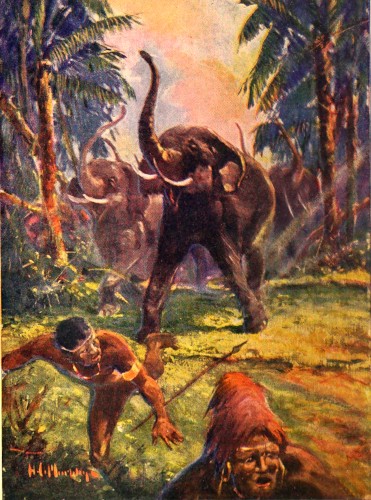
No suspicious marks or tracks were detected, much to Jack's
disappointment. That keen sportsman was always promising himself that
he would capture at least a young elephant. After he had tamed and
domesticated it he would certainly break it in for his own riding.
At last, on the 25th, when the first rains began to fall upon the
island, the two families finally left Falconhurst and settled down in
Rock Castle.
No country could have offered a more secluded abode, sheltered from
all inclemency of weather, or one more delightfully arranged. Endless
had been the improvements since the day when Jack's pickaxe had "gone
through the mountain"! The salt cavern had become a comfortable
dwelling-place. In the forefront of the rocky mass there was still
the same arrangement of rooms en suite, with doors and windows cut
through. The library, so dear to Ernest's heart, with two bays open
to the east on the Jackal River side, was surmounted by a graceful
pigeon-house. The vast saloon, with windows draped with green material
lightly coated with india-rubber, and furnished with the principal
articles, taken from the Landlord, still continued to serve as an
oratory, pending the time when Mr. Wolston should have built his chapel.
Above the rooms was a terrace, to which two pathways gave access, and
in front a verandah, with a sloping roof supported by fourteen bamboo
pillars. Along these pillars pepper plants twined their shoots, with
other shrubs which exhaled a pleasant scent of vanilla, mingled with
bindweeds and climbing plants now in their full verdure.
On the other side of the cave, following up the course of the river,
the private gardens of Rock Castle spread. They were surrounded by
thorn hedges, and were divided into square beds of vegetables, fancy
beds of flowers, and plantations of pistachios, almonds, walnuts,
oranges, lemons, bananas, guavas, and every other species of fruit
found in hot countries. The trees proper to the temperate climes of
Europe, such as cherries, pears, wild cherries and figs, were to be
found in the grand alley, which they lined the whole way to Falconhurst.
From the 25th onwards the rains never ceased. And with them burst
the lashing, hissing squalls which drove from the sea over the
table-lands of Cape East. All excursions out of doors were impossible
thenceforward, and only the various occupations of the household could
be carried on. But it was important work, the care and attention that
had to be given to the animals, to the buffaloes, onager, cows, calves,
and asses, and to the pets, like the monkey, Nip the Second; Jack's
jackal, and Jenny's jackal, and cormorant, these last being especially
pampered for her sake. Lastly, there was all the housework and
preserve-making to attend to, and sometimes, when, very occasionally,
the weather cleared for a short time, a little fishing could be got
at the mouth of Jackal River and at the foot of the rocks below Rock
Castle.
In the first week of June there was a vast increase in the gales and
rains. It was imprudent to go out, except in water-proof oilskins.
The entire neighbourhood, kitchen garden, plantations, and fields, was
swamped under these torrential downpours, and from the top of the cliff
above Rock Castle a thousand tiny streams broke away, making a noise
like so many cascades.
Although no one set foot outside the house unless it was absolutely
necessary, there was no dullness.
One evening M. Zermatt made the following calculation:
"Here we are at the 15th of June. The Unicorn left us on the 20th of
October last year, so that is eight full months. Therefore she ought to
be on the point of leaving European waters for the Indian Ocean."
"What do you think, Ernest?" Mme. Zermatt asked.
"If you take her stay at the Cape into account," Ernest answered, "I
think the corvette might have reached an English port in three months.
It will take her the same time to come back, and as it was understood
that she was to be back in a year, that means that she will have had
to remain half a year in Europe. So my conclusion is that she is still
there."
"But probably on the eve of sailing," Hannah remarked.
"Most likely, Hannah dear," Ernest replied.
"After all," said Mrs. Wolston, "she might have cut her stay in England
short."
"She might have done so, certainly," Mr. Wolston answered, "although
six months would not be too long for all that she had to do. Our Lords
of the Admiralty are not remarkably expeditious."
"Oh, but when it is a question of taking possession!" M. Zermatt
exclaimed.
"That gets done!" Jack laughed. "Are you aware that it is a very
handsome present we are making to your country, Mr. Wolston?"
"I quite agree, my dear boy."
"And yet," the young man went on, "what a chance it would have been
for our dear old Switzerland to embark upon a career of colonial
expansion! An island which possesses all the animal and vegetable
wealth of the torrid zone—an island so admirably situated in the very
middle of the Indian Ocean for trade with the Far East and the Pacific!"
"There goes Jack, off again, as if he were careering on Grumbler or
Lightfoot!" Mr. Wolston said.
"But, Ernest," Hannah interposed, "what are we to conclude from your
calculations about the Unicorn?"
"Why, that it will be in the first few days of July at latest that she
will set sail on her voyage here with our dear ones and the colonists
who may have decided to come with them. She will put in at the Cape,
Hannah, and that will probably delay her until about the middle of
August. So I do not expect to see her off False Hope Point before the
middle of October."
"Four more long months!" Mme. Zermatt sighed. "We need patience when we
think of all those whom we love upon the sea! May God guard them!"
The women, busy with their household work, never wasted a minute,
but it must not be supposed that the men were idle. The rumbling of
the forge and the purring of the lathe were constantly to be heard.
Mr. Wolston was a very clever engineer, and, assisted by M. Zermatt,
sometimes by Ernest, and on rarer occasions by Jack, who was always
out of doors if there was the least sign of the weather clearing up,
he made a number of useful articles to complete the fittings of Rock
Castle.
One scheme which was exhaustively discussed and finally agreed upon
was the building of a chapel. The question of the site furnished the
subject for several debates. Some thought that the selected site ought
to front the sea and be on one of the cliffs halfway between Rock
Castle and Falconhurst, so that it could be reached from both houses
without too long a walk. Others thought that on such a site the chapel
would be too much exposed to the gales blowing in from the sea, and
that it would be better to build it near Jackal River, below the fall.
Mme. Zermatt, however, and Mrs. Wolston thought that that would be too
far away. So it was decided to build the chapel at the far end of the
kitchen garden, on a spot that was well sheltered by lofty rocks.
Mr. Wolston then suggested that more solid and durable material than
wood and bamboo should be employed. Why not use blocks of limestone,
or even pebbles from the beach, in the fashion often seen in sea-side
villages? Lime could be produced from the shells and reef-coral which
existed in such quantity on the shore, by raising them to a red heat
to extract the carbonic acid. The work would be begun when weather
permitted, and two or three months would be ample to bring it to a
satisfactory conclusion.
In July, which was the heart of the rainy season in this latitude,
the violence of the storms was intensified. It was seldom possible
to venture out of doors. Squalls and gales lashed the coast with
tremendous fury. One might fancy oneself bombarded with grape-shot when
the hail fell. The sea towered in enormous rolling waves, roaring as
they broke in the chasms of the coast. Often the spray swept right
over the cliff and fell in thick sheets at the foot of the trees. There
were occasions when the wind and the tide combined to produce a kind of
tidal wave which drove the water of Jackal River right back to the foot
of the fall.
M. Zermatt was in a continual state of anxiety about the adjacent
fields. They even had to cut the pipes which connected the river with
Swan Lake, to prevent the overplus of water from swamping the land
round Wood Grange. The position of the pinnace and the longboat in the
creek also gave rise to some apprehension. On many occasions they had
to make sure that the anchors were holding, and to double the hawsers
to prevent collision with the rocks. As a matter of fact, no damage was
done in this particular. But what kind of state must the farms be in,
especially Wood Grange and Prospect Hill, which were more exposed than
the others owing to their proximity to the shore, which the hurricanes
lashed with positively terrifying fury?
So M. Zermatt, Ernest, Jack and Mr. Wolston determined to take
advantage of a day which gave a brief respite from the storm, to go as
far as False Hope Point.
Their fears were only too well founded. The two farms had suffered
much, and required a great deal of strengthening and repair which could
not be undertaken at this season and was therefore postponed until the
end of the rains.
It was in the library that the two families usually spent their
evenings. As has been said, there were plenty of books there, some
brought from the Landlord; others, more modern works, given by
Lieutenant Littlestone, including books of travel and works on natural
history, zoology and botany, which were read over and over again by
Ernest; others, again, which belonged to Mr. Wolston, manuals of
mechanics, meteorology, physics and chemistry. There were also books
about hunting and sport in India and Africa which filled Jack with
longing to go out to those countries.
While the storm moaned and roared outside, indoors they read aloud.
They conversed, sometimes in English, sometimes in German—two
languages which both families now spoke fluently, although they
sometimes had to use their dictionaries. There were evenings when only
one language was employed, English, Swiss, or German, or, though in
this they had less facility, Swiss French. Ernest and Hannah were the
only two who had made much progress in this beautiful language, which
is so pure, so precise, so flexible, so happily fitted to express the
inspiration of poetry, and so accurately adapted to everything relating
to science and art. It was quite a pleasure to hear the young man and
the girl conversing in French, although all that they said was not
always understood by the others.
As had been said, July is the worst month in this portion of the Indian
Ocean. When the storms abated, there supervened thick fogs, which
enveloped the entire island. If a ship had passed within only a few
cables' lengths, she could not have seen either the inland heights or
the capes along the coast. It was not without reason that they feared
lest some other ship might perish in these seas as the Landlord and
the Dorcas had perished. The future would certainly make it incumbent
upon the new colonists to light the coasts of New Switzerland and so
make it easier to effect a landing there, at any rate in the north.
"Why should we not build a lighthouse?" Jack enquired. "Let us see:
a lighthouse on False Hope Point, perhaps, and another on Cape East!
Then, with signal guns from Shark's Island, ships would have no
difficulty in getting into Deliverance Bay."
"It will be done, my dear boy," M. Zermatt answered, "for everything
gets done in time. Fortunately, Lieutenant Littlestone did not need
any lighthouses to see our island, nor any guns to help him to anchor
opposite Rock Castle."
"Anyhow," Jack went on, "we should be quite equal, I imagine, to
lighting the coast."
"Jack is certainly not afraid of attempting big things," Mr. Wolston
said.
"Why should I be, Mr. Wolston, after all we have done as yet, and all
we shall do under your instructions?"
"You know how to pay compliments, my boy," M. Zermatt remarked.
"And I am not forgetting Mrs. Wolston, or Hannah," Jack added.
"In any case," Hannah replied, "if I had not the knowledge I would not
fail through any lack of good will."
"And with good will——" Ernest went on.
"One can build lighthouses two hundred feet above the level of the
Indian Ocean," Jack answered lightly. "So I rely upon Hannah to lay the
first stone."
"Whenever you like, my dear Jack," she answered, laughing.
On the morning of the 25th of July, M. and Mme. Zermatt were in their
room when Ernest came to them, looking even more serious than usual,
his eyes shining brightly.
He wanted to acquaint his father with a discovery, which, if properly
worked, might, he thought, have results of the very highest importance
in the future.
In his hand he held something which he handed to M. Zermatt after a
final look at it.
It was one of the pebbles he had picked up in the gorge on the occasion
of his trip in the canoe, with Mr. Wolston, on the upper reaches of the
Montrose River.
M. Zermatt took the pebble, the weight of which surprised him to begin
with. Then he asked his son why he brought it to him with such an air
of mystery.
"Because it is worth while to give it a little careful attention,"
Ernest replied.
"Why?"
"Because that pebble is a nugget."
"A nugget?" M. Zermatt said questioningly.
And going to the window he began to look at it in the better light.
"I am certain of what I allege," Ernest declared. "I have examined that
pebble, have analysed some portions of it, and I can guarantee that it
is largely composed of gold in a native state."
"Are you sure you are not mistaken, my boy?" M. Zermatt asked.
"Quite, Papa, quite!"
Mme. Zermatt had listened to this conversation without speaking a word,
without even putting out her hand to take the precious object, the
finding of which seemed to leave her quite indifferent.
Ernest continued:
"Now, as we were coming back down the Montrose gorge I noticed a number
of pebbles like that. So it is certain that there are quantities of
nuggets in that corner of the island."
"And what does that matter to us?" Mme. Zermatt demanded.
M. Zermatt looked at his wife, recognising all the scorn in her remark.
Then he said:
"My dear Ernest, you have not mentioned your discovery to any one?"
"To no one."
"I am glad: not because I have no confidence in your brother or in Mr.
Wolston. But this is a secret that ought to be carefully considered
before it is divulged."
"What is there to be afraid of, Papa?" Ernest asked.
"Nothing at present, but much for the future of the colony! Let the
existence of these gold-bearing districts once be heard of, let it once
be known that New Switzerland is rich in nuggets, and gold-miners will
come in crowds, and in their train will come all the evils, all the
disorder, all the crimes that gold-hunting involves! You may be quite
sure that what did not escape you, Ernest, will not escape others, and
that all the mineral treasures of the Montrose will be known some day.
Well, let that be as far in the future as possible! You were right to
keep this secret, my boy, and we will keep it too."
"That is wisely spoken, dear," Mme. Zermatt added, "and I quite approve
of all you have said. No! Let us say nothing, and do not let us go back
to that gorge up the Montrose. Let us leave it to chance, or rather to
God, who orders all the treasures of this world and distributes them as
He thinks fit!"
Father, mother, and son agreed. The desert region between the upper
reaches of the river and the foot of the mountain range would not
attract the new inhabitants of the island for a long time to come, and
beyond question many evils would thus be avoided.
The rainy season was now at its height. For at least another three
weeks they must exercise patience. After twenty-four hours' respite
the gales burst out again with greater violence, under the influence
of the atmospheric disturbances which convulsed the whole of the north
of the Indian Ocean. It was now August. Although this month only
represents our February in the Southern hemisphere, it is then, between
the Tropics and the Equator, that the rains and winds usually begin to
abate and the sky to be cleared from the heavy vapours.
"For twelve years we have never experienced such a long series of
gales," M. Zermatt remarked one day. "Even in May and July there were
some weeks of lull. And the west wind always sets in again at the
beginning of August."
"You will get a very sorry idea of our island, Merry dear," Mme.
Zermatt added.
"Make yourself easy, Betsy," Mrs. Wolston replied. "Are we not
accustomed in my country, England, to bad weather for six months in the
year?"
"It is abominable!" said Jack emphatically. "An August like this in
New Switzerland! I ought to have been out hunting three weeks ago, and
every morning my dogs ask me what is the matter!"
"This spell will soon end now," Ernest declared. "If I may believe the
barometer and the thermometer, it will not be long before we get into
the period of thunderstorms, which generally is the end of the rainy
season."
"Anyhow," said Jack, "this abominable weather is lasting too long. It
is not what we promised Mr. and Mrs. Wolston, and I am sure Hannah is
cross with us for having deceived her."
"No, I am not, Jack—really."
"And that she would be glad to go away!"
The young girl's eyes answered for her. They told how happy she was in
the cordial hospitality of the Zermatts. Her real hope was that nothing
would ever part her parents and herself from them!
As Ernest had remarked, the rainy season generally ended in violent
thunderstorms, which lasted for five or six days. The whole heavens
were then illumined by lightning, followed by peals of thunder as
though the starry vault were crashing in, peals which re-echoed from a
thousand points along the shore.
It was on the 17th of August that these storms were announced by a
rising of the temperature, an increasing heaviness of the atmosphere,
and a drifting up in the north-west of livid clouds, denoting high
electric tension.
Rock Castle, from the shelter of its dome of rock, set wind and rain
at defiance. There was nothing to be feared there from the lightning,
which is so dangerous in open country or among trees, to which the
electric fluid is easily attracted.
The next day but one, in the evening, the skies were rent by the most
terrible ball of fire that had fallen yet. All gathered in the library
sprang to their feet at the noise of the dry and rending peal of
thunder, which went rolling on and on through the upper zones of the
air.
Then, after a minute's interval, dead silence reigned outside.
The bolt had unquestionably fallen not far from Rock Castle.
At this moment the report of an explosion was heard.
"What is that?" cried Jack.
"It is not thunder," said M. Zermatt.
"Certainly not," said Mr. Wolston, who had come to the window.
"Was it a gun fired outside the bay?" Ernest asked.
All listened with panting hearts.
Were they mistaken—was it an acoustic illusion, a final thunderclap?
If it was really the discharge of a piece of ordnance, it meant that
a ship was off the island, driven there by the storm, and perhaps in
distress.
A second report resounded. It was the same sound, and therefore came
from the same distance, and this time no lightning had preceded it.
"Another," said Jack, "and there can be no doubt——"
"Yes," Mr. Wolston declared, "it was a gun we just heard!"
Hannah ran towards the door crying out as if involuntarily:
"The Unicorn! It can only be the Unicorn!"
For a few moments a stupefied silence reigned. The Unicorn off the
island, and calling for help? No, no! That some ship might have been
driven to the north-east, and be disabled and drifting among the reefs
of False Hope Point or Cape East, was conceivable. But that it was the
English corvette was not admissible. That would have necessitated her
having left Europe three months earlier than they had expected. No, no!
And M. Zermatt was so emphatic in his assertion of the contrary that
all came round to his opinion: this could not be the Unicorn.
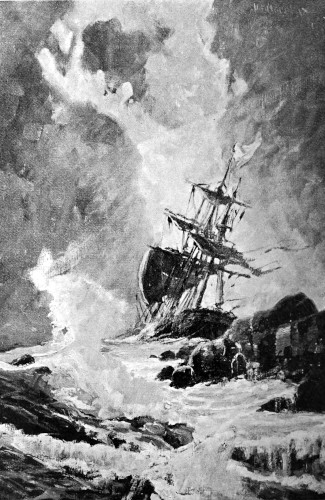
But it was none the less appalling to think that a ship was in distress
near the island, that the gale was driving her onto the reef where the
Landlord had been dashed to pieces, and that she was appealing for
help in vain.
M. Zermatt, Mr. Wolston, Ernest, and Jack went out into the rain and
climbed up the shoulder of cliff behind Rock Castle.
The darkness was so intense that they could not see farther than a
very few yards in the direction of the sea. All four were obliged to
return almost at once, without having seen anything on the surface of
Deliverance Bay.
"And if we had seen, what could we do to help the ship?" Jack asked.
"Nothing," M. Zermatt answered.
"Let us pray for those in peril," said Mrs. Wolston; "may the Almighty
protect them!"
The three women fell on their knees beside the window, and the men
stood by them with bent heads.
As no other report of guns was heard, they were obliged to conclude
that the vessel was either lost with all hands or had passed by the
island out to sea.
No one left the great hall that night, and directly day appeared, the
storm having ceased, all hurried out of the grounds of Rock Castle.
There was no sail in sight, either in Deliverance Bay or in the arm of
the sea between False Hope Point and Cape East.
Nor was anything to be seen of any ship which might have been dashed
upon the Landlord's reef six or seven miles beyond.
"Let us go to Shark's Island," Jack suggested.
"You are right," M. Zermatt replied. "We shall see farther from the top
of the battery."
"Besides," Jack added, "now or never is the time to fire a few guns.
Who knows if they won't be heard at sea, and answered?"
The difficulty evidently would be to get to Shark's Island, for the bay
must still be very rough indeed. But the distance was not much more
than a couple of miles, and the longboat could risk it.
Mme. Zermatt and Mrs. Wolston, conquering their anxiety, did not oppose
the idea. It might be a question of saving the lives of fellow-men.
At seven o'clock the boat left the little creek. M. Zermatt and Mr.
Wolston, Ernest, and Jack all rowed energetically, helped forward by
the ebb tide. A few bucketfuls shipped over the bows did not frighten
them into turning back.
Directly they reached the island all four jumped out onto the low rocks.
What havoc they found! Trees lying uprooted by the wind, the antelopes'
paddocks were destroyed, and the terrified animals rushing about all
over the place!
M. Zermatt and the rest reached the foot of the little hill on which
the battery stood, and Jack was naturally the first to appear at the
top.
"Come along, come along!" he shouted impatiently.
M. Zermatt, Mr. Wolston and Ernest hurried up to him.
The shed under which the two guns were placed side by side had been
burnt down during the night, and all that was left of it was a few
ruins, which were still smoking. The flagstaff was split right down,
and lay in the midst of a heap of half-burnt grass and brushwood. The
trees, whose branches had been interlaced above the battery, were
shivered right down to their roots, and the marks could be seen of
flames that had consumed their upper branches.
The two guns were still upon their gun-carriages, which were too heavy
for the gale to overturn them.
Ernest and Jack had brought quick-matches, and were also provided with
several cannon-cartridges in order that they might be able to continue
firing if they heard any reports from out at sea.
Jack, posted by the first gun, applied the light.
The match burnt right down to the touch-hole, but the charge did not go
off.
"The charge has got damp," Mr. Wolston remarked, "and could not catch
light."
"Let us change it," M. Zermatt replied. "Jack, take the sponge and try
to clean out the gun. Then you can put a new cartridge in."
But when the sponge had been thrust into the gun, it went right down to
the end of it, much to Jack's surprise. The old cartridge, which had
been put in it at the end of the summer, was not there. It was the same
with the second gun.
"So they have been fired!" Mr. Wolston exclaimed.
"Fired?" M. Zermatt repeated.
"Yes—both of them," Jack replied.
"But by whom?"
"By whom?" Ernest answered. "Why, by the thunder itself."
"The thunder?" M. Zermatt repeated.
"Not a doubt of it, papa. That last thunderbolt which we heard
yesterday fell upon the hill. The hangar caught fire, and when the
flames reached the two guns, the two charges exploded, one after the
other."
This was the obvious explanation, in view of the burnt ruins which
strewed the ground. But what anxious hours the good people at Rock
Castle had spent during that interminable night of storm!
"Nice sort of thunder, turning gunner!" Jack exclaimed. "Jupiter
Tonans is meddling with what is no concern of his!"
The cannon were reloaded, and the longboat left Shark's Island, where
the hangar must be rebuilt as soon as the weather permitted.
But as no vessel had arrived in the waters of the island in the course
of the previous night, so no vessel had been lost upon the reefs of New
Switzerland.