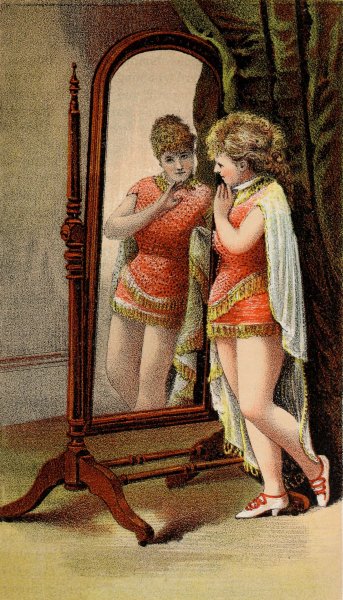
Little Peggy, afterwards the famous Mistress Woffington,
was down at the shores of Liffey drawing
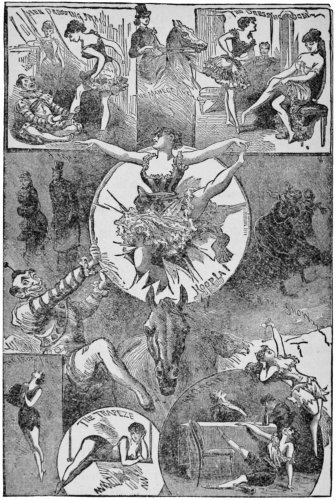
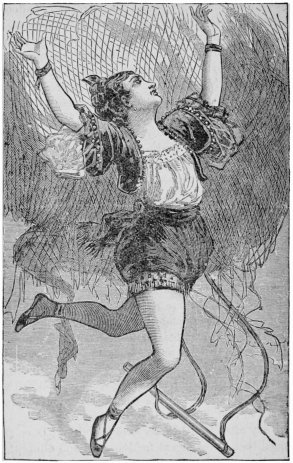
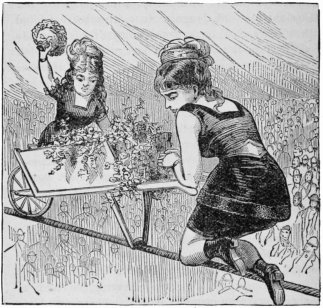
water for her mother, when Madame Violante, a rope-walker,
met her, and taking a liking to the girl, made
terms with the parents and obtained possession of her.
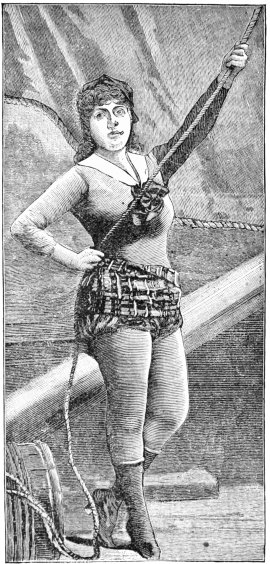
Madame Violante walked the rope with a child tied to
her feet, and lovely little Peggy for a while assisted in
this way at her mistress's entertainments. When the
Madame got to Dublin she found a juvenile company
playing "Cinderella" there, and at once began the
organization of a class of children, who appeared in
the play with Peggy as one of the bright luminaries.
This was her introduction to the stage, which she trod
with such brilliant success in after years. Nor was
she the only one of the famous old English actresses
trained to the drama from childhood. All through
the history of theatricals, from and before Woffington's
time, children were made participants in the
play, and the seeds planted thus early ripened into
the richest fruit. Until a very recent date it was not
deemed the duty of anybody to interfere with this
kind of training—not even with the barbarous treatment
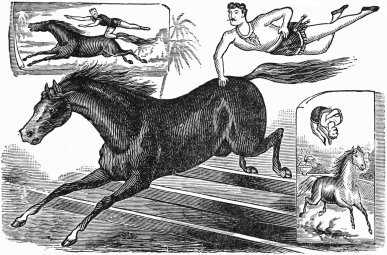
to which children training for the circus ring
were submitted. Less than a half century ago the
Viennese children went through the country dancing,
and were unmolested by any philanthropically inclined
body or any excessively humane individual. The
juvenile "Pinafore" companies of two seasons ago
were regarded kindly by press and public; and, indeed,
until quite recently no extraordinary war was
made against presenting the talents of a child actor or
actress to the people. The Society for the Prevention
of Cruelty to Children has, however, organized a
stubborn resistance to the employment of little ones
in stage representations; and while it may be well to
exercise some authority for the protection of infants
and for the preservation of the stage from a deluge
of child-talent, there can be no justification in allowing
that authority to run riot in plucking every blossom
from the tree of histrionism, and erecting a permanent
barrier against the development of native talent, when
any happens to exist in a child of tender years. The
experience of more than two centuries shows that the
best training is that which begins earliest, which begins
slowly, and widens only with the slow progress of the
years. There are very few actors or actresses who
have walked out of private life into the glare of the
foot-lights with anything like success. The amateur
may sometimes be suddenly metamorphosed into a
full-fledged professional, with a bit of reputation to
help him along the road he has chosen to travel, but
this happens very rarely. Only those who begin early
and study hard, and who have often to wait a long
time for recognition, gain a place in the Thespian
temple, and it is to those whose infant eyes open
almost upon the mysteries and wonders of the mimic
world, whose little limbs grow to strength behind the
scenes, and whose lives are identified completely with
all that have place or being behind the foot-lights, that
it is given to hope for position in the profession into
which they have been born instead of kidnapped.
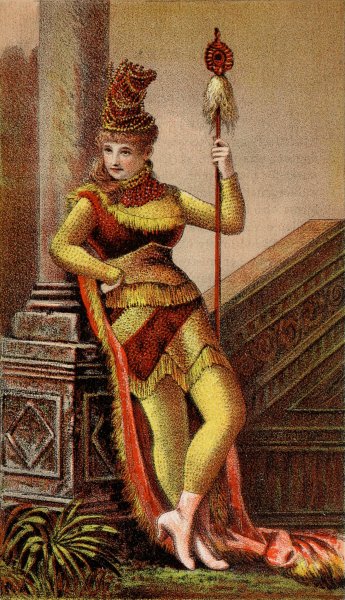
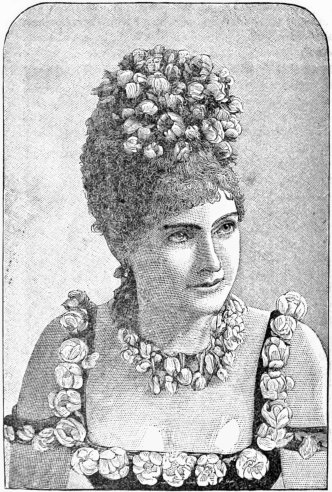
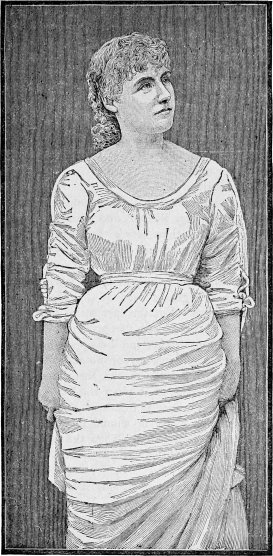
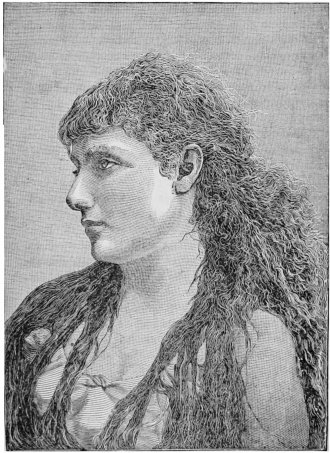
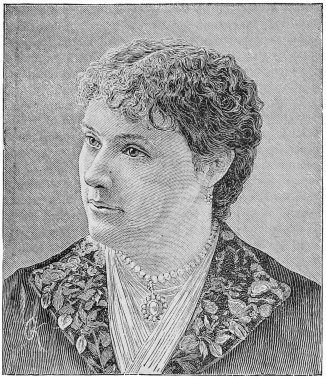
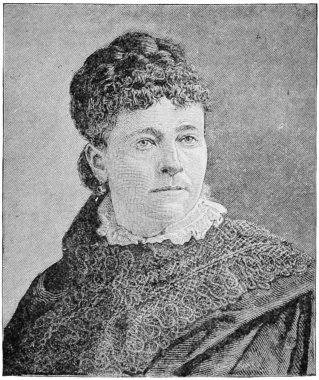
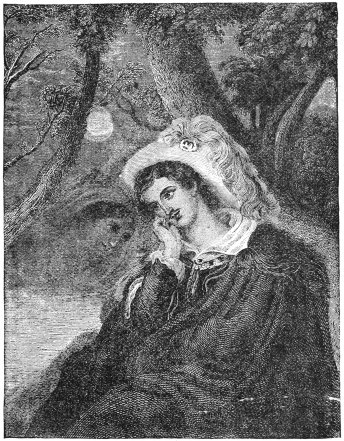
MISS CONNOLLY IN ENCHANTMENT.
I think the society for the Prevention of Cruelty to
Children did a very good thing when it took Little
Corinne from the stage. The child was overtaxed far
beyond her years; there was nothing very clever about
her any more than there would be about a school-girl
of the same age who had been taught to speak her
piece and did it boldly, but awkwardly and inartistically.
It was more painful than pleasant to sit out a
performance of "Cinderella" with this offspring of
the Kemble family in the role of the heroine of the
glass slipper, and it was a temporary blessing to the
public while the little thing was kept out of the way.
Like all the precocious ventures on the stage, Corinne
will gradually fade from memory, and the only thought
left of her will be a painful recollection of her childish
efforts to please the grown people who were foolish
enough to go to the theatre to see her.
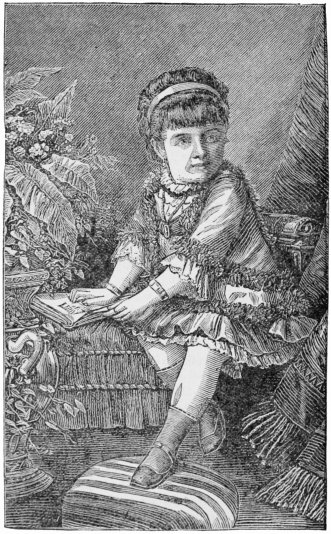
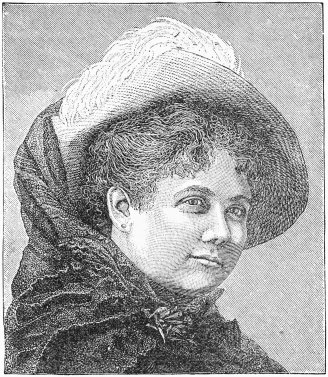
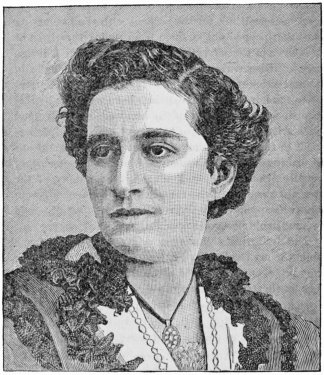
LITTLE CORINNE.
The young man or the young lady who has given
years of study to preparation for the stage finds the
debut night one fraught with fears and hopes. There
are friends behind the scenes and friends in the audience
willing to overlook faults and exaggerate excellencies;
but there are cold, stern critics, too, anxious
to puncture the new candidate for public favor in every
tender spot their cruel eyes can search out, and there
is the great public, that fickle body whose applause or
condemnation often depends upon the whim of the
moment. The effort is an enormous one to the new
player; the suspense, frightful. A whole life's work
may be swept out of sight in a moment, and the life
itself blighted forever. But when the moment of success
arrives—what a thrill of joy the triumph sends
to the heart of the actress, if actress it be! What a
dream of glory she already begins to live in! How
her brain throbs and her heart bounds, and all the
world seems a paradise, beautiful and fair as Eden was
when it left the hands of the Creator! Friends crowd
around, the house is ringing with applause, and she
tears away from the congratulations and kisses and
hand-shakings to step out before the curtain, and, with
glowing face and tears in her eyes, kisses her hand and
makes a profoundly thankful obeisance to the audience.
Then she returns to her crowding friends on the stage,
from the manager down to the call-boy and scene-shifters,
and her ears ring with praise and encouraging
words until it is time for the curtain to go up once
more.
The debut of Emma Livry, an artiste who promised
to lead a very brilliant career, but who was suddenly
and early cut down by death, is described in a very interesting
manner by one who was present. It was at
the Grand Opera House, Paris, and the theatre was
filled from parquette to dome with an extraordinary
audience. Louis Napoleon was there, and the Empress
Eugenie; princes and dukes filled the boxes, and the
nobility of France, representative Americans and
prominent Englishmen were in the audience. Emma
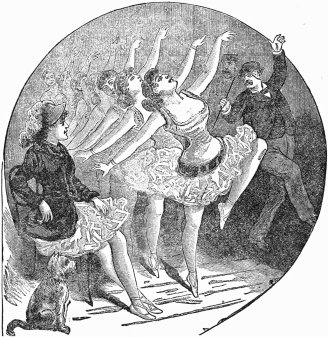
Livry was then only sixteen. From her earliest childhood,
says the writer, she had been devoted to the art
of dancing—though this was no extraordinary thing,
for there are a large number of girls always in training
for the Grand Opera in Paris, who are taken at the age
of four years, and kept in constant practice until they
reach womanhood, when they appear in public. But
this girl had shown extraordinary genius. In her later
years the celebrated dancer, Marie Taglioni, Countess
de Voisius, hearing of the new dancer, left her villa on
the Lake of Como, and her palace in Venice, to come
to Paris to give the girl lessons. Her improvement
was miraculous. Taglioni said she would renew the
triumphs she herself had won in former days.
And now she glided upon the stage. The brilliant
audience ceased their chatter as she appeared. The
occasion took the character of what it was afterwards
called in the newspapers—"a great solemnity." She
was very young and was just at that period in the life
of a girl when her figure is apt to be what old-fashioned
people call raw-boned. She was tall, thin, and
pale. Her face was not handsome. Her form gave
no evidence of physical strength.
She was received in a hush of silence. "Let us
see," this great audience seemed to say, "what you
really can do in this poetic art." Any one who could
have connected sensuality or grossness with this girl
would have been baser than a sybarite; and yet her
dress was the conventional dress of ballet dancers—short
to the calf of the leg but thickly clad above.
She began. O Grace, you never found a prototype
till now! O Painting, Sculpture, you paled before this
supple, elastic, firm, yet dainty tread. At the conclusion
of her first movement, when with a gush of sweet
music she sprang like a fawn to the foot-lights, and extending
her slender arms and delicate hands towards
the audience, as if to ask, "Come, what is the verdict
on me now?" a burst of enthusiastic applause,
loud shouts of "Brava!" and "Bravissima!"
"C'est magnifique!" waving of perfumed handkerchiefs,
a deluge of sweet flowers formed the response.
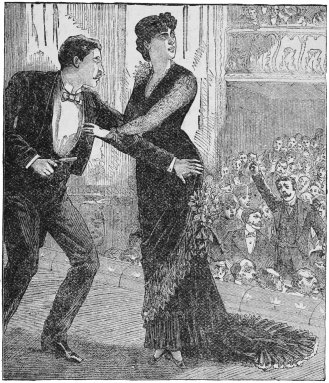
The whole evening was a series of triumphs. The
Emperor and Empress sent an aid-de-camp behind the
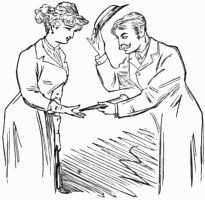
scene to offer her the Imperial congratulations. Marie
Taglioni, accompanied by her noble husband, sought
the girl also, and taking from her breast a magnificent
diamond star, which had been given her in former
days by the Emperor of Russia, "Here," said she,
"take this the queen of dance, Marie Taglioni, is
dead—long live the queen, Emma Livry!"
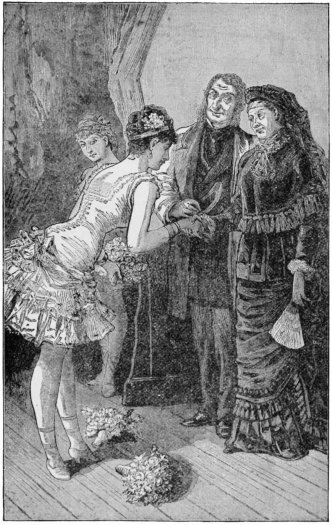
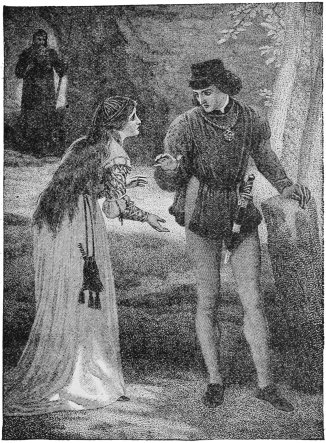
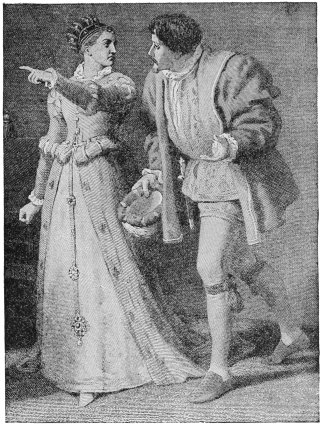
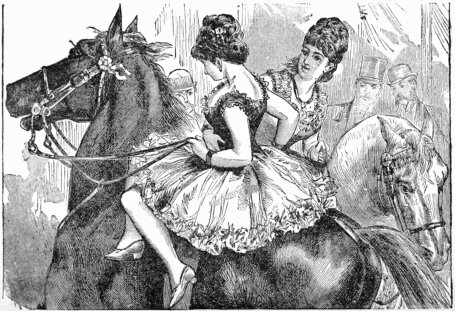
TAGLIONI CONGRATULATING EMMA LIVRY.
As I passed out amongst the dense crowd, the
writer continues, I saw a woman of middle age, and
respectably dressed, leaning against one of the marble
columns in the vestibule. Her face was flushed
and she was wiping tears from her eyes.
"You weep, Madonna?" said a gentleman who was
passing.
"Yes, Monsieur," she replied, "but it is with joy.
Who would not be proud of such a daughter, and of
such a tribute to her genius?"
There are few favorites of the public to-day who
have not fought their way to the front inch by inch,
who have not sacrificed everything for their art, toiling
through the day that the work of the night might
show improvement—very few who have not served
years of apprenticeship on the stage before the moment
of success arrived. And this has been the rule
always. Nell Gwynne, the fish-girl, whose beauty
and bright repartee attracted the attention of Lacy, the
actor, and who peddled oranges to the audience before
she began to amuse them on the stage, managed without
much trouble, and during a short stage experience,
to win the heart of Charles II., who made her his mistress
and retained her while he lived, his parting
words to those around his death-bed being, "See that
poor Nelly doesn't starve;" but Nelly did starve. She
died in poverty and left a line of dukes to perpetuate
her plebeian blood in royal veins. She died in
November, 1687, in her thirty-seventh year.
Lola Montez, the pretty Irish girl who in her fourteenth
year eloped with one Capt. James to avoid a
disagreeable marriage, accompanied him to India,
where they got mutually tired of each other and returning
to England studied dancing and went on the
stage, was another of those fortunate and unfortunate
fascinating women whose lives fade away fast and
who after a brief hey-day of luxuries lie down in rags
and poverty to seek a needed rest that is never broken.
She won the hearts of kings, led a revolution in
Poland, and finally, after being driven from her Bavarian
castle where, as Countess of Lansfield she had
ruled, and strutting a brief hour in London in male
attire, died in this country January 17, 1861. Her
ashes rest in Greenwood Cemetery, but she was saved
from a pauper's grave only through the charity of
some friend. During her life she had thrown away
millions. Fallin, the husband of Maude Granger, is
the son of the man with whom Lola Montez had her last
escapade, Fallin, Sr., deserting his family in New
York to accompany Lola to San Francisco. Her real
name was Marie Dolores Eliza Rospanna Gilbert.
Another child of genius whom waywardness and
frailty brought to an early grave was Adelaide McCord,
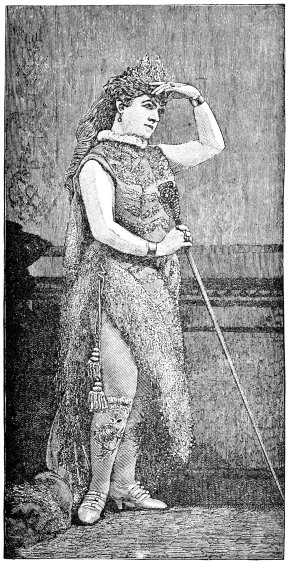
better known to the world as Adah Isaacs Menken.
She was born near New Orleans, June 15, 1835, and
when still young went on the stage as a ballet dancer
in one of the theatres of the Crescent City. She had
been expelled from school, and tiring of her native village,
where she had created a sensation by embracing
the Jewish faith, she made the journey to New Orleans,
and as I have said went on the stage. Her career
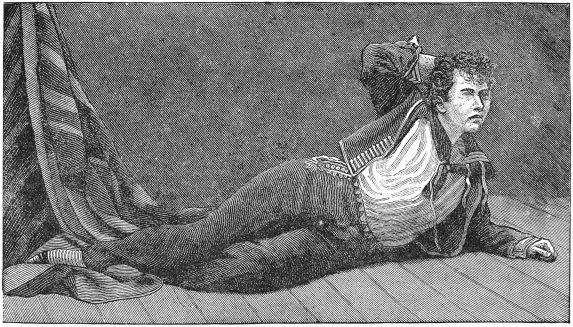
there was not a very brilliant one until she began playing
Mazeppa, the part with which her name has since
been identified. Prior to her time men had appeared
in this role. Her first appearance was on Monday
night, June 17, 1861, in the Green Street Theatre,
New York, then under the management of Capt. John
B. Smith. On the first attempt to go up the run the
horse after making one turn fell, crashing through the
scenery with the Menken on its back. Horse and rider
were picked up, and after some delay the ascent was
made amidst a great deal of enthusiasm. The appearance
of so beautiful a woman as Menken in the scarcity
of clothing that Mazeppa requires created a furore,
and from that time her success was assured. She
fought spiritedly in the combat scene, breaking her
sword and otherwise won the good opinion of her
first audience. Previous to this she had married
Alexander Menken, a musician in Galveston, but
by this time also she had obtained an Indiana
divorce. While in New York she met John C. Heenan,
fresh from his victory over Tom Sayers, and
after a brief courtship married him. Another Indiana
divorce soon dissolved this knot, as it did a third time
in the case of Orpheus C. Kerr (Robt. H. Newell).
All this time her fame was growing. She went to
London, and after setting the English metropolis on
fire with her beauty returned to New York, where she
married James Barclay, a merchant, in whose mansion
she and her friends held such wild orgies that Barclay
was glad when she fled to Paris, where she was stricken
down in the midst of her mad career, in 1868. The
brief but expressive epitaph, "Thou knowest," is
carved upon her tomb.
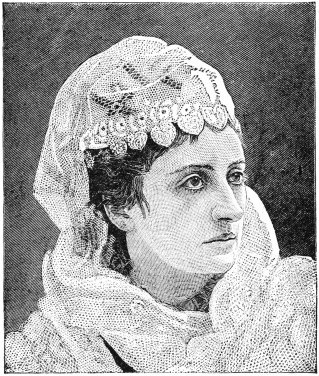
Mary Anderson, the tragedienne, is the most phenomenal
success of late years. She was born July 28,
1859, in Sacramento, California. Her parents removed
to Louisville when she was one year and a half
old, and there she was educated in the Ursuline Convent.
She had a longing to be an actress from
her earliest years, and all her readings tended in
the direction of the stage. She was taken away from
school at the age of thirteen, to pursue her studies for
the profession to which she seemed to be so strongly
inclined. At the age of fifteen she went to Cincinnati
to see Charlotte Cushman act. While there she
called on Miss Cushman, who said she could give her
only a five-minute audience. Miss Anderson recited
passages from "Richard III.," Schiller's "Maid of
Orleans," and "Hamlet." She remained with Miss
Cushman three hours, and the great actress had such
confidence in her talents that she told her to study a
few hours each day for a year and then she might go
on the stage. This Miss Anderson did. An accident
of some kind or other left Macauley's Theatre in Louisville
with a Saturday night for which there was no attraction.
Macauley knew Miss Anderson's desire to
go on the stage, and meeting her step-father, Dr.
Hamilton Griffin, in the street, told him the girl, who
was then only sixteen, might have the theatre that
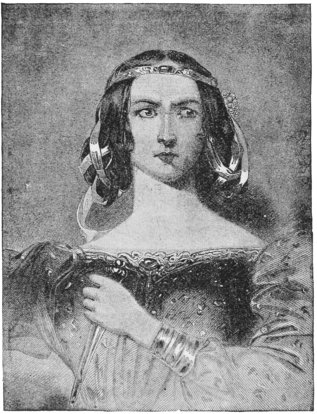
night. Miss Anderson was overjoyed. She chose
Juliet for her debut, got a costume hurriedly together
and after one rehearsal and three days' preparation, appeared
before a large audience, and made a decided
hit. This was on November 27, 1875. Macauley was
so pleased with the debutante that he gave her his first
open week at starring terms. She then went to St.
Louis, in March, 1870, and added greatly to the reputation
she had won in her home city. Mr. John W.
Norton supported her. Ben De Bar sent her to his
New Orleans Theatre, and while in the Crescent City she
was presented, by the citizens, with a check for $500,
and the Washington artillery presented her with a
jewelled badge of the battalion. Returning to Louisville
again she continued her studies through the summer,
began starring the following season, and has been
before the public ever since. She is a young lady of remarkable
personal beauty, intelligent and accomplished,
a hard student, and one of the noblest and
fairest of her sex that ever adorned the stage.
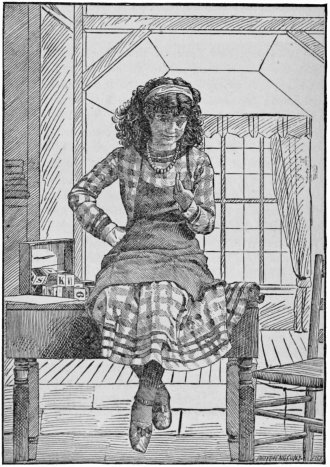
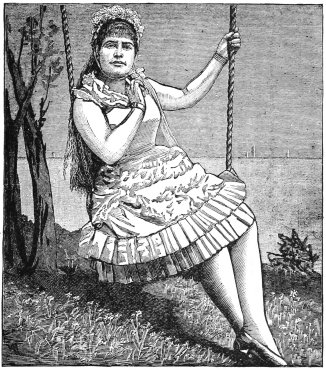
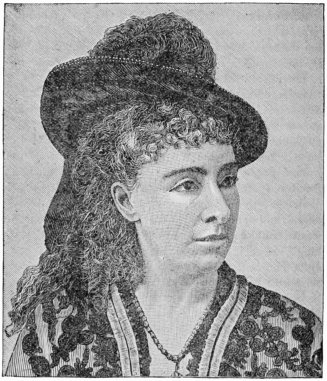
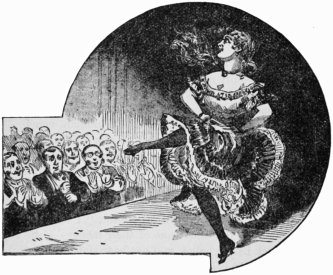
LOTTA.
Lotta Mignon Crabtree, another of the very successful
women on the stage, and one of the brightest soubrettes
that ever delighted a public, was born at No.
750 Broadway, New York, on November 7, 1847. In
1854 her people removed to California, and Lotta
made her first appearance on a stage at a concert given
at Laport; her second appearance was at Petaluma, in
1858, when she played Gertrude in "The Loan of a
Lover." She starred, they say, for two years as La
Petite Lotta. Before she made her appearance in New
York we hear of her in San Francisco at Burt's New
Idea and Gilbert's Melodeon—concert saloons—where
Joe Murphy, Barnard, Cotton, Pest, Burbank,
Billy Sheppard, Backus and other prominent minstrels
were engaged. The Worrell Sisters, Maggie Moon
(now Mrs. Williamson) and Lotta were in the company,
and there was great rivalry between them at the
time. The theatre was crowded every night up to the
close of the first part in which there was a "walk
around," in which the girls entered into the liveliest
kind of a competition. Each did her utmost to out-dance
the other. Each favorite had her host of
admirers and the demonstration on the part of the
audience was intense. After the "walk around" the
house became almost empty, showing that this was the
attractive feature. Lotta was very ambitious, and
whenever she failed to score a triumph she would
retire to her dressing-room and cry bitterly. From
San Francisco her parents took her to New York,
where she gave her first performance at Niblo's Saloon,
June 1, 1864. She wasn't a success in New York, so
she went to Chicago and played "The Seven Sisters"
at McVicker's. Fortune began to smile on her there,
and her success dates from this point. One night during
this engagement an unknown admirer threw a
$300 gold watch and chain upon the stage. Lotta
cannot sing any more, but she kicks as cutely as of
yore, dances neatly, and is as vivacious as a girl of sixteen.
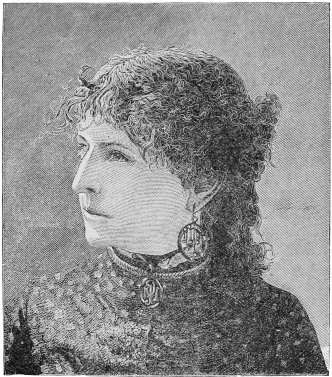
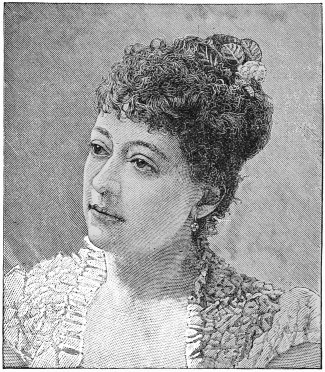
MAGGIE MITCHELL.
Maggie Mitchell, who has been a great favorite ever
since she produced "Fanchon" at Laura Keene's
Theatre, June 9, 1862, was born in New York in
1832, of poor parents. She began to play child parts
at the old Bowery and in 1851 had advanced to
responsible business. She made a hit at Burton's
Theatre as Julia in "The Soldier's Daughter," and
then began starring in "The French Spy," "The
Young Prince," and like plays, but did nothing remarkable
until, as I have already said, she made a hit in
"Fanchon," an adaptation of George Sands's novel
"La Petite Fadette." Following this came "Jane
Eyre," "The Pearl of Savoy," and "Mignon."
Miss Mitchell has amassed a fortune by her efforts.
Her name off the stage is Mrs. Paddock, she having
married Mr. Henry Paddock, of Cleveland, Ohio, in
Troy, New York, October 15, 1868.
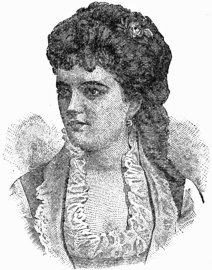
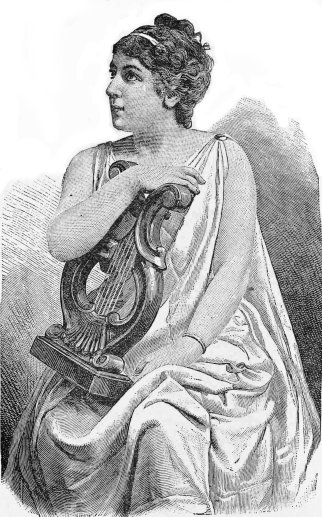
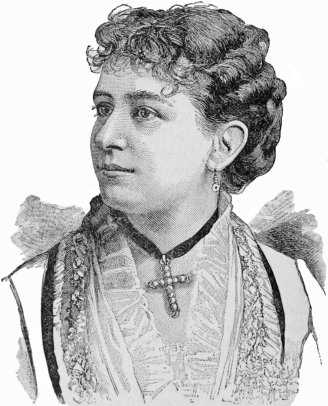
EMMA ABBOTT.
Emma Abbott, the finest of American lyric artistes,
after the usual freaks of an ambitious childhood and
the trials of an operatic training in Milan and Paris,
was given a London engagement by Mr. Gye and
made her debut at the Royal Italian Opera, Covent
Garden, on May 2, 1876. The debut was a success,
and with the congratulation of friends, the best wishes
of all who knew her, and the predictions of the best
judges of vocal music that she had a brilliant future
ahead of her, she set out on a tour of the provinces,
singing through England and Ireland and everywhere
winning the love and applause of the people. Returning
to her own country the artiste gave two seasons of
concerts, and began to sing light opera. She has
created the role of Virginia in "Paul and Virginia,"
and Juliet in "Romeo and Juliet," both which operas
she introduced here. Her repertory includes, besides
the two named, "Mignon," "Maritana," "The
Bohemian Girl," "Martha," "Il Trovatore," and
"Faust." She has a sweet, clear, crystalline voice,
which she uses to great effect, is a charming lady personally,
a careful, pure, and energetic artiste, and
altogether wholly deserves to be called, as she is,
"Honest Little Emma."
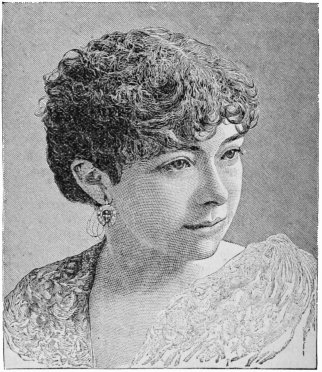
Marion Elmore, a charming little soubrette who is
looking after Lotta's laurels, is a native of England
and has been on the stage since her third year, having
then played Meenie with Joe Jefferson in "Rip Van
Winkle." She was born in 1860 in a tent on the gold
fields of Sandhurst, Australia. She came to this
country with Lydia Thompson in 1878, and played in
burlesque until the season of 1881–2 when she took
a soubrette part in Willie Edouin's "Sparks." She is
now starring under the management of Hayden & Davis
in "Chispa," a California play.
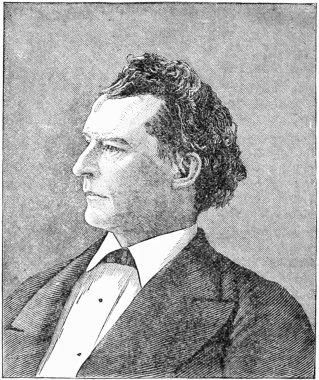
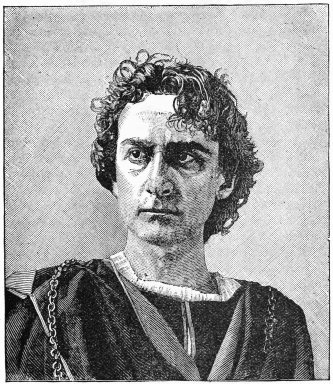
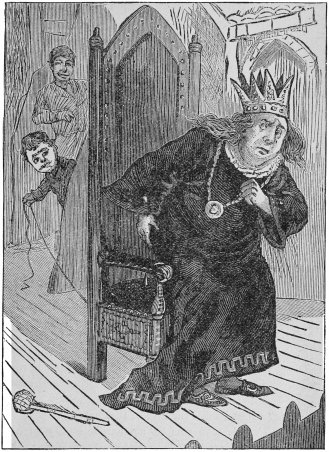
Edwin Booth, the illustrious son of Junius Brutus
Booth, was born at Belair, near Baltimore, Maryland,
in November, 1833. He was his father's dresser,
accompanying him on all his tours, and receiving from
him lessons in histrionism. On September 10, 1849,
he made his first appearance at the Boston Museum as
Tressel, in "Richard III.," and on May 22, 1850,
appeared at the Arch Street Theatre, Philadelphia, as
Wilford, in the "Iron Chest." In 1850 he distinguished
himself by playing "Richard III.," at the
Chatham Theatre, New York, in the place of his father,
who had disappointed. His first independent appearance
in the metropolis, however, was made on May 4,
1857, as Richard III., at the Metropolitan, afterwards
the Winter Garden Theatre. In 1851 he went to California
and thence wandered to the Sandwich Islands
and Australia in 1854. In 1857 he returned to New
York. He was known as an actor of ability, but it
was not until his famous engagements at the Winter
Garden that he succeeded in making a really profound
impression on the public. During this revival "Hamlet"
ran one hundred nights and Mr. Booth at once
stepped to a foremost position before the public. His
disastrous investment in the theatre that bore his
name in New York is well known. It compelled him
to go into bankruptcy in 1872, since which time he
has been the most successful of American stars. He
has been twice married—to Mary Devlin, an actress
in 1861, who died in 1862, and to Mary McVicker,
daughter of J. H. McVicker, of Chicago, who died in
1881. His Hamlet is the finest interpretation of that
character on the American stage, and this with Bertuccio,
in "The Fool's Revenge," and Brutus, are his
best impersonations.
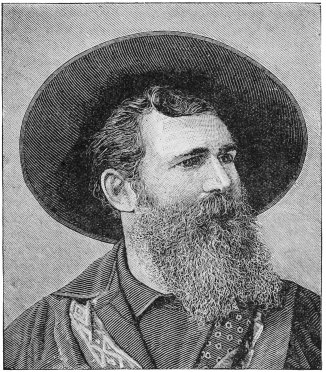
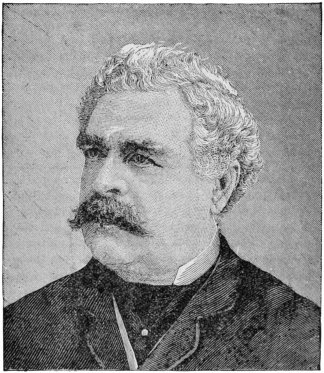
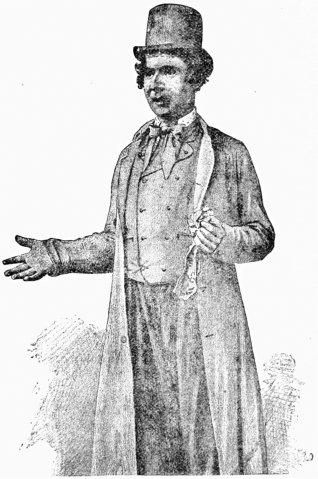
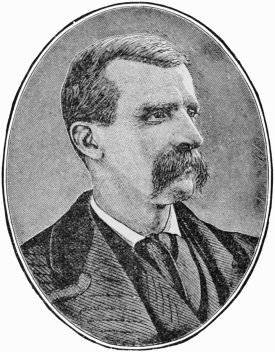
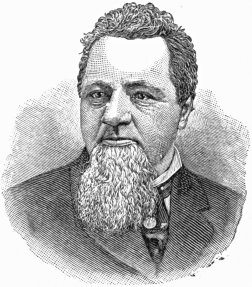
John McCullough, though born in Ireland, came to
this country when very young. He was poor and an
orphan, and poverty had been "looking in at the door"
of the humble home where he passed his boyhood for
many a year. Yet the tenant farm which his father
held was once the pride of all the country round, and
the child's earliest recollections called to mind a happy
time which too soon, alas, passed away. His mother
had died when the son was a mere lad, and misfortunes
came not singly but in hosts after that bereavement.
Sir Harvey Bruce, the landlord of the estate, though
a kindly man, as Mr. McCullough testified, claimed his
legal rights, and all that appertained to the estate held
by the family was taken possession of by law, and
father and son driven out from their home.
"How well I recall the time," said Mr. McCullough,
"and every scene and incident of that eviction—as it
would, I suppose, be called now. I was a boy of
about twelve years or so, and the greatest trial to me
was the sale of a pony which I prized most highly. I
couldn't bear to part with the pony, and Sir Harvey
Bruce, who saw my grief and knew its cause, kindly
arranged matters so that before long I was able to call
the animal once more my own. It was an act of goodness
which, of course, I have never forgotten."
Not long after the eviction the father died, and the
boy was left in the care of an uncle. But, like thousands
of others, young McCullough had heard of the
land of freedom beyond the Atlantic, and it was not
long before he decided to leave kindred and friends,
and seek a home in America. With all his earthly
possessions in a bundle the young lad landed at New
York, and with characteristic pluck and energy began
the battle for existence. He followed various callings,
but soon felt within him the desire to become an actor.
Fortunately the foreman of a chair factory in Philadelphia,
where he was employed, sympathized with the
aspirations of the future actor, and often studied with
him the great Shakespearean tragedies in which McCullough
afterward attained such renown.
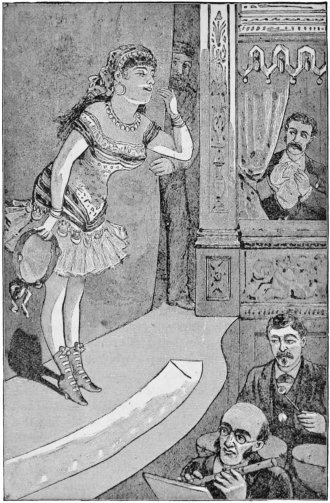
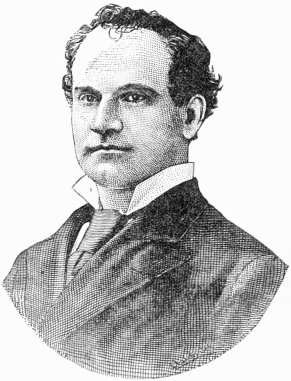
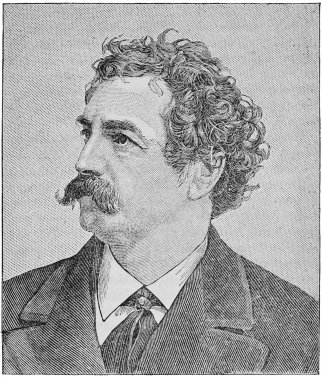
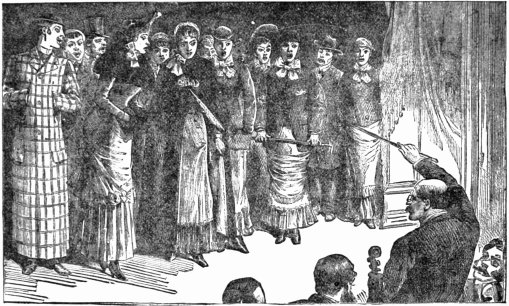
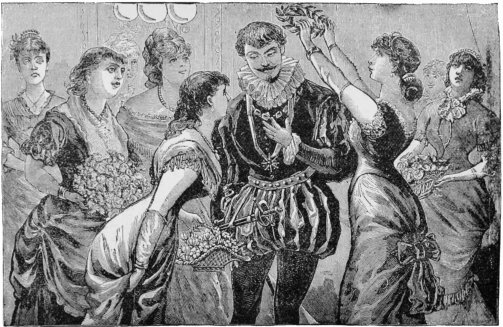
CALLED BEFORE THE CURTAIN.
It was in the winter of 1857 that the young aspirant
for Thespian honors first stood upon the stage; and he
began in Philadelphia his professional career at the
munificent salary of $1 a week. For several seasons
he acted the "heavy villain" line in the Shakespearean
drama, and made steady improvement in his art. A
great event in his career was his engagement to support
the great Forrest in 1862; for it gave him opportunities
which such a man as McCullough was not slow
to improve. The grand qualities which marked
Forrest's acting were made the subject of careful study
by the young actor, and to-day John McCullough is recognized
everywhere as the successor to the famous
American tragedian. His career as an actor, interrupted
only by a brief managerial experience in San
Francisco, has been one of steadily increasing success.
John McCullough's starring experience dates from
only a few years back; yet his impersonations, with
peerless Virginius at the head, have won fame and fortune
in all parts of the country, and gained for him
also the highest honors on the English stage.
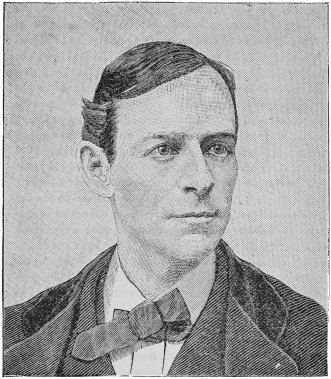
J. K. Emmett, or Joe Emmett, as he is familiarly
called the world over, was born in St. Louis on March
23, 1841. He early had a penchant for the stage,
and could rattle bones, play a drum or do a song and
dance on a cellar-door better than any of his companions.
He began life as a painter, but soon left the
pot and brush for the stage of the St. Louis Bowery,
where his specialty was Dutch "wooden-shoe business."
He could sing finely, and was as graceful as a
woman. So popular did he become in his line that
Dan Bryant engaged him for his New York house
in 1866. Two seasons later Charles Gayler wrote
"Fritz," a nonsensical play without rhyme or reason,
and Emmett opened with it in Buffalo. His success
was indifferent at first, but within a short time "Fritz"
and Emmett became the rage, and for fifteen years the
people have actually run after this star. His name
and play will fill any theatre in the United States, and
in many places outside of the United States. He is
the great pet of the public. Time and again has he
disappointed them, but it makes no difference; the
next time he announces himself ready to play they are
there in throngs. Joe Emmett has friends the whole
world over, and he is welcomed and admired everywhere.
John T. Raymond's real name is John T. O'Brien.
He became stage-struck while clerking in a store, and
after a brief amateur experience made his first appearance
on the professional stage as Lopez, in "The
Honeymoon," on June 27, 1853, and played comedy
with varying fortune until 1874, when "The Gilded
Age," which had been dramatized, was brought out at
Rochester, New York, on August 31st, and he made an
immense hit as Col. Mulberry Sellers. Next to
Colonel Sellers, John T. Raymond's enduring popularity
rests upon his impersonation of Fresh, the American,
in the drama of that name, which he is now
impersonating throughout the country. In connection
with both his best known parts Mr. Raymond may be
said to have "made" the plays they are framed in.
Without them those plays would be flat, and in any
other hands than his the characters which relieve them
of that odium would be insipid. It is the actor's art
and personal magnetism alone which make them what
they are—successes. A good story, whether it be
true or not, is told about Raymond and John McCullough.
The latter was asked to appear as Ingomar,
with Miss Anderson as Parthenia, at a benefit performance
for a friend. As an additional inducement the
beneficiary asked Raymond to play Polydor. "Certainly,
with great pleasure," said Sellers; "I will
travel one thousand miles any time to play Polydor to
McCullough's Ingomar." The happy man ran off to
tell his good fortune to McCullough; but the tragedian,
in his deepest Virginius voice, answered him:
"No, sir, never, never again! Once and out." The
explanation of Mac's refusal to have Raymond in the
cast is given as follows:—
It seems that at a certain benefit in Virginia City,
"Ingomar" was the play, Mr. McCullough sustaining
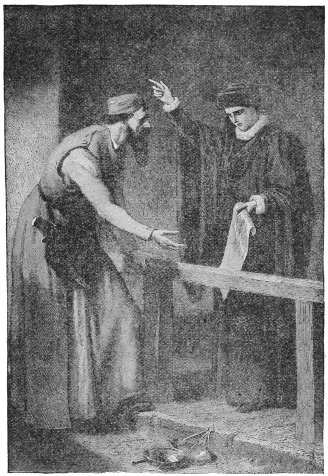
the title role and Mr. Raymond played Polydor. Polydor,
it will be remembered, is the old Greek duffer
who has a mortgage on Myron's real estate, and presses
for payment in hopes to get Parthenia's hand in marriage.
The performance went beautifully, and the
applause was liberal, for McCullough was playing his
best. Raymond was the crookedest and most miserly
of Polydors, and the savage intensity he threw into his
acting surprised all who imagined he could only play
light comedy. All went more than well until Ingomar
offered himself as a slave to Polydor in payment of
Myron's little account. "What, you?" screamed
Polydor, and, apparently overcome by the thought,
he "took a tumble," and fell forward upon Ingomar.
Ingomar stepped back in dismay, when Polydor, on all
fours, crept nimbly between his sturdy legs and tried
to climb up on his back. The audience "took a tumble,"
and the roof quivered and the walls shook with
roars of laughter. "D—n you," groaned Ingomar,
sotto voce, "if I only had you at the wings?" But
Polydor nimbly eluded his grasp, and, knocking right
and left the dozen supes, who were on as the army, he
skipped to the front of the stage and climbed up
out of reach of the projecting mouldings of the proscenium.
Here he clung, and, to make matters
worse, grinned cheerfully at the pursuers he had
escaped, and rapidly worked the string of a trick wig,
the long hair of which flapped up and down in the
most ludicrous fashion. It was impossible for the play
to proceed, and the curtain was rung down, leaving
Polydor still on his lofty perch, while the audience
laughed and shouted itself hoarse. And this is the
reason why Mr. McCullough said, "No, sir, never
again!" to Mr. Raymond's offer.
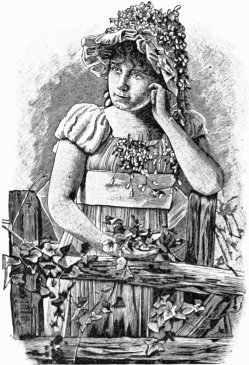
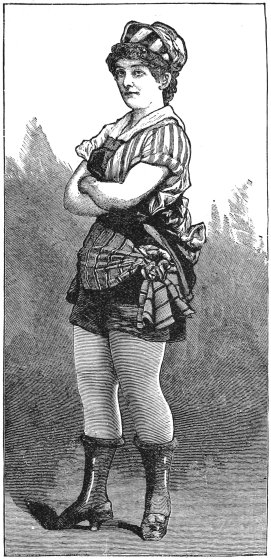
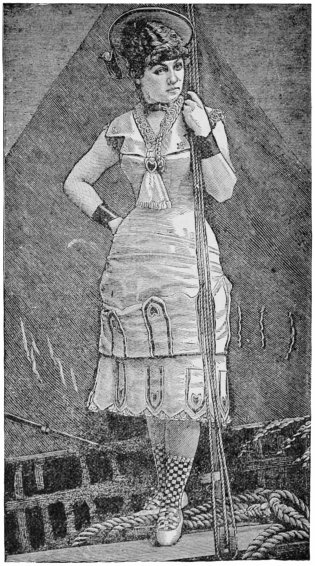
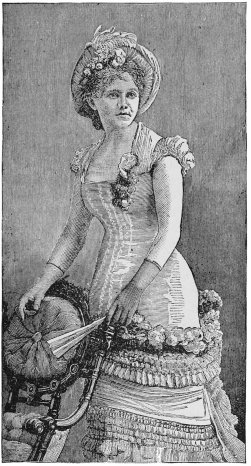
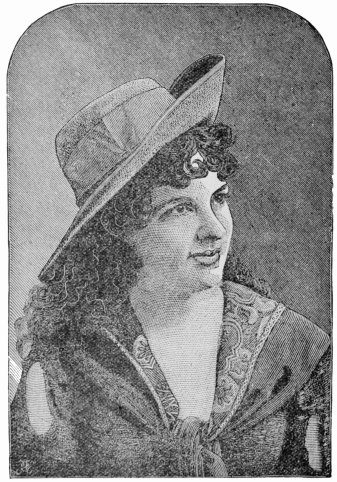
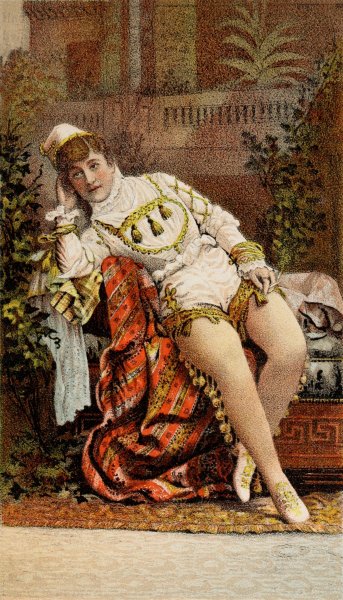
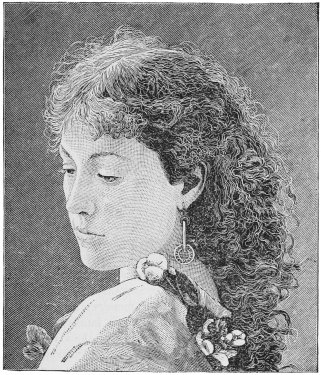
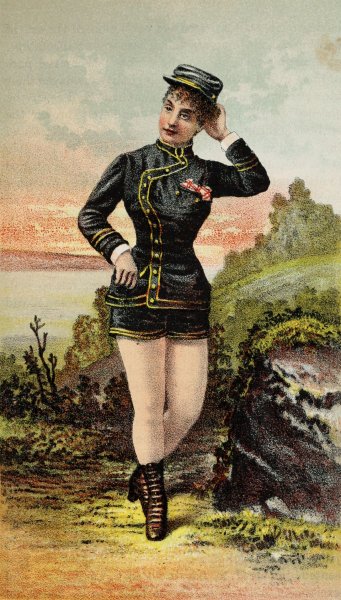
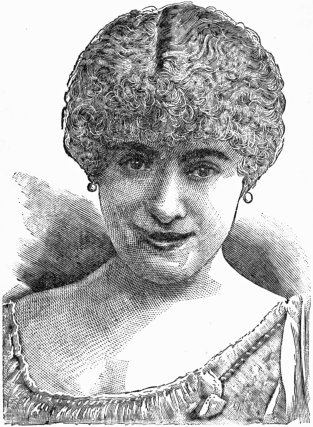
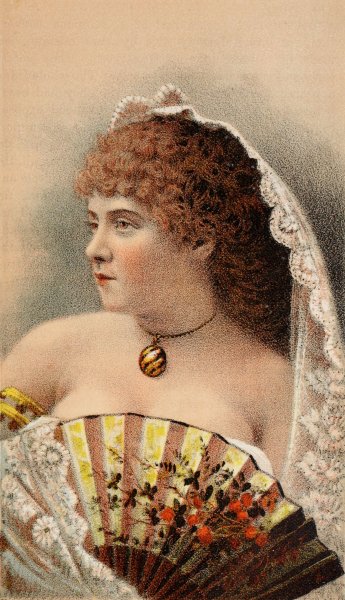
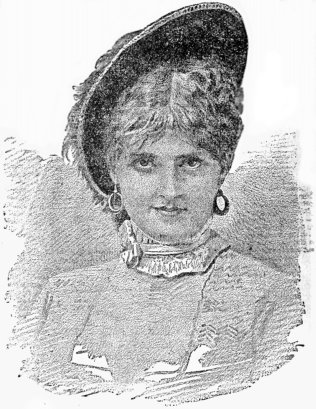
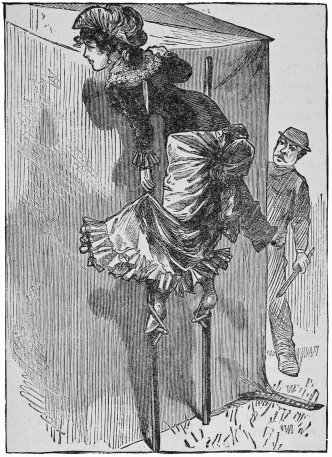
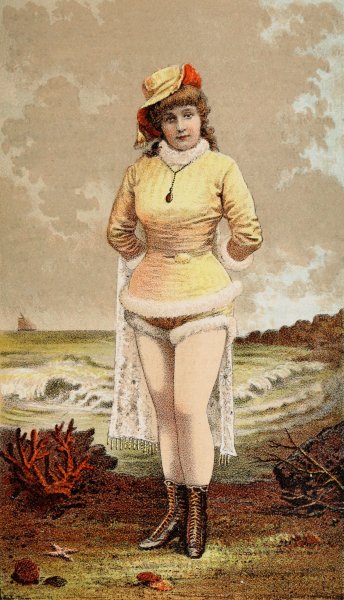
FAY TEMPLETON IN "BILLEE TAYLOR."
I may add that among the young people of the stage
who are possessed of that personal magnetism that
makes them popular, is Fay Templeton, who is not
only pretty, but thoroughly original.