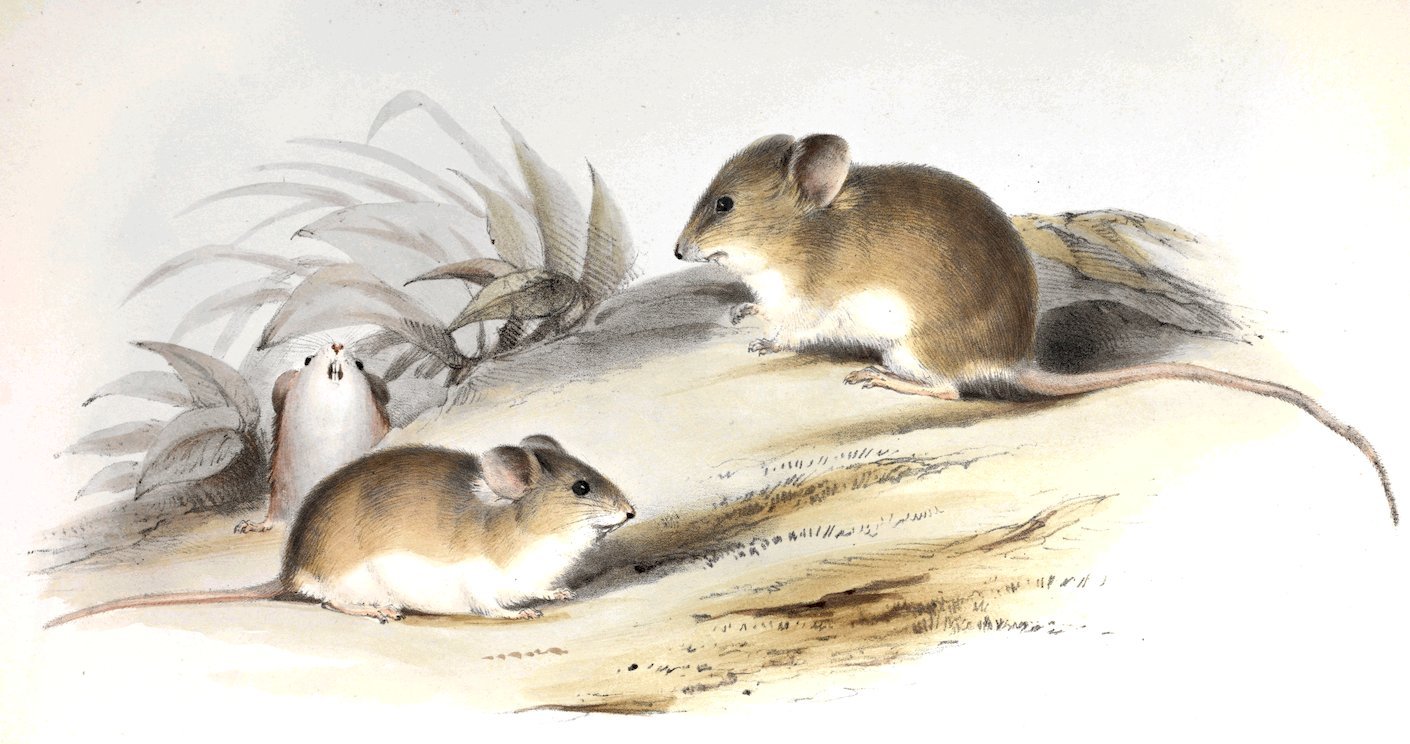
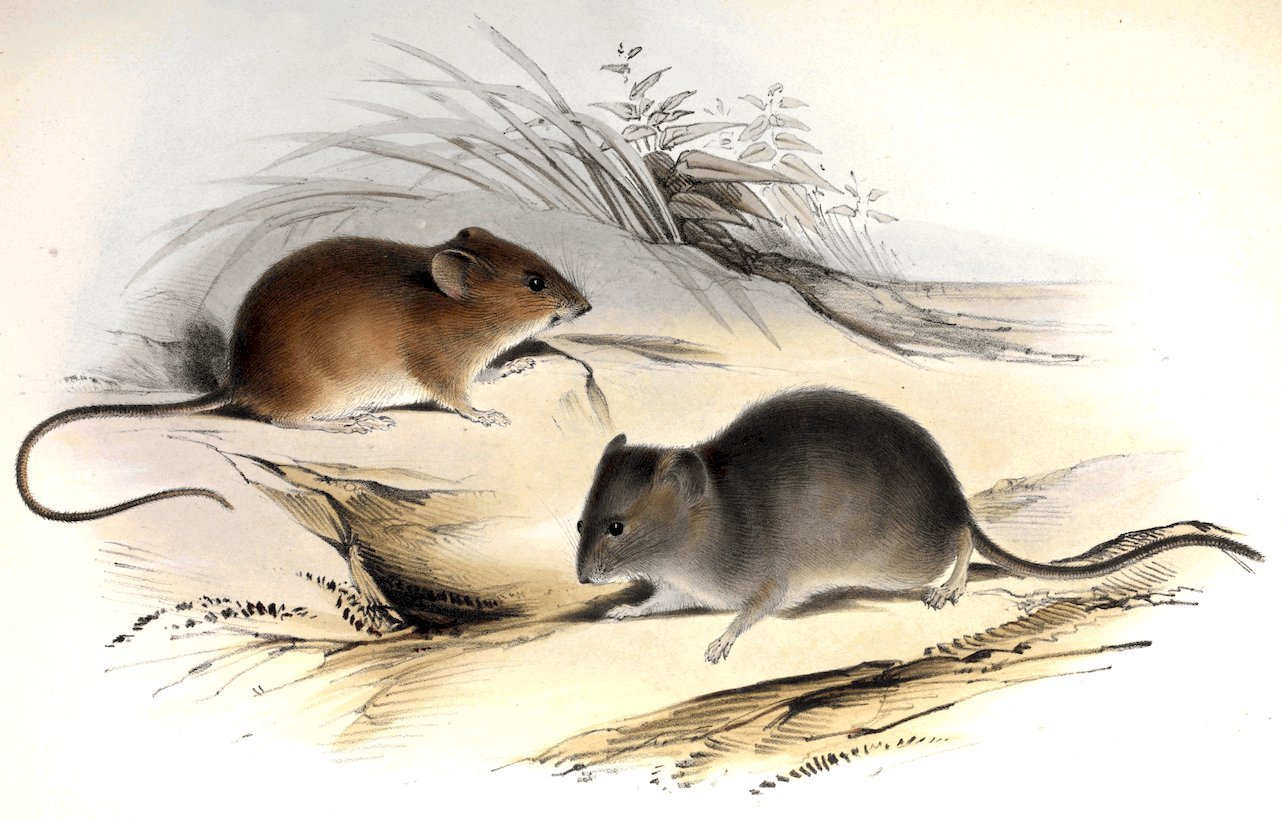
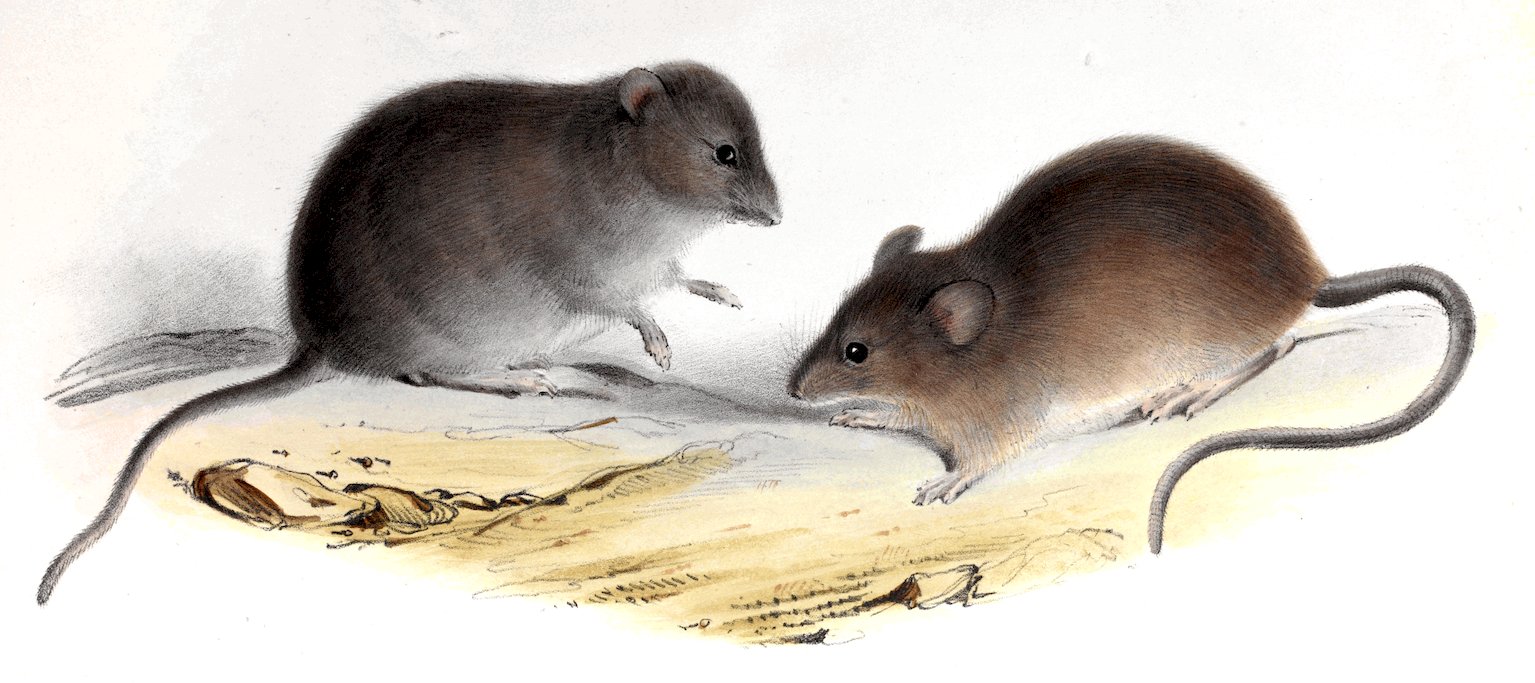
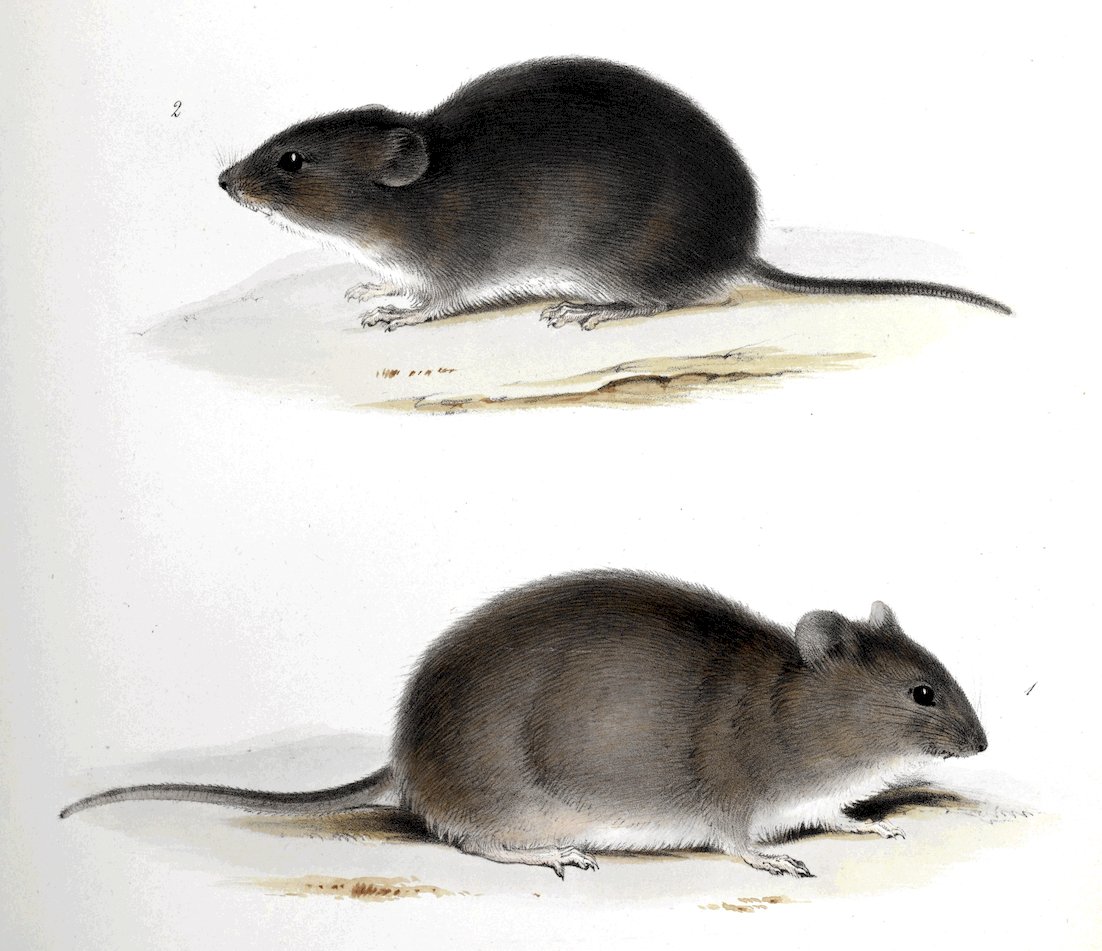
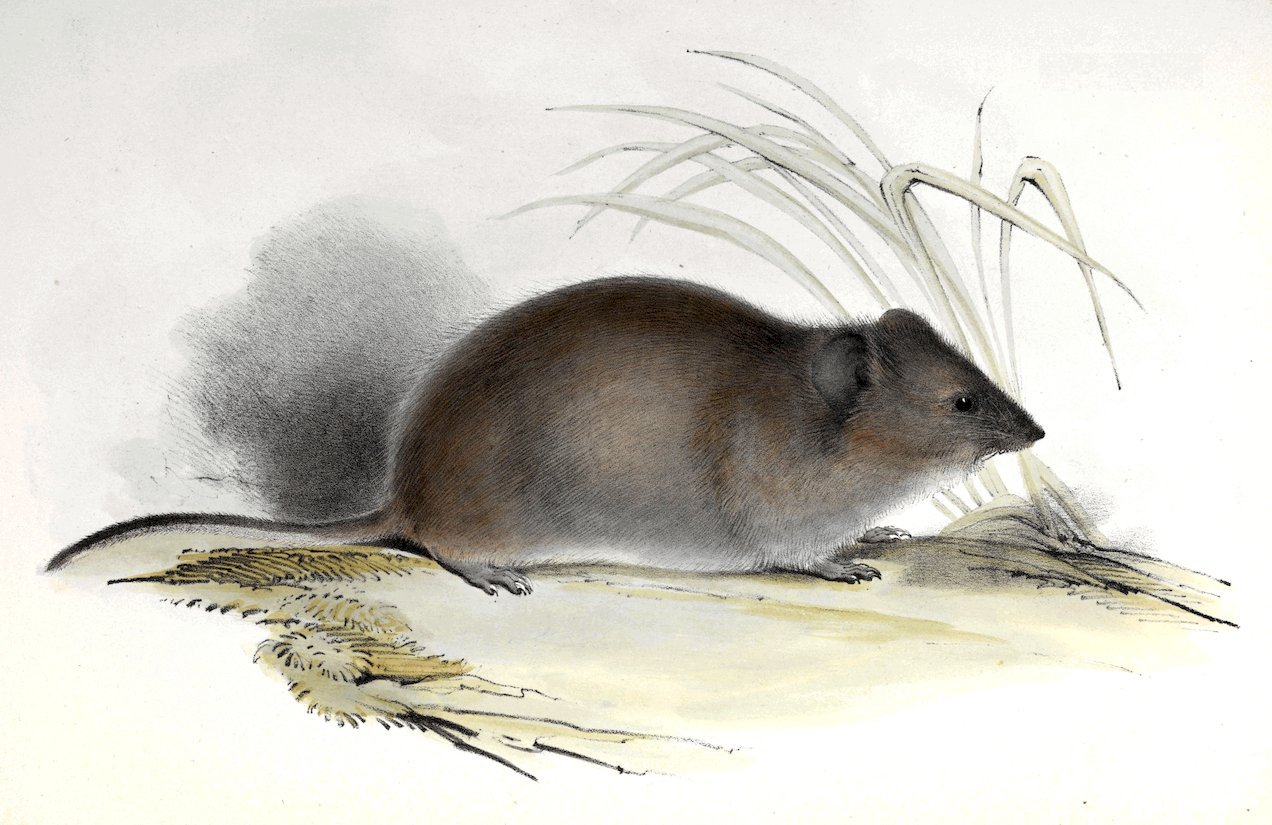
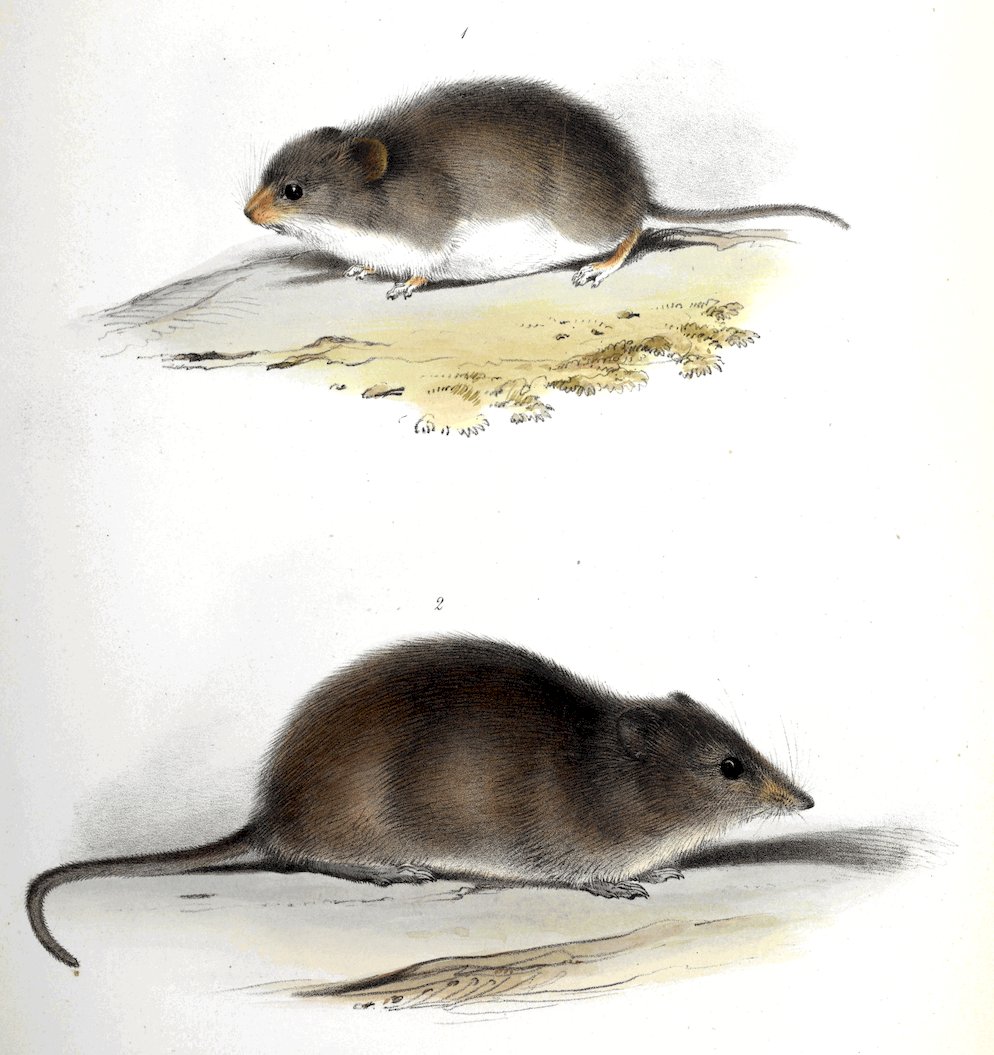
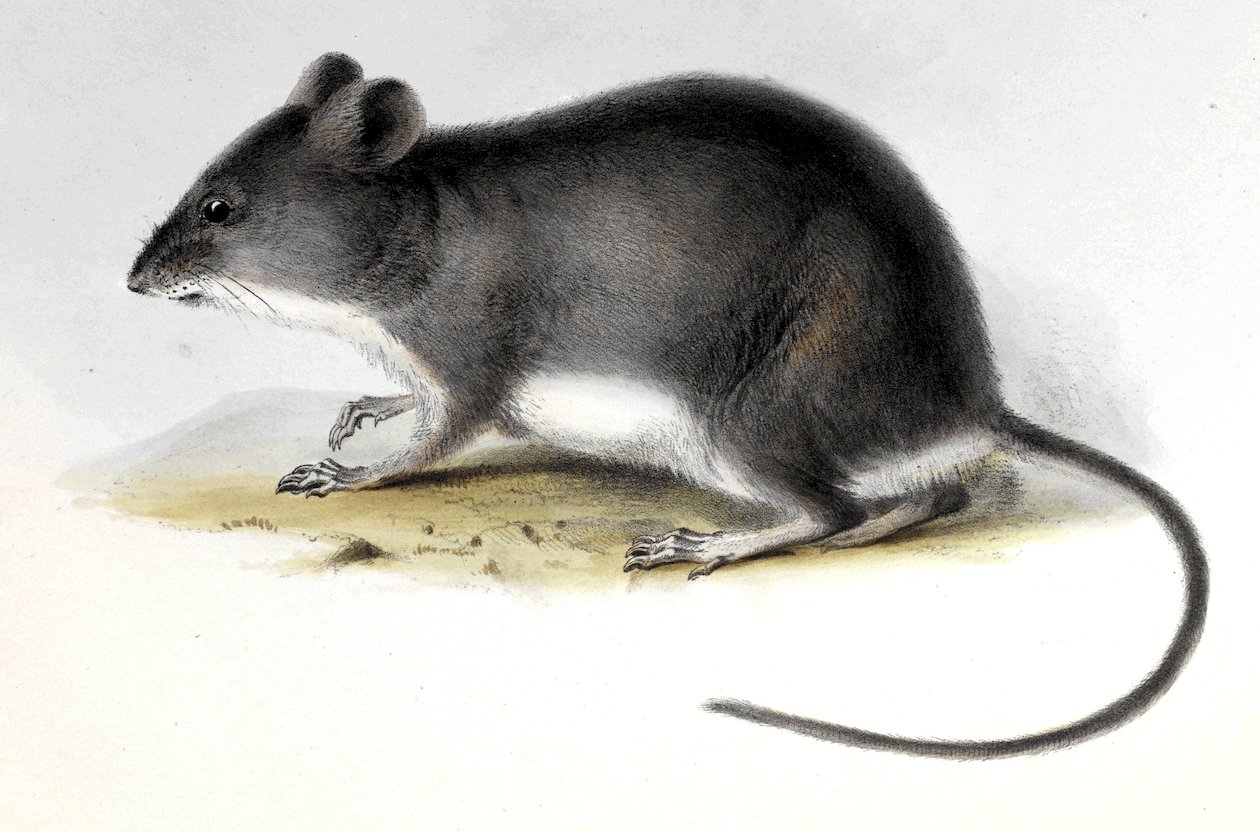
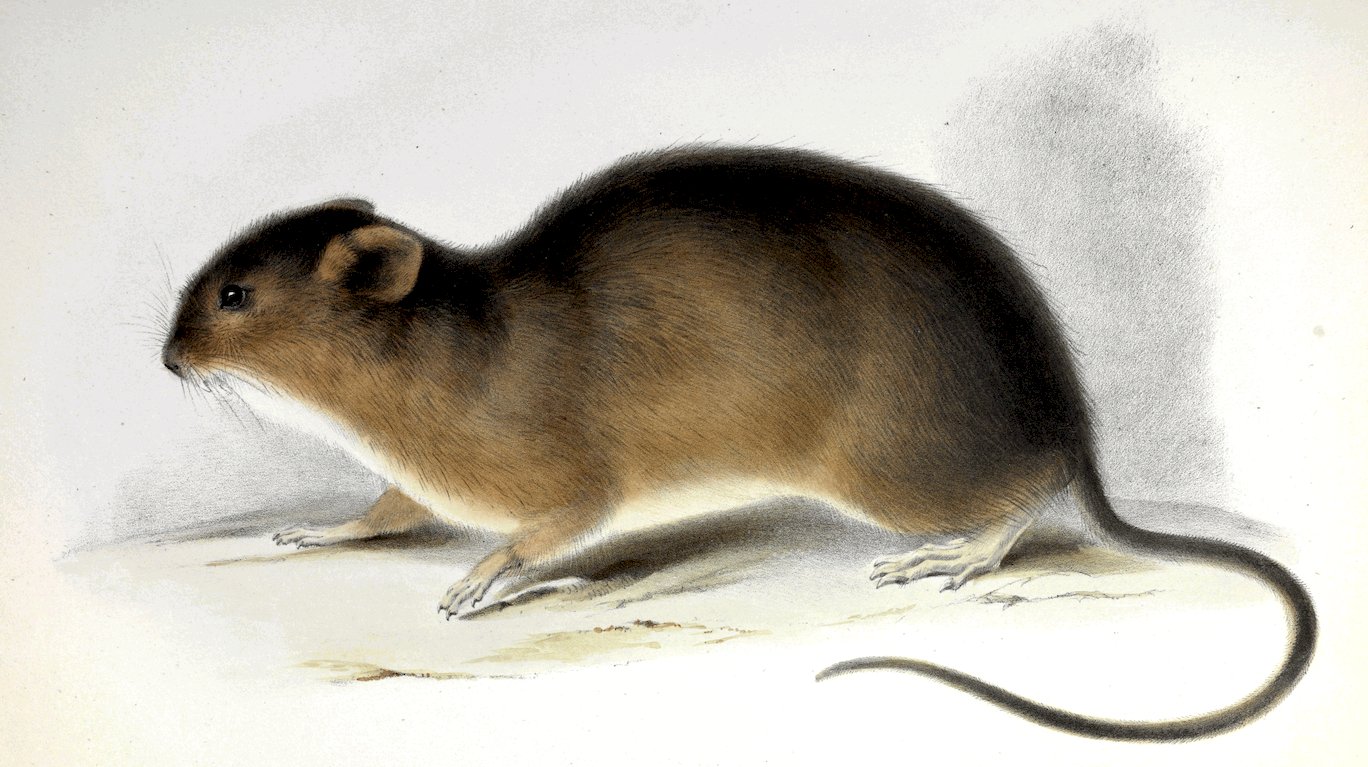
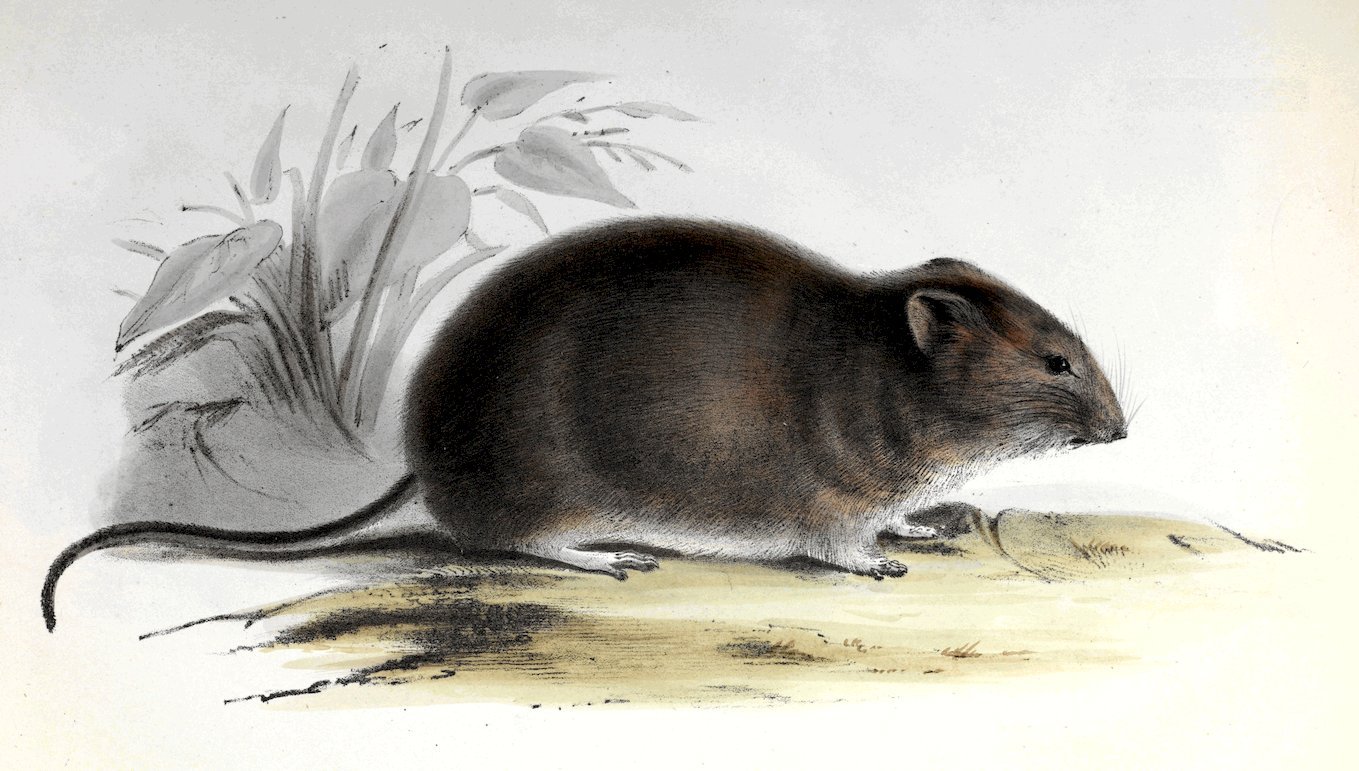
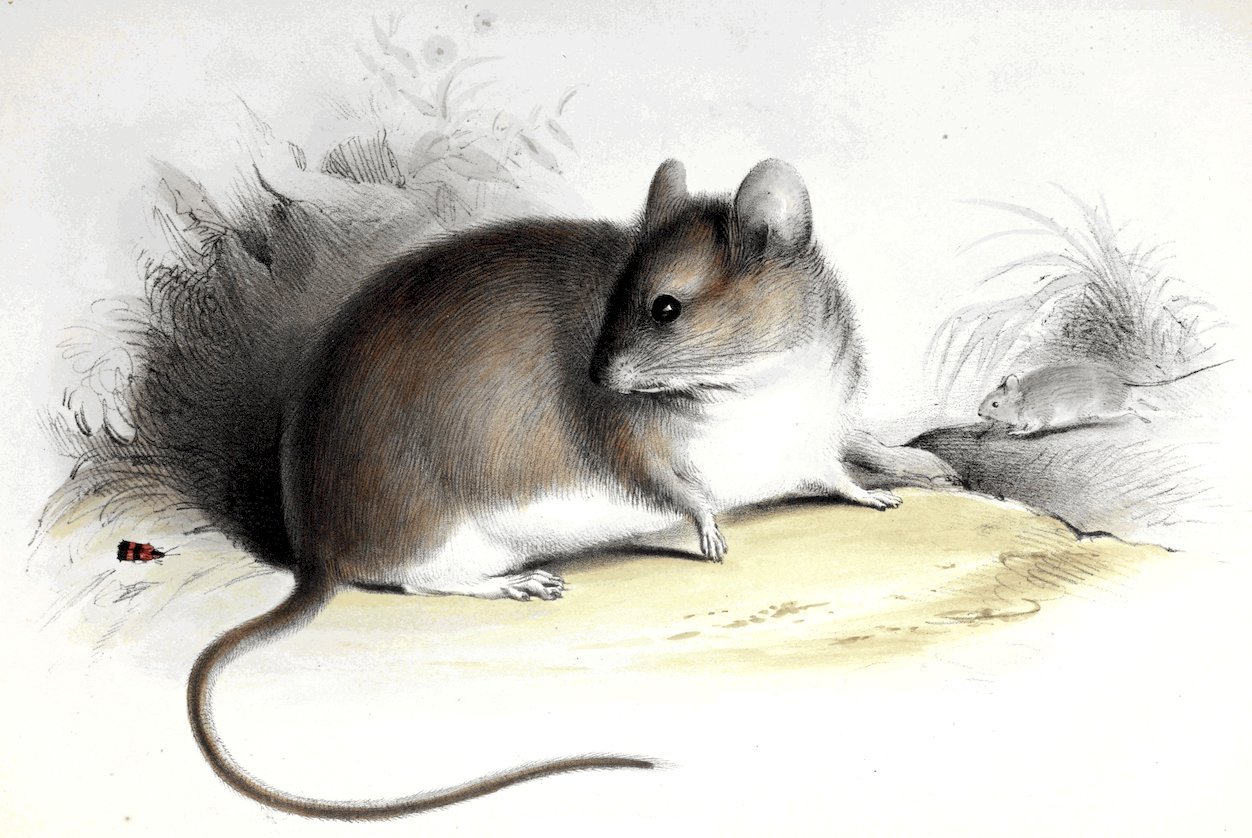
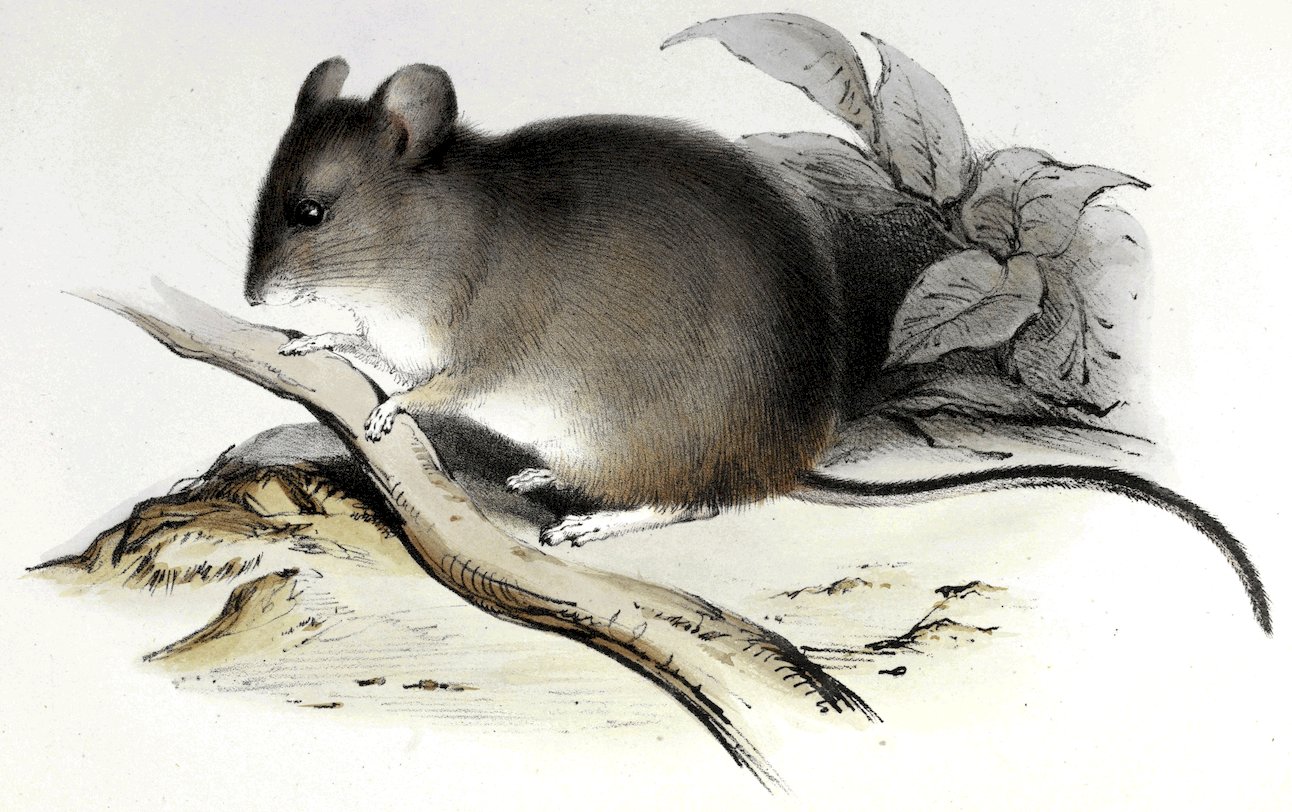
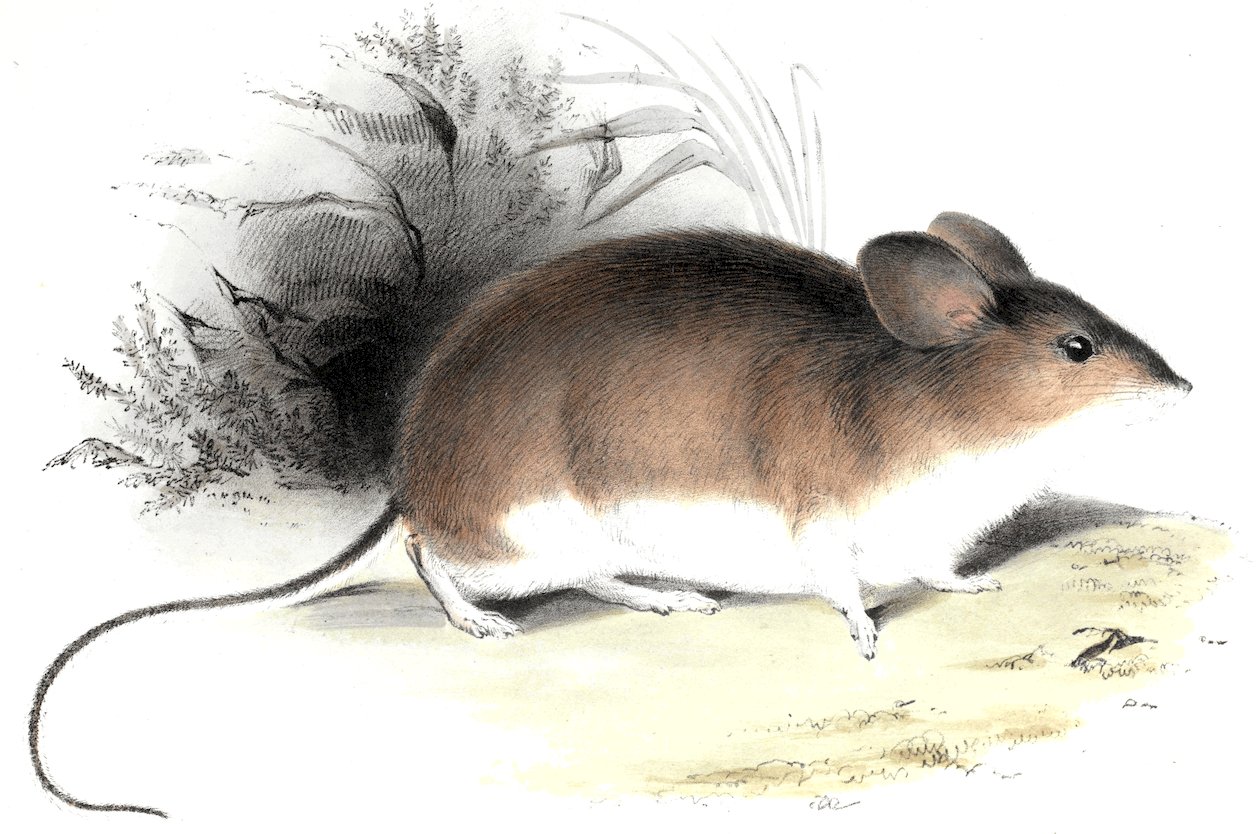
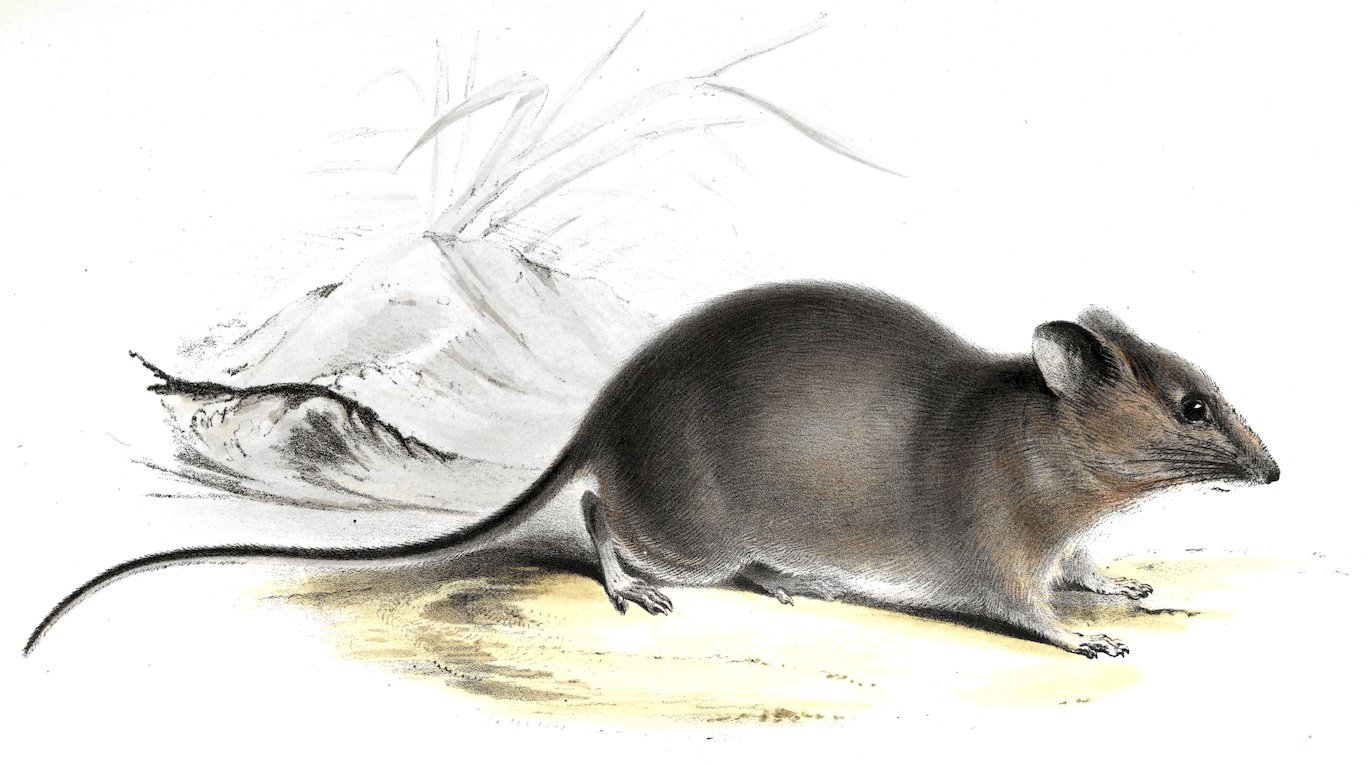
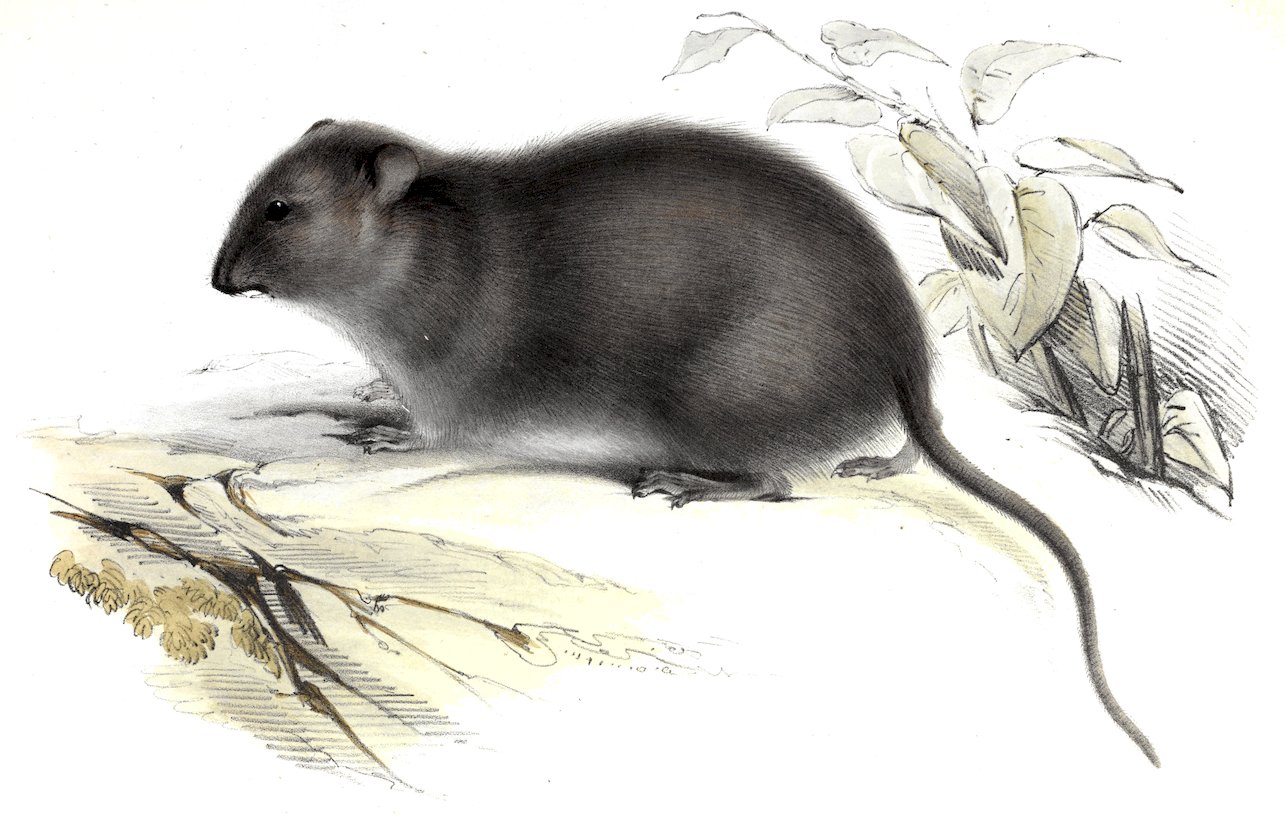
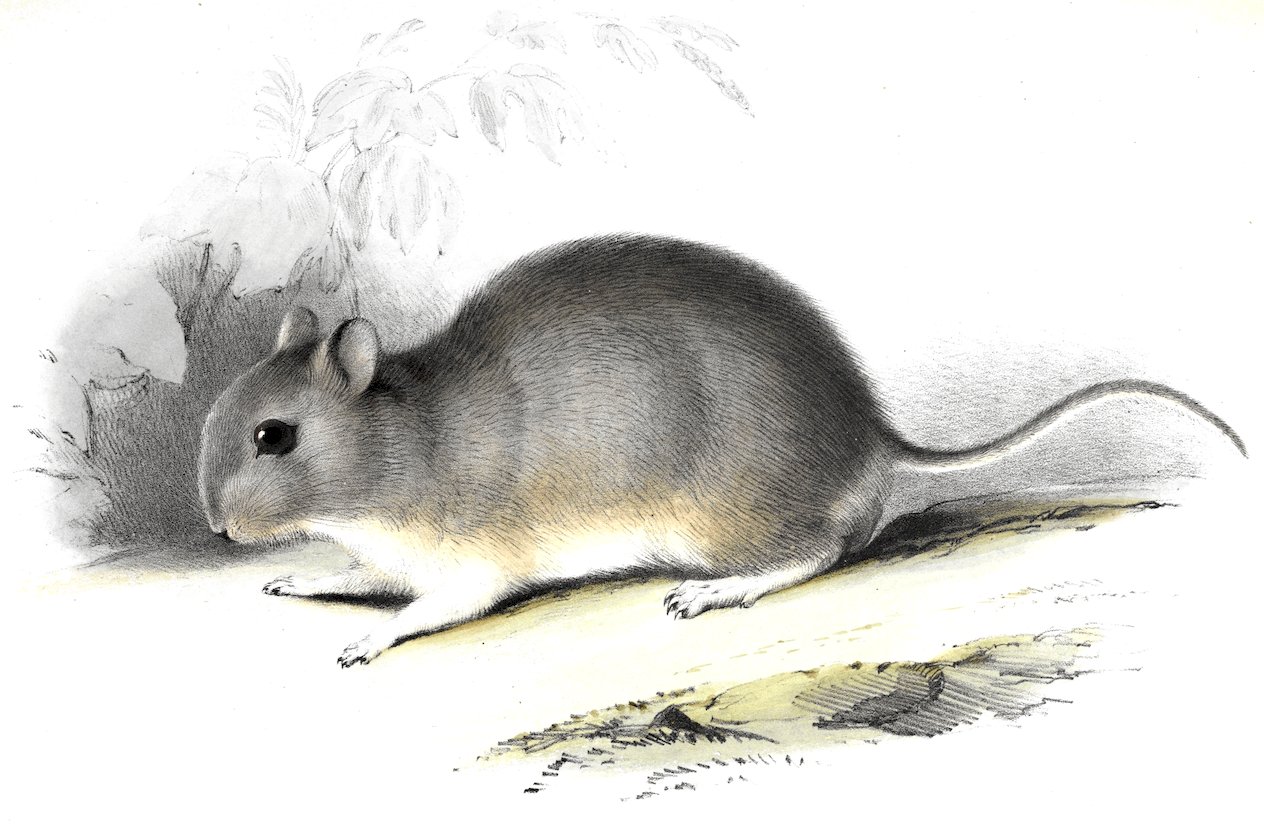
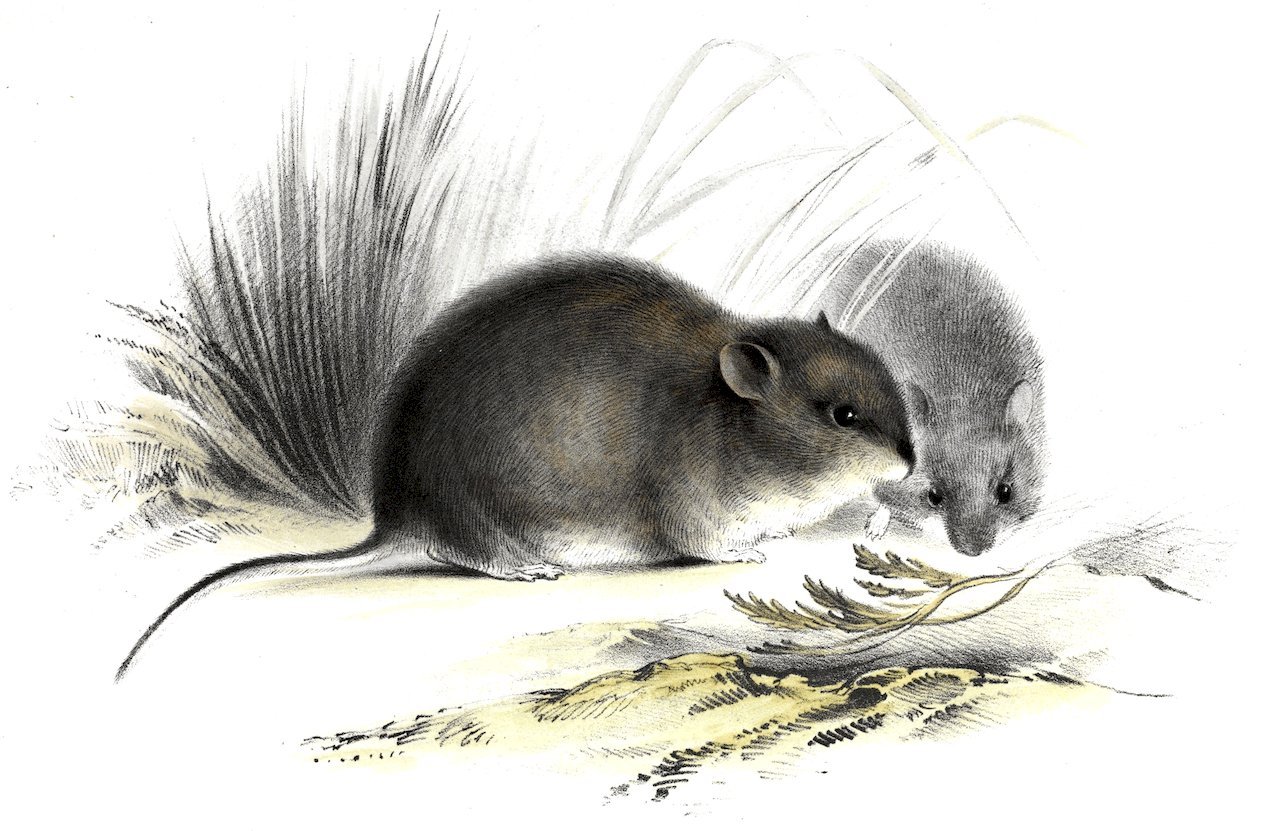
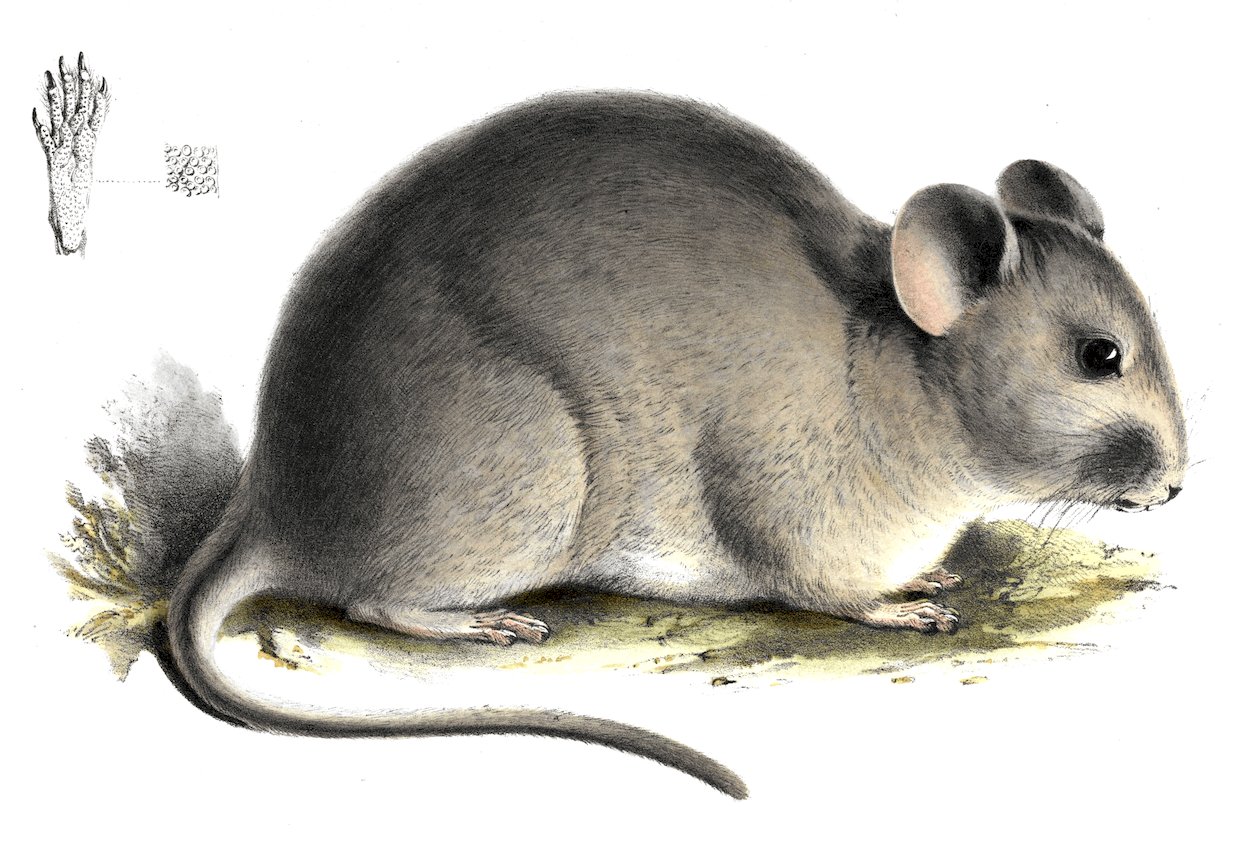
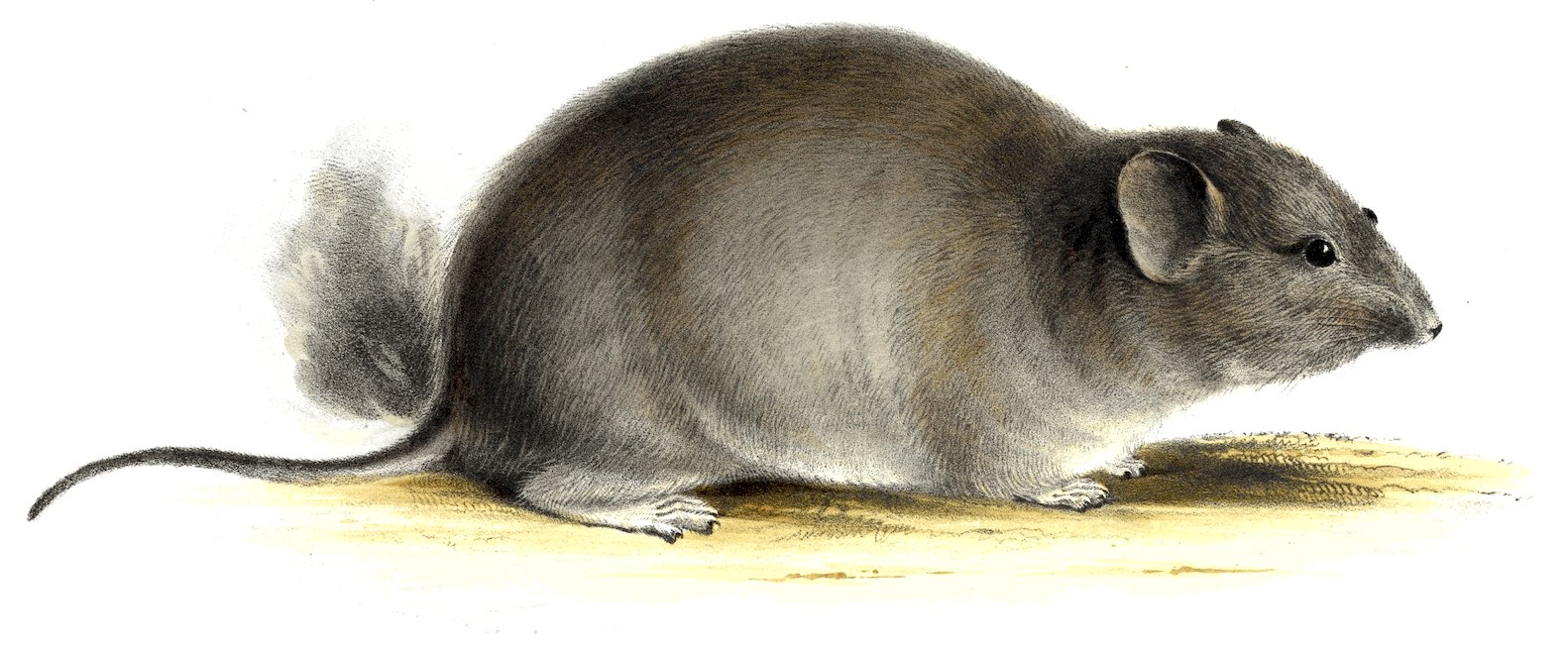
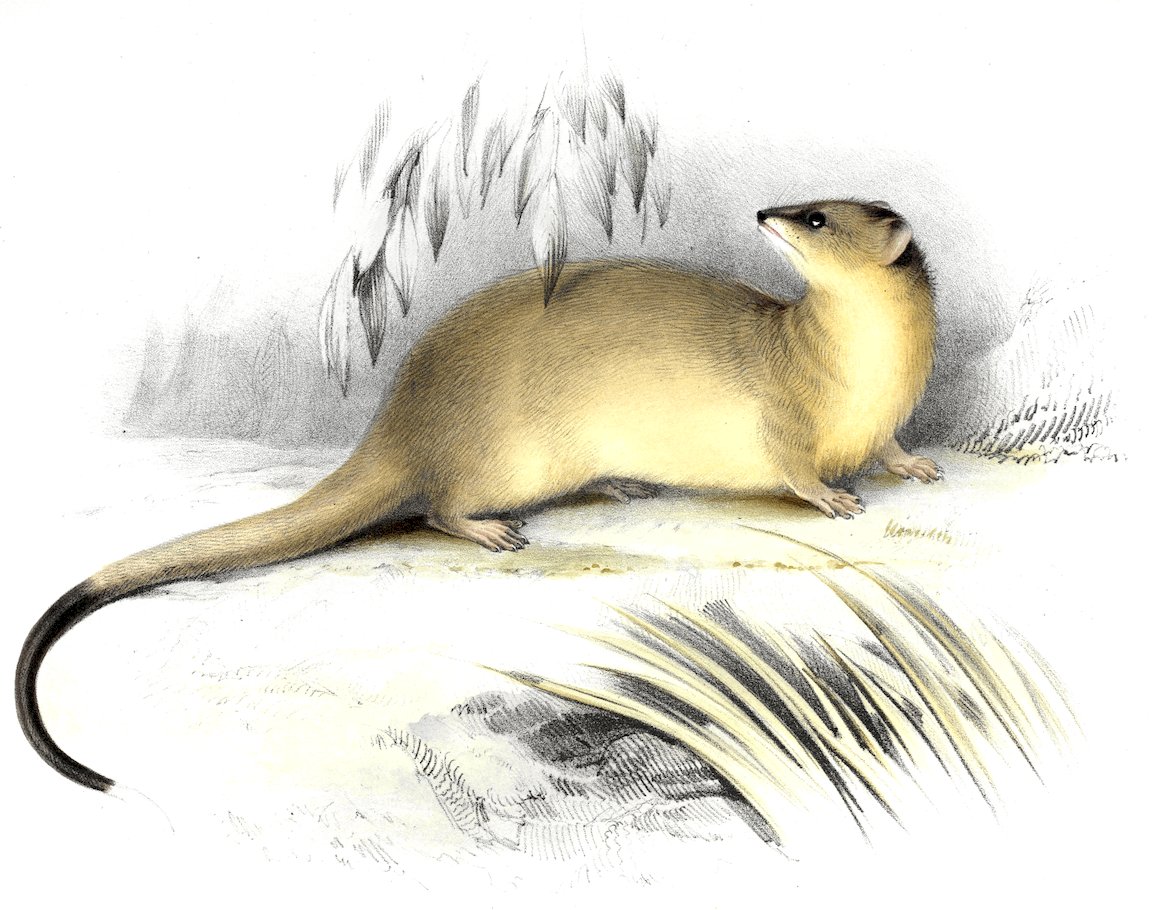
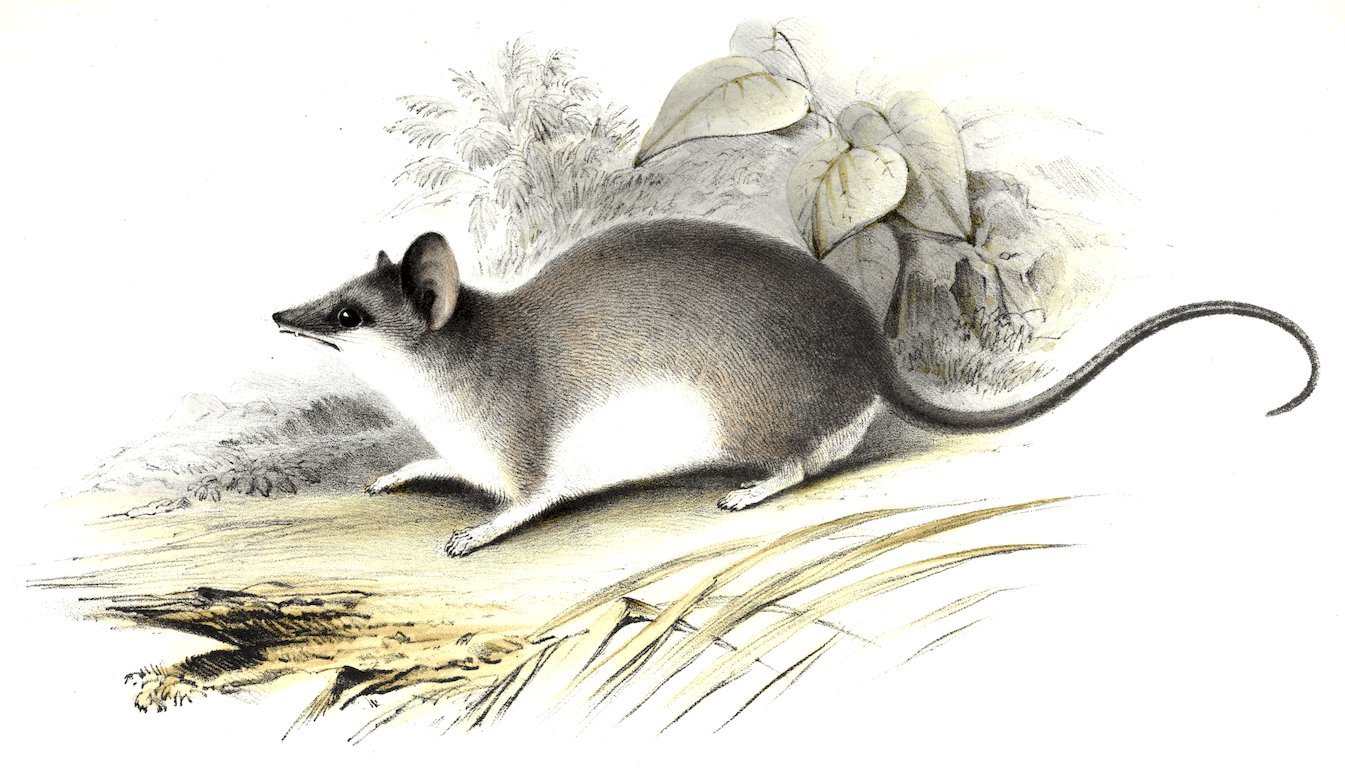
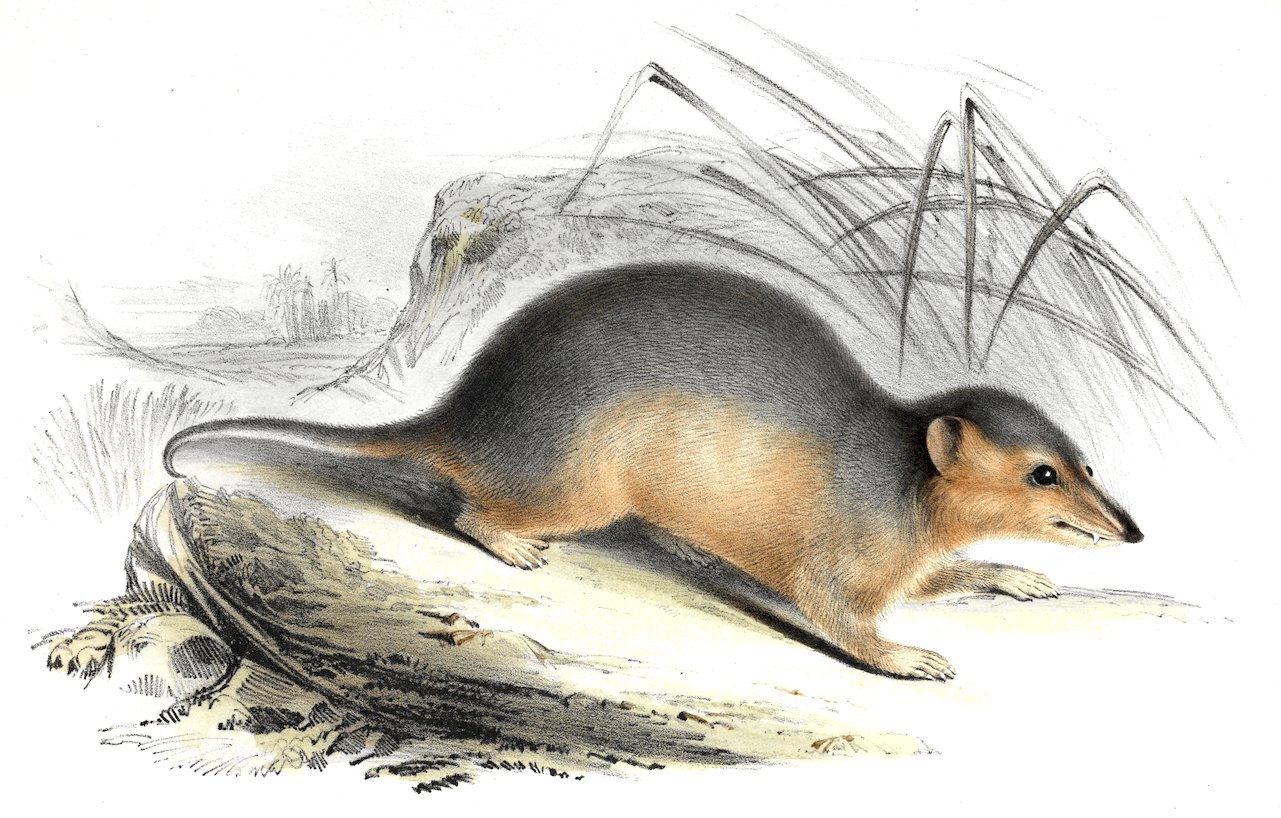
In the extensive collection of Rodent animals brought home by Mr. Darwin,
I find several specimens of the above named species, that is to say, animals which
resemble the European specimens of Mus Decumanus in all those characters which
are the least liable to variation in individuals of the same species, such as the
proportions which the various parts of the animal bear to each other: they
differ, however, somewhat in colouring.
Buenos Ayres, Maldonado, Valparaiso, East Falkland Island, and Keeling
Island, are each, it appears, infested with the common European rat. I have
now before me two specimens from East Falkland Island, and one specimen
from each of the other localities, and among these I find none equal in size to the
largest European specimens: as regards the colouring, the Buenos Ayres specimen
differs only from the English specimens of Mus Decumanus, in having the
upper parts of a richer and deeper hue, owing to the tips of the shorter hairs being
of a deep yellow instead of pale yellow, and in having a rusty tint over the
haunches.
32Mr. Darwin found this variety “common about houses in the country around
Buenos Ayres.”
In the Maldonado variety, the shorter hairs of the upper parts of the body are
of a rusty yellow colour at the apex, in other respects it resembles the British
variety. The rusty yellow colour of the tips of the hairs produces a general reddish
hue, which is the more conspicuous, when the animal is placed near an
English specimen. “Was caught in a house, at Maldonado. I saw a specimen
of the common gray English, or Norway rat, lying dead in the streets, and it certainly
had a very different appearance from these red rats. The latter, I saw
crawling about the hedges in the interior provinces at Santa Fé, and likewise in
the forest of the island of Chiloe. This latter fact, however, is a strong argument
against its being aboriginal, since I did not find even one undoubted American
species, out of the many which I collected, inhabiting both sides of the Cordillera.”—D.
The specimen from Valparaiso very closely resembles that from Maldonado;
it is, perhaps, a little less red. “Common about the houses in the town of Valparaiso.”
The two specimens from East Falkland are of a brighter hue, and have less
gray in their colouring, than in the European variety of the common rat. “One
of them was caught in a Bay, which is sometimes frequented by shipping, but
which is distant thirty or forty miles from any habitation. These rats have
spread, not only over the whole of East and West Falkland, but even on some
of the outlying islets. When the cold, wet, and gloomy nature of the climate
is considered, it is surprising that these animals should be able to find food to
live on.”—D.
The general hue of the Keeling Island specimen, is deep brown, the longer
hairs of the upper parts of the body being, as usual, black; but the shorter hairs,
instead of having the pale yellow tint which we observe in the European, (or,
rather, British) specimens of Mus Decumanus, are of a deep, rusty yellow. The
most remarkable difference, however, consists in the colouring of the under parts
being of a yellowish tint, and, towards the root of the tail, of a very distinct buff
yellow: the feet are brownish.
“This rat is exceedingly numerous on some of the low coral islets forming
the margin of the Lagoon of Keeling Island, in the Indian Ocean. The climate is
dry and hot. The rats are known to have come in a vessel from the Mauritius,
which was wrecked on one of the islets, which is now called Rat Island. They
appeared stunted in their growth, and many of them were mangy. They are
supposed to live chiefly on cocoa-nuts, and any animal matter the sea may chance
to throw up. They have not any fresh water; but the milk of the cocoa-nut
would supply its place.”—D.
33The principal dimensions of the above animals are as follows:—
|
|
Specimen from Buenos Ayres |
Maldonado. |
Valparaiso. |
East Falkland. |
East Falkland. |
Keeling Island. |
|
|
In. |
Lines. |
In. |
Lines. |
In. |
Lines. |
In. |
Lines. |
In. |
Lines. |
In. |
Lines. |
| Length |
from nose to root of tail |
9 |
9 |
9 |
3 |
8 |
6 |
8 |
9 |
9 |
0 |
8 |
3 |
| |
of tail |
Imperfect |
6 |
0 |
6 |
6 |
Imperfect |
6 |
0 |
6 |
6 |
| |
of tarsus |
1 |
7 |
1 |
7 |
1 |
7 |
1 |
7 |
1 |
7 |
1 |
7 |
Upon comparing the skull of the Valparaiso variety with that of a British
specimen of Mus decumanus, I could perceive no difference. A skull from West
Falkland did not differ, neither did the dentition of the Keeling Island specimen
above noticed. A perfect specimen of this last I have not had an opportunity of
examining.
Mus maurus, Waterh. in Proceedings of the Zoological Society of London, for February, 1837, p. 20.
M. pilis suprà purpurescenti-nigris; subtùs plumbeis; auribus parvulis, pallidè fuscis:
caudâ corpus ferè æquante.
Description.—The character of the fur of this animal nearly resembles that of
Mus decumanus; it is, however, of a harsher nature: the general colour of
the upper parts and sides of the body is purple-black, arising from the longest
hairs being of this colour, and likewise the tips of those which are next in
length; the latter, however, excepting at the tip, are white, and this white
is not entirely hidden, even when the hairs are in their ordinary position:
on the head the hairs assume a brownish hue, and are tolerably uniform: the
limbs, and under parts of the body, are of a deep gray colour, with a faint
purple-brown wash: the under fur is gray: the ears are small, of a brown-white,
or very pale brown colour, and furnished with minute brown hairs:
the small, scattered, bristly hairs of the tail are of an uniform brownish black
colour. The hairs of the moustaches are black at the base, and grayish at
the apex.
|
|
In. |
Lines. |
| Length |
from nose to root of tail |
11 |
3 |
| |
of tail |
7 |
6 |
| |
of tarsus |
1 |
8 |
| |
of ear |
0 |
6¼ |
| |
from nose to ear |
2 |
2 |
Habitat, Maldonado, La Plata, (June.)
34This rat is very closely allied to Mus decumanus, and I think may possibly
prove an extraordinary local variety of that animal. Having but one skin, and no
skull, I am unable to satisfy myself on this point. Its size, as will be seen by
the admeasurements, exceeds that of the common rat, or, rather, it exceeds
ordinary specimens of that animal, for I have seen some which were equal
to it.
“It was killed near Maldonado, where it frequented holes in the sand
hillocks near the shore. It is likewise found on the island of Guritti. If ships
are ever infested with these monstrous rats, the above-mentioned localities
are very likely places to have received colonies by such means. An old
male weighed fifteen ounces and three quarters. The ears of this rat, when
alive, were of a pale colour, which made a singular contrast with the black fur
of its body.”—D.
Mus decumanoïdes,[15] Waterh. in “Catalogue of the Mammalia preserved in the Museum of the Zoological
Society of London.”
M. suprà fuscus, griseo-lavatus, subtùs albus: pedum pilis sordidè albis; caudâ corpore
cum capite paulò longiore; auribus mediocribus: pilis perlongis in dorso crebrè
inter cæteros commixtis.
Description.—The general tint of the upper parts of this rat, is grayish brown,
(very nearly resembling that of Mus decumanus); the longest hairs, which
on the hinder portion of the back are one inch and a half in length, are
black; the ordinary hairs are black at the apex, there is then, on each hair,
a considerable space occupied by pale yellow, and the remaining, or basal
portion, is grayish white; the under fur is gray: the hairs of the chin,
throat, and under parts of the body, are white, and without any gray colour
at the roots: the feet are covered with dirty grayish hairs: the tail, which is
slender, is very sparingly furnished with minute black hairs, both above and
beneath: the ears are of moderate size, of a brownish flesh-colour, and, to the
naked eye, appear to be destitute of hair. The hairs of the moustaches are
most of them black at the base, and grayish at the apex.
| 35 |
|
|
In. |
Lines. |
| Length |
from nose to root of tail |
7 |
6 |
| |
of tail |
7 |
6 |
| |
of tarsus |
1 |
4¼ |
| |
of ear |
0 |
7½ |
| |
from nose to ear |
1 |
7½ |
Habitat, James Island, Galapagos Archipelago, Pacific Ocean, (October.)
This species is scarcely equal in size to a full grown common black rat, (Mus
Rattus), the head is rather shorter in proportion, the tarsi are smaller, and the
tail is longer. In the character of the fur, and length of the hairs, it very closely
resembles that species: the ears are larger than in M. decumanus, and about
equal to those of M. Rattus. In having the hairs of the under parts of the body
of an uniform colour, (i. e. not gray at the base,) it resembles the Mus Tectorum
of Savi; but the large size of that animal, the greater length of the fur, and its
colouring, all serve to distinguish it from the present species, which I may here
observe, is truly an old world form, and very distinct from another species, also
from the Galapagos, which is hereafter described.
“It is very common in James Island, but is not found on all the islands,
if on any other in the Archipelago. Although its appearance is so like that of
the common rat, yet its habits appear to be rather different: it is less carnivorous,
and does not appear to be so strongly attached to the habitations of man.
This island was frequented, about one hundred and fifty years since, by the vessels
belonging to the Bucaniers; so that the common rat might easily have been
transported here. And if a very peculiar climate, a volcanic soil, and strange
food, can together produce a race, or strongly marked variety, there is every
probability of such change having taken place in this case.”—D.
M. suprà grisescenti, colore subtùs dilutiore; tarsis purpureo-nigris: caudâ corpus
cum capite æquante: auribus mediocribus: vellere molli.
Description.—No. 1. The general colour of this animal is what might be termed
black, there is, however, an obscure purple-brown hue on the upper parts of the
body, and the sides and under parts have a grayish tint, the hairs covering
the feet above are of an uniform deep purple-brown, almost black. All the
hairs of the body are gray at the base: the hairs of the moustaches are long
and numerous, and of a black colour, having one or two white hairs intermixed:
the ears are of moderate size, and very sparingly furnished with
36minute dark hairs: the tail is long and slender, and has small, scattered,
bristly hairs, of a brown-black colour.
|
|
In. |
Lines. |
| Length |
from nose to root of tail |
7 |
0 |
| |
of tail |
6 |
6 |
| |
of tarsus |
1 |
3½ |
| |
of ear |
0 |
7 |
| |
from nose to ear |
1 |
6 |
No. 2. Hairs along the centre of the back chiefly black, and but obscurely
annulated, near the apex, with deep yellow: towards the sides of the body,
and over the haunches, the hairs are more distinctly annulated, and on the
sides of the body they are of a pale yellow at the apex: on the under parts
the hairs are gray, tipped with dirty yellowish white: the feet are of the
same deep purple-brown hue as in the specimen first described.
Habitat, Ascension Island, Atlantic Ocean, (July.)
These two animals not only differ in the colour of the fur, one being of a
grizzled brownish colour, and the other black, but there is a considerable difference
in the texture of the fur. In the black specimen, the fur is very soft and glossy,
and the long hairs, which are abundant, are very slender. In the brown specimen,
the fur is of a harsher nature, the long hairs are not so abundant, but longer, and
less slender. On the other hand, they agree in size, dentition, the length of the
head, tarsus, and ears, and differ but in a trifling degree (about three lines,) in the
length of the tail.
Upon comparing the Ascension Island specimens with M. Rattus, I find
that, although in size they are about one-third less, yet the teeth precisely agree,
not only in form, but in size. The relative proportions of the head, ears, and
tarsi, also agree. Besides the general colouring of the fur, they both differ in
having the hairs of the feet uniformly purple-black, those in Mus Rattus being
much paler, and even whitish, on the toes. In the character of the fur, there is
much difference. The long silky hairs, which are so conspicuous in Mus
Rattus, are replaced, in the black specimen, by hairs which are scarcely to
be distinguished from the ordinary fur; and in the other specimen, although
rather longer and more distinct, they are short, compared with those of the
black rat.
“The specimen which has a black, and glossy fur, frequents the short coarse
grass near the summit of the island, where the common mouse likewise occurs.
It is often seen running about by day, and was found in numbers, when the
island was first colonized by the English, a few years since. The other, and
browner coloured variety, lives in the out-houses near the sea-beach, and feeds
37chiefly on the offal of the turtles, slaughtered for the daily food of the inhabitants.
If the settlement were destroyed, I feel no doubt that this latter variety would be
compelled to migrate from the coast. Did it originally descend from the summit?
and, in the case just supposed, would it retreat there? and, if so, would its black
colour return? It must, however, be observed, that the two localities are separated
from each other by a space, some miles in width, of bare lava and ashes.
Does the summit of Ascension, an island so immensely remote from any continent,
and the summit itself surrounded by a broad fringe of desert volcanic soil,
possess a small quadruped, peculiar to itself? Or, more probably, has this new
species been brought, by some ship, from some unknown quarter of the world?
Or, I am again tempted to ask, as I did in the case of the Galapagos rat, has the
common English species been changed, by its new habitation, into a strongly
marked variety?”—D.
Mr. Darwin seems to have foreseen the difficult problem which these two rats
have furnished, and although I have spent much time in studying the Muridæ, I
must confess I have been exceedingly puzzled by the animals in question. It
appears as if the brown, and black rats, (M. decumanus, and M. Rattus,) and
likewise the common mouse, (M. Musculus,)[16] all of which follow man in his
peregrinations, and which, to a certain degree, are dependent upon man, and may
therefore be termed semi-domestic animals; like really domestic animals, are subject
to a greater degree of variation than those species which hold themselves
aloof from him.
Upon the whole then I have determined to describe the two Ascension
Island specimens as one species, and as varieties of the Mus Rattus, but with
a mark of doubt, since I do not possess sufficient materials for a rigorous examination,
having, in fact, but one skin of each variety, and neither skull nor
skeleton. I have also applied the name of insularis, to designate this variety
or species, whichever it may be, for, supposing it be not a distinct species, it is
so marked a variety, that a name for it is desirable.
38
Mus Musculus, Auctorum.
Of this species, there are six specimens in Mr. Darwin’s collection; two
were found “living in the short grass, near the summit of the Island of Ascension,
where the climate is temperate.”—D. Two others were procured “on a small,
stony, and arid island, near Porto Praya, the capital of St. Jago, in the Cape
de Verde Islands,—climate very hot and dry. Excepting during the rainy season,
which is of short duration, these little animals can never taste fresh water, nor
does the island afford any succulent plant.”—D. A specimen was also procured
“on a grassy cliff, on East Falkland Island, at the distance of a mile
from any habitation. It is singular that so delicate an animal should be able
to subsist under the cold, and extremely humid climate, of the Falkland Islands,
and on its unproductive soil.”—D. These specimens are all of them rather less
than full grown individuals of the same species procured in England; in other
respects, they do not differ.
The sixth specimen, which is from Maldonado, is considerably less than
British specimens of the common mouse, and is of a richer and brighter colour,
the head is smaller, the muzzle shorter in proportion, whilst the tarsi are even longer
than in a large specimen of M. Musculus. These points of dissimilarity induced
me to believe it was a distinct species, and to apply to it the specific name of
brevirostris.[17] Upon re-examination, with the advantage of more experience,
and consequently a better knowledge of the characters of these animals, I have
changed my opinion. The teeth indicate that it is not an adult specimen, and
agree perfectly with those of M. Musculus, both in form and size. “Common
in the houses of the town of Maldonado, and its habits are similar to those of
Mus Musculus.”—D.
39
Mus longicaudatus, Bennett, Proceedings of the Committee of Science and Correspondence of the Zoological
Society of London for January, 1832, p. 2.
M. pallidè flavescenti-fuscus; corpore subtùs albo, levitèr flavo lavato; pedibus albis;
tarsis permagnis; caudâ perlongâ; auribus parvulis.
Description.—Fur long and soft; general colour pale yellow-brown, the hairs
of the ordinary fur being fulvous near the apex, and the longer hairs brown.
On the sides of the body, cheeks, and external side of limbs, the fulvous hue
prevails. The inner side of the limbs and the under parts of the body are
white, but have an indistinct yellowish hue. All the hairs of the body are
of a deep gray colour at the base. The ears are small, well clothed with
hairs; those on the inner side are chiefly yellow; externally, on the fore part
they are brown, and posteriorly whitish. The feet are of a flesh-colour, and
furnished above with white hairs; the tarsi are but sparingly provided with
minute hairs on the upper side, and are naked beneath: they are of unusually
large size. The fore feet are of moderate[18] size, and furnished with a very
large carpal tubercle. The tail is very nearly double the length of the body,
if the latter be measured in a straight line; it is of a brownish flesh-colour
above, paler beneath, and sparingly furnished with minute bristly hairs;
those on the upper surface being brown, and on the under side white. The
hairs of the moustaches are long, of a black colour, and grayish at the
apex.
|
|
In. |
Lines. |
| Length |
from nose to root of tail |
3 |
9 |
| |
of tail |
5 |
3 |
| |
from nose to ear |
0 |
10½ |
| |
of tarsus (claws included) |
1 |
1 |
| |
of ear |
0 |
4 |
Habitat, Chile.
40The most conspicuous characters of the present species consist in the immense
length of the tail, and the great size of the hinder feet.[19] It is about equal
in size to Mus Musculus; its form, however, is somewhat stouter; in colour it is
much paler and brighter. The head is larger in proportion; the ears are smaller,
and more densely clothed with hair; the fore feet are rather larger, and the fleshy
tubercle on the under side of the wrist is also larger. The thumb nail is flattened,
and rounded at the tip, as in Mus Musculus, but is longer, and more distinct than
in that animal.
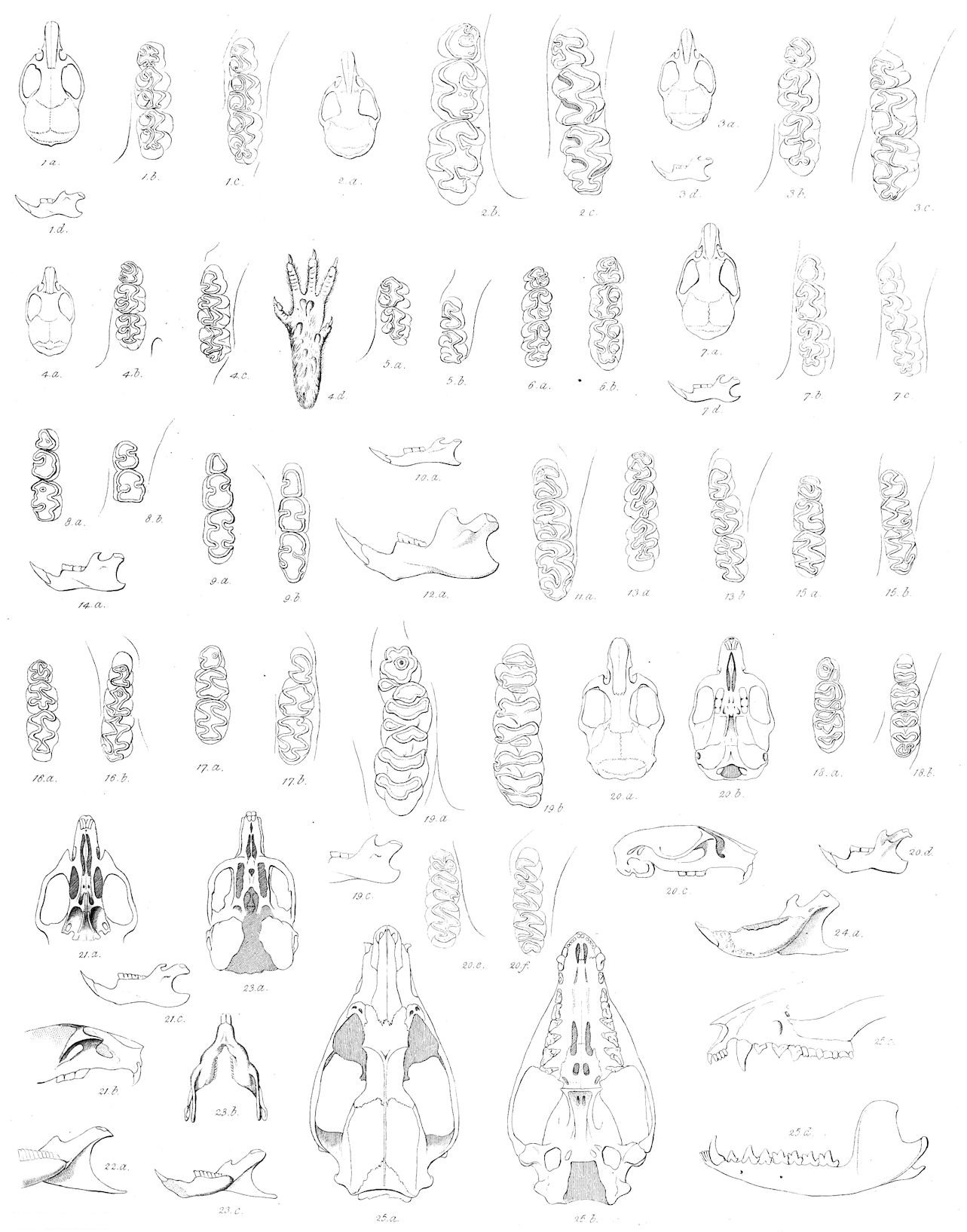
The skull of M. longicaudatus, (Plate 34, Fig. 1,) is considerably larger than
that of the common mouse, but in form scarcely differs from it; its upper surface is
rather more convex, and the interparietal bone proportionately less. The length of
the skull is 1 inch; breadth, 6½ lines; distance between the forepart of the incisor,
and the first molar of the upper jaw, 3½ lines. The dentition is figured in Plate 34,
Figs. 1. b and 1. c.
The above account is drawn up from the same specimen as that from which
Mr. Bennett took his description, and which was brought from Chile by Mr. Cuming,
who states that the animal in question lives in trees, and constructs its nest
with grass.
In Mr. Darwin’s collection, I find an animal which agrees in all the more important
characters with the one above described, but differs in being of a deeper
colour, (approaching more nearly, in this respect, to the common mouse,) and in
having the tail a trifle shorter. The skull is about ¾ of a line shorter, but its
proportions agree precisely: the proportions of the feet, and the general form of the
animal, also agree. This specimen is likewise from Chile, (Lat 37° 40′,) and, according
to Mr. Darwin, “overran the wooded country south of Concepcion, in swarms
of infinite numbers. Captain FitzRoy, on his return from visiting the wreck of
H. M. S. Challenger, had the kindness to bring me this specimen. So destructive
was this little animal, that it even gnawed through the paper of the cartridges
belonging to the people who were wrecked.”—D.
41
Mus elegans, Waterh., Proceedings of the Zoological Society of London for February 1837, p. 19.
Eligmodontia typus, F. Cuvier, Annales des Sciences Naturelles for March 1837. Tom. 7. p. 169. Pl. 5.
M. suprà flavus, vellere pilis fuscescentibus adsperso, his ad latera, et prope oculos
rarioribus; pilis pone aurem utramque, labiis, corpore subtùs, pedibusque niveis;
auribus magnis; caudâ capite corporeque paulo longiore; tarsis longis subtùs pilis
obsitis.
Description.—Fur very long and soft; general colour of the upper parts of the
body pale brownish yellow; the lower portion of the cheeks, and the under
parts of the body pure white: the hairs of the ordinary fur of the back
are gray at the base, pale ochre near the apex, and brown at the apex; the
longer hairs are brownish. On the sides of the body where the longer hairs
are less numerous, the pale ochre colour prevails; the hairs on this part as on
the back are deep gray at the base, but at a short distance from the apex
they are white; nearer the tip shaded into yellow, and at the tip brownish:
the limbs externally are of a pale yellow colour. The hairs of the throat and
chest are pure white to the root, those on the belly are obscurely tinted with
gray at the root. The feet are of a pale flesh-colour, and furnished with
white hairs; the fore feet are of moderate size; the thumb nail is small and
rounded, and the carpal tubercle is covered with hairs; the tarsi are long,
and the white hairs extend over the whole of the under parts; the under
side of the toes, however, are but sparingly furnished. There appears to be
but one large tubercle on the under side of the tarsus, and this, which is
situated near the base of the toes, is thickly covered with silvery-white
hairs. The tail is long, pale brown above, and pale flesh-colour beneath;
above, it is furnished with minute brown hairs, and on the under side with
white hairs. The ears are rather large, of a pale flesh-colour, tolerably
well clothed with hairs, which are of a pale yellow colour on the inner side,
and white on the outer side—excepting on the fore part, where they are
brown. A small tuft of white hairs springs from the base of the ear
posteriorly. The hairs of the moustaches are moderate; black at the base,
and grayish at the apex.
| 42 |
|
|
In. |
Lines. |
| Length |
from nose to root of tail |
3 |
7 |
| |
of tail |
3 |
9 |
| |
from nose to ear |
1 |
0 |
| |
of tarsus |
0 |
10 |
| |
of ear |
0 |
6 |
Habitat, Bahia Blanca, (September.)
Upon comparing the skull (Pl. 34, fig. 2, a.) of M. elegans with that of M.
Musculus, the most evident points of distinction consist in the greater proportionate
length of the nasal and frontal bones, and the slenderness of the zygomatic arch
in the former animal. Length of skull 11 lines, width 6 lines, distance between
front molar and outer side of incisors of upper jaw 3⅜ lines, length of nasal
bones 4⅜ lines.
The dentition is figured in Pl. 34, figs. 2. b, and 2. c.
“Whilst bivouacking one night on shore, amongst some sand hillocks, this
mouse, with its tail singed, leapt out of a bush which was placed on the fire. Its
hind legs appeared long in proportion to the front, and it did not appear to be
very active in endeavouring to make its escape.”—D.
Mus elegans is about equal in size to M. Musculus; the head is larger in
proportion than in the latter, the ears are slightly larger, the tail is longer, and
so are the tarsi. The large ears, long tail, and comparatively large size of the
feet, combined with the greater size of the animal itself, will render it easy to
distinguish this species from M. gracilipes and M. bimaculatus. From the last
mentioned animal it moreover differs in having the head larger in proportion,
the fur longer, and the colouring of the upper parts of the body somewhat darker.
The white fur is almost confined to the under parts of the body, and there is but
a small tuft of white hairs behind the ears, whereas in M. bimaculatus, the white
fur extends considerably on the sides of the body, the outer side of the limbs are
white, and there is a large and conspicuous white spot behind each ear.
In M. elegans the whole sole of the tarsus and the carpal tubercles are
covered with hair. In Mus bimaculatus the hinder half of the tarsus only is
covered with hair, and in M. gracilipes both the hinder half is covered, and there
are some scattered hairs extending almost to the two tubercles, which are situated
at the base of the longer toes.
The genus Eligmodontia of M. F. Cuvier, founded upon a species of mouse
from Buenos Ayres, possesses nearly the same characters as the subgenus
Calomys, established by me in the Proceedings of the Zoological Society for
February 1837, and which included the animal above described, and two other
species (M. bimaculatus and M. gracilipes). M. Cuvier’s genus is distinguished
by there being only one large tubercle on the under side of the tarsus, and in
having the carpal pad covered with hair as well as the pad of the tarsus. In
43these characters our present animal agrees, as it does also in size and in the relative
proportions of the tail and tarsus, circumstances which induce me to believe they
are identical.
In M. bimaculatus and M. gracilipes there are six naked tubercles on the
under side of the tarsus, and the carpal pad is also naked. In having, however, the
tarsus hairy beneath,[20] in dentition and in colouring, they agree so closely with
M. elegans that I think they cannot be separated generically.
Mus bimaculatus, Waterh., Proceedings of the Zoological Society of London for February 1837, p. 18.
M. vellere pallidè ochraceo, pilis nigricantibus adsperso, his ad latera rarioribus; rostri
lateribus, notá magná pone aurem utramque, artubus, corporeque subtùs niveis;
auribus mediocribus; caudâ, quoad longitudinem, corpus fere æquante; tarsis ad
calcem pilis argenteo-candidis obsitis.
Description.—Upper parts of the body of a very pale ochre colour, the longer
hairs, however, are black, and at the apex grayish, and where they are
numerous, as on the back and upper surface of the head, they give greater
depth to the colouring; the cheeks and sides of the body are of an almost
uniform pale, but bright yellow; the sides of the muzzle, the lower half of
the cheeks, the lower portion also of the sides of the body, and the whole of the
under parts, are pure white—each hair being uniform in colour to the root,
and not, as is usually the case, gray at the root. There is likewise a large
patch of pure white hairs behind each ear. The feet and tail are of a pale
flesh-colour, and furnished with white hairs, with the exception of those on
the upper surface of the latter, which are pale brown. The ears are also
pale flesh-colour, clothed internally with yellow hairs; externally on the fore
part, the hairs are brownish, and on the hinder part, white—they are rather
large, and so are the feet. The tail is about equal to the body in length.
The hairs of the moustaches are numerous and slender, and most of them
are black at the base, and gray at the apex. The hinder half of the tarsus
44beneath is covered with minute silvery-white hairs; beside the ordinary
tubercles, the anterior portion of the sole of the foot and the base of the toes
beneath, are crowded with small rounded warts, which are much more numerous
and conspicuous than in the common mouse.
|
|
In. |
Lines. |
| Length |
from nose to root of tail |
3 |
1 |
| |
of tail |
1 |
11 |
| |
from nose to eye |
0 |
4½ |
| |
from nose to base of ear |
0 |
8¾ |
| |
of tarsus (claws included) |
0 |
8 |
| |
of ear |
0 |
4½ |
Habitat, Maldonado, La Plata, (June.)
The skull of this animal, is rather shorter and broader than that of Mus
Musculus, the upper surface is more arched, the zygomatic arch is much more
slender, and the nasal bones are rather broader. In the convexity of the upper
surface, and the slenderness of the zygomatic arch, this skull very nearly resembles
that of M. gracilipes; this latter, however, has the zygomatic arch more
convex, projecting more suddenly on the anterior part, and the interparietal bone
smaller. Length of skull 10 lines, width 5½, length of nasal bones 4 lines,
distance between the outer side of the incisors, of the upper jaw, and the first
molar 2⅞ lines. See Plate 34, fig. 3. a.
The dentition is figured in Plate 34, figs. 3. b and c.
This mouse is rather less than M. Musculus, the tail is much shorter in proportion,
the fur is longer and softer, and the ears are more distinctly clothed with
hair.
The pale and delicate yellow colour of the upper parts of the body, and the
pure white of the under parts, renders the present species conspicuous amongst
its congeners. I may further remark that the white colour which in the Muridæ
(when it occurs) is usually confined to the under part of the body, or extends
but slightly on the sides, is in the present animal extended considerably on
the sides of the body, and occupies an equal portion with the yellow of the upper
parts. The name bimaculatus is applied to this animal on account of the two
conspicuous white patches, which are situated behind the ears.
In affinity as well as in appearance it most nearly approaches to Mus
gracilipes and M. elegans; with no other species of the genus Mus, here described,
can it be confounded, since these only have the tarsus hairy beneath.
The principal points of distinction between the present animal and Mus
elegans, are noticed in the account of that species.
“This mouse, when alive, had a very elegant appearance. A countryman,
who brought it me, found six of them living together in one burrow.”—D.
45
Mus gracilipes, Waterh., Proceedings of the Zoological Society of London, for February 1837, p. 19.
M. suprà flavo-lavatus; pilis pone aurem utramque, labiis, corporeque subtùs, albis;
pedibus parvulis, gracilibus, carneis, suprà et ad calcem pilis albis tectis; caudâ
gracili, pilis albis instructâ, quoad longitudinem corpus ferè æquante; auribus
mediocribus; vellere mediocri et molli, pilis omnibus ad basin plumbeis.
Description.—General colour very pale yellowish brown, a tint produced by the
admixture of black and pale fawn colour; the hairs of the ordinary fur being
of the latter tint near the apex, and dusky at the apex, whilst the longer
hairs are black. The feet, tail, under parts of the body and the sides of the
muzzle, are pure white. All the hairs of the body, (which are soft, and of
moderate length), are deep gray at the base. The ears are of moderate
size, well clothed with hairs, of which those on the inner side are yellowish,
and those on the outer, are brown on the anterior part, and white on the
posterior. A small tuft of white hairs springs from the neck immediately
behind the ears; this tuft is hidden when the ears are folded back. The tail
is slender and short, (being not quite equal to the body in length) of a pale
flesh-colour, and sparingly furnished with minute white hairs. The feet are
very small and slender, and the naked parts are of a pale flesh-colour. The
sole of the foot is covered with hairs; the toes beneath, and the tubercles
(which are as in Mus Musculus), however, are naked. The hairs of the
moustaches are of moderate length, and of a blackish colour, some of them,
however, are grayish white.
|
|
In. |
Lines. |
| Length |
from nose to root of tail |
2 |
10 |
| |
of tail |
1 |
7 |
| |
from nose to eye |
0 |
4⅓ |
| |
from nose to ear |
0 |
8¼ |
| |
of tarsus (claws included) |
0 |
6½ |
| |
of ear |
0 |
4¼ |
Habitat, Bahia Blanca, (September.)
This species slightly exceeds the harvest mouse (Mus messorius) in size, its
ears are considerably larger in proportion, and the tail is shorter. Compared
with the common mouse (Mus Musculus) it is smaller, the tail is more slender,
and shorter, and the feet are likewise more slender and proportionately much
smaller; the ears are more distinctly clothed with hairs.
46The principal points of distinction between this and the two preceding
species are pointed out in the account of M. elegans.
Upon comparing the skull of M. gracilipes (Pl. 34, fig. 4. a.) with that of Mus
Musculus, the most striking differences consist in its shorter and broader form, the
upper surface being more arched, the interparietal bone has a relatively smaller
antero-posterior diameter, the occipital region is more convex, and continued more
gently and gradually into the upper region of the skull. The zygomatic arch,
which is unusually slender, is more dilated (especially on the anterior part)
thus giving a squareness to the general form. The nasal bones are not so much
attenuated posteriorly. The length of the skull is 8⅞ lines, the greatest width is
5⅛ lines, and the distance between the outer side of the incisors and the front
molar is 2¾ lines.
The dentition is figured in Plate 34, figs. 4. b and 4. c.
“This specimen was given me by Mr. Bynoe, the surgeon of the Beagle, who
caught it amongst some long dry grass.”—D.
Mus flavescens, Waterh., Proceedings of the Zoological Society of London, for February 1837, p. 19.
M. suprà colore cinnamomeo, lateribus capitis, corporisque, æquè ac pectore, auratis;
gulâ abdomineque flavescenti-albis: pedibus sordidè albis: auribus mediocribus
rotundatis, pilis flavis obsitis: caudâ, corpore, capiteque longiore, suprà fuscâ, subtùs
sordidè albá: tarsis longis.
Description.—Fur long and moderately soft; general colour of the upper parts
bright brownish yellow; on the sides of the head and body bright yellow;
towards the rump of a deeper hue, and inclining to orange; under parts pale
yellow, or yellow-white; chest yellow. The fur both of the upper and under
parts of the body deep plumbeous at the base. Feet flesh-colour, covered
above with white hairs: tarsi long, naked beneath. Ears small, tolerably
well clothed with hairs; those on the inner side yellow, but many of them
blackish at the base; on the outer side, the hairs are blackish on the fore part
and yellow on the hinder part. The hairs of the ordinary fur of the back are
of a deep rich yellow colour at the tip, and the longer hairs are blackish.
The tail is long, deep brown above and whitish beneath, the hairs of the
47moustaches are rather short and slender, and of a brownish colour. Thumb
nail small and rounded.
|
|
In. |
Lines. |
| Length |
from nose to root of tail |
3 |
9 |
| |
of tail |
4 |
1½ |
| |
from nose to ear |
1 |
0 |
| |
of tarsus |
1 |
0½ |
| |
of ear |
0 |
4½ |
Habitat, Maldonado, La Plata, (June.)
This species is slightly larger than the common mouse; the head is rather
larger in proportion; the ears are rather smaller and more distinctly clothed with
hair; the tail and tarsi are much longer in proportion. Its bright yellow colouring
and proportions distinguish it from any of the species described in this work. Of
this animal I do not possess the skull, nor of the teeth do I possess more than the
first and second molars of the upper jaw, and the second and last of the lower
jaw. These are figured in Plate 34, figs. 5. a, and 5. b.
Mus Magellanicus, Bennett, Proceedings of the Zoological Society of London for December 1835, p. 191.
M. suprà fuscus, subtùs cinerescenti-albus, pallidè flavo lavatus; auribus mediocribus
pilis fuscis obsitis; caudâ corpus caputque æquante; tarsis longis, pilis sordidè
albis obsitis.
Description.—Fur very long and moderately soft, general colour deep brown;
the hairs of the ordinary fur are gray, tipped with yellowish brown; the
longer hairs are black; the sides of the body are yellowish; the under parts
are gray-white with a faint yellowish tint, each hair being gray tipped with
yellowish white. The ears are rather small, well clothed with hairs; those on
the inner side are blackish tipped with yellow, and on the outer side they are
blackish on the fore part and dusky on the hinder part. The fore feet are of
moderate size, the thumb nail is short and rounded; the tarsi are rather
long; both fore and hinder feet are of a brownish colour, and covered above
with dirty gray hairs. The tail rather exceeds the head and body in length;
it is brown above and dirty white beneath. The hairs of the moustaches are
numerous and long, of a brownish colour at the apex and black at the base.
| 48 |
|
|
In. |
Lines. |
| Length |
from nose to root of tail |
4 |
3 |
| |
of tail |
4 |
2 |
| |
from nose to ear |
1 |
0½ |
| |
of tarsus |
1 |
1 |
| |
of ear |
0 |
5 |
Habitat, Port Famine, Strait of Magellan.
This mouse is larger than Mus Musculus; the tail is rather longer in proportion;
the tarsi much longer; the ears are not quite so large in proportion to the
head, (which greatly exceeds that of Mus Musculus in size,) and they are densely
clothed with hair. The fur is longer. In colour, the animal here described is
rather darker than the common mouse. I have one specimen however before me
which very nearly agrees in this respect.
The dentition is figured in Plate 34, figs. 6, a. and 6, b.
From the attention which Mr. Darwin bestowed upon the Muridæ of the
southern parts of South America, I presume his collection affords materials for a
tolerably complete monograph of the species of that portion of the globe. The
species above described, however, does not occur in Mr. Darwin s collection, but
is here introduced in order to make the work more complete, and that I might
more clearly point out the distinctions which exist between it and other
species here described, the account given by Mr. Bennett in the Proceedings
being very short.
Mus arenicola, Waterh., Proceedings of the Zoological Society of London, for February 1837, p. 18.
M. suprà fuscus, subtùs cinerescenti-albus, pallidè flavo tinctus; auribus mediocribus
rotundatis, pilis flavis fuscisque obsitis; caudâ quoad longitudinem corpus æquante;
pedibus cinerescenti-albis: tarsis mediocribus.
Description.—Fur long, moderately soft; general colour deep brown; sides of
the body with a very obscure yellowish hue; under parts dirty gray with a
faint yellow tint. All the fur deep gray at the base; the hairs of the upper
part of the body obscurely annulated with yellowish brown near the apex,
and dusky at the apex; the longer hairs are black. Feet brownish, covered
above with brown-white hairs; tarsi short. Tail short, blackish above,
brown-white beneath. Ears small, well clothed with hairs; those on the
49inner side are yellow at the apex and gray at the base; on the outer side
they are of a brownish colour, and on the fore part blackish. The hairs of
the moustaches are short and slender, and of a brownish colour. The head
is large.
|
|
In. |
Lines. |
| Length |
from nose to root of tail |
4 |
3 |
| |
of tail |
2 |
9 |
| |
from nose to ear |
1 |
0 |
| |
of tarsus (claws included) |
0 |
10 |
| |
of ear |
0 |
4½ |
Habitat, Maldonado, La Plata, (June.)
This species is rather larger than the common mouse; its head is proportionately
larger, the ears are smaller, the tail considerably shorter, and the fur longer,
and in colouring it is a little darker. In size and colour it resembles M. Magellanicus,
but the shorter tail and tarsi, and the smaller size of the ears will serve to
distinguish it.
The skull of Mus arenicola, Plate 34. fig. 7, a, is rather larger than that of
Mus Musculus, the nasal portion is broader, the interparietal bone is much
smaller, especially in antero-posterior extent; the zygomatic arches are more
slender, and the incisive foramina are broader. The horizontal ramus of the lower
jaw (Pl. 34. fig. 7, d.) is rather less curved, the coronoid process is more elongated,
and the condyloid is narrower and also larger. The length of the skull is 11 lines
and a half; the width is 6½ lines. The molars of the upper jaw are figured in
plate 34 fig. 7, b. and those of the under jaw, fig. 7, c.
“This specimen was caught on the open grassy plain, by a trap baited with
a piece of bird; it is, however, very abundant in the sand hillocks near the coast
of the Plata.”—D.
Mus brachiotis, Waterh., Proceedings of the Zoological Society of London for February 1837, p. 17.
M. suprà obscurè fuscus, subtùs obscurè griseo tinctus; pedibus griseo-fuscis;
auribus parvulis; caudâ quoad longitudinem, corpus ferè æquante: vellere longo
et molli.
Description.—Fur soft, very long, and dense; ears very small; general colour
brown: the hairs of the upper parts, and sides of the head and body are of
50a deep gray at the base, black at the apex, and narrowly annulated with
deep yellow near the apex; on the throat and belly they are of a paler gray
at the base, and grayish white at the apex. The ears are well clothed with
brown hairs both within and without, and are for the most part hidden by
the long fur of the head. The hairs covering the upper side of the feet are
of a palish ashy-brown colour, and the fleshy portion appears to have been
brown. The tail is well clothed with hairs, so that the scales are scarcely
visible; on the upper side of the tail the hairs are brownish black, and on
the under side, they are dirty white. The incisors are very slender; those
of the upper jaw are of a very pale yellow colour, and those of the lower
are white, or nearly so. The muzzle is slender, and pointed.
|
|
In. |
Lines. |
| Length |
from nose to root of tail |
4 |
9 |
| |
of tail |
2 |
8 |
| |
from nose to base of ears |
1 |
2 |
| |
of tarsus (claws included) |
0 |
11 |
| |
of ear |
0 |
3 |
Habitat, Chonos Archipelago, (December.)
This mouse is considerably larger than Mus Musculus, and the great length
and density of its fur, causes it to appear much stouter in its proportions; its
colouring is darker, the tips of the hairs being much more narrowly annulated
with yellow than in that species. The very small size of the ears will serve to
distinguish the present animal from its congeners—Mus longipilis, M. Renggeri,
M. arenicola, &c.
The molar teeth of the upper jaw are figured in Plate 34. fig. 8, a; and
fig. 8, b, represents the middle and last molars of the lower jaw.
“Inhabited a very small island, covered with thick forest, in the central part
of the Chonos Archipelago.”—D.
A mouse obtained on the islets adjoining the east coast of Chiloe (where
Mr. Darwin says it was common) differs from the above in being a little smaller,
the tail is rather longer, and the ears are a trifle larger. In the feet, claws,
colouring and character of the fur it agrees, and likewise in the pale colour and
slenderness of the incisors. Its dimensions are as follows:—
|
|
In. |
Lines. |
| Length |
from nose to root of tail |
4 |
0 |
| |
of tail |
3 |
0 |
| |
of tarsus (claws included) |
0 |
10 |
| |
from nose to ear |
0 |
10½ |
| |
of ear |
0 |
4 |
I have not the means of satisfying myself whether this be a distinct species
or not; but I think it is not.
51“The nature of the country where this specimen was procured is nearly
the same as in that part of the Chonos Archipelago, 150 miles to the south,
where the first was obtained.” D.
Mus olivaceus, Waterh., Proceedings of the Zoological Society of London, for February 1838, p. 16.
M. corpore suprà subolivaceo, subtùs cinerescente; auribus mediocribus, rotundatis,
pills parvulis fuscescentibus obsitis; caudâ corpore breviore, pilosâ, suprà fuscâ subtùs
albescente; pedibus pilis fuscescentibus tectis.
Description.—Fur moderate; ears moderate; tail shorter than the body; general
colour gray washed with yellow; under parts grayish white. On the upper
parts and sides of the head and body the hairs are gray, broadly annulated
with yellow near the apex, and dusky at the apex; the mixture producing
a yellowish gray tint, approaching somewhat towards olive:—the hairs on the
under parts of the body and throat are deep gray at the base, and white at
the apex; the hairs of the feet are brownish-white. The tail is tolerably well
clothed with hairs; those on the upper surface are brown, and those on the
under are dirty white. The ears are well clothed, both externally and internally,
with hairs of the same colour as those on the upper parts of the body.
The hairs of the moustaches are for the most part whitish, and black at the
base. The upper incisors are pale yellow, and the lower incisors are yellowish
white.
|
|
In. |
Lines. |
| Length |
from nose to the root of tail |
5 |
1 |
| |
of tail |
2 |
8 |
| |
from nose to base of ears |
1 |
2 |
| |
of tarsus (claws included) |
0 |
11 |
| |
of ear. |
0 |
5 |
Habitat, Valparaiso (August and September,) Coquimbo (May.)
Subsequent to the description of this species, under the name of M. olivaceus
in the Zoological Society’s Proceedings, I have imagined that perhaps that name
might mislead as regards the colouring of the animal;—it certainly has a slight
olive hue, but it is not very evident. I have therefore changed the name, and
substituted that of the author of the “Naturgeschichte der Säugethiere von Paraguay,”
&c.
52In the collection there are three specimens of the present species; in one
of these the hairs of the upper part and sides of the body are annulated with
yellowish white, instead of yellow; hence the general hue of these parts is nearly
gray.
Mus Renggeri is larger than Mus Musculus, and much stouter in its proportions;
the fur is shorter, much less dense, and less soft than in Mus brachiotis.
“It inhabits dry stony places, where only a few thickets grow.”—D.
Mus obscurus, Waterh., Proceedings of the Zoological Society of London for February 1837, p. 16.
M. suprà fusco-nigrescens, subtùs flavescens; pedibus obscurè fuscis; unguibus longiusculis;
auribus mediocribus; caudâ corpore breviore, suprà nigrescente, subtùs sordidè
albâ; vellere mediocri, molli.
Description.—Head large; ears moderate; tail shorter than the body; fur rather
long and glossy; the general hue of that of the upper parts and sides of the
head and body is blackish brown, and that of the under parts is dirty yellowish
white. The hairs on the upper parts are of a deep lead colour at the
base, black at the apex, and narrowly annulated with dark yellow near the
apex; those of the throat and belly are lead colour at the base and yellowish
at the tip; the chin is white: around the eye, and on the lower part of the
cheeks a deep yellow tint prevails. The ears are well clothed with hairs both
externally and internally, and these are for the most part of a deep brown
colour, as are also the hairs which cover the feet. The tail is well clothed
with hairs, those on the upper surface are black, and those on the under are
dirty white. Both upper and lower incisors are yellow, but the lower are
paler than the upper.
|
|
In. |
Lines. |
| Length |
from nose to root of tail |
5 |
3 |
| |
of tail |
2 |
7 |
| |
from nose to ears |
1 |
2½ |
| |
of tarsus (claws included) |
0 |
11½ |
| |
of ear |
0 |
4 |
Habitat, Maldonado, La Plata, (June.)
The present species, like the foregoing, is much stouter than the common
53mouse (Mus Musculus), its colour is much darker. In possessing a glossy fur it
differs from most of its congeners; its head is also proportionately larger, and the
incisors are much stronger.
The molars of the upper jaw are figured in plate 34, fig. 9, a,—and fig. 9, b,
represents those of the under jaw.
“Very abundant in gardens and hedges, far from houses; and was easily
caught in traps baited either with cheese or meat.”—D.
Mus xanthorhinus, Waterh., Proceedings of the Zoological Society of London, for January 1837, p. 17.
M. suprà fuscus flavo lavatus; subtùs albus; rhinario flavo; auribus parvulis, intùs
pilis flavis obsitis; mystacibus longis, canis, ad basin nigrescentibus: caudâ corpore
breviore, suprà fuscâ, ad latera flavescente, subtùs sordidè albâ: pedibus anticis, tarsisque
flavis, digitis albis: vellere longo, molli.
Description.—Fur moderately long and loose; ears rather small; tail shorter
than the body; general colour gray washed with yellow, the yellow colour
prevailing, especially on the sides of the body; muzzle, inner side of ears,
and tarsus, of a rich yellow colour; toes, chin, throat, under parts of body,
and rump, white; all the fur deep gray at the base; the hairs on the
upper parts and sides of the body broadly annulated near the apex with
rich yellow, and at the apex dusky; on the under parts of the body the
hairs are broadly tipped with white. Tail rather sparingly furnished with
hair, that on the upper surface brown, on the sides yellow, and on the under
surface whitish. The hairs of the moustaches are white—some of them
dusky at the base. The incisor teeth are rather slender, and of a pale yellow
colour.
|
|
In. |
Lines. |
| Length |
from nose to root of tail |
3 |
6 |
| |
of tail |
1 |
7½ |
| |
from nose to ear |
0 |
10 |
| |
of tarsus (claws included) |
0 |
9 |
| |
of ear |
0 |
3¾ |
Habitat, Hardy Peninsula, Tierra del Fuego, (February.)
The white, which is usually confined to the under parts of the body, in this
54species extends slightly on the sides of the body, and the lower portion of the
cheeks.
“This species was caught on the mountains, thickly covered with peat,
of Hardy Peninsula, which forms the extreme southern point of Tierra del
Fuego.”—D.
Mus canescens, Waterh., Proceedings of the Zoological Society of London for February, 1837, p. 17.
M. suprà canescens, subtùs albus; oculis flavido cinctis; auribus parvulis, pilis pallidè
flavis et plumbeis obsitis; mystacibus mediocribus, canis, ad basin nigricantibus;
caudâ vix corpore breviore, suprà fusco-nigrâ, subtùs sordidè albâ; pedibus anticis
tarsisque flavescentibus.
Description.—Fur moderately long and loose; ears small; tail nearly equal
to the body in length: general colour gray, with a wash of very pale yellow;
chin, throat, and under parts of the body, white. Tail tolerably well
clothed with hairs, those on the upper surface brown, and those on the
under, whitish; on the sides are some yellowish hairs. Ears with yellow
hairs on the inner side; tarsi pale yellow, toes white; muzzle and around
the eye yellowish.
|
|
In. |
Lines. |
| Length |
from nose to root of tail |
3 |
6[21] |
| |
of tail |
2 |
1 |
| |
from nose to ear |
1 |
1 |
| |
of tarsus (claws included) |
0 |
9½ |
| |
of ear |
0 |
4 |
Habitat, Santa Cruz and Port Desire, (December.)
“Very common in long dry grass in the valleys of Port Desire.”—D.
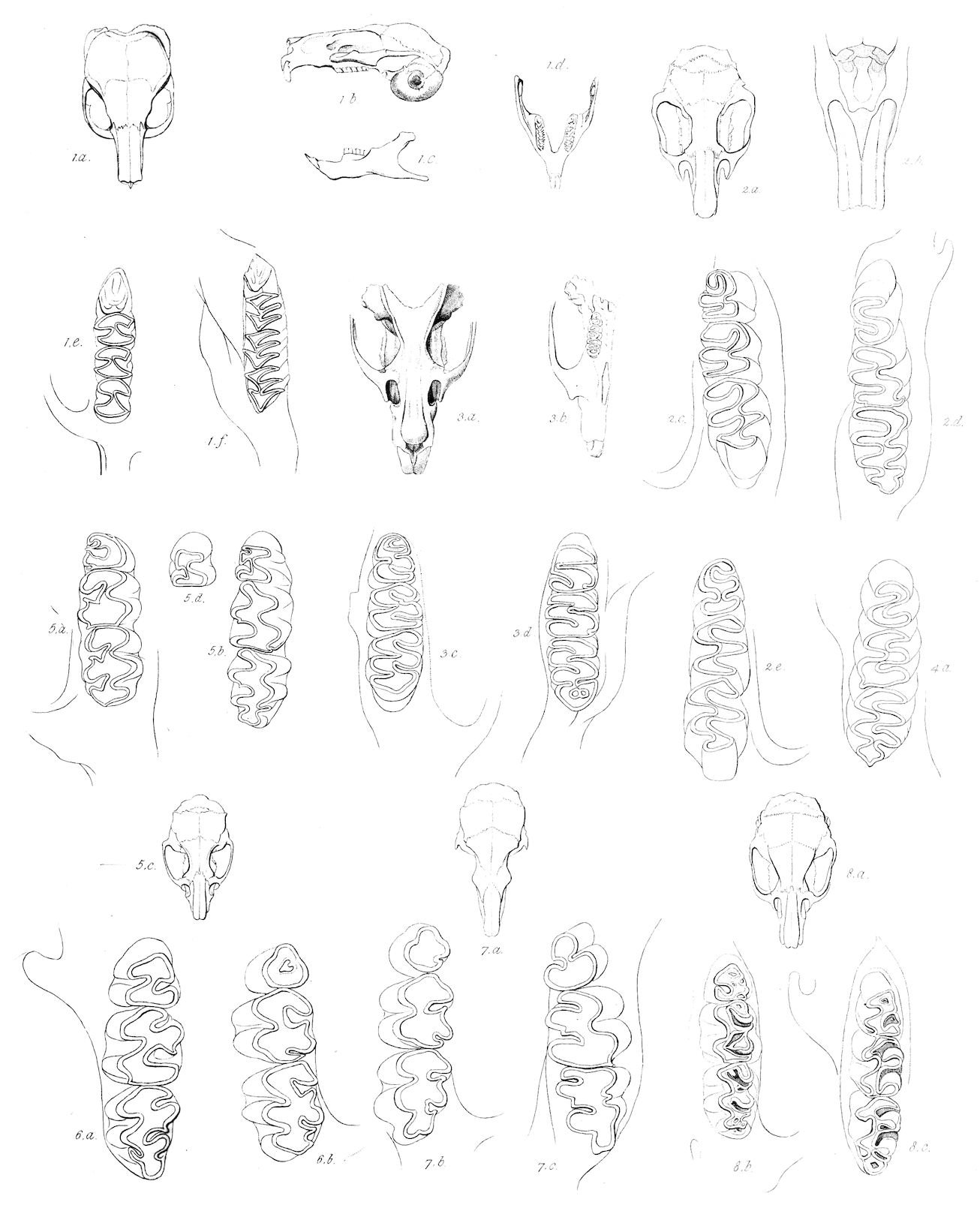
The skull is figured in Plate 33, fig. 5, c. Fig. 5, a. represents the molars of
the upper jaw; fig. 5, b. those of the under jaw, and fig. 5, d. represents the
posterior molar of the under jaw when more worn.
It was with some hesitation that I described this as a distinct species in the
Society’s Proceedings. I have now re-examined the specimens, and still am
55unable to satisfy myself whether they are varieties of Mus xanthorhinus or
not. Both of Mus canescens and of Mus xanthorhinus, I have before me what I
imagine to be an adult and a young specimen. The adult and the young of
M. xanthorhinus agree in being of a yellowish brown colour, and in having the
muzzle and tarsi deep yellow; both specimens of Mus canescens are of a gray
colour, with an indistinct yellow wash, the muzzle and tarsi being tinted with
yellow, as in M. xanthorhinus. Besides this difference in tint, which, perhaps,
is unimportant, M. canescens differs from M. xanthorhinus in having the head
larger, the tail rather longer, and the fur less soft. The specimens of this animal
are both from Patagonia; one of the specimens of Mus xanthorhinus was brought
by Mr. Darwin from Terra del Fuego; and as the other formed part of Captain
King’s collection, it in all probability came from the same locality. As I only
possess one skull, I cannot speak with certainty as regards the size of the head;
the difference, however, in the stuffed specimens is considerable, and it is strange
that each of the pairs should agree so perfectly, supposing the difference to be
the work of the stuffer’s hands.
Mus longipilis, Waterh., Proceedings of the Zoological Society of London for February 1837, p. 16.
M. suprà obscurè griseus, flavo lavatus; subtùs griseus; pedibus fuscis, unguibus
longiusculis; auribus mediocribus; caudâ corpore breviore, suprà nigrescente, subtùs
fuscescente; rhinario sub-producto: vellere longissimo, molli.
Description.—Fur very soft and silky, and extremely long—the ordinary fur of
the back measuring nearly three quarters of an inch, and the longer hairs
one inch in length; ears moderate; tail nearly as long as the body; muzzle
much pointed; general colour gray, washed with yellow, the under parts
pale gray, or grayish white; feet brown; ears and tail well clothed; the
hairs on the inner side of the ears are chiefly of a yellow colour, those on the
upper surface of the tail are brown-black, those on the under part are dirty
white; the hairs of the back are deep gray at the base, broadly annulated
with yellow near the apex, and dusky at the apex; the longer hairs are
grayish black; the hairs of the moustaches are dusky at the base, and
whitish beyond that part; the claws are long, and but slightly curved; the
56incisors are slender; those on the upper jaw are yellow, and those of the
under yellow-white.
|
|
In. |
Lines. |
| Length |
from nose to root of tail |
5 |
4 |
| |
of tail |
3 |
4 |
| |
from nose to ear |
1 |
2 |
| |
of tarsus (claws included) |
1 |
0½ |
| |
of ear |
0 |
6½ |
Habitat, Coquimbo, Chile, (May.)
This mouse is remarkable for the great length and softness of its fur, even
among the species here described, most of which have very loose, long and
soft fur.
The molars of the upper jaw are figured in Plate 33, fig. 6, b.—molars of the
lower jaw, fig. 6, a.
“Inhabits dry stony places, which character of country is general in this part
of Chile.”—D.
Mus nasutus, Waterh., Proceedings of the Zoological Society of London for February 1837, p. 16.
M. suprà obscurè flavescenti-fuscus, ad latera fulvescens; subtùs obscurè fulvo tinctus:
pedibus pilis obscurè fuscis tectis; unguibus longis; auribus mediocribus; caudâ corpore
breviore, suprà fuscá, subtùs sordidè albâ: rhinario producto.
Description.—Muzzle very long and pointed, ears small, tail shorter than the
body, claws long and but slightly arched; inner, rudimentary toe of the fore
foot furnished with a pointed claw; fur moderate, and slightly glossy:
general colour yellowish brown, of the sides of the body yellow, of the under
parts pale yellow; the chin, throat and chest whitish: feet brown; ears well
clothed with hairs, those on the inner side are most of them yellow, but some
are black. All the fur is of a deep lead colour at the base; the hairs on the
upper parts and sides of the head and body are broadly annulated with deep
golden yellow near the apex, and blackish at the apex; on the upper parts
long brownish black hairs are thickly interspersed with the ordinary fur,
but on the side of the body they are less numerous, hence on this part
57the yellow tint prevails; on the under parts of the body the hairs are broadly
tipped with pale yellow, and in parts with white: the tail is but sparingly
clothed with hairs, those on the upper surface are of a dark brown colour, and
those on the under are pale brown. The incisors are very slender and of
a very pale yellow colour.
|
|
In. |
Lines. |
| Length |
from nose to root of tail |
5 |
2 |
| |
of tail |
2 |
8 |
| |
from nose to ear |
1 |
3 |
| |
of tarsus (claws included) |
1 |
0½ |
| |
of ear |
0 |
5 |
Habitat, Maldonado, La Plata, (June.)
The specific name nasutus has been applied to this mouse on account of
its elongated and slender muzzle[22], the tip of which extends nearly 4 lines
beyond the upper pair of incisors: the rudimentary toe of the fore foot, instead
of having the usual rounded nail, has a short pointed claw. Its fur is not
so soft, nor yet so long as in many of the preceding species, and there is a
greater admixture of yellow in its colouring. The claws appear to be adapted to
burrowing.
The skull (which is not quite perfect) is figured in Plate 33, fig. 7, a, its
length is 1 in. 3 lines. Fig. 7, b, represents the molars of the upper jaw, and fig.
7, c, those of the under jaw. The lower jaw, which is of a very slender and elongated
form, is figured in Plate 34, fig. 10, a.
“Was caught in a small thicket on an open grassy plain, by a trap baited
with a piece of bird. This mouse when alive possesses a marked character in the
extreme acumination of its nose.”—D.
Mus tumidus, Waterh., Proceedings of the Zoological Society of London for February 1837, p. 15.
M. brunneus, nigro lavatus; rostro ad apicem, labiis, mento, gulâ, pectore, abdomineque
albis; naso suprà nigrescente; auribus mediocribus rotundatis; corpore crasso; caudâ
capite corporeque breviore, pilis nigricantibus, subtùs albescentibus prope basin, vestitâ;
artubus pedibusque grisescentibus; vellere longo, molli; unguibus longis.
Description.—Body stout; head large; tail nearly as long as the head and body;
58inner toe of the fore foot with a distinct, pointed claw; claws rather large,
those of the fore feet but slightly arched. Fur rather long, and moderately
soft; general tint of the upper parts of the body, brown, of the sides of the
head and body, grayish, but with a yellow wash; the lower part of the sides
of the body and of the cheeks, the tip of the muzzle, and the whole of the
under parts, white; feet dirty white; ears densely clothed with short hairs,
those on the inner side chiefly of an ashy-brown colour, and those on the
outer side dusky; the hairs of the back are of a deep lead colour at the base,
black at the tip, and annulated with yellow near the tip; the longer hairs,
which are thickly interspersed, are totally black; on the under parts of the
body the hairs are gray at the base, and broadly tipped with white; the upper
surface of the muzzle is blackish; the moustaches are black; the incisors
are yellow.
|
|
In. |
Lines. |
| Length |
from nose to the root of tail |
6 |
9 |
| |
of tail |
5 |
4 |
| |
from nose to ears |
1 |
8 |
| |
of tarsus (claws included) |
1 |
6 |
| |
of ear |
0 |
7 |
Habitat, Maldonado, La Plata (June.)
This species is about the size of Mus Rattus, but is stouter in its proportions;
as in Mus nasutus, the thumb is furnished with a pointed claw. The molars of the
lower jaw are figured in Plate 34, fig. 11, a.
“This rat was caught in so wet a place amongst the flags bordering a lake,
that it must certainly be partly aquatic in its habits.”—D.
Rat du Brézil, Geoff.
M. suprà fuscus fulvo lavatus; lateribus capitis corporisque æquè ac abdomine auratis;
gulâ pectoreque albis; pedibus pilis sordidè flavis tectis; auribus parvulis; caudâ
caput corpusque ferè æquante; vellere longo, molli.
Description.—Head somewhat arched, and rather short; ears small; tail about
equal in length to the head and body, measured in a straight line; tarsi
large. Fur long, and rather soft; general colour deep golden yellow: on
the upper surface of the head and the back, long glossy black hairs are
thickly interspersed, and produce, with the admixture of the deep golden
59colour of the ordinary fur, a dark brown tint; chin, throat, chest, and
rump, white; the hairs covering the upper surface of the feet are of a dirty
yellowish white colour, and on the toes nearly white: ears densely clothed
with longish hairs, those on the inner side chiefly of a deep golden colour,
and those on the outer side brownish; the ears are partially hidden by the
long fur of the head; tail sparingly clothed with hairs, above brown, and
beneath brownish-white: the fur of the back is of a deep gray colour at the
base, annulated with deep golden yellow near the apex, and blackish at the
apex; the longer hairs are black; the hairs of the belly are pale gray at
the base, and broadly tipped with golden yellow colour; the white hairs
on the throat, chest, and rump are of an uniform colour—not tinted with
gray at the root;—the hairs of the moustaches are black: the incisors of
the upper jaw are of a deep orange colour, and those of the lower jaw are
yellow: the thumb nail is truncated.
|
|
In. |
Lines. |
| Length |
from nose to root of tail |
8 |
6 |
| |
of tail |
7 |
9 |
| |
from nose to ear |
1 |
8 |
| |
of tarsus |
2 |
0 |
| |
of ear |
0 |
6½ |
Habitat, Bahia Blanca, (September.)
This species is nearly equal in size to the common rat (Mus decumanus). Of
its skull[23] I possess but the anterior portion (see Pl. 33. fig. 3, a. and 3, b.): it
appears to have been about the same size as that of M. decumanus, its proportions,
however, are different: the nasal portion is broader and shorter, the ant-orbital
outlet is rather smaller; the plate, forming the anterior root of the zygomatic
arch, and which protects this outlet, has its anterior edge distinctly emarginated,
and not nearly straight as in M. decumanus,—the zygomatic arch is stouter, the
space between the orbits is narrower, the palate is more contracted, the incisors
are much broader, less deep from front to back, and have the anterior surface
more convex; the molar teeth are larger; the lower jaw (see Plate 34. fig. 12, a.)
when compared with that of Mus decumanus also offers many points of dissimilarity;
the principal differences consist in its greater strength, the comparatively
large size and breadth of the articular surface of the condyles, the
upright position of the coronoid process—a perpendicular line dropt from the
apex of which would touch the posterior part of the last molar—and the great
60extent of the symphysis menti. In the form of the incisors, the more contracted
palate, the great extent of the symphysis menti, and in fact in most of the points
of dissimilarity, between the skull of the present animal and that of Mus decumanus,
here pointed out, it will be perceived, there is an approach made to the
Arvicolidæ.
The dimensions of the skull (so far as an imperfect specimen will allow of
their being taken) are as follows:—
|
|
In. |
Lines. |
| Distance between front of incisors, (upper jaw) and the first molar tooth |
0 |
8 |
| Longitudinal extent of the three molars on either side, taken together |
0 |
4¼ |
| Length |
of nasal bones |
0 |
7¼ |
|
of incisive foramina |
0 |
4¼ |
| Width |
between orbits |
0 |
2½ |
| Length |
of ramus of lower jaw |
1 |
1¼ |
Fig. 3, c, Plate 33, represents the molar teeth of the upper jaw. Fig. 3, d,
those of the upper jaw.
“This rat was caught at Bahia Blanca where the plains of Patagonia begin
to blend into the more fertile region of the Pampas. It lived in holes amongst
the tussocks of rushes, on the borders of a small, still, brook; in its manner of
diving and aquatic habits it closely resembled the English water-rat, (Arvicola
amphibia.)”—D.
When at Paris I examined what I believe to be the original Mus Braziliensis,
since the specimen was labelled “Rat de Brazil St. Hilaire, 1818.” It agrees
perfectly with the present animal excepting in being rather smaller, the length
from the nose to the tail being 7 inches and 4 lines—the length of the tail is 7
inches 9 lines, and that of the tarsus is 1 inch 11 lines; this difference in the
length of the body may arise from difference of age, or even of sex. In the Paris
Museum I saw what appeared to me to be a variety of the same species in which
the under parts of the body are white.
I have been minute in my description of the Mus Braziliensis, since it is
confounded by Desmarest, Fischer and Lesson with the Rat troisieme or Rat
Angouya of Azara, which I believe to be a very different animal. The description
given by the authors just mentioned are taken from Azara, who gives the
following characters to distinguish the Rat Angouya: “Du museau à la queue, et
sur les côtés du corps tout est brun-cannelle, parceque les poils ont une petite
pointe cannelle; puis, ils sont obscurs et enfin blanc vers las peau. Toute la partie
inférieure de l’animal est blanchâtre, plus claire sous la tête, et plus foncée entre
les jambes de devant; le pelage est doux, très-serr, et le poil, qui est à la racine
de l’oreille, cache le conduit de celle-ci.”
| 61 |
|
|
In. |
Lines. |
| Length |
from nose to root of tail (English measure) |
6 |
0 |
| |
of tail |
6 |
6½ |
| |
of ears |
0 |
9¾ |
| |
of tarsus (the claws included) |
1 |
3¼ |
It appears from this description that the Mus Angouya is a smaller animal,
and differs both in colouring and proportions from the Mus Braziliensis. Brandt
has figured and described a rat under the name of Mus Angouya, which in many
respects agrees better with Azara’s description; there are, however, discrepancies
in the dimensions.
Mus micropus, Waterh., Proceedings of the Zoological Society of London for February 1837, p. 17.
M. suprà fuscus; subtùs cinerescenti-albus, pallidè flavo tinctus; pedibus pilis sordidè
albis tectis, antipedibus parvulis; auribus parvulis; caudâ, quoad longitudinem,
corpus ferè æquante, suprâ fuscâ, subtùs sordidè albâ.
Description.—Form stout, ears rather small, tail nearly equal to the body in
length, fur very long and moderately soft, general colour of the upper parts of
head and body, brown; of the sides of the body grayish, faintly washed
with yellow, of the under parts grayish white, faintly tinted with yellow;
hair covering the upper surface of the feet dirty white; on the
tarsus there is a very slight yellow tint; ears well clothed with hairs, those
on the inner side chiefly of a yellow colour; tail above, dusky brown; beneath
dirty white: hairs of moustaches black at the base and grayish at the apex;
incisors pale yellow: hairs of the back deep gray at the base, annulated with
brownish yellow near the apex, and dusky at the apex; longer hairs dusky
black; hairs of the belly deep gray at the base and broadly tipped with
yellowish white.
|
|
In. |
Lines. |
| Length |
from nose to root of tail |
6 |
0 |
| |
of tail |
3 |
8 |
| |
from nose to ear |
1 |
4 |
| |
of tarsus (claws included) |
1 |
0¾ |
| |
of ear |
0 |
6 |
Habitat, Santa Cruz, Patagonia, (April.)
62The molars of the upper jaw are figured in Plate 34, fig. 13, a, and those of
the lower jaw, fig. 13, b.
“Caught in the interior plains of Patagonia in lat. 50°, near the banks of the
Santa Cruz.”—D.
Mus griseo-flavus, Waterh., Proceedings of the Zoological Society of London for February 1837, p. 28.
M. suprà griseus flavo-lavatus, ad latera flavus, subtùs albus; pedibus albis; auribus
magnis et ferè nudis; caudâ caput corpusque ferè æquante, suprà fusco-nigricante,
subtùs albâ; vellere longo, molli.
Description.—Ears large; tail rather shorter than the head and body taken
together; tarsi slender, and moderately long; fur long and very soft; general
tint of the upper parts of head and body grayish, washed with brownish yellow;
on the sides of the body a palish yellow tint prevails; feet, chin, throat,
and under parts of body pure white; tail rather sparingly clothed with
hairs, those on the apical portion rather long, and forming a slight pencil at
the tip; on the upper side and at the tip of the tail the hairs are brown, on
the under side they are dirty white; the ears are very sparingly clothed with
minute brownish yellow hairs internally; externally, on the fore part, the
hairs are rather longer and of a brown colour; the upper incisors are orange,
and the lower incisors are yellow; the hairs of the moustaches are long, and
of a black colour; the hairs of the back are deep gray at the base, brownish
at the tip, and annulated with pale brownish yellow near the tip; the longer
hairs are brown; the hairs of the belly are white externally, and gray at the
base; on the throat the hairs are white to the root.
|
|
In. |
Lines. |
| Length |
from nose to root of tail |
6 |
8 |
| |
of tail |
5 |
6 |
| |
from nose to ear |
1 |
4½ |
| |
of tarsus (claws included) |
1 |
2½ |
| |
of ear |
0 |
8 |
Habitat, Northern Patagonia (August.)
The molars of the upper jaw are figured in Plate 34, fig. 15, a, and those of
the lower jaw, fig. 15, b.
“Inhabits the dry gravelly plain, bordering the Rio Negro.”—D.
63
Mus xanthopygus, Waterh., Proceedings of the Zoological Society of London for February 1837, p. 28.
M. suprà pallidè brunneus flavo-lavatus, ad latera flavescens, subtùs albus; capite griscescente;
natibus flavis; pedibus albis; auribus majusculis pilis, albis et flavis intermixtis
obsitis; caudâ quoad longitudinem, corpus ferè æquante, suprà nigricante,
subtùs albâ; vellere longo et molli; mystacibus perlongis albescentibus, ad basin
nigris.
Description.—Ears rather large, tail rather longer than the body, tarsi moderately
long and somewhat slender: fur long and very soft: prevailing tint pale
yellow; on the back there is a brownish hue owing to the long hairs, which
are thickly interspersed with ordinary fur, being of that colour: in the region
of the tail the hairs are of a rich yellow colour; the tip of the muzzle is white,
the feet, chin, throat and the whole under parts of the body are white; on
the chest and belly a faint yellowish hue is observable: the tail is well
clothed with tolerably long hairs, those on the apical portion are the longer,
on the upper side of the tail they are of a brown colour, and on the under
side they are pure white: the ears are well clothed with tolerably long hairs,
those on the inner side are of a pale yellowish colour, externally on the fore
part they are brown, and on the hinder part they are yellowish white: the
hairs of the moustaches are numerous and very long; some of them are white,
but the greater portion are brownish black at the base and whitish at the
apex: the upper incisors are yellow, and the lower are yellow-white: the
hairs of the ordinary fur on the back are gray at the base, brownish at the
tip, and very pale yellow near the tip: the hairs on the belly are gray at the
base and white externally.
|
|
In. |
Lines. |
| Length |
from nose to root of tail |
5 |
3 |
| |
of tail |
3 |
10 |
| |
from nose to ear |
1 |
3 |
| |
of tarsus (claws included) |
1 |
1 |
| |
of ear |
0 |
7 |
There are three specimens of the present species in Mr. Darwin’s collection;
two of them were caught when shedding their fur, and having lost the longer black
hairs, have the upper parts of the body of a paler colour; their general tint is very
pale, and may be described as gray, with a wash of pale yellow.
64This species is closely allied to the last, but differs in being rather smaller, in
having smaller ears which are well clothed with hair, and not sparingly furnished
as in Mus griseo-flavus, and in having a shorter tail which, like the ears, is more
densely clothed with hairs; in the structure of the molar teeth there also differences
which will be better understood by comparing the drawings. Fig. 16, a,
Plate 34, represents the molars of the upper jaw, and 16, b, those of the lower
jaw.
“Extremely abundant in the coarse grass and thickets in the ravines at Port
Desire and Santa Cruz: was caught in a trap baited with cheese.”—D.
Mus Darwinii, Waterh., Proceedings of the Zoological Society of London for February 1837, p. 28.
M. suprà pilis pallidè cinnamomeis et nigrescentibus intermixtis; ante oculos cinerascentibus;
genis, lateribus corporis, et caudâ prope basin, pallidè cinnamomeis; partibus
inferioribus pedibusque albis; auribus permagnis; caudâ caput corpusque ferè æquante,
suprà fusco-nigricante, subtùs albâ.
Description.—Form robust; ears immensely large; tail nearly equal in length to
the head and body taken together; fore feet very small; tarsi moderate; fur
very long and soft; general tint of the upper parts pale cinnamon yellow; on the
rump a richer yellow hue prevails, and on the back there is a brownish tint,
owing to the interspersed long hairs being of that colour; the upper surface
of the head is grayish; the cheeks, like the sides of the body, are of a delicate
yellow colour, faintly clouded with brown; the sides of the muzzle,
lower part of the cheeks and sides of the body, and the whole under parts,
are pure white; the feet and tail are also white, if we except the upper surface
of the latter, which is dark brown; the yellow tint of the sides of the
body is extended downwards on the outer side of the fore legs and on the
back of the hinder legs; the ears are but sparingly furnished with hair,
excepting on the fore part, externally, where they are of a brownish colour;
the minute hairs which cover the remaining parts of the ear are very pale; the
tail is well clothed with hairs; the hairs of the moustaches are numerous and
very long; they are for the most part blackish at the base, and gray at the
apex; the incisors are rather slender, the upper pair are an orange colour,
and the lower, yellow; the hairs of the ordinary fur of the back are gray at
65the base, broadly annulated with pale cinnamon yellow near the apex, and
brownish at the apex; the hairs of the belly are deep gray at the base, and
white externally, those on the throat are pale gray at the base.
|
|
In. |
Lines. |
| Length |
from nose to root of tail |
6 |
0 |
| |
of tail |
4 |
9 |
| |
from nose to ear |
1 |
4½ |
| |
of tarsus (claws included) |
1 |
1½ |
| |
of ear |
0 |
11¾ |
| Width |
of ear |
1 |
0½[24] |
Habitat, Coquimbo, Chile, (May.)
This species is evidently allied to the two preceding; and perhaps the “Rat
quatrieme, ou Rat oreillard” of Azara, (Mus auritas, Desm.) will form one of this
little group. The molar teeth of the upper jaw are figured in Plate 34, fig. 17, a—those
of the lower jaw, fig. 17, b.
“Inhabits dry stony places.”—D.
M. suprà fuscus, flavo-lavatus, ad latera flavescens, subtùs albus: pedibus pilis sordidè
albis tectis: auribus mediocribus; caudâ, quoad longitudinem, caput corpusque ferè
æquante: vellere longo.
Description.—Ears moderate, slightly pointed; tarsi moderate; tail slender,
nearly as long as the head and body; fur long, and not very soft; upper
parts of the body of a brownish hue, a tint produced by the admixture of
black and palish yellow hairs; on the sides of the body the longer black
hairs are less abundant, and the prevailing colour is yellow; under parts of
the body white, with a very faint yellow tint; feet furnished above with dirty
white hairs; ears rather sparingly clothed with hairs, those on the inner side
of a yellow colour, and those on the outer side dusky; tail above brown, and
beneath whitish; the hairs of the moustaches black; the incisors deep yellow;
the hairs on the back are deep gray at the base, broadly annulated with
palish yellow near the apex, and blackish at the apex; the longer hairs
black; on the belly the hairs are gray at the base, and broadly tipped with
yellowish white.
| 66 |
|
|
In. |
Lines. |
| Length |
from nose to root of tail |
6 |
0 |
| |
of tail |
4 |
9 |
| |
from nose to ear |
1 |
3¾ |
| |
of tarsus (claws included) |
1 |
2 |
| |
of ear |
0 |
7 |
Habitat, Chatham Island, Galapagos Archipelago, Pacific Ocean, (October.)
This species is less than Mus Rattus. The upper parts of the body have a
slightly variegated appearance.
The skull of Mus Galapagoensis (Plate 33, fig. 8, a,) is rather smaller than
that of M. Rattus, the nasal portion is proportionately longer, the cranial
shorter, and the interparietal bone is smaller, especially in antero-posterior
extent; its length is 15 lines, and its breadth is 8⅛ lines. The lower jaw is
figured in Plate 34, fig. 14, a. Fig. 8, b, of Plate 33, represents the molars of the
upper jaw, and fig. 8, c, those of the lower jaw.
“This mouse or rat is abundant in Chatham Island, one of the Galapagos
Archipelago. I could not find it on any other island of the group. It frequents
the bushes, which sparingly cover the rugged streams of basaltic lava, near the
coast, where there is no fresh water, and where the land is extremely sterile.”—D.
M. suprà fusco-nigrescens, subtùs griseus; pedibus fuscis; auribus mediocribus,
caudâ, quoad longitudinem, caput corpusque ferè æquante: vellere longissimo, molli.
Description.—Form stout; ears moderate; tail equal to the body in length;
tarsi moderate; fur very long. General tint of the upper part and sides of
the head and body blackish brown with an admixture of gray; of the under
parts grayish white; feet brown, the hairs grayish at the tip: tail black and
but sparingly clothed with short bristly hairs: ears rather sparingly clothed
with hairs, which are for the most part of a brownish gray colour. The ordinary
fur of the back is about ¾ of an inch in length and very soft—of a deep
gray colour, broadly annulated with brownish yellow near the tip and blackish
at the tip: the longer hairs which are black, measure upwards of 1¼ inches
in length. The upper incisors are of an orange colour and the lower are
black.
|
|
In. |
Lines. |
| Length |
from nose to root of tail |
6 |
6 |
| |
of tail |
4 |
3 |
| |
from nose to ear |
1 |
6 |
| |
of ear |
0 |
6½ |
| |
of tarsus (claws included) |
1 |
1 |
Habitat, Australia, King George’s Sound, (March.)
67Mammalia not belonging to the order Marsupiata are rare in the Continent of
Australia. Besides the Dog, we are acquainted with none excepting a few species
of Rodents, and these all belong to the family Muridæ.
The present animal adds one to the limited number already known: in
the Museum of the Zoological Society there is another species, the characters of
which I will point out in the next description.
Mus fuscipes is remarkable for the great length and softness of its fur, and
the brown colour of its feet: it is rather less than Mus Rattus, and of a stouter
form. Not having had an opportunity of examining the molar teeth and the
cranium of this animal, I cannot be positive that it is a species of the genus Mus;
in external characters and the form of the incisor teeth, however, it agrees perfectly
with the animals of that genus.
“This animal was caught in a trap baited with cheese, amongst the bushes
at King George’s Sound.”—D.
M. vellere longo, molli, ochraceo, pilis nigricantibus adsperso, his ad latera rarioribus:
corpore subtùs, pedibusque albis: auribus majusculis: caudâ, capite corporeque
paulo breviore.
Description.—Ears rather large and slightly pointed, tarsi slender and tolerably
long; tail about equal in length to the body and half the head; fur long and
soft; general colour pale ochreous yellow; on the back there are numerous
long black hairs interspersed with the ordinary fur, which gives a darker hue
and somewhat variegated appearance to that part; feet, chin, throat, and the
whole under parts of the body white; ears brown, sparingly clothed with
minute yellow hairs, both externally (excepting on the forepart, where they
are brownish) and internally; tail brownish above, and yellowish white beneath;
the hairs of the moustaches long, and of a brown colour; upper incisors
deep orange, lower incisors yellow; claws white. The hair of the back
is of a deep lead colour at the base, pale ochre near the apex, and dusky at
the apex; the longer hairs are black; the hairs of the belly are deep gray at
the base and broadly tipped with white.
|
|
In. |
Lines. |
| Length |
from nose to root of tail |
4 |
8 |
| |
of tail |
3 |
6 |
| |
from nose to ear |
1 |
0½ |
| |
of tarsus (claws included) |
1 |
0½ |
| |
of ear |
0 |
7 |
Var. β.—General colour of the fur pale ochreous yellow, the feet, under side of
the tail and the whole of the under parts, as well as the lower portion of the
68sides of the body, white; hairs of the back palish gray at the base, those of
the belly indistinctly tinted with very pale gray at the roots; ears and
moustaches pale brown.
Habitat, New South Wales.
This species is about half-way between Mus Rattus and Mus musculus in size,
and is remarkable for its delicate colouring. The molar teeth are figured in Plate
34; fig. 18. a, represents the molars of the upper jaw, and fig. 18. b, those of the
lower.