| Plate I. |
|
Perca lævis. |
| II. |
|
Serranus albo-maculatus. |
| III. |
|
—— labriformis. |
| IV. |
|
—— olfax. |
| V. |
|
Pinguipes fasciatus. |
| VI. |
|
Prionotus Miles. |
| VII. |
Fig. 1. |
Aspidophorus Chiloensis. Twice Nat. size. |
| — 1a. |
Ditto. Nat. size. Dorsal view. |
| — 1b. |
Ditto. Ditto. Side view. |
| — 2. |
Agriopus hispidus. Twice Nat. size. |
| — 2a. |
Ditto. Nat. size. |
| — 2b. |
Ditto. Portion of the hispid cuticle magnified. |
| VIII. |
|
Scorpæna Histrio. |
| IX. |
Fig. 1. |
Prionodes fasciatus. |
| — 2. |
Stegastes imbricatus. |
| X. |
|
Pristipoma cantharinum. |
| XI. |
|
Latilus princeps. |
| XII. |
|
Chrysophrys taurina. |
| XIII. |
|
Paropsis signata. |
| XIV. |
|
Caranx declivis. |
| XV. |
|
—— torvus. |
| XVI. |
Fig. 1. |
Atherina microlepidota. |
| — 1a. |
Ditto Magnified scales. |
| — 1b. |
| — 2. |
Atherina incisa. Nat. size. |
| — 2a. |
Ditto. Magnified scale. |
| — 2b. |
Ditto. Twice Nat. size. |
| XVII. |
Fig. 1. |
Blennechis fasciatus. |
| — 1a. |
Ditto. Teeth magnified. |
| — 2. |
Blennechis ornatus. |
| — 3. |
Salarias vomerinus. |
| XVIII. |
Fig. 1. |
Clinus crinitus. |
| — 2. |
Acanthoclinus fuscus. |
| XIX. |
Fig. 1. |
Tripterygion Capito. |
| — 2. |
Gobius lineatus. |
| — 2a. |
Ditto. Dorsal view. |
| — 3. |
Gobius ophicephalus. |
| — 3a. |
Ditto. Dorsal view. |
| XX. |
|
Cossyphus Darwini. |
| XXI. |
|
Scarus chlorodon. |
| XXII. |
Fig. 1. |
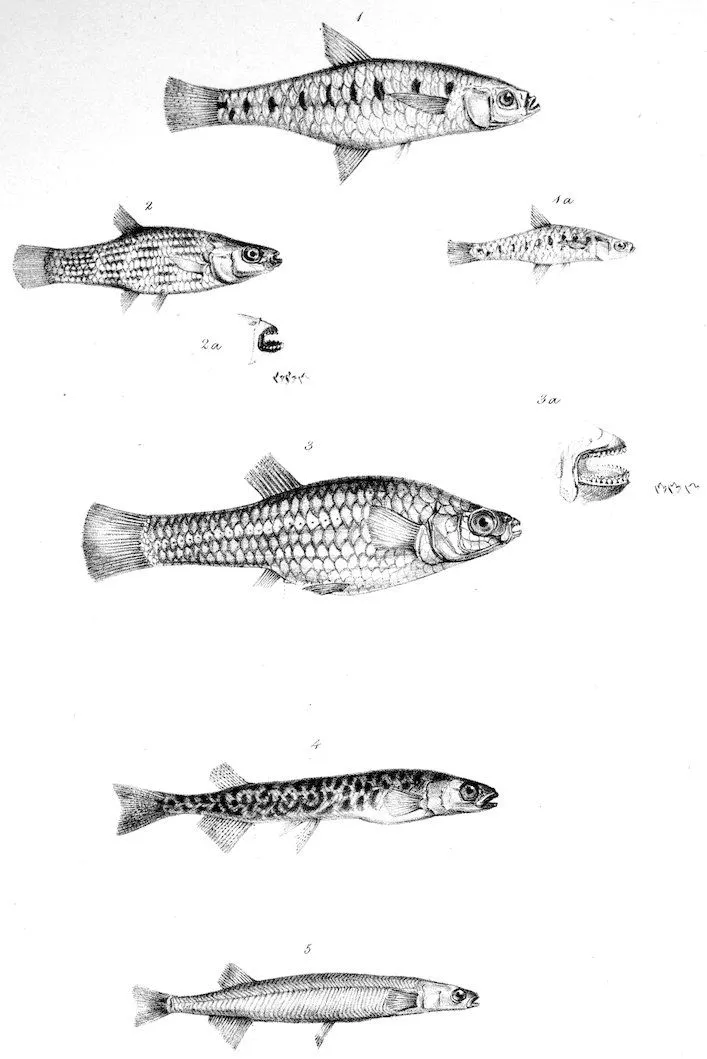
Pœcilia decem-maculata. Twice nat. size. |
| — 1a. |
Ditto. Nat. size. |
| — 2. |
Lebias lineata. |
| — 2a. |
Ditto. Teeth magnified. |
| — 3. |
Lebias multidentata. |
| — 3a. |
Ditto. Teeth magnified. |
| — 4. |
Mesites maculatus. |
| — 5. |
—— attenuatus. |
| XXIII. |
— 1. |
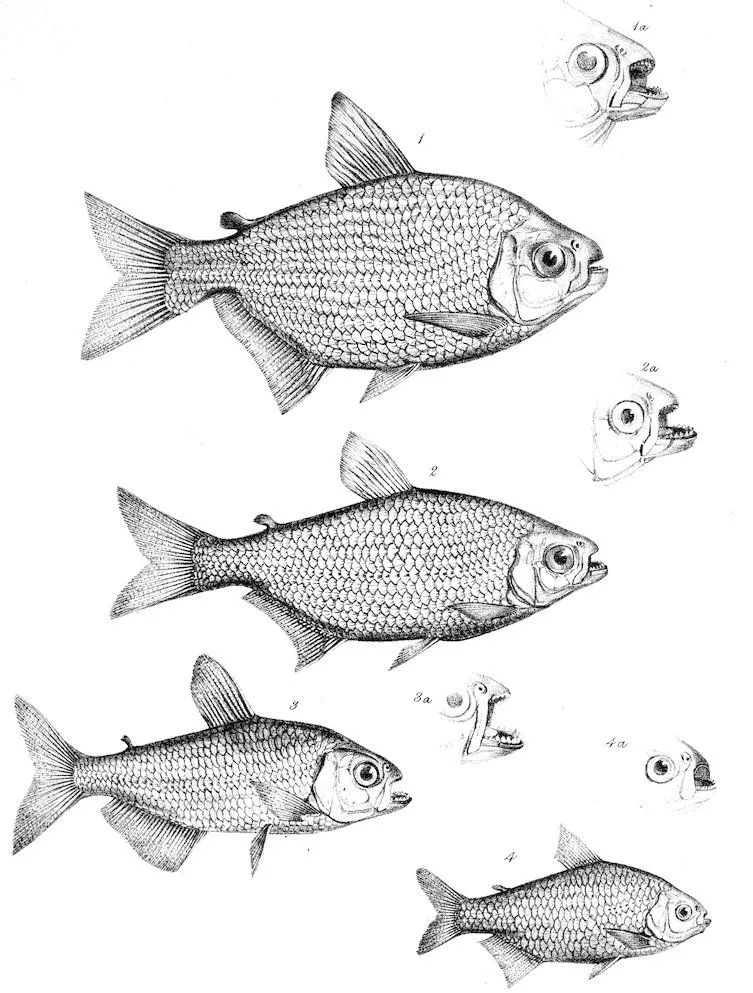
Tetragonopterus Abramis. |
| — 1a. |
Ditto. Mouth magnified, to show form of maxillary. |
| — 2. |
Tetragonopterus rutilus. |
| — 2a. |
Ditto. Mouth magnified. |
| — 3. |
Tetragonopterus scabripinnis. |
| — 3a. |
Ditto. Mouth magnified. |
| — 4. |
Tetragonopterus interruptus. |
| — 4a. |
Ditto. Mouth magnified. |
| XXIV. |
— 1. |
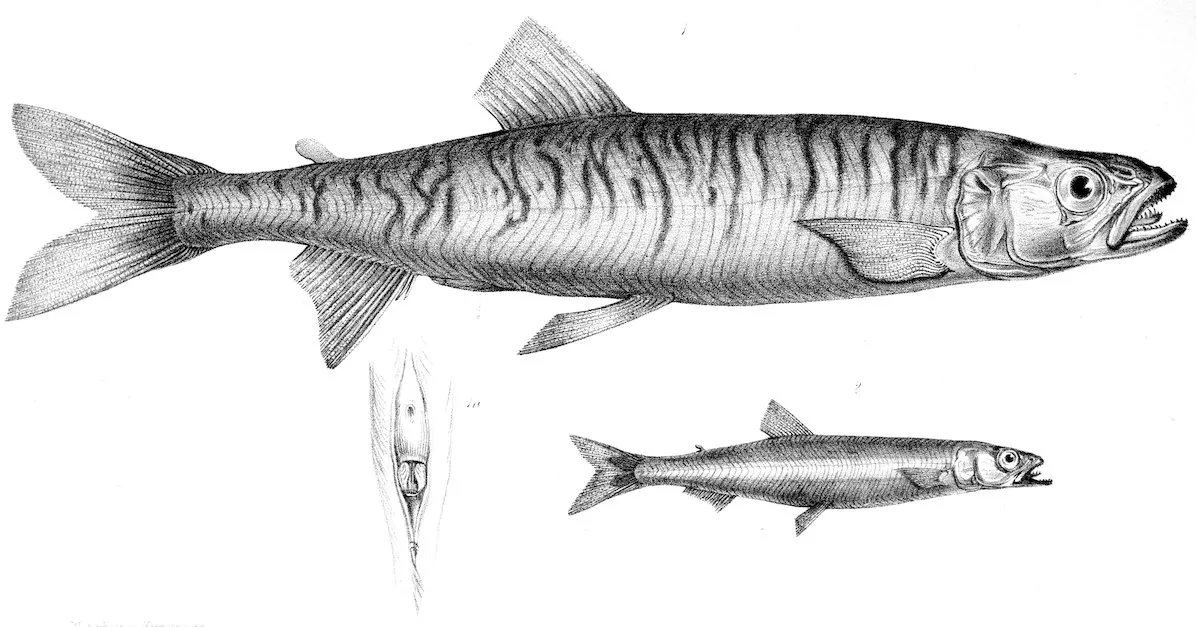
Aplochiton Zebra. |
| — 1a. |
Ditto. Magnified view of anal and generative orifices. |
| — 2. |
Aplochiton tæniatus. |
| XXV. |
|
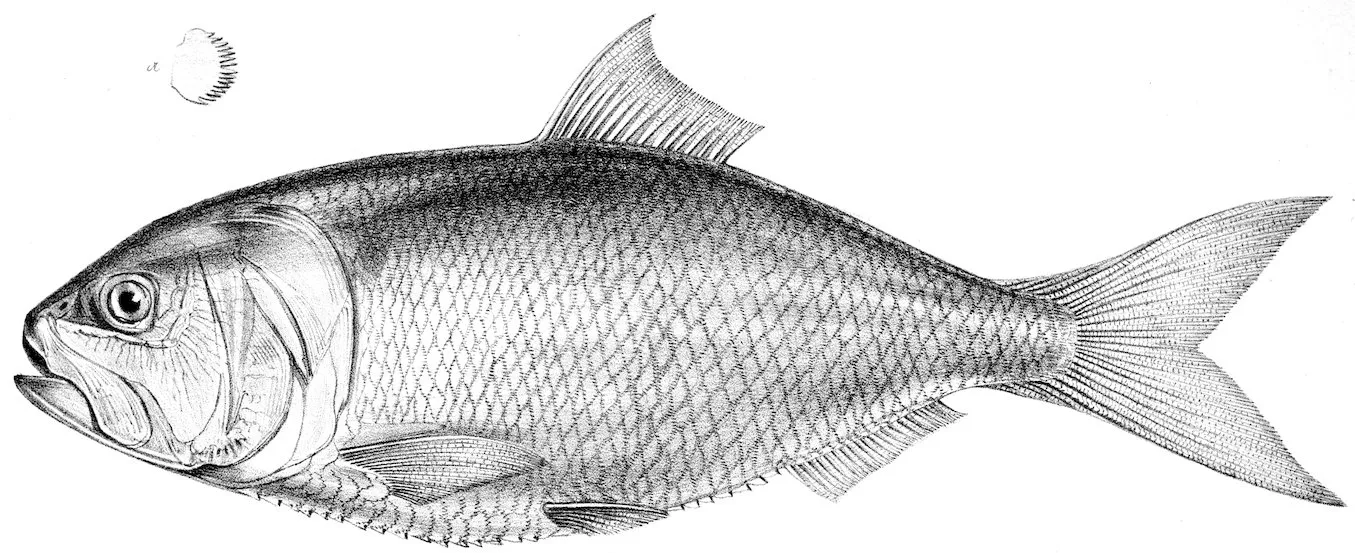
Alosa pectinata. |
| a. |
—— Magnified scale from nape. |
| XXVI. |
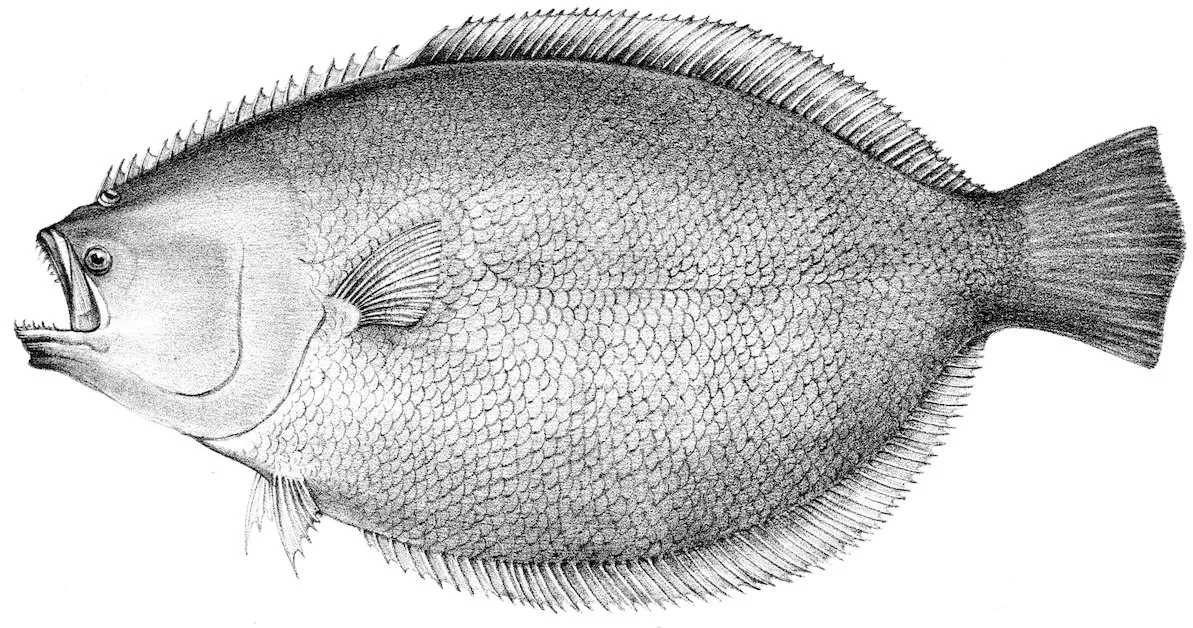
|
Hippoglossus Kingii. |
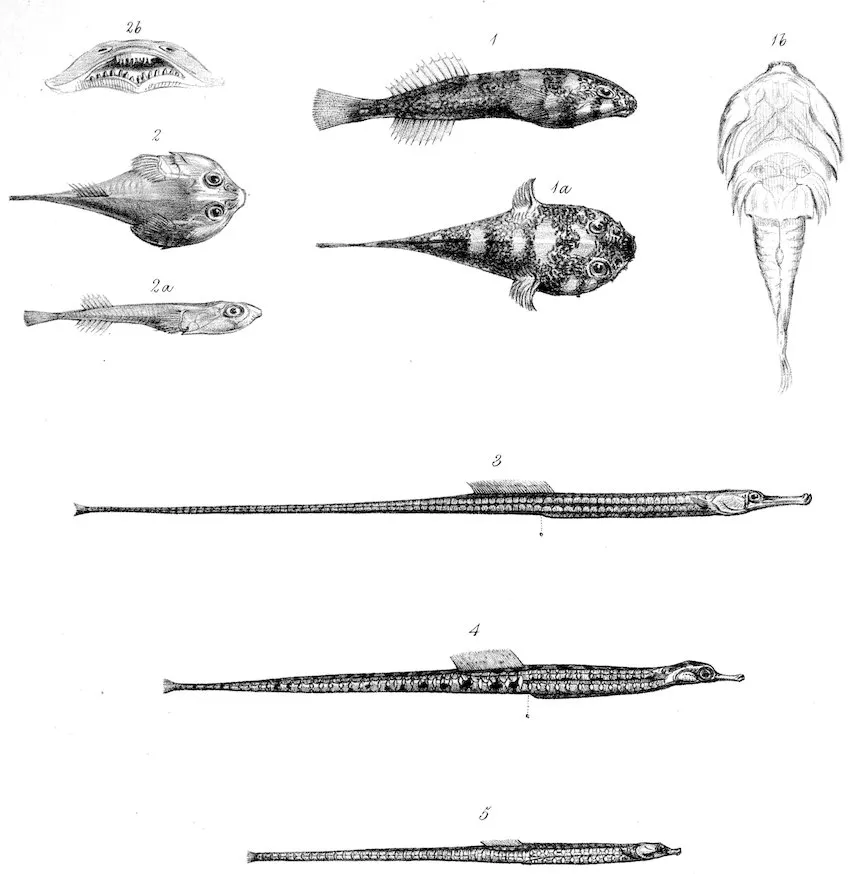
| XXVII. |
— 1. |
Gobiesox marmoratus. |
| — 1a. |
Ditto. Dorsal view. |
| — b. |
Ditto. Under side. |
| — 2. |
Gobiesox pœcilophthalmos. |
| — 2a. |
Ditto. Lateral view. |
| — 2b. |
Ditto. Magnified view of teeth. |
| — 3. |
Syngnathus acicularis. |
| — 4. |
—— conspicillatus. |
| — 5. |
—— crinitus. |
| XXVIII. |
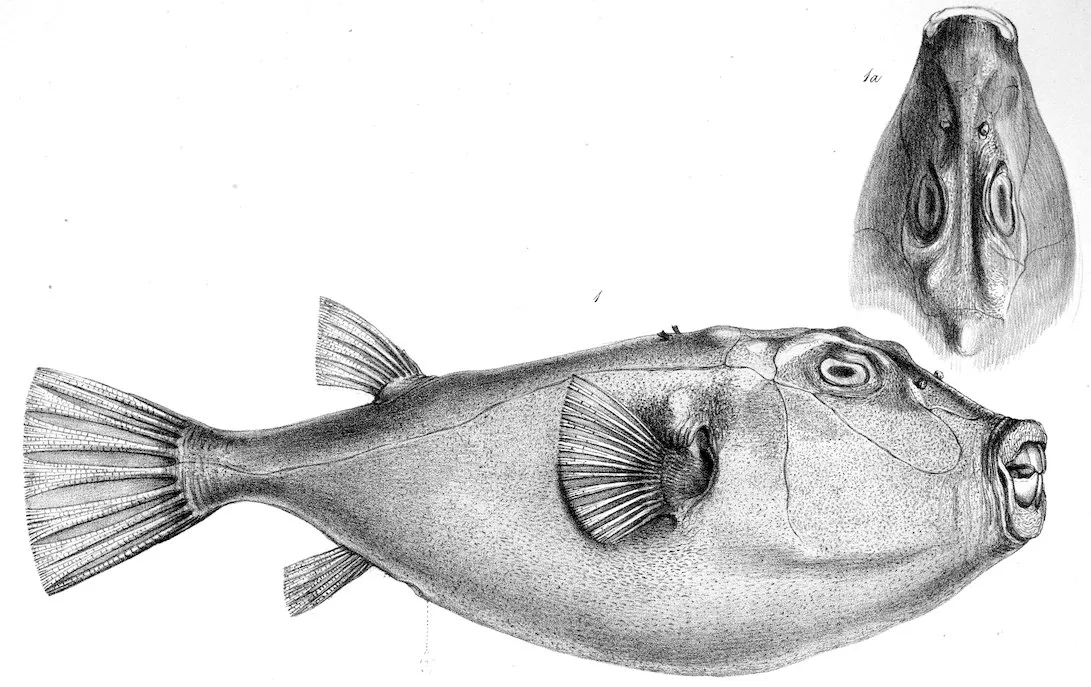
|
Tetrodon angusticeps. |
| a. |
—— Dorsal view of head. |
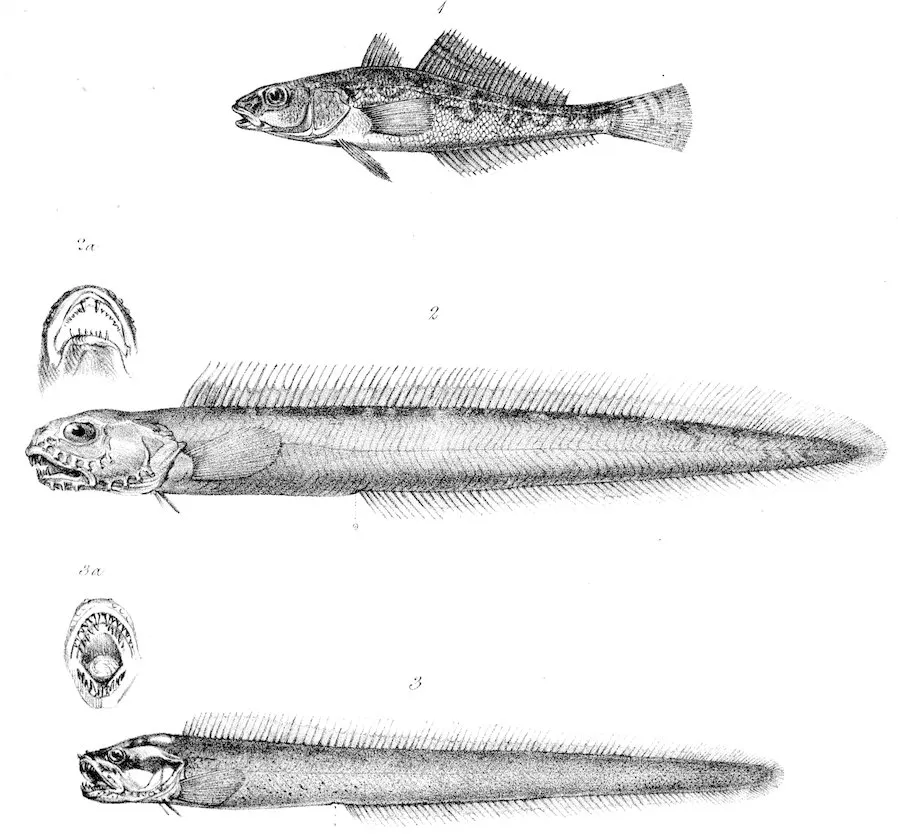
| XXIX. Append. |
— 1. |
Aphritis undulatus. |
| — 2. |
Iluocœtes fimbriatus. |
| — 2a. |
Ditto. Magnified view of teeth. |
| — 3. |
Phucocœtes latitans. |
| — 3a. |
Ditto. Teeth. |
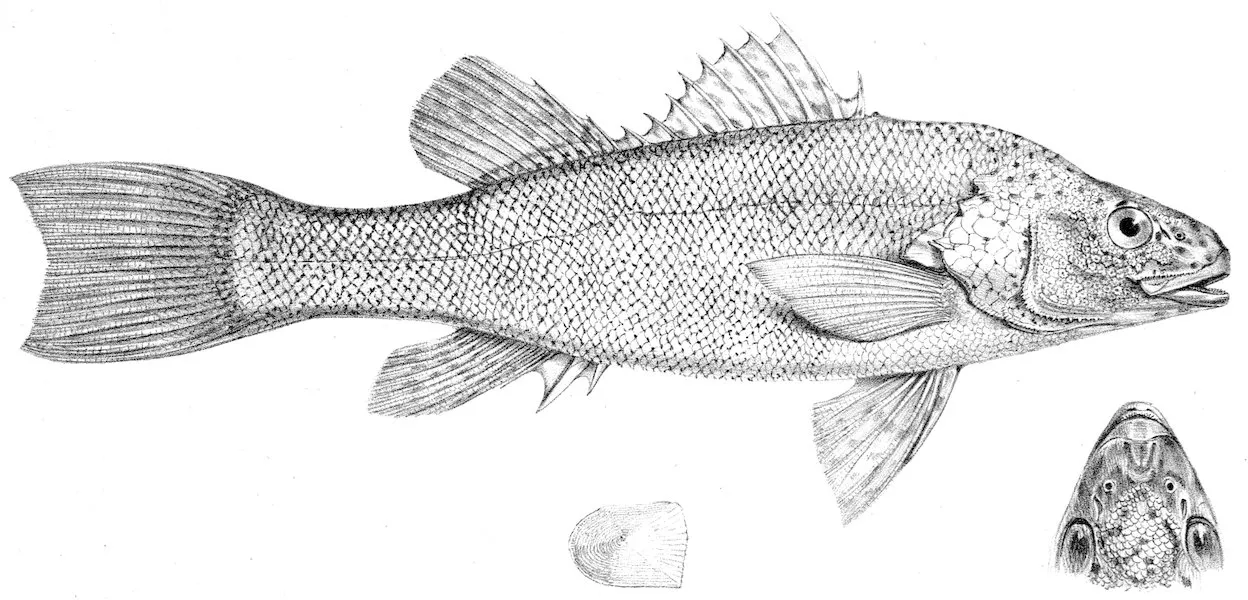
Fish. Pl. 1.
W. Hawkins delt.
Perca lævis. ¾ Nat. Size
1
P. nigricanti-fusco undique punctata; vertice, fronte, rostro usque ad nares, et infraorbitalium
parte posteriori, squamatis; squamis, in capite ciliatis scabris, in corpore
sublævibus.
B. 7; D. 9—1/11; A. 3/9; C. 17; P. 15; V. 1/5.
Long. unc. 11; lin. 5.
Form.—Much more elongated than the common Perch, with the back less elevated. Depth,
beneath the commencement of the first dorsal, not quite equalling one-fifth of the entire length.
Thickness, in the region of the pectorals, about two-thirds of the depth. Head not quite
one-fourth of the entire length. Profile falling gently from the nape in nearly a straight line
at an angle of about 45°: at the nape the dorsal line rises so as to interrupt its continuity
with the slope of the profile, but it is nearly horizontal along the base of the dorsal fins. The
jaws are nearly equal, but when the mouth is closed, the upper one appears somewhat the
longer. A band of velutine teeth in each jaw, as well as on the vomer and palatines. Maxillaries
when at rest nearly concealed beneath the suborbital bones: these last with their lower
margin distinctly denticulated; their surface presenting several small hollows. Eyes rather
above the middle of the cheeks, and about equidistant from the extremity of the snout and the
posterior margin of the preopercle; their diameter is one-sixth of the length of the head; the distance
from one to the other equals one diameter and a half. Nostrils double, a little in advance of
the eyes; the first orifice oval, the second round. Preopercle rectangular, with the angle rounded;
2the ascending margin finely denticulated, the teeth almost disappearing at the top; towards
the angle the teeth become stronger and point downwards; they are also stronger and more
scattered along the basal margin, inclining here a little forwards. Opercle with two flat sharp
points, one a little below the upper angle, the other about the middle and terminating the gill-cover.
Both the subopercle and interopercle have their margins obscurely denticulated: the
margin of the former is rather sinuous, and passes obliquely forwards and downwards to form a
continuous curve with that of the latter. Crown, forehead, upper part of the snout as far as
the connecting line of the nostrils, posterior half of the suborbitals, cheeks, and all the pieces
of the gill-cover, excepting the lower limb of the preopercle, covered with small scales, which
are in most instances ciliated with a varying number of denticles, and feel rough to the touch:
the extremity of the snout, anterior portion of the suborbitals, maxillaries, and lower jaw are
naked. Above each orbit is a small semicircular granulated plate, with the granulations disposed
in striæ. The suprascapulars terminate in an obtuse projecting point. The humeral
bone forms a large osseous triangular plate above the pectorals, the salient angle terminating
in three small teeth. Course of the lateral line a little above one-third of the depth till it
arrives beneath the second dorsal, where it bends down to half the depth. Scales on the body
larger than those on the head, of an oblong form, rounded at their free edges, which are
scarcely at all ciliated, and for the most part quite smooth to the touch; their concealed portion
not wider than the free, with a fan of fourteen striæ; the rest of their surface more finely
striated. The first dorsal commences a little beyond a vertical line from the termination of the
humeral plate, and is almost continuous with the second, being only separated by a deep notch;
the space occupied by the two dorsals together is exactly one-third of the entire length: spines
strong; the first scarcely more than one-third the length of the second, which is very little shorter
than the third; this last longest, equalling rather more than half the depth; rest of the spines
gradually decreasing to the last, which is of the same length as the first. The second dorsal
commences with a slender spine, not half the length of the first soft ray, which last is simple,
the others being branched; third and fourth soft rays longest; the succeeding ones slowly
decreasing to the last, which is rather more than half the longest. Anal preceded by three
spines, the first of which is very short; second much longer and very stout; third of about the
same length as the second, but much slenderer; the first and second separated by a wide membrane
from the third, which is closely united to the first soft ray; these last longer than those
of the second dorsal, but in other respects similar. The anal and second dorsal terminate in
the same vertical line; and the last ray is double in both fins. Between them and the caudal
is a space equalling one-fifth of the entire length. The caudal is slightly notched. The pectorals
are rather pointed, their length equalling two-thirds that of the head. Ventrals immediately
beneath them, and of about the same length; the first soft ray longest, and more than
twice the length of the spine which precedes it.
Colour.—In spirits this fish appears yellowish brown, deepening on the back but becoming paler
on the belly, and covered all over with small dusky spots, one occupying the base of each
scale.
Habitat, Santa Cruz River, Patagonia.
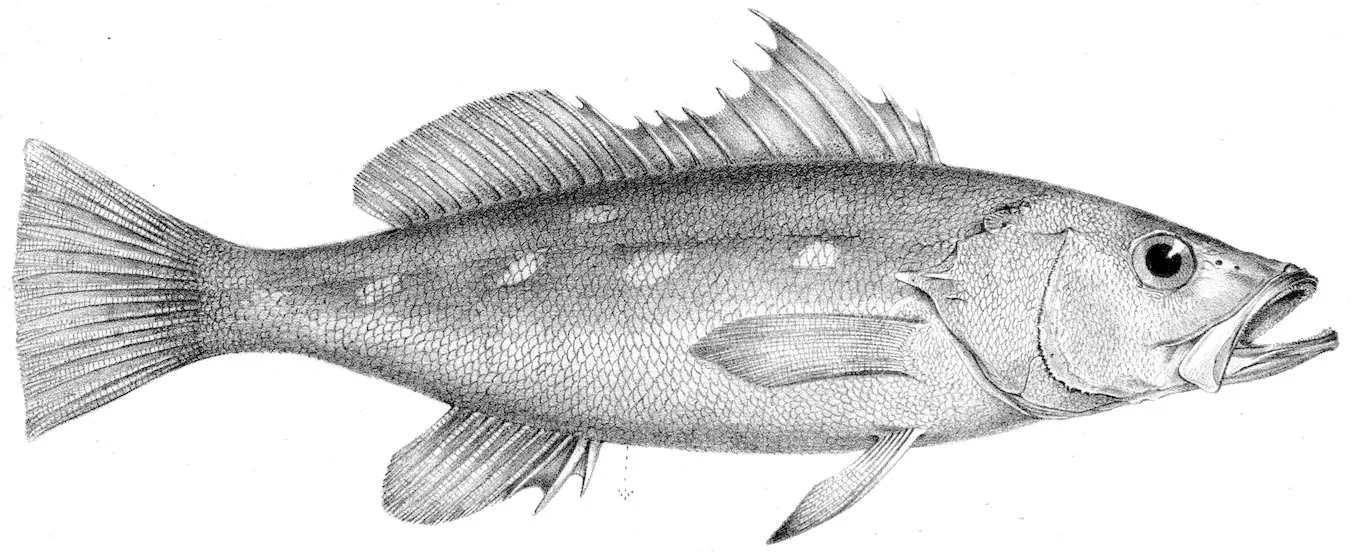
Fish Pl. 2.
Drawn from Nature on stone by Waterhouse Hawkins.
Serranus albo-maculatus, ½ Nat. Size.
3No true perch had been obtained from South America until M. D’Orbigny
discovered one in the Rio-Negro, in North Patagonia, which has been since described
by Valenciennes, under the name of P. trucha.[1] The present species
was found dead by Mr. Darwin, high up the river of Santa Cruz, in South
Patagonia. It is evidently very closely allied to the P. trucha, and is spotted in
a similar manner; but it appears to differ in the scales not advancing on the
snout beyond the nostrils, or covering more than the posterior half of the suborbitals.
Those on the body are also particularly characterized by being so smooth,
as hardly to communicate any sensation of roughness when the hand is passed
from the tail towards the head, though the head itself is rough. This circumstance
has suggested the specific name. This species further disagrees with the
one above alluded to in having the caudal slightly forked, not rounded; and in
having two soft rays less in the second dorsal, and one less in the anal. Valenciennes’s
description, however, of the P. trucha is very brief; on which account
I have been the more minute in that of the P. lævis.
This perch, with P. trucha, would almost seem to form a subordinate division
in the genus, distinguished from that embracing all the other described species,
by the character of the scales covering a large portion of the head which gives it
a remarkable sciænoid appearance. Both species may be known from all the
North American perches, by their having the body spotted instead of banded,
and by the smaller number of rays in the first dorsal. In this last character they
agree with the P. ciliata, and P. marginata of Cuvier and Valenciennes.
S. lateribus maculis albis serie longitudinali dispositis; dentibus velutinis; paucis, hic
et illic sparsis, fortioribus, aculeiformibus, vel subconicis; preoperculo margine adscendenti
convexiusculo, denticulato; denticulis ad et infrà angulum paulò majoribus;
operculo mucronibus duobus parvis, et spinâ intermediâ forti, armato; rostro et maxillis
nudis; squamis corporis leviter ciliatis; pinnâ caudali æquali.
B. 7; D. 10/13; A. 3/7; C. 17, &c.—P. 17; V. 1/5.
Long. unc. 16; lin. 9.
Form.—Of an oblong-oval form, with the greatest depth about one-fourth of the entire length.
The dorsal and ventral lines are of nearly equal curvature. The profile is nearly rectilineal,
4falling very gradually from the commencement of the dorsal to the end of the snout, without
any elevation at the nape. The head is one-third of the entire length. The lower jaw projects
beyond the upper. The maxillary, which is broad, and cut quite square at its extremity, reaches
to beneath the middle of the orbit. The suborbital has the margin entire and nearly straight.
The upper jaw has a band of velutine teeth, broadish in front, but narrowing (the teeth at the
same time becoming smaller and finer) posteriorly; with an outer row of not much longer, but
considerably stronger, subconic teeth, placed at rather wide intervals; besides these, there are
three or four teeth on each side of the anterior portion of the jaw, equally strong as those last
mentioned, but more curved, the points reclining backwards, and set within the velutine band.
In the lower jaw, there is the same band as above, but narrower, and with the teeth more in
fine card than velutine, with stronger ones anteriorly, and along the posterior half of each side,
where there are six or eight, standing nearly in a single row, very stout and curved, though
scarcely longer than the others; outside the band, and on each side of the symphysis, there are
three or four moderately strong subconic teeth, at short distances from each other, which may
be considered as small canines. On the vomer and palatines, the teeth are velutine. The eyes
are rather large, and placed high in the cheeks; their diameter is about one-sixth the length of
the head: the distance between them equals one diameter and a quarter. The nostrils consist
of two orifices, placed one before the other, a little in advance of the eyes, roundish-oval, the
posterior one largest. The preopercle has the ascending margin not quite rectilineal, being
slightly convex, and the angle at bottom rounded; the denticulations on the former are fine,
but very perceptible; they become rather stronger and more distant at the angle, and a few of
this character are continued along the posterior half of the basal margin. The opercle is
armed with three points; the upper one is triangular, small, and not very obvious; the middle
one is a moderately strong spine, about a quarter of an inch in length; the third is a little
below this last, and resembles it in form, but is much smaller. The membrane of the opercle
terminates in a sharp angle, and is produced considerably beyond the middle spine. The line
of separation between the opercle and subopercle is not visible. The gill-opening is large,
and has seven rays. There are no scales on the snout or jaws, or between the eyes, or on the
anterior portion of the suborbital; but they are present on the cranium behind the eyes, cheeks,
(where they are numerous), and pieces of the gill-cover; the limb of the preopercle, and the
lower margin of the interopercle, however, are nearly free from them. Those on the opercle
are larger than those on the cheeks. All these scales, as well as those on the body, are finely
ciliated, communicating a slight roughness to the touch. The suprascapular is represented by
a larger and harder scale than the rest, of a semi-elliptic form, striated on its surface, and
obsoletely denticulated on the margin. The lateral line is parallel to the back, at between one-third
and one-fourth of the depth. The pectorals are attached below the middle, of a rounded
form, the middle rays being longest, and about half the length of the head. The dorsal
commences exactly above them, and occupies a space equalling half the entire length, excluding
the caudal. The spines are sharp, and moderately strong: the first is rather more than
half the length of the second, but scarcely more than one-fifth of the length of the third,
which is longest, equalling more than half the depth of the body: from the third they decrease
very gradually to the ninth, which is of the same length as the second; the tenth is again a
little higher; this is followed by the soft rays, which are nearly even, and about one-third
higher than the last spine; the last two or three, however, are a little shorter than the others.
5The anal commences in a line with the fifth soft ray of the dorsal, and ends a little before that
fin: the second spine is strongest, and twice the length of the first: the soft rays are longer
than those of the dorsal. There are a few minute scales between the soft rays of both dorsal
and anal, to about one quarter of their height. The caudal is even, but may possibly have been
worn so by use. The ventrals are directly under the pectorals, a little shorter than them,
and pointed.
Colour.—“Varies much. Above pale blackish-green; belly white; fins, gill-covers, and part of
the sides, dirty reddish orange: on the side of the back, six or seven good-sized snow white
spots, with not a very regular outline.—In some specimens, the blackish-green above becomes
dark, and is separated by a straight line from the paler under parts.—Again, other specimens
are coloured dirty ‘reddish orange,’ and ‘gallstone yellow,’[2] the upper parts only rather darker.
But in all, the white spots are clear; five or six in one row, and one placed above. Sometimes
the fins are banded longitudinally with orange and black-green.”—D.
Habitat, Galapagos Archipelago.
This species, which is undoubtedly new, was obtained by Mr. Darwin at
Charles Island, in the Galapagos Archipelago. As many specimens were seen,
it is probably not uncommon there. It appears to be a Serranus, but its canines,
if they can be so called, are very small and inconspicuous. Its naked jaws require
it to be placed in Cuvier’s first section of that genus, though much larger
than most of the species contained in it, and rather differing from them in general
form. In some of its characters, it would seem to make a near approach to Centropristes,
between which and Serranus, there is undoubtedly a very close affinity.
Serranus Goreensis, Cuv. et Val. Hist. des Poiss. tom. vi. p. 384.
Form.—The general form approaching very closely that of the S. Gigas. Greatest depth one-fourth
of the entire length. Head rather less than one-third of the same. The diameter of
the eye is one-fifth of the length of the head; and the distance from the eye to the extremity
of the snout is about one diameter and a quarter. The lower jaw is covered with small scales,
but not the maxillary. The nostrils consist of two round apertures, the anterior one rather
larger than the posterior, and covered by a membranous flap. The teeth in the upper jaw form a
velutine band, with the outer row in fine card, and two stronger and longer ones near the
middle of the jaw on each side: below there is a narrow band of fine card, with stronger ones
situated as above. The denticulations at the angle of the preopercle are well developed, especially
two teeth which are much stronger than any on the ascending margin. The opercle has
three flat spines, the middle one longest and projecting further than the others; but the terminating
angle of the membrane projects beyond this spine to a distance equalling the length of
6the spine itself. The dorsal has the fourth spine longest, and equalling just half the entire length
of the spinous portion of the fin. Both the spinous and soft portions have minute scales
between the rays, covering rather more than the basal half of the fin; they rise highest just at
the commencement of the soft portion. The caudal is square at the extremity, or with rather
more tendency to notched than rounded; the basal half scaly. The anal commences in a line
with the third soft ray of the dorsal, and has the basal half of the soft portion finely scaled:
the second spine is strongest, but the third somewhat the longest. The pectorals are rounded,
with the seventh and eighth rays longest; finely scaled on the upper side for one-fourth of their
length from the base, but without any scales beneath. The ventrals are a little shorter than
the pectorals, with a spine of about the same length and stoutness as the third anal spine, and
rather more than equalling half the length of the soft rays: they are obsoletely scaled on the
upper side between the rays.
D. 11/16; A. 3/8; C. 15, &c.—P. 17; V. 1/5.
Length 7 inches.
Colour.—(In spirits.) Of a nearly uniform bister brown, stained and mottled here and there, particularly
on the sides below the lateral line, with patches of a much paler tint.
Habitat, St. Jago, Cape Verde Islands.
The Serran above described, was procured by Mr. Darwin at Porto Praya.
I am not sure that I am right in referring it to the S. Goreensis of Valenciennes,
as in so extensive a genus, and one in which the species are so extremely similar,
it is very difficult to identify any one in particular, without the opportunity of
comparing it with a large number. But it seems to agree with that species better
than with any other I can find noticed by authors; and the island of Goree is
sufficiently near the Cape Verde Islands, to render it probable that the same
species may occur in both localities. It has the same square tail, which, according
to Valenciennes, so particularly characterizes the S. Goreensis; but it has one
soft ray more in the dorsal. I see no appearance of the deep violet said to border
the dorsal and anal fins, but possibly it may have been effaced by the action of
the spirit.
S. suprà viridi-niger, subtùs pallidior; lateribus smaragdino pallido aspersis; pinnis
anali, caudali, dorsalique posticè, apicibus croceis; dentibus velutinis, caninis in
maxillâ superiore utrinque apicem versus duobus sub-fortibus; preoperculo margine
prope recto denticulato; denticulis ad angulum paulò majoribus; operculo mucronibus
7tribus planis, intermedio maximo; rostro toto, et maxillâ inferiore, squamatis.
B. 7; D. 11/15; A. 3/8; C. 17, &c.; P. 17; V. 1/5.
Long. unc. 4¼.
Form.—Back very little elevated; the greatest depth rather less than one-fourth of the entire length.
Nape slightly depressed, with which exception, the dorsal line from the commencement of the
dorsal fin to the crown of the head, is nearly horizontal: from between the eyes to the end of
the snout, the profile is considerably convex. Head rather more than one-third of the entire
length. Eyes large, their diameter about one-fourth the length of the head, high in the cheeks,
and distant rather less than a diameter from the end of the snout. Lower jaw longer than the
upper. The teeth above consist of a narrow velutine band, with a few, a little behind the
anterior extremity, longer than the others, but slender and curving backwards; in front, and on
each side of the extremity are two moderate canines: beneath there is a narrow band of velutine
and fine card mixed, but no canines. The lower jaw, and the snout quite to the extremity, as
well as the suborbitals, are covered with minute scales, but not the maxillary. The preopercle
has the ascending margin nearly rectilineal, and finely denticulated; the angle at bottom rather
sharp, and the denticles at this part, as well as immediately above it, rather more developed
than the others. Opercle with three flat points; the upper and lower ones equal, the middle
one larger, but not projecting so far as the membrane. Dorsal spines invested with membranous
tags at their tips; of nearly equal lengths, with the exception of the first two; the third and
fourth a little the longest: the soft portion of the fin higher than the spinous. Anal rounded,
terminating sooner than the dorsal; the second spine a trifle longer than the third, as well as
stouter. The caudal is injured, but appears to have been square, or perhaps slightly rounded.
Rows of minute scales between the rays of all the vertical fins.
Colour.—“Dark greenish, black above, beneath lighter; sides marked with light emerald green:
tips of the anal, caudal, and hinder part of the dorsal, saffron yellow; tips of the pectorals
orpiment orange.”—D. These colours have been much altered by the action of the spirit.
The general ground is now dusky lead, mottled and sprinkled on the sides with dirty white.
There is an appearance of four oblong black spots on the upper part of the back beneath the
base of the dorsal, not noticed by Mr. Darwin. The tips of the fins have entirely lost their
bright colours.
Habitat, Porto Praya, St. Jago, Cape Verde Islands.
This species was also obtained at Porto Praya, off Quail Island. It belongs
to that division of the genus which Cuvier has distinguished by the name of
Mérou, and to his section of Mérous piquetés; but it will not accord with any of
those described in the “Histoire des Poissons.” There is only one specimen of
it in the collection, which is small, and probably not full-sized.
8
S. fusco-flavo, nigro, alboque variatus; dorsali rubro-marginatâ; spinis fortibus, subæqualibus,
ad apices laciniis membranaceis investitis; dentibus aculeiformibus,[3] valdè
retroflexis, seriebus internis majoribus; caninis, in maxillâ superiore duobus, in inferiore
quatuor, mediocribus; preoperculo margine arcuato, vix denticulato; operculo
mucrone unico plano, modico, armato; squamis infra lineam lateralem ciliatis,
supra et in ventre lævibus.
B. 7; D. 11/17; A. 3/8; C. 15, &c.; P. 18; V. 1/5.
Long. unc. 17.
Form.—Oblong-oval, with very much the aspect of a Labrus. The greatest depth, which is beneath
the commencement of the dorsal, is rather less than one-fourth of the entire length. The head
is large, and nearly one-third of the same. The profile, from the dorsal to the end of the
snout, curves gradually downwards in one continuous bend. The lower jaw projects a little
beyond the upper. The teeth form a broadish band of fine card in both jaws, with the inner
rows longer and more curved than the outer; in the upper jaw, a little behind the anterior extremity,
are three or four longer than the others, and curving so much backwards as almost to
be laid flat; at the posterior part of this jaw on each side they pass into velutine. The canines
are strong, but not very long; in number two above and four below, not exactly in front, but a
little on each side of the middle. The teeth on the vomer and palatines are velutine. The
eyes are moderately large, high in the cheeks, equidistant from the upper angle of the preopercle
and the end of the snout, with a diameter rather less than one-sixth the length of the
head: the distance between them about equals their diameter. The margin of the suborbital
is entire, but a little sinuous. The maxillary is large, and cut nearly square at its posterior
extremity: it is nearly all exposed, and reaches to beneath the posterior part of the orbit. The
nostrils are a little in advance of the eyes, and consist of two round openings, one before the
other, the posterior one being the largest. The whole head, including the lower jaw, is covered
with small scales, which become more minute towards the extremity of the snout, but are very
visible even there: there are none, however, apparent on the maxillary. The preopercle has
the basal angle rounded, and the ascending margin a little convex outwards, and denticulated,
but the denticles are minute and not very obvious. The opercle and subopercle together (the
line of separation between which is scarcely apparent) form a triangle. The former terminates
posteriorly in one flat spine, moderately developed, not reaching to the extremity of the membranous
angle by twice its own length. The lateral line, which is rather indistinct, is nearly
parallel to the back at a little below one-fourth of the depth. The scales on the body below
the lateral line are rough, but those above it, as well as those on the belly, nearly smooth:
one taken from the middle of the side is of an oblong form, rounded at the free extremity,
which is finely dotted and ciliated; its whole surface finely striated, with nine or ten deeper
striæ at the base. The pectorals are attached low down, rounded at the extremity, and about
half the length of the head. The dorsal commences immediately above them, and is tolerably
even throughout its course, extending nearly to the caudal. The membrane is rather deeply
notched between the spines, which are very stout and invested at their tips with membranaceous
tags, as in the Labridæ. The first spine is only half the length of the second and third;
the fourth is a little the longest, equalling two-fifths of the depth of the body; the fifth and
succeeding ones decrease very gradually to the tenth, which is rather more than half the length
of the fourth; the eleventh is a little longer, and is followed by the soft rays, the longest of
which is about equal to the longest of the spinous. The anal commences about in a line with
the second soft ray in the dorsal, and terminates before that fin, leaving double the distance
between it and the caudal; first spine not half the length of the second and third, which are
about equal, and much stouter; soft portion of the fin of a rounded form, with the middle rays
nearly double the length of the second and third spines. Caudal even, or very slightly rounded,
without any rows of scales between the rays. Ventrals a little shorter than the pectorals, immediately
beneath them, pointed.
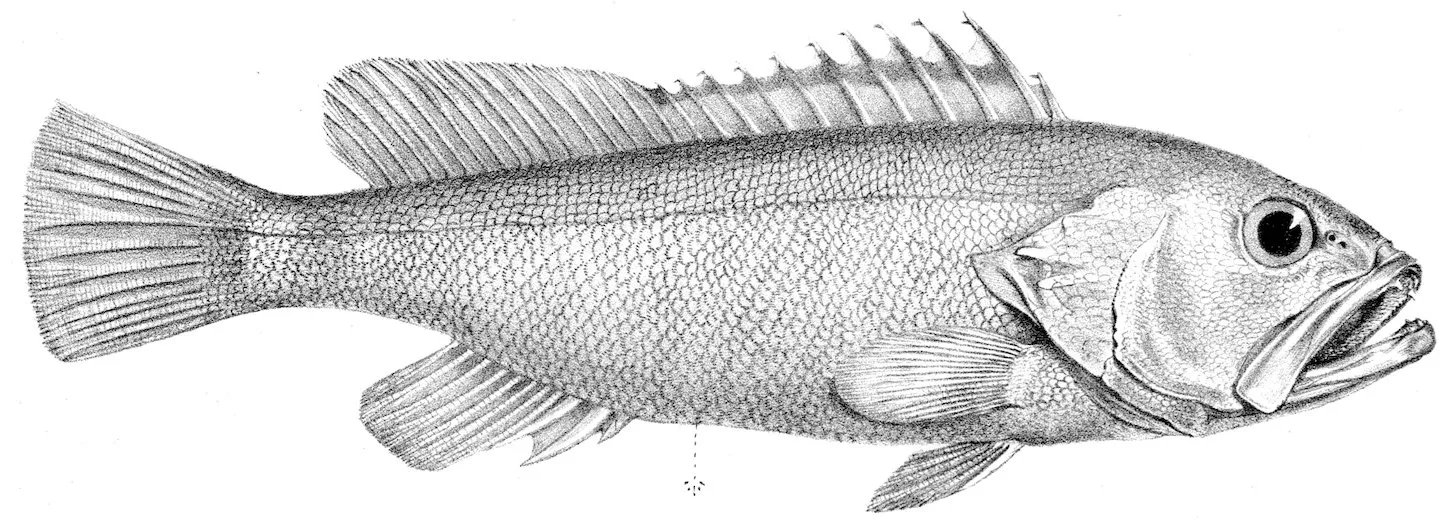
Fish. Pl. 3.
Drawn from Nature on stone by Waterhouse Hawkins.
Serranus labriformis. ½ Nat. Size.
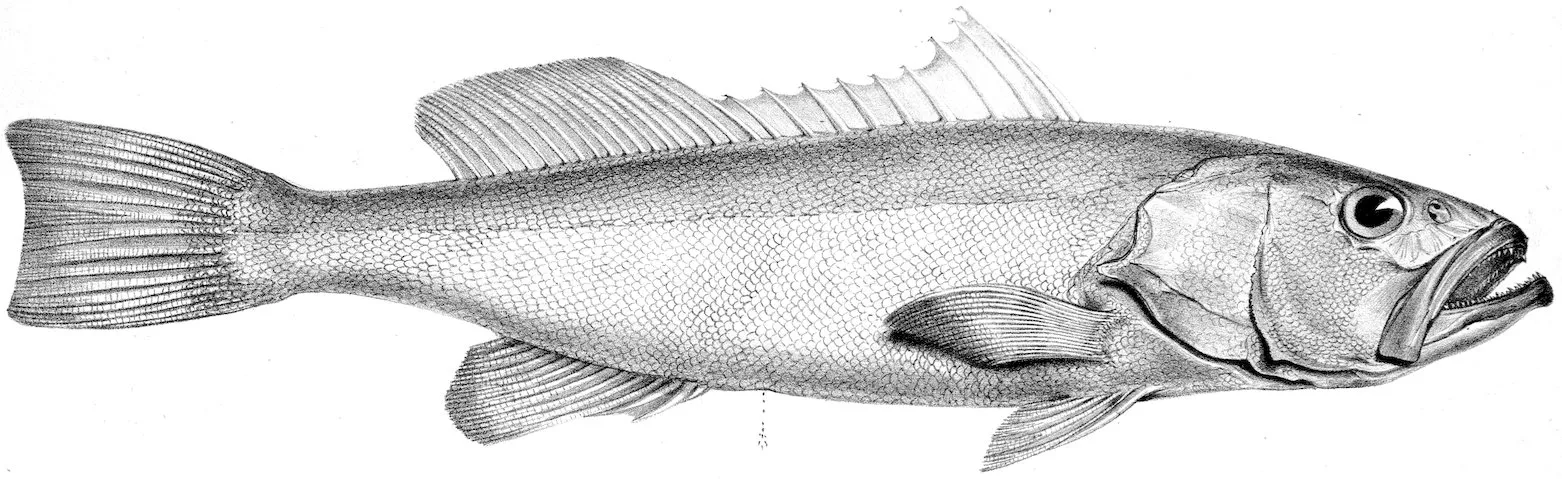
Fish Pl. 4.
W. Hawkins del.
Serranus olfax. ½ Nat. Size.
9Colour.—“Mottled with brown-yellow, black and white: upper and lower edges of the caudal,
edges of the dorsal and anal, ‘arterial’ and purplish red.”—D.
Habitat, Galapagos Archipelago.
Obtained off Chatham Island in the Galapagos Archipelago. There can be
little doubt of its being an undescribed species, well characterized by its labriform
appearance, as regards the fins, rounded and nearly entire margin of the preopercle,
and scales smooth above, but rough beneath the lateral line.
S. fusco-variatus; spinis dorsalibus ad apices laciniis investitis; naribus orbiculatis,
aperturâ unica magnâ, duas minores includenti; dentibus aculeiformibus, retroflexis,
seriebus paucis; caninis, in maxillâ superiore duobus, in inferiore quatuor, cæteris
vix fortioribus; preoperculo margine adscendenti prope recto, angulum versus paulum
sinuato, vix denticulato; operculo mucronibus duobus, parvis, subæqualibus,
armato; squamis ubique lævibus.
B. 7; D. 11/18; A. 3/11; C. 17, &c.; P. 17; V. 1/5.
Long. unc. 23½.
Form.—Rather elongated, with the dorsal and ventral lines equally curved, and neither departing much
from a straight line. Depth, in the region of the pectorals, equalling rather more than one-fifth
10of the entire length. Head contained three and a half times in the same. Profile sloping
gradually from the commencement of the dorsal to the end of the snout in one continuous very
gentle curve. The lower jaw a little the longest. The teeth are in strong card in both jaws,
their points curving inwards and backwards: those above longest anteriorly, where they form
about three rows; posteriorly they become velutine, as in the last species, and consist of not
more than two rows: in the lower jaw the teeth are equally large at the sides as in front, and,
excepting quite at the anterior extremity, in only two rows, the inner of which is stronger than
the outer. The canines are small, and scarcely stronger than the other teeth; in number[4] and
situation, the same as in the S. labriformis. The vomerine and palatine teeth are very fine
velutine. Eyes rather large, and high in the cheeks, equidistant from the upper angle of the
preopercle and the intermaxillary, with a diameter about one-seventh the length of the head:
the distance between them equals one diameter and one-third. The margin of the suborbital
is entire, and nearly straight. The maxillary, when the mouth is closed, reaches to beneath
the middle of the orbit. The nostrils are a little in advance of the eyes, and consist of one
large, nearly circular, aperture, enclosing two smaller ones, which are also circular and placed
equally in advance. The crown, and space between the eyes, and entire cheeks, are covered
with small scales; there are also some minute ones on the lower jaw, and on the extremity of
the snout before the eyes; but they are scarcely obvious, if present, on the first suborbital, and
not at all perceptible on the maxillary. The preopercle is rather more than rectangular; the
basal margin nearly straight and horizontal; the angle rather sharp; the ascending margin
with a slight sinuosity just above the angle, afterwards straight and nearly vertical, very obsoletely
denticulated throughout its course. The osseous portion of the opercle terminates posteriorly
in two flat points, nearly equal, but the lower one rather the more developed, between which
it is emarginate. The angle of the membrane is considerably produced beyond the lower
point. The line of separation between the opercle and subopercle is tolerably obvious. Gill-opening
large. All the pieces of the gill-cover are covered with scales scarcely smaller than
those on the body. The scales on the body are not large, of an oblong form, with their free
edges scarcely at all ciliated, not enough to feel rough to the touch; their whole surface very
finely striated, with twelve deeper striæ on the basal half, and the basal margin crenated.
Lateral line not very conspicuous, parallel to the back at about one-fourth of the depth. The
dorsal commences in a line with the posterior angle of the opercle, and occupies a space equalling
half the entire length, caudal excluded: spines strong, and tagged at their extremities; the
second longest, equalling not quite half the depth; third and succeeding ones gradually
decreasing to the tenth, which is about half the length of the second; the eleventh again
longer; then follow the soft rays, which are nearly even, but all higher than the last spinous.
The anal commences in a line with the third soft ray in the dorsal, and terminates a little before
that fin: first spine very short; the third longest, but the second stoutest: of the soft rays the
third and fourth are longest, and nearly twice the length of the third spine, being longer than
the soft rays in the dorsal; from the fourth they gradually decrease, giving this portion of the
fin a rounded form. The caudal is nearly even, but the central rays are a little shorter than the
outer ones. There are no rows of scales between the soft rays of the dorsal and anal, and
11scarcely any trace of them between those of the caudal. The pectorals are rounded, attached
low down, and about half the length of the head. Ventrals directly beneath them, shorter,
and more pointed.
Colour.—“Mottled brown.”—D. The dried skin appears nearly of a uniform brown, simply a
little paler beneath. There is some indication of a whitish band along the base of the anal and
soft dorsal, which may be the remains of a brighter colour. The base of the pectorals and
ventrals is also paler than the extremity of those fins.
Habitat, Galapagos Archipelago.
This species was also obtained at Chatham Island, in the Galapagos, where
Mr. Darwin states that it is common. In some of its characters it approaches the
S. labriformis, but in others it is essentially different. It rather departs from most
of the Serrani in the teeth, and in the small development of the canines. The
nostrils also are rather peculiar. Perhaps it may one day be found to constitute
the type of a distinct genus.
P. operculo spinis tribus, intermediâ maximâ; preoperculo margine adscendenti denticulato;
ad angulum dente unico, et ad marginem basalem dentibus duobus, fortibus;
pinnâ dorsali spinis quartâ et quintâ longissimis; pectoralibus radiorum apicibus
e membranâ paulo exeuntibus; caudali leviter rotundatâ.
B. 7; D. 13/15 vel 16; A. 3/8 vel 9; C. 172/2; P. 17; V. 1/5.
Long. unc. 15.
Form.—Greatest depth about one-third of the entire length, excluding caudal. Head rather
exceeding one-third. Profile descending obliquely in nearly a straight line from the commencement
of the dorsal to the end of the snout. Eyes large, high in the cheeks; their
diameter nearly one-fourth of the length of the head. The lower jaw a little the longest: both
it and the maxillary without scales. A band of velutine teeth in each jaw; the outer row in
card, with some, stronger than the others, which may be considered canines: above, the principal
canines are about six in number on each side near the extremity; below, there are three
or four larger than the others similarly situated. The preopercle has the ascending margin distinctly
denticulated; on the basal margin are two strong teeth directed forwards, and a third
at the angle. The opercle has three strong flattened spines; the middle one most developed.
At the lower angle of the subopercle is a small flat moderately sharp point. Fourth and fifth
dorsal spines longest; the succeeding ones gradually diminishing to half the height of the soft
portion of the fin which follows. Second anal spine very stout. Pectorals with the tips of the
rays slightly projecting beyond the membrane, giving it a festooned appearance. Caudal
slightly rounded.
12Colour.—The specimen above described appears, in its present state, greyish brown, with zig-zag
lines in different directions of a darker tint. A second individual is stated by Mr. Darwin to
have been, when alive, “above salmon-coloured.” A third is described as “above aureous-coppery,
with wave-like lines of dark brown, which often collect into four or five transverse
bands; fins lead-colour; beneath obscure; pupil dark blue.” Both these last specimens appear
now, like the first, greyish brown. The wave-like lines extend over a portion of the dorsal and
anal fins.
Habitat, coast of Northern Patagonia, and the mouth of the Plata.
This species is evidently very closely allied to the P. Brasilianum of Cuvier
and Valenciennes, and possibly may not be distinct. It differs, however, in having
only two, instead of three, teeth on the basal margin of the preopercle, which
character prevails in all the specimens. It has also one or two more soft rays in
the anal. It likewise approaches the P. aculeatum of the same authors, but this
last species is said to be particularly characterized by three very sharp points on
the subopercle towards the lower angle, in the room of which, in the species
here described, there is only one small triangular flattened point, rather sharp in
two individuals, but in the third blunt, with the margin slightly crenated. The
colours too appear to be different.
Mr. Darwin’s collection contains three specimens, which do not materially
differ from each other. The largest, measuring fifteen inches in length, was taken
in forty fathoms water off the mouth of the Rio Plata. The two others, smaller,
and not exceeding nine, and seven and a half inches respectively, were got on the
coast of Patagonia in lat. 38° 20′: where it is stated that great numbers were
obtained, many exceeding a foot in length. In these smaller specimens the
canines are not so numerous or well developed as in the larger one.
“One specimen when caught, vomited up small fish and a Pilumnus. Was
tough for eating, but good.”—D.
Diacope marginata, Cuv. et Val. Hist. des Poiss. tom. ii. p. 320.
Form.—Greatest depth of the body and length of the head equal, each being not quite one-third of the
entire length. Nape somewhat elevated, whence the profile falls very regularly in a slightly convex
line. The jaws appear equal when open, but when closed the upper one is a little the longest.
Teeth velutine, with four well-marked canines in the upper jaw, two on each side of the anterior
extremity, the outer one of which is longer than the inner. Opercle with two flat blunt points.
Denticulations of the preopercle, particularly those at the angle below the notch, moderately
well developed. Tubercle of the interopercle prominent. There are scales on the cheeks and
pieces of the gill-cover, but none on the crown, snout, jaws, or suborbitals. The scales on the
13body are moderately large. There are rows of small scales between the rays of the vertical fins,
but they are more developed between the soft rays than between the spinous. The dorsal has
the first spine half the length of the second, which itself is a little shorter than the third;
fourth, fifth, and sixth equal and longest; there is very little difference in the lengths of the
remaining rays, nor is there much between the spinous and soft portions of the fin, which, taken
as a whole, appears nearly even throughout. Anal short, commencing in a line with the fourth
soft ray of the dorsal, and terminating at the same distance from the caudal as that fin: second
and third spines very stout. Pectorals narrow and pointed, a little shorter than the head.
Ventrals a little shorter than the pectorals.
B. 7; D. 10/14, the last double; A. 3/8, the last double; C. 17, and some short ones; P. 16; V. 1/5.
Length 6 inches.
Colour.—“Upper part pale lead-colour: pectorals yellow; ventrals and anal orange: sides very
pale yellow.”—D. In spirits, the colour appears almost uniform greyish-white. The dorsal
and anal fins have an edging of black, which is not noticed by Mr. Darwin, and which is
characteristic of the species. The caudal is entirely dusky. There are no traces of spots on
any part of the body.
Habitat, Keeling Island, Indian Ocean.
All the known species of Diacope are stated by Cuvier and Valenciennes, as
coming from the Indian seas. The D. marginata was first brought from thence
by Commerson. It was afterwards received by the authors above mentioned
from Pondicherry. The expedition under Captain Duperrey, met with it at the
Island of Oualan. Mr. Darwin’s specimen was obtained at the Keeling or Cocos
Islands: I believe it to be referrible to this species, as it possesses the characteristic
black edging on the dorsal and anal fins; but as the description in the
“Histoire des Poissons” is very brief, containing a mere notice of the colours, I
have thought it advisable to annex that of the present individual.
Membrana branchialis septem-radiata; aperturâ amplâ. Pinna dorsalis unica; spinis
gracilibus. Dentes aculeiformes, tenues; serie maxillari externâ cæteris fortiori.
Operculum mucronibus duobus parvis posticè armatum. Preoperculum marginibus
basali et adscendenti denticulatis; spinis nullis. Ossa infraorbitalia leviter denticulata.
Os maxillare squamosum. Squamæ corporis levissimè ciliatæ, posticè
striis levissimis, transversis, parallelis, flabelli locum occupantibus.
I propose to establish this new genus for the reception of the Centropristes
Georgianus of Valenciennes, which appears to offer sufficient peculiarities to
14warrant such a step. Its herring-like form, denticulated suborbital, scaly maxillary,
small pectorals, backward position of the ventrals, and deeply forked caudal,
sufficiently distinguish it from Centropristes, with which it hardly agrees in any
of its characters, beyond that of wanting canines, and having the preopercle denticulated,
and the opercle armed with small sharp points. Its teeth, however, are
not exactly velutine, as in the typical species of that genus, but rather in fine card,
with the outer row in both jaws stronger than the others. But, perhaps, one of
the most marked peculiarities in this proposed genus resides in the scales, which
have, instead of the usual fan of diverging striæ on their basal portions, a triangular
space filled up by a number of extremely fine, closely approximating striæ,
parallel to each other, and also parallel to the basal margin, which is cut quite
square and entire.[5]
Although this genus is thus separated from Centropristes, there is no doubt
of its having a near affinity with it; and also with Grystes, from which last, however,
it is at once known by its denticulated preopercle. It is still more closely
allied to Apsilus, which it very much resembles in its general form, as well as in
some of its particular characters. Amongst other points of resemblance with this
last genus, may be noticed the similarity of the teeth; the very large gill-opening;
the small and inconspicuous points on the opercle; the weak spines of
the dorsal and anal, both which fins also terminate in a point behind; the small
pectorals, and the deeply forked caudal.
It is probable that the Centropristes truttaceus of Cuvier and Valenciennes
also belongs to this new genus, which, as well as the C. Georgianus, comes from
New Holland, and which those authors seem, not without much hesitation, to
have placed provisionally in the group in which it now stands. It is not stated,
however, whether the peculiar character of the scales in the C. Georgianus, above
pointed out, exists also in this species.
Centropristes Georgianus, Cuv. et Val. Hist. des Poiss. tom. vii. p. 338.
Form.—As M. Valenciennes has given an accurate and detailed description of this fish; and as I
have already stated above some of its leading characters, it is not necessary to say much
further on this head in reference to the specimen in Mr. Darwin’s collection. I need only
point out wherein it differs from the description in the “Histoire des Poissons,” the greater
part of which applies exactly. M. Valenciennes states that the ventral profile is more curved
than the dorsal, but there is not much difference in their respective degrees of curvature in this
15specimen. The thickness of the body, which he fixes at one-third of the depth, is here nearly
half the depth. The following characters may be also given, in addition to his. Above each
orbit are two short crests or ridges which meet at an angle anteriorly, and the interocular space
between these pairs of ridges is rather depressed; beyond, or immediately above the upper
lip, the snout is a little protuberant. The band of teeth in each jaw is narrow, with the outer
row longer than the others; and at the sides of the jaw, this outer row is all that is obvious.
The intermaxillary is slightly protractile. The eye is hardly removed so much as one diameter
from the end of the snout. The limb of the preopercle is striated; the angle at bottom
rounded, and much dilated, so that the ascending margin falls in advance of a vertical. The
contour of the membrane of the opercle is rounded. The cheeks, and all the pieces of the
gill-cover, with the exception of the broad limb of the preopercle, are scaly: there are also a
few scales on the maxillary, but none on the crown between the eyes, or on the snout, or lower
jaw. The dorsal and anal terminate nearly in the same vertical line, but the latter reaches a
trifle the farthest. Both fins are invested at their base with a scaly membrane, the scales of
which are of a long lanceolate form. The length of the caudal equals the depth of the body.
That of the pectorals equals half the depth: these fins are attached a little behind the opercle,
and a little below the middle. The point of attachment of the ventrals is in a vertical line
which passes through the middle of the pectorals, and coincides with the commencement of the
dorsal. They are longer than the pectorals; and in their axillæ is a lanceolate membranaceous
scale half their own length. There is a similar, but shorter scale in the axilla of the pectorals
also.
B. 7; D. 9/16; A. 3/10; C. 17–6/6; P. 15; V. 1/5.
Length 9 inches 10 lines.
Colour.—Not noticed in the recent state. In spirits, the whole fish appears of a nearly uniform
dull metallic yellowish white, tinged with olive on the back and upper part of the sides.
Mr. Darwin obtained this species in King George’s Sound, in New Holland,
the same place in which it was discovered by MM. Quoy and Gaimard.
Aplodactylus punctatus, Cuv. et Val. Hist. des Poiss. tom. viii. p. 352. pl. 242.
This very remarkable fish was first sent from Valparaiso, by M. D’Orbigny,
where it was also observed by M. Gay. Mr. Darwin’s collection contains a specimen,
which has unfortunately lost the number attached to it; but as he made a
collection on that coast, it was probably obtained in the same locality. The description
given of it in the “Histoire des Poissons,” is so detailed as well as accurate,
and the figure so exact, that it is quite unnecessary to annex that of the present
individual. I may merely observe that the number of simple rays at the bottom
16of the pectorals, which appears to be a character of some importance, and which
has led to the generic name of Aplodactylus, amounts in this specimen to six,
being two more than was observed by M. Valenciennes in his, though the total
number of rays in this fin is the same. I may also allude to the circumstance of
the dorsal being invested at the base with a thickened membrane on each side,
closely covered with small scales, which extends over nearly its whole length,
but is most conspicuous along the spinous portion. This character is not mentioned
by M. Valenciennes. Neither does he mention the rows of minute scales,
which occur between the rays of all the fins, except the ventrals.
Mr. Darwin’s specimen of this fish is eleven inches in length. The following
is the fin-ray formula:
B. 6; D. 15—1/21; A. 3/8; C. 17. &c.; P. 9—vi; V. 1/5.
Dules Auriga, Cuv. et Val. Hist. des Poiss. tom. iii. p. 83. pl. 51.
Form.—This species is remarkable for the prolongation of the third dorsal spine, which, in the
present specimen, is not quite equal to half the entire length of the head and body; a small
portion, however, appears to have been broken off. The greatest depth is contained three and
a half times in the entire length. The head, measured to the extremity of the opercular
membrane, exactly equals the depth. The line of the profile is not quite straight, there being
a slight depression at the nape, above which is a convexity in immediate advance of the dorsal
fin. The lower jaw is a very little the longest. The eyes are large; and the distance between
them barely equals their diameter. The other characters are exactly as stated in the “Histoire
des Poissons.”
B. 6; D. 10/13; A. 3/7; C. 17; P. 17; V. 1/5.
Length 5 inches 3 lines.
Colour.—The recent colours are given by Mr. Darwin in his notes as follows: “Sides with numerous
waving longitudinal lines of brownish red; the intermediate spaces greenish-silvery, so figured
as to look mottled. Head marked with lines of dull red and green. Ventral and anal fins dark
greenish blue.”—He does not notice the vertical bands alluded to by Cuvier and Valenciennes,
which are sufficiently obvious, and which accord with the figure and description of the authors
just mentioned.
Habitat, Maldonado Bay, Rio Plata.
17
Dules malo, Val.? Hist. des Poiss. tom. vii. p. 360.
D. pinnis caudali, anali, dorsalique molli, nigro-marginatis; dorsali profundè emarginatá,
spiná ultimá radiis articulatis breviore; operculo mucronibus duobus, inferiore
maximo, armato; preoperculo margine adscendenti levissimè denticulato, basali
denticulis fortioribus.
B. 6; D. 10/11; A. 3/12; C. 16, &c.; P. 13; V. 1/5.
Long. unc. 4. lin. 5.
Form.—General form resembling that of a small Dace. Greatest depth about one-third of the entire
length, caudal excluded. Length of the head rather less. Dorsal line falling with the profile
in one continuous gentle curve. Eyes large; their diameter contained two and a half times in
the length of the head: the distance between them less than one diameter. Suborbitals finely
but very conspicuously denticulated. Jaws nearly equal; the lower one a little the longest. In
each, a band of velutine teeth, with the outer row rather longer than the others. Opercle with
two points, the lower one most developed. Preopercle with the limb striated: the ascending
margin with the denticulations so fine as to be hardly sensible to the naked eye; those on the
basal margin larger and more obvious. Scales of a moderate size; about forty-three in a
longitudinal row; their free portions finely striated. Cheeks and opercle scaly; crown naked,
with a shallow groove above each eye. Lateral line at first slightly descending, but afterwards
straight; its course, until past the dorsal and anal fins, a little above the middle of the depth.
Dorsal deeply notched: the anterior portion consisting of nine spines; the first very short, and
scarcely more than half the length of the second; third and fourth longer, increasing gradually;
fifth and sixth equal and longest, equalling half the depth of the body; seventh, eighth, and
ninth, shorter, and gradually decreasing; the tenth spine, with which the second portion of
the fin commences, is of the same length as the fifth, but not quite so long as the soft rays
which follow; these soft rays, however, gradually become shorter, the last two not more than
equalling the second spinous. The whole space occupied by the dorsal is more than one-third
of the entire length. Anal commencing in a line with the ninth dorsal spine; its own three
spines gradually increasing in length, but the second the strongest; soft portion of this fin
longer than the corresponding portion of the dorsal, and terminating a little nearer the caudal.
Vent in a line with the seventh dorsal spine. Pectorals small, reaching to the vent. Ventrals
attached a little further back, and reaching a very little beyond it. Caudal forked.
Colour.—(In spirits.) Silvery, tinged on the back, and above the lateral line, with bluish grey,
and somewhat mottled in places with darker spots. Fins yellowish grey, tinged with dusky.
The caudal, anal, and soft portion of the dorsal, are a little mottled with dusky, besides having
a black edging; there is also a conspicuous black spot at the anterior angle of this last fin.
18A second specimen is only three inches and a quarter in length; but differs
in no respect from the above, except in having one soft ray less in the anal fin.
Habitat, River Matavai, Tahiti.
Several of the species in this genus are extremely similar as well in form as
in colours. Possibly that which I have here characterized as new may not be
distinct from the D. malo of Valenciennes, which comes from the same country;
but the description in the “Histoire des Poissons” is so brief, that it is hardly
possible to determine this point with certainty. It has, however, two, and one
specimen three, soft rays less in the anal fin. It is also closely allied to the
D. marginatus, from which it hardly differs, excepting in having the denticulations
of the preopercle rather stronger, and the tenth dorsal spine shorter in relation
to the soft rays which follow. The D. marginatus, however, comes from
Java. The species here described was found by Mr. Darwin in Tahiti, in the
river of Matavai.
H. corpore lineis longitudinalibus nigricantibus octo; pinnis dorsali, anali, caudalique,
maculis fuscis; vertice striis elevatis duabus subparallelis; preoperculo distinctè
denticulato, et ad marginem limbi internum subcristato; operculo mucronibus duobus,
superiore minimo; squamis ubique lævissimis.
B. 6; D. 12/9; A. 3/7; C. 17, &c.; P. 15; V. 1/5.
Long. unc. 9. lin. 9.
Form.—Body oblong. Greatest depth exactly four and a half times in the entire length. Length
of the head rather less than the depth of the body. Snout short and obtuse. Jaws exactly
equal: each with a broadish band of velutine teeth, which are all, apparently even the most
minute, three-pointed, although this character is not very obvious except in the outer row, which
are longer than the others. No vomerine teeth appear externally, but they may be felt through
the skin of the palate, and on dissecting this off, there is brought to view a small hard disk
rough with minute asperities. Mouth very little cleft, the commissure not extending more
than half-way between the end of the snout and the anterior margin of the orbit. Eyes rather
large; their diameter one-fourth the length of the head. Maxillary, when the mouth is closed,
concealed in part beneath the suborbital, the lower margin of which is somewhat sinuous and
obscurely denticulated, the denticulations being concealed by the membrane and more easily
felt than seen. The denticulations on the preopercle very manifest. The principal spine on
the opercle slender and very sharp, not exactly straight, but slightly curved, the convexity of
the bend being downwards; above is a second spine, but very small and easily overlooked.
19The crown of the head has two nearly parallel elevated lines, which take their origin between
the nostrils, and terminate at the occiput, but do not meet as in the H. sexlineatus;[6] a third
line commences there exactly between them, and runs singly in a backward direction down the
middle of the nape; this last is scarcely more than half the length of the two former. The
cheeks and pieces of the gill-cover are scaly; but not the cranium, snout, jaws, or limb of the
preopercle, which last is margined internally by a slightly elevated ridge. The scales on the
body are thin and small, and without any trace of denticulations on their free edges, even under
a magnifier, and the body of the fish is quite smooth to the touch rubbed either way. Lateral
line as in H. sexlineatus. Dorsal also nearly similar, but more deeply notched, the membrane
beyond the eleventh spine falling nearly to the base of the twelfth, which precedes the soft
portion: sixth spine longest, equalling very nearly, but not quite, half the depth; the eleventh
equals the second; the twelfth is about one-third longer than the eleventh, but is itself scarcely
half the first soft ray. The anal has three soft rays less than the H. sexlineatus, and there are
apparently but two spines, the first being (at least in this specimen, where, however, there may
have been a portion broken off) quite short and rudimentary; the second and third spines are
both slender, the former being rather more than half the length of the latter, and this last
rather more than half the first soft ray. All the fins take their origin as in H. sexlineatus.
The pectorals are about two-thirds the length of the head. The ventrals, which are very near
together, are longer than the pectorals, but do not equal the head: they have no elongated
scale between them, or in their axillæ.
Colour.—For the most part similar to that of the H. sexlineatus; but the longitudinal dark lines
are more numerous, amounting to eight, with faint traces of a ninth: the additional ones are on
the upper half of the sides, or above the lateral line, there being four (instead of two) above
that one which passes through the eyes; the sixth extends the whole length of the fish from
the end of the maxillary to the base of the caudal; the seventh passes immediately below the
pectoral, and terminates in advance of it, without quite reaching to the edge of the gill-cover;
the eighth is exactly equidistant from the pectoral and ventral; this last is a very narrow pale
line, but the others, with the exception of the first two, are broader and well marked. The
soft portion of the dorsal, as well as the anal and caudal are spotted; the spots on this last
unite to form transverse fasciæ; those on the anal are not very well-defined. The pectorals and
ventrals are without spots, and pale.
Habitat, S. W. coast of Australia.
This species was procured in King George’s Sound, New Holland. It closely
approaches the H. sexlineatus of Cuvier and Valenciennes, the only species of the
genus hitherto described, and obtained in the same seas by MM. Quoy and Gaimard.
I have little hesitation, however, in pronouncing it to be distinct. Independently
of the additional longitudinal lines on the body, and the spots on the
fins, which, it is expressly stated by the above authors, are not present in the
H. sexlineatus, it is distinguished by the striæ on the crown not meeting behind,
the dorsal being rather more deeply notched, and the fin-ray formula different.
20There is one soft ray less in the dorsal, and three less in the anal; also the first
spine in this last fin, if it be not broken off in this specimen, is quite rudimentary.
The scales present no trace of cilia on their free edges.
P. corpore fasciis transversis duodecim castaneo-fuscis, alternis latioribus; dentibus
palatinis paucis, conicis, subaggregatis, vix seriem formantibus; pharyngalibus
aculeiformibus; membranâ branchiali mediocriter emarginatá; operculo spinâ unicâ
forti, alterâ superiore obsoletâ; pinnis ventralibus accuratè thoracicis.
B. 6; D. 7/27; A. 1/24; C. 15, &c.; P. 18; V. 1/5.
Long. unc. 12. lin. 9.
Form.—Body thickest, as well as deepest, in the region of the pectorals, compressed behind, and
becoming more so as it approaches the tail; depth also gradually diminishing from that point.
The greatest depth is rather less than five and a half times in the entire length: head contained
four times and a quarter in the same. The thickness at the pectorals is at least three-fourths of
the depth: and the thickness of the head is quite equal to it. Dorsal line nearly straight from behind
the eyes, in front of which the profile descends obliquely. Eyes high, nearly reaching to the
line of the profile; a little behind the middle point of the length of the head; their diameter
rather less than one-fifth of this last; the distance between them one diameter and a half. The
commissure of the lips does not reach to the eyes by a space equalling half the diameter of the
eye. Jaws equal. Lips very thick and fleshy, and partially reflexed, like those of a Labrus.
Teeth very similar to those of that genus. In the upper jaw, an outer row (extending all round)
of strong, sharp, slightly curved teeth, regularly set, and nearly even, but with the anterior
ones a little the longest; in all about forty, twenty on each side; behind these a velutine band,
broadest in front, but also extending the whole way round. In the lower jaw, a row of curved
strong teeth, similar to those above, but extending only half-way along the sides of the jaws
(about nine on each side), and followed by about seven or eight short blunt conical ones; a
broad velutine band behind the longer curved teeth, but not behind the others. On the front of
the vomer are four or five large blunt conical teeth, mixed with smaller ones of the same form:
there is also a small group of these little conical teeth at the commencement of each palatine,
but they are not carried on further in a single row.[7] Tongue small and inconspicuous, fastened
down except just at the tip, smooth. Pharyngeal teeth in strong card; but no conical ones
behind that are visible. Branchial membrane united to its fellow, and free all round at the
margin, with a moderately deep notch underneath. Preopercle rounded at the angle; the
ascending margin oblique. Opercle with a strong sharp spine at its upper angle, but not extending
beyond the membrane; a second rudimentary one above it obtusely rounded. Small
scales on the cheeks, preopercle, and opercle, but not on the snout, or between the eyes, or on
the suborbital, or jaws, or branchial membrane, or interopercle. The scales on the body are
rather small, finely ciliated on their edges, thin, and of an oblong form, cut square at the basal
margin, with a fan of twelve or fifteen striæ. Lateral line not very strongly marked, taking
nearly a straight course from the upper part of the scapular to the caudal. No particular lines,
markings, or pores, about the head, jaws, or between the eyes. Pectorals rounded; two-thirds
the length of the head. Ventrals exactly beneath them, a very little shorter, thick and
fleshy, so that the rays can hardly be distinguished. Dorsal and anal similar to those of the
P. Brasilianus; the former has the spinous rays at first low, but the rest of the fin is of one
uniform height, equalling a little less than half the depth: the latter commences under the sixth
soft ray of the dorsal, and terminates in the same line. Caudal square, with rows of small
scales between the rays for half their length: also a few minute scales at the base of the pectoral
rays, but none on the other fins.
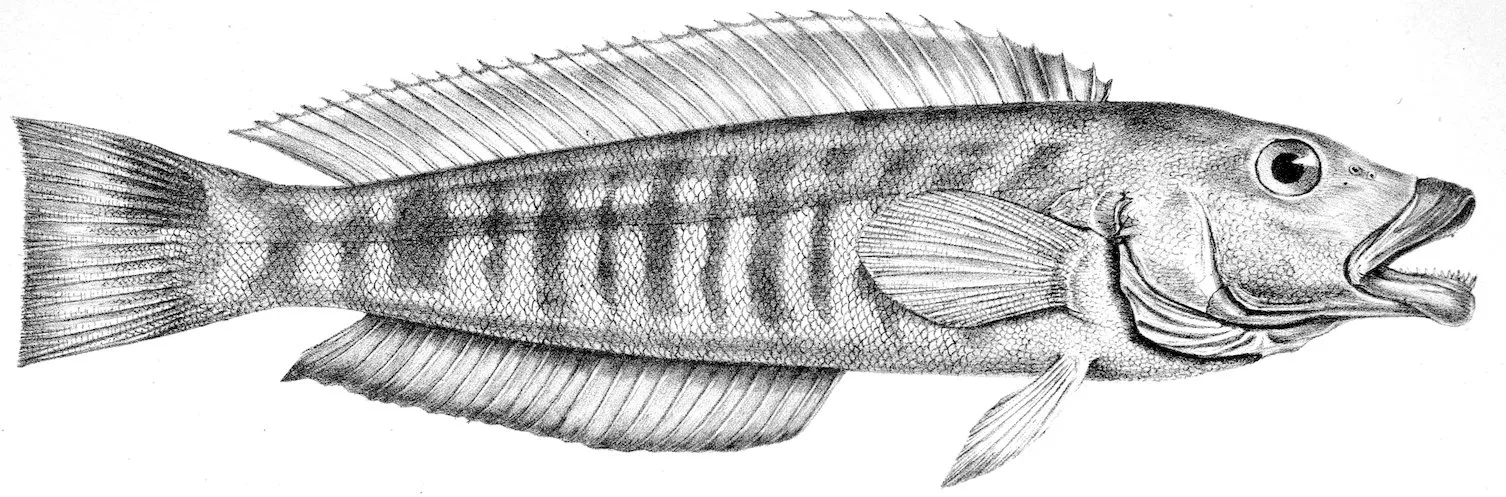
Fish. Pl. 5.
W. Hawkins delt.
Pinguipes fasciatus. ¾ Nat. Size.
21Colour.—“Above pale ‘chestnut brown,’ so arranged as to form transverse bands on the sides;
sides, head, fins, with a black tinge; beneath irregularly white: under lip pink: eyes with
pupil black, and iris yellow.”—D. In spirits; the back and upper half of the sides are brown,
the lower half of the sides and belly pale, with twelve transverse dark fasciæ, the alternate
ones broader than the others. The dorsal and anal appear to have been bluish, the tint
increasing in intensity from the base upwards; but the former is edged above with a narrow
white line just beneath the tips of the rays, which extends the whole length of the soft portion
of the fin. The inside of the ventrals appears also to have been bluish; but the pectorals are
pale, or yellowish. Caudal brown like the back.
Habitat, coast of Northern Patagonia.
From the east coast of Patagonia, in Lat. 37° 26′. There can be no doubt of
its belonging to the genus Pinguipes, with which it agrees in its very strong resemblance
to the Labridæ, as regards the head, lips, and teeth, and in its fleshy
ventrals; but there are very few teeth on the palatines, seeming to show that
there is not much ground for separating this genus from Percis. In many of its
characters, it resembles the P. Brasilianus of Cuvier, but it is decidedly distinct
in others. It differs slightly in its proportions; in the palatine and pharyngeal
teeth; in the position of the ventrals, which are not at all jugular, but immediately
beneath the pectorals; in the branchial membrane being more notched;
and in having two soft rays less in the anal. The colours also are different.
This fish is so like a Labrus, that at first sight it might easily deceive a student.
Nevertheless its vomerine teeth, spines on the opercle, and ciliated scales, point
out its right family. At the same time no system can be considered natural,
which does not admit Pinguipes as one of the connecting links between the Percidæ
and Labridæ.
22
Pinguipes Chilensis, Cuv. et Val. Hist. des Poiss. tom. ix. p. 338.
Form.—More slender and elongated than the last species. Depth nearly six and a half times in
the entire length. Head four times and a quarter in the same. Eyes high, a little before the
middle, or with the distance in front to the end of the snout not equalling that behind
measured to the posterior part of the opercle; their diameter nearly six times in the length of
the head; the interval between them nearly two diameters. When the mouth is closed, a
vertical from the posterior part of the maxillary forms a tangent to the anterior part of the
orbit. Lips not so thick and fleshy as in the P. fasciatus; but the teeth almost exactly similar.
Tongue much larger, occupying nearly the entire platform of the mouth. Branchial membrane
much more deeply notched, the notch reaching as far as the anterior extremity of the interopercle.
Preopercle with the ascending margin nearly vertical. Opercle with two small flat spines,
the lower one rather more developed then the upper. Scales and lateral line as in the P.
fasciatus. Pectorals similar. Ventrals attached entirely in front of the pectorals, though not
much in advance; fleshy, but perhaps rather less so than in the P. fasciatus: in neither species
do they pass beyond the pectorals, or indeed reach quite so far. The other fins exactly similar.
The dorsal, however, has one spine less, and one soft ray more. The anal, also, has one soft
ray more.
B. 6; D. 6/28; A. 1/25; C. 17, &c.; P. 19; V. 1/5.
Length 11 inches.
Colour.—(In spirits.) Back and sides deep brown, with the exception of two rows of pale spots
along the sides, very faint and ill-defined. Underneath altogether paler. The dorsal and anal
appear to have been bluish, with the basal portion of each fin pale, but without any edging of
white above. Inside of the ventrals blue; pectorals the same, but paler. The caudal shows
some trace of a dark round spot on the base of the upper lobe. Mr. Darwin’s notes, with respect
to the colour in the living fish, only state “fins dark.”
Habitat, Valparaiso, Chile.
This species, which was procured by Mr. Darwin at Valparaiso, is probably
the same as the P. Chilensis of Valenciennes, obtained by M. Gay on the same
coast. But the description in the “Histoire des Poissons” is brief, and notices
very little besides the colours, which accord tolerably well. Mention, however,
is made of a second spine in the anal fin, which certainly does not exist in the
above specimen, though a very careful examination was made in search of it.
There is also one soft ray more in this fin, as well as in the dorsal, in the fin-ray
formula in that work.
This species is very distinct from the P. fasciatus last described, and does
23not show so strong a resemblance to the Labridæ; but it approaches very closely
the P. Brasilianus.
Percophis Brasilianus, Cuv. et Val. Hist. des Poiss. tom. iii. p. 209. pl. 64.
———— Brasiliensis, Freycinet, (Voyage) Zoologie, p. 351, pl. 53. fig. 1.
Form.—Depth and breadth in the region of the pectorals about equal, each being contained ten and
a half, or nearly eleven times in the entire length. Head not quite four and a half times
in the same. In the upper jaw, three strong, curved, sharp-pointed canine teeth on each side;
besides a velutine band extending the whole way, with the outer row longer and more developed
than the others: in the lower jaw a velutine band, with long sharp canines, similar to those
above, arising amongst them at nearly regular intervals, to the number of ten or eleven on each
side; none exactly in front, and not all of the same size, but passing here and there into card.
Membranous margin of the preopercle very finely, almost obsoletely denticulated. Branchial
membrane with seven rays, the seventh being not much smaller than the sixth.[8] The whole
head covered with scales, including the lower jaw, and the upper half of the maxillary. Lateral
line nearly straight, a little above the middle. First dorsal commencing at about one-third of
the entire length, excluding caudal; of a triangular form, with its length a little exceeding its
height; second spine longest, about equalling the depth of the body. Distance between the
two dorsals equalling half the length of the first. Second dorsal with the first ray longest,
equalling the longest of the spines in the first dorsal; second and succeeding rays slightly
decreasing to the sixth, beyond which they are nearly even, with the exception of the last three
or four, which are shorter; all these rays very much branched, with the intervening membrane
deeply notched. Anal commencing a little before the end of the first dorsal, and terminating
nearly in a line with, but in strictness a very little beyond, the second dorsal; rays and membrane
much as in that fin, to which it answers in general height. Distance between the second dorsal
and caudal, only one-twenty-eighth of the entire length. Caudal appears obliquely square, the
upper rays being slightly longer than the lower, but perhaps worn so. Pectorals one-eighth of
the entire length. Ventrals about three-fourths of their length, attached in front of them, as
described by Cuvier. In the axillæ of the pectorals is a falcated membranaceous appendage
covered with scales (not noticed by Cuvier), a very little less than one-fourth the length of the
fins themselves.
B. 7; D. 10—32; A. 41; C. 15. &c.; P. 18; V. 1/5.
Length 21 inches.
Colour.—“Above pale, regularly and symmetrically marked with brownish red, the tip of each scale
being so coloured. Beneath silvery white. Sides with a faint coppery tinge. Ventral fins
yellowish. Pupil of the eye intense black.”—D.
24Second Specimen.—Breadth or thickness at the pectorals about ten and a half times in the entire
length. Depth at that point less than the breadth. Canine teeth in the lower jaw smaller than
those above, and not set at such regular intervals as in the first specimen.[9] Scarcely any
appearance of denticulations on the membranous border of the preopercle. Distance between
the two dorsals a little less than the length of the first. Pectorals contained eight and a half
times in the entire length. Fin-ray formula as follows:—
D. 9–32; A. 42; C. 15, &c.; P. 17; V. 1/5.
Length 14 inches.
In all other respects exactly similar to the specimen first described.
Habitat, coast of Northern Patagonia, and Maldonado.
Mr. Darwin’s collection contains two specimens of this fish, which was first
discovered by MM. Quoy and Gaimard at Rio Janeiro. The larger one was
caught by hook and line in fourteen fathoms water on the coast of Patagonia, in
lat. 38° 20′. The second was taken at Maldonado, where he states it to be common.
They differ in several respects from the description and figure in the
“Histoire des Poissons,” of Cuvier and Valenciennes; but as they also differ a
little from each other, the species is perhaps subject to variation. Amongst other
points, I may mention the scales on the jaws, which are expressly stated by Cuvier
to be without scales; and also the emargination of the membrane between the
rays of the second dorsal and anal, which is not represented in his figure, nor
alluded to in his description, though very striking. This last character appears,
however, in the figure given in the Zoological Atlas of Freycinet’s voyage, which
is on the whole a more correct representation. “When cooked, was good
eating.”—D.
Upeneus flavolineatus, Cuv. et Val. Hist. des Poiss. tom. iii. p. 336.
Form.—Considerably elongated. Greatest depth contained five times in the entire length, caudal
excluded. Head three and a half times in the same. Dorsal line nearly straight. Profile very
convex. Crown between the eyes broad and somewhat depressed, forming a slight hollow.
25Eyes large; their diameter more than one-fourth that of the head. Suborbitals marked on their
surface near the lower margin with six or eight diverging salient lines, each terminating at
bottom in a mucous pore. Teeth forming a narrow velutine band, hardly visible to the naked
eye, but sensible to the touch: none on the vomer or palatines. Opercle with one short flat
spine projecting beyond the posterior margin rather more than half a line. Barbules reaching
to a little beyond the angle of the preopercle. Mucous tubes of the lateral line with five or six
branches; the branches not always simple,[10] but consisting sometimes of two or three main ones
which are subdivided. First dorsal of a triangular form, with the spines rather slender; the
first two equalling more than three-fourths of the depth of the body. Space between the dorsals
about equalling the length of the first. Second dorsal with the first ray (or spine) scarcely
more than half the length of the second, which is longest; the third and succeeding rays gradually
decreasing to the last, which is shortest. Length of the second dorsal just equalling its
greatest height. Anal answering to this last fin. Caudal deeply forked; the central rays not
being one-fourth the length of the outermost ones. Ventrals and pectorals exactly of the same
length; both reaching to a vertical line from the extremity of the first dorsal. Vent in a line
with the commencement of the second dorsal.
D. 7–1/8; A. 1/6; C. 15, &c.; P. 16; V. 1/5.
Length 6 inches 9 lines.
Colour.—“Dull silvery, with a yellow stripe on the side.”—D.
There can be but little doubt of this species being the U. flavolineatus, which
appears to have a wide range over the Indian Ocean, and also to occur in the
South Pacific. Mr. Darwin’s specimen was taken at the Keeling Islands.
Upeneus trifasciatus, Cuv. et Val. Hist. des Poiss. tom. iii. p. 344.
Form.—General form resembling that of the Mullus Surmuletus, but the snout more elongated.
Greatest depth contained about four times and a half in the entire length. Head exactly one-fourth
of the same. Eyes small, distant three diameters from the end of the snout. Suborbitals
with a moderate number of pores on their disk, but without any salient lines. Posterior extremity
of the maxillary broad. A single row of conical teeth in each jaw, very uniform in size,
not very large or very close; about twenty-two above and twenty below. Spine of the opercle
about a line in length. Barbules reaching to, or a little beyond, the posterior margin of the
opercle. Lateral line not much ramified. Height of the first dorsal equalling more than half
the depth. Space between the two dorsals equalling one-third the length of the second dorsal.
26Both this last fin and the anal terminating in a considerable point behind. Ventrals large,
reaching very nearly to the anal.
D. 8—9; A. 7; C. 15, &c.; P. 16; V. 1/5.
Length 7 inches 9 lines.
Colour.—(In spirits.) Dark brownish yellow, with faint indications of three dusky patches or
abbreviated transverse fasciæ, one beneath each dorsal, and the third on each side of the upper
part of the tail. Second dorsal and anal crossed by several whitish longitudinal lines; the
posterior point of each fin nearly black.
This species was obtained by Mr. Darwin at Tahiti. It is probably the U.
trifasciatus of Cuvier and Valenciennes, who received their specimens from the
Carolinas and Sandwich Islands. But it does not so well accord with the Mulle
multibande of Quoy and Gaimard, which is supposed by the authors of the “Histoire
des Poissons,” to be the same as their species. If the figure in the Zoology
of “Freycinet’s Voyage” be correct, the Mulle multibande has the nostrils much
smaller, and the spines of the first dorsal much stronger; the ventrals also are
relatively much shorter, so as to reach very little more than half-way to the anal.
Future observation must determine whether the two fish are distinct or not.
Upeneus Prayensis, Cuv. et Val. Hist. des Poiss. tom. iii. p. 357.
Form.—Very much resembling that of the U. trifasciatus, but with the following differences. The
eyes rather larger, distant from the end of the snout rather more than two diameters and a half.
Suborbitals traversed towards their lower margins by a number of lines, each terminating in a
pore, and with their whole disks studded besides with pores without lines: the lower margin
itself presents four distinct deeply-cut notches, the first of which receives the end of the maxillary
when the mouth is closed. A single row of small conical teeth in each jaw; in addition
to which, in the upper, there are some stronger ones in front, exterior to the others, amounting
to eight in number, the central pair of which bends inwards or towards each other, and the
three on each side, which are the strongest of all, backwards and outwards. No teeth on the
vomer or palatines. The posterior extremity of the maxillary is much narrower than in the
last species. Spine of the opercle sharp and well developed, about two lines and a quarter in
length. Barbules reaching very nearly to the posterior margin of the opercle. Ramifications
of the mucous tubes on the lateral line very numerous. Height of the first dorsal equalling
rather more than half the depth. Space between the two dorsals equalling half the length of
the second dorsal. This last fin pointed behind, as well as the anal, but not so much so as in
the U. trifasciatus. Pectorals when laid back reaching to a vertical line from the extremity of
27the first dorsal. Ventrals reaching a little beyond the pectorals, but falling short of the anal by
a space equalling half their own length.
D. 8–9; A. 7; C. 15, &c.; P. 16; V. 1/5.
Length 8 inches.
Colour.—“Vermilion, with streaks of iridescent blue.”—D. In spirits, the colour appears of a
uniform dull reddish yellow, without any indication of spots or other markings on the fins or
body.
Habitat, Porto Praya, Cape Verde Islands.
I suppose this to be the U. Prayensis of Cuvier and Valenciennes, the description
of which, so far as given in the “Histoire des Poissons,” is tolerably applicable.
Those authors, however, mention a spot in the middle of each scale of a
deeper red than the ground colour, which is not alluded to by Mr. Darwin in his
notes, and of which I see no trace on the fish in its present state. On the other
hand they are silent with regard to the blue streaks. In some of its characters,
especially as regards the teeth, this species seems to approach the U. maculatus;
but the colours are different in this last also, which is moreover found on the opposite
side of the Atlantic.
Trigla kumu, Less. et Garn. Zoologie de la Coquille, (Poissons) Pl. 19.
———— Cuv. et Val. Hist. des Poiss. tom. iv. p. 36.
Form.—In general appearance very much resembling the T. Hirundo, but more elongated. Depth
contained about five times and a half in the entire length. Head rather more than four times
and a quarter in the same. The obliquity of the profile about the same as that of the T. Hirundo,
but the concavity of the interocular space less. The granulations on the head not so coarse, or
so strongly marked, the lines in which they are arranged being closer and more numerous:
those on the suborbitals radiate from a point nearer the extremity of the snout: no crest or
ridge at the bottom of the suborbital, and only a very indistinct one at the bottom of the preopercle:
as Cuvier has well noted, the grains on the border of the preopercle are divided into
little isles, or collected in clusters, by irregular lines which undulate amongst them; and in
this specimen, the same character presents itself on the posterior and upper portion of the
suborbital: some of the first lines on the opercle are plain, or without granulations. Snout
emarginated, with three or four denticulations on each side rather sharper and more developed
28than in the T. Hirundo. Two spines at the anterior angle of the eye; but none at the posterior
angle, or on the temples. Suprascapular, opercular, and clavicular spines much as in the
T. Hirundo. Lateral line and whole body smooth, excepting the dorsal ridges, which are
strongly serrated. Dorsal spines as in the T. Hirundo; second longest; the first with a
series of obsolete granulations on its anterior edge. Pectorals not quite one-third of the entire
length: free rays incrassated in the middle, tapering towards the ends, but with the extreme
tips slightly dilated.
D. 10—16; A. 16; C. 11, &c.; P. 11, and 3 free; V. 1/5.
Length 16 inches 6 lines.
Colour.—“Whole body bright red.”—D. The pectorals, of which no note was taken in the recent
state, appear, in the dried skin, externally, of a dusky colour, approaching to black, with
white rays; the lower margin, however, is paler, and was probably originally red like the body:
inside, the colour is much the same, but variegated with a few white spots; there are also
portions of a paler tint, probably the remains of a fine blue. I see no distinct trace of the
large deep black spot, said by Cuvier to occupy the seventh and eighth rays on the posterior
face of the fin.
Taken in the Bay of Islands, New Zealand. The only respect in which it
differs from the description of the T. kumu by Cuvier and Valenciennes, is its
having one more spine in the first dorsal.
Prionotus punctatus, Cuv. et Val. Hist. des Poiss. tom. iv. p. 68.
Form.—Well characterized by the form of the snout, which is very obtuse, and as it were truncated,
with scarcely any notch in the middle; the margins of the lobes are crenated with minute denticles,
immediately beyond which is a small sharp spine directed backwards; further on, almost
immediately above the corners of the mouth, is a second similar, but somewhat larger spine.
There are also some minute spines on the temples, as well as on the ridge of the preopercle,
besides the ordinary spines, common to other species, which in this are all well developed and
very sharp. Dorsal spines smooth, or only the first with a faintly marked line of granulations;
third longest. Pectorals long, contained exactly two and a half times in the entire length;
when laid back, they reach to within two rays of the extremity of the second dorsal. Free
rays rather slender and tapering, with the extreme tips pointed; not above half the length of
the pectorals. Ventrals rather longer than the free rays.
D. 10—12; A. 11; C. 11, &c.; P. 13 and 3; V. 1/5.
Length 8 inches 9 lines.
Colour.—“Above and sides olive brown, with red spots and marks; beneath silvery white; edges
of the pectoral fins Prussian blue.”—D.
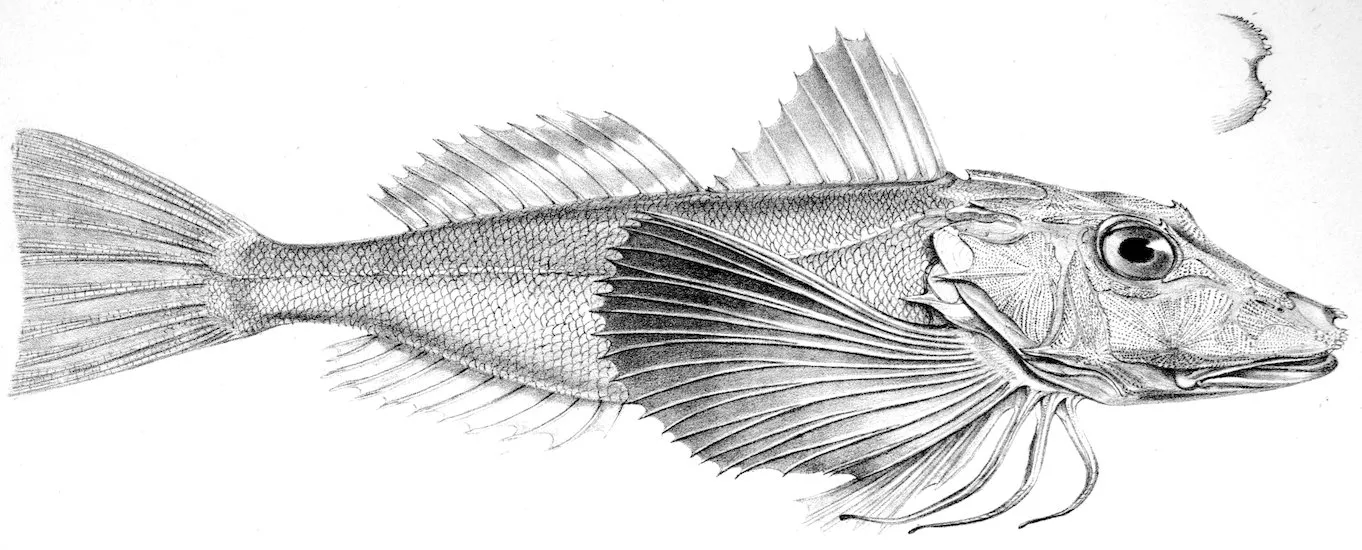
Fish. Pl. 6.
W. Hawkins. del.
Prionotus Miles. Nat. Size.
29This species is said by Cuvier and Valenciennes to be common all along the
Brazilian coast as far as the mouth of the Plata. Mr. Darwin’s specimen was
taken swimming on the surface in the Bay of Rio de Janeiro, and agrees well with
the description by those authors. “When first taken made a croaking noise.”—D.
P. splendidè rubro variatus; rostro emarginato, utrinque distinctè denticulato; buccis
levissimè granulosis; fossulâ dorsali lateribus inermibus; squamis corporis parvis,
ubique ciliatis; pinnis pectoralibus modicis, corpore certè triplò brevioribus; radiis
liberis subincrassatis, apicibus dilatatis.
B. 7; D. 10–12; A. 11; C. 12, &c.; P. 13 et 3; V. 1/5.
Long. unc. 10. lin. 3.
Form.—In general form, that of the head especially, very similar to the Trigla Hirundo of the
British seas. Compared with the P. punctatus last described, it is rather more elongated, the
depth and thickness being less. Profile falling less obliquely. Space between the eyes broader,
but equally concave. Snout not so obtuse, and more deeply notched; with six short but well
developed teeth on each side, followed by some minuter denticles. The lines of granulations on
the snout and cheeks are very fine, and not so strongly marked, or spread over so large a portion
of the face. One principal spine, preceded by two or three small denticles, at the anterior angle of
each orbit; at the posterior angle, a well marked notch with a small denticle, (in this specimen the
denticle on the left side of the head only,) but no regular spine: these notches are connected by a
transverse line on the cranium, but not by a groove (as in P. Carolinus, Cuv. et Val.). No
spines on the temples, or on the crest at the bottom of the preopercle; but the ordinary spine
of the preopercle, as well as the opercular, suprascapular, and clavicular spines, appear as usual,
though not quite so long as in the P. punctatus; the clavicular spine has one line of points
along its ridge, but the granulations are not very obvious. Band of palatine teeth much as in
P. punctatus. First dorsal spine with a row of granulated points in front; the second spine
with a row on the left side of the fin; the third spine with a very rudimentary row on the right
side; but none of these granulations very obvious: third spine longest, equalling about three-fourths
of the depth of the body; the fourth and succeeding spines gradually decreasing to the
tenth, which is barely visible, and so reclined as to be easily overlooked. Dorsal groove shallow,
with the sides unarmed. Scales on the body small, broader than long; their free edges finely
ciliated, communicating a decided roughness to the touch; their concealed portions crenated
at the hinder margin, and marked with a fan of five or six striæ. Lateral line not distinguished
by any particular scales, but forming a whitish streak from the upper part of the gill-opening
to the caudal. Pectorals relatively shorter than in P. punctatus, contained a little more than
three times in the entire length; when laid back they reach to a vertical line from the fourth
30ray of the second dorsal. Free rays rather stout, with their tips somewhat dilated and approaching
to spatuliform; in length about two-thirds that of the pectorals. Ventrals a trifle
longer than the first or longest of the free rays.
Colour.—“Above mottled brilliant tile red; beneath silvery white.”—D. Mr. Darwin is rather
doubtful whether by the above description, he meant that the entire fish was brilliant red, or
only mottled with red upon some obscure ground.
Habitat, Galapagos Archipelago.
Taken at Chatham Island, in the Galapagos Archipelago, and decidedly distinct
from all the species described by Cuvier and Valenciennes. From P.
strigatus it differs in the finer granulations of the cheeks, less obtuse and more
deeply notched snout, smooth scales, and absence of a second lateral line; from
P. Carolinus in the want of a transverse groove on the cranium, and in the fin-ray
formula, but it resembles this species in the dilated tips of the free rays; from
P. punctatus as pointed out in the description; from P. tribulus in the want of
the spine on the suborbital, and in its much shorter pectorals. These fins indeed
are shorter than in any of the above mentioned.
As all the species described in the “Histoire des Poissons,” are found on
the Atlantic side of America, the geographical range of this genus is extended
to the Pacific by the discovery of the present one.
Plate VII. Fig. 1. Lateral view twice nat. size.
Fig. 1a. Dorsal view nat. size.
Fig. 1b. Lateral view nat. size.
A. corpore elongato, anticè octagono, posticè hexagono; vomere et ossibus palatinis
dentibus distinctis instructis; maxillis subæqualibus; rostro ultrà fauces haud producto;
mento et membranâ branchiali cirratis: pinnis dorsalibus discretis; primâ
radiis gracilibus.
B. 6; D. 8–7; A. 8; C. 112/2; P. 14; V. ½.
Long. unc. 2. lin. 7.
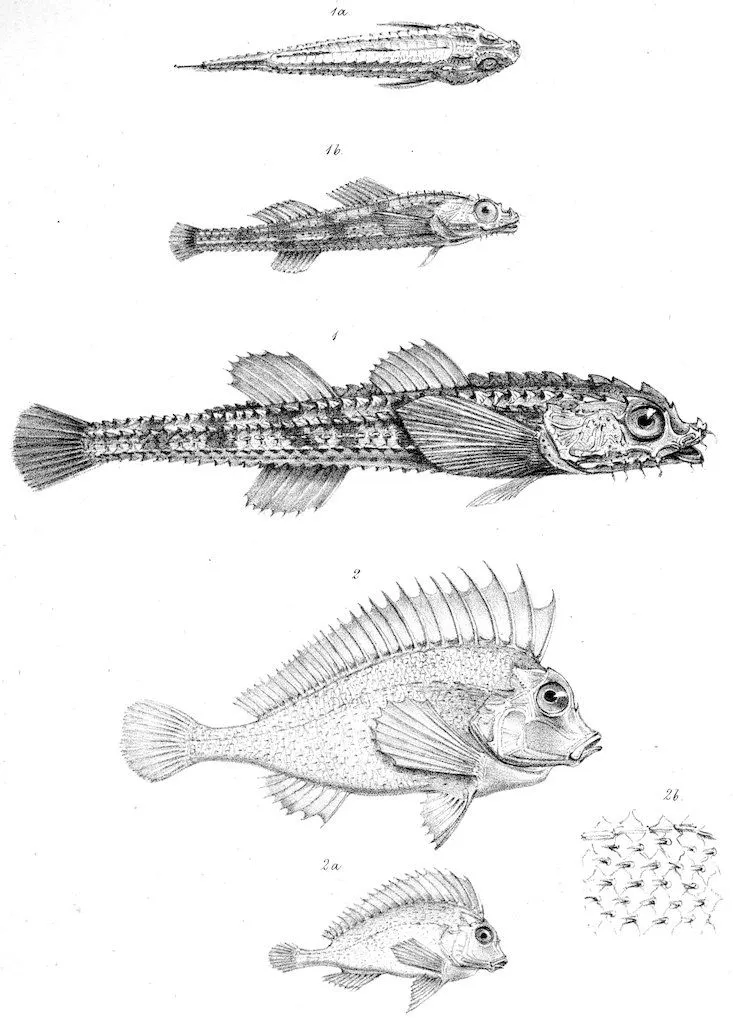
Fish Pl. 7.
W. Hawkins delt.
| 1. Aspidophorus Chiloensis. |
Twice Nat. Size. |
| 1a. 1b. „ |
Nat. Size. |
| 2. Agriopus hispidus. |
Twice Nat. Size. |
| 2a. „ „ |
Nat. Size. |
| 2b. „ „ |
Magnified Scales. |
31Form.—More elongated than the A. cataphractus, which it somewhat resembles in general appearance.
Anterior portion of the body octagonal, and the posterior, or all beyond the second
dorsal and anal, hexagonal. Head equally depressed as in that species; but its breadth less,
being only one-fifth of the entire length, caudal excluded. Length of the head rather less than
one-fourth of the entire length. Depth at the nape rather less than one-seventh of the same.
Eyes relatively a little larger than in A. cataphractus; their diameter one-fourth the length of the
head; placed high in the cheeks, and distant one diameter from the end of the snout. Upper
part of the orbit elevated into an osseous ridge on each side of the crown of the head, with a
spine at its anterior angle, and the ridge itself terminating in a sharp, rather stronger, spine at
the posterior angle; both spines directed backwards. Space between the eyes concave, equalling
in breadth not quite one diameter of the eye, with two longitudinal sharp ridges running
respectively parallel to the ridges of the orbits, but not nearly so much elevated as these last;
these ridges terminate posteriorly at a groove, which runs transversely behind the eyes, separating
the vertex from the occiput. The snout presents the same four spines, which are to be
seen in the A. cataphractus, but it does not project beyond the mouth. The lower margin of
the suborbital presents a somewhat irregular ridge formed by a series of bluntish tubercles, the
last of which terminates in a very minute spine directed backwards. Limb of the preopercle
with three diverging smooth ridges, dilating at their extremities into three flattened blunt points,
which project a little beyond the membrane, but can scarcely be called spines. Opercle with
one ridge not so strongly marked as those of the preopercle, and not terminating in any distinct
point, nor even reaching quite to the edge of the membrane. Jaws nearly equal; but the
upper one a very little the longest; each with a narrow band of minute velutine teeth: a distinct
chevron of similar teeth on the front of the vomer, and a short imperfect row on each palatine.
Tongue smooth. Gill-opening large: the branchial membrane not notched, but passing transversely
over the isthmus, to the edge of which it is nevertheless attached on each side. Chin
clothed with short fleshy cirri; also a few on the lower jaw and branchial membrane; but they
are much shorter, and less conspicuous than in the A. cataphractus, especially on the branchial
membrane, where they are very sparingly scattered. The occiput presents the four usual ridges
formed of granulated tubercles; and between the innermost pair there is also a much less
conspicuous, but slightly raised line running longitudinally down the middle: the two innermost
of the above ridges are nearly in a line respectively with the two ridges of the orbit, behind
which they commence, and they would pass on to unite with the two dorsal carinæ were they
not separated from the latter by a deep transverse depression at the nape: the two outermost of
the occipital ridges commence behind the eyes themselves, and terminate at the suprascapulars,
each in a sharp point directed backwards, but not prolonged into a spine. The carinated scales
which arm the body of this species, are more sharply serrated than those of the A. cataphractus,
the keels terminating behind in hooked points; and the elevated lines which form the striæ on
each side of the keel are fewer in number and more raised. The ridges which they form are
also more marked, and the second ridge on each side commences immediately behind the angle
of the opercle, instead of opposite the vent as in that species; so that the whole body is perfectly
octagonal from the gills to the termination of the dorsal and anal fins:[11] at that point, the two
dorsal ridges and the two ventral unite respectively to form one, or rather approximate so closely
as to form but one in appearance; for, if closely examined, there will still be found two parallel
rows of serratures. In each of the two uppermost or dorsal ridges, there are twenty-seven
scales, reckoning from the hollow at the nape to the point where the ridges unite. In the
second ridge (which extends, as before observed, from the gills to the caudal) there are thirty-eight.
32In the third, which commences behind the pectoral, and extends in like manner to the
caudal, there are thirty-five. In the fourth, which commences on the breast, immediately behind
the point of attachment of the branchial membrane to the isthmus, there are thirty, reckoning
to behind the anal, where it unites with its fellow to form one; between this point and the
caudal there are ten, the serratures of which are rather obsolete. The fourth pair of ridges
are throughout their course less sharply serrated than the second and third pairs, and these last
again rather less so than the first or dorsal pair. Between the two ventral ridges, near their
commencement in front of the ventral fins, are six slightly serrated scales (similar to those in
the ridges) forming on the breast a somewhat triangular patch, two single ones standing first,
then four others in pairs. The lateral line, which is catenulated as in A. cataphractus, commences
at the upper angle of the opercle, then bends downwards to take a middle course between
the second and third ridges, which it preserves to the caudal. The first dorsal commences
behind the seventh scale in the dorsal ridges, or at about one-third of the entire length; it is of
the same form as in the A. cataphractus, but contains more rays; its membrane terminates at
the fifteenth scale, and there are rather more than two scales between it and the second dorsal,
which last is rather shorter and higher than the first. The rays of the first dorsal are not stouter
than those of the second, nor relatively stouter than those of the A. cataphractus. The rays
of the second dorsal are simple, with the second and third rather longer than the first. The
anal answers to the second dorsal. The pectorals are rounded, and one-fifth of the entire
length. Ventrals very narrow, and scarcely more than half the length of the pectorals.
Position of the vent a little anterior to a line connecting the extremities of the ventrals.
Colour.—(In spirits.) Dusky grey above and on the sides, paler beneath; with four broad transverse
blackish fasciæ passing across the back and down the sides as far as the third longitudinal
ridge of scales. The first fascia is in the region of the first half of the first dorsal; the second
at the commencement of the second dorsal; the third near the end of the second dorsal; the
fourth half-way between the end of the second dorsal and the caudal; and a little beyond this
there is a faint trace of a fifth fascia. The body is a little mottled in places with spots of the
same dark colour as the fasciæ, and the fins, with the exception of the ventrals, are of the same
hue.
Habitat, Chiloe, (West coast of S. America).
The absence of vomerine teeth has been considered by Cuvier as one of the
characters serving to distinguish Aspidophorus from Cottus; but as these teeth
are very distinctly developed in the present species, we must rather dwell upon
the large keeled sharp-pointed scales, which envelope the body in a kind of mail,
and, as Dr. Richardson observes,[12] “give the Aspidophori a totally different aspect
from the Cotti.” Indeed on equally strong grounds as those on which Cuvier has
separated Pinguipes from Percis and Prionotus from Trigla, the present species,
which possesses both vomerine and palatine teeth,[13] might be made a distinct
33genus from Aspidophorus, or at least considered as one of its subgenera. But in
the present uncertain state of our knowledge with respect to the exact value of
this character,[14] and from the general resemblance of the A. Chiloensis in all its
principal characters to the other species of this genus,[15] I have not thought this
step necessary.
This species was taken by Mr. Darwin at Chiloe. There are two specimens
in the collection. The second differs from the one above described, only in
having one ray less in the first dorsal, and two more carinated scales in each of
the dorsal ridges. Independently of its having vomerine and palatine teeth as
above noticed, this species will not enter into any of Cuvier’s sections of the
genus Aspidophorus, but combines in itself the characters of his first and third;
the dorsals being separated by nearly three scales, the jaws being very nearly
equal, the rays of the first dorsal not stouter than those of the second, and the
throat being bearded.
P. capite longo, lævi, ubique inermi, spinis duâbus ad angulum preoperculi brevissimis
æqualibus exceptis; oculis magnis, arctè propinquantibus: dorso et lateribus fuscis;
abdomine albido; pinnâ dorsali primâ liturâ magnâ irregulari nigro-fuscâ posticè
maculatâ; dorsali secundâ, caudali, et pectoralibus, maculis fuscis parvis; anali et
ventralibus ferè omnino nigricantibus.
B. 7; D. 8–12; A. 12; C. 13, &c.; P. 19; V. 1/5.
Long. unc. 16.
Form.—Head very much depressed, and rather longer than in most of the species of this genus; its
length being nearly twice its own breadth, and nearly one-third of the entire length. Breadth
of the body at the pectorals one-seventh of the entire length: depth at that point half the
breadth. Snout rounded horizontally. Lower jaw longest. Gape reaching to beneath the
34anterior margin of the orbit. A band of sharp velutine teeth in each jaw broadest above; a
double semicircular patch of similar teeth on the front of the vomer, and a band all along each
palatine as broad as that in the lower jaw. Branchial arches and pharyngeans rough with
similar teeth. Tongue free, thin, flat, truncated at the apex with a double emargination in the
middle, of equal breadth throughout, without teeth, the central portion cartilaginous with a
broad membranous border all round. Eyes large, their diameter one-sixth the length of the
head, approximating, with not half a diameter between, distant two diameters from the
extremity of the lower jaw. The spines of the preopercle (which in some species are long and
very unequal) very short and inconspicuous, of equal length, the lower one rounded off almost
to nothing. Head smooth all over; presenting the usual ridges, which however are not very
salient, but with hardly anything deserving the name of spines, excepting only a small flat
spine terminating the opercle, and a minute but sharp one on the upper ridge of the scapula:
none at the anterior angle of the first suborbital, or on the ridge of the orbit. Gill-opening
very large; the branchial membrane notched underneath for its whole length.
Pectorals broad and oval but short, contained nearly eight times in the entire length; the
first two rays simple, the next ten branched, the last seven, which are rather stout, again simple.
Ventrals separate by nearly the whole breadth of the body, attached beneath the middle of the
pectorals, longer than these last fins by nearly one-third, and reaching very nearly but not quite
to the vent, which is a little posterior to the middle of the entire length: the spine of the ventrals
is one-third of the longest of the articulated rays which are the last or innermost. The first
dorsal commences above the middle of the pectorals, and occupies between one-sixth and one-seventh
of the entire length; its greatest height is about two-thirds of its own length; the first
spine is very short, and detached, as in the other species; the second a little shorter than the
third which is longest; the rest gradually decrease to the last, which is one-third the length of
the second; this fin therefore is not so triangular as in many of this genus. A small space
between the first and second dorsals. This last longer and rather lower than the former, contained
four and a half times in the entire length; all the rays nearly even, with the exception of
the first only, which is a little shorter than the second. Caudal square. The anal answers
to the second dorsal, but begins, as well as terminates, a little backwarder.
The lateral line commences at the suprascapular, and gradually bends down till it reaches
the middle of the depth which it keeps for the remainder of its course; it is perfectly smooth
throughout. The scales cover all the body and a part of the head, but are not present between
the eyes, or on the front of the snout, or on the jaws. They are small, oblong-oval, finely
striated, with a fan of eleven or twelve deeper striæ posteriorly, their free edges cut square, not
ciliated.
Colour.—(In spirits.)—Back and sides nearly uniform deep brown; beneath white; the two
colours separated by a well-defined line. First dorsal transparent, with a deep brown stain or
blotch on the membrane, of an irregular form, and occupying more than the posterior half of
the fin. Second dorsal uniformly, but rather obscurely, spotted throughout. Caudal with
transverse rows of similar spots. Anal nearly uniform pale dusky, the spots hardly distinguishable
from the ground. Ventrals the same. Pectorals with spots on the rays, but with
the intervening membrane nearly transparent.
Habitat, King George’s Sound, New Holland.
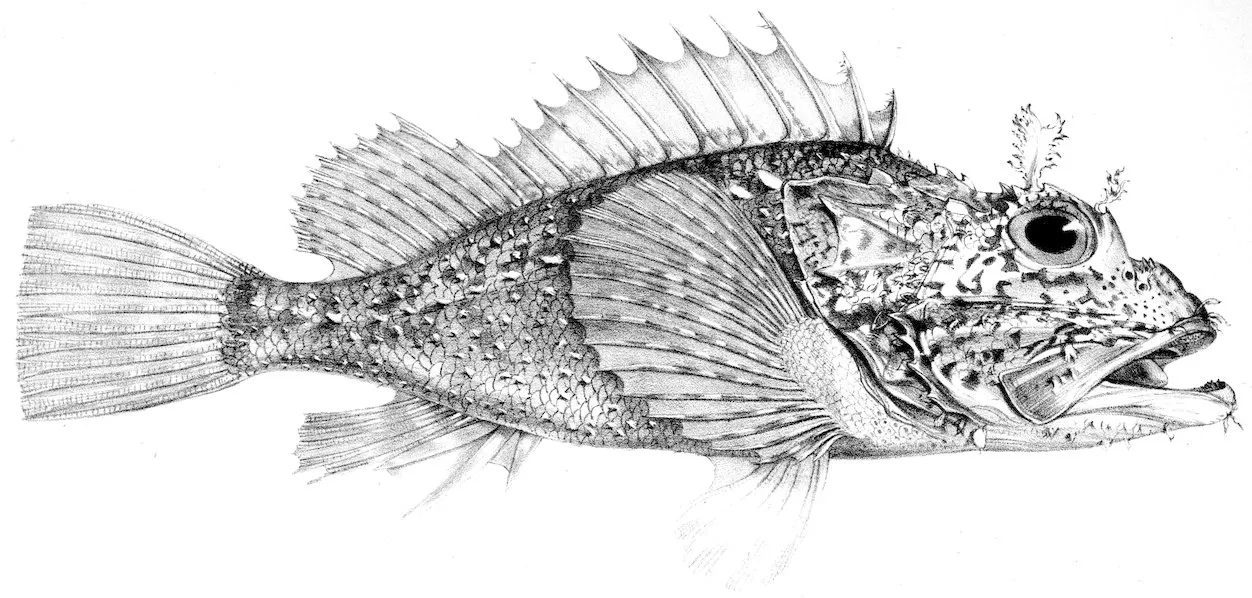
Fish. Pl. 8.
Scorpæna Histrio. Nat. Size.
35This species very closely approaches the P. lævigatus of Cuvier and Valenciennes,
with which it particularly agrees in the smoothness of its head, and
large approximating eyes. The two spines, however, at the angle of the preopercle
appear to be still smaller than in that species;[16] the fin-ray formula
is a little different; and so also are the colours; the first dorsal being particularly
characterized by a large irregular dark-coloured stain on its posterior
portion, and the anal and ventrals being almost wholly dusky, instead of pale
with spots on the rays only, as in the P. lævigatus. Possibly it may be a mere
variety. Mr. Darwin’s specimen was obtained at King George’s Sound.
S. toto corpore coccineo, pinnis pallidioribus, maculis parvis irregularibus nigricantibus:
capite magnâ ex parte alepidoto, lineis spinosis solitis armato: pinnâ dorsali
spinis inæqualibus, tertiâ paulo longissimâ: capite et lateribus cirris cutaneis parvis
ubique adornatis; quatuor palpebralibus, præsertim duobus posterioribus, majoribus,
palmatis.
B. 7; D. 12/9; A. 3/5; C. 13, &c.; P. 20; V. 1/5.
Long. unc. 9.
Form.—General form resembling that of the S. Scrofa. Depth at the pectorals just one-fourth of
the entire length. Thickness a trifle more than two-thirds of the depth. Head more than one-third
of the entire length. Eyes large and elevated, distant from the end of the snout rather
more than one diameter; the space between very concave, twice as long as broad, with two
whitish lines in the central furrow, diverging as they recede backwards towards the nape, but
scarcely elevated into salient ridges. Mouth oblique, with the gape large and the lower jaw a
little the longest; when closed, the end of the maxillary, which is broad and much dilated,
reaches to a vertical line from the posterior part of the orbit. A broadish band of velutine
teeth in each jaw as well as on the vomer and palatines. Tongue smooth. A small sharp
triangular spine on each of the nasal bones, (in this specimen that on the left side is double or
forked): upper margin of the orbit, which is much elevated, with three spines, one strong one
at the anterior angle, and two, nearly as large, further back; beyond which, on the left orbit
only, is a fourth smaller one. Space between the eyes bounded posteriorly by a raised arc
36having the curvature inwards, with a spine on each side; this is followed by the depressed occiput,
which forms a hollow; and on each side of this, at its posterior margin, or at the commencement
of the nape, are two other strong spines: there are likewise two spines at the suprascapulars,
and between these and the posterior margin of the orbit of the eye, on what may be
called the temples, are two more; of these last, the first, which is small and close to the orbit,
is double; the second, which is larger and situate a little above the upper angle of the preopercle,
is, in this specimen, double on the right side and single on the left. The first suborbital
has two spines on its anterior margin, the first directed forwards, and the second downwards;
on its disk are two salient ridges, which are unarmed, and not very conspicuous. The second
suborbital is entirely without spines, but elevated in the middle into a double smooth ridge or
crest. Margin of the preopercle with six spines; the second longest; the first, as well as the
two lowermost, small and inconspicuous. Opercle with two osseous diverging ridges terminating
in spines: the scapular and clavicular bones likewise terminate each in a flattened spine.
Lateral line and scales much as in S. Scrofa; the latter with their free edges perfectly smooth.
The cutaneous filaments and appendages on this species are as follows: three small ones
at the extremity of the snout; one small but broad one at the upper margin of the anterior
orifice of the nostril; two very conspicuous palmated ones on each orbit, especially the posterior
one, which is largest, and very broad; two on the margin of the first suborbital; some small
ones on the cheeks and maxillaries; six beneath the lower jaw, two being near the symphysis,
and two on each ramus; a row on the margin of the preopercle, and very numerous small
ones scattered about the nape and sides of the body, of which a row along the lateral line are
rather more conspicuous than the others.
The spines of the dorsal fin are moderately strong, and unequal; the first is rather more
than half the length of the second, which itself is two-thirds of the third; this last is less than
half, but more than two-fifths, of the depth of the body; from the third, the spines decrease
very gradually to the eleventh, which is a little longer than the first; the twelfth is higher than
the eleventh by one-third: soft portion of the fin rounded, and where most elevated just
equalling in height the third or longest spine. Anal spines very unequal; the first not very
stout, and less than half the length of the second, which is very strong indeed, as well as the
longest of the three; the third is stouter than the first, but not nearly so stout as the second,
though nearly equalling that spine in length: soft portion of this fin with its greatest elevation
rather exceeding the second spine. Caudal slightly rounded. Pectorals rather more than
one-fifth of the entire length; the ten lowermost rays simple; the nine immediately above
these branched; the uppermost of all simple like the bottom ones, but slenderer as well as
shorter than the others. Ventrals not above two-thirds the length of the pectorals; in other
respects as in S. Scrofa.
A second specimen.—Smaller than the one above described, measuring seven inches and a half in
length. The two diverging lines on the cranium between the eyes are rather more salient, and
the left orbit is without the fourth spine; but in all other respects, including the fin-ray
formula, the two specimens are exactly similar.
Colour.—“Whole body scarlet red, fins rather paler; with small irregularly-shaped light black
spots.”—D.
Habitat, Chatham Island, Galapagos Archipelago.
37This species differs more or less in the details of form, as well as colours,
from all those which I can find described by authors. Most of the foreign species
of this genus noticed by Cuvier and Valenciennes, come either from the eastern
coast of America or the East Indies; and they do not appear to have received
any from that part of the Pacific, whence the present one was obtained.
Sebastes oculata, Cuv. et Val. Hist. des Poiss. tom. ix. p. 344.
Form.—Greatest depth contained about three times and three quarters in the entire length.
Head about one-third of the same. Eyes large; the interocular space, equalling rather more
than half their diameter, concave, with two longitudinal ridges running respectively parallel to
the two superciliary ridges. Two spines on the upper part of the snout, in a line with the
nostrils; one at the anterior part of the orbit; three at the posterior, passing off in a line
towards the occiput, where there are two other moderately strong ones terminating the lateral
occipital ridges; five very strong spines or teeth edging the rounded angle of the preopercle;
two sharp ones at the posterior angle of the opercle, the upper one most developed; one at the
scapula, and two at the suprascapular. There are either three orifices to each nostril, or else,
adjoining the two usual openings, a large pore so manifest (at least in this specimen in its dried
state) as easily to be mistaken for a third: this additional one is close to the nasal spine.
Dorsal spines of only moderate strength: anal stronger, especially the second, which is very
stout, as well as the longest of the three; the third, however, is more than half the length of
the soft rays. Pectorals broad and rounded; their length contained about four times and a
half in the entire length; first ray simple, the next eight branched, the nine lowermost simple
again, and rather stouter than the others. The caudal appears to have been square. Scales
small and ciliated, covering nearly the entire head, as well as body, but very thinly scattered
on the extremity of the snout in advance of the nostrils.
D. 13/14; A. 3/6; C. 14, and 3 shorter ones; P. 18; V. 1/5.
Length 10 inches.
Colour.—“Under surface, sides, branchial covering, and part of the fins, ‘tile and carmine red;’
dorsal scales pale yellowish dirty brown.”—D. In its present dried state, the colour is of a
uniform brown.
Habitat, Valparaiso.
This species is probably the S. oculata of Valenciennes; but the depth
rather exceeds, and in its recent state it must have still more exceeded, one-fourth
38of the entire length, the proportion given in the “Histoire des Poissons.” The
spines on the opercle and suprascapular also can hardly be called “smaller,” as
there stated, than those on the orbit and occiput, at least the upper one on the
opercle. There are also two soft rays less in the anal. It may be added further,
that Mr. Darwin’s notes make no mention of the four brilliant rose-coloured spots
along the base of the dorsal fin, spoken of by Valenciennes.
The S. oculata was discovered by M. Gay at Valparaiso, where Mr. Darwin’s
specimen also was obtained. It is the only species of this genus on record
brought hitherto from South America. It may be stated, however, that Mr.
Darwin has a drawing of another species, made by Mr. P. King, found also at
Valparaiso, differing from the above in having the spines on the head less
developed, and apparently, in some of its characters, approaching the S. variabilis.
This last is a species inhabiting the sea which separates N. America from
Kamtschatka.
Plate VII. Fig. 2. Twice nat. size.
Fig. 2 a. Nat. size.
Fig. 2
b. Portion of the hispid cuticle magnified.
[17]
A. pallidè rubro-aurantius, dorso nigricante, pinnis nigro-maculatis: corpore hispido,
altitudine tertiam partem longitudinis æquante; spirits nasalibus duâbus parvis
recurvis; vomere dentibus velutinis minutissimis instructo: pinnâ dorsali inæquali,
anticè allevatâ, spinis quartâ et quintâ paulo longissimis, succedentibus gradatim
diminutis, ultimâ radiis articulatis multò breviori.
D. 17/13; A. 1/8; C. 13, &c.; P. 9; V. 1/5.
Long. unc. 1. lin. 9.
Form.—General form resembling that of the A. torvus, but the depth much greater, equalling one-third
of the entire length, or very nearly. Length of the head somewhat less than the depth
of the body. The line of greatest depth passes through the insertion of the pectorals. The
profile viewed apart from the superciliary ridges, which are sharp and prominent, falls in a
straight but very oblique line from the commencement of the dorsal to the mouth. On each
side of the median line of the snout, in advance of the eyes, is a small but sharp spine,
directed upwards and backwards. There are also two minute spines on the first suborbital
immediately above and behind the end of the maxillary; these are placed one over the other,
the uppermost, which is the sharpest and most conspicuous, taking an upward direction like the
39nasal spines, the lowermost, which is blunt and not so obvious, a downward one. Mouth
small, without any teeth that can be discerned even with a lens; but a decided roughness
can be felt on the vomer, seeming to indicate the presence of minute teeth on that part. The
superciliary ridges, already alluded to, are slightly granulated, and terminate behind in two
sharp triangular points. The occipital ridges, a ridge on the posterior suborbital immediately
beneath the eye, and an interrupted ridge on the temples and suprascapulars, are in like manner
granulated, or rather obscurely crenated. The opercle and preopercle are marked with a few
striæ, but show neither granulations nor spines. Gill-opening very small. No scales on any
part of the head and body; but the whole surface of the latter is hispid with minute bristly
appendages to the cuticle, each springing from a minute papilla. There are also a number of
fine lines traversing the cuticle in two directions, and forming a kind of network. The lateral
line commences at the suprascapular, and terminates a little beyond the end of the dorsal, not
reaching quite to the caudal; its course is nearly, but not exactly, parallel to the dorsal line,
the distance between them being at first one-third, but towards the caudal between one-third
and one-fourth of the depth.
Dorsal very much elevated anteriorly, but its height by no means uniform throughout;
the first spine one-fourth shorter than the second; this again a little shorter than the third;
and this last a very little shorter than the fourth and fifth, which are longest, and which equal
three-fourths of the depth of the body; sixth and succeeding ones gradually decreasing, the
ninth being about equal to the first, the twelfth about one-third shorter; the next four are
scarcely shorter than the twelfth, and the seventeenth or last is a little higher than the sixteenth;
then follows the soft portion of the fin, which is here again elevated, the soft rays being nearly
double the length of the last spinous.[18] The anal answers in position to the first two-thirds of
the soft dorsal, terminating before that fin, as in A. torvus: the fourth, fifth, and sixth soft rays
are longest, and much longer than the soft rays of the dorsal; the spine is short and slender,
and not much more than half the length of the first soft ray. The last ray of both dorsal and
anal is divided quite to the root so as to appear as two. The caudal appears to have been
rounded, but the ends of the rays are worn and broken. Pectorals long, equalling one-third of
the entire length: they consist of nine rays, the three middle ones of which are longest; the
three upper and the three lower ones are respectively equal; all the rays simple. Ventrals
much shorter than the pectorals, and, though attached rather more behind, not reaching so far;
their spine is rather stout, much more so than that of the anal, and about three-fourths the
length of the first two soft rays, which are the longest in the fin.
Colour.—“Pale reddish orange, with black spots on the fins, and a dusky shade on the
back.”—D.
A second specimen only differs from the above in having the teeth in the jaws more sensible to the
touch, though still scarcely to be seen; and in the superciliary and occipital ridges being
less granulated or crenated at the edges. The colours also are a little darker. The fin-ray
formula is exactly the same in both specimens.
Habitat, Peninsula of Tres Montes, Archipelago of Chiloe.
This species approaches most nearly the A. Peruvianus of Cuvier and
Valenciennes, with which it agrees in the great depth of the body, and in the
40presence of two nasal spines; but it differs in the roughness of the skin (that
species being described as smooth), and in the greater inequality of the dorsal fin.
Perhaps it may be the same as the species brought from the coast of Chili by
Mr. Cuming, and briefly noticed by Mr. Bennett in the “Proceedings of the
Zoological Society” (1832, p. 5.), but which this last gentleman did not venture
to describe as new, from the circumstance of its general agreement with the
A. Peruvianus. The principal deviation in Mr. Cuming’s fish from the species
just mentioned is stated to have occurred in the number of the fin-rays; those of
the spinous portion of the dorsal fin being seventeen (one less than in the
A. Peruvianus), while of the soft rays of the anal there were ten (three more than
in the species referred to). Mr. Darwin’s fish agrees with Mr. Cuming’s in the
number of the dorsal spines, but not in that of the soft rays of the anal, which is
eight, being one more than in the A. Peruvianus and two less than in Mr.
Cuming’s; and it is observable that both the specimens obtained by Mr. Darwin
agree in this particular. Mr. Bennett has not noticed any of the other characters
of Mr. Cuming’s fish.[19]
One of the most distinguishing peculiarities in the species here described is
the existence of vomerine teeth, which though extremely minute are quite
sensible to the touch. As these teeth are denied by Cuvier to the whole genus,
we have here another instance, similar to that of the Aspidophorus Chiloensis
already mentioned, of the slight value of the character which their presence or
absence affords. Possibly, however, they may disappear in the adult state.
Both Mr. Darwin’s specimens are small, neither equalling two inches; and if
they are immature, which is probably the case, some of the other characters
mentioned in the description, perhaps even the hispidity of the skin, may result
from this circumstance. They must therefore be received with caution until
larger specimens shall have been obtained.
41
Otolithus guatucupa, Cuv. et Val. Hist. des Poiss. tom. v. p. 56. pl. 104.
Form.—Elongated, with the back only very slightly elevated beneath the first dorsal: in advance
of that fin the dorsal line is nearly straight, and continuous with the profile. Greatest depth
contained exactly four times and a half in the entire length. Head long, contained three and a
half times in the same. Lower jaw projecting considerably beyond the upper, and ascending
to meet it. Two strongly developed curved canines at the extremity of the upper jaw; the rest
of the teeth in this jaw consist of a single row of fine card, nearly equal throughout: in the
lower jaw there are no canines, but one similar row of card, rather stronger than those above,
and not equal, the smallest being in front, and those at the sides becoming gradually larger
as they extend backwards. No vestige of scales on the lower jaw, lips or maxillary; but the
suborbital is covered with bright silvery scales. Eye full, and moderately sized; its diameter
one-fifth the length of the head; its distance from the end of the upper jaw equalling the
diameter. Margin of the preopercle with a few indistinct striæ and obsolete denticulations.
Opercle with two flat points not much developed. Lateral line very distinct, commencing at
rather less than one-third of the depth, but curving gradually downwards to one-half; continued
to nearly the extremity of the caudal; each scale marked with an elevated line, from which
there proceed one or two small ramifications on each side.
First dorsal triangular, with the first spine very short, the fourth longest, the fifth and
succeeding ones gradually decreasing, the last or tenth being shorter than the first. Second
dorsal almost contiguous, its spine or first ray about equalling the first ray of the first dorsal:
this fin is more than half as long again as the first, and the rays are nearly even. The anal
commences further back than a point opposite the middle of the second dorsal; there are in
reality two spines in this fin, but the first is so extremely minute as to be almost microscopic,
and not seen, unless very carefully sought for; the second or principal spine is weak, and rather
more than one-third the length of the soft rays. Caudal apparently square, but the rays being
worn at the tips, its exact form cannot be determined. The second dorsal, as well as the anal
and caudal, are partially covered with small scales, which, however, are not very obvious.
Pectorals narrow and rather small, being scarcely more than half the length of the head.
Ventrals placed a little further back, and rather shorter than the pectorals.
B. 7; D. 10—1/20; A. 1/8; C. 17; P. 16; V. 1/5.
Length 9 inc. 9 lines.
Colour.—“Silvery white, above iridescent with violet purple and blue.”—D. Mr. Darwin has not
noticed the dark transverse lines, which descend from the back obliquely forwards, as represented
42in the ‘Histoire des Poissons,’ and of which there are evident traces, though apparently
much effaced by the action of the spirit.
Habitat, Maldonado Bay, Rio Plata.
This species, which Cuvier and Valenciennes consider as the Guatucupa of
Margrave, was obtained by Mr. Darwin at Maldonado. M. D’Orbigny had
previously taken it at Monte Video. The only respects in which Mr. Darwin’s
specimen differs from D’Orbigny’s, is in its having two more rays in the soft
dorsal, and a slightly longer anal spine, judging from the figure in the ‘Histoire
des Poissons;’ but I cannot imagine that they are distinct on these grounds
only, so exactly do they agree in all their other characters.
Corvina adusta, Spix et Agass. Pisces Brazil. p. 126. tab. 70.
Form.—Greatest depth beneath the commencement of the first dorsal fin, and equalling one-fourth
of the entire length. Back somewhat carinated, and moderately arched, forming one
continuous curve with the profile, which falls with considerable obliquity. Ventral line nearly
straight, and the abdomen much flattened in front of, and between the ventrals. Length of the
head just equalling the depth of the body. Snout obtuse, with two small lobes at bottom, one
on each side of the extremity, as in several other species of this genus. Mouth horizontal, at
the bottom of the snout; when closed, the maxillary reaching a little beyond a vertical from
the anterior margin of the orbit. Four pores beneath the symphysis; and seven, in two rows,
round the extremity of the snout; those in the lower row large. Jaws nearly equal; the upper
one perhaps a little the longest. Teeth forming a velutine band above and below; those above
with an outer row of somewhat longer and stronger ones. Eyes rather small; their diameter
about one-fifth the length of the head. Nostrils consisting of two round apertures in advance
of the eye, the posterior one largest; the anterior with a raised margin. Preopercle a little less
than rectangular, with the angle at bottom somewhat rounded: the ascending margin
rectilineal, sloping rather in advance of a vertical, and distinctly toothed, the teeth becoming
smaller upwards: at the angle are two stronger teeth or spines, the uppermost directed backwards
and a little downwards, the lowermost downwards and a little backwards; between
these two teeth there is an interval; the basal margin of the preopercle is quite smooth.
Opercle terminating in two flat inconspicuous points.
Snout, cheeks, and gill-covers, covered with scales of very unequal sizes: those serving as a
boundary between the cheek and the preopercle, also a row above each orbit, a few at the
upper angle of the opercle, some on the suprascapular lamina, and a row extending thence
upwards and forwards to the occiput, much smaller than the others. Scales on the body of
moderate size, arranged in oblique rows; about fifty-five in a longitudinal line, and nineteen or
twenty in a vertical. One taken from above the lateral line, and nearly in the middle of the
length, is oblong, approaching to circular, its surface marked with a number of concentric,
43much crowded, curved lines, somewhat undulating behind, with a fan of about twelve deeper
striæ converging to a point considerably in advance of the centre of the scale; the free portion is
also marked with several well-marked nearly parallel lines which terminate in denticles at the
anterior margin. Those on the lateral line have the mucous tubes somewhat ramified, and are
accompanied throughout its course by some minuter scales, similar to those on the head above
pointed out. The lateral line is at one-third of the depth, till it arrives beneath the middle of
the soft dorsal, where it falls to one-half.
First dorsal of a triangular form, separated from the soft portion by a deep notch; the first
spine very small and inconspicuous; the second somewhat shorter than the third; fourth
longest, nearly equalling half the depth; all the spines in this fin rather slender. The second
dorsal commences with a spine somewhat longer than the last spine in the first dorsal, and not
quite half the length of the first soft ray; soft rays nearly even throughout, and not equalling
the highest point of the first dorsal. Anal short and somewhat rounded, commencing beneath
the middle of the second dorsal, and double the height of that fin; its first spine very short and
inconspicuous; second long and moderately stout, but shorter than the first soft ray by one-third;
second soft ray the longest; third and succeeding ones gradually decreasing. Pectorals
narrow and pointed, shorter than the head; first ray simple, the rest branched; third, fourth and
fifth longest. Ventrals attached a trifle backwarder than the pectorals, which they do not
equal in length; the spine much slenderer than that of the anal, and rather more than half the
length of the first soft ray. Caudal squarish, but with the margin a little sinuous.
B. 7; D. 10—1/28; A. 2/8; C. 17; P. 17; V. 1/5.
Length 8 inches 6 lines.
Colour.—“Above inclining to coppery, with irregular transverse bars of brown; beautifully iridescent
with violet.”—D. The bars alluded to by Mr. Darwin are some dark lines which, commencing
at the upper part of the back, pass forwards and downwards in an oblique direction; they bend
more and more downwards as they advance, and disappear a little below the middle. The
whole fish has a metallic gloss, particularly about the cheeks and gill-covers, and very visible
even in its present state.
A second specimen, exactly similar to the above, is nearly twelve inches in length.
Habitat, Maldonado and Monte Video.
I entertain no doubt of this species being the C. adusta of Agassiz, figured in
Spix’s Fishes of Brazil. It is not described by Cuvier and Valenciennes, but
belongs to their second section of the genus, characterized by the small spines
on the ascending margin, and especially at the angle, of the preopercle. It seems
to be particularly distinguished by the small scales on some parts of the head,
and along the lateral line where they accompany the larger ones. These
characters have not been overlooked by Agassiz. There are two specimens in the
collection, the larger one taken at Monte Video, the smaller at Maldonado.
44
Umbrina arenata, Cuv. et Val. Hist. des Poiss. tom. v. p. 141.
Form.—Rather elongated, with the back very little arched; the greatest depth contained about five
times and a quarter in the entire length. Length of the head about equal to the depth of the
body. Profile falling very gradually, and nearly in a straight line, in front of the dorsal.
Snout very much projecting; the margin at bottom, above the upper jaw, divided into four
lobes which are cut square at their extremities. Round the end of the snout, and immediately
above the lobes, is a double row of pores, the lower ones large. Also four pores beneath the
symphysis of the lower jaw. Barbule at the chin scarcely exceeding a line or a line and a half
in length. A band of velutine teeth in each jaw, with an outer row in card; these last
moderately strong, sharp, and rather wide apart, not above fourteen or sixteen in the row.
Preopercle very obsoletely denticulated. Opercle with two flat points not much developed.
First dorsal triangular; the first spine very small; the second, third and fourth elevated
rather in a point, the third equalling two-thirds of the depth of the body or more. Second
dorsal nearly twice the length of the first. Anal commencing opposite the sixth soft ray of
that fin, short, and terminating considerably before it; the anal spine weak, and very little
more than half the length of the soft rays. Caudal with the posterior margin sinuous, the
upper part being slightly crescent-shaped, the lower portion rounded, and broader than the
upper. Pectorals a very little shorter than the head. Ventrals attached a little behind the
pectorals, and not passing beyond them. In the axilla of the pectorals is a small triangular
membranous lamina: there is also a narrow pointed one in the axilla of the ventrals covered
with scales. The scales on the body are thin, rather small, somewhat rhomboidal, with their
free margins ciliated, and with a fan of twelve striæ behind.
B. 7; D. 10—1/25; A. 1/8; C. 17; P. 21; V. 1/5.
Length 9 inches 6 lines.
Colour.—“Body mottled with silver and green: dorsal and caudal fins lead-colour.”—D.
In spirits, the colour appears dusky brown, with darker mottlings and silvery reflections; paler
beneath. The fins are dusky, but the basal half of the dorsal is darker than the upper. The
pectorals are darker than the other fins, especially the inside; on the left pectoral, the dark
colour is restricted to three broad transverse fasciæ. There are also on the pectorals and anal,
and on most of the scales on the body, small blackish dots, as mentioned in the ‘Histoire des
Poissons.’
A second specimen, smaller than the above, has the back rather more arched, the greatest depth
being only five times in the length. The outer row of teeth in the upper jaw is not quite so
conspicuous, the teeth being smaller and closer-set, and consequently more numerous. The
soft dorsal and anal have fewer rays.
D. 10–1/22; A. 1/7; &c.
Length 7 inches 3 lines.
In all other respects similar to the specimen first described.
Habitat, Bahia Blanca, and Maldonado.
45As Cuvier and Valenciennes have mentioned individuals of this species,
which varied in the number of rays in the soft dorsal from twenty-two to twenty-four,
I cannot but consider the two above described as specifically the same,
though in the first these rays amount to as many as twenty-five. This, which is
the larger specimen, was taken by Mr. Darwin at Bahia Blanca, where it is said
to have been common. The other was obtained at Maldonado.
U. elongata; rostro obtusissimo, tumido, haud ultrà fauces producto, margine inferiore
quadrilobato, lobis intermediis rotundatis; fossulá longitudinali inter nares,
profundè exaratâ; poris quatuor infrà symphysin; dentibus velutinis, serie externâ
in maxillâ superiore aculeiformi; preoperculo obsoletè denticulato; operculo mucronibus
duobus parvis instructo; spinis dorsalibus tertiâ et quartâ longissimis,
corporis altitudinem æquantibus; spinâ anali gracili, radiis articulatis dimidio
breviori.
D. 12—1/22; A. 1/9; C. 17; P. 20; V. 1/5.
Long. unc. 6. lin. 5.
Form.—Very much elongated; the greatest depth just one-sixth of the entire length; the head
one-fifth. Dorsal line nearly straight. Profile falling very slightly till it reaches the nostrils,
when it suddenly becomes vertical. Snout in consequence short, and very blunt, and not projecting
beyond the jaws; with a deep broad channel down the middle, extending from between
the nostrils to near the mouth: on each side of this channel, the snout is very protuberant.
The lower margin of the snout is divided into four lobes, the central pair of which are rounded:
above each of the exterior lobes is one large pore, and an odd one in the middle. There are
also four pores beneath the symphysis, and a short barbule, as in the last species. The eye
has a diameter about one-fifth the length of the head, and is distant one diameter from the
end of the snout. The nostrils, which are immediately in advance of the eye, consist of two
round apertures, one before the other, the posterior one double the size of the anterior. Upper
jaw a very little longer than the lower. A band of velutine teeth in each jaw; with an outer
row above of moderately strong card, rather curving inwards and backwards, and closer-set
than those of the U. arenata, amounting to twenty-eight or thirty in number: there are also
some smaller card teeth behind this outer row passing insensibly into the velutine. Preopercle
very obsoletely denticulated. Opercle with two flat points not very obvious.
First dorsal triangular, and moderately high in the point; third and fourth spines longest,
about equalling the depth of the body; first spine very small: all the spines rather slender.
Second dorsal about half as long again as the first, but the rays are too much broken to judge
46of their relative lengths. Anal spine very slender, and about half the length of the soft rays.
The caudal is injured, but appears to have been of nearly the same form as in the U. arenata.
The pectorals are about three-fourths the length of the head, but the ends of the rays are
worn. The ventrals are of the same length as the pectorals in their present state: they are
placed rather backwarder than in the U. arenata, being attached beneath the first third of the
pectorals: there is a pointed scale in their axilla, of about the same relative size as in that
species. The scales on the body are rather smaller, ciliated on their free edges, with a fan of
eleven or twelve striæ behind. There are rows of small scales on the caudal, but none apparent
on the other fins.
Colour.—Mr. Darwin did not notice the colours of this species in its recent state. In spirits, it
appears of a nearly uniform dusky brown, but paler on the abdomen, with traces of silvery
reflections about the head. The fins are dark, but the anal paler at the base than at the tips
of the rays.
Habitat, Coquimbo, Chile.
This species may be at once distinguished from all those described in the
‘Histoire des Poissons,’ by its very elongated form. The head also has a
peculiar character about it, and is not unlike that of some serpents. It appears
to be the first species of this genus brought from the Pacific, the other foreign
ones being all found either in the Indian seas, or on the Atlantic side of America.
There are two specimens in the collection, exactly similar, and both obtained by
Mr. Darwin at Coquimbo. They are, however, both in very bad condition; so
much so, indeed, that I should have hesitated about describing them as new, had
they not presented several obvious peculiarities.
Serrani formam quam maximè gerens. Pinna dorsalis unica, per totam longitudinem
subæqualis. Membrana branchialis septem-radiata. Nec fovea, nec pori, infrà
symphysin. Dentes maxillares velutini, serie externâ cæteris fortiori, paucis, hic
illic sparsis, subcaninis; palatini nulli. Preoperculum denticulatum. Operculum
mucronibus tribus posticè armatum. Spina analis secunda fortis. Squamæ corporis
ciliatæ; minutissimæ inter radios pinnarum verticalium, in seriebus dispositæ.
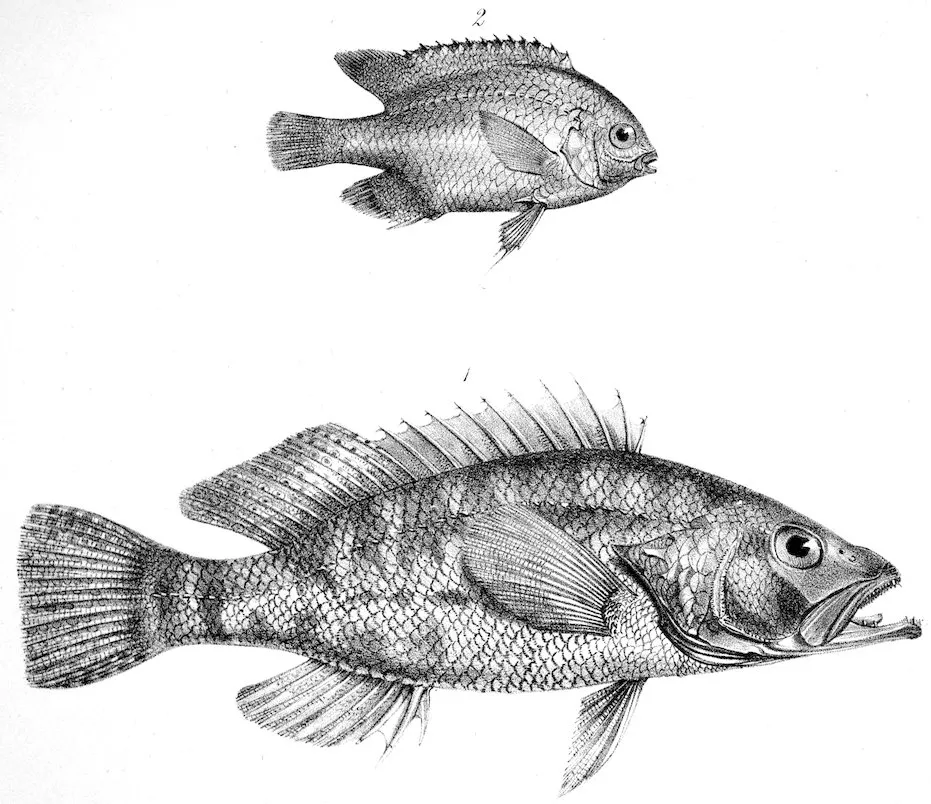
Fish. Pl. 9.
W. Hawkins delt.
| Fig. 1. |
Prionodes fasciatus. |
|
| 2. |
Stegastes imbricatus. |
Nat. Size. |
47I am called upon either to establish this new genus among the Sciænidæ, or
to break down one of the essential distinctions set by Cuvier between this family
and the Percidæ. The form is so completely that of a Serranus,—which it
resembles especially in its dorsal fin, head, maxillary teeth, form and armature
of the pieces of the gill-cover, and in the arrangement of the scales on the body,—that
at first sight no one would hesitate to refer it to that group; but the vomer
and palatines are without teeth.[21] In this respect, indeed, I consider it an important
discovery; as it affords another striking instance of the uncertainty of this
character, in cases in which others, which have been generally made subordinate
to it, remain constant. It is probable that the time will come, when
it will be found necessary to revise some portion of the Percidæ and Sciænidæ
with reference to a more correct valuation of this character. For the present,
however, I refrain from interfering with the Cuvierian arrangement; and the only
alternative is to consider this as a new form among the Sciænidæ, where it must
be placed along with those genera possessing one dorsal fin, and having seven
rays in the branchiostegous membrane. Such are Hæmulon, Pristipoma, and
Diagramma; from all which, however, it is at once distinguished by the absence
of pores at the symphysis and on the lower jaw, and by the much more developed
spines on the opercle, and from Pristipoma by its having, further, scales on the
vertical fins. On the whole, it seems to approach nearest to Hæmulon; but the
crown and snout are more free from scales than in that genus, and the scales on
the body are not set in oblique rows, as is the case in so many of the true
Sciænidæ. The head also has no cavernous appearance about it. This new form
is from the Galapagos Archipelago.
P. pallidè flavescenti-fuscus, fasciis transversis plurimis suprà rubescenti-nigris infrà
miniatis; pinnis verticalibus maculis parvis ocellatis: vertice, rostro, et maxillis,
nudis; preoperculo margine adscendenti denticulato, basali lævi; operculo mucrone
intermedio forti; spinis dorsalibus ad apices laciniis investitis; pinná caudali subæquali.
B. 7; D. 10/12; A. 3/7; C. 17; P. 18; V. 1/5.
Long. unc. 7. lin. 3.
Form.—Oval, compressed; the back not much arched, forming one continuous curve with the
profile, which falls gently from the nape; ventral line less convex than the dorsal. Greatest
48depth equalling one-fourth of the entire length; head about one-third; thickness rather less
than two-thirds of the depth. Mouth rather wide, with the lower jaw longest. The maxillary
dilates at its posterior extremity; it reaches to nearly beneath the middle of the orbit, and does
not retire beneath the suborbital. In each jaw a band of velutine teeth; above there is an
outer row of longer ones in card, and one or two in front on each side still longer resembling
small canines; in the lower jaw there are also a few longer ones, of the same character as these
last, interspersed at intervals. Tongue free at its extremity, and, as well as the vomer and
palatines, without teeth. Eyes rather high in the cheek; their diameter about one-sixth that
of the head. The nostrils consist of two small round orifices a little in advance of the eyes,
the anterior one covered by a membranous flap. Margin of the suborbital entire. Preopercle
finely denticulated on its ascending margin, which is vertical and slightly convex; but the
denticulations almost disappear at the angle, and are not visible at all on the basal margin.
Opercle triangular, with three flat spines, the middle one longest, beyond which the membrane
projects in the form of an angular process to the distance of three lines. Small scales on the
cheeks and preopercle; but none on the crown, snout, first suborbital, maxillary, or lower jaw;
scales on the opercle larger, equalling those of the body in size. Gill-opening large, with the
branchial membrane deeply notched in the middle.
Lateral line following the curvature of the back at one-fourth of the depth. Scales on the
body moderately large: one taken from the middle of the side above the lateral line is of a
somewhat oblong form, with the free edge rounded and finely ciliated; the basal portion with
fourteen slightly converging striæ, which form at the hinder margin as many, but not very
distinct, crenations.
The dorsal commences above the terminating lobe of the opercle, and reaches to within a
short space of the caudal: height of the spinous portion, which, with the exception of the first
two spines, is nearly even throughout, about one-third of the depth; soft portion rather higher,
with the last two rays but one longest, and forming a point backwards; all the soft rays
branched. Anal commencing in a line with the soft portion of the dorsal, and terminating a
little before that fin; three spines, the second one-third longer than the first, and a little longer
than the third, and much the strongest of all; the soft portion of the anal is similar to that of
the dorsal, and terminates in like manner in a point behind. Space between the anal and
caudal a little less than one-sixth of the entire length. The caudal appears to have been nearly
even, or perhaps slightly rounded, but the rays are worn. Rows of very minute scales, not
very obvious, between the rays of all the vertical fins. Pectorals slightly rounded; more than
half the length of the head; all the rays with the exception of the first two and the last,
branched. Ventrals attached beneath, or perhaps a very little in advance of the pectorals;
pointed, with the second soft ray longest. No lengthened scale or process of any kind in the
axilla of either ventrals or pectorals; neither are the former fastened to the abdomen by a
membrane half their own length, as is the case in many of the Serrani.
Colour.—“Pale yellowish brown, with numerous transverse bars, of which the upper part is
reddish black, the lower vermilion red; gill-covers, head, and fins, tinted with the same.”—D.
Mr. Darwin has not noticed some small round black spots surrounded by a white border,
and having an ocellated appearance, which are very evident on the upper half of the soft portion
of the dorsal: there is a faint indication of similar spots on the anal and caudal.
Habitat, Chatham Island, Galapagos Archipelago.
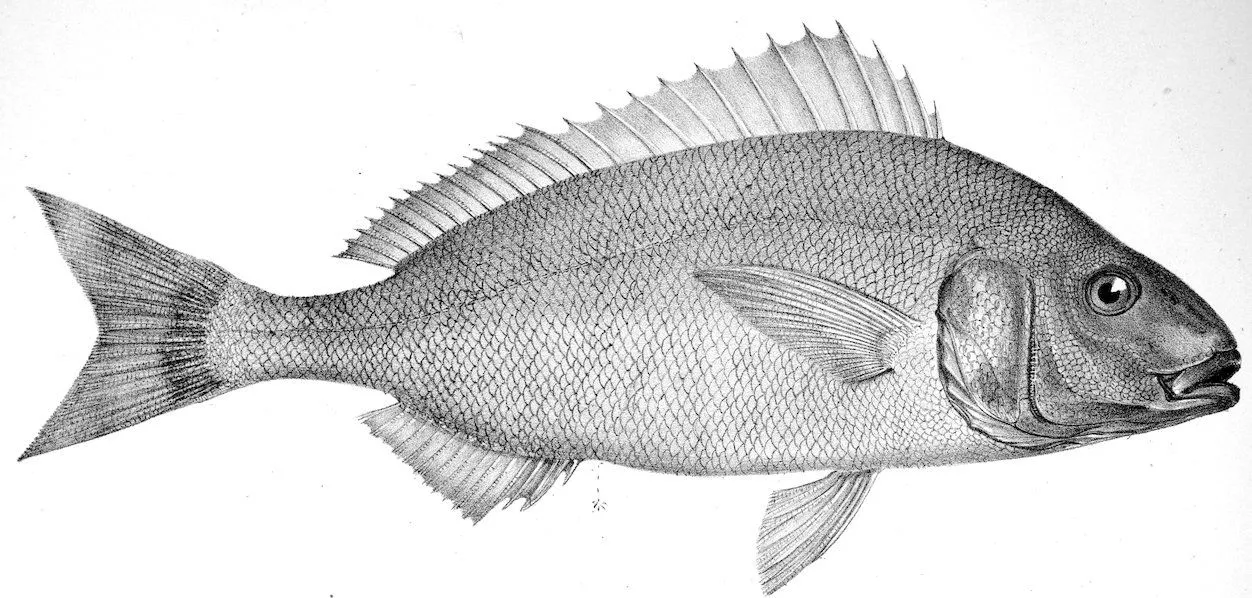
Fish. Pl. 10.
W. Hawkins delt.
Pristipoma cantharinum. Nat. Size.
49Mr. Darwin obtained one specimen only of this new genus at Chatham
Island in the Galapagos Archipelago. It is probably not full-sized.
P. cæruleo-argenteum, operculo nigro-marginato: pinnâ, dorsali subæquali, spinis
ultimis radiis articulatis paulo brevioribus; anali spinâ, secundâ forti, longitudinaliter
striatâ, radiis articulatis duodecim: preoperculo rectangulato, margine
adscendenti, leviter denticulato, basali integro: vertice, buccis, et ossibus opercularibus,
squamatis; rostro ultrà nares, suborbitalibus, et maxillis, nudis; squamis
corporis ciliatis: pinna caudali furcatâ.
B. 7; D. 12/15; A. 3/12; C. 17, et 4 breviores; P. 20; V. 1/5.
Long. unc. 10. lin. 11.
Form.—Form oblong-oval, much resembling that of the Cantharus griseus. Body compressed,
with the dorsal line slightly curved; the profile descending from the nape more obliquely, and
in a very regular manner. Greatest depth beneath the commencement of the first dorsal,
contained not quite three times and three quarters in the entire length: head rather less than
one-fourth of the length. Mouth protractile, but not wide, the commissure not extending to a
vertical from the anterior angle of the eye; when closed, the maxillary retires beneath the
suborbital, and only just the extremity remains visible. Jaws equal; in each a narrow band of
velutine teeth, the outer row somewhat longer than the others, particularly above, where they
approach to card. Tongue, palatines, and vomer smooth. Eyes moderate; their diameter
rather less than one-fifth of the length of the head; rather nearer the extremity of the snout
than the posterior margin of the opercle; the distance between them equalling twice their
diameter. Two small pores and a fossule beneath the symphysis of the lower jaw, the latter
very distinct. Preopercle rectangular, the angle somewhat rounded; the ascending margin
nearly straight and finely denticulated, but the denticulations hardly continued to the angle,
and not appearing at all on the basal margin. Opercle with two small flat points, but very
indistinct and almost lost in the membrane. Suborbitals large, with their lower margins entire.
Crown, cheeks, and pieces of the gill-cover, covered with small scales; but not the snout in
advance of the nostrils and eyes, nor suborbitals, nor lower jaw. Suprascapulars marked by a
large scale, the margin of which is nearly entire.
Lateral line following the curvature of the back at one-third of the depth; each scale
marked with an elevated line without ramifications. A scale taken from above the lateral line
is of a somewhat rhomboidal form; the free portion very finely striated, with the margin finely
50ciliated; the concealed portion with eight or nine deeper and more distinct striæ, not meeting
in the centre to form a fan, and with the basal margin crenated. The scales on the cheeks and
opercle are smaller than those on the body, and almost smooth.
The dorsal fin commences in a line with the posterior margin of the opercle, and extends
nearly the whole length of the back, rising from a groove as in the Sparidæ: its height on the
whole tolerably uniform throughout: spinous portion occupying more than half the fin; the
anterior spines gradually increasing in length to the fourth,[22] which equals rather more than
one-third of the depth; the succeeding ones nearly even, very gradually decreasing to the last,
which is about two-thirds the length of the fourth; all the spines moderately stout: soft portion
of the fin even, and rather higher than the last spine. Anal commencing in a line with the
third soft ray of the dorsal, and terminating opposite to that fin: the first spine short, but
strong; second and third spines equal in length, being about two-thirds the length of the soft
rays, but the second much stouter than the third; the second spine is also distinguished from
the others by having its surface longitudinally striated: soft rays nearly even, and resembling
those of the dorsal. Caudal forked, with the upper lobe a trifle longer than the lower; the
basal half covered with minute scales. Pectorals narrow and pointed, about two-thirds the
length of the head, with a small fold of loose skin in their axillæ. Ventrals placed a little
further back than the pectorals, and somewhat shorter; a long pointed scale in their axillæ,
nearly one-third their length.
Colour.—“Bluish silvery.”—D.—The colour, as it appears in spirit, is nearly uniform bluish
gray, and very similar to that of the Cantharus griseus. The gill-cover has a dusky edging
posteriorly.
Second specimen.—Smaller than the above, and not quite so deep in the body; the greatest depth
contained a trifle more than four times in the entire length; the nape in consequence less
elevated, and the profile less oblique. Eyes relatively a little larger, their diameter rather more
than one-fifth the length of the head. Preopercle with the posterior margin not so rectilineal,
approaching to concave; the angle at bottom projecting in consequence a little backwards; the
denticulations not quite so distinct and regular. One ray more in the soft dorsal.
D. 12/16; A. 3/12; C. 17, &c.; P. 19; V. 1/5.=
Long. unc. 9. lin. 2.
Colour.—“Silvery; above, shaded with brown and iridescent with blue; fins and iris sometimes
edged with blackish brown. Flap of the gill-cover edged with black.”—D.
Habitat, Galapagos Archipelago.
This species, which is undoubtedly new, may be known from most of those
described by Cuvier and Valenciennes by its greater number of soft rays in the
anal fin. The only ones which equal it in this respect are the P. Conceptionis and
51the P. fasciatum; from the former of which it may be distinguished by its greater
depth and nearly even dorsal, from the latter by its plain colour free from all
conspicuous bands and markings. The dorsal notch is scarcely observable, the
eleventh and twelfth spines being nearly equal, and but little shorter than the
first soft ray. Its analogy to the genus Cantharus among the Sparidæ, which it
resembles as well in colour as in general form, is very striking. There are two
specimens in the collection; the one described first above having been taken at
Chatham Island, the other at Charles Island, in the Galapagos Archipelago.
Latilus jugularis, Cuv. et Val. Hist. des Poiss. tom. ix. p. 369. pl. 279.
Form.—Elongated, with the dorsal line slightly curved, the ventral nearly straight. Greatest depth
contained five times and one-third in the entire length. Head, which much exceeds the depth,
four times in the same. Profile very convex above the eyes, whence it falls obliquely to the
lips. Snout thick and rounded, resembling that of the Red Mullet: mouth protractile,
horizontal, placed at the bottom of the snout, the commissure just reaching to a vertical from
the anterior part of the orbit. Jaws equal or very nearly so; the lower one perhaps a very
little the longest. Maxillary not widening at its posterior extremity. A band of velutine teeth
in each jaw, narrowing at the sides as it extends backwards; with an outer row of longer and
stronger ones: in the lower jaw, the velutine band does not extend beyond the middle of the
sides, the carding teeth being all that are visible. Tongue and palate smooth. Eyes high in
the cheeks; large, and of an oval form; their vertical diameter three-fourths of their
longitudinal; this last equalling one-fourth the length of the head. Nostrils consisting of two
round apertures, the posterior one largest, the anterior covered by a membranous flap. Preopercle
with the denticles far apart, and not very obvious, unless the skin be dissected off; the
ascending margin rectilineal and vertical; the angle rounded. Bony part of the opercle
terminating in a flat point, above which are two other smaller points not so well developed; all
the points concealed in the membrane, and scarcely visible from without: beneath the principal
point, the membrane is prolonged backwards in the form of a broad flattened bristly point
three lines in length. Crown, gill-covers and cheeks, scaly, but not the jaws; snout scaly,
except very near the lips. Gill-opening large.
Lateral line at first at one-third of the depth, but falling gradually to one-half. Scales
rather small; one taken from immediately above the lateral line of an oblong form, the length
being twice the breadth, with its free margin finely ciliated, crenated behind with a fan of nine
striæ; on scales taken from other parts the number of striæ in the fan are more numerous.
One long dorsal fin of nearly uniform height throughout, equalling about half the depth;
only four slender spines, gradually increasing in length from the first which is very short; the
fourth about three-fourths the length of the first soft ray; soft rays increasing likewise very gradually
to the fourth, which with the next five or six are highest; the membrane of the fin very
52delicate; all the soft rays branched. Vent in a vertical line with the ninth soft ray of the
dorsal. Anal commencing immediately behind it, and answering to that portion of the dorsal
to which it is opposite, terminating at the same distance from the caudal; only two slender
spines, the first very short; the first soft ray simple, the rest branched. Space between these
two fins and the caudal barely one-eighth of the entire length. Caudal nearly even. Pectorals
moderately long and narrow, equalling nearly the length of the head; rays branched; fourth,
fifth, and sixth longest. Ventrals a little in advance of the pectorals, nearly equalling them in
length; of a pointed form, with the third and fourth soft rays longest. In the axilla of the
pectorals a vertical scaly membranaceous lamina.
B. 6; D. 4/28; A. 2/22; C. 17; P. 20; V. 1/5.
Length 11 inc. 5 lines.
Colour.—(In spirits.) Dusky olive on the back and upper part of the sides, yellowish (probably
silvery in the recent state) beneath, with faint indications of five or six dark transverse bands,
similar to those in the common perch. Inside of the ventrals blue.
Second specimen.—Smaller than the above, measuring six inches and a half in length, but differing
from it in no respect, as regards form, excepting in having the profile not so oblique, and the
snout in consequence not so obtuse; the jaws also are exactly equal. Fin-ray formula the
same.
Colour.—“Beneath brilliant white; head and back clouded with purplish and carmine red;
longitudinal and transverse irregular bands of the same.”—D. The bands in this specimen
amount to eight in number, and are much more conspicuous than in the larger one above
described.
Habitat, Valparaiso, Chile.
The smaller of the two specimens above described was taken by Mr. Darwin
at Valparaiso. The number attached to the larger one has been lost, but it was
probably taken at the same place, where it had been previously discovered both
by M. D’Orbigny and M. Gay. The specimen described by Valenciennes has
one soft ray more in the dorsal, and one less in the anal, than either of the above;
but in all other respects they tally exactly. As observed in the “Histoire des
Poissons,” this species has many points of resemblance to Percis and Pinguipes.
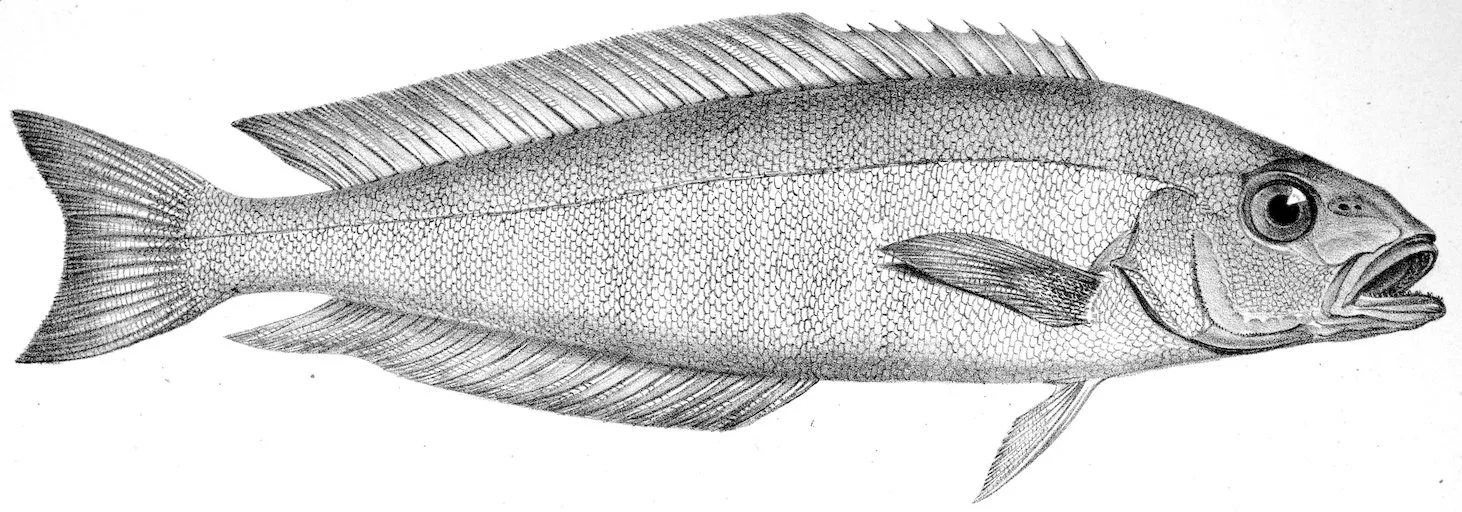
Fish. Pl. 11.
W. Hawkins delt.
Latilus princeps. ½ Nat. Size.
53L. elongatus; corporis altitudine capitis longitudinem æquanti; dentibus velutinis,
serie externâ fortiori, aculeiformi; preoperculo margine adscendenti recto, leviter
denticulato, basali lævi; operculo mucrone unico; rostro, ossibus suborbitalibus,
maxillis, limbo preoperculi, et interoperculo, nudis; buccis et cranio squamatis,
squamis in vertice spatium angulatum inter oculos occupantibus; pinnis dorsali
analique prælongis; spinis analibus parvis, gracilibus, primâ minutissimâ; ventralibus
accuratè thoracicis; caudali emarginatâ.
B. 5?; D. 8/26; A. 2/26; C. 15, &c.; P. 18 vel 19; V. 1/5.
Long. unc. 20. lin. 6.
Form.—Elongated; the greatest depth equalling the length of the head, and each contained
rather more than four times and a half in the entire length. Snout short and rather obtuse,
the profile bending downwards in a curve before the eyes. Mouth nearly horizontal, at the
bottom of the snout; when closed, the maxillary, which is not widened at its posterior extremity,
and which is very similar in form to that of the last species, reaches nearly, but not quite, to a
vertical from the anterior part of the orbit. Lower margin of the suborbital entire. Teeth
forming a velutine band in each jaw, widest in front, with a row of stronger ones externally:
none on the tongue, vomer, or palatines. Eyes large, and high in the cheeks; their diameter
one-fifth the length of the head. Preopercle with the angle at bottom rounded; the ascending
margin straight, and nearly but not quite vertical, forming with the basal rather more than a
right angle; the former finely denticulated, but not the latter. Opercle terminating in one flat
point, not projecting beyond the membrane. The branchiostegous rays appear to be but five
in number, but, the skin being dry, there may possibly be a sixth overlooked. Cranium,
cheeks, and opercle scaly; but not the snout or jaws, or limb of the preopercle, or interopercle:
the scales on the crown are separated from the naked skin of the snout by a well-defined line,
which forms an advancing angle between the eyes.
Lateral line straight, and continued to the base of the caudal; its course parallel to the
back at between one-fourth and one-third of the depth. Scales on the body rather small,
oblong, longer than broad, with their free extremities dotted and finely ciliated; the concealed
portion striated finely at the sides, and more deeply at the base; but all the central portion,
including an oblong area of the same form as the entire scale, without striæ, being only very
minutely roughened or punctured.
One long dorsal, low, and of nearly uniform height throughout, commencing about in a
line with the insertion of the pectorals, and reaching very nearly to the caudal: eight spines,
rather slender, and very gradually increasing in length, the last being just twice the length of
the first and equalling the distance from the base of the fin to the lateral line: the soft rays
which follow are nearly even with the last of the spinous till the twenty-fourth, which is
slightly prolonged in a point, and which is followed by two others shorter than the rest; the
ends of the rays are rather worn, but they appear to have been all branched. Anal also long,
commencing at about the middle of the entire length, or in a line with the sixth soft ray of the
dorsal, and terminating opposite to that fin, to the last half of which, or rather more than
half, it exactly answers; only two spines, which are so slender and minute, especially the first,
54and so closely united to each other as well as to the first soft ray, as to be scarcely obvious
except upon dissection; all the soft rays, except the first, branched. Space between the anal
and caudal not a tenth part of the whole length. Caudal slightly notched, or hollowed out,
with rows of scales between the rays. Pectorals pointed, about three-fourths the length of the
head, with the seventh and eighth rays longest; rows of scales at the base between the rays:
in their axillæ a somewhat projecting vertical scale or lamina, as in the last species. Ventrals
immediately beneath the pectorals, also pointed, but shorter.
Colour.—“Above, and the fins, obscure greenish; sides obscure coppery, passing on the belly
into salmon-colour. Pectorals edged with dull blue. Iris yellowish brown: pupil black-blue.”—D.—The
skin has dried to a nearly uniform brown.
Habitat, Chatham Island, Galapagos Archipelago.
I feel but little hesitation in referring this species, which is one of the many
new ones obtained by Mr. Darwin in the Galapagos Archipelago, to the genus
Latilus. The absence of vomerine and palatine teeth requires it to be placed,
according to Cuvier’s views, among the Sciænidæ; in which family, there is no
other group besides Latilus, to which it makes any approach. It agrees with
that genus in its general form, and in many of its particularities; it has the same
form of snout, mouth, maxillary, and dentition; the same scaly lamina in the
axilla of the pectorals; the same long undivided dorsal and anal fins, with only
two very small anal spines, so closely united to the first soft ray as to be easily
overlooked. But it may be at once distinguished from the L. argentatus and the
L. doliatus, the only two species described by Cuvier and Valenciennes in the
body of their work, by its much more numerous soft rays in the dorsal and anal
fins. From the L. jugularis last described, which resembles it in this respect, it
differs in its thoracic ventrals, shorter head, naked snout and suborbital, and
notched caudal: the profile also falls less obliquely. There is only one specimen
in the collection, a dried skin and rather injured.
Heliases Crusma, Cuv. et Val. Hist. des Poiss. tom. ix. p. 377.
Form.—Oval, very much compressed. Back considerably elevated, particularly at the nape, whence
the profile descends very obliquely, and, with the exception of a slight concavity before the
eyes, in nearly a straight line. Greatest depth at the commencement of the dorsal, equalling
nearly half the entire length, caudal excluded. Head contained four and a half times in the
same. Snout short: mouth small, a little protractile: lower jaw rather the longest. A narrow
55band of velutine teeth in each jaw, with the outer row in fine card; these last longest and
strongest in front. Eyes large; their diameter nearly one-third the length of the head. Suborbitals
forming a narrow curved band beneath the eyes, and covered by a row of scales.
Nostrils with only a single, small, round aperture. Preopercle with the ascending margin
vertical, not quite rectilineal, inclining slightly inwards towards the angle, which is rounded.
Opercle, taken together with the subopercle, very regularly curved, the margin describing
nearly a semicircle, with one flat point to terminate the osseous portion; its height double its
length.
The whole of this fish, including every part of the head, except the lips and maxillary, is
covered with scales, which extend on to the vertical fins as in Glyphisodon: those on the fins
and upper part of the head and snout are very small, but those on the gill-covers and body very
large: about twenty-six or twenty-seven in a longitudinal line from the gill to the base of the
caudal, and fourteen or fifteen in a vertical line: one taken from about the middle of the side
is oblong, the breadth exceeding the length, with the anterior margin rounded, and the free
portion finely dotted and very minutely ciliated, the concealed portion cut square, with a fan of
eight or ten striæ not meeting at the centre, and terminating at the basal margin in as many
crenations. The lateral line commences at one-fourth of the depth, but, from the fall of the
dorsal line posteriorly, the distance between these two lines diminishes as the former advances:
the lateral line terminates beneath the soft portion of the dorsal fin altogether.
Fins almost exactly similar to those of the Glyphisodon saxatilis and Heliases insolatus, as
described and figured in the “Histoire des Poissons.” The fourth and fifth spines in the
dorsal longest, equalling one-fourth of the depth; of the soft rays the third, fourth, and fifth are
longest. First anal spine only one-third the length of the second, which is itself rather shorter
than the soft rays; and these last appear longer than in the H. insolatus. Caudal more forked
than crescent-shaped, the depth of the fork equalling nearly half the length of the fin, which is
itself one-fourth the entire length of the fish. Axillary scales of the pectorals and ventrals as
in H. insolatus.
B. 6; D. 13/12; A. 2/12; C. 15, & 4 short; P. 21; V. 1/5.
Length 8 inches.
Colour.—“Above lead-colour, beneath paler.”—D. In spirits, it appears of a deep brownish olive
on the back and upper part of the sides, passing into dull golden yellow on the lower part of
the sides and abdomen, where, however, the scales are still faintly edged with the former
colour. Fins dark.
Habitat, Valparaiso, Chile.
This species, as M. Valenciennes observes, is so extremely similar to the
H. insolatus, that at first sight, it would hardly be distinguished from it. The
only differences appear to consist in the form of the caudal, which is forked, not
crescent-shaped as in the species just mentioned, and in the greater length of
56the soft rays of the anal. In the figure of H. insolatus in the “Histoire des
Poissons,” these rays are represented of the same length as the second spine,
whereas in the present species they rather exceed it, giving a greater depth to the
entire fin. The teeth also would seem to be more developed in the H. Crusma,
especially those in front, which are longer than the others. According to Valenciennes,
the outer row hardly exceeds the inner ones in the H. insolatus. The
geographical position of the two species is however widely different. The
H. insolatus is a native of the Caribbean Seas; whereas the H. Crusma has only
been obtained on the coast of Chile and off the island of Juan Fernandez. M. Gay
first obtained it at Valparaiso, where also Mr. Darwin’s specimen was procured;
in whose notes it is stated, that it gets to a much larger size than the one here
described.
C. albida, quatuor fasciis interruptis nigro-fuscis; pinnis dorsali, caudali, et ventralibus,
clarè cæruleo-marginatis: dentibus anticis conicis, in maxillâ superiore octo,
in inferiore decem minoribus; molaribus suprà seriebus tribus, intermediâ minori,
infrà duâbus dispositis; preoperculo et operculo, utroque quatuor squamarum
seriebus tecto; limbo preoperculi nudo.
D. 12/12; A. 3/10; C. 17, &c.; P. 15; V. 1/5.
Long. unc. 14.
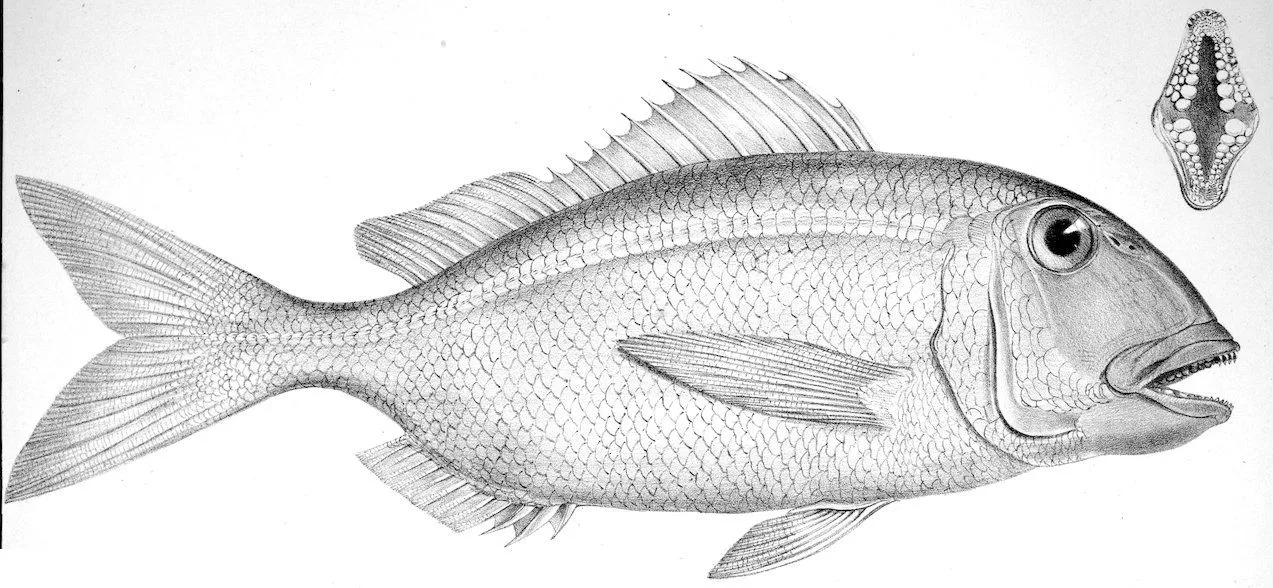
Fish. Pl. 12.
W. Hawkins del.
Chrysophrys taurina. ¾ Nat. Size.
57Form.—General form not very dissimilar to that of the C. Aurata. Greatest depth contained
about three times and a half in the entire length. Depth and length of the head equal, each
about one-fourth of the entire length. Profile very oblique. Eyes high, and moderately large,
distant two diameters from the end of the snout. Preopercle with the angle at bottom very
much in advance, giving an obliquity to the ascending margin; the limb not very broad, and
naked; in front of the limb are about four rows of scales smaller than those on the body: the
same number of rows of scales on the opercle. Jaws equal, with eight conical incisors in front
of the upper one, and ten in front of the lower;[23] those above longer than those below, and more
regularly and closely set: behind the incisors above and below is a patch of fine card: then
follow the molars, which are in three very regular rows above and two below; of the three rows
above the inner and outer ones are much the strongest, containing each about eight teeth;
those in the outer row are slightly pointed, and not very unequal in size, but the inner series
enlarge very rapidly as they extend backwards, the last two or three being of considerable size;
all round or nearly so, there being no large oval one at the back, as in the C. Aurata and some
other species; the middle series above consists of teeth much smaller than the others, and more
numerous: the two rows below are not very dissimilar to the inner and outer rows above.
Suborbital broad, and naked, covering a large portion of the cheek.
Scales on the body of a moderate size; too much injured and displaced in this specimen to
admit of the exact number being counted in a longitudinal row; those on the lateral line,
however, are all perfect and present to within five rays of the end of the dorsal, and up to that
point they amount to thirty-one. The fins, so far as can be judged from their present state,
are on the whole very similar to those of the other species; but the dorsal and anal spines,
especially the second anal spine, appear rather stronger than those of the C. Aurata.
Pectorals long and narrow, contained about three times and three quarters in the entire length.
Colour.—“White, with four dark brown much interrupted bands, giving a mottled appearance;
head coloured with the same; top of the head, ridge of the back, edges of the dorsal, caudal
and ventral fins, tinted with fine azure blue.”—D.
Habitat, Chatham Island, Galapagos Archipelago.
Mr. Darwin’s collection contains a single specimen of a species of Chrysophrys
from the Galapagos Archipelago, not in a sufficiently good state of
preservation to admit of a very detailed description being given of it, but,
nevertheless, evidently distinct from any that I can find recorded by authors. It
appears to belong to Cuvier’s second section of this genus characterized by the
absence of any large oval molar behind the others, though the last two or three
in the inner series above are of considerable size. It differs, however, from all
those described in the “Histoire des Poissons,” in having the conical incisors
more numerous, and but three rows of molars in the upper jaw. The specimen
also is of sufficient size to lead to the belief, that it would not have acquired any
additional ones by further growth. The C. aculeata resembles it, indeed, in this
last character, but independently of other differences, this species is said to have
a reclined spine before the dorsal fin which is not present in the one here
described.
Out of twenty-two species of this genus described in the “Histoire des
Poissons,” only one is from the Pacific Ocean, whence the present species was
brought. The greater number are from the Atlantic and Indian Oceans.
58
Gerres Gula, Cuv. et Val. Hist. des Poiss. tom. vi. p. 349.
Form.—Greatest depth one-fourth of the entire length. Back but little elevated. Space between
the eyes flat, with a fovea in the middle, which is prolonged in a channel nearly to the extremity
of the snout. Length of the head exceeding its depth by one-fourth, and contained about three
times and three quarters in the entire length. So much of the maxillary as is visible is of an
oval form, its length being twice its breadth at its posterior extremity. Suborbital with the
lower margin very indistinctly notched, and not denticulated. Eyes very large, their diameter
contained twice and three quarters in the length of the head. The two orifices of the nostrils
of nearly equal size. No denticulations on any of the pieces of the gill-cover. A narrow band
of very minute velutine teeth in each jaw, those above hardly visible to the eye, but sensible to
the touch: none on the vomer, palatines, or tongue.
Dorsal with the first spine extremely short; the second has a small piece broken off at the
tip, but appears to have been about the same length as the third, which last equals two-thirds
of the depth of the body; the fourth and fifth are a little shorter than the third; the succeeding
ones gradually decreasing, as in the other species of this genus: all the spines are moderately
slender, the anterior ones slightly arcuate, with scarcely any appreciable difference in the degree
of stoutness in the first four. Anal with the first spine extremely short; the second obviously
stouter than any of the dorsal spines, but much shorter, being only half the length of the second
dorsal spine, or one-third the depth of the body; the third spine is a trifle longer than the
second, but much slenderer. Caudal deeply forked; the lobes worn at the tips in this specimen,
but their length, when perfect, probably about one-fourth, or somewhat less, of the entire length
of the fish. Pectorals narrow and pointed, a little shorter than the head, and contained four
and a half times in the entire length; fifth ray longest. Ventrals a little behind the pectorals,
and not more than two-thirds their length, or scarcely so much; the spine a little shorter than
the soft rays, and of about the same degree of stoutness as the dorsal spines. Elongated scale
in the axillæ of the ventrals about three-fourths the length of the spine, of a narrow lanceolate
form, ending in a very fine point.
D. 9/10; A. 3/7; C. 17, &c.; P. 14; V. 1/5.
Length 3 inc. 6 lines.
Colour.—Not noticed in the recent state. In spirits, it appears of a uniform silvery, with the back
and upper part of the sides inclining to dusky olive: no bands or any particular markings:
fins pale.
Habitat, Rio de Janeiro.
59The species of this genus are numerous, and extremely similar to each other.
Many of them appear to rest on characters taken simply from the relative lengths
and degrees of stoutness of the dorsal and anal spines. This renders it extremely
difficult to identify single specimens. Perhaps I am wrong in referring the one
described above to the G. Gula of Cuvier and Valenciennes; but it makes so
near an approach to that species, that I hardly dare characterize it as distinct.
It cannot be the G. Aprion of those authors, which is closely allied to the G. Gula,
and is found on the same coasts, since its teeth are so very much finer: the
caudal also is not scaled. It is small, but Cuvier and Valenciennes state that
none of their specimens of the G. Gula exceed five inches. Mr. Darwin took it
in a salt-water lake, Lagoa de Boacica, at Rio de Janeiro.
Gerres Oyena, Cuv. et Val. Hist. des Poiss. tom. vi. p. 355.
Smaris Oyena, Rüppell, Atlas zu der Reise im Nörd. Afr. Zoologie; p. 11. tab. 3. fig. 2.
Form.—Greatest depth contained rather more than three and a half times in the entire length: the
dorsal curve very regular. Profile above the eyes a little concave. Length of the head exceeding
its depth. Maxillary as in the species last described. Suborbital with its lower margin distinctly
but not very deeply notched; not denticulated. Diameter of the eye less than one-third the length
of the head. Posterior orifice of the nostrils twice the size of the anterior one. No denticulations
on any part of the head or gill-cover. A narrow band of velutine teeth in each jaw, of
about the same length and degree of fineness above and below; but none on the palate or
tongue.
The dorsal commences in an exact vertical line with the insertion of the ventrals: the anterior
spines are a little arcuate; the first, as in the other species of this genus, is extremely short;
the second and third in this specimen are broken at their extremities so that their exact length
cannot be ascertained, but the portion of the second remaining (and of this spine apparently
only a very small piece is gone) nearly equals half the depth of the body; length of the fourth
spine which is perfect not quite equalling two-fifths of the depth; fifth, sixth, and seventh spines
gradually decreasing; eighth and ninth scarcely shorter than the seventh: the second spine
is much compressed, and though obviously stronger than any of those which follow, not nearly
so stout as in many other species; its breadth is not more than one-twelfth of its length. Anal
commencing in a line with the fourth soft ray of the dorsal; the second spine compressed
similarly to the second dorsal spine, and of about the same degree of stoutness, but its length
one-third less, being just equal to one-third the depth of the body; the third spine scarcely
shorter than the second, but much slenderer; the soft rays gradually decreasing from the first,
which is a little shorter than the third spine, to the last but one, the last itself slightly prolonged
60to form a point backwards. Caudal forked nearly to its base; the lobes much elongated; the
upper one, which is a trifle longer than the lower, contained rather more than three times and a
half in the entire length. Pectorals narrow and pointed, a little shorter than the head, and
contained not quite four times and a half in the entire length; fifth and sixth rays longest.
Ventrals attached a little behind the pectorals, and not much more than half their length; the
spine about three-fourths the length of the soft rays, and scarcely stouter than the third spine
in the anal: the axillary elongated scale three-fourths the length of the spine. The scales on
the body of this species are not materially different from those of the G. Plumieri described in
the “Histoire des Poissons.”
B. 6; D. 9/10; A. 3/7; C. 17, &c.; P. 16; V. 1/5.
Length 7 inches.
Colour.—“White, silvery.”—D. The fins are yellowish; the membranes here and there dotted
with black: the lobes of the caudal are bordered internally with dusky. I see no trace of the
interrupted longitudinal bands spoken of by Cuvier and Valenciennes, neither is there any
allusion to them in Mr. Darwin’s notes taken from the recent fish.
Habitat, Keeling Island, Indian Ocean.
I do not feel confident as to this species being, any more than the last,
identical with that to which I have referred it. It requires an inspection of a
large number of specimens in order to ascertain the true value of characters.
The present one agrees with what is stated of the G. Oyena by Cuvier and
Valenciennes, excepting that the second anal spine, which they represent as
shorter than the second dorsal spine by one-half, is here shorter by one-third only:
also, as mentioned above, there is no appearance of any longitudinal bands.
There is no other species in the “Histoire des Poissons,” to which it approaches
more closely. But comparing it with Rüppell’s figure, if this last be scrupulously
exact, there are a few other differences besides those already alluded to. Thus
the first anal spine in Mr. Darwin’s specimen appears shorter in relation to the
second, and this last stouter as well as longer. Also the soft rays of this fin
gradually decrease, giving a sloping direction to the margin, whereas in Rüppell’s
figure, all the rays are nearly of the same length, and made equal to the second
and third spines. The caudal lobes, likewise, appear longer in Mr. Darwin’s
specimen. It must be left for others to determine whether these discrepancies
are indicative of a specific difference or not. As regards the geographic range of
the G. Oyena, I know not that there is any thing in this respect to render its
identity with the species here described improbable. It inhabits the Red Sea;
and is also said to be common at the Mauritius;—whence it may very possibly
61extend as far eastward as the Keeling Islands, where Mr. Darwin’s specimen was
obtained.
The Sparus erythrurus of Bloch (pl. 261) is so extremely unlike the present
species both in form and colours, that, except on the authority of MM. Cuvier
and Valenciennes, who state that they had seen Bloch’s original specimen, no one
could have suspected that the figure had been intended for it.
Chætodon setifer, Bloch, Ichth. pl. 425. fig. 1.
———— Cuv. et Val. Hist. des Poiss. tom. vii. p. 58.
Form.—This species is one of those characterized by a prolongation of a portion of the soft
dorsal fin. In the present specimen it is the sixth soft ray which is thus prolonged. The total
length of this ray, measured from the root, is half the entire length of the fish; and that
portion of it which exceeds the adjoining rays is rather more than half. Although the
preopercle can hardly be called denticulated, yet there are some faint traces of rudimentary
denticulations at the lower angle. The general form, in all other respects, agrees with the
descriptions of Cuvier and other authors.
D. 13/24; A. 3/21; C. 17, and 6 short; P. 16, the first short; V. 1/5.
Length 6 inc. 3 lines.
Colour.—“Body pale, with narrow dark straight lines which form network: across the eye a
black band: posterior half of the body bright orange: upper part of the prolongation of the
dorsal fin edged with black, and a round patch of the same.”—D. The black ocellus extends
from the fifth to the thirteenth ray of the soft dorsal. There is no trace of the four red or
yellow streaks said by Cuvier and Valenciennes to cross the forehead from eye to eye; but
probably they are effaced by the action of the spirit.
A second specimen only differs from the above in being smaller, measuring in length not quite five
inches; in having the fifth (instead of sixth) ray in the soft dorsal prolonged; and in the
ocellus extending from the fifth to the tenth ray only. In the last two respects it agrees better
with the description in the ‘Histoire des Poissons.’ The filamentous ray terminates in an
extremely fine hair, which leads me to think that the extreme portion of this ray in the first
specimen has been broken off.
Habitat, Keeling Island, Indian Ocean.
62Mr. Darwin’s collection contains two individuals of this species procured on
coral reefs at the Keeling Islands. As according to his notes made from the
recent fish, the posterior half of the body is bright orange, Bloch’s figure may not
be so much overcoloured as is supposed by Cuvier and Valenciennes, who state
that he has represented of a bright red, what ought to be silvery grey and yellow
ochre. Perhaps the colours may depend in some measure on the season. Mr.
Darwin’s specimens were obtained in the month of April.
Corpus oblongo-ovale, compressum. Caput obtusum. Os parvum, haud protractile.
Dentes maxillares omnes incisores, parvi, æquales, contigui, uniseriati; palatini
velutini, minuti. Ossa suborbitalia denticulata. Preoperculum margine adscendenti
levissimè denticulato. Operculum inerme. Membrana branchialis quatuorradiata.
Pinnæ verticales squamis confertis ferè omnino obtectæ: dorsalis unica,
subæqualis, membranâ ad apices spinarum parum laciniatâ: ventrales radio primo
molli elongato. Linea lateralis sub terminationem dorsalis interrupta. Squamæ
rostri et verticis parvæ; operculi et corporis magnæ, obliquè dispositæ; omnes
levissimè ciliatæ.
This apparently new form will enter into none of the genera established by
Cuvier and Valenciennes. The palatine teeth serve to detach it from the Sciænidæ,
while this character, taken in connexion with the compressed body, and the
extreme scaliness of the vertical fins, require that it should be arranged with the
Chætodontidæ, or at least have a place in that large group to which Cuvier has
given the name of Squammipennes. It belongs to the second tribe in that family
characterized by cutting teeth; and it would seem most nearly allied to Pimelepterus,
but it does not approach that genus very closely, and may at once be
distinguished from it, by the teeth being without spurs behind, and the dorsal and
anal fins being more scaly. From Dipterodon, the only other genus in that tribe,
it may be known by its undivided dorsal, independently of other marked differences.
But though this genus requires to be arranged with the Chætodontidæ on the
grounds above mentioned, in all its other characters it comes much nearer that
portion of the Sciænidæ which have the lateral line terminating beneath the end
of the dorsal fin; especially Pomacentrus, which it resembles in the general form
63of the head and body, denticulated suborbital and preopercle, unarmed opercle,
four-rayed branchiostegous membrane, and in the size and mode of arrangement
of the scales on the body. I am not aware that any species of Pomacentrus have
the dorsal and anal fins so completely covered with scales: but, according to
Cuvier and Valenciennes, there is a species of Glyphisodon,[25] to which genus
Pomacentrus is closely allied, which has these fins almost as entirely scaled, as
in the true Squamipinnati; and if so, there is nothing but the palatine teeth which
of necessity demands the separation of this new genus from the Sciænidæ.
These teeth can be distinctly felt upon the vomer, but I am not quite sure from the
small size of the fish, and its mouth also being small, whether they exist on the
palatines as well. It may be added that this genus shews further itself an affinity
to Glyphisodon, in the filamentous prolongation of the first soft ray in the ventrals.
This character is not, I believe, found in Pomacentrus.
In which ever family it is placed, it forms a beautiful connecting link between
the two. It is from the Cape Verde Islands.
Form.—Oblong-oval; the body much compressed. Greatest depth rather more than one-third of
the entire length: head one-fourth of the same. Snout short and obtuse; the profile rising
very obliquely, and forming with the dorsal line one continuous curve. The back is sharp, and
appears more elevated than it really is, in consequence of the dorsal fin being thickly coated
with scales, and scarcely distinguishable from the body. Ventral line less convex than the
dorsal; the edge of the abdomen somewhat carinated between the ventral and anal fins, but
in advance of the former rounded. The upper and under profile meet at the mouth at a right
angle. Mouth small, and scarcely at all protractile. Jaws equal; each with a single row of
cutting teeth, which are small, though rather larger below than above, even and closely set,
forming a compact series: no secondary teeth behind: vomer rough with minute velutine teeth.
When the mouth is closed, no portion of the maxillary is concealed by the suborbital. Eyes
round, moderately large, their diameter rather less than one-third the length of the head, placed
high in the cheeks, and nearer the end of the snout than the posterior angle of the opercle, the
distance from the former being rather less than one diameter. The nostrils consist of a single
minute round aperture, about half-way between the eye and the anterior margin of the
suborbital. The suborbital has its margin entire as far as the end of the maxillary, at which
point it curves backwards and upwards to form a narrow band beneath the eye, and the lower
margin of this band is denticulated. The preopercle is likewise denticulated; but the denticulations,
which are principally confined to the ascending margin, are not very obvious, and more
64readily felt than seen: the angle at bottom is rounded, and rather exceeds a right angle; a
vertical from the angle would form a tangent to the posterior edge of the orbit: the ascending
margin is not quite straight, bending slightly inwards a little below the middle. The opercle
terminates posteriorly in a very obtuse angle, and shows some indication of two very minute
flattened points, which, however, do not project beyond the membrane: from the lowermost of
these points the margin of the subopercle passes obliquely forwards to form a continuous curve
with that of the interopercle, which is tolerably well developed. Gill-opening of moderate size:
the branchial membrane, which apparently has only four rays, has a shallow notch in front, and
passes continuously from one side to the other, without being attached to the isthmus.
The lateral line commences at the upper angle of the opercle, and, inclining upwards, runs
parallel, not to the dorsal line which can hardly be distinguished, but to the upper edge of the
dorsal fin, its distance from which is contained about three times and a half in the entire depth;
it terminates a little before the termination of that fin. Cranium, snout, cheeks, pieces of the
opercle, the body, and all the vertical fins, covered with finely ciliated scales; those on the
crown and snout small, but those on the opercle and body large; the latter arranged in oblique
rows; about twenty-seven in a longitudinal line from the gill to the caudal, and about fourteen
in a vertical one from the dorsal to the ventral line: a scale taken from the row beneath the
lateral line, and about the middle of the body, is of an oblong form, its breadth exceeding its
length, with the free edge dotted and finely ciliated, the basal margin rather deeply crenated,
the crenations separated by seven striæ, which are carried on for only a short way, and do not
converge to a fan. The scales on the dorsal and anal fins are small and closely compacted;
those on the former arranged obliquely, but the line of obliquity is in the opposite direction to
what it is on the body.
The dorsal fin commences in a line with the posterior angle of the opercle, and occupies a
space equalling half the entire length: the height of the spinous portion is nearly uniform, but
slightly increases backwards; between the tips of the spines, the membrane is a little jagged:
the soft portion is scarcely more than one-third the spinous in length, but is somewhat higher,
terminating upwards in an acute angle; the longest of the soft rays is about half the depth of
the body, the dorsal fin itself not included. The anal answers to the soft portion of the dorsal,
which it exactly resembles; it has two spines in front, the first of which is very short, and
scarcely more than one-third the length of the second, which itself is shorter than the soft rays;
the second spine is stouter than any of the dorsal spines. These two fins terminate in the same
vertical line. The caudal appears to have been square, but the rays are worn at the tips, so that
its exact form cannot be ascertained; it is coated with scales for four-fifths of its length from
the base. Between the dorsal and the caudal fins is a space equalling not quite one-third the
depth of the body. Pectorals attached a little behind the opercle, and a little below the middle;
slightly pointed; about the length of the head or rather shorter; the first ray only half the
length of the second; fourth and fifth longest; all the rays, with the exception of the first two
and the last two or three, branched. Ventrals attached a little further back than the pectorals;
the first soft ray prolonged into a filament reaching to the commencement of the anal; the
spine is about half the length of the filamentous ray, and about two-thirds that of the second
soft ray. Between these fins is an oval lanceolate scale about one-third their length; and in
their axillæ another elongated one, narrower and more pointed than the former, and rather
exceeding it in length.
65B. 4; D. 12/16; A. 2/12; C. 15, and 4 short; P. 21; V. 1/5.
Length 3 inches.
Colour.—Not noticed in the recent state. In spirits, the whole fish, fins included, appears of a
uniform dark brown.
Habitat, Porto Praya, Cape Verde Islands.
The only specimen of this new genus which exists in the collection was taken
by Mr. Darwin off Quail Island, in the bay of Porto Praya. It is small, but
probably full-sized, or nearly so; since the greater part of the species of
Pomacentrus, to which genus it is so strongly allied, average about the same
dimensions. Possibly some of the generic characters, which I have given above,
may prove hereafter to be merely specific; but till other species shall have been
discovered, their exact value cannot be ascertained.
Corpus altum, rhomboideum, valdè compressum, squamis minutissimis obtectum. Linea
lateralis anticè sursum paulò arcuata, per totam longitudinem inermis. Cauda
lateribus haud carinatis. Dentes in utrâque maxillâ uniseriati, tenuissimi, acuti;
in linguâ, vomere, et palatinis, velutini brevissimi. Apertura branchialis amplissima,
membranâ decem-radiatâ. Spinæ quinque liberæ loco pinnæ dorsalis primæ; spinâ
minutâ, præeunte reclinatâ antrorsum flexâ. Dorsalis secunda, æquè ac analis,
continua, sine pinnulis falsis: ante analem spinæ duæ liberæ. Pectorales parvæ.
Ventrales nullæ. Caudalis profundè furcata, lobis acuminatis, subelongatis.
This new genus belongs to that section of the Scombridæ characterized by
having a number of short free spines, instead of a first dorsal fin. It is most
nearly allied to Lichia, especially to the L. glaucus, which it resembles in general
form, as well as in many of its particular characters. It has the same reclined
spine in front of those which represent the first dorsal, and the same two free
spines in front of the anal; also the same form of opercle; the same deeply forked
caudal, and small pectorals. But it may be at once distinguished from
that genus by the absence of ventrals, of which there is not the least trace: the
body is also deeper, rhomboidal rather than oval, and more compressed. In all
these respects it agrees better with Stromateus, which would seem particularly to
meet it in those species, such as the S. candidus and S. securifer, which are
represented by Cuvier and Valenciennes as having a number of minute truncated
66spines before the dorsal and anal fins, and which, by virtue of this character,
though in the case of the former the spines are not apparent externally, serve
manifestly to re-conduct to the section to which Lichia belongs. The discovery
of the present genus, therefore, furnishes a more completely connecting link
between these two groups.
Rhynchobdella and Mastacemblus agree with Paropsis, both in wanting
ventrals and in having the first dorsal represented by free spines; but the form
of these two genera is so totally different in all other respects, that it is impossible
they can be confounded with it.
This new genus is from the east coast of South America.
P. argentea, nitens, summo dorso cærulescente; operculo ad angulum superiorem
maculâ nigrâ signato; pinnis pectoralibus maculis duabus in axillis et ad radices
radiorum, minoribus.
B. 10; D. 5—1/33; A. 2—1/35; C. 17, et circa 5/5— accessar.; P. 21; V. 0.
Long. unc. 9.
Form.—Body very much compressed, of a rhomboidal form, the dorsal and ventral lines rising to an
angle at the commencement of the dorsal and anal fins respectively. Head a laterally compressed
cone: tail becoming suddenly attenuated before the setting on of the caudal fin, without
any keel at the sides. Back sharp and elevated; the greatest depth contained not more
than two and a half times in the entire length: thickness only one-fifth of the depth. The
length and depth of the head are equal, each being half the depth of the body. The upper and
under profile meet at the extremity of the snout at nearly a right angle, the former falling in a
very regular curve from the commencement of the dorsal fin. Mouth moderately large, the
commissure reaching to beneath the eye, with the lower jaw projecting and of considerable
strength and thickness. In each jaw a single row of very fine sharp teeth. The tongue, which
is of a triangular form, free at the tip, and pointed, is rough, with some extremely fine closely
shorn velutine teeth: a small triangular patch of these last teeth on the front of the vomer, and
a narrow row on each palatine: pharyngeans with rather stronger teeth. The intermaxillary is
very slightly protractile. The maxillary reaches, when the mouth is closed, to a vertical from
the posterior part of the orbit: it is very visible from without, having only its anterior portion
concealed by the suborbital, and being much dilated at its posterior extremity, which is in
shape somewhat securiform. Eyes above the middle of the cheek, and nearer the end of the
snout than the posterior margin of the opercle; their diameter rather more than one-fifth the
length of the head: the suborbital forms a narrow band beneath each. Nostrils half-way
between the eyes and the end of the snout; the anterior orifice round; the posterior, which is
the larger one, oval. Preopercle with the ascending margin nearly vertical; the angle at bottom
rounded. The opercle and subopercle together present a rounded margin posteriorly,
though at the upper portion there are two small blunt points distinguishable by the finger,
between which there is a very shallow notch: the line of separation between these two bones
descends obliquely forwards to a little above the rounded angle of the preopercle, where it meets
the line of the interopercle, which descends obliquely backwards:[26] all the margins of the opercular
pieces entire. Gill-opening very large, the aperture reaching to beneath the anterior margin
of the eye: the membranes, each of which has as many as ten rays,[27] cross a little over each
other, and are not united to the isthmus.
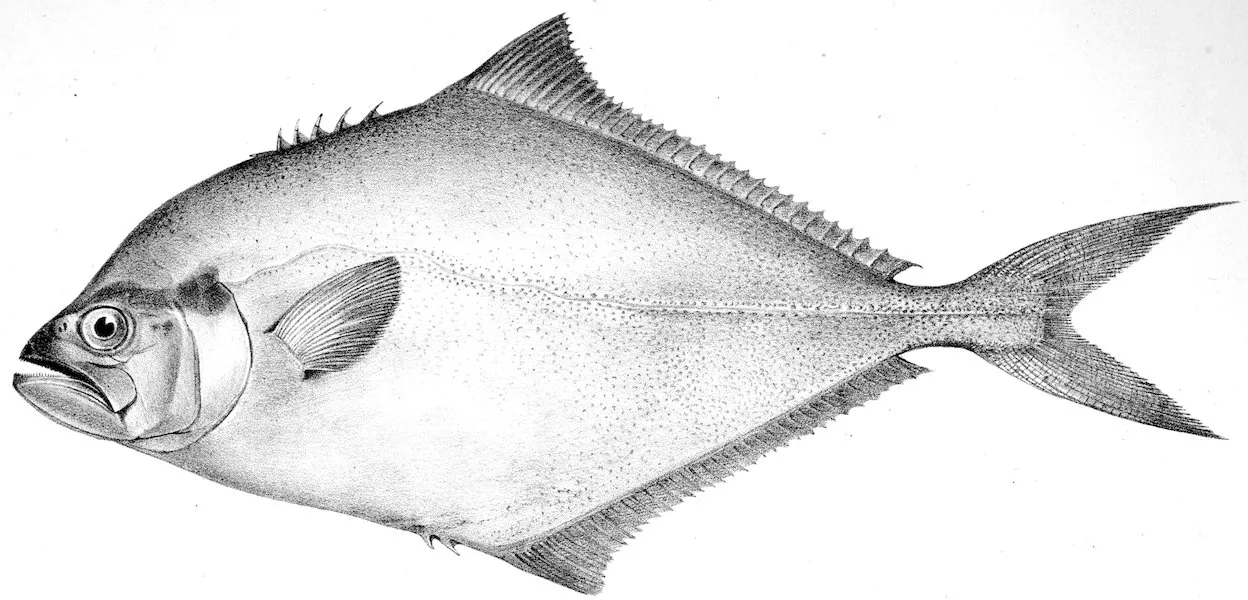
Fish. Pl. 13.
W. Hawkins delt.
Paropsis signata. Nat. Size.
67Snout, jaws, and cheeks, as well as the several pieces of the gill-cover, without scales:[28]
body covered with extremely minute ones, of an oval form, longer than broad, marked with concentric
circles, and entire on the margin. The lateral line is slightly arched above the pectoral,
and its course a little undulating, but it descends gradually to near the middle of the body,
whence it runs straight to the caudal.
The first dorsal is represented by five short free spines, each capable of separate motion,
and each furnished with its own membrane; in advance of them is a somewhat smaller reclined
spine with its point directed forwards: the first erect spine is above the middle of the pectoral,
and distant from the end of the snout nearly one-third of the entire length. Beyond the five
free spines, and immediately before the commencement of the second dorsal is another small spine
closely pressed down, and almost concealed beneath the skin, pointing backwards. The second
dorsal, which has also at its anterior edge a small spine one-third the length of the first soft ray,
commences at the middle point of the entire length, caudal excluded. The general form of this fin
is similar to that of the genus Lichia, long, with the anterior portion elevated; the greatest height
about one-fourth of the depth, or hardly so much. The anal answers exactly to the second
dorsal in form and extent, and is preceded by two free spines, separated from it by a small space,
besides a longer one at its anterior edge. Caudal forked nearly to the base, where there are a
number of minute scales; the lobes equal, pointed, and moderately elongated, each contained
about four times and one-third in the entire length. Pectorals attached at about the middle
of the depth, a little behind the opercle; of a somewhat triangular form, small, their length not
much exceeding half that of the head. No trace of ventrals whatever.
Colour.—“Uniform bright silvery, the ridge of the back bluish: a black patch on the gill-cover,
and another under the pectoral fin.”—D.—The first of the patches alluded to by Mr. Darwin
is very conspicuous, and is situate at the upper angle of the opercle, immediately in advance of
the commencement of the lateral line. The second may be described as consisting of two distinct
spots; one at the root of the upper rays, and completely in the axilla; the other, a small
one of an elongated form, immediately beneath the lowest ray, and partly visible without raising
the fin. The elevated portion of the second dorsal is also dusky, and a faint edging of this
colour runs for a short way along the margin of this fin. The anal is pale.
Habitat, Northern coast of Patagonia.
68I have termed this species signata, in reference to the black patch on the
opercle, which is a conspicuous character. The only specimen in the collection
was obtained by Mr. Darwin at Bahia Blanca, on the coast of North Patagonia.
C. corpore elongato, altitudine quintam, capite quartam partem longitudinis æquante;
maxillâ inferiore longiore; lineâ laterali infra quintum radium dorsalis secundæ
subito declivi, per totam longitudinem armatâ, laminis 82 altioribus quam longis,
ubique æqualibus; spinâ reclinatà ante pinnam dorsalem parvâ, mucrone tamen
nudato; pectoralibus ultra pinnulam analem, et prope ad analem ipsam, pertingentibus.
B. 7; D. 8—1/35; A. 2—1/30; C. 17, &c.; P.21; V. 1/5.
Long. unc. 7. lin. 10.
Form.—Rather more elongated than the C. trachurus of the British seas. Greatest depth one-fifth
of the entire length: head one-fourth of the same: thickness about half the depth. Diameter
of the eyes a little less than one-third the length of the head. Lateral line bending downwards
more suddenly, and at a more backward point than in that species. The bend commences in
a line with the fifth ray of the second dorsal, and is entirely comprised within a space equal to
that occupied by four fin-rays,[29] so that opposite the ninth ray it again advances in a horizontal
line. The posterior portion about equals in length the anterior, the bend being included in this
last. The laminæ which protect the lateral line, and which extend throughout its whole
length, are well developed, and everywhere of the same breadth; this breadth equalling nearly,
but not quite, one-third the depth of the body. In number they are eighty-one or eighty-two;
of which the last thirty-eight or forty, forming the posterior portion of the line, have keels
terminating backwards in sharp spines: these spines are at first small and inconspicuous, but
gradually increase in size as they advance towards the thinnest part of the tail, where they are
sharpest and most developed.
In most of its other characters this species so closely resembles the C. trachurus, as to
render a detailed description unnecessary. The reclined spine before the first dorsal, however,
is smaller, though the point is sharp and exposed: also the number of rays in the second
dorsal and anal is greater by five in each fin. The length of the second dorsal is two and a half
times that of the first. The pectorals are long, narrow, and pointed; a little shorter than
the head, or rather less than one-fourth of the entire length; when laid back, they reach
beyond the anal finlet, and very nearly to the commencement of the true anal itself.
Colour.—Not noticed in the recent state. So far as can be judged from a specimen in spirits, the
colours appear to have been similar to those of the C. trachurus; and there is the same black
spot on the upper part of the opercle.
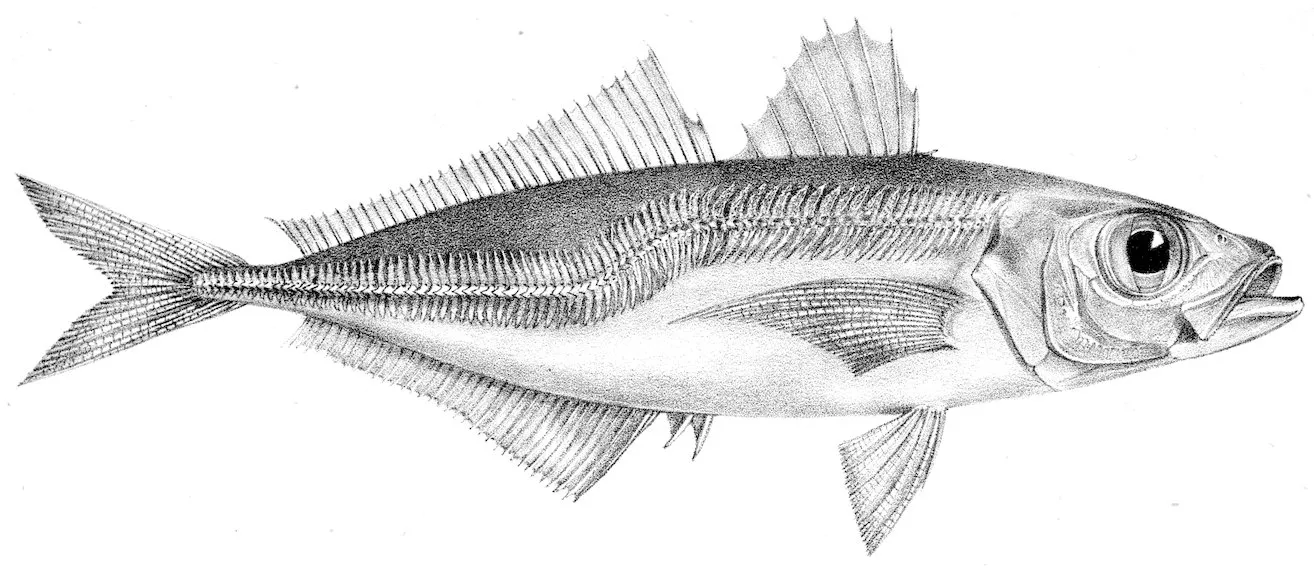
Fish. Pl. 14.
W. Hawkins delt.
Caranx declivis. Nat. Size.
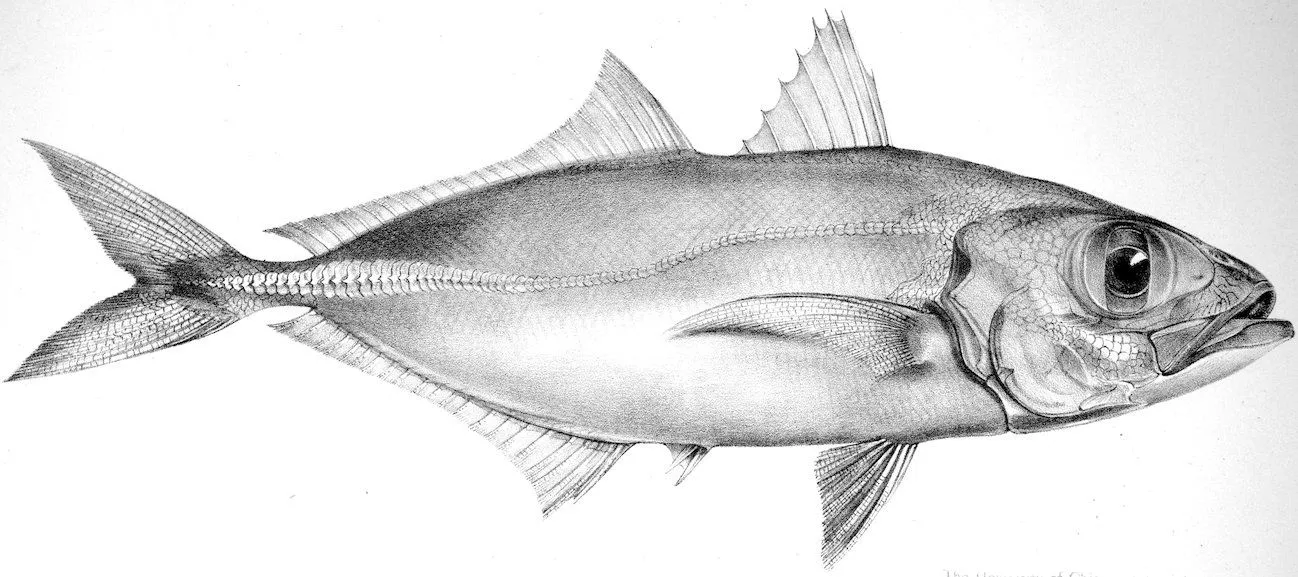
Fish. Pl. 15.
W. Hawkins delt.
Caranx torvus. Nat. Size.
69Habitat, King George’s Sound, New Holland.
Cuvier and Valenciennes have noticed several variations of form occurring in
different specimens of the C. trachurus, from different seas, which they have not
ventured to raise to the rank of species. That the one here described is entitled,
however, to this distinction, I can hardly entertain a doubt. The suddenness of
the bend in the lateral line, and the more backward point at which the bend
commences; the larger number of laminæ which protect it; and also the larger
number of rays in the second dorsal and anal; all seem to indicate a specific
difference. Whether it be identical with any of the varieties noticed by them is
uncertain; but it seems to be distinct from the only one they speak of as having
been received from New Holland, in which the number of laminæ did not exceed
seventy-three. I have called it declivis, in reference to the character of the lateral
line above alluded to. It was obtained by Mr. Darwin in Princess Royal
Harbour, in King George’s Sound.
C. corpore crassiusculo, subelongato; altitudine vix quartam partem, longitudinis
æquante, capite quartam superante; maxillâ inferiore longiori; oculis magnis;
suborbitalibus venis nonnullis subparallelis obscuris notatis; lineâ laterali parum
deflexâ, anticè squamis parvis inermibus, posticè laminis carinatis 35 vel 36 tectâ;
spinâ reclinatâ ante pinnam dorsalem sub cute occultâ; pectoralibus longis, falcatis,
ad initium pinnæ analis prope pertingentibus.
D. 8—1/26; A. 2—1/22; C. 17, &c.; P. 21; V. 1/5.
Long. unc. 11. lin. 9.
Form.—Thicker and deeper in the body than the C. trachurus. The greatest depth a little less
than one-fourth of the entire length; the thickness exceeding (but by a very little) half the
depth. Head large; its length a little more than one-fourth of the entire length; its height or
depth, taken in a line forming a tangent to the posterior part of the orbit, less than its own
length by two-sevenths. Eyes large; their diameter very nearly one-third the length of the
head; partially covered at the sides by two fatty membranous veils, as in several other species.
The ventral line of the body is rather more curved than the dorsal, and the upper profile in
like manner a little more approaching to rectilineal than the lower. The lower jaw a little the
longer, and ascending to meet the upper. Maxillary reaching not quite to beneath the middle
of the eye; its extremity truncated in the form of an arc, with the curvature inwards. In each
jaw a single row of very fine, minute, closely set teeth; two small patches on the anterior
extremity of the vomer, a band on each palatine, and one on the tongue, all closely shorn
velutine. Suborbital, on each side of the extremity of the snout, marked with several nearly
parallel dark-coloured veins. Preopercle with the angle very much rounded; the limb broad,
70slightly striated or veined, and not separated from the cheek by any salient ridge. The other
pieces of the gill-cover taken together are bounded posteriorly by a sinuous and very irregular
margin, the notch in the bone at the upper part of the opercle being nearly semicircular,
beneath which is an obtuse point, whence the obliquely descending margin first slopes slightly
inwards, then passes outwards to form another blunt point lower down, then slopes inwards
again. The course taken by the margin of the membrane in some measure follows that of the
bone, but the sinuosities and salient angles are more rounded. Cheeks and opercle scaly, as
well as the cranium and forehead between the eyes.
The lateral line does not deviate very much from rectilineal. The deflection, such as it is,
may be said to commence in a line with the termination of the first dorsal, and to end beneath
the first third of the second dorsal. Up to this point, the scales which cover it are small and
round; but they then begin gradually to enlarge, and to assume a keel terminating posteriorly
in a short spine: these scaly laminæ continue increasing in size till they arrive beneath the last
quarter of the fin, where they are most developed; none of them, however, are very large, and
even here they do not extend over the whole breadth of this part of the tail, nor their own
breadth exceed one-eighth of the greatest depth of the body. After passing the dorsal and
anal fins, they rapidly diminish as they approach the caudal. The entire number of laminæ
may be set at thirty-five or thirty-six; but as it is difficult to fix the exact point where they
commence, it will vary according as the computation is made more or less in advance. The
anterior portion of the lateral line, bend included, is a little longer than the posterior.
The reclined spine in this species is entirely concealed beneath the skin. The pectorals
are long and falcate, terminating in a sharp point: their length nearly equals that of the head,
or about one-fourth of the entire length: when laid back, they reach over the anal finlet, and
very nearly to the commencement of the true anal. The ventrals are attached a little behind
the pectorals, and are only half as long. The other fins are much as in the other species of
this genus. The height of the anterior part of the first dorsal equals exactly half the depth.
The lobes of the caudal are one-fifth of the entire length.
Colour.—Not noticed in the recent state. In spirits; silvery on the abdomen and lower half of
the sides, passing above the middle, and on the back, into pale lead blue, tinged with gray and
brownish: fins pale greyish brown. No conspicuous markings, except the usual spot on the
notch of the opercle, which, however, is small, and confined entirely to the membrane.
Habitat, Tahiti.
This species belongs to the second section adopted by Cuvier and Valenciennes
in this genus; or that in which the form of the body resembles that of the
C. trachurus, but in which the laminæ on the lateral line only extend over the posterior
portion, the anterior being smooth and simply covered with small scales. But
it will not exactly accord with any of the species described by those authors. It
seems to approach most nearly the C. Plumieri; but though the eyes are of
considerable size, they are not quite so large as they are represented to be in that.
There seem, in fact, to be several species characterized by large eyes. Spix and
Agassiz have figured one from America under the name of C. macrophthalmus;
and under the same name Ruppell has figured another from the Red Sea. Both
71these, however, appear likewise different from the one here described, at the same
time that their different geographic range renders their identity à priori improbable.
The present one was taken by Mr. Darwin at Tahiti.
Caranx Georgianus, Cuv. et Val. Hist. des Poiss. tom. ix. p. 64.
Form.—Of an oval compressed form, with the back elevated. Greatest depth one-third of the
entire length, caudal excluded: thickness not half the depth: head one-fourth of the entire
length, caudal included. Profile ascending obliquely, and in nearly a straight line, to meet the
dorsal curve. Upper jaw a little the longer. The maxillary, which is truncated and cut nearly
square at its posterior extremity, not quite reaches to beneath the anterior margin of the orbit.
In each jaw a row of about thirty-five teeth, which are small, somewhat cylindrical, set regularly,
nearly equal, and rather blunt at the point; very little trace of any secondary row, simply
four or six smaller ones behind those in the middle of the upper jaw, and perhaps in the lower
also, but they are not very obvious. A triangular patch of velutine teeth on the vomer, and a
narrow band of the same on each palatine; also on the tongue: these last, however, very closely
shorn. Eyes a little above the middle of the cheek, but exactly half-way between the end of
the snout and the posterior margin of the opercle; their diameter one-fourth the length of the
head. Preopercle rounded at the angle; its limb separated from the cheek by a slight but not
very salient ridge. Opercle with the notch at the upper part not very deep; the obliquely
descending margin straight.
The lateral line follows the curvature of the back until it arrives beneath the middle of the
second dorsal, at which point it becomes straight, and the scales gradually pass into carinated
spinous laminæ. These laminæ, however, are very little developed anteriorly to the last quarter
of that fin; and even beneath the end of it, where they are largest, they do not extend over
more than half the breadth of the tail, nor does their own breadth exceed one-seventeenth of the
greatest depth of the body. The number of them is from twenty to twenty-five, according to the
point at which the reckoning commences, the transition from the scales to the laminæ being very
gradual. The pectorals are falcate and sharp-pointed, and one-fourth of the entire length,
caudal included. The height of the anterior part of the dorsal is contained two and a half times
in the depth. The lobes of the caudal are contained four times and three quarters in the entire
length.
D. 8—1/27; A. 2—1/24; C. 17, &c.; P. 20; V. 1/5.
Length 7 inches 6 lines.
Colour.—Not noticed in the recent state. The colour of the back and upper part of the sides
appears to have been bluish grey, with steel and other reflections, and was probably very brilliant
in the living fish: belly silvery. No markings, except a conspicuous black spot on the
upper part of the opercle.
A second specimen.—Differs in no respect from the above, excepting in having one ray less in the
second dorsal and anal fins.
Habitat, King George’s Sound, New Holland.
I entertain not the least doubt of this species being the C. Georgianus of
72Cuvier and Valenciennes; but as the notice of it in the “Histoire des Poissons”
is extremely brief, I have deemed it advisable to annex a detailed description.
Both Mr. Darwin’s specimens are from King George’s Sound, where the species
was first discovered by MM. Quoy and Gaimard.
Seriola bipinnulata, Quoy et Gaim. Voyage de l’Uranie (Zool.) p. 363, pl. 61. f. 3.
—— —— Cuv. Regne An. (2d Edit.) tom. ii. p. 206.
Form.—Elongated, and fusiform. Greatest depth contained four times and a half in the length,
measuring this last to the base of the caudal fork. Head four times and a quarter in the same:
depth of the head not quite once and three quarters in its own length; the cheeks nearly vertical.
Snout pointed: profile straight, and but slightly falling. Lower jaw a little longer than
the upper, the commissure reaching to beneath the orifices of the nostrils: maxillary very conspicuous,
and greatly dilated at its posterior extremity. A band of minute velutine teeth in each
jaw, broadest in front; a disk of similar teeth on the vomer, and a band on each palatine. Eyes
large; their diameter one-fifth the length of the head; situated a little above the middle of the
cheek, and a little nearer the end of the snout than the posterior margin of the opercle; exactly
two diameters between the eye and the end of the lower jaw. The nostrils consist of two small,
round, closely approximating orifices, the anterior one partially covered by a membrane; situated
rather nearer the eye than the extremity of the snout. Preopercle with the ascending margin
vertical, and the angle at bottom rounded; the limb very broad, and marked with veins, and
between the veins, along the basal margin, with fine striæ. The rest of the pieces of the gill-cover,
taken together, present a rounded and regularly curved outline posteriorly; the line of
separation between the opercle and subopercle ascends obliquely backwards from a point about
two-thirds down the posterior margin of the preopercle; that between the subopercle and the
interopercle (which last is well developed) passes downwards and backwards, forming an angle
of about 45° with the axis of the body. Branchial aperture large; the membrane deeply cleft.
Snout, jaws, and pieces of the opercle, smooth and naked; cheeks scaly, the scales on the
upper part of the cheek, between the eye and the upper angle of the preopercle, being of a narrow
pointed form. The scales on the body are of a moderate size, oval, marked with fine concentric
circular striæ, with a fan of coarser diverging striæ on their concealed portion. The lateral
line is smooth throughout its length, and runs nearly straight from the upper angle of the opercle
to the caudal, its course being a little above the middle.
The first dorsal commences at about one-third of the entire length, measuring this last as
before: it is low and inconspicuous, consisting of only six weak spines, of which the third and
fourth are somewhat the longest, but whose length is less than one-fifth of the depth of the
body. The length of the fin itself is rather less than half the depth. Second dorsal closely
following, and much longer; of the form usual in this family, with the anterior portion elevated
and somewhat triangular, but beyond the ninth ray low and even: its spine half the length of
the first soft ray: its greatest elevation contained about two and a half times in the depth. The
last two rays of this fin are broke away from the rest, with an intervening space, to form a spurious
finlet, and are rather longer, the last especially, than those which precede. The anal commences
73opposite the fourteenth ray of the second dorsal, and is similar in form to that fin, but
of course shorter, and also less elevated at its anterior extremity: finlet and the intervening
space exactly corresponding. Caudal deeply forked; the lobes very long and pointed, each
equalling nearly one-fourth of the entire length; the middle rays not one-fourth the length of
the lateral ones. Pectorals attached a little below the middle; in length a little exceeding half
that of the head. Ventrals about the same size as the pectorals, but attached a little
further back. A slight elevation at the sides of the tail, but no distinct keel, properly so
called.
D. 6—1/24—I; A. 1/16—I; C. 17, &c.; P. 20; V. 1/5.
Length 18 inc. 3 lines.
Colour.—“Band on the side azure blue; above a duller greenish blue; beneath two greenish
metallic stripes: lower half of the body snow white.”—D. No trace of the longitudinal
stripes remains in the dried skin.
Habitat, Keeling Island, Indian Ocean.
A tolerably exact figure of this species occurs in the Zoological Atlas of
Freycinet’s Voyage, but I can find no notice of it in the “Histoire des Poissons”
of Cuvier and Valenciennes. Although referred by Cuvier in his “Regne Animal”
to Seriola, it rather departs from that genus in some of its characters. Independently
of the spurious finlets in the dorsal and anal fins, which separate it
from all the other species, I see no trace of any reclined spine before the first
dorsal, nor of two free spines before the anal; in both which respects Seriola is
said to resemble Lichia. Possibly, however, as Mr. Darwin’s specimen is a dried
skin, these characters may have been destroyed in the process of preparation.
And to the same cause, perhaps, is to be attributed the circumstance of my not
being able to observe more than one spine in the true anal, Quoy and Gaimard
mentioning two. On the other hand, these naturalists appear to have overlooked
the narrow pointed scales on the upper part of the cheeks, which are of a different
character from the scales on the body.
Mr. Darwin’s specimen of this species was obtained at the Keeling Islands.
The one figured in Freycinet’s Voyage was procured at Papua or New Guinea.
It probably, therefore, has a considerable range over the Indian Ocean.
Psenes leucurus, Cuv. et Val.? Hist. des Poiss. tom. ix. p. 197.
Mr. Darwin’s collection contains two individuals of a species of Psenes, in
reference to which his notes state that they were taken in Lat. 17° 12′ S.,
Long. 36° 33′ W., a hundred and twenty miles from the nearest land above water,
though shoals were considerably nearer. They do not measure more than one
inch eight lines in length; and from their small size, and their not being in a very
74firm state of preservation, it is hardly possible to say whether they are new or
not. In form, they differ but little from the P. cyanophrys of Cuvier and
Valenciennes: still they are evidently not that species, and one point of
difference consists in the lateral line, which terminates beneath the end of the
second dorsal, and is not carried on to the caudal, as represented in the figure of
the above species in the “Histoire des Poissons:” the eye too appears rather
larger; the forehead is hardly so much elevated, and the pectorals are shorter
than the head. Perhaps it may be the P. leucurus of the above authors; though
this species is from the Indian seas, so that its range must be considerable if the
same. The description of the P. leucurus in the “Histoire des Poissons” is too
short to determine this point. It is said to have been so named on account of its
whitish tail, all the other fins being black. In the present species, the fins are
likewise black, or at least dusky, except the caudal, which Mr. Darwin’s notes,
taken from the recent fish, state to have had “a pink tinge.” In the same notes
it is added,—“belly silvery white mottled with brownish black; sides bluish with
dusky greenish markings; iris yellow, with dark blue pupil.” The fin-ray
formula is as follows:
D. 10—1/27; A. 3/27; C. 17, &c.; P. 17 or 18; V. 1/5.
Though these specimens are small, they have the appearance of being nearly
full-sized. Cuvier and Valenciennes state that their specimens of the P. leucurus
do not exceed two inches in length.
Stromateus maculatus, Cuv. et Val. Hist. des Poiss. tom. ix. p. 296.
Form.—General form so extremely similar to that of the S. Fiatola of the Mediterranean as to
preclude the necessity of a detailed description. Greatest depth one-third of the length: head
one-fifth of the same. Number of rays in the dorsal and anal fins somewhat greater than in
the S. Fiatola. The height of the dorsal also a little greater, being contained about three
times and a half in the depth: the fifth and sixth soft rays longest. Fleshy part of the tail
more slender. Pectorals about the length of the head.
B. 6; D. 7/41; A. 5/40; C. 17, besides several short; P.23; V. 0.
Length 8 inches 6 lines.
Colour.—“Silvery blue above, with regular circular leaden spots.”—D. The spots are small, and
of nearly equal size: they prevail from the back downwards to about the middle of the depth,
and advance a little on the base of the dorsal fin. The arrangement of them is much as
described in the “Histoire des Poissons.”
Habitat, Chiloe, West Coast of S. America.
It is just possible that this may not be specifically the same as the S. maculatus
of Cuvier and Valenciennes, but it comes so extremely near that species that I do
75not feel authorised in describing it as distinct without seeing more specimens.
It is stated by the authors above mentioned, that the fin-ray formula of the
S. maculatus is the same as that of the S. Fiatola: in the specimen here described,
the number of rays in the dorsal and anal fins appear to me somewhat greater;
but as the spines of these fins are very minute at their commencement, and not
readily counted, nor very distinguishable from the soft rays, perhaps the discrepancy
may arise from a difference in the mode of computation. What is more to
be noted is, that the spots, although they agree in form and mode of arrangement,
are said by Mr. Darwin, in his notes taken from the recent fish, to have been
“leaden;” whereas it is stated in the “Histoire des Poissons” that they are
“yellow.” Perhaps they may vary in colour according to the period of the year.
There is likewise a difference in locality as regards latitude. The S. maculatus
is said to be common in the market at Lima, and to have been brought also, both
by M. D’Orbigny and M. Gay, from Valparaiso. Mr. Darwin’s specimen,
however, was taken as far south on the western coast of S. America as Chiloe.
Mr. Darwin’s collection contains another specimen, either of the same species
as that described above, or one so extremely similar to it as not to be distinguishable
in the case of this specimen, which is in too bad preservation to admit of an
accurate description of it being given. The following, however, are Mr. Darwin’s
notes taken from the recent fish:—
Colour.—“Whole body silvery; upper part of the back iridescent blue, lower greenish; spotted
with coppery-lead circular patches.”—D.
This specimen measures ten inches and a half in length. It will be observed
that the colour of the spots is still said to have been “lead,” though inclining to
coppery. It was not taken at the same place as the other, but at Port St. Julian,
in central Patagonia; if therefore they are both referable to the S. maculatus, this
species will have been proved to have a wide range in point of latitude, and also
to occur on both sides of the S. American Continent, which is remarkable, considering
that it is found so high up the western side as Lima.
Acanthurus triostegus, Cuv. et Val. Hist. des Poiss. tom. x. p. 144.
—— Hirudo, Benn. Fish of Ceyl. pl. xi.
This species, which appears to be well known, and to have been described by
several authors, was found by Mr. Darwin on coral reefs at the Keeling Islands.
Cuvier and Valenciennes observe that it has a wide range through the Indian and
76Pacific Oceans. Mr. Darwin’s specimen agrees in every respect with the description
in the “Histoire des Poissons,” except in having one ray more in the anal fin:
its length is not quite five inches.
Acanthurus humeralis, Cuv. et Val. Hist. des Poiss. tom. x. p. 170.
Form.—General form oblong-oval. Greatest depth just behind the insertions of the pectorals;
contained exactly twice in the length of the oval of the body (measuring this last from the end
of the snout to the base of the caudal spine), and three times in the entire length (measuring
this last to the extremities of the lobes of the caudal fin.) Profile convex before the eyes,
whence it descends nearly vertically to the mouth. Height of the head a little exceeding its
own length. Eyes very high in the cheeks, and in front of each a grooved line passing horizontally
forwards towards the nostrils; which last consist of two small round orifices, the
anterior one larger than the other, and partially covered by a membranous flap. There are
seventeen teeth in the upper jaw, and sixteen in the lower: those above have the cutting edges
crenated, and likewise the lateral edges for nearly half-way down; this most observable in the
middle ones, in which the crenations amount to eight or ten in number: those below similar,
but with the crenations not quite so numerous, and in some of the teeth at the sides of the jaw
almost confined to the cutting edges. Scales minute; those taken from the middle of the body
appear of an oblong form, their apical portions dotted, and ciliated with from twelve to eighteen
very minute denticles, their surface marked with extremely fine delicate striæ, not distinguishable
without a strong lens.
The lateral line follows the curvature of the back; at about one-fifth of the depth. The spine
on the sides of the tail is strong, and sharp-pointed, and very slightly bent. No reclined spine
before the dorsal. Both the fin just mentioned and the anal have their soft portions terminating
posteriorly in rather an acute angle: also both have a scaly membrane at the base, and rows
of minute scales between the soft rays extending for about one-third or more of their length.
The first ray of the anal is very minute, and so much concealed in the skin as to be easily
overlooked. The filaments of the caudal are sharp-pointed, and extend as far again as the
middle rays: the upper one rather longer than the other. The pectorals are contained three
times in the length of the oval of the body. Ventrals attached a little further back, sharp-pointed,
and terminating in the same vertical line with the pectorals, both being laid back.
D. 9/23; A. 3/23; C. 16, &c.; P. 16; V. 1/5.
Length, to the end of the caudal lobes, 7 inches.
Colour.—The colours appear to have been exactly as described in the “Histoire des Poissons.”
Mr. Darwin’s notes taken from the recent fish state, “splendid verditer blue and green;” but do
not enter into the details of the markings.
Habitat, Tahiti.
Obtained at Tahiti, where it had been previously found by MM. Lesson
and Garnot. Mr. Darwin’s specimen accords with the characters given by Cuvier
77and Valenciennes, except in having two soft rays less in the dorsal, and one less
in the anal. Their description, however, is not very detailed.
Atherina argentinensis, Cuv. et Val. Hist. des Poiss. tom. x. p. 350.
Form.—Depth exactly one-sixth of the length, measuring this last to the end of the middle caudal
rays. The length of the head is five and a half times in the same, measuring this last to the end
of the caudal lobes. Thickness of the body at least half the depth. Head broad and flat, its
breadth across the crown behind the eyes equalling three-fourths of its depth. Snout rounded
horizontally, but sharp vertically. The profile is perfectly horizontal; and one uniform straight
line extends from the extremity of the upper jaw to the commencement of the second dorsal.
Ventral line swelling a little outwards, with its greatest curvature about the middle. Upper
jaw a very little longer than the lower, which ascends to meet it at an angle of 45°: gape not
reaching more than half-way to the eye, at first horizontal, afterwards deflexed. In each jaw
two rows of teeth, stronger and more developed than usual in this genus, widely asunder, and
at irregular intervals: in the upper jaw these two rows are equal; in the lower the outer row
is stronger than the inner: the outer row above contains about thirty-two or thirty-three
teeth; that below twenty-six or twenty-eight: no teeth on the tongue, and scarcely any that
can be seen on the vomer or palatines, though a slight roughness can be felt on the last two.
Eyes moderately large; their diameter a very little less than one-fourth the length of the
head; situate a little in advance of the middle point, and also a little above the middle of the
depth. Cheeks and gill-covers scaly. Form of the scales of the body, as well as the number
of longitudinal rows, exactly as stated by Cuvier and Valenciennes. The same may be said of
the lateral line, and the situation of the dorsal fins. The second dorsal and anal terminate in
the same vertical line. Pectorals exactly the length of the head. Ventrals attached immediately
below the tips of the pectorals. Breadth of the silver band, which runs straight along
the middle of the sides, exactly one-fifth of the greatest depth of the body.
D. 5—1/9; A. 1/19; C. 17, &c.; P. 15; V. 1/5.
Length 8 inches.
Colour.—“Silvery, with a silver lateral band: above bluish grey.”—D. In spirits, it appears
greenish brown, becoming deeper above the silver band and on the ridge of the back: the free
margins of the scales are finely dotted with black: the rays of the caudal have been worn at
the tips, but there is a trace of the dusky edging noticed by Cuvier: the pectorals are also
stained with dusky.
Habitat Maldonado.
I conceive there is but little doubt of this being the A. Argentinensis of
Cuvier and Valenciennes; but as the description in the “Histoire des Poissons”
is short, I have thought it advisable to give a more detailed one of the above
78specimen. Mr. Darwin took it at Maldonado, where he states that it is very
common, adding that it is sometimes found in brackish water. M. D’Orbigny
had also found it previously at the mouth of the Rio Plata.
Plate XVI. Fig. 1. Nat. size.
Fig. 2. a, b. Magnified scales.
A. gracilis; corporis altitudine partem octavam, capite quintam, longitudinis
æquante: oculis mediocribus: maxillis subæqualibus, parum protractilibus; commissurâ
primum horizontali, deinde paulo deflexâ, haud oculos attingente: dentibus
velutinis, serie externâ supra subtusque fortiori: dorsali primâ omnino pone ventrales
reclinatas locatâ: squamis parvis, seriebus longitudinalibus octodecim ad minimum
dispositis.
D. 5—1/11; A. 1/17; C. 17, &c. P. 15; V. 1/5.
Long. unc. 4.
Form.—More slender and elongated than the generality of the species in this genus. Greatest
depth not more than one-eighth of the entire length. Head one-fifth of the same. Greatest
thickness (in the region of the gills) equalling two-thirds of the depth, or rather more.
Ventral line of the body scarcely more curved than the dorsal. The upper profile falls, though
very slightly, from the nape to the mouth, and the lower profile inclines upwards to meet it at
about the same degree of curvature. Head broad, its breadth across the crown nearly
equalling its depth. Snout horizontally rounded. Jaws nearly equal; not so protractile as in
some other species: the commissure of the lips at first horizontal, but posteriorly inclining a
little downward, and scarcely reaching more than half-way to the eye. In each jaw two rows
of slender very distinct teeth, with traces of a third or even fourth row above, towards the
middle: outer row longest and most conspicuous, consisting, in the upper jaw, of from forty-five
to fifty teeth; in the lower of scarcely more than twenty-five. No teeth that can be
seen on the vomer or palatines, though a slight roughness can be felt on both. Eyes of
moderate size; their diameter rather more than one-fourth the length of the head; almost
entirely before the middle, as well as above it: space between the eyes flat, and exceeding the
diameter by about one-third: a slightly elevated line on each side of this space, but no other
conspicuous sculpture. Opercle with the descending margin sloping obliquely forwards.
Crown, cheeks, and gill-covers scaly, the scales on the crown extending as far as the
eyes. Scales on the body small, the number of longitudinal rows amounting to eighteen or
twenty: in form nearly square, the length a little exceeding the breadth, the superficies marked
with numerous very distinct concentric lines, the basal half with a fan of from four to six
deeper-cut striæ, the basal margin rather sinuous, and obsoletely crenate where the striæ meet
it. No lateral line very distinguishable.
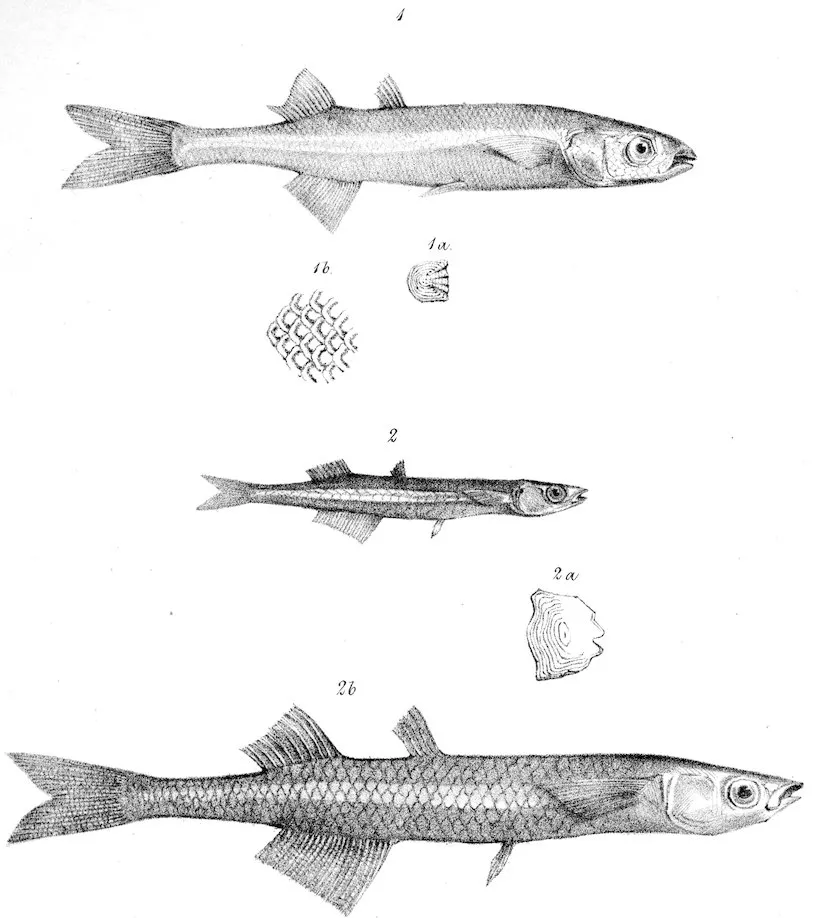
Fish. Pl. 16.
Drawn from Nature on Stone by Waterhouse Hawkins.
| 1. Atherina microlepidota. |
Nat. Size. |
| 1a. 1b. „ „ |
magnified Scales. |
| 2 Atherina incisa. |
Nat. Size. |
| 2a. „ „ |
magnified Scale. |
| 2b. „ „ |
Twice Nat. Size. |
79First dorsal small and delicate, commencing exactly at the middle point of the entire
length, measuring this last to the bottom of the caudal fork, and in a line with the tips of the
ventrals, these last fins being laid back. Space between the first and second dorsals a little
exceeding two-thirds of the depth of the body. Length and height of the second dorsal equal
to each other, and also to the space just alluded to. From the end of the second dorsal to the
commencement of the caudal is exactly one-sixth of the entire length. The posterior half of
the anal nearly answers to the second dorsal, but the two fins do not terminate exactly in the
same line, the dorsal extending a little the furthest. Caudal forked for about half its length.
Pectorals about two-thirds the length of the head. Ventrals attached at a point beyond the
extremity of the pectorals. Breadth of the silver band about one-fifth the depth of the body.
Colour.—Not noticed in the recent state. In spirits, the back and sides above the silver band
are brownish, with the contour of each scale marked out by black dots. All below the band
appears to have been silvery. The band itself is not very brilliant. Both the dorsals, as well as
the caudal, are dusky: anal and ventrals pale.
A second specimen does not differ from the above, excepting slightly in the fin-ray formula,
which is as follows:
Habitat, Valparaiso.
This species was found by Mr. Darwin at Valparaiso in fresh water, in the
month of August. It would seem to be nearly allied to the A. laticlavia of Cuvier
and Valenciennes, brought from the same locality by M. D’Orbigny; but, judging
from the short description in the “Histoire des Poissons,” it is more elongated, and
has the head longer in relation to the depth of the body; also has the silver band
narrower. In the A. laticlavia, the head is said to be equal to the depth, and to
be contained six times in the entire length; the breadth of the silver band to be
greater than in any other species. In the A. microlepidota, the depth is
one-eighth and the head one-sixth of the length: the silver band not broader than
in the A. argentinensis and some others. The colouring also of the fins appears
different in the two species.
Plate XVI. Fig. 2. Nat. size.
Fig. 2. b. Twice nat. size.
Fig. 2. a. Magnified scale.
A. gracillima; corporis altitudine partem vix nonam, capite sextam, longitudinis
æquante: oculis mediocribus: maxillis æqualibas, valde protractilibus; commissurâ
primum horizontali, posterius deflexâ: dentibus velutinis, in maxillâ inferiore
minutissimis: dorsali primâ omnino pone ventrales reclinatas locatâ: squamis
mediocribus, seriebus longitudinalibus duodecim ad maximum dispositis, marginibus
liberis inciso-crenatis; vittâ laterali nitidè argenteâ.
D. 5—1/8; A. 1/17; C. 17; P. 12; V. 1/5.
D. 5—1/9; A. 1/19; &c.—
D. 6—1/10; A. 1/19; &c.—
Long. unc. 2. lin. 6.
80Form.—Still more slender and elongated than the last species. Greatest depth scarcely one-ninth
of the entire length: head one-sixth. Dorsal and ventral lines very little curved. General
characters of the head, snout and mouth, as in the A. microlepidota, but the jaws more protractile.
A row of minute velutine teeth in each jaw most developed above. Eyes moderately
large; their diameter nearly one-third the length of the head; the space between them just
equal to their diameter. Opercle with the posterior margin nearly vertical. Scales larger than
in the A. microlepidota; the number of longitudinal rows not exceeding twelve: their form
different, and rather peculiar, the anterior or free edge of each scale in some instances presenting
two or three processes, separated by deep incisions; in others being irregularly
notched or jagged, according to the spot whence taken: the surface is marked with concentric
lines, but there is no fan of striæ on the basal half: the breadth of the scale a little
exceeds its length, and the basal margin is irregularly sinuous.
First dorsal answering to the space between the tips of the reclined ventrals and the anal.
Length of the second dorsal exceeding the intermediate space between it and the first. From
the end of the second dorsal to the caudal is rather more than one-fifth of the entire length.
Depth of the caudal fork not exceeding one-third the length of the fin. The anal commences
in an exact line with the termination of the first dorsal: rather less than its posterior half
answers to the second dorsal. Pectorals rather long, measuring nearly one-sixth of the entire
length. Breadth of the silver band one-fourth the depth of the body.
Colour.—“Body semitransparent, colourless; with a bright silver band on each side; also marked
with silvery about the head.”—D. The band is remarkably bright, and well-defined, much
more so than in the last species.
I have ventured to consider this as a new species, though none of the
specimens in the collection, amounting to three in number, exceed two inches and
a half in length, and are probably not full-sized. The form of the scales is so
peculiar, that if it were only the young of some described species, it could hardly
fail to be identified by such a character, which is not likely to be affected by age,
nor to have escaped the notice of an observer. Yet I can find none answering to
it in the “Histoire des Poissons.” The silvery band also is remarkably bright;
though the slenderness of the body, another of its peculiarities, is perhaps due to
immaturity. The fin-ray formula is somewhat different in the three specimens,
as shown above, but in other respects they are similar.
Mr. Darwin’s notes state that this species was taken in the month of
September, in 39° S. Lat., 61° W. Long., several miles from the land. This last
circumstance, indeed, would seem to indicate that the specimens were not so very
young, as the fry of most fish keep close in shore.
Mugil liza, Cuv. et Val. Hist. des Poiss. tom. xi. p. 61.
Form.—Elongated: the depth contained about five and a half times in the entire length: the head
81exactly five times: height of the head at the nape two-thirds its own length. Mouth chevron-formed,
with a tubercle at the extremity of the lower jaw: lips thin. Some extremely minute teeth
in the jaws, but none on the palate or tongue. Suborbital obliquely truncated at the posterior
angle, but not dilated towards the extremity; the lower or anterior margin straight, and scarcely
if at all denticulated: the maxillary slender, not longer than the suborbital, and concealed beneath
it when the mouth is closed. The eye has an adipose veil covering a large portion of the iris:
diameter of the orbit one-fourth the length of the head: distance from the eye to the end of the
snout, equalling only three-fourths of the diameter. Orifices of the nostrils widely separate.
Number of scales in a longitudinal row about thirty-five; perhaps one or two more: in the
depth about twelve. Fourth dorsal spine very weak. A large triangular scale above the pectorals;
the same also above the ventrals; this last, which is the longer of the two, equalling one-fourth
the length of the fin.
D. 4—1/8; A. 3/8; C. 14, &c. P. 16; V. 1/5.
Length 11 inches 3 lines.
Colour.—“Back coloured like Labrador felspar: iris coppery.”—D. The dried specimen shows
traces of about twelve longitudinal lines similar to those of many other species.
A second specimen exactly resembles the above, except in being smaller, measuring barely eight
inches, and in shewing rather more trace of denticulations on the suborbital.
Habitat, Bahia Blanca and Monte Video.
This species, which has the general characters of the M. Cephalus of the
European seas, is probably the M. liza of Cuvier and Valenciennes; but the
specimens are in a bad state of preservation, and some of the characters cannot
be accurately ascertained. The depth of the body appears to have been rather
greater than what is mentioned in the “Histoire des Poissons:” there is also some
appearance of small scales on the second dorsal and anal, which, according to
Cuvier and Valenciennes, is the distinguishing characteristic of their next species,
the M. curema; but it will not agree with this last in its other details.
The larger of the above specimens was taken at Bahia Blanca, where
Mr. Darwin’s notes state that it is plentiful; the smaller one at Monte Video.
Mr. Darwin’s collection contains a second species of this genus from the
Keeling Islands, which does not appear to be identical with any of those
described by Cuvier and Valenciennes; but as there is but one specimen, in a
very bad state of preservation, and the species inhabiting the Indian Ocean are
very numerous, as well as extremely similar to each other, I refrain from
describing and naming it as certainly new. I shall therefore merely point out
some of its leading characters, so far as they can be ascertained; in the hope
that they may prove of use in leading others to identify it who may visit the above
Islands hereafter.
82Form and appearance of the mouth similar to that of the M. labeo of the Mediterranean. Lips
fleshy, and very much developed, with the borders fringed; the lower one partially reflexed.
Apparently no trace of teeth anywhere. Suborbital with a shallow notch on its anterior margin,
obliquely truncated at its posterior angle, and obsoletely denticulated. Maxillary slender
and slightly bent, nearly concealed beneath the suborbital, but showing a little beneath it, from
its being a trifle longer. The head is a little less than one-fifth of the entire length: the snout
short, and rather obtuse. Longitudinal diameter of the eye contained three and a half times in
the length of the head: no appearance of any adipose veil. Orifices of the nostril approximating.
The depth of the body cannot be accurately ascertained, but it appears to have been about
one-fifth of the entire length. The commencement of the anal is but very little in advance of that
of the second dorsal; both fins appear to have been covered with small scales. Pectorals not
quite so long as the head: apparently no elongated scale above them: one, however, above the
ventrals, half the length of those fins. The fin-ray formula is as follows:—
D. 4—1/8; A. 3/9; C. 14; P. 16; V. 1/5.
The length of this fish is eight inches.
Dajaus Diemensis, Richards. in Proceed. of Zool. Soc. 1840, p. 25.
This genus, which was established by Cuvier and Valenciennes, differs from
Mugil principally in having vomerine and palatine teeth: the snout also is rather
more produced, and the mouth less chevron-formed. There is but one species
described in the “Histoire des Poisssons,” which is found in fresh water in the
Caribbee Islands. Dr. Richardson has briefly noticed a second from Van
Diemen’s Land, in his recent description of a collection of fishes from that
country, in the “Proceedings of the Zoological Society.” Mr. Darwin’s collection
contains a specimen of this genus from King George’s Sound, which, having
reason to think it might be the same as that described by Dr. Richardson, I sent
to this latter gentleman, requesting him to compare them. This he obligingly
did, and informed me in his answer that he could detect no differences between
them, beyond what might be the result of the different manner in which they
were preserved, his own specimens being in spirits, and Mr. Darwin’s dried.
I forbear giving a detailed description of this species, as one by Dr. Richardson
will appear shortly in the Transactions of the Zoological Society; and Mr.
Darwin’s specimen is in such a bad state of preservation, as hardly to admit of an
accurate description of it being taken. I may just allude, however, to some of its
more striking peculiarities.
It appears to differ from the D. monticola of Cuvier and Valenciennes in having the teeth in the
lower jaw, if they really exist, so minute and thinly scattered as to be scarcely perceptible;
those in the upper jaw, however, are very distinct; so likewise are the vomerine and palatine bands.
There are also some very obvious teeth on the tip, and at the sides of the tongue, though few in
83the middle: this part is said to be without any asperities in the D. monticola. The suborbital
is more rounded off at the lower angle anteriorly, and the denticulations thereon rather more
numerous and better developed. The scales on the body, those especially above the lateral
line, have a few minute teeth on their free edges, communicating a roughness to the touch; a
character not alluded to in the description of the D. monticola, and which therefore may be
presumed absent. There are also three more rays in the anal, and one in the second dorsal.
The depth of the body in this specimen, from its bad state of preservation, cannot be ascertained;
but the head is contained about four and a half times in the entire length. The
diameter of the orbit is one-fourth the length of the head; and there is nearly one diameter
between it and the end of the snout. The jaws are nearly equal, but when the mouth is closed,
the upper one projects a trifle; this last is also moderately protractile. The maxillary retires
beneath the suborbital. The fin-ray formula is as follows:—
D. 4—1/9; A. 3/12; C. 14, &c.; P. 15; V. 1/5.
There is but one individual of this species in the collection, which measures
seven inches in length. The colours do not appear to have been noticed.
Blennius palmicornis, Cuv. et Val. Hist. des Poiss. tom. xi. p. 159.
The Blenny, which I have referred above to the B. palmicornis of Cuvier and
Valenciennes, seems somewhat intermediate in its characters between that species
and the B. parvicornis of the same authors. This inclines me to suspect that the
two species are not really distinct, as those authors themselves seem to have
thought possible, though they state that they never received the B. palmicornis,
except from the Mediterranean.[30]
In this specimen the head is one-fifth of the entire length, and the ventrals one-eighth, which is
worth noticing, because it is stated that in the B. palmicornis the head is contained nearly five
and a half times, and sometimes nearly six times in the total length; and the ventrals nearly ten
times in the same. The filaments above the eyes, however, are similar to those of the species
just mentioned; quite as much developed, and each divided nearly to the base into five or six
flattened bristles. There are about forty teeth in the upper jaw, and twenty-eight or thirty in
the lower: the canine below is very distinct, but above it is almost, if not quite wanting. The
fin-ray formula is as follows:—
D. 11/21; A. 21; C. 11, &c.; P. 13; V. 2.
The length of the specimen is nearly five inches. The anal is marked and
coloured exactly as described to be the case in the B. palmicornis.
This species was obtained by Mr. Darwin at the Cape Verde Islands.
84
B. flavescens, fusco-variatus; maculis tribus infra pinnam dorsalem, et unâ in pinnæ
ipsius anticam partem, nigris, subocellatis: dentibus maxillaribus supra circiter
viginti quatuor, subtus triginta; caninis nullis: tentaculis palpebralibus duobus,
parvis, subpalmatis: pinnâ anali haud ultrà dorsalem extensâ.
D. 13/16; A. 20; C. 13, &c.; P. 14; V. 2.
Long. unc. 2. lin. 4.
Form.—Body much compressed behind: the depth one-fifth of the entire length: head rather less
than one-fourth of the same. Snout blunt and truncated; the profile nearly vertical; the eye
placed just within the angle formed by this last with the line of the crown. Diameter of the
eye one-fourth the length of the head; distance between the eyes half a diameter; the interocular
space very slightly concave, with a double row of mucous pores rather widely separate,
but without any lines or sculpture. Similar mucous pores are thinly scattered over the occiput
and the front of the snout, as well as beneath each eye. Above each eye is a short slightly
palmated filament not exceeding in length the diameter of the eye: also an extremely minute
one at each nostril. Mouth reaching to beneath the eyes. Teeth not extending the whole
length of the jaws; fine and close-set, with the points of those at the sides, more especially in
the lower jaw, reclining backwards; the number above twenty-four, below thirty: no canines.
Gill membrane fastened at bottom, the slit at the sides not descending below the pectorals.
The dorsal commences at the nape, and extends nearly to the caudal, with which, however,
it is not connected: it is slightly depressed or notched above the twelfth and thirteenth rays,
beyond which it is again elevated to the height of the anterior portion. The anal does not
approach quite so near the caudal as the dorsal, but the difference is trifling: the last ray in
both fins is united by the membrane to the fleshy part of the tail. Caudal rounded, with the
greater part of the principal rays slightly divided at the tips. Pectorals broad, and not quite
equal to the head in length. Ventrals short, not more than half the length of the head, or a
little less than one-eighth of the entire length: they appear to consist of only two rays, but on
dissection there will be found three soft rays with a short spine closely adhering to the first of
them; the third soft ray is slender, and also adheres to the second.
The anterior portion of the lateral line takes a sweep over the pectoral, and is very distinctly
marked by a close series of short elevated mucous tubes between two rows of pores; but
the rest of the line is only faintly traced out by nine or ten slender depressed tubes at long intervals,
without any accompanying pores.
Colour.—(In spirits.) Yellowish ground; the upper half of the sides very much mottled, and
clouded with fuscous; three spots darker than the rest, arranged longitudinally beneath the
posterior half of the dorsal, and having a subocellated appearance, the last the largest, and also
the most distinct of the three: from the median line there are eight or nine descending fasciæ,
alternating with the same number of oblong lanceolate spots: the throat is marked with three
angulated transverse dark fasciæ: cheeks and gill-covers with small spots. A large black spot
on the first three rays of the dorsal fin, which is covered all over with smaller spots, as are also
the pectorals and caudal: anal with a dusky edging. In the living state there were probably
some bright colours, as in the B. biocellatus of Cuvier and Valenciennes.
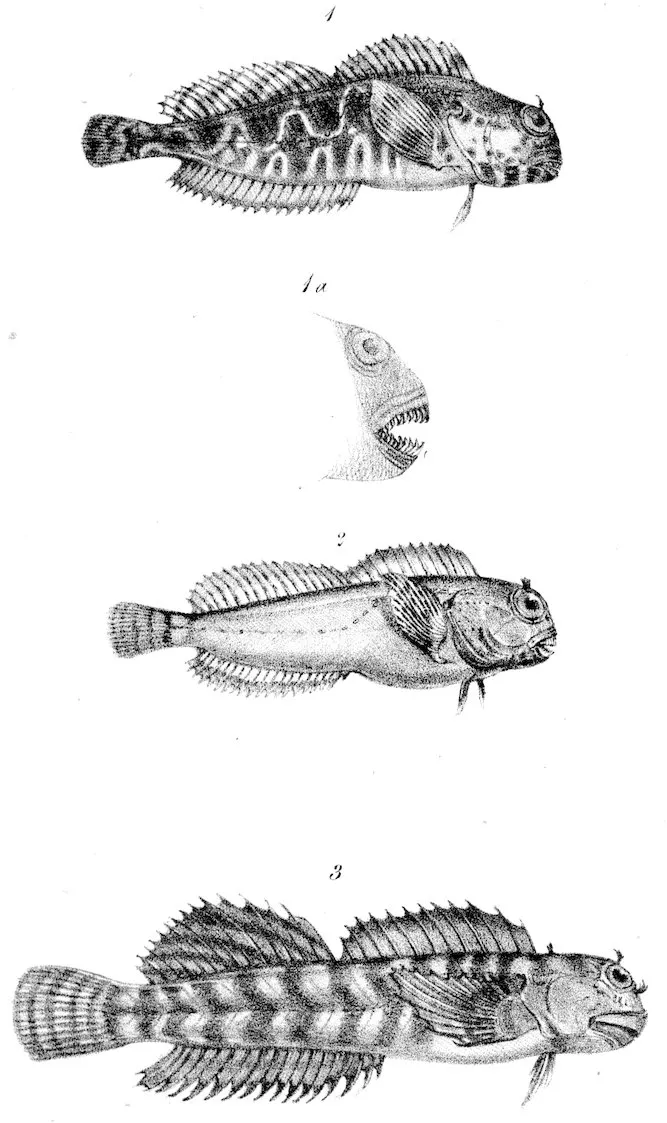
Fish. Pl. 17.
Waterhouse Hawkins delt.
| 1. Blennechis fasciatus. |
Nat. Size. |
| 1a. „ „ |
Teeth magnified. |
| 2. Blennechis ornatus. |
Nat. Size. |
| 3. Salarias vomerinus. |
Nat. Size. |
85A second specimen has the fin-ray formula as follows:—
This specimen also differs from the one above in having the teeth in the lower jaw not
quite so numerous, and the ventrals longer, equalling one-seventh of the entire length. The
colours are on the whole similar, but more of the yellow ground is visible above the median line,
and the descending fasciæ beneath it are not so distinctly traced out.
Habitat, Concepcion, Chile.
This species is very closely allied to the B. biocellatus of Cuvier and
Valenciennes, from the same coasts. It agrees with it in all its essential
characters, and in the general disposition of the markings. It appears to differ,
however, in having fewer teeth; in the anal reaching hardly so far as, certainly
not beyond, the dorsal, as described to be the case in that species; in the fin-ray
formula; and slightly in the colours. The B. biocellatus derives its name from
two ocellated spots, one beneath the last rays of the dorsal, the other upon the first
three rays of that fin. In the B. fasciatus here described, there appear to be
three subocellated spots beneath the dorsal, though the last is the most distinct,
besides the one upon the fin itself. The B. biocellatus was observed by M. Gay
at Valparaiso. The present species was taken by Mr. Darwin at Concepcion.
Possibly it may be a mere variety.
B. cinereo-griseus; maculis, vel lituris paucis, infrà pinnam dorsalem obsoletis,
pallidè nigricantibus: dentibus caninis nullis: tentaculis palpebralibus duobus,
parvis, subfurcatis: pinnâ anali haud ultrâ dorsalem extensâ.
D. 12/17; A. 20; &c.—
Long. unc. 2. lin. 2.
Form.—Closely resembling the last species, but rather deeper in proportion to its length, less compressed
in front, with the head more inflated about the throat and gills. Snout, profile, and
position of the eye, similar. Superciliary filaments scarcely longer, but rather broader and
more conspicuous, and cleft at the extremity. Filaments at the nostrils a little longer, but
very slender and delicate. Teeth similar, both in number and form. Fins and lateral line
exactly similar. Behind the vent a papilla not present in the last species.
Colour.—Different from that of the B. fasciatus, but with traces of the same markings. The
ground colour is cinereous grey, which almost every where prevails: there are faint traces of
the angulated fasciæ beneath the chin, as well as of three dark stains beneath the dorsal, but
these last no longer deserve the name of ocellated spots. Fins, cheeks, and gill-covers,
86dotted in like manner: also some indication of the larger spot on the first three rays of the
dorsal: anal with the same dusky edging.
Obs. Of this species there are five specimens in the collection. The next in size to the
one described above, measures one inch seven lines in length, and resembles it in every respect,
excepting that the superciliary filaments are broader and longer, equalling at least one
diameter and a half of the eye. The colours and markings are exactly the same, only the
fasciæ on the throat can hardly be discerned.
No. 3 is exactly similar in size, as well as in all its other characters, to No. 2. Has the
superciliary filaments equally developed.
No. 4 resembles Nos. 2 and 3, but is smaller, measuring one inch five lines in length.
No. 5, the smallest of all the specimens, and measuring only one inch three lines, has the
dark markings more developed, especially the angulated fasciæ on the throat, which are
almost as distinct as in the B. fasciatus: the spots beneath the dorsal assume the appearance
of abbreviated transverse fasciæ reaching from the base of the fin to the median line; and
besides the three faintly indicated in the other specimens, there are two others nearer the head,
forming altogether a series of five. In this specimen the superciliary filaments are shorter, not
exceeding the diameter of the eye.
Habitat, Coquimbo, Chile.
This species differs but slightly from the last, and both may hereafter prove
to be mere varieties of the B. biocellatus; but it is desirable for the present to
keep them distinct, as, though all found on the same coast, they are from distinct
localities on that coast. Also the above five specimens, though varying in the
intensity of the markings, have all a ground colour quite different from that of the
B. fasciatus, and a peculiarity of aspect immediately noticeable to the eye. Had
they been found mixed with that species, the presence of the anal papilla might
lead to the suspicion of their being the other sex; but, under the circumstances,
this seems hardly probable. They were all taken at Coquimbo.
Salarias atlanticus, Cuv. et Val. Hist. des Poiss. tom. xi. p. 238.
Two individuals of this species were obtained by Mr. Darwin at Porto Praya.
They accord in all respects with the descriptions in the “Histoire des Poissons,”
excepting as regards the fin-ray formula, in which there is a slight difference
observable; and in this respect they are also different from each other.
The larger specimen, measuring three inches seven and a half lines in
length, has the fin-ray formula as follows:
D. 13/21; A. 24; C. 13; P. 15; V. 2.
The other, two inches eleven lines in length, has one ray less in the spinous
portion of the dorsal, and two more in the soft:
87It may be mentioned that in this species, as in some others, the last spinous
ray in the dorsal is entirely invested by the membrane, and does not attain to the
margin, so that in counting, it may be very easily overlooked.
In Mr. Darwin’s notes, it is stated that this species bites very severely,
having driven its teeth through the finger of one of the officers in the ship’s
company. Its two very long sharp canine teeth at the back of the lower jaw are
well calculated to inflict such a wound.
Salarias quadricornis, Cuv. et Val. Hist. des Poiss. tom. xi. p. 243. pl. 329.
Mr. Darwin’s collection contains a species of Salarias so closely resembling
the S. quadricornis of Cuvier and Valenciennes, that I dare not describe it as
distinct. Yet it offers some slight differences as follows:
The profile, instead of being merely vertical, presents a rounded and projecting front
between the eyes, advancing further than the mouth (as in the S. gibbifrons, Cuv. et Val.)
The filamentous appendages are similar, but the superciliary ones are shorter than the diameter
of the eye: the palmated ones at the nostrils consist of six or seven bristles. The
occipital crest is hardly so much elevated; its height being not more than one-sixth or one-seventh
the height of the head, and only one-third its own length. The height of the dorsal
equals at least half the depth of the body; the depth of the notch above the thirteenth spinous
ray is rather more than half its height. The fin-ray formula is—
D. 13/21; A. 25; C. 13, &c.; P. 14; V. 2.
The colour, as it appears in spirits, is nearly of a uniform olivaceous brown, with scarce any
indication of vertical bands; paler on the abdomen. There are four or five oblique narrow
whitish lines on the dorsal, but not very distinct; also two on the anal, more decided: these
lines appear to have been bluish, and there are traces of the same colour about the head and
gill-covers.
In all other respects it accords exactly with the description in the “Histoire
des Poissons,” where it is added, in reference to colour, that this species is subject
to much variation. Mr. Darwin’s specimen measures five inches two lines in
length. The number attached to it has been lost, so that there is nothing to shew
where it was taken. It is probably, however, from the Keeling Islands, as there
is in the collection, from that locality, another specimen, which I have little doubt
of being the female of the one above noticed.
This second specimen wants the nuchal crest, as is stated to be the case in the female of
S. quadricornis. It is not full-sized, measuring only three inches four lines in length, which
may account for the proportions being a little different from those of the adult. The depth is
one-sixth of the entire length, or rather less. The filamentous appendages resemble those of
the first specimen, but the nasal ones have rather fewer bristles. In the form of the head,
88fins, and all its other characters, it is exactly similar. The fin-ray formula is a little
different;
The colours, also, as they appear in spirits, are rather different. The general ground of
the body is olivaceous grey, but paler than in the male specimen, and inclining to yellowish,
with faint indications of vertical bands, and also a few dark spots towards the tail end.
Dorsal and anal spotted, the former more so than the latter. Mr. Darwin’s notes, taken from
the recent fish, merely state,—“with dull red transverse lines.”
The S. quadricornis is stated by Cuvier and Valenciennes to be very common
at the Mauritius, whence it may not improbably range as far eastward as the
Keeling Islands.
Salarias vomerinus? Cuv. et Val. Hist. des Poiss. tom. xi. p. 258.
Form.—Elongated and compressed, the thickest part being in the region of the gills. Greatest
depth contained about six and a half times in the entire length: thickness at the pectorals
about two-thirds of the depth, or rather more. Length of the head rather exceeding the depth
of the body, and exceeding its own depth by about one-fourth. Snout obtuse; broad and
rounded when viewed from above. Lips crenated at the sides of the mouth, but not in the
middle. Teeth in the jaws moveable, extremely fine and numerous: two long canines at the
bottom of the lower jaw, curving backwards, and fitting into two corresponding holes in the
palate: also a transverse row of minute teeth on the front of the vomer. Profile nearly vertical;
the eyes placed just within the angle formed by it with the line of the crown. Two
broad palmated superciliary filaments, not equal in length to the diameter of the eyes: two
similar ones at the nostrils, each consisting of six or eight bristles: also two short simple
filaments, one on each side of the nape.
The dorsal, which commences a little behind the nuchal filaments, is so deeply notched
behind the twelfth ray as almost to appear like two fins. The height of the anterior or spinous
portion is about two-fifths of the depth: the posterior is more elevated, equalling three-fourths
of the depth: this portion is connected by its membrane with the upper part of the tail, but
does not reach to the caudal, leaving an interval just equal to half the depth of the tail at this
point. The anal commences opposite the eleventh ray of the dorsal, and does not reach so far
as that fin, leaving three times the space between it and the caudal: the first two rays short
and soft, the first scarcely connected by membrane with those that follow; the membrane
deeply notched between all the rays, excepting the last three, where it is continuous. Caudal
slightly rounded at the extremity. Pectorals broad, but a little pointed when the rays are not
spread out; longer than the head, the fifth and sixth rays from the bottom being longest. Ventrals
short, only half the length of the pectorals, or one-tenth of the entire length, consisting
(which is unusual in this genus) of four distinct rays, two shorter and slender ones, besides the
two ordinary thick ones.
The lateral line is faintly indicated by a fine line which sweeps over the pectorals, and then
passes off straight along the middle. As far as the pectorals reach, the line is continuous:
89beyond, it is interrupted, or only marked out by slightly elevated tubal pores at intervals; and
it disappears altogether considerably before reaching the caudal.
D. 12/15; A. 18; C. 13, &c.; P. 14; V. 4.
Length 3 inches 2 lines.
Colour.—(In spirits.) The ground appears to have been pale yellowish brown: sides marked with
numerous approximating dark transverse fasciæ, twelve or fourteen in number: these fasciæ are
continued on to the caudal, where there are five, narrower than those on the body. Head
marked with black dots and undulating lines; especially two undulating lines commencing on
the cheeks behind the eyes, and passing upwards to the nape: upper lip and sides of the throat
marked with several fine lines. A row of black dots a little below the base of the anterior part
of the dorsal. The fasciæ on the sides extend on to the dorsal, where they take an oblique
direction backwards. Anal pale at the base, but with the tips of the rays dusky. Pectorals and
ventrals uniformly plain dusky.
Habitat, Porto Praya, Cape Verde Islands.
Cuvier and Valenciennes state that they have received but one species of
Salarias from the Atlantic Ocean north of the line, the S. Atlanticus already
noticed. The present is a second found within that range, obtained by Mr.
Darwin at Porto Praya. Perhaps it may be a new one; but it is so very nearly
allied to the S. vomerinus of the above authors, that I consider it hazardous to
describe it as distinct. It agrees especially with that species in having vomerine
teeth, and four rays in the ventrals, as well as in the general disposition of the
markings; but no mention is made in the “Histoire des Poissons” of the nuchal
filaments, which, however, may have been overlooked, as they are small and
simple, and not very obvious. If it be identical with that species, its range in the
Atlantic must be considerable, as the S. vomerinus is found on the coast of S. America,
near Bahia. Generally speaking the same species are not observed on both sides
of that ocean; and perhaps this is an argument for its being distinct: but if so, it
is difficult, without the opportunity of a more close comparison, to point out any
essential differences by which it may be characterized.
This species appears also to have many points of agreement with the
S. textilis brought by MM. Quoy and Gaimard from the Island of Ascension; but
the colours do not exactly correspond, neither is there any mention made in the
description of this last, of the vomerine teeth and four ventral rays, which so
peculiarly characterize the one above noticed.
As I feel some doubts with respect to this species being new or not, I have
thought it advisable to have it figured, more especially as there is no figure, either
of the S. vomerinus or S. textilis, to both which it is so nearly allied.
90
C. fuscus, nigro-maculatus: tentaculis palpebralibus e crinibus octo a radicibus separatis
formatis, nasalibus et nuchalibus palmatis, omnibus parvis subæqualibus:
pinna anali radiis mollibus viginti quatuor.
B. 6; D. 26/11; A. 2/24; C. 13; P. 13; V. 3.
Long. unc. 6. lin. 6.
Form.—Depth one-fifth of the entire length. Head about one-fourth of the same, rather large, with
the cheeks and gills a little inflated. Profile falling gently from the nape: the crown scarcely
at all convex. Gape reaching to beneath the anterior part of the eye. Lips thick and fleshy,
and partly reflexed, much resembling those of a Labrus. Lower jaw projecting a little beyond
the upper, and inclining upwards to meet it. An outer row of strong conical teeth in each
jaw, with a velutine band behind; the band broad above, but very narrow below. A largish
triangular patch of velutine teeth on the vomer, and a smaller one on each palatine. Tongue
free and fleshy, smooth. Eyes moderately large, their diameter one-fifth the length of the
head; high in the cheeks, reaching to, but not interrupting, the line of the profile. The superciliary
tentacles consist each of eight short bristles, all separate to the root, but forming together
a closely compacted series: two on the nape, of the same length as them, are broad and
palmated, the upper half only being divided into eight or ten slender filaments: two on the nostrils
are similar to those on the nape, only somewhat smaller.
The dorsal commences at the nape, a little behind the nuchal appendages, and has the
spinous portion long, and of nearly uniform height, but no where very high. The spines
increase very gradually in length as they advance, the first being the shortest: in the middle
of the fin, they equal about one-third the depth of the body, or hardly so much: above each is
a short filamentous tag, as in the Labridæ. The soft portion is nearly twice the height of the
spinous. A small interval between the termination of this fin and the caudal. The anal commences
under the twelfth spine of the dorsal: its own two spines are very short, and not half
the length of the soft rays, which last are not quite so long as those of the dorsal: the membrane
between each of the rays is deeply notched. This fin terminates a very little before the
dorsal. The caudal, when expanded, appears slightly rounded. Pectorals broad and rounded,
about one-fifth of the entire length. Insertion of the ventrals directly underneath the commencement
of the dorsal, and both in a vertical line with the posterior margin of the preopercle. These
last fins are contained nearly nine times in the entire length.
Body covered with moderately small scales; the length and breadth of each scale nearly
equal, with the basal portion nearly covered by an irregular fan of striæ, eighteen or twenty in
number. Head naked, but the crown and upper part of the snout studded with papillæ, terminating
upwards in pores. There are rows of minute scales between the rays of the dorsal for
about one-third of their height; also at the base of the caudal and pectorals, but none on the
anal. The lateral line commences behind the upper angle of the opercle at one-fourth of the
depth; when opposite the eleventh ray of the dorsal, it begins to bend downwards, and continues
falling till opposite the seventeenth ray, when it gets to the middle of the depth; from
that point it passes straight to the caudal.
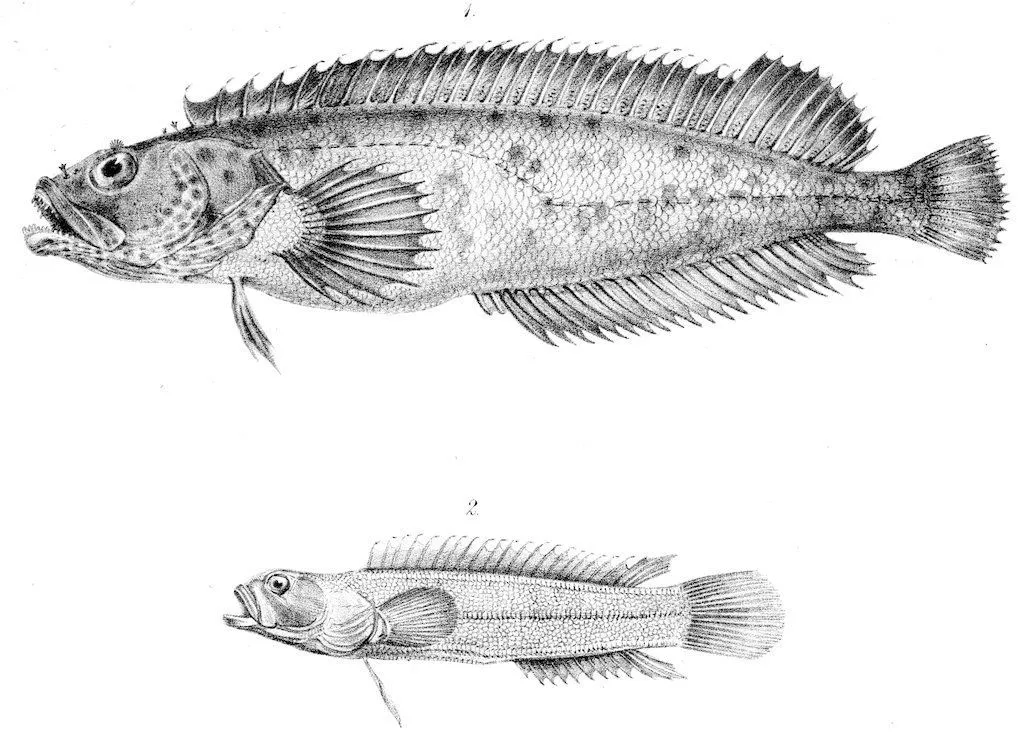
Fish. Pl. 18.
Waterhouse Hawkins delt.
| 1. Clinus crinitus. |
Nat. Size. |
| 2. Acanthoclinus fuscus. |
Nat. Size. |
91Colour.—(In spirits.) Nearly uniform dark brown ground, but with some indications of round black
spots, which were probably more conspicuous in the living fish. Eight or nine of these spots
appear on the posterior half of the dorsal, forming a longitudinal row; and there is a row more
faintly marked out along the base of the anal; these last are smaller than those on the dorsal.
Chin, throat, and gill membrane, thickly covered with small spots: also a black patch extending
over a large portion of the eye from above and behind.
Habitat, Coquimbo, Chile.
This species, obtained by Mr. Darwin at Coquimbo, is nearly allied to several
other Chilian species, described by Cuvier and Valenciennes, but differs from all
of them in having more rays in the anal fin, independently of other respects. It
seems to approach most closely the C. variolosus; but this latter is represented as
having the superciliary tentacles palmated, composed of from twelve to fifteen
bristles, and the nuchal ones papilliform and so small as to be hardly visible.
In the present species, the superciliary tentacles consist, as above stated, of eight
bristles separate quite to the root, while those on the nape are equally as large and
as much developed, and strictly, as well as very distinctly, palmated. The crown
also is scarcely convex, as represented to be the case in that species: to which
it may be added, that the spots on the dorsal fin are more numerous, and their
relative size compared with those on the anal different.
The C. microcirrhis is said to want superciliary tentacles altogether, otherwise
there are several points of resemblance between that species and the one
here described.
Corpus elongatum, compressum, squamis minutissimis obtectum. Caput nudum,
tentaculis nullis. Dentes maxillares seriebus plurimis dispositi, velutini; multis, hic
illic sparsis, fortioribus, subconicis vel aculeiformibus: vomerini et palatini velutini
omnes. Linguæ linea longitudinalis media dentibus minutissimis aspera. Membrana
branchialis undique libera, subter gulam continua et profundè emarginata,
sex-radiata. Pinnæ dorsalis et analis spinis plurimis, ad apices laciniis membranaceis
investitis. Lineæ laterales tres distinctæ.
Mr. Darwin has brought home several specimens of a small fish from New
Zealand, which appears to me to form the type of a new genus in the family of
the Blennies. It is most nearly allied to Clinus, to which group it may perhaps
be subordinate in point of value; but it offers several differences which I shall
proceed to point out. In the first place the number of anal spines is much greater,
a character of considerable importance in this family, in which they hardly ever
amount to more than two, whilst in some instances all the rays of this fin appear
to be articulated. Secondly, in addition to the bands of vomerine and palatine
92teeth, which are found in Clinus, this genus has a narrow line of very minute
teeth running longitudinally down the middle of the tongue, communicating a
sensible roughness to the touch. Thirdly, the ventrals are more backward, their
point of insertion being only a very little in advance of that of the pectorals.
Lastly, it is remarkably characterized by having three, or one might almost
say four, distinct lateral lines. The uppermost of these lines commences
at the posterior angle of the opercle, whence it turns abruptly upwards
and runs immediately beneath the base of the dorsal: the second runs
along the median line of the body, but does not commence till a little beyond
the base of the pectoral: the third commences a little above the insertion of the
ventrals, and answers to the upper one, taking its course a little above the
anal: there is also part of a fourth, which originates between the ventrals, and
joins the third at the commencement of the anal. All these lines are marked by
larger and differently formed scales from those on the body, (which last are very
minute,) with an elevated tube on each, the tubal pore, however, being most
distinct on the middle or second line. In its general form, and in the large
number of dorsal spines, this genus resembles Clinus: the form of the head and
mouth are for the most part similar; also all the parts of the gill-cover; as well as
the branchial membrane, which is six-rayed and free all round. The tags at the
tips of the dorsal and anal spines are very conspicuous, and give those fins somewhat
of a labriform appearance.
It is not improbable that the Clinus littoreus of Cuvier and Valenciennes, which
they have characterized from a drawing and description in the Banksian Library,
and which is said to possess twenty-five spines in the anal fin, may belong to this
new genus. It is observed by those authors, in reference to its peculiarity in this
respect, that such a circumstance, if correct, would be unexampled, and would
tend to separate it from the genus in which they have placed it. It is also worth
remarking that the C. littoreus comes from New Zealand, the same country as
that whence Mr. Darwin obtained the above.
In the circumstance of having three lateral lines, this new genus seems to
have some affinity with Chirus of Steller; but the scales are not ciliated as they
are said to be in this last, neither are the ventrals five-rayed.
Form.—Body elongated and compressed; the depth, which varies but little, one-sixth of the entire
length; thickness in the region of the pectorals rather more than half the depth. Head contained
very little more than four times in the length. Profile sloping but very little. Snout
rather short: mouth protractile, and rather wide: lips somewhat fleshy and reflexed. Gape
reaching to beneath the anterior part of the orbit, but the maxillary, which is dilated at its
93posterior extremity, and cut nearly square, reaching to beyond the middle. Lower jaw a little
the longest, and ascending to meet the upper. Several rows of sharp velutine teeth in each
jaw, with some here and there stronger and more hooked than the others, those below almost
fine card: a band on the vomer and on each palatine. Tongue of a triangular form, free and
pointed at the tip, with a ridge of asperities down the median line. Eyes high, but hardly interrupting
the line of the profile; their diameter one-fifth the length of the head; distant one
diameter from the end of the snout. No filamentous appendages of any kind on any part of the
head; but an irregular circle of pores nearly surrounding the orbit; also a few very distinct pores
beneath the lower jaw. Preopercle rounded, with distant pores along the margin. Opercle
terminating posteriorly in a sharp salient angle with the basal margin ascending; beneath which
the subopercle and interopercle are both very distinct. Branchial membrane free and open all
round, not adhering to the isthmus underneath, but deeply notched in the middle.
The dorsal commences in a line with the posterior point of the gill-cover, and is very
similar to that of Clinus. Spinous portion long, and, excepting the first two rays, of nearly
uniform height, equalling nearly half the depth; the membrane deeply notched between the
spines, the tips of which are invested with filamentous tags. Soft portion of the dorsal more
elevated than the spinous, and with only four rays. Between the end of this fin and the caudal
is a small space equalling nearly two-thirds of the depth beneath. The anal commences under
the twelfth dorsal spine, and exactly corresponds to the posterior half of that fin, reaching also
to the same point. The spines in both fins are sharp and moderately strong; the soft rays
articulated and branched, and terminating rather in a point behind. Caudal rounded, with fourteen
branched rays, and a few shorter simpler ones. Pectorals one-seventh of the entire length,
rounded when spread open, with all the rays except the last branched. Ventrals narrow and
pointed, about the same length as the pectorals, and inserted but very little in advance of those
fins: the spine well developed, and half the length of the soft rays: first soft ray long, and
deeply divided so as to appear like two; the second ray slender and shorter.
Body covered with very minute scales; but none on the head or on any of the fins. Three
very distinct lateral lines, with a portion of a fourth, as already stated above.
B. 6; D. 20/4; A. 9/4; C. 16, &c.; P. 17; V. ½.
Length 3 inc. 8 lin.
Colour.—Not noticed in the recent state. In spirits it appears of a nearly uniform bister brown,
with the fins and some portion of the head darker than the rest, especially a blackish spot on
the opercle.
Habitat, Bay of Islands, New Zealand.
There are four specimens of this new fish in the collection, all similar except
in size. The above is the largest. The others measure in length from one inch
and three quarters, to not quite three inches. The two largest are from the Bay
of Islands, New Zealand. The other two have lost their labels: I only presume
therefore that they are from the same locality.
94
T. fusco-griseum, pinnis concoloribus: tentaculis palpebralibus duobus parvis gracilibus
e crinibus duobus vel tribus formatis; nasalibus minutis simplicibus: dorsali primâ
humili sex-radiatâ, radiis subæqualibus; secundâ duplo altiore; tertiâ parum altissimâ:
lineû laterali abbreviatâ, vix ultrà pectorales extensâ.
B. 6; D. 6—20—14; A. 25; C. 14, &c.; P. 16; V. 2.
Long. unc. 2. lin. 5.
Form.—Depth at the pectorals one-sixth of the length: thickness at the same part about two-thirds
of the depth. Head rather large, thicker than the body, contained four and a half times in the
entire length. Snout short, the profile falling very abruptly from between the eyes. These last
large, one-third the length of the head, high in the cheeks, reaching to, but hardly interrupting,
the line of the profile. Above each a short slender compound tentacle: that on the right side
consists of two filaments, one simple, the other forked, so as to appear like three; that on the
left appears undivided. Also a minute filament at each nostril. The maxillary reaches to
beneath the middle of the orbit. Jaws equal: in each a row of small conical sharp-pointed
teeth, with a broad velutine band behind, the band, however, only in front. A transverse band
of velutine teeth on the vomer, extending a little on to the palatines. Opercle and preopercle
rounded. Branchial membrane free all round, with a shallow notch in the middle underneath.
The first dorsal commences in a vertical line with the insertions of the ventrals; the rays
are six in number, and so nearly equal in length as to cause the fin to appear quite even; its
height is scarcely more than one-third of the depth. The second dorsal begins a little behind
the origin of the pectorals: it is also nearly even, but twice the height of the first. The third
closely follows the second: this fin is uneven, but its most elevated point is somewhat higher
still than the second. The rays of the first and second of these fins are spinous: those of the
third soft and articulated, but all simple. The anal, which has also simple rays, commences
beneath the middle of the second dorsal, and terminates in the same vertical line with the end
of the third, between which last and the caudal is a small space. Caudal square, with twelve
of the principal rays branched. Pectorals a little less than one-fourth of the entire length; the
ninth and tenth rays longest; the six lowermost rather stouter than the others, and, as well
as the three uppermost, which are very slender, simple; the fourth to the tenth, both inclusive,
branched. Ventrals contained about six and a half times in the entire length; consisting of
only two slender filamentous rays.
Scales minute, their free edges finely ciliated; the concealed portion of each scale marked
with twelve or fourteen striæ. The lateral line rises at the upper angle of the opercle, and is
well marked by a row of tubular scales till it reaches a little beyond the extremity of the
reclined pectoral, where it abruptly terminates, and all further trace of it is lost.
Colour.—(In spirits.) Of a nearly uniform dark brown, inclining to griseous, with some appearance
of darker clouds or spots between the second dorsal and the lateral line; this last also is
indicated by a darker streak than the ground colour. Fins dark brown: there is, however,
some trace of a white edging to the anterior half of the anal, which may have been more conspicuous
in the living state.
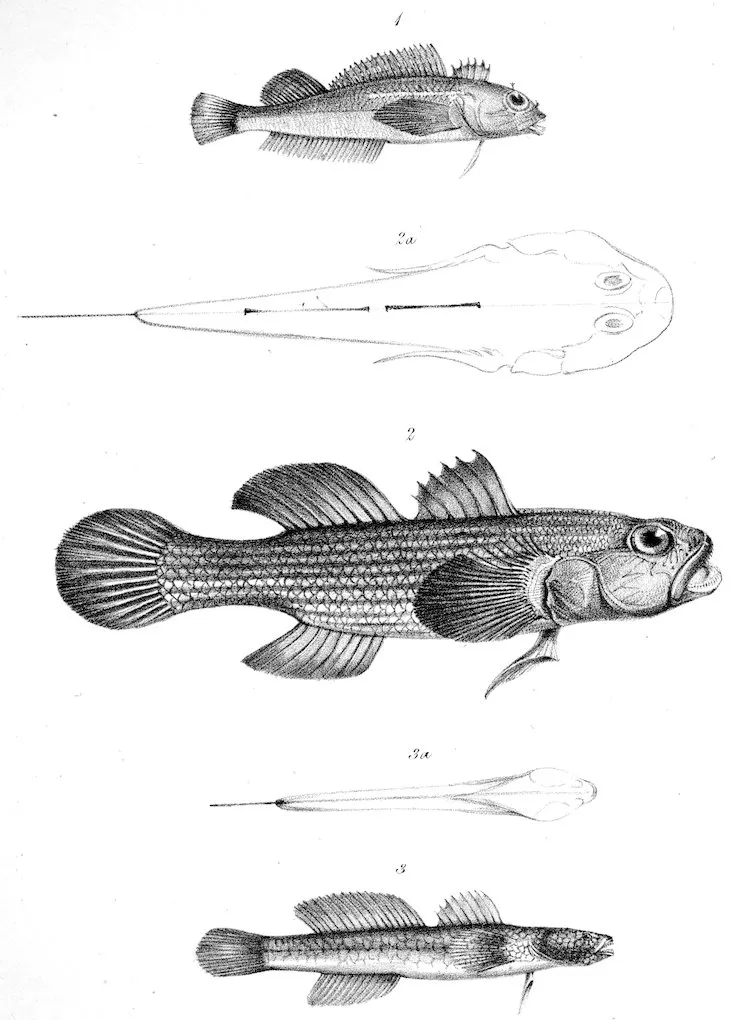
Fish. Pl. 19.
Waterhouse Hawkins del.
1. Tripterygion Capito.
2. Gobius lineatus.
2a. „ „ dorsal View.
3. Gobius ophicephalus.
3a. „ „ dorsal View.
95A second specimen slightly differs from the above, but is evidently referable to the same
species. It is smaller; and the profile falls more gradually. The caudal has only eight
branched rays, with two lateral simple ones. The pectorals have the tenth and eleventh rays
longest, with the seven lowermost (instead of six) stouter than the others and simple. The fin-ray
formula is also different.
D. 6—19—13; A. 25; C. 10, &c.; P. 17; V. 2.
Length 2 inc. 1 line.
The colours are paler, and more decidedly grey, with the darker motlings more distinct.
The dorsals and caudal are pale, minutely dotted with brown. Tips of all the anal rays white.
Habitat, Bay of Islands, New Zealand.
This species approaches very closely the T. nigripenne of Cuvier and Valenciennes,
of which it may possibly be a variety; but the description in the “Histoire
des Poissons,” as regards the form, is limited to a very few words. If the figure
given by those authors be correct, the T. nigripenne differs decidedly in the first
dorsal being more elevated, with the rays more unequal, and in the lateral line
extending the whole length of the fish. In the present species the first dorsal is
low and even, with the rays all equal, and the lateral line cannot be traced
much beyond the pectoral; and these characters are found in both specimens.
There are also six rays in the first dorsal. According to the description, the
T. nigripenne has but five, though six are represented in the figure.
From the T. varium, this species differs not only in its fin-ray formula, but in
its markings: and the same characters serve to separate it still more widely from
T. Forsteri and T. fenestratum.
This species was obtained by Mr. Darwin on tidal rocks in the Bay of Islands,
New Zealand. Three out of the only four extra-european species described by
Cuvier and Valenciennes come from the same locality.
G. nigro-griseus, lineis circiter decem longitudinalibus nigris: capite lato, subdepresso;
genis inflatis: maxillis æqualibus: dentibus velutinis, externis fortioribus aculeiformibus;
caninis nullis: oculis amplis, intervallo vix plus quam semidiametrum
æquante: pinnis dorsalibus contiguis, altitudine subæqualibus; pectoralibus radiis
supernis setaceis, liberis; caudali rotundatâ: squamis mediocribus, levissimè ciliatis.
B. 5; D. 6—1/9; A. 1/8; C. 13, &c.; P. 7 et 16; V. 1/5.
Long. unc. 4. lin. 8.
96Form.—Head large, sub-depressed, and much inflated about the gills: body compressed towards
the tail. Depth at the pectorals contained about five and a half times in the length: thickness
at the same point about three-fourths of the depth. Head about four and a half times in the
length; its breadth nearly equal to its own length. Profile nearly horizontal. Eyes moderately
large, with a diameter nearly one-fourth that of the head: the intermediate space a little hollowed
out, and scarcely more than half a diameter in breadth. Some appearance of a shallow groove
on the nape reaching to the first dorsal. Gape reaching to beneath the anterior angle of the eye.
Jaws equal: each with a broad band of velutine teeth, the outer row stronger than the others,
and slightly hooked; of these stronger ones there are twenty-six in the upper jaw; below they
are fewer, smaller, and more irregular: no canines: no vomerine or palatine teeth.
Pectorals about one-fifth of the entire length, oval; the first six or seven rays nearly free
to their base, and setaceous, like those of G. niger; the sixteen that follow connected by membrane
as usual, and much branched. Ventrals united in the usual manner, and a little shorter
than the pectorals. The first dorsal commencing a very little behind the point of attachment of
the pectorals, and reaching to the extremity of those fins when laid back: the anterior spines
rather exceeding in length half the depth of the body; the last three gradually decreasing,
with the membrane terminating at the foot of the second dorsal. This last fin with the first ray
simple, and of the same height with the anterior rays of the first dorsal; those which follow, to
the number of nine, nearly of the same height, and branched; from the root of the ninth springs
a simple ray which might be reckoned as distinct, and if so, the entire number would be ten.
Anal commencing a little more backward, and terminating a little sooner than the second dorsal,
to which in other respects it answers; the last ray double as before: both these fins terminate
in a point behind. Space between the anal and the caudal rather more than one-fifth of the
entire length, and equalling twice the depth immediately beneath. Caudal rounded, about
one-sixth of the entire length; the division between the principal and accessory rays (which last
are numerous, especially above), not well marked; the former much branched. The usual
papilla behind the vent.
No visible lateral line. Scales rather large; about thirty-seven in a longitudinal line,
and eleven in a vertical; ciliated, the concealed portion of each scale with an irregular fan of
very numerous striæ, amounting to twenty-five or more. Skin of the suborbital marked with
four longitudinal lines of salient dots, the third from the top forking posteriorly into two: a
similar line at the upper part of the opercle at the boundary of the scales, whence another passes
vertically across the branchial membrane; behind this is a third shorter one, taking an oblique
direction backwards.
Colour.—(In spirits.) Dusky grey, with about ten, rather indistinct longitudinal dark lines on the
body, extending from the pectorals to the caudal. Fins dusky, with some indication of small
irregular whitish spots scattered here and there. A dark spot on the upper half of the eye.
Habitat, Galapagos Archipelago.
This is undoubtedly a new species. It belongs to the same section as the
G. niger of the European seas, which in form it very much resembles, especially
in its large inflated head, and in having the uppermost rays of the pectorals free
and setaceous. It differs, however, in having fewer rays in the dorsal and anal
97fins, and consequently a larger interval between the anal and the caudal; also, in
the number and arrangement of the dotted lines on the cheeks. The colours are
likewise different; and, in the living fish, in which they were not noticed, probably
the dark longitudinal lines, alluded to in the description above, are much more
conspicuous than they are at present.
This species was taken by Mr. Darwin off Chatham Island, in the Galapagos
Archipelago.
G. pallenti-plumbeus, fusco-reticulatus: corpore elongato, gracili, undique alepidoto:
capite lato, depresso, genis tumidis; his et rostro punctis valde salientibus, creberrimis,
lineis undantibus dispositis: maxillis æqualibus: dentibus velutinis; externis,
præsertim lateralibus, fortioribus, aculeiformibus; caninis nullis: oculis parvis,
prominulis, intervallo plus quam diametrum æquante: pinnis dorsalibus subcontiguis,
altitudine subæqualibus; pectoralibus radiis omnibus membranâ inclusis; caudali
rolundatâ, radiis clausis, subacutâ.
D. 8—1/16; A. 1/13; C. 17, &c.; P. 21; V. 1/5.
Long. unc. 2. lin. 11.
Form.—Body considerably elongated, and compressed posteriorly: the greatest depth beneath the
first dorsal, equalling rather less than one-eighth of the entire length: thickness at that point
rather less than the depth. Head broader than the body, very much flattened in the crown
behind the eyes, with the cheeks tumid, and, on the whole, snake-like in appearance: its
length one-fifth of the entire length; its breadth two-thirds of its own length. Eyes small, but
rather prominent, high in the cheeks, with a diameter scarcely exceeding a line in length, or
about one-sixth that of the head; the space between a little hollowed out, and nearly a
diameter and a half across. Snout short and obtuse: jaws equal; the gape not quite reaching
to beneath the middle of the orbit. The teeth form a broad velutine band in each jaw, with
those in the outer row strong and slightly hooked: of these last there are about twenty in the
upper, the lateral ones being stronger than those in front; in the lower they are not so
numerous, and more irregular: none that can be strictly called canines: likewise no vomerine
or palatine teeth.
Pectorals one-sixth of the entire length, oval, with the middle rays longest; all the rays
included in the membrane. Ventrals united; about two-thirds the length of the pectorals.
First dorsal extending beyond the extremities of the pectorals; the rays very gradually
decreasing in length, the membrane beyond the last also sloping very gradually down till it nearly
reaches the second dorsal, which it does not quite touch. Rays of the second dorsal of nearly
uniform height, about equalling the longest of those in the first, also equalling the depth of the
body beneath. The last ray in both these fins is double, as in the last species. The anal commences
beneath the fourth ray of the second dorsal, and terminates a little sooner than that fin.
The caudal, when the rays are spread, appears rounded; but when closed, somewhat pointed:
98it is contained not quite six and a half times in the entire length. The space between the
anal and the caudal is one-eighth of the same, and one and a half times the depth of the tail at
that part. The usual papilla appears behind the vent.
Skin apparently quite naked everywhere, and without any scales that are visible, even
in the dried state, under a lens. The lateral line runs straight along the middle, and is marked
by a series of glandular dots placed in threes or fours together vertically at moderate intervals.
Several lines of dots about the head, but the dots are here closer together, and in some places
so salient as to appear like short filamentous processes: on the cheeks, about the eyes, and on
the front of the snout, these lines undulate in an irregular manner: there are also two or three
short lines of dots on the gill-cover, and a double row on each side of the lower jaw, passing
obliquely upwards posteriorly, as a boundary to the cheek.
Colour.—“Pale lead-colour, coarsely reticulated with brown.”—D.—This is nearly as it appears
also in spirits. The reticulations are finer on the head, where they are also most distinct:
they are likewise very visible at the base of the pectorals.
Habitat, Chonos Archipelago, South of Chiloe.
Cuvier and Valenciennes seem to have doubted[31] whether there were really
any species in this genus absolutely without scales, though they have established
a section, in which the scales are very minute, and as it were lost in the skin.
The present one, however, appears to be thus characterized: at least there are no
scales which can be detected, even with the assistance of a lens, and when the
skin is suffered to become dry, in which state they are generally visible, if really
present. In fact, the skin is as smooth and naked as in any of the true Blennies.
This character, combined with others, clearly indicates it to be a new species;
neither will it assimilate with any of the sections in the “Histoire des Poissons;”
but requires to be placed in one by itself, in which the absence of scales is coupled
with an elongated body, and a caudal, not strictly pointed, but approaching to
that form, when the rays are close.
This species was obtained by Mr. Darwin in the Chonos Archipelago, in
Lowe’s Harbour, S. of Chiloe. It appears to be the first of this genus brought from
the West Coast of America; at least, there are none, amongst the very numerous
species described by Cuvier and Valenciennes, which are mentioned as belonging
to those shores.
Eleotris gobioides, Cuv. et Val. Hist. des Poiss. tom. xii. p. 186.
This species was taken by Mr. Darwin in fresh-water, in the Bay of Islands,
New Zealand. It so well accords with the description of the E. gobioides in the
“Histoire des Poissons,” that I conceive there can be no doubt of their identity.
99The profile slopes very gently. The lower jaw is longest, ascending to meet the upper.
There are three or four longitudinal lines on the sides of the head, especially a very well
marked one (not particularly noticed by Valenciennes) extending backwards from the posterior
angle of the eye to the upper angle of the gill-opening. No appearance of any lateral line.
This specimen has a ray more in the anal than Valenciennes gives. The fin-ray formula is as
follows:—
B. 6; D. 6—1/10, the last double; A. 1/10, the last double; C. 16, &c.; P. 18; V. 1/5.
Length 4 inches 1 line.
This species, except in respect of its separate ventrals, has very much the
habit and general appearance of the Gobius niger of the European seas.
Batrachus porosissimus, Cuv. et Val. Hist. des Poiss. tom. xii. p. 373.
Form.—Head very large, broad and depressed, exactly one-fourth of the entire length; its
breadth two-thirds of its own length. Body compressed posteriorly, with its greatest depth about
one-sixth of the entire length. Snout blunt and rounded, the lower jaw projecting; gape wide.
The teeth above form but a single row along the intermaxillary, mostly small, but sharp, and the
posterior ones much curved: along each palatine there is a row of much stronger ones, and at
each angle of the vomer are two very long hooked ones, resembling true canines. In the lower
jaw the teeth are in a single row at the sides, but in two or three rows in front, and are unequally
sized, some of the lateral ones being as strong as those on each side of the vomer, and much
hooked, as well as partially reclining backwards. Tongue smooth, and free at the tip, which is
bluntish. Pharynx armed with two patches of velutine teeth above and below. No regular
barbule at the chin, but a row of minute cutaneous cirri running all round the edge of the
lower jaw; a similar row along the anterior edge of the upper jaw, behind the intermaxillary,
with two thicker and more conspicuous appendages of the skin in the middle. Eyes far apart,
and not very large. Opercle armed with one very strong spine, but only just the point appearing
through the skin.
Two small spines in front of the dorsal, a little more backward than the insertion of the
pectorals, the first very minute, and hardly appearing through the skin. Second or true dorsal
very long, reaching to the base of the caudal, and of nearly uniform height throughout,
equalling about one-third of the greatest depth of the body; the rays branched, and the membrane
notched between their tips. Anal commencing under the fifth dorsal ray, similar to that
fin, but with the membrane more notched between the rays: both fins are fastened down at
their extremities to the fleshy part of the tail by a membrane. Caudal slightly rounded, when
spread. Pectorals broad and large, but, from the middle rays being longest, appearing
somewhat wedge-shaped, not quite equalling the length of the head. Ventrals much smaller,
only half their length, and cut nearly square.
100Skin perfectly naked. The lines of pores, which are very numerous about the head and
body, run in the exact directions laid down by Cuvier and Valenciennes, in their description
of the B. porosissimus; but in addition to those which have been pointed out by them, there is
one commencing at the nostrils, and passing underneath each eye, thence ascending a little
behind the eye to descend again by the margin of the preopercle; another directed transversely
across the cheek, connecting the former with the row that passes along the edge of the lower
jaw: this transverse row, if continued upwards, would form a tangent to the posterior part of
the orbit. All the lines of pores are furnished with very minute cutaneous appendages,
similar to those already spoken of above, as fringing the edges of the jaws.
D. 2—36; A. 33; C. 12, &c.; P. 20: V. ½.
Length 9 inches.
Colour.—“Above purple-coppery; sides pearly; beneath yellowish, with silver dots in regular
figures; iris coppery.”—D. The silver dots alluded to by Mr. Darwin, are the lines of pores.
There are two longitudinal dark lines on the dorsal, the uppermost serving as an edging:
the anal also is edged in the same manner, especially posteriorly.
Habitat, Bahia Blanca.
This species was found by Mr. Darwin cast up on the beach at Bahia Blanca,
where he states that it is not uncommon. It approaches so closely the B.
porosissimus of Cuvier and Valenciennes, that I dare not consider it as distinct
without comparison. Yet it differs from their description of that species, in
having four vomerine teeth, instead of two; in having six more rays in the anal
fin; and in having the additional lines of pores above indicated; though these
last may have been accidentally left unnoticed. It requires the examination of
more specimens to determine whether these differences result from a difference
in species or not.
C. corpore elongato-ovali; capite grandi, fronte elevato, rostro ex hoc declivi: caninis
quatuor fortibus ad apicem utriusque maxillæ, ad angulos oris nullis; dentibus lateralibus
conicis; interiùs, ad latera palati, granis plurimis minutis obtusis: preoperculo,
limbo excepto, operculo, et interoperculo, squamatis; preoperculo margine integro:
rostro, maxillis, et suborbitalibus ante oculos, nudis: lineâ laterali subrectâ: pinnâ
dorsali parte spinosa humili, spinis ad apices laciniatis; molli, heic respondente
anali, duplò altiore, sub-acuminatâ: caudali æquali, solùm radiis exterioribus
aliis paulo longioribus.
D. 12/10; A. 3/12; C. 14, &c.; P. 17; V. 1/5.
Long. unc. 19.
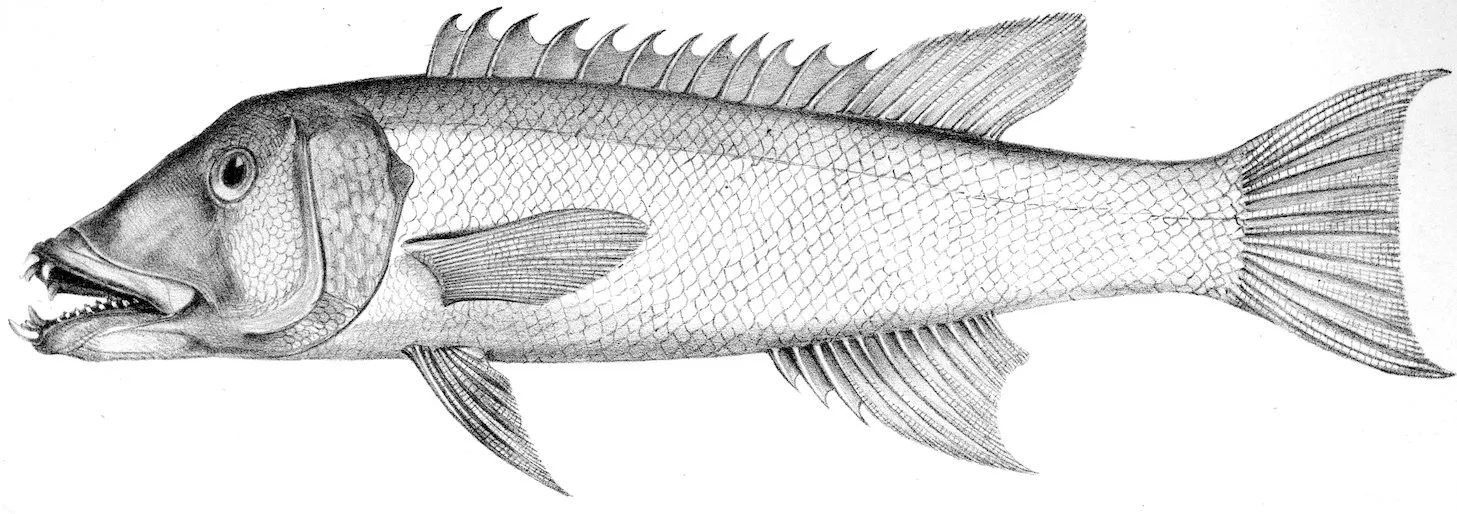
Fish Pl. 20.
Cossuphus Darwini. ½ Nat. Size.
101Form.—Head large: body of a suboval form, but much elongated: greatest depth at the nape contained
about four times and three quarters in the entire length: head not quite three times and
three quarters in the same. Nape and forehead high, whence the profile descends obliquely
in a straight line to the end of the snout. Jaws equal, and rather acute: lips fleshy: the end
of the maxillary not quite reaching to a vertical line from the anterior margin of the orbit.
Four very conspicuous, strong, curved, canine teeth at the anterior extremity of each jaw;
those above of nearly equal length, but the two middle ones rather longer and stouter than the
other two; of those below, on the contrary, the outer ones are the longest, as well as
strongest, being nearly twice as much developed as the middle ones, which last are of about the
same length as, but rather slenderer than, the outer ones above. The teeth at the sides of the
jaw are short and conical, and not very sharp pointed, forming a regular series; below they
amount to nine or ten on each side; above, the series may have been originally of the same
number, but in this specimen several appear wanting. Besides these conical teeth at the
sides of the jaws, there is an inner band of small rounded grains about the size of pins’
heads: the band is broader, and the grains larger and more distinct above than below: many
of them appear much flattened, and as if ground down by use. Eyes of moderate size; their
diameter about one-seventh the length of the head; rather high in the cheeks, and nearly
equidistant from the end of the snout and the posterior angle of the opercle. Snout and suborbital
in advance of the eyes, as well as the jaws, naked. Preopercle large; occupying
the posterior half of the cheek, rectangular, but the angle at bottom much rounded, the ascending
margin vertical, both margins entire; covered with small scales; the limb rather broad,
bounded internally by a slightly raised ridge, and without scales, but with a few scattered
small pores. The opercle and subopercle form together an irregular oblong, of which the
height is double the length; both are covered with scales larger than those on the preopercle:
the membrane terminates behind in a blunt angle. The interopercle, which is very distinct,
has three rows of scales on its surface, but none on the margin.
The lateral line is nearly straight throughout its course, the bend downwards beneath the
termination of the dorsal fin being scarcely perceptible. The tubes of which it is composed
are unbranched; many of them, however, incline upwards at their posterior extremity
towards the back. The scales on the body are rather larger than those on the opercle: there
appear to be upwards of fifty in a longitudinal line. The free portion of each scale has its surface
finely granulated in the middle, and striated at the sides.
The dorsal commences rather before one-third of the entire length, excluding caudal, and
occupies a space equalling nearly half the same; the spinous portion is low, and the spines
of nearly the same length, the first and second only being rather shorter than the succeeding
ones; the membrane between the spines notched: the soft portion rather pointed, and
twice as much elevated as the spinous. The anal commences beneath the eleventh or twelfth
dorsal spine, and terminates in the same vertical line with that fin; the soft portion, which
answers to the soft portion of the dorsal, is preceded by three spines, increasing in length to the
third, which is double the first, though itself not above half the length of the soft rays; these
spines are not particularly stout. The space between the anal and caudal equals one-sixth of
the whole length. Caudal rays nearly even, with the exception of the two outermost above
and below, which being rather longer than the others, give the fin a slightly crescent-shaped
form: the base of the caudal is scaly, but the scales advance only a very little way between
102the rays. Pectorals very little in advance of the ventrals, in length more than half that
of the head, with the second, third, and fourth rays longest. Ventrals in an exact vertical
line with the commencement of the dorsal, nearly equal to the pectorals, with the first
and second soft rays longest; the spine rather more than half the length of the first soft ray;
the last soft ray united to the body by a membrane.
Colours.—“Centre of each scale pale vermilion red: lower jaw quite white: a large irregular patch
above the pectoral bright yellow: iris red, pupil blue-black.”—I. The dried skin in its
present state is of a nearly uniform brown.
Habitat, Chatham Island, Galapagos Archipelago.
I have named this species in honour of Mr. Darwin, whose researches in the
Galapagos Archipelago, where he obtained it, have been so productive in bringing
to light new forms. I have referred it to the genus Cossyphus of Valenciennes, on
account of the small rounded grains behind the principal teeth; but it rather departs
from that group in not having the preopercle denticulated, and in having no
scales on any of the vertical fins, with the exception of a few at the base of the
caudal. In some respects it seems intermediate between that genus and Labrus.
It does not appear to be described, though it seems to approach the C. reticulatus
of Valenciennes in many of its characters. That species however is from Japan.
The canines at the anterior extremity of each jaw are very conspicuous in this
fish, and give it at first sight much the appearance of a Dentex.
C. nigro-fuscus, infra lineam lateralem et in ventre obscurè argenteus; pinnis pallidè
fuscis immaculatis: corpore valde elongato: dentibus in maxillâ superiore duobus
anticis caninis fortibus, lateralibus conicis parvis subœqualibus; in inferiore,
caninis parvis, lateralibus variis inæqualibus: lineâ laterali ramosâ.
B. 6; D. 9/13; A. 3/12; C. 12, et 4 breviores; P. 11; V. 1/5.
Long. unc. 9. lin. 6.
Form.—Very much elongated, with the dorsal and ventral lines nearly straight. Depth varying
but little, and contained nine and a half times in the entire length; thickness not quite three-fourths
of the depth. Head elongated, contained not more than three and a half times in
the entire length, compressed, with the cheeks vertical. Snout very much produced, slightly
rounded at the extremity: gape reaching half-way to beneath the middle of the eye. Jaws
scarcely protractile; the upper one a little the longest: lips reflexed in the form of membranaceous
flaps, especially the lower one, the margin of which is sinuous. Teeth ranged in a
single row in each jaw. Those above form a numerous, close-set, nearly even series at the sides
of the jaw, with two long hooked canines in front; the lateral teeth amount to about thirty-five
on each side, and are small, but strong, somewhat conical, and not very sharp-pointed. In the
lower jaw there are two front canines, similar to those in the upper, but much smaller; then
103follow four short conical teeth; then six large triangular, compressed, sharp-pointed ones, but
not all of equal size; then five more small conical ones, which complete the series on each side.
No teeth on the vomer or palatines. Eyes of moderate size, situate in the middle of the
length of the head, high, but not touching the line of the profile; their diameter one-eighth
the length of the head. Preopercle rectangular. Opercle triangular, the membrane
produced posteriorly at the upper part in the form of a rounded angle: a short row of scales
observable along its upper margin, and another along its lower. Subopercle and interopercle
without scales. Also a short row of scales, similar to those on the opercle, behind and partially
beneath each eye, and, with these exceptions, no other scales on the head. Above each
eye is an irregular row of minute pores: there are also pores beneath the eye, and on the
sides of the snout, mixed with short raised lines having somewhat the appearance of written
characters. Gill-opening widely cleft; the branchial membrane free all round.
Scales on the body moderately large, and similar in form to those of the C. auratus, as
described by Cuvier and Valenciennes. The number, in a longitudinal line from the gill to
the caudal, is forty-six, in a vertical about seventeen. Lateral line also as in that species, but
with the mucous tubes branched, and giving off eight or nine twigs on each side.
The dorsal commences a little behind the terminating angle of the opercle, and the anal
immediately beneath the first branched ray of the dorsal: these fins terminate in the same vertical
line, and the last ray in each is double: the simple rays are soft and flexible. Caudal
slightly rounded. Pectorals short, and obliquely truncated, contained eleven and a half times
in the entire length. Ventrals very small, about two-thirds the length of the pectorals,
rounded, close together, with an elongated scale between them; their point of insertion slightly
backwarder than that of the pectorals.
Colour.—Not noticed in the recent state. In spirits, it appears of an almost uniform dark brown,
at least above the lateral line. There is some trace of a pale longitudinal band on each side of
the head beneath the eye, which is continued, but rather indistinctly, along the whole length
of the body, the tips of the scales remaining dark. Possibly during life all the lower part of
the sides and belly may have exhibited numerous dark spots upon a pale or silvery ground.
Under part of the head pale brown, with some faintly-defined ocellated spots: also a faint trace
of red on the opercle. All the fins pale brown, without spots.
Habitat, Japan?
This species was given to Mr. Darwin, when at Chiloe, by the surgeon of
a whaling-ship, who said that he believed that it was caught in the Japan
seas. From the great similarity which prevails amongst the species of this
genus, I am not sure that it is really new, as I have ventured to consider it.
The specific character also, so far as the colours are concerned, must be received
with some caution, in consequence of these last not having been observed in the
recent state. It seems to approach very closely the C. hemichrysos of Cuvier and
Valenciennes, brought by MM. Quoy and Gaimard from the Sandwich Islands;
but it differs in its colours, especially in the fins being all uniformly pale brown,
and in having fewer scales on the opercle, and beneath the eye. It is impossible
104to say, however, to what extent the colours may have been altered by the spirit:
some of the scales also may have been rubbed off.
C. supra virescenti-niger, lateribus pallidioribus: dorso modice arcuato; fronte elevato,
rostro summo ante oculos paululum excavato: limbo preoperculi ports quatuor conspicuis
impresso: squamis latis, marginibus liberis levissime ciliatis: spinis dorsalibus
quindecim, analibus sex: pinnis ventralibus longe acuminatis, ad analem
pertingentibus: pinnâ caudali subæquali.
D. 1–5/10; A. 6/8; C. 16, &c.; P. 14; V. 1/5.
Long. unc. 5. lin. 9.
Form.—Oblong-oval, very much compressed; the back moderately elevated, and more curved than
the abdomen. Greatest depth a little behind the insertion of the pectorals, and contained
twice and three quarters in the entire length: thickness about two-fifths of the depth. Forehead
high: profile falling very obliquely, and slightly hollowed out in front of the eyes; the
upper and under profile meeting at the mouth at nearly a right angle. Head contained not
quite four times in the entire length; its own length and height nearly equal. Mouth small,
protractile: jaws about equal, the lower one, if anything, a little the longest: lips not very
fleshy. Maxillary rather slender, retiring almost entirely, when the mouth is closed, beneath
the suborbital, the anterior margin of which is slightly hollowed out, and somewhat sinuous.
Teeth in card in both jaws, forming a narrow band; the outermost row longer and stronger
than the others, especially the four or six middle ones in front, which are somewhat conical and
slightly hooked. Pharyngean teeth present, but none on the vomer or palatines. Eyes rather
small, their diameter about one-fifth the length of the head; high in the cheeks, and a little
nearer to the snout than to the posterior margin of the opercle: the space between broad,
equalling nearly two diameters and a half. Nostrils consisting of a single round orifice half-way
between the eye and the end of the snout. Preopercle with the basal margin short, and
forming a slightly obtuse angle with the ascending one, the margin of which is entire. Opercle
of a triangular form, broad at top, but narrowing off towards the bottom. Subopercle and
interopercle much developed; their outer margins, taken together, rounded off nearly in a
semicircle. Branchial membrane quite free all round, unattached to the isthmus, and but
slightly emarginate. Snout, suborbital, jaws, and limb of the preopercle, naked; but the
cheeks and rest of the opercular pieces scaly: the scales on the subopercle large. Four large
pores on the limb of the preopercle, preceded by three others beneath the lower jaw: similar
pores beneath the eye, and extending partially round it; one on the crown of the head, and a
few smaller ones scattered about the snout; a large one just above the opercle, and another
higher up on each side of the nape.
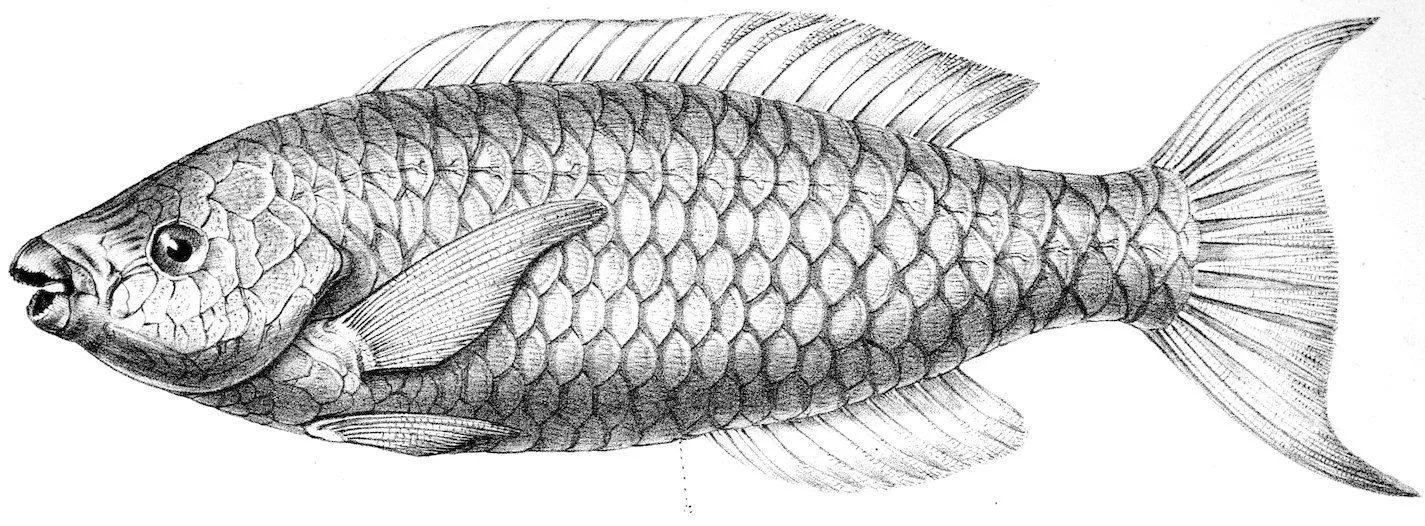
Fish Pl. 21.
Scarne Chlorid
105Scales on the body large; about twenty-five or twenty-six in a longitudinal row, and
eleven or twelve in the depth; broader than long, with the free edges very minutely ciliated,
the concealed portions with a fan of thirteen striæ, and the basal margins with twelve distinct
crenatures. Lateral line interrupted; its first portion at the depth of two and a half rows of
scales beneath the dorsal, and stopping beneath the commencement of the soft part of that fin;
recommencing three rows lower down, exactly in the middle of the depth, whence it runs
straight to the caudal.
Dorsal commencing above the opercle; the spinous portion of nearly uniform height, and
scarcely more than one-fifth of the depth; the soft portion much higher, and terminating in a
sharp point behind. Anal answering to the posterior half of the dorsal, terminating opposite to
it, and similarly pointed; with six spines, which, as well as the dorsal spines, are furnished
with very conspicuous filamentous tags. Caudal nearly even. Pectorals rounded, but not
very broad, their length rather more than three-fourths that of the head; the rays rather slender.
Ventrals pointed; the first soft ray elongated, and reaching to the anal when laid back;
the last ray attached at its base by a membrane to the abdomen. Rows of small scales between
the rays of the caudal at the base of the fin; and a few small ones along the base of the dorsal
and anal, more particularly on the soft portions.
Colour.—“Above, greenish black; the sides paler; slightly iridescent.”—D.—In spirits it appears
of a nearly uniform brown all over, fins included.
Habitat, Maldonado, Rio Plata.
Mr. Darwin obtained this species at Maldonado, in a lake of fresh water, said
sometimes to be a little brackish. It appears to belong to the genus Chromis of
Cuvier, placed by him amongst the Labridæ, but having evidently very strong
affinities to some of the Sciænidæ. It differs essentially from the C. Brasiliensis
of Quoy and Gaimard,[32] in having six anal spines, and being destitute of all
markings and spots. I am not aware that it is described by any author.
S. æruginoso cyaneus, capite et pinnis flavo-vittatis: maxillis exteriùs lævibus, marginibus
crenatis; caninis ad angulos oris nullis: fronte gradatim proclivi: lineâ
laterali tubis parum ramosis: squamis ubique striato-granulatis: pectoralibus acuminatis,
radiis superioribus arcuatis: caudali radiis externis cæteris longioribus,
acuminatis.
D. 9/10; A. 3/9; C. 13. &c.; P. 15 vel 16; V. 1/5.
Long. unc. 16.
Form.—Of an oval form; the greatest depth one-third of the length, caudal excluded: dorsal and
ventral lines equally convex. Head a little less than the depth of the body, not gibbous in
front, but with the profile falling regularly and gradually from the commencement of the dorsal.
Snout rather pointed. Jaws equal, their outer surface smooth, but crenated on their cutting
edges. No spinous canines at the corners of the mouth. Eyes rather small, their diameter not
one-fifth the length of the head, situate above the middle of the cheek, but equidistant from the
posterior lobe of the opercle and the extremity of the snout. Snout in front of the eyes, and
106the lips, naked; but the cheeks and opercular pieces covered with large scales, which form two
rows on the cheeks. Opercle terminating behind in a rounded angle. Scales on the body
very large; eight in the depth, and twenty-one or twenty-two in the length: the entire
exposed portion of each scale scabrous with granulations, which are partially disposed in lines
towards the free edges. No scales on the vertical fins. The lateral line occupies the second
row of scales from the top, till it reaches a little beyond the end of the dorsal, where it becomes
interrupted, recommencing in the fourth row, which at this point is the third: tubal pores in
some places ramified, but the ramifications not very distinct.
The dorsal commences above the posterior lobe of the opercle, and is of nearly uniform
height throughout. The length of the rays in the soft portion, which is slightly higher than
the spinous, is not quite one-third of the depth. The whole length of this fin is half the
entire length. The anal answers to the last half of the dorsal, and terminates in the same line;
the three spines are slender, and the first very short. Caudal with the central portion slightly
convex, but the three outer rays above and below prolonged into a point one-third the length
of the whole fin; the lower point a little longer than the upper. Pectorals about one-fifth of
the entire length, pointed, with the upper rays arcuate. Ventrals immediately beneath them,
one-third shorter.
Colour.—“Fine verditer blue, with some yellow stripes about the head and fins.”—D.—The dried
skin is nearly of a uniform brown, but the snout and cheeks are much varied with green: the
jaws also are green. A bright green patch in front of the eye, immediately beneath which is
a pale frænum, probably yellow in the recent state. Dorsal and anal green: the former shews
some trace of a lighter narrow band running longitudinally below the upper edge of the fin;
the latter exhibits a very distinct fascia running along the middle. Caudal pale green, with
the upper and lower edges of a much deeper tint. Ventrals in like manner edged with green.
Pectorals wholly dusky.
Habitat, Keeling Island, Indian Ocean.
In so extensive a genus as the present, and one in which so much general
similarity prevails amongst the species, the task of determining whether any
particular one has been described before is extremely difficult. I can only say that
the species which I have here ventured to characterize as new has been carefully
compared with the descriptions of all those noticed in the “Histoire des Poissons,”
and though there are several to which it is nearly allied, there is none to which it
can be referred with certainty. It seems to approach nearest the S. variegatus,
but that species is said to have the caudal square, by which I presume is meant
that the upper and under rays are not prolonged into a point, as is the case in so
many species of this genus, and in the one here described.
This species was taken by Mr. Darwin at the Keeling Islands.
S. globiceps, Cuv. et Val. Hist. des Poiss. tom. xiv. p. 179.
Form.—Oblong-oval, very much compressed throughout: the dorsal and ventral lines nearly of
equal curvature. Greatest depth contained about three times and one-third in the entire
107length: thickness twice and three-fifths in the depth. Head one-fourth of the entire length,
rather elevated at the nape, the forehead convex, whence the profile descends nearly in the arc
of a circle, giving the snout a blunt and rounded appearance. The height of the head, taken
in a vertical line through the eyes, equals nearly but not quite its own length. Mouth small,
the gape not reaching half-way to the eye. Jaws very slightly crenated on their cutting
edges, the true teeth appearing on the outer surface like minute scales. At the posterior angle
of each jaw, and on each side, are two sharp canines projecting horizontally from the corners
of the mouth, eight in all. Eyes rather small, their diameter contained six and a half times in
the length of the head, situate a little above the middle of the cheek, and a trifle nearer the
extremity of the snout than the posterior margin of the opercle. The nostrils consist of two
minute orifices a little in advance of the eye, and a little distant from each other, the posterior
one largest and kidney-shaped, the anterior round and nearly closed by its membranous
border. A cluster of minute pores above and behind the eyes, and a few others scattered about
the snout.
Scales on the body very large, increasing in size at the base of the caudal, where there are
three very large ones covering the rays of that fin for half their length or more: twenty-three
in a longitudinal line, and nine in the depth. Each scale of a roundish form anteriorly, the
basal portion with a projecting lobe in the middle of the hinder margin, and with thirty-one
striæ in the fan; the exposed portion finely striated and granulated, with a broad membranaceous
border: those on the caudal nearly three times as long as broad, but the ordinary
ones with the length and breadth nearly equal. Lateral line interrupted; the upper portion
running nearly straight at about one-fourth of the depth, till opposite the end of the dorsal,
where it inclines downwards: tubal pores very distinctly ramified.
Dorsal very low, its height, in the middle of its length, being scarcely more than one-eighth
of the depth: the soft rays slightly higher than the spinous, and increasing in length
backwards. Anal answering to the last half of the dorsal, and terminating in the same line:
three spines at its commencement not stouter than the soft rays, the first very small. The
last soft ray in both dorsal and anal double. Caudal with the points about one-fourth of the
rest of its length; when spread, the interval is rectilineal, but when the rays are closed the
whole appears crescent-shaped. Pectorals a little shorter than the head, of a somewhat triangular
form, the rays gradually decreasing in length from the uppermost to the lowermost.
Ventrals pointed, about two-thirds the length of the pectorals, and immediately beneath them.
A large oblong lanceolate scale between the ventrals, nearly half their length: also an oblong
scale in the axilla of each, equalling the last of the soft rays.
D. 9/10; A. 3/9; C. 13, &c.; P. 13; V. 1/5.
Length 11 inches.
Colour.—Not noticed in the recent state. In spirits, it appears bluish grey on the back and sides
with small round whitish spots, the margin of each scale being defined by a purplish line; paler
on the belly: a white transverse line in front of the eyes passing from one to the other;
anterior part of the snout, mouth, cheeks, and lower part of the head, yellowish white. Dorsal
and anal pale, the former with three narrow longitudinal purplish lines, the latter with one. A
portion of the under surface of the pectorals, extending from the third to the fifth ray, and
108forming a longitudinal fascia, purple; the rest of those fins, as well as the caudal and ventrals,
pale or nearly colourless.
Habitat, Tahiti.
This species was taken by Mr. Darwin at Tahiti. It so nearly answers to
the description of the S. globiceps of Valenciennes, brought by MM. Garnot and
Lesson from the same locality, that I cannot suppose it to be distinct. This specimen,
however, appears to have more spinous teeth at the corners of the mouth.
S. fuscus, capite et pinnis purpureo-cæruleo tinctis: fronte parum elevato, æque ac rostro
continue et gradatim proclivi; hoc apice obtuso: maxillis exterius lævibus, marginibus
vix crenatis; canino ad angulum oris in maxillâ inferiore unico, in superiore
nudo: lineâ laterali distinctè ramosâ: pectoralibus subtriangulis: caudali subæquali,
radiis externis mediis vix longioribus.
D. 9/10; A. 3/9; C. 13, &c.; P. 13; V. 1/5.
Long. unc. 8. lin. 7.
Form.—General form not very dissimilar to that of the last species, but the crown and nape less
elevated, whence the profile falls in a more gradual slope: snout, nevertheless, blunt at the
extremity. Depth of the body very nearly one-third of the entire length. Head about one-fourth
of the same. The height of the head is about four-fifths of its own length. Jaws smooth
externally, the true teeth appearing like minute scales on their surface, the cutting edges
scarcely at all crenated: only one laterally projecting canine at each corner of the lower jaw,
none in the upper. Diameter of the eye one-sixth of the head.
Dorsal not quite so low as in the last species; its height in the middle of its length about
one-seventh of the depth. Caudal nearly even, the upper and lower rays being scarcely
longer than the others. Pectorals and ventrals similar, but the scale between the latter shorter
and more rounded. Scales on the body large, the free portions finely striated and granulated,
with a broad membranaceous border: three large ones at the base of the caudal, as in the last
species. Lateral line distinctly branched, the ramifications irregular and varying on each
scale; in some instances only one long stem extending nearly to the margin of the scale, with
one or more lateral twigs; in others, two, three, or even four distinct stems, either simple or
ramified.
Colour.—(In spirits.) Of a nearly uniform dark brown, with some faint traces of purplish blue
about the head and fins, which possibly may have pervaded some parts of the body also in the
recent state.
Habitat, Tahiti.
This species was taken with the last, and notwithstanding it presents two or
three obvious differences in respect of form, as well as of colour, it is just possible
it may be the same in a younger state. I think it not improbable that the points
of the caudal may elongate with age, the forehead become more gibbous, and the
109spinous teeth more numerous. If it be distinct it would seem to be undescribed;
though the colours not having been noticed in the recent state renders it difficult
to speak with certainty on this point. For the same reason, the specific character
may perhaps hereafter be found to require alteration.
Mr. Darwin’s collection contains another species of Scarus from the Keeling
Islands, which may probably be distinct from all those hitherto noticed, but which
being in rather a bad state of preservation, I shall content myself with describing
as well as I can, without affixing any name to it, lest in the end it prove not new.
Many of the species enumerated in the “Histoire des Poissons” having only their
colours noticed, it requires that these should have been observed more in detail
than what Mr. Darwin’s notes furnish in this instance, in order to decide whether
it be identical or not with any of those spoken of in that work.
Form.—A tolerably regular oval, somewhat attenuated at each extremity: dorsal and ventral lines
of equal curvature. Nape not at all elevated, and the profile on the whole falling very regularly
and gradually from thence to the end of the snout, though there is a slight eminence on
the forehead. Depth one-fourth of the entire length. Jaws smooth externally, but with the
true teeth very distinct upon their surface, and much more so upon their cutting edges than in
either of the last two species. One horizontally projecting canine at each corner of the upper
jaw, but none in the lower. The terminating lobe of the opercle is slightly emarginated
behind, the membrane projecting immediately above the notch in the form of a short salient
point. Lateral line interrupted, the upper portion nearly straight, and not inclining downwards
at its posterior extremity: the tubes very slightly ramified, and many of them quite
simple. The scales on the body are very finely granulated and striated: there are no large
ones at the base of the caudal. Dorsal and anal low: height of the former contained four and
a half times in the depth of the body, and exactly equalling the distance from the upper edge
of the back to the lateral line. Pectorals somewhat triangular, the uppermost ray of all a little
arcuate. Scale between the ventrals one-third the length of those fins. Caudal slightly
crescent-shaped, when the rays are closed: when spread, all the middle rays appear even, the
uppermost and lowermost projecting very slightly beyond them.
D. 9/10; A. 3/9; C. 13, &c.; P. 14; V. 1/5.
Length 6 inches.
Colour.—“Body dull reddish and greenish, the colours being blended and mottled: fins banded
lengthwise with vermillion-red: head with waving bright green lines.”—D.—No trace of bright
colours remains in its present state, and the only indication of markings is a narrow crescent-shaped
band across the middle of the caudal.