The Zoological Gardens of Europe, Their History and Chief Features
Whole book · 47 sections
WORKS BY THE SAME AUTHOR.
SOMALILAND.
Royal 8vo., cloth extra, gilt top, 18s. net.
A thrilling story of sport and adventure met with in the course
of two expeditions into the interior of the country. Profusely
illustrated from photographs by the author and with original full-page
drawings by that great portrayer of wild animal life, Edmund
Caldwell.
This standard work on Somaliland, which has taken upwards of
four years to compile, concludes with descriptive lists of every
animal and bird known to inhabit the country. The book contains an
original map, drawn by the author, showing the heart of the Marehan
and Haweea countries previously untrodden by white man’s foot.
Illustrated Sporting and Dramatic News.—‘Readers will find this a capital
book of sport and travel, in which the life of the hunter in Africa is depicted in
graphic and straightforward fashion. Mr. Caldwell’s illustrations are excellent.’
Spectator.—‘Mr. Peel’s two hunting trips in “Somaliland” will make many
a man’s mouth water, though the trying experiences of the desert journey will as
probably parch their throats in anticipation.’
Saturday Review.—‘This is a pleasant book of sport, natural history, and
adventure, rendered additionally interesting by an excellent list of the fauna of
the country.’
WILD SPORT IN THE OUTER HEBRIDES.
Demy 8vo., cloth gilt, gilt top, 7s. 6d. net.
The experiences of a sportsman who has made a close study of
the habits of all the animals and birds which are to be found in the
Outer Hebrides. The illustrations consist of a photogravure frontispiece
from an original drawing by Mr. G. E. Lodge, and reproductions
of numerous photographs taken by the Author. In an
Appendix is given a list of all the animals and birds which have
been actually observed by the Author in these islands.
Daily News.—‘A breezy, sportsmanlike book, well illustrated.’
Dundee Advertiser.—‘His book gives a clear insight to the country and the
sport it provides. He writes in a graphic, straightforward style, and his
experiences leave the reader impressed that he has read the truth and nothing
but the truth. The illustrations are very fine.’
Glasgow Herald.—‘Will be found exceedingly useful both by the sportsman
and the naturalist who may visit the Western Isles.’
Scotsman.—‘A book which every lover of sport will peruse with interest and
profit.’
Times.—‘An exciting book.’
Pall Mall Gazette.—‘Snap-shooting with the camera is Mr. Peel’s last word.
He finds it so attractive that he threatens to discard his gun altogether. We
hope he will neither discard his gun nor his pen. He has the right way with both.’
F. E. ROBINSON & CO.,
THE RUSSELL PRESS, 20, GREAT RUSSELL STREET, LONDON.
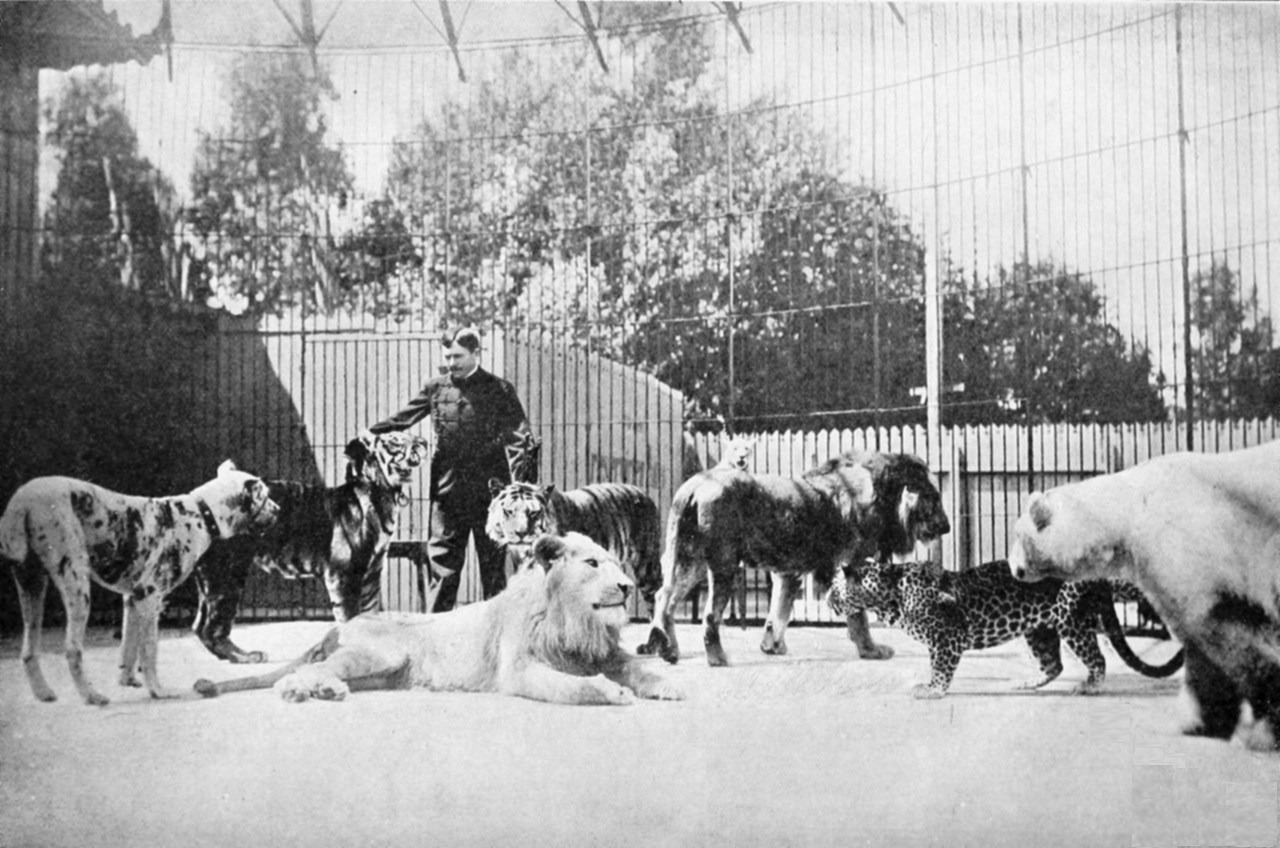
GROUP OF PERFORMING ANIMALS AT CARL HAGENBECK’S.
THE ZOOLOGICAL GARDENS OF EUROPE
Their History and Chief Features
BY
C. V. A. PEEL, F.Z.S., F.R.G.S.
Author of ‘Somaliland,’ ‘Wild Sport in the Outer Hebrides,’ etc.
LONDON
F. E. ROBINSON & CO.
20, GREAT RUSSELL STREET, BLOOMSBURY
1903
PREFACE
This book is intended chiefly as a work of reference.
As most Zoological Gardens are much alike, it is impossible
to avoid a certain monotony in describing
them. And yet each Garden has generally its own
distinctive features. These I had the opportunity of
observing in a tour which I made early this year, and
I have tried to recount them in the following pages,
after first giving the main facts connected with the
foundation and development of the respective Gardens.
In my descriptive walks round I invariably turned to
the left on entering, and made my way round the
Gardens back to the entrance again.
The chief thought that has occurred to me as the
result of my tour is that we in England take little
interest in the breeding and acclimatization of wild
animals as compared with the Germans, or even
Americans. Almost every large town in Germany has
its Zoological Garden, and, as it usually contains a
concert-hall and other similar attractions, people flock
to it, and are insensibly led to take an interest in the
wild animals which they see around them. It seems to
me a pity that we do not make our few English
Gardens equally attractive. The result would be, I
feel sure, that more people would become interested
in wild animals, and probably many of our large towns
would start Gardens of their own.
It is not generally known that most wild animals
can be easily acclimatized, and, if properly treated, will
breed well in captivity. The great secret is fresh air:
animals which come from the equator do not require
heat when once acclimatized. Just as human beings
die of consumption through the want of fresh air, so do
our anthropoid apes and other animals often die in
captivity through being shut up, winter and summer,
in hot-houses devoid of fresh air. We are far behind
Germany and America in our knowledge of the breeding
and cross-breeding of wild animals, and yet there
must be many influential men in England who would
assist in the formation of a National Park for such a
purpose, thereby furthering the cause of science and
conferring a great benefit on the nation. Our cousins
in America have the Yellowstone National Park; we
ought to have a similar place.
My thanks are due to many gentlemen who have
kindly favoured me with histories, guide-books, photographs,
and general information about the Zoological
Gardens of Europe. And especially do I owe a debt
of gratitude to Dr. P. L. Sclater, the learned Secretary
of our own Zoological Society in London; to Herr Carl
Hagenbeck of Hamburg, Dr. C. Kerbert of Amsterdam,
Dr. H. Bolau of Hamburg, Dr. Seitz of Frankfort-on-Main,
Mr. E. W. B. Villiers of Clifton, Professor
D. Cunningham of Dublin, Herr Schöff of Dresden,
Herr Meissner of Berlin, Dr. Hagman of Basle, Dr.
Wünderlich of Cologne, and to Messrs. J. Jennison
and Co. of Manchester. The photographs of Berlin
are published by kind permission of the Berlin Zoological
Society.
In some few cases it has been found impossible to
give historical details, through my appeals to the
Directors eliciting no reply. The sketch of the London
Gardens is a concise summary, with additions, of the
history written by Dr. P. L. Sclater, that of Dublin
is taken from a pamphlet written by Professor D. Cunningham,
whilst the history of the Manchester Gardens
is based on materials furnished by Messrs. J. Jennison
and Co.
In conclusion, my best thanks are due to my sister,
Mrs. Harry Duff, whose knowledge of foreign languages
has enabled her to give me much valuable help
in the translation of letters, guide-books, and catalogues
of animals. Indeed, without her kind assistance
I could scarcely have attempted this work.
JARDIN DES PLANTES, PARIS: DIRECTOR, PROFESSOR
MILNE EDWARDS
This Garden, the father of Zoological Gardens, is the
oldest of the Zoological Gardens of Europe.
Many of the greatest naturalists have been connected
with the Jardin des Plantes, and have studied
within its gates.
The botanical portion is more than one hundred
years older than the zoological. It was founded in
1626 by Louis XIII., who bought a plot of uncultivated
ground in Saint-Victor, twenty-four acres in
extent, and laid out a flower-garden and built a little
greenhouse upon it. Fagon, the King’s doctor, Gaston
of Orleans, Colbert, and Tournefort all helped it
along, and caused the Garden to grow in extent and
popularity.
A museum of natural history was established, and
eleven professors appointed in mineralogy, botany,
two courses of zoology, human and animal anatomy,
geology, chemistry, etc. A library was formed in
the museum. On the death of the Duc d’Orleans in
1660, Colbert bought for the library the celebrated
paintings of flowers on vellum by Robert.
In 1730 the Garden became neglected, but in 1732
M. Buffon became Director, and from that moment
success was assured for them. He was well backed
by M. Daubenton. Every year the Garden was improved,
the old houses were demolished and new ones
built. The whole of the ground was put under cultivation.
Trees were planted, and the Garden extended
to the bank of the Seine. Valuable gifts of plants,
minerals and zoological specimens were received from
the Academy of Sciences, Comte d’Angevilliers, Chinese
missionaries, the King of Poland and M. Bougainville,
who brought back from his voyage round the world a
magnificent collection of animals and birds. Whilst
Director of the Garden, Buffon wrote his chef-d’œuvre—a
natural history—and after a splendid career he
died in 1788.
Bernardin de Saint-Pierre was the next Director.
In 1794 the large and valuable collection of the Palais
de Versailles was offered to the Jardin des Plantes,
and accepted on its behalf by Bernardin de Saint-Pierre.
This collection contained five specimens which
had never been seen in Paris before—namely, a
quagga, now unhappily extinct, a hartebeest, a crested
pigeon from the Isle of Banga, an Indian rhinoceros
and a lion from Senegal, which latter had as a companion
a dog, with which it lived on terms of the
greatest friendship. The remainder of the collection
at Versailles had been pillaged by the mob in the
French Revolution.
In 1796 the Jardin des Plantes received a letter
from Captain Baudin asking for a ship and men to
convey to France a rich collection of animals and
plants which he had gathered together in the island
of Trinidad. A vessel was sent out, and, after being
shipwrecked on the Canaries, the collection was finally
brought home the next year. It was augmented by a
collection of birds made by M. le Vaillant in Africa,
and a collection brought back from La Guiana by
M. Bragton. The Emperor Napoleon added several
animals which he bought in England, and among which
were a pair of tigers, two lynx, a mandril, a leopard, a
hyæna, and a handsome panther, or hunting leopard,
besides several birds and plants.
M. Fourcroi, who now made his appearance, collected
for the institution animals, birds, precious
stones, plants and books from all parts of the world.
The collection of minerals of M. Warisse was bought,
and 150,000 books were added to the library. The
Emperor Napoleon during his wanderings never forgot
the museum, and sent back to it fossil-fish from Verona
and specimens of rock from the island of Corsica.
M. Lesneeur, the painter and historian, and M. Peron
brought back from the South 100,000 specimens of
animals, large and small, representing many species.
They brought home a zebra and a monkey for the
Empress Joséphine and plants without number. About
this time M. Cuvier, the celebrated naturalist, made
his appearance; M. Geoffroy arrived from Lisbon with
new animals; M. Michamx brought specimens from the
forests of America; and M. Marcel de Serres brought
from Italy and Germany all sorts of minerals.
Great progress was made in the Jardin des Plantes
until 1815, when there came a climax in France.
Then commenced a series of miseries and an almost
incredible history of disaster. Cossacks, Russians,
Germans, and Italians filled Paris, and brought ruin
and devastation with them; but, happily, of all the
monuments of Paris, the only one which was not insulted
was the Jardin des Plantes. The Garden was
respected; it was neutral territory, where all sides
came to seek rest from war.
In 1820 M. Milbert made large collections of natural
history specimens and minerals in America for the
Jardin des Plantes. In 1829 M. Victor Jacquemont
appeared, and made a name for himself in natural
history, but died when quite a young man in the
island of Salsette.
In 1841 the Garden contained a zoological museum,
a museum of comparative anatomy, a botanical museum,
a geological museum and a museum of minerals.
Besides a library containing 28,000 books devoted to
travel and to physical and natural sciences, such as
natural history, botany, physics, chemistry, mineralogy,
comparative anatomy, human anatomy and zoology,
there were memoirs of learned societies and a collection
of paintings on vellum. This library was
founded in June, 1793.
In 1841 M. Geoffroy Saint-Hilaire was Professor of
Zoology, M. Brouguiart Professor of Botany, M. Serres
Professor of Anatomy and Physiology, and M. de
Mirbel Professor of Agriculture.
During the Siege of Paris in 1870 the Garden
suffered terribly. Nearly a hundred shells fell within
its boundaries; most of the glass-houses were battered
to ruins, and a great number of the animals were, by
the direction of the authorities, handed over to the
butchers, killed and sold at fabulous prices. Lion,
bear, giraffe and hippopotamus flesh realized 25 francs
per pound during the last few months, and was very
difficult to obtain even at that price.
This Garden, which runs close by the side of the
Seine bank, is open free to the public. It is somewhat
of a bewildering place to find one’s way about in. Its
collection of animals is very fine, and contains two or
three especially good things. There are some pretty
spots in it, and plenty of trees and shade. A fine
lion house of no less than twenty-two cages contains a
good collection of the big cats and bears, a number of
the latter coming from Tonquin. Besides these bears,
there are others in old but well-built bear-pits in
another part of the Garden. Again, we find a pair
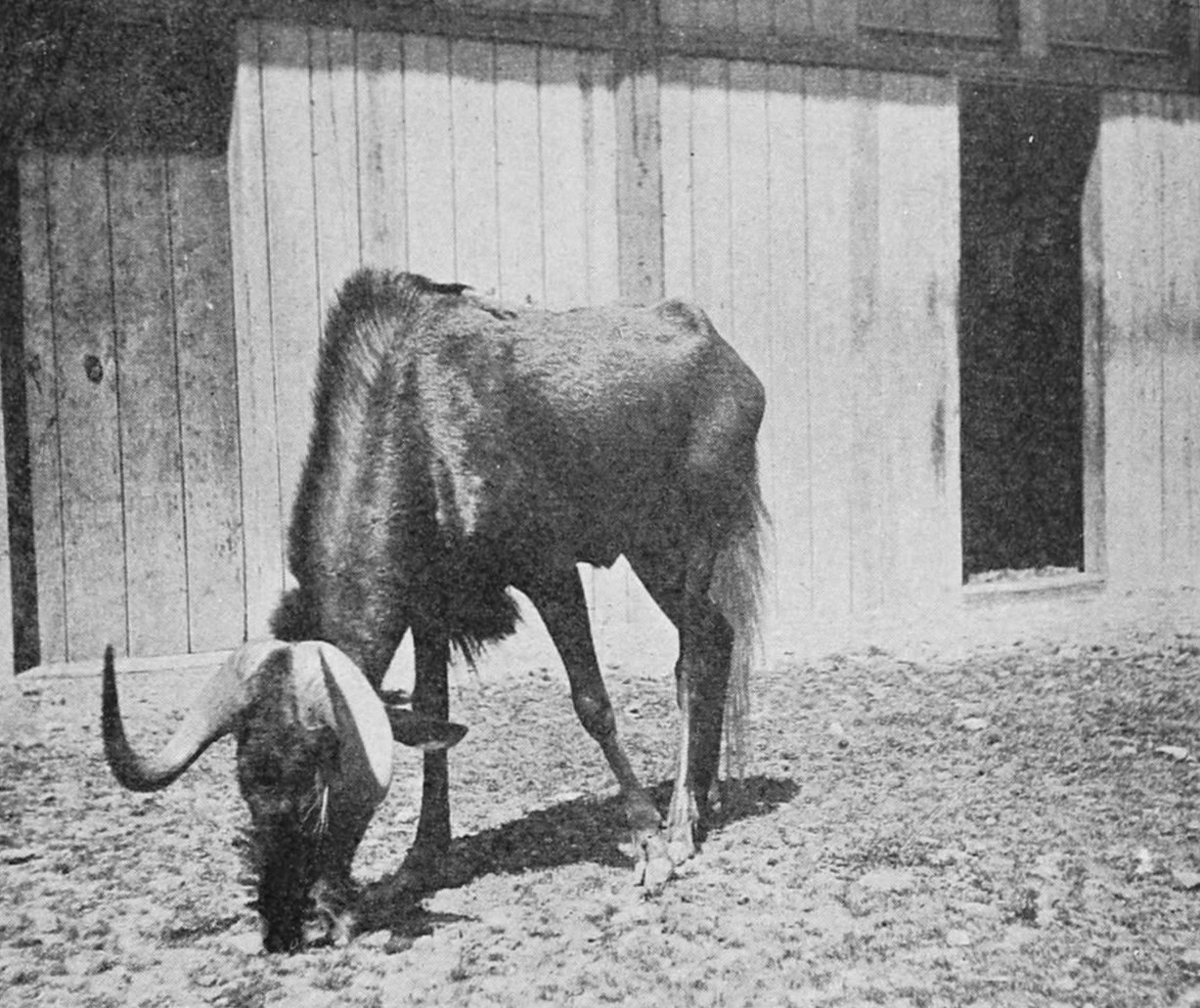
of hartebeests, so seldom seen in captivity.[A] Deer
and antelopes, sheep and goats, are very well represented
in the Jardin des Plantes.
I was busily engaged in taking photographs, when
I was pounced upon by the inevitable gendarme, and
was obliged to ‘box up’ in front of a large and sympathizing
crowd. The elephant house contained three
Indian elephants and one African, which is the largest
to be found in captivity. Unfortunately, he has only
stumps of tusks, and is, in consequence, not half such
an imposing animal as the magnificent African elephant
at Berlin. There was quite a number of zebras, including
a mountain zebra with a foal, born in the
Gardens, and a hybrid between a zebra and a kiang
(Equus hemionus). There was a good collection of
swine, including a Red River hog and an enormous
European boar.
There were crowds of people in the Garden, and no
wonder, for seldom is such a fine collection of animals
to be seen without paying anything.
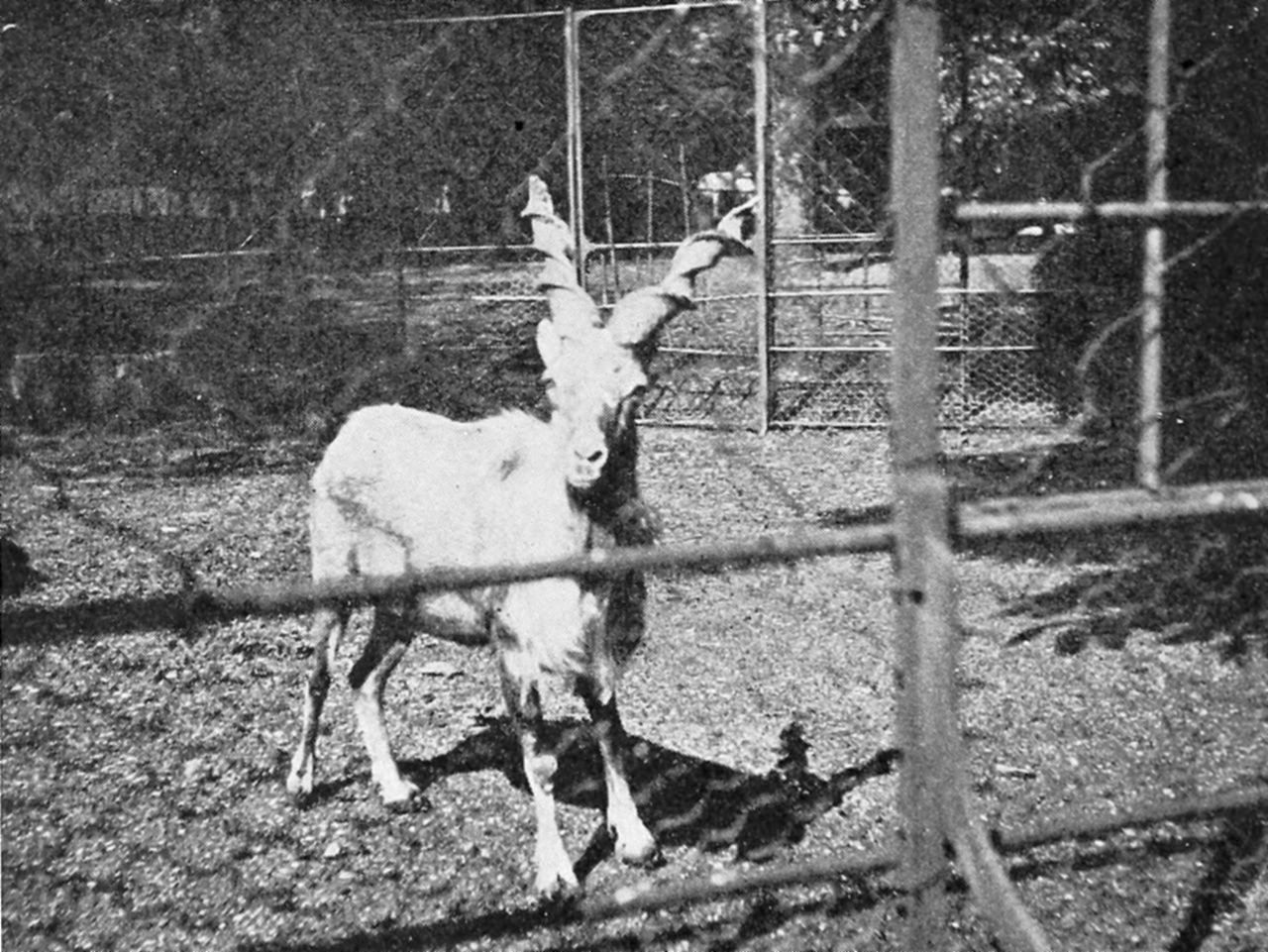
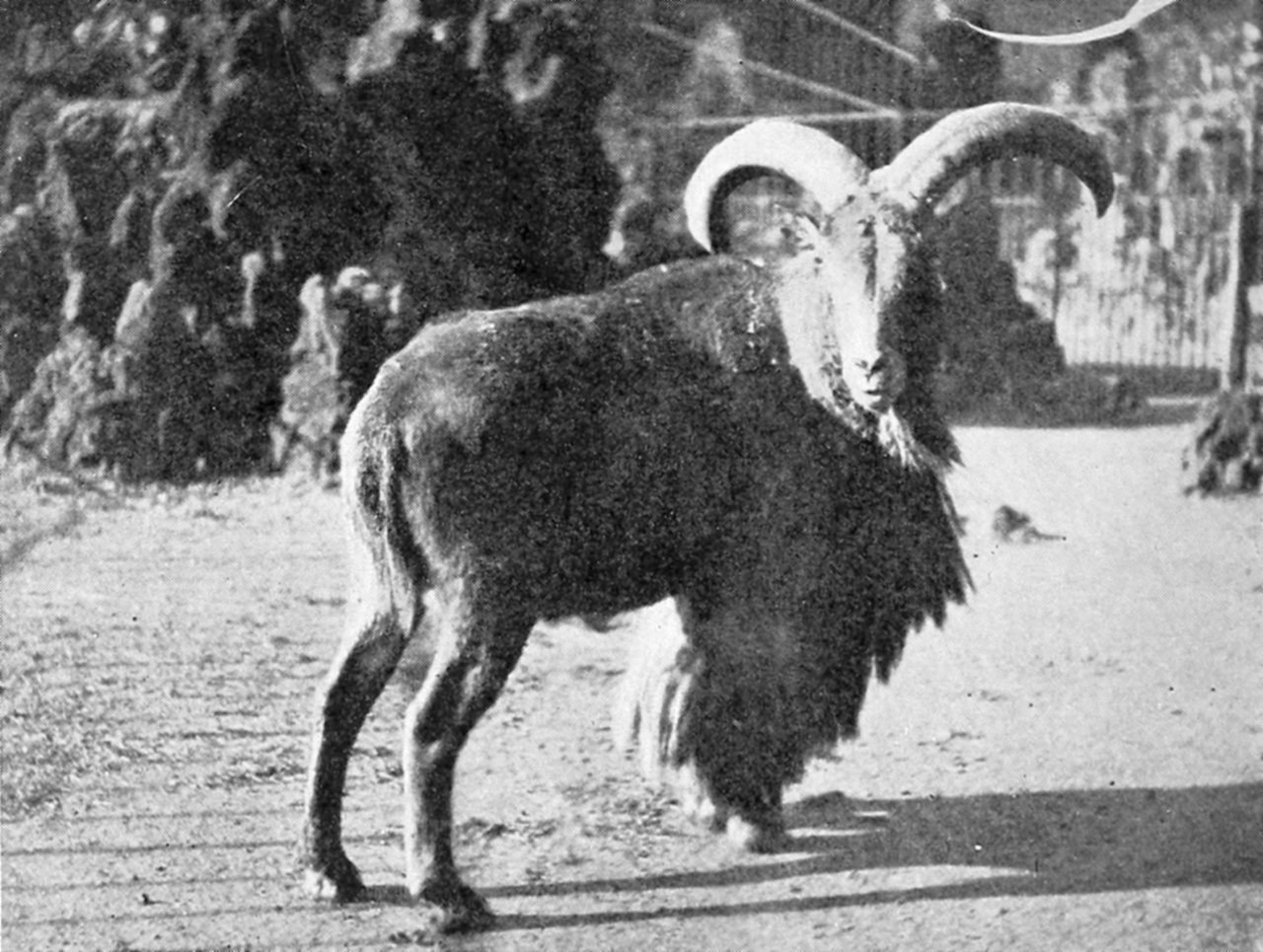
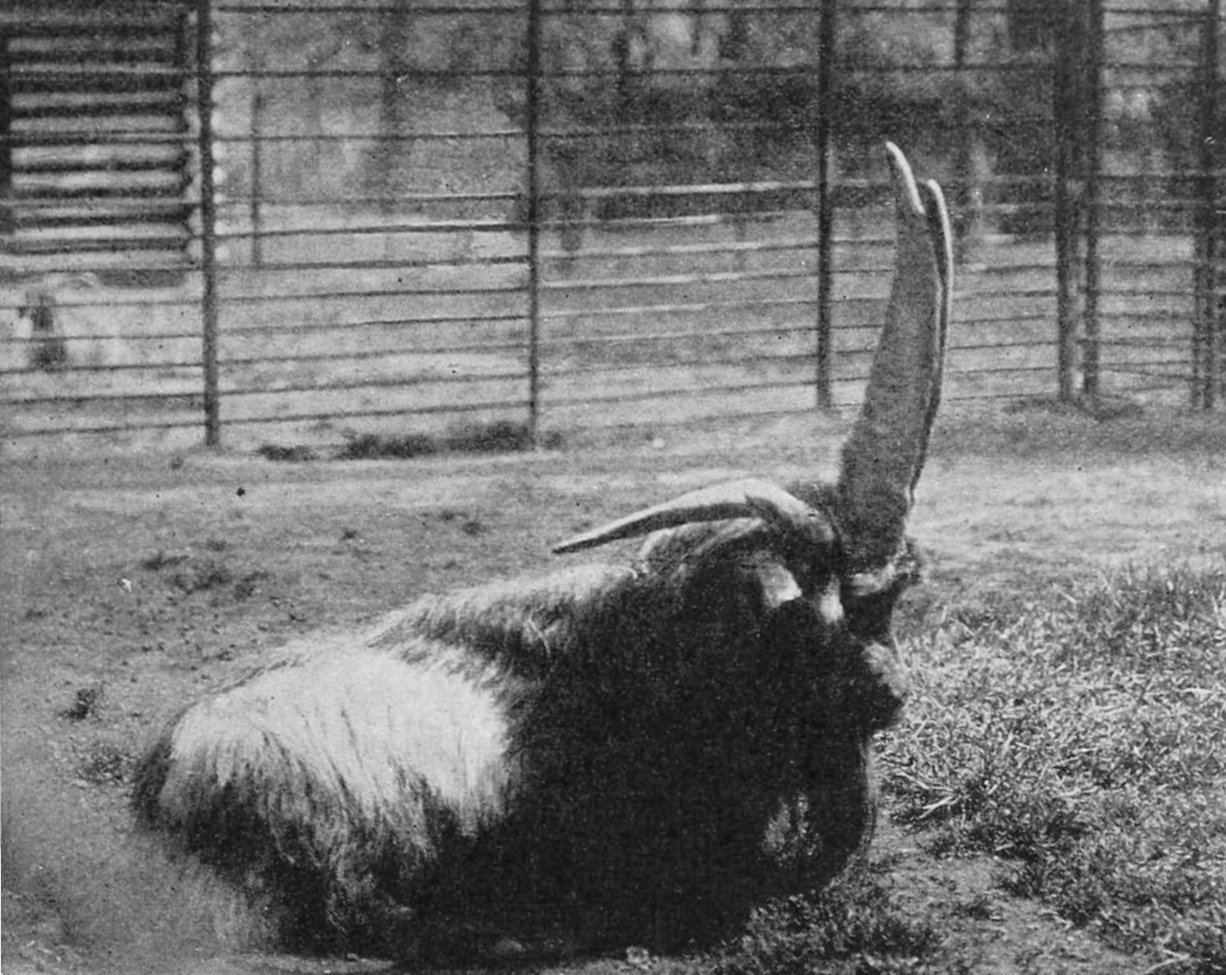
MARKHOR, JARDIN DES PLANTES, PARIS.
According to the Matin, palatial accommodation is
to be provided for the animals in the Jardin des
Plantes. The new premises will consist of a series of
rotundas, or gigantic cages, 15 metres high, which
will be reserved for the pachyderms. A laboratory
of animal psychology for the study of character among
the brute beasts is shortly to be opened under the
direction of M. Hachet Souplet, assisted by M. Oustallet.
It has also been arranged by M. Perrier,
a Director of the Gardens, to give popular lectures
in the amphitheatre every Sunday afternoon.
[A] A hartebeest has lately been added to the London Zoo.
CHAPTER II
JARDIN D’ACCLIMATATION, PARIS: DIRECTOR,
M. A. PORTE
In 1858 a concession of about forty acres was made
in the Bois de Boulogne by the city of Paris to five
members of the bureau of the Société d’Acclimatation.
The Emperor Napoleon III. enlarged upon this concession
by a gift of a further ten acres. A subscription
was then opened, with a capital of a million francs
divided into 4,000 shares, most of which were taken
up by the members of the Société d’Acclimatation,
who, after having conceived the idea of the Garden,
wished to endow it handsomely.
After the preparatory plans had been made by
M. Davioud, the resident architect of the city, and
approved of by the council of thirty-four of the
principal shareholders, the work was begun in July,
1859. The arrangement of the work, under the surveillance
of a committee chosen by the members of the
council of administration, was entrusted to Mr. D. W.
Mitchell, the Secretary of the Zoological Society,
London, who had come to offer his services for the
creation of the new undertaking. On the sudden death
of Mr. Mitchell in November, 1859, the committee took
upon themselves the management of the work.
In fifteen months the work was finished. On
August 1, 1860, Dr. Rufz de Lavison, late President
of the General Council of the Martinique, was appointed
Director of the Garden, whilst M. Albert Geoffroy
Saint-Hilaire, the joint Director, busied himself with
the hygiene and propagation of the animals. On
October 6, 1860, the Emperor inaugurated the new
institution in person, and a few days later the public
were admitted.
In 1865 Dr. Rufz de Lavison died, and M. Albert
Geoffroy Saint-Hilaire was made Director of the
Garden.
When the Siege of Paris became imminent, the
majority of the animals were deposited in the Zoological
Gardens at Brussels; others were confined at
Antwerp. The rare birds were sent to Tours; some
to M. Barnsby, Director of the Botanical Garden in
that city; others to M. Cornély van Heemstra, owner
of the Château de Beaujardin. During this sad time
an enormous amount of work was done, the animals
being transported as quickly as possible. On September
4, 1870, this evacuation began, but it was
brought to a stop five days later, as the trains then
ceased to run. On the other hand, M. Milne Edwards
graciously offered to take into the Jardin des Plantes
part of the collection of animals, on condition that
they were provided with sufficient food. From that
moment, and during the whole of the siege, the
Garden, situated as it was outside the fortifications,
went well through the sad and sudden changes of
fortune.
The famine which ere long besieged the city then
demanded the sacrifice of all the animals. One can
imagine what it cost the keepers, who were so attached
to the animals they fed, to have to kill the two
elephants, Castor and Pollux, the beautiful antelopes,
the camels, etc. Nevertheless, when peace came, the
animals which returned from the places where they
had been deposited were still numerous enough to
restock the Garden and put a little life into the place
so long deserted.
The collection had scarcely been reinstalled in the
Garden when the insurrection of the Commonwealth
broke out. This time the Jardin d’Acclimatation was
in the very middle of the tempest, and for nearly two
months bullets and shells fell night and day in its
very midst. The officials remained faithful to their
posts, and hid themselves in cellars, from which they
emerged when they were able during moments of
calm—too short, alas!—to attend to the wants of the
animals and plants. In this way, from time to time,
they ran the greatest danger. The gate-keeper,
Decker, was killed by a bursting shell; the gardener,
Loubrieam, succumbed to wounds which he had received;
Lemoire, one of the keepers of the animals,
and Lombard, the carpenter, were wounded. Troops
of regulars and bands of insurgents frequently met in
the very heart of the Garden, which was furrowed by
trenches and defensive works. The volunteers of the
Seine and Oise and the federates fought two serious
engagements in it. A number of animals were struck
by the bullets, the fences and battlements being
pierced by them.
The Jardin d’Acclimatation was very greatly disturbed
by this terrible crisis, and people doubted
whether it would ever recover itself.
The Municipal Council and the Ville de Paris happily
understood what an interest the Garden had been, and
would not allow such an establishment to disappear.
They came to the succour of the shareholders by
generously voting an annual subscription of 60,000
francs for three years; moreover, the Société d’Acclimatation
gave a sum of 35,000 francs and all the
animals which it possessed. M. Saint-Hilaire, whose
activity and energy had increased in spite of obstacles,
received anxious inquiries and marks of sympathy
from numerous donors, which hastened the reconstruction
of the devastated collections. His Majesty the
King of Italy offered two African elephants to replace
the two killed during the siege; the venerable
M. Westerman, the Director of the Garden at
Amsterdam, M. Jacques Vekemans, the learned and
sympathetic Director of the Garden at Antwerp, and
all the zoological gardens in England and in Belgium
added their generous gifts, and contributed largely
towards the reinstallation of this beautiful Garden,
which had been so cruelly tried. Numerous improvements
were voted by the council to suit the requirements
of the animals and to please the public. New
sheds were built for the goats and sheep, enclosures
made for breeding ducks, and a new stable and large
dog-kennels were constructed, which were opened
shortly afterwards; the dairy service was organized
both in the Garden and in the centre of Paris. Depots,
where pure milk could be bought, were established at
Chevet’s and at the Palais Royal. A building for the
fattening of poultry for the table was given over to a
clever breeder of the department of Allier, who brought
the whole of his stock-in-trade to the Garden. Animals
were lent by several members of the society. In one
of the outbuildings of the conservatory a library was
opened, where visitors could find natural history works
to interest them. Discussions began again, on two
days a week—Thursdays and Sundays; concerts,
under the direction of M. Mayeur, were held in the
afternoons on one of the lawns in the Garden.
At last a new era of prosperity had opened in
the Jardin d’Acclimatation in the Bois de Boulogne.
From the time it was opened to the year 1873 more
than 200,000 people had signified by their presence
the just popularity which the Garden had acquired.
Besides the Garden in the Bois de Boulogne, the
Société d’Acclimatation has other establishments under
its control—one at Hyères, one at Chilly-Mazarin,
near Paris, one at Pré Catalan, and another at Marseilles,
in the South of France.
The Succursale at Hyères is set apart for the cultivation
of plants, palms, and trees from hot climates,
and these always command a ready sale in Paris for
the ornamentation of parks and houses. At Pré
Catalan, in well-kept houses, are to be found sixty
dairy cows, which are to be seen in summer grazing in
the paddocks and fields of the Bois de Boulogne.
At Chilly-Mazarin, on a plot of ground some acres
in extent, an overflow establishment was instituted
in 1891. Here are to be found dog-kennels, cow-houses,
stables, pheasantries, poultry-houses and agricultural
products. At Marseilles the Society has
another Zoological Garden, in which imported animals
rest and get acclimatized before being sent up to
Paris.
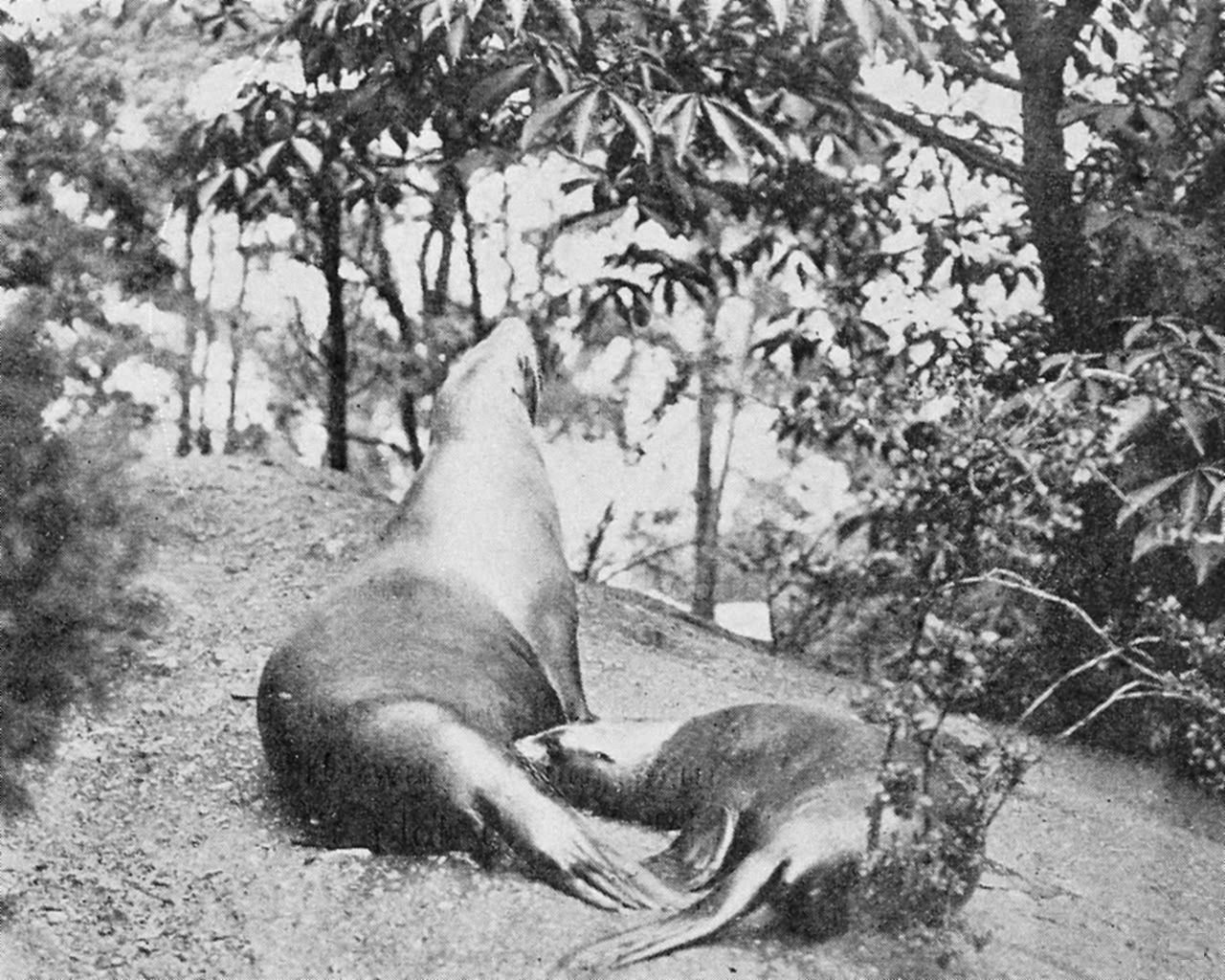
SEA-LION SUCKLING ITS YOUNG, JARDIN D’ACCLIMATATION, PARIS.
The Jardin d’Acclimatation is situated in that part
of the Bois de Boulogne which extends between the
Porte des Sablons and the Porte de Madrid, and runs
along the Boulevard Maillot. The principal entrance
is in the east, near the Porte des Sablons; a second
entrance is to be found in the extreme west, near the
Porte de Madrid. You can reach it either by the
Central Railway, getting out at Neuilly Station or at
the Avenue de l’Imperatrice, or by the Courbevoie and
Suresnes omnibuses, or, of course, by cab. On concert
days there is a special service of omnibuses.
Two prominent stone-and-brick buildings will direct
the visitor. After having passed the turnstile, you find
in front of you a large carriage-drive, which goes right
round the Garden, and from this principal artery the
whole network of walks and paths runs through the
Garden leading to the different sheds and houses. The
visitor finds on his immediate left a large conservatory
or winter garden, which shelters from the rigour
of winter a beautiful and important collection of plants
and trees, which would not live in a low temperature.
Almost in front of this large conservatory you see a
building, which is intended for the mechanical fattening
of fowls (a system not to be encouraged). Here is to
be seen on a big scale M. Martin’s system. The
fowls are placed in a huge circular cylinder, three
metres high and turning on a pivot, which allows the
man to cram all the fowls (which are placed in the
boxes ranged in tiers one above another) in this fattening
apparatus without changing his position. A car
on an elevating rail allows the man easily to reach
those birds placed on the highest part of the apparatus,
for, by turning a handle, the car rises or descends in
front of the boxes. Holding them by the head, he
introduces an indiarubber tube into their beaks, and
forces the food down their throats by pressing with his
foot a pedal, which starts a machine worked by a piston.
The play of this pedal is regulated by a dial-plate,
which shows the operator the amount of food introduced.
This varies according to the strength of the
bird to be fattened, and also to its state of fatness.
In eighteen days a fowl will go up to more than double
its weight, and will be perhaps a pound more at the
finish. M. Martin, the inventor of this ingenious
system, which allows a man by himself to cram 400
fowls in an hour, had already used it in the department
of Allier, at Cusset, near Vichy, and his products, under
the name of ‘Phœnix fowls,’ have acquired notoriety.
He then asked the Society of the Jardin d’Acclimatation
to allow him to construct at his own expense in
the Garden a model of his fattening establishment,
which he started at his own risk. Visitors can now
procure at this establishment fat fowls all ready for
the table.
Following on the right a large circular walk, you
find, after the fattening establishment, sheds where
all kinds of rural and agricultural objects are shown.
Here the public can see buildings of every sort applicable
to the farm: Swiss cottages made of cut wood,
tents, wire-lattices, aviaries, chairs, tables, and garden-seats,
elevators, garden-tools, guns and fishing tackle,
porcelain and terra-cotta vases—in short, everything
which tends to ornament parks and gardens, or to the
culture of plants, or the raising of stock. On leaving
the exhibition sheds, the first building which catches
the eye is the monkey house, in front of the enclosure
for storks and river-birds; then you come on the right
to the pheasantry, the parrot aviary being attached to
a little pheasantry, and on the other side of the way
are the ostrich and large-bird enclosures. The large
pheasantry follows these, then the upper pheasantry,
and next the poultry house, an immense circular
monolith building in Coignet mortar, in which there
are also enclosures for different sorts of pigeons. On
the left are the enclosures of the sheep and goats.
After passing the duck-ponds you reach the kangaroo
house, and on the left the cattle enclosures. Here the
broad road round the Garden divides itself into two;
to the right it leads to the Neuilly Gate and Saint
James, to the left to the big stable, before which
stands a spacious lawn, where the large ruminants
graze during the day. Round this lawn the elephants
and horses, with various carriages, carry visitors and
children. Continuing to follow the big circular road,
you find on the right, a little behind the stables, a
collection of vines (the most beautiful and most complete
in the world), the bee-house, the dairy, and the
refreshment-room; to the left, the huts of the llamas
and alpacas, the moufflon rock and the antelope house.
Next, you visit the aquarium, situated on the right
of the large circular road, and then the experimenting
garden and the dog-kennels, which face the deer enclosures.
Having returned to the big conservatory
close by, you find another conservatory full of paroquets
and small cage-birds from hot countries.
The middle of the Garden is cut by an artificial
river, upon the banks of which are placed enclosures
for geese, ducks, and water-birds. It forms in front
of the lawn of the big conservatories a large lake
covered with swans, flocks of ducks, some cormorants
and seals.
The monkey house is an oblong building 15 metres
long and 9 metres broad. The walls are covered with
earthenware slabs. In front of the building is an
immense cage, where the strongest of the monkeys can
take the air and enjoy themselves on the beams and
ropes, which take the place of the trees in their native
forests, during the warmest hours of the day. On
entering by doors which are arranged to keep out
draughts, the interior of the monkey house is found to
be a large hall, in which are placed four huge cages
reaching almost to the ceiling, and which communicate
with the exterior pleasure cage by means of large
doors. Against the walls are placed little wooden
cages, in which are put those delicate specimens which
require special care.
Besides the quarters of the keeper, there is an infirmary
for sick monkeys. Heat is supplied in winter
by hot-water pipes running under the floor, which
keep an even temperature without drying up the air.
Attached to the large conservatories is a spacious
hall, the grande salle, measuring 40 metres in length,
and being able to accommodate 8,000 people, half of
whom can sit down. On the ground-floor, opposite to
the entrance-door, is a large stage, upon which lecturers
entertain the public several times a week with a magic-lantern,
the subjects being Zoology, Ethnology, Travel,
Botany, etc. On Sundays and Thursdays a first-class
band gives popular concerts, which attract a great
number of people to the Garden.
On the west of the hall is an aquarium and a bird-gallery,
which were opened to the public at the end of
1892.
To the right of the principal entrance is a room,
built in 1887, for the sale of a great variety of vegetables
and plants.
Continuing to the right, and passing the exhibition
hall and the shooting and fishing museum, which have
been described, we come to the new sale gallery, a
large hall 30 metres long, in which are displayed more
agricultural implements, carriages, harness, carts, iron
rails, wooden fencing, and everything appertaining to
the care of animals and plants—all to be sold at very
reasonable prices. A catalogue can be obtained free of
charge.
Communicating with the new sale hall is a parrot
and small bird gallery. Passing the monkey house,
we find large wooden constructions, holding the peacocks,
the turkeys and fowls of many kinds, such as
Houdans, Dorkings, etc. In this part of the Garden
are to be found pretty little rustic buildings containing
various birds. In one of them are to be seen the great
horned owls which belonged to Gustav Doré, the
celebrated artist. In another little pavilion is a
Norwegian hawk. In an enclosure bordering on the
main walk is to be seen a beautiful collection of cranes
from all parts of the world. In the same enclosure are
the cassowaries, ostriches and the South American
rheas, which latter frequently breed in the Garden.
The pheasantries, which contain more than twenty
pens, are occupied by such varieties as the Amherst
pheasant from Thibet, Elliot’s pheasant from China,
the Versicolor from Japan.
We now come to the great aviary, part of which
holds the scarlet ibis and the rare stilts, and the other
half contains peacocks and large game-birds. In front
of the large aviary are the pens of the doves and
partridges. Facing the pheasantries is a statue of
Daubenton, by Jules Godin Daubenton, who died in
Paris in 1880. It was to the efforts of this scientist
that France owes the introduction of merino sheep.
This beautiful statue is placed opposite the sheep pens,
so that the gentleman can still have his eye on the
Ty-ang or Chinese sheep, the grey sheep of Russia,
and the Astrakan sheep, which furnishes such a beautiful
fur. Not far from here is some rock work executed
by M. Teiton, through which runs a little river.
Every day at a fixed hour the cormorants are made
to fish. The throat of this bird is encircled by a
collar, which prevents it from swallowing the fish
which it has caught at the bottom of the water. In
China these birds are used extensively for fishing.
On the right, following the pheasantries, we come
to the poultry house, a monolith building in mortar in
a semicircular shape. Here are to be found the following
among many other varieties: La Flèche, Mans,
Houdan, Bresse, Campine, Dorking, Cochin China,
Langshan, Brahma, etc. The eggs form an important
article of commerce in the Garden. The pens of the
poultry house also contain the largest collection of
pigeons ever brought together. Mention must be
made of the carrier pigeons, the descendants of those
birds which during the Siege of Paris carried no less
than 115,000 messages microscopically photographed
on bits of collodion which weighed next to nothing.
On the edge of the lake is a large and elegant
pigeon tower, made of brick and iron, 30 metres high
and 6 metres in diameter, and divided into four stages.
The interior is divided into coops for 400 couples of
pigeons. The top is reserved for those pigeons which,
born in the place, are allowed their liberty, and are
employed in summer to carry messages. The top of
the tower is furnished with a meteorological apparatus,
which records on registering cylinders (placed at the
bottom of the tower) the state of the atmosphere.
This apparatus constitutes a veritable observatory in
itself. In it there is a barometer, a thermometer, a
rain-gauge, a wind-gauge, a hygrometer, and several
other instruments.
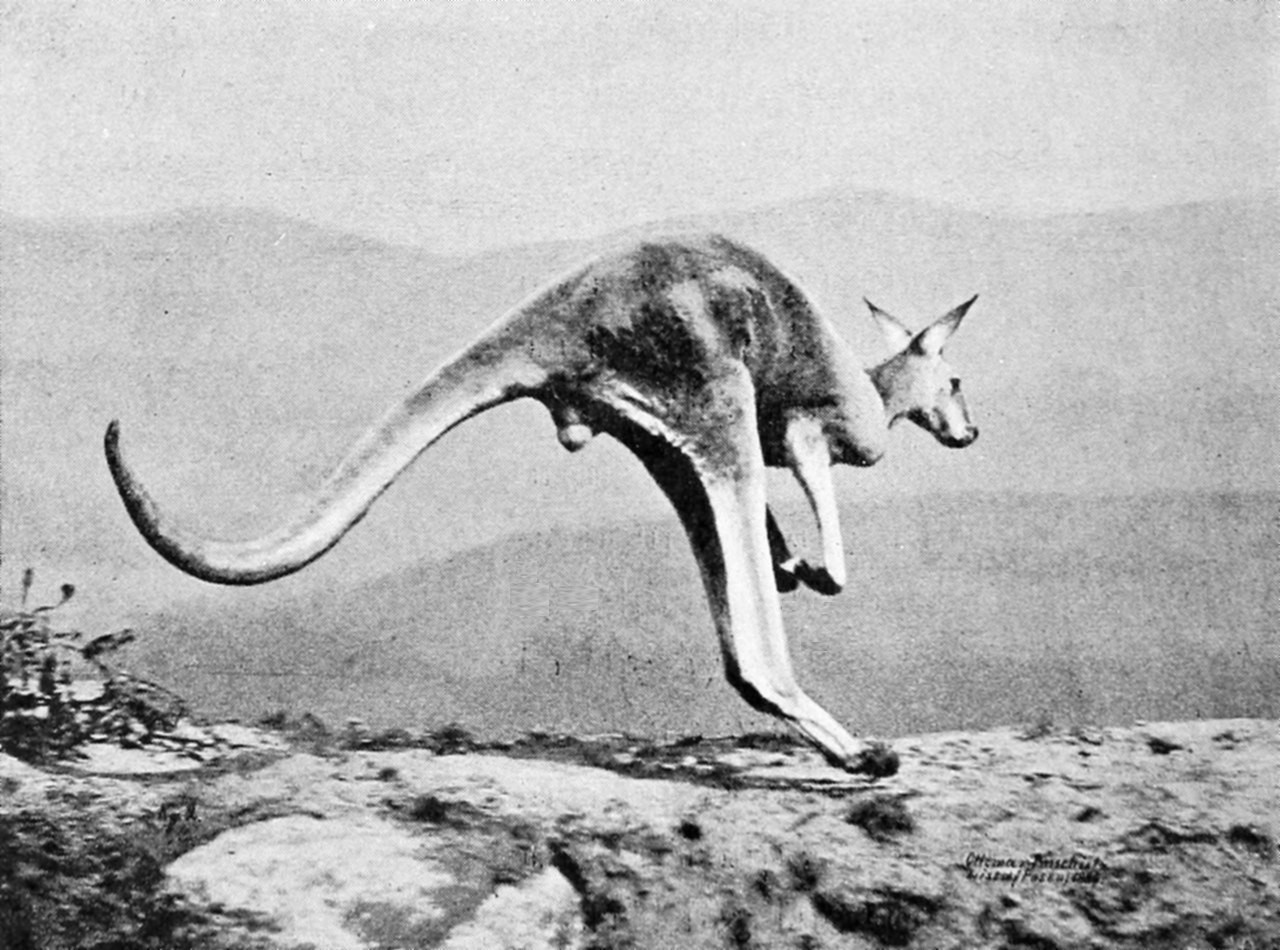
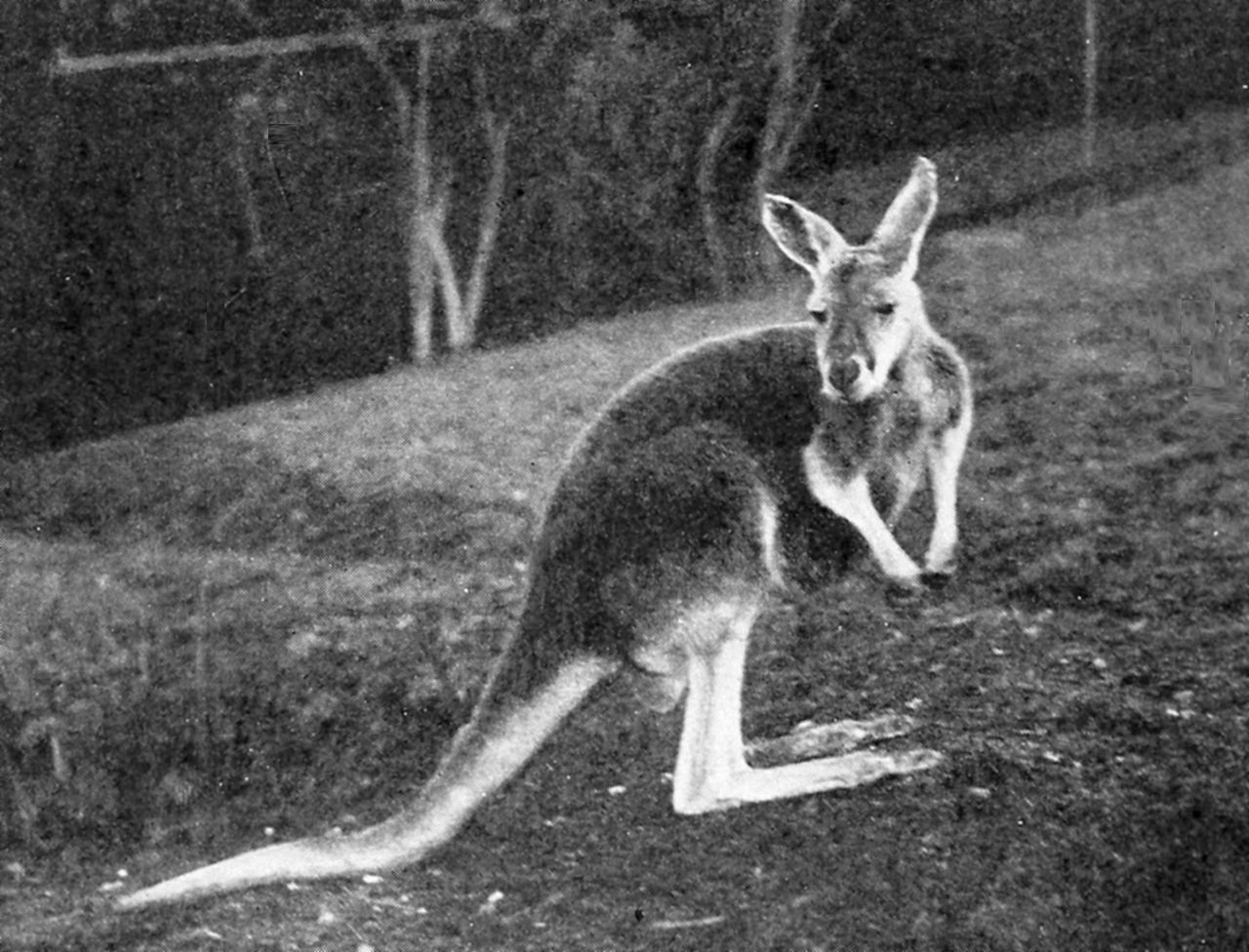
The kangaroo house next engages our attention,
where are to be found examples of the red kangaroo,
Bennet’s Wallaby, etc. Many breed here. The enclosures
which surround the kangaroos contain many
species of deer. There is the deer from the Moluccas,
sika deer from Japan, the axis deer from India, etc.
Close by are coach-houses and stables capable of
holding ninety horses. These recently erected buildings,
together with the old stables, can now hold
250 horses, which form a very complete collection.
Here are to be seen also an interesting series of ponies
from Java, Siam, Cochin China, Shetland, Ireland,
Russia, Corsica, Navarre, Finland, etc. There are also
many mules.
At the end of the stables is a riding-school for the
breaking-in of horses and the teaching of riding. In
1874 a special riding-school was inaugurated for
children, their mounts being all little ponies. Close
to the stables is a gymnasium, with horizontal bars,
trapeze, ropes, etc., which is for the free use of children,
who amuse themselves in it whilst they wait their
turn to ride the elephants and camels. The charge
for a camel or dromedary ride is 50 centimes; elephant
ride, 25 centimes; ostrich-cart, 50 centimes; donkey-cart,
trotting zebu-cart, goat-cart, and llama-cart,
25 centimes; saddle-horse, 50 centimes. Tickets are
obtained at a kiosk close by.
The African elephant Juliette was a present from
Victor Emmanuel, the late King of Italy, together
with Romeo, who died in 1886. It will be remembered
that these elephants replaced Castor and Pollux,
which were sold to the butchers for 27,000 francs
during the Siege of Paris in 1870. Close to the large
stable is a house containing the yaks from Thibet.
The cross between a yak and a zebu is called a ‘dzo.’
In the large stables are to be seen the South American
tapirs and the wart hogs from Africa. Burchell’s zebra
and a pretty ‘mountain’ zebra are found in the same
building. By the side of the zebras are the kiangs
from High Asia and Mongolia. There are also many
hybrid animals and 100 guinea-pigs in one loose-box.
The right side of the big stables is inhabited by a
large giraffe; this is the last survivor of a herd
received from Abyssinia in 1872, which has bred
several times in the Garden.
On the other side of the main road is a large lawn,
which serves during the day to pasture the large
ruminants. Here are held the yearly exhibitions.
The following exhibitions have been held: In 1877,
the Eskimos and Nubians; in 1878, the Laps and
Russians; in 1879, the Nubians; in 1883, the Cingalese
and Red Indians; in 1886, the Cingalese; in
1887, the Ashantis; in 1888, the Hottentots, Cossacks,
and Circassians; in 1889, the Laps and Norwegians;
in 1890, the Somalis; in 1891, the Dahomeans.
We next come to the llama house, which includes
specimens of guanaco and vicuna, the llama and alpaca.
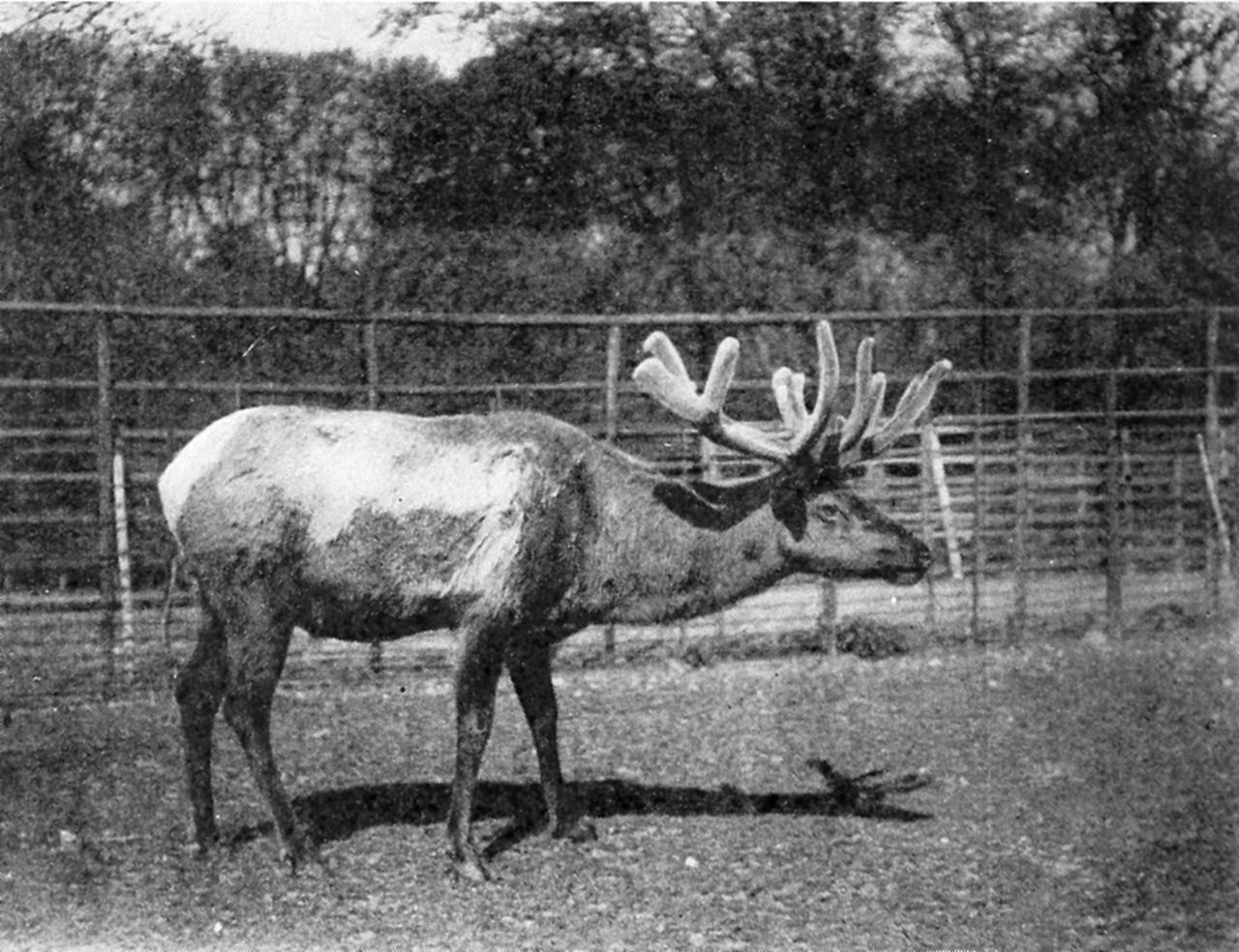
The reindeer enclosure follows. Behind this, again,
are the moufflon and chamois rocks; a grotto cut out
of the rock shelters the goats from Chili. Below the
rock are lodged the graceful Indian antelopes. Between
the rock and the aquarium is a construction with a
deep basin, in which live the otters and seals. The
otters, which were presented in 1891, are very tame.
At the word of command they hop up to the top of a
rock and take headers into the water. Opposite the
otters’ tank is the cow house, holding forty cows, the
little dairy at the side being much frequented during
summer, when as many as a thousand glasses of milk
are sold in a day. Close by the dairy is a picturesque
enclosure of lawn and rockwork, inhabited by a herd
of over twenty black buck of all ages. It was an
amusing sight to watch them frisking and scampering
about after the manner of the springbock of Africa.
The aquarium, situated on the right beyond the
dairy, contains ten large tanks of sea-water and four
tanks of fresh-water. These basins are made of slate,
with one side of glass. They receive light only from
above, and in them are to be seen the octopus, shrimps,
anemones, soles and plaice. Many of the fish grow tame
to a remarkable degree, and know their keeper well.
At the end of the aquarium is the fish-culture
pavilion, in which one sees in transparent tanks a
very complete collection of fresh-water fish and the
most perfect apparatus in connection with fish culture.
Every year the establishment incubates a considerable
number of salmon spawn. Visitors can follow the
operations of artificial fertilization of several species
of trout, including the American rainbow trout. After
the aquarium, in front of the concert kiosk, we find
the restaurant, where we can have refreshments at
fixed prices under large trees.
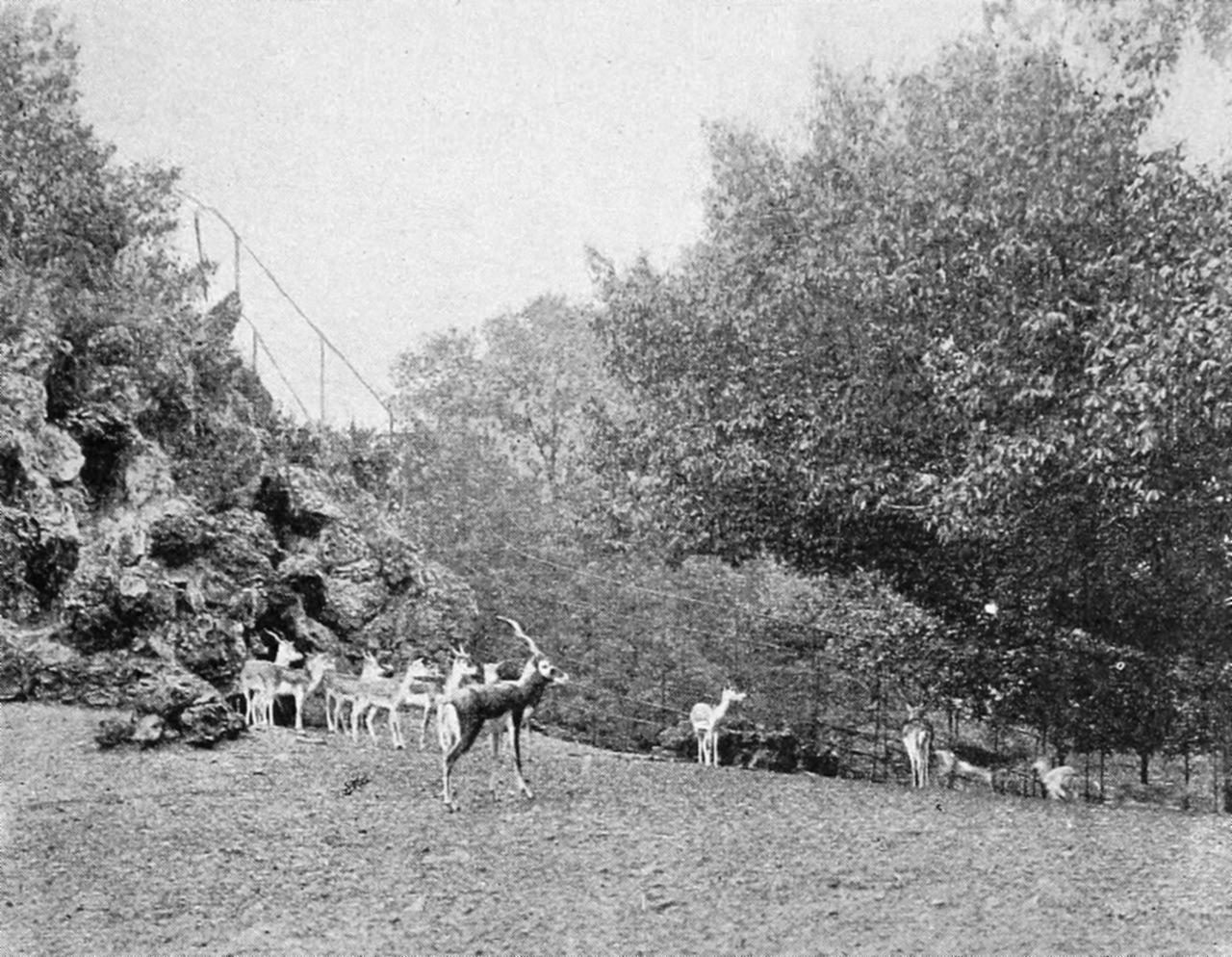
HERD OF BLACKBUCK, JARDIN D’ACCLIMATATION, PARIS.
Facing the aquarium is a large glass enclosure surrounding
the antelope house, in which can be seen
the Indian nylgai, which breeds well; the eland,
looking amongst the trees as if it was in its native
haunts; the gnu, which looks half ox, half horse; the
Oryx beisa from Kordofan; a gazelle from the Soudan.
And then comes a surprise, for in the same pen with
several Patagonian cavies are no less than four
hartebeests, one of which was born in the Gardens,
August 15, 1901. Next we come to the deer house,
with the wapiti from America, the axis deer from
Siam, Père David’s deer, and others.
On the other side of the main drive, and opposite
the deer, is a large dog-kennel, containing dogs of
every description. Here a large exhibition has been
held every year since 1863, and dogs can be bought
at fixed prices.
Facing the dog-kennels is a special library, given to
the Garden by Dr. W. Evans, of Philadelphia, where
are to be found all the papers and publications on
agriculture, zoology, travel, domestic economy, etc.
In one of the rooms in this building all the Parisian
newspapers and magazines are on view.
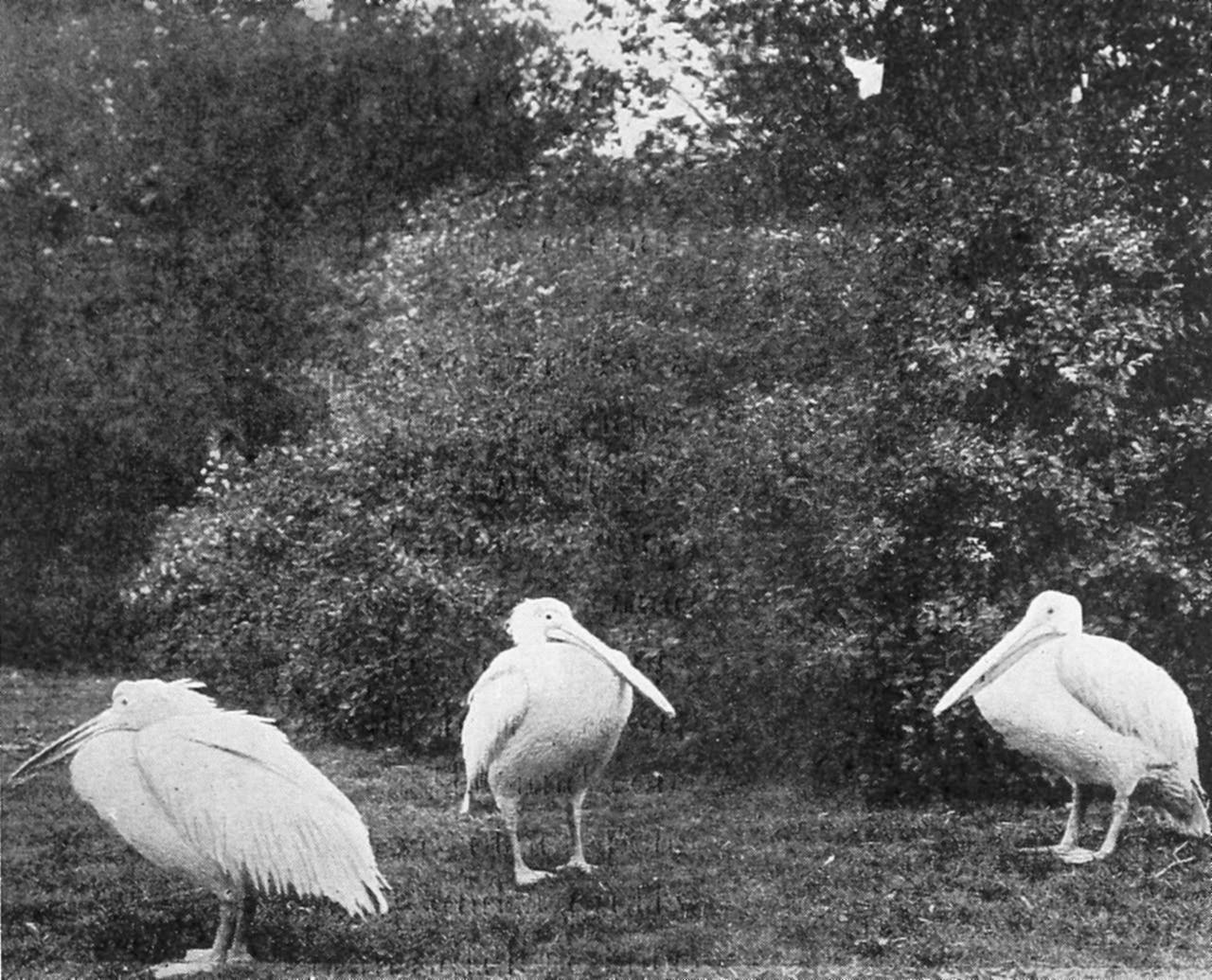
The pond, which divides the Garden into two nearly
equal parts, contains ducks of all kinds, swans, and
pelicans. On the left bank of the pond is the concert
kiosk, where good concerts are given from April till
the end of September by an orchestra of twenty-four
performers under M. Mayeur, of the Opéra, who has
conducted it since 1872.
Many of the puppies and birds in the Garden are
for sale at fixed prices. I quote the following from
the catalogue:
Puppies
Stud Fee.
(Average).
Francs.
Francs.
Great Danes
50
100
Pomeranians
10
40
Bull-terriers
20
40
Basset hounds
25
50
English setters
50
120
Red Irish setters
50
100
Cocker spaniels
50
50
English greyhounds
30
75
Bloodhounds
30
60
Hares (white) old ones: Male, 25 francs; female, 35 francs;
young, 15 and 25 francs each.
Loch Leven trout, rainbow trout, salmon, etc., are
for sale.
This is a very large and beautifully laid out Garden,
and I was allowed to photograph in peace, though,
oddly enough, I had no sooner got outside the wood
than I was pounced upon by a gendarme and asked
to explain the contents of ‘that box.’
CHAPTER III
THE ZOOLOGICAL GARDENS, MARSEILLES
These Gardens, which are worked under the control
and direction of the Jardin d’Acclimatation at Paris,
contain a collection of both useful and wild animals,
many of which are bought and sold here. The
Gardens also serve as a resting-place for the animals
which the Jardin d’Acclimatation imports from the
far East and exports to the hot regions by the
Mediterranean. The animals remain and get acclimatized
before they are sent on further north to
Paris.
Shrubs and plants are also grown, and by their
situation behind the Palais de Longchamp the Gardens
constitute one of the most attractive promenades in
Marseilles.
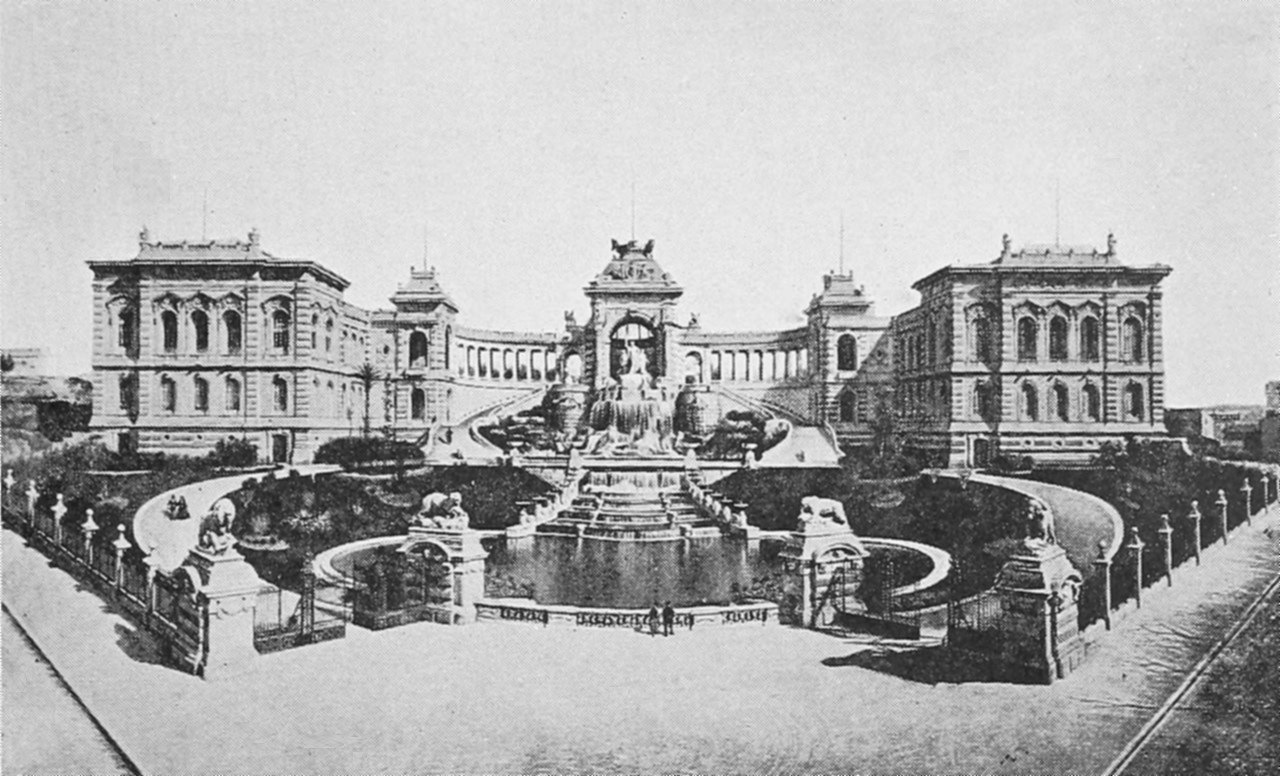
One of the entrances to the Gardens is through a
most magnificent set of buildings, having a large
cascade of water in front. This imposing building is
called the Palais de Longchamp, and contains an art
museum and picture-gallery. On passing through the
gate, and going up two flights of steps, you come into
a large garden above, and, keeping to the right, you
fall in with the pay-gate to the Zoological Gardens.
It must, however, be borne in mind that the quickest
way to reach the Zoological Gardens is by an ever-ascending
electric tram-car, which finally lands you
right in front of the ordinary entrance-gate. On
arrival there, you put a franc into a sort of missionary-box
made of tin, and are ushered through into the
Gardens by the gate-keeper. You are at once confronted
with a pretty little grotto arrangement, down
the rockwork of which trickles a waterfall. In the
basin at the foot of the fall are a number of flamingoes
wading about and feeding.
LE PALAIS LONGCHAMP, MUSÉE DES BEAUX-ARTS, MARSEILLES.
The Gardens will be found to lie upon a steep hillside,
upon which walks and terraces are cut one above
another. On the second terrace you find a grotto,
with another waterfall higher than the one below.
This grotto is extremely picturesque, the situation of
the Garden on the hillside lending itself well to this
form of garden decoration. Here, at the foot of the
second grotto, are to be seen some white swans with
black necks, and some pretty black ducks with dark-green
heads. It was a cold February day when I
visited the Gardens, but, to show how early is the
breeding season in the South of France, I may say
that the ducks were already beginning to pair.
On the right the visitor will come upon three
cleverly-constructed cages of a circular shape, backed
with rockwork. In this rockwork are the sleeping
apartments of the animals in the cages. These sleeping
apartments have doors communicating with the
outer cages, so that when rain or wind comes the
animals can find shelter. The cages have been cleverly
thought out, and are extremely picturesque.
The inmates of the first cage were two lionesses.
I wished to get close to the bars in order to obtain a
photograph of these big cats without showing the iron
bars, but as a man was intently watching my proceedings,
I thought it best not to venture over the
barrier. I was unable to make out whether he was
one of the keepers or perchance a French officer, and
could not make up my mind whether I would offer
him a franc to let me go closer or not.
In the next circular cage was a most amusing polar
bear. His keeper happened to come along, and he
dropped some large pieces of bread into the water-tank
for him, but, strange to say, the bear would not
go in after them. However, after vainly endeavouring
to reach them with his outstretched paw, he made a
spring, and stood crossways over the tank, with his
fore-paws on one side and his hind-paws on the other,
where he stood like a white stone bridge stretched
over a river, and, bending down his head between his
fore-paws, he seized each bit of bread in his mouth and
tossed it on to dry land; then, springing back, he
devoured it greedily. When he had finished every
bit, he came to the front of the cage within a few feet
of me, and obligingly sat up to be photographed.
Next to the bear were a pair of extremely handsome
leopards in very good coat. They growled and
snarled and showed their teeth at one another, and
pretended to fight, but in reality this was only their
rough-and-tumble way of flirting with each other.
After all, are not some human beings just the same?
Further to the left you find a picturesque little
pagoda for the elephant, with a space railed off in
front in which he can take air and exercise and have
a cooling bath in the deep water-tank.
Crossing a bridge over the street below, we come
to a long viaduct, under each arch of which is an
enclosure for birds or animals. On the extreme right
was a moufflon, which also obligingly stood up with its
fore-legs on the rail in front of it in order to have its
picture taken. This animal’s legs were somewhat
deformed, and stretched outwards from the knee,
giving it the appearance of being knock-kneed. Next
to the moufflon, under the second arch of the viaduct,
were a camel and a zebu housed together. On the
left of them was a pair of nylgai (Indian antelopes),
male and female, which appeared to be in the very
best of health and condition; but I should say they
could not have been long in the Gardens, as they were
so wild, and whenever I moved the male raced about
its enclosure, whilst the female retired into its shelter-shed,
unlike the very docile pair in the London Zoological
Gardens, which will feed from your hand. By
the side of the nylgai, but separated by a wire fence,
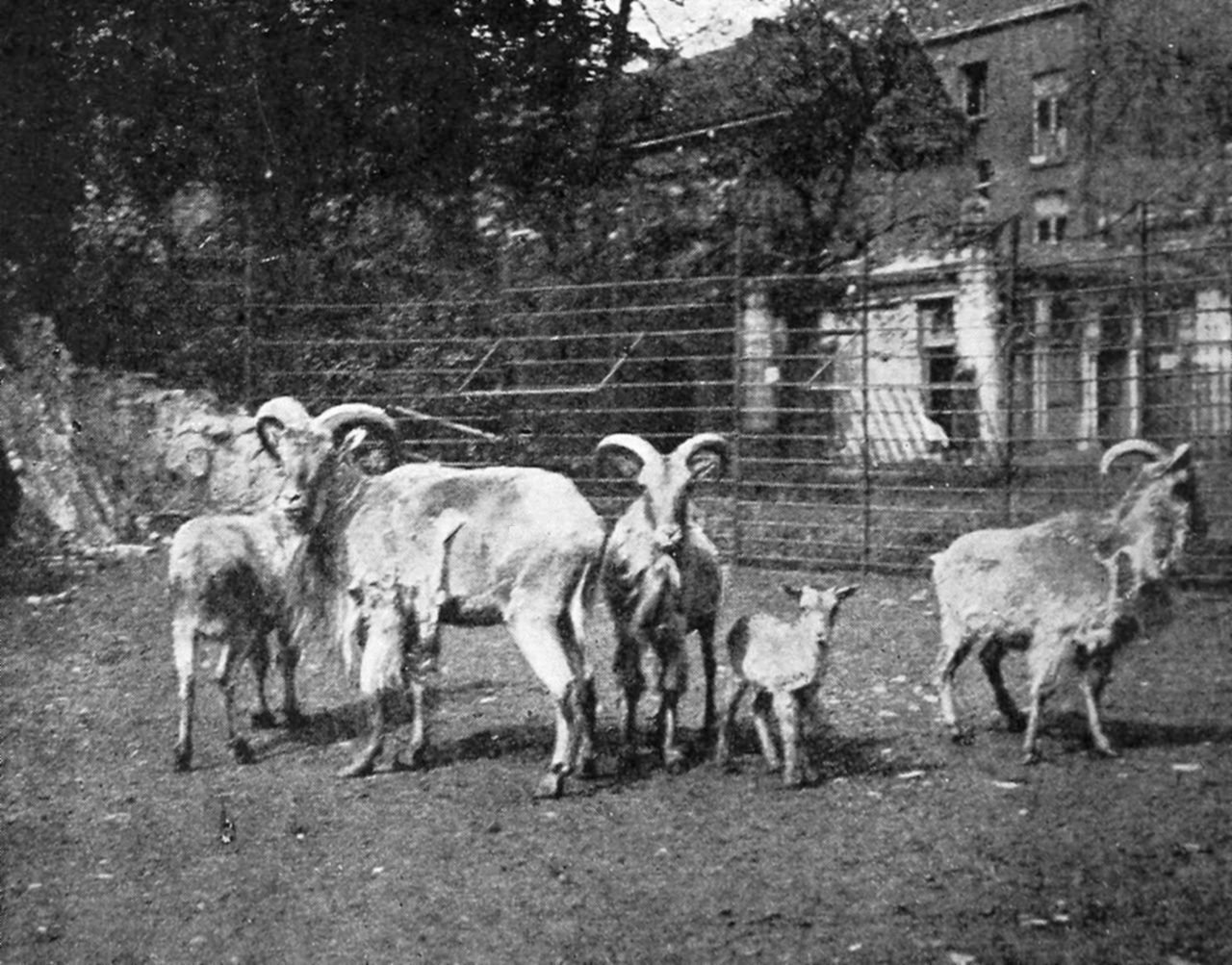
raced up and down a fine Barbary sheep, whilst his
wife and child lay down close by taking things easily.
The next enclosure contained a very pretty sight—a
red-deer stag, hind, and calf making a very picturesque
group when standing up together. Under the remaining
arches were enclosed some large birds of prey.
Just opposite the arches on a bank is an enclosure
where was to be found a pure white llama, with its
baby, a youngster about six days old. Another
Eastern pagoda and railed-off enclosure contained a
very fine Bactrian camel. There were many smaller
mammals, such as coatis, lemurs from Madagascar,
wolves, jackals, a European wild-boar, etc., besides
many enclosures of birds, including a pheasantry,
tenanted for the most part by domestic fowls, peacocks,
French partridges and an occasional golden
and Lady Amherst pheasant. In one pen you will
notice French partridges running with a Lady Amherst
pheasant.
There is a small monkey house with outdoor cages,
furnished with wooden railings for the amusement of
the inmates. These outdoor cages are connected with
the interior cages by little square doors.
I must not forget to mention a large brown bear in
a very picturesque bear pit made of rockwork, with a
front of stout iron bars.
One of the inmates of a row of sheds devoted to
small animals was a caracul, or African lynx, in very
good coat and condition. When in Somaliland, North-east
Africa, in 1897, I captured one of these beautiful
cats in the mountains, but unfortunately it escaped
two days afterwards. The face of this animal is very
like that of the American puma, whilst its ears are
long and very pointed, and are furnished with tufts
of black hair at the tips.
The second day I visited these Gardens it snowed,
and the light was so bad that I did not attempt to
take any photographs. As on my approach I found
nobody at the entrance-gate, I walked in. Apparently
there is no fixed charge, but a man usually jingles a
tin box before you, and you can put what you like
into it. I saw the Marseilles Gardens under the most
unfavourable circumstances; still, on the finest day I
do not think anyone would be very much impressed
by them. The laying out of the Gardens on a bank
is pretty, and the rockwork and the waterfalls very
picturesque, but the show of animals and birds, on the
whole, is small and somewhat poor.
I had a short talk with one of the keepers, a stern
man with a gloomy countenance and few words. I
did not gather much information concerning the
Gardens, but I raised one laugh out of him when,
wishing to know when the animals were fed, I asked:
‘A quelle heure est la table d’hôte des animaux?’
CHAPTER IV
THE ZOOLOGICAL GARDENS, NICE-CIMIEZ: DIRECTRESS,
THE COMTESSE DE LAGRANGE
These prettily situated Gardens are well worth a visit,
if only for the magnificent views obtainable from them.
They can be reached from Nice by excellent electric
tram-cars having first and second class compartments.
(Why are tram-cars so very much better abroad than
in England?) Close by the Gardens is the fine Excelsior
Regina Hotel, where our late Queen Victoria
used to stay. The rooms in the hotel should be
visited on the way back from the Gardens; an excellent
lunch can be had there, for the cooking is
truly first-rate.
The Zoological Gardens were founded by the late
Comte de Lagrange, a great traveller and naturalist,
who died in 1893 at Singapore, at the early age of
thirty-six. His widow, the Comtesse de Lagrange, is
now sole proprietress and directress.
The entrance fee is one franc, and one franc for a
carriage; the latter fee can be saved by alighting at
the entrance and simply walking in on foot.
The Gardens are of small extent, and the whole of
the animals and birds can be seen in a very short
time.
As at Marseilles, I experienced the most shocking
weather at Cimiez, and the first day not a ray of sun
shone, whilst a shower of rain almost gutted my camera.
There is a nice collection of lions at this Zoo, and they
form quite the greatest attraction of the place. The old
mother, which is to be seen in a cage close by a large
tiger, has produced three litters of young, all of which
are now to be seen in the Gardens. The father of these
lions died at the age of seventeen. The children of
this pair comprise two lions three and a half years old,
three lions two and a half years old, and three lions
fourteen months old. All these eight animals are
extraordinarily tame and healthy-looking. I was
enabled to stand right up against the cages, without
the slightest fear of getting mauled, in order to photograph
them. One of the oldest lions allowed me to
stroke him; and when I put my face up against the
bars, he at once licked it with his rough tongue—a
perfect feline kiss. I was perfectly charmed with
these lions, and was quite loth to leave them. In
another set of cages was a common leopard, and the
invariably savage black variety, with its beautiful
yellow eyes and snarling jaws. It is a curious fact that
these black leopards are nearly always savage. There
were two brown bears and a polar bear in pits opposite
the young lions, and a poor old brown bear, totally
blind, in a pit by himself. There was a very handsome
old ‘black buck’ from India, with a younger one much
lighter in colour. It was comical to watch them at
play, butting at each other with their horns. It is
often extremely difficult to photograph these creatures
in confinement, because they are so tame. This sounds
odd, but the difficulty lies in the fact that the animals,
expecting to be fed, will insist on coming close up to
you to the bars, and utterly refuse to go away, in spite
of shouts, hisses, showers of stones, and prods with
umbrellas. One cannot go back one’s self with the
camera, or the bars or wire-netting will show in the
photograph, and look unsightly. Oddly enough, the
bars or wire-netting do not show in the photograph
when the camera is held close up against them.
An ostrich and its baby could be seen near a rather
mangy duck-pond. There were also some monkeys,
animals I am not fond of; they are too much like
human beings. But one of them was amusing. When a
man said ‘Salût’ to him, he saluted in proper military
fashion; but if a woman asked him to do so, he would
do nothing of the sort, but would snarl and show every
symptom of anger and annoyance. He was, like some
really good military men, a true woman-hater and
despiser.
On the second day I visited the Cimiez Zoo I was
more lucky in the weather, for it was a lovely sunny
day. On the way there I was obliged to run the
gauntlet of scores of masqueraders, as the Nice carnival
was on. They threw hard pellets of clay with great
force into my face, and I can assure the reader they
hurt considerably. Nearly every other person I met
wore a wire mask to protect himself from these attacks.
At length the very excellent electric tram was reached,
which soon brings one up to the Zoo. The head
keeper, Andruetto François, is a very genial and
chatty man, and helped me a great deal in taking
photographs of all the lions, of which he seemed
immensely fond and proud. I took him in the lion’s
den, and a very pretty picture of a fine lion in the
act of kissing him was unfortunately spoilt in the
developing.
At the back of the lion-cages was a side-show, given
by Richard List from Hamburg, who performed twice
daily with a ‘happy family’ of lions, tigers, leopards,
bears, monkeys, dogs, etc. Close by were a pair of
extremely pretty white goats, a rather mangy camel,
a bull zebu or Indian sacred bull, some eagles, and a
picturesque duck-pond.
The Gardens certainly looked better bathed in sunshine,
and the view of the Alpes Maritimes seen from
them was superb.
CHAPTER V
ROYAL ZOOLOGICAL GARDENS OF THE SOCIETY OF ZOOLOGY,
‘NATURA ARTIS MAGISTRA,’ AMSTERDAM:
DIRECTOR, DR. C. KERBERT
The Zoological Gardens at Amsterdam are the third
oldest institution of their kind in Europe, the Jardin
des Plantes coming first, and the London Zoological
Gardens second. Besides the Gardens of the Society
of Zoology, ‘Natura artis magistra,’ Amsterdam possesses
a large Aquarium, a Zoological Museum, and
a Scientific Library of Natural History.
Encouraged by the success of the Zoological Gardens
in London, M. G. F. Westerman of Amsterdam conceived
the idea of founding a similar institution in his
native town. However, his initial efforts in 1836
failed. At length an opportunity presented itself.
M. R. Draak, a great student of natural history, who
possessed an important private collection of stuffed
birds, fishes, etc., valued at 8,000 francs at least,
wished to transfer them into more spacious quarters.
In order to achieve this, he sought the assistance of
M. Westerman, known throughout Europe for his
interest in natural history. He, on his part, always
ready to assist anyone fond of natural history, succeeded
in obtaining a site in 1837, and built and
arranged a natural history museum upon it. It was
opened to the public for a small entrance fee the same
year. In spite of great efforts, the enterprise flourished
but little; but, aided by two friends, M. Westerman
bought other large buildings, and laid out some beautiful
gardens, which he thought would be more attractive
to the visitors. When in possession of these gardens,
the proprietors tried to give more force to their enterprise
by addressing the following circular to the
inhabitants of Amsterdam:
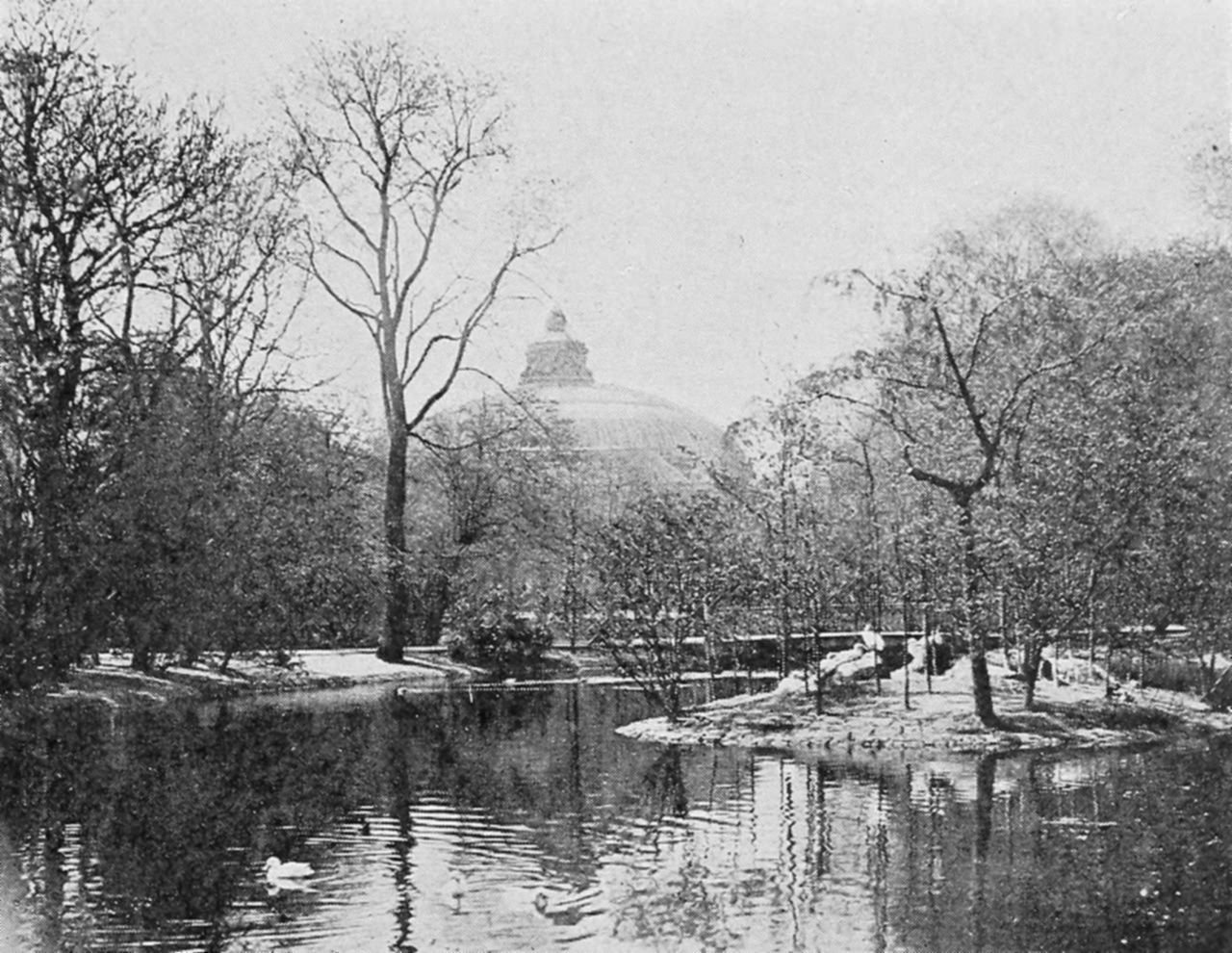
CONCERT-HOUSE AND LAKE, AMSTERDAM.
‘Natura Artis Magistra
‘A society has been formed under this title, having
for its object the study of natural history in an agreeable
and attractive form, not only by exhibiting stuffed
animals, but also by a collection of living animals and
birds.’
In a very short time 120 persons, whose numbers
quickly rose to 400, gave their services and help to
the enterprise, and were inscribed as members of the
Society, paying an annual subscription.
Encouraged by this first success, the Council decided
to negotiate for a loan, with part of which a convenient
site was arranged to receive the collections of M. R.
Draak. Gradually the number of members of the
Society rose, and in 1839, with the authority of the
general assembly, the menagerie of C. van Ascen, at
that time well known, was bought. Bitter disappointment
was, however, caused when the Council, who had
asked permission of the municipal authorities to build
further houses on their grounds for the animals of the
above-mentioned menagerie, were given permission,
but on such bad terms that their request was to all
intents and purposes met by a refusal. With much
regret, the Society was therefore obliged to lodge
the animals provisionally in some barrack-stables.
However, little by little other buildings were acquired,
with large gardens, and the collection of living
animals and objects for the museum was enriched both
by generous gifts and by purchases.
In 1840 the Society numbered 700 members, and in
1841 the number rose to 1,000. The members then
agreed to pay double the former subscription—i.e.,
twenty francs. The grounds had now increased to the
extent of three and a quarter acres. In 1843 M. Westerman,
at the request of the Council of Administration,
was put at the head of the Society, and accepted the
entire control of it, which, in spite of his age, he continued
to hold until his death.
In May, 1850, the Gardens occupied nearly five acres,
and in the same year the Council instituted attractive
concerts twice a week. In April, 1852, His Majesty
the King paid a visit to the Gardens, with which he
was much pleased. He presented them with his
portrait, and gave the Society the name of ‘The
Royal Zoological Society.’ In 1877 the last enlargement
of the premises was completed. The Society,
after many futile efforts, succeeded in obtaining from
the Municipal Council a piece of land, on condition
that the Society should erect on the site a large
building, to be utilized as an aquarium, and that
superior instruction in Zoology should be given to
the University of the town, partly at the Society’s
expense. In all, the extent of the Gardens was increased
to more than twenty-five acres, for which
463,369 francs were paid.
In 1888, the year in which the Society held its
fiftieth anniversary, there were in the Gardens 378
animals of 141 different kinds, 2,009 birds of 462
different kinds, and 77 reptiles of 28 kinds.
The aquarium, opened in 1882, consists of a large
and small hall, in which are three big reservoirs containing
sea water and fresh, pumped in by machinery
after having been well filtered. In the large hall
will be found sea-water tanks, the two fresh-water
tanks being in the small hall. There is a very rich
collection of fish in them from all parts of the world,
and many others have been bred there. Besides contributing
to the enjoyment of the public, this aquarium
is greatly used for research work and the study of
anatomy. Here Dr. Kerbert discovered the hitherto
unknown fish parasite, Chromatophagus parasiticus.
This aquarium is justly considered one of the most
important institutions of its kind in Europe. For the
study of ethnography a large museum has been built,
in which is housed a fine collection of objects appertaining
to that subject. Another spacious room was
built during recent years for the rich collection of
skeletons which the Society possessed, containing the
celebrated collections of G. and E. Vrolik and the
skeletons of animals which have died in the Gardens.
The total number of skulls and skeletons reaches 1,500,
and they are exhibited on long shelves.
After the aquarium had been opened, three rooms
were reserved for the collection of Crustacea, Molluscs,
Echinides, Zoophytes, and Polyparies, with
the famous collection of sponges, which is unsurpassed
in any other museum. The total number of objects
kept in these three rooms is 5,976. In this part of
the museum is to be found a valuable collection of
marine animals, brought from the Arctic regions by
M. Barents and M. Varna. During the last three
years a collection of local animals has been commenced.
In the second room of the museum you find not only
a collection of stuffed animals and birds, with their
eggs and nests, but also a collection of indigenous
shells, fish, reptiles and the lower animals. The
insects are lodged in three cabinets—one for the indigenous
butterflies and moths, one for the exotic lepidoptera,
and one for the coleoptera or beetles, arranged
in 920 drawers.
The scientific library is very rich in works on natural
history; amongst other volumes is to be seen a complete
edition of the works of Gould, the celebrated
ornithologist. The library contains 5,131 books. There
are in the museum upwards of 975 stuffed animals and
3,478 birds. The collection of shells is the most beautiful
and most important which exists.
After the death of M. Westerman in 1890, the
directorship of the Society was conferred upon Dr. C.
Kerbert, who was formerly conservator of the aquarium.
The fee for admission to these large Gardens is one
gulden. There are no less than fifty different houses
or pens, besides the aquarium (one of the finest in
Europe), and four museums.
Turning to the left after paying at the turnstile,
one sees the llama pens, containing specimens of the
huanaco, the vicuna and the alpaca; near them are
two camels of different kinds. Close by is a pretty
little deer shed, one of the inmates of which is a very
fine example of Père David’s deer from Manchuria.
The insect house is next encountered, with a good
collection of living caterpillars and chrysalides in glass-cases.
Some specimens of the atlas moth and common
swallow-tail butterfly had just emerged (May 2).
Passing through a door, the visitor comes to a reptile
house, well lighted and heated. Here are to be seen
some very fine examples of pythons from Java, boa-constrictors
and other large snakes, tortoises, lizards,
alligators and a Temminck’s snapper. In the centre
of this room are three specimens of the curious Surinam
sloth (Cholopus didactylus), hanging from horizontal
bars by large curved claws. Passing through a door,
you find yourself in the parrot house, which is well
filled with the brilliant-coloured noisy birds. Here,
also, was the magnificent bird of paradise from New
Guinea, and the curious wingless kiwi from New
Zealand. A monkey house, well stocked, is next passed,
and we then come to the large duck-pond, simply
teeming with mute swans, wild swans, black swans,
bernacle and Canadian geese, gannets, gadwalls,
sheldrake, mallard, wigeon, teal, pintail and flamingoes.
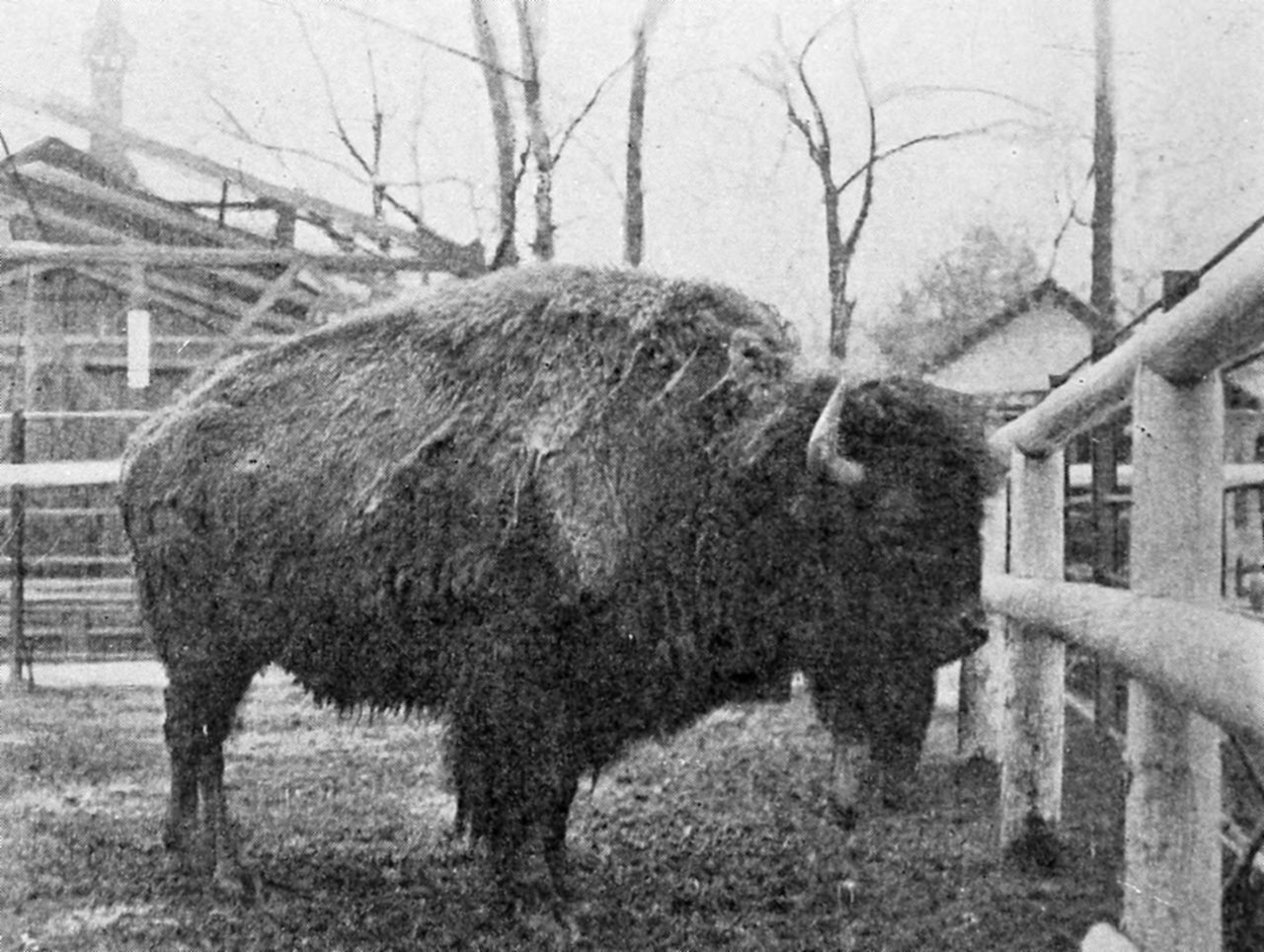
We next see a very fine pair of American bison, and
two young ones born in the Gardens. The crane and
wading-bird pens are close at hand, one large pen
containing an extraordinary number of coots, rails
and oyster-catchers, all looking the picture of health.
There is a long, well-lighted lion house, built in 1859,
containing twelve cages inhabited by a pair of lions
from Somaliland, a pair of tigers from Delhi, some
leopards and jaguars, and a pair of pumas, with their
young born in the Gardens.
We now come to the elephant house, built in 1897,
in which are housed four Indian elephants and a tapir.
In the antelope house, which stands near, are a fine
pair of elands in a large roomy paddock, water-buck,
a harnessed antelope and its baby, a brindled gnu,
an oryx, and the rare inyala. Next, we find a very
fine collection of birds of prey, including a beautiful
specimen of the Bateleur eagle from Africa.
We now come to the ethnological or anthropological
museum, built in 1888, containing native armour,
weapons, dress, etc., from all parts of the world, and
many draped waxen figures (life-size) of Chinese and
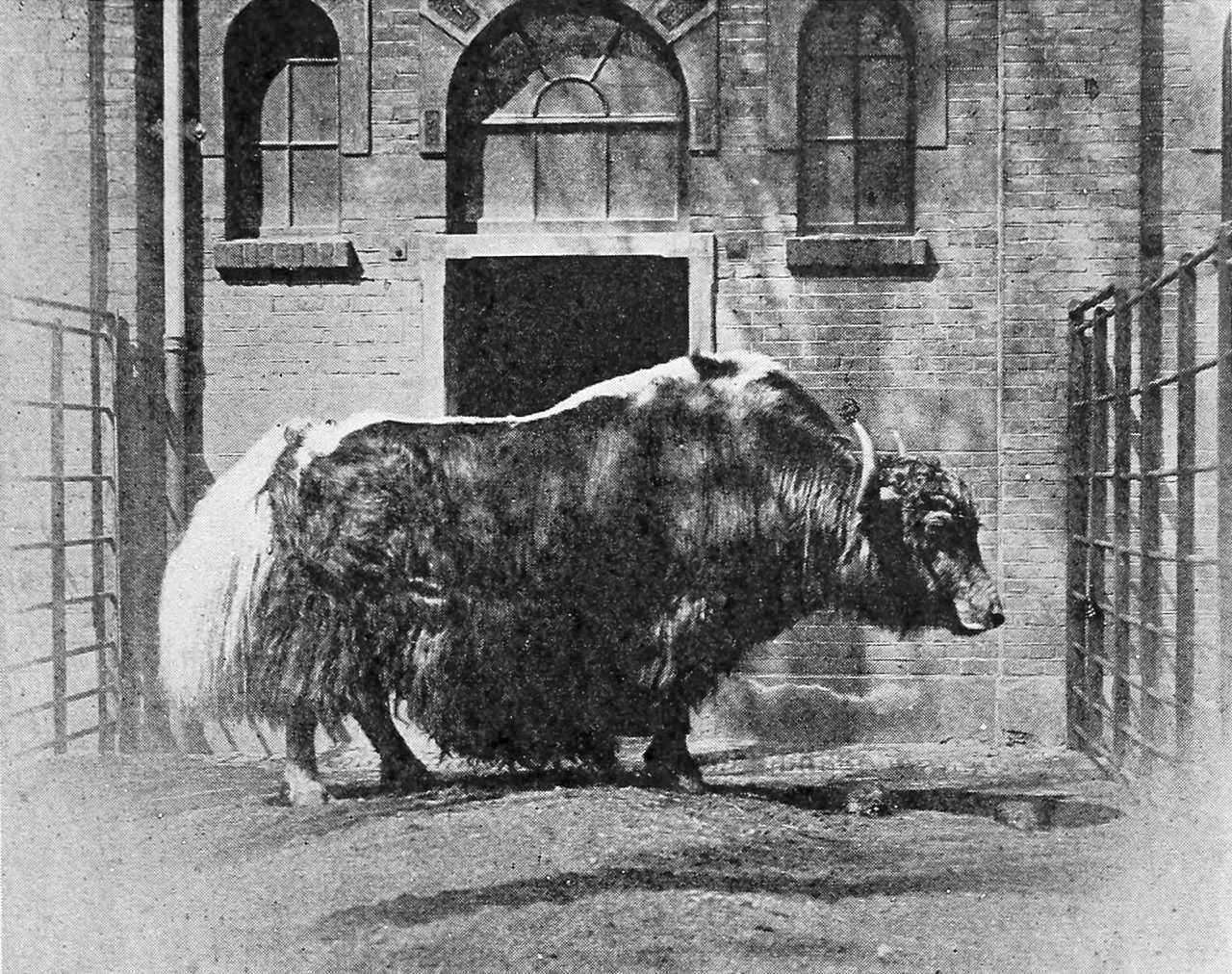
Japanese. Behind this museum are some black-and-white
yaks from Thibet, and several zebras from India.
Further on is the skeleton museum, and after that we
come to a hippopotamus house, containing two specimens
of this huge pachyderm. They are very well
housed, having, besides their large bathing-tanks
inside, an outdoor playground and water-tank. Passing
through a large conservatory, full of trees and
plants, we come to an extremely picturesque seal
grotto, and close by a deer shed.
YAK, AMSTERDAM.
The aquarium is reached next, for admission to
which an extra charge of fifty cents is made. This
building, erected in 1882, is well worth a visit. Its
tanks contain, amongst many others, specimens of
coal-fish, sea-anemones, huge cod, conger-eel, crabs,
lobsters, plaice, lump-sucker, skate, dog-fish, cat-fish,
stickleback, king-crab (very curious), barnacles, newts,
gold-fish, pike, barbel, roach, some magnificent trout,
carp, perch, American trout and a salamander. In
the aquarium is a large museum of preserved natural
history objects, mostly fish, shells and reptiles.
After leaving the aquarium, we encounter large
pheasantries and peacock houses, wild-sheep pens,
ibis pens and a pigeon house, from which the birds
have free exit. A third museum is found to be full of
stuffed birds, eggs, and nests; some of the birds
stuffed in their natural surroundings are very beautifully
done. The zoological library adjoins. A fourth
museum, built in 1894, contains a large collection of
stuffed animals and a collection of shells. Here is a
huge skeleton of an African elephant, with good tusks,
and a stuffed giraffe; a whole unmounted hippopotamus
skin, and a stuffed quagga, now extinct.
Close by this museum are some pens containing
zebras and wild asses. The new bear house, built in
1897, contains a fine collection. A large house, built
like a fortress, containing wolves, hyænas and jackals,
is close at hand.
Dr. C. Kerbert very kindly sent me a volume of
many hundred pages, containing the names of all the
specimens in the gardens, aquarium, and museums; but
in a work of this size it would be utterly impossible to
give the names of even one-quarter of the treasures
that are contained in these most remarkable Gardens.
CHAPTER VI
THE GARDENS OF THE ROYAL ZOOLOGICAL AND
BOTANICAL SOCIETY, THE HAGUE (S’GRAVENAGE):
DIRECTOR, DR. DIETZ
These Gardens were opened in 1863.
In 1902 many alterations and repairs were done to
the concert-house, the stage, and the aquarium. The
museum and the library were enlarged. Important
restorations were made in one of the old pheasant
houses and in the crane house.
In 1902 the following creatures were in the Gardens:
126 animals of 36 species; 767 birds of 220 species.
The income of 1900 was £4,751; of 1901, £4,184.
The Zoological Gardens at ‘den Haag’ are very different
from those at Amsterdam. On paying half a
gulden at the entrance, we first come upon a pen
occupied by a pair of peacocks. Close by is a guinea-pig
and Dutch rabbit house, and then we reach an
extremely rude Indian elephant, which throws sand
at us. This animal is found in a house built in the
Eastern style, with minarets, and has an open-air
paddock. There is rather a nice aviary, containing
parrots (some of which speak English as well as
Dutch), jays and many other birds. Above the
aviary is a museum.
Next we come to a funny little Himalayan bear,
and a monkey house, with large open-air cages for
summer use. After passing through some greenhouses
full of plants and ferns, we find a nice collection of
pheasants from Germany, China, New Guinea, the
Himalayas, and Japan. These birds are housed in
two long lines of pens, separated from each other by
a greenhouse. In the centre of the Gardens, near a
pond, is to be found a deer pen. On the back of one
of the deer a jackdaw was perched, but unluckily he
flew off before I could obtain a photograph of this
somewhat unusual sight. Crows and jackdaws are
often to be seen upon the backs of cows and sheep,
but one would have imagined that a deer was too
timid an animal to allow a large bird to perch
upon it.
In the Gardens is a fine concert-hall; and here I
may remark that in nearly all foreign Zoological
Gardens there is such a music-hall, which on concert
nights is packed to overflowing, adding largely to
the revenue of the Gardens. It has always been a
puzzle to me why our Council in London do not
try to attract more people by the erection of such a
hall and the engagement of the best artistes. An
outdoor band appears to be the only attraction of the
kind in our Gardens at home, such a thing as an
evening concert being almost unheard of.
Close by the concert-hall is a reindeer shed, a llama
paddock, a bear pit, and a very tame collie dog kept
in a cage as a rarity. Close to a duck-pond containing
sheldrake, wigeon, pochard and swans, there is a pen
containing a kangaroo and young, some more llamas,
and some zebus.
Taken as a whole, these Gardens are neither pretty
nor rich in animals, and are, in consequence, perhaps
scarcely worth a visit.
CHAPTER VII
THE ZOOLOGICAL GARDENS, ROTTERDAM DIRECTOR,
DR. BÜTTIKOFER
The idea of having a Zoological Garden in Rotterdam
owes its origin to three amateur zoologists. One of
these enthusiasts, a station-master on the Holland
Railway, took a small plot of land on lease, and started
a collection of animals and birds. Some years after a
number of wealthy citizens subscribed 300,000 guilders,
with which they bought thirty-four acres of land, half of
which they laid out as a garden, where they built
several houses for animals and birds. May 1, 1857, is
to be considered the date of the foundation of these
Gardens.
In 1863 the remaining ground was laid out and
added to the Gardens. The director, Mr. P. H. Martin,
originally a renowned lion-tamer, who had been in
office since the foundation of the Gardens, resigned,
and Mr. A. A. van Bemmelen succeeded him.
At frequent intervals additions were made to the
number of buildings, including a large plant house
170 feet long, costing 45,000 guilders.
In 1874 a 5 per cent. loan of 500,000 guilders
was contracted, and about twenty-five acres of land
bought at a cost of 230,000 guilders. A splendid
casino was built on the newly acquired land, containing
a restaurant, reading-rooms and a museum, at a cost
of 325,000 guilders. In 1878 an officials’ dwelling-house
and a house for succulent plants were erected.
In 1882 the loan alluded to above was converted
into a 4 per cent. one of 600,000 guilders. Large
aviaries were erected in 1883 and 1885, and the
‘Victoria’ house for stove-plants in 1886. Other
houses followed in 1889 and 1891. The year 1893
brought the conversion of the former loan into a 3½
per cent. mortgage loan of 1,000,000 guilders, the
issue of new shares to the amount of 700,000 guilders,
and the paying-off of the old shares.
In 1895 a handsome new house for the carnivores
was completed at a cost of 82,000 guilders. This
house measures about 200 feet in length. In January,
1897, Mr. van Bemmelen died suddenly, after having
been in office thirty-four years; and in May of the
same year Dr. J. Büttikofer was appointed his successor.
The fortieth anniversary of the founding of
the Gardens was celebrated by a grand fête.
During the following years many more new buildings
were erected, and the borders of some of the ponds
were lined with an edging of concrete reaching for
some feet down into the water, which proved successful
in putting a stop to the devastations by rats.
The Gardens are planted chiefly with elms, but
besides these trees there are numerous poplars, chestnuts,
planes, limes, ashes, maples, oaks, willows, birches,
alders, thorns, etc. Conifers are few in number, as
the soil does not suit them, but holly and box grow
well enough.
A good amount of bedding-out is done; for summer
planting alone more than 4,500 plants are used
annually. The houses contain collections of orchids,
palms, tree and other ferns (the tallest Balantium
antarcticum in Europe is said to be there), agaves,
azaleas, and various other stove and greenhouse plants.
One house has been set apart chiefly for tropical
economic plants.
The collection of animals numbers actually 394
mammals of 127 species, of which there are no less
than 91 apes of 29 species, and 154 ungulates of 46
species.
There are 1,406 birds of 360 species, 94 reptiles of
24 species, and 39 amphibia of 3 species.
The management of the affairs of the Society is
entrusted to a board of twenty-five shareholders, with
president, vice-president, hon. secretary, and hon.
treasurer included.
Out of these twenty-five members different committees
are formed, who have the supervision respectively
of: (1) The collection of animals; (2) the garden
and plants; (3) the buildings; (4) the clubhouse,
concerts, etc.; (5) the library and the museum. All
these gentlemen render their services gratuitously.
Holders of original tickets have the right of free
admission to the Gardens. Members who are residents
of Rotterdam pay thirty guilders a year, with an
entrance fee of ten guilders. They have free access
with their families to the Gardens. There are in all
5,837 members at the present day. The admission for
visitors is one-half guilder, children half-price.
HERD OF WATERBUCK.
JAPANESE DEER.
KANGAROOS.
BRINDLED GNU.
During the summer season about thirty-five evening
and thirteen morning concerts are given. On the
Queen’s birthday there is an additional display of fireworks.
In 1901 the expenses amounted to 169,300 guilders
90 cents, and the receipts were 170,847 guilders 94
cents, giving a surplus of 1,547 guilders 4 cents.
The concerts during the summer months take place
every Tuesday and Friday at 8 p.m., and on Sundays
at 2.30 or 8 p.m. The lions are fed at 2.30.
These are fine Gardens, and contain a magnificent
concert-hall. The first house encountered contains, in
separate pens, an oryx antelope, a gnu, nylgai, yaks,
zebus, Indian buffaloes and American bison. Near a
bear house, containing black, brown, European and
grizzly bears, and striped hyænas, is a very fine bird-of-prey
aviary.
One of the prettiest sights in the Gardens was a
family of water-buck—two female, one male, and a baby.
The wild-sheep grotto, surmounted by a tower, was
extremely picturesque, and up and down the rockwork
jumped guanacos, alpacas, llamas, wild goats, Barbary
sheep, moufflons, ibex and chamois. There was a
pretty duck-pond and lake, crossed by two wooden
bridges. The airy lion house, with seventeen dens,
contained a jaguar, lions, leopards, cheetah, two black
leopards and pumas. Close by was a camel house, a
monkey house with outdoor summer cages, and a very
good collection of pheasants.
Crowds of children proved a great nuisance whilst I
was attempting to take photographs. There was a
large open-air cage, in which herons, storks and gulls
flew about at will. There was a pigeon house, with a
picturesque tower, two polar bears, a number of Indian
muntjac, and a fine lot of red deer and wapiti. In all
there are no less than fifty-four different animal enclosures,
and the buildings also include a large
restaurant, with great hall, reading-room, ladies’-room,
dining-room, zoological museum (upstairs), ethnological
museum, director’s house, office, library, workshop and
officials’ houses.
CHAPTER VIII
ZOOLOGISK HAVE, COPENHAGEN
The Zoological Garden in Copenhagen was founded in
1859 by Dr. Kjaerblling. It is a quaint Garden,
situated by the side of a large park. On paying fifty
ore to a pretty girl (the first pretty girl I had seen in
Denmark) at the entrance, I found myself opposite a
large duck-pond with little islands in it, upon which
were placed boxes for the birds to build their nests in.
Close by the side of the pond was a model in plaster
of the huge Dinosaurus iguanodon, a kangaroo-like
reptile long ago extinct, a skeleton of which is to be
seen in the Brussels Museum.
Near a large restaurant was placed an ingeniously
constructed seal tank, like an aquarium, with a thick
plate-glass front to enable one to see the creature
swimming about below the surface of the water. It
was amusing to watch it sitting bolt upright, with its
tail resting on the bottom of the tank, and its nose
and eyes just above the surface of the water.
Next came a pair of water-buffalo and their baby,
and an American bison. In the centre of the Garden
was a pheasant pen, and a very large aviary with trees
growing in it, upon the top of which herons built their
nests. There were many duck and fowl aviaries, some
of the latter having curious little houses with ponds in
front of them. There was a small cats’ house, which
smelt abominably. This, however, is unavoidable, containing
as it does foxes, civets, polecats, wild cats,
servals, porcupines, wolves, jackals and two sorts of
hyænas. There was a lion house with outside cages,
containing a pair of lions, a pair of tigers, leopards,
jaguars and a puma (the latter always growling).
Another house contained a very miscellaneous collection—some
goats, a pair of Shetland ponies, a magnificent
cassowary (very tame), a tapir, some Brahma
cattle, some wild boars, a lot of guinea-pigs, a crane,
two dorcas gazelle, two muntjacs, an enormous zebra,
and a tiny donkey.
All the trees and shrubs in this Garden were extraordinarily
backward; scarcely a leaf was out, and as
it poured with rain during the whole of my visit of
five hours, the outlook could scarcely be called pleasing
to the eye.
There was a small house of flamingoes and storks,
and in an elephant house were a small Indian elephant
and a troupe of performing dogs and monkeys. Here
Herr Litz, the celebrated trainer, was performing with
a various assortment of animals. In the deer sheds
were a pair of cariboo, with a baby a few weeks old,
some axis and some wapiti deer.
There were several bird-of-prey aviaries, and in
them some beautiful Iceland falcons. A second
elephant house contained an enormous Indian elephant.
A fine new series of bear pits in red brick
was in course of construction. But the best house in
the Garden was a really good and new monkey house,
very lofty and roomy, with huge plate-glass fronts.
In one of the compartments was a young Himalayan
bear, together with several monkeys. The outside
cages of this house contained trees, ropes, swings, a
windmill and a rocking-horse for the amusement of
the apes. Altogether I consider this one of the finest
and best-appointed monkey houses in Europe.
On the top of what looked like a factory chimney a
pair of storks had built their nest in the open air. A
house for tropical small birds contained an enormous
number of paroquets, and close by was a quaint cone-shaped
owl house, with outside and inside cages.
There were wild-sheep rockeries, wolves’ dens, and
another pond, besides many smaller houses.
This Garden is well worth a visit.
CHAPTER IX
THE GARDENS OF THE ROYAL SOCIETY OF ZOOLOGY,
ANTWERP: DIRECTOR, M. F. L’HOEST
The Society of Zoology at Antwerp was founded
July 21, 1843. The Gardens then consisted of but
three and a half acres of land lying outside the old
fortifications of the city, for which a capital of 100,000
francs was subscribed. In 1843 Pierre Joseph de
Caters was President and M. Jacques Kets was
Director. M. François L’Hoest was appointed Director
in 1888. The personnel of the Gardens comprises
eighty-eight employés. The animals’ food costs
112,000 francs yearly.
During the year 1900 the total receipts (including
152,951 francs taken at the gates) amounted to
31,299,470 francs. In 1900, 32,763,336 francs’ worth
of animals were bought and 33,792,396 francs’ worth
of animals sold. Public sales are held annually.
Fertile poultry eggs are sold at one franc each,
guaranteed pure bred; if proved not fertile, they are
replaced by others.
The Gardens, which are close to the railway-station,
are open from April to September from 6 a.m. to
sunset, and from October to March from 7 a.m. to
sunset. There are numerous grand concerts. The
price of admission to the Gardens is one franc for
adults and fifty centimes for children under twelve
years. The lions are fed at 5 p.m. in summer, 4 p.m.
in winter, and the otters at 11 a.m. and 4 p.m.
A grand entrance to the Gardens, to replace the
present provisional one, is under consideration. On
entering, one sees on the left the Grand Palais des
Fêtes, opened in 1897 in the presence of His Majesty
King Leopold II. The Palais, which cost 1,300,000
francs, contains a terrace and balcony, a restaurant, a
café and billiard-rooms, a vast promenade, a marble
saloon, a great concert-hall to seat 3,000, a vestibule
and grand staircase, and a winter garden; and in three
large rooms is a natural history museum. Opposite
the Palais des Fêtes is a wide open space covered with
seats grouped round a central band-stand.
The collection of animals and birds in these Zoological
Gardens is one of the finest in Europe, and the Gardens
are especially famous for their hippopotami, which have
frequently bred there. The first house we come to is
the monkey house, with cleverly constructed doors to
keep the draught out. Here is a specimen of the
orang-outang from Borneo, a chacma, and a chimpanzee.
We next come to the dairy, constructed in the
‘Renaissance flamandi’ style. The stalls contain
twelve cows, which, before being brought in, are
submitted to the ‘tuberculin’ test; if they pass it,
their milk is certified free from all infectious germs.
The price of milk is twenty cents the glass, ‘guaranteed
pure and not skimmed.’
KANGAROO.
(Photo by Ottomar Anschütz, Berlin)
We now come to prettily thatched kangaroo sheds,
and in front of them is a duck-pond well stocked with
ducks and swans. Next we find an ostrich and
cassowary house, built in the Eastern style. Here I
quite mistook the grunt of the ostrich for the dull roar
or grunt of the lion, as I had often done before in the
African jungle. Close at hand is a fine lofty bird-of-prey
aviary. Outside nearly all the cages were
coloured pictures of the birds, with a map of the world
below them showing the distribution of each. Passing
a small seal grotto and thatched house for llamas, we
come to the Palais Egyptien, or elephant and giraffe
house. The paintings on the outside walls represent
the natives of foreign parts coming to offer to the city
of Antwerp examples of the most characteristic animals
of their country.
This house contained four giraffes: one born in 1871,
one in 1873, one in 1875, and one in 1876 (in 1897 the
Society refused an offer of 25,000 francs for one); some
camels, common and Burchell’s zebras, Indian and
Sumatran rhinoceroses, and two Indian elephants.
There is a stuffed giraffe, which died in 1898, after
having been in the menagerie eighteen years, and the
skeleton of an Indian elephant, which lived in the
Gardens from 1852 to 1880.
The bear dens are next to be seen, near a duck-pond,
upon which were swimming hundreds of ducks.
There are four polar bears housed near here. Passing
the wapiti and moose yards, we come to a large aviary,
outside which is a monument to Darwin. More than
100,000 pairs of birds are annually bought and sold in
these Gardens.
Next in order is a large children’s playground,
replete with swings for their amusement. There is a
very picturesque rockery for wild sheep and aurochs,
and American bison enclosures backed with rockwork.
A most imposing lion house is now encountered,
after passing through a fine sculptured entrance. It
will be found very roomy inside, and it contains a large
number of dens, besides three large circular open-air
cages. In one of the latter were housed no less than
seven lion-cubs, all about six months old. Opposite
the outside cages were a couple of brindled gnus, a pair
of leucoryx antelopes, and an Oryx beisa, grazing in
paddocks. In a house close by were lodged a pair of
full-grown hippopotami and a baby born in the Gardens.
The parents have bred no less than twelve youngsters
between 1886 and 1900, the period of gestation being
238 days. Several young ones have been sold to other
Gardens for very large prices. Pony and donkey
carriages run about the Gardens carrying children.
A very good band played all the afternoon when I was
there, and the Gardens were full of fashionably-dressed
people. Some of the statues in the Gardens are very
fine, notably a group representing an Indian horseman
attacked by jaguars. One of the things which will
probably strike the visitor most is the enormous number
of ducks, the ponds literally swarming with them.
CHAPTER X
JARDIN ZOOLOGIQUE, GHENT, FOUNDED 1851:
DIRECTOR, M. NIEPELS
It was simply pouring with rain when I left Brussels
to visit the Zoological Garden at Ghent; but, as luck
would have it, I had scarcely paid my franc and passed
the turnstile into the Garden when the rain ceased and
the sun popped in and out of clouds.
Passing a duck-pond covered with pochard, the
visitor comes to a café and the usual concert-hall
found in all zoological gardens on the Continent. In
front of the hall is a large open space with a band-stand
in the middle. Just beyond is the parrot and
small-bird house, in which one of the parrots was
imitating a cuckoo to perfection. In the centre of
this house was a large case containing stuffed animals
and birds, which had lived at some time or other
in the Garden. Close by was a large pheasant and
peacock aviary, with indoor pens fitted with plate-glass
sides.
After passing a quantity of poultry pens, the next
objects which attract the visitor’s attention are the
well-filled brown-bear cages. Behind them, in a house
rather difficult to find, is a remarkably fine Indian
elephant. We next come to a pretty pond with a
variety of ducks, mostly sheldrake, swimming upon it.
There is a good bird-of-prey aviary, containing,
amongst other birds, a remarkably fine condor.
BARBARY SHEEP, GHENT.
The next house contained zebus, wapiti, Japanese
deer, and black-and-white African sheep with fat tails.
The extraordinary abundance of fat on the tails is a
provision of nature, and enables the animal to go
without food for a considerable period when making
long marches from one patch of long grass to another,
which is of frequent occurrence in the arid deserts
where they live. I frequently gave as little as three
arms’-length of common American sheeting for one
fat-tailed sheep in Somaliland, North-East Africa,
one of the principal homes of these black-and-white
sheep.
In the centre of the Garden is another pond, upon
which were ducks, swans, pelicans, storks, and cormorants.
There was a pen of Angora sheep, the old
ram having most beautifully twisted horns. In a
rockery was one of the prettiest sights in the Garden—a
herd of Barbary sheep, a favourite animal in Continental
zoos; behind them were a herd of yak, and
one of white llamas.
Anyone who happens to find himself in Ghent with
an hour to spare should visit the Garden. It is close
to the railway-station.
CHAPTER XI
JARDIN ZOOLOGIQUE, LIÈGE: DIRECTOR, M. HENRARD
This Garden belongs to the Royal Society of Acclimatation
and Horticulture of Liège.
On entering (I saw nobody to pay), I found a number
of poultry pens, the inmates being for sale. A large
number of ducks and geese are also bred and sold, and
two cages contained fox-terrier dogs for sale. There
was a bear pit, which appeared to be empty, and a
monkey-cage only half full; but look as I would all
over the Garden, I could find no other animals.
The Garden is very long and very narrow, and has
several large duck-ponds, many down the middle containing
a few ducks and geese. There is a children’s
playground with swings of various kinds, but this
Garden can scarcely be called a zoological garden.
There is a school of horticulture, a restaurant, and a
band-stand.
CHAPTER XII
ZOOLOGISCHER GARTEN, AIX-LA-CHAPELLE (AACHEN):
DIRECTOR, AUG. BAST
This Garden was founded in 1886 by Sir Emil Lochner,
and his widow is now proprietress.
On paying twenty pfennig one is confronted by a
large, handsome concert-hall with glass roof and sides,
with pretty beds of tulips in front of it. At first I
could find no animals, although I found several
empty cages and pens. At length, however, I came
upon a deer house with outside enclosure, containing,
amongst others, a pair of wapiti about half grown.
Close by it was a bear den built like a castle, and containing
a brown and a polar bear; in two other pens
close at hand were a pair of white goats and a pretty
roe deer. What, apparently, had been an antelope shed
now housed two monkeys and some parrots. There
was rather a nice lion house, but there was not a single
animal in it. There was a llama pen inhabited by one
llama, and a pheasant house and a duck lake finished
a very disappointing show, considering the accommodation
and possibilities of the place.
To add to the enjoyment of my visit to the Garden,
I was caught in a snowstorm there, May 7.
CHAPTER XIII
ZOOLOGISCHER GARTEN, COLOGNE: PRESENT DIRECTOR,
DR. WÜNDERLICH
In 1857 Dr. Garthe conceived the idea of forming a
Zoological Garden, and gave expression to this idea in
the Cologne newspaper of August 13 in that year.
People of every class appreciated his idea, and took
shares in a company which was formed three years
afterwards. This was the last work of this great
savant. A bust of him by Werres is now placed at
the end of the main walk in the Garden.
The first Director of the Garden, Dr. H. Bodinus
aus Greifswald, was appointed on April 24, 1859.
On September 17, 1859, plans of the Garden were
submitted by Director Strauss, and the work progressed
so rapidly that the Garden was opened to the
public on July 22, 1860. Different houses and ponds
were added from time to time, until, in 1882, the
Garden reached its present extent.
The institution quickly won friends and sympathizers
in all parts of the world. In 1869 Dr. Bodinus, the
Director, left in order to undertake the direction of the
Berlin Zoological Garden, and he was succeeded by
Nicholas Funk, who had been Director of the Brussels
Zoological Garden. During his sixteen years’ term of
office he did much for the pictorial beauty of the
Garden.
Heck in 1886 thoroughly replenished the stock of
animals before leaving for Berlin. In 1888 he was
replaced by Dr. Wünderlich, who is the Director of
the Garden to-day.
Of late years the approaches to the Garden and the
Garden itself have improved enormously. The old-fashioned
and ugly buildings were all removed by a
big fire, and a splendid new aviary and a new ostrich
house have taken their places. The ostrich house is
built in the shape of a mosque with numerous minarets.
The birds are now to be seen all the year round,
which was not possible in the old house. There is
plenty of light and ventilation through a glass roof,
whilst two stoves supply heat. Within this house,
besides ostriches, are to be found rheas, emus, pouch-bearing
animals, rodents and parrots, and the rarest
bird in it is the Australian wingless kiwi. This tiresome
bird goes to sleep all day, and is never to
be seen when wanted; but when the gates are shut
and the visitors have all departed, out comes the
kiwi.
The old ostrich pens have disappeared, and in their
place is a children’s playground, which is quite deserted
and useless, as all the children naturally go to see their
cousins in the monkey house.
The kangaroos’ quarters have changed for the worse,
as the animals formerly lived in big outside pens; now,
owing to the children’s playground, they are confined
in much narrower limits, and have only small outside
pens, without enough room to move about. An armadillo
is also to be seen in this house.
On leaving the ostrich house, the camels’ and llamas’
enclosure is next encountered. The houses are prettily
painted in bright colours. The collection of llamas is
very complete. We pass on to the old aviary containing
the pheasants; a large new pheasantry, on the
same plan as that of the one in the Zoological Gardens
at Hanover, is now under consideration. Here are
also to be found specimens of Amherst’s pheasant
and the vulturine guinea-fowl from North-East
Africa.
Leaving the restaurant on your left, you pass
through a young chestnut avenue and come to the
antelope and deer houses, standing in a long row. The
small deer and the hardier kinds of antelope are found
here. Water-buck, nylgai, and two white-tailed gnus
are to be seen. Père David’s deer is one of the occupants
of the deer sheds. Other deer found are the Virginian
deer, axis deer, sika from Japan, and a very
grotesque-looking deer from China—Reeves’ muntjac
(Cervulus Reevesi). On the other side of these sheds
is the large-deer enclosure, with pretty houses
attached. Here are found wapiti from America, and
the Altai, one with a curious malformation of horn.
At the end of the deer enclosure is the old bear pit,
with two fine big pens. This was a present from the
late architect, Koch. There is also a cage and tank
containing two polar bears; a grizzly bear in the next
cage, with rockery and flowing water; a pair of South
American rare spectacled bears (U. ornatus), Malay
bear, Thibet bear, Japan bear, an Indian and a Western
Asian. Opposite to the bear pit is the flamingo pond,
in one of the prettiest situations in the Garden. Green
banks, groups of trees, storks, cranes and flamingoes
make a lovely picture. From the terrace of the restaurant
a very picturesque view of the Garden is to
be had. On the left hand of the pond are a sheep and
goat rockery, and a building containing Barbary sheep,
thar, onahura, and a herd of moufflon—that extremely
beautiful black, brown, and white wild goat. The
latter have frequently bred in the Garden. In
Corsica and Sardinia, for want of game laws, they are
fast dying out. There is a new fox and jackal house,
brick-built in the Gothic style, and having on one side
a massive tower. The cages are roomy, the floors
cemented, and the sanitary arrangements good. Besides
the German wolf are to be found the grey wolf
and the black wolf of North America, also several
jackals, foxes, and fennecs, including the Arctic and
common foxes, and C. Hagenbecki from Somaliland.
Two striped hyænas and one spotted hyæna are
housed in front of the bear pits.
The monkey house is also found in front of the bear
pit. This is the most attractive and popular house in
the Garden. A young orang-outang, however, has
monopolized most attention in the new aviary. The
baboons, macaques, etc., will soon be placed in a new
house, which will have more light from above, and
there will be out-of-door cages. The capuchin seems
to live out of doors all the year round. In the
monkey house are different sorts of lemurs, white rats
and mice, and the hamsters, which live in glass cases.
One of the baboons has been for years in the Garden;
he has learnt to dance, and will turn round as often as
he is told.
We leave the monkey house, built in pleasing Indian
style, and come to the rodents’ grottoes and squirrel
house. Here are porcupines and hystrices. The small
rodents of the squirrel family live with the marmots
or mountain-rats, and are to be seen close to the
grottoes. This place is built of stone and iron to
resist the sharp teeth of these gnawing animals.
The carpincho (Hydrochærus capybara) is in an
enclosure close by behind the monkey house. This
animal is the largest of the rodents, being 4 feet long
and weighing 98 pounds. Here also is a very fine
collection of geese.
Passing the pretty little house of the Director, we
come to the splendid and imposing new aviary; here
are all kinds of foreign birds, such as paroquets, etc.
The four corners are marked by towers. There are
outside cages, and the house is well built and free from
draughts. On the south-west side of the house is a
large open cage with a spring of water in it, containing
wading birds, the ibises, and shore birds, such as oyster-catchers
and plovers. Ladders lead up to the roosting-boxes.
Each outside cage is provided with a good
bath. All the birds are well labelled on the cages,
and there are pictures of several of them.
STORKS.
BATELEUR EAGLE.
COCKATOO.
STORK NESTING ON THE GROUND.
(Photo by Ottomar Anschütz, Berlin.)
CRANES.
Above the great aviary is a large glass roof with
ventilators. The Cologne aviary surpasses that of
Berlin. The cages get their light from the front as
well as from above; by this means you see the proper
colours of the birds, and not merely their silhouettes.
There are plenty of trees and plants for the enjoyment
of the birds as well as for the pleasure of the visitors.
These plants help to improve the air.
Passing the great fish-pond, which in summer is
ornamented with swans and in winter is very popular
for skating, we come to the piggery, a pretty building
in blue-gray basalt covered with natural red tiles.
Each pig has a roomy eating and drinking trough,
and is kept clean and free from smell. The floors are
on a slant, and the drainage is excellent. Here are
wart-hogs, some European wild boars (huge animals),
small peccaries, and the brilliantly-coloured red
river-hog. Next door are the birds of prey. Their
building contains fifteen large flying cages, the one in
the middle being the largest. At both ends of the
rows of cages are twenty smaller cages. The great
flying cages contain trees and a brook of flowing water.
There are huts for nests built into the walls. The
small cages are built of stone with bars in the front;
shrubs are put into each.
There are two sorts of vultures, thirty species of
hawks, and ten of owls.
A bridge of stone close to the eagle rocks connects
the old part of the Garden with that of the new.
The street below has not been destroyed, doubtless
owing to its historic character. From the bridge
there is a beautiful view over the Mühlheim heath of
the town beyond. Five-sixths of the space of the new
part of the Garden is taken up by a large lawn covered
with shrubs. At the end of this we come to the sea-lion
grotto; the Garden guide calls it the chef-d’œuvre
of the Garden. From a large rockwork overgrown
with moss and plants the water flows into a basin
15 yards long and 8 yards wide. At the back of the
rock are huts for the seals.
Retracing our steps, we come to the buffalo houses,
three pretty, massive wood-block houses. In one are
to be found no less than five American bisons; in the
others are the Indian bison, the yak, the Cape buffalo,
the gaur, the banting from Java, and the gayal.
Going back over the bridge, we see to the right,
rather hidden by bushes, a road leading to the antelope
and elephant house, fitted with large outside pens
with water-tanks. Here is to be seen a hippopotamus.
Opposite the tank is a beaver enclosure; not far from
the beaver house is the otter tank, with perpetually
flowing water. The so-called elephant house is a
plaster building in the Moorish style, with little towers
and minarets. Going through folding-doors, we step
into a wide hall. Near the door are the equidæ. The
idea of uniting the antelopes and elephants is for the
sake of economy. The pens are separated from each
other by rolling doors. The animals are fed from the
front. There are one African and two Indian elephants.
The Indian female elephant has been in the Garden
since 1872 and is now thirty-two years old; the
African elephant, a young male, is eight years old—Mangasia
he is called, after the famous Abyssinian Ras.
The old hippo, which was born in Antwerp, is now
dead, and has been replaced by a baby one. This
little fellow tumbles about in his tank in a most
amusing manner.
Tapirs, Indian and American, are found in this
house. Amongst the ruminants are the anoa, an
addax, a magnificent sable, Oryx beisa, and three Oryx
leucoryx (both the latter have bred here), the gnu,
some Arabian gazelles, and a dwarf antelope with a
young one, the latter in a special glass cage with bars
on the top. This cage stands on a table. In the cages
are sleeping compartments. In the centre of the room
was a glass case containing four baby kangaroos, and
a pretty sight it was to see them playing with each
other. There are a pair of Somaliland wild asses, which
have bred here, and also Burchell’s and Chapman’s
zebras.
The small-cats’ house is not a beautiful edifice; the
cages are very narrow and badly lighted. Here are
to be seen the serval, the caracul, leopard, zorilla,
ichneumon, etc.; the local animals have the worst
cages in the Garden.
Close to the small-cats’ house is the large-cats’
house, an unpretentious building, which has ten extensive
semicircular cages. The outside cages are roofed
over and have cement floors; inside, the cages are
floored with wood. The four biggest cages have
grottoes at the back, also wooden floors. The grottoes,
however, are difficult to clean. The floors, which slope
to the front for drainage, can be taken out. Bars can
be put in to divide one cage into two if necessary.
Tree-trunks are put inside. When the Rhine overflowed
in 1882 and 1884, the cats saved themselves
from being drowned by climbing up these tree-trunks.
Two marks on the eagle aviary show the height of the
water on those occasions. Many ducks and swans
swam away and were killed by so-called sportsmen.
The Garden was turned into a Rhenish Venice, and
the feeding was carried on in boats. In the house are
three lions, and three young born in the Garden,
leopards, cheetahs, puma, and black leopard, a pair of
hunting leopards, a jaguar, a pair of Bengal tigers,
and a pair of Siberian tigers (the female born in
Berlin). These animals live day and night in the
open air. The lions in winter are often seen lying in
the snow, perfectly contented.
Leaving the square with shady trees we come to
the great aviary. The flying cages are small in comparison
with those of the Berlin aviary; the ironwork
is so complicated up above that the birds cannot fly
about at the top for fear of damaging themselves.
They have only a poor bath and a few mangy-looking
trees. The birds mostly perch on iron bars and parts
of the wall at the back. They are too crowded: doves,
seagulls, pheasants, herons, and starlings jostle each
other. It is not quiet enough for them to breed well.
It was an amusing sight to see the gulls fed; they
made such a noise, and fought so hard for the tit-bits
of meat, bread, and green food thrown to them. Close
by the great aviary are the stilts and a primitive
wooden winter house containing peacocks, etc. At the
back of the peacock house are the storks, one of the
finest collections in Germany. There are thirteen
different species. In summer they inhabit the green
banks of the flamingo pond.
Close to the place where the children do not play
there are a quantity of old houses for poultry, pigeons,
etc. There are five ponds: one a large skating-pond,
in summer frequented by swans; a second the flamingo
pond mentioned above. Three other ponds are the
Island and Temple ponds, called after a little clock-temple
close by, and the pond which unites them.
These stretch across the Garden from the Director’s
house to the lion house. They simply swarm with
ducks of every description, pelicans, eight species of
swans, and twenty-six species of geese. The pelicans
are a very fine collection, and contain eight species
in all.
PELICANS, COLOGNE.
Near the lion house is a machine house producing
electricity for the restaurant and pumping water for
ponds. Before the machine house is a pretty grotto
with a waterfall which leads by a brook into the
ponds.
CHAPTER XIV
ZOOLOGISCHER GARTEN, ELBERFELD: DIRECTORS,
MESSRS. HERRMAN AND RIEMAN
The Zoological Garden in Elberfeld was founded in
1879 by a number of citizens in the form of a company.
The opening of the Garden took place on September
17, 1881. The Garden, which has an area of
about 137,641 square yards, lies in the west of Elberfeld,
at the end of the town parks adjoining some
plantations. The Garden owes much of its attraction
to the beauty of the valleys and hills amongst which
it is situated, and has on this account been much frequented
by artists. It has been considered the most
beautiful Garden in the whole of Germany. The
number of animals, however, is small. The main
object of the Garden is to afford the public a pleasant
spot in which to amuse themselves, and for this purpose
there are frequent concerts and fairs.
The restaurant can hold 25,000 people.
After a long drive uphill and right out of the town
in a most rickety old cab, which I expected would
come to bits every minute, I arrived at the Garden,
laid out upon the side of a hill, with a large and thick
wood in the background. Close by the entrance-gate
was an enormous concert-hall and café, with a little
open-air theatre behind. Going uphill on the left,
past some very nice asphalt tennis-courts and a duck-pond,
you reach a large brown bear and wolves’ den.
On a steep bank was a herd of red deer, with some
fallow deer, whilst higher up was a pair of Barbary
sheep, with a young one.
There were many pretty walks leading through
beech and birch trees down to a large boating lake.
Although not rich in animals, the Garden is picturesquely
situated.
You can come back part of the way on the very
cleverly constructed Barmen-Elberfeld mono-rail,
which runs all along and above the river. Really,
the Germans are up-to-date and far and away above
us in electrical transit.
The Zoological Garden at Düsseldorf is owned by a
company with a capital of 35,000 shares. The opening
of the Garden took place on May 31, 1896. The
portion laid aside for animals (not including plantations,
greenhouses, pasture-land, etc.) is about twenty-seven
and a half acres. Taking into consideration
that Düsseldorf is not a town which is much resorted
to by visitors, and that it is so close to Cologne, where
it has a powerful rival, the stock of animals in the
Garden is not a bad one. There is a good collection of
monkeys, bears, and carnivorous animals generally.
There are a fair number of rodents, a large number of
deer, six bison, and a large herd of Barbary sheep.
There is also a number of horses and asses for children
to ride and drive.
The birds are numerous, especially the birds of prey,
singing-birds, parrots, poultry, pigeons, ostriches, and
cassowaries. There are some fine ponds for the ducks,
and a gigantic aviary 6,000 cubic yards in extent.
An artistic-looking ruin, like the Castle of Heidelburg,
cost £2,700.
The yearly cost of food, which is about £1,600, gives
an idea of the large number of animals and birds in
the Garden.
After passing the entrance-gate (entrance fee fifty
pfennig), the first pen on the left contains pheasants.
We next come to a pretty garden of flower-beds, with
a fountain in the middle, and close to a long line of
domestic-fowl pens and a rose-garden is the concert-hall;
close by is a bird-of-prey aviary, and in front
of it a large Kinderspielplatz, or children’s playground,
replete with swings of all sorts. Crossing a
bridge over a duck-pond, we come to a most amusing
little house of guinea-pigs. The house is in two
stories, and you can see the guinea-pigs looking out of
the windows upstairs. It looks just like a large dolls’
house. We then come to what appears to be an
ancient castle in ruins, and among these ruins capers a
huge flock of Barbary sheep. I should say that this is
the largest herd ever brought together in captivity.
I counted over sixty, including a large number of kids.
Next in order is a lion house, with outside summer
cages, containing lions, tigers, leopards, and pumas, as
well as a handsome civet from West Africa, and a
striped hyæna.
Backed by an elaborate rockwork is a sculptured
lioness with cubs, very life-like. Opposite the lion
house is a large lake crowded with ducks and swans.
Next come foxes and wolves and two polar bears. In
the American bison enclosure young ones were born in
1890, 1892, 1894, 1896, 1898, and 1899. In the next
pen is a Shetland pony, and then comes a pen of yak.
Deer pens follow, with a small brook running through
each. Then comes one of the largest flying aviaries I
have seen in any Zoological Garden. It is some 50
feet high, and has quite large trees growing in it,
upon which herons build their nests. The cage was
presented by Herr Oskar Aders in 1897, and it contains
gulls, ducks, ruffs, oyster-catchers, and other
waders.
A BARBARY RAM, DÜSSELDORF.
A curious Egyptian building, with outside paddocks,
contains camels (two kinds), pigmy cattle, and an Indian
elephant. This house is followed by others containing
roe deer, axis deer, rabbits, kangaroos, and monkeys.
I must not omit to mention a baby Bactrian camel
born in the Garden.
This is quite one of the most picturesque of the
many beautiful Gardens on the Continent.
I next journeyed to Krefeld by a most circuitous
route, and found that the Thiergarten (wild-beast
garden) contained not a single beast, but only a man,
who asked me about a dozen questions in German,
none of which I could answer.
CHAPTER XVI
THE WESTPHALIAN ZOOLOGICAL GARDEN, MÜNSTER:
DIRECTOR, DR. LANDOIS
The so-called ‘island’ upon which this Garden now
stands was originally laid out by the Abbot Bernard
von Galen. A fortress which stood on the island was
destroyed and replaced by a public park, a coffee-house,
and a summer theatre.
On December 10, 1873, Professor Landois and
Sanitary Inspector Nübel took a lease of the island
and everything standing upon it until February 14,
1874, when they bought it right out and set to work
to form a Zoological Garden upon it.
In order to improve the appearance of the place,
they induced Herr Carl Koller to sell them a neighbouring
meadow for 2,000 thalers. With extraordinary
activity they worked until June 26, 1875,
when the Garden was formally opened to the public.
In 1881 the pillar-hall—a large entrance-hall—was
built; this, however, was subsequently destroyed by
fire. In 1894 it was replaced by a new building in
the modern style, approached by a bridge over the
river.
The entrance-hall bears over its gate the inscription:
‘Omne tulit punctum qui miscuit utile dulci’
(Everyone hits the right nail on the head who combines
the useful with the beautiful).
The restaurant was completed for the opening of the
Garden in 1875. The great hall, with its ante-rooms,
was originally destined for a scientific and artistic
museum; but the people, as of old, hungered more for
pleasure than for science, so that the whole of the
scientific collection had to be removed to the lumber-room
above, and a theatre and stage took its place.
According to the opinion of Carl Hagenbeck, the
monkey house at Münster is the best erection of its
kind in the world. The monkeys can be outside or
inside as they please all the year round. In consequence
of this the house has been copied by many
other Gardens. The wolves’ grotto was built in 1883.
The bear pit carries the following peculiar inscription:
‘Cette belle et gracieuse villa
L’on doit et l’ours au gorilla—1881.’
This is explained when we are told that in 1881
Professor Landois travelled round the towns of Westphalia
with the skeleton of a gorilla, and held popular
scientific lectures upon it; the money obtained he
presented for the building of the bear pit. Many
have been born here. There is a female polar bear
with a male brown bear, and hopes are expressed that
some day there may be a piebald bear-cub.
The aquarium is a present from the Evening Society,
and was built out of the profits of the play called
‘King Belle’ in 1886.
The owl tower was built from the profits of another
play.
A pretty walk through an avenue of trees brings us
to the Zoological Garden (entrance fee fifty pfennig).
The first cage is found to contain small rodents, and this
is followed by a bird-of-prey aviary. We next come to
the Kindersport Spielplatz (children’s playground).
A man in uniform came and unlocked the swings,
when there was a perfect rush of children to circular
swings, horizontal swings, vaulting-horses, and horizontal
bars galore. How well they cater for children’s
amusement in Germany! In a Chinese pagoda,
painted red, were a pair of Bactrian camels and their
baby, and close by a duck-pond was a large aviary
containing pigeons, pheasants, turkeys, fowls, and
gulls in separate pens. In the next enclosure were
some moufflon, two rams having enormous horns.
Opposite a large museum of natural history specimens
is an owl house, with a picturesque tower above it.
The next house is strikingly built in the Moorish style,
with dome and minarets, and contains, besides a tapir
and two striped hyænas, an amusing couple in the
shape of an elephant and a black pony, which caress
and play with one another. It was a very pretty
sight to see the two together, evidently very fond of
each other. On the keeper appearing and giving him
the order, the elephant knelt down and saluted with
his trunk.
A lion house had the walls of the outside cages
hand-painted to represent Eastern scenery; this had
a pretty effect in conjunction with the living animals
within. The house contained a pair of lions from
Somaliland (the male in magnificent coat), a pair of
tigers, an ocelot, and some parrots.
The Garden contained several medallions in bronze,
with portraits of benefactors struck upon them. These
medallions were framed in brick towers covered with
ivy, and each was surmounted by one large bird. In
a corner of the Garden is a museum of antiquities
connected with the Anabaptist rising in 1534-35, when
John of Leyden called himself King of Münster. Here
also, hanging upon a wall, are iron cages with effigies
within them of John of Leyden and his two friends,
who were executed within them; below are a set of
iron torture instruments. Opposite a large concert-hall
is a den containing two polar bears and two brown
bears, the latter in very good coat. There is a quaint
dark aquarium, the walls covered with imitation rock
and stalactites, containing a variety of fishes. Altogether
this Garden is well worth a visit, as there are
some very striking and uncommon objects to be seen
in it.
CHAPTER XVII
ZOOLOGISCHER GARTEN, HANOVER: DIRECTOR,
DR. SCHÄFF
The origin and the flourishing continuance of Zoological
Gardens in other great towns inspired the wish
for a similar institution in Hanover, and ever since
1850 people were endeavouring to bring the idea to
realization. Especially active in this respect was
Dr. Schlager, with whom Herr George Schultz heartily
collaborated.
In 1866 a company was formed for the laying out
of a Zoological Garden, at the first meeting of which
Baron von Munchausen, Herr Rasch, Dr. Schlager,
Professor Gerlach, and Mr. ‘Wine-merchant’ Schultz
were chosen directors.
On a plot of ground given to them by the Town
Council in the town forest sprang up the first buildings,
made after the plans of Architect Lüer, which consisted
of aviaries, a bear pit, with ponds, etc. In May,
1865, the Garden was opened to the public, which
gave the liveliest sympathy to the budding undertaking.
The Garden did not escape hard times on
account of the wars in 1866, 1870 and 1871, but it
finally overcame all difficulties. Especially after 1870
rapid progress was made; paths and roads were improved,
and an elephant house and a new concert-hall
were erected, gas and water were laid on, the
approaches from the town were brought into use for
heavy traffic, and the laying down of a tramway made
it much easier to reach the Garden. Mention must be
made here of a generous present of 15,000 thalers from
the Emperor William I. on the occasion of his visit to
Hanover, given after an inspection of the Garden.
This money was spent in building the lion house.
Herr Theodor Ostrogge, for a long while the Chairman
of the Council, and Herr Schluter must also be
mentioned as especially warm supporters and generous
friends of the Garden. In the first few years a change
in the direction twice took place. Veterinary-surgeon
Christoph Kuckuck was Director in 1874, and filled
this office to the great benefit of the Garden until his
death, after a long illness, in 1893. After the death
of Director Kuckuck, Dr. E. Schäff, the present Director,
was appointed.
Yearly season tickets for a family cost 15s. By a
family is understood husband, wife, and children. A
necessary servant with little children enters free.
Sons who have left school enter by single tickets at
7s. 6d. a year each. Female companions, nursery
governesses, and pensioned servants are not included
in the family ticket; they must pay 3s. extra a year
in addition to the family ticket. A ticket for two
persons, comprising a family, such as a man and wife
(without children), two sisters, mother and daughter,
etc., 12s.; for single person, 7s. 6d.; for high school
and military school students, 5s.; for strangers (fortnightly),
3s.; for strangers (monthly), 5s.
Herr Hilpert’s philharmonic orchestra (wind instruments),
under the Imperial Music Director, Bruno
Hilpert, performs in summer (on Mondays, Wednesdays,
and Thursdays) in the afternoon from 4 to 8.
On Tuesdays, Fridays, and Sundays there are two
concerts, from 4 to 7 p.m. and from 7.30 to 10 p.m.
In the winter string-instrument concerts, Mondays,
Wednesdays, and Thursdays, from 3.30 to 7; on
Fridays symphony concerts from 3.30 to 6; on Sunday
3.30 to 6.30, and from 7 to 9.30.
Dogs, parrots, ornamental birds and animals are for
sale in the Garden.
How wonderfully well built these German cities are!
There is scarcely a town in England which can compare
in beauty and picturesqueness with such cities as
Düsseldorf, Cologne, Hamburg, Berlin, or Frankfort-on-the-Main,
with their great wide streets avenued
with trees, their artistic buildings, the lavish display
in public places of statuary of a high order, and the
ease with which one can find one’s way about.
CHEETAHS OR HUNTING LEOPARDS.
(Photo by Ottomar Anschütz, Berlin.)
The Zoological Garden in Hanover is well worth a
visit. It is situated in a shady wood, and contains
some very quaint houses. The first house one encounters
is devoted to cranes and herons. In the centre of the
Garden is a duck-pond with an island in the middle,
upon which are placed what look like tiny dog-kennels.
In these little houses the water-fowl build their nests.
In the monkey house were a hamadrya and a remarkably
fine baboon, both animals comparatively rare in
collections. There is a substantially built bear castle
well filled, and close to it is the concert-hall, in which
a fine band was playing when I visited the Garden.
From the top of a high arch of rockwork a view of the
whole Garden can be obtained, but there are so many
trees in it that the view is somewhat disappointing.
There is a large and handsome antelope and camel
house, with dome and minarets, containing Shetland
ponies, camels, zebus, white-tailed gnus, an Oryx
leucoryx, black buck, an ostrich, a rhea, some donkeys,
a zebra, a roan antelope, and a Cape hartebeest, the
last two rarely seen in collections—in fact, the Cape
hartebeest is the first I saw on the Continent. He
was very nervous and restless, and utterly refused to
stand still to be photographed. A lion house contained
two remarkably fine lions.
It is curious how wonderfully well lions thrive in
captivity and what fine manes they grow. I have
seen several lions in the African jungle, but not one
had a mane to compare with those carried by menagerie
beasts. This is accounted for partly because in a cage
there is no thorn-bush to tear the hair, and partly
because the food is better and more regular, causing
less mange in the skin. Besides lions there were
leopards, pumas, cheetahs, a black leopard, and some
tiny bear-cubs in the lion house. In a house built
just like a church with a steeple was a huge Asiatic
elephant, a smaller elephant, and a hippopotamus.
Pens of yak and American bison, several deer, dogs,
and wolves, and a parrot house brought a very interesting
collection to a close.
Crowds of people watched the animals, listened to
the band, or drank coffee in the restaurant, the extremely
pretty uniforms of numbers of soldiers adding
to the picturesqueness of the scene.
CHAPTER XVIII
ZOOLOGISCHER GARTEN, HAMBURG: DIRECTOR,
DR. BOLAU
On January 28, 1860, Baron Ernst von Merck, Herr
H. Meyer, Consul Schiller, General Consul de Craecket,
and others met together and formed a provisional company
for the founding of a Zoological Society, the
main end and aim of which should be to settle the
site of a Zoological Garden in Hamburg. Baron Ernst
von Merck was elected President and Herr H. Meyer
Vice-president, whilst Consul Schiller was made
Treasurer.
On July 10, 1860, the first general meeting of the
shareholders took place to consider the construction of
the society and the making of regulations. The
directors approached the Municipal Council with a
view to obtaining a suitable site for a Zoological
Garden, and the Council gave a plot of land to the
society free of ground-rent for fifty years. The buildings
were at once taken in hand by Herr Meuron and
Herr Haller, and the landscape-gardening by Herr
Jürgens. The capital was taken up by 800 shareholders.
The preparing of the land, which consisted of a
large sand-desert, occasioned endless trouble and waste
of time and money, especially at the beginning. The
Directors, however, were not discouraged, as they were
helped not only by large presents of animals, but also
of building materials, etc. An otter basin was paid for
by Baron von Merck, who, with other gentlemen, gave
an important contribution to the bear pit. The main
entrance-gate, the wapiti house, the seal enclosure, the
tapir house, the antelope house, and the drainage
system of the grounds were all given by various individuals.
The ladies of Hamburg and Altona opened a
subscription, which resulted in the building of an
ostrich house.
In November, 1862, the greater part of the buildings
were finished. The Directors, however, were
obliged to issue more shares in order to enable them
to make other buildings, and especially an aquarium.
This new issue of capital was authorized on November
20, and within twenty-four hours the new
shares were all taken up.
On May 26, 1863, the company presented the
Garden, brightly decorated for the occasion, to the
shareholders, and on the following day it was opened
to the public. On July 6, 1863, the Garden suffered
an irreparable loss in the sudden death of its President,
Baron von Merck, who was greatly regretted by
the whole of Hamburg. A bust was placed in the
concert-hall to commemorate him.
In 1864 the Direction was authorized to build a
Winter Garden and a large restaurant. The aquarium,
a rectangular building 26 by 11 metres in size, was
opened April 26, 1864. The floor is laid deep under
the surface of the earth to insure an even temperature
all the year round. Spring and autumn are the best
times to transport fish to the aquarium, as in the
extreme heat of summer many die.
Presents flowed in from all parts of the world every
year. Herr Meyer presented the Garden with the
owl tower. A second small-cats’ house was presented
by General Consul Gustav Mutzenbecher.
In the spring of 1885 the society had to bewail the
loss of another President, Dr. Schwartze, who had
acted as chairman of the society for many years.
Dr. Heinrich Bolau is now Director of the Garden.
In December, 1899, there were 468 animals, 1,749
birds, and 187 reptiles in the Garden; 46 animals and
162 birds were bred in it.
In 1900 the income was £16,109 16s., exceeding
that of the year before by £651.
Not only does the Liverpool of Germany possess one
of the largest Zoological Gardens, but also the fifth
most valuable collection of animals in Europe.
THE MONKEY HOUSE, HAMBURG.
On paying one mark entrance fee, one is confronted
first by two large deer enclosures with thatched
shelter-houses in the centre. Close by is a lofty bird-of-prey
aviary. Beyond an Australian wombat and
some pens of kangaroos is a pretty pen of doves,
wading birds, and ducks, in which are planted some
little Christmas-trees. We next come to the monkey
house, which, however, is small in comparison with
ours in London. In the centre of the Garden is a
huge duck lake, with a very large concert-hall and
café opposite. Keeping to the left of the lake, a four-horned
sheep from Morocco is to be seen. This animal
greatly resembles the four-horned sheep found in the
Outer Hebrides off the coast of Scotland. At the
bottom of an imitation ruined tower are some bear pits
and owl pens. It is a stiff climb to the top of the
tower, but from it one gets a good view of the Garden
and the surrounding city. We next come to three
very large cages containing bears of three species, and
then we pass through what appears to be an overflow
house, which contains leopards, jaguars, and a host of
guinea-pigs. Rather tantalizing it must be for the
leopards to smell the luscious porkers and not be able
to get at them; but perhaps, by-the-by, the guinea-pigs
were given to the panthers as food.
STORK AND CRANE ENCLOSURES, HAMBURG.
Close by the ostrich and rhea pens is a charming
Egyptian house, with a pond in front of it, in which
waded several storks, cranes, and sacred ibises. This
was followed by a second duck-pond, backed by a large
rockery. We now come to a very realistic scene in
the shape of a rockery and pond containing seals and
cormorants. This is followed by yet another duck
lake. Passing on, we come to the elephant house.
This house, built in 1880, contains elephants, a hippopotamus,
buffaloes, and wild asses. There is an Indian
elephant here which possesses the longest pair of tusks
I have ever seen in a captive animal. (The largest
African elephant, however, is in the Jardin des Plantes,
Paris.) He is a remarkably fine-looking creature. In
the centre of the hall is exhibited a pair of tusks which
are very even, but not nearly so fine. The hippopotamus
was roaring in fine style, turning back
somersaults, and plunging about in a manner quite
unusual in a captive specimen. In the same house
were a smaller Indian elephant and quite a young
African elephant. Next in order was a small-birds’
house containing German birds, with the eggs of each
displayed in glass cases.
In the antelope house were a pair of the Southern
form of giraffe, Arabian gazelle, black buck, zebus,
West African inyala, with four young ones born
October 21, 1901, some nylgai, a young roan antelope,
an Oryx leucoryx, and a pair of water-buck.
In an outdoor shed and paddock was a magnificent
American bison, shedding its winter coat. The lion
house, built in a crescent shape, with indoor and
outdoor cages, contains some remarkably fine animals.
There are a number of lions and tigers in a cage
together, a Cape hunting-dog, leopards, and hyænas.
One lioness had the most brilliant yellow coat I have
ever seen. Opposite the inside cages are glass cases
containing some large crocodiles, lizards, tortoises,
snakes, and salamanders. Close by is an extremely
well-built and well-kept small-rodents’ house, full of
rare little mammals. There are red river-hogs and the
capybara, or great tailless rat of South America, as big
as a small pig.
During my rambles I lost a part of my camera, and
spent a long time in looking for it. But, luckily, one
of the keepers picked it up and very kindly found and
gave it me, much to my relief. It was a most miserable
day when I visited this Garden, and, of course, it
did not look its best; still, it could not, I feel convinced,
compare in beauty with many other smaller
Gardens, though it is undoubtedly very wealthy in
animals.
CHAPTER XIX
ZOOLOGISCHER GARTEN, BERLIN: DIRECTOR, DR. HECK
The history of the Garden at Berlin is divided into
three periods; the first embraces the time of preparation
and the foundation, from 1841 to 1869.
This Zoological Garden is the third oldest in Europe,
and the oldest of all the German Gardens. The credit
of its foundation belongs to the well-known Berlin
zoologist and African traveller Lichtenstein, who could
hardly have realized his intentions had not the Prussian
Royal House given its favour to this public-spirited
undertaking. Not only is this shown by the opening
mandate issued by Frederick William IV. on May 7,
1845, but by the presentation of the royal pheasantry
to the Company of the Zoological Garden. At the
same time the Emperor made a grant of £3,000 to the
society, which was increased by £2,000. The greater
part of the Emperor’s own animals and birds were also
transferred to the Zoological Garden.
On August 1, 1844, the Garden was opened. For
the first twenty-five years of its existence the arrangements
were particularly modest. In March, 1846,
there were not 100 kinds of animals in the Garden,
and there were only half a dozen houses. In 1868
only 191 shares of £15 were taken up by the public.
Owing to the then great distance from the town, the
Garden progressed but slowly for a long time. In
1848 the income was only £900, and these first twenty-five
years must count as the infancy of the Garden.
The second division of the Gardens development
begins with the year 1869. Professor Peter, the
successor of Dr. Lichtenstein, undertook, with the
then Minister of Finance, Von der Heydt, to reconstruct
the Company. A thousand new shares were
issued in exchange for old ones. Estimates for the
plans of large buildings were drawn up, and the
direction was altered in a conspicuous manner, Doctor
Bodinus, who came from Cologne, being placed regularly
in charge of it. Imposing and artistic buildings were
erected, and the lion house was altered so as to look
like an African house.
In 1869 the restaurant was opened.
In 1870 a new lion house and bear pit were built;
in 1872 an antelope house; in 1873 an elephant
house; in 1874-75 a great concert-house; in 1883 a
new monkey house was erected.
At the same time the Garden rose to the highest
place in public favour, owing to its public concerts,
which, until 1884, were held three times a week under
the direction of Herr Wieprecht. In 1884 electric
light was introduced. Daily double concerts were
instituted at half-price, and brought a great number
of people to the Garden. In 1900 the entrance money
taken amounted to £27,321, and the season-tickets
brought in £5,849. In 1884 Director Bodinus died.
Dr. Max Schmidt was named as his successor, he
having for twenty-five years looked after the Zoological
Garden at Frankfort-on-Main. In 1888, however,
he died, and Dr. Ludwig Heck, who came from
the Zoological Garden at Cologne, was chosen as
Director. In his first year he devoted his attention
to increasing the stock of animals, with the result that
now 25,000 living creatures are to be seen, including
12,000 species of animals and birds.
LLAMA AND MOUFFLON ROCKERY, BERLIN.
ELEPHANT HOUSE, BERLIN.
In 1893-94 the drainage was renewed; in 1895 the
new wing of the well-arranged aviary was built; in
1896 a new deer house and a goat and sheep house
were built; in 1896-97 the beautiful stork and crane
house; in 1897 the camel house; in 1898 more deer
houses, moufflon rocks, and two restaurants were
erected, and other improvements made. This period,
from the death of Dr. Bodinus in 1884 to the death of
General Duncker in 1897, forms the second division in
the history of the Berlin Garden.
The year 1897 marks a new period in its history.
The eclat of the Garden as a place of amusement, the
increased number of specimens, and the favourable
position of the site in the west of Berlin led to the
new organization of an institution which was so promising.
In 1898 1,000 new preference shares were issued,
and a second increase in capital brought the total
capital of the Company up to £113,500. By this
means numerous alterations and improvements were
undertaken. A new official residence was erected, and
Japanese and Chinese pavilions, coffee-houses, bridges,
halls for children to play in, lavatories, machine houses,
a pump house, three new pig houses, improvements in
the antelope house, new llama rockery, and refrigerators
for dead fish were made. A view-tower, pheasantries,
and many other minor improvements in walls, banks,
bridges, and ponds were added. Herr Begas presented
one of his celebrated centaur statues, and Uechtritz a
nymph with swan. All these things have made the
Garden more attractive, and all Berlin comes to see
them. The Garden and restaurant are visited by
60,000 people on a fine Sunday in the summer.
We will now walk round one of the finest Zoological
Gardens in Europe, and, indeed, in the world, as it is
at the present moment well ahead of our London
Garden, both in the value of its animals and also in
the magnificence of its buildings. Some of the latter
are truly remarkable structures, being finely painted
and decorated, and fitted inside with the very best up-to-date
arrangements for the health and comfort of the
animals.
After I had paid one mark at the entrance, my
camera was immediately pounced upon; I hope it may
not be thought to be ‘sour grapes’ if I add that it
poured with rain the whole day when I visited the
Garden, and that most of the animals were housed
indoors.
Turning to the left round a very large café, with
seats outside capable of accommodating several thousand
people, we come to a very large and lofty bird-of-prey
aviary. Close to a children’s playground will
be found some stables, containing common domestic
asses, Somali wild ass, Burchell’s and mountain zebra—a
cross between a donkey and a zebra—and the inevitable
Shetland pony, with which they always seem
so pleased in Continental Gardens.
The lion house, constructed on the very best principles,
is one of the finest in Europe, and contains
German East African and Somali lions, tigers, leopards,
black leopards, jaguars, and a very curious light-coloured
variety of the jaguar, the only one known in
captivity.
There were some cleverly constructed duck-ponds
with pleasing rockwork, trees, and waterfalls, and
opposite to them was a large crane house. Several of
the houses are built in exact imitation of Chinese and
Indian temples and pagodas, which give the Gardens
a very Eastern appearance.
OSTRICH HOUSE, BERLIN.
DEER SHED, BERLIN.
After passing several large duck and swan lakes and
a wild-sheep rockery, we come to the monkey house,
which, however, is comparatively small and disappointing.
In front of some pretty beds of tulips is a truly
magnificent elephant house, built in imitation of a
Hindoo temple, the domes painted in yellow, brown,
and blue. In the centre of this palatial house is placed
the skeleton of a full-grown elephant. The ceiling is
supported by huge columns, with two carved elephant-heads
on the top of each. The house contains three
Indian elephants, two African elephants, one Indian
rhino, and some tapirs. Huge sliding-doors lead out
into large open-air paddocks fitted with baths. Behind
the elephant house are the wild-swine sheds.
We now come to another finely decorated and well-constructed
house—the ostrich house. It is painted
inside and out with large, ancient Egyptian figures of
men and birds. At one end of the interior is a very
realistic painting of two huge stone Egyptian figures
in a sitting position, bathed in a gorgeous sunset. The
columns and the ceiling in this house should also be
noticed. It contains a good collection of ostriches and
cassowaries. The next house with large water-tank
contains two hippopotami. Opposite a high tower
(entrance fee ten pfennig, which goes towards the
animals’ food) is a very long line of pheasant pens, all
prettily planted with tiny shrubs and trees.
Passing a large llama and tahr rockery we come to
the antelope house, built in an oval shape with
minarets, the huge balls at the top covered with gilt.
It contains some rare animals. There are water-buck,
harnessed antelope, inyala, several Oryx leucoryx, two
addax, a beautiful pair of giraffes (South African form),
a blessbock, two eland, one roan (Albifrons), two tora
hartebeest, one Cape hartebeest, and one Lichtenstein
hartebeest, the last four species of antelopes being very
rarely met with in captivity. In quaint brown houses
inlaid with white are several dwarf antelopes from the
Cameroons and other parts of Africa, the whole collection
forming one of the most complete in the world.
In the centre of this house with its glass roof is a
large fernery with a realistic group in stone of a
lioness and her cubs. All the antelope cages have
outdoor paddocks attached. Opposite this house are
several deer sheds and a long line of buffalo and camel
sheds, containing animals too numerous to mention,
and stretching for over 100 yards in length.
There is one remarkably pretty deer shed with
pointed roof and red tiles. Close by is a seal pond,
and not far from the entrance will be found the bear
dens, containing the finest collection of bears in Europe.
There are concerts in a large hall every night and
special ones on Sundays.
Taken all round, this Garden is far and away better
than any other garden at home or on the Continent
for the beauty of its buildings, the picturesqueness of
its grounds, and the wealth of its animals. This state
of things has been brought about in a large measure
through the energy and forethought of the Emperor
of Germany, himself a sportsman and lover of animals.
CHAPTER XX
ZOOLOGISCHER GARTEN, HALLE
This Garden lies in a romantic position in the Reilsberg,
and offers a fine view of the surrounding country.
The air here is very keen and bracing. The animals
are arranged with peculiar taste in idyllic little groups
of cages.
Entrance for adults fifty pfennig, for children thirty
pfennig. On Sundays and fête-days the price of
entrance is specially announced in advertisements and
in the papers. Family tickets, inclusive of a servant,
30 marks; these admit to all concerts. There are
four ordinary concerts a week in the summer and one
grand concert. Special arrangements are made with
Corporations and schools. Perambulators only allowed
up to 1 p.m. The garden is opened in summer at 7 a.m.,
and from October to April at 9 a.m. The animal part
of the Garden is closed in the evening by a signal from
a horn. The flowers are not to be plucked, and the
animals are not to be teased nor fed except with the
special food which can be bought in the Garden.
After a very long drive in a cab drawn by two horses,
for which I paid the extraordinarily small sum of
1 mark (1 shilling), the Zoological Garden, built round
a small hill outside the town, was reached. Turning, as
usual, to the left, a small Indian elephant is to be found
in a house by himself. The lion house is next, and
contains lions, tigers, pumas, leopards, hyænas, and a
handsome African civet. There are some rather pretty
duck and wading-bird ponds.
KANGAROO, HALLE.
Winding walks lead round the hill and deer paddocks,
and kangaroos, wild swine, some small monkey
houses, and a very good collection of goats are to be
seen. On the top of the hill a spiral staircase can be
ascended, from which a good view is obtained of the
surrounding country. There were torrents of rain and
crowds of country people when I saw this Garden, it
being Whit Sunday.
CHAPTER XXI
ZOOLOGISCHER GARTEN, LEIPZIG: DIRECTOR, DR. ERNST
PINKERT
The Zoological Garden in Leipzig has gradually worked
itself up from very small beginnings to its present
greatness and extent. It was, indeed, the present
Director, Herr Ernst Pinkert, who, so to speak, laid
the foundation-stone in 1876 with a little house for
crocodiles. Through his energy and business activity,
he succeeded in a relatively short time in bringing the
Garden up to its present high standard, and in creating
an institution for which the Leipzig people are much
indebted to him.
In 1899 Herr Pinkert’s incessant energy and
organization were rewarded by the Garden being
purchased by a company of shareholders, who appointed
him Director.
The Company of the Zoological Garden ended its
first business year at the end of 1899. Allowing for
the unavoidable disturbances caused by storms in the
summer and by new buildings being erected, the first
year was financially a success. The report for 1899
showed a clear profit of £403. Whilst the Ashanti
Exhibition was being held on June 4 the Garden was
visited by 19,718 persons, constituting a record day.
During the year 196,388 people entered the Garden,
exclusive of family season-ticket holders, who numbered
688 of the shareholders.
Picture-postcards, programmes, and guide-books
brought in £85. The stock of animals at the end of
1899 included 14 monkeys, 110 carnivorous animals,
135 rodents, 1 elephant, 96 cloven-footed animals,
3 hoofed animals, 8 kangaroos, and 1 duck-billed
platypus.
Sixty animals were presented to the Garden, and
the following were born in it: 8 lions, 1 jaguar,
2 leopards, 10 hyænas, 1 white Angora cat, 5 Gordon
setters, 12 fox-terriers, 3 silver rabbits, 15 common
rabbits, 15 Angora guinea-pigs, 25 common guinea-pigs,
2 bisons, 1 beisa antelope, 1 zebu, 2 dwarf zebus,
1 yak, 1 wapiti, 1 axis deer, 1 Japanese deer,
1 guanaco, 1 llama, 7 sheep, 2 kangaroos, 5 peacocks.
The losses by death were, however, considerable,
9·2 per cent. of the stock being lost during the year.
Of the more valuable animals were lost: 2 young
male lions, 1 female puma, 1 brown bear, 1 chimpanzee,
1 male mandril, 1 llama, 1 male elk, 1 pair of axis
deer, 1 wapiti cow, 1 young male bison.
Miss Claire Heliot, with her nine lions and two dogs,
proved a great attraction between July 22 and September
3. The number of members on the committee
was raised from nine to ten. A large main building was
proposed, which should contain a restaurant, a concert-hall,
etc. A fodder-house, a Director’s house, and
several animal houses were built. Herr Rust, the
architect, was entrusted with the carrying out of these
important works. The fodder building, thanks to a
mild winter, was ready for use by the beginning of
May, and proved most useful. The other buildings
made satisfactory progress. On May 10 the foundations
of the large main building were laid. The
Director’s house was nearly finished. The concert-garden
was planted with stately trees. No less than
£25,000 were spent upon these improvements.
In 1900 the clear profit was £600; 244,914 people
entered, besides 831 season-ticket holders. Miss Heliot,
the celebrated lion-tamer, on August 5 attracted the
record number, 17,197 people paying to see her show.
The following animals died in the Garden: 1 full-grown
lioness, 2 servals, 1 ocelot, 1 racoon, 1 guanaco,
4 llamas, 1 elephant, 1 beisa antelope, 1 elk, 2 axis deer.
On the other hand, 7 lions, 5 hyænas, 6 mastiffs,
3 St. Bernards, 5 fox-terriers, 2 zebus, 1 gnu, 1 sambur
deer, 2 Sardinian moufflon, 1 sika deer, 26 Angora
guinea-pigs, 55 common guinea-pigs, and 7 common
rabbits were born; 57 animals and birds were presented
to the Garden, besides valuable pictures, a
quantity of trees, shrubs, and flowers, palms, armour,
a beautiful clock, and other gifts.
On May 2 the Directors house was inhabited. On
June 3 the newly-planned concert-garden, with its
splendid building for the orchestra, was finished. The
restaurant was opened on June 2.
On September 29 the main building, containing the
garden-saloon, terrace, and concert-hall, was formally
opened. A banquet was given in the evening, at
which the highest dignitaries of the city presided.
In the same year, also, the new monkey house was
almost completed.
In 1901 the net profit of the Company was £3,796.
In the Garden were the following animals: 430
mammals of 97 species—52 monkeys, 96 carnivorous
animals, 141 rodents, 1 elephant, 5 hoofed animals,
125 cloven-hoofed animals, 8 marsupials, 1 duck-billed
platypus.
In 1901 died: 1 female orang-outang, 1 chimpanzee,
1 male adult lion, 1 female lion, a number of young
lions, 1 jaguar (small female), 1 serval, 3 hyænas, 1 pair
of wolves, 1 sable antelope, 1 beaver, 2 axis deer,
6 kangaroos, 3 ostriches, 1 emu, 1 black-necked swan,
2 flamingoes, 2 storks.
The following were born in the Garden: no less
than 16 lions, 2 jaguars, 8 hyænas, 13 fox-terriers, a
number of other dogs, 3 Sardinian moufflons, 1 yak,
12 wild swine, 4 goats, 2 zebus, 1 Japanese deer,
1 sambur deer, 3 wapiti, 3 kangaroos, 25 Angora
guinea-pigs, 37 common guinea-pigs, 9 common rabbits,
35 Turkish ducks, 2 golden pheasants.
Twenty-six animals and birds were presented to the
Garden. Nearly all the buildings were completed;
the opening of the new lion house, however, was
delayed. The projected new elephant house was also
put off for a while.
During the year there was an exhibition of living
pictures, and a troupe of natives of Samoa performed
in the Garden.
The Garden is open from early morning till late at
night. Entrance 60 pfennig, children 30 pfennig. On
the first Sundays of the months of May, June, July,
August, and September for grown-up people the charge
is 30 pfennig, and for children 15 pfennig. After 7 p.m.
the price of entrance is less. On fête-days the committee
reserve the right of raising the prices.
Season-tickets for families of 3 people are 20 marks;
for more than 3 people, 25 marks; for one person, 10
marks; for students, schools, etc., 5 marks.
Shareholders have free entrance on showing their
cards, which are not transferable. On fête-days the
Director can order extra payment to be made by the
shareholders. No dogs are admitted, and no teasing
of the animals is allowed. No walking on grass or
flower-beds, and no picking of flowers is permitted.
No animals may be fed with grass or foliage, nor with
cooked or raw meat. No one may get over the barrier,
the penalty being eviction from the Garden; and the
offender is also answerable for all damage done either
to himself or to the animals.
After passing the turnstile, one is confronted with a
large artificial rockwork grotto and waterfall. Passing
through a second fine grotto, we see pheasant pens,
and next to them some bear dens, the latter with
hand-painted backgrounds. The lion house is brand-new,
and well built and appointed. It contains a
valuable collection of big cats, including several lions
(one with a magnificent mane), two baby lions, and two
baby servals a few weeks old.
It being Whit Sunday when I saw the Garden, the
crowd was so great that one could scarcely get through
the house. At the end of it was a well-executed
stained-glass window, depicting two lions among rocks
looking over a large open plain.
There are some large duck-ponds and a house for
wading-birds. The antelope house contains nylgai,
Oryx beisa, Oryx leucoryx, white-tailed gnus, several
zebras, and a tiny black bear cub.
In another house was the finest collection of striped
hyænas I have as yet seen together. There was a new
and well-built monkey house, but the crowd was so
dense that it was impossible, in the short time at my
disposal, to see the whole of the contents of it. I
noticed, however, some fine baboons. Crossing a
bridge, you come to deer and buffalo pens together,
with cages containing smaller animals. The Garden
walks had just been re-covered with fresh gravel, and
the deluge of rain soon converted these walks into two
inches of mud, through which the crowds of men,
women, and children were obliged to wade. It was
almost impossible to take photographs, owing to the
rain and the huge crowds of children, who would insist
on collecting before the lens directly one took out one’s
camera.
CHAPTER XXII
ZOOLOGISCHER GARTEN, DRESDEN: DIRECTOR, HERR A.
SCHÖFF
In 1859 a beginning was made by a society of poultry-fanciers.
They laid out a small Garden in the Ostra
Avenue, which, although badly situated, found a good
deal of favour with the public, and was successful
financially. A committee of twenty gentlemen desirous
of founding a Zoological Garden met in 1860 for the
purpose of taking over the bird-fanciers’ Garden and
adding to it, the intention being to issue shares under
the name of the Zoological Garden Company of Dresden.
His Majesty the King presented to the Company,
through the Finance Minister, that part of the royal
Garden known as the Poets’ Walk and reservoirs.
The co-founder of the Zoological Garden in Berlin laid
out the plans for the Garden, and the King and Queen
and Royal household gave it their highest approbation.
Every kind of wild animal was to be kept in as free a
manner as possible. And the founders conceived the
idea of laying out, between the animal buildings and
the neighbouring houses, a park and garden for the
public, so that, besides the interesting sight of the
animals, there should also be a pleasant promenade.
A sum of £20,000 was spent on the laying out of
the Garden, on the animals, and on buildings for them.
The price of one share was £10, payable by instalments,
and 2,000 shares were issued. The holder of one share
was allowed free admittance to the Garden; the
holder of two or more shares could enter with four of
his family.
WAPITI BULL, DRESDEN.
The most flourishing period for all Zoological Gardens—when
it became a mania to found Gardens in every
town—began in the early sixties. Then there came a
reaction. In 1859, 21,462 people paid to enter the old
Garden at Dresden, paying £349; the cost of keeping
it up was £236.
The site was a beautiful one. Thirty-nine animals
and 184 birds came from the old poultry-fanciers’
Garden. The city architect was authorized to erect
the buildings, which were commenced at once. In
the autumn of 1860 a massive monkey house was
begun, which at the same time could be used as a
winter house for other small animals. This building
cost about £1,248. A bear pit, built of stone, for three
kinds of bears, cost £560, and some enclosures for deer
and aviaries for eagles and vultures were erected.
Additions were made to the old so-called restaurant
in the shape of pavilions, a veranda, and a large
hall. More animals were added, until the value of
animals bought and given was estimated at upwards
of £752.
On Ascension Day, May 9, 1861, the new Garden
was opened in a heavy snowstorm. Since that day
the management can look back with satisfaction on its
history. But more than once has the Garden had to
fight for its existence. To-day its financial affairs are
satisfactory, its buildings in good repair, and its stock
of animals richer than ever before.
A small-birds’ house was built in the winter of 1883.
In 1884 a Himalayan bear had two cubs, one of which
was an albino, absolutely white with pink eyes. It
was often taken for a polar bear. It was very small
when born, about the size of a large rat, and it developed
very slowly. One day it fell into the bath
and received a severe shock, trembling in every limb.
Its mother, however, fished it out. The mamma bear
fed its offspring on the nicest bits it could get, but the
little one soon grew very cunning. This wonderfully
rare animal was the pride of the whole Garden.
OUTSIDE THE LION HOUSE, DRESDEN.
A fish-breeding establishment also exists here. In
1884 the first eggs were received—1,000 salmon and
1,000 trout. The old monkey house was so damp and
unhealthy that a new one had to be built in 1886. In
1890 and 1891 a large number of animals and birds
was acquired, including bull and fox terriers, hares,
mice, tortoises, wolves, sheep, doves, finches, gold-fish,
etc. In 1900 there were born in the Garden: in April,
8 cross-bred swine, 1 Angora sheep, and 1 moufflon;
in May, 4 wolves, 2 Barbary sheep, 2 deer, 1 Burchell’s
zebra, and 1 wild ass; in June, 1 Indian buffalo, 1 hog
deer, and 1 cross-bred ass; in July, 1 wild sheep. And
in February, 1901, there were born in the Garden:
1 Indian buffalo, 1 wild sheep, and 2 moufflons (cross-bred);
and in March, a hog deer, 10 cavies, 19 mice,
1 Angora sheep, and many birds.
Here follows the usual final benediction from the
guide-book:
‘May the favour of the Royal house, of the magistrates
and the public go on for ever, and may it always
be an ornament of our beautiful Dresden!’
A FOUR-HORNED GOAT, DRESDEN.
This is a very large Garden, situated in a wood.
On entering at the west gate, one is confronted with
jackal dens. There is a very good lion house, which
contains, besides a fine collection of the larger cats,
some Australian dingoes or wild dogs, seldom seen in
collections. Passing on, we come to what evidently
was a giraffe house, but, alas! the animals are no more.
The handsomely painted antelope house contains a very
fair collection, including, amongst others, a beautiful
pair of water-buck. There were also camels, zebras,
and an Indian anoa; the latter, again, is seldom seen in
captivity. The collection of wapiti ‘hog’ and other
deer is really good. There was a monkey house, well
built and well filled. Close by some wolves’ dens there
was one of the few specimens of chamois I have seen
in captivity. Near some American bison sheds is a
goat with four remarkably shaped horns. Close by is
a bears’ castle. The Garden, when I saw it, was
simply packed with country folk, it being the Whitsuntide
holidays. The crowd in front of the stage of
the open-air theatre was so dense that it was almost
impossible to catch even a glimpse of the music-hall
entertainment which was going on all the afternoon.
Whilst I was taking photographs, a gentleman
walked quickly up to me and began a long harangue
in a very angry tone of voice, accompanied by scowls
and many gestures of disapprobation. I listened attentively
until he had finished, and then asked: ‘Spraken
ze English?’ Whereupon he turned on his heel and
walked off as quickly as he had come, not to reappear
again.
On March 9, 1863, Dr. Elwanger and Herr von Ruffer
formed a private company with a view to the creation
of a Zoological Garden in Breslau. A prospectus was
issued to win sympathy and interest for the undertaking,
and shares were allotted. The price of each
share was fixed at £10, and directly the number of
shares rose to 6,000 it was agreed that the work
should be started. In September, 1863, the work was
begun, a deserted meadow being changed into a park;
early in the spring of 1864 the buildings were commenced.
Many valuable presents of trees and bushes
made the task easier for the committee, whilst a
quantity of rather premature presents of animals made
it difficult, as there were no houses or attendants
ready for them.
At the direction of the committee the local architect
was sent on a tour of several Zoological Gardens, in
order to look at their buildings and obtain hints as to
the nature of the accommodation required for the
different animals and birds.
In June, 1864, Dr. Franz Schlegel was appointed
the Director. The first general meeting of the shareholders
took place on February 20, 1865. Twenty
shareholders were chosen to act on the Board, only
two of whom remain alive. In 1864 and 1865, besides
a row of smaller buildings, the following were erected:
a bear pit, a wolf house, a swine house, a deer enclosure,
a pheasantry, a buffalo house, a camel house,
an owl house, an eagle house, a small-cats’ house, a
pay-office, a restaurant, and a music-hall. The monkey
house was begun in 1865 and finished in 1866. When
all these houses and enclosures had been completed and
filled with animals, the opening of the Garden by
officials and heads of different guilds took place on
July 10, 1865. The illuminations in the grounds were
spoilt by a bad storm. The Garden had bad times,
but to-day its financial position is satisfactory, its
buildings are in good condition, and its collection has
increased enormously.
The elephants bathe, weather permitting, at 6 p.m.
The lions are fed at 4 p.m. Pony riding and goat-carriages
are only allowed in summer.
In 1901 the income derived from ordinary entrance-tickets
was £3,915. This was lower than in 1900,
owing to the universal depression in all trades and
professions. Consul Ernst Bauer, who had been a
Director for twenty years, died during that year.
Concerts were given every Sunday and Wednesday
in the winter months, and in the summer months every
Sunday, Wednesday, and Friday, besides special concerts
during the holidays. Penny morning concerts
were also given.
The stock in the Garden at the end of 1901 was:
541 animals, 937 birds, 116 reptiles; total, 1,594 head.
MONKEY HOUSE, BRESLAU.
In 1900 the total head was 1,619. The following
were born in the Garden in 1901: 346 animals of 35
species, including 3 lions, 2 leopards, 1 brown bear,
5 wolves, 2 kangaroos, 1 Shetland pony, 1 zebra, 1
llama, 1 camel, 2 nylgai antelopes, several deer, goats
and sheep, some Angora cats, and a number of small
rodents. Several of the above, however, died soon after
birth.
Many silver pheasants, peacocks, storks, and other
birds were hatched, and many animals were presented
and bought. The loss of animals during 1901 was 5
per cent. of the total value of the stock, against 10 per
cent. of the total stock in 1900. Of the more valuable
animals there died during the course of the year:
1 lioness, from an old lung trouble; 1 pair of panthers,
from tuberculosis of the lungs; 1 drill, from consumption;
1 old steinbock, from inflammation of the intestines;
3 beavers, from old age; 2 red-necked kangaroos,
from consumption; 1 nylgai, from catarrh of the
stomach; 1 white llama, from old age; 1 male ostrich,
from peritonitis; 1 swan, from wounds received from
the spurs of a goose.
On entering this Garden my camera, for the second
time during my tour of the Continental Zoos, was
wrested from me, in spite of my pleadings in the very
best German I could muster.
Passing some pheasant pens, the lion house is first
encountered, containing, amongst other animals, three
baby lions and two baby Himalayan bears. A second
house of carnivorous animals contained more lions, two
caracals, some pumas, some small cats, and hyænas,
including a specimen of the brown hyæna, rarely seen
in zoological collections.
A remarkably fine elephant house contained a large
African elephant, two Indian elephants, two black-and-white
tapirs from Sumatra (the first I had seen in
captivity), and two hippopotami together in a huge
tank. But the animal for which this Garden is justly
famous is the huge black-faced ape, known as the
gorilla from West Africa, the only known specimen in
captivity in the world. Curiously enough, this priceless
animal was purchased from England. What a
pity it did not find its way into our London Zoo!
Since writing the above, Herr Carl Hagenbeck of Hamburg
informs me that he is expecting a young gorilla,
which has been caught for him in West Africa. The
ape is housed in a large and lofty cage with glass front
in the monkey house. I should say it was quite
young, and not yet half grown. It was not particularly
lively on the occasion of my visit, but spent
its time in picking its nose and staring at the huge
crowd.
There was an amusing chimpanzee in the next cage,
and close by some large baboons. The exterior of this
monkey house is very prettily built and decorated.
The next house of importance is the antelope house,
containing brindled gnus, water-buck, nylgai, zebras,
camels, asses, and Shetland ponies. In the centre of
the Garden, as usual, there was a band-stand surrounded
by countless seats, not far from a restaurant.
Here a good band played all the afternoon, and the
crowd round it was large. There were the usual sheds
for American buffaloes (I wish I had counted how many
of these animals I have now seen in captivity), yaks,
and zebus.
DUCK-POND, BRESLAU.
There was a large collection of bears in a castle, and
a great number of wild sheep and goat pens. In a
little house I noticed a litter of six pretty little foxes.
There were some large duck-ponds, and several deer
sheds and paddocks. Here I noticed (May 20) a
sambur deer and a Sumatran sambur (Servus equinus),
just out of the velvet—the first I have seen this year.
There was a large bird-of-prey house, effectively backed
with rockery, containing some remarkable birds,
notably the bateleur eagle from Africa, the handsome
Brazilian Œnops urubitinga, Sarcorhamphus papa from
tropical South America, Vultur occipitalis, Aquila
nævia, Buteo buteo, Grys indicus, and many others.
This fine aviary was given in 1898 by Robert Cuno.
Another really beautiful house was the tropical
small-birds’ house with glass roof, the centre of the
hall being filled with plants, ferns, flowers, palms, and
some lovely orchids. The cages contained many rare
and gorgeously coloured birds from the tropics. Spermestes
mirabilis, a little gem from Australia, took my
fancy, and there were hundreds of brilliant paroquets
and parrots.
Taken all round, this Garden has a remarkably fine
collection of animals and birds, and should rank about
sixth among the Gardens in Europe.
CHAPTER XXIV
ZOOLOGISCHER GARTEN, POSEN, FOUNDED IN 1881:
DIRECTOR, HERR JÄCKEL
After entering this Garden, I passed rows and rows
of chairs and little tables in front of a large restaurant,
but for a long time I was unable to find any animals.
However, at length I saw a small gate, through which
I passed, carefully refusing to look at a notice about
photographs, lest I might be able to understand what
I read. The first set of cages contained jackals and an
amusing pair of Himalayan bears. The next house, a
very old and dilapidated one, held black, brown, and
polar bears, after which came the lion house, with
large outdoor cages, containing a good collection. I
had just succeeded in taking photographs of a few of
the inmates, when a man appeared, and, by a good deal
of talk and gesticulation made me to understand that
photographing the animals was not allowed; so for
the third time I was obliged to close the camera
shutters.
There was an aquarium in a dark rockwork dungeon,
but the number of fish in the tanks with cracked glass
fronts was small. This dungeon seemed to contain a
very miscellaneous collection; there was a stuffed
ant-eater in a dark corner and some living mice in
glass cases. In another glass case was a stuffed
monkey, from the fur of which a tiny little mouse was
busily engaged in making its nest. There were several
cases of stuffed fish, a child’s perambulator, and an
empty beer-bottle. That aquarium may be reckoned
as one of the good old ‘has beens.’
In front of a duck-pond was a large house containing
an Indian elephant, which consumed bags of bread,
paper and all, with trumpets of immense delight; there
was a black buck antelope with a broken horn, an
inyala, also with a broken horn, an Indian tapir, a
cassowary, a rhea, a pair of zebras, some kangaroos
and donkeys. Opposite were wild-swine sheds, deer
sheds, with a very good collection, and buffalo sheds.
Next to these was a really good seal tank. There was
a bird-of-prey aviary, and a monkey house, containing,
amongst other animals, a beautiful black-and-white
lemur. There were llama and camel sheds, a parrot
and tropical small-birds’ aviary, and a burrowing-rodents’
house. Some dog-kennels contained pointers,
Esquimaux dogs, a Russian wolf-hound, foxes, and
wolves. In an open-air pen was a sedate marabou
stork, which would catch bread thrown to it from a
distance of ten yards, never allowing a single piece to
touch the ground.
This Garden, although not large, has a remarkably
good collection of animals. It seems a pity that the
comparatively harmless photographer is barred, as
every photograph taken in the Garden is a free advertisement.
CHAPTER XXV
ZOOLOGISCHER GARTEN, KÖNIGSBERG: DIRECTOR,
HERR H. CLAASS
On March 23, 1897, the regular general meeting of the
Zoological Society took place in Königsberg, during
which a business report of the Society was presented.
From the report brought before them by Dr. Braun I
take the following extract:
The interest caused by the Arts and Crafts Exhibition of 1895
suggested the institution of a permanent zoological and pleasure
garden in Königsberg. In the spring of 1896 the Garden was
opened to the public; the statutes were settled upon in 1895 at the
first general meeting.
The interest of the public in the Garden from the beginning was
very keen. Many presents were received of plants, animals, cages,
buildings, land, and materials.
The Garden is fifty-three morgens in extent, and is connected by
electric tramway with all parts of the city. It is planted with many
beautiful trees, bushes, and plants, and there are several ponds.
The chief entrance building is of wood. The concert-house contains
seating accommodation for 2,000 people. In the great ‘machine
hall’ is a large bicycle track, eight lawn-tennis courts, and great
facilities are offered for children’s rides and drives. Near the main
restaurant is a Viennese restaurant. In the summer there are daily
concerts in the ‘36-man-strong theatre-chapel,’ and besides these on
Wednesday and Sunday there are military band concerts.
All the animal houses are newly built and favourably situated.
In February, 1896, there were 21 kinds of animals. In May Herr
Carl Hagenbeck brought the total up to 149. On September 31,
1896, there were 893 specimens of 262 species: of animals, 299
specimens of 87 species; of birds, 533 specimens of 155 species; of
reptiles, 52 specimens of 17 species; of amphibia, 9 specimens of 2
species; of fish, 1 specimen.
In 1896, 3 lions were born, 1 hog deer, 1 kangaroo, 1 Russian
wolf-hound, 1 rabbit, 1 guinea-pig, and several rats and mice, and
some Aylesbury ducks were hatched.
Eleven and a quarter per cent. of the total value of animals was
lost during 1896. The total value of these animals amounted to
£1,980.
In 1897 the second financial year was about the same as the first
year, and was considered successful; £11,995 was taken, and £9,952
was spent, leaving a balance in hand of £2,303.
In 1897, 5 lions, 3 panthers, 3 pumas, 1 wapiti, 1 hog deer and a
sika deer, 1 Russian wolf-hound, 1 St. Bernard, several terriers,
beavers, and a Shetland pony, were born in the Garden. Three
young lions, 1 brown bear, and other animals were sold. A
number of sea-lions were bought.
From February to March a Lapland Native Exhibition was held.
In July a Bird Exhibition was held.
A silver medal was obtained by the Society for its efforts in
pheasant breeding.
In 1898 the income was £12,847, and the expenditure was £9,897.
Three lions, 2 tigers, 3 brown bears, 2 agutis, 1 dwarf zebra, 1
Angora goat, 1 wapiti, and other animals were born in the Gardens.
In 1899 the income was £13,238, and the expenditure was £10,798.
The Garden then contained 575 animals of 160 species; 827 birds of
249 species; 55 reptiles of 16 species; and 44 fish of 2 species.
The following were born in the Garden: 2 female lions, 1
kangaroo, 4 cattle, 1 antelope, 2 wapiti, 1 axis, 1 sika deer, besides
numerous other animals and birds.
A great number of dogs of various breeds were born: 78 animals
(worth £152), 295 birds (worth £104), and 151 reptiles (worth £5),
were lost during the year.
In 1900 the income was £12,175, and the expenditure was
£10,981.
In 1901 the income was £13,339, and the expenditure was £12,299.
In the Garden there were 440 animals of 139 species; 981 birds of
264 species; 98 reptiles of 19 species; 26 fish of 2 species.
The following were born in the Garden: 2 lions, 1 panther, 1
zebra, 1 yak, 4 zebus, 3 asses, 1 llama, 1 guanaco, 2 red deer, 2 sika
deer, 2 wapiti, 1 cross between an axis and a reindeer, 1 giant
kangaroo, 6 goats.
The following died soon after birth: 1 tiger, 3 pumas, 2 brown
bears, and others.
An enormous number of animals and birds were presented during
the year. The total worth of animals in the Garden in 1901 was
£3,637.
OSTRICH SHED, KÖNIGSBERG.
This is a large rambling Garden, part of which is
prettily situated in a wood with a deep valley in it, at
the bottom of which runs a brook. It is difficult to
find, being right outside the town. On entering and
keeping to the left, a bird-of-prey aviary is the first
enclosure met with. After this one finds a number of
wapiti and other deer, and then one comes to a large,
flat, open space, upon which stand several large
buildings. There are bear dens and beer dens, the
latter predominating. There is an enormous concert-house,
built in 1896, several aviaries, a monkey house,
with outside cages, fitted with swings and rocking-horses,
containing, besides the apes, some fine lemurs
and a gigantic ant bear. There are kangaroo and
ostrich sheds, yaks, zebus, and American bison enclosures,
and an amusing rabbit-hutch.
Close by a racecourse is a huge white tower, from
the top of which a view of the whole course can be
obtained. In the lion house were a pair of very white
lynxes from East Turkestan, which I do not remember
having seen in captivity before. There was a black
leopard with young ones (a decided novelty), and a
puma with young, all born in the Garden.
At this point a man with a villainous-looking
countenance appeared, wrested my camera from me,
and locked it up in the lion house.
I found that the further north-east one goes in
Europe the more one is looked upon with suspicion by
the keepers, especially when they see one’s pocket-book
come out.
There was a pretty pair of cariboo with a calf, and
close by them some wild-goat and sheep pens. There
was a huge flying aviary (one of the best I have seen),
with large trees and shrubs growing in it, and a brook
running through it. It contained gulls, cranes, storks,
and cormorants.
One of the prettiest houses in this Garden is that
devoted to the German native birds. Each cage has
little trees in it, ivy grows round the wire-fronts, and
there are hand-painted pictures of each bird beautifully
done. The house is full of trees, plants, and evergreens.
When I got back to the lion house for my camera
the keeper was nowhere to be seen, but, after searching
nearly all over the Garden for him, he at length made
his appearance, and returned me my camera.
This Garden has a really good collection, and is well
worth a visit.
CHAPTER XXVI
ZOOLOGISCHER GARTEN, STUTTGART: DIRECTOR, HERR
ADOLF NILL
This Zoological Garden owes its origin to Johannes Nill,
a carpenter in the city, and a great lover of animals.
His collection at first consisted of indigenous animals,
such as deer, roe, foxes, singing-birds, etc. Wild boars
and chamois were afterwards added. A large circle of
Nill’s acquaintances paid regular visits to the collection,
and in 1866 a restaurant was built and called the
Deer Park Inn. With the proceeds of this restaurant
a Zoological Garden was laid out, and a deer house, a
monkey house, some bear pits, and duck-ponds were
constructed. To these were afterwards added enclosures
for chamois, wild boars, goats, ducks, birds of
prey, and small birds. The Garden was opened on
July 1, 1871. The entrance fee was fixed at three-pence,
and a penny-halfpenny for children; yearly
subscribers paid two florins for a family, and one florin
for one person.
After the closing of the well-known Werner Zoological
Garden in the centre of the town, more land
was acquired in 1875, and several new buildings were
erected, including a llama house and a gymnasium for
children.
In 1883 the lion house was built.
In 1885 the large Entressicher Menagerie was
bought and added to the collection, and military band
concerts were instituted. The price of season tickets
was now raised to eight marks.
In 1893 large additions were made to the Garden.
A new elephant house, a bird-of-prey aviary, a small-cats’
house, the antelope house, and a large ornamental
square were erected. Unhappily, it was not permitted
to the owner and founder of the Garden to see the end
of his work as a completed whole, as death claimed
him in May, 1894.
PELICANS, STUTTGART.
Thanks to the great encouragement of the public
and the strong interest manifested in it by the Royal
house and the civic magistracy, the Zoological Garden
is at the present day one of the chief sights of the
town and surrounding country.
This Garden is approached up a steep hill. It is
not pretty, but contains some good animals. Passing
through a large café, we come to the entrance-gate
(fifty pfennig), and find on the left a large bird-of-prey
aviary. This is followed by a pen containing a herd
of American bison, one cow having a calf at her heels.
In a large Oriental house are a fine Indian elephant,
some pigmy cattle, and a tapir. Opposite is a monkey
house, containing a pair of most amusing chimpanzees.
There they sat at two school-desks, quietly picking
their noses. Anthropoid apes are almost human; they
make such a business of doing nothing.
In another house was a pair of white-tailed gnus
(how restless and timid these animals are!), a pair of
black bucks, and a zebra. Then a deer enclosure
follows. In a house devoted to the smaller cats are
some good specimens, notably, several servals, caracals,
and a beautifully marked ocelot, a genet from South
Europe, and an ichneumon from South Africa.
According to the labels on the cages, one might
imagine that there were thousands of animals in Cape
Colony, but this is not so at the present day. South
Africa means, probably, anywhere south of the Zambesi,
which is a totally different thing. Opposite a large
open space occupied by rows of seats was a big circular
cage, containing Fräulein Clair Heliot’s performing
lions, and a magnificent lot of animals they are. I
made the acquaintance of this charming lady, and she
told me a great number of interesting facts about her
pets. To see the lady enter the cage in a smart print
dress and a picture hat and kiss and caress each huge
lion in turn is a wonderful sight. I have a great admiration
for anyone who possesses such love of, and
power over, the brute creation. So often one sees
lions skulk away in terror from the lion-tamer. Not
one of Clair Heliot’s lions was in the least afraid of her,
showing plainly that what she had taught them was
taught with the greatest kindness. It was a sight to
see a parrot or a monkey come to this lady when
she called it. All the animals in the Garden knew
and loved her.
BRINDLED GNU, STUTTGART.
It is curious that we in England make so few pets
of animals. We have, of course, cats, dogs, and horses,
but we go little further. I do not mean to say that
every lady should have her pet lion about her, but
there are other pets quite as dear and quite as affectionate
as the horse, dog, and cat.
Besides Clair Heliot’s lions, there was a permanent
lion house, containing a pair of lions, a pair of tigers,
and a particularly fine jaguar.
There is a cool underground aquarium well worth
the penny extra they charge for admission. The tanks
have sea and fresh water pumped continuously into
them by a gas engine. Here is to be seen a beautiful
collection of fish: trout, lobsters, eels, carp, flat-fish,
cray-fish, king-crabs, dog-fish; some beautiful sea-anemones,
a large number of sea-horses (most fascinating
to watch), tortoises, a salamander from Japan,
and a tiny seal in a tank and pretty grotto. We next
come to some crane pens and duck-ponds, chamois
among some rocks, a number of ostriches, and the
inevitable herd of Shetland ponies.
CHAPTER XXVII
ZOOLOGISCHER GARTEN, FRANKFORT-ON-MAIN:
DIRECTOR, D. SEITZ
This Garden was founded in 1858. In 1895 the
income was £10,250, and in 1900, £12,850—an increase
of 25 per cent. in five years. The vexatious custom of
taking away one’s camera is in vogue also here.
On entering the Garden, which has an extent of
seventeen and a half acres, the visitor will be struck at
once by the care taken of the roads, paths, lawns, and
flower-beds. The parrot stands are first encountered,
leading to an aviary containing a fine collection of
peacocks and Argus pheasants. Passing the band-stand
and a pond on our right, we come to a large
lion house. This is quite one of the best constructed
lion houses in Europe, and contains a young pair of
black-maned lions from Somaliland, and a pair of
Abyssinian lions, the male of which was given to Baron
von Erlanger, the famous traveller, by the Negus
Menelik during the former’s last African expedition.
The female was given by Ras Makonnen. There is
also to be seen here a Siberian tiger. In summer this
animal loses its thick coat, which comes off in large
flakes.
Close by is a house for smaller cats, and here I
noticed a very pretty little light-coloured fox, which
has so far gone unnamed. It was presented by Baron
von Erlanger. The collection of marsupials is very
fine, no less than twenty kangaroos being bred there.
The following are represented: the red kangaroo
(Macropus rufus), the great gray kangaroo (M. giganteus),
the black-tailed wallaby (M. ualabatus), the
wallaroo (M. robustus), the red-necked kangaroo (M.
ruficollis), derliganus, conspicillaris, frenatus, and
penicillatus.
There are also three species of wombats (Perameles),
including Phascolomys wombat, P. latifrons, belidens,
echidna, etc. There is a duck-billed platypus, and a
squirrel as large as a cat.
Opposite these houses is the entrance to a sea-water
aquarium (six pfennig extra), situated in a large and
dark underground vault, which contains crabs, king-crabs,
lobsters, a beautiful show of sea-anemones,
jelly-fish (which I do not remember having seen in
tanks before), sterlet, perch, eels, a salamander, and a
tiny seal. Many of the large species are fed with living
fish, and it was interesting to watch them catching
the small prey. From the top of a high tower over
the aquarium, which forms with the duck lake below it
one of the most picturesque spots in the Garden, a
good view is obtained of the palatial concert-house
across a large lake. In this old tower are owl cages,
containing, amongst others, the beautiful snowy owl.
TOWER AND LAKE, FRANKFORT-ON-MAIN.
The monkey house is close by, containing a rich
collection, as well as reptiles and a row of small
rodents. An orang-outang came as a present from
Sumatra, and is a fine specimen, extraordinarily clever,
and almost intellectual. Gigantic pythons are here
seen, lolling on the warm sands or bathing in the
water-tanks. There are also enormous lizards and
iguanas. Next to this house are the hyænas, wolves,
jackals, and ice foxes, the latter even in spring keeping
their white coats. In 1890 half a dozen wolves were
born in the Garden.
Passing wild-sheep and goat enclosures, we find in
house No. 10 the German native birds on one side,
prettily arranged in cages framed with tree-cork, and on
the other side of the house are the ostriches and cassowaries,
with outside cages. House No. 11 is an extraordinarily
well-arranged structure of iron and glass,
containing parrots and small tropical birds on one side,
and on the other the wading-birds, with outside cages.
The exotic-bird collection is contained in 120 small
cages and many large cages, forming one of the richest
collections in Germany. In 1901 there were exhibited
in this house such varieties as the Oriental roller
(Eurystomus orientalis), Leache’s laughing kingfisher
(Dacelo Leachii), and many others of equal value.
We now come to an unusually good collection of
wild swine, including a pair of African wart hogs.
Opposite these sheds are a number of extremely well-laid-out
flower-beds; in fact, the whole Garden is rich
in plants, flowers, and shady trees.
The elephant house, with large open-air enclosures,
no longer contains ‘Betsy,’ the great female elephant,
which has just died; whilst another male Indian elephant
has been killed, as he was becoming dangerous.
To-day only ‘Fanny’ (who came ten years ago), and a
small African elephant, just acquired, are to be found.
There is a fine Indian rhinoceros, his attendant
keeper on the occasion of my visit being busily engaged
in cleaning his hide and searching for ticks, much to the
delight of the great pachyderm. There was a pair of
hippopotami in a large bath, both females, which were
born in Antwerp. They were presented by M. Conrad.
‘Binding’ arrived when quite young, and soon developed
into a great mass of flesh and fat; and whenever
‘Elizabeth’ opens her mouth wide, everybody
falls backwards in astonishment.
In another enclosure are two American tapirs. We
next come to a really imposing and lofty bird-of-prey
aviary of very large proportions, and then to the bear
castle, with ivy running all over it. In a neighbouring
tank are some green cormorants, perched on little
rocks. Close by is a large enclosure for storks, cranes,
stilts, gulls, herons, and flamingoes.
The herons here, contrary to their usual habit, build
their nests on the ground and rear young ones every
year. These birds are allowed full liberty, for their
wings are never cut, but they are, in spite of this, very
punctual to meals. One went away with the winter
migration, but came back at supper-time the following
spring. Here is to be seen the Goliath heron (Ardea
goliath), rarely seen in confinement.
CAMEL AND LLAMA PENS, FRANKFORT-ON-MAIN.
We now come to the antelope house, which contains
quite a large herd of black buck. I counted ten of
these animals in one enclosure, including two young
ones. There is an Oryx leucoryx, an Oryx beisa, a
number of water-bucks, nylgai, and some brindled gnus,
which have bred here several times. There is an anoa
from the Celebes, born in the Garden, and a half-grown
giraffe, for which the sum of 16,000 marks had to be
paid when it was about two years old. It is a specimen
of the Southern form; ‘South’ Africa gives one a wrong
impression as to its habitat. There are no giraffes now
alive in ‘South’ Africa. The Kalihari Desert is the
most southern limit of the giraffe in Africa to-day.
We now reach the deer sheds, containing wapiti, roe
(many albinos), red, fallow, rein, axis, sika from Japan,
and deer from the Moluccas. There are the inevitable
herd of American bison, a fine collection of llamas and
alpacas, some camels, yaks, buffaloes, zebus, asses, and
Burchell’s zebras, an ant-eater near some very old elms,
some giant tortoises from the Galapagos, and the ever-present
Shetland ponies.
The magnificent concert-house, which has been added
to of late and redecorated, contains the largest rooms
in the city of Frankfort. Here are given two concerts
daily by the Garden’s own band of thirty-five performers.
In the summer two bands play. Ten special
symphony concerts are given each year.
In September, 1901, three giraffes, forty ostriches,
seven lions, five jaguars, black and ordinary leopards
were exhibited, but the above have now nearly all
been sold.
In 1892 the following animals were bred in the
Garden: gnu, nylgai, water-buck, jaguar, wolves,
guanacos, etc.
Every May or June the Garden exhibits for some
days its collection of Lepidoptera, one of the richest
butterfly collections on the Continent, containing, as it
does, about 25,000 specimens, including 1,500 Hesperides
and more than 2,000 Geometræ.
The number of big, shady trees, the ponds, the picturesque
buildings, the neatly-laid-out walks, the large
open lawns, and the beds of flowers, all help to make
this Garden one of the prettiest in Europe. The view
from the restaurant terrace of the lake and tower,
surrounded by trees, is one of the most striking I can
remember.
I visited other Zoological Gardens in Germany
besides those described above. There is one at
Augsberg, one at Karlsruhe, one at Mulhausen, and
one at Nymphenburg; but as there is nothing very
remarkable about them, and one or two possess no
carnivorous animals, they may well be passed over in
a work which is already far too long.
CHAPTER XXVIII
ZOOLOGICAL GARDEN, ST. PETERSBURG: DIRECTOR,
ANTUSCHEWITZ
This is a curious Garden in a curious city. When I
say ‘Garden,’ I mean a collection of animals in cages,
with a number of cafés chantants dotted about. After
passing the entrance, there is a large café in front of
one, in which a really good band plays. Just opposite
is a huge theatre, partly open to the air, and surrounding
it are other smaller theatres and cafés. On the
left are some bears and a good collection of foxes and
wolves. In another house, in which is a large tank,
there are two fine hippopotami. In this house is the
stuffed skin of a baby hippo which was born in the
Garden, as well as some living tapirs and some curious-looking
Russian dogs. The next house contains a
pair of very handsome Burchell’s zebras, some nylgai,
brindled and white-tailed gnus, and some rare little
dwarf antelopes.
Opposite this house are stork and crane pens. In
an elephant house, built in 1892, are two large Indian
elephants, and close by them are some duck-ponds,
containing ducks, geese, flamingoes, storks, and pelicans.
Next to these ponds we come to some large aviaries,
the first containing birds of prey, including some large
condors, and the second pheasants and peacocks.
Passing on, we reach the lion house, in which is a
really good collection, and opposite to it are some
wapiti and other deer sheds. There is the usual herd
of American bison, which seem to be more common in
Zoological Gardens than in their native haunts, and
next to them some Indian water-buffaloes and four
enormous camels from Russian Turkestan. Rabbits,
seals, ostriches, and rheas helped to form an extremely
good collection. Although there was very little snow
about (May 24), it was quite cold enough for a greatcoat.
AMERICAN BISON, ST. PETERSBURG.
There was a great deal of painting and a great
deal of rehearsing in the various theatres going on
during my visit. This is quite one of the ugliest
‘Gardens’ in Europe; there is scarcely a tree or a blade
of grass to be seen, and it is not worthy of the magnificent
city it is placed in.
Entrance fee thirty-two kopecks, which equals about
ninepence.
CHAPTER XXIX
ZOOLOGICAL GARDEN, MOSCOW: DIRECTORS, MESSRS.
BAUMWALDT AND HOLTZ
How nice it was to get away from the cold wet north
and see the sun again at Moscow! There was scarcely
a cloud in the sky on the occasion of my first visit to
the Zoological Garden at Moscow.
After entering, on payment of thirty-two kopecks,
one is confronted by a large boating lake, with cages
of small birds and animals on the right bank. But, as
usual, let us keep to the left, and, passing some
vertebræ and jaw-bones of a gigantic whale, the first
house that will be encountered is the lion house, containing,
amongst other things, a bay lynx of America
(Felis ruta), and a serval (ever snarling), a magnificent
pair of large snow leopards from Thibet, and a common
leopard with three tiny babies. In another cage together
are two hyænas, one dog, one wolf, and one
bear. The next house contains bears, and there is a
monkey house close by containing, amongst other
things, a flying fox. In a paddock in the Garden,
next to a Thibetan kiang, or wild ass, is a specimen of
the newly discovered Prejevalsky’s wild horse. This
animal came out of the herd imported by Carl Hagenbeck,
and from the same herd came the specimens of
the curious yellow-coloured horse now to be seen in our
London Garden. Carl Hagenbeck informed me that
these animals were caught in three different districts
south of the Mongolian town of Kobdo, near the Altai
Mountains. The horses travelled twenty days to
Kobdo, and ninety-five days from Kobdo to the
Siberian Railway, so that by the time they reached
Europe they must have had about enough travelling.
The foals are caught with slings on long sticks by the
Mongols, a number of whom gallop down upon a large
herd at a given signal. When caught they are fed by
Mongol mares, which act as their foster-mothers.
MOOSE YARD, MOSCOW.
There were signs of great activity going on in this
Garden, houses of various sorts being in course of construction
in every direction, including a good new set
of bear cages for the fine collection of these animals,
which have now to be housed separately in various parts
of the Garden. Passing a moose yard, with a North
American Indian wooden shed, we mount up to a comparatively
new house on a bank, and find within two
Indian tusker elephants, one of which is the largest
Indian elephant in Europe. It is very old, and there
is a great deal of white about the head and trunk, the
latter being very short in comparison with the immense
body. Ten years ago it grew very savage, and has
since then killed two men.
In this Garden are to be seen specimens of the
Russian bison (Bos bonassus); a herd, now reduced to
500, is protected by the Czar in Lithuania, Russia.
When I asked an official if it was possible to get permission
to shoot one, he said it would be cheaper to
kill a man. ‘It would cost you,’ he added, ‘three
years’ hard labour, with a fine of 800 roubles to kill a
bison; whereas, if you kill a man, it costs you only
three years in Siberia, without any fine whatever.’
There were the usual concert-houses and restaurants.
The Garden contains some quaintly built houses, and
there are plenty of duck-ponds, trees, and grass to
help to make it pretty.
As I had to await permission from the police (I was
not ‘wanted’) to leave Russia, I was enabled to spend
a second day in this curious and out-of-the-corner
Garden. Here could be seen people out of every
country in Europe, mixed up with natives of China,
Thibet, Mongolia, Russian Turkestan, Russian Siberia,
and other Asiatic races. I chanced upon the younger
son of Herr Carl Hagenbeck, the great animal importer
of Hamburg, who had just arrived with some American
racoons, some Shetland ponies, and other animals. I
was delighted to meet someone who could speak
English, and we lunched together in the Garden.
Hagenbeck told me he was awaiting from Siberia a
number of roe-deer, ibex, and other animals. He said
that a gorilla, one of the rarest animals in captivity,
and some chimpanzees were on their way to Hamburg
from West Africa.
TOWER, MOSCOW.
A fine band plays in the Garden in the afternoon,
and altogether the place is quite worth a visit.
CHAPTER XXX
ZOOLOGICAL GARDEN, BUDA-PESTH: DIRECTOR, M. CARL
SERAK
This Garden is one of the youngest in Europe. The
first impulse was given to the foundation by the
naturalists, Joseph Gerenday and August Rubinyi,
who had returned from a visit to Vienna in 1856. In
1861 a committee was formed, shares were issued, and
plans were prepared. Joseph Gerenday had brought
together seventy kinds of animals, and it was found
difficult to house them. In 1865 the Society was at
last founded, and in 1866 the town sold the company
a site, but made them pay a ground-rent for it.
The first President was Johann Xantus. On
August 9, 1866, the Garden was solemnly opened to
the public. Xantus resigned shortly after, and a
Viennese zoologist, Fitzinger, was appointed; he in
his turn resigned, and for a time the Garden did not
prosper, perhaps owing partly to the many alterations
in the management. Its position was so insecure that
new and more sensible methods had to be thought out.
Valuable aid was given in 1872 by Dr. Szabo, who had
always been a zealous supporter of the Garden. He
suggested that the company should be turned into a
Society of Acclimatization, and that it should include
foreign domestic animals as well as cultivated plants.
This idea found much approbation, and the Society
took up Szabo’s suggestion. M. Carl Serak was chosen
Director of the Garden, and he has managed the affairs
of the Garden to this day.
Until the year 1873 everything went downhill.
To-day the Society possesses a capital of 180,000
gulden, and stands on a level with other similar
institutions in Europe. The success of the Garden
has been furthered by the help of the Archduke Joseph,
for whose gracious support the Garden will always be
greatly indebted. Mention should also be made of
Andor Semsey, who gave the Society its beautiful
aviary. Not only the Government, but also the town,
help by continual subscriptions to further the interests
of the Garden.
After a laborious railway journey from Moscow of
three days and three nights, including fourteen hours
of weary waiting at wayside stations where not a soul
speaks any language but Russian, I arrived at length
at Buda-Pesth.
The town possesses a shady wood of birch, horse-chestnut,
and elm trees. After paying sixty filler for
entrance, my camera was taken from me, which was
all the more to be regretted, as it was such a beautiful
day for taking photographs. The first house opposite
the entrance is a very small, very stuffy, and very dark
little monkey house, followed by a bird aviary, which
was just the opposite—very large, very airy, and very
light. Goat sheds follow, and then a good collection
of deer, including wapiti (always well represented in
Continental Gardens), Borneo deer (C. hippelaphus),
and others. Below a ruined castle, inhabited by ravens
and owls, are two cages containing striped and other
hyænas. These animals always have sore places on
their heads, caused by rubbing against the bars of their
cage. We now come to a beautiful pair of Somali
ostriches in full feather, and close by a large duck-pond—which,
by the way, contained very few ducks—there
was a novel flying-aviary for gulls and peacocks—rather
an odd assortment, I thought. A large fishing-net
was stretched from the top of a huge pole in the
centre of the cage to the iron railings. The lion
house, which came next, had in it no less than six
lions. There was a beautiful ant bear, with its curious
snout and long thin tongue, in a cage by himself, and
opposite was a large water-tank containing a hippopotamus,
and on one side of him were four nylgai, and
on the other two leucoryx antelopes and a zebra.
Next came a great number of domestic-fowl pens,
followed by a really fine collection of dogs from all
parts of the world—Russian wolf-hounds, Irish setters,
Chinese chows, pointers, pugs, fox-terriers, great danes,
Newfoundland, etc. Passing a pair of Indian elephants,
we come to goats, yaks with calves, camels,
llamas, zebus, and the inevitable pair of American
bisons. A number of bears, including a pretty couple
of baby brown bears, brings a good collection to an
end. During the heat of the day the hose was turned
on to several animals, which seemed to enjoy it
thoroughly, with the exception, oddly enough, of the
polars, which became very angry and fought savagely
with one another.
There were crowds of people, and a band played
during the afternoon. Bread was sold for feeding the
animals, and a good many people bought some; but I
do not like to see the poor brutes teased and tantalized
with it. I could not help laughing when I saw a great
fat man holding a piece of bread on the end of his
umbrella far out of reach, as he thought, of a large
brown bear. Time after time the animal tried to
reach the tempting morsel without success. But,
with a last prodigious effort, it grabbed both bread
and umbrella with its powerful claws, and tore the
latter to shreds.
In the centre of the Garden a side-show was given,
consisting of singing and dancing by some natives of
Africa, who called themselves ‘Atogos’; but I think
from their absurdly silly dancing and quaint hair-dressing
they were Dahomeyans.
CHAPTER XXXI
ZOOLOGICAL GARDEN, VIENNA: INSPECTOR, A. KRAUS
This Garden, which belongs to the Emperor of Austria,
is situated in the grounds of the Emperor’s summer
residence at Schönbrunn, an environ of Vienna. No
one is permitted to take photographs in it.
After passing through the palace-gates, turn to the
right, and a short walk through beautifully kept
gardens brings you to the Zoological Garden, in which
there is a fine collection of animals and birds. The
first cages are occupied by goats and sheep, forming a
large representative collection. One black-and-white
domestic-looking sheep, which I did not recognise, and
which, unfortunately, had no name on its pen, was
almost as high at the withers as a fallow buck. There
was also a herd of the very curious, fat-tailed, white
sheep with black heads from Somaliland. Keeping to
the left, we encounter no less than three lion houses,
all well filled. Next comes a monkey house, with
large outside cages of novel construction. The antelope
houses have open-air paddocks close by them,
into which the animals are driven through railed-off
passages.
There were nylgai, gnus, Oryx beisa, and the rarely-seen
Oryx addax. One seldom sees the hartebeest
antelope in captivity. There are no fewer than eight
different species of the genus bubalis, and they are
amongst the most common of the antelopes of the
plains. It is odd that they should be so seldom
captured. When on the open plains of North-east
Africa, I saw hundreds upon hundreds of ‘Swayne’s
hartebeest,’ but so far no specimen of this antelope has
been seen alive in Europe. I never saw any very
young calves, and my theory is that the cows, when
about to give birth, retreat either into very thick bush
or so far away from all caravan-tracks that they are
seldom encountered. Another common African animal
never seen in captivity is the African rhinoceros, which
is much more plentiful than its cousin the Indian
rhino, which, on the other hand, is frequently met with
in captivity. It is, however, difficult to feed young
rhinos. A baby one requires every day the milk of at
least fourteen goats in full milk. A good few are
caught, but seldom reach the coast alive, owing to
underfeeding. You cannot overfeed an elephant or
rhinoceros, and great cruelty is inflicted in some
Gardens on the Continent by underfeeding these large
pachyderms, some of the elephants being wretchedly
thin and emaciated. In one case an enormous Indian
elephant was receiving four pounds of wheat-cake only
a day. No wonder he had turned into the savage
brute he was.
But to return to the Vienna Garden. Opposite to
a duck-pond were some beautifully built aviaries; in
fact, all the houses in this Garden are good. Crane
and ostrich pens follow, and then more aviaries for
smaller birds of great number and variety.
The Garden is arranged in a circle round a central
parrot-house. The visitor will be much struck by a
particularly beautiful aviary for wading-birds, well
arranged and well devised. There was plenty of grass,
with tiny little houses dotted about, little trees to
shelter under, and little rivulets to wade about in.
The birds in it really looked happy, and I could have
stood and watched them working and playing in this
quaint spot for an hour. In a large and clean-looking
house were three beautiful giraffes of the southern
form, now so rare in collections. These animals had a
spacious outside paddock. Close by were two Indian
elephants in outside enclosures, and a young African
tusker. The collection of bears was remarkably complete.
It was amusing to watch the brown bears in
their bath. In most Gardens the grizzlies and others
are not provided with bathing-tanks, but are housed
in pits or cages with drinking-water troughs only.
This is somewhat unkind, for brown bears, and black
ones, too, love the water as much as polars do; and on
a hot day, if they have a tank, they will be found in it
more often than not.
Although this Garden is not large, it possesses a
collection very complete in many species of animals,
which are housed in the best-built and altogether the
cleanest and best kept houses in any Zoological Garden
in Europe. The animals, as a natural consequence,
look well and happy, and many are bred in the Garden.
CHAPTER XXXII
ZOOLOGICAL GARDEN, BASLE: DIRECTOR, DR. HAGMAN
In October, 1870, when the Basle Ornithological
Society was founded, the institution of a Zoological
Garden was taken into consideration. In January,
1873, an initiatory committee was called together to
found one. The call quickly found numerous friends.
On February 20, 1873, a Society was formed for the
purpose, among others, of founding a Zoological
Garden. In May of the same year the work was
taken in hand. The first animals’ house, the
restaurant, and the Director’s dwelling were built by
local architects, and grounds were laid out. On
July 3, 1874, the opening of the Garden took place.
Like all similar institutions, in the first year of its
existence the Garden had to contend with financial
difficulties, and in 1876 the liberality of the whole of
the inhabitants of the town was required to keep it
going. All the many patrons and friends who from
that time gave the Garden their generous support
earned the warmest gratitude.
The site of the Garden was the property of the
public infirmary, and it was leased to the Society
until 1891, when it was acquired by the State. By
a grant made on September 5, 1891, this ground
was given as a present to the Company for its sole
use.
Owing to its position, situated as it is in a dense
forest of fir, elm, and birch trees, this Garden is quite
one of the prettiest in Europe. The houses are built
in the picturesque Swiss-cottage style, and through
the Garden run little rivulets and waterfalls. The
collection of animals, although not large, is decidedly
good.
AVIARY, BASLE.
Turning to the left after passing the entrance-gate,
we wend our way through a shady wood, in which are
enclosures for storks, herons, and ducks. There are
some pretty houses for deer, notably one with an
outside paddock, containing a herd of caribou of all
ages. In another pen was a kangaroo with a baby in
its pouch, the first I have seen in captivity outside
our London Garden. The lion house is small, and
contains a pair of lions, three pumas, and some other
smaller animals. The elephant house is built in
Moorish style, and contains a large Indian elephant, a
tapir, and some Burchell’s zebras. There are a
quantity of bird aviaries, moose and zebra yards, wild-swine
sheds, and a monkey house containing the
seldom seen orang from Borneo. On the occasion of
my visit, it being a very hot day, this ape was allowed
his liberty, and sat perched high up in a tree under
the watchful eye of his keeper.
CARIBOU, BASLE.
There was a large paddock containing some Shetland
ponies, and several other minor houses and aviaries,
including a pretty pigeon-house; but the visitor will
be most struck by the pretty, shady walks, the trees
and waterfalls, and by the abundance of grass and
flowers. The animals all looked sleek and fit, well
fed and cared for.
CHAPTER XXXIII
GARDENS OF THE ZOOLOGICAL SOCIETY, LONDON
This Zoological Society was formed in 1826, and Sir
Stamford Raffles was elected President, Mr. Joseph
Sabine Treasurer, and Mr. Nicholas Vigors Secretary.
The sum of £5,000 was appropriated for the Gardens
in Regent’s Park, the plans of which, prepared by
Decimus Burton, were approved. In 1828 the Gardens
and a Museum were opened to the public on payment.
The most important event of the year 1829 was the
grant on March 27 of a charter to the Society by His
Majesty King George IV. The Marquess of Lansdowne,
Mr. Joseph Sabine, and Mr. Nicholas Vigors
were named in it as the first President, Treasurer, and
Secretary respectively of the incorporated Society.
More land was acquired north of the Garden in
Regent’s Park, and a tunnel was built connecting the
two gardens. The number of Fellows that year was
1,528, and 189,913 people visited the Gardens.
The principal works executed in 1830 were the
laying out of the North Garden and the erection there
of houses and sheds for deer, antelopes, zebras, ostriches,
kangaroos, and swine. In the South Garden a pit
with a pond was provided for the polar bear, and a
den and pond were made for seals.
His Majesty King William IV. signified his pleasure
to become the Patron of the Society, and presented to
it all the animals belonging to the royal menagerie in
Windsor Park. This collection included fourteen
wapiti, seven zebus, two mountain zebras, two Burchell’s
zebras, and thirteen kangaroos, besides other animals
and a valuable collection of birds.
In 1831 the King presented to the Society the collection
of animals in the Tower. The armadillos bred
in the Gardens. An elephant paddock and pond were
erected.
In 1833 a parrot house was erected.
In 1834 an additional space of ten acres of ground
along the south-western verge of the South Garden was
acquired. Examples of twelve species of mammals and
twenty-six species of birds were exhibited for the first
time. Of the former the most important was an Indian
rhinoceros, for which the sum of £1,050 was paid.
In 1835 a house was built for elephants and rhinoceros
in the North Garden, near the spot where the present
elephant house now stands. His Majesty the King presented
to the Society a fine young Indian elephant.
On May 24, 1836, four giraffes (three males and a
female) arrived at the Gardens in charge of M. Thibaut,
who had obtained them for the Society in Kordofan.
They were the origin of the famous herd which died
out in 1881. Of the seventeen giraffes of this herd
subsequently born in the Gardens, one was presented
to the Dublin Society in 1844, five were sold at prices
ranging from £150 to £450, and eleven died in the
Gardens.
In 1836 a giraffe house was erected.
In 1837 Her Majesty Queen Victoria signified her
pleasure to become Patroness of the Society. An
orang-outang was purchased for £100, and a cage was
put up for it.
On June 19, 1839, a young male giraffe was born,
the first recorded instance of this species breeding in
captivity, but it died nine days after.
On May 27, 1841, a young male giraffe was born,
the first ever reared in captivity.
In 1843 a new carnivora terrace was completed.
Jenny, the orang, died.
In 1844 a polar-bears’ den and bath were erected.
In 1846 the largest of the giraffes died, having been
upwards of eleven years in confinement.
In 1850 a young hippopotamus was presented to
the Society by Abbas Pasha.
In 1851, by bequest from the late President, the
Earl of Derby, the Society acquired the herd of elands
(two males and three females) which was the origin of
the Society’s stock of this important animal.
In 1852 His Royal Highness Prince Albert was
President. The drainage of the Gardens, begun in
1851, was completed. A python house, a chimpanzee
house, and an aquatic vivarium were made. A Red
River hog was obtained.
In 1854 the hippopotamus house, with a large bath
and massive iron railings, was completed. The most
important addition was the female hippopotamus,
Adhela, presented by the Pasha of Egypt. The
Society now possessed a pair of these huge pachyderms.
These animals bred in 1872, and the female is still
living (1902) in the Gardens.
In 1857 a collection of Himalayan pheasants arrived.
In 1859 Mr. (now Dr.) Philip Lutley Sclater, M.A.,
was elected secretary of the Society, and he still fills
that onerous post with distinction to-day.
In 1861 the deer sheds in the North Garden were
rebuilt, and the larger antelopes were removed to the
new house in the South Garden. Two eland fawns
were born, making a total of twenty since the bequest
in 1851. On December 14 the Prince Consort, President
of the Society, died at Windsor.
In 1862 Sir George Clark was elected President of
the Society. A pheasantry and kangaroo sheds were
built.
In 1863 cattle-sheds and a new monkey house were
constructed.
In June, 1865, the first African elephant ever seen
alive in England was received (in exchange for an
Indian rhinoceros) from the Jardin des Plantes, Paris.
This was the famous Jumbo, and in September a female
of the same species (Alice) was purchased.
In 1866 a fire broke out in the giraffe house, which
suffocated a female giraffe and her fawn. In the
winter of 1866 a heavy snowstorm destroyed the
covering of the pheasantry. The birds (many of which
were worth £50 each) escaped into the park, but were
mostly recovered.
In 1867 a young male walrus, brought to Dundee
from Davis Straits by a steam whaler, was purchased,
but did not live long.
HIPPOPOTAMI, LONDON.
The list of donors in 1868 was long, and was headed
by the Prince of Wales and the Duke of Edinburgh.
An African two-horned rhinoceros, captured in Upper
Nubia, was purchased from Herr Carl Hagenbeck, of
Hamburg. This was believed to be the first specimen
of an African rhinoceros received alive in Europe since
the days of the Romans. Lecomte returned from the
Falkland Islands with a few animals and birds, upwards
of eighty specimens having died on the voyage.
In 1869 the new elephant house was completed, and
contained two African elephants, two Indian elephants,
two Indian rhinoceroses, one African rhinoceros, one
American tapir, the first and most complete series of
the larger order of pachyderms ever brought together
in Europe.
LION, LONDON.
In 1871 a hippopotamus was born in the Gardens,
but lived only two days.
In 1872 a bridge was constructed over the Regent’s
Park Canal, connecting the new grounds on its north
bank with the southern gardens. Two hippopotami
were born, one of which, however, died; the other,
reared by its dam, is still alive in the Gardens.
On October 2, 1874, an explosion took place in a
boat loaded with gunpowder on the canal near the
Gardens, causing great damage to some of the aviaries
and other buildings.
In February, 1876, the new lion house was finished,
and the animals transferred to it without accident.
The new building was 228 feet long, and contained
fourteen dens, each of which could accommodate a pair
of animals. To each den there were two inside compartments
or sleeping dens. At the back of the building
were day-rooms and sleeping-rooms for the keepers.
The great event of the year was the arrival and deposit
of the Prince of Wales’s collection from India, in charge
of Mr. Clarence Bartlett, the assistant superintendent.
This collection of sixty-five animals and eighty-six
birds included, amongst others, five tigers, seven
leopards, two bears, four Indian elephants, eight
Indian antelopes, two zebus, seven deer, pigeons,
partridges, francolins, pheasants, and ostriches. This
great attraction raised the income of the Society in
1876 to £34,955, the admissions to the Gardens being
915,764.
In 1877 the large summer cages outside the lion
house were finished and opened. The animals were
able to take air and exercise in them, and the visitors
had much greater facilities for seeing them.
In 1878 a young male hippopotamus was purchased
for £800.
In 1881 the last of the giraffes bred in the Gardens
died.
In 1882 the gayal bred (the first recorded instance
in Europe). The tapirs bred for the first time in the
Gardens. This year, ‘Jumbo,’ the great African elephant,
was sold to Mr. Barnum, because it was considered
unsafe to keep him any longer. The number
of visitors was abnormally increased by the excitement
caused by the Jumbo mania, and rose to the large
number of 849,776, the second highest on record,
having been only surpassed in 1876 (915,764), when
the Prince of Wales’s Indian collection was on view.
In 1883 the famous chimpanzee, ‘Sally,’ was purchased.
In 1887 the great aviary for flying-birds was opened,
and, although the birds were not put in till June, pairs
of two species of ibis nested in some trees and reared
their young.
In 1889 Mr. Benjamin Misselbrook, who had filled
the office of head-keeper for twenty-one years, retired
after more than sixty years’ service in the employ of
the Society. He died in 1893.
In 1892 the male giraffe, acquired in 1879, died, the
last survivor of the old stock. The Gardens were now,
for the first time since the arrival of the original stock
in 1836, without a representative of this animal.
During that period thirty specimens had been exhibited,
of which seventeen had been born in the Gardens and
thirteen purchased.
The total number of animals in the Gardens on
December 31, 1892, was 2,413, showing an increase of
181 over the corresponding period of the previous year.
In 1894 the white-tailed gnu bred for the first time,
and a polar bear died after living in the Gardens for
about twenty-three years.
In 1895 the new scheme for the drainage of the
Society’s grounds, planned in 1894, was brought to a
satisfactory conclusion. The first example of the
Southern form of giraffe was exhibited. Other important
additions were a pair of brindled gnus and a pair
of sable antelopes. Seth Sutton, after nearly forty
years’ service as keeper, retired on a pension.
In 1896 ‘Jung Pershad,’ the Indian elephant deposited
by the Prince of Wales in 1876, died.
In 1897 the new ostrich and crane houses were completed
at a total cost of £3,383; the new tortoise
house adjoining the reptile house was also finished at
a cost of £464. A giraffe, sent as a present to Queen
Victoria by the Chief Bathoen of Bechuanaland, died
almost as soon as it had been received at the
Gardens.
In 1899 the new zebra house was finished at a cost
of about £1,100. The Emperor Menelik of Abyssinia
presented Queen Victoria with a pair of Grévy’s zebras,
which were deposited in this house. Besides these
fine animals, the series of equides in the Gardens then
comprised one African wild ass, one Somali wild ass,
two onagers, one kiang, six Burchell’s zebras, two
mountain zebras.
In 1900 the brindled gnu bred, the first instance
recorded in the Gardens. The Society’s income
amounted to £28,772, the number of Fellows was
3,250, and the admissions to the Gardens were
697,178.
In 1901 certain persons raised charges against the
Society, complaining of the inadequate and unwholesome
housing of some of the animals in the Gardens.
They endeavoured to advertise their grievances in the
cheap newspapers; but the charges were ably met and
unanimously condemned at a meeting of the Society,
the Duke of Bedford (President) being in the chair.
GRÉVY’S ZEBRA, LONDON.
In 1902 the young male giraffe (Southern form) died.
The following animals were deposited by His Majesty
the King, who received them as a Coronation gift from
the Emperor Menelik of Abyssinia: five lion cubs (one
male and four females) and two Grévy’s zebras
(females). Colonel Mahon presented a young male
and a female giraffe of the Northern form, the first
imported from Kordofan to this country for nearly
thirty years.
Admission: adults, one shilling; children, sixpence.
Secretary: Dr. P. L. Sclater.
Superintendent: Mr. Clarence Bartlett.
These Gardens are so well known to us that only a
short description of a walk round will be necessary.
They occupy at the present time an area of about
thirty-one acres in the Regent’s Park. The Gardens
are divided by the Inner Circle and the Regent’s
Canal into three portions, known as the South Garden,
the Middle Garden, and the North Garden.
Entering by the main entrance and turning as usual
to the left, we reach the eastern aviary and the northern
pond. Passing some llama pens and turning again to
the left, a tunnel leads to some of the most important
houses in the Gardens. After the parrot house, containing
a very rich collection, we find the elephant
house, which contains some remarkable animals—Indian
and African elephants, Sumatran rhinos and
Indian rhinos. This house has large open-air paddocks
with water-tanks. ‘Jingo,’ the big African elephant,
has been in the Gardens since 1882. We now come
to Houses Nos. 60 and 61, containing the hippopotami
and giraffes respectively. At the present time (July,
1902) there are two hippopotami, one giraffe of the
Southern form, acquired in 1895, and two giraffes of
the Northern form, just added.
We next come to the wild asses and zebras, which
form a series having no rival in Europe. Here are to
be seen specimens of all the four known zebras—Burchell’s,
Grévy’s, Grant’s, and the mountain zebra—besides
the onager, the kiang, the Egyptian wild ass,
and the Somali wild ass, the last with legs striped like
those of a zebra.
Passing the moose yard and retracing our steps, we
come to the canal bridge, and after crossing it we are
confronted with the northern aviary, pheasantries, and
the insect house, in the last of which is to be seen (and
felt) an electric eel, which kills or stuns with an electric
shock the tiny fish thrown into its tank before it eats
them. There are also some amusing talking-birds in
this house.
Passing over the bridge again, we come on the left
to the small-cats’ house and the kangaroo sheds.
Australians saw here for the first time kangaroos with
young ones in their pouches, which shows how well
they are treated here.
Again passing through the tunnel, we come to the
band-stand and the platform from which children
mount the elephant. These elephant and camel rides
are extremely popular forms of amusement in the
Gardens, as may be judged from the money receipts:
in 1900 no less than £624 13s. 11d. was taken. Close
by is to be found a beautiful specimen of the snow
leopard, captured in Thibet by my friend, Captain
H. I. Nicholl, and presented by him to the Society.
After lunch in House No. 38 (the refreshment-room),
we find on the left the vultures’ aviary, and, crossing
a lawn, we come to the fish house, the three-island
pond, and the large central lawn, the latter a pretty
sight on a fine Sunday afternoon, when covered with
fashionably-dressed visitors.
Passing the wapiti and deer and cattle sheds, we
reach the reptile house. Here the experiments of Sir
Joseph Fayrer demonstrated the venomous character
of the heloderm lizard. In this house have been
exhibited the largest pythons ever seen. Of the first
living specimens of the Chinese alligator sent to
Europe many years ago, one still survives, and the
giant tortoises deposited by that great naturalist, the
Hon. Walter Rothschild, could not be matched in the
Galapagos or Aldabra.
We now come to the lion house, which cost, with its
outside cages, upwards of £11,000. There is always a
good collection of the big cats to be seen, but they do
not breed well here.
Just opposite is the splendid collection of antelopes,
in my opinion the most valuable animals in the
Gardens. Not such a fine representative lot can be
seen elsewhere in Europe. Many breed here, and the
gnus and elands take turns at grazing on the large
grass paddock attached to the house. In the loose-boxes
will be noticed sable, harnessed antelopes, the
nylgais (remarkably tame), common water-buck, Oryx
leucoryx, and an Oryx beisa, captured and presented by
my friend and African-travel companion, Mr. J. Bennett
Stanford. We now come to the sea-lion pond
and those quaint-looking birds the penguins, which
stalk about for all the world like wise little old men
and women. Passing more duck-ponds, we reach the
crane and ostrich pens. Mr. Walter Rothschild’s
monograph on the cassowaries was in great measure
founded on examples deposited by him in this house.
Here also are seen the rheas, the wingless kiwi, and
the magnificent Manchurian cranes.
The monkey house comes next, containing a fine
collection, and opposite is a new house, costing £4,000,
for the reception of the anthropoid apes.
Passing the western aviary, we come to the bears’
and hyænas’ dens, always well filled. The camel house
and clock-tower come next, and then a large aviary
containing storks, herons, gulls, etc., many of which
build and rear their young. The pelican enclosure
brings one to the main entrance again.
SABLE ANTELOPE, LONDON.
In this large Garden there are no less than sixty
houses, and in the above account of a walk round
many small houses and enclosures have been passed
over, but not forgotten. The number of visitors on a
fine Bank Holiday is 29,000, or about half the visitors
to the Berlin Garden on a fine Sunday evening. The
cause of this is that we close our Gardens at an hour
when those on the Continent make most of their
money. We also give no concerts and have no concert-house,
although a military band plays from 4 to 6 p.m.
on Saturdays throughout the summer.
STRIPED HYÆNA, LONDON.
To give some idea of the provisions required by the
2,865 or so animals, birds, and reptiles in the Gardens,
it may be mentioned that in 1901 there were consumed,
besides many other items, 153 loads of clover, 238
loads of straw, 144 loads of hay, 185 quarters of oats,
34 quarters of barley, 39 quarters of wheat, 197
quarters of bran, 24 quarters of canary seed, 48 cwt.
rice, 60 cwt. oil-cake, 6,262 quarterns bread, 5,086
quarts fresh milk, 303 cwt. of biscuit, 33,300 eggs,
341 horses (weighing 104 tons), 252 goats, 2,178 lb.
flounders, 29,120 lb. whiting, 9,530 fowl heads, 6,030
bunches of greens, 1,306 dozen bananas, 36 cwt.
monkey-nuts, 342 dozen lettuces.
In Mr. Clarence Bartlett the Zoological Society
is lucky in possessing a thoroughly practical and clever
man as superintendent, and in Dr. Philip Lutley
Sclater, M.A., Ph.D., F.R.S., etc., the Society possesses
as Secretary one of the most energetic, learned, and distinguished
of zoologists in Europe. No wonder, then,
that with such men at its head, and under the Presidency
of His Grace the Duke of Bedford, this Garden has
remained, and will remain, one of the best managed,
the most healthy, and one of the richest in Europe.
CHAPTER XXXIV
THE GARDENS OF THE BRISTOL, BATH, AND WEST OF
ENGLAND ZOOLOGICAL SOCIETY, CLIFTON
The foundation of Zoological Gardens for Clifton and
Bristol was first laid by the establishment of ‘the
Bristol and West of England Zoological Society’ in
1835, when the twelve acres of land now laid out
were purchased. The situation of this ground, better
known nowadays as ‘the Clifton Zoo,’ lies at a high
level north of Bristol. At the north entrance, outstretched
as far as the eye can reach, extend the
Clifton and Durdham Downs. Facing the south
entrance is Clifton College, whilst in close proximity
is the famous suspension bridge spanning the Avon
Gorge.
The Clifton Zoological Gardens have long since
acquired a reputation as one of the most favourable
localities in the country for the breeding and rearing
of wild animals in captivity. This is a distinct
advantage no one will dispute. Moreover, although
so popularly known as Zoological Gardens, they are,
as was originally intended, combined Zoological and
Botanical Gardens. Nor has the latter half of the
scheme been neglected; for the Gardens, occupying
a remarkably sheltered and retired position, are tastefully
laid out with extensive lawns, rare exotic trees,
and beautiful flower-beds, which from early spring to
late autumn present a veritable kaleidoscope of varied
blooms. In the centre is the ornamental lake, which,
with its islands and water-fowl, lend additional variety
to the scene; whilst around the grounds wind shaded
paths, bordered by shrubbery and rockwork, flowers
and ferns, and judiciously studded with rustic seats.
In winter the ring of a thousand pairs of skates may
be heard on the lake. For the amusement and recreation
of its visitors, subscribers, and shareholders, the
Gardens are additionally provided with tennis-courts,
roller-skating rink, orchestra, and—for the children—‘giant’s
strides.’ During the summer al fresco concerts
are held on afternoons and evenings at advertised dates
and times, and on all public holidays the popular fêtes
form a prominent holiday feature of Bristol and the
surrounding district.
The admission to the Gardens is sixpence, and they
are open on week-days from 9 a.m. to sunset, and on
Sundays to shareholders and subscribers only from
noon till 4 p.m.
The Gardens contain a fine new carnivora-house.
In front of a handsome structure of coloured glazed
bricks and free-stone are commodious iron-girt enclosures,
which communicate with the dens inside and
allow the animals, when the weather and season
permit, to come out into the fresh air and sunshine.
The monkey house is constructed on the best principles
for securing efficient ventilation, whilst at the same
time maintaining the high temperature that is so
necessary to its tropical inhabitants. A double set
of heating pipes surrounds the principal cage and
passes round the room. The central cage is divided
into three compartments, and is furnished with a large
rotating iron framework resembling a sort of skeleton
wheel, upon which the inmates amuse themselves. In
the museum in the centre of the Gardens are to be
seen mounted skins of various animals which have lived
in the Gardens. There is also a fine collection of birds,
presented by Dr. H. and Mr. E. Wheeler, also a good
collection of birds’ eggs and beetles.
When the grounds were acquired it was intended
that they should be laid out, not only as Zoological
Gardens, but also as an arboretum. There are many
trees in the Gardens, the most striking of which are
the evergreens, the pines, the cedars, and the cypresses.
During the summer months a number of ornamental
plants are set out, such as agaves, yuccas, fan palms,
etc. There is also to be seen one of the finest collections
of ferns in England.
In 1901 the total number of visitors, irrespective of
subscribers and their friends, was 113,319. Animals sold
realized £133 6s., including a young dromedary and
five lion cubs, all of which were born in the Gardens;
£249 16s. were paid for new animals, including a pair
of lions from Herr Carl Hagenbeck of Hamburg. The
new lion house, built in 1900, cost £2,742 12s. The
total turnover for the year was £10,158 4s. 6d.,
the largest on record since the foundation of the
Society.
GARDEN AND LAKE, CLIFTON.
On entering these pretty Gardens and turning to
the left, a long terrace, with well-kept flower-beds and
trees on either side, confronts one. The first house is
the new lion house, a small but well-made and beautifully
clean structure. After this we come to the old lion
house, containing a very valuable and representative
collection of the larger carnivora. The monkey house is
next, and this is followed by the bear pits. In the centre
of the Gardens is a band-stand, a parrot and reptile
house—erected in 1892—some tennis-courts, a large
lawn, upon which were grazing a number of wild geese
of many varieties, and a museum. Next we come to
the elephant house, containing an Indian elephant,
some zebras, and camels. After this the deer and
zebu sheds are found, with outside paddocks, and
then we come to the aviaries. A long line of bird
enclosures is now in course of construction in the
grounds.
These Gardens, although small and containing comparatively
few animals and birds, are exceedingly
pretty and picturesque, and are justly celebrated for
the number of lions bred in them.
CHAPTER XXXV
ZOOLOGICAL GARDENS, BELLE VUE, MANCHESTER
These well-known Zoological Gardens, occupying some
eighty acres on the south-eastern border of the city of
Manchester, were founded in June, 1836, by John
Jennison, in whose family the property remains to the
present time. He had opened a small zoological
collection in 1828 at Stockport, when Belle Vue
House with land became vacant, and gave a name to
his Garden and opportunities for extension. A lithograph
of the Gardens, taken about 1846, shows only
cages for domesticated animals and birds, a few parrots,
monkeys, and deer.
On the opening of the London and North-Western
Railway to Manchester (circa 1846), the Gardens
reached their full dimensions, and an entrance was
built to accommodate visitors alighting at Belle Vue
Station. The zoological collection still clustered close
round Belle Vue House and the bowling-green; indeed,
the main outline and extent of the collection of the
early fifties is still visible in the so-called aviary of the
present day. It is divided into two compartments.
The first is the more interesting. There are cages on
three sides, arranged in four tiers—the highest evidently
intended for the larger birds of prey, the lowest for carnivorous
beasts, and the intermediate tiers for birds
and small mammals. A few round cages in the other
side held paroquets, and the macaw-stands were placed
in the middle. A large aviary occupied the second
compartment. The collection was compact and representative.
About 1852 a new range of cages was built
for the larger cats, and a little later the first elephant
took up his residence in the Gardens.
Three cages represented the first lion and tiger
house, and one of the first occupants was the King of
Oudh’s ‘fighting tiger,’ purchased at a very high
figure, and never surpassed since in size or nobility.
About 1870 began a time of extension and decentralization.
The lion house was extended to its
present size, and it proved a suitable place for breeding
both lions and tigers. The other animals were
housed, without much attempt at scientific order,
far and wide over the extensive grounds, which had
been considerably augmented by purchase, and now,
with their two lakes and wooded tracts, offered innumerable
picturesque cage sites. The polar bears form
a beautiful picture in their light-built cage under a
knoll covered with noble forest trees that dip their
roots in the shady waters of the lake. A moss-grown
staircase leads up to the pits which contain Himalayan
black bears and a Russian brown bear. They take
life easily, many reaching the age of fourteen to
twenty years.
THE BEAR PITS, MANCHESTER.
Beyond the lake and water-fowl pond stands the
monkey house, a large white building of Moorish
design, 800 square yards in area, the boast of the
Gardens and the finest in Europe. There is a central
large cage (90 by 18 feet), replete with amusements,
such as the village pump and well, the great wheel,
aerial flight, rocking-horse, and automatic running
donkeys, that never fail to please the animals and
cause endless fun to the spectators. The side cages
usually contain specimens of the larger baboons and
the more delicate monkeys and lemurs. The house
is lofty and well lighted. Ventilation is amply
provided by the removal of all the windows at one end,
as experience has proved that the monkeys live much
better in the fresh air. Formerly, with the house
kept hot and close, the mortality was high. Now,
with free access to the open air, it is much lower, and
every morning the whole troop can be seen sitting in
the sunshine even when the ground is snow-covered.
But even these animals suffer much more severely
than those that are made to endure all the rigour and
changes of our climate with no artificial heat whatever.
The baboons, Rhesus, Bonnet, and Ringtail, all seem
to improve under this régime; two drills, turned out
as babies six years ago, are now perhaps the finest of
their kind in Europe, and the tonic is so efficacious
that ailing monkeys removed from indoors often
recover with surprising rapidity.
Such success suggested a similar open-air cage for
the chimpanzees, but with a heated inner chamber.
These delicate animals can often be seen enjoying the
fresh air even in winter. It is the custom here to
educate these anthropoids, two of which, named respectively
Consul I. and II., developed quite extraordinary
intelligence, so great in one case as to merit
and receive in life a biography that had a much larger
circulation than such books usually obtain, and in
death the honour of an obituary verse, which we give
below, from the pen of Ben Brierley, one of Lancashire’s
most honoured poets (‘Consul I.,’ 1892-93):
‘“Hadst thou a soul”?’ I’ve pondered o’er thy fate
Full many a time: Yet cannot truly state
The result of my ponderings. Thou hadst ways
In many things like ours. Then who says
Thou’rt not immortal? That no mortal knows,
Not e’en the wisest—he can but suppose.
‘’Tis God alone knows where the “Missing Link”
Is hidden from our sight; but, on the brink
Of that Eternal line where we must part
For ever, sundering heart from heart,
The truth shall be revealed; but not till then—
The curtain, raised by the Almighty, when
Mankind must answer for the deeds of men.’
Ben Brierley.
Consul II. added the riding of a tricycle and bicycle to
his predecessor’s accomplishments, but sad experience
warned his masters not to teach him the use of a key.
Teaching was usually required at first, but sometimes
he seemed to think for himself. Another chimpanzee
at these Gardens, fastened in a double cage away from
the visitors, learned of his own accord that nuts
thrown to him (against the rules), if out of reach of
his hand, could be secured by pushing his blanket
over them and snatching it quickly back; and with
very little demonstration he learned, too, that a
short stick could do similar service. He even had the
sense to use the short stick to reach a larger one, if
the nut were placed at a distance requiring its use,
but he could not appreciate the advantages of a
crooked handle.
CHIMPANZEE, CONSUL I., MANCHESTER.
(By kind permission of Messrs. J. Jennison and Co., Manchester.)
The elephant house is a plain but roomy building,
containing at present a male and two female Indian
elephants, which are used in the Gardens, and a
very fine male rhinoceros and female hippopotamus,
both added in 1876 and yet in the finest condition.
They are very savage, in marked contrast to the
preceding rhinoceros, which was allowed to roam the
grounds, and had to be driven for exhibition from his
mud bath in the lake on the warm summer days.
Contrary to the usual custom in Zoological Gardens,
this building is never heated, and the hippopotamus
tank is filled direct from the lake, often from under
the ice, without any ill effects supervening. Sally,
the old Indian, with thirty-two years’ service, lived
longer than any other of the elephants; but Maharajah
was by far the most famous. Purchased in 1872 at
the dispersal of Wombwell’s collection in Edinburgh,
he first lifted the top off the railway-van taken to
convey him. His keeper then walked him the whole
way to Manchester, and is still ever willing to spin a
yarn on their adventures on the road, such as the
lifting away of the toll-gate, or the troubles in getting
stabling, no little difficulty with so large a beast. He
lived and performed ten years in the Gardens, and,
dragging a heavy load, was ever the leading figure in
the May-Day processions, for which Manchester was
then so famous.
The camel house is a similar building; in it are
housed the camels and large ruminants. Adjoining
are the zebra and antelope pens, and a series of large
pens for the deer and bisons that can stand our climate.
A large specimen of the Bison Americanus, purchased
prior to 1869 from the Marquis of Breadalbane, lived
over thirty-three years in the Gardens.
The Gardens also possess a penguin house with a
large glass tank for the display of all kinds of diving
birds, also a sea-lion house with an outdoor pool and
a large tank, 64 by 20 feet, in which the animals
display their agility and intelligence under training.
Young sea-lions have been bred in the collection.
Above the leopard house is the museum, where past
tenants of the Belle Vue cages find a resting-place—among
others, the great elephant Maharajah, the
chimpanzees, and the great orang, with his arms 7 feet
6 inches in stretch, which was exhibited in the
Gardens in the summer of 1899. Housed in the same
building are the live snakes and saurians, the finest
specimen a reticulated python 27 feet in length. The
accommodation is, however, judged insufficient, and a
reptile house is in contemplation.
Amongst exciting and amusing incidents the following
have occurred in the Gardens:
One summer midnight, about twenty-five years ago,
a cage-door was left open, and a lioness escaped into
the grounds. The keeper was informed, and saw her
lying by the back door of the house. He immediately
went to her den, where she had two cubs lying, and,
taking one under each arm, walked up to her, and so
persuaded her to follow him back to the den. This
keeper (Thomas Day by name) had been a tamer, and
in his early days at Wombwell’s had performed before
the Royal Family at Balmoral.
Earlier still, probably in the fifties, a leopard escaped
from its cage. Mrs. Jennison, senior, wife of the
founder, happened to be passing, and courageously
went into the house, and with her apron ‘shooed’ the
animal, as though it had been a hen and chickens,
straight back into its cage, where she fastened
it up.
In the very early days, when Belle Vue was in the
country and our enclosures were less perfect, it was a
common thing for the countryside to turn out for a
red-deer chase after an escape from the Gardens.
These things do not happen now, as there is a
12-feet high wall all round the 80 acres. A sea-lion
did once get as far as the exit, some 300 yards
from its cage. When diving from a high platform
his impetus gave him his freedom. When that escape
was blocked he showed wonderful climbing powers,
getting over a barrier 6 feet high by using a corner.
However, his keeper stopped him finally, and turned
his powers to proper uses by adding the climbing
of a pole to his other tricks. He managed 6 feet.
One other incident for a close. Three black-backed
jackals (two of which are still alive) were caged at the
Longsight end of the Gardens. Their cage-door was
left open in October, 1900; they got out, traversed
the whole length of the Gardens, and went out by the
Lake Hotel exit. They were seen some 200 yards
away outside, playing together. They returned towards
the Gardens; one was headed off by some boys,
the other two entered as they had left (by the exit at
the extreme end of the large lake), and, retraversing
the Gardens, returned unmolested to their cage. (The
third was afterwards caught and returned to the
Gardens.) The above is so curious that it is perhaps
as well that the event is recent enough to be capable
of very full proof.
An extract from the Manchester Guardian of June 1,
1901, will form a fitting termination to this short
account of Belle Vue:
‘Of the zoological collection, the pride and boast of Belle Vue, it
is only necessary to say that in every department it is kept
thoroughly up to date.
‘Mr. John Jennison, the founder of the establishment, could not
have dreamed forty years ago of the priceless possession which his
modest “Gardens” would eventually become to the city.... We
remember saying that the Gardens were the playground of Lancashire.
The description needs to be very largely expanded. A pleasure
resort which attracts, as Belle Vue does, thousands of visitors from
Edinburgh and Glasgow on the north, Yarmouth on the east, and
Gloucester, Cardiff, and Swansea on the south and west, has about
it something of a metropolitan air. Its votaries, indeed, are not
confined to the inhabitants of one hemisphere. We have heard
New Yorkers almost regretfully admit that the Empire City had
nothing so good to show in the way of a pleasure resort.’
CHAPTER XXXVI
THE GARDENS OF THE ROYAL ZOOLOGICAL SOCIETY OF
IRELAND, DUBLIN
This Society was founded on May 10, 1830. On that
day a public meeting was held in the Rotunda for this
purpose. The Duke of Leinster occupied the chair,
and a large and representative gathering was present.
The first and most important resolution—viz., ‘That it
appears expedient that a society be formed, to be
entitled the Zoological Society of Dublin’—was proposed
by the Earl of Longford and seconded by the
Surgeon-General (Mr. Philip Crampton). The second
resolution, which was proposed by the Earl of Howth
and seconded by Dr. Whitley Stokes, was worded as
follows: ‘That the object of the Society shall be to
form a collection of living animals on the plan of the
Zoological Society of London.’ Towards the close of
the meeting Dr. Jacob intimated that the Lord
Lieutenant (the Duke of Northumberland) had arranged
to give a portion of the Phœnix Park for the purpose
of establishing a Zoological Garden.
At the second meeting, held on May 15, 1830,
Dr. Whitley Stokes, then Regius Professor of Medicine
in Trinity College, was elected the first Honorary Secretary
of the Society, and on May 21, 1830, Mr. James
Pim, junior (41, Dame Street), was elected the first
Honorary Treasurer.
Although numerous meetings of the Managing Committee
were held during the summer and autumn of
1830, there does not appear to have been much progress
made in the formation of a Garden until the
summer of 1831. This was largely due to the fact
that the Duke of Northumberland left Ireland in
December, and to the difficulties which, in consequence,
arose in obtaining the formal possession of the site in
Phœnix Park. In June, 1830, the Honorary Secretary
intimated that the Lord Lieutenant ‘had been pleased
to give formal possession of the ground in Phœnix
Park,’ but it was necessary that this grant should be
officially confirmed by the new Viceroy, the Marquess
of Anglesey. It was not until May 28, 1831, that a
letter was received from Colonel Gossett, the Under-Secretary,
who, in his capacity as Park Ranger, conveyed
the necessary powers, and at the same time
intimated that the Lord Lieutenant would be ‘happy
to patronize the Society and give it his support.’
At this stage it is right to bring prominently forward
the valuable services which were rendered by Mr.
Nicholas Aylward Vigors, F.R.S., in connection with
the early struggles of the Society. Having taken an
active part in the foundation of the London Zoological
Society in 1826, he had been elected its first Honorary
Secretary, and held that office until 1833. He was
deeply interested in the Dublin project, and ten days
after the public meeting he wrote to the Managing
Committee to say that the London Society would
extend its co-operation to the Dublin Zoological Society.
A few weeks later he was elected on the Managing
Committee, and attended several of the early meetings.
It is evident that his advice was much relied on, and
largely served to shape the early policy of the new
Society. At the first meeting at which he was present
(July 8, 1830) he urged the necessity of having a plan
of the proposed Gardens prepared by a competent
person, and he was authorized by the Committee to
ascertain whether Mr. Decimus Burton, Architect to
the Zoological Society of London, would place his
services at the disposal of the Society in Dublin.
This Mr. Burton ultimately agreed to do for a fee
of £75.
Some slight idea may be obtained from Mr. Burton’s
report of the condition of the ground at the time it was
allotted to the Society. He says in regard to this:
‘The ground on the other side’ (evidently referring to
the constabulary side of the lake) ‘is enclosed with a
stone wall, but the line it takes is very irregular.
The upper or eastern portion of the site is a paddock
nearly level, at about 26 feet average height above
the surface of the water. In this paddock are two
groups of fine timber trees and an orchard. The slope
next the water is thickly covered with well-grown
underwood, principally thorny. The original buildings
consist of a substantial dwelling-house, an outhouse or
stable, and a small cottage. The Society have had
erected, but in a temporary manner, a wooden building
for the reception of the deer, nylgais, etc., alcove
seats, bear pits, etc., and lately they have finished, in
a better style, an otter place. There is an old ice-well
in the grounds.’
PHŒNIX PARK, DUBLIN.
(Photo by R. Welch, Belfast.)
From the minutes it would appear that the cottage
was occupied by Mrs. Rourke, and that the substantial
building referred to was the park-keeper’s lodge. Mrs.
Rourke, evidently uneasy with regard to her tenure,
approached the Committee, and the Honorary Secretary
was instructed to inform her that the Society did not
‘at that moment require the house,’ and that ‘they
will not interfere to have her removed immediately.’
Mrs. Rourke appears to have been a somewhat troublesome
tenant. In April, 1832, it was ordered that the
communication between Mrs. Rourke’s house and the
Gardens be cut off, and in December of the following
year ‘Mrs. Rourke was cautioned not to hang any
more of her linen within sight of the visitors to the
Gardens.’ Ultimately, on April 27, 1835, it was
resolved ‘that Mrs. Rourke be warned that, unless she
do leave the Gardens before the next meeting of
Council, she will forfeit the advantages so liberally
accorded to her by the Council.’
During the winter of 1830-31 there were no meetings
of the Committee, but after the formal acquisition
of the site, operations were actively carried on with a
view towards the early opening of the Gardens to the
public. Up to this time the only animal mentioned as
being in the possession of the Society is a wild boar.
On September 25, 1830, £2 were allowed to Godden
‘for the support of the wild boar,’ and in the following
year (May 28, 1831) there is an entry ‘that the sum
of £2 be given to Godden for feeding the pig.’ During
the summer of 1831 animals were gradually gathered
in, but it is very doubtful if the Gardens could have
been opened that year without the large consignment
that came through Mr. Vigors from the London
Gardens.
In 1830 His Majesty King William IV. presented
to the London Society all the animals in the royal
menagerie in Windsor Park. Amongst these there
were fourteen wapiti deer, of which two were sent to
Dublin, along with one Sambur deer, one nylgai, two
emus, two ostriches, and quite a number of less important
animals. These animals arrived some time in
June, 1831. There is a note in the minute-book (on
the 25th of that month) to the effect that Dr. Stokes
was empowered ‘to send Godden to London as soon as
possible to take charge of the animals, and bring them
over by the London steamer.’
In 1831 the King handed over to the London Society
the collection of animals that was kept in the London
Tower, and on this occasion he expressed a wish
that such as were not required for Regent’s Park
should be sent to the Zoological Society of Dublin.
In this manner the first royal gift of animals came
to Dublin. It consisted of a wolf, a leopard, and a
hyæna.
The modest character of the operations of the Society
during the first two years may be gathered from the
entries of the weekly payments. On May 25, 1832,
‘wages, labour, and provisions for the last week’ came
to £6 2s. 9d. This may be taken as a sample of the
weekly expenditure, but it does not represent the total
outlay upon provisions, because bills were run for
several items of food for the animals.
The Gardens were opened to the public on September
1, 1831. The following advertisement appeared
in the Saunders’ Newsletter on the morning of that
day:
‘ZOOLOGICAL SOCIETY.
‘The Zoological Garden in the Phœnix Park, under
the patronage of His Excellency the Lord Lieutenant,
will be opened for visitors on this day, Thursday,
September 1, at nine o’clock in the morning, and
will not be closed until a late hour in the day.
‘All persons are to be admitted for sixpence each,
and they are to write their names at the gate.
‘A member who has paid his subscription, and two
friends coming with him, are admitted free of expense.
‘Members are also allowed to purchase transferable
tickets.
‘The Committee request that visitors may leave
their sticks and umbrellas at the gate, and that
children may be kept from approaching too near to
the bars which confine the animals.
‘J. Pim, Esq., 41, Dame Street, continues to receive
subscriptions and donations.
‘The first day’s receipts will be given to the Mendicity
Institution.’
On January 10, 1833, Mr. Drewett was appointed
Superintendent at a salary of £100 a year, with £20
per annum for house-rent, until such time as a house
could be provided. The Society met on November 19
at Hunt’s Hotel, Dawson Street, and Dr. Whitley
Stokes read the first report of the Committee of
Management. It would appear that from the opening
of the Gardens, September 1, 1831, up to November 1,
1832, 36,497 visitors had paid for admission. The
Treasurer’s statement gave the following items:
£
s.
d.
For subscriptions
508
5
0
Admissions (September 1, 1831, to November 1, 1832)
912
8
10
————————
1,420
13
10
Entire expenses since the commencement
1,331
9
9
————————
Balance in Treasurer’s hands
89
4
1
================
A list of the animals in the Gardens is also furnished.
This includes forty-six mammals, of which
fifteen were monkeys, seventy-two birds, and a few
other animals.
Without question, the most important meeting of
the Society since its foundation up to the present day
was that which was held in Hunt’s Hotel, Dawson
Street, on May 15, 1833. Mr. W. Tighe Hamilton,
who had in the previous year given notice that he
would propose a new code of laws for the government
of the Society, again brought this matter forward.
The keynote struck at that meeting was that the
Zoological Society should be developed as a Scientific
Society, and that its leading aim should be to stimulate
a love of natural history amongst the people. A
protracted and animated discussion took place on the
new code of laws submitted to the Society. Captain
Portlock, R.E., was elected Honorary Secretary in place
of Dr. Stokes, who had opposed the new code of laws.
The Surgeon-General, Mr. Philip Crampton, became
the first President, and Mr. James Pim retained office
as Treasurer.
It is pleasant to note that the Society showed its
indebtedness to Mr. Vigors, and its appreciation of
the high scientific reputation which he had earned,
by electing him one of its first Vice-Presidents.
The code of laws which was passed in 1833 is the
same as that which now regulates the affairs of the
Society. In the course of the sixty-seven years which
have elapsed since the code was adopted few alterations
have been made, and for the most part they are
of a trifling character. The laws, as originally adopted,
rigidly limited the tenure of office of the President to
one year. It is now competent for the Society, should
it so desire it, to re-elect the President annually for a
period of five years. Under the present regulations
only three instead of five members of Council retire
each year. Other slight changes have taken place in
the laws since 1833, but it is not necessary to specify
them.
We have noted that, on its institution, the Society
was designated the Zoological Society of Dublin. It
bore this name for eight years, and it was only after
her late Majesty Queen Victoria graciously consented
to become Patron that it assumed the title which it
now bears.
A special feature in connection with the management
of the affairs of the Zoological Gardens consists
in the fact that the members of the Council take
breakfast together each Saturday morning in the
Gardens before proceeding to transact the weekly
business. These breakfasts have become one of the
social features of Dublin, and there cannot be a doubt
that they exert a most important influence in advancing
the interests of the Society. Not only do
they promote good-fellowship amongst the members
of the Council, but they have a remarkable effect in
obtaining a regular attendance at the business meetings
which follow. They are also recognised as a powerful
agent in obtaining recruits for the Society. Curiously
enough, it would appear that an impression has got
abroad amongst some of those who are not acquainted
with the management of the Zoological Gardens that
the expense of these breakfasts is defrayed out of the
funds of the Society. Such a conception is absolutely
erroneous, and it may be well also to state that
even the furniture of the room in which the breakfasts
are held, and the table equipment, are the personal
property of the members of the Council.
At least one anniversary dinner has taken place in
the Gardens (in the summer of 1838). This dinner,
held always in connection with the Annual Meeting
of the Society, was continued for some years; but,
except on the one occasion referred to, it appears to
have been held in an hotel.
In having no salaried officers outside those actually
engaged in the Gardens, the Zoological Society of
Ireland differs from most, if not all, kindred societies.
In 1868 there were 127,900 visitors to the Gardens,
the receipts being £938 18s. 6d.
In 1869 there were 136,052 visitors, and there were
in the Gardens 143 mammals and 219 birds.
In 1877 Miss Nesbitt presented the Gardens with a
handsome aviary costing £350.
In 1878 a severe frost occurred, covering the lake
in the Gardens with a sheet of ice 9 inches thick. A
fortnight’s good skating was the result, and no animals
were lost, owing to special precautions being taken to
supply additional fuel for the stoves and extra straw
for bedding. During the visit of the British Association
to Dublin in August, the Council entertained at
breakfast seventy-two of the most distinguished of
the foreign and British visitors in the aquarium.
There is, however, no record to show whether they
were given anything else but fish! During this year
animals were born in the Gardens, including three
leopards. One hundred and nineteen carcases of beef,
twenty-four horses, and seventeen sheep were used to
feed the animals.
In 1879 ten lion cubs were born in the Gardens.
Two Himalayan bear cubs were successfully reared
during the year, a circumstance without parallel in
the history of Zoological Gardens.
In 1880 five lion cubs and three leopard cubs were
born in the Gardens. A polar bear and a bison were
purchased. Thomas Flood, one of the keepers, was
killed by the red deer stag, of which he had the
care.
Over one hundred animals and birds were added to
the collection in 1881; four lion cubs and one leopard
cub were born in the Gardens.
In 1882 two young elephants were purchased from
Burmah. In order to aid in the construction of a
suitable house for them, a number of Fellows and
Professors of Trinity College, Dublin, gave a series of
lectures, which produced a net profit of £50.
In 1883 the first dog show was held in the Gardens.
Four lion cubs, one red deer, and one yak were
born.
In 1884 the dog show was made an annual event.
The Egyptian pariah dogs, captured on the field of
battle at Tel-el-Kebir, and presented by Lieutenant
Cusack, produced puppies.
In 1887 the receipts at the gate fell considerably;
but this was balanced by the sale of lion cubs and
other animals bred in the Gardens, which realized
£260. A fine paddock and shelter for the red deer
was constructed and the aquarium was improved.
One hundred and forty-one lions had up to now been
born in the Gardens, cubs realizing £45 each. Two
moose were obtained in Canada, and presented by
Mr. S. K. Twigg. In 1885 no less than twelve lion
cubs were born, and six were disposed of for £100
in cash and £105 worth of other animals. An adult
lion costs £15 a year to feed. Two thousand eight
hundred pounds have now been obtained from the
sale of lion cubs.
An event which had been looked forward to with
much interest—namely, the birth of a young American
bison—terminated fatally both to mother and calf. A
fine young orang-outang was acquired, and was
visited by thousands.
In 1889 the average price obtained for lion cubs
was £42 10s. The total number of cubs born in the
Gardens now stood at 145. A tiger died this year,
but three tiger cubs were presented by Surgeon
Henston, who secured them in a cave in India after
having killed their parents. Two lion and two tiger
cubs were to be seen living on the most friendly terms
together in one cage. The orang-outang died.
THE LAKE, DUBLIN.
(Photo by R. Welch, Belfast.)
In 1891 the Gardens were visited by His Royal
Highness the late Duke of Clarence on two occasions.
Seven lions were born in the Gardens.
In 1892 a savage encounter took place between a
lion and a tigress which had been placed in the same
cage together. There were seven species of bear to
be seen in the Gardens. The last of the large kangaroos
died. The Gardens were visited by the Lord Lieutenant.
The attempts to breed lion and tiger hybrids
had up to now failed.
Amongst other animals acquired in 1893 was a
jaguar, two hunting leopards, a black leopard, a tapir,
a yak, a Bactrian camel, a female nylgai, and a male
ostrich. Four hundred pounds were spent on the
erection of a large outdoor aviary. One hundred and
sixty-nine lion cubs had now been born in the Gardens,
‘Old Girl’ (from 1862 to 1873) producing no less than
fifty-five and ‘Queen’ (from 1884 to 1891) twenty-eight.
‘Old Charley’ (between 1866 and 1874) was
the father of forty-seven.
In 1895 her late Majesty Queen Victoria presented
the Gardens with a fine young male lion. Various
improvements were effected in the grounds. An island
was formed in the lake, and a goat house and rockery
were built. The Burchell’s zebra died of old age,
having been twenty-one years in the Gardens. A
chimpanzee and a white-tailed gnu were added to the
collection. There were born in the Gardens during
the year ten puma cubs, three lion cubs, one hog deer,
two Barbary sheep, one llama, two red deer, and other
smaller animals.
In 1896 alterations were made in the aquarium,
which was built in 1868; an alligator pond and
diving-bird cages and tanks were introduced into it.
Since 1857 the large sum of £4,760 had been realized
by the sale of lion cubs. A Cape hunting-dog had a
litter of four puppies, but unfortunately they all died.
A pair of Burchell’s zebras was added to the collection,
and twenty-nine animals were born in the Gardens
during the year.
In 1897 Field-Marshal Lord Roberts, V.C., was
elected President for the ensuing year. The aquarium,
which had been closed for alterations, was reopened
by the Countess Cadogan. Out of a litter of five
Cape hunting-dogs born this year only one was reared;
seven lion cubs were born, all of which died.
In 1898 there were 123,806 visitors to the Gardens,
and the receipts at the gates were £1,785 16s. 1d.
The name of the late Dr. Haughton, for many years
President of the Society, was perpetuated by the
erection of ‘Haughton House,’ a building for the
display of living monkeys and birds. Steps were taken
to endeavour to preserve the nesting-places of the
choughs. A sea-lion, the only specimen of the kind
ever brought to Ireland, was acquired. Its weekly
fish bill cost £1, whilst its weekly supply of water cost
10s. Two litters of Cape hunting-dog puppies were
born, and a few reared by the aid of foster-mothers.
The period of gestation averaged about eighty days.
Many valuable donations to the Gardens were made,
including monkeys, a python, squirrels, peacocks,
seven crocodiles, a monitor, and several birds.
On May 19, 1899, the Haughton Memorial Building
was formally opened by His Excellency the Lord
Lieutenant. The Irish lion industry was now causing
anxiety, and few cubs were born. A Nubian lion was
bought from Herr Carl Hagenbeck to try to lay the
foundation stone of a second strain. This purchase
was attended with the most gratifying results, for in
September a litter of three cubs was born, ‘Germania’
being the mother. Thus a new strain was established.
Two months after, ‘Hypatia’ gave birth to three cubs
by ‘Cæsar’; she, however, refused for the third time
to rear her cubs. A goat suckled them for three days,
and then a fine Irish red setter was brought into
requisition as a wet-nurse. During the year a medal
was instituted, to be given each year to the person
who submitted the best series of animal photographs
taken in the Gardens. Lord Roberts, the President
of the Society, was the means of the Gardens obtaining
a black buck, two axis deer, and a fine male
leopard, and a large number of important gifts were
made from all parts of the world. A camel calf (the
first ever born in Ireland) unfortunately died in six
days. The period of gestation was twelve months
and twenty-one days. Two anthropoid apes died. A
hybrid antelope, between Gazella subguthurosa and
Antelope cervicapra, was born, also two Barbary sheep,
five wolf cubs, one great wallaby hybrid, and four
puma cubs.
On April 20, 1900, her late Majesty Queen Victoria
visited the Gardens, and spent an hour slowly driving
round the grounds and inspecting the animals. Plans
were formulated for the erection of a beautiful new
lion house fitted with outdoor cages. The new house
was to be called ‘the Roberts’ House,’ after Lord
Roberts, the President. Professor Cossar Ewart sent
a number of his zebra hybrids for exhibition. They
remained in the Gardens for over a month.
LION CUBS FROM SOMALILAND, DUBLIN.
(Photo by Miss Grace Eustace.)
The Irish lion industry at this time began to revive.
During the first forty-four years of this industry it
had periods of marked depression. From 1874 to
1878 Dr. Ball recorded that, ‘though the blood was
preserved, breeding was interrupted.’ Again, between
1895 and 1898, only eighteen cubs were born in the
Gardens, and of these only six were reared. Three
litters were born during 1900. These were seven
males and two females. The number of cubs born
in the Gardens since 1857 had now reached the large
total of 211, of which 112 were males, 98 females, and
one of unrecorded sex. The average litter is now
composed of two or three; prior to 1886 it comprised
four. The famous lioness ‘Old Girl’ contributed no
less than fifty-five cubs.
The stock of lions in the Gardens this year was
two males, five females, and eleven cubs. A large
number of presents were received, among which may
be mentioned two Bengal tigers from the Nizam of
Hyderabad, a black bear cub, a large python from
West Africa, six giant tortoises from the Hon. Walter
Rothschild, and a polar bear. A female white-tailed
gnu, two Bactrian camels, and two ostriches were
purchased. The sea-lion and the two fine cheetahs
died, together with an ostrich, a recently acquired
chimpanzee, and a male Bactrian camel.
The Royal Zoological Society of Ireland has now
had an existence of seventy years, and is only four
years younger than the London Zoological Society,
founded in 1826.
CHAPTER XXXVII
CARL HAGENBECK, THE KING OF ANIMAL IMPORTERS.
A VISIT TO HIS HANDELS MENAGERIE IN HAMBURG
AND TO HIS WILD-ANIMAL PARK IN STELLINGEN
Many people will no doubt wonder how Zoological
Gardens obtain their collections of animals and birds.
It was my good fortune to be conducted round the
Handels Menagerie as well as the Park at Stellingen
by Herr Carl Hagenbeck, the genial king of animal
importers. I was ushered into his office, and seated
upon a chair made of antelopes’ horns and covered with
lizard skins. In front of me on a bureau were some
life-like bronzes of animals, modelled from living specimens
formerly in Hagenbeck’s collection. Some bronze
elephants with real ivory tusks were remarkably well
executed. Above the writing-table was a portrait of
Hagenbeck’s father framed in ivory tusks, and close
by a curious malformation of roe-deer’s horns. The
room was littered with horns and skulls and curiosities
from every part of the world.
CARL HAGENBECK.
‘I began to collect animals when I was four years
old,’ said Carl Hagenbeck, with a smile. ‘My father
began business with some seals, and in 1852 he bought
the first polar bear ever seen in Europe. He exhibited
it in Hamburg, charging fourpence admission. With
the proceeds he bought other animals and birds from
sailors who brought them home on their ships.’
From this humble beginning Carl Hagenbeck, by his
wonderful skill and knowledge of the art of keeping
live animals in health, has now, after having been head
of the business for thirty-six years, the largest stock
of live animals in the world. The value of his animals
is greater than the value of the animals in any one
Zoological Garden in Europe.
‘I suppose you employ a good number of people to
collect for you?’ I asked.
‘Yes,’ he said; ‘just now I have a large crowd of
people coming from Siberia with thirty roe-deer, fifteen
ibex, wild sheep, and several small animals and birds
for me. I have seven people collecting for me in
Central Asia, and one in India fetching me home
twenty elephants. Three of my people are in Mongolia,
one in the Pamir district, one in the Altai
district, and one in the Arar lake district. One of my
men is on the road now from the Soudan, and will be
here the first week in June with three large giraffes,
some kudu, and other antelopes.’
‘The giraffes for England?’ I asked.
‘Yes,’ he said; ‘the Duke of Bedford has already
bought them for his park.’
‘But when are you going to import an African
rhinoceros?’ I asked.
‘Stop a moment,’ Hagenbeck replied; ‘some of my
people, now animal-catching in German East Africa,
have got me already for shipment seventy zebras, two
African rhinos, some white-bearded gnus, water-buck
and other antelopes, smaller animals, and birds; one of
my men is coming home from Abyssinia with some
Grévy’s zebras.’
‘Ah! but when, Mr. Hagenbeck, will you get a
gorilla?’ I said, thinking I had him this time.
‘Stop a minute,’ again said Hagenbeck; ‘I am
expecting within the next three months from West
Africa several chimpanzees and also some young
gorillas. On April 12 last my men in Australia had
caught for me sixty kangaroos, including several big
red “boomas” and some entirely new species of kangaroo.
They have also got a collection of rare little animals
and a great number of interesting and rare birds.
Next month one of my people goes again down into
the Kadizian steppes to fetch some waggon-loads of
big camels and dromedaries. Out of that district last
year I imported sixty-five camels and dromedaries.
Besides all this, I buy up everything which comes by
ship into Hamburg. Into this place in one day came
5 Ceylon elephants, including a mother and baby;
2 Sambur deer from India; 21 various monkeys from
West Africa; 102 flamingoes; 3 white storks from
Egypt; and 162 baboons and 3 hyænas from Arabia.
Not only are animals continually coming in, but plenty
are going out. The Americans are beginning to go in
tremendously for Zoos, and in a few years’ time there
will be some magnificent Gardens over there. Last
week I shipped £500 worth of animals to Cincinnati
and £700 worth of animals to Philadelphia.’
‘You must have had many adventures when travelling
and carting your animals about?’ I suggested.
‘Yes; I have had many narrow escapes,’ he replied.
‘In Suez a full-grown giraffe ran away with me. The
rope I held him by got entangled round my arm, and
I could not get free. I was dragged along the streets
and fearfully banged about. When I at length got
loose I was so exhausted I was obliged to lie down for
a quarter of an hour without moving. Another time
a freshly imported troop of elephants ran away in
Vienna. I was upon one of them myself, the others
hugging close to it. I lost my elephant-guiding hook,
but I stopped him by biting his ear with my teeth,
when all the others, which were closely bunched round
him, stopped with him. I got the six elephants, as I
thought, safely tethered by a rope in the railway-car;
but the rope broke, and there was I with six loose
elephants boxed up in a closed car. When I got out
I was uninjured. Another time a big African elephant
got frightened at the railway-station at Hamburg and
ran away with me, but I held fast to his ears, and
finally brought him back to his stable. Another time
a big elephant got hold of me, lifted me up, and
smashed me down on a barrier which was before him.
I got several bruises, but no bones were broken.
Again, I was chased by a male ‘must’ elephant, which
had gone mad. I came well out of that also, and
finally tethered him unaided. Once again I was packing
animals away in a large packing-case, and was
standing with my back to a six-feet tusker elephant.
This elephant had been badly treated, but this I was
unaware of. All at once the elephant made a rush at
me, and literally pinned me to the packing-case. One
tusk grazed me on my right side, the other grazed my
left. My clothes were cut, and the skin on both my
sides was grazed. Finally, I fell down, and escaped
in a miraculous manner. But I now come to what I
consider the greatest escape of all. I was superintending
the lowering of a large alligator into a pit, when,
with a sweep of its tail, it knocked me right into the
middle of a dozen large alligators and some polar bears.
I jumped out in a second, or I should most assuredly
have been torn to pieces. I could tell you many
other events in my life, which you would scarcely
credit; but come, I must show you round the
menagerie.’
What a wonderful place that menagerie is, to be
sure! There are no less than three training cages,
where lions, elephants, tigers, dogs, and bears are all
taught to perform together most astonishing tricks.
The training of these animals goes on all day.
‘Just step on one side a minute,’ calmly says Carl
Hagenbeck.
The next instant a cage was opened, and two large
lions bounded out into the open past me without taking
any notice, and with a jump were into a large circular
cage, where they were put to do tricks by an attendant,
who played with them as you or I would play with
kittens. They were rough, too; they jumped on his
back, and they ran at him and pawed him, but he
didn’t seem to mind a bit. In a second training cage
another man, armed only with a stout whip, led in one
by one six tigers and three lions, all full-grown, and,
catching each by the neck, first put a chain collar
round it, and then tethered each to the iron bars
of the cage at equal distances apart; a large barrow
of horses’ heads and flesh was then brought in, and
some flesh flung to each. There was no fighting, as
each was tethered apart.
In another cage three lions, two tigers, two leopards,
and two pumas went through the same feeding process.
I asked one of the men if he ever got hurt.
‘Yes,’ he said, ‘I get a scratch now and then by
accident; but it is done in play, for I love my animals
and they love me.’
I asked Hagenbeck what the lot of six tigers and
three lions were worth. He answered that when he
first trained them he was offered £7,500 for them.
‘But I would not take it,’ he added. ‘Why, they
bring me in £4,000 a year clear profit when on the
road, besides the advertisement they give me.’
In one house I saw 150 monkeys. Three large lion
houses contained twenty-five lions, twenty-one Bengal
tigers, and five crosses between lion and tiger, seen
nowhere else in the world. Two of these lion-tigers
were three weeks old, and were being suckled by a
fox-terrier bitch. Two were one year and two weeks
old, and one (a magnificent animal) was full-grown.
It is five years old, is fawn-coloured and faintly
striped; it weighs 450 lb., is 10 feet long, and stands
45½ inches high at the shoulder. It is the largest
carnivorous animal alive. In one of the lion houses
was a magnificent collection of red-deer horns from
Hungary, Germany, and Denmark. In an elephant
house were twelve elephants, including a female elephant
suckling a youngster eight months old. The
female was served in captivity, and is now expected to
give birth to a second.
There were 28 big Arabian baboons, 40 adult females,
and 92 young ones, a very large number of polar bears,
wolves, foxes, dogs, hyænas, leopards, 8 various bears,
and many birds. There were, however, no giraffes, and
Hagenbeck, when questioned, said, even now the Soudan
has been opened again, he fears that there are not so
many giraffes as there used to be there. ‘Why,’ he
said, ‘in the summer season of 1876 I had no less than
thirty-five giraffes in my menagerie.’
A staff of twenty men is employed in the menagerie,
and it costs Carl Hagenbeck £4,000 a year to feed his
collections in Hamburg and Stellingen.
‘All the animals look so well,’ I remarked. ‘How
is it done?’
‘Do you know what the secret is?’ said Carl Hagenbeck.
‘It is not warmth that animals and birds require.
Why, I can show you photographs of my zebras and
flamingoes, my lions and my antelopes, standing out
in deep snow, and preferring it to a stuffy enclosed
den. The secret of how to keep wild animals well is
fresh air. They must have fresh air. All my lions can
walk from their warm dens out into an open-air den.
That’s why they are well. Your lion house in London
is no good. You have outside cages, it is true, but the
animals are only allowed there in the summer months.
Must animals be allowed fresh air only in the summer?
Certainly not. They must have fresh air all the year
round, not hot, stuffy cages during the whole winter.’
These are wise words from the most observing, most
successful keeper of live animals in the world.
During my inspection of the Handels Menagerie it
was impossible to take photographs, owing to the rain
and terrific hailstorms.
‘Will you come now and see my animal park at
Stellingen?’ asked Herr Hagenbeck.
‘With pleasure,’ I answered, eager to see more
wonders.
A handsome carriage and pair soon drove up to the
door. We stepped in and were driven away. Carl
Hagenbeck now told me of his great scheme. He had
bought a large property at Stellingen, and here, in
two years’ time, he hoped to amalgamate his whole
collection in one vast park. On one huge square plot
of ground would be the stables for the elephants and
the dens for the carnivorous animals, with the training
cages in the centre. The whole of the rest of the land
would be devoted to buffaloes, zebras, antelopes, deer,
ibex, etc.
‘There will be no cages there,’ he said; ‘there will
be no bars and no netting. You will stand here and
look over a vast plain covered with animals of every
description, all apparently in the same enclosure. But
they will be separated by wide ditches, so ingeniously
hidden by rockwork that it will appear to the eye as
if all the animals were in the park together.’ Hagenbeck
grew quite animated during the description of
his vast plans. ‘In two years I shall spend on this
property £20,000. And you know,’ he added, ‘in
Germany you can do with £20,000 what you could not
do with £40,000 in England, labour and materials
being so much cheaper. But we have arrived, so let
us get out and have a look at the place, such as it is
at present.’
In one large pen there were no less than 102
flamingoes. Such a sight I had never witnessed since
I saw the hosts in the lagoons in Egypt. There were
some 60 cranes and storks, 100 water-fowl, 50 swans,
and 50 various birds. There were 50 deer of various
sorts, 18 antelopes, 22 buffaloes, yaks, and zebus, 3
zebras, 2 camels and a dromedary, 8 llamas and
guanacos, and some Shetland ponies. There were
three sorts of water-buffalo from the Caucasus, Siam,
and Egypt.
There was a female white deer, presented to Hagenbeck
by the German Emperor. There were some of
the rare Dobowsky’s deer, found only in the possession
of the Duke of Bedford. There was a pair of brindled
gnus, taken in exchange from Dr. Sclater. There
were Caucasian deer, axis deer, Sambur deer, and
wapiti deer. There was an enormous dromedary from
Russian Turkestan, the largest species of its race.
There were Siberian roe-deer with enormous horns as
big as our red deer’s. There was an Alcal sheep from
Russian Turkestan, and two sorts of ibex (one very
tall) from Central Siberia. These animals, Hagenbeck
says, will be found to be new to science, also one from
the Pamir district, price £100! Hundreds of packing-cases,
from one which held a rabbit to another which
carried an elephant and her baby, filled a whole field.
In the surrounding fields grazed llamas, yaks, and
camels, where one would expect to find domestic sheep
and cows.
‘And here, I suppose, in two years’ time we shall
see half a dozen okapi grazing?’ I suggested.
At last I had beaten Hagenbeck, for he shook his
head, and answered:
‘They are hard to get—very hard to get!’
After partaking of coffee in the house, I shook Carl
Hagenbeck by the hand, and thanked him for his
kindness in showing me the most wonderful collection
of animals in the world.
To give some idea of the prices asked and obtained
for animals, I take the following from Carl Hagenbeck’s
catalogue:
Carnivora.
£
s.
d.
A pair of Nubian lions, four years old, tame, and performing
250
0
0
Male Nubian lion, nineteen months old
60
0
0
Female Somali lion, fine breeding animal, with three young ones, the lot
180
0
0
Male tiger from Siberia, one and a quarter years old
150
0
0
Puma, three and a half years old
30
0
0
Male leopard from Sumatra
25
0
0
Striped hyæna, three years old
15
0
0
Twelve polar bears, performing together, the lot
900
0
0
Thirty-three animals, all together in one huge cage—
1 male Somali lion, nine years old.
1 male Senegal lion, two years old.
2 male Nubian lions, eighteen months old.
3 male Nubian lions, fourteen months old.
1 male Bengal tiger, two years old.
2 female Bengal tigers, two years old.
3 male Siberian tigers, two years old.
1 male Indian leopard, three years old.
3 polar bears.
5 Thibetan bears.
2 sloth bears.
2 Russian bears.
1 pair of striped hyænas and 5 large boarhounds.
Price, including three caravans and properties
5,000
0
0
Hay-eating Mammals.
One female hippopotamus, six months old
500
0
0
Female Indian working elephant
300
0
0
Female Chapman’s zebra
150
0
0
Llama, female
20
0
0
Male Brahma bull, largest ever imported, height to top of hump 5 feet 8 inches
150
0
0
Racing zebra bull and racing cart, the lot
15
0
0
Pair of yaks
50
0
0
Male white-tailed gnu, three years old
125
0
0
Leucoryx antelope
40
0
0
Altai deer
60
0
0
Chinese deer
50
0
0
Sika deer
8
0
0
Molucca deer
15
0
0
Fallow deer
5
0
0
Reindeer
15
0
0
Siberian roe-deer
30
0
0
Giant kangaroo
20
0
0
Small Mammals.
Jackals, each
1
5
0
Mongoose
1
5
0
Guinea-pigs, each
0
2
0
White rats, each
0
1
0
Sea Mammals.
One pair walruses, two years old, weight 5 cwt. each, perform well, the only ones in captivity
1,400
0
0
Sea-lions, each
75
0
0
Seals, each
15
0
0
Monkeys.
Baboons
7
0
0
Hamadryas
1
5
0
Mandril
4
0
0
Bonnet
1
5
0
Capucine
1
15
0
Birds.
One pair West African ostriches
75
0
0
Emu
10
0
0
Two Indian white cranes
25
0
0
Demoiselle crane
1
10
0
Marabou stork
7
10
0
Cape penguin
7
10
0
Seagulls, each
0
10
0
White swan
4
0
0
Condor
10
0
0
Black crow
0
3
0
Reptiles.
(Alligators and crocodiles are sold by the foot.)
Alligators, 1-foot reptiles, each
0
10
0
Alligators, 2-feet reptiles, each
1
5
0
Alligators, 2½-feet reptiles, each
1
10
0
Indian crocodiles, 6½ feet
7
10
0
Indian crocodiles, 7 feet
8
10
0
Lace monitor
2
0
0
Terrapin
0
10
0
Tortoises (Testudo geometrica), each
0
1
0
The above prices include packing and delivery free
on board at Hamburg.
Minor punctuation errors have been changed without notice.
Inconsistencies in hyphenation have been standardized. Spelling has
been retained as published.
Page number references in the index are as published in
the original publication and have not been checked for accuracy in this
eBook.