Gitános, or Egyptians, is
the name by which the Gypsies have been most generally known in
Spain, in the ancient as well as in the modern period, but
various other names have been and still are applied to them; for
example, New Castilians, Germans, and Flemings; the first of
which titles probably originated after the name of Gitáno
had begun to be considered a term of reproach and infamy.
They may have thus designated themselves from an unwillingness to
utter, when speaking of themselves, the detested expression
‘Gitáno,’ a word which seldom escapes their
mouths; or it may have been applied to them first by the
Spaniards, in their mutual dealings and communication, as a term
less calculated to wound their feelings and to beget a spirit of
animosity than the other; but, however it might have originated,
New Castilian, in course of time, became a term of little less
infamy than Gitáno; for, by the law of Philip the Fourth,
both terms are forbidden to be applied to them under severe
penalties.
That they were called Germans, may be accounted for, either by
the supposition that their generic name of Rommany was
misunderstood and mispronounced by the Spaniards amongst whom
they came, or from the fact of their having passed through
Germany in their way to the south, and bearing passports and
letters of safety from the various German states. The title
of Flemings, by which at the present day they are known in
various parts of Spain, would probably never have been bestowed
upon them but from the circumstance of their having been
designated or believed to be Germans,—as German and Fleming
are considered by the ignorant as synonymous terms.
Amongst themselves they have three words to distinguish them
and their race in general: Zíncalo, Romanó, and
Chai; of the first two of which something has been already
said.
They likewise call themselves ‘Cales,’ by which
appellation indeed they are tolerably well known by the
Spaniards, and which is merely the plural termination of the
compound word Zíncalo, and signifies, The black men.
Chai is a modification of the word Chal, which, by the
Gitános of Estremadura, is applied to Egypt, and in many
parts of Spain is equivalent to ‘Heaven,’ and which
is perhaps a modification of ‘Cheros,’ the word for
heaven in other dialects of the Gypsy language. Thus Chai
may denote, The men of Egypt, or, The sons of Heaven. It
is, however, right to observe, that amongst the Gitános,
the word Chai has frequently no other signification than the
simple one of ‘children.’
It is impossible to state for certainty the exact year of
their first appearance in Spain; but it is reasonable to presume
that it was early in the fifteenth century; as in the year 1417
numerous bands entered France from the north-east of Europe, and
speedily spread themselves over the greatest part of that
country. Of these wanderers a French author has left the
following graphic description: [43]
‘On the 17th of April 1427, appeared in
Paris twelve penitents of Egypt, driven from thence by the
Saracens; they brought in their company one hundred and twenty
persons; they took up their quarters in La Chapelle, whither the
people flocked in crowds to visit them. They had their ears
pierced, from which depended a ring of silver; their hair was
black and crispy, and their women were filthy to a degree, and
were sorceresses who told fortunes.’
Such were the people who, after traversing France and scaling
the sides of the Pyrenees, poured down in various bands upon the
sunburnt plains of Spain. Wherever they had appeared they
had been looked upon as a curse and a pestilence, and with much
reason. Either unwilling or unable to devote themselves to
any laborious or useful occupation, they came like flights of
wasps to prey upon the fruits which their more industrious
fellow-beings amassed by the toil of their hands and the sweat of
their foreheads; the natural result being, that wherever they
arrived, their fellow-creatures banded themselves against
them. Terrible laws were enacted soon after their
appearance in France, calculated to put a stop to their frauds
and dishonest propensities; wherever their hordes were found,
they were attacked by the incensed rustics or by the armed hand
of justice, and those who were not massacred on the spot, or
could not escape by flight, were, without a shadow of a trial,
either hanged on the next tree, or sent to serve for life in the
galleys; or if females or children, either scourged or
mutilated.
The consequence of this severity, which, considering the
manners and spirit of the time, is scarcely to be wondered at,
was the speedy disappearance of the Gypsies from the soil of
France.
Many returned by the way they came, to Germany, Hungary, and
the woods and forests of Bohemia; but there is little doubt that
by far the greater portion found a refuge in the Peninsula, a
country which, though by no means so rich and fertile as the one
they had quitted, nor offering so wide and ready a field for the
exercise of those fraudulent arts for which their race had become
so infamously notorious, was, nevertheless, in many respects,
suitable and congenial to them. If there were less gold and
silver in the purses of the citizens to reward the dexterous
handler of the knife and scissors amidst the crowd in the
market-place; if fewer sides of fatted swine graced the ample
chimney of the labourer in Spain than in the neighbouring
country; if fewer beeves bellowed in the plains, and fewer sheep
bleated upon the hills, there were far better opportunities
afforded of indulging in wild independence. Should the
halberded bands of the city be ordered out to quell, seize, or
exterminate them; should the alcalde of the village cause the
tocsin to be rung, gathering together the villanos for a similar
purpose, the wild sierra was generally at hand, which, with its
winding paths, its caves, its frowning precipices, and ragged
thickets, would offer to them a secure refuge where they might
laugh to scorn the rage of their baffled pursuers, and from which
they might emerge either to fresh districts or to those which
they had left, to repeat their ravages when opportunity
served.
After crossing the Pyrenees, a very short time elapsed before
the Gypsy hordes had bivouacked in the principal provinces of
Spain. There can indeed be little doubt, that shortly after
their arrival they made themselves perfectly acquainted with all
the secrets of the land, and that there was scarcely a nook or
retired corner within Spain, from which the smoke of their fires
had not arisen, or where their cattle had not grazed.
People, however, so acute as they have always proverbially been,
would scarcely be slow in distinguishing the provinces most
adapted to their manner of life, and most calculated to afford
them opportunities of practising those arts to which they were
mainly indebted for their subsistence; the savage hills of
Biscay, of Galicia, and the Asturias, whose inhabitants were
almost as poor as themselves, which possessed no superior breed
of horses or mules from amongst which they might pick and purloin
many a gallant beast, and having transformed by their dexterous
scissors, impose him again upon his rightful master for a high
price,—such provinces, where, moreover, provisions were
hard to be obtained, even by pilfering hands, could scarcely be
supposed to offer strong temptations to these roving visitors to
settle down in, or to vex and harass by a long sojourn.
Valencia and Murcia found far more favour in their eyes; a far
more fertile soil, and wealthier inhabitants, were better
calculated to entice them; there was a prospect of plunder, and
likewise a prospect of safety and refuge, should the dogs of
justice be roused against them. If there were the populous
town and village in those lands, there was likewise the lone
waste, and uncultivated spot, to which they could retire when
danger threatened them. Still more suitable to them must
have been La Mancha, a land of tillage, of horses, and of mules,
skirted by its brown sierra, ever eager to afford its shelter to
their dusky race. Equally suitable, Estremadura and New
Castile; but far, far more, Andalusia, with its three kingdoms,
Jaen, Granada, and Seville, one of which was still possessed by
the swarthy Moor,—Andalusia, the land of the proud steed
and the stubborn mule, the land of the savage sierra and the
fruitful and cultivated plain: to Andalusia they hied, in bands
of thirties and sixties; the hoofs of their asses might be heard
clattering in the passes of the stony hills; the girls might be
seen bounding in lascivious dance in the streets of many a town,
and the beldames standing beneath the eaves telling the
‘buena ventura’ to many a credulous female dupe; the
men the while chaffered in the fair and market-place with the
labourers and chalanes, casting significant glances on each
other, or exchanging a word or two in Rommany, whilst they placed
some uncouth animal in a particular posture which served to
conceal its ugliness from the eyes of the chapman. Yes, of
all provinces of Spain, Andalusia was the most frequented by the
Gitáno race, and in Andalusia they most abound at the
present day, though no longer as restless independent wanderers
of the fields and hills, but as residents in villages and towns,
especially in Seville.
Having already stated to the reader
at what period and by what means these wanderers introduced
themselves into Spain, we shall now say something concerning
their manner of life.
It would appear that, for many years after their arrival in
the Peninsula, their manners and habits underwent no change; they
were wanderers, in the strictest sense of the word, and lived
much in the same way as their brethren exist in the present day
in England, Russia, and Bessarabia, with the exception perhaps of
being more reckless, mischievous, and having less respect for the
laws; it is true that their superiority in wickedness in these
points may have been more the effect of the moral state of the
country in which they were, than of any other operating
cause.
Arriving in Spain with a predisposition to every species of
crime and villainy, they were not likely to be improved or
reclaimed by the example of the people with whom they were about
to mix; nor was it probable that they would entertain much
respect for laws which, from time immemorial, have principally
served, not to protect the honest and useful members of society,
but to enrich those entrusted with the administration of
them. Thus, if they came thieves, it is not probable that
they would become ashamed of the title of thief in Spain, where
the officers of justice were ever willing to shield an offender
on receiving the largest portion of the booty obtained. If
on their arrival they held the lives of others in very low
estimation, could it be expected that they would become gentle as
lambs in a land where blood had its price, and the shedder was
seldom executed unless he was poor and friendless, and unable to
cram with ounces of yellow gold the greedy hands of the pursuers
of blood,—the alguazil and escribano? therefore, if the
Spanish Gypsies have been more bloody and more wolfishly eager in
the pursuit of booty than those of their race in most other
regions, the cause must be attributed to their residence in a
country unsound in every branch of its civil polity, where right
has ever been in less esteem, and wrong in less disrepute, than
in any other part of the world.
However, if the moral state of Spain was not calculated to
have a favourable effect on the habits and pursuits of the
Gypsies, their manners were as little calculated to operate
beneficially, in any point of view, on the country where they had
lately arrived. Divided into numerous bodies, frequently
formidable in point of number, their presence was an evil and a
curse in whatever quarter they directed their steps. As
might be expected, the labourers, who in all countries are the
most honest, most useful, and meritorious class, were the
principal sufferers; their mules and horses were stolen, carried
away to distant fairs, and there disposed of, perhaps, to
individuals destined to be deprived of them in a similar manner; whilst
their flocks of sheep and goats were laid under requisition to
assuage the hungry cravings of these thievish cormorants.
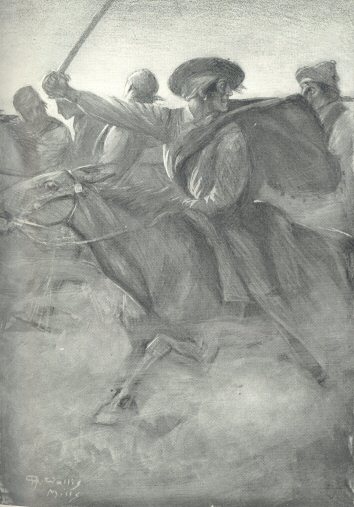
It was not uncommon for a large band or tribe to encamp in the
vicinity of a remote village scantily peopled, and to remain
there until, like a flight of locusts, they had consumed
everything which the inhabitants possessed for their support; or
until they were scared away by the approach of justice, or by an
army of rustics assembled from the surrounding country.
Then would ensue the hurried march; the women and children,
mounted on lean but spirited asses, would scour along the plains
fleeter than the wind; ragged and savage-looking men, wielding
the scourge and goad, would scamper by their side or close
behind, whilst perhaps a small party on strong horses, armed with
rusty matchlocks or sabres, would bring up the rear, threatening
the distant foe, and now and then saluting them with a hoarse
blast from the Gypsy horn:—
‘O, when I sit my courser bold,
My bantling in my rear,
And in my hand my musket hold—
O how they quake with fear!’
Let us for a moment suppose some unfortunate traveller,
mounted on a handsome mule or beast of some value, meeting,
unarmed and alone, such a rabble rout at the close of eve, in the
wildest part, for example, of La Mancha; we will suppose that he
is journeying from Seville to Madrid, and that he has left at a
considerable distance behind him the gloomy and horrible passes
of the Sierra Morena; his bosom, which for some time past has
been contracted with dreadful forebodings, is beginning to
expand; his blood, which has been congealed in his veins, is
beginning to circulate warmly and freely; he is fondly
anticipating the still distant posada and savoury omelet.
The sun is sinking rapidly behind the savage and uncouth hills in
his rear; he has reached the bottom of a small valley, where runs
a rivulet at which he allows his tired animal to drink; he is
about to ascend the side of the hill; his eyes are turned
upwards; suddenly he beholds strange and uncouth forms at the top
of the ascent—the sun descending slants its rays upon red
cloaks, with here and there a turbaned head, or long streaming
hair. The traveller hesitates, but reflecting that he is no
longer in the mountains, and that in the open road there is no
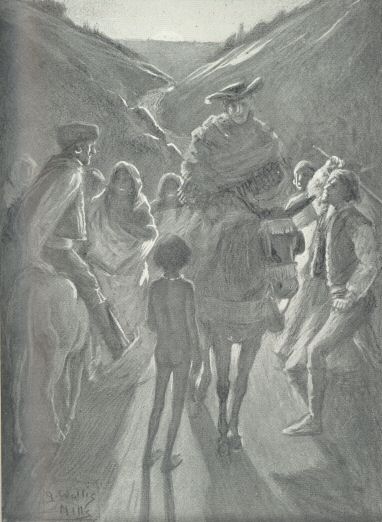
danger of banditti, he advances. In a moment he is in the
midst of the Gypsy group, in a moment there is a general halt;
fiery eyes are turned upon him replete with an expression which
only the eyes of the Roma possess, then ensues a jabber in a
language or jargon which is strange to the ears of the traveller;
at last an ugly urchin springs from the crupper of a halting
mule, and in a lisping accent entreats charity in the name of the
Virgin and the Majoro. The traveller, with a faltering
hand, produces his purse, and is proceeding to loosen its
strings, but he accomplishes not his purpose, for, struck
violently by a huge knotted club in an unseen hand, he tumbles
headlong from his mule. Next morning a naked corse,
besmeared with brains and blood, is found by an arriéro;
and within a week a simple cross records the event, according to
the custom of Spain.
‘Below there in the dusky pass
Was wrought a murder dread;
The murdered fell upon the grass,
Away the murderer fled.’
To many, such a scene, as above described, will appear purely
imaginary, or at least a mass of exaggeration, but many such
anecdotes are related by old Spanish writers of these people;
they traversed the country in gangs; they were what the Spanish
law has styled Abigeos and Salteadores de Camino, cattle-stealers
and highwaymen; though, in the latter character, they never rose
to any considerable eminence. True it is that they would
not hesitate to attack or even murder the unarmed and defenceless
traveller, when they felt assured of obtaining booty with little
or no risk to themselves; but they were not by constitution
adapted to rival those bold and daring banditti of whom so many
terrible anecdotes are related in Spain and Italy, and who have
acquired their renown by the dauntless daring which they have
invariably displayed in the pursuit of plunder.
Besides trafficking in horses and mules, and now and then
attacking and plundering travellers upon the highway, the Gypsies
of Spain appear, from a very early period, to have plied
occasionally the trade of the blacksmith, and to have worked in
iron, forming rude implements of domestic and agricultural use,
which they disposed of, either for provisions or money, in the
neighbourhood of those places where they had taken up their
temporary residence. As their bands were composed of
numerous individuals, there is no improbability in assuming that
to every member was allotted that branch of labour in which he
was most calculated to excel. The most important, and that
which required the greatest share of cunning and address, was
undoubtedly that of the chalan or jockey, who frequented the
fairs with the beasts which he had obtained by various means, but
generally by theft. Highway robbery, though occasionally
committed by all jointly or severally, was probably the peculiar
department of the boldest spirits of the gang; whilst wielding
the hammer and tongs was abandoned to those who, though possessed
of athletic forms, were perhaps, like Vulcan, lame, or from some
particular cause, moral or physical, unsuited for the other two
very respectable avocations. The forge was generally placed
in the heart of some mountain abounding in wood; the gaunt smiths
felled a tree, perhaps with the very axes which their own sturdy
hands had hammered at a former period; with the wood thus
procured they prepared the charcoal which their labour
demanded. Everything is in readiness; the bellows puff
until the coal is excited to a furious glow; the metal, hot,
pliant, and ductile, is laid on the anvil, round which stands the
Cyclop group, their hammers upraised; down they descend
successively, one, two, three, the sparks are scattered on every
side. The sparks—
‘More than a hundred lovely daughters I see
produced at one time, fiery as roses: in one moment they expire
gracefully circumvolving.’ [54]
The anvil rings beneath the thundering stroke, hour succeeds
hour, and still endures the hard sullen toil.
One of the most remarkable features in the history of Gypsies
is the striking similarity of their pursuits in every region of
the globe to which they have penetrated; they are not merely
alike in limb and in feature, in the cast and expression of the
eye, in the colour of the hair, in their walk and gait, but
everywhere they seem to exhibit the same tendencies, and to hunt
for their bread by the same means, as if they were not of the
human but rather of the animal species, and in lieu of reason
were endowed with a kind of instinct which assists them to a very
limited extent and no farther.
In no part of the world are they found engaged in the
cultivation of the earth, or in the service of a regular master;
but in all lands they are jockeys, or thieves, or cheats; and if
ever they devote themselves to any toil or trade, it is assuredly
in every material point one and the same. We have found
them above, in the heart of a wild mountain, hammering iron, and
manufacturing from it instruments either for their own use or
that of the neighbouring towns and villages. They may be
seen employed in a similar manner in the plains of Russia, or in
the bosom of its eternal forests; and whoever inspects the site
where a horde of Gypsies has encamped, in the grassy lanes
beneath the hazel bushes of merry England, is generally sure to
find relics of tin and other metal, avouching that they have
there been exercising the arts of the tinker or smith.
Perhaps nothing speaks more forcibly for the antiquity of this
sect or caste than the tenacity with which they have uniformly
preserved their peculiar customs since the period of their
becoming generally known; for, unless their habits had become a
part of their nature, which could only have been effected by a
strict devotion to them through a long succession of generations,
it is not to be supposed that after their arrival in civilised
Europe they would have retained and cherished them precisely in
the same manner in the various countries where they found an
asylum.
Each band or family of the Spanish Gypsies had its Captain,
or, as he was generally designated, its Count. Don Juan de
Quiñones, who, in a small volume published in 1632, has
written some details respecting their way of life, says:
‘They roam about, divided into families and troops, each of
which has its head or Count; and to fill this office they choose
the most valiant and courageous individual amongst them, and the
one endowed with the greatest strength. He must at the same
time be crafty and sagacious, and adapted in every respect to
govern them. It is he who settles their differences and
disputes, even when they are residing in a place where there is a
regular justice. He heads them at night when they go out to
plunder the flocks, or to rob travellers on the highway; and
whatever they steal or plunder they divide amongst them, always
allowing the captain a third part of the whole.’
These Counts, being elected for such qualities as promised to
be useful to their troop or family, were consequently liable to
be deposed if at any time their conduct was not calculated to
afford satisfaction to their subjects. The office was not
hereditary, and though it carried along with it partial
privileges, was both toilsome and dangerous. Should the
plans for plunder, which it was the duty of the Count to form,
miscarry in the attempt to execute them; should individuals of
the gang fall into the hand of justice, and the Count be unable
to devise a method to save their lives or obtain their liberty,
the blame was cast at the Count’s door, and he was in
considerable danger of being deprived of his insignia of
authority, which consisted not so much in ornaments or in dress,
as in hawks and hounds with which the Señor Count took the
diversion of hunting when he thought proper. As the ground
which he hunted over was not his own, he incurred some danger of
coming in contact with the lord of the soil, attended, perhaps,
by his armed followers. There is a tradition (rather
apocryphal, it is true), that a Gitáno chief, once
pursuing this amusement, was encountered by a real Count, who is
styled Count Pepe. An engagement ensued between the two
parties, which ended in the Gypsies being worsted, and their
chief left dying on the field. The slain chief leaves a
son, who, at the instigation of his mother, steals the infant
heir of his father’s enemy, who, reared up amongst the
Gypsies, becomes a chief, and, in process of time, hunting over
the same ground, slays Count Pepe in the very spot where the
blood of the Gypsy had been poured out. This tradition is
alluded to in the following stanza:—
‘I have a gallant mare in stall;
My mother gave that mare
That I might seek Count Pepe’s hall
And steal his son and heir.’
Martin Del Rio, in his Tractatus de Magia, speaks of
the Gypsies and their Counts to the following effect:
‘When, in the year 1584, I was marching in Spain with the
regiment, a multitude of these wretches were infesting the
fields. It happened that the feast of Corpus Domini was
being celebrated, and they requested to be admitted into the
town, that they might dance in honour of the sacrifice, as was
customary; they did so, but about midday a great tumult arose
owing to the many thefts which the women committed, whereupon
they fled out of the suburbs, and assembled about St.
Mark’s, the magnificent mansion and hospital of the knights
of St. James, where the ministers of justice attempting to seize
them were repulsed by force of arms; nevertheless, all of a
sudden, and I know not how, everything was hushed up. At
this time they had a Count, a fellow who spoke the Castilian
idiom with as much purity as if he had been a native of Toledo;
he was acquainted with all the ports of Spain, and all the
difficult and broken ground of the provinces. He knew the
exact strength of every city, and who were the principal people
in each, and the exact amount of their property; there was
nothing relating to the state, however secret, that he was not
acquainted with; nor did he make a mystery of his knowledge, but
publicly boasted of it.’
From the passage quoted above, we learn that the
Gitános in the ancient times were considered as foreigners
who prowled about the country; indeed, in many of the laws which
at various times have been promulgated against them, they are
spoken of as Egyptians, and as such commanded to leave Spain, and
return to their native country; at one time they undoubtedly were
foreigners in Spain, foreigners by birth, foreigners by language
but at the time they are mentioned by the worthy Del Rio, they
were certainly not entitled to the appellation. True it is
that they spoke a language amongst themselves, unintelligible to
the rest of the Spaniards, from whom they differed considerably
in feature and complexion, as they still do; but if being born in
a country, and being bred there, constitute a right to be
considered a native of that country, they had as much claim to
the appellation of Spaniards as the worthy author himself.
Del Rio mentions, as a remarkable circumstance, the fact of the
Gypsy Count speaking Castilian with as much purity as a native of
Toledo, whereas it is by no means improbable that the individual
in question was a native of that town; but the truth is, at the
time we are speaking of, they were generally believed to be not
only foreigners, but by means of sorcery to have acquired the
power of speaking all languages with equal facility; and Del Rio,
who was a believer in magic, and wrote one of the most curious
and erudite treatises on the subject ever penned, had perhaps
adopted that idea, which possibly originated from their speaking
most of the languages and dialects of the Peninsula, which they
picked up in their wanderings. That the Gypsy chief was so
well acquainted with every town of Spain, and the broken and
difficult ground, can cause but little surprise, when we reflect
that the life which the Gypsies led was one above all others
calculated to afford them that knowledge. They were
continually at variance with justice; they were frequently
obliged to seek shelter in the inmost recesses of the hills; and
when their thievish pursuits led them to the cities, they
naturally made themselves acquainted with the names of the
principal individuals, in hopes of plundering them.
Doubtless the chief possessed all this species of knowledge in a
superior degree, as it was his courage, acuteness, and experience
alone which placed him at the head of his tribe, though Del Rio
from this circumstance wishes to infer that the Gitános
were spies sent by foreign foes, and with some simplicity
inquires, ‘Quo ant cui rei hæc curiosa exploratio?
nonne compescenda vagamundorum hæc curiositas, etiam si
solum peregrini et inculpatæ vitæ.’
With the Counts rested the management and direction of these
remarkable societies; it was they who determined their marches,
counter-marches, advances, and retreats; what was to be attempted
or avoided; what individuals were to be admitted into the
fellowship and privileges of the Gitános, or who were to
be excluded from their society; they settled disputes and sat in
judgment over offences. The greatest crimes, according to
the Gypsy code, were a quarrelsome disposition, and revealing the
secrets of the brotherhood. By this code the members were
forbidden to eat, drink, or sleep in the house of a Busno, which
signifies any person who is not of the sect of the Gypsies, or to
marry out of that sect; they were likewise not to teach the
language of Roma to any but those who, by birth or inauguration,
belonged to that sect; they were enjoined to relieve their
brethren in distress at any expense or peril; they were to use a
peculiar dress, which is frequently alluded to in the Spanish
laws, but the particulars of which are not stated; and they were
to cultivate the gift of speech to the utmost possible extent,
and never to lose anything which might be obtained by a loose and
deceiving tongue, to encourage which they had many excellent
proverbs, for example—
‘The poor fool who closes his mouth never
winneth a dollar.’
‘The river which runneth with sound bears along with it
stones and water.’
The Gitános not unfrequently
made their appearance in considerable numbers, so as to be able
to bid defiance to any force which could be assembled against
them on a sudden; whole districts thus became a prey to them, and
were plundered and devastated.
It is said that, in the year 1618, more than eight hundred of
these wretches scoured the country between Castile and Aragon,
committing the most enormous crimes. The royal council
despatched regular troops against them, who experienced some
difficulty in dispersing them.
But we now proceed to touch upon an event which forms an era
in the history of the Gitános of Spain, and which for
wildness and singularity throws all other events connected with
them and their race, wherever found, entirely into the shade.
About the middle of the sixteenth century, there resided one
Francisco Alvarez in the city of Logroño, the chief town
of Rioja, a province which borders on Aragon. He was a man
above the middle age, sober, reserved, and in general absorbed in
thought; he lived near the great church, and obtained a
livelihood by selling printed books and manuscripts in a small
shop. He was a very learned man, and was continually
reading in the books which he was in the habit of selling, and
some of these books were in foreign tongues and characters, so
foreign, indeed, that none but himself and some of his friends,
the canons, could understand them; he was much visited by the
clergy, who were his principal customers, and took much pleasure
in listening to his discourse.
He had been a considerable traveller in his youth, and had
wandered through all Spain, visiting the various provinces and
the most remarkable cities. It was likewise said that he
had visited Italy and Barbary. He was, however, invariably
silent with respect to his travels, and whenever the subject was
mentioned to him, the gloom and melancholy increased which
usually clouded his features.
One day, in the commencement of autumn, he was visited by a
priest with whom he had long been intimate, and for whom he had
always displayed a greater respect and liking than for any other
acquaintance. The ecclesiastic found him even more sad than
usual, and there was a haggard paleness upon his countenance
which alarmed his visitor. The good priest made
affectionate inquiries respecting the health of his friend, and
whether anything had of late occurred to give him uneasiness;
adding at the same time, that he had long suspected that some
secret lay heavy upon his mind, which he now conjured him to
reveal, as life was uncertain, and it was very possible that he
might be quickly summoned from earth into the presence of his
Maker.
The bookseller continued for some time in gloomy meditation,
till at last he broke silence in these words:—‘It is
true I have a secret which weighs heavy upon my mind, and which I
am still loth to reveal; but I have a presentiment that my end is
approaching, and that a heavy misfortune is about to fall upon
this city: I will therefore unburden myself, for it were now a
sin to remain silent.
‘I am, as you are aware, a native of this town, which I
first left when I went to acquire an education at Salamanca; I
continued there until I became a licentiate, when I quitted the
university and strolled through Spain, supporting myself in
general by touching the guitar, according to the practice of
penniless students; my adventures were numerous, and I frequently
experienced great poverty. Once, whilst making my way from
Toledo to Andalusia through the wild mountains, I fell in with
and was made captive by a band of the people called
Gitános, or wandering Egyptians; they in general lived
amongst these wilds, and plundered or murdered every person whom
they met. I should probably have been assassinated by them,
but my skill in music perhaps saved my life. I continued
with them a considerable time, till at last they persuaded me to
become one of them, whereupon I was inaugurated into their
society with many strange and horrid ceremonies, and having thus
become a Gitáno, I went with them to plunder and
assassinate upon the roads.
‘The Count or head man of these Gitános had an
only daughter, about my own age; she was very beautiful, but, at
the same time, exceedingly strong and robust; this Gitána
was given to me as a wife or cadjee, and I lived with her several
years, and she bore me children.
‘My wife was an arrant Gitána, and in her all the
wickedness of her race seemed to be concentrated. At last
her father was killed in an affray with the troopers of the
Hermandad, whereupon my wife and myself succeeded to the
authority which he had formerly exercised in the tribe. We
had at first loved each other, but at last the Gitáno
life, with its accompanying wickedness, becoming hateful to my
eyes, my wife, who was not slow in perceiving my altered
disposition, conceived for me the most deadly hatred;
apprehending that I meditated withdrawing myself from the
society, and perhaps betraying the secrets of the band, she
formed a conspiracy against me, and, at one time, being opposite
the Moorish coast, I was seized and bound by the other
Gitános, conveyed across the sea, and delivered as a slave
into the hands of the Moors.
‘I continued for a long time in slavery in various parts
of Morocco and Fez, until I was at length redeemed from my state
of bondage by a missionary friar who paid my ransom. With
him I shortly after departed for Italy, of which he was a
native. In that country I remained some years, until a
longing to revisit my native land seized me, when I returned to
Spain and established myself here, where I have since lived by
vending books, many of which I brought from the strange lands
which I visited. I kept my history, however, a profound
secret, being afraid of exposing myself to the laws in force
against the Gitános, to which I should instantly become
amenable, were it once known that I had at any time been a member
of this detestable sect.
‘My present wretchedness, of which you have demanded the
cause, dates from yesterday; I had been on a short journey to the
Augustine convent, which stands on the plain in the direction of
Saragossa, carrying with me an Arabian book, which a learned monk
was desirous of seeing. Night overtook me ere I could
return. I speedily lost my way, and wandered about until I
came near a dilapidated edifice with which I was acquainted; I
was about to proceed in the direction of the town, when I heard
voices within the ruined walls; I listened, and recognised the
language of the abhorred Gitános; I was about to fly, when
a word arrested me. It was Drao, which in their tongue
signifies the horrid poison with which this race are in the habit
of destroying the cattle; they now said that the men of
Logroño should rue the Drao which they had been
casting. I heard no more, but fled. What increased my
fear was, that in the words spoken, I thought I recognised the
peculiar jargon of my own tribe; I repeat, that I believe some
horrible misfortune is overhanging this city, and that my own
days are numbered.’
The priest, having conversed with him for some time upon
particular points of the history that he had related, took his
leave, advising him to compose his spirits, as he saw no reason
why he should indulge in such gloomy forebodings.
The very next day a sickness broke out in the town of
Logroño. It was one of a peculiar kind; unlike most
others, it did not arise by slow and gradual degrees, but at once
appeared in full violence, in the shape of a terrific
epidemic. Dizziness in the head was the first symptom: then
convulsive retchings, followed by a dreadful struggle between
life and death, which generally terminated in favour of the grim
destroyer. The bodies, after the spirit which animated them
had taken flight, were frightfully swollen, and exhibited a dark
blue colour, checkered with crimson spots. Nothing was
heard within the houses or the streets, but groans of agony; no
remedy was at hand, and the powers of medicine were exhausted in
vain upon this terrible pest; so that within a few days the
greatest part of the inhabitants of Logroño had
perished. The bookseller had not been seen since the
commencement of this frightful visitation.
Once, at the dead of night, a knock was heard at the door of
the priest, of whom we have already spoken; the priest himself
staggered to the door, and opened it,—he was the only one
who remained alive in the house, and was himself slowly
recovering from the malady which had destroyed all the other
inmates; a wild spectral-looking figure presented itself to his
eye—it was his friend Alvarez. Both went into the
house, when the bookseller, glancing gloomily on the wasted
features of the priest, exclaimed, ‘You too, I see, amongst
others, have cause to rue the Drao which the Gitános have
cast. Know,’ he continued, ‘that in order to
accomplish a detestable plan, the fountains of Logroño
have been poisoned by emissaries of the roving bands, who are now
assembled in the neighbourhood. On the first appearance of
the disorder, from which I happily escaped by tasting the water
of a private fountain, which I possess in my own house, I
instantly recognised the effects of the poison of the
Gitános, brought by their ancestors from the isles of the
Indian sea; and suspecting their intentions, I disguised myself
as a Gitáno, and went forth in the hope of being able to
act as a spy upon their actions. I have been successful,
and am at present thoroughly acquainted with their designs.
They intended, from the first, to sack the town, as soon as it
should have been emptied of its defenders.
‘Midday, to-morrow, is the hour in which they have
determined to make the attempt. There is no time to be
lost; let us, therefore, warn those of our townsmen who still
survive, in order that they may make preparations for their
defence.’
Whereupon the two friends proceeded to the chief magistrate,
who had been but slightly affected by the disorder; he heard the
tale of the bookseller with horror and astonishment, and
instantly took the best measures possible for frustrating the
designs of the Gitános; all the men capable of bearing
arms in Logroño were assembled, and weapons of every
description put in their hands. By the advice of the
bookseller all the gates of the town were shut, with the
exception of the principal one; and the little band of defenders,
which barely amounted to sixty men, was stationed in the great
square, to which, he said, it was the intention of the
Gitános to penetrate in the first instance, and then,
dividing themselves into various parties, to sack the
place. The bookseller was, by general desire, constituted
leader of the guardians of the town.
It was considerably past noon; the sky was overcast, and
tempest clouds, fraught with lightning and thunder, were hanging
black and horrid over the town of Logroño. The
little troop, resting on their arms, stood awaiting the arrival
of their unnatural enemies; rage fired their minds as they
thought of the deaths of their fathers, their sons, and their
dearest relatives, who had perished, not by the hand of God, but,
like infected cattle, by the hellish arts of Egyptian
sorcerers. They longed for their appearance, determined to
wreak upon them a bloody revenge; not a word was uttered, and
profound silence reigned around, only interrupted by the
occasional muttering of the thunder-clouds. Suddenly,
Alvarez, who had been intently listening, raised his hand with a
significant gesture; presently, a sound was heard—a
rustling like the waving of trees, or the rushing of distant
water; it gradually increased, and seemed to proceed from the
narrow street which led from the principal gate into the
square. All eyes were turned in that direction. . . .
That night there was repique or ringing of bells in the towers
of Logroño, and the few priests who had escaped from the
pestilence sang litanies to God and the Virgin for the salvation
of the town from the hands of the heathen. The attempt of
the Gitános had been most signally defeated, and the great
square and the street were strewn with their corpses. Oh!
what frightful objects: there lay grim men more black than
mulattos, with fury and rage in their stiffened features; wild
women in extraordinary dresses, their hair, black and long as the
tail of the horse, spread all dishevelled upon the ground; and
gaunt and naked children grasping knives and daggers in their
tiny hands. Of the patriotic troop not one appeared to have
fallen; and when, after their enemies had retreated with howlings
of fiendish despair, they told their numbers, only one man was
missing, who was never seen again, and that man was Alvarez.
In the midst of the combat, the tempest, which had for a long
time been gathering, burst over Logroño, in lightning,
thunder, darkness, and vehement hail.
A man of the town asserted that the last time he had seen
Alvarez, the latter was far in advance of his companions,
defending himself desperately against three powerful young
heathen, who seemed to be acting under the direction of a tall
woman who stood nigh, covered with barbaric ornaments, and
wearing on her head a rude silver crown. [69]
Such is the tale of the Bookseller of Logroño, and such
is the narrative of the attempt of the Gitános to sack the
town in the time of pestilence, which is alluded to by many
Spanish authors, but more particularly by the learned Francisco
de Cordova, in his Didascalia, one of the most curious and
instructive books within the circle of universal literature.
The Moors, after their subjugation,
and previous to their expulsion from Spain, generally resided
apart, principally in the suburbs of the towns, where they kept
each other in countenance, being hated and despised by the
Spaniards, and persecuted on all occasions. By this means
they preserved, to a certain extent, the Arabic language, though
the use of it was strictly forbidden, and encouraged each other
in the secret exercise of the rites of the Mohammedan religion,
so that, until the moment of their final expulsion, they
continued Moors in almost every sense of the word. Such
places were called Morerias, or quarters of the Moors.
In like manner there were Gitanerias, or quarters of the
Gitános, in many of the towns of Spain; and in more than
one instance particular barrios or districts are still known by
this name, though the Gitános themselves have long since
disappeared. Even in the town of Oviedo, in the heart of
the Asturias, a province never famous for Gitános, there
is a place called the Gitaneria, though no Gitáno has been
known to reside in the town within the memory of man, nor indeed
been seen, save, perhaps, as a chance visitor at a fair.
The exact period when the Gitános first formed these
colonies within the towns is not known; the laws, however, which
commanded them to abandon their wandering life under penalty of
banishment and death, and to become stationary in towns, may have
induced them first to take such a step. By the first of
these laws, which was made by Ferdinand and Isabella as far back
as the year 1499, they are commanded to seek out for themselves
masters. This injunction they utterly disregarded.
Some of them for fear of the law, or from the hope of bettering
their condition, may have settled down in the towns, cities, and
villages for a time, but to expect that a people, in whose bosoms
was so deeply rooted the love of lawless independence, would
subject themselves to the yoke of servitude, from any motive
whatever, was going too far; as well might it have been expected,
according to the words of the great poet of Persia, that they
would have washed their skins white.
In these Gitanerias, therefore, many Gypsy families resided,
but ever in the Gypsy fashion, in filth and in misery, with
little of the fear of man, and nothing of the fear of God before
their eyes. Here the swarthy children basked naked in the
sun before the doors; here the women prepared love draughts, or
told the buena ventura; and here the men plied the trade of the
blacksmith, a forbidden occupation, or prepared for sale, by
disguising them, animals stolen by themselves or their
accomplices. In these places were harboured the strange
Gitános on their arrival, and here were discussed in the
Rommany language, which, like the Arabic, was forbidden under
severe penalties, plans of fraud and plunder, which were perhaps
intended to be carried into effect in a distant province and a
distant city.
The great body, however, of the Gypsy race in Spain continued
independent wanderers of the plains and the mountains, and indeed
the denizens of the Gitanerias were continually sallying forth,
either for the purpose of reuniting themselves with the wandering
tribes, or of strolling about from town to town, and from fair to
fair. Hence the continual complaints in the Spanish laws
against the Gitános who have left their places of
domicile, from doing which they were interdicted, even as they
were interdicted from speaking their language and following the
occupations of the blacksmith and horse-dealer, in which they
still persist even at the present day.
The Gitanerias at evening fall were frequently resorted to by
individuals widely differing in station from the inmates of these
places—we allude to the young and dissolute nobility and
hidalgos of Spain. This was generally the time of mirth and
festival, and the Gitános, male and female, danced and
sang in the Gypsy fashion beneath the smile of the moon.
The Gypsy women and girls were the principal attractions to these
visitors; wild and singular as these females are in their
appearance, there can be no doubt, for the fact has been
frequently proved, that they are capable of exciting passion of
the most ardent description, particularly in the bosoms of those
who are not of their race, which passion of course becomes the
more violent when the almost utter impossibility of gratifying it
is known. No females in the world can be more licentious in
word and gesture, in dance and in song, than the Gitánas;
but there they stop: and so of old, if their titled visitors
presumed to seek for more, an unsheathed dagger or gleaming knife
speedily repulsed those who expected that the gem most dear
amongst the sect of the Roma was within the reach of a Busno.
Such visitors, however, were always encouraged to a certain
point, and by this and various other means the Gitános
acquired connections which frequently stood them in good stead in
the hour of need. What availed it to the honest labourers
of the neighbourhood, or the citizens of the town, to make
complaints to the corregidor concerning the thefts and frauds
committed by the Gitános, when perhaps the sons of that
very corregidor frequented the nightly dances at the Gitaneria,
and were deeply enamoured with some of the dark-eyed
singing-girls? What availed making complaints, when perhaps
a Gypsy sibyl, the mother of those very girls, had free admission
to the house of the corregidor at all times and seasons, and
spaed the good fortune to his daughters, promising them counts
and dukes, and Andalusian knights in marriage, or prepared
philtres for his lady by which she was always to reign supreme in
the affections of her husband? And, above all, what availed
it to the plundered party to complain that his mule or horse had
been stolen, when the Gitáno robber, perhaps the husband
of the sibyl and the father of the black-eyed Gitanillas, was at
that moment actually in treaty with my lord the corregidor
himself for supplying him with some splendid thick-maned,
long-tailed steed at a small price, to be obtained, as the reader
may well suppose, by an infraction of the laws? The favour
and protection which the Gitános experienced from people
of high rank is alluded to in the Spanish laws, and can only be
accounted for by the motives above detailed.
The Gitanerias were soon considered as public nuisances, on
which account the Gitános were forbidden to live together
in particular parts of the town, to hold meetings, and even to
intermarry with each other; yet it does not appear that the
Gitanerias were ever suppressed by the arm of the law, as many
still exist where these singular beings ‘marry and are
given in marriage,’ and meet together to discuss their
affairs, which, in their opinion, never flourish unless those of
their fellow-creatures suffer. So much for the Gitanerias,
or Gypsy colonies in the towns of Spain.
‘Los Gitános son muy
malos!—the Gypsies are very bad people,’ said the
Spaniards of old times. They are cheats; they are
highwaymen; they practise sorcery; and, lest the catalogue of
their offences should be incomplete, a formal charge of
cannibalism was brought against them. Cheats they have
always been, and highwaymen, and if not sorcerers, they have
always done their best to merit that appellation, by arrogating
to themselves supernatural powers; but that they were addicted to
cannibalism is a matter not so easily proved.
Their principal accuser was Don Juan de Quiñones, who,
in the work from which we have already had occasion to quote,
gives several anecdotes illustrative of their cannibal
propensities. Most of these anecdotes, however, are so
highly absurd, that none but the very credulous could ever have
vouchsafed them the slightest credit. This author is
particularly fond of speaking of a certain juez, or judge, called
Don Martin Fajardo, who seems to have been an arrant
Gypsy-hunter, and was probably a member of the ancient family of
the Fajardos, which still flourishes in Estremadura, and with
individuals of which we are acquainted. So it came to pass
that this personage was, in the year 1629, at Jaraicejo, in
Estremadura, or, as it is written in the little book in question,
Zaraizejo, in the capacity of judge; a zealous one he undoubtedly
was.
A very strange place is this same Jaraicejo, a small ruinous
town or village, situated on a rising ground, with a very wild
country all about it. The road from Badajoz to Madrid
passes through it; and about two leagues distant, in the
direction of Madrid, is the famous mountain pass of
Mirabéte, from the top of which you enjoy a most
picturesque view across the Tagus, which flows below, as far as
the huge mountains of Plasencia, the tops of which are generally
covered with snow.
So this Don Martin Fajardo, judge, being at Jaraicejo, laid
his claw upon four Gitános, and having nothing, as it
appears, to accuse them of, except being Gitános, put them
to the torture, and made them accuse themselves, which they did;
for, on the first appeal which was made to the rack, they
confessed that they had murdered a female Gypsy in the forest of
Las Gamas, and had there eaten her. . . .
I am myself well acquainted with this same forest of Las
Gamas, which lies between Jaraicejo and Trujillo; it abounds with
chestnut and cork trees, and is a place very well suited either
for the purpose of murder or cannibalism. It will be as
well to observe that I visited it in company with a band of
Gitános, who bivouacked there, and cooked their supper,
which however did not consist of human flesh, but of a
puchéra, the ingredients of which were beef, bacon,
garbanzos, and berdolaga, or field-pease and
purslain,—therefore I myself can bear testimony that there
is such a forest as Las Gamas, and that it is frequented
occasionally by Gypsies, by which two points are established by
far the most important to the history in question, or so at least
it would be thought in Spain, for being sure of the forest and
the Gypsies, few would be incredulous enough to doubt the facts
of the murder and cannibalism. . . .
On being put to the rack a second time, the Gitános
confessed that they had likewise murdered and eaten a female
pilgrim in the forest aforesaid; and on being tortured yet again,
that they had served in the same manner, and in the same forest,
a friar of the order of San Francisco, whereupon they were
released from the rack and executed. This is one of the
anecdotes of Quiñones.
And it came to pass, moreover, that the said Fajardo, being in
the town of Montijo, was told by the alcalde, that a certain
inhabitant of that place had some time previous lost a mare; and
wandering about the plains in quest of her, he arrived at a place
called Arroyo el Puerco, where stood a ruined house, on entering
which he found various Gitános employed in preparing their
dinner, which consisted of a quarter of a human body, which was
being roasted before a huge fire: the result, however, we are not
told; whether the Gypsies were angry at being disturbed in their
cookery, or whether the man of the mare departed unobserved.
Quiñones, in continuation, states in his book that he
learned (he does not say from whom, but probably from Fajardo)
that there was a shepherd of the city of Gaudix, who once lost
his way in the wild sierra of Gadol: night came on, and the wind
blew cold: he wandered about until he descried a light in the
distance, towards which he bent his way, supposing it to be a
fire kindled by shepherds: on arriving at the spot, however, he
found a whole tribe of Gypsies, who were roasting the half of a
man, the other half being hung on a cork-tree: the Gypsies
welcomed him very heartily, and requested him to be seated at the
fire and to sup with them; but he presently heard them whisper to
each other, ‘this is a fine fat fellow,’ from which
he suspected that they were meditating a design upon his body:
whereupon, feeling himself sleepy, he made as if he were seeking
a spot where to lie, and suddenly darted headlong down the
mountain-side, and escaped from their hands without breaking his
neck.
These anecdotes scarcely deserve comment; first we have the
statement of Fajardo, the fool or knave who tortures wretches,
and then puts them to death for the crimes with which they have
taxed themselves whilst undergoing the agony of the rack,
probably with the hope of obtaining a moment’s respite;
last comes the tale of the shepherd, who is invited by Gypsies on
a mountain at night to partake of a supper of human flesh, and
who runs away from them on hearing them talk of the fatness of
his own body, as if cannibal robbers detected in their orgies by
a single interloper would have afforded him a chance of
escaping. Such tales cannot be true. [79]
Cases of cannibalism are said to have occurred in Hungary
amongst the Gypsies; indeed, the whole race, in that country, has
been accused of cannibalism, to which we have alluded whilst
speaking of the Chingany: it is very probable, however, that they
were quite innocent of this odious practice, and that the
accusation had its origin in popular prejudice, or in the fact of
their foul feeding, and their seldom rejecting carrion or offal
of any description.
The Gazette of Frankfort for the year 1782, Nos. 157 and 207,
states that one hundred and fifty Gypsies were imprisoned charged
with this practice; and that the Empress Teresa sent
commissioners to inquire into the facts of the accusation, who
discovered that they were true; whereupon the empress published a
law to oblige all the Gypsies in her dominions to become
stationary, which, however, had no effect.
Upon this matter we can state nothing on our own
knowledge.
After the above anecdotes, it will perhaps not be amiss to
devote a few lines to the subject of Gypsy food and diet. I
believe that it has been asserted that the Romas, in all parts of
the world, are perfectly indifferent as to what they eat,
provided only that they can appease their hunger; and that they
have no objection to partake of the carcasses of animals which
have died a natural death, and have been left to putrefy by the
roadside; moreover, that they use for food all kinds of reptiles
and vermin which they can lay their hands upon.
In this there is a vast deal of exaggeration, but at the same
time it must be confessed that, in some instances, the habits of
the Gypsies in regard to food would seem, at the first glance, to
favour the supposition. This observation chiefly holds good
with respect to those of the Gypsy race who still continue in a
wandering state, and who, doubtless, retain more of the ways and
customs of their forefathers than those who have adopted a
stationary life. There can be no doubt that the wanderers
amongst the Gypsy race are occasionally seen to feast upon
carcasses of cattle which have been abandoned to the birds of the
air, yet it would be wrong, from this fact, to conclude that the
Gypsies were habitual devourers of carrion. Carrion it is
true they may occasionally devour, from want of better food, but
many of these carcasses are not in reality the carrion which they
appear, but are the bodies of animals which the Gypsies have
themselves killed by casting drao, in hope that the flesh may
eventually be abandoned to them. It is utterly useless to
write about the habits of the Gypsies, especially of the
wandering tribes, unless you have lived long and intimately with
them; and unhappily, up to the present time, all the books which
have been published concerning them have been written by those
who have introduced themselves into their society for a few
hours, and from what they have seen or heard consider themselves
competent to give the world an idea of the manners and customs of
the mysterious Rommany: thus, because they have been known to beg
the carcass of a hog which they themselves have poisoned, it has
been asserted that they prefer carrion which has perished of
sickness to the meat of the shambles; and because they have been
seen to make a ragout of boror (snails), and to roast a
hotchiwitchu or hedgehog, it has been supposed that reptiles of
every description form a part of their cuisine. It is high
time to undeceive the Gentiles on these points. Know, then,
O Gentile, whether thou be from the land of the Gorgios [82a] or the Busné [82b], that the very Gypsies who consider a
ragout of snails a delicious dish will not touch an eel, because
it bears resemblance to a snake; and that those who will
feast on a roasted hedgehog could be induced by no money to taste
a squirrel, a delicious and wholesome species of game, living on
the purest and most nutritious food which the fields and forests
can supply. I myself, while living among the Roms of
England, have been regarded almost in the light of a cannibal for
cooking the latter animal and preferring it to hotchiwitchu
barbecued, or ragout of boror. ‘You are but half
Rommany, brother,’ they would say, ‘and you feed
gorgiko-nes (like a Gentile), even as you talk.
Tchachipen (in truth), if we did not know you to be of the
Mecralliskoe rat (royal blood) of Pharaoh, we should be
justified in driving you forth as a juggel-mush (dog man),
one more fitted to keep company with wild beasts and Gorgios than
gentle Rommanys.’
No person can read the present volume without perceiving, at a
glance, that the Romas are in most points an anomalous people; in
their morality there is much of anomaly, and certainly not less
in their cuisine.
‘Los Gitános son muy malos; llevan niños
hurtados a Berberia. The Gypsies are very bad people; they
steal children and carry them to Barbary, where they sell them to
the Moors’—so said the Spaniards in old times.
There can be little doubt that even before the fall of the
kingdom of Granada, which occurred in the year 1492, the
Gitános had intercourse with the Moors of Spain.
Andalusia, which has ever been the province where the
Gitáno race has most abounded since its arrival, was,
until the edict of Philip the Third, which banished more than a
million of Moriscos from Spain, principally peopled by Moors, who
differed from the Spaniards both in language and religion.
By living even as wanderers amongst these people, the
Gitános naturally became acquainted with their tongue, and
with many of their customs, which of course much facilitated any
connection which they might subsequently form with the
Barbaresques. Between the Moors of Barbary and the
Spaniards a deadly and continued war raged for centuries, both
before and after the expulsion of the Moriscos from Spain.
The Gitános, who cared probably as little for one nation
as the other, and who have no sympathy and affection beyond the
pale of their own sect, doubtless sided with either as their
interest dictated, officiating as spies for both parties and
betraying both.
It is likely enough that they frequently passed over to
Barbary with stolen children of both sexes, whom they sold to the
Moors, who traffic in slaves, whether white or black, even at the
present day; and perhaps this kidnapping trade gave occasion to
other relations. As they were perfectly acquainted, from
their wandering life, with the shores of the Spanish
Mediterranean, they must have been of considerable assistance to
the Barbary pirates in their marauding trips to the Spanish
coasts, both as guides and advisers; and as it was a far easier
matter, and afforded a better prospect of gain, to plunder the
Spaniards than the Moors, a people almost as wild as themselves,
they were, on that account, and that only, more Moors than
Christians, and ever willing to assist the former in their forays
on the latter.
Quiñones observes: ‘The Moors, with whom they
hold correspondence, let them go and come without any let or
obstacle: an instance of this was seen in the year 1627, when two
galleys from Spain were carrying assistance to Marmora, which was
then besieged by the Moors. These galleys struck on a
shoal, when the Moors seized all the people on board, making
captives of the Christians and setting at liberty all the Moors,
who were chained to the oar; as for the Gypsy galley-slaves whom
they found amongst these last, they did not make them slaves, but
received them as people friendly to them, and at their devotion;
which matter was public and notorious.’
Of the Moors and the Gitános we shall have occasion to
say something in the following chapter.
There is no portion of the world so
little known as Africa in general; and perhaps of all Africa
there is no corner with which Europeans are so little acquainted
as Barbary, which nevertheless is only separated from the
continent of Europe by a narrow strait of four leagues
across.
China itself has, for upwards of a century, ceased to be a
land of mystery to the civilised portion of the world; the
enterprising children of Loyola having wandered about it in every
direction making converts to their doctrine and discipline,
whilst the Russians possess better maps of its vast regions than
of their own country, and lately, owing to the persevering labour
and searching eye of my friend Hyacinth, Archimandrite of Saint
John Nefsky, are acquainted with the number of its military force
to a man, and also with the names and places of residence of its
civil servants. Yet who possesses a map of Fez and Morocco,
or would venture to form a conjecture as to how many fiery
horsemen Abderrahman, the mulatto emperor, could lead to the
field, were his sandy dominions threatened by the Nazarene?
Yet Fez is scarcely two hundred leagues distant from Madrid,
whilst Maraks, the other great city of the Moors, and which also
has given its name to an empire, is scarcely farther removed from
Paris, the capital of civilisation: in a word, we scarcely know
anything of Barbary, the scanty information which we possess
being confined to a few towns on the sea-coast; the zeal of the
Jesuit himself being insufficient to induce him to confront the
perils of the interior, in the hopeless endeavour of making one
single proselyte from amongst the wildest fanatics of the creed
of the Prophet Camel-driver.
Are wanderers of the Gypsy race to be found in Barbary?
This is a question which I have frequently asked myself.
Several respectable authors have, I believe, asserted the fact,
amongst whom Adelung, who, speaking of the Gypsies, says:
‘Four hundred years have passed away since they departed
from their native land. During this time, they have spread
themselves through the whole of Western Asia, Europe, and
Northern Africa.’ [86] But it is one
thing to make an assertion, and another to produce the grounds
for making it. I believe it would require a far greater
stock of information than has hitherto been possessed by any one
who has written on the subject of the Gypsies, to justify him in
asserting positively that after traversing the west of Europe,
they spread themselves over Northern Africa, though true it is
that to those who take a superficial view of the matter, nothing
appears easier and more natural than to come to such a
conclusion.
Tarifa, they will say, the most western part of Spain, is
opposite to Tangier, in Africa, a narrow sea only running
between, less wide than many rivers. Bands, therefore, of
these wanderers, of course, on reaching Tarifa, passed over into
Africa, even as thousands crossed the channel from France to
England. They have at all times shown themselves
extravagantly fond of a roving life. What land is better
adapted for such a life than Africa and its wilds? What
land, therefore, more likely to entice them?
All this is very plausible. It was easy enough for the
Gitános to pass over to Tangier and Tetuan from the
Spanish towns of Tarifa and Algeziras. In the last chapter
I have stated my belief of the fact, and that moreover they
formed certain connections with the Moors of the coast, to whom
it is likely that they occasionally sold children stolen in
Spain; yet such connection would by no means have opened them a
passage into the interior of Barbary, which is inhabited by wild
and fierce people, in comparison with whom the Moors of the
coast, bad as they always have been, are gentle and
civilised.
To penetrate into Africa, the Gitános would have been
compelled to pass through the tribes who speak the Shilha
language, and who are the descendants of the ancient
Numidians. These tribes are the most untamable and warlike
of mankind, and at the same time the most suspicious, and those
who entertain the greatest aversion to foreigners. They are
dreaded by the Moors themselves, and have always remained, to a
certain degree, independent of the emperors of Morocco.
They are the most terrible of robbers and murderers, and
entertain far more reluctance to spill water than the blood of
their fellow-creatures: the Bedouins, also, of the Arabian race,
are warlike, suspicious, and cruel; and would not have failed
instantly to attack bands of foreign wanderers, wherever they
found them, and in all probability would have exterminated
them. Now the Gitános, such as they arrived in
Barbary, could not have defended themselves against such enemies,
had they even arrived in large divisions, instead of bands of
twenties and thirties, as is their custom to travel. They
are not by nature nor by habit a warlike race, and would have
quailed before the Africans, who, unlike most other people,
engage in wars from what appears to be an innate love of the
cruel and bloody scenes attendant on war.
It may be said, that if the Gitános were able to make
their way from the north of India, from Multan, for example, the
province which the learned consider to be the original
dwelling-place of the race, to such an immense distance as the
western part of Spain, passing necessarily through many wild
lands and tribes, why might they not have penetrated into the
heart of Barbary, and wherefore may not their descendants be
still there, following the same kind of life as the European
Gypsies, that is, wandering about from place to place, and
maintaining themselves by deceit and robbery?
But those who are acquainted but slightly with the condition
of Barbary are aware that it would be less difficult and
dangerous for a company of foreigners to proceed from Spain to
Multan, than from the nearest seaport in Barbary to Fez, an
insignificant distance. True it is, that, from their
intercourse with the Moors of Spain, the Gypsies might have
become acquainted with the Arabic language, and might even have
adopted the Moorish dress, ere entering Barbary; and, moreover,
might have professed belief in the religion of Mahomet; still
they would have been known as foreigners, and, on that account,
would have been assuredly attacked by the people of the interior,
had they gone amongst them, who, according to the usual practice,
would either have massacred them or made them slaves; and as
slaves, they would have been separated. The mulatto hue of
their countenances would probably have insured them the latter
fate, as all blacks and mulattos in the dominions of the Moor are
properly slaves, and can be bought and sold, unless by some means
or other they become free, in which event their colour is no
obstacle to their elevation to the highest employments and
dignities, to their becoming pashas of cities and provinces, or
even to their ascending the throne. Several emperors of
Morocco have been mulattos.
Above I have pointed out all the difficulties and dangers
which must have attended the path of the Gitános, had they
passed from Spain into Barbary, and attempted to spread
themselves over that region, as over Europe and many parts of
Asia. To these observations I have been led by the
assertion that they accomplished this, and no proof of the fact
having, as I am aware, ever been adduced; for who amongst those
who have made such a statement has seen or conversed with the
Egyptians of Barbary, or had sufficient intercourse with them to
justify him in the assertion that they are one and the same
people as those of Europe, from whom they differ about as much as
the various tribes which inhabit various European countries
differ from each other? At the same time, I wish it to be
distinctly understood that I am far from denying the existence of
Gypsies in various parts of the interior of Barbary.
Indeed, I almost believe the fact, though the information which I
possess is by no means of a description which would justify me in
speaking with full certainty; I having myself never come in
contact with any sect or caste of people amongst the Moors, who
not only tallied in their pursuits with the Rommany, but who
likewise spoke amongst themselves a dialect of the language of
Roma; nor am I aware that any individual worthy of credit has
ever presumed to say that he has been more fortunate in these
respects.
Nevertheless, I repeat that I am inclined to believe that
Gypsies virtually exist in Barbary, and my reasons I shall
presently adduce; but I will here observe, that if these strange
outcasts did indeed contrive to penetrate into the heart of that
savage and inhospitable region, they could only have succeeded
after having become well acquainted with the Moorish language,
and when, after a considerable sojourn on the coast, they had
raised for themselves a name, and were regarded with
superstitious fear; in a word, if they walked this land of peril
untouched and unscathed, it was not that they were considered as
harmless and inoffensive people, which, indeed, would not have
protected them, and which assuredly they were not; it was not
that they were mistaken for wandering Moors and Bedouins, from
whom they differed in feature and complexion, but because,
wherever they went, they were dreaded as the possessors of
supernatural powers, and as mighty sorcerers.
There is in Barbary more than one sect of wanderers, which, to
the cursory observer, might easily appear, and perhaps have
appeared, in the right of legitimate Gypsies. For example,
there are the Beni Aros. The proper home of these people is
in certain high mountains in the neighbourhood of Tetuan, but
they are to be found roving about the whole kingdom of Fez.
Perhaps it would be impossible to find, in the whole of Northern
Africa, a more detestable caste. They are beggars by
profession, but are exceedingly addicted to robbery and murder;
they are notorious drunkards, and are infamous, even in Barbary,
for their unnatural lusts. They are, for the most part,
well made and of comely features. I have occasionally
spoken with them; they are Moors, and speak no language but the
Arabic.
Then there is the sect of Sidi Hamed au Muza, a very roving
people, companies of whom are generally to be found in all the
principal towns of Barbary. The men are expert vaulters and
tumblers, and perform wonderful feats of address with swords and
daggers, to the sound of wild music, which the women, seated on
the ground, produce from uncouth instruments; by these means they
obtain a livelihood. Their dress is picturesque, scarlet
vest and white drawers. In many respects they not a little
resemble the Gypsies; but they are not an evil people, and are
looked upon with much respect by the Moors, who call them
Santons. Their patron saint is Hamed au Muza, and from him
they derive their name. Their country is on the confines of
the Sahara, or great desert, and their language is the Shilhah,
or a dialect thereof. They speak but little Arabic.
When I saw them for the first time, I believed them to be of the
Gypsy caste, but was soon undeceived. A more wandering race
does not exist than the children of Sidi Hamed au Muza.
They have even visited France, and exhibited their dexterity and
agility at Paris and Marseilles.
I will now say a few words concerning another sect which
exists in Barbary, and will here premise, that if those who
compose it are not Gypsies, such people are not to be found in
North Africa, and the assertion, hitherto believed, that they
abound there, is devoid of foundation. I allude to certain
men and women, generally termed by the Moors ‘Those of the
Dar-bushi-fal,’ which word is equivalent to prophesying or
fortune-telling. They are great wanderers, but have also
their fixed dwellings or villages, and such a place is called
‘Char Seharra,’ or witch-hamlet. Their manner
of life, in every respect, resembles that of the Gypsies of other
countries; they are wanderers during the greatest part of the
year, and subsist principally by pilfering and
fortune-telling. They deal much in mules and donkeys, and
it is believed, in Barbary, that they can change the colour of
any animal by means of sorcery, and so disguise him as to sell
him to his very proprietor, without fear of his being
recognised. This latter trait is quite characteristic of
the Gypsy race, by whom the same thing is practised in most parts
of the world. But the Moors assert, that the children of
the Dar-bushi-fal can not only change the colour of a horse or a
mule, but likewise of a human being, in one night, transforming a
white into a black, after which they sell him for a slave; on
which account the superstitious Moors regard them with the utmost
dread, and in general prefer passing the night in the open fields
to sleeping in their hamlets. They are said to possess a
particular language, which is neither Shilhah nor Arabic, and
which none but themselves understand; from all which
circumstances I am led to believe, that the children of the
Dar-bushi-fal are legitimate Gypsies, descendants of those who
passed over to Barbary from Spain. Nevertheless, as it has
never been my fortune to meet or to converse with any of this
caste, though they are tolerably numerous in Barbary, I am far
from asserting that they are of Gypsy race. More
enterprising individuals than myself may, perhaps, establish the
fact. Any particular language or jargon which they speak
amongst themselves will be the best criterion. The word
which they employ for ‘water’ would decide the point;
for the Dar-bushi-fal are not Gypsies, if, in their peculiar
speech, they designate that blessed element and article most
necessary to human existence by aught else than the Sanscrit term
‘Pani,’ a word brought by the race from sunny Ind,
and esteemed so holy that they have never even presumed to modify
it.
The following is an account of the Dar-bushi-fal, given me by
a Jew of Fez, who had travelled much in Barbary, and which I
insert almost literally as I heard it from his mouth.
Various other individuals, Moors, have spoken of them in much the
same manner.
‘In one of my journeys I passed the night in a place
called Mulai-Jacub Munsur.
‘Not far from this place is a Char Seharra, or
witch-hamlet, where dwell those of the Dar-bushi-fal. These
are very evil people, and powerful enchanters; for it is well
known that if any traveller stop to sleep in their Char, they
will with their sorceries, if he be a white man, turn him as
black as a coal, and will afterwards sell him as a negro.
Horses and mules they serve in the same manner, for if they are
black, they will turn them red, or any other colour which best
may please them; and although the owners demand justice of the
authorities, the sorcerers always come off best. They have
a language which they use among themselves, very different from
all other languages, so much so that it is impossible to
understand them. They are very swarthy, quite as much so as
mulattos, and their faces are exceedingly lean. As for
their legs, they are like reeds; and when they run, the devil
himself cannot overtake them. They tell Dar-bushi-fal with
flour; they fill a plate, and then they are able to tell you
anything you ask them. They likewise tell it with a shoe;
they put it in their mouth, and then they will recall to your
memory every action of your life. They likewise tell
Dar-bushi-fal with oil; and indeed are, in every respect, most
powerful sorcerers.
‘Two women, once on a time, came to Fez, bringing with
them an exceedingly white donkey, which they placed in the middle
of the square called Faz el Bali; they then killed it, and cut it
into upwards of thirty pieces. Upon the ground there was
much of the donkey’s filth and dung; some of this they took
in their hands, when it straight assumed the appearance of fresh
dates. There were some people who were greedy enough to put
these dates into their mouths, and then they found that it was
dung. These women deceived me amongst the rest with a date;
when I put it into my mouth, lo and behold it was the
donkey’s dung. After they had collected much money
from the spectators, one of them took a needle, and ran it into
the tail of the donkey, crying “Arrhe li dar” (Get
home), whereupon the donkey instantly rose up, and set off
running, kicking every now and then most furiously; and it was
remarked, that not one single trace of blood remained upon the
ground, just as if they had done nothing to it. Both these
women were of the very same Char Seharra which I have already
mentioned. They likewise took paper, and cut it into the
shape of a peseta, and a dollar, and a half-dollar, until they
had made many pesetas and dollars, and then they put them into an
earthen pan over a fire, and when they took them out, they
appeared just fresh from the stamp, and with such money these
people buy all they want.
‘There was a friend of my grandfather, who came
frequently to our house, who was in the habit of making this
money. One day he took me with him to buy white silk; and
when they had shown him some, he took the silk in his hand, and
pressed it to his mouth, and then I saw that the silk, which was
before white, had become green, even as grass. The master
of the shop said, “Pay me for my silk.”
“Of what colour was your silk?” he demanded.
“White,” said the man; whereupon, turning round, he
cried, “Good people, behold, the white silk is
green”; and so he got a pound of silk for nothing; and he
also was of the Char Seharra.
‘They are very evil people indeed, and the emperor
himself is afraid of them. The poor wretch who falls into
their hands has cause to rue; they always go badly dressed, and
exhibit every appearance of misery, though they are far from
being miserable. Such is the life they lead.’
There is, of course, some exaggeration in the above account of
the Dar-bushi-fal; yet there is little reason to doubt that there
is a foundation of truth in all the facts stated. The
belief that they are enabled, by sorcery, to change a white into
a black man had its origin in the great skill which they possess
in altering the appearance of a horse or a mule, and giving it
another colour. Their changing white into green silk is a
very simple trick, and is accomplished by dexterously
substituting one thing for another. Had the man of the
Dar-bushi-fal been searched, the white silk would have been found
upon him. The Gypsies, wherever they are found, are fond of
this species of fraud. In Germany, for example, they go to
the wine-shop with two pitchers exactly similar, one in their
hand empty, and the other beneath their cloaks filled with water;
when the empty pitcher is filled with wine they pretend to be
dissatisfied with the quality, or to have no money, but contrive
to substitute the pitcher of water in its stead, which the
wine-seller generally snatches up in anger, and pours the
contents back, as he thinks, into the butt—but it is not
wine but water which he pours. With respect to the donkey,
which appeared to be cut in pieces, but which afterwards,
being pricked in the tail, got up and ran home, I have little to
say, but that I have myself seen almost as strange things without
believing in sorcery.
As for the dates of dung, and the paper money, they are mere
feats of legerdemain.
I repeat, that if legitimate Gypsies really exist in Barbary,
they are the men and women of the Dar-bushi-fal.
Chiromancy, or the divination of
the hand, is, according to the orthodox theory, the determining
from certain lines upon the hand the quality of the physical and
intellectual powers of the possessor.
The whole science is based upon the five principal lines in
the hand, and the triangle which they form in the palm.
These lines, which have all their particular and appropriate
names, and the principal of which is called ‘the line of
life,’ are, if we may believe those who have written on the
subject, connected with the heart, with the genitals, with the
brain, with the liver or stomach, and the head.
Torreblanca, [98] in his curious and learned book on
magic, observes: ‘In judging these lines you must pay
attention to their substance, colour, and continuance, together
with the disposition of the correspondent member; for, if the
line be well and clearly described, and is of a vivid colour,
without being intermitted or puncturis infecta, it denotes
the good complexion and virtue of its member, according to
Aristotle.
‘So that if the line of the heart be found
sufficiently long and reasonably deep, and not crossed by other
accidental lines, it is an infallible sign of the health of the
heart and the great virtue of the heart, and the abundance of
spirits and good blood in the heart, and accordingly denotes
boldness and liberal genius for every work.’
In like manner, by means of the hepatal line, it is easy to
form an accurate judgment as to the state of a person’s
liver, and of his powers of digestion, and so on with respect to
all the other organs of the body.
After having laid down all the rules of chiromancy with the
utmost possible clearness, the sage Torreblanca exclaims:
‘And with these terminate the canons of true and catholic
chiromancy; for as for the other species by which people pretend
to divine concerning the affairs of life, either past or to come,
dignities, fortunes, children, events, chances, dangers, etc.,
such chiromancy is not only reprobated by theologians, but by men
of law and physic, as a foolish, false, vain, scandalous, futile,
superstitious practice, smelling much of divinery and a pact with
the devil.’
Then, after mentioning a number of erudite and enlightened men
of the three learned professions, who have written against such
absurd superstitions, amongst whom he cites Martin Del Rio, he
falls foul of the Gypsy wives in this manner: ‘A practice
turned to profit by the wives of that rabble of abandoned
miscreants whom the Italians call Cingari, the Latins Egyptians,
and we Gitános, who, notwithstanding that they are sent by
the Turks into Spain for the purpose of acting as spies upon the
Christian religion, pretend that they are wandering over the
world in fulfilment of a penance enjoined upon them, part of
which penance seems to be the living by fraud and
imposition.’ And shortly afterwards he remarks:
‘Nor do they derive any authority for such a practice from
those words in Exodus, [100a] “et quasi
signum in manu tua,” as that passage does not treat of
chiromancy, but of the festival of unleavened bread; the
observance of which, in order that it might be memorable to the
Hebrews, the sacred historian said should be as a sign upon the
hand; a metaphor derived from those who, when they wish to
remember anything, tie a thread round their finger, or put a ring
upon it; and still less I ween does that chapter of Job [100b] speak in their favour, where is
written, “Qui in manu hominis signat, ut norint omnes opera
sua,” because the divine power is meant thereby which is
preached to those here below: for the hand is intended for power
and magnitude, Exod. chap. xiv., [100c] or stands for
free will, which is placed in a man’s hand, that is, in his
power. Wisdom, chap. xxxvi. “In manibus abscondit
lucem,” [100d] etc. etc. etc.
No, no, good Torreblanca, we know perfectly well that the
witch-wives of Multan, who for the last four hundred years have
been running about Spain and other countries, telling fortunes by
the hand, and deriving good profit from the same, are not
countenanced in such a practice by the sacred volume; we yield as
little credit to their chiromancy as we do to that which you call
the true and catholic, and believe that the lines of the hand
have as little connection with the events of life as with the
liver and stomach, notwithstanding Aristotle, who you forget was
a heathen, and knew as little and cared as little for the
Scriptures as the Gitános, whether male or female, who
little reck what sanction any of their practices may receive from
authority, whether divine or human, if the pursuit enable them to
provide sufficient for the existence, however poor and miserable,
of their families and themselves.
A very singular kind of women are the Gitánas, far more
remarkable in most points than their husbands, in whose pursuits
of low cheating and petty robbery there is little capable of
exciting much interest; but if there be one being in the world
who, more than another, deserves the title of sorceress (and
where do you find a word of greater romance and more thrilling
interest?), it is the Gypsy female in the prime and vigour of her
age and ripeness of her understanding—the Gypsy wife, the
mother of two or three children. Mention to me a point of
devilry with which that woman is not acquainted. She can at
any time, when it suits her, show herself as expert a jockey as
her husband, and he appears to advantage in no other character,
and is only eloquent when descanting on the merits of some
particular animal; but she can do much more: she is a prophetess,
though she believes not in prophecy; she is a physician, though
she will not taste her own philtres; she is a procuress, though
she is not to be procured; she is a singer of obscene songs,
though she will suffer no obscene hand to touch her; and though
no one is more tenacious of the little she possesses, she is a
cutpurse and a shop-lifter whenever opportunity shall offer.
In all times, since we have known anything of these women,
they have been addicted to and famous for fortune-telling;
indeed, it is their only ostensible means of livelihood, though
they have various others which they pursue more secretly.
Where and how they first learned the practice we know not; they
may have brought it with them from the East, or they may have
adopted it, which is less likely, after their arrival in
Europe. Chiromancy, from the most remote periods, has been
practised in all countries. Neither do we know, whether in
this practice they were ever guided by fixed and certain rules;
the probability, however, is, that they were not, and that they
never followed it but as a means of fraud and robbery; certainly,
amongst all the professors of this art that ever existed, no
people are more adapted by nature to turn it to account than
these females, call them by whatever name you will,
Gitánas, Zigánas, Gypsies, or Bohemians; their
forms, their features, the expression of their countenances are
ever wild and Sibylline, frequently beautiful, but never
vulgar. Observe, for example, the Gitána, even her
of Seville. She is standing before the portal of a large
house in one of the narrow Moorish streets of the capital of
Andalusia; through the grated iron door, she looks in upon the
court; it is paved with small marble slabs of almost snowy
whiteness; in the middle is a fountain distilling limpid water,
and all around there is a profusion of macetas, in which
flowering plants and aromatic shrubs are growing, and at each
corner there is an orange tree, and the perfume of the
azahár may be distinguished; you hear the melody of birds
from a small aviary beneath the piazza which surrounds the court,
which is surmounted by a toldo or linen awning, for it is the
commencement of May, and the glorious sun of Andalusia is burning
with a splendour too intense for his rays to be borne with
impunity. It is a fairy scene such as nowhere meets the eye
but at Seville, or perhaps at Fez and Shiraz, in the palaces of
the Sultan and the Shah. The Gypsy looks through the
iron-grated door, and beholds, seated near the fountain, a richly
dressed dame and two lovely delicate maidens; they are busied at
their morning’s occupation, intertwining with their sharp
needles the gold and silk on the tambour; several female
attendants are seated behind. The Gypsy pulls the bell,
when is heard the soft cry of ‘Quien es’; the door,
unlocked by means of a string, recedes upon its hinges, when in
walks the Gitána, the witch-wife of Multan, with a look
such as the tiger-cat casts when she stealeth from her jungle
into the plain.
Yes, well may you exclaim ‘Ave Maria purissima,’
ye dames and maidens of Seville, as she advances towards you; she
is not of yourselves, she is not of your blood, she or her
fathers have walked to your climate from a distance of three
thousand leagues. She has come from the far East, like the
three enchanted kings, to Cologne; but, unlike them, she and her
race have come with hate and not with love. She comes to
flatter, and to deceive, and to rob, for she is a lying
prophetess, and a she-Thug; she will greet you with blessings
which will make your hearts rejoice, but your hearts’ blood
would freeze, could you hear the curses which to herself she
murmurs against you; for she says, that in her children’s
veins flows the dark blood of the ‘husbands,’ whilst
in those of yours flows the pale tide of the
‘savages,’ and therefore she would gladly set her
foot on all your corses first poisoned by her hands. For
all her love—and she can love—is for the Romas; and
all her hate—and who can hate like her?—is for the
Busnees; for she says that the world would be a fair world if
there were no Busnees, and if the Romamiks could heat their
kettles undisturbed at the foot of the olive-trees; and therefore
she would kill them all if she could and if she dared. She
never seeks the houses of the Busnees but for the purpose of
prey; for the wild animals of the sierra do not more abhor the
sight of man than she abhors the countenances of the
Busnees. She now comes to prey upon you and to scoff at
you. Will you believe her words? Fools! do you think
that the being before ye has any sympathy for the like of
you?
She is of the middle stature, neither strongly nor slightly
built, and yet her every movement denotes agility and
vigour. As she stands erect before you, she appears like a
falcon about to soar, and you are almost tempted to believe that
the power of volition is hers; and were you to stretch forth your
hand to seize her, she would spring above the house-tops like a
bird. Her face is oval, and her features are regular but
somewhat hard and coarse, for she was born amongst rocks in a
thicket, and she has been wind-beaten and sun-scorched for many a
year, even like her parents before her; there is many a speck
upon her cheek, and perhaps a scar, but no dimples of love; and
her brow is wrinkled over, though she is yet young. Her
complexion is more than dark, for it is almost that of a mulatto;
and her hair, which hangs in long locks on either side of her
face, is black as coal, and coarse as the tail of a horse, from
which it seems to have been gathered.
There is no female eye in Seville can support the glance of
hers,—so fierce and penetrating, and yet so artful and sly,
is the expression of their dark orbs; her mouth is fine and
almost delicate, and there is not a queen on the proudest throne
between Madrid and Moscow who might not and would not envy the
white and even rows of teeth which adorn it, which seem not of
pearl but of the purest elephant’s bone of Multan.
She comes not alone; a swarthy two-year-old bantling clasps her
neck with one arm, its naked body half extant from the coarse
blanket which, drawn round her shoulders, is secured at her bosom
by a skewer. Though tender of age, it looks wicked and sly,
like a veritable imp of Roma. Huge rings of false gold
dangle from wide slits in the lobes of her ears; her nether
garments are rags, and her feet are cased in hempen
sandals. Such is the wandering Gitána, such is the
witch-wife of Multan, who has come to spae the fortune of the
Sevillian countess and her daughters.
‘O may the blessing of Egypt light upon your head, you
high-born lady! (May an evil end overtake your body,
daughter of a Busnee harlot!) and may the same blessing await the
two fair roses of the Nile here flowering by your side!
(May evil Moors seize them and carry them across the
water!) O listen to the words of the poor woman who is come
from a distant country; she is of a wise people, though it has
pleased the God of the sky to punish them for their sins by
sending them to wander through the world. They denied
shelter to the Majari, whom you call the queen of heaven, and to
the Son of God, when they flew to the land of Egypt before the
wrath of the wicked king; it is said that they even refused them
a draught of the sweet waters of the great river when the blessed
two were athirst. O you will say that it was a heavy crime;
and truly so it was, and heavily has the Lord punished the
Egyptians. He has sent us a-wandering, poor as you see,
with scarcely a blanket to cover us. O blessed lady,
(Accursed be thy dead, as many as thou mayest have,) we have no
money to buy us bread; we have only our wisdom with which to
support ourselves and our poor hungry babes; when God took away
their silks from the Egyptians, and their gold from the
Egyptians, he left them their wisdom as a resource that they
might not starve. O who can read the stars like the
Egyptians? and who can read the lines of the palm like the
Egyptians? The poor woman read in the stars that there was
a rich ventura for all of this goodly house, so she followed the
bidding of the stars and came to declare it. O blessed
lady, (I defile thy dead corse,) your husband is at Granada,
fighting with king Ferdinand against the wild Corahai! (May
an evil ball smite him and split his head!) Within three
months he shall return with twenty captive Moors, round the neck
of each a chain of gold. (God grant that when he enter the
house a beam may fall upon him and crush him!) And within
nine months after his return God shall bless you with a fair
chabo, the pledge for which you have sighed so long.
(Accursed be the salt placed in its mouth in the church when it
is baptized!) Your palm, blessed lady, your palm, and the
palms of all I see here, that I may tell you all the rich ventura
which is hanging over this good house; (May evil lightning fall
upon it and consume it!) but first let me sing you a song of
Egypt, that the spirit of the Chowahanee may descend more
plenteously upon the poor woman.’
Her demeanour now instantly undergoes a change. Hitherto
she has been pouring forth a lying and wild harangue without much
flurry or agitation of manner. Her speech, it is true, has
been rapid, but her voice has never been raised to a very high
key; but she now stamps on the ground, and placing her hands on
her hips, she moves quickly to the right and left, advancing and
retreating in a sidelong direction. Her glances become more
fierce and fiery, and her coarse hair stands erect on her head,
stiff as the prickles of the hedgehog; and now she commences
clapping her hands, and uttering words of an unknown tongue, to a
strange and uncouth tune. The tawny bantling seems inspired
with the same fiend, and, foaming at the mouth, utters wild
sounds, in imitation of its dam. Still more rapid become
the sidelong movements of the Gitána. Movement! she
springs, she bounds, and at every bound she is a yard above the
ground. She no longer bears the child in her bosom; she
plucks it from thence, and fiercely brandishes it aloft, till at
last, with a yell she tosses it high into the air, like a ball,
and then, with neck and head thrown back, receives it, as it
falls, on her hands and breast, extracting a cry from the
terrified beholders. Is it possible she can be
singing? Yes, in the wildest style of her people; and here
is a snatch of the song, in the language of Roma, which she
occasionally screams—
‘En los sastos de yesque plai me
diquélo,
Doscusañas de sonacai terélo,—
Corojai diquélo abillar,
Y ne asislo chapescar, chapescar.’
‘On the top of a mountain I stand,
With a crown of red gold in my hand,—
Wild Moors came trooping o’er the lea,
O how from their fury shall I flee, flee, flee?
O how from their fury shall I flee?’
Such was the Gitána in the days of Ferdinand and
Isabella, and much the same is she now in the days of Isabel and
Christina.
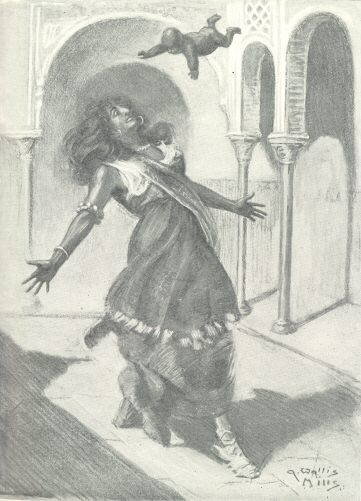
Of the Gitánas and their practices I shall have much to
say on a future occasion, when speaking of those of the present
time, with many of whom I have had no little intercourse.
All the ancient Spanish authors who mention these women speak of
them in unmeasured terms of abhorrence, employing against them
every abusive word contained in the language in which they
wrote. Amongst other vile names, they have been called
harlots, though perhaps no females on earth are, and have ever
been, more chaste in their own persons, though at all times
willing to encourage licentiousness in others, from a hope of
gain. It is one thing to be a procuress, and another to be
a harlot, though the former has assuredly no reason to complain
if she be confounded with the latter. ‘The
Gitánas,’ says Doctor Sancho de Moncada, in his
discourse concerning the Gypsies, which I shall presently lay
before the reader, ‘are public harlots, common, as it is
said, to all the Gitános, and with dances, demeanour, and
filthy songs, are the cause of infinite harm to the souls of the
vassals of your Majesty (Philip III.), as it is notorious what
infinite harm they have caused in many honourable houses.
The married women whom they have separated from their husbands,
and the maidens whom they have perverted; and finally, in the
best of these Gitánas, any one may recognise all the signs
of a harlot given by the wise king: “they are gadders
about, whisperers, always unquiet in the places and
corners.”’ [109a]
The author of Alonso, [109b] he who of all
the old Spanish writers has written most graphically concerning
the Gitános, and I believe with most correctness, puts the
following account of the Gitánas, and their
fortune-telling practices, into the entertaining mouth of his
hero:—
‘O how many times did these Gitánas
carry me along with them, for being, after all, women, even they
have their fears, and were glad of me as a protector: and so they
went through the neighbouring villages, and entered the houses
a-begging, giving to understand thereby their poverty and
necessity, and then they would call aside the girls, in order to
tell them the buena ventura, and the young fellows the good luck
which they were to enjoy, never failing in the first place to ask
for a cuarto or real, in order to make the sign of the cross; and
with these flattering words, they got as much as they could,
although, it is true, not much in money, as their harvest in that
article was generally slight; but enough in bacon to afford
subsistence to their husbands and bantlings. I looked on
and laughed at the simplicity of those foolish people, who,
especially such as wished to be married, were as satisfied and
content with what the Gitána told them, as if an apostle
had spoken it.’
The above description of Gitánas telling fortunes
amongst the villages of Navarre, and which was written by a
Spanish author at the commencement of the seventeenth century,
is, in every respect, applicable, as the reader will not fail to
have observed, to the English Gypsy women of the present day,
engaged in the same occupation in the rural districts of England,
where the first demand of the sibyls is invariably a sixpence, in
order that they may cross their hands with silver, and where the
same promises are made, and as easily believed; all which, if it
serves to confirm the opinion that in all times the practices and
habits of the Egyptian race have been, in almost all respects,
the same as at the present day, brings us also to the following
mortifying conclusion,—that mental illumination, amongst
the generality of mankind, has made no progress at all; as we
observe in the nineteenth century the same gross credulity
manifested as in the seventeenth, and the inhabitants of one of
the countries most celebrated for the arts of civilisation,
imposed upon by the same stale tricks which served to deceive two
centuries before in Spain, a country whose name has long and
justly been considered as synonymous with every species of
ignorance and barbarism.
The same author, whilst speaking of these female Thugs,
relates an anecdote very characteristic of them; a device at
which they are adepts, which they love to employ, and which is
generally attended with success. It is the more deserving
attention, as an instance of the same description, attended with
very similar circumstances, occurred within the sphere of my own
knowledge in my own country. This species of deceit is
styled, in the peculiar language of the Rommany, hokkano
baro, or the ‘great trick’; it being considered
by the women as their most fruitful source of plunder. The
story, as related by Alonso, runs as follows:—
‘A band of Gitános being in the
neighbourhood of a village, one of the women went to a house
where lived a lady alone. This lady was a young widow,
rich, without children, and of very handsome person. After
having saluted her, the Gypsy repeated the harangue which she had
already studied, to the effect that there was neither bachelor,
widower, nor married man, nobleman, nor gallant, endowed with a
thousand graces, who was not dying for love of her; and then
continued: “Lady, I have contracted a great affection for
you, and since I know that you well merit the riches you possess,
notwithstanding you live heedless of your good fortune, I wish to
reveal to you a secret. You must know, then, that in your
cellar you have a vast treasure; nevertheless you will experience
great difficulty in arriving at it, as it is enchanted, and to
remove it is impossible, save alone on the eve of Saint
John. We are now at the eighteenth of June, and it wants
five days to the twenty-third; therefore, in the meanwhile,
collect some jewels of gold and silver, and likewise some money,
whatever you please, provided it be not copper, and provide six
tapers, of white or yellow wax, for at the time appointed I will
come with a sister of mine, when we will extract from the cellar
such abundance of riches, that you will be able to live in a
style which will excite the envy of the whole
country.” The ignorant widow, hearing these words,
put implicit confidence in the deceiver, and imagined that she
already possessed all the gold of Arabia and the silver of
Potosi.
‘The appointed day arrived, and not more punctual were
the two Gypsies, than anxiously expected by the lady. Being
asked whether she had prepared all as she had been desired, she
replied in the affirmative, when the Gypsy thus addressed her:
“You must know, good lady, that gold calls forth gold, and
silver calls forth silver; let us light these tapers, and descend
to the cellar before it grows late, in order that we may have
time for our conjurations.” Thereupon the trio, the
widow and the two Gypsies, went down, and having lighted the
tapers and placed them in candlesticks in the shape of a circle,
they deposited in the midst a silver tankard, with some pieces of
eight, and some corals tipped with gold, and other jewels of
small value. They then told the lady, that it was necessary
for them all to return to the staircase by which they had
descended to the cellar, and there they uplifted their hands, and
remained for a short time as if engaged in prayer.
‘The two Gypsies then bade the widow wait for them, and
descended again, when they commenced holding a conversation,
speaking and answering alternately, and altering their voices in
such a manner that five or six people appeared to be in the
cellar. “Blessed little Saint John,” said one,
“will it be possible to remove the treasure which you keep
hidden here?” “O yes, and with a little more
trouble it will be yours,” replied the Gypsy sister,
altering her voice to a thin treble, as if it proceeded from a
child four or five years old. In the meantime, the lady
remained astonished, expecting the promised riches, and the two
Gitánas presently coming to her, said, “Come up,
lady, for our desire is upon the point of being gratified.
Bring down the best petticoat, gown, and mantle which you have in
your chest, that I may dress myself, and appear in other guise to
what I do now.” The simple woman, not perceiving the
trick they were playing upon her, ascended with them to the
doorway, and leaving them alone, went to fetch the things which
they demanded. Thereupon the two Gypsies, seeing themselves
at liberty, and having already pocketed the gold and silver which
had been deposited for their conjuration, opened the street door,
and escaped with all the speed they could.
‘The beguiled widow returned laden with the clothes, and
not finding those whom she had left waiting, descended into the
cellar, when, perceiving the trick which they had played her, and
the robbery which they had committed in stealing her jewels, she
began to cry and weep, but all in vain. All the neighbours
hastened to her, and to them she related her misfortune, which
served more to raise laughter and jeers at her expense than to
excite pity; though the subtlety of the two she-thieves was
universally praised. These latter, as soon as they had got
out of the door, knew well how to conceal themselves, for having
once reached the mountain it was not possible to find them.
So much for their divination, their foreseeing things to come,
their power over the secrets of nature, and their knowledge of
the stars.’
The Gitánas in the olden time appear to have not
unfrequently been subjected to punishment as sorceresses, and
with great justice, as the abominable trade which they drove in
philtres and decoctions certainly entitled them to that
appellation, and to the pains and penalties reserved for those
who practised what was termed ‘witchcraft.’
Amongst the crimes laid to their charge, connected with the
exercise of occult powers, there is one, however, of which they
were certainly not capable, as it is a purely imaginary one,
though if they were punished for it, they had assuredly little
right to complain, as the chastisement they met was fully merited
by practices equally malefic as the crime imputed to them,
provided that were possible. It was casting the evil
eye.
In the Gitáno language,
casting the evil eye is called Querelar nasula, which
simply means making sick, and which, according to the common
superstition, is accomplished by casting an evil look at people,
especially children, who, from the tenderness of their
constitution, are supposed to be more easily blighted than those
of a more mature age. After receiving the evil glance, they
fall sick, and die in a few hours.
The Spaniards have very little to say respecting the evil eye,
though the belief in it is very prevalent, especially in
Andalusia amongst the lower orders. A stag’s horn is
considered a good safeguard, and on that account a small horn,
tipped with silver, is frequently attached to the
children’s necks by means of a cord braided from the hair
of a black mare’s tail. Should the evil glance be
cast, it is imagined that the horn receives it, and instantly
snaps asunder. Such horns may be purchased in some of the
silversmiths’ shops at Seville.
The Gitános have nothing more to say on this species of
sorcery than the Spaniards, which can cause but little surprise,
when we consider that they have no traditions, and can give no
rational account of themselves, nor of the country from which
they come.
Some of the women, however, pretend to have the power of
casting it, though if questioned how they accomplish it, they can
return no answer. They will likewise sell remedies for the
evil eye, which need not be particularised, as they consist of
any drugs which they happen to possess or be acquainted with; the
prescribers being perfectly reckless as to the effect produced on
the patient, provided they receive their paltry reward.
I have known these beings offer to cure the glanders in a
horse (an incurable disorder) with the very same powders which
they offer as a specific for the evil eye.
Leaving, therefore, for a time, the Spaniards and
Gitános, whose ideas on this subject are very scanty and
indistinct, let us turn to other nations amongst whom this
superstition exists, and endeavour to ascertain on what it is
founded, and in what it consists. The fear of the evil eye
is common amongst all oriental people, whether Turks, Arabs, or
Hindoos. It is dangerous in some parts to survey a person
with a fixed glance, as he instantly concludes that you are
casting the evil eye upon him. Children, particularly, are
afraid of the evil eye from the superstitious fear inculcated in
their minds in the nursery. Parents in the East feel no
delight when strangers look at their children in admiration of
their loveliness; they consider that you merely look at them in
order to blight them. The attendants on the children of the
great are enjoined never to permit strangers to fix their glance
upon them. I was once in the shop of an Armenian at
Constantinople, waiting to see a procession which was expected to
pass by; there was a Janisary there, holding by the hand a little
boy about six years of age, the son of some Bey; they also had
come to see the procession. I was struck with the
remarkable loveliness of the child, and fixed my glance upon it:
presently it became uneasy, and turning to the Janisary, said:
‘There are evil eyes upon me; drive them away.’
‘Take your eyes off the child, Frank,’ said the
Janisary, who had a long white beard, and wore a hanjar.
‘What harm can they do to the child, efendijem?’ said
I. ‘Are they not the eyes of a Frank?’ replied
the Janisary; ‘but were they the eyes of Omar, they should
not rest on the child.’ ‘Omar,’ said I,
‘and why not Ali? Don’t you love
Ali?’ ‘What matters it to you whom I
love,’ said the Turk in a rage; ‘look at the child
again with your chesm fanar and I will smite you.’
‘Bad as my eyes are,’ said I, ‘they can see
that you do not love Ali.’ ‘Ya Ali, ya Mahoma,
Alahhu!’ [117] said the Turk, drawing his
hanjar. All Franks, by which are meant Christians, are
considered as casters of the evil eye. I was lately at
Janina in Albania, where a friend of mine, a Greek gentleman, is
established as physician. ‘I have been visiting the
child of a Jew that is sick,’ said he to me one day;
‘scarcely, however, had I left the house, when the father
came running after me. “You have cast the evil eye on
my child,” said he; “come back and spit in its
face.” And I assure you,’ continued my friend,
‘that notwithstanding all I could say, he compelled me to
go back and spit in the face of his child.’
Perhaps there is no nation in the world amongst whom this
belief is so firmly rooted and from so ancient a period as the
Jews; it being a subject treated of, and in the gravest manner,
by the old Rabbinical writers themselves, which induces the
conclusion that the superstition of the evil eye is of an
antiquity almost as remote as the origin of the Hebrew race; (and
can we go farther back?) as the oral traditions of the Jews,
contained and commented upon in what is called the Talmud, are
certainly not less ancient than the inspired writings of the Old
Testament, and have unhappily been at all times regarded by them
with equal if not greater reverence.
The evil eye is mentioned in Scripture, but of course not in
the false and superstitious sense; evil in the eye, which occurs
in Prov. xxiii. v. 6, merely denoting niggardness and
illiberality. The Hebrew words are ain ra, and stand
in contradistinction to ain toub, or the benignant in eye,
which denotes an inclination to bounty and liberality.
It is imagined that this blight is most easily inflicted when
a person is enjoying himself with little or no care for the
future, when he is reclining in the sun before the door, or when
he is full of health and spirits: it may be cast designedly or
not; and the same effect may be produced by an inadvertent
word. It is deemed partially unlucky to say to any person,
‘How well you look’; as the probabilities are that
such an individual will receive a sudden blight and pine
away. We have however no occasion to go to Hindoos, Turks,
and Jews for this idea; we shall find it nearer home, or
something akin to it. Is there one of ourselves, however
enlightened and free from prejudice, who would not shrink, even
in the midst of his highest glee and enjoyment, from saying,
‘How happy I am!’ or if the words inadvertently
escaped him, would he not consider them as ominous of approaching
evil, and would he not endeavour to qualify them by saying,
‘God preserve me!’—Ay, God preserve you,
brother! Who knows what the morrow will bring forth?
The common remedy for the evil eye, in the East, is the
spittle of the person who has cast it, provided it can be
obtained. ‘Spit in the face of my child,’ said
the Jew of Janina to the Greek physician: recourse is had to the
same means in Barbary, where the superstition is universal.
In that country both Jews and Moors carry papers about with them
scrawled with hieroglyphics, which are prepared by their
respective priests, and sold. These papers, placed in a
little bag, and hung about the person, are deemed infallible
preservatives from the ‘evil eye.’
Let us now see what the Talmud itself says about the
evil eye. The passage which we are about to quote is
curious, not so much from the subject which it treats of, as in
affording an example of the manner in which the Rabbins are wont
to interpret the Scripture, and the strange and wonderful
deductions which they draw from words and phrases apparently of
the greatest simplicity.
‘Whosoever when about to enter into a city
is afraid of evil eyes, let him grasp the thumb of his right hand
with his left hand, and his left-hand thumb with his right hand,
and let him cry in this manner: “I am such a one, son of
such a one, sprung from the seed of Joseph”; and the evil
eyes shall not prevail against him. Joseph is a fruitful
bough, a fruitful bough by a well, [120a] etc. Now you should not say
by a well, but over an eye. [120b] Rabbi Joseph Bar Henina makes
the following deduction: and they shall become (the seed
of Joseph) like fishes in multitude in the midst of the
earth. [120c] Now the fishes of the sea are
covered by the waters, and the evil eye has no power over them;
and so over those of the seed of Joseph the evil eye has no
power.’
I have been thus diffuse upon the evil eye, because of late
years it has been a common practice of writers to speak of it
without apparently possessing any farther knowledge of the
subject than what may be gathered from the words themselves.
Like most other superstitions, it is, perhaps, founded on a
physical reality.
I have observed, that only in hot countries, where the sun and
moon are particularly dazzling, the belief in the evil eye is
prevalent. If we turn to Scripture, the wonderful book
which is capable of resolving every mystery, I believe that we
shall presently come to the solution of the evil eye.
‘The sun shall not smite thee by day, nor the moon by
night.’ Ps. cxxi. v. 6.
Those who wish to avoid the evil eye, instead of trusting in
charms, scrawls, and Rabbinical antidotes, let them never loiter
in the sunshine before the king of day has nearly reached his
bourn in the west; for the sun has an evil eye, and his glance
produces brain fevers; and let them not sleep uncovered beneath
the smile of the moon, for her glance is poisonous, and produces
insupportable itching in the eye, and not unfrequently
blindness.
The northern nations have a superstition which bears some
resemblance to the evil eye, when allowance is made for
circumstances. They have no brilliant sun and moon to addle
the brain and poison the eye, but the grey north has its marshes,
and fenny ground, and fetid mists, which produce agues, low
fevers, and moping madness, and are as fatal to cattle as to
man. Such disorders are attributed to elves and
fairies. This superstition still lingers in some parts of
England under the name of elf-shot, whilst, throughout the north,
it is called elle-skiod, and elle-vild (fairy wild). It is
particularly prevalent amongst shepherds and cow-herds, the
people who, from their manner of life, are most exposed to the
effects of the elf-shot. Those who wish to know more of
this superstition are referred to Thiele’s—Danske
Folkesagn, and to the notes of the Koempe-viser, or
popular Danish Ballads.
When the six hundred thousand men,
[122] and the mixed multitude of women and
children, went forth from the land of Egypt, the God whom they
worshipped, the only true God, went before them by day in a
pillar of cloud, to lead them the way, and by night in a pillar
of fire to give them light; this God who rescued them from
slavery, who guided them through the wilderness, who was their
captain in battle, and who cast down before them the strong walls
which encompassed the towns of their enemies, this God they still
remember, after the lapse of more than three thousand years, and
still worship with adoration the most unbounded. If there
be one event in the eventful history of the Hebrews which awakens
in their minds deeper feelings of gratitude than another, it is
the exodus; and that wonderful manifestation of olden mercy still
serves them as an assurance that the Lord will yet one day redeem
and gather together his scattered and oppressed people.
‘Art thou not the God who brought us out of the land of
bondage?’ they exclaim in the days of their heaviest
trouble and affliction. He who redeemed Israel from the
hand of Pharaoh is yet capable of restoring the kingdom and
sceptre to Israel.
If the Rommany trusted in any God at the period of
their exodus, they must speedily have forgotten him.
Coming from Ind, as they most assuredly did, it was impossible
for them to have known the true, and they must have been
followers (if they followed any) either of Buddh, or Brahmah,
those tremendous phantoms which have led, and are likely still to
lead, the souls of hundreds of millions to destruction; yet they
are now ignorant of such names, nor does it appear that such were
ever current amongst them subsequent to their arrival in Europe,
if indeed they ever were. They brought with them no Indian
idols, as far as we are able to judge at the present time, nor
indeed Indian rites or observances, for no traces of such are to
be discovered amongst them.
All, therefore, which relates to their original religion is
shrouded in mystery, and is likely so to remain. They may
have been idolaters, or atheists, or what they now are, totally
neglectful of worship of any kind; and though not exactly
prepared to deny the existence of a Supreme Being, as regardless
of him as if he existed not, and never mentioning his name, save
in oaths and blasphemy, or in moments of pain or sudden surprise,
as they have heard other people do, but always without any fixed
belief, trust, or hope.
There are certainly some points of resemblance between the
children of Roma and those of Israel. Both have had an
exodus, both are exiles and dispersed amongst the Gentiles, by
whom they are hated and despised, and whom they hate and despise,
under the names of Busnees and Goyim; both, though speaking the
language of the Gentiles, possess a peculiar tongue, which the
latter do not understand, and both possess a peculiar cast of
countenance, by which they may, without difficulty, be
distinguished from all other nations; but with these points the
similarity terminates. The Israelites have a peculiar
religion, to which they are fanatically attached; the Romas have
none, as they invariably adopt, though only in appearance, that
of the people with whom they chance to sojourn; the Israelites
possess the most authentic history of any people in the world,
and are acquainted with and delight to recapitulate all that has
befallen their race, from ages the most remote; the Romas have no
history, they do not even know the name of their original
country; and the only tradition which they possess, that of their
Egyptian origin, is a false one, whether invented by themselves
or others; the Israelites are of all people the most wealthy, the
Romas the most poor—poor as a Gypsy being proverbial
amongst some nations, though both are equally greedy of gain; and
finally, though both are noted for peculiar craft and cunning, no
people are more ignorant than the Romas, whilst the Jews have
always been a learned people, being in possession of the oldest
literature in the world, and certainly the most important and
interesting.
Sad and weary must have been the path of the mixed rabble of
the Romas, when they left India’s sunny land and wended
their way to the West, in comparison with the glorious exodus of
the Israelites from Egypt, whose God went before them in cloud
and in fire, working miracles and astonishing the hearts of their
foes.
Even supposing that they worshipped Buddh or Brahmah, neither
of these false deities could have accomplished for them what God
effected for his chosen people, although it is true that the idea
that a Supreme Being was watching over them, in return for the
reverence paid to his image, might have cheered them ‘midst
storm and lightning, ‘midst mountains and wildernesses,
‘midst hunger and drought; for it is assuredly better to
trust even in an idol, in a tree, or a stone, than to be entirely
godless; and the most superstitious hind of the Himalayan hills,
who trusts in the Grand Foutsa in the hour of peril and danger,
is more wise than the most enlightened atheist, who cherishes no
consoling delusion to relieve his mind, oppressed by the terrible
ideas of reality.
But it is evident that they arrived at the confines of Europe
without any certain or rooted faith. Knowing, as we do,
with what tenacity they retain their primitive habits and
customs, their sect being, in all points, the same as it was four
hundred years ago, it appears impossible that they should have
forgotten their peculiar god, if in any peculiar god they
trusted.
Though cloudy ideas of the Indian deities might be
occasionally floating in their minds, these ideas, doubtless,
quickly passed away when they ceased to behold the pagodas and
temples of Indian worship, and were no longer in contact with the
enthusiastic adorers of the idols of the East; they passed away
even as the dim and cloudy ideas which they subsequently adopted
of the Eternal and His Son, Mary and the saints, would pass away
when they ceased to be nourished by the sight of churches and
crosses; for should it please the Almighty to reconduct the Romas
to Indian climes, who can doubt that within half a century they
would entirely forget all connected with the religion of the
West! Any poor shreds of that faith which they bore with
them they would drop by degrees as they would relinquish their
European garments when they became old, and as they relinquished
their Asiatic ones to adopt those of Europe; no particular dress
makes a part of the things essential to the sect of Roma, so
likewise no particular god and no particular religion.
Where these people first assumed the name of Egyptians, or
where that title was first bestowed upon them, it is difficult to
determine; perhaps, however, in the eastern parts of Europe,
where it should seem the grand body of this nation of wanderers
made a halt for a considerable time, and where they are still to
be found in greater numbers than in any other part. One
thing is certain, that when they first entered Germany, which
they speedily overran, they appeared under the character of
Egyptians, doing penance for the sin of having refused
hospitality to the Virgin and her Son, and, of course, as
believers in the Christian faith, notwithstanding that they
subsisted by the perpetration of every kind of robbery and
imposition; Aventinus (Annales Boiorum, 826) speaking of
them says: ‘Adeo tamen vana superstitio hominum mentes,
velut lethargus invasit, ut eos violari nefas putet, atque
grassari, furari, imponere passim sinant.’
This singular story of banishment from Egypt, and Wandering
through the world for a period of seven years, for inhospitality
displayed to the Virgin, and which I find much difficulty in
attributing to the invention of people so ignorant as the Romas,
tallies strangely with the fate foretold to the ancient Egyptians
in certain chapters of Ezekiel, so much so, indeed, that it seems
to be derived from that source. The Lord is angry with
Egypt because its inhabitants have been a staff of reed to the
house of Israel, and thus he threatens them by the mouth of his
prophet.
‘I will make the land of Egypt desolate in
the midst of the countries that are desolate, and her cities
among the cities that are laid waste shall be desolate forty
years: and I will scatter the Egyptians among the nations, and
will disperse them through the countries.’ Ezek.,
chap. xxix. v. 12. ‘Yet thus saith the Lord God; at
the end of forty years will I gather the Egyptians from the
people whither they were scattered.’ v. 13.
‘Thus saith the Lord; I will make the multitude of Egypt
to cease, by the hand of Nebuchadnezzar, king of
Babylon.’ Chap. xxx. v. 10.
‘And I will scatter the Egyptians among the nations, and
disperse them among the countries; and they shall know that I am
the Lord.’ Chap. xxx. v. 26.
The reader will at once observe that the apocryphal tale which
the Romas brought into Germany, concerning their origin and
wanderings, agrees in every material point with the sacred
prophecy. The ancient Egyptians were to be driven from
their country and dispersed amongst the nations, for a period of
forty years, for having been the cause of Israel’s
backsliding, and for not having known the Lord,—the modern
pseudo-Egyptians are to be dispersed among the nations for seven
years, for having denied hospitality to the Virgin and her
child. The prophecy seems only to have been remodelled for
the purpose of suiting the taste of the time; as no legend
possessed much interest in which the Virgin did not figure, she
and her child are here introduced instead of the Israelites, and
the Lord of Heaven offended with the Egyptians; and this legend
appears to have been very well received in Germany, for a time at
least, for, as Aventinus observes, it was esteemed a crime of the
first magnitude to offer any violence to the Egyptian pilgrims,
who were permitted to rob on the highway, to commit larceny, and
to practise every species of imposition with impunity.
The tale, however, of the Romas could hardly have been
invented by themselves, as they were, and still are, utterly
unacquainted with the Scripture; it probably originated amongst
the priests and learned men of the east of Europe, who, startled
by the sudden apparition of bands of people foreign in appearance
and language, skilled in divination and the occult arts,
endeavoured to find in Scripture a clue to such a phenomenon; the
result of which was, that the Romas of Hindustan were suddenly
transformed into Egyptian penitents, a title which they have ever
since borne in various parts of Europe. There are no means
of ascertaining whether they themselves believed from the first
in this story; they most probably took it on credit, more
especially as they could give no account of themselves, there
being every reason for supposing that from time immemorial they
had existed in the East as a thievish wandering sect, as they at
present do in Europe, without history or traditions, and unable
to look back for a period of eighty years. The tale
moreover answered their purpose, as beneath the garb of penitence
they could rob and cheat with impunity, for a time at
least. One thing is certain, that in whatever manner the
tale of their Egyptian descent originated, many branches of the
sect place implicit confidence in it at the present day, more
especially those of England and Spain.
Even at the present time there are writers who contend that
the Romas are the descendants of the ancient Egyptians, who were
scattered amongst the nations by the Assyrians. This belief
they principally found upon particular parts of the prophecy from
which we have already quoted, and there is no lack of
plausibility in the arguments which they deduce therefrom.
The Egyptians, say they, were to fall upon the open fields, they
were not to be brought together nor gathered; they were to be
dispersed through the countries, their idols were to be
destroyed, and their images were to cease out of Noph! In
what people in the world do these denunciations appear to be
verified save the Gypsies?—a people who pass their lives in
the open fields, who are not gathered together, who are dispersed
through the countries, who have no idols, no images, nor any
fixed or certain religion.
In Spain, the want of religion amongst the Gitános was
speedily observed, and became quite as notorious as their want of
honesty; they have been styled atheists, heathen idolaters, and
Moors. In the little book of Quiñones’, we
find the subject noticed in the following manner:—
‘They do not understand what kind of thing
the church is, and never enter it but for the purpose of
committing sacrilege. They do not know the prayers; for I
examined them myself, males and females, and they knew them not,
or if any, very imperfectly. They never partake of the Holy
Sacraments, and though they marry relations they procure no
dispensations. [130a] No one knows whether they are
baptized. One of the five whom I caused to be hung a few
days ago was baptized in the prison, being at the time upwards of
thirty years of age. Don Martin Fajardo says that two
Gitános and a Gitána, whom he hanged in the village
of Torre Perojil, were baptized at the foot of the gallows, and
declared themselves Moors.
‘They invariably look out, when they marry, if we can
call theirs marrying, for the woman most dexterous in pilfering
and deceiving, caring nothing whether she is akin to them or
married already, [130b] for it is only
necessary to keep her company and to call her wife.
Sometimes they purchase them from their husbands, or receive them
as pledges: so says, at least, Doctor Salazar de Mendoza.
‘Friar Melchior of Guelama states that he heard asserted
of two Gitános what was never yet heard of any barbarous
nation, namely, that they exchanged their wives, and that as one
was more comely looking than the other, he who took the handsome
woman gave a certain sum of money to him who took the ugly
one. The licentiate Alonzo Duran has certified to me, that
in the year 1623–4, one Simon Ramirez, captain of a band of
Gitános, repudiated Teresa because she was old, and
married one called Melchora, who was young and handsome, and that
on the day when the repudiation took place and the bridal was
celebrated he was journeying along the road, and perceived a
company feasting and revelling beneath some trees in a plain
within the jurisdiction of the village of Deleitosa, and that on
demanding the cause he was told that it was on account of Simon
Ramirez marrying one Gitána and casting off another; and
that the repudiated woman told him, with an agony of tears, that
he abandoned her because she was old, and married another because
she was young. Certainly Gitános and Gitánas
confessed before Don Martin Fajardo that they did not really
marry, but that in their banquets and festivals they selected the
woman whom they liked, and that it was lawful for them to have as
many as three mistresses, and on that account they begat so many
children. They never keep fasts nor any ecclesiastical
command. They always eat meat, Friday and Lent not
excepted; the morning when I seized those whom I afterwards
executed, which was in Lent, they had three lambs which they
intended to eat for their dinner that day.—Quiñones,
page 13.
Although what is stated in the above extracts, respecting the
marriages of the Gitános and their licentious manner of
living, is, for the most part, incorrect, there is no reason to
conclude the same with respect to their want of religion in the
olden time, and their slight regard for the forms and observances
of the church, as their behaviour at the present day serves to
confirm what is said on those points. From the whole, we
may form a tolerably correct idea of the opinions of the time
respecting the Gitános in matters of morality and
religion. A very natural question now seems to present
itself, namely, what steps did the government of Spain, civil and
ecclesiastical, which has so often trumpeted its zeal in the
cause of what it calls the Christian religion, which has so often
been the scourge of the Jew, of the Mahometan, and of the
professors of the reformed faith; what steps did it take towards
converting, punishing, and rooting out from Spain, a sect of
demi-atheists, who, besides being cheats and robbers, displayed
the most marked indifference for the forms of the Catholic
religion, and presumed to eat flesh every day, and to intermarry
with their relations, without paying the vicegerent of Christ
here on earth for permission so to do?
The Gitános have at all times, since their first
appearance in Spain, been notorious for their contempt of
religious observances; yet there is no proof that they were
subjected to persecution on that account. The men have been
punished as robbers and murderers, with the gallows and the
galleys; the women, as thieves and sorceresses, with
imprisonment, flagellation, and sometimes death; but as a rabble,
living without fear of God, and, by so doing, affording an evil
example to the nation at large, few people gave themselves much
trouble about them, though they may have occasionally been
designated as such in a royal edict, intended to check their
robberies, or by some priest from the pulpit, from whose stable
they had perhaps contrived to extract the mule which previously
had the honour of ambling beneath his portly person.
The Inquisition, which burnt so many Jews and Moors, and
conscientious Christians, at Seville and Madrid, and in other
parts of Spain, seems to have exhibited the greatest clemency and
forbearance to the Gitános. Indeed, we cannot find
one instance of its having interfered with them. The charge
of restraining the excesses of the Gitános was abandoned
entirely to the secular authorities, and more particularly to the
Santa Hermandad, a kind of police instituted for the purpose of
clearing the roads of robbers. Whilst I resided at Cordova,
I was acquainted with an aged ecclesiastic, who was priest of a
village called Puente, at about two leagues’ distance from
the city. He was detained in Cordova on account of his
political opinions, though he was otherwise at liberty. We
lived together at the same house; and he frequently visited me in
my apartment.
This person, who was upwards of eighty years of age, had
formerly been inquisitor at Cordova. One night, whilst we
were seated together, three Gitános entered to pay me a
visit, and on observing the old ecclesiastic, exhibited every
mark of dissatisfaction, and speaking in their own idiom, called
him a balichow, and abused priests in general in most
unmeasured terms. On their departing, I inquired of the old
man whether he, who having been an inquisitor, was doubtless
versed in the annals of the holy office, could inform me whether
the Inquisition had ever taken any active measures for the
suppression and punishment of the sect of the Gitános:
whereupon he replied, ‘that he was not aware of one case of
a Gitáno having been tried or punished by the
Inquisition’; adding these remarkable words: ‘The
Inquisition always looked upon them with too much contempt to
give itself the slightest trouble concerning them; for as no
danger either to the state, or the church of Rome, could proceed
from the Gitános, it was a matter of perfect indifference
to the holy office whether they lived without religion or
not. The holy office has always reserved its anger for
people very different; the Gitános having at all times
been Gente barata y despreciable.
Indeed, most of the persecutions which have arisen in Spain
against Jews, Moors, and Protestants, sprang from motives with
which fanaticism and bigotry, of which it is true the Spaniards
have their full share, had very little connection. Religion
was assumed as a mask to conceal the vilest and most detestable
motives which ever yet led to the commission of crying injustice;
the Jews were doomed to persecution and destruction on two
accounts,—their great riches, and their high superiority
over the Spaniards in learning and intellect. Avarice has
always been the dominant passion in Spanish minds, their rage for
money being only to be compared to the wild hunger of wolves for
horse-flesh in the time of winter: next to avarice, envy of
superior talent and accomplishment is the prevailing
passion. These two detestable feelings united, proved the
ruin of the Jews in Spain, who were, for a long time, an eyesore,
both to the clergy and laity, for their great riches and
learning. Much the same causes insured the expulsion of the
Moriscos, who were abhorred for their superior industry, which
the Spaniards would not imitate; whilst the reformation was kept
down by the gaunt arm of the Inquisition, lest the property of
the church should pass into other and more deserving hands.
The faggot piles in the squares of Seville and Madrid, which
consumed the bodies of the Hebrew, the Morisco, and the
Protestant, were lighted by avarice and envy, and those same
piles would likewise have consumed the mulatto carcass of the
Gitáno, had he been learned and wealthy enough to become
obnoxious to the two master passions of the Spaniards.
Of all the Spanish writers who have written concerning the
Gitános, the one who appears to have been most scandalised
at the want of religion observable amongst them, and their
contempt for things sacred, was a certain Doctor Sancho De
Moncada.
This worthy, whom we have already had occasion to mention, was
Professor of Theology at the University of Toledo, and shortly
after the expulsion of the Moriscos had been brought about by the
intrigues of the monks and robbers who thronged the court of
Philip the Third, he endeavoured to get up a cry against the
Gitános similar to that with which for the last
half-century Spain had resounded against the unfortunate and
oppressed Africans, and to effect this he published a discourse,
entitled ‘The Expulsion of the Gitános,’
addressed to Philip the Third, in which he conjures that monarch,
for the sake of morality and everything sacred, to complete the
good work he had commenced, and to send the Gitános
packing after the Moriscos.
Whether this discourse produced any benefit to the author, we
have no means of ascertaining. One thing is certain, that
it did no harm to the Gitános, who still continue in
Spain.
If he had other expectations, he must have understood very
little of the genius of his countrymen, or of King Philip and his
court. It would have been easier to get up a crusade
against the wild cats of the sierra, than against the
Gitános, as the former have skins to reward those who slay
them. His discourse, however, is well worthy of perusal, as
it exhibits some learning, and comprises many curious details
respecting the Gitános, their habits, and their
practices. As it is not very lengthy, we here subjoin it,
hoping that the reader will excuse its many absurdities, for the
sake of its many valuable facts.
‘Sire,
‘The people of God were always afflicted by the
Egyptians, but the Supreme King delivered them from their hands
by means of many miracles, which are related in the Holy
Scriptures; and now, without having recourse to so many, but only
by means of the miraculous talent which your Majesty possesses
for expelling such reprobates, he will, doubtless, free this
kingdom from them, which is what is supplicated in this
discourse, and it behoves us, in the first place, to consider
‘Writers generally agree that the first time the
Gitános were seen in Europe was the year 1417, which was
in the time of Pope Martinus the Fifth and King Don John the
Second; others say that Tamerlane had them in his camp in 1401,
and that their captain was Cingo, from whence it is said that
they call themselves Cingary. But the opinions concerning
their origin are infinite.
‘The first is that they are foreigners, though authors
differ much with respect to the country from whence they
came. The majority say that they are from Africa, and that
they came with the Moors when Spain was lost; others that they
are Tartars, Persians, Cilicians, Nubians, from Lower Egypt, from
Syria, or from other parts of Asia and Africa, and others
consider them to be descendants of Chus, son of Cain; others say
that they are of European origin, Bohemians, Germans, or outcasts
from other nations of this quarter of the world.
‘The second and sure opinion is, that those who prowl
about Spain are not Egyptians, but swarms of wasps and
atheistical wretches, without any kind of law or religion,
Spaniards, who have introduced this Gypsy life or sect, and who
admit into it every day all the idle and broken people of
Spain. There are some foreigners who would make Spain the
origin and fountain of all the Gypsies of Europe, as they say
that they proceeded from a river in Spain called Cija, of which
Lucan makes mention; an opinion, however, not much adopted
amongst the learned. In the opinion of respectable authors,
they are called Cingary or Cinli, because they in every respect
resemble the bird cinclo, which we call in Spanish Motacilla, or
aguzanieve (wagtail), which is a vagrant bird and builds no nest,
[138] but broods in those of other birds, a
bird restless and poor of plumage, as Ælian writes.
‘There is not a nation which does not consider them as a
most pernicious rabble; even the Turks and Moors abominate them,
amongst whom this sect is found under the names of Torlaquis, [139] Hugiemalars, and Dervislars, of whom
some historians make mention, and all agree that they are most
evil people, and highly detrimental to the country where they are
found.
‘In the first place, because in all parts they are
considered as enemies of the states where they wander, and as
spies and traitors to the crown; which was proven by the emperors
Maximilian and Albert, who declared them to be such in public
edicts; a fact easy to be believed, when we consider that they
enter with ease into the enemies’ country, and know the
languages of all nations.
‘Secondly, because they are idle vagabond people, who
are in no respect useful to the kingdom; without commerce,
occupation, or trade of any description; and if they have any it
is making picklocks and pothooks for appearance sake, being
wasps, who only live by sucking and impoverishing the country,
sustaining themselves by the sweat of the miserable labourers, as
a German poet has said of them:—
“Quos aliena juvant, propriis habitare
molestum,
Fastidit patrium non nisi nosse solum.”
They are much more useless than the Moriscos, as these last
were of some service to the state and the royal revenues, but the
Gitános are neither labourers, gardeners, mechanics, nor
merchants, and only serve, like the wolves, to plunder and to
flee.
‘Thirdly, because the Gitánas are public harlots,
common, as it is said, to all the Gitános, and with
dances, demeanour, and filthy songs, are the cause of continual
detriment to the souls of the vassals of your Majesty, it being
notorious that they have done infinite harm in many honourable
houses by separating the married women from their husbands, and
perverting the maidens: and finally, in the best of these
Gitánas any one may recognise all the signs of a harlot
given by the wise king; they are gadders about, whisperers,
always unquiet in places and corners.
‘Fourthly, because in all parts they are accounted
famous thieves, about which authors write wonderful things; we
ourselves have continual experience of this fact in Spain, where
there is scarcely a corner where they have not committed some
heavy offence.
‘Father Martin Del Rio says they were notorious when he
was in Leon in the year 1584; as they even attempted to sack the
town of Logroño in the time of the pest, as Don Francisco
De Cordoba writes in his Didascalia. Enormous cases
of their excesses we see in infinite processes in all the
tribunals, and particularly in that of the Holy Brotherhood;
their wickedness ascending to such a pitch, that they steal
children, and carry them for sale to Barbary; the reason why the
Moors call them in Arabic, Raso cherany, [140] which, as Andreas Tebetus writes,
means master thieves. Although they are addicted to
every species of robbery, they mostly practise horse and cattle
stealing, on which account they are called in law Abigeos,
and in Spanish Quatreros, from which practice great evils
result to the poor labourers. When they cannot steal
cattle, they endeavour to deceive by means of them, acting as
terceros, in fairs and markets.
‘Fifthly, because they are enchanters, diviners,
magicians, chiromancers, who tell the future by the lines of the
hand, which is what they call Buena ventura, and are in
general addicted to all kind of superstition.
‘This is the opinion entertained of them universally,
and which is confirmed every day by experience; and some think
that they are caller Cingary, from the great Magian Cineus, from
whom it is said they learned their sorceries, and from which
result in Spain (especially amongst the vulgar) great errors, and
superstitious credulity, mighty witchcrafts, and heavy evils,
both spiritual and corporeal.
‘Sixthly, because very devout men consider them as
heretics, and many as Gentile idolaters, or atheists, without any
religion, although they exteriorly accommodate themselves to the
religion of the country in which they wander, being Turks with
the Turks, heretics with the heretics, and, amongst the
Christians, baptizing now and then a child for form’s
sake. Friar Jayme Bleda produces a hundred signs, from
which he concludes that the Moriscos were not Christians, all
which are visible in the Gitános; very few are known to
baptize their children; they are not married, but it is believed
that they keep the women in common; they do not use
dispensations, nor receive the sacraments; they pay no respect to
images, rosaries, bulls, neither do they hear mass, nor divine
services; they never enter the churches, nor observe fasts, Lent,
nor any ecclesiastical precept; which enormities have been
attested by long experience, as every person says.
‘Finally, they practise every kind of wickedness in
safety, by discoursing amongst themselves in a language with
which they understand each other without being understood, which
in Spain is called Gerigonza, which, as some think, ought to be
called Cingerionza, or language of Cingary. The king our
lord saw the evil of such a practice in the law which he enacted
at Madrid, in the year 1566, in which he forbade the Arabic to
the Moriscos, as the use of different languages amongst the
natives of one kingdom opens a door to treason, and is a source
of heavy inconvenience; and this is exemplified more in the case
of the Gitános than of any other people.
‘The civil law ordains that vagrants be seized wherever
they are found, without any favour being shown to them; in
conformity with which, the Gitános in the Greek empire
were given as slaves to those who should capture them; as
respectable authors write. Moreover, the emperor, our lord,
has decreed by a law made in Toledo, in the year 1525, that
the third time they be found wandering they shall serve as slaves
during their whole life to those who capture them.
Which can be easily justified, inasmuch as there is no shepherd
who does not place barriers against the wolves, and does not
endeavour to save his flock, and I have already exposed to your
Majesty the damage which the Gitános perpetrate in
Spain.
‘The reasons are many. The first, for being spies,
and traitors to the crown; the second as idlers and
vagabonds.
‘It ought always to be considered, that no sooner did
the race of man begin, after the creation of the world, than the
important point of civil policy arose of condemning vagrants to
death; for Cain was certain that he should meet his destruction
in wandering as a vagabond for the murder of Abel. Ero
vagus et profugus in terra: omnis igitur qui invenerit me,
occidet me. Now, the igitur stands here as
the natural consequence of vagus ero; as it is evident,
that whoever shall see me must kill me, because he sees me a
wanderer. And it must always be remembered, that at that
time there were no people in the world but the parents and
brothers of Cain, as St. Ambrose has remarked. Moreover,
God, by the mouth of Jeremias, menaced his people, that all
should devour them whilst they went wandering amongst the
mountains. And it is a doctrine entertained by theologians,
that the mere act of wandering, without anything else, carries
with it a vehement suspicion of capital crime. Nature
herself demonstrates it in the curious political system of the
bees, in whose well-governed republic the drones are killed in
April, when they commence working.
‘The third, because they are stealers of four-footed
beasts, who are condemned to death by the laws of Spain, in the
wise code of the famous King Don Alonso; which enactment became a
part of the common law.
‘The fourth, for wizards, diviners, and for practising
arts which are prohibited under pain of death by the divine law
itself. And Saul is praised for having caused this law to
be put in execution in the beginning of his reign; and the Holy
Scripture attributes to the breach of it (namely, his consulting
the witch) his disastrous death, and the transfer of the kingdom
to David. The Emperor Constantine the Great, and other
emperors who founded the civil law, condemned to death those who
should practise such facinorousness,—as the President of
Tolosa has written.
‘The last and most urgent cause is, that they are
heretics, if what is said be truth; and it is the practice of the
law in Spain to burn such.
‘Firstly, they are comprehended as hale beggars in the
law of the wise king, Don Alonso, by which he expelled all sturdy
beggars, as being idle and useless.
‘Secondly, the law expels public harlots from the city;
and of this matter I have already said something in my second
chapter.
‘Thirdly, as people who cause scandal, and who, as is
visible at the first glance, are prejudicial to morals and common
decency. Now, it is established by the statute law of these
kingdoms, that such people be expelled therefrom; it is said so
in the well-pondered words of the edict for the expulsion of the
Moors: “And forasmuch as the sense of good and Christian
government makes it a matter of conscience to expel from the
kingdoms the things which cause scandal, injury to honest
subjects, danger to the state, and above all, disloyalty to the
Lord our God.” Therefore, considering the
incorrigibility of the Gitános, the Spanish kings made
many holy laws in order to deliver their subjects from such
pernicious people.
‘Fourthly, the Catholic princes, Ferdinand and Isabella,
by a law which they made in Medina del Campo, in the year 1494,
and which the emperor our lord renewed in Toledo in 1523, and in
Madrid in 1528 and 1534, and the late king our lord, in 1560,
banished them perpetually from Spain, and gave them as slaves to
whomsoever should find them, after the expiration of the term
specified in the edict—laws which are notorious even
amongst strangers. The words are:—“We declare
to be vagabonds, and subject to the aforesaid penalty, the
Egyptians and foreign tinkers, who by laws and statutes of these
kingdoms are commanded to depart therefrom; and the poor sturdy
beggars, who contrary to the order given in the new edict, beg
for alms and wander about.”
All the doctors, who are of opinion that the Gitános
may be condemned to death, would consider it as an act of mercy
in your Majesty to banish them perpetually from Spain, and at the
same time as exceedingly just. Many and learned men not
only consider that it is just to expel them, but cannot
sufficiently wonder that they are tolerated in Christian states,
and even consider that such toleration is an insult to the
kingdoms.
‘Whilst engaged in writing this, I have seen a very
learned memorial, in which Doctor Salazar de Mendoza makes the
same supplication to your Majesty which is made in this
discourse, holding it to be the imperious duty of every good
government.
‘It stands in reason that the prince is bound to watch
for the welfare of his subjects, and the wrongs which those of
your Majesty receive from the Gitános I have already
exposed in my second chapter; it being a point worthy of great
consideration that the wrongs caused by the Moriscos moved your
royal and merciful bosom to drive them out, although they were
many, and their departure would be felt as a loss to the
population, the commerce, the royal revenues, and
agriculture. Now, with respect to the Gitános, as
they are few, and perfectly useless for everything, it appears
more necessary to drive them forth, the injuries which they cause
being so numerous.
‘Secondly, because the Gitános, as I have already
said, are Spaniards; and as others profess the sacred orders of
religion, even so do these fellows profess gypsying, which is
robbery and all the other vices enumerated in chapter the
second. And whereas it is just to banish from the kingdom
those who have committed any heavy delinquency, it is still more
so to banish those who profess to be injurious to all.
‘Thirdly, because all the kings and rulers have always
endeavoured to eject from their kingdoms the idle and
useless. And it is very remarkable, that the law invariably
commands them to be expelled, and the republics of Athens and
Corinth were accustomed to do so—casting them forth like
dung, even as Athenæus writes: Nos genus hoc mortalium
ejicimus ex hac urbe velut purgamina. Now the
profession of the Gypsy is idleness.
‘Fourthly, because the Gitános are diviners,
enchanters, and mischievous wretches, and the law commands us to
expel such from the state.
‘In the fifth place, because your Majesty, in the Cortes
at present assembled, has obliged your royal conscience to fulfil
all the articles voted for the public service, and the
forty-ninth says: “One of the things at present most
necessary to be done in these kingdoms, is to afford a remedy for
the robberies, plundering and murders committed by the
Gitános, who go wandering about the country, stealing the
cattle of the poor, and committing a thousand outrages, living
without any fear of God, and being Christians only in name.
It is therefore deemed expedient, that your Majesty command them
to quit these kingdoms within six months, to be reckoned from the
day of the ratification of these presents, and that they do not
return to the same under pain of death.”
‘Against this, two things may possibly be
urged:—
‘The first, that the laws of Spain give unto the
Gitános the alternative of residing in large towns, which,
it appears, would be better than expelling them. But
experience, recognised by grave and respectable men, has shown
that it is not well to harbour these people; for their houses are
dens of thieves, from whence they prowl abroad to rob the
land.
‘The second, that it appears a pity to banish the women
and children. But to this can be opposed that holy act of
your Majesty which expelled the Moriscos, and the children of the
Moriscos, for the reason given in the royal edict.
Whenever any detestable crime is committed by any
university, it is well to punish all. And the
most detestable crimes of all are those which the Gitános
commit, since it is notorious that they subsist on what they
steal; and as to the children, there is no law which obliges us
to bring up wolf-whelps, to cause here-after certain damage to
the flock.
‘Every one who considers the manner of your
Majesty’s government as the truly Christian pattern must
entertain fervent hope that the advice proffered in this
discourse will be attended to; more especially on reflecting that
not only the good, but even the most barbarous kings have acted
up to it in their respective dominions.
‘Pharaoh was bad enough, nevertheless he judged that the
children of Israel were dangerous to the state, because they
appeared to him to be living without any certain occupation; and
for this very reason the Chaldeans cast them out of
Babylon. Amasis, king of Egypt, drove all the vagrants from
his kingdom, forbidding them to return under pain of death.
The Soldan of Egypt expelled the Torlaquis. The Moors did
the same; and Bajazet cast them out of all the Ottoman empire,
according to Leo Clavius.
‘In the second place, the Christian princes have deemed
it an important measure of state.
‘The emperor our Lord, in the German Diets of the year
1548, expelled the Gitános from all his empire, and these
were the words of the decree: “Zigeuner quos compertum est
proditores esse, et exploratores hostium nusquam in imperio locum
inveniunto. In deprehensos vis et injuria sine fraude
esto. Fides publica Zigeuners ne dator, nec data
servator.”
‘The King of France, Francis, expelled them from thence;
and the Duke of Terranova, when Governor of Milan for our lord
the king, obliged them to depart from that territory under pain
of death.
‘Thirdly, there is one grand reason which ought to be
conclusive in moving him who so much values himself in being a
faithful son of the church,—I mean the example which Pope
Pius the Fifth gave to all the princes; for he drove the
Gitános from all his domains, and in the year 1568, he
expelled the Jews, assigning as reasons for their expulsion those
which are more closely applicable to the
Gitános;—namely, that they sucked the vitals of the
state, without being of any utility whatever; that they were
thieves themselves, and harbourers of others; that they were
wizards, diviners, and wretches who induced people to believe
that they knew the future, which is what the Gitános at
present do by telling fortunes.
‘Your Majesty has already freed us from greater and more
dangerous enemies; finish, therefore, the enterprise begun,
whence will result universal joy and security, and by which your
Majesty will earn immortal honour. Amen.
‘O Regum summe, horum plura ne temnas (absit) ne
fortè tempsisse Hispaniæ periculosum
existat.’
Perhaps there is no country in
which more laws have been framed, having in view the extinction
and suppression of the Gypsy name, race, and manner of life, than
Spain. Every monarch, during a period of three hundred
years, appears at his accession to the throne to have considered
that one of his first and most imperative duties consisted in
suppressing or checking the robberies, frauds, and other
enormities of the Gitános, with which the whole country
seems to have resounded since the time of their first
appearance.
They have, by royal edicts, been repeatedly banished from
Spain, under terrible penalties, unless they renounced their
inveterate habits; and for the purpose of eventually confounding
them with the residue of the population, they have been
forbidden, even when stationary, to reside together, every family
being enjoined to live apart, and neither to seek nor to hold
communication with others of the race.
We shall say nothing at present as to the wisdom which
dictated these provisions, nor whether others might not have been
devised, better calculated to produce the end desired.
Certain it is, that the laws were never, or very imperfectly, put
in force, and for reasons with which their expediency or equity
(which no one at the time impugned) had no connection
whatever.
It is true that, in a country like Spain, abounding in
wildernesses and almost inaccessible mountains, the task of
hunting down and exterminating or banishing the roving bands
would have been found one of no slight difficulty, even if such
had ever been attempted; but it must be remembered, that from an
early period colonies of Gitános have existed in the
principal towns of Spain, where the men have plied the trades of
jockeys and blacksmiths, and the women subsisted by divination,
and all kinds of fraud. These colonies were, of course,
always within the reach of the hand of justice, yet it does not
appear that they were more interfered with than the roving and
independent bands, and that any serious attempts were made to
break them up, though notorious as nurseries and refuges of
crime.
It is a lamentable fact, that pure and uncorrupt justice has
never existed in Spain, as far at least as record will allow us
to judge; not that the principles of justice have been less
understood there than in other countries, but because the entire
system of justiciary administration has ever been shamelessly
profligate and vile.
Spanish justice has invariably been a mockery, a thing to be
bought and sold, terrible only to the feeble and innocent, and an
instrument of cruelty and avarice.
The tremendous satires of Le Sage upon Spanish corregidors and
alguazils are true, even at the present day, and the most
notorious offenders can generally escape, if able to administer
sufficient bribes to the ministers [153] of what is
misnamed justice.
The reader, whilst perusing the following extracts from the
laws framed against the Gitános, will be filled with
wonder that the Gypsy sect still exists in Spain, contrary to the
declared will of the sovereign and the nation, so often repeated
during a period of three hundred years; yet such is the fact, and
it can only be accounted for on the ground of corruption.
It was notorious that the Gitános had powerful friends
and favourers in every district, who sanctioned and encouraged
them in their Gypsy practices. These their fautors were of
all ranks and grades, from the corregidor of noble blood to the
low and obscure escribano; and from the viceroy of the province
to the archer of the Hermandad.
To the high and noble, they were known as Chalanes, and to the
plebeian functionaries, as people who, notwithstanding their
general poverty, could pay for protection.
A law was even enacted against these protectors of the
Gitános, which of course failed, as the execution of the
law was confided to the very delinquents against whom it was
directed. Thus, the Gitáno bought, sold, and
exchanged animals openly, though he subjected himself to the
penalty of death by so doing, or left his habitation when he
thought fit, though such an act, by the law of the land, was
punishable with the galleys.
In one of their songs they have commemorated the impunity with
which they wandered about. The escribano, to whom the
Gitános of the neighbourhood pay contribution, on a
strange Gypsy being brought before him, instantly orders him to
be liberated, assigning as a reason that he is no Gitáno,
but a legitimate Spaniard:—
‘I left my house, and walked about
They seized me fast, and bound:
It is a Gypsy thief, they shout,
The Spaniards here have found.
‘From out the prison me they led,
Before the scribe they brought;
It is no Gypsy thief, he said,
The Spaniards here have caught.’
In a word, nothing was to be gained by interfering with the
Gitános, by those in whose hands the power was vested;
but, on the contrary, something was to be lost. The chief
sufferers were the labourers, and they had no power to right
themselves, though their wrongs were universally admitted, and
laws for their protection continually being made, which their
enemies contrived to set at nought; as will presently be
seen.
The first law issued against the Gypsies appears to have been
that of Ferdinand and Isabella, at Medina del Campo, in
1499. In this edict they were commanded, under certain
penalties, to become stationary in towns and villages, and to
provide themselves with masters whom they might serve for their
maintenance, or in default thereof, to quit the kingdom at the
end of sixty days. No mention is made of the country to
which they were expected to betake themselves in the event of
their quitting Spain. Perhaps, as they are called
Egyptians, it was concluded that they would forthwith return to
Egypt; but the framers of the law never seem to have considered
what means these Egyptians possessed of transporting their
families and themselves across the sea to such a distance, or if
they betook themselves to other countries, what reception a host
of people, confessedly thieves and vagabonds, were likely to meet
with, or whether it was fair in the two Christian princes
to get rid of such a nuisance at the expense of their
neighbours. Such matters were of course left for the
Gypsies themselves to settle.
In this edict, a class of individuals is mentioned in
conjunction with the Gitános, or Gypsies, but
distinguished from them by the name of foreign tinkers, or
Caldéros estrangéros. By these, we presume,
were meant the Calabrians, who are still to be seen upon the
roads of Spain, wandering about from town to town, in much the
same way as the itinerant tinkers of England at the present
day. A man, half a savage, a haggard woman, who is
generally a Spaniard, a wretched child, and still more miserable
donkey, compose the group; the gains are of course exceedingly
scanty, nevertheless this life, seemingly so wretched, has its
charms for these outcasts, who live without care and anxiety,
without a thought beyond the present hour, and who sleep as sound
in ruined posadas and ventas, or in ravines amongst rocks and
pines, as the proudest grandee in his palace at Seville or
Madrid.
Don Carlos and Donna Juanna, at Toledo, 1539, confirmed the
edict of Medina del Campo against the Egyptians, with the
addition, that if any Egyptian, after the expiration of the sixty
days, should be found wandering about, he should be sent to the
galleys for six years, if above the age of twenty and under that
of fifty, and if under or above those years, punished as the
preceding law provides.
Philip the Second, at Madrid, 1586, after commanding that all
the laws and edicts be observed, by which the Gypsies are
forbidden to wander about, and commanded to establish themselves,
ordains, with the view of restraining their thievish and cheating
practices, that none of them be permitted to sell anything,
either within or without fairs or markets, if not provided with a
testimony signed by the notary public, to prove that they have a
settled residence, and where it may be; which testimony must also
specify and describe the horses, cattle, linen, and other things,
which they carry forth for sale; otherwise they are to be
punished as thieves, and what they attempt to sell considered as
stolen property.
Philip the Third, at Belem, in Portugal, 1619, commands all
the Gypsies of the kingdom to quit the same within the term of
six months, and never to return, under pain of death; those who
should wish to remain are to establish themselves in cities,
towns, and villages, of one thousand families and upwards, and
are not to be allowed the use of the dress, name, and language of
Gypsies, in order that, forasmuch as they are not such
by nation, this name and manner of life may be for
evermore confounded and forgotten. They are moreover
forbidden, under the same penalty, to have anything to do with
the buying or selling of cattle, whether great or small.
The most curious portion of the above law is the passage in
which these people are declared not to be Gypsies by
nation. If they are not Gypsies, who are they then?
Spaniards? If so, what right had the King of Spain to send
the refuse of his subjects abroad, to corrupt other lands, over
which he had no jurisdiction?
The Moors were sent back to Africa, under some colour of
justice, as they came originally from that part of the world; but
what would have been said to such a measure, if the edict which
banished them had declared that they were not Moors, but
Spaniards?
The law, moreover, in stating that they are not Gypsies by
nation, seems to have forgotten that in that case it would be
impossible to distinguish them from other Spaniards, so soon as
they should have dropped the name, language, and dress of
Gypsies. How, provided they were like other Spaniards, and
did not carry the mark of another nation on their countenances,
could it be known whether or not they obeyed the law, which
commanded them to live only in populous towns or villages, or how
could they be detected in the buying or selling of cattle, which
the law forbids them under pain of death?
The attempt to abolish the Gypsy name and manner of life might
have been made without the assertion of a palpable absurdity.
Philip the Fourth, May 8, 1633, after reference to the evil
lives and want of religion of the Gypsies, and the complaints
made against them by prelates and others, declares ‘that
the laws hitherto adopted since the year 1499, have been
inefficient to restrain their excesses; that they are not Gypsies
by origin or nature, but have adopted this form of life’;
and then, after forbidding them, according to custom, the dress
and language of Gypsies, under the usual severe penalties, he
ordains:—
‘1st. That under the same penalties, the aforesaid
people shall, within two months, leave the quarters (barrios)
where they now live with the denomination of Gitános, and
that they shall separate from each other, and mingle with the
other inhabitants, and that they shall hold no more meetings,
neither in public nor in secret; that the ministers of justice
are to observe, with particular diligence, how they fulfil these
commands, and whether they hold communication with each other, or
marry amongst themselves; and how they fulfil the obligations of
Christians by assisting at sacred worship in the churches; upon
which latter point they are to procure information with all
possible secrecy from the curates and clergy of the parishes
where the Gitános reside.
‘2ndly. And in order to extirpate, in every way,
the name of Gitános, we ordain that they be not called so,
and that no one venture to call them so, and that such shall be
esteemed a very heavy injury, and shall be punished as such, if
proved, and that nought pertaining to the Gypsies, their name,
dress, or actions, be represented, either in dances or in any
other performance, under the penalty of two years’
banishment, and a mulct of fifty thousand maravedis to whomsoever
shall offend for the first time, and double punishment for the
second.’
The above two articles seem to have in view the suppression
and breaking up of the Gypsy colonies established in the large
towns, more especially the suburbs; farther on, mention is made
of the wandering bands.
‘4thly. And forasmuch as we have understood that
numerous Gitános rove in bands through various parts of
the kingdom, committing robberies in uninhabited places, and even
invading some small villages, to the great terror and danger of
the inhabitants, we give by this our law a general commission to
all ministers of justice, whether appertaining to royal domains,
lordships, or abbatial territories, that every one may, in his
district, proceed to the imprisonment and chastisement of the
delinquents, and may pass beyond his own jurisdiction in pursuit
of them; and we also command all the ministers of justice
aforesaid, that on receiving information that Gitános or
highwaymen are prowling in their districts, they do assemble at
an appointed day, and with the necessary preparation of men and
arms they do hunt down, take, and deliver them under a good guard
to the nearest officer holding the royal commission.’
Carlos the Second followed in the footsteps of his
predecessors, with respect to the Gitános. By a law
of the 20th of November 1692, he inhibits the Gitános from
living in towns of less than one thousand heads of families
(vecinos), and pursuing any trade or employment, save the
cultivation of the ground; from going in the dress of Gypsies, or
speaking the language or gibberish which they use; from living
apart in any particular quarter of the town; from visiting fairs
with cattle, great or small, or even selling or exchanging such
at any time, unless with the testimonial of the public notary,
that they were bred within their own houses. By this law
they are also forbidden to have firearms in their possession.
So far from being abashed by this law, or the preceding one,
the Gitános seem to have increased in excesses of every
kind. Only three years after (12th June 1695), the same
monarch deemed it necessary to publish a new law for their
persecution and chastisement. This law, which is
exceedingly severe, consists of twenty-nine articles. By
the fourth they are forbidden any other exercise or manner of
life than that of the cultivation of the fields, in which their
wives and children, if of competent age, are to assist them.
Of every other office, employment, or commerce, they are
declared incapable, and especially of being
blacksmiths.
By the fifth, they are forbidden to keep horses or mares,
either within or without their houses, or to make use of them in
any way whatever, under the penalty of two months’
imprisonment and the forfeiture of such animals; and any one
lending them a horse or a mare is to forfeit the same, if it be
found in their possession. They are declared only capable
of keeping a mule, or some lesser beast, to assist them in their
labour, or for the use of their families.
By the twelfth, they are to be punished with six years in the
galleys, if they leave the towns or villages in which they are
located, and pass to others, or wander in the fields or roads;
and they are only to be permitted to go out, in order to exercise
the pursuit of husbandry. In this edict, particular mention
is made of the favour and protection shown to the Gitános,
by people of various descriptions, by means of which they had
been enabled to follow their manner of life undisturbed, and to
baffle the severity of the laws:—
‘Article 16.—And because we understand that the
continuance in these kingdoms of those who are called
Gitános has depended on the favour, protection, and
assistance which they have experienced from persons of different
stations, we do ordain, that whosoever, against whom shall be
proved the fact of having, since the day of the publication
hereof, favoured, received, or assisted the said Gitános,
in any manner whatever, whether within their houses or without,
the said person, provided he is noble, shall be subjected to the
fine of six thousand ducats, the half of which shall be applied
to our treasury, and the other half to the expenses of the
prosecution; and, if a plebeian, to a punishment of ten years in
the galleys. And we declare, that in order to proceed to
the infliction of such fine and punishment, the evidence of two
respectable witnesses, without stain or suspicion, shall be
esteemed legitimate and conclusive, although they depose to
separate acts, or three depositions of the Gitános
themselves, made upon the rack, although they relate to
separate and different acts of abetting and
harbouring.’
The following article is curious, as it bears evidence to
Gypsy craft and cunning:—
‘Article 18.—And whereas it is very difficult to
prove against the Gitános the robberies and delinquencies
which they commit, partly because they happen in uninhabited
places, but more especially on account of the malice and
cunning with which they execute them; we do ordain, in
order that they may receive the merited chastisement, that to
convict, in these cases, those who are called Gitános, the
depositions of the persons whom they have robbed in uninhabited
places shall be sufficient, provided there are at least two
witnesses to one and the same fact, and these of good fame and
reputation; and we also declare, that the corpus delicti
may be proved in the same manner in these cases, in order that
the culprits may be proceeded against, and condemned to the
corresponding pains and punishments.’
The council of Madrid published a schedule, 18th of August
1705, from which it appears that the villages and roads were so
much infested by the Gitáno race, that there was neither
peace nor safety for labourers and travellers; the corregidors
and justices are therefore exhorted to use their utmost endeavour
to apprehend these outlaws, and to execute upon them the
punishments enjoined by the preceding law. The ministers of
justice are empowered to fire upon them as public enemies,
wherever they meet them, in case of resistance or refusal to
deliver up the arms they carry about them.
Philip the Fifth, by schedule, October 1st, 1726, forbade any
complaints which the Gitános might have to make against
the inferior justices being heard in the higher tribunals, and,
on that account, banished all the Gypsy women from Madrid, and,
indeed, from all towns where royal audiences were held, it being
the custom of the women to flock up to the capital from the small
towns and villages, under pretence of claiming satisfaction for
wrongs inflicted upon their husbands and relations, and when
there to practise the art of divination, and to sing obscene
songs through the streets; by this law, also, the justices are
particularly commanded not to permit the Gitános to leave
their places of domicile, except in cases of very urgent
necessity.
This law was attended with the same success as the others; the
Gitános left their places of domicile whenever they
thought proper, frequented the various fairs, and played off
their jockey tricks as usual, or traversed the country in armed
gangs, plundering the small villages, and assaulting
travellers.
The same monarch, in October, published another law against
them, from St. Lorenzo, of the Escurial. From the words of
this edict, and the measures resolved upon, the reader may form
some idea of the excesses of the Gitános at this
period. They are to be hunted down with fire and sword, and
even the sanctity of the temples is to be invaded in their
pursuit, and the Gitános dragged from the horns of the
altar, should they flee thither for refuge. It was
impossible, in Spain, to carry the severity of persecution
farther, as the very parricide was in perfect safety, could he
escape to the church. Here follows part of this
law:—
‘I have resolved that all the lord-lieutenants,
intendants, and corregidors shall publish proclamations, and fix
edicts, to the effect that all the Gitános who are
domiciled in the cities and towns of their jurisdiction shall
return within the space of fifteen days to their places of
domicile, under penalty of being declared, at the expiration of
that term, as public banditti, subject to be fired at in the
event of being found with arms, or without them, beyond the
limits of their places of domicile; and at the expiration of the
term aforesaid, the lord-lieutenants, intendants, and corregidors
are strictly commanded, that either they themselves, or suitable
persons deputed by them, march out with armed soldiery, or if
there be none at hand, with the militias, and their officers,
accompanied by the horse rangers, destined for the protection of
the revenue, for the purpose of scouring the whole district
within their jurisdiction, making use of all possible diligence
to apprehend such Gitános as are to be found on the public
roads and other places beyond their domiciliary bounds, and to
inflict upon them the penalty of death, for the mere act of being
found.
‘And in the event of their taking refuge in sacred
places, they are empowered to drag them forth, and conduct them
to the neighbouring prisons and fortresses, and provided the
ecclesiastical judges proceed against the secular, in order that
they be restored to the church, they are at liberty to avail
themselves of the recourse to force, countenanced by laws
declaring, even as I now declare, that all the Gitános who
shall leave their allotted places of abode, are to be held as
incorrigible rebels, and enemies of the public peace.’
From this period, until the year 1780, various other laws and
schedules were directed against the Gitános, which, as
they contain nothing very new or remarkable, we may be well
excused from particularising. In 1783, a law was passed by
the government, widely differing in character from any which had
hitherto been enacted in connection with the Gitáno caste
or religion in Spain.
Carlos Tercero, or Charles the
Third, ascended the throne of Spain in the year 1759, and died in
1788. No Spanish monarch has left behind a more favourable
impression on the minds of the generality of his countrymen;
indeed, he is the only one who is remembered at all by all ranks
and conditions;—perhaps he took the surest means for
preventing his name being forgotten, by erecting a durable
monument in every large town,—we do not mean a pillar
surmounted by a statue, or a colossal figure on horseback, but
some useful and stately public edifice. All the magnificent
modern buildings which attract the eye of the traveller in Spain,
sprang up during the reign of Carlos Tercero,—for example,
the museum at Madrid, the gigantic tobacco fabric at
Seville,—half fortress, half manufactory,—and the
Farol, at Coruña. We suspect that these erections,
which speak to the eye, have gained him far greater credit
amongst Spaniards than the support which he afforded to liberal
opinions, which served to fan the flame of insurrection in the
new world, and eventually lost for Spain her transatlantic
empire.
We have said that he left behind him a favourable impression
amongst the generality of his countrymen; by which we mean the
great body found in every nation, who neither think nor
reason,—for there are amongst the Spaniards not a few who
deny that any of his actions entitle him to the gratitude of the
nation. ‘All his thoughts,’ say they,
‘were directed to hunting—and hunting alone; and all
the days of the year he employed himself either in hunting or in
preparation for the sport. In one expedition, in the parks
of the Pardo, he spent several millions of reals. The noble
edifices which adorn Spain, though built by his orders, are less
due to his reign than to the anterior one,—to the reign of
Ferdinand the Sixth, who left immense treasures, a small portion
of which Carlos Tercero devoted to these purposes, squandering
away the remainder. It is said that Carlos Tercero was no
friend to superstition; yet how little did Spain during his time
gain in religious liberty! The great part of the nation
remained intolerant and theocratic as before, the other and
smaller section turned philosophic, but after the insane manner
of the French revolutionists, intolerant in its incredulity, and
believing more in the Encyclopédie than in the
Gospel of the Nazarene.’ [167]
We should not have said thus much of Carlos Tercero, whose
character has been extravagantly praised by the multitude, and
severely criticised by the discerning few who look deeper than
the surface of things, if a law passed during his reign did not
connect him intimately with the history of the Gitános,
whose condition to a certain extent it has already altered, and
over whose future destinies there can be no doubt that it will
exert considerable influence. Whether Carlos Tercero had
anything farther to do with its enactment than subscribing it
with his own hand, is a point difficult to determine; the chances
are that he had not; there is damning evidence to prove that in
many respects he was a mere Nimrod, and it is not probable that
such a character would occupy his thoughts much with plans for
the welfare of his people, especially such a class as the
Gitános, however willing to build public edifices,
gratifying to his vanity, with the money which a provident
predecessor had amassed.
The law in question is dated 19th September 1783. It is
entitled, ‘Rules for repressing and chastising the vagrant
mode of life, and other excesses, of those who are called
Gitános.’ It is in many respects widely
different from all the preceding laws, and on that account we
have separated it from them, deeming it worthy of particular
notice. It is evidently the production of a comparatively
enlightened spirit, for Spain had already begun to emerge from
the dreary night of monachism and bigotry, though the light which
beamed upon her was not that of the Gospel, but of modern
philosophy. The spirit, however, of the writers of the
Encyclopédie is to be preferred to that of
Torquemada and Moncada, and however deeply we may lament
the many grievous omissions in the law of Carlos Tercero (for no
provision was made for the spiritual instruction of the
Gitános), we prefer it in all points to that of Philip the
Third, and to the law passed during the reign of that unhappy
victim of monkish fraud, perfidy, and poison, Charles the
Second.
Whoever framed the law of Carlos Tercero with respect to the
Gitános, had sense enough to see that it would be
impossible to reclaim and bring them within the pale of civilised
society by pursuing the course invariably adopted on former
occasions—to see that all the menacing edicts for the last
three hundred years, breathing a spirit of blood and persecution,
had been unable to eradicate Gitanismo from Spain; but on the
contrary, had rather served to extend it. Whoever framed
this law was, moreover, well acquainted with the manner of
administering justice in Spain, and saw the folly of making
statutes which were never put into effect. Instead,
therefore, of relying on corregidors and alguazils for the
extinction of the Gypsy sect, the statute addresses itself more
particularly to the Gitános themselves, and endeavours to
convince them that it would be for their interest to renounce
their much cherished Gitanismo. Those who framed the former
laws had invariably done their best to brand this race with
infamy, and had marked out for its members, in the event of
abandoning their Gypsy habits, a life to which death itself must
have been preferable in every respect. They were not to
speak to each other, nor to intermarry, though, as they were
considered of an impure caste, it was scarcely to be expected
that the other Spaniards would form with them relations of love
or amity, and they were debarred the exercise of any trade or
occupation but hard labour, for which neither by nature nor habit
they were at all adapted. The law of Carlos Tercero, on the
contrary, flung open to them the whole career of arts and
sciences, and declared them capable of following any trade or
profession to which they might please to addict themselves.
Here follow extracts from the above-mentioned law:—
‘Art. 1. I declare that those who go by the name
of Gitános are not so by origin or nature, nor do they
proceed from any infected root.
‘2. I therefore command that neither they, nor any
one of them shall use the language, dress, or vagrant kind of
life which they have followed unto the present time, under the
penalties here below contained.
‘3. I forbid all my vassals, of whatever state,
class, and condition they may be, to call or name the
above-mentioned people by the names of Gitános, or new
Castilians, under the same penalties to which those are subject
who injure others by word or writing.
‘5. It is my will that those who abandon the said
mode of life, dress, language, or jargon, be admitted to whatever
offices or employments to which they may apply themselves, and
likewise to any guilds or communities, without any obstacle or
contradiction being offered to them, or admitted under this
pretext within or without courts of law.
‘6. Those who shall oppose and refuse the
admission of this class of reclaimed people to their trades and
guilds shall be mulcted ten ducats for the first time, twenty for
the second, and a double quantity for the third; and during the
time they continue in their opposition they shall be prohibited
from exercising the same trade, for a certain period, to be
determined by the judge, and proportioned to the opposition which
they display.
‘7. I grant the term of ninety days, to be
reckoned from the publication of this law in the principal town
of every district, in order that all the vagabonds of this and
any other class may retire to the towns and villages where they
may choose to locate themselves, with the exception, for the
present, of the capital and the royal residences, in order that,
abandoning the dress, language, and behaviour of those who are
called Gitános, they may devote themselves to some honest
office, trade, or occupation, it being a matter of indifference
whether the same be connected with labour or the arts.
‘8. It will not be sufficient for those who have
been formerly known to follow this manner of life to devote
themselves solely to the occupation of shearing and clipping
animals, nor to the traffic of markets and fairs, nor still less
to the occupation of keepers of inns and ventas in uninhabited
places, although they may be innkeepers within towns, which
employment shall be considered as sufficient, provided always
there be no well-founded indications of their being delinquents
themselves, or harbourers of such people.
‘9. At the expiration of ninety days, the justices
shall proceed against the disobedient in the following
manner:—Those who, having abandoned the dress, name,
language or jargon, association, and manners of Gitános,
and shall have moreover chosen and established a domicile, but
shall not have devoted themselves to any office or employment,
though it be only that of day-labourers, shall be considered as
vagrants, and be apprehended and punished according to the laws
in force against such people without any distinction being made
between them and the other vassals.
‘10. Those who henceforth shall commit any crimes,
having abandoned the language, dress, and manners of
Gitános, chosen a domicile, and applied themselves to any
office, shall be prosecuted and chastised like others guilty of
the same crimes, without any difference being made between
them.
‘11. But those who shall have abandoned the
aforesaid dress, language and behaviour, and those who,
pretending to speak and dress like the other vassals, and even to
choose a domiciliary residence, shall continue to go forth,
wandering about the roads and uninhabited places, although it be
with the pretext of visiting markets and fairs, such people shall
be pursued and taken by the justices, and a list of them formed,
with their names and appellations, age, description, with the
places where they say they reside and were born.
‘16. I, however, except from punishment the
children and young people of both sexes who are not above sixteen
years of age.
‘17. Such, although they may belong to a family,
shall be separated from their parents who wander about and have
no employment, and shall be destined to learn something, or shall
be placed out in hospices or houses of instruction.
‘20. When the register of the Gitános who
have proved disobedient shall have taken place, it shall be
notified and made known to them, that in case of another relapse,
the punishment of death shall be executed upon them without
remission, on the examination of the register, and proof being
adduced that they have returned to their former life.’
What effect was produced by this law, and whether its results
at all corresponded to the views of those who enacted it, will be
gathered from the following chapters of this work, in which an
attempt will be made to delineate briefly the present condition
of the Gypsies in Spain.


