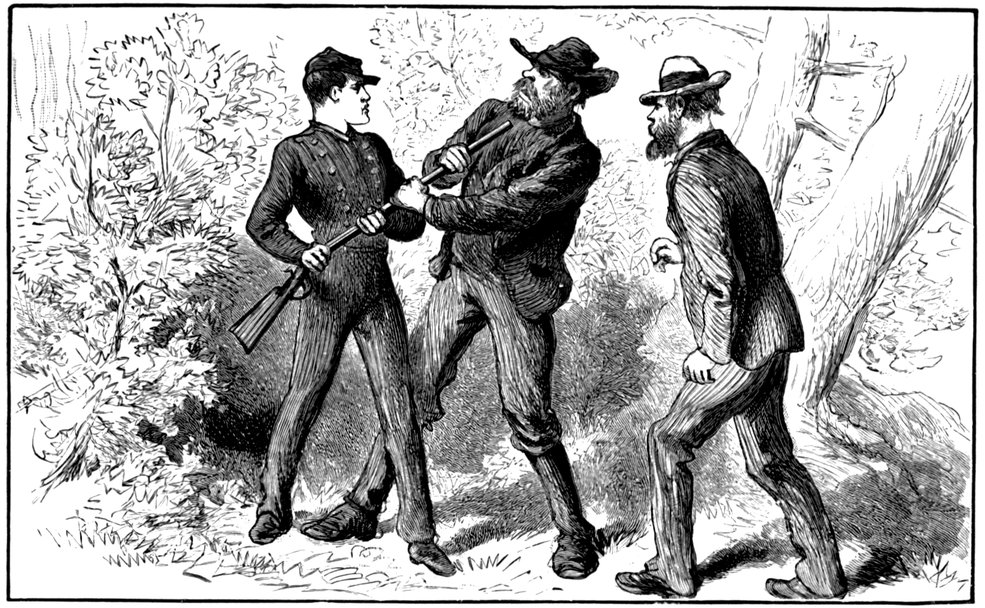
Don Gordon raised his head from his
pillow, and supporting himself on his elbow,
looked out at the open window toward the surf
that was rolling in upon the beach, and listened
intently.
It was a clear, cold night in October. The
fresh breeze that came in through the window
from the bay made blankets comfortable, but
neither Don nor Bert would consent to have the
windows of their sleeping-room closed. This was
the first night they had ever passed within sight
of salt water, and they wanted the waves to sing
them to sleep. In company with Egan and Curtis
they had been spending a few weeks with their
fat crony, Hopkins, while awaiting the arrival of
6the water-fowl, which generally make their appearance
in numbers in the northern waters of the
Chesapeake, about the middle of October. They
had ridden to the hounds, and shot quails and
snipes until they were tired of the sport, and this
particular night found them at Egan’s home,
impatiently waiting for a chance at the far-famed
canvas-backs.
They had been there but a few hours, having
arrived just at supper-time. Egan’s father and
mother extended a most cordial greeting to them,
and Mr. Egan, who, as we know, was an old soldier,
and who never grew weary of hearing Gus
(that was the ex-sergeant’s Christian name) tell
about that fight at Hamilton Creek Bridge, would
not let the visitors go to bed until he had heard
their description of it.
Knowing that her son’s guests would want to
see all they could of salt water during their stay
in Maryland, Mrs. Egan had furnished for their
especial benefit a large back room, which looked
out upon the bay, and supplied it with beds
enough to accommodate them all. Here, when
night came, they could lie at their ease and talk
over the day’s exploits until the music of the surf
7lulled them to sleep. On the night in question
their tongues had run with amazing swiftness and
persistency until nearly twelve o’clock; then they
began answering one another in monosyllables,
and finally Don Gordon, who was the last to stop
talking, placed his pillow in the open window, in
front of which his bed stood, laid his head upon
it, and was fast losing himself in dream-land,
when suddenly a sound like a single peal of distant
thunder came to his ears, and brought him
back to earth again.
“Are you all asleep in there?” exclaimed Don,
drawing in his head, and speaking to nobody in
particular. “What was that?”
“What was what?” asked Egan, drowsily.
“Why, that noise I heard just now. It sounded
something like the report of a cannon.”
“Well, it wasn’t a cannon; it was a duck-gun,”
replied Egan.
“Oh!” exclaimed Don. “Those poachers are
at work, are they?”
“Yes; and you will probably hear that gun a
good many times during your stay, if you take the
trouble to listen for it,” said Egan. “It is harvest-time
with these pot-hunters now, and in a
8few days they will make the ducks so wild that
you can’t get within rifle-shot of them.”
“We don’t have any market-shooters in my
State—or at least in the county in which I
live—and I am very glad of it,” said Don.
“Why don’t the farmers who live along these
shores wake up, and put a stop to this night-hunting
by capturing the guns? I suppose it
would put the poachers to some trouble to get
others?”
“Well—yes; and to some little expense also,”
replied the ex-sergeant. “How much do you
suppose one of those big guns cost?”
Don replied that he had no idea, having never
seen one of them.
“I saw one last summer that cost six hundred
dollars in England,” continued Egan. “It was
captured by a detective who was sent here by
some Baltimore sportsmen. You see, some of the
rich men who live in that city, and in New York
and Philadelphia, pay high prices for the exclusive
use of a portion of these ducking shores, and
they get mad when the market-shooters come
around with their howitzers, and scare all the birds
away to other feeding-grounds.”
9“I don’t blame them for getting mad,” said
Don.
“Neither do I. If a man pays four or five
hundred dollars a year for a shooting privilege, it
is because he thinks he and his friends will have
some sport out of it.”
“You don’t mean to say that these shores rent
for any such sum as that!” exclaimed Don.
“Don’t I, though?” replied Egan. “Father
has been importuned time and again to lease his
shores to different clubs, and he might as well
make five hundred or a thousand dollars a year as
to let it alone; but he likes to shoot as well as
anybody, and he likes to see his visitors enjoy
themselves, so he keeps his ducking-points for his
own use.”
“Do the big-gunners ever trouble you by
shooting over your grounds?”
“Not to any great extent. You see the ducks
don’t bed in these narrows; they want plenty of
elbow-room.”
“What do you mean by ‘bed’?” inquired Don.
“Why, when the ducks gather in large flocks
and sit on the water, either during the day-time
or at night, they are said to ‘bed’ or ‘bunch.’
10When a market-shooter finds one of these beds in
the bay, he watches it to see that it does not break
up, and when darkness comes to conceal his movements,
he goes out and shoots into it. He sometimes
gets as many as eighty ducks at a single
discharge of his blunderbuss.”
“How large a load does that blunderbuss
carry?”
“Half a pound of powder and two pounds of
shot.”
“Good gracious!” exclaimed Don. “How
heavy is it?”
“The one I saw weighed a hundred and sixty
pounds,” replied Egan. “It was ten feet long.”
“There ought to be a law prohibiting the use
of such weapons,” said Don, indignantly.
“There is a law which says that you not only
shall not use them, but that you must not have
them in your possession,” answered Egan. “If
you violate that law, you render yourself liable to
a fine of two hundred dollars or imprisonment;
but who is there about here who is going to complain
of you?”
“Why, the men who own these shores,” replied
Don.
11“They dare not do it,” said Egan.
“Well, I would do it if I lived here,” declared
Don, with a good deal of earnestness.
“Then you would find yourself in trouble
directly. These big-gunners are a desperate lot
of men, the first thing you know, and they will
not submit to any interference in their business.”
“If the law says they shan’t follow that business,
I don’t see how they are going to help themselves,”
said Don.
“They can take revenge on any one who incurs
their displeasure, can’t they? They can and they
will. If a person renders himself obnoxious to
them, the first thing he knows some of his buildings
will go up in smoke, or his boats will be
smashed, or the rigging of his yacht cut, or his
oyster-bed will be fouled. Why, they don’t hesitate
to make a fight with the police, if they are
surprised at their business. That Baltimore detective,
who worked his way into their good graces
and joined them in their night excursions, said
that the smack he went out in was as thoroughly
armed as any little pirate.”
“I’d like to go out with them just once in order
to see how they operate,” said Don, in whom the
12love of adventure was as strong as it ever had
been. “They must see plenty of excitement.”
Egan, who was more than half asleep, replied
that they probably did, especially while they were
dodging the police-boats; but he did not believe
that his friend Don would ever learn by personal
observation how the big-gunners conducted their
business. Well, he didn’t; but there were others
of our characters who did, and who they were,
and how they came to be permitted to accompany
the poachers on one of their nocturnal expeditions,
shall be told further on.
Don would have been glad to hear more of the
big-gunners, but a gentle snore coming from the
other side of the room told him that Egan had
gone to sleep again; so he rearranged his pillow
and prepared to go to sleep himself.
The morning dawned bright and clear, and with
just enough frost in the salt air to make it invigorating,
and to send the blood coursing through
one’s veins with accelerated speed. The visitors,
who had not been given much opportunity to look
about them the night before, were up at the first
peep of day, and their host led them out to show
them what there was to be seen. As he opened
13the door and stepped upon the porch, he was
greeted by four large, shaggy dogs, which fawned
upon him with every demonstration of delight,
but showed their white teeth to the other boys
when they attempted to scrape an acquaintance
with them.
“They are as ugly in disposition as they are
homely in appearance,” said Curtis. “Egan, why
do you keep such worthless brutes about you?”
“They are not worthless,” answered the ex-sergeant.
“They would sell to-day for two hundred
dollars apiece to any one of a dozen men whose
names I could mention.”
“What makes them so valuable?” asked
Curtis. “They don’t look as though they are
worth feeding.”
“I know they are not handsome, but they are
very useful,” replied Egan. “They are called
Chesapeake Bay dogs, and they belong to a breed
that are considered to be the best retrievers in the
world. You don’t need a boat to pick up your
wounded ducks when you have one of these fellows
in the blind with you, and neither do you
have to tell him when to go out after a bird. If
you kill half a dozen ducks and wound one, he
14will swim straight through the dead ones and take
after the wounded one; and he’ll have it, too, before
he comes back to the shore. That one,” continued
Egan, pointing to the largest of the dogs,
“once swam more than three miles through floating
ice in pursuit of a wing-tipped canvas-back.
Father was in the blind with me, and he was so
very much afraid that he was going to lose the
dog, that he sent me out in a boat to pick him up.
When I overtook him he had the bird, and was
striking out for the shore, apparently none the
worse for his long cold swim. Dogs of this breed
are very enduring while they last, but in the end
they are laid up with rheumatism, just as a man
would be who spent his life as they do. Now,
come with me, and I will show you the swiftest
and handiest little boat on the bay. I call her
a cutter for short, and that is what almost every
one else calls her; but she isn’t a cutter—she’s a
yawl.”
The boys followed their host along a broad
walk, through an extensive and well-kept flower-garden
which, in the proper season, must have
been one solid mass of bloom, and down to a little
stream that flowed into the bay a short distance
15from the house. On the bank they found a snug
boat-house, which was used as a place of storage
for two or three canoes, oyster-dredges, lobster-pots,
and various other things which none of the
visitors, except Hopkins, knew the use of. One
of the canoes having been shoved into the water,
the boys got into it, and pushed off toward a
couple of little vessels that were riding at anchor
in the bay. One of them was an oyster-boat—Don
and Bert were sure of that, for in rig and
model she corresponded with the descriptions they
had read of such vessels; but the other one puzzled
them. She was not a sloop, for she had two
masts; and yet she was not a schooner, because
the mizzen mast, if that was the proper name for
it, was stepped close to the stern. But she was
a beautiful little vessel they found when they
boarded her, and very roomy, too, although she
was only seventeen feet in length, with five feet
beam. She had a house or hatch on deck, which
proved to be the top of the cabin, and a small
cock-pit, in which the boy who managed the helm
stood or sat while he steered the vessel. The
cabin was spacious, owing to the deep, straight
sides of the boat, and was provided with two
16berths, one on each side, which could be turned
up against the bulk-head, or let down at pleasure,
like the berths in a sleeping-car. Behind the foremast,
which came down through the forward end
of the cabin, was the alcohol stove, on which the
captain and owner cooked all his meals while he
was cruising about the bay—that is, when he
didn’t feel in the humor to go ashore to cook
them, or couldn’t get ashore on account of the
surf. There were two water-tanks, plenty of
lockers in which to stow food, clothing, and hunting
and fishing accoutrements—in short, she
seemed to be perfect in every particular; and Don
and Bert, who, as we know, took almost as much
delight in a sail-boat as they did in their ponies,
were prompt to say so.
“Yes, I am rather proud of her, because she
was built according to my own ideas of what a
boat for single-handed cruising ought to be,” said
Egan, as he led the way out of the cabin, and
seated himself in the cock-pit. “First and foremost,
you can’t capsize her. If the Mystery had
been built after this model she would have weathered
that gale without shipping so much as a
bucket of water.”
17(It will be remembered that the Mystery was a
yacht belonging to Mr. Packard, a brother of
Judge Packard, who was General Gordon’s nearest
neighbor. Accompanied by his wife and child,
and two or three friends, the Mystery’s owner set
sail from Newport for Bridgeport, but was overtaken
on the way by a terrific storm, which
wrecked his yacht, and sent her to the bottom.
Her entire crew would have gone with her, had it
not been for the fact that Enoch Williams and
his crowd of deserters, who had run away in the
Sylph, were close at hand. Enoch and Lester
Brigham went off in a small boat, and saved the
yacht’s crew at the risk of their own lives, and
when they were captured by Captain Mack and
his men, who were following close in their wake
in the schooner Idlewild, and taken back to
the academy under arrest, they were looked
upon as heroes rather than culprits. Their act
of bravery did not, however, save them from a
court-martial. They lost every one of the credit
marks they had earned during the term, and
that took away their last chance for promotion.
Egan and his friends could recall all the incidents
connected with the wreck and the rescue,
18and they became excited whenever they thought
of them.)
“What do you mean by ‘single-handed cruising’?”
asked Curtis, continuing the conversation
which we have for the moment interrupted.
“Can one person handle this boat in all kinds of
weather?”
“Certainly; and there is where the beauty of
her rig shows itself. If I want to beat in or out
of a narrow channel I run up the mainsail only,
and then she works like a cat-boat, never missing
stays, but keeping her headway clear around. If
I am caught out in a gale, I drop the mainsail,
and scud along under the jib and mizzen. I have
stayed out on the bay alone, fooling around, when
boats that were twice as big as this were running
for shelter. I expect to lose her some day, but it
will be through no fault of my own.”
“What do you mean by that?” asked Bert.
“Why, I am accused of having assisted that
detective in running those big-gunners to earth
last fall,” answered Egan. “I didn’t do it, but
some of their friends saw me talking with the
detective on several different occasions, and they
know that I detest their business, for I have often
19said so when perhaps I ought to have kept my
tongue still. It is very plain that somebody gave
the detective all the information he wanted, and,
as I said, these poachers lay it to me. They have
sent me word that they intend to get even with
me, and that’s why I expect to lose my boat.”
“Can’t you head them off in any way?” asked
Don, whose chivalrous nature revolted at the mere
mention of so cowardly a way of “getting even.”
“You are not obliged to stand still and see your
property destroyed.”
“Of course not, and I don’t intend to do it,
either,” said Egan, in very decided tones. “These
boats are guarded every night, and have been for
a year. One of our darkies sleeps on board the
oyster-boat, and he has two of the retrievers and
a loaded musket for company. It will be a cold
season when those dogs get left, for they are all
ears and nose, and would rather fight than eat
when they are hungry. Now, perhaps, we had
better go ashore. Breakfast will be ready directly,
and then we will take a run down the bay, unless
you can think of something else you would rather
do.”
The boys hastened to assure their host that
20they couldn’t think of anything that would afford
them so much pleasure as a sail in his neat little
cutter, and so one day’s sport was provided for.
We may run far enough ahead of our story to say
that they thoroughly enjoyed their boat-ride, but
whether or not they saw any fun in some things
that followed close upon the heels of it, is another
matter altogether.
Having drawn the canoe high and dry upon the
beach, the boys went into the house and up to
Egan’s room, which contained his small but well-chosen
library, his hunting and fishing outfit, and
a few specimens of his skill as a sportsman and
cabinet-maker; for Egan understood the use of
tools, and spent every stormy day when at home
in his shop. Prominent among his specimens was
a magnificent white swan which, after being so
badly wounded that it could not take wing, had
led him a two hours’ chase in the teeth of a fierce
gale, and through water covered with huge cakes
of ice, that every now and then were thrown by
the waves against the sides of his yacht with force
enough to make her tremble all over.
“I had a jolly time, but a wet one,” said Egan,
whose eyes sparkled with excitement when he
21spoke of the circumstance. “But didn’t father
scold me when I came ashore? Well, I deserved
it, for it was a careless trick, going out in all that
wind and ice when not another boat would venture
away from the shore; but I wanted the
swan, and I desired to test my yacht, which had
come into my possession only a week before, and
that was the reason I did it. By the way,” added
Egan, pointing to something which, enclosed in a
frame of his own construction, hung suspended
from the swan’s long, white neck, “do you know
what that is?”
Yes, the boys knew what it was as soon as they
looked at it. It was the five dollar bill that the
paymaster had given him for the part he had
borne in putting down the Hamilton riot. Every
boy who was in that fight had received the same
amount, and they had one and all declared that
nothing could induce them to spend a cent of it;
but the pancakes at Cony Ryan’s proved to
be too strong a temptation for some of them to
resist, and our five friends were among the very
few who had held to their resolution.
Breakfast being over and a substantial lunch provided,
the boys returned to the cutter, which had
22been christened the “Sallie” by her proud captain
and owner. Hopkins declared that she was
named after Asa Peters’ sweetheart—the one he
had intended to take to the show on the day that
Don and Egan borrowed his clothes; but the indignant
master of the yacht affirmed that there
wasn’t a word of truth in it, adding that if he
had been going to name his boat after anybody’s
girl, he would have named her after his own, who
was by all odds the very handsomest one in
America.
Having stowed their guns and cartridge-belts
away in one of the lockers, the boys went on deck
to get the yacht under way. Egan was the only
sailor in the party, but the others, who, during
their cruise in the Idlewild in pursuit of Enoch
Williams and his band of deserters, had learned
to tell a halliard from a down-haul, were able to
give him considerable assistance, and in a very few
minutes the Sallie was flying down the bay with
all her canvas set except the big topsail, which
her cautious captain did not think she could
stand, seeing that there was no boat for her to
race with, and no wing-tipped swan scudding
along in front of her.
23Being fairly under way, the boys began amusing
themselves as live boys generally do when they are
entirely satisfied with themselves and their surroundings—by
singing songs and telling stories.
Egan, who stood at the helm, was roaring out
(with little regard to time and melody, it must be
confessed), “I’m going to fight mid Zeigle,” when,
just as he was saying that he would like to have
“sweitzer kase and pretzel” for rations rather
than “salty pork,” the Sallie shot around a low
point which jutted out into the bay, and bore
swiftly down upon what appeared to be an immense
flock of canvas-backs and red-heads. They
were floating about among the waves with their
heads erect, as if they were on the point of taking
wing, while about two hundred yards farther down
the bay, approaching on rapid pinion, was another
and much larger flock, which was already beginning
to “swing” as if preparing to alight among
the ducks on the water.
“Great Scott!” cried Don, making a headlong
rush for the companion ladder. “Why didn’t I
bring my gun up with me?”
“Well, that is rich!” exclaimed Egan, with a
hearty laugh. “I thought you had hunted ducks
24often enough to know the difference between a
live bird and a decoy. Don’t you see that sink-box
right in the midst of them?”
Yes, Don saw it, after he had taken another
and a closer look, and he saw too that the objects
which he had at the first glance mistaken for canvas-backs
and red-heads, were wooden counterfeits,
so closely resembling live birds in form and
coloring that almost anybody, except an expert,
would have been deceived.
The approaching flock changed its course as
soon as the yacht rounded the point, and having
seen them well started on their way toward the
middle of the bay, Don turned to look at the
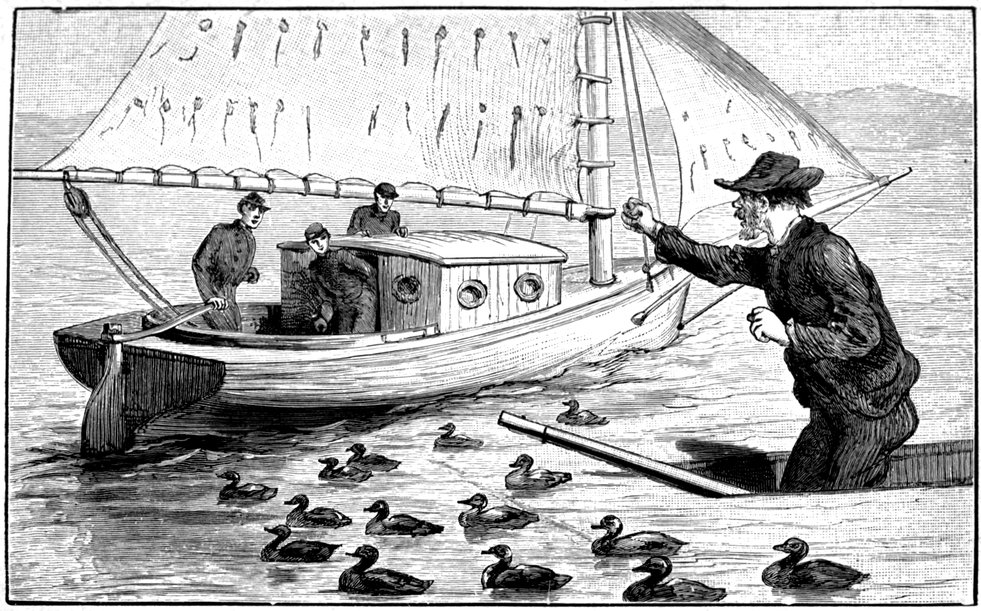
sink-boat. It was in reality a floating blind—an
anchored box with hinged flaps to keep the waves
from washing into it. When these sink-boats are
used the gunner lies on his back completely out of
sight, and shoots into the passing flocks as they
swing to his decoys. The birds he kills are picked
up by a confederate, who also skirmishes around
in his canoe, putting up every flock he can find,
and trying to start them toward the gunner. If
the latter has all the sport, he likewise has the
hardest part of the work to perform. It is drowning
25work when the sea comes up suddenly and fills
his box full of water before his companion in the
canoe can get him out of it; it is freezing work
when the wind chops around to the north and
drives the rain and sleet before it with cutting
force; it is uncertain work when that same wind
drives the ducks off shore to the open waters of
the bay; and it is tiresome and unpleasant owing
to the cramped position the gunner is compelled
to occupy. But, as a general thing, he shoots
plenty of birds, and those he doesn’t shoot he
frightens away so that no one else can shoot
them.
As Don looked at the sink-boat he saw the occupant’s
head rise slowly above the side of it. He
gazed in every direction to see what it was that
had frightened the flock for which he had been so
long and patiently waiting, and which he had
hoped would alight among his decoys, and finally
he turned his face towards the yacht. It was
a very savage looking face, thought Bert, who was
gazing at it through Egan’s binoculars, and that
the owner of it felt savage was made evident by
the first words he uttered.
CHAPTER II. THE MAN IN THE SINK-BOAT.
26
When the man in the sink-boat discovered
the approaching yacht he laid down his
gun, got upon his knees, and shook both his fists
at the boy who stood at the helm.
“You’re always around when you are not
wanted, Gus Egan,” said he, fiercely. “If you
know when you are well off, you will learn to
mind your own business. I’ve the best notion in
the world to send a charge of duck-shot after you.”
“He would do it in a minute if he thought he
could escape the consequences,” said Egan, in a
low tone. “He is one of the fellows who has so
often threatened me. The detective took his big
gun away from him, and now he has to resort to a
sink-boat to get birds for market.”
“I shouldn’t like to make an enemy of that
man,” observed Bert, as he passed the glass over
27to Hopkins. “Unless his countenance belies him,
he is capable of doing anything.”
“His face is a true index to his character,” replied
Egan. “He is accused of almost everything
that’s bad, and some day there will be trouble in
this neighborhood. He is under indictment for
shooting ducks contrary to law, but he says he
will get up the biggest kind of a fight before he
will be arrested, and he means every word of it.”
“If that yawl of yours scares just one more
flock of ducks for me, she will never scare another,”
continued the man in the sink-boat. “You have
done about damage enough on this bay by taking
the bread out of poor men’s mouths, and it is high
time you were larnt better manners.”
Egan, who did not act as though he had either
seen or heard the occupant of the sink-boat, kept
the Sallie away a point or two, so as to clear
the outer edge of the decoys, and ran on down the
bay until he came opposite to a small board cabin
that stood on the shore in the midst of a little
grove; then he threw the yacht up into the wind
and called out: “O Eph!” whereupon an aged
negro, who was sitting on a bench beside the open
door, arose and hobbled down to the beach, bowing
28and pulling at his almost brimless hat as he
came.
“That’s old Eph, the terrapin hunter,” observed
Egan. “He makes anywhere from ten to forty
dollars a week out of his ‘birds,’ as they are called,
but, like the most of his race, he spends his money
as fast as he gets it, and what will he do when the
rheumatism gets a good grip on him and he has
to quit work, I don’t know. I suppose he will
have to fall back on father for support, because
he belonged to our family before the war.”
“Terrapins are nothing more nor less than mud-turtles,
I believe?” said Curtis, inquiringly.
Egan replied that that was just what they were—turtles
that were caught in tide-water; and
then he called out to the negro, who had by this
time reached the water’s edge:
“I say, Eph, have you two or three diamond-backs
to spare?”
“Ise allers got some for you, Marse Gus,” was
Eph’s answer.
“All right. Come aboard and get this
basket.”
The negro stepped into a canoe that lay on the
beach close at hand, and a few strokes with the
29paddle brought him alongside the yacht. The
basket containing their lunch was passed down to
him with the request that he would have three
diamond-backs, cooked in his best style, ready for
them at one o’clock sharp. The negro promised
compliance and shoved off for the shore, after exchanging
a few complimentary remarks with Egan,
who, it was plain, was a favorite of his, while the
yacht filed away on her course.
“What is a diamond-back?” asked Don, as
soon as they were fairly under way.
“It is a terrapin not less than seven inches in
length, measuring along the under shell,” answered
Egan. “They are better than the larger and
coarser kinds, just as a two and a half pound yellow
pike is better than one that weighs nine or ten
pounds. They bring from twenty-five to thirty-six
dollars a dozen, while the river turtles are
worth only nine dollars; but the latter are extensively
used by hotels and restaurants where they
are served up as diamond-backs, just as red-heads
are served up as canvas-backs. However, as both
those species of ducks live on the same kind of
food—wild celery—there is not so much difference
between them as there is between the tide-water
30and river terrapin. Hallo! Hand me that glass
a moment, Curtis.”
The boys looked around to discover what it was
that had called forth this exclamation from the
skipper, and all they could see was a neat little
schooner standing up the bay. Egan leveled the
glass at her for a second or two, and then handed
it back to Curtis, saying:
“Just as I expected. Now look out for breakers.”
Curtis, in turn, took a look at the schooner and
was surprised to see that she was manned by
academy boys, to wit, Enoch Williams, Jones,
and Lester Brigham. As the little vessels dashed
by each other, moving swiftly in opposite directions,
no sign of recognition was exchanged between
the crews. They seldom spoke now.
Don and his brother had made commendable
progress during their last year at school, and had
both received well-earned promotions at the close
of the examination. Don was now lieutenant-colonel
of the academy battalion, and Bert was
the ranking captain; while Lester and his two
friends had not been able to win so much as a
corporal’s chevrons. Of course this made them
31angry, and they were waiting for an opportunity
to be revenged upon Don and Bert. How the
latter could be blamed because Lester and his
cronies had failed in their examination, it would
have puzzled a sensible boy to determine. Probably
Lester did not understand the matter himself;
but there was one thing he did understand,
and that was, that things were going altogether
too smoothly with Don and Bert. It would have
afforded him infinite pleasure if he could have
been the means of getting them into some serious
trouble. During the last school term he had
watched them as closely as a cat ever watched a
mouse, in the hope that he would see a chance to
report them for some neglect of duty; but he had
his trouble for his pains. As soldiers and students
there was not the least fault to be found with
them, and if it had not been for Enoch, Lester
would have given up in despair. How his friend
encouraged him we shall see presently.
“Those fellows will be up to some sort of mischief
before we see the last of them,” observed
Curtis, after he had taken a good look at the
schooner.
“That is my opinion,” said Egan, “and I believe
32that Enoch has been up to something already.
I don’t know it to be a fact, but still I am pretty
certain that he is hail fellow well met with these
big-gunners, and if he is, he will bear watching.”
“What is that long black streak out there on
the water?” asked Bert, suddenly.
Egan looked in the direction indicated, and a
moment later the Sallie came up into the wind,
then filled away on the other tack and started
back up the bay.
“That is a bed of ducks,” said the skipper. “I
shouldn’t wonder if there were thousands in it.
They are only a short distance from the foot of
Powell’s Island, and it will be no trouble at
all to toll them in so that we can get a shot at
them.”
“Well,” said Bert, when Egan paused, “we
should like to be told what tolling is.”
“I would rather show you than try to explain
it to you,” was the reply. “The only way to find
out is to see for yourself.”
The Sallie kept on up the bay until she came
opposite to the cabin of the old terrapin hunter,
who at once responded to Egan’s lusty hail.
“I want to borrow Bogus for a little while,”
33shouted the skipper. “And I say, Eph, bring
out a lot of chips with you.”
The negro disappeared behind his cabin, and in
a few minutes came back again, carrying his hat
in his hands, and followed by a little yellow dog.
The two got into the canoe, and presently both
the dog and the hatful of chips were deposited on
the yacht’s deck.
“There is a big bed of ducks off Powell’s Island,
and we are going to shoot some of them,”
said Egan. “So, perhaps, you had better postpone
the cooking of those terrapin until about
three o’clock. Be sure and have them ready then,
for we shall be hungry.”
The old negro went ashore, leaving his dog and
the pile of chips behind him; and the yacht came
about and started down the bay again. She held
straight for the head of the island, and, running
into a little bay thickly lined with trees on both
sides, was tied up to an abrupt bank where the
water was deep enough to float her. Bogus
seemed to know just what he was expected to do;
for when the boys, having buckled on their cartridge-belts,
shouldered their guns and stepped
ashore, he took up his position at Egan’s heels,
34and stayed there until he was sent out to perform
his allotted part in tolling the ducks.
The young wild fowlers, led by Egan, directed
their course toward a sheltered cove on the other
side of the island, and were presently crawling on
their hands and knees through the calamus and
dry marsh grass which formed a good cover almost
to the water’s edge. The bay seemed to be full
of ducks. None of the visitors, except Hopkins,
had ever seen so many in one flock before, and
they were greatly disappointed to discover that
they were far beyond the reach of the heaviest
gun in the party. Indeed, it would have required
a good rifle to throw a ball into the midst of them,
and the course they were following was taking
them farther away from the island every moment.
“We shall get no ducks out of that flock,” said
Don.
“Then it will be your fault,” replied Egan, confidently.
“If you will do good work after I bring
them within range, we will have canvas-backs for
dinner to-morrow. Now, Bogus, let’s see how
smart you are.”
Egan had brought the chips with him in a
game-bag. As he spoke, he took one of them out
35and tossed it into the water, whereupon Bogus
jumped to his feet and skipped in after it. He
seized the chip, tossed it into the air, caught it
when it descended, and played with it with as
much apparent delight as a cat plays with a ball
of yarn; the visitors watching his antics with the
greatest surprise.
“You have read of the curiosity exhibited by
the antelope of the Western plains—how hunters
have been known to decoy them within gun-shot
by simply waving a colored handkerchief above
the grass, have you not?” said Egan, by way of
explanation. “Well, the canvas-back has just as
much curiosity, as you can see for yourselves.”
The boys, whose attention had been fully occupied
by the extraordinary performances of the
dog, now turned their eyes toward the flock, and
were astonished as well as gratified to observe
that a few of them had left the main body and
were coming slowly toward the shore. Even at
that distance one could see that they were attracted
by, and interested in, the actions of the
dog. Presently, other ducks came out of the bed
and joined them; then a second and larger body
appeared, and, what was very surprising to the
36visitors, they betrayed the greatest excitement.
They would sit up in the water, sustaining themselves
by the help of their wings, and then settle
down and swim swiftly about, performing the
most intricate maneuvres.
“Easy, boys,” whispered Egan, as Curtis raised
his head to obtain a better view of the approaching
flock. “If you want to get a shot, you must
not show so much as an inch of the top of your
hat. They’ve got sharp eyes; and that is what
makes them so easy to toll. If they were not
constantly on the watch, they would not have
seen the dog.”
When Bogus grew tired of playing with the
first chip Egan threw out to him, the boy tossed
him another. The intelligent and well-trained
animal did not act as though he saw the ducks at
all; but it was evident that he knew they were
coming, for the nearer they approached the shore
the more energetically he played. He never uttered
the faintest whimper, but kept silently to
his work; and the ducks, growing bolder as their
number increased, approached with more rapidity
and confidence, showing by their actions the liveliest
curiosity.
37“Now watch them closely, and I will show you
something else,” whispered Egan. As he spoke,
he began throwing the chips first to the right and
then to the left of his place of concealment, and
as the dog ran from one to the other, the ducks
turned also, closely following all his movements
as if they feared that they might lose the most
interesting part of the performance. When those
in front thought they had come near enough, and
showed a disposition to stop, their companions
behind pushed them on, while the ducks in the
rear came crowding through to inquire into the
matter.
By this time the dog had an interested audience
of at least five or six hundred ducks in front of
him, and not more than seventy-five yards from
the shore. They were coming nearer all the while,
and, finally, Egan reached for his double-barrel;
but, just at that moment, the whole immense
flock arose as one duck, with a great roaring of
wings and splashing of water, and flew swiftly
down the bay.
“Which one of you fellows showed his head?”
demanded Egan, laughing heartily at the expression
of disappointment and chagrin he saw on the
38faces of every one of his companions. “The next
time we try to toll a flock of canvas-backs, remember
what I told you about their sharp eyes,
and be careful to keep out of sight. Look at Bogus!
He thinks he was to blame for it, and he
expects a whipping.”
The boys glanced toward the beach, and there
was the dog which had done his part of the work
so faithfully, going through all sorts of antics, and
saying, as plainly as a dumb brute could say it,
that he was very sorry the flock had gone off
without giving the young hunters a chance for a
shot, and that, if it were his fault, he would be
careful to do better next time. First, he would
sit up and beg, and then he would lie down and
hold up both his paws imploringly, as if he were
trying to ward off the blows of a switch; but a
friendly word from Egan dispelled all his fears,
and made a happy, light-hearted dog of him
again.
“You didn’t do it, old fellow,” said the boy, as
Bogus came bounding to his side; “and I can’t
think what did do it, unless one of these careless
friends of mine—— Hold on! I take it all back.
There’s the cause of the trouble,” added Egan,
39nodding his head toward the upper end of the
bay.
The others looked in the direction indicated,
and saw Enoch Williams’ schooner coming down
under full sail. Whether or not her crew knew
that Egan and his companions were trying to toll
the ducks within gun-shot, was a question; but
they knew it a moment after they hove in sight,
for the young hunters arose from their places of
concealment, and stood out in full view of the
schooner, which ran down as far as the foot of the
island, and then came about, and started back up
the bay.
“That move seems to indicate that they knew
we were here, and that they came down on purpose
to frighten the ducks away,” said Hopkins,
with no little indignation in his tones.
“What else could you expect of such fellows
as they are?” demanded Egan. “Never mind.
There is more than one flock of canvas-backs on
the bay, and they can’t drive them all away from
us, no matter how hard they try. Now, we will
take a short sail, and then we will run back to
Eph’s, and get our terrapin.”
As it happened, Hopkins and Egan were both
40mistaken in their opinions regarding the object
the schooner’s company had in view when they
followed the Sallie down to Powell’s Island.
Enoch and Jones had an idea in their heads, but
they did not know that Egan and his friends were
after the ducks until they saw them rise from
their hiding-places. They were acting as volunteer
spies upon the movements of Egan and his
guests, and if we step aboard the schooner, and
listen to some of the conversation that took place
between Enoch and his two companions, we may
be able to understand why they did it.
It will be remembered that Egan and his guests
had got into the way of spending a portion of
their vacations at one another’s homes, the first
being spent in Mississippi. When Lester Brigham
saw how they enjoyed themselves at Don
Gordon’s Shooting box, he proposed to his
friends, Enoch and Jones, that they should pass
their vacations in the same way; and so it came
about that while Egan, Hopkins, and Don and
Bert Gordon were hunting and fishing with Curtis
in the wilds of Maine, Lester’s Maryland friends
were visiting with him at his home near Rochdale.
It was not accident that had brought them
41all together in Maryland during this particular
vacation. Lester had come there with a fully
developed plan in his head, and Enoch and Jones
were ready and eager to help him carry it out.
Lester and Jones had been at Enoch’s home two
weeks, impatiently awaiting the arrival of Egan’s
guests, who, as we have said, were sojourning
with Hopkins, enjoying themselves in shooting
quails and snipes. On the morning of which we
write they went out for a sail on the bay before
breakfast, and it was while they were on their
way home that their eyes were gladdened by the
sight of the Sallie under sail.
“There they are at last!” exclaimed Enoch,
who was the first to discover Egan’s boat as she
moved gracefully away from her anchorage. He
was standing at the helm of his schooner, the
Firefly, and Lester and Jones were sitting near
him in the cock-pit.
“They? Who?” inquired the former, who,
for a wonder, happened to be thinking about
something besides his contemplated revenge on the
boys who had unintentionally excited his jealousy.
“Why, your particular friends, the Gordon
boys.”
42“Good!” exclaimed Lester. “I wonder if
they are all there.”
“If you will run down and get the spy-glass
you can soon find out,” was the reply.
The glass was brought, passed rapidly from
hand to hand, and then the three plotters looked
at one another while a smile of triumph lighted
up their faces. They saw the Sallie frighten away
the ducks that were about to swing to the decoys
that were anchored around the sink-boat, and
Enoch and Jones were so delighted when they saw
the occupant of the boat rise up and flourish his
fists in the air, that they could scarcely refrain
from shouting.
“They have got themselves into trouble already,”
said Enoch, as he brought the glass to
bear upon the angry gunner. “That man in the
sink-boat is Amos Barr. They have made him
mad by scaring away his ducks, and I am glad of
it, for he is one of the most vindictive men on the
bay.”
We have already told how the two yachts
passed each other without any exchange of courtesies
between the crews. The Firefly ran between
the decoys and the shore and was thrown
43up into the wind, so that her skipper could talk
to the man in the sink-boat.
“Good morning, Mr. Barr,” said Enoch, pleasantly.
“Egan came along just at the wrong
time, didn’t he?”
“He is always around when he ain’t wanted,
and I told him so,” was the gruff response.
“Do you believe it is all unintentional on his
part?” asked Jones, in a significant tone.
“Don’t you think that he does it on purpose—that
he is just snooping around to see what he
can find that is worth looking at?”
“I know it,” answered Barr, shaking his
clenched hand at the rapidly receding cutter.
“When he told that detective that I was a duck-shooter,
and that I and my partners had a big
gun hid somewhere about the bay, didn’t he do
it a purpose? Of course he did. He wanted to
get me into trouble; but he wasn’t by no means
as smart as he thought he was. We had more’n
one big gun, me and my partners did, and—by
the way, did you know that we had got our best
gun back?”
“No!” replied Enoch, who was surprised to
hear it.
44“Well, we’ve got it safe and sound, and if one
of them detectives ever gets a chance to put an
ugly hand on it again, I’m a Dutchman. Simpson,
he—but I don’t reckon I had best say any
more,” said Barr, with a hasty, suspicious glance
at Lester.
“O, you need not be afraid of my friend Brigham,”
exclaimed Enoch. “He is true blue, and
he hates Egan and all his crowd as cordially as
Jones and I do. What about Simpson?”
“Mebbe I will tell you all about it some other
time,” answered Barr, cautiously. “’Tain’t best
to say too much to nobody these times.”
“I know that. Those ‘gentlemen sportsmen’
(Enoch sneered as he uttered the words), who
live up north, and rent some of our shooting-points,
are bound to break up your business if
they can.”
“And how would they feel if we-uns should go
up where they live, and set about breaking up
their business—should try to take the bread out
of the mouths of their children?” exclaimed
Barr, in savage tones. “The birds we shoot
bring we-uns in our grub and clothes. Being
wild, they don’t belong to nobody; but they
45belong to we-uns who live here, more’n they do
to folks who don’t live here, and we have a right
to get ’em in any way we can. Them fellers up
north can’t break up our business, for we won’t
let ’em; an’ as for the folks who live round here
and tries to help ’em do it—”
“Fellows like Gus Egan, for instance,” interrupted
Enoch.
“Yes, he is one of the worst in the lot of the
mean fellers that won’t let us shoot the ducks
because they want to shoot them theirselves,”
assented Barr. “As for him, and others like
him, that I could call by name if I wanted to,
they are getting theirselves deeper and deeper into
a furse every day. Something’s going to happen
if them detectives comes down here this season.
You hear me speaking to you?”
As Barr said this, he played with the lock of
his heavy duck-gun, and looked very fierce indeed.
CHAPTER III. BARR’S BIG GUN.
46
“I don’t blame you for being angry,” said
Jones, after a few minutes’ pause. “I hold
as you do, Mr. Barr—that the wild fowl which
come into this bay are the property of any one
who can bring them to bag; and that men who
live hundreds of miles away, who come here only
once a year, and for a few days at a time, are taking
a good deal upon themselves when they presume
to tell us how these wild birds shall be
killed. Those ‘gentlemen sportsmen,’ as Enoch
calls them, have no right to make laws for my
government, and I shall pay no attention to
them.”
“No more will I,” said Barr, emphatically.
“But I bet you I will pay some attention to the
fellers about here who are mean enough to side
with them and the detectives.”
47“Was that you shooting last night?” asked
Enoch, suddenly.
“I didn’t hear no shooting last night,” answered
Barr, with another sidelong glance at
Lester.
“You have grown very suspicious since I saw
you last,” said Enoch, with some impatience in
his tones. “But I tell you that you need not be
afraid to trust me or any one whom I endorse.
We all heard a big gun shortly after midnight,
and I’ll bet my schooner against your sink-boat,
that if I were to look along the shores of Powell’s
Island, I could find the gun.”
Barr grinned, but made no reply.
“When are you going out again?” continued
Enoch.
“Well, that depends,” said the gunner, hesitatingly.
“If I see nothing suspicious, I may go
out the fore part of next week.”
“When you go, remember that we three want
to go with you,” added Enoch. “This fellow”—jerking
his thumb over his shoulder towards
Lester Brigham—“is my chum and Jones’s. He
lives way down in Mississippi, and has never seen
a big gun. We passed a portion of our last vacation
48at his father’s house, and as Lester took pains
to show us every thing of interest there was to be
seen in that part of the country, we desire to
reciprocate his kindness. You will let us know
when you are going out, won’t you? Hallo!
What is the Sallie doing back here? I thought
she went on down the bay.”
So she did; but when Bert discovered that immense
bed of canvas-backs off Powell’s island,
the skipper ran back to old Eph’s cabin after his
dog to entice the wild fowl within range. When
Enoch saw her, she was just rounding to in readiness
to start down the bay again. He and the
rest watched her until she disappeared in the cove
at the head of the island, and then to quote from
Lester Brigham, Barr swore until every thing
around him turned blue.
“Aha!” cried Enoch, and there was a triumphant
ring in his voice. “Didn’t I say that that
big gun we heard last night was somewhere
around the island? If you think I can be of
any service to you, I will run down there and keep
an eye on them. Of course they don’t know that
the gun is there, but if you go down, they will
suspect it.”
49“All right,” said Barr, in tones that were husky
with passion. “Go on, and I will do you a friendly
act the first chance I get.”
“Will you let us go out with you the next time
you use the big gun?” inquired Enoch, as he put
the helm down and motioned to Jones to haul in a
little on the jib sheets.
“Yes, I will; honor bright,” answered Barr,
eagerly. “Say, Enoch, the gun is hid in the
bushes on the banks of that little cove on the
other side of the island. You just hang around
and see whether or not they stumble on to it, and
if they do, let me know it at once. I will put it
in a safer place before I go home to-night. I see
one of my partners down there in his canoe. I
wish you would hail him as you go by and tell
him to come up here. I may need him.”
The Firefly ran up the bay until she cleared the
decoys, and then rounding to, filled away for
Powell’s Island. Her captain seemed to be in a
very jovial mood.
“Didn’t we promise that we would help you
square yards with those fellows?” said he, addressing
himself to Lester. “I wouldn’t like to be in their
boots if they find that gun; would you, Jones?”
50“No, indeed,” was the quick reply. “Barr is
just on the point of boiling over already, and he
won’t stand much more interference with his
business.”
“What do you think he would do to Egan if
he and his crowd should find that big gun and
take possession of it?” asked Lester.
“O, Egan would not dare do that,” answered
Jones. “He has no more right to touch that big
gun than he has to take charge of this schooner.
The most he could do would be to tell an officer
where the gun was hidden, and if he did that,
Barr would improve the very first opportunity
he got to destroy some property for him or his
father.”
“But how would that help me square yards
with Don and Bert?” inquired Lester. “I don’t
like Egan, because he is Don’s friend; but still I
don’t care to see him injured.”
“Well, I do,” said Enoch, spitefully. “I
haven’t forgotten how squarely he went back on
me during my first day at the academy. There I
was, a stranger in a strange place, and he wouldn’t
introduce me to a single student; and when he
walked off toward the gate with some of his chums,
51he told me to stay behind because he did not want
me along. Do you think I shall ever forget that?
Not much.”
“It seems that Barr has got his big gun back
again,” said Jones. “I mean the one the detectives
found on information furnished them by Gus
Egan.”
“I am not at all surprised to hear it,” replied
Enoch. “You see,” he added, turning to Lester,
“this man Simpson, of whom Barr spoke, is a local
detective, who has long been suspected of being in
sympathy with the big-gunners; and you know
Barr hinted that it was through him that he got
his big gun back. The detectives often play into
one another’s hands, and I believe that for a hundred
dollars Simpson could be bribed to do almost
anything. Look there, Brigham! Did you ever
see such a sight before?”
Up to this time the Firefly had been kept
behind the island, so that her approach would not
be detected by the boys whom Enoch intended to
watch; but now she was obliged to stand out into
the bay, and, as she rounded the headland, Enoch
caught sight of the flock of canvas-backs which
old Eph’s dog was tolling in toward the beach.
52“No, I never saw so many ducks in one flock
before,” replied Lester, as soon as he had somewhat
recovered from his surprise. “Why, Diamond
Lake would hardly hold them. Don’t those
look like heads over there in the grass?” he added,
directing Enoch’s attention toward the cove where
the young wild fowlers were concealed.
“They are heads,” said Jones, after he had
taken a look at the objects through the spy-glass.
“They were tolling that flock, and we came up
just in time to spoil their sport for them.”
“If I could have my way, they would never
have the pleasure of shooting a wild duck or anything
else as long as they live,” snapped Lester.
“We have found them,” said Enoch. “Now
we will sail around, far enough from the shore to
avoid arousing their suspicions, and keep an eye
on their movements through the glass. Barr’s big
gun is hidden somewhere near that cove, you
know.”
Enoch kept on down the bay without one word
of apology to the boys on shore for frightening
away the ducks, while Jones, at his suggestion,
settled himself down on a cushion in the cock-pit
to observe and report upon the actions of Egan
53and his party. The latter, all unconscious of the
fact that they were being closely watched, strolled
leisurely along the shore of the cove in the hope of
picking up a few brace of snipes for their next
morning’s breakfast; and although they did not
find the game for which they were looking, they
found something else for which they were not
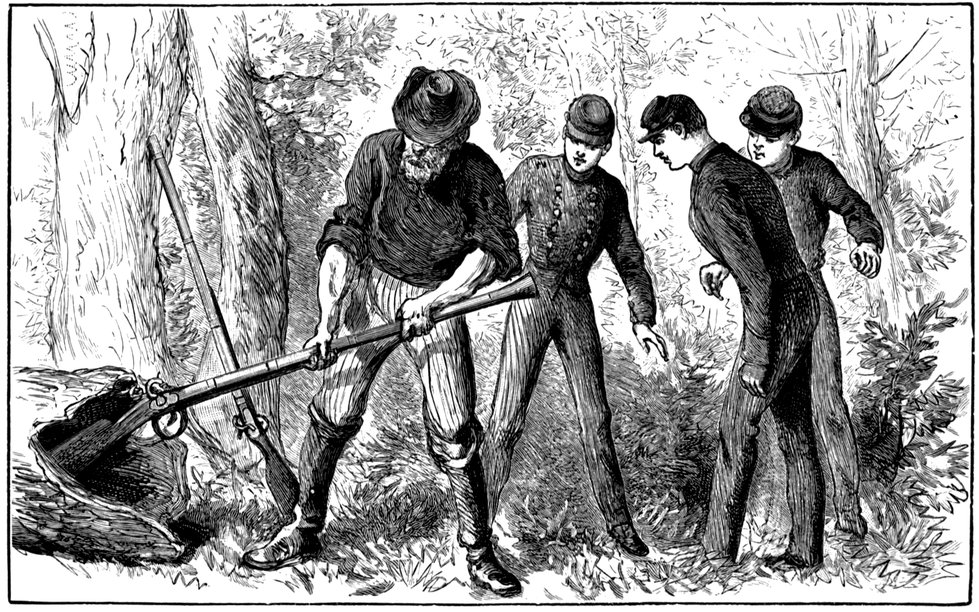
looking. Jones, through the glass, saw them stop
all on a sudden, and bend down until their heads
disappeared from view. They were out of sight
for a long time, and when they again arose to an
upright position, three of them were tugging and
lifting at something which seemed to be about as
heavy as they could manage with their united
strength. When Jones saw that, he uttered a
loud ejaculation of astonishment.
“Enoch,” he exclaimed, “give me the tiller
and you take the glass—quick. Those fellows
have found it, or else I am very much mistaken.”
Enoch seized the glass, and one look was all
that was needed to show him that the sharp-eyed
young hunters had unearthed the poacher’s hidden
treasure.
“It is Barr’s big gun, sure enough,” said he.
54“They are trying to stand it up on end so that
they can take a good look at it.”
“One would think, from the way you talk, that
you were glad of it,” observed Lester.
“And so I am,” answered Enoch, gleefully, as
he passed the glass over to Lester and resumed his
place at the tiller. “Do you not see that Barr
will be awful mad when we tell him of it, and that
he will do something to pay Egan for snooping
around in this way? Now we will run up to his
sink-boat and see what he is going to do about it.”
“By gracious, Enoch!” exclaimed Jones, suddenly.
“Just look at that, will you?”
“Whew!” whistled the skipper. “It is all up
with the big gun now. Barr has seen it for the
last time.”
Lester looked down the bay in the direction in
which his two companions were gazing, but could
discover nothing to call forth that long-drawn
whistle of surprise from Enoch. All he could see
were a few oyster and pleasure boats, and a neat
little steamer, which was coming up with a heavy
bone in her teeth.
“That is a police-boat,” explained Enoch,
noticing the inquiring look on Lester’s face.
55“They run around night and day searching for
illegal duck-shooters and oyster-dredgers. What
is the matter now, Jones?” he added, as his
companion uttered another exclamation of surprise.
Jones did not reply until he had snatched the
glass from Lester’s hand and taken a long look at
the boys on shore; then he said slowly:
“Egan is signaling to the police-boat to come
in and get the gun, as sure as I’m a foot high.”
“No!” cried Enoch, who thought the news too
good to be true. He wanted Egan and his friends
to do all the mischief they could, so that he would
have an exasperating report to make to Barr when
he went back to the sink-boat.
“But I say he is,” insisted Jones. “I can see
him waving his hat. There! do you believe it
now?” he continued, as the steamer gave one
short, quick toot on her whistle to show that
Egan’s signal was seen and understood.
Yes, Enoch believed it now; especially, when
he saw the police-boat turn her bow toward the
cove. She ran as close to the shore as the depth
of the water would permit, then rang her stopping
bell, and presently Jones announced that the crew
56were putting one of the small boats into the
water.
“I tell you Barr has seen that big gun for the
last time,” repeated Enoch. “He may be able to
bribe a private detective; but the State authorities,
as a general thing, don’t do business that
way. Won’t Barr be hopping when he finds it
out? We can’t do any thing to save the gun,
and neither can he; so we might as well run
down there and look on.”
The Firefly came about and bore down toward
the cove, running in between the steamer and the
shore so that her crew could make a note of every
thing that was done by the police, and perhaps
overhear some of the conversation that took place
between them and the young wild fowlers; but
in this last hope they were disappointed. More
than that, they had the satisfaction of discovering
that they were suspected of something themselves.
For, when one of the officers who went off in the
small boat began talking in rather a loud voice,
Egan said a word or two to him in a low tone;
whereupon the officers faced about, and stared so
fixedly at the schooner’s crew, that the latter began
to feel uneasy. But they saw the big gun
57put into the boat, and then the Firefly filled away
and stood up the bay again.
“Great Scott!” exclaimed Lester, when they
were fairly under way; “I never saw a gun like
that before. How long is it, and how much do
you suppose it weighs?”
“It is ten feet long, and weighs a hundred and
sixty pounds,” snarled Enoch, who was fully as
angry as he expected Barr to be when he heard
the report they had to make. “Say, Jones, did
you notice how quickly those officers stopped
talking, and how hard they looked at us when
Egan spoke to them?”
“I did,” was the reply; “and it struck me at
once that he was telling them something that he
would not dare say to our faces.”
“That was, and still is, my opinion,” continued
Enoch. “Now, the only way we can get even
with him for that is to make out as bad a case
against him as we can when we report to Barr.”
“Why can’t you take his punishment into your
own hands?” inquired Lester. “You can do as
much damage as you please, and unless you are
surprised and caught in the act, it will all be laid
to Barr’s account.”
58“I say,” exclaimed Enoch, gazing admiringly at
Lester, “your head is level yet, isn’t it? That is
a proposition worth thinking and talking about at
some future time. Now, then, here we are.”
The Firefly was by this time almost within
hailing distance of the sink-boat. She had two
occupants now, for the “partner” of whom Barr
had spoken, and who had been hailed by Enoch
and sent up to the sink-boat, had pushed his canoe
through the decoys, and was talking earnestly
with his companion in guilt, while waiting for the
captain of the schooner to come back and make
his report.
“Now, then,” exclaimed Barr, as soon as he
could make himself heard, “is your news good or
bad?”
“Bad enough,” was Enoch’s reply. “The Magpie
sent a boat ashore and gobbled up that big
gun of yours.”
The “partner” looked incredulous, but Barr
saw no reason to doubt the truth of the report.
He jumped to his feet with so sudden and strong
an impulse that he came within a hair’s breadth
of losing his balance and going headlong out of
the sink-boat; and when he had recovered his
59perpendicular, he found relief for his feelings in a
volley of the heaviest kind of oaths. If swearwords
could have sunk the Magpie (that was the
name of the police-boat), the officers who captured
his big gun never would have seen Baltimore
again.
“You needn’t bear down so heavy on the police,”
said Enoch, as soon as he saw a chance to crowd a
word in edgewise, “for they would not have known
that the big gun was there, if it had not been for
that meddlesome fellow who took it upon himself
to play the spy upon your actions last season.”
“You mean Gus Egan?” said Barr, inquiringly.
“He is the very chap,” replied Enoch. “We
found him and his party, which is made up of boys
as mean as he is, in the cove, trying to toll in a
flock of ducks with old Eph’s dog; but that was
only a blind. When we came up and frightened
the ducks away, they went down the beach and
found the gun as easy as falling off a log. Just
then the police-boat came up and they signaled
to her, and she went in and brought away the
gun.”
Upon hearing this, Barr went off into another
paroxysm of rage, flourishing his fists in the air
60and dancing about in the sink-boat, while the
“partner” clung to the sides to keep from being
thrown out by his companion’s wild antics, and
swore softly to himself.
“We ran alongside the police-boat, thinking
that we might hear something that would be of
use to us, but Egan put the officers on their guard,
talking to them in a tone so low that we could not
hear what he said,” chimed in Jones. “We owe
him one for that.”
“I am afraid you will never get any more ducks
with that gun,” said Enoch, consolingly.
“I know I never shall,” growled Barr, who,
having worked off a little of his rage, was now
seated quietly on the bottom of the sink-boat.
“Let’s pick up the decoys, Pete. I don’t feel like
doing any more shooting to-day.”
“I shouldn’t think he would,” said Enoch, in a
low tone. “If I were in his place I should feel
much more like hunting up that Gus Egan and
giving him a good thrashing.” Then raising his
voice, he continued: “You won’t forget your
promise, will you, Mr. Barr? You will let us
know when you are ready to make another night
excursion, won’t you?”
61But Barr was too angry, or too busy with his
decoys to reply. Enoch did not dare press the
matter just then, for fear of defeating the object
he had in view; and as he could not think of anything
that he cared to add to his report, he bade
the big-gunners good-by, and filed away for home.
On the way the Firefly passed Mr. Egan’s house,
and Jones pointed out to Lester the berth the
Sallie always occupied when she was not in use.
Lester saw at a glance that it was a lonely and
retired spot, and so far from the dwelling that a
tramp or anybody else who wanted to go down the
bay, and who thought it easier to ride than to
walk, could steal Egan’s yacht, or his father’s
oyster-boat, with little fear of detection.
“Well, then, suppose we try it to-night,” said
Enoch, when Lester had given utterance to the
thoughts that were passing through his mind.
“Suppose we steal the cutter?”
“What shall we do with her after we get her?”
inquired Jones.
“We’ll not do anything with her,” answered
Enoch, glancing up at the sky. “We will let the
elements take care of her. There is wind in those
clouds, and plenty of it, too. It will be the easiest
62thing in the world to come down here in a small
boat after dark and slip the chain, and I’ll bet
there won’t be much left of the Sallie by the time
morning comes.”
Jones was prompt to say that he would gladly
lend a hand, but Lester, although he had often
talked very glibly about doing something of this
kind, in order to be revenged upon Egan for ignoring
him and paying so much attention to Don
and Bert Gordon, did not seem to be very enthusiastic.
He felt a good deal as he did on the night
he and the rest of the deserters from the academy
ran away in the Sylph. It was easy enough to sit
down and talk about such things, but when the
time for action arrived, Lester was the first one to
stand back and let somebody else do the work and
take all the chances of detection and punishment.
“What do you say, Brigham?” demanded
Enoch, after a little pause. “Are you in for it?”
“O, yes; of course; certainly,” answered Lester,
with great apparent earnestness. “You can count
on me every time. Didn’t I help you rescue those
people from the Mystery at the time she was
wrecked? Well, I will help you turn Egan’s
cutter adrift this very night. I would like much
63to see his face, and hear what he will have to say
when he comes out in the morning and finds his
boat gone.”
“But you would not like to be within reach of
his arm, if he thought you had anything to do with
helping that boat to get adrift, would you?”
asked Jones. “I know I wouldn’t, for a fellow
who can knock down three or four men and boys,
as Egan did during that fight with the rioters at
Hamilton Creek bridge, is a good fellow to keep
out of the way of.”
Enoch and Lester had no reply to make to these
words of praise, bestowed upon the boy they so
cordially hated; but they told themselves, as they
had often done before, that they would give almost
anything they possessed if they had showed a little
more pluck during those troublous times.
The Firefly ran on to her moorings, and her
captain proceeded to make everything snug in anticipation
of the storm he had predicted. They
went ashore in the canoe which they had left tied
to the anchor buoy when they started out in the
morning, and sat down to their late breakfast with
appetites that enabled them to do full justice to it.
They passed a few hours in roaming about the
64fields with their guns in their hands, popping away
at everything in the shape of a bird that showed
itself, and when the wind came up, driving before
it blinding sheets of rain and sleet, they retreated
to Enoch’s room, where they passed the time in
reading and talking and watching the angry white-caps
on the bay.
Although the force of the gale decreased when
the sun went down, the white-caps still rolled
wildly; but that did not in the least dampen the
ardor of Enoch and his friend Jones, who were
fully resolved that Gus Egan and his guests should
not see any more pleasure in cruising about in the
Sallie, if it were in their power to prevent it. They
could scarcely restrain their impatience, so slowly
did the hours drag themselves along; but darkness
came at last, and Enoch gave the signal for
action by picking up his hat and starting for the
door.
“We could not have chosen a better night for
the work,” said he, holding fast to his hat, which
the wind seemed determined to tear from his
head, in spite of all his efforts to keep it on.
“Just let this breeze get a good grip on the Sallie,
and she is a gone cutter. Gus thought he
65was seeing lots of fun to-day while he was helping
those officers steal Barr’s gun, and now he will
learn, by experience, how the loss of property
affects a fellow.”
“But there is this difference,” added Jones,
turning his back to the wind so that he could
catch his breath. “Barr was in a measure dependent
upon that big gun for his living, while
Egan is dependent upon his yacht for nothing but
his pleasure-rides. He is able to buy another
boat if he loses this one, but poor Barr can’t replace
that gun.”
“I am glad he’s got another that the officers
know nothing about,” replied Enoch, as he unlocked
the boat-house, and hung the lighted lantern
he had brought with him upon a convenient
hook. “Now catch hold, all of us, and shove her
in.”
Lester Brigham, whose experience on the day he
so rashly volunteered to assist in rescuing the
crew of the Mystery, had made him very much
afraid of rough water, was greatly relieved to find
that the craft, in which Enoch purposed braving
the white-caps, was not a canoe, but a staunch
row-boat, with plenty of sheer, and roomy enough
66to hold ten or a dozen men. Being mounted on
rollers she was easily managed, in spite of her
size and weight. Lester assisted in putting her
in the water, and in five minutes more she was
being rowed rapidly toward the Sallie’s anchorage.
As they passed Mr. Egan’s residence Enoch
took note of the fact that there was a bright light
in the ex-sergeant’s room. He and his guests
were doubtless having a “high old time” in there,
and Enoch told himself that Gus had deliberately
insulted him by not asking him and his guests
over to help them enjoy it.
“Every body likes that boy—every body except
Barr and his crowd of loafers and ruffians—and
no one seems to care a cent for me,” thought
Enoch, with no little bitterness in his heart. “I
don’t believe that even those low-down fellows,
the big-gunners, would countenance me, if it were
not for the fact that I have showed that I can be
of use to them. They are a pretty gang for a
gentleman like myself to associate with, I must
say! Well, the fault lies at Egan’s door, and he
is going to suffer for it this very night.”
Guided by Enoch, who pulled the bow-oar, and
acted as look-out and coxswain at the same time,
67the row-boat dashed past Mr. Egan’s oyster-sloop,
and drew up alongside the Sallie. There were no
signs of life on board either of the little vessels.
Jones fastened into the fore-chains as soon as he
could reach them with his boat-hook, and Enoch,
after carefully laying down his oar, placed his
hands on the rail, and sprang lightly to the
yacht’s deck. Groping his way to the windlass
he found, to his gratification, that Egan had been
accommodating enough to leave the anchor-chain
in such shape that it could be slipped in an
instant. Seizing the rope with both hands he was
about to lay out all his strength upon it in one
vigorous jerk, which would have released the
chain, and allowed it to run overboard through
the hawse-hole, thus giving the yawl up to the
mercy of the elements, when suddenly there was a
glare of light and a deafening report on the deck
of the oyster-boat, not more than a dozen yards
away, and a bullet whistled through the air in
close proximity to the boy’s head. This was followed
by a chorus of barks and growls that made
Enoch’s blood run cold, and a voice he had often
heard before shouted at him through the darkness:
68“You-uns mighty smart ober da’—you is so;
but ole Sam wide awake, an’ he done seed ye
when ye go pas’. Look out da’; Ise gettin’ ready
to shoot agin, an’ the nex’ bullet come closter, I
tell ye.”
Enoch waited to hear no more. He made a
headlong rush for the side, and tumbled into his
boat, which was at once pushed off into the darkness
by its frightened crew. The Sallie was not
destined to be given up to the tender mercies of
the elements that night.
CHAPTER IV. AT SCHOOL AGAIN.
69
The last time we saw Don and Bert Gordon,
they had just returned to Mississippi after
having spent a few weeks with their friend Curtis
in his far northern home. They had come back
with more honors as students, soldiers and hunters
than they had ever hoped to win. Eight months’
hard study, combined with strict attention to
their duties, had made Don major of the academy
battalion and Bert first lieutenant of his company.
The latter had barely escaped mutilation from the
teeth and claws of a wounded lucivee, while Don
had smelled powder, heard the whistle of bullets,
seen a murderous-looking bowie-knife flourished
before his eyes by a ruffian who tried his best to
use it on his person, and those who were with him
during that trying ordeal declared, as one boy, that
he never flinched. More than that, he had performed
70a feat during his sojourn in Maine of which
any veteran hunter would have been proud to
boast. He had killed a full-grown moose, whose
antlers had been given an honored place in his
mother’s dining-room.
“I don’t believe Don shot that moose himself,”
said Lester Brigham, when he heard of it. “Some
old hunter shot it for him, and he comes home and
palms it off as a trophy of his own skill with the
rifle. He tried hard to get up a reputation on the
strength of that fight with the rioters, which
really did not amount to any thing; but after
Williams and I risked our lives to save the crew
of the Mystery, Don and his crowd had not another
word to say. There was danger in that undertaking,
I beg you to remember, and if Don
and his brother had been the heroes of it, they
never would leave off talking about it.”
Lester was standing in the Rochdale post-office
waiting for his mail when he said this, and Enoch
Williams and Jones were with him. Around
them was a crowd of boys, who had so often heard
them tell of the wonderful exploits they had performed
during their runaway expedition, that
they were tired of listening to them. Knowing
71these three fellows as well as we do, it is hardly
necessary to say that, while magnifying their own
achievements, they did not scruple to speak in the
most contemptuous terms of what Don Gordon
had done, and to declare, in so many words, that
his promotion and Bert’s was owing entirely to
favoritism. They wore their uniforms on all
occasions, carried themselves very stiffly when they
walked, and tried in every way to impress the
Rochdale boys with a sense of their importance.
They succeeded with some, while others, who were
civil enough to their faces, laughed at them behind
their backs. The Mississippi boys were not lacking
in common sense if they did live in the country.
Williams and Jones were getting ready to
go home now, their preparations being somewhat
hastened by the arrival of Don and his brother,
whom, for reasons of their own, they did not care
to meet.
“We heard down here that that fight with the
rioters was a pretty severe one,” observed Fred
Packard.
“We don’t doubt it,” answered Jones. “It is
very natural for some people to praise themselves
when there is no one to do it for them. I would
72be perfectly willing to go through one just like it,
and take my chances.”
“So would I,” exclaimed Enoch.
“Here too,” chimed in Lester, puffing out his
cheeks and looking very brave and warlike indeed.
“And I wouldn’t brag about it after I got
home, either.”
“Well, then, why did you not go to Hamilton
with Don and the rest?” inquired Fred.
“Because I couldn’t. The third company went,
and I belonged to the fourth. I volunteered to
go, and so did my two friends here, but the superintendent
has his favorites among the students,
and of course they had to go, no matter if they
were the biggest cowards in the academy.”
“I conclude that you were just spoiling for a
fight,” said Joe Packard, with a smile that was
highly exasperating to Lester and his two friends.
“If that was the case, what made you pull your
head under the bed-clothes and pretend that you
were ill when the bugle sounded that false
alarm?”
“I didn’t do any thing of the kind; did I,
boys?” cried Lester, appealing to his guests who
were prompt to sustain him in his denial of the
73humiliating charge. “If Don Gordon told you
any story of that sort, he is a mean, sneaking——”
“Hold on!” interrupted Fred. “Don is a
friend of mine, and somehow I can’t bear to hear
him abused. Besides——”
Here Fred stopped and jerked his thumb over
his shoulder toward the open door. The boys
looked, and saw Don and Bert in the act of hitching
their ponies to a tree on the opposite side of
the road. They were dressed in citizens’ clothes,
and although they did not walk with the regulation
step, nor turn square corners, any one could
see at a glance that they had been under military
training, and that they had paid some attention
to it.
Lester took just one look at them, and then
leaned his elbow on the show-case and rested his
head on his hand. He had evidently forgotten
what he was going to say about Don.
“Another thing, Gordon has never said a word to
my brother or me about you since he came home,”
continued Fred. “He isn’t that sort. He is
much too manly to try to build himself up by
pulling others down, and that is more than I can
74say for some lads with whom I happen to be
acquainted.”
“Then who told you that ridiculous tale about
me?” demanded Lester, wincing a little under
the covert rebuke contained in Fred’s last words.
“Our information came from a very reliable
source,” was the rather unsatisfactory reply. “I
know we live a good many miles from Bridgeport;
but we manage to keep pretty well posted in some
things that happen there.”
“His uncle told him all about it,” said Enoch,
turning his back toward Fred, and speaking in a
low voice. “No one else could have done it, if
Don or Bert didn’t.”
The “uncle” referred to was the Mr. Packard
who owned the Sylph—the yacht in which Enoch
and his band of deserters made their runaway
voyage. He was an old man with all a boy’s love
of fun. He was very fond of his nephews, Fred
and Joe, with whom he corresponded regularly,
and it is reasonable to suppose that if anything
amusing or exciting happened at the academy, he
did not neglect to speak of it in his letters.
“And we took Mr. Packard’s relatives off the
Mystery and saved them from going to the bottom
75of the bay with her!” exclaimed Lester, in deep
disgust.
“But that was after the fight, you know,”
whispered Enoch. “He wouldn’t say anything
against our courage now, I’ll bet you.”
“No matter. He has talked about us, and told
things that his good sense, if he had any, ought
to have led him to conceal, and I’ll never go near
his house again. I think Fred and Joe might
treat us with a little more respect after what
we did for their relatives when the Mystery was
wrecked.”
As it is possible the reader may think so too,
we hasten to assure him that it was not Fred’s
fault nor Joe’s that they could not be friends with
Lester and Enoch. These two had a faculty of
driving every decent boy away from them. When
they arrived in Rochdale, Fred and Joe lost no
time in calling upon them, to tell them how
grateful they were for what they had done for
their friends when their lives were in peril, but
Lester showed them very plainly, by his actions,
that he did not thank them for the visit. They
wouldn’t have anything to do with him when he
was plain Lester Brigham, he said; but now that
76he was Lester Brigham the hero, they were anxious
to cultivate his acquaintance. That was something
to which he could not consent; and so he,
and Enoch and Jones following his example,
snubbed Fred and Joe most royally as often as
the opportunity was presented. If the high-spirited
Packard boys grew tired of such treatment
after a while, and showed Lester and his
boastful guests up in their true colors, can anybody
blame them?
“Here comes Don,” said Jones, in a suppressed
voice. “Don’t salute him.”
“Of course not!” exclaimed Lester, who seemed
to grow angry at the mere mention of such a
thing. “We are not at the academy now, and
we are just as good as he is.”
“Hallo, major!” cried all the Rochdale boys,
as Don and his brother came into the store.
“Glad to see you back safe and sound, and none
the worse for your fight with the rioters. You
don’t act a bit stuck up if you are a big officer.”
“Just listen to ’em!” whispered Lester, who
could not conceal his indignation. “The world is
full of toadies.”
“And always will be,” answered Jones, who was
77equally angry and disgusted. “Whenever some
fortunate accident raises a chap a round or two,
you will always find plenty who are willing
to bow to him.”
“Well, major,” said Fred Packard, “I hear
that—”
“O, for goodness sake, drop that,” interrupted
Don. “Drop it, I say, or I’ll not talk to you. I
am at home now, and I want to forget school and
every thing connected with it until the time comes
to go back.”
Don’s friends knew very well that he cared
nothing for his military title, except in so far as
it marked his standing at the academy, and that
was the reason they addressed him by it—simply
to bother him. They gathered in a group about
him and Bert, and Lester and his two friends
being left to themselves, secured their mail as soon
as the window was opened, and left the post-office,
looking straight before them as they passed out at
the door, and giving the brothers no chance to
salute them, even if it had been their place to
do so.
“Now, Don,” said one of the boys, who had not
an opportunity to speak to him before, “is it true
78that Lester and Williams took the crew off Mr.
Packard’s yacht at the risk of their own lives?”
“It is,” answered Don, readily. “Bert and I
were there and saw it all. It was a brave act, and
everybody who knows the circumstances says so.”
“But still Lester pulled the quilts over his head
and feigned illness when the bugle sounded; and
Jones, who belonged to your company, was left
behind because he hid in one of the coal-bins,”
said Joe Packard.
As Don could not deny this, he said nothing
about it. He took his mail as soon as he could
get it, and then he and Bert mounted their ponies
and rode homeward, accompanied by the Packard
boys.
The two brothers spent this vacation in much
the same way they spent the first one after their
northern friends, Hopkins, Curtis, and Egan had
gone home. Bert studied hard in the hope of
being able to exchange his single bar for a captain’s
shoulder-strap at the next examination, but
Don never looked into the book. He had earned
a long rest, and had come home to enjoy it in his
own way. He rode and hunted to his heart’s content,
swung Indian clubs, punched the sand-bag
79with heavy dumb-bells, and ran a mile every
pleasant day at the top of his speed with a view
of lowering the academy record during the next
encampment. When the time came to go back
he was ready, and his mother saw him depart
without any misgivings. Don had showed her
that he could behave himself, if he set about it
in dead earnest, and now that he had tried it for
a whole year, and made many friends and won his
promotion by it, she was firm in her belief that he
was well started on the right road at last. Don
thought so too, but he did not for a moment relax
his vigilance. He could not afford to if he were
going to make Egan’s prediction come out true,
and wear the lieutenant-colonel’s shoulder-straps
during his last year at the academy. If he desired
to use the authority and enjoy the privileges those
shoulder-straps would give him, it was necessary
that he should win them at the very next examination.
A few days before they left Rochdale, Don and
Bert rode over to Lester Brigham’s to see if he
would be ready to start when they did—not
because they wanted him for traveling companion,
but because they thought it would be a friendly
80thing for them to do; but Lester received them in
so freezing a manner, and showed so plainly that
he did not care for their company, that they left
him to himself and set out for Bridgeport alone.
“I don’t want anything to do with them or the
crowd they run with,” soliloquized Lester, as he
saw them ride away. “I shall have friends enough
at the academy without them. Enoch said he
knew of two or three good fellows, who had about
half made up their minds to sign the muster-roll
this year, and if he brings them with him, they
may be able to think up some way in which we
can enjoy ourselves. We have already tried the
only plan I could think of, and I shouldn’t have
thought of that if it had not been for Huggins.”
Lester reached Bridgeport without any mishap,
and when he stepped out of the carriage that took
him and his trunk from the railroad depot to the
academy, he found Williams and Jones waiting
for him. The “good fellows” were there also—three
of them, and of course they were boys after
Enoch’s own heart. They lived on Long Island,
and Enoch went to school with them before his
father moved down into Maryland. They had not
come to the academy to learn, but because they
81wanted to take part in the sports and pastimes
which fell to the lot of the students, and which
Enoch had described in glowing colors; although
he had never said a word concerning the long, tiresome
hours of study and drill that came six days
in the week as regularly as the deep tones of the
big bell rang out from the cupola. They wanted
the honor of belonging to the school, a portion of
whose members had stood up so manfully in
defense of law and order; but they never stopped
to ask themselves how they would act, should
they be called upon to perform a similar service.
“Here we are!” exclaimed Enoch, as he grasped
Lester’s hand in both his own and shook it cordially,
“and I have good cause for complaint
already. That little snipe, Bert Gordon, has
been detailed to assign the boys to their rooms
(more favoritism right at the start, you see), and
when I asked him if he would be kind enough to
chum you on me, he replied he did not think it
would be just the thing to do.”
“Why wouldn’t it?” demanded Lester, after
he had shaken hands with Enoch’s three friends,
who were introduced to him as Dale, Barry, and
Morris.
82“Because it suits His Royal Highness to keep
you two apart,” said Jones. “He thinks you
wouldn’t study anything but plans for mischief.”
“Is that any of his business?” cried Lester,
who was very indignant. “He and Don throw on
altogether too many airs. I wish we could think
up some way to get those straps off his shoulders.”
“That is simply impossible,” said Enoch. “He
will be the ranking captain next year, and Don
will be lieutenant-colonel. You wait and see.
They have succeeded in getting on the blind side
of the teachers, and their promotion is a dead
sure thing.”
“Couldn’t he be drawn into a scrape that would
do the business for him?” asked Dale.
Lester and Jones both answered that he could
not. Bert was one of the good little boys, and
had never learned how to disobey any of the rules.
There had been a time, they said, when his brother
Don could be induced to join in anything that had
fun and danger in it; but he was major of the
battalion now, and besides, Egan and the fellows
who belonged to that crowd had so much influence
over him that it would be useless to approach
him on the subject of “scrapes.”
83“And dangerous as well,” chimed in Enoch.
“He has an uncomfortable habit of telling the
truth at all times and on all occasions, and if he
is caught, he will own right up.”
“He did that very thing the year before I came
here, and brought some jolly boys into serious
trouble by it,” observed Lester.
“Humph!” exclaimed Dale, contemptuously.
“I wouldn’t have any intercourse with such a
milk-sop.”
“He’s no milk-sop, and there is no boy in school
who dares call him that to his face, either,” said
Jones, who, in his heart, admired Don Gordon,
and earnestly wished that he was like him in some
respects. “It is true that he has too much honor
to lie himself out of a scrape, but he won’t go
back on a friend.”
“I don’t see how you make that out,” snapped
Lester, who never could bear to hear a civil word
said about either of the Gordon boys.
“Why, when he was hauled up for allowing
Clarence Duncan and Tom Fisher, and all the rest
of the guard-runners to go by him one night
when he was on duty, didn’t he come very near
being sent down for refusing to give their names
84when he was ordered to do so?” demanded
Jones.
“Some of you fellows make a great fuss about
that,” said Lester, with a gesture of impatience.
“One would think, by the way you harp on it, that
Gordon is the only boy in the world who has the
courage to stand by a school-mate. If he was so
very anxious to keep the guard-runners out of
trouble, why did he not say that no one went by
him while he had charge of the floor? That’s
what any decent boy would have done.”
“And that same decent boy would have found
himself brought up with a round turn directly,”
replied Jones, “for the superintendent knew right
where to look to find every fellow who broke the
rules that night. Don did the best that could
have been done under the circumstances, for Duncan
was bound to go down any way.”
While Lester and his friends were talking in
this way, they were standing at the foot of the
wide stone steps that led up to the front door of
the academy; and it was not until their teeth
began to chatter that they thought of going into
the building to get out of reach of the keen, cutting
wind which came over the frozen surface of
85the river. Gathering about the huge stove in the
hall, they threw off their gloves and mufflers and
looked about them. There was a large pile of
trunks in one end of the hall, and Bert Gordon,
assisted by one of the corporals, was trying his
best to get rid of it; but fast as his four stalwart
porters worked, the pile grew in size, for a train
had just passed through the village, and carriage-loads
of students and wagon-loads of luggage
were arriving every minute. Some of the new
comers shook hands with Lester and his two
cronies and were introduced to the boys from
Long Island; but the majority of them, although
they crowded up to the stove to get
warm, did not notice Lester and his companions
at all.
“Do they feel too big to speak to a fellow?”
whispered Dale, who had never been told of the
wide gulf that separated the members of the
different classes.
“That’s just what’s the matter with them,”
answered Jones. “A good many of them are
officers, and the others belong to the first class.
You must be careful to say ‘sir’ when you have
occasion to speak to them.”
86“Say ‘sir’ to those little brats of boys!” exclaimed
Dale, who was greatly amazed.
“That’s the law.”
“I don’t care if it is; I won’t do it. I am
just as good as they ever dare be.”
“No body disputes that,” said Enoch. “Jones
is only trying to post you so that you can keep out
of trouble. You must not only address them as
he says, but you must not address them at all unless
they first speak to you. Of course if you
want any information, you are at perfect liberty
to go to your company officers to get it; the rule
does not apply in that case.”
“Well, I’ll be shot if that don’t beat any thing
I ever heard of,” said Morris. “Suppose we
should quietly ignore all such senseless rules—what
then?”
“If you have any idea of doing that, you had
better make an excuse to get away from here before
you put on the uniform,” replied Enoch, with
a laugh that spoke volumes. “They will haze
you till you can’t sleep o’ nights.”
“How will they do it?”
“O, there are plenty of ways. They are never
at a loss for something, and they have the faculty
87of doing the very thing you would rather they
would not do. If they find that any particular
way of hazing bothers you more than another,
they will use it every chance they get.”
“The meanest of all the mean ways of hazing
is the second exercise in ‘setting up,’” observed
Jones. “My back aches yet whenever I think of
it. You see,” he added, addressing himself to
Dale, “when I first came here I kicked against the
rules, just as you show a disposition to do. I
couldn’t see why a boy who wore two blue stripes
around his arm should be so high up in the world
that I couldn’t speak to him if I wanted to, and
one day I addressed a friendly remark to one of
the corporals. Great Caesar! I thought he would
take my head off, he snapped me up so spitefully.
After he quit jawing me I thought he had got
through, but he hadn’t—not by a long shot. A
few days after that, he drilled a squad of us in
‘setting up,’ and I went through the exercise a
hundred and eighty times before that little fice of
a corporal gave the command ‘three.’”
“It means ‘stop,’” replied Lester, who had
also had some very disagreeable experience with a
corporal to whom, he was determined, he would
88not show a proper amount of respect. “It is the
same as ‘rest,’ after a squad or company stacks
arms.”
“What sort of a drill is it, any way?” asked
Barry. “Is it so very hard on a fellow?”
“You do it a hundred and eighty times without
stopping, and then you can answer the question
for yourself,” was Enoch’s response. “I can give
it to you in the language of the tactics. The
commands are: ‘Second, Exercise. Raise the
arms from the sides, extended to their full length,
till the hands meet above the head, palms of
the hands to the front, fingers pointing upward,
thumbs locked, right thumb in front, the shoulders
pressed back. (Two.) Bend over till the
hands, if possible, touch the ground, keeping
the arms and knees straight. (Three.) Resume
the position of a soldier.’ Try it a few
times after you have taken your overcoat off, and
see how funny it is.”
Jones and Lester Brigham both gave it as their
private opinion that Barry would learn to his entire
satisfaction that there was nothing “funny”
in it.
CHAPTER V. LESTER IS WAKED UP.
89
“But ‘setting up’ is a very mild form of
hazing compared with what I had to go
through when I first came here,” said Jones, after
a little pause. “Three years ago the members of
the yearling class who were not lucky enough to
obtain chevrons, used to treat a fellow rather
roughly. They formed themselves into a committee
of the whole, whose business it was to see
that a plebe’s life was made miserable. Why,
it wasn’t safe for a fourth class boy to go into the
wash-room alone. I did it once, and the first
thing the yearlings did was to give me a glimpse
of Niagara Falls.”
“How did they do that?” inquired Morris.
“They stood me on my head, and let two
streams of cold water from the hydrants run up
the legs of my trowsers. Then they showed me
90how to climb Zion’s hill, which is simply trying to
walk up the wall to any tune the plebe happens
to know. He must sing his own accompaniment.
Then they ordered me to recite the alphabet forward
and backward with appropriate gestures;
in short, they did any and every thing they could
think of that would make one appear ridiculous.”
“I would have seen them happy before I would
make such a fool of myself,” said Dale, angrily.
“You would, eh? Then you would have got
the neatest kind of a thrashing.”
“Very well. I would have reported the last
one of them as soon as I could have found my way
to the superintendent’s office.”
“And been sent to Coventry for it?” exclaimed
Jones.
“Coventry! I don’t know what you mean.”
“Why, he means that if you were to run to the
teachers with a little thing like that, or with any
thing, in fact, that savored of tale-bearing, all the
boys would go back on you as soon as they heard
of it. They wouldn’t speak to you, or even look
at you,” said Enoch. “You would be as much
alone in this big school as ever Robinson Crusoe
was on his island.”
91“Then what is a plebe to do when the yearlings,
as you call them, take a notion to show him
Niagara Falls, or teach him to climb Zion’s
hill?” demanded Dale.
“O, such hazing as that is a thing of the past,”
replied Jones; and this assurance was very comforting
to the three boys from Long Island. “The
last time it was tried was when Duncan, Fisher and
their crowd, took Sam Arkwright out of his bed
in the attic, with the intention of ducking him in
the Big Pond. They got him out on the ice, but
before they could stick him in, Don Gordon came
up and spoiled their little game. At first they
thought they would put him and his brother in
too; but Don handled Duncan, who was the bully
of the school, with so much ease, that the others
were afraid to touch him. More than that, they
dared not attempt to haze any other plebe, for
Don hinted very plainly that those who tried it
would have to answer to him for it.”
“It is a fact,” said Lester, seeing that Dale
looked a little incredulous. “One single plebe
backed a class of seventy-five yearlings square
down.”
“You needn’t speak of it in a tone so contemptuous,”
92said Jones, warmly. “You are a
yearling now, and you and your class are at liberty
to start the hazing business going again, if
you feel so inclined. I dare you to do it.”
Jones knew that he was perfectly safe in saying
this, and so did Enoch. We know that Lester
was just the one to urge others on to performances
of this kind, and he would have looked upon
the attempt of some unlucky plebe to climb
Zion’s hill to a tune of his own singing as an interesting
spectacle; but the promise of the lieutenant-colonel’s
silver leaf at the close of the next
examination, would not have induced him to take
an active part in the proceedings. Don’s big
heart would not let him stand quietly by and see
a helpless student imposed upon, and Lester knew
it. By his victory over Clarence Duncan Don
had broken up the barbarous practice of hazing
most effectually.
Just then a door at the farther end of the hall
was opened, and five boys came out. Three of
them were dressed in citizen’s clothes, and the
other two were in uniform. One of the latter was
a short, thick-set fellow, who wore his hands in his
pockets, and bent so far forward when he laughed
93that he showed the silver ornaments in his
shoulder-straps. The other was considerably
taller, and straight as an arrow and looked every
inch the soldier. That the two in uniform were
officers of rank was made evident by the actions
of a party of students who were sitting on a bench
near the door, waiting for an opportunity to report
their arrival to the adjutant. They arose to
their feet as one boy, and raised their hands to
their caps; while the officers and their civilian
companions, after returning the salute, stepped
forward and shook hands with them in the most
friendly manner.
“I’ll bet they won’t be so condescending when
they go by this crowd,” said Lester, in a tone of
disgust.
“Who are they, any way?” asked Morris.
“The two in uniform wear the brass collars
among the students,” replied Jones. “The short
one is Colonel Mack, and the other is Major Gordon,
the lieutenant’s brother.”
“Isn’t that enough to convince you that promotions
in this school go by favor of the teachers?”
demanded Lester. “Two commissions in
one family!”
94“The other three are Egan, Hopkins and
Curtis—graduates who are taking the finishing
course,” continued Jones, paying no attention to
Lester’s ill-humored remarks. “They are all
chums, and when you see one of them loafing
around, you may be sure that the others are not far
away. They even spend their vacations together,
putting in the time in hunting and fishing—all
except the colonel, who thinks more of his books
than he does of a gun or fly-rod. They went up
into Maine last fall, and while they were camping
out in the woods, the major killed a full-grown
moose.”
“Aw! What is the use of keeping that preposterous
yarn in circulation?” exclaimed Lester.
“Every time I hear it I am reminded of the
‘Three Fishers,’ who went out to catch trout, but
who never got a bite, although they angled faithfully
all day long; nevertheless when—
‘Three fishers went into town that night
Their “speckled beauties” were fair to see;
They talked of their sports with keen delight—
The envy of all the fraternity.
For men will fish, and men will lie,
And what they can’t catch they’re sure to buy,
And never repent in the morning.’
95That’s the way it was with Don and his moose;
he shot it with a silver bullet.
“I have heard you say that before, but I can’t
believe that it is true,” retorted Jones. “Don
Gordon never had to draw a long bow to win a
reputation either as a student, soldier or hunter;
and, besides, the boys who were with him wouldn’t
back up a false statement of any kind.”
“Private Lester Brigham, room 39, third floor!”
shouted the corporal who was acting as Bert’s assistant;
and this broke up the party about the
stove, and put an end to the discussion. Lester
followed the porter, who shouldered his trunk and
went up stairs with it. He had a great curiosity
to see who it was that he was to be “chummed”
on during the year, and when he reached the
room to which he had been assigned, he found out,
for the boy was there waiting for him.
“It’s just what I might have expected from that
little snipe of a Bert Gordon,” soliloquized Lester,
when his eyes fell upon his new room-mate, who
was sitting at the table with a book before him.
“Instead of chumming me on a decent fellow, like
Enoch Williams, he has gone and shoved me in
with one of the good little boys. I shall see no
96fun in my room this term.” Then, aloud, he said,
as he extended a very limp hand to be shaken by
the boy at the table: “Ah! Ross, you and I are
to live together for awhile, are we? I don’t know
how we shall get on, for your way of enjoying
yourself and mine are widely different.”
“Perhaps there will not be as much difference
this term as there was last,” answered Ross, sinking
back in his chair, while Lester opened his
trunk and took out his uniform. “I came here,
last term, fully resolved to behave myself. I
studied hard; I never ran the guard to eat pancakes
at Cony Ryan’s; I never wilfully disobeyed
any of the rules of the school; and what did I
make by it? Not even a corporal’s stripes. You
and your crowd set the law at defiance, ran away
in Mr. Packard’s schooner, and had a good time
generally, and yet you are no worse off to-day than
I am. What makes you look at me in that way?”
added Ross, for Lester, who was kneeling in front
of his trunk, never took his eyes off his room-mate’s
face while the latter was speaking.
“It is because I am surprised to hear you talk
so,” was the reply. “I thought you were one of
the good boys, and when I came into this room
97and found whom I was chummed on, I was disgusted.
Williams wanted me put in his room, but
Bert Gordon wouldn’t listen to it. I suppose he was
afraid we would get up another runaway scheme.”
“You fellows must have had lots of fun while
you were gone,” continued Ross.
“We certainly did,” replied Lester, with great
enthusiasm. “Of course, we knew that we would
be captured in time, for, with the exception of
Williams and myself, there was not a boy on board
the Sylph who knew how to stand his trick at the
wheel. I suppose you know that I was the original
commander of the yacht?”
“Yes; I heard all about it. Why did you give
it up?”
“Because I wasn’t sure that I could handle so
large a vessel as the Sylph in a narrow river, having
always been accustomed to plenty of sea room.
Besides, Enoch wanted the command, and I didn’t.
I proposed the thing, and so long as the boys got
some fun out of it, that was all I cared for.”
“Have you thought of anything for this term?”
inquired Ross.
“I have not; and if any of the other fellows
have, I don’t know it.”
98“I wish you would be good enough to keep me
posted. I didn’t see any fun at all last term, and
I am ready for anything now.”
“I can’t promise to do that until I have consulted
the other fellows,” was Lester’s reply.
“But I will speak to them and see what they think
about it.”
“I’ve got plenty of money, and I am ready to
spend it, too.”
“But the rules say that you must give it to the
superintendent for safe keeping.”
“I can take care of it myself. I gave him a
little, just for a blind, and the rest I shall keep by
me. That’s what you did last term.”
“Yes; and if it had not been for Mack, and a
few other boys I don’t at all like, I should have
lost the last red cent of it. I wish that somebody
else had recovered it for me, for I don’t like to feel
that I am under obligations to Mack and his
crowd.”
It was plain that Ross, having become
thoroughly disheartened by his failure to win promotion
at the last examination, had abandoned
all hope of ever being anything better than a
private, and had fully made up his mind to cast
99his lot with Lester Brigham and the rest of the
law-breakers.
“He don’t care a snap of his finger for the fun
he thinks he is going to see,” soliloquized Lester,
who, having put on his uniform, left the room to
report his arrival to the adjutant, “but he wants
revenge on the teachers and on the students who
received warrants and commissions. How he imagines
that he is going to hurt either of them by
breaking the rules, I can’t understand; he will
find that he will hurt himself instead. Well, I
don’t know that it is any of my business. I shall
say a good word for him to Enoch and the rest,
because he’s got money. They made pretty free
with my pocket-book last term, and now they can
look to somebody else for their pies and pancakes.”
By the time it began to grow dark, all the students
who were to attend the academy during the
year had reported for duty. There was guard-mount
that night, it being the 14th of January,
and the next morning the roar of the field-piece
announced that the business for the next twelve
months had begun in earnest. And a dreary year
indeed it proved to be to some of the students.
Jones and the other discontented fellows in the
100second class, often declared, with no little disgust
and indignation, that they had never seen anything
like it. Cony Ryan was often heard to make the
same remark. His little parlor, which had so frequently
echoed to the songs and speeches of the
guard-runners, was now entirely deserted of evenings,
although Lester and Enoch and some of their
particular friends occasionally dropped in on Saturday
afternoon to eat pancakes and maple syrup,
and to mourn with him over the days that were past.
“We can’t help it, Cony,” Enoch once said to
him. “It is all Don Gordon’s fault and Bert’s.
Don is reported to have said, when he shook hands
with Mack at the beginning of the term, that he
should consider himself unworthy of the position
he holds if there were a single instance of successful
guard-running this year. That is always the
way with these bad fellows, you know. Whenever
they turn over a new leaf, and do it in dead earnest,
they go just as far the other way. They become
enthusiasts and radicals.”
“Radicals!” repeated Jones. “In modern
politics a radical is a person who advocates extreme
measures of reform. Radical is good. Gordon,
the Radical.”
101“I understand all about that,” said Cony.
“But are you boys willing that he should boss
the academy? If you were major of the battalion
do you imagine that you could keep him inside the
grounds if he didn’t want to stay? Not by a long
shot. He would find some way to outwit you, and
the harder you made it for him, the better he would
like it. That’s the kind of a cadet his father was,
and Don is just like him. I know it, for I have
learned to read boys as easily as I can read so
many books.”
“But you don’t understand it, smart as you
think you are,” exclaimed Lester, who was enraged
at the imputation that was thus cast upon the
skill and cunning of himself and his companions.
“You see before you at this moment a crowd of
fellows who are as sharp as Don Gordon ever dare
be, and who have quite as good a supply of
courage.”
“I can’t see it,” answered Cony, with something
like a ring of contempt in his tones. “I
was sorry to hear that Gordon had quit guard-running—”
“I can easily believe that,” interrupted Jones,
with a smile and a sidelong glance at his companions.
102“Don was always well supplied with
the needful, and he was not at all backward about
spending it. When he asked for money, the superintendent
never refused to let him have it.”
“I wasn’t thinking about his money,” said Cony,
hastily. “I admired his pluck, his ingenuity in
baffling the guards, and more than all, I liked to
talk to him, for he is smarter than a steel trap. I
say I was sorry to hear that Don had gone over to
Egan and that crowd,” he added, addressing himself
to Lester, “for I knew that we should see no
more of him here, unless he happened to look in of
a Saturday; but when I heard that it was you who
proposed that runaway expedition in Mr. Packard’s
yacht, I told myself that the boys had another
leader who was fully as daring as any they had ever
had.”
“And it is my opinion that they were, and still
are, satisfied with the change,” answered Lester,
with great complacency. “Ask them if we didn’t
see lots of fun while we were cruising in the Sylph,
and see what their reply will be.”
“Yes; but you stopped at that,” exclaimed
Cony. “One single, solitary plan was all your
brain would hold.”
103Cony might have added that that single plan
never originated in Lester’s brain. The latter
never would have thought of it if it had not been
for Huggins. Cony knew just how much the
academy boys thought of Lester as a leader, for
he had heard through Jones that Enoch Williams
had pronounced him a fraud of the first water;
but he wanted to wake him up and set him to
work at something, if he could, for his revenue
had fallen off considerably since Don Gordon declared
that an absolute stop must be put to guard-running.
“You don’t seem to have any originality about
you,” continued Cony, still addressing his remarks
to Lester. “You are a boy of one idea; and now
that you have got that out of your head, you don’t
seem to be able to scare up any more. If you are
fit to lead your comrades, you will prove it before
many more days have passed over your head.”
“But how can I prove it?” demanded Lester,
who was pleased to know that Cony looked upon
him as a leader among his fellows. “There never
were such precautions taken against guard-running
before; all the old students say so. The officer of
the guard hardly ever sits down for more than five
104minutes at a time; Don and Mack make it a point
to go the rounds when you are least expecting to
see them; and never a night passes that they don’t
look into every dormitory in the building.”
“In other words, being full of tricks himself,
Don knows just how to go to work to head off
every other trick that can be conjured up,” Jones
remarked. “I tell you, Cony, they have drawn
the reins tight so far this term, and all the signs
seem to indicate that they will not be slackened an
inch.”
“No matter for that,” was Cony’s response. “I
know an army of boys who were graduated at this
school, and who, if they were here now, would
laugh at Don Gordon and his new regulations. If
Gordon was the same fellow he was when he first
came here, he too would laugh at all such rules,
and run the guard as often as he felt like it. What
you boys want is a leader in fact as well as in
name—somebody who has brains enough to think
up plans for your amusement, and courage and
skill enough to carry them out. I thought—I
really thought that Brigham was that sort, but I
have been disappointed in him.”
“He isn’t any more disappointed in him than
105we are,” whispered Enoch, as he and the rest bent
their steps toward the academy, the time for which
their passes were granted having nearly expired.
“We found out long ago that he is all talk and
no do.”
“And Cony knows it,” replied Jones. “He was
only trying to put a little life into Lester, because
he wants to see the color of some more of his
money. That was what he was up to, and you
may depend upon it.”
“That is a very nice place to get away to,” observed
Morris, who had never visited Cony Ryan’s
hotel before; “but what a cross old chap the landlord
is!”
“That’s only his way of talking,” Enoch
hastened to explain. “He isn’t cross at all. He
likes to see fun—nothing suits him better than to
have that little parlor crowded so full of boys that
another one could not be pushed in edgewise—and
he hoped that by giving Brigham a good overhauling
he could hurt his pride, put some ambition
into him and set guard-running to going again;
but I am afraid he is destined to be disappointed
in that. Lester’s will is good enough, but he lacks
the ability.”
106“Then kick him out and put some one else in
as leader.”
“Leader!” sneered Enoch. “Lester never has
been acknowledged as such since we found him
out, which we did in less than an hour after we
got possession of Mr. Packard’s schooner. But it
is policy to make him think he holds that position.
If one of our fellows gets hard up for a dollar, we
flatter him about something until we get him in
the right humor, and then we strike him for a
donation. It is very comforting to know where
you can get a loan when you want it. I suppose
he is going home with me next vacation, but I
can’t say that I expect any pleasure from his visit;
still I shall do the very best I can for him, because
when Jones and I were stopping at his father’s
house, nothing was too good for us.”
While the two boys talked in this way they
were trudging through the snow toward the
academy, Lester Brigham lagging behind alone,
so that he could commune undisturbed with his
own thoughts. Cony Ryan still looked upon him
as the leader and hope of his party! If there were
any boy in the academy who could head off Don
Gordon, he was the one! There was a good deal
107of consolation in that reflection, but what business
had Cony to say that if Don were the same boy he
was when he first came to Bridgeport, and the existing
rules were in force, he would laugh at them
and run the guard as often as he felt like it?
When the fact that he (Lester) had been one of
Cony’s very best customers was taken into consideration,
the comparison that had been drawn
between his courage and skill and Don Gordon’s,
was unkind, to say the least. He wished he could
think up some way to make Cony sorry for what
he had said.
“He may learn to his cost that it was bad policy
for him to go at me in that fashion,” said Lester,
to himself. “It will be a colder day than this
when I next go into his house to get warm, or to
eat his pies and pancakes. But I must do something
at once. Cony’s cutting remarks will set
all the fellows to thinking, and the first one who
hits upon a plan that suits the rest and promises
to be successful, will crowd me out of my position
as leader.”
“Hallo, Brigham! What are you hanging back
for?” shouted Enoch, who, with the rest of the
party, was now a long distance in advance of Lester.
108“He doesn’t like the way Cony rallied him on
his inactivity, and I shouldn’t wonder if he had
put his thinking-cap on,” observed Jones.
“That’s just it,” said Lester, frankly. “Now,
that I think of the matter, we have showed ourselves
to be a pretty set of fellows to let one or two
boys get the weather-gauge of us so completely,
without a single word or act of remonstrance on
our part. I don’t intend that this state of affairs
shall continue much longer.”
“Good for you, Brigham!” cried all the boys,
in concert.
“I knew you could think of something, if you
went about it in earnest,” added Enoch. “What
do you propose?”
“Nothing yet. I haven’t got my wits fairly at
work; but I will have an idea to present for your
consideration when I meet you to-morrow morning.”
And then he wondered what in the world
he should do if he failed to keep his promise.
“Good for you!” shouted the boys, again.
“Will it be another picnic on the bay?”
“Of course not,” Enoch hastened to reply.
“We’ve had enough of picnics; we want something
new this time, and the more excitement and
109danger there are in it, the better I, for one, shall
like it. We want to perform an exploit that has
never been attempted or even thought of since the
Bridgeport academy had an existence. None of us
ever dreamed of so daring a feat as running off
with a private yacht, until Brigham suggested it
to us, and I know that when he gets ready to
report the result of his cogitations, he will astonish
us. All we’ve got to do is to give him time.”
Enoch’s words were meant to be encouraging,
but they were not. On the contrary, the effect
they produced upon Lester was a disheartening one.
In order to meet the approval of all his friends,
the plan he proposed must be entirely original,
and there must be danger and excitement in it.
Lester began to be afraid that he had promised
more than he could fulfill. He relapsed into
silence again, and as soon as he had reported his
return to the officer of the day, he made the best
of his way to his dormitory. His room-mate was
there, and the manner in which he was greeted by
him astonished Lester not a little.
Ross had been “gated” for thirty days on
account of some unsoldier-like conduct in the
ranks during dress-parade, and this prevented
110him from accompanying Lester and his party to
Cony Ryan’s. He had felt very ill-humored over
it at first, but he was glad of it now. So was
Lester, when he heard and comprehended the first
words his companion addressed to him.
“Brigham,” said Ross, in a suppressed tone of
voice, at the same time jumping up to close and
lock the door, “I have got hold of something that
has suggested an idea to me, and if you are as
smart as I think you are, you can perform an
exploit that will throw your picnic on the Sylph
far into the shade. I never heard of such a thing
being done, but I don’t see why it can’t be done.”
Was it any wonder that Lester was surprised as
well as delighted? He felt like taking Ross in
his arms and hugging him; but he didn’t. He
dropped into the nearest chair and looked at him
without speaking.
CHAPTER VI. A DINNER IN PROSPECT.
111
“I say, Gordon!” exclaimed Colonel Mack, as
he stretched himself at full length upon the
sofa in the neatly furnished dormitory which the
ranking officers of the battalion, whoever they
might be, always occupied in common. “This
thing is getting to be monotonous. Put away
that cyclopedia and talk to me.”
Don closed the ponderous book of reference,
which he had been intently studying for the last
hour, and putting his hands into his pockets settled
back in his chair and looked across the table
toward his chum.
“Do you know that Enoch Williams and his
crowd declare that it is a downright shame the
way things are going on?” continued Mack.
“They say that your promotion, and the manifesto
you issued at the beginning of the term, have
112taken the pluck and ambition out of every decent
boy in the academy.”
“What manifesto?” demanded Don.
“About guard-running.”
“I didn’t issue any.”
“Didn’t you say that you were going to do your
best to put a stop to it, and that every boy who
succeeded in getting out of the grounds after taps
could call on you for the price of a plate of pancakes
at Cony Ryan’s?”
“I did, and you said the same thing.”
“I know it; and I know, too, that we have
brought blessings on our heads from two different
factions—from the faculty, who say that the battalion
was never in better trim than it is at
present; and from Lester Brigham and his adherents,
who declare that we are the meanest pair
that ever lived, and that we exceed our authority
every day in the week. They would like to disgrace
us before the whole school, if they could.”
Don laughed, but said nothing. He knew just
how Enoch and the fellows who had accompanied
him on his runaway expedition felt toward himself
and Mack, but it did not make him at all uncomfortable.
He ate and slept, and enjoyed himself
113in various ways as well as he ever did. Being one
of the highest officers of the academy it was his
duty to prevent, as far as lay in his power, all
violations of the rules. This duty he performed
quietly and effectually, and without fear or favor.
He seemed to know everything that went on in
and about the academy. He did not intend that
what he said concerning guard-running should
become noised abroad; but somehow it did, and a
great many threats had been made. In addition
to this, Cony Ryan had offered extra inducements
to the successful guard-runner, but no one had yet
come forward to claim the pancakes. Don knew
that if a single student escaped from the grounds
through his negligence, he (Don) would be a candidate
for a court-martial, which would put an
end to all his hopes of picking up the lieutenant-colonel’s
shoulder-straps when Mack laid them
down at the close of the school term.
“There’s lots of uneasy fellows here this term,”
continued Mack. “Hadn’t we better let up on
them a little and give them a chance to show their
hands?”
Don, remembering that there was a time, and it
was not so very long ago either, when he would
114have been prompt to “show his hand” if his
officers had “let up” on him in the slightest
degree, answered that he couldn’t think of it.
He had learned that a student who behaved himself,
and who could look his mother in the face
when he went home to spend his vacations, had
a clearer conscience and a mind that was much
more at ease than one who was constantly setting
himself up in opposition to lawful authority,
and he was resolved that there should be no breaking
of the rules that term if he could help it.
“But just think how full last term was crowded
of fun and excitement, and how very dull and
uninteresting this one is by comparison,” said
Mack, in a doleful voice. “First we had a chase
after Huggins.”
“That didn’t amount to much,” said Don.
“It was soon over.”
“But still it was exciting while it lasted. The
tramp who stole Huggins’s money might have
made an end of you with that knife of his if
you hadn’t been a good swordsman. Then came
the strikes and the fight with the rioters at Hamilton
Creek bridge, and after that Enoch Williams
woke us up with his runaway expedition, and gave
115us a chance to take a week’s sail on the bay.
What have we had to keep our blood in motion
this year? Not a thing.”
“Does the unusual quiet worry you?” asked
Don.
“No, but it makes me tired. I am heartily sick
of this eternal study and drill, and I should like
to go somewhere and do something. I was in
hopes that your friend Lester Brigham would be
up and doing before this time; but he seems to
have gone to sleep like the rest of the discontented
ones, and I don’t believe we shall have a single
thing to break the monotony of the school routine
during the year.”
“There will be your class dinner on the 31st of
the month,” suggested Don.
“But what does the class dinner amount to?”
exclaimed Mack. “A lot of students, following the
example set them by their fathers, who, perhaps,
had no better way of passing the time, hire a hall,
or get together in the dining-room of a hotel at
Hamilton, stuff themselves with things that they
might better let alone, make a few speeches in
which they pledge undying friendship to one
another, and when the term is ended they separate
116and go their several ways, plunge into some business
or profession and perhaps never think of the
matter again. And that reminds me that our
committee ought to report at the meeting to-night.
Let’s go down and see if they have come
back yet.”
The committee to which Mack referred was
composed of three boys belonging to the first
class, who had been sent up to Hamilton with
full power to make all arrangements for the coming
dinner, which was intended to be a grand
affair. More than that, they took with them a
large package of notes from the committee on
invitation, addressed to prominent citizens of Hamilton,
including the commanding officer of the
61st and his staff. The members of this committee
had just come from the depot, and the
young officers found them gathered about the big
stove in the hall, making an informal report of
their day’s work to a few boys in their own class,
regardless of the fact that several students who
were members of other classes were loitering about
within earshot. But what did they care for that?
The graduating class had always made a great stir
about their dinners, and no doubt this committee
117took unbounded delight in tantalizing their auditors
by telling, in glowing language, of the good
things they were going to serve up to their Hamilton
guests. It appeared that the class had a
goodly sum of money in the hands of Colonel
Mack, the treasurer, and that this committee had
provided for the spending of every cent of it.
“You can see for yourself that this dinner of
ours will exhaust all the resources of the cuisine,”
said one of the committee, in a grandiloquent
tone, after the chairman had told Mack just what
he and his companions had done in the city during
the day; “and the decorations of the banqueting
hall will be correspondingly rich and elaborate.”
“In other words it will be bang-up,” observed
the chairman. “All those nobby officers of the
Sixty-first, to whom we presented the invitations
in person, promised to be on hand, and the colonel
said he would give them permission to appear in
uniform. The boys said they wanted us to make
this dinner go ahead of anything that was ever
heard of in this academy, and when it comes off
they will find that we have obeyed instructions.
It will be something to talk about, and there
118won’t be a hitch anywhere. We told Mr. Taylor
to do his level best, and send all his bills to you
as treasurer of the class, and he said it was all
right.”
The members of the committee talked in this
way until the mouths of the boys who were standing
around, and who had no part nor lot in the
matter, began to water; then, having thoroughly
warmed their fingers, they went up to their dormitories,
and in a few minutes the lower hall was
deserted by all save a single student, who paced
back and forth with his hands in his pockets, and
his eyes fastened thoughtfully on the floor. It
was Wallace Ross, Lester Brigham’s room-mate,
who, as we said, had been “gated” for thirty
days for some violation of the rules.
Ross, who was now spending his second year at
the academy, was much such a fellow as Enoch
said Lester Brigham was—he was all talk and no
do. Unfortunately the world is full of such boys.
They make great calculations concerning the
future, tell big stories of the things they intend
to do at no distant day, and there they stop.
They set their mark high, but make no honest,
persevering effort to attain to the object of their
119desires, it being so much easier to think and plan
than it is to act.
Ross had entered the academy with the laudable
determination of beating every student there.
He had assured his friends before he left home
that when they saw him again, they would see
him wearing an officer’s uniform. Not even a
first sergeant’s warrant would satisfy him, for his
ambition was to carry a sword instead of a musket.
He wanted to jump from the ranks, over
the heads of all the fellows above him, and land
in a captain’s place the first time trying. Don
Gordon had proved that such a thing could be
done, for at the close of the last term he had
exchanged his musket and knapsack for the
major’s shoulder-straps; but then Don had
worked for his promotion, and that was something
Ross was not willing to do. In less than a
week after he signed the muster-roll, he found
that he had been wofully mistaken in the opinions
he had formed of the academy, and of the boys
who belonged to it. The majority of them were
quite as smart as he was; and after he had been
“hazed” a few times at “setting up” by a corporal
who thought he needed a little wholesome
120discipline, and the fencing-master had railed at
him in his broken English because he did not pay
more attention to business during the hours that
were devoted to the broadsword exercise, and some
of the other teachers had reported him for his
failures in the recitation room—after all these
disagreeable things had happened to him, the
boy’s eyes were opened to the fact that the Bridgeport
Military Academy was not at all the school
he had been looking for; but he could not get
out of it with his father’s consent, so he set himself
to work to get through the course with as
little trouble as he could. Other boys openly
declared that that was what they intended to do,
and they seemed to get on quite as well as he did.
The lieutenant-colonel’s uniform was a very
handsome one, and Wallace Ross was not the
only student who longed to wear it. When that
official appeared in full dress all eyes were fastened
upon him—that is, all except those belonging
to a few disappointed aspirants. These generally
turned their backs and made disparaging remarks
about the uniform and the boy who wore it. Ross,
who had given up all hope of wearing that uniform,
felt very bitter toward Colonel Mack.
121“Just notice that squatty little jackanapes,”
he would often say to those around him, especially
if they chanced to be boys of his own stamp.
“Don’t he cut a pretty figure in that dress?
Just see him strut, will you? I should judge by
the airs he throws on that his father must be
worth as much as a dollar and a half.”
If Mack had told Ross and the other disappointed
ones just how he felt when he came out
almost covered with gold lace, they would not
have believed him. Mack, to quote from his
friends, was as “common as an old shoe,” and he
liked to be comfortable.
“See how everybody stares at me,” said he to
his chum, one day. “I must look like a scarecrow
in these duds.”
“You don’t, either,” exclaimed Don, with some
indignation in his tones. “You look splendid.”
“Well,” replied Mack, with a sigh of resignation,
“if they will give me back my old blouse
and my captain’s shoulder-straps, they can keep
their finery, or give it to some one who appreciates
it more than I do.”
Wallace Ross cordially hated these two boys
simply because they had worked their way to
122the top of the ladder while he was still standing
at the foot. He was one of those who would
have been glad to see them disgraced before the
whole school. That was something that could
not be brought about by any scheming or effort
on his part; but he believed that he could deeply
wound Colonel Mack’s feelings, and through him
those of Don Gordon. The conversation he had
just overheard had suggested to him the way.
After he had taken a few turns up and down the
hall, revolving the matter in his mind all the
while, his eyebrows began to relax, then a triumphant
smile overspread his face, and finally he
threw back his head and laughed heartily. The
sound startled him. He looked hastily up and
down the hall, and was greatly relieved to find
that there was no one in sight.
“It can be done,” said he, to himself, as he
made his way to his room. “I just know it can
be done if there is any one in our crowd who has
brains enough to manage it, and if Lester is
spoiling for a chance to take those shoulder-straps
down a peg or two, as he says he is, he can’t refuse
to attempt it.”
Ross did not belong to “our crowd” yet. In
123accordance with his promise Lester had said a
good word for him to Enoch and the rest, not forgetting
to mention the fact that Ross had money
that the superintendent knew nothing about, that
he was quite willing to spend a portion of it every
chance he got, and Enoch had promised to remember
him. He did remember him too, every
time he found his funds running low, and on this
particular afternoon he and Lester and a few
chosen spirits were down at Cony Ryan’s, filling
up on pancakes which Enoch paid for with the
dollar he had borrowed of Ross that morning.
The latter went to his room full of his new
idea, and walked up and down the floor with his
hands behind his back while he matured his
plans. He saw a thousand and one difficulties in
his path, but he found a way to surmount or get
around every one of them, and when Lester came
in he was all ready to astonish him.
That night after supper the boys belonging to
the first class, which was to graduate at the end
of the term, made their way toward their recitation
room; and when they were all assembled and
the secretary had called the roll, the door was
locked to keep out intruders. It being the regular
124business meeting several reports were submitted,
but the one in which the students were
the most interested was the one presented by the
committee of arrangements, some of whose members
had passed the day in Hamilton. The chairman
went more into details than he did while he
was warming his fingers in the hall, and when he
ceased speaking and had answered a few questions
that were propounded to him by different members
of the class, the boys told one another that
their banquet would be talked of when some of
those who sat down to it were forgotten. After
that the secretary was instructed to write to Mr.
Taylor, the well-known caterer, who had furnished
all the big dinners for the military and civic societies
of Hamilton as long as Cony Ryan had sold
pancakes and maple syrup on the shores of the
big pond, and to Mr. Colson, the proprietor of
Clarendon Hall, stating that the action of the
committee was approved by the class, and that if
it were thought best to make any changes in the
programme, they would be duly informed of the
fact. When the motion had been acted upon, one
of the students arose and said:
“It may not be amiss to inform the Chair that
125it has been handed down in the archives of our
venerable and time-honored institution that, in the
days gone by, certain members of the second class,
prompted by the spirit of discord, undertook to
come roots on the graduating——”
“The Chair is unable to comprehend the gentleman’s
language,” interrupted the boy president, in
a tone of rebuke.
“Mr. Chairman,” continued the student, “I
beg to recall the words, and to state, in all seriousness,
a fact which the gentlemen present may not
know anything about. I have heard my uncle say
that while he was a member of this school, he and
a few other boys in his company undertook to see
that the members of the graduating class had considerable
trouble in eating their dinner after they
had provided it; and so well did they perform
their work, that it was more by good luck than
good management that the dinner was eaten at all.
How my honored relative and his fellow-conspirators
accomplished this, I don’t know. To be candid,
he positively refused to enlighten me on that
point, fearing, no doubt, that I would at some
time attempt a similar plot myself; but that, sir”
(here the eloquent speaker placed one hand under
126his coat-tails and waved the other gracefully in the
air), “is something I should scorn to do.”
The interested listeners all laughed outright
when they heard this. A bigger spirit of mischief
than Bob Walker (that was the student’s name)
could not have been found in Bridgeport. When
he first entered the academy he was in arrest nearly
all the time, and everything that was done in violation
of the rules was laid to his charge. But that
was all over now, and Bob was the captain of his
company.
“Now I don’t know, Mr. Chairman, that we are
in danger of being interfered with in any way,”
continued Bob, becoming serious again, “but
Lester Brigham and Enoch Williams have opened
our eyes to the fact that they can throw the whole
school into a turmoil if they set about it in earnest,
and it might be well to be on the safe side. Therefore
I suggest that the secretary be requested to
incorporate in the communications he has been instructed
to write to Messrs. Taylor and Colson a
statement to the effect that if any changes are
made in the plan of arrangements, they will be
duly notified by a committee, and not by letter.”
Being requested to put his suggestion into the
127form of a motion it was carried, together with several
others that followed close upon the heels of it,
all having the same object in view, namely: to
guard against treachery and outside interference.
When they got through, the sharpest of the students
couldn’t think of a single thing that had
been omitted. They seemed to have provided for
every emergency.
There being no further business to transact, the
meeting adjourned, and shortly after the students
had left the room, an orderly came in and put out
the lights. Presently there was a slight rustling
under one of the benches, and a couple of dark
forms crept out into the aisle and groped their
way toward the door, which they opened just an
inch or two, so that they could reconnoiter the
lower hall. There were several boys in there, but
they were gathered about the stove at the farther
end, and when the two spies—for such their
stealthy movements proclaimed them to be—thought
they could do so without being observed,
they stepped out into the hall, closing the door
softly behind them, and made their way up the
stairs toward their dormitories.
After this, for some unaccountable reason, affairs
128seemed to run with unwonted smoothness. The
lazy students and the shirks disappeared as if by
magic. The smart ones in Enoch’s crowd stood
high in their deportment and studies, and even
the dull fellows, like Lester Brigham, astonished
their teachers by coming into the recitation rooms
with perfect lessons. It was a common saying
among the boys that the faculty always grew good-natured
as class-day approached, and this state of
things made them smile all over. Many passes
were granted for the 31st, and a few of the students
who lived in Hamilton, but who did not belong
to the graduating class, were granted permission
to go home for the day. The passes that
were given to the others allowed them to go no
farther than the village. The boys in the graduating
class had seen no reason for making any
changes in their programme, and consequently no
special committee had been sent to Hamilton; but
immediately after breakfast on the morning of the
31st, the three students who had thus far done all
the work devolving upon the committee of arrangements,
presented themselves before the president
of the class to receive their final instructions.
They were dressed in their best uniforms, and in
129their valises they carried their epaulets, body-belts,
and a few other articles of ornament which
they could not wear under their overcoats. They
were going to the city. They wanted to make sure
that Mr. Taylor had got the dinner up in good
shape, and that Mr. Colson had made use of the
bunting they had sent him to decorate Clarendon
Hall in a manner befitting the occasion. More
than that, they were to provide for the reception
of their class at the railroad depot.
“See everybody yourselves, and take no one’s
word for anything,” said the president, earnestly.
“Call on Mr. Taylor and inspect the dinner as far
as you can; then go up to the hall, give it a good
looking over, and if you see anything that don’t
suit you, make it suit you the first thing you do.
Be sure that the music is ready, and telegraph me
as soon as you can whether or not everything is all
right, according to your previous instructions.”
“Oh, we shall find everything all right,” said
one of the committee, confidently. “Don’t you
worry about that. We were careful to tell those
men, in plain language, just what we wanted, and
as they have reputations to sustain, and know that
they are going to get their own price for their
130work, they will take as much interest in having
the affair go off smoothly as we do. Good-by.
You will hear from us in about two hours.”
The committee hurried out to catch the train,
and the president went back to his room to give
his uniform another good looking over, and to
make sure that not the smallest particle of dust
had settled on it during his brief absence.
Class-day had always been observed as a sort of
half-holiday, and this one was no exception to the
rule. There was a little studying done, and the
very small number of those who had failed in their
recitations on the previous day, were required to
make up for it before they could mingle with their
companions in the halls and see what was going
on. The boys in the first class were excused from
duty, and all they had to do was to make themselves
look pretty. At least that was what Colonel
Mack said.
“You will have all this to go through with
next year, Gordon,” added Mack. “Your class
must make it a point to have an extra good
dinner.”
“What concern is it of yours whether we do or
not?” demanded Don.
131“Why, I shall be one of the alumni then, and
I expect to help eat it,” was Mack’s reply.
“Wouldn’t it be becoming in you to wait until
you get an invitation?” asked Don.
“Oh, I’ll get that,” answered Mack, confidently.
“From whom, pray?”
“From you, of course.”
“No, sir,” said Don, emphatically.
“And why not? Is it because I don’t invite you
to go to Hamilton with me to-day? Can’t help it,
my fine fellow. No student, unless he belongs to
the graduating class, can sit down to a dinner like
this. That’s the law. It is unwritten, but, like
the common law of England, it’s binding.”
“Well,” said Don, speaking seriously this time,
“I certainly hope you and the rest of the boys
will see no end of pleasure. You have been looking
forward to this day for four long years, and I
trust it will pass away without the smallest incident
to mar your enjoyment.”
“Thank you,” said Mack. “The same to your
own class-day, when it arrives. I do hope there
will be no hitch in the programme; that is the
only thing I stand in fear of. It always puts me
on nettles when these formal things do not go off
132as they ought. I feel like sneaking out and hiding
myself. It would be just awful if anything
should happen to-night, for we have received
favorable replies from about a hundred and fifty
invited guests—Come in,” he cried, in response
to a knock at the door.
“I’ll do it,” answered the cheery voice of the
president, who entered the room, carrying a brown
envelope in his hand. “I feel better,” he continued,
as he helped himself to a seat on the sofa
beside Don. “Here’s a dispatch from Blake, and
he says that everything is O. K. That means that
the dinner could not be improved, that the hall
looks just as it should, and that the band will be
at the depot to meet us. Could anything be more
satisfactory?”
Colonel Mack and his chum thought not. The
dinner was really a big undertaking, there were
many chances for unpleasant and even disagreeable
things to happen, and it was very gratifying to
them to receive the assurance from those who
were on the ground that their plans were working
smoothly.
CHAPTER VII. A SURPRISE.
133
There were two passenger trains that passed
through Bridgeport every afternoon going
toward Hamilton, one being the regular mail,
which was due at five o’clock, and returning, left
the city at four in the morning. This was the
train the graduating class intended to take, the
committee having chartered two extra cars to
accommodate the members. The other was the
lightning express, which passed through the village
at one o’clock, and returned at four in the
morning. This was the train on which they were
to come back. We mention these facts to assist
us in explaining some unexpected and astounding
incidents which happened in connection with this
particular dinner.
The boys in the first class were impatient, as
live boys always are when they are waiting for
134something, and after they had got into their best
uniforms, they hardly knew what to do with themselves.
Some of the very uneasy ones strolled
about the buildings and grounds in companies of
twos and threes, while others, and these were the
fellows who had the most self-control, read away the
time in the library. Here and there, as far away
from his companions as he could get, might have
been seen a student who was walking about with
rather an abstracted air, now and then giving his
hand a flourish, and all unconscious of the fact
that every one of his movements was observed
and commented upon by interested spectators,
who would be sure to laugh at him afterward.
These were the boys who were expected to propose
and reply to some of the toasts of the
evening.
The hours dragged their weary length away,
and at last a sergeant appeared upon the steps
and roared out the command for the first company
to fall in. Almost before he opened his lips there
was a rush made for the armory, and when Captain
Walker led his company into it, with Colonel
Mack marching in the ranks like any private, he
found all the students assembled to see him off—that
135is, all those about the building who were not
on duty. Eighty or more boys were out on leaves
of absence for the day.
There were no pale and anxious faces among the
young soldiers now as there were the last time a
company was marched out of that same armory to
go to Hamilton; for these boys were not armed,
and neither were they going to the city to encounter
an infuriated mob who would welcome them with
a shower of coupling-pins and brickbats. They
were going to—well, they expected a very different
sort of reception. They got it, too, but after all
it was not just such a one as they had confidently
looked for.
Everything being in readiness, the company
moved out of the armory, and, led by the band,
took up its line of march for the depot, the four
dignified professors, who were to represent the
faculty at the coming banquet, riding sedately at
a respectful distance in a close carriage. When
the ponderous iron gates closed behind the company,
Don Gordon, for the first time, found himself
in command of the academy battalion. Before
twenty-four hours more had passed over his head,
he declared, with much gesticulation and many
136expletives, that if he had possessed the full
powers of a military commander he would have
court-martialed and hanged a score or more of
fellows, who that night performed an exploit that
astonished everybody. It did more; it struck
everybody motionless and speechless with amazement,
and, what was rather singular, the particulars
of it had the same effect upon all who heard
them. The listener first looked and acted as if he
could not believe the evidence of his senses, and
then threw back his head and gave expression to
his feelings in a hearty peal of merriment. Even
Don Gordon, angry as he was, rolled on his bed
and laughed until his sides ached and his eyes
were filled with tears.
The students enjoyed their ride to Hamilton,
and made noise enough for so many veteran
soldiers. When the train approached the city
limits they quieted down, drew on their white
gloves, picked up their valises, and held themselves
in readiness to disembark as soon as they
received the word of command.
“Dayton,” said Captain Walker to his first
lieutenant, “you get the boys out of the cars, and
I will go with Mack and the president to hunt up
137Blake and see where the music is. As soon as I
find it, I will come back to you.”
“It seems to me that it would have been the
right thing for that band to pipe up as soon as
our train came within sight of the depot,” observed
Dayton. “We pay them for blowing for us, and
we want to get all the music we can out of them.
They ought to give us our money’s worth; doesn’t
it strike you that way?”
Captain Walker said it did, adding that he
thought there was something strange about it.
Colonel Mack and the anxious president thought
and said the same. Looking out at the car windows
as the train moved slowly into the depot,
they could see that there were many people moving
about, but there was not a cadet gray or a union
blue overcoat in sight; and the big building,
which ought to have been resounding to the enlivening
strains of martial music, echoed only to the
murmur of voices and the tread of hurrying feet.
“I don’t understand this matter at all,” exclaimed
the president, as he and his two companions
sprang from the car and looked around
for the faithful and energetic chairman of the
committee of arrangements.
138“There’s something wrong,” observed Mack,
who had a way of looking disagreeable things in
the face.
“For goodness sake, don’t say that,” replied
Captain Walker, whose countenance had assumed
a very serious expression during the last few
minutes.
“Well, then, where is Blake?” demanded Mack.
“You never knew him to slip up like this before,
did you? It is true that committees and bands
of music have been behind time before to-day, but
somehow——”
Mack did not finish the sentence, but what he
didn’t say was much more expressive than what
he did say. With one accord the three boys hurried
toward the waiting-room. The first familiar
face they saw as they entered it was that of one
of the “nobby” staff officers of the Sixty-first—one
of the hundred and fifty who had returned
a favorable reply to their invitation. The boys
thought it high time he was in uniform if he
intended to help them eat their dinner, but here
he was in citizen’s clothes! And the papers and
blank-books he carried in his hand seemed to indicate
that he was attending to business. When he
139saw Mack and his companions approaching, he
stopped and looked at them in the greatest astonishment.
“How does this come, colonel?” said he, as
he took Mack’s outstretched hand, and shook it
cordially. “You’re left, as sure as the world.”
“Left!” repeated Mack. “I don’t know what
you mean?”
“Why, I mean that you won’t eat any class
dinner to-night,” answered the staff-officer, glancing
at his watch. “It is set for seven o’clock,
and here it is half-past six already.”
“You mean that it was set for eight o’clock,”
the president ventured to suggest, while a very
dim conception of the situation began to creep
into Mack’s mind.
“No, seven,” insisted the officer, “and that’s
the reason I couldn’t attend as I had hoped to do.
Your committee didn’t notify me of the change in
the time until it was too late for me to make
arrangements.”
An expression of the greatest consternation
overspread the faces of Mack’s two companions.
The latter shut his teeth hard, and spoke with a
calmness that surprised himself.
140“What kind of a looking crowd was it who
notified you of a change in our programme?” he
asked.
“Oh, it was a good-looking committee—sharp,
bright fellows; and I think, on the whole, that
they would compare very favorably with the
cadets I see before me,” answered the officer, with
a smile. “They got the dinner to the transfer-depot all right, and made a very pretty appearance
as they marched through the city, led by our
favorite cornet band. But how in the world are
you boys going to get to Bordentown? There’s
no train before midnight, and the fastest horse in
Hamilton could not take you over there in time
to—Why, colonel, what’s the trouble?” exclaimed
the officer; for Mack had darted away at
the top of his speed toward the telegraph office.
“I declare I believe it’s a beat.”
“You may well say that,” replied Captain
Walker, as he and the president ran after Mack.
“If the Sixty-first is sent for to-morrow to quell
a riot at the academy you need not be at all surprised.”
“I want to send off a dispatch,” shouted Colonel
Mack, as he rushed into the telegraph office,
141and stamped up and down the floor, swinging his
fists in the air. “Hurry up. I’ll write it out
afterward.”
The boy, who happened to be in charge of the
office, no doubt thought that the intruder had
gone crazy all on a sudden; but he sat down to
his desk without making any comments, and told
the excited young colonel to go ahead.
“J. H. Taylor, Bordentown,” shrieked the
telegraph, following Mack’s hurried and rather
incoherent dictation. “Stop that dinner; it is a
fraud. Choke off those boys. Kick them out of
doors. The whole thing is an outrageous swindle.”
While Mack was wondering what earthly good
it would do him and the rest of the boys if these
instructions were obeyed, he dictated another dispatch
to his friend Don Gordon, which ran as
follows:
“That villain Lester Brigham has got the
weather-gauge of us. He and his crowd have
stolen our dinner and carried it off to Bordentown
with the intention of eating it themselves.”
By this time Mack had so far recovered from
his rage and excitement that he could write out
142and pay for these two dispatches, after which he
went down stairs to see what the class thought
about it. The members had broken ranks and
were gathered in a body around their captain and
president, who had just brought them the news.
If we were to say that they were amazed and
angry, we should not begin to tell how they felt.
As they could not say anything that would do
the subject justice, the most of them kept still;
but they clenched their fists and nodded their
heads at one another, and if Lester and his crowd
had been within reach at that moment, it is
doubtful if their officers could have restrained
them.
“I would give up my chances for graduating at
the end of the term, if I could have just one
minute’s private interview with Lester Brigham,”
said one of the students, who was walking about
wringing his hands as if he were in great bodily
distress. “I don’t think his mother would know
him when I got through with him.”
“I wish there was some way for us to get to
Bordentown,” exclaimed another. “Wouldn’t we
drive those fellows away from that table and out
of the windows in short order? Great Scott!
143Just think how many of our friends have traveled
hundreds of miles at our invitation, only to be
disappointed!”
These words drove even the cool-headed ones
among the students almost frantic. There was
no loud talking, no riotous demonstration, and a
stranger might have passed close by them without
knowing, from their words and actions, that there
was anything the matter with them. The military
discipline to which they had so long been
subjected, restrained them in some measure; and
besides, as much as they wanted to fight, they
could see nothing to oppose them. If Lester
and his company of adherents had entered the
depot at that moment, it is probable that the sight
would have had a very demoralizing effect upon
them. Just then one of their number, who had
been holding an earnest conversation with one of
the railroad men, came hurrying up.
“I say, fellows,” he exclaimed, “if Lester and
his party leave Bordentown at all during the
next twelve hours, they will have to take the three
o’clock train, which will bring them in here in
time for the lightning express.”
“Good!” cried all the boys, in a breath.
144That was all they said, but it was plain that they
understood one another. Their captain, who
happened to overhear these remarks, understood
them also, and he at once hurried away to lay the
matter before his superior officer.
“Look here, Mack,” said he, in a suppressed
whisper. “There will be the very mischief to pay
if we don’t get out of here before four o’clock.
The boys expect Lester and his party to return
from Bordentown at that hour, and they have
made up their minds to give them a good pounding.”
“That would never do—never in the world,”
replied Mack, in a tone of anxiety. “Such a
high-handed proceeding on the part of the members
of our class would be an everlasting disgrace
to them, as well as to the school. We’ll nip that
little arrangement in the bud. It will make the
boys mad at us at first, but they will thank us for
it after they have had time to cool off a little.
I, for one, am not half as angry as I was a few
minutes ago, and, now that I think of it, it was a
pretty sharp trick on Lester’s part, and we have
all seen the time when we would have done the
same thing, if we had been bright enough to think
145of it. I’ll warrant that Don Gordon is laughing
fit to split, and that he feels like punching his
own head because he did not propose something
of the kind when he was running with Tom
Fisher and that crowd. But we can’t have a free
fight here in the depot, and we won’t, either.
Now, Walker, you stay here, and don’t allow a
single boy out of your sight until we come back.
The president and I are going up to the hotel to
talk to the superintendent about it, and while we
are gone, you must be very careful what you say
in the hearing of the boys. Some of them are
too highly exasperated to be reasonable, and if
they should find out that they are not to be
allowed the privilege of fighting Lester and his
men, they would slip out into the city and lie in
wait for them. If they begin to act in a way to
arouse your suspicions, order the last one of them
into our two cars, and keep them there until we
return.”
“Very good, sir,” replied Captain Walker,
raising his hand to his cap. “But between you
and me,” he added, in a lower tone, “I really
wish our boys could interview Lester and his
party before we go back to the Academy.”
146“It is about the neatest trick I ever heard of,”
said Colonel Mack, as he and the president hurried
away to pour their sorrows into the sympathizing
ear of the superintendent, and to tell him
of the plot the first-class boys had entered into to
take summary vengeance upon the despoilers of
their feast when they came in on the Bordentown
train. “Those fellows must be as well posted in
our plans as we are.”
“Of course they are,” was the reply. “Otherwise
they could not have sent me that telegram
which purported to come from Blake, and which
assured me that everything was ‘O. K.’”
“That’s so; where in the world is Blake
now?” exclaimed Mack; and apparently forgetting
that Blake was the very boy they had been
wishing for ever since the train came into the
depot, he and the president stopped in their hurried
walk and looked all around in search of him.
“Say,” added Mack, a moment later, “I have my
own ideas regarding the manner in which this
trick was sprung upon us——”
“So have I,” interrupted the president.
“And I want you to remember what I say,”
continued Mack. “When we get to the bottom
147of this day’s work, you will hear some things that
will make you open your eyes. What do you see
to interest you so much?”
Receiving no reply from his companion, who,
having come to a sudden halt, was shading his
eyes with his hand and gazing intently at some
object he saw in the distance, Mack also stopped,
and looked in the same direction. Before him
was the river, along whose banks ran Hamilton’s
principal business street. Near the head of it
was the hotel toward which they were hastening,
and a short distance farther on stood the transfer-depot.
All the passengers who came in on the
main road, and who were bound for Bordentown
or points farther north, were conveyed from one
depot to the other by an omnibus line, while the
luggage and freight were taken over on drays.
Directly in front of the transfer-depot was the
bridge that crossed the river, and beyond it, for
three miles at least, the track was almost as
straight as an arrow. The boys could plainly see
every rod of it from where they stood. As Mack
looked up he saw, coming into view around the
first bend in the road, a locomotive which seemed
to be moving with terrific speed. Mack didn’t
148see anything surprising in that, not even after he
had taken a second look, and discovered that the
engine was drawing a couple of flat cars that
were heavily loaded with something; and it did
not take him long to tell his companion so.
“I know that a wild-cat train is not an unusual
sight,” exclaimed the latter, “but something tells
me that we are interested in the one we see before
us. Just as you spoke, I saw a momentary flash
in the engineer’s cab, and I’ll bet it was the
reflection from a breast-buckle.”
“Reflection of what?” demanded Mack.
“Why, light, of course.”
“That’s a good one. Why, man alive, if there
was a breast-buckle in the cab, where is the light
for it to reflect? The sun was hidden by those
clouds an hour ago.”
“I don’t care if it was,” said the president,
decidedly. “Isn’t the cab lighted up when the
fireman opens the door to replenish the furnace?
There! What do you say to that?”
Mack was so bewildered that he did not know
what to say regarding some of the extraordinary
things that happened during the next few seconds.
First, the engineer whistled for the bridge, and
149then for the station, but he did not “slow down,”
as he would have done under ordinary circumstances.
He kept on at full speed, and this
seemed to indicate that he was in a hurry. As
the train drew nearer, the dense mass on the
forward flat began to assume forms and shapes,
and then Mack saw that it was composed of many
different bodies, and that they were all in motion.
Very soon these different bodies began to assume
color as well as form, some showing blue and the
others gray. Before Mack could give utterance
to the words of astonishment that rose to his lips,
he heard the warning notes of a bugle, such as
the leader of a band gives when he desires to call
the attention of his men, and an instant afterward
the cheering strains of a triumphal march
came floating across the river. If ever a band
tried to talk, this one did. Its music gave the
listening boys a very fair idea of the situation,
and, as they afterwards declared, there was a
whole column of good news in every note that
came from its instruments.
Mack and his companion looked wonderingly at
each other for a moment, and then they looked at
the train again. Two objects, which bore some
150resemblance to huge umbrellas, had been raised
from the middle of the crowd on the forward flat,
and were now slowly unrolling themselves. The
first that was given to the breeze was the Star
Spangled Banner, and the one that floated alongside
of it was the white silk flag that bore the
monogram of the Bridgeport Military Academy.
“What do you say now?” repeated the president,
as soon as he could speak. “Blake and the
other two members of the committee have stolen
a march on Lester as sure as the world.”
Mack thought so too, but he had never dreamed
of such good luck, and he wanted somebody to
confirm him in his opinion.
“Do you really believe that they have brought
our dinner back to us?” he asked.
“I know it,” was the emphatic response.
“And can we serve it up to our guests, and
have everything go off just as we planned it?”
continued Mack.
“Of course—that’s the very idea,” said the
president, encouragingly.
“But how in the name of all that’s wonderful
could Blake, with only two men at his back, get
the better of Lester and Enoch and such a crowd
151as they had with them?” inquired Mack, who,
although he firmly believed that Blake had done
that very thing, could not, for the life of him,
imagine how he had done it. “There must have
been at least thirty or forty fellows in Lester’s
party, and I shouldn’t think they would permit
themselves to be balked at the very last minute.
Having got safely off with the dinner, why didn’t
they hold fast to it?”
“I don’t know anything about that,” answered
the president. “But that is our dinner on the
rear flat, covered up with a tarpaulin, and I am
positive of it. Now, what shall we do?”
“Let’s first make sure that we are right in our
suppositions, and then we will go to work and
carry out our programme,” replied Mack. “It
really looks to me as though things were working
in our favor, in spite of all Lester’s efforts to prevent
it; but if we should be disappointed after all—”
The president hastened to assure his companion
that they were not going to be disappointed, and,
in order to satisfy himself on that point at the
earliest possible moment, he set out for the depot
at the top of his speed, Mack following close at
his heels. The train had by this time crossed the
152bridge, and as it disappeared through one of the
huge doorways, a shout arose from the inside of
the building—a shout so loud that it effectually
drowned the music of the band. The boys were
greatly astonished at this, but they were so impatient
to find some one who could explain everything
to them, that they did not stop to ask each
other any questions. They kept on with increased
speed, and when they dashed into the depot, they
found that the noisy greeting they had heard came
from a company of railroad men, assisted by a crowd
of professional hangers-on—men and boys who always
run to the station whenever they hear the
whistle of an approaching train.
The Race for the Class Dinner.
153The most of these men and boys had seen Lester
and his company when they marched through the
city that morning, led by the band, and, at the
time, they thought that everything was just as it
should be—that Lester and the rest were first-class
boys, as they pretended to be, and that they had a
right to the good things which Mr. Taylor had so
carefully prepared, and which were following behind
them, loaded on drays; and it was not until
the afternoon train came in, bringing Captain
Walker and his men, that the citizens of Hamilton learned how neatly the members of the graduating
class had been outwitted. Some of them
laughed, and said that it served the young upstarts
just right (the boys in the first class did
throw on a good deal of style, as a general thing),
while others could not have been more exasperated
if they had been personally interested in the matter.
They knew, too, of the steps that Blake had
taken to turn the tables on those who had made
off with the dinner (we shall tell all about it
presently), and when the triumphant strains of
the band told them that the quick-witted fellow
had been successful in his endeavors, they could
not resist the impulse to cheer him. Blake was
the first boy who sprang out of the engineer’s cab
to greet Mack and his companion.
“Oh, fellows,” he exclaimed, as he extended a
hand to each of them. “Would you believe——”
“We know all about it, and are ready to believe
almost anything,” interrupted Mack. “But how
did you get the dinner back? That’s what we
should like to have you explain.”
“Can’t stop to do it now—story’s too long,” answered
Blake, hurriedly, at the same time pulling
out his watch. “But this much I can say to you:
154We’ve not a single instant to lose, but if we work
fast and don’t get in one another’s way, we can
make the dinner go off as if nothing bad happened.”
“Blake, you deserve a commission,” exclaimed
the president.
“That’s what I think,” was the modest reply.
“By the way, where is the company?”
“Down to the other depot.”
“All mad, I suppose?”
“That’s not the word to use; they are more
than mad. I hope you have not brought Lester
or any of his crowd back with you.”
“Not by a long shot,” answered Blake, with a
laugh. “We did not want to see them whipped.
Now, you two get an omnibus, put the band into
it and go down and march up the company. Leave
the rest to me. The hall will be ready by the time
you get there.”
Blake had given abundant proof that he was
equal to any emergency, and consequently Mack
and his companion did not linger to offer advice or
assistance. They found an omnibus and an express
wagon, and as soon as the band had been
crowded into them, the vehicles were driven at full
speed toward the lower depot.
CHAPTER VIII. A DESPERATE UNDERTAKING.
155
Leaving Mack and his companions to wonder
at Blake’s skill and cunning, and to
rejoice over the unexpected return of their dinner,
let us go back to Lester Brigham, whom we left
locked in his dormitory in company with his friend,
Wallace Ross.
If the reader will recall the conversation that
took place at Cony Ryan’s that afternoon, he can
readily imagine that Lester was in just the right
mood to do something desperate. Cony had intimated
very plainly that he was a boy of one idea,
and had also given it as his opinion that, although
Lester was the acknowledged leader of his set (we
know he wasn’t; he was only the tool), he was
totally unfit for the position. This made Lester
so angry that he declared he would not eat any
more pancakes in Cony’s house. He would do
156something to prove that he was not a boy of one
idea, and it would be something that would not
put a red cent into Cony’s pocket. He would
teach that enterprising landlord that it wasn’t
policy to rail at a good customer because he did
not run the guard every night; but what should
he do? That was the question. His companions
expected him to get up something that would
afford them plenty of fun and excitement, but they
might as well have told him to plan an expedition
to the North Pole, for Lester’s mind was utterly
barren of ideas. Just in the nick of time, however,
his room-mate came to his assistance, and Lester’s
reputation was saved.
“I don’t know what you will think of my plan,”
said Ross, after he had closed and locked the door,
“but I am of the opinion that I have got hold of
something that will create a bigger uproar than
your runaway expedition did. You know that the
boys in the first class are talking of having a dinner
on the 31st. They have invited a good many
guests, and intend to make it a grand affair; but
I should like to see the whole thing knocked into
a cocked hat. I propose that we get a party of
157good fellows together, and go up to the city and
eat the dinner ourselves.”
“Humph!” exclaimed Lester, who was greatly
disappointed. “Is that all you have to offer? I
thought from the way you acted when I came in
that you had some grand idea in your head.”
“Don’t you call that a grand idea?” demanded
Ross.
“No, I don’t,” snapped Lester, who was inclined
to be angry as well as disappointed. “I think it
would be a very tame undertaking. The boys
would hoot at me if I should suggest it.”
“Tame!” echoed Ross. “Look here, Lester;
you don’t understand the matter at all. It would
be a much more dangerous exploit than running
off with a private yacht, for if the boys in the first
class should find out that you thought of interfering
with them in any way, they would give you
such a thrashing that you wouldn’t get over it in
a month. You must know that there are a lot of
prominent men invited to this dinner, and if anything
should happen, just think how deeply mortified
Mack and all the rest of them would be!”
Lester began to prick up his ears now, and to
listen with some interest while Ross went on to
158repeat the conversation he had overheard in the hall,
when the committee of arrangements were warming
their fingers at the stove, and to unfold the
details of the scheme he had matured while awaiting
Lester’s return from Cony Ryan’s. The longer
Lester listened, the less inclined did he become to
take part in it. His room-mate’s idea could not
be carried out, he was quite sure of that, because
there were too many difficulties and altogether too
much danger in the way; still he could propose it
to Enoch, and when the latter refused to have
anything to do with it, as of course he would the
minute the matter was fully explained to him,
Lester could say that he had kept his promise—that
he had suggested something that would have
afforded him and his friends any amount of fun
and excitement, but that Enoch lacked the courage
to take part in it.
“I wouldn’t take part in it myself for a hundred
dollars of any man’s money,” said Lester,
mentally, “and I don’t believe Ross would be fool
enough to do it, either. Good gracious! What
would the fellows in the first class do to us?
What would the teachers do? But I’ll propose
it, just as Don Gordon once proposed to capture
159the butcher’s big bull-dog, take him up to the top
floor of the building and kick him down stairs,
after tying a tin can to his tail. Don knew very
well that there wasn’t a boy in the world who would
dare take a hand in a proceeding like that, and he
suggested it, just because he wanted to make Tom
Fisher and Duncan believe that he was a very
brave fellow.” Then aloud he added: “I’ll tell
you what I’ll do, Wallace. If you will keep still
and say nothing to nobody, I’ll speak to Enoch
about this idea of yours and tell you what he
thinks.”
Ross looked disappointed; he did not at all
approve of this arrangement. If Enoch thought
well of his scheme, he wanted him to know who
was the originator of it. Lester had no difficulty
in reading the thoughts that were passing
through his room-mate’s mind, and he hastened
to add:
“You see, Ross, that runaway expedition last
term made our crowd famous, and there are a good
many fellows hanging around us this year, hoping
that if we get up another of the same sort, they will
be invited to join us; but there are some among
them whom we know we can’t trust, and we have
160about decided that we won’t take anybody into
our confidence.”
“But you know you can trust me!” exclaimed
Ross, with some indignation in his tones.
“Yes, I think we can; but the others may not
think so, and the best thing you can do is to keep
entirely in the background, and let me manage
the matter in my own way. If you won’t agree
to it, you can go and see Enoch yourself. And
if you do that,” added Lester, mentally, “I’ll
knock the whole arrangement higher than the
moon. I’ll tell Colonel Mack of it the very first
chance I get.”
“But if Enoch thinks that my idea can be carried
out I want to know it, so that I can have a
hand in it myself,” exclaimed Ross.
“Of course. I’ll attend to that.”
“Then I will agree to your proposition.”
“All right. When I tell you there are some
boys who are now recognized as members of our
crowd, but whom we do not intend to take with
us on any more picnics, you will see the necessity
for keeping the matter a profound secret. Don’t
lisp a word to anybody, for, if you do, you may
speak to the wrong fellow. I’ll talk the scheme
161up the best I know how, and tell you what conclusion
we come to.”
So saying, Lester left the room and hastened
away in search of Enoch, whom he found in the
hall in company with his inseparable friend,
Jones. They saw and understood the wink that
Lester gave them as he passed, and followed him
out of the building to an unfrequented part of
the grounds, where they could talk without fear
of being overheard. Then Lester went into the
details of his room-mate’s plan, never once mentioning
Ross’s name, however, but leaving his
auditors to infer that the idea was original with
himself. He wanted them to say at the outset
that they would not have anything to do with it,
and he succeeded in making the difficulties and
dangers of the undertaking stand out so prominently
that he did not believe that any boy who
was in his sober senses would willingly face them.
Judge, then, how surprised he was when he saw
the look of interest and enthusiasm which his
glowing words called to Enoch’s face, and felt the
hearty embrace the boy gave him as he exclaimed,
in delighted tones:
“Lester, you are a brick! I knew you would
162hit upon something grand if you were only given
time to set your wits at work. This beats last
year all to smash; don’t it, Jones?”
“I should say so,” replied the latter, as soon as
he had somewhat recovered from his amazement.
The whole scheme was so original and daring in
its conception that he could not take it in all at
once. “Lester could not suggest anything that
would please me better if he were to think and
plan for a month. If we can only carry it out—”
“Oh, we’ll carry it out,” interrupted Enoch,
nodding his head in a significant way, as if he
meant to convey the impression that he had suddenly
conceived of a brilliant idea of his own.
“Don’t you worry about that.”
Lester was so disgusted that he could only give
a sickly smile in return for the beaming looks his
companions bestowed upon him. The latter entered
heartily into the spirit of the matter, and
Lester, if he had dared, would have gone straight
to Colonel Mack and exposed the whole thing. He
was afraid to take part in it, and he was so mean
that he did not want others to see any fun unless
he could have the lion’s share of it. His companions
already showed a disposition to ignore
163him entirely, and discussed with each other several
plans for accomplishing their ends without
once asking Lester to express his opinion regarding
them.
“Won’t Cony be surprised when he hears of
it!” exclaimed Enoch, who was highly excited
over the sport in prospect.
“I only wish it would take some money out of
his pocket,” snarled Lester, in reply.
“Why do you wish that?” demanded Enoch.
“Because I don’t at all like the way he jawed
me to-day,” answered Lester.
“Oh, he didn’t jaw you. He only wanted to
wake you up, and I am glad to say that he succeeded
in doing it. You never would have thought
of this if Cony had not given you that friendly
overhauling this afternoon. I wish that dinner
was coming off this very night.”
“Perhaps the other boys will not be in favor of
it,” Lester ventured to remark, and he hoped from
the bottom of his heart that they would not.
“Yes, they will,” said Enoch, confidently.
“Mack and Gordon have made themselves obnoxious
to a large party of fellows by the extraordinary
airs they have thrown on since they
164received their last promotion, and they will do
anything to get even with either of them. Now,
we have no time to waste. We must find out
just what their plans are, and then we shall know
how to go to work to defeat them. I believe they
hold their regular business meeting to-night;
and, Lester, you and Jones had better hide in the
room and see if you can’t hear something that will
be of use to us.”
The coolness with which Enoch desired others
to put themselves in danger of a good beating
while he kept out of the way of it, was refreshing.
The promise of the lieutenant-colonel’s shoulder-straps
at the end of the term would not have
induced Lester Brigham to go into that recitation
room as a spy, and take his chances of
detection, and he did not hesitate to say so in
the plainest language he could command.
“But somebody must go,” insisted Enoch.
“Then go yourself!” exclaimed Lester. “I
had brains enough to get up the scheme, and now
I’d like to see if you have enough to carry out the
details.”
“All right; I’ll go,” said Enoch, promptly;
and thus another of Lester’s hopes was dashed to
165the ground. If all the boys in the crowd were as
courageous as Enoch, and as willing to brave
the wrath of the boys in the first class, it was
plain that if they did not accomplish their
object, it would not be because they were afraid
to try.
“There’s just this much about it,” thought
Lester; “I won’t go, nor will I have the first
thing to do with it. Since Enoch and Jones take
so much interest in the scheme, they can work it
out to suit themselves and bear the brunt of the
punishment when it comes, and I will stay in
the background. If I see that they are going
to succeed, I will make it my business to break
some of the rules so that I will be refused a
pass.”
If Lester had tried to carry this resolution into
effect he would have found himself in trouble directly.
The astute Enoch, who knew just how
far to trust him, put the right interpretation upon
the expression he saw on his face, and laid his
plans accordingly.
“Well, Jones,” said he, cheerfully, “you and I
will act as spies to-night, and see if we can learn
anything. In the meantime we’ll not say a word
166to any of the boys. We’ll wait until we have
something definite to tell them.”
Just then the supper call was sounded, and as
the three conspirators hastened to obey it, Enoch
found opportunity to whisper to his friend Jones:
“Keep your weather-eye on Brigham. I don’t
like the way he looked. He means to back out,
and, failing in that, to betray us.”
“No!” exclaimed Jones, who was profoundly
astonished.
“I am sure of it.”
“Then what in the name of sense did he propose
it for?” was the indignant inquiry.
“For fun—just because he wanted to show us
that he could think up something in five minutes
if he set about it in dead earnest. If he had had
the least idea that we would so readily fall in
with his scheme, he would not have said a word
about it.”
“He wanted to hear himself talk, did he? If
I really believed it, I would report him.”
“Don’t do that,” said Enoch, in some alarm,
“for if you do you will spoil everything. We
don’t care whether he was in earnest or not. He
has told us how we can see some fun, and if we
167are sharp we will go ahead with it. What we
want to guard against is, that he don’t slip out,
and leave us to stand the court-martial alone.”
“Fall in for supper!” shouted the quartermaster
sergeant; and the order put a stop to the
conversation.
Enoch and Jones could not remember that they
had ever been more excited than they were that
night. As self-constituted spies they were about
to undertake something that no boy in that school
had ever before had the hardihood to attempt.
They knew the temper of the students in the first
class, and they knew, too, that they all belonged
to a secret society that was as old as the academy
itself. Its members were scattered all over the
country. Its signs, grips, and pass-words, and all
the other mysterious things belonging to it, had
always been so closely guarded, that no one except
a first-class boy had ever been able to obtain the
faintest clue to them. A few inquisitive fellows
had been bold enough to try it, but they were
sorry for it afterward. They never did find out
what passed inside the doors of the lodge-room,
not even after they became members of the first
class; and besides being forever debarred from all
168the rights and privileges they would otherwise
have enjoyed, they were soused in the big pond
until all the curiosity and a good deal of their
breath was washed out of them. Enoch and
Jones knew all this, and yet they were about to
go a step farther. They were going to allow
themselves to be locked in one of the recitation rooms
with all the boys in the first class, and
Jones, after he had taken time to consider the
situation, began to feel as if he were on the point
of entering a den of lions. Of course, he knew
that none of the ceremonies of the lodge-room
would be enacted at a business meeting, but still
it was possible that some of the students, believing
themselves to be alone, might let fall some
words or phrases that outsiders were not entitled
to hear. He talked these matters over with
Enoch after supper, and would have been delighted
to see some signs of wavering or hesitancy
on the part of his companion. But Enoch’s eye
lighted up and his face flushed, as the perils of
the undertaking were portrayed to him, and the
longer Jones talked, the brighter grew the light
and the deeper the flush.
“I don’t want to be black-balled when I get
169into the first class,” said Jones, as a clincher.
“Why, just think of it, Enoch! Some of the
best officers in our army and navy belong to that
society, and if I should happen to meet any of
them after I leave school, I should like to associate
with them on equal terms.”
“I don’t want to be black-balled either,” returned
Enoch, “and, what’s more, I don’t intend
to be. You need have no fears on that score, because
we are not going to allow ourselves to be
caught in the recitation room. I tell you, Jones,”
exclaimed Enoch, growing enthusiastic, “it will
be the biggest thing that was ever thought of,
and we must go through with it. The tuckout
will be well worth eating—Mack and his crowd
don’t do things by halves—and if we succeed in
stealing it, they will know in a minute that some
of their secrets have leaked out; but won’t it
puzzle them to locate that leak?”
“Not if they find us hidden under the benches
in the room in which they are holding their meeting,”
replied Jones.
But Enoch declared over and over again that
they were not going to be caught, and spoke so
confidently, and drew so glowing a picture of the
170rage and mortification that would be displayed by
the first-class boys when they discovered how they
had been duped, that he succeeded in infusing
a little of his own courage into his timid companion.
When the time for action arrived, Enoch, who
ought to have been studying his lessons for the
next day, came softly out of his dormitory and
was promptly halted by Charley Porter, the guard
who had charge of that floor until midnight. We
have seen Charley before, and know that he was a
boy after Enoch’s own heart.
“Where are you going?” he asked, in a cautious
tone, after he had looked up and down the
hall to made sure that he and the spy were the
only occupants of it. He knew at once that there
was something afoot. He judged from Enoch’s
stealthy movements that guard-running was about
to be inaugurated again, and wondered how any
boy could have the temerity to attempt it. “You
can’t get out,” he added, a moment later, “and if
you make the effort, you will only get yourself
and me into trouble. I am afraid to let you
pass.”
“It will be for only half an hour,” was Enoch’s
171whispered response. “I assure you that I don’t
intend to go out of the building.”
“What’s going on?” demanded the guard.
“Something that will astonish you when you
hear the full particulars of it,” answered Enoch.
“You know about that dinner, of course? Well,
some of our old crowd have made up their minds
that Mack and his friends shan’t eat it—that we
will eat it ourselves.”
Charley smiled, and looked incredulous.
“It’s a fact,” said Enoch, earnestly. “Lester
Brigham got up the scheme, and I think it a
splendid one.”
“It would be, if it could be carried out,” replied
the guard.
“It can be,” said Enoch, in a confident tone.
“In the first place we must learn all about their
plans, and then we shall know just what to do.”
“But how are you going to learn about their
plans?”
“You know that the fellows in the first class
hold their regular meeting to-night, I suppose?
Well, Jones and I are going to hide in the room
and listen to what that committee, who have been
to the city to-day, have to say about the matter.”
172Charley Porter was really astonished now. He
looked at Enoch as if he could hardly believe
that he had heard aright, but he did not speak.
“I want to go down to the room now,” continued
the spy, “and as soon as the meeting is
over I will come back—the very minute. I’ll take
care to see that you don’t get into any trouble on
my account.”
The guard walked carelessly to the head of the
stairs, took a survey of the hall below, and came
back to Enoch before he spoke.
“I wouldn’t do it for a million dollars,” said he.
“Don’t you know that you will surely be left out
in the cold when you get into the first class if you
are caught in that room? I have heard it said
that the school is made so very unpleasant for
black-balled boys that they can’t stay in it. They
are glad to get out and go home as soon as they
can.”
“I know all about it,” replied Enoch. “But
if I am willing to take the risk it doesn’t make any
odds to you, does it?”
“None at all. You’re sure that you will come
back as soon as the meeting is adjourned, are you?
Go on, then; but you had better take a friend’s
173advice and think twice before you go into that
room.”
Enoch, who had repeatedly told himself that
nothing except detection should turn him from
his purpose, gave the guard an assuring nod, and
having satisfied himself that the way was clear,
darted down the stairs that led to the next lower
floor. There was a guard there, but Enoch stood
in no fear of him. The fact that he had passed
the sentry on his own floor, was taken by all the
guards and patrols in the building as evidence
that he had left his dormitory by permission of
somebody who had a right to give it. So long as
he kept clear of the teachers and remained in the
building, he could move about without fear of
being questioned.
When Enoch reached the lower floor he saw at
a glance that there was not a single instant to be
lost. There were a good many boys in the hall,
and the number was being rapidly augmented by
first-class fellows, who were coming out of their
rooms to attend the meeting. Jones was there,
pacing restlessly up and down, and awaiting
Enoch’s arrival with no little impatience. His
face was pale, and he rubbed his hands together
174so nervously that it was a wonder he did not
attract attention.
“I thought you were never coming,” said he,
as Enoch approached. “Don’t you think we had
better give it up and find some other way of learning
about their plans?”
“Can you suggest any other way?” asked
Enoch, in reply.
Jones was obliged to confess that he could not.
He had racked his brain in the hope of discovering
some less dangerous mode of procedure, but
his thinking had amounted to nothing. In fact,
there was no other way in which the two spies
could gain the information they desired than the
one Enoch had selected, because the first-class
fellows kept entirely to themselves while they
were strolling about the building or grounds,
and if a lower class boy had attempted to
approach them when they were discussing their
plans, he would have been ordered away without
ceremony.
“Well, then,” said Enoch, “I don’t see any
way for it but to hide under the benches and take
the chances. We’ll go one at a time, and I will
take the lead. When you come in, give a low
175whistle, and I will reply in the same way to show
you where I am.”
The spies separated and began walking up and
down the hall, moving in opposite directions, and
all the while drawing nearer to the door of the
room in which the meeting was to be held.
Watching his opportunity, when none of the boys
who were gathered around the stove at the upper
end of the hall happened to be looking that way,
Enoch darted into the room and, in less time than
it takes to write it, was concealed under one of the
benches. A few minutes later Jones was crouching
by his side, and none of the boys in the hall were
the wiser for what they had done.
CHAPTER IX. LESTER BRIGHAM’S STRATEGY.
176
“Now we shall see what we shall see,” whispered
Enoch, as he and Jones drew themselves
into the smallest possible compass and
waited, with beating hearts, to see what was going
to happen. He spoke calmly enough, but the
thought of what might be the result of his rash
undertaking caused him no little anxiety.
“I wish Lester Brigham had been down in
Mississippi before he proposed this thing to us, or
else that he was here in my place,” whispered
Jones, in reply. “Let’s get out of here while we
have the chance.”
It is possible that Enoch would have agreed to
this proposal if a way of retreat had been open to
them; but before he could speak, the door opened,
and the first-class boys came pouring in. It was
too late to repent now.
177It required all the fortitude Enoch possessed to
carry him through the hour that followed, but he
had come there to listen, and he did not forget to
do it; while his timid companion, who was trembling
in every limb, did not understand half a
dozen words that were uttered in his hearing.
Enoch was greatly amazed to learn that, if the
idea of stealing the dinner which the graduating
class had prepared for themselves and their friends
was original with Lester Brigham, he was not the
first student to propose it. In the years gone by,
some of the mischief-loving fellows who then belonged
to the academy had thought of the same
thing, and, moreover, they had worked to such
good purpose that they had given the first-class
boys no end of trouble. This knowledge was so
very encouraging to Enoch that he almost forgot
that he was frightened; and when the meeting
adjourned, and he and Jones stole out of the recitation
room and made their way toward their dormitories,
he told himself that if he were as smart
as he thought he was, he could do more than make
trouble for the graduating class—he could make
Lester’s scheme successful.
“There’s one thing about it, fellows,” said
178Enoch, as he and Jones stopped to exchange a
few words with Charley Porter. “They are afraid
of our crowd, and have taken all sorts of precautions
to guard against any interference on our
part. They couldn’t have paid us a bigger compliment;
could they, Jones?”
“N—no,” stammered the latter. “Oh, yes; it
was a splendid compliment,” he added, trying to
arouse himself. The fact was, he did not know
what Enoch was talking about.
“I guess you didn’t hear much that was said
while you were in the recitation room,” said
Charley, who did not fail to notice how very pale
Jones’s face was and how his hands trembled.
“You look and act as if you were scared half to
death.”
“And so I was,” answered Jones, who knew
that it would be of no use to deny the charge.
“It makes me shiver all over when I think what
those fellows would have done to us if they had
caught us there. Fortunately they were all gathered
in the front of the room, and that was the
way we escaped discovery.”
“You know that much about it, don’t you?”
said Enoch, with a laugh. “Never mind; I was
179frightened myself, and when I went down stairs,
Charley told me that he wouldn’t act as a spy on
Mack and the rest for a million dollars. Charley
is nobody’s coward, either.”
“I hope I am not,” said the guard, who was
pleased with the compliment. “And I am not
foolhardy, either. I don’t call you two brave—I
call you reckless.”
“Perhaps we were,” said Enoch. “At any rate
I wouldn’t do the same thing again for a dozen
dinners. Now we are ready to talk the matter up
among the fellows, and we will begin to-morrow.”
Just then the deep tones of the big bell in the
cupola rang through the building, and the spies,
knowing that the officer of the guard would soon
make his rounds, burned toward their rooms;
while Charley placed his hands behind his back
and began pacing up and down the hall.
“That for you and your rules, Don Gordon,”
thought Enoch, snapping his fingers in the air and
taking his seat at the study-table opposite his
room-mate—a good little boy, who would have
been frightened at the bare thought of deliberately
violating any of the rules of school. Bert Gordon
had fondly hoped that by “chumming” Enoch on
180a studious, well-behaved fellow, he could induce
him to mend his ways and devote himself to business,
so that he could take a higher stand in the
school; for Enoch was bright, and could have
earned a lieutenant’s shoulder-straps very easily,
if he had only applied himself. If Bert had known
what Enoch was thinking about now, he would
have seen that his plan was not likely to work.
That was a long night to Enoch, who rolled
restlessly about on his bed trying in vain to go to
sleep. His mind was full of thoughts of the dinner
and of the stratagems of which he intended to
make use in order to secure possession of it (he
knew that those he would take into his confidence
would expect him to manage the matter), and the
worst of it was, that he could not unburden himself
to anybody before morning. When at last he
sank into an uneasy slumber, he dreamed about
the fun in prospect, and it was the first thing that
came into his mind when the booming of the
morning gun called him up to begin the duties of
the day.
It will be remembered that after breakfast the
students were allowed an hour in which to look
over their lessons for the day, or to walk about the
181grounds and watch guard-mount. It is hardly
necessary to say that Enoch didn’t do either. He
devoted the time to making out a list of those who
he thought would be willing to assist him in his
enterprise, and Lester, Jones, and Charley Porter
acted as his advisers. The two last were quite
willing to look upon Enoch as the leading spirit,
but Lester was not a little provoked at the matter-of-fact
way in which the management of affairs
was taken out of his hands. He could not have
acted as leader himself, and he knew it; but he
wanted the others to show him a little respect.
Instead of that, they did not notice him at all;
but at his request they added the name of Wallace
Ross to those on the list, because they knew that
they would have occasion to use some of the money
with which Ross was so well supplied. After that
each member of this self-appointed committee took
a copy of the list, and the conspirators separated
to “talk the matter up among the boys.” Those
to whom they spoke on the subject were, without
exception, utterly confounded by the magnitude
of the enterprise, and loud in their praises of the
courage that Enoch and Jones had exhibited the
night before. They said so much about it that
182Lester became disgusted, and wished most heartily
that he had gone into the recitation room himself,
instead of allowing Jones to go.
“You seem to forget that I was one of those
who saved the lives of the crew of the Mystery,”
observed Lester, who could not hear that the two
spies should receive all the credit. “Where would
they have been if it hadn’t been for me? There
wasn’t a boy among you who had the pluck to
volunteer to go in the dory with Enoch.”
“What in the world has the wreck of the Mystery
to do with stealing the dinner of the graduating
class?” demanded one of the dozen or more
boys to whom Lester talked in this way. “We
know that you and Enoch showed courage that
day, and saved us all from being sent down. We
are much obliged to you, too, for proposing this
thing, for we think we shall be able to get some
sport out of it; but Enoch is the fellow to manage
it. I, for one, have full confidence in him,
but I won’t have anything to do with it unless he
is allowed to take command.”
This was what all the boys said, and it made
Lester very angry. More than once he told himself
that the next time the crowd got hard up for
183amusement they could go to somebody else to help
them out, for he’d be shot if he would do it. He
even thought seriously of telling Colonel Mack all
about it; and there is every reason to believe he
would have done so, had it not been for the fact
that he knew he would have to appear as the
principal witness when the court-martial came off.
As it was, he had to take his place in the ranks, so
to speak, and look on and listen while others planned
the campaign and issued the necessary orders.
We need not linger to unfold those plans or to
repeat the orders, because it would take up too
much time; and, besides, everything will be made
clear as our story progresses. It will be enough to
say that Enoch proved himself to be a long-headed
commander, and that when the time for action
arrived, everything moved off as smoothly as he
could have desired. There was not a single hitch
anywhere—but he and his companions didn’t eat
the dinner.
We have said that class-day was always observed
as a sort of holiday. By that we mean that all
the students in the first class were granted leaves
of absence for twenty-four hours, with permission
to visit the city; that those who lived in Hamilton
184were allowed to go home for the same length of
time; that the others who were worthy of them
were granted passes, good “between gun and
gun”—that is, between sunrise and sunset—and
which permitted them to go as far as the village,
and no farther; and that the academy was “garrisoned”
only by the guard, and by those who,
owing to some violation of the rules, had failed to
obtain liberty. Enoch’s crowd numbered nearly
forty boys, and, for a wonder, every one of them
got a pass. The superintendent was surprised
when he came to examine the different reports
that were handed in to him, for some of this crowd
were the laziest and most turbulent boys in the
school; but he complimented them on the marked
improvement in their conduct and standing, and
said he hoped it would be lasting.
“What would the old fellow think if he knew
as much as we do?” said Enoch, to his friend
Jones. “He won’t hold us in so high esteem by
this time to-morrow as he does now.”
“Perhaps there won’t be much of us left to
esteem,” replied Jones, dolefully. “We’re playing
a desperate game, Enoch, and I wish Brigham
hadn’t thought of it.”
185And Lester himself wished that Ross hadn’t
thought of it. He had studied and worked with
the rest, hoping that before the time for action
arrived, something would happen to upset Enoch’s
calculations; but every one of his plans worked
smoothly, Lester had his pass in his pocket, and
there was no backing out.
On the afternoon of the day immediately preceding
the one that had been set for the banquet,
four boys who lived in Hamilton and who belonged
to the crowd, received permission to go home on a
twenty-four hours’ visit. Before they went they
listened to some very explicit instructions from
Enoch and his lieutenants, who reminded them
that they had a most important part to perform,
and that the success of the enterprise depended
solely upon their discretion. Things were all
right so far, Enoch said, and if they carried out
their orders to the very letter, the members of the
crowd would eat that dinner in spite of all that
could be done to prevent it.
These emissaries, who departed on the one
o’clock train, were accompanied as far as the depot
by another student, whose object in loitering about
on the platform for five long hours was not made
186apparent, until the evening train from Hamilton
thundered up to the station; then he walked up
to the baggage-car, and some one on the inside
handed him a letter addressed in a familiar hand
to Enoch Williams. It must have been just what
the student was waiting for, for as soon as he received
it he jumped off the platform and set out
post-haste for the academy. Enoch and a few of
his trusted followers must have been expecting
him, for they were the first boys he encountered
after he passed the sentry at the gate.
“It’s from Endicott,” exclaimed Enoch, glancing
at the writing on the envelope. “Fellows, this is
what comes of having friends at court. If Endicott’s
father were not an officer of the road, the
baggage-master would not have troubled himself
to bring this letter up to us. Now, let us see
what those fellows have been doing since they
went down to Hamilton. Some of you keep watch
while I read.”
As the letter threw considerable light upon the
plans of the conspirators, and contained some
things the reader ought to know in order to fully
comprehend what happened in the city the next
day, we transcribe it entire. It ran as follows:
187“Dear Enoch:
“Everything is working as smoothly as we
could wish. Mr. Colson was very much surprised
when I told him that we had decided to eat our
dinner in Bordentown, and consequently should
not want the hall, and so was Mr. Taylor, when
we asked him if we could have the eatables at the
transfer-depot in time for the afternoon train.
But he didn’t hesitate to promise that everything
should be there, and neither did he ask any disagreeable
questions. We have seen the leader of
the band, and told him that we want him to be at
the depot to meet the lightning express instead of
the regular mail, and he has promised to be on
hand and to go to Bordentown with us. My
father has placed his carriage at my disposal for
to-morrow afternoon, and I have arranged with
Sam (that’s the coachman’s name) to meet Blake
and his committee at the depot, and to take them
as far out into the country as he can before he lets
them out. The horses are very fast, and if Sam
puts them to their speed, he ought to be able to
take them as far as Grove farm. If he does, it
will take them forever to find their way back to
town, for the roads twist and turn about so bewilderingly
188that even those who are well acquainted
with the woods sometimes get lost there.
By the time they get back we shall be on our way
to Bordentown, and they will have no means of
following us, for we shall take the last train. The
best joke of the whole was, that nobody suspected
us. We didn’t say that we were first-class boys—they
took that for granted. We simply said
that we were the committee that had been instructed
to make new arrangements regarding the
banquet. All the other things you spoke to me
about have been attended to, and if you do your
part as well as I have done mine, the dinner is
ours as sure as you are a foot high. I send this by
the baggage-master, as I promised.
“In great haste, yours,
“Endicott.”
“He’s a brick!” exclaimed Enoch, as he folded
the letter and returned it to the envelope. “And,
Brigham, you are another. No one but you
would ever have thought of such a thing as this,
and if I have any influence with the fellows, the
toast of the evening shall be: ‘Lester Brigham—the
student to whose fertile brain we are indebted
for this evening’s enjoyment.’ Endicott
189shall give it, if no one objects. He’s the
best speaker among us, and he will do it up
brown.”
From this time forward the conspirators lived in
a fever of excitement. There was but one thing
to be feared now, and that was that Mr. Taylor or
Mr. Colson might telegraph to the president of
the first class, asking if the “committee” who had
called that day had authority to make so radical a
change in the programme; but they need not have
troubled themselves about that. The gentlemen
referred to had been informed by the secretary that
if the class thought best to make any changes, they
would be duly notified of the fact by a committee
and not by letter, and so they supposed that everything
was just as it should be.
The morning of the eventful day came at last,
and shortly after breakfast the boys exchanged
their fatigue suits for their dress uniforms, and
began to leave the grounds—all except the members
of the first class, who, as we have recorded,
marched out in a body in the afternoon, in time to
take the five o’clock train. Now more strategy
on the part of the conspirators became necessary
in order to rid themselves of the presence of those
190who were not in the secret. There were tickets to
be purchased—Ross’s pocket-book came handy now—and
then they were to hold themselves in readiness
to board the one o’clock train; and, more than
that, both of these maneuvers were to be accomplished
secretly, or else, to quote from Jones, the
fat would all be in the fire.
Among those who had come out with them, and
who persisted in keeping them company in spite of
all their efforts to shake them off, were several
good little boys of the Bert Gordon stamp; and
these must be kept in profound ignorance of the
contemplated movement. If they should happen
to see any of Enoch’s party at the window of the
ticket office, or should chance to be on the platform
when they boarded the cars, some tale-bearer
among them would be sure to hasten to the
academy with the information, which might open
the eyes of the first-class boys and lead to an investigation
by telegraph. Enoch knew that the
majority of these good little boys could be trusted—that
even if they should accidentally learn the
details of all his plans they would not say a word
to the teachers about it, unless they were questioned;
but there were two among them who
191could not hold their tongues, and who must be got
out of the way at all hazards.
“But how shall it be done? that’s the question,”
said Enoch, who was at his wit’s end now.
He and Jones had been talking about it all the
morning, and just as he asked the question Lester
Brigham came up and joined in the conversation.
For a wonder the latter hit upon an idea at once.
He, too, had been revolving a knotty problem in
his mind, and that was, how to get rid of Wallace
Ross. He (Lester) was to be toasted as the originator
of the grandest scheme for amusement that
had ever been thought of by school-boys, and he
was afraid that when his name was proposed, Ross
would become indignant and tell the truth about
the matter. That would be very mortifying indeed,
and Lester had decided that the only way to
prevent it was to keep Ross away from Bordentown.
He had just thought of something.
“Leave them to me, fellows,” said he. “I’ll see
that they are not around when we get on the cars.”
“If you will,” exclaimed Enoch, seizing Lester’s
hand and giving it a hearty shake, “you will add
another to the long list of favors for which we are
indebted to you. I wish I could think up things
192as readily as you can, but my wit is slow. How
are you going to do it?”
“I haven’t yet fully decided,” was Lester’s reply.
“But I will tell you how you can help me:
I want you to spread it around where these two
fellows can hear it, that the train we intend to
take is an hour late; but——”
“Oh, that wouldn’t do at all,” said Enoch,
hastily. “They’d get scattered all over town,
and half of them——”
“But,” repeated Lester, paying no attention to
the interruption, “have it distinctly understood
among our own boys that it is on time. Then
come down to the livery stable at twelve o’clock,
sharp, and, no matter what I am doing, tell me
that the superintendent wants to see me at once.
Understand?”
“I understand what you say,” replied Enoch,
“but I don’t understand the plot.”
“No matter; I understand it, and you will see
how nicely it will work. Will you do as I say?”
Enoch replied that they would, and Lester
hastened away to hunt up Wallace Ross before
any of the crowd had time to post him in regard
to the trick that was to be played upon Smith
193and Wheeler, the two good little boys whom
Enoch was afraid to trust. He found him after
awhile, and lost not a moment in putting his
hastily-formed plans into execution.
“I say, Ross,” he exclaimed, with a great show
of annoyance, “I have been looking all over for
you. Our train is an hour behind time, and——”
“How do you know?” demanded Ross.
“Telegraph,” answered Lester.
“Now that’s very provoking,” said Ross, who
believed every word of it. “I wish we were in the
city now, for I shall not draw an easy breath as
long as we stay here. A word from the operator
in Hamilton would make dough of our cake in a
little less than no time.”
“That’s so,” assented Lester. “I feel as uneasy
as you do—more so, in fact, because—er——”
“Because what?” said Ross.
“No matter,” replied Lester, with an air which
said that he could tell something surprising if he
wanted to. “But if the superintendent should
send an orderly after me with instructions to report
at the academy without a moment’s delay, it
would not astonish me in the least. But if he
does, I don’t mean that the orderly shall find me.
194Let’s go out to the Big Tree, get a good country
dinner, and inquire about the trout-fishing.”
The Big Tree was the name of a little tavern
that was located in the country, about five miles
beyond the village limits. It was a favorite place
of resort for the students who were fond of angling,
and a visit to the ponds and streams in its immediate
vicinity was sure to result in a full creel.
The landlord was famous for his pies, but when
it came to pancakes, the boys all agreed that he
could not begin to compete with Cony Ryan. The
Big Tree was so far away that it was some trouble
to reach it, and so the students were accustomed
to go in parties large enough to fill a two-horse
carriage, which they paid for by “pooling” their
small supply of pocket-money.
“I am in favor of that,” said Ross, readily.
“The boys drew on me pretty heavily this morning,
but I think I have enough left to pay my
share toward a livery rig.”
“I haven’t,” said Lester; “that is if you and I
go alone. Let’s get two more good fellows to go
with us. It will make the expense lighter. Here
come Smith and Wheeler. They’ve got some collaterals;
let’s ask them.”
195“What, those spooneys!” exclaimed Ross, who
was very much surprised. “I believe I would
rather stay here than go with them. I thought
you didn’t like them.”
“Neither do I; but our fellows are pretty well
strapped, and, as I said, Smith and Wheeler have
money. We shall be in their company only about
an hour and a half, and you surely can stand it for
that length of time.”
“We won’t run any risk of missing the train,
will we?”
“Oh, no. I have a watch.”
Smith and Wheeler came up at this moment,
and when Lester proposed that they four should
club together and hire a team to take them out to
the Big Tree, they consented at once. The four
boys then strolled slowly toward the livery stable,
which they reached shortly before noon. When
Lester told the proprietor that he and his companions
wanted a double team for an hour and a
half, the man did not seem to be in any hurry to
order it out.
“Have you got the money to pay for it?” he
demanded.
“Of course we have,” answered Lester, indignantly.
196“Did I ever order a team of you without
paying for it?”
“No, you never did; but last week some of
your boys ordered a rig for Saturday afternoon,
and told me to be sure and keep it for them, and
they would take it, rain or shine. I could have
let that team a dozen times. When Saturday
came it rained, and the boys didn’t show up; consequently
I lost my money.”
“We are perfectly willing to pay you in advance,”
said Ross.
“More than that,” continued the livery stable
man, “I’ve had students come here, order a rig
out of pure meanness, and slip out while I was
hitching up; and I have said that no academy
boy should ever draw a rein over one of my horses
again. Will you take the team if I bring it
out?”
“Of course we will,” said Wheeler, who, being
perfectly honest and upright in all his dealings,
felt rather nettled by the livery-man’s suspicions.
“You must think we have little to do to come
here and call for a thing we don’t want.”
The livery-man laughed and turned away, and
presently one of his hands backed a neat wagon
197with a canopy top into the middle of the floor, and
another appeared leading the two horses that were
to draw it. Then Lester knew that if Enoch and
Jones did their part, the three objectionable boys
were effectually disposed of. Enoch had not yet
made his appearance, but Lester had so much confidence
in him that his absence did not trouble
him in the least. He climbed into the wagon and
sat there while the horses were being hitched to
it; then the others got in, and Wheeler, who
handled the reins, was about to drive out of the
barn, when the chief conspirator and his lieutenant
suddenly appeared at the door.
CHAPTER X. AN ALARM AND A STAMPEDE.
198
“Hallo!” exclaimed Enoch. “Where are
you fellows going?”
“Out to the Big Tree to get dinner and to ask
about the fishing,” replied Wheeler.
“Then you had better hurry up and get out of
town as soon as you can,” observed Jones. “The
orderly is looking for you, Mr. Brigham.”
“What orderly?” demanded Lester, who seemed
very much surprised to hear it.
“Colonel’s orderly, of course.”
“What does he want of me?”
“He wants to tell you that the superintendent
desires your immediate presence at the academy,”
said Enoch, who played his part well, because he
began to understand Lester’s trick. “You have
been doing something, Brigham, and your day’s
sport is up a hollow stump.”
199“Did anybody ever hear of such luck?” cried
Lester, with a great show of disappointment and
anger. “Boys, I can’t go.”
“What did I tell you?” exclaimed the proprietor
of the livery stable, who thought he had
been imposed upon again. “I knew you didn’t
want that rig when you asked for it.”
“Oh, yes, we do, Mr. Watkins,” answered
Wheeler, hastily. “The rest of us will go, and
perhaps while we are driving through the village
we can find some good fellow to take Lester’s
place. We’re sorry for you, Brigham, and hope
you haven’t been doing anything very bad. If
you say so, we’ll take you up to the academy
and wait for you at the gate. You may be
able to explain matters so that you can get out
again.”
“You had better go on and hunt up some other
fellow,” said Enoch. “I don’t think you will see
Brigham again to-day.”
Something that looked like a shade of anxiety
settled on Lester’s face, and without saying another
word he turned and hurried away, leaving
his two friends to do the rest of the talking.
Ross acted as though he didn’t know whether it
200was best to go or not. Enoch and Jones were
surprised to see him in the wagon, and wondered
if they hadn’t better give him a hint to get out;
but after a little reflection, they wisely concluded
that Ross would not have been there if Lester had
not wanted to get rid of him for some reason of
his own, and so they said nothing to him. They
saw Wheeler drive out of the stable, and then
walked slowly down the street in search of Lester,
whom they found waiting for them around the
nearest corner.
“How did you like my plan?” was Lester’s
first question.
“It worked splendidly—your plans always do,”
replied Enoch. “But did you want Ross to go
too?”
“I did,” answered Lester, emphatically. “To
tell you the honest truth, I didn’t want to trust
him.”
“I am sorry to hear that,” observed Jones,
“for he shelled out money with a lavish hand
when we asked him for it. If it hadn’t been
for him, some of us would have been obliged to
stay behind, for we could not have purchased
tickets.”
201“Well, those who borrowed money from him
can return it, can’t they?” demanded Lester.
“Of course they can, and they will; but since
Ross showed himself to be so open-hearted, I
really wish he could have seen his share of the
fun. However, if you think he couldn’t be trusted,
that settles the matter.”
“He’ll be glad of it when the time for settlement
comes,” Enoch remarked. “We’ll stand by
him then, and nobody will know that he was one
of us.”
As the hands of the clock in the depot began
moving slowly around toward one o’clock, a person
standing on the platform could not have failed to
notice the large number of boys in gray overcoats
who crossed the railroad track and disappeared
behind the long line of freight cars that stood
opposite. When the lightning express came in,
they boarded it without the least confusion or
noise, and not one of the numerous hangers-on
who were walking about the platform seemed to
be the wiser for it. When Enoch came to go
through the train after it had started on again, he
found there was not a single face missing except
that of Wallace Ross. The latter heard the
202express whistle for the station, and a glance at
his watch showed him that there was a big mistake
somewhere. The train was on time; but he was
a mile or more outside the village limits, and he
knew that he could not return in season to catch
it, even if he could have induced his companions
to make the attempt. He was very much disappointed.
He was one of the coolest and most
determined boys in Enoch’s party, and he had
made up his mind to have a good time, and to
submit without a murmur to any punishment the
court-martial might see fit to visit upon him; but
he never once suspected that he was the victim of
misplaced confidence.
During the ride to the city the conspirators
were very quiet. They could not shout and sing,
as did the first-class boys, who came over the road
a few hours later. The bravest of them were
excited and nervous, and the timid ones heartily
wished themselves back in Bridgeport; but there
was not a student among them who dared say so
for fear of being denounced as a coward. When
the train came to a stand-still in the depot, even
Enoch began to show a little anxiety. There were
more people there than they had expected to see,
203and the Silver Cornet Band, which was out in full
force, was sending forth the strains of greeting
that ought to have been reserved for a different
occasion, the tall form of the drum-major standing
in front, beating time with his gold-headed staff,
his bearskin cap towering high above the heads
of all the rest of the crowd.
“Endicott has done his work well, and we are
in for it as sure as we are living, boys,” said
Enoch, to a few of his right-hand men who were
clustered about him. “I see he has secured possession
of the colors, and they will go far toward
allaying suspicion. Now, Jones, you draw the
boys up in line, and I will come back and take
command as soon as I can say a word to Endicott.
I want to know just what he has done so that I
won’t make any mistakes.”
The conspirators, having been thoroughly instructed,
fell in without waiting for the word of
command, Lester Brigham proudly taking up his
position in the second lieutenant’s place in the
line of file-closers. There were a good many
veterans in the city, and Lester felt elated to
think that when they saw him marching there
they would take him for an officer.
204When Enoch stepped off the train, Endicott
and his three companions, who had done so much
in so short a time to make the undertaking successful,
came forward and saluted him with as
much respect as they would have showed him
if he had been a real commander instead of a
bogus one.
“Captain,” said Endicott, “I have the honor
to report that I have secured the colors in accordance
with my instructions. And,” he added,
in a lower tone, “I claim the privilege of carrying
one of them, and Miller wants to carry the
other.”
“Very good, sir,” replied Enoch, returning the
salute. Then he, too, lowered his voice, as
he asked, with some misgivings: “Where are
Blake and his committee? Is everything all
right?”
“Blake and the two fellows who came with him
are probably out at Grove farm, wandering about
in the woods and trying to find their way back to
the city,” was the reassuring reply. “Sam has
brought back the report that that was where he
left them. Everything is all right. Keep up a
bold front and go ahead as though you were really
205captain, of the first class, and no one will suspect
anything until Colonel Mack and the rest come in
on the mail. You will find a special car over at
the transfer-depot.”
“Endicott, you are the best fellow for work of
this sort I ever saw!” said Enoch, admiringly.
“I know it,” was the modest reply. “But I
don’t believe in doing things by halves. After
all, it was no trouble for me to get that car at
reduced rates, for the men on the other road know
who I am. Now you had better fall in and go
ahead. It is almost train time.”
After holding a short consultation with the
leader of the band, Enoch went back to take
command of the company, at whose head stood
the two color-bearers; one holding aloft the Stars
and Stripes, and the other carrying the white,
gold-fringed flag of the academy. At the command,
“Fours, right—march!” they wheeled into
column, and moved off with as much steadiness
and precision as a company of veterans. When
they arrived at the transfer-depot they halted long
enough to break ranks, after which they boarded
the car that Endicott had been thoughtful enough
to provide for them. It was the last one on the
206train. It was to be dropped at Bordentown, and
picked up again by the train that came through
at four in the morning. When the boys were all
in their seats, and the band had come in, Enoch
and Endicott went out to see that the dinner was
put into the express car. It was so very abundant,
and the number of boys who went into the rear car
was so small, that it is a wonder that Mr. Taylor
did not suspect something. But he was kept busy
superintending the removal of the eatables, and,
besides, he probably thought that the students
understood their own business better than he did;
and so long as he was well paid for his trouble, he
did not think it worth while to bother his head
about matters that were supposed to be under the
charge of somebody else.
When the train moved out of the depot, the
conspirators drew a long breath of relief and began
to act more like themselves. Looking upon their
victory over the first-class boys as an assured
thing, they broke out into cheers for Lester Brigham,
whom they still believed to be the originator
of the enterprise; for Enoch Williams, who had
managed everything so adroitly; and for Endicott
and his three companions, who had spirited Blake
207and the rest of the committee of arrangements
away into the country, so that they could have a
clear field for their operations. The band helped
the matter along by giving furious and discordant
blasts upon their instruments, and the hubbub
that arose in that car must have led the people
living along the road to believe that there was a
menagerie aboard.
“They’re shouting before they are out of the
woods,” said the long-headed Enoch. “They
seem to forget that there is such a thing as a
telegraph in this part of the United States.
Jones, when we reach the hall, you had better
station a sentry at the foot of the stairs, with
orders to allow no outsider to go by him. In that
way we shall be able to intercept any little dispatches
that the first-class boys may send to Mr.
Taylor.”
“But won’t he be mad when he finds out how
nicely he has been fooled?” exclaimed Lester, as
if the thought had just occurred to him.
“I believe you,” assented Enoch. “He is a big
man, and could make it very uncomfortable for us
if he should set about it. That’s the reason I
want that sentry placed in the hall. We must eat
208the dinner, have our speeches, toasts and songs,
and get back to Hamilton before he hears any bad
news. If we don’t, we shall find ourselves in hot
water.”
Lester and Jones had never thought of these
things before, but now they began to see that the
rightful owners of the dinner were not the only
ones they had to fear. There were Mr. Taylor and
his assistants, and there were the members of the
band—twenty big, stout Germans, who would be
likely to express their opinion of the afternoon’s
proceedings in a way that would be by no means
agreeable. It was plain that the conspirators had
placed themselves in a very unenviable situation,
and that nothing but the exercise of the greatest
caution could bring them safely out of it.
In due time the train reached Bordentown, and
when it stopped in front of the depot, Enoch was
greatly disgusted and not a little alarmed to discover
that the only fire company of which the
place could boast, had turned out to escort the
visitors to the hotel in which the banquet was to
be held. The little village had never before been
honored by a class dinner, and the people intended
to treat the boys so well that they would use their
209influence to induce the next graduating class to
hold their dinner there also. Enoch saw it all,
but before he could express his sentiments regarding
the action of the fire company, or ask advice
of any of his counselors, the train came to a stand-still,
and the foreman, trumpet in hand, entered
the car.
“Captain?” said he, looking around inquiringly;
whereupon Lester and Jones pointed to
Enoch.
“Captain, I am glad to meet you,” continued
the foreman, “and in behalf of Deluge Number
One, I have the honor to tender you the escort of
the company through the principal streets of the
village to the hotel.”
All the conspirators heard the foreman’s words,
and their faces betrayed the utmost consternation.
Enoch was the only one among them who kept
his wits about him.
“Thank you, sir,” said he, returning the fireman’s
salute. “You are very kind, and I am
proud to accept your offer of escort. What do
you want me to do?”
“You will please form on the right of my company,
which is drawn up in line on the other side
210of the depot. Let your band march in the centre.
We have nothing better than a drum corps, but
we can give you a noisy, if not a musical, welcome.”
The foreman continued to talk in this way while
the car was being side-tracked; and he looked so
jolly and good-natured, and seemed so anxious to
do something to please the boys, that Jones’s heart
smote him.
“I declare, it is too had to fool a man like
that,” said he, when he had a chance to say a
word to Enoch in private. “I’ll bet he’s a splendid
fellow.”
“I know he is,” was Enoch’s reply. “But how
are we going to keep from fooling him? We
didn’t ask him to come out here, and we can’t
very well request him to withdraw his company
and leave us alone. It wouldn’t be safe for us to
tell him how the thing stands, for he’s a stranger,
and we don’t know how far to trust him. He’s
here, and we’ve got to do as he says.”
And they did, although there were many among
them who wished that the foreman had been in
Guinea or some other place before he came out to
offer them the escort of his company. He did it
211out of the goodness of his heart, of course, but all
the same his unsolicited attentions were a nuisance
as well as a source of uneasiness and alarm
to the conspirators, who had hoped to go and
come without attracting anybody’s notice.
When their car had been pushed upon the sidetrack,
and the train had cut loose from it and
gone on, the conspirators disembarked at the word
of command, and marching with soldier-like step
and well-aligned ranks, moved down the street to
take the position assigned them. Then the parade
began. It didn’t amount to much, of course, but
the village people and the farmers and their families
who had come miles in their big lumber
wagons on purpose to witness it, evidently thought
it something grand, for they thronged the streets
on both sides and cheered the students loudly at
every turn. After marching through the principal
thoroughfares—and there were so few of them that
it did not take them long to do that—the column
was halted in front of the hotel, the band fell out
and the firemen formed open ranks, facing inward.
When the students, in obedience to Enoch’s command,
executed the movement “fours right” and
then “right by twos,” and passed through their
212lines, the firemen saluted them by uncovering
their heads, the boys replying in the same way.
There was scarcely one among them who did not
despise himself for receiving and returning honors
which he was not entitled to receive or return, but
there was no help for it.
The dining-room of the hotel had been engaged
for the evening, and when the students had
marched into it and broken ranks, Enoch took a
hasty glance about him and then called his trusty
counselors, Jones, Lester and Endicott, together
for a consultation. The landlord had made a desperate
attempt to decorate the room for the occasion,
and had succeeded remarkably well, considering
the very short notice he had received. The
walls were covered with flags and wreaths of
evergreen, and the long tables, which sparkled
with glass and silverware, were adorned with a
profusion of flowers.
“Now, here’s another pretty mess,” said Enoch
to his counselors. “I don’t mind fooling such
fellows as the first-class boys, who hold that we
have no rights that they are bound to respect, but
when it comes to taking in a jolly lot like these
firemen, I weaken. They have done the very best
213they could for us, and it would be nothing more
than a civil thing on our part to ask them to help
us eat the dinner.”
“I don’t see how we can get around it,” observed
Endicott, while the others shook their
heads and looked very solemn. Their actions and
the expression of their faces seemed to say that it
was a bad business altogether, and they wished
they were well out of it.
“Neither do I,” said Enoch. “They will accept,
of course, but none of our crowd will ever
dare show their faces in Bordentown again.”
“Why couldn’t they have kept away and left us
alone?” exclaimed Lester, pettishly.
“They could, but they didn’t; they’re here, and
we’ve got to ask them to spend the evening with
us. Let’s do it at once and be done with it.”
So saying, Enoch, accompanied by his three
right-hand men, walked up to the foreman, and
Endicott, who was a smooth-tongued fellow, formally
invited him and his company to remain at the
hotel as guests of the Bridgeport boys.
“We can promise you one of Mr. Taylor’s best
dinners, but not much of an entertainment—not
near as elaborate as it was intended to be,” said
214Endicott. “The programme was changed at the
very last minute, and this dinner will not be as
grand as class dinners usually are. We have
brought the music with us, and perhaps it is not
too late to get up an impromptu dance this evening,
if you——”
Endicott suddenly paused, for the scowl he saw
on Enoch’s face was dark and threatening. It
told him in plain language that he was going
altogether too far. The foreman did not see it,
however, and he hastened to assure the boys that
nothing would afford him greater pleasure; and
as for the dance—why, that could be easily arranged.
Country girls were always ready for such
things, he said, and as they did not have as much
fixing and fussing to go through with as city
belles did, he and his men would undertake to fill
the hall with them by eight o’clock that evening.
“Now you’ve done it,” exclaimed Enoch, as
the foreman hurried away to tell his men about
the hop that was to come off after the dinner had
been disposed of. “Endicott, of all the blunderheads
I ever saw, you are the beat.”
“Why, what’s the matter?” demanded the
latter, who couldn’t see that he had done anything
215out of the way. “We can’t get any deeper
into the mud than we are now, and we might as
well have all the fun we can to-night, for it will
be a long time before we shall have another
chance. To-morrow we shall be called upon to
settle with the fiddler.”
“You’ve got us into a pretty pickle all the
same,” retorted Enoch. “It is bad enough to
fool a lot of men; but when it comes to sailing
under false colors before a party of girls—Endicott,
you ought to have had better sense. If
anything leaks out, those big, strapping firemen
will make mince-meat of us.”
“Good gracious!” exclaimed Lester and Jones,
in a breath; and even Endicott looked rather
sober.
“But we mustn’t let anything leak out,” said
he. “The boys have kept still tongues in their
heads so far, and why should they begin to blab
now, when we are in the very midst of danger?”
“There’s just this much about it,” said Enoch,
without replying to Endicott’s question. “I
shall hold myself in readiness to dig out at the
very first note of warning, and my advice to you
and the rest of the fellows is to do the same.
216The punishment the first-class boys will visit
upon us, if they get the chance, won’t be a patching
to the pounding we shall get from these
Yahoos if they discover that they and their girls
have been duped. I didn’t feel any great uneasiness
before, but I tell you I shall be on the alert
now.”
There were some very badly frightened boys
among the conspirators when Endicott’s indiscretion
became known, and Enoch thought they
looked more like a lot of hunted criminals than
anything else to which he could compare them.
The majority of them could not bear to remain
inactive in the dining-room, so they went out on
the street, where they could have a fair chance to
take to their heels should occasion seem to require
it; but some of the sharpest of them, such fellows
as Lester, Enoch and Jones, and their particular
friends Barry, Dale and Morris, thought that
headquarters, that is the dining-room, was the
safest place for them. They knew that if any of
the first-class boys sent a telegram to Mr. Taylor
it would be brought straight to the hotel, and
they wanted to make sure that he didn’t get it.
Colonel Mack, as we know, did send a dispatch to
217Mr. Taylor, but it did not in any way interfere
with the plans of the conspirators, because it came
too late. The interruption to their little programme
came from a different source altogether.
It happened about two hours after they reached
Bordentown. The most of the students were
strolling about the village to see what they could
find that was worth looking at; the firemen had
scattered in all directions to hunt up girls for the
hop; and Enoch and the boys whose names we
have mentioned above were walking up and down
the dining-room, watching Mr. Taylor and his
assistants, who were busily engaged in placing a
tempting array of viands upon the tables, when
suddenly the shrill scream of a locomotive whistle—a
triumphant scream that had a volume of
meaning in it—rent the air. An instant later the
door was dashed violently open, and a pale and
excited student, whose intense alarm seemed to
have robbed him of all his senses, rushed in,
shouting at the top of his voice:
“Oh, boys, there’s the very mischief to pay!
Here come Blake and a whole crowd of fellows!
Get out o’ this quick. They are talking with
some of the firemen.”
218This startling announcement was enough to
frighten anybody. It even took away the last
particle of Enoch’s courage. He stood as motionless
as if he had grown fast to the floor, while
Mr. Taylor and his assistants paused with their
hands full of dishes and looked at one another.
Enoch was the first to recover himself and to
think of escape. The burly form of the caterer
was interposed between himself and the door, and
as the boy did not dare attempt to pass him, he
turned and made a dash for the nearest window,
his example being followed by all his companions.
This retrograde movement aroused Mr. Taylor,
and at the same time opened his eyes to the fact
that he had been very neatly taken in. Slamming
down the dishes he held in his hands, he called
out, in angry tones:
“Stop those boys! Catch the captain; he is
at the bottom of it all.”
Mr. Taylor started forward to obey his own
order; but he was slow as well as heavy, while
Enoch was like a cat in his movements. As quick
as a flash he threw up the window, and dropping
lightly to the ground, made off at an astonishing
rate of speed. He was out of sight in an instant.
CHAPTER XI. A TREACHEROUS COACHMAN.
219
Let us now go back to Blake, the energetic
chairman of the committee of arrangements,
to whose careful management the boys in
the first class had intrusted their affairs in Hamilton,
and see where he was and what he had been
doing all this while. The last time we saw him
he and two companions, Forester and White, were
standing in the lower hall at the academy, listening
to some very emphatic instructions from
Clark, the president of the class, after which they
hurried out to take the early train for the city.
They were going to look at the hall which the
proprietor, Mr. Colson, had been requested to
decorate in his best style, for the banquet that
was to be held there that night, and to speak to
Mr. Taylor about the dinner, for which he had
been instructed to provide two hundred covers.
220If the arrangements were satisfactory, they were
to ease President Clark’s mind by telegraphing
the fact at once; and if there were anything lacking,
they were empowered to set it right without
loss of time. These three boys were the only
members of the class who had been to Hamilton
thus far. Their companions had left everything
to their judgment, and of course they felt their
responsibility, and were anxious to make the
dinner as grand as it was expected to be.
There was a goodly number of students on the
train, members of other classes who were going to
the city to spend the day with their parents, and
this proved to be a very fortunate thing for Blake.
Had it not been for the assistance which they
willingly and eagerly rendered him, he and his
committee would have gone back to Bridgeport
without the courage to hold up their heads.
They reached Hamilton without any mishap, and
the first person Blake encountered, as he jumped
off the cars, was a negro with a very shiny face, a
roguish eye and a bald head, who came up holding
his hat in his hand.
“Which one of you young gentlemen is Mr.
Blake, if you please, sah?” was his greeting.
221“I am,” replied the owner of that name.
“Well, sah, if you please, sah,” continued the
negro, “I’se driving coach for Mr. Taylor at the
present opporchunity, sah, and he done sont me
down hyar this mawning to tol’ you as how he
was tuk sick at the residence of his paternal
father out in the country las’ night, and that he
can’t possibly officiate with his official services on
the happiness of the present occasion of this
evening; therefore, he requests, as a peculiar
and macadamize favor to himself, that you will
come out to the house of his paternal parents so
that he can talk to you about the dinner, you
know, sah. He done sont me with the coach to
brung you.”
The boys would have been greatly amused had
it not been for the discouraging information which
the coachman strove to impart by his grandiloquent
verbiage. Mr. Taylor was ill, he could not
“officiate” at the dinner that evening, and he
had sent the negro to bring them out to his
father’s house in the country, so that he could tell
them what to do in his absence.
“That’s the worst piece of news I have heard
in a long time,” exclaimed Blake. “Everything
222has gone well with us so far, and now the trouble
begins. There’s nobody who can manage that
dinner like Mr. Taylor.”
“That, sah, is a question beyond dispute,”
assented the negro.
“I suppose we had better go with him,” said
White. “If Mr. Taylor can’t give us the benefit
of his services, we want to know how to get on
without him. How far is it, uncle?”
“Sam, sah,” corrected the coachman. “That’s
my name. The distance of the journey is immaterial—about
fo’ miles. The horses are speedy,
and will take you out there while you are talking
about it. This way, sah; right this way. Hyar’s
the carriage.”
The negro led the way through the depot to the
sidewalk, where he had left his vehicle, an elegant
barouche, in charge of a footman as black as himself.
The boys got in without hesitation, the
coachman and his companion mounted to their
places on the box, and the swift horses whirled
them away toward the country. The moment
they were out of sight, four boys came out of the
baggage-room in which they had been concealed,
and one of them stepping up to the window of the
223telegraph office, wrote a dispatch addressed to
Julius Clark, Bridgeport Military Academy. It
ran as follows:
“Everything is just as it should be. There is
no hitch anywhere. The hall looks beautiful,
and the dinner is lovely. I hope the fellows will
be satisfied with what we have done.”
Another boy, whose name was Baker, then
came forward and affixed his initials, G. E. B., to
the dispatch, and the operator sent it off.
“There, sir,” observed Endicott, as he and his
three friends turned away from the window, “that
telegram contains nothing but the truth. The
hall really is magnificent—you know that was
what we said when we saw it last night—and so
is the dinner. Everything is just as it should be,
for us, there has been nothing to interfere with
our programme so far, and I certainly hope the
fellows—our fellows—will be satisfied with what
we have done. If, when Clark receives the dispatch,
he chooses to think that the letters
G. E. B. stand for George E. Blake instead of
Gilbert E. Baker, he is welcome to do it. It
won’t be our fault, will it?”
224Meanwhile Blake and his unsuspecting committee
were being carried farther and farther into the
country. When they began to think it was about
time that the “fo’ miles” were accomplished, the
coachman informed them, in response to their
inquiries, that they were only about half way to
Mr. Taylor’s house—that miles in the country
were about twice as long as they were in the city,
and with that explanation they were obliged to be
content. At length the carriage was driven into
a piece of thick woods, through which the road
wound and twisted in the most bewildering
fashion. The coachman told them that he was
taking a short-cut by which he would save half
an hour’s driving over the very worst road in
America; but on this point the boys were inclined
to be skeptical.
“I should say that this was the very worst road
in the known world,” exclaimed Forester, as he and
Blake clung to opposite sides of the seat to keep
from being dashed against each other. “If Mr.
Taylor doesn’t give you a good overhauling for
straining the springs of his carriage, I shall
always think he ought to. Perhaps you had
better let us get out and walk.”
225“Oh no, sah,” protested the negro. “Mr.
Taylor wouldn’t like for me to drap you young
gentlemen in the mud. We are most da’ now,
but I tell you befo’ han’ that I can’t take you
close to the residence by this road. I’ll have to
drap you at the foot of the hill, and let you walk
across the pastur’.”
The boys said they wouldn’t mind that, but
still they were somewhat surprised when the carriage
came to a stand in the deepest and darkest
part of the woods, and the coachman sprang down
to open the door. On their right was a thick
brush fence, inclosing a piece of barren and rocky
pasture; and the coachman told them that when
they reached the top of the hill they would
see Mr. Taylor’s house in the valley below them.
It wasn’t more than five minutes’ walk, he
said, and he would wait there until they came
back.
It was the greatest wonder in the world that
Blake and his companions did not begin to suspect
something by this time, but they didn’t.
Their minds were so fully occupied with Mr.
Taylor’s illness, and with thoughts of their dinner,
which they knew would not pass off half as
226smoothly without him as it would with him, that
they could not think of anything else. They
thought it rather strange that Mr. Taylor’s man
should dump them in the woods when he had
been ordered to bring them to the house, and they
told one another so as they toiled up the steep
hill in the pasture; but still they did not dream
of treachery until they reached the top and found
that there was no house in sight. All they could
see before them was a deep and thickly-wooded
ravine, with another hill on the other side of it,
as high and barren as the one on which they
stood.
“Now, then, what does this mean?” said
Blake.
“And where is the carriage?” chimed in Forester.
Sure enough, where was it? Like the house
of which they were in search, it was nowhere to
be seen. It had been driven noiselessly away
while their backs were turned. Even then the
truth did not dawn upon them until after they
had compared notes.
“Now, what does that mean?” exclaimed
Blake. “That darkey never brought us out
227here for nothing. There’s something back of it,
but what is it?”
“It hasn’t got anything to do with our dinner,
has it?” inquired White.
His companions looked blankly at each other,
but made no reply. They hadn’t thought of
that.
“I am almost sure it has a good deal to do with
it,” continued White; “and we mustn’t stand
idling here while there may be bad work going on
in the city. You remember what Lester Brigham
did last term, don’t you?”
The sound of that name seemed to put life into
all the boys at once. With one accord they
started on a keen run down the hill, scrambled
through the fence at the imminent risk of ruining
their fine uniforms, and began following up the
tracks made by the carriage when it was driven
away. For a time the trail was plain enough; but
presently it ran into another road that had been
badly cut up by heavy log-wagons, and there it
was lost. They spent half an hour or more trying
to find it, knowing that it would lead them out
of the woods by the shortest route, and then gave
it up in despair, and ran about in every direction
228looking for the road that would lead them to the
city; but that, too, seemed to have disappeared
as mysteriously as the carriage-tracks. Then
they tried to retrace their steps to the fence, so
that they could take a new start, but soon found
that they couldn’t even do that. Sam had done
his work well, and Blake and his committee were
as effectually lost as Endicott could have wished
them to be. They talked the matter over while
they were roaming about, and had finally arrived
at the conclusion that Lester Brigham and some
of his particular friends had sprung a trap on
them; but what the object of it was, they could
not determine. The idea that he intended to
run off with their dinner never once entered their
heads.
“Blake, have you done anything during the
term to make him angry at you?” asked Forester,
who was first corporal of his company. “Have
you, White? Well, I haven’t either. I put him
into an awkward squad once by the superintendent’s
orders, and gave him a pretty sharp
drill in the manual of arms to teach him to mind
what he was about when he was on dress parade;
but I didn’t haze him.”
229“No matter,” returned Blake. “He thought
you did, and this is the result. He means to
cheat us out of our dinner; but if he succeeds,
I’ll give him a dressing-down the first time I meet
him that will do his heart good.”
The other boys made the mental resolution that
they would do the same thing; but before they
could accomplish their object, it was necessary that
they should get out of the woods. At one time
it looked as though they might have to stay there
for an indefinite period; but fortunately they met
a farmer who was on his way from the city. His
wagon was empty, and if he had had a team of
horses the weary students would have hired him
to take them to Hamilton; but he was driving a
yoke of oxen, which he was obliged to pound continually
in order to keep them moving, and the
boys wisely concluded that they could cover the
distance that lay between them and the city in
much less time than the lazy cattle could. The
farmer told them which way to go to find the
main road—of course, they were walking straight
away from it—and made them groan by telling
them that Hamilton was eight miles distant—good
long miles, too.
230It took them three-quarters of an hour to find
the road, and then they stopped to take a good
look at themselves. Their uniforms were soiled,
their boots covered with mud, their hands and
faces scratched with briers, their overcoats stuck
full of burrs, and taken altogether they looked
very unlike the spruce young soldiers who had
passed that way a few hours before.
“Never mind,” said Blake, as he struck out at
his best pace for the city. “We are going where
there are plenty of barber-shops, and half an
hour’s work will set us right again.”
“But we shall look like black sheep in the
flock when we go to the dinner to-night,” said
White. “That ebony rascal took our grip-sacks
away with him.”
So he had; and with them he had taken their
epaulets, white belts and gloves, and polished
brass buckles, which they had expected to put on
before they went into the hall.
While on their way to the city, the students
kept close watch of the road behind them, hoping
that some one would come along and give them a
lift; but the teams were all going in the wrong
direction, and it was not until they were within
231two miles of their journey’s end that they succeeded
in getting a ride. They went at once
to Mr. Taylor’s restaurant, and found it almost
deserted. There were only two or three waiters
there, and it was with no little trepidation that
Blake inquired for the proprietor.
“He’s gone to Bordentown,” replied the cashier,
briskly; and the boys thought he looked a little
surprised to see them in so dilapidated a condition.
“Then he isn’t ill?” said Blake.
“Ill! No. He couldn’t afford to be just now,
on account of the dinner, you know. The understanding
was that the festivities were to be held in
Clarendon Hall, and we didn’t know until the last
moment that different arrangements had been
made. The change in the programme was rather
sudden, but our house was equal to it,” said the
cashier, with some pride in his tones. “We got
the dinner to the transfer-depot in good shape,
and it has gone to Bordentown; but why the
cadets should want to go to that out-of-the-way
place I can’t imagine. Do you fellows belong
to the graduating class? If you do, you are
left.”
232“Do you know of any one living in the city
who employs a colored coachman and footman?”
inquired Blake, without replying to the cashier’s
question. He had all a school-boy’s horror of
being laughed at, and he dreaded the explosion
of merriment, which he knew would follow if the
man should learn what had happened to him and
his companions. Their dinner had been spirited
away, they saw that plainly enough, and it was
too serious a matter to be laughed over. It could
never be settled short of a fight.
“Oh, that reminds me of something,” exclaimed
the cashier. “Mr. Endicott’s black coachman,
Sam, has just been in here, and left these valises,
which he requested me to hand to Mr. Blake if he
should happen around.”
Blake and his friends did not care a snap of
their fingers for their valises just then. The
articles they contained would be of no use to
them that night, and so they asked permission to
leave them in the cashier’s charge for a few hours
longer. Then they went out on the sidewalk
and held a short council of war as they moved
along.
“Did anybody ever hear of anything so exasperating?”
233exclaimed Forester, who was so angry
that he could scarcely speak plainly. “Why
didn’t you ask him what sort of a looking fellow it
was who came to him and told him that the class
had decided to eat their dinner in Bordentown?”
“I had two reasons,” answered Blake. “In
the first place, I did not think it necessary to ask
him any questions. I know who it was.”
“So do I,” said White. “It was one of Brigham’s
crowd—one of the fellows who helped him
steal Mr. Packard’s yacht last term.”
“And in the next place,” continued Blake, “I
did not want to let him into our secret. There is
no need that we should tell it to some one who
will spread it all over town before we can have a
chance to retrieve the day.”
Blake’s companions looked at him in great surprise.
They had given the dinner up for lost, but
it was plain that the chairman didn’t consider that
he and his class had been beaten yet.
“Do you mean to say that you are going to try
to get it back?” demanded Forester.
“I mean that Lester Brigham and his crowd
shan’t eat that dinner, but our fellows shall,” said
Blake, quietly but firmly. “Don’t ask me what
234I am going to do, because I can’t tell until I have
seen Mr. Colson. We are all acquainted with
him, and we know that he can be trusted. Let’s
go and ask him to tell us what happened here this
morning, and then we shall know how to go to
work to circumvent those pirates.”
The boys had no trouble in finding Mr. Colson.
He was sitting in his office at Clarendon Hall, and
fortunately he was alone. He looked up in great
astonishment when he saw Blake’s face at the
window.
“Hal-lo!” he cried. “What brought you back
here?”
“It is a long story,” answered the chairman.
“Will you let us come in and talk to you for a
few minutes?”
Mr. Colson at once got up and opened the door;
and when Blake and his two friends walked into
the office, and he saw what a condition their boots
and uniforms were in, he knew that something
had gone wrong with them. He had had some
slight suspicion before, and now a light dawned
upon him all at once, and he understood the matter
as well as he did after it was explained to him.
“Blake,” said he, as he locked the door and
235pulled down the window-shutter, thus making
sure of an uninterrupted interview, “you have lost
your dinner.”
“We are painfully aware of the fact, Mr. Colson,”
replied the chairman, with an attempt at
pleasantry; “and we should be much obliged to
you if you would tell us how it happened.”
“All I know about it is this,” replied the gentleman,
and the members of the committee were
greatly relieved to see that he showed not the
slightest disposition to laugh at them. “You
will remember that your secretary wrote to me,
saying that the class was satisfied with what you
three did the last time you were down here, and
that if you thought it best to make any changes
you would notify me by a committee, and not by
letter. Well, last night a couple of young fellows
came to me and said that they had been sent to
say that the crowd wouldn’t want my hall to-night—that
for class reasons, which they were
obliged to keep secret, they had decided to eat the
dinner in Bordentown. They told Taylor the
same thing about the dinner, and ordered him to
pack it up and have it at the transfer-depot by
the time the lightning express came in.”
236“The impudent scoundrels!” exclaimed White,
while Forester brought his clenched fist down
into his open palm with a report like that of a
pistol.
“If they were not authorized to act for your
class they were pretty cheeky, that’s a fact,” assented
Mr. Colson.
“They were authorized to act for nobody,” said
Forester, hotly. “They’re a lot of robbers. They
bamboozled you and Mr. Taylor completely.”
“I know they did; but you can readily see that
Taylor and I are in no way to blame for that.
We are not acquainted with more than a dozen
boys in your class, and although we thought it
rather strange that you should suddenly make up
your minds to go to so lonely a place as Bordentown
to eat your dinner, we asked no questions,
because we did not want it to appear that we were
trying to pry into school-boy secrets.”
“Excuse me a moment,” said Blake. “Was
Endicott one of the boys who waited on you and
told you we should not want the hall?”
“Endicott! No. Is he mixed up in it?”
Blake replied that he was, and with another
slight apology for the interruption went on to tell
237how Sam had met them at the depot that morning,
carried them out into the country to consult
with Mr. Taylor, who was so ill that he could not
appear at the hall that evening, and left them in
the woods, eight miles from the city. It was
while they were trying to find their way out that
they got their boots muddy and their coats covered
with burrs.
As Mr. Colson listened, the muscles of his face
gradually relaxed, and when Blake wound up the
story of his adventures, he threw back his head,
pounded his knees with his clenched hands and
laughed so loudly and heartily that the boys were
obliged to laugh, too, angry as they were.
“No, I didn’t see Endicott,” said Mr. Colson,
as soon as he could speak. “If I had, I should
have suspected something at once; for I know
him, and I happen to know, too, that he doesn’t
graduate this year. He was sharp enough to
keep out of my sight, and to send two boys I
never saw before. Those same boys came around
this morning and got the flags, which I had fastened
up over the musicians’ stand, and when that
crowd of ‘pirates,’ as you call them, came in on
the lightning express, they marched through the
238streets, with the band playing and colors flying——”
“Has the band gone to Bordentown, too?”
cried Forester.
“Certainly. Everything was done up as slick
as you please. Just before they left the city,
their advance guard, or whatever you call those
fellows who did the business for them, dropped
about a bushel of notes into the post-office, all addressed
to your guests, no doubt, stating that the
time and place for holding the banquet had been
changed.”
“Whoop!” yelled Forester, who being utterly
unable to sit still and listen to this cold-blooded
description of the way in which his class had been
outwitted, jumped to his feet and stamped about
the office, shaking his fists in the air, and acting
altogether as if he had suddenly taken leave of his
senses.
“Now the best thing you can do,” continued
Mr. Colson, “is to telegraph your boys to stay in
Bridgeport. They will only make themselves a
laughing-stock if they come here.”
“I wouldn’t do that for any money,” exclaimed
Blake, earnestly.
239“What good will it do them to come here?”
inquired Mr. Colson. “The dinner is gone—there
is no two ways about that.”
“That remains to be seen,” answered Blake.
“They’ve got a pretty sharp fellow at their
head——”
“I should say so,” exclaimed Mr. Colson.
“Who is he, anyhow? I am sorry he stole your
dinner, but I must say I admire the skill he
showed in doing it.”
“The idea originated with Lester Brigham, a
Mississippi boy,” replied Blake. “He is the same
fellow who got up the scheme for running off with
Mr. Packard’s schooner last term. But Enoch
Williams managed that expedition, and I am of
the opinion that he is furnishing the brains for
this one. Now let’s talk business. Do you suppose
I could charter a locomotive and two cars at
the transfer-depot?”
“What do you want to do with them?”
“I am going after that dinner. There were a
score or more of academy boys visiting here in
town when those pirates marched through the
streets with our band and our flags, and I don’t
see why they didn’t do something about it.”
240“What in the world could they have done?”
asked White. “They could not have stopped
them even if they had wanted to, and they had no
excuse for calling upon the officers of the law for
help. Besides, how do you know but that every
one of the twenty boys who are visiting here are
not in sympathy with them? Endicott and two
other boys that we know of have gone to Bordentown
with Lester and his crowd, and what reason
have we to think that they are the only Hamilton
boys who are in the plot?”
Blake began to look sober now. These words
opened his eyes to the fact that he had set himself
no easy task when he resolved to capture that
dinner. Still the attempt must be made—that
much was settled—and if it failed, what could the
class say to the guests who had come so far, in response
to their invitation? This question made
him so nervous and excited that he could scarcely
keep his seat.
CHAPTER XII. “FALL IN FOR DINNER!”
241
“What will the superintendent do with
those boys for stealing your dinner?”
asked Mr. Colson, after a little pause.
“Nothing much,” replied Forester, in a tone of
disgust. “They will simply be court-martialed
for stretching their passes, and that will be the
last of it. They have broken no law, and consequently
they can’t be touched for taking our
dinner. If there is a sergeant or corporal among
them—a shoulder-strap wouldn’t have anything
to do with such a crowd—he will be hauled over
the coals for conduct unbecoming a gentleman
and an officer; but they can’t punish him beyond
taking some of his credit marks away from him.
But what were you going to say about that locomotive,
Blake?”
“I propose, in the first place, that we hire a
242carriage apiece, and ride around the city and see
how many of our boys we can get together; and if
we can raise force enough to warrant it, we will
charter a couple of cars and go down to Bordentown
after our dinner.”
“And you will get it, too,” said Mr. Colson,
who could not have taken more interest in the
matter if he had been a boy himself. “I will
help you all I can, and as I am well acquainted
with the president of the Bordentown Branch,
perhaps my influence will be of some use to you.
I am glad I did not strip the hall. Something
told me that I had better let it alone for a day or
two.”
The boys lingered in the office long enough to
make a little improvement in their personal appearance,
which they accomplished by a liberal
use of Mr. Colson’s blacking, and by picking the
burrs off their coats. Then they hastened to the
nearest livery stable to secure carriages and
drivers, while Mr. Colson bent his steps toward
the transfer-depot, where he found an engine but
no passenger cars. There were flats in abundance,
however, and the superintendent said the
boys might have a couple of them for nothing if
243they would bring the dinner back with them. In
that case he would charge them for the use of the
engine only; but if the “pirates” beat them off
and held fast to the dinner (both he and Mr. Colson
seemed to think that there would surely be
the biggest kind of a fight in Bordentown), he
would make no deduction whatever.
The president was a dignified old gentleman,
but he had not forgotten that he was a boy once,
and he even said that he wished he could see his
way clearly toward offering assistance to the
rightful owners of the dinner; but when he saw
the company of students which Blake and his two
companions, with such help as their drivers had
been able to render them, had brought together in
an incredibly short space of time, he knew it
wasn’t necessary. There were eighteen of them—all
mischievous, fun-loving boys, who were ripe
for a frolic of any kind, so long as they had the
law on their side. They were all overwhelmed
with amazement at the skill and secrecy with
which Lester and his party had carried out their
designs, and at the exceeding coolness and impudence
they had exhibited in marching through the
streets of Hamilton to the music of a band that
244had been engaged by somebody else, and for an
altogether different purpose. A few of them were
as angry as they would have been if the trick had
been played upon the members of their own class;
but the majority looked upon it as a huge joke,
and laughed heartily over it to the intense disgust
of Corporal Forester, who was sorely tempted to
fight some of them. But they never hesitated a
moment when Blake told them that he wanted
their assistance. They went with him willingly,
and if a fight had been forced upon them, they
would have struggled as desperately for the possession
of the dinner, as the first-class boys themselves.
They had all heard the music of the band
in the morning, but did not take the trouble to
inquire the reason for it; consequently they knew
nothing of the trick that had been played upon
the graduating class until Blake and his committee
waited upon them at their homes and told
them of it. They fully concurred in Blake’s
opinion—that although Lester Brigham was at
the bottom of it, Enoch Williams was furnishing
the brains.
Their train being in readiness, the students
sprang aboard the cars, and Blake waved his
245hand to the engineer as the signal to go ahead.
The latter had been told that haste was not only
desirable but necessary, and he “opened wide
out” almost at the start. The boys had never
ridden on flat cars before, and they were not long
in finding out that it was a most disagreeable
mode of traveling. The road was rough, the cars
swayed from side to side in the most alarming
manner, and as there was nothing to which they
could hold fast, they were in imminent danger of
being thrown off; but they gave no heed to that.
They clung to one another for mutual support,
and shouted and sang at the top of their voices—all,
except Blake and his committee, who were in
no humor for nonsense. They couldn’t forget how
much they had at stake.
The twenty-four miles that lay between Hamilton
and Bordentown were accomplished in almost
as many minutes, and when they reached a point
from which they could take a survey of the principal
street, they were not a little chagrined to
see that there were a good many men wearing
red shirts and firemen’s hats, strolling about in
company with fellows in gray overcoats, and
fatigue caps of the same color. This made it
246evident that Lester and his followers had been
tendered a reception on their arrival at the
village.
“We’ll give them another,” exclaimed Forester,
“and it will be one they will remember as long as
they live.”
“You will have to catch them first,” observed a
tall student, who stood behind Blake, and who,
like a good many of the others, had put himself in
fighting trim by pulling off his overcoat. “Just
see them run, will you!”
Blake and his committee were surprised as well
as amused at the magical manner in which the
gray-coats disappeared when the wearers caught
sight of their train. They scattered in every
direction, and the engineer, appreciating the
situation, gave a loud blast on his whistle to taunt
them with their cowardice. The firemen and the
members of the band, believing that the newcomers
were first-class boys who had accidentally
missed the regular train, came out on the
platform to meet them, the tall band-master
and his big bearskin cap leading the way.
The chairman of the committee was the only
student in the party with whom he was acquainted,
247and him he greeted with great effusion.
“Vel, Meester Plake,” said he, in the pompous
tone which a conceited and well-to-do German
knows how to use better than anybody else, “I
peen glad to see you. I did think you would be
too late for the tinner.”
“Mr. Bambreen,” replied Blake, “you and
your men have been imposed upon. Did your
company give escort to the students who came in
a little while ago?” he added, turning to one of
the firemen.
“We did,” answered the latter. “We heard
they were coming, and thought it would be polite
to show them a little respect.”
“You were very kind, I am sure, but the
trouble is, you showed respect to the wrong
fellows. They are frauds, the whole of them.
They have no right to that dinner. It’s ours, and
we have come after it.”
“And won’t there be any dance to-night?”
exclaimed the fireman. He didn’t quite understand
what Blake said about the dinner, but he
saw that he and his company had been duped in
some way, and he was all ready to get mad about it.
248“There will be no dance here,” answered the
chairman, “but there will be one in Hamilton.
We are going right back, and as this band belongs
to us, we shall take it with us.”
“And did those soldiers invite us to the table,
and tell us to go out and get our girls, knowing
all the while that they had no right to do it?”
demanded the fireman.
Blake and his friends were greatly amazed.
They had never dreamed that the conspirators
would have the hardihood to do anything like
this. Blake began to tremble for their safety.
The fireman was indignant, so were his companions,
a dozen of whom had gathered around, and
the band-master was angry clear to the top of his
bearskin cap, which seemed to bristle all over
with rage. He wanted to say something, and as
he could not do the subject justice in English, he
broke out into a volley of German ejaculations
that could have been heard a block away. He
addressed his remarks to his men, who replied in
the same language, and Blake understood just
enough of what they said to satisfy him that
instead of forcing a fight upon the conspirators,
as Forester had time and again urged him to do,
249it would be his duty to protect them from violence.
“Where are those cadets now?” he asked of
the fireman.
“Over at the hotel, fixing up the dining-room,”
was the reply. “Boys,” he added, turning to the
red-shirted fellows who stood behind him, “let’s
go over there and pitch the last one of them
through the windows.”
With one accord the crowd, which by this time
numbered full sixty men and boys, started through
the depot and crossed the street in the direction
of the hotel. A wink and a nod from Blake were
enough to tell his companions what he desired
them to do. By fast walking they gradually drew
ahead of the crowd, and reaching the hotel first,
they rushed into the doorway and purposely stuck
fast there, blocking it up so effectually that the
angry firemen and musicians behind them could
not get in. Blake kept on to the door of the
dining-room, and there he found Mr. Taylor and
his assistants, who were just closing the windows,
after making a vain effort to capture Enoch
Williams and those of his party who were in the
room when the whistle sounded. Fortunately the
250boys had been too quick to be caught. They
were now safe out of harm’s way, and Blake was
glad of it. So was Mr. Taylor, when he saw the
flushed faces and angry scowls of the men, who
finally succeeded in forcing their way into the
room.
“I know who you three fellows are,” said Mr.
Taylor, nodding to Blake and his committee.
“You are the boys who ordered the dinner. You
need not waste time in explaining the situation,
for I understand it perfectly. I wondered why I
did not see you among the students; but I thought
it very likely that you had been breaking some of
the rules and been kept in.”
“The members of the first class are never gated
on occasions like this,” said Forester.
“Well, I didn’t know that,” replied Mr. Taylor.
“The whole thing was done so openly and aboveboard,
that any living man would have been fooled.
I wonder if Colson was taken in.”
“Yes, he was,” answered Blake; and he thought
Mr. Taylor looked as though he was glad to hear
it. “Boys, some of you take our colors down
from the wall, and the rest pitch in and help pack
up the dinner. Forester, you and I will hunt up
251the landlord, and ask him what his bill is. Lester
and his friends will find themselves short of pocket-money
during the rest of the term, for the court-martial
will compel them to pay roundly for all
the trouble they have occasioned.”
“Then they’ll pay me a good sum, I tell you,”
said Mr. Taylor. “They have put me to a heap
of bother, and the dinner won’t look half as nice
after a forty-eight mile ride over a rough railroad
as it would if I could have taken it from my
restaurant directly to the hall.”
Blake and Forester found that the landlord was
inclined to be as angry as the firemen and musicians
were. He didn’t like to have anybody make
a fool of his house, he said, and he had a good
notion to have ’em all took up.
“That young Endicott has been guilty of a
misdemeanor!” he almost shouted. “He came
here last night and engaged my dining-room for
this evening, and now he has run away without
paying his bill. That’s agin the law. The others
were knowing to it, and for two cents I’d have the
last one of ’em arrested.”
It was not without considerable difficulty that
Blake succeeded in pacifying him; but with all
252his urging, he could not induce him to deduct one
cent from the enormous bill he made out to be
handed to the superintendent of the academy.
He wanted full pay for the dining-room, just as
much, in fact, as if it had been used all night, as
he thought it was going to be, and nothing short
of that would satisfy him. It was equally hard
to quiet the musicians and some of the firemen,
whose rage, when they discovered that the conspirators
had slipped through their fingers like so
many eels, was almost unbounded. Even the
jolly, good-natured foreman, who had been home
to tell his wife and daughter to get ready for a
grand time during the evening, declared with
some earnestness that he didn’t approve of the
way he had been treated. His men would be
laughed at and “guyed” for months to come,
because they had turned out to do honor to those
who were not entitled to receive it; and what
should the young fellows in the company say to
the girls they had engaged for the dance? It was
a mean trick, that was the long and short of it;
and if that bogus captain knew when he was
well off, he would steer clear of Bordentown in
future.
253At the end of half an hour the dinner had been
carefully repacked and placed aboard one of the
flats, the boys and the band crowded upon the
other, and the engineer “opened out” for a rapid
homeward run, Blake and his committee riding in
the cab. They were so delighted over their success
that they could scarcely restrain themselves.
They had gone to work without any threats or
bluster, but they had saved their class from disgrace,
the dinner would go off just as they had
planned it, and their guests need not know what
a time they had had with it.
“Look here, fellows,” said Blake, when the
train was fairly under way, “I am going to suggest
to the class that these eighteen friends of
ours, who were so prompt to respond to our
appeals for help, be invited to fall in and spend
the evening with us at Clarendon Hall; what do
you say?”
“I say it would be nothing more than right,”
replied Forester. “It is true, we did not need
their services, but we thought we were going to
when we started, and the class will be so glad to
get the dinner back, and they will agree to anything
we may propose.”
254“They’re in Hamilton by this time,” said
White, glancing at his watch. “I’d like to have
seen their faces when they first discovered that
the band was not there to welcome them. Pipe
up, Meester Bambreen,” he shouted across the
tender to the band-master. “Give us something
lively and triumphant—something appropriate to
the occasion, you understand?”
The train was now within sight of the depot,
and Colonel Mack and President Clark were
watching it, as we have recorded. The band
struck up “something appropriate,” the colors
were given to the breeze, and in this way the good
news which the committee was so impatient to
communicate, was conveyed to their friends far
in advance of them. They were rather surprised
at the ovation they received when their train
moved into the depot, but they could not linger
to ask questions about it. Time was too precious
for that.
“Can’t stop to do it now—story’s too long,”
said Blake, in answer to Colonel Mack’s demand
for an explanation. “But this much I can say
to you: We’ve not a single instant to lose; but if
we work fast and don’t get in one another’s way,
255we can make the dinner go off as if nothing had
happened.”
As the omnibus and express wagon were driven
off with the band, he drew Mack and Clark off
on one side, and said, waving his hand toward the
students, who were assisting Mr. Taylor in removing
the dinner from the flat car:
“You see those fellows? There are eighteen
of them, they went with us fully expecting to
join us in a fight with Lester and his crowd, and
I say that the class ought to do something to
show them that their kindness is appreciated.
Colonel, suppose you march them down to the
depot and bring them up to the hall with the
company.”
“I’ll do it,” said Mack, promptly. “It will be
a big innovation, but I don’t see how the boys can
object to it under the circumstances. Here, you
fellows; fall in! Don’t stop to ask any questions,
but fall in. Forward, march!”
The boys obeyed, lost in wonder, and Colonel
Mack marched them at quick time toward the
depot. They found the company gathered about
the band-master, who was haranguing them in
his broken English, emphasizing his remarks by
256flourishing his staff so furiously that it fairly
whistled as it cut the air. He was telling how
neatly Meester Plake had turned the tables on
the conspirators, and trying to make the students
understand how mad he was because he did not
get a chance to take dot Veelliams by the collar
for just one little minute. In the midst of it all,
Mack marched in with his squad, who were greeted
with cheers long and loud. The members of the
company gathered about them, shaking their
hands and patting their heads, and, when Captain
Walker told them to fall in with the rest, there
was not so much as a dissenting look seen.
The boys had by this time become aware that
the events of the day were pretty well known in
the city, but they were not prepared for the greeting
that was extended to them all along their line
of march from the depot to Clarendon Hall. It
was almost as enthusiastic as the welcome Mack
and his men received in Bridgeport after their
battle with the mob at Hamilton Creek. They
were loudly cheered, and now and then some one
would run out into the street with a bouquet in
his hand and make hurried inquiries for Blake,
who had remained behind to assist Mr. Taylor;
257but he had plenty of friends who were willing to
act as his representatives, and by the time they
reached the reception room adjoining the hall,
they were almost loaded down with flowers.
All the exciting incidents connected with this
particular class dinner were over at last, and it
only remains for us to say nothing happened
during the evening to mar their enjoyment, and
that when they took the early train for Bridgeport,
the students felt that they had done themselves
credit. Blake was the hero, as he deserved
to be, and he and his committee, as well as the
boys who had gone down to Bordentown with
them, were “toasted,” the tall student who had
been so prompt to put himself in fighting trim,
responding in a speech that set the tables in a roar.
Everybody wondered what had become of Lester
and his party, and how they were going to get
back to the academy; but still they did not feel
alarmed for their safety, for if they exhibited the
same skill in eluding the firemen that they did in
getting away with the dinner, they were sure to
come off scot free. And they did, every one of
them, although a few had some very narrow
escapes. They succeeded in boarding a freight
258train which stopped at a water-tank about two
miles above Bordentown, and arrived at Hamilton
in time to take the two o’clock train for Bridgeport.
When the first-class boys got there, they
were all in their rooms under arrest, but sleeping
soundly after the fatigue and excitement of the
day. Their exploit was a nine days’ wonder, and
there were those who were sorry that they did not
eat the dinner after they had put themselves to
so much trouble to get it. Lester Brigham got
into a quarrel with Wallace Ross the minute he
entered his room. Ross accused him of treachery,
and threatened to go before the court-martial and
tell all he knew.
“Go ahead, if you think you can make anything
by it,” said Lester, as he tumbled into bed. “But
if you know when you are well off, you will keep a
still tongue in your head. No one outside the
crowd knows that you had anything to do with it,
and they never will know it either, unless you
choose to tell it. But I did hear that the train
was behind time. If you don’t believe it, ask
Enoch.”
The court-martial did just what Forester said
it would do. The judge-advocate could not make
259the law cover the case, and all he could do was to
prosecute the conspirators for stretching their
passes—that is, for going to Hamilton and Bordentown
when they ought not to have gone any
farther than the village. Lester and Enoch received
the heaviest sentences, losing all their credit
marks and being gated for sixty days; but they
did not seem to mind it very much, for were they
not looked up to as the originator and manager of
two of the most daring conspiracies that had ever
been concocted within the walls of that academy?
It had the effect of putting the students on the
alert, and from that time forward it would have
been impossible for anybody to interfere with a
class dinner.
After the court-martial adjourned nothing happened
to relieve the monotony of the academy
routine. The first-class boys felt so very bitter
against Lester and Enoch that they would not
speak to them except when they were on duty and
could not help it (they knew that they gave the
former more credit than he deserved), but they
were much too honorable to take revenge upon
them, as they could have done had they been so
disposed. On the contrary, Colonel Mack, for
260fear of being considered vindictive, more than
once overlooked offenses which he ought to have
reported, and the teachers knew it and took him
sharply to task for his neglect. This won him
the good will of all except the very meanest of
Lester’s followers, who would have reported him
in a moment if they had had the chance to do it.
That was a long term to some of the students,
but the end came in due time, the encampment
was over, the visitors had gone to their homes,
and the much-dreaded examination was a thing of
the past. The result was what everybody thought
it would be, so far as two boys were concerned.
When Colonel Mack took off his shoulder-straps
Don Gordon put them on, and Bert was promoted
to a captaincy. Enoch, Lester, and Jones did not
get even a corporal’s chevrons, and although they
could blame no one but themselves for it, they
had a good deal to say about favoritism, and Lester
hated Don Gordon more cordially than ever.
“I don’t suppose that he and Bert will speak
to anybody now who is lower in the social scale
than a Congressman,” said Lester, in a tone of
contempt. “I wish I could think up some way
to get those straps off their shoulders.”
261“Well, you can’t,” replied Enoch. “Don is so
far above you in rank that you can’t hurt him;
but we can see to it that he and Bert don’t get
any sport while they are down on the Chesapeake,
and we will, too. We can do just as much damage
as we please, and it will all be laid to the big-gunners,
who don’t like Egan any better than I do.
He informed on some of them, and got them into
trouble with the detectives. I am well acquainted
with two or three of those poachers, and I wouldn’t
have them get down on me for any money.”
Don and Bert had looked forward to this vacation
with many anticipations of pleasure. They
had never seen salt water, and everything in
Maryland would possess for them the same charm
of novelty as the sights they saw in Maine and the
sports they enjoyed while they were visiting there.
In order that they might see all the pleasure there
was in shooting canvas-backs, General Gordon,
who was greatly pleased with the progress they
had made during the term, had presented each of
the boys with a breech-loading duck-gun, full
choked, and warranted to kill at seventy-five
yards. All the students who knew anything about
guns, said they were beauties, and although Bert
262looked rather small for so heavy a weapon, his
gymnastic training enabled him to handle it with
all ease.
The examination over and the result announced,
Egan, Hopkins, Curtis and all the other boys
who had taken the finishing course, bade a long
farewell to their alma mater. Never again would
they enter its hallowed precincts as pupils. Their
career as students was over, and they were about
to go out into the world to begin the battle of
life. There were few dry eyes among them when
the parting time came, and there was not one of
them who did not wish, with his whole soul, that
he had worked harder to make his record such as
he knew the superintendent would have desired it
to be. The latter, although a strict disciplinarian,
was a big-hearted man, who took the deepest
interest in the welfare of all his pupils, and the
words of advice he uttered as he shook their
hands for the last time, were full of wisdom.
The first southward bound train that left
Bridgeport took our five friends with it. Their
destination was Hillsboro’, a little town in Garrett
county, in the extreme western end of Maryland,
next to West Virginia. It was here that Hopkins
263lived, in a country famed for its game, and for
the number and fighting qualities of its trout.
Curtis had an idea that trout did not amount to
much outside of Maine; but after he had broken
his fine lance-wood rod in a battle with a Blackwater
fish, he was obliged to acknowledge his
error.
The Baltimore and Ohio Railroad took them to
Hillsboro’ without any mishap, and there they
passed a portion of their vacation in the most
agreeable manner. Mr. Hopkins was a fat, jolly
old gentleman, a thorough-going fox-hunter in
spite of his years, and when the boys had seen
him ride to the hounds, and noted the ease with
which he took all the fences and brush-heaps that
came in his way, they ceased to wonder where
their fat crony got his skill in horsemanship. He
would have been glad to keep the visitors there
forever, for he took a great liking to them; but
their time was short, their friend Egan had a
claim upon them, and after a few weeks of good,
solid enjoyment, which they fully appreciated,
coming as it did on the heels of a long siege of
study and drill, they bade the old fox-hunter
good-by, and set out for the Eastern Shore.
CHAPTER XIII. THE BIG-GUNNER’S CABIN.
264
We have told in the first chapter that Egan’s
guests were most cordially received by
his father and mother; that during the very first
night they spent at his home they heard the
report of one of the big guns which used to make
such havoc among the water-fowl; that the next
morning they found the owner of it in a sink-boat
on the bay, and that he threatened to do something
to Egan if the boy frightened away any
more ducks for him. We have also described
how Egan and his visitors, after trying in vain to
“toll” a flock of canvas-backs within range of
their double-barrels by the aid of old Eph’s yellow
dog Bogus, accidentally stumbled upon one of the
big guns which was hidden in the grass on the
shore of Powell’s Island. Enoch, Lester and
Jones, who were sailing about in the Firefly, and
265who had set themselves the task of watching the
movements of Egan and his party, saw them when
they raised the gun from its place of concealment,
and they were present, too, when the police-boat
came up and took possession of it. They went
back and told the man in the sink-boat what had
happened, and after hearing him swear, and extorting
from him a sort of half promise that they
should be permitted to accompany him the next
time he made a night raid upon a flock of ducks,
they kept on to Enoch’s home. They roamed
about the fields with their guns in their hands
until a furious storm arose and drove them into
the house; and when darkness came to conceal
their movements, they were ready to carry into
effect the resolution they had long ago formed—that
Egan and his guests should not see any sport
on the bay if they could help it. They decided
that the first thing on the programme should be
to deprive him of his yacht, a beautiful little craft
which held a high place in Egan’s estimation,
and this they hoped to accomplish with the aid
of the elements. They would turn her adrift, and
let the wind and the waves make a wreck of her.
They succeeded in boarding the yacht, but the
266negro guard who slept on Mr. Egan’s oyster-boat,
which was anchored close by, was on the alert,
and the roar of his old musket, the savage yelps
and growls of his canine companions, and the
whistle of the bullet which he sent altogether too
close to Enoch’s head for comfort, were enough to
frighten them out of a year’s growth. Enoch,
who was in the act of slipping the chain when
this unexpected interruption occurred, tumbled
into the boat that lay alongside the cutter,
caught up an oar, and he and his two friends
pulled away for dear life. When the little vessel
had been left out of sight in the darkness,
he drew in his oar, took off his hat and wiped
the big drops of perspiration from his forehead.
“By gracious!” panted Enoch. “That was a
narrow escape, I tell you. I never dreamed that
Egan kept a guard on his boats. He doesn’t
mean to let the big-gunners steal a march on him,
does he? I must post Barr so that he will look
out for himself.”
“Who was the guard?” asked Lester, who was
almost as frightened now as he was on the night
the bugle sounded the false alarm.
267“Oh, he was one of Egan’s niggers,” replied
Enoch.
“Do you think he recognized us?”
“Of course not. It is too dark to recognize
anybody at that distance. If he knew who it was
that tried to slip that chain, the country about
here would be made too hot to hold us. Hark!
Didn’t you hear something?”
The boys listened intently, and a few seconds
later the stentorian tones of Gus Egan’s voice
were plainly audible above the roaring of the wind
and the swashing of the white-caps. He was
calling out the name of his father’s oyster-boat.
“On board the Rob Roy!” he shouted.
“Yi, yi, sah!” replied the ebony guard.
“What were you shooting at?” demanded
Egan.
“Dunno who his name was, but spect he was
one of dem big-gunners who cussed so to-day kase
you-uns skeered away his ducks,” answered the
negro. “Didn’t hit him, kase I heared him when
he jump into his boat. You go to bed, Marse
Gus, an’ ole Sam look out for the boats; yes,
sah, he will so.”
268A few more words passed between the guard
and the owner of the yacht, but the shrieking of
the wind prevented Enoch and his companions
from hearing what they were. When they saw
the lantern which Egan carried in his hand
moving along the shore toward the house, they
gave way on their oars again, and half an hour
later found them snug in bed. They were much
disappointed by their failure to set the yacht
adrift, and Enoch loudly condemned the ill luck
which seemed to follow him wherever he went,
and the good luck that always attended Gus
Egan’s footsteps.
“Yes, they wall have a good time in spite of us,
and we shall be obliged to stand by and see them
enjoy it,” chimed in Jones, who would have given
almost anything he possessed if he had been invited
to make one of Egan’s party.
“As far as I am individually concerned, it
makes no sort of difference to me whether Egan
enjoys himself or not,” observed Lester. “He
never did anything to me, and I should have nothing
against him if he were not so stuck up; but I
am now and forever opposed to that Don Gordon,
who ought to be abolished. I’d give a thousand
269dollars if somebody would carry him off and never
bring him back again.”
The way Lester said this made Enoch and
Jones laugh until their sides ached; but they had
occasion to recall his words before many hours
more had passed away, and then they did not see
anything so very amusing in them. Lester afterward
uttered these sentiments in the hearing of
one who took him at his word, and acted accordingly.
Enoch and his guests slept as soundly as though
they had never in all their lives been guilty of any
thing mean, and when the sun got up he found
them sailing down the bay in the Firefly. After
an hour’s run they dropped anchor in the mouth
of a little creek, alongside a sloop which had a
small, lead-colored skiff on her deck, and a box-boat
moored to the stern. On the shore stood a
very dilapidated cabin built of unpainted boards,
and in front of the open door sat Barr, the big-gunner,
who was engaged in cleaning his double-barrel.
The tone of voice in which he responded
to Enoch’s hearty “good morning” was no doubt
intended to be polite, but his “how dy!” sounded
more like a growl than like words of greeting;
270but when he saw the schooner drop her anchor
overboard he got into his canoe and came off to
take the boys ashore. He did not seem disposed
to turn the cold shoulder to his visitors, as men
who make their living in unlawful ways are generally
supposed to do, but that he was angry over
the loss he had sustained the day before was
plain to be seen. He and Enoch were old acquaintances
and friends, and he was indebted to
the boy for the warning that had enabled him to
hold fast to his big gun as long as he did.
“Well, Mr. Barr, what sort of luck did you have
yesterday with the canvas-backs and red-heads?”
asked Enoch, as he sprang down into the canoe.
“None at all, dog-gone it,” growled the man in
reply. “After Egan scared away them ducks,
there wasn’t nary other flock come nigh me; and
after you-uns told me that the police had gobbled
my gun, I jest picked up my decoys and come
home. But I will make up for it to-night, I bet
you.”
“Are you going out?” exclaimed Enoch,
eagerly.
“I am. There’s a big bed of ducks up at Bush
River, and the wind is from the right quarter to
271keep them there till to-morrow, any way. If
some fool or ’nother don’t come along and bang
into ’em, I’ll have a few dozen of ’em in Baltimore
by morning. I’ve been powerful oneasy for
fear that Egan and them restless fellers that’s
stopping with him would stumble onto them
ducks and skeer them away. What brung them
here, I’d like to know! They don’t stay
nowhere. They’re all over the bay in a minute,
and I can’t go any place without meeting ’em.
I’ve kinder suspicioned that they’re watching
me.”
“And so they are,” explained Lester, who was
always glad of an opportunity to say something
spiteful about the boy he did not like. “That
Don Gordon would blow on you in a minute if he
could. He lives near me in Mississippi, and I
dread the idea of going home, just because he will
be there. I’d give something handsome if he
could be sent so far out of the country that he
would never find his way back again.”
“That’s easy done,” said Barr, as he ran the
bow of his canoe upon the beach and held it there
with his paddle, so that the boys could get out.
“How much would you be willing to give?”
272“He said last night that he would give a thousand
dollars,” observed Jones.
“Would you, now?” said Barr, looking earnestly
at Lester.
“Yes, I would,” replied the latter, little dreaming
what desperate thoughts his idle words had
aroused in the mind of the man before him. “He
and his brother have snubbed me until I am tired
of it. Although I am one of his nearest neighbors,
and have been to school with him for two
years, Don has never given me a helping hand.”
“Well, Egan has served me the same way,”
chimed in Enoch. “Instead of helping me, he
picked up that Don Gordon, who was one of the
biggest rascals in the school, and he and Curtis
and Hopkins have boosted him along until they
have made him lieutenant-colonel of the academy
battalion. Where is the big gun, Mr. Barr? I
should like to have my friends see it, if you don’t
object.”
“All right,” replied Barr. “I’ll take my
double-barrel along, so that we can see them together.”
Barr’s Big Gun Found.
273So saying, the duck-shooter led the way down a
well-beaten path, which ran from his door, through
the clearing into the woods behind the cabin. He
followed a zig-zag course through the thick
bushes for the distance of a quarter of a mile or
more, and finally stopped beside a fallen log,
which lay about a stone’s throw from the path.
The log was hollow, and the big gun was snugly
hidden on the inside. With much tugging and
panting Barr pulled it out, and raised it to a perpendicular,
so that his visitors could have a fair
view of it. After that, to show them how big it
was, he stood his heavy duck-gun up beside it.
The contrast made Jones and Lester open their
eyes.
“I couldn’t be hired to fire off that thing,”
said the latter. “I should think the recoil would
break one’s shoulder all to pieces.”
Enoch and Barr laughed loudly.
“You surely don’t imagine that this cannon is
fired like an ordinary gun, do you?” exclaimed
the former. “Why, man alive, it takes a quarter
of a pound of powder and a pound and a half of
shot to load it. More than that, it weighs
seventy-five pounds.”
“It’s the biggest thing in the shape of a gun I
ever saw,” said Jones.
274“And yet it is a toy when compared with one
the detectives, who were sent down from Baltimore,
seized last year,” answered Enoch. “That
one was ten feet long, weighed a hundred and
sixty pounds, and cost a small fortune to men who
have to make their living the way Barr does.
These big guns bring them in their bread and
butter, and you can imagine how friendly they
feel toward such fellows as Gus Egan, who interfere
with their business. These wild fowl belong
to nobody, and I say that a man has the right to
get as many of them as he can, and in any way he
can.”
If Enoch had taken the trouble to interview
Gus Egan on this subject, he would have found,
to his great surprise, no doubt, that he did not
know what he was talking about. The ex-sergeant
could have told him that all wild game is
the property of the State, and that the people at
large, and not single individuals, are the ones who
have the right to say when and how it shall be
killed or captured.
“Them’s my sentiments,” said Barr, “and I
ain’t going to let no sportsmen’s clubs who live
up north come down here and tell me what I
275shall and what I shan’t do. They want fun, but
I want grub.”
“And you ought to have it,” said Lester.
“What would Gus Egan’s father say if you
should go over to his house and tell him that he
must stop raising cattle and horses for the Philadelphia
markets?”
“I reckon he’d kick me off’n the place, if he
was big enough,” answered Barr, “and the law
wouldn’t tech him for it; but if he should come
over to my shanty and tell me that I must quit
shooting ducks, and I should take him by the
collar and show him the way down the beach to
his boat, he’d have me arrested for ’sault and battery.
I don’t see no sense in such laws.”
“There’s no justice in them, certainly,” Jones
remarked. “Now how do you shoot this thing?”
“You saw that little lead-colored skiff on
board Barr’s sloop, didn’t you?” asked Enoch, in
reply. “Well, that skiff can be navigated in the
water, or put on runners and shoved over the ice.
The stock of this gun is braced against a block in
the bow, so that the recoil sends the boat back
through the water. If the skiff should happen to
get foul of a log or a cake of ice, so that it could
276not move, it would be kicked all to pieces. One
fair shot at a flock is all a man can reasonably expect
to get in one night; if he gets two, he’s
rich.”
When Lester and Jones had examined the big
gun to their satisfaction, Barr put it back in its
hiding-place, and scattered a few chunks of wood
carelessly around the base of the log so that the
hollow was partly concealed. Then they went
slowly back to the cabin, arriving there just in
time to see the Magpie (that was the name of the
police-boat which carried off one of Barr’s big
guns the day before) turn her bow toward the
creek, as if she intended to make a landing there.
Barr gave utterance to some heavy adjectives and
then went into his cabin, from which he presently
emerged with a bag over his shoulder and a forked
stick in his hand. Lester and Jones, who began
to feel the weight of the secret with which they
had been intrusted, looked frightened, but Enoch
was as cool as a cucumber.
“You fellows keep quiet and let Barr and me
do the talking,” said he, as he seated himself
on the bench beside the door. “We have come
here after terrapins, and Barr is just going out to
277catch some for us. That’s what he’s got his bag
and stick for.”
But Barr did not go out after terrapins. He
only made preparations to go, so that he could
readily account for the presence of his visitors in
case the officers demanded to know why they were
there.
The Magpie ran into the creek and stopped
alongside the sloop to which the sink-boat was
made fast; but they couldn’t touch that, Enoch
said, because Barr was a licensed gunner as well
as an illegal one. Barr himself knew better, but
still he pretended to be very much surprised and
angry when he saw an officer board the sloop, cast
off the painter with which the sink-boat was made
fast, and toss it to a man who was standing on
the steamer’s forecastle.
“What are you about there?” he demanded,
in savage tones. “You don’t want to handle
things with so much looseness, or you may run
against a snag, the first thing you know.”
“If you will send off that canoe so that I can
get ashore, I will tell you what I am doing, and
why I am doing it,” answered the officer, with the
most provoking coolness.
278“Well, I won’t do it,” was Barr’s reply.
“Nobody wants you ashore, but if you are bound
to come, you can call away one of your own
boats.”
“All right. It will not be much trouble to do
that. Put the dingy into the water, Bob,” said
the officer, addressing some one on board the
steamer. “Then make the falls fast to this sink-box,
haul her up to the davits and take her
aboard.”
“Barr, that’s the last of your boat,” whispered
Enoch. “Your license has been revoked.”
“And it’s all Egan’s fault—and Don Gordon’s,”
said Lester. “If they hadn’t stumbled
upon that big gun yesterday——”
“They’re all to blame for it,” hissed Barr,
through his clenched teeth, “and if I don’t
make the last one of them wish that they had
kept their fingers out of my dish, I’m a Dutchman.”
Having seen the sink-boat disposed of, the
officer turned his attention to the skiff which was
lying bottom up on the sloop’s deck. He pulled
it over so that he could see the inside of it, and
the first thing his eyes rested upon was the
279padded block which served as a brace for the
stock of the big gun.
“Here’s another craft we want, boys,” said he.
“Take it aboard.”
By the time this order had been obeyed the
dingy came around the steamer’s stern, and drew
up alongside the sloop so that the officer could
get in. She brought with her, besides the sailor
who was sculling her, a big-whiskered man
dressed in citizen’s clothes, who had not before
showed himself.
“I never set eyes on that man until this
moment,” whispered Enoch, “but I’ll bet anything
I’ve got that he is a Baltimore detective.”
“I know he is,” answered Barr, giving emphasis
to his assertion with one of his heaviest
oaths. “But he can’t hurt me this trip. I
stood my trial and paid my fine last season, and
nobody can’t prove that I’ve been big-gunning
since. Remember, boys, that it wasn’t my gun
they gobbled yesterday.”
“Of course it wasn’t,” said Enoch. “You
don’t know who owned it, and neither do
we.”
At this moment the dingy’s bow ran high upon
280the beach, and the officer sprang out, followed by
the detective.
“Mr. Barr,” said the former, “your license to
shoot for market in these waters has been revoked.”
“What for?” demanded Barr, doubling his
huge fists and scowling at the officer as if he
wanted to knock him down.
“You have been slaughtering wild fowl contrary
to law,” was the answer.
“I hain’t, nuther, and you can’t prove it,” Barr
almost shouted. “Show me the man that says
so, and I’ll show you a man that will be whopped
before he can get the words out of his mouth.”
“That’s just the point,” replied the officer,
calmly. “If I could prove it on you, it would be
my duty to arrest you at once. That skiff is
pretty good evidence——”
“It’s one I had left from last year—one that
you and your big Baltimore detectives were not
smart enough to find,” interrupted Barr.
“Well, we’ve found it now, and you are not
likely to use it again very soon. Why didn’t you
take the block out of it?”
“Kase I didn’t want to—that’s why. I’ll see
281whether or not I won’t use it again to pick up the
ducks I shoot over my decoys. I’ll have that
sink-boat and my license back, too. I’ll go up to
Havre de Grace to-morrow, and if you can’t make
out a case against me, I’ll have you took up for a
thief.”
“It may be possible that I shall want you to
go back with me to-day,” said the officer, drawing
a legal document from his breast-pocket.
“That there is a search warrant, I ’spose,”
growled Barr.
“That is just what it is. I want to see if you
haven’t got another big gun stowed away somewhere
about your premises.”
“Go ahead and sarch till you are blind, if you
want to,” said Barr, angrily. “If you find anything
around here that the law don’t allow me
to have, I’ll eat it. I don’t know who it is that’s
making all this furse for me, but if I can find
out, I’ll have him brought before the justice to-morrow.
I got into a muss last year trying to
make grub for my family, and I’ve been doing
as near right as I knowed how ever since.”
“No doubt of it,” answered the officer, in a
tone which implied that there was considerable
282doubt about it. “By the way, Barr, how much
did that big gun we found on Powell’s Island
yesterday cost you?”
“’Twan’t mine. I never knew you had found
one till these young chaps told me,” said Barr,
and these were the only truthful words he uttered
during the interview.
“Yes, I saw these boys there, and I noticed
that they seemed to take a good deal of interest
in the proceeding.”
“Was there anything so very strange in that?”
asked Enoch, boldly. “We wanted to see what
a big gun looked like.”
The boys did not at all like the look the officer
gave them as he put his warrant back into his
pocket and went into the cabin. It seemed to
say that he knew they could tell all about that
big gun and its owner if they were disposed to
do so.
Barr’s house received a thorough overhauling.
The police-officer and the detective were experts,
and there was not a nook or crevice that they did
not look into. They even examined the boards in
the floor to see if any of them had been recently
nailed down; but their search was in vain.
283Then they came out and searched the clearing,
looking under every stump and log in it, and
pulling down the brush-heaps, which they left for
Barr to pile up again, and finally they found the
path that led to the big gun’s place of concealment.
Lester and Jones looked frightened when
they saw them disappear in the bushes, but
Enoch and Barr were perfectly unconcerned.
“There’s no cause for alarm yet,” said the
former. “The path leads to a spring, and ends
in a pasture where Barr keeps his cow. The gun
is so securely hidden that they will never find it.
They stand as much chance of being struck by
lightning.”
“Did that officer mean to say that Mr. Barr
will not be permitted to shoot ducks any more?”
inquired Lester.
“He might as well have said so,” answered
Enoch, “for if his license is taken away from him,
there will be nothing left for him except point
shooting.”
“What’s that?”
“Why, standing on a point that juts into the
bay, and shooting ducks as they fly over. But
Barr couldn’t do that, because the most of the
284points are leased to clubs, and those that are
reserved, are protected by their owners, who will
prosecute anybody who sets foot on them. The
law regarding trespass is very strict in this
State.”
Enoch’s prediction was verified about a quarter
of an hour later, for the officers came out of the
woods empty-handed. They had not found the
big gun, and Enoch assured his companions that
they would hear it speak to the ducks that night.
“But suppose these officers should take it into
their heads to watch us,” said Jones. “What
then?”
“Let ’em watch,” replied Enoch. “Who cares?
You don’t for a moment imagine that they would
find the big gun, do you? Not by a long shot.
The instant they showed themselves the gun
would be dropped overboard.”
“And lost?” exclaimed Lester.
“By no means. As soon as the coast was clear,
Barr would go back and drag for it. It’s very
often done.”
The near approach of the officers put a stop to
the conversation. Lester expected them to look
crest-fallen over their failure, but they didn’t.
285They were talking and laughing with each other,
and were apparently in the best of spirits.
“Well, Barr,” said the one who had the warrant,
“you’ve made a good job of hiding that unlawful
weapon, but I give you fair warning that
we are bound to have it, sooner or later.”
“Then you’ll get it of somebody besides me,”
growled the duck-shooter. “I tell you that I
ain’t got no big gun, and I don’t know nobody
who has.”
“I do,” answered the officer, “and when I get
my hands on it, I will show it to you. This big-gunning
is against the law, and it’s got to be
broken up. If you knew which side your bread
was buttered on, you would never fire that big gun
again. Can’t you see that you are killing the
goose that lays the golden egg? The first thing
you know there will be no ducks for you to shoot,
and you will have to look up some other way of
making a living.”
“I know as well as you do that there won’t be
no birds here after a while,” answered Barr, bitterly,
“and it will be all along of them city sportsmen
who come down here and shoot for fun.”
The big-gunner began swearing lustily, and the
286officers, seeing that it would be of no use to argue
the point with him, got into the dingy and
pushed off to the sloop, which they searched as
thoroughly as they had searched the house, but,
of course, without finding anything. Then they
went on board the Magpie, which backed out of
the creek and turned her prow toward Havre de
Grace.
CHAPTER XIV. “I’LL TROUBLE YOU FOR THEM THOUSAND.”
287
When the police-boat disappeared around
the point the boys drew a long breath of
relief, and the duck-shooter arose from his seat on
the bench and put away his bag and stick. The
satisfied grin they saw on his face kept back the
words of sympathy and condolence that arose to
their lips.
“I’ve kinder been looking for this ever since
you-uns told me that they had found that big
gun on Powell’s Island,” said Barr. “Now it’s
over with, and I’m glad on’t. I’ll have them
things they took away from me back agin. They
can’t tell me to hand over my license until they
prove that I’ve been going agin the law, and
that’s something they can’t do. Nobody ain’t
seen me shoot a big gun this season, and nobody
won’t see me, nuther.”
288“Does he mean to say that we can’t go with
him to-night?” whispered Lester, as the duck-shooter
walked down to the beach and pulled his
canoe out of the water.
“Oh, no,” replied Enoch. “He will let us go,
but still we won’t see him fire the big gun, because
it will be so dark that we can’t see anything.”
“Did that officer have any right to take those
boats in the way he did?” asked Jones. “To
me it looked like a very high-handed proceeding.”
“Well, it wasn’t. They knew what they were
about. City policemen very often arrest people
on what they call ‘general principles’; that is,
because they look suspicious or act so. These
officers have the same authority. If Barr had
been an unlicensed gunner, they would have arrested
him for having that sink-boat in his possession;
but as he has a permit to use it on certain
days of the week, they could only take it away
from him because they suspected him of big-gunning.
If they fail to make out a case against
him, Barr will get his boat back. He’s going to
put a block in his canoe and use that to-night, in
place of the skiff he lost.”
289Enoch and his friends, who had come prepared
to stay all day, sat on the bench and watched
Barr while he was at work on his canoe, and when
dinner-time came they gave him a liberal portion
of their lunch, in return for the terrapin which he
roasted for them on the coals. They spent the
afternoon in lounging on the beach and listening
to Barr, who would tell a thrilling story of the
dangers he had seen, and the narrow escapes he
had had from destruction by the elements and
capture by the police-boats, and then stop to rail
at Gus Egan and his party, for finding his big
gun and giving it up to the officers of the Magpie.
He repeatedly declared that he would make them
sorry for that, and the boys, especially Lester
Brigham, would have been very badly frightened
if they had known how deeply in earnest he was
when he said it. Enoch knew that the duck-shooter
was a man who never made idle threats.
He was suspected of many dark deeds, any one of
which would have landed him in the penitentiary
if it could have been fastened upon him, but he
never dreamed that Barr had resolved to turn his
hand to something besides incendiarism this time,
and that the idea had been suggested to him by the
290spiteful words that Lester Brigham had spoken
against Don Gordon.
The hours of day-light passed slowly away, and
finally darkness and a thick fog settled down over
the bay. That suited Barr, who, like an owl, was
lazy and slothful while the sun shone, and full of
life and activity when it was out of sight. The
first thing he did was to bring out his big gun,
which he proceeded to charge with a load that
made Lester and Jones open their eyes, and
caused the former to predict that there wouldn’t
be anything left of the canoe after that ponderous
weapon had been fired in it. Then they went out
to the sloop, and after the canoe had been hauled
aboard, and the big gun placed close beside the
rail, so that it could be quickly thrown overboard,
in case the Magpie or one of her consorts should
chance to be hovering about, the sails were
hoisted and the little craft moved slowly out of
the creek.
Bush River, the place at which Barr expected
to load his sloop with a single discharge of his
big gun, was ten miles away, and if they had
been obliged to depend solely upon the wind, they
would not have reached it before day-light; but
291the tide was in their favor, and carried them
ahead at such a rate that at the end of two hours
Barr began looking out for his “partner.”
“He’s around here somewhere,” said the duck-shooter,
who seemed to know right where he was,
although the fog and the darkness were so dense
that he could not see more than twenty feet ahead
of the sloop’s bow. “You see, he has been here
all day watching them ducks, to keep other fellers
away, and to make sure that they were
going to stay long enough for me to have a pop
at them.”
“I don’t see how he could keep other fellows
away,” observed Lester.
“Oh, he couldn’t keep a party of ‘gentlemen
sportsmen’ from firing into them, if they should
happen along,” answered Enoch. “He isn’t expected
to do that; but Barr isn’t the only big-gunner
on the bay, and if one of that class should
discover the flock, the watcher would say: ‘Those
are my ducks,’ and the other fellow, would sheer
off and let them alone. There’s honor even among
duck-shooters, you know.”
“Enoch, give one of your low, shrill whistles,”
said Barr, “and mebbe that’ll make him show up.”
292The boy complied with the request, and presently
an answering whistle came through the fog.
Pete—that was the “partner’s” name—was on
the alert, but he did not know which way to go to
find the sloop. Enoch replied to all his signals,
which were given at short intervals, and in a few
minutes his canoe shot out of the fog and came
alongside. Its occupant seemed surprised to find
so large a crew aboard the sloop, but he made no
remark. He knew that Barr was much too suspicious
to bring any outsiders with him on an expedition
like this unless he was sure they could be
trusted.
“Well,” said Barr, as his partner sprang over
the rail and motioned to Enoch to lend a hand in
hauling his canoe aboard, “how is everything in
the river?”
“Everything is all right,” was the encouraging
response. “The bed is still there, but the wind is
changing, and as soon as the fog begins to lift
and the tide to turn, they’ll be off.”
“Not all of ’em, I reckon,” answered Barr, with
a laugh. “Seen anything of the Magpie?”
Pete replied that he had seen her go toward
Havre de Grace about eleven o’clock that morning;
293and then Barr went on to tell how the
officers had searched his cabin and ground for
the big gun he was to use that night, interlarding
his sentences with so many frightful imprecations
and threats against the boys who had been the
cause of all his trouble, that Lester shuddered
while he listened. Still he wished it had been
Don Gordon, instead of Gus Egan, who had incurred
the duck-shooter’s enmity.
“I shouldn’t care much what happened to him,
so long as he wasn’t hurt,” thought Lester. “I
simply wish that his path and mine might never
cross each other again. I can’t bear the sight of
him. I don’t want to see him strutting around
with those silver leaves on his shoulders, while I
haven’t so much as a corporal’s stripes to be
happy over.”
As soon as Pete’s canoe had been hauled aboard,
the sloop filled away on her course. She had but
a short distance farther to run, and at the end of
another half hour the sails were quietly lowered,
and the preparations for the coming slaughter
were quickly completed. Barr’s canoe was put
into the water, the big gun lowered into it, and
then the duck-shooter stretched himself out flat
294on the bottom, and with a short paddle, somewhat
resembling a pudding-stick, in each hand, moved
silently away into the darkness.
“I don’t see any ducks,” whispered Lester, after
he had tried in vain to locate the flock.
“Neither do I; neither does Barr, yet,” replied
Enoch. “But they are out there somewhere.
Now keep perfectly still, and stand by to lend a
hand with the sails the minute you hear the
gun speak. After the ducks are killed, we can’t
pick them up and get away from here any too
quick.”
“Why not?” asked Lester, who was trembling
with excitement.
“How do we know but there may be a police-boat
within hailing distance of us?” asked Enoch,
in reply. “If there is, she will come at us like a
hawk at a June bug, and we want to hold ourselves
in readiness to run.”
“But if it should chance to be the Magpie, she
could easily overhaul us,” Jones remarked. “She
goes by steam, while we have nothing but this
very light breeze to depend on.”
“She might catch us, and then again she might
not,” said Enoch, who did not seem to be at all
295uneasy. “This little sloop can be pushed ahead
at a pretty fair rate of speed with a pair of long
sweeps, and this fog is in our favor. The Magpie
might have hard work to find us. We could hear
her exhaust, and that would make it easy for us
to keep out of her way; but we should move
so silently that she couldn’t follow us.”
Enoch, who knew just what ought to be done
and how to do it, assisted Pete to get his canoe
overboard, and then the boys leaned against the
rail and waited in silence to see what was going
to happen. Barr had been gone fully a quarter
of an hour, and nothing had been heard of him;
but now a light shot up through the darkness,
glowed brightly for a moment and then disappeared.
The boys could not tell where it came
from—they could only see its reflection in
the fog.
“What was it?” whispered Jones.
“The flash of a dark-lantern,” answered Enoch.
“Barr is trying to find the ducks. Some hunters
ignite a pinch of gun-powder, but a lantern is
much better because——”
Just then the air was rent by a terrific concussion,
followed almost instantly by a roar, which
296sounded so much like the noise made by an
approaching storm, that Lester could scarcely
refrain from crying out, so frightened was he.
The first was the report of the big gun, and the
second was the tumult made by the survivors of
the flock, as they arose in the air and sought
safety in flight. Jones and Lester were full of
questions, but Enoch and Pete could not stop to
answer them. The latter sprang into his canoe
and paddled away with all speed, to assist in picking
up the ducks that had fallen before the murderous
fire of Barr’s blunderbuss, while Enoch
ran forward and seized the jib halliards.
“Lend a hand here,” said he, in low but excited
tones. “This is a dangerous moment, and we
must be ready to show our heels at an instant’s
warning. We have given notice over a wide
stretch of country that we are here, and if there
are any police about, they will be along directly.
No, there were not millions in the flock, but there
were thousands, undoubtedly. I never heard such
a roar of wings before.”
“What will Barr do with his ducks after he
has picked them up?” inquired Jones, as he gave
a pull at the port sheet, while Enoch belayed the
297halliard. “I should think he would be afraid to
take them to market.”
“Oh, no, he won’t. He’ll take them up to
Havre de Grace and sell them to a man who will
ship them north, or to Baltimore. Shall we go
with him, or go back to the Firefly and turn in for
the night?”
“Didn’t you tell me that the detectives who
are sent down here to break up this night-shooting
make their headquarters at Havre de
Grace?” asked Lester.
Enoch believed he had made some such remark.
“Then I say, let’s go back to the Firefly!”
exclaimed Lester, who, having seen one detective
that day, did not want to see another, for fear
that he might ask some questions that he would
not care to answer. Enoch laughed at his fears,
but agreed to go back, because there wasn’t any
fun to be seen in sailing twenty miles before a
light breeze on a dark night, just to see a boatload
of ducks sold.
When the mainsail had been hoisted, Enoch
went to the wheel, and the sloop moved into the
river to pick up the canoes, whose positions were
pointed out by occasional flashes of light from
298Barr’s lantern. Pete, who was the first to come
alongside, said, in response to Enoch’s inquiries,
that they had secured seven dozen and three
birds. How many had escaped to die of their
wounds in the marshes, or to be eaten by seagulls,
weasels or foxes, Pete didn’t state. The
“gentlemen sportsmen,” of whom Enoch had so
lightly spoken, always made it a point to allow no
injured bird to get away if they could help it;
but these two professionals did not belong to that
class. They took care of the dead, and left the
wounded to look out for themselves.
“Eighty-seven birds at one fire!” exclaimed
Lester, who was profoundly astonished.
“That’s nothing,” replied Enoch. “The big
gun I told you of this morning has been known
to knock over more than a hundred at one shot.
Where’s Barr?”
“Gone ashore to hide the gun,” answered Pete.
“If you and your pardners will help with these
ducks, we’ll pick him up and get out of this as
quick as we know how.”
Enoch and his companions, who were quite as
anxious to put a safe distance between themselves
and Bush River as Pete was, willingly assisted
299him in unloading his canoe and stowing the ducks
on board the sloop. This work being done, they
set out in search of Barr, who, having concealed
his gun so that he could easily find it again when
he returned from Havre de Grace, pulled the slide
of his lantern now and then to show them where
he was. He was glad to let Enoch have his canoe
to go back to the Firefly, for it saved him the
trouble of hiding it in the marshes. Bold as he
was, Barr would have thought twice before taking
it to Havre de Grace on board the sloop. If the
officers who visited his cabin that morning should
happen to get a glimpse of it, they would know
what he had been doing, for the recoil-block,
which was not there when they saw the canoe,
would condemn him at once.
When Barr sprang aboard his sloop, the boys
dropped down into the canoe, and the two crafts
moved away in opposite directions, both reaching
their destinations without any mishap, but not
without some exertion. Barr spent a good deal
of time in dodging the Magpie, whose familiar
exhaust betrayed her presence, and the boys were
obliged to paddle almost twice ten miles, following,
as they did, all the windings of the shore
300in order to keep their bearings. They were tired
enough when they climbed over the Firefly’s rail,
and too sleepy to make up the bunks, so they
threw themselves down on the floor of the cabin,
and with their hats and boots for pillows, slept
soundly until Barr’s hoarse voice aroused them.
They woke up long enough to hear him tell of
his adventure with the Magpie, and then went
off into dream-land again, where they stayed until
nearly eight o’clock. By that time they were
hungry, and the remains of their lunch, supplemented
by a “diamond back,” which Barr roasted
for them, only served to give them a sharper
appetite for their dinner. The duck-shooter was
in excellent spirits. He and his partner had
made twenty dollars apiece by their night’s work.
During the run from Havre de Grace they had
spied another big bed, and Pete had remained
behind to watch it. But this announcement did
not tempt the boys to stay and go out on another
night expedition. They were all tired and hungry,
and two of them had seen as much of law-breakers
and their ways as they cared to see for
some time to come; so they filled away for home,
passing close enough to the Sallie to see that
301she was still above water, and that Egan and
his guests were making ready to go somewhere
in her.
Enoch and his friends spent the rest of the day
in doing nothing, and very hard work they found
it; but the day following brought excitement with
it, and much more than they wanted, too. As
they could think of no better way of passing the
time, they set sail in the Firefly at an early hour,
intending to spend the day in camp on Powell’s
Island, and to knock over any ducks that might
happen to come in their way; but their hearts
were not in the work, and the bag they took home
with them was not worth bragging about. Enoch
and Jones, who were very fine shots, managed to
kill half a dozen birds between them, but Lester
missed every one he fired at. The day was raw
and windy, and Lester, who did the most of his
shooting and fishing with his mouth, found much
more pleasure in hugging the camp-fire than he
did in exposing himself to the keen blasts, which
could not have been a great deal colder if they
had come off an iceberg. He was glad when
Enoch announced that it was time to go home,
but when he got there, he wished that he had
302gone as straight as he could to Havre de Grace
and taken the first train for Cairo. The schooner
had hardly stopped at her moorings when Barr
appeared as if by magic. The first hint they had
of his presence was a low “how dy, boys,” and,
upon looking up, they saw him peering over the
rail, to which he held fast with both hands, in
order to keep his canoe in position.
“Hallo!” exclaimed Enoch. “Where did you
drop down from, and what do you want here in
broad day-light?”
“I have been in that there cove waiting
for you, and I want to see Brigham,” was the
reply.
“What do you want to see me for?” demanded
Lester, who was not a little nettled by the man’s
familiarity.
“Come over here, and I’ll tell you,” said the
duck-shooter; and the way he said it aroused the
boys’ curiosity to the highest pitch. They moved
to the side, and Barr continued, as he nodded his
head toward Enoch and Jones: “You don’t mind
if these fellers hear it, I suppose?”
“Certainly not,” answered Lester, whose surprise
began to give way to alarm. “I am perfectly
303willing they should hear anything you have
to say to me.”
“Well, then,” said Barr, and the boys afterward
told one another that there was something
like a defiant ring in his voice as he uttered the
words, “I’ll trouble you for them thousand.”
“That thousand!” repeated Lester, with no
suspicion of the truth in his mind. “What
thousand?”
“Have you forgot all about it so soon?” exclaimed
Barr, angrily. “I ain’t, if you have. I
mean them thousand dollars you said you would
give if somebody would send that Don Gordon so
far out’n the country that you wouldn’t never see
him no more. Remember it now, I reckon, don’t
you?”
Lester was thunder-struck. He tried to speak,
but the words he would have uttered seemed to
stick fast in his throat. He reeled as if Barr had
dealt him a stunning blow, and would have fallen
to the deck if he had not clung to the rail for
support.
“Great Scott! what have you done?” cried
Enoch, who was the first to recover the use of his
tongue.
304“I’ve give Gus Egan something to busy himself
with, so that he will have no time to spend in
running around and skeering away my ducks,”
said Barr, savagely. “He didn’t seem to know
how to spend his vacation, but he won’t be
troubled that way no more.”
“But what have you done?” repeated Enoch.
“And if you have been guilty of any rascality,
why do you come here to tell us of it? I am sure
that we are in no way interested in your affairs.”
“Ain’t you, now?” cried Barr, who seemed to
be so sure of his ground that even Enoch began
to be frightened. “If you ain’t interested in the
matter, Brigham is, for a fact. He said he would
be willing to pay liberal if that Gordon boy was
sent away, so’t he wouldn’t never see him no more,
and I——”
“And did you think I was in earnest when I
said it?” Lester almost shouted. He began to
understand what the duck-shooter was trying to
get at, and his intense alarm took away all his
strength and pretty near all his wits. He sat
down on the Firefly’s deck and looked about him
as if he were trying to make up his mind which
way he could run first.
305“Did I think you was in ’arnest?” repeated
Barr. “Of course I did. If you wasn’t, you had
no business to say what you did. I have done the
work, and I want my money.”
“But what have you done?” said Enoch, again.
“Where is Don Gordon now?”
“He’s on his way to Chiny,” was the
astounding reply, “and he won’t come back
to trouble none of you for three long years, at
least.”
“Then you kidnapped him and put him aboard
a vessel?” said Enoch.
“I did, for a fact.”
“You didn’t hurt him?”
“Well, as to that, I can’t say for certain,”
answered Barr, reflectively. “He fought so uncommon
hard that for a time it looked as though
he was going to whop the pair of us, and Pete had
to quiet him with a rap on the head. Pete afterward
said he was sorry he teched him, for he was
pluck to the back-bone, and he’d bet he was a
good feller.”
“Then why didn’t you let him go?” demanded
Enoch, who did the most of the talking. Jones
and Lester were so nearly stunned by the startling
306piece of news Barr had brought them, that they
hardly knew what they were doing.
“We couldn’t let him go, kase we’d gone too
far,” replied the duck-shooter. “He’d have taken
the law on us the minute he got loose. Now,
Brigham, what are you going to do about it?”
“He won’t do anything about it,” said Enoch,
who saw that Lester could not speak for himself.
“He didn’t tell you that he wanted Don Gordon
shanghaied and sent off to China, and if you have
done any such mad work as that, which I don’t
believe, you need not expect him to pay you
for it.”
“That’s it,” cried Lester, who was quick to
catch at the idea Enoch had thrown out. “You
never did it. You took advantage of some
thoughtless words we uttered yesterday, and have
cooked up this story to extort money from me.
But you have reckoned without your host. I
haven’t got a thousand cents; so there, now.”
The duck-shooter’s eye had a dangerous look in
it, but he answered very calmly:
“You can’t creep out of no little hole like that.
I done the work you said you wanted done, and it
won’t be long before you will hear somebody else
307say so. After you have had time to find out that
I have told you the truth, I shall come for my
money, and I expect to get it, too. I do, for a
fact.”
So saying, Barr sat down in his canoe and
paddled away, leaving three badly frightened
boys behind him. They were so bewildered that
they could not think clearly. The only facts they
could grasp were that Don Gordon had been kidnapped
and shipped off to China, and that Barr
wanted a thousand dollars for it. Enoch, as
before, was the first to speak.
“Lester,” said he, “if that man told the truth,
I wouldn’t be in your boots for all the money
there is in America.”
“Neither would I,” Jones managed to articulate.
“I never said ‘thousand dollars’ to him once,”
exclaimed Lester, with a little show of spirit. “I
don’t believe he would dare do such a thing, any
way.”
“You don’t know that man. There’s nothing
he dare not do if he thinks there is money in it.
But we shall soon know the truth,” said Enoch,
in a trembling voice. “Here comes the Sallie!”
308Jones and Lester looked up, and sure enough
there was Egan’s cutter coming down before a
brisk breeze, with all her canvas spread. There
was something aggressive in the way she cut
through the water, headed directly for the
schooner, and Lester’s heart sank within him,
while his head sank below the rail.
“I think myself that the best thing you can do
is to keep out of sight,” said Enoch. “Egan
wants to speak to us, and one glimpse of your
face would betray you, as sure as you’re a foot
high.”
Enoch’s face was a good deal whiter than it
usually was, but he had the nerve to carry him
through an ordeal that Lester could not have
braved to save his life. He pretended to be at
work at something about the windlass, and when
the expected hail came he was ready to answer it.
CHAPTER XV. A SWIM FOR LIBERTY.
309
“Firefly, there!” shouted Egan, from the
deck of the cutter, which had been
thrown up into the wind a short distance away.
“On board the Sallie!” replied Enoch.
“Did you see anything of Don Gordon yesterday?”
continued Egan.
“I saw him with the rest of you, while you
were preparing to get under way,” was the prompt
reply. “But I haven’t seen him since.”
“Well, this bangs me,” said Egan, turning to
his companions, all of whom were gathered about
him in the standing-room. If Enoch had needed
any further evidence to satisfy him that the duck-shooter
had told nothing but the truth, he could
have found it in their faces.
“What’s the matter with Don?” said he. He
knew that the surest way to avoid suspicion was
310to appear to take an interest in the matter. Besides,
he wanted to hear some of the particulars of
the kidnapping, for he hadn’t thought to ask Barr
to go into the details.
“We hope there is nothing the matter with
him,” answered Egan, “but we are beginning to
feel very anxious. He disappeared suddenly yesterday
afternoon, and we haven’t been able to find
the least trace of him.”
“Where did you see him last?” inquired
Enoch, whose self-control was really wonderful.
Don was gone—there was no doubt about that—and
his friend Lester was the remote cause of any
trouble he might have got into. What was to be
done about it? That was the question that
Enoch was trying to answer while he waited for
Egan’s reply.
“We last saw him on Conesus Creek,” said
Egan. “We started yesterday morning for Spesutia
Island, intending to camp out for a few
days. When we arrived nearly opposite the
mouth of the creek, we discovered a flock of swans
in the bay above, and landed to have a shot at
them; and that was the last we saw of Don Gordon.
There was no possible chance for him to get
311drowned, even if he were not the expert swimmer
he is, and if he managed to lose himself, he can
use his tongue in recovering his bearings; so we
confidently expect that he will turn up all right
during the course of the day, but it would relieve
our suspense if we could gain some clue to his
whereabouts. May we depend upon you to lend
him a hand if you happen to strike him anywhere?”
“Indeed you may,” replied Enoch; and he
meant every word of it. He began to see what a
despicable fellow he was. We can’t tell how his
eyes came to be opened just at that minute, but
we know that such things do happen sometimes,
and very suddenly, too. What had Don and his
friends done to him that he should hate them
so cordially? He couldn’t point to a single
thing.
“We thank you for that assurance,” said Egan,
as the Sallie came about and started back up the
bay. “If Don should unfortunately be in trouble,
I don’t know of any one I would rather have find
him than you, for I have seen your pluck tested.
Good-bye, and may you have better luck than we
have had so far.”
312For once, Enoch saluted, and Egan and his
companions were prompt to return it. As the
former walked back to the cock-pit, in which
Lester and Jones were sitting, he pulled off his
hat and beat his own head with his fist.
“Take that for your foolishness,” said he, addressing
himself in savage tones, “and learn to
have more sense in future.”
“What in the world is the matter?” exclaimed
Jones, who wondered if his friend had suddenly
gone crazy.
“Say, Lester,” began Enoch, without stopping
to reply to the question, “you heard what Egan
said to me, of course? Then I hope you fully
realize what a muss you have got into. I tell you
plainly that Barr is a bad man. I don’t for a
moment believe that he thought you were in earnest
in what you said about Don, while we were
at his cabin. My idea is that those ducks in
Conesus Creek were the ones that Pete was to
watch. Egan and his party came up and frightened
them away, and Barr, accidentally stumbling
upon Don, who had got bewildered in the
marshes, made a prisoner of him out of a desire
for revenge. Then he happened to think of what
313you said about that money, and so he came here
and demanded it.”
“But what do you suppose he did with Don?”
inquired Jones.
“I really believe that he shipped him off on
some vessel; and if he did—by gracious, Lester,
you had better go home.”
“That’s just what I want to do,” whined Lester,
who had already made up his mind that he
would not pass another night in Maryland, if
there were any way for him to get out of it.
“Because, if you stay here, you are bound to
get into trouble,” continued Enoch. “If you
don’t pay Barr, he will give you away to the
police——”
“No!” gasped Lester.
“Yes, he will. I know him and you don’t.
General Gordon, of course, will offer a big reward,
and Barr will do his best to earn it. If you hand
over the money he demands——”
“But how can I?” cried Lester, who was so
nearly overcome with terror, that he trembled in
every limb. “What excuse can I make to my
father for asking him for so large a sum of
money?”
314“You can’t pay it, and you mustn’t ask him for
it; that much is settled; but you can go home,
and my advice to you is to do it at once. If you
should pay Barr the smallest amount, he would
have a hold on you that he wouldn’t be slow to
make use of. I tell you, fellows, this thing has
opened my eyes, and from this time out I turn
over a new leaf and mend my ways,” said Enoch,
snatching up one of the cushions and banging the
rail with it. “No more mean tricks do I engage
in. I’ve got two years more at school, and I am
going back next term to make up for misspent
time. That’s a word with a bark on it.”
“And just the minute my back is turned, you
will blow on me, will you?” cried Lester. “I
haven’t done anything the law can take hold of
me for.”
“I know you haven’t, but if Barr takes it into
his head to do so, he can make the country about
here unpleasantly warm for you, all the same. If
you go home, he may think it to his best interests
to keep still; and if he does, no one will ever suspect
that you put such an idea into his mind. I
shall not say a word about it, and neither will
Jones.”
315“What apology shall I make to your father
and mother for going away at such short notice?”
“You needn’t make any. Leave it to me, and
I will fix it all right. Pack your trunk as soon as
you can, and I will take you up to Havre de
Grace in the Firefly. I am sorry, indeed, that
the visit from which you expected to derive so
much pleasure, has ended in this way, but it is
too late to remedy the matter now. I blame myself
for taking you over to Barr’s cabin yesterday.
If we had kept away from there, this thing would
never have happened.”
“If Don should happen to turn up after all,
you won’t lisp a word to lead him or any one else
to suspect that I knew anything about his abduction,
will you?”
“Not a word—not a blessed word. You may
depend upon that.”
While the boys were talking in this way, they
were paddling toward the shore in the canoe
which Enoch used in going to and from the Firefly.
When they reached the house, Lester went
at once to his room, leaving Enoch to explain
matters to his parents, which he did, by telling
them that Lester had just heard some news that
316he did not care to make public, but which
rendered it necessary that he should start for
Rochdale at the earliest possible moment. Mr.
and Mrs. Williams were sorry to have him go
before his visit was half over, and expressed the
hope that he would return at some future time
and finish it. This Lester promised to do, but
without the least intention of keeping his word.
If he once got safely out of Barr’s way, he told
himself, he would not willingly come in his path
again. He was afraid of the duck-shooter, as he
had reason to be, and it was not until Enoch’s
home had been left far behind, and the lights at
Havre de Grace came into view, that he began to
breathe easily again. But he wasn’t clear of Barr
yet, if he had only known it.
The wharf at which Enoch landed was brilliantly
lighted, and a large force of men was
engaged in loading a coaster that was almost
ready to sail. Leaning against a snubbing-post
close by, was the familiar figure of a man who
seemed to take a deep interest in all that was
going on around him, although what he could see
that was new or novel in so simple a proceeding as
the loading of a coasting vessel, Enoch could not
317determine. The man was Barr, and Enoch discovered
and recognized him just in time to warn
Lester, who went down the companion-ladder in
two jumps.
“What do you suppose he is doing here at this
time of night?” asked Jones. “He ought to be
out with that big gun.”
“He has some business on hand, you may depend
upon that,” replied Enoch. “What it is, I
can’t even guess; but I am sure on one point, and
that is, if we want to get Lester to the depot without
seeing trouble on the way, we must move
away from here and land him at some pier higher
up.”
“You don’t imagine that Barr would have anything
to say about it, do you?” said Jones, who
did not believe that the duck-shooter was reckless
enough to raise a storm in which he was sure to
be the chief sufferer.
“I know he would. If he saw Lester boarding
the train, he would try to stop him by threatening
him with exposure. Let’s get rid of Lester
the easiest way we can, and then make a solemn
promise that we will never have anything to do
with another like him as long as we live.”
318“Agreed,” said Jones, eagerly. “There’s my
hand on it. I may not succeed in winning a
warrant or a shoulder-strap next term, but I can
show the teachers that I am sorry for what I have
done, and mean to do better.”
“I wish we could begin by helping Don Gordon
in some way,” said Enoch, looking sharply at the
coaster, as the Firefly sailed slowly by her. “Say,
Jones! Between you and me, I believe that
Barr drew on his imagination when he declared
that he had sent Don off to China. If I know
anything, he is on board that schooner. That’s
the reason Barr is hanging around her. He wants
to see that Don doesn’t escape before she sails.”
These words fairly staggered Jones, who was so
highly excited by them that he wasn’t of much
use to Enoch, for he could give him no intelligent
help in making the next landing. Fortunately,
Enoch was a whole crew in himself, and he succeeded
in bringing the Firefly alongside the pier
unaided, but she bumped so hard that Lester
came up out of the cabin to see what was the
matter.
“The coast is clear now,” said Enoch. “Pass
up your trunk, and we’ll carry it to the street and
319see if we can find a carriage to take us to the
depot. Jones, you stay here and keep an eye on
the schooner.”
Lester was so impatient to be off, that he wasted
no time in taking leave of his friend Jones. He
gave his hand a slight shake, said he hoped to
meet him again at no distant day, and then turned
to assist Enoch in getting his trunk over the side.
They found a carriage at the nearest stand, and in
a quarter of an hour more Lester was sitting in
the waiting-room at the depot, with his check and
a ticket for Cairo in his pocket.
“Well, good-by,” said Enoch, holding out his
hand.
“You are not going away now?” exclaimed
Lester, beginning to grow frightened again. “I
thought you would stay and see me off.”
“Why, it will be two hours before the next
train starts for Baltimore, and I must be well on
my way home by that time,” replied Enoch.
“You are not afraid to stay alone? Barr won’t
come up here; you needn’t worry about that.
I will keep my eyes and ears open, and if I
see or hear anything of Don, I will drop you a
line. Good-by, and good luck to you.”
320Seeing that his companion was bound to go
whether he liked it or not, Lester reluctantly pronounced
the parting words, and Enoch vanished
through the door. If Lester could have seen him
as he ran down the street, he would have said
that Enoch was in a great hurry to start for home,
but he would have shot wide of the mark. Enoch
was determined that he would not see home again
until he had found out whether or not Don
Gordon was a prisoner on that coaster, as Barr’s
actions led him to believe. If he were, he (Enoch)
would have him released at once, or he would
have Barr arrested for conspiracy, abduction,
slaughtering ducks with big guns, and for almost
everything else that was against the law.
“Don’t do that,” remonstrated Jones, who
listened in great amazement, while his friend unfolded
his plans. “If you do, he will certainly
make you suffer for it.”
“Can’t help it if he does,” answered Enoch,
who was brave in every cause he espoused,
whether good or bad. “I have played a mean
part toward Don and Bert, just because I disliked
Egan without a cause, and wanted to show that I
was a friend to Lester, and if I can make amends
321for it in any way, I am going to do it, I don’t care
a snap what happens to me.”
“And I will stand by you,” said Jones, “but
I am afraid we can’t be of any service. See
there!”
Enoch looked in the direction indicated by his
friend’s finger, and saw that the coaster had
taken advantage of a favorable tide to get under
way. She was some distance from the pier
already, and was beginning to feel the influence
of the breeze.
“Cast off that bow-line and shove her head
out while I run up the jib,” exclaimed Enoch.
“Work lively, now, and we can overhaul her
before she begins to gather headway. We will
show ourselves to Don if he is there, and all he’s
got to do is to make his presence known. Hurry
up, for when she gets that big mainsail up and
her top-sails set, she’ll walk away from us hand
over fist.”
The attention of the two boys was so fully
occupied with the work before them, that they did
not see the commotion that arose on board the
coaster all on a sudden, nor hear the words of
command that were shouted at the sailors who
322ran aft to man the yawl which had not yet been
hoisted at the stern davits. But when Enoch
took the helm, he saw at once that there was
something unusual going on, for the coaster had
“spilled” her sails, the two men in her yawl
were rowing about first in one direction and
then in another, their movements being directed
by a third who was leaning over the bow with a
lighted lantern in his hand.
“Go for’ard, quick, and listen with all your
ears,” commanded Enoch, who for once was so
excited that he could scarcely speak plainly.
“This is as good evidence as I want that we are
on the right track. Don was on that coaster, but
he is in the water now.”
“There comes Barr,” exclaimed Jones, who just
at that moment caught sight of a canoe which
shot out from the shadow of the pier the coaster
had left a short time before. She was propelled
by two men, who handled their paddles as if they
were in a great hurry.
“There’s more evidence,” said Enoch. “Barr
and his partner saw Don when he went overboard,
and they are going out to help hunt him
up. That proves that he could not have swum
323under the pier; if he had, they would have seen
him. Don is probably holding a straight course
for the middle of the bay, and taking his chances
on being picked up. Give a pull at the sheets,
fore and aft, and we’ll stand farther out.”
“I hope he’ll not sink before we get to him,”
said Jones, as he hastened to obey the order.
“If all the boys say about him is true, we need
have no fear on that score,” was the encouraging
reply. “He has swum the whole length of Diamond
Lake more than once, and that must be
four or five miles long. Listen!” added Enoch,
in a suppressed whisper. “Didn’t you hear
some one hailing?”
Jones hastened to the side and leaning as far
over the water as he could without losing his
balance, strained his eyes and ears in vain. The
darkness was impenetrable, and no sound but the
washing of the waves against the side of the
schooner could be heard in the direction of the
Eastern Shore. The surface of the bay was
beginning to look threatening. The tide was
running out against the wind, and the white-caps
were making their appearance. In a few minutes
the water would be so rough that Barr’s canoe
324would have to turn back; then what would
become of Don Gordon? Strong swimmer as he
was, his strength would soon be exhausted, and
he would go down——
“Firefly ahoy!” came the hail, in low but
distinct tones; whereupon Enoch and Jones
jumped as if they had been shot.
“Get a rope, quick,” commanded the former,
“and stand by to take the helm in case I have to
go overboard to his assistance. Which way did
that hail come from? Sing out again, Don.
Sing out loud, so that I can locate you, and never
mind those men in the yawl. They shan’t get
their hands on you again.”
Don heard and understood, and this time
Enoch could have pointed out the wave from
which his answer came. So could Jones, who
threw the rope he held in his hand with such
accuracy that the end of it fell over his shoulder
and was instantly seized by the swimmer, who
was hauled to the side in less time than it
takes to tell it. A moment later he was standing
on the deck. He had relieved himself of all
superfluous weight by discarding his coat, vest and
boots while he was in the water, and he was
325panting a little from the violence of his exertions;
but he was not at all frightened.
“I have been shanghaied,” began Don, extending
his hand to Enoch, who seized it and worked
it up and down like a pump-handle.
“No use to waste time in talking,” interrupted
the latter. “You’re too wet and this wind is
too cold. Jones, take him into the cabin and
give him something dry to put on. You will
find my shooting duds in the starboard locker.
Now for it,” he added, shutting his teeth hard,
and glancing over his shoulder toward the yawl,
which was coming on with all the speed that the
brawny sailors who handled the oars could
induce her to put forth. They had seen Don
pulled out of the water, and the mate, the man
who stood in the bow holding the lantern, supposed,
of course, that the master of the schooner
would stop and give him up; but when he saw
Enoch crowd his vessel until she lay over on her
side and walked away from the yawl as if the
latter had been standing still, the mate’s eyes
were opened to the fact that the deserter had
been rescued by friends who did not mean to
surrender him if they could help it.
326“Hold on there!” shouted the mate of the
coaster, shaking his fist at Enoch. “That’s my
man, and I’m going to have him.”
“Why don’t you come and get him, then?”
asked Enoch. “Your best plan would be to
mind your own business. If you come back to
Havre de Grace again I will have the last one of
you arrested. You, Barr,” he shouted, seeing
that the duck-shooter was heading his canoe
diagonally across the Firefly’s fore-foot in the
hope of being able to board her as she passed,
“keep your distance. I give you fair warning
that I won’t luff by so much as a hair’s breadth.”
By this Enoch meant that he would not change
the course of his vessel, and that if Barr’s canoe
got in his way he would run over her. Barr
stormed and threatened at a furious rate, and so
did the mate; but Enoch was too busy to listen
to them. His first care must be to put a safe
distance between himself and the coaster. The
latter was a much larger and swifter craft than
his own, and if her captain took it into his head
to come in pursuit, he had a crew at his back
that was strong enough to overpower them in
spite of all the resistance they could offer.
327Enoch’s best plan evidently was to depend upon
strategy.
“Say, Jones,” he called out, when he saw the
coaster’s yawl and Barr’s canoe turn about and
go back to the pier, “have you found those dry
clothes for Don? Then come up and take in the
lights. We’ve got to go it blind for a little while.”
“Now, Enoch,” said Don, “don’t you put
yourself or your craft in jeopardy on my account.
You are liable to be run down if you don’t show
lights.”
“Who’s doing this?” demanded Enoch, goodnaturedly.
“You wear the brass collar at the
academy, but I am boss here.”
Don laughed and made all haste to get into
the warm suit which Jones had taken from the
locker, while the latter went on deck and took
in the lanterns. It was well that Enoch had
taken this precaution, for after the mate of the
coaster had returned to his vessel and reported
to his captain that the deserter had been rescued
by a yacht that was running away with him, the
skipper flew into a rage and declared that he
would have him back if he had to waste a week in
trying to find him; and when he got his hands
328on him again wouldn’t he haze him, though?
He would make him know his place, or he would
make him jump overboard in mid-ocean.
As the coaster was between the schooner and
the lights on the wharf, Enoch could distinctly
see every move she made, and he could hardly
refrain from giving a shout of derision when he
saw her flatten in her huge mainsail and start
in pursuit of the Firefly. He did not know that
the duck-shooter and his partner were on board
the schooner, acting as advisers to the captain,
but he suspected it, and laid his plans accordingly.
When Don came up to lend a hand at
the work, he stood off on the other tack, and in a
few minutes the pursuing coaster was left out of
sight. The wind was fresh now, and the Firefly,
careening under the pressure of her heavy sails,
bowled ahead through darkness which seemed
to loom up before her like a solid wall of ebony.
“Now, Enoch, I know this is dangerous,”
protested Don, who admired Enoch’s reckless way
of doing things. “If one of those big Baltimore
steamers should happen along she would run over
us and never know it.”
“What would a Baltimore steamer be doing
329out here, I’d like to know?” said Enoch, in reply.
“Their path lies over there toward the city, and
we are a good mile outside of it. We have
nothing to fear except from little coasters, like
the one that thinks she is following in our wake,
and we shall see their lights in time to give
them a wide berth.”
“Where’s Lester?” asked Don, suddenly. “I
haven’t seen him since I came aboard.”
“He went home to-night,” answered Enoch.
“He heard some news he didn’t like, and put out
for Rochdale at very short notice.”
“I hope that none of his folks are ill,” said
Don.
“We didn’t hear that they were. Lester was
getting tired of the life we lead here, and homesick
besides, and so I think it was the best thing
he could do. Now, Don, where have you been
since we last saw you? Egan ran up in his cutter
and hailed us this afternoon, saying that you
had disappeared in some mysterious way, and asking
us to keep our weather eyes open for you; but
he didn’t think that you were going to be fished
out of the bay, and neither did we. You came
off that coaster, of course, but where did you
330jump from? We didn’t see you on deck when
we passed her.”
“I wasn’t on deck; I was tied up in the cabin.
But the minute the skipper released me, which he
did as soon as the schooner began moving away
from the wharf, I made a dive for one of the
windows,” said Don, who then went on to give a
glowing account of his adventures, which we will
relate in our own way.
CHAPTER XVI. LOST IN THE MARSHES.
331
We left Don and his party grumbling over
the ill luck that had attended their efforts
to entice the big flock of ducks they found off
Powell’s Island within range of their double-barrels;
and Bogus, ole Eph’s stump-tailed yellow
dog, which had so faithfully performed his
allotted task, trying to make them understand
that it was through no fault of his that the wild
fowl had gone off without giving them a chance
for a shot. Egan accused his friends of showing
the tops of their hats above the grass, but recalled
the words when he discovered the Firefly coming
around the head of the island. Egan was not
aware that her crew had come down there on
purpose to keep an eye on him and his party, but
such we know to be the fact.
There being no more ducks in sight for Bogus
332to try his arts upon, Egan proposed that they
should take a short sail, and then go back to
Eph’s cabin and dine upon the terrapins which
the old negro had been instructed to have ready
for them; but just then a flock of shore birds flew
over, and at the suggestion of Hopkins, who
thought a few willets would make an acceptable
addition to their dinner, they shouldered their
guns and set out in pursuit of them. It was
while they were walking along the beach that
they found Barr’s big gun, which lay at the foot
of a tree, covered with bushes and calamus grass.
In the effort he made to step over it, Curtis kicked
away some of the grass, thus exposing the stock
of the gun to his astonished gaze.
“What in the name of all that’s wonderful is
this?” he exclaimed, backing away from the
weapon as if he were afraid of it. “Why, Egan,
I believe it is one of those big guns you told us
about last night.”
It did not take Egan long to kick away the rest
of the grass, and then he and Curtis got under
the gun and raised it to a perpendicular, so that
everybody in the party could have a good look at
it. They examined it with the liveliest curiosity,
333walking around it and viewing it from all sides;
and there was the crew of the Firefly, watching
their movements through a spy-glass, and eager
to report them to the owner of the gun, who was
in his sink-box a few miles above.
“What are you going to do with it?” asked
Bert, after he and the rest had looked the ponderous
weapon over so closely that they were sure
they would know a big gun the next time they
saw one.
“I’d like to sink it so deep in the bay that
nobody would ever find it again,” replied Egan.
“But not being an officer, I have no right to
touch it.”
“Is that steamer signaling to us?” asked Don.
Egan looked up and saw the Magpie approaching.
Near the pilot-house stood a boy, who would
flourish his handkerchief in the air for a minute
or two, and then raise a pair of binoculars to his
eyes to see if his motions had attracted the attention
of the boys on shore.
“Hop, that’s Bob Hart,” said he, after he had
taken a good look at the boy; and then he and
Hopkins took off their hats and waved them over
their heads. “He’s a Baltimore lad,” added Egan,
334by way of explanation, “and his father is captain
of that boat.”
It would seem, from this, that Egan did not
wave his hat to draw the Magpie’s attention to
Barr’s big gun, but simply to return the salute
that had been given him by his friend, Bob Hart;
but still the police-boat came in and took charge
of the gun, because Bob, or somebody else, told
the officer in command what it was that Egan
and Curtis were holding in their hands. We
may add, too, that Egan did not say one word to
arouse suspicion against Enoch. The latter had
done that long ago, by allowing himself to be so
often seen in Barr’s company.
After the big gun had been taken on board the
Magpie, and Enoch had gone back to report the
matter to the man in the sink-boat, Egan and his
guests resumed their search for the shore birds.
They found them at last, and they proved so tame
that Don wouldn’t fire at them at all, declaring
that he would just as soon go into Mr. Egan’s
barn-yard and shoot chickens. He would find
quite as much sport in it; but Hopkins, who
wasn’t thinking of sport, but of a good dinner,
banged away as often as the opportunity was presented,
335and at the end of half an hour had filled
his game-bag.
When Enoch made his unsuccessful attempt to
give the Sallie up to the mercy of the elements,
Egan and his friends, having passed an hour or two
very pleasantly in the parlor with music and social
converse, were assembled in their room, listening
to the roaring of the wind and the beating of the
sleet against the windows, while they discussed
various plans for the following day. The report
of Sam’s musket brought them to their feet and
sent them down stairs at headlong speed. In the
yard they found Mr. Egan, who was looking
anxiously around, half expecting to see some of
his buildings in flames.
“Barr is at work already,” said he, as the boys
came out. “He is going to pay you off for meddling
with that big gun of his.”
“Well, if he will only settle with me and let
your property alone, I don’t care,” replied Gus.
“Sam was the fellow who gave the alarm. Let’s
go down and see what he shot at.”
The boys were much relieved to find that Sam’s
vigilance had saved the cutter from harm, but
they did not sleep very soundly that night. The
336Sallie was the first thing that came into their
minds when they awoke in the morning. They
went aboard of her as soon as they were dressed,
but could find nothing to indicate that any one
had been near her during the night.
“I say, Sam,” shouted Egan to the sentinel,
who was getting ready to go ashore after his
breakfast, “you must have been dreaming last
night.”
“Look a yer, Marse Gus,” replied the negro,
“if I dream dat I see a yarl go pas’ yer las’ night
with three men in yer, de dogs done dream de
same, kase dey growl, an’ dat’s what make me
look ober de rail—yes, sah. Somebody was da’
suah, kase I done seed ’em.”
This was the day that Enoch and his party
spent at the duck-shooter’s cabin, but Egan and
his party devoted it to glass-ball shooting in the
forenoon, and to quail-shooting in the afternoon.
This was done at the request of Walter Curtis,
who had developed a remarkable fondness for quail
on toast. The next day was to be given up to
Hopkins, who was eager to secure a white swan,
like the one which had led Egan that long race in
his cutter, and that was why the latter suggested
337a week’s encampment on Spesutia Island. It
would be little or no trouble for such a rifle-shot
as Curtis to bring down a specimen now, Egan
said, but if they waited until the upper end of
the bay and its estuaries were frozen over, and the
birds driven into the open water, it would be next
to an impossibility to get a shot at one. Like all
the wild fowl in Chesapeake Bay, they had learned
how to calculate the range of a duck-gun, and
knew enough to keep just beyond reach of it.
When Enoch, Jones, and Lester sailed by on their
way home from the duck-shooter’s cabin, Egan’s
party was getting ready to start for the island.
If Barr had stayed at home, or if the Sallie had
kept away from Conesus Creek, Don Gordon
would not have been shanghaied; but Barr was
so anxious to put in another good night’s work
among the ducks before he received a second visit
from the police, and so very much afraid that the
Magpie might intercept him while he was on his
way to the creek, that he thought it best to get
as close to his shooting-ground as he could before
dark. The boys reached the creek before he did,
and frightened away the ducks. Although he was
at least three miles distant when it happened,
338Barr saw the flock as it arose from the water, and
the way he stamped about the deck of his sloop,
and threatened vengeance upon those who had
spoiled his night’s work for him, was fearful.
Half an hour later he picked up Pete, who, now
that there was nothing to keep him longer in the
creek, had started for home.
“Who done it?” demanded Barr, as he assisted
his partner to haul his canoe aboard the sloop.
“Who do you ’spose?” growled Pete, in reply.
“It was nobody but that oneasy Gus Egan and
the fellers what’s stopping at his house. They
tried to make me believe that they didn’t go for
to skeer the ducks, but that they was after some
swans they had seen a little furder up the bay.”
Barr was furious when he learned that Egan
had been prowling around again just at the wrong
time, and without knowing what he was going to
do when he got there, he filled away for the creek,
declaring, with much flourishing of his fists, that
he would square yards with Egan before he saw
the sun rise again.
About the time Barr left his cabin, Egan and
his party were running into trouble without knowing
it. They were going to spend a week in
339camp, as we have said, their first object, of course,
being to see all the sport they could; and the
second, to shoot swans enough so that each one
of Egan’s guests could take a specimen or two
home with him. The cutter had not been under
way more than half an hour, when Egan, whose
eyes were everywhere, suddenly called out:
“There’s a whiteness!”
“What’s a whiteness?” inquired Curtis, after
he had looked all around without seeing anything.
“I should think you ought to know,” replied
Hopkins, as he reached for the binoculars, which
lay on the cushions near him. “Have you forgotten
that once upon a time you told me that I
was not much of a sportsman, because I spoke of
a ‘flock’ of quails, when I should have said
‘covey’? I have since learned that you were
wrong, as well as I. The word ‘covey’ is applied
only to partridges; and as there are no
partridges in this country, it cannot properly be
used.”
“What is the word, then?” asked Curtis.
“Bevy,” answered Hopkins.
“Now, what’s the use of splitting hairs?” exclaimed
340Egan. “You seldom hear those terms
used, even by our best educated sportsmen.”
“I am not ignorant of that fact; but I insist
that Curtis shall be right himself, before he sets
himself up for a teacher. A ‘whiteness,’ my
dear fellow,” said Hopkins, blandly, “is a flock of
swans. Just cast your eye about two points off
the starboard bow, and you will see them.”
The boys looked in the direction indicated, and
saw a large flock of birds about two or three miles
away; and, what was very singular, they appeared
to be floating in the air, a few feet above
the surface of the water, and not in the water itself.
The clear, pure atmosphere must have
served as a magnifying glass, for they looked
larger than the huge retriever which Egan had
brought with him.
“How big would an ostrich look at that distance,
and under the same conditions?” asked
Bert, after they had all taken a survey of the flock
through the binoculars.
“As big as an elephant,” answered Hopkins.
“Now, the next thing is something else. How
are we going to get a shot at them?”
“That’s the hardest part of it,” replied Egan.
341“They are the shyest birds in the world, and they
can tell the difference between a rifle and a gun-shot
as well as you can; at least that is what you
will say after you have hunted them a few times.
We can’t get within range of them with a boat—they
are much too smart to allow that—so we
will hide the cutter in a creek I know of, a little
distance above here, and take to the marshes on
foot. The one who is the best at creeping
through cold water that is anywhere from six
inches to two feet deep, is the one who will stand
the best chance of getting a shot at them.”
It was while he was trying to find a hiding-place
for his cutter that Egan, to his no small
amazement, ran into and frightened away Barr’s
ducks. We say he ran into them, and that is
what any one living in that country would have
said; but the words must not be taken literally.
The mouth of the creek was in reality a bay,
about two miles wide and half as deep, and the
middle of this bay was black with ducks. With
a great splashing of water and fluttering of wings
they took flight the instant the Sallie showed her
nose around the point, so that the boys did not
really come within rifle-shot of them. Egan and
342his companions watched them as they winged
their way toward the open water, and finally Don
said:
“What a chance that would have been for Barr
to-night, if he had known they were here!”
“Don’t you suppose he knew it?” inquired
Egan. “Of course he did. He makes it his business
to keep posted on such matters, and unless I
am very much mistaken, we shall hear from him
or his partner before we get a pop at those swans.
What did I tell you?” he added, an hour later,
as the cutter was running down the shore of the
bay toward the creek. “There’s Pete, now.”
The others looked in the direction toward
which Egan inclined his head, and saw a man
pushing a canoe out of the marsh. He shook his
paddle at them as they passed, and called out, in
angry tones:
“Are you ever going to learn to mind your own
business, Gus Egan? You are always around
when you are not wanted.”
“That’s what Barr told me the other day,” replied
Egan, pleasantly. “But if the ducks will
persist in bunching where I want to go, I don’t
see how I can keep from scaring them away.”
343“I was just getting ready to set out my decoys,
and you have cheated me out of a day’s wages,”
continued Pete.
“I am sorry for that, but I didn’t know they
were here,” said Egan. “I ran in to get a shot at
some swans we saw up the bay. That story about
the decoys is too thin, altogether,” he added, in a
lower tone. “Ducks don’t decoy when they are
bunched, but only when they are flying. If we
hadn’t run in here Barr would have come up to-night
with his big gun, and there would have been
another slaughter of the innocents.”
The presence of the duck-shooter was a warning
to Egan that he had better make sure work in
hiding his cutter, or else leave a strong force to
guard her; and as he did not want to forego the
pleasure of a shot at the swans himself, or ask
any of his friends to do it, he ran as far into the
creek as the wind would carry him, and made the
Sallie fast to a couple of trees that grew close to
the water’s edge. This being done, the canoe was
brought into requisition. It was pushed through
the heavy grass until solid ground was reached,
and then the young wild fowlers began their
weary work of stalking the swans. After Egan
344had warned them that they would surely get lost
if they were not careful to keep their bearings,
they separated, and in less than two minutes after
leaving the canoe they were out of sight and hearing
of one another. Each one decided for himself
which way he ought to go to find the game, and
made the best speed he could in that direction,
regardless of any obstacles that lay in his path.
Don made exceedingly bad work of it. His
knowledge of wood-craft was by no means insignificant,
but he had never before traveled through
a wilderness of reeds and grass; and as there was
literally nothing by which he could direct his
course, he became bewildered, and, like every one
else in a similar predicament, he began grumbling
at the sun for being in the wrong quarter of the
heavens.
“The sun was just about at meridian when we
tied up in the creek,” he soliloquized, “and he
ought, by rights, to be setting towards the west;
but instead of that, he is going north. I’ll not
trust him, for I am sure that Chesapeake Bay lies
off in this direction.”
So saying, he turned and went as straight away
from it as he could go. He plunged headlong
345through the thick grass and reeds, paying no heed
to the severe scratches his hands and face received,
floundered through water that was waist
deep, and at the end of half an hour drew up before
a little negro cabin, his advent being welcomed
by two fierce dogs, which would certainly
have laid hold of him had it not been for his
double-barrel. They knew there was death in
the black muzzles he turned toward them, and
so kept at a respectful distance. Their angry
barks and growls brought the owner of the cabin
to the door. He was a thick-set, ruffianly-looking
man, and when Don’s gaze rested on him
he told himself that it was a lucky thing for
him that he had not come in there without
a gun.
“Hallo, uncle,” said he, cheerfully. “Where
am I?”
“Whar is you?” repeated the negro, in sullen
tones.
“Yes. I want to find my way to the bay; in
which direction shall I go? There’s a dollar for
you. Perhaps that will loosen your tongue,” said
Don, who saw that the negro didn’t care to talk
to him. He did not even thank him for the coin
346which fell at his feet; but he picked it up and
said, as he pointed to a well-beaten path that led
into the reeds:
“Go dat a way, an’ hit’ll take you plumb to de
bay. Don’t turn to de right han’ nor to de lef’,
kase if you do, you’ll get los’ suah. Au’ don’t
come hyar no mo’, nudder.”
“I won’t,” replied Don. “That man has been
up to something,” he said to himself, as he shouldered
his gun and hurried along the path. “If
he is hiding there to escape arrest, I am glad that
I am in no danger of being called upon to serve
a warrant on him, for he looks to me like a bad
darkey.”
While Don was trying hard to convince himself
that the path he was following led toward the bay,
and not directly away from it, he was hurrying
forward at his best pace. The path was very
crooked, for it kept to the high ground all the
way, and the turns in it were many and abrupt.
As he ran around one of these turns, he came face
to face with a couple of men who were making
equally good time in the opposite direction; that
is, they were going toward the cabin Don had just
left. He was so close upon them that if they had
347not stopped on the instant, as he did, he and the
foremost man would have run against each other.
The surprise on both sides was great. One of the
men turned part way around, as if he had a good
mind to take to his heels, while the other, quickly
recovering himself, laid hold of Don’s gun with
both hands. Then the boy began to believe that
he was going to see trouble. He took a second
look at the repulsive face that was scarcely more
than a foot away from his own, and recognized
in it the features of Barr, the professional big-gunner.
Did the latter recognize him also, and did he
mean to punish him for being on board the cutter
when she frightened away the ducks?
“Look here,” said Don, without the least
tremor in his voice, “I’ll trouble you to let go
my gun. What do you intend to do? I know
who you are, and——”
“And I know who you are, too,” interrupted
Barr; and there was something in the way he
uttered the words which made Don see very
plainly that he might as well prepare for the
worst. “You are one of the chaps who runs
around with Gus Egan, taking the bread out of
348poor men’s mouths—dog-gone you; that’s who
you be. Your name’s Gordon, ain’t it?”
“What’s that to you?” replied Don. “Let
go my gun!”
“Yes, I reckon you’re the feller I’ve been
looking for,” continued Barr, “and I’m going
to put you where you won’t never bother hard-working
men who are trying to make an honest
living.”
Don in the Hands of the Duck-shooters.
349The duck-shooter had been a little uncertain as
to the boy’s identity, but the way Don answered
his question, set all his fears at rest. When he
seized the gun he did not know who it was that
was confronting him. Like all guilty men, he
was easily startled, and Don’s sudden and wholly
unexpected appearance frightened him almost out
of his wits; but when he found that his path had
been blocked by a boy and not by a police-officer,
his courage came back to him, and he was about
to let go his hold upon the double-barrel, when
Lester Brigham’s hasty words came into his mind.
When he told Don that he was about to put him
where he would never again trouble hard-working
men who were trying to make an honest living, he
made a sudden effort to twist the gun out of his
grasp; but, to his intense amazement, he found
himself jerked clear off the ground and thrown
headlong into the reeds and out of the path,
where the water was two feet deep. Turning the
butt of his weapon to the front, Don rushed upon
Pete, intending to knock him out of his way and
take to his heels; but that move was fatal to
him. Pete was quicker than Barr, and besides,
he was on the alert. Like a flash he dodged the
vicious blow which Don aimed at his face, and
springing up again under his guard, struck him,
with stunning force, on the head, felling him to
the ground. His gun dropped from his hands,
and he lay so still where he had fallen that Barr,
who was in a towering rage when he crawled out
of the water, grew frightened while he looked
at him.
“I’ll jest tell you what’s a fact, Pete,” said he.
“You whacked him too hard.”
“No, I reckon not,” answered the other.
“Ketch hold of him, and we’ll souse him in
the water and bring him to life again. Them
thousand dollars are our’n.”
Barr was a coward as well as a professional lawbreaker,
and if he had been alone he would have
350fled at the top of his speed, leaving Don to recover
or to remain insensible, as the fates might decree;
but Peter wasn’t that sort. Barr had told him
of the money that Lester Brigham was willing to
give to any one who would send Don so far out of
the country that he would never come back again;
and Pete didn’t see why they should not earn it,
now that it was in their power to do so. In
accordance with his suggestion, Barr took hold
of one foot while Pete held fast to the other, and
by their united efforts, Don was pushed out of
the path and churned up and down in the cold
water, until he began to show signs of returning
consciousness. Then he was hauled up again,
feet first, Pete threw him over his shoulder as if
he had been an infant, and the worthy pair retraced
their steps toward the beach.
Don had a dim idea of what was going on, but
he was powerless to resist. His head felt as if it
were about to burst, his strength was all gone;
but in courage he was as undaunted as ever. He
knew when he was put into Barr’s canoe and
taken off to the sloop, which lay at anchor a short
distance from the shore; and he heard, as in a
dream, his abductors talk about shipping him off
351for Cuba on a coaster that was to sail from Havre
de Grace that night; but for reasons of their own,
which Don could not understand, owing to the
fuddled state of his brain, they were going to
make Brigham believe that they had sent him
off to China. This gave the prisoner a vague idea
that he was the victim of a plot, but he did not
try to get at the bottom of it. On the contrary,
he fell asleep while his captors were lifting him
over the side of the sloop.
When Don awoke it was dark, and he was lying
on a rough bunk in the sloop’s cabin. Barr was
standing at the top of the companion-ladder in
such a position that he could keep an eye on Don,
and at the same time listen to the conversation
that was carried on between Pete and a man
whom Don could not see.
“It’s a business that I don’t like to meddle
with,” Don heard the invisible man say.
“’Tain’t no wuss than other things that you’ve
done more’n a hundred times,” answered Pete.
“He’s a teetotal stranger in these parts, and not
one of his friends knows where he is. You can
sign the articles for him, and sw’ar that he was
shipped all squ’ar and reg’lar, can’t you? If you
352don’t want to bring him back from Havanny, why,
you needn’t to.”
“But my bunks in the forecastle are all full,”
said the voice. “Where can I stow him?”
“Put him in the cabin till you call him up for
duty, and arterwards let him stow himself o’
nights,” said Pete. “If you don’t do it, who’ll
ketch your cigars for this trip?”
“Well, I suppose I shall have to do it,” replied
the voice, which belonged to the captain of a
coaster, who now and then turned a penny in the
line of smuggling. “Bring him aboard.”
Pete at once came down the ladder, and Don,
who, during his sleep, had been bound so tightly
with ropes that he could not move hand or foot,
was carried to the deck and hoisted aboard the
coaster. The mate, who came to the side at that
moment, was informed, in response to his inquiries,
that Don was a sailor-man, who had signed the
articles all right and square, but had made up his
mind, at the last moment, that he didn’t want to
go to Havana.
“Tried to desert, did he?” said the mate, with
a grim smile. “I’ll make him wish he hadn’t
before this run is over. You didn’t knock him
353dead, did you? I see he’s got a fearful bump
over his eye.”
Pete hastened to assure the mate that Don
would be all right by the time his services were
required on deck, and then he and Barr carried
him into the cabin and tumbled him into one of
the bunks.
CHAPTER XVII. CONCLUSION.
354
Don’s senses were by this time pretty well
restored, and he was able to think the
situation over calmly. He had read enough to
know that it is no uncommon thing for shipping
agents, when seamen are scarce, to kidnap landsmen,
and thrust them into a ship’s forecastle to
do duty as sailors; and he knew, too, that these
“shanghaied men,” as they are called, are sometimes
absent for so long a period that their
friends on shore mourn them as dead. But Don
was well aware that he had not been kidnapped
because sailors were scarce. He had heard Lester
Brigham’s name mentioned in connection with
some money that was to be paid to Barr, and he
knew whom he had to thank for the trouble he
had got into.
“But what have I done to Lester that he
355should take this way of being revenged upon
me?” Don asked himself, in deep perplexity.
“I am sure that I have always treated him as
well as he would let me, and it is not my fault
that I can’t be friends with him. But if he
thinks he has seen the last of me, he will find
that he is very much mistaken. I have been in
many a tight place, first and last, but somehow
I generally manage to get out not very much
the worse for my experience.”
But his prospects for getting out of this scrape
were not very bright, as Don found when he
came to make the attempt to free himself from
his bonds. Pete and Barr had done their work
well, and with all his tugging and pulling the
prisoner could not loosen the ropes in the least.
After a few vain efforts he ceased his exertions,
and waited with as much patience as he could to
see what was going to happen. He could hear
the footsteps of the crew above his head and the
bumping of the bales and boxes as they were
lowered into the hold, and he knew when the
order was given to get the schooner under way.
Then Don began to nerve himself for a desperate
attempt at escape. If the captain ordered
356him on deck before the shores of Maryland were
out of sight, he would do it at the risk of losing
one of his crew. As it happened, he did do it
before his vessel had left the pier a quarter of a
mile behind. By the time he came down the ladder
to release his captive, the latter had made up
his mind just how to act.
“Well, my hearty,” said the skipper, who
looked enough like Barr to be his brother, “are
you ready to turn to now?”
“Ay ay, sir,” replied Don.
“I suppose you don’t remember of shipping
aboard my vessel and signing the articles, do
you?” continued the captain, who was surprised
at Don’s prompt and sailor-like answer. He had
looked for a storm of threats and protests, but
he was not prepared for this ready surrender on
the part of the shanghaied boy. It had just the
effect upon him that Don intended it should
have. It threw him off his guard, and rendered
it comparatively easy for him to carry out the
plans he had formed.
“No, sir, I don’t remember that I have ever
been aboard this craft before,” said Don.
“I can show you your name on the articles,
357all fair and ship-shape, if you want to see it,”
remarked the skipper, as he proceeded to untie
the ropes with which Don was confined. “What
have you done with the advance I paid you?”
“I don’t know, sir.”
“Of course you don’t. The next time you get
a few dollars in your pockets for ballast, keep a
clear head on your shoulders by steering wide of
grog-shops. Now, then, tumble up and turn to.
Go for’ard and——”
The captain suddenly paused, for he was talking
to the empty air. He had unwittingly
allowed Don, who was stretching his arms and
legs to limber up his muscles, to get between
him and the open window in the stern, and the
last the captain saw of him, he was sailing
through that window like a bird on the wing.
He heard a loud splash, and by the time he could
get to the stern and look out, there was nothing
but a bubble or two on the surface of the water to
show where Don had disappeared.
Among the many ways that the academy boys
had of amusing themselves, and of which we
never before had occasion to speak, were private
theatricals, which were given in the presence of
358the faculty and all the students. During the last
term the members of the first class had produced
the pantomime called “The Golden Egg,” with
Don Gordon, who was by long odds the best
gymnast in school, as the Harlequin. If you
have ever seen this pantomime played, you will
remember that one of the things the Harlequin
has to do is to dive through a window, placed
about the height of his shoulders from the floor of
the stage, his fall being broken by a blanket
held by ten or a dozen people on the other side
of the scenes. The ease and grace with which
Don performed this difficult feat always called
forth rounds of applause from the students, who
would have been astonished if any one had told
them that the Harlequin’s agility would one day
be of real service to him. The assiduous practice
which had enabled him to perform his part so
creditably on the academy stage, stood him in
hand now. While the captain of the coaster was
talking to him, Don bounded from the floor like
a rubber ball, went through that window without
ever touching the sides of it, and disappeared in
the water under the stern.
Knowing that instant pursuit would be made,
359the boy wasted no time in trying to hide. He
believed that the very first place the captain
would look for him would be under the pier, so
he kept away from it, swimming under water as
long as he could hold his breath, and striking out
for the middle of the bay the instant he arose to
the surface. As soon as he thought it safe to
do so, he stopped long enough to pull off some
of his clothing, and after that he made better
headway. He knew when the sailors tumbled
into the yawl, and he saw Pete and Barr when
they pushed their canoe out from the shadow of
the pier and joined in the pursuit. When he
caught sight of the Firefly bearing down upon
him, he felt a thrill of exultation. He had never
doubted that he should escape if he got a fair
chance to make the attempt, and now he was
positive that that coaster would not take him to
Cuba. He recognized the schooner, and knew
that if he could make Enoch hear him, his escape
was assured. Enoch had never been a friend
of his, but Don knew that in a case like this he
would fight for him as long as he had strength
enough to stand on his feet. By doing some of
his best swimming he succeeded in crossing the
360schooner’s bows, and then he hailed her in tones
just loud enough to reach the ears of the boys he
saw on her deck, but not loud enough to show his
pursuers where he was. The second hail pointed
out his position, and brought him the rope by
which he was hauled on board the Firefly.
This was the substance of the story that Don
told Jones and Enoch as he sat in the cock-pit,
while the latter was steering his vessel off through
the dark to get away from the coaster. The only
portions of it he omitted were those that related
to Lester Brigham’s complicity in his abduction.
He thought his rescuers knew nothing about it,
and he did not mean that they should hear of it
from him. Bert was the only one he would ever
take into his confidence. There were no secrets
between him and Bert now.
“You have had a time of it, that’s a fact,”
said Enoch, when Don paused. “I have often
heard of men being shanghaied and made to do
duty as foremast hands, but this is the first
instance of the kind that ever came under my
personal observation. Your Harlequin business
came in good play, didn’t it?”
“Who is it that says that every bit of knowledge
361we possess will be of use to us some day, if
we only wait long enough?” said Don, in reply.
“I know that little things I have picked up at
odd times, have often come handy to me.”
“If I were in your place, I would make that
captain smart for this night’s work,” Jones remarked.
It was right on the point of Don’s tongue to
answer that he couldn’t do it without making
others smart also; but he caught his breath in
time, and said:
“It would be too much bother. By the time
he gets back, I hope to be in Mississippi; and if I
should have him arrested, I should have to come
all the way to Maryland to testify against him.
By the way, what did Pete mean, when he said
that if the captain didn’t take me, there would
be no one to pick up his cigars when he returned?”
“Aha!” exclaimed Enoch. “So Barr is in
that business, is he? I’ll tell you what he meant:
Barr’s family and Pete’s live in Havre de Grace,
but the men themselves spend the most of their
time in a little shanty down here on the beach.
When that schooner returns from Cuba, she will
362make it a point to pass that shanty in the night,
even if she has to lie over somewhere, in order to
do it. When she goes by, the captain will throw
overboard a few thousand cigars, done up in
water-proof packages, and Barr and his partner
will take charge of them until the skipper sees a
chance to sell them without paying the duty.”
“Oh, he’s a smuggler in a small way, is he?
Well, who was that darkey whose dogs were so
determined to make a meal of me?”
“He’s a petty thief—a robber of hen-roosts and
smoke-houses, and there are those who believe
that he has been guilty of worse things than that.
But if he found your gun he will give it up. He
wouldn’t dare keep it.”
Don drew a long breath of relief when he heard
this. He had been mourning over the loss of the
weapon, ever since he came to his senses. He
would not have parted with it for many times its
value, for he was too fond of the father who gave
it to him.
When Enoch had run so far up the bay that he
thought there was no more danger to be apprehended
from the coaster, he came about and laid a
course for Mr. Egan’s house, off which he arrived
363just as the first gray streaks of dawn were seen in
the east. Early as it was, Egan and the rest were
astir. They had passed a sleepless night, and
were making ready to start out in the Sallie to
resume their search for Don Gordon. The actions
of the Firefly, which came toward her with all
sails set as if she meant to run the cutter down,
attracted their attention, and Egan, with some
nervousness in his manner, turned his glass upon
her. He held it to his eyes for a moment, and
then threw his hat up toward the cross-trees and
uttered a deafening whoop.
“Didn’t I tell you that if Enoch found him
he would stay by him?” he shouted, gleefully.
“Don has certainly been somewhere, for he has
Enoch’s coat and hat on.”
The glass was passed rapidly from hand to hand,
and the rescued boy, after returning Egan’s welcoming
yell with interest, stood with his hat by
his side, striking what Curtis called “stunning
attitudes,” so that all his friends had a different
view of him. His long swim had not washed any
of his love of fun out of him.
As the Firefly drew nearer she began hauling
down her sails, one after the other, and Hopkins
364caught the rope that Jones threw to the Sallie.
Long before any of the lookers-on thought that
the little vessels were within jumping distance
of each other, Don cleared the gap between
them by a tremendous leap, and landed in Bert’s
arms.
“Enoch, we shall never forget you for this,”
said Egan, who knew instinctively that Don had
something startling to tell.
“Oh, that’s all right,” replied Enoch, who,
nevertheless, was highly delighted over what he
had done. The boy he had befriended was able
to surround him and Jones with good influences,
and make it comparatively easy for them to hold
to the resolutions of amendment they had made.
“I guess Don would have done as much for us if
he had been in our place and we in his. Cast off
that line, please.”
“What for?” demanded Egan.
“We had better be getting along toward home,”
replied Enoch. “We’ve been out all night, and
as the breeze has been rather fresh, the folks may
be worrying about us. Besides we haven’t had
any breakfast yet.”
“Not much you won’t go home until we are
365done with you,” said Egan. “The fresh breeze
will not alarm your people, because they know
that you are too good a sailor to get into trouble
with a cap-full of wind. As to breakfast, we
haven’t had any, either. We brought it aboard,
intending to eat it while we were looking for
Don. Come over and take a bite with us, while
we listen to what Don has to say for himself.”
As much as Enoch and Jones desired to be received
as friends by the cutter’s crew, they would
have been glad to postpone all intimacy with them
for a day or two, at least. The fact was, they
were ashamed of themselves; but they didn’t see
how they could refuse to accept Egan’s invitation.
Accordingly a rope-fender was dropped over the
Firefly’s rail to keep the little vessels from chafing
each other as they bobbed up and down on the
waves, and Jones and Enoch clambered over into
the cutter’s cock-pit.
“Don tells us that Brigham has gone home,”
said Egan, as he passed a well-filled plate to each
of his new guests. “What started him off in so
great a hurry?”
Enoch repeated his stereotyped story about
Lester having heard bad news and being homesick
366and all that, and there was not the least sign
on Don Gordon’s face to indicate that he knew
better. He admired Enoch for his loyalty to his
friend, and Enoch and his companion admired the
cutter’s crew for the very temperate language they
used when speaking of the absent boy. Every one
of them, except Bert, had seen the time when they
would most gladly have improved an opportunity
to punch his head, but they had nothing but kind
words for him behind his back. Enoch told himself
that the good will of such fellows was worth
working for.
The story to which the boys listened while they
were disposing of the good things Egan’s mother
had put up for them, was the same in substance
as the one we have already related, all reference
to Lester Brigham and his responsibility in the
matter, being omitted. The cutter’s crew were
mad enough to fight when Don pushed up his hat
and showed them the lump on his forehead which
had been raised there by Pete’s hard fist, and even
Bert bristled up like a bantam on the war-path.
The surest way to make him angry was to do
something to Don. They all agreed that there
could be nothing done about the matter unless
367Don were willing to stay and prosecute every one
who had a hand in kidnapping him; but Don
couldn’t do that without bringing Lester into
trouble, and all he had to say about it was, that
he was satisfied to get off without going to Cuba.
He was among friends again, and that was all
he cared for. Pete hadn’t hurt him any to
speak of. He was sorry he had lost his gun, but
perhaps——
“But perhaps you haven’t lost it,” said Egan,
finishing the sentence for him. “In fact, I know
you haven’t. We found it this morning leaning
against the door of the boat-house, where that
chicken-thief left it last night. Whether or not
he knew what happened to you, I can’t say; but
I do know that when he discovered the gun, he
made all haste to return it, for fear that we
might look for it and so run on to his hiding-place.”
“That’s the best piece of news I have heard in
a long time,” exclaimed Don. “But how does it
come that that darkey knew where to leave it?
He never saw me before.”
“Don’t you believe it. He knows everything
that goes on around here as well as Barr does.
368Now, boys,” said the ex-sergeant, “I should like
to ask you a few questions which I would not
have asked you under any consideration while I
was a member of the academy; but don’t answer
them unless you can do so without violating anybody’s
confidence. How did you learn about our
plans? You must have known all about them,
or you could not have managed matters with so
much skill.”
“Jones and I were hidden in the recitation
room when you held your business meeting,” replied
Enoch. “I mean on the night that Blake
and his committee presented their report.”
“Why, Enoch!” exclaimed Hopkins, who was
fairly staggered by this revelation. “Didn’t you
know that by doing that you put yourselves in the
way of the best kind of a thrashing?”
“We did, but we took our chances. Now, I
want to ask you a question: Did we shut the
door of that lodge-room against ourselves by playing
the part of spies?”
“Of course not,” answered Egan, promptly.
“You didn’t hear anything, and you never will
until you have traveled—so and so.”
Here Egan made several motions with his
369hands, only one of which was intended to mean
something; but which one that was, nobody but
a first-class boy could have told.
“Now clear up another point,” continued
Egan. “Did Bob Endicott’s father know what
base uses his carriage was going to be put to that
day?”
“No, sir,” said Enoch, with a laugh. “Bob
told him that he wanted the carriage, and his
father let him have it; but he did not know what
was going to be done with it. Bob was sharp
enough to keep that to himself. He gave Sam
and the footman five dollars apiece for what they
did.”
“And they earned the money,” observed Curtis.
“Blake and his committee had a fearful time
finding their way out of the woods, and Mr. Colson
said that when they came into his office they
looked like a lot of tramps. It was a sharp
trick, Enoch, and no one but you could have managed
it.”
“And no one but Lester Brigham would have
thought of it in the first place,” said Egan.
From this it would appear that Lester’s secrets
were not likely to be revealed. Huggins could
370not say that it was he who suggested to Lester
the idea of running off with a private yacht, for
he had left school long ago; and Ross dared not
tell that he was the one who planned the stealing
of the class dinner, for he was afraid that he
would be court-martialed and punished if he did.
Lester’s other secret was in the keeping of boys
who knew how to hold their tongues.
When the breakfast had been disposed of, and
the exciting and amusing incidents that happened
during their last term at the academy, as well as
the events of the previous night, had been thoroughly
discussed, Egan and his party got into the
canoe and pushed off for shore, to let Mr. and
Mrs. Egan see that the missing boy had come
back safe and sound, while Enoch and Jones went
aboard the Firefly and set sail for home. In accordance
with his promise, Enoch wrote to Lester
that very day. After telling him how Don Gordon
had escaped from the coaster, he wound up
his letter as follows:
“We have not seen Barr since his failure to
overhaul us after Don had been taken on board
the Firefly, and I don’t think he will ever trouble
you. There are too many things against him that
371he wouldn’t like to have brought to light in a
court of law. Don knows nothing whatever of
your complicity in his abduction, and you may be
sure that we shall not enlighten him. We hope
to see you next term, but we tell you plainly that
if you have any more schemes for mischief in
your head, you can keep them there, or look to
somebody besides Jones and me to help you carry
them out. We are tired of playing the part of
scamps and law-breakers, and are going to see
how boys feel who honestly try to behave themselves.
It will be a novel experience to us, but
we hope to live through it. We are friends with
all Egan’s party now, and they have invited us to
join them in their hunts and pleasure-rides. They
didn’t throw any fatherly advice at our heads, but
we have as good evidence as we want that they
will stand by us and help us all they can.”
It was wonderful what a change that breakfast
on board the cutter made in Enoch and his friend
Jones. After that they were seen in Egan’s company
almost every day, and the officers of the
Magpie, who had more than once told themselves
that Enoch would bear watching, began to think
that they had been greatly mistaken in him. He
372and Jones had been brought to their senses in the
same way that Don Gordon was. The influence
that Egan and his friends exerted over them was
a silent one, but it was none the less powerful.
They often went sailing and hunting together,
and Enoch’s skill as a wing-shot enabled him to
present Bert Gordon with one of the largest and
finest swans that had ever been killed on the bay.
They did not get a shot on the day that Don was
lost in the marshes (it was probable that Barr’s
sloop frightened the birds away), but they afterward
had fine sport with the swans, and every
one of Egan’s guests took a specimen home with
him.
Affairs went smoothly after that, and the boys
who have been spoken of in this book as The
Young Wild-Fowlers were happy—all except
Lester Brigham. He was as miserable as a boy
ever gets to be. When Don was a prisoner, and
in danger of being sent off to some distant port,
Lester’s terror almost drove him frantic; but as
soon as he learned that Don had come safely out
of his troubles, that Enoch and Jones had been at
hand to assist him when he made that bold
“Swim for Liberty,” and that through his influence
373and Egan’s, his sworn friends had been led
to desert him and to resolve to mend their ways—when
Lester knew all these things, his fear gave
way to rage, intense and bitter. To repeat the
expression Enoch Williams once made, he could
not have been more alone in the world if he had
been set down on Robinson Crusoe’s island, before
the man Friday made his appearance. Bert
could hardly believe his ears when his brother
told him that it was Lester who put Barr up to
do as he did, and he threatened to expose him in
spite of the pledge of secrecy he had given; but
Don promised to duck him in the bay if he did,
and so Bert said nothing, although he stormed a
good deal.
The boys were sorry to say good-bye to their
genial host, but they were eager to start for home.
Christmas was coming, and it was a gala day with
all of them. Don and Bert enjoyed it, as they
always did, but they afterward told each other
that no Christmas had ever seemed quite like this
one. They took solid comfort in looking back
over the year that had just passed. Their record
was a clear one, and Don was happy in the
thought that he had never caused his mother a
374moment’s anxiety since Egan, Hopkins and Curtis
got hold of him. They never got a glimpse of
Lester Brigham, and neither did he go back to
school with them. His father, having learned
that life on a plantation was not just what his
imagination had pictured it, sold his property in
Rochdale and removed to New Orleans, where
Lester lives at this writing. Whether or not he
took a high stand among the boys there, we don’t
know for certain, but we feel safe in saying that
he did not. His future is easily predicted. To
quote once more from Enoch, he is all talk and no
do; and a boy who has that failing, is not likely
to make much of a man.
It gives us great pleasure to say that Enoch
and Jones held firmly to their good resolutions, in
spite of all the temptations that came in their
path, and that the influence that had been exerted
upon them made itself felt, through them, upon
other members of “the crowd,” who gradually
fell into their ways. During the term no boys
worked harder than they did, and the result of
the examination was just what the members of
the first class said it would be. Enoch was made
captain, and Jones won a first sergeant’s chevrons.
375Don and Bert did not leave the academy at the
close of the term, but remained to take the finishing
course, which they will complete next year.
What they will do after that they have not yet
decided; but it is safe to say that if they make
truthfulness, fidelity and manliness their guiding-stars
in the future, as they have in the past,
they will be of some use in their day and generation.
Curtis is in a fair way to end his days in the
regular army, and Enoch Williams, to whom he
has written glowing accounts of his life at “The
Point,” is looking in the same direction, and
longing for an opportunity to distinguish himself
as one of his country’s defenders. He has a fair
prospect of going to West Point. If he is ever
intrusted with a command, and exhibits the same
generalship in battle that he did in carrying out
Huggins’s idea, and Ross’s, he will certainly win
a high place in his chosen profession.
Hopkins is studying law in Baltimore, and
Egan is in South America building railroads;
but he is coming home next September, and has
invited all his old friends, Enoch and Jones included,
to meet him at his father’s house. Don
376is looking forward with impatience to a month’s
sport with the canvas-backs and red-heads, but
he does not care to see Barr again, or to be the
hero of another adventure like the one we have
attempted to describe in The Young Wild-Fowlers.
THE END.
Famous Castlemon Books.
No author of the present day has become a greater favorite
with boys than “Harry Castlemon,” every book by him is sure
to meet with hearty reception by young readers generally. His
naturalness and vivacity leads his readers from page to page
with breathless interest, and when one volume is finished the
fascinated reader, like Oliver Twist, asks “for more.”
By Harry Castlemon.
GUNBOAT SERIES. By Harry Castlemon. In box containing the following. 6 vols. 16mo. Cloth, extra, black and gold
$7 50
(Sold separately.)
Frank the Young Naturalist. Illustrated. 16mo.
1 25
Frank in the Woods. Illustrated. 16mo.
1 25
Frank on the Prairie. Illustrated. 16mo.
1 25
Frank on a Gunboat. Illustrated. 16mo.
1 25
Frank before Vicksburg. Illustrated. 16mo.
1 25
Frank on the Lower Mississippi. Illustrated. 16mo.
1 25
GO AHEAD SERIES. By Harry Castlemon. In box containing the following. 3 vols. 16mo. Cloth, extra, black and gold
3 75
(Sold separately.)
Go Ahead; or, The Fisher Boy’s Motto. Illustrated. 16mo.
1 25
No Moss; or, The Career of a Rolling Stone. Illustrated. 16mo.
1 25
Tom Newcombe; or, The Boy of Bad Habits. Illustrated. 16mo.
1 25
ROCKY MOUNTAIN SERIES. By Harry Castlemon. In box containing the following. 3 vols. 16mo. Cloth, extra, black and gold
3 75
(Sold separately.)
Frank at Don Carlos’ Rancho. Illustrated. 16mo.
1 25
Frank among the Rancheros. Illustrated. 16mo.
1 25
Frank in the Mountains. Illustrated. 16mo.
1 25
SPORTSMAN’S CLUB SERIES. By Harry Castlemon. In box containing the following. 3 vols. 16mo. Cloth, extra, black and gold
3 75
(Sold separately.)
The Sportsman’s Club in the Saddle. Illustrated. 16mo. Cloth, extra, black and gold
1 25
The Sportsman’s Club Afloat. Being the 2d volume of the “Sportsman’s Club Series.” Illustrated. 16mo. Cloth, extra, black and gold
1 25
The Sportsman’s Club among the Trappers. Being the 3d volume of the “Sportsman’s Club Series.” Illustrated. 16mo. Cloth, extra, black and gold
1 25
FRANK NELSON SERIES. By Harry Castlemon. In box containing the following. 3 vols. 16mo. Cloth, extra, black and gold
3 75
(Sold separately.)
Snowed up; or, The Sportsman’s Club in the Mountains. Illustrated. 16mo.
1 25
Frank Nelson in the Forecastle; or, the Sportsman’s Club among the Whalers. Illustrated. 16mo.
1 25
The Boy Traders; or, The Sportsman’s Club among the Boers. Illustrated. 16mo.
1 25
BOY TRAPPER SERIES. By Harry Castlemon. In box containing the following. 3 vols. 16mo. Cloth, extra, black and gold
3 75
(Sold separately.)
The Buried Treasure; or, Old Jordan’s “Haunt.” Being the 1st volume of the “Boy Trapper Series.” Illustrated. 16mo.
1 25
The Boy Trapper; or, How Dave filled the Order. Being the 2d volume of the “Boy Trapper Series.” Illustrated. 16mo.
1 25
The Mail Carrier. Being the 3d and concluding volume of the “Boy Trapper Series.” Illustrated. 16mo.
1 25
ROUGHING IT SERIES. By Harry Castlemon. In box containing the following. 3 vols. Cloth, extra, black and gold
3 75
(Sold separately.)
George in Camp; or, Life on the Plains. Being the 1st volume of the “Roughing It Series.” Illustrated. 16mo
1 25
George at the Wheel; or, Life in a Pilot House. Being the 2d volume of the “Roughing It Series.” Illustrated. 16mo.
1 25
George at the Fort; or, Life Among the Soldiers. Being the 3d and concluding volume of the “Roughing It Series.” Illustrated. 16mo.
1 25
ROD AND GUN SERIES. By Harry Castlemon. In box containing the following. 3 vols. Cloth, extra, black and gold
3 75
(Sold separately).
Don Gordon’s Shooting Box. Being the 1st volume of the “Rod and Gun Series.” Illustrated. 16mo.
1 25
Rod and Gun. Being the second volume of the “Rod and Gun Series.” Illustrated. 16mo.
1 25
The Young Wild-Fowlers. Being the third volume of the “Rod and Gun Series.” Illustrated. 16mo.
1 25
Alger’s Renowned Books.
Horatio Alger, Jr., has attained distinction as one of the most
popular writers of books for boys, and the following list comprises
all of his best books.
By Horatio Alger, Jr.
RAGGED DICK SERIES. By Horatio Alger, Jr., in box containing the following. 6 vols. 16mo. Cloth, extra, black and gold
$7 50
(Sold separately.)
Ragged Dick; or, Street Life in New York. Illustrated. 16mo.
1 25
Fame and Fortune; or, The Progress of Richard Hunter. Illustrated. 16mo.
1 25
Mark the Match Boy; or, Richard Hunter’s Ward. Illustrated. 16mo.
1 25
Rough and Ready; or, Life among the New York Newsboys. Illustrated. 16mo.
1 25
Ben the Luggage Boy; or, Among the Wharves. Illustrated. 16mo.
1 25
Rufus and Rose; or, The Fortunes of Rough and Ready. Illustrated. 16mo.
1 25
TATTERED TOM SERIES. (First Series.) By Horatio Alger, Jr., in box containing the following. 4 vols. 16mo. Cloth, extra, black and gold
5 00
(Sold separately.)
Tattered Tom; or, The Story of a Street Arab. Illustrated. 16mo.
1 25
Paul the Peddler; or, The Adventures of a Young Street Merchant. Illustrated. 16mo.
1 25
Phil the Fiddler; or, The Young Street Musician. Illustrated.
1 25
Slow and Sure; or, From the Sidewalk to the Shop. Illustrated. 16mo.
1 25
TATTERED TOM SERIES. (Second Series.) In box containing the following. 4 vols. Cloth, extra, black and gold
5 00
(Sold separately.)
Julius; or, The Street Boy Out West. Illust’d. 16mo.
1 25
The Young Outlaw; or, Adrift in the World. Illustrated. 16mo.
1 25
Sam’s Chance and How He Improved it. Illustrated. 16mo.
1 25
The Telegraph Boy. Illustrated. 16mo.
1 25
LUCK AND PLUCK SERIES. (First Series.) By Horatio Alger, Jr., in box containing the following. 4 vols. 16mo. Cloth, extra, black and gold
5 00
(Sold separately.)
Luck and Pluck; or, John Oakley’s Inheritance. Illustrated. 16mo.
1 25
Sink or Swim; or, Harry Raymond’s Resolve. Illustrated. 16mo.
1 25
Strong and Steady; or, Paddle Your Own Canoe. Illustrated. 16mo.
1 25
Strive and Succeed; or, The Progress of Walter Conrad. Illustrated. 16mo.
1 25
LUCK AND PLUCK SERIES. (Second Series.) In box containing the following. 4 vols. 16mo. Cloth, extra, black and gold
5 00
(Sold separately.)
Try and Trust; or, The Story of a Bound Boy. Illustrated. 16mo.
1 25
Bound to Rise; or, How Harry Walton Rose in the World. Illustrated. 16mo.
1 25
Risen from the Ranks; or, Harry Walton’s Success. Illustrated. 16mo.
1 25
Herbert Carter’s Legacy; or, The Inventor’s Son. Illustrated. 16mo.
1 25
BRAVE AND BOLD SERIES. By Horatio Alger, Jr., in box containing the following. 4 vols. 16mo. Cloth, extra, black and gold
5 00
(Sold separately.)
Brave and Bold; or, The Story of a Factory Boy. Illustrated. 16mo.
1 25
Jack’s Ward; or, The Boy Guardian. Illustrated. 16mo.
1 25
Shifting for Himself; or, Gilbert Greyson’s Fortunes. Illustrated. 16mo.
1 25
Wait and Hope; or, Ben Bradford’s Motto. Illustrated. 16mo.
1 25
CAMPAIGN SERIES. By Horatio Alger, Jr., in box containing the following. 3 vols. 16mo. Cloth, extra, black and gold
3 75
(Sold separately.)
Frank’s Campaign; or, the Farm and the Camp. Illustrated. 16mo.
1 25
Paul Prescott’s Charge. Illustrated. 16mo.
1 25
Charlie Codman’s Cruise. Illustrated. 16mo.
1 25
PACIFIC SERIES. By Horatio Alger, Jr. 4 vols. 16mo. Cloth, extra, black and gold
5 00
(Sold separately.)
The Young Adventurer; or, Tom’s Trip Across the Plains. Illustrated. 16mo.
1 25
The Young Miner; or, Tom Nelson in California. Illustrated. 16mo.
1 25
The Young Explorer; or, Among the Sierras. Illustrated. 16mo.
1 25
Ben’s Nugget; or, A Boy’s Search for Fortune. A Story of the Pacific Coast. Illustrated. 16mo.
1 25
The Young Circus Rider; or, The Mystery of Robert Rudd. Being the 1st volume of the “Atlantic Series.” Illustrated. 16mo. Cloth, extra, black and gold
1 25
Do and Dare; or, A Brave Boy’s Fight for Fortune. Being the 2d volume of the “Atlantic Series.” Illustrated. 16mo. Cloth, extra, black and gold
1 25
Hector’s Inheritance; or, Boys of Smith Institute. Being the 3d volume of the “Atlantic Series.” Illustrated. 16mo. Cloth, extra, black and gold
1 25
By C. A. Stephens.
Rare books for boys—bright, breezy, wholesome and instructive—full
of adventure and incident, and information upon
natural history—they blend instruction with amusement—contain
much useful and valuable information upon the habits of animals,
and plenty of adventure, fun and jollity.
CAMPING OUT SERIES. By C. A. Stephens. In box containing the following. 6 vols. 16mo. Cloth, extra, black and gold
$7 50
(Sold separately.)
Camping Out. As recorded by “Kit.” With eight full-page illustrations. 16mo.
1 25
Left on Labrador; or, The Cruise of the Schooner Yacht “Curlew.” As recorded by “Wash.” With eight full-page illustrations. 16mo.
1 25
Off to the Geysers; or, The Young Yachters in Iceland. As recorded by “Wade.” With eight full-page illustrations. 16mo.
1 25
Lynx Hunting. From Notes by the Author of “Camping Out.” With eight full-page illustrations. 16mo.
1 25
Fox Hunting. As recorded by “Raed.” With eight full-page illustrations. 16mo.
1 25
On the Amazon; or, the Cruise of the “Rambler.” As recorded by “Wash.” With eight full-page illustrations. 16mo.
1 25
By J. E. Trowbridge.
These stories will rank among the best of Mr. Trowbridge’s books for the young, and he has written some of the best of our juvenile literature.
JACK HAZARD SERIES. By J. T. Trowbridge. In box containing the following. 6 vols. 16mo. Cloth, extra, black and gold
$7 50
(Sold separately.)
Jack Hazard and his Fortunes. With twenty illustrations. 16mo.
1 25
A Chance for Himself; or, Jack Hazard and his Treasure. With nineteen illustrations. 16mo.
1 25
Doing his Best. With twenty illustrations. 16mo.
1 25
Fast Friends. With seventeen illustrations. 16mo.
1 25
The Young Surveyor; or, Jack on the Prairies. With twenty-one illustrations. 16mo.
1 25
Lawrence’s Adventures Among the Ice Cutters, Glass Makers, Coal Miners, Iron Men and Ship Builders. With twenty-four illustrations. 16mo.
1 25
By Edward S. Ellis.
A New Series of Books for Boys, equal in interest to the “Castlemon” and “Alger” books. His power of description of Indian life and character is equal to the best of Cooper.
BOY PIONEER SERIES. By Edward S. Ellis. In box containing the following. 3 vols. Illustrated. Cloth, extra, black and gold
$3 75
(Sold separately.)
Ned in the Block House; or, Life on the Frontier. Being the 1st volume of the “Boy Pioneer Series.” Illustrated. 16mo.
1 25
Ned in the Woods. Being the 2d volume of the “Boy Pioneer Series.” Illustrated. 16mo.
1 25
Ned on the River. Being the 3d volume of the “Boy Pioneer Series.” Illustrated. 16mo.
1 25
TRANSCRIBER’S NOTES
Silently corrected typographical errors and variations in spelling.
Archaic, non-standard, and uncertain spellings retained as printed.