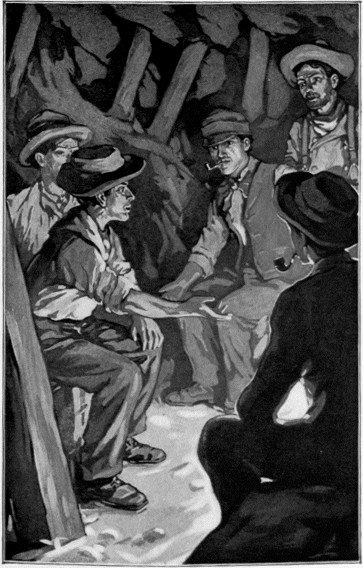
THE CALL TO DUTY
One can easily understand with what enthusiasm
Jim Anderson and Allan West continued the study
of telegraphy. Here was something worth while,
something vital, something with which great things
might be accomplished; for surely there are few
things in this world greater than the saving of
human life.
Then, too, there was the protection of the company’s
property. A collision such as that which had
been averted would have demolished engines and
cars worth a hundred thousand dollars. Damage
suits, destroyed freight, the interruption of
traffic, the cost of repairing the right of way, the
loss of prestige which attends every great wreck—all
these might easily have carried the total loss to
a quarter of a million.
Yet neither in this accident nor in any other was it
the money loss to the company of which the officials
thought. They thought only of the danger to the
passengers, for the passenger is the road’s most
sacred trust. In his behalf, the road exacts eternal
vigilance from every man in its employ. His safety
comes first of all. For it, no railroad man must
hesitate to risk his life; nay, if need be, to throw
his life away. He enters the service of the road
on that condition—and rarely does he fail when
the moment of trial comes, as it is sure to come,
sooner or later.
The boys, then, had reason to be pleased with
what they had accomplished. The superintendent
kept his word, and instruments of the latest pattern
were soon installed by Lineman Mickey, while the
current for the line was furnished by the company’s
batteries, and was stronger and more constant than
their own little battery had been able to give them.
Nor was that all the help they had, for the trainmaster
and the dispatchers took an interest in their
work, and drilled them in the various abbreviations
and code signals in use on the road, as well as the
calls for the various offices.
They were permitted to “cut in” with the main
line whenever they wished; the messages which
flashed over it were then repeated on their own
sounders, and they could try their hands at transcribing
them. Needless to say, they progressed
rapidly under this tuition, which was the very best
they could have had; and the day came at last when
Allan, sitting at his desk sorting the mail, could
understand perfectly what all the instruments about
him were saying.
There is within us, so scientists say, a sort of
second-self which takes care of all actions which
become habitual, without troubling us to think of
them, or to will their performance. Thus we
breathe without any effort of consciousness—a
wise provision of nature, else we should die of
asphyxiation as soon as we went to sleep. The
muscles which control the heart keep on working
of themselves from birth to death. Thus, too, while
the baby must distinctly will every step it takes,
the child soon learns to walk or run automatically,
without thinking about it at all, the muscles moving
of themselves at the proper instant. So the
fingers of the piano-player come to perform the
duties required of them instinctively; and so, at
last, the ear of the telegrapher recognizes a certain
combination of sounds as having a certain meaning,
and the brain has no need whatever to puzzle them
out. The sounds are recorded mechanically, and
the brain furnishes the translation.
Nay, more than that. The operator, worn out
by long hours, sometimes goes to sleep beside his
key. His slumber is so deep that the roar of passing
trains does not disturb it, nor the clicking of his
sounder, as messages flash over the wire. But let
his call be sounded, that short and insistent combination
of dots and dashes which means his office—a
single letter usually—and he will start awake.
The ear has caught the call, has sent it into the
brain, and some second-self there rouses the sleeper
and tells him he is wanted. Operators are not supposed
to go to sleep on duty; to be caught asleep
means a “lay-off,” if not dismissal. Yet they do
go to sleep, for the long hours of the night pass
slowly, and there are times when the weary eyes
refuse to remain open. If it were not for the little
monitor within which stays awake, on guard, listening
for its call, accidents on the rail would be of
much more frequent occurrence, and few operators
but would, sooner or later, lose their jobs. And
there is nothing especially peculiar or remarkable
in this. Almost any one, worn out with fatigue,
will go to sleep with the buzz of conversation about
him; but let some one speak his name insistently
over and over and the sound of it will somehow
waken him. An operator’s call is as familiar to
him as his name, and will attract his attention just
as surely.
It was to this sixth sense, this second-self, that
Allan was at last able to assign the duty of listening
to the instruments in the office. He knew what they
were saying, without having to stop all other work
to listen; nay, without consciously listening at all.
He had reached the place where he was competent
to “take a trick”—much more competent, indeed,
than young operators usually are.
But still there came no opening for a regular
position. A railroad does not “play favourites,”
no matter how deserving they may be. So long
as a man does his work well, his position is his;
and he stands in regular line for promotion. Incompetency
brings its punishment, swift and sure;
just as signal services, in time, bring their reward;
but reward and punishment are according to an
established rule.
For the record of every man is kept minutely
from the hour he enters the employ of the road.
What he may have been or done before that does
not matter, once employment is given him—he
starts square. But even the smallest thing he does
after that does matter, as he finds out, in course of
time, to his amazement and chagrin. The trainmaster
keeps, in a drawer of his desk, a little book
bound in red leather, wherein entries are made
every day; and the heart of the trainman who is
“on the carpet” falls when he sees it produced. It
affects him a good deal as the book wherein the
Recording Angel writes will affect most of us at the
Day of Judgment.
It happened, at this particular moment, that all
the operators’ positions on the road were filled by
competent men, and so Allan had to wait until some
one of them was promoted or resigned. As for
Jim, he had reconsidered his decision to become an
operator. He had a natural love and aptitude for
machinery, and he finally determined to remain in
the branch of the service where he was, and seek
promotion where he would probably deserve it most.
But Allan’s mind was made up, and he lost no opportunity
to perfect himself. Often, after supper,
he would return to the dispatchers’ office and prevail
upon the night operator to permit him to attend
to his work for awhile, and in this way he got
valuable practice; but he longed for the day when
he should be given a key of his own—when the
responsibility would be all his.
The chance came at last. He was just finishing
up his work, one evening, preparatory to going
home to supper, when the instrument on the chief-dispatcher’s
desk began to call. Allan, without
really listening, heard the message:
“Night man at Byers Junction reported sick.
Send substitute.”
The chief-dispatcher clicked back “O. K.,” and
closed the key. Then he wheeled about in his chair
and met Allan’s eager eyes.
“There’s a job for you,” he said, “if you want
it.”
“Want it!” echoed Allan. “I certainly do!”
“And if you think you can fill it,” the chief
added. “The work at Byers is pretty heavy.”
“I’ll do my best,” Allan promised.
The chief looked at him for a moment longer,
then nodded quickly and glanced at his watch.
“You’ll do,” he said. “And you’ve only got
thirty minutes. You’ll have to catch Number Sixteen.”
“All right, sir; I’ll catch it,” said Allan, and he
went down the steps two at a time.
Mary Welsh was just spreading the cloth preparatory
to getting supper when Allan raced up the
steps leading from the street below and burst in at
the door.
“Why!” cried Mary. “What ails th’ boy!”
“Hooray!” yelled Allan, and seized her and
danced around with her in his arms. “I’m going to
be an op-e-ra-tor!”
“Well, I’m sure,” gasped Mary, releasing herself
and reaching up to push the loosened hairpins
back into place, “that ain’t so wonderful. You’d
ought t’ been a oppeyrator long ago! A railroad
ain’t got no sense o’ gratitude!”
“There, there!” cried Allan. “The road’s all
right—and I’ve got to catch Number Sixteen—and
I wonder if there’s a crust of bread or a cold
potato, or anything of that sort handy?”
“Crust o’ bread, indade!” snorted Mary, glancing
at the clock. “You’ll have your supper. Go
an’ git washed, an’ I’ll have it ready fer ye in a
jiffy.”
“All right,” said Allan, “but I warn you I’ll be
back in just a minute and a half.”
Indeed, it was not much longer than that; but
when he came in again, his face shining from a
vigorous rubbing, supper was almost ready—an
egg fried to a turn, with a bit of broiled ham beside
it, bread and butter, blackberry jam, a glass of milk,
and a piece of apple-pie—just the sort of toothsome,
topsy-turvy meal a healthy boy likes.
“Mary,” he said, “you’re a jewel!” and he
stopped to hug her before he sat down.
“None o’ yer blarney!” she retorted, and affected
to push him away, as she gave the last
touches to the table.
Allan pulled up his chair and fell to with an appetite
born of health and good digestion—an appetite
unspoiled by over-indulgence, or by French confections,
requiring no stimulus but that which work
honestly done gave it. He ate with one eye on the
clock, for he was not going to run any risk of missing
his train, and at the end of five minutes, pushed
back his chair and rose with a sigh of satisfaction.
“That was great!” he said. “Now if I may
have one of those luscious doughnuts of yours, or
a piece of that pie, to keep the wolf from the door
to-night—”
“Doughnut, indade!” cried Mary. “What do
you suppose I’ve been doin’ all this toime! Here’s
your lunch,” and she set on the table a little basket,
covered with a snowy napkin.
Allan’s eyes were shining at this new proof of
her thoughtfulness for him.
“Mary,” he began.
“There, there,” she interrupted; “git along or
you’ll miss your train. Good-bye. An’ take good
keer o’ yerself, my dear.”
Allan snatched up hat and basket.
“Good-bye,” he said. “I’m certainly a lucky
boy!”
She stood at the door watching him as he crossed
the yards.
“Yes,” she murmured to herself, turning back
into the house as he passed from sight, “an’ I’m
a lucky woman!”
Dan Breen, the caller, met Allan as he stepped
upon the station platform.
“Here’s yer card,” he said, and held out a little
envelope.
“My card?” repeated the boy, taking the envelope
mechanically.
“Yes, yer card; how did ye expect t’ ride—pay
yer way?”
“Oh,” said Allan, understanding suddenly; “my
pass. Yes; thank you,” and he swung aboard
Number Sixteen just as it was pulling out.
When the conductor came through to collect the
tickets, the boy proudly produced the card, which
commanded all employees of the road to “pass the
bearer, Allan West, on all trains, over main line and
branches, Ohio Division, P— & O— Railway.”
The conductor glanced at it and then at the boy,
nodded, and passed on.
Half an hour later, with fast-beating heart, Allan
dropped off the train at the little frame shanty
which served as the operator’s office at Byers Junction.
The day operator had been compelled to
work thirty-five minutes overtime, and was in no
very genial humour in consequence, for if there is
one point of honour upon which all operators agree,
it is that they shall relieve each other promptly.
So the day operator, whose name was Nevins, and
who knew that his supper would probably be cold
when he got to it, merely nodded to the boy when
he appeared in the doorway, put on his coat and
hat, picked up his lunch-basket, and went out without
saying a word.
Allan, his pulses racing, set his basket on the
table, took off coat and hat, hung them on a nail
near the window, and looked about the little room.
The instrument was calling, but not for him, so he
had leisure to examine the orders which fluttered
from a hook on the wall near by. One was for a
train which would be due in a few minutes, and
Allan went to the door to see that the signals were
properly set and burning.
White is no longer a safety signal on any of the
larger railroads. The colours now in use are red
for danger, and green for safety. Under the old
system, the red lens of the lantern might drop out
or a tramp might smash it, leaving the lantern
showing a white light past which the engineer
would run, thinking everything all right. So green
was substituted for white, and now white means
danger just as much as red does. The only light
past which an engineer may run is a green one.
In fact, the first rule under the “Use of Signals”
is that a signal imperfectly displayed, or the absence
of a signal from a place where one is usually
shown, must be regarded as a stop signal.
The railroads are trying all the time to find some
third colour which can be used satisfactorily in
signalling. Red for danger and green for safety
are very well, as far as they go; but a caution
signal is badly needed—one which will not absolutely
stop a train, but which will warn the engineer
to get it under control and proceed carefully. No
such signal which will do the work required of it
under all conditions has as yet been devised, although
yellow is now used on some roads for this
purpose.
Of course there are one or two other colours
used. A combined green and white signal, for instance,
is used to stop a train at a flag station; and
a blue flag by day, or a blue light by night, displayed
at one or both ends of an engine, car, or
train, indicates that workmen are under or about
it. When thus protected, it must not be coupled
to or moved, and no man may remove these signals
but the one who placed them there. This rule is
enforced absolutely to safeguard, as far as possible,
the lives of the employees of the road.
The only fault in the system—as in all systems—is
that human beings are not infallible, and mistakes
are sometimes bound to happen. The signals
may be wrongly set, or when rightly set, may not
be seen. Fog or smoke may obscure them, and the
engineer rushes by, trusting that all is well. If he
obeyed the rules, he would stop and make sure;
but that would delay the train, perhaps needlessly,
and trains must be run on time. The engineer who
fails to run on time, either through timidity or
overcaution, is very soon relegated to the work-train
or the yard-engine—a humiliating fall for
the master of the queenly flyer.
As Byers was a junction, there were two signals
there for the government of trains, one a train-signal
on the front of the shanty, and the other
a semaphore just outside the door. The train-signal
was merely an arm or signal-blade, operated
by a lever inside the shanty. Normally, this arm
hung down in a perpendicular position and showed
green, which meant proceed; but when the operator
wanted an approaching train to stop, he pulled the
lever, raising the arm to a horizontal position. At
night, of course, it would not be possible for an
engineer to see the position of this arm, so at the
inner end of it was a large casting with two holes
in it, one fitted with a green lens and the other with
a red one. Behind this a lamp was placed, and when
the arm hung down for safety, the light shone
through the green lens. When it was raised, the
red lens was thrown before the light and indicated
danger.
The semaphore was a tall pole just outside the
door. At its top was a cross-arm, bearing at either
end red lanterns at night, to indicate its position,
and operated by a lever at the foot of the pole.
When the arm at the top stood in a perpendicular
position, displaying the signals one above the other,
it indicated that P. & O. trains could pass; when
the arm was thrown to a horizontal position, displaying
the signals one beside the other, it cleared
the track for the connecting road. A ladder on the
side of the pole enabled the person in charge of
it to mount and attach the lanterns at nightfall.
He was supposed to take them down and fill and
clean them sometime during the day. There is, it
may be added, a semaphore at every railroad-crossing
which is worked on just this principle.
Allan had, of course, in preparing himself for the
duties of operator, familiarized himself with all
the signals used; and, as has been said, he stepped
to the door of the shanty to assure himself that the
train-signal was raised and showing red and that
the lanterns on the semaphore were burning properly,
so that the train which was almost due would
stop to receive the orders intended for it. Then
his heart gave a sudden sickening leap, for the light
of neither train-signal nor semaphore was showing
at all!
Already he fancied that, far down the road, he
could hear the hum of the approaching train! The
day operator, despite the lateness of the hour, had
not taken the trouble to light the signals. It was
not his duty, strictly speaking, but there are times
when more is expected of a man than his mere duty.
It might not have really mattered, of course; the
absence of any signal would bring the train to a
stop, if the engineer obeyed the rules; but at the
very least, it would have been his duty to report at
headquarters that the signals at Byers were not
burning, and Allan would have incurred a reprimand,
and a severe one, in the first half-hour in
his new position.
All this flashed through the boy’s mind much
more rapidly than it can be set down here. In an
instant, he had sprung to the train-signal, lowered
it, touched a lighted match to the wick of the lamp,
and then, as the flame flared up, hoisted the signal
into place. Then, with a single glance, he assured
himself that the semaphore lanterns were not in the
shanty. Evidently the day man had not taken the
trouble to bring them down and clean them; and
the boy, without pausing to take breath, started to
climb the pole. As he neared the top, he saw the
lanterns swinging in place; but to light them, especially
for the first time, was a ticklish job.
He heard the train whistle for the crossing half
a mile away, and his hands began to tremble a
little, despite all effort to steady them. He reached
out, drew one lantern to him, snapped it open, and,
after an instant’s agony, got it lighted. Then he
grabbed for the other. It swung for a moment
beyond his reach, and the effort nearly overbalanced
him; but he caught himself, got it at last,
drew it to him, lighted it, and snapped it shut again,
just as the headlight of the approaching engine
flashed into view. He ran hurriedly down the
ladder. As he reached the door of the office, he
heard his call. He jumped to the instrument and
answered.
“Where have you been—asleep?” came the
question.
“I was fixing the lanterns on the semaphore,”
Allan answered.
“Hasn’t first ninety-seven reached Byers?”
“There’s a train just pulling in,” Allan answered,
and at that moment the conductor appeared in the
doorway.
“Are you first ninety-seven?” Allan asked him.
“Yes,” replied the newcomer. “Any orders?”
Allan handed them to him with a sigh of relief
that all was well, and notified the dispatcher that
first ninety-seven had reached Byers at 7.16.
It may be well to explain, at this point, that the
regular freight-trains on every road are usually
run in sections, the number of sections depending
upon the amount of freight to be moved. For instance,
if, toward the middle of the afternoon, there
has accumulated in the yards at Wadsworth only
enough west-bound freight for a single train, the
cars are made up, and at seven o’clock, immediately
following the accommodation, regular west-bound
freight-train No. 97 is started toward Cincinnati,
and runs as nearly as possible on the schedule given
it in the time-table.
If, however, there are too many cars for one
engine to handle, they are made up into two trains,
and the first one that goes out is called the first section,
and displays at the front of the engine two
green lights to show that another section is following.
Ten minutes later, the second section is sent
out, displaying no signals. Theoretically, both
sections constitute one train, and the track cannot
be used by any other train until both get by; but
this is a theory which is constantly broken in practice.
Sometimes, when freight business is heavy—in
the fall, for instance, when the grain crops are
being moved and the merchants throughout the
country are laying in their supplies for the holidays—there
will be three or four sections of each
of the regular freight-trains.
But while this system allows for a certain expansion
of traffic to suit the road’s business, by far the
greater part of the freight in the busy season is
handled by “extras”—that is, by trains which
have no place on the time-card and no regular
schedules, but which must run from station to station,
whenever the track happens to be clear. For
instance, as soon as Number Two, the east-bound
flyer, pulls into the yards at Wadsworth, an extra
west-bound freight will be started out, with orders
to run extra to the end of the division. The conductor
is armed with the time-card, and must keep
out of the way of all trains which appear on it.
He is also provided with meeting orders for all the
other extras which happen to be going over the
road at the same time, and must take care to comply
with them. As he goes from station to station,
he is kept informed as to whether any of the regular
trains are behind time, so that he need not wait on
any of them unnecessarily, but may get over the
road as rapidly as possible. The actual conduct of
the train is left largely to him and to the engineer,
so that their responsibility is no light one.
All of this sounds much easier than it really is.
As a matter of fact, the task of carrying on the
business of a single-track road, where it is practically
impossible for all trains to run on time, where
meeting-points must be provided for all freight-trains,
without delaying them unduly, and where
the passenger-trains must have always a clear track
and opportunity to make up as much time as possible,
if they happen to be late, is one of the most
delicate and nerve-racking that could be imagined,
though under the new double-order system it is not
so bad as it was under the old single-order one.
The burden of keeping things moving and of
getting the trains over the road in the shortest possible
time, falls principally upon the dispatcher at
headquarters, but every operator along the road
bears his part, and an important part. He must
keep awake and alert for any orders the dispatcher
may wish to send him; he must note the passage of
every train and report to the dispatcher the exact
moment at which it passed; and he must be sure
that the station signals are properly displayed, and
that all orders are properly delivered. Upon the
faithful fulfilment of these duties does the safety
of trains depend; but especially upon the second,
for unless the dispatcher knows accurately the exact
position of every train, disaster is sure to follow.
Only once that night did Allan have any trouble.
That was about three o’clock in the morning.
There had not been many orders for Byers, for
traffic was light, and he had passed the time listening
to the orders sent the other operators and studying
the time-card and book of rules with which all
operators are provided. But at last his sounder
began to clatter out the already familiar "-...,
-..., B, B," which was the call for Byers. He
answered it and took down the following message
on his manifold sheet:
“Hold extra east, eng. 632, at B.”
Allan repeated it at once from his copy, and a
moment later, “Com 3.10 C R H” was flashed
back to him.
The “com” meant “complete,” showing that the
order had been accurately repeated; the “3.10”
was the time the order was sent, and the “C R H”
were the initials of the superintendent, which are
signed to all train-orders. Three copies must be
made of every such order, one for the conductor,
one for the engineer, and the other for preservation
by the operator. This is done by using tissue-paper
for the orders—which are usually called “flimsies”
for that reason—between the sheets of which
carbon-paper has been placed. A steel-pointed instrument
called a stylus is used to write with, instead
of pen or pencil, in order that the impression
through the three sheets may be clear and distinct.
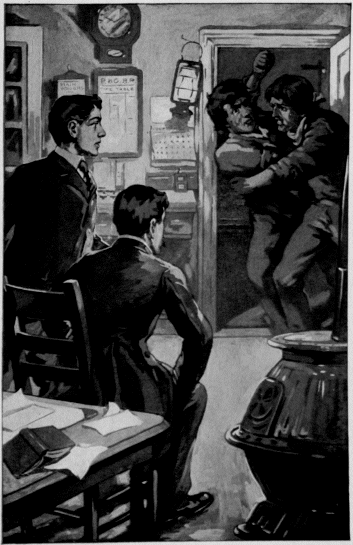
A few minutes after Allan had taken the order,
the extra east pulled in, and the conductor, Bill
Higgins, stalked into the office.
“Any orders?” he asked.
Allan handed him two copies of the order just
received, then waited, his own copy in his hand,
for Higgins to read the order aloud to him, as required
by the rules. But instead, the conductor
merely glanced at it, then, with a savage oath,
crumpled it up in his hand and started to leave.
“Aren’t you going to read it?” Allan asked.
“Read it? I have read it!” answered Higgins,
savagely.
“Not aloud to me,” Allan pointed out.
“What do you mean, you young fool?” demanded
Higgins, turning upon him fiercely. “D’
you think I don’t know my business?”
“I only know,” replied Allan, paling a little as
he saw that Higgins had been drinking and was in
a very ugly mood, “that the rules require you to
read that order aloud in my presence.”
“Well, what of it? That rule was made, mebbe,
by th’ same fool that just sent this order holdin’
me here fer an hour, when I could git into Hamden
easy as pie afore Number Ten was due! What do
I care fer th’ rules? This here road’s goin’ t’ blazes,
anyway!” and he turned to go.
“Very well,” said Allan, evenly; "you will do as
you think best, of course. But if you don’t obey the
rules, I shall have to report you."
At the words, Higgins sprang around again, purple
with rage.
“Report me!” he shouted. “Why, you young
whipper-snapper, I’ll spoil that putty face o’
your’n,” and he raised his fist.
“Hello, here,” called a voice from the door.
“What’s the trouble?” and Allan glanced past the
irate conductor to see the engineer standing in the
doorway. “What’s up, Bill?” he repeated, coming
in. “What’s the kid done?”
“Threatened to report me if I don’t read this
here order to him,” answered Higgins sullenly.
The engineer glanced sharply from one to the
other.
“Is that all?” he said. “And you were going
to fight about a little thing like that, Bill?”
“No kid shall report me!” growled Bill, but he
looked a little foolish.
“Well, then, read the order,” advised the engineer,
easily.
Bill hesitated an instant, then smoothed out the
crumpled paper.
“’Hold extra east, engine 632, at Byers,’” he
snapped out, and handed the engineer his copy.
“’Hold extra east, engine 632, at Byers,’” repeated
the latter. “Correct.”
The conductor turned without another word and
left the office. The engineer followed him with his
eyes until he disappeared in the darkness, and then
turned back to Allan.
“Would you really have reported him?” he
asked, eying the boy curiously.
“Yes,” answered Allan, slowly. “I think I
should. He was drunk.”
“He has been drinking,” admitted the engineer.
“Personally, I detest him. But he’s got the sweetest
little wife you ever saw, and three kids that
worship him; so he can’t be wholly bad. What
would become of them if he’d lose his job? Of
course, you can report him yet, if you want to. But
I’d think it over first,” and the engineer followed
Higgins out into the night.
Allan did think it over, and the result was that
the superintendent never heard of that encounter
in the little Byers office.