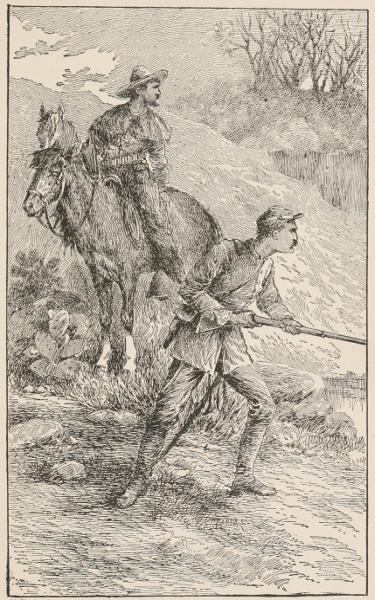
Maurice Freeman was withdrawing from his
perilous position, when without the slightest warning
an Apache warrior stepped from behind a rock
a short way ahead and confronted him.
When it is stated that this individual held a Winchester
in his right hand and carried it at his thigh,
it will be conceded that his action was altogether
contrary to that of his people under such circumstances;
for it gave the white man a chance to bring
his weapon to his shoulder by a lightning-like
movement and to secure the “drop” on him—one
of the most difficult of all feats to perform. But
when it is added further, that the Apache belonged
to the White Mountain branch of the tribe his conduct
will be understood.
No sight could have been more welcome to Freeman,
whose face lit up with pleasure at the discovery
that, instead of an enemy, he had the best of
friends at his elbow. He paused a moment, and
then, with the whispered word, “Mendez,” on his
lips, moved toward him.
The dusky trailer did not speak, but raised his
left hand as an appeal for caution; and beckoning
him to advance, turned away and resumed his walk
with that catlike movement peculiar to his race and
which was absolutely without noise.
Freeman understood what he meant; the situation
was too dangerous for him to hold, and must be
changed without delay. He did his best to follow
instructions, though he could not do so with the
perfection of his guide. The latter continued the
lead for fully two hundred yards and then halted,
turned around and silently watched the white man’s
approach.
By this time the latter had lost the trepidation
he felt, when the soft, birdlike signal reached him
from different points of the compass. Wherever the
Apache camp might be, he was now at a safe distance
from it.
“I didn’t expect to meet you, Mendez,” said the
settler in a guarded undertone, “and I needn’t tell
you——”
“Be careful; the trees and rocks have ears.”
It was Lieutenant Decker who uttered these warning
words, as he stepped into view, very much as
the scout had done a short time before. He smilingly
extended his hand to his astonished friend,
adding by way of explanation:
“You didn’t expect either of us, but we are here
all the same; the fight which I looked for this
morning was unavoidably postponed, but I am hopeful
that I shan’t be disappointed after all.”
“Why, lieutenant, I am pleased beyond expression,
but you owe me an explanation of how this
was brought about.”
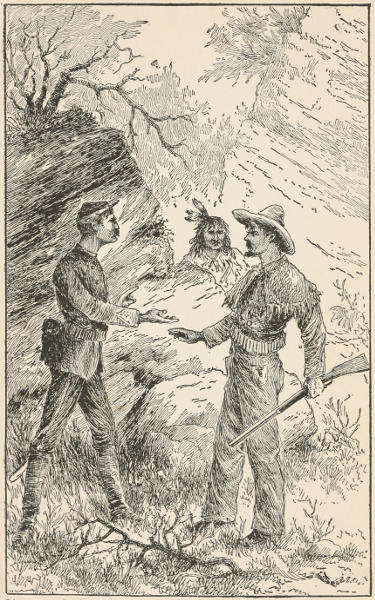
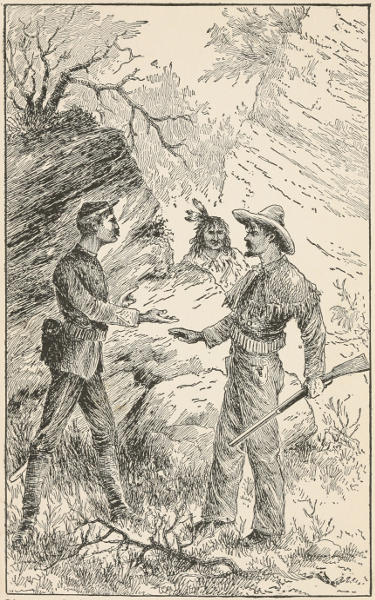
Lieutenant Decker smilingly extended his hand to his astonished friend.
“You did not expect either of us, but we are here all the same.”—Page 184.
—The Young Scout.
“It was all due to him,” replied the officer,
nodding his head toward the Apache, who did not
open his lips, but stood, looking back over the route
he had just traversed, as if watching for some expected
form, or listening for a signal that had not
yet been made.
“I suppose so, but that fact does not explain
matters.”
“Mendez is not addicted to talking, but I think I
learned more of his thoughts than any one else.
When you parted from us this forenoon, I supposed
you meant to go home and wait until night, before
making any move to help your child, but that
shrewd fellow read your intentions in your face and
in your manner. He told me you meant to ride away
from the river until out of our sight and then cross
and take up the trail of Maroz and Ceballos. I
would have followed you and protested against such
foolhardiness, but knew it was useless.”
“He hit the truth,” remarked Freeman, with an
admiring glance at their friend, whose attention
seemed still drawn away from them and who showed
no interest in the conversation.
“Instead of attempting to interfere with you, we
rode fast to the fort and reported to the colonel;
he had already learned the truth from the Indian
scouts whom he had sent across the river some
hours before. The indications were unmistakable
that eight or ten hostiles were on the war path,
and, unless prompt measures were taken, the number
would be increased. The colonel isn’t the man to
hesitate at such times and he moved quickly. A
number of our best men at the post, with three
White Mountain Apaches, all well mounted and
under Captain Shindle, who was a veteran at this
business before I entered the Point, set out for the
mountains.”
“Where are they now?”
“All that I can say is that they are hard at it,
but I have no knowledge of their precise location.
The scouts who bore the tidings to the colonel were
certain the rendezvous was fully a mile back of
where we saw the signal smoke, and which was
meant to mislead us more than to guide their allies.
The captain will aim to get to the rear and to approach
from the south. This will give him a chance
to prevent the withdrawal of the bucks further into
the mountains. They will not look for a movement
of that kind, and unless their scouts have discovered
his purpose, he has a fair prospect of circumventing
them.”
“But where are Colgate, Peyser, and Redfield?”
“With the captain; this is a private campaign of
Mendez and myself, but we are willing to let you in
as a partner on the ground floor.”
“Nothing could suit me better, but, if the
Apaches are so far off, why this extreme caution,
and what chance is there of our doing anything to
help my child?”
“I’ll admit that the prospect isn’t dazzling, but,
if the theory on which Mendez is working proves
correct, we shall have an opportunity to effect something.”
“What is his theory?”
“That Maroz and Ceballos are not far from this
spot, while the main band is a mile beyond in the
mountains. They are watching the trail, along
which they expect the pursuit to be made, and will
telegraph the fact in their own way the moment it
is discovered to the main party. There may be
others with the couple, but that is the game they
are playing.”
“If Mendez is right, what have they done with
my boy?”
“He is with Maroz and Ceballos.”
“Would they not be likely to place him in charge
of the main band, so as to lessen the danger of his
rescue.”
“That would be my theory, but I suspect he
thinks differently.”
“I have as much faith as you in the woodcraft of
Mendez, but I can’t accept that theory.”
Freeman would have been only too glad to believe
as did the guide, but the doubt he uttered was
that which would have come to any clear-headed
man. If Maroz and Ceballos were acting as the
rear guard of the hostiles, they could not afford to
handicap themselves with the care of a prisoner,
the possession of whom, it may be said, was the key
to the situation.
If the boy were placed in charge of the stronger
party, the two would be untrammeled in the crisis
which they had every reason to believe was at hand.
This was the situation, as it presented itself to Freeman
and Lieutenant Decker, but the latter’s convincing
remark was:
“It strikes me as mighty odd, but Mendez
wouldn’t believe what he does without the best of
reasons.”
“Have you questioned him?”
“I have.”
“What did he say?”
“He told me it was none of my business: not exactly
in those words,” added the smiling officer, “but his
refusal to enlighten me amounted to the same
thing.”
Freeman turned toward the subject of their conversation,
but he was so absorbed in watching a
point to his left, and listening for that which he
heard not, that the remarks seemed to be lost upon
him.
“Let me ask how near we are to the spot where
Mendez suspects Maroz and Ceballos to be.”
The lieutenant had put the same question to the
guide before coming upon the settler, and he
answered:
“Not more than a quarter of a mile.”
“A quarter of a mile!” repeated the astonished
Freeman, “why I was sure I was within a dozen
rods of it.”
“Nothing is easier than to be mistaken.”
It is singular how the emotion of mirth will
intrude at the most inopportune times. Maurice
Freeman was oppressed by a grief such as he had
never known before, but he now laughed silently
and heartily. He recalled his extreme trepidation,
when he believed he was near the Apache camp, his
effort to withdraw and the caution of Mendez in
guiding him away. To him the picture was that of
a big urchin, who has ignorantly approached some
danger, and whose father seeks to coax him back
to safety. The figure of himself playing the part
of booby was what caused him to laugh, but his
mirth quickly vanished, and he wondered at himself
for having shown it.
“If such care must be used when we are so far
from the camp, how will it be when we get within
sight of it?”
The lieutenant shook his head.
“I’m afraid there isn’t much show for making
that test; I have been pleading with Mendez to
take me in as a full partner and to allow me to be
at his elbow when the first squint of the camp is
obtained, but my eloquence was wasted. The fact
is,” continued the young officer, becoming serious,
“he is right. I don’t believe the white man lives
who can steal up to an Apache camp in the day-time,
or during the early part of the evening, no
matter how dark, without discovery, and I needn’t
tell you what that means for you and me. After
midnight, when they are asleep, there might be a
show, but even then Mendez must be in the advance.
He expected to find you somewhere in this neighborhood,
and you have been as much an object of
search for the last hour or two as the hostiles themselves.”
“What was his purpose in signaling from different
points, when he located me?”
“I presume to give you a good scare.”
“Well, he succeeded! I was never so rattled in
all my life. But I was quite near the place where
I expected to find Maroz and Ceballos.”
“That may be, but you were away off in your
calculations; you made a mistake; I have done
something of the kind once or twice during my
checkered career.”
While the conversation continued in this vein,
generally serious, but now and then lightened by
the bubbling humor of the lieutenant, darkness
settled about them. This was most welcome, for it
brought nearer the hour for action. Between the
downsetting and uprising of the sun, the all-important
question must be settled as to what was to
be the fate of little Fulton Freeman.
The father and the lieutenant talked several
minutes longer, while their forms grew indistinct
in the gloom, until a remark of the officer caused
the other to turn his head toward Mendez. He had
vanished.
“What’s become of him?” whispered Freeman,
as if his absence indicated some new peril at hand.
“He’s gone to take a look at things; he moved
away fifteen minutes ago.”
“I didn’t hear him.”
“Nor did I, but I saw him, just as you have seen
the shadow of a cloud whisk over the earth. Of
course, there is no saying when he will be back,
since that depends on what he learns, but we can
count on his being here before daylight.”
“And in the meantime we have nothing to do
but to wait.”
“You hit it that time, and we can’t find more
comfortable quarters than these.”
It would not do to go far from the spot, since it
might cause Mendez trouble in finding them, beside
which there was no object in doing so, since one
part of the mountain differed little from another.
Accordingly, they assumed lolling postures on the
nearest rock, which was still warm from the rays
of the sun, and continued their conversation in
tones that could not have been heard more than a
dozen feet away.
Freeman had eaten nothing since morning, and
the thought of food had not been with him; but
when the lieutenant produced a small, substantial
lunch, which he was thoughtful enough to bring,
the two shared it and were refreshed therefrom.
“Now, if I had a drink of water,” said the elder,
“I would be satisfied; it seems to me I never felt
more thirsty, but I can manage to stand it until
morning.”
“There’s no need of that; a stream is within a
hundred feet of us. It doesn’t amount to much,
and is as warm as dishwater, but it is a thousand
per cent. better than thirst.”
The lieutenant located the spot for his friend,
proposing that they should go thither separately, in
order that one of them might be sure of being on
hand when Mendez returned. But the scout had
been absent so short a time that this precaution
seemed useless, and, when Freeman asked him to
show him the way, he complied willingly.
The night had a gibbous moon, and, as the sky
was without a cloud, considerable light reached the
earth, where the rays were not obstructed. The
vegetable growth in this portion of the Apache
range is sparse, the small trees being scattered, so
that it was easy to pick their way for the short
distance necessary to reach the water.
As the lieutenant had intimated, the draught was
uninviting to one not very thirsty. The rivulet
issued from under the roots of a tree, where it was
to be supposed it would be quite cool, but it was
lukewarm and roiled, as the officer learned when he
quenched his thirst during the afternoon, but the
drink was none the less refreshing on that account.
“Freeman,” said the lieutenant, looking around
them, as if suspecting the presence of an enemy in
their vicinity, “suppose you wait here for a few
minutes, while I go back to the old spot.”
“Why do you propose that?”
“I fancied just now I heard something suspicious.
Maybe I was mistaken, but when you are in this
confounded Apache country, the rule is to believe
every man guilty until proved innocent.”
“And if you were not mistaken?”
“Well,” replied the young officer in his off-hand
way, “it’s likely in that case that there will be music
in the air.”
“I mean as to what I shall do. Am I to stand
here and take no part in the business? Is that
your idea of how one comrade should stand by
another?”
The question may seem trifling, but it perplexed
the lieutenant for the moment. The idea of comradeship
with him, as it is with every true soldier,
is that one shall stand by his friend to the death.
The basest crime that a soldier can commit is to
desert a comrade in extremity. Ordinarily, therefore,
the answer of Decker would have been prompt,
or rather there would have been no occasion for
asking the question, but while Freeman was a brave
man, his powers of keen, subtle reasoning, of cool-headedness
and quick resources were affected by
his mental distress over the peril and uncertainty
about his little boy. It is the rule among physicians
for no member of the profession to attend unaided
his own family (unless the peril make it unavoidable),
since affection must weaken the judgment.
The situation of the father was somewhat analogous.
In other words the thought of the lieutenant was
that it would be safer for them to be apart, if danger
should come. The elder not only could not aid the
younger, but would increase his own peril. He must,
therefore, stay where he was.
“I wish you would remain here until I signal for
you to join me. It may be that if there is anything
of the kind in the air, it will be best to let it alone,
and there is more chance of that with one of us
than with both. If I find myself in need of you I
will call.”
Freeman could make no objection to this, and he
sat down in the stunted undergrowth near the
spring, reflecting that with the fervid heat he was
likely to feel a renewal of thirst every fifteen minutes
or less, and was favorably located for quenching the
same without any trying delay.
“Listen for the signal,” whispered the lieutenant
again, “and don’t join me until you hear it. I
will make it as soon as I am convinced the way is
clear.”
The space between the spring and the rock where
they meant to await the return of Mendez was but
little more than a hundred yards. It was broken
by boulders, a number of depressions, with here and
there a dwarf pine, one of those sturdy trees which
seem to have the power of the moss to extract the
needed nourishment where most plants would die
for lack of it. Though the moon was almost overhead,
it was impossible for either of the men to
discern objects for a third of the distance which
separated them. The lieutenant had not taken
more than a dozen steps in his guarded manner,
with his body in a crouching posture and all his
senses alert, when the watchful Freeman was as
much alone as if the nearest man were miles distant.
The brave young officer was swallowed up in the
gloom and gone.
“Now,” thought the elder, finding himself alone,
“the Apaches must know about this spring; those
people I suppose understand what hunger and thirst
are, though they have less trouble from it than any
persons I ever met, and it isn’t impossible that some
of them may take a notion to drink from the same
spring. That being the case, the prudent thing for
me to do is to imbibe freely while I have the
chance.”
Having drank deeply only a few minutes before,
Freeman felt as if he must make excuse to his conscience
for his dissipation, but the water was delicious
and the supply all-sufficient. He quaffed his
fill, and then replacing his hat stole softly from the
spot and assumed a crouching posture behind a convenient
boulder, where there was little likelihood of
an enemy stealing upon him unawares.
“The lieutenant is full of pluck,” he reflected,
“but the pluckiest man that ever lived sometimes
needs the help of a child. There isn’t anything he
wouldn’t do for me, and I will stand by him to the
last extremity.”
Meanwhile, Lieutenant Decker was alert and
guarded in every step he took. His principle that
while in the Apache country every indication of
possible danger, no matter how slight, should be
accepted as the reality, was the right principle. Its
disregard has brought death to many a brave soldier
on the frontier. Lieutenant Decker welcomed a
lively brush with the hostiles, but he would have
been the idiot which he was not, to disregard the
experience of those that had fought these fierce
people before he was born, while brief as was his
own experience, its lesson was too impressive to be
forgotten.
For perhaps a fourth of the distance he advanced
almost on his hands and knees, stealing from
boulder to boulder, at times almost flat on his face,
then raising his head, peering here and there, looking
and listening with the utmost keenness at his
command.
“There is no wind blowing though I heard a
rustle once or twice; I don’t think there has been
enough to move a leaf for the last half hour. Now
and then we meet wild animals in this part of the
world, but that slight noise—if there was a noise—wasn’t
made by any of them. It looks as if some
of the Apaches are hereabouts.”
Perhaps a veteran scout would have argued that,
inasmuch as the young officer had heard a noise—slight
though it was—the fact was against its having
been made by one of the dreaded red men, since
none of them would commit a blunder of that
nature, when in the neighborhood of an enemy,
but it might be they did not think any enemy was
near, so it was wise for the lieutenant to proceed on
the theory that some of Geronimo’s followers were
prowling in the vicinity.
For a period of ten minutes the young officer
held his place immovable. During that time the
oppressive silence was unbroken by the slightest
disturbance. Everything seemed absolutely “dead”
around him, the atmosphere itself being as pulseless
as the warm rocks and boulders on which he rested
his hand, as he glided near them. Certain that he
had not made the least betrayal, the lieutenant
began to ask himself whether he had not been mistaken
from the first in his suspicions.
With his head so near the ground, he lay flat, and
pressed his ear against the earth, as do hunters and
scouts when in the vicinity of enemies. At the
moment of resorting to this test, the ear told something
faintly, but it was gone at the moment he
composed himself to listen—a fact which made it
seem that the noise was caused by the first contact
of his own ear with the ground.
“Everything seems to be all right,” he reflected,
finally resuming his advance to the spot where he
and Freeman had settled down to await the return
of their dusky friend.
A rod further and Decker was checked by a rock
that must have weighed several tons. He could
pass it by turning to the right or left or climbing
over it. It need not be said that the last method
was to be used only as a final resort. He paused
once more and considered on which side it was best
to flank it—a question which it would seem could
not be settled by an hour’s deliberation, but there is
no accounting for the impressions which sometimes
sway persons in perilous emergencies. The lieutenant
was cautiously creeping to the left, and had
turned the corner, when he abruptly retreated and
headed to the right.
Advancing in this Apache-like style, he held the
Winchester which he carried with him in his left
hand, both hands and knees being used to aid his
progress, while he peered ahead in the gloom and
listened with the intensity he had shown from the
first. The configuration of the rock and the
position of the moon (not exactly in the zenith),
threw a line of shadow to the right of the immense
boulder just far enough to enfold his figure. On
the other side there was not a particle of shade, so
that his change of advance had brought that much
advantage to him.
From the corner of the rock around which he had
just crept, to the corresponding edge, was little
more than twelve feet, and half the distance was
passed, when the very peril against which he was
maneuvering presented itself. Beyond the further
corner appeared the head of an Apache warrior,
thrust forward, seemingly with the slow, noiseless
motion of the hand of a clock. He, too, was in a
crouching posture, for the impish face, with its
dangling mass of hair, was no more than a foot
above the ground. It was partly in moonlight and
partly in shadow, but shown so plainly that there
could be no possible mistake.
Although the position of the lieutenant was the
more favorable, the action of the hostile proved that
he was as quick to detect him as the other was to
observe his dusky foe. Before Decker could draw
his revolver or bring his rifle into play, the head of
the savage whisked from sight. It vanished so
suddenly indeed as to suggest the figurehead of a
wooden image that was snapped back by machinery.
The situation was growing interesting. Here
were two deadly enemies within eight or ten feet of
each other, both equally alive to the fact, both
armed and ready to take instant advantage of any
turn that might offer.
It cannot be said that Lieutenant Decker felt
comfortable. He knew the cunning of these terrible
red men, and would much rather fight them in the
open or on ground where the chances of each were
the same. This savage had been trained in the cunning
and woodcraft of his people, and knew things
which could not have come as yet to the white man.
But the latter was quick of perception and was
learning fast in the crucial school of experience.
In one sense, the two were on the same footing.
They were within striking distance, with the rock
between them, and he who was the first to discover
the other, even for an instant, must win in the
desperate game. It was, in fact, the question of
which could “get the drop” on the other.
The Apache might come around the corner of the
rock in front, or at the rear, or possibly he would
try to steal over the top, so as to fire down on his
enemy. If he could forestall the white man, by a
moment, it would inevitably be fatal to the latter.
There is a stratagem as old as the hills and one
with which doubtless every reader of these pages is
familiar. Lieutenant Decker gently removed his hat
and placed it on the muzzle of his rifle. Then
creeping slightly forward, he extended the weapon,
intending to make the hat show around the edge of
the boulder. It will be understood that the idea
was to represent himself as peering beyond the
edge, so as to draw the shot of the Apache, and
then let fly at him before he could recover from the
blunder.
The young man had almost reached the corner
with the extended Winchester, when he withdrew
it and replaced the hat on his head.
“If there were a law against persons making
fools of themselves, I would violate it about every
hour of the day,” was his thought. “I’m glad no
one saw me.”
For, while reaching forward with one arm, he
awakened to the fact that even if the stratagem
was successful, it would not help him. Suppose
the Apache sent a bullet through the hat, how
could that aid the officer? The Indian would discover
his mistake before Decker could bring his
body to the same spot and fire—an act which would
place him in exactly the same peril that the hat
had encountered. Furthermore, more than likely
the warrior owned a repeating Winchester. If so,
the true course for him was to fire at the hat the
instant it showed and give the impression that he
had been tricked. That would encourage the white
man to rush to the attack and bring to his foe the
exact chance for which he was maneuvering and
waiting. Consequently, this time-honored and
once brilliant strategy would prove a boomerang
that would recoil with disastrous effect upon the
originator.
The momentous question remained as to the
Apache’s method of attack, for, whatever it was, it
must be forestalled. The officer was obliged to
watch the front and the rear, and make sure that
his enemy did not glide over the top of the rock
like a rattlesnake, and strike down from above.
Decker leaned his rifle against the face of the
boulder and drew his revolver. The former weapon
was too awkward to be used in the impending encounter.
The smaller was equally effective and
tenfold more handy.