BY
A. L. O. E., AUTHOR OF “THE SHEPHERD OF BETHLEHEM,”
“THE SILVER CASKET,” ETC.
With Illustrations.
London:
T. NELSON AND SONS, PATERNOSTER ROW. EDINBURGH; AND NEW YORK.
1887.
It may perhaps be necessary to give a brief explanation
of the object of this little work. It has
been written as a Child’s Companion to the
Pilgrim’s Progress. That invaluable work is
frequently put into youthful hands long before the mind
can unravel the deep allegory which it contains; and thus
its precious lessons are lost, and it is only perused as
an amusing tale.
I would offer my humble work as a kind of translation,
the term which was applied to it by a little boy
to whom I was reading it in manuscript—a translation of
ideas beyond youthful comprehension into the common
language of daily life. I would tell the child, through
the medium of a simple tale, that Bunyan’s dream is a
solemn reality, that the feet of the young may tread the
pilgrim’s path, and press on to the pilgrim’s reward.
I earnestly wish that I had been able more completely
to carry out the object set before me; but difficulties
have arisen from the very nature of my work. I have
been obliged to make mine a very free translation, full
both of imperfections and omissions. This is more
especially the case where subjects are treated of in the
Pilgrim’s Progress which concern the deeper experience
of the soul. Of fearful inward struggles and temptations,
such as befell the author of that work, the gloom
and horrors of the Valley of the Shadow of Death, the
little ones who early set out on pilgrimage usually know
but little. They find the stepping-stones across the
Slough of Despond, and are rarely seized by Giant
Despair. It would be worse than useless to represent
the Christian pilgrimage as more gloomy and painful
than children are likely to find it.
There are other valuable parts of the Pilgrim’s Progress,
such as the sojourn in the House Beautiful, which
is believed by many to represent Christian communion,
which could hardly be enlarged upon in a design like
mine; while the present altered appearance of Vanity
Fair has compelled me to wander still further from my
original, if I would draw a picture that could be recognized
at the present day, and be useful to the rising
generation.
Such as it is, I earnestly pray the Lord of pilgrims to
vouchsafe his blessing on my little work. To point out
to His dear children the holy guiding light which marks
the strait gate and the narrow path of life, and bid
them God speed on their way, is an office which I most
earnestly desire, yet of which I feel myself unworthy.
I may at least hope to lead my young readers to a nobler
instructor, to induce them to peruse with greater interest
and deeper profit the pages of the Pilgrim’s Progress,
and to apply to their own characters and their own lives
the precious truths conveyed in that allegory.
“I dreamed, and, behold, I saw a man clothed with rags standing in a
certain place, with his face from his own house, a book in his hand, and a
great burden upon his back.”—Pilgrim’s Progress.
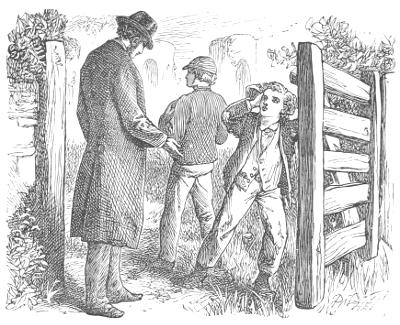
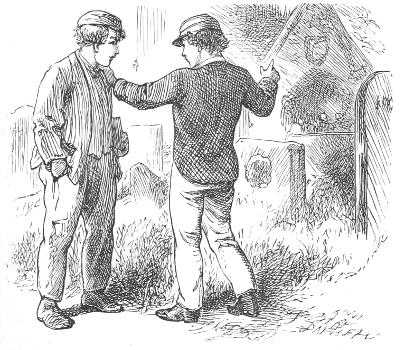
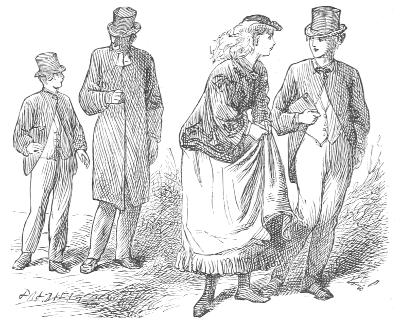
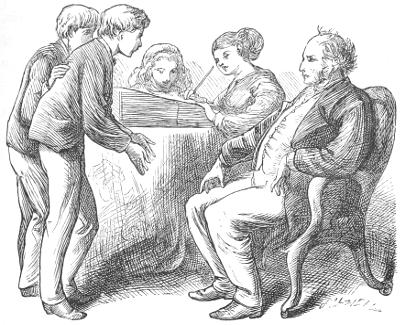
“Is this the way to the ruins of St. Frediswed’s
shrine?” said a clergyman to a boy of about
twelve years of age, who stood leaning against
the gate of a field.
“They are just here, sir,” replied the
peasant, proceeding to open the gate.
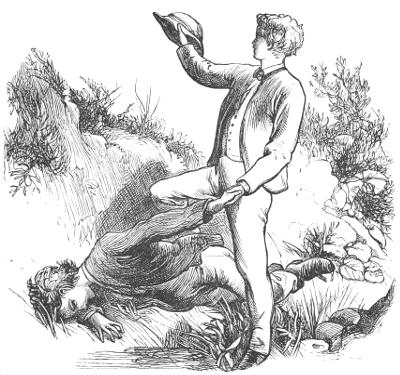
“Just wait a moment,” cried a bright-haired boy who
accompanied the clergyman; “that is your way, this is
mine,” and he vaulted lightly over the gate.
“So these are the famous ruins!” he exclaimed as he
alighted on the opposite side; “I don’t think much of
them, Mr. Ewart. A few yards of stone wall, half
covered with moss, and an abundance of nettles is all
I can see.”
AT THE GATE.
“And yet this once was a famous resort for pilgrims.”
“Pilgrims,—what were they?” inquired the boy.
“In olden times, when the Romanist religion prevailed
in England, it was thought an act of piety to visit
certain places that were considered particularly holy;
and those who undertook journeys for this purpose
received the name of pilgrims. Many travelled thousands
of miles to kneel at the tomb of our Lord in Jerusalem,
and those who could not go so far believed that by visiting
certain famous shrines here, they could win the pardon
of their sins. Hundreds of misguided people, in
this strange, superstitious hope, visited the abbey by
whose ruins we now stand; and I have heard that a
knight, who had committed some great crime, walked
hither barefoot, with a cross in his hand, a distance of
several leagues.”
“A knight barefoot! how strange!” cried young Lord
Fontonore; “but then he believed that it would save him
from his sins.”
“Save him from his sins!” thought the peasant boy,
who, with his full earnest eyes fixed upon Mr. Ewart,
had been drinking in every word that he uttered; “save
him from his sins! I should not have thought it strange
had he crawled the whole way on his knees!”
“Are there any pilgrims now?” inquired Fontonore.
“In Romanist countries there are still many pilgrimages
made by those who know not, as we do, the one
only way by which sinners can be accounted righteous
before a pure God. But in one sense, Charles, we all
should be pilgrims, travellers in the narrow path that
leads to salvation, passing on in our journey from earth
to heaven, with the cross not in our hands but in our
hearts; pilgrims, not to the tomb of a crucified Saviour,
but to the throne of that Saviour in glory!”
Charles listened with reverence, as he always did when
his tutor spoke of religion, but his attention was nothing
compared to that of the peasant, who for the first time
listened to conversation on a subject which had lately
been filling all his thoughts. He longed to speak, to ask
questions of the clergyman, but a feeling of awe kept
him back; he only hoped that the gentleman would continue
to talk, and felt vexed when he was interrupted by
three children who ran up to the stranger to ask for alms.
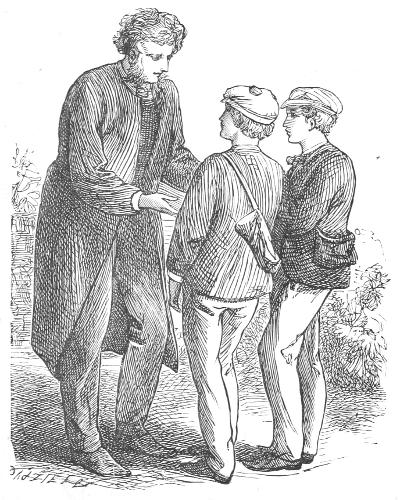
“Begging is a bad trade, my friends,” said Mr. Ewart
gravely, “I never like to encourage it in the young.”
“We’re so hungry,” said the youngest of the party.
“Mother’s dead, and father’s broke his leg!” cried
another.
“We want to get him a little food,” whined the third.
“Do you live near?” asked Mr. Ewart.
“Yes sir, very near.”
“I will go and see your father,” said the clergyman.
The little rogues, who were accustomed to idle about
the ruin to gain pence from visitors by a tale of pretended
woe, looked at each other in some perplexity at the offer,
for though they liked money well enough, they were by
no means prepared for a visit. At last Jack, the eldest,
said with impudent assurance, “Father’s not there, he’s
taken to the hospital, there’s only mother at home.”
“Mother! you said just now that your mother was
dead.”
“I meant—” stammered the boy, quite taken by surprise;
but the clergyman would not suffer him to proceed.
“Do not add another untruth, poor child, to those
which you have just uttered. Do you not know that
there is One above the heavens who hears the words of
your lips, reads the thoughts of your hearts—One who
will judge, and can punish?”
Ashamed and abashed, the three children made a hasty
retreat. As soon as they were beyond sight and hearing
of the strangers, Jack turned round and made a mocking
face in their direction, and Madge exclaimed in an
insolent tone, “We weren’t going to stop for his sermon.”
“There’s Mark there that would take it in every word,
and thank him for it at the end,” said Jack.
“Oh, Mark’s so odd!” cried Ben; “he’s never like
anybody else. No one would guess him for our
brother!”
These words were more true than Ben’s usually were,
for the bright-haired young noble himself scarcely offered
a greater contrast to the ragged, dirty children, than they
with their round rustic faces, marked by little expression
but stupidity on that of Ben, sullen obstinacy on Madge’s,
and forward impudence on Jack’s, did to the expansive
brow and deep thoughtful eye of the boy whom they had
spoken of as Mark.
“Yes,” said Jack, “he could never even pluck a wild-flower,
but he must be pulling it to bits to look at all its
parts. It was not enough to him that the stars shine to
give us light, he must prick out their places on an old
bit of paper, as if it mattered to him which way they
were stuck. But of all his fancies he’s got the worst one
now; I think he’s going quite crazed.”
“What’s he taken into his head?” said Madge.
“You remember the bag which the lady dropped at
the stile, when she was going to the church by the
wood?”
Madge nodded assent, and her brother continued:
“What fun we had in carrying off and opening that bag,
and dividing the things that were in it! Father had the
best of the fun of it though, for he took the purse with
the money.”
“I know,” cried Ben, “and mother had the handkerchief
with lace round the edge, and E. S. marked in the
corner. We—more’s the shame!—had nothing but some
pence, and the keys; and Mark, as the biggest, had the
book.”
“Ah! the book!” cried Jack; “that’s what has put
him out of his wits!”
“No one grudged it him, I’m sure,” said Ben, “precious
little any of us would have made out of it. But Mark
takes so to reading, it’s so odd; and it sets him a thinking,
a thinking: well, I can’t tell what folk like us have
to do with reading and thinking!”
“Nor I!” cried both Madge and Jack.
“I shouldn’t wonder,” said the latter, as stretched on
the grass he amused himself with shying stones at the
sparrows, “I shouldn’t wonder if his odd ways had something
to do with that red mark on his shoulder!”
“What, that strange mark, like a cross, which made
us call him the Red-cross Knight, after the ballad which
mother used to sing us?”
“Yes; I never saw a mark like that afore, either from
blow or burn.”
“Mother don’t like to hear it talked of,” said Madge.
“Well, whatever has put all this nonsense into his
head, father will soon knock it out of him when he comes
back!” cried Jack. “He’s left off begging,—he won’t
ask for a penny, and he used to get more than we three
together, ’cause ladies said he looked so interesting; and
he’ll not so much as take an egg from a nest,—he’s turned
quite good for nothing!”
Leaving the three children to pursue their conversation,
we will return to him who was the subject of it. That
which had made them scoff had made him reflect,—he
could not get rid of those solemn words, “There is One
above the heavens who hears the words of your lips,
reads the thoughts of your hearts—One who will judge,
and can punish!” They reminded him of what he had
read in his book, The soul that sinneth it shall die; he
knew himself to be a sinner, and he trembled.
Little dreaming what was passing in the mind of the
peasant, Mr. Ewart examined the ruin without noticing
him further, and Mark still leant on the gate, a silent,
attentive listener.
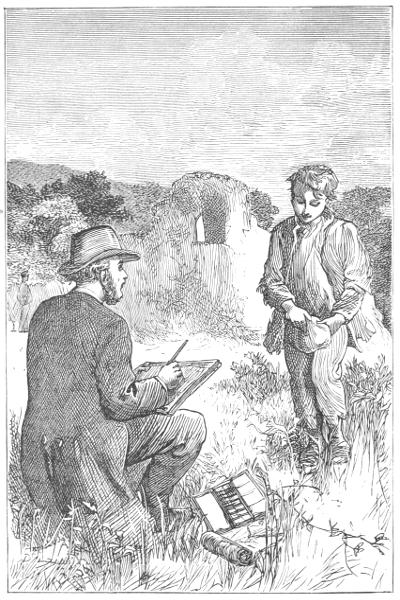
“I think, Charles,” said the tutor, “that I should like
to make a sketch of this spot, I have brought my paint-box
and drawing block with me, and if I could only procure
a little water—”
“Please may I bring you some, sir?” said Mark.
The offer was accepted, and the boy went off at once,
still turning in his mind the conversation that had passed.
“‘Pilgrims in the narrow path that leadeth to salvation,’—I
wish that I knew what he meant. Is that a
path only for holy men like him, or can it be that it is
open to me? Salvation! that is safety, safety from
punishment, safety from the anger of the terrible God.
Oh, what can I do to be saved!”
In a few minutes Mark returned with some fresh water
which he brought in an old broken jar. He set it down
by the spot where Mr. Ewart was seated.
“Thanks, my good lad,” said the clergyman, placing a
silver piece in his hand.
“Good,” repeated Mark to himself; “he little knows
to whom he is speaking.”
“It would be tedious to you, Charles, to remain
beside me while I am sketching,” said Mr. Ewart; “you
will enjoy a little rambling about; only return to me in
an hour.”
“I will explore!” replied the young lord gaily;
“there is no saying what curiosities I may find to remind
me of the pilgrims of former days.”
And now the clergyman sat alone, engaged with his
paper and brush, while Mark watched him from a little
distance, and communed with his own heart.
“He said that he knew the one, only way by which
sinners could be accounted righteous—righteous! that
must mean good—before a holy God! He knows the
way; oh, that he would tell it to me! I have half a
mind to go up to him now; it would be a good time
when he is all by himself.” Mark made one step forward,
then paused. “I dare not, he would think it so
strange. He could not understand what I feel. He
has never stolen, nor told lies, nor sworn; he would
despise a poor sinner like me. And yet,” added the
youth with a sigh, “he would hardly sit there, looking
so quiet and happy, if he knew how anxious a poor boy
is to hear of the way of salvation, which he says that he
knows. I will go nearer; perhaps he may speak first.”
Mr. Ewart had begun a bold, clever sketch,—stones
and moss, trees and grass were rapidly appearing on the
paper, but he wanted some living object to give interest to
the picture. Naturally his eye fell upon Mark, in his tattered
jacket and straw hat, but he forgot his sketch as he
looked closer at the boy, and met his sad, anxious gaze.
“You are unhappy, I fear,” he said, laying down his
pencil.
Mark cast down his eyes, and said nothing.
“You are in need, or you are ill, or you are in want
of a friend,” said the clergyman with kind sympathy in
his manner.
“Oh, sir, it is not that—” began Mark, and stopped.
“Come nearer to me, and tell me frankly, my boy,
what is weighing on your heart. It is the duty, it is the
privilege of the minister of Christ to speak comfort to
those who require comfort.”
“Can you tell me,” cried Mark, with a great effort,
“the way for sinners—to be saved?”
“The Saviour is the Way, the Truth, and the Life, the
Gate by which alone we enter into salvation. Believe
on the Lord Jesus Christ and thou shalt be saved. The
just shall live by faith.”
“What is faith?” said Mark, gathering courage from
the gentleness with which he was addressed.
“Faith is to believe all that the Bible tells us of the
Lord, His glory, His goodness, His death for our sins, to
believe all the promises made in His Word, to rest in them,
hope in them, make them our stay, and love Him who
first loved us. Have you a Bible, my friend?”
“I have.”
“And do you read it?”
“Very often,” replied Mark.
“Search the Scriptures, for they are the surest guide;
search them with faith and prayer, and the Lord will
not leave you in darkness, but guide you by his
counsel here, and afterward receive you to glory.”
Mr. Ewart did not touch his pencil again that day,
his sketch lay forgotten upon the grass. He was
giving his hour to a nobler employment, the employment
worthy of angels, the employment which the Son
of God Himself undertook upon earth. He was seeking
the sheep lost in the wilderness, he was guiding a sinner
to the truth.
“I hope that I have not kept you waiting,” exclaimed
Charles, as he came bounding back to his tutor; “the
carriage has come for us from the inn; it looks as if we
should have rain, we must make haste home.”
Mr. Ewart, who felt strongly interested in Mark, now
asked him for his name and address, and noted down
both in his pocket-book. He promised that, if possible,
he would come soon and see him again.
“Keep to your good resolutions,” said the clergyman,
as he walked towards the carriage, accompanied by
Charles; “and remember that though the just shall live
by faith, it is such faith as must necessarily produce
repentance, love, and a holy life.”
Mr. Ewart stepped into the carriage, the young lord
sprang in after him, the servant closed the door and
they drove off. Mark stood watching the splendid
equipage as it rolled along the road, till it was at last
lost to his sight.
“I am glad that I have seen him—I am so glad that
he spoke to me—I will never forget what he said!
Yes, I will keep to my good resolutions; from this hour
I will be a pilgrim to heaven, I will enter at once by
the strait gate, and walk in the narrow way that
leadeth unto life!”
CHAPTER III. MAN’S WAY OF WORKS.
“They drew nigh to a very miry slough, that was in the midst of the
plain; and they being heedless, did both fall suddenly into the bog. The
name of the slough was Despond.”—Pilgrim’s Progress.
Evening had closed in with rain and storm,
and all the children had returned to the
cottage of their mother. A dirty, uncomfortable
abode it looked, most unlike those
beautiful little homes of the peasant which
we see so often in dear old England, with the ivy-covered
porch, and the clean-washed floor, the kettle
singing merrily above the cheerful fire, the neat rows of
plates ranged on the shelf, the prints upon the wall, and
the large Bible in the corner.
No; this was a cheerless-looking place, quite as much
from idleness and neglect as from poverty. The holes in
the window were stuffed with rags, the little garden in
front held nothing but weeds, the brick floor appeared
as though it had never been clean, and everything lay
about in confusion. An untidy-looking woman, with
her shoes down at heel, and her hair hanging loose
about her ears, had placed the evening meal on the
table; and round it now sat the four children, busy
with their supper, but not so busy as to prevent a
constant buzz of talking from going on all the time
that they ate.
“I say, Mark,” cried Jack, “what did the parson
pay you for listening to him for an hour?”
“How much did you get out of him?” said Madge.
“Any money?” asked Ann Dowley, looking up
eagerly.
Mark laid sixpence on the table.
“I daresay that you might have got more,” said
Ben.
“I did get more—but not money.”
“What, food, or clothes, or—”
“Not food, nor clothes, but good words, which were
better to me than gold.”
This announcement was received with a roar of
laughter, which did not, however, disconcert Mark.
“Look you,” he said, as soon as they were sufficiently
quiet to hear him, “look you if what I said be not
true. You only care for things that belong to this life,
but it is no more to be compared to the life that is to
come than a candle to the sun, or a leaf to the forest!
Why, where shall we all be a hundred years hence?”
“In our graves, to be sure,” said Ben.
“That is only our bodies—our poor, weak bodies; but
our souls, that think, and hope, and fear, where will
they be then?”
“We don’t want to look on so far,” observed Jack.
“But it may not be far,” exclaimed Mark. “Thousands
of children die younger than we, there are many,
many small graves in the churchyard; death may be near
to us, it may be close at hand, and where will our souls
be then?”
“I don’t know,” said Madge; “I don’t want to
think,” subjoined her elder brother; their mother only
heaved a deep sigh.
“Is it not something,” continued Mark, “to hear of
the way to a place where our souls may be happy when
our bodies are dust? Is it not something to look forward
to a glorious heaven, where millions and millions of
years may be spent amongst joys far greater than we
can think, and yet never bring us nearer to the end of
our happiness and glory?”
“Oh, these are all dreams,” laughed Jack, “that come
from reading in that book.”
“They are not dreams!” exclaimed Mark, with
earnestness, “they are more real than anything on
earth. Everything is changing here, nothing is sure;
flowers bloom one day and are withered the next; now
there is sunshine, and now there is gloom; you see a
man strong and healthy, and the next thing you hear of
him perhaps is his death! All things are changing and
passing away, just like a dream when we awake; but
heaven and its delights are sure, quite sure; the rocks
may be moved—but it never can be changed; the sun
may be darkened—it is all bright for ever!”
“Oh that we might reach it!” exclaimed Ann
Dowley, the tears rising into her eyes. Her sons
looked at her in wonder, for they had never known
their mother utter such a sentence before. To them
Mark’s enthusiasm seemed folly and madness, and they
could not hide their surprise at the effect which it produced
upon one so much older than themselves.
Ann Dowley had been brought up to better things,
and had received an education very superior to the
station in which she had been placed by her marriage.
For many years she had been a servant in respectable
families, and though all was now changed—how miserably
changed!—she could not forget much that she had
once seen and heard. She was not ignorant, though low
and coarse-minded, and it was perhaps from this circumstance
that her family were decidedly more intelligent
than country children of their age usually are. Ann
could read well, but her only stock of books consisted
of some dirty novels, broken-backed and torn—she
would have done well to have used them to light the
fire. She was one who had never cared much for
religion, who had not sought the Creator in the days of
her youth; but she was unhappy now, united to a husband
whom she dreaded, and could not respect—whose
absence for a season was an actual relief; she was poor,
and she doubly felt the sting of poverty from having
once been accustomed to comfort—and Mark’s description
of peace, happiness, and joy, touched a chord in her
heart that had been silent for long.
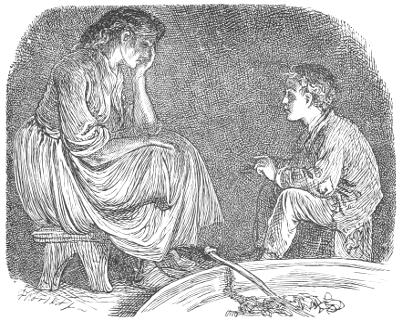
MARK AND HIS MOTHER.
“You too desire to reach heaven!” cried Mark, with
animation sparkling in his eyes; “oh, mother, we will
be pilgrims together, struggle on together in the narrow
way, and be happy for ever and ever!”
The three younger children, who had no taste for
conversation such as this, having finished their meal
slunk into the back room, to gamble away farthings as
they had learned to do from their father. Ann sat
down by the fire opposite to Mark, a more gentle expression
than usual upon her face, and pushing back the
hair from her brow, listened, leaning on her hand.
“I will tell you, mother, what the clergyman told
me—I wish that I could remember every word. He said
that God would guide us by his counsel here, and afterward
receive us to glory. And he spoke of that glory,
that dazzling, endless glory! Oh, mother, how wretched
and dark seems this earth when we think of the blessedness
to come!”
“But that blessedness may not be for us,” said Ann.
“He said that it was for those who had faith, who
believed in the Lord Jesus Christ.”
“I believe,” said the woman, “I never doubted the
Bible; I used to read it when I was a child.”
“We will read mine together now, mother.”
“And what more did the clergyman tell you?”
“He told me that the faith which brings us to
heaven will be sure to produce—” Mark paused to
recall the exact words—“repentance, love, and a holy
life.”
“A holy life!” repeated Ann, slowly. Painful
thoughts crossed her mind of many things constantly
done that ought not to be done, habits hard to be
parted with as a right hand or a right eye; holiness
seemed something as far beyond her reach as the moon
which was now rising in the cloudy sky; she folded her
hands with a gloomy smile, and said, “If that be needful,
we may as well leave all these fine hopes to those who
have some chance of winning what they wish!”
“The way is not shut to us.”
“I tell you that it is,” said the woman, impatiently;
for the little gleam of hope that had dawned on her soul
had given place to sullen despair. “To be holy you must
be truthful and honest—we are placed in a situation
where we cannot be truthful, we cannot be honest, we
cannot serve God! It is all very well for the rich
and the happy; the narrow way to them may be all
strewed with flowers, but to us it is closed—and for
ever!” She clenched her hand with a gesture of
despair.
“But, mother—”
“Talk no more,” she said, rising from her seat; “do
you think that your father would stand having a saint
for his wife, or his son! We have gone so far that we
cannot turn back, we cannot begin life again like children—never
speak to me again on these matters!” and,
so saying, Ann quitted the room, further than ever from
the strait gate that leadeth unto life, more determined to
pursue her own unhappy career.
The heart of Mark sank within him. Here was
disappointment to the young pilgrim at the very outset:
fear, doubt, and difficulty enclosed him round, and hope
was but as a dim, distant light before him. But help
seemed given to the lonely boy, more lonely amid his
unholy companions than if he had indeed stood by himself
in the world. He looked out on the pure, pale
moon in the heavens: the dark clouds were driving
across her path, sometimes seeming to blot her from the
sky; then a faint, hazy light would appear from behind
them; then a slender, brilliant rim would be seen; and
at last the full orb would shine out in glory, making
even the clouds look bright!
“See how these clouds chase each other, and crowd
round the moon, as if they would block up her way!”
thought Mark. “They are like the trials before me
now, but bravely she keeps on her path through all
and I must not—I will not despair!”
CHAPTER IV. GOD’S GIFT OF GRACE.
“Now as Christian was walking solitarily by himself, he espied one afar
off come crossing over the field to meet him; and their hap was to meet
just as they were crossing the way of each other. The gentleman’s name
that met him was Mr. Worldly Wiseman.”—Pilgrim’s Progress.
The bright morning dawned upon Holyby, the
storm had spent itself during the night, and
nothing remained to mark that it had been but
the greater freshness of the air, clearness of the
sky, and the heavy moisture on the grass that sparkled
in the sun.
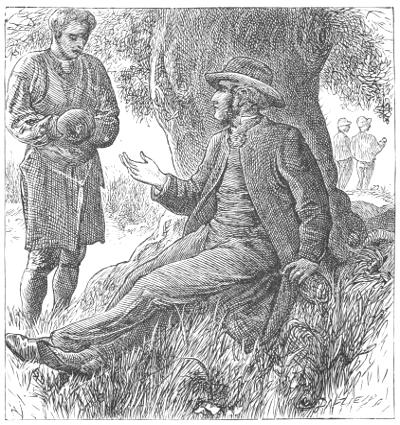
As the young pilgrim sat under an elm-tree, eating
the crust which served him for a breakfast, and meditating
on the events and the resolutions of the last day,
Farmer Joyce came riding along the road, mounted on a
heavy horse which often did service in the plough, and
drew up as he reached the boy.
“I say, Mark Dowley,” he called in a loud, hearty
voice, “you are just the lad I was looking for!”
“Did you want me?” said Mark, raising his eyes.
“Do you know Mr. Ewart?” cried the farmer; and
on Mark’s shaking his head, continued, “why, he was
talking to me about you yesterday—a clergyman, a tall
man with a stoop—he who is tutor to Lord Fontonore.”
“Oh, yes!” cried Mark, springing up, “but I did not
know his name. What could he be saying of me?”
“He stopped at my farm on his drive home yesterday,
and asked me if I knew a lad called Mark Dowley,
and what sort of character he bore. Says I,” continued
the farmer, with a broad smile on his jovial face, “I
know nothing against that boy in particular, but he
comes of a precious bad lot!”
“And what did he reply?” cried Mark, eagerly.
“Oh, a great deal that I can’t undertake to repeat,
about taking you out of temptation, and putting you in
an honest way; so the upshot of it is that I agreed to
give you a chance, and employ you myself to take care
of my sheep, to see if anything respectable can be made
of you.”
“How good in him—how kind!” exclaimed Mark.
“It seems that you got round him—that you found
his weak side, young rogue! You had been talking to
him of piety and repentance, and wanting to get to
heaven. But I’ll give you a word of advice, my man,
better than twenty sermons. You see I’m thriving and
prosperous enough, and well respected, though I should
not say so, and I never wronged a man in my life. If
you would be the same, just mind what I say, keep the
commandments, do your duty, work hard, owe nothing,
and steer clear of the gin-shop, and depend upon it
you’ll be happy now, and be sure of heaven at the last.”
“Mr. Ewart said that by faith—”
“Faith!” exclaimed the farmer, not very reverently;
“don’t trouble yourself with things quite above you—things
which you cannot understand. It is all very well
for a parson like him—a very worthy man in his way,
I believe, but with many odd, fanciful notions. My religion
is a very simple one, suited to a plain man like
me; I do what is right, and I expect to be rewarded;
I go on in a straightforward, honest, industrious way,
and I feel safer than any talking and canting can make
one. Now you mind what you have heard, Mark
Dowley, and come up to my farm in an hour or two.
I hope I’ll have a good account to give of you to the
parson; and the young lord, he too seemed to take quite
an interest in you.”
“Did he?” said Mark, somewhat surprised.
“Yes, it’s odd enough, with such riches as he has,
one would have thought that he had something else to
think of than a beggar boy. Why, he has as many
thousands a-year as there are sheaves in that field!”
“He had a splendid carriage and horses.”
“Carriage! he might have ten for the matter of that.
They say he has the finest estate in the county of York;
but I can’t stay here idling all day,” added the farmer;
“you come up to my place as I said, and remember all
you’ve heard to-day. I have promised to give you a
trial; but mark me, my lad, if I catch you at any of
your old practices, that moment you leave my service.
So, honesty is the best policy, as the good old proverb
says.” With that he struck his horse with the cudgel
which he carried in his hand, and went off at a slow,
heavy trot.
“There is a great deal of sense in what he has said,”
thought Mark, as he turned in the direction of Anne’s
cottage to tell her of his new engagement. “‘Keep the
commandments, work hard, and steer clear of the gin-shop,
and you’ll be sure of heaven at the last!’ These
are very plain directions any way, and I’m resolved to
follow them from this hour. Some of my difficulties
seem clearing away; by watching the sheep all the day
long I shall be kept from a good many of my temptations.
I shall have less of the company of my brothers,
I shall earn my bread in an honest way, and yet have
plenty of time for thought. ‘Keep the commandments,’
let me think what they are;” and he went over the ten
in his mind, as he learned them from his Bible. “I
think that I may manage to keep them pretty strictly,
but there are words in the Word of God which will
come to my thoughts. A new commandment I give
you, that ye love one another: and, He that hateth his
brother is a murderer;—how can I love those who dislike
me?—’tis impossible; I don’t believe that any one
could.”
The first thing that met the eyes of Mark on his
entering the cottage put all his good resolutions to flight.
Jack and Ben were seated on the brick floor, busy in
patching up a small broken box, and as they wanted
something to cut up for a lid, they had torn off the
cover from his beautiful Bible, and thrown the book itself
under the table! Mark darted forward with an
oath—alas! his lips had been too long accustomed to
such language for the habit of using it to be easily
broken, though he never swore except when taken by
surprise, as in this instance. He snatched up first the
cover, and then the book, and with fiery indignation
flashing in his eyes, exclaimed, “I’ll teach you how to
treat my Bible so!”
“Your Bible!” exclaimed Ben, with a mocking laugh;
“Mark thinks it no harm to steal a good book, but it’s
desperate wicked to pull off its cover!”
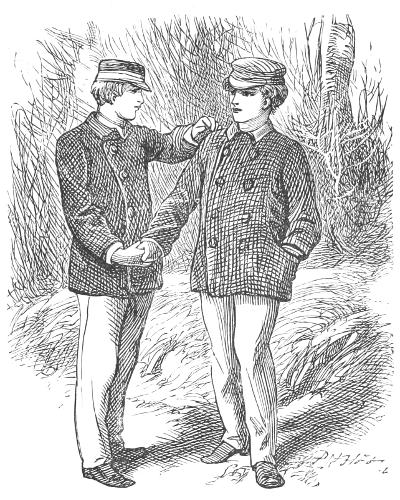
“Oh, that’s what the parson was teaching him!” cried
Jack. Provoked beyond endurance, Mark struck him.
“So it’s that you’re after!” exclaimed Jack, springing
up like a wild cat, and repaying the blow with interest.
He was but little younger than Mark, and of
much stronger make, therefore at least his match in a
struggle. The boys were at once engaged in fierce
fight, while Ben sat looking on at the unholy strife,
laughing, and shouting, and clapping his hands, and
hallooing to Jack to “give it him!”
“What are you about there, you bad boys?” exclaimed
Ann, running from the inner room at the noise
of the scuffle. Jack had always been her favourite son,
and without waiting to know who had the right in the
dispute, she grasped Mark by the hair, threw him violently
back, and, giving him a blow with her clenched
hand, cried, “Get away with you, sneaking coward that
you are, to fight a boy younger than yourself!”
“You always take his part, but he’ll live to be your
torment yet!” exclaimed Mark, forgetting all else in the
blind fury of his passion.
“He’ll do better than you, with all your canting,”
cried Ann. The words in a moment recalled Mark to
himself; what had he been doing? what had he been
saying? he, the pilgrim to heaven; he, the servant of
God! With a bitterness of spirit more painful than any
wrong which could have been inflicted upon him by
another, he took up the Bible which had been dropped in
the struggle, and left the cottage without uttering a word.
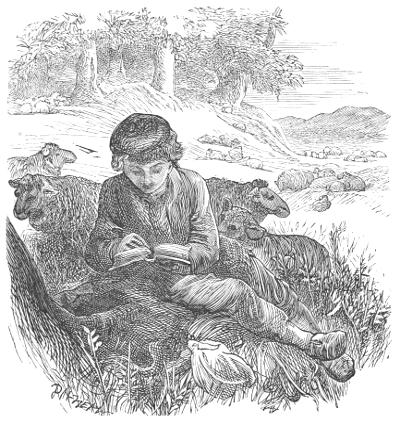
HERDING SHEEP.
Mortifying were Mark’s reflections through that day,
as he sat tending his sheep. “Keep the commandments!”
he sadly murmured to himself; “how many
have I broken in five minutes! I took God’s name in
vain—a terrible sin. It is written, Above all things
swear not. I did not honour my mother, I spoke insolently
to her. I broke the sixth commandment by
hating my brother; I struck him; I felt as though I
could have knocked him down and trampled upon him!
How can I reach heaven by keeping the commandments?
I could as well get up to those clouds by climbing a
tree. Well, but I’ll try once again, and not give up
yet. There is no one to provoke me, no one to tempt me
here; I can be righteous at least when I am by myself.”
So Mark sat long, and read in his Bible, mended it as
well as he could, and thought of Mr. Ewart and his
words. Presently his mind turned to Lord Fontonore,
the fair, bright-haired boy who possessed so much wealth,
who was placed in a position so different from his own.
“He must be a happy boy indeed!” thought Mark,
“with food in abundance, every want supplied, not knowing
what it is to wish for a pleasure and not have it at
once supplied. He must be out of the way of temptation
too, always under the eye of that kind, holy man,
who never would give a rough word, I am sure, but
would always be leading him right. It is very hard
that there are such differences in the world, that good
things are so very unevenly divided. I wish that I had
but one quarter of his wealth; he could spare it, no doubt,
and never feel the loss.” Without thinking what he
was doing, Mark turned over a leaf of the Bible which
lay open upon his knee. Thou shalt not covet, were
the first words that met his gaze; Mark sighed heavily,
and closed the book.
“So, even when I am alone, I am sinning still; coveting,
repining, murmuring against God’s will, with no
more power to stand upright for one hour than this weed
which I have plucked up by the roots. And yet the
soul that sinneth it shall die. I cannot get rid of these
terrible words. I will not think on this subject any
more, it only makes me more wretched than I was.
Oh! I never knew, till I tried it to-day, how hard, how
impossible it is to be righteous before a holy God!”
So, tempted to banish the thought of religion altogether
from his mind, because he felt the law to be too
holy to be kept unbroken, yet dreading the punishment
for breaking it, Mark tried to turn his attention to other
things. He watched the sheep as they grazed, plucked
wild-flowers and examined them, and amused himself as
best he might.
The day was very hot, there was little shade in the
field, and Mark grew heated and thirsty. He wished
that there were a stream running through the meadow,
his mouth felt so parched and dry.
On one side of the field there was a brick wall,
dividing it from the garden belonging to Farmer Joyce.
On the top of this grew a bunch of wild wall-flower,
and Mark, who was particularly fond of flowers, amused
himself by devising means to reach it. There was a
small tree growing not very far from the spot, by climbing
which, and swinging himself over on the wall, he
thought that he might succeed in obtaining the prize.
It would be difficult, but Mark rather liked difficulties
of this sort, and anything at that time seemed pleasanter
than thinking.
After one or two unsuccessful attempts, the boy found
himself perched upon the wall; but the flower within
his reach was forgotten. He looked down from his
height on the garden below, with its long lines of fruit-bushes,
now stripped and bare, beds of onions, rows of
beans, broad tracts of potatoes, all the picture of neatness
and order. But what most attracted the eye of
the boy was a splendid peach-tree, growing on the wall
just below him, its boughs loaded with rich tempting
fruit. One large peach, the deep red of whose downy
covering showed it to be so ripe that one might wonder
that it did not fall from the branch by its own weight,
lay just within reach of his hand. The sight of that
fruit, that delicious fruit, made Mark feel more thirsty
than ever. He should have turned away, he should
have sprung from the wall; but he lingered and looked,
and looking desired, then stretched out his hand to
grasp. Alas for his resolutions! alas for his pilgrim
zeal! Could so small a temptation have power to overcome
them?
Yet let the disadvantages of Mark’s education be
remembered: he had been brought up with those to
whom robbing an orchard seemed rather a diversion than
a sin. His first ardour for virtue had been chilled by
failure; and who that has tried what he vainly attempted
does not know the effect of that chill? With
a hesitating hand Mark plucked the ripe peach; he did
not recollect that it was a similar sin which once
plunged the whole earth into misery—that it was
tasting forbidden fruit which brought sin and death into
the world. He raised it to his lips, when a sudden shout
from the field almost caused him to drop from the wall.
“Holloa there, you young thief! Are you at it
already? Robbing me the very first day! Come
down, or I’ll bring you to the ground with a vengeance!”
It was the angry voice of the farmer.
Mark dropped from his height much faster than he
had mounted, and stood before his employer with his
face flushed to crimson, and too much ashamed to lift
up his eyes.
“Get you gone,” continued the farmer, “for a hypocrite
and a rogue; you need try none of your canting
on me. Not one hour longer shall you remain in my
employ; you’re on the high road to the gallows.”
Mark turned away in silence, with an almost bursting
heart, and feelings that bordered on despair. With
what an account of himself was he to return to his
home, to meet the scoffs and jests which he had too
well deserved? What discredit would his conduct bring
on his religion! How his profane companions would
triumph in his fall! The kind and pitying clergyman
would regard him as a hypocrite—would feel disappointed
in him. Bitter was the thought. All his firm resolves
had snapped like thread in the flame, and his hopes of
winning heaven had vanished.
CHAPTER V. A GLIMPSE OF THE CROSS.
“Ye cannot be justified by the works of the law; for by the deeds of the
law no man living can be rid of his burden.”—Pilgrim’s Progress.
“What ails you my young friend?—has anything
painful happened?” said a kindly
voice, and a hand was gently laid upon the
shoulder of Mark, who was lying on the
grass amidst the ruins of the old Abbey,
his face leaning on his arms, and turned towards the
earth, while short convulsive sobs shook his frame.
“Oh, sir!” exclaimed Mark, as a momentary glance
enabled him to recognize Mr. Ewart.
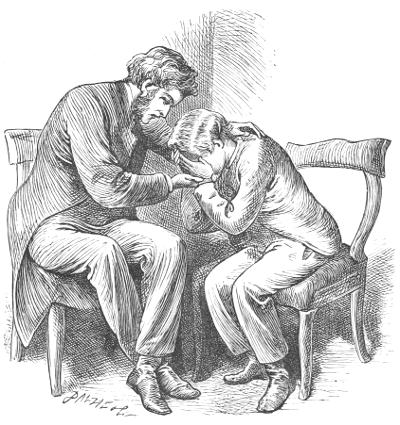
“Let me know the cause of your sorrow,” said the
clergyman, seating himself on a large stone beside him.
“Rise, and speak to me with freedom.”
Mark rose, but turned his glowing face aside; he was
ashamed to look at his companion.
“Sit down there,” said Mr. Ewart, feeling for the
boy’s evident confusion and distress; “perhaps you are
not yet aware that I have endeavoured to serve you—to
procure you a situation with Farmer Joyce?”
“I have had it, and lost it,” replied Mark abruptly.
“Indeed, I am sorry to hear that. I trust that no
fault has occasioned your removal.”
“I stole his fruit,” said Mark, determined at least to
hide nothing from his benefactor; “he turned me off,
and he called me a hypocrite. I am bad enough,” continued
the boy, in an agitated tone; “no one but myself
knows how bad; but I am not a hypocrite—I am
not!”
“God forbid!” said Mr. Ewart; “but how did all
this happen?”
“I was thirsty, it tempted me, and I took it. I
broke all my resolutions, and now he cast me off, and
you will cast me off, and the pure holy God, He will
cast me off too! I shall never be worthy of heaven!”
“Did you think that you could ever be worthy of
heaven?” said the clergyman, and paused for a reply.
Then receiving none from Mark, he continued—“Not
you, nor I, nor the holiest man that ever lived, One excepted,
who was not only man, but God, was ever
worthy of the kingdom of heaven.”
Mark looked at him in silent surprise.
“We are all sinners, Mark; all polluted with guilt.
Not one day passes in which our actions, our words, or
our thoughts, would not make us lose all title to eternal
life. The Bible says, ‘There is not one that doeth good,
no, not one.’ Every living soul is included under sin.”
“How can this be?” said Mark, who had looked
upon the speaker as one above all temptation or stain.
“Since Adam, our first parent, sinned and fell, all
his children have been born into the world with a
nature tainted and full of wickedness. Even as every
object lifted up from the earth, if unsupported, will
fall to the ground, so we, without God’s grace, naturally
fall into sin.”
“Then can no one go to heaven?” said Mark.
“Blessed be God, mercy has found a means by which
even sinners can be saved! Sin is the burden which
weighs us to the dust, which prevents us from rising to
glory. The Lord Jesus came from heaven that He might
free us from sin, take our burden from us, and bear it
Himself; and so we have hope of salvation through
Him.”
“I wish that I understood this better,” said Mark.
“I will tell you what happened to a friend of my
own, which may help you to understand our position
towards God, and the reason of the hope that is in us.
I went some years ago with a wealthy nobleman to visit
a prison at some distance. Many improvements have
been made in prisons since then, at that time they were
indeed most fearful abodes. In one damp dark cell,
small and confined, where light scarcely struggled in
through the narrow grating to show the horrors of the
place, where the moisture trickled down the green
stained walls, and the air felt heavy and unwholesome;
in this miserable den we found an unhappy prisoner,
who had been confined there for many weary years.
He had been placed there for a debt which he was
unable to pay, and he had no prospect of ever getting
free. Can you see in this man’s case no likeness to
your own? Look on sin as a debt, a heavy debt, that
you owe: do you not feel that you have no power to
pay it?”
“None,” replied Mark gloomily; “none.”
“I had the will to help the poor man,” continued Mr.
Ewart, “but Providence had not afforded me the means.
I had no more ability to set him free from prison than
I have to rid you of the burden of your sin.”
“But the wealthy nobleman,” suggested Mark.
“He had both power and will. He paid the debt at
once, and the prisoner was released. Never shall I
forget the poor man’s cry of delight, as the heavy iron-studded
door was thrown open for his passage, and he
bounded into the bright sunshine again!”
“And what became of him afterwards?” asked the
boy.
“He entered the service of his generous benefactor,
and became the most faithful, the most attached of
servants. He remained in that place till he died; he
seemed to think that he could never do enough for him
who had restored him to freedom.”
“Where is the friend to pay my debt?” sighed Mark.
“It has been paid already,” said the clergyman.
“Paid! Oh, when, and by whom?”
“It was paid when the Saviour died upon the cross—it
was paid by the eternal Son of God. He entered
for us the prison of this world, He paid our debt with
His own precious blood, He opened the gates of eternal
life; through His merits, for His sake, we are pardoned
and saved, if we have faith, true faith in that Saviour!”
“This is wonderful,” said Mark, thoughtfully, as
though he could yet scarcely grasp the idea. “And
this faith must produce a holy life; but here is the
place where I went wrong—I thought men were saved
because they were holy.”
“They are holy because they are saved! Here was
indeed your mistake, my friend. The poor debtor was
not set free because he had served his benefactor, but he
served him because he was set free! A tree does not
live because it has fruit, however abundant that fruit
may be; but it produces fruit because it has life, and
good actions are the fruit of our faith!”
“But are we safe whether we be holy or not?”
“Without holiness no man shall see the Lord. Every
tree that beareth not good fruit is hewn down and cast
into the fire.”
“But I feel as if I could not be holy,” cried Mark.
“I tried this day to walk straight on in the narrow
path of obedience to God—I tried, but I miserably
failed. I gained nothing at all by trying.”
“You gained the knowledge of your own weakness,
my boy; you will trust less to your resolutions in
future, and so God will bring good out of evil. And
now let me ask you one question, Mark Dowley. When
you determined to set out on your Christian pilgrimage,
did you pray for the help and guidance of God’s Spirit?”
Mark, in a low voice, answered, “No!”
“And can you wonder then that you failed? could
you have expected to succeed? As well might you look
for ripe fruit where the sun never shines, or for green
grass to spring where the dew never falls, or for sails to
be filled and the vessel move on when there is not a
breath of air. Sun, dew, and wind are given by God
alone, and so is the Holy Spirit, without which it is
impossible to please Him.”
“And how can I have the Spirit?” said Mark.
“Ask for it, never doubting but that it shall be sent,
for this is the promise of the Lord: Ask and ye shall
receive, seek and ye shall find, knock and it shall be
opened unto you. If ye, being evil, know how to give
good gifts unto your children, how much more shall
your Father which is in heaven give the Holy Spirit to
them that ask him?”
“And what will the Spirit do for me?”
“Strengthen you, increase your courage and your
faith, make your heart pure and holy. The fruit of the
Spirit is love, joy, peace, long-suffering, gentleness,
goodness, faith, meekness, temperance. Having these
you are rich indeed, and may press on your way rejoicing
to the kingdom of your Father in heaven.”
“But how shall I pray?” exclaimed Mark. “I am
afraid to address the Most High God, poor miserable
sinner that I am.”
“When the blessed Saviour dwelt upon earth, multitudes
flocked around him. The poor diseased leper fell
at his feet, he was not despised because he was unclean;
parents brought their children to the Lord, they were
not sent away because they were feeble; the thief asked
for mercy on the cross, he was not rejected because he
was a sinner. The same gentle Saviour who listened to
them is ready to listen to you; the same merciful Lord
who granted their prayers is ready to give an answer to
yours. Pour out your whole heart, as you would to a
friend; tell Him your wants, your weakness, your woe,
and you never will seek Him in vain!”
There was silence for a few minutes, during which
Mark remained buried in deep, earnest thought. The
clergyman silently lifted up his heart to heaven for a
blessing upon the words that had been spoken; then,
rising from his seat, he said, “I do not give up all hope,
Mark Dowley, of procuring a situation for you yet;
though, of course, after what has occurred, I shall find
it more difficult to do so. And one word before we
part. You are now standing before the gate of mercy,
a helpless, burdened, but not hopeless sinner. There is
One ready, One willing to open to you, if you knock by
sincere humble prayer. Go, then, without delay, seek
ye the Lord while he may be found, call ye upon him
while he is near.”
Mark watched the receding figure of the clergyman
with a heart too full to express thanks. As soon as Mr.
Ewart was out of sight, once more the boy threw himself
down on the grass, but no longer in a spirit of despair.
Trying to realize the truth, that he was indeed
in the presence of the Saviour of whom he had heard—that
the same eye which regarded the penitent thief
with compassion was now regarding him from heaven—he
prayed, with the energy of one whose all is at
stake, for pardon, for grace, for the Spirit of God! He
rose with a feeling of comfort and relief, though the
burden on his heart was not yet removed. He believed
that the Lord was gracious and long-suffering, that
Jesus came into the world to save sinners; he had
knocked at the strait gate, which gives entrance into
life, and mercy had opened it unto him!
CHAPTER VI. THE PILGRIM IN HIS HOME.
“Upon that place stood a Cross, and a little below, in the bottom, a
Sepulchre. So I saw in my dream, that just as Christian came up with
the Cross, his burden loosed from off his shoulders, and fell from off his
back.”—Pilgrim’s Progress.
“Well, this has been a pretty end to your fine
pilgrimage!” cried Jack, as Mark, resolved
to tell the truth, whatever it might cost
him, finished the account of his rupture with
the farmer.
“The end!” said Mark; “my pilgrimage is scarcely
begun.”
“It’s a sort of backward travelling, I should say,”
laughed Jack. “You begin with quarrelling and stealing;
I wonder what you’ll come to at last?”
Mark was naturally of a quick and ardent spirit, only
too ready to avenge insult, whether with his tongue or
his hand. But at this moment his pride was subdued,
he felt less inclined for angry retort; the young pilgrim
was more on his guard; his first fall had taught him
to walk carefully. Without replying, therefore, to the
taunt of Jack, or continuing the subject at all, he turned
to Ann Dowley, and asked her if she could lend him a
needle and thread.
“What do you want with them?” asked Ann.
“Why, I am afraid that I shall be but a poor hand at
the work, but I thought that I might manage to patch
up one or two of these great holes, and make my dress
look a little more respectable.”
“And why do you wish to look respectable?” asked
Madge, glancing at him through the uncombed, unwashed
locks that hung loosely over her brow; “we get more
when we look ragged.”
“To-morrow is Sunday,” Mark briefly replied, “and I
am going to church.”
“To church!” exclaimed every other voice in the
cottage, in a tone of as much surprise as if he had said
that he was going to prison. Except Ann, in better
days, not one of the party had ever crossed the threshold
of a church.
“Well, if ever!” exclaimed Jack; “why on earth do
you go there?”
“I go because I think it right to do so, and because I
think that it will help me on my way.”
“And what will you do when you get there?” laughed
Ben.
“I shall listen, learn, and pray.”
Ann, who, by dint of searching in a most disorderly
box, filled with a variety of odds and ends, had drawn
forth first thread and then needle, stretched out her hand
towards Mark. “Give me your jacket, I will mend it,”
said she.
“Oh, thank you, how kind!” he cried, pulling it off,
pleased with an offer as unexpected as it was unusual.
“I think,” said Madge, “that the shirt wants mending
worse than the jacket; under that hole on the shoulder
I can see the red mark quite plainly.”
“Be silent, and don’t talk nonsense!” cried Ann, impatiently.
The children glanced at each other, and were silent.
“Are you going to the near church by the wood?”
said Ann.
“No,” replied Mark; “I have two reasons for going
to Marshdale, though it is six or seven miles off. I would
rather not go where—where I am known; and judging
from the direction in which his carriage was driven, I
think that I should have a better chance at Marshdale of
hearing Mr. Ewart.”
“Hearing whom?” exclaimed Ann, almost dropping
her work, whilst the blood rushed up to her face.
“Mr. Ewart, the clergyman who has been so kind, the
tutor to Lord Fontonore.”
“Lord Fontonore! does he live here?” cried Ann,
almost trembling with excitement as she spoke.
“I do not know exactly where he lives. I should
think it some way off, as the carriage was put up at the
inn. Did you ever see the clergyman, mother?”
“He used to visit at my last place,” replied Ann,
looking distressed.
“I think I’ve heard father talk about Lord Fontonore,”
said Madge.
“No, you never did,” cried Ann, abruptly.
“But I’m sure of it,” muttered Madge in a sullen
tone.
“If you know the clergyman, that’s good luck for us,”
said Ben. “I daresay that he’ll give us money if we get
up a good story about you; only he’s precious sharp at
finding one out. He wanted to pay us a visit.”
“Don’t bring him here; for any sake don’t bring him
here!” exclaimed Ann, looking quite alarmed. “You
don’t know the mischief, the ruin you would bring. I
never wish to set eyes upon that man.”
“I can imagine her feelings of pain,” thought Mark,
“by my own to-day, when I first saw the clergyman.
There is something in the very look of a good man which
seems like a reproach to us when we are so different.”
The next morning, as Mark was dressing for church,
he happily noticed, before he put on his jacket, the word
Pilgrim chalked in large letters upon the back.
“This is a piece of Jack’s mischief,” he said to himself.
“I am glad that it is something that can easily be
set right—more glad still that I saw it in time. I will
take no notice of this piece of ill-nature. I must learn
to bear and forbear.”
Mark endured in silence the taunts and jests of the
children on his setting out on his long walk to church.
He felt irritated and annoyed, but he had prayed for
patience; and the consciousness that he was at least trying
to do what was right seemed to give him a greater
command over his temper. He was heartily glad, however,
when he got out of hearing of mocking words and
bursts of laughter, and soon had a sense even of pleasure
as he walked over the sunny green fields.
At length Marshdale church came in view. An ancient
building it was, with a low, ivy-covered tower, and a
small arched porch before the entrance. It stood in a
churchyard, which was embosomed in trees, and a large
yew-tree, that had stood for many an age, threw its shadow
over the lowly graves beneath.
A stream of people was slowly wending along the
narrow gravel walk, while the bell rang a summons to
prayer. There was the aged widow, leaning on her
crutch, bending her feeble steps, perhaps for the last
time, to the place where she had worshipped from a
child; there the hardy peasant, in his clean smock-frock,
leading his rosy-cheeked boy; and there walked
the lady, leaning on her husband’s arm, with a flock of
little ones before her.
Mark stood beneath the yew-tree, half afraid to venture
further, watching the people as they went in. There
were some others standing there also, perhaps waiting
because a little early for the service, perhaps only idling
near that door which they did not mean to enter. They
were making observations on some one approaching.
“What a fine boy he looks! You might know him
for a lord! Does he stay long in the neighbourhood?”
“Only for a few weeks longer, I believe; he has a prodigious
estate somewhere, I hear, and generally lives there
with his uncle.”
AT THE CHURCH.
As the speaker concluded, young Lord Fontonore
passed before them, and his bright eye caught sight of
Mark Dowley. Leaving the path which led to the door,
he was instantly at the side of the poor boy.
“You are coming into church, I hope?” said he
earnestly; then continued, without stopping for a reply,
“Mr. Ewart is to preach; you must not stay outside.”
Mark bowed his head, and followed into the church.
How heavenly to the weary-hearted boy sounded the
music of the hymn, the many voices blended together in
praise to the Saviour. God made him think of the
harmony of heaven! Rude voices, unkind looks, quarrelling,
falsehood, fierce temptations—all seemed to him
shut out from that place, and a feeling of peace stole
over his spirit, like a calm after a storm. He sat in a
retired corner of the church, unnoticed and unobserved:
it was as though the weary pilgrim had paused on the
hot, dusty highway of life, to bathe his bruised feet in
some cooling stream, and refresh himself by the wayside.
Presently Mr. Ewart ascended the pulpit with the
Word of God in his hand. Mark fixed his earnest eyes
upon the face of the preacher, and never removed them
during the whole of the sermon. His was deep, solemn
attention, such as befits a child of earth when listening
to a message from Heaven.
The subject of the Christian minister’s address was the
sin of God’s people in the wilderness, and the means by
which mercy saved the guilty and dying. He described
the scene so vividly that Mark could almost fancy that
he saw Israel’s hosts encamping in the desert around the
tabernacle, over which hung a pillar of cloud, denoting
the Lord’s presence with his people. God had freed
them from bondage, had saved them from their foes,
had guided them, fed them, blessed them above all nations,
and yet they rebelled and murmured against Him. Again
and again they had broken His law, insulted His servant,
and doubted His love; and at last the long-merited
punishment came. Fiery serpents were sent into the
camp, serpents whose bite was death, and the miserable
sinners lay groaning and dying beneath the reptiles’
venomous fangs.
“And are such serpents not amongst us still?” said
the preacher; “is not sin the viper that clings to the
soul, and brings it to misery and death! What ruins the
drunkard’s character and name, brings poverty and shame
to his door? The fiery serpent of sin! What brings
destruction on the murderer and the thief? The fiery
serpent of sin! What fixes its poison even in the young
child, what has wounded every soul that is born into the
world? The fiery serpent of sin!”
Then the minister proceeded to tell how, at God’s
command, Moses raised on high a serpent made of brass,
and whoever had faith to look on that serpent, recovered
from his wound, and was healed. He described the
trembling mothers of Israel lifting their children on high
to look on the type of salvation; and the dying fixing
upon it their dim, failing eyes, and finding life returning
as they gazed!
“And has no such remedy been found for man, sinking
under the punishment of sin? Thanks to redeeming
love, that remedy has been found; for as Moses lifted up
the serpent in the wilderness, so hath the Son of Man
been lifted up, that whoso believeth in him should not
perish, but have everlasting life! Behold the Saviour
uplifted on the cross, His brow crowned with thorns,
blood flowing from His side, and the wounds in His
pierced hands and feet! Why did He endure the torment
and the shame, rude blows from the hands that His
own power had formed—fierce taunts from the lips to
which He had given breath. It was that He might redeem
us from sin and from death—it was that the blessed
Jesus might have power to say, Look unto Me and be
ye saved, all ends of the earth.
“We were sentenced to misery, sentenced to death;
the justice of God had pronounced the fearful words—The
soul that sinneth it shall die! One came forward
who knew no sin, to bear the punishment due unto sin;
our sentence is blotted out by His blood; the sword of
justice has been sheathed in His breast; and now there is
no condemnation to them that are in Christ Jesus; their
ransom is paid, their transgressions are forgiven for the
sake of Him who loved and gave Himself for them. Oh,
come to the Saviour, ye weary and heavy laden—come
to the Saviour, ye burdened with sin, dread no longer
the wrath of an offended God; look to Him and be ye
saved, all ye ends of the earth!”
Mark had entered that church thoughtful and anxious,
he left it with a heart overflowing with joy. It was as
though sudden light had flashed upon darkness; he felt
as the cripple must have felt when given sudden strength,
he sprang from the dust, and went walking, and leaping,
and praising God. “No condemnation!” he kept repeating
to himself, “no condemnation to the penitent sinner!
All washed away—all sin blotted out for ever by the
blood of the crucified Lord! Oh, now can I understand
that blessed verse in Isaiah, ‘Though your sins be as
scarlet, they shall be white as snow; though they be red like
crimson, they shall be as wool.’ ‘Praise the Lord, O my
soul! and all that is within me, praise His holy name!’”
That hour was rich in blessings to the young pilgrim,
and as he walked towards home, with a light step and
lighter heart, it was his delight to count them over. He
rejoiced in the free forgiveness of sins, which now for the
first time he fully realized. He rejoiced that he might
now appear before God, not clothed in the rags of his own
imperfect works, but the spotless righteousness of his
Redeemer. He rejoiced that the Lord had sealed him for
His own, and given him sweet assurance of His pardon
and His love. Oh, who can rejoice as the Christian rejoices
when he looks to the cross and is healed!
CHAPTER VII. THE ARBOUR ON THE HILL.
“I saw then in my dream that he went on thus, even until he came to
the bottom, where he saw, a little out of the way, three men fast asleep,
with fetters upon their heels.”—Pilgrim’s Progress.
The poor despised boy returned hungry and tired
to a home where he was certain to meet with
unkindness, where he knew that he would
scarcely find the necessaries of life, and yet
he returned with feelings that a monarch might have
envied. The love of God was so shed abroad in his
heart, that the sunshine seemed brighter, the earth
looked more lovely; he felt certain that his Lord would
provide for him here, that every sorrow was leading to
joy. He thought of the happiness of the man once possessed,
when he sat clothed and in his right mind at
the feet of the Saviour: it was there that the pilgrim
was resting now, it was there that he had laid his burden
down. The fruit of the Spirit is peace and joy, such joy
as is the foretaste of heaven.
And the love of God must lead to love towards man.
Mark could feel kindly towards all his fellow-creatures
His fervent desire was to do them some good, and let
them share the happiness that he experienced. He
thought of the rude inmates of his home, but without
an emotion of anger; in that first hour of joy for pardoned
sin there seemed no room in his heart for anything
but love and compassion for those who were still
in their blindness.
As Mark drew near to his cottage, he came to a piece
of ground overgrown with thistles, which belonged to
Farmer Joyce. He was surprised to find there Jack,
Madge, and Ben pulling up the thistles most busily,
with an energy which they seldom showed in anything
but begging.
“Come and work with us,” said Ben; “this ground
must be all cleared to-day.”
“And why to-day?” said Mark.
“Because Farmer Joyce told us this morning that
when it was cleared he would give us half-a-crown.”
“You can work to-morrow.”
“Ah, but to-morrow is the fair-day, and that is why
we are so anxious for the money.”
“I will gladly rise early to help you to-morrow, but
this day, Ben, we ought not to work. The Lord has
commanded us to keep the Sabbath holy, and we never
shall be losers by obeying Him.”
“Here’s the pilgrim come to preach,” cried Madge in
a mocking tone.
“I tell you what,” said Jack, stopping a moment in
his work, “you’d better mind your own business and
be off; I don’t know what you have to do with us.”
“What I have to do with you!” exclaimed Mark.
“Am I not your brother, the son of your mother? Am
I not ready and willing to help you, and to rise early if
I am ever so much tired?”
There was such a bright, kindly look on the pale,
weary face, that even Jack could not possibly be offended.
“Now, just listen for a moment,” continued Mark;
“suppose that as I was coming along I had spied under
the bushes there a lion asleep that I knew would soon
wake, and prowl in search of his prey, should I do right
in going home and taking care of myself, barring our
door so that no lion could come in, and never telling
you of the danger at all?”
Madge glanced half-frightened towards the bushes, but
Jack replied, “I should say that you were a cowardly
fellow if you did.”
“What! leave us to be torn in pieces, and never give
us warning of the lion?” cried Ben.
“I should be a cowardly fellow indeed, and a most
unfeeling brother. And shall I not tell you of your
danger, when the Evil One, who is as a roaring lion, is
laying wait for your precious souls. As long as you are
in sin you are in danger. Oh, that you would turn to
God and be safe!”
“God will not punish poor children like us,” said
Madge, “just for working a little when we are so poor.”
“The Evil One whispers the very same thing to us
as he did to Eve, ‘Thou shalt not surely die;’ but she
found, as we shall find, that though God is merciful, He
is also just, and keeps His word.”
“There will be time enough to trouble ourselves about
these things,” said Ben.
“Take care of yourself, and leave us in peace!” exclaimed
Jack; “we are not going to be taught by you!”
and turning his back upon Mark, he began to work
more vigorously than ever.
Mark walked up to the cottage with a slow, weary
step, silently praying for those who would not listen to
him. “God can touch their hearts though I cannot,”
thought he. “He who had mercy on me may have
mercy on them.”
Never had the cottage looked more untidy or uncomfortable,
or Ann’s face worn an expression more gloomy
and ill-tempered.
“Mother,” cried Mark cheerfully, “have you something
to give me, my long walk has made me so hungry?”
“We’ve had dinner long ago.”
“But have you nothing left for me?”
“You should have been here in proper time. It’s
all gone.”
Exhausted in body, and wounded by unkindness,
Mark needed indeed the cordial of religion to prevent
his spirit from sinking. But he thought of his Lord,
and his sufferings upon earth. “My Saviour knew
what it was to be weary and a-hungered—He knew
what it was to be despised and rejected. If He drained
the cup of sorrow, shall I refuse to taste it! If this
trial were not good for me, it would not be sent.” So
Mark sat down patiently in a corner of the room, and
thought over the sermon to cheer him.
His attention was soon attracted by Ann’s giving two
or three heavy sighs, as if she were in pain; and looking
up, he saw a frown of suffering on her face, as she
bent down and touched her ankle with her hand.
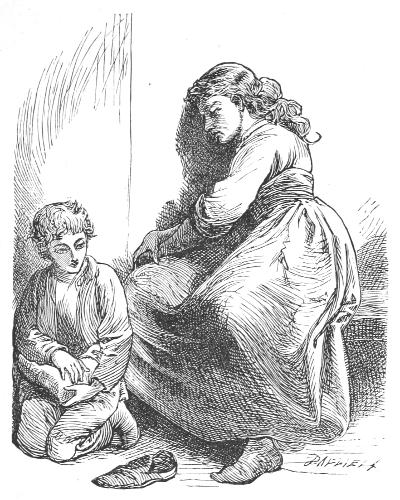
“Have you hurt yourself, dear mother?” said he.
“Yes; I think that I sprained my ankle this morning.
Dear me, how it has swelled!”
“I am so sorry!” cried Mark, instantly rising. “You
should put up your foot, and not tire it by moving about.
There,” said he, sitting down at her feet, “rest it on my
knee, and I will rub it gently. Is it not more easy now?”
Ann only replied by a sigh, but she let him go on,
and patiently he sat there, chafing her ankle with his
thin, weary fingers. He could scarcely prevent himself
from falling asleep.
“That is very comfortable,” said the woman at last;
“certainly it’s more than any of the others would do for
their mother; they never so much as asked me how I did.
You’re worth all the three, Mark,” she added bitterly,
“and little cause have you to show kindness to me.
Just go to that cupboard—it hurts me to move—you’ll
find there some bread and cheese left.”
MARK’S KINDNESS.
Mark joyfully obeyed, and never was a feast more
delicious than that humble meal. Never was a grace
pronounced more from the depths of a grateful heart
than that uttered by the poor peasant boy.
CHAPTER VIII. DANGERS, DIFFICULTIES, AND DOUBTS.
“Now, about the midway to the top of the hill was a pleasant arbour
made by the Lord of the hill for the refreshment of weary travellers.”—Pilgrim’s
Progress.
Several days passed with but few events to
mark them. Mark did everything for Ann to
save her from exertion, and under his care her
ankle became better. He also endeavoured to
keep the cottage more tidy, and clear the little garden
from weeds, remembering that “cleanliness is next to
godliness,” and that if any man will not work, neither
should he eat.
One morning Madge burst into the cottage where
Mark and Ann were sitting together. “He is coming!”
she exclaimed in a breathless voice; “he is coming—he
is just at the gate!”
“Who?” cried Ann and Mark at once.
“The parson—the—”
“Not Mr. Ewart!” exclaimed Ann, starting up in
terror.
“Yes it is—the tall man dressed in black.”
In a moment the woman rushed to the back room as
fast as her ankle would let her. “I’ll keep quiet here,”
she said. “If he asks for me, say that I have just gone
to the miller’s.”
“Mother’s precious afraid of a parson,” said Madge,
as a low knock was heard at the door.
With pleasure Mark opened to his benefactor.
“Good morning,” said Mr. Ewart, as he crossed the
threshold. “I have not forgotten my promise to you,
my friend. I hope that I have obtained a place for you
as errand-boy to a grocer. Being myself only a temporary
resident in these parts, I do not know much of
your future master, except that he appears to keep a
respectable shop, and is very regular in attendance at
church; but I hear that he bears a high character. Mr.
Lowe, if you suit him, agrees to give you board and
lodging; and if he finds you upon trial useful and
active, he will add a little salary at the end of the year.”
“I am very thankful to you, sir,” said Mark, his eyes
expressing much more than his lips could. “I trust
that you never will have cause to be sorry for your
kindness.”
“Is your mother within?” said Mr. Ewart.
Mark bit his lip, and knew not what to reply, divided
between fear of much displeasing his parent, and that of
telling a falsehood to his benefactor.
“She’s gone to the miller’s,” said Madge boldly.
But the clergyman turned away from the wicked
little girl, whose word he never thought of trusting, and
repeated his question to Mark, whose hesitation he could
not avoid seeing.
“She is within, sir,” said the boy, after a little pause;
then continued with a painful effort, as he could not but
feel that Ann’s conduct appeared rude and ungrateful to
one whom above all men he was anxious to please;
“but she would rather not see you to-day.”
“Very well, I have seen you; you will tell her what
I have arranged.” Mark ventured to glance at the
speaker, and saw, with a feeling of relief, that Mr.
Ewart’s face did not look at all angry.
It was more than could be said for Ann’s, as, after
the clergyman’s departure, she came out of her hiding-place
again. Her face was flushed, her manner excited;
and, in a fit of ungovernable passion, she twice struck
the unresisting boy.
“Lord Jesus, this I suffer for thee!” thought Mark;
and this reflection took the bitterness from the trial.
He was only thankful that he had been enabled to keep
to the truth, and not swerve from the narrow path.
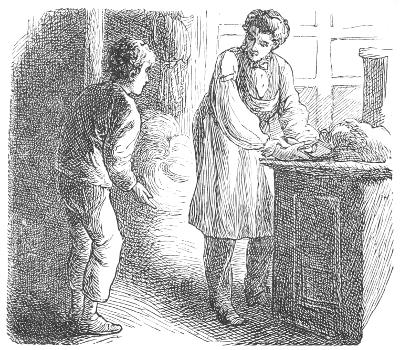
On the following day Mark went to his new master,
who lived in a neighbouring town. He found out the
shop of Mr. Lowe without difficulty; and there was
something of comfort and respectability in the appearance
of the establishment that was very encouraging to
the boy. To his unaccustomed eye the ranges of shining
brown canisters, each neatly labelled with its contents;
the white sugar-loaves, with prices ticketed in the window;
the large cards, with advertisements of sauces and
soap, and the Malaga raisins, spread temptingly to view,
spake of endless plenty and abundance.
Mark carried a note which Mr. Ewart had given to
him, and, entering the shop, placed it modestly on the
counter before Mr. Lowe.
The grocer was rather an elderly man, with a bald
head, and mild expression of face. He opened the note
slowly, then looked at Mark over his spectacles, read
the contents, then took another survey of the boy.
Mark’s heart beat fast, he was so anxious not to be
rejected.
“So,” said Mr. Lowe, in a slow, soft voice, as if he
measured every word that he spoke, “so you are the
lad that is to come here upon trial, recommended by the
Reverend Mr. Ewart. He says that you’ve not been
well brought up; that’s bad, very bad—but that he
hopes that your own principles are good. Mr. Ewart is
a pious man, a very zealous minister, and I am glad to
aid him in works of charity like this. If you’re pious,
all’s right, there’s nothing like that; I will have none
about me but those who are decidedly pious!”
Mr. Lowe looked as though he expected a reply, which
puzzled Mark exceedingly, as he had no idea of turning
piety to worldly advantage, or professing religion to help
him to a place. He stood uneasily twisting his cap in
his hand, and was much relieved when, a customer coming
in, Lowe handed him over to his shopman.
Radley, the assistant, was a neat-looking little man,
very precise and formal in his manner, at least in the
presence of his master. There was certainly an occasional
twinkle in his eye, which made Mark, who was
very observant, suspect that he was rather fonder of fun
than might beseem the shopman of the solemn Mr. Lowe;
but his manner, in general, was a sort of copy of his
master’s, and he borrowed his language and phrases.
And now, fairly received into the service of the grocer,
Mark seemed to have entered upon a life of comparative
comfort. Mr. Lowe was neither tyrannical nor harsh,
nor was Radley disposed to bully the errand-boy. Mark’s
obliging manner, great intelligence, and readiness to
work, made him rather a favourite with both, and the
common comforts of life which he now enjoyed appeared
as luxuries to him.
“I have been climbing a steep hill of difficulty,”
thought he, “and now I have reached a place of rest.
How good is the Lord, to provide for me thus, with
those who are his servants!”
That those with whom Mark lived were indeed God’s
servants, he at first never thought of doubting. Was
there not a missionary-box placed upon the counter—was
not Mr. Lowe ever speaking of religion—was he
not foremost in every good work of charity—did he not
most constantly attend church?
But there were several things which soon made the
boy waver a little in his opinion. He could not help
observing that his employer took care to lose no grain
of praise for anything that he did. Instead of his left
hand not knowing the good deeds of his right, it was no
fault of his if all the world did not know them. Then,
his manner a little varied with the character of his
customers. With clergymen, or with those whom he
considered religious, his voice became still softer, his
manner more meek. Mark could not help suspecting
that he was not quite sincere. The boy reproached
himself, however, for daring to judge another, and that
one so much more advanced in the Christian life than
himself. He thought that it must be his own inexperience
in religion that made him doubt its reality in
Lowe.
Thus a few weeks passed in comfort with Mark; but
the pilgrim was making no progress. It is not well for
us to dwell amongst those whose profession is greater
than their practice. The fervour of Mark’s first love
was a little cooled. Alas! in weak, infirm mortals, such
as we are, how inclined is that fervour to cool! There
were no strong temptations to stir up the flame—no
anxious fears to drive him to the mercy-seat—his prayers
were perhaps more frequent, but they were less deep
and earnest. Mark was tempted to rest a little upon
forms, and think that all must be right, because others
approved.
The Christian must not dream that he is only in
danger whilst dwelling with the careless or profane.
The society of professors may be quite as dangerous, by
lulling his conscience to sleep. He is less on his guard
against inward foes, less able to distinguish true religion
in his heart, from the natural desire to please, and many
of God’s children on earth have found the arbour more
dangerous than the hill!
Not that Mark did much with which he could reproach
himself, unless it were that he never sought an
opportunity of going to see his mother. He connected
nothing but ideas of persecution and unkindness with
his home. He thought that by this time John Dowley
might have returned, a man who had ever treated him
with unnatural cruelty; and to say the truth, Mark
rather dreaded going again near the place. I fear that
my pilgrim is falling in the estimation of my reader;
but I am drawing no sinless model of perfection;
and, perhaps, if we closely examine our own hearts, even
after they have been enlightened by the Spirit, there
may be something in our own experience which will
remind us of this chapter of the life of the pilgrim. I
said that Mark suspected a little the sincerity of the
religious professions of his master. This suspicion was
painfully strengthened by an incident which occurred
when he had been a few weeks under his roof.
One night, after the shop had been closed, and prayers
said, and Mark had retired to his small attic, he fancied
that he heard a little noise down below, and crept from
his chamber to listen. All was very still, only the clock
on the stairs seemed to tick twice as loudly as usual.
Then again there was a slight sound, apparently from
the shop, and Mark wondered what, at that hour, it
could be. Softly he crept down the creaking stair, unwilling
to disturb his master, who had retired to rest
rather earlier than usual, happening to feel not very
well. Mark reached the door which opened into the
shop, and there was no doubt left that somebody was
within engaged in some occupation.
Mark observed that the door, though nearly closed,
was not shut, a narrow line of light showed it to be a
little ajar; he pushed it very gently to widen the opening,
and within, to his surprise, saw Radley.
“Who’s there?” exclaimed the shopman; “why,
Mark, is it you? That’s lucky, you’ll come and help
me, I daresay. I am so sleepy to-night—but this must
be done.”
“What are you doing?” said Mark, with a feeling of
curiosity.
“I’m mixing this with that, as you see,” replied
Radley, pointing to two heaps of what looked like coffee
on the counter.
MARK’S INDIGNATION AT DECEIT.
“Why should you mix them?”
“Oh, ask no questions, and I’ll tell you no stories!”
said Radley, quite dropping his usual formal manner,
with a laughing look in his eye which startled the
boy.
“Do you mean—is it possible—” exclaimed Mark,
his face flushing with indignation as he spoke, “that
you are mixing chicory with coffee in order to deceive
our master’s customers?”
“You are very green, or you would know that it is
constantly done.”
“It cannot be right,” said Mark, “to sell an article
under a false name, and get a false price for it too!
Surely Mr. Lowe does not know what you are doing!”
“Oh, you most simple of simpletons!” laughed
Radley; “do you suppose that I am doing it for my
own diversion, to serve my pious master against his
will?”
“You do it by his orders then?”
“Of course I do.”
“I could never have believed that he could have been
guilty of such a thing!” exclaimed Mark, more shocked
and disgusted by the hypocrisy of Lowe, than by any of
the open wickedness that he had ever witnessed. “And
you, Radley, how can your conscience let you do what
is so wrong?”
“My conscience is my master’s, I only obey what he
commands.”
“Your conscience your master’s! Oh no!” exclaimed
Mark; “you will have to answer for yourself before
God.”
“If I refused to do this I should have to leave the
grocer’s service.”
“Better leave his service than the service of God.”
“I say, young man,” replied Radley, still good-humouredly,
though with some appearance of scorn,
“mind your own business, and leave me to mind mine.
When you carry the goods to the customers, no one asks
you whether the parcel holds tea or gooseberry leaves.”
“But can you endure to kneel down, and repeat
prayers to the Almighty, when you know—”
“I tell you,” said Radley, as though he thought it a
joke, “my master’s religion and mine is like the articles
in this shop, it is mixed. But what matter? it makes
as good a show as any, it serves our purpose, and I
really think that the world likes to be taken in. We
get on, look respectable, and thrive; what can be better
than that?”
“Better to starve—better to struggle up hill all one’s
life, beset with difficulties and trials.”
“We’ll leave the starving to you, if you like it; and
as for struggling up hill, only fools do that, if they can
find an easier way round! Now go to your bed, and
rest quiet my lad, and leave me and my conscience to
settle our affairs together.”
Startled as from a dream, Mark returned to his attic,
disappointed, disgusted, and grieved. “Can a blessing
ever rest on this house?” thought he; “can Lowe ever,
even in this world, be really a gainer by such awful
hypocrisy and deceit? Oh, I have been too little on
my guard in this place, I have been a drowsy pilgrim
on the way—blessed be God that I am awakened before
too late!”
CHAPTER IX. THE ARMOUR AND THE BATTLE.
“Fear not the lions, for they are chained, and are placed there for trial
of faith where it is; and for the discovery of those that have none: keep
in the midst of the path, and no hurt shall come unto thee.”—Pilgrim’s
Progress.
It was long before Mark could get to sleep, and
he awoke almost before it was light. He felt
a heavy oppression which was new to him, and
rose to open the window. The sky was now
of that deep exquisite blue which it wears the
hour before dawn; the few stars that studded the
heavens were growing pale at the approach of morning.
The street was perfectly quiet, not a vehicle was moving
about, and the sleepy sound of a cock crowing at some
distance was the only noise that broke the stillness.
“I feel as though I could not rest,” said Mark, “the
sun will rise before long; I will dress myself and go
out, and have a quiet time before I am required to work.
I have been keeping too little watch over myself lately,
I have been too easily contented with the little knowledge
to which I have attained. Oh, what if I should
have been deceiving myself all the time—if I have never
entered the strait gate at all!” Mark had lost for a
time that sweet assurance which had afforded him such
joy amidst trials.
Putting his Bible in his bosom that he might read it
as he walked, Mark opened the door of his attic. The
instant that he did so he became sensible of a most
powerful smell of fire, and the next moment a volume of
smoke came rolling up from below!
Mark sprang down the staircase with anxious haste,
every step making him more certain of the fearful fact
that the house of his master was on fire! He rushed
first to the sleeping apartment of Radley, then roused
up the servant of the house, and bidding her throw up
the window and call loudly for assistance, hurried to the
bedroom of Mr. Lowe.
Startled from deep sleep, hardly able to comprehend
what had happened, only with a terrible consciousness
that it was something dreadful, the wretched man rose
from his pillow, and was half dragged by Mark from his
apartment, which being immediately over the place of
the fire, was becoming very hot, and full of smoke. Such
an awakening is terrible here—but oh, what will it be
to the hypocrite hereafter, when the trumpet of the
angel shall rouse him from his grave to behold a universe
in flames!
Assistance was speedily given; the cry of “fire!”
brought crowds of neighbours around; pails of water
were passed from hand to hand, and the fire-engine soon
came rattling up the street. The cries and shouts, the
crackling and roaring of the devouring element, the
suffocating dense clouds, through which little could be
seen but tongues of fierce flame, now darting curling
round the wood-work, now streaming upwards and reddening
the black canopy of smoke—the stifling heat, the
occasional glimpse of burning rafters, which looked as if
glowing red hot in the fire, all formed a scene which
time could never efface from the memory of those who
beheld it!
Half wild with terror, anxiety, and grief, Lowe pushed
his way here and there through the crowd, sometimes
urging on the firemen, sometimes trying to assist them,
sometimes standing still, to witness in helpless misery
the destruction of his property. Well might he look on
in misery, for that property was his all! The hypocrite
had not laid up his treasure in heaven, and he now beheld,
consuming before his eyes, that for which he had
been daily bartering his soul!
Before the sun had reached his mid-day height, the
fire had been entirely subdued. The efforts of the firemen
had prevented it from spreading, but a charred and
blackened shell of a house, floors, rafters, windows, all entirely
destroyed, alone remained of the habitation of Lowe!
The unhappy man was offered shelter in the house of
a sympathizing neighbour, and thither Mark went to see
him. He found him in a pitiable state, his mind almost
crushed by his misfortune, yet still, true to his character,
he professed submission to the decree of Providence, even
while his excessive grief showed how little he felt it,
and intermixed his lamentations with various texts,
thereby edifying his neighbours, perhaps, but shocking
one who knew him better than they did.
He received his errand-boy with great kindness. “One
of the most bitter parts of my trial,” said the really kind-hearted
though unprincipled man, “is that my ruin will
throw you and poor Radley upon the world. I suppose
that you will return home directly.”
“I thought that I would go first to Mr. Ewart, and
ask his advice.”
“I grieve to say that will no longer be in your power.
That excellent minister was to leave Marshdale for Yorkshire
yesterday.”
This piece of information fell like a heavy blow upon
Mark, and his face showed how much he felt it. “Then I
must return to the cottage at once,” said he, in a low tone.
“I can understand your reluctance, my boy, to become
a burden upon your poor parents.”
There was not a particle of hypocrisy in Mark; he
wanted no praise for motives which were not his. “I
was not thinking about that,” said he.
“Ah! I understand,” said Lowe, in his own peculiar
tone; “you feel being deprived of the spiritual advantages
which you enjoyed while under my roof.”
“Not exactly that,” replied Mark, hesitating and
looking embarrassed, for there was a mixture of this
regret in his reluctance to return home, though it was
not his principal feeling.
The truth was, that Mark dreaded not so much the
poverty and discomfort of Ann’s cottage—though he did
not like that—as the positive cruelty which he would
probably have to endure if he returned. Having for
some time slipped his neck from the yoke, he shrank
exceedingly from having to bear it again. A soldier
who fights bravely on the battle-field, if he leave it for
a while till his blood cools and his wounds begin to
stiffen and smart, finds it a much greater trial of courage
to return to his post than to stay there without ever
quitting it.
But Mark seemed to have no other resource, and
bidding a friendly farewell to his late master, who,
whatever he was in the sight of Heaven, had ever been
kind to him, he walked slowly up the street. The
gloomy, threatening clouds above him, seemed like types
of his darkened fate, and the forerunners of a storm.
As he proceeded, pondering over the difficulties of his
position, he was startled by the sight of a lady, who was
standing at a door at which she had just knocked. Mark
had seen her but once before, but her face was imprinted
on a memory naturally good, especially as the most important
event of his life, his repentance and turning to
God, was in some way connected with her. She was
the lady who had dropped the bag by the stile which
contained Mark’s precious Bible.
Now, it had often weighed upon the conscience of the
boy, that his dearest possession was not his by right;
and that if ever he met with its lawful owner, common
honesty bound him to restore it. And yet, to give that
away which had been his life—to walk on in darkness,
without that light which had been his comfort and solace
till now—Mark felt almost as though he could not do
it, and stood hesitating and arguing in his own mind
till the lady entered the house, and the door closed
behind her.
“She is rich, she can buy many others,” whispered
the Tempter in his bosom. “She is certain to have
supplied its loss long ago; but you, where will you find
another? You will lose all your religion with your
Bible, and fall under the temptations which you will be
certain to meet.” Was not this mistrust of God’s
sustaining power? “And what disgrace,” added the
Tempter, “will it be to own taking and using that which
was not yours! Notwithstanding your care, the book
has been injured; it is not worth returning to a lady.
She may question you about the other things in the
bag—the purse, the money, the handkerchief with lace;
of course you cannot betray your family; you will be
looked upon, perhaps punished, as a thief!” These
were the suggestions of a timorous spirit, magnifying
every danger by the way.
But against all this was the plain word of God, Thou
shalt not steal. To keep anything from its owner that
might be restored, was clearly to break the commandment.
So, after a short inward prayer for the help
which he so much needed, with a heart so low, and a
frame so much exhausted by the excitement and fatigue
of the morning, that it would have been a relief to him
to have sat down and cried, Mark gently rang the
bell.
He felt embarrassed when the servant-maid opened
the door, and inquired what it was that he wanted.
But, recovering himself, he asked if he might speak with
the lady who had just entered the house. He said that
he had something which he believed that she had lost;
and the servant, without making any difficulty, ushered
him into the parlour.
A silver-haired old gentleman and the lady were
there; she had just opened a piano, and was sitting
down to play. Her face looked so gentle and bright
that Mark was somewhat reassured, though most reluctant
to part with his treasure.
“What did you want with me, my good boy,” said
the lady, turning round without quitting her seat, her
fingers resting on the silent notes of the instrument.
MARK RESTORING THE LOST BIBLE.
Mark drew from his bosom the Bible. “I believe,
ma’am, that this is yours,” said he.
“My long-lost Bible!” exclaimed the lady, rising
with an expression of joy. “Oh! I never thought to see
it again. Where could you have found it?”
“Near a stile, where you had dropped it as you went
to church.”
“It was in my bag with other things; have you
anything else?”
“I have nothing else,” replied Mark, feeling very
uneasy.
“What is your name?” said the old gentleman, looking
up from his paper.
“Mark Dowley, sir,” answered the boy.
“Mark Dowley! Ellen, have we not heard that
name before?”
“Oh yes; ’tis the name of the boy in whom dear Mr.
Ewart was interested. Do you not remember his speaking
about him?”
“I remember it perfectly well, my dear; it is easy to
imagine what became of the other contents of the bag.”
“And where are you staying now?” said Ellen, with
a look of interest; “I hope that you have a good
situation.”
“I had a good situation last night, but the fire that
happened to-day burned down the house of my master,
and now I am abroad in the world.”
Ellen glided to her father, and whispered something
in his ear. Mark’s heart beat very quickly, he scarcely
knew why; but it was with a sensation of hope.
After a few minutes of conversation which he could not
hear, Mr. Searle—for that was the gentleman’s name—said
aloud, “As you please, my dear; we certainly were
looking out for such a boy. We could take him with us
to Yorkshire; there could be no difficulty about that.”
“Would you like,” said Ellen, bending her kind eyes
upon Mark, “to become one of our household, to accompany
us to Silvermere? Your work would be light,
and your situation comfortable. We live scarcely two
miles from Castle Fontonore.”
With a rebound of joy all the greater from the depth
of his late depression, Mark eagerly accepted the offer.
Profiting, however, by the remembrance of past regrets,
and desirous to be more faithful to his duty in future,
he added that he must first obtain the consent of his
mother.
“You are quite right, my boy,” said Mr. Searle,
kindly; “let nothing ever come between you and your
duty to a parent. Her will, next to God’s, should be
your law; you never can do too much for her.”
“But it is not desirable to go till to-morrow,” said
Ellen; “those heavy clouds have burst; only see how
it rains! The poor boy looks quite knocked up already;
he could occupy the little room here to-night.”
This arrangement was finally concluded upon, and the
weary but thankful boy again found a haven of rest.
A comfortable meal was set before him, to which he was
inclined to do full justice. He enjoyed deep untroubled
sleep that night, and awoke in the morning refreshed
and rejoicing. How the difficulties that he feared had
melted away before him! How one painful effort made
had brought its own rich reward!
CHAPTER X. SHADOW AND SUNSHINE.
“Then did Christian begin to be afraid, and to cast in his mind whether
to go back or to stand his ground.”—Pilgrim’s Progress.
Our Pilgrim rose early, with a heart full of hope.
He determined not to quit the house till he
had seen Mr. Searle or his daughter again, and
waited in the hall till they should come down.
Mark’s attention was at once riveted by what
he had never seen before—a complete suit of armour
hung against the wall; and while he was looking at it,
and admiring its various parts, the master of the house
approached him unobserved.
“That is a fine suit of armour,” said Mr. Searle,
“such as was worn in the time of the Crusades, when
warlike pilgrims went to the Holy Land. Perhaps you
have never heard of such?”
“Yes, sir,” replied Mark, modestly.
“There is the helmet, you see, to protect the head;
the mail to cover the body and breast; the weighty
sword, and the pointed shield. You observe the red
cross upon it?”
The looks of Mark showed the interest that he took.
“We’re not done with fighting yet,” said the old
gentleman, in a quaint manner which was peculiar to
him. “While our three old enemies—the world, the
flesh, and the devil—are lying in ambush to attack us,
and the Holy Land which we hope to gain is before us,
we must be armed pilgrims, ay, and fighting pilgrims too!”
“Pray go on, sir,” said Mark, as the old gentleman
stopped; “I so like to hear of these things.”
“You see that our Leader has not sent us into battle
unprovided. We have the Helmet of Proof, the Hope
of Salvation, to prevent sinful doubts from wounding
the head. Then the Breastplate of Righteousness to
guard us; for we may be full of knowledge, and quite
correct in our belief, but if we give way to wilful sin,
of what avail is the soundness of the head when the
heart is pierced by the fiery dart? Nor must we
neglect the Girdle of Truth, nor the preparation of the
Gospel of Peace for our feet.”
“That is a part of the armour which I do not understand,”
said Mark.
“No? Long before you are as old as I, I hope that
you will experimentally understand it. Yet I should
think that you had known already what it is to tread
some of the rough ways of life.”
Mark heartily assented to this.
“And every one knows the difference between walking
with shoes and without them. Were I barefoot, I
should start if I trod on a thorn, I should bleed if I
struck against a sharp-edged stone; and so it is with
the people of this world who are not shod with the
Preparation of Peace. I have known the smallest thing
worry and fret them; they were as wretched from one
small brier in their path, as if it had been one labyrinth
of thorns.”
“And are all Christians safe from these little vexations?”
“I can’t say that,” replied the old gentleman, “I
can’t say that. There are many who cannot tread down
small difficulties, but go on their whole way to heaven
shrinking and starting at the least of them. But it
strikes me that is because, while they have put on all
the rest of the armour of God, they have neglected the
sandals for the feet.
“Well, to proceed with our description of the armoury
of heaven—We come next to the most wonderful, the
most powerful of weapons—the Sword of the Spirit,
which is the Word of God. Now this flashed so bright,
and its edge was so sharp, in the days of early Christianity,
that many were its conquests in various parts of
the world, and old idolatry fell fast before it. But when
the great Enemy found that it could not be withstood,
he devised a deep-laid scheme to destroy its effect, and
made a curious sheath, all covered with jewels and gold;
and the name of this sheath was Superstition. In this,
for many ages, was the Word of God buried; and though
flashes of its brightness shone out here and there, it was
almost quite hidden from the eyes of the people, till
Wickliffe, and Luther, and many Reformers beside—some
yielding up their blood and their lives for the
truth—drew it from its fatal scabbard, clear and glittering
again; and it sent forth a flash at its unsheathing
that was seen over almost all Europe, and enlightened
the distant shores of the New World.
“And now the last thing that we come to is the strong
shield Faith. Without this neither helmet nor breastplate
could have power to resist the shafts of the Enemy. St.
Peter threw it aside in a moment of fear, and instantly
his righteousness was pierced through and through.
And it is not only in battle that our faith is precious;
we pillow our head upon it when we rest, and when we
take water from the wells of salvation, it is in the hollow
of this shield alone that we can raise it to our thirsting
lips.”
Ellen now came down-stairs, with her Bible in her
hand; that Bible which Mark had prized so dearly, and
parted with so very unwillingly.
“I could not have the heart to deprive you of this,”
said she; “take it, and keep it, and may you ever find
it to be your best comforter and guide.”
With what grateful joy Mark replaced the Bible in his
bosom, and with what a courageous heart, about an hour
after, he set forth to ask his mother’s consent to remaining
with Mr. Searle! He had very little doubt of
obtaining it, or he would hardly have advanced with
such a light, joyous step. When he had quitted the
town, and found himself on the open plain, he gave vent
to his happy emotions in songs of praise. We are commanded
in everything to give thanks; let us never forget
to do so when all seems smiling around us; no—and
even when mists fall, and tempests gather over our
heads, let us still remember in everything to give
thanks.
How many thoughts were awakened in the Pilgrim’s
mind, as again he approached his home! There was the
stile where the Bible had been found; there the stone
upon which he had sat to read it, and felt such terror
flash upon his mind at the words, “The soul that sinneth,
it shall die;” there was the piece of ground which the
children had been weeding, when he warned them, but
vainly, to flee from the wrath to come. There was not
a thistle now left on the spot; and as he looked at the
earth, all cleared and prepared for seed, Mark silently
prayed that the grace of God might likewise so prepare
and make ready the hearts of his own little sister and
brothers. He could see over the fields, at a little distance,
the old ruin where he had first met Mr. Ewart;
not a day had passed, since that meeting, in which Mark
had not prayed with grateful affection for him whose
words had been such a blessing to his soul.
And now Mark stood at the door of the cottage; a
loud, coarse voice which he heard from within announced
to him, before he reached it, that John Dowley had
returned. There were other things to show that a change
had taken place, of which Mark became aware as he
entered the cottage. A large pewter pot stood at the
door, a black bottle and dirty pack of cards appeared on
the table, a joint of meat was roasting before the fire,
and Ann, who started with surprise on seeing him, wore
a silk shawl and golden ear-rings. John must have
returned with his pockets full of money.
He was sitting at the table, a short, stout-built man,
with a louring expression in his bleared eye, and a face
flushed by intemperance; no one who beheld them
together would have imagined him to be the father of
the pale, thoughtful, intellectual boy, to whose greeting
he returned no answer but something resembling a
growl. Mark fancied that Ann looked sorry to see him;
but that, perhaps, was no sign of unkindness. Jack,
Madge, and Ben, sprang eagerly forward, full of news,
and of things to show him.
“See, Mark, what father has brought me!”
“We’re getting so rich now!”
“Look at my brooch and my bracelets!”
Such were the sort of exclamations which, uttered all
together, took the place of any words of welcome.
Mark, in his secret heart, thanked Heaven that it was
not his lot to remain in this place.
“Sit down, Mark,” said Ann, looking joyless, notwithstanding
her finery; “and be silent, you children,
will you? One can’t hear one’s own voice, in the midst
of so much noise.”
The children might not have obeyed their mother very
readily, had not a savage look from John seconded her words.
“I thought that you had a good situation, Mark,”
continued the woman; “you’ve not been so foolish as
to leave it?”
“You have not heard, then, of the fire which took
place yesterday: poor Mr. Lowe has been burned out of
house and home. But a far better situation has been
offered to me. If you consent, and if father approve, I
shall go to Yorkshire next week, with—”
“Yorkshire!” muttered John; “and what’s the
gentleman’s name?”
“Searle; he lives at a place called Silvermere.”
“Silvermere!” exclaimed both Dowley and his wife
at once. Anne added, in a voice that was scarcely
audible, “That’s close to Castle Fontonore!”
“Everything is arranged for me,” continued Mark;
“but I thought that it would not be right to go so far
without coming and asking your consent.”
“Consent!” thundered Dowley, in a tone so loud
that the cottage rang again, and the astonished children
shrank closer to each other in fear. “Do you think
that I ever would consent to your going there?”
Here was a blow so sudden, so unexpected, that it
almost took away Mark’s breath. Recovering himself
soon, however, he began, “I should be able to maintain
myself, perhaps even to assist—”
“Don’t say one word more, or—” John uttered a
horrible oath, but left his hearers to imagine, from his
clenched hand and savage look, what was the threat
which he intended should follow.
“At least,” said Mark, in an agitated voice, “allow
me to return and tell Mr. Searle that you forbid me to
go with him. He would think me so ungrateful—”
“What do I care what he thinks!”
“Oh, is it not enough,” cried Mark, in bitterness of
spirit, “that my way is barred, that my hopes are
ruined—” he could not speak on, his heart was too full.
“If he isn’t going to cry!” whispered Jack.
“A pretty pilgrim, to be so soft!” murmured Ben.
These mocking words roused the spirit of the persecuted
boy, but it was rather an earthly spirit of indignation
than a spirit of endurance for the Lord’s sake.
“Let him go,” said Anne, “and tell the gentleman
that he can’t serve him; he can just say that you’ve
found something better for him.”
“He won’t return if I once let him go.”
“Yes, he’ll return; won’t you, Mark?”
“Yes, I will,” replied the boy, with difficulty restraining
his tears at even so slight a mark of kindness.
John gave ungracious permission rather by silence than
words, and Mark left the cottage almost choking with
his feelings.
It was a little time before he could regain sufficient
composure even to look his difficulties in the face. Oh,
it is hard to go down into the deep Valley of Humiliation,
and few are those called upon suddenly to descend
from their high hopes but meet with some slips by the
way!
Mark was tempted, and this was a grievous temptation,
to doubt even God’s goodness and mercy towards
him. Why was he placed in a situation so painful,
why suddenly plunged back into that furnace of trial
from which he had so lately been snatched? It seemed
to Mark as if the Almighty had forsaken him, as if God
had forgotten to be gracious, and had left a poor mortal
to be tempted beyond what he could bear!
The pilgrims to heaven must expect on their way
thither to meet sometimes with trials like this. The
Evil One whom they served in the days of their ignorance
will not suffer a victim to escape him, without making
efforts—strong and subtle efforts too—to draw back the
ransomed soul to his service. He put rebellious thoughts
into the mind of Mark, like so many fiery darts, to
make him chafe with an impatient and despairing spirit,
under the difficulty of obeying the fifth commandment;
and which of us dare say that in such an inward struggle
we should have stood our ground better than he?
But Mark had not been so lately warned and armed,
to make no fight against his Enemy. He had still
power to lift up his heart in prayer; to try to recall
some precious promise on which to stay his sinking
spirit. “Lo, I am with you alway, even unto the end,”
was the word from Scripture with which he now met
the Enemy. The Saviour whom he loved was beside
him here, the Saviour was witnessing his struggle with
sin, would help him, would bless him, if his faith failed
not. Oh, better that wretched abode with the presence
of his Lord, than the stateliest palace without it!
Could he who had been forgiven so much, could he who
had been promised so much, faint in the moment of
trial! Where should the soldier be but in the battle—what
should a pilgrim do but bear his cross!
With thoughts like these poor Mark was struggling
for submission, and resisting the suggestions of evil; but
the tempter had yet another shaft in his quiver, and tried
by arousing another passion to crush down the resistance
of piety and conscience. Mark heard a quick step behind
him, felt a heavy hand on his shoulder, and turning
round beheld John Dowley.
“You walk fast,” said the man; “I could hardly
overtake you. You were going to the town, were you
not? well, I’ve a little job for you to do for me there.”
Mark signified how readily he would do it.
“You see these two bright sovereigns,” said the man,
taking two yellow pieces from a heavily filled purse, and
putting them into the hand of the boy. “I want these
changed—you understand me; buy some trifle at two
different shops—mark me, two shops not too near each
other; and bring back the change in silver.”
“What trifles do you want?” said Mark, poising the
coins upon his finger.
“Anything—gingerbread, or sugar-plums, if you like;
only see that the change is right.”
Mark struck the two pieces against one another; he
did so again, as if not satisfied with the sound. “Are you
sure that these are good?” said he.
“What does that matter to you? put them in your
pocket, and do as I bid you.”
“Forgive me,” replied the boy; “but I dare not.”
“Dare not! I did not know that you were such a
coward. What are you afraid of—the police?”
“I fear doing wrong; I fear offending my God. Oh,
father, I cannot pass that money.”
“Say that word again,” muttered Dowley between
his teeth, raising a cudgel that he grasped in his hand.
“Ask anything else—anything that is not wrong!
I consented for you to give up my place. I obeyed you,
though in sorrow and disappointment; but this thing I
may not, cannot do, even if refusing cost me my life!”
“Then take the consequences!” exclaimed the man in
a fury of passion, seizing the unhappy boy with one
hand, while with the other he showered on him a torrent
of blows. Mark winced beneath them, struggled, called
out for assistance; but neither fear nor torture made him
lift a hand against his earthly oppressor, or yield to the
assault of the tempter within, who urged him to procure
mercy at the price of his conscience!
Wearied at length with his barbarous labour, Dowley
flung his bruised, bleeding, gasping victim into a dry
ditch, and muttering to himself that he had served him
out at last, walked with long, hurried strides from the
spot.
CHAPTER XI. THE TOUCHSTONE OF TRIAL.
“Now at the end of this valley was another, called the Valley of the
Shadow of Death.”—Pilgrim’s Progress.
“Oh! this is fearful! this is more terrible than all!”
muttered Mark, as he regained slowly the consciousness
that he had half lost. He attempted
to raise himself, but motion was torture. He
called out, but no one answered to his cry;
he had been crossing the fields by a shorter path than
the highroad, and therefore was not in the direct line of
any thoroughfare, and might lie there for hours unnoticed.
Mark felt as though the Shadow of Death were upon
him; his mind was too confused and dizzy for prayer;
it seemed to grasp nothing but the consciousness that
something horrible had occurred. For long he lay
there, half delirious with pain. The Pilgrim was passing
through, perhaps, the darkest passage of his life.
How different was the fate of young Lord Fontonore,
as, with his tutor seated beside him in his splendid carriage,
he rolled along the highroad towards the north!
“I am so glad that yesterday’s storm is over!” cried
he. “There’s nothing like travelling in an open carriage,
except when it pours as it did last night. It raises one’s
spirits, passing fast through the air, when the horses
dash on without touch from the whip; and the air is so
fresh, and the sky so blue, and every turn of the wheel
brings us nearer to home!”
“Then you are not sorry to return to the castle?”
“Sorry! oh no! I am too fond of it, too proud of
it, for that! I shall be glad, too, to see the old faces
again; Aunt Matilda, pretty Clemmy, my uncle, and all.
I hope that I shall find my pony all right. I shall enjoy
a good gallop again! Oh, I shall be delighted to see
my own home with the drawbridge, and the moat, and
the old yew hedge; and the flag will wave on the tower,
I know, on my return, to welcome the little master back!
Then we must go to see my tenants, especially old
Widow Grove; I am impatient to take her the shell
ornament which I have bought for her: and my poor
dear old friend who lives at the mill—what a welcome I
shall have from him! Oh, my tenants will not be sorry
to have me amongst them again! And yet,” rattled
on the lively boy, “I have enjoyed myself exceedingly
here. How I delighted in our visit to that old ruin;
don’t I see it there, just beyond the fields? Now, Mr.
Ewart, I have something to remind me of everything
but that; just let me stop the coachman,” he continued,
drawing the check-string, “and run off for one
stone.”
“I think, Charles, that we have a long journey before
us; it is hardly desirable to delay.”
“Oh, but I’ll not be two minutes, you’ll see. I’ll
be back again, like the lightning!” and, without waiting
for the steps to be let down, he sprang lightly out of the
carriage.
“Heaven bless the dear boy!” inwardly prayed Mr.
Ewart, as he saw the graceful form bounding away.
“Heaven bless him, and make him a blessing to many!
A noble career seems to be before him, and he has a kind,
a noble, a generous heart, which has already, I trust,
been given to God. But I fear for him, the dangers of
his position; he will have so much to nourish pride; and
pride, alas! is his besetting sin. His guardian, and his
aunt, rather foster than check it; and London, to which
he is to be taken in the winter, will be full of snares to
the young peer. But why should I thus take anxious
thought? I earnestly strive to impress on his heart the
truths of our holy religion. He is willing to listen, and
ready to learn; can I doubt that a blessing will rest on
my prayerful efforts, or that he who is ever a Father to
the orphan, will guard my dear pupil in the hour of
temptation?”
The clergyman was suddenly arrested in his meditations
by a loud call from Lord Fontonore, who had
reached the other end of the field; and looking in that
direction, he saw the boy waving his hat, and making
impatient and excited gestures as if to entreat him to
come to him. Convinced that no trifle thus moved his
pupil, Mr. Ewart instantly descended from the carriage,
and ordering the man-servant to follow, proceeded rapidly
towards the spot.
MARK DISCOVERED BY LORD FONTONORE.
“Oh, sir! oh, Mr. Ewart, only look here!” exclaimed
Charles, as soon as his tutor came within hearing. “Poor
Mark Dowley, only see how they have treated him. He
is not dying—oh, I trust that he is not dying!”
“Help me to raise him,” said the minister quietly,
though his blood ran cold at the spectacle before him.
“Do you not think, Charles, that you could find a little
water?” The boy was off almost before the sentence
was concluded. “Jones, we must draw off his jacket
very gently,—softly, you pain him; we must examine
his hurts.”
With a hand gentle as a woman’s, Mr. Ewart removed
the garment from the half senseless sufferer, to stanch
the blood, and ascertain the amount of his injuries. But
he had scarcely laid bare the poor bruised shoulders of
the boy, when he started with an expression of such
extreme surprise that Jones looked in wonder to see
what could be its cause.
“Is it possible!” exclaimed the clergyman, “can it
be really so! Yes, for the countenance confirms it, so
like the mother; it struck me the first moment that
I saw him! And the woman—ah!” he cried, pressing
his hand on his forehead, “I remember she would not
see me; she dared not, the base—the treacherous! It
must be so; I see all now—but the motive, what could
be the motive!”
“Please, sir,” said Jones, touching his hat, “shall I
go to yonder cottage for assistance?”
“Carry the boy to the carriage;—no, I will bear him
myself; it is not the first time that he has been in my arms.
And listen, Jones, say not a word of what we have found,
but seek out two or three stout labourers at once; the
police would be better, but we must not lose time, everything
depends upon secrecy and despatch.”
While the wondering servant went in search of the
required aid, Mr. Ewart, with feelings almost resembling
those of a father, after binding with his own handkerchief
and neckcloth Mark’s most severe wounds, gently carried
him to where the carriage stood waiting. Once the poor
boy unclosed his eyes, and uttered an exclamation of
pleasure on recognizing the clergyman, but he seemed
almost too feeble to speak. Mr. Ewart had scarcely
reached the high road when he was joined by Lord
Fontonore, who, flushed and panting in the eagerness of
his haste, brought some cold water in his cap.
“Go back with him, Charles, to the house which we
have just left, and call upon the surgeon in your way.
Oh, be tender with him, as if he were your brother!”
the clergyman’s voice trembled as he spoke.
“And you—”
“I have a sterner duty to perform, but it is one of
the utmost importance. There, support the poor fellow’s
head on your breast, you see that the water has made him
revive; all will be right yet, by the blessing of Heaven!”
As the carriage was turned round, and driven rapidly
towards Marshdale, Jones came up with two powerful-looking
ploughmen, and almost at the same time Mr.
Searle, who was walking along the road, reached the spot
where they were now standing together.
“Most opportunely met!” cried the minister, grasping
his hand; “you are a magistrate, you will go with us,
and lend sanction to our proceedings.” He drew the
old gentleman aside, and whispered rapidly a few sentences
in his ear, at which the watchful Jones observed
that Mr. Searle looked surprised and shocked. Then,
turning towards the three, “Follow me, my men,” said
Mr. Ewart, abruptly; “a great crime has been committed,
we go to seize the criminals.” And without giving any
further explanation, he led them rapidly towards the
cottage of Dowley.
If Dowley felt any remorse for the barbarous manner
in which he had treated Mark, he was now occupied in
drowning all memory and feeling in that fiery drink
which ruins so many souls. He had even filled the cups
of his children with spirits, and the cottage was a scene
of wild, unholy mirth, such as might make the pure
angels weep. The sudden entrance of Mr. Ewart without
knock or previous warning, a grave, stern expression on
that usually mild face, startled the party as though he
had been an apparition. He fixed his piercing eye upon
Ann, who shrank back and covered her face with her
hands, then turned it full upon Dowley whose flushed
face showed mingled emotions of anger and fear.
“I think that I have seen you before,” said the
clergyman; “is not your name John Lawless? were you
not once gamekeeper to Lord Fontonore?”
“That’s not my name, nor never was,” replied the
man surlily; “and I never heard of Lord Fontonore in
my life.”
“What! not from your wife there, who was nurse in
the family, and intrusted with the charge of the eldest
son?”
“I say, what,” exclaimed the man, starting up
furiously, “I don’t know what brings you here, forcing
yourself into a man’s home without his leave; you shall
go out a little quicker than you came—”
“Ay, but I shall not go alone,” replied Mr. Ewart,
striking the table with his hand. At the signal, in rushed
Jones and the two countrymen, followed by the magistrate;
and after a short but furious struggle, they succeeded
in securing their prisoner.
Ann attempted to make her escape by the back-door;
Mr. Ewart laid his hand upon her arm.
“You are our prisoner also,” he said, “unhappy
woman! nothing remains to you now but to make all the
reparation in your power, by a frank and full confession.”
Ann wrung her hands in despair.
“What is to be done with the children?” said Mr.
Ewart to the magistrate, looking round on the frightened,
miserable family.
“Their proper home is the workhouse—I will see to
them; and these prisoners must be sent to the jail.”
The clergyman gazed on the children with strong
compassion. “We must consider if nothing better can
be done for them,” thought he. “Poor inheritors of
misery in this world, Heaven grant that they may have
been taken from evil influence in time to preserve them,
through God’s grace, from misery in that which is to
come!”
CHAPTER XII. PILGRIM’S CONVERSE BY THE WAY.
“Looking forward, he saw Faithful before him upon his
journey.”—Pilgrim’s Progress.
A few hours afterwards, as Charles was sitting
in his own room, amusing himself with his
pencil, he was joined by his tutor, who looked
weary and pale, as if suffering from exertion
and excitement.
“I hope that you have found out who beat the poor
boy so cruelly, and have given him up to justice,” exclaimed
Charles.
“The man whom I suspect is in custody,” replied the
clergyman, sinking wearily down on a chair. “I find
that Mark is asleep; ’tis the best thing for him.”
“Yes, poor fellow, he has been sleeping for the last
hour. The surgeon is to call again in the evening.
But you look exceedingly tired, dear sir; let me bring
you a glass of wine.”
“No, Charles, thank you; it is not wine that I require.
I am full of anxious thought, my dear boy.”
And he passed his hand across his pale forehead.
“Anxious thought for Mark?” inquired Charles.
“No; rather anxious thought concerning you.”
“Well, that’s odd,” said the boy, looking at him with
a surprised smile; “you seemed pretty easy about me
in the morning, and I assure you that I have been most
harmlessly employed since you were away, first looking
after Mark, and then drawing a plan of a church.”
“Let me see it,” said the clergyman, holding out his
hand.
“Oh, it is not finished, so you must make allowance,”
replied Charles, looking at his own performance, however,
with no dissatisfied air. “I shall very probably
make plenty of alterations and improvements, as it will be
more than nine years before I can carry out my plans; but
I’ve such a glorious design in my head—something that I
will do when I come of age and have my own money!”
Charles was too much engrossed with his project to
notice the grave, almost sad, expression on the features
of his tutor; so he ran on in his animated manner,—
“You know what a long way my village is from
the church, and how seldom the clergyman can visit my
poor people. Well, I am determined to build a church
of my own, a large, handsome church, with the sittings
all free; and you shall be the clergyman, my own dear
Mr. Ewart, and live in the Castle with me all my life!
Do you not approve of my plan?” added the boy, looking
into his face with a bright smile.
“Man proposes, God disposes,” said Mr. Ewart, laying
his hand affectionately upon the shoulder of his pupil.
Charles felt disappointed. “I thought that you
would have been so much pleased,” cried he; “I am
sure that you wish me to try to serve the Lord.”
“Most assuredly,” replied the clergyman; “but the
Lord himself will choose out the way in which we are
to serve him. Do you remember the young man who
came to our Saviour, and asked him what he should do
to inherit eternal life?”
“Ah! the one who went away sorrowing, because he
had great possessions.”
“I have little doubt,” said Mr. Ewart, “that had he
been commanded to build a place of worship, or to give
liberal alms, he would at once have willingly complied.”
“But he was told to give up all! Do you know, sir,
that it has often struck me that that was a command
very hard to obey. I am glad that in these days there
is no need for such commands.”
“There is the same need now, Charles, that there was
then for a spirit of willing obedience. We may not now
be called upon to give up all, but every Christian must
be ready to do so. If there is anything on earth on
which we fix our hearts, so as to say, I can yield to God
anything but this, that thing from that moment is an
idol and a snare, and we are breaking the second commandment.”
Charles was silent for a few moments, thinking over
his tutor’s words, till Mr. Ewart began conversation on
a different subject.
“You must sometimes have heard speak of an infant
brother of your own.”
“Oh yes, little Ernest, who was drowned three days
before I was born, whose marble monument I so constantly
see in church—a lovely baby, sleeping amongst
water-lilies.”
“His monument is there, but not his body.”
“No, poor little one, it never was found. I have
heard all about his death many a time: how his careless
nurse set him down to crawl on the grass, and was
either called away or fell asleep, I forget which, and the
poor baby rolled into the river and was lost, nothing of
him being recovered but his little hat and plume, which
was found floating on the top of the water.”
“That was the story which was told at the time by
one who shrank not from adding falsehood to cruelty.”
“And the nurse was half wild with grief, and dared
not wait till the return of her master, who had gone to
London with my poor mother on account of her health;
but she soon ran away, no one knew whither, and never
could be traced any more.”
“She fled the place,” said Mr. Ewart, “with a man
who became her husband—one who, for his bad conduct,
had been dismissed by your father from the office
of gamekeeper, with a threat to send him into jail.
This wicked man never forgot or forgave the threat, and
tempted the wretched woman whom he made his wife
to a crime, in order to gratify his revenge. The babe
was not drowned, but stolen. After much ill-treatment
and cruelty from the unprincipled pair, who brought
him up as their own son, his true birth was at length
providentially discovered by the clergyman who had
baptized him more than twelve years before, from a most
singular mark on his shoulder.”
“You cannot mean Mark!” exclaimed Charles, in
extreme surprise.
“I do mean Mark; the confession of Ann has confirmed
my suspicions. I have not the shadow of a doubt
that the boy is your brother.”
It was strange to watch the various emotions fast
succeeding one another on the handsome countenance of
Charles—astonishment, interest, doubt, pity, succeeded
by a grave, inquiring look, as he said, “Then, if Mark
be my brother, who is Lord Fontonore?”
“He is, as the eldest son of your late father.”
The face of Charles fell. “Then what am I?” said he.
“Charles Hope; the same as your uncle.”
“And the estate, and the castle, with its fine old hall,
and all the pictures, everything that I have so prized
and looked on as my own—are they all his?”
“Everything is entailed on the eldest son.”
“And have I nothing?” exclaimed Charles, his manner
becoming excited; “what is to become of me, then?”
“You will enter some profession, my dear boy, as
your uncle did, and earn your livelihood honourably, I
trust.”
“But I am only a boy; how am I to be supported
till then?”
“Doubtless either something will be allowed from the
property of your brother, or your uncle will—”
“Oh, I can’t stand this!” exclaimed Charles, passionately,
springing from his seat, and walking up and down
the room in a state of excitement. “To be dependent—that
is more than I can bear! It is bad enough to
be poor, but to be dependent!”
“Oh, my almost son!” exclaimed the clergyman, with
emotion, “does not this very excess of grief at its loss
prove that what is taken away would have been a snare
to you? May you not reckon in another world amongst
your chief mercies that which is now so painful to
bear?”
“And all my schemes of usefulness, too!” cried Charles,
flinging himself down again upon his chair.
“None can say what a career of usefulness may be
before you yet. You may more glorify God, and more
benefit man, than had your efforts never been stimulated
by the necessity for exertion.”
“If Mark had been the younger brother, it would
have been far better; he would have been more than
contented, and I—”
CHARLES’S STRUGGLE.
“Let us never, Charles,” said Mr. Ewart, laying his
hand upon his shoulder, “say that anything which man
had no power to alter could be better than as the
Almighty ordained it. Could we see all that He sees,
past and future together; could we know all that He
knows, both our powers and our interests, we should not
even wish such things other than as they are; we should
feel that whatever is, is right.”
But pride, arrogance, and love of worldly glory were
speaking too loudly in the heart of Charles to suffer him
yet to listen quietly to the voice of truth. “I little
thought when I found Mark what I was bringing upon
myself,” said he; “and you, sir,” he added, bitterly,
“you have thought much more of your new friend than
of your old.”
Unjust as was the reproach, it wounded Mr. Ewart.
“What would you have had me do, Charles?” he said
sadly, but without anger. “Gross wrong had been done,
I could set it right; a much-injured boy had been long
kept from his birth-right, would you have had me join
with his oppressors in depriving him of it?”
Charles was silent, but felt ashamed of his own injustice.
“At present you and I are alone in possession of the
secret. Ann’s confession was made only to me; would
you wish me, were the matter in your own choice, to
hush up the affair, let all things go on as before, and
leave you to enjoy—not enjoy, but possess—the title
and estate, which is the right of a brother?”
“Oh no; I am not quite so wicked as that!” cried
Charles, throwing himself into the arms of his friend,
and burying his face in his bosom. “Forgive me! oh,
forgive me my impatience and injustice! You were right;
the things which it pains me so to part with, I was not
fit to keep. They must have been my idols, though I
did not know it. But this trial seems to have made me
full of evil.”
“It has not made the evil, it has only shown it to
you, my dear boy. Water often looks clear until it is
stirred; but the stirring does not cause the sand which
arises, it was there while the water looked purest.”
“This, then, is one of the uses of trial, I suppose, to
make us know how wicked we are. An hour ago I felt
so good and so happy, I thought the way to heaven so
easy and delightful; and in the very first difficulty that
I met, all my goodness melted away in a moment.”
“But now that you are recalled to yourself—now that
you remember that as strangers and pilgrims upon earth,
we must not cling too closely to anything in a world
through which we are but passing—I trust that, by God’s
help, you will show how cheerfully a Christian can submit
to the will of his Master. You will not go away, like the
rich young man, sorrowing, but, following the Saviour
through all life’s changing scenes, rejoice in the treasure
laid up for you in heaven.”
“One thing I should like,” said Charles, his face
brightening again, “may I be the first to tell the news
to Mark? If he is half as much delighted as I was
vexed—I should so like to see how he takes it!”
“Most readily do I accede to your wish,” said Mr.
Ewart, “but we must say nothing to excite him just
now, while he is so feverish; and it is better that he
should know nothing of the change until all is more
decided and settled. I am just going to write to your
uncle.”
“My uncle!” said Charles, looking again rather grave;
“ah, how astonished he will be, and Aunt Matilda, and
Clementina! I wonder if it will make them feel differently
towards me—if I shall lose many friends with
my title.”
“There is one at least whom you will gain.”
“Ah, a brother! I daresay that Mark and I will
love each other, only I can never fancy him a lord.”
Charles almost laughed at the idea.
“You must be to him what Jonathan was to David.
One might have feared that the son of King Saul, who
must naturally have once hoped to succeed to the throne
of his father, would have beheld with jealousy the shepherd
boy who was chosen to rule in his stead. Yet
between the two there was only confidence and love, love
which, however much we may admire it in David, appears
tenfold more beautiful in his friend.”
“We must be like Christian and Faithful in the Pilgrim’s
Progress,” said Charles, now quite regaining his
usual cheerfulness of manner. “He has been passing
through the Valley of the Shadow of Death, and struggling
under all manner of trials, and now the way is
growing smooth beneath his feet, and he will have a
brother to walk beside him. He will teach me something
of the Valley of Humility, and I will tell him
what I know of Vanity Fair. I feel really ashamed of
myself now—what a worldly, self-seeking pilgrim I have
been!”
“God be praised!” murmured the clergyman, as he
quitted the room; “God be praised, who has supported
and strengthened my dear pupil in the hour of his sore
temptation.”
CHAPTER XIII. DISTANT GLIMPSE OF VANITY FAIR.
“I have sowed, and you have reaped; and the day is coming when
‘both he that soweth and they that reap shall rejoice together:’ that is,
if you hold out; ‘for in due season ye shall reap, if ye faint not.’”—Pilgrim’s
Progress.
A few days after, as Mr. Ewart entered the
room in which Mark, or rather Ernest, as we
must now call him, was sitting in an armchair,
propped up by cushions, and looking
exceedingly pale, Charles, who was looking
over the back of the chair, addressed his tutor playfully
with the words, “I am so much disappointed, Mr. Ewart;
here’s a young nobleman to whom I have been telling all
sorts of good news, and he looks as grave as a judge
upon them all.”
“I feel so bewildered,” said Ernest, pressing his pale
brow; “I think that it must all be a dream.”
“It is no dream,” said Mr. Ewart, seating himself by
his side; “all is true that your brother has told you.”
“Brother!” exclaimed Ernest, fixing his moistened
eyes upon Charles, “Oh, my lord!”
“He is so wilful,” laughed Charles; “we shall never
get him to sign himself Fontonore.”
“I do not wish to be a lord,” said Ernest, gravely;
“I am not fit to be a lord. I know next to nothing.
I have hardly read a book but the Bible. Oh, do you
be the nobleman, and let me be your brother! You
shall have the fortune, and the estates, and all that—I
never could bear to deprive you of them!”
“You have no choice, Ernest,” said Mr. Ewart; “you
can no more help being a noble than you can help being
your father’s son: you cannot avoid receiving the ten
talents; your care now must be to make a right use of
them. Both Ann and Lawless have publicly confessed.”
“I hope that they are not to suffer on account of me,”
said Ernest; “especially my mo—— she whom I once
thought my mother. It would imbitter the whole of my
life.”
“Lawless is committed to trial for forgery (a purse of
base coin was found on his person); Ann, for her conduct
towards you. I will try to do all in my power, as it is
your wish, to make the sentence of the law fall lightly
on the woman.”
“And my brothers?” said Ernest.
“What of me?” interrupted Charles. “Oh, I see that
you intend to disown me already,” he added, playfully;
“you will neither believe nor acknowledge me, so I shall
leave you to the management of Mr. Ewart,” and so saying
he left the apartment.
“I am going to ask what I fear you will think a
strange question,” said Ernest to the clergyman, as soon
as they were alone; “I know that I am to have a very
large fortune, but—but—shall I have any of it to spend
as I like now?”
“You will doubtless have the same allowance that has
been given to Charles,” replied Mr. Ewart, naming the
sum.
“So much!” exclaimed Ernest in surprise; “and Lord
Fontonore—I mean my brother?”
“What he may receive will depend upon his uncle.
Poor Charles! he has nothing of his own.”
“Half of mine at least shall be his. Let him have it
without knowing from whom it comes.”
Mr. Ewart smiled, and pressed the boy’s hand.
“And those unhappy children with whom I have
been brought up, now separated from their parents, and
helpless and friendless—tell me, sir, what can I do for
them?”
“There are some excellent charities in London, where
such are received, brought up to an honest trade, and
instructed in the principles of religion. But there is
considerable expense in keeping children at such asylums,
unless they have been admitted by votes, which in the
present case would be very difficult to procure.”
“Would the remaining half of my allowance be
enough?”
“You would leave yourself nothing, my dear boy. I
honour your motives and feelings, but generosity must
be tempered by prudence. The little girl you might
place at an asylum.”
“And the boys?”
“Let me think what could be done with them. It
seems to me,” said the clergyman, after a minute’s consideration,
“that Mr. Hope might allow them, if such
were really your desire, to be brought up under the
gardener at the castle.”
“That is an excellent plan!” cried Ernest, clapping
his hands; “there they would always be under your
eye; you would teach them also the narrow way to
heaven!”
“There might be some objections to the plan,” said
Mr. Ewart, reflecting; “it might place you uncomfortably
to have those near the castle who had known you
in such a different position.”
“It will be good for me,” said Ernest, with animation.
“If I ever am tempted to be lifted up with pride,
I shall have but to look at them and remember what I
was; and if anything can humble me, that will. Will
you kindly write to Mr. Hope directly?”
“There is no need to do that,” replied the clergyman;
“I have heard from him to-day, and came now to tell
you that it is his wish that as soon as you are equal to
moving, you and your brother should start at once for
the castle.”
“Oh, I am ready for anything!” cried Ernest; “I
mean that I am ready to travel,” he added, correcting
himself, “for my new situation I fear that I am not
ready.”
“The two best introductions to any new sphere of
life are—trust in God, and mistrust of ourselves.”
“Do you think that I shall have many dangers now,
I mean as a pilgrim?” asked Ernest.
“You will have dangers still, though of a different
kind. Your battle-field is changed, but not your enemy.
The good seed in your heart was in peril before from the
hot sun of trial beating upon it; now God grant that the
cares, riches, and pleasures of this world may not spring
up as thorns to choke it! Your great refuge must be
self-examination and prayer; with these, by God’s grace,
you will safely walk still on the slippery high path before
you.”
“I trust that nothing will make me forget that I am
a pilgrim,” said Ernest.
“I will give you this book, which I look upon as a
valuable chart of the way you must tread,” replied Mr.
Ewart, placing in the hand of Ernest a copy of Bunyan’s
Pilgrim’s Progress. “In this book you will see the Christian’s
path, over part of which you yourself have travelled.
You will recognize some spots that are familiar to you,
some people with whom you have had to deal; and you
will see, as if a curtain were drawn up before you, much
that you are likely to meet with in the future.”
“Oh, thanks! this must indeed be a most wonderful
book! But I cannot understand how it can tell me
about things that have happened or will happen to myself,
the paths of people through life are so many.”
“The paths of men are many—the Christian has but
one. Our circumstances, indeed, are very various; to
some the hill Difficulty comes through bitter poverty, to
some from unkind relations, to some from broken health.
Some pass through the gloomy valley in sunshine, and
see but little of its horrors; some are helped, some
hindered on their way to heaven by those amongst whom
they live. But there are certain points in the pilgrimage
which every Christian must know. We all set out from
the City of Destruction—we are all by nature born in
sin. Even children must flee from the wrath to come,
turning from—that is, repenting of their unrighteousness.
Even children must come to the one strait gate—faith
in our Lord Jesus Christ; must knock by prayer, and
having once entered in, must press on in the way leading
unto life! Even children bear a burden of sin, though
the sooner they come to the cross of the Saviour the
lighter that burden must be; but were it only the burden
of one unholy word, one sinful thought, nothing but the
blood of the Lord Jesus Christ could take even that
away! Even children are beset by spiritual foes—must,
if pilgrims, know something of the battle within; even
children must wear the whole armour of God; and to the
youngest, the weakest, is offered the crown which the
Lord has prepared for them that love Him!”
“What a wonderfully wise and learned man he must
have been who wrote such a book as you say that this
is!”
“It was written by a man who had very little
learning except what he gained from the Word of God
itself. The wisdom which he possessed came from above,
and the men of the world deemed it foolishness. The
author of that book was a tinker, named Bunyan, a man
who supported himself by the labour of his hands, and
who for twelve years, only on account of his religion, was
confined in Bedford jail.”
“Were men put in prison for being religious?” exclaimed
Ernest, in surprise.
“At all times the world has been an enemy to holiness,
and religion has been liable to persecution; but this
persecution has at different times taken very different
shapes. The early Christians were tortured, beaten,
thrown to wild beasts, till so many people had adopted
their holy faith that the civilized world began to call
itself Christian. Then the Evil One, seeing that he could
not put out the light, heaped up a thousand superstitions
around it, so that sinners might be prevented from seeing
it. Yet, doubtless, even through the dark ages, as they
are called, God had always some faithful believers upon
earth, whom the world would hate because they were not
of it; and persecute, though not always openly. At
length the time of the Reformation arrived; brave men
and holy forced a way through the mass of superstitions
which had hidden the precious light of truth; and then,
indeed, there was a fearful struggle, and persecution
bathed its sword in the blood of martyrs. Many were
the stakes raised in England, Germany, and France,
where saints yielded up their souls in the midst of
flames. But no persecution could tread out the light
which God himself had kindled. As blows upon gold
but make it spread wider, so the very efforts of the
wicked to suppress the truth, made it more extensively
known.”
“And was it then that Bunyan was imprisoned?”
“Not then, but more than a century after, in the reign
of an unworthy monarch, Charles II., when the light
which had shone so brightly was becoming obscured
again by superstition and worldly policy. Bunyan was
confined for preaching the Word; was separated from the
family of whom he was the support. That which most
deeply wounded his heart was the helpless position of his
poor blind child, who so much needed the protecting care
of a father.”
“And they imprisoned him for twelve years? How
cruel! What a tedious, weary trial it must have been
to him!”
“God honoured the prisoner far above the prince; He
made the jail a nobler dwelling than a palace! It was
there that the despised and persecuted tinker composed
his wonderful book. Bright, holy thoughts were his
pleasant companions. While his worldly judges were
passing through life, surrounded by cares, business, and
amusements, seeing, perhaps, nothing beyond this fleeting
scene, the prisoner was tracing the Pilgrim’s Progress,
copying from his own heart the Pilgrim’s feelings, noting
from his own life the Pilgrim’s trials, and describing from
his own hopes the Pilgrim’s reward. And when his book
was finished—when, with humble faith, he laid it as an
offering before Him who had given him the power to
write it—how little could the despised Bunyan have
anticipated the honour which God would put upon that
book! It has been read by thousands and hundreds of
thousands—generation after generation have delighted in
it—the high and the low, the rich and the poor, all have
welcomed the chart of the Pilgrim. It has been translated
into many foreign tongues; from east to west, from
north to south, in all the four quarters of the globe, it
has directed sinners to the one strait gate, and guided
them along the one narrow path. I believe,” added Mr.
Ewart, laying his hand upon the volume, “that next to
the Bible, from which it is taken, that this book has
been the most widely circulated of any ever written;
and never shall we know, till the last great day, how
many a saved and rejoicing spirit may trace its first step
in the heavenward way to reading Bunyan’s Pilgrim’s
Progress.”
CHAPTER XIV. VEXATIONS OF VANITY FAIR. — CHAPTER XV. CITIZENS OF VANITY FAIR. — CHAPTER XVI. NEW AND OLD COMPANIONS. — CHAPTER XVII. LIFE IN THE GREAT CITY. — CHAPTER XVIII. FOGS AND MISTS. — CHAPTER XIX. DISAPPOINTMENT. — CHAPTER XX. THE PERILOUS MINE.
“Then I saw in my dream, that when they were got out of the wilderness,
they presently saw a town before them, and the name of that town
is Vanity.”—Pilgrim’s Progress.
“Ah! what a strange remembrance I shall always
have of that old ruin!” exclaimed Charles,
as again he drove past the well-known spot,
in a carriage with post-horses, on his way
to Castle Fontonore. But this time he had
another companion beside him; Ernest, well wrapped up
in cloak and furs—for the autumn was now advanced—was
resting on the soft cushions of the luxurious vehicle.
“What will your remembrances be, compared to
mine?” said Ernest, raising himself to look out, and
keeping his eyes fixed upon the gray pile until it was
lost to his sight.
“I went to pick up a stone as a keepsake, and I found
a brother!” cried Charles.
“How much I owe you!” said Ernest, fervently. “I
make you an ill return by taking away what you thought
your birth-right! And you, sir,” he added, turning
towards the clergyman, “my debt to you I can never
never repay; but my heart’s gratitude and love shall be
yours as long as I breathe. All the honours and riches
that I possess I value as nothing, compared with the
blessing of having such a friend and such a brother.”
This was the first time that Ernest had been able to
express so much; for, shy and retiring as he was by
nature, and rendered more so by the manner in which
all the warm feelings of his heart had hitherto been
chilled and repressed, he had wrapped himself up in a
cloak of reserve, and had few words to show how deep
were these feelings. Mr. Ewart saw that in the boy’s
present weak state he was easily agitated and excited,
and, to change the subject of a conversation which made
Ernest’s voice tremble with emotion, asked him how he
liked the book which he had given him.
“I find it very interesting. I should have thought it
so, if I had only read it as an amusing story; but what
you said about its showing us things that happen in our
own lives, has made it a thousand times more so. I
could enter into so many of the feelings of Christian—his
misery with his burden, his delight when it rolled away.
I am almost sure that Mr. Worldly Wiseman once turned
me aside, and I fancy that I have even known a little of
the Slough of Despond!”
“The earlier children go on pilgrimage, the less they
usually know of the misery of that slough. As Bunyan,
in his allegory, beautifully represents, there are stepping-stones
across it all the way, and the feet of Christ’s little
ones usually find these, so that many have reached the
wicket-gate in safety, without one stain of the slough on
their garments.”
“What a mercy it was to Christian to meet with
Evangelist! Sir, you have been Evangelist to me.”
“And I must be your Faithful,” said Charles, smiling.
“Oh no! for then I should lose you in Vanity Fair,”
replied Ernest, looking fondly on his brother, who was
daily becoming dearer to his heart.
“Vanity Fair is not at all like what it was when
Bunyan wrote,” said Charles. “There is no danger of
my being put in prison, or stoned, or burned, because I
may not like the ways of the place; so you are not in the
least likely to lose me in that manner, and I may be
your Faithful and your Hopeful both in one.”
“Is Vanity Fair quite done away with now?” said
Ernest to Mr. Ewart.
“No, my boy, and never will be, as long as the three
grand tempters of the world, the lust of the flesh, the lust
of the eye, and the pride of life, spread their attractive
stalls to lure unwary pilgrims.”
“I am afraid that you will think me a very dull
pupil,” said Ernest; “but I do not exactly understand
who these tempters are of whom you speak.”
“The lust of the flesh is pleasure; the lust of the eye,
covetousness; the pride of life is that fatal pride, whether
of birth, riches, talent, or beauty, which is often viewed
with indulgence by the world, but which is particularly
hateful to God.”
“But must all pleasure be sinful?” asked Charles.
“By no means. Some pleasure springs directly from
religion. Of heavenly wisdom it is written in God’s
Word, Her ways are ways of pleasantness, and all her
paths are peace. And other pleasure may be hallowed
by religion; but it must be pleasure that has no connection
with sin. We may gather life’s flowers, but we
must be careful that they are those which have not the
trail of the serpent upon them.”
“Is it wrong to enjoy the riches which God gives us?”
asked Ernest. “Shall I sin if I look with joy on the
noble estate and all the beautiful things which you tell
me are mine?”
“God forbid,” replied the clergyman; “hath He not
given us all things richly to enjoy? But we must use
the world as not abusing it. There is a test by which
we can easily find out if riches are not clogging and
delaying us in our heavenward path. We must examine,
first, if we receive them with gratitude, as coming from
God; secondly, if we are watchful to spend them to
the glory of God; thirdly, if we are ready to resign
them, in obedience to God.”
“I think,” observed Charles, “that Ernest will be
less in danger from the pride of life than I was.”
“Yes,” said Ernest, looking admiringly at his brother;
“because I shall have so very much less to be proud
of.”
“I never meant that,” cried Charles, colouring; “but
I fancy that you have been so tried and subdued, by
suffering so much, that you will never be so foolish and
flighty as I; you will not be so easily puffed up.”
“I am sure that I could not answer for myself,”
replied Ernest, simply.
“No; and certainly you are very ignorant of the
ways of Vanity Fair; that’s the part of your pilgrimage
that you are coming to now.”
“Surely not till I go to London. I shall see nothing
of it while we stay quietly studying at the castle.”
“Little you know!” exclaimed Charles, laughing.
“My good Aunt Matilda, my pretty little cousin, and
perhaps my business-like uncle himself, may introduce
you—” Charles stopped, for he caught his tutor’s eye,
and its grave expression silenced him at once.
“Judge not, that ye be not judged,” said the clergyman,
impressively. “There is nothing so little becoming
a young pilgrim as passing unkind judgment on his
elders.”
“I’m afraid that it’s my besetting sin,” said Charles,
“and one that it is very difficult to get rid of.”
“Like many others, I believe that it springs from
pride,” observed his tutor. “When we are deeply
sensible of our own imperfections, we have more mercy
to show, or less attention to give to those of our neighbours
and companions.”
The journey to Yorkshire took two days, travelling
by post being so much slower than by railway. To
Ernest they were days of almost unmixed delight:
change of scene, unaccustomed comforts, the society of
those whom he loved, all the hopes which naturally gild
the prospect of youth—all the brighter for being so new—filled
his cup of enjoyment very full. Though his
manner was not so lively as that of his brother, it was
easy to see that his happiness was not less.
We may be surprised that the bitter emotions which
Charles had entertained when he first knew of the loss
of his title seemed so soon to have entirely disappeared.
But his was an open and generous heart—Ernest’s sufferings
had roused his pity—his brother’s grateful affection
had flattered his feelings—he was pleased with himself
for his conquest over pride; and perhaps nothing tends
to make us more cheerful than this. Then there had
been nothing to make him painfully aware of a change—his
tutor’s manner had been more kind than ever—Jones
could never address him but as “my lord”—Ernest
seemed unwilling to consider himself even as his
equal—all his comforts appeared the same as ever.
It was therefore with unaffected pleasure that, as they
approached near the Castle Fontonore, Charles pointed
out the landmarks to his brother.
“There now, there’s the lodge; isn’t it a beauty?
That’s Widow Grove who is standing at the gate. Why,
there’s quite a little crowd; I knew that there would be
one. Take off your cap, Ernest, they are cheering for
us. Did you ever see such magnificent timber in your
life? so glorious with the autumn tints still upon them!
That tree to the right is five hundred years old. Just
look at the deer as they bound through that glade; and
now—yes—now you have a glimpse of the castle, and
there’s the flag waving from the top of the tower. Is it
not an inheritance worth having, Ernest? Does it not
surpass your expectations?”
“It does, it does; I never saw, never dreamed of
anything so beautiful!”
And now, exciting no small stir amongst the tenants,
grooms, stable-boys, and others who on various pretexts
were crowding the entrance, the horses, urged on to
speed by the postilion, dashed over the drawbridge,
through the arched gateway into the paved court-yard,
and stood chafed and foaming before the door, where
the Hopes stood ready to receive the young master.
Ernest had no time to gaze round on the romantic pile
of building which surrounded him—the tower, the mullioned
windows, the walls of massive stone, almost
covered with various kinds of creepers; he was so
anxious to have a sight of his new relations, who appeared
at the entrance to welcome them. There was a
rather stout gentleman, whom, from a family likeness to
Charles, Ernest at once set down for his uncle; a tall,
good-looking lady, in a superb silk dress that looked rich
enough to stand upright by itself, and whose very rustle
seemed to speak of formidable dignity; and a fairy-like
young creature, a little older than himself, whom, at the
first glance, Ernest thought exceedingly pretty.
Charles, accustomed from infancy to be a person of
importance, sprang eagerly out of the carriage first, almost
before the horses had stopped. He ran to his
aunt. “Where is Lord Fontonore?” said she, passing
him, and advancing to the door of the carriage. “Dear
Clemmy!” exclaimed Charles, taking his cousin’s hand,
“how long it is since we have met!” She returned
his press indeed, but her eyes were not looking towards
him; she had not even a glance to give her old
companion, so eagerly was her gaze turned in another
direction.
“Is this the reception that I meet with?” thought
Charles, anger and disappointment boiling in his heart.
“It was then the peer whom they flattered and caressed;
I am now only Charles Hope, and I must be deserted
for the first stranger who has a title;” and without
attending to the greeting of his uncle, or to that of the
servants, with whom he had always been a favourite,
Charles hurried off impatiently to his own room.
CHARLES AND HIS MOTHER’S PORTRAIT.
A beautiful room it was, all hung round with pictures.
There was one which Charles especially valued, the
portrait of his mother when she was a girl, with deep,
thoughtful eyes, so much like Ernest’s that Charles wondered
that he had not recognized the resemblance the
first moment that he had seen his brother. This picture
had often exercised a soothing effect over the boy; the
thought of his gentle mother now in heaven drew his
own affections thither; the hope of meeting her there
was so sweet, the desire of being worthy of her so
strong—for his mind had invested her with all the
qualities of an angel—and the parent who had died
before he could know his loss, was the object of the
deepest tenderness of the boy.
“She, at least, is not changed—she looks always the
same!” exclaimed Charles, clasping his hands, and gazing
upon the portrait till his eyes became dimmed with tears.
He was disturbed by a low knock at the door.
“Come in!” exclaimed Charles in an impatient tone,
hastily dashing the moisture from his eyes. It was the
housekeeper who appeared at the door.
“Please, my lord, Master Charles, I am sorry to
disturb you, but this room Mrs. Hope desired to be
prepared for Lord Fontonore; the blue room has been
made ready for you.”
Charles rushed out of the apartment without saying a
word, in a passion of anger and resentment. The trial
which he had seen but from a distance was now most
keenly and bitterly felt. He locked his door, and paced
backwards and forwards across the room, wishing that
he could shut out all sound of voices and tread of feet,
as he traced by it the progress of the party through the
castle, which his relations were now showing to its new
possessor. And thus he remained in his solitary misery,
while Ernest painfully missed from his side one who was
more to his affectionate heart than all the wealth of the
world, and with an uncomfortable consciousness of his
every motion being watched by those who regarded him
rather with curiosity than interest, passed through long
corridors, and stately apartments, which were expected
to strike him with wonder.
“He is not so vulgar or funny as I expected that he
would be,” whispered Clementina to some one beside her;
“but it makes me laugh to see him look so shy and
uneasy, as if he were half afraid to look at his own
castle. He certainly has a very interesting air, but he
is not half so handsome as Charles.”
“I wish to see no one!” exclaimed Charles, as
again a knock was heard at his door.
“Will you not admit me?” said the voice
of Mr. Ewart. In an instant the door was
thrown open.
“I did not know that it was you, sir; but I might
have guessed who was the only being likely to come
near me.”
Mr. Ewart saw in a moment by the face of his pupil,
as well as by the tone in which he spoke, that he was
struggling—no, not struggling with, but rather overcome
by his passions; and more grieved than displeased by
the conduct of the boy, he led him quietly to a sofa, on
which they both sat down together.
“I am sorry,” said Mr. Ewart, “that you left us so
soon; your brother may be hurt by your absence.”
“Oh, he’ll never miss me; he has plenty to take up
his attention. Aunt Matilda will never let him out of
her sight. Miss Clemmy will deck herself out even
finer than usual to do honour to the lord of the castle.
And of course he’ll be taken by all the flattery and fuss;
he’ll believe all the nonsense of that worldly set; he’ll
be everything now, and I shall be nothing, because he
happened to be born a year before me. It’s very hard,”
he added bitterly; “it’s very hard.”
“‘It’s very hard’ is one of the Evil One’s favourite
suggestions,” said Mr. Ewart; “its meaning was contained
in the very first words which he ever uttered to
a human ear. He would have persuaded Eve that it
was very hard that she might not eat of every fruit in
the garden; and now, surrounded as we are with manifold
blessings, it is his delight to point to the one thing
denied, and still whisper, ‘It’s very hard to be kept from
that which you so much desire.’”
“I cannot help feeling,” murmured Charles; “things
are so different now from what they were.”
“Did you ever expect them to remain the same? Did
you suppose that your path would be always amongst
flowers? Are you not forgetting that you are a stranger
and a pilgrim—the follower of a Master who was a man
of sorrows?”
Charles sighed heavily, and looked down.
“How often have you repeated the lines—
‘The greatest evil we can fear,
Is to possess our portion here!’
Had you the power of choice, would you enjoy that
portion in this life, were it even to bestow on you the
crown of an emperor?”
“No,” replied Charles, with emphasis.
“Let me refer you to your favourite Pilgrim’s Progress.
Remember what Christian beheld in the house
of the Interpreter—that which we constantly behold in
daily life: Passion demanding his treasure at once;
Patience waiting meekly for a treasure to come. Which
was the richest in the end?”
“You must not imagine that it was the sight of the
dear old castle, and all that I have lost, that has made
me feel in this way,” exclaimed Charles. “You saw
how cheerful I was not an hour ago, and I knew then
that I was no longer Lord Fontonore.”
“Yes; you had seen your cross, but you had not
taken it up; you had not felt its weight. It is now
that you must rouse up your courage.”
“What I feel,” exclaimed Charles impetuously, “is
contempt for the mean, heartless beings, who were all
kindness to me when I bore a title, and now have turned
round like weathercocks! I do not believe that even
you can defend them.”
“I think that you may judge them hardly. You have
too easily taken offence; you have made no allowance
for their natural curiosity to see the hero of so romantic
a tale as Ernest’s. Would not you yourself have felt
eager to meet him?”
Charles admitted that perhaps he might have done so.
“You have taken Passion and Pride for your counsellors,
dear Charles: the one has blinded your eyes that
you should not see the straight path; the other would
bind your feet that you should not pursue it. And
miserable counsellors have you found them both; they
have inflicted on your heart more pain than the loss of
both title and estate.”
“What would you have me do?” said Charles, more
quietly; for he felt the truth of the last observation.
“First, I would have you endeavour to bring yourself
to be content to be of little importance. Until your
mind is in this state of submission, you will be like one
with a wound which is being perpetually rubbed.
“Secondly, I would have you seek your earthly enjoyment
rather in beholding that of others, than in any
pleasure that comes direct to yourself. Thus, in one
way, Fontonore will be yours still.
“Thirdly, I would have you prayerfully on the watch
against the slightest feeling of jealousy towards Ernest.
Never let your only brother think for one moment that
you feel that he stands in your way.”
“Oh, Mr. Ewart!” cried Charles, starting to his feet,
“how could you imagine such a thing?”
“It rests with you alone to prevent his thinking it,
and you have made a bad beginning to-day.”
“I will go to Ernest at once,” said the boy, “and
help to show him over the place. He shall never say—he
shall never think that I am envious of his prosperity.”
In truth, on that first evening of his arrival in the
castle, Ernest was not much to be envied. He was
uneasy about his brother—uncomfortable with his new
companions; one hearty grasp from the hand of Charles,
or approving word from his tutor, was worth all the
smiles, and courtesies, and bows, which he knew had
nothing to do with the heart. Ernest felt himself out
of his natural place, and was constantly afraid of saying
or doing something that would shock the polished grandees
around him. As far as speaking was concerned, he
was indeed tolerably safe, for he scarcely opened his lips,
which made his companions set him down as dull and
stupid; but he had been accustomed for so short a time
to the refinements of polished society, and was so likely,
in his very anxiety to please, to forget even the hints
that he had received from Mr. Ewart, that there was
certainly some little danger of his doing something
“shocking.” The presence of half-a-dozen footmen in
gay liveries in the room, was a disagreeable piece of
state to the young lord; so many eyes were turned upon
him whenever he moved; there were so many listeners if
he uttered a word!
Ernest made the serious mistake of eating fish with
a knife. The shocked look of his aunt made him
sensible of his blunder, and covered his face with blushes.
At another time, Clementina pressed her lace handkerchief
over her lips, to stifle her too evident inclination to
titter, at the peasant-bred peer helping her to something
from the dish before him with his own spoon. Ernest
was very glad when the dinner was over, which had
lasted, indeed, nearly twice as long as any of which he
had ever partaken before.
CLEMENTINA AT THE PIANO.
After dinner, Clementina was desired by her mother to
go to the piano and play. She made so many excuses,
said that she was tired, nervous, out of practice, that
Ernest, little practised in the ways of Vanity Fair, was
inclined to beg that the young lady might be let off.
Great would have been her mortification had he done so,
however—the girl was only refusing in order to be
pressed; the virtue of sincerity, if she had ever possessed
it, had all been frittered away by folly. She sat down
to the instrument, determined to be admired; for admiration
to her was as the very breath of life. She played
what might be called a very brilliant piece—full of
shakes, dashes, and runs, but with no melody at all.
Ernest, though fond of music, thought it certainly not
pretty, and, had he been more at his ease, could hardly
have helped laughing at the affected air of the young
performer, and the manner in which she threw up her
hands, and sometimes her eyes also, in the slower movements
of the piece. Every motion appeared to be
studied: self was never for a moment forgotten. When
the performance, rather to Ernest’s relief, was concluded,
with a satisfied look the stately mother turned to the
young peer, and asked him if that was not a beautiful
piece. “Rather,” replied Ernest, after a little hesitation,
as much vexed with himself for saying so much
as Clementina was at his saying so little. Charles, who
was standing near, could not avoid laughing; and Ernest
read in the eyes of Mrs. Hope her unexpressed thought—“I
have no patience for this low, ill-bred boor!”
With a secret feeling of constraint, mortification, and
disappointment, poor Ernest retired at night to his own
room. Two maids were preparing it as he entered, and
he could not help overhearing the words of one of them,—
“’Tis a pity that Master Charles was not the eldest son.”
“I’m sure that I think so!” Ernest exclaimed, aloud,
to the no small surprise of the girl who had uttered the
observation.
There was another matter that weighed upon the
mind of Ernest, and was his first thought when
he awoke in the morning. It was the request
which he was to make to his uncle concerning
bringing Jack and Ben to the castle. Mr. Ewart had
declined making the request for him, and in this Ernest
thought his tutor for the first time unkind. But Ernest
was mistaken, as those usually are who judge others
without entering into their feelings or position. The
truth was that Mr. Ewart very well knew that no request
made by him would be likely to be granted. He
was almost disliked by Mr. Hope, whose character presented
a remarkable contrast to his own, and who treated
his nephews’ tutor with bare civility, though as well
born and better educated than himself.
Mr. Hope was what is called a man of the world—one
who made business his sole ambition; his worldliness,
his pride, were in the sight of the Eternal but—vanity!
Ernest was beginning to more than waver in his wish
to have the sons of Lawless living so near him. He felt
since his arrival at Fontonore, more than he had ever
done before, how disagreeable their presence might be.
Had Ernest not been a sincere Christian, he would have
tried as much as possible to banish from his mind all
recollection of early days of humiliation and suffering,
and would have endeavoured to keep far away from
himself all that could remind him of his peasant life.
But Ernest felt that this would be throwing away the
lessons which God had taught him at the cost of so much
pain; and that, in failing to bring those whom he had
once considered his brothers to a place where they might
benefit from the same instructions that had been so
much blessed to himself, he might be neglecting the
means of bringing them to God.
Ernest therefore resolved to speak to his uncle, much
as he disliked doing so; and he found an opportunity
the very first morning, as Mr. Hope sat alone in the
library engaged in reading the Times.
“Did you want a book, Ernest?” said his uncle, as
the young nobleman stood hesitating and embarrassed
before him. “You’ll have to make up for lost time, I
suspect. Let’s see, how old are you now?”
“I was twelve last March,” replied Ernest.
“Ah, I remember—in your thirteenth year; you
should have made some progress by that age. I suppose
that your studies have been much neglected. May I
ask what books you have read?”
“The Bible and Pilgrim’s Progress,” answered the
boy.
Mr. Hope turned down the corners of his mouth with
a contemptuous expression, little dreaming that all the
treasures of learning and wit which the most talented
mind ever grasped are useless—worthless, compared with
the wisdom to be gathered from one sacred volume.
“A puritanical library, more select than comprehensive,”
said the gentleman; “you must apply yourself to
something else in future. You have a pretty long course
of education before you ere you can be fit for the station
which you hold—Latin, Greek, French, German, mathematics,
algebra, natural philosophy, and a thousand other
things, indispensable for a nobleman—all to be mastered
in the next few years.”
Ernest felt himself at the foot of a new mountain of
difficulty, with a humiliating sense of ignorance.
“But you wished to say something to me,” resumed
Mr. Hope, leaning back in his chair, and laying down
the paper with a formidable air of attention.
“Now for it!” thought Ernest, struggling against his
shyness and his extreme disinclination to speak to his
uncle. “Sir,” said he aloud, “I am very anxious to do
something for my bro—— the sons of Lawless, I mean,
with whom I passed the days of my childhood.”
“If I might advise, you would never allude to those
days.”
Ernest coloured, yet encouraged himself by remembering
that there is nothing but guilt which need cause
us shame, and that we should blush for no situation in
which Heaven has placed us. “I would wish, if you
consent, to bring the boys here,” resumed he, “and
place them under care of the gardener.”
“An extraordinary wish,” replied Mr. Hope, taking
snuff. “Is it possible that this is really your desire?”
“I am most anxious for your leave to do it,” said
Ernest.
“Oh, of course, if you have no objection, I can have
none; this is your own property, and it is only reasonable
that you should have a voice in choosing your dependants.
But all that I can say is, that I believe that
you’ll repent it, and the young rogues would be better
in the poor-house.”
Ernest left his uncle’s presence rather in spirits, from
having accomplished his object more easily than he had
expected. He cheerfully pursued his studies with
Charles, under the tuition of Mr. Ewart; and the consideration
which they showed—never laughing at his
mistakes, ever ready to help him to understand what
was new to him—still further endeared them both to the
boy.
After luncheon, feeling a little more at his ease, as
Mrs. Hope sat busy at her writing-desk, and her husband
was not in the room, Ernest amused himself with his
pretty little cousin, Clementina, in looking over a large
volume of prints.
“What a pity that she is so affected!” thought he;
“she would be so charming if she did not think herself
so.”
On a sudden Ernest jumped up with an exclamation
of pleasure, as he saw from the window a little open
carriage approaching through the park.
“Oh, I’m so glad!—there are good, kind Mr. and
Miss Searle; it will be such a pleasure to see them!”
“The old horrors!” exclaimed Clementina, leaning
back on her cushions, and lifting her hands in affected
alarm.
“The Searles!” cried Mrs. Hope, looking up hastily.
“We’re not at home to them. I’m surprised at their
coming. People like them never know their proper
place. I must request, Ernest,” she continued, seeing
him about to leave the room, “that you’ll not bring
such company about the castle. When you are of age,
of course, you’ll do what you please; but while I and
my daughter remain under this roof, I must be careful
not to expose her to vulgar society. Mr. Searle’s father
kept a shop in Cheapside!”
“Vulgar!” thought Ernest, “some of the excellent of
the earth! The Lord’s jewels, at whose feet we may
one day be thankful to be found! Is this castle too
grand, its inhabitants too good, for those whose home
will be heaven, whose companions the angels?”
Mrs. Hope, as the reader may have observed, was a
very proud woman, one ready to worship rank, whoever
might possess it. She was of rather low origin herself,
which was perhaps one reason why she always avowed
herself most particular in regard to the company that she
kept. No virtue, with her, could weigh against a
coronet; she valued her acquaintance—for such characters
have few friends—according to their position in
society. To be a companion of the nobility was her
delight; to become one of them was the object of her
highest ambition. For this she encouraged her husband’s
efforts for advancement, and had been delighted
to see him a Member for Parliament. Her own poor
relations were, of course, kept at a distance; no one
bearing her maiden name of Briggs had ever been known
to cross the threshold of Castle Fontonore except her
brother, an attorney, who once ventured in, but was
never even asked to break bread in the house, and who
left his sister’s presence with a clouded brow, and a
determination never to trouble her again. The proud
worldly woman never reflected that in another state,
where the high and the low, the great and the humble,
shall meet together, her love of distinction, her pride of
display, should appear as lighter than vanity.
What could be expected from the daughter of such a
parent? Even a strong mind might have been ruined
by the education which she received; and Clementina,
who was naturally of but slender intellect, was quite
spoiled by the society in which she was brought up.
At a fashionable school she had learned a few accomplishments,
and a great deal of folly: admiration, amusement,
excitement, these were the three things upon
which her whole heart was set; all that she lived for
was comprised in these three words. The quiet serenity
of a soul that rests on one unchanging object, was of
course never known to her. The slightest incident was
sufficient to raise her spirits to a wild height, or sink
them to the point of misery; she was transported at an
invitation to a ball, wretched if a dressmaker failed her.
She was like a fluttering butterfly, shining in its gay
colours, driven about by every breeze on its unsteady,
uncertain course. But I wrong the insect in making the
comparison. The butterfly fills its allotted place in
creation—it does all that its Maker intended it to do;
while the frivolous, silly, selfish girl remains a blank, or
rather a blot, in God’s world, when she who is called to
the work and the destiny of angels makes that of a
butterfly her deliberate choice.
It is just possible that some thoughtless girl, whose
education and character may resemble Clementina’s, may
in some vacant hour of leisure turn over the leaves of
my little book. Oh, that I had an angel’s voice, to
rouse her to a sense of what she is and what she might
be! to make her feel that she is not her own, but
bought with a price, such a price as the world could not
have paid;—that a soul which must exist for ever and
ever—that a soul for which a God bled, agonized, and
died—is a thing too noble, a thing too precious to be
thrown away at Vanity Fair.
The Sabbath came, God’s holy day, and the
family attended a church which was at some
little distance. Mr. and Mrs. Hope and their
daughter, the ladies arrayed in all the splendour
of fashion, went in state in the carriage, with two
footmen in attendance, while the boys preferred walking
over the fields with their tutor.
Ernest, as he entered the church, drew the eyes of
the whole congregation upon himself, which made him
more uncomfortable than ever. “Am I not to escape
even here from Vanity Fair?” thought he; “cannot
even these walls shut out the world!”
Straight in front of the seat which he occupied was a
marble monument of singular beauty, which naturally
attracted his attention. It represented the figure of a
very lovely babe, sleeping amongst water-lilies, the attitude
and countenance depicting the peaceful slumber of
innocence. Below was an inscription, which the boy
read with strange emotion:—
IN MEMORY OF ERNEST,
ELDEST SON OF THE FIRST LORD FONTONORE,
WHO WAS ACCIDENTALLY DROWNED
BEFORE HE HAD COMPLETED THE
FIRST YEAR OF HIS AGE.
“’Tis thus the snow-flake from the skies,
Touching the sod, dissolves and dies;
Ere mists of earth can its whiteness stain,
Raised by the sunbeams to heaven again.
“Though parted now on life’s thorny way,
’Twere weak, ’twere cruel, to wish his stay;
We must toil on through trials, griefs, alarms—
He was borne to the goal in his Saviour’s arms.”
After service was over, Clementina took a fancy—for
she was always governed by fancies—to walk home
with her cousins instead of driving with her parents.
She therefore pursued the path across the fields with
Ernest, whilst Charles and his tutor walked a little way
behind.
“I was so much diverted at church,” said the young
lady, in the flippant manner which she mistook for wit,
“I was so much diverted to see you looking so seriously
at the inscription upon your own monument. It was
so funny, I could hardly help bursting out laughing,
only that would have been very improper, you know.”
“The inscription made me feel anything but inclined
to laugh,” observed Ernest.
“Well, I would give the world,”—had the world
belonged to Clementina, she would have given it away
ten times a-day,—“I would give the world to know what
you were thinking when you read those fine verses upon
yourself.”
“I was thinking whether it would indeed have been
happier for me to have died when I was a little one,
before I had known anything of the world and sin.”
“Oh, dear me! those are the dreadful, gloomy notions
which you get from your horrid, methodistical tutor.”
“Clementina, I will not hear him spoken of in that
manner,” said Ernest, with a decision of tone which the
young lady had never heard him make use of before.
She was either offended, or thought it pretty to look so,
for stopping as they reached a very low stile, she called
to Charles to help her over it. She wished to vex
Ernest, and raise a feeling of jealousy toward his brother;
but she was successful in neither of her designs, as
Ernest very contentedly turned back to Mr. Ewart, and
left the fair lady to pursue her walk with the companion
whom she had chosen.
“I am so sorry for you, dear Charles!” said Clementina,
in a voice rather more affected than usual; “it is so
dreadful to be turned out of your right by a low, vulgar
creature like that.”
“But you see I don’t think him either low or vulgar,”
replied Charles, good humouredly. “He has high
feelings, and high principles; and as for being vulgar,
a boy who thinks so much, and upon such subjects as
he does, can never, as Mr. Ewart said to me once, have
a vulgar mind.”
RETURNING FROM CHURCH.
“I find him intolerably dull,” said Clementina.
“I am sorry for it,” was her cousin’s dry reply.
Clementina was now offended with Charles in his
turn, and had there been a third party less unmanageable
than Mr. Ewart, she would doubtless have chosen
him to accompany her, in the delightful hope of annoying
both her cousins. The silly girl was almost unconsciously
forming a plan to separate the brothers, and
make them jealous of each other, by sometimes favouring
the elder, sometimes the younger, so as to draw their
whole attention towards herself. You may think that it
was some unkind and bitter feeling that made her wish
thus to destroy their happiness and union, and act the part
of a tempter towards her companions; but it was nothing
but selfish vanity and folly—so that she was amused, she
cared not who suffered; the power to give pain she considered
as a triumph—it is reckoned so in Vanity Fair.
She turned round to see if Ernest were watching her
movements, but was extremely provoked to find him so
deeply engaged in serious conversation with the clergyman,
that her presence seemed altogether forgotten.
Clementina had therefore no resource but to walk on
with Charles, doing her best to put all the sermon out
of his head, by rattling on about her delight at the prospect
of soon going to London, her distress at its not
being the gay season, her conviction that young ladies
ought to come out at fourteen, how she was charmed at
the prospect held out of a child’s ball in Grosvenor
Square, but in despair at the dear countess not being in
town! Such is the conversation of Vanity Fair.
In the afternoon Mrs. Hope informed Ernest of the
intended move, which circumstances had led her to
make earlier than she had intended. “I propose remaining
in London till after Christmas,” she said; “of
course you and your brother will accompany us.”
“And Mr. Ewart?”
“There is no room in our town house for him,”
replied the lady, who, like her husband, had little love
for one, the unworldliness of whose character seemed a
silent reproach upon her own.
“It would surely be a great pity that I should leave
my studies,” said Ernest; “pray remember how much
time I have lost already.”
“Oh, I’ve quite decided on your coming. To acquire
a fashionable air, and the good breeding of the haut-ton,
is quite as indispensable as any book-learning.”
The truth was that the lady had no idea of losing an
opportunity of displaying to her acquaintance her
nephew, the young peer.
On the following evening Charles came to his brother,
who was engaged in the dry study of a Latin grammar,
to announce to him the arrival of Jack and Ben, who
had just been landed at the gardener’s cottage.
“I must go and see them at once,” said Ernest,
rising.
“’Tis late and cold; I think that you might wait
till to-morrow.”
“Oh no; they are strangers here, poor boys, they
have none but me to bid them welcome.”
“Then I’ll go with you to see the meeting,” said
Charles, taking down his cap from its peg.
There was something of awkwardness, a little mixed
with fear, in the manner of Ben, as the young nobleman
kindly held out his hand to him; but Jack had
lost none of his own reckless, impudent air, and strangely
did his voice remind Ernest of former days as he called
out, as if still in his cottage on the common, “I say,
Mark, here’s a fine change for you!”
“I don’t believe that the boy knows how to blush,”
whispered Charles.
“But I hope that you don’t mean to keep us long
here,” continued Jack, looking round rather contemptuously
on the clean little dwelling.
“What do you mean?” replied Ernest; “surely you
prefer it to the poor-house!”
“Why, you don’t think that I’ll stand living in a
cottage, while my brother is in a castle! That would
be rather a good joke I should say.”
“He’s no brother of yours,” cried Charles, angrily.
“I’m as good as he any day,” muttered the boy,
glancing at Ernest with mingled envy and dislike. The
young peer mastered his temper, though it cost him an
effort. “I have placed you,” said he, “where one much
wiser than either of us thinks that you will be best; I
hope that you will be comfortable, and learn your work,
and never have real cause to regret coming here.” With
these words Ernest and Charles quitted the cottage,
overhearing as they passed out Ben’s disappointed exclamation,
“I thought he’d have made us gentlefolk too!”
“How hard it is to do good!” said Ernest, with a
sigh of mortification, when they had walked a few steps
from the place. “I see the wisdom of Mr. Ewart’s
doubts, when he said that he believed that there might
be objections to this plan.”
“Well, you’ve acted kindly, and you’ll have your
reward,” observed Charles.
“Not in the gratitude of these boys.”
“Did you do it to purchase their gratitude?” asked
his brother. “Mr. Ewart says that some do good actions
to buy praise, and some to buy gratitude, but both look
for an earthly reward, and, therefore, for one which can
never be sure. It is the cup of cold water given for the
Lord’s sake which is remembered and rewarded above.”
“True,” replied Ernest, “and if we do good only in
order to be loved, the many, many disappointments
which we meet with, will soon make us weary in well-doing.
That benevolence only will be steady and sure
which comes from a wish to please that Master in heaven
who never can change or forget.”
Days and weeks passed, but the instructions
which he received seemed to make little impression
on the obdurate spirit of Jack, who
had one idea rooted in his mind, which neither
example nor exhortation was able to shake—that
it was a sort of injustice to him for one who had
once been his equal to be so rich while he remained so
poor. In vain both the folly and ingratitude of his
conduct were shown to him; a proud, levelling spirit
had taken possession of his heart, which would neither
bend in submission to Heaven, nor thankfulness to those
who did him kindness. Would that this feeling were
more uncommon in the dwellings of the humbler classes,
and that they to whom little of this world’s goods have
been given would remember that, while the rich have
duties towards the poor, the poor have also duties towards
the rich.
The annoyance which it caused Ernest’s sensitive
spirit to be the object of envy and ingratitude, and the
necessity of being ever on his guard to avoid expressing
anger, or, which is much harder, feeling it, made him
rather rejoice when the day arrived for the family’s removal
to London. He was impatient to see that wonderful
place of which he had heard so much. The winter,
also, had come, and the coldness of the weather made
the prospect of a journey southwards very agreeable.
The boy’s only regret was leaving Mr. Ewart, whom
they regarded more as a parent than a tutor.
“Good-bye, and Heaven watch over you!” said the
clergyman, earnestly, as he stood at the door to witness
their departure.
Charles pressed his tutor’s hand warmly between both
his own; Ernest threw himself into his arms.
“You must not keep us, boys; we shall be late for
the train,” called out Mr. Hope from the carriage.
“I can’t conceive what makes them so fond of that
man,” observed Mrs. Hope in no amiable tone.
“You will see more of Vanity Fair,” said the clergyman,
in a low voice; “I have but one word for you,—Watch
and pray, lest ye enter into temptation!”
The next moment the carriage dashed across the
court-yard; Mr. Ewart followed it through the arched
gateway, and stood on the drawbridge which crossed the
moat, watching till he could no longer see his dear pupils
standing up in the carriage and waving to him.
THE PARTING WITH MR. EWART.
A railway journey was a new thing to Ernest, and
raised many thoughts in his mind as the train rushed
rattling along the line, sometimes raised on a causeway,
sometimes sunk in a cutting, sometimes lost in the darkness
of a tunnel; yet, whether above the surrounding
country or below it, whether in brightness or whether
in gloom, rushing on—on—on, with wondrous speed,
towards the goal to which each hour brought it nearer.
“I, too, have had my dark portions of the journey,
and now Heaven has been pleased to raise me,” thought
Ernest, “and the sunshine is bright around me. But
when I arrive at the end of my journey, how little I
shall care whether it was long or short, through gloom
or light, uncomfortable or pleasant, it will be enough if
it has taken me to my home!”
And now let us see our young pilgrims settled in
London—in that wonderful assemblage of all that is
noblest and all that is basest in the world; the abode
of the greatest wealth and the most abject poverty; the
seat of learning, arts, science, crime, misery, and ignorance;
the city which contains at once perhaps more
good and more evil than any other spot on the face of
the globe. Ernest found his expectations more than
realized as regards its size; there seemed no end to the
wilderness of brick houses—street crossing street to form
a mighty labyrinth which both astonishes and confuses
the mind. The unceasing roll of carriages and stream
of passers-by; the variety of vehicles of all kinds and
shapes; the innumerable shops; the stately public buildings,
churches, hospitals, schools, and places of amusement—all
had the charm of novelty to the young noble,
and fresh impressions were made upon his mind every
hour.
Then came a round of all the diversions which London
could offer at that period of the year. Days and nights,
also, were crowded with amusements; and Ernest, at
first in a whirl of pleasure, soon began to experience the
weariness of a life devoted to gaiety. His mind felt
clogged with the multitude of new ideas; his head ached
from confinement in crowded rooms; his rest was broken
in upon; he became almost knocked up by excitement,
more tired than he had ever before been made by labour,
without the satisfaction of gaining anything by his
fatigue. He began to long for the quiet of Fontonore
again, and to exchange the bustle of gaiety into which
he was plunged, for calm study and the society of Mr.
Ewart.
And how fared the spiritual health of the pilgrim?—was
he making progress towards heaven, or falling back?
Ernest had entered London forewarned and forearmed;
circumstances, not choice, were leading him through the
very midst of Vanity Fair, but he was walking as a
pilgrim still. He had made a prayerful resolution from
the very beginning, to devote the first hour of each
morning to God. Sloth, increased by weariness, often
tempted him to break this resolution on the cold wintry
mornings, and suggested many an excuse for self-indulgence.
But Ernest knew that he stood upon dangerous
ground, and kept resolute to his purpose; and
that quiet hour for communion with his own heart, for
self-examination, reading of the Scripture, and prayer,
was his great safeguard amidst the numerous temptations
which encompassed him in his new path of life.
Things which, only seen in the torch-glare of worldly
excitement, must always have appeared in false colours,
reviewed in the pure light of morning lost much of their
dangerous attractions. I cannot too earnestly recommend
to all, whether young or old, in high or low estate,
thus to give their first hours to God.
The family assembled so late for breakfast, that Ernest
found that, by a little self-denial, he might not only have
time for devotion, but also for study in the morning.
He was exceedingly anxious to cultivate his mind; he
felt his deficiencies very painful, and he was sometimes
even tempted to encroach on his “holy hour,” as he
called it, to have more time for improving his intellect.
This is a temptation which probably some of my readers
have known, and which is all the more dangerous because
it does not shock the conscience so much as other
ways of passing the time. But still Ernest kept as free
as he could from any earthly occupation the precious
little space where, apart from the world, he could collect
his strength and renew his good resolutions.
The only member of the family who gave him the
least assistance in treading the heavenward way was his
brother; and often did Ernest think of the wisdom and
mercy of the Saviour in sending His disciples by two
and two into the world. The characters of the boys
were in some points very unlike, but there was one
hope, one guiding principle, in both, and perhaps the
very difference in their dispositions made them more
able to support one another. Ernest was more shy and
diffident than his brother, but had a deeper knowledge
of his own heart. Charles had learned more, but Ernest
had reflected more; Charles was in more danger from
love of the world, Ernest from shrinking too much from
its ridicule. Where Hope was impatient, Fontonore had
learned to wait: their early life had been passed in different
schools—one the child of luxury, the other of
want; one tried by pleasure, the other by suffering;
but both had passed through the strait wicket-gate;
both were united in sincere love to the Saviour; both
were anxious to struggle against their besetting sins, and
to press onward to the prize set before them.
Would that we were ever as ready to help one another
in the narrow path as these two young Christian pilgrims!
If, instead of acting, as we too often do, the
part either of tempters or tormentors, we employed all
the influence which friendship and relationship give us
to draw our companions nearer to heaven, what a blessing
would rest on our intercourse below! How much
would it resemble that which we hope to enjoy above!
One thing which the inexperienced Ernest soon discovered
was, that money disappeared very rapidly in
London. That which at first had seemed to him an inexhaustible
fortune, appeared almost as though it melted
away in his hand. One of his first cares on entering
the capital was to procure a most beautiful Bible, and
send it, with a grateful letter, to Miss Searle. This was
at once a pleasure and a relief to his heart, for it had
been burdened—not with a sense of owing kindness, for
that is painful only to the proud spirit, but the feeling
that he might appear ungrateful, and that those who had
been his friends in adversity might think that in his
prosperity he had forgotten them.
Then there were so many necessary things to be purchased—so
many tempting books to be desired, for
Ernest delighted in reading—so many charities which
he wished to aid—so many objects of pity that he
yearned to relieve, that the youthful nobleman’s once
heavy purse soon became very empty.
Ernest had been some time in London before he went
to visit Madge, in the asylum in which he was supporting
her. He reproached himself with the delay; but,
in truth, the conduct of her brothers had so disheartened
him, that it was as a duty, and no pleasure, that he
went there at all. Charles, as usual, was his companion,
and his only one; for visiting charities was little in the
way either of his uncle or his proud wife, though Mrs.
Hope had once held a stall at a grand Fancy fair, which
was patronized by duchesses and countesses. As for
Clementina, she would never have dreamed of going;
she had a vague connection in her mind between poverty
and dirt, and thought it dreadful if a child of the lower
classes ventured to approach within two yards of her.
Many a tear had the young lady shed over a novel: for
heroes and heroines she had ready sympathy; she considered
that sentiment and feeling give an added charm
to beauty; but common every-day sufferings had in
them nothing “interesting.” She could be touched by
the sorrow of a princess, but the real wants of a ragged
child were quite beneath her regard.
Ernest was agreeably surprised in the asylum. Everything
so neat, so perfectly clean; such an appearance of
respectability in the matron, of health and good discipline
amongst the children. Poor little Madge, also, was so
much delighted to see a face that she knew, after being
only surrounded by strangers, that Ernest felt vexed with
himself for not visiting her sooner, and emptied his purse
of its last half-crown to place in the hand of the child.
This still further opened the heart of Madge, and she
talked to him almost as freely as if she had still regarded
him as her brother, though without the insolent familiarity
which was so repulsive in Jack.
She showed Ernest a letter which she had received
from her unhappy mother, who had been sentenced to
transportation, though for a shorter period than her husband,
on account of being specially recommended to mercy.
Ernest had, through Mr. Ewart, provided Ann with some
little comforts; and to this, in her letter, she gratefully
alluded, though his kindness, she wrote, only made her
feel more wretched, when she remembered how cruelly
she had wronged him. She implored her daughter to
shun the temptations which had led her astray, especially
the love of dress, the beginning of all her errors and her
misery—the vanity which had laid her open to flattery,
and had made her take the first step in that downward
course which had led her to prison and a convict-ship.
There was deep remorse expressed in the letter, which
gave Ernest hopes that the poor prodigal might yet
repent and find mercy; but its tone of cheerless gloom
showed but too well that the mire of the Slough of
Despond was clinging to the unhappy one still.
Perfectly satisfied with Mr. Ewart’s choice of a home
for the more than orphan girl, Ernest quitted the asylum
with his brother, thankful that an opportunity had been
granted him of repaying evil with good. He was enabled
to provide for three children, whose parents had inflicted
on him deep injuries, and from whom he had received,
during the years of childhood, unkindness which had
imbittered his life. It is easier to forgive one great
wrong than a long course of petty provocations; and
when both are united to rouse the spirit of revenge,
nothing but grace given to us from Heaven can make us
forgive as we have been forgiven.
As the brothers passed a bookseller’s shop, on their way
home, Charles paused to look at a volume in the window.
“Oh, Ernest,” he exclaimed, “look what a beautiful
copy is there of that work which Mr. Ewart so much
wished to see! Do let us buy it for him, as a New-Year’s
gift, to take back with us to Fontonore. My
funds are rather low; but if we join purses, we shall
easily make out the sum together.”
“I really cannot,” replied Ernest, looking wistfully at
the beautiful book.
“Oh, but you must! You know,” said Charles,
lowering his voice to a whisper, “that Mr. Ewart never
procures these indulgences for himself. I believe, from
what I heard my uncle say, that he entirely supports an
aged mother. I never knew him spend an unnecessary
shilling on himself.”
“Perhaps the book is in our library,” suggested Ernest.
“It is not; it was his hunting all over it for the work
that made me know how much he wished to have it. I
wonder, Ernest,” added Charles, with a little temper,
“that one rolling in wealth like you should make such
a fuss about a few shillings.”
“I am not rolling in wealth at present,” answered
Ernest, rather vexed at his brother’s tone; “I have not
a shilling left in my purse.”
“Then you must have been wondrously extravagant.
Why, even I, on my half-allowance, have managed to
keep a little silver, and I was never famous for economy.”
Ernest made no reply.
“We had better go on,” said Charles.
They walked on for some time in silence.
“I am afraid that I spoke rudely to you just now;
will you forgive me?” said Hope, at last.
“Oh, do not talk about forgiveness,” replied Ernest,
cheerfully. “I think that I could forgive you anything;
and one should never take offence at a word.”
“I ought to have remembered,” observed Charles,
“that the child whom we have just seen is a great expense
to you; and yet you seem to spend so little, that
I hardly fancied that you could have got through the
allowance of a whole quarter. Do you not receive the
same sum that I used to have when I imagined myself
to be Lord Fontonore?”
“No,” replied his brother, and immediately changed
the conversation.
They walked on for some distance, talking on other
matters, when, as they were passing through one of the
parks, Charles stopped, as if some thought had suddenly
crossed his mind.
“Ernest,” said he, laying his hand on his brother’s
arm, “just answer me one question: How is it that you
do not receive the same allowance that I did?” Receiving
no answer, he continued, “Is it possible that you
are dividing yours with me?”
Ernest smiled. “I am not bound to answer questions,”
said he.
THE CONVERSATION IN THE PARK.
“Oh, I see it all! generous, noble-hearted brother!
And you suffered me to accuse you in my own mind of
meanness—almost to reproach you to your face for it—while
all the time it was your money that I have been
spending, and you never even let me know my obligation!”
“Obligation is not a word for brothers,” replied
Ernest; “what I have is yours; what you spend I
enjoy; let us always have a common purse between us.”
“No, that must never be!” exclaimed Charles; “you
have burdens enough upon your hands already. My
uncle must supply me.”
“Do not deprive your brother of his privilege,” said
Ernest, who had seen enough of Mr. Hope by this time
to know that it would be galling to Charles to be in
any way dependent upon him. “You will hurt me if
you deny me this favour; I shall think that you do not
care for me, Charley.”
It was the first time that Ernest had ever used this
familiar and endearing name to his brother. There was
something in his tone, as he pronounced it, and in his
manner, as he threw his arm round Charles, that raised
a glow of affection in the heart of the boy, warmer than
he had ever known before. Both felt the strength of
that holy beautiful tie by which the members of every
family should be united. Children of the same parents
on earth, children of the same Father in heaven; with
one common home both below and above—one path to
tread and one goal to reach—how is it that pride and
envy can ever disunite the hearts which God himself
would join together?
One evening, after the family had been more
than a month in London, Ernest sat alone in
the drawing-room with his book. Mr. and
Mrs. Hope were absent at a dinner party,
which the lady was to leave early, in order to
call for the young people, to take them to the long-expected
ball in Grosvenor Square.
Clementina had been up-stairs for more than an hour,
engaged in what was to her one of the most interesting
occupations of life—decking out her little person in all
the extravagance of fashion. Ernest sat by the window,
not that the light by which he read was in any way
derived from anything outside it; but it amused him to
glance up occasionally from his page and look out upon
what was to him a novel sight—a regular yellow London
fog.
Of the long line of lamps which stretched down the
street, only the two or three nearest were visible at all,
and they looked like dim stars surrounded by a haze.
Loud shouts, sometimes mixed with laughter, were
occasionally heard from foot-passengers wishing to give
notice of their presence. Now two lights, like a pair of
eyes, would slowly approach, marking where a carriage
moved on its dangerous way; then torches carried past
would throw a strange red glare on the fog, scarcely
sufficient to show who bore them.
“We see something like this in life,” said Ernest to
himself. “I think that fog is the common weather of
Vanity Fair. Let me see in how many points I can find
a resemblance between nature’s mists and those raised by
‘the world.’ Both come not from heaven, but belong to
things below; both shut out the pure light of day—make
us in danger of falling—in danger of striking
against others—hardly able to tell friend from foe. Yet
people seem particularly merry in both, as if the very
risk were a pleasure. They light those glaring torches,
and walk cheerfully on, though they can see neither sun,
moon, nor stars. Who would wish to pass all his life in
a fog? Yet some choose to live and die amidst the mists
of Vanity Fair.”
“Reading, moralizing, reflecting,” said Charles, in his
own lively manner, as he entered the room. “Who
would take you for a young nobleman going to a ball?
It will be your last for a long time, I suspect; for
Parliament, I hear, is dissolved, and if so, there will be
a new election, and back we must fly to Fontonore.”
“I am not sorry for it,” replied Ernest.
“Nor I,” said Charles, more gravely. “I am afraid
that this is a dangerous sort of life for me. You never
seem to be in the same peril as myself; I suppose
because you are a better pilgrim.”
“Oh no!” exclaimed Ernest; “you cannot look into
my heart; but every one knows his own temptations
best. The truth is, that I cannot enjoy society so much,
because I always feel that I am not sufficiently educated,
and am in constant fear of exposing myself, and being
laughed at. There is no possible merit in this.”
“No; if that is all your protection from worldliness,
I should call it a very poor one.”
“Yes; for if it protects me on the one side, it exposes
me to danger on the other. Do you know,
Charles, that nothing astonishes me so much in myself,
as the cowardice that I find that I possess.”
“You manage well, for no one finds it out but yourself.”
“I must care for the world, or I should not fear its
ridicule. I was always thought rather courageous before
I became a peer; I know that I used to speak out truth
pretty boldly in our cottage; but there is nothing that
I dread so much as the quiet sarcastic smile on well-bred
lips. I sometimes fancy,” he added, laughing, “that I
should mind it less if there were any chance of its being
followed by a blow.”
“Well, this much I can say for you, Ernest—I have
never yet seen this fear draw you one step from the
narrow path.”
“I could not say as much for myself, dear brother.
The world is a dangerous place.”
“Which would you call the principal temptations of
Vanity Fair?” said Charles.
“Temptations to be insincere, ill-natured, and forgetful
of God.”
“Oh, you have not numbered half. Think of all the
extravagance, vanity, love of show, love of fashion, love
of dress, love of trifles of all sorts.”
“Which do not make us happy,” added Ernest.
“Happy! no. They remind me of the beautiful enchanted
money in the Eastern tale, which a man put so
carefully by, and which he found, a short time after, all
turned into leaves. Have you seen Clemmy on this
evening of the ball, which she has been looking forward
to for so long with such pleasure?”
“No; is she in very high spirits?”
“She is quite miserable, poor girl. I daresay that
she would cry heartily, did she not know that red eyes
are not becoming.”
“What is vexing her so much?”
“She has three terrible troubles, which she knows not
how to bear. Firstly, she fears that Aunt Matilda may
not find her way in the fog, so may never call to take
us to the ball; secondly, she fears that even if we should
reach Grosvenor Square, we should find the rooms empty
on such a night as this, and there would be few to admire
her and her new dress; and, thirdly, she is afraid that
her pearl ornaments will not come in time; and this is
her worst misery of all.”
“Have they not arrived yet?”
“No; Clemmy has been in a fidget about them all
day, starting at the sound of every bell with a cry of,
‘Oh, I hope that’s the jeweller at last?’ And since she
went up to dress, Mrs. Clayton has been sent down three
times at least to see if the ornaments have come; and
as she has had always to return with the same unsatisfactory
answer, Clemmy is doubtless by this time in a
state of grief which might make her an object of pity to
any beggar in the street.”
“Poor Clemmy!” murmured Ernest, with real compassion
in his tone.
“You do not pity her, surely, for being unhappy at
such trifles?”
“I pity her because such trifles can make her unhappy.
Charles, do you know that my conscience is
not quite easy about our cousin?”
“Your conscience! You have nothing to do with her
folly.”
“We have a good deal to do with one another. I see
more of her than of any one but yourself; she is one of
my nearest relations; and yet I have never tried in any
way to help her on in the right path.”
“I do not believe that she is in it,” replied Charles.
“She is constantly trying to play us off against each
other; nothing would delight her so much as to make
us quarrel, all to gratify her selfish vanity.”
“If she is not in the right path, in which must she
be? Where will she find herself if she remains as she is?”
“We cannot help her wanderings; they are no fault
of ours.”
“Oh, Charles, we must not act in the spirit of those
words, ‘Am I my brother’s keeper?’ We who meet her
so often must have some influence for evil or good; and
think of the rapture of meeting in heaven with one whom
we had been the means of helping to reach it!”
“I can hardly fancy any delight greater,” said Charles;
“but I do not know anything that we could do for
Clemmy. It is foolish in me, but when I look at her,
and watch her affected manner, and hear her trifling
talk, I never can realize to myself that she has a soul at
all.”
“Yet she has one just as precious as our own.”
“I know that, but I cannot feel it; she seems just
like a pretty plaything, made to be dressed up, admired—or
laughed at.”
“Would that she could be raised to something nobler,
something better!”
“I do not believe that we can raise her. She only
thinks me provoking, and you tiresome. She never
would listen to Mr. Ewart, and I do believe only goes to
church to show off the fashions. I do not see what we
could do for her.”
“We can pray, dear Charles, we can pray earnestly;
if we have not done so before, we have neglected a duty.”
“My neglect has been greater than yours,” said his
brother, “since we have been together for so many
years. I have thought it enough if I were not led to
folly by her society; I never dreamed that I had any
other responsibility about her.”
“But now—”
“Now I feel that I have been wrong. I remember,
Ernest, that Faithful roused some to become pilgrims
even in Vanity Fair; Hopeful himself was one of them.
Perhaps poor Clemmy—”
“Here she comes; I hear the rustle of her silk down
the stairs.”
“Have not the pearls been sent yet? Oh, dear, how
vexatious!” exclaimed the young lady on entering the
room, most elegantly dressed. She seated herself in an
affected attitude on the sofa, with a very melancholy
expression on her face, as she played with her feather-tipped
fan.
“I do believe they are,” cried Charles, as a loud ring
was heard at the outer bell.
DRESSED FOR THE BALL.
Clementina sprang up eagerly, and hurried to the
door—so eagerly, so impatiently, that her little feet
tripped, and she fell with some violence to the ground!
“You are not hurt, I hope,” exclaimed both
cousins, hastening to Clementina’s assistance,
and raising her; for, in her ball-dress, she was
more helpless than ever.
“She is hurt, I fear,” cried Ernest, as he saw
red drops trickling from her brow, and falling on her
lace dress. “Oh, Charles, do call Mrs. Clayton directly.”
The lady’s maid was instantly summoned, and the
hurts of the trembling, sobbing, almost hysterical Clementina
examined. She had received rather a deep cut on
the forehead, and a little contusion under the eye. There
was nothing to alarm, but much to disfigure. Charles
proposed sending at once for the doctor, but this the
young lady would not hear of: she had some vague,
terrible idea, of wounds being sewn up, and much preferred
the mild surgery of Mrs. Clayton.
In the midst of the confusion occasioned by the accident,
two lamps were seen to stop before the door, and
the thundering double rap which succeeded announced
the return of Mrs. Hope.
The servant who came to say that his mistress was
waiting, laid at the same time a box on the table: it
contained the much-wished-for pearls.
“I had better go down and tell what has happened,”
said Charles, quitting the drawing-room. In two or
three minutes he returned with Mrs. Hope.
“My darling child! my sweet Clemmy! what a sad
business this is! How could it have happened? Why,
you look as though you had been to the wars! you will
never be able to go to the ball.”
Clementina leaned her head on the sofa, and sobbed
piteously.
“Dear me! I hope, Clayton, that you have put on
the plaster carefully. I only dread her being marked
for life,” said the mother.
The poor girl’s grief became more violent.
“You must compose yourself, my dear; you will
make yourself ill. A fall is a great shock to the nerves.”
Ernest had left the room as the lady entered, and now
silently offered to his cousin’s trembling hand a glass of
sal volatile and water.
“You had better go to bed at once,” said Mrs. Hope.
“’Tis such a pity; all ready dressed for the ball! I
must go, for I could not disappoint Lady Fitzwigram,
and I believe that the Duchess is to be there. Clayton
will take excellent care of you, I am sure. Come, Ernest
and Charles, I see that you are ready.”
“And I am to be left all alone, and on this night, just
when I expected to be so happy!” sobbed Clementina.
“I should like to stay with her, I should indeed,”
said Ernest to his aunt; “I hope that you will not object
to my doing so.”
“Why, what will Lady Fitzwigram say?”
“She will not care; she has never seen me but once.
You will be so kind as to make my excuses.”
“Well, it is very considerate of you, certainly. I
don’t know what to say,” replied Mrs. Hope, very well
pleased to be able to tell a fashionable circle that Lord
Fontonore had stayed behind because her daughter could
not come. So the matter was soon decided; the carriage
moved off slowly with Mrs. Hope and Charles, and
Ernest and his weeping cousin were left behind, to spend
the rest of the evening quietly together.
Never before had Clementina found her cousin half so
agreeable as now. He was so gentle, so considerate, so
ready to sympathize with her, that she began suddenly
quite to change her opinion of him, and think the young
peer a very delightful companion. She had hitherto
been rather provoked at his indifference towards her;
now, as she had little idea of the nature of Christian
courtesy, she attributed all his kindness to admiration.
She thought that the white bandage across her brow
might have an “interesting” effect; and Ernest’s gentle
consideration would have lost half its power to please,
had Clementina been aware that it would have been
equally shown to one in a humbler class of life of the
age of forty instead of fourteen.
As she reclined on the sofa, and Ernest sat beside her,
it was a great comfort to her to be able to pour out her
complaints to him. “There never was anything so unfortunate,”
said she; “you can’t imagine what it is to
have such a disappointment.”
CLEMENTINA AND ERNEST.
“I think that I can, Clementina, for I was once most
bitterly disappointed myself.”
“Oh, but you are such a sober creature, such a philosopher.
I daresay that you scarcely gave it a thought.”
“On the contrary, I felt myself almost overwhelmed.
I could hardly speak, I could hardly keep from tears.”
“You!” exclaimed Clementina in surprise.
“I thought,” continued Ernest, “that there was no
one on earth so unhappy as I—that all happiness in this
world was gone.”
“What could have made you so wretched?” cried the
girl, her curiosity so much roused that her own troubles
were for the moment forgotten.
“I had lost what I greatly desired.”
“And what could that have been, Ernest?”
“A situation so much below my real rank, that I smile
now to think that I could ever have wished for it. Had
no difficulties been in my way, had I had what I desired,
I probably never should have possessed my birth-right.
How glad I am now of what so much distressed me then!”
“And what was it you were so miserable at losing?”
“A place in the service of Mr. Searle.”
“You don’t say so!” exclaimed Clementina, opening
her eyes to their widest extent. “That was below you
indeed; what an escape you made!”
“Perhaps nothing that ever happened to me caused
me more pain.”
“Oh! that was because you did not know what you
really were, or you would have looked a good deal higher.”
“Now, Clemmy, it seems to me that this is the very
reason why you are so unhappy this evening.”
“What! that I do not know what I really am? what
can you mean!” exclaimed the girl, yet more astonished
than before.
“If you discovered that you were a king’s daughter,
would you fret for a ball, or care for a blow?”
“Really, Ernest,” cried Clementina, half curious, half inclined
to think him jesting, though he did not look so, “I
wish you would speak so that I could understand you.”
“I wish you to look higher, dear cousin; you set
your thoughts and your hopes too low, on things far more
beneath your real station and privileges than the office of
a servant was beneath mine. Are you not the child of
the King of kings; is not a mansion in heaven offered
to you; may not the white robes and golden crown be
preparing for you now; and yet you seem as though you
knew not of the bliss set before you—you are content to
be a servant?”
“To whom?” interrupted Clementina.
“To the world; and oh, my cousin, the world is a bad
master! you have tasted this night what wages it can
give; God grant that you know not much more of their
bitterness hereafter.”
“Why, Fontonore, what is the matter? why do you
speak so?” cried Clementina, looking half frightened at
her cousin’s earnest face; for it cost him no small effort
to address her thus, and he warmed with his own words
as they flowed on.
“I speak thus because I long to see you happy, really
happy. Now you are only, as it were, blowing bubbles
of pleasure: you touch them and they break, and are
gone for ever. Oh, let us seek that which is lasting and
sure—that which will be ours when these frail bodies
are dust.”
“It is very unkind in you to talk of such things to
me when I am weak and nervous, it makes one so
horribly gloomy.”
“Does it make one gloomy to hear of sins being pardoned;
does it make one gloomy to hear of a Father in
heaven; to know that treasures are laid up for us where
neither moth nor rust can corrupt, where happiness is as
lasting as it is perfect. Did it make me gloomy to hear
that I had a rich inheritance?”
“Oh, that was quite a different thing!” cried Clementina,
“from becoming one of your pious saints. You
talk to me now only about happiness in religion, but I
know very well all the lectures upon holiness, and unworldliness,
and repentance that will follow.”
“Still my comparison holds,” pursued the young peer,
“for I have not yet entered into full possession of my
estate; I have yet many a difficult lesson to learn, nor
can I spend but a portion of what is my own.”
“You have a good deal of enjoyment in the meantime.”
“I have, Clementina, and in this, most of all, may my
position be compared to a Christian’s. He has great
enjoyment, pure, present enjoyment, a beginning of his
pleasures even here. Does not the Bible command us
to rejoice without ceasing?—who can rejoice if the Christian
does not? Yes,” continued Ernest, his eyes sparkling
with animation, “how very, very happy those must
be who have gone a long way on their pilgrimage, when
I, who am only struggling at the entrance, can say that
I have found no pleasure to equal it! Oh, Clementina!
my joy when I heard that I was raised from being a
poor peasant, forced to toil for my bread, to become one
of the nobles of the land—the joy which I felt then was
as nothing compared to my delight when I first felt
assured that my sins were forgiven me.”
Clementina made no reply, and soon after expressed
her wish to retire to rest. Those who have never known
the happiness of religion find it difficult to believe that
it really bestows any. A blind man cannot understand
the beauty of light, nor the man deaf from his birth the
delight of music. Yet music and light are around us
still, and such to the soul is “the joy of the Lord.”
“Perhaps some day she may reflect over what has
passed,” thought Ernest, as he bade his cousin a courteous
good-night; “and at least one thing is left that I
can do for her still—I will never cease to pray.”
CHAPTER XXI. GREEN PASTURES AND STILL WATERS.
“Now at the further side of that plain was a little hill, called Lucre, and
in that hill a silver mine.”—Pilgrim’s Progress.
Next morning Charles came down to breakfast
late, after his party. Clementina did not
make her appearance at all. In answer to
Ernest’s question, as to whether he had enjoyed
himself, Charles answered quickly, “Very
much indeed;” and added, that he was going to meet
the Fitzwigrams again that day, at the house of a mutual
friend.
“I am sorry that you are to be absent another evening
from me,” said Ernest; and as soon as breakfast was
concluded he drew Charles aside. “I wonder at your
caring to be so much with the Fitzwigrams,” said he;
“of all our worldly acquaintance they seem to me the
most worldly.”
“There’s charity for you!” laughed Charles.
“I do not wish to be uncharitable, or to judge any
one,” said Ernest; “but I love you too well to be indifferent
as to the friendships that you form. Your
whole happiness through life may depend upon your
choice.”
“Well, I grant you that they are citizens of Vanity
Fair; but they are very pleasant people for all that.”
“Let us remember, Charles, the test which Mr. Ewart
recommended to us, when we are selecting our friends.
‘Before you are intimate with any one,’ he said, ‘consider
whether theirs is the society which you would wish
to enjoy throughout eternity.’”
“That is a very serious test, indeed; few friendships
in the world would stand it. But don’t make yourself
uneasy about me, Ernest. As we are to be off for Yorkshire
on New Year’s day, I shall not have time to draw
too close with these Fitzwigrams before we leave.”
“You are not going out?” said Ernest, as Charles
walked towards the stand in the hall on which were
placed the gentlemen’s hats.
“Yes; I’m going to buy that book for Mr. Ewart.
I only hope that I may not find it sold.”
“But I thought that you said yesterday that you had
not the money for it?”
“Yesterday I had not, but to-day I have. I had then
silver in my purse, now I have gold!”
“Have you received anything, then, from our uncle?”
“From him! Oh, no! Do you think that he has a
thought to spare from the dissolution of the Parliament,
the prospects of the ministry, the progress of the canvass,
and all that sort of thing?” said Charles, imitating the
pompous manner of Mr. Hope.
“I wish,” said Ernest, “I wish that you would tell
me where and how you obtained that money. I need
hardly say to you, dear Charles, that it is no mean
curiosity that makes me ask.”
“Well, if you will have the truth of it, I won it last
night at the card-table, at Lady Fitzwigram’s. There,
don’t look so grave; I’ve committed no crime; the money
is honestly mine.”
“I cannot but look grave,” replied Fontonore. “Oh,
Charles, if you had but seen what I have seen of gambling!
It gave me a feeling of pain, when at Holyby,
Ann’s poor boys used to play at pitch and toss, and
gamble for halfpence; for I beheld in their father how
such amusements might end. The love of play, which
is the love of gold in one of its most fatal forms, is what
first brought Lawless to guilt and ruin. It grew upon
him, stronger and stronger, a habit that could not be
broken, till I have known him desperately stake his last
shilling, with his hungry children around him wanting
bread, to gratify this miserable passion; nay, gamble away
the very blanket in which his sick little one was wrapped!”
“But I do not lose; I gain.”
“Whoever gains, some one must lose; you either
receive or inflict a loss.”
“I care little about the money,” cried Charles; “it
is the feeling of excitement that I enjoy.”
“And it is in this very feeling that the danger lies.
There need be no sin in simply playing a game. I have
heard that good Mr. Searle likes his quiet whist, and
no doubt he enjoys it with an easy conscience; but when
it is not in the game, but in the gambling, that the
pleasure is found—when the interest is excited, not by
exercise of skill, but by the chance of a lucky deal—oh,
Charles, is it not a kind of intoxication which the young
Pilgrim especially is bound to shun?”
“There is a sort of intoxication in all sorts of worldly
excitement, I think,” observed Charles. “The expectation
of a ball intoxicates my cousin; the chances of an
election, her father; great heroes are intoxicated by a
desire for conquest. What was Napoleon but a mighty
gambler?”
“Yes,” subjoined Ernest; “one who played for kingdoms,
and gambled away crown, liberty, and all.”
“Well, to me there is something great and animating
in the idea of putting it ‘to the touch, to gain or lose
it all.’”
“If that be your feeling, Charles,” exclaimed Fontonore,
“you are one who should never touch a card.
There is the fuel ready in your heart. Oh, beware of
letting a spark fall upon it! How can you pray not to
be led into temptation, without mocking the great Being
whom you address, if you, with your eyes open, seek the
company and the amusements which you know in themselves
to be temptation? You would be as one who,
because the day was fair and the water inviting, would
venture in a boat close to a dangerous whirlpool, and,
while he felt the strong current drawing him in, would
content himself with praying for some wind from heaven
to save him from the peril into which he had thrown
himself.”
“The difference here,” observed Charles, “is, that I
can stop when I like.”
“Every gambler begins by thinking that he can stop
when he likes, till he finds that habit and passion are
too strong to be mastered. Oh, Charley! my Charley!”
continued Ernest, with emotion, “much as I love you,
my own only brother, I had rather lose you—rather see
you laid in your grave, than living the life of a gambler!”
“You shall never see me a gambler,—I mean, God
helping me,” replied Charles, touched and gratified by
his brother’s anxiety; “I will give up play after this
evening.”
“Do not go this evening; it is playing on the brink
of temptation.”
“Would you have me break an engagement?”
“You can write, and make your excuse. To-morrow
is Christmas day, when we should especially remember
the mercy that opened to us the gate of salvation, and
our duties as pilgrims and soldiers of the Cross. You
would not spend this evening amongst those whom you
yourself call citizens of Vanity Fair?”
“I will not write, then; I will call—it is more courteous.”
“More dangerous.”
“I see that you have little trust in me,” said Charles,
but without any emotion of anger. “Perhaps, Ernest,
you know me better than I do myself: but I think that
in this case I only do right to go; therefore it is not
wilfully throwing myself into temptation.”
Charles found Aleck Fitzwigram at the house of Leo
Chamberlain, his friend, and after shaking hands with
them both, told them that he had come to say that circumstances
would prevent his joining them that evening.
“Then you’ll come to-morrow—no, we dine out then,
and the day after there’s the theatre; but on Saturday,
at any rate, we shall expect you here; you know that
you must give us our revenge.”
Charles took the piece of gold out of his waistcoat
pocket, and laid it upon the table. “You will need no
revenge,” said he, smiling.
“Hope, what do mean by that? This is some jest
of yours! You don’t want us to think that you are not
going to play with us again?”
“I wish you to think the truth.”
“Who on earth has put this absurdity into your head?”
Charles would have liked far better if he could have
said that no one had put a fear of gambling into his
head, but that it was the result of his own reflections on
the subject; for one of the causes of our so seldom benefiting
by the experience of others, is the pride of the
human heart, which hates the idea of being led. But, in
the present case, no other truthful answer could be given,
and Charles replied, “My brother has made me think
differently upon this subject from what I did before.”
“Your brother—Fontonore! Well, this is the best
joke that ever I heard in my life! You, who have lived
from your birth with those who know what life is, to
allow yourself to be led by a boy who passed all his
early years with tinkers, or ploughmen, or thieves; who
is ignorant of all that a gentleman should know, and prudently
avoids opening his lips for fear of speaking bad
grammar!”
Charles felt more inclined to be angry than to laugh.
The arrow fell lightly as regarded his brother’s conversation;
for whether it was from natural delicacy of mind,
or Ernest’s more than common acquaintance with the
pure language of Scripture, his speech was never coarse,
and occasionally, when he overcame his reserve, flowed
on in unstudied eloquence, unusual in one so young.
Charles was indignant at the unfeeling allusion to the
trials of Ernest’s early life. “You forget that you
speak of my brother,” said he.
“He has given you good cause to remember that he
is your brother, and your elder brother too,” said Fitzwigram,
with a sneer. “But I should have thought it
enough for him to have had my name, my fortune, and
my estate, without letting him put my judgment also in
his pocket, and not leave me even a will of my own!”
CHARLES AND FITZWIGRAM.
The blood of young Hope mounted to his forehead.
He was beset again by the same enemy, Shame, who
clung to Faithful in the Valley of Humiliation. To the
Pilgrim that valley was not yet passed, that enemy was
not yet conquered. But Charles remembered the words
of Faithful, which had made a strong impression on his
mind: “Shame, depart! thou art an enemy to my salvation.
Shall I entertain thee against my sovereign Lord?
How shall I then look Him in the face at His coming?”
With a brave resolve to grapple with his own enemy
within, as well as to stand the ridicule of tempters without,
Charles replied, that if he adopted the principles of
his brother, he should gain from him far more than he
had lost; and bidding a cool farewell to his late companions,
he quitted the house more truly a victor than
many a hero who has written his title to glory in the
blood of his fellow-creatures.
CHAPTER XXII. A FEW STEPS ASIDE.
“I saw then that they went on their way to a pleasant river, which
David the king called ‘the river of God,’ but John ‘the river of the
water of life.’”—Pilgrim’s Progress.
In various manners was the succeeding day passed
by the different members of Mr. Hope’s household.
He himself was absent till dinner-time,
busy in holding consultations with parliamentary
friends. Why should he remember that on
that day a Saviour was born into the world? He never
considered that he needed one! Lady Fitzwigram called
in her carriage for Mrs. Hope, to drive her to a distant
church to hear some very famous preacher. Arrayed in
all the pomp of Vanity Fair, her mind full of the world,
its follies, its ambition, the lady departed to kneel in the
house of God, and call herself a miserable sinner! Clementina
would have accompanied her mother, but for
the disfigurement of her face. Till the bruise had disappeared,
and the cut become healed, she could not
endure to let herself be seen. So she shut herself up in
the drawing-room, with her feet on the fender, listening
sadly to the cheerful chime of “the church-going bell,”
which brought no thought of joy to her heart.
Ernest came into the room, Christmas sunshine on his
face. He had not seen his cousin that morning until now.
“A happy Christmas to you, Clemmy, and a joyful
New-year.”
No look of pleasure on her part responded to the
greeting; but she gave the usual answer—“I wish
the same to you.”
“Thank you. A happy Christmas! I have it. The
new year!—ah! how strange it is to think all that a new
year may bring!”
“The new year can bring to you nothing so good as
the old one has done,” said Clementina.
“This year has brought much to me indeed,” replied
Ernest, thoughtfully. “The Bible—my first knowledge
of Mr. Ewart—my brother.”
“Oh, your estate, your title!” exclaimed Clementina.
“The new year can raise you no higher.”
“Only in one way, perhaps.”
“And what is that way?”
Ernest did not hear the question of the young lady;
his thoughts had wandered to the white marble monument
in the church near Fontonore. When we stand
on the verge of a new year, and look on the curtain
which hides from us the mysterious future, what reflecting
mind but considers the possibility that the opening
year may to him be the last? To the Christian Pilgrim
alone that thought brings no feeling of gloom.
“Are you going to church with us, cousin?” said
Ernest, rousing himself from his meditations.
“You had only to look at me to answer your own
question,” replied the young lady, pettishly. “What
could take me to church, with my forehead plastered up
and such a yellow mark under my eye?”
Ernest could not help thinking that if she went to
church to worship God, and not to be seen of man, there
was nothing to keep her away now. But to have expressed
his thoughts aloud would have been only to
irritate; and the Christian who would lead another to
the Lord must be cautious to avoid giving unnecessary
offence. There is a time when it is our duty to speak,
and a time when it is our wisdom to be silent.
Ernest left the room, and in a few minutes returned
with his own copy of the Pilgrim’s Progress in his hand.
He made no observation, but he laid it near his cousin,
and then quitted the house with a secret prayer that the
poor girl, to whom religion was as yet but a name, might
be led to read, and be guided to understand it.
As the brothers returned from church arm in arm,
Ernest felt more than usual joy and peace shed over his
spirit: while all was winter without, all was summer within.
It was one of those hours which Christians sometimes
meet with in their pilgrimage, perhaps as a foretaste
of the bliss that awaits them, when their path
appears so bright, and heaven so near, that they feel as
though earth’s mists were already left behind, and can
scarcely believe that they can ever wander again from
the way which they find so delightful. They could then
lay down their lives with pleasure for their Lord. Life
is happiness to them, for in it they may serve Him; and
death no object of terror or doubt, for they know that it
can but bring them to Him. Bless the Lord, O my soul;
while I live will I praise Him, is in the thoughts, and
not unfrequently on the lips also: for out of the abundance
of the heart the mouth speaketh, and the heavenly
joy which fills all the spirit will sometimes overflow in
words.
“O Charley, how joyous the angels’ song sounded to-day!
‘Glory to God in the highest; on earth peace, good-will
toward men.’ What wonder and delight must
have filled the hearts of the shepherds when first they
listened to that song!”
“And the angels, it must have made even angels happier
to have carried such a message to the world.”
“I have sometimes thought,” said Ernest, “that if
an angel from heaven were to live upon this earth, and
to be permitted to choose what station he would fill, he
would ask,—not to be a conqueror, not to be a king, not
even to be one of the geniuses whose discoveries astonish
the world, but to be one who might constantly be proclaiming
to all the good tidings of a Saviour’s coming,
repeating continually that song of heaven, ‘Glory to God,
good-will toward men!’”
“He would be a clergyman, or a missionary, then.”
“That is what I should most of all wish to be,” said
Ernest, “if I only could be worthy of such an honour.”
“Why, you are a lord.”
“Were I a prince, what nobler office could I have than
to follow in the steps of the apostles and the martyrs—nay,
the steps of the Saviour himself? To sow seeds
that would blossom in eternity! to be a shepherd over the
Lord’s dear flock! Oh, Charles, can we ever realize the
full extent of that promise, They that turn many to
righteousness, shall shine as the stars for ever and
ever!”
“I feel afraid to be a clergyman,” said Charles, gravely.
“My uncle spoke to me about it yesterday: he said that
the church might be the best opening for me in life, and
that it was time for me to think of a profession. But,
Ernest, there was something that went against my feelings
in thinking of it in that light.”
“I am sure that you were right, my brother. How
could one dare to become the minister of God from any
other motive than the desire to serve Him, and proclaim
His message to dying sinners around us?”
“I was afraid that you would blame me. I thought
that you would urge me to devote myself to the service
of the ministry.”
“Not unless your service were that of the heart; then
indeed I should rejoice at your choice. But what are your
own wishes for yourself?”
“I have always had rather a fancy for being a soldier.
The danger and excitement of the life attracts me. I
should like to be just such a warrior as Great-heart, who
fought and conquered Giant Despair.”
“I thought,” observed Ernest, smiling, “that Great-heart
was intended to represent a minister, and not a
soldier.”
“Do you really think so?” said Charles.
“Only consider his office, and the nature of his exploits.
Was he not sent to guide feeble pilgrims, and
lead them to the heavenly city? Did not his words
cheer and help them on the way? Did he not show
them the spring at which they drank and were refreshed,
and fight the giant Maul, who led young pilgrims into
error? Remember his own account of himself, when he
said, ‘I am a servant of the God of heaven: my business
is to persuade sinners to repentance.’ Surely this is a
description of a minister of the gospel.”
“It never struck me so before.”
“If you love difficulties,” continued Ernest, “who has
greater to overcome than a conscientious clergyman?
He has the world to oppose him, Satan to oppose him,
his own sinful nature, like a traitor within the gates.
He is appointed a commander in the army of the Lord.”
“And a missionary is the leader of a forlorn hope,”
interrupted Charles.
“Not forlorn,” exclaimed Ernest; “his hope is sure:
if faithful, he is certain of both victory and life.”
“I believe, after all,” said Charles, “that a clergyman’s
is the noblest, as well as the most anxious of professions.
But even did I wish it to be mine, the question
remains—Could I ever be worthy of it?”
“Ah, that is my difficulty too,” cried Ernest; “and
yet,” he added hopefully, “I cannot but think that He
who first gave us a love for the work, would also give us
strength to perform it.”
By this time the brothers had reached home. Ernest
found the drawing-room empty. A novel lay on the
table near which Clementina had been sitting, but the
Pilgrim’s Progress had evidently been moved from the
place where her cousin had left it. He remained, like
many others who try to do good, in uncertainty as to
whether his endeavours had been fruitless; but with the
sweet assurance that whether successful or not, the smallest
attempt to serve others, for the sake of the Lord, would
never be forgotten by Him.
In another week the family returned to Fontonore,
whither Mr. Hope had preceded them by a few days in
order to carry on his canvass. If the castle was beautiful
at the end of autumn, when Ernest first saw his
birth-place, not less striking was its appearance now. The
red globe of the winter’s sun seemed to rest upon the
battlements, gleaming faintly on the arched windows
crusted with hoar frost. Every twig on the creepers that
mantled the walls, every leaf on the evergreens that
adorned the entrance, was covered with white glistening
crystals, like the work of a fairy enchantress.
On the bridge on which Mr. Ewart had stood to see
the boys depart, he again appeared to welcome them
back; and nothing gave so much pleasure to their hearts
as his warm, affectionate greeting.
Ernest found everything much as he had left it. Ben
appeared, indeed, to have somewhat improved under the
careful instruction which he had received; but Jack was
the same forward, reckless boy, dead to every feeling of
gratitude or shame. He was noted in the castle for
mischief-making; his word was never to be depended
upon; he seemed to have inherited his father’s love for
gambling; but perhaps the most painful feature in his
character was his undisguised dislike of his young benefactor.
“I should almost recommend,” said Mr. Ewart, when
speaking on the subject to his pupil, “that some other
situation should be found for this unhappy boy, where he
might be under severer control, and less in a position to
give annoyance.”
“It would certainly be a great relief to me,” replied
Ernest.
“He might be apprenticed to some trade.”
“That would cause some expense,” observed Ernest.
“True, but your uncle—”
“Oh, I never would trouble my uncle upon the subject.
My own quarter’s allowance is now due, but I
have spent it already in my mind. You know my little
project for a school here: both Jack and Ben would attend
that every day. Oh, we must give him a little longer trial;
I cannot afford any changes at present without sacrificing
things more important.”
“But the irritation to yourself,” exclaimed Charles,
who was present; “the constant annoyance and worry
caused by such a creature as that!”
“These are the little vexations that are sent to try
our patience and forbearance,” replied Ernest. “If we
seek to bear them with a pilgrim’s spirit, perhaps we may
discover in another world that we have owed more to our
enemies than to our friends.”
CHAPTER XXIII. REGRETS, BUT NOT DESPAIR.
“Now, a little before them, there was on the left hand of the road a
meadow, and a stile to go over into it, and that meadow is called By-path
meadow.”—Pilgrim’s Progress.
Oh, the interest and the excitement of an election!
How little we consider, when we glance over a
dry list of the members of the House of Commons,
all the efforts and sacrifices that have
been made, the anxiety, heartburnings, sleepless
nights, exhausting days, that have been endured to
place a single name on that list!
Not only the castle, but all the neighbourhood, was
in a ferment, for this was to be a hotly contested
election. For some years Mr. Hope had quietly sat as
member for the adjacent town of Allborough; but it
was now known that he must have a desperate struggle
for his place—a wealthy, popular man, had come forward
to oppose him: Mr. Stacey was the supporter of a
very popular measure, and though the truth was scarcely
acknowledged at Fontonore, the chances in favour of
the pink were considered equal to those in favour of the
blue.
Nothing was talked of at the castle, scarcely anything
thought of, but the election. Mr. Hope exerted himself
as if his life depended upon success; his lady was, if possible,
more anxious than himself, she was so proud of
being the wife of an M.P., she thought that it added so
much to her dignity in society. Even Clementina employed
her delicate fingers with a little more energy than
she usually thought “refined,” to make up cockades of
blue satin ribbon. She wished the colours had been reversed,
“as pink is so much more becoming;” but as her
complexion had never been consulted in the choice, she
made up her mind to appear in blue.
The boys naturally caught the infection of the time.
Charles was wild for the Blues, and accompanied his
uncle very often on his canvassing rounds. He felt
ready to knock down any one who dared express a doubt
of Mr. Hope’s success. And though Ernest had suffered
too much, and had reflected too much, to be quite so
violent in his emotions, besides wanting even the smattering
of politics which his brother had naturally picked
up, he also took his part with interest in the proceedings,
and watched with almost as much pleasure the
erection of the polling-booth, covered with gaudy placards
of red and blue, on which “Hope for Ever!” and
“Vote for Stacey!” appeared in large, staring letters,
as he did the conversion of a barn into a little school
which he was preparing for the cottagers around.
Sometimes, indeed, the thought would cross the mind
of the boy, as he looked on excited faces, and listened to
animated conversation on the all-engrossing theme,—“How
strange it is that so much more interest is taken
in the things of this life than in what regards another!
It is as though pilgrims to the celestial city should exert
all their efforts, strain every nerve, to gain possession of
some hillock by the way!”
The day before the election was one of those mild
bright days which sometimes occur in the midst of winter,
like a little green oasis in a desert, to remind us of the spring
which is to come. The air felt almost balmy and warm,
and Mr. Ewart and his two pupils walked out to enjoy
the sweet sunshine in the park. There was a rustic chair
beneath one of the fine old trees, on which the clergyman
sat down, while the boys, on the other and more sheltered
side of the huge tree, amused themselves with
gathering and examining some peculiar moss.
Mr. Ewart had scarcely taken his seat when a step
was heard on the dry withered leaves with which the turf
was thickly strewn. A rough-looking man approached
and touched his hat; Mr. Ewart recognized the butcher
who supplied the castle, and in his usual courteous manner,
wished Mr. Staines good morning.
The tradesman replied to the salutation, but stood
lingering as if he had something to say, and yet felt difficulty
in beginning the conversation.
MR. STAINES AND THE TUTOR.
“Did you wish to speak to me?” said Mr. Ewart,
observing his hesitation.
“Why, sir, I have been wishing very much to say a
word to you about to-morrow’s election.”
“You must be aware,” replied the clergyman, “that I
make it my rule to take no part in politics.”
“I wished to consult you, sir,—”
“I must decline giving advice on these subjects.”
“But, sir, it is a matter of conscience!”
“If so, then I am ready to hear you.”
“As you of course know, sir,” said the butcher, rubbing
his head, “Mr. Hope expects me to give him my
vote. I have the custom of the castle here, and that’s a
great matter for a man like me. But you see, sir,”—he
stopped and scraped the ground with his foot, then,
as the clergyman waited patiently for the rest of his
speech, continued with a good deal of embarrassment,—“you
see I think all the other way from Mr. Hope, and
I did promise to vote for Mr. Stacey.”
“Then what brings you now to me? You cannot be
ignorant that in my position as tutor to Lord Fontonore,
this is a most delicate affair for me to interfere in.”
“I know it, I know it, sir,” said the tradesman,
lowering his voice; “but I have never received from any
person in the world the advice that I have received from
you. A man needs good counsel, you see, at a pass
like this, when one is afraid of going against a customer
on the one hand, and—and—conscience upon the
other.”
“Conscience before interest always,” said Mr. Ewart.
“You don’t mean that I should vote against Mr. Hope?”
cried the butcher, who perhaps secretly wished that the
tutor of the candidate’s nephews might find some means
of relieving his scruples, or take on himself the responsibility
of silencing them at once.
“Do ever what is right, and leave the event to a
higher hand,” replied the clergyman, rising to conclude
so annoying an interview, and motioning to the tradesman
to leave him.
“My uncle would not thank you for your counsel,”
said Charles, coming forward as soon as the voter had
departed.
“I hope that he may never know of it,” subjoined
Ernest; “he would be wounded in his tenderest point.”
“I much regret that I was consulted,” said Mr. Ewart,
gravely; “but, being so, I do not see what other answer
I could have given.”
“Oh, you did right, as you always do!” exclaimed
Charles; “but I hope that that vote may not lose us
the election—it would be almost enough to drive one
wild.”
There was a sudden change in the weather before the
next morning dawned: the snow was falling fast,
mantling the earth with white; the sky was of one dull
gray; the wind shrieked through the leafless branches.
It was a day when it might have been imagined that no
one would have willingly quitted a warm hearth to face
the inclemency of the weather; yet no one in Castle
Fontonore seemed to regard either frost, wind, or snow.
There were banners flying, bands playing, crowds gathering,
the tramp of horses, and the noise of shouting. The
snow that fell so soft and white became hardened and
brown beneath the hurried tread of many feet. To the
poll, from the poll—on horseback, on foot—eager
messengers crossed each other, to rouse wavering partisans
to exertion, or carry tidings to eager listeners.
The candidates had been proposed, their speeches had
been made; all that now remained was for the voters to
hasten to the poll. Great was the excitement in the
castle when, at the end of the first hour, the statement
of numbers was brought in. Mrs. Hope stood flushed
and panting with anxiety, and looked half surprised,
half mortified, to hear that her husband was but thirteen
ahead of his opponent.
The next hour his success appeared yet more doubtful—the
thirteen had diminished to seven. Then again
Mr. Hope’s majority rose; and his lady, as if assured of
triumph, glanced proudly around and repeated for the
hundredth time her assertion that she had never for a
moment doubted of victory.
Ernest and Charles rode on their ponies amidst the
gathered crowds. Every cheer that rose as the Lord of
Fontonore and his bright-haired young brother appeared,
with large blue cockades on their breasts, seemed a
pledge of the success of their uncle.
At length the eventful moment for the close of the
poll drew near. Mrs. Hope could hardly endure to
await the result in the castle; but such was the desire
of her husband. Restlessly she paced up and down the
hall, starting at every sound, watching with breathless
anxiety for news from the polling-place. Not that she
would admit that she had the slightest fear of defeat.
It was impossible that Mr. Hope could fail of election,
with his connections, his talents, his standing: she only
wondered at the audacity of his opponent, and stopped
repeatedly, in her impatient walk to and fro, to desire
Ernest to write down the name of some titled friend to
whom she must write by the very first post, to communicate
the news of her triumph.
“Hark! that’s the sound of a horse’s quick tramp,”
exclaimed Ernest, starting to his feet. “That’s Charles,
I am sure. He brings tidings.” The next moment the
hoofs clattered through the archway, and the rider flung
himself off the saddle, even before the panting animal
stopped at the door.
Mrs. Hope and Ernest hurried to meet him; but the
eager question died on the lips of the lady, as she saw
the expression on her nephew’s face.
“Lost! all lost!” exclaimed Charles, almost stamping
with impatience; “lost by a minority of one!”
“Impossible! It cannot be!” cried Mrs. Hope.
“There must be some mistake, or some treachery.”
But no; there was neither treachery nor mistake.
Every new-comer confirmed the tidings, and Ernest had
an opportunity of again witnessing how heavily disappointment
falls on the citizens of Vanity Fair. Would
that the citizens of a more glorious place lived so far
above the world that its trials should never have power
to drag them down to the level of its slaves! Are the
trifles which so often ruffle our tempers and depress our
spirits worth such anxious thought from those who profess
that their hearts and their treasures are above?
Mr. Hope’s disappointment, anger, and irritation knew
no bounds. He was ill able to afford the expense of a
contested election. He had spared no trouble, no
exertion, no cost; and to lose it after all, and by a
minority of one, was more than the worldly man could
endure.
Mr. Hope talked over the events of the day with his
wife in the evening; Ernest and Charles sitting at a
little distance, with the chess-table before them, but too
much interested in the conversation to attend to their
game. Their uncle spoke in a rapid and excited manner,
accusing this person of bribery and that of perjury, and
declaring that he would demand a scrutiny.
“I say, Ernest,” whispered Charles, in a very low
voice, bending towards his brother, so that no one else
should hear him, “I would not for ten thousand pounds
that our uncle should know of Mr. Ewart’s conversation
with the butcher.”
“Nor I,” replied Ernest, in the same tone. “What
do you think would happen if he did?”
“Mr. Ewart would be dismissed at once from the
castle. I know that Uncle Hope would be glad of an
opportunity to do this. I am certain that he dislikes
our friend, and so does Aunt Matilda.”
“Oh, I hope and trust that he never may know it!”
exclaimed Ernest, startled at the idea of such a misfortune—one
of the greatest, he felt, which could befall
him, for his affection towards his tutor was deep and
sincere.
“I am afraid,” said Charles, still whispering, “that
my uncle will hear something about the affair. He is
aware that Staines was the last man to vote, and that
he turned the scale against him: and Jones told us that
the butcher had been seen yesterday in our park; and
my uncle, who was very angry indeed, declared that he
would sift the matter to the bottom.”
“You make me very uneasy,” said Ernest. “What
should we say if we were questioned? You know that
we overheard all.”
“I wish that we had been anywhere else,” cried
Charles; “but I had no idea that the man had come
about anything secret. What should we say if we were
questioned?”
“We could not betray our friend. Oh, Charles, if he
were to leave us, how could we ever stand firm against
all the temptations which we should be certain to
meet?”
“Who would help you to carry out your plans of
usefulness?”
“Who would be our guide in our pilgrimage?”
“And it might be ruin to Mr. Ewart to be sent away.
You know that he supports his aged mother. His voice
is not strong enough for severe clerical duty; he might
never be able to get a church.”
“I would do anything to prevent such a misfortune
happening,” cried Ernest.
“Anything? Would you tell an untruth?”
“In such a case as this, I hardly think that it would
be wrong?”
Charles looked very doubtfully at his brother.
“Why, consider, Charles, all the evil that might
follow if my uncle knew the truth—evil to us, to all
around us, to our dear friend himself. Nothing should
make us swerve from strict candour where only our own
interests are concerned; but when a good man may be
ruined—”
Here the conversation was suddenly broken off by
Mr. Hope’s turning towards them, and exclaiming, in a
loud tone,—
“And there’s something which you may help me to
clear up, young gentlemen. I have heard a rumour—a
very strange rumour, one that it is scarcely possible to
credit—that that fellow Staines was hanging about the
park yesterday, and had a consultation with Mr. Ewart,
who advised him to vote against me. Were you with
your tutor at the time?”
“We were with Mr. Ewart all the afternoon,” replied
Ernest, his heart throbbing very fast.
“We never left him,” added Charles, as his uncle
glanced towards him.
“And do you know nothing of this pretended interview,
which may have been—which probably is—nothing
but a malicious calumny, a fable? Was there
any such conversation held in your presence?—a thing
almost impossible to conceive.”
“No, sir; there was none,” replied Ernest, in a low tone.
“None,” repeated Charles, looking down and
blushing.
Mr. Hope surveyed them both with a piercing eye.
How uneasy they felt under his glance! He questioned
them no more, however, but turned round again towards
the fire, and was soon engaged once more in animated
conversation with his wife.
“Have we done right?” whispered Charles to his
brother.
“I don’t exactly know. I hope so, for we acted
from a good motive. We could not have spoken out,
and ruined our friend. I am sure that God will not
severely judge an act of kindness and gratitude.”
Ah! vain confidence, how many have you led astray!
who judge of the Almighty by their own false ideas,
instead of His pure unerring Word! Where do we find
in the Bible that any sin, committed from any motive
whatsoever, finds indulgence from the God of holiness
and truth?
“I do not feel quite easy,” murmured Charles.
“Nor I. Yet I hope that we have not really wandered
from the way. I hardly see what else we could
have done.”
The servants now brought in tea and coffee. Clementina,
looking tired and out of spirits, came into the
drawing-room, and was almost immediately followed by
Mr. Ewart.
“Mr. Ewart,” exclaimed Mr. Hope, stopping suddenly
in what he was saying on perceiving the entrance of the
clergyman, and addressing him in a sharp, stern, decided
manner, “allow me to ask you one question.”
The tutor silently bowed.
“Did you, or did you not, converse yesterday in the
park with the butcher Staines?”
“I did do so,” replied Mr. Ewart, without hesitation.
Ernest bit his lip, till he almost brought blood.
“Did you, or did you not, advise him to vote against
me?” continued Mr. Hope, in a tone of suppressed fury.
“I advised him to vote according to his conscience.”
“And you advised these two boys to speak according
to their conscience!” exclaimed Mr. Hope, in a voice that
made the room ring. “You, the instructor of youth—you,
the pattern of strict morality—you have taught
your pupils to be hypocrites and liars; you have corrupted
their unsuspicious minds—”
THE DISMISSAL.
“Sir,” said Mr. Ewart, with dignity; but Mr. Hope
was too furious to listen.
“I say that you have corrupted them—ruined their
principles. Your conduct to me I could pass over; but
I cannot leave my nephews one day longer in the hands
of one who would teach them to be hypocrites. You
leave the castle to-morrow, sir,—”
“Oh, uncle!—Mr. Hope!” cried Ernest and Charles,
springing forward, “Mr. Ewart knew nothing of it; it
was we—it was I.”
“There is no use speaking,” cried the indignant candidate.
“From your conduct, I must judge of the
instructions which you have received. Two of my
family to be guilty of deliberate falsehood!—Sir,” he
continued, turning towards Mr. Ewart, “you have
heard my unalterable decision. You quit the castle
to-morrow.”
Mr. Ewart bowed gravely, and retired to his own
apartment, followed by the almost heart-broken boys.
CHAPTER XXIV. A NEW DANGER.
“I have a key in my bosom, called Promise, that will, I am persuaded
open any lock in Doubting Castle.”—Pilgrim’s Progress.
“What has occurred? what could your uncle
mean by speaking of deliberate falsehood?”
said Mr. Ewart, as soon as the three were
alone in his room, and the door closed
behind them.
Ernest was too much agitated to speak. Charles told
in a few words all that had happened, omitting nothing
but his brother’s greater share in the fault. Mr. Ewart
listened with a look of distress on his countenance, which
cut both the boys to the soul.
“We meant well,” said Charles in conclusion, “but
everything has turned out ill.”
“You should rather say,” observed the clergyman, in
a mild but sad tone, “that you meant well, but that you
acted ill.”
“And you must suffer for our fault,” exclaimed
Ernest, in bitter grief.
“What I suffer from most is the thought of your
fault.”
“But that it should be laid at your door, you who
have never taught us anything but what is right—oh!
it is such cruelty, such injustice—”
“Hush,” said the tutor, laying his hand upon
Ernest’s, “not a word must you utter against your
guardian; and remember that he had grounds for his
indignation.”
Ernest leant both his arms upon the table, and bending
down his forehead upon them, wept in silence.
“If you leave us on account of this,” cried Charles,
with emotion, “we shall never be happy again.”
“Not so,” said Mr. Ewart, soothingly; “though the
Christian is commanded to repent, he is forbidden to
despair. Experience is precious, though it may cost us
dear: it will be worth even the sorrow which you are
feeling now, if this lesson is deeply imprinted on your
soul, Never do evil that good may come.”
“In no case?” inquired Charles.
“In no case,” replied the clergyman.—“We show
want of faith in the power of the Almighty, if we
imagine that He needs one sin to work His own good
purposes. We can never expect a blessing on disobedience.”
“What I cannot endure,” exclaimed Ernest, raising
his head, “is to think what the world will say. I
know the colouring that my uncle will put upon the
affair—how my aunt will talk to her fashionable friends.
She will speak of the danger of evil influence, of her
anxiety for her dear nephews, and the shock which it
had been to her to find what principles had been instilled
into their minds. Oh, Mr. Ewart, best, dearest
friend, we have injured you indeed—we have brought
disgrace upon your spotless character!”
“God knows my innocence in regard to you,” replied
the clergyman; “to Him I commit my cause. To
be the object of unjust accusation has often been the
appointed trial of His servants. He can make even
this affliction work for their good. And now, my dear
boys, leave me. I have letters to write, little preparations
to make, and I need a brief space for reflection.”
“Do you forgive us?” said Charles, pressing his
tutor’s hand with a mixture of affection and respect.
“Forgive you! you have erred but through kindness
towards me. I have nothing to forgive, dear
Charles.”
Ernest rushed from the room without uttering a
word. Charles followed him through the long corridor,
down the broad oaken staircase, to the drawing-room, in
which the family was still assembled.
Ernest came to confess, to plead, to entreat; and he
pleaded, he entreated, with the fervent eloquence of one
who thinks his whole happiness at stake. Mr. Hope
listened with a rigid, unmoved look; his lady, who sat
at her desk, observed, with an unpleasant smile, that the
reverend gentleman had been evidently working upon
the feelings of his pupils. She interrupted Ernest’s
most passionate appeal, by telling that she was at that
moment engaged in writing to her friend, Lady Fitzwigram,
about a very superior tutor, of whom she had
spoken to her when in London. “If Mr. Sligo should
be still disengaged,” observed the lady, “this affair may
prove really a fortunate occurrence.”
THE CONFESSION AND ENTREATY.
Fontonore and Charles left the room in despair.
Bitterly reproaching themselves for having wandered
from the right path, they retired to the chamber of the
former, where they both remained for the remainder of
the night, for companionship in sorrow was their only
consolation in this time of bitter distress.
“It was I who led you into this trouble,” cried
Ernest. “I have been your tempter, your false guide;
all that has happened has been owing to me! How
could I ever dare to call myself a pilgrim, after all that
has happened, after all the lessons which I have received,
to fall away thus, and disgrace my profession! Will
not Clementina look upon me as a hypocrite. I could
speak to her of the joy of the Lord, of the pleasures of
devotion, of the glories of heaven! Ah, how different
will she think my actions to my words! She may even
place my errors to the account of my religion; my sin
will be a stumbling-block in her way.”
“Ernest, brother, you must not give way thus. To
fall once may not be to fall for ever. God is merciful
and ready to forgive; it is foolish, it is wrong to
despair.”
Poor Charles endeavoured to give comfort, which he
much needed himself; yet his grief was not so deep as
his brother’s. Ernest felt more strongly, what every
Christian should feel, that he who has confessed religion
openly before men should, above all others, be watchful
over his own conduct. The world is ready, is eager to
find faults in such; to excuse its own errors by those of
God’s children; to accuse of inconsistency, and even of
hypocrisy, those who profess to live by a higher standard.
Alas, the sins and failings of sincere Christians have
done more injury to the cause of the religion which
they love than all the open attacks of its enemies!
Ernest was also, perhaps, the most warmly attached to
his tutor. Mr. Ewart had been his friend at a time
when he had no other: it was through him that he had
discovered his right to an earthly title; it was through
him that he had learned to hope for a heavenly one; and
to have been the means of inflicting deep injury on his
benefactor wrung the spirit of the boy with anguish,
even greater than the pang of parting with his friend.
Long after Charles, weary and sad, had dropped
asleep, Ernest lay awake, revolving bitter thoughts in
his mind, almost too miserable even to pray. Never in
the course of his whole life of trial had he passed so
wretched a night. The envied Lord of Fontonore, in
his magnificent castle, surrounded by all that could
minister to his ease, was more wretched than Mark
Dowley had been in his cottage, hungry, despised, and
persecuted. Such are the pangs of a wounded conscience—such
the misery of a backsliding professor!
Ernest fell asleep at last, worn out by the conflict in
his own mind, and awoke in the morning with a weight
on his heart which painfully oppressed, even before he
was sufficiently roused to remember what it was that
had caused it.
Mr. Ewart did not appear at breakfast, and neither
of the boys could taste the meal. The sound in the
court-yard of the wheels of the carriage which was to
take their tutor away, and the sight of the neat black
trunk, labelled and corded, placed ready by the door in
the hall, made their hearts feel almost ready to burst.
The family of Mr. Hope avoided being present, but a
number of the servants assembled to witness the departure
of one who was respected by all. Even Jack and
Ben were seen loitering on the drawbridge; and Lord
Fontonore could not help remarking that the former surveyed
him with a look of even greater insolence than
was his wont; but poor Ernest was too much humbled,
too much depressed, to be roused to any feeling of
anger.
Mr. Ewart came forth, looking pale and thoughtful,
but he smiled as soon as he saw his late pupils, and
held out a hand to each. He bade a kind farewell to
the numerous attendants, with a word of advice or encouragement
to some. There were aprons lifted to tearful
eyes, saddened looks, and murmured blessings, as the
clergyman passed through the assembled throng to where
the carriage was waiting. The boys grasped his hands,
and kept them within their own, reluctant to unloose
that last, firm clasp. He gave them his earnest, solemn
blessing, and bade them put their trust in Him who
would never leave or forsake them.
“Shall we ever meet again?” faltered Ernest.
“I hope so—I believe so,” replied Mr. Ewart, cheerfully.
“This very morning I received a kind invitation from Mr.
Searle. If I see no other opening before me, I may possibly
visit Silvermere early in the spring; and if so—”
“Oh, if you were at the other end of the world, we
should find some means of meeting,” exclaimed Charles.
“There is one comfort which we may always make
our own, when parting from those whom we love,” said
the clergyman, struggling to keep down his emotions;
“all pilgrims travelling the same road come to the same
rest at last; though circumstances and distance may
divide them here, they may look forward in sure hope to
a meeting in heaven.”
And he was really gone!—the friend whom Ernest
had loved, the guide whom he had followed, the stay
upon which he had leaned—all was like a painful, bewildering
dream. Again the young peer hastened to his
chamber, threw himself on his bed, and vainly sought
for the relief of tears. He was roused by feeling an
arm thrown round his neck, and looking up, saw Charles,
whose flushed face and reddened eyes bore evident traces
of weeping.
“Leave me, Charley,” he cried; “the sight of your
sorrow only makes mine harder to bear. We can never,
never bring back the past. We can never recall the friend
whom we have lost. I feel almost in despair.”
Charles uttered no reply. Perhaps he could hardly
have trusted his voice to make one; but he laid his
open Bible on the pillow before Ernest, and silently
pointed to the words in Jeremiah: “Return, ye backsliding
children, and I will heal your backslidings. Behold,
we come unto Thee, for Thou art the Lord our God.”
“Oh, Charley!” said Ernest, with emotion, “this is
the second time that you have opened the door of hope
to your brother!”
“When did I ever do so before?”
“When a poor desolate boy stood beneath a yew-tree,
and watched crowds going into the church which he was
almost afraid to enter. You came to him then, and said
a few simple words, which roused and encouraged at
that time; and often since, when I have felt low and
fearful, I have repeated those words to myself, ‘You
must not stay outside.’ I have thought of these words as
applying to the gate of mercy open to all. Oh, Charley!
what a good, what a generous brother you have been to
me! Many in your place would have hated and despised
me, taunted me with my ignorance and with my early
life; but you, even at a time when I have done you
great wrong, when I have deprived you of your friend,
even led you into sin, you come to comfort and to cheer
me;—ever faithful, ever hopeful, ever dear!”
CHAPTER XXV. THE LAKE AMONG THE ROCKS.
“Beware of the flatterer. As is the saying of the wise man, so we have
found it this day, ‘A man that flattereth his neighbour, spreadeth a net
for his feet’ (Prov. xxix. 5).”—Pilgrim’s Progress.
It was some time before Ernest could regain his
usual cheerfulness; constant occupation was
what, perhaps, had the most effect in restoring
it. Not only did he turn with ardour to his
studies, bending all the powers of a most intelligent
mind to master the difficulties of learning, but
he was never idle in his hours of leisure; and so well
employed his time, that Charles once observed, with
a smile, that the sands in his hour-glass were all of
gold!
We are commanded to let our light so shine before
men, that they may see our good works, and glorify our
Father which is in heaven. The light of the young Lord
of Fontonore shone brightly, enlightening some and
cheering many. Until his little school could be finished,
he assembled the poor children in an outhouse of the
castle, and not only contributed, almost beyond his
power, to pay the salary of a schoolmaster, but himself
assisted in the task of tuition, and spoke to the little
ones with such heart-fervour of the duties of a pilgrim
and the love of the Saviour, that the cottagers said that
the children never learned so much as when the young
lord himself was their teacher. Ernest was often to be
seen beneath the widow’s lowly roof: he would carry to
the sick poor little comforts from his own table, and
none knew how often he went without pleasures to himself,
that he might afford to help those who needed his
assistance. Large as was his allowance, his charity so
drained it that self appeared almost forgotten; and the
Lord of Fontonore was scarcely ever known to purchase
anything for his own gratification. It was his habit, his
privilege, his delight, to lay his treasures at the feet of
his Lord; and thus, though the possessor of great
wealth, the pilgrim pressed on, unclogged and unburdened
by it.
Nor, in attending to the wants of the poor, did Ernest
neglect his home duties. The affection between him and
his brother was a source of happiness to both, and appeared
to grow stronger every day; and Ernest sometimes
ventured to hope that he might in time exert a
slight influence even on the frivolous mind of Clementina.
She was, quite unconsciously to herself, less inclined
to utter words of folly or ill-nature when in the
presence of her cousin, and felt the quiet glance of his
eye a greater restraint than a serious reproof from
another. At a time when she suffered from weakness in
her eyes, Ernest, busy as he was, seemed always to find
time to read to her and amuse her: the book was sometimes
her choice, but more often his; and he gradually
led the weak, worldly girl, to take some interest in his
favourite Pilgrim.
It may well be imagined that Ernest became exceedingly
beloved in the castle. His uncle, indeed, called
him an enthusiast, and Mrs. Hope complained that he
was too much of a missionary; but what she would
have ridiculed in any one else, she had great indulgence
for in a peer. There was but one being, of all those who
lived at Fontonore, who seemed rooted in dislike towards
the young lord; and that was the envious, insolent
Jack Lawless, whom no benefits softened, no kindnesses
won.
I must not omit to mention the arrival of Mr. Sligo,
the new tutor, who came to Fontonore about ten days
after the departure of Mr. Ewart. Seldom has a new
instructor been introduced to his pupils under greater
disadvantages as regards their feelings.
“I am certain that I shall dislike him,” said Charles
to his brother the evening before Mr. Sligo made his
appearance. “It will seem to me as though he usurped
the place of my friend.”
THE NEW TUTOR.
“I confess that I feel a prejudice against any tutor
recommended by Lady Fitzwigram. But then such a
prejudice may be neither kind nor just: he never taught
in her family, therefore has nothing to do with any of
the faults of her sons. We must meet Mr. Sligo in a fair,
candid spirit. Mr. Ewart would have been the first to
tell us to treat our new tutor as we would wish to be
treated in his position ourselves.”
Mr. Sligo proved quite a different kind of person from
what his pupils had expected. Instead of a proud,
opinionative scholar, bearing the stamp of one familiar
with the haut-ton—a walking peerage, a follower of the
world and its fashions—they beheld a mild-looking,
delicate little man, with a manner quick but gentle, who
spoke in low, soft tones, with an almost timid air, as if
afraid of giving offence. To such a person it was impossible
for a generous spirit to be unkind. The brothers
did all in their power to put him at his ease; and they
were flattered by the grateful deferential manner, in
which he received the smallest attention. Mr. Sligo
was soon found to be not only an intelligent tutor, but
a very agreeable companion. He was ready for anything,
either business or play; could do anything, from setting
a drawing for Charles to assisting in the construction of
the school: he entered with pleasure into every project,
especially such as had charity for their object, listened
to pious sentiments with an approving smile, and delighted
in helping forward every good work.
With such a companion, with such occupations and
such encouragements, was not our pilgrim almost at the
gate of heaven?
Had Ernest been an angel, free from human frailty,
perhaps it might have been so with him now. Never
had he walked onwards with a firmer step, never had he
been such a blessing to others, never had he kept his
lips more pure, nor been more watchful over every action;
and yet he was, perhaps, in more danger of falling than
when passing through Vanity Fair! To a mind like his,
the society of a worldly companion might have been less
dangerous than that of Mr. Sligo. And why so? His
tutor never taught him evil, never set him an evil
example. But there was silent flattery in his admiring
look, the attention with which he listened, the heartiness
with which he approved. With all his quickness of perception,
there was one thing which he seemed to lack—the
power of discovering a fault in his pupil.
Ernest had endured, without injury, the flattery of
the world—he attributed it all to his title. The praises
of Charles had nothing dangerous in them—he set them
down to a brother’s partiality; but it was something
new to him to be admired for the very qualities for
which, a few months before, he had suffered persecution;
it was something delightful to be looked up to by so
many, and viewed as a model of Christian benevolence!
We may wonder that, after his last sad fall, Ernest could
have entertained a thought of spiritual pride; but our
enemy is ever watchful and insidious and human nature
infirm. We do not willingly dwell upon what gives us
pain; and often, too often, deceive our own hearts from
the pleasure which it gives us to be thus deceived.
Ernest had often remarked, that the worldly are constantly
engaged in raising pedestals on which to elevate
self; he had seen the ambitious build his of popular
applause;—such was Mr. Hope’s, and it had crumbled
into dust. The proud woman had raised herself by
fashion, the vain beauty by the admiration of society.
But while Ernest could thus observe the failings of
others, he would have been startled and alarmed indeed
had he known that he was now raising such a pedestal
himself! His very prayers, his alms, his good works,
were turned into a stumbling-block in his path; whatever
exalts self, stands between us and the Saviour, and
we are never safe but when our pride lies humbled in
the dust before Him.
I would especially direct the attention of my reader
to this last most subtle device of Satan to keep back the
pilgrim from heaven. As God draws good out of evil,
Satan draws evil out of good, and sometimes makes us
deem ourselves most near the celestial city when we are
actually turning our faces from it. The most experienced
pilgrims may be taken in this snare; the most zealous,
the most devoted Christians are perhaps in the greatest
danger from it. We are so ready to forget when the
mirror shines brightly, that it is in itself but dust and
ashes, borrowing all its radiance from heaven.
The tender leaves were now beginning to appear on
the shrubs, and the dark branches of the trees were
spangled with the light green buds which told the approach
of spring. The crocus lifted its golden cup from
the sod, and the snow-drop trembled on its slender stem.
On the day when Ernest would complete his thirteenth
year, his school-house was to be opened for the first
time. A number of friends were asked to be present on
the occasion,—Mr. Searle, his daughter, and a son from
college amongst the rest, Ernest’s often-expressed wish
having at length overcome the reluctance of his aunt to
invite them. There was to be a band and a collation in
honour of the occasion; and the children were abroad
early in the sunny morning to gather flowers to decorate
the school-room.
The spirits of the young Lord Fontonore rose high,
there was so much to gratify and elate him. Never had
he more admired his beautiful home, or more rejoiced in
the power to do good. Mr. Sligo had written an ode to
celebrate the day, in which flattery was so delicately
mingled with truth, that it could hardly fail to gratify
and please.
One by one the company assembled, each with a kind
wish or well-turned compliment. Ernest was of course
the hero of the day; and as everything in the school-house
was now prepared, the tide of silk and velvet,
feathers and lace, moved on towards the little edifice.
The school children lined the path on either side, in
clean frocks, with nosegays of wild-flowers in their
hands, their ruddy little faces beaming with pleasure at
the thought of their expected feast. Passing between
the lines, with feelings of natural pleasure, perhaps not
quite unmingled with pride, Lord Fontonore, accompanied
by his guests, proceeded to the door, which he
unlocked and threw open. In a few minutes the school-room
was filled. It had been decorated with a good
deal of taste by the school children under Mr. Sligo’s
direction, and Charles had fastened two blue banners
above the entrance. There were books for school use
judiciously selected, maps on a large scale hung round
the room; but every eye in the gay assembly was at
once directed to a large black board hung over the fire-place.
This was designed for the use of classes in arithmetic,
as sums or figures could be chalked upon it of a
size to be seen by the whole school. But it was neither
sum nor diagram upon it now that drew the attention of
every one present, but a coarse sketch, evidently chalked
by an untutored hand, though not wanting in spirit or
fun, of a boy sitting astride on the top of a wall, with a
gigantic peach in his grasp; and as the picture might
not be understood by all, beneath it was written, in a
round schoolboy hand, legible from the furthest end of
the room, “The pious Lord Fontonore robbing Farmer
Joyce.”
Ernest was taken by surprise, when quite off his
guard; insulted and exposed in the very hour of his
triumph, and he needed not the sight of Jack’s insolent
face at the door to tell him by whom. A few months
before, he would have struck the boy to the earth; now
the feelings of the Christian, perhaps the dignity of the
noble, prevented any such violent display of his anger;
but he clinched his hand, and with an expression of
fierceness in his flashing eye, which no one present but
the offender himself had ever seen on his countenance
before, Ernest exclaimed in a voice of fury, “Insolent
liar, this is your work!”
A scene of brief confusion ensued. Mr. Sligo sprang to
the obnoxious board, and in a few moments every trace
of the sketch was removed; but the impression which it
had left on the spectators was not so readily taken away.
“This comes of bringing up such a wolf’s cub!” exclaimed
Mrs. Hope.
“What an extraordinary piece of impertinence,” said
the baronet, on whose arm she leaned. “Surely,” he
added, in a lower tone, “such a story had never any
foundation in truth.”
Some recommended a severe thrashing to the offender,
some that he should at once be turned adrift on the
world. Ernest felt the whole subject intolerably painful;
annoyed as he was at Jack, he was more annoyed at
himself for having been overcome by sudden passion.
Charles, with the quick eye of affection, read his wish in
his look; and springing on the table to raise himself
above the throng, he began an extempore questioning of
the children, conducting his examination with so much
spirit and fun as quite to change the current of general
conversation.
But though the disagreeable subject was dropped and
apparently forgotten, the school-room duly admired, and
the children’s progress applauded, every word of praise
and compliment now fell flat upon the ear of Fontonore.
The discipline had been bitter, but it was just what he
had required. A veil had been suddenly drawn from
his eyes; he had been thrown from his pedestal of pride.
He had been reminded of what he had been, what he had
done, and shown what he still continued to be—a weak,
infirm child of dust, subject to passion and sin, having
nothing whereof he could boast.
“I was not only angry,” thought Ernest to himself,
“but uncandid. I gave an impression to all who heard
me that I denied that of which I was accused. He who
but declared unpleasant truth, in my passion I called a
liar. Oh! how greatly have I of late been deceiving
myself when believing my conduct to be more consistent
than that of others. One thing, however, remains to be
done. I can yet make some amends; and I will do so,
whatever it may cost my feelings, however it may wound
my pride.”
As he showed his guests over the castle and grounds,
Fontonore was remarkably silent and absent. Charles
wondered to himself that the insolence of a boy should
have such an effect upon his brother; but he did not
guess what deeper feelings were stirring in the breast of
the pilgrim. At last Ernest, as if in reply to some question
from Clementina, whose sound had fallen upon his
ear, but whose sense he had not taken in, proposed that
they should all go and see the children at their feast on
the lawn.
“I should have thought that we had had enough of
those children,” said Clementina, with affectation. “I
cannot conceive the pleasure of watching them eating,
and our presence can be nothing but a restraint.”
Towards the lawn, however, the whole party moved,
where a long table had been laid out by Ernest’s desire,
well furnished with a comfortable meal. Sounds little
befitting a scene of mirth were heard as the visitors approached.
The schoolmaster, who presided at the top of
the table, was in an angry indignant voice denying to
Jack the right of sitting at it, after openly insulting the
provider of the feast. The general feeling of the children
ran in the same current; some were loudly calling out,
“Shame, shame, turn him out!” But Lawless, with his
own insolent self-assurance, appeared inclined to defy
them all.
At the appearance of Fontonore and the ladies there
was a sudden silence, and all the party at the feast turned
towards him to decide the disputed question. Ernest
walked firmly up to the head of the table, very pale, for
what he had resolved to do went sorely against human
nature; and few efforts are so painful as to trample
down pride, and humble ourselves in the sight of the
world.
THE APOLOGY.
“Let him sit down,” said Ernest to the schoolmaster.
The children silently made room for their companion.
“Jack Lawless,” continued the peer, turning towards the
boy, and speaking rapidly, whilst he could not raise his
own eyes from the ground, “I regret that I unjustly
called you a liar; I recall the word now before all who
heard it.”
Nothing can describe the astonishment of the whole
assembly as they listened to this apology from the young
lord. “Brave boy, well done! He’s a soldier that will
not flinch!” muttered old Mr. Searle, with cordial approbation.
“He must be wild,” exclaimed Mrs. Hope, “to expose
himself so before a company like this! To acknowledge
such a fact! Why, I would rather have died than
have disgraced myself so before the world!” The lady,
however experienced in the concerns of this life, in
spiritual things was more ignorant than a child, or she
would have known that disgrace is in the commission of
a fault, but never in the frank avowal of it.
CHAPTER XXVI. COMING TO THE RIVER.
“Now I saw in my dream, that by this time the pilgrims were entering
into the country of Beulah.”—Pilgrim’s Progress.
The painful incident recorded in the last chapter
had been to Ernest one of the most instructive
events of his life, and the young lord felt that
it was so. He recognized the parental care of
his heavenly Father, in openly rebuking his pride; and
was now so well aware of the peculiar dangers that attended
his position, and how much they were increased
by the weak indulgence of his preceptor, that he heard
almost without regret, on the following day, that having
come into some property by the will of a relative, Mr.
Sligo was about to resign his present charge.
Oh, how gladly would Fontonore have recalled his
first friend, him whose love was too sincere for flattery!
This, however, was a thing quite beyond his hopes, and
the boys tried to content themselves with the thought
that they might soon have the pleasure of seeing their
late tutor. Mr. Searle had told Ernest, when he met
him at the castle, that he expected Mr. Ewart on a visit;
and though the young peer knew that the clergyman
would not come to Fontonore, as such a step might be
displeasing to his uncle, he determined to go over himself
to Silvermere, as soon as he should hear that his
friend had arrived there.
One bright, lovely spring morning, with this idea on
his mind, Ernest sauntered forth in the direction of Mr.
Searle’s house. Very beautiful was the scenery which
lay between—so beautiful that the spot was often visited
by strangers, who came from many miles round to see it.
A small lake, so small that we might better term it a
pool, lay embosomed in high rocks, that hung over it as
though to look at their rough crags reflected in its
mirror. From this beautiful little piece of water, sleeping
in their dark shadow, was fed a rapid stream, that,
rushing onward, as if weary of its tranquil repose, made
its way for some short distance through an opening in
the rocks, and then flinging aloft showers of spray, fell
with a bold leap over some lower crags into a wider lake
in the valley below. There was a wooden bridge over
this stream, some way above the cascade, and on this
bridge Ernest had often delighted to take his station,
where, on the right hand, he could see the quiet upper
lake, so carefully sheltered and guarded from the wind
by the tall rocks that towered around it; on the left,
the wider sheet which lay outspread far below to receive
the rivulet which flowed beneath his feet. It was a
lovely spot, and a favourite haunt of one who loved to
look up through nature unto nature’s God. Ernest
thought of the current of human life as he watched the
waters bursting forth from the secluded, shady pool, rolling
for some brief minutes through a narrow, darkened
chasm; then, as they emerged into the sunny light,
plunging with a deep and sudden fall to mix and lose
themselves in the brighter waters that lay glittering in
the vale.
It was some time now since Ernest had visited this
scene, and this morning he felt inclined to bend his steps
thither. He feared that his constant round of occupations—his
studies, even his charitable pursuits—had made
him of late too much neglect that quiet communing with
God and his own heart, which should be a pilgrim’s
privilege and delight. Ernest, therefore, did not ask
even Charles to accompany him; peaceful meditation on
the highest subjects that can engage the mind is best
enjoyed, is perhaps only enjoyed, in solitude and seclusion.
Ernest was tranquilly, but deeply happy. His discovery
of his infirmity had served rather to humble than
to depress him. If he had less confidence now in himself,
he had more than ever in his Saviour; and what
sweet security came with the thought that it was on no
arm of flesh that he rested! He who had loved him
would love to the end. This God is our God for ever
and ever, He will be our guide unto death.
With holy and happy thoughts for his companions,
Fontonore wandered to the little bridge. It struck him,
before he set his foot upon it, that it looked decayed
and injured by the weather. He stooped down to examine
the rough timber, between the chinks of which he
could see the stream flowing darkly and rapidly by. A
very brief survey strengthened his suspicion that the
bridge was in a dangerous state.
“I will not attempt to cross it,” said Ernest to himself,
“though it is the nearest way to Silvermere. I
must speak to Mr. Searle, and have it repaired. I think
that the property belongs to him. The long winter has
made the wood decay; and yet, from a little distance,
it looks safe and beautiful as ever. To rest our hopes of
heaven upon our works, however fair in man’s eyes they
might appear, would be like trusting our safety to that
frail timber, and first learning our danger by our fall.”
Before he quitted the spot, Ernest wished to climb to
the top of the highest crag that rose above the cataract,
as he from thence would command a view over Silvermere:
perhaps he might even see Mr. Ewart in the distance.
The path which led to the height was very
narrow and winding, encumbered with thicket and difficult
of access, but the prospect from the summit more
than repaid all the trouble of the ascent. An expanse
of beautiful country spread around: here cattle were
grazing in hedge-bordered fields of emerald velvet spangled
with buttercups and daisies; there stretched woods, clad
in the light garb of spring, whence the note of the cuckoo
rose musical and soft; hills, blue in the distance, were
seen to the north; and pretty hamlets, or farm-houses,
embosomed in trees, with a little church spire pointing
towards heaven, gave the interest of life to the scene.
Ernest looked down from his lofty crag, clothed with
shrubs and wild rock-creepers almost to its summit, upon
the fair prospect below. The Castle of Fontonore looked
so small in the distance that it was almost hidden from
view by a hovel that stood on a hill between. The
banner on the flag-staff seemed a mere blue speck which
the eye could hardly distinguish.
“’Tis thus,” thought its possessor, “that, from the
heights of heaven, we may look down upon what we most
prize below. How small will our honours appear to us
then! how little all that here we most valued!” He
gazed down on the churchyard, which was not far from
the rocks, and thought how glorious a scene would that
quiet green spot present, when the seeds there sown in
corruption should spring forth into life, and the Lord
come to gather in the harvest of His redeemed.
Presently Ernest saw beneath him some one approaching
the bridge. His elevation, though considerable, was
not so great but that he recognized the face and figure
of Jack Lawless. It would take some time to reach
him by descending the path. Ernest adopted a shorter
way of warning him of danger, and, leaning over the
crag, shouted loudly and repeatedly, “Do not try the
bridge; it is not safe!” Jack could not help hearing the
voice, and looked up;—his only reply was his own audacious
smile. Ernest had warned him before of dangers
of another kind: he had disregarded the warning then,
he disregarded it now. As if he wished to show that
he despised any caution given to him by one whom he
hated, or, perhaps, led only by the foolish daring of a
boy, he set his foot upon the rotten plank, and the next
moment was precipitated into the water!
Ernest heard the sharp cry, saw the sudden fall; he
knew that the wretched boy could not swim, and that
in a few moments he must be hurried over the cataract,
and dashed to pieces on the rocks below! Ernest never
paused to consider how slight was the chance of saving
him—how great that of losing his own life in the attempt;
still less did he stop to recollect that the miserable
Lawless was one who had treated him with insult
and hate; he only saw that a fellow-creature was perishing
before him, on the brink of destruction, and unprepared!
If he descended by the path, his aid must
come too late: Ernest took a shorter and more perilous
way. Springing from the edge of the crag, swinging himself
down by the shrubs that grew on the rock, clinging,
leaping, clambering, falling, he descended from the
height as never human being had descended before.
Twice he dashed himself against the crags in his desperate
descent; a thrill of sharp agony shot across his frame,
but now it was impossible to stop. Down he plunged
into the water, almost at the head of the fall, at the
moment that the current was carrying Lawless over the
edge. The left hand of Ernest still grasped the bough
of a willow which he had caught as he first struck the
stream; the right, hastily extended, grasped the hair of
the drowning boy, and held him back from the fatal
brink. But the fearful effort could not last, though it
was an effort for life. Ernest felt both his strength and
his senses failing him—the exhausted fingers must relax
their clasp—both must perish! No! no! there is a
loud shout heard—help is near, an eager hand is stretched
out to save—a firm hold is laid on the arm of Fontonore—he
is dragged to the shore in a senseless state, his livid
hand still unconsciously wreathed in the locks of the
boy whom he has saved!
“Thank God! oh, thank God!” exclaimed Mr. Ewart,
as he laid the two boys side by side on the turf, dripping,
ghastly, insensible, but living still. He hastened
for the aid which was speedily afforded. Ernest and
Lawless were removed to the nearest cottage, where
every means was used to restore them. A messenger
was hastily despatched for a doctor, but before he arrived
both of the sufferers had sufficiently recovered to be
taken back to the castle. Lawless felt no further effect
from his accident than a slight chill and a sense of exhaustion;
but it was far otherwise with his youthful
preserver, who had sustained very severe injury in his
dangerous descent, and who awoke to consciousness in a
state of such suffering as excited alarm in the minds of
his friends.
THE RESCUE.
The doctor arrived after some delay, and examined
the injured boy, who shrank from his touch in uncontrollable
pain. Dr. Mansell looked grave, and drew Mr.
Hope aside.
“I should wish, for my own satisfaction,” he said,
“that other advice should be called in. The case is, I
fear, of a serious nature—could not a messenger be despatched
upon horseback at once to bring Dr. Ashby?”
a surgeon of great eminence, who resided in a town at
some distance.
“One shall be sent directly,” replied Mr. Hope.
“You do not apprehend any danger?” he added, speaking
in a low, earnest tone.
“We will say nothing till Dr. Ashby’s opinion is
given. I hope that there is no cause for alarm;” but
the manner of the medical man contradicted his words.
Intense was the anxiety with which Charles and Mr.
Ewart awaited the coming of the surgeon. How many,
alas, have known that terrible period of waiting for the
arrival of the doctor, when minutes seem lengthening
into hours—for the life of a loved one is at stake!
Charles was in such a state of feverish excitement, that
Mr. Hope positively forbade his entering the apartment
where the poor sufferer lay. Long before any one else
could hear them, he caught the sound of carriage-wheels,
and was ready at the bridge to receive the surgeon,
whose lips would decide the fate of his brother.
Dr. Ashby was a stout, bald-headed man, with a
quick, penetrating eye, and a manner which inspired
confidence; decided, without being harsh. Charles could
hardly have been prevented from following him into
Ernest’s room, in which Mr. Ewart and Dr. Mansell now
were, but Mrs. Hope kept him back with the words,
“Stay here in the corridor, Charles; the sight of your
agitated face would be enough to kill him at once.”
She entered in, and closed the door gently behind her.
How long, oh, how long appeared the interval!
With what different feelings Charles now stood at the
door of that room which he had once entered in such
grief and resentment on the day of his return from
Marshdale! He then hated the sounds which showed
him where his brother was moving through the castle;
now his ear was painfully strained to catch any accent
of that brother’s voice: he was then almost inclined to
murmur at the loss of the broad lands which he had once
possessed; now, had they been his, he would have given
them all to have had Ernest by his side once more.
At length the door opened, and the two doctors came
out, followed by Mrs. Hope. Charles looked the question
which his voice could not utter—his aunt laid her
finger upon her lips.
“They will consult together in another room,” she
whispered; “wait here, and I will bring you the result.”
With a sickening heart Charles leaned back on the
wall opposite the door of Ernest’s apartment: he tried
to pray, but his mind could scarcely form a prayer—the
suspense seemed to paralyze all its energies. After the
lapse of some minutes, he heard the rustle of his aunt’s
dress again: she came close to him, laid her hand on
his shoulder, and in a low voice uttered but one sentence:
“Charles, you will be Lord of Fontonore!”
CHAPTER XXVII. THE CLOSE OF THE PILGRIMAGE.
“Now I further saw, that between them and the gate was a
river.”—Pilgrim’s Progress
“Well, as you please, but I would not do so,”
said Mr. Hope, in conversation with Mr.
Ewart in the saloon.
“The doctors gave no hope, and I think
that in such cases it is only right—it is only
kind to let the patient know his danger.”
“Your ideas are different to mine: the shock of
being told that you are dying is enough to put out the
last spark of life.”
“Not to one who has the faith of Ernest.”
“You would then only hide the truth from a bad
man?”
“I would hide it from none; I would act towards
others as I should wish them to act towards me. It is
cruel to conceal their state from the dying; to send them
into the presence of their Maker unwarned, perhaps
unprepared.”
“Well, you must break the truth to Ernest yourself,
I will not undertake to do it. You know his feelings
better than I do, I never could understand them at all.”
Bowed down with affliction, yet with sufficient self-command
to be calm and composed in his manner, Mr.
Ewart approached the bed-side of Ernest.
“What do the doctors say of me?” asked Fontonore.
“They say that the injuries which you have received
are very severe.”
“I thought so—I suffer so much pain. I daresay
that it will be long before I quite recover. But you
see,” he added, with a faint smile, “good comes out of
evil in this case. I took advantage of the privilege of
illness, and the claim which your having saved me has
given you, and asked my uncle a favour which he could
not refuse me; nor will you, I am sure, dear Mr. Ewart:
you will be tutor at Fontonore again!”
The clergyman pressed in silence the feverish hand
held out to him; he could not at that moment reply.
“We shall be so happy, if I only get well! You do
not know how we have missed you! You will—will
you not?—be the pilgrim’s guide again!”
“You have come to a part of your journey, my beloved
pupil, in which God can alone be your guide.”
He felt that the deep eyes of Ernest were riveted upon
him; he could not endure to meet their inquiring gaze.
Shading his own with his hand, he continued: “When
Christian had passed through the land of Beulah, and
drew near to the celestial city, he saw a river flowing
before him—”
“The river of death!” murmured Ernest, and for
some moments there was profound silence in the room.
It was first broken by the voice of the sufferer.
“Is there no chance of my recovery?”
“I fear none,” faltered the clergyman.
“And how long do the doctors think that this will
last?”
“Not many days,” replied Mr. Ewart, in a tone
scarcely audible.
Again there was a long solemn silence.
“I thank you for telling me this,” said Ernest at
last. “I little thought that I was so near the end of
my pilgrimage—that I was so very near my rest. I
have often wondered,” he added faintly, “how I should
meet this hour—whether in joy, or in trouble and fear.
I feel little of either just now—perhaps because I am
weak and in pain—but a quiet trust in my Saviour, because,
however sinful I have been, I know, I feel that I
love Him!”
There are many lying on a sick-bed, who could hardly
give a reason for the hope that is in them—whose feeble
minds have scarcely power to grasp the simplest text—to
whom it would be impossible to review their past
lives; but who can yet rest calmly and securely on the
thought, “Lord, Thou knowest all things; Thou knowest
that I love Thee!”
After a while, the sufferer spoke again.
“Where is Charley? Why is he not with me?”
“It was feared that his grief might agitate you.”
“Poor dear Charley!” said Ernest with tenderness;
“it will be a pleasure to him now to think that we
always have loved one another. But I should greatly
like to see him; I have so much to say to him before
we part.”
“I will call him,” said Mr. Ewart, rising.
He found poor Charles weeping at the door.
“You must command yourself, dear boy, for his sake.
Ernest has asked to see you.”
Charles dashed the drops from his eyes, and made a
strong effort to be calm, though the convulsive quivering
of his lip showed the intensity of his feelings. With
noiseless step he glided to the bed-side: his brother received
him with a faint smile.
“Heaven orders all things well, Charley,” he whispered;
“I always felt that you were better fitted than I
to be the Lord of Fontonore. The time which we have
spent together will seem to you soon like a strange
dream that is past; but you will not forget me, Charley,
mine own brother—you will not forget me?”
Charles hid his face in his hands.
“And you will be kind to some for my sake. Poor
Madge! you will not desert her, nor turn away Ben and
Jack?”
“I shall never endure the sight of that boy!” exclaimed
Charles, in an agitated voice. “He has given
you nothing but torment, and now has cost a life ten
million times more precious than his own.”
“He may have been saved for better things, and then
my life will have been well bestowed.”
Mr. Ewart left the two brothers alone together, and
with a slow, sad step, proceeded along the corridor, proposing
to visit the gardener’s cottage, to which Jack had
now returned.
He met Clementina on the staircase.
“Oh, Mr. Ewart, is it possible—is he really dying?”
exclaimed the young lady in unaffected sorrow: “so
young, and with everything to make life sweet; it is
really too dreadful to think of! Does he know the
doctor’s opinion?”
“He knows all, and is perfectly tranquil.”
“What wonderful strength of mind!”
“The Lord is his strength,” replied the clergyman,
and passed on.
Many an anxious inquiry after the young lord had Mr.
Ewart to answer from different members of the household,
before he reached the gardener’s cottage. He was desirous
to know what effect his own deliverance and Ernest’s
danger would have upon the mind of young Lawless.
He did not see Jack as he entered the cottage, and
asked the gardener’s wife where he was.
“Oh, he’s there on the bed, sir, with his face to the
wall. He’s never moved, nor spoken, nor tasted a
morsel, since he heard that the young lord lay a-dying.
I can’t get him to answer a question; he lies there as
still as a stone. I can’t say if he feels it or not, he has
such a strange sullen way.”
Mr. Ewart seated himself close to the boy, who appeared
to take no notice of his presence.
“You are not suffering, I hope, from your fall? Yours
has been a wonderful preservation; but for the generous
courage of Lord Fontonore, you would have been now
before the judgment-seat of God.”
Lawless gave no sign that he heard him.
“I have just quitted his sick-room,” continued the
clergyman. “He is quite calm in the prospect of death,
for his life has for long been one preparation for it. The
last words that I heard him utter were of you;—he was
recommending you to the kindness of his brother.”
Lawless convulsively clutched his pillow.
“He said,” added Mr. Ewart, “that if you were but
saved for better things, his life would have been well
bestowed.”
Jack suddenly half raised himself upon his bed, then
dashed himself down again with frantic violence. “I
can’t bear this,” he cried, in a choking voice. “I wish he
would hate me, abuse me, trample upon me; anything
would be better than this!”
Yes, under all the deep crust of selfishness, malice, and
pride, lay a spring of feeling, in the depths of that unconverted
heart. That spring had been reached, the deep
buried waters gushed forth, and the clergyman left the
cottage with a faint but precious hope that his loved
pupil had not suffered in vain.
CHAPTER XXVIII. CONCLUSION.
“The foundation upon which the city was framed was higher than the
clouds; they therefore went up through the regions of the air, sweetly
talking as they went, being comforted because they safely got over the
river, and had such glorious companions to attend them.”—Pilgrim’s Progress.
It would be unnecessary, as well as painful, to mark
every step of the progress of the young Pilgrim
through the last stage of his earthly journey.
He had no mental doubts or gloom; his mind
was calm and unclouded, sometimes so vividly
realizing the joy set before him that bodily pain seemed
almost forgotten. Often he appeared buried in thought,
as though his spirit were already holding converse with
things unseen, before quitting the frail suffering body.
“Charles,” said he one night to his brother, who sat
bathing his temples with vinegar and water, “how gently
and lovingly the picture of my mother seems to look on me
now. Perhaps she is waiting to welcome me on the
blissful shore, where there is no more parting and pain.
You will lay me in the vault beside her.”
Charles breathed a heavy sigh.
“I have been thinking of that monument,” continued
Ernest, “so strangely prepared for the living. But the
lines upon it could never suit me now—‘the mists of
earth’ have long since stained ‘the snow-flake.’”
“It is more spotless than ever,” whispered Charles:
“is it not written, Though your sins be as scarlet, they
shall be as white as snow; though they be red like crimson,
they shall be as wool?”
“Yes,” murmured the sufferer; “Jesus can present
sinners faultless before the presence of his Father. He
has loved us, and washed us in His own precious blood.
This is all my hope.” After a short silence, he continued—“My
eyes are heavy with long waking, dear Charley.
I wish that I could hear you sing to me once more; I
feel as though it would soothe this dull pain.”
“I do not think that I could sing now.”
“Not one little hymn—my favourite hymn? But if
the effort pains you, do not try.”
But Charles did try, though with unsteady voice,
whose tones sounded strange to himself. In the quiet
night, with no listener near but one sufferer on earth,
and the happy angels above, he sang this simple evening
hymn:—
HYMN.
After labour, how sweet is rest!
Gently the weary eyelids close;
As the infant sleeps on its mother’s breast,
The child of God may in peace repose.
Whether we sleep, or whether we wake,
We are His who gave His life for our sake.
He to whom darkness is as light,
Tenderly guards His slumbering sheep;
The Shepherd watches His flock by night,
The feeble lambs He will safely keep.
Whether we sleep, or whether we wake,
We are His who gave His life for our sake.
Death’s night comes; it may now be near:
Lord, if our hopes are fixed on Thee,
Oh, how calm will that sleep appear!
Oh, how sweet will the waking be!
Whether we sleep, or whether we wake,
We are His who gave His life for our sake.
The eyes of Ernest gradually closed ere the hymn was
ended; he lay still in deep slumbers; Charles almost
trembled lest that slumber should be death.
“I have bidden farewell to Ben; I must see his brother
also. Dying words have sometimes weight—he may
listen to me now. Please raise me higher on my pillow,
and call in Jack to see me.”
Such were the words of Ernest, on awaking one
morning more free from pain than he had been since his
fall.
“The interview will not be too much for you, Ernest?”
said Mr. Ewart, anxiously.
“Oh, no; nothing can hurt me now. I feel as though
nothing could agitate me again. Have you seen my
cousin lately?” he added.
“Yes; only this morning. She feels this trial much.”
“Does she?” exclaimed Ernest, a look of animation
and pleasure lighting up his deep sunken eye. “Oh, tell
Clementina that she must come to me too. My heart is
so full of thoughts—if I only could utter them! Would
that I had the tongue of an angel, but for this one day—before
I am silenced by death!”
“Lawless is at the door, as you wished,” said Charles.
“Pray, then, leave us alone together for a few minutes,
and then return with Clementina, dear brother, if she is
not afraid to come near a death-bed; it will be a new and
a strange scene to her.”
Jack stood at the door, as if fearful to come in, like
the sinner who dreads that he is beyond reach of hope.
He could hardly believe himself to be an object of deep
interest to one whom he had so cruelly wronged and insulted,
for there was nothing in his own corrupted heart
to lead him to understand free mercy and goodness.
There was something painfully oppressive to the boy
in the aspect of that darkened room, coming out, as he
did, from the bright sunshine. The noiseless manner in
which Mr. Ewart and Charles quitted the apartment; the
solemn stillness that pervaded the place; the look of the
little table beside the bed, covered with things that reminded
of illness and pain; the appearance of the sufferer
himself, almost as colourless as the pillow upon which he
lay; the lines of death written on his calm, pale features,
so that even a child could not mistake them—all struck
a chill to the heart of Lawless. He almost felt as though
he were Ernest’s murderer.
“Come nearer,” said Fontonore, faintly; “my time is
short; I wish to speak to you a few words before I
die.”
“You must not—shall not, die for me!” exclaimed
the boy, in stifled tones of anguish, as he knelt beside
the bed.
“Think not of me now;—I would tell you—if God
grant me strength—I would tell you of One who has
died indeed for sinners—for you—for me. For those
who have insulted Him, and despised His warnings—for
those who have hardened their hearts against His
mercy; even for such the Son of God stooped to die.
Oh, can you resist a love such as this?” The once proud,
insolent boy was sobbing aloud.
“See, here is my Bible, my precious Bible; I am going
where even that will be needed no more. I give it to
you—keep it as a remembrance of me. Will you promise
me to read it, for my sake?”
“For your sake,” groaned Lawless, “I would do anything!
I can never, never forget what you have done
and suffered for me.”
JACK RECEIVING THE BIBLE.
“Oh, rather remember what the High and Holy One
has done and suffered for us both. Your heart is touched
with feeling for me; you are grateful towards a poor
worm of earth, and can you remain hardened and rebellious
towards the merciful Saviour, who is now stretching
out His arms to call you to Himself. Who is so ready
to receive you, so ready to forgive, as He who has sacrificed
His life, that you may live!”
The boy could make no reply; but the dying words
then heard were branded on his soul, never to be forgotten
while memory should endure.
“Come in, dear Clemmy; it is very kind in you to
visit the sick-room,” murmured Ernest. Followed by
Charles and Mr. Ewart, Clementina entered, mingled
pity, fear, and awe on her face. Fontonore held out to
his cousin his white, emaciated hand.
“You will be better soon, I trust,” faltered the
young lady.
“Yes; I shall be with Christ, which is far better.”
“But it is terrible to leave all—so early—it seems
so cruel! Ernest, you are too young for—for death!”
“Too young for happiness, my cousin? Do you remember
our conversation in London; how I told you
that none could be happy as the Christian, that there is
no pleasure equal to what religion can give? I thought
it then,” he cried, his voice strengthening, his eye kindling
as he spoke; “I thought it then, Clementina, but I
know it now! What is it to me that I bear the title of
a peer, that this castle is mine, that men call me great—I
must leave all, perhaps before the sun sets; I must
leave all, and yet my whole soul is full of joy—joy
beyond all that earth can ever bestow. I am passing
through the river, but it does not overflow me; beneath
are the everlasting arms—before me are the glories of
the eternal city, where I shall see Him whom not seeing
I have loved!”
There was a radiance upon the dying countenance
that seemed not of earth but heaven. Clementina
looked upon Ernest, wondering; and for the first
time felt the littleness of the world, and the vanity of
all that it can give.
“Where is my Pilgrim’s Progress?” continued Fontonore,
more faintly. “Cousin, I have reserved it for
you. When this frail body is laid in the grave, then
read it, and think of one weak Pilgrim who trod the
path to the Celestial City with feeble steps, too often,
alas! turning aside from the way; yet on whom the
Lord of Pilgrims had great mercy, whom the Saviour
guided by His counsel here—and afterward—received—into
glory!”
Ernest sank back on his pillow exhausted. A
change came over his features; there was breathless
silence in the room.
“He is going!” murmured Mr. Ewart, clasping his
hands.
Ernest unclosed his eyes, fixed a long last look of inexpressible
love on his brother; then, turning it towards
the clergyman, faintly uttered the single word “Pray!”
At once all sank on their knees, every distinction
forgotten in that solemn hour. The heir of a peerage—the
vain child of fashion, bent side by side with the
convict’s son! Mr. Ewart’s voice was raised in prayer:
he commended the parting spirit to his Saviour, while
Fontonore’s upward gaze, and the motion of his silent
lips, showed that he heard and joined in the prayer.
Presently that motion ceased—the light faded from that
eye, the silver cord was gently unloosed; but the smile
which still lingered on the features of the dead seemed
an earnest of the bliss of the freed, rejoicing spirit, safely
landed on the shores of Eternity.
It may not, perhaps, be uninteresting to the
reader to trace a little of the future career of
those whom Ernest left behind him in the
world.
Charles, of course, inherited the title and
estate of his brother, and, increasing in piety and virtue
as he increased in years, became an ornament to the
high station in which he was placed, and a blessing to
the people amongst whom he dwelt. He carried out all
Ernest’s projects of charity with zeal; and when, on attaining
the age of twenty-one, the management of his
own estate came into his hands, he erected the church
upon his grounds which he had designed so long before,
and often listened within its walls to the words of truth
from the lips of his early preceptor.
For Madge and Ben Charles procured respectable
situations, and would have done the same for their
brother; but the wish of the boy was to be a soldier,
and accordingly, when old enough, he enlisted. Blunt
and rough as he remained, the conduct of the youth
showed the power of Christianity even in a hard, rugged
nature. The life of Ernest had not been thrown away,
nor had his prayers been unheard.
After many years of service in his own country,
Lawless embarked with his regiment for the Crimea, and
was present at the engagement of the Alma. As he
rushed on, one of the foremost in the action, he received a
musket-ball on his chest, and fell, as his comrades believed,
never to rise more. How was it that he sprang again
from the ground, uninjured and undismayed? The Russian
ball had struck him, indeed, but had found a bloodless
resting-place—it had lodged in the Bible which he carried
in his breast, the dying gift of Ernest of Fontonore!
Mr. Hope sank under an attack of apoplexy, a few
years after the death of his nephew. The man of the
world was called away in the midst of his business, his
schemes of ambition, at the time that he had attained
the object of his hopes, by being elected member for
Allborough. The expenses of his canvass, and residence
in town, and the extravagance in which his wife had
indulged, had ruined a fortune which had never been a
large one; and Mrs. Hope had the misery, intolerable to
her proud spirit, of passing the rest of her days a dependant
on the generosity of her nephew. Truly might she
say, in reviewing her past life, “Vanity of vanities, all
is vanity!”
And what was the fate of the pretty, affected Clementina,
the butterfly hovering over the blossoms of pleasure?
Let us pass over the space of nearly twenty years,
and behold the vain young beauty as she appears now
that the first silver lines begin to streak her auburn hair,
and all the gay visions of her youth have faded for
ever.
Let us enter unseen that low parsonage house, from
which comes the merry sound of youthful voices. The
snow on the ground, the chill in the air, the red firelight
flickering so cheerfully through the diamond-paned
window overhung with ivy, all tell that the season is
winter. The room in which we find ourselves seems all
too small for the party of happy, noisy children assembled
within it. This is the first day of the new year, and
a merry day it is to the family in Oakdale parsonage.
Unfailing is the arrival of the welcome box, which at
this season finds its way from Fontonore, and every one
is present to witness its opening, from the ruddy schoolboy,
home for the holidays, to the little infant in arms.
Even the pale-faced pastor himself has laid aside his
book and closed his desk, to join in the innocent mirth
of his children: you might know him, by the likeness
which he bears to her, to be the brother of Ellen Searle.
But who is the thin, careworn-looking mother, who
appears in the centre of the merry group? Is it possible
to recognize in that quiet parson’s wife, in her simple
cap, and her plain woollen dress, the once gay Clementina?
What a wondrous change has been wrought by
change of circumstances—or rather, by religious principles
and domestic affection! Clementina’s home is now
her world, and the wants of her large family, and the
claims of the poor, leave little margin for show. Yet
there is a cheerfulness in her tone, and a sweetness in her
smile, which in earlier days neither had possessed; the
merry voices of her children, her husband’s kind words,
and the blessings of the humble members of his flock,
far more than make up to her for the now half-forgotten
flatteries and follies of Vanity Fair.
To the eldest boy the post of honour is committed.
He draws out parcel after parcel from the depths of the
box, and calling out aloud the name labelled upon each,
gives it to its eager proprietor.
“Mamma, this is for you,” and a square, flat parcel,
was placed in the hands of Clementina Searle. It contained
two small framed paintings by Charles, to adorn
the bare walls of her humble little home. Perhaps there
was something in the subject of those drawings which
recalled thoughts of former days, for the lady’s eyes grew
moist as she looked upon them.
The one represented a mossy ruin, gray with age, and
near it a rustic gate, on which leaned a youthful pilgrim.
A staff was in his hand, a burden on his back,
and he was looking upwards, with an anxious eye, on
the cloudy, lowering sky above him.
THE WELCOME BOX.
The other represented a clear broad river, glittering in
the rays of the setting sun. Beyond it were banks
clothed with verdure and beauty, with a rich, red glow
over all, and the openings between the wreaths of golden
clouds seemed to give glimpses of brighter glories beyond.
The same pilgrim appeared, one foot still in the stream,
the other on the beautiful shore; his face could not be
seen, but the sunny beams shone like a halo round his
head; the burden was gone, and instead of the staff his
hand grasped the conqueror’s palm.
“How fondly he is remembered yet,” thought
Clementina; “the brother’s love seems but to strengthen
with time.” She was interrupted by the voice of her
son Ernest.
“Mamma, see what a beautiful book Mr. Ewart has
sent me! It looks like an old friend in a new dress,
for I am sure that it is just the same as the one that
you read to us on Sundays, only that mine is so
prettily bound and illustrated, so I like it much better
than yours.”
THE NEW BOOK.
“No binding could add to the value of mine,” replied
the mother, with a gentle sigh; “it was given to
me by a dear friend now in heaven, who was the first to
teach me from its pages the way to the Celestial City.
In the life and death of that young servant of God,
early called to his endless rest, but not until his work
was done, I find pictures of the scenes described in that
book—they are to me Illustrations of the Pilgrim’s
Progress!”
And now, dear Reader, you who have traced with me
the steps of the Young Pilgrim, through the various stages
of his mortal life, suffer one word from your friend ere we
part. Do you know anything of the pilgrimage of which
you have here read? I ask not, Have you walked
soberly through Vanity Fair, keeping yourself unspotted
from the world?—if you have struggled with Apollyon,
and been conqueror in the fight, or passed with a firm
and unflinching step through the Valley of the Shadow
of Death? But have you stood beneath the cross of the
Saviour, and found its power to remove the burden of
sin? Have you ever even felt that sin is a burden, and
knocked earnestly at the gate of Mercy? Or are you
yet dwelling in the City of Destruction, thinking, caring
nothing for the things belonging to your peace, laughing
at the idea of a pilgrimage to Heaven, or putting it off
for a more convenient season? Oh, for the sake of your
own immortal soul, awake to your danger ere it be too
late! The wicket-gate of Mercy is still opened to prayer;
the blood which flowed from the cross still can wash
away sin; the Holy Spirit is still willing to guide your
steps on the narrow way, up the Hill of Difficulty, down
the Valley of Humiliation, through sunshine and darkness,
through life and through death—to the eternal
mansions prepared for you in Heaven!