THE CAVE UNDER THE OCEAN.
By the time Oscar's interview with Hang Chang was over it was broad
daylight.
The two Japanese and two Chinese warships had drawn as closely as
possible to San Francisco and Oakland, and now they began to bombard
those cities with all their power.
Shot and shell told heavily along the water front, but not one of
either struck into the heart of the cities, for the foreign guns could
not carry so far.
The guns of the forts in the harbor responded nobly and a well-directed
fire soon put one of the Chinese cruisers, the Pekin, out of the race
forever.
The Pekin was a sister ship to the Tien-Tsin, which the Holland had
annihilated on her maiden trip at the opening of the great war.
She carried many guns and over eight hundred sailors and officers, and
was certainly a formidable fighting machine.
This was Hang Chang's vessel, but Oscar did not let his prisoner know
of this.
"No use to make him feel worse than he does," said the young captain to
his lieutenant. "He may go and do something desperate. You know some
Chinese commit suicide after defeat."
"But not Hang Chang," answered Andy. "He's too much of a coward."
Boom! crash! came a rumble and a roar, and the Pekin was seen to be
enveloped in a sheet of flame from end to end. She did not sink, and
soon her magazines caught fire, and then it was the old story over
again of a cruiser blown into atoms.
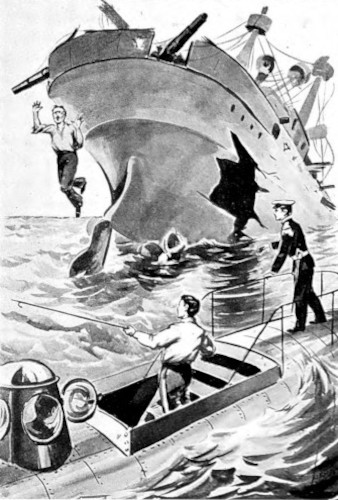
The annihilation of the Pekin was speedily followed by the wrecking of
the first of the Japanese warships, which had the keel split into three
parts. The Japanese could not understand what struck them and scores of
them leaped overboard, to be speedily pulled under by the vast suction
when the ship suddenly settled with a plunge, and went from sight
forever.
The alarm was now great on board of the second Japanese warship, the
Tokio, for those on her had seen that something was around in the
water—a deadly enemy. The commander at once issued orders that the
vessel withdraw from the fight and run from the vicinity.
This sudden withdrawal proved almost fatal for the Holland XI. without
the Japanese being aware of what they were doing. As the great warship
made a turn, one of her anchors slipped overboard, and the anchor chain
became entangled in the screw of the submarine craft, hauling her
around like a flash.
"Something is wrong with the screw!" announced George Dross to Oscar
through the speaking tube.
"Turn off the power."
"I have already done so."
"We are being dragged backward!" put in Andy, as he looked out of one
of the glass windows.
The young captain ran to the rear lookout and made an examination.
He saw the anchor chain and saw how the new Holland was being towed
backward by the cruiser overhead. Then the chain became tighter, as
those on board of the Tokio tried to recover the anchor which had
dropped overboard.
But the power overhead was not equal to the task of bringing in
the anchor with such a weight attached, and presently the task was
abandoned for the time being.
"I reckon they are thinking only of escaping from the hidden monster
that blew up the other warships," said Captain Oscar, and in this
surmise he was correct.
On and on swept the Japanese cruiser, with steam at full power and
every sail set. The wind was almost due north and the course of the
vessel lay in that direction.
"Where can she be going?" asked Andy.
"Perhaps she is going to join that fleet in Alaskan waters."
"By Jove! That's so, Oscar. Perhaps those English ships have gone to
join that fleet, too."
"More than likely."
A consultation was now held as to what could be done concerning the
entangled screw.
With the Holland being towed at such a speed it was impossible to go
outside and untwist the anchor chain.
As the bow of the submarine craft was pointed away from the Tokio, it
was equally impossible to fire a torpedo at the Japanese vessel and
thus blow her up.
"Besides, if we did that," said Oscar, "some of the wreckage might
cling fast to the other end of the anchor chain and drag us to the
bottom of the ocean."
It was a desperate situation, yet as hour after hour went by and
nothing unusual happened, they became accustomed to it, and Andy even
cracked a joke on the point.
"We're getting a free tow," he said, with a grin. "Wonder if they won't
be sending in a bill to the Government for the job."
The course of the Tokio had been northward, but now the big cruiser
turned almost due east.
"She is running for Fisherman's Bay," said one of those on the Holland
XI. who happened to know the California coast thoroughly.
"Is it deep there?" asked Oscar.
Before the man could reply all on board of the submarine craft heard a
grating sound.
"We are dragging on the bottom!" gasped Andy.
Orders were passed to George Dross and the new Holland came up close to
the side of the Japanese warship.
Had they remained longer under the big craft they might have been
crushed between the rocks on the bottom and the keel of the cruiser.
Presently the big cruiser came to a standstill, and a minute later
those on board of the Holland XI. heard the roar of her mighty guns.
The Tokio had found a single American warship in the harbor and was
doing her best to sink the craft.
The warship was something of a transport and was carrying sixteen
hundred soldiers to San Francisco, from Tacoma, Washington.
She had put into the bay for fresh water and was now doing her best to
fight the Tokio off.
But it was an unequal struggle, for her guns were much smaller than
those on the Japanese vessel. Soon she had a gaping hole in her side,
but fortunately this was two feet above the water line.
While the Tokio continued to fire shot and shell, Oscar gave orders to
George Dross to bring the new Holland around under the warship's stern.
Then the young captain put on a diving suit and ordered Andy to do the
same.
Both went forth and with caution made their way to the stern of the
Holland XI.
The anchor chain was twisted twice around the screw and it took all
their strength on a long crowbar to set the screw free.
It was dangerous work, for had they been caught in the chain when it
slipped away, one or both would surely have been killed.
In a quarter of an hour they were back to the new Holland, but so
exhausted that neither could stand upright.
"Try the screw!" panted Oscar. "If it is all right, fix a torpedo under
the warship and run away."
The screw was tried immediately and found to work as well as ever.
Then the torpedo was brought forth from the ammunition room and
adjusted, and the Holland XI. ran off a distance of a quarter of a mile
and then came to the surface.
The Tokio was preparing to close in on the American transport; with
the evident intention of killing or capturing all on board, when the
torpedo went off with a rumble and a roar that could be heard for many
miles around.
The execution done by the torpedo was frightful, for the instrument of
death had been attached to the weakest part of the Japanese ship's
keel.
The charge went straight up through the four decks of the Tokio,
setting fire to every magazine.
It was a fireworks spectacle which could not be equaled and was
followed by a scene of horror.
Everything went to pieces at once, and it is safe to say that scarcely
an officer or a man on board escaped with his life.
Those on the American transport could scarcely believe their eyes,
and when the Holland appeared and a man went to the deck, to wave an
American flag and then the private flag of the submarine craft, there
was a wild hurrahing.
"The Holland XI.!"
"What a wonderful boat!"
"Three cheers for her and her gritty commander and crew!"
And the cheers were given with a will.
The captain of the transport wished to thank Oscar in person, but the
most the new Holland could do was to run alongside of the transport,
and Oscar merely showed himself.
"We are off for Alaska," he said. "We are after the big Russian fleet."
"Good!" was the answer. "Hope you do them all up!" And then another
cheer went up.
Soon the Holland was cutting the waters of the ocean at a speed of
twenty knots an hour.
Oscar felt pretty certain that the first attack of the Russian fleet
would be made at Cape Nome.
In 1900, Cape Nome had boasted of less than a thousand souls, now the
city contained over fifty thousand inhabitants.
The Cape Nome mines had proved richer than any mines ever discovered
in California or Australia, and the city contained a government assay
office and several first-class banks.
At one of the banks was stored gold to the value of thirty-five
millions of dollars, and silver to the value of eighteen millions of
dollars.
"The Russians have their eyes on that gold and silver," said Oscar.
"And they sha'n't get it, not if I can prevent the move."
Day after day the new Holland kept on her journey, only stopping once
for extra food and water.
Then they ran between a number of islands, and one day found themselves
caught in a storm and entered a little cave under a cliff.
The storm increased in violence and the heavy rains caused a landslide.
There was a strange rumble over their heads and the water was boiling
and foaming on all sides of the Holland.
"By Jove! I don't like this!" cried Andy. "Something is wrong."
"It sounds like an earthquake," replied Oscar. "And see how dark it is
getting."
The young captain of the Holland was right; the light of day had
suddenly ceased to shine in on them and nothing more could be seen
until the electric lights were lit.
"We had better move out of here," said George Dross.
"Right you are," said Oscar, "and the sooner the better. That cliff may
be coming down on our heads."
The order was given to go forward, but the new Holland had run less
than a hundred feet when she came to a sudden stop.
Rocks blocked her way on every side.
Then the submarine craft began to back, but soon other rocks brought
her to a standstill.
The terrible truth burst upon those on board.
They were prisoners in the cave under the ocean!