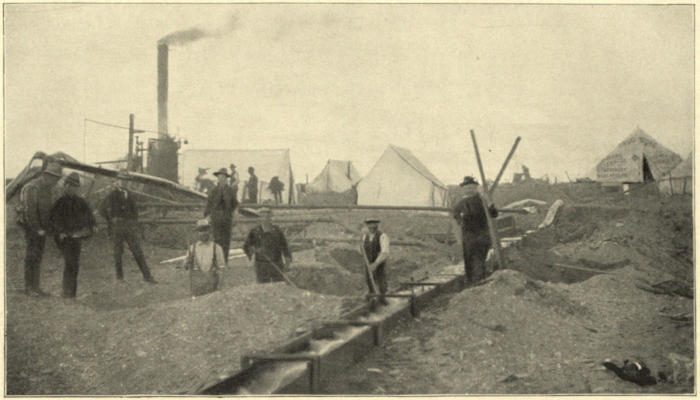
THE YOUNG ICE WHALERS — CHAPTER I A CHANGE IN LIFE’S PLANS
“I will do what I can to help make matters
easy, father.”
The speaker was a handsome, well-built boy
of seventeen, with a frank, winsome face that
ordinarily showed neither strength nor weakness
of character,—the face of a boy out of
whom circumstances make much that is good,
or sometimes much that is ill, according to
what experiences life brings him. There are
boys who will grow up strong and able men,
anyway. They seem to have it in them from
the start. There are others who have an inborn
tendency to evil and dissipation, which
no amount of training and opportunity for
better things can eradicate. Harry Desmond
was of neither of these types; his character
was rather that which responds easily to outside
influences, whose weaknesses may easily
grow upon it, or whose strong points may be
developed and brought out by use.
“Thank you, my son,” said the other simply,
extending his hand; “I was very sure
you would. The business will of course go
on, and may be built up again with care and
strict economy; but the outside investments,
whose returns have made us well-to-do, and
from which the money for your education
was coming, are totally swept away. I’m
afraid we shall have to withdraw you from
the preparatory school. It is an expensive
place, and just at present I do not feel able
to supply you with the money necessary to
keep up your standing among the boys there.
In another year I had hoped to see you in
the freshman class at Harvard, and that may
yet be managed. There are always scholarships
to be had.”
“Father,” said Harry impulsively, “I don’t
think I care for college. I’d rather help you.
To tell the truth, I have not stood very well
at school; I mean my marks have not been
high. I have managed to pass always, but it
has been a close shave sometimes. I’ve liked
it immensely because I have had such jolly
times with the other fellows. I have thought
of college much in the same way. So long
as we had plenty of money, it was just as well
to go. A college man who has spending-money
has no end of a good time, and I don’t
doubt I could pass in the studies as well as
a good many of the fellows. But now it’s
different. You’ve always stood by me like
a brick. Now I want to help you.”
A look of pride and delight beamed in the
careworn face of the elder Desmond, and the
stoop came out of his shoulders a little as if
a weight had been lifted from them. He had
expected the boy would meet the news bravely
and carry himself well. He knew his own
blood. The Desmonds had never yet been
the men to cry baby when unpleasant things
had to be faced, and yet—he knew now how
it had weighed upon him—he had feared in
his heart for the effect of the news on his
only son. He knew of the low marks at the
preparatory school, and how careless and pleasure
loving the boy had seemed. There had
been one or two escapades, also, things which
showed carelessness and high spirits rather
than viciousness, and they had worried him a
good deal.
“I think we shall be able to keep the house,
here,” said the father, “though we shall have
to live rather simply. The horses must go
and most of the servants, but when that is
done and things straightened out a bit, we
shall owe no man a penny. The hardest rub
is coming in the business. There we must
reorganize and retrench, and the office force
is badly cut down.”
Harry hesitated, though it was only for a
moment, and swallowed a lump in his throat.
He had a pretty good idea of the drudgery
of the office. The younger clerks came in
at eight or before, and never got away until
six. That was for every week in the year,
except a brief vacation of ten days or so. He
thought of his Saturdays and holidays, of the
long vacation in the heat of summer; and
then he saw the careworn look in his father’s
face, and he held up his head and spoke
swiftly.
“I’d be glad to help you in the office if
I can, sir,” he said; “I’m pretty handy at
figures and have a good idea of book-keeping.
I’d like to do it, if you’ll only let
me. A year or two of it would be good
for me. Then, if things go better, it will not
be too late to go to college after all. Perhaps
I shall feel more like it then.” He
smiled somewhat grimly, mentally noting how
swiftly ideas and ideals change. College,
which had seemed inevitable only a few short
hours before, had not appealed to him except
as a pleasant place to spend time and enjoy
himself. Now he suddenly seemed to see
how useful it might be to him in the future,
yet that he would probably not be able to go
there.
“It is a good deal of a sacrifice, my boy,”
said his father, “but you really could help
me there a great deal. I need some one
with the force whom I can be sure of as
loyal to my interests. Think it over for a
day, and if you are still willing you can begin
right away. It is almost worth while to be
ruined financially to find one’s son so plucky
about it and so loyal to the house. I shall
have to let you go now; I am to have a business
conference here in a few minutes, and I
see the others coming down-street now. Be
as cheerful as you can about this with your
mother. I think it is hardest on her; but
if we can all be patient for a few years, I
think I can pull through and get matters in
good shape again. Good-by.”
Harry left the library, put his hat on, and
stepped out of doors. It was one of those
days in late April that make one glad he is
alive, and in New England. The grass was
already green upon the lawn, the buds were
swelling in the shrubbery, and a bluebird caroled
as he fluttered from the bare limbs of a
maple and inspected the bird-box where he
planned to build his nest in spite of the scolding
of the English sparrows that flocked about
and threatened to mob him, but did not quite
dare. Harry turned down the gravel path
toward the boat-house. Beyond, the waters
of the bay sparkled and ruffled in the wind,
and his knockabout, new only last year, swung
and curtsied at the mooring as if in recognition
of her master. The lump came in
Harry’s throat again. If he worked in the
office, he would have little time in the long
bright summer just ahead of him to sail the
blue waters of the bay. Besides, perhaps he
ought not to keep the knockabout. The boat
was worth money, and should be given up just
as much as the horses. Well, he had the boat
now, and the afternoon; he would have a sail
while yet he might. It would give him a
chance to think over things, too, as his father
had suggested, though he knew his mind was
made up already. He found the skiff at the
landing, rowed to the boat, hoisted mainsail
and jib, then, as an afterthought, instead of
towing the skiff astern he made it fast to the
mooring and sailed away without it. It was
one of those little decisions which mean nothing
at the time, but which, such are the
mysterious ways of Fate, often change the
whole current of life.
Pointing well up into the wind, the graceful
boat slipped rapidly through the water. She
was breasting the incoming tide, Harry knew,
for he could feel that peculiar quiver of the
rudder that thrills through the tiller into the
arm when a finely balanced boat heads the tide
and beats to windward at the same time.
Harry looked backward at the Quincy Point
Village as it slowly drew away from him. He
saw the fine old houses,—his own the finest
of them all,—and was devoutly glad that the
business reverses were not so great that they
would have to leave that. On the rear veranda
of one of them he saw the gleam of a white
dress, and a young girl waved her hand at him.
It was Maisie Adams, he knew, and he regretted
that he had not seen her sooner. Maisie
was a jolly good sailor, and he would have
liked her for company. It was the time of the
spring vacations, and Maisie was home from
boarding-school. She would no doubt have enjoyed
this first sail of the season. He almost
decided to put back and ask her to go out, then
he happened to think he was no longer the
prospective Harvard freshman with plenty of
money to spend, but the prospective clerk in
an office, and not likely to have even the boat
he was sailing, after a few days. He ought
to have had sense enough to know that this
would make no difference with Maisie, but he
was only a boy after all, and could not be expected
to know much about the way a really
nice girl like Maisie would look at things of
this sort. So he pulled his hat down over his
eyes a little—to keep out the sun, of course—and
sent the knockabout bowling along
down the Fore River, by Germantown, by
Rock Island Head, and out into the wider bay
toward Hull, where he got the full sweep of the
bustling spring breeze.
Meanwhile Maisie pouted on the piazza.
She had recognized Harry, and she, too,
wished he had seen her sooner. The day was
warm, almost like summer, and she would have
liked a sail down the bay. However, she got
some fancy work and sat down in a big piazza
chair in the sun, with a wrap about her shoulders,
determined to watch the boat if she could
not sail in it. After a little while her mother
came out.
“Aren’t you catching cold out here, Maisie?”
she asked.
“I think not, mamma,” replied Maisie.
“It’s just as warm as a summer day, and I
thought it would be nice to sit here in the sun
and embroider—and watch the boats. Sit
down with me, won’t you, and talk to me?”
“I knew you wouldn’t be home long before
you were on the lookout for a sail,” said Mrs.
Adams rather roguishly. She knew that
Harry Desmond’s knockabout was the finest
small boat on the river, and that he and Maisie
were great friends. “There aren’t many
of the boats in commission yet. I thought I
saw the Princess”—that was Harry’s boat—“at
the mooring yesterday, but I see that I
was mistaken.”
Mrs. Adams smiled quietly to herself as she
saw the faint color creep up into Maisie’s
cheek and hide itself under the dark ringlets
of her hair. Then the girl looked up with
charming frankness and said, “The Princess
was there a few moments ago, but Harry has
just gone out in her. See, he is almost down
to Sheep Island now. He would have taken
me, I think, if he had known I was at home.”
Maisie looked straight into her mother’s eyes,
and that was one of Maisie’s chief charms.
She had a way of looking at you clearly and
honestly, and you knew that you were looking
down through pretty gray eyes into a heart
that was as open and frank as it was sunny.
“I should have been perfectly willing to
have you go,” said her mother. “Harry is a
very gentlemanly boy, and a good sailor. I
think I can trust you with him.”
“I think you can trust me with any of the
boys I am willing to go sailing with, can you
not, mamma?” said Maisie, and knowing it to
be true, Mrs. Adams gave her daughter a little
squeeze of affection and changed the subject.
They sat and talked for a long time in the
bright afternoon sun, while Maisie embroidered
industriously, now and then glancing at
the sail of the Princess, which had diminished
to a little white speck over toward the mouth
of the harbor, then grown again as her skipper
headed toward home. By and by Mrs.
Adams went into the house, and Maisie laid
down her embroidery and strolled across the
lawn and down the path toward the Adams’s
boat-house.
There she found none of the boats put into
the water for the season except the smallest, a
light little thing with one pair of oars. Maisie
was a good oarsman, and she often rowed
one or another of the boats up the placid
reaches of the Fore River, above the bridge;
so there was nothing uncommon in what she
now did. Finding it ready for use, she got
into the little skiff, cast off the painter, and
was soon skimming with easy strokes under
the bridge and away up-river. The bridge
and the heights of land on either side of it
soon hid the bay and the sail of the Princess
from her sight, if not from her thoughts.
There were plenty of interesting things to see
up-river, and who shall say that she did not
turn her whole attention to these? At any
rate, she alternately rowed and floated for
some time, and thoroughly enjoyed the vigorous
exercise and the outing in the bright
spring sunshine. By and by the ebbing tide
carried her back toward the bridge, and she
turned the bow of her skiff homeward just
as the Princess, with the west wind in her
sails, came nodding and curtsying up toward
her mooring.
Harry had thought it all out, and was at
peace with himself. He would take the
clerkship in the office and work patiently and
bravely. Perhaps he would like business better
than he thought, or if he did not, he could
work faithfully and hope for an improvement
in the family fortunes that would enable him
to enter college after a few years. He had
heard it said that a year or two of experience
in business was a good thing for a boy who
was to enter college, just as a college education
was a sure help in business, if that
were to be taken up after graduation. At
any rate, he would be doing the thing that his
father wanted him to do, and that was bound
to be best. So, with the buoyancy of boyhood
asserting itself, his brow was clear, the
trouble was already behind him, and he whistled
a merry tune as he tacked to make his
mooring.
Then he noted a skiff coming through the
draw of the bridge with the tide, and gave a
cheerful shout of greeting as he recognized
Maisie in it. Suddenly something happened,
and just how it did happen neither of them
could clearly tell. The skiff was passing the
piling at one side of the draw, and perhaps an
oar caught between two piles, perhaps Maisie
turned too suddenly at the call of greeting,
or the sweep of the tide did it, or all three.
Whatever it was, the skiff overturned, and before
Harry could realize what had happened,
Maisie’s dark head floated for a moment beside
the upset skiff, then sank beneath the water
while the skiff floated away. He swung the
tiller of the Princess swiftly so as to throw the
boat back on the other tack and head for the
spot, which was not far away; but quick as
the knockabout was in stays, the two tacks,
one immediate upon the other, had lost her
headway, and she got a fill of wind too late to
fairly make the spot where Maisie had gone
down. As the girl’s head again came above
water, the boat was a dozen feet to leeward
and would be no nearer. There was but one
thing to do, if she were to be rescued, and
Harry did it. Letting go of tiller and sheet,
he sprang quickly overboard and plunged with
vigorous strokes in her direction, shouting a
word of encouragement which she did not
seem to heed, but which was answered by a
wild warwhoop from the shore.
There the ancient ferryman, who takes people
across from Germantown to the Point for
a nickel, had suddenly waked up to the catastrophe
and nearly swallowed his pipe, which
he had been smoking placidly when it happened.
He saw the need of immediate help,
and sprang into the stern of his skiff and
snatched an oar from the thwarts, swinging it
hastily into the scull hole, very nearly upsetting
himself in his excitement. Then he vigorously
plied the oar and sent the clumsy boat
through the water toward the scene of the
accident.
Maisie was behaving herself well. Used to
the water, but so weighted and snarled in her
skirts that she was unable to swim, she nevertheless
did not hamper Harry by needlessly
clinging to him, but simply grasped his shoulders
and clung tenaciously, though speechless
and half drowned already. Yet Harry was
having a hard time of it. He was a good
swimmer, but the ice-cold water seemed to grip
his chest and stop his breathing. He held
Maisie up and looked for the Princess, but
the boat, with its sheet caught, had swung off
the wind and was rapidly sailing away. He
could not reach the shore, and he knew it.
He could hold Maisie up for a while, if he
spared his strength as much as possible.
There was a chance that help might come,
though he could not tell from where. His
head whirled, but he swam mechanically.
Once they went under, and then as they came
up something struck his shoulder and he
grasped it and held on.
The swift tide had floated them out toward
the mooring, and set them alongside the skiff
that he had inadvertently left there some hours
before. Thus kindly Fate helps us oftentimes
in little things. It was only an impulse that
had made him leave the skiff at the mooring,
and now it was to be his salvation and Maisie’s
as well.
There he clung, to be sure, but he was unable
to lift the girl into the skiff. His head
whirled with excitement and fatigue, but he
would not let go. The iron grip of the icy
water on his chest seemed to crush the strength
out of him, and he scarcely knew when the
ferryman, his clumsy craft quivering with new-found
speed, swung alongside and lifted first
Maisie and then him into the boat. Then
with a strong sweep of his oar the old man
swung the boat’s head toward the shore, and
fell to sculling desperately without the utterance
of a word.
Harry was still dazed and breathless, and
Maisie was the first to recover speech. “I’m
sorry I made so much trouble,” she said
faintly to Griggs, “but we were nearly
drowned, and would have been quite if you had
not come just as you did. We thank you
very much.”
Then she turned to Harry, who could still
only smile faintly and shiver. “I have to thank
you, too, for my life. I should have gone down
before any one else could get to me if you had
not been so quick and brave.” She held out
her hand to him and he clasped it for a moment,
while his teeth managed to chatter that
it was all right.
The ferryman turned his head over his
shoulder and grinned cheerfully and reassuringly
across his pipe, which was still gripped
in his teeth, but he said no word, only went
on sculling. Then the boat reached the landing
and he helped Maisie out and gave a hand
to Harry. The boy rose with difficulty, he
was so chilled.
“Thank you, Griggs,” he said as he stepped
on the wharf. “You came just in the nick
of time, and I’ll see that you have more than
thanks for your trouble and coolness.”
“Don’t you say a word, Mr. Harry,” said
the ferryman. “You and I’ve been shipmates
a good many times, and your folks have
been more than kind to me. I’ll get the Princess
back to her mooring for you. I’m mighty
glad I was on hand, and you’ll do me a favor
if you won’t say anything more about it.”
Harry was feeling better, but his teeth chattered
still as he stumbled along with Maisie to
her own door. At home he told his mother
quietly that he had had a ducking, saying nothing
about the rescue, and went to bed, while
she dosed him with hot drinks. He did not
seem to recover as he should, and his mother
sent for the family physician. He laughed
at the escapade, and gave Harry medicines
that brought him round all right in due time,
though not feeling very active. But the next
day the doctor took care to call on Mr. Desmond
privately.
“The boy is all right,” he said; “and the
ducking isn’t going to hurt him any, but
I want to warn you that though he is constitutionally
sound, he seems lacking a bit in
vitality. He is not very resilient; that is to
say, things that some boys would throw off
as a duck does water are likely to hurt him.
Indoor life is bad for him. He’s the sort of
chap that should be out in the open as much
as possible for a few years. Don’t let him
study too hard. Keep him sailing his boat
and playing outdoor games while his constitution
hardens.”
A day or two afterward Harry came into
the library and found his father with an open
letter in his hand.
“I’m ready to report for business, father,”
said the boy, smiling. “How soon do you
want me to begin at the office?”
“Are you really anxious to begin?” asked
his father.
“Why, yes, father,” said Harry. “I know
it will be a good deal of a grind, but it will be
good for me, and I feel that I am big enough
now to help when you need me.”
“Did Maisie stand her ducking all right?”
asked his father with a smile, suddenly
changing the subject.
“Why—yes, sir,” faltered Harry. “How
did you know about it? I wasn’t going to
tell anything about that part of it.”
“Oh, I saw Mr. Adams yesterday and he
was quite full of the story. He spoke very
nicely about your share in it, and I am quite
proud of you.”
“Oh, sir,” said Harry, turning very red
with pleasure at his father’s praise; “it wasn’t
anything much, and anyway it was Mr. Griggs
who pulled us both out. We would not have
got out at all if it hadn’t been for him.”
“Well,” said his father, “it was a very fortunate
escape, and I’m glad it came out as
it did. But I have two things that I wish
to talk to you about, and it may be that we
shall not need you in the office at all, but can
use you to better advantage in another way.
First, I want you to read this letter from Captain
Nickerson, my old friend from Nantucket.”
He handed Harry a letter written in a
cramped but bold handwriting. It was as
follows:—
Whaling Bark Bowhead, Honolulu, January 15, 189-.
Dear Friend Desmond,—It is a year
since I wrote you last, and longer than that
since I have heard from you, but shall hope
to hear from you when we arrive at Frisco,
which will be in April unless something comes
up to prevent. We have had rather an uneventful
cruise so far, and have taken but few
whales in the South Seas. We shall land
about 1100 barrels of oil, however, as the result
of the cruise up to date. We are refitting
here as the result of a hurricane which
we took about a month ago, in which we lost
the fore-topmast and some gear with it. No
one was hurt except two Kanakas, one of
whom went overboard when the gale first
struck us, and the other got a broken arm
by a fall from the foreyard during the gale.
How he escaped going overboard is a mystery,
but it is pretty hard to lose a Kanaka.
I watched out for the other one most of the
way into Honolulu. Expected nothing but
he might swim alongside and board us, but
he didn’t come. Picked up a couple of white
men off the beach here to take their places.
Think they may prove good men. They
have been on the beach long enough to know
what it is to have a good ship under them
and regular fare, though not so good as you
people at home get, doubtless.
The old ship is in fine trim again, taut and
nobby as a race horse over on the Brockton
track. Guess I shall not be home in time to
take in the county fair this year, though I
would like to. We shall fit out again either
at Frisco or Seattle, and will probably touch
at Seattle anyway on our way north. I am
going to cruise through Bering Sea and into
the Arctic this summer for bowheads. Oil
is cheap now, but bone is higher than ever,
and a good shipload of bone and ivory, such
as we can probably get if we go north, will
be worth while. And this brings me to one
object in writing this letter. My boy Joe is
with us this cruise, and as fine a young sailor
as ever you saw. I wish, however, he had a
lad of good family of his own age for company.
I do not like to have him have the crew
alone for friends. Some of them are good
fellows, too, but many of them are, as you no
doubt guess, a rough lot. Your son Harry
must be about his age now,—eighteen. Why
do not you let him come on and meet us at
Seattle, and go north for the summer? He
would enjoy the cruise thoroughly, and no
doubt learn much that is useful to a young
lad just growing up. We shall be back by
November at the latest, and it would be nothing
much but a summer vacation for him.
If you think he would like to go, why not send
him on? We’ll make a man of him, and a
sailor man at that. I spoke to Joe about it,
and he is wild with delight at the idea. He
remembers the visit that you all made to us at
Nantucket some years ago, in which he and
Harry came to be great friends. It would be
good for his health, too. There is no place
like the Arctic in summer for putting health
and strength into a man. Besides, I could
give him a paying berth as supercargo. There
is not much to do in this except a little book-keeping,
and that is just what a boy who has
been to school as much as Harry has would do
easily and well. He would have to keep track
of the ship’s stores, keep account of expenditures,
and such things as that. The pay is
not large, but it would give him some pocket-money
when he got back, and he would not
feel that he was dependent, or a guest even.
Write to me at Frisco about the middle of
April, and we will plan to have him meet us
there or at Seattle before we start out, which
will be some time early in May.
With many pleasant memories of old school-days
together when Nantucket was really a
whaling town, and the schoolmasters did a
good deal of whaling,—Lord! what pranks
we used to play, we two!—and my regards to
Mrs. Desmond, and many to yourself, I am,
Yours very truly,
William Nickerson.
Mr. Desmond watched Harry narrowly as
he read this letter. He saw his eyes light up
at the prospect, and noted his suppressed excitement.
Then the boy handed it back, and
steadied himself.
“But you need me in the office, don’t you,
father?” was all he said.
“Would you like to go?” asked his father.
“Why, yes, very much, sir,” answered
Harry frankly; “but not enough to go when
you need me for other work here at home.
If things were as they were a year ago I should
tease to be allowed to go, but now I would
rather stay at home.”
Mr. Desmond looked pleased. “Now,” he
said, “this is the other matter I wished to
speak about. My business conference the
other morning was with Mr. Adams and some
other wealthy men who are planning to make
large investments in the whaling and trading
vessels which go north into Bering Sea and
the Arctic each year after whalebone and
ivory. There is a good demand for whalebone
commercially, and there are some industries
which cannot well get along without it.
At the same time the supply is limited, and
the market would easily pay a much higher
price for it. I am partly interested in this as
a small share-owner in the Bowhead. It was
hardly reckoned as an asset in the business
difficulty, as the whaling has not paid well of
late years, and dividends are few and far between.
So I still retain the stock. The plan
of these gentlemen is to concentrate all these
vessels under one management, obtain control
of the world’s available supply of whalebone
each year, and, by careful business methods
and proper handling of the market, make a
good paying business of what is now conducted
often at a loss. The scheme is already under
way, but the arrangements will not be completed
until next fall. Meanwhile we are anxious
to get a report of the conditions in that
country, and the circumstances under which
the business of Arctic whaling and trading is
carried on. If you take this trip with Captain
Nickerson, you will have a chance to see
much of these conditions, and be able to make
such a report. It is true that you are young
and inexperienced in such matters, but your
work may be all the better for that. You will
have no prejudices or already formed opinions
to bias you, and what you lack in experience
in that region may be made up by conversation
with those who have made previous cruises
there. At any rate, Mr. Adams seemed to
think it was worth our while to give you such
a commission, if you went out there. He
seems much interested in you since the upset,
and if you go, you will go on a modest salary
in his employ, he being the head of the enterprise.
That will perhaps be better for us both
than work in the office would be. Now what
do you say? Will you go?”
Harry looked hard at his father, saw that
he, as usual, meant what he said, and was
really desirous of having him go, and then
his delight and enthusiasm bubbled right over.
He danced about his father, wrung his hand,
and in general acted more like a crazy boy
than the sedate and repressed youth who had
been so willing to go into the office. As he
rushed off to tell his mother, and plan his arrangements
for the trip, Mr. Desmond smiled
cheerily.
“Humph!” he said to himself, “I suppose
the doctor was right, but there certainly
doesn’t seem to be much lack of vitality
there.”
That afternoon he sent and received the
following telegrams:—
To Nickerson, Whaling Bark Bowhead, San Francisco, Cal.
Have decided to let Harry go north with
you. Where shall he meet you, and when?
H. N. Desmond.
To H. N. Desmond, Franklin St., Boston, Mass.
Will be in Seattle May tenth to fifteenth.
Have Harry meet me there. Great news.
Nickerson.
Mr. Desmond wrote also, and five days later
received a letter from Captain Nickerson,
which he had evidently written as soon as
the telegrams were exchanged, giving further
instructions. Arrangements were hurriedly
but carefully made, and one day early in May
Harry bade good-by to father, mother, and
many friends at the station in Boston, and was
off. Maisie was there too, with a smile on her
face but a tear in her eye as she bade him
good-by with a friendly handshake.
“Good-by, Harry,” she said. “I hope
you won’t go plunging overboard after careless
young ladies, up there among the Eskimos.
It would be just like you, though. Be
a good boy, and bring me a polar bear or
something when you come back.”
“Good-by, Maisie,” replied Harry. “I’ll
bring you the finest aurora borealis there is
in all the Arctic.”
Some one shouted “All aboard,” the train
rumbled from the station, gathering headway
rapidly, and Harry Desmond was fairly
launched upon a new life, which was to be so
strange and so different from the old that he
was often to be like the old lady in the nursery
tale, who exclaimed periodically, “Lauk-a-mercy
on us! This can’t be I.”
CHAPTER II BOUND FOR THE ARCTIC
The city of Seattle grows to-day by leaps
and bounds. The roar of traffic sounds unceasingly
in her streets, the city limits press
outward in all directions into the unoccupied
territory near by, and the present prosperity
and future magnitude of the place
seem already assured. She sits, the queen of
the Sound, at the meeting-point between the
great transcontinental railroads and the great
trans-Pacific steamship lines. Great steamers,
the largest in the world’s carrying trade, ply
unceasingly between the magnificent waters
of Puget Sound and the mysterious ports of
the far East, as we have learned to call it,—though
from Seattle it is the far West,—and
fetch and carry the products of the Orient
and those of our own great country.
Mighty full-riggers from the seas of half the
world lift their towering masts skyward, as
they swing at the city’s moorings in water
that is just offshore, but so deep that the ordinary
ship’s cable hardly reaches bottom, hence
special cables and moorings are provided.
To the westward the Olympic Mountains,
clad with the finest timber in the world, lift
their snowy cloud-capped summits to the sky,
and glow rosy in the light of the setting sun;
while, between the city and these mountains
beautiful, flow land-locked waters which
might hold all the navies of all the world
without being crowded, and which seem destined
to be the centre of the commerce of
the coming century, borne over seas that are
yet new to the world’s traffic.
Thus to-day! yet a decade and less ago the
city was far from being as energetic. Seattle
then slept in the lethargy of a “boom” that
had spent itself, and was but just beginning to
feel the stir of new life and a solid and real
prosperity. Splendid business blocks were but
half tenanted, many of the original boomers
were financially ruined, yet the city kept up
its courage, and had an unabating faith that
position and pluck would win out. Already
this faith was beginning to have its reward in
works, and the faint glimmerings of future
great advancement were in sight. More business
began to reach the port, and the often
almost deserted docks had now and then a
ship. One of these on the day of which I
write was the Bowhead, and certainly business
bustle was not wanting on and near her.
Perhaps the amount of work going on was
not so very great, but the bustle more than
made up for that, and Ben Stovers, the Bowhead’s
boatswain, was the guide and director
of this bustle, and to blame for the most of
its noise.
Stovers had a voice as big as his frame,
and that was six feet two in longitude, as
he would have said, and it seemed almost
that in latitude. Surely, like this terrestrial
globe, his greatest circumference was at the
equator. Captain Nickerson was wont to say
that Stovers was worth his weight in ballast,
and that made him the most valuable man
on the ship. It was a stock joke on the part
of the first mate, when the wind blew half a
gale, the crew were aloft reefing topsails, and
the good ship plunged to windward with her
lee-rail awash, and her deck set on a perilous
slant, to politely ask the mighty boatswain
to step to the windward rail so that the ship
might be on an even keel once more.
It was the voice of this mighty man that
was Harry’s first greeting as he came down
the dock toward the vessel that was to be his
home for the long cruise. It rolled up the
dock and reëchoed from the warehouses, and
every time its foghorn tones sounded, a little
thrill of energy ran through the busy crew.
“Hi there! Bear a hand with that cask,” it
yelled, and two or three dusky Kanakas would
jump as if stung, and the cask they had been
languidly handling would roll up the gang-way
as if it concealed a motor.
“Come on now, Johnson, and you, Phipps;
this is no South Sea siesta. Stir your mud-hooks
and flip that bread aboard. Wow,
whoop! you’re not on the beach now, you
beach-combers; you’ve got wages coming to
you. Step lively there!” Result, great rise
and fall in breadstuffs, and boxes of hard
bread going over the rail and down the hold
in a way that made the Chinese cook below
shout strange Oriental gibberish, in alarm lest
the boxes be stove and the contents go adrift.
“Lighter ahoy!”—this to the man driving
a cart down the dock; “clap on sail now and
come alongside. We’ve got to get away from
this dock before night or the city’ll own the
vessel for dock charges.”
This sally brought a grin from the loungers,
not a few, who watched the loading,
dock charges being always a sore point with
the vessels’ owners, and brought the pair of
bronchos and the load of goods down the
crazy planking at a hand-gallop.
Flour in bags, bolts of cotton cloth and
many hued calico, shotguns and rifles, ammunition,
what the whalers know as “trade
goods” of all sorts, for traffic with the Eskimo
tribes, were all being hustled aboard
the vessel before the impulse of this great
voice, which sounded very fierce, and certainly
spurred on the motley crew to greater exertions.
Yet it had a ring of good humor in
it all, and the men obeyed with a grin as if
they liked it.
A tall young fellow with bronzed face and
black curly hair stood noting the goods that
came aboard and checking them off on a
block of paper. He looked up as Harry came
down the dock, then gave a shout of recognition,
and came down the gangplank with
hand extended.
“It’s Harry Desmond, isn’t it?” he said;
“awful glad you came. When did you get
here? Father is up in the city doing some
business. He’ll be as glad as I am that you
are here. Come right aboard. I’m Joe
Nickerson; of course you remember me, don’t
you? You’re a good deal bigger and older,
but you haven’t changed a bit. I’d know
you anywhere. My! but I’m glad you are
going up with us.”
He glanced somewhat dubiously at the
black hand-satchel that Harry was carrying,
but said nothing about it as they went up the
plank. Not so the boatswain; he took one
look at it and rolled heavily forward.
“Ax your pardon, young feller,” he said;
“but ye’d better not take the hard-luck bag
aboard, had you? Don’t you want to leave
it down here on the dock? We’ll see that
it’s safe till you go ashore again.”
Harry was somewhat surprised, and inclined
to resent this seemingly needless interference,
but Joe spoke up before he could say
anything. “Mr. Stovers,” he said, “this is
my friend Harry Desmond, of whom you’ve
heard me speak. He’s going up with us
this trip as supercargo.”
The big boatswain reached down a hand
like a ham, and shook Harry’s awkwardly
with it.
“Glad t’ meet you,” he said. “Didn’t
mean nothing sassy about the bag, you know,
but sailors are queer fellows. ’Tain’t me;
I don’t believe it, but the crew think a black
bag is full of gales of wind, and lets ’em out
when it’s brought aboard ship. See ’em looking
at it, now. ’F you could leave it ashore,
and bring your dunnage on in a canvas bag,
they’d feel better about it. No use getting
the men grumbling down for’ard.”
“Certainly,” said Harry politely. “I’ll
leave it out on the dock here, if some one will
keep an eye on it for a while till I can get
something else. Glad you told me. I don’t
want to be a bad weather man my first cruise.”
“Thank you,” said the boatswain with
equal politeness; “I guess you and I’ll get
along all right.” Then he turned suddenly
to the crew, who were loitering and gazing
uneasily at the black bag.
“’Vast gawking there, and bend on to that
dunnage. Whoop, now! Get her up here!
Heave her up, boys, lively now; the gale’s
gone down. That’s the new supercargo, and
you don’t want to go cutting up any monkeyshines
with him. He’s going to leave the
hard-luck poke-sack ashore.”
“I’ve got a trunk over at the station, too,”
said Harry, as they went down the companion-way
aft. “Do you suppose they’ll mind if
I bring that aboard?”
“Well,” said Joe, “they’re superstitious
about trunks, too, although they don’t care so
much about them as they do about a black
bag. That’s a special hoodoo.”
“I’ll store them both ashore, then,” said
Harry resolutely; “I want to start all fair
with the crew. You have things pretty nice
down here, don’t you?” he went on with some
surprise as they entered the cabin. Here he
saw a room with a well-furnished dining-table,
and doors leading off, the fittings being in
hard wood, and the whole having an air of
refinement and home surroundings pleasant
to see.
“Why, yes,” said Joe. “You see a whaling
captain lives aboard his vessel the year
round, and we like to have things snug. Father’s
cabin is just aft of this. He keeps his
charts there and instruments. The first mate
has the one on the starboard, and you and I
are to share this.”
Joe, as he spoke, showed Harry into a little
cabin which was lighted by a port side dead-light,
and which had two neat berths with
clean bedding and white sheets. There was
abundant locker room, and the whole looked
somewhat as any boy’s room might that was
occupied by a young man studious and interested
in outdoor sports. A rifle and shotgun
hung on the wall, and other boyish belongings
were scattered about. There was a shelf or
two of books, and it reminded Harry in a
certain way of his own room at home. Joe
noted his approval with pleasure, and seeing
him glance at the books said:—
“Father’s got quite a library in his room
that you are welcome to use. We’ll study
navigation and some of those things together,
if you want to. Here’s your locker, and these
hooks are for you. You may have either
bunk you wish, but I think you’ll find the
lower one more convenient. Come on ashore
now, and I’ll help you get your things aboard
and get you settled. We sail to-morrow.”
That night at supper, which was deftly
served at two bells by the Chinese steward,
Harry was cordially welcomed by Captain
Nickerson, and met the first mate, a lank, muscular
man, bronzed and singularly taciturn,
and learned much of his duties as supercargo,
which he readily saw were nominal indeed. It
was strange how easily he became adapted to
life on board, and before bedtime he felt as if
he had already lived a long time on a whaling
ship. He stored his trunk and the “hoodoo”
black bag in the city, and brought his belongings
aboard in two canvas sacks, regular
sailor’s bags, much to the approval of the two
brawny Kanakas of the crew detailed to bring
them down for him. Harry was much interested
in these dusky South Sea islanders, and
found them intelligent, good-natured, and efficient.
Joe showed him over the ship, introduced
him to the engineer and his assistant,
and taught him much about the general working
of the vessel. He saw the great kettles,
set in brickwork on the forward deck, for the
trying out of blubber. He saw the whaling
implements, the bundles of staves for casks,
and the great space between decks above and
below for the storing of these when they should
be coopered and filled with oil. He saw the
galley where two slant-eyed Chinese were in
charge, and the narrow quarters of the crew
forward, crowded as much as possible to give
more space in hold and on deck for oil casks,
and for such members of the crew as he came
in contact with he had a pleasant word.
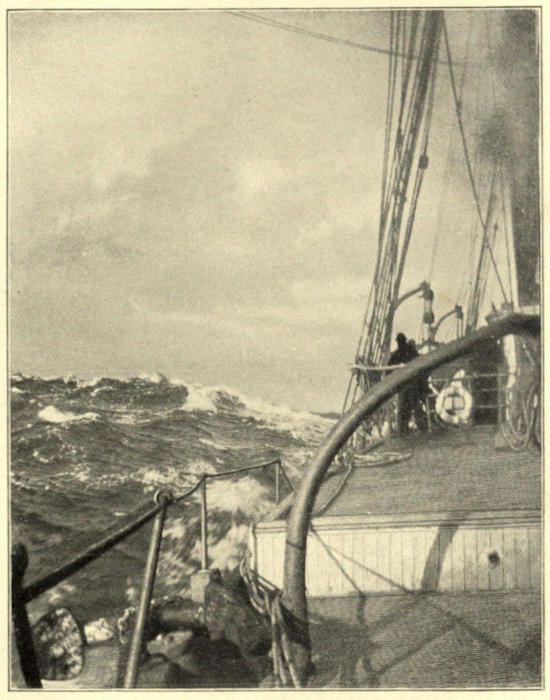
THE LONG ROLLERS OF THE NORTH PACIFIC
Until Arctic whaling by way of Bering
Sea began, few if any whalers were fitted with
steam as an auxiliary; but it was found that
if vessels were to make a success of the industry
among the ice-floes of these treacherous
waters, get into and out of the Arctic by the
narrow, current-ridden, ice-tangled passage
of Bering Straits, it was wise and expedient
to add steam to the equipment. Hence many
vessels like the Bowhead, though thorough-going
sailing vessels, were equipped with engines
and propeller, to be used when the wind
did not serve, or when the passage of ice-floes
made it necessary. It was under a full head
of steam, then, that the Bowhead passed up
Admiralty Inlet, as that portion of the Sound
is called, rounded into the Straits of Fuca, and
spread her sails to the westerly wind only
when she was well out toward Cape Flattery,
and breasting the long rollers that swung unimpeded
from the vast expanse of the world’s
greatest ocean.
How Harry’s heart had swelled within him
at the sight of this sea! He had something
of the feelings of Balboa when he first sighted
it from that Central American mountain-top,
and fell on his knees in adoration and thanksgiving.
He longed like Captain Cook to furrow
it with exploring keel, and seek out the
enchanting mysteries that lie in and beyond
the shores that it touches.
“Great sight, isn’t it, Harry?” said Captain
Nickerson, who stood near him and noticed
his emotion.
“Yes, sir,” replied Harry. “It seems like
dreams coming true to think that I am to see
the things that I have read about this side of
the world, but never really expected to see
with my own eyes.”
The captain smiled. “You’ll see strange
sights, my boy, before you get home,” he said,
and there was more of prophecy in this than
either of them dreamed at the time.
“Are we liable to do any whaling right
away?” asked Harry.
“Well, that depends,” replied the captain.
“There is now and then a humpback in these
waters, but they are pretty shy nowadays, and
hard to come up with. They’re hardly worth
while. I doubt if we shall lower a boat before
we get into Bering Sea and get among the
bowheads as they follow the ice up. We are
likely to see a whale, though, most any time
now.”
“I wish we could,” said Harry, the ardor
of the sportsman beginning to thrill in his
veins; but no whale appeared that day, though
he watched the sea with patience and undiminishing
ardor.
A day or two afterward, as he came on deck,
he saw a little cloud on the surface of the
water like the puff of smoke that follows
the discharge of a rifle loaded with black
powder. A moment after another puff shot
into the air quite near the ship, and he saw
beneath it a black body rise languidly to
the surface, loll along it a moment, and then
sink again. His heart gave a great jump.
A whale! Why had none of the crew seen
it? To be sure they were not on watch for
whales, but still several were on deck, and the
first mate, whose watch it was, was pacing
leisurely back and forth behind him as he
stood at the rail. The mate now and then
glanced at the sails to see how they were drawing,
and now and then shot a command, a
single word if possible, to the crew for a pull
on the braces, or something of that sort, but
he seemed to take no notice of the puff of
smoke and the black body just showing above
the surface almost alongside. Harry looked
again. Yes, it was there, so near that he
could see that the little puff of smoke was a
cloud or vapor blown with a whiff into the
air from one end of this black body. He
could stand it no longer, but rushed up to the
mate, grasped his arm, pointed in the direction
of his discovery, and said excitedly, “See,
see! There he is! Don’t you see the whale?”
“Nope,” calmly replied the taciturn first
mate, gazing at the little puff of vapor and
the black body.
“Isn’t—isn’t it a whale?” faltered
Harry, a little ashamed of his enthusiasm in
the face of this stolidity.
“Nope,” said the first mate.
“But it looks like a whale,” persisted
Harry; “and it acts like a whale, at least as
I have read that they acted. What is it,
then?”
“Blackfish,” said the mate, with a sweep of
his hand to the other side of the ship. Harry
looked in that direction, and was silent in
astonishment and delight.
“Hundreds!” said the mate, and resumed
his walk on the deck.
There were not so many as that, but there
were certainly scores of these creatures sporting
lazily in the waves, rolling their black
bodies to glisten in the sun, and sending up
the puffs of vapor that floated a moment in
the breeze and then vanished. It reminded
Harry of the skirmish line when the Cadets
were encamped at Hingham, and the order
“Fire at will” had been given. The puffs
were much like those from the Springfield
rifle.
The blackfish is really a whale, though the
whalemen do not like to consider him as such
or give him credit for it. He is small, not
generally reaching a length of twenty feet,
but otherwise he has all the characteristics
of a whale. He blows, breathes, feeds, and
lives in whale fashion. But he contains but
a barrel or two of oil, of an inferior quality,
and hence is beneath the notice of the average
whaleman, though vessels in hard luck occasionally
turn to and slaughter him rather than
return to port empty. His meat, on the other
hand, is better than whale meat, and is often
esteemed a delicacy on a long whaling voyage
when fresh meat from other sources has not
been obtainable.
Some time afterward, as they were nearing
the Aleutian Islands, Harry was to see his first
“real whale,” and witness one of the fierce
tragedies of the sea. He sat by the taffrail
conning Bowditch’s Navigator, puzzling his
way through the intricate and bewildering instructions
as to the taking of the sun, the
use of sextant and quadrant, the working out
of longitude and latitude, while Joe, standing
second mate’s watch as was his wont, paced
the deck, and now and then passed a word with
the boatswain. That worthy was sitting cross-legged
near the rail amidships, busy with sailor’s
needle and canvas rigging some chafing-gear
for some of the lines, when he suddenly
sprang to his feet and gazed intently over the
bow toward the horizon. A moment he stood
thus, and then the great tones of his voice
rang out in the musical call:—
“A-h-h blow! There she blows!
Whale—o!”
The ship sprang into bustle immediately.
The watch on deck, which had been languidly
busy over such small matters as the boatswain
could devise to keep them at work, jumped
into instant action, scurrying hither and thither
to get the gear up and the boats in trim for
a possible conflict. Those below came piling
up on deck, and Joe sprang into the rigging,
looking intently toward the spot where
the whale was supposed to be. Harry gazed
eagerly, but he could see nothing.
Captain Nickerson and the first mate appeared
as suddenly from below, and the whole
ship was activity and attention.
“Where is that whale?” asked the captain.
“Three points off the port bow, sir,”
answered Joe; “about four miles, I think.”
“Good!” cried the captain. “Hold your
course”—this to the man at the wheel.
He climbed into the mizzen rigging with
Joe, and gazed through his glass in the direction
indicated. A shade of disappointment
came into his face.
“It’s an old bull humpback,” he said,
“and I don’t believe we can get near him,
but you may see that the first and second
boats are in readiness, Mr. Jones.”
“Ay, ay, sir,” answered that man of brevity,
using three words in the excitement of
the moment; but there had been no need to
give the order, for he had several of the crew
busy doing just that very thing already. All
had been keen in the hope that it would be
a sperm whale.
Harry climbed into the rigging too, and
as the ship drew toward the spot, he plainly
saw an occasional puff as the monster breathed
and sent a little cloud of vapor into the air.
Steadily they approached the lazy leviathan,
and by and by Harry could see his black
head and hump, yet still the vessel kept her
course, and the order to lower was not given.
“Hullo!” said the captain. “He’s gallied.”
What that might be Harry was not sure,
though he took it to mean excited, for the
animal suddenly surged forward, half out of
water, swung a half circle on the surface with
a great sweep of his mighty flukes, and began
to forge through the water in their direction.
As he did so, something flashed into the air
behind him, and a black figure twenty feet
long, shaped somewhat like another whale,
seemed literally to turn a somersault from the
surface, landing with a thud right on the back
of the great humpback. The noise of the
blow was plainly heard, though the whale was
more than a half mile away. The humpback
gave a sort of moaning bellow, and sounded.
“’Vast there with your boats,” cried the
captain; “the killer has got ahead of us.”
The orca, or “whale-killer” as the whalers
call him, is one of the most powerful and rapacious
animals in the world. Himself a whale,
he is the only one of the species that lives on
other whales, and does not hesitate to attack
the largest of them. He grows to a length
of thirty feet, and his activity and strength are
extraordinary. One of them has been known
to take a full-grown dead whale that the
whalemen had in tow, grasp it in his tremendous
jaws, and carry it to the bottom, in spite
of its captors. One does not have to believe
an old writer who says that a killer has been
seen with a seal under each flipper, one under
the dorsal fin, and a third in his mouth.
Eschrit, however, is reckoned reliable, and
we have his authority that a killer has been
captured, from the stomach of which were
taken thirteen porpoises and fourteen seals.
The killer is shaped much like a whale, has
great jaws filled with sharp teeth, and a
pointed dorsal fin, with which he is fabled to
dive beneath a whale and rip up his belly.
He is found in all seas, but is particularly
numerous in the North Pacific. In the far
north he pursues the beluga or white whale
and the walrus. He captures the young
walrus in a novel manner. The latter climbs
on the back of the mother and the great
ivory tusks keep the orca at bay, but he dives
beneath the old one and comes up against
her with such a blow that the young one
falls from the rounded back of its mother,
when it is immediately seized and crushed in
the great jaws of the rapacious animal.
For a few moments nothing more was seen
of either animal, and then, not his own length
from the ship, the whale appeared, shooting
up as if from a great depth, and flinging almost
the whole of his great bulk straight into
the air. The orca rose with him, his jaws set
in the body of the whale just behind the
left flipper. As the monster shook himself in
agony, even when reared almost his whole
length in the air, and with his great flukes
beating the water beneath to foam, the hold
of the orca was broken, and he fell back into
the water beside the whale, leaving a great
three-cornered tear in the whale’s side that
dyed the water crimson as with another tremendous
leap the wild wolf of the sea was
again on his victim.
Again Harry heard that strange half
moan, half bellow, as the frenzied humpback
ploughed along the surface to windward,
beaten by the blows of the orca as he
flung himself into the air, and again and
again came down like an enormous club on
his victim’s back. And thus the unequal
contest went on, and Harry watched them
till they disappeared in the distance to windward.
He was much impressed by the
spectacle.
“How do you suppose it will come out?”
he asked, as they clambered down from the
rigging.
“The killer will get him, sure,” replied Captain
Nickerson. “He will hammer him and
worry him for miles, till he is completely
exhausted. Then he will get a bite in his
lip, and it will be all up with Mr. Humpback.
By this time to-morrow as much of him as the
orca does not want to eat right away will be
floating belly up, and the sea birds and sharks
will be busy with it.”
Two days afterward great banks of fog,
with now and then a white peak gleaming
through, showed that they were nearing the
Aleutian Islands. The course was changed
more to the northward, and the ship sailed
into the windy, cloud-tormented reaches of
Unalga Pass. Just as they reached the edge
of the mists, the clouds lifted for a moment,
and showed a scene of surpassing grandeur.
The scarred and weather-beaten abrupt cliffs
of the mountain sides rose from dark waters,
that flashed green and white as they broke
against the island sides, varying from dull
red to deep crimson, streaked with vivid
green of grasses and golden brown with
lichens. Above these again swept the bare
uplands, golden and olive with the tundra
moss that clothes all to the farthest Arctic
limits of the north, while over all, majestic
and wonderful, lifting its crystal pinnacle
eight thousand feet to the heavens, stood
the mighty crest of Shishaldin, clothed white
with unmelting snows, and tipped with a fluttering
banner of smoke from the undying
fires within. Shishaldin and Pogromnia, the
one white as snow, the other dark with furrowed
cliff and frozen lava, are chimneys to
the banked fires of Unimak Island, in which
slumber still, as they have slumbered since the
white men first discovered them nearly two
centuries ago, the mighty forces of eruption.
In the baffling currents and gusts of the
pass sails were furled, and the ship proceeded
under a full head of steam, skirting the lofty
cliffs of Akutan. On this island once dwelt
many thousand happy, contented Aleuts.
They were great whalemen, and when the
summer brought the humpback whales in
schools to their turbulent waters, they captured
many of them by bold but primitive
hunting. Wisely, they did not attack the old
whales, for the humpback is a famous fighter,
and the white whalers rarely attack them in
these dangerous waters to-day. Instead they
picked out the agashitnak (yearlings) or
akhoak (calves), and boldly attacked them in
their two-holed bidarkas, made of walrus and
seal skin stretched over driftwood framework.
In the after-hole sat the paddler, and in the
forward one the harpooner with his six-foot
driftwood harpoon, tipped with an ivory
socket bearing a notched blade of slate. This
was thrust deep into the young whale and
then withdrawn, leaving the socket and blade
in his carcass. The mark of the hunter was
scratched deep in this slate blade, that he might
know it again. On being thus wounded the
whale fled to sea, and there, as the Aleuts
used to say, “went to sleep for three days.”
Meanwhile watchers lined the cliffs, and
watched through the scurrying fog for the
currents to drift the carcass back to the
island. Once perhaps in twenty times this
happened, and then there was a feast and
great rejoicing in the villages. The mark
of the mighty hunter, inscribed on the blade,
was found when the weapon was cut out, and
he was honored for his feat during life, and
even afterward. After his death, if he had
been one of the very great men, his body was
preserved, cut up, and rubbed on the blades
of the young harpooners, that his valor and
good fortune might be thus transmitted.
The villagers were bold sea hunters, but
gentle and peaceable in their intercourse with
one another, and so large were their villages
that to-day the ruins of one of them front for
nearly a mile on the beach. Over on Akun—another
veritable volcanic mountain rising
abruptly from the sea—were other prosperous
villages, also of primitive whalemen. Here
were boiling springs in which the villagers
might cook their meat without fire, and the
winter’s cold was in no wise to be feared
because of the underground heat.
The humpbacks still school in summer
about the islands of Akun and Akutan, and
millions of whale birds swoop in black clouds
above them. The little auks and parrot-bill
ducks, as the sailors call the puffin, swarm
upon the cliffs, and breed there as of old;
but the Aleuts are gone from their ancient
villages, and only a diseased remnant remains
in favored spots in the once populous archipelago.
On Akutan and Akun there are
none. At Unalaska, or Illiluk as they called
it, a remnant survives, their blood mingled
with that of their exterminators, the Russians,
and their sod huts cluster about the beautiful
Greek church which they support. While
the Bowhead lay at anchor in their harbor,
Harry and Joe saw much of them, and found
them so shy and gentle that it did not seem
possible that they ever had risen in revolt
against their fierce Cossack oppressors and
swept them from the island; but such they
did more than a century ago, only to be
conquered and almost exterminated by fresh
hordes of the invaders.
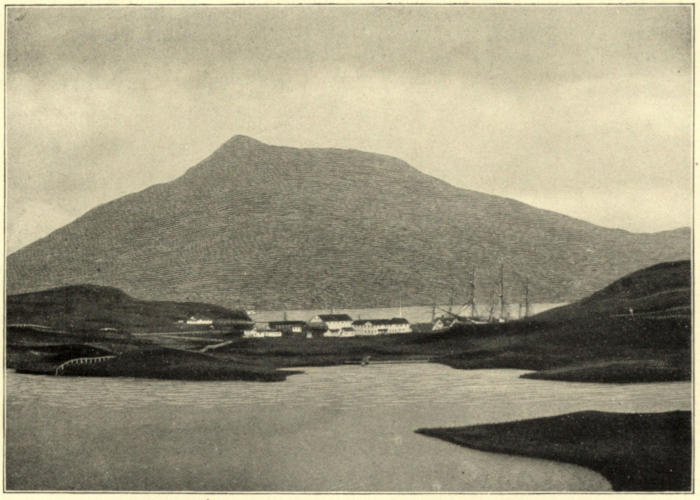
HARBOR OF UNALASKA
Like a necklace about the throat of Bering
Sea, the Aleutian Islands swing in a cloud-capped
circle of peaks to within about five
hundred miles of the Siberian coast. The
story of their discovery and exploitation by
the Russians is one of romantic interest,
thrilled through with horror at the needless
oppression and slaughter of their gentle inhabitants.
It was in the year 1740 that the
Russians first sighted them, on the ill-fated expedition
of Bering and his fellow commander
Chirakoff. During the preceding centuries
the little white sable known as the Russian
ermine had led the wild Cossack huntsmen
across the Siberian steppes to the shores of
Kamchatka. The value of east Siberian furs
in Russian markets was great, and when the
wild huntsmen and traders reached the sea
limit, they learned from the natives legends
of land yet beyond, over-sea, where furs were
still more plentiful. Accordingly, with a commission
from the Russian court, Bering and
Chirakoff fitted out two little vessels and set
out upon these unknown seas on a voyage of
discovery. Bering touched the mainland of
Alaska, but soon started for home. Chirakoff
visited several of the Aleutian Islands and
finally reached Kamchatka again, after losing
many of his crew from starvation and disease.
Bering, however, was wrecked on the Commander
Islands, just off the Gulf of Kamchatka,
and died there, but after incredible
hardships a remnant of his crew reached the
mainland. They had been obliged to subsist
on the flesh of the sea otter during their stay
on the islands, and they brought back with
them some of the pelts of the animals. These
were received with great favor in Russia, and
the high price offered for the skins gave a
great impetus to further exploration of the
islands, on which they abounded. Expedition
after expedition was fitted out in crazy
vessels, and the Promishlyniks, as the Russians
called these savage huntsmen and voyagers,
began to overrun the Aleutian chain.
Often their unseaworthy ships were wrecked
in the gales which surge about the islands.
Hunger and disease decimated their crews,
and many an expedition started out boldly
into the untried tempestuous waters, only to
disappear and be no more heard from. Yet
now and then an unseaworthy craft would
escape the gales, and with half an emaciated
crew return, the ship loaded down with
many thousands of sea otter, fox, and seal
skins, meaning great wealth to the survivors.
Nothing could exceed the boldness and hardihood
of these men. The half-starved, disease-smitten
remnants of the unsuccessful
crews would immediately dare the myriad
dangers again in a new expedition, so great
was their courage and so tempting the prize.
We have scant records of the expeditions, yet
in those of which we know the misery and
death, even when success resulted, is appalling.
Yet they kept on, and the boldness
and hardihood of the Cossack hunter-mariners
were equaled only by their rapacity and
cruelty. Invariably met with goodwill and
hospitality on the part of the natives of the
mountainous islets, their return was invariably
oppression and cruelty in the extreme.
A busy, contented, hospitable people swarmed
in the sheltered coves of the rocky isles when
the invasion began. Within thirty years but
scattered remnants were left, enslaved, diseased,
discouraged. Once only, on Unalaska,
they took advantage of the winter and slaughtered
their oppressors who remained on the
island, but with the spring came new hordes,
and they were obliged to sue for peace, with
slavery.
This uprising took place in the winter of
1763, and the story of the escape of two of
the Promishlyniks, driven to the mountains,
at bay on a rocky headland, concealed in a
cave, fleeing alongshore in a captured canoe,
always with tremendous odds against them,
yet always winning in the unequal fight, is an
extraordinary one.
Most of the Aleutian Islands to-day are
barren, and desolate of inhabitants. Few if
any Russians remain, and but a handful of
Aleuts. Moreover, the greed of a century
and a half has practically exterminated the
sea otter. Once so common that it might be
killed with a club, the animal is to-day one of
the most wary known, and the price of a single
skin is a fortune to the Aleut hunter, of
whom a few still seek for the prized fur. The
Russian domination passed with the sale of
Alaska to the United States. The American
domination is kindly, but the Aleut does not
thrive, and it seems but a few more years
before he will have passed into the category
of races that have faded before the advance
of the white man.
The Bowhead made only a brief stay at
Unalaska. Here some coal was added to
their supply, and store of fresh water was
taken from the reservoir, established by one
of the big trading companies that have stations
there, at the seal islands, and at St.
Michaels, at the mouth of the Yukon River.
Then the anchor was hoisted, they steamed
out of Captain’s Bay, by the strange headland,
Priest Rock, which marks its entrance,
and with a southerly wind in the sails left the
clouds and snowy peaks behind. Their prow
was set toward the mysterious north, and
already the man on the lookout was on the
watch for the blink of Bering Sea ice not
yet melted by the spring sun.
CHAPTER III BUCKING ICE IN BERING SEA
Harry sat at the mess-room table one morning
a few days later, writing the first chapter
in what he rather shyly called his “report.”
He had learned much from Captain Nickerson
of the habits of the humpback whale,
which frequents the Aleutian Islands, and the
dangerous circumstances under which vessels
would work while whaling in these waters.
The captain had declared that it was not
worth while to hunt the humpback, that the
dangers and losses would more than balance
the gain, and Harry believed him. Nevertheless
it was on such things as these that
Mr. Adams wanted knowledge, and so he was
jotting down what he had learned.
The old humpbacks are born fighters. The
shoals and currents, the fogs and gales, of the
islands are their allies, and right well do they
know how to take advantage of them. Once
an iron is fast to a humpback, his first impulse
is to turn and crush the puny boat which has
stung him. Failing in this, he rushes to a
shoal, and rolling on the bottom tries to roll
the iron out, or he swings in and out the narrow,
reef-studded passages, and often wrecks
the boat that is fast to him. Even if he fails
in all these attempts and is killed, the swift
currents and the fog which surrounds make
the bringing of the carcass to the ship difficult
and dangerous. Hence, now that the
Aleuts have passed from the islands, he is left
to pursue his ways in peace. “Why bother
with him,” say the whalemen, “when just a
little way to the northward are the bowheads,
far more valuable, and as a rule killed almost
without a struggle?”
Now and then Harry lifted his head from
his work to listen to a peculiar grating sound
that seemed to come from the side of the
ship. It was the same sound that a small
boat makes when it touches a gravelly bottom,
and he noted also that steam was up on the
vessel, and knew by the slow pulsations of the
screw that they were proceeding at half speed.
He was curious about all this, but decided
that he would finish his work before he went
on deck. Then a faint, far-away cry came to
his ear. The man at the masthead had sung
out—“A-h-h blow!”
The next cry was neither faint nor far, for
it came from the mighty lungs of the great
boatswain. “Whale—o!” he shouted;
“tumble up lively, lads. There’s a bowhead
out here in the ice.”
Harry tumbled up lively, indeed, but he was
at the heels of the members of the crew, who
had been below at the call, for all that. He
found himself in a new world. During the
early morning hours the ship had entered the
southern edge of the Bering Sea ice, and was
steaming steadily northward into it. Thus
far the ice was neither thick nor in force, scattered
floes to the right and left leaving open
leads through which the vessel pressed, rubbing
her sides against floating fragments as
she passed. It was this scattered “slush” that
had made the grating sound on the ship’s side.
A big bowhead was playing leisurely along in
the broken ice some distance ahead, now diving
beneath a floe, now appearing in an open
space, feeding, and unconscious of danger.
The open water and the ice round about was
no longer the clear green which it had been,
but was turbid with a brownish substance like
mother-of-vinegar.
“What’s that stuff?” asked Harry.
“Whale food,” answered Joe; “the sea is
full of it about here at this time of year.”
“Well, I’m glad I’m not a whale,” said
Harry; “I’d hate to eat that.” The brown,
muddy, clotted messes were even frozen into
the ice. They consist of minute forms of low-grade
animal life, and are certainly not palatable
in appearance. Yet the bowhead is fond
of them. He sculls along with his mouth
wide open, the bone in his upper jaw reaching
down to his lower lip on either side, and making
of his mouth a cavern into which food,
water, and all enter. Once the great mouth
is full he pushes his enormous spongy tongue
up into it, squeezes the water out through the
whalebone sieve, and swallows the food left
behind.
One bell sounded in the engine-room. The
throb of the screw ceased, and the Bowhead
glided gently along an open space of water
toward her namesake.
“That fellow will go sixty barrels, and a
good lot of bone,” said Captain Nickerson.
“Lower away there!”
Two whaleboats were swung over the side,
the first mate in charge of one, Captain Nickerson
in the other. Joe was left behind, nominally
in charge of the ship, and Harry, of
course, remained with him. His nerves were
a-tingle with the excitement of the chase, and
he ardently wished he might be in one of the
two boats.
“Hard luck, isn’t it?” said Joe, who noticed
his excitement. “Tell you what, we’ll
get ready for a strike ourselves. There’s likely
to be more than one bowhead about, and we’ll
get up some gear in case they want more of
it. Here, Billy,”—this to one of the Kanakas
on deck,—“get up a couple of tubs of
that extra line.”
“There’s no knowing how soon we’ll want
another boat away. I’ll get up another bomb
gun and a supply of ammunition. Then
we’ll be heeled, as they say in Frisco.”
Harry handled the bomb gun when it arrived,—a
short, ponderous weapon of brass,
clumsy indeed to one accustomed to handle
an ordinary rifle or shotgun, but very efficient
in the service for which it is intended.
Joe showed him how it was used, and even
loaded it, placing it carefully against the rail.
The two boats, zigzag fashion, approached
the whale through the floes, the captain’s
much in advance, and finally came up with
him. Cautiously they glided on till the
bow of the foremost just grazed the black
back. Then the harpooner, with a mighty
thrust, sent the iron deep into the blubber,
and the boat backed rapidly away.
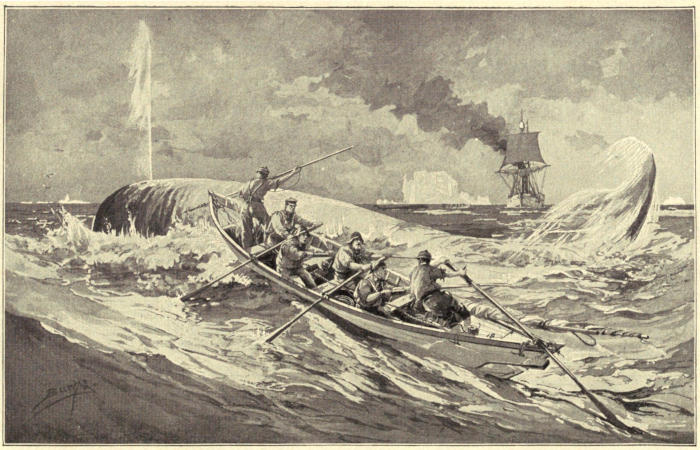
“The gun missed fire! The gun missed
fire!” shouted Joe excitedly; “they’ll lose
him!”
So it seemed, for there was no sound of an
explosion, only the welt of the whale’s flukes
on the water as he sprang into action at the
thrust of the harpoon. With this one great
splash he went below the surface, sounded, as
the whalemen say, and there was no sign of
his presence except the two boats and the rapidly
whizzing line as it ran out through the
chock.
“They’re heading this way,” said Harry;
and so they were, the captain’s boat standing
bow on beside a floe, with the line whizzing
against the edge of the ice, and the first
mate’s men pulling with all their strength
toward the ship. Then they heard the warning
shout from the captain,—
“Watch for him, we’ve parted.” The
rough edge of ice had cut the line, and the
whale was free.
The bowhead’s chances for getting away
were good. He would come to the surface
again only for a breath, and then continue
his flight to safety in the distant ice fields.
But now came one of those happenings which
prove how wise it is to be prepared for any
emergency. Joe, in getting up that extra
gear and the gun, had unwittingly saved the
day. As both boys stood by the rail gazing
toward the boats, there came a crash in the
weak ice just alongside, a black bulk crushed
up through it, and with a gasp like that of a
steam exhaust a puff of vapor shot up right
in their faces.
“There he is! There he is!” yelled Joe
frantically; “give it to him!”
With the words he snatched up the iron
at his side, and hurled it downward with all
his strength into the head of the whale, where
it stuck quivering. At the same time Harry,
yelling like mad in his excitement, caught up
the bomb gun, put it to his shoulder as if it
were a toy, and discharged it full into the
middle of the black mass, which he saw as
through a mist heaving in the crushed ice.
There was a dull, heavy sound of a muffled explosion,
and the whale quivered and stopped.
Then came a wild hurrah from the ship, and
an answering one from the boats. The boatswain
sprang up the short ladder from amidships
to their side.
“Mighty good, young fellers,” he shouted,
almost as excited as they; “you plunked
him fair, and just one chance out of a thousand.
Whoop! but we’re a whaling crew.
Greenhorn bagged the first bull right from
the quarter deck. Whoop!”
The bowhead lay motionless, evidently
dead, and the boatswain made the line fast to
a cleat. Then he sang a variation of an old
sea chantey, cutting a ponderous pigeon wing
to the tune—
“Tra la la, tra la la, tra la la boom,
Lorenzo was no sailor,
Tra la la, tra la la, tra la la boom,
He shipped on board a whaler.”
“’Vast there, bosun,” he said to himself,
suddenly sober; “no monkeyshines on the
quarter-deck. Get down amidships where
you belong. Hi there, you Kanakas! clear
away that cuttin’-in gear. Step lively now,
they’re alongside.”
The boats were no sooner at the davits
than preparations for cutting-in the whale
were made. He was hauled alongside, head
toward the stern, and a heavy tackle was
rigged to the mainmast head. Then the cutting-in
stage of planking, rigged so as to
swing from the side of the ship out over the
carcass, was put outboard. Two men, each
with the great steel chisel which the whalemen
call a spade, took stations on this. A
longitudinal slit was cut in the blubber just
back of the flipper. Then cuts were made
from this round the carcass, a hook from the
tackle was made fast in the end of the strip,
and hoisting away on the tackle the blubber
was peeled from the dark meat beneath in a
spiral peeling, somewhat as one might peel an
apple. As the weight on the tackle grew great,
the strip was cut away and hoisted upon the
deck amidships. Meanwhile, others of the
crew had started fires beneath the great kettles
forward, and the blubber, cut into small cubes,
was put in these. At first this fire was of
wood, but as the work progressed the scraps
from the blubber were thrown into the grate
and burned fiercely, giving off a thick black
smoke that had a disagreeable odor of burnt
flesh.
By and by the blubber was all aboard, filling
the space between decks with its quivering
oily masses, among which the crew plunged
and worked like demons. The furnaces
spouted smoke and oil, and remnants of
blubber made the decks slippery. Last of all
the tackle was carefully made fast to the head,
and the ship listed to one side as the donkey
engine put a strain on the great mass. Then
the great backbone was severed by the spades,
and the tense tackle sang as the enormous bulk
was swung inboard and landed safely on the
deck.
“What for goodness’ sake is that in his
mouth?” asked Harry.
“That’s the bone,” replied Joe; “and a
fine head of bone it is. Some of the slabs
are eight or nine feet long.”
“Well, I never thought whalebone looked
like that,” said Harry, gazing in astonishment
at the black slabs varying in length from one
foot to eight that extended down from the
upper jaw. They were flattened, nearly a foot
in greatest diameter at the base, and tapering
to a thin tip. This was fringed far up on the
sides with what resembled horsehair.
“Can he shut his mouth with all that in
it?” asked Harry.
“Oh, yes,” replied Joe. “The tips fit into
the groove between the tongue and the lip,
and point backward when he shuts his jaws.
They are very elastic, as you know, and they
spring and bend close together.”
The boatswain and the mate busied themselves
cutting out these slabs of bone, which
were piled away to be cleansed before stowing
them. The boatswain was jovial and talkative.
He sang snatches of sea songs, made jokes,
and tried to draw out his companion as they
worked; but the taciturn mate was as silent as
ever. Not so Harry and Joe, who put on oil-skins
and worked with them. After the bone
was removed, the head was tipped overboard,
and floated away with the stripped and abandoned
carcass. Arctic gulls had gathered in
troops from no one knew where, and dogfish
were already nibbling at it. It would not be
many days before the meat would be stripped
from the bones, and the latter resting on the
shallow bottom of Bering Sea.
“Pity the mersinkers could not have that
meat,” said the boatswain. “It would make
a feast for a whole village for a week.”
“Who are the mersinkers?” asked Harry.
“The natives over at East Cape,” said the
boatswain; “that’s what they call themselves.
You’ll see them in a day or two,
probably.”
The twilight of early June lasts in Bering
Sea until almost eleven o’clock; then flares
were lighted of scraps and blubber in wire
baskets, making torches that lighted up the
gloom with weird, fantastic glare, and still the
work of trying out went on. The men loomed
in and out of the shadows like strange goblins
at uncanny sport. The fires illumined a brief
circle of the desolate ice, and showed only a
part of the rigging which made ladders into
an unknown gloom, and the whole was like a
midnight assembly of goblins of the strange
ice world, working spells about witch kettles
that far outdid the wild work of the witch sisters
in “Macbeth.” The brief night had
passed, and the morning sun was shining on
the ice again, yet the incantations did not
cease, and it was two days before the last of
the bowhead’s oil was stowed in casks below
decks. Then only the weary crew had a brief
rest, before the ship was cleaned and scrubbed
down. Nearly a thousand pounds of whalebone
was the most valuable result of this first
catch, and as the market price of bone at San
Francisco was something over three dollars a
pound, Harry had matter of interest to jot
down in his report as to the methods and
profits of the pursuit of the bowhead.
The vessel now found herself in the middle
of the Bering Sea pack ice. Here and there
were open leads still, but they were fewer, more
narrow, and much less connected. Now and
again there were places where contrary winds
and currents had crushed the floes together,
piling the crumpled cakes high on one another
in wild confusion, often to a height of twenty
or thirty feet. Joe called these hummocks
icebergs, and Harry and he had much friendly
controversy as to the correct use of that term.
Harry explained that he had learned that icebergs
were the product of glaciers alone, that
there were no glaciers on the Alaskan coast
north of the Aleutians, and that these should
properly be called hummocks. In this he was
right, but Joe, with the pride of the man who
“has been there,” would not concede it.
Whatever they were, they totally prevented
the progress of the vessel, and when they appeared
in the path, the Bowhead was obliged
to make a detour to avoid them. Now and
then they were obliged to “buck ice” to get
from one lead to another, and the process was
very exciting. The vessel under a full head
of steam would plunge straight at the field of
heavy ice, striking it with a thump that entirely
stopped progress and shook the structure from
stem to stern. The masts would spring under
the blow, and at each shock Harry fully expected
to see Captain Nickerson jolted from
his perch in the crow’s nest, high on the fore-mast.
Then the ship would back away again
at the captain’s order, leaving a three-cornered
dent in the ice. Again and again she would
rush at this dent with her great weight under
full head of steam, till the floe would split, and
leave a narrow crack through which the vessel
could crowd her way. Thus for several
days they hammered their way on through
the pack, until they reached its northwestern
edge, where open water gave them free passage
to the ice-bound shores of east Siberia.
There they came to anchor under a headland,
and though it was mid-June and did not seem
cold, were greeted by a storm of snow that
came scurrying down from the snow-clad hills
inland.
BUCKING THE ICE
Next day it cleared, and the skin topeks of
a Chuckchis village could be seen on the barren
shore. A strip of shore ice still separated
them from the land, but the natives came dragging
their umiaks across this and then put to
sea in them, soon paddling alongside. There
were a dozen or more in each boat, men, women,
and children, all clad much alike in walrus-hide
seal-top boots, sealskin trousers, and
a hooded coat of reindeer fur which extended
nearly to the knee. Men and women and the
older children alike paddled, and the walrus-hide
boats made rapid progress over the
waves. Once alongside they made fast and
came aboard, all hands, smiling and silent,
sitting or standing for a time until addressed
by some one who was or seemed to be in authority.
Then they spoke, and conversation
was soon general. It was limited, however.
Many of the men know considerable English
of the “pigeon” variety, and most of the
whalers are familiar with the trade language
of the Eskimos of Bering Sea and the straits,
which consists of Eskimo, mingled with words
and phrases picked up from the whalers and
traders, and originating Heaven knows where.
Possibly some are Kanaka words transplanted
far north. Others are words invented by the
sailors on the spur of the moment, which, once
applied by the natives, have been adopted into
general use.
Each native had a sealskin poke which he
carried slung over his shoulder by a rawhide
thong, and which consisted of the skin of
the ordinary Arctic seal taken off whole, and
tanned with the hair on. A slit was cut in the
side of this, making a sort of traveling-bag,
in which he carried articles which he was to
offer for trade. Within these pokes were walrus
tusks, plain and carved, some elaborately;
walrus teeth carved into grotesque imitations
of little animals; “muckalucks,” the trade
word for the native skin-boot; “artekas,” or
coats of reindeer skin; furs of ermine, mink,
otter, and the hair seal; in fact, anything
which the mersinker could find at home that
he thought the whalemen might fancy. None
of these goods were offered on deck, however.
Each waited until the captain, sitting in state
in his cabin, sent for him; then one by one
they went down to trade. After each man
had made what bargain he could with Captain
Nickerson, he brought what was left to the
deck, and there traded freely with the sailors.
As supercargo, Harry sat in the cabin with
Captain Nickerson, and kept account of each
trade as it was made, having good opportunity
to watch the methods of the natives.
He found them very clever at barter, Captain
Nickerson, Yankee that he was, often meeting
his match in some stolid native, who seemed
to have a very clear idea of what he wanted,
and how to get it. The first day of trading
was merely preliminary, however, the natives
bringing off their least valuable goods for
barter, reserving the best of the ivory, and all
the bone, until they found how prices were
going, and whether the ship held such supplies
as they needed or not. Their first demand
seemed to be for hard bread, of which they
are very fond. For this they offered, as a
rule, the muckaluck, or native boot. Calico,
as they had learned to call all forms of cloth,
came next; then flour in bags, and later ammunition,
rifles, and trade goods. Of brown
sugar they were desirous, and chewing tobacco
was asked for almost as soon as the hard-tack.
This they called kowkow tobacco, or eating
tobacco, from their trade word “kowkow,”
meaning to eat. Harry made note of the
Eskimo words as he heard them used, and
picked up a working vocabulary, with the help
of his notebook, in a very short time. Before
the first day’s trading was over he had begun
to understand what was meant, and by the
end of the third day he astonished Joe with
his fluency. As a matter of fact, his vocabulary
thus far consisted of only forty words or
so; but as they were the ones in most constant
use, it made him seem quite a linguist. From
this time forward he took great pains to jot
down a new word and its meaning as soon
as he heard it, getting many from the officers
and crew, and this quick acquisition of
the language was to stand him in good stead
later on.
At the end of the third day trading had
ceased. There were great piles of deerskins,
muckalucks, and small furs, several hundred
pounds of not very good bone, quite a quantity
of ivory, and many trinkets and curios. Harry
wondered greatly as to the destination of
much of this stuff.
“Are reindeer skins worth much in the
States?” he asked Captain Nickerson once, as
the pile grew larger at the expense of much
flour and calico.
“I don’t think there is any market,” replied
the captain, “though it is hard to see why.
The fur is very thick and warm, the skin light,
and should make most excellent lap robes and
carriage robes, just as the buffalo fur once did.
We shall trade them again when we meet the
Eskimos on the other side of the straits.
The caribou is scarce over there, and they
gladly exchange fox, ermine, and bear skins
for them. These we can dispose of readily in
Frisco.”
A good quantity of bone was in hand, but
it was only a part of what the natives had
taken, as the captain knew. Two whales had
been their good fortune as the ice came down
the fall before, and a third had come to them
that spring as the gift of the orcas. These
eat the lip and the soft tongue of the bowhead,
leaving the carcass to float ashore. Hence
the mersinker looks upon the orca with a sort
of veneration as a provider of great and valuable
gifts, and has certain ceremonies which
he goes through each year as an invocation to
him and an expression of gratitude. The
mersinker, in fact, is a man of many ceremonials,
the reason for which he does not know,
but which he follows because his father did the
same before him. These three whales had been
small ones, but there must have been far more
bone from them than the natives brought to
the ship for sale. The balance they were
keeping back for further trading with other
ships, nor was it possible to get them to bring
this out, even by offering increased value for
it. They held it in reserve, as is their custom,
hoping that the next ship would bring goods
which they would care for more than those at
hand.
Captain Nickerson wished to purchase some
reindeer for fresh meat, but none were at the
coast. The deermen were said to be stationed
in a valley half a dozen miles in the
interior, and he decided to send an expedition
inland in search of some. A coast native
volunteered as guide, and brought along
a sledge and dog team for the transportation
of supplies. Mr. Jones, the taciturn first
mate, was detailed in command of this expedition,
and Harry and Joe were allowed to
go, with many injunctions to be careful not
to get into trouble with the Chow Chuen, as
the deermen call themselves.
It was a perfect June day when they set
off. There was no breath of wind, and the
sun shone brilliantly as they landed on the
shore ice, transferred their supplies to the
sledge, and set off through the native village
toward the hills. They had instructions not
to be gone longer than over one night, and it
was agreed that a signal of trouble and need
of assistance should be three shots repeated in
quick succession. Such precautions were necessary
as the Chow Chuen, though generally
willing to barter, are of uncertain temper, and
even the mersinkers are not to be trusted when
they seem to have an advantage. Harry and
Joe tramped on ahead of the company, the
Eskimo following with his team and sledge,
and Mr. Jones bringing up the rear. The
air was warm, and on bare spots the spring
grass was already growing through the tundra
moss, but the snow still covered most of the
earth, and the trail lay across it, well trodden.
Each boy carried a rifle and was well supplied
with cartridges, while Harry had in
addition a small camera slung over his shoulder
by a strap. The boys were in high glee at
the outing, after the long confinement aboard
ship, and rollicked along well ahead of the
others. Yet their progress was slow, the way
winding, and it was lunch time and yet they
had not reached the upland valley, where the
camp of the deermen was said to be. A
few dry twigs of willow—the only growth
of wood, and this in the main creeping vine
fashion, and rising only to a height of two or
three feet—were found to feed a fire, and a
pot of tea was boiled. Then after the men
had taken a hasty smoke, the journey was
resumed. It was mid-afternoon when they
seemed to be reaching the summit of a low
divide. The six miles had stretched into a
dozen, and there was no sign of human life
among the hills, only the beaten trail leading
steadily on over the snow. The mate had
seemed anxious for an hour or so, and had
swung into the lead along with the boys.
“Home pretty soon,” he said, wasting no
words; “most far enough.” A moment after,
they rounded a ledge of broken basaltic rock,
and looked down upon a scene of pastoral life
such as only the extreme north of Asia can
show. A brown and sheltered valley wound
among the rude hills. It was bare of snow
in the main, and the golden brown moss, with
which it was carpeted, showed green with
grasses already springing in it. In scattered
groups about this grazed several hundred reindeer,
many brown in color, some piebald, the
old ones bearing branching antlers, the fawns
spotted, and gamboling like any young deer.
Here and there, fur-clad herders watched
them, and there was a little group of large
skin topeks at one side of the valley not far
off, the homes of the herders and their families.
Thither they turned, the coast native
taking the lead now. They were near the
little hut hamlet before any one took notice
of them, when a man suddenly appeared with
a rifle in his hands. He was taller than the
coast native, and seemed more robust. He
fearlessly pointed the rifle at the approaching
party.
“Way enough!” shouted Mr. Jones.
“Hold water!”
At a wave of his hand the Eskimo went
ahead resolutely, his hands held up palm
forward as a sign of peace, and shouting,
“Nagouruk! Nagouruk!”
The deerman lowered the muzzle of his
rifle, and the two talked for a moment. Then
the Eskimo made a sign for the party to come
forward. The deerman met them with the
word “Nagouruk,” which means “Good,” in
token of friendship, and talked with the Eskimo
volubly in a dialect that no one in the
party could make much of. The other, who
could speak some English, explained that it
was doubtful if deer could be bought. It
had been a bad winter, many had died in the
deep snow, and they wished to let the herd
increase during the spring and summer, lest
they face starvation next winter. In any
case, it would be necessary to consult the
head deerman, and he would send for him.
“Watch out,” said Mr. Jones to Joe and
Harry. “Don’t like this gang.”
The deermen’s topeks numbered about half
a dozen, scattered along the sunny side of an
abrupt turn in the cliff which bordered the
valley’s edge. The deerman lifted the flap
of one of these, and motioned them to enter.
A crowd of curious women and children, the
smaller of these latter perched on their
mothers’ shoulders astride their necks, had
begun to gather. Men came running up
from the other topeks, and the little party
was soon being stared at, criticised, and even
poked and hustled, in half-curious, half-insolent
fashion. The Chow Chuen are certainly
no respecters of persons. They hate and distrust
the white man, but they do not fear
him.
Mr. Jones hesitated. Then he motioned
to Harry to stand by the sled. “Stand watch,
will you?” he said. “Keep ’em off. Don’t
get gallied.”
Harry, rifle in hand, took his stand by the
sled, while the other three entered the topek.
The Alaskan coast native builds a small summer
shelter, but the Siberian coast native, and
the deermen of the uplands inland, build
great ones, sometimes thirty feet in diameter.
These are covered with skins, held down
with rawhide ropes and stone weights against
the furious gales of that country. Within
is a central common space surrounded by
smaller rooms, made by deerskin curtains.
They found this central room empty, but a
rustling behind the curtains showed that the
others were tenanted. The deerman bade
them wait and went out, soon returning with
another of his kind who seemed to be the
head man, and followed by half a dozen
others. Then the bargaining began, the
Eskimo acting as interpreter, and signs filling
up the spaces where words failed.
Meanwhile, Harry was very busy outside,
and somewhat worried. The entire population
of the hamlet seemed bent on investigating
him thoroughly. They made derisive
remarks about his clothing, and tried to put
their hands in his pockets, which they seemed
to admit to one another were good things to
have. One man took off his hat and started
to put it on his own head, amid laughter from
his comrades. He seemed to resent it when
Harry snatched it away, and touched his knife
significantly. But when one attempted to relieve
him of his watch and chain he was forced
to draw back hastily, for Harry felt that the
limit of patience was about reached, and
cocked and pointed his rifle threateningly.
The others seemed to enjoy the hurried retreat
of this man, and to deride him for
cowardice. However, the men kept out of
arm’s reach after this. Not so the women and
children. Their attentions were not only to
himself, but to the sled; and he soon saw
that under their carelessness was a systematic
attempt to cast off the lashings and get at
the goods there. During all this annoyance
he happened to think of his camera, and decided
that at least he could get a picture or
two to counterbalance the trouble. So, unslinging
it from his back, he slipped the
little instrument from its case, drew out the
bellows to the universal focus, and proceeded
to point it at the most picturesque of the
insolent group. The effect was magical.
They tumbled backward from the machine
with alarm. When they saw the flick of the
shutter as he pressed the button, they threw
their hands before their eyes and retreated,
repeating a word which he did not understand,
but which he learned later meant
“magic.”
This amused Harry greatly, and afterward
he had only to point the camera to widen the
circle about him; and to take a new picture
was to send arms flying to the faces that
were in range. They seemed to think something
would come from it to injure their eyesight.
They resented this threat, however,
and there were black looks on the ugly faces
of the men when the mate and the head deerman
appeared from the topek followed by the
others. The bargain had been satisfactorily
concluded, and the deermen went off to drive
in the purchased reindeer, while Jones and
his lieutenants took the goods from the sled.
The crowd of fur-clad Chow Chuen stood
about, but kept a respectful distance from the
camera.
But when the half-dozen deer were driven
up, there were fresh complications. Mr. Jones
was about to slaughter them at once, and had
passed the goods over to the head deerman,
when a great outcry arose. The deermen
flocked about the Eskimo, and seemed to demand
that he tell the whites something, which
he did.
“No kill. No kill,” cried the Eskimo in
much alarm; “Chow Chuen kill.”
“Well, tell them to go ahead and do it,
then,” roared Mr. Jones, so angry that he was
fluent. “It’s nightfall now, and we’ve got
a long road ahead of us.”
The Eskimo was much disturbed. He explained,
with a strange mingling of Eskimo
with his scant English vocabulary, that there
was a ceremonial to be gone through with
first. It could not be done at nightfall, they
must wait the rising sun. “One sleep,” he
said. “Nanaku kile. Bimeby he come,”
pointing to the sun. “Mucky” (Dead), with
a sweep of his hand toward the reindeer.
In vain Mr. Jones stormed with picturesque
and unexpectedly voluble profanity; the deermen
were determined. The head deerman
ordered the goods brought out and laid at
the feet of the company, scornfully waving
his hand toward the home trail, indicating
plainly that they might consider the trade off,
but he would not have the deer slaughtered
then. Mr. Jones would not return without
them, and so they waited.
“Tell him,” he said sulkily, “we’ll wait
till sunrise.”
The Eskimo explained, and this seemed to
clear matters somewhat. Some tobacco offered
them helped still more; and the head
man drove the crowd away, evidently telling
them to go about their business, which they
did reluctantly. He conducted the party
down the line of topeks to one which was
near the end, and told them that that was to
be their habitation for the night.
“We’ll stand watch and watch,” said Mr.
Jones, as they entered this; “no knowing
what these rapscallions will try to do to us, if
we all go to sleep.”
The interior of this smaller topek was all
one room, and there were no traces of former
occupancy, which was satisfactory. It gave
promise of reasonable cleanliness, which could
not be said of the others. It was no doubt
a storehouse not in present use. The sled,
their blankets, and belongings were hauled
inside; the dogs were tied to the tent-poles
outside, and the Eskimo disposed of himself
as best he might. Joe stood the first watch,
while Harry and Mr. Jones rolled themselves
in blankets on the mossy floor of the topek
and were soon asleep. It was still light,
though the sun was behind the northern
mountains. Indeed, in June in that latitude,
there is but a brief interval of dusk at midnight.
The deermen retired to their topeks,
except those on watch with the herd, and
save for the howl of an occasional wolf-like
dog, peace reigned.
At midnight Joe woke Harry, and he went
on guard. A gray dusk hung over everything,
there was a sharp chill in the air. All things
seemed touched with a white fungous growth,
which was frost. From behind the northern
mountains the sun shot dancing streamers
like aurora halfway up the sky. The whole
scene was beautiful but strange, and gave
Harry a sense of the ghostly and supernatural
which was hard to shake off, and which he
was often to feel still more vividly as he saw
more of Arctic nights. The prowling, howling
bands of Chow Chuen dogs loomed large
in the uncertain light, and it seemed hard not
to believe that they were bands of wolves bent
on destruction. He was glad indeed when
the first glimpse of the sun came over the
mountains to the northeast, and it was time to
call Mr. Jones. The night had passed, and
they were not molested.
A SIBERIAN TOPEK
With the sunrise the whole hamlet was astir
for the ceremony of the slaughter of the reindeer.
The six deer purchased were led up,
and the shaman of the village appeared from
his lodge, which was decorated with strange
devices and carved images. He held in his
hand a long, sharp knife, and as he passed
Harry the boy inadvertently drew back, so
fierce and sinister was the look on his evil
face. Each deer in turn was led up to him
and faced to the east. The shaman held his
knife toward the sun, recited something that
seemed like a liturgy, then with one thrust
sent the keen knife full to the heart of his
victim. With a bleat the animal fell to its
knees, then rolled over dead, and the shaman,
rushing forward, caught the blood from the
wound in his palm, scattering it toward the
sun with more words, or perhaps the same,
of the ritual. Thus each deer was slain, and
in a twinkling was fallen upon by the Chow
Chuen and the entrails removed. The bodies
were then placed on the sled, and it was evident
that the adventurers might take their
departure, which they were glad to do. A
mile or two down the trail they breakfasted
on deer steak, broiled over the few willow
twigs they were able to find, and went on,
reaching the ship at midday. Captain Nickerson
received them gladly and was pleased at
their success, but had a long conference with
the Eskimo. Then only they learned that
the treacherous and ugly Chow Chuen had
been much incensed at their wish to take the
deer and slaughter them without the legendary
rites of the tribes, and would have attempted
to murder them during the night.
The Eskimo had dilated upon the strange
power of the little “magic box,” which he
told them could take each man’s image and
carry it away (he having seen photographs
taken with a similar one by previous visiting
white men), and crafty and superstitious as
they are fierce, the deermen wisely decided
to let the strangers alone. No doubt the fact
that they stood armed watch had its effect as
well.
The next day a southeasterly gale sprang
up, and the vessel was obliged to hoist anchor
and get away from the dangerous coast.
CHAPTER IV THE LITTLE MEN OF THE DIOMEDES
In the unremembered ages it is probable that
the extreme end of Asia, which is East Cape,
Siberia, was joined to the extreme western
end of America, which is Cape Prince of
Wales, Alaska. No tradition remains of the
time when the sea broke through this slender
barrier, yet even now it is but about thirty
miles in a straight line across, and on clear
days from the mountains of one promontory
the other can be faintly discerned. There is
a halfway station, too, two storm-beaten islands
which lift rocky crests of grim granite
in the very middle of the hurly-burly of the
straits. These are the Diomede Islands, the
greater belonging to Russia, the lesser to
America, and the space between the two is so
narrow that it seems in bright weather as if
one could almost throw a stone across, though
in reality it is more than a mile—farther
than it looks. Across this slender land path
in those forgotten years came one race after
another from Central Asia, which was the
birthplace of races, pressing southward and
peopling the Western hemisphere with tribes,
of which scant traces remain in some instances,
while in others their degenerate descendants
are still fading before the westward
rush of civilization. Individuals cross this
narrow barrier of tempestuous sea still, but
races come no more, and we find on the halfway
station of the Diomedes a remnant of
some ancient people that has stranded there
and made a home where it seems scarcely
possible that human creatures could live the
year round.
Here during the recent centuries met the
Asiatic and Alaskan Eskimos, to trade and
fight; and the bold, bare cliffs have been the
scene of many a bloody battle. Now even
this custom has passed, and the men from one
side of the straits rarely meet those of the
other; but the little remnant of an unknown
people, who stranded there no one knows how
long ago, still cling to their rocky islets and
live as did their forefathers. You may find
among them some who bear the mark of the
Chuckchis, some who are more like the Alaskan
Eskimos, but the little folk, while having
the manners and customs of each, have
characteristics which belong to neither. Hardly
five feet in height, they are too small to have
battled successfully with their more robust
brethren, but they make up in slyness and
ability what they lack in brute strength.
They are shy and reticent, clever workmen,
clever thieves, and cleverest of all in trading.
No vegetation save grass and chickweed
grows on their cliffs. They build their dwellings
of flat stones banked with scant earth,
and the icy sea, which rims them round and
seems to threaten with certain death, is their
father and their mother in that it provides all
they have in the world. In the brief summer
an occasional log of driftwood is thrown
against their cliffs, and from this they fashion
their canoe frames and their spear handles.
During all the cold and cruel winter the ice-floes
which crash and grind against the worn
granite of their islands bring the seal and
walrus and the polar bear. These and the
myriad sea birds of summer are their supplies.
For many days the southerly gale which
had driven the Bowhead from the Siberian
shore kept her in much danger. The sea
room was narrow, ice-floes came driving down
before the wind, it was impossible to get
sight of the sun to find the ship’s position,
and the drift of the current toward the straits
was an unknown factor. Most of the time
the vessel jogged under reefed topsails, with
steam up for use in an emergency, and Captain
Nickerson was almost constantly on deck.
Thick clouds made the nights longer, and
very dark, and Harry had a chance to see the
full danger of Arctic navigation.
It was in the gloom of one of these nights
that he stood on deck. The vessel heeled to
the gale, now and then an icy wave sent
a rush of spray over the windward rail, the
wind howled and wailed in the tense shrouds,
and an eerie glow seemed to show in the
darkness without lighting it, as if dull fires
burned behind the cloud curtains. It seemed
to Harry as if they were blown about in chaos,
a place dreary, ghostly, and lonely beyond
expression. He shuddered and thought of
the people at home, happy in the bright June
weather. For the first time he was sorry for
himself, and homesick. He thought with a
great longing of the broad veranda looking
out upon the bay, of his mother sitting there,
and he seemed with his mind’s eye to see Maisie,
in a pretty white gown, flitting gayly across
the lawn toward the boats. Then out of the
night came a wild, despairing cry, and something
fluttered aboard, crashed against the
mizzen rigging, and fell in a draggled white
heap at his feet. The thought of Maisie was
so strong that he sprang forward, with a great
cry of alarm, to pick her up where she had
fallen, when a sudden tremendous gust of the
gale threw the Bowhead on her beam ends.
A wall of white water roared down upon him,
lifted him up with Maisie in his arms, and he
went out into the night with it, still clinging
to the limp figure he had clutched as he went
down.
It was well for Harry that the same sea
that sent him overboard sent with him a coil
of line from a belaying-pin, where it hung
against the mizzenmast. The whirl of the
wave wound this round him, and the great
boatswain, whose watch on deck it was, saw
him go out with it, and finding it taut, and
something towing, hauled away at it until he
could reach down and get him by the collar.
Then with one big swing of his enormous arm
he landed him aboard. He set him in a
heap on the deck, and with a hand on either
knee peered down at him in the gloom.
“Young feller,” he said, with much emotion,
“there’s just one thing I want you to
do for me when we get back to Frisco. Do
you know what that is?”
“What?” asked Harry, wholly dazed and
half drowned, replying mechanically.
“I want you to take all the money I get
this trip and go and bet it on something for
me. A man that can win out the way you’ve
just done couldn’t lose at any game. Great
jumping Jehoshaphat! what have you got
here?”
“Is she all right?” asked Harry, struggling
to his feet. He was still dazed, and had
forgotten all the events of the last two months.
It seemed to him that it was Griggs speaking,
and that he had just pulled him and Maisie
out of the Fore River.
The boatswain took the limp white figure
from his arms and looked at it. It was a
great white bird, quite dead, no doubt killed
by its crash against the mizzenmast.
“Go below, my boy,” he said; “and get
something hot and turn in. You’ve had
trouble enough for one night.”
The great boatswain went forward, holding
the bird in one hand and now and then slapping
his great leg with the other, and letting
forth a roar of amazed laughter.
“A goose,” he said; “a Yukon goose!
Went overboard and came back and brought
a Yukon goose! Well, the young feller is a
seven-time winner. Bet ye we’ll raise whales
this trip, all right.” He went forward to the
galley, where he left his game, and then went
back on watch.
As light grew through the chaos of struggling
mist, the cry of “Land ho!” rang out
from the lookout, and the ship rounded to
so near dark cliffs that stretched upward into
the mists out of sight that she was fairly in
the wash of the great waves that thundered
at their base. A moment after, ice barred
their farther way on the other tack, and a
great floe moved majestically along, bearing
them down toward the cliffs. To lie to was
to be carried in and crushed between ice and
rocks, and Captain Nickerson, who was on
deck, wisely guessing that it must be one of
the Diomedes, wore ship and ran before the
gale, coasting within sight of the great rock
barrier. A half hour afterward he rounded
to and swung close up under the lee of the
towering northeast cliff of the big Diomede;
so close to its sheer lift that one could almost
throw a line ashore.
Here was level water indeed, and they were
safe from the northward driven ice-floes, which
would split on the island’s prow and sail by
to port and starboard; but they did not escape
the wind, which came over the heights in tremendous
“willie-waus,” blowing, as the sailors
say, “up and down like the Irishman’s hurricane.”
This seems to be a peculiarity of
the Arctic gale. It comes tearing over the
great heights, plunges down the steep face of
the cliffs, and striking the water at their base
with tremendous velocity, sends it whirling
out to sea in great masses of spoondrift that
sail along the surface as blown snow does in
winter.
Two days more the ship lay head to the
cliff, swinging to two anchors, then the mists
blew away, the wind went down rapidly, and
the sun shone brightly on lofty granite
heights. Halfway up was a little space of
level ground like a shelf set in a corner of
rock, and out of holes in this green level
came stubby fur-clad men and women, who
swarmed down the cliff by paths of their own
and launched umiaks from a sheltered little
hidden cove, putting out to the ship.
HOME OF “THE LITTLE MEN” OFF THE DIOMEDES
Harry was none the worse for his sudden
plunge overboard a few days before. Instead
of the weakness and lassitude which had followed
his April upset in the Fore River, there
came an immediate reaction, and he declared
a few hours afterward that it had done him
good; he would do it every day, if he could
be sure of getting back to the ship so handily.
The Arctic air was already working
wonders in him. The experienced seamen
shook their heads at this. They knew well
that his chance had been one in a thousand,
and Captain Nickerson rated him soundly for
being so careless as to let a sea catch him that
way.
The little men had much walrus ivory, but
not much else that was of value to the ship,
and their trading did not last long. They
did have many curios, and Harry had an
opportunity to buy some of these with the
“trade goods” he had brought from Seattle
for the purpose. By Captain Nickerson’s
advice he had laid in a few dollars’ worth of
rubber balls, huge beads, little mirrors, harmonicas,
and trinkets, and he now found these
very useful. He bought with them many walrus
teeth; the back teeth, which are as large
as one’s thumb, carved in grotesque but life-like
shape of seals, bear, walrus, and other
animals. Two bargains which he made are
noteworthy as showing the ways of the little
people in trading. One of these was for an
exquisite pair of little shoes, soled with walrus
hide crimped up into miniature boots, topped
with the softest of fur from the reindeer
fawn, and with a bright edging of scarlet
cloth. They were most skillfully fashioned,
and tasteful, for the Eskimo is a born artist,
and were brought aboard by a young woman
who apparently was very proud of them, and
wished rather to exhibit than to sell them.
Harry, proud of his newly acquired Eskimo,
asked her immediately, “Soonoo pechuckta?”
(How much do you want?) but she replied by
shaking her head and putting the shoes away
in her fur gown.
By and by she brought them out again and
patted them lovingly. Again Harry tried to
get her to name a price for them, and after
much labor he got from her the single word
“Oolik” (Blanket).
“Soonoo?” asked Harry again.
“Tellumuk,” was the answer, further emphasized
by holding up five fingers.
Five blankets was so obviously exorbitant
a price that Harry could not and would not
think of giving it, so he thought to tempt
his adversary with the offer of other things.
In vain he brought out tin trumpets, harmonicas,
bangles, beads, and even two alarm
clocks, which he had found elsewhere to be
greatly desired by the tribes, and offered them
singly and in groups; the owner of the little
shoes was determined. To all his offers she
replied with fine scorn, “Peluck” (No good),
and clung persistently to her first price.
But Harry, grown wise, took a leaf from
her own book. He bethought him of a little
plate-glass mirror, rimmed with scarlet plush,
which he had not offered thus far. It had
cost him a dollar and a half at Seattle, but
he was willing to trade it for the shoes. Yet
he was convinced that direct offer would be
useless. So he brought it on deck, and without
looking at the obdurate young woman began
admiring his own countenance in it. When
she took a furtive interest in it, he thrust it
back in his own pocket. After a little he took
it out again, and once more contemplated himself
in its depths. This ludicrous performance
continued for some time, and he could
not tell whether or not his adversary were
much interested, so cleverly did she veil her
thoughts. By and by her boatload of people
were ready to go home, and getting into the
umiak, called to her to come with them. Harry
saw that she lingered, and he played his last
card.
“Ah de gar!” he exclaimed; “ah de
gar!” (Wonderful! wonderful!) and held
the mirror in front of the little woman. She
saw her own comely countenance in it, she
saw the beveled glass and the vivid scarlet
plush, and as Harry held out his other hand
she gave a twitch of her shoulders, snatched
the shoes from their concealment in her
gown, and gave them to him. At the same
time she caught up the mirror, flounced
down into the umiak, and settled herself on
the bottom, with an air that was ludicrously
like that of her civilized sister when angry
with herself for being outwitted. Vanity
and curiosity had conquered, but it was the
only case in all his dealings with Eskimos in
which Harry ever knew one of them to name a
price for an article and then accept something
different.
The other trade, if trade it could be called,
was a different matter. It was with the smallest
of the Eskimo men of another boat. He
had half a dozen ivory finger rings, carved
symmetrically with a seal’s head, or two or
three, where stones would be. Harry sighted
these and wished to trade for the bunch, but
this did not suit the little man at all. Instead,
with much pomp and much show of
valuing it highly, he took one ring from the
string and offered it to Harry, saying:—
“Tobac, tobac, tunpanna kowkow” (Eating
tobacco).
The Eskimos are not great smokers, a whiff
or two is generally enough for them, but they
are very fond of chewing tobacco, or “eating
tobacco” as they call it, and there was a good
store of this on the ship. Harry offered a
moderate-sized piece for the ring and then
wanted to purchase the second with a similar
piece. This he could not do. The crafty
little man’s price had risen fivefold, and it
was only reluctantly that he parted with the
second ring at the price of five pieces of tobacco.
But when it came to the third one,
there seemed to be no such thing as purchasing
it. Harry offered tobacco galore, added
trinkets and trade goods, but the little man
was obdurate and all chances of trade seemed
off.
Harry remembered the shoes and the mirror,
and did not despair. He went down
to his locker and brought out the alarm clock
again. He wound it up, set the alarm for
a little ahead of the moment, and took it
on deck. There he set it up on a cask and
waited. Several of the Eskimos gathered
round and admired it, but the little man only
looked at it out of the corner of his eye.
After a few minutes the alarm went off, and
being a vigorous one, it startled the crowd
of little men and women around it. They
nearly fell over one another in astonishment,
and when Harry wound up the alarm and
set it off again, their delight was great. The
ring-maker tried to assume an air of indifference,
but when his boat was ready to go
he came toward Harry as if to offer to trade.
Harry had learned much of the ways of the
Eskimo trader by that time and turned away
indifferently. When the boat was loaded, he
strolled to the side with the clock in his hand.
The little man held up one ring, but he shook
his head. Then the Eskimo offered two.
The boat was just going, and Harry wanted
the rings so much that he yielded. It would
make four in all, which was perhaps all he
cared for anyway. He handed the clock to
the little man, and that worthy dropped something
in his palm as he did so. At the same
time he pointed toward the cliff and jabbered
something excitedly in Eskimo.
Harry looked where he pointed but saw
nothing. The boat was several lengths away
now, the click of the windlass pawl showed
that the Bowhead’s anchor was coming up,
and they were off. The little man was no
longer gesticulating, but looked back over
his shoulder and solemnly winked one eye.
This was a new feature in Eskimo expression,
and Harry wondered much if a wink
meant as much with these seemingly stolid
people as with us. As he mused, the umiak
rounded the cliff and was gone, and Harry
looked at his two rings for the first time.
They were not rings at all, only two circular
sections of a walrus back tooth, flat and useless
disks, which the little man may have
meant to make into rings later.
Then he realized that a wink is a wink the
world over, and the language of signs is common
to all people.
The day was bright, the gale was over, and
the Bowhead put to sea, once more heading
northward into the mysterious Arctic, keeping
a keen lookout for whales. The southerly
weather had driven the ice of the straits
far to the northward, and though there was
now and then a floating cake, the pack was
many miles distant.
“Suppose you could pull a whaleboat oar?”
asked Captain Nickerson of Harry that day
at dinner.
“Why, yes, sir,” replied Harry, “I think
so. I’m a good oarsman, though I have
never used quite such large oars as you have
in the whaleboats.”
“I’m sure he could, father,” said Joe;
“what of it?”
“Why, this,” replied his father; “you’ve
been practically second mate of the Bowhead
ever since we left Hawaii. Now I think I
shall let you take a second mate’s place in
charge of one of the boats, and am planning
to have Harry pull an oar in your boat.”
Both boys turned red with delight at this
prospect, and it was soon decided to thus promote
them to the list of regular whalemen.
Billy, an experienced Kanaka harpooner, was
assigned to their boat as being a level-headed,
skillful whaleman, whose counsel would be of
use to Joe, and the whole thing was arranged.
If the two boys had been anxious to sight
whales before, they were doubly eager now,
and both spent as much time as they could
in the rigging on the lookout. It was Joe
who first of the two boys sighted a bowhead.
The cry of “A-h-h blow!” had rung
from the crow’s nest, and the Kanaka on
the watch there reported a whale nearly dead
ahead. All hands were on the lookout for
the spout of this one, for the Kanakas in
many cases have wonderful eyesight and can
sight a whale much farther than the average
white man, when, several points off the
windward bow, Joe saw another blow and
loudly proclaimed it from the mizzen rigging.
A few moments afterward a third and a fourth
were sighted, and the ship approached a school
of black monsters numbering a dozen or so.
Then she rounded to, a little to the windward,
and the boats were hastily lowered. Harry
found himself at the end of a sixteen-foot
sweep that was very different from the oars
he had been used to, but he soon accustomed
himself to the stroke and swung along in
good time with the others. He was conscious
of a feeling of great elation, the thrill of
ecstasy of the huntsman mingled with the
dread of the unknown. They seemed such
puny creatures to be attacking the greatest
monster in the world. As they went on, both
these feelings increased, till he shook with
excitement and the man behind him noticed
it. He was a brawny, grizzly old timer,
bronzed by all the winds of the world, and
hardened by many a hundred conflicts with
the whales of all seas.
“Don’t get gallied, younker,” he said
kindly; “the bowhead ain’t no whale. He’s
jest a hundred tons or so of blubber and
bone. If we was goin’ up against a sperm
now, or a fightin’ bull humpback, ye might
feel skeery, but a bowhead ain’t nothin’.
They kill as easy as a slaughter-house lamb.”
Just then Harry fairly jumped from his
seat, and lost his stroke for a moment. A
shout had sounded, and glancing over his
shoulder he saw that the first mate’s boat
near by had already made fast, but had not
as yet used the bomb gun. Instead, the
whale seemed to have sounded too quickly,
then changed his mind, and as Harry looked
up over his shoulder he saw a great black
mass rise fairly under the attacking boat,
lifting it clear of the water, where it hung
high for a moment, then, by some miracle
still uncapsized, slid from the broad mass as
if being launched. Even as the boat left
the mountainous back, the mate leveled the
bomb gun and discharged it full into the
whale’s side. There was a shiver, the great
flukes curled in one sweep that sent tons of
spray into the air, which Mr. Jones with
a skillful sweep of the steering oar narrowly
avoided, and then the great black mass floated
quivering on the surface.
“I told ye so, younker,” said the veteran,
still swinging steadily and strongly to his oar.
“He’s a dead un. There ain’t no fight in a
bowhead. Ef that had been a sperm bull,
there wouldn’t have been enough of that
boat left to swear by. Oh, this ain’t whalin’,
this ain’t; it’s pickin’ up blubber.”
Joe, standing by the steering oar, lifted
his hand in a gesture commanding silence.
His eyes glowered big beneath his cap, and
Harry knew that they were close on to their
game. A few more strokes and then, “Way
enough,” said Joe gently. They glided silently
forward with lifted oars. It seemed
to Harry as if something took him by the
throat and stopped his breathing. He would
have given much to look around, but something
held him motionless. He heard the
stirring forward as the Kanaka harpooner
moved to his position in the very bow. Then
there was a gentle jolt and a “Huh!” from
the harpooner as he drove the iron home.
“Give it to him!” yelled Joe; “stern
all!”
Harry backed water mechanically, feeling
curiously numb all over. He heard the report
of the gun, and saw something tremendous
and black beat the water three times with
great blows within a few feet of the blade of
his oar. A rush of foam shot from these
blows and seemed to overwhelm him in a
smother of salt water. Then he found himself
still sitting on the thwart, wet to the
skin and up to his knees in water, but still,
to his great astonishment, alive and right side
up, and backing water with mechanical precision.
There was no sound save the whir of
the line through the chock and the voice of
the veteran in his ear.
“You’re all right, boy,” it said. “Ye didn’t
jump out, and ye kept your oar a-goin’.
Ye’ll make a whaleman ’fore many days, an’
a good one, too. He’s soundin’ now, but
he’ll come up dead. The Kanaka put the
bomb into him right. He’s our whale.”
The rush of the line slackened and then
ceased, and they began to take in on it. A
long time they pulled steadily, and at last the
black bulk showed in the wash of the dancing
waves on the surface, the nerveless flipper
swaying in the swell, and blood flowing
from the spout-hole. Joe and Harry had captured
their first whale in regulation fashion,
and two prouder boys it would be hard to
find. A hole was cut in the gristle of the
great flukes, and the work of towing the monster
to the ship was begun. Harry could not
put much strength into his stroke at first, he
was too weak with the reaction from the
excitement, but he soon recovered from this
and tugged away manfully.
A little way ahead of them was the first
mate’s boat with an equally large capture in
tow; astern was the captain’s boat, which had
failed to make fast, and which soon pulled
in to their assistance; but the boatswain was
having the greatest adventure of them all.
He had made fast to a good-sized whale, which
had immediately become gallied, and without
waiting to be reached by bomb gun or lance
had started out at a terrific pace, headed apparently
for the north pole. The boat was
already almost out of sight in the distance
and diminishing steadily in size. By and by
it grew no smaller, but gradually moved along
the horizon, proving that the tow had changed
its course. Indeed, it seems to be well established
that a frightened whale runs in a circle,
though generally a very large one. This
particular bowhead had done this, though
his circle was much smaller than many would
have made. Thus it happened that when
the two whales which the first mate’s boat
and Joe’s had struck were alongside, the
boatswain’s was looming large on the horizon
again and approaching rapidly. The circle
which his whale had taken seemed to
include the position of the ship in a part of
its circumference. With strength and vivacity
quite unusual for a bowhead, the monster
kept up the pace, and had thus far frustrated
the boat’s attempts to close up and
kill. The boatswain, seeing that the whale
was towing them toward the ship again, had
ceased to attempt it, confident that even such
a wonder of a pace-setter would finally tire,
and wishing to be as near the ship as possible
when the final stroke was made. Much attention
to the race was given by those aboard,
and Harry had an uneasy feeling that the
monster, even though a proverbially timid
bowhead, was bent on wreaking vengeance
on the ship. If the huge creature should
hurl himself against it at the pace at which
he was coming, the result would be wreck
beyond a doubt.
On he came at a great rate, ploughing
through the water like a torpedo boat, the
boatswain now straining every nerve to get up
with him, but when the whale was within
an eighth of a mile, there was an unexpected
interference. He swerved to the right, again
to the left, sounded and then breached, and
the next moment a mottled black and white
orca flung itself into the air, turned end over
end, and came down with a tremendous thud
in the middle of the bowhead’s back.
A strange groaning bellow came from the
whale, but he plunged on desperately. Again
the orca launched its twenty-five feet of length
into the air and came down on the poor
bowhead; and now another appeared, and the
two alternately beat the frenzied and exhausted
whale till it apparently had what
little breath there was left hammered out of
its body. Right alongside he gave up the
fight and rolled motionless on the surface.
The bellow had already subsided to a moan;
this was followed by a gasp or two, and the
bowhead ceased to breathe, turned on his
side with the flipper in the air, dead before
the boat could get alongside and finish the
matter. The orcas had literally hammered
the exhausted whale to death, and were now
tearing at his lip to get his mouth open and
devour the soft, spongy tongue, which is their
chief delight. They seemed to pay no attention
to the ship or the boat, and Harry had a
good opportunity to see the behavior of these
wild wolves of the sea before the boatswain,
with much indignation, lanced them both to
death.
“You’ll try to eat up my whale, will you,
you blasted davy devils! Take that—and
that—and that!” and with every “that” the
keen lance searched the vitals of the gnawing
orcas.
One died still voraciously tearing at the
whale’s under lip, but the other turned at the
blow of the lance and bit at what had stung
it, taking the bow of the boat in its jaws and
crushing and shaking it in the final agony as
a terrier might worry a cat. The great teeth
crunched the wood, and the men, with cries
of terror, were shaken out of the boat, but
luckily none were caught in the grasp of the
jaws. The lance-thrust was deadly, and in a
moment the orcas lay, belly up, beside the
dead whale. The men were so near the side
of the ship that ropes were thrown to them
and they clambered aboard, after some trouble
to save the gear and the crushed boat, which
was towed alongside and hoisted on deck.
Thus ended the first adventure with a school
of bowheads in the Arctic. Not so badly,
though the whales had been much more lively
and the events far more exciting than is common
in the pursuit of this gentlest of cetaceans.
A week of calm, warm weather followed,
and at the end of that time the three
whales were cut in, the blubber tried out, and
the oil stowed away, together with three good
heads of bone, making a fine beginning of
what bade fair to be a very prosperous summer
cruise.
CHAPTER V WHEN THE ICE CAME IN
During the cutting in and trying out of the
three whales the wind and current steadily
carried the Bowhead northward, until on July
fourth they again sighted the pack extending
from the headland of Cape Lisburne westward
indefinitely. Along between the ice
and the land was a space of open water, and
into this the Bowhead passed, working her
way northeast as the summer season opened
and the ice gradually receded from the shore.
Now and then a whale was sighted in the
opening leads of the retreating pack, and
they occasionally captured one, though these
whales in the ice were far smaller than the
ones they had found in the open and consequently
much less valuable. Moreover, in the
ice-fields they were difficult to get at, and almost
invariably escaped by plunging beneath
the floes and coming up in some distant lead
whither the boat could not follow them. In
this way the ship reached the shallow and
dangerous coast off Blossom Shoals and beyond
to Wainright Inlet with the waning of
the brief Arctic summer without any special
adventures.
Every day had hardened Harry in rugged
strength and vigor, and he and Joe were as
fine specimens of young whalemen as the sea
could boast. They had met and traded with
the Eskimo tribes alongshore and exchanged
the reindeer skins for fox and ermine pelts,
ivory, and whalebone, thus adding to the
value of their cruise. Harry and Joe had
been rivals in acquiring the Eskimo dialect
of this coast, and had been helped greatly
in this by the presence aboard of a young
Eskimo of the Point Hope tribe, who worked
as a sailor, with the understanding that when
the ship should go out he would be paid in
“trade” and left with his tribe. Thus both
were quite fluent and could understand much
that the Eskimos said among themselves. This
was of great assistance to them.
As far north as Wainwright Inlet you begin
to see the end of the summer often by
the last of August. Already the sun, which
in June simply circled the sky without setting,
has begun to set again, and there is a
considerable period of darkness each night.
The marvelous growth of beautiful flowers,
which stud the moss and grass of the Arctic
tundra during midsummer, has already passed
to quick maturity, and the slopes are brown
and autumnal by the middle of the month.
Gales set in and bring snow on their icy
wings, and the threat of winter is everywhere.
The whalers take this warning and begin,
about the middle of the month, to work south
again, unless they intend to winter in the region.
Oftentimes the Arctic pack hangs just
offshore here and with westerly winds menaces
the ship with destruction, but more often—indeed,
it is counted upon by the whalers—a
northeast gale comes with the first of September
and drives the pack seaward, while
giving them a fair wind for the strait. It
was about this time that the cruise, thus far
prosperous, began to meet with a series of
mishaps that ended in disaster.
WHALEMEN’S CAMP ON ARCTIC SHORE
It was the last day of August that the west
wind began to blow, and Captain Nickerson
was uneasy directly. The Bowhead was just
north of Icy Cape, in comparatively shoal
water and with much floating ice in the sea.
The pack ice was not in sight, but it might
loom up at any moment, so steam was got
up on the vessel and she poked her way
among the floating cakes to windward, working
out as fast as possible. The sky was still
clear and it did not promise to be much of a
blow, but things work together for evil quickly
in the Arctic, and it behooves a navigator to
be very wary there. The wisdom of the immediate
move was shown in this case, for the
ship was scarcely well off the shoals and round
the cape into the deep water to westward, before
a long, slender point of solid ice was noted
to the windward. It might be the main pack
or not. There was open water to seaward
and clear sea between the ice and the land,
and Captain Nickerson was puzzled which
course to take. If it was but a detached floe,
as it well might be, the open course lay to
windward of it, away from the land. If,
on the other hand, it was part of the main
pack, the proper course lay between it and the
coast. Captain Nickerson finally decided that
the seaward course was the wise one, and soon
a widening point of ice separated them from
the shoreward stretch of open water. An
hour later they were among drifting floes, but
still had good water ahead of them toward
the southwest. The breeze was gentle, but
the sky was hazing up a little, and the sun
shone coldly.
The next afternoon at eight bells (four
o’clock), as the watch was changed, the man
on lookout called down to the deck.
“Something adrift on the ice off the starboard
bow, sir.”
“What is it?” asked Mr. Jones, whose
watch on deck it was.
“Can’t make it out, sir,” replied the lookout;
“it might be a seal, then again it might
be a man.”
There was much interest at once. Several
other vessels were cruising in the Arctic, and
they had occasionally sighted one at a distance,
though there had been chance for a meeting
and a “gam” but once. They knew that
the other ships were already to the southward
on their way out. Perhaps this was a man
from one of them, gone adrift on the ice, and
having-but one chance in a thousand for rescue.
Captain Nickerson was not called, as he
had just gone below after a long siege on
deck, but Mr. Jones took the responsibility
of changing the vessel’s course slightly, and
they approached the figure on the ice. It
was difficult to make it out. All hands on
deck saw it,—a motionless huddle on a cake
of ice, driving before the wind in the dreary
polar sea.
By and by the ship was as near as it could
well get, a heavy floe crowding in between
it and the open lead in which the cake floated.
Still it was difficult to decide just what the
figure was, but Mr. Jones finally said:
“Humph! Dead seal,” and changed the
vessel’s course again.
Harry and Joe looked at each other. They
also had been carefully examining the object
through the glass, and each thought it might
be a man, fur-clad and lying in a heap, dead
or exhausted.
“I don’t care,” said Joe; “I’m going to
speak to father, if he is tired out. We don’t
want to take chances of passing any one that
way.”
He hastened below with Harry at his heels,
both with hearts swelling with indignation.
They knew that Mr. Jones was probably right
in his guess, but the thought of the possibility
of a fellow creature floating thus into the
desolate Arctic winter filled them with pity
and a great desire to leave nothing to chance.
Captain Nickerson listened to their story
with attention, and so eager and excited were
they that he finally gave them permission to
have Mr. Jones stop the ship long enough for
them to man the dingey and investigate.
“Can you make it with the dingey?” he
asked.
“Oh, yes, sir,” replied Joe. “There’s a
narrow lead or two that will take us part way,
and the dingey is so light that we can haul
her across in the other places.”
The dingey had been the special care of the
boys, and rarely used except by them. They
had been duck shooting in her during the
summer, when whales were not in sight, and
had kept the ship’s larder well supplied with
the great ducks which swarm in that region
all summer long. They had fitted her with
a light sail and a few reserve provisions,—a
tin or two of meat and some hard-tack, in
case they should happen to be away over meal
time. There was also a small keg of fresh
water, and in the locker forward a one-burner
oil stove with tea, sugar, and condensed milk,
by way of refreshment. The boatswain used
to laugh at this “life-boat,” as he called it,
but the arrangement had often been useful,
and the little craft was very handy at all times.
Mr. Jones did not look particularly happy
when he heard the order to stop and lower
the dingey, but he did as requested and the
boat was soon on its way. The boys entered
one of the narrow leads in the floe which
barred their way, traversed it to its end, and
hauled their boat out. It was some way
across to another open space and this did
not take them far in the right direction, but
it led to where they could haul to another,
and so little by little they won their way
across. As they came to the open water, they
found to their chagrin that other ice-fields
had crowded in between them and their
object, and they were obliged to make a wide
and winding detour to approach it. Distance
is always far greater than it looks to
be in the Arctic, and they were fully an hour
in getting near the motionless heap. At last
the dingey grazed the floating cake and they
sprang out on it, dropped the ice anchor at
the end of the two-fathomed painter into a
chink in the ice, and hastened toward the
motionless object.
As they reached it the huddled heap of fur
moved, wavered, and sat up, smiled faintly
from a face sunken-cheeked and hollow-eyed,
murmured the Eskimo word “Nagouruk,”
then wavered back into a motionless heap
once more; and as it did so a whirl of great
flakes came pelting down on the little group
on the cake of ice, and the world was blotted
out in snow.
All eyes on board the ship had been fastened
on the two in the dingey, and the squall
had taken them as much by surprise as it
did the boys. It had come up with a sudden
veering of the wind to the southward, and
had taken them from behind. Before they
knew it all things were smothered in the
whirl of snow, and, though he thought it
probably only a passing squall, Mr. Jones was
very uneasy about it, and when after a half
hour had passed with no signs of letting up,
he called Captain Nickerson. As the wind
and snow increased, all hands became very
anxious, and everything possible was done to
give the boys knowledge of the ship’s whereabouts.
The whistle was blown frequently
and shots were fired in volleys every few minutes,
but there was still no sign of them.
It soon became evident that a severe blow
was threatening and, though terribly anxious
about the boys, Captain Nickerson realized
that he must give his attention to the safety
of the ship. The south wind was bringing
the shoreward floe out upon her rapidly. It
had already closed the lead just ahead of them,
and if they would not be crushed they must
retreat. The ship was therefore put about
and slowly worked its way eastward again,
keeping just out of the jaws of destruction,
in the vain hope that the dingey would reappear.
Day wore on and darkness came with
no sign of the missing boat, and during the
next day the best they could do was to work
back to Icy Cape, where the floes grounded
on the shoals and they found safe refuge,
partly behind them and partly behind the cape.
The wind had swung to the westward again
during the night and the morning brought
no snow, but the air was full of a black mist
and bitter cold. There was but faint hope
that they would see the boys again unless the
weather soon moderated, and Captain Nickerson
was overcome with grief and self-accusation.
Nor was the taciturn Mr. Jones much
better off. Each felt that he had been careless
to let them go as they had, yet the squall
was so sudden and unforeseen that they could
hardly be blamed.
For days the wind hung to the westward,
veering to the northwest, and at the end of
the third the main pack came in in earnest,
pushing the shore floes on the ship till she
was forced into shallow water and grounded.
It became evident that she would hardly be
got off again that fall, and that immediate
measures must be taken for the safety of the
crew. Leaving Mr. Jones in charge, Captain
Nickerson took a strong crew of his best men
and set off down the coast, hoping to find one
of the other ships of the little Arctic fleet.
The journey was hard and dangerous. Now
they found a space of open water, again they
had to drag the boat over the ice for a long
distance, camping for the night under the
overturned boat, and looking anxiously for
traces of the boys, but finding none.
At the end of the fifth day the wind and
cold diminished, and they joyfully sighted the
Belvidere in open water near the shore, with
what seemed a fair chance to work out. They
were taken aboard, and the captain of the
Belvidere readily agreed to wait until the remainder
of the crew of the Bowhead could
reach him. For his own safety this was as
much as he could do. He could not agree to
stay in and risk his own vessel and crew for
the chance of getting the Bowhead out of
her difficulty. It was decided that she must
be abandoned, and Captain Nickerson, with
one man, started back on foot to get the
crew. The journey was made successfully,
and within a day after his return the balance
of the crew in four boats, with merely what
provisions they needed for the trip, abandoned
ship and contents, and, after a hard struggle,
reached the Belvidere.
It was time. Already she was hard pressed
by the shoreward-moving ice, and the captain
was taking great risks in remaining. She
pushed slowly down the coast, forcing her
way through closing floes and running a hundred
hazards successfully, till at last they
rounded Lisburne and were in comparatively
clear water. Captain Nickerson had not made
any further efforts to discover the lost boys.
He knew that these would be useless. Depending
on their own exertions, they had a
slender chance for escape to some other vessel,
if any remained, or they might reach
shore and winter with the natives. In either
case he felt that the chances were slight, and
he aged perceptibly in the cruise back to the
States. The loss of his only son and his protégé
weighed heavily upon him with the loss
of his vessel and valuable cargo. The taciturn
Mr. Jones became more silent than ever,
and hardly spoke the whole voyage through.
It was a sad home-coming for the ship’s company.
As for the boys, their plight was bad
enough, but at first, at least, their anxiety
was only for themselves.
Indeed, in the very beginning, it was only
for their new found friend. “He’s dying,”
cried Harry, when the Eskimo collapsed at
their feet; “what shall we do?”
“Give him something hot,” cried the practical
Joe. “If we only had some brandy!
But we haven’t. I’ll tell you—you chafe
his hands and I’ll make some hot tea.”
So Harry fell to chafing the cold, skeleton-like
hands, while Joe eagerly lighted the little
oil lamp and soon had a pot of hot tea made,
sheltered from the wind in the forward locker
of the dingey. He poured this between the
clenched teeth of the unconscious man, who
choked a bit as it went down and opened his
eyes.
“There!” said Joe; “I thought that would
fetch him. It’s strong enough to raise the
dead and—well, I guess it’s pretty hot, too.
Lucky we stocked the dingey this way, ain’t
it? Whew! how it does snow. We’ll have
to wait till it quits before we think of getting
back to the ship again. It’s kind of risky
to get too far away from your ship when the
ice is coming in. Guess we’ll make it all
right, though.”
For the first time Harry looked around him
and thought of his surroundings. The snow
was pelting in on them in great flakes, and
he could hardly see across the ice cake they
were on. He did not realize that the wind
had changed, but he noticed that it blew
strongly, and he felt singularly lonely and
distant from shelter and aid. Something of
the eerie wildness of the Arctic came over
him, as it had that night in the storm in
Bering Sea, and he had a sense of desolation
that was beyond words. The only link between
him and life seemed to be the dingey,
and even then an ice cake crushed against it
with an alarming crash. He rushed to it and,
hauling with all his strength, got it out on
the ice. The planking was cracked, and it
had barely escaped utter ruin.
“Whew!” exclaimed Joe; “they’re after
us, aren’t they! We’ll have to mend that a
bit before we can start out. But that will
be easy. Once we get our friend here fixed
up so he can travel, we’ll tend to all those
things.” He crumbed a little hard bread into
the balance of the tea, making a sort of soup
which the Eskimo took eagerly. After a time
he spoke briefly in his own language.
“No catch seal,” he said; “kayak gone.
Nine sleeps and no eat.”
“Do you hear that?” said Joe to Harry;
“No wonder he’s used up. Guess I’ll give
him some more to eat.”
The Eskimo answered this in English as he
got up, rather waveringly. “No,” he said;
“bimeby want.”
Born of generations inured to famine, no
one recovers from it more quickly than the
Eskimo, and within half an hour he was able
to walk about and take a hand, in a feeble
way, in patching up the injured dingey. They
found that he was a Point Hope man by birth,
and had learned a little English at the mission
there. He had come north with some of his
tribe a summer or two before, and finding a
place to his liking near Point Lay, had settled
there with them. He had been out after seal
among the floes and lost his kayak, and had
drifted on the cake for nine days. A day or
so before, he had given himself up for lost,
and calmly covered his head with his skin
coat, waiting for death, as an Eskimo will.
He had taken the boys at first for the ghosts
of the ice world, come for him, and had gone
to sleep at sight of them. Now he knew them
to be men, his friends, and some day he would
save their lives as they had his.
All this he explained, bit by bit, partly in
brief English, partly in Eskimo which they
understood, as the boat was being patched
with a bit of canvas tacked over the break in
the planking. They had no tacks, but Harry
had a many-bladed knife with an awl in it,
and they made holes with this and used pegs
whittled from a thwart. These they made a
trifle long for the awl-holes, and hammered
the protruding ends to a fuzzy head. It was
not a good job, but it would do.
Harry was eager to start back for the ship
at once, but Joe, wiser in the ways of the
Arctic, wanted to wait. He knew that in
that driving snow it would be almost impossible
to reach her unless constantly guided by
sound. Without that they might row within
a dozen yards of her and not see her. More
than one whaleman has lost his ship while
wintering in the Arctic, and died in the storm
within a few rods of her, never knowing that
he was so near safety. So Joe, backed by
the Eskimo, judged that they would better
wait until they were sure in what direction to
go. As a matter of fact, the ship, floe-bound
near the shore, had drifted but slowly in
the southerly wind, while the cake on which
they were had gone northward quite rapidly.
Hence when the shots and whistle sounded
they heard them only faintly, and could not
tell, in the drive of the storm, from what
direction they came.
Thus time slipped by and they still clung
to their floating cake, a pitiful little ice world
in a gray universe of flying snow. They were
warmly dressed, but the inaction in the chill
wind soon set the white men to shivering. The
Eskimo, on the contrary, seemed comfortable
in his furs, and regained strength every moment.
He noted how cold they were, and,
motioning them to his assistance, they turned
the boat over, keel to the wind, spread the
sail beneath it, and drew part of it up so as
to close the opening. With the movable
thwarts they blocked the wider apertures,
and then, still at the bidding of the Eskimo,
heaped the fast gathering snow about it.
This gave them a narrow igloo, where they
huddled for warmth. From now on the dusky
brother they had rescued proceeded to rescue
them, and they soon learned to trust his judgment
implicitly.
As time passed more snow accumulated and
was banked about, until their cave was well
fortified and quite comfortable.
Gradually dusk came on, but still the snow
fell as thick as ever, and there was no alternative
but to remain where they were. Matters
did not look very cheerful, and Harry, for
one, heartily wished he had never seen the
Arctic, or, for that matter, left the pleasant
confines of Quincy Point. However, a healthy
boy grows hungry at supper time, wherever
he is, and he pulled one of the three or four
tins of canned meat out of the locker, together
with about half the hard-tack.
“Let’s have some supper,” he said; “I’m
hungry.”
They divided the meat, and each ate several
squares of hard-tack. Joe made shift
to boil some water with the little oil stove,
and they made tea. The glow of the flame
lighted their shelter with cheer and helped to
warm it. The drifting snow wrapped it closer,
and, in spite of the keen nip of the frost and
the icy gale without, they had a sense of
warmth and comfort. Joe, however, put out
the flame as soon as the tea was done.
“We may need that oil badly before we
get back,” he said, “and it won’t do to waste
it. No, we’d best sleep if we can till daylight.
The storm may break by that time,
and we can see better what to do. This ice
cake is big enough to hold us safe till the
blow is over, and that is the best we can do
at present.”
They cuddled together for warmth, and in
spite of the obviously great danger of their
situation, two at least, Joe and the Eskimo,
soon slept soundly. Harry did not sleep so
readily. He was fairly warm and comfortable
lying between his two friends in the narrow
cubby-hole, now wrapped deep in the
sheltering snow, but he could hear the howl
of the storm without, and a sense of the weird
and supernatural was strong upon him. It
seemed as if the wild powers of the unknown
ice world laughed and gibbered in the gale.
He thought he heard low wails, hideous laughter,
and a sort of insane babbling that sounded
now far, now near at hand, and he did not
blame the Eskimos for thinking the world of
unknown ice and desolation to the north to
be peopled by strange spirits. Once it seemed
as if the Innuit at his side was awake and
listening too, and he poked him gently and
asked, “What’s that?” as a sound of ghostly
footsteps and something like deep breathing
came to him in a lull of the gale.
The other lifted his head and was silent.
“Hush,” he replied, after a moment. “Nunatak
mute (ghost people) come. Perhaps no
hear, no see, bimeby go away.”
He lay down again and was soon asleep,
and at last tired nature soothed Harry to
slumber, and he slipped away into the world
of dreams where was no ice or gale, no
strange ghosts of the frigid night, but the
pleasant warmth of his own fireside at home,
his father and mother sitting by the evening
lamp, and he himself propped among cushions,
slipping gently into dreamland in the
comfort of his own home.
Hours afterward he was wakened by a familiar
scratching sound. It was pitch dark,
and he was warm and comfortable though the
air was oppressive. By and by there was a
spurt of flame, and he saw that Joe was lighting
a match. He touched it to the wick of
the oil stove, put the teapot on, then looked
at his watch.
“It ought to be light by this time,” he
said. “It’s five o’clock. What do you
suppose is the matter?” The Innuit was
awake at this, and sat up also in his cramped
quarters.
“Plenty snow,” he said. “Eat first, bimeby
look out. Much cold.”
They made a hasty breakfast from the scanty
stock of food, and the Innuit pushed his arm
through the drift that had snowed them completely
under, safe and warm from the tempest.
Light came in through the hole which
his arm had made, and a whiff of fresh but
very keen air. He enlarged the hole carefully,
making it a sort of burrow out of which
each crawled. The snow had ceased, but the
wind still blew hard, and the air was full of
a black fog, which gave no sight of the sun.
It was bitter cold, and the short distance which
they could see about them showed only a rugged
mass of snow-covered ice. During the
night their floating cake had joined with
larger ones, how large they could not tell, and
they were now on what seemed an ice-field.
“Shall we try to make the ship?” asked
Harry dubiously, his teeth chattering in the
keen air. Joe shook his head.
“I’m afraid we’re in a bad scrape,” he
said. “We can’t be sure of the direction,
and even if we could, we might pass within
a short distance of the ship and not see her.
Seems to me there is nothing to do but to
wait for the weather to clear up. Then we
can tell what we are doing.”
The Eskimo nodded his head in approval
of this. “Too much cold,” he said. “Too
much no see. Wait in igloo long time, maybe
five, six sleeps. Then sun come.”
“If I only had a compass, so that we could
get the general direction, I’d chance it,” said
Joe; “but there is no telling how the wind
may have changed, and we might be traveling
right out to sea. It’s better to wait
where we are safe till we can be sure. They’ll
be anxious on the ship, but what can we do?
No, the Eskimo is right. We’ve got to stay
here till we can see the sun, at least.”
The bite of the wind warned them to get
within their shelter again, and they did so.
The Eskimo, however, continued to work on
the snow entrance to their cave beneath the
drift, and soon had it made into a veritable tunnel,
through which they could crawl, but which
was long enough to keep out the worst of the
cold. Then he enlarged their igloo by pushing
out the sail, compacting the snow behind
it, till they had quite a little room in which
to turn round, though they could barely sit
upright there. He almost blocked the far
end of his entrance tunnel with snow, and
closed the nearer end with the boat’s thwarts.
Thus the wind and cold were shut out, and
they were surprisingly comfortable, considering
that they had no fire. Their eyes became
accustomed to the semi-darkness, and
they felt themselves quite at home. It was a
long day, though they whiled away the time
talking with the Eskimo, who was quite recovered
from his nine days of starvation.
At nightfall there was no change in the
weather, and they resigned themselves to a
long siege. Neither was there any change
the next day, nor the next. Occasionally
they went out and plunged through the snow
about their igloo for exercise, but the Eskimo
warned them not to go but a few steps away
from it, for to be lost in the cold and black
frost-fog was to meet certain death from exposure.
Now and then it snowed again, but
they did not care for this, as it drifted higher
about their shelter and made it warmer. On
the third day a serious matter was forced upon
their attention. At breakfast, that morning,
Joe divided the last of the meat and hard-tack.
Only a little tea stood between them
and starvation.
The night of the fourth day they were
much disturbed by crushing and grinding
noises, and got little sleep. Sometimes the
ice beneath them seemed to jar as if hit by
a tremendous blow. The Eskimo hailed this
with delight.
“Nagouruk,” he said. “Ice talk. Bimeby
get seal.”
At the first light he was out, taking his
spear with him, but he returned at nightfall,
thoroughly chilled and empty-handed. Matters
looked dubious. They drank tea and
licked the inside of the can that had held the
condensed milk. It was a poor substitute for
a meal. They learned that the Eskimo had
hunted long for an open lead, and had risked
his life by venturing far from their shelter,
but had found only a small crack, which he
had watched all day without success. The
next morning, however, Joe, who was first
out, gave a great shout of delight. The
gale had abated, and there was a faint glow
through the black fog which showed the direction
of the sun. He wished to start southeast
at once, for that must be the direction in
which they should go, but the Eskimo wished
to wait.
“Get seal,” he said. “Much eat. Bimeby
go;” and though Joe chafed at the delay, the
weakness of hunger made him think it wise
to defer to the man of the ice. The Eskimo
went off with his spear, found an opening
within sight of the igloo, and stood there
motionless for literal hours, his spear poised,
himself a statue frozen upon the frozen scene.
Suddenly the poised spear shot downward,
and with a shout of triumph he hauled a seal
out upon the ice, tossed him upon his shoulder,
and came running to the igloo with him.
It took him but a moment to strip off the
already freezing hide, and slice off big strips
of blubber and meat from the carcass. Passing
these to the boys he proceeded to eat
others immediately. Joe and Harry were
hungry enough to follow his example, but
they nevertheless lighted the oil stove and
partly broiled their steaks before eating. It
must be confessed, however, that they were
cooked rare. When they had satisfied their
hunger the Eskimo carefully rolled up the remainder
of the meat and blubber in the hide,
and it soon froze solid, making a compact
bundle.
The cold abated with the wind, and as the
sun struggled through more and more, they
made an immediate start. They dug the
dingey out of the snow shelter that had
saved their lives, packed their belongings carefully
in it, and, with the Eskimo tugging at
the painter, and Joe and Harry lifting and
sliding it over the snow and rough ice, headed
southeast as nearly as they could tell by the
sun.
ROUGH ARCTIC CLIFFS
It was hard work, but the boat was still
their only salvation, and they stuck to it. The
good meal of seal meat had put renewed life
into them, and, in the clear Arctic air, headed
toward safety once more, they felt almost jovial.
The brown man of the ice seemed to
have completely recovered his strength, and
tugged manfully, working like a beaver, and
leading the way with a discretion born of
generations of men trained to the work.
By mid-afternoon it had grown quite clear,
and they paused for a rest, making another
meal of seal meat, very slightly cooked this
time, for the oil in the stove gave out as they
were cooking. When they started on, the
Eskimo swung sharply to the south with a
joyful shout.
“Emik! Emik!” (Water! Water!) he
cried; and soon they saw an open lead in a
southerly direction. It was not long before
they had the boat in this, and with a sigh of
relief Harry settled to the oars, while Joe took
the tiller, and the Eskimo ensconced himself
in the bow, spear in hand, in the hope of seeing
another seal. An hour or two later the
clouds to the eastward settled away, and they
saw at no great distance the glimmer of snow-clad
peaks in the setting sun. Land was in
sight, and it seemed as if their troubles were
soon to be over. The open water between
the pack and the shore could not be far ahead
of them, and they found a place where a haul
over a space of ice let them into another lead
that took them in the right direction. Just
before sunset a warning word from the Eskimo
bade Harry cease his rowing, and the
boat glided gently along through the water,
while the Eskimo stood erect with poised
spear.
Again there was the sudden thrust and the
shout of triumph, and another seal was added
to their larder. This was a larger one, and
they had at least no fear of the starvation
which had threatened them at sunrise. Still
there was no sign of the ship, and even now
a return of the gale, with snow, might easily
prove disastrous. Therefore, changing places
at the oars, they toiled doggedly on, making
another short haul over the ice, and finding
the open water just at twilight. They found
it full of floating cakes, and as they neared
the shore there was much “mush ice” newly
formed in the open, which made their passage
difficult. It was well into the night
when they finally hauled the boat out on the
snow-clad land with a great sigh of weariness
and relief. It was like coming to a new and
strange world, however. The brown tundra
was now drifted with snow, and the country
round about was in the grip of the beginning
of the long Arctic winter. There are years
in which this is delayed until late in September,
but in others it comes by the very first,
and happy are those ships which escape to the
warmer waters of the south before it happens.
They had not got sight of the ship, but they
hoped to on the morrow. At least they were
safe from the terrible drifting Arctic pack,
and with thankfulness for the watchful care
of Providence they once more overturned the
dingey, rigged the sail over its open side,
packed snow from a drift about it, and crawled
into the improvised igloo for the heavy dreamless
sleep that follows severe and long-continued
toil.
CHAPTER VI WINTER LIFE AND INNUIT FRIENDS
That night as they lay sheltered from cold
and from sound, snug in their snow igloo, the
four boats of the Bowhead battled past them
on their way down the coast, leaving no trace
behind in the shifting ice and mush of the
narrowing waterway; the difference of a few
hours in time, of a few furlongs in distance,
was so little, yet it meant so much! With
the passing of those four boats civilization
shut her door upon the two boys, and was to
open it no more for a year and a half.
Yet they knew nothing of this, and slept
serene in the hope of soon rejoining their
comrades. They woke to find the sun already
up, and the Eskimo gone. His tracks lay
through the snow inland. While they wondered
if he had abandoned them he reappeared,
bearing a scant handful of willow brush which
he had dug out of the snow in the valley beyond.
With this they managed to roast some
strips of seal meat and make a satisfactory
breakfast. The wind had ceased, the air was
keen but bracing, and they did not mind the
cold, which, after all, was not great. The
first warning of the terrible winter was on
them, but it was not yet severe. Their young
blood leaped in the keen air, and they felt
a relief from danger that made them fairly
frolicsome. The ship could not be far away,
they were sure, and they would find it and all
would be well.
“There is one comfort about this way of
living,” said Harry philosophically; “you
don’t have any dishes to clean up.”
“No,” replied Joe; “nor much to put in
them, either.”
Then both boys noted the Eskimo’s manner.
He stood looking toward the north with a
strange intensity. Over in that direction the
snowy fields of the pack ice stretched away to
the limitless haze of the horizon. In the distance
these ice-fields seemed to quiver as the
air quivers in summer when the heat is intense.
They trembled and wavered, and changed
from ice-fields to open sea that shone fair
under the morning sun. This sea was calm
and free from ice, and seemed to move eastward,
melting the ice and snow before it as it
went. They turned to watch this eastward
movement, and after a little a headland appeared
in it, and both boys gave a cry of
delight.
“The ship! the ship!” they cried, and
danced and swung their hats and hurrahed.
There she was at anchor by the headland,
safe and sound as they had left her, and their
hearts glowed within them at the thought of
home coming.
“There she is!” cried Joe exultantly, “right
north by Icy Cape! I remember the headland
there. Good Lord! What’s she doing?”
The Bowhead moved out from her anchorage
on this quivering open sea with never a
sail set, and no smoke from her engines, and
lifting up and up seemed to climb the horizon
to the northeast and disappear, a speck in the
high heavens; and as she did so the shimmering
waters vanished, leaving only the rough,
snow-clad ice-fields, bleak and impenetrable.
Joe and Harry looked at each other. It
was mirage, they knew that, yet there had
been the headland, and the ship, her every
spar and rope familiar to them. It was magic;
that was what the Eskimo said, but he was
quite confident that it was bad magic, and that
this was to show them that ship and crew were
lost, —had sailed far away to the unknown,
never to return. He would go to Icy Cape
with them if they wished, but they would
find only winter ghosts there.
Nevertheless it was their only clue, and they
decided to go. With their friends camped
only a few short miles to the southwest, they
headed in the opposite direction and began
struggling through the mush ice, across floes,
making a toilsome but sure progress to the
northeast. At noon they camped on a floe,
ate seal meat, and, after a brief rest, toiled
on. At night they camped as before. Thus
for two days they steadily worked up the
coast. At nightfall of the second the wind
came in again from the west, with squalls
of snow and a recurrence of severe cold, but
the next day they went on still, and by noon
were rounding the headland. The air was
thick with snow, but in a lull they sighted
what seemed to be the ship, and cries of
thanksgiving went up from the weary wayfarers.
“The ship! the ship!” they cried once
more, confident that this could be no mirage.
The Eskimo shook his head.
“Bad magic,” he said; “ghost ship.” But
the boys knew better. The Bowhead lay at
anchor in mush ice and among floes, ghostly
enough in the whirl of flying snow that made
the outlines of spar and sail white against the
leaden sky, but the ship in very truth, and
never so welcome a sight in any man’s eyes.
They shouted and hallooed, and listened in vain
for any response as they neared her, and their
exultant hearts grew cold with fear as they
got none. A terrible weird loneliness brooded
over her, and it seemed to the exhausted boys
as if they struggled to her side through a bad
dream.
There was no greeting as they stepped on
deck, only the wail of the wind through the
icy shrouds. The deck was drifted with snow
that held no tracks. The cabin, the forecastle,
the galley, all showed signs of hasty leave-taking,
and were untenanted. Then, once
more in the cabin, the truth came upon them
with stunning force. The ship had been
abandoned, and they with it were left to face
the long loneliness of the coming Arctic night
as best they could. Joe sat down with a pathetic
slump in his broad shoulders and buried
his face in his hands, losing his cheerful courage
for the first time; nor did he note for
quite a while that Harry was face down on the
captain’s berth sobbing with homesickness,
loneliness, and utter physical exhaustion. Of
the hour that these two spent in the full realization
of their misfortune, it were best to say
little. Up to that hour they had been boys.
In it they passed through the crucible that
melts and reshapes souls, and they came out
of it men.
His anguish over and once more master of
himself, Joe rose, and, stepping to Harry’s
side, laid a hand on his shoulder. Then he
saw that Harry had found peace in sleep, and
knowing how much he needed it, he threw a
quilt over his shoulders and left him, going
on deck.
The Eskimo had gone, and with him the
dingey.
It did not change the look of serenity in
Joe’s face. He had met and conquered all
fears and apprehensions in the hour that had
just passed, and one more misfortune could
have no effect on him. He turned to the
galley, where he started a fire, and from the
cook’s stores took the material for a first-class
hot supper. When this was ready, he went
and wakened Harry. The two did not say
much, but they clasped hands in the dusk of
the cabin, and each saw the change toward
manhood in the other’s face,—the look of
greater sturdiness, greater self-reliance, together
with a certain serenity which surely
marks the man. Some fortunate men acquire
this serenity, self-poise, in the face of fortune,
good or ill, early in life; some never acquire
it, and they, as well as the world, are the worse
off for that.
They slept warm and long that night, had a
good hearty, hot breakfast the next morning,
and felt fit to face the world. It was a bright
morning, with the sun struggling through
frost mists, and as they came on deck they
found quite a change in the position of the
small floes overnight, and some open water
near the ship. Out of this open water came
a quavering hail.
“Kile, innuit” (Come here, man); “kile, innuit,”
cried Joe with delight, and the Eskimo
paddled alongside in the dingey. He touched
the ship gingerly, but it neither flew away
nor burned him. He climbed aboard and
looked earnestly at Joe and Harry, who shook
his hand cordially. Then his face lighted up
with a broad grin.
“Nagouruk,” he said. “No more ghosts.
Good magic. White man great ankut”
(wizard).
That was all. He thought it great magic
that the boys had made the ghost ship real
and were living aboard it in safety. Henceforth
he did not question his own safety there,
but the night before he had feared to go
aboard lest it sail off with him into the undiscovered
country, as it had in the mirage.
That day the two boys—we will call them
boys still, though, remember, they have the
hearts of men—took stock of their situation,
and found it not so bad after all. The captain
and crew were gone southward, probably
to safety, but they had left behind the ship,
with abundance of provisions and all sorts of
supplies, including a good amount of coal.
There was really no reason why they should
not be warm and comfortable all winter long,
and find safety with the returning whalemen
the next summer. If they had been short of
provisions or without the splendid shelter and
the coal that they had, it might have been
wise to attempt to work south on the chance
of catching a belated whaleship at Point
Hope. As it was, the chance was too slender,
and it was best to face the winter just where
they were.
Thus they planned their life anew, and
went leisurely about their preparations. The
Eskimo wished to leave them for a time. His
family were at the village at Point Lay, and
he would see them again. He would come
back, perhaps bring his friends with him, and
they would build another village ashore, so
that he might be near his white brothers.
The boys thought well of this. The friendly
Eskimos might be of great help to them, and
already there was in Joe’s mind a half-formed
plan in which they were to be partners. So,
loading him down with such provisions as he
could best carry, a rifle, and abundant ammunition,
to his great delight, they bade him
good-by, and he started bravely through the
snow alongshore. They had no fear for his
safety. He would burrow deep in the drifts
at night or in case of severe weather, and
reach the village safe and sound.
As if for his encouragement and their own,
there followed several days of halcyon weather.
It was calm and the sun shone brightly; and
though the temperature remained below freezing
and the thermometer went below zero at
night, the air was so dry that it did not seem
nearly as cold as it was. Yet they knew they
were soon to face deadly cold, when the mercury
would drop to fifty below and fierce
gales sweep over them for weeks, and they
must prepare for it. The position of the ship
they could not change, but it seemed reasonably
safe. It was well behind the headland,
in shallow water; aground, as they soon discovered.
The shore ice would form thick
about it, and it could not be touched by the
moving pack, which would grind back and
forth all winter half a mile to seaward. Their
next care was to decide in what part of the
ship they could live most comfortably. The
galley was large enough; it had the range,
on which they could best cook, and there were
two bunks in it which the Chinese steward
and his assistant had occupied. No one is
cleaner than a cleanly Chinaman, and these
bunks bore inspection. They might fumigate
them and bring up their own bedding and
supplies, and it was by all odds the most
convenient place. For all this, Joe shook his
head.
“It won’t do, Harry,” he said; “the place
will be too cold. It is on deck; and when the
thermometer gets way down and the gales
blow for a month steady, we shall surely freeze
to death.”
“I suppose so,” said Harry doubtfully;
“but it is low amidships here between the
bulwarks. If we could only build a double
house right around it, the air space between
the two would be a great protection,—and it
is so handy. Tell you what, there’s some
spare boards and stuff down in the main hold.
Couldn’t we do it with them?”
“Couldn’t make it tight enough,” replied
Joe. “The wind would shoot through and
get at us. If it was buried deep in snow—but
the snow would blow away in the wind.”
He pondered a moment, and shook his head.
“What’s the matter with ice, then?” answered
Harry. “We’ve got all the ice we
want, right handy.”
Joe sprang to his feet with a laugh. “I
believe you’ve got it, this time,” he said.
“We’ll make a regular Eskimo igloo all
around it with ice blocks, same as we used to
read about in the schoolbooks. We’ll chink
them with snow and pour water on, and when
it freezes we’ll be snug as need be.”
They went immediately to work while the
weather favored them. From the floes alongside
they cut cubical blocks which they hauled
aboard with a whip rigged to the main yard.
These they piled one above another, about
three feet from the galley sides. A second
row was then set up a foot outside these, and
the space between filled with snow. Thus
they had two ice walls with a free air space
next the building. Spare spars placed across
this served for rafters, and they covered these
with ice cakes also. For cement, snow with
water poured on was excellent, and at the end
of three days their protecting igloo was nearly
finished. It filled the space amidships from
bulwark to bulwark, and the two architects
were very proud of their creation.
“When you are in Rome,” said Harry,
“you must do as the Romans do,” and in this
he had solved the real secret of successful
winter life in the Arctic. Through a thousand
generations stern necessity has taught
certain things to the Eskimos, and the explorers
who most nearly follow their methods are
the ones who winter in safety and with least
loss of life and comfort.
Still in imitation of the ice-dwellers of the
far north, they made the only entrance to this
big igloo through a low tunnel of ice cakes,
well chinked and mortared with snow and
water, and with a deerskin doorway that
dropped curtainwise and could be fastened
tight. Had Sir Christopher Wren been viewing
the completion of St. Paul’s Cathedral,
he could have done so with no greater thrill
of pride than did these two beginners in Arctic
life their rough ice shelter from the cold
to come.
“I think that makes it all right,” said Joe,
with great satisfaction. “If it doesn’t work
we can retreat below, but with a good fire in
the galley stove it seems as if we might be
comfortable here, even in the coldest weather.”
They took stock of their provisions and
coal and, as was to be expected, found both
ample for a large number of men. Trade
goods still held out, and they could purchase
what the Eskimos had to offer during the
winter, if they cared to. Joe sighed as he
looked at the whaling implements, harpoons,
bomb guns, and line, left just as they had
been abandoned, ready for instant use. He
picked up a harpoon and handled it lovingly.
“I’ll have a shot or two with you, yet,”
he said, “before we get out of the wilderness.”
“How do you mean?” asked Harry;
“there’s no chance to get whales in winter,
is there?”
A half-formed plan in Joe’s head took
shape in that instant.
“No,” he said, “not in winter, but the
whales begin to appear in the leads in the ice
very early in the spring. Long before the
ships can get up here to get at them, the most
of them have gone north. Now, situated as
we are, we can do whaling right from the ice,
if we can get the Eskimos to help us. They
will gladly do it for the blubber and meat,
and we shall have the bone. That is the best
part of a whale nowadays, anyway. Here’s
what I plan for the spring and summer. We
will get all the bone and furs we can this winter
to add to the cargo. We’ll be as careful
of the coal as we can, and if the Bowhead
comes through the winter all right, as I hope
she will, we will try and take her south ourselves,
with the help of the Eskimos, when
the ice opens next summer.”
Thus, well provided for in the present, and
with roseate plans for the future, they began
the winter. Daily the sun got lower; so did
the mercury in the thermometer; and often
for days there was no sight of the former
because of flying snow and the deep haze of
frost-fog. The ice set more and more firmly
about the Bowhead, and the pack which
ground and crushed against the edge of the
shore ice outside the headland no longer made
any answering movement in the frozen stretch
about her. The winter was upon them, and
there were times when their ice igloo was put
to severe tests as a frost defender. It stood
them all well, and with a good fire in the galley
range, it was always comfortable within.
In the open space between the galley and the
igloo frost crystals collected, till, in the glow
of lamplight, the narrow way looked like a
fairy grotto, all hung with spangles and frost
gems.
The temperature there was always below
freezing, and Joe prosaically suggested that
it would be a good place to hang their fresh
meat, if they had any to hang.
“I wish our Eskimo friend would come
back and spear a seal for us,” said Harry.
“We’ve had no fresh meat since he left.
Suppose he got home safe?”
They were to have fresh meat soon, however,
by way of a most interesting adventure
that began the very night after.
October had come, and with the middle of
it a few brief days of mild weather. The
sun slanted upward in a low sweep from the
southern horizon, then down, after scarcely
three hours, leaving behind it, as it set, a
running fire of beams that swept along the
horizon like a prairie fire, then the dancing
splendor of the aurora and a full moon that
swung the circuit of the sky without setting.
The refraction in the air, first cousin to the
mirage, gave this moon odd shapes that were
indescribably weird. Sometimes it was cubical,
sometimes an elongated oval, and often
there were rainbows in the frost about it that
made mock moons, two or three ranged in irregular
order, with encircling fires that were
as beautiful as ghostly. The boys, warmly
wrapped in furs chosen from their stock,
would, on these calm nights, often promenade
the deck for an hour, viewing these phenomena
and listening to the crash and grind
of the pack against the shore ice beyond the
headland. This night they had done so, then
retired to the glow of their evening lamp,
with books from their stock. They were
studying navigation, and a book on engineering
and seamanship from the engineer’s locker,
that they might be better able to handle the
vessel if the chance came to them in the
summer.
Weariness overcame them there, and Joe
had already turned in, while Harry dozed in
the chair over his book. He started up once,
thinking he heard footsteps, then settled down
again, sure that it had been only imagination.
There he slept while the footsteps came along
the deck, hesitated at the deerskin curtain,
and then something tore it down. Harry
stirred uneasily, but did not wake. The steps,
padded but scratchy, came along the ice tunnel
and hesitated again at the closed door to
the galley. Then something clawed at this
door and shook it, sniffling. Harry came to
his feet with a bound and listened, uncertain
whether he had heard or dreamed. Then the
sound went round the side of the galley, as
if something were crowding through the ice
passage to the window.
“Joe!” cried Harry; “Joe, there’s something
here!” Joe roused sleepily, then tumbled
out of his bunk with a rush, for there
was a crash of glass and a great white forearm
came through the little window with a
black palm and long, hooked nails. Then the
lamp went out.
Darkness, and the sound of heavy breathing,
with a terrifying recollection of that
great arm and the palm with long nails!
The two boys crowded together in the corner
of the galley, quivering and terrified.
The thought of the winter ghosts that the
Eskimo had said they would find at Icy Cape
came to both, and did not seem like a foolish
superstition now.
“What is it? What is it?” cried Harry
in terror. His voice sounded faint and far
away to him.
“Can’t you find a match?” replied Joe between
his set teeth. He was trying hard to
conquer this superstitious terror, but he only
partly succeeded.
Harry tremblingly pulled a match from his
pocket and struck it. The arm was there,
reaching and clawing, and behind it gleamed
two fierce little eyes. Joe snatched the 45-70
from the corner and began pumping shot after
shot at the little window. In the confines of
the little room the report was deafening, and
the match went out at the first shot.
Harry lighted another. The arm hung
limp and there was a heaving and straining
without that fairly cracked the galley walls,
then silence.
“Ghost or devil or what all, I’ve finished
him,” said Joe, after watching for a moment
with pointed rifle.
Harry relighted the lamp. His courage
was coming back, but his nerves were still
shaky. Then he flung wide the door while
Joe held the rifle in readiness. Darkness
was there, but neither sound nor ghost. Cautiously,
lamp in hand and rifle ready, they
entered the space between the ice and the
galley sides, and there they saw their ghost
motionless. He was bulky and white, so bulky
that he filled the three-foot space tight, with
his arm still stuck through the cabin window.
“Well,” said Joe, “he’s white enough for
a ghost, but he isn’t one. He’s a white bear,
and a fine one. Let’s get him out of that and
skin him before he freezes.”
In the light of the ship’s lanterns they
tugged and wrestled for an hour to get the
great creature out through the igloo entrance
to the deck. There they skinned him and
cut him up, hanging the four quarters in
what they henceforth named their refrigerator.
The pelt was a fine one, in the full
strength of the winter coat. In spite of the
cold and dim light, they took it off carefully,
muzzle, claws, and all.
“There,” said Joe, “that skin will bring a
hundred dollars in San Francisco, if we can
ever get it there. It is a good night’s work,
if we were scared to death. What do you
suppose brought him?”
“Don’t know,” replied Harry, “unless it
was the smell of that salmon.”
Both sniffed, and on the air from the igloo
caught the faint odor of the salted salmon
that they had put on the galley range to simmer
and freshen. He was probably right.
The white bear has a keen scent, and the
odor of cooking will draw him a long way
across the ice.
They repaired the window, re-closed the
igloo entrance, and though somewhat apprehensive,
slept soundly and unmolested until
daylight. Then they sought and found tracks
showing where the bear had climbed a drift
and come aboard by way of the stern. Other
tracks seemed to show that their intruder had
a companion that had circled the ship on the
snow but had not boarded it. This adventure
gave them fresh meat, the first for a long
time, and they ate bear steaks till they were
weary of them; but it also gave them an idea
for the capture of more valuable pelts.
“If white bears are coming our way,” said
Joe, “we’ll try and fix things so they’ll stop
with us. We must make a little shelter on
the deck aft, and set a whale-oil lamp burning
in it with a kettle of salmon stewing over it.
Then we’ll fix things so that if his bearness
approaches it, he’ll breast a string and set off
a rifle. One of those old Springfield muzzle-loaders
that dad couldn’t sell, even to the
mersinkers, will be just the thing. We can
load it half full of bullets, and it don’t matter
if it does burst. There’s plenty more of
them.”
“Good idea,” said Harry. “If bears are
coming, I’d like to have something stop them
before they get far enough aboard to scare me
the way the last one did. We’ll do it to-day.”
They did, but that night one of the terrible
Arctic blizzards set in, and it never
let up for a month. Their trap was rigged,
but they could do nothing toward baiting it
in such tremendous weather; they scarcely
ventured outdoors, and got along as best
they could by the galley fire. Yet the time
did not hang very heavily on their hands.
They read and studied, played all the games
there were aboard the vessel, and slept a great
deal. In the gloom and cold of the full Arctic
night the tendency to hibernate seems to
come on men as well as animals, and they
sometimes slept the round of the clock at a
stretch.
The fifteenth of November the gale ceased
as suddenly as it had come up, and they ventured
out at high noon. The air was still, but
intensely cold. Clad in reindeer-skin suits
from head to toe, with fur hoods, and little
but the eyes exposed to the frost, they looked
about. A luminous twilight hung over all
the wastes of snow. To the north the sky
was purple black, flushing pink in quivering
streams of light toward the zenith, where
glowed great stars. The heavens seemed,
through this luminous pink haze, these quivering
bars of aurora, to have wonderful depth
and perspective. Great golden stars shone
there, some far, some seemingly very near,
and the distance between the two was very
marked. The wonderful depths of infinite
space were revealed to them as never before,
and they gazed in awe and delight.
“I never knew before,” cried Harry, “what
was meant by the depths of the heavens.
At home the sky is a flat surface with holes
poked in it that are stars. Here you see them
worlds, with millions of miles of space before
and behind and around them. It is wonderful.
See the south, too; it is afire!”
A little to the east of due south lambent
flames sprang above the horizon as if a great
fire burned there. They shot up and moved
westward as though a great forest was going
down before a smokeless conflagration. On
to the west they moved, and sank, glowed, and
disappeared—burnt out.
It was the last of the midday sun, and they
were not to see it again until well into February.
A faint breeze seemed to blow in from
the south, as if bearing a message and a promise
that the sun would come again. Joe
sniffed this breeze.
“Come,” he said; “let’s set that bear
trap. This wind from the south will send
the smell of burnt salmon miles and miles
out on the ice. It ought to bring a lot of
bears.”
They did as Joe suggested, and as the south
wind blew gently and a spell of mild weather
ensued, kept the toll-dish stewing for a long
time. It was two days before anything happened.
Then they were both called from
the cabin by a tremendous explosion. They
rushed to the trap and found a bear sprawled
before it, dead, with a big hole torn in his
neck. Nothing, moreover, was left of the
Springfield musket but the breech. The
tremendous charge with which it had been
loaded had blown the barrel to pieces and
shattered the bait stew as well.
“Whew!” exclaimed Joe. “We did
things that time, didn’t we! How much
did you put in that old musket, anyway?”
Harry looked a little guilty. “Why,” he
answered, “you said to fill her about half full,
and I did. There were nine bullets, I think.”
“Well, I should say so,” replied Joe,
“by the looks of the bear. Guess we won’t
load quite so heavy next time. I don’t care
for the old musket, there’s plenty more, but
it don’t do to tear up the pelt too badly.
Great Scott, what’s that!”
Both jumped, for, silhouetted against the
aurora, figures stepped from the drift to the
deck and approached. The thoughts of both
were of bears, but a second glance showed
these figures to be men, and in a moment they
were greeting their Eskimo friend of the ice
and several others who had come with him.
Moreover, as they soon learned, the entire
village was ashore, having decided to move
to the neighborhood of the ship, where food
and trade goods were plenty. They had
come up with dog teams, and the women were
already carving huts from the deep snow just
back of the beach, in a spot sheltered from
the north winds.
It was not until these other human beings
appeared that the boys realized how lonely
they had been, and in their joy at the sight
of fellow creatures they planned a feast, to
which they invited the whole village. This
took place the next day, and though the village
numbered scarce fifteen adults, they ate
up pretty nearly the whole bear. However,
it made them very friendly toward the two
Crusoes of the ship, and the boys did not
grudge the feast in any case.
You must not directly ask an Eskimo his
name; they have a superstitious dread of telling
it to your face, but you may ask another,
even in his presence, and etiquette is in no
wise outraged. So now, for the first time,
they learned that the one they had rescued
from the floating cake months before was
Harluk, that his wife was Atchoo, while
other men of the village were Kroo, Konwa,
Neako, and Pikalee.
HARLUK AND KROO
They had plenty of dogs, sleds, two umiaks
which they had brought on the sleds,
clothing, and a small amount of blubber and
seal meat. That was all; but they were happy,
and viewed with no fear the narrow margin
which separated them from starvation in the
Arctic midwinter. Their snow igloos, carved
deep in the drifts on the leeward side of a little
hill, and warmed by a stone lamp full of
seal oil, were comfortable and at first clean.
When they were no longer so, they moved a
few rods and carved another without much
labor. If the weather was not too severe, the
men watched the margin where the pack ice
was ground back and forth by the shore ice,
and were sometimes rewarded with a seal.
They tracked white foxes, ermine, and now
and then a wolf or a bear, and exchanged
the pelts with the boys for hard-tack, or blankets,
or other necessaries of life, and were
singularly placid and good-humored. Everything
with them was “Nagouruk,” and their
chief delight was to visit the ship, and spend
hours in the company of their white friends.
The outer sheltering igloo of ice cakes, which
the boys had built over the galley, won
their admiration at once, and they gave it the
greatest compliment that an Eskimo can pay.
Kroo, the oldest man, and in that respect the
chief, as chiefs go in a little Eskimo community,
inspected it carefully and solemnly, and
then announced oracularly in his own tongue:
“It is good. The white brothers are almost
as wise as Eskimos.”
Many conferences were held between Harluk
and Kroo and the two boys as to the
prospects and methods of spring whaling in
the ice, and as they learned the ways of the
whale from their dusky friends and the ease
with which they are captured by the Eskimos
with their primitive weapons, Harry and Joe
became very enthusiastic as to the success
which awaited them with modern appliances.
Harluk and Kroo were also greatly pleased.
The plan meant for them unlimited supplies
of whale meat and blubber, and both parties
were impatient of the long night of fierce cold
that must still pass before they could begin.
They got no more bears for a long time, because
the cold was so severe that their blubber
lamps went out and the tolling smell of
stewing salmon failed them. Joe remedied
this in part by mixing the whale oil with
kerosene, which did not freeze even in the
most severe weather, and finally he enlarged
his lamp greatly, using a square kerosene can
for a reservoir, and filling it with kerosene
alone. This worked much better, and an
occasional white pelt was added to their store
by this means. Out of this, too, came a most
singular adventure, which was of great service
to the Eskimos, and no doubt saved the
lives of both boys, though it lost them a
valuable bearskin.
It happened late in February, after the
sun had begun again to smile at them for a
moment above the southern horizon, though
his brief daily presence seemed in no wise to
abate the cold.
CHAPTER VII THE GHOST WOLVES OF THE NUNATAK
The “Ankut,” as the Eskimos call him, the
wizard, is the bane of life among the peaceful
Arctic villagers. He is generally of greater
intelligence than they, his craftiness mixed
with great greed and ferocity, and he brings
strife and misery to the community on which
he fastens. Beginning with little tricks and
pretended magic, he gains an ascendency over
the tribe which often ends in their giving up
to him most of their possessions and sometimes
their lives. Growing thus in power and
audacity, he becomes a veritable tyrant, and
his career usually ends in the utter disaster of
the people whom he rules, or else they in their
extremity overcome their superstitious fears
and drive him out. In either case he is apt to
become an outlaw, living by brigandage, and
working ruin wherever he goes. Among the
tribes of northern Siberia the Russians have
given him the name of “Shaman,” but in
Alaska a Pacific coast term is applied to him
when he becomes an outlaw, and he is known
to the whalemen as a “highbinder.” Oftentimes
he is a half-breed descendant of a white
father and Eskimo mother, and seems to inherit
the evil cunning of both races. Driven
from a community by its utter ruin or by
force, the highbinders band together and rove
about, preying upon the gentle and superstitious
villagers, and spreading disaster and
terror wherever they go. They play strange
tricks, murder, and rob with no fear of anything
except superior force, and carry off
boys and girls and sometimes grown men and
women into slavery.
VISITING ESKIMOS
There came a week of chinook weather just
at the last of February. The Indian tribes a
thousand miles to the south have named the
warm wind from the Japanese current “chinook,”
from the name of a tribe whose habitat
was to the southwest of them, the direction
whence this wind came, and the name has
come to be applied to it the continent over.
Down there, no doubt, this chinook melted the
snow, and gave the first promise of coming
spring. The faint breath of it that reached
the far Arctic regions where our friends wintered
could do nothing of that sort, but it did
bring a period of mild, clear weather, when
the dry air seemed positively warm during the
few hours of sunshine, while through the long
night, under the dancing light of the aurora,
the thermometer barely descended to zero.
The first night of this warm weather and
faintly breathing southern air brought two
bears in from the ice-fields, one of which was
killed at the trap. The boys, rushing out,
saw the other on the ice near by, and Harry
killed him by a lucky moonlight shot with the
45-70. Thus two fine pelts were added to
their collection, which now numbered ten fine
and three less valuable ones, captured by themselves
or bought from their Eskimo friends.
Joe figured that the value of these in the
San Francisco fur market would not be less
than a thousand dollars, and they decided that
they would keep watch while the south wind
lasted and thus lose no chances of getting
more.
That night Harry called Joe hastily, and
the two, fur-wrapped and rifle in hand, listened
into the magnificent whiteness of the
moon-flooded night.
“There!” cried Harry. “There it is!”
A low, half-fierce, half-mournful, wailing
howl came from the ridge of land above the
Eskimo village. It was repeated to the right
and left, and came again and again at brief
intervals.
“Wolves?” asked Harry.
“I should think so,” said Joe; “but”—
Both boys shivered and drew nearer together,
as if for mutual protection. The
weird glamour of the Arctic night was upon
them, and they thought again of the story
that Harluk had told them of the winter
ghosts at Icy Cape.
“Look there,” cried Joe. “The Eskimos
are out.”
They dimly saw two figures, in the radiance
of the full moon, come from the direction of
the Eskimo village. Silhouetted against the
snow, they moved to the right and left of the
ridge, seemed to pause a moment, and then
went back. There came the wolf-like howling
again, but this time it had a sort of jubilant
ring in it. It was heard no more that night,
though both boys were up for a considerable
time listening for it.
At dawn the next day Harluk appeared
with woe in his countenance. “Good-by,”
he said; “Eskimo all go to-day.”
“But why?” asked Joe in wonder; “are
you not all right here with us?”
“Yesterday,” said Harluk, “plenty all right.
Last night Nunatak (ice spirit) people send
ghost wolves for food. Eskimo put out plenty.
Then they go away. To-morrow night come
again. Bimeby food gone, furs gone, then
they take Eskimo. More better Eskimo go
away first. Too much winter ghosts at Icy
Cape.”
Joe was in dismay at the thought of losing
the village. The companionship of the Eskimos
meant much to the two boys, and their
leaving would break up their plans for the
spring. But at first all argument was in vain.
The Eskimos had had experience with the Nunatak
people before. When Eskimos settled
in their realm, they must pay tribute to the
ghost wolves sent or move out. There was
no alternative. If the wolves howled again,
they must put out something in food or furs
or other property to appease them, or else the
ice spirit people would come and take the
Eskimos themselves. The boys conferred together
about this new difficulty.
“What do you suppose it is?” asked
Harry.
“I don’t know,” replied Joe; “but whatever
it is, ghost wolves or real ones, or just
superstition, we must stop it. We can’t lose
our friends this way, and they must not lose
their little stock of food and furs. Will you
guard the ship to-night and let me sit up with
the Eskimos? Ghosts must be pretty hard
to hit, but we’ll see what a 45-70 will do for
them.”
There was a grim set to Joe’s square jaw,
and Harry felt the spirit of battle rise within
him as he saw it.
“You go ahead,” he said; “and if the
ghost wolves come to the ship, I’ll deal with
them.”
That night Joe sat in the snow igloo with
Harluk, Atchoo his wife, and the two Eskimo
babies, one a child of a year or so, the other
four or five, both fat and roly-poly youngsters
with beady black eyes that looked in wonder
at the white man. A blubber lamp burned
brightly in the centre of this igloo, while
over it hung a kettle of melted snow-water.
Round the wall was a seat of hardened snow
covered with a few sealskins. In the corner
was a bundle. Joe examined this bundle. It
contained a small stock of food, all there was
in the igloo, and some furs. Harluk was
prepared to propitiate the evil spirits, should
they again send their representatives. Later
in the evening more of the Eskimos came in,
until all the members of the village were concentrated
in this igloo and that of Kroo, the
head man, near by. Fear of their ghostly
oppressors was strong upon the village, which,
but for Joe’s offered protection, would have
been already far on the road south toward
Point Hope.
About midnight Atchoo shuddered and
drew her children to her. The other Eskimos
looked at Joe with their brown faces whitening
with fear, for right down the smoke-hole
came that weird, wailing howl. Joe snatched
the rifle and scrambled out through the low
passage. The moon shone brightly on the
still whiteness of the Arctic midnight, but
there was no sign of living creature in sight.
Only over the ridge, some distance away, came
the howl again, this time with mocking intonation,
as if the messengers of the Nunatak
people laughed at his futile efforts. Again
it seemed to come right from the ship, and
Joe, baffled and angry, yet felt a chill of fear
thrill through him. He jumped as a figure
appeared almost at his feet, but it was only
Kroo with a bundle of provisions and furs
in his hand, scrambling from the low passage
of his igloo.
“The ghost wolves must be fed,” said Kroo
resignedly. “My white brother is brave, but
he cannot shoot spirits even if he could find
them. I will go.”
Quaking with fear, but doggedly, the old
man plodded through the snow toward the
ridge. He had gone but a step or two when
Joe was close behind him, walking as he
walked, so close that from a little distance
the two would look like one man in the uncertain
light. When they reached a furrow
between two drifts Joe dropped into this, out
of sight. Kroo went on a few rods farther,
placed his offering on the snow, and turned
back. He would have paused by Joe, but
the latter firmly motioned him on, and a few
moments later he entered the igloo.
There was silence for a long time, while Joe
watched the bundle narrowly where it showed
dark against the white surface, holding his rifle
ready for instant use. The minutes seemed
to stretch into hours. He felt a chill that
was not altogether cold, and his hand shook
with a nervous tremor that was very close to
fear. Real wolves he did not care for, yet
with all his sturdy Anglo-Saxon sense, something
of the superstition of the Eskimos
seemed to touch him. Civilization slips easily
from us when face to face with night, the
wilderness, and the unknown. He had a
haunting feeling that something was near him,
yet peer as he would he could see nothing
but the whiteness of the moonlit expanse of
snow and the black bundle, untouched, where
Kroo had dropped it.
Suddenly he sprang to his feet with a gasp
of alarm and surprise, for, seemingly right
behind him, sounded a snarling howl. He
turned and looked eagerly, and ran in that
direction for a few steps, breathless, yet there
was no sign of man or beast. He listened
intently. No sound for a moment, then right
behind his back the howl sounded again, this
time with a chuckle like laughter in it, and
he gave an exclamation of disgust, for the
bundle no longer lay dark upon the snow.
The ghost wolves had found their offering
and made off with it. It seemed to Joe, as
he looked about, as if he could see a blur
of a white figure moving along against a
white snow ridge, and he brought his rifle
to his shoulder to shoot, then hesitated, thinking
he must have imagined it, so indistinct
was the impression. As he hesitated, he saw
another blur of white over a near-by ridge,
almost within arm’s reach, with what looked
like an evil face in it, and before he could
turn, a heavy mass of frozen snow struck
him in the head and stretched him senseless.
The figure of a white bear with the
face of a man leaned over him, then lifted
its head and gave forth the wolf howl, a different
cry from the others heard that night.
There was no chuckle in this howl. It was
rather a cry of rage which carried in itself
a command, and it had scarcely ceased before
three other bear-like figures hurried up.
These, too, had the faces of men and they
walked erect, yet they left behind tracks of
claws. Hurried low words were spoken in
Eskimo, and the four took up the motionless
figure and carried it away from the igloos, yet
a little toward the ship, down a long furrow
behind a drift, to a place on the shore where
the ice crushing in during the early fall had
left a sheltering ridge. Here they vanished
with their burden as if they had been dissipated
into air.
Harry’s watch was long that night on the
deck of the Bowhead. He felt appallingly
lonely long before midnight, and it was all he
could do to keep from setting out for the
shore to see what was happening at the igloos.
The ghost wolves seemed less a matter of superstition
now that Joe’s sturdy presence was
lacking, and he waited with apprehension for
their howling, and shivered with nervous
dread when it began. He watched narrowly,
and saw what he thought was one figure go
out from the igloo and return in the uncertain
light. Again he heard the howling, now
far, now seemingly near, and watching, with
his rifle under his arm, he was surprised
to see a figure appear dimly in the snow
far over on the ridge. He saw this figure
move back and forth. Then, to his astonishment,
it seemed to rise up from the ground
in a horizontal position and move off, disappearing
again. All this was strange and
disquieting, and for a long time there was
silence.
What seemed hours followed, and at last
he could stand it no longer. He fastened the
galley door, took his repeating rifle under his
arm, and marched down the hard drifted
snow off the Bowhead in the direction of the
igloos. As he did so, far off on the ice to the
northward two great white bears lifted their
noses and sniffed the wind, which blew from
the south. On it came a faint odor of fish,
always enough to attract any white bear, but
this odor was more appetizing than any the
two had ever smelled before. The salmon
kettle was doing its work. Warily the two
great creatures took their way southward over
the rough ice.
At the igloos Harry’s call for Joe was answered
by the furry Eskimo head of Harluk.
He put this carefully out from the tunnel-like
entrance and calmly said Joe was no more.
He was a good man and a noble friend, but
he was no longer even a spirit. The ghost
wolves had no doubt eaten him, and thereby
he became as nothing. Killed in battle,
eaten by real wolves, his spirit would yet
remain, but when the ghost wolves of the Nunatak
people got a man, he simply vanished.
If Harry did not wish to vanish, it would be
well for him to come into the igloo.
Harry took Harluk by the shoulders and
pulled the rest of him out into the moonlight.
“Look here, Harluk,” he said. “You stop
this nonsense, and tell me where Joe is. Is
he with you? If not, where did he go?
Tell me and tell me quick.”
Like cures like, says the old adage. Harry’s
manner was so fierce that he frightened his
dusky friend, and for a moment drove some
of the superstitious fear out of him. He
spoke to the point when he got his breath.
Joe, he said, had gone out with Kroo to bait
the ghost wolves. In this direction they had
gone, over toward the ridge. Kroo had come
back, Joe had not. This was long ago.
“Harluk,” said Harry, “you get that repeating
rifle that we gave you, load it, and
come with me. Tell Kroo to come, too, and
bring his gun and Konwa. The others shall
stay with the women and children.”
The three came, reluctantly. Harry’s impetuosity
carried them along, but some distance
behind. Any one of them would have
faced danger and probable death without a
tremor, but this matter of ghosts was different.
They reached the place where Kroo had
left Joe, and Kroo pointed out his tracks,
indistinct in the moonlight, then farther on
they saw where he had gone on. But they
saw neither the bundle nor Joe. Unlike his
cousin, the Indian of the interior, the Eskimo
has no special aptitude in following a blind
trail, hence it was Harry who first noted in
the snow the indistinct marks of clawed feet.
At sight of this the three men of the north
collapsed together in a shivering bunch. The
ghost wolves had been abroad, their eyes saw
the marks of their feet. Joe, brave and able
as he was, had been eaten and was now no
more, even in spirit. The Nunatak people
were no doubt all about them at that moment,
and if they got back to the igloos
safe, it would be a wonder. They headed
tremblingly for home, but Harry stepped resolutely
in front of them. The spirit of battle
was fully roused in him now, and he had no
thought of ghosts. Joe was to be found, rescued
if need be, and the Eskimos must be
made to help. Force would be of no avail.
He must meet superstition with superstition.
“Look here, Harluk,” he said, “do you not
know that the white man is a great ankut, a
wizard much greater than any? Did we not
make the ghost ship real? Can I not make
the spirit of a man or a place go into a little
box and come out again so that you may see
it and hold it in your hand? I tell you, if
we do not find Joe and you do not help me,
the ghost birds of the white man’s Nunatak
shall fly away with you. They shall hang
you head down in the smoke-hole of his igloo,
and with fire shall torment your bones as long
as the ice lasts in the sea. Now will you
come with me?”
It was too bad, and Harry knew it, but
there did not seem to be any other way. It
certainly had a great effect on his superstitious
friends. They drew suddenly back from
him with an alarm that nearly made him laugh
in spite of the fact that he felt the situation
to be critical. He held one hand aloft and
seemed to listen. “The ghost birds are coming,”
he cried; “I hear their wings!”
Konwa’s teeth chattered audibly, Harluk
was sullenly silent under this counter pressure
of conflicting ghosts, but Kroo, the old
head man, drew himself up with a certain
dignity. He seemed to conquer his fears, and
for the rest of the night he acted the part of a
brave man. “There be many wizards abroad
to-night,” he said, “and my white brother is
perhaps one. Kroo will help his friends in
spite of evil spirits.”
Then the hunt for the missing man began
again. The full moon shone low on the horizon,
and the stately hosts of the aurora
began to parade the sky with flaunting crimson
banners. The two lighted up the white
wastes with a radiance that was but little less
than daylight, and with their help they followed
the claw tracks here and there. It
seemed as if many ghost wolves had been
out that night, prowling along the hollows
between snow ridges. Here and there they
found an imprint quite plain, showing the
mark of a heavy foot with claws on the
front. By and by Harry found a place
where four of these converged in a spot,
and something like a heavy body had fallen
in the snow. Kroo looked at this place intently.
“Bundle here,” he said.
Then the four tracks blurred into one another
and went on. Harry had a moment’s
mental vision of the indistinct figure that had
flitted back and forth in the moonlight, then
risen and gone off in a horizontal position,
and he guessed very nearly right as to the
catastrophe. He found shattered fragments
of a chunk of ice on the snow, and on one of
these what looked like a spot of blood. A
great anger swelled in Harry’s breast at the
sight of this, and for a moment he choked
for words.
“See,” he said, showing the blood-stained
crystal to the Eskimos; “they have hurt him
and carried him away. Here are their tracks.
It cannot be ghosts. Ghosts do not draw
blood. We shall find them and kill them.
Kill them, do you hear? whether they are
men or beasts.”
Kroo stepped forward and examined the
deeper tracks critically. “Nanuk,” he said;
“bear; plenty bear.” Konwa, himself a
mighty bear hunter, corroborated the testimony.
This put new courage into Harluk and
Konwa. Bears they knew and would fight in
any number, and for the first time they took
an active interest in the proceedings. The
trail was broad and easy to follow in the soft
snow, and they went on for some distance.
Down near the shore, however, they lost it,
and did not pick it up again. Then, at
Kroo’s suggestion, they spread out far apart
and began to zigzag along the snow, each
hunting carefully.
But if the light-hearted Eskimos had in a
large measure lost their superstitious dread,
the discovery of bear tracks had not helped
Harry to overcome his. Why should bears
attack Joe and carry him off bodily? Why
had he not used his rifle before it happened?
It was a good deal of a mystery, and he
could not help feeling that the whole affair
was ghostly and savored of the supernatural.
This in no wise affected his courage and
eagerness in the hunt.
There certainly were bears about, real bears,
for the two that had been attracted by the
salmon bait had nearly reached the ship.
They slipped along cautiously from hummock
to hummock, and were much disturbed by the
presence of men ashore. These they winded;
but the salmon bait was too much for their
hungry stomachs, and they went cautiously
toward it. The curiosity of madam bear, or
else her hunger, was greater, for she was well
in front and stepped forward and breasted
the fatal line, while her lord and master stood
to one side.
Meanwhile things had been happening rapidly
over on shore. Harry, Kroo, and Harluk,
armed with rifles, Konwa with his great
walrus spear, had spread far apart and were
hunting carefully for tracks in the snow, but
it was drifted so hard thereabouts that they
found none. Harry was nearest ashore of
any, and he suddenly felt the snow giving
way under his feet. He gave a cry of alarm
and went down out of sight, landing full
upon something solid, that in the indistinct
light of an oil lamp looked and felt like
a bear. This creature turned and grappled
him, yet there was no clutch of bear’s claws,
but rather the arms of a man that had hold of
him. The face that was turned toward him
was not that of a bear either, but seemed to
be the evil face of a man.
“Kroo! Harluk! Help!” shouted Harry,
and wrestled desperately with his opponent.
Other bear-like figures seemed to swarm
about him and join in the battle. As he
fought, he noted that he seemed to be in an
igloo like that of one of the villagers, and he
backed toward the low entrance, clinging to
his adversary and dragging him with him.
His rifle had dropped in the beginning of the
mêlée, but there was no chance to use firearms.
It was a hand-to-hand struggle, in which the
numbers of his adversaries were of little use
to them. As he backed toward this igloo
entrance, he saw another figure rise from the
further corner, not that of a man-faced bear,
this one, but of a fur-clad man. It seemed
to take his part in the conflict, and hustled
toward the low entrance also. Then the lamp
was kicked over, and the affray went on in
the dark. It was a strange mix up, but Harry
found himself outside after a little, where he
could see and act, and, seizing an opportunity,
he dealt his opponent a stunning blow in the
face with his fist. It broke his hold, and he
had a chance to turn, just in time, for another
man-faced bear was leveling a rifle at him.
Harry struck this aside as it went off, and the
bullet whistled harmlessly by. He grappled
with this new adversary, and found himself
much stronger. Round and round on the
snow they went; but another one seized him
from behind, and the two bore him to the
snow, and held him there.
The next moment he saw Joe, struggling
weakly on the snow beside him, held down
by other men clad in bearskins. He heard
these bear-like men speak in Eskimo to one
another. His own hands and Joe’s were hurriedly
bound with walrus-hide thongs; then
the five men,—he could count them now and
take note of their actions,—rifle in hand, advanced
toward the ship. They began to shoot
hastily and inaccurately, as Eskimos will.
The struggle had taken place almost entirely
under the snow, and the shot which had
missed Harry was the first thing to call the
attention of Kroo and his men to the affray.
Harluk and Kroo could not fire while it lasted,
lest they shoot their friends. Konwa, however,
mighty bear hunter and fearing nothing
but ghosts, set his walrus spear at the
charge and plunged valiantly at the group.
He received one of the first bullets from the
fusillade and fell. Kroo and Harluk, seeing
themselves over-matched, and both Harry and
Joe out of the combat, emptied their rifles
hastily and without aim, then turned and fled
before the superior numbers.
The battle seemed lost. Joe and Harry
tugged in vain at their bonds. Konwa lay
face down upon his walrus spear, and Kroo
and Harluk fled for safety. One, who seemed
to be a leader of the enemy, spoke to the
others.
“Let them go,” he said in Eskimo. “We
can get them later. Let us attend to these
two first.”
He beckoned to another, and the two took
a stand by Joe and Harry. Harry recognized
the one by him as the man with whom
he had first struggled, and he saw with much
satisfaction that one of his eyes was well
closed by that last blow. The other eye, however,
looked upon him with an evil gleam of
vindictive triumph in it. He leveled his rifle
full at Harry’s head.
“Shoot,” he said to the other one, who
had taken a similar position by Joe. “We
will be well rid of the dogs.”
Over on the ship madam bear had just received
the charge from the Springfield musket,
and was plunging and kicking in the
death agony on the snow. Her mate watched
this with dismay, then anger, and finally
rushed in blind fury at the thing that had
hurt her. He swept the rifle three rods away
with one blow of his mighty paw. Then he
plunged at the toll kettle, bit at it, and
crushed it to his chest with one great bear’s
hug. The tin can flattened, the oil showered
from his shoulders to his feet as he stood erect
in his rage, and igniting, made of him a huge
torch that rushed landward over the snow,
a dancing figure of flame that snarled and
roared, leaped and somersaulted.
Harluk and Kroo saw this strange apparition
first, and fled to the right and left with
yells of superstitious fear. On it came, tearing
across the snow, right toward the outlaw
Eskimos and their victims. The two about
to murder hesitated and lowered their rifles.
“What is it? What is it?” asked the
men of the bearskins, one of another, and
the reply was but one word, “Ghost.”
Harry heard and saw, and quick-wittedly
took advantage of the opportunity. He
struggled to a sitting position and shouted in
Eskimo: “Come, spirit! I, the wizard, command
you. Come and burn them with great
fire. Come fire spirits all, and burn them.”
The strange figure of flame seemed to obey
his words. It rushed, roaring and capering,
at them. It was too much for the Eskimo mind
to stand. The men who had themselves posed
as ghosts were astonished at this far greater
apparition than they could make. With one
impulse of panic fear they turned and fled
inland, leaving weapons and shedding their
bearskins to hasten their flight. Nor did
they stop till they had disappeared beyond
the ridge.
The dancing figure of flame stumbled and
stopped almost at the feet of Joe and Harry.
There was a groan, and it lay motionless, while
the flames flickered for a moment and then
went out.
For some time Joe and Harry struggled
with their bonds, but at last Joe slipped his
and released Harry. They looked the field
over. Konwa lay motionless where he had
fallen. They examined the blackened figure
that had been their flame deliverer, and finding
it to be the carcass of a bear, guessed the
strange accident that had set them free at the
very moment when their case seemed hopeless.
They shouted for Kroo and Harluk,
and by and by the two came, hesitatingly.
The sorrow of these two at the death of
Konwa was genuine but undemonstrative.
They were willing to believe that the battle
had been with men clad in bearskins, but
their theory of ghost wolves was in no wise
shaken. Yes, there was the carcass of a
scorched bear on the snow. They saw that,
but they had also seen a fire spirit dancing
and roaring across the snow. This spirit
might have tipped over the kerosene kettle
and burned the bear, but to say that the bear
was the spirit was foolish. They knew enough
about wizards and their work to know better
than that. The white men were certainly
great ankuts as well as good fighters. They
had driven away the ghost wolves for the
night, and they had brought forth a spirit of
fire that had driven away men, or ghost wolves
changed into men. Anyway, the spirit of the
white man was evidently much the stronger,
and they would have no fear as long as Joe
and Harry were by.
Thus reasoned Harluk and Kroo. The two
boys saw that it was of no use to argue with
them and wisely let the matter stand. They
gently carried the body of Konwa back to
the igloos, and Joe and Harry stayed with
their friends till daybreak. They had collected
the weapons that their enemies had
dropped in their flight, and they stood watch
lest they return, but they saw nothing more
of them. Joe’s head was slightly cut and
somewhat bruised from the blow he had received,
and it ached, but otherwise he was
uninjured, and he made light of the whole
matter. There was no sign of the foe during
the remainder of the night, nor did the
ghost wolves howl again.
At daybreak, fully armed, they made a careful
survey of the ground. The Eskimos, having
no fear of the Nunatak people or their
messengers as long as the sun was shining,
turned out to a man. They found near the
beach, in a big drift behind a sheltering ridge
of ice, the igloo into which Harry had fallen.
It seemed a temporary affair, built, perhaps,
for the use of the outlaws in a future attack
on the ship, or for a convenient hiding-place
while they terrorized the Eskimos. Joe had
no recollection between the time he was felled
by the chunk of ice and the time he came to
in the igloo and feebly joined Harry in his
struggle there. The place was empty, except
for one bearskin, evidently shed during the
fight, that its wearer might have more freedom.
An examination of this pelt showed
the ingenuity of the outlaw Ankuts. The
carcass had been taken from it through a slit
beneath. This left the skin of the hind legs
and feet intact, with the claws on. Walking
in this bearskin suit, a man would leave the
trail of an animal with claws, and be nearly
invisible in the night, the white skin being so
like the snow in color. Slipping along the
drifts, they could thus play all sorts of pranks
on the superstitious Eskimos with little fear
of detection, and, as we have seen, even a
white man could be much puzzled by their
antics.
The party warily followed the tracks inland.
The blowing, fine snow had nearly
obliterated them in spots, but they found them
again. Moreover, they found two more bearskins,
shed in the hurry of flight. A mile
inland they found also a larger and more carefully
made igloo, with traces of dogs and a
sled. The marks showed that the outlaws had
hastily harnessed up their dog team and gone
on, with all their belongings, straight toward
the interior. This probably ended them, so
far as the little community at Icy Cape was
concerned, and they returned to the igloos,
taking the three bearskins with them. They
were excellent pelts; and Joe, after declaring
the Eskimos to be half owners in them, proceeded
immediately to buy out their share.
The Eskimos recognized this even-handed justice,
and admired and respected the boys for
it. But when Joe tried to make them see
how foolish it was to believe in ghost wolves
and the evil spirits of the ice, the Nunatak
people, they listened politely, but smiled incredulously.
Had the boys not fought with
them and heard them howl? Yes, there were
bad men, too; but how did they know but the
Nunatak people changed their wolves into bad
men and then back again at pleasure? Thus
the matter ended.
They buried Konwa the next morning.
Harry thought they should read the service
for the burial of the dead over him, but Joe
vetoed it. He said that the Eskimos had funeral
ceremonies of their own, and they ought
not to be interfered with. They placed Konwa
on a small walrus hide, dressed in his best
furs, with his walrus-gut rain-coat over all.
At one hand was his sheevee, or big knife, in
the other the walrus spear with which he had
made his last charge, and beside him were his
plate and cup. On the very top of the ridge
they laid him, carried thither by the men of
the village, while his widow wailed loudly in
the igloo. They brought stones from a ledge,
blown bare by the wind, and piled these in
a little cairn above him. Then they walked
three times around him, chanting a weird
chant, while the widow still wailed in the igloo.
Reaching the igloo on their return, they
walked three times around this, and chanted
again, while the widow wailed more loudly.
Then the chanting ceased, the wailing was
cut off with equal abruptness, and the little
village resumed its round of daily life.
Harry carved the name “Konwa” deep on
a board, and added the sentence, “He died
bravely, fighting for his friends,” and placed
this over the body, supported by the stones.
CHAPTER VIII WHALING IN EARNEST
The bowhead whale spends his summers
among the ice-fields that surround the pole.
What he does in winter is still a mooted
question, but there are many old whalemen
who declare that the bowhead hibernates.
Many of them, they say, spend the winter
about Bering Straits, and as far south in
Bering Sea as the Seal Islands. Here it is
claimed that they lie on the bottom and sleep
till the warmer currents of the spring rouse
them, as they do the marmots, badgers, and
brown bears on land, and at about the same
time. At any rate, the bowhead goes north
with the ice in the spring, comes down with
it in the fall,—and then vanishes. He is not
found in the southern part of Bering Sea,
nor in the north Pacific. Hence, say the
whalemen, who make a business of following
him, if he does not hibernate, what does become
of him? Ordinarily, in the summer
time, the bowhead comes to the surface and
breathes every forty minutes or so. But now
and then, for some cause or other, one will
sulk, and the natives have watched them lying
close in shore in shallow water for five days
without seeing a movement or attempt to come
to the surface to breathe. Such whales are
denominated “sleepy heads,” and when killed
are found to have a blubber that is watery
instead of full of oil. The blubber of more
than one whale is thrown overboard after
being cut in, because it is deficient in oil.
Whether there is any connection between the
sleepy heads and the hibernating may never
be known, but if a whale can stay on bottom
without air for five days simply because he is
sick or sulky, say the whalers, ought he not
to be able to sleep all winter in good health?
There is no certain answer to the question.
At any rate, the whales appear in the open
leads from Point Hope to Point Barrow about
the middle of April. These are all young
whales who seem to be the early risers. After
them come the cows and their calves, and behind
these, mostly in the open water, follow
the older single whales. Bachelors and old
maids these, and perhaps lack of responsibilities
makes them lazy. As these are the last
up in the spring, so they are the first down in
the fall. Sometimes they too go in with the
ice, and in that case the whaleships following
do not get many. The whales which the Eskimos
capture are almost always the young,
who go up first, and they capture them quite
easily from the ice. The Chuckchis about
East Cape get from twenty to thirty thousand
pounds of bone annually, and the Alaska
natives about as much. This is bought in
the main by traders or whalemen, who pay in
trade goods at the rate of about fifty cents a
pound for the bone. As good bone is worth
about three dollars a pound in San Francisco,
it will be seen that the business is a profitable
one for the buyers. Yet the Eskimos are glad
to dispose of their surplus for the white man’s
goods, and the returns are of great value to
them.
There used to be in Bering Sea and the
Arctic a small black whale with a white spot
near the small, which was easily killed and
yielded good blubber, but was weak in whalebone.
These whales were all killed off as long
ago as 1885. Before them, and now probably
extinct, were the old 100-ton gray backs, the
monster bowheads of all. These whales were
leviathans indeed, yielding sometimes four
hundred barrels of oil, and often three to
four thousand pounds of whalebone. These
were the prize monsters of the early days of
the bowhead fishery, and the lucky ship that
got through the straits and fastened to one
or two of them was well along toward a full
trip at a blow. The last record of the capture
of one of these whales was as far back
as 1876. They were sly, lazy old chaps, exposing
often only the edges of the gray spout-hole
when blowing, and having thus the appearance
of a gull sitting on the water. It
is perhaps plausible that these great-grand-fathers
of whales had survived the glacial
epoch, as is claimed for them. At least, they
were of as great age compared with the smaller
bowheads as are the giant sequoias of California
compared with the redwoods of the
present day.
After the battle with the highbinders, the
community at Icy Cape saw no more outsiders,
but as day by day the sun rose higher
and stayed longer, they began to await impatiently
the coming of the spring and to
prepare for it. March was a wild, uproarious
month, intensely cold for the most part, and
with fierce gales blowing. The boys got a
bear or two and the Eskimos brought in a
good number of smaller pelts, so that the
collection of furs grew steadily and bade fair
to be of considerable value. Joe used to figure
it up every few days, and when it reached
the two-thousand-dollar valuation mark he was
quite jubilant.
LOCKED IN THE ARCTIC ICE
“Now,” he said, “if we can only get a
good catch of whalebone while the ice is
melting and get the ship out safe, what happy
fellows we’ll be!”
The Eskimos too began to prepare for
whaling after their own fashion, and the second
week in April began their ceremony of
propitiation. They blackened their faces with
soot and streaked them with red. They
dressed in their best clothes, with hoods
fringed with wolverine fur, giving their faces
thus a halo of bristling hair that made them
look quite savage and warlike. Then they
took bits of blubber carefully saved from the
preceding year and cut into little dice-like
cubes. These they bore in pompous procession
to the grave of Konwa, and placed
them thereon with much ceremony, that his
spirit might be propitiated. They marched
about his grave as they had at the time of the
burial, then passed down to the ice and across
it to the first open water. Here they strewed
the remaining bits of blubber, that the spirits
of the ice might be favorable. Nor would
they consent that the boys, or modern weapons,
should participate in the taking of the
first whale. The others might be captured
as they pleased, but the first must be taken
with all the ceremonies and in the accustomed
manner of their forefathers, else would not
prosperity come to their whale hunting.
They mounted walrus-tusk spears, tipped
with slate, on long driftwood poles. They
sledded their umiaks out to the nearest open
water, a half mile or so from shore. Here
they placed them ready for launching, and
built on the windward side a windbreak of ice
and snow behind which they found shelter, for
it was still very cold. Painted and plumed,
here they waited for a week. One day the
welcome cry of “Akovuk! akovuk!” (Whale!
whale!) rang from the watchers, and the spout
of a whale was seen in the open lead. The
black body rolled along carelessly, heedless
of danger, till it was nearly opposite them.
Then the harpooner took his place in the bow
of the umiak with two paddlers behind him.
The others launched the boat with a rush,
and it slid of its own momentum across the
space of water till its bow gently rubbed the
whale’s side. Kroo, the harpooner, stood
erect. With all his strength he drove the
slate-tipped and barbed harpoon into the
whale’s side, pushing desperately on the long
driftwood pole. Then the paddlers backed
rapidly away, while he threw overboard about
fifteen fathoms of walrus line fastened to the
ivory harpoon, and having along its length
three sealskin pokes as floats. The wounded
whale sounded, and tried to roll the weapon
out on the bottom, but failing in this he rose
again and began trying to lash the thing from
him by blows of his flukes at the pokes. By
this time the other umiak was launched, and
another and another string of floats was made
fast to him in a similar manner, till, buoyed
up so that he could no longer dive, and exhausted
with his battle with the light pokes,
he lay sullen and was lanced to death by Kroo,
with an ivory lance on a driftwood pole.
Then there was great rejoicing among the
villagers. The whale was hardly dead before
they began to cut bits of the outer epidermis,
the blackskin, from him and to bolt it
raw, it being considered a great delicacy
among “the people;” indeed, many white men
find its nutty, oily flavor pleasant.
Then they towed the carcass alongside the
ice, cut “jug handles” in the heavy floes, and
reeved their walrus-hide lines through these.
With this primitive purchase they hauled the
head up so that one side of the bone could
be cut out. Then they rolled the whale and
cut out the other side. Each native present
received five slabs of bone. The crew of the
boat making the strike received ten slabs more
each, then the harpooner received the rest.
Blubber and meat there was enough, and more
than enough, for everybody, dogs and all, and
the event closed with great feasting. Thus
for the first whale; but the ancient customs
having been complied with, and the spirits of
the dead and the ice having been duly propitiated,
they turned quickly to modern weapons,
and the boys had no difficulty in getting
them to use the whaler’s harpoon and the bomb
gun. Some of them had used these before, and
all had seen the whalemen use them and knew
their efficiency. As the fishing progressed, the
whole village, children and all, turned out, and
the boys learned to brave the cold and be as
hardy and patient as they. With the good supply
of bomb guns and lances and harpoons of
all kinds aboard the ship, the little army was
well fitted out, and sometimes they were able
to kill a whale from the ice with a single shot
from a bomb. One whale came up and died
under the ice, but they blew the floe up and
shattered it with tonite bombs, and got at the
carcass in this fashion. When the weather
became too severe, they retreated to the ship,
and the boys entertained the village there,
while the villagers in turn entertained the
boys.
The Eskimo women were greatly interested
in the cooking methods and implements of
the boys and learned their use with surprising
readiness, though there were many laughable
incidents. They gave names of their own
to many things, which were appropriate and
interesting. Beans they called “komorra,”
from their word “komuk,” meaning little
grub, the larva of the gadfly. “Sava kora,”
chopped larvæ, was rice, and they named baking
powder “pubublown,” their word for
bubbling. Soap the children were inclined
to eat, but the older folks soon learned to use
it, as well as towels.
Whalemen are apt to be fond of “chile
con carne,” as the Mexicans call it,—a red-pepper
condiment for meat that is wondrous
strong. Atchoo got hold of this one day and
wondered long what it was. Finally she gave
some to a boy who was waiting about, boy-like,
for a chance to taste things. The boy
helped himself liberally, and the contortions
through which he went on getting the full
strength of the pepper were near to causing
a stampede among the women and children,
who thought him possessed of an evil spirit.
When matters had quieted down, Atchoo took
the balance of the can of “chile con carne”
and dug a hole in the ice, burying it deeply
there, and saying over it the words of an Eskimo
incantation, which is supposed to keep
the buried spirit of evil from ever rising again.
The wife of Kroo was quite an old woman,
and she did not take kindly to the innovations
in cooking. Finally, however, she was given
some rice, and persuaded to boil it for Kroo’s
dinner. She retired to the forecastle, and
started a fire in the little stove there, that she
might not be observed in her work. Not long
afterward cries of alarm were heard, and
Kroo’s wife rushed frantically from the forecastle,
crying that she had the devil in the pot.
She had filled the kettle far too full of rice;
and as it swelled and continued to pour out
over the rim, she concluded that an evil spirit
was in the white man’s food, pushing it out
continually.
But the matter of the explosive doughnuts
was the most exciting, and indeed came near
being serious, not only in its immediate effects,
but in the setback which it gave the white
man’s food in the opinion of the Eskimos. Joe,
who was the cook for the boys, had frequently
made doughnuts and fried them in oil for
the delectation of the community, the natives
having a great fondness for them. Then he
taught Atchoo how to mix them up, and she
seemed to learn very rapidly. One day, however,
she undertook to make them without
supervision, and used water from melted ice
which had chunks of ice still in it. These
chunks she incorporated in the doughnuts, no
doubt thinking, Eskimo fashion, that it was
just as good that way. The doughnuts fried,
but the chunks of ice turned to steam within,
and about the time Atchoo was forking the
doughnuts out into a pan they began to blow
up, scattering oil and the wildest consternation
among those waiting for the feast.
The first one popped on the fork as Atchoo
was handing it to Harluk, that he first might
see how good a cook she was. The largest
chunk of it landed square in Harluk’s eye,
causing him to dance with astonishment and
alarm.
“Hold on!” he cried. “No want to see
him; want to eat him.”
Others blew up in the kettle, scattering hot
oil, and sending the crowd in a wild plunge
for the doorway. Out they scrambled, Harluk
well in advance, as he had had the first warning.
He plunged head first from the outer
end of the entrance and butted Joe, who was
about to enter, into a sitting position on the
snow.
“Huh!” said Joe, partly because that is
what one usually says when suddenly butted
in the stomach, but partly in surprise at this
exodus from the galley. “What is the matter?”
he asked, as soon as he could get breath.
The answer came from Pickalye, who was
fat, and who scrambled out on his knees and
one hand, holding a hot wad of half-fried
doughnut to the back of his neck with the
other. Finding himself outside, he ducked
until his head was well under one arm and he
could lay his burnt neck gently in the snow.
From this contortionist’s position he looked
up solemnly sidewise at Joe.
“White man’s grub too much shoot,” he
said.
The appearance of this fat Eskimo, tied in
such an absurd knot to keep the back of his
neck cool, was too much for Joe, who went off
into howls of laughter, which were answered
by cries from within. Hurrying thither, Joe
saw the fat on fire on the stove, the feet of
Atchoo and her older child protruding from
beneath his lower bunk, while in the upper
one lay Harry in a worse gale of laughter than
he. Joe put out the burning fat, prodded
Atchoo and her youngster from beneath his
bunk, and by the time he had found out who
was burned and how much, and attended to
them by binding the wounds with moist cooking
soda, he and Harry had sobered down a
bit and learned the cause of the disaster.
It was a good while before the Eskimos
were willing to come into the galley again,
and Joe profited by it by having them set up
housekeeping in the forecastle while aboard
ship. They did no more white man’s cooking
for some time, and doughnuts were especially
avoided, but they were so fond of them that
Harluk finally induced Atchoo to try her luck
again. That day Harry beckoned Joe to look
in on the forecastle. There was Atchoo frying
doughnuts, indeed, but she put them into
the fat, turned them, and took them out on
the tip end of Harluk’s favorite seal spear,
which was at least six feet long.
With the exception of using modern harpoons
and killing their whales directly, when
possible, with the bomb gun, the boys and
their assistants followed Eskimo methods with
great success. The whales are particularly
unsuspicious when in the ice, and the killing
of them was usually attended with little excitement
or danger. They did not attempt
to do anything with the blubber, as the distance
they would have to haul it from the
open leads to the ship was too great. The
bone of these smaller whales was not so good
either as that of those which come later in
the open water, but it was nevertheless of
much value, and footed up a thousand pounds
or so to each catch. Thus the value of the
stores aboard ship increased quite rapidly, and
by the first of June half a dozen whales had
added twelve or fifteen thousand dollars’ worth
of bone to the credit of the adventurers.
They had paid the Eskimos a satisfactory
amount of trade goods for their share, as well
as the meat and blubber, and the little community
was quite literally rolling in Eskimo
wealth. Joe was afraid that prosperity would
give them ideas above work, as it does some
other more civilized people, but it did not
seem to. They did not work for the returns
alone, but out of loyalty and admiration for
their white friends.
The sun now skimmed the northern horizon
without setting, and daylight was once more
continuous. Gulls, terns, and ducks in clouds
came along the edge of the ice, working
northward, and the weather was warm and
springlike. To the first gull seen the Eskimos
sang a greeting. Just as young people the
world over apostrophize the first star they
see at night, and wish on it in the more or
less firm belief that their wish will be granted,
so the Eskimos sang a greeting to this first
gull:—
“Now yakaro, now yakaro,
Too loo kotaro.”
“Gull, gull, bring me good luck.”
On warm days the snow melted with great
rapidity under this continuous sunshine, and
the brown tundra soon began to show between
the drifts. Yet the ice held firm, except that
narrow leads opened here and there, and there
was no hope that the ship would be able to
get off for more than a month, in fact nearly
two, and it would be that time also before any
ships could come in from below.
In this ice whaling the entire Eskimo community
had participated, yet such is the familiarity
of the Eskimo with the world of ice
that no serious accident had happened to any
one of them. It was not that conditions
were not often dangerous as well as uncomfortable,
but that the native instinct seemed
always to find a way out of difficulty. Pickalye’s
two daughters, fine, strong young girls,
were out on the ice one day many miles from
land, with a team of four dogs and a sled,
bringing in blubber from a whale that had
been killed out there. A sudden violent snowstorm
came up, and they were in great danger
of being driven out into the pack and
frozen to death. They lost the direction and
were obliged to abandon the sled, but each
girl fastened two of the dogs by their traces
to her own girdle and let them go as they
pleased. The result was, that the homing instinct
of the dogs brought them safe to land,
after many hours in the blizzard. They made
the traces fast to their girdles that the dogs
might not break away and escape in case they
fell on the rough ice and were obliged to let
go their grip on the lashings.
The natives gave Harry the nickname of
“the whale walker,” because one day he was
on an ice cake near the open lead with a
bomb gun, watching out for a whale that had
been seen heading up the lead. The whale
came up just beside him, and before he could
fire, rolled against the cake and capsized it.
Harry sprang for the only available dry spot,
the whale’s back near his tail, and running
hastily from that dangerous weapon up along
the black length, sprang from his head to another
cake of ice, reaching it before the lazy
leviathan had made up his mind that anything
out of the common was happening.
Then he turned and discharged the gun into
the whale’s neck, breaking it at one shot.
This whale was a particularly large one, with
a tremendous spread of flukes, and Pickalye
was so impressed with this that he ran toward
the other villagers shouting,—
“Come and see! Come and see! Our
brother who walks on whales has killed the
one with the biggest feet in the ocean.”
After the ice whaling was practically over
the village held a feast, a sort of thanksgiving,
at which each man who had struck a
whale gave to everybody else as many dinner
parties as he had killed whales. Each of
these was followed by games, in which the
chief was blanket tossing. A large walrus
hide was suspended horizontally three feet
high by ropes, which ran to springy but stout
poles of driftwood, thirty feet away. These
gave additional spring to the walrus-hide blanket,
around which stood a dozen adults lifting
on the edges. All the people came in their
best clothes, and the prominent whale catchers
had a smear of black on the left cheek as
large as one’s finger. This was a special mark
of distinction. The ancient wife of Kroo, the
head man, was the first to be honored, and
she climbed into the centre of the blanket with
surprising agility. Beginning, she gave a leap
in the air, then as she came down, the spring
of the walrus-hide ropes on the driftwood
poles, supplemented by two dozen lusty arms,
sent her high in the air again. Up and down
she went, kicking and waving her arms amid
cries of exultation and pleasure, and ceased
only with utter exhaustion. Half a dozen
girls rushed for her place, but all gave way to
the most agile, who first reached the centre of
the hide. Thus the sport went on, each following
in turn, until all who wished had been
tossed.
Pickalye, fat and simple-minded, was one
of the experts at this game. He would take
a sealskin poke and use it like a skipping-rope
in the air, and the great sport of the contest
came in the sidewise yanks which the crowd
gave the hide as he leaped, in an attempt
to upset him. This was often successful, and
when he came down on some one’s head,
wrong side up, as he generally did before the
game was over, there was great laughter.
They danced by the light of the midnight
sun to the music of tom-toms, the musicians
being sheltered from the cold wind by an
umiak turned on its side. They had wrestling
matches, in which the winner had to hold the
ring until beaten or exhausted, all remaining
as long as they had breath or strength.
The feast finally ended in a grand football
game on the sea ice, at the close of which the
best-dressed player on each side was ducked in
a water-hole.
The delicacies at these feasts were whales’
flukes and blackskin. The blackskin, the
outer epidermis of the whale, is best liked
when frozen, and then has a flavor something
like that of muskmelon. The melting of the
snows had made the winter igloos uninhabitable,
and they were now living in their summer
topeks,—cotton tents bought of the whalemen
and traders. There was much open water
in the sea, and southerly winds were beginning
to crowd the main polar pack ice back toward
the north. The ice within the arm of the
headland where the ship lay was beginning to
show many signs of weakening, and the boys
began to look forward anxiously to the time
when they should get up steam on the engines
and try to push southward. They decided
it was not wise to do this until the way
was fully clear, and meanwhile they kept good
lookout for a final whale. They were quite
proud of their work during the winter and
spring, as well they might be: six heads of
bone were worth at the lowest estimate twelve
thousand dollars; there were furs, principally
white bearskins, to the value of two thousand
dollars, reckoning very conservatively;
and a few dollars’ worth of walrus ivory completed
the list. They had used a small proportion
of the stores and a reasonable amount
of the trade goods left behind. They felt
that it was a pretty good showing for two
boys. Moreover, Harry had a monograph on
the habits of the bowhead whale, gleaned
from his own experience and the knowledge
of the Eskimos, which he felt ought to add
value to his report to Mr. Adams. How far
away that other world which he had left only a
year before seemed! His father and mother—and
Maisie; had they given him up for
lost? A great longing for home and friends
and civilization came over Harry with these
thoughts,—that homesick longing which is
like death itself, and which sometimes kills
when he whom it attacks cannot find relief in
action, cannot take some step, however slight,
in the wished-for direction. He went to Joe
with tears in his eyes.
“For God’s sake, Joe,” he cried, “let us
get out of this. I want my home and my
father and mother so that I can’t think nor
sit still. Can’t we start up the engines and
push out of this rotten ice? Once in the leads
we could work south.”
Beyond a doubt homesickness is infectious.
He had no sooner spoken than Joe began to
show symptoms of the malady.
“Home?” he said. “Of course we’re going
home. We’ll clear away this snow and
ice from the deck and get ready for a start as
soon as we can. A little more thaw would let
us out.”
They called the Eskimos to their aid, and
began to work with feverish haste. The ice
igloo, which had been their protection for so
long, but which was now no longer needed,
was chopped apart and thrown overboard.
They took soundings alongside, and found the
ship still aground, but thought perhaps that
under a full head of steam they could work
her off. They sounded the wells and found
she did not leak. They went over the machinery
carefully and made sure that it was
all ready for use, so far as they could tell
from their studies of the previous winter.
The thought of really moving toward home
filled them with a wild exhilaration, and they
hardly ate or slept for three days.
In the midst of all this fever of preparation
Pickalye, fat and foolish, came aboard and
told them that they must wait. There was a
great storm coming; his bear bite had told
him so. They must not try to move before it
had passed, else they would meet trouble. A
bear had bitten him badly in the leg three
years before. Since then, whenever there was
a big storm coming, the spirit of the bear came
and bit his leg again. It was biting it now.
Therefore this was a warning, and he would
like something from a bottle to rub his leg
with.
Joe furnished the liniment, and the work
went on. Nevertheless, two hours afterward
the wind blew up suddenly from the south,
and increased in violence rapidly, bringing
snow with it. The Eskimos went ashore, nor
could they be prevailed upon to remain aboard
ship. Their belief in the power of prophecy
of Pickalye’s bear-bitten leg was strong, and
they were familiar with these swift, terrible
spring storms. At midnight, though the sun
was well above the horizon, the clouds were
so thick that it became quite dark. The boys
felt the shoreward ice pressing against the
side of the ship. The vessel quivered and
tugged at her anchor chain. The ice was
going out. They looked over the side and,
to their astonishment, found that it seemed to
be dropping on the ship’s side. That is, she
stood up higher out of the ice than she had
before. Joe pointed this out to Harry; and
when they were back in the galley, where
they could hear each other, he told what he
thought the reason for it.
“The gale,” he said, “is pushing the ice
northward so fast that it is making low tide
on the shore. I think the Bowhead is sliding
along the bottom, dragging her anchor, pushed
by the ice.”
They could distinctly feel the shouldering
crush of the ice and the scraping as the vessel
slid along. With much labor and difficulty
they put the other anchor overboard and let
go a good length of chain cable. Nevertheless,
they drifted outward for some hours,
slowly but surely. Then there came a lull
in the gale. It became light again, and the
wind went down rapidly. The sun struggled
through the clouds that still flew overhead,
and showed them that, to their astonishment,
they had drifted and dragged the two anchors
out well by the headland. To the northward
they could see in occasional flashes of sunlight
the surf leaping high on the main Arctic
pack, driven back on itself, miles out. They
were dangerously near the headland, but the
wind was offshore, and a heavy floe lay between
them and it, apparently grounded firmly
at the shore end. The ship swung free in
water deep enough to float her, and the open
lead showed as far to the southward as the
eye could see. Joe shouted with exultation,
and Harry fairly danced for joy.
“Hurrah!” he shouted. “We can steam
south as soon as we can get the fires up. Set
a signal for the Eskimos to come out and help
us. Then let’s get below and fire up.”
The signal was set, and ten minutes later
both boys were busy below putting a fire
under the boiler and getting everything in
readiness for departure. It was unaccustomed
work, and though they had often planned it
together, there were many things over which
they hesitated and were a little in doubt.
Thus the time passed rapidly, and though a
black smoke now poured from the Bowhead’s
funnel, there was little steam on. Two hours
the boys were below before they realized it,
and Joe finally said with some uneasiness,—
“Wonder why those fellows don’t come
aboard?”
“Don’t know,” said Harry. “You watch
that steam gauge and I’ll go on deck and
see if they are coming. Is that their boat
alongside?”
Something bumped and grated along the
Bowhead’s side. Harry started for the deck.
Then something struck the ship again, this
time hard enough to jar it from stem to stern.
Joe followed Harry up the ladder. As they
reached the deck the most astonishing change
met their eyes. The treacherous Arctic gale
had veered to the north and was blowing
again with unexampled fury. Where had
been open water for miles the Arctic pack was
now crowding down upon them. The first
scouts of ice were already bumping their sides,
and the roar of the wind through the rigging
seemed like hoarse shouts of derision at the
thought that a ship might escape its fury.
They had swung up alongside the shore pack,
which stood firm, and already the seaward ice
was crushing against them. Working in the
depths of the fire-room, they had sensed nothing
of this change, and now the realization
of it came upon them with stunning force.
Joe was the first to rouse from his stupefaction.
“Go forward,” he said, “into the
chain locker. Knock the shackling pins out
of both those cables and let them run overboard.
Then come down into the engine-room
with me.”
Harry did as he was bidden in a sort of
dream, the plunge from bright hope to chill
fear was so great. In the engine-room he
found Joe, sweating.
“We can’t do it,” he cried. “If the Eskimos
had only come to us, we would have
been all right; but two of us cannot fire, and
run the engine, and steer ship, all at the same
time, even if we could get out of the grip of
the ice. I’m afraid we’re done for.”
Even as he spoke the ship staggered. The
ice had crashed against her with such force that
both boys were thrown from their feet. Joe
stopped the engines, which had been turning
slowly.
“I’m afraid we’re done for,” he repeated,
and took his way to the deck, followed by
Harry. The scene that met them there was
one never to be forgotten. No man may
stand in the forefront of the onrush of the
Arctic pack and forget it. Cakes of ice leaped
like wolves on its forward edge. Behind them
crushed the solid phalanx of the sea, white,
resistless, terrible. The wolf cakes sprang at
the ship, and bit at it. They leaped upon the
solid shore floe, and climbed one another’s
shoulders there, and always just behind them
came the forward impulse of that great white
sea of ice. The touch of this main pack
crumpled the shore floe. It crushed the Bowhead’s
staunch sides as if they had been eggshells.
The decks burst from beneath with
the pressure, the tall masts toppled and fell,
and the wreck, crashing and grinding into
the shore ice, became but a formless part of
the ridge that the pack pushed up in front of
it as it moved majestically shoreward. Mightily,
foot by foot, it moved. Ice cakes burst
with the roar of artillery, snapped like rifles,
and the rumble of floe on floe was like the
onrushing hoof-beats of a million cavalry.
The cohorts of the ever-victorious Frost King
were in full charge. Higher and higher piled
this ridge of onslaught, nearer and nearer the
shore it pushed, and the once staunch ship
was rolled and pounded to chaff under the
hoof-beats of its white horses.
Out of the white turmoil of death and terror
it is hard to tell how the two boys escaped.
Certainly neither of them knew. There was
a confused recollection of planks bursting
beneath their feet, of spars that, falling, mercifully
spared them, of leaping and scrambling
from toppling cakes to unsteady, crumbling
ridges, of the howling of winds in their ears,
and the sting of brine on their faces. Then
they were being pulled and hauled and hustled
across the heaving shore floe by Kroo and
Harluk and others, who had rushed to their
rescue and endangered their own lives to help
their friends. Panting, exhausted, both in
body and nerves, they lay in the little tents
and listened to the howl of the gale.
They were safe; but the ship and its contents,
their furs, their whalebone, and all their
dear and valuable possessions, were being
rolled and hammered in the mass of broken
ice that the great Arctic pack was still crushing
and piling shoreward.
Yet they did not give way to grief or repining.
Nothing could show the manly spirit
and self-reliance which their lonely life had
bred in them more than this. They were
calm, even serene, thankful for their lives,
and confident that, having been spared those,
they would yet be able to win their way back
to civilization with honor, if not with fortune.
It cured their homesickness, too. Nothing
is so good for this as a batch of real and present
trouble and physical discomfort. Physical
weariness, a moderate amount of hunger,
and something with which to battle, along
with a feeling that you can overcome it, will
make any real man satisfied with his lot. I
know this sounds like a paradox; but just try
it, as Harry and Joe did.
CHAPTER IX IN THE ENEMY’S POWER
There are no tides on the Arctic coast as we
of the temperate zones know tides. In calm
weather the rise and fall of the sea is scarcely
noticeable. In time of southerly storm, however,
the wind and ice carry the water out
across the shallow sea, and when the winds
rage from the north they crowd it back again
upon the land. Hence, with the rush of the
ice pack to the shore there came a small tidal
wave, with the result that the pack and the
shore ice, crowded and crumpled together,
were carried far up on the land. With the
subsiding of the gale two days later, the receding
waters left this great ridge piled there
thirty to fifty feet high, a monument to the
brave ship that it had wrecked, and to the
power of the primeval Arctic forces. Scattered
through this rough ridge were the remnants
of the wreck. Here a mast protruded,
there a shattered plank of the hull, but to
find anything of use to the wrecked Crusoes
was difficult. When the ice melted, as it
would in part during the brief summer, more
might be revealed, but for now they were dependent
on the hospitality of their Eskimo
friends.
Right royally was this hospitality exercised.
The boys had reached shore with only the
clothes on their backs, but, thanks to the
trade supplies which they had earned in their
whaling, the Eskimos were rich beyond the
dreams of Eskimo avarice. They had food
supplies of all sorts, clothing, blankets, and
calico in plenty, rifles, shotguns, ammunition,
cooking utensils. Out of all these they outfitted
the boys, even giving them an extra
tent of their own in which they might set
up their own housekeeping. To be sure the
disaster was a bonanza in a way to the men
of the ice. The broken timbers and spars
of the staunch vessel would furnish fuel and
wood for them for a long time to come, any
iron which they might find as the ice melted
would be eagerly seized upon, and they might
even hope, as the summer proceeded, to get
much in the way of food supplies. Yet their
hospitality was in no wise tinged by this.
The custom of sharing prosperity with all has
come down to the tribes from time immemorial,
and is never questioned except by the outlaw
“highbinders.” The boys, aided by their
dusky friends, searched long and diligently,
and were finally rewarded by finding a portion
of the galley. This was buried in the top
of the ridge half a mile from where the disaster
had occurred and a mile from the place
where other portions of the ship, the spars
and one mast, protruded. Such is the rending
and disintegrating force of the floes grinding
one on another.
In this portion of the galley they found
the chest which contained the ship’s log and
other papers, including Harry’s report of the
conditions of the whaling, some extra paper,
and his entire camera outfit. There also was
Joe’s journal of the events of the trip to date.
They were overjoyed at this, but search as
they would, nothing further of value turned
up. The hull below decks seemed to have
been carried down in the crush and sunk; at
any rate, they never saw it more. Two busy
weeks passed thus, and they were not altogether
unhappy. They had seemingly lost
all chance of returning with wealth, but their
lives were spared and the summer was at hand,
when ships would surely appear and rescue
them. They talked this matter over together
and with Harluk and Kroo. The ships, said
Harluk wisely, would be late in that summer,
if they came at all. He knew this, because
each storm had ended in a wind from
the north which brought the pack in. He
had noticed that when the storms began this
way, they kept it up through the summer.
The main pack was very heavy, and was
crowded up against the shore now. It might
not move for weeks. If there did come a
southerly blow and carry it off for a day or
two, the wind would end up in the north and
bring it back. The boys had seen.
Harluk indicated the mighty ridge of ice
alongshore with a sweep of the hand, and
Kroo nodded confirmation of this. The boys
looked at each other.
“Then,” said Harry, “if the ships cannot
come to us, we shall have to go to the ships.
They will surely be at Point Hope, and if we
go there we shall meet them.”
“Of course they will,” agreed Joe. “Father
will be up here on a ship of some sort. He
will be anxious to see if there is possible news
of us. He is a whaler, and he will not go
out of the business just because one ship is
lost. We will go to Point Hope. How long
will it take, Kroo?”
Kroo meditated. “When the ice is gone,”
he said, “s’pose take umiak. Not blow too
much, you catch Point Hope in twenty
sleeps. S’pose blow a good deal, no can tell.”
“But if the ice stays, we will have to go
overland,” replied Joe. “How long will that
take with a good dog team?”
Kroo’s answer to this was “Ticharro pejuk?”
which is a sort of Eskimo “How do
I know?” There was some snow left in
places, and they might follow the coast on
the ice for a good way. At Cape Beaufort
they would have to make a turn inland, as no
one could pass Lisburne heights on the coast.
There were mountains and there would be
much soft tundra. It was a good deal of an
undertaking. He could not tell. It was better
to stay till the sea opened.
Thus reasoned Kroo and Harluk, and the
others gave assent to this, but the boys were
not to be moved. There was nothing for them
to stay for now, and they were determined to
go, even if the trip was to be a hard one. The
Eskimos said little more. They knew if the
boys had decided to go, go they would, and in
their own way. A team of three dogs was
picked, the best in the village, their goods
were packed on the sled,—food enough to
last for weeks, rifles and ammunition, blankets,
and their little tent.
The parting was hard. The two boys had
not realized before how much attached they
were to these brave, gentle, kindly friends;
and as for the Eskimos, they were like children
about to be deprived of their parents.
The village wept, and at the last moment
Harluk declared that he would not let his
brothers go alone. He would travel with
them to Point Hope, guide them on their journey,
and then come back to his wife and
children. Atchoo embraced him and bade
him go, and Kroo came gravely forward to
Harry and made him an address in Eskimo
that was quite flowery, and the purport of
which was that he wished Harry to become
his brother, to which Harry cheerfully assented,
assuring him that he was the brother
of them all, and wrung his hand, thinking
the matter was to end there.
Not so. Kroo took from his poke his ancient
ivory pipe, carved from a walrus tusk
to represent the body and flukes of a whale,
its stem cunningly fashioned of whalebone.
He held this toward the sun with one hand,
pointed at Harry with the other, and solemnly
recited something which sounded like poetry
but which had few words which Harry could
understand. It seemed like an ancient ritual.
Then he passed the pipe to Harry and
looked at him expectantly. Harry looked at
Joe in some dismay. He did not know what
ceremony demanded of him in return. But
the ever resourceful Joe pulled from his own
pocket a briarwood pipe with imitation amber
mouthpiece and German silver mountings,
quite a pretty pipe.
“That belongs to the mate,” he said, “but
I guess he won’t mind. I found it in the
cabin one day, and it has been in my pocket
ever since. Hurry up, he’s looking anxious.
Recite him something or other.”
Kroo was indeed looking anxious, and
Harry hastened to imitate him so far as he
could. He held his pipe up to the sun,
pointed at Kroo, and recited with all the elocutionary
power he could muster:—
“Hickory, dickory, dock,
The mouse ran up the clock,
The clock struck one,
And down she run,
Hickory, dickory, dock.”
He looked at Joe with nervous eye as he did
this, but Joe was solemn as a deacon, never
moving a muscle. Kroo and the other villagers
seemed much impressed with the Mother
Goose rhyme, no doubt thinking it an incantation
of much power, and the incident was
happily ended with the transfer of the pipe
and another hearty handshake.
Thus they bade good-by to their friends,
and with Harluk in the lead and the dogs
tugging at the loaded sled, took their way
down the coast on the ice. For the first few
days travel was not difficult, and they made
good progress. They were inured to Arctic
weather, and the mildness of spring and the
thought that they were headed toward home,
even though defeated and impoverished, filled
them with exhilaration. In three days they
made something over sixty miles, taking them
well below Point Lay and promising an exceptionally
quick trip. The Arctic pack was
still glued to the shore, and the travel over
it was safe. After the third night’s sleep,
however, they found an unexpected obstacle.
The river known to the Eskimos as the Kukpowrak
enters the sea here, flowing far from
the interior and flooded by the spring thaw,
a rushing torrent. It was impossible to ford
this river, and its warmer waters had opened
the sea ice for a broad space as far out as the
eye could see. It effectually blocked their
further passage. Harluk wished, Eskimo fashion,
to sit down by the bank of this river and
wait till the snows were fully melted. Then
the floods would fall as suddenly as they had
risen, and they would be able to ford it.
“How long will that be?” asked Joe.
Harluk meditated, and then answered with
the vague and irritating “Ticharro pejuk.”
“Ten sleeps?” said Joe; “twenty sleeps?”
but the answer was still “Ticharro pejuk,”
and it was evident that Harluk himself did
not know. To attempt to pass the river
mouth on the ice was a doubtful thing at that
season. At any time a wind from the south
might send the floes out to sea, and those on
them would be lost.
It was possible that by proceeding up river
they might find an ice jam on which they
could cross, and after thinking the matter
over for half a day, Joe decided that it would
be wise to go upstream for a considerable
distance in the hope of finding a passage.
There was still snow in many places on the
banks, and they took advantage of this where
possible. In other places the sled did not
go badly over the tundra moss, yet travel was
much slower than on the ice, and in thirty-six
hours they had hardly made fifteen miles.
They found dwarf willows and alders, scarce
three feet high, plentiful along the banks of
this river, and flocks of ptarmigan in these
so tame that they would not rise at a rifle-shot.
They killed many of these, and with plenty
of willow wood for fire, lived well. Yet it
was anxious work, and, as they proceeded,
much more difficult; moreover, twenty miles
from the coast they entered a height of
land, almost a mountain range, through which
the river broke in a series of falls. Here in
three days’ struggle through ravines and up
limestone slopes they hardly made ten miles.
At the top they found better going, but here
the river seemed to trend more to the east,
and they had the humiliation of working
away from their destination in spite of their
labor.
“Confound it,” said Joe ruefully, as they
camped late one afternoon, “we’d have done
better to start before it began to thaw at all.
Then it would be a straight trip on the ice and
nothing to bother us but cold, and that’s no
great harm.”
“I don’t see much use in this,” replied
Harry, weary and somewhat discouraged.
“We might follow up this river a hundred
miles. Seems as if we had gone most as far
as that already, and still there is no chance
to cross. We’ll have to do as Harluk says,
sit down and wait for the water to run out.”
“I think we’ll camp here for a day,” said
Joe. “The dogs are tired and so am I. Besides,
we are almost out of dog feed. If we
watch out, we may get a caribou. There
were tracks back there. I’d like some deer
meat myself.”
CAMP ON THE TUNDRA
The northernmost deer of the American
continent is the caribou, sometimes called the
American reindeer. He differs from the
Asiatic reindeer mainly in size and length of
limb, the caribou being taller and larger.
Otherwise, physically, they are much alike,
live on the same food, and have the same
general appearance. But while the Siberian
deer is easily domesticated and is bred and handled
in vast herds by the natives, the American
type is wild and untamable. He loves
the barren wastes of the far north, and every
summer migrates to the northernmost shores,
even passing on to the unexplored islands
off the coast in the Arctic sea. Here he
roams and feeds until the fierce gales of winter
drive him south to the first shelter of the
low clumps of firs and birches which mark
the limits of the barren grounds. Hardy,
restless creatures, the caribou often wander in
immense herds, following a leader as sheep
do. The Eskimos hunt them in summer
when they approach the Arctic shores, and
know their habits well, taking particular advantage
of their curiosity. The hunter sits
down among the rocks when a herd is in
sight and imitates their hoarse bellow. Some
of the herd will surely draw near to see
what this motionless object is. Round and
round it they circle, approaching nearer and
nearer, until one is within reach of the hunter’s
weapon. Sometimes the herd will run
the gauntlet of a line of hunters just because
one stupid animal has gone that way in his
attempt to escape, and the rest are determined
to follow his lead. At such times the Eskimo
hunters lay in large stocks of meat
and furs and consider themselves wealthy,
for the hide of the caribou makes splendid
clothing for them. It is very light and impenetrable
to the wind, and no garment so
successfully resists the Arctic cold as this.
The Eskimo uses the hide, tanned, for thongs
for nets and lines. A split shinbone makes
a good bone knife, and fish-hooks and spears
are made from the horns, while the tendons
of certain muscles make fine and strong thread
for sewing with the bone needle. Hence, as
with the walrus and seal, the whole animal is
utilized. The caribou has a great hoof, split
nearly to the hock, which spreads and enables
the animal to travel in soft snow or boggy
tundra, where an ordinary deer would sink.
This hoof, too, is sharp, and gives the animal
a firm footing on ice. It is also a weapon
of defense far more formidable than the horns.
A blow from it is like that of an axe, and woe
to the hunter who comes within reach of the
fore hoofs of a wounded and desperate caribou.
Thus shod the caribou can travel faster
on the ice than any other animal, and, when
at bay, can slay a wolf with one well-directed
blow of its hoof. Yet the animal is so stupid
and timid that it rarely uses this weapon, and
then oftener in a blind struggle than with
intent to do harm. Such are the deer of the
barren grounds, which Harluk and the two
boys set forth to hunt.
Harry and Joe had repeating rifles, but
Harluk was armed only with his ivory-headed
spear, tipped with a triangular steel point.
With this in hand he led them, first, to a pinnacle
of limestone, about three miles away.
The tundra was bare and brown, patched here
and there with snowdrifts, and undulating to
the southward in a sort of rolling prairie.
Behind them and on either hand were the
rough peaks of the height of land which they
had gained the day before,—a scene bare,
desolate, but fascinating, a bit of primeval
chaos left over in the making of the world.
Standing on this summit, Harluk scanned the
horizon to the east and south, and finally
pointed due east in silence. Joe and Harry
looked carefully. They saw slowly moving
dots on the plain some miles away. These
had not been there a moment before. As
they watched, others appeared, as if out of
the ground.
A herd of caribou was rounding a low hill
at a swinging trot. By and by there were
perhaps forty in sight, traveling northwest at
a quite rapid rate, as if fleeing before something.
“Kile,” said Harluk, and putting his head
down, he started north at a good rate of speed,
evidently bound on intercepting them. The
Eskimo is not a good runner, but he is persistent.
Harluk plunged on, falling over his
own feet, but scrambling up again, leaving
dents in the soft tundra moss, and still keeping
up the pace, which bade fair in the end
to wind Joe and Harry, until he reached a
place that suited him in what seemed to be
the path of the advancing herd. It was a
wide, shallow valley between two low limestone
hills. It was dotted here and there with scattered
boulders, and the ground was rough
with broken rock chinked with deer moss.
Harluk placed the boys behind boulders at
the extreme right and left of this valley, and
bade them wait motionless until deer came
near enough to shoot. He himself hastily
built a little circular inclosure of stone in
which he could crouch unobserved.
A half hour passed, during which there was
no sign. The sun was low, and Harry shivered,
sitting motionless in the chill of the
valley. A snow-bunting came flitting along
and lighted fearlessly beside him, and the next
moment a great snowy owl swept over the
ridge and down upon the snow-bunting, which
wriggled between Harry’s feet for protection.
The owl glared at him fiercely for a moment
with great round eyes, then slipped into the
air again, and vanished down the valley. As
Harry watched him, he saw branching antlers,
and a caribou came around the curve, followed
by more and more, feeding and wandering
toward him. He sat rigid, his eyes fixed upon
them like a dog at the point. They nibbled
at the gray moss, unconscious of danger, but
lifted their heads and gazed in surprise as a
most discordant bellow came from the circle
of stone where Harluk lay hidden. Their
manner changed in a moment from shambling
and slouchy to alert, upheaded, and vigilant.
They pawed the earth and sniffed suspiciously,
then began to move toward Harluk’s
stone fort. Their heads were high, their
muzzles thrust forward, and they trod with
dainty alertness where before they had shambled.
Out of the tail of his eye Harry could
see Harluk’s hand and fur-clad arm waving
grotesquely above the stones. It was this
that had held the attention of the herd and
toward which their curiosity was leading them.
Within twenty minutes the whole herd were
circling about the little inclosure of stone,
drawing nearer and nearer to the hand that
waved above it. They were within gunshot
of either Harry or Joe now, but neither might
shoot lest he endanger Harluk. Moreover,
neither boy had shot deer before, and the
sight of forty of these great creatures within
gunshot had given both the buck fever.
Harry found himself shaking as with the
palsy, and had an almost irresistible desire to
throw his gun in the air and halloo.
The deer were very near Harluk now, and
his beckoning arm had shrunken to the tip
of his mitten, now lifted a little, then slowly
withdrawn. The deer fairly crowded forward
to look for it. As their muzzles appeared
over the stones, Harluk leaped to his feet with
a tremendous yell. The effect was to paralyze
the herd for a second. They stamped and
snorted, but stood firm while Harluk lunged
with his spear full at the shoulder of the
nearest. The shaft went home, and the deer
sank to the ground transfixed to the heart.
Immediately there was a tremendous stampede
among the deer. The stupid creatures rushed
this way and that, colliding with one another
in a paroxysm of terror, then started down
the valley again in the direction whence they
had come. In this sudden confusion a caribou
was knocked fairly from his feet, falling
against Harluk from behind and tripping him.
He scrambled to his feet again with a rush
and carried Harluk clinging mechanically to
his back, too surprised to do anything else.
As the herd clattered by, Harry saw Joe
spring to his feet and begin to jump up and
down, wave his rifle in the air, and halloo.
He shouted to him to quit that and shoot,
and then it came to him that he was doing
precisely the same thing, nor did he seem to
be able to stop, even when he was conscious
of it, until the herd was well by him.
Such is the effect of the buck fever. In
its delirium people are sometimes conscious
that they are acting absurdly, but do not
have the power to stop it.
By the time the herd was so far down the
valley that it was nearly out of gunshot, Harry
and Joe had come to sufficiently to do some
wild shooting. This had no effect but to
bring an equally wild yell from Harluk, who
rolled from his perch at the whistling of the
bullets and abandoned his quarry. Of the
forty caribou among which they had been for
a half hour or more, they had secured but
one. However, they had enough meat for the
present, and they divided up the animal and
started back for the camp with it on their
shoulders.
They reached the spot where they had
camped before the hunt, and stared and
rubbed their eyes with many exclamations of
astonishment and alarm. There was no trace
of tent, sled, or dogs. All had vanished.
They threw down their burdens and looked
at one another.
“Are you sure this is the place?” asked
Harry.
In reply, Harluk nodded his head vehemently,
and Joe pointed in silence to the heavy
stones they had used in place of tent-pegs.
They still made a quadrilateral which marked
the spot, but there was nothing more.
“What are we going to do?” faltered
Harry. For a moment he felt as if the ghost
people of the Nunatak were not so unreal
after all. He thought he saw the same
feeling reflected in Harluk’s face, and the
fantastic loneliness of the country seemed
to impress itself upon him more than ever.
It was like a bad dream, in which, all things
being unreal, nothing was too strange to
happen.
Joe broke the spell with sturdy common
sense. “I’ll tell you what we are going to
do,” he said. “Here’s deer meat in plenty,
and I’ve got matches in my pocket. We’re
going to cook some venison and have a square
meal. Then we’ll hunt for tracks. I don’t
believe anybody could get away with that outfit
without leaving a trail behind. You and
Harluk cut some steaks off that rump while
I get wood.”
The two turned to the carcass of the deer,
while Joe started down the bank and round a
jutting corner of cliff, toward some willow
shrubs. As he passed down along the side of
the cliff, he had a strange feeling that some
one was looking sharply at him, and turned
just in time to see a face at his elbow,—the
same evil, half-white face that he had seen in
the night at Icy Cape, when he was struck on
the head with the piece of ice. He gave a
cry of astonishment and alarm, but was seized
and tripped from behind, and any further
outcry stopped by a blanket being bound
tightly over his head. In spite of his struggles,
he was effectually gagged, bound, and
carried behind a projection of the cliff.
Harry heard this cry of Joe’s, and answered
it, thinking it was a call. Then, getting no
reply, he went on with his very simple preparations
for the meal. These done, he went in
search of Joe. He could not see him among
the willows. He called and got no answer.
The ghostly loneliness of the Arctic came over
him with telling force. Was Joe, too, to disappear
and leave no trace behind?
“Joe!” he shouted; “Joe!” and the cliffs
across the Kukpowrak answered with mocking
echoes; that was all. Then he turned, and
he, too, was seized by three men, who had
stealthily approached him from behind. He
was bound and silenced as Joe had been, but
not before he had shouted twice for Harluk
at the top of his lungs.
One of the men who had captured him
swore at this in good round English; then,
leaving one to guard Harry, two of them
hastened to the camp with rifles, but Harluk
the wise had followed Harry empty handed,
seen his capture, fled back to the camp, and
with both Joe’s and Harry’s rifles was scurrying
across the tundra in the direction of the
sea, as fast as his Eskimo legs could carry him.
Fired upon, he dropped behind a boulder, and
pumped such a fusillade of shots back at his
two would-be captors that one of them dropped
his rifle with a cry of pain, put his hand to his
leg, and went hopping off toward shelter in a
hurry. The other followed; but just before
he reached safety he threw up his hands, and
plunged heavily forward on his face. Harluk’s
last shot had caught him under the left
shoulder blade and passed through his heart.
The Eskimo gave a yell of triumph and
defiance, and then fled on, with his two rifles,
over the ridge and out of sight; nor did the
enemy make any attempt to follow him. Had
they done so, they might have seen that, after
he had placed a good safe distance behind
him, he climbed the highest peak near by,
and sat there, motionless, watching for hours.
Then he carefully picked his way back, keeping
in shelter as much as possible, still clinging
to his two rifles, one of which held a few
cartridges. The magazine of the other was
full.
Of the party which had captured Joe and
Harry, the evil-faced half-white man, who had
sworn in English, seemed to be the leader.
He took his way back to those who were
guarding Joe and Harry, and bade them take
the gags from their mouths and the bonds
from their feet. Harry no sooner found his
tongue free than he used it.
“Look here,” he sputtered; “what does
this mean? Why have you attacked us?
We have done you no harm.”
The half-breed smiled an evil smile, and
pointed at his eye. Harry remembered the
fight in the snow igloo, the blow with which
he had closed his opponent’s eye, and now he
remembered the face.
“Bimeby plenty sorry,” the half-breed said.
“No fire ghost come now.”
Harry and Joe were led back to the camping-spot.
There lay the body of the dead;
and as the half-breed looked at it he scowled
and looked at his own roughly bandaged limb,
which caused him to limp painfully. He
pointed at the corpse and then at the two
prisoners.
“One dead now,” he said; “bimeby two
dead.” Then he laughed a mirthless laugh.
Strongly guarded by five fierce-looking outlaws
with rifles, there was no reasonable chance
of escape, even when the lashings were taken
from their hands as well, and the two boys
submitted to being loaded with the venison
they had shot, and marched on up river. A
quarter of a mile away they found their dog
team harnessed into the sled and their belongings
securely packed upon it, guarded by a
single outlaw. Here, too, was another team
of four dogs and a sled, and traces of several
days’ camping. It was evident that in coming
up the Kukpowrak they had marched right
into the camp of the outlaw Ankuts who had
personated the ghost wolves, and whom they,
with the lucky aid of their impromptu fire
spirit, had so signally defeated. Now the
tables were turned; but they were totally unprepared
for the further surprise that was in
store for them. That was to come many days
afterward, however.
The Ankuts cooked venison here and made
a meal. The chief outlaw bound up his wound
more carefully, and though it was slight,
insisted on riding as they went on up river.
This overweighted the sleds, and the boys
were forced to shoulder part of the load.
Indeed, they soon found that, though they
were not treated harshly, their position was
much that of slaves, and they were so closely
watched that escape seemed impossible without
great risk of being shot down in the
attempt. Thus for two days they followed
the course of the Kukpowrak, then they bore
off to the left across a nearly level table-land
a day’s journey.
There was no sign of human being on this
three days’ march; bare tundra and gray
limestone or blue slate rocks made the scene
one of peculiar desolation, yet, though neither
the highbinders nor the boys knew it, a
solitary figure kept watch of all their movements
and was never far behind them. All
the savage hunter had been roused in Harluk,
and he trailed the band with the vindictive
persistency of an Apache brave. He lived
on an occasional ground squirrel or small bird
knocked over among scrub willows, and kept
his precious ammunition for more deadly
use. It had been well for the highbinders
if they had reckoned more carefully with
Harluk. He had seen his comrade Konwa
dead. He had seen one of the enemy fall
by his own hand. Henceforward the gentle
and timid Eskimo was changed into a bold,
aggressive, cunning, and bloodthirsty fighting
man. The highbinders were to hear
from Harluk again.
At the end of the third day’s journey they
came to a scene of wild and singular beauty.
The table-land opened out into an oval
valley rimmed at the further end with abrupt,
sharp-pointed hills, at the base of which
another river flowed northward. This valley,
to the surprise of the boys, seemed a bit out
of another world. In it was no snow, and
the grass was already tall. Moreover, there
the willows grew to a much greater height
than elsewhere, and were already pale green
with young leaves. Compared with the gray,
bare, Arctic desolation through which they
had traveled, it was like a bit of paradise.
Harry, tired out and discouraged, groaned
at the sight of this beauty spot. “What’s
the matter with you?” asked Joe.
“It makes me homesick,” said Harry.
“It reminds me of the marshes down by the
Fore River in early May. It’s like home.”
“Well, I guess it’s likely to be home for
us for a while,” said Joe philosophically.
“It looks as if the highbinders made it their
headquarters. See all the igloos down there,
and the people, too!”
They noted many good sized stone igloos,
chinked with deer moss, at their right as they
wound down into the valley, and a small stream,
which seemed to issue from the ground near
by. It seemed as if little clouds of steam
rose from this stream, especially at its source,
and at sight of it Joe gave an exclamation of
appreciation. “I know about this now,” he
said; “it’s one of those hot springs I’ve heard
the Eskimos tell about as being inland here.
That is why the willows are so tall and everything
so forward. It keeps the place warmed
up the year round.”
But it was little of the brightness and
beauty of this little warm-weather oasis in the
bleak surroundings that the boys were to see.
They were ordered to drop their burdens on
reaching the igloos, and presently conducted
to one of the strongest built and least prepossessing
of them. Once within this, the
low entrance was blocked with stone and
they were left to themselves.
CHAPTER X “THE FEAST OF THE OLD SEAL’S HEAD”
The igloo in which Joe and Harry were
confined was unlighted except by sundry
chinks in the stones through which rays of
light pierced the gloom. These showed, as
soon as their eyes had become accustomed
to the semi-darkness, the customary raised
bench at one side covered with some ancient
deerskins for a couch, a stone blubber lamp,
a stone fireplace in the centre, where charred
willow twigs showed that some one had once
used it, and nothing more. Yet so weary were
the boys with their day’s toil that they threw
themselves on this questionable couch and
soon slept the sleep of utter fatigue. Some
hours later they roused refreshed, and were
greeted by a cautious “’St! ’st!” from the
blocked entrance. Stepping quickly there,
Joe, saw through an opening in the stones a
good-natured Eskimo face that lighted up
with a smile at sight of him.
“Here,” it said in Eskimo. “Plenty eat.
By and by have trouble.”
A fur-clad arm thrust what looked to be a
bundle of grass through the aperture in the
stones, and the Eskimo hurried away. Joe
opened this bundle and found in it several
small white fish, just warm from the fire and
cooked without salt, yet appetizing to the
hungry boys, who made a meal of them forthwith.
Nevertheless, though it was evident
that they had a friend, his words were far
from reassuring, and the boys speculated
much as to what was to happen to them.
Through the chinks in their rough stone
prison they managed to see a good deal that
was going on in the little village, and it did
not take them long to guess something of its
ways of life. It was evident that it was a
highbinder stronghold, and that a band of a
dozen or so of these marauders lorded it over
the rest of the community, which seemed to
consist of a dozen more Eskimos, one or two
men, but mainly women and boys and girls.
They saw these latter bring fish from the
river and firewood from along its banks, one
or two women cooking, boys and girls doing
menial service at the bidding of the Ankuts,
who stalked among them with airs of superiority
that were comical. Not so comical was
their brutality to their youthful slaves, whom
they did not hesitate to strike or kick brutally
at little provocation. These seemed to be in
a state of abject submission to their oppressors,
and the sight made the blood of the
boys hot with indignation, not unmixed with
apprehension as to their own treatment in
the near future. They discussed the situation,
and tried to make plans for an escape, but it
did not seem that this could be attempted immediately.
To get out of their stone prison
would be an easy matter, but once free, the
chances of further escape from among the
band of well-armed men who surrounded them
would be slight, indeed. They must wait a
more favorable opportunity, reserving the
chances of a dash for a last resort.
As they talked and watched, they heard
low moans of pain that came from a near-by
igloo, and a wail of “Ah-nu-nah! Ah-nu-nah!”
(Sick! Sick!) This was repeated at
intervals and seemed to grow louder. By
and by a boy issued from this igloo and
went with seeming reluctance to another one
some distance away, whence he issued with
one of the Ankuts. The two came back to
the first igloo, and the wizard took up his position
in the open space directly in front of
it. This was in plain view of the boys, and
they watched further proceedings with much
interest.
Soon the Eskimo boy appeared again, bringing
a couple of white fox skins. These he
laid at the feet of the wizard, who regarded
them contemptuously for a moment and then
spurned them with his foot. The boy retired
again, and after a longer time reappeared
with several small ermine pelts. These he
added to the fox skins and waited. The
wizard shook his head, but the boy also shook
his despondently, saying “Naume” (No
more).
This seemed to satisfy the wizard that he
was receiving all that he could get in payment
for his services, and he finally picked up the
pelts and laid them behind him. The boy
reentered the igloo and came out leading an
old woman, whose wails of “Ah-nu-nah!”
were louder as they reached the spot where
stood the wizard. She pressed both hands to
her head, as if that were in great pain, and
crouched before the Ankut, who was immediately
transformed from an immobile and
haughty personage into a sort of wild skirt
dancer. He whirled about the old woman in
a circle, and from his clothes somewhere appeared
a couple of great knives with which
he juggled in an astonishing manner, tossing
and catching them deftly, and surrounding
himself with a circle of flashing steel. Harry
gave an exclamation of astonishment at this.
It was so little like the clumsy and awkward
manner of the every-day Eskimo. A crowd
of people had surrounded the group, and
gazed with wonder and awe on this performance,
scattering like leaves in the wind when
the dancing juggler of knives swung too near
them. The wizard soon began to howl and
clap his hands to his own head, still in some
mysterious manner keeping the knives whirling.
The sick woman had forgotten her own
pain in wonder at this exhibition, and sat
mute and open-mouthed. Suddenly the wizard
shouted, “Come out, spirit! Leave the
woman’s head and come out!” He whirled
up to the side of the sick woman before she
could recover from her astonishment, slipped
one of the knives out of sight again in his
own clothes and with the other made a slash
that cut deep into her temple, and pretended
to draw something from the wound. This
he held up in the sight of the surrounding
crowd.
It was a curious, brown, many-legged worm,
such as are found in rotten wood, and which
no doubt infest the tundra moss, or might
have been obtained from driftwood from the
sources of the Kukpowrak, which has its rise
far inland in the timber line. The crowd
murmured with astonishment at this, the wizard
retired to his igloo with his fox and ermine
pelts, and only the boy remained, sitting
in stolid grief beside the old woman, who lay
where she had dropped at the slash of the
knife. It had cut deeper than the wizard
perhaps intended. Certainly he had cured
her headache, for she was dead.
The barbarous cruelties of the Ankuts, in
their attempts to deal with the sick, are beyond
description, and the boys had seen only
one of the least, but they turned away, sick
at heart, and willing to believe that the little
oasis in the midst of the barren wastes was
anything but an Eden to those who must live
there under the cruel rule of the pretended
wizards.
It seemed, however, that they were soon to
be released from their confinement. When
they again looked out, they saw that the body
of the old woman had been removed, and
there was a considerable stir among the inhabitants
of the little village. In the open
within the circle of igloos sat the Ankuts,
cross-legged, each with a rifle in his lap and
a big knife at his hand. About them, at a
respectful distance, stood the others of the
community: two men, dejected and spiritless
looking chaps, among whom Joe thought
he recognized his friend of the fishes, three
women, and six or seven boys and girls. All
had the indifferent and apathetic air of slaves,
which they were. As they looked, the boys
saw two of the Ankuts approaching, and a
moment after the stones which blocked the
entrance of their prison were removed and
they were bidden to come out. The two Ankuts
marched them to the circle and stood by
them.
Harry had a singular feeling of weakness
in the knees in this march, a wild desire to
put out across the hills at top speed coupled
with this feeling that his legs might give way
under him at any moment. Somehow he had
not feared these men before, but now things
looked ominous. He glanced at Joe, who was
watching him narrowly. Joe walked erect
and defiant.
“Whatever you do,” said Joe, “don’t let
them see that you are afraid of them. Put
on a bold front; it may help us.”
So Harry braced himself and tried to get
the limp feeling out of his knees, and hoped
he succeeded in looking brave and cool. It
was evident that they were before a sort of
self-constituted board of judges. The evil-faced
half-breed seemed to be the head of
these, at once chief judge and prosecuting
attorney. He spoke somewhat at length, always
referring to Harry and Joe as “our
white brothers.” He told of their interference
between the Eskimos at Icy Cape and
the “ghost wolves of the Nunatak.” Such
interference with the Nunatak people, who
were the fathers of wizards, he explained,
was deserving of punishment. He told how
the two had battled with the Ankuts in the
snow igloo and outside, that night. How
they had driven them away with fire spirits,
robbed them of their bearskins, and otherwise
ill-treated them. Such actions were deserving
of punishment. He told how one of
their comrades had fallen before the rifle of
Harluk when the Ankuts had captured the
two. For this also, he argued, they were deserving
of punishment. The slayer of the
Ankut was not there. Then these, his friends,
must answer for his misdeed. This is the
barbarous idea of atonement the world over.
To all these statements the other Ankuts
solemnly wagged their heads and chorused:
“It is so.” Especially were they vigorous
in their wagging when the half-breed said:
“They are deserving of punishment.”
“And yet,” continued the half-breed with
a malicious smile, “the white men are our
brothers. They, too, are wizards. They work
with spirits of fire, and they rob the Innuit,
the people, even as we do.”
“It is not so,” broke in Joe fiercely. “We
do not rob the people. Instead, we trade with
them, and give them good things in exchange.
We are the friends of the people, as you well
know. We are truly their brothers, as you
call us in derision. But have a care. The
white men are very many. They are more
than the grass in summer in number. They
are very wise, and can see far. Have a care
how you punish us. The great chief of the
white men will know of it, and will send his
thunder ships to punish you, if you do us
harm. If you do not set us free, there shall
be no more Ankuts among the tribes. The
great white chief will see to that.”
Thus spake Joe, indignantly and fearlessly.
Harry thought him very handsome as he stood
erect and thus poured out defiance at his armed
enemies; but he could not help wondering
what the effect would be and whether such
talk was wise. He was surprised to see the apparent
change in attitude of the Ankuts after
it was made. They looked at one another in
silence. Then the half-breed spoke again.
“What my white brother says may be true.
Yet the white chief is a long way off, and
the Ankuts are very near, if they choose to
punish. Still, a feast is better than a fight.
What say you?” he said to the other Ankuts,
looking from one to another with his
evil smile still on his face. “Shall our white
brothers suffer punishment, or shall we bid
them to a feast?”
The same smile seemed to run around the
circle of Ankut faces, and they all wagged
their heads vigorously. “It shall be a feast!”
they affirmed in unison, and there was something
sinister in their satisfaction in this
change of programme.
Harry poked Joe with his elbow. “Great
Scott!” he said in a low tone, “but we are
pulling out of this in great luck.”
His knees ceased to feel weak under him,
and he had great admiration for Joe’s boldness,
which had seemingly brought this happy
change about. But Joe did not altogether
share his delight.
“I don’t know about this,” he replied in
an equal undertone. “They don’t look very
feasty.”
It was a fact that they did not, nor did the
listening drudges who stood outside the circle.
A certain wide-eyed horror seemed to pierce
their stolidity and apathy, and their faces, as
they looked at the boys, showed it. The two
wizards who had brought them out conducted
them back to the igloo with much ceremony.
“Our brothers will rest here,” they said,
“while the feast is prepared for them. It will
be a great feast,—and there will be nothing
but the bones left when it is over.”
Joe and Harry entered the igloo and sat
down on the bench. The doorway was not
blocked again, but the two Ankuts stood just
outside, rifle in hand, as if on guard. A little
later one of the Eskimo servants appeared
bearing on a flat slate stone the head of an
old seal. This he placed on the floor in the
middle of the igloo, looking appealingly at
the boys, but hastening away without a word.
Then two Ankuts appeared, each leading by
the leash three heavy-chested, wide-jawed dogs
that snarled and fought one another as they
came. These six dogs were hurriedly released
at the igloo door and driven in. Then the
Ankuts again blocked the entrance with the
heavy, flat slate stones, making it much more
secure than before; so secure, in fact, that escape
from within would be well-nigh impossible.
Then one of them cried out in a loud,
jeering voice:—
“This is the feast, O white men, to which
you are bidden,—the feast of the old seal’s
head. Eat and be merry,—and there shall
be nothing but bones left.”
The sound of retreating footsteps was
drowned in the snarling and scrambling of
the six wolf dogs, already fighting in a
blurred mass in the centre of the igloo over
the old seal’s head.
The Eskimo wolf dog that one sees in
Arctic Alaska is quite different from the Eskimo
dog of the Yukon and the lower mining
camps on the great northwest possession. The
latter are more often mongrels, interbred with
all sorts of dogs from civilization, and lack
much of the robust fierceness of the Arctic
type. On the desolate northern shores the
pure type is much like the gray wolf, and is
no doubt a descendant from him, sometimes
intermixed with latter-day blood from the
same source. Indeed, it used to be no uncommon
thing in the Eskimo villages to see a
captured wolf tied to a stake in the village
and used for breeding purposes. The usual
color is a dingy gray black; sometimes almost
pure black, as is the occasional wolf. These
dogs are large, very agile, and have a jaw
that is full of great teeth and as strong as
iron. Ordinarily, when well fed, they are not
vicious; oftentimes they are even frolicsome,
like the civilized dog; yet such is the strength
of their iron jaws that even a playful nip
from them is a serious matter, and hence the
Eskimos never encourage them to sportiveness.
Neither do white men who have once
experienced a grip from those jaws. Their
wolf blood, while making them hardy and
strong, gives them an understrain of fierceness
which is apt to make them dangerous neighbors,
especially when hungry. Their fights
among themselves are tremendous and bloody,
and at such times a man who would separate
them must enter the combat armed with a
heavy weapon capable of laying one out at a
blow. Otherwise his own life is in danger.
It was six magnificent specimens of this type
that were walled into the igloo with the boys
and were already battling fiercely at the feast
of the old seal’s head. Purposely left unfed
since the boys arrived, they were in a ferocious
mood. Joe and Harry drew together and tried
hard to make themselves very small against
the wall at the farthest corner of the igloo.
As yet the dogs paid no attention to them,
and after the seal skull had been well polished
and the battle subsided, they still were unmolested.
Yet the intent of their captors was
evident. Such is the cruel custom that has
come down in the traditions of the Ankuts
of Eskimo land from time immemorial. The
enemy of the wizards is put to the feast of
the old seal’s head. If he survives, he, too,
is a wizard, and wins the equal respect of the
tribe. If he is not a wizard, in very truth,
his polished bones are all that remain when
the igloo is opened and the famished wolf
dogs are taken out.
Harry had felt fear and discouragement
before in the midst of his strange adventures
in this strange land, yet never had terror
possessed him so completely as now. In the
gloom of the igloo he could see the glare of
the eyes of the savage creatures as they
crouched on the floor, half lazily, yet half
ready for a spring, and he expected every
moment that one would attack him. This he
well knew would be the signal for a rush from
them all, for the instinct of the wolf pack is
strong even in the most docile Eskimo dog,
and when one fights they all do. He could
feel the quiver of Joe’s elbow where it touched
his as they shrank to the igloo wall side by
side, and knew that his consciousness of the
danger was equal to his own. Yet though
filled with a dumb terror of what was to come,
neither lost his self-control. Their hardy,
independent life, the dangers and disasters
which they had already faced, had bred in each
the courage of strong men, the self-reliance
of pioneers, and, though their case was desperate,
neither was willing to think that it was
hopeless. Quietly Joe was feeling with one
hand along the rough stones of their prison.
By and by he found something, and passed it
over to Harry without a word. It was a long,
angular piece of the slaty rock, something
like a rude stone hatchet. Such a weapon
might save a man’s life. Yet it could save
but one. The man who wielded it might escape
in the mêlée which was liable to come
at any moment. It was a slim chance, but it
was all there was. The weaponless man would
be torn to pieces. Harry felt the devotion and
courageous self-sacrifice which could make
this priceless gift to a friend at such a moment,
and his heart swelled within him as he
clasped Joe’s hand in the dim light. He tried
not to take this rude weapon, but Joe pressed
it on him, and after a little he consented,
mentally resolved that he would wield it in
Joe’s defense in preference to his own. It is
such deeds and such resolves that try the
temper of men’s souls and prove them truly
noble.
Time passed, how slowly only those who
have faced similar terrors can tell. Moments
seemed to stretch out into hours that in turn
became an eternity. It seemed to Harry as
if he were growing numb with waiting, and
he had wild thoughts of forcing the attack
with his primitive weapon. He even suggested
it to Joe, who promptly vetoed the
idea. Their low voices seemed to rouse the
dogs and make them more uneasy, and they
said no more. By and by, in the passing of
what seemed weeks, they began to hear sounds
from outside. It was a low murmuring, which
grew louder into sounds of hilarity. There
seemed to be shouts and laughter and the rude
music of tom-toms. The Ankuts were feasting
in celebration of the cruel death which
they thought might be already coming to
their enemies. About this time both pricked
up their ears with a vague feeling of hope.
Somebody or something was scratching and
working at the wall of the igloo outside,—the
wall directly behind them and toward the
low bluffs that rimmed the little valley. The
change from dull expectation of calamity to
a thought of hope sent a thrill of energy
through each. Yet there was renewed danger
in it, too, for the sound roused the wolf dogs,
and made them more restless. They began
to growl and move uneasily about. It was an
ominous moment. Then there was the scraping
of a stone, and a bar of light shone into
the gloom of the igloo, bringing with it a
voice,—the voice of Harluk. It was tremulous
with excitement and apprehension.
“Oh, my brothers,” it cried, “are you
there?”
“Yes, yes,” answered Joe. “Quick! Something
to fight with.”
The need was indeed great, for the six wolf
dogs were already crouching and snarling.
Another moment would bring the conflict
which they so feared. Quick as a wink
Harluk’s hand was thrust through the aperture
with his sheevee, his long knife, in it.
Joe snatched this with a cry of delight. It
was long, heavy, and keen,—an admirable
weapon for a fight to the death at close quarters.
The flash of this knife in their faces
had its effect on the pack. They drew back
and hesitated. In their lives they had learned
well the prowess of a man with a weapon in
his hands; and the wolf dog of the tribes is
as wise as he is fearless.
Joe took a single step, coolly, toward them.
“Help Harluk,” he said briefly to Harry;
“I’ll keep these devils at bay. But for God’s
sake, hurry!”
There was no need of this admonition.
Harluk and Harry pried and tugged desperately
at the stones. They came slowly, but
surely. The pack were bounding over one
another now on the far side of the igloo,
lashing themselves into a fury of onslaught.
“Quick, my brothers!” cried Harluk. “It
is big enough.”
Harry looked at Joe. Moments were precious,
yet still the pack hesitated, awed partly
by the flash of the big knife, partly by his
cool and constant gaze. “Go!” cried Joe.
“I’ll follow you.”
Harry plunged through the narrow opening
with a great thrill of delight as he felt himself
in the outer air. As he disappeared from the
igloo, the pack surged forward, but Joe had
been waiting for this. He met the foremost
with a reach of the long knife full in the
breast. With a howl of pain that was his
death cry, the brute turned, biting the animal
next to him in his agony, and starting a fight
among themselves, which took their attention
from Joe for a moment. Deftly and quickly
he backed through the opening, keeping his
eye upon the whirling pack, and holding the
bloody knife still in readiness for instant use.
A moment and he was safe outside, where
he found Harluk and Harry, each with a rifle
cocked and ready in his defense.
Without a word Harluk passed his rifle to
Joe and hurriedly thrust the stones back into
the wall of the igloo, shutting in the struggling
and bloody pack. They were safe from
this danger, but outside a new one menaced
them. The hilarity among the dozen well-armed
Ankuts was rapidly approaching a
state of frenzy. A chief item of their feast
was a peculiar liquor made by steeping toadstools
in water, which produces what is known
to the whalers as a “toadstool drunk.” This
potion first induces an ordinary sort of intoxication,
but this soon passes into a sort
of fury, in which its victims seem possessed
with a demoniacal strength and ferocity.
Under its influence the Ankuts were far more
to be feared than before. Hiding behind the
igloo, the three watched them carefully. As
yet they had no suspicion that their prisoners
were escaping, and after a little Harluk
touched each of his friends. “Come,” he
said quietly, and they followed where he led.
To make the situation clear, we must go
back to Harluk’s previous movements. He
had followed the band of Ankuts warily on
their way to the stronghold with their prisoners.
Not once had he lost sight of them, not
once had they suspected that he followed.
He had not been sure, however, in which
igloo the boys were confined until he had
seen them taken out for the trial and then
escorted again to the prison. He had seen
the wolf dogs shut in with them, and knew
that he must act at once if he would rescue
them. The beginning of the Ankut feast had
favored this, as well as the lay of the land.
From the low bluffs a narrow ridge ran down
nearly to the igloo. This gave him shelter
in his approach, and it was behind this that
he led the boys away from the igloo, but
only for a little way. Then, still sheltered
by the intervening rise of ground, he turned
and led them down to the bank of the stream
of warm water, just where it emptied into the
larger river. Here was an umiak, turned bottom
side up on the bank, with a couple of
paddles beside it. As they stooped to lift
this umiak into the water, there was a wild
howl from the direction of the village.
“Hurry, my brothers!” cried Harluk;
“they are coming.”
There was now a tremendous uproar, and
the Ankuts were seen tearing down the slope
toward them at full speed. They hurriedly
pushed off, and Joe and Harluk seized paddles
and sent the light boat spinning out into
the stream. There was the sound of shots
and the spattering of bullets around them as
they did so. The Ankuts had opened fire.
Harry reached for a rifle and Joe nodded to
him.
“See if you can’t stop some of that,” he
said. “Plug that white-faced one, if you can.”
Harry hesitated a second. He had never
before attempted the life of a fellow creature.
Then something stung his left arm. One of
the Eskimo shots had grazed him. His hesitation
vanished in a second, and he fired
coolly at the foremost Ankut. The man
stumbled and fell headlong.
“Good!” cried Joe. “You poked him.
Give ’em another.”
Again Harry fired, and another Ankut
spun round like a top and rolled in a heap.
Had not the toadstool poison been working in
the Ankut veins, they would have been more
cautious, and it would no doubt have gone
hard with the three, but in their drunken
frenzy the wizards came right on, firing a wild
fusillade and yelling at the top of their lungs.
They ran faster than Joe and Harluk could
paddle, and drew steadily nearer. Two shots
pierced the skin boat, and the water began to
come into it. Joe laid down his paddle and
took up the other rifle.
“We’ll fight it out right here,” he said.
The interchange of shots grew more rapid.
Two more Ankuts fell, and even their crazy
ferocity began to waver before so well-directed
a fire. The umiak was a third full of water
now, and Harluk turned its prow back toward
the shore. There was an ugly gleam in Harluk’s
eye, and he gritted his strong white
teeth together, and now and then snapped
them as a dog might. The Ankuts hesitated
and stopped. Then an unexpected thing
happened. Two shots came from behind
them, and a fifth wizard sank to the ground.
“Nagouruk!” yelled Harluk, in his own
language. “Kill some more; I come!”
The two Eskimo men whom Harry and Joe
had seen treated as slaves had slipped up to
the dead Ankuts, taken their rifles, and joined
the fray. The Ankuts were bewildered.
Drunk as they were, they realized that the
tide was turned against them. Five of their
number were already dead, and shots were
coming upon them from seemingly all sides.
They wavered. The bow of the umiak struck
the bank and Harluk, with a yell, sprang
from it and ran toward the wizards. His
big knife flashed in his hand, and he yelled
in a berserker rage. The stumbling, shambling
run of the coast native was no longer
his. He seemed to bound like a panther toward
his prey. The apotheosis of the timid
Eskimo had come, and he was a barbaric war
god, glorying in the fray.
Cowards always at heart, the Ankuts turned
and fled across the tundra toward the hills,
pursued by shots from Joe’s and Harry’s rifles
and those of the two village Eskimos. All
but the white-faced half-breed. He stood his
ground and reserved his fire as Harluk approached.
His lip curled in that evil smile,
and he leveled his rifle coolly. Harluk was
face to face with doom.
Yet he never hesitated, but leaped on,
shouting his defiance and swinging the big
knife, yet red with the blood of the wolf
dog. At ten feet the half-breed pressed the
trigger. Surely Harluk’s amulet was potent
that day, for the cartridge failed to explode.
The half-breed cursed, snatched at the lever,
then cursed again, for that, too, failed to
work. The cartridge was jammed. Then he
clubbed the rifle and swung it full at Harluk’s
head. The Eskimo yelled derisively,
ducked, and sent the big knife home to the
heart of the chief of the Ankuts. His blood
mingled with that of the wolf dog that had
been less fierce and vindictive than he.
A moment Harluk stood over him with the
dripping knife in hand, then turned with Joe
and Harry to the pursuit of the other Ankuts;
but fear added to their toadstool frenzy
lent them speed, and they disappeared over
the hills, plunging through the soft tundra
moss. The battle was over.
Harry sat down on the battlefield, feeling
faint and sick. The horror of carnage was on
him. True, they had fought in self-defense,
and the Ankuts richly deserved death, yet the
sight of men slain with his own hand filled
him with remorse, and he felt for a time that
his own safety was dearly bought. The sting
in his arm, unnoticed during the excitement
of the battle, came back and turned his
thoughts away from this after a moment. He
examined it. The Ankut bullet had cut a slit
in the fleshy part and passed on, doing little
damage. He bandaged it as best he could,
and, though Joe was solicitous, declared it
was nothing.
The Eskimos came flocking about, and their
gratitude at their deliverance was so great that
he felt better. After all, great good had surely
come to these poor people, and he felt that
the traditions of his nation justified a war of
emancipation. That was the way Joe put it,
and he was no doubt right. They buried the
dead wizards in the unfrozen earth, not far
from the hot spring, and then ate a hearty
meal, prepared for them by the grateful Eskimo
women.
Not until then did they remember the wolf
dogs shut up in what had been their prison.
Harluk and the two Eskimo men released
them from the igloo, nor did they, at Joe’s
orders, attempt to either harm or tie them up.
He said that he had no wish for revenge on
them, but he did not care to have such animals
around, and in this Harry agreed with him.
Some time afterward the two Eskimos reported
to Joe that the other dogs had also
vanished. No doubt they had joined the fugitives,
and the dominant wolf blood would
again make a wild pack of them. It was
really a serious matter, but somehow the boys
did not care. They found the presence of an
Eskimo dog of any sort very distasteful to
them.
For some days they waited in the Ankut
stronghold, keeping watch lest the enemy
return, but seeing no signs of them. Harluk
declared that they probably would not. They
had received such a trouncing, and the odds
were so much against them, that they would
no doubt go on either to some other outlaw
rendezvous, or else take up peaceful life with
some Eskimo community for a while. This
is the way of the defeated Ankut. And now,
rested and recuperated, the problem of further
action came up, and was discussed in a council
of the whole. To travel across the fast
softening tundra toward Point Hope, without
dogs, was a difficult, if not impossible, matter,
and they decided not to try it. By this time
the ice must be out of the sea, and there was
a chance of a ship. Their wisest course would
be to proceed again to the coast. This would
not be difficult. There were two umiaks at
the village. They patched the one riddled by
Ankut bullets, and, loading their belongings
into the two, the whole community set gayly
forth downstream. To the Eskimos who had
been held in subjection it was a happy deliverance,
and their gentle natures brightened
up wonderfully at the thought of escape.
They would not allow either the boys or
Harluk to do any work. They paddled, prepared
meals, made camp, and showed their
gratitude in a hundred ways, till they bade
fair to spoil their deliverers.
CHAPTER XI “THE VILLAGE WHERE NO ONE LIVES”
The sudden summer was upon the Arctic,
and in the days that followed the boys, in
spite of their homesickness and anxiety in regard
to the future, reveled in it. The tundra
grew green, and seemed almost in a night to
be spangled with countless flowers. Once,
at camp, Joe wandered back into a grassy
meadow, and found Harry there before him.
Tears were running down his cheeks, but they
were happy tears.
“Look, Joe!” he cried. “Come and see
our old friend here. Oh, how good it is!”
The meadow was blue in patches with myosotis,—forget-me-nots,—and
among them a
yellow bumble-bee was buzzing and bustling
in busy way, just as contentedly fussy and self-important
as he would have been among the
buttercups two thousand miles south. Down
on his knees beside this messenger went Joe,
with tears in his own eyes and thoughts of
the Nantucket meadows of his childhood.
“And oh!” cried Joe. “Here’s another
one. See!” This other one was a little brown
butterfly that flitted gayly along in the warm
breeze. Thus the two worshiped these spirits
of sunshine, translated to their desolate
northern wilderness for its brief summer festival.
The snow-buntings and Arctic sparrows,
already happy with nests and eggs, sang rapturously,
and the ground squirrels sat at the
mouths of their burrows and wrinkled their
rat-like noses at the voyagers. It was a happy
season, coming so soon after struggle, death,
and disaster. The Eskimo boys and girls had
lost that look of stolid misery which their
life under the rule of the highbinders had
given them, and blossomed into joyous, playful
children. Even the river seemed to dance
and dimple along its shallows.
Perhaps the daintiest spirit, the most chastely
exquisite creature of the whole Arctic summer,
is the little bird known to the naturalists as
the hyperborean snowflake. Verily, a snowflake
it is as it flits through the rosy glow of
misty mornings over the tundra bog so richly
carpeted with purple, yellow, and white. Here,
in a fairy garden, grow the purple primrose,
the golden cowslip, and the white-cupped
dryas, and here flits and sings its dainty
song the snowflake bird. Its plumage is as
pure as a newly opened lily, the spotless white
showing more perfectly by contrast with the
jet-black bill and wing tips. At the edge of
its snowy tail are two black dots. All else
is a fluttering flake of purest snow, and it
seemed to the boys as if in it summer had
transformed the frost-flakes into a living,
breathing spirit of melody.
Thus for many days they glided along the
placid shallows of this winding river, content
in freedom, sunshine, and bits of summer, that
reminded them of home. Yet by and by
Harry became uneasy.
“Joe,” he said one day, “it seems to me
we have traveled far enough to reach the sea.
Where do you suppose this river empties?
Its course winds so that it is hard to say just
which way it carries us, though, to be sure, the
general direction is northerly, but don’t you
think it is pretty well to the east of north?”
“That’s what is worrying me,” confessed
Joe. “In the nature of things we must
come out north of our old camp at Icy Cape,
but I had hoped for no great distance north
of that. Yet no man knows what river’s headwaters
we struck. I hope it is not the Colville.
That would land us a couple of hundred
miles to the east of Point Barrow, and
unless we had phenomenal luck we’d have to
winter up here again.”
“I wouldn’t do it,” cried Harry hotly.
“I’d sooner turn and tramp south across the
tundra. We’d at least be headed toward
home, and every mile we made would be sure
gain.”
Thus anxiety came to them again, and they
began to watch with care the general direction
in which they were floating. It proved to be,
as near as they could guess, northeast.
“This won’t do,” said Joe, “northeast is
the trend of the coast up here; we’re not getting
much nearer the sea. However, we’ll
hold on a few days longer.”
Neither Harluk nor the other Eskimos
could help their knowledge of the river. The
Eskimo knows the coast well and the streams
for a few miles back of it. Beyond that, except
in particular instances, the land is unknown
to him. After another week, and just
as they were about decided to camp and
make a land reconnoissance to the westward,
their stream took a turn to the northwest and
they paddled on merrily. The course lay
through low bluffs that bordered the river on
either hand, and in these bluffs, one day, Harry
noted strata of dark stone. They landed,
out of curiosity, and examined these black
veins.
“Why, it’s coal!” exclaimed Harry in
astonishment; and so it was,—a sort of semi-bituminous
coal that is not so very different
from cannel coal. The low bluffs were full
of it in veins varying from a few inches wide
to eight or ten feet. There was enough coal
in sight to supply a city, with the promise of
countless thousand tons in the veins beneath
the surface. “Coal,” he explained to Harluk
and the other Eskimos who had gathered
about them, much interested by their enthusiasm,
“to burn, makes fire, like wood.”
At this the men of the ice shook their
heads incredulously. It was time for the midday
meal, and Harry essayed to show them
that he was right. He built a good fire of
willow wood and piled bits of the black stones
on it, but it would not ignite that way, and
his Eskimo friends wagged their heads and
murmured “Kukowillow,” which is an Eskimo
word which may be freely translated “big
fool.” Here Joe came to his rescue. He
carefully built a cylindrical oven of the larger
blocks that had fallen from the bluff, and
started a snapping wood fire in it. Little by
little he added fine coal to this, and was soon
gratified to find it ignited. The Eskimos
looked on, with smiling incredulity at first,
then with wonder, but as the fire grew and began
to consume the oven itself, they calmly
withdrew from the burning black stones. It
was magic, and the stones did not really burn.
Joe had only made them think so. Harluk
knew he was a great wizard. He had seen
his performances at Icy Cape, and this was
another one. It was all very well for wizards
to burn stones, but the Eskimos knew better
than to try it.
This was the Eskimo solution of the matter.
The coal measures of northern Alaska extend
from the coast near Cape Lisburne eastward
far into the interior. The rivers that run
to the sea cut through them and expose vast
quantities of the precious fuel. On the seashore
at Cape Sabine the coal falls from the
bluffs under the action of the frost, and may
be picked up by the ton. With a little ingenuity
this coal may be made to burn and
give heat even by very primitive methods, yet
the tribes freeze, and eat uncooked food, with
these vast reservoirs of warmth untouched
beneath their feet. They have seen it burn
in the stoves and under the boilers of the
whaleships, yet they take no advantage of it.
Some have tried to burn it in the open, and
failing, were convinced that only the white
man’s magic could make use of it. Others
have found heat enough in blubber and driftwood
or willow twigs, and do not care to try
to utilize the more difficult fuel.
Some days later, they found their little river
flowing gently into an arm of the sea which
Joe, climbing a bluff and taking a survey,
declared to be Wainwright Inlet. Harluk,
too, recognized the place, and said that the
river which they had traversed was the Koo
of the tribes. Just north of them was Point
Belcher, and Harluk pointed out, on the other
side of the inlet, a place which he called
“Nunaria,” otherwise “The Village where
No One Lives.”
The story of this “Village where No One
Lives,” of the events which led up to its settlement
and abandonment, is one of the most
extraordinary which the Arctic has yet revealed.
The annals of New Bedford whaling
contain the first part of it. The traditions
of the coast tribes reveal the latter part, the
wild and tragic sequel. These last Harluk
knew well, for the tale has come to be an
epic, related about the blubber lamp during
the winter night, when the bitter wind blows
without, and the Nunatak people are abroad
and shout down the smoke-hole.
This is the story compiled from both
sources:—
In the summer of 1871, forty or more
splendid ships, the pick of the New Bedford
fleet, were following the whales along this ice-bound
coast. The pursuit had been one of
more than common difficulty. The ice was
everywhere, and again and again, even in
midsummer, the ships had been in great danger
from it. Boats were crushed by the
shifting floes, and before September was fairly
in, three staunch ships, the brig Comet, the
barks Roman and Ashawonks, had been
wrecked and their crews transferred to other
vessels. The season was at an end, and the
situation of the remaining ships one of grave
peril, for the ice was closing rapidly around
them and it seemed impossible to work out
of it. There were not provisions enough to
winter the crews, and frequent and serious
consultations were held by the captains. By
way of precaution, men were set to work building
up the gunwales of the boats that they
might better resist the waves, and they were
sheathed with copper to keep the ice from
harming them. An expedition of three boats
was now sent down the coast to see how far
the ice extended. This returned and reported
that it was utterly impracticable to get any
of the main fleet out; that the Arctic and
another vessel were in clear water below the
fields which extended to the south of Blossom
Shoals, eighty miles below the imprisoned
crafts; and that five more vessels, now fast
in this lower ice, were likely to get out soon.
The leader also reported, what every man
knew, that these free vessels would lie by and
wait to aid their imprisoned comrades. It is
a part of the whaleman’s creed to stand by
his mates. To remain with the imprisoned
ships was to perish with them, and they decided
to abandon them.
It was a sad day. The signals for departure,—flags
at the masthead, union down,—were
set, and with heavy hearts they entered their
boats and pulled away, a mournful flotilla.
Women and children, families of the captains,
were there, and the keen north wind blew over
the frozen sea, chilling the unfortunate fugitives
to the marrow. At night they camped
on the beach, turning the boats bottom upward
and covering them with sails, making
a comfortable refuge for the women and children.
The rest found shelter as best they
might.
“On the second day out,” says one who
took part in the expedition, “the boats
reached Blossom Shoals, and there spied the
rescue vessels lying five miles out from the
shore and behind a long tongue of ice that
stretched like a great peninsula ten miles
farther down the coast. Around this point
they were obliged to pull before they could
get aboard. The wind blew a gale, the sea
threatened the little crafts with instant annihilation,
but still the hazardous journey must
be performed, and there was no time to be
lost in setting about it. The boats started
on their almost hopeless voyage, the women
and children stifling their fears as best they
could. On rounding this tongue of ice, they
encountered the full force of the southwest
gale, and a sea that would have made the
stoutest ship tremble. In this fearful sea
the whaleboats were tossed about like corks.
They shipped quantities of water from every
wave that struck them, and all hands bailing
could hardly keep them afloat. Everybody
was soaked with freezing brine, and all the
bread and flour aboard was spoiled. The
strength of the gale was such that the Arctic,
after getting her portion of the refugees
aboard, parted her cable and lost her port
anchor, but brought up again with the starboard
one, which held until the little fleet was
ready to sail. By the second day all were
distributed among the seven vessels, from two
to three hundred souls each,—a total of 1219
refugees. They set sail, and reached Honolulu
in safety.”
Thirty-four staunch vessels were thus abandoned
to their fate, and only one, The Minerva,
was released in safety the next summer
from the grip of the frost king. More than
a million dollars was abandoned to the ice and
the Eskimos, and ruin brought home to many
a fine old New Bedford shipping concern.
The sullen winter set in. The ice closed
rigidly about the doomed ships scattered along
the coast from Point Belcher to Blossom Shoals,
and a wild carnival of loot began for the natives
of the north coast. News seems to spread
in strange ways in the Arctic. The Eskimo
tells much, yet he learns more by the observation
of his fellows. Most of all, however, he
seems to have an instinct which is more subtle
still; and the tribes learned the news in all
these ways. To the place of great riches traveled
all who had the means of travel. From
the bleak coast east to the mouth of the Mackenzie,
from the sandy peninsula of Point Hope
and from points between, each community saw
another pack up and move, and hitched up
their dogs and followed, knowing well that
the prize for such a journey at such a time of
year must be great, else it would not be attempted.
By the time the winter sun ceases
to rise in the southward, but merely lights the
southern sky with a rosy glow at what should
be noon, three thousand Eskimos had assembled
and begun to build the greatest Eskimo
village known to history.
The skin topeks were set up. Caves in the
bluff became dwellings. Where the wind had
swept the ledges bare, they quarried rough
stone and built igloos of these, chinked with
reindeer moss and banked with snow for
warmth. Many of them, too, began to dismantle
the ships and build rude cabins of the
wood and sails. Such were the nondescript
abodes of the new village, and here they settled
down in the darkness and terrible cold
of the Arctic midnight, content, for near at
hand were provisions and loot such as had
never been dreamed of in the wildest flights
of Eskimo imagination. The looting went on
continuously and peacefully, at first, for there
was more than enough for all. The village became
crowded with cabin fittings, wrecked deck
houses, spars, ropes, sails, and all the metallic
paraphernalia of a full-rigged ship. In the
holds they broke into the flour barrels and
scattered the contents about in willful play,
for they knew nothing of the value of flour.
Hard bread they prized, but flour was then to
them a thing of no meaning, and there are
aged Eskimos alive to this day who will tell
with sorrow how they wasted the precious
stuff, throwing it at one another and setting
it adrift down the wind in glee.
The ivory, they prized, the oil, and especially
the whalebone, which they eagerly appropriated
and took ashore, hiding much of it as
well as they could from one another. Later,
when all had been taken from the ships and
trouble and distrust had come, the villagers
began looting from each other.
But at first all went well. With plenty of the
prized hard-tack, with meat in barrels, with oil
in great profusion, and wood and iron galore,
it seemed as if the Eskimo millennium was at
hand, and that the tribes might live in peace
and plenty here for a long time to come and—who
knows?—out of their prosperity found
a permanent city and develop a higher scheme
of Eskimo civilization than they had hitherto
known. Yet it was not to be, and the very
plenty that might have been their upbuilding
became their undoing. The serpent of envy
entered their below-zero Eden, and set tribe
against tribe and family against family. Men
began to quarrel over articles of loot aboard
ship. There was not room to stow their wealth
in the igloos, and the women and children
fought over what was outside.
The supply of liquor had been in the main
destroyed, but on one or two ships this had
been overlooked in the haste of leaving, and
after a time it was discovered. It was not very
much among three thousand Eskimos, but a
little liquor goes a long way among these hardy
men of the north, and once this began to get
in its work among them, no man can describe
the extraordinary scenes which ensued. Tribal
animosity which had been dulled by plenty
and a common object grew keen again, and
the men of one village fought with those of
another until sometimes a whole tribe was
wiped out. As the wild orgy increased and
the supply of liquor gave out, they broke into
the ships’ medicine chests, and tinctures and
solutions of deadly drugs were used with fatal
effect.
The horror lasted until the spring sun was
well above the southern horizon, and scarcely
half the people of the new city were left to see
him rise. These were half-clad, and emaciated
by the terrible deeds and mishaps of the
winter. The dogs, neglected and unfed, had
gone “molokully”—crazy—with the cold
and hunger, and were roaming the waste of
snow, or were mercifully dead. The remnant
of the people had no means and were in no
condition to travel, yet travel they must. The
daze of their orgy was over, and the place was
become a place of horrors to them. Dead lay
in every igloo, and in Eskimo land an igloo in
which some one has died is henceforth a place
of evil, and no man must take shelter there.
There were no doubt stores and material
enough left in and about the vessels that were
unburned to support the people remaining in
comfort for a long time to come, and could
they have had a chance to recuperate, they
still might have made a village unique in size
and prosperity, but they would have none
of it.
Silently and in terror the remnant of the
tribes scattered and hastened to their former
homes, but only a part ever reached them.
Sick and emaciated, their dogs dead or scattered,
the journey was one of hardship long to
be remembered, and the miles were marked
with the bones of those that fell by the way.
This is the story of “Nunaria,” a place of
ghosts and of the dead. To this day no Eskimo
will willingly enter its precincts. The
ice and gales of winter, the frosts and thaws
of spring, the deluges of rain and the grass of
summer, work hard to obliterate it, yet still it
may be found, and its ruin tells the tale of one
brief winter of too much plenty, and the evil
effect of a sudden plethora of the good things
of civilization and city life on the Innuit.
With him, as with the rest of us, self-control
is not easily learned where abstemiousness is
continually forced. It takes a far greater
man to stand sudden great prosperity than it
does to survive lean years and narrow opportunities.
Harluk expressed this in one brief
Eskimo phrase. “Amalucktu amalucktu, peluk,”
he said. “Too much plenty is no good.”
There is a brief sequel to the story. The
next spring an enterprising trader brought up
in his ship a three-holed bidarka from Unalaska.
When the ship was stopped by the
ice, he manned the bidarka, and went on,
paddled by two men. He reached the village
of death through the narrow leads opening
in the pack. Here he found no living thing
save the foxes and crows making revel among
the bodies of the dead. But he found much
store of whalebone and ivory,—so much that
he reaped a harvest and was able to visit the
capitals of Europe in the style of a bonanza
king. Yet, after all, what he got was not the
half of the store the ships had accumulated
during their summer cruise. What had become
of the balance? Let us see.
Harluk would not join Harry and Joe in
their exploration of Nunaria. It sufficed for
him to point it out from the bluff opposite.
They set out alone. Strange sights met their
eyes in this village. Traces of former topeks
could be found here and there by the white
bones, which showed in the grass. Others
built of stone had partly fallen in, but still
in part retained their shape. From one of
these a white fox bounded, and, on looking
within, they found a litter of young foxes
snuggled within the remnants of some ancient
fur garments, among the bones of the man
that had worn them. Here an arm bone was
stretched out through the tundra grass, as if
reaching up for aid. There a white skull
grinned at them from the dark corner of a
tumbled heap of rocks which had been a
home of the ancient village. They found the
brass cover of a ship’s binnacle over the ashes
of a long-abandoned fire. The dark and
mouldy remnants of an uneaten meal were in
this strange pot, showing to what base uses
the tribes had put the ship’s instruments.
Scattered about in inconceivable confusion
that time could not obliterate were the useless
fragments of the loot of the ships,—rotten
ropes, decayed canvas, rusty iron, blocks, and
wooden wreckage of all sorts, grown with
tundra moss, half buried in waving grass, yet
visible still in dismal disorder. There were
many spots, very many, where this grass was
longer and greener than the rest, and they
knew that underneath were the bones of the
dead of that dread winter of too much plenty.
In one of the igloos they found a couple of
splendid walrus tusks, half hidden in a corner,
and in two others single slabs of whalebone,
still but little harmed by the weather
and the passage of time.
“Queer there isn’t more of this stuff,” said
Harry, as he kicked out the slab of whalebone
from the dark and grewsome hole.
“I don’t think so,” replied Joe. “Of
course the traders and whalemen knew of the
place and carried off all they could find.
They never got half that was on the ships,
though. I imagine the natives never brought
it off, but that it was burned or sunk with
the vessels.”
“Hum,” said Harry. “But it might pay
us to look pretty closely.”
Joe looked at him with a new thought in
his eye. “Do you think so?” he said, meditatively.
“Why not?” asked Harry in reply, and
they continued their search. Yet they found
nothing more of value among the igloos or
on the tundra. It was after they had given
up the search and were on their way back
along the low bluff that they made a further
discovery.
“Harluk told about part of the village that
lived in what he called a ‘kitekook.’ What
sort of an igloo is that?”
“That’s so,” replied Joe; “I had forgotten.
Why, ‘kitekook’ is the Point Hope word
for cave. We haven’t seen any caves yet.
They would be in the bluff, seems to me.”
For a long time they searched the bluff
without finding anything. The disintegrating
forces of frost and thaw each spring
change the face of all Arctic cliffs. Crumbled
by the frost and torn off by the water, the
warm weather often brings the fronts down in
little landslides. The streams gully through
them and cut them away so that the face of
nature often changes greatly in a single year.
The low bluffs along the inlet showed many
marks of this violence. By and by Joe,
scrambling along the débris at the foot of
the bluff, gave a shout to Harry, farther on.
“Here’s a wolf’s den, or a cave, or something,”
he said. “Come and see it.”
The wolf’s den was a hole in the bluff, half
smothered in the débris which had fallen and
obscured it. There was hardly room to crawl
in, but Joe managed it, while Harry waited
outside in some excitement. In a moment
Joe called out:—
“Here,” he said in a smothered voice;
“take this.”
A splendid slab of whalebone was passed
up through the hole. After a time Joe followed
it, much besmeared with dirt, but with
a radiant face.
“I think we’ve made a find, this time,” he
said excitedly. “That is one of the ‘kitekooks,’
and it is chock-a-block with the finest
bone you ever saw.”
The slab which he had passed out was, indeed,
a beauty, and was worth many dollars.
They proceeded with the hunt with great enthusiasm
and found several other “kitekooks”
well stored with bone. Joe’s eyes snapped
with excitement.
“There’s fifty thousand dollars’ worth of
splendid bone stowed right in this cliff,” he
said, “and it has been waiting for us for
twenty-five years. The people who came here
that summer after cleaned up what was in
the other igloos, but they never found this.
Probably there had been a landslide that
spring and blocked the caves. The Eskimos
could not be hired to come here, and only
they knew about it. It’s a bonanza! Hurrah!
this will pay for the loss of the Bowhead,
twice over.”
Harry examined the five caves that they
found, and decided that Joe’s estimate of the
value of their find was a very conservative
one. To him it seemed nearly double that,
and after excitedly figuring the probable value,
Joe was inclined to agree with him. It was
certain that they had found a fortune, and the
only question was as to how they might realize
on it. The bone was worth that in San
Francisco, to be sure, but they were a long
way from San Francisco, and the problem of
getting there themselves was still a great one.
Their great hope was that Captain Nickerson
would be on the coast again with a vessel and
would find them that summer. They decided
to keep the presence of the bone a profound
secret even from Harluk and his fellows.
They returned to the camp and said very little
about what they had seen. Harluk thought
this reasonable.
“None but wizards,” he declared solemnly,
“might unharmed visit a place of ghosts, and
he saw that they even were wise enough not
to talk about it.”
This find in the Village where No One
Lives kept the boys chained to the locality,
much to the sorrow of the Eskimos, who
wished to get farther away from it. There
were plenty of fish in the inlet, and wild ducks
were tame and present in great flocks. They
lived well, but they did not like to be so near
the place of ghosts. But the boys were firm.
It was midsummer, and just about the right
time of year for ships to be off that coast, and
they did not wish to leave their find. They
decided that the bone must stay where it was
until they could take it out and place it on a
ship of their own, and they would better wait
right there on the chance of such a ship.
Thus they lingered on, week after week, in a
vain hope. No ship came. As a matter of
fact, it was one of those seasons that Harluk
and Kroo had predicted, when the Arctic pack
hugs the coast and it is difficult and often
impossible for ships to get beyond Blossom
Shoals.
All too soon the brief summer waned, and
their hopes waned with it. While they hesitated,
the heavy sea ice pressed in nearer the
coast and cut off any possible chance of a
ship. The ducks flew away, the river froze
over, and there was mush ice all along the
coast where the pack had not frozen to the
shore. The cold was coming on exceptionally
early, and they were much dejected over
the prospect. The wind blew keen from the
north, and snow whitened the once blooming
tundra. The winter was upon them before
they knew it, so rapidly does it come in that
land of ice.
In the midst of this trouble Harluk came
to them with a face of good news.
“My brothers,” he said, “good luck is
surely coming to us. The dogs have come
back.”
Eight or ten gaunt dogs were eagerly
snatching at food that the Eskimos threw to
them; then, their hunger satisfied, they allowed
themselves to be tied up, and lay down
by the topek doors in contentment.
The Eskimo dog grows very fond of the
people with whom he is brought up, and never
forgets them, no matter how long separated.
Thus, though he runs away and sometimes
roams wild over the tundra for months, he is
almost sure finally to find his way back to the
friends of his puppyhood. It was what had
now happened.
Some hours afterward Joe found Harry
gazing moodily at the icy sea with tears in his
eyes. It was not the cutting wind that had
put them there and Joe knew it. He laid his
hand gently on his friend’s shoulder.
“Cheer up, old fellow,” he said, trying to
smile and making hard work of it. “Cheer
up, the worst is yet to come.”
“I should say the worst was here,” replied
Harry dejectedly. “It’s almost winter again
and we are farther from home than ever. We
haven’t any ship for a refuge this time,
either.”
“I know it,” said Joe, “and we’ve got to
get out of this right now. We’ll have to
leave our bone behind, but that has been
safe there a good many years, and I guess it
will stay one more. At any rate, we’ll risk
it. What do you say, old chap, if we go
south?”
“What do you say if we have a little excursion
to the moon?” said Harry bitterly;
“the one seems as likely as the other.”
“I don’t think you ought to feel that
way,” replied Joe. “The tundra and the rivers
are frozen, the dogs have come back, and I
have a plan. We will not attempt to find a
ship. I doubt if one is up as far as this this
year. Nor will we try to meet one at Lisburne,
the chances are too slim. We will pack
up and start straight south. The traveling
is good. The north wind will be at our backs,
and we are used to the cold. It seems a bold
scheme, but it has been done before. Funston
made the trip north and back to the
relief of shipwrecked whalers in the dead of
winter, some years ago. He was no better
fitted than we to endure the cold and the
hardships. Come into the topek a minute and
I’ll show you something.”
In the topek Joe unfolded the chart of
northern Alaska, which was among the papers
saved from the wreck of the Bowhead. He
showed Harry the distance almost due south
to the Yukon River, not five hundred miles.
There they should strike the well-traveled
Yukon winter trail from St. Michael to Dawson
City and find civilized men. The very
thought of it made them both wild, so weary
were they grown of barbarism and the frozen
wilderness.
“Strong and well as we are, with a good
dog team,” said Joe, “we ought to be good
for fifteen miles a day, even in poor traveling.
Let us call it a hundred miles a week. It
should take us not over five weeks to reach
the Yukon. Then with a good trail we can
go either to Dawson City or St. Michael. In
any case, it means that we get out and get
home. It is now September. If we could
reach St. Michael before the last of November,
we might catch a late steamer for San
Francisco or Seattle. At any rate, we would
be among white men. It is better than staying
on this coast for another winter, which is
just what we’ll have to do unless we start.”
It was rather a desperate venture, but
neither was willing to live Eskimo fashion on
Eskimo food for another eight months of terrible
cold. It made their hearts sick to think
of it. On the other hand, the thought of
heading toward home, with a chance of reaching
it, set the blood leaping in their veins
again, and they went about preparation with
feverish haste. Fortune favored them, as it
does the brave. The very next day a school
of belated beluga came puffing and plunging
alongshore headed south through the mush
ice, looking like a foam-crested wave as they
rolled along.
The Eskimos seized this opportunity with
keen delight, and Harry and Joe joined in
the hunting. The beluga is the stupid little
white whale of the Arctic, fifteen or twenty
feet long and white as milk. The whole community
hastened out on the floes and in the
umiaks on the seaward side of the school.
Here, suddenly, they attacked them with
shouting and shooting, with beating of paddles
and thrusts of lances. A part of the
school got away, but a dozen or more were
shot, lanced, or driven ashore, where they
stranded in shallow water and were easily
killed. It was a feast in store for the natives
and provision laid up for the winter, but it
meant much more for the boys. The flesh
of the beluga is not bad eating for man or
beast, and it furnished supplies for themselves
and dogs, sufficient to undertake the trip.
They were not long in getting away. The
gratitude of the natives still held good, and
they could have anything they wished. They
took five of the strongest dogs and a good
sled. They loaded this with beluga meat, furs,
a slab or two of whalebone slipped slyly in,
“for a sample,” as Joe said, ammunition,
their papers, and the two repeating rifles.
They did not ask Harluk to accompany them.
Such a trip meant taking him from his wife
and children for a long time, and he was perhaps
needed for their support. He and his
Eskimo friends would work down the coast to
Icy Cape and join the little village there.
Good-bys were said with genuine sorrow
on both sides, and the boys set their faces
to the south, toward new and stranger adventures.
CHAPTER XII IN THE HEART OF BLIZZARDS
Joe estimated that they made their fifteen
miles the first day. The tundra was smooth,
and had just snow enough for good traveling.
The next, the dogs, unused to their masters,
balked, and they hardly did five, to their
great vexation. The day after was better,
and with patience and firmness they taught
the animals that they must obey. Then some
rough traveling bothered them. Still they
got on, and at the end of the first week they
had probably eighty miles to their credit.
They were hopeful, and planned to do more
the next, but they made Sunday a day of rest.
It was a solemn thing, this cutting loose
from friends and supplies and braving the
unknown interior, and it made them thoughtful
of observances that they had neglected in
igloo and topek. Harry took from his inner
pocket the little Bible that he had carried
all through the trip, and, opening its pages,
stained with Bering Sea water, at random,
found the book of Psalms. He read aloud
to Joe, and the simple grandeur of thought
and eloquent beauty of phrase steadied and
heartened them both. Then they talked long
of their home and friends, and, resting in the
shelter of their tent while the dogs lay content
in the snow outside, felt that the observance
of the day had been worthy, and
a wise thing. They made it their custom
thereafter. Yet in all this talk of home Harry
never mentioned Maisie to Joe. But that is
not saying he did not think of her.
The fourth day of the next week carried
them over a range of hills to a second, higher
table-land. They had been helped in their
journey by a river, on whose level, snow-covered
ice they worked southward at a good rate
of speed. Its course seemed fairly direct, and
they made in speed what they lost by not going
in a straight line. The four days must
have added nearly another fifty miles to their
journey, and Joe was jubilant. He began to
predict that they would reach the Yukon in
good season, and get out by steamer from St.
Michael that fall.
The very next morning they waked cold,
in spite of their furs, and found a gray and
sunless dawn, across which a keen north wind
sang. They hitched up and pressed on, but
the sky grew grayer, and soon the world was
a whirling mass of snow. They drifted before
this wind for a mile or two, the snow getting
deeper, and their progress slower every moment.
Soon it was half knee deep, and the
load began to be heavy for the dogs. Now and
then they looked up at the boys wistfully, as
if wondering why they did not seek shelter.
For two hours they struggled on, not so much
because they wished to as that on the level
plain there seemed to be no cover.
By and by Harry began to wonder if he
was dreaming. The snow under foot seemed
to be trodden and the walking easier. Then he
began to have what he thought were fleeting
glimpses of shadowy forms that surrounded
them, yet never came near enough to be really
seen. He spoke of this to Joe, who had been
plugging along in a sort of weary daze behind
the sled while Harry led the way for the dogs.
Joe waked up at this, and together they
examined the ground. There certainly were
countless tracks of hoofs under foot, though
the rapidly falling snow blotted them out
very soon.
“They are caribou tracks,” said Harry.
“But where are the caribou?” asked Joe.
“All about us,” replied Harry. “I keep
thinking I see them, but the snow is so thick
and blinding that I can’t be sure. See!”
They had stopped during this consultation,
and, looking directly back, they could see dim
antlered forms that divided as they approached,
and went to the left and right of them, passing
on into the blur of snow. An immense
herd of caribou, perhaps miles long, was
drifting before the gale, and by some strange
chance had inclosed them within itself. The
animals, stupid, and dazed by the snow, paid
little attention to them, but pressed aimlessly
on, as if blown by the storm. It was a strange
experience, this being the centre of an invisible
herd that made a path for them in the
wilderness of snow. It lasted for another
hour, and yet they had hardly a glimpse of
the deer. It came to an end when they
reached a broad gully that marked the course
of a stream. In the shelter of the bank of
this the snow had drifted deep, and here the
tracks swerved and left them in the snow.
“We’d better camp here,” said Joe.
“We’ve had enough for one day, and here
is a good spot.”
The weary dogs dropped panting at the
word, but Joe took a rifle from the sled.
“It seems a shame,” he said, “after they’ve
broken a path for us for hours, but I want
one of those caribou.”
He stepped back a few rods into the fog
of the storm, and in a moment a single shot
sounded. After making the dogs fast, Harry
went back to him. A fine buck lay dead
with a bullet through his heart.
“I could have had more,” said Joe, “but
one is all we can carry with our other luggage.”
As they stood, two gray, shaggy forms
sprang out of the storm, and would have
fallen upon the dead caribou, but seeing the
boys they hesitated and drew back with red
tongues hanging from between their gleaming
white teeth. A shot from the rifle laid one
low, and the other vanished like a flash. They
were gray wolves, which always hang about
the flank of the caribou herds and fall upon
the weak or wounded. Half frozen as the
boys were, they skinned and cut up the caribou
the first thing. Then in the shelter of the
gulley they set up their tent, and with their
meat and sled-load inside it banked it deep in
the drift. For the dogs they dug a snow igloo
and made them fast to the sled, with which
they blocked the entrance to it. Thus the
dogs, well fed on deer meat, had shelter sufficient
for their needs in spite of the blizzard.
They themselves were snug in the little tent
banked deep in the drift. There was no
chance to get wood for fuel, but here they
learned the wisdom of Harluk, who had insisted
that they make a part of their load a
seal poke of blubber and a rude lamp. With
this they toasted caribou steak, and it added
to the warmth of their den.
TOILING ON THROUGH THE DRIFTS
The storm continued for a week, the third
since their departure, and when it broke and
they struggled on through the deep drifts,
they at once realized that their progress must
be slow indeed. Yet, after all, they made
about ten miles a day by patient toil, one
going ahead and breaking a road for the
dogs, the other following the sled and helping
it along. They had ten days of beautiful
weather, too, and at their end they guessed
that they had made, altogether, nearly two
hundred miles south. It was early October
now, with the Arctic winter well upon them,
yet they did not suffer from the cold, so well
had they learned Eskimo methods of defense
against it. To their great delight, about this
time they began to find timber. It was small,
it is true, and consisted of scattered clumps
of little birches and alders, with here and
there a pigmy fir. They danced and shouted
about this first fir till the dogs no doubt
thought them “molokully.” It seemed like an
outpost of the home land of trees, real trees!
They had seen none for a year and a half,
and were fairly homesick for timber. They
had wood now for their cooking, yet the timber
was a hindrance to them. The wind-swept
and hardened snow gave way under its protection
to soft and fluffy drifts, which made
the traveling far more difficult. And about
this time they caught another storm. A genuine
blizzard, this was, with some fall of snow,
but mainly wind and cold.
They were obliged to camp, as before, nor
did the gale let up for three weeks. It was
maddening, but there was no help for it.
These terrific Arctic gales sometimes last for
literal months, and they were fortunate to
escape as they did.
They fed the dogs lightly during their enforced
leisure, but even thus their provisions
began to run low, and they were anxious.
It began to look as if it would be months
instead of weeks before they reached the
Yukon, yet they were not discouraged. It
was better to steadily, though slowly, progress
toward home than to wait in inaction. When
fair weather came, Joe decided that they
must hunt before going farther. This they
did for two days steadily, plunging round
through the waist-deep snow, with a fox, a
white owl, and several ptarmigan as the result,
just about what they ate during that time.
This was not worth while, and they struggled
south again, with the fast lowering sun as a
guide. Another week passed with slow progress,
but the timber got thicker and ptarmigan
became plentiful. There was hardly need
to shoot these. They were tame enough to
be knocked over with a stick.
It was weary work, and the last of their
supplies was gone when they came out on a
low bluff, the bank of a considerable river.
Below them, on the river ice, was a winding
mark through the snow. It might be a caribou
trail, and they plunged eagerly down
to it.
There were the footprints of moccasins and
marks of a sled!
Harry felt much as he thought Robinson
Crusoe must have when he saw the famous
footprints in the sand. They had been so
long without seeing human beings that it
seemed as if the country must be utterly uninhabited,
but this proved something different.
They turned and followed this trail up river.
Then they rounded a bluff, saw smoke and
heard the barking of many dogs, and from
a cluster of timber huts a group appeared,
and a man came to greet them.
“Nagouruk, nagouruk,” shouted Joe, and
greeted him in Eskimo, to which the other
replied hesitatingly in a few words of the
same language. Others, men, women, and
children, poured out of the village and received
the two adventurers hospitably.
“We’ll camp with these people for a while,”
said Joe. “We must till we can get provisions
enough to move on.”
Harry assented. Indeed, both boys were
heartily tired of their struggle against the
odds of snow and fast approaching darkness.
They were assigned an empty igloo, but preferred
to build one of their own out of wood,
brush, and snow, which had the merit of
being clean. Their new-found friends were
generous, had plentiful supplies of dried fish
and frozen meat, and the boys lingered with
them at first to rest. Later, the midwinter
blizzards made it impossible for them to
travel.
The inland Indians of northern Alaska are
few, but scattered villages of them may be
found along the larger rivers. They are much
like the Eskimos in their habits and dress,
but are taller and of stronger build. Their
dialect is different in many respects from that
of their cousins of the coast, yet they have
many words in common, and meet in trade
often enough to be able to talk to one another.
The boys learned that the river on which they
dwelt flowed into the sea to the westward,
and were convinced from their chart that they
had reached the headwaters of the Kowak,
which empties into Kotzebue Sound. When
they talked of going on, the Indians told them
it would be impossible. The snows, they
said, were very deep, which the boys knew
to be true. The country to the south was
one of rugged mountains, which they would
be unable to cross. Besides, they argued,
what was the need? As soon as any one
could travel in the spring, they themselves
were going down river to meet the tribes of
the great sandspit at the meeting of rivers
with the sea. Thither, they said, came all
the tribes of the coast to meet those of the
rivers and exchange goods. Sometimes, too,
ships appeared, and they would perhaps find
white men there.
Thus, still baffled, the two waited doggedly
for the spring, hopeful still, not giving way
to useless repinings, yet very weary of the
bonds of frost that held them fast. The Indians
lived a simple life, not so very different
from that of their Eskimo friends. They
kept their igloos in severe weather. When it
was mild, they trapped red and white foxes,
wolverines, and ermine, and kept a keen eye
out for caribou, whose coming meant a feast
and many hides for traffic in the spring trading-meet,
to which they looked forward. The
sun vanished and came again. The winter
solstice passed, and day by day he rode a little
higher in the southern sky. February came
and March, with its wild gales, and the flying
snow that drifted back and forth across
the country in clouds that obscured the sun
at noon, and sometimes wrapped the igloos
deep beneath its whelming white volumes,
again drifted away from them and left them
half bare to the keen winds; then April
with its mild air, a sun that left them little
night and settled the snow till it was as hard
as a floor where packed in solid drifts. The
Indians prospered, and the boys shared their
prosperity. Early in April a great herd of
caribou shambled by the village, and the whole
community turned out to slaughter them.
Never had they killed so many deer; indeed,
far more were shot than could be properly
attended to, and many were left to the wolves.
There was little hunting to this. The stupid
caribou, running hither and thither, were shot
down with repeating rifles, which are as plentiful
among the wild tribes of Alaska as among
civilized hunters. Then the herd, so great
that the slaughter seemed in no wise to diminish
it, passed on.
“Our white visitors,” said the head man of
the village, “have brought good fortune with
them. There shall be a feast.”
“Look here,” said Harry to Joe privately,
on hearing this; “you don’t suppose this is
any seal’s head business, this one, do you?”
“Oh, no,” said Joe, “this is to be a real
banquet, I think.”
A real banquet it was, indeed. The largest
igloo in the village was the scene, everybody
in the place was present, and the amount of
deer meat eaten was astonishing. Then there
followed an entertainment in the nature of
private theatricals. Each hunter in turn gave
a description of the most exciting event in
his life, suiting the action to the word, and
making of it an exceedingly interesting and
dramatic recital. Humorous scenes in every-day
life, and amusing mishaps in hunting and
fishing, were also acted out in realistic fashion,
and brought shouts of laughter from all.
The crowning number in the entertainment,
however, was a cake walk done by the boys,
who blackened their faces with soot and gave
the burlesque with much spirit. They were
called upon to repeat this until they were
obliged to quit from sheer weariness, and then
they laughed themselves out of breath at the
queer antics of their friends, who began immediately
to imitate this novel form of entertainment.
It was the first really hearty laugh
they had had for a long time, and it did them
both a world of good.
Then came the start down river, and the
bustle of preparation, together with the homeward
thought, put them in great spirits. Half
a dozen sleds, each with its team of dogs,
were piled high with provisions, caribou hides,
fox, ermine, and wolverine pelts, and the
whole community started down the stream on
the hard settled snow. The boys computed
that they had a journey of two hundred miles
ahead of them, taking into account the windings
of the river, and that their destination
was the sandspit at Hotham Inlet. The Indians
verified this on being shown the chart,
and seemed to have a good understanding of
a map. They moved by leisurely stages,
stopping often for a day or two to rest or on
account of bad weather. Yet the weather
in the main was delightful, varying between
the freezing-point and perhaps zero or a little
below, with a dry air and mainly a bright sun
that made it a pleasure to be alive. In traveling,
the head man of the village led, over
the hard crust, or breaking a path through
softer snow on rude snowshoes. His own
team and sled followed, then another team
with a man or boy leading, and so on. The
women and children strung along between
the teams where the snow was soft, or on
either side where it was hard. The dogs were
intelligent and well trained, and the work of
guiding them thus in single file was not difficult.
Early May found them a hundred miles
toward their destination, and here, in one
day, many interesting things happened. They
had found their two slabs of whalebone,
brought from the Arctic coast, of great value
to them in trade. They had split one of
these into small strips and peddled them out
in barter to the men of the tribe, who coveted
whalebone, and were as eager as stage Yankees
for a trade. They had bought with this,
among other things, two pair of rude snowshoes,
and on the day I speak of, while the
tribe rested, they started down river on an
exploring trip. It was warm and bright, and
thawed a little in the sun in sheltered nooks.
The Kowak in its middle course winds
among cliffs, carving its way through high
bluffs on one side, leaving alluvial stretches
of level flats at the base of other heights
opposite. From one of these sheer bluffs,
facing the south, wind and sun had taken the
snow, and as they approached they saw sticking
from the dark soil of its surface white
objects like weather-worn logs of driftwood.
“Funny!” said Joe; “they look like bones,
those logs. See, there are some that look like
the knuckle-bone of a ham, and there are
others like rib-bones.”
“Yes,” said Harry, taking up the simile,
“and there are two that stick out of the
frozen mud like an elephant’s tusks, only they
are curved too much and about fifteen feet
long. Let’s get nearer.”
As they approached, their interest gave way
to wonder. The seeming bones were bones
in very truth, piled fantastically and protruding
in strange profusion. Harry climbed by
knobs and steps of bone part way up the
bluff and shouted down to Joe.
“These are tusks, mastodon tusks, sticking
right out of the bank, and here is a bit of the
skull sticking out with shreds of hide and hair
on it. There must be a whole one frozen into
the bluff here.”
Joe climbed up and viewed the remains with
him. It really seemed as if, concealed in the
frozen mud behind the great tusks, the whole
creature might be preserved, in cold storage
as one might say, kept during the long centuries,
and exposed by the crumbling of the
bluff during the rush of the river torrent
in spring. An astonishing number of bones
were in this place, all of the mastodon, and
the only explanation seemed to be that in the
forgotten ages when the frozen zone was a
warm one and the mastodon roamed there in
large numbers, this ground must have been
a deep bog, in which many of the creatures
became mired and were in a great measure
preserved, as peat preserves things. The
boys settled it in this way to their own satisfaction,
at least.
“Come on,” cried Joe, in exuberance of
spirits, “let’s ride the elephant.”
“Ride the mastodon, you mean,” replied
Harry; and each scrambled for a tusk. “Get
up!” cried Harry, “cooning” along to the
tip of his tusk. “Get up old fellow and give
us a ride. Great Scott, he’s moving!”
The tusks of the mastodon, moving together,
dipped gently and easily downward
and both boys shot off them into space.
It was a matter of twenty feet to the soft
snow, and they plunged into it out of sight.
Behind them came the great tusks, hundreds
of pounds of weathered ivory, plunging
through the snow nearer the base of the
cliff. They missed the two by a little, but
they missed them. Harry felt himself smothered
in a whirl of snow, then falling again for
a short distance, and finally brought up on a
soft turf, where he lay for a moment half dazed
by the thud with which he struck. Then he
scrambled to his feet and looked around. He
was in a low-roofed, wide cavern, dusky with a
greenish pale twilight. Joe was sitting up on
the ground by his side, rubbing his elbow and
leg alternately and looking foolish, as no doubt
he felt.
“Where are we, anyway?” asked Joe, and
the query was pertinent if the answer which
he got was not.
“Riding the elephant,” replied Harry, with
a rueful grin.
Over their heads, ten feet away in the snow
roof through which they had come, were four
holes which let in the nebulous twilight by
which they saw. They and the mastodon
tusks had come that way. To get back was
another matter.
They looked about with much curiosity not
untempered with dismay. They were beneath
the crust of an enormous drift that the winter
storms had whirled over the mastodon cliff.
Under their feet was a mixture of mud and
bones from the cliff, carpeted with grass and
moss. Around them grew willows. The slender
top branches of these had been caught by
the first damp snow of early autumn and bent
beneath it till they twined, holding the bulk
of it up. This had frozen there and the succeeding
snows had piled above it, leaving the
place free, an ideal natural cold frame for the
shrubs and grass of the bottom land. These
appreciated the shelter, and feeling the thrill
of spring in their dark world, were already
putting forth young green leaves. Up and
down stream the cavern extended indefinitely.
On one side it ended abruptly against the
cliff, on the other it tapered down to the river
ice, already worn thin on its edge and beginning
to thaw.
For an hour they wandered back and forth
in this strange cavern, their eyes becoming accustomed
to the darkness. It was fortunate
that this had not happened a few weeks later.
Then the freshening flood of the river would
no doubt have drowned them like rats in a
hole. Now they were free—to wait for the
flood, unless they could get out. But both
boys were Yankees, and there is always a way
out of a scrape, though it sometimes takes a
Yankee to find it. Joe suggested that they
climb the stubby willows and thence dig their
way up, but his plan failed, for he could not get
footing enough to get through the snow. Instead,
he fell again to the bottom and rubbed
his other leg. Harry suggested the plan that
ultimately succeeded. With his knife he cut
stout willow stakes and sharpened them at the
end. Then walking toward the ice till they
were blocked by the low roof, they began to
dig a tunnel slanting upward and outward. It
was a long dig through frozen crust and layers
of damp snow, but they finally emerged
like ground squirrels in the spring, and found
the glare of the sun on the snow quite blinding.
That night in camp the head man of the
tribe came to the boys to trade. He wanted
more whalebone, and he offered them things
which they had not seen before. These were
rough ornaments of green jade, some mere
bits of stone, others rudely chipped into
shapes. One of these was a rude image of
Buddha such as Harry had seen in Chinese
collections. Harry marveled at this greatly,
but the Indian could give no explanation concerning
it except that his father had got it in
trade from a coast native. By what strange
mutations this had come from its Oriental fatherland
may never be known, but the north
has its routes of trade as have other regions.
Things go from hand to hand among the tribes,
and this had probably passed in centuries of
time through Tartar tribes to the Chuckchis,
over to the Diomedes, down the coast to Hotham
Inlet, and up the river to the father of
the head man. Now it was on its way back
to the sea, and may ultimately reach its fatherland
by circumnavigating the globe. Who
knows?
It was while examining these jade ornaments
that Harry noted something else that
gave him a start of surprise. He thought at
first it was a yellow and dirty image of a seal
carved from a walrus tooth, such as he had
bought at the Diomedes as a curio and lost in
the sinking of the Bowhead. He picked this
up carelessly and was astonished at its weight.
He put the point of his knife to it and it left
a clear, dull yellow streak. Then he passed it
to Joe without a word.
It was a two ounce nugget of pure gold,
hammered or carved into that rude semblance
of a seal which is the delight of the Eskimo
image maker. Joe’s eyes snapped at sight
of it and he bought it forthwith, though he
had to give a good deal of bone for it. The
head man had seen his eyes snap when Harry
handed it to him, and made him pay accordingly.
The head man could not tell whence this
little image of pure gold came except that he
had got it in trade from a man of the coast
tribes who came in to the sandspit to trade
from along the coast to the south. Like the
jade Buddha, it might have passed from hand
to hand for a long distance.
As they continued their journey, another
tribe joined them, coming down a tributary
of the Kowak; then others came, and soon
the little expedition was a large one, steadily
and leisurely progressing down river. It was
toward the end of May. The days were long
and warm; indeed, there was no night, for
though the sun set for a few hours each day,
only a gentle twilight marked his absence. The
tributaries from the hills were running free
of ice and threatened to flood the surface of
the river, which was still solid. Signs of the
spring break-up were numerous, and when the
little army reached a long winding canyon
among abrupt hills, there was much discussion
whether they should continue on the ice or
take to the banks. The easy but unsafe route
of the main river ice was decided upon, and
they entered between the hills and pressed
on. They traveled rapidly now, and there was
much uneasiness among the Indians, who
seemed to fear something from behind. The
ice was solid in the main, yet in spots it was
flooded, and the increase in volume and rush
of the water beneath had worn holes through
it in other places. They pressed on with
all the speed they could command, watchful
always of the menace from behind.
It was on the second day that it came.
They were between perpendicular bluffs, difficult
if not impossible to climb, when a shout
went up from those in the rear. As if at a
signal, every one stopped and listened. Far
behind them could be heard a dull sound,
faint, yet ominous. Somehow it reminded
Harry of a still spring night when he had been
boating late on the Charles River, and had
heard across the water the steady hum of electric
cars, speeding hither and thither in the
city, a vibrant undertone like the quivering of
tense wires in a gale.
A shout went from one end of the long
line of sledges to the other. “Emik kile!
Emik kile! Gur!” it said. “The water is
coming! The water is coming! Go!”
At the word dogs and men, women and
children, sprang from listening immobility
into intense action. The dogs surged against
their collars, and the sleds bounded forward.
The men, shouting, ran beside them, urging
them on with whip and voice. Mothers caught
their smaller children to their shoulders, the
older ones scampered beside them, and all
rushed forward down the river, fleeing from
that menacing hum, which was drowned for
the moment by their own uproar. On they
went, splashing across the flooded places,
daring the thin edges of the water-holes, unmindful
of the danger under foot, thinking
only of what was bearing down upon them,
still miles behind. As they plunged on, they
scanned the rude cliffs anxiously for a gully
or a break that would give them passage to
the upland, but they found none. Little need
to lash the dogs; their own instinct told them
the danger only too well. Their tawny sides
panted, and their tongues hung from their
dripping jaws.
A half mile, and still no escape to the right
or the left. The women and children kept up
with wonderful endurance, yet the pace was
telling on them, and the weaker already lagged
behind.
They had ceased to shout and urge one another
on now. The race for life took all their
breath. Out of the unknown distance behind
them the low vibrant hum had increased to a
grinding roar, in which there were sounds like
cannon-shots,—the bursting of the ice under
the pressure of the oncoming flood. Just
ahead of Harry a youngster stumbled, then
sprang to his feet, limping badly. The fall
had wrenched his ankle, and he could no
longer run. Harry hesitated for a second.
There was an indescribable terror of that
mighty uproar thrilling through him. What
was the life of a little Indian boy to him?
But it was only for a second, this hesitation.
Then with a gasp of shame at the thought,
he snatched the youngster to his shoulder,
and ran on, panting for breath, his nerves
quivering with the bodily fear which no man
can avoid, yet strong in the determination
that his manhood should not fail in the crisis.
The roar of the flood suddenly grew louder
yet, and he looked behind as he fled. Round
a bend in the river he caught a glimpse
of what was coming. The ice sprang into
the air in great cakes, that were caught by a
white wall behind and crushed into whirling
rubble. It did not seem to come fast, this
great white wall of ice and foam, yet it gained
on them rapidly. In this look behind he saw
Joe. He was near the end of the line of
flight, helping along an Indian grandmother,
who bore in her arms her little granddaughter,
while the mother with a babe stumbled along
at her side, her black eyes wide with terror.
Their dogs with the loaded sled had outrun
them both in this wild race.
Cries of encouragement sounded ahead once
more. Those in the front of flight had seen
a gully in the bluffs through which they
might escape. Harry saw them turn toward
this, and he stumbled and gasped along under
his burden with renewed hope. Dogs and
men foremost in the race leaped into this
gully and scrambled upward. He was near it
now, running in a sort of bad dream, with the
tremendous crushing roar of the flood seeming
to whelm him in its waves of sound. Cannon
boomed in this uproar, volleys of musketry
pulsed through it, and the steady hoof-beats
of the white horse cavalry of the flood rolled
deafeningly on. Now he was at the bank,
and plunging up it, too weak to do anything
more than drop with his burden at the safety
line. He was among the last to reach safety,
but Joe was behind him.
The Indian mother with her babe was at
the edge of the ice. Twenty feet behind
them were Joe and the older woman and the
child. Behind them again, not a dozen rods
away, rolled the great white wave in the forefront
of the flood. The river ice swelled to
meet this wave. It rounded up, bulged, burst,
and was tossed in the air in huge cakes,
springing a dozen feet upward, engulfed in
the white seething wall as they came down.
In front of this the grandmother fell, sending
the girl rolling ahead of her on the ice. Joe
snatched up the child, turned as if to help
the woman, and then the ice lifted under him,
sending him spinning toward the bank. A
moment and the ice burst beneath his feet.
A great cake rose and tossed him up, still
clinging to the child, and then he was half
smothered, bruised, and soaked in a whirl of
ice-cold water, and sank and rose on the edge
of the flood, washed into the eddy that whirled
in the gully, and still he clung half unconsciously
to the child.
It was the little one’s father that pulled
him out, with Harry a good second, yet distanced
by paternal love. The flood was roaring
through the canyon, breaking its fierce
way to the sea, but the careless travelers were
safe from its tumult; all but the old grandmother,
whose devotion to the child had cost
her her life. She had found the death that
is so common to the Eskimo and the other
folk of the wild north,—to vanish into the
white arms of the flood, or go out to sea with
the ice.
They traveled on by land, over melting
snow, and across ravines in which splashed
torrents. The Kowak was open to the sea,
and summer navigation had begun.
CHAPTER XIII THE MEETING OF TRIBES
The Kirghis and Tartars of eastern Europe
and Central Asia have held annual trading
fairs from a time beyond which record does
not go. Their restless progenitors, moving
eastward, took the custom with them to the
shores of the northern Pacific, northeast to
Bering Sea and the limits of Siberia, and
with them it must have crossed the narrow
ice-ridden straits and found a resting-place in
Arctic America. The great sandspit between
Hotham Inlet and the waters of the ocean, at
the head of Kotzebue Sound, has been the
scene of this meeting for no one knows how
many centuries. When the chinook winds
melt the snows, and the Arctic ice pack retreats
northward from Bering Sea and the straits,
thither the tribes flock from hundreds of miles
in all directions. Down the Kowak, the
Selawik, and the Noatak rivers from the far
interior come the taller, more distinctly Indian-featured
men of the mountain fastnesses
and scant timber, bringing jade from their
mysterious hills, and fox, ermine, wolverine,
and caribou pelts. From Point Hope and the
coast far to the north come the squat tribes
of the sea line with their ivory, blubber,
whalebone, and white bearskins. From the
Diomedes and East Cape sail the dwellers on
the straits, their umiaks built up with skins on
the sides, that the rush of waves may not
whelm them in mid sea, their wives and children
at the paddle, and their leathern sails
spread to the favoring gale. From King’s
Island, rocky eyrie to the south, where they
dwell in huts perched like swallows’ nests on
the side of sheer cliffs, come others, while
even the far shore of Norton Sound sends its
contingent.
Wives, children, dogs, boats, sleds, and all
earthly possessions they bring, leaving nothing
behind but the winter igloo with its entrance
gaping lonely where barbaric life had swarmed.
They set up their topeks on the sandspit,
which, for eleven months in the year so desolate
and bare, now seethes with life. They
visit back and forth. They exchange news
of the berg-battered coast and the snow-smothered
interior, and they trade. Hunting
and fishing and trapping is business with an
Eskimo; trade is his dissipation. During the
weeks of this annual fair, things pass from
hand to hand, and come back and are traded
over again, in the pure joy of bargaining.
Not only inanimate objects pass current, but
the tribesmen, in the exuberance of barter,
sell their dogs, their children, and sometimes
their wives. It is a mad carnival of exchange.
The spirit of barter was in the air, and the
boys found themselves entering keenly into
it, yet with an eye to the future rather than
for the purposes of mere trade. Their future
travel must be by water, and they wanted an
umiak, but those who had them also wanted
them. They found one that belonged to a
Point Hope man, however, that could be
bought, but not at the price which they could
pay. In vain they offered caribou hides,
wolverine pelts, and almost everything they
had. The price was not sufficient, and they
would have given up had the eye of the Eskimo
not lighted on the jade Buddha. Harry
noted his interest in this, and the Yankee in
him rose up.
ESKIMO FAMILY TRAVELING
He vowed that the bit of green stone was
priceless and could not be parted with on any
account. The Eskimo offered various articles
for it. Harry would not sell. The owner
increased the price. Harry turned his back
with much indifference. He remembered the
lesson of his trading with the little people of
the Diomedes. How long ago that seemed!
But the recollection of it was still there. Joe
looked on this with much interest, well concealed.
He had failed to buy the umiak. If
Harry could do it, he was glad, but it would
not do to show his gladness. At length, baffled,
after offering everything but what the
boys wanted, the Point Hope man went away.
Joe laughed at Harry, who was chagrined.
But the next day the Eskimo came back, bearing
the umiak, which was a small one, upside
down on his shoulders. He staggered beneath
its weight, and it so nearly covered him that
only his feet appeared. It had a ludicrous
appearance of walking by itself. He emerged
from beneath this and laid it at Harry’s feet.
“Will the white men give me the little
stone for this?” he asked. With wonder in
his heart Harry waited a moment, not to seem
to yield too easily. Then he passed over the
bit of jade and placed his hand on the umiak.
The bargain was completed.
Thus it is with the Innuit. He is a shrewd
trader, yet, sometimes, for no explainable
reason, will give his all for a bauble, and in
this he is perhaps not so very different from
white men, after all. This peculiar trade left
the boys with much merchandise still on their
hands, and with this they bought trade goods
and supplies for the furtherance of their
journey. They sold their dogs and sled, and
prepared for a boat trip to Bering Straits,
where they might find ships. Failing in this,
they planned to work south along the coast.
Under no conditions would they go north.
They had had enough of that.
About this time they took an inventory of
their possessions. They had a tent, umiak,
rifles, and ammunition, flour, sugar, salt,
matches, and clothes rather the worse for
wear, but new muckalucks. They had a few
battered kitchen utensils, sufficient for rough
camp housekeeping, a little dried fish, and
some caribou meat, but not much. They had
also vigorous health, courage, and a great
desire to get home, and they planned to make
a start soon, but while they planned things
happened.
As may be imagined, among such a horde
of barbarians from strange villages all was
not law and order. At first the excitement
of trading and the novelty of the situation
kept everybody busy, but by and by barter
got to be an old story. Contests and games
became prevalent, trials of strength in wrestling,
shooting-matches, blanket-tossing, in
which if no one volunteered to be tossed they
went out and caught some one, who was tossed
whether he needed it or not. Barbarians are
like children, and those who lost at the games
were not always good-natured. But the sport
of all others at this meet seemed to be football.
Not the Rugby game, but a sort of
go-as-you-please match, in which a few started,
then newcomers joined the weaker side, till
hundreds swept back and forth across the
tundra, sometimes for many hours. There
were no rules to this game; it was simply get
the ball back any way you could, and some of
these ways proved to be rough indeed. Yet
all these things caused only minor fracases
and individual discontent. There was another
matter which threatened to make things more
serious, and in fact did so. That was the
making of “hootch.”
If you mix flour and water and let it ferment,
then distill the mixture by means of a
rude apparatus, the result is “hootch.” Probably
the coast natives learned this method
from some renegade white man; then the
business spread. It came to the sandspit
that summer, and, as a result, old single-barreled
shotguns were in great demand. If
you take one of these and put the butt of the
barrel in a good hot fire, the block becomes
unbrazed from the breech and the barrel is a
tube. It serves as the worm of a primitive
still. Many of these machines were set up in
the topeks on the sandspit, and the resultant
hilarity became noticeable long before the boys
discovered its cause. They foresaw trouble,
but they could do nothing to prevent it. They
did remonstrate with old Panik, the head man
of the tribe with which they had come down
river, and toward whom they had very friendly
feelings. Indeed, since the kindness of the
village to the boys had been in part repaid
by their help in saving the youngsters from
the river ice, there had been strong bonds of
brotherhood between them all.
Panik had become infected with the desire
to make the new drink, and had paid many
skins to a Chuckchis for the old gun. He
built a small fire at his topek door, and while
Harry argued with him he thrust the butt of
the barrel into it with a cheerful grin.
“You shall drink with me,” he said. “The
new drink is very good.” And then there was
an explosion, and Panik sank to the ground
without a cry. The old gun was loaded, and
the heat of the fire had discharged it. The
chief was dead, and Harry and Joe were much
pained and horrified by the accident.
They helped bury him with much ceremony
and genuine sorrow, but the matter did not
end here. The Indian is more vindictive
than the Eskimo, and the relatives of the old
chief took up the matter. They blamed the
Chuckchis who had sold the gun, even intimated
that he had loaded it purposely, and
they demanded either his life in return, or the
payment of a large amount of goods. The
Chuckchis, as I have said before, are a truculent
and warlike people, and this one resolutely
and scornfully refused reparation. Then
there was a fight, and the Chuckchis killed
one of Panik’s relatives with his own hand.
The feud thus begun spread rapidly, the
hootch adding fuel to the flames, and in
twenty-four hours the camp was a pandemonium.
All took sides, though few knew just
why, or with whom, and a wild free fight
ensued. Eskimos, maddened with the vile
liquor, ran amuck, killing whatever came
within reach, until they were themselves killed,
and life was nowhere safe for a moment.
It was of no use for the boys to interfere,
and they soon saw that their only safety lay
in flight. This agreed with their plans to get
away as soon as possible, and they were fortunate
in having a boat and sufficient outfit.
Accordingly they quietly loaded the umiak,
bade good-by to such of the villagers as
were sober and they could reach without danger,
and were about to embark when the Point
Hope man who had sold them the umiak
appeared. He was tipsy, like most everybody
else, and in quarrelsome mood. He laid his
hand on the umiak and demanded it back,
saying that he was not satisfied with the terms
of the trade. It was of no use to reason with
him; he was not in a condition to understand
things. Behind him came other Eskimos,
also armed and equally tipsy, and matters
looked decidedly unpleasant. It seemed as
if they would have to fight to retain their
property.
Joe took the matter in hand. “Stand by,”
he said, “ready to shove off; I’ll reason with
this fellow.” He beckoned the Eskimo back
a step from the water, and the other followed
with a satisfied leer. Probably no one can be
so insolent in the eyes of a white man as a
half-drunken barbarian when he thinks he is
safe in the abuse of power.
“You say the umiak is yours?” said Joe,
quite humbly. Harry’s blood began to boil
at this submissive tone, but he held his tongue.
“Yes,” replied the Eskimo, stepping nearer
to Joe threateningly, “it is mine, and you
must—ugh!”
Joe had suddenly caught a wrestling grip
on him, and before the tipsy man of the ice
knew what had happened, he was swung into
the air and sent whirling into the shallow
water of Kotzebue Sound, gun and all. Joe
sprang to the umiak. “Shove off!” he said
sharply, and putting his own shoulder to the
light boat, with Harry’s help it slid into deep
water while Joe sprang aboard. A roar of
laughter went up from the crowd on shore as
the discomfited Eskimo staggered to his feet,
and tried in vain to use his wet gun on the
fast receding boat. Then a moment after,
the mood of the crowd changed, and they
began to shoot, but none of the shots took
effect. The wind was at their backs, and
under steady strokes of the paddle the umiak
was soon out of shooting distance. The last
the two boys saw of the great trading fair
at Hotham Inlet was a group of their former
companions standing on the beach shooting
at them. The last they heard was the uproar
of drunken riot and occasional rifle-shots as
the land blurred in the distance behind them.
They were free once more, headed south, and
the dancing waters of Kotzebue Sound flashed
around them as they spread their deerskin
sail before the freshening breeze.
“We are well out of that,” said Joe,
glancing to windward with a sailor-man’s eye,
“but I don’t exactly like the looks of the
weather.”
Harry noted the gathering clouds to northward,
the discontent in the voice of the wind
overhead, and agreed with him. The shallow
waters of the sound were already leaping in
a jumble of waves, from whose white caps
the wind-snatched spindrift swept to leeward.
Their light boat danced along like an eggshell
before the wind, safe as yet, but with it
he well knew they could go only with the
gale. They were bound to sail before it.
After all, what matter? That was the direction
in which they wished to go, and the
harder it blew the faster they would go. So
while Joe stood by the steering paddle, Harry
busied himself in making all snug aboard,
and tried not to fret about the weather.
Meanwhile the weather was fretting all
about him. An hour, two hours passed, and
what had been a little blow grew into a big
one. The skin boat, light as a cork, fairly
flew before it. Often it seemed to skip from
wave to wave, taxing Joe’s skill at the steering
paddle to the uttermost to keep it head
on. To turn sidewise to the wind and sea was
to be rolled over and over in the icy waters
and be lost. Yet Joe kept her straight. Now
and then some invisible force seemed to drag
the cockleshell down, and a rush of foam
came aboard, but she rose again, and Harry
bailed out before the next volume of water
could come in. It was wet and exciting
work, but still neither boy lost his head, and
still they kept afloat. There was a hissing
roar in the waters and a howl of the wind
overhead that made it difficult to hear one’s
own voice even when shouting, but a nod of
the head or a look of the eye was enough
for a command from the skipper, and Harry
obeyed promptly and steadily. Never had he
admired Joe so before. The sturdy young
whaleman seemed to glow with power as he
sat erect in the stern of the umiak, his cap
gone and his long hair blown about his set,
watchful face, his will dominating the elements
and shaping their fury to his purpose.
On they drove through a period of time
that seemed endless. There was no night
to fall, else Harry was sure that it would have
come and gone, and still Joe steered, erect
and immobile as the Sphinx, while Harry
bailed till he felt as if all the waters of Kotzebue
Sound must have come into the boat
and been thrown out again. His very arms
were numb with weariness and the chill of
it. How long a period five hours is can be
known only by those who have passed it in
physical discomfort and with great danger
continually threatening, yet even such a period
passes. Five hours, ten miles an hour at the
very least, they were making a record passage
of the sound, yet the lowering clouds and
the mist blown from tempestuous waves gave
them no glimpse of any land.
Once Harry thought he could hear a dull
booming sound, like the roar of cannon, but
he could not be sure. The strain was telling
on him, he knew, and he laid it to fancy.
Then after a time he forgot it, for they seemed
to enter a stretch of tremendous cross seas,
seas which fairly leaped into the umiak and
filled it faster than he could bail out. He
worked with the tremendous energy of despair,
and then the tumult ceased more quickly
than it had arisen. The boat seemed gliding
into still waters, and the booming roar grew
very loud, for it sounded from behind, down
the wind. He looked at Joe and saw his face
lose its look of grim determination for the
first time since the wind had begun to blow.
Joe nodded his head over his left shoulder,
and as Harry looked, a trailing cloud of mist
lifted and showed a rugged cliff, in the shelter
of which they were.
The umiak had made port, where, they
knew not; it was enough that it was a haven
of refuge. The boat glided gently up to
a shelving beach and touched. Harry attempted
to spring out, and fell sprawling to
the earth, which he embraced, partly because
he was so glad to see it, but mainly because
his legs were so cramped and numb that he
could not use them. When he scrambled to
his feet, he found Joe limping painfully out,
much like an old man, so great had been the
strain of his vigil, so cold the water that had
deluged him. They set up the tent in a
sheltered nook, and Harry made a fire from
driftwood, which was plentiful. He had
matches in a waterproof safe in his pocket,
else their plight had been worse, for everything
in the boat was wet through and had
been for hours. They made a meal of what
they had, the last of their caribou meat and
some dried fish, put great driftwood logs on
the fire in front of their tent door, turned in
beneath the canvas in its grateful warmth,
and slept for hours and hours, utterly exhausted.
The storm continued for two days more, in
which they did little except keep warm and
pile driftwood on their fire, drying out their
supplies as best they might. These were in
sad shape. The flour was nearly spoiled, the
sugar and salt melted and mixed, and the
bulk of their matches soaked. These last
they dried with much care, and made some of
them serviceable again, but the most of their
provisions were practically ruined.
When the storm broke, they climbed the
hills behind them and looked about. Then
their wonder was great. The umiak had been
driven to the one harbor on that rocky shore,
the one spot for miles to the east or west
where they could land in safety. Had they
come to the land a dozen furlongs either side
of it, the surf must inevitably have overturned
their frail boat and drowned them in
the undertow. The discovery chilled them at
first,—death had been so very near, so seemingly
inevitable. Then it heartened them
greatly. They felt that the watchful care
of Providence was over them still, and that
its aid was ever present, however great the
unknown dangers about them.
Descending the hills again, they took their
rifles and began to explore the little inlet,
following it back into the hills, and keeping
a sharp outlook for game, which they sadly
needed. They found nothing but a snow-bunting
or two, too small to shoot except in
extremity, and a sort of gray Arctic hawk,
which promised to be but poor eating. Probably
there would be ptarmigans back farther,
but they did not see any. At the head of the
inlet they found a brawling stream which descended
from the hills over mica-schist ledges
and along sands that sparkled with yellow
mica. Harry sighted this mica as he stooped
to drink from the stream, and scooped up a
handful of it with eagerness. He called to
Joe, and both examined it closely, but it was
plainly mica.
“What did you expect it was?” asked
Joe.
“Well,” replied Harry, “the same as you,
judging from the way you rushed up when
you saw me scoop it up.”
Then they both laughed, and Joe took the
yellow seal from his pocket and looked at it
lovingly. “It was down this way somewhere
that this came from,” he said. “What we’ve
got here is fool’s gold, though.”
“So it is,” said Harry. “All the same, a
mica-schist country is liable to be gold-bearing.
We had a course in mineralogy at the
prep school, and I learned about such things.
What do you say if we prospect for a day?”
They would better have been hunting.
They knew that, but the gold fever is a strange
thing. The germs of it had been planted
in their systems by the purchase of the singular
nugget from the old Kowak River chief;
now the sight of some mica in a stream had
stirred the dormant microbes into action.
They tore back to camp and brought the
umiak paddle to use as a rude shovel. They
had nothing better. Harry also brought their
one pan. Hunger was not to be thought of,
home and civilization could wait; they had
the gold fever. There is surely something
in the Alaskan air that makes men peculiarly
susceptible to this disease. During the last
fifteen years a hundred thousand men have
left home and friends, lucrative positions, all
the comforts of “God’s country,” and risked
fortune, health, and life because of this burning
fever in their veins. Where one has
succeeded thousands have failed, yet still they
throng to the wild north, driven by the insatiable
thirst for sudden wealth. Though
the boys did not know it, the crest of this
wave of hardy immigrants, wild fortune-seekers,
and adventurers was already surging
toward them from the south, and had nearly
reached the wild coast that harbored them.
Perhaps its enthusiasm had preceded them in
the air. Anyway, they had the gold fever.
They dug the sparkling micaceous sand
from the banks of the little creek, and Harry
panned it, as the miners say. He filled the
pan with it, added water, and by whirling and
shaking the pan and flipping the water over
the sides of it, he washed out all the lighter
particles. As he reached the bottom, he proceeded
more carefully, and both boys watched
the result with eagerness. To “pan gold”
well is not easy and requires much practice,
but almost any one can with a trial or two
pan it roughly. As the last of the sand was
washed away by the whirling water, Harry
set up a shout.
“Black sand!” he said. “We’ve got
black sand!”
“Humph!” said Joe, much disappointed.
“What of it? It isn’t black sand we want,
it’s gold.”
“Yes,” replied Harry excitedly, “but that’s
a sign. The black sand always comes with
the gold in placer mines. Wait till I wash
this sand away.”
He whirled the pan with great care, and
the heavy sand gradually disappeared. Then
the boys looked at each other and shook
hands. In the bottom of the pan lay several
yellow flecks. Gold without a doubt, but
not much of it. As a matter of fact, their
discovery amounted to very little. Scarcely
a stream in the Rocky Mountains, from Central
America to Cape Lisburne, but in it you
may find these occasional flecks of gold. To
find it in paying quantities is altogether
another matter, as many a gray-bearded prospector
has learned after years of toil and
rough life. But the boys were too young and
inexperienced to realize this. They thought
that fortune was verily within their grasp.
They prospected up and down the stream, and
never realized that they had not eaten dinner
and were very hungry.
Yet wherever they went they found nothing
but these faint prospects, and after long
hours, fatigue and hunger finally asserted
themselves and they started back for camp.
As they tramped, weary and disappointed,
they came round a bend in the creek and
Joe’s eyes lighted up. There on the water’s
edge, strolling along a clay bottom thinly
strewn with micaceous sand, were three ptarmigans,
picking up bits of gravel for the good
of their crops, as such birds do. They looked
large and plump in the eyes of two hungry
boys.
“Lie low,” whispered Joe, “and we’ll have
one of those birds.”
They watched them eagerly from behind a
sheltering mound on the bank. The birds
pecked leisurely for a while, then went toward
the bank and settled contentedly beneath
some dwarf willows in the sun. Paddle in
hand, Joe slipped noiselessly forward, got behind
the clump of willows, crept round it, and
with a sudden blow of the paddle laid out a
ptarmigan. The others flew.
“There!” said Joe. “Here’s a good bite
for dinner. Let’s hurry back.”
With renewed energy they hustled back to
the camp, three quarters of a mile away, and
soon had the ptarmigan broiling over a good
fire. They made some rude flapjacks with
the remnants of their spoiled flour, and ate the
bird pretty nearly bones and all.
“There,” said Harry, “I feel better. Pity
we did not have the rifle along. We could
have had the two others. However, they’re up
there somewhere and will do for another
meal. Wonder what these fellows find to
eat.”
He picked up the crop of the ptarmigan
and opened it with his knife. “Buds, bugs,
and gravel,” he said. “Not a very tempting
diet, but we may have to come to it ourselves.
Hello, what’s this?”
In the gravel in the bird’s crop were three
or four pebbles, not much larger than grains
of rice, but flattened and yellow. They examined
these with growing excitement.
“It’s gold!” exclaimed Harry. “It’s gold!
we’ve been prospecting in the wrong places.”
“I should say we had,” said Joe, giggling
somewhat hysterically; “but we can’t kill
ptarmigans enough to make a gold mine.”
“No, no,” cried Harry, too much in earnest
to appreciate a joke. “It’s the clay bottom.
The birds picked up the nuggets there. Gold
sinks through sand in the stream just as it
does in the pan. We should have gone down
to ‘bed rock,’ as the miners say. There’s
where it is. Come on back!”
The sun had swung low to set behind the
northern cliffs, and it lacked but two hours of
midnight. But there would be no darkness
in that latitude in late June, and forgetting
fatigue, they hurried back to the spot which
they now called Ptarmigan Bend. Here a
bed of stiff clay seemed to underlie the bed
of the stream, leading down to a mica-schist
ledge over which the waters rippled as if from
an artificial pond.
From the edge of this little lagoon they
scraped sand and pebbles, getting well down
into the clay with the now frayed and worn
paddle. The clay flowed from the pan in a
muddy stream, the sand easily followed, and
they scraped out the larger gravel with care,
panning the sand beneath it again. Then
they set down the pan and shook hands with
each other once more.
In the bottom of the pan were a dozen of
the flat nuggets such as had been in the
ptarmigan’s crop, and one large one, the size
of a large bean! They were on bed rock
surely, and the gold that had tantalized them
for a time seemed about to yield itself up in
quantity.
CHAPTER XIV STAKING OUT A FORTUNE
The red sun sank behind the northern cliffs,
hid there three hours, and slanted eastward
and upward again, and still the boys toiled
on, oblivious. Panful after panful of the
sand they scraped from the clay bottom, now
in the edge of the stream, now back toward
the tundra, and always they found gold. At
length their rude paddle-shovel was worn to a
frazzled stick and they themselves were in not
much better condition, but in Harry’s worn
bandana handkerchief was a store of coarse
and fine gold and nuggets that was quite
heavy.
Fatigue will finally, however, get the better
even of the gold fever, and along in
mid-morning, pale and hollow-eyed, quite exhausted
with toil and excitement, but triumphant,
they stumbled down to camp and
turned in, too tired to eat,—indeed, there was
little but damaged flour that they could eat.
They slept ten hours without stirring, and
the sun was low in the northwest when they
awoke.
Joe rubbed his eyes open and sat up. He
found Harry, the bandana in his lap, poring
over the store of gold.
“Gold,” said Harry, “is worth about sixteen
dollars to the ounce, as the miners reckon
it. I should say we had about three ounces
here. Forty-eight dollars,—not bad for a
first day’s work!”
“Um-m, no,” said Joe; “but I wish you’d
take part of it and go down to the store and
buy some provisions. I’m hungry.”
Harry looked at him. Was Joe daft?
But no, Joe was the saner of the two.
“We’ve got gold,” Joe continued, “and
we’ve got grit,—at least some of mine’s
left, though not much, but what we haven’t
got is grub. Seems to me the next thing to
look out for is something to eat. The gold
will wait a day for us, but there is something
inside me that says the other won’t. We’d
better go prospecting for food this time.”
Harry put his hand on his stomach. “Joe,”
he said, “I declare you are right. You generally
are. Fact is, I was so crazy over this
yellow stuff in the handkerchief that I had forgotten
everything else. We’ll hunt to-day.”
They made a sorry breakfast of some heavy
cakes made from the last of the spoiled flour,
then took their rifles and went down toward
the sea. The cakes were heavy within them,
but their hearts were light. They ranged
through a little gully seaward and to the east,
seeking for ptarmigans but finding none.
They might have hunted for the other two up
at Ptarmigan Bend, but each felt that it would
not do. The moment they sighted the diggings
it was probable that they would fall to
mining again, and they knew this and kept
away. Through the gully they reached the
shore, a narrow strip of pebbly beach at the
foot of rough cliffs, and here in long rows,
sitting on their eggs on the narrow ledges,
they found scores of puffins. They are stupid
little fellows, sitting bolt upright on
greenish, blotched eggs that are not unlike
those of the crow, but larger. The flesh of
the puffin is not bad eating when one is hungry,
and the boys found these so tame that they
hardly flew at a rifle-shot. In half an hour
they had a dozen, and tramped back to camp,
well satisfied that they need not starve. By
the time two birds were cooked and eaten the
sun was behind the cliffs, and the gray of the
Arctic midnight was over all. They sprang
to their feet refreshed and about to plan to
resume digging, when Joe held up his hand
with a look of consternation on his face. A
long unheard but familiar sound came to the
ears of both boys, and Harry’s face reflected
the dismay that was in Joe’s.
The sound was the rhythmic click of oars
in rowlocks, and it came up the placid waters
of the inlet from the sea.
A few days before, how gladly they would
have heard that sound. Oars in rowlocks
meant white men. Eskimos and Indians paddle.
Each stepped to his rifle and saw that
it was loaded, and then they stood ready to
defend their claim against all comers. So
quickly does a white man distrust another
when there is gold at stake.
A moment, and a boat came round the
bend, a rude boat, built of rough boards and
well loaded, but with only one occupant.
This seemed to be an oldish man, a white
man, roughly dressed. He rowed steadily
but wearily, without looking up. By and by
the bow of the boat struck the beach not far
away, and the man turned his head over his
shoulder toward the bow and seemed to speak
to the air. Then he nodded his head, stepped
out, drew his boat up a little, and came toward
them.
“Morning, gents!” he said. “How you
finding it?”
The boys put down their rifles and greeted
him cordially. They had nothing to fear from
this little unarmed man who limped as he
walked. After all it was good to see a white
man, and his coming presaged much for their
safe return to civilization.
“You’re not miners,” he said, after looking
them over keenly.
“No,” replied Joe, “not exactly. We’re
whalemen. We were wrecked up on the Arctic
coast about two years ago, and we’re working
our way back to civilization.”
“Want to know!” exclaimed the other.
“Well, you’re most to it now. Civilization
is working right this way pretty fast, that is,
if you’ve a mind to call it that.”
“What do you mean by that?” asked Joe
in wonder.
“Mean?” replied the little man. “I mean
that there’s sixty thousand people up in this
country at this minute, only none of ’em have
got quite up to here except me. They’re
piling into Nome as fast as the steamers can
bring them, and they’re spreading over the
country as fast as horse and foot will take
them. It’s the biggest rush the Alaska diggings
ever saw.”
“Nome!” queried Joe. “Where’s that?”
The little man looked at him a moment.
“Oh, I forgot,” he said. “You’ve been away
two or three years, and it all happened since
then. Nome is about two hundred miles
south of this by sea. I’ve just rowed in from
there. They found beach diggings there a
year ago that were mighty rich, and the whole
earth piled up there this spring. You can’t
get a foot of ground anywhere down there
for fifty miles. It’s all staked. I came in
there late last fall and couldn’t get anything
then. Got a notion in my head that there was
good ground north here and started across
tundra in the winter. Froze my feet and
had to crawl back on my hands and knees.
Started out again this spring with this boat.
Paid a hundred dollars for it. Rowed alongshore
as far as Cape Prince of Wales. Father-in-law
got aboard the boat there, and he’s
been sitting in the bow ever since telling me
where to row. He directed me here. Father-in-law
has been dead these ten years.”
Joe and Harry looked at each other, and
the little man noted it and smiled sadly.
“I know,” he said, “it sounds queer. Well,
it is queer. Course ’tain’t so, but it seems so.
Ain’t nobody there, it’s jest my notion. A
man gets queer up in this country if he’s too
much alone. I reckon it’s a sign, though,
and I’m going to find something good. Now,
I’m hungry. Will you eat with me? My
name’s Blenship, what’s yourn?”
The boys helped Blenship get his outfit
ashore, assured that they had found a friend.
He had a pick, two shovels, two regular gold
pans, a queer machine something like a baby’s
wooden cradle which he called a rocker, and
a good quantity of civilized provisions and
utensils, besides a camp outfit. The boat
was heavily loaded, and it was a wonder to
them how he had made the long trip in it in
safety. This he could not tell much about.
He had simply “followed directions.” He
had “sour dough” bread of his own cooking,
and it did not take him long to broil
some ham in a little spider. Then he invited
the boys to fall to with him, and they were
not shy about doing it. What if they had
just eaten puffin? Real bread and ham! It
made them ravenous.
After the meal they told Blenship of their
discovery. His eyes glistened at sight of the
nuggets, but he did not seem much surprised.
“Just as I expected,” he said. “I’ve come
at the right time for you, though. You want
to stake that ground right away, and then
I’ll stake what’s left. We can’t be too
quick about it, either. You may see forty
men coming over the hill at any minute. If
you got all this with a wooden stick and a
bread pan, there’s stuff enough there for all
of us. Wait a minute, though, let’s see what
father-in-law says.”
He stepped down to his boat for a moment,
then came back.
“Father-in-law is gone,” he said. “Couldn’t
raise him anywhere. Guess this is the place
he meant for me to come to. No need of his
staying round, long as the job’s done. Now
let’s stake that ground, then we’ll be safe.
You are entitled to five claims. One of you
is the discoverer. He can stake discovery
claim and number one above and number one
below; then the other can have one above
him and one below him. That’s all you are
good for. Then I come in with one above
and one below, and I’ve got powers of attorney
enough in my pocket to stake all the
rest of the creek. Got about forty men to
give me powers of attorney when I left on
this trip. They get half of each claim I stake
for them. I get the other half, which ain’t so
bad in this case. Come on.”
They worked steadily for several days,
cutting and shaping stakes from driftwood,
measuring distances carefully with Blenship’s
fifty-foot tape, posting location notices, and
now and then stopping to prospect a locality.
Blenship always went down to “bed rock”
for his prospects. He handled a pan with
the marvelous skill of an old timer, and his
eyes always glistened at the result.
“Boys,” he declared one day enthusiastically,
“this is the richest creek the world ever
saw, I believe. I want you to elect me recorder
of this district. We’ll call it the Arctic District,
and I have a notion that I’d like to call
this ‘Candle Creek,’ ’cause its prospects are
so bright. Then I’ll record the claims duly,
and we’ll be all registered and can hold everything
according to law. What do you say?”
The boys were only too glad to thus find a
mentor and friend, and cheerfully agreed to
everything. An Alaska mining claim, according
to United States law, consists of twenty
acres, generally laid out in a parallelogram,
330 feet each side of the creek, making a
width of 660 in all. Their five claims meant
a hundred acres, and, if even moderately rich,
were a fortune. In the end they had the
entire creek staked from source to mouth, the
number of powers of attorney which Blenship
produced being prodigious.
In spite of the hard work, perhaps because
they were living well on civilized food, they
never seemed to tire, and were as frisky as
young colts. Ten days had passed, and never
a sign of the invasion of prospectors which
Blenship had so confidently predicted. Since
the father-in-law episode the little man had
given no signs of his “queerness,” unless this
story of thousands to the south were one. On
the other hand, he seemed very sane and
shrewd, and kindly in all ways. He shared
his provisions in return for help in staking
his numerous claims, and the boys could see
that his advice was friendly and worth following.
The day the last stake was driven he insisted
that they celebrate, and got up a bountiful
meal with his own hand, making a bread
pudding with real raisins from his stores, which
filled the boys with unalloyed delight.
“There!” he said, as he lighted his pipe
after the meal was finished, “now we’re fixed.
If old Tom Lane comes up here and wants the
earth, he can have it, but he’ll have to pay
good for it. You and I could work those
claims and take out a few hundred dollars’
worth of gold a day until the ground freezes
up, and then we wouldn’t more’n pay our
expenses up here and back and the cost of
living. That isn’t the way money is made
in the mining business. You just stake the
claims and hold on to them until the man
comes along who has the millions to work ’em
in a big way. There’s several of those men
up in Nome already, but the king of them all
is old Tom Lane. He’s got his men out spying
round all over the country, and it won’t be
long before one of them drops on to this place.
Then we’ll drive a bargain that’ll make the
old man’s eyes stick out. Meantime I’ll just
show you boys how to build and work a rocker,
and we’ll get out a few hundred a day and
wait developments.”
Blenship showed them how to handle the
rocker that very day, and left them at Ptarmigan
Bend gleefully running sand through
it while he prospected his various claims more
thoroughly.
PROSPECTOR AND HIS OUTFIT
A miner’s rocker is ingenious in its simplicity.
It is generally a wooden box, having
a rough sieve-like hopper at the top, and an
inclined plane of canvas within. You shovel
the sand into the hopper, then pour in water
and rock gently. The water washes the sand
down along the inclined plane, where riffles
catch the heavy gold, while the sand washes
over and out at the bottom. It is a simple
matter to work this, though, like the gold
pan, its perfect manipulation requires much
skill and judgment. At the end of an hour
the boys made their first clean-up, and were
delighted at the amount of gold that lay yellow
in the riffles. They worked thus with
great glee till Blenship returned, long past
the supper hour. He inspected the results,
and even he was roused to enthusiasm at the
quantity of gold that they had.
“I declare,” said he, “it’s about ten
ounces, and most all small nuggets. Probably
as much more fine gold went right through.
You’ve been rocking too hard. A rocker is
like a woman; you’ve got to humor her or
she won’t work well. Let me try the tailings.”
He panned the heap of sand that had gone
through the rocker, and showed them the fine
gold still left in it.
“You only got about half on’t,” he said.
“Geewhillikins! but that little pond is a
pocket for you. There’s a young million right
in a few rods, or I miss my guess. I’ve got
some rich spots upstream myself, but they ain’t
in it with this one. I’d like to try some sluicing
on that. It would be dead easy. You
could dam the creek at that little gap up above
and get at all this clay bottom, and have plenty
of water for the sluice. How would it do for
me to go into partnership with you boys for
a time, and we try this thing? Reckon we could
fix up some kind of a trade, couldn’t we?”
“What do you think?” said Joe to Harry.
“I think,” answered Harry, “that Mr.
Blenship is more than kind to us. I for one
will heartily accede to any agreement that he
wants to make.”
“And so will I,” Joe assented warmly.
“Listen to that, now,” said Blenship in
mock despair. “Here I was planning to
drive a hard bargain with them, and they put
me on my honor. Anything I want to do!
Humph! Well, this is what I propose. Suppose
we get to work and sluice here at Partridge
Bend. You give me a hundred dollars
a day every day of actual sluicing, as general
manager; you take the rest. If you ain’t
suited at the end of the first three days, we’ll
call the bargain off.”
“Agreed!” said Harry. “Agreed!” said
Joe, and they set to work.
They blocked the stream with stones, and
stuffed tundra moss into the crevices, then
piled turf over the whole. With the pick
they hewed a gully in the mica-schist ledge
that dammed the little pond and let the water
out. Then they knocked Blenship’s boat to
pieces and made a rude sluice with the boards.
This they braced upon driftwood logs set on
the right slant for sluicing. Blenship, skillful
as a woodsman with his axe, hewed more
sluice timber out of driftwood logs, and finally
the structure was complete. There were still
no signs of other prospectors, and the boys
began to think Blenship’s story of the thousands
in the country just south of them must
be another delusion of his.
Finally, everything was complete. Blenship
showed them how to shovel into the
sluice so that enough but not too much dirt
should be present in it, and then turned on
the water. For two hours the boys swung
the shovels lustily, and found it very fatiguing
work indeed. Blenship managed the flow of
the water so that it should work to the best
advantage during this time. Then when the
boys were thoroughly weary he shut it off
and called a halt. Joe and Harry rested on
their shovels, puffing.
“Time to clean up,” he said. “Now
we’ll see whether I’m worth a hundred dollars
a day or not.”
With water in his gold pan he washed the
remaining sand from riffle to riffle, and finally
collected the gold in a yellow heap in the pan
at the bottom of the sluice. It was quite a
little heap, and Blenship weighed it, pan and
all, in his hand, thoughtfully.
“Reckon there’s about three pounds of
it,” he said coolly. “Say seven hundred
dollars.”
Joe and Harry looked over his shoulder
with bulging eyes. Seven hundred dollars!
Two hours’ sluicing! Neither before had
realized the full import of their good fortune.
If they could do that in two hours,—in a
day, a week, a month! Their heads whirled.
And then all three started.
A shadow had fallen across the pan.
Blenship whirled sullenly and savagely,
reaching toward his hip with an instinctive
movement, though no weapon hung there.
Then he laughed.
“Oh, it’s you, Griscome, is it? Be’n
expecting some of you fellows this ten days.
Come to camp and have a bite with us?”
“No, thanks,” said the other, a tall man
in a blue shirt, stout boots, and a slouch
hat, “my outfit’s back here. Pretty good
clean-up for a little work.”
“That’s so,” replied Blenship. “And that
ain’t all. The whole creek’s like that from
top to bottom, and it’s staked from bottom
to top, and recorded. I’m the recorder.
We’d ’a’ staked the benches, only the powers
of attorney give out. Better stake ’em,
they’re likely good.”
“Much obliged,” said the other. “Guess
I will. So long.”
He went out of sight over the hill in long,
swift strides.
“What are the benches?” asked Joe.
“Will he stake them? Who is he?”
“One at a time, young feller,” said Blenship.
“He is one of Pap Lane’s men. The
benches are the hillside claims. He may
stake ’em, but I doubt it. He won’t wait.
He’ll light out across tundra as fast as his
horse can carry him, and tell his boss about
this. Meanwhile we can wait, and we might
as well get what’s coming to us. If one of
you boys will try and handle that water, I’ll
show you how to shovel.”
Joe thought himself a good deal of a man,
but he could not keep up with the other in
shoveling. He hung sturdily to his task,
however, and for three hours more shoveled
wet sand and clayey gravel into the sluice
while Harry regulated the water according
to occasional directions from Blenship. The
latter instructed Joe in the best methods of
scraping bed rock, and showed him how the
best of the gold was liable to lie in the little
hollows of the clay, and be missed by an inexperienced
hand. At the end of three hours
Blenship ordered a cessation of work once
more, much to Joe’s relief, for five hours of
labor with the shovel had thoroughly exhausted
him. He lay back on the tundra while Harry
and Blenship cleaned up. The result showed
Blenship’s superior skill in mining, and the
longer run. It was nearly double the other.
“Guess we’ll call it a day’s work,” said he.
“Pretty near two thousand dollars. Have I
earned my hundred?”
The boys thought he had indeed, and
pressed him to take more for his share, but
he resolutely refused. In the tent he took
from his outfit a pair of miner’s scales and
weighed out his wages carefully, putting them
in a little chamois bag in his bosom. The
balance he turned over to the boys, and they
stowed it in the bandana with what they
already had.
“You see,” said Blenship, “the better
showing your little pocket makes in the next
ten days, the better price the whole creek will
bring when Pap Lane or the Alaska Commercial
Company or some of those fellows come
up here to buy it.”
“But why should we sell?” asked Joe.
“Young feller,” said Blenship, “don’t you
make no mistake. If you can sell out your
share of this creek at a good price, you
do it. You’ve got a little spot that’s
mighty rich. The rest of your claim may
not pay for the labor of working it. Two
months from now it will be frozen up, and
will stay so for nine months more. A man
with a million behind him can take this creek
and work it to advantage. You and I might
peck at it for ten years and then not get a
living out of it. If you get a good chance,
sell.”
As if in proof of what Blenship said, the
next day it rained, the swelling waters carried
out their rude dam, and it was three days
more before they got it repaired and began
sluicing again. Yet when they did, they took
out three thousand in a single day. The
next day it was only a thousand, because they
had used up part of their ground and had
to move their sluices, which took time. But
on the third they found a hollow in the clay
bottom that was a veritable treasure house,
and yielded up over five thousand dollars in
fine gold and nuggets.
That morning three men came over the
hills with packs on their backs. They camped
near by and examined the notices with much
disgust. It did not please them that the
whole creek was staked.
Blenship greeted them jovially, showed
them his records in proof of the validity of
the claims, and advised them to stake the
benches, which they did. They prospected
these and found a certain amount of gold
there. Others came, on foot and with pack-horses,—evidently
the story had spread. The
place began to assume quite a mining-camp
air. Meanwhile Blenship and his lieutenants
worked on industriously. They were questioned
much, but not otherwise disturbed.
The newcomers were as yet too busy prospecting
and staking ground for themselves.
One day Harry dropped his shovel with a
start. The long roar of a steam whistle
sounded from the sea. A steamer! How it
brought back memories of the Bowhead, now
scattered in ruin along the Arctic shore, and
through her the home thought again. Suppose
Captain Nickerson should be aboard.
Perhaps he was bound north once more in
search of them. The bustle of the new camp
and the glamour of the greed of gold slipped
from him like a garment, and his soul soared
from it, free, back to the home fireside and
his father and mother. The voice of Blenship
recalled him.
“Come on, boy,” he said kindly; “let’s
keep her a-going. I reckon that’s old Pap
Lane come up in his steamer to see about this
new strike. We want to have a good clean-up
just going on when he strikes camp.”
An hour later Blenship stood by his tent
door talking with a square-shouldered, resolute-looking
man of perhaps sixty. His hair
was gray, but there was no stoop in his figure
and he seemed in the prime of forceful
life.
“Pshaw! Blenship,” he was saying, “you
have no business to stake all this creek. Even
discovery would only entitle you to three
claims, and you must have twenty. You’ll
have to pull up and let my boys go in.”
“Nearer forty claims than twenty,” Blenship
declared coolly, “and every one of them
staked on a good power of attorney from
good hard-headed men in Nome. If you try
to cut them out, they’ll fight you, every one
of them, and you know what that means in
the Alaska courts. No, sir, those claims are
legally staked, on the square, and I propose
to hold ’em.”
“But you can’t stake except on an actual
discovery of gold,” continued the big man.
“Do you mean to say you have found prospects
on every one of them?”
“Colonel,” said Blenship, “you come with
me and see.”
The two were gone two hours and came
back, still arguing the matter.
“All the same,” said the big man, “it’s
only prospects, and the ground is more than
likely to be spotted. What I want to see is
actual outcome of gold from it before I consider
any such preposterous price for a controlling
interest in it.”
“You do, do you, colonel?” queried Blenship
calmly. “Well, just step this way.”
Blenship stepped down toward the sluices
where Harry and Joe stood, as had been
quietly planned by the wily little man.
“Colonel,” said he, “these are Mr. Nickerson
and Mr. Desmond, discoverers of Candle
Creek diggings, the richest in the known
world. Boys, this is Colonel Lane, of California,
now of Nome. He’s also about the
richest in the known world, but, like Julius
Cæsar or whoever it was, he’s looking for
more mining-fields to conquer. Gentlemen,
show Mr. Lane what’s in the riffles.”
The boys stepped aside and Colonel Lane
stepped up to the sluice boxes. He looked
from riffle to riffle without a word. It was
the result of a full half day’s shoveling, and
fate had been kind to them.
The big man looked long in silence, then
he whistled. But in a second he chuckled.
“Blenship,” he said, “I wouldn’t have
thought it of you. You salted the sluice
boxes. You’ve put in all the gold you had
in camp when you heard me coming.”
“Oh-h-h!” exclaimed Blenship, with scorn,
“all the gold we have in camp! You must
think we are pretty slow miners. Boys, come
down to the tent and open the poke for him.”
With trembling hands Harry drew out the
bag of dust and nuggets from its hiding-place
and opened it. The colonel looked long into
this bag, lifted it, and then whistled softly for
the second time.
“Why, confound it!” said he. “There’s
a good twelve thousand dollars there. Do
you mean to say you got it out of that little
mud-hole you are working out there?”
“All on’t, colonel, all on’t. That’s the
richest bank—mud-bank—I’ve seen yet, and
I’ve been in placer mining all my life. Now,
colonel, come out here and talk with me.
There’s no man in this world can handle this
creek the way you can. It’s the biggest
thing the country ever saw. Come out back
while I argue with you.”
The two walked back on the tundra together,
and Harry tied up the poke and put
it in its hiding-place again. Joe, weary with
his morning’s work, sat down in the tent, but
Harry wandered outside. His thoughts were
still of home and the people there. He had
heard the steamer whistle again, why he did
not know. Home was not so very far away
now, he felt that, but the thought made him
only the more homesick. He noted some men
coming up the creek, seemingly strangers, but
strangers were plentiful there now. Probably
these were more people from the ship coming
up to join those who were with Colonel
Lane. There was a big man a little ahead of
the group, and Harry did not notice that as
he approached he looked earnestly at him
and almost broke into a run. The great man
rushed up to him, took him by the shoulders,
and turned him round, looking him square in
the face, then let out a roar that echoed from
the surrounding hills.
SLUICING AT CANDLE CREEK
“It’s him!” he bellowed. “It’s him! Great
jumping Jehoshaphat, it’s him! I knew he’d
turn up. You couldn’t lose him. Didn’t
I see him go overboard in the straits in a
livin’ gale of wind and come back bringing
a Yukon goose with him? It’s the seven-time
winner, cap. But where’s Joe?”
Joe answered for himself, rushing out of
the tent and flying by the great boatswain
of the Bowhead,—for who else would it be?—into
his father’s arms. A moment later
Harry was gripping Captain Nickerson’s hand
with one of his, the big boatswain’s with the
other, and laughing and crying and talking
all at once, while Mr. Jones, the taciturn first
mate stood by, erect and solemn, and seeming
to look as if all this waste of words was a
very wrong thing. When the two boys were
released from the hands of Captain Nickerson
and the boatswain, the first mate extended his,
and though his face twitched with emotion all
he said was, “How d’ do. Glad.” Evidently
Mr. Jones’s characteristics had lost nothing in
two years.
Captain Nickerson was grayer, and there
were lines of care about his eyes that had not
been there before. But these seemed to slip
away as the boys told their story and he
realized that he had them both back again,
sound and hearty. Mr. Adams had fitted out
another ship for him the following spring and
he had made a trip north, but the ice had
been very bad and he got no certain news of
the boys, yet somehow neither he nor the
folks at home had been willing to give them
up for lost. Therefore he had come up again
this summer, whaling, but determined to lose
no chance to get news of them. By chance
he had found at Point Hope the native from
whom they had bought the umiak. He had
told him how two white men who might be
the missing ones had been at the Hotham
Inlet trading fair and gone south across the
bay. He had followed on the slender clue,
had sighted Lane’s steamer, and landed. And
so they talked on, oblivious of all except that
they were reunited again after so long a time.
Harry and Joe forgot their gold, and the
captain, full of news from home for them,
asked nothing about their present condition.
Meanwhile Blenship and the colonel, arguing
earnestly back on the tundra, had noticed
the commotion.
“Who are those people?” asked the big
man.
Blenship did not know, but he was not
going to let a little matter of ignorance spoil
a good bargain. “Those,” said he, “must be
the wealthy friends of my partners from the
States. They’ve been expecting some people
up on their own steamer, exploring. I reckon
they’ll be glad to see how well the boys have
done.”
“Look here, Blenship,” said the colonel
hastily, “I reckon I’ll have to take your figures
on this trade. You are empowered to act
for your partners, aren’t you?”
“Certainly, colonel, certainly,” replied
Blenship, with a twinkle in his eye.
“Well, it’s a bargain, then,” declared the
colonel. “Shake hands on it.”
The two shook hands solemnly and hastened
back to the tent. Mutual introductions followed,
then Blenship spoke. “I’ve sold the
creek, boys,” he said, “and the colonel has
driven a hard bargain with me, but I reckon
we’ll all have to stand by it. In the first
place he gets my rights in all the claims I’ve
staked, and that’s most of the creek, for fifty
thousand dollars. Ain’t that right, colonel?”
The big man nodded. “Next he buys a controlling
interest in discovery claim and the
two above and below, belonging to you two
boys, fifty-one per cent. of the five claims, for
just a hundred and twenty-five thousand dollars,
cash and notes, you to retain forty-nine
per cent. interest in them all and to receive
that proportion of the net earnings, the proper
share of expenses being taken out. Reckon
he’ll stick you bad on them expenses.”
“Look here,” said Captain Nickerson.
“What’s all this?”
“Oh,” said Blenship, “I thought you
knew.” The colonel was shaking his fist at
Blenship, but he pretended not to notice it.
“Show him the poke, man!” he said to
Harry.
Harry drew the gold from its hiding-place
and untied the neck of the sack once more.
The big boatswain waited just long enough
to see this gold, then he bolted from the tent.
Outside they could hear him slapping his
great leg with a noise like the report of a
pistol and gurgling something about seven-time
winners, but within they were too much
interested in the story of the placer discoveries
to heed.
CHAPTER XV HOME AGAIN
The boys slept that night in clean linen on
board the Maisie Adams, Captain Nickerson’s
new ship. What a thump Harry’s heart
gave when he saw the name on the stern and
realized who it was that had come to rescue
him! A thought that had been vaguely his
for long, a desire that had been but a blush
deep down in his heart, grew to a dominant
purpose in a moment, then. Maisie’s clear
gray eyes shone out of memory with a new
light in them, and the thought of home-coming
thrilled him with an ecstasy more potent
than ever before.
The next day the final papers in the mining
deal were passed on board Colonel Lane’s
steamer, a splendid vessel, the T. H. Lane,
named for himself. It is thus that the pioneer
of the present day exploits the far regions
of the earth. He comes with an army at his
command, with every resource that steam and
modern invention and unlimited capital can
furnish, and at the nod of his head cities
spring up, great industries flourish, almost in
a day.
What pleased Captain Nickerson more than
anything else in the adventures which Joe
and Harry related to him was the story of
the finding of the stores of whalebone at the
village of Nunaria. His own father had been
an officer in the unfortunate fleet, and the
finding of the bone seemed to come to him as
a fitting inheritance. But before he sailed
north to make the discovery good he turned
the vessel’s prow toward Nome, and there
transferred the boys to one of the numerous
steamers ready to sail for Seattle. The two
should bear home the news of their own
good fortune,—home to the waiting, anxious
mothers in the east. And so they parted, and
the boys, steaming south on a staunch vessel,
gazed with tears in their eyes on the smoke
of the Maisie Adams, which bore resolutely
north again toward the straits and the fascinating,
mysterious, dangerous region where
they had been the captives of the frost for
two long, eventful years. It may as well be
said here that Captain Nickerson found the
long lost bone without difficulty, and on his
way south stopped at the little village of
Point Lay, where he found Harluk and Kroo
living frugally and contentedly. Before he
sailed away he rewarded the gentle friends of
the two boys with stores and supplies that
made them far richer than they had ever
dreamed of being.
Seattle and civilization in very truth came
next. How the city had grown, and what a
pleasure there was in its bustle, the roar of
traffic, and the throngs of well-dressed, busy
men and women in its streets. Here they
stopped only long enough to replenish their
wardrobes, bettered already somewhat by the
“slop chest” of the Maisie Adams, but still
far from what they should be, and to send two
telegrams to the people at home. They followed
the messages on the first train for the
east, and now let us leave them, flying across
country as fast as steam can carry them, and
see how matters stand at Quincy Point.
Like Captain Nickerson, Mr. Desmond had
grown grayer in the years that had passed.
To take up the débris of a broken fortune
and out of it build a new one is no easy
task. He had toiled faithfully, yet only a
very slender success had thus far rewarded
him. There was depression in his line of
business, and the limited capital which the
downfall of the house had left him made it
uphill work. Yet it was not so much the
business cares as anxiety as to the fate of his
only son that weighed most upon him. He
had never for a moment given him up for
lost, yet when the first summer passed without
news of the absent ones the stoop came into
his shoulders again, and the lines of care
deepened on his face. More and more he had
come to depend on the simple, cheery faith of
Mrs. Desmond, whose hope and trust in the
watchful care of Divine Providence had never
for a moment seemed to waver. What it had
cost her to keep up this cheery calm, no one
but a wife and mother can tell. It is upon
the good women of the world that these
burdens come, and right nobly do they bear
them.
It was on a bright day at the last of August
that Mr. Desmond received that telegram at
his office, gave the clerks a half holiday as a
slight token of thanksgiving, and came down
on the noon train. Mrs. Desmond met him
at the door.
“What is it, Frank?” she said. “Aren’t
you well?”
“Why, yes,” replied Mr. Desmond, casting
about for a way to break the good news to
her gently; as if news could be broken, or
good news ever needed it! “Why, yes, I’m
more than well, I”—And then Mrs. Desmond
took him by the shoulders and looked
once in his face, and knew.
“Who can deceive a lover?” said one of
the wise ones of old, and these two were lovers
still and always would be. The father had
brought the happy story in his face, and when
he clasped his wife in his arms and told it in
words, it was the second telling.
I’ve said something in this story about the
rapidity with which news travels in Eskimo
land, but you ought to see it go in a New
England village. It flutters with the pigeons
from house-top to house-top. It comes to the
doorstep with the morning’s milk, before you
are up, and the expressman leaves it with a
package at eight at night. You may start
the story ahead of you and then follow it
down street on a bicycle, but it will leave you
a poor second at the far end of the town.
Thus it became known before sunset that
Harry Desmond, whom everybody thought
had been lost in the Arctic, was on his way
home, alive and well, and great was the rejoicing
thereat. Everybody seemed to take
especial pride in the safe return of the young
man, and the Adamses were in quite a flutter
of excitement about it.
“Isn’t it splendid?” said Mrs. Adams to
Maisie. “I feel as if Harry quite belonged
to us since he pulled you out of the water
that day nearly three years ago. He must be
almost a grown man now, and you’ve grown
up quite a bit yourself. How the time does
fly!”
Maisie had indeed grown up quite a bit.
The change from girlhood to young womanhood,
which seems to come so suddenly with
the lengthening of the skirt and the doing
up of the hair, had come to her, and the
coupling of her name so intimately with Harry’s
sent a swift flush mantling her round
cheek. Harry had been her playmate and
friend since early childhood, and now he was
coming back grown up, and she was grown
up too. She felt her cheeks burn under her
mother’s kindly scrutiny, and she hastened to
change the subject, but the thought of Harry
came back now and then, and the color with it.
Harry’s father and Mr. Adams met the two
boys in Boston, but Joe left immediately on
the train for the Cape. His mother was waiting
for him, he knew, and the thought would
brook no delay. Mrs. Desmond waited for
Harry at the house. She knew that if she
came to the station, she could not help laughing
and crying over him at once, and the reticence
of the New England blood bade her
avoid the chance of a scene. Queer thing,
the New England blood,—sensitive, full of
pathos and lire and enthusiasm, all masked
beneath the cool steel of seeming indifference.
All the neighbors saw her meet him at the
door quite sedately; none of them saw the
passion of mother love revealed after the door
was shut, nor would she have had them see it
for worlds.
Harry sat for a long time with his strong
brown hands clasped tight in his mother’s
slender white ones. Now she wondered at his
height and manly strength, again flushed with
secret pride at the new look of character and
decision in his face, and vowed that she had
lost her boy after all,—he was a man now.
He told them in brief the story of his adventures,
but said nothing of the placer mine and
the bargain with Colonel Lane. Somehow he
wanted to wait on that, to keep it till the last.
“How has the business gone, father,” he
asked after a while. “Did you manage without
me in the office?”
“Not over well,” replied his father soberly.
“It has been a long hard pull on very little
capital. Still, we are getting on.”
Harry noted again the gray in his father’s
hair and the lines of patient determination
about the mouth that had not been there when
he went away, and felt his heart thrill with joy
at the thought that he had come back amply
able to help him. He knew now that he had
not cared for the money for its own sake. He
had enjoyed the excitement of getting it. He
had been glad that he and Joe could go to college
together; they had planned that on the
way home, and he felt now that he realized the
value of a college education as he had never
done before. But here was a better use for
money than all that. He could lift the burden
that his father had borne so patiently and put
the family back where it had been before the
business disaster. This was a greater happiness
yet in his home-coming.
“Would fifty thousand dollars help you,
father?” he asked quietly.
“It would indeed, my boy,” replied his
father, smiling rather sadly, “but I don’t see
where I am to get it.”
“Well, I do,” said Harry triumphantly.
“I’ve some things up my sleeve, as the boys
say, that I haven’t said anything about yet.
I wanted them for the last. In the first place,
though, here’s a little present from the Arctic
for you and mother. Wait till I open my grip.”
His hands trembled as he pulled out the
bandana handkerchief and opened it, just
as they had when he did the same thing for
Colonel Lane up at Candle Creek.
“Why, my son,” said his father in astonishment,
“what’s this?”
“Gold, daddy, gold!” shouted Harry, dancing
round the two in his excitement and delight.
“Just a little souvenir that I mined up
in the Arctic with my own hands. We got out
twelve thousand, Joe and I. That’s only a
little of it, but I thought it would make a nice
thing for a present when I got home. There’s
about a thousand there. I’ve got notes for
the rest.”
“Why, Harry!” ejaculated his mother, her
eyes gleaming with delight in her son’s success.
“Don’t tear around so. The neighbors
will think the house is afire.”
“And so it will be in a minute, mother.
That isn’t half of it. Look at this, and this.”
He threw down two long envelopes filled with
documents. “There’s notes of Colonel Lane,
the millionaire mining magnate of California,
for about seventy thousand dollars, and there’s
the papers that show I am a quarter owner in
the richest placer mine in all Alaska.”
His father’s eyes gleamed as he looked carefully
at these papers, and Harry gave his
mother a hug that he must surely have learned
of the polar bears up at Point Lay.
“Mother,” he said, “when I was a little
fellow” (you would have thought him at least
thirty now to hear that, though not to see him),
“you used to fry doughnuts for me and make
one that was like a man. I want you to fry
me two now, big ones, and make ’em twins.
That’s Joe and me up at Candle Creek.”
Harry caught up his mother in his arms and
danced a wild whirl about the room, finally
seating her breathless and laughing on the
sofa, while his father looked on with pride in
his face and two tears shining on his cheeks.
No one but he knew what a load the tidings of
good fortune had lifted from his shoulders.
With ample capital he would show the business
world what the house of Desmond could do.
The stoop was out of his shoulders again and
Harry knew it, and would have gone through
every hardship of the two years again for the
sight.
Supper was announced before they had
done talking over this glorious news, and
Harry was not so excited but that he did full
justice to home cooking. In the evening
there came a ring at the doorbell, and Mr.
and Mrs. Adams came in—and Maisie.
“Well,” Mr. Adams said, “you went away
a boy and you have come back a man grown.
If being lost in the Arctic for two years or so
will give people such size and rugged health
as that, I should advise it for lots of them.”
Harry blushed and stammered at the sight
of Maisie. She had grown up too, he thought,
and how lovely she was! As for Maisie, she
was cordially glad to see him, but as demure
about it as the most proper young lady should
be. Only when she went away she glanced
up at him shyly and said,—
“Did you bring me that aurora borealis
that you promised me the last thing when
you went away?”
Then indeed Harry found his tongue,
though he blushed in the saying. “You are
like the aurora yourself. Come sailing with
me to-morrow, will you not?”
Maisie blushed too, as who would not at so
direct a compliment from a handsome, broad-shouldered
young man.
“Why, yes, thank you,” she answered. “I’d
like to very much. Shall it be at ten? Your
knockabout is down at the boat-house. Good-night.”
And as she tripped daintily down
the broad walk to the street, Harry wondered
what need there was of street lamps when she
was out.
During the evening Mr. Adams asked him
if he was ready to make that report concerning
the whaling in Bering Sea and the
Arctic, and was much pleased when Harry
handed him quite a pile of manuscript, some
of it written in pencil, and all stained with
salt water.
“I’ll put this in better shape in a day or
two,” he said. “It contains all I could find
out about the subject, and I think is accurate.”
“Well, well,” exclaimed Mr. Adams, “this
looks good. The company is already formed
and ready to start business. They will be glad
to get this;” and he tucked it under his arm
just as it was, saying it bore greater evidence
of reliability in that shape, and he wanted to
show it to the directors without change.
“Let us see,” he said, “you were to have
a salary of twenty dollars a month for this
work, and you have been gone practically
thirty months. I will see that a check for six
hundred dollars is made out to you.”
Harry had another thrill of pleasure at
this. It was not the money so much, but he
felt that to have won Mr. Adams’s approval
in this way was worth while. He determined
privately that Joe should have half. He had
certainly helped him earn it.
The next day was one of those rarely perfect
days that often come to New England in
early September. The warmth of summer
still lingers in the air, but there is with it too
the glow and exhilaration of autumn. A
faint breeze blew in from the west and lifted
the August haze till distant objects stood
out clear and sharp in outline,—a glorious
day.
It was quite a bit before ten when Harry
called for Maisie, but she was all ready, and
chatted demurely of many things as they
walked down the well-remembered path to the
boat-house. There Griggs, the ancient ferryman,
greeted Harry with a whoop, much like
that he had raised two years and a half before
in answer to his shout for assistance.
“W-e-ll, I swanny!” he exclaimed. “But
I’m glad to see ye. Allus knew you’d get back
somehow. How you have growed, though!
Well, well! this is like old times, ain’t it?
Ain’t been a day go by but I think how you
swum for the young lady here, an’ I pulled
you both out. How be ye?”
Harry shook hands with Griggs cordially,
and noted that the old man had not changed
a particle in the time that had passed.
“Kept the boat all ready for ye ever since,”
said Griggs. “S’pected you’d be along some
day and want a sail in her. Here she is.”
There she was, indeed, with every line and
cleat in place, and Harry felt as if greeting an
old friend as he helped Maisie in and hoisted
the sail. The little boat glided gently down
the river, and out into the wider waters of the
bay. As Harry looked about and noted every
object in the familiar scene, it seemed to him
as if he had hardly been away a day instead
of two years and a half, as if the home life
only was real, and all the strange things that
had happened to him had been but a dream.
Yet when he looked at Maisie and found her
grown up to the verge of young womanhood,
he felt as if he had been away for years and
years, and hardly knew the dainty lady who
sat on the windward side and trimmed ship
as a good sailor should. He was thoughtful
and silent until Maisie looked up at him
roguishly, and said,—
“Well, why don’t you tell me all about it?
It must be something very serious that keeps
you silent so long. You used to chatter fast
enough. Is it an Eskimo young lady?”
Harry laughed. “I’ve seen Eskimo young
ladies,” he said, “though I wasn’t thinking
of them at just that moment. Some of them
are quite pretty, too,”—Maisie pouted a bit
at this,—“though they don’t dress in what
you would call good taste.”
“Tell me about them, tell me all about
everything,” said Maisie, and Harry, nothing
loth, launched into stories of his adventures,
and the strange sights he had seen, that lasted
till it was time they were home for lunch.
He was modest in relating his own share in
the dangers and excitements, but Maisie saw
through this and gave him perhaps a larger
share of credit than he deserved. How strong
and handsome he was, she thought. Of course
he had been brave and noble, and now her
eyes filled with sudden tears, and again shone
with excitement and admiration, as he told of
being lost in the Arctic pack, battling with
the highbinders, and being chased by the
river ice on the Kowak.
And so this modern Desdemona listened to
her sun-bronzed Othello until the boat had
swung gently back with the tide almost opposite
the cottages at Germantown.
There Harry finished the tale, and Maisie
noted that they were almost back again, with
a sigh. A sudden impulse seized her.
“Let me take the boat in to the landing,”
she said. “There isn’t much wind.”
She slipped quickly to the stern and seated
herself the other side of the tiller. The boat
was lazing along with the helm amidships and
there was no need for Harry to move. Maisie’s
hand dropped beside his, and with a sudden
masterful impulse he laid his own over it.
And Maisie? She looked up at him with
those clear, cool, beautiful eyes, and he
said— But I shan’t tell you what he said.
It is no affair of ours, and nobody was supposed
to know it for a time, except, indeed,
their own fathers and mothers, who, of course,
vowed that the young people were altogether
too young for such plans, and then gave their
blessing.
Nobody was supposed to know, but it is
funny how news will travel in a New England
village, and the fact is, all this occurred right
opposite the cottages, and as likely as not
some one was using a field-glass at that very
moment.
At any rate, the knockabout sailed herself
for several minutes right across the place
where Harry plunged in to save Maisie once,
and only the kindness of fate and a very light
wind prevented them from being in danger of
another ducking.
Griggs, the old ferryman, was not so very
far away either, and he looked at them with a
very knowing smile as they walked soberly up
the path to the house. So perhaps he told,
but I am not going to.