By reason of the tarry of the Arthur Brown in the oven, her voyage was
so lengthened, that much uneasiness was felt respecting her at Pleasant
Cove, and in Salem, by the parents of the captain and Ned.
A great many consultations were held between Lion Ben, Captain Rhines,
Fred Williams, John Rhines, and Charlie Bell, her owners.
"Father," said Ben, "I'm afraid they have been taken by the English, or
foundered in a levanter. Only consider how much longer they have been
gone than they were on the other trip!"
"They say," replied Fred, "that people there are killing each
other—half of them drunk, the rest crazy; perhaps they've been
murdered."
Charlie Bell thought, that as affairs there were in a very unsettled
state, the people had but a scanty supply of food, and the vessel being
loaded with provision, the mob might have boarded her, and helped
themselves.
"I don't see any particular cause for so much concern, boys," said the
old captain. "If it was peaceable times, and the Arthur Brown was a
regular trader, it would be another matter, and there might be some
reason for anxiety; but there are a thousand things that might delay
a blockade-runner. We have heard the blockade is very strict now that
Nelson is there, and we all know what he is. She may have had bad land
falls, been chased off the coast half a dozen times, had her sails
blown away, or lost some spars, and had to go to Leghorn to repair,
or have been crippled by a broadside, as she came near being before.
I've been there a good deal in past days, sometimes for a long time. In
December and January they have most delightful weather, and no storms
to scatter blockaders; and then, when it gets into February, they'll
come."
"Well, father," said Ben, "we are out of the world; can't hear
anything. I wish you would start off up to Boston and see Mr. Welch;
perhaps you may get some information there."
This request being seconded by the others, the captain said, "I don't
know but I will; I shall have to go up before long to see him on some
other business, and the coaster is going up the last of the week."
He obtained no information in Boston or Salem, but determined to
remain there a while. On going through a portion of the town very much
occupied with sailor boarding-houses, he made a short cut through
"Black Dog Alley," when his progress was stopped by a crowd of sailors,
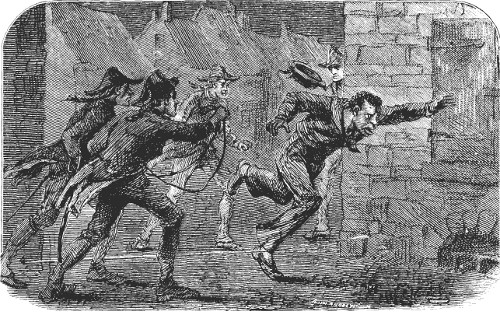
all more or less under the influence of liquor. One old tar had taken
it into his head to hire a truckman's horse for a ride up and down the
street. Drunk as he was, he sat the horse well; for, as he boasted,
he had been brought up among horses, and was half horse himself. He
would not have the harness taken off the horse, which was a leader, but
mounted, taking the trace-chains on his shoulder, with the rattling of
which he and all seemed to be delighted; and, as he was flush of money,
his vest pockets being crammed with bills, besides some silver in a
purse which he frequently shook in the truckman's face, exclaiming,
"Rich owners, my old boy!" the latter seemed inclined to submit to
all his whims. He was surrounded by an admiring crowd of shipmates,
who, like himself, had just been paid off, all gloriously drunk, but
good-natured, and bent on having a merry time of it. In addition to
these was a crowd of loafers and loungers, such as are generally
abundant when sailors are paid off and liquor is plenty.
The dress of this horseman was comical enough. He had on a pair of
Turkish trousers, an India shawl round his waist for a sash, a shirt
made of fine grass-cloth also of East India manufacture, exceedingly
fine and beautiful; on his head a Greek cap, which made his large,
flushed features appear most prominent; his cue was wound with red
ribbon, the two ends streaming down his back, and red slippers on his
feet. Over the beautiful shirt were the rusty trace-chains, the hooks
of which chafed against the shawl at every motion of the horse.
After shaking his purse in the truckman's face, and boasting of his
riches, he next took it into his head to beg, and, pulling off his cap,
he knocked the top in, causing it to resemble a bowl.
"Christian people, one and all," cried he, in doleful accents, holding
out the cap, "pity a poor, disenabled sailor, who's lost his legs
fighting for his country, whose father and mother are frying eggs in
a wooden saucepan on the rock of Gibraltar; pity him, good people, and
drop a shot in the lee locker."
As he concluded, cheers arose from the crowd, and his shipmates flung a
shower of small coin into the cap, when, whirling it around his head,
the silver was scattered among the crowd, creating a universal scramble.
The truckman now wanted his horse.
"Your horse! You're drunk, old boy, and don't know what you're talking
about. I've chartered this 'ere horse for the vige, and the vige ain't
up yet. Ain't that so, shipmates?"
This declaration was followed by a cheer of assent. Captain Rhines,
meanwhile, was making strenuous efforts to get through the crowd, for
he had recognized in the sailor on horseback Dick Cameron, who had
been a great many voyages with him. Dick was an especial favorite with
Captain Rhines, for he was a splendid seaman when at sea and away from
liquors, and the captain would have been right glad to have met and
shaken hands with his old shipmate when sober, or to have entertained
him at his house; but he dreaded recognition by him in his present
state, and was striving to avoid it. Dick, however, caught sight of
him; for he was too conspicuous, by his size and noble physique, to
escape notice in a crowd.
Dick hailed him with shout and gesture that drew the eyes of all upon
him in an instant.
"Shipmates," he cried, "as I'm alive and a sinner, if here ain't my
old cap'n, Cap'n Ben Rhines, the best man that ever sailed salt water;
as knows how to carry sail, and how to take in sail; none of your
kid-glove gentry! Ah, my boys, he's sailed for it! None of your ship's
cousins; a man as knows when a man does his duty, and how to keep good
dis-cip-line on board ship" (emphasizing the second syllable of
"discipline," as seamen generally do). "No humbugging, nor calling men
out of their watch or out of their names, on board his ship. God bless
you, cap'n! I thought you was dead and gone to heaven long ago. Ah,
cap'n, we've sailed the salt seas together round the Hook of Holland,
round Cape Horn, through the Straits of Gibraltar, and on the Spanish
Main. Haven't we had some tough ones on the coast? How are you, cap'n?"
"First rate, Dick. How are you, and where have you been all these years
since you disappeared in Calcutta? I thought you was overboard, or
knocked on the head with a slung shot; for I never believed you would
run away from me."
"Run away from you, cap'n? I would run to you as I would to my mother
if she was alive, God bless her! I got a dose of sheet lightning, and,
when I waked up, I was aboard an English ship bound to Australia. What
become of my clothes? I had a good chistful."
"I kept them aboard till I gave them all away to sailors that had been
robbed by the land-sharks."
"Jest right, cap'n, jest like you. Now, shipmates, give me a fist. I
want to go ashore, and shake the cap'n's flippers."
With their aid he dismounted, and, getting hold of the captain's hand,
which he extended most cordially, he continued to pour forth his
protestations of respect and affection.
"How is the wife, cap'n, and the pickaninnies, and that leetle boy of
yours, what's got Bunker Hill on his shoulders? Ah, shipmates, that's
the bully boy can bend a crowbar over his knee, and mast-head a topsail
alone."
"They are all well. But where are you from, Dick?"
"Messina."
"Have you spoke any American vessels on the coast?"
"Yes; two."
"What were they?"
"West Indiamen from Antigua, bound into New London."
"How long have you been ashore?"
"Since eight o'clock this morning—jest long enough to moisten the clay
a little."
Here the conversation was interrupted by the truckman attempting to
lead off the horse, having received his pay in advance; but this
Dick's shipmates would by no means permit. One shook his fist in the
truckman's face, threatening to drive his teeth down his throat;
another seized the horse by the bridle, while two others caught hold of
his long tail.
"Catch a turn, Bill, round that timber-head."
Bill caught a turn with the tail round a barber's pole that was set in
the ground before the door of a grog-shop, the barber occupying rooms
overhead. But the horse, not accustomed to being thus dealt with, began
to kick and jump, amid the cheers and laughter of the crowd, till he
pulled the pole over amongst them.
In order to restore good feeling, Dick now proposed to the truckman to
take some bitters.
"I say, Dick," said Bill Matthews, "it seems to me as how you ought to
treat this 'ere horse."
"So I will, shipmates, bless me if I don't," said Dick, who had
meantime been trying to persuade the captain to drink with him. "If the
cap'n won't drink, the horse shall;" and, mounting, he intended to
ride him into the bar-room. The horse protested, and so did his owner,
but both alike without success. Despite his struggles, the beast was
pushed up three steps, into the bar-room.
"Mix him a good stiff glass, Tom," said Dick. "He needs it."
The bar-keeper, nothing loath, as he calculated to get his pay for
all the liquor poured out, whether drank or not, obeyed. The room was
crammed, all crowding in to see the fun and share the drinking, as Dick
had invited all hands; no change out of a dollar.
Captain Rhines might have escaped now; but he wished to make some
further inquiries of Dick. He was interrupted by the truckman calling
for his horse, and the disturbance that followed; so he remained on the
sidewalk.
Just as they were attempting to turn the liquor down the beast's
throat, the floor broke through with the great weight, and both horse
and crowd went into the cellar. None, however, were seriously injured.
Some were cut with broken glass of tumblers and bottles, some bruised
by the struggles of the horse: but, as usual, those drunkest fared the
best. Dick escaped unharmed, and the horse was not injured.
The captain now got hold of Dick again.
"Were those two West Indiamen all the vessels you saw or spoke?"
"All we spoke, cap'n; but there was one went by us, beating up the bay
yesterday arternoon, like as we had been lying at anchor."
"What kind of a vessel?"
"A brigantine; a raal sharp-shooter," said Matthews.
"How painted?"
"All one color, spars and all, betwixt black and a lead color. I says
to Dick (we was on the fore-topsail-yard, freshening the sarvice on the
topgallant-sheet), 'Dick,' says I, 'that's some kind of a smuggler, or
slaver, or something. So handsome a clipper as that's not painted such
a color for nothing.'"
"Was she heavy sparred? Did she carry a press of sail?"
"She was all sail; long yards, and plenty of staysails and savealls, a
whacking mainsail, and a ringtail at the end of it. I noticed it," said
Dick, "and spoke of it then, what a spread she had to her fore-rigging
and long spreaders on the cross-trees to spread the topgallant and
royal back-stays."
"That must be the vessel I'm looking for; but if she passed you,
beating up, why ain't she here?"
"She went into Salem."
"O, ho! went into Salem! Then it's her. The captain belongs in Salem;
and, as he had a head wind and tide, he went in there, and will be up
to-day."
Captain Rhines had proceeded but a little way after leaving Dick,
when, just before him, a man was pushed out of the door of a sailor
boarding-house, and fell his whole length on the sidewalk. He rose
with difficulty to his feet as the captain came along, and addressed
him by name. He was covered with filth, his face bruised and bloody, a
battered tarpaulin on his head, a beard of three weeks' growth, clothed
in a red shirt, canvas trousers, and barefoot. He trembled like a man
with the fever and ague, evidently being in that state expressively
termed by sailors the "horrors," and could scarcely stand.
"Cap'n," he cried, "don't you know me?"
"No," he replied, after looking at him a moment, "and don't want to."
"I'm Percival, William Percival, that went mate of your ship with
Captain Aldrich."
"Your own mother wouldn't know you, Percival. How came you in this
condition?"
"I've had hard luck, cap'n: been cast away; lost everything but what I
stood in."
The captain was the last man to be imposed upon. He had always believed
that Percival and Aldrich both were two precious rascals, saw in an
instant what had reduced him to his present state, and that the story
of shipwreck was manufactured at the spur of the moment.
"You've cast yourself away," was the reply. "You might have been master
of a ship if you had behaved yourself, and had any principle. Don't lie
to me. You've got the shakes on you this blessed minute."
"That's so, cap'n," said the poor wretch, making a virtue of necessity;
"but I only drank to drown misery. O, cap'n," he cried, stretching out
his hands, which trembled like an aspen leaf, "give me a quarter, just
to get a little rum to taper off with."
"Not a cent. You've had too much now."
"O, cap'n, dear cap'n, do," cried the miserable wretch; "only a
fourpence ha'pp'ny, cap'n."
"No."
"Three cents, then, just to get one glass to taper off with."
"Why don't you go and ship?"
"No cap'n will have me as I look now, when men are plenty."
"I will give you victuals."
"I can't eat, nor I can't sleep."
"If I give you clothes, you'll sell them for rum."
The captain was turning to leave him, when he said, "I could tell you
something that would make you shell out the chink."
The captain, paying no attention, kept on, when he cried, "I can tell
you what became of that nigger you thought so much of."
The captain whirled on his heel in an instant. "What nigger?"
"Why, that was pilot in the Casco."
"James Peterson?"
"Ay."
"I know what became of him. He was drowned between the vessel and the
wharf, in Martinique."
"No, he wasn't."
"What did become of him?"
"I can tell you what became of him if I like?"
"I believe you lie."
"Well, have it your own way, then."
The captain mused a moment. He knew Aldrich and Percival well; that
there was no principle in either of them; had never believed the story
that Peterson was in liquor, and fell overboard, but always mistrusted
there had been some foul play. His suspicions were now thoroughly
aroused, and he determined to sift the matter to the bottom.
"Come along with me," he said.
The seaman followed the captain to a sailor boarding-house, kept by an
old acquaintance, with whom the latter had boarded when mate of a ship.
"Mr. Washburn," said he, "I want you to oblige me by taking this man
in. He's got the 'horrors.' Give him liquor enough to taper off with,
clothes to make him decent, and look to me for pay."
"I will, captain."
He then said to Percival, "Clean yourself up, and get a night's sleep.
I will come here to-morrow at ten o'clock; and, if I have reason to
think there's any truth in your statements, I'll do more for you."
In the course of the afternoon the Arthur Brown came up with the flood
tide. It was a joyful meeting between Captain Rhines, Arthur Brown,
Walter, Ned, and the whole crew, who were all his neighbors. They spent
the evening talking over the events of the voyage, while the captain
made them acquainted with all that had taken place at home.
Seeing Captain Rhines was next to seeing their own parents, especially
to Ned, whose life he, with others, had saved. Ned got on one side and
Walter the other, and plied him with questions about everybody and
everything at home.
After retiring that night, the captain strove to recall all he had ever
heard said by any one of the crew who were in the Casco at the time of
the mysterious disappearance of Peterson, and recollected that Eaton,
who was a great friend to Peterson, said there had been some difficulty
between him and the captain on the passage out. He was sorely puzzled;
for, from the time he first heard of the occurrence, he had cherished
an opinion that somehow or other Aldrich was concerned in the matter;
still he could not help feeling that there was not the least evidence
of if, and that this opinion was based more upon his prejudice against
the captain than upon anything else; while he had no better opinion
of Percival than to believe he would trump up any kind of a story,
if there was the least possibility of its being believed, in order
to obtain money. At ten o'clock he was at Washburn's, where he found
Percival arrayed in a decent suit of seaman's clothes, clean, shaved,
his nerves steadied by liquor and a night's rest, and altogether
another man.
It is even now a mooted question among physicians whether, in delirium
tremens, to give moderate doses of liquor to "taper off" with, as it
is called, or not; but in those days there was but one opinion and one
mode of practice—to give the individual a hair of the dog that bit
him, which the captain had done.
"Now, Percival," said he, "I am ready to hear what you have to say."
"You see, Captain Aldrich was down on that nigger from the day he came
aboard the vessel."
"What for?"
"I'm sure I don't know, except because everybody else liked him. He was
the best cook I ever see on board a vessel, and the best seaman; always
ready to lend a hand, night or day; knew his place, and kept it."
"You've told the truth there, Percival."
"I intend to tell the truth all the way through. There was a good deal
of hard feeling. The cap'n was overbearing. The men wouldn't stand it,
because there was no occasion for it. He came near having a row with
Eaton, but thought better of it, and one day he picked a quarrel with
the nigger."
"And how did he come out with that?"
"Out of the little end of the horn, as they say. Peterson said some
pretty hard things about him and his folks, which the men said
afterwards was all true, and set out to fling him overboard. He run
aft, scared half to death."
"I wish he had. He would have been no more in James Peterson's hands
than a peck of wheat bran."
"Well, Aldrich was a very proud man, and it gravelled him terribly to
be put down by a nigger, and he was out with me, because I wouldn't
take his part. He laid it up. I heard him swear a hundred times that he
would be square with that nigger before he left Martinique, and he was
as good as his word."
"He murdered him?"
"No, he sold him."
"Sold him! What do you mean by that?"
"I mean that he sold him into slavery."
"The villain! I never should have thought of that. And was you a party
to it?"
"No."
"Well, how was it managed?"
"It came about after this fashion. I don't think the cap'n thought
himself about selling him, but it was kind of flung in his way, and he
jumped at it like a dolphin at a flying-fish. Perhaps you know Peterson
was a first-rate calker?"
"Yes."
"Well, there was a planter that lived on the other side of the island,
somewhere, who had a lot of drogers that brought sugar and coffee. One
day he was lying with his droger right under our stern, and Peterson
was on a stage, over the stem, calking. After that the planter came
on board, and I heard him say to Aldrich, 'Cap'n, I'll give you two
thousand in gold for that nigger.' The cap'n laughed, but said nothing."
"The planter was joking," said Captain Rhines; "I have had planters in
Cuba and Antigua say so to me a hundred times, when I've had Peterson
and other darkies with me."
"I've no doubt he was, when he first spoke; but it put an idea into
Aldrich's head, and he carried it out. For some days after that, I saw
him and the planter Henri Lemaire always with their heads together on
the piles of boards, and saw them look at Peterson. Then they would
be together a long time in the cabin of his droger; and they had no
business with each other, for we hauled in to the government wharf,
because we sold our lumber to the government. This set me on the
lookout. I tried to listen, but couldn't get a chance to hear anything.
One night the cap'n sent Peterson ashore with letters, and he never
came back. Then I know he had sold him."
"But he did come back. Danforth Eaton and all the crew told me that
there was a good fire in the fireplace; that he had got breakfast well
under way the next morning when they turned out, and had gone ashore,
as they supposed, to get something for his 'lobscouse,' and fell
overboard."
"Peterson never made that fire, nor peeled the potatoes and onions, or
cut the pork and put it in the frying-pan; but he pounded the coffee
and chopped the beef the night before, for I saw him do it."
"Who did the rest?"
"The cap'n did it himself."
"The captain?"
"Ay. I had a tooth that grumbled, and didn't sleep well. I heard the
cap'n get out of his berth, like a, cat crawling after a squirrel, and,
having my suspicions, I followed him, and saw what he was up to—saw
him kindle the fire, put on the tea-kettle, and do all the other
things."
"But his boy, Ben, told me that they found his handkerchief on the
fender."
"True; but it was a handkerchief that he wore on his head when he was
cooking, and kept it on a nail before the fire, and the cap'n put it on
the fender himself. Besides, what did he want to send Peterson to the
office with letters that were blank, if it was not to make an errand to
get him ashore in the night, that he might be kidnapped?"
"Blank letters?"
"Ay. I peeked through the skylight, and saw him fold and direct them,
and there was not a word written in them."
The captain rose and took a turn or two across the room. He was
a shrewd judge of men, had watched Percival closely during the
conversation, and was strongly inclined to believe all he said.
His account of the captain's relations with the ship's company tallied
precisely with what he had previously heard from the men, and it seemed
altogether improbable, if not impossible, that he could have originated
some of the statements.
"I have always suspected," said the captain, sitting down again,
"that there was foul play of some kind. I have known Ezra Aldrich
from the egg, and knew he was capable of any kind of villany; never
wanted him to go in the ship, but was overruled by others. If what
you say is true, it certainly looks like it. But how do you know that
he was sold? You have no proof. He might have been, and probably was,
murdered. There are plenty of renegade Spaniards in Martinique, and
Frenchmen, too, that would stab a man in in the back in the night for
two dollars. There was Enoch Freeman, of North Yarmouth, a cooper, had
a shop there for years, used to go out in the fall and come back after
it began to be hot (he went out with me a good many times), had some
difficulty with a Frenchman about coopering a cargo of sugar. He saw a
nigger hanging around his shop, and one of his men said to him, 'Mr.
Freeman, that nigger means to kill you.' Freeman walks right up to the
fellow, and says, 'What did that Frenchman offer you to kill me?' 'Two
dollars.' 'Go and kill him, and I'll give you four.' The nigger went
and killed him."
"But I know he sold him."
"How do you know?"
"Because he owned to me he did it."
"How came he to be fool enough to do that?"
"We had some difficulty in Martinique."
"How was that?"
"We were all discharged, and lay in the stream. The cap'n went ashore
in the morning, and left orders with me to send the boat for him at
four o'clock. He came on board drunk and ugly enough. As soon as he
got his head over the rail, he sings out, 'Why wasn't that boat sent
ashore, as I ordered?'
"'It was, sir.'
"'No, it wasn't. I ordered the boat to be on the beach at four; it was
five minutes after.'
"He then began to blow round deck, growl, curse, and find fault.
"'Why ain't those skids got ready,' he roared, 'to take in sugar? The
lighter will be alongside in the morning.'
"'They are ready, sir.'
"The skids were over the hatchway and blocked up.
"'Well, they ain't right.'
"'Yes, they are right, sir. I know how to rig skids to take in molasses
and sugar, and how to stow it afterwards, as well as you, or any other
man.'
"'You do—do you?'
"'Yes, sir. I do.'
"'Why ain't those head-stays set up, as I ordered, and chafing gear put
on the forestay in the wake of the topsail?'
"'There was not time, sir; the hold had to be cleared up, and the
dunnage piled up fore and aft, ready for taking in cargo.'
"'Why didn't you do it yourself, then?'
"'I didn't come here to work, sir.'
"'What did you come for?'
"'To see other folks work.'
"I now left him, and went below; but he came down into the cabin, and
began upon me again.
"'If you come here to see other folks work, why don't you do it? Why
didn't you send that foretopsail down, and have it mended? The duty of
the ship can't go on, if I am ashore seeing to my business.'
"I couldn't bear no more, but walked straight up to him, and, looking
him right in the eye, said, 'How about that nigger, Cap'n Aldrich? How
about those blank letters, those onions and potatoes I saw you peeling,
that handkerchief you put on the fender?' He changed countenance in a
moment, became as pale as a corpse, staggered, and caught hold of the
pantry door for support. I said no more, but went on deck."
"What did he say afterwards. Did he ask you what you meant?"
"Never a word, but was as agreeable as could be, though he didn't
make much talk with me; but I was afraid he would poison me; didn't
drink any liquor all the passage for fear he might give me a dose, and
watched him as a cat would a mouse."
"Pity you couldn't always have sailed with him. It might have made a
sober man of you."
"One night, after we got in the edge of the gulf, he got crooking his
elbow again, and began to use bad language to me because I shortened
sail in my watch without consulting him. I just held up my fore-finger,
and said, 'Look here, my fine fellow: we are in the edge of the gulf.
I will hang you when we get in.' I then told him that I knew all
about his selling that nigger to Lemaire, that he had abused me in
Martinique, and on the passage thus far home, and I would have my
revenge; that the moment we made land, I would tell the crew, put him
in irons, and appear against him in court."
"What did he say to that?"
"He was terribly frightened; said he was sorry he did it, but he
couldn't bear to be put down before the crew by a nigger; and that
he never should have thought of that way of getting revenge, if the
planter hadn't put it into his head; and wound up by telling me that he
would give me five hundred dollars to say nothing about it, when we got
in."
"Then Peterson's alive, and a slave to this Lemaire?"
"Ay. The cap'n said, the moment he proposed to take him up, Lemaire,
was fierce for it; said that he owned a great many drogers and launches
that carried sugar, coffee, tortoise-shell, and other truck, and
he wanted him because he saw that he was a first-rate calker, and
calculated to keep him calking all the time."
"Did you ever get your five hundred dollars?"
"No, sir; he put me off once or twice, and then cleared out while I was
on a spree."
The captain now believed the story of Percival, for he had heard from
the crew that he and the captain had quarrelled, and of his coming
on board drunk in Martinique, and saying and doing just as Percival
said he did; he knew, also, that he disappeared suddenly and left the
country, although (through the influence of Isaac Murch) he was offered
the command of a vessel in Wiscasset. "I think that your story seems
probable. At any rate, I'll do this much. I'll make arrangements with
the landlord in respect to your board for two weeks from to-day (no
rum, mind, for you are through with the horrors), and your outfit when
you go aboard some vessel. If I ever get hold of Peterson, or if he
dies there, and I find that you have told me the truth, there will be
time enough to do something more."