Ezra Prentiss and Gilbert Scarlett left the house of the former’s grandfather in the dark of that April morning. And as they crossed the threshold, Gage’s voice sounded in their ears.
“Mind you what I say, and be careful to follow it out. Make your quarters at the ‘Jolly Rover’ Inn, in Ship Street; and report to Major Buckstone at headquarters between ten o’clock and noon each day.”
“And never let me hear of you or see you again,” said old Seth Prentiss to Ezra, “until you have cleared yourself of all suspicion in this matter. As you stand now, George Prentiss, you are labeled in my mind as a traitor, as your brother Ezra is.”
Ezra said nothing; he merely bent his head in a mute good-bye; and with Scarlett set off through the dark court. A sergeant of grenadiers bore them company; it was his duty to see that they went to the “Jolly Rover” as directed, and also that they were not molested by the guards that patrolled the streets.
They passed from Sun Court into Fleet Street, and from thence into Ship Street. This was on the harbor front and was badly kept and worse lighted. At one end was what was known as the North Battery; the wharves of merchants and dockyards of shipbuilders lined the water side of it; while upon the other were gloomy-fronted warehouses and the offices of shipmen of various degrees.
Midway, at White Bread Alley, they came to the “Jolly Rover.” It was tightly closed; not a light was to be seen.
“We are all hard put to it because of the closing of the inns,” said the sergeant of grenadiers. “There is no place to spend a comfortable hour when off duty of a night.”
He beat loudly upon the door. For a long time there was no result save the sharp summons of a guard who rounded the corner of Foster Lane.
“What’s this?” demanded the guard. “Have you no homes to go to that you are abroad at such an hour? And will nothing do but that you must make noise enough to wake the dead?”
“Use your eyes and your lanthorn, soldier,” spoke the sergeant gruffly. “If we are abroad it is because we must be. And as for the noise, it is made but to carry out the governor’s orders.”
The guard held up his light. Then, recognizing the sergeant, he saluted.
“Our orders call for the apprehension of all found abroad after hours,” apologized he.
A nightcapped head, lighted up by a sputtering candle, appeared at one of the upper windows of the inn.
“What now?” demanded a rough voice. “Plague take you, neighbors, to go battering at an honorable man’s door.”
“Come down and draw your bolts,” said the sergeant of grenadiers.
“Not I, indeed,” answered the man in the nightcap, and with a promptness that caused both Ezra and Scarlett to laugh. “I obey the law, gentlemen; no man in the town of Boston minds it better. And the law says that all places of public entertainment must out with their lights and up with their shutters at sundown.”
“If you don’t want your door in splinters, you’ll come down and open it,” said the sergeant. “I bring you two persons whom you are to harbor, at command of General Gage.”
“That,” replied the nightcapped one, in an altered tone, “sets a different face upon the matter. Why did you not say so at once? I will be down instantly.”
The candle vanished; a little later, after a great deal of clatter and clinking of bars and chains, the door opened; the man in the nightcap was shown to be a squat, broad-shouldered personage with gold rings in his ears and the aspect of a seafarer.
“Now, open your ears,” spoke the British sergeant, briefly. “And give heed to what I’m going to tell you.”
“Ay, ay,” replied the host of the “Jolly Rover.”
“These two are to lodge here and pay for their own entertainment. You are to report at headquarters at once if they are absent for more than a half day at a time.”
The landlord regarded the newcomers with no great favor.
“I’ll see to it,” he growled.
“Mind that you do. And, when I am gone, out with the lights and on with the bolts at once.”
So saying the British sergeant turned and stepped out into Ship Street once more. The door closed behind him; the bars and chains went up, and again the man with the rings in his ears looked at his guests.
“I will not say that I am pleased to have you,” he told them with great frankness, “for the custom of such as you brings little but trouble to an inn. I’ll have soldiers about the place constantly; and, if you are gentlemen of any consequence, spies will be as thick as flies in August.”
“We are sorry to give you any trouble,” said Ezra. “But we were directed to come here and could not well refuse.”
The man grinned.
“I suppose not,” said he. “Well, if it be any comfort for you to know it, you are not the only gentlemen in Boston who are in the black books of the King’s officers. The town is full of suspected men. General Gage is a governor who acts mighty quickly in such matters, even if he won’t,” here the grin grew broader, “do the same in weightier things.”
The flickering candle lit up the place but dimly; the ceiling was low, the walls were paneled; in furnishing and equipment the room resembled the cabin of a ship.
Scarlett, who had been observing the landlord, here remarked:
“You are a man who has followed the sea in your day.”
The other nodded.
“For a full forty year,” he said. “Man and boy I’ve spliced, knotted, hauled and reefed in every kind of craft that’s sailed from here to the Horn, and from there to the China Seas.”
“A tarry, healthy profession,” commented Scarlett. “I have known many shipmen in my day, and they have been mostly sound fellows and honest.”
The man took off his nightcap and scratched his head.
“As to health,” said he, “I agree with you. But there have been as big rascals walked the decks of ships as any they’ve ever bred ashore. I remember when I sailed my last voyage in the ‘Champion,’ we had a skipper that was as great a villain as ever robbed his employers.”
At the mention of the vessel’s name, Ezra became more attentive.
“The ‘Champion’?” said he. “What owners?”
“Prentiss & Son, Boston.”
Scarlett gave Ezra a quick look. The boy regarded the innkeeper with interest.
“I recall the old ‘Champion’ very well. Her timbers are now rotting on a reef in the South Pacific,” said he.
“Hello,” said the man with the rings in his ears. He peered at the boy through the candle-light. “And who might you be?”
“My name is Prentiss,” answered the lad. “I am the son of James Prentiss, one of the ‘Champion’s’ owners.”
The man thrust out a great broad hand.
“Young gentleman,” said he, “if you’ll do me the honor, I’d like to shake your hand.”
Ezra smiled and gripped the big paw.
“Your father,” continued the other, “was the finest man in this colony. I’ve sailed for many owners, but he was the best of them all. Your grandfather now,” and the ex-sailor’s expression of admiration greatly changed, “was a most excellent merchant. But he expected much and gave but little. That little was, to be sure, regularly and promptly paid; but that is the best I can say.
“But James Prentiss was different. He had a heart in his body for a sailorman. And if one went out of his way to serve him, he’d see to it that he was properly rewarded.”
“A good quality,” commented Scarlett, approvingly. “It is a proof of appreciation and also encourages effort.”
“Quite so, comrade,” replied the host. “It does that very thing; and I can prove it to you. On the last voyage of the ‘Champion,’ she had for her master a Hingham man named Pickering. I was her first mate and she carried a mixed cargo for trading among the islands. Pickering was a man who believed in handspikes and belaying pins in his treatment of the crew, and he was not long out before they were all but in a state of mutiny.
“This proved a fortunate thing for Prentiss & Son,” continued the landlord. “We ran on the reef one moonlight night with a light wind blowing and Pickering at the wheel. So when he proposed to abandon ship and cargo without an effort to save either, I objected.”
“He must have been a coward as well as a bully,” spoke Ezra.
“No, he was a knave. I’d never suspected the true reason of it all if it hadn’t been for the bos’n. He’d noticed the same sail hanging in our wake for three days, and he spoke to me of it. Then I saw the real truth. Pickering had laid the ‘Champion’ on the rocks deliberately. Then his plan was for all hands to make away; the stranger was to approach, quietly take in our cargo, and Prentiss & Son would be the poorer for a fortune.”
“A very complete rascal, indeed,” said Scarlett. “What did you do?”
“Clapped him in irons and warned the strange vessel off with a show of six-pounders. Afterward I got a brig at Valparaiso, put the cargo into her, and disposed of it to good advantage in the regular way. For that service old Seth Prentiss paid me a first mate’s wages; but his son,” turning to Ezra, “your father, was more open-handed. It was through him that I could at last afford to give up the sea and buy out the ‘Jolly Rover.’”
They talked in the same strain for a while longer. But a patrol, knocking loudly at the door and bidding them extinguish the light, at last put an end to it.
The seaman innkeeper led his guests to their rooms.
“I can give you no light,” said he, “and I’m main sorry for it. But you can manage to sleep without it, I’m sure.”
He had said good-night to both, when he knocked at Ezra’s door and reopened it.
“Lad,” said he in a low tone, “your father was a friend to me. And if I, William Stacey, can do anything for you or your friend at any time, all you have to do is to give it a name.”
“Thank you, Mr. Stacey,” replied Ezra, gratefully. “I’ll remember that.”
The meeting with William Stacey was a most fortunate thing for Ezra. He and Scarlett, before many days had passed, found that they could not take a step without a spy being at their heels. Their every action, so it seemed, was noted by a sharp-eyed stranger. They at length mentioned this to Stacey; he grinned and observed:
“I didn’t expect anything else, gentlemen. People like you are left at liberty so that you’ll in the end lead Gage’s spies to something worth paying attention to. But I think I can help you at times when you especially want to escape their notice.”
And this he did very successfully. Changes of clothing and large wigs, which were then generally worn, combed in various ways, served to throw the spies off the scent at such times as they were worn. And the two made the rounds of the city in all the guises that Stacey’s supply of “slops” could provide them with. As sailors, mechanics and common loafers, they sought information as to the British distribution of force; each battery was carefully marked in their minds, for they dared put nothing upon paper; and each item of whispered news that was picked up was remembered.
They soon learned that Gage feared an uprising of the townspeople in case the city should be attacked. He knew that the citizens had rifles in plenty; and to prevent any possible use of them, he caused it to be made public that in case the town arose against his troops, he’d give it over to the torch and take to his ships.
Then it was proposed that all those who would lodge their weapons at Faneuil Hall might depart from the city with their families and effects. Thousands immediately complied with this; for a time it seemed that all Boston was on the move. The Provincial Congress made an equally liberal move. All Tories who desired to enter the city were permitted to do so. But finally the outgoing townspeople received a check.
“The Tories under Ruggles,” William Stacey told Ezra, “think it a bad policy to let them go. They claim that the Whig inhabitants are necessary to save the town from assault and conflagration. They also threaten to lay down their arms and give the King’s cause no further aid if the people are not kept within the lines.”
The late days of April had passed and May was well advanced. From without the news came of the progress of the American cause. Recruits were reported to be coming strongly into their camp. Their works were growing in extent and strength day by day. A Continental Congress had met at Philadelphia and were considering the matter of a commander-in-chief for the colonial army and assuming the general direction of the war.
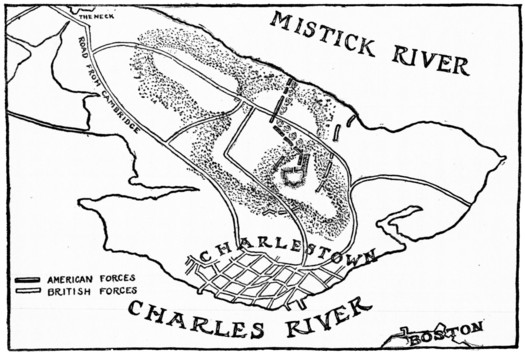
One day in May, Ezra saw General Putnam march about twenty-five hundred Americans from Cambridge to Charlestown, which was deserted by its population. This little army crossed Bunker and Breed’s Hills, came out by Captain Henly’s house, and passed into the main street near the old ferry. This was to inspire the army with confidence; they had gotten within gunshot of the enemy when they were ordered back, and so returned to Cambridge.
A spirited fight took place on the 17th near Wheeler’s Point. On the 21st, two sloops and an armed schooner sailed out of Boston, being so ordered by General Gage. They carried a detachment of troops to Grape Island, their purpose being to seize upon a quantity of hay which was stored there. Scarlett got the facts of this expedition and related them to Ezra with great gusto.
“The vessels landed the troops on the island and the hay was being placed on board. But they were not long undisturbed. The bells began to ring at Weymouth; the people assembled on a point of land near the island and fired at the troops. But their rifles could not carry so far. Then General Thomas, whom I understand is an officer of experience, came up with three companies of your farmer soldiers. Though under fire of the vessels, these launched a lighter and a sloop and so reached the island. The British, like churls, never waited them, but took to their craft and sailed back to Boston.
“Your friends, so I have heard, burned some eighty tons of hay which they could not take off; and also a barn was destroyed. The cattle on the island were then taken to Weymouth.”
Some time later there were like encounters at Hog and Noddles Islands near Chelsea. General Putnam and Dr. Warren both took part in these affairs. The British lost about twenty killed and fifty wounded, besides some swivels and light guns.
The fights on the islands became so frequent that the Americans began to venture out with small armed craft and some successes were had, which excited the ire of the British sea-dogs in command of the heavy ships in the bay.
About this time the army of Gage was largely reinforced; a number of troop ships arrived, also large quantities of stores, and a fleet of vessels of war. Thus encouraged, the British governor on June 12th issued his famous proclamation in which he threatened all “rebels and traitors” and offered pardon to those who should lay down their arms. In this latter Samuel Adams and John Hancock were excepted. It was Gage’s intention to punish them, so he said, as their actions deserved.
“It will serve one good purpose,” said Ezra in speaking of the proclamation to his companion, Scarlett. “It will rouse the people to a greater anger than before.”
“Gage is a very dull-witted gentleman,” replied Scarlett. “He once had a chance to add a person of experience,” here he twirled his moustaches, “to his command, but, by his insults and insinuations, lost him for good.”
“He has those now, who will perhaps prove to be of quicker thought,” said Ezra. “Generals Clinton, Howe and Burgoyne arrived in the frigate ‘Cerberus’ some little time since. Their hands will be felt, I fear, when the time comes to strike a blow at the colonial army.”
“General Gage is going to send forces to occupy Dorchester Heights and the two hills near Charlestown,” said William Stacey, upon the day after the proclamation. “He now has ten thousand men and is beginning to take pride in his strength.”
Reports ran riot through the city. The British troops, privates and officers both, took on a different aspect. Their appearance grew smarter; they stepped with a jauntier tread, their spirits were higher. They paraded more frequently; their drums seemed to beat more briskly; their fifes to squeal more shrilly. More artillery was put ashore; the gunboats and armed craft of lighter draught became much more enterprising.
From these indications Ezra Prentiss drew that there was something of moment about to happen. But the exact nature of it all, for he could place no dependence upon the gossip that reached him, was not made known to him until the morning of the fifteenth of June when he and Scarlett went to make their daily report to Major Buckstone.
That bluff, honest old soldier was seated frowning over some papers.
“Hah!” said he to Ezra, as the sentry led them in, “here is a communication just come to me regarding you, young sir. It will require your attention at once.”
Ezra took the paper from the major’s hand and scanned it. It ran as follows:
“Major Buckstone:
“Sir:—When George Prentiss, my grandson, next reports to you, inform him that his presence is required at my house in Sun Court at once.
“Your obliged and humble servant,
“Seth Prentiss.”
“I will go immediately,” said the boy. “Thank you, Major Buckstone.”
They left the headquarters and proceeded along the street in the direction of the old merchant’s mansion.
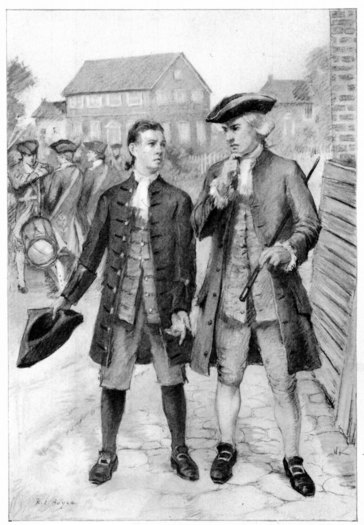
“Something,” said Gilbert Scarlett, “is in the air. Within an hour you will be much wiser than you are now at this moment.”
“It must be of more than ordinary importance,” said Ezra. “For he said on that last night at his house, you remember, that he never wanted to see me or hear of me again.”
“Until you had cleared yourself of mishandling Major Buckstone’s dispatch,” the other reminded him. “Perhaps the chance has now come for you to do that.”
The two parted at the point where Fish Street opened into Prince’s; Scarlett went his way toward the “Jolly Rover,” while Ezra continued along Prince’s until he reached Sun Court.
The boy’s knock brought an immediate answer. The grave-faced man servant showed his pleasure at sight of the youth.
“Your grandfather has been expecting you, Master George,” said he. “I will tell him that you have arrived.”
To be constantly forced to move under false colors was a bitter thing for Ezra. He was a lad who was frankness itself and one who detested methods that smacked of trickery. But to have all in Boston continue to believe him to be his brother George he felt was necessary if he was to aid the colonial cause. There was not a moment of his stay in Boston, during this period, or a time that he answered to his brother’s name, that his honesty and shame did not urge him to proclaim himself. But he stubbornly held this impulse in check.
“If it were a matter of my own,” he frequently told himself, “I could act as I saw fit. But this matter is not my own.”
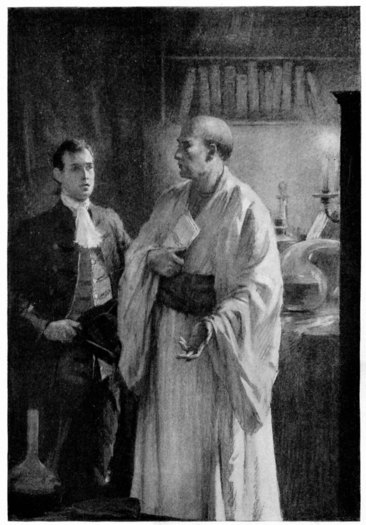
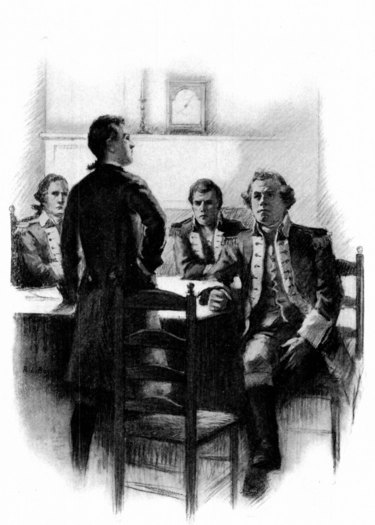
His grandfather greeted him in his library, a stately room filled with morning sunshine, and furnished after the stiff fashion of that day. Seated at a window with a tall volume upon his knees, was a striking-looking officer, attired in the brilliant uniform of a British general.
“I would not have thought you interested in such things as this, Mr. Prentiss,” this gentleman was saying, not noticing the boy’s entrance. “It denotes rare judgment and taste in the binding. And the book itself is very rare,” with much admiration. “I know of only one other in existence.”
“The gathering of such was a folly of my son’s,” said the old man sternly.
“Folly!” The soldier laughed amusedly. “Well, that’s all to one’s taste, I suppose. But for my part, the more follies of this sort,” nodding toward a great heap of other books which he apparently had already inspected, “a man possesses, the more apt I would be to like him.”
“And he was not alone in his folly,” said the old merchant. “He left two sons, both of whom have inherited more or less of his manner of thought.” He gestured grimly toward Ezra as he added: “This is one of them.”
The general looked over his shoulder at the boy; then he arose, brushing traces of dust, left by the books, from his immaculate uniform. He was a polished man of the world, plainly a scholar and unquestionably a gentleman.
“Ah, yes,” said he. He took a step toward Ezra and held out his hand. “I ask your pardon,” he continued, “and am greatly pleased to see you.”
“This is General Burgoyne,” said old Mr. Prentiss to Ezra. “He happens to be here, having heard of the library, and will no doubt join with me in what I am about to say to you.”
The officer smiled pleasantly at Ezra.
“I have heard of your case from Major Buckstone,” said he. He was about to proceed, but the merchant interrupted him.
“And no doubt,” said Seth Prentiss, “you think the transaction a rascally and traitorous one.”
“I never make up my mind to things,” answered Burgoyne, “until I have sounded them for myself.”
He reseated himself and took up the book which had before engaged his attention. There was the same pleasant smile upon his face; he delicately turned the leaves and continued:
“I give your grandson far too much credit for clear understanding than to believe him in any way connected with this absurd condition which,” with a laugh, “the colonists call a siege. That ten thousand peasants can coop up an equal number of the King’s trained troops is too monstrous for any sane mind to believe. But Gage is a good-natured gentleman who believes in mild measures. Since Clinton and Howe have arrived, things will be vastly different. Let us get among the rebels and we’ll soon find elbow-room.”
With that he gave his attention to the precious volume which he held on his knee. The merchant turned to his grandson.
“I told you when I last saw you, that I was done with you until you had redeemed yourself. I had not thought to help you in any way, but it appears that blood is thicker than water, and I want to give you a chance of proving to me and His Majesty’s governor and officers that you are not what you have appeared to be.”
Ezra inclined his head, but was silent.
“Within a few days there will be a happening that——”
The handsome head of General Burgoyne was lifted from the book like a flash. There was a ring of reproof in his voice, as he cut the old man short.
“It would be well to specify nothing,” said he.
“And I desire to hear nothing of the King’s business from you, sir,” said Ezra, hastily.
Much as the young patriot desired to serve the cause of liberty, he could not bear to do so at the expense of his grandfather. He felt that it would be shameful to take advantage of the old man’s unguarded eagerness.
A flush stained the old merchant’s hard face. He bowed to Burgoyne.
“I ask your pardon,” said he. “In my anxiety to give my grandson this chance to reëstablish himself, I had forgotten more important things.”
“I understand perfectly,” said the general, once more smiling. “The thing was natural enough.” He turned toward Ezra, his well-kept hands caressing the book. “It will be sufficient for you to know that there will soon be an opportunity for all loyal subjects of King George to show that they are such.” He paused a moment, then went on: “It would be well for you to take advantage of this at once. There has been talk of curtailing your liberty to some extent.”
A thrill of dismay ran through the boy.
“That means imprisonment,” he thought. “If I don’t join with the British, I’ll be clapped in irons.”
But he concealed his feelings. His face was unruffled as he made reply.
“I thank you, General Burgoyne, for the hint. You may rely upon me to act for the best.”
The officer shot Ezra a penetrating glance. But he said nothing, and with a little shrug, he turned to his book.
“And now,” said the merchant, “that is all. I feel that I have done my duty toward you. It remains for you to do the rest. Harrison,” as the servant answered his pull at the bell-cord, “show this young gentleman out.”
Once in the street, Ezra made all haste to the “Jolly Rover.”
“Something must be done at once,” he muttered. “I’ll have to contrive to leave Boston within twenty-four hours, or I’m done for.”
The first persons he saw at the inn were Scarlett and the landlord in close converse in a far corner of the long room. Scarlett beckoned him at once, and the boy approached them.
“Sit down,” said the soldier of fortune, “and as there are two of our shadows keeping us under observation, I would suggest that you do not allow anything that we might say to make you change countenance.”
“You have news then?” questioned Ezra.
“Most urgent news for you at least,” said Gilbert Scarlett.
He pulled up his soft leather boots and twirled one point of his moustache.
“At first,” said he, “like the others here I was not at all sure as to which side you favored in this struggle. But since becoming more intimate with you, I have discovered at least enough,” laughing, “to make up my mind.”
“A son of James Prentiss could not be for anything else than liberty,” said the ex-first mate of the “Champion,” stoutly.
“Thank you, Mr. Stacey,” said Ezra, quietly.
“Well,” said the adventurer, “let’s to our news. It has transpired,” he proceeded to Ezra, “that General Gage will at last make a move. A large body of troops will cross the river with entrenching tools within the next three nights.”
“But you don’t know exactly when or where?”
“No,” replied the innkeeper as the other hesitated. “I had the news from a source that can’t be wrong; but it went no farther than to say that the movement would be carried out within three nights.”
Ezra sat for a moment regarding his friends.
“There are two reasons, then,” he said at length, “why I should leave Boston at once.”
The others said nothing, but waited for what was to come.
“I must warn General Ward,” continued the boy. “That is the first and most important. The second is that I must keep myself out of a dungeon.”
“Your visit to your grandfather, then, has not been without result,” hazarded the soldier of fortune shrewdly.
“No,” said Ezra. “On the contrary, what I heard there was sharp and definite enough.” Then he turned to the innkeeper. “Mr. Stacey, I will trouble you to-night for one of your suits of slops and any other thing that may be useful in hiding my identity. If you can also direct me to a place where a boat is to be had, I shall be much in your debt.”
“No son of your father’s can speak of being in my debt,” said the old sailor. He pondered a moment while the others watched him. Then he proceeded: “A disguise is simple enough. But a boat is a different matter. However, I think I can do it.” Then he laid a hand upon Ezra’s arm. “You are running a great risk in making such a venture.”
“I would be running one equally great if I did not take it,” replied the boy.
“The waters all about the city are fairly choked with armed craft,” said Scarlett. “How can we pass them and get fairly away?”
“We?” said Ezra.
“Why, to be sure, we.” The speaker gestured his entire acceptance of the situation. “Do you forget that I promised to stand your friend if you needed one?”
“I would shake your hand, comrade,” spoke Ezra, much touched, “if it were not for our being watched.”
“Don’t give me too much credit,” laughed Scarlett, his moustaches pointing upward. “You forget that if you stand a chance of going to a dungeon, I would not be far behind you; for I am not much beyond their suspicions.”
“You are right,” said Ezra, “and that makes it easier for me to accept your offer.” He bent his head toward them and his voice lowered. “It will be a desperate risk, no doubt. But, somehow, I feel that if there is a chance to make the crossing, we will do it.”
“Spoken like a lad of mettle,” commented the landlord of the “Jolly Rover.” “That is the sort of spirit that carries a man well on his way in anything he undertakes.”
The remainder of the day they spent together in one of the upper chambers, where they would be well out of the way of all prying eyes and listening ears.
“There is a brig tied up at Burrough’s wharf, just opposite Battery Alley,” said the innkeeper. “Her skipper is still aboard of her and he is an old shipmate of mine. I can get a dory from him if the case be made plain to his understanding. Then we can put into it some fishing-tackle, floats, trawls and such like as was used by the fishermen who once drew their living from the harbor.”
“An excellent idea,” applauded Scarlett. “It reminds me of a little experience I had once in the Bosphorus while I was in the service of the Moslem. And if this ends as fortunately as that, we shall do very well, indeed.”
As it was found necessary to get some idea of the anchorage of the heavy vessels and the patrolling guard of the smaller, the ex-seaman got out a long glass and they ascended to the garret, where from one of the dusty windows they could sweep the bay.
Ships of the line and frigates were there in plenty. Heavy troop ships, and others which had lately arrived with cargoes of supplies, lay sluggishly tugging at their chains.
“There is nothing to be feared from the seaward,” said Stacey. “So there is little or no activity. The smaller vessels are further up in the rivers. So your best plan, as I see it, is to take a small lug-sail in the bottom of your boat, pull straight out into the harbor, and when you think you are beyond the danger line, up with your sail and head for the nearest safe point that you can make.”
This seemed a most excellent piece of advice, and after some discussion it was adopted. As night drew on the two ate a hearty supper.
“It will help both our strength and our courage,” said Scarlett. “My experience has taught me that a well cared for stomach is a most necessary thing in an adventure.”
It was eleven o’clock when they donned some worn fisherman’s clothing and each a tarpaulin hat. Both wore their hair clubbed in seafaring fashion; and with them they carried the trawl-lines and other equipment that Stacey provided.
The latter had preceded them; so they stole along, keeping in the deepest shadows, toward Burrough’s wharf. They narrowly escaped several guards; but at last came safely to the place where the brig was tied up. The dory was ready; and Stacey and his friend the skipper were awaiting them.
“There are two strong sweeps, a mast and sail in the bottom of her,” the innkeeper told them. “Keep your minds clear as to the position of the war-ships and guard vessels; pull straight out of the harbor between them, if you can. It is a moonless night, and so far the luck is with you.”
The speaker shook their hands as did the brig’s master.
“I’m taking a risk in doing this,” said the latter. “But, then, every man must do what he can for the cause, and this is my share for the time.”
There were low-voiced good-byes spoken, then Ezra and Scarlett stepped into the dory, slipped the sweeps into place, headed out into the dark harbor and gave way.
More and more distant grew the few military lights on shore. Nearer and nearer drew the belt of ship lights; and the vessels themselves began to lift their dark bulks out of the water like huge monsters of the deep, watchful, waiting, full of silent terrors.