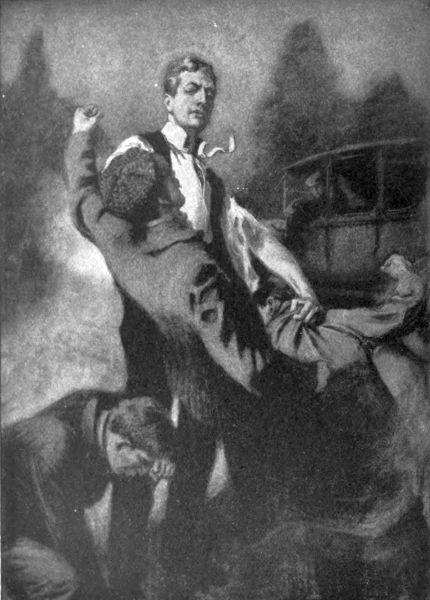
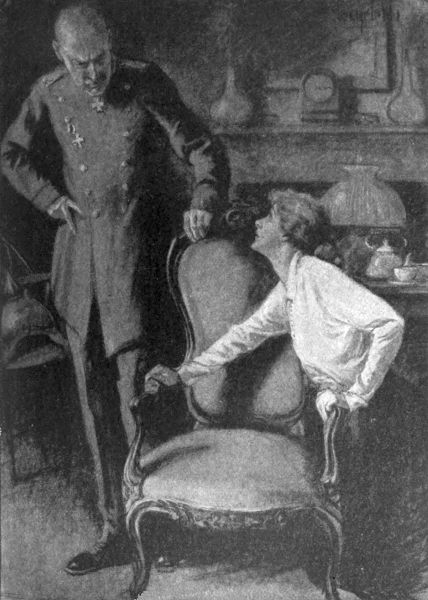
“A woman!” she heard a man’s voice say at her
ear. She was lying upon the ground, and
strange faces were bending over her. “Well,
I’m damned!”
English!
“And the other?” she heard again. “Dead as a
’errin’!”
Doris sat up, staring at them wildly.
“Wait! There’s a flutter ’ere yet.” She heard the
other man say. “Come, Bill. Let’s have ’im over to
the ’ouse.”
Doris managed to find a whisper. “A surgeon—for
him,” she said to the man supporting her. “He will
not die. He is only wounded.”
It was her obsession. It would not leave her.
She saw them carrying Cyril toward the house, and
when they wanted to take her, too, she said that she
would walk. Though deathly weak, she managed to
reach the house where they had carried Cyril. They
gave her a drink of something and she revived.
It was a Red Cross station, they told her, and the
doctor would be here in a moment. But in the meanwhile
first aid was administered, and at her place at his
bedside she saw Cyril struggling faintly back to life.
“He will not die,” she repeated quietly when the surgeon
had examined him gravely.
“I hope not—but he’s bled a good deal. We’ll see.”
They cut away his coat and wanted to send her
away, but she pleaded to remain and in a moment she
heard Cyril’s voice whispering hoarsely—“Papers—coat
pocket—Sir John French.”
“All right,” said the surgeon cheerfully. “We’ll see
to that.”
“Doris.”
“Here, Cyril.”
“Rippin’ fine—of you—no mistake—old girl——”
His whisper trailed off into silence and at the surgeon’s
orders they led her away from his cot, but she
would not leave the room until she got the papers out
of the pocket of his jacket. An orderly led her to a
young officer with his arm in a sling who sat at a table
in another part of the building. He listened to her
story attentively and read the documents carefully, his
lips as he read emitting a thin whistle. He glanced
at his watch and for a moment left the room.
“It is arranged. You shall go,” he said when he
came back. “A machine will be here in a moment.”
He paused, examining her doubtfully. She was spattered
with grease and oil, but the pallor of her face beneath
its grime showed that her strength was near its
end. “Wouldn’t you trust those dispatches to me?
It’s ten miles to headquarters and rough.”
“No—no, I will go. I promised.”
But he ordered some hot coffee and bread, and thus
fortified, when the motor came around she was driven
upon her way. The young officer sat beside her, eagerly
listening, while she gave him a brief outline of their
adventures.
“Amazin’!” he said from time to time. “Most
amazin’!”
And then as she went on, he said quietly:
“You’re goin’ on your nerve, I think. Better save
your strength until we get to headquarters. It isn’t
far now.”
She tried to keep silent, but it seemed as though she
must go on talking. That seemed to give her strength
to complete her task, for when she sank back in her
seat and tried to relax she only grew weak thinking of
Cyril lying back there, hovering between life and death.
And then she heard herself saying aloud, “He will not
die. He has gone through too much to die now.”
The man beside her glanced down at her and smiled
gently.
“No, he isn’t going to die. Bullets don’t kill nowadays—unless
they kill at once.”
“Yes—yes,” she assented. “That’s it. If he had
been going to die, he would have been dead now,
wouldn’t he?”
She laid her hand eagerly on the young officer’s arm
and he put his hand over hers.
“Palmerston is the best surgeon along this part of
the line. He’ll pull him through. Don’t you worry.”
“I won’t—I’ll try not to—you’re awfully kind.
Would you mind telling me your name?”
“Jackson. Second Leinster Dragoons. And yours?”
“Mather—Doris Mather. I—I don’t want to forget
your name. You’ve been very good to understand
everything so perfectly.”
“Oh, it’s nothing. There are reasons—I’m on Headquarters
Staff, you know.”
That was one reason. But another one was that
there was a girl at home just as much worried over
his wound as Miss Mather was over Hammersley’s.
They passed from the rough roads between gates
into a smoother one which was bordered with poplars.
At the end in front of her she saw lights and reached a
doorway, where an orderly opened the door of the machine
and saluted her companion. Their arrival, it
seemed, was expected. Captain Jackson took her by
the arm and led her indoors, for her courage or her
nerves seemed to be failing her again, down a quiet
hall into a room where an officer with a gray mustache
sat before a lighted lamp at a table covered with papers.
She recognized him at once from the many portraits
that had appeared in the weekly papers. He
spoke to her and she tried to reply, but she could not.
She seemed only to have strength enough to thrust the
papers forward into his hand, when her knees gave way
under her and she sank in a heap upon the floor.
Gentle hands lifted her and laid her upon a couch in
the corner of the room. She tried to get up, but could
not. She heard the voices of the officers in the room
as from a great distance, and then a woman came and
two men carried her upstairs and put her to bed. She
realized that she was talking incoherently of Cyril, of
the Yellow Dove. They gave her something to drink
and her nerves grew mysteriously quiet. She seemed
to be sailing smoothly through the air—higher, higher—Cyril’s
fingers were pointing upward. She was tipping
the wheel toward her—ever toward her, and they
rose higher. They had reached the region of continuous
and perfect day. Cyril turned his head and
looked at her, and then he smiled.
It was broad daylight when she awoke, for the sunshine
was streaming in at the window. A woman sat
near her, knitting. She was an old woman of many
wrinkles, kindly wrinkles which seemed to vie with one
another to express placidity. As Doris rose in her
bed the old woman rose, too, and came forward briskly,
speaking in French.
“Ah, Mademoiselle is awake. Bon. She is feeling
better?”
“Yes, better—but a little tired.” And then, as she
realized where she was, “Could you tell me——? General
French—could I see him?”
“All is well, mademoiselle. Monsieur le General—he
is not here now. But he will be back after a while. He
will see you, then, but first it is proper that you have
breakfast and a bath. Mademoiselle needs a bath—I
think.”
Doris glanced at her hand, which lay upon the white
coverlid. It was black. “Yes, I will bathe. But first
will you tell me——?”
The old woman smiled as she interrupted, “I was to
tell you that Monsieur yonder is better. That is what
Mademoiselle wished to know, is it not?”
Doris sank back upon her pillow in a silence which
gave the full measure of her joy. Cyril would recover.
She had been sure of it. She had told them last night.
God was good.
The news gave her strength, and the coffee and eggs
that were brought revived her rapidly. Her nerves
still trembled in memory of what they had passed
through, but when she was bathed and dressed in clean
linen garments, much too large for her, a surgeon
brought her medicine, and what was better than medicine,
news that Cyril was conscious and was asking for her.
But they would not let her go to him. Tomorrow
perhaps. Meanwhile the doctor would be glad to take
a message. Doris colored gently. The message that
she would have liked to send was not to be transmitted
by this means.
“Tell him,” she said at last quietly, “that I am well—and
that I will see him when I have permission to
do so.”
The officer smiled, gave some directions to the old
woman and went out.
It was not until late in the afternoon, when dressed
in her own garments, which had been carefully cleansed
and brushed by her nurse, that she was admitted
to the office of the Field Marshal. She was shown
into his room and he greeted her with unmistakable
cordiality, offering her the chair next his own and congratulating
her warmly upon the success of her achievement
and Cyril’s.
“You know,” he asked quietly, “the contents of these
documents?”
“Yes. Their importance made it necessary that I
should.”
“Then of course you realize the necessity for the
utmost secrecy?”
“I do.”
The General smiled at her and brought forward a
copy of a recent issue of the London Times.
“Did you know that for the past three days England
has actually stopped criticizing me to talk about you?”
“About me?” she asked.
“Yes, read,” he said smiling, and she took the paper
from him, skimming the headings of a news item he
pointed out to her:
MISS MATHER STILL MISSING.
MYSTERIOUS DISAPPEARANCE STILL UNACCOUNTED
FOR.
LADY HEATHCOTE TELLS STRANGE STORY.
JOHN RIZZIO, THE FAMOUS COLLECTOR, A GERMAN
SPY.
And then in the news item below:
Allison Mather, of Ashwater Park, believing that his
daughter is still alive, today offered a reward of five
thousand pounds to anyone——
She stopped reading and put the paper down.
“Poor Daddy!” she whispered. “O Sir John, will you
let him know——?”
“I have already done so, child. He knows that you
are safe.” And then with a laugh, “The five thousand
pounds—I think are mine. I need a new hospital
corps.”
“Oh, he’ll give it, I’m sure.”
“You promise?”
“Yes.”
He took her hand and rose in the act of dismissal.
“We have supper at six. I hope you will be able to
join us.”
“But, General——” She paused at the door.
He smiled at her softly.
“If all goes well—you shall see him tomorrow.”
She colored prettily. Everyone seemed to know, but
she didn’t care. The world, in spite of its terrors, was
a garden of roses to Doris.
She did not see Cyril the next day or the one following.
His temperature had risen, and while the danger
of a relapse was not acute, they thought it safer that
she be kept away. She had worried, fearing the worst,
but the frankness of the head surgeon reassured her.
The bullet had drilled through him, just scraping the
lung. He would recover. But why take a chance of
complication when all was going well? There was no
reply to that, so Doris waited at headquarters, thankful
and trying to be patient, sending two penciled
scrawls which were delivered to the wounded man.
It was not until three days later that she received
word that she would be permitted to see him. His cot
had been carried into a small room at the front of the
building, and she entered it timidly, the nurse, with a
smile and a glance at her watch, both of which were eloquent,
withdrawing. He was propped up on pillows,
and though pale from the loss of blood, greeted her
with his old careless smile. She sank into the chair
by the side of the bed and caught his hand to her
lips.
“O Cyril,” she murmured. “Cyril, I’m so glad. But
I knew you wouldn’t die—you couldn’t after getting
safely through everything else.”
“Die! Well, hardly. I’m right as rain. Jolly close
shootin’ that of Rizzio’s, though. Pity he had to go—that
way.”
She hid her face in her hands.
“Don’t! Let’s forget him.” And then, “Have you
suffered much?”
“No. The bally thing burns a bit now and then—but
the worst of it is, they won’t let a chap smoke.”
She laughed and he caught her hand closer.
“How did you do it, Doris? How did you?” he
questioned.
“I had to, Cyril,” she said. “It wasn’t anything—except
knowing where to come down. That bothered
me. I guessed at Ypres. The rest was luck.”
“More than luck, old girl. Just courage and intelligence.
I felt myself failin’, up there, but I saw you
knew your way about and then I—I seemed to go to
sleep. Silly of me, wasn’t it?”
“Silly! You fainted, Cyril.”
“Rotten time to faint.”
“You might have died up there. Once I thought you
had died. Oh, that dreadful moment! I wanted to go,
too—with you. I was a little mad, I think. I wanted
to take you in my arms and go with you—down—down.
My hands even left the wheel. The Yellow Dove toppled—but
I caught her.”
“Poor child!”
“After that I seemed to grow all cold with reason
and skill. I forgot you. I looked beyond, over
your poor head. I had to succeed, Cyril—that was
all.”
His hand pressed hers tenderly.
“You’re the only girl in the world who could do it.
I’m glad—proud——” He broke off. “My word,
Doris! There’s no use tryin’ to tell you what I think
of you. I’m no good at that sort of thing.”
“I understand. You’re just—yourself. That’s
enough for me.”
“You were a trump up there in the Thorwald—to
stay with poor old Udo, but I had to go. It was the
only way. I never thought we’d make it.”
“But we did.”
“You did. It was the Dove, Doris—the good old
Dove. Isn’t she a ripper?”
“I never had a fear—once she rose. How did you
happen——”
He laughed.
“It was to be a surprise. I’d been workin’ on her
for a year—tryin’ her out on the moors. Nobody
knew—until the war came—and then I told Udo, who
told von Stromberg. I tried a flight to Windenberg and
made it comfortably. Awf’ly easy thing. I stayed at
Windenberg in October, flyin’ over the English lines,
droppin’ bombs.”
“That was where you were——!”
“But I never hit anythin’. Wouldn’t do, you know.
Then when I came back I told the War Office. They
sent me for the papers. You know the rest.”
“O Cyril, I’m so glad it’s all over. You’ll go to
England now and rest.”
“For a while.” And then, “Will you marry me,
Doris? Soon?”
“Yes,” she said softly. “Whenever you want me.”
“Here? Now?”
“But, Cyril——”
“There’s a parson chap about here somewhere. I
saw him browsin’ in here the other day.”
“Isn’t it a little——”
“Say you will, there’s a dear.”
“Yes, if you wish it. But——”
“What?”
“Clothes.”
“Nonsense. You’re jolly handsome in those togs—handsome
no end,” he repeated. “Marry me tomorrow,
Doris. There’s a dear.”
She leaned her face down upon his hand.
“We’re already married, Cyril. Up there I felt it.
Even death couldn’t have separated us.”
“Thank God! Kiss me, Doris.” She obeyed.
“I’ll see Jackson,” he whispered. “He’ll manage it.
Resourceful chap, Jackson. He’ll get us a chaplain
like pullin’ a rabbit out of a hat.”
She laughed.
“I don’t suppose I’d ever have known you, Cyril,
over there in England. You always did wonderful
things carelessly, Cyril.”
“But not this wonderful thing——” and he kissed
her.
“It is a wonderful thing,” she whispered. “So wonderful
that I wonder if it can be true.”
“I’ll prove it to you——”
But she had straightened and kissed his hand.
“No more now—I mustn’t stay. I hear them in the
hall.”
“Tomorrow?” he asked.
“Yes.”
“Jackson?”
“Yes.”
The nurse knocked discreetly and entered. “Five
minutes. I’m sorry.”
“So am I,” said Hammersley, with a sigh.
Three weeks later they stood side by side at the rail
of the Channel boat on the way to Ashwater Park for
the parental blessing. The shores of France were already
purple in the distance. They had looked upon
Death with eyes that did not fear, but the sight of it
together had made the bond of their fealty and tenderness
the stronger. There was a sadness in his look and
she knew instinctively of what he was thinking.
“Germany, Cyril,” she said aloud. “I love it because
a part of it is you. But I love England more, because
it is you.”
Hammersley watched the receding shores beyond the
vessel’s wake, her hand in his.
“They’re followin’ false gods, Doris. Gods of steel
and brass——!”
“They must fall, Cyril.”
“They will.” And then, “But you can’t help admirin’
the beggars! Poor old Udo!”
“I think about him, Cyril. Do you think he got
away?”
“Well, rather! I cut his bonds with a huntin’ knife
before we went down.”
She looked up into his face in amazement. “You
dared do that?” He laughed.
“You wouldn’t have let him be more generous than
me.”
“And he let us go?”
“He didn’t think we could go. He left things to Destiny.”
“Good old Udo!” she repeated. And then dreamily,
“Destiny! You were not meant to die, Cyril.”
“Not yet.” He said slowly: “But I must go back—over
there, Doris.”
She shivered a little and drew closer to him.
“Yes, I know,” she said. “But you’ve earned——”
“I couldn’t ever earn what I’ve got,” he broke in
quickly.
“Nor I——”
“I’m not much of a chap at pretty speeches and all
that sort of thing, but you’re a rare one, you know,
the rummiest sort of a rare one—the kind a chap
dreams about but never gets—and yet I’ve got you—
Oh, hang it all, Doris,” he broke off helplessly. “You
know——”
She smiled at him and slipped her arm through his.
“Yes, I know,” she said.
“Good old Doris,” he muttered. “Silly ass, aren’t
I?”
But she wouldn’t admit that.
FOUR TIMELY BOOKS OF
INTERNATIONAL IMPORTANCE
I ACCUSE (J’ACCUSE!) By a German. A Scathing
Arraignment of the German War Policy.
At this vital time in the nation’s history every patriotic American
should read and reread this wonderful book and learn the absurdity
of the German excuse that they wanted a “Place in the Sun.”
Learn how the German masses were deluded with the idea that
they were making a defensive war to protect the Fatherland.
Let the author of this illuminating book again show the sacrilege
of claiming a Christian God as a Teutonic ally and riddle once more
the divine right of kings.
PAN-GERMANISM. By Roland G. Usher.
The clear, graphic style gives it a popular appeal that sets it miles
apart from the ordinary treatise, and for the reader who wishes to
get a rapid focus on the world events of the present, perhaps no
book written will be more interesting.
It is the only existing forecast of exactly the present development
of events in Europe. It is, besides, a brisk, clear, almost primer-like
reduction of the complex history of Europe during the last forty
years to a simple, connected story clear enough to the most casual
reader.
THE CHALLENGE OF THE FUTURE. By Roland
G. Usher.
A glance into America’s future by the man who, in his book PAN-GERMANISM,
foretold with such amazing accuracy the coming of
the present European events. An exceedingly live and timely book
that is bound to be read and discussed widely because it strikes to
the heart of American problems, and more especially because it hits
right and left at ideas that have become deep-seated convictions in
many American minds.
THE EVIDENCE IN THE CASE. By James M.
Beck, LL.D., Formerly Assistant Attorney-General
of the United States, Author of the “War and Humanity.”
With an Introduction by the Hon. Joseph
H. Choate, Late U. S. Ambassador to Great Britain.
No work on the War has made a deeper impression throughout
the world than “The Evidence in the Case,” a calm, dispassionate,
but forceful discussion of the moral responsibility for the present
war as disclosed by the diplomatic papers. Arnold Bennett says that
it “is certainly by far the most convincing indictment of Germany in
existence.”
GROSSET & DUNLAP, Publishers, NEW YORK
JACK LONDON’S NOVELS
May be had wherever books are sold. Ask for Grosset & Dunlap’s list.
JOHN BARLEYCORN.
Illustrated by H. T. Dunn.
This remarkable book is a record of the author’s own amazing
experiences. This big, brawny world rover, who has been acquainted
with alcohol from boyhood, comes out boldly against John
Barleycorn. It is a string of exciting adventures, yet it forcefully
conveys an unforgetable idea and makes a typical Jack London book.
THE VALLEY OF THE MOON.
Frontispiece by George Harper.
The story opens in the city slums where Billy Roberts, teamster
and ex-prize fighter, and Saxon Brown, laundry worker, meet and
love and marry. They tramp from one end of California to the
other, and in the Valley of the Moon find the farm paradise that is
to be their salvation.
BURNING DAYLIGHT.
Four illustrations.
The story of an adventurer who went to Alaska and laid the
foundations of his fortune before the gold hunters arrived. Bringing
his fortunes to the States he is cheated out of it by a crowd of money
kings, and recovers it only at the muzzle of his gun. He then starts
out as a merciless exploiter on his own account. Finally he takes to
drinking and becomes a picture of degeneration. About this time
he falls in love with his stenographer and wins her heart but not
her hand and then—but read the story!
A SON OF THE SUN.
Illustrated by A. O. Fischer and C. W. Ashley.
David Grief was once a light-haired, blue-eyed youth who came
from England to the South Seas in search of adventure. Tanned
like a native and as lithe as a tiger, he became a real son of the sun.
The life appealed to him and he remained and became very wealthy.
THE CALL OF THE WILD.
Illustrations by Philip R. Goodwin and Charles Livingston Bull.
Decorations by Charles E. Hooper.
A book of dog adventures as exciting as any man’s exploits
could be. Here is excitement to stir the blood and here is picturesque
color to transport the reader to primitive scenes.
THE SEA WOLF.
Illustrated by W. J. Aylward.
Told by a man whom Fate suddenly swings from his fastidious
life into the power of the brutal captain of a sealing schooner. A
novel of adventure warmed by a beautiful love episode that every
reader will hail with delight.
WHITE FANG.
Illustrated by Charles Livingston Bull.
“White Fang” is part dog, part wolf and all brute, living in the
frozen north; he gradually comes under the spell of man’s companionship,
and surrenders all at the last in a fight with a bull dog.
Thereafter he is man’s loving slave.
Grosset & Dunlap, Publishers, New York
NOVELS OF FRONTIER LIFE BY
WILLIAM MacLEOD RAINE
HANDSOMELY BOUND IN CLOTH. ILLUSTRATED.
May be had wherever books are sold. Ask for Grosset and Dunlap’s list.
MAVERICKS.
A tale of the western frontier, where the “rustler,” whose depredations
are so keenly resented by the early settlers of the range,
abounds. One of the sweetest love stories ever told.
A TEXAS RANGER.
How a member of the most dauntless border police force carried
law into the mesquit, saved the life of an innocent man after a series
of thrilling adventures, followed a fugitive to Wyoming, and then
passed through deadly peril to ultimate happiness.
WYOMING.
In this vivid story of the outdoor West the author has captured
the breezy charm of “cattleland,” and brings out the turbid life of
the frontier with all its engaging dash and vigor.
RIDGWAY OF MONTANA.
The scene is laid in the mining centers of Montana, where politics
and mining industries are the religion of the country. The
political contest, the love scene, and the fine character drawing give
this story great strength and charm.
BUCKY O’CONNOR.
Every chapter teems with wholesome, stirring adventures, replete
with the dashing spirit of the border, told with dramatic dash
and absorbing fascination of style and plot.
CROOKED TRAILS AND STRAIGHT.
A story of Arizona; of swift-riding men and daring outlaws; of
a bitter feud between cattle-men and sheep-herders. The heroine
is a most unusual woman and her love story reaches a culmination
that is fittingly characteristic of the great free West.
BRAND BLOTTERS.
A story of the Cattle Range. This story brings out the turbid
life of the frontier, with all its engaging dash and vigor, with a charming
love interest running through its 320 pages.
Grosset & Dunlap, Publishers, New York
ZANE GREY’S NOVELS
May be had wherever books are sold. Ask for Grosset & Dunlap’s list.
THE LIGHT OF WESTERN STARS
Colored frontispiece by W. Herbert Dunton.
Most of the action of this story takes place near the turbulent
Mexican border of the present day. A New York society girl buys
a ranch which becomes the center of frontier warfare. Her loyal
cowboys defend her property from bandits, and her superintendent
rescues her when she is captured by them. A surprising climax
brings the story to a delightful close.
DESERT GOLD
Illustrated by Douglas Duer.
Another fascinating story of the Mexican border. Two men,
lost in the desert, discover gold when, overcome by weakness, they
can go no farther. The rest of the story describes the recent uprising
along the border, and ends with the finding of the gold which the
two prospectors had willed to the girl who is the story’s heroine.
RIDERS OF THE PURPLE SAGE
Illustrated by Douglas Duer.
A picturesque romance of Utah of some forty years ago when
Mormon authority ruled. In the persecution of Jane Withersteen, a
rich ranch owner, we are permitted to see the methods employed by
the invisible hand of the Mormon Church to break her will.
THE LAST OF THE PLAINSMEN
Illustrated with photograph reproductions.
This is the record of a trip which the author took with Buffalo
Jones, known as the preserver of the American bison, across the
Arizona desert and of a hunt in “that wonderful country of yellow
crags, deep cañons and giant pines.” It is a fascinating story.
THE HERITAGE OF THE DESERT
Jacket in color. Frontispiece.
This big human drama is played in the Painted Desert. A
lovely girl, who has been reared among Mormons, learns to love a
young New Englander. The Mormon religion, however, demands
that the girl shall become the second wife of one of the Mormons—
Well, that’s the problem of this sensational, big selling story.
BETTY ZANE
Illustrated by Louis F. Grant.
This story tells of the bravery and heroism of Betty, the beautiful
young sister of old Colonel Zane, one of the bravest pioneers.
Life along the frontier, attacks by Indians, Betty’s heroic defense
of the beleaguered garrison at Wheeling, the burning of the Fort,
and Betty’s final race for life, make up this never-to-be-forgotten story.
Grosset & Dunlap, Publishers, New York
STORIES OF RARE CHARM BY
GENE STRATTON-PORTER
May be had wherever books are sold. Ask for Grosset and Dunlap’s list.
LADDIE.
Illustrated by Herman Pfeifer.
This is a bright, cheery tale with the
scenes laid in Indiana. The story is told
by Little Sister, the youngest member of
a large family, but it is concerned not so
much with childish doings as with the love
affairs of older members of the family.
Chief among them is that of Laddie, the
older brother whom Little Sister adores,
and the Princess, an English girl who has
come to live in the neighborhood and about
whose family there hangs a mystery.
There is a wedding midway in the book
and a double wedding at the close.
THE HARVESTER.
Illustrated by W. L. Jacobs.
“The Harvester,” David Langston, is a man of the woods and
fields, who draws his living from the prodigal hand of Mother
Nature herself. If the book had nothing in it but the splendid figure
of this man it would be notable. But when the Girl comes to his
“Medicine Woods,” and the Harvester’s whole being realizes that
this is the highest point of life which has come to him—there begins
a romance of the rarest idyllic quality.
FRECKLES.
Decorations by E. Stetson Crawford.
Freckles is a nameless waif when the tale opens, but the way in
which he takes hold of life; the nature friendships he forms in the
great Limberlost Swamp; the manner in which everyone who meets
him succumbs to the charm of his engaging personality; and his
love-story with “The Angel” are full of real sentiment.
A GIRL OF THE LIMBERLOST.
Illustrated by Wladyslaw T. Brenda.
The story of a girl of the Michigan woods; a buoyant, lovable
type of the self-reliant American. Her philosophy is one of love and
kindness towards all things; her hope is never dimmed. And by the
sheer beauty of her soul, and the purity of her vision, she wins from
barren and unpromising surroundings those rewards of high courage.
AT THE FOOT OF THE RAINBOW.
Illustrations in colors by Oliver Kemp.
The scene of this charming love story is laid in Central Indiana.
The story is one of devoted friendship, and tender self-sacrificing
love. The novel is brimful of the most beautiful word painting of
nature, and its pathos and tender sentiment will endear it to all.
Grosset & Dunlap, Publishers, New York
JOHN FOX, JR’S.
STORIES OF THE KENTUCKY MOUNTAINS
May be had wherever books are sold. Ask for Grosset and Dunlap’s list.
THE TRAIL OF THE LONESOME PINE.
Illustrated by F. C. Yohn.
The “lonesome pine” from which the
story takes its name was a tall tree that
stood in solitary splendor on a mountain
top. The fame of the pine lured a young
engineer through Kentucky to catch the
trail, and when he finally climbed to its
shelter he found not only the pine but the
foot-prints of a girl. And the girl proved
to be lovely, piquant, and the trail of
these girlish foot-prints led the young
engineer a madder chase than “the trail
of the lonesome pine.”
THE LITTLE SHEPHERD OF KINGDOM COME.
Illustrated by F. C. Yohn.
This is a story of Kentucky, in a settlement known as “Kingdom
Come.” It is a life rude, semi-barbarous; but natural
and honest, from which often springs the flower of civilization.
“Chad.” the “little shepherd” did not know who he was nor
whence he came—he had just wandered from door to door since
early childhood, seeking shelter with kindly mountaineers who
gladly fathered and mothered this waif about whom there was
such a mystery—a charming waif, by the way, who could play
the banjo better that anyone else in the mountains.
A KNIGHT OF THE CUMBERLAND.
Illustrated by F. C. Yohn.
The scenes are laid along the waters of the Cumberland,
the lair of moonshiner and feudsman. The knight is a moonshiner’s
son, and the heroine a beautiful girl perversely christened
“The Blight.” Two impetuous young Southerners fall
under the spell of “The Blight’s” charms and she learns what
a large part jealousy and pistols have in the love making of the
mountaineers.
Included in this volume is “Hell fer-Sartain” and other
stories, some of Mr. Fox’s most entertaining Cumberland valley
narratives.
Ask for a complete free list of G. & D. Popular Copyrighted Fiction.
Grosset & Dunlap, 526 West 26th St., New York
CHARMING BOOKS FOR GIRLS
May be had wherever books are sold. Ask for Grosset & Dunlap’s list.
WHEN PATTY WENT TO COLLEGE, By Jean Webster.
Illustrated by C. D. Williams.
One of the best stories of life in a girl’s college that has ever been
written. It is bright, whimsical and entertaining, lifelike, laughable
and thoroughly human.
JUST PATTY, By Jean Webster.
Illustrated by C. M. Relyea.
Patty is full of the joy of living, fun-loving, given to ingenious
mischief for its own sake, with a disregard for pretty convention which
is an unfailing source of joy to her fellows.
THE POOR LITTLE RICH GIRL, By Eleanor Gates.
With four full page illustrations.
This story relates the experience of one of those unfortunate children
whose early days are passed in the companionship of a governess,
seldom seeing either parent, and famishing for natural love and tenderness.
A charming play as dramatized by the author.
REBECCA OF SUNNYBROOK FARM, By Kate Douglas Wiggin.
One of the most beautiful studies of childhood—Rebecca’s artistic,
unusual and quaintly charming qualities stand out midst a circle of
austere New Englanders. The stage version is making a phenomenal
dramatic record.
NEW CHRONICLES OF REBECCA, By Kate Douglas Wiggin.
Illustrated by F. C. Yohn.
Additional episodes in the girlhood of this delightful heroine that
carry Rebecca through various stages to her eighteenth birthday.
REBECCA MARY, By Annie Hamilton Donnell.
Illustrated by Elizabeth Shippen Green.
This author possesses the rare gift of portraying all the grotesque
little joys and sorrows and scruples of this very small girl with a pathos
that is peculiarly genuine and appealing.
EMMY LOU: Her Book and Heart, By George Madden Martin.
Illustrated by Charles Louis Hinton.
Emmy Lou is irresistibly lovable, because she is so absolutely real.
She is just a bewitchingly innocent, huggable little maid. The book is
wonderfully human.
Ask for a complete free list of G. & D. Popular Copyrighted Fiction.
Grosset & Dunlap, 526 West 26th St., New York
MYRTLE REED’S NOVELS
May be had wherever books are sold. Ask for Grosset & Dunlap’s list.
LAVENDER AND OLD LACE.
A charming story of a quaint corner of
New England where bygone romance finds a
modern parallel. The story centers round
the coming of love to the young people on
the staff of a newspaper—and it is one of the
prettiest, sweetest and quaintest of old fashioned
love stories, * * * a rare book, exquisite
in spirit and conception, full of
delicate fancy, of tenderness, of delightful
humor and spontaneity.
A SPINNER IN THE SUN.
Miss Myrtle Reed may always be depended upon to write a story
in which poetry, charm, tenderness and humor are combined into a
clever and entertaining book. Her characters are delightful and she
always displays a quaint humor of expression and a quiet feeling of
pathos which give a touch of active realism to all her writings. In
“A Spinner in the Sun” she tells an old-fashioned love story, of a
veiled lady who lives in solitude and whose features her neighbors
have never seen. There is a mystery at the heart of the book that
throws over it the glamour of romance.
THE MASTER’S VIOLIN.
A love story in a musical atmosphere. A picturesque, old German
virtuoso is the reverent possessor of a genuine “Cremona.” He
consents to take for his pupil a handsome youth who proves to have
an aptitude for technique, but not the soul of an artist. The youth
has led the happy, careless life of a modern, well-to-do young American
and he cannot, with his meagre past, express the love, the passion
and the tragedies of life and all its happy phases as can the master
who has lived life in all its fulness. But a girl comes into his life—a
beautiful bit of human driftwood that his aunt had taken into her
heart and home, and through his passionate love for her, he learns
the lessons that life has to give—and his soul awakes.
Founded on a fact that all artists realize.
Ask for a complete free list of G. & D. Popular Copyrighted Fiction.
Grosset & Dunlap, 526 West 26th St., New York
B. M. Bower’s Novels
Thrilling Western Romances
Large 12 mos. Handsomely bound in cloth. Illustrated
CHIP, OF THE FLYING U
A breezy wholesome tale, wherein the love affairs of Chip and
Della Whitman are charmingly and humorously told. Chip’s
jealousy of Dr. Cecil Grantham, who turns out to be a big, blue
eyed young woman is very amusing. A clever, realistic story of
the American Cow-puncher.
THE HAPPY FAMILY
A lively and amusing story, dealing with the adventures of
eighteen jovial, big hearted Montana cowboys. Foremost amongst
them, we find Ananias Green, known as Andy, whose imaginative
powers cause many lively and exciting adventures.
HER PRAIRIE KNIGHT
A realistic story of the plains, describing a gay party of Easterners
who exchange a cottage at Newport for the rough homeliness
of a Montana ranch-house. The merry-hearted cowboys, the
fascinating Beatrice, and the effusive Sir Redmond, become living,
breathing personalities.
THE RANGE DWELLERS
Here are everyday, genuine cowboys, just as they really exist.
Spirited action, a range feud between two families, and a Romeo
and Juliet courtship make this a bright, jolly, entertaining story,
without a dull page.
THE LURE OF DIM TRAILS
A vivid portrayal of the experience of an Eastern author,
among the cowboys of the West, in search of “local color” for a
new novel. “Bud” Thurston learns many a lesson while following
“the lure of the dim trails” but the hardest, and probably the most
welcome, is that of love.
THE LONESOME TRAIL
“Weary” Davidson leaves the ranch for Portland, where conventional
city life palls on him. A little branch of sage brush,
pungent with the atmosphere of the prairie, and the recollection of
a pair of large brown eyes soon compel his return. A wholesome
love story.
THE LONG SHADOW
A vigorous Western story, sparkling with the free, outdoor,
life of a mountain ranch. Its scenes shift rapidly and its actors play
the game of life fearlessly and like men. It is a fine love story from
start to finish.
Ask for a complete free list of G. & D. Popular Copyrighted Fiction.
Grosset & Dunlap, 526 West 26th St., New York
THE NOVELS OF
STEWART EDWARD WHITE
THE RULES OF THE GAME.
Illustrated by Lajaren A. Hiller.
The romance of the son of “The Riverman.” The young college
hero goes into the lumber camp, is antagonized by “graft” and comes
into the romance of his life.
ARIZONA NIGHTS.
Illus. and cover inlay by N. C. Wyeth.
A series of spirited tales emphasizing some phases of the life
of the ranch, plains and desert. A masterpiece.
THE BLAZED TRAIL.
With illustrations by Thomas Fogarty.
A wholesome story with gleams of humor, telling of a young
man who blazed his way to fortune through the heart of the Michigan
pines.
THE CLAIM JUMPERS. A Romance.
The tenderfoot manager of a mine in a lonesome gulch of the
Black Hills has a hard time of it, but “wins out” in more ways than
one.
CONJUROR’S HOUSE.
Illustrated Theatrical Edition.
Dramatized under the title of “The Call of the North.”
“Conjuror’s House” is a Hudson Bay trading post where the
head factor is the absolute lord. A young fellow risked his life and
won a bride on this forbidden land.
THE MAGIC FOREST. A Modern Fairy Tale.
Illustrated.
The sympathetic way in which the children of the wild and
their life is treated could only belong to one who is in love with the
forest and open air. Based on fact.
THE RIVERMAN.
Illus. by N. C. Wyeth and C. Underwood.
The story of a man’s fight against a river and of a struggle
between honesty and grit on the one side, and dishonesty and
shrewdness on the other.
THE SILENT PLACES.
Illustrations by Philip R. Goodwin.
The wonders of the northern forests, the heights of feminine
devotion and masculine power, the intelligence of the Caucasian
and the instinct of the Indian, are all finely drawn in this story.
THE WESTERNERS.
A story of the Black Hills that is justly placed among the
best American novels. It portrays the life of the new West as no
other book has done in recent years.
THE MYSTERY.
In collaboration with Samuel Hopkins Adams.
With illustrations by Will Crawford.
The disappearance of three successive crews from the stout
ship “Laughing Lass” in mid-Pacific, is a mystery weird and inscrutable.
In the solution, there is a story of the most exciting voyage
that man ever undertook.
Grosset & Dunlap, 526 West 26th St., New York
Transcriber’s Note:
Except for the frontispiece, illustrations have been moved to
follow the text that they illustrate, so the page number of the
illustration may not match the page number in the List of
Illustrations.
Punctuation and spelling inaccuracies were silently corrected.
Archaic and variable spelling has been preserved.
Variations in hyphenation and compound words have been preserved.
The author’s em-dash and long dash styles have been retained.