"Oh! yes," said Kinnison, "I frequently saw Lee, before he went south
with his Legion. He was a noble-looking young man, with the judgment of
a skilful general, and the fire of a natural soldier. I knew several of
his men, who were with him through the whole campaign, under General
Greene. You may have heard what Greene said of him. Speaking of the
principal officers under him, he said Colonel Lee was the eye of the
army, and Colonel Washington its arm; and he afterwards said that he was
more indebted to Lee's judgment and activity for success, than to the
qualities of any other officer. It was Lee who advised Greene to recross
the Dan, and pursue Cornwallis in North Carolina. Even Tarleton was very
careful to keep out of the Legion's reach, when numbers were anything
like equal."
"I always liked Henry Lee," said Warner. "But he was too severe
sometimes. See how he slaughtered the Tories with Colonel Pyle at their
head."
"Yes, he cut the poor rascals to pieces," said Pitts. "I heard that
about three hundred out of four hundred men were butchered on that
occasion."
"It's a fact," said Kinnison; "but I can't think Lee was too cruel
there. You see, it's often necessary to strike a heavy blow to effect an
object; and Lee wanted to put an end to the movements of the tories, who
were collecting in great numbers to join Cornwallis. There was no better
way than the summary one he adopted, of making them feel the consequence
of being traitors to their country and to freedom."
"It served them just right," said Davenport.
"I don't wish to defend the tories," said Hand; "but I think in many
instances, great injustice was done to them. Many of them were honest,
true-hearted men, who didn't think as the Whigs did, or whose thinking
did not lead them to the same conclusion. I scarcely think such men
could be called traitors to their country."
"No; you talk very well," said Davenport; "but if you had suffered from
them, you would have hated the tories just as much as we did."
"Well, don't dispute about it," said Kinnison. "We were talking of
Colonel Henry Lee, and his brave Legion. Cornwallis said he never felt
secure while Lee was anywhere in his neighbourhood; and that he knew how
to seek the weak points of an enemy and strike a blow as well as any
partisan officer he ever knew. He feared Lee as much as Tarleton feared
the night-attacks of the Swamp-Fox, Marion. My friends in the Legion
told me that Lee had as daring and enterprising officers under his
command as the service could boast. Captains Rudolph, Armstrong, and
O'Neil, and many others were the boldest kind of partisans. Rudolph was
a very small-sized man, but one of that sleepless, open-eyed and
determined kind that seems born for enterprise and command. He led the
forlorn hope in the attack on Paulus Hook, and at the sieges of the many
forts in Georgia and the Carolinas; and he it was, who led the famous
charge with the bayonet at Eutaw Springs."
"I saw him soon after he joined the Legion," said Hanson. "Colonel Lee
considered him his best officer, I believe."
"Yes," said Kinnison, "he was one of the best officers in the
army—conducting sieges as well as he did partisan movements. Not long
before the British evacuated Charleston, Captain Rudolph performed two
remarkable exploits that tell the character of the man better than words
can. The left of the British line was at a place called the Quarter
House, near Charleston, on what is called the Neck. To protect this post
on the water-side, the enemy had a large armed galley, well manned and
equipped. Captain Rudolph, gaining a knowledge of the exact position of
the galley and her force, formed a plan to capture, or least destroy
her. He chose only sixteen men—the most daring and enterprising in the
Legion, and informed them of his scheme. They were eager for such
enterprises, and everything was soon arranged. A night was fixed upon,
and boats prepared. There was no moon upon that night, which made it
favourable to secrecy. At the appointed time, Rudolph and his men rowed
with muffled oars and ready weapons towards the place where the galley
was anchored. They had to pass very near the British sentinels on the
Neck, but were not discovered; and they reached the side of the galley
before any of the British were aware that the enterprise was afoot.
Twenty-six men who were aboard the galley were made prisoners with
scarcely any resistance, so sudden was the attack. These prisoners were
hurried into the boats; and then Captain Rudolph, seeing that he
couldn't get the galley away from the place in time to get out of the
enemy's reach, set fire to her. The party then gave a shout and pulled
away towards the shore from which they had started. The enemy were
alarmed by the firing of the sentinels, the glare of the burning galley
and the shout of the daring band, and fired some of their artillery
after Rudolph. But it was too late; the Americans escaped, and the
galley was burned to the water's edge."
"That was equal to Decatur's burning of the Philadelphia," said Hand.
"It was," replied Kinnison. "Rudolph was very much of a Decatur in
spirit. Soon after the enterprise I've just mentioned. Captain Rudolph
attacked a party of black dragoons who were out foraging for the
British. The blacks were defeated, and many of them taken. In the course
of the fight, Rudolph engaged one of the largest-sized and boldest of
the black dragoons in a regular hand-to-hand combat; and in a very short
time dismounted and captured him."
"The war in the Southern States had more of romance and daring
enterprise connected with it than the war in the North," said Hand;
"though it must be owned, that the movements of the Northern armies were
of more consequence in the long run."
"Yes, there was more that most young men like to read about in the
Southern war," said Warner; "plenty of dare-devil movements, but no
Canadian expedition, nor Saratoga."
"It's a pity there are no soldiers of the Southern army here to reply to
your sneers," said Kinnison. "I know from what I've heard, there never
were better soldiers than the men who fought under Lee and Morgan, and I
scarcely think that George Washington himself was a better general than
Nathaniel Greene. But I was going to tell you of some other officers of
Lee's Legion; there was Lieutenant Manning, an Irishman, who was very
much of a favourite among his brother officers on account of his
good-humour in company, and his coolness and bravery in battle. Many
anecdotes are told of him which speak his parts, and if agreeable, I'll
tell some of them to you as they were told to me."
"Very agreeable," said Hand.
"The kind of stories I like to hear," said another of the young men.
"Well, you shall hear, if I can recollect aright," said Kinnison. "The
intrigues and efforts of Lord Cornwallis, to excite insurrection, backed
by a very formidable force, had produced among the Highland emigrants a
spirit of revolt, which it required all the energies of General Greene
to counteract, before it could be matured. The zeal and activity of
Lieutenant Colonel Lee, united to his acuteness and happy talent of
obtaining intelligence of every movement, and of the most secret
intentions of the enemy, pointed him out as the fittest man for this
important service. He was accordingly selected with orders to impede the
intercourse of Lord Cornwallis with the disaffected; to repress every
symptom of revolt, and promptly to cut off every party that should take
up arms for Britain. Constantly on the alert, he was equally anxious to
give security to his own command, while he harassed the enemy. A secure
position was, on one occasion, taken near a forked road, one division of
which led directly to Lord Cornwallis' camp, about six miles distant.
The ground was chosen in the dusk of evening; and to prevent surprise,
patrols of cavalry were kept out on each fork during the night. An order
for a movement before day had been communicated to every individual, and
was executed with so little noise and confusion, that Lieutenant Manning
waking at early dawn, found himself, excepting one soldier, left alone.
Stephen Green, the attendant of Captain Carns, lay near him, resting on
the portmanteau of his superior, and buried in profound sleep. Being
awakened he was ordered to mount and follow, while Manning, hastening
towards the fork, hoped to fall upon the track, and speedily rejoin his
regiment. Much rain had fallen during the night, so that, finding both
roads equally cut up, Manning chose at hazard, and took the wrong one.
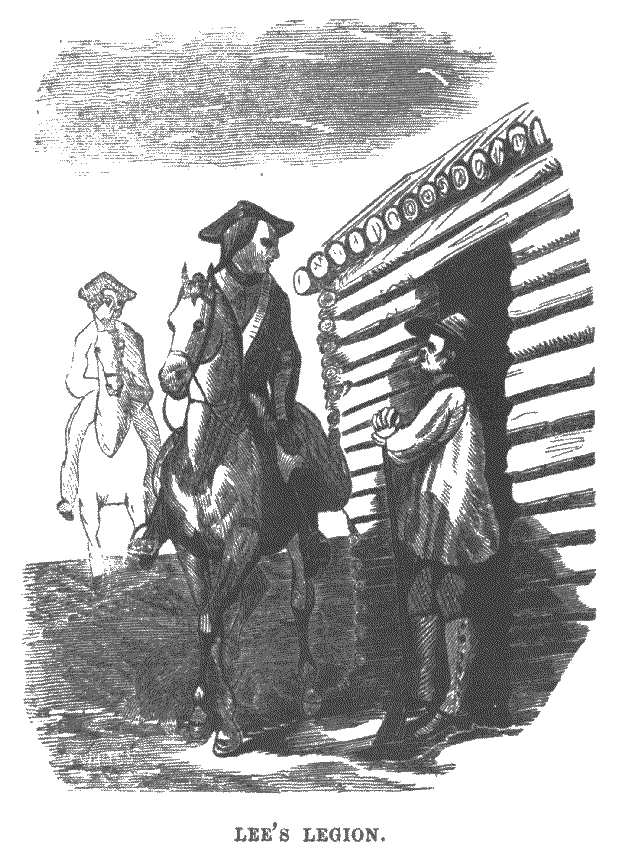
He had not proceeded far, before he saw at the door of a log-house, a
rifleman leaning on his gun, and apparently placed as a sentinel.
Galloping up to him, he inquired if a regiment of horse and body of
infantry had passed that way? 'Oh, ho,' cried the man, (whistling
loudly, which brought out a dozen others completely armed, and carrying
each a red rag in his hat,) 'you, I suppose, are one of Greene's men.'
The badge which they bore, marked their principles. Without the
slightest indication of alarm, or even hesitation, Manning pointed to
the portmanteau carried by Green, and exclaimed—'Hush, my good
fellow—no clamour for God's sake—I have there what will ruin
Greene—point out the road to Lord Cornwallis' army, for all depends
upon early intelligence of its contents.' 'You are an honest fellow (was
the general cry), and have left the rebels just in time, for the whole
settlement are in arms to join Colonel Pyle tomorrow (naming the place
of rendezvous), where Colonel Tarleton will meet and conduct us to
camp.' 'Come,' said the man, to whom he had first spoken, 'take a
drink—Here's confusion to Greene, and success to the King and his
friends. This is the right road, and you will soon reach the army; or
rather let me conduct you to it myself.' 'Not for the world, my dear
fellow,' replied Manning; 'your direction is plain and I can follow it.
I will never-consent that a faithful subject of his Majesty should be
subjected to the dangers of captivity or death on my account. If we
should fall in with a party of rebels, and we cannot say they are not in
the neighbourhood now, we should both lose our lives. I should be hanged
for desertion, and you for aiding me to reach the British army.' This
speech produced the effect he desired. The libation concluded, Manning
rode off amid the cheers of the company, and when out of sight, crossed
to the other road, and urging his horse to full speed, in a short time
overtook and communicated the interesting intelligence to his commander.
Lee was then meditating an attack upon Tarleton, who had crossed the Haw
River to support the insurgents; but, perceiving the vast importance of
crushing the revolt in the bud, he informed General Greene of his plan
by a confidential messenger, and hastened to the point of rendezvous,
where Pyle, with upwards of four hundred men, had already arrived. You
have heard of the bloody work that ensued. Pyle and his Tories believed
to the last that the soldiers of the Legion were Tarleton's men, and
were therefore easily surprised About three hundred of them were
killed—the rest fled or were made prisoners. I don't want to justify
such butchery; but our men ought to be excused, according to the laws of
war, when we consider that these same Tories and their red-coat friends
never gave the Whigs quarter in case of a surprise, and that some such
slaughter was necessary to make them feel that they couldn't murder
without paying for it."
"We've already argued that question," said Davenport, "and in my mind,
it is a settled point that Lee was right." Nobody seemed disposed to
revive the argument, and Kinnison continued.
"In this instance you see how ready Manning was to break a net or weave
one. I can tell you of another instance in which he showed his daring
courage, and quickness of resource in time of danger. At the battle of
Eutaw, after the British line had been broken, and the Old Buffs, a
regiment that had boasted of the extraordinary feats that they were to
perform, were running from the field, Manning, sprang forward in
pursuit, directing the platoon which he commanded, to follow him. He did
not cast an eye behind him until he found himself near a large brick
house, into which the York Volunteers, commanded by Cruger, were
retiring. The British were on all sides of him, and not an American
soldier nearer than one hundred and fifty or two hundred yards. He did
not hesitate a moment, but springing at an officer who was near him,
seized him by the collar, and exclaiming in a harsh tone of voice—'Damn
you, sir, you are my prisoner,' wrested his sword from his grasp,
dragged him by force from the house, and keeping his body as a shield of
defence from the heavy fire sustained from the windows, carried him off
without receiving any injury. Manning has often related, that at the
moment when he expected that his prisoner would have made an effort for
his liberty, he, with great solemnity, commenced an enumeration of his
titles—I am, Sir Henry Barry, Deputy Adjutant General of the British
Army, Captain in the 52d Regiment, Secretary to the Commandant of
Charleston.' 'Enough, enough, sir,' said Manning, 'you are just the man
I was looking for; fear nothing for your life, you shall screen me
from danger, and I will take special care of you.' He had retired in
this manner some distance from the brick house, when he saw Captain
Robert Joiett of the Virginia line, engaged in single combat with a
British officer. They had selected each other for battle a little
before, the American armed with a broad-sword, the Briton with a musket
and bayonet. As they came together, a thrust was made at Joiett, which
he parried, and both dropping their artificial weapons, being too much
in contact to use them with effect, resorted to those with which they
had been furnished by nature. They were both men of great bulk and
vigour, and while struggling each anxious to bring the other to the
ground, a grenadier who saw the contest, ran to the assistance of his
officer, made a longe with his bayonet, missed Joiett's body, but drove
it beyond the curve into his coat. In attempting to withdraw the
entangled weapon, he threw both combatants to the ground; when getting
it free, he raised it deliberately, determined not to fail again in his
purpose, but to transfix Joiett. It was at this moment that Manning
approached—not near enough, however, to reach the grenadier with his
arm. In order to gain time, and to arrest the stroke, he exclaimed in an
angry and authoritative tone—'You damn'd brute, will you murder the
gentleman?' The soldier, supposing himself addressed by one of his own
officers, suspended the blow, and looked around to see the person who
had thus spoken to him. Before he could recover from the surprise into
which he had been thrown, Manning, now sufficiently near, struck him
with his sword across the eyes, and felled him to the ground; while
Joiett disengaged himself from his opponent, and snatching up the
musket, as he attempted to rise, laid him dead by a blow from the
butt-end of it. Manning was of inferior size, but strong, and remarkably
well formed. Joiett was almost a giant. This, probably, led Barry, who
could not have wished the particulars of his capture to be commented on,
to reply, when asked by his brother officers, how he came to be taken,
'I was overpowered by a huge Virginian.'"
"Manning was a cool and ready soldier," observed Pitts. "I saw him once
in Philadelphia, before his Legion went south. He had a most determined
look in spite of the good-humoured leer of his eye. He was one of the
last men I should have wished to provoke; he was a complete
Irishman—blunders and all. I heard of his telling a black servant who
was walking barefoot on the snow to put on a pair of stockings the next
time he went barefoot."
"Great things were done by the soldiers, as well as by the officers of
that Legion," said Kinnison. "At the siege of the Stockade Fort at
Ninety-Six, Colonel Lee, who had charge of all the operations of the
siege, thought that the Fort might be destroyed by fire. Accordingly,
Sergeant Whaling, a non-commissioned officer whose term of service was
about to expire, with twelve privates, was detached to perform the
service. Whaling saw that he was moving to certain death; as the
approach to the Fort was to be made in open day, and over clear, level
ground, which offered no cover. But he was a brave man, and had served
from the commencement of the war. It was his greatest pride never to
shrink from his duty. He dressed himself neatly—took an affectionate
but cheerful leave of his comrades, swung his musket over his shoulder,
and with a bundle of blazing pine torches in his hand, sprang forward,
followed by his little band. They reached the Stockade before the enemy
fired a shot. But a deliberate aim killed Whaling and all his men except
one, who escaped unhurt. It was the opinion of most of the officers of
the Legion that Whaling's life was sacrificed in attempting to carry out
a rash idea. But we oughtn't to judge Colonel Lee without being more
certain of the facts."
"But we know enough to say it was a very wild idea to send men up to a
fort in open day, and over ground where they could have no cover,"
remarked Ransom. "I know General John Stark would never have sacrificed
his men in that way."
"Perhaps," said Hand, coming to the rescue of his hero, "a desperate
measure was necessary. I've heard that at the time, Lord Rawdon was
marching very rapidly to relieve the garrison, and Colonel Lee thought
that every means should be tried to reduce the Fort ere the siege was
abandoned."
"You say well," said Kinnison. "As I said before, we should never judge
commanders without knowing the facts of the case. Never say a man has
committed a fault, unless it sticks out plain to the eye. Harry Lee was
as a common thing very sparing of the lives of his men, and he never
made any military movement without very strong driving from reason, as
General Greene himself would have told you. Whaling was a brave man and
a strict soldier, or he would never have dared to approach the fort in
such a way. But as I said before, they were all daring men that belonged
to Lee's Legion. There were two soldiers of the cavalry, named Bulkley
and Newman, who had been the warmest and the closest friends from
infancy. They had both joined the army at the same time—that is, at the
commencement of the war; and through the greater part of the southern
campaign, they fought side by side, and each one strove to lighten the
sufferings of the other. Brothers could not have been more attached to
each other. In the fight at Quimby, where Captain Armstrong made a
famous dragoon charge upon the 19th British regiment, the friends were
among the foremost. The dragoons had to pass a bridge in which the enemy
had made a large gap. Captain Armstrong led the way, but not more than a
dozen men followed, to support him. At the head of this little band,
Armstrong cut his way through the entire British regiment. But then a
well-aimed fire brought down several of the dragoons. Bulkley and Newman
were mortally wounded at the same fire, and fell, locked in each other's
arms."
"A kind of Damon and Pythias friendship," observed Hand.
"Yes, I believe they would have died for each other," said Kinnison. "A
friend told me that they were never separated, in camp or field. If one
was sick, the other watched by his side. I had a comrade of the same
kind during the greater part of my life; his name was Williams, and he
was one of the best-hearted men I ever knew. We fought through the
Revolution together, and both entered the army in 1812. But I lost him
during the attack on Fort Erie. Poor Williams was killed by a shell. It
has been a long while since then, but I still feel as if I had lost a
part of my heart when he fell. Poor Williams!" and Kinnison appeared to
be busy with the mournful recollections of the "friends of his better
days."
"Well, you may talk as much as you please about Henry Lee and Marion,
and your other men in the south," said Ransom, "but John Stark or Ethan
Allen was worth as much as either of them."
"My favourite leader was Mad Anthony Wayne," said Colson. "A better
soldier or a more wide-awake general was not to be found in the army
during the revolution."
"I know General Wayne was a whole soldier," observed Davenport.
"Did any of you ever hear or read an account of the night-attack on
General Wayne, near Savannah, just before the close of the war?"
enquired Colson.
"I have read something about it, and know it was a warm struggle," said
Kinnison.