Transcriber’s Note: Image is clickable for a
larger version, if the device you are using supports this.
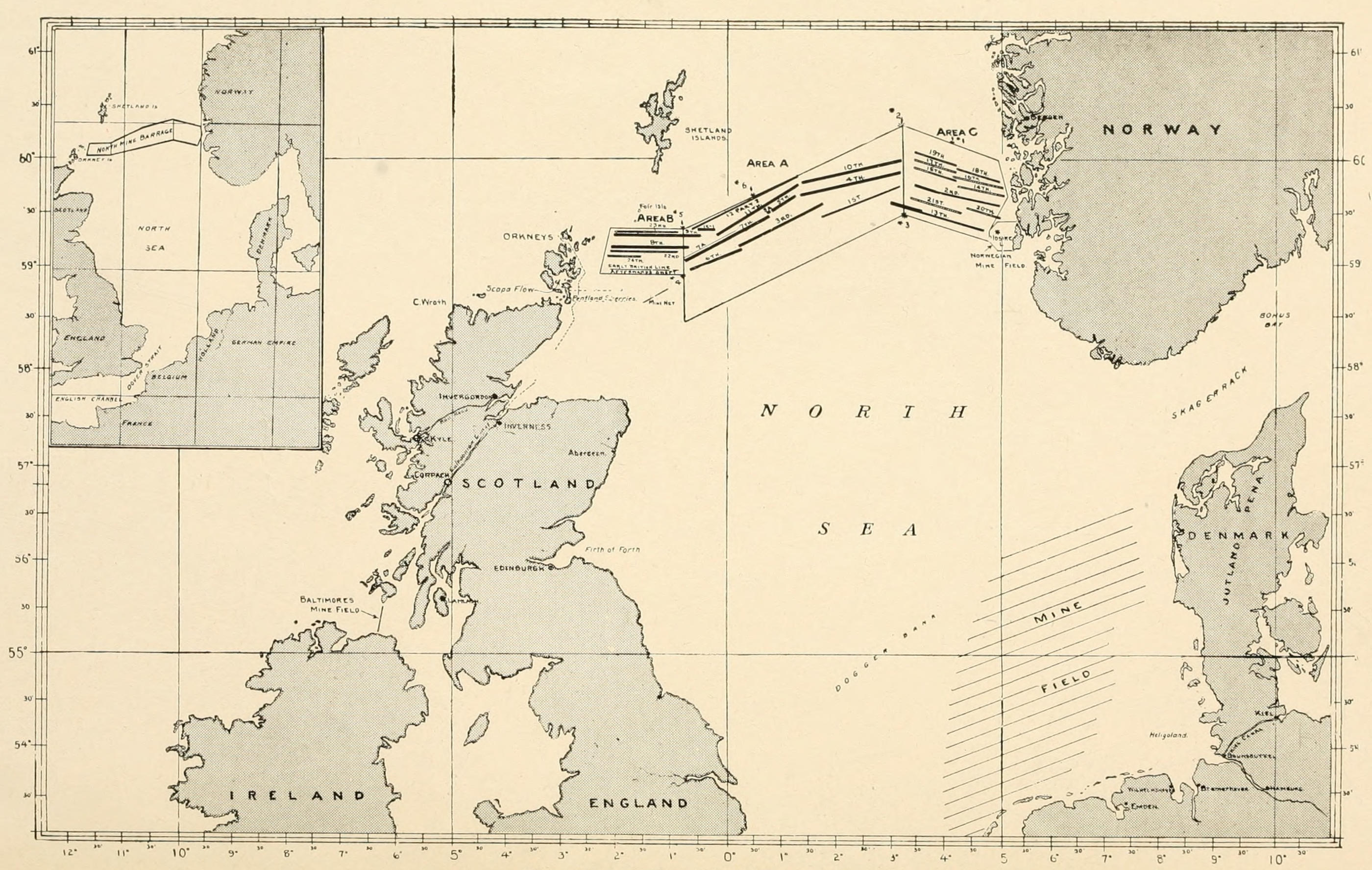
The North Sea Mine Barrage.
Showing also Foul Ground East of Dogger Bank due to Irregular Minefields.
The 1st to 13th Minefields were American.
THE YANKEE MINING
SQUADRON
OR
LAYING THE NORTH SEA
MINE BARRAGE
BY
CAPTAIN REGINALD R. BELKNAP, U.S.N. The Squadron Commander
ANNAPOLIS, MD.
THE UNITED STATES NAVAL INSTITUTE
1920
Copyright, 1919
Copyright, 1920
by
J. W. CONROY
Trustee for U.S. Naval Institute
PREFACE
In writing of the “biggest ‘mine planting stunt’ in the world’s
history”—to quote a Christmas greeting from Rear Admiral
Clinton-Baker, head of the British minelaying force—I have endeavored
to make an account that would be readable enough for
general interest, largely for the reason that, compared to other
operations, our undertaking received scant mention at the time.
Its very nature required preparation in quiet and precluded discussion
of its progress. Unnecessary technical detail has therefore
been suppressed, although much could be written that would
be welcomed by those versed in it.
The whole account is based on data obtained at first hand. The
description of assembling the squadron for a mining excursion
fits the third excursion rather than the first, but the difference is
a minor one, affecting only the numbers present—six ships on the
first excursion, ten on the third. All the rest is correct, in substance
and details.
Besides influencing an early armistice, this great minelaying
operation marks an epoch in the use of submarine mines in warfare.
It was an event in military history, as well as a prominent
operation, and the credit for it belongs not alone to the officers
and men who were actually present but also to those of the old
mine force, to whose services in developing, in our navy, the art
of handling and laying mines in large numbers, the success of the
great operation was so largely due.
Details of the mechanical development of the new mine itself
have not been gone into, for obvious reasons. Justice to that part
could be done only by those who were directly concerned in it,
but I am glad of the opportunity to express appreciation of the
valuable service which was rendered to our cause in the war by
Commander S. P. Fullinwider, U.S.N., in seizing upon and
developing the long-sought means for such an undertaking, and
by Lieut. Commander T. S. Wilkinson, U.S.N., and the officers
and designing engineers in the Bureau of Ordnance and at the
Naval Torpedo Station, Newport, R.I., by their skill and ingenuity
in designing mechanical features, when normal experimenting
was impossible.
As for the ships—the personal study which Captain J. D. Beuret
(C.C.), U.S.N., made of the mine elevator problem was the
foundation of its brilliant success, and the fact that, in the whole
period of service, few alterations or improvements in the minelayers
were found desirable, although suggestions were called for,
is the best tribute to those who planned and carried out their
conversion.
Only very inadequate expression can be given here to my appreciation
of the services of my staff, in particular Captain H. V.
Butler, U.S.N., whose excellent conduct of the flagship, supported
by the indefatigable care of his navigator, Lieut. Commander
J. C. Cunningham, U.S.N., made it possible to approach
and navigate close to unmarked minefields in the open sea. And
I was fortunate to have one so thoroughly loyal and capable as
Commander B. L. Canaga, without whose unremitting attentiveness,
and tactful management of countless details under difficulties,
our performance would have been far less creditable.
Inseparable from our recollections will always be the excellent
and friendly official and personal relations with the destroyer
escort, especially when H.M.S. Vampire led. Captain H. R.
Godfrey, C.B., D.S.O., writes, “It was the determination of
every officer and man in the 14th Flotilla, who had the honor of
being entrusted with the screening of the U.S. Minelaying Force,
that no preventable attack by enemy submarine or surface vessel
should inflict damage on any ship of the Force.” It is but speaking
for all of us to say, that is what we felt, from the first moment
of that grey morning’s meeting on the day of arrival.
THE YANKEE MINING SQUADRON — CHAPTER ONE The Mine Force Ready
The national anthem at morning colors woke me, and I arose
and looked out. What a glorious sight! Green slopes in all
freshness, radiant with broom and yellow gorse, the rocky shore
mirrored in the Firth, which stretched, smooth and cool, wide
away to the east and south, and in the distance snow-capped Ben
Wyvis. Lying off the entrance to Munlochy Bay, we had a view
along its sloping shores into the interior of Black Isle, of noted
fertility. Farther out were Avoch, a whitewashed fishing village,
and the ancient town of Fortrose, with its ruined 12th century
cathedral. Across the Firth lay Culloden House, where Bonnie
Prince Charlie slept before the battle. Substantial, but softened
in outline by the morning haze, the Royal Burgh of Inverness
covered the banks and heights along the Ness River, gleaming in
the bright sunshine. And how peaceful everywhere! Canandaigua
and Sonoma lay near by, the Canonicus farther out—but no
movement, no signal, no beat of the engines, no throbbing pumps.
All seemed resting from those last four days of our passage overseas,
which had all but done away with sleep. My responsibility
for the safe conduct of the squadron had ended at 1 a.m., when
it dispersed at the buoy, whence the routes to our bases at Inverness
and Invergordon diverged. The captains taking the ships
to their berths singly, Captain Butler was up until 5 o’clock, needing
daylight to take the San Francisco all the way in. Turned in
at last, his servant and orderly at 8 o’clock were 45 minutes
waking him.
The Senior British Naval officer, Captain H. F. J. Rowley,
R.N., came on board early, to give us welcome, and then we went
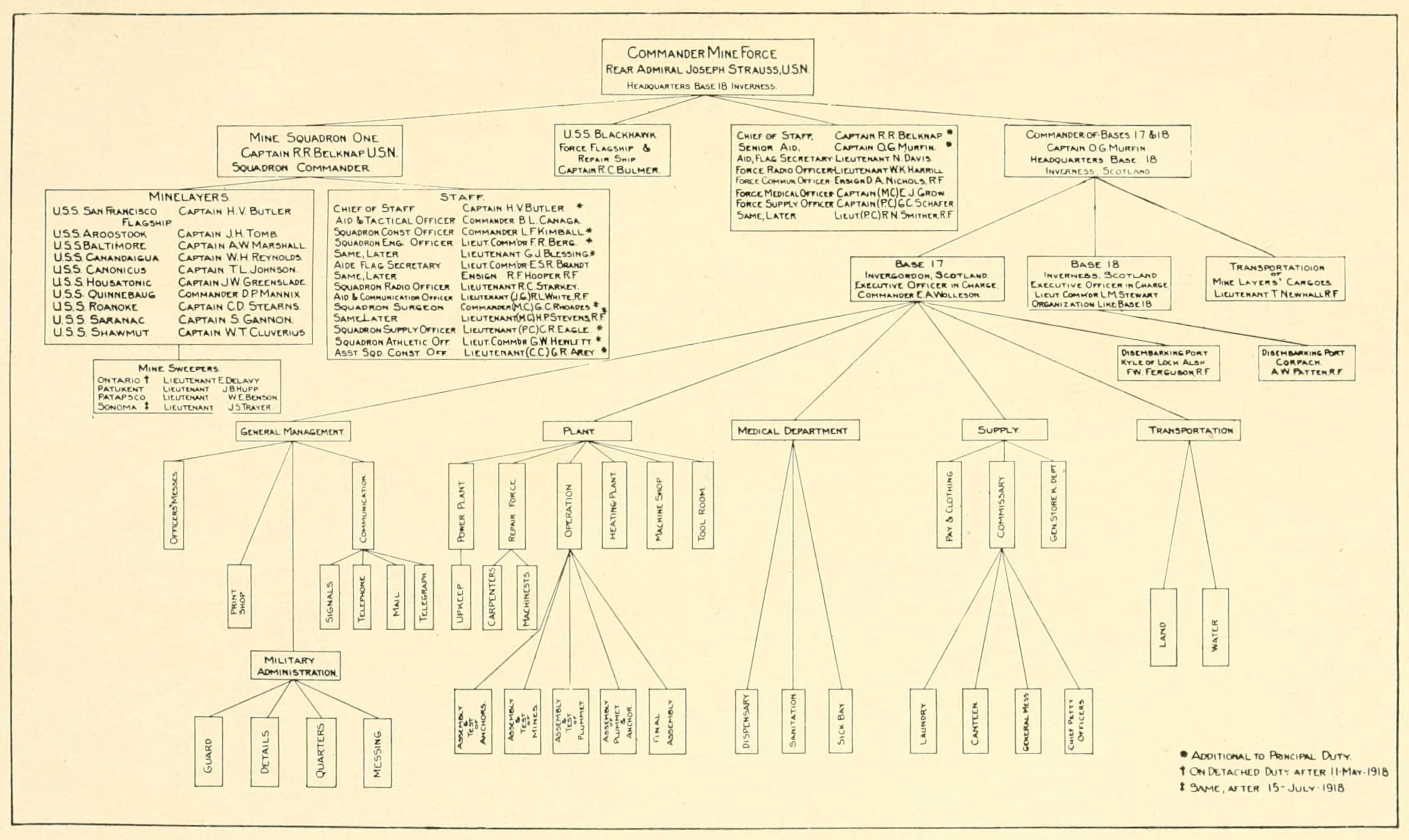
to our own chief, Rear Admiral Joseph Strauss, U.S.N., commander
of the Mine Force, whose headquarters were here at
Inverness, U.S. Naval Base 18. After taking a look over the
base itself, Captain Murfin’s work and province, we stayed to
lunch at Kingsmills, a handsome place amid beautiful surroundings,
bordering on the golf links, with gardens, tennis court, croquet
lawn, and fishing brook, which Admiral Strauss, Captain
Murfin, and some of the headquarters staff had rented. It was
a satisfaction to everyone to see our chief so befittingly established,
and this came out very effectively later, at a picturesque and enjoyable
garden party given there on the 4th of July, an occasion
which was being celebrated locally with unaffected cordiality.
Altogether, we could feel ourselves fortunate in the beauty and
attractiveness of our surroundings and also, as we soon found,
in the hospitality and kindliness of the people.
The American Mine Force had come to Scotland, arriving May
26, 1918, to coöperate with the British in laying a great barrier of
mines, from the Orkney Islands across the North Sea to Norway.
To provide for doing our share, the small minelaying force which
our navy possessed on entering the war, consisting principally of
the old cruisers San Francisco and Baltimore, had been augmented
by eight converted merchantmen. Only six weeks before, five of
them had joined the San Francisco, the squadron flagship, at
Hampton Roads, Virginia, fresh from the shipyards.
The program for the newly organized squadron contemplated
the ships being in Scotland, ready for a minelaying operation, in
45 days from the time they left the shipyards. The work of
conversion having been extensive and hardly finished, the new
ships were very raw, having had but a few days to shake down.
Troubles with engines and steering gear, lost anchors, fogs, and
missing stores repeatedly interfered with training. Up to May 5,
1918, not a day had passed without a mishap or some forced alteration
of plan. Instead of progressing to the rehearsal of a minelaying
operation by the squadron, we had been unable even to keep
all together for a single whole day. Yet we were preparing for
an operation in which, with the ships steaming close together, all
must go like clock-work, for hours without interruption.
Another week of training before going across would, therefore,
have been amply justified, but the sense of urgency was too strong.
Besides, our mine bases in Scotland needed the 500 men we were
to bring them. So, after four hustling days and nights of final
preparation, we had stolen away from Newport, Rhode Island,
just after midnight of Saturday, May 11, 1918.
Started at last! And, thanks to coöperation far and near, better
prepared than expected. There were a few quiet hours that
Sunday morning—then fog shut in thick until next day. This
was trying, so early on the voyage, but as we kept together all
through it, the experience only gave more confidence. Next, one
ship’s steering gear broke down, and she just escaped a fatal
collision. The third morning, the same vessel broke down altogether.
Through lucky foresight, a powerful tug, Sonoma, was
with us, which towed the disabled ship 150 miles until next morning,
when the break was repaired.
The submarines that soon afterwards appeared on our coast
were known to be crossing the Atlantic now, so we had target
practice next afternoon, to be ready for them. Then I felt we
could give a good account of any surface attack. Torpedoes, fire,
and collision were what we had to fear. All the ships had mines
on board and, since we steamed only 500 yards apart, an explosion
in one ship would have involved the others.
Crossing in our company was the big collier Jason, loaded with
an aviation station outfit for Killingholme, England, which afterwards
did good work. On the tenth day, heavy weather came
on, and Jason disappeared in a black squall, rolling heavily and
steering far off the course. She being a sister of the ill-fated
Cyclops, and no trace of her showing in four days, added considerably
to the anxiety felt as we entered the active submarine
zone. Radio calls brought no response. We had all but given her
up, when, at early daylight, just before the appointed rendezvous
with the destroyers, she came lumbering up astern. And so, notwithstanding
the many vicissitudes in 3000 miles steaming, we met
the escort with our number complete and right on the dot, in time
and place.
Our arrival off Inverness the following midnight, May 25-26,
1918, made the Mine Force complete as to constituent parts necessary
for the operation in hand. The Baltimore and Roanoke had
preceded the others, making us seven. Three more were still in
shipyard hands, but there was no need to wait for them before
beginning the minelaying.
Between operations the squadron was divided for loading, half
at Inverness (Base 18), and half at Invergordon (Base 17), 30
miles away. Being intended for the storage and assembly of
mines—all that we used came from America—these bases had
scant means at first for assisting the ships. Their needs could be
supplied from the Royal Naval Dockyard and two depots, under
Rear Admiral E. R. Pears, R.N., and Captain Tancred at Invergordon,
and Captain Rowley at Inverness, who were always
cordially responsive to our requests.
The motto for all American naval forces abroad, however, was
to be self-supporting, and thanks to our provident first supply and
to regular replenishment by the mine carriers, we had to draw on
the British stocks for very little. After a month, the repair ship
Black Hawk arrived. She took no part in minelaying, being
always moored off Inverness, separate from the Mine Squadron
and flying Rear Admiral Strauss’ flag, but her equipment of
machine tools and repair material made the Mine Force normally
independent in regard to upkeep. Except for docking, we asked
very little of the British in the way of repairs.
Upon one occasion, the soluble salt washers for the principal
safety device of the mines nearly ran out, the local atmospheric
conditions having caused many more to be used than estimated.
No washers of the right size and kind were obtainable anywhere
inside three weeks, and thus a shortage of these atoms—the size of
a peppermint “Life Saver”—threatened to hold up the laying of
5000 mines. The Black Hawk had a steam press, however, and
could make a die—and by the time they were needed, washers
in plenty were ready—incidentally of better quality than before.
While the ships were unloading the mines they had brought,
for overhaul on shore, and were coaling and otherwise preparing
for minelaying, the larger preliminaries were taken up at a conference
of Rear Admiral Strauss and myself with Admiral Sir
David Beatty, Commander-in-Chief of H.B.M. Grand Fleet.
Vice Admiral Brock, his Chief of Staff, Rear Admiral Clinton-Baker,
the British Rear Admiral of Mines, Captain Lockhart-Leith,
the head of his Staff, and Captain R. A. Pound, of the
Admiralty, attended this conference, which was held on board the
flagship Queen Elizabeth, at Rosyth, Thursday, 30 May, 1918.
First came the subject of tactics, and I explained my plan, to lay
the mines with the squadron steaming in line abreast, ships 500
yards apart, making a trace on the chart like a music score. Three
vessels (later five) would be laying mines simultaneously. When
a ship had emptied herself of mines, her neighbor, ready and
waiting while steaming alongside, would begin. At the end of the
minefield, some temporary small buoys would be planted, by which
to pick the field up later, to continue it. This plan was accepted
without comment.
The area to be mined having been publicly notified two months
before, the enemy might have placed some mines there, on the
random chance of damaging our force. The only arrangement
practicable to meet such a contingency was for some of the destroyer
escort to explore for mines ahead of the minelaying formation
as it proceeded. Only those ships would be fully protected
that might be following directly in the wake of the searching destroyers,
the main purpose being to discover the existence of an
enemy minefield in time for the squadron to maneuver aside.
A clear understanding was reached at the conference of the
relation of the mine squadron and its escort to the supporting
force. The mine squadron being lightly armed and of moderate
speed, it would have been at great disadvantage against even a
numerically weaker force of light cruisers, with their superior
batteries and speed. Hence the need of the support, which would
consist of a battleship or battle cruiser squadron, or both, and of
light cruisers, according to the estimated risk of attack at the
time. If attack threatened, the mine squadron and its destroyer
escort would seek safety in the direction ordered by the Support
Commander; otherwise they would proceed on their mission and
return to base afterwards, according to the program for that
occasion. The destroyer escort would be of strength sufficient to
ward off any probable attack by submarines or by surface vessels
that might elude the supporting force and the regular patrols.
The location of the first minefield was decided upon; then
further details were settled with Vice Admiral Brock and Rear
Admiral Clinton-Baker, for the first mining excursion, which
was to be done by the American and British squadrons at the same
time. Preparatory notice was to be given by the Commander Mine
Force to the Admiral of the Grand Fleet at least four days before
the time the mine squadron was expected to be loaded and ready
for an excursion. Upon a second, definite notice, not less than 48
hours in advance, when it was certain that the squadron would be
ready, a combined operation order would be issued by the Admiral,
naming all the forces concerned and containing the instructions
and intelligence necessary for all.
After lunching on board with Admiral Beatty, Rear Admiral
Strauss and I took our leave. We had a look at Holyrood Palace
and a walk through Canongate Street that afternoon, returning to
Inverness next day. Not enough material had yet been accumulated
to assemble mines to fill all seven minelayers present, but
3400 would be ready in a few days, sufficient to lay a field 47 miles
long, consisting of one row of mines at each of the three levels
prescribed. A mine embarking schedule was made out accordingly,
to include San Francisco, Baltimore, Roanoke, Canandaigua,
Canonicus, and Housatonic, for a start on June 7.
CHAPTER TWO The Need and the Means
A barrier of high explosive across the North Sea—10,000 tons
of TNT, 150 shiploads of it, spread over an area 230 miles
long by 25 miles wide and reaching from near the surface to
240 feet below—70,000 anchored mines each containing 300
pounds of explosive, sensitive to a touch, barring the passage of
German submarines between the Orkneys and Norway—this was
the final five months’ contribution of the American and British
mining forces towards bringing the war to a close.
To stop the enemy submarines near their bases, before they
could scatter on the trade routes, would obviously defeat their
campaign more surely than merely hunting them at large. That
was the purpose of the Northern Mine Barrage, which, with the
barrage at Dover, made it not impossible but extremely hazardous
to enter or leave the North Sea. That many a submarine came to
grief in attempting these barriers is now a certainty, and the
establishment of the Northern Barrage, which many had thought
impossible, insured the early finish of the submarine campaign.
The resumption of ruthless submarine warfare became a serious
threat to the cause of the Allies, and at the time of our entry
into the war their situation was critical—how much more critical
than the world was allowed to know at the time, Admiral Sims
has disclosed in his “The Victory at Sea.” The relief brought
about through the convoy system, in which our destroyers, the
navy’s first participants, had a large share, was immediate and
important. But the submarine menace was far from ended and—according
to the best information—would soon be greatly augmented,
while the increasing number of transports would offer the
enemy more opportunities, with the added horror of troopship
sinkings in prospect.
Of further measures, the most effective would be such a blockade
as would keep the submarines in or from their bases. The
British had already mined a large area north and west from
Heligoland, but this obstruction was not insurmountable, for the
Germans from nearby could always clear a passage through when
wanted. In any case, until the Skagerrack passage were closed,
the submarines might use that route without hindrance. Two
weighty reasons kept the Skagerrack open—unwillingness to violate
neutral waters, and the ease with which German forces could
raid any barrier near their bases. It may be recalled with what
sudden damage a small German cruiser detachment raided a
convoy just outside the Skagerrack, in October, 1917.
To be effective, therefore, any barrier must be beyond easy
reach of a raiding force and cover the Skagerrack, and must also
be far enough to the northward of the British bases not to hamper
the battle fleet’s engaging with the enemy. Hence, the anti-submarine
barriers should be, one near Dover Strait, the other
across the North Sea, from Scotland to Norway.
The closing of Dover Strait, undertaken by the British Navy
alone, needs no further mention here. Although the strong tidal
currents there, frequent rough seas, and hard, smooth bottom
were unfavorable for minefields, other means—such as a line of
guard vessels moored not far apart and equipped with powerful
searchlights, together with numerous active patrollers—were employed
with a considerable degree of success.
The Northern Barrage would be too long a front, and much
of it too far from base, for effective patrol without a great number
of vessels. A wide, thickly sown minefield, however, would watch
night and day in all weathers without relief, and would be even
more effective against passage submerged than against passage on
the surface, because of the less wear and disturbance of the mines
by wave action, deep down under water.
Currents were not strong in the northern location, but the
bottom lay as deep as 900 feet, whereas 300 feet had heretofore
been the deepest water ever mined. Merely to provide the mines
meant a large undertaking, besides involving an enormous
quantity of the same high explosive which was likewise in heavy
demand for shells and bombs. Supposing the mines ready, the
planting of so many would be a long and dangerous operation,
employing all the Allies’ existing minelayers indefinitely. And
neither the British nor ourselves yet had a mine that was quite
satisfactory for the prospective requirements.
Our Naval Bureau of Ordnance, however, was intent on finding
the means for such a barrier, so that when, in May, 1917, among
the many contrivances offered for winning the war, Mr. Ralph E.
Browne, an electrical engineer of Salem, Massachusetts, presented
his submarine gun for consideration, Commander S. P. Fullinwider,
U.S.N., in charge of the Bureau’s mining affairs, saw
that, although the invention was not suitable for naval purposes
in the form offered, a new electrical device which it contained, if
applied to the firing mechanism of a submarine mine, would result
in just what we were looking for—a mine at once sensitive and
far reaching. Mr. Browne collaborated with the Bureau of Ordnance
in developing the new mine-firing device. By July, 1917,
all doubt as to its practicability had been dispelled and the Bureau
of Ordnance was able to give assurance that, in urging the closing
of the German bases, our navy might offer the means.
Extravagant claims were common in the field of mining inventions,
and three years of war lessons in the perversity of mines
made the British naturally skeptical of this American find. An
experienced officer in mining was sent over to see, Lieutenant
R. H. DeSalis, R.N., who had received the D.S.O. for some
minelaying on the Belgian coast. As the new device was put
through its paces before him, the chill thawed out and in two
hours he had become almost an enthusiast. Upon his report the
British Admiralty took up the plan with active interest.
Upon returning from London in mid-October, 1917, Admiral
Mayo, of our Atlantic Fleet, brought back the outline of a proposed
minelaying operation. The paper was quite informal—unsigned,
undated, bearing in pencil across the top, “Admiralty
would be glad to learn whether Navy Department concur in the
plans as shewn.”
The field was to be 230 miles long—the distance from Washington
to New York—divided into three parts, the middle section,
of 135 miles, called Area A, allotted to us, because the reach of
the new American mines was greater than ordinary—three of
them covering the same extent as eight mines of other types.
Thus numbers and effort were saved.
There would be three “systems,” each consisting of one or
more rows of mines just below the surface, dangerous to any craft,
and other rows at intermediate and extreme depths, so that,
whether running on the surface or at ordinary submergence or as
deep as 240 feet, a submarine had the odds against her. In the
absence of patrol vessels to drive them down, submarines would
naturally run on the surface, and so the rows of upper level mines
were made more numerous than those at deeper levels. The
stroke of a mine is sudden and powerful, and while a vessel on
the surface may survive it, to a submerged submarine it is usually
fatal. All classes of vessels shy at a minefield, and that the Germans
shared this aversion was shown by captured papers, which
made it clear that the submarines dreaded nothing so much as
mines.
The scheme was unprecedented, and that its great magnitude
would involve a mass of detail requiring very careful adjustment
was evident on the most cursory examination. Some who heard
of it regarded it as impossible, and foolish to attempt. As to the
new mines, the very basis of the whole project—since a complete
unit would not exist for several months, the statement of Rear
Admiral Ralph Earle, Chief of the Naval Bureau of Ordnance,
that the mines would be forthcoming in season, had to be based
upon tests of the mine only by parts, with the assumption that all
would function properly when assembled. Action upon that assurance
would at once involve upward of forty million dollars, which
made his stand a bold one, inviting unmeasured odium, should the
mine after all fail. To await the mine’s final proving, however,
would have been fatal to any possibility of beginning the barrage
before 1919.
The task of laying the barrier would be hazardous in itself, with
constant danger of interruption by the enemy. A single minefield
in the open sea, or widely separated ones, presented no extreme
difficulties, but to lay a series of them so close together as to leave
no considerable gaps between, made a problem for which no really
practical solution was yet visible.
For four days the project was under consideration by the Naval
General Board at Washington. Time pressed, the need was great,
the new mine very promising. The attitude of our officers was
favorable. My own expressed view, based on three years’ experience
in mining, was that, though much greater difficulties and
magnitude would develop even than yet foreseen, the scheme was
nevertheless feasible, was within our minelaying experience in
principle, and, though it could hardly be more than half or a
quarter effective, it was well worth doing. The British Admiralty’s
approval and belief in the practicability of the scheme was implied
in the original paper, but an explicit confirmation was asked and
obtained by cable, on the basis of their three years’ war experience
and knowledge of North Sea conditions. And so the plan went
to the Secretary of the Navy bearing the General Board’s approval,
as promising a sufficient degree of success to warrant
undertaking it.
CHAPTER THREE The Bases in Scotland
The British Minelaying Squadron was to operate from Grangemouth,
near Rosyth, on the Firth of Forth. As a mine assembling
and operating base for the American Squadron, the British naval
authorities decided on Inverness and Invergordon, in the Scottish
Highlands, situated on Inverness Firth and Cromarty Firth, respectively,
which empty into Moray Firth about eight miles apart.
One base would have been enough and in some respects more
convenient, but the limited transportation means across Scotland
necessitated two. To require the slow mine carriers to navigate
the difficult passages around the north of Scotland would prolong
their exposure to submarines and cause more escort duty for destroyers,
so it was decided to discharge their cargoes on the west
side, at points which gave a short haul across Scotland—Fort
William, at the western terminus of the Caledonian Canal, and
Kyle of Loch Alsh, where one crosses to the Isle of Skye. The
cargoes were transported by canal motor-barge and by the Highland
Railway.
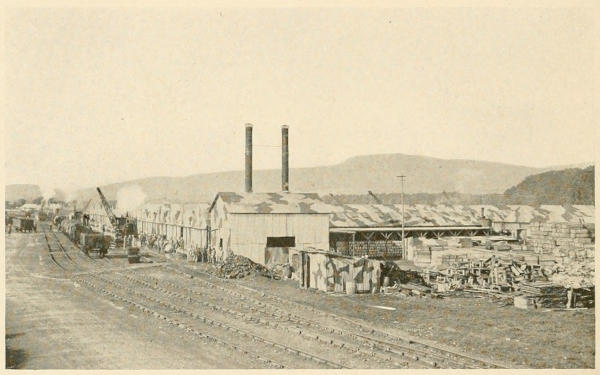
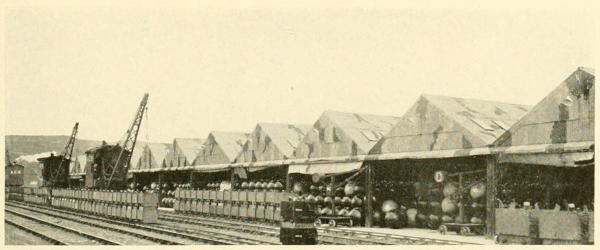
Mine Assembly and
Storage Sheds.
U.S. Naval Base 18, Inverness.
In order to issue mines to the ships ready in all respects for
planting, the bases needed a large number of men for shop work,
besides others for transportation, police, clerical work, messmen,
and sanitation. The entire establishment on shore was under
Captain O. G. Murfin, U.S.N., who had 20 American naval
officers and 1000 enlisted men at each base, 3 officers and 60 men
at each of the unloading points, Fort William (actually at Corpach
village) and Kyle. Headquarters was at Inverness, because of
its superior communications and more central location. Captain
Murfin had sailed November 13, for England, to supervise the
preparation of the bases. With him had gone Commander T. L.
Johnson, then commanding the small minelayer Dubuque, who
was to inform himself fully on the situation and return to Washington
as soon as practicable with answers to a long list of questions—everything
we could then think of as useful to know for
intelligent coöperation in the preparations.
The large, substantial, stone buildings of two idle distilleries,
Dalmore, three miles out from Invergordon, and Glen Albyn, at
Muirtown, where the Caledonian Canal locks out to Inverness
Firth—clean, dry, and well ventilated—gave excellent living accommodations
for the men. The smaller buildings made suitable
offices, but considerable additions were made for messing, cooking,
and washing arrangements. A Y.M.C.A. hut was established in
each base, and at Inverness the little Muirtown Hotel was transformed
into a small hospital. This, and similar provision at
Dalmore, all under Captain E. J. Grow (M.C.), were for mild
or emergency cases. The main dependence for hospital care was
Strathpeffer—a “hydro” cure in peace time—20 miles from either
base. There a U.S. Naval Base Hospital of 1000 beds had been
established, under Captain E. S. Bogert, Medical Corps, with the
Leland Stanford unit.
The buildings for mine assembly and storage were erected on
adjacent vacant land, spur tracks being brought in from the main
railway line, thus making good communication between the two
bases, as well as with their receiving sources and shipping out
points. Most of the machine tools and other shop and office equipment,
as well as furnishings for the men’s use, came from the
United States.
Some dredging was done in Inverness Firth to admit our minelayers
into Beauly Basin, near the canal entrance. The navigation
marks for entering the Firth were improved, because ordinarily
vessels of our size seldom came in there, and then only by day. In
addition, the whole length of the Caledonian Canal was lighted,
for night navigation by the mine carrying lighters.
Labor was scarce in the Highlands and the weather that winter
was severe. The work went slowly, delayed considerably beyond
expectation. Captain Murfin had many discouragements, and disappointments
in deliveries from the United States. In spite of the
kindness of all about him, he must often have felt very far away
from home; but afterwards, the frank admiration repeatedly expressed
by all visitors to the bases must have repaid his six long
months of effort. In the end, the bases were ready in time, and
their capacity, and the rate of transportation as well, were twice
the original estimate, the two bases together being capable of
assembling 1000 mines a day ready for planting.
Sending over the base personnel began with small drafts in
December, but as accommodations for the full number were not
ready soon enough, and the demand to use all transportation
for troops became pressing during the Germans’ great drive in
March, 1918, the base complements were not more than about
two-thirds full when the mine squadron sailed from the United
States coast in May. The greater part, 750, of the number then
lacking had therefore to be brought over by the squadron. Though
this retarded the proper organizing of the base personnel, it did
not delay the minelaying.
CHAPTER FOUR The Supply of Mines
In the same past six months other preparations, too, had been
pushing ahead, both at home and abroad. Providing the mines—the
task of our Naval Bureau of Ordnance—would alone make a
story of great interest. Considering how long it had taken to
develop previous types of mines, to have made a success of an
invention that was new since our entering the war was indeed
remarkable, the more so from inability to test a single mine complete
before ordering 100,000.
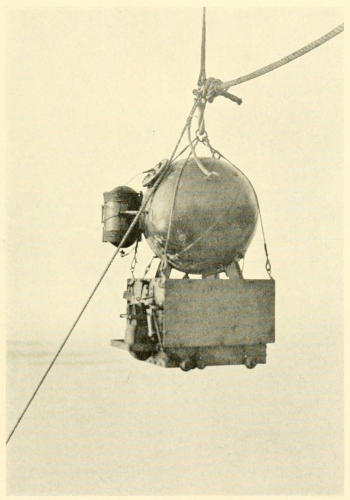
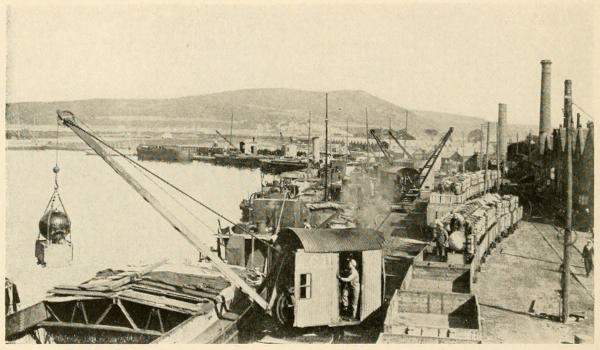
A Mine in Mid-Air, Being
Hoisted in.
The Plummet is at the Lower Left Corner.
Mines for the open sea in great numbers, moored “flying”—that
is, by ships steaming at considerable speed—need anchors
with automatic depth regulation. Such mechanism had undergone
important changes during the war, and the new American mines
needed all the improvements, to make them sure to plant at the
intended level. They were to be much deeper than ever attempted
before, and also in deeper water.
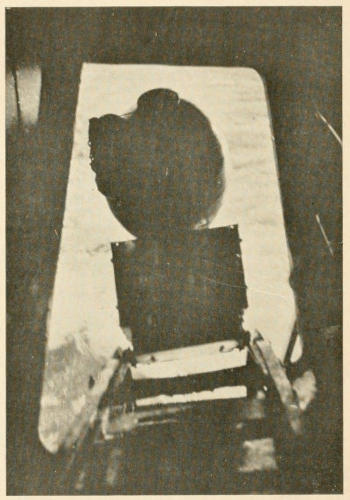
Launching a Mine
Through the Stern Port.
There is a Nine-Foot Drop, from Rails to Water.
Three British officers of considerable mine experience assisted
here, Lieut. Commander H. O. Mock, R.N.R., Lieutenant R. H.
DeSalis, R.N., and Lieut. Commander Harold Isherwood, R.N.V.R.
The last was an expert designer, and had an important part
in planning our new mine anchor, which was similar to a late
model British mine anchor.
A submarine mine of to-day consists of a mine case, shaped like
a ball or egg, about one yard in diameter, mounted on an anchor
in the form of an iron box about 30 inches square, connected by
a wire rope mooring cable, about ⅜ inch in diameter. The
mine case contains the charge of high explosive—300 pounds of
TNT in our mines—and the firing mechanism. The combination
stands about 5 feet high and weighs 1400 pounds. Four
small car wheels on the anchor run on steel tracks, allowing the
mines to be easily moved along the decks to the launching point.
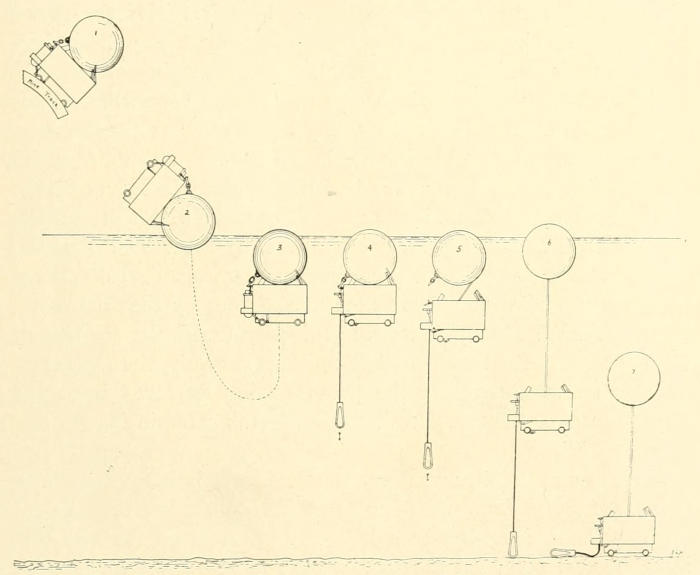
The Sequence of
Operations After a Mine is Launched.
When the mine dives overboard, the mine and anchor come to
the surface and float for a time, still held together, part of the
mine case above water. Outside the anchor is a 90-pound plummet,
containing a reel of ⅛-inch diameter steel wire “plummet cord,”
made the same length that the mine is to be below the surface.
Thus, if the mine is to be 160 feet beneath the surface, the cord
is made 160 feet long. The plummet drops off when the mine
goes overboard, unreels its cord, coming to the end with a jerk
that trips the slip hook which holds the mine and anchor together.
The pull on the cord also lifts the latch on the reel inside the
anchor, allowing the mooring wire to unwind. The nearly solid
plummet tends to sink faster than the more bulky anchor, thus
keeping the cord taut until the plummet strikes bottom. The
cord then at once slackens, releasing the latch, locking the reel,
and preventing any more mooring wire unwinding. The anchor,
continuing to sink, pulls the mine under until the anchor strikes
bottom. The mine is thus finally moored always at the desired
depth beneath the surface, no matter how irregular the ocean
bed may be. The mine cases are buoyant enough to pull straight
up from their anchors ordinarily, but in a current they are swayed
away from the vertical, which dips them down somewhat deeper
than intended. For this reason, any locality where the currents
are strong is unfavorable for a minefield—one of the difficulties
the British Navy had to contend with in closing the Dover Strait.
The new mine having, by October, been carried past the experimental
stage as to its principal features, by the Naval Torpedo
Station at Newport, R.I., some important mechanical details of
the mine yet remaining were now worked out by the Baltimore,
Captain A. W. Marshall, working directly under the Bureau of
Ordnance. By the time complete units were ready, the Baltimore
had been sent abroad, so the proof testing devolved upon the
San Francisco, Captain H. V. Butler. This came in March and
April.
No throw of the dice was ever watched more intently than those
first proof tests. Upwards of forty million dollars had been staked
on them and were already half spent. Results on the first day
made us feel easy, but it was two days more—from various delays—before
we succeeded in exploding a full loaded mine. This
had been planted in Chesapeake Bay, well marked and guarded,
in the very same deep hole where a whirlpool effect troubled the
German submarine Deutschland on her first return trip. It was
not possible to place the mine far from the fairway, however,
since the water elsewhere was not deep enough for our purpose.
Early the second morning, the battleship Arizona came along,
heading too near it. The signal “You are standing into a minefield!”
sent her rudder hard over and engines full speed astern.
We could see the mud stirred up, from two miles away. Since
we could not get the mine up, what a relief it was when it was
set off at last by sweeping!
The final proving of the mine as a whole, which was completed
in April, off Cape Ann, did not take place until after several
cargoes of mine parts had been shipped abroad, but the mine’s
success, from its first trials, showed how careful and observant
had been all those who were concerned in its designing and
testing.
The prospect in October was that the shipment of mines would
begin in January, but through delay in completing the detailed
plans and from the abnormal industrial conditions prevailing,
these shipments did not attain a regular flow until May, so that the
ships and the mines were ready together.
Secrecy, as well as timely delivery, caused the manufacturing to
be partitioned among 500 contractors and sub-contractors, some
of them as far west as the Mississippi. Certain mine parts from
different makers were put together by still others, and all parts
flowed toward Norfolk, Virginia, the trans-Atlantic shipping
point. Planning this dividing up, placing the contracts, and
arranging for the inspection of all—taking into account the transportation
involved and the many different kinds of firms—wire
rope makers, automobile concerns, foundries, machine shops, electricians,
die-presses, and even candymakers—it was indeed a complex
web. What tireless industry and what endless patience
under pressure went into this work, only Commander Fullinwider
and his assistants can fully appreciate.
A large plant to charge the mines with explosive was built
alongside the Naval Magazine at St. Julien’s Creek, near the Norfolk
Navy Yard. This plant was of capacity larger than any other
of the kind, ample for handling 1000 mines a day. The high
explosive was melted in steam kettles to about the consistency
of hasty pudding, and drawn off, 300 pounds of TNT at a time,
into the mine spheres. An automatic device shut the flow off at
the right weight, and a mechanical conveyer carried the mines
along slowly, to the pier end, by which time they would be cool
enough to load into the waiting ship. Hot work around those
steam kettles through the long summer! A quiet but important
corner, handling 25,000,000 pounds of TNT, with constant
risk from fire. Several of the sailors were overcome by the
kettles’ poisonous fumes, and one died. The duty was monotonous
and inconspicuous but was done with praiseworthy faithfulness.
CHAPTER FIVE General Supplies and Transportation
Under the extraordinary demand prevailing abroad for food
and all kinds of military material, it was only fitting that ordinary
supplies for our part of the Northern Barrage operation should
come from America, British sources to be used only for fuel
and fresh provisions. Details are needless here, except to mention
their completeness—largely due to the efforts of Captain G. C.
Schafer of the Pay Corps. After starting things fair at home,
he sailed about mid-December for England, where the needs of
the bases could be best determined. With him went Assistant
Paymaster R. N. Smither, U.S.N.R.F., who later became his
successor, and Lieutenant Thomas Newhall, U.S.N.R.F., who
had been enrolled for duty principally in connection with transporting
the mine carriers’ cargoes across Scotland. His experience
in railroading and his tactful energy made a valuable asset.
After their departure, purchases and deliveries were followed up
indefatigably by Assistant Paymaster A. B. Peacock, U.S.N.R.F.,
who was quite successful in bringing pressure to bear effectively.
One morning, after a certain freight car had been missing
for two weeks, he reported that eight railroad presidents were
now interested personally in the search—and the car was then
found.
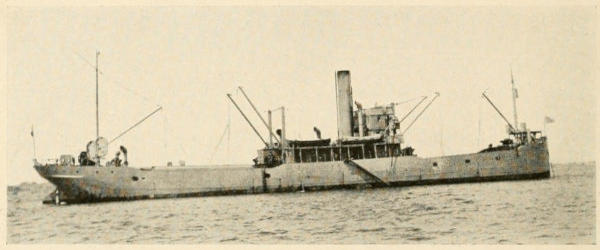
A Mine Carrier Steamer.
Twenty-Four of These were Constantly Employed to Transport the Mine
Parts Over to Scotland for Assembly and Laying.
For transportation beyond the seaboard, cargoes of mines must
go in special ships, which could carry also the general supplies
for the operation. The mine carriers should be small rather than
large, to minimize the effect on the progress of the operation in
the event of losing one. About 60,000 tons in constant employment
being needed, 24 of the so-called “Lake” steamers were
selected, built on the Great Lakes for coastwise service, of 2500
tons average capacity. They were armed against submarines,
manned by naval crews, and would sail in convoy, two or three
every eight days, beginning in February. Their fitting out and
management came under the Naval Overseas Transport Service,
which furnished them according to schedule. Slow speed, due to
their small size and cheap build, made them good prey for submarines,
which sank one of these carriers in April, the Lake Moor,
with 41 of her crew—almost our only loss of life in the whole
operation. This was another part of the whole operation that was
obscure, though all-important, which would yet have been very
conspicuous had it not been so well done.
The great amount and the dangerous nature of these cargoes
needed special arrangements for embarking them, for which
Southern Railway Pier No. 4. at Pinner’s Point, opposite Norfolk,
Virginia, was taken exclusively. This pier being large enough
to assemble several cargoes at once, the entire cargoes could be
loaded there, and that was the plan, until the great disaster at
Halifax aroused strong local opposition concerning the place of
loading the mines on board. It was too late then to relocate
the plant for charging the mines with TNT, and as the ground
of local opposition was undeniably well taken, a real problem was
presented. To take the loaded mines in lighters from the magazine
17 miles to the Explosives Anchorage, as first proposed,
would have been very slow—almost impossible in bad weather—even
had ample towage, lighterage, and labor been available,
besides involving an extra handling for every mine, with attendant
damage and risk. Thanks to the timely exertions of Captain W. J.
Maxwell, U.S.N., who was in general charge of the loading and
despatch of mines, a channel was dredged up to the magazine pier,
where the steamers could embark the mines directly, after loading
the unobjectionable part of their cargoes at Pier 4. Thus local
interests were quieted with the greatest measure of safety.
Several ingenious arrangements were devised for handling the
mine material quickly. Two mine anchors fastened together,
1600 pounds, could be trundled about by one man, making a considerable
labor saving on loading 2000 in one cargo. The pier
became also the sub-assembly point for some mine parts, requiring
a shop, as well as shipping organization. All was done by naval
enlisted men, under the supervision of Lieutenant A. J. Love and
Lieut. Commander R. E. Corcoran (P.C.). It was not long
before these steamers began to take supplies also for our Battle
Squadron with the Grand Fleet, 500 tons at a time.
CHAPTER SIX A Sample of Quality
While details were shaping for proving the mine early in March,
an urgent request came from the British Admiralty for one or
more minelayers to help lay a field in the North Irish Channel.
This passage was used by slow convoys to the west coast, making
port first at Lamlash in the island of Arran, and submarine activity
here needed to be checked. The sinking of the Tuscania had
taken place in this vicinity.
At that time, only the San Francisco and Baltimore could be
considered for this duty, and as the former was flagship, the
Baltimore was sent. To “How soon can you go?” over long distance
wire, Captain Marshall answered “Right away,” guessing at
the destination, and on March 4 he sailed from New York to join
H.M.S. Leviathan as escort for a fast convoy out of Halifax.
By popular standards, the Baltimore was a musty back number—years
older than many of her officers and crew—but she had
been at Manila Bay with Dewey and had otherwise distinguished
herself in a long and varied career. Though classed as a poor
steamer, the ease with which, time after time, she produced extra
speed at a pinch was a standing joke. Thanks to a good overhaul
early in the war and to the ability and contagious enthusiasm
of her engineer, Lieutenant R. P. Molten, U.S.N., she now
topped a 9-day transatlantic run at 13 knots, for the most part
in rough weather, with a three-hour spurt at 18.6 knots—2 knots
faster than was supposed to be safe for her engines—just to keep
pace with the Leviathan.
She arrived at Greenock, Scotland, March 17, ready for work,
but was so much earlier than expected that her first mines were
not delivered until April 13. Without any preparatory trials,
though the mines were British, of a type new to the Baltimore,
she went out at once, beginning the deep minefield between the
island of Islay and the Irish coast, which was to prevent submerged
but not surface passage.
More mines in excess of her reported capacity having been sent
to her, 10 had to be carried on the upper deck, and the last one
of these mines, in going down the elevator, was jambed, due to
the roll of the ship, and held suspended in the elevator shaft.
William J. Powers, gunner’s mate, 1st class, promptly of his own
initiative, at imminent risk of the 1800-pound weight falling or
one of the mine’s firing horns breaking, removed the detonator
and with it the great menace to the ship. Before the Baltimore’s
next trip, her own mechanics extended the launching deck tracks,
to accommodate 180 instead of 170 mines, since the British naval
authorities wished her to plant the larger number each time. Four
times more she planted 180 mines, April 18, 21, 28 and May 2,
planting always at night, in an area infested with submarines.
Extra careful navigation was required, both to lay the mines
just where intended, as their anchor cables had been cut to
fit (anchors not automatic), and to approach close to the minefields
previously laid, yet avoid them. In one such operation, the
gyro-compass went wrong at a critical moment. The navigator,
Lieut. Commander George W. Hewlett, U.S.N., kept his head
and held his peace, applying the corrections to the magnetic compass
with coolness and accuracy, as if maneuvering to avoid a
sand bank, instead of to clear a minefield by only 500 yards.
The Baltimore laid this whole minefield unassisted, 899 mines
in all. She worked directly under Rear Admiral Clinton-Baker,
R.N., who wired his congratulations upon the successful completion
of the first three operations, and when, at the end of May,
she was recalled to our squadron, he wrote to Captain Marshall:
Once more I wish to thank you for all that you have done and for the
very willing help which you, your officers and ship’s company have always
given. It is much to be regretted that the work which you commenced and
so admirably carried out is not to be completed, at any rate for the present,
though doubtless you will be doing equally useful work elsewhere in the
near future. Good luck to you and your ship.
This minefield accounted for two enemy submarines and there
was little further submarine activity in that vicinity, which should
be credited largely as an achievement of our squadron. And as
a sample of quality before the North Sea mining began, the Baltimore’s
work gave our colleagues confidence that we could do
our part—by far the largest portion—in that great, open sea
operation. As immortalized in our song:
“The Baltimore was the first away.
She traveled a thousand miles a day,
To show the Allies the lively way
Of the Yankee Mining Squadron.”
CHAPTER SEVEN Mine Assembling and Embarking
Following the conference on board the Queen Elizabeth, our
bases worked full blast on the mines for the first operation. One
group assembled and tested the anchors, another the mines, a
third the plummet, a fourth the plummet and anchor together,
and a fifth, the final assembly, of mine and anchor complete—called
a unit. A section of mine track of standard gauge sufficed
to test the anchor wheels and thus obviate trouble on board from
their binding or dropping between the ship’s tracks during minelaying,
possibly causing an interrupted string. It speaks well for
the manufacture, for the testing at the bases, and for the ship’s
mine track installations, that no such interruption ever occurred
in the whole series of operations.
Mines and Mine Anchors
Awaiting Assembly.
The Anchors were Shipped in Pairs, for Convenience in Handling.
The adjustment of firing mechanism was done in a locked room,
the secret entrusted only to a few. It was delicate work, to be
done patiently and methodically, for its accuracy determined
whether the mine would be alive—or a dud. Fidelity in such
adjustments is hard enough to maintain when the repetitions are
numbered only by tens. Where hundreds and thousands are
involved the tax on attention becomes severe.
Before loading the mines into the cars, for transfer to the
lighters, each mine was primed with a mealed TNT “booster”
charge and the firing detonator was put in place—all ready for the
laying—and five safety devices were seen in place and in order.
These devices would prevent the firing mechanism working until
the mine had reached a certain minimum depth under water and
had been in the water about 20 minutes, and would also prevent
exploding in case of loss overboard during embarking. Such
devices usually function properly, and dependence is not placed
on one alone but on several together, any one of which will make
the mine safe to handle—by experienced men. At an early stage
in the training in mines, one learns to treat them with respect
always—no liberties. Even the safest explosives, the surest mechanism,
have an occasional, inexplicable aberration.
Loading Mines into Lighters.
At Base 18, on the Caledonian Canal, at Inverness.
The ready mines are swung up into open freight cars, for hauling
to the water side, whence they go, 40 to 80 together, in lighters
out to the ships. After being landed on the tracks of the minelayer,
one safety pin is removed—leaving four—and the mine is
then examined for any derangement during the three handlings
in transit from the store shed.
The north of Scotland was a barred area, yet it was reported possible
for information to get through to the enemy in 18 to 20
hours—time enough for interference to hatch out. With so much
activity at the bases, lighters going to the ships loaded and returning
empty, and a large destroyer escort coming in on 5 June, the
fact that an operation was in early prospect was obvious. The
hour of departure at least could be kept secret, and the start was
fixed for midnight. The two detachments of the mine squadron
and the destroyer escort would assemble at 1 o’clock a.m., 7 June,
just outside the Sutors, the high rocky headlands at the mouth of
Cromarty Firth. On this first occasion the preparations continued
until one hour before the ships weighed anchor.
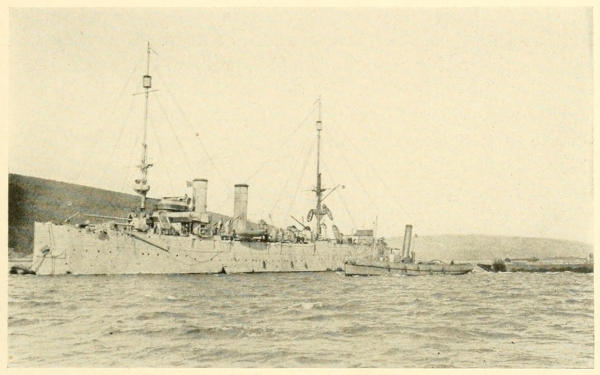
Squadron Flagship
“San Francisco.”
Receiving Mine Lighters Alongside in Inverness Firth.
Rehearsal of this operation had been impossible except on paper,
but careful study of it had produced instructions that were comprehensive,
yet elastic enough for emergency. The order for the
operation gave a complete program, including a mining schedule
showing the time when each ship was to begin laying and how
many mines to plant. This was gone over with the captains, and
then Captain H. R. Godfrey, R.N., and I had a conference with
Rear Admiral Strauss, on the general features of the excursion.
Captain Godfrey, commanding H.M.S. Vampire and the 14th
Destroyer Flotilla, was our first escort leader.
Our operation was to be no “captains’ fight.” Teamwork was
indispensable. Every ship must keep in her station throughout
and do her allotted stint exactly on time. The instructions said,
“Once begun, keep strictly to schedule times, regardless of the
omission of signals or delay in them.” Otherwise there would
be gaps in the barrier, impossible to fill without waste of time
and space, and mines would be brought back that should have been
planted. Teamwork in the high degree wanted meant every man
alive to his interest in the general result and sensible to his responsibility
for his part in it. All would learn this in time, but it
must be driven home beforehand. It was of utmost importance
that the first operation should be an unquestionable success.
Accordingly, after making the preliminary inspection of each
new ship, I spoke to each ship’s company, partly to comment on
their work so far, but chiefly to enlist the best efforts of each
individual. Rumor and conjecture were the sources of all they
had learned hitherto of the work ahead of them. Now they were
told something of its magnitude and importance—that it had been
regarded as doubtful of accomplishment, but their squadron commander
had promised success in their name, promised the kind of
success that comes only with the best teamwork throughout the
ship and by all ships in the squadron. Every man should realize
that now, in war, his utmost was called for, as never before in
his life; that however simple and unimportant his duty might
seem, it was his to do, and he was counted on not to be content
that any other man’s work should be better done, and that, in our
work, prolonged through hours, the attention must never slacken—the
600th mine must be as carefully tended as the first. The men
gave the closest attention—not an eye wavered, hardly a muscle
moved—giving back such confidence that, on board the Canonicus,
which I had found in fine condition, I could wind up with, “And
when the last mine is out, the only signal I expect to send to you
is ‘Canonicus well done’!”
CHAPTER EIGHT The First Minelaying Excursion
The eve of our first departure was drizzling and misty.
Attempts for some advance sleep were of no avail—too much
pressure had directly preceded. When 11 o’clock came without
sign of the two ships due from the inner anchorage in Beauly
Basin, we in the flagship wondered why. The tide was falling,
another half hour passed—would they never come? Signals and
radio failed to get through. Very soon, if not already, they
would be unable to pass through the new dredged channel. At
last, near midnight, they appeared. The pilots had been delayed
through a misunderstanding on shore, in itself slight—but it was
a narrow escape from being 10 hours late, which, on our first
operation, would have made a bad impression, without and within.
The start is made without signals, all dark and noiseless on
board, except for the rumbling chain as the ship gets underway.
As the San Francisco heads out slowly, one after another the
signal quartermaster reports the other ships underway and following.
We take two-thirds speed now. The full number of lookouts
are at their stations and warned to be alert, and the men are now
sent to the battery, making a little stir for the moment, then quiet
falls again. Fort George shows the signal for an open gate, we
increase to standard speed, and as the second ship passes out
through the submarine net, they all form single column astern
and close up—to 500 yards apart. The rocky shore looms high
and black on the left, not a single house light showing. On the
off-shore side, small patrol craft can be dimly seen, on watch
against lurking danger. Fifteen minutes more and we see long,
low forms slinking against the dark background of North Sutor.
Those are the escort destroyers, going out to form a screen. Close
following them we make out larger, higher, moving shadows—our
detachment from the other base—one, two, three, four—five!
All there! The detachments are so timed that they reach the
junction buoy at the same moment, and the whole squadron stands
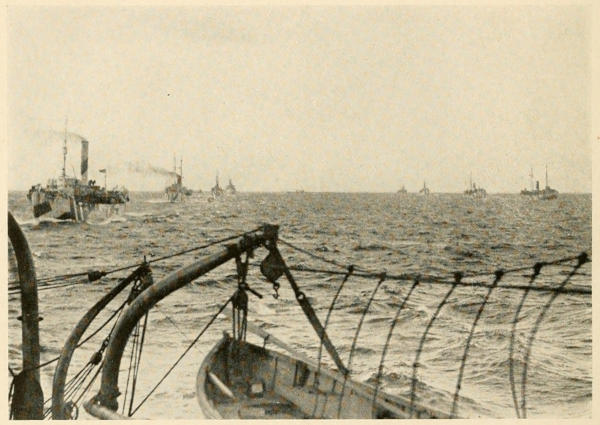
on, without pause, together, 10 ships in two parallel columns,
500 yards apart. Ahead and on either side are four destroyers,
12 in all. No signals, no lights, no sound but quiet tones on the
bridge and the swash of the water overside. Three miles along,
the water deepens to 60 feet. A screened flash from the flagship
to the opposite leader and the squadron, all together, slackens
speed, to get out paravanes—those underwater, outrigger-like
affairs which guard against anchored mines in one’s path. Only
a few minutes, then up each column comes the sign “yes,” passed
by ships in succession—another flash from the flagship, and we
resume standard speed again, keeping on, out Moray Firth,
through the one-mile wide channel, which is swept daily for mines.
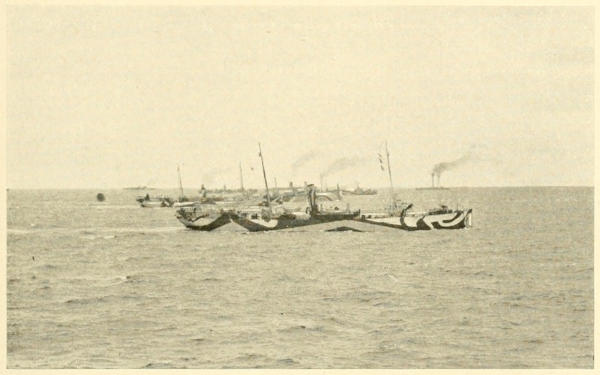
The Mine Squadron at Sea.
Returning to Base After Laying the Ninth Minefield.
Off Pentland Skerries, near John O’Groat’s House, we turn
east, and here as we pass, the supporting force files out of Scapa
Flow—six light cruisers, then a squadron of battle cruisers and
another of four battleships, each squadron screened by six destroyers.
Very impressive are these great ships, majestic in movement,
as they sweep off to the southward and eastward, disappearing
in the morning haze, which magnifies their towering bulk. We
see them no more until next day but know they are there, on
guard against raiders.
The British Minelaying Squadron is out, too, four ships with a
joint capacity of 1300 mines, but we do not meet. Though protected
by the same heavy squadrons, we work independently, in
different areas. They are bound this time for the section near the
Norway coast, Area C it is called, while we are to begin at the
southeastern corner of the middle section, Area A, and work to
the westward.
Straight over to Udsire we go, a small island off the Norway
coast, the nearest good landmark from which to take a departure
for the minelaying start point. We make Udsire Light near 11.30
p.m., close in to about 11 miles distance, turn north for a sufficient
run to give a good fix, and then head off-shore. Accurate determination
of the minefield’s position is necessary for use in laying
another field close by subsequently, and also for the safety of the
vessels sweeping the mines up after the war. There must be
steady steaming and steering, with a minimum of changing
course—no hesitation, no trial moves, for neither the time at disposal
nor the submarine risk will permit.
All goes smoothly until the turn to head off-shore, when one
destroyer crosses too close under San Francisco’s stern and cuts
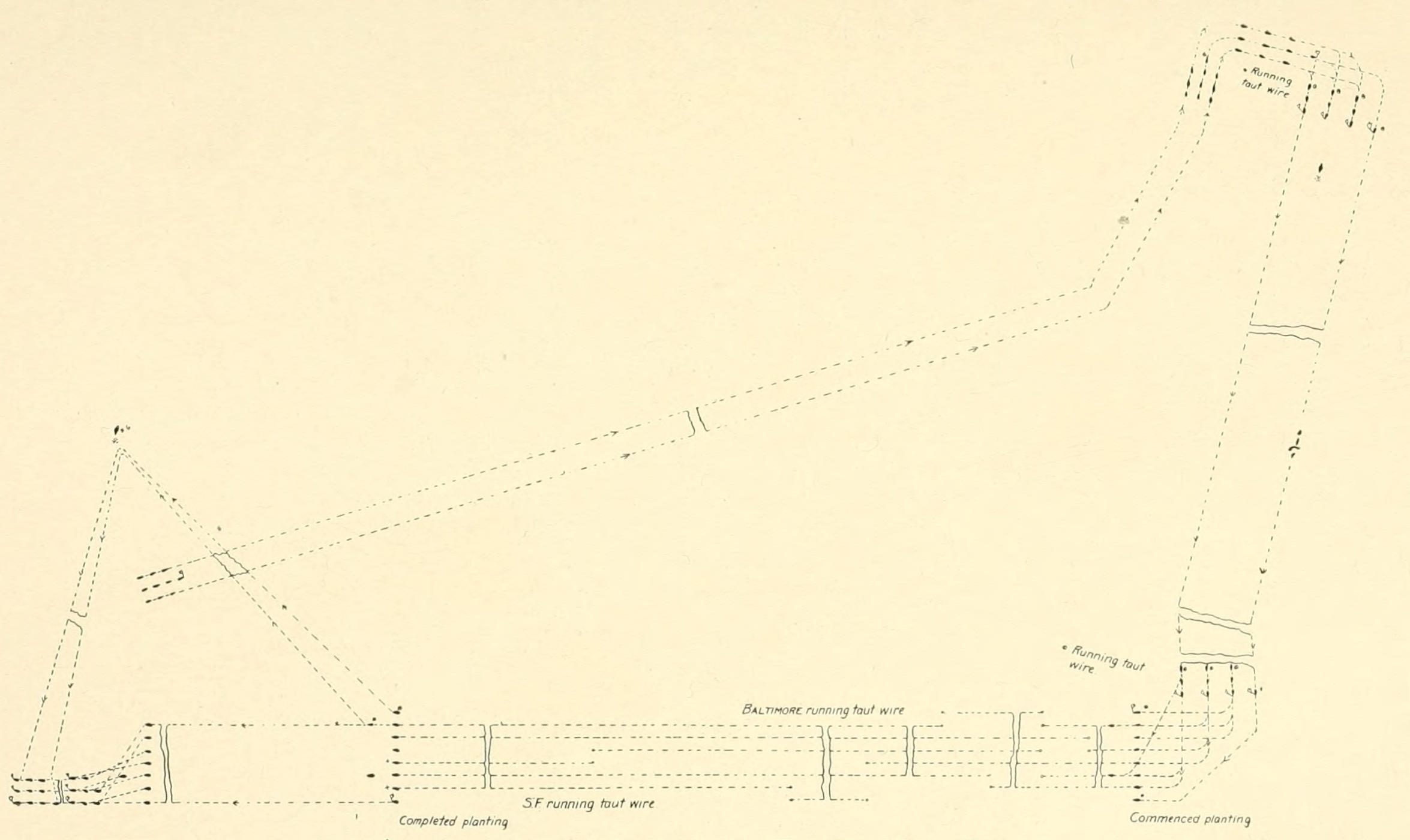
her “taut wire.” This is fine piano wire, furnished in spools of
140 miles of wire, the whole weighing one ton. A small weight
would anchor the end to the bottom, and then a mile of wire meant
a mile over the ground without question.
The wire is soon started again, and as the Baltimore is running
her wire on the other flank, and the weather is clear enough for
good navigational bearings and star sights, no harm is done. We
head for a position seven miles in advance of the start point, so
that the squadron may turn together to the minelaying course and
have still a half-hour in which to settle down.
It is a busy night and early morning, keeping the ships in
formation, verifying the navigation, keeping a keen lookout in
every direction for submarines—we are now in their regular
route—going over the mines for final touches and making other
preparations necessarily left to the last. About 4 o’clock, Lieut.
Commander Cunningham, the flagship’s navigator, reports that
we shall reach the start point at 5.27 a.m. Captain Butler and I
check his figures, and at 4.27 the signal is made that minelaying
will begin in one hour. The crews go to mining stations, to see
all clear and then stand by. In the flagship we watch for the
reports of readiness. Ship by ship they signal in the affirmative.
They are ready, every one.
Now the last turn has been made and the signal is flying to
begin laying in seven minutes. The ships are formed in a single
line abreast, speeding towards the start point—like race horses
when the starter’s flag is up. It is a stirring sight. How will it
go, after all these months—for some of us years—of preparation?
Our work to-day will mean much to those in Washington.
No ship is off the line by so much as a quarter length. Commander
Canaga stands with watch in hand—“two minutes, one
minute, thirty seconds, fifteen?” He looks up inquiringly. A
nod—all right. “Five seconds—haul down!” Up go the red
flags on the first ships to plant, the sign that their minelaying
has begun, and word comes from the flagship’s launching station
at the stern, “First mine over.” All well so far.
The minelaying now runs entirely by the time table. Each ship
gives her successor five minutes warning and, as her last mine
dives overboard, shows the signal “Begin minelaying at once; I
have suspended.” The successor begins accordingly, showing
her red flag. The staff officers on board the San Francisco watch
for these signals, comparing the times with what they should be,
and counting also the seconds elapsed between the launching of
successive mines, from the ships whose sterns we can see. A few
seconds out now and then—otherwise all goes according to schedule,
just as planned before leaving the United States.
The hardest task is on board the Housatonic—a new ship, with
a new mining installation, of type untried in service, and a crew
inexperienced in minelaying—dropping 675 mines without intermission,
1 every 11½ seconds, during 2 hours and 10 minutes. Her
mate is standing by, ready for any interruption, but the Housatonic
completes the task without a break—making a world record, a
continuous line of mines, 28 miles long. On a later occasion, the
Canonicus planted 860 mines in 3 hours 35 minutes, an unbroken
line of 43 miles.
About 20 minutes after planting began, an explosion was felt
and a geyser seen astern. A few minutes later the same occurred
again, and other explosions followed, at varying intervals and
distances, some just visible on the horizon. Others which were
nearer, as evidenced by the sharpness of the shock, threw up no
geyser, indicating that they were at the middle or lowest depth.
In the proof tests held off Cape Ann in April, it had been
observed that a mine at the middle level, 160 feet submergence,
made no surface disturbance when detonated, until 8 seconds had
elapsed, and then only as much as the wash of a light swell over
a submerged rock. At the deepest level, 240 feet submergence,
a detonation produced no more surface upheaval than there is in
a glass of well iced champagne. The ship being about 800 yards
away, the shock was heavy and sharp. The water surface all
over could be seen to tremble with the shock, but directly over the
mine itself, when, after 27 seconds, the gas came up, there was no
more surface disturbance than a pleasure canoe could have ridden
with safety. A slick on the water would follow, but this could
not be distinguished at much over a mile distance nor at all if
there were a white cap sea running.
Observers recorded the number, times, and approximate positions
of all explosions and, on board the San Francisco and Baltimore,
there were listeners stationed at the submarine signal receivers,
so as to get a full count. All observers did not agree, as
the indications from sounds and shocks varied according to distance
and depth. Some explosions gave a prolonged reverberation,
at times sounding to the unassisted ear like two or three
explosions in rapid succession, but in the submarine signal receiver
each explosion made a distinct sound, unmistakable.
The count by the San Francisco and Baltimore, differing by
only 2, practically agreed on 100 explosions, or about 3 per cent
of all mines planted. Although a perfect record was desirable,
the detonations showed the minefield to be alive and sensitive, and
their number was not large for a new mine, not yet long enough
in service to refine out the minor defects.
Surprising enough on deck, where one could see, that first
explosion must have startled the men in the engine room, in the
coal bunkers, and on the lower mine decks. The blow rings
sharper down there, where resulting damage, in broken pipe joints
or started boiler tubes, might be expected first. Whether gun,
torpedo, or mine, however, it is all one—the duties go on just the
same.
As the mines on the launching deck move slowly aft, those on
lower decks move forward, to the elevators and up. Working
spaces are cramped, passages narrow, bulkhead doors closed
wherever possible. At the right time, a door will be opened, the
portable section of mine track adjusted, the mines in that compartment
hauled out, and the door closed again water-tight, all as
quickly as possible. Close, hot, foul with oily steam and seasickness—it
is sweating, disagreeable work below decks. But
complaint is nowhere in the ships. The feeling is well expressed
by one man, writing home:
When the first mine went over, I had a curious feeling of exultation.
The fear, the perils, the uncertainties that surround our work, slipped from
me like the foolish fancies of a nightmare. There, at last, was a nail in
the Kaiser’s coffin. Come what might, I had justified my existence. Had
the whole German High Seas Fleet appeared in the offing, I am sure I
should have gone to my battle station with a shout of glee.
Prolonged activity, in preparing the squadron and bringing it
out, makes it trying now for me, to look on, hands folded—nothing
to do while everything goes well—yet constantly alert, for instant
decision in case of mishap. After nearly four hours, the schedule
is finished. Some marker buoys are dropped, for later use in
beginning another minefield. The line of ships then takes the
narrower route formation, and we head back for the base. Butler,
Canaga, and I exchange quiet congratulations. Our work together
has been to good purpose.
The men clean up the decks, get a wash for themselves, and
those off duty drop asleep—anywhere—the deck is covered with
them. On top of the duties common to all men-of-war, to move
the 400-ton masses of mines, in slow but steady time, is very
fatiguing, even with steam winches to help.
We are not finished yet. Expectation of a quiet afternoon doze,
handy to the bridge, is rudely dispelled by a smoke screen started
by the destroyers. Unaware it is only an exercise, all hands
tumble up to battle stations. Then one minelayer must stop, to
tighten a nut working loose. Two destroyers are left to guard
her, all three overtaking us in a few hours. Next a dirigible
balloon heaves in sight, and then a widespread smoke covers the
horizon, developing into a convoy of 50 vessels. Finally, in the
midst of dinner, the siren of our next astern shrieks “Submarine
to port!”
While the minelayers, upon signal, swing together away from
the danger quarter, the Vampire swoops by at 30 knots, to drop
two depth charges on the spot indicated. Captain Godfrey signals,
“Whatever was there, those charges will keep him down for a
considerable time.” All quiet again, we return to our cold provender,
remarking that, as a name, mine squadron is ill chosen.
It should be “Crowded Hour Club.”
Reports had now come in from all the ships that there had been
no casualties. All were prepared to undertake another operation
upon receiving the mines, and without further incident we returned
to our former anchorages, arriving at 3.30 next morning.
But ere that day closed, so memorable in our lives, I signaled
the squadron:
The operation to-day was an excellent performance by each ship and by
the squadron as a whole. The fact of some premature explosions does not
detract from the highly creditable mine handling and steady steaming. Confidence
in the personnel and faith in the undertaking are well justified, and
captains may well be proud of their commands, as the squadron commander
is of the squadron.
SQUADRON ORGANIZATION AND SHIPS’ DATA
Mine Squadron One, U.S. Atlantic Fleet
(Designated in H.B.M. Grand Fleet, Second Minelaying Squadron)
Captain Reginald R. Belknap, U.S.N., Squadron Commander
San Francisco (flagship)—Captain H. V. Butler, U.S.N.
Launched at Union Iron Works, San Francisco, October 26, 1889, as
a protected cruiser; commissioned as a mine ship August 21, 1911;
length 324 feet, beam 49 feet, extreme draft 24 feet, full load displacement
4583 tons; twin screw, 18 knots; four 5-inch 51-caliber guns, two
3-inch anti-aircraft guns, 170 mines; officers 22, crew 350; additional
for flagship, officers 5, enlisted men 47; total on board 424.
Baltimore—Captain A. W. Marshall, U.S.N.
Launched at Cramp’s Shipyard, Philadelphia, October 26, 1888, as a
protected cruiser; commissioned as a mine ship March 8, 1915; length
335 feet, beam 48½ feet, extreme draft 24 feet, 5482 tons; twin screw,
18 knots; four 5-inch 51-caliber guns, two 3-inch anti-aircraft guns, 180
mines; officers 21, crew 339; total 360.
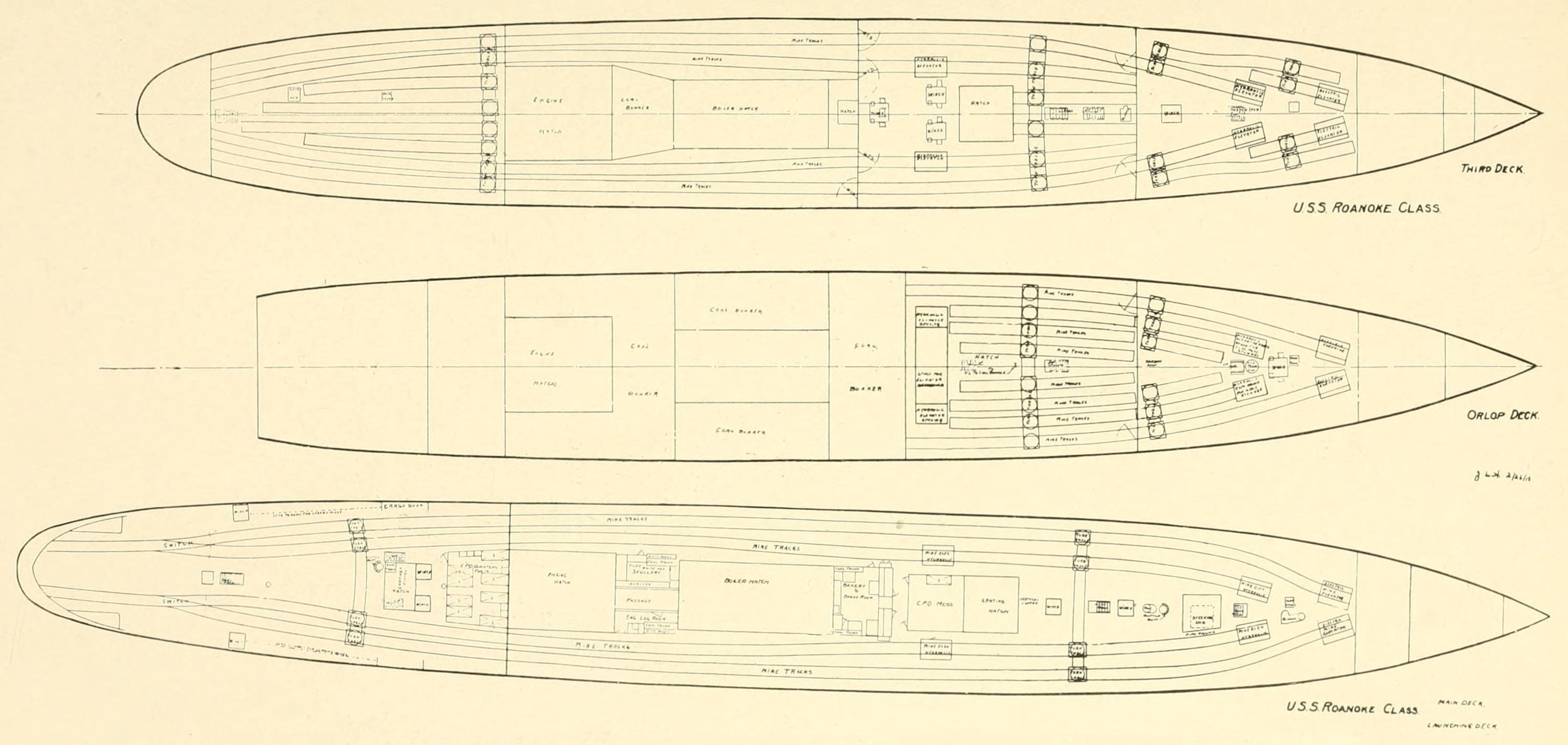
Roanoke—Captain C. D. Stearns, U.S.N.
Launched August 30, 1911, named El Dia; commissioned as a minelayer
January 25, 1918, at Tietjen and Lang’s Shipyard, Hoboken, N.J.
Housatonic—Captain J. W. Greenslade, U.S.N.
Launched November 14, 1899, named El Rio; commissioned January
25, 1918, at Tietjen and Lang’s.
Canandaigua—Captain W. H. Reynolds, U.S.N.
Launched in May, 1901, named El Siglo; commissioned March 2,
1918, at the Morse Dry Dock and Repair Company, Brooklyn, N.Y.
Canonicus—Captain T. L. Johnson, U.S.N.
Launched November 14, 1899, named El Cid; commissioned March 2,
1918, at the Morse Yard.
All four preceding were built at the Newport News Ship and Engine
Building Company, Newport News, Va., as freight liners for the
Southern Pacific Steamship Company (Morgan Line). Length 405 feet,
beam 48 feet, draft 20 feet, displacement 7000 tons; single screw, 15
knots; one 5-inch 51-caliber gun aft, two 3-inch anti-aircraft guns
forward; 830 mines normally, 900 maximum, carried on three decks;
officers 21, crew 400; total 421.
Quinnebaug—Commander D. Pratt Mannix, U.S.N.
Launched October 14, 1898, named Jefferson; commissioned as minelayer
March 23, 1918, at Robins’ Dry Dock and Repair Company,
Brooklyn, N.Y.
Saranac—Captain Sinclair Gannon, U.S.N.
Launched in 1899, named Hamilton; commissioned April 9, 1918, at
James Shewan & Sons, Inc., Brooklyn.
Both were built by John Roach & Sons, Chester, Pa., as coastwise
passenger and freight liners for the Old Dominion Steamship Company;
length 375 feet, beam 42 feet, draft 18½ feet, displacement 5150
tons; single screw, 16 knots; one 5-inch 51-caliber gun aft, two 3-inch
anti-aircraft guns forward; mines 612 normally, 642 maximum, carried
on two decks; officers 18, crew 392; total 410.
Shawmut—Captain W. T. Cluverius, U.S.N.
Aroostook—Captain J. Harvey Tomb, U.S.N.
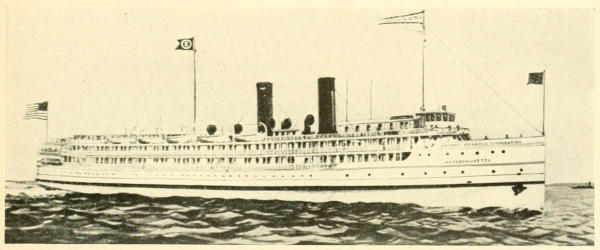
Both vessels were launched in 1907 at Cramp’s Shipyard, Philadelphia,
named Massachusetts and Bunker Hill respectively; commissioned as
minelayers at Navy Yard, Boston, Mass., December 7, 1917; length 387
feet, beam 52 feet, draft 17½ feet, displacement 3800 tons; twin screw,
oil fuel, 20 knots; one 5-inch 51-caliber and one 3-inch anti-aircraft
gun on the middle line aft, one 3-inch anti-aircraft gun forward; 320
mines normally, 352 maximum, all carried on one deck; officers 20, crew
346; total 366.
Totals of Squadron:
Tonnage, 54,000 tons.
Mines, normal 5530, maximum 5834.
Officers 208, men 3839; total 4047.
In addition, four seagoing tugs belonged to the squadron, as described
in Chapter 22.
CHAPTER NINE Athletics
A shortage of some mine parts that had encountered difficulty
in manufacture now delayed the preparation for a second excursion,
and the respite came opportunely, for we had been driving
hard for some time.
Though the minelayers were comfortable enough to live in
when empty, it was quite different with mines on board. Then
only a few of the men could swing their hammocks, the others
having to lie on the decks. Crowding the mess tables together,
horns and sharp corners ever ready to tear the clothes, mines
were constantly at one’s elbow, and everywhere were mine tracks,
half-knee high, or turntables, to trip the unwary or bark his
shin. No smoking was allowed below decks, and the space above
decks was very limited for crews so numerous. The men made
no complaint—such men will not complain of discomfort which
seems temporary and unavoidable, when incident to an undertaking
that interests them—but since the discomfort could not
be alleviated but, on the contrary, would increase with the frequency
of excursions and with inclement weather, sufficient diversion
was imperative to maintain the fine, cheerful spirit which had
characterized the work so far.
Let the report on squadron athletics, written at the end of September
by Ensign Walter P. Hanson, U.S.N.R.F., editor of our
Athletic Bulletin, tell what was done, in true sporting page style:
The situation was new, practically unparalleled, and called for immediate
action. With the exception of the San Francisco and Baltimore, none of
the ships had the traditional atmosphere of a man-of-war, so essential to
the building up of esprit de corps. It was a new squadron, manned largely
by new men, performing a new operation in strange waters. Something
was needed to weld this war-sprouted organization into a solid, indissoluble
unit, to build up ship spirit and a high squadron spirit, recalling old traditions
and laying the foundation for new ones, to fire the men’s enthusiasm
to a pitch that would insure the success of the gigantic operation in hand
and spell defeat for the German submarine forces.
There were other just as important reasons why an athletic organization
was necessary. Minelaying in contested waters is not the easiest nor the
least dangerous of duties. To eat, sleep and work in close proximity to
tons of the deadliest explosive known, and then to cruise day and night in
submarine infested waters with this same explosive for cargo—knowing
that one well-aimed torpedo, a well-placed mine, or a few enemy shells,
would wipe out an entire ship’s company, and possibly the whole squadron—is
not exactly the sort of recreation a worn-out business man would seek as
a cure for “nerves.” And blue-jackets, despite a common fallacy in America,
are no more than human. Numerous mining excursions, with no intervening
periods of recreation, were bound to tell on the men.
Relaxation and amusement they would get in one form or another.
Where were they to turn for it? To the theaters and amusement centers
of two Scotch, war-stricken villages? They were almost a myth and
couldn’t hold a man-sized blue-jacket’s attention for half an hour a week.
What then—the Y.M.C.A.? Yes, to some extent, but even those faithful
workers couldn’t solve the problem. Active amusement the men wanted,
excitement, thrills, anything to take their minds off their work for a few
hours several times a week when they went ashore.
Obviously there was but one answer to the question and that was the
healthful recreation of organized, competitive athletics. Athletics of all
sorts and forms, teams organized on each ship, and an officially recognized
and governed organization to direct the activities of the entire squadron.
Spirited competition and clean sportsmanship was to be the keynote of
the movement, with one directing head, under the supervision of the
Squadron Commander.
The official “season” was formally opened on July 4, at both bases, with
eight teams competing. The initial success was most gratifying. The
spirit shown by the townspeople gave the day all the ear-marks of a regular
league opening in the states. The games were closely contested and the
players, cheered on by the rooting of hundreds of loyal “fans,” displayed
an excellent brand of ball. Business houses had declared a holiday in
honor of our Independence Day and apparently the natives decided to
attend the festivities in a body, for at Inverness more than three thousand
of them were present, eagerly attempting to learn the intricacies of the
game.
From then on, the success of athletics in the squadron was assured.
When the ships were in port and the weather permitted, not a day passed
without one or more games played. Each team was loyally supported by
its own ship’s company, even the officers forgetting their dignity long
enough to root long and loudly. In these demonstrations the men were
moderate, considerate of the neighbors, realizing that local custom did not
favor such noise, though indulged now with perfect good humor, since we
appeared to need it.
Athletic activities were not confined to baseball. Boat-racing, track,
tug-of-war teams, boxing and wrestling, were all taken up and encouraged.
On July 4, the entire morning was given over to boat racing. Excellent
time was made over the mile course and good seamanlike qualities were
displayed. The afternoon track events developed into a spirited contest,
in which the marks made would have done justice to any first-class American
university. Again on Labor Day a similar athletic meet was arranged
and once more the same measure of success was attained, thousands of
townspeople in attendance.
Boxing and wrestling were taken up by the individual ships and, generally
speaking, one evening each week was given over to “happy hours,” for
bouts in the ring and on the mat. Ambitious youngsters would send forth
bristling challenges, which were immediately snapped up by rivals in other
ships and the resulting encounter was the equivalent—seldom bloodless—of
a naval engagement in building up esprit de corps.
Excellent golf courses and tennis courts lay convenient to both bases,
and many a day the Squadron Commander returned from the Nigg links
with 18 officers crowding the barge. The squadron surgeon, Dr. Rhoades,
secured many recruits for the ancient and honorable game, with the result
that upward of 50 officers out of 200 entered the tournament played in
September.
From the start the good effect on the men was noticeable. A consistently
winning baseball team made that ship’s company the envy of all others, and
fostered a spirit that could not confine itself to athletics alone but was
injected into drills, mining excursions and all forms of ship’s work. Indeed,
it would not be overshooting the mark to state that the success of the
operation as a whole was due in large part to the spirit of enthusiasm
aroused among the men by organized competitive athletics.
The men and officers were benefited from a mental and moral, as well as
physical, standpoint. They had something really interesting to go to see
on shore and to talk about on returning aboard. Their minds were
taken absolutely away from war while the games were in progress, their
nerves relaxed and the tension removed. Their activities were directed
into healthful channels, whereas, thrown upon their own resources, they
might have sought amusement in some harmful form.
Not only did athletics benefit the men, it also played its part from an
international aspect, especially baseball. Essentially an American sport, it
typifies everything American—rapid thinking, quickness of action, and
purely American individualism, coupled with the keenest alertness in teamwork.
These traits the British admire in the “Yanks.” At any of our
baseball games, hundreds of British soldiers and sailors could always be
seen, wearing broad grins of appreciation and admiration of the cleverness
of their comrades in arms. So much were they taken up with the sport
that on some British ships they began to organize baseball teams, with the
hope in the near future to compete with their American cousins. And the
small boys in the towns were quick to take up playing ball with a stick
and an old string ball. All this helped in creating a spirit of coöperation
and good feeling between the British and the Americans, so important to
both present and future common aims.
Transcriber’s Note: Image is clickable for a
larger version, if the device you are using supports this.
Arrangement of Mine Tracks,
Elevators, and Turntables, in “Roanoke” Class of Minelayers.
CHAPTER TEN The Squadron Complete
After a conference with the commanding officers with the
various incidents of the first excursion fresh in mind, revised
instructions applying equally to every excursion were drawn up,
to be supplemented by the particulars for each successive occasion
issued at the appropriate time. The term excursion met with
ready adoption, for its cheerful suggestion of a return—weary
no doubt, but content.
A navigation memorandum of the intended courses, speeds,
and principal incidents, for the information of the escort leader
and each ship, accompanied the excursion order. An excellent
understanding, as well as good feeling, grew up between the
squadron and its escort. The escort commander would often dine
on board the San Francisco and discuss the coming excursion and
the two bodies soon came to move as one, changing course, night
or day, or changing formation, frequently with only a whistle
blast—a whole excursion sometimes without any tactical signal at
all between the two bodies, except for some unforeseen change of
course or speed.
Preparations had begun at once for the second excursion to
continue the first minefield, but change had become necessary, and
a line across Area C was ordered—not, however, until Roanoke
had been loaded with 830 mines of an adjustment not suited to the
changed plan, and these remained on board 33 days, the crew
living around, but keeping up cleanliness and order the same as
usual. So long a period fully loaded had not been contemplated,
but it showed one more thing these vessels could do when well
manned and commanded.
As before, assembly was at night 30 June, and Udsire the point
of final departure. The supporting force was the 6th Battle
Squadron of five American battleships under Rear Admiral
Hugh Rodman, U.S.N. Needless to say, every one came on
deck to see our handsome battle squadron, as it filed out past
Pentland Skerries and formed line, disappearing to the southeastward.
Twice during the afternoon submarine periscopes were
seen by the battleships and their destroyer screen, which opened
fire and dropped depth bombs, but without known effect.
Considerable current was found near the Norwegian coast, but
visibility was good until we passed to the northward of Udsire;
then it became increasingly hazy. The run of the flagship, guiding,
was accurately determined notwithstanding, by other marks
to the northward before they too became indistinct. At 4.26 a.m.,
minelaying began—great care taken not to lay any mines inside
Norwegian waters, yet to begin just outside them. Despite the
unexpected strong current at the critical moment, the first mines
were dropped within 250 yards of the intended spot, just outside
the three-mile limit.
Overcast sky prevented obtaining good observations to check
the run during the minelaying, and as there was no check on
latitude and the current was variable, the course was changed
slightly for the last third of the run, to be sure of clearing our
first field, towards which we were heading. This accounts for the
bend in that line on the chart. We were crossing the 150-fathom
deep water which skirts the Norway coast, three large ships,
Canonicus, Canandaigua, and Housatonic, led by San Francisco,
laying 2200 mines in two rows on a line 46 miles long. In spite
of repeated breaking of the distance-measuring taut wire, the
speed over ground was estimated closely enough to end the line
within one-half mile of the point intended, which was correct
within 1 per cent.
There were again no casualties and all the mines were planted.
Two ships planted 710 each in continuous strings, fully establishing
the success of the mining installations. There was no longer
any doubt of the ability of one of these ships to plant her entire
load of 860 mines without break. All vessels returned to base
ready for further duty.
The explosions of defective mines on this excursion amounted
to between 4 and 5 per cent, and reports received from British
trawlers watching the first minefield indicated that enough more
had gone off in that field since the first day, to bring the total
there up to between 5 and 6 per cent. Despite all remedy, these
explosions increased in number up to the 5th excursion. Then
the cause was found to be due not to unskilful, negligent, or otherwise
faulty procedure in either the ships or the bases, but to lie
partly in supersensitiveness in the mines’ adjustment, partly in
imperfection in manufacture—inevitable in such large numbers
made under prevailing industrial conditions, especially of a new
design.
On June 29, just before departure on the second excursion, the
minelayers Shawmut, Captain W. T. Cluverius, Aroostook, Commander
J. H. Tomb, and Saranac, Commander Sinclair Gannon,
and the repair ship Black Hawk, Captain R. C. Bulmer, had
arrived from the United States. Uncompleted work had not
delayed them like the others, but the trial runs of the Shawmut
and Aroostook showed their fuel consumption to be much larger
than had been estimated—no data having been available when their
conversion was planned—making their fuel capacity insufficient
for the passage over. Indefinite delay, until a tanker could
accompany them, was averted by the captains hunting up enough
oil hose to fuel the ships at sea. Their departure on June 16
took place during the German submarines’ activity on the New
England coast—not a favorable condition for ships just out of a
navy yard. Twice during the crossing, the Black Hawk took the
Shawmut and Aroostook in tow, to give them fuel oil. Though
a new operation to all hands—likewise new ships, new crews, half
a gale of wind, and oil hose twice as heavy as proper—it was
done well, without mishap, and all four arrived at our bases ready
for service.
The third excursion could therefore be made by the full squadron
of ten. It was to continue the first minefield, and as some of
our mark buoys were known to have broken adrift—we had
passed two on the second excursion—the flagship’s navigator,
Lieut. Commander Cunningham, was sent out in the squadron tugs
Patuxent and Patapsco, to verify what might remain of the buoyfield.
Finding half the buoys in place, he planted two new ones as
a precaution. Then he passed along both our minefields, listening
for further explosions, but heard none. The necessary improvement
in the buoy moorings was now made, so effectively that they
could be counted on thereafter. Each ship carried four buoys
on her quarters, ready to drop on the instant. One stroke of an
axe, or pull on a slip would release a buoy and its 1000-lb. sinker
together, the mooring wire cable being so looped up around the
buoy as to pay out clear. Thus the ship had no need to reduce
speed nor any fear of getting her screw foul of the buoy.
Embarking mines for the third excursion had already begun
when a message came that no mines were to be placed west of
zero longitude for the present, a restriction that shortened the
intended line by 30 miles, quite upsetting the embarking arrangements
then in progress.
Meantime, the original plan had, in London, undergone considerable
modification as to the constitution of the barrage. Originally
of three systems, each comprising three lines of mines—upper,
middle, and lower levels—the necessity which had developed
for wider spacing between mines, to avoid structural damage to
neighboring mines when one was detonated—300 feet instead
of 150, as originally planned—made it seem desirable to increase
the number of lines of mines, so as to maintain the same density of
the mine barrage as a whole. The revision aimed to increase the
risk to surface passage considerably. No effective patrol being
maintained along the barrage, submarines would naturally prefer
the surface. The revised plan, in brief, made 10 upper level rows
instead of 3, and 4 middle and 4 lower level, instead of 3 each,
or a total of 18 rows instead of 9.
Rather than shorten our line and again employ only part of
the squadron, the Commander of the Mine Force took up the
revised scheme at once, ordering 5400 mines prepared, for a field
of 5 parallel lines 54 miles long. All 10 ships were loaded nearly
to full capacity, Housatonic taking 840 mines. Departure was
taken at 2 p.m., Sunday 14 July, hauling down, as we got underway,
the dress bunting which had been hoisted in honor of the
French Bastille Day.
CHAPTER ELEVEN Tactics
Ten ships laden with high explosive, navigating in mine-swept
channels, in submarine thoroughfares, and near minefields beyond
sight of fixed marks—compactness of the minefield demanding
that the layers steam as near together as safe—necessity for keeping
together in fog, darkness, or submarine attack—these were
the conditions governing our tactics.
Thus, the mining excursions were not merely arduous in preparation
and execution. Precision and quickness of action while at
sea were imperative, from start to finish. To foster these, a steady
tension was kept up throughout the squadron, a tension which
likewise helped the individual ships to maintain a careful habit
among the men, without making them jumpy or fearful. To
sustain attention and prevent over-confidence growing with familiarity,
unremitting pains were exercised to note and correct any
irregularity or apparent slackness—not to find fault but to keep
things taut everywhere. Only in this way could compliance with
all details be insured—so very important in our work.
From assembly at the buoy until the return to it after the
excursion, the San Francisco, leading the squadron, would maintain
a steady pace, sometimes increasing to make up for adverse
current, but rarely slackening speed for anything. The squadron’s
position was frequently compared with the time schedule, and no
effort was spared to carry through the excursion with precision.
There was time enough, we had speed enough, but none
too much of either, and the whole body felt a constant urge
towards a direct and clean-cut movement out to the field, over it,
and back to the base.
Stretched in two mile-long columns while in mine-searched
waters, which were comparatively narrow, the formation would
widen and shorten upon reaching the 50-fathom line, so as to
diminish the depth of the target offered to a submarine. Approaching
the mine start point, the vessels would take the relative
positions which they would occupy when the mining was begun—not
too soon, because such a formation was unwieldy, and if
maneuvering into position involved much turning, the formation
would become disordered. The 10 vessels were of 5 different
types, with different handling qualities and having very small
speed reserve with which to regain lost position. On the other
hand, the change had to be made early enough for all vessels to
get settled in station, at standard speed, before the minelaying
began.
As the planting progressed, we had to make use of large, lighted,
navigation buoys, planted in the open sea, obviously for our use.
The British had warned us, from their own experience, of the
enemy’s habit of moving all such buoys whenever seen, or planting
mines near them—sometimes doing both. Working far away
from the nearest landmark, we would pass close to these buoys
in order to determine the position of the mine start point accurately.
Against enemy mines which might be around the buoys,
our paravanes were counted upon for protection, but here came
in a complication. While paravanes would protect against ordinary
mines, they actually increased the risk from any of our own
mines which they might touch. To keep the paravanes out until
after clearing the buoy, then take them in before approaching one
of our fields, would have been simple enough, but for the necessity
of maintaining steady speed and course from the buoy to the
mining start point, which precluded slowing down to take the
paravanes in. Since the risk could be measured from our own
mines but not from the enemy’s, the paravanes were always
kept in use.
Pressure of time and division of the ships between two bases
while in port limited the tactical training of the squadron to what
could be done while crossing the Atlantic and while going to and
from the minefields. The special equipment to facilitate accurate
station keeping which is usually found in men-of-war was lacking
in these ex-merchant vessels. They had comparatively small
rudders, and the nice regulation of steam to the engines, necessary
for steady steaming in company, was very difficult with their
deficient means for that purpose. Moreover, on the first excursion
by the complete squadron of 10 vessels, 4 of them took part for
the first time. The excellent performance of the squadron as a
whole was all the more remarkable.
Passing through the mark buoys, which the sloop H.M.S.
Laburnum pointed out, the squadron, formed in three lines abreast,
stood on beyond, to allow distance in which to steady down on
the reverse course, then turned ships 90 degrees right together, by
divisions in succession. This evolution formed the squadron in a
single column which steered about SSW, until within two miles
of the previous minefield. Two of the 10 vessels were on the
right flank, so that a second, simultaneous turn, ships right,
brought the squadron into the planting formation, consisting of a
line of 8 ships abreast, stretching a mile and three-quarters, the
remaining two in an advance line, 500 yards ahead, with three
miles still to go, allowing 15 minutes time in which to settle
down, before the order to begin planting. The execution of the
operation was seamanlike to a degree, and the alignment, distance
keeping, and handling of the vessels, in approaching and on
the planting line, were excellent throughout.
The Squadron in
Minelaying Formation.
Two Ships of British Minelaying Squadron in the Left Background.
It would have widened the field unnecessarily to dispose all 10
ships abreast. The advanced ships would ease back into the main
line as soon as two of the 8 ships directly astern had finished their
minelaying and speeded ahead, leaving vacancies. Ample time
was allowed to do this slowly, before their time came to plant,
so as to avoid the extra demand on their engines which might
be caused by dropping back too fast. The ships were neither new
nor decrepit, but there was no excuse for taking unnecessary
chances of spoiling a good performance by the squadron as a
whole. Steady steaming and steering were important for safety—as
well as for regularity of the mine-spacing. God help a ship
whose engine broke down or rudder jammed during the minelaying!
With a strong head wind, she would drift into the minefield,
before even a destroyer could tow her clear. It was partly
for such an emergency that the sweepers originally included with
our force were wanted—powerful, handy, seagoing tugs, able to
assist in any circumstances. The tugs that we had were not fast
enough to keep up with the squadron. Fortunately, engine or
steering disablement never occurred during planting, but two did
occur just afterward, and once, in Fair Island Channel, on the
way to plant, a ship had to stop for a disabled feed pump. It was
11 o’clock at night, pitch dark, with the tide turning strong towards
the 9th minefield, and in the submarines’ thoroughfare. As I
slowed the squadron and waited for report of the probable length
of delay, I felt what a reliance a good tender would have been!
The support force on the third excursion, the 4th Battle Squadron,
came close enough to observe the minelaying, steaming along
parallel, four miles distant, for an hour. Its commander, in
H.M.S. Hercules, was Vice Admiral Sir Montague E. Browning,
who, with the French Rear Admiral Grasset, had come from
Bermuda in the earliest days of our entering the war, to attend the
first conference on our naval participation, and as their flagships,
H.M.S. Leviathan and the Jeanne d’Arc, stood in to Hampton
Roads, the San Francisco had been the vessel to salute their flags.
Now, in the same ship, it was a pleasure to lead a large, new mine
squadron, performing so creditably before such an observer, the
more so as Admiral Browning had sent a special message of
welcome upon our arrival from America.
After this excursion was over and all the reports were in from
the several ships, showing that all mines had been planted, with
no mishaps of any kind, and that the vessels were ready to undertake
another excursion, the following signal was sent:
The squadron commander extends sincere congratulations upon the completion
of to-day’s mining operation by the whole squadron. It was a
handsome performance that would have done credit to a squadron of long
experience. The squadron commander, the captains, the officers, and every
man may rightly feel deep pride in having earned a success worthy of our
navy’s best traditions. 7.45 p.m., 15 July, 1918.
CHAPTER TWELVE Some Incidents
By consensus of opinion, the limit of safe approach to a minefield
in the open sea was five miles. Where appreciable current
exists, a heavy sea may cause mines to step along, or “migrate”—there
is no telling how far—and the danger from mines adrift is
naturally greater near a minefield than elsewhere. Mines are
designed to become safe on breaking adrift and many of them are,
but far from all. Submergence in salt water may derange the
mechanism for that safety purpose. There was very little current
across Area A, however, and the fine tactical qualities shown by
the squadron lent confidence that it could be safely conducted much
nearer to our minefields than five miles. Since the barrage plan
had been revised, this closer approach had become necessary, if
we were to get the whole barrage in between the southernmost
line, already laid, and the northern limit, which had been publicly
proclaimed. There was some aversion to proclaiming a new limit
and we had no mind to say it was necessary. So, instead of
lapping the ends of adjacent minefields, the practice was adopted
of “butting” the new field close to the end of its neighbor, thus
continuing the same line with only a small gap between adjacent
ends.
Our first news of damage inflicted on the enemy came in mid-July,
soon after the second excursion, though the barrier was then
hardly more than begun. The information was authentic but not
very circumstantial—the standing policy was against that. Four
submarines were mentioned. One of them lost nearly all her fuel
and called by wireless for help, so loudly that it was overheard and
a British force was sent out to capture or destroy her—but too
late. Another German submarine had come to her aid, and the two
got safely back. Further details are lacking.
The third excursion, together with the British minefields in
Area C, completed the equivalent of one system, extending from
the Norway coast as far west as 0 degrees longitude. The prohibition
against laying any mines farther westward than that was
still in force—although the enemy submarines had changed their
route so as to pass clear to the westward of the partial barrier.
So our fourth excursion began a second “system,” parallel to and
five miles distant from the first.
Leaving the bases during the night of 28 July, and taking final
departure from Buoy No. 2, which marked the north end of the
division between Areas A and C, we ran south, clearing the ends
of three British deep minefields by three miles—quite safe to do
if they were all in their intended places. Then, by an “isodromic”
maneuver—not easy and little favored, on account of the precision
that is requisite, but necessary on this occasion—our three
columns, with San Francisco making a fourth on the left, formed
a single line to the right, of eight ships, with two more in an
advanced line, all steering about WSW. Being on the outside of
the turn, the old San Francisco had to spring from 12 to 16½ knots
within a few minutes, to gain her station on the southern flank
in time, but no parade ground evolution could have been done more
smoothly, and the quickness with which all ships steadied into
accurate distance and bearing showed that, in future, the steadying
interval could be safely reduced. Originally a half hour, it
was cut down to 75 seconds.
Commander Moir, a new escort leader, in H.M.S. Valhalla,
smiled slightly as he read over the mining order for the first time
and I asked whether it were about this isodromic movement. He
replied, No; he was wondering how they could execute one of the
intermediate changes which the order prescribed to be made en
route, to sort the ships out from the assembling order to the
arrangement which they would be in preparatory to swinging into
minelaying formation. It did look mixed at first glance, there
was no denying, but I said, “Watch them do it, the Rules of the
Road will govern”—and when the time came, I felt quite willing
for any one to be a witness.
Transcriber’s Note: Image is clickable for a
larger version, if the device you are using supports this.
Approaching and
Laying the Fourth Mine Field.
Excursion 4: Formations Before, During, and After Planting.
At the end of a minefield, the wing and the center ships simultaneously
would drop mark buoys, 250 yards from the last mines,
and again one mile farther on, making in all six buoys in two
lines. When we came back after 10 days or so, to continue that
field, a destroyer would go well ahead, to sight and stand by the
outermost buoy, and the flagship would lead for it, but not steer
towards the minefield side of it until the inner line of buoys had
been sighted—those which were only 250 yards from the mines.
The outer buoys were regarded with suspicion until some of the
inner ones were seen to be in place. It was then deemed safe to
lead between the two lines of buoys, for as long as there were
any between the ships and the minefield, ships would be at least
250 yards clear. Passing in column midway between the lines
of buoys to make the start, and allowing for the simultaneous
turn into line abreast, the squadron could begin mining by the
time the outer buoys were passed, thus leaving a gap of but little
more than a mile between the mines in the old field and those in
its continuation.
An early care while fitting out had been to organize and train a
good lookout service. This duty is a severe tax on the men, and
when, time after time, they see nothing suspicious, they tend to
relax. Fearing this, as we had yet seen no submarines, barring an
alarm on the first excursion, a special warning to lookouts was
issued, which, fortunately was well supported on our next trip.
A beautiful, peaceful evening off the Orkneys was rudely interrupted
by messages from three different sources within the space
of a minute, reporting a submarine estimated to be a half-hour
ahead of us, outbound, making for Fair Island Channel. Taking
no chances on its having innocent intentions towards us, Captain
Godfrey turned his flank destroyers outward and bang! bang!
went four depth charges, and four more on the other side—just
to let the sub know he might except a hearty reception. The
Aroostook’s siren then shrieked for “torpedo to starboard!” the
ship charging ahead across another’s bows, and the Housatonic’s
steering chain took that occasion to break. Serenity was gone, for
a time at least, but being in a swept channel, there was small choice
for maneuvering. All we could do was to shorten up our formation
before dark shut in and trust to our escort and a good
lookout.
In the event of a submarine appearing, our rôle was to make off,
leaving the attack to the destroyers and being careful not to harm
them by our own fire. The escort was prepared to engage its own
kind, as well as submarines, and even to make a sacrifice attack on
light cruisers, to assist our escape under cover of a smoke screen,
but our moderate speed—15 knots at best when keeping together—and
the small number and caliber of our guns, made us rather
helpless against an enemy cruiser’s long-range, 6-inch gunfire and
high speed.
Upon returning from an Allied conference in Malta on mining
the Mediterranean, Rear Admiral Strauss came out with the squadron,
on the seventh excursion, 26 August, hoisting his flag in the
San Francisco. This was the first time our program was interfered
with by fog, which shut in thick soon after assembly.
Incidentally, our tug Patuxent, going out ahead with her sister
Patapsco to observe, found herself in the midst of a large convoy
from Norway that night and had a collision, which fortunately
was not serious to either vessel.
After four hours’ delay by fog, we made our departure buoy
and steered for the end of the 5th minefield, 13 miles distant. Fog
shut in again when we were half way, but fortunately lifted just
before we should have had to turn back, and minelaying began,
although the weather was still far from settled. Twice during
the schedule, dense fog enveloped us, but the planting went on
without interruption. It was rather ghostly to hear and feel the
explosions of the defective mines, yet see nothing—not even the
neighboring ship. Several times Admiral Strauss expressed
admiration for the steady alignment of the formation, and upon
leaving the San Francisco when we had returned to port, he
signalled, “The Commander Mine Force congratulates Mine
Squadron One on the seamanlike manner in which the seventh
excursion was accomplished by all ships.”
On this occasion, for the first and only time, one ship had to
drop out from an excursion, the Saranac having a smash inside
the cylinder of her main circulating pump shortly after the squadron
had assembled. Temporary repairs being impossible soon
enough, she returned to base. The absence of her 580 mines left
the 7th minefield incomplete, and to make good the defect a
special excursion was ordered for the Shawmut, Captain Cluverius,
and Aroostook, Captain Tomb, the two fast minelayers.
Met off Cromarty buoy at 6 a.m., 31 August, by Commander
Lowry in H.M.S. Wrestler, with three other destroyers, the
detachment proceeded, first at 15 then at 17 knots, by the usual
route to the end buoys of the seventh field, then close along the
northern side of the field. The Baltimore had been on that flank,
and after planting all her mines had dropped a buoy and again,
at about 9-mile intervals, two other buoys, while steaming 500
yards abeam of the nearest planting vessel. A fresh breeze was
now blowing, making the buoys none too easy to pick up. Fog
had prevailed while the Baltimore was dropping the buoys, making
uncertainty as to their position and also as to whether they were
there at all. Accordingly, the detachment first ran parallel to the
minefield, from 1000 to 2000 yards outside the line of buoys, so
as to sight them all; then it turned back and began planting,
Shawmut first. The mines were laid in one line averaging 600
yards outside the line of buoys, or about 1100 yards from the
nearest line of mines, thus completing the original field neatly
without wasting space. The mining installations of these fast
ships worked as well at 17 knots as they had at 12, and altogether
the excursion gave the two a good try out. They were back in
their berths 26 hours after leaving them, in ample time to embark
their mines for the squadron’s next excursion, and with a record
to their credit for laying 580 mines on the closest parallel to a
deep-sea minefield that had ever been run.
CHAPTER THIRTEEN Signals
Signals had come well to the front in the course of the first
excursions, not only for tactics but also for assembling data
quickly, so that a fairly comprehensive report of the excursion
might go to headquarters by the first boat to shore after arrival.
Spelling out messages by Morse or semaphore proved too slow
and inaccurate for reports from nine ships in one afternoon, often
in hazy weather, so a collection of phrases, and questions to be
answered by reference number, was established, to be signaled by
hoists of flags.
As we had expected to use the British signal system, a special
training class was formed at Newport in January, while the minelayers
were fitting out. In consequence, from first falling in with
British destroyers, the San Francisco communicated easily, and
British flags could be used on the first excursion. But neither the
British system nor our own was found to suit our needs, and to
combine British flags with American meanings made a risk of
misinterpretation at a critical time. So the American flags were
restored to use and the British ones discontinued, except a few
retained by each ship for calls and other routine uses, while the
flagship kept a full set, for communicating with the escort by the
British code. A new system, embodying several of the British
features, was devised, mainly by Lieut. Commander E. S. R.
Brandt, then flag lieutenant, and was put into effect on the second
excursion. The main feature was that the meaning of tactical
signals—those which required immediate action, affecting the
ships’ movements—was self-evident to anyone who knew the
names of the flags.
Flags and associations already familiar having been utilized, the
signalmen quickly learned. Separation among three anchorages
prevented signal practice by the squadron as a whole in port,
but drills several times daily at each anchorage and on the way
out to the mining ground enabled the new code to be used on the
full squadron’s first trip. Great interest was evident among the
signal forces of all ships. Signals were habitually hoisted only
just long enough, as determined by experience, for the average
vessel to repeat the hoist. Competition became keen not to be the
cause of delay, and very soon the signaling attained an accuracy,
rapidity, and style comparing favorably with the best performance
of any type of vessel. Once or twice the Quinnebaug—whose
mast was not high—beat the flagship in getting her own signal up
to the yardarm. Less than a minute by day, and often only 30
seconds, would suffice between giving an order for a tactical signal
and beginning its execution by the squadron—without a glance
at a key book or card at either end. Most efficient telephone service
would hardly equal that.
The Vampire soon picked up our new system, so that signals
to her could frequently be dispensed with. Upon one of ours
going up, the corresponding British signal on Vampire would be
seen in a few moments.
Accuracy of transmission and of record being very important
where so much was done by signal, these were stimulated by daily
comparison of the signal records of all ships. A “discrepancy”
sheet was compiled, to show the errors and omissions of each ship
for the previous day, and directly after each excursion, the signal
officers would meet, to compare the signal records of the trip.
A further check was kept by a staff officer being constantly on
watch on board the San Francisco when at sea, taking notes upon
incidents and errors in signals, station-keeping, and the behavior
of ships. The Recording Angel could not have been more observant.
I would edit the rough record at the end of a watch,
references to the pertinent instructions were entered, and a smooth
“Discrepancy Report” was sent to all ships at the end of the
excursion, as a reminder of their sins.
Had the signal officers been regulars and but one system of
signals been in use from the beginning, the high standard maintained
would have been commendable. The attainment of such a
standard by inexperienced personnel, adopting a new system on
very short notice, was highly creditable to all concerned. Especially
should there be mention of Chief Quartermaster William H.
Kerins, of the San Francisco, and the other chiefs, whose training
and management of their signalmen and whose own skill and
fidelity made our quick and accurate communication possible.
CHAPTER FOURTEEN The Barrier Across
The barrage began to show results early in July, after our
second excursion, although not yet half across. The enemy submarines
changed their route then, so as to go through Fair Island
Channel, south instead of north of the Shetlands. Thus they
would pass west of the partial barrage, through the 60-mile wide
passage still open. The fact of Area A having been proclaimed
gave ample warning, and even the enemy could not complain
of being ambushed, if he sustained damage there. Advertising a
minefield two months in advance was certainly fair play. But
now came the mining of Area B, which would carry the barrier
clear across the last 45 miles of the 230-mile stretch. This was
not published, but the enemy might have assumed that it would be
done sooner or later.
A joint excursion by the two squadrons was arranged, Rear
Admiral Strauss commanding the whole, flying his flag on board
San Francisco again. The squadrons joined off the middle Orkneys
the morning of 7 September, and began the minelaying a
few miles to the northward, starting from a buoy placed by
H.M.S. Laburnum and removed by her after we had passed. As
we were directly in the submarines’ thoroughfare, special patrols
were provided, surface and air, in Fair Island Channel and also
well to the southward of us. The American squadron planted
six upper level lines, the British squadron planted one similar line,
after the completion of which it separated to the southward, returning
to its base at Grangemouth, Firth of Forth. On the way,
one of them had a collision in the fog with a destroyer of its
escort, which later sank in consequence.
Our squadron turned north at the end of our minefield, ran
taut wire to Buoy No. 5, thence paralleled the minefield at five
miles distance for observation of defective mine explosions, steering
west to the Orkneys and returning to the base on the reverse
of the outbound courses. Fog came on soon after mining was
finished, continuing intermittently until we made port. For this
reason, San Francisco did not cut her taut wire at Buoy 5 but kept
it running until the squadron slowed to take in paravanes, near
Cromarty—122 miles of wire run out, without a break.
The succeeding excursion was similar, with Rear Admiral L.
Clinton-Baker, R.N., in H.M.S. Princess Margaret, in command
of the whole force, Rear Admiral Strauss again on board San
Francisco. On the way out, it was not permitted to pass between
the Orkneys and the western end of the minefield planted just
previously, but instead, the squadrons were routed NW’ly, through
Stronsay and Westray Firths, in the Orkneys, thence E’ly through
Fair Island Channel, and down to within five miles north of the
other minefield.
While standing through Stronsay Firth in a long, single column,
the British squadron, which was in the lead, opened fire on its
starboard quarter, its escorting destroyers gathering to drop bombs
about a certain spot. Upon signal from the Princess Margaret,
the starboard wing destroyers of our escort speeded ahead to
join the attack, but the port wing destroyers remained on station,
although the leading squadron’s destroyers had left theirs. In a
few moments, a submarine broached about 1500 yards, two points
on San Francisco’s starboard bow, heading across to port, through
the column, between the two squadrons. Some destroyers followed
and continued bombing. Smoke screens were laid by our escort
(Vampire, Captain Godfrey, and 11 others of 14th Flotilla) and
by our own ships, which thus had a good test for their smoke
outfits. Roanoke chanced to have a steering engine disablement
just at this moment, causing her to sheer out and shift to hand
gear, and the Housatonic also had some steering trouble, but there
was no mishap, and the submarine also for the time escaped. By
good luck, an official photographer happened to be on board San
Francisco, and he got some pictures of genuine activity.
A delay at the morning rendezvous, the long distance round
about, and adverse current combined to make a late mining start.
While the mining was in progress, the bodies of two German
sailors were passed, and a heavy explosion was observed in the
eighth minefield, five miles distant, in a position that plotted in
the same place a submarine would be which had been reported
shortly before.
Darkness shut in about an hour before planting was completed
but it caused no suspension nor interference. At the end of the
field, buoys were dropped as usual, and all ships together turned
left, without signal but on orders given before dark, to the course
north, then formed in two columns for the run home. The British
and American squadrons had now separated and they passed back
through Westray Firth in succession after daylight next morning.
Off Pentland Skerries a suspicious craft ahead caused
another submarine alarm, and the escort again enveloped the
squadron in a smoke screen, but the alarm proved false.
This time, the 10 American vessels had planted six lines, two
at each of the usual levels, 46 miles long, 5520 mines in all, the
maximum of any excursion; the 4 British vessels planted one line
at deep level, 1300 mines, 32 miles long, making altogether 6820
mines on the excursion, the largest single minefield ever planted—done
in 3 hours and 50 minutes. Upon returning to the bases,
Admiral Strauss signaled “The Commander Mine Force congratulates
the squadron on this biggest and most successful excursion.”
CHAPTER FIFTEEN Finishing the Barrier
The conference at Malta at which Rear Admiral Strauss was
the American representative recommended extensive mine barrages
in the Mediterranean, in locations where the depths of
water were much greater than any yet mined, involving winter
operations for us. As a first step, Captain Murfin was sent down
to Bizerta, near Tunis, to establish a base there, like his two in
Scotland—though under much less favorable conditions. Considerable
experimenting at home was likewise involved, to develop
a suitable extra-deep mine and its moorings. Experienced personnel
being needed for this, orders came placing the Baltimore at
disposition of our Naval Bureau of Ordnance for the purpose.
Accordingly, on the tenth excursion, 26 September, she parted
company off Scapa Flow, sailing thence two days later for home.
In the nine other ships, 97 per cent of the mine capacity remained,
but as an experienced vessel of regular man-of-war type, the
Baltimore’s value in the squadron had far exceeded her proportionate
capacity.
The minelaying squadrons were now doubling and trebling the
barrage, which had been carried clear across the North Sea on the
eighth excursion, 7 September. Hitherto we had been favored by
good weather, but the season of frequent storms was approaching
and already the lengthening hours of darkness made a considerable
difference.
Our one loss of life at sea occurred just as the Baltimore left us.
The Saranac’s port paravane was running badly and, in clearing it,
George C. Anderson, chief boatswain’s mate, stepped out on the
davit—a sudden jerk! and he was gone. Although search was
made, he was never seen again. He had been an energetic yet
safe leader, never allowing another man to go overside without
a bowline around him, but of himself had been less careful.
An almost unbroken record of ten excursions carried through
without breakdown or delay made such a performance now seem
a matter of course. The artificer personnel of all ships made a
fine showing in upkeep and in steady steaming at sea, notwithstanding
that overhaul time was very limited. On returning to
port, the squadron would prepare immediately for another excursion
and would then wait from day to day for the escort, under
notice too short for the extensive overhaul desirable. As the
operation progressed, making more wear and tear, the intervals
between excursions became shorter and bad weather frequently
necessitated keeping steam ready, in case the anchors dragged,
as often they did, all which reduced the repair time. Unfinished
details of conversion, hard usage in former hands, absence of
spare feed pumps and similar secondary dependencies, and a large
amount of auxiliary machinery for the vessels’ size,—all these
were work-making factors. Yet, except for wear, the general
condition of all machinery steadily improved.
A large amount of self-repair was done, the Roanoke being
almost wholly self-sustaining, resorting very little even to our
own repair ship Black Hawk. The San Francisco’s carpenter
gang built an excellent emergency cabin under the bridge in about
10 days. Then the Shawmut and Aroostook by themselves increased
their oil fuel capacity by 50 per cent, which later enabled
them to make the run homeward unassisted and unescorted.
Procedure in conducting the squadron aimed at steadiness in
steaming and steering. No unnecessary chances were taken, but
neither was the treatment tender. The ships always worked near
their speed limit, with only the reserve needed for tactical reasons.
Their good performance was due to careful, intelligent foresight,
and the rarity of even minor disablements is proof of noteworthy
ability and fidelity on the part of the engine and fireroom personnel.
No ship was ever late, no minelaying operation ever
interrupted, only one hot bearing occurred, only once did a ship’s
engine have to stop—for but a few minutes—in 8400 miles
steaming.
As for steady station-keeping, some ships, notably Canandaigua,
were always there—hour after hour, night and day—and the
others were seldom out. Approaching and during the minelaying,
they were very accurate. As one visiting officer from the fleet
said, “You’ve got it on the battleships,” and it was officially
reported by Admiral Mayo that
The minelayers, though of diverse types, maneuvered well together and
kept station very well indeed; they appeared to be under excellent control,
both individually and as units, at all times. The laying operation which
was witnessed was carried out according to plan without hitch of any kind,
thus indicating the efficacy of the preparation, including planning, and the
thorough understanding of the work by all concerned.
Much official interest was taken in our operation and brief
visits to the bases and the ships were made during the summer
by Vice Admiral Sims, Admiral Sir Rosslyn Wemyss, the British
First Sea Lord, Vice Admiral Ommaney of the Admiralty, Rear
Admiral Clinton-Baker, R.N., the House of Representatives’
Naval Committee, and Assistant Secretary Franklin D. Roosevelt.
Several of our naval officers went out on excursions, and Lieut.
Commander DeSalis, R.N., always a welcome, enthusiastic supporter,
went on several of them. They all admired the orderly,
complete, and ample arrangements of the mine assembling bases
and were especially complimentary about the new minelayers.
Officers and men felt intense pride in their ships, and spared no
effort to keep them in regular man-of-war condition. The ten
made a handsome squadron, and in capacity for carrying mines,
in equipment for handling and planting them continuously, and
general arrangement and quality, the new American minelayers
were admittedly superior to any others.
Their capacity and performance was the subject of much favorable
comment and careful study by the British Admiralty. Besides
large mine capacity, their mine elevators were a striking feature.
The very first thing considered in the plans had been how to get
the lower deck mines up to the launching deck, so that a ship’s
entire load might be planted in one unbroken string. The Otis
Elevator Company’s representatives had been called in at the
outset and, after several alternatives had been examined, their
standard platform type was decided upon, each elevator lifting
two mines every 20 seconds. Six elevators in the four largest
ships, four in two others, were in use 9 months in all kinds of
weather at sea. Only one of the 32 elevators ever failed, and that
one just once!
The British minelayers had had trouble from the mine tracks
opening and closing with the working of the ship in a seaway.
In ours, the tracks were secured to steel crossties mounted on
wooden bolsters, the strength and stiffness of the tie, with the
elasticity of the bolster, keeping the rails true to gauge, notwithstanding
they were lighter rails than the British used. Special
interest was taken also in the simple, light switches used in our
ships’ mine tracks. Some of the Admiralty officials were hard to
convince that these switches actually worked, even when operated
before their eyes.
While the ships were embarking mines and coaling for the
twelfth excursion, Admiral H. T. Mayo, Commander-in-Chief,
Atlantic Fleet, accompanied by Captain O. P. Jackson, his Chief
of Staff, Rear Admiral Strauss, and Captain N. C. Twining, Chief
of Staff to Vice Admiral Sims, made an informal ship inspection,
after which Rear Admiral Strauss published the following:
8 October, 1918.
Admiral Mayo, commander-in-chief, left the headquarters of the mine
force yesterday evening for the south.
He expressed himself as highly pleased with the zeal, loyal coöperation
and efficiency of the mine force both ashore and afloat and congratulated us
on the work we have accomplished.
The commander of the mine force is unable to give any data as to the
number of enemy submarines that have been destroyed as a result of our
efforts, but it is practically certain that the toll is considerable.
The commander-in-chief emphasized the part that the mine force is
taking against the enemy as a distinct military offensive, thoroughly known
and appreciated at home.
Admiral Mayo found things in their normal condition, with no
preparation made for him, as some ships were coaling, others
embarking mines. He was evidently pleased with all that he
saw, and he remarked how fortunate it was that we had been
training in that kind of work, in the old, small mine force, for two
years past.
Bad weather during some part of an excursion became now the
rule. Coming through a narrow passage in Westray Firth one
morning, strong tide against a strong wind made an ugly cross
sea, knocking us down to eight knots. One destroyer broached to,
and for a few moments lay between our columns, wallowing
heavily, as if the next roll would surely take her under.
Shortly afterwards, one arm of the Quinnebaug’s rudder quadrant
broke, and the other arm bent almost to the point of fracture.
Had it too gone, she could not have escaped wreck on the rocky
channel side. Fortunately she was able to gain partial shelter;
in two hours she made repairs and, taking after the rest at top
speed, she arrived at Invergordon only 45 minutes behind them.
As a coastwise merchant liner, she was often behind time, but in
naval hands she developed speed to spare, frequently maintaining
on natural draft 10 per cent more than her former best speed
under forced draft.
Passing mines adrift was a frequent occurrence. Occasionally
we would have to turn out for them. If of the moored type
originally, broken away from their anchors, they should be safe
when drifting. But of course safety devices, like all others, not
infrequently fail to function, especially after immersion in sea
water. We let the mines alone, but occasionally an escort destroyer
would fire a few rounds, to sink them.
A German floating mine, upon one occasion, was sighted nearly
ahead by the Quinnebaug, at a moment when her port paravane,
running foul, had been hauled in, to clear it. Thrown overboard
bodily, the paravane fell on its back, and fortunately righting
itself, came in contact with the floating mine, which apparently
had a mooring line attached to it, and towed it along with the
ship for probably 30 seconds—when the mine detached itself and
floated astern. While this was going on on deck, a fire broke
out below, in the midst of the mines on the stowage deck. The
ship’s cooks, who were in the galley at work, with the greatest
promptness seized hand fire extinguishers, climbed over between
the mines and extinguished the flames. The Quinnebaug started
planting within two minutes after this danger was averted.
How such a fire would have spread in one of these ships, so
full of woodwork, was shown on board the sister ship, Saranac,
after our return, in January, 1919, at Hampton Roads. The very
night after discharging her mines a fire broke out, spreading with
such rapidity that the sleeping officers had to escape in their night
clothes, losing all their effects, and the men in the engine room
were barely able to attend the pumps without suffocation.
The longest single minefield on record was the twelfth, laid on
13 October,—first an 8½ mile stretch 5 lines wide, then 65 miles
3 lines wide, 73½ miles in all. It was begun at 7.33 a.m. and
finished at 2.52, over 7 hours. In the latter part, we ran closer
than usual to the adjacent field, to keep inside the proclaimed
barrage limits. That night, steaming at easy speed so as not to
make the entrance to Westray Firth before daylight, radio orders
were received from the Commander-in-Chief, Grand Fleet, about
11 o’clock, to proceed with despatch into Westray Firth. Other
messages were intercepted, indicating that enemy vessels were out,
and as we passed Pentland Skerries next forenoon an unusually
large number of British destroyers and sweepers and an observation
balloon were searching that vicinity for mines and submarines.
Quiet was returning, after a night of greater activity
than for a long time.
CHAPTER SIXTEEN The Thirteenth Excursion
The thirteenth minefield was to be partly in Area A, extending
from its southeast corner across Area C towards Udsire Island,
ending at a point three miles short of a minefield which the Norwegians
had planted around Udsire. All mines were of the upper
level, and, as the depth varied from 70 to 150 fathoms, three kinds
of anchors were used, which necessitated special care as to the
order in which mines were stowed in the ships. The purpose of
this field was to close the gap between the British and American
minefields in Area C, and the American minefields in Area A, and
also to increase the surface obstruction across Area C by two
more lines of upper level mines.
No duty could surpass this series of mining excursions for
interest sustained to the end. The few events and noteworthy
features so far mentioned may perhaps seem to conflict with this
statement, but the smoothness of operation constantly striven for
tended to eliminate interior incidents, and no mere description can
ever impart an adequate impression of our experiences. Keen
anticipation, attention ever alert, and a sense of adventure were
fresh on each occasion. There was sameness enough in the
occupations while in port—coaling, cleaning, embarking mines,
and liberty in small towns, but life underway meant something
doing all the time which every one felt worth while. Until back
at the buoy again, inward bound, it was all activity, the hours
often crowded, the whole period sleepless for those in command,
never dull for any one. Only as the anchors went down and the
tension relaxed could one realize how fast we were living. To
quote a Saranac poet—
“They gave us a job we had to do,
A little bit risky—yes—that’s true;
A good deal like work, both night and day
But a darn good game for a man to play.”
From the earliest discussion of the Northern Barrage project,
one of its probable developments was, by general acceptance, to
draw out the German fleet, and that ever present possibility gave
an added spice to the work. Someone characterized our operations
as “An important military offensive with a front seat at
the second battle of Jutland,” and at the time of the thirteenth
excursion it seemed as if the mine squadron might indeed be the
bait. Due to the prospect of the German fleet coming out, the
squadron was ready a full week before Admiral Beatty could spare
a destroyer escort for us.
The San Francisco and six other planters made this excursion,
the Roanoke and Canandaigua being omitted. They had been
docking at Newcastle-on-Tyne when the mine embarking was
done, and although they returned in time to have joined without
altering the loading of the other ships, other considerations,
external to our Force, determined that they should not go. With
Vampire, Captain Godfrey, as escort leader for the tenth time,
departure was made from Cromarty buoy at 1.30 p.m., Thursday,
24 October. An earlier departure had been first ordered, but a
message from the Grand Fleet held us back a few hours.
A storm warning was out as we sailed, and that night the storm
overtook us, continuing with varying intensity all the next day
and night. Friday forenoon, H.M.S. Primrose pointed out and
verified Buoy No. 3, and a lull in the storm gave hope that the
mining might be carried out that day; but the wind freshened
again before the starting point was reached. The ships rolled
deeply with their heavy loads, from 27 to 32 degrees each way,
but suffered no damage, and the mine installations stood the
severe test very well. Through Friday night the squadron cruised
back and forth 15 miles either side of the buoy, as far as adjacent
minefields would permit. We could not afford to go far
away from the buoy, as the time within which we must complete
the task was limited and was now scant. After the first turn
about, the destroyers disappeared in the darkness, and it was a
relief to feel that at least they were clear of possible collision.
We needed no screen in such weather and could dispense with
them for the night. In the morning they were back again, the
weather moderated, Vampire pointed out the buoy, and we could
proceed.
Mining began at 1.27 p.m. and continued according to schedule
until two hours after sunset. The sea and swell had died out so
quickly that conditions were very good for mining. All went
smoothly; 3760 mines were planted, the last 37 miles being over
water up to 150 fathoms deep. As the first four vessels completed
their strings, they were ordered to cross ahead of the remaining
planting vessels and take station on the southern wing, off San
Francisco’s starboard quarter, where they would be clear of the
British minefield which lay just to the north of us. Three destroyers
with high-speed minesweeps out preceded the line of planting
vessels until an hour after dark, 5.30 p.m. They then joined the
other destroyers to starboard and southward of us. In darkness,
and in silence except for the mine detonations astern from time to
time, the San Francisco, Canonicus, and Housatonic, in line
abreast, stood on a half-hour longer, to the end of the mining
track, with no vessels to sweep or to screen ahead as we drew
near the coast. The coastal mountains of Norway and a searchlight
playing on the clouds were sighted at considerable distance,
but not distinctly enough at any time to make an identified bearing.
Udsire Island was dimly sighted in the direction expected, but it
was too dark to obtain a definite fix, as its light was not burning.
On our left was a field of British mines, eight miles away by the
chart, but of uncertain distance in fact, since storms and the
coastal current might have moved some of the mines in the ten
weeks since they were planted, or broken some adrift. The ships
kept on to within three miles, by the chart, of the Norwegian minefield
ahead—presumably in place and the mines presumably safe
if broken adrift. One lacks, however, the same confidence in
other people’s mines and minefields as in one’s own, and more
than the usual relief was felt when our schedule was finished.
Then, promptly, all ships and destroyers turned right 90 degrees,
again turning right, five minutes later, 70 degrees more, to course
W. by S. The squadron then formed in two columns and, when
seven miles clear of the minefield, ran parallel to it on the reverse
of the mining course, for observation. A curious effect was
experienced here, the first occasion where we were heading
generally toward a freshly laid field, instead of directly away.
The vessel’s movement through the water towards the mines
enhanced the sharpness of shock from the exploding defective
ones—to such an extent that both officers and men came on the
bridge in real concern, reporting that we must have struck
something.
It was noteworthy during this thirteenth excursion that
the management of the ships, always good before, continued
so, in spite of the heavy weather. About 9.00 p.m. following a
hard squall which came in the midst of a turn, causing the ships
to get considerably out of station, three successive 90-degree turns
were made and the squadron was then formed, upon signal, in a
new order, for more convenience during the rest of the night. All
was done in good time, yet without any vessels coming uncomfortably
near in the course of it. Next day, the last two hours of
mining were after sunset, but no lights were shown nor tactical
signal made. All maneuvers at the finish were made at prescribed
clock times, in obedience to signals sent before dark.
The supporting force sighted us about 1.55 p.m. Friday, 12
miles off, then stood to the westward. About 9.30 a.m. Saturday
a light cruiser of the support communicated and at 2.00 p.m. the
whole support was sighted again, to the southward, consisting of
the second battle cruiser squadron, the fifth battle squadron, and
the seventh light cruiser squadron. Vice Admiral Pakenham, in
H.M.S. Lion, commanding the Battle Cruiser Force, was in command
of the whole. This excursion took our squadron farther
afield than it had been since June. After the third excursion, all
our planting had been done behind a barrier of our own making
or else close to British waters, but on this occasion we were on
the exposed side of the whole barrage.
Late Sunday night, 27 October, the squadron returned to port,
and by the following Wednesday, 30 October, all nine ships were
again loaded, and there they waited, for 12 days of vile
weather, ready for another excursion. The one planned would
have completed the fourth system, extending northeasterly from
the end of the twelfth minefield. But no more mining was necessary,
and upon the signing of the armistice, the mines on the
launching decks were disembarked from the ships, to give more
space for the crews. Preparations were then taken up for returning
to the United States.
Of six months in European waters to the date of the armistice,
on 33 days the squadron or some of its ships were underway,
steaming in the North Sea more than 8400 miles. So far as
readiness of the squadron was concerned, the excursions could
have been made with greater rapidity—never was an excursion
delayed on account of a ship’s not being prepared. During the
five months of minelaying activity, the intervals between excursions
averaged 10 days. The time actually consumed in embarking
mines, coaling, and routine overhaul came to less than four
days, so that four excursions a month could have been made, but
for the delays incident to manufacture and to considerations
external to our Force.
CHAPTER SEVENTEEN Results
Altogether there were 13 regular excursions and two
special ones by the American squadron, and 11 by the British
squadron. In all, 70,117 mines were planted, of which 56,571, or
four-fifths, were American. In its 230 miles length, the barrage
varied in width from 15 to 35 miles, so that a submarine could not
attempt a crossing without being in danger for from one to three
hours, or twice as long, if running submerged. The obstruction
extended to a depth of 240 feet, except over the eastern section
of 50 miles length, where the deepest mines were submerged 125
feet.
In small fields, of a few score or hundreds of mines, laid piecemeal
by fixed marks, the mines in adjacent lines are usually
“staggered,” so as to halve and block the opposite intervals, but
in an open-sea minefield of immense area, far beyond sight of any
marks and laid at 12 knots speed or faster, no such nicety is possible
or necessary. The great Northern Barrage opposed from 6 to
10 lines of mines to a submarine on the surface and three to four
lines more at whatever depth the submarine might think he could
safely pass. Absolute impassability never was attained nor
expected. At the thickest part a submarine had one chance in ten
of getting through. The explosion of defective mines had left
some thin spots—but who could tell where? Such a minefield is
not so much like a Chinese wall as it is like a stretch of rough,
treacherous country, whose crossing would always be a desperate
venture.
Submarines are known to have crossed the barrier, but they all
feared it, and as early as 8 July, 1918, some experienced its deadly
effect. From the very circumstances of the barrier’s great extent
and the absence of observers, the full toll, in damage as well as
destruction, may never be known. The official statistics of lost
German submarines, compiled March 1, 1919, credit the Northern
Barrage with the destruction of four submarines certainly,
two more probably, and possibly still two more. An equal number
were severely damaged, though not destroyed, and it is considered
probable by the British Admiralty that the loss of five other submarines,
the cause of which cannot be definitely proven, is accounted
for by the Northern Barrage. Thus by reliable records, the
toll was 17. Indications during the sweeping up of the barrage
tend to confirm this. Besides these, to the squadron’s credit,
should be added the two submarines reported lost in the North
Irish Channel, in the field which consisted of British mines laid
by our Baltimore.
The summary of Activities of U.S. Naval Forces in European
Waters, issued by Admiral Sims, says further:
There is no doubt that this barrage had a considerable moral effect on
the German naval crews, for it is known that several submarines hesitated
some time before crossing. Also, reports from German sources are that the
barrage caused no small amount of panic in some of the submarine flotillas.
It is also probable that the barrage played a part in preventing raids on
Allied commerce by fast enemy cruisers.
In thus deterring a sally by enemy cruisers, the barrage aided
the mission of the American Battleship Division Six, under Rear
Admiral T. S. Rodgers, U.S.N., flagship Utah, which was sent
over to guard the convoys and was based on Berehaven, Ireland.
One officially reported statement of a German submarine captain
said that three submarines, including his own, had been
damaged by the barrage but all had reached port. The injury in
his case prevented his diving. Other accounts, in the press and
from individuals, give some indication of the moral effect produced
by this great minefield, reaching to the German Army and
also among civilians.
It would be interesting to know what proportion of the submarines
that passed the line of the barrier were harmed by it,
but the effect upon the enemy went far beyond such tangible
injuries. Every successive case of being damaged yet escaping
destruction would increase the moral effect, and magnify the number
of losses that would be attributed to the barrage, as other
submarines failed to return. Official summaries rate depth
charges first, mines next, in importance among the five most
effective measures against submarines.
A mark of royal approval was indirectly conferred upon the
Mine Force undertaking after only one excursion, in the bestowal
upon Rear Admiral Strauss of the honor Knight Commander of
St. Michael and St. George, and our operations received mention
later by the First Sea Lord of the British Admiralty in his reply
to the congratulatory message of Admiral Sims upon the conclusion
of the armistice:
We recognize with a feeling of gratitude the debt we owe to the United
States Navy for its wholehearted support during the past 18 months,
not only in the submarine campaign and extensive minelaying programme,
but also in sending the Atlantic squadron to reinforce the Grand Fleet ...
During the four months intervening, the press made occasional
brief reference to the effectiveness of the North Sea barrier but,
compared to other operations, ours received scant mention. A
veil of general silence was deemed necessary for our doings, and
the policy of concealing the destruction of submarines stood in
the way of even telling our men the few authentic reports we did
receive of damage to the enemy from our own work.
One account, widely copied in the British and home press,
described the barrier, which we had begun and were still at work
upon, as already a fact and a British accomplishment! And when,
in October, the story was released in America, the accounts which
reached us dwelt mainly upon the parts of the work done on
shore. As the Secretary of the Navy put it, the minelaying was
done with “no glamour nor romance nor appreciation.”
It was not in the character of our officers and men, however,
to feel discontent. Thoroughly interested in their work and convinced
of its importance, they were satisfied to have it progressing
well, and to wait for their part to receive its due.
Admiral Sims expressed his recognition shortly before we
sailed from Portland, England, for home. All the commanding
officers, many other officers, and 25 men from each minelayer
were assembled on board the San Francisco, and when the
admiral came on board, his flag was broken at the main truck.
After brief mention of the large numbers and the many activities
of our naval forces in European waters, he said that the Mine
Force—
had done a stunt the like of which had not been done in the world before.
After we came into the war we designed a mine, built it, equipped the
minelayers, sent them over to this side and planted more mines in less
space of time than any nation in the world ever thought of doing before.
As to the efficiency of the mine barrier, that is something that has not concerned
you so particularly as those who designed it; but fitting out the
vessels, learning to handle the mines, planting them, and going through the
strenuous work has been really one of the finest accomplishments of the
navy on this side.... as a nautical feat, a piece of seamanship, it has
been perfectly successful.
Another thing particularly gratifying is that the conduct of the men of
the Mine Force at their bases and at sea has been exemplary. I think one
thing that has impressed itself on this side more than any other is the conduct
of our men. They were inclined to regard us, when we first came over
here, as men out of the wilds of America. I think they rather wanted to
strengthen their police force when we came around. They found out it was
not necessary. Not only have you created a good impression by your
conduct as far as seamanship is concerned, but you have created a splendid
impression socially. We hear it on all sides....
I wish you a Merry Christmas and a Happy New Year; and when you
get back there you can tell them all about it. You need not feel that you
have to tell them you did the whole thing. Just tell them a straight story
and you may be more than satisfied with that....
The Secretary of the Navy’s annual report characterizes the
Northern Barrage as “the outstanding anti-submarine offensive
project of the year,” and elsewhere he wrote of it as “a truly
wonderful work,” the story of it “one of the thrilling contributions
of what the navy men did in the war.”
Admiral Benson, Chief of Naval Operations, our highest professional
authority, considered the achievement of the Mine Force
one of the most successful efforts of the whole war by any of the forces
engaged. Not only has the North Sea barrage had a deterring effect necessarily
on the enemy, but it has convinced the European nations that there
is no task which the United States once undertakes to perform that they
cannot and will not successfully carry through. I believe that the moral
effect alone of the North Sea barrage, not only on the enemy, but on our
friends, to say nothing of the excellent training to our own personnel, will
be worth more to the country than all the money and time spent upon it.
Actual serious damage to submarines, in amount comparing
well with that done by patrol and escort vessels in thrice the
period of time, panic among submarine flotillas, probable
deterrence of cruiser raids, and considerable moral effect at home
and abroad—these results were well worth while. And is it not
more than probable that the barrage weighed heavily towards the
German collapse? Imperfect though it was—expected to be so in
its first consideration—still, there it stood, a deadly menace
already, which could and would become more and more effective,
the more the submarine campaign was persisted in. That campaign
could not hope to survive it.
CHAPTER EIGHTEEN General Living Conditions
No account of the mining excursions would be complete without
some description of the conditions in which the ships’ companies
worked. The accommodations on board were sufficient for their
officers and, when clear of mines and the weather such as to
permit hatches and air ports to be open, the crew’s quarters were
roomy and comfortable. Upon embarking mines, however, the
crew spaces in all ships except Shawmut and Aroostook became
very cramped, and as the season advanced, mines were on board
during a greater part of the time, while rainy weather became
more frequent, thus making more discomfort on board with less
diversion on shore. The simplest movement below decks was
interfered with by the mines; moreover, their presence forbade
moving pictures on board, restricted smoking, and limited the
“happy hours” and similar forms of diversion, so common in our
navy and so particularly desirable in our circumstances.
After the third excursion it became the rule to embark the
mines as soon as possible after returning to base. For the one
night following a planting, the ships’ decks would be clear for
hammocks, and all the watch below might then swing on their
billets. Occasionally there would be one more night before the
mines would be in the way again, but generally most of the ships
would begin to take coal or mines on the day following their
return to port. Thus the period of rest allowed, after the physical
exertion and the tension of a mining excursion, was brief.
Ventilation was always poor at sea, especially in the Roanoke
and Quinnebaug classes. The intended ventilation systems had
not been completed, no ship having more than 60 per cent of the
designed supply of air and some less than 40 per cent. On the
lower mine decks, with steam on the elevator pumps and mine
winches, and considerable numbers of men in the track crews,
the air became very close, foul, and hot. As the weather grew
bad, causing seasickness below, the condition of the lower decks
and the air may be imagined, making an extensive cleaning and
airing out imperative immediately on reaching port.
All the ships crews numbered considerably more than originally
intended, because extra men were found to be needed and still
others were taken, in training for the general naval supply. Notwithstanding
the crowding and other unfavorable conditions,
partial inspections in the course of the summer and thorough
inspections at the close showed that in upkeep and cleanliness—as
well as in mining, steaming, signaling, tactical handling, boating,
messing, and discipline—the state of affairs in all departments
was highly creditable to any type of ship.
The crowded conditions on board, the lack of deck space, and
the tense and arduous character of the men’s normal work, made
diversion on shore more than ordinarily necessary. Thanks to
the energy and tact of Commander Canaga and the squadron
athletic officer, Lieut. Commander Hewlett, and to the coöperation
of the ships’ athletic officers, interest in athletics was well
sustained, a series of well-played baseball games giving entertainment
to the townspeople as well as the men, and doing much to
promote friendly relations, as described in an earlier chapter.
And thanks are due in large measure to the local residents for
their hospitality extended to both officers and men. The opening
of the Northern Meetings’ building, well equipped, by the American
Y.M.C.A., and a large reception by Captain and Mrs.
Rowley at Inverness, and a similar initiative by Rear Admiral and
Mrs. Pears at Invergordon, gave such things a good start, which
carried on throughout our stay.
Inverness being headquarters for the relief of prisoners of war
in Germany belonging to the Cameron Highlanders, and Invergordon
for the Seaforth Highlanders, our people attended the
fairs and sports in considerable numbers, bringing in new life and
spirit, as well as swelling the receipts. The bands from our two
bases and from the San Francisco were in constant demand
through all the neighboring country, and exhibition games of
baseball made another drawing feature. After the Black Isle
fête, at the ancient little town of Fortrose, the manager wrote
that the San Francisco’s band had brought in £27 from the sale
of programs alone, and the whole intake was more than double
the previous year’s.
For the Cameron Highlanders’ sports, the Countess of Elgin
organized a toy-making competition, offering souvenir prizes.
Our men entered into the idea with more interest than expected,
producing many articles of real value, none that did not bring a
good price, and helping materially to make the toy stall a great
success. Before sailing for home, the men afloat and ashore combined
in presenting a fund exceeding $500 to equip a new school
playground for the Inverness boys and girls.
When the summer had passed and darkness came on early,
dances became frequent, the Scottish lassies quickly learning the
American steps. The erstwhile quiet little Queensgate hotel did
a rushing business, its ball room being taken, by sailors or officers,
six nights in the week. And the men of Base 18, together with
amateur talent of Inverness, staged a show, of which Admiral
Sims, who saw it in London, said:
I saw your show, the second part of it, in London the other day. It had
anything of its kind I have seen skinned to death. There isn’t another one
that holds a candle to it. It is particularly gratifying that the show included
a number of the young girls of Inverness. The show was clean and
refined and splendid in every way. It was a pleasure to go behind the
curtain and thank them and to kiss that wee bit of a girl who used to do the
dance.
These diversions kept the men in good spirits and up to the mark
in their work. They were the more useful because of our comparative
isolation and concealment. The best was made of
whatever came, with unabated zeal, steady improvement, and
cheerfulness always. Despite the high prices of clothing and the
excessive wear and tear on uniforms from the mines, the crews
kept themselves, as well as their ships, in creditable appearance.
Their discipline was excellent, their behavior on shore on all
occasions repeatedly evoking favorable comment, both official and
private, and their fine spirit showed also in a handsome subscription
to the Liberty Loans, the squadron taking of the fourth loan
five dollars for each mine in their fields. As a visiting naval
officer reported:
The whole Mine Force is short on criticism and complaints, but long on
work and results, and the navy should be intensely proud of them.
CHAPTER NINETEEN Farewell to the Highlands
The squadron’s task was not finished with the signing of the
armistice, for some of the unused mines had to be carried back.
Two weeks passed before orders came for home—all kinds of
rumors were rife meanwhile, and the wait was the more trying
because of the influenza quarantine against amusement resorts.
This had its benefit, in that the Mine Force escaped the epidemic
almost entirely, but with the season too far advanced and rainy
for athletics and the Y.M.C.A. closed, the quarantine bore hard
on the men afloat.
So long as the mines were on board, no relaxation of discipline
could be permitted, and in order to keep the men well occupied,
infantry and rifle practice were added to the ship drills, and formal
inspections of ships were begun. The prospect of these inspections
always keys things up. All ships did well, but the last one
inspected, Roanoke, Captain Stearns, surpassed all expectation,
being a model—judged by the highest standard—of efficient
organization, training, and administration, pervaded by a uniformly
high and loyal spirit.
One great test was to rig for getting the mines out in case of
fire—though a forlorn hope at best, since 15 minutes (the time
in which the mines would explode when exposed to fire) would
scarcely suffice to begin discharging. The promise of Commander
Beck, Roanoke’s executive officer, to be ready in 10 minutes was
received by his colleagues with derision. When the test came, he
stood quietly by, letting his men work without coaching. A flicker
of patient resignation came over his face as he saw that some
zealot had disabled one of the winches to be used by putting oil on
the friction-clutch, because “it looked like bright work.” But in
spite of the consequent delay, all was ready in only six minutes.
“I thought I was some little executive myself,” said one colleague,
“but I’ve got nothing more to say.”
Fortunately the quarantine was raised in time for full enjoyment
of our last week in the Highlands. Our friends omitted
nothing in hospitality and goodwill. Entertaining on board had
been an extreme rarity during the minelaying, but now it could
be permitted, and the squadron had the honor of a visit from The
Mackintosh of Mackintosh, chief of Clan Chattan, colonel of
the Cameron Highlanders, lord lieutenant of Invernesshire, who
had been most hospitable to us. All the captains were assembled
on board the San Francisco to receive him and afterwards to
lunch with him. He inspected the crew and ship with Captain
Butler, his first visit to an American man-of-war since 1870 in
Gibraltar, on board the old Kearsarge. Chancing to ask a man’s
name, the reply “Scott, sir,” made everything after that go
smoothly.
On our national Thanksgiving Day, Rear Admiral Clinton-Baker
sent a message to Rear Admiral Strauss, which, with the
latter’s reply, expressed cordial satisfaction in working together
and in the mutual regard and respect sprung up, which would
help to bring the two great navies into still closer union. A
theater party and reception at Invergordon and a formal dinner
and ball at Inverness were given that day by British naval officers.
The ball was held in the “Northern Meeting” rooms, the annual
assembly place of all the Highland nobility and gentry. This was
the first dance there since the war began, and it was a most enjoyable
affair, picturesque with dress kilts and lively with the
Highland fling. Next day the enlisted men were given a ball in
the same place, which usually held 700, but on this occasion 1400.
Next morning my orderly, Rose, could not wait for me to appear
but woke me up to hear, “Commodore, the British treated us
fine!”
On Saturday, the American officers gave a return ball, which
was as well attended as we could desire, and so, at midnight, festivities
ended.
Our sailing being set for Sunday midnight, there could be no
gatherings at the actual departure, but just before noon Captain
Rowley came out to the San Francisco with Mrs. Rowley and a
small party, to say goodbye, and at Invergordon Rear Admiral
Pears went on board the Roanoke, to use her radio telephone for
his parting message to me. From late that afternoon until midnight
the flagship’s signal bridge had no respite, farewell messages
and replies continuing until we were clear of the harbor. All were
the same tenor—appreciation of the work accomplished, “pleasant
and friendly memory, goodbye and God speed.” The recollections
taken away of beautiful country and kindly people could only
make us wish to revisit them.
Among the last signals exchanged with the shore were:
To: Commander Mine Squadron One:
The Commander Mine Force wishes to thank the officers and the men
of the Mine Squadron for their efficient work and loyal coöperation and
wishes them a happy return to the United States.
To: Commander Mine Force:
The Squadron Commander in behalf of the captains, officers, and men
of Mine Squadron One returns sincere acknowledgment for the Commander
Mine Force. Signal of thanks and good wishes. The Squadron
is deeply gratified to receive his approbation for its part in his unprecedented
undertaking so successfully accomplished.
CHAPTER TWENTY Scapa Flow
The Mine Force was not represented at the surrender of the
German fleet, but on our way to Portland, where leave was to be
given before sailing for home, we passed through Scapa Flow to
see the surrendered ships.
As our long, single column approached the British squadrons
lying at anchor, on guard, a signal invited us to steer between their
lines, and as we wound in between the battleships and battle
cruisers, their crews were assembled on deck—very striking in
solidity of mass and evenness of rank and file. They cheered each
passing minelayer, our crews running from side to side to make
response, the bands playing the national airs, and signals being
exchanged.
To: Admiral First Battle Squadron.
From: Commander Mine Squadron One.
Captain Belknap presents his compliments and regrets that his movement
orders do not permit paying his respects in person to Admiral Madden.
The U.S. Mine Squadron sends congratulations upon the great success
that has brought about this unprecedented spectacle. 0919.
From: Admiral Madden.
To: Captain Belknap.
Thank you for your 0919. I wish the Mining Squadron speedy return
home and have much regret in parting with such a splendid force.
Then silence was ordered, as we neared the Germans’ anchorage.
First came the destroyers, to the left, moored in pairs with
a few British destroyers at their head, and then, on the west side
of Cava Island, the large ships came into view. Many signs of
their downfallen state were evident, and the sight was to me the
more impressive from having seen that fleet in its ascendancy.
Now, in some ships scarcely a man was to be seen, on others the
rails were crowded, officers and men mingling together, to gaze
on their untouched bait.
In quiet procession we had nearly passed them all, when the
British trawlers on the opposite side, holding the net across Hoy
Sound—had been holding it in fair weather and foul, for three
long years—seeing our flag and knowing what our work had
been, broke out in long and loud blasts of their whistles—having
crews too small for an audible cheer. The San
Francisco responded with the usual three whistle blasts, which
the ships following repeated in succession, but one of them blew
her siren instead, and that started them all again. For a few
moments there was a fearful din, and how this must have struck
the British ships, on the other side of Cava, was indicated by the
next signals exchanged soon afterwards:
From: Captain Belknap.
To: Admiral Madden.
Many thanks for your kind message. The Mine Squadron has much
enjoyed its duty with the Grand Fleet and is much honored by the association.
From: Admiral Madden.
To: Captain Belknap.
Reply.—Thank you. For your hilarious Mining Squadron, a speedy trip
home and have much regret in parting with such a brave bunch.
Clearing the island, we passed H.M.S. Lion, flagship of Vice
Admiral Pakenham, who had commanded the support on our last
excursion. The Lion was steaming back and forth across the way
out, like a sentry on his beat, a ready check on any German ship
that might attempt escape.
Replying to my greeting, the Lion flashed from Vice Admiral
Pakenham:
I greatly regret that only a farewell signal is possible. You take with
you not only my personal regards, but the gratitude and admiration of the
Battle Cruiser Force and united wishes for a happy return to your country.
As the squadron passed out of the harbor, the garrisons at the
entrance turned out and cheered and one of the seaplanes that had
patrolled for submarines while the squadron was planting on
some of its excursions sailed over and around the San Francisco,
each time nearer, until he swooped by with a roar and a wave of
the hand, so near that his wing tip passed not 20 feet from the
bridge.
Three months afterwards came a letter from Vice Admiral
Sir William C. Pakenham:
I trust old friends on your side have enjoyed return to their own country,
but we miss them much over here. When your Force steamed through
Scapa, I thought Providence as well as skill must have been on your side
to enable you to pass through a period of such dangerous service, and yet
to take all home.
CHAPTER TWENTY-ONE Home
Until departure from Scotland, the squadron had been almost
free from the influenza epidemic prevailing elsewhere so seriously,
but during the ten-day stay at Portland some cases appeared
among men returning from leave. Among 427 persons on board
the San Francisco, there were 113 cases before the disease was
finally checked. Enough officers and leading men escaped, however,
to warrant sailing for home with only one day’s delay, but
leaving 40 men in Portland hospital. A few mild cases developed
on board the other ships, fortunately with no serious outcome.
On Saturday, 14 December, the Shawmut and Aroostook sailed
for the Azores, en route for Bermuda and Hampton Roads, their
limited fuel radius making these stops necessary. The rest of the
squadron followed on Tuesday, 17 December, taking the direct
route. The rule of no homeward-bound pennants for less than
two years’ absence being relaxed on account of exceptional conditions,
all ships on leaving Portland flew long streamers—one
so long and large from the Roanoke, a steam winch was needed
to hoist it.
Immediately encountering bad weather, for three days less
than half the desired progress was made, and the San Francisco
had a serious breakdown of her steering gear. Several men were
injured while steering by hand, which had to be discontinued,
because the sea drove so heavily on the rudder. The ship was then
steered by the screws alone for four days until temporary repairs
could be made. Upon the weather clearing, it was decided to
divide the squadron, allowing Roanoke, Canandaigua, Housatonic,
and Quinnebaug to continue the direct run, which their remaining
coal and daily consumption warranted doing, while the San Francisco,
Canonicus, and Saranac, with shorter fuel supply and larger
consumption, proceeded by the Azores.
Like other forces coming home, we wished to come into New
York, for a touch of the limelight after being so long in obscurity,
and because the location was central for letting the men go home.
With mines on board, we could not expect a welcome anywhere,
and at New York bare permission was doubtful—especially so
soon after the Perth Amboy explosions. With no prospect of
being invited there, we sailed with destination announced as New
York as the one possible chance of getting there, but orders soon
came to steer for Hampton Roads instead.
Near mid-passage on Christmas night, after dinner, a British
collier collided with the Roanoke, opening a good-sized hole in her
port side forward. Supports of the bridge being knocked away,
its end sloped down, making it seem at first that the ship was
rapidly settling. Steam from a broken pipe came forth in volumes,
to which the red glow of the port sidelight lent the appearance of
smoke and flames. Collision and fire, with 500 mines on board,
far at sea in cold, misty weather, would have been indeed serious.
It needed just that to round out our experiences, but fortune was
with us, and the situation was promptly brought under control.
The Quinnebaug saw the collier safe into Halifax, and then
overtook the other three, all four minelayers arriving at Hampton
Roads without further incident on 30 December. The Shawmut
and Aroostook had already come in on the 27th. The rest, pursued
by bad weather 10 days out of 16, both Christmas and New
Year spent at sea, and feeling our way into port through fog, the
San Francisco and the two with her arrived early January 3, 1919,
making the squadron once more complete, except for the Baltimore,
still absent on experimenting duty.
In due course, the last mine was safely discharged from our
ships, making a clear record of over 60,000 mines handled without
mishap. And yet we were not to disperse without one more experience—a
serious fire. The very night after the Saranac had
landed her mines, a fire broke out in the wardroom, spreading so
rapidly that, until outside help came, it seemed impossible to prevent
her being completely gutted. Only great exertions saved
her and the incident showed that our strict guard against fire had
been no idle precaution.
CHAPTER TWENTY-TWO The Mine Sweepers
With the removal of the mines in peace, the sweepers came into
prominence, which gives occasion to mention an inconspicuous
part of the Mine Force work, too easily overlooked. There were
four large seagoing tugs in the mine squadron, Patuxent, Lieutenant
J. B. Hupp; Patapsco, Lieutenant W. E. Benson; Sonoma,
Lieutenant J. S. Thayer; and Ontario, Lieutenant E. J. Delavy.
These, as fleet tenders had towed targets, carried passengers, mail,
stores, and the like. All this continued after they were assigned
to the original Mine Force, yet, by a more systematic apportionment
of their former duties, time was gained for training in
mining and sweeping, enough to arouse a keen interest and foster
the Mine Force spirit. In the fleet’s tactical and strategical exercises
the tugs took part, and upon our entering the war, the anti-submarine
net tasks and the experimenting that were assigned to
the Mine Force were possible of accomplishment only by the use
of these tugs, together with our mine carrier vessel, the Lebanon,
Lieutenant H. N. Huxford. In seaworthiness, power, and equipment,
these vessels had what was needed, but their chief value lay
in the resourcefulness and energy of their personnel. Lieutenant
E. S. R. Brandt, U.S.N., was their division leader, commanding
the Sonoma, during their first 18 months in the Mine Force.
Night and day, they were always ready, and it seemed as if their
power and seaworthiness would take them anywhere. Well
equipped for salvaging, they played an important part in saving
the U.S.S. Olympia and afterwards the Texas, when they
grounded, in 1917. Often they had long hours of hard duty, but
could always be counted on. Service in them gave excellent experience
for both officers and men, and many were the capable
petty officers turned out. The question “Can you do it?” was
never asked, nor “Are you ready?” It was necessary only to
say go and do, and whether foggy or clear, the tug that was sent
would nose her way through somehow.
These tugs were not properly equipped for mine sweeping,
lacking the special type of winch needed for that purpose, but
their 18 months’ experience with improvised arrangements yielded
information of great value for the new design of a combined seagoing
tug and mine-sweeper type, of the Bird Class, contracted
for during the summer of 1917. By the original plan for the
Northern Mine Barrage, the first 12 to be completed of these new
sweeping vessels were assigned to the mine squadron, and continued
efforts were made to expedite their completion, but without
success so far as concerned their joining the mine squadron.
Meantime, in the experiments and tests of the mine, in training
the new personnel, and in every kind of transportation and other
assistance to the new minelayers during the month preparatory
to sailing, the four original tugs were invaluable. The new
sweepers not being ready, the original four were fitted out to take
part in the work abroad. When the mine squadron left Hampton
Roads late in April, 1918, the Patuxent and Patapsco were temporarily
detached, to proceed by way of Bermuda, the Azores, and
Brest, escorting a convoy of submarine chasers across. Rear
Admiral Wilson, U.S.N., commended them for being the first to
deliver such a convoy intact. They finally arrived at Inverness
24 June, 1918, where they were used to inspect and observe minefields,
to communicate between the detachments of minelayers at
the two bases, and to train men.
The larger pair, Sonoma and Ontario, were retained with the
minelayers until their final sailing for abroad. The Sonoma,
Lieutenant J. S. Trayer, accompanied the squadron on its trip
across, making a notable passage for a vessel of her size. Always
ready for any duty, up to station, and able to steam at maximum
speed at the end of a 3000-mile run, she earned commendation for
her captain and her engineer officer, Lieutenant L. W. Knight,
U.S.N.
With the Ontario, which accompanied a convoy of submarine
chasers across, the Sonoma, after a brief stay in Scotland, went to
Queenstown, where the need for that type was greater than with
the Mine Force. In this assignment their rescue of submarine
victims was a continuation in greater degree of similar pre-war
assistance, in home and Cuban ports, off Hatteras and Cape Maysi,
rendered to vessels in distress from collision, breakdown, and fire
at sea.
CHAPTER TWENTY-THREE The Mine Force, Old and New
Details of preparation have been only briefly touched upon in
the preceding chapters, though actually their influence on the
success of the operation deserves more prominence. It will not
be supposed that the new squadron just grew, or that in the active
operations everything just broke fair. On the contrary, success
was earned by logical, consistent preparation, extending back over
years and by sound organization and execution when the plan was
launched. Hard work, development of doctrine, and prospective
study, between 1914 and 1917, bore fruit, and, for the navy’s
credit, the foresight which produced it deserves record along with
the achievement itself.
While suitable and adequate material would ever be the first
essential in such an operation, the all-important question lay in the
personnel afloat. The excellent qualities of the new mine would
be of no avail without proper laying of the barrage. Fortunately
we already had a minelaying force, small but capable, so that we
did not look abroad for instruction.
Prior to 1914, minelaying from a ship underway had received
little attention in our navy, but when some early events of the
great European war showed what a part mines were likely to play
in the future, mining affairs were made the principal duty of
Captain G. R. Marvell in the Navy Department, the conversion of
two more minelayers was pushed to completion, and mine training
was taken up in earnest in the fleet.
The hitherto solitary mine ship San Francisco was taken out of
the heterogeneous group known as the Auxiliary Division of our
fleet, to become the flagship of a separate organization for mining
and mine sweeping, which was established on July 10, 1915, while
Admiral F. F. Fletcher had the Atlantic fleet.
In the development of this new branch, which was under my
command until September, 1917, one truth came out forcibly, that
the sustained attention requisite throughout mining operations
could only be insured by keeping everything up in man-of-war
style. Laying and recovering mines was messy work, and in a
ship of a type long obsolete, classed as auxiliary, and using a
weapon of stealth barely tolerated, to maintain such a standard
was not easy. As Sir Eric Geddes, First Lord of the British
Admiralty, said in a speech in New York, “Before the war, minelaying
was considered unpleasant work for a naval man, an occupation
like that of rat-catching, and not attractive.”
Whatever aversion may have been felt quickly vanished in the
growing interest that had been aroused. Besides its own specialty,
the new branch joined the fleet’s tactical, gunnery, and strategic
exercises, these last leading to new activities and to study of the
possibilities of mines and of the logical functions of the Mine
Force. Both Admiral Fletcher and his successor, Admiral H. T.
Mayo, did all in their power to establish the new element firmly
as a regular part of the mobile fleet. Their interest and encouragement
had immediate effect in confirming the personnel’s sense of
value, which had been engendered by the variety of their employment,
the stimulating results of their efforts, and belief in the
power of their weapon.
Experimenting with submarine nets was also taken up, and in
our first six months of war, the Mine Force was employed chiefly
in planting three nets in Chesapeake Bay, and one each in Long
Island Sound and at Newport entrance. Success with the Long
Island net, over five miles long, was only achieved after a hard
struggle with a five-knot current, which time after time swept the
net away or, crushing its buoys, pulled it under and entwined it
with tons of kelp.
Such in outline was the scope of Mine Force activities during
the 28 months prior to preparing for the North Sea expedition.
We had not yet laid any minefields during the war, but as if in
practice for the very operation to come, the Force, early in
December, 1916, had laid a minefield off the Jersey Coast, below
Sandy Hook—200 loaded mines, in three parallel lines laid simultaneously,
and all taken up by next day—the press not notified.
Various arrangements in connection with the handling and transportation
of mines had been planned and actually practiced. For
result—when the Northern Barrage project came under consideration,
the question of practicability of the operation could be
answered yes with confidence, and the subsequent working out of
mining installations, organization, and training was guided by
reliable data—all from our own experience.
Many-sided experience had produced a well-knit organization
of units that were resourceful, self-reliant, and mutually helpful,
well trained on sound lines in minelaying, singly and together.
Long hours and work in all weathers were a matter of course.
Quiet self-confidence was the mark of the Force spirit. And thus,
although the original Mine Force was much too small for the
great task ahead, its value as a nucleus and leaven for the greatly
enlarged mine squadron to be formed could hardly be overstated.
Since the autumn of 1916, the principal Mine Force officers had
been myself, as Force Commander, Commander H. V. Butler,
commanding the flagship San Francisco and senior aid, Commander
A. W. Marshall, U.S.S. Baltimore, and Commander
T. L. Johnson, U.S.S. Dubuque. All these were to take part in
the North Sea operation and were concerned in its preparation—myself
in charge, Butler training the new crews, Marshall experimenting
with the new mine, which Butler concluded, and Johnson
helping to select the new ships, then going abroad for information.
Their experience and their ships were invaluable both in preparation
and afterwards. On the principle that, let material be old
or new, discipline may be the best, the style of these seasoned men-of-war,
aiming to match the highest naval standard, was always
a strong influence in the squadron.
In October, 1917, with the original order to go ahead, which was
accompanied by a word of strong approval, from the President
down, the development of plans and coordination of all preparations
became my principal duty in the Office of Naval Operations.
Command of a minelayer and two years at the head of
mining affairs in the Atlantic fleet had given me experience that
was directly pertinent.
The intention being to lay the barrage as soon as possible, and
counting five days as the least time between minelaying operations—coaling,
embarking mines, out, laying, and back—the
expected manufacturing output of 1000 mines a day demanded
a minelaying squadron with capacity of 5000 mines at one time.
Towards this, our San Francisco and Baltimore carried together
only 350 mines. The eight new vessels would add 5350, thus providing
a good margin, either for the loss of a ship or for speeding
up.
No time was to be lost. The demand for ships, shipyard work,
and ship equipment for other purposes was increasing every day.
Within 10 days the Eastern Steamship Corporation’s fast passenger
liners Massachusetts and Bunker Hill, running daily
between New York and Boston, were purchased outright, becoming
the Shawmut and Aroostook. Within a month the Southern
Pacific freight steamers El Rio, El Dia, El Cid, and El Siglo were
taken over, becoming Roanoke, Housatonic, Canonicus, and Canandaigua,
respectively. Carrying 860 mines each they soon became
known as the Big Four. The Old Dominion steamers
Hamilton and Jefferson, familiar to passengers between New
York and Norfolk, followed by December 6, 1917.
The Boston-New York
Passenger Liner “Massachusetts.”
Before conversion into a minelayer.
The task of making four freight ships habitable for crews of
400 men, at the same time carrying twice as many mines as any
other vessel of their size, is not done by a wave of the hand, and
as for the four passenger steamers taken, they were gutted like
fish—saloons and cabins ripped out—before their conversion could
begin. Although plans had to be based upon what could be done
within a reasonable time, with material and labor scarce, all
features had to conform to the requirements of the mining installations.
These were almost entirely new on the scale contemplated,
either in our own or any other service. There was little data
available of similar installations, except some British mining
memoranda and a few belated blueprints. Lieutenant DeSalis,
R.N., kindly placed his experience at our disposal, which was a
help, but attempts abroad had not made a success of mine elevators—which
would form a cardinal feature of our installation—nor
had others gone in for mine-carrying capacity to the extent
we contemplated—which was the maximum number consistent
with not squeezing the crew intolerably. Hence, little of their
information proved applicable to our case. Experience in our own
minelayers, however, San Francisco, Baltimore, and Dubuque,
during the past three years, enabled many details to be decided
with a confidence that subsequent results confirmed.
The 20-Knot Minelayer
“Shawmut.”
Formerly the coastwise passenger liner Massachusetts.
That winter of 1917-18 will be long remembered! Material was
scarce, transportation congested, labor unsettled, fuel short,
weather severe, haste and high prices everywhere. Much delay
came from lack of interest among workmen. The campaign of
addresses by good speakers explaining the need for the ships and
the men’s own interest in doing their best, did not begin until
sometime in February, and then only in a small way. There was
insufficient supervision, the contractors were converting vessels
to a type for which no model existed, and plans were not forthcoming
as fast as wanted, often not in the logical order. Besides
delays and losses of material in transportation, one trade in which
labor was shortest—shipfitter—was the one on whose work much
of the other had to wait.
By constant urging and anticipating probable delays, the work
as a whole was kept always progressing, even if at times slowly.
The captains to be, and their principal officers, came to the ships
soon after their taking over, and by January 25, 1918, two of the
largest ships, Roanoke and Housatonic, were enough advanced
to be commissioned. Living conditions were extremely rough
amid the dirt and disorder, made worse by the slush and mud in
the unpaved shipyards; but the presence of officers and men on
board exerted constant forward pressure, while they were becoming
acquainted with their ships. In the conversion of the Shawmut
and Aroostook at Boston Navy Yard, the ships’ companies
worked in industrial gangs alongside the civilian employees, with
such actual accomplishment and setting such an example, as to
advance the date of completion materially. At the same time,
their training progressed so well that, on June 16, 1918, only one
week after completion, they started across.
Every 10 days or so during the five months shipyard work, I
would go from Washington for a conference with the captains
and the navy yard officers at New York and Boston, to keep in
touch with the actual progress and the matters that appeared to
need special attention. These conferences eliminated infinite
writing and enabled closer touch to be kept with all preparations,
additional effort to be more appropriately applied, than were possible
by regular procedure alone, especially amid the swollen
volume of correspondence in general. They developed, too, a
good understanding among the officers, which made for future
harmony and gained time towards the squadron’s readiness.
Before the new ships were delivered, a special camp at Newport
had been provided for training their crews under Mine Force
officers. The San Francisco and Baltimore gave some practical
instruction on board, and the camp was supplemented elsewhere,
so that few, if any, wholly untrained men went to any ship.
Three gun crews were trained in the battleships for each minelayer,
and the engineer personnel were kept under training at
Philadelphia until wanted. For the officers, similar measures were
taken to put them in touch with the methods and experience of the
Mine Force, as far as this could be done with ships most of the
time at shipyards, fitting out.
Unlike the old Mine Force, the new was to consist of organizations
on shore as well as afloat, and for this an officer of flag rank
was wanted. Rear Admiral Joseph Strauss, U.S.N., was selected
as the new Commander of the Mine Force.
Long identified with ordnance matters and of distinguished experience
at the Naval Ordnance Proving Ground and Smokeless
Powder Factory, he was Chief of the Bureau of Ordnance for
some years before going to command the U.S. Battleship Nevada,
which he quitted to take command of the mine operation. On
February 15, 1918, he came to temporary duty in the Office of
Naval Operations, where he familiarized himself with all information
bearing on the operation and its preparation, and after a
tour of inspection to the ships and acquainting himself with the
mine situation, he sailed for England with his aid, Lieutenant
Noel Davis. U.S.N. On March 29, 1918, he assumed command
of the Mine Force, with headquarters at U.S. Naval Base 18,
Inverness, Scotland. Thereupon the original Mine Force, consisting
only of ships, became Mine Squadron One, and it became
my part to complete its preparations in the United States and
command the active force afloat.
The new Mine Squadron One was organized on Wednesday,
April 10, 1918, at Hampton Roads, Virginia, on board the
squadron flagship San Francisco. I relieved Captain H. V.
Butler, U.S.N., who had been in command of the Mine Force in
the interval. He remained as captain of the flagship and was also
my chief-of-staff—the same association that we had in the old
Mine Force. Commander Bruce L. Canaga, U.S.N., who
had been my invaluable assistant in Washington since the preparations
began in November, came as my senior aid.
To us who had struggled through the long winter’s difficulties,
it was a memorable event when the first new minelayer, the
Roanoke, Captain Stearns, joined the flag, on Friday, 12th April,
1918. She was followed closely by the Housatonic, Commander
Greenslade, and by the Canandaigua, Commander Reynolds,
next day. All was arranged for their loading with mines, and
they began at once. By a week later the Quinnebaug, Commander
Mannix, and Canonicus, Commander Johnson, had joined, completing
the number ready for service at that time.
Almost immediately the Roanoke was sent across ahead of the
others, an inspection only 16 days after leaving the shipyard showing
that her excellent condition warranted it. She was to help the
Baltimore, already there, to finish laying the minefield in the North
Irish Channel, described in a previous chapter, but though she
arrived in good season and ready, through a change of plan the
Roanoke was not employed there, proceeding instead to Invergordon.
Transcriber’s Note: Image is clickable for a
larger version, if the device you are using supports this.
Organization of the
Mine Force.
The other four, with the San Francisco, continued the training
program. An engine accident in the Housatonic, needing 10 days
at Norfolk Navy Yard to repair it, delayed us a week, which was
profitable for tying up the many loose ends left by the shipyards.
Our second great event came on Sunday, 28 April, 1918, when the
new squadron got underway together for the first time to exercise
tactics and signals while en route from the Chesapeake for
Provincetown. The day began and ended with steering gear
troubles, and was followed by 40 hours of fog, which deprived us
of valuable time that had been counted on. Tuesday, at 5 p.m.,
the San Francisco and Housatonic arrived at Provincetown. The
Canandaigua was already maneuvering on the measured mile
course while her diver was searching for a lost anchor. Canonicus
was anchored inside. Quinnebaug reported herself anchored in
the fog off Nantucket Lightship, repairing an engine break.
Next day, the morning fog lifted enough for all to begin standardizing
over the measured course, afterwards proceeding to
Gloucester Harbor, Massachusetts, where the final mine proving
and the first practice minelaying by the new ships would be done.
Strenuous days these, especially for captains! Housatonic asked
permission to lag behind awhile, arriving at Gloucester very late.
“Sorry to drag you over at this unchristian hour, Greenslade, but
I wanted to see you about to-morrow’s work.” “Oh! never mind,
sir. This is the life!”
Quinnebaug joined next afternoon, but she still needed some
engine repairs which required navy yard assistance, and was accordingly
ordered at once to Boston. More than unwelcome there
with mines on board, the work and her departure were heartily
speeded.
After scarcely any let-up since the ships had left the shipyards
four weeks previously, a Sunday, May 5, 1918, was devoted to a
well-earned rest. And now had to be decided whether to continue
training longer or not. Outside of the ships singly, little had been
done. They had not even been all together since the first evening
at sea. Yet the mine bases were in such need of the 500 men that
we were to bring them that, although only a meager part of the
training had been carried out, it was decided to push on. There
would be tactics and gunnery exercise en route, and possibly other
training that had been omitted might be made up then too.
And so the original period of time, estimated as necessary to
prepare, was adhered to, namely: in 45 days after leaving the
shipyards to be at the North Sea base, with coal and mines on
board, ready for a minelaying operation. Despite the numerous
delays and mishaps, our arrival in Scotland, May 26, 1918, was on
the fortieth day from the fifth ship leaving the yard, and all ships
were ready for duty.
CHAPTER TWENTY-FOUR After the War
The war over, the reorganized United States fleet was to include
only the San Francisco, Baltimore, Shawmut, and Aroostook as
minelayers. The Big Four ships were to bring troops home, and
the Quinnebaug and Saranac to go back to their owners, the Old
Dominion Steamship Company. The San Francisco needing repairs,
the squadron flag was transferred temporarily to the Baltimore.
This took place 17 January, 1919, at Newport, Rhode
Island, whence we had sailed on our mission eight months before.
Never before in all my experience had I been in an organization
where harmony, mutual confidence, good will, and loyalty
prevailed so completely as in this Mine Squadron. The high spirit
of the officers and men showed in the condition of their ships,
their work, their discipline, and their individual personal bearing.
To command such a body was an honor that could not be laid down
in silence, and so, before the two pioneer minelayers parted, I
spoke to their assembled officers and men as follows:
I am speaking to you to-day as representing the Squadron. It is very
appropriate that, on this occasion of temporarily transferring the flag, I
should get together the officers and crews of the two old war horses, San
Francisco and Baltimore, that have made our success possible. The work
in the Northern Mine Barrage did not begin only a year ago. It began for a
squadron of mining ships when the Baltimore and the Dubuque joined the
San Francisco, in the middle of 1915. These old ships set an example that
made the rest aspire to follow, to live up to the high standard and steady
pace necessary to accomplish what we have done.
To-day marks the end of the “Yankee Mining Squadron,” that did four-fifths
of the Northern Mine Barrage. I do not need to tell you how highly
mentioned our work has been. When the reports have been published, no
doubt it will be highly thought of in this country and by all who read about
it in the future. This success is due, not to any one of us, not to any few
of us, it is due to all of us. I am very proud to have commanded such a
force. It is a deep gratification to have such a success come as a result of
the efforts we have made through four years. Naturally, I shall never
forget, but I wish to let you know that you should never forget it.
The Squadron is now reorganizing. Some of you may go to other duty,
some may go out into civil life, where you will work during the conditions
of peace which you helped to bring about. And now let me remind you
of the principles on which we won success in our part in this war and on
which we always did our work. Remember this! that the everyday things
are the easiest to forget, and it is because we have carefully kept before us
the importance of doing the everyday things right that we have earned
success. We have not been afraid of work, we have never shied at any
job. Every man has felt his part as important to do properly as any other
man’s part, and as long as the work was to be done he has kept up his
attention. That has been the main principle—not to slack down—that a
job is not finished until it is done, and it is not done until it is done right.
We have not sought the easiest way but the right way, and we have generally
found that the right way was the easiest way in the long run. And
further, that a job, to be rightly done, must be as good at the end and in
the middle as in the beginning. We have not slackened. The 860th mine
of the Canonicus, of the longest string ever laid, was as good as the first or
the 300th or any other mine.
I congratulate you all on the work you have done. It will be a very satisfactory
and proud memory for you and for all those connected with it. But
I congratulate you most on the preparation that it gives you to do still
more, to be better men, to be better citizens. Nothing more valuable could
come from our work than that.
You can fancy what my associations are with these two ships. I made
my first cruise as a commissioned officer in the Baltimore; and the past
four years in her and the San Francisco have been the most interesting
I ever had. I am very sorry to leave you of the San Francisco even for a
short time, but I could not leave under happier conditions. To leave at a
time of a success like this happens only once in a lifetime. Good luck to
all of you.
Long before the barrage was finished we were studying how to
sweep it up, and soon after the signing of the armistice, experiment
began towards safeguarding the sweeping vessels. Before
leaving for home the squadron transferred over 400 men to the
bases for the sweeping duty, and subsequently a number of new
sweepers were sent over from the United States, in groups commanded
by officers formerly of the mine squadron.
The British authorities took steps immediately to mark out the
barrage area, with light-vessels and gas buoys, and actual sweeping
began as early as December, 1918. It will take months to complete,
but well inside a year from its laying the Northern Barrage
will have become a thing of the past.
It served its purpose, and more besides. Through the part
played in former wars, submarine mines grew in recognition,
though slowly, as important means of defense. In this war they
came into extensive employment in offense, the largest as well as
most striking offensive use being the Northern Barrage, which,
in popular phrase, put mines on the map.