THE YANGTZE VALLEY AND BEYOND AN ACCOUNT OF JOURNEYS IN CHINA, CHIEFLY IN THE PROVINCE OF SZE CHUAN AND AMONG THE MAN-TZE OF THE SOMO TERRITORY
Transcriber’s Note:
New original cover art included with this eBook is granted to the public domain.
THE YANGTZE VALLEY AND BEYOND
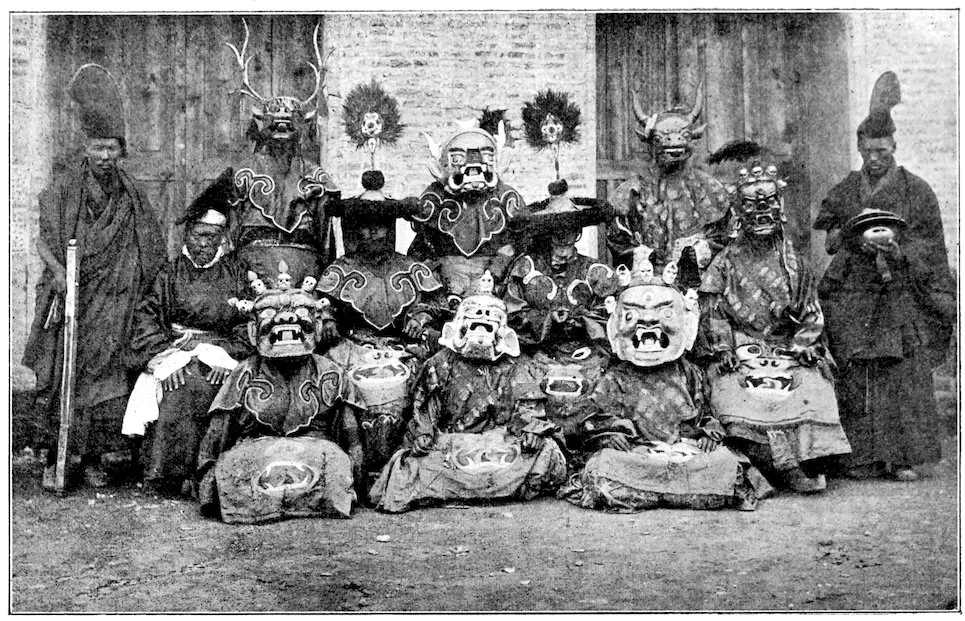
TIBETAN LAMAS MASKED FOR A RELIGIOUS DANCE.
By MRS. J. F. BISHOP
(ISABELLA L. BIRD), F.R.G.S.
HONORARY FELLOW OF THE ROYAL SCOTTISH GEOGRAPHICAL SOCIETY
HONORARY MEMBER OF THE ORIENTAL SOCIETY OF PEKING, ETC. ETC.
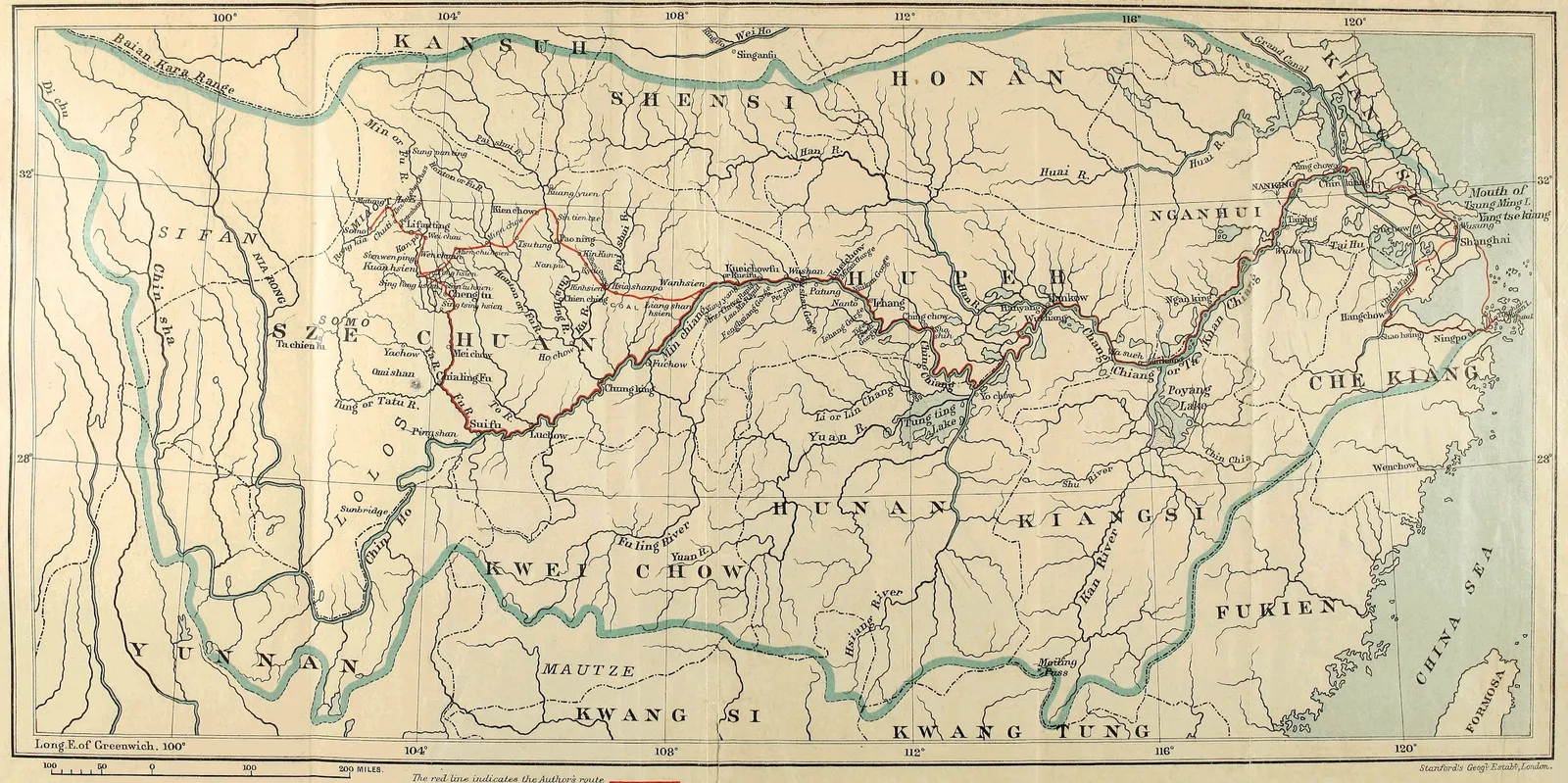
WITH MAP AND 116 ILLUSTRATIONS
DEDICATED BY PERMISSION TO
THE MARQUESS OF SALISBURY, K.G.
LONDON
JOHN MURRAY, ALBEMARLE STREET
1899
DEDICATED BY PERMISSION
TO THE
MARQUESS OF SALISBURY, K.G.
WITH THE AUTHOR’S PROFOUND RESPECT, AND ADMIRATION
OF THE NOBLE AND DISINTERESTED SERVICES
WHICH HE HAS RENDERED TO THE
BRITISH EMPIRE
PREFACE
ix
These journeys in China [concluding in 1897], of which the
following pages are the record, were undertaken for recreation
and interest solely, after some months of severe travelling
in Korea. I had no intention of writing a book, and it was not
till I came home, and China came very markedly to the front, and
friends urged upon me that my impressions of the Yangtze
Valley might be a useful contribution to popular knowledge of
that much-discussed region, that I began to arrange my materials
in their present form. They consist of journal letters, photographs,
and notes from a brief diary.
In correcting them, and in the identification of places, not an
easy matter, I have been much indebted to the late Captain Gill’s
River of Golden Sand, The Gorges of the Yangtze, by Mr. A.
Little, three papers on “Exploration in Western China,” by
Mr. Colborne Baber, in the Geographical Journal of the Royal
Geographical Society, and very specially to the official reports of
H.B.M.’s Consuls at the Yangtze ports. I have denied myself
the pleasure of reading any of the recent literature on China,
and it was only when my task was done that I glanced over
some of the later chapters in The Break Up of China, and China
in Transformation. For a great part of my inland journey I have
been unable to find any authorities to refer to, and as regards
personal observation I agree sadly with the dictum of Socrates—“The
body is a hindrance to acquiring knowledge, and sight and
hearing are not to be trusted.”
I cannot hope to escape errors, but I have made a laborious
effort to be accurate, and I trust and believe that they are
not of material importance, and that in the main this volume
xwill be found to convey a truthful impression of the country
and its people. The conflicting statements made on every subject
by well-informed foreign residents in China, as elsewhere, constitute
a difficulty for a traveller, and homogeneous as China is, yet with
regard to very many customs, what is true in one region is not
true in another. Even in the single province of Sze Chuan there
is a very marked unlikeness between one district and another in
house and temple architecture, methods of transit, customs in
trade, and in much else.
I have dwelt at some length on “Beaten Tracks”—i.e., treaty
ports and the Great River—though these have been described
by many writers, for the reason that each one looks at them from
a different standpoint, and helps to create a complete whole. The
illustrations in this volume, with the exception of the reproductions
of some Chinese drawings, and nine which friends have kindly
permitted me to use, are from my own photographs. The spelling
of place names needs an explanation. I have not the Chinese
characters for them, and in many cases have only been able to
represent by English letters the sounds as they reached my ear;
but wherever possible, the transliteration given by Consul Playfair
in his published list of Chinese Place Names has been adopted,
and with regard to a few well-known cities the familiar but
unscholarly spelling has been retained. To prevent confusion the
names of provinces have been printed in capitals.
I am painfully conscious of the many demerits of this volume,
but recognising the extreme importance of increasing by every
means the knowledge of, and interest in, China and its people,
I venture to ask for it from the public the same kindly criticism
with which my former records of Asiatic travel have been received,
and to hope that it may be accepted as an honest attempt to make
a contribution to the data on which public opinion on China and
Chinese questions must be formed.
ERRATA. — CHAPTER I. GEOGRAPHICAL AND INTRODUCTORY
xvii
Page 2.
Third line from bottom, for “140” read “263.”
„ 177.
Footnote, third line from bottom, after “illustration” read “on page 498.”
„ 415.
Eleventh line from bottom, for “Tu-sze” read “Tu-tze.”
„ 495.
Eighteenth line from top, for “88°” read “87°.”
„ 518.
Eleventh line from bottom, for “six thousand” read “8875.”
THE YANGTZE VALLEY
1
The events which have rendered the Yangtze Valley literally
a “sphere of interest” throughout the British Empire lie
outside the purview of these volumes. Few people, unless they
have been compelled to the task by circumstances or interests,
are fully acquainted with the magnitude and resources of the
great basin which in the spring of 1898 was claimed as the
British “sphere of influence,” and I honestly confess that it was
only at the end of eight months (out of journeys of fifteen months
in China) spent on the Yangtze, its tributaries, and the regions
watered by them that I even began to learn their magnificent
capabilities, and the energy, resourcefulness, capacities, and “backbone”
of their enormous population.
Geographically the Yangtze Valley, or drainage area, may be
taken as extending from the 90th to the 122nd meridian of east
longitude, and as including all or most of the important provinces
of Sze Chuan, Hupeh, Hunan, Kiangsi, Nganhui, Kiangsu,
and Honan, with considerable portions of Che Kiang, Kueichow,
and Yunnan, and even includes the south-eastern drainage
areas of Kansuh, Shensi, and Shantung. Geographically there
can be no possible mistake about the limits of this basin.[1] Its
area is estimated at about 650,000 square miles, and its population,
one of the most peaceable and industrious on earth, at from
170,000,000 to 180,000,000.
2The actual length of the Yangtze is unknown, but is believed
not to exceed 3000 miles. Rising, according to the best geographical
information, almost due north of Calcutta, its upper
waters have been partially explored by Colonel Prjevalsky and
Mr. Rockhill up to an altitude in the Tang-la mountains of 16,400
feet, and as far as lat. 34° 43′ N. and long. 90° 48′ E.[2]
It has thus been ascertained that the Great River, though
not tracked actually to its source, rises on the south-east edge of
the Central Asian steppes, and, after draining an extensive and
little-known basin, pursues a tempestuous course under the name
of the Chin Sha, hemmed in by parallel ranges, and raging through
gigantic rifts in Yunnan and South-western Sze Chuan, which
culminate in grandeur at the Sun Bridge, a mountain about 20,000
feet in altitude, “which abuts on the river in a precipice or
precipices which must be 8000 feet above its waters” (Baber).
It is not till these savage gorges are passed and the Chin Sha
reaches Ping Shan, forty miles above Sui Fu, that it becomes
serviceable to man. In long. 94° 48′ Colonel Prjevalsky
describes it as a rapid torrent, with a depth of from five to
seven feet, a bed, upwards of a mile wide, covered in summer, and
a width in autumn of 750 feet at about 2800 miles from its mouth.
In travelling from its supposed source to Ping Shan, a distance
roughly estimated at 1500 miles, its fall must be fully 15,000 feet
(assuming that the altitude of its source is 16,400 feet),[3] while for
the same distance (again roughly estimated) from Ping Shan to
Shanghai the fall is only 1025 feet, and from Hankow to the sea,
a distance of 600 miles, only an inch per mile.
The Min or Fu appears to have its source in the Baian Kara
range, called in Tibetan Maniak-tso,[4] and joins the Chin Sha at
Sui Fu. While the Chin Sha is only navigable for about forty
miles above this junction, the Min is navigable to Chengtu, about
266 miles from Sui Fu, and by another branch to Kuan Hsien, forty
miles higher. I descended the Min from Chengtu to Sui Fu in
a fair-sized boat at the very lowest of low water. As being navigable
3for a far greater distance, the Chinese geographers regard the
Min as the true “Great River,” the superior length of the Chin
Sha not being taken into account. It should be noted that the
Chinese only give their great river the name of Yangtze for the
two hundred miles of its tidal waters.[5]
After the River of Golden Sand and the Min unite at Sui Fu, the
Great River asserts its right to be regarded as the most important
of Asiatic waterways by furnishing, by its main stream and the
tributaries which thereafter enter it, routes easy of navigation
through the rich and crowded centre of China, with Canton by
the Fu-ling, with only two portages, and with Peking (Tientsin)
itself by the Grand Canal, which it cuts in twain at Chin
Kiang.
It is only of the navigable affluents of the Yangtze that mention
need be made here. The raging and tremendous torrents foaming
through rifts as colossal as its own, and at present unexplored, lie
rather within the province of the geographer.
In estimating the importance of these affluents it must be
remembered that the Yangtze, of which they are feeders, is not
an outlet, but the outlet, for the commerce of Sze Chuan, which,
owing to its size, population, wealth, and resources, may be truly
termed the empire province of China.
On the north or left bank the Min, before uniting with the Chin
Sha at Sui Fu, receives near the beautiful trading city of Chia-ling
Fu the Tung or Tatu, a river with a volume of water so much larger
than its own as to warrant the view taken by Mr. Baber and Mr.
von Rosthorn that it ought to be considered the main stream, and
the Ya, which is navigable for bamboo rafts up to Ya-chow, the
centre of the brick tea trade with Tibet. After this the Yangtze at
Lu-chow receives the To, which gives access to one of the richest
regions of the province, and at Chungking, the trading capital,
the Chia-ling.
This is in itself a river of great importance, being navigable for
over 500 miles, actually into the province of Kansuh. It receives
4several noble navigable feeders, among the most important of
which are the Ku, entering it a little above Ho-chow, the
Honton or Fu, and the Pai Shui. It passes for much of its course
through a rich and fertile region, and through a country which
produces large quantities of salt, and it bisects the vast coal-fields
which underlie Central Sze Chuan. On the right or south bank
above the gorges, at the picturesque city of Fu-chow, the Fu-ling,
which has three aliases, enters the Yangtze. This is an affluent of
much commercial importance, as being the first of a network of
rivers by which, with only two portages, goods from the Far West
can reach Canton, and as affording, with its connections the Yuan
Ho and the Tungting lake, an alternative route to Hankow, by
which the risks of the rapids are avoided.
After the Yangtze enters the gorges, which at one point, at
least, narrow it to a width of 150 yards, there are no affluents
worthy of special notice until Ichang is passed, when the Han,
navigable for cargo boats for 1200 miles of north-westerly windings
from its mouth at Hankow, takes the first place, followed by the
Yuan, Hsiang, Kan, Shu, and others, which join the Yangtze
through the Tungting and Poyang lakes. These rivers, specially
the Han, are themselves swelled by a great number of navigable
feeders, which east of Sha-shih, in the Great Plain, are connected by
a vast network of navigable canals, the differences in level being
overcome by the ingenious contrivance called the pah. These
natural and artificial waterways are among the chief elements of
the prosperity of the Yangtze Valley, affording cheap transit for
merchandise, land carriage in China, mile for mile, costing twenty
times as much as water carriage.
The time of the annual rise and fall of the Great River can
be counted on with tolerable certainty. With regard to the rise,
from what I saw and heard I am inclined to attach more importance
to the swelling of its Yunnan affluents during the south-west
monsoon than to the melting of those snows which, as seen from
the stupendous precipice of Omi-shan, are one of the grandest
sights on earth—the long and glittering barrier which secludes
the last of the hermit nations.
The rise of the Yangtze is from forty feet or thereabouts at
Hankow to ninety feet and upwards at Chungking. During three
months of the year the rush of the vast volume of water is so
5tremendous that traffic is mainly suspended, and even in early June
many hundreds of the large junks are laid up until the autumn
in quiet reaches between Chungking and Wan Hsien. The annual
rise of the river as well as the rapids have to be taken into
consideration in the discussion of the question as to whether
steam navigation on the Upper Yangtze can be made commercially
profitable.
The actual rise, which is more reliable than that of the Nile,
begins late in March, is at its height early in August, and then
gradually falls until December or January. Late in June, when I
descended the Great River, its enormous submerged area presented
the same appearance on a large scale as the limited Nile valley—an
expanse of muddy water, out of which low mounds, probably
of great antiquity, rise, crested with trees and villages, with boats
moored to the houses.
The country in the neighbourhood of Shanghai is a fairly good
example of the characteristics of the Great Plain. In ordinary
dry weather the surface of the soil is not more than five feet above
the water-level, and as seen from any pagoda the whole country,
with the exception of the two or three low Tsing-pu hills, which
are seldom visible, presents the aspect, familiar to dwellers in the
fens, of a cultivated dead level, intersected by numerous canals and
creeks and by embankments for the preservation of the fields from
inundation. Much the same sort of view in winter may be seen
from any elevated point for hundreds of miles, modified by a few
ranges of hills of somewhat higher elevation, wider creeks, and
shallow marshy lakes.
It is not solely by deposits of rich alluvium brought down by
the annual rise of the river that the soil of the Great Plain is
gradually raised. The agency of dust storms is an important one,
and these occur extensively throughout Northern and Central
China, moving much material from place to place. I saw a dust storm
at Kueichow which lasted for seven hours, burying some
hovels and much agricultural country, and even producing a metamorphosis
of the rocky bed of the Yangtze. Such storms have
been observed as far east as Shanghai, but their occurrence at
Kueichow shows that their area is not limited to the Great Plain
or even to the region east of the mountain barrier between Hupeh
and Sze Chuan.
6It is not till the Yangtze reaches Sha-shih that its character
completely changes. The first note of change is a great embankment,
thirty feet high, which protects the region from inundation.
Below Sha-shih the vast river becomes mixed up with a network of
lakes and rivers, connected by canals, the area of the important
Tungting lake being over 2000 square miles. The Han alone, with
its many affluents and canals, disperses goods through the interior
for 1200 miles north of its mouth at Hankow, but there are some
difficult rapids to surmount. The Hsiang and the Yuan, uniting
with the Yangtze at the Tungting lake, are navigable nearly as far
to the south. The Kan, which unites with the Yangtze through the
Poyang lake, which has an area of 1800 square miles, is navigable
to the Mei-ling pass, near the Kwantung frontier.
The delta of the river is indicated below Wu-sueh by even a
greater labyrinth of tributaries, lakes, and canals, the area of the
Tai Hu and the other lakes in the southern delta being estimated
at 1200 square miles, and the length of the channels used for
navigation and irrigation at 36,000 miles. In summer, after the
spring crops have been removed, the whole region is under water.
The population migrates to mounds, and the temporary villages
communicate by boats.
At Chinkiang the Grand Canal enters the Yangtze from
Hangchow, and leaves it on the left bank, some miles away,
for Tientsin. On that north bank engineering works, extending
over a vast area of country, have been constructed, evidencing
the former energy and skill of the Chinese.
These have diverted the river Huai, which with its seventy-two
tributaries form important commercial routes to North An Hui
and Honan, from its natural course to the sea, and have compelled
the bulk of its waters to discharge themselves into the Yangtze
through openings in a large canal which runs nearly parallel with
it for 140 miles. By means of innumerable artificial waterways,
the excavation of some lakes, and the enlargement of others,
the Huai no longer has any existence as a river east
of the Grand Canal, most of this work having been carried out
to prevent undue pressure on the bank of that great waterway
at any one point south of the old course of the Hoang Ho.
North of the canal, and parallel with the Yangtze, lies a
parallelogram the extent of which is estimated by Père Gandar
7at 8876 square miles, and is one of the most productive rice-fields
in China. This is below the water-level. It has immense dykes
protecting it from the sea, pierced by eighteen drainage canals,
but its chief drainage is into the Yangtze. Waterways under
constant and careful supervision intersect this singular region.
For the remaining distance the mighty flood of the Yangtze rolls
majestically on through absolutely level country, in which in
winter embankments and waterways are everywhere seen. The
influence of the tide is felt for about 200 miles.
There is an ancient Chinese proverb regarding the mouth of
the Great River: “Lo, this mighty current hastens to its imperial
audience with the ocean.” But opaque yellow water and mud
flats, extending as far as the eye can reach, leave the imperial
grandeur to the imagination.
Tennyson’s description of the work of rivers as being “to sow
the dust of continents to be,” applies forcibly to the Yangtze,
which, after creating the vast alluvial plains which stretch from
Sha-shih for 800 miles to the ocean and endowing them in its
annual overflow with sufficient fresh material to keep up an
unsurpassed fertility, has yet enough to spare to discharge
770,000 feet of solid substance every second into the sea,
according to scientific estimates. The Yangtze has done much
to create, within comparatively recent years, at least the eastern
portion of the province of Kiang Su and the island of Tsung-ming
near Shanghai, capable of supporting a population of
considerably over 1,000,000 souls. Another marked instance of
its power to create is shown near the treaty port of Chinkiang.
The British fleet ascended the Yangtze, so recently as in 1842,
by a channel south of the beautiful Golden Island. Now, instead
of the channel, there is an expanse of wooded and cultivated land
sprinkled with villages.
Nearly a mile wide 600 miles from its mouth, nearly three-quarters
of a mile at 1000, and 630 yards at 1500, with a volume of
water which, at 1000 miles from the sea, is estimated at 244 times
that of the Thames at London Bridge, with a summer depth
of ninety feet at Chungking and of ten feet at its few shallow
places at Hankow when at its lowest winter level, with a capacity
for a rise of forty feet before it overflows its banks, with an
annual rise and fall more reliable than those of the Nile, with navigable
8tributaries penetrating the richest and most populous regions of
China, navigable in the summer as far as Hankow for the largest
ships in the world, and during the whole year to Ichang, 400 miles
farther, for fine river steamers carrying large cargoes, even the
Upper Yangtze, that region of grandeur, perils, and surprises, is
traversed annually by 7000 junks, employing a quarter of a million
of men. During my own descent of the Min and Yangtze from
Chengtu to Shanghai, a distance by the windings of the river of
about 2000 miles, I was never out of sight of native traffic, and
those who, like myself, have waited for two or three days at
the foot of the great rapids for the turn to ascend, can form
some idea of how vast that traffic is.
The navigable portion of the Yangtze, as regarded from the sea,
naturally divides itself into three stretches, the first, of 1000 miles,
rolling as a broad turbid flood, traversed by several lines of
steamers, through the deep grey alluvium of some of the richest
and most populous provinces of China, mainly its own creation;
the second, the region between Ichang and Kueichow Fu,
through which hitherto goods have been carried by junks alone,
in which it cleaves the confused mass of the Hupeh ranges by a
series of magnificent gorges and tremendous cataracts; and the
third, the long stretch of rapids and races between Kueichow Fu
and Sui Fu at its junction with the Min.
It is not possible to exaggerate the sublimity and risks of the
navigation of the Upper Yangtze, especially at certain seasons.
Of the vast fleet of junks which navigate its perilous waters, five
hundred on an average are annually wrecked, and one-tenth of
the enormous importation of cotton into Chungking arrives
damaged by water. Yet so ample are the means of transport, and
so low the freight considering the risks, that, according to Mr. von
Rosthorn, of the Chinese Imperial Maritime Customs, foreign
cottons are sold in Sze Chuan at a barely appreciable advance
on their price at Ichang, to which point they are brought by steam
from the coast in eight days.
The Chinese Gazetteer notifies one thousand rapids and rocks
between Ichang and Chungking, a distance of about 500
miles; and in winter this does not seem an outlandish estimate,
but in early summer, with the water twenty-four and thirty
feet higher, many of the vigorous rapids, alternating with smooth
9stretches of river only running three knots an hour, disappear,
along with boulder-strewn shores, rocks, and islets, giving place
to a broad and tremendous volume of water, swirling seawards at
the rate of seven, eight, and ten knots an hour, forming many
and dangerous whirlpools.
Of the magnitude of the native traffic on the Lower Yangtze,
undiminished by the various steamboat lines which keep up daily
communication with Hankow, it is scarcely needful to write. In
ascending it is evident to the traveller by the time that Chinkiang,
the port of junction with the Grand Canal, is reached,
that, broad as the river is, there is none too much “sea room” for
the thousands of junks of every build, from every maritime and
riverine province, fishing and cargo boats of every size and rig,
rafts, lorchas, and cormorant boats, which throng its waters.
The open ports of Wuhu and Kiu-kiang, each with its fleets
of junks, and trade worth several millions sterling annually, and
big cities such as Nanking, Yangchow, and Nganking, each
with its highly organised mercantile and social life, and trade
guilds and charities, are important and interesting; and it is seen
in a rapid glance that large villages with numerous industries, rice,
cotton, and silk culture predominating, abound, that everything is
utilised, that every foot of ground capable of cultivation is bearing
a crop, and that even the reed-beds of the irreclaimable swamps
furnish materials for houses, roofs, fences, and fuel. It is seen that
elaborate and successful engineering works have reclaimed large
tracts of country and keep them drained, that a network of irrigating
and navigable canals spreads over the whole level region,
and that the traffic on these minor waterways is enormous.
So ceaseless are the industries by land and water, that it is
hardly a surprise to find them culminating 600 miles from the
ocean in the “million-peopled” city of Hankow (Han Mouth),
the greatest distributing centre for goods in China, with miles of
craft moored in triple rows along the Han, itself navigable for
1200 miles.
The empire province of Sze Chuan, with the great navigable
tributaries of the Yangtze, by which goods are conveyed at small
cost to countless towns and villages, will be treated in some
detail farther on. It is enough to remark here that it has about the area
of France, that it has a population estimated by the Chinese
10census authorities at 70,000,000, and by none at less than 50,000,000;
that it has a superb climate, ranging from the temperate to the
sub-tropical; a rich soil, much of which, under careful cultivation,
yields three and even four crops annually of most things which
can be grown; forests of grand timber, the area of which has not
even been estimated; rich mineral resources, and some of the
most valuable and extensive coal-fields in the world. It cannot
be repeated too often that for its export trade, estimated at
£3,300,000, and its import trade, estimated at £2,400,000, the
Yangtze is the sole outlet and inlet.
Such an exhibition of Chinese energy, industry, resourcefulness,
and power of battling with difficulties is not to be seen anywhere
to the same extent as on the Upper Yangtze, where the enormous
bulk of the vast import trade has to be dragged up 500 miles
of hills of water by the sheer force of man-power, at two or three
of the worst rapids a junk of over one hundred tons requiring
the haulage of nearly four hundred men.
Waterways take the place of roads, which are usually infamous,
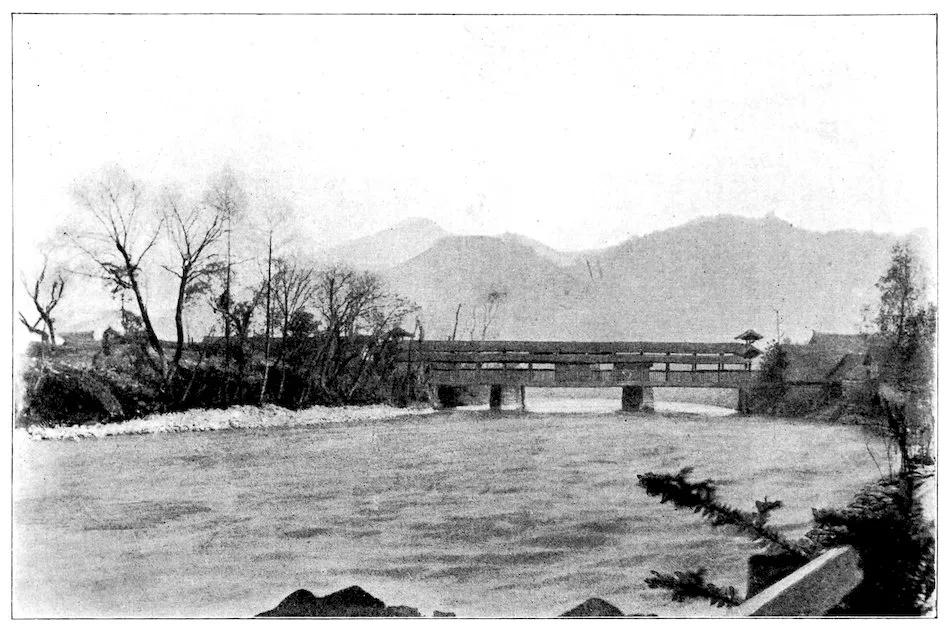
throughout the Yangtze basin, but the bridges are marvels of
solidity, and in many cases of beauty. The annual inundations
on the Great Plain partly account for the badness of the roads,
and constitute an expensive difficulty in the way of the forthcoming
railroads.
To write of the Yangtze Valley, the British “sphere of influence”
(a phrase against which I protest), without any allusion to such an
important factor as its inhabitants, would be a mistake, for sooner
or later, in various ways, we shall have to reckon with them.
The population throughout, from the ocean to the unexplored
rifts of the Chin Sha, is homogeneous, that is Chinese, with the
exception of certain tribes of the far west: the Sifan, Mantze, and
Lolo. The Tartars or Manchu, who have supplied the throne with
the present dynasty, whose fathers drove the Chinese before them
like sheep, and who still garrison the great cities, have mainly
degenerated into opium-smoking loafers, the agent in their downfall
being hereditary pensions.
Throughout this vast population, perhaps not over-estimated
at 180,000,000, with the exception of spasmodic and local
rebellions now and then, law and order, prosperity (except in
such disasters as floods or famines) and peace prevail, and that
11security for the gains of labour exists without which no country
is great. The system of government, the written language, and
the education are uniform, and the “three religions”—Confucianism,
Buddhism, and Taoism—are so mixed up together
that there is little antagonism between them.
The organisation of this valley population, social and mercantile,
is a marvel, with its system of trade, trade guilds, trade unions,
charities, banking and postal systems, and powerful trade combinations.
In much talk about “open doors” and “spheres of influence” and
“interest,” in much greed for ourselves, not always dexterously
cloaked, and much jealousy and suspicion of our neighbours, and
in much interest in the undignified scramble for concessions in
which we have been taking our share at Peking, there is a risk of
our coming to think only of markets, territory, and railroads, and
of ignoring the men who, for two thousand years, have been making
China worth scrambling for. It may be that we go forward with
“a light heart,” along with other European empires, not hesitating,
for the sake of commercial advantages, to break up in the case of
a fourth of the human race the most ancient of earth’s existing
civilisations, without giving any equivalent.
In estimating the position occupied by the inhabitants of the
Yangtze Valley, as of the rest of China, it is essential for us to see
quite clearly that our Western ideas find themselves confronted, not
with barbarism or with debased theories of morals, but with an
elaborate and antique civilisation which yet is not decayed, and
which, though imperfect, has many claims to our respect and even
admiration. They meet with a perfectly organised social order, a
system of government theoretically admirably suited to the country,
combining the extremes of centralisation and decentralisation,
and under which, in spite of its tremendous infamies of practice,
the governed enjoy a large measure of peace and prosperity, a
noteworthy amount of individual liberty and security for the gains
of labour, and under which it is as possible for a peasant’s son to
rise to high position as in the American Republic.[6]
12Western civilisation finds itself confronted also by a people at
once grossly material and grossly superstitious, swayed at once by
the hazy speculations and unintelligible metaphysic which in
Chinese Buddhism have allied themselves with the most extravagant
and childish superstitions, and by the dæmonism of
Taoism, while over both tower the lofty ethics and profound
agnosticism of Confucius. It finds a classical literature universally
held in profound reverence, in which, according to all testimony,
there is not a thought which could sully the purest mind, and an
idolatry puerile, superstitious, and free from grand conceptions, but
in which bloody sacrifices and the deification of vice have never
had a part, or immoral rites a place.
The human product of Chinese civilisation, religion, and government
is to me the greatest of all enigmas, and so he remains
to those who know him best. At once conservative and adaptable,
the most local of peasants in his attachments, and the most cosmopolitan
and successful of emigrants—sober, industrious, thrifty,
orderly, peaceable, indifferent to personal comfort, possessing great
physical vitality, cheerful, contented, persevering—his filial piety,
tenacity, resourcefulness, power of combination, and respect for
law and literature, place him in the van of Asiatic nations.
The Chinese constitute an order by themselves, and their
individuality cannot be read in the light of that of any other
nation. The aspirations and modes of thinking by which
we are ruled do not direct their aims. They are keen and
alert, but unwilling to strike out new lines, and slow to be influenced
in any matters. Their trading instincts are phenomenal.
They are born bargainers, and would hardly think half an hour
wasted if through chaffering they gained an advantage of half
a cash, a coin forty of which are about one penny. They are
suspicious, cunning, and corrupt; but it is needless to run through
13the established formula of their vices. Among the things which
they lack are CONSCIENCE, and such an enlightened public
opinion as shall sustain right and condemn wrong.
Matthew Arnold has said that Greece perished for want of
attention to conduct, and that the revelation which rules the
world is the “pre-eminence of righteousness.” It may be that
the western powers are not giving the Middle Kingdom a very
desirable object-lesson.
On the whole, as I hope to show to some extent in the following
pages, throughout the Yangtze valley, from the great cities of
Hangchow and Hankow to the trading cities of Sze-chuan, the
traveller receives very definite impressions of the completeness of
Chinese social and commercial organisation, the skill and carefulness
of cultivation, the clever adaptation of means to ends—the
existence of provincial patriotism, or, perhaps, more truly, of
local public spirit, of the general prosperity, and of the backbone,
power of combination, resourcefulness, and independence possessed
by the race. It is not an effete or decaying people which we shall
have to meet in serious competition when it shall have learned
our sciences and some of our methods of manufacturing industry.
Indeed, it is not improbable that chemistry, for instance, might
be eagerly adapted by so ingenious a race to the perpetration of
new and hitherto unthought-of frauds! But if the extraordinary
energy, adaptability, and industry of the Chinese may be regarded
from one point of view as the “Yellow Peril,” surely looked at
from another they constitute the Yellow Hope, and it may be
possible that an empire genuinely Christianised, but not denationalised,
may yet be the dominant power in Eastern Asia.
The Chinese are ignorant and superstitious beyond belief, but
on the whole, with all their faults, I doubt whether any other
Oriental race runs so straight.
The Yangtze Basin is a magnificent sphere of interest for all
the industrial nations for fair, if not friendly, rivalry, and to
preserve the “open door” there, and throughout China, is a worthy
object of ambition. To strengthen instead of to weaken the
Central Government is undoubtedly the wisest policy to pursue,
for in the weakness of the Peking Government lies the weakness
and possible abrogation of all treaty obligations. It is its strength
and capacity to fulfil its treaties which alone make them worth
14anything. In the weakening of the Central Government, and
the disintegration of the empire, our treaty rights in the Yangtze
Valley, for instance, would be worth as much as our sword could
secure, and it cannot reach above Ichang, while if the integrity
of the empire be preserved, and it is aided along judicious paths
of reform, this vast basin, with its singular capabilities, and its
population of 180,000,000, may become the widest arena for
commercial rivalries that the world has ever seen.
CHAPTER II. “THE MODEL SETTLEMENT”
15
Those of my readers who have followed me through all
or any of my eleven volumes of travels must be aware
that my chief wish on arriving at a foreign settlement or treaty
port in the East is to get out of it as soon as possible, and that
I have not the remotest hankering after Anglo-Asiatic attractions.
Nor is Shanghai, “The Model Settlement of the East,” an exception
to the general rule, though I gratefully acknowledge the
kindness and hospitality which I met with there, as everywhere,
and recall with pleasure my many sojourns at the British Consulate
as the guest of Mr. and Mrs. Lowndes Bullock.
But as the outlet of the commerce of the Yangtze Valley, and
as a foreign city which has risen on Chinese shores in little more
than half a century to the position and importance of one of
the great trading centres of the world—its exports and imports
for 1898 being of the value of £37,680,875 sterling[7]—it claims
such notice as I can give it, which is chiefly in the shape of
impressions.
I have reached Shanghai four times by Japanese steamers,
three times in coasting steamers of American build, once in one
of the superb vessels of the Canadian Empress line, once from
Hankow in a metamorphosed Dutch gunboat, and the last time,
after nearly three and a half years of far eastern travel, in a
small Korean Government steamer, her quaint, mysterious, and
nearly unknown national flag exciting much speculation and
interest as she steamed slowly up the river. Of these vessels,
the Empress of China alone discharged her passengers and cargo
at Woo-sung, a railroad terminus twelve miles below Shanghai,
and that not necessarily.
16Many hours before reaching port, the deep heavenly blue of
the Pacific gradually changes into a turbid yellowish flood, well
named the Yellow Sea, holding in suspension the rich wash of
scarcely explored Central Asian mountain ranges, the red loam
of the “Red Basin” of Sze Chuan, and the grey and yellow
alluvium of the Central Provinces of China, all carried to the
ocean by the “Great River,” according to a careful scientific
estimate, to the extent of 6,428,858,255 cubic feet a year, solid
stuff enough to build an island ninety feet in depth and a mile
square annually.
Countless fishing-boats roll on the muddy waste; sailing
vessels, steamers, and brown-sailed junks of every build show
signs of convergence towards something, and before long a blink
of land is visible, and a lightship indicates the mouth of the
Yangtze Kiang and a navigable channel. It is long even then
before anything definite presents itself, and I confess to being
disappointed with the first features of the Asiatic mainland—two
long, thin, yellow lines, hardly more solid-looking than the yellow
water stretching along the horizon, growing gradually into low
marshy banks, somewhat later topped with uninteresting foliage,
through which there are glimpses of what looks like an interminable
swamp. Then Woo-sung appears with its new railroad,
godowns, whitewashed buildings, and big ships at anchor discharging
cargo into lighters and native boats, and then the banks
of the narrowing Huang-pu, the river of Shanghai, are indicated
by habitations and small fields and signs of small industries.
Within four miles of Shanghai the vivacity of the Huang-pu
and its banks becomes overpowering, and the West asserts its
ascendency over the slow-moving East. There are ranges of
great godowns, wharves, building yards, graving docks, “works”
of all descriptions, filatures, cotton mills, and all the symptoms
in smoky chimneys and a ceaseless clang of the presence of
capital and energy. After the war with Japan there was a rapid
increase in the number of factories.
The life and movement on the river become wonderful. The
channel for large vessels, though narrow, shifting, and intricate,
and the subject of years of doleful prophecies as to “silting up”
and leaving Shanghai stranded, admits of the passage of our
largest merchantmen, and successful dredging enables them to
17lie alongside the fine wharves at Hongkew. American three and
four-masted and other sailing vessels are at anchor in mid-stream,
or are proceeding up or down in charge of tugs. Monster liners
under their own steam at times nearly fill up the channel, their
officers yelling frantically at the small craft which recklessly cross
their bows; great white, two-storeyed paddle arks from Ningpo
and Hankow, local steamers, steam launches owned by the great
firms, junks of all builds and sizes, manageable by their huge
rudders, sampans, hooded boats, and native boats of all descriptions,
lighters, and a shoal of nondescript craft make navigation
tedious, if not perilous, while sirens and steam whistles sound
continually. “The plot thickens.” Foreign hongs, warehouses,
shipping offices, and hotels are passed in Hongkew, the American
settlement, and gliding round Pu-tung Point, the steamer anchors
abreast of the bund in a wholesomely rapid flow of water 2000
feet wide.
I arrived in Shanghai the first time on a clear, bright autumn
day. The sky was very blue, and the masses of exotic trees, the
green, shaven lawns, the belated roses, and the clumps of chrysanthemums
in the fine public gardens gave a great charm to the
first view of the settlement. Two big, lofty, white hulks for
bonded Indian opium are moored permanently in front of the
gardens. Gunboats and larger war-vessels of all nations, all
painted white, and the fine steamers of the Messageries Maritimes
have their moorings a little higher up. Boats, with crews in
familiar uniforms, and covered native boats gaily painted, the
latter darting about like dragonflies, were plying ceaselessly, and
as it was the turn of the tide, hundreds of junks were passing
seawards under their big brown sails.
On landing at the fine landing-stage, where kind friends received
me and took me to the British Consul’s residence in the spacious
grounds of the Consulate, I was at once impressed with the exquisite
dress of the ladies, who were at least a half of the throng,
and with the look of wealth and comfort which prevails.
All along the British bund, for at least a mile from the Soochow
Creek, which separates it from Hongkew, to the French settlement,
are banks, hongs, hotels, and private houses of the most approved
and massive Anglo-Oriental architecture, standing in large, shady
gardens, the Hong Kong and Shanghai Bank, the “P. & O.” office,
18the Canadian-Pacific Railroad office, the fine counting-house and
dwelling-house of the old and famous firm of Jardine, Matheson
& Co., and the long façade of the British Consular buildings,
with their wide sweep of lawns, being prominent.
The broad carriage-road and fine flagged side-walk are truly
cosmopolitan. Well-dressed men and women of all civilised
nations, and of some which are not civilised, promenade gaily
on the walk and in the garden. Single and two-horse carriages
and buggies, open and closed, with coachmen and grooms in
gay and often fantastic cotton liveries, dash along the drive.
Hackney victorias abound, and there are jinrickshas (from which
foreigners drop the first syllable) in hundreds, with Chinese
runners, and Shanghai wheelbarrows innumerable, some loaded
with goods or luggage, while the coolies of others are trundling
along from two to four Chinese men or women of the lower
classes, seated on matted platforms on either side of the wheel,
facing forwards.
I was not prepared for the Chinese element being so much
en evidence in the foreign settlement. It is not only that clerks
and compradores dressed in rich silks on which the characters for
happiness and longevity and the symbols of luck are brocaded
are in numbers on the bund, and that all the servile classes, as
may be expected, are Chinese, but that Chinese shops of high
standing, such as Laou Kai Fook’s, are taking their places in
fine streets which run back from the bund, that some of the
handsomest carriages on the bund and the Bubbling Well
Road, the fashionable afternoon drive of Shanghai, are owned
and filled with Chinese, that Chinese ladies and children richly-dressed
drive in the same fashion, and that of late, specially,
wealthy Chinese have become keen competitors for British houses,
and have even outbid foreigners for them. Is Shanghai menaced
by the “Yellow Peril” as Malacca, Singapore, and Penang
have been?
A great trading Chinese city, with an estimated population of
200,000, has grown up within the foreign boundary, subject to foreign
municipal laws and sanitary regulations, but so absolutely Chinese,
that were it not for the wide streets and the absence of refuse-heaps
and bad smells, one might think oneself in one of the great cities
of the interior. The Chinese are quite capable of appreciating the
19comfort and equity of foreign rule, and the various advantages
which they enjoy under it. They pay municipal taxes according
to their rating, and “feu duty” for their land, which it is usual
for them to hold in the name of a foreigner. They are under
the jurisdiction of the Chinese Government, but civil cases in which
foreigners are concerned and breaches of the peace are tried
in what is known as the “Mixed Court,” an apparently satisfactory
and workable arrangement, and serious criminal cases
belong to the Chinese Shanghai magistrate.
I soon began to learn why Shanghai is called, or calls itself,
“The Model Settlement,” and to recognise the fitness of the name.
The British and American settlements are governed by a Municipality
elected by the ratepayers, consisting of nine gentlemen,
who, assisted by a secretary and general staff, expend the sums
provided by the ratepayers to the general satisfaction, arranging
admirably for the health, security, comfort, and even enjoyment of
the large foreign community, as well as for the order and well-being
of the constantly increasing Chinese population, showing to
the whole East what can be accomplished by an honest and
thoroughly efficient British local administration. This body is, as
it deserves to be, grandly housed.
The more important streets are lighted with electricity, the
others with gas. Mounted Sikh police patrol the suburban roads,
and a mixed force of Europeans, Sikhs, and Chinese preserves
order and security in the settlement by day and night. An
expensive but successful drainage system keeps Shanghai sweet
and wholesome. Water-carts are always at work in dry weather,
and scavengers’ carts cleanse the streets three times daily. Waterworks
three miles from city pollutions supply pure water abundantly,
and keep up a very high pressure unfailingly. The band of
thirty performers, which plays in the public gardens every afternoon
in winter, and three evenings a week in summer, attracting
nearly the whole foreign community to lounge under the trees
or stroll on the smooth gravel walks, is the creature of the
Municipality.
Shanghai has two telegraph lines embracing London; daily
papers well conducted, the North China Daily News specially
maintaining a deservedly high reputation; several magazines, and
communication with Europe always once a week, and usually
20oftener, by well-appointed mail steamers of four lines. Telegraphic
news from all parts of the world appears simultaneously
in London and Shanghai; it is thoroughly in touch with Europe
and America, and European politics and events in general are
discussed with as much intelligence and almost as much zest as at
home. Excellent libraries, and the large book-store of Messrs.
Kelly & Walsh, cater for the intellectual needs of the population,
but it is likely that the depressing climate in spring and summer,
and the whirl of society and amusements in winter, indispose most
of the residents for anything like stiff reading.
The tremendous energy with which Shanghai amuses itself
during seven months of the year is something phenomenal. It
is even a fatigue to contemplate it. Various causes contribute
to it on the part of the ladies. There is the Anglo-Saxon vitality
which must find some outlet. Then there is the absence of household
cares owing to the efficiency of Chinese cooks and “boys,”
and ofttimes the absence of children also, owing to the need for
home education; and there is also the lack of those benevolent
outgoings among “the poor” which occupy usefully a portion
of the time of leisured women at home. Then, owing to the
imitative skill of Chinese tailors, who can construct the most
elaborate gowns from fashion-plates for a few shillings, it is
possible for women to have the pleasure of appearing in an infinite
variety of elegant toilettes at a very small expense, and dress is
certainly elevated into a fine art in Shanghai.
Of the men I write tremblingly! Chinese tailors seem as
successful as Chinese dressmakers, and the laundrymen equal
both, no small matter when white linen suits are in question.
May it be permitted to a traveller to remark that if men were
to give to the learning of Chinese and of Chinese requirements
and methods of business a little of the time which is lavished on
sport and other amusements, there might possibly be less occasion
for the complaint that large fortunes are no longer to be made in
Chinese business.
For indeed, from ignorance of the language and reliance on that
limited and abominable vocabulary known as “Pidgun,” the British
merchant must be more absolutely dependent on his Chinese compradore
than he would care to be at home on his confidential clerk.
Even in such lordly institutions as the British Banks on the bund
21it seems impossible to transact even such a simple affair as cashing
a cheque without calling in the aid of a sleek, supercilious-looking,
richly-dressed Chinese, a shroff or compradore, who looks as if he
knew the business of the bank and were capable of running it.
It is different at the Yokohama Specie Bank, which has found a
footing in Shanghai, in which the alert Japanese clerks manage
their own affairs and speak Chinese. May I be forgiven?
An extraordinary variety of amusements is crowded into every
day. Then the community is most hospitable, as every visitor to
Shanghai knows, and the arrival of every ship of war and eminent
globe-trotter is the signal for a fresh outbreak of gaiety. Home
diversions are reproduced, and others are superadded, such as
paper hunts in the adjacent cotton-fields, house-boat picnics and
pleasure excursions, and house-boat shooting excursions, lasting
from three days to a week, for which special advantages exist,
as the inland cotton-fields during the winter are alive with
pheasants, partridges, quail, woodcock, and hares, while the watercourses
abound with wild fowl. Pony races are a leading institution,
with gentlemen riders of course. The morning gallops
extract people from their beds at unwonted hours, and in spring
and autumn the prospects of the stables make great inroads on
conversation. But I will not go further. The very imperfect list
given below gives some idea of the diversions which the community
provides for itself.[8] Amateur theatricals are “the rage” in the
winter, the amateur company providing several performances in
a theatre built by a subscription of £5000, and holding over
eight hundred persons, and the Fine Art Society gives an annual
exhibition.
The continual presence of strangers imparts a needed element
of freshness to society, and a zest to amusements which might
pall, and gives people an excuse, if any were needed, for enjoying
themselves. Shanghai has become the metropolis of gaiety
for the Far East, and a week at the Astor House, the great
recreation looked forward to not only by the dwellers in the
22treaty ports of China and Japan, but by those who roast and
dissolve on the rock at Hongkong, and its delirious whirl attracts
people even from Singapore.
But it would be quite an error to suppose that amusement
crowds out the kindlier emotions. Europeans fall into distress
constantly, some from misfortune, and some from fault, and many
widows and orphans are left penniless. One may safely say that
there is never a case of distress arising from any cause which is
not immediately and amply relieved and planned for; and benevolence
never wearies, the Ladies’ Benevolent Society doing a
ceaseless good work. There is a Sailors’ Home and Rest in a
very efficient and flourishing condition, with musical evenings
frequently, at which ladies and gentlemen play and sing; and,
without going further into detail, it may be said that the various
useful organisations which our civilisation considers essential for
a large community, from a fine general hospital downwards, have
their place in Shanghai.
Church accommodation is ample for the church-goers. The
Protestant cathedral, a really beautiful edifice, built from the
designs of Sir Gilbert Scott, is one of the greatest adornments
of the settlement, and is the finest ecclesiastical building in the
Far East.
From the early days of Shanghai many Protestant missions,
both European and American, have had mission houses in the
settlement, the most important being the large, appropriate, and
substantial headquarters of the China Inland Mission, the gift of
Mr. Orr Ewing, with a home for a hundred missionaries, a hospital,
goods and business departments, and postal arrangements. Dr.
Muirhead, of the L.M.S., whose missionary zeal is unchilled in
the winter of his age, and Dr. Edkins, of the same Society, whose
Chinese scholarship and researches among things Chinese have
won him a European fame, are well known to, and are much
respected by, the foreign community. There is also a large
Roman mission. British and American Bible Societies, and the
English Religious Tract Society and others also have agents
and depôts there, and much translation is done by missionaries,
and by agencies which have for their noble object the diffusion
of pure and useful western literature among the Chinese, and
their elevation mentally and morally.
23There is a North China branch of the Royal Asiatic Society
in Shanghai, with a fine library, regular meetings, and a journal,
which gathers up a great deal of very valuable matter. If the
size and material of the audience on the night when I had the
honour of reading a paper before the Society may be regarded
as an indication of the interest in its objects, it must be flourishing
indeed.
The topography of this metropolis is fully dealt with in various
official and other volumes. The salient points which impress a
newcomer are Hongkew, the American settlement, with its commercial
activity, the Soochow creek, with its fine bridge, the
handsome buildings of the British Consulate, the British Bund,
with its fine retaining wall, the long line of handsome private
and public buildings, and the glimpses of broad and handsome
streets full of private residences which run from the bund towards
the boundary.
The French Bund is a continuation of the British; but the
French settlement is small, markedly inferior, and gives one an
impression of arrested development, the only noteworthy buildings
being the Consulate, the Town Hall, and the large but
plain Roman cathedral. As some compensation, the fine wharves
at which the big Yangtze steamers load and discharge their
cargoes are in this settlement, as well as the handsome and
commodious premises of the Messageries Maritimes, beyond
which stretch, far as the eye can reach, the crowded tiers of the
Chinese shipping. The French boundary is an undesirable creek,
running past the east gate of the native city, between which
and the Huang-pu are crowded and unsavoury suburbs.
It is apparent that France regards her concession as a colony
rather than a settlement, and she has lately urged her claims for
an extension of it in a most selfish and indefensible manner. The
settlement has been frequently in very hot water, and a serious
disagreement with the Chinese occurred so recently as 1898.
Its Municipal Board was once forcibly dissolved by the French
Consul for a difference of opinion, and some of its members were
imprisoned.
The English settlement makes a proud display of the wealth
of the insular kingdom in the number of its stately buildings, the
Consulate, the cathedral, the municipal buildings, the four-storeyed
24and elaborately-designed club house, the banks and shipping
offices, and the massive mansions of historic firms, standing in
their secluded grounds; though of the magnates of eastern
commerce in the days of the rapid making of great fortunes
almost none remain. British, too, in design, architecture, and
arrangement, in all indeed but cost, is the magnificent pile of
buildings in which the Imperial Maritime Customs and the new
Post Office, under the same management, are housed.
Shanghai in every way makes good her claim to be metropolitan
as well as cosmopolitan, and, in spite of dark shadows,
is a splendid example of what British energy, wealth, and organising
power can accomplish.
To us the name Shanghai[9] means alone the superb foreign
settlement, with all the accessories of western luxury and civilisation,
lying grandly for a mile and a half along the Huang-pu,
the centre of Far Eastern commerce and gaiety, the “Charing
Cross” of the Pacific—London on the Yellow Sea.
But there was a Shanghai before Shanghai—a Shanghai which
still exists, increases, and flourishes—a busy and unsavoury
trading city, which leads its own life according to Chinese methods
as independently as though no foreign settlement existed; and
long before Mr. Pigou, of the H.E.I.C., in 1756, drew up his
memorandum, suggesting Shanghai as a desirable place for trade,
Chinese intelligence had hit upon the same idea, and the port
was a great resort of Chinese shipping, cargoes being discharged
there and dispersed over the interior by the Yangtze and the
Grand Canal. Yet it never rose higher than the rank of a third-rate
city.
It has a high wall three miles and a half in circuit, pierced by
several narrow gateways and surrounded by a ditch twenty feet
wide, and suburbs lying between it and the river with its tiers
of native shipping as crowded as the city proper. This shipping,
consisting of junks, lorchas, and native craft of extraordinary rig,
lies, as Lu Hew said, “like the teeth of a comb.”
25To mention native Shanghai in foreign ears polite seems
scarcely seemly; it brands the speaker as an outside barbarian,
a person of “odd tendencies.” It is bad form to show any
interest in it, and worse to visit it. Few of the lady residents
in the settlement have seen it, and both men and women may
live in Shanghai for years and leave it without making the
acquaintance of their nearest neighbour. It is supposed that
there is a risk of bringing back small-pox and other maladies,
that the smells are unbearable, that the foul slush of the narrow
alleys is over the boots, that the foreigner is rudely jostled by
thousands of dirty coolies, that the explorer may be knocked
down or hurt by loaded wheelbarrows going at a run; in short,
that it is generally abominable. It is the one point on which the
residents are obdurate and disobliging.
I absolutely failed to get an escort until Mr. Fox, of H.M’s
Consular Service, kindly offered to accompany me. I did not
take back small-pox or any other malady, I was not rudely
jostled by dirty coolies, nor was I hurt or knocked down by
wheelbarrows. The slush and the smells were there, but the
slush was not fouler nor the smells more abominable than in other
big Chinese cities that I have walked through; and as a foreign
woman is an every-day sight in the near neighbourhood, the
people minded their own business and not mine, and I was even
able to photograph without being overborne by the curious.
Shanghai is a mean-looking and busy city; its crowds of
toiling, trotting, bargaining, dragging, burden-bearing, shouting,
and yelling men are its one imposing feature. Few women, and
those of the poorer class, are to be seen. The streets, with houses
built of slate-coloured, soft-looking brick, are only about eight
feet wide, are paved with stone slabs, and are narrowed by innumerable
stands, on which are displayed, cooked and raw and
being cooked, the multifarious viands in which the omnivorous
Chinese delight, an odour of garlic predominating. Even a
wheelbarrow—the only conveyance possible—can hardly make
its way in many places. True, a mandarin sweeps by in his
gilded chair, carried at a run, with his imposing retinue, but
his lictors clear the way by means not available to the general
public.
All the articles usually exposed for sale in Chinese cities are
26met with in Shanghai, and old porcelain, bronzes, brocades, and
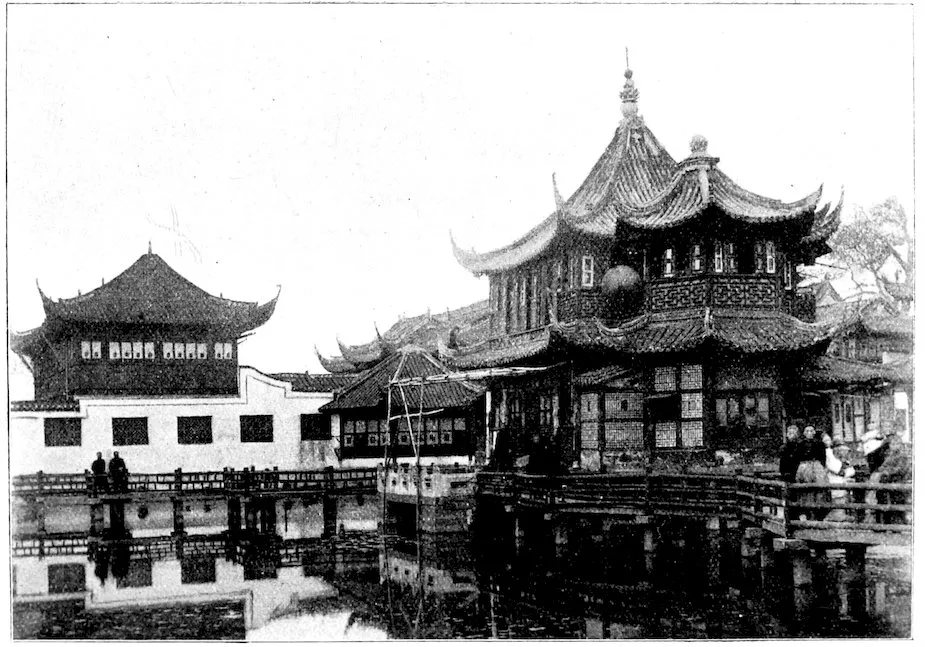
embroideries are displayed to attract strangers. Restaurants
and tea houses of all grades abound, and noteworthy among the
latter is the picturesque building on the Zig-Zag Bridge, shown
in the illustration. The buildings and fantastic well-kept pleasure
grounds of the Ching-hwang Miao, which may be called the
Municipal Temple, the Confucian Temple, the Guild Hall of
the resident natives of Chekiang, and the temple of the God
of War, with its vigorous images begrimed with the smoke of
the incense sticks of ages of worshippers, its throngs, its smoke,
its ceaseless movement, and its din are the most salient features
of this native hive.
Yamens, of course, exist, and yamen runners, for Shanghai has
the distinction of being the residence of a Taotai, or Intendant
of Circuit, and a magistrate, in whose hands the administration
of justice is placed, involving responsibility for the interests of
over 560,000 Chinese, the estimated native population of the city
and the settlements, the total population being estimated at
586,000.
On returning to the light, broad, clean, well-paved, and sanitary
streets of foreign Shanghai, I was less surprised than before that
so many of its residents are unacquainted with the dark, crowded,
dirty, narrow, foul, and reeking streets of the neighbouring city.
27
ZIG-ZAG BRIDGE AND TEA HOUSE, SHANGHAI.
CHAPTER III. HANGCHOW [10]
29
A journey of 150 miles to visit friends in the ancient city
of Hangchow required no other preparations than the hire
of a boat and the engaging of a servant, who I was compelled
to dismiss a few days later for gross dishonesty. 2755 steam
launches, owned and run by Chinese, towing 7889 passenger boats,
carrying 605 foreign and 125,000 native passengers, entered and
cleared in 1897 between Hangchow, Shanghai, and Soochow.
Every evening one of these launches, towing a long string of
native boats, leaves the Soochow creek below the British Consulate
for the new treaty ports, opened as such only in 1896. My small
bamboo-roofed boat, in which I could just stand upright, much
decorated in the tawdry style of Chinese fourth-class fancy, and
through which irremediable draughts coursed friskily, was the
contemptible final joint of a tail of nine quaint and picturesque
passage junks and family house-boats, a varnished procession of
high-sterned, two-storeyed, many-windowed arks, squirming and
snaking along at the stern of a noisy, asthmatic tow-boat. There
were red flags flying, gongs crashing out dissonance, crackers
exploding, poles with clothes drying on them pushed out of
windows, incense sticks smouldering, and reports of firearms; and
with this cheerful din, the usual accompaniment of Chinese movement,
we started in the red twilight.
30I paid six dollars for my boat with three men, and five dollars
fifty cents for towage, about 23s.
All day long the life on the two-storeyed open-sterned boat
in front of mine was exposed to view. It was occupied by three
generations, nine souls in all, under the rule of a grandmother.
They rose early, lighted the fire and their incense sticks, kotowed
to an idol in a gilded shrine, offered him a small bowl of rice,
and cooked and ate their morning meal. The smell of their
cooking drifted for much of the day into my boat, and “broth
of abominable things was in their vessels.” The man sat in the
bow smoking and making shoes. The grandmother lived below
in blissful idleness and authority. The wife, a comely, healthy,
broad-shouldered woman, with bound feet, worked and smoked
all day, and contrived to steer the boat as she stooped over the
fire or the wash-tub by holding its heavy tiller under her arm
or chin or pressing her knee against it. Four young children
lived a quiet life on a broad high shelf, from which they were
lifted down for meals. A girl of thirteen helped her mother
slightly. Cooking, washing, mending, eating, and watching my
occupation with far less interest than I watched theirs, filled
up their day. Evening brought fresh kotowing and burning of
incense sticks, the opium lamp was lighted, the man passed
into elysium, and they wrapped themselves in their wadded quilts
and slept till sunrise.
I learned their habits and knew their few “plenishings,” and
perhaps, as they stared persistently at me, they were wondering
how much I earned a day by writing and sewing, a question of
much speculative interest to the Chinese.
The country looked inviting in the first flush of early spring,
although, like our own fens, it is a dead level. Houses, villages,
mulberry plantations, temples, groves, large farmhouses, shrines,
and Pai fangs succeeded each other rapidly. Great lilac clusters
of wistaria bloom hung over the water from every tree, the beans
were in blossom, and the greenery was young and fresh. At times
our curiously twisting procession passed through ancient water-streets
of large cities, with the inevitable picturesqueness given by
deep eaves, overhanging rooms and balconies, steep flights of stone
stairs, and rows of armed junks full of soldiers or river police in
brilliant, stagey uniforms. Several times we were delayed for an
31hour or more by the difficulty of getting through the crowded river
streets en route.
I have since learned by experience that China is a land of surprising
bridges, but at that time it amazed me that we entered
nearly every city under a fine arch, from fifteen to thirty feet
in height, formed of blocks of granite cut to the curve of the
bridge, the roadway attaining the summit by thirty-nine steps on
each side. Or there are straight bridges, the piers being monoliths
thirteen feet high, and the roadway massive blocks of stone thirty
feet long.
Part of the route is along the Grand Canal, that stupendous
work, wonderful even in its dilapidation, which connects Hangchow
with Tientsin. This part of it, which connects Imperial
Hangchow with the flourishing port of Chinkiang on the Yangtze,
was cut in 625 A.D., but never mapped till the work was undertaken
by our own War Office in 1865.
If the “nine thousand barks conveying tribute to the emperor,”
as described by an ancient writer, no longer crowd its waters, I
can testify that at the points where I touched it, such as Chinkiang,
the laden fleets were so vast as to leave only a narrow
lane of water available for traffic, and that on arriving at Tientsin
from Tungchow my boat took two days and a half to make its
way through the closely-jammed mass of cargo and passage boats
at the terminus.
The neighbourhood of the Grand Canal, which suffered terribly
in the Taiping Rebellion, has recovered itself, and is again
yielding its great harvests of rice and silk, the inexhaustible
fertility of the Great Plain having effaced every trace of destruction.
If the Grand Canal since the dilapidation caused by the
outbreak of the Yellow River in 1851 is far less valuable for
through traffic than it was, it is still of immense importance as
an artery for the commerce of the great provinces through which
it passes. Lu Yew, a much-travelled mandarin of the twelfth
century, the translated account of whose journey from Shanjin
near Ning Po to Kueichow on the Upper Yangtze is a fascinating
bit of literature, writes that at the sluice gates “the concourse of
vessels was packed together like the teeth of a comb,” and so
it is still in certain places. The bridges which span this canal
are among the most striking and beautiful in all China—single
32arches, sometimes 220 feet in span and 30 feet in height, piles of
massive masonry, with massive decorations wherever any deviation
has been permitted from the ordinary stately simplicity.
Seven centuries ago Lu Yew commented on the remarkable
industry of the population of this region, and noted that “both
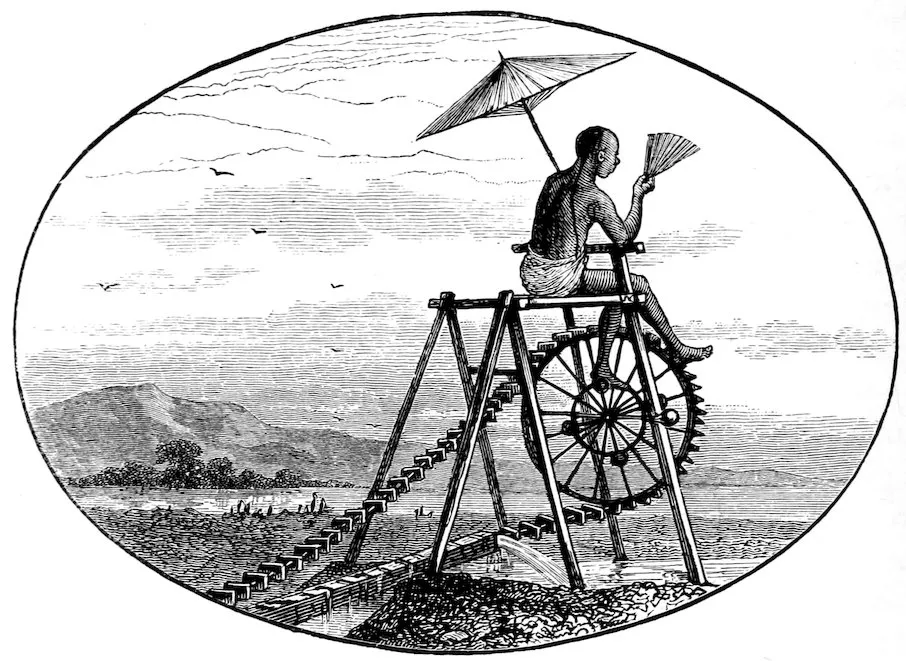
banks near the villages are covered with waterwheels pumping
up the water, women and children alike exerting all their
efforts, cattle in some cases being also at work.” The heredity
of industry is still manifest. Not an idler was to be seen
along river or canal. Every agricultural operation of the
season was being carried on vigorously, even children of seven
years old were carrying agricultural burdens on their shoulders.
Women with robust infants strapped on their backs had their
hands busy with the distaff, while working the waterwheels
with their feet; and all along the waterways fishermen were
busy with their great bamboo plunge nets. Lu Yew mentions
the women as employed with both waterwheel and distaff in the
twelfth century.
On the morning of the second day from Shanghai the steam
launch cast off her tail at the mouth of a narrow canal overarched
with trees, up which my boat moved silently as far as a “lock,”
by which we mounted into a broad waterway leading direct into
Hangchow, encircling it on three sides and connected with other
navigable canals, spanned by picturesque stone bridges, and
giving easy access to most parts of the interior of the city.
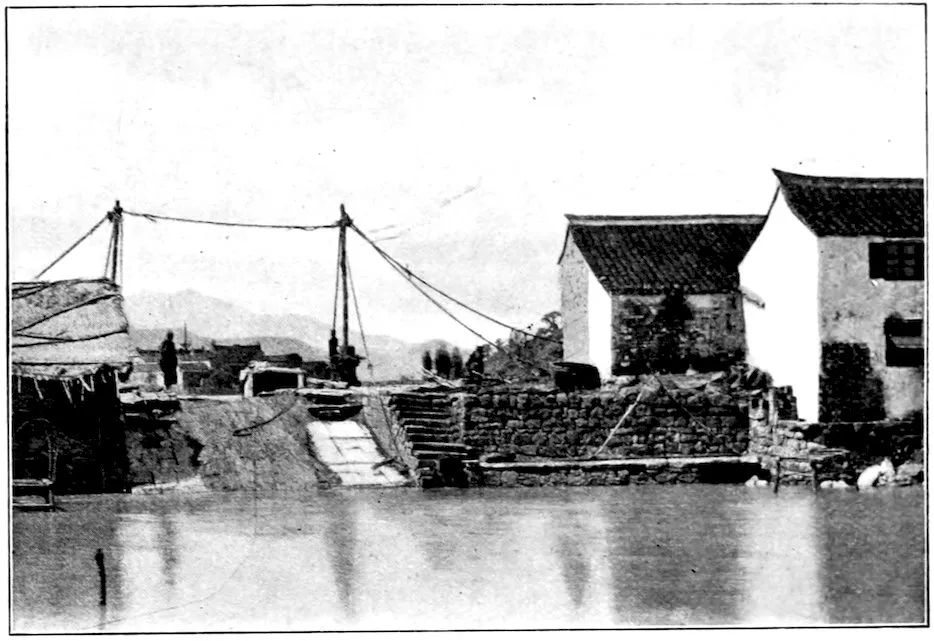
That which I have called a “lock,” properly a pah or “haulover,”
is an ingenious contrivance by which the difficulty of “negotiating”
different levels in the same boat is skilfully adjusted.
The illustration shows the principle and the mode of applying
it in Chekiang, but various methods are adopted. The essential
parts of the contrivance, as shown here, are a smooth stone slide,
from the higher to the lower level, the middle of which is thickly
coated with moist mud, two stout and tall uprights, two rude
wooden windlasses, and stout bamboo ropes with strong iron
hooks. In ascending, the boat is wound up to the higher level
by a number of men at the windlasses, and in going down she
is drawn to the verge and tipped over, descending with great
velocity by her own impetus, the restraining rope at her stern
scarcely moderating the violence of the plunge with which she
33takes a header into the water below, when everything not securely
fastened breaks adrift, and a lather of foaming water surges round
the surprised passenger’s feet. A few cash are charged for the
transfer.
A PAH, OR HAULOVER.
I thought the canal entrance to Hangchow grand, although
below the high blank walls of large private residences the grassy
slopes are the resort of unpleasantly active pigs searching, and
not vainly, for offal. The gunboats, or police junks, with their
striped blue and white canopies and brilliant crews, and the lofty
bridges are pleasing to the eye. At one of the latter Dr. Main,
for eighteen years a C.M.S. missionary doctor in Hangchow, met
me, and I was carried through a populous and dirty quarter,
through a door in a high wall, and under a trellis from which
hundreds of lilac wistaria clusters were hanging, into a large
enclosure, partly lawns and partly rose borders, with an old-fashioned
English house on one side, and on the other two the
fine two-storeyed buildings of two of the crack hospitals of the
East, with their outgrowths of leper hospitals for men and women,
a home for leper children, and an opium refuge. It was a
bewildering change from the crowds, dirt, and sordid bustle of
34the lower parts of a Chinese city to broad, smooth, shaven lawns,
English trees and flowers, English buildings with their taste and
completeness, and the refined quiet of an English home.
This most ancient city, situated on the left bank of the shallow
Ch’ien T’ang river, of which a magnificent description is given
by Marco Polo under the name of Kinsai, though it has not
fully recovered from the destruction wrought by the Taiping troops,
is still handsome and dignified, and to my thinking, with its
lovely environs, is the most attractive of the big Chinese cities.
It is certainly one of the most important, as the capital of the
rich and populous province of Chekiang, the centre of a great
silk-producing district, and of the manufacture of the best silks,
the sole source of the silk fabrics supplied to the Imperial Household,
the southern terminus of the Grand Canal, and a great
centre of Chinese culture and literature. It possesses the Ting
Library, the finest private library in China, appropriately housed
in buildings adjoining the “palace” of the Ting family. The
arrangements for the storage and classification of books are
admirable, and a very gentlemanly and intelligent son of the
enlightened possessor is the enthusiastic and capable librarian.
The treasures of this library are open freely to anyone who
introduces himself by a card from an official. The collection of
zoological and botanical books, superbly illustrated in the best style
of Chinese wood engraving, is in itself a noble possession. Every
part of a plant is figured, and the illustrations are almost photographically
accurate, leading one to hope that the letterpress
accompanying them has equal scientific merit!
Hangchow is also important as a “residential” city, the chosen
home of many retired merchants and mandarins. The homes,
frequently palaces, of men of leisure and local patriotism adorn
its streets, but their stately proportions and sumptuous decorations
are concealed from vulgar view by high whitewashed walls, in
which heavily-barred and massive gates give access to the
interiors. The mansion of the Ting family, in which I took
“afternoon tea,” with its lofty reception-rooms, piazzas, and courts,
must cover two acres of ground. It is stately, but not comfortable,
and the richly-carved blackwood chairs with panels of clouded
grey marble for backs and seats, and table centres of the same,
seem only fitted for the noon of a midsummer’s day. Besides
35the dwellings of the “leisured class” there are those of high
officials, bankers, and wealthy tea and silk merchants, many of
them extremely magnificent, the cost of one built by a wealthy
banker being estimated at £100,000.
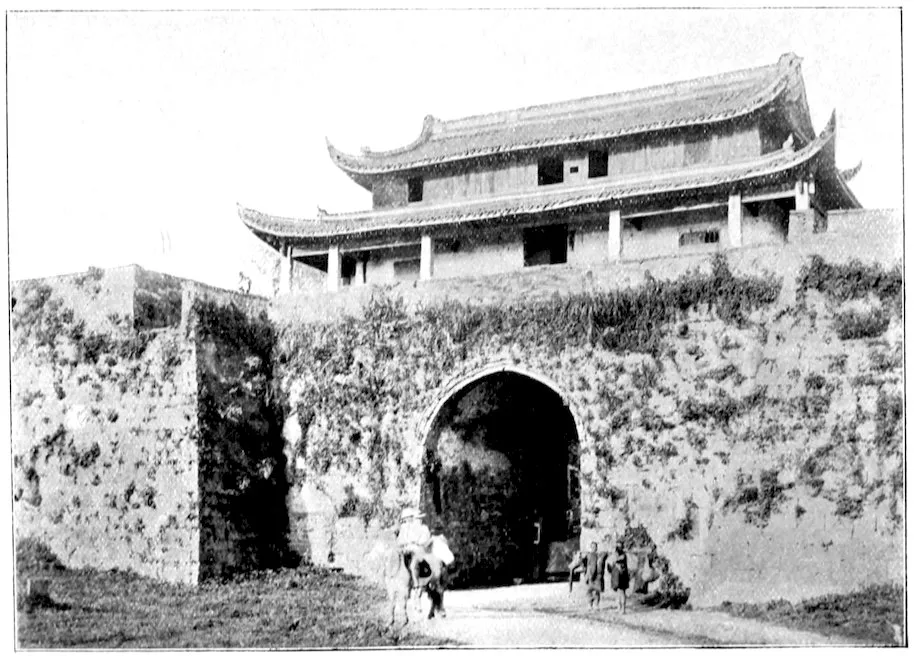
WEST GATE, HANGCHOW
37I wrote of dirt and sordid bustle. This is chiefly by the waterside,
and is not surprising in a city of three-quarters of a million
of inhabitants. The “west-end” streets are, however, broad, light,
well flagged, and incredibly clean for China. Hangchow impresses
one with a general sense of well-being. I did not see
one beggar. The people are well clothed and fed, and I
understood that except during epidemics there is no abject
poverty. It is the grand centre for the trade of a hundred cities,
and much of the tea and silk sold in Shanghai and Ningpo passes
through it.
Everything in the city and neighbourhood suggests silk. In
all the adjacent country the mulberry tree is omnipresent, planted
in every possible place along the creeks, on the ridges separating
the fields, in plantations, acres in extent, and near villages, in
nurseries each containing several thousand shoots, in expectation
of a greatly increased demand for this staple product. There
are 7000 handlooms for the weaving of silk in Hangchow, employing
about 28,000 people, and 360 of these looms under the
inspection of an Imperial Commissioner work exclusively for the
Imperial Household.
Some of the silk shops rival that of Laou Kai Fook at
Shanghai. In them are rich self-coloured silks in deep rich
colourings and the most delicate shades, brocaded washing silks
in various shades of indigo dyeing, and delicate mauves and
French greys, which become more lustrous every time they are
washed, heavy and very broad satins, plain and brocaded, and,
what I admire more than all, heavy figured silks in colourings and
shades unknown to us sold for Chinese masculine dress, and brocaded
with symbolical bats, bees, spiders, stags’ heads, dragons for
mandarins’ robes, and the highly decorative characters representing
happiness and longevity. These quaint and beautiful fabrics are
not exported to Europe, and are not shown to Europeans unless
they ask for them. Fans exported to all parts of the empire
are another great industry, and provide constant work for many
thousand people. Elaborate furniture, silk and gold embroidering,
38and tinselled paper money for burning, to supply the dead with
the means of comfortable existence, are also largely manufactured
in this thriving capital.
The situation of Hangchow is beautiful, separated only by a
belt of clean sand from the bright waters of the Ch’ien T’ang
river. The south-western portion is built on a hill, from which
broad gleams of the sea are visible; and to the west, just outside
the walls, is the Si Hu [Western Lake], famous throughout China,
a lovely sheet of water, surrounded by attractive country houses,
temples, and shrines, studded with wooded islands connected by
ancient and noble causeways, the islands themselves crowned with
decorative pavilions, some of which are Imperial, and are surrounded
by the perfection of Chinese gardening, as in the case of
the beautiful Imperial Library, with its ferneries, rockeries, quaint
ponds, and flowering shrubs. This lovely lake, with its deep,
wooded bays and inlets, its forest-clothed hills and ravines, its gay
gondolas and pleasure boats, and its ideally perfect shores, which
I saw over and over again in the glorious beauty of a Chinese
spring, mirrors also in its silver waters a picturesque range of hills,
bare and breezy, close to the city, on which stands, in an imposing
position, a very ancient pagoda, while the lower hill-slopes
are clothed with coniferous trees, bamboo, plum, peach, cherry,
camphor, azalea, clematis, roses, honeysuckle, and maple. Near
the lake is a deep, long dell, the cliffs of which are recessed for
stone images, and which contains several famous temples, one the
temple of the “Five Hundred Disciples,” who, larger than life-size,
adorn its spacious corridors. The temples and shrines of this
beautiful glen are visited daily by crowds from Hangchow, and
have such a reputation for sanctity and efficacy as to attract
100,000 pilgrims annually. The dell is guarded by two colossal
figures, under canopies, the gods of Wind and Thunder, very fine
specimens of vigorous wood carving, and by an antique pagoda.
Hangchow is also famous for the phenomenon of the “Hangchow
bore,” seen at its best at the change of the monsoon, when
an enormous mass of tidal water, suddenly confronted by the
current of the river, uplifts its foaming crest to a height of from
fifteen to twenty feet, and with a thunderous roar and fearful force
rages down the narrow waterway as fast as a horse can gallop,
affording a welcome distraction to the sightseers of Shanghai.
39
PAVILION IN IMPERIAL GARDEN, SI-HU.
42
GOD OF THUNDER, LIN-YANG.
43Hangchow is enclosed by a wall faced with hewn stone, about
thirteen miles in circumference, from thirty to forty feet high, from
twenty to thirty feet broad, and pierced by ten large gateways
with massive gates. The houses are mainly two-storeyed. The
business streets blaze with colour; the principal street is five miles
long. The population, estimated at 700,000, cruelly diminished
during the Taiping Rebellion, is rapidly increasing. The officials,
merchants, and common people are unusually friendly to foreigners,
who, before the recent opening of the port, were all missionaries.
The cry “Foreign devil!” is never heard. Mr. Sundius, our
consular officer, considers that these very satisfactory relations
are due to the greater prosperity of the people, in consequence
of the increased foreign demand for silk, and to the success of
the exertions of the missionaries to win their respect and esteem.
The new general and Japanese settlements are in an excellent
position on the Grand Canal, four miles from the city wall. They
are nearly a mile in length by half a mile in depth, and have a
fine road and a bund sixty feet wide, hereafter to be turfed. The
Japanese, who opened the port with their swords, have not been
in any hurry to occupy it. It will be interesting to see how far
foreigners will take advantage of the opening, and settle in this,
one of the friendliest and most attractive of the Chinese cities.
There is a well-known Chinese proverb, “Above is heaven, below
are Hangchow and Suchow.”
CHAPTER IV. THE HANGCHOW MEDICAL MISSION HOSPITALS
44
The hospitals, and the dispensaries attached to them, are
too important as a feature of Hangchow, and as an element
in producing the remarkable goodwill towards foreigners which
characterises it, to be dismissed at the tail of a chapter.
These beneficent institutions treat between them over 14,000
new patients annually, afflicted with all manner of torments. The
services of Dr. Main and his coadjutor, Dr. Kimber, are in request
among officials, from the highest to the lowest. Mandarins of
high rank, attended by their servants, are treated in the paying
wards, and occasionally leave donations of 100 dollars in addition
to their payments. Officials of every rank in the Chekiang
province send to the British doctors for advice and medicines.
Among the many marks of the approval with which the Viceroy
and other highly-placed officials regard the medical work is their
recent donation of an acre and a half of land in an excellent
position for the site of a branch hospital. It is no disparagement
to the work of Bishop Moule, who was absent during my
visit, and the other British and American clerical missionaries,
to express the opinion that the tact, bonhomie, and devotion of
Dr. Main during the last eighteen years, are one cause of the
friendliness to foreigners, the Chinese being as accessible to the
influence of personality as other people are.
The men’s and women’s hospitals, of which the illustration only
shows portions, are of the latest and most approved European
type. They are abreast of our best hospitals in lighting,
ventilation, general sanitation, arrangement and organisation,
and the facility of obtaining the celebrated Ningpo varnish,
really a lacquer, which slowly sets with a very hard surface,
reflecting much light and bearing a weekly rub with kerosene
oil, greatly aids the sanitation. The purity of walls, floors, and
45bedding is so great as to make one long for a speck of comfortable
dirt!
C.M.S. MISSION HOSPITAL, HANGCHOW.
47The men’s hospital buildings consist of four roomy and
handsome general wards, eleven private paying wards, holding
from one to three each, a range of rooms for the ward assistants,
who are practically male nurses, students’ rooms, rooms for the
three qualified assistants, a lecture-room with an anatomical [in
lieu of the unattainable human] subject which cost a thousand
dollars, a reception-room for mandarins with appropriate Chinese
furniture, Dr. Main’s private room and medical library, a fine
consulting-room and operating theatre, bathrooms, a room for
patients’ clothing done up in numbered bundles after it has been
washed, wardrobes for the clothing which is lent to them while in
hospital, a cashier’s office, a large bottle-room, extensive storage,
and an office for out-patients.
On the street side and connected with the hospitals is a fine
lofty room where any non-patient passers-by, who are either
tired or curious, can rest and smoke, amusing themselves
meantime with the transactions of the other half of the hall,
a large and attractive “drug store,” fitted up in conventional
English style, where not only medicines, but medical requisites
of all kinds can be procured both by non-patients
and foreigners. It has been remarked by Consuls Carles and
Clement Allen in their official reports, that missionaries unconsciously
help British trade by introducing articles for their own
use, which commend themselves to the Chinese; and this drug
store has created a demand for such British manufactures as
condensed milk, meat extracts, rubber tubing, soap, and the
like, condensed milk having “caught on” so firmly that several
of the Chinese shops are now keeping it on sale.
This rest room is also a street-chapel for preaching and discussion,
and an office for inquiries of all kinds. There is also a
large and handsome waiting-room for out-patients, decorated with
scripture pictures, in which patriarchs and apostles appear in
queues and Chinese dress, and an opium refuge—a mournful
building full of bodily torment and mental depression. In the
opinion of the doctor, “the cure” is seldom other than temporary,
and could only be effected by building up the system for six
months after leaving the refuge by tonics and nutritious diet.
48Besides these buildings there are large kitchens, storehouses, and
a carpenter’s shop.
The women’s hospital, the great central ward of which, with
its highly-varnished floor, flowers, pictures, tables, chairs, and
harmonium, looks like a pleasant double drawing-room in a large
English mansion, is specially under Mrs. Main’s charge, and has
head and junior nurses and a dispenser trained by herself. It
is equally efficient and admirable.
Besides the hospital staff of twenty-six persons, there are three
native catechists who, along with Dr. Main, give Christian instruction
in the hospital to those who are willing to receive it, one
of them looking after patients in their homes, who, having become
interested in Christianity, have returned to their villages within
a radius of one hundred and fifty miles. Recently a patient, who
had been for some weeks in the hospital, recounted what he had
there heard of Christianity with such effect that over forty of his
fellow-villagers, after some months, gave up their heathen practices
and became Christians; and this after he had been beaten for his
new beliefs on first going home.
The hospital is also an efficient medical school, where the usual
medical and surgical courses are given, along with clinical instruction,
during a period of five years. This school has helped largely
to win the favour of the mandarins, who have learned to appreciate
Western surgery from the cures at the hospital. Some of these
students, after graduation, have taken good positions in Shanghai
and elsewhere. A few in going into practice in the province have
somewhat dropped European medicine, and have resorted to
Chinese drugs and the method of using them, but all adhere to
Western surgery, the results of which in Chinese eyes are little
short of miraculous, but possibly their mode of carrying out
antiseptic treatment would hardly come up to Lord Lister’s
standard! It is frequently believed by Chinese patients that the
object of this treatment is to prevent devils from gaining entrance
to the body by means of surgical wounds!
Dr. Lu, a refined and cultured man, Dr. Main’s senior qualified
assistant, a graduate of the hospital school, would anywhere be a
remarkable man in his profession, first as a brilliant operative
surgeon, and then for insight and accurate diagnosis. He has won
the confidence of the resident foreigners. He is a skilful medical
49photographer, and his microscopic and physiological drawings are
very beautiful and show great technical skill.
The clock tower is a decorative feature of the building, and
everything within moves with clockwork regularity. The hospital
is in a high state of efficiency and spick-and-spanness, such as I
have seldom seen equalled abroad, and never exceeded.[11] Such
work, done with skill, love, and cheeriness, has an earthly reward,
and Dr. Main is on most friendly terms with the leading mandarins,
who have it in their power to help or hinder greatly. The hospital
blazes with their red and gold votive tablets, and I doubt if they
would refuse him anything which he thought it wise to ask.
Almost the latest additions to a work which is always growing
are convalescent homes in the finest position outside the city, on
the breezy hill above the Si Hu [Western Lake].
I have heard some grumbling at home at the expense at which
this hospital is carried on, but perfection is not to be attained
without outlay, and in my opinion the Hangchow hospital is a
good investment. It is most desirable that Western methods of
healing should be exhibited in their best aspects in the capital
of this important province, and also that the medical school should
be as well-equipped as is possible. The benefit of this and similar
schools is incalculable. The linked systems of superstition and
torture, which enter largely into Chinese medical treatment, are
undermined, and rational Western surgery is demanded by the
people. European treatment also assails the degrading belief in
sorcery and demonism in its last resort—the sick-bed—showing
processes of cure which work marvels of healing, altogether apart
from witchcraft and incantations.
Of the Medical Mission Hospital as a Christian agency I need
scarcely write, as its name is significant of its work. I believe in
medical missions, because they are the nearest approach now
possible to the method pursued by the Founder of the Christian
faith, and to the fulfilment of His command, “Heal and preach.”
It is not, as some suppose, that the medical missionary takes
advantage of men in their pain and distress to “poke at them” the
50claims of a foreign religion, though if he be an honest Christian he
recognises that the soul needs enlightenment as much as the body
needs healing. I have never seen a medical mission among the
forty-seven that I have visited in which Christianity was “poked”
at unwilling listeners, or in which, in the rare cases of men declining
to hear of it in the dispensary waiting-room, it was in the
very smallest degree to their disadvantage as patients.
A fee of twenty-four cash is charged for admission to the dispensary
to foster a spirit of independence, and the charge in the
paying wards is from two to ten dollars per month. Crowds of
out-patients marshalled like an army, carefully trained assistants
knowing and doing their duty, catechists, ward assistants, cashiers,
photographers, cooks, gardeners, artisans, make up the crowd which
in all the morning hours swarms over the staircases of the hospital
and round the great entrance. The dispensary patients present
a sorry spectacle, owing to the prevalence of skin diseases, superficial
sores, and cavernous abscesses, from which the plasters with
which the Chinese doctors had hermetically sealed them have been
removed. Young and old, maimed, deaf, blind, loathsomely disfigured
persons, meet together, and there are often cases of gunshot
wounds, elephantiasis, and leprosy in the throng.
But, wretched as the patients are, they are capable of being
amused by Dr. Main’s jokes, and on one occasion when I was
photographing four soldiers of the Viceroy’s guard in the hospital
grounds the hilarity burst all bounds, and the distempered mass
yelled with enjoyment. When I photographed the backs of the
soldiers they shouted, “She pictures their backs because they ran
away from the wojen” (dwarfs); and when Dr. Main displayed
their brawny legs, they nearly danced with the fun of it, yelling,
“Those are the legs they ran away on.” Not that the Viceroy’s
guard had encountered the Japanese, but these people were near
enough to Shanghai to have heard of the figure the Chinese
troops had cut. A Chinese loves a joke, and, as I have often
experienced, if he can only be made to laugh his hostility
vanishes.
One of these men, picturesquely uniformed in blue and crimson,
was brought back an hour later at the point of death from opium,
having attempted his life, not because he had been laughed at, but
because of a tiff with his superior officer.
51As is well known, suicide is appallingly common in China; and
in the great cities of Swatow, Mukden, and Hangchow, as a guest
at medical mission houses, I have come much into contact with
its various methods. In Mukden a frequent mode of taking life,
specially among young wives, is biting off the heads of lucifer
matches, though the death from phosphorus poisoning is known
to be an agonising one. Swallowing gold leaf or chloride of
magnesium, jumping down wells or into rapid rivers, taking lead,
cutting the throat, and stabbing the abdomen have been popular
modes of self-destruction. But these are rapidly giving place
to suicide by opium owing to the facility with which it can be
obtained, the easy death which results from it, and the certainty
of its operation in the absence of the foreign doctor, his emetic,
and his stomach-pump. Medical mission hospitals in China save
the lives of hundreds of would-be suicides every year.
So far as I have been able to ascertain, the causes of suicide
in China are, not as in Europe, profound melancholia, heavy
losses, or disappointment in love, but chiefly revenge and the
desire to inflict serious injury on another. Suicide enables a
Chinese to take a truly terrible revenge, for he believes that his
spirit will malignantly haunt and injure the living; and the desire
to save a suicide’s life arises in most cases not from humanity, but
from the hope of averting such a direful catastrophe. If a master
offends his servant or makes him “lose face,” or a shopkeeper his
assistant or apprentice, the surest revenge is to die on his premises,
for it not only involves the power of haunting and of inflicting
daily injuries, but renders it necessary that the body should lie
where death occurs until an official inquiry is made, which brings
into the house the scandal and turmoil of a visit from a mandarin
with a body of officials and retainers. It is quite common for
a man or woman to walk into the courtyard of a person against
whom he or she has a grudge, and take a fatal dose of opium
there to ensure these desirable results!
Among common incentives to suicide are the gusts of blind
rage to which the Chinese of both sexes are subject, the cruelty
of mothers-in-law, quarrels between husband and wife, failure
to meet payments at the New Year, gambling losses, the desire
to annoy a husband, the gambling or extravagant opium smoking
of a husband, imputation of theft, having pawned the clothes
52of another and being unable to redeem them, being defrauded
of money, childlessness, dread of divorce, being sold by a husband,
abridgment of liberty, poverty, and the like. Opium, from the
painless death it brings, is now resorted to on the most trivial
occasions, and has largely increased the number of suicides.
Though the reasons which I have given for self-destruction apply
mostly to women, yet where statistics are obtainable men are
largely in the majority, and revenge and the desire of inflicting
injury are their great motives.
Of course, there are very many risks and difficulties in the
treatment of out-patients. Chinese medicines are administered
bulkily, a pint or a quart at a time, and patients do not understand
our concentrated and powerful doses. Hence dangerous
and grotesque mistakes are continually made, such as the
following:—
Patient—“Doctor, when I took the medicine you gave me
yesterday it made me very sick; it has given me diarrhœa and
a severe pain in the stomach; my fingers and toes also feel very
numb.”
Dr. Malcolm (looking at the bottle)—“Why, you have already
almost finished the eight days’ medicine” (arsenic) “that I gave
you yesterday. The wonder is that you are alive at all.”
Patient No. 2 enters—“Where is the old boss of this shop?
I want some foreign devil medicine to cure malaria.”
D.—“Allow me to tell you I am not a devil. You had better
go home; and when you can come and ask respectfully for
medicine we will give it you.”
P. No. 3 enters, holding out her hands and asking the doctor to
find out her disease by “comparing her pulses.”
D.—“Tell me what is the matter with you.”
P.—“My bones and muscles are sore all over.”
D.—“What was the cause of your trouble?”
P.—“It was brought on by a fit of anger.”
D.—“How long have you had it?”
P.—“From the time the heavens were opened, and the earth
was split” (i.e. a very long time).
The arms and shoulders of this woman were covered with pieces
of green plaster, given her by the Chinese doctors. She proposed
to throw these away and “to publish the doctor’s name abroad”
53if he cured her. So she received medicine with very full directions
about taking it; these were not enough. She asked a string
of questions such as if she must heat it before taking it, if she
must keep the bottle tightly corked, if she must take it along
with anything else, and lastly—
P.—“Shall I abstain from eating anything?”
D.—“No.”
P. (greatly disappointed).—“What! shall I not forbid my
mouth anything at all?”
D. (jokingly).—“Yes. Do not talk too much; do not revile
your neighbours; do not smoke opium; do not scatter lies.”
The doctor getting worried, reiterates plain directions regarding
the medicine, tells her they are very busy, and that she must not
ask any more questions, and shows her out.
P. (returning after a few minutes).—“Is the medicine to be
taken inwardly, or rubbed on the outside?”
Or a man comes in and describes “chills,” and a dose of
quinine is prepared for him, when he smiles serenely and says,
“To tell you the truth, it is not I that take the chills; it is my
mother.”
Another comes in, and describes with great minuteness and
self-pity his symptoms, which are those of malarial fever. He
will not take a dose of quinine in the dispensary, but wants
to take it home, saying he will not “shake” till the next day.
He is feigning sickness, in order to get quinine and sell it. Or
an operation for cataract has been performed in one of the
hospital wards, and the son of the patient comes to the doctor,
begging him to go to his father, who says that his eye pains
him so that he cannot stand it. The doctor finds that the
bandage has been removed, and reproaches the son, who said
that some friends came in to see if he could really see after being
blind for so many years, and took off the bandage. The patient
had rubbed the eye, the wound had burst open and was suppurating,
and the man was blind for life.
Some patients come to a hospital out of impudence, some in
the hope of getting drugs to sell, others out of curiosity to see
how the “foreign devil doctor” works, others to steal the clothes
which are lent to in-patients, and others for a lark, pretending
to have various diseases, but with these the Chinese assistants
54occasionally indulge in a lark on their own account, and turn
on them a pretty vigorous current from the electric battery.[12]
With so much vexatious expenditure of time, so much imposition
and greed, and so many disappointments regarding interesting
cases owing to the gross ignorance of the patients and their
friends, there are many drawbacks in the life of a missionary
doctor, and even in such long-established work as that at Hangchow,
and with such admirable equipments and assistance, it
cannot always be easy to preserve the courtesy, gentleness,
patience, and forbearance which are among the essentials of
success.
Of the patients treated in Hangchow last year one thousand
were in-patients. “Discharged cured” might be written against
the great majority of their names, and those who were incurable
were greatly benefited, as in the case of the lepers, whose
“grievous wounds” are closed and healed, and whose pains are
subdued.
Certainly this great hospital is one of the sights of Hangchow,
and no one could become acquainted with it without recognising
that those who work it and support it are following closely in the
footsteps of Him who came “not to destroy men’s lives, but to
save them.”[13]
CHAPTER V. SHANGHAI TO HANKOW (HANKAU)
55
From Hangchow I made a very interesting journey by canal
and river to the important and historical city of Shao
Hsing, with its beautiful environs, and from thence by inland
waterways to Ningpo and its lovely lakes, passing through a
region of great fertility, beauty, and prosperity. I must put on
record that I made that journey without either a companion or
servant, trusting entirely to the fidelity and goodwill of Chinese
boatmen, and was not disappointed. At Ningpo the Commissioner
of Customs kindly lent me the Customs tender, a fast-sailing
lorcha, for a week, and engaging a servant, I visited the
Chusan Archipelago in glorious weather, spending three days
on the remarkable island of Putu, the Island of Priests, sacred
to Kwan Yin, the goddess of mercy, and two at Tinghai, on the
island of Chusan, where the graves of the four hundred British
soldiers who died there during our occupation present a melancholy
spectacle of neglect and disrepair. The region beyond Shao
Hsing technically belongs to another drainage area than that
of the Yangtze, and is therefore passed over without further
remark. I returned from Ningpo to Shanghai by sea.
The difficulties of getting a reliable interpreter servant who had
not previously served Europeans and who was willing to face the
possible risks and certain hardships of the journey I proposed
were solved by the kindly intervention of friends, and I engaged a
tall, very fine-looking, superior man named Be-dien, who abominated
“pidgun,” spoke very fairly correct English, and increased
his vocabulary daily during the journey. He was proud and had
a bad temper, but served me faithfully, was never out of hearing
of my whistle except by permission, showed great pluck, never
grumbled when circumstances were adverse, and never deserted
me in difficulties or even in perils.
56My other preparations consisted chiefly in buying an open
bamboo armchair to be carried in, plenty of tea and curry powder,
and in discarding most of my few possessions.[14] As nobody in
Shanghai had travelled in the region which I hoped eventually
to visit, there was no information about it to be gained, and I
left for my journey of six or seven months remarkably free from
encumbrances of every kind.
Several foreign and one Chinese company own the eighteen fine
steamers which keep up daily communication between Shanghai
and Hankow, and dissipate the romance of travel by their white
enamel, mirrors, gilding, and electric light. The Poyang, by which
I was a passenger, and the only one, as far as Chinkiang,
resembles most of the others, being of an American type, about
2000 tons burden, luxurious to a fault, and officered by efficient
and courteous gentlemen.
Sailing at night, the lumpy sea which is apt to prevail in the
estuary of the Yangtze is got over comfortably, and by the following
morning it is possible to believe that the expanse of muddy
water is actually a river, for there are hazy outlines of brown shores.
The first day on the river was cold and raw, as, indeed, were the
days which followed it; the damp-laden air wrapped one round in
its dismal chill. White enamel and mirrors were detestable. The
only things which harmonised with the surroundings were the stove
and the thick woollen carpet. Yet the mercury was at 45°—not
bad for midwinter!
After passing Silver Island, a wooded rock, on which is a fine
temple, we reached Chinkiang, the first of the treaty ports on the
Yangtze, and well situated at the junction of the Grand Canal with
the river. On my two visits I thought it an attractive place. It
has a fine bund and prosperous-looking foreign houses, with a
British consulate on a hill above; trees abound. The concession[15]57roads are broad and well kept. A row of fine hulks connected by
bridges with the shore offers great facilities for the landing of
goods and passengers. Sikh police are much en evidence, the hum
of business greets one’s ears, traffic throngs the bund, the Grand
Canal is choked with junks, and the rule regarding sub-letting to
Chinese being honoured only in the breach, the concession is
covered with godowns and Chinese residences, and judging from
appearances only, one might think Chinkiang a busier port than
Hankow, the great centre of commerce in Central China. The
gross value of the trade of this port is, however, only about
£4,000,000 sterling annually, but is advancing. One great export
is ground-nut oil, which is carried and shipped in baskets lined with
paper. Another, which accounts for nearly one-fourteenth of the
value of the exports, is the dried perianth of certain lily flowers
(Hemerocallis graminea and Hemerocallis flava), which is greatly
esteemed as a relish with meats, specially with pork.
As tokens of the increasing prosperity of Chinkiang, it is
interesting to note that recently two filatures, owned and managed
by Chinese, were opened, the machinery in one of them being of
Chinese manufacture, while the factory was erected without foreign
aid. The hands employed are women, who work twelve hours
daily, at 10½d. a day, Sunday being a holiday. The success of
this, under native management, was considered dubious. A distillery,
for distilling spirit from rice, is another sign of progress
(or retrogression?), and our German rivals have done a very
“neat thing” in starting an albumen factory, in which the albumen,
dexterously separated from the yolks of the eggs, is made
into slabs, which are sent to Germany for use in photography, the
preparation of leather, and the printing of cotton, etc. The eggs
are ducks’ eggs solely. The yolks undergo some preservative
treatment, and after being packed in barrels are exported for
use in confectionery and bar-rooms. My informant, Consul
Carles, is silent on the use to which they are then applied, but
doubtless it is well known to frequenters of such establishments.
The workmen in out-of-doors trades, such as masons and
carpenters, seem to comport themselves much like our own, at
all seasons of the year drinking tea, resting, and smoking whenever
it pleases them, taking a long siesta in summer, and in
winter not beginning work till nine. The building trade is a
58guild,[16] and there are five large guilds in Chinkiang, with guild
funds for the relief of widows and orphans of former members.
There are various missions in Chinkiang, and some general stir,
which may be expected in a city of 140,000 souls.
The next day, which was raw and grim, and made the stove-side
a magnet, we reached Wuhu, the ugliest, if I may be
allowed to say so, of all the Yangtze ports, but its trade is not
unprosperous, having more than doubled in the last ten years, its
gross value as to the principal articles of export and import being
now nearly £2,000,000 sterling a year.[17]
There again the Germans have started an albumen factory,
which employs fifty women and ten men. It takes 7000 eggs
to produce 100 pounds of albumen. Feathers to the amount of
£23,000 for the last year of returns were also exported to
Germany for the making of feather beds.
The most interesting export of Wuhu to the general reader is,
however, “China ink,” which is largely produced in the province of
Nganhui. The small, black sticks, decorated with Chinese characters
in gold, are known and appreciated by us all. From Wuhu it
goes to all parts of China and of the world. In 1895 two tons
of it were exported from Shanghai to foreign countries. Nearly
the whole of the writing done in the vast Chinese empire, as well
as in Japan, Korea, Tonquin, and Annam, is done with this
beautiful ink, which is rubbed down on a stone ink-slab, and
applied with a sable brush. This is altogether apart from its
value to the water-colour art of all nations. It is made from
the oil expressed from the large seeds of the Elœococca verrucosa,
sesamum oil, or colza oil, varnish, and pork fat, burned, the resulting
lampblack being of various degrees of fineness according to
the process adopted; gold leaf and musk are added. There are
a dozen different grades, and the price varies from 2s. to 140s. per
pound, a pound containing about thirty sticks.
Various industries, including a steam flour mill, have been
started by the Chinese in Wuhu, and it is a city of 80,000 people,
but to a mere passer-by it is most uninteresting, and its busy
streets had neither novelty nor picturesqueness enough to repay
me for a struggle through the slush.
59That night, while we were dining, there was a tremendous
bump, a crash, and a stoppage. The junk we cut into went
down like a stone with all hands. Not a shout or cry was
heard. Boats were lowered, and we hung about for an hour;
it was not very dark. A Frenchman brutally remarked, “Good!
there’ll be some yellow skins fewer.” That was all.
The next day we reached Kiu-kiang, another treaty port, with
a pretty, shady bund, and pleasant foreign houses in shady
gardens, but it has a sleepy air for a city of 55,000 souls and a
trade worth two millions and a quarter a year.
Totally destroyed during the Taiping Rebellion in 1858–59,
it has been rebuilt, is surrounded by a defensive wall six miles
in circumference, and has regained more than its former prosperity,
its imports having increased steadily for the last five
years.
I have mentioned only the treaty ports, but from Chinkiang
westwards the great cities on or near the bank divide attention
with the engineering works and the singular vagaries of build
and rig in the countless craft on the river. Among the cities on
or near the river are Yang Chow Fu, Nanking, the southern
capital, with its ruined splendours and picturesqueness, Taiping
Fu, the great and prosperous city of Nganking Fu, and many
others, besides countless villages, which are apt to lead an
amphibious existence. After leaving Kiu-kiang, the most prominent
objects of interest are the Great and Little Orphans,
picturesque rocks about 300 feet in height, rising direct from the
bed of the river, and appropriated, as all picturesque sites are,
by the Buddhists for religious purposes. The Great Orphan
is near Hu-kow, a bluff on the river crowned by an inaccessible-looking
building, half temple, half fortress, close to the junction
of the important Poyang lake with the Yangtze, which is effected
by a short, broad stream.
A city on a dead level can scarcely be imposing, and Hankow is
not impressive from the water. Some chimneys of Russian brick
tea factories rise above the greenery of the bund, and on the right
bank of the broad Yangtze, above a squalid suburb of Wu-Chang,
appear some tall chimneys belonging to a Chinese cotton factory
under native management, but differing from those at Shanghai
in that no women or girls are employed, the Viceroy considering
60that such occupation for women is opposed to good morals and
Confucian principles! On an elevation there is also a camp with
crenelated walls, an abundance of fluttering silk banners, and
various antiquated engines of war.
The day was damp and grim, but the kindly welcomes, cordial
hospitality, and big blazing fires at the British Consulate, where I
was received, made amends for the external chill, and my visit to
Hankow is among my many pleasant memories of China. Later
in the day Dr. Griffith John called on me, the veteran missionary
of the L.M.S., great as an evangelist, a Chinese writer and translator,
and as an enthusiast. The L.M.S. has its mission buildings,
which include a church, dispensaries, and hospitals, and the houses
of its missionaries, in some of the pleasant shady streets which
intersect the settlement. They have various agencies at work, and
are full of hope as to the result. I understand that Dr. Griffith
John, who has devoted his life to China and means to die there,
partly from his devotion and partly from his literary gifts, is much
respected by many of the official and upper classes, and has much
influence.
CHAPTER VI. THE FOREIGNERS—HANKOW AND BRITISH TRADE
61
Hankow or Hanmouth, Wu-Chang Fu, the capital of
Hupeh, and Han Yang would be one city were they not
bisected by the broad, rolling Yangtze, nearly a mile wide, and
its great tributary the Han. Hankow and Han Yang are on the
north bank, and Wu-Chang on the south. The “congeries of
cities,” as the three have been aptly termed, is about 600 miles
from Shanghai. Till 1863 Hankow was an open city, but the
dread of an attack by northern banditti that year led the Government
to enclose it with a stone wall, four miles in circuit and
thirteen feet in height, raised by a brick parapet to eighteen feet.
Hankow considers that it has the finest bund in China, and
I have no wish to dispute its assertion. In truth its length of
800 yards, its breadth of 80, its lofty and noble river wall and
fine flights of stone stairs, ascending 40 feet from low water, its
broad promenade and carriage-way and avenue of fine trees, with
the “palatial” houses, very similar to those of Shanghai and
Singapore, on the other side in large gardens and shaded by
exotic trees, make it scarcely credible that the first authentic
visit of Europeans to the city was that made by Lord Elgin in
H.M.S. Furious in 1858, and that the site for this stately British
settlement was only chosen in 1861, the year in which the port
was opened to foreign trade.
Among the principal buildings are the British and French
Consulates, the residence of the Commissioner of Customs, and
the Municipal Buildings. There is a Municipal Council charged
with the same functions as that at Shanghai, and Sikh policemen
make a goodly show. Dead levels are not attractive unless they
are bounded by the living ocean, and the bund is dull and gives
one the impression that the British settlement has “seen better
days.”
62The foreign community consists of the consuls and their staffs,
the employés of the Chinese Maritime Customs, a very few professional
men, a large number of British and American missionaries,
and the members of British and other European mercantile
firms, Russians taking a very prominent position. The residents
have carried their amusements with them, and amuse themselves
on a small scale after the fashion of those at Shanghai. There
is a popular club which welcomes passing visitors, and combines
social attractions with a library, reading-room, and billiard-room,
keeping in touch with the world by frequent telegrams. There
is a creditable newspaper—the Hankow Times, which has papers
on Chinese, social, and other subjects—an episcopal service, a hotel,
a livery stable, and other necessaries of the British exile’s life.
Kindness and cordial hospitality to strangers are not less characteristic
of Hankow than of the less frequented ports.
The climate is not an agreeable one. The summers, lasting
from May till the middle of September, are hot and damp, and
severe cases of malarial and typhoid fever are not unusual. The
atmosphere is thick and stagnant, and there are swarms of
mosquitoes. Some of the men residents pass the hottest summer
nights on the bund to get the little air stirring on the river, and
the Chinese sleep on their roofs and in the streets. The autumn
months are very pleasant, the mercury falls to the freezing point
in January, and after light frosts there is a damp, raw period till
warm weather sets in again.
Neither Hankow nor its neighbours have any special features
of interest except their gigantic trade. The populations are not
openly unfriendly; but Consul Carles, his wife, and I, although
attended, had mud thrown at us at Han Yang.
The glory of Hankow, as well as its terror, is the magnificent
Yangtze, nearly a mile wide even in winter, rolling majestically
past the bund, lashed into a dangerous fury by storms, or careering
buoyantly before breezes; in summer, an inland sea fifty feet deep.
In July and early August Hankow is at its worst, and the rise of
the river is watched with much anxiety. The bund is occasionally
submerged, boats ply between houses and offices, the foundations
of buildings are softened, exercise is suspended, gardens are destroyed,
much business stands still, frail native houses are swept
away—as many of those perched on piles were, with much loss
63of life, in the summer rise of 1898—and thousands are deprived
of shelter and livelihood, and when the water falls widespread
distress and a malarious film of mud are left behind. The appearance
of the Sze Chuan water, the red product of the “Red
Basin” of Richthofen, indicates to the Chinese intelligence the
approaching subsidence of the water, and points to a fact of some
scientific interest. During the ordinary summer rise the whole
region, viewed from Pagoda Hill, has the dismal aspect of a
turbid, swirling inland sea, above which many villages with trees
appear, built on mounds, probably of ancient construction.
Hankow is the most westerly port in which the Mexican dollar
is actually current, and even in its back country copper cash are
preferred to either coined or uncoined silver. For western travel,
over and above any amount of cash which the traveller can burden
himself with, “sycee” silver is necessary, which can be obtained
from the agency of the Hong Kong and Shanghai Bank, as well
as “good paper”—Chinese drafts on Chinese merchants of repute
in the far west. Silver “shoes,” as the uncouth lumps of silver
obtained from the banks are called, are worth about fifty taels,
but the tael itself is not of fixed value, the Haikwan tael, in
which the Customs and some other accounts are kept, varying
from the Shanghai tael, and that again from the Hankow tael,
and so on.
Nor is this all. The silver itself is unfortunately of variable
quality. Hankow sycee is of 2½ per cent. higher “standard” than
Shanghai sycee, and Sze Chuan silver is of higher standard than
that of Hankow, so that the traveller is subject to frequent losses
on his bullion, besides suffering a good deal from delays and
annoyances consequent on weighings and occasional testings,
though the trained eye alone can usually detect the inferior
“touch” of his silver. “Confusion worse confounded” describes
the currency system, if “currency” is an applicable word, when
once the simplicity of the Mexican dollar is left behind, and I
ceased to be surprised at the employment of Chinese “shroffs”
by foreign firms, for what but an Oriental intellect could unravel
the mysteries of “touch,” the differences in the value of taels, the
soundness and genuineness of cash, and the daily variations and
entanglements of the exchanges?
In a treaty port which has been open for thirty-nine years, and
64which in 1898 had a net import trade of £3,422,669, and a net
export trade of £4,643,048, and of which, so far as the import of
foreign goods is concerned, the British share is one half, the
stranger naturally expects to find British merchants piling up
big fortunes, and the size and stateliness of the houses on the
bund gives colour to this expectation.
But, in fact, while the British firms in Hankow are merely
branches of houses in Shanghai, their Chinese rivals, who have
driven them out of the import trade, are Hankow merchants
with branches in Shanghai. There are about eleven of these
big native firms which supply the Hankow market with British
cotton goods, and which have risen on the ruins of British competitors.
These wealthy firms, dealing wholesale, supply the up-country
merchants and local shopkeepers, buying goods through
their branches in Shanghai, which employ Chinese brokers speaking
“pidgun” English to buy the particular goods they want from the
foreign importers. They keep well up to date regarding Shanghai
auction sales, of which they get catalogues in Chinese, and are
quick to seize on every small advantage. The British merchant
was shortsighted enough totally to neglect to open up direct
business relations with the up-country merchants, and was content
to deal entirely with the Hankow native importer, to whom he left
all the advantages of local connection and knowledge.[18]
This unfortunate state of things does not seem likely to improve
either in Hankow or elsewhere. Our methods of doing business
are frank and open, and the Chinese merchants have become as well
acquainted with foreign trade methods as are Europeans themselves,
while of their customs in trade and their arrangements among
themselves for conducting business we know scarcely anything,
and have no organisations equivalent to those centred in the
guilds. Whether it is too late to stem the tide which is gradually
sweeping business out of foreign into native hands I know not,
but though actual British trade may not suffer, the openings for
young men in mercantile houses in China are diminishing yearly,
unless capital, push, a preference for business over athletics, a
working knowledge of the Chinese language and business methods,
and a determination to succeed, should develop the trade and
65traffic of the Tungting lake, and turn to account the great possibilities
for Lancashire trade in Hunan, even though the ground
lost in other directions can never be recovered.
As to the trade of Hankow, naturally an interesting subject,
I shall make very few remarks, the first being that in the year
1898, 550,000 tons of British shipping entered the port, against
60,624 of all other nationalities, exclusive of the Chinese, Japan
taking the lead among them with 32,099. Hankow has lost
much of her once enormous tea trade, owing to deterioration in
quality and the change of fashion in England.[19] Russian merchants
now have the tea trade in their hands; they have factories
for the production of “brick tea” at both Hankow and Kiu-kiang,
while in 1898 five of the big steamers of the Russian Volunteer
Fleet loaded tea direct for Odessa, and one steamer for St. Petersburg.
German and Austrian firms have started several albumen factories
in Hankow, the best of the product being used in photography; the
Japanese are now running two steamers a week between it and
Shanghai, and will not improbably “cut in” ahead of others for the
trade and traffic of the lake and inland rivers. Numbers of these
alert traders have come up the Yangtze, and in their practical way
are spreading themselves through the country, finding out the
requirements and tastes of the people, and quietly pushing their
trade in small articles, while Japan is also going ahead with her
larger exports, the quantity of her cotton yarn imported into Hankow
having risen from 150 cwt. in 1895 to 260,332 in 1898, displacing
Indian yarn to a considerable extent. Japanese merchants, like
the German, do not despise littles in trade, and are content with
small profits, and most of what is known as the “muck and truck”
trade is in their hands, in extending which they will prove formidable
competitors of each other. Nor ought the competition of
Japan in the larger branches of trade to be ignored by us, for
to extend her markets is an absolute necessity of her existence,
and the markets of China are a fair field for her commercial
ambition.
66I cannot omit all mention of kerosene oil, the import of which
increases “by leaps and bounds,” American taking the lead, and
which is greatly diminishing the production of the native illuminating
oils. This kerosene oil, imported from Russia, America,
and Sumatra, to the quantity, in 1898, of 16,055,000 gallons,
goes from Hankow through six provinces. It is one among the
agents which are producing changes in the social life of China. I
have seen the metamorphosis effected by it in the village life of
the Highlands of Scotland and Korea, where the saucer of fish oil,
with its smoky wick, and the dim, dull andon have been replaced
by the bright, cheerful “paraffin lamp,” a gathering point for
the family, rendering industry and occupation possible. Chinese
rooms are inconceivably dark, and smoking, sleeping, and gambling
were the only possible modes of getting rid of the long
winter evenings among the poorer classes till kerosene oil came
upon the scene.
Hankow has eight regular guilds, which are banks and cash shops,
rice and grain dealers, clothiers and mercers, grocers and oilmen,
ironmasters, wholesale dealers in copper and metals, dealers in
Kiangsi china, and wholesale druggists, Hankow having one of the
largest and best drug markets in China. It would be well if we
realised the extreme importance of these and similar trade organisations.
We may talk of spheres of interest and influence, and
make commercial treaties giving us the advantages of the “most
favoured nation” clause; but till we understand the power of the
guilds, and can cope with them on terms of equality, and are “up
to Chinese methods of business,” we shall continue to see what we
are now seeing at Hankow and elsewhere, which I have already
alluded to. There is much that is admirable in these guilds, and
their trades-unionism, combinations, and systems of terrorism are
as perfect as any machinery of the same kind in England. In
any matters affecting the joint interests of a trade, the members
or their delegates meet and consult. The rules of guilds are both
light and severe, and no infringement of them is permitted without
a corresponding penalty; these penalties vary from a feast
and a theatrical entertainment being inflicted on the guilty person
to expulsion from the guild in a flagrant case, which means the
commercial ruin of the offender.
CHAPTER VII. CHINESE HANKOW (HANKAU)
67
It is a short step from the stately dulness of the bund to the
crowds, colour, and noise of the native city—the “Million-peopled
City,” the commercial centre of China, the greatest
“distributing point” in the empire, the centre of the tea trade,
which has fallen practically into Russian hands, and the greatest
junk port in China.
The city wall is imposing, with a crenelated parapet, forts at
the corners, and tunnelled under double-roofed gate-towers for
heavily bossed gates, which are closed from sunset to sunrise.
The unpaved roadways are usually foul quagmires owing to the
perpetual passage of water carriers; where big dogs of the colour
of dirty flannel, with pink patches of hairlessness, wrangle over
offal. The streets are from ten to twelve feet wide. The houses
are high. Matting or blue cotton is stretched across from opposite
roofs in summer to moderate the sun’s heat and glare; so the
traffic is carried on in a curiously tinted twilight, flecked now and
then by a vivid ray gleaming on the red and gold of the long,
hanging shopboards, lighting up their flare and glare, and giving
them a singular picturesqueness.
The shape of the signboard and the different colours of the
letters and face of the sign indicate different trades. The devising
of a signboard is a very important matter; it may affect the
luck of the shop. The name of the shopkeeper comes first, but
in the case of a firm a word of good omen is substituted for
the names, with a character signifying union. In both cases
the top characters are followed by words of good omen, suggesting
wealth, prosperity, and increase.
Gold platers of ornaments use salmon-coloured boards with
green characters, druggists gilded boards frequently traced with
many lines, and large standard tablets which remain in their
68sockets at night, and there are a few other combinations of colour
used by different traders for the sake of easy distinction; and
on some signboards the articles sold within are carefully pictured,
but black and gold and carnation-red and gold largely predominate,
the gold being used for the highly decorative characters,
the writing of which is a lucrative trade. An old signboard is
a valuable piece of property, and if the business is sold fetches
a high price, like the goodwill of a long-established business
at home. An old-established druggist’s sign has sold for as
much as 3000 taels, about £450. In the winter, with the
streets so decorated, with the overhead screens removed, the
narrow strips of bright blue sky above, and the slant sunbeams
touching gold and colour into marvellous brilliancy, Chinese
cities, especially Canton and Foochow, have a nearly unrivalled
picturesqueness.
Of the crowded and semi-impassable state of such streets no
adequate idea can be given. Though on my first visit to the native
city the British Consul was walking beside me with an attendant,
and my bearers wore the red-plumed hats and well-known liveries
of the Consulate, I was often brought to a halt, more or less
ignominious, or was roughly shaken by the impact of the burden
of some hurrying coolie, while the chairmen threaded their way
with difficulty through thousands of busy, blue-clad Chinese, all
shouting or yelling, my bearers adding to the din by the yelling
in chorus which is supposed to clear a passage for a chair.
Among the meaner cotton-clad folk there were not wanting rich
costumes of heavy brocaded silks and costly furs, worn probably
by compradores and shopkeepers, who in the treaty ports are
coming to vie with the highest officials in the splendid expensiveness
of their dress. Occasionally yells louder than usual, and an
attempt on the part of the crowd to pack itself to right and left,
denoted the approach of a mandarin in a heavy, coloured and
gilded official chair, with eight bearers, and many attendants in
heavily plumed hats and red and black decorated dresses; the
official himself sitting very erect within his chair, nearly always
very pale and fat, with a thin moustache of long curved hairs, and
that look of unutterable superciliousness and scorn which no
Oriental of another race is equally successful in attaining.
69
A STREET IN HANKOW.
The principal streets are flagged; the others are miry ways
71cut into deep ruts by wheelbarrows. “Ancient and fish-like
smells” abound, and strong odours of garlic, putrid mustard,
frizzling pork, and of the cooking of that most appetising dish,
fish in a state of decomposition, drift out of the crowded eating-houses.
If of the lower class, the culinary operations of restaurants
are visible from the street, the utensils consisting of a row of
pans set into brickwork, one or two iron pots, and a few earthenware
dishes. Not a tipsy man or a man noisy with drink was
to be seen. The Chinese have the virtue of using alcoholic
liquor in great moderation, and almost altogether with their
food.
Oil in earthenware jars, each large enough to contain a man,
or freshly arrived in the paper-lined wicker baskets in which it
is shipped from Sze Chuan, denotes the oil shops; parcels of tea
done up in oiled paper, built up to a great height with surprising
regularity, slabs of brick tea, and sacks of sugar denote the
grocers; while rolls of carefully packed silk, which one longs to
investigate, proclaim the prince of retail shopkeepers, the dealer
in silks.
There are bean cakes, melon seeds, dates, and drugs from the
north and west, brought in by the great junks, with huge sweeps
and Vandyke-brown sails, which crowd the Han. There are idol-makers
with every sort and size of idol for home use and export,
some of which find their way to Tibet and Turkestan, and receive
perpetual worship in the homes and gonpas of Ladak and Nubra;
but none of them are treated with even scant respect until the
ceremony takes place which invests them with the soul, represented
by silver models of the “five viscera,” which are inserted at a door
in the back. In the same quarter are dealers in the manifold
paraphernalia of idol worship, in the tinsel, gold, and silver shoes
burned in ancestor-worship, and in the very clever and in some
cases life-size representations of elephants, tigers, horses, asses,
cows, houses, carts, and many other things which are burned at
funerals, adding to their great costliness, the sons of a merchant
of average means often spending a thousand dollars on these
mimicries.
But while there are dealers in everything which can minister
to the luxury or necessities of the “Million-peopled City,” many
of the shops give a piteous notion of the poverty of their customers.
72And everywhere in these crowded streets not a thing
is sold, from a valuable diamond down to a straw shoe, without
the deafening din of bargaining, no seller asking what he means
to take, and no purchaser offering what he eventually means to
give, the poorest buyers, to whom time is money, thinking an hour
not misspent if they get a reduction of half a cash. As all the
bargaining, except in the case of the great shops, is done at the
shop fronts, and the bargainers are men, and Chinese men, specially
of the lower orders, shout at the top of their voices, the Babel in
a Chinese commercial street is inconceivable.
Enormous quantities of goods are everywhere waiting for
transit, for Hankow is the greatest distributing centre in China,
and the big steamers lying at the bund, or at anchor in the
stream, and the thousand junks which crowd the waterways, seem
barely sufficient for her gigantic commerce.
Among the ghastly curiosities of Hankow, as of all big Chinese
cities, are the coffin shops, which usually herd together in special
quarters and are apt to use portions of the streets for their timberyards.
In them are seen the great cumbrous coffins, at times ten
and even twelve feet in length, which Chinese custom demands, of
all grades and prices, from highly polished lacquer with characters
raised or incised in gold to the roughly put together shell in which
the tired coolie takes his last sleep. Many of the more costly are
ordered as filial gifts from children to parents, and from grandchildren
to grandparents, and take their lugubrious place, set up
on end, among the decorations of the lofty vestibule by which rich
men’s houses are entered, and where they may rest for years.
As a body may remain for months or years unburied, waiting for
the decision of the geomancers as to an auspicious place and date
for the interment, the coffins are very carefully constructed, and
are either lacquered or treated with the celebrated Ningpo varnish,
which is practically impermeable both to air and moisture.
The varnishers and lacquerers also herd together, and their
trade, which is based on the Rhus vernicifera, is a very important
one. The eating-houses—and from the number of them and
the crowds which frequent them it might be supposed that nobody
eats at home—the tobacconists, and the opium shops are scattered
broadcast through the city, and each has its special clientèle.
73
COFFINS AWAITING BURIAL.
76
HANKOW FROM HAN YANG.
Possibly there may have originally been a plan on which the
77Hankow streets were built, but it must have been outgrown for
some centuries, and at present there is little suggestion of design;
streets and alleys intersect each other in singular confusion, and
only a practised hand can find any given point without irksome
and delaying tergiversations. On the whole there is a tendency to
arrive at the top of the river bank, where at low water (winter) a
singular spectacle presents itself.
The Han, an opaque, yellow, rapid flood, 200 yards wide, lies
from forty to sixty feet below. Its summer rises have carried
away its banks on the Hankow side, and the dense mass of ill-looking
houses which formerly stood, as is the wont of houses, on
the ground, have been undermined, and are now propped up on
what it would be flattery to call piles, for they are only slender and
casual poles lashed together till the requisite length is gained, some
leaning one way, some another, while the dwellings they upbear
owe their continued existence to their involuntary mutual support,
and to the pestilent habit which such ramshackle buildings have
everywhere of hanging together. Thousands of the poorer class
of coolies live in these precarious abodes, which, however, are less
unsavoury than some, for they have fresh air below and innumerable
holes in the floors for the easy disposal of refuse. In the
summer of 1898 a great many of these dwellings were carried
away with much loss of life.
Almost below these, on the mud slope above the river, are
hundreds of mat huts, which have to be removed as the water
rises. These are the miserable, peripatetic kennels of the very
lowest dregs of the Chinese humanity of a large city. It is difficult
to say how this large population lives. Doubtless the “odd jobs”
which support it are mostly connected with junks, for below each
house is moored some rotten leaky thing capable of floating, to
which descent is made by iron spikes driven into the strongest of
the piles. Here are the men who on these “odd jobs” perpetuate
lives which are not worth living—the beggars, blind and seeing,
with malformed and loathsome bodies; lepers with gaping sores
and fingers and toes dropping off; the unsightly and unnatural
who rely for their living on revolting the feelings of the passers-by;
suffering women old and friendless, who prefer the free Bohemianism
of beggary to the almshouse or refuge provided by
Chinese charity; and hosts of others, the pariah débris of Hankow.
78These wretched beings have one solace in life—the opium pipe—and
they starve themselves to procure it.
Flights of stone stairs, one of them at least of magnificent width
and appearance, always crowded with water carriers splashing the
contents of their pails, with coolies carrying burdens, and with
passengers hurrying to and from the ferries, lead from the bank to
the water. Through every opening in the dilapidations the river
traffic is seen.
FEMALE BEGGAR IN MAT HUT.
At least three miles of junks[20] and other craft lie two, three, and
four deep (to quote Lu Hew again), “like the teeth of a comb,” of
all sizes, colours, and builds, having but two features in common: a
79prominent eye on each side of the bows and sterns considerably
higher than the bows. Every maritime province of China is represented
on that crowded waterway. One could never weary of the
spectacle. It represents the extent, the enterprise, the industry,
and the conservatism of China, and with an unrivalled variety and
picturesqueness.
No junks interested me more than the great passage and salt
boats, from seventy to one hundred tons burthen, with their lofty,
many-windowed sterns like the galleys of Henry IV., their tall
single masts and their big brown-umber sails of knitted cane or
coarse canvas extended by an arrangement of bamboo, looking
heavy enough to capsize a liner, and with hulls stained and
oiled into the similitude of varnished pine, as coming from that
Upper Yangtze for which I was bound. There were huge junks
from the Fukien province, bringing to me recollections of Foochow
and the Min river, piled high with bamboos and poles, and
extended to a preposterous width by masses of the same lashed
on both sides, the buoyancy of the cargo permitting as little as
five inches of freeboard, gaily painted and decorated junks from
Canton, with rows of carefully-tended plants on their high sterns,
sombre craft from Tientsin and the north, junks from the Poyang
and Tungting lakes, nondescript craft from inland streams
and canals, alert tenders to the big junks, lorchas, some of them
foreign-owned, doing homage to Chinese nautical experience by
their Chinese rig, rafts, with their inhabitants, sampans of all sizes,
and huge junks heavily laden, crawling slowly down stream with
their great sweeps, and the wild melancholy wail of the oarsmen—the
Argonauts of Swatow or Ningpo.
People who think it witty to ridicule everything Chinese poke
fun at these junks and their “pig-tailed,” long-coated crews, but
the handling of them is masterly; in emergencies there is no
confusion, every man obeys orders, and the ease with which these
apparently ungainly craft tack, with their complicated arrangement
of bamboos stiffening their vast sails, is absolutely beautiful.
The streets of Hankow, like those of most of the large trading
cities, present a perpetual series of dramas. In them hundreds
of people eat, sleep, bargain, gamble, cook, spin, and quarrel, while
they are the sculleries, sinks, and sewers of a not inconsiderable
portion of the population. They are the playgrounds of the
80children, if that can be called play which consists merely in
rolling and tumbling over each other after the manner of puppies,
the elder among them watching with greedy eyes the bargains
of their seniors, eager cupidity and ofttimes precocious depravity
written on faces which should be young.
A TRAVELLING RESTAURANT.
Itinerant barbers pursue their essential calling, carrying their
apparatus on their backs, and perambulating the streets with a
curious cry. Their business is an enormous one in China, where
hair is regarded as an enemy to be battled with. Once a week
at least, the Chinese, however poor, must have the front and
middle of his head smoothly shaven, or he looks like a convict,
his face, I cannot say his beard, and his eyebrows, if he has any,
trimmed, when he emerges from the barber’s hands a respectable
member of the community. All these operations are conducted
publicly under the eaves and gateways and at the street corners,
with much shampooing, and dexterous manipulation of oddly
shaped razors, which scrape rather than cut, the face of the client
81nevertheless wearing a look of serene contentment. The fees of
the barber are an important item in the expenditure of a Chinese
coolie.
Many other industries are carried on in the streets, and the
Government is lenient to all encroachments, so long as a mandarin’s
chair and retinue can pass unhindered. Government is
represented in this congeries of cities by yamens, with picturesque
curved roofs, and gateways with a certain stateliness, and courtyards
usually filled with petitioners and their agents, prisoners
awaiting trial, yamen runners, who, from three to six hundred or
more in number, hang about official residences; while clerks and
writers carrying papers and dressed in expensive brocaded silks
move haughtily among the common herd. The inner court is
concealed by a plastered brick screen, on which is emblazoned
in brilliant colouring a bold representation of the dragon of the
Dragon Empire.
Government in its military aspect is made apparent by a
number of soldiers, usually in picturesque but stagey and unserviceable
uniforms, in which blue and carnation-red predominate,
who are encountered in the streets hanging round opium or
tobacco shops, or gambling for cash, or attached slightly to
some procession, or lounging at the city gates, or swaggering
at the great entrance to the yamen, under the curse of abounding
leisure. Their somewhat mediæval military equipments are supplemented
with additions laughably grotesque, long fans attached
to their girdles, and big paper umbrellas, occasionally gaudily
decorated with mythical monsters, but oftener with proverbs or
Confucian maxims.
Hurry, crowds, business, the absence of the feminine element,
and noise, are common to all Chinese cities. Drums and gongs
are beaten, cymbals are clashed, bells ring, muskets are fired,
crackers are exploded everywhere, beggars wail, there are street
cries innumerable, the din of bargaining tongues rises high, and
the air is full of the discordant roar of a multitude.
In the centre of such surroundings, within hearing of the ceaseless
din, and within smelling of the foul and ancient odour which
pervades the city, the colony of English Wesleyan missionaries
has placed itself in close contact with its medical missionary
hospitals and dispensaries for men and women, its home and
82school for the blind, and its other missionary agencies, and not
far off in a Chinese house, and living and dressing as a native,
was one of the noblest and most sympathetic missionaries who
ever sought the welfare of the Chinese, the Rev. David Hill,
who died of typhus fever shortly after my first visit, genuinely
mourned by those for whom he had sacrificed himself.
CHAPTER VIII. HANKOW TO ICHANG
83
I left Hankow, without seeing a gleam of sunshine upon
it, by the deck-over-deck, American-built, stern-wheel steamer
Chang-wo. She had some hundreds of Chinese and two China
Inland missionaries on board below, and her very limited saloon
accommodation was taken up by four Canadian missionaries
returning to Sze Chuan, and the inevitable baby. They had
fled nearly a year before, after the destruction of their houses
in the riots. I was greatly indebted to two of them. I had a
cabin directly over the boiler. The floor was very hot, and even
with the window open I could not get the temperature below 74°,
and they gave me their cool room in exchange.
The captain was kind and genial. He let me tone unlimited
photographic prints in the saloon, ignoring the dishes and buckets
involved in the process, and the engineer provided an unlimited
supply of condensed water, free both from Yangtze mud and from
the alum used to precipitate it. But he had a unique affluence of
bad language, which neither the presence of clergy nor women
sufficed to check, and which was brought out with slow, thrilling,
and emphatically damnatory deliberation on the many occasions on
which we ran on shoals.
I had abundant occupation in writing, printing and toning
photographs, learning a little from Mr. Endacott of the region
for which I was finally bound, taking walks below past the
Chinese cabins, where the inmates were reclining in the bliss of
opium smoking, the faint, sickly smell of the drug drifting out
at the open doors, or on the upper deck to watch the fleets of
strange junks through which the Chang-wo steamed, howling and
bellowing. Lumbering, unhandy craft they look, but they are
handled with consummate skill.
The Great River was at its lowest winter level, and its shores,
84so far as one could see them under these circumstances, were most
monotonous, and then it was midwinter. We steamed for hours
between high, grey mud-banks, ceaselessly eaten away by the
rush of the current, gaining little beyond an idea of the vastness
of the level country, the depth of the grey alluvium, and the
extent of the commerce of which the Yangtze is the highway.
To get deep water we were often close under the right bank,
and had the divertissement of being pelted with mud and with
such names as “foreign devils” and “foreign dogs,” an amusement
which one would have supposed would have palled upon the
peasants in the years during which these steamers have been
running.
Our progress was not rapid, owing to shoals and changes in the
channel, and the Chang-wo anchored at night. Then, during the
day, there was the frequent grinding sound of running on gravel,
or the thud of touching a bank, or the buzz of a whirlpool created
by ourselves in steering clear of a junk. All day long resounded
the melancholy note of the Chinese leadsman calling out the
soundings, varied by the sharp “Hard a-port!” or “Hard a-starboard!”
of a European officer as some peril presented itself,
or the low and terrible maledictions of the captain on all and
sundry, as far back as the builders of the ship. The grounding
was exasperating, losing us two hours at times. Quick as thought
at every touch on shoal or mud-bank down clattered the anchor,
and various skilled operations followed, which invariably resulted
successfully, but at one time the navigation was so intricate, and
the water shoaled for such a long distance, that, after getting off
a bank after two hours’ tedious work, the steam launch was lowered
to sound ahead, and direct us by signal flags.
Still it was hard to get up any excitement over these mishaps,
even though the captain enlarged on the risk of losing the wheel
or the rudder. Very little diversified the monotony of the winter
voyage, but when I returned in summer, and could look over the
banks, a vast population and innumerable industries were to
be seen.
Yo-chow, a fortified monastery on a high promontory, once
a place of considerable domination, and Yo-chow Fu, a large city
near the junction of the Tungting Lake with the Yangtze, are
the chief features of the featurelessness. This lake, a vast but
85imperfectly known sheet of water, surrounded by towns and
villages, is of very great importance to the trade of the rich
Hunan province.
The farther route lies among embanked watercourses, great
flats of muddy land receiving alluvial accretions from each
summer’s floods, and shallow meres with a wealth of wild fowl
I never saw equalled, and abounding in fish, both fish and fowl
being snared in great numbers by the nearly amphibious inhabitants,
by many ingenious devices born of Chinese poverty.
Among the many varieties of boats are pairs of large sampans,
lashed together, and at once kept apart and connected by platforms,
on which reeds are piled to the height of a haystack, the
lowest part of the centre of the load being recessed and shored
up for a sleeping and cooking place. These reeds, which are
a speciality of the Yangtze for 900 miles from its mouth,
and attain a height of fifteen feet and over, are as invaluable to
the people of this region as are the vast reed-beds of the Liao
to those of Southern Manchuria, furnishing them with building,
roofing, and fencing material, as well as with fuel. Quite a large
part of the internal freighting business of this low-lying level
is the transport of these reeds on sledges over the marshy ground,
on four-wheeled wooden trucks, which might be called “trollies”
if they had rails to run on, some dragged by men, and others
by the quaint, appropriate water buffalo, as well as loaded on
coupled boats.
In the late afternoon of the third day from Hankow we
anchored in the rushing mid-stream of the Yangtze, abreast of the
treaty port of Sha-shih (Sand Market), opened by the treaty
of Shimonoseki in 1895, and, as was fitting, first occupied by
the Japanese. I was not prepossessed with the city either on the
upward or downward journey. Communication with the shore
is tedious, difficult, and not free from risk. Several of the boats
which attempted to reach us were unable to “catch on,” and even
a lighter, failing to make fast, was carried far astern and did not
work her way back till the next morning.
At low water Wan-cheng Ti, the great dyke, averaging
150 feet in width at the bottom, and twenty-five at the top,
twenty feet high on the river side, and forty on the land side,
which follows the Yangtze for twenty-five miles to the west of
86Sha-shih and thirty to the east, effectually conceals the town from
view, only a seven-storeyed pagoda and the curved roofs of
temples and yamens appearing above the heads of the crowds
which throng the roadway on the dyke-top.
China must have been a greater country when this great public
work was constructed than she is now, for this dyke where it
protects Sha-shih is a noble, three-tiered, stone-faced construction,
on the top of which are remnants of a stone balustrade; and broad,
stately flights of stairs are let into the stonework at intervals, each
tier of stairs being about twelve feet high. It must have been
fully as impressive as the superb walls on the Chia-ling at Paoning
Fu, which still remain a thing of grandeur and beauty.
Sha-shih is pre-eminently and abominably dirty; and on this
fine embankment dirt is in the ascendant, and dirt and bad smells
assail the traveller on landing. Much of the refuse of the crowded
city at the back is thrown over the river wall, accumulating in
heaps which at low water conceal half of it. Steep steps lead
up these vile mounds, and appear to be preferred to the stone stairs
covered with slippery, black ooze. Below the heaps lie from one
to two thousand junks with crews on an average of ten men each,
and frequently the junkman’s wife and family in addition, giving
an average floating population of 10,000.
Beggars’ huts encroach on the top of the embankment; and
when I write that hosts of gaunt, sore-eyed, mangy dogs, and
black pigs each with a row of bristles standing up along his lean,
curved back, and beggars, one mass of dirt and sores, are always
routing and delving in the heaps, the reader will not be surprised
that I did not find Sha-shih prepossessing. It has always had the
reputation of being hostile to foreigners, which hostility expressed
itself unpleasantly in a riot in May, 1898, when the China
merchant’s, S. N. Co.’s premises ashore and afloat, the new
buildings of the Imperial Customs, and the Japanese Consulate
were destroyed. The three steamship agencies in 1898 practically
withdrew their agencies from the port, the British Consulate was
withdrawn, Japan has taken no steps towards occupying her
concession, foreign trade and passenger traffic have fallen off
materially, and so far the port must be pronounced a failure.
A noisy and dirty rabble follows a stranger; mud is thrown—and,
as is the fashion of mud, some of it sticks—bad names are
87bandied about freely; the foreigner is conscious of a ferment
which may or may not result in more active annoyance, and,
after being nearly suffocated by the ill-mannered and malodorous
crowd in a fruitless attempt to see the lions of the city, he retreats
not reluctantly to his steamer, which, in my case, was detained
by heavy fog until noon of the next day.
CHINESE SOLDIERS.
(From a Chinese Drawing.)
But Sha-shih, though unprepossessing and unlikely to fulfil
the expectations formed of it as a treaty port, is one of the
most important cities on the Yangtze; nor is its importance a
thing of yesterday. Two miles above it lies the Fu, or prefecture,
of Ching-chou, of which it may be regarded as the trading suburb.
All around are the remains of fortresses and cities, mounds, earthworks,
and look-out terraces, ancient in the days when our fathers
were painted savages, marking the sites of the strongholds and
capital of the powerful kings of Ch’u in the early days of Chinese
authentic history.
88
MILITARY OFFICER.
(From a Chinese Drawing.)
Ching-chou Fu is grandly fortified, and is surrounded by a wide
canal of great depth. It is the seat of a taotai, or intendant of
a circuit, which includes Ichang, eighty miles off, and though
not a provincial capital, is of such importance that it has a
Manchu garrison of 12,000 men(?), the largest Manchu force
south of Peking, the Manchu military colony numbering 40,000
souls. The whole organisation of this colony is military, and it
is kept separate from the civil population. Otherwise it has
no interest, except that the women have unbound feet and wear
long outer dresses, and that the men look lazy and demoralised.
Besides this large garrison there are river and lake police, and
a small body of militia under the command of a provincial general,
and a thousand Hunan “braves” trained in the rudiments of
drill under a brigade-general. “Braves” are fighting mobile troops,
whose superior qualities command superior pay. They receive
four or five taels a month, while the common provincial soldier
89only gets one tael fifty cents. Now, as formerly, Ching-chou
is regarded as one of the most important strategical positions in
China.
It has an estimated Chinese and Manchu population of 100,000,
and Sha-shih an estimated population of 80,000, a temporary one
averaging 8000, and a boating one (as mentioned before) of, at the
very least, 10,000, nearly 200,000 in all. The distance to Ichang
is 80 miles by land and 100 by water. To Hankow, with which
the great trade of Sha-shih is done, it is 300 miles by water, and
would be 135 by land, if there were land! No land carriage is
possible, except in seasons of drought, much of that which poses
as terra firma on the maps being meres, relapsed agricultural
lands, morasses, shallow lakes, fens, watercourses, and reed
swamps, most productive wherever areas are drained and embanked.
Among the interesting features of Sha-shih are a ninth century
seven-storeyed pagoda, with eight faces, each face recessed on each
storey, and containing a stone image of Buddha, and a dark
and foul staircase, leading to a remarkable view from the top,
and the imposing halls of the trade guilds, of which I failed to
see the superb interiors, owing to the clamour and pressure of
the rabble. In Sha-shih, as everywhere else, these guildhalls serve
the purposes of banqueting halls, temples, and even theatres at
times. They number thirteen, named from the provinces or cities
of which their members are natives, and each has its patron deity.
There are several charitable institutions, including two orphanages,
one of which receives 220 orphans annually, and boards them out
until the age of sixteen.
Benevolence was considerably strained in the winter of 1896–97,
when thousands of refugees flying from famine in Sze Chuan
received unwholesome and insanitary shelter in mat sheds outside
Sha-shih, where a terrible and uninvestigated epidemic broke out,
and was carried into the city and neighbourhood, so that during
the spring and summer it was estimated that 17,000 perished
in the city only. Nearly all the refugees, after being kept alive
chiefly by the charitable, died, and were decently buried by those
societies which in every Chinese city undertake this sacred
duty for the bodies of strangers, and for those of the very
poor. I am always glad to call attention to Chinese charities,
90for the continual reiteration of facts on the other side only tends
to produce an unfair and one-sided impression of the Chinese
character.
A FISHERMAN AND PLUNGE NET.
(From a Chinese Drawing.)
Superstition had its say regarding this baleful epidemic, which
unfortunately never came under skilled observation. It was
attributed to a malignant black bird, of vast size, which was said
to hover over the city. It had ten heads, but one had been cut
off, and the severed neck bled profusely and continuously, and
wherever the blood fell disease and death followed. A day was
set apart for the propitiation of this malignant fowl, and fire
crackers were burned before the door of every house.[21]
The fish market is an excellent, though an uncleanly one,
nets, angling, cormorants, lines with hooks, and great frame nets
lowered and raised by pulleys, all being employed. Sturgeon,
weighing from 500 to 700 pounds, are caught off the port. There
91are no unusual articles of diet to be seen, except Japanese seaweed,
which is largely consumed in the belief that it counteracts
the bad effects of the sulphur fumes proceeding from coal fires!
The Roman Catholics and three Protestant missions hold
property in the town, but mission work has to be conducted
very cautiously owing to the strongly anti-foreign feeling. There
are seventeen foreigners, including the Japanese consul, but
not one foreign merchant, though two or three foreign firms have
agencies.
Foreign articles, few of which find any place in the customs
returns, are to be bought in the shops. Very many of them are
Japanese, owing to the energy or, as our merchants call it, the
peddling and huckstering instincts of the Japanese traders, who
through their trained Chinese-speaking agents find out what the
people want and supply it to them. The cotton gins largely used
in the neighbourhood are of Japanese make, and cheap clocks,
kerosene lamps, towels, handkerchiefs, cotton umbrellas, cheap
hardware, soaps, fancy articles of all descriptions, and cotton
goods are poured into Sha-shih by that alert empire. Among
English goods are rugs, blankets, and preserves and tinned milk
and fruits. Most of the dealers in “assorted notions” are
Cantonese.
Cotton cloth, raw cotton, silk fabrics, and hides are the staple export
of Sha-shih. There are few local industries besides the weaving
of cotton. Pewter, “hubble bubbles,” household pewter ware,
long bamboo pipes, not fashionable “down the river,” coarse silk
twist for plaiting into the ends of queues, boiling salt out of old
salt bags, a smoky and smelly process carried on owing to the
monstrous price of Government salt, brick and tile making, and
furniture-making, specially of carved and gilded bedsteads and
cabinets, showy but somewhat trashy, I think exhaust the list.
The annual export of raw cotton is estimated at 9,000,000 pounds.
Enormous quantities of it arrive to be woven at Sha-shih into a
strong, durable, white cloth, fifteen and twelve inches wide, which
I saw all over Sze Chuan, and of which at least 20,000,000
pounds are annually exported. Samples of this make and of
English cottons were frequently shown to me by the women in
Sze Chuan villages, with a scornful laugh at the expense of
the latter.
92Sha-shih is called “The Manchester of China.” In it this comparatively
indestructible cloth is graded, packed, and shipped
away, the adjacent country being the greatest centre of weaving
in the empire. There are 110 dealers in raw cotton in the city, and
114 shops deal in native cotton cloth, and there is a daily market
for its sale in the early mornings. Silks, both plain and figured,
are also produced in great quantities, and satin bed-covers, which
are used all over China. Rich satins are also woven for altar
cloths, bed and door hangings, and cushions.
Sha-shih was the first point on my journey at which I encountered
the money difficulties which press so severely on the
traveller in China. My broken silver was of little use, and my
dollars of none, copper cash and cash notes forming the entire
currency of the port. The merchants and shopkeepers calculate
silver in Sha-shih taels, which vary from 6 to 11 per cent. from
the standard Haikwan, Hankow, and Shanghai taels, and the
exchange between cash and silver varies daily. There are about
130 cash shops in the town, nearly all of them issuing notes.
Notes for 1000 cash abound, mostly issued by small Manchu shops
in Ching-chou, for which change can hardly be obtained in Ching-chou
itself. The cash shops issue notes for 1000, 5000, and 10,000
cash, but though those issued by the banks and pawnshops are
current for thirty miles round, they are worthless at Ichang, as I
found to my inconvenience. Each hundred cash being strung
separately on a wisp of straw or paper, and every string having
to be counted over and examined for small or spurious cash, the
purchase of 10,000, or about 23s. 3d., is a weighty matter in various
senses, and is apt to take from two to three hours, including the
time spent in bargaining about “the touch” of sycee silver
procured at Hankow.
I have dwelt so long, albeit so superficially, on Sha-shih because
it is the most important of the treaty ports opened since the
war, and because nothing is known of it by the general reader.
Certainly the couleur de rose expectations of an outburst of foreign
trade have not been realised, nor, I think, are likely to be, unless
the methods of commerce on the Yangtze undergo a radical
change. The total trade for 1898 was only £24,444 in value,
against £47,509 in 1897, but these figures only apply to the
exports and imports passing through the Imperial Maritime
93Customs. For Sha-shih has not only one, but several, “back
doors” through which her enormous commerce is poured, the
principal one being a canal to Hankow, called at its western
end the Pien-Ho, and which is not only free from the risks of the
river, but is from sixty to seventy miles shorter. Altogether
several routes to Hankow are practicable, either wholly by canal
and lake, or partly by road and partly by canal, the water route
being available during the whole year.
The Chinese are rigid conservatives. Junks are always obtainable,
and wait the convenience of their hirers, and their freight and
passenger charges are much lower than those of the steamers.
Certainly if I had not been hurried I should have preferred a
junk! The canals pass through towns which offer facilities for
both trading and dawdling, so that, although there are two likin
stations on the canal route to Hankow, the native trader finds that
the junk has many advantages over the steamer. Likin is charged
on all goods landed at Sha-shih, and the Imperial Customs duty is,
in fact, only an additional tax levied on goods conveyed by
steamer. These inland routes are of the greatest commercial
importance.
Besides the canal and lake routes to Hankow, the great delta
between the Yangtze and the Han is spotted with lakes connected
by waterways, and in other directions there are available roads
connecting Sha-shih with important trading cities. Among these
are the great southern highway from Sze Chuan, and the great
north road leading by the Han and over the mountains to the
capital of Shensi, from which mule carts and mule litters, conveyances
hardly known in Central China, descend into the
Yangtze plain.
All that region lies below the summer level of its rivers, and
it is a problem on which no light is likely to be shed why a
country so oddly circumstanced should have become a populous and
powerful kingdom at a very early date, and why its chief city has
continued to be one of the most important of military positions
and of commercial centres in the Chinese Empire.
Returning to the river voyage, after passing Yungtze, the
western mountains appeared for the first time. The scenery
changed rapidly. The river narrowed; some of its promontories
were boulder-strewn; low, wooded knolls appeared above pleasant
94agricultural country, green with young wheat; and hills of conglomerate
and limestone replaced the grey alluvium through
which we had been steaming for nearly 1000 miles. Although
much detained by fogs, we reached the Tiger Teeth gorge, ten
miles below Ichang, in the early afternoon of the fifth day from
Hankow. This gorge, which hardly deserves so thrilling a name,
is a channel two miles long and about 700 yards wide, in the
easternmost of those ranges through which the Yangtze has
forced itself on its way to create the Great Plain. This range,
rising to a height of 2600 feet, is broken up into peaks, one of
which is crowned by an inaccessible-looking Buddhist monastery,
this building, a fine pagoda, and great masses of conglomerate
being the only noteworthy features until we reached Ichang in the
glorifying light of a late afternoon sun.
CHAPTER IX. ICHANG
95
Unlike Sha-shih, the first view of Ichang, opened to foreign
trade in 1887, is very attractive. At low water it stands
high on the river bank, on a conglomerate cliff above a great
level sandbank, but in summer it loses whatever dignity it
gains by height, and is nearly on the river level. A walled
city of 35,000 people, gate towers, and temple roofs rise above
the battlements and the mass of houses. Between the city and
the river is a straggling suburb fairly clean, composed of small
retail shops. On the river bank are the buildings and godowns
of the Imperial Customs, including the Commissioner’s
house and large garden, dainty dwellings for the staff of
twelve Europeans, and a tennis ground, with a fine bund and
broad flight of stone stairs in front. Near these are the large
houses of the Scotch Church Mission, and beyond a new plain
building put up by the China Inland Mission. The Roman
Catholic buildings are the first to attract attention from the
water. There are a few foreign hongs and godowns, and a
customs pontoon moored in the stream. Behind the British
Consulate, a substantial new building with a tennis lawn used
for weekly hospitalities, breezy hills, much covered with grave
mounds, roll up towards a mountainous region, and below, the
Yangtze, with its perpetual rush and current, swirls in a superb
flood half a mile wide.
At the time of my first visit a British gunboat, a wholesome
and not unneeded influence, lay at anchor opposite the town.
The imposing feature of Ichang to my thinking is its multitude
of junks of every build and size, lying closely packed along its
shore for a mile and a half, their high castellated sterns making
a goodly show. There lay in hundreds big Sze Chuan junks,
strongly built for the rapids, their stained and oiled woodwork
96looking like varnished pine, the junks bound up the river with
their masts erect, the masts of those which had come down lashed
along their sides. Big passenger boats there were too, for all
passengers, as well as cargo, bound up the Yangtze must “change”
at Ichang.
On the opposite side are cliffs along the river front, backed
by hills and fine mountains, among which are fantastic peaks
and pyramids, one of them known as Pyramid Hill, exactly
resembling the Great Pyramid in shape, and said to have the
same height and area as its prototype. Its peculiar position
and form were supposed or believed by the local geomancers
to interfere with that mystery of mysteries the Fung Shui, and
thus to act injuriously on the prosperity of Ichang, so the powers
that were, it is said, built a monastery opposite, on the Ichang side
of the river, at great expense, the priests of which have as their
special business to pray that the disastrous influences of Pyramid
Hill may be warded off from the city.
The dead who people the hillsides far outnumber the living, and
their abodes having the aspect of exaggerated mole-hills, lack the
frequent stateliness of Chinese places of interment in some of the
other provinces, being mostly circular mounds of earth and sod
kept together by stones rudely built into them.
Just before I arrived many of these stones had served a sinister
purpose, and had been used as ammunition. On entering the
house of Mr. Schjöltz, the Commissioner of Customs, who was my
host at Ichang and later at Chungking, I was surprised to see
cairns of stones which were nearly as big as a human head both in
the hall and outside it, which had been collected in the dining
and drawing-rooms after their windows had been smashed in an
anti-foreign riot a few days before. During some festivities the
Chinese cook of the gunboat Esk accidentally shot a very popular
Chinese officer. On this there was naturally a great ebullition of
fury, specially as the cook was not given up to the Chinese
authorities when they demanded him. The Customs buildings
were guarded by Chinese soldiers, but the staff, who are all
efficiently drilled, did sentry duty at night. This was the least
serious of the many riots which have occurred in the treaty ports
on the Yangtze in recent years.
97
THE TABLET OF CONFUCIUS.
There are now about forty-five foreigners in Ichang, about
99twenty of them being missionaries. It is to be supposed that
all of these have a sufficiency of serious occupation. Their amusements
consist chiefly in tennis, shooting, and boating picnics to
some of the picturesque ravines and rock temples off the main river,
and to the Ichang gorge. The British Consul, Mr. Holland, and
Mr. Woodruff, the Commissioner of Customs, throw their spacious
gardens open constantly, and by the exercise of much hospitality
do their best to alleviate what, it must be confessed, is the great
monotony of life in a small and isolated foreign community.
Unless people are students or specialists or hobbyists of some
description, as I think every man and woman should be who goes
to live in so very foreign a country as China, amusements are apt
to pall. The winter evenings are long and dull, and those of summer
hot and mosquito-infested. People soon gauge the mental and
social possibilities of new-comers, and know exactly what their
neighbours think on every subject which can arise, and have
sounded their intellectual depths and shallows, and the arrival
of a stranger and of the mail boat and the changes in the customs
staff are the chief varieties in life. That this and several other
of these small communities “get on” with little apparent friction
is surely much to their credit. Some say that it is because they
are chiefly masculine!
In summer large vessels can make fast under the bund, but at
low water they anchor in mid-stream, and how to get goods with
due regard to economy from the steamers to the godowns when
there is an average difference of forty feet between the summer
and winter levels of the river is somewhat of a problem. Though
in itself only a comparatively poor town in a mountainous country,
the total value of the trade of Ichang for 1898 amounted to
£2,298,437. All goods going west have to be transhipped at
this port, and nearly all goods bound east, so that it is one of
the busiest places on the river. It is a curious fact that, with
enormous coal-fields only three or four days away, the river
steamers 1000 miles from the sea are burning Japanese coal!
Ichang is the headquarters of a large Roman mission. Its head,
Bishop Benjamin, with whom I had the pleasure of spending
one afternoon, has been sixteen years in his present position
without even a visit to Shanghai. His large, lofty room, though
furnished with all absolute necessaries, is bare and severe, and
100contains nothing on which the eye can pleasurably rest. The
Bishop is a most genial elderly man, with much charm of manner,
thick iron-grey hair, and an unclerical moustache. As we walked
down the lanes to the orphanage numbers of Chinese children,
unmistakably delighted to see him, ran up to him, kissing his hands
and struggling for positions in which they could hold on to his
robe.
With him I visited the orphanage and hospital, both under the
charge of French and Belgian sisters, comely women with much
grace and geniality of manner, in which the loving, all-embracing
maternal instinct finds its winning expression. The hospital, which
is on the ground floor, was crowded, indeed overcrowded, and, as
is usual in Roman hospitals in China, the doctor and much of the
medical treatment were Chinese, the aid of the foreign doctor (a
medical missionary) being called in in surgical cases.
The orphanage is a large building, with very lofty, well-ventilated
rooms, constructed for four hundred, but there were only eighteen
girls in it, who are instructed in the Christian faith, and in embroidery
and other industrial occupations. The Bishop told me
that the Chinese do not, as formerly, bring orphans and foundlings
in numbers to their keeping; indeed, I gathered that in Ichang at
least the day for this is past. I can only hazard a guess at the
reasons. These may be the anti-foreign spirit which has been
laboriously stirred up recently; the increasing competition of
orphanages founded by charitable Chinese; the partial disappointment
with the temporal results of conversion; and perhaps,
above all, the excessive mortality which prevails in these institutions,
very much owing to the fact that the infants are brought to
them in great numbers either dying or suffering from disease,
or in such a feeble and emaciated state that they are unable to
assimilate their food. This mortality seems a matter of thankfulness
rather than regret to the pious sisters, one of whom elsewhere,
in speaking to me of a mortality of 1600 in the late summer, said
with emotion, “So many, thank God, safe.”
Besides the Bishop and his priest secretary there are French
and Chinese fathers, a French professor, and a seminary with eight
students, who study the Chinese classics and philosophy for ten
years and theology for seven. These Roman missionaries appear
to rely for the conversion of adults chiefly on native agency. A
101Belgian priest, who called on me, claimed 3000 converts in a region
above the gorges, where he had worked for eleven years. It is
well known that one cause of the successes of the Roman missionaries
is the assistance given by them to litigants, and the pressure
brought to bear upon magistrates at the instance of the French
Minister in Peking in legal cases in which his co-religionists are
concerned. This Catholic priest mentioned to me, as among the
many trials of his missionary vocation, the case of a village in
which nearly all the inhabitants placed themselves under Christian
instruction with a view to baptism. These villagers had a suit
against another village in which the possession of a certain piece
of land was the point in dispute. French influence was brought
to bear, and they gained their case, let us believe justly, after
which they returned en masse to their idolatrous practices.
My Belgian visitor, in very vivid language, depicted the sufferings
of educated men from the deprivations of their lives, and
specially from the absolute solitude in which he and others are
placed, living in one room of low-class Chinese houses. He was
obviously a man of much culture and refinement, and felt the
whole life acutely—the dark and filthy houses, the dirty food,
the unceasing noisy talk in a foreign tongue, the lack of real
privacy and quiet, the ingratitude of the Chinese, and, more than
all, his own failure to love them. This, though my first, was not
my last glimpse of the anguish of loneliness which these Roman
missionaries endure. “Madness would be the certain result,” my
visitor said, “but for the sustaining power of God, and the certainty
that one is doing His work.”
As I shall not return to the subject of Roman missions, I will
refer briefly to four of the causes, in my opinion, of their undoubtedly
growing unpopularity in Sze Chuan and elsewhere, in
spite of the assistance given to Christian litigants previously
referred to.
1. The exorbitant indemnity, out of all proportion to the losses
sustained, demanded and obtained by M. Gerard, then French
Minister at Peking, for damage done to mission property during
the riots in Sze Chuan in 1895.
2. The claim of the Roman hierarchy [now conceded] to be
placed on a level in position with the higher mandarins as to
the number of their chair-bearers, etc., and the amount of personal
102reverence exacted by the clergy from a people essentially
democratic.
3. The non-admission of the heathen into Roman churches
during the celebration of mass and other services, while the
secrecy which attends the administration of the last rites of the
Church is undoubtedly obnoxious to the lower orders among the
Chinese, who have no conception of privacy.
4. The opposite methods pursued by the Protestants of all
denominations since their settlement in the far west a few years
ago are doubtless working against the practices of the Roman
missionaries.
On the other hand, it is but just to say that the Chinese appreciate
the celibacy, poverty, and asceticism of the Roman clergy.
Every religious teacher, with one notable exception, who has made
his mark in the East has been an ascetic, and when Orientals
begin to seek after righteousness, rigid self-mortification is the
method by which they hope to attain it.
Wherever I have met with Roman missionaries I have found
them living either like Bishop Benjamin and Bishop Meitel
of Seoul, and like the sisters in Seoul, Peking, Ichang, and elsewhere,
in bare, whitewashed rooms, with just enough tables and
wooden chairs for use, or in the dirt, noise, and innumerable discomforts
of native houses of the lower class, personally attending
on the sick, and in China, Chinese in life, dress, style, and ways,
rarely speaking their own language, knowing the ins and outs
of the districts in which they live, their peculiarities of trade, and
their political and social condition. Lonely men, having broken
with friends and all home ties for the furtherance of Christianity,
they live lives of isolation and self-sacrifice, forget all but the
people by whom they are surrounded, identify themselves with
their interests, and have no other expectation but that of living
and dying among them.
It must be admitted that the Chinese contrast this life of self-surrender
with that of large numbers of Protestant missionaries
living in comfortable, and what seem to them wealthy, homes in
the treaty ports, surrounded by as many of the amenities of life
as are usual in the simpler homes in foreign settlements, and with
wives, children, friends, and society, not very often, as in the case
of the Wesleyan missionaries at Hankow, living in the native cities
103among the Chinese, and going home with their families for a year
or more once in five or seven years.[22]
While admiring the self-denial and devotion of the Roman
missionary priests, I do not express any opinion as to rival
methods and merits, but only state facts which are forced upon
every traveller, and purpose to return to the subject of Protestant
missions later.
CHAPTER X. THE UPPER YANGTZE
104
I was very impatient to be off on my western journey, but
after the boat was engaged, the tracking ropes examined by
experts at the customs, and my few stores—tea, curry powder, and
rice—had been bought, I had four days of “hanging on.” The
boatmen made various excuses for delay. One day it was that
the lao-pan, or master, had not advanced them money wherewith
to buy stores; another was a feast day; a third must be spent in
paying debts or they would be detained; and on the fourth they
said they must visit certain temples and make offerings for the
success of the voyage! The weather was raw, grim, and sunless.
I had had a fire day and night in my room at the customs, and
a fireless, draughty boat was a shivery prospect, but things usually
turn out far better than either prophecies or expectations, and this
voyage was no exception.
I was fortunate in being able to take as far as Wan Hsien Mr.
Owen Stevenson, of the China Inland Mission, who had had ten
years’ experience in Yunnan, accompanied by Mr. Hicks, a new
arrival; and they engaged the boat for the next stage to Chung-king,
which gave Mr. S. some little hold on the lao-pan, who was
a mean and shifty person, coerced into evil ways by a terrible
wife, a virago, whose loud tongue was rarely silent, who had
beaten her eldest boy to death a few months before, and of whom
the remaining boy—a child of eight—lived in piteous terror, lest
he should share the same fate. This family of five lived in the
high stern cabin, but were apt to run over into parts of the boat
which should have been tabu. The crew consisted of a pilot who
is responsible for the navigation, a steersman, a cook, and sixteen
trackers and rowers.
The boat itself was a small house-boat of about twenty tons,
flat-bottomed, with one tall mast and big sail, a projecting rudder,
105and a steering sweep on the bow. Her “passenger accommodation”
consisted of a cabin the width of the boat, with a removable
front, opening on the bow deck, where the sixteen boatmen rowed,
smoked, ate, and slept round a central well in which a preternaturally
industrious cook washed bowls, prepared food, cooked
it, and apportioned it all day long, using a briquette fire. At
night uprights and a mat roof were put up, and the toilers, after
enjoying their supper, and their opium pipes at the stern, rolled
themselves in wadded quilts and slept till daybreak. Passengers
usually furnish this cabin, and put up curtains and photographs,
and eat and sit there; but I had no superfluities, and my “furniture”
consisted only of a carrying-chair, in which it was very
delightful to sit and watch the grandeurs and surprises of the
river. But gradually the trackers and the skipper’s family came
to over run this cabin, and I constantly found the virago with her
unwelcome baby girl, or a dirty, half-naked tracker in my chair,
and the eight-year-old boy spent much of his time crouching in a
corner out of reach of his mother’s tongue and fist.
Abaft this were three small cabins, with windows “glazed” with
paper, and a passage down the port side from the stern to the bow,
on which I cannot say they “opened,” for they were open (!), and a
partial privacy was only obtained by making a partition with
a curtain. Abaft these was the steersman’s place, which was also a
kitchen and opium den, where my servant cooked, and where the
pilot and most of the crew were to be seen every night lying
on the floor beside their opium lamps, passing into felicity. Abaft
again, at a greater height, the skipper and his family lived. On
the roof there were hen coops and great coils of bamboo rope
for towing.
It was an old boat, and the owner was not a man of substance.
The paper on the windows was torn away; the window-frame
of the cabin in which I slept, ate, and carried on my various
occupations, had fallen out, the cracks in the partitions were half
an inch wide; and as for many days the sun seldom shone and
the mercury hung between 38° and 43°, and hugging a charcoal
brazier was the only method of getting warm, and that a dubious
one, the earliest weeks were a chilly period.
On the afternoon of January 30th I embarked from the customs
pontoon much exhilarated by the prospect before me, but we only
106crossed the river and lay all night in a tremendous noise among
a number of big junks, the yells of the skipper’s baby being heard
above the din. This man excused this last delay in starting by
sending word from the shore that he was waiting for the
mandarin’s permit, and would be ready to leave on the following
daybreak.
I was up at daybreak not to lose anything, but hour after hour
passed, and no lao-pan appeared, and at ten we started without
him to meet him on the bank a few miles higher, when there
was a tremendous row between him and the men. We were then
in what looked like a mountain lake. No outlet was visible;
mountains rose clear and grim against a dull grey sky. Snowflakes
fell sparsely and gently in a perfectly still atmosphere. We
cast off from the shore; the oars were plied to a wild chorus;
what looked like a cleft in the rock appeared, and making an
abrupt turn round a high rocky point in all the thrill of novelty
and expectation, we were in the Ichang Gorge, the first and one
of the grandest of those gigantic clefts through which the Great
River, at times a mile in breadth, there compressed into a limit
of from 400 to 150 yards, has carved a passage through the
mountains.
The change from a lake-like stretch, with its light and movement,
to a dark and narrow gorge black with the shadows of
nearly perpendicular limestone cliffs broken up into buttresses
and fantastic towers of curiously splintered and weathered rock,
culminating in the “Pillar of Heaven,” a limestone pinnacle rising
sheer from the water to a height of 1800 feet, is so rapid as to
bewilder the senses. The expression “lost in admiration” is a
literally correct one. At once I saw the reason why the best
descriptions, which are those of Captain Blakiston and Mr. A.
Little, have a certain amount of “fuzziness,” and fail to convey
a definite picture.
107
ENTRANCE TO ICHANG GORGE.
With a strong, fair wind our sail was set; the creak and swish
of the oars was exchanged for the low music of the river as it
parted under our prow; and the deep water (from fifty to
a hundred feet), of a striking bottle-green colour, was unbroken
by a swirl or ripple, and slid past in a grand, full volume. The
stillness was profound, enlivened only as some big junk with
lowered mast glided past us at great speed, the fifty or sixty
109men at the sweeps raising a wild chant in keeping with the scene.
Scuds of snow, wild, white clouds whirling round pinnacles, and
desolate snow-clothed mountains, apparently blocking further progress,
added to the enchantment. Crevices in the rocks were
full of maidenhair fern, and on many a narrow ledge clustered
in profusion a delicate mauve primula, unabashed by the grandeur
and the gloom. Streams tumbled over ledges at heights of 1000
feet. There are cliffs of extraordinary honeycombed rock, possibly
the remains of the “potholes” of ages since, rock carved by
the action of water and weather into shrines with pillared fronts,
grottoes with quaint embellishments—gigantic old women gossiping
together in big hats—colossal abutments, huge rock needles
after the manner of Quiraing, while groups of stalactites constantly
occur as straight and thick as small pines, supporting rock
canopies festooned with maidenhair. Higher yet, surmounting
rock ramparts 2000 feet high, are irregular battlemented walls of
rock, perhaps twenty feet thick, and everywhere above and around
are lofty summits sprinkled with pines, on which the snow lay in
powder only, and “the snow clouds rolling dun” added to the sublimity
of the scenery.
It was always changing, too. If it were possible to be surfeited
with turrets, battlements, and cathedral spires, and to weary of
rock phantasies, the work of water, of solitudes and silences, and
of the majestic dark green flow of the Great River, there were
besides lateral clefts, each with its wall-sided torrent, with an
occasional platform green with wheat, on which a brown-roofed
village nestled among fruit trees, or a mountain, bisected
by a chasm, looking ready to fall into the river, as some have
already done, breaking up into piles of huge angular boulders,
over which even the goat-footed trackers cannot climb. Then,
wherever the cliffs are less absolutely perpendicular, there are
minute platforms partially sustaining houses with their backs
burrowing into the rock, and their fronts extended on beams
fixed in the cliff, accessible only by bolts driven into the
rock, where the small children are tied to posts to prevent
them from falling over, and above, below, and around these dwellings
are patches of careful culture, some of them not larger
than a bath towel, to which the cultivators lower themselves
with ropes, and there are small openings occasionally, where
110deep-eaved houses cluster on the flat tops of rocky spurs among
the exquisite plumage of groves of the golden and green bamboo,
among oranges and pommeloes with their shining greenery, and
straight-stemmed palms with their great fan-like leaves. Already
in these sheltered places mauve primulas were blooming amidst a
profusion of maidenhair, and withered clusters and tresses showed
what the glory of the spring had been and was yet to be when the
skirts of these spurs would be aflame with azaleas, and clematis,
and great white and yellow roses, and all the wealth of flowers
and trailers of which these were only the vestiges.
Another feature was boats large and small, and junks, some
laboriously tracked or rowed like my own, when the wind
failed, against the powerful stream, or descending, keeping
the necessary steerage headway by crowds of standing men on
the low deck, facing forwards, vigorously working great sweeps
or yulows, five or ten at each, the gorge echoing all along its
length to the rise and fall of the wild chants to which the rowers
keep time and which are only endurable when softened by
distance. After some hours of this region of magic and mystery,
near sunset we emerged into open water, with broken picturesque
shores, and at dusk tied up in a pebbly bay with glorious views
of mountain and woodland, not far from the beautiful village
of Nan-to, and the “needle” or “pillar” of heaven, well known
to the dwellers in Ichang. The Ichang gorge is about twelve
miles long; the Niu-kan, grander yet, about three; the Mitan
about three and a half; the Wushan about twenty; and the
Feng-hsiang, or “Wind-Box,” the last of the great gorges, about
four. These are the great gorges.
I halted for Sunday in this lovely bay, an arrangement much
approved of by the trackers, who employed the holiday in washing
their clothes, smoking a double quantity of opium, and making a
distracting noise, aggravated by the ceaseless yells of the boat
baby, yells of an objectionable heredity and undisciplined
naughtiness, which at first imposed on my ignorant sympathies.
Nevertheless I luxuriated in the quiet which one can obtain when
a babel is unintelligible.
111
THE AUTHOR’S BOAT.
In the afternoon the air was keen and bracing, the sky very
blue, and the sunshine, after three weeks of gloom, had the charm
of novelty. By the narrowest of paths I climbed a cleft down
113which a crystal rivulet fell in leaps, pausing to rest now and then
in deep pools fringed with a profuse growth of maidenhair.
Minute plots for rice rose in steps along it; its banks were
masses of ferns, roses, and clematis, the beautiful “Connecticut
running fern” being as common as is the Filix mas with us.
Higher rose the steep path; more glorious were the mountain
views, more marvellous the forest of spires and pinnacles, more
graceful the slender-stemmed palms, finer the contorted Pinus
sinensis, more lush the dense foliage, bluer the sky above—not
the China we picture to ourselves, of water, quaint bridges, curled
roofs, and flat, formal gardens, but a Chinese Switzerland, sub-tropical,
an intoxication, a dream!
In such scenery it was appropriate to come upon a deep-eaved
châlet of brown wood, with surroundings, models of cleanliness,
shady with magnificent bamboo and orange groves, through
which were seen far below deep ravines and picturesque brown
villages, and the broken sparkle of the Great River, with snowy
mountains on the other side, and from the junks on its broad breast
the rowers’ chant floated up harmoniously, and from the farmhouse,
where the people seemed to be leading a rural, domestic life with
guests about them, a man came out speaking politely, and hauled
off a fierce dog, decidedly hostile to foreigners.
CHAPTER XI. RAPIDS OF THE UPPER YANGTZE
114
On inquiring of Mr. Endacott, at Ichang, his ideas of occupation
on the upward voyage, his reply was, “People have
enough to do looking after their lives.” Certainly the perils of the
rapids are great, and few people of whom I have heard have escaped
without risks to life and loss or damage to property, either, like
Consul Gardner, finding their boats disappear from under them, or
like a missionary, who, coming down with his wife’s coffin, came
to grief, the coffin taking a lonely and ghastly voyage to a point
far below, or like many others whom I met who reached their
destinations minus their possessions in whole or in part. Signs
of disaster abounded. Above and below every rapid, junkmen
were encamped on shore under the mats of their junks, and the
shore was spread with cotton drying. There were masts above
water, derelicts partially submerged in quiet reaches, or on
some sandy beach being repaired, and gaunt skeletons lay here
and there on the rocks which had proved fatal to them. The
danger signal is to be seen above and below all the worst rapids
in the shape of lifeboats, painted a brilliant red and inscribed
with characters in white: showy things, as buoyant as corks, sitting
on the raging water with the vexatious complacency of ducks, or
darting into the turmoil of scud and foam where the confusion is
at its worst, and there poising themselves with the calm fearlessness
of a perfect knowledge of every rock and eddy.
116
BED OF THE YANGTZE IN WINTER, TA-TAN RAPID.
I have found that many of the deterrent perils which are arrayed
before the eyes of travellers about to begin a journey are greatly
exaggerated, and often vanish altogether. Not so the perils of the
Yangtze. They fully warrant the worst descriptions which have
been given of them. The risks are many and serious, and cannot
be provided against by any forethought. The slightest error in
judging of distance on the part of the pilot, any hampering of the
117bow-sweep, a tow-rope breaking, a submerged boulder changing
its place, and many other possibilities, and life and property are
at the mercy of a raging flood, tearing downwards at the rate
of from seven to eleven miles an hour. I have no personal perils
to narrate. A rock twice knocked a hole in the bottom which
took a day to repair, and in a collision our bow-sweep was
fractured, which led to a severe quarrel lasting half a day; this
was all. I never became used to the rapids, and always felt
nervous at the foot of each, and preferred the risk of fracturing
my limbs among the great boulders and shining rock faces of
the shores to spending hours in a turmoil, watching the fraying
of the tow-ropes.
Before starting my boat’s crew made offerings and vows at their
favourite temples, and on the first evening they slew a fowl as an
offering to the river god, and smeared its blood over the bow-sweep
and the fore part of the boat. My preparations were to pack my
plates, films, and general photographic outfit, journals, a few
necessaries, and a few things of fictitious value, in a waterproof
bag, to be carried by my servant, along with my camera, at each
rapid where we landed.
The night at Lao-min-tze was too cold for sleep, and before
dawn I heard the wild chant of the boatmen as great cargo boats,
with from fifty to ninety rowers, swept down the stream. We
untied at daylight, and, after passing the lovely village and valley
of Nan-to, admired and wondered all day. It was one long glory
and sublimity. A friend lately asked me if I whiled away the
time by “walking on the river banks,” thinking, doubtless, of the
level towing paths of the meadows of the Thames and Ouse.
The accompanying illustration shows the banks of the Yangtze
below Wan Hsien at their best, and the pleasant possibilities for
strolling!
The river-bed, there forty feet below its summer level, is an
area of heaped, contorted rock-fragments, sharp-edged, through
which one or more swirling streams or violent rapids pursue their
course, the volume of water, even at that season, being tremendous.
At its highest level these upper waters are practically non-navigable.
Cliffs, mountain spurs, and noble mountains rise from
this chaotic river-bed, and every sharp turn reveals some new
beauty. The dark green pine is but a foil to the feathery foliage
118of the golden bamboo on the steep, terraced sides of tumbled
heights; pleasant brown farmhouses are half seen among orange
groves and orchards; grand temples, with noble specimens of the
Ficus religiosa in their grounds, lighten hill and glen sides with
their walls of imperial red. Then suddenly the scene changes
into one of Tibetan grandeur and savagery, and the mountains
approach the river in stupendous precipices, walling in almost
fathomless water. We tied up the second night in the last crimson
and violet of the sunset, where the river narrowed and progress
looked impossible, and crags and pinnacles, snow-covered, rose
above the dark precipices.
On that afternoon a red lifeboat suggested the first rapid, the
Ta-tan, rather a chipa or race than a rapid, though I believe
sufficiently perilous at half high water. I landed and scrambled
up to the top for a three hours’ wait, while three junks, each
dragged up by fifty men, came up before mine, boats having to
take their turn without favour. Even that ascent was an anxious
sight, for sometimes the boat hung, ofttimes slipped back, and
several times it looked doubtful whether the crowd of men
attached to the tow-rope could get her up at all. This was the
first sight of the trackers’ villages, which are a marked feature of
the Yangtze. Each boat carries enough men to pull her up
against the strong stream, but at a rapid she needs many more,
and during the navigation season coolies from long distances
migrate to the river and put up mat huts as close to it as possible,
to which dealers in food, tobacco, samshu, and opium at once
gravitate, along with sellers of bamboo tow-ropes. Nor are rough
amusements wanting. Rough, dirty, noisy, these temporary settlements
are. Their population is from forty or fifty to over 400
men. When the river rises the huts are removed, and the coolies
return to other avocations. At the Hsin-tan rapid my little boat
required seventy men, and some of the big junks took on 300 in
addition to their crews of 120.
The following day, after being hauled up the Kwa-tung rapid
and enjoying superb scenery for some hours, a turn in the river
revealed walls of perpendicular rock rising to a colossal height,
estimated at from 1000 to 2000 feet, the stupendous chasm of the
Niu-kan gorge, to my thinking the grandest and most imposing of
all, though a short one, and the same afternoon, in exquisitely
120brilliant sunshine, we arrived at the foot of the Hsin-tan rapid, then
at its worst.
THE HSIN-TAN.
121This Hsin-tan in winter is the great bugbear of the Yangtze, the
crux of forthcoming steam navigation, a waterfall with a boiling
cataract below, a thing of awe and majesty, where the risks,
turmoil, bargaining, and noise of the Upper River are centred.
This great obstacle, which I wonder that any man even thought of
surmounting, was formed about two hundred and fifty years ago
by the descent of a rocky mountain-side into the river. It consists
of what are three definite falls in the winter-time, the first caused
by a great fan-shaped mass of big boulders deposited malignantly
by a small stream which enters on the left bank, and the two
others by great barriers of rock which lie athwart the river, above
the higher of which, as is seen in the illustration, is a stretch of
deep, calm water in peaceful contrast—the Ping-shu gorge. The
cataracts extend for over a mile, and the fall is estimated at
twenty feet.
Above the Niu-kan gorge the mountains open out, and where
their sides are broken up into spurs, and where the spurs are
most picturesque, the romantic villages of Hsin-tan and Yao-tsai
are scattered on carefully terraced heights and bold, rocky projections,
villages with good houses and fine temples, and a pagoda
among oranges and loquats. Many of the houses have such
handsome curved roofs that one can scarcely tell which is house
and which is temple, all looking as if some of the best bits of the
shores of Como had been dropped down in Hupeh.
Hsin-tan is a wild and beautiful village, and has an air of prosperity.
Many junk owners have retired there to spend their days,
and the comparative cleanliness and good repair are quite striking.
One orange-embowered village on a spur has a temple with a
pagoda built out over the edge of the cliff, without any obvious
support. A village which might claim to be a town, at a height of
fully 400 feet, is not only piled up on terraces, but the houses are
built out from the cliff on timbers, and the flights of steps leading
from terrace to terrace are so steep that I made no attempt to
climb them. The colonnades in the street of shops and eating-houses
which projects over the cliff reminded me of Varenna;
indeed, there was a suggestion of Italy throughout, under an
Italian sky.
122I sat on a ledge for two hours, every minute expecting to see
my boat move up to the foot of the cataract, but she was immovable.
Then we went into a low restaurant, and got some
fourth-class Chinese food, and after long bargaining three live
fowls and three eggs. Crowds, more curious than rude, pressed
upon us, everywhere choking up the balconies and entrances of
the eating-house, and asking no end of questions. The men
asserted, as they did everywhere on the river, that with my
binoculars and camera I could see the treasures of the mountains,
the gold, precious stones, and golden cocks which lie deep down
in the earth; that I kept a black devil in the camera, and that I
liberated him at night, and that he dug up the golden cocks, and
that the reason why my boat was low in the water was that it was
ballasted with these auriferous fowls, and with the treasures of the
hills! They further said that “foreign devils” with blue and grey
eyes could see three feet into the earth, and that I had been looking
for the root which transmutes the base metals into gold, and
this, though according to them I had the treasures of the hills at
my disposal! They were quite good-natured, however.
The whole of a brilliant afternoon was spent on that height,
which looks down on the deep-water channel by which big cargo
boats ascend the rapids, small junks and native house-boats like
mine taking a channel on the south side. During four hours, only
two junks, which had partially discharged their cargoes, effected
the ascent, though each of them was dragged up by 400 men.
One big junk, after getting half-way up in three hours, jibbed, and
though the trackers were stimulated by gongs and drums beaten
frantically, she slowly slipped back to the point from which she
started, and was there two days afterwards.
At sunset, taking a boat across the still, strong water above the
fall, after having a desperate scramble over boulders of great size,
we reached my boat, which was then moored at the side of the
cataract in an eddy below the opposite village. The lao-pan said
we should go up at daylight; and so we did, but it was the daylight
of the third morning from that night, and I had ample
opportunities for studying the Hsin-tan and its ways.
Miserable nights they were. It was as bad as being in a rough
sea, for we were in the swell of the cataract and within the sound
of its swish and roar. The boat rolled and pitched; the great
123rudder creaked and banged; we thumped our neighbours, and
they thumped us; there were unholy sounds of tom-toms, the
weather relapsed, the wind howled, and above all the angry yells
of the boat baby were heard. The splash of a “sea” came in
at my open window and deluged my camp bed, and it was very
cold.
The next two days were disagreeable, even in such majestic and
exciting surroundings. The boatmen turned us and our servants
out at 10 a.m., and we stood about and sat on the great boulders
on the bleak mountain-side in a bitterly cold, sunless wind each
day till nearly five, deluded into the belief that our boat would
move. A repulsive and ceaseless crowd of men and boys stood
above, below, and behind us, though our position was strategically
chosen. Mud was thrown and stuck; foul and bad names were
used all day by successive crowds. I am hardened to most things,
but the odour of that crowd made me uncomfortable. More than
1200 trackers, men and boys, notoriously the roughest class in
China, were living in mat huts on the hillside, with all their foul
and ofttimes vicious accessories. The crowds were coarse and
brutal. Could these people ever have come “trailing clouds of
glory”? Were they made in the image of God? Have we “all
one Father”? I asked myself.
A glorious sight the Hsin-tan is as seen from our point of
vantage, half-way up the last cataract, a hill of raging water with
a white waterfall at the top, sharp, black rocks pushing their vicious
heads through the foam, and above, absolute calm. I never saw
such exciting water scenes—the wild rush of the cataract; the
great junks hauled up the channel on the north side by 400 men
each, hanging trembling in the surges, or, as in one case, from a
tow-rope breaking, spinning down the cataract at tremendous speed
into frightful perils; while others, after a last tremendous effort,
entered into the peace of the upper waters. Then there were
big junks with masts lashed on their sides, bound downwards,
and their passage was more exciting than all else. They come
broadside on down the smooth slope of water above, then make
the leap bow on, fifty, eighty, even a hundred rowers at the oars
and yulows, standing facing forwards, and with shrieks and yells
pulling for their lives. The plunge comes; the bow and fore part
of the deck are lost in foam and spray, emerging but to be lost
124again as they flash by, then turning round and round, mere playthings
of the cataract, but by skill and effort got bow on again
in time to take the lesser rapid below. It is a sublime sight.
Wupans and sampans, making the same plunge, were lost sight
of altogether in clouds of foam and spray, but appeared again.
Red lifeboats, with their smart turbaned crews, dodged in the
eddies trim and alert, crowds of half-naked trackers, struggling
over the boulders with their 1200 feet of tow-rope, dragged,
yelled, and chanted, and from each wild shore the mountains
rose black and gaunt into a cold, grey sky.
At this great cataract pilots are necessary. They are competent
and respectable, licensed by the authorities, and their
high charges, half a dollar for the half-hour which my small boat
occupied in going up the fall, and a dollar for the five minutes
taken by a big junk on the descent, enable them to live comfortably,
and many of the pretty whitewashed houses of Hsin-tan in the
dense shade of orange groves are theirs. They deserve high pay,
for it is a most perilous business, involving remarkable nerve and
sleight of eye, for a single turn too much or too little of the great
bow-sweep, and all would be lost. Every junk which took the
plunge over the rock barrier into the furious billows of the cataract
below looked bound for destruction. A curious functionary came
on board my boat, a well-dressed man carrying a white flag, on
which was written, “Powers of the waters, give a lucky star for
the journey.” He stood well forward, waving this flag regularly
during the ascent to propitiate the river deities, and the cook
threw rice on the billows with the same object. The pilot was
a quiet, well-dressed man, giving orders by signals which were
promptly obeyed. Indeed, the strict discipline to which these
wild boatmen submit in perilous places is remarkable. The
lao-pan trusted neither his life nor his money to the boat, and
he even brought the less valuable possessions of wife and children
on shore.
My boat had the twenty-fifth turn, and on the third day of
detention she went up with seventy men at the ropes. It was
an anxious half-hour of watching from the rocks, but there
was no disaster, and I was glad to escape from the brutal crowd,
as foul in language as in person, to the quiet of my cabin and the
twilight stillness of the Ping-shu gorge. The whole ascent of
125the Hsin-tan rapids took my boat five hours and forty-five
minutes.
PING-SHU GORGE, HSIN-TAN.
127No description can convey any idea of the noise and turmoil of
the Hsin-tan. I realised it best by my hearing being affected
for some days afterwards. The tremendous crash and roar of
the cataract, above which the yells and shouts of hundreds of
straining trackers are heard, mingled with the ceaseless beating of
drums and gongs, some as signals, others to frighten evil spirits,
make up a pandemonium which can never be forgotten.
CHAPTER XII. RAPIDS AND TRACKERS
128
A strong, fair wind took us swiftly and silently up the
gorge of the “Military Code and the Precious Blade,” in
which the water is said to be 1200 feet deep (?), and with some
tracking up minor rapids, and some working round corners with
poles armed with steel hooks which are inserted into the crevices
of the rocks, we passed through the sublime Mitan gorge into
a comparatively open reach abounding in vicious-looking reefs
and rocks, among very rocky mountains, villages on heights,
and superb temples on crags, and at sunset made fast below
the picturesque and nobly situated town of Kueichow, the first
walled city on the Upper Yangtze.
The Upper Yangtze is remarkable for the picturesque beauty
of its cities at a distance, and their situations, almost invariably on
irregular heights, backed by mountains, and with fine gardens and
trees within their crenelated stone walls, which follow the contour
of the site invariably, with one or more lofty pagodas denoting
the approach, and with yamen and temple roofs dominating the
mass of houses are very imposing.
One is only slowly convinced by experience that the interiors
are not worth investigating. Dangerous reefs run out from below
the walls of Kueichow, and as the river, if not an actual rapid,
was at that time at least a chipa, it was not surprising not to find a
single boat or junk there. Very few people came to our moorings,
and the place looked dead.
The next day we ascended one of the worst rapids, the Yeh-tan,
of evil fame at certain seasons, the Niu-kau-tan, nearly as bad, the
Heng-liang-tze, a minor rapid, and many chipa, only making ten
miles in eleven hours. At times the cliffs and rocks were quite
impracticable for people in European shoes, and I had reluctantly
129to stay in the boat during ascents, but the lao-pan declined to
carry passengers up the dreaded Yeh-tan.
THE MITAN GORGE.
131Above Kueichow there is a comparatively open reach with
steep hills 1000 feet high, cultivated in patches to their summits,
then tinged with green, small villages with wooded surroundings
occurring frequently. Though not called a gorge, even that
part of the Yangtze has high cliffs with lateral openings, and there
are numbers of small coal “workings” in the hills, mere holes,
shored up with timber, about three feet high, out of which the
glass showed strings of women and children creeping, with baskets
of coal dust on their backs. From this reach onwards the people
make “patent fuel” by mixing the coal dust with loam and clay
and forming it into small cakes. The boatmen made great use
of it from that point, and added clouds of smoke to the malodorousness
of their cooking.
Again I admired the resourceful energy which has surmounted
the difficulties of the rapids. Narrow, steep flights of steps are
in many places cut in the rock to facilitate tracking, as well as
rock paths a foot or so wide, some only fifteen or twenty feet
above the river, others at a giddy height on which the trackers
looked no bigger than flies. The reader must bear in mind that all
difficulties of getting up and down are largely increased by the
river varying in height forty, fifty, and even sixty feet at different
seasons, and there are water lines even seventy feet above the
winter level. When I came down many of these paths and stairs
were submerged several feet. On all of these, and indeed for
much of the upward journey, the life of the tracker is in continual
peril from losing his foothold owing to the slipperiness of the rock
after rain, and from being dragged over and drowned by the backward
tendencies of a heavy junk tugging at the end of 1200 feet
of a heavy bamboo hawser as thick as an arm.
The river at low water is thoroughly vicious above Kuei, and
the pilot’s task is a severe one, even before reaching the Yeh-tan.
At low water this is not so bad as the Hsin-tan; still, the hill of
furious breakers with a smooth, narrow channel in the centre and a
fierce whirlpool at the foot looked awful enough. The whole shore
above the boulders, and indeed upon them, is covered with the
mat huts of trackers and those who supply boats with provisions
and bamboo ropes. A great bank covered with frightful boulders
132projects from the north shore, narrowing the river to a width
of 150 yards. Mr. A. J. Little estimates the rush of the current
round the point of that bank at from eight to ten knots an hour.
Forty big cargo junks lay below it waiting their turn to ascend;
and a thousand trackers were filling the air with their yells, while
signal drums and gongs added to the din.
My attention was occupied by a big junk dragged by 300
men, which in two hours made hardly perceptible progress,
slipping back constantly, though the drums were frantically
beaten and the gangers rushed madly along the lines of struggling
trackers, bringing their bamboo whips down on them with more
sound than force. Suddenly the junk shivered, both tow-ropes
snapped, the lines of trackers went down on their faces, and in
a moment the big craft was spinning down the rapid; and before
she could be recovered by the bow-sweep she flew up into the air
as if she had exploded, a mass of spars and planks with heads
bobbing about in the breakers. Quick as thought the red lifeboats
were on the spot; and if the drowning wretches as they
scrambled over the gunwales did not bless this most efficient
of the charities of China, I did most heartily, for of the fourteen
or fifteen souls on board all were saved but three. This was one
of two fatal disasters that I saw on the Yangtze, but, to judge
from the enormous quantity of cotton drying at the Yeh-tan and
the timbers wedged among the rocks, many a junk must have
had a hole knocked in her bottom. Our own ascent, which took
three hours, was successfully made.
I had then had this boat for my home for a week, and various
disagreeables grew apace. The lao-pan, the virago’s old husband,
a small, fearfully lean man, with the leanest face I ever saw, just
like very old, yellow, mildewed parchment strained over bones,
sunken eyes, no teeth, and in the bitterly cold weather clad only
in an old blue cotton garment, always blowing aside to show his
emaciated form, was craftiness, greed, and avarice personified.
Though “sair hodden doun” by his vigorous wife, he was capable
of an attempt to repudiate his contract. He bargained and
battled with the trackers at the rapids for hours to save a few
cash, though by the delay he lost more than he saved; he ground
the boatmen down, and gave them inferior rice; he would not
spend a few cash on patching his ragged sail; and at sunset near
133Kueichow he put in mysteriously to a creek where he mysteriously
met a man with two big sacks, the contents of which were transferred
with much mystery and secrecy to the shallow hold in
which our luggage was kept. It turned out to be an investment
in spurious cash, on which, if he got it safely to Sze Chuan, he
might make a puny profit; and for this he ran the risk, relying
on a boat carrying foreigners not being searched at Kuei Fu. His
hawk-like face was a study of pure avarice.
TEMPLE NEAR KUEICHOW.
135The tai-kung was a splendid fellow till he collapsed towards
evening with the pangs of the opium craving. With his eyes fixed
on the perils ahead, he never left the great bow-sweep except for
the three meals a day, gave his orders tersely and quietly, and was
master of the crew and the lean lao-pan. The trackers, who were
troublesome from the first, broke out into rebellion, using violent
language, forcing themselves into the front room, refusing to let us
land (a breach of contract), and being insolent. Some of them
looked too low to be human, just such men as would wreck and
loot foreigners’ houses with violence. Mr. Stevenson was powerless
with them, I think because they mistook his quietness and perfect
self-control for weakness. They were absolutely masters, and
decided about everything with and without motive. In that week
I never saw a kind or good trait of character in them, and they
misused a frail old man who was working his passage up. New
faces appeared daily, till the number on board rose from sixteen to
thirty-four (another breach of contract), but I could not grudge the
lao-pan the few dollars he made by it.
The trackers would not take the trouble to put a plank for me
to land by, which compelled me to land on a pole, and on one day
this spar turned over, and I fell into the water between the boat
and the shore, being extricated to live in wet clothes for the day in
a windy temperature of 38°. I must add, however, that by the end
of three weeks they became considerably humanised, so that I was
able to show them my photographs taken on the Yangtze. They
recognised their own boat with yells. They said pictures could
only be seen with one eye, so they used one hand for holding
down one eyelid and made a tube of the other. I told them not
to touch, and they actually obeyed! To the end I landed over the
swift water on a pole, but latterly they held a bamboo for a rail
and gave me a rough haul when I got in!
136Poor fellows! I learned to pity them very much. Their ignorance
and superstitions keep them in dread and terror of they
know not what. They are so piteously poor, and work so hard
even to keep body and soul together, and when the twelve hours
day of dragging and risk is done there is nothing for them on a
winter voyage on the bitterly cold nights but sleeping out of
doors literally on a “plank bed.” They are rough and brutal, yet
I admit, and that not reluctantly, that not one of them was ever
drunk, that they worked hard, and that the cambric curtain which
was my only partition from the passage was never pulled aside.
After the great Yeh-tan, with its crowds and excitements, we
ascended various ugly rapids and had some minor disasters. The
big junks are attended by fine, smart tenders, in which they land
and re-embark their trackers, an operation which may be necessary
thirty times a day, but my small boat made up to the rocks for
this purpose, the lao-pan being too penurious to spend two or three
cash in hiring the punts which are available. We were landing the
trackers at the foot of the “Cross Beam” rapid when a heavy
cargo boat, unmanageable in the strong wind, came upon us and
forced the bow-sweep, which projected twenty feet over the bow,
among the rocks, where it snapped short off, the side hamper of the
two boats at the same time locking them in an unwilling embrace.
Both crews seized the iron-spiked bamboos used for poling, and
with fearful yells and execrations and every sign of mad rage
began a free fight, but Mr. Stevenson succeeded in preventing
actual bloodshed, and after a delay of some hours the other boat
repaired our steering spar for the time. A Chinese fight is apt to
be nothing more than “much cry.” But our men insisted on
going to law at the first convenient opportunity, so for two or three
days we were always following that junk, hoping to be avenged on
her at Kuei Fu.
The following day was decidedly what the Chinese call an
“unlucky day.” In China everything is ruled by a rigid
etiquette. There are four things to be attended to on getting
into a cart, and rigid rules govern the getting into a chair or boat.
It is not only that one is regarded as an unmannerly boor for
breaking them, but one draws down the vengeance of gods and
demons. The day before I came off from the shore in a punt, and
just as I was getting into my own boat, and had one foot on her
137and the other on the punt, the swift current carried the punt away,
and in the scramble which followed I violated one of these rules.
The first thing which happened was that the lao-pan’s three-year-old
daughter fell overboard, and was carried fast away
by the current. The tender of a junk was being towed up
astern of us, and a tracker, a strong swimmer, jumped over,
and after a hard struggle saved the child and wrapped her in
the clothes he had thrown off, warm with his vital warmth, going
naked himself in the biting air. The virago went into one of
those paroxysms which are common among the Chinese, and
in which they occasionally die. She stamped, jumped, beat
everyone within reach, execrated, raved, and foamed at the
mouth.
Scarcely had this excitement subsided, when as we were
sailing up with a stiff breeze we struck on a rock, knocking
two holes in the bottom of the boat, and, as she began to fill,
she was run ashore on a sandy beach, and the rest of the day
was spent in repairs. Miserable repairs they were, owing to the
stinginess of the lao-pan, and consisted chiefly in ramming cotton
wool and tallow into the holes and coating the mixture with clay.
After this, before she could be properly repaired, as it was the
Chinese New Year holidays, it took four men baling night and day
for forty-eight hours to keep the leakage down, and not only that,
but as the deck on which the crew slept had to be taken up, I
had to admit the trackers with their vermin and opium pipes into
the “front room” next to mine.
In this leaky condition we went up a very severe rapid, which
took us four hours of desperate dragging. Sitting shivering for
that time on a big boulder, I saw one of the many vicissitudes to be
encountered in ascending the Great River. A great cargo junk
was being hauled up with two hawsers, over 200 trackers,
and the usual enormous din, the beating of drums and gongs,
the clashing of cymbals, and the incessant letting off of crackers
to intimidate the spirit of the rapid, when both ropes snapped,
the trackers fell on their faces, and four hours’ labour was lost, for
in a flash the junk was at the foot of the rapid, and the last sight I
had of her was far below twirling round in a whirlpool with a red
lifeboat in attendance.
CHAPTER XIII. LIFE ON THE UPPER YANGTZE
138
At this point, before entering on the empire province of Sze
Chuan, it is desirable to give a few facts and impressions
regarding life on the Upper Yangtze, my experiences of which
extended over five weeks altogether.
The Upper River, with all its peculiarities, lies above Ichang.
It must never be forgotten that it is the sole highway for the vast
commerce of the richest province of the Chinese Empire, with an
area about the size of that of France, and a population estimated
at from 50,000,000 to 70,000,000. The nature and risks of this
highway may be gathered from these and other descriptions of it.
Except in the gorges and some few quiet intervals, it is a series of
rapids and races, which at present are only surmounted by man
force. Mr. A. J. Little’s success in 1898 in getting a large steam
launch up to Chungking proves that a steamer can ascend, but not
that steam navigation can be made commercially profitable, or that
if it were it would be the ruin of junk navigation.
A large up-river junk is from 80 to 120 feet long, from nine to
twelve broad, and from 40 to over 100 tons burden.
They are all alike in that they have low square bows, lofty
sterns, flat bottoms, and single masts from thirty to forty feet
high, carrying huge oblong sails, with which they can only sail with
the wind aft. They are very frequently built at Wan of a cypress
which abounds in its neighbourhood, and being stained with
orpiment and oiled over that with the oil procured from the
Aleurites cordata, they look like varnished pine, and have a very
trim as well as picturesque appearance. The planking is about an
inch thick. The holds are only from three to seven feet deep. A
junk to carry fifty tons of goods can be built at Wan complete for
£125, and a first-class junk to carry 100 tons or more for £200,
about 2500 strings of cash. The holds are in compartments.
139The forward part is uncovered in the daytime, and the cook does
his unceasing work in a well in the middle with a clay stove in
it. At night a framework covered with bamboo mats is erected,
under which the crew sleep. The high stern cabin is usually occupied
by the lao-pan and his family. A junk of 120 tons carries a
crew of 120 men.
In passage junks the open space forward is diminished as much
as possible, most of the deck being housed over, but in cargo
junks less than half is covered. In the big junks a sponson runs
along each side, which is used both for poling and communication.
Junks carry a spare mast and sweeps lashed outside. The helmsman
stands inside, with his head and shoulders protected by a
raised “wheelhouse,” in which he works with much skill and
infinite patience a very long and clumsy tiller attached to a huge
rudder, which often projects four feet from the stern. The roof of
the housed portion is used for the monstrous coils of bamboo
rope, ofttimes three inches in diameter and 1200 feet in length,
which are used in tracking, and are coiled and uncoiled continually.
These ropes only last one voyage.
The lofty stern is frequently much decorated, and in all cases
has a fascinating picturesqueness. Its square windows are of
ground oyster-shell or paper, or even of stained glass. Occasionally
it has a carved gallery with flowering plants in pots.
Altogether a Sze Chuan junk is an ingenious and noble construction,
and the owners take great pride in them. Their stately
appearance and apparently large size are deceptive as to their
carrying capacity, which is small. I believe that no junk on
the Upper Yangtze draws over seven feet, which necessarily
gives a shallow hold, and the freeboard is of startling scantiness.
The large tenders smartly handled, which land and re-embark
the trackers, are really big sampans, and often have a curious rig—two
masts like sheers, forty feet high amidships, with the width
of the deck between them, the spar which carries the sail running
on both.
We call the junks “lumbering craft,” but no craft anywhere are
more skilfully handled; none run such risks; no crews are better
disciplined to act together and at a second’s notice in cases
of emergency; no men work so desperately hard on such small
pay and with such poor food; and it remains to be seen if vessels
140of any other build and management can supplant them in the
carrying trade of the Upper Yangtze.
Large fortunes are not made in junks; the losses are too heavy.
But, judging from the comfortable houses of retired junk owners
in many a pleasant place, a moderate competence for old age
is in sight of all except the very unlucky. The wife and family
usually live on board, and these wives seem to have a speciality
of strident and powerful voices, which are heard above the roar
of the rapids and the yells of the crews.
As to the risks, the Chinese say that one junk in twenty is
annually lost, and one in ten is stranded. Consul Bourne[23] states
that one-tenth of the foreign goods shipped at Ichang arrives
damaged by water, and Mr. A. J. Little estimates the loss of junks
and merchandise since the formation of the Hing-lung-t’an, or
“Glorious Rapid,” in 1896 as eight per cent.[24] Consul Bourne,
writing in December, 1896, says, “A hundred junks and 1000
lives have been already lost, we are told, i.e., since September 28th
of the same year at that rapid.” Both the upward and downward
passages are full of tremendous risks. On the upward passage in
February I counted forty-one junks stranded at different points
between Ichang and Wan Hsien, some breaking up, others being
repaired, and all having to discharge their cargoes; and when
I came down like a flash on high water towards the end of June,
though it was impossible to count the stranded junks, they must
have been nearly half of that number, even with the much-reduced
summer traffic, and I saw one big junk strike a rock
while flying down a rapid and disappear as if she had been
blown up, her large crew, at the height of violent effort the moment
before, with all its frantic and noisy accompaniments, perishing
with her.
Besides junks of various sizes, there are native house-boats, like
mine, and others running up to four times its size, which carry
passengers only, and wupans and sampans—undecked boats with
hooped bamboo roofs; these carry passengers or cargo. I have
already described the arrangements of a house-boat. If the Upper
Yangtze junks number from 7000 to 8000, the men employed on
them at the lowest estimate must be a quarter of a million, in
141addition to many thousands working in house-boats and smaller
craft.
Junks never anchor, and, indeed, carry no anchors, and choosing
a mooring ground is a most important matter—not that there are
not very many nooks and bays untouched by the current, but
because of the caprices of the river, which often rises or falls, as
I experienced, six or seven feet in a night, so that a careful watch
must be kept in order to pay out or haul in line according to
circumstances.
Big junks sound their way towards the bank, rig out great
wooden fenders fore and aft to prevent their sheering into shoaler
water than they draw, and one of the “water trackers” plunges
into the water with a line, which he makes fast to a stake on
shore, the fenders, which are really massive poles or straight
young pines, also being lashed to rocks or stakes.
Junks bound west keep as close in shore as they can on the
side freest from rocks and easiest for the trackers. When the wind
is fair and strong they can stem the ordinary current with their
huge sail only, and they take their trackers on board; but if
the fair wind is light, it only gives the trackers an easier haul.
At all rapids, races, and rocky points, the tow-line is in requisition.
Eastward-bound junks lash their mast alongside at Chungking,
and are rowed down, being steered by a prodigious bow-sweep.
It is absolutely necessary that their speed should be in advance
of that of the current, and at every rapid frantic efforts are required
from the crew.
Junks carry trackers in proportion to their tonnage, but a
lao-pan, or skipper, usually part owner, the steersman, the t’au-t’ai-kung,
or pilot, the tai-kung, or bowsman, the cook, and the
t’au-lao, or head tracker, are indispensable. The pilot and steersman
never leave the bow-sweep and rudder, except for meals, while the
junk is in motion. The skipper’s functions are chiefly to buy food,
bargain for extra trackers, pay wages, and stimulate the crew to
frantic efforts in dangerous places by yells and gesticulations.
The bowsman, or tai-kung, acting also as pilot in my small boat,
is the most important man in a junk. I never ceased to admire
mine, a tall, broad, well-made fellow, the personification of knowledge
and carefulness, silent, alert, never flurried, hand and head
steady, all that a pilot should be, until the moment when he collapsed
142with the opium craving, after which he might nightly be
seen in a state of blissful vacuity lying beside his opium lamp.
The work of the tai-kung is to lead with his skilled touch the
eight or ten men who, in a big junk, work the bow-sweep, a timber,
from thirty to forty feet long, projecting over the bow, without
which no boat could ascend or descend rapids and races in safety.
When this great spar is not in use he stands at the bow sounding
with a long iron-shod bamboo pole, giving the junk a sheer-off
from upstanding points or rocks, and signalling to the steersman in
which direction sunken rocks lie, which his trained eye discovers
by the eddies in the river. His responsibility for life and property
is enormous, and he bears it nobly. The sweep is used to shoot
the junk out into the current, and enable her to clear rocks which
cannot be avoided by the steersman and rudder.
Having slightly sketched the junks and the manner of navigating
the Great River, I will conclude with a brief description
of the “inhuman work” of the trackers, by far the worst of which
is in the region of the gorges and the most severe of the rapids,
extending for a hundred miles west of Ichang. Captain Blakiston,
Captain Gill, and more lately Mr. A. J. Little in his delightful
book, Through the Yangtze Gorges, have all expressed both
sympathy with these men and their wonder at their hardihood,
industry, and good-nature, and with my whole heart I endorse
what these writers have said, and regard this class as typifying
that extraordinary energy of the Chinese which has made and
kept China what it is, and which carries the Chinese as thrifty
and successful emigrants to every part of Eastern Asia and
Western America.
The crews, which in big junks number 120 men, are engaged at
Ichang. For the upward voyage, lasting from thirty to fifty days,
they get about four shillings and their food, which is three meals
a day of rice, with cabbage fried in a liberal supply of grease, and
a little fish or pork on rare occasions, and for coming down, which
rarely takes more than ten days (I did it in a wupan in a little
over four), about eighteenpence and food, and indeed many crews
work their passage down for food only. For this pittance these
men do the hardest and riskiest work I have seen done in any
country, “inhumanly hard,” as Consul Bourne calls it, week after
week, from early dawn to sunset. The opening of Chungking
143as a treaty port and various other causes have tended however to
raise their wages.
TRACKERS HOUSES.
145The larger number of these trackers are usually on shore hauling,
being directed from the junk either by flag signals or drum beat,
under the tai-kung’s direction; a proportion remain on board to
work the huge bow-sweep, at which I have seen as many as fifteen
straining. A few attend the trackers to extricate the tow-rope
from the rocks, in which it is constantly catching, and two or more
tai-wan-ti, or water trackers, specially expert swimmers, and without
clothing, run ahead of the tow-rope ready to plunge into the
water and free it when it catches among rocks which cannot be
reached from the shore. If tracking and sailing are both impossible,
the trackers propel the junk by great oars, each worked
by two men, twenty at a side, who face forwards, and mark time
by a combined stamp and a wild chant.
In descending, in order to keep steerage way on the junk in a
current running from six to twelve knots an hour, every agency of
progression is brought into play. The slinging of the mast alongside
gives a lumbering, ungainly look. The deck is literally
crowded with men, naked in summer, and in winter clothed in
long blue cotton coats. Some are rowing face forwards; fifteen or
more are straining for life at the bow-sweep; others are working the
huge oars called che (wheel), each of which demands the energies
of ten men; others are toiling at yu-lows, big broad-bladed
sculls, worked over the stern or parallel to the junk’s side—even
women and children take part in the effort—the lao-pan grows
frantic, he yells, leaps, dances; drums and gongs are madly beaten,
and yet, with all this frantic effort, it is all the junk can do to keep
steerage way enough to clear the dangerous places, and not always
that, as I saw on two occasions junks fly down rapids, strike rocks,
and disappear as unconnected masses of timbers, as if exploded
by dynamite.
I saw over eighty big junks descend the great rapids, and it was
such an exciting sight, with its accompaniments of deafening din,
that I not only never wearied, but would have been glad to see
eighty more.
Where it is impossible to sail—and even with a fair wind there
are few reaches except the gorges where it is possible—the trackers
prefer the “inhuman work” of tracking to the slow headway made
146by the severe and monotonous toil of rowing, or of hugging the
bank, and hooking the junk along by seizing with hooks on rings
with staples driven into the rock for this purpose, or keeping her
off with stout fenders while they pole her along with iron-spiked
bamboo poles, which they drive into holes which have been made
by this process in the course of ages in the hard conglomerate
or granite.
In small house-boats like mine the trackers are landed from
the boat, but in junks from the attendant sampan. Except the
tai-wan-ti, they wear short cotton drawers, and each man has a
breast strap. The huge coil of plaited bamboo, frequently a
quarter of a mile long, is landed after being passed over the
mast-head, a man on board paying out or hauling in as is required.
Small boats pass under the loftier tow-ropes of big ones, which
often saves time, and often leads to noisy quarrels and entanglements.
The trackers uncoil the rope, each man attaching it to
his breast strap by a hitch, which can be cast off and rehitched in
a moment.
The drum beats in the junk, and the long string of men starts,
marking time with a loud yell—“Chor-chor,” said to mean “Put
your shoulder to it.” The trackers make a peculiar movement;
their steps are very short, and with each they swing the arms and
body forward, stooping so low to their work that their hands nearly
touch the ground, and at a distance they look like quadrupeds.
Away they go, climbing over the huge angular boulders of the
river banks, sliding on their backs down spurs of smooth rock,
climbing cliff walls on each other’s shoulders, or holding on with
fingers and toes, sometimes on hands and knees, sometimes on
shelving precipices where only their grass sandals save them from
slipping into the foaming race below, now down close to the deep
water, edging round a smooth cliff with hardly foothold for goats,
then far above, dancing and shouting along the verge of a precipice,
or on a narrow track cut in the rock 300 feet above the river, on
which narrow and broken ledge a man unencumbered and with a
strong head would need to do his best to keep his feet. The
reader must sympathetically bear in mind that these poor fellows
who drag our commerce up the Yangtze amidst all these difficulties
and perils, and many more, are attached to a heavy junk by
a long and heavy rope, and are dragging her up against the force
147of a tremendous current, raging in billows, eddies, and whirlpools;
that they are subject to frequent severe jerks; that occasionally
their burden comes to a dead stop and hangs in the torrent for
several minutes; that the tow-rope often snaps, throwing them on
their faces and bare bodies on jagged and rough rocks; that they
are continually in and out of the water; that they are running
many chances daily of having their lives violently ended; and that
they are doing all this mainly on rice!
Their work is indicated from the junk either by the rapid beating
of drums and gongs when they are to haul hard, or a slow rat-a-tat
when they are to cease hauling, or by flag signalling, one man
being told off on shore to watch the signals and communicate
them to the trackers. An error would be as fatal as if within
a ship’s length of a reef ahead an engineer were to mistake the
order “Full speed astern” for “full speed ahead.”
Occasionally rough steps help the men up and down spurs, and
rock paths made by the pickaxe occur frequently. Many of these
were thirty feet above the river when I went up, and were submerged
when I came down. There is, however, one noble rock path, four
feet broad, running for many miles at an even height, built, I
believe, by a private individual as an act of benevolence to the
trackers and for the “accumulation of merit.”
At some points where the rapids are bad and the shores are big
broken rocks, only fitted for goats to climb, and the junks hang or
slip back, and the men give way, and several big junks, each with
from 200 to 300 trackers, are all making the slowest possible
progress, gongs and drums are beaten frantically; bells are rung;
firearms are let off; the hundreds of trackers on all-fours are yelling
and bellowing; the overseers are vociferating like madmen, and
rush wildly along the gasping and struggling lines of naked men,
dancing, howling, leaping, and thrashing them with split bamboos,
not much to their hurt. A tow-rope breaks, and the junk they are
tugging at gyrates at immense speed to the foot of the rapid, the
labour of hours being wasted in two or three minutes, if there is
not a worse result.
Among the many perils encountered by junks and trackers are
the chipa or races, which are usually caused by a projecting point
or spur of rock below which there is a smooth eddy. Arrived at
the point and landing the trackers, the tai-kung throws the boat’s
148head out into the current to get her clear of the point, with the
bow-sweep, and with the strongest line in use, seventy or eighty
trackers haul on it with all their force, men work with long poles
to fend her off the rocks, and with her head on to the current the
water foams and rages under her bow, but if all goes well, after a
period of suspense she is dragged by main force round the point
into smooth water, and then it is often the case that the cliffs are
inaccessible; the trackers come on board and “claw” the junk
along in deep water with claws on long boathooks, which they
hook into the rocks, others fending her off.
Things do not always go smoothly. I went up these races in
my boat many times, and such small incidents happened as thumping
a hole in the bottom on a small rock, the rope catching on
a rock in the water and a bold swimmer having to go overboard to
detach it, and the tow-rope holding fast round some point of rock
or getting entangled in a crevice which looked inaccessible. It was
horrible to see the poor fellows climb with bare feet up apparently
smooth precipices, “holding on with their eyelids,” while the drum
beat “Cease hauling,” and the junk hung tugging and quivering in
the torrent and fraying the rope which was her one salvation. On
two occasions where there was absolutely no foothold for a cat, a
man was let down over the precipice by a rope under his arms to
free the fast-fraying tow-line. These lines, hardened by the silica
in the bamboo, have cut channels two, three, and four inches deep
over many of the points, neat, smooth grooves in which they
run easily.
There is much more to be said about the trackers and their
work, but the reader is weary, and I forbear. No work is more
exposed to risks to limb and life. Many fall over the cliffs and
are drowned; others break their limbs and are left on shore to
take their chance—and a poor one it is—without splints or
treatment; severe strains and hernia are common, produced by
tremendous efforts in dragging, and it is no uncommon thing
when a man falls that his thin naked body is dragged bumping
over the rocks before he extricates himself. On every man almost
are to be seen cuts, bruises, wounds, weals, bad sores from
cutaneous disease, and a general look of inferior rice.
These trackers may be the roughest class in China—for the work
is “inhuman” and brutalising—but nevertheless they are good-natured
149in their way; free on the whole from crimes of violence;
full of fun, antics, and frolic; clever at taking off foreigners; loving
a joke; and with a keen sense of humour.
Those who crowd in hundreds to the great rapids in the season
for the chance of getting a few cash for a haul are a rougher lot
still. They bargain for the price of haulage with the lao-pan
through gangsmen, and very often where there is much competition,
as at the Hsin-tan, get only about a penny for four hours’
hard work. Their mat camps are very boisterous at night. At the
lesser rapids the lao-pan goes ashore, dangling strings of cash, and
as there is usually a village close by, he secures help, after some
loud-tongued bargaining and wrangling, engaging even women and
boys to tug at his ropes, and occasionally a woman with a baby on
her back takes a turn at the dragging!
That so vast a traffic is carried on under such difficulties is
a marvel. Many of these are created on the upward passage by
the necessity which hauled junks are under of taking the shallow
inshore water, with its rocks, obvious and sunken, reefs, broken
water, and whirlpools. Full-powered steamers, with suitable
steering arrangements, ascending the smooth deep-water channel
used in the descent, might escape the majority of the risks
run by junks; but then a complete survey of the Upper
Yangtze is required. So far as I could judge of the Great
River between Sui Fu, at the junction of the River of Golden
Sand and the Min, and Ichang, leaving out the gorges, there are
very few reaches in which rapids, races, and rocky broken water
are not to be met with. Indeed, it may be said that there is no
tranquil water, and Admiral Ho, the superintendent of police for
the Upper Yangtze, is probably not exaggerating when in his
official Yangtze Pilot he enumerates about a thousand perils to
navigation. When I returned I realised that Mr. Endacott’s
remark concerning occupation had much truth in it: “You’ll have
enough to do looking after your life.”[25]
CHAPTER XIV. THE YANGTZE AND KUEI FU
150
On February 7th we entered the solemn Wushan gorge,
twenty miles long, a grand chasm from 330 to 600 yards in
width, and walled in by perpendicular cliffs ofttimes 1000 feet
in height, with lofty mountain spires and pinnacles then touched
with snow above them. The “Witch’s Mountain Great Gorge”
is uncanny, and the black gloom of a winter day, clouds swirling
round the higher summits, and the long yells with which the
boatmen besought the river god for a wind, with many vows and
promises to pay, did not enliven it. Nor does the name “Iron
Coffin Gorge,” given to a reach above, where iron chains are bolted
into the cliffs fifty feet above the winter level of the river for the
use of the junks bound west, cheer the situation.
We were two days in this “dowie den,” and tied up for a third
on Sunday, near the last inhabited village in Hupeh, Nan-mu
yurh, “Cedar Garden,” situated on both sides of a deep glen
apparently closed by a high mountain, a covered bridge connecting
the two halves. It is a romantic place, quite worth the toilsome
ascent of 517 steep stone steps which form the terraced street.
The houses are surrounded by loquats, orange, and pomegranate,
their dark, shining foliage with a background of snow. The
people of this mountainous province are said to be poor, hardy,
and industrious. A respectable merchant asked if we had heard
when peace was going to be made? Such ignorance was phenomenal
on this great highway of commerce! Some boatmen asked
ours what we were doing tied up there when there was such
a good wind, and the reply was that they had foreign devils as
passengers, who, though they did no work and were always eating,
must sleep one day in seven!
Above this glen the walls of the gorge approach again; they
are still of limestone with sandstone above, caverned at great
151heights, worn in places into colossal terraces, and singularly fluted
by means of deep, vertical potholes, the outer halves of which
have given way. Two narrow glens on each side of the river are
the boundary between Hupeh and Sze Chuan, but it was not
till some hours later that we passed the first village of the empire
province, Pei-shih, “Back to the Rock,” a long, straggling street,
on an imposing limestone ledge, and possessing a fine Taoist
temple. There is a small but nasty rapid below it, which took
two hours to ascend. While scrambling along the shore I picked
up a piece of pink granite, which at once raised a clamour, the
people saying that a foreigner with blue or grey eyes not only sees
three feet into the ground, but can look inside the stones, and that
I had seen a jewel in this one. I threw it down, and they broke
it open; and then, not finding anything, said that I had spirited
it out of the stone by foreign magic.
The current at the upper end of the Witch’s Gorge produced
so much tedious delay that I was glad when we reached Wushan,
the first city in Sze Chuan, to which, for a considerable distance,
we were clawed along by hooks attached to the boatmen’s poles.
Opposite Wushan is a small tributary, which brings down salt
from brine wells near Ta-Ling, a district city, in boats which Mr.
Little regards as exact copies of Venetian gondolas. Wushan
is grey and picturesque, its walls following the contour of the
hills on which it is built, enclosing fields, orchards, and beautiful
trees. A fine temple to the God of Literature in a grove of
evergreens on a steep mountain cone 1500 feet in height, and a
lofty pagoda on the same peak are striking objects, but the town,
though fairly clean, has no look of prosperity, and so far was
disappointing.
Toiling up the “Kitten” and “Get-down-from-horse” rapids, we
reached the Feng Hsiang, or “Bellows,” or “Wind-Box” gorge, the
last and one of the grandest of the great gorges, where the Great
River is narrowed in places to 150 yards, by vertical walls of rock
from 1500 to 2000 feet in height. There are both rapids and
dangerous whirlpools, the presence of red lifeboats, as usual,
denoting risk. My boat was dragged up inch by inch against
a tremendous current, clawed up in places where there was no
foothold for trackers, and so terrible was the straining of these
poor fellows on the rough and jagged rocks that I welcomed
152the opening out of the stupendous chasm, and our entrance upon
a beautiful mountainous country, through which the Yangtze rolls
through a valley covered, even in February, with all manner
of crops in their freshest green. Just at the mouth, creating two
channels—one 100 feet and the other 200 feet in width—lies a
black, polished, square mass of rock known as the “Goose-tail”
rock; it was fully forty feet above the water when I went
up, but when I came down in June it was only just visible.
When it is quite covered, the authorities at the city, five miles
above, do not allow any junks to descend till it reappears. A
remarkable rock ladder connected with early Chinese military
history, a grand white limestone peak which curves majestically
over the gorge, a fine temple on a cliff with gardens and courtyards—and
then the almost painful drafts on the capacity for
admiring and wondering which the previous eleven days had
made came to an end.
The scenery above the Wind-Box gorge, though less grand,
is very varied, the valley and the lateral valleys for ever narrowing
and broadening; the distant mountains forest-covered or snow-slashed;
the spurs crowned with grand temples, below which
picturesque villages cluster, and whitewashed, black-beamed,
several-gabled, many-roofed, orange-embowered farmhouses; and
every slope and level is cultivated to perfection, the bright yellow
of the rape-seed blossom adding a charm to greenery which was
never monotonous.
After ascending some troublesome but minor rapids, much
bothered all the time by a big cargo boat with seventy trackers of
its own, which kept close behind us, always trying to pass its rope
over the top of our mast, a quarrel being the inevitable consequence,
we arrived in sight of what looked like a smoky manufacturing
town, the first time I saw such a sight in China. Really the
appearance was produced more by great jets and ebullitions of
steam than by smoke, for the “manufacturers” were burning a
local coal, much resembling anthracite. At low water there are
great sand-banks below the city of Kuei Fu, or Kuei-chow Fu,
where a number of salt boilers establish themselves for the winter
months, who dig great brine pits in the sand and evaporate the
product with coal. The process is rude, and the salt is a bad
colour, but the product of this and many other similar wells is
153one of the chief exports of Sze Chuan and a great source of
revenue.[26]
A great bank of boulders, a strong chipa, a highly cultivated
region, the pleasant valley slopes of which rolled up into hills,
pleasant farms, a general sunny smile, a grey-walled city of much
picturesqueness, a great fleet of junks moored below it, a mat
town to supply their needs, and we were at the city of Kueichow
Fu.
Ever since leaving Ichang we had been goading the lao-pan to
hurry, so that we might reach Wan by the Chinese New Year,
which was quite possible, but he and all his trackers were determined
that we should spend it at Kuei Fu, a favourite place with
junkmen, so we had the bad luck of being detained there four
days till noisy and gluttonous celebrations of the great festival
were past. Not that we were honestly detained, or that the
lao-pan claimed this holiday, but he resorted to mean Oriental
dodges to keep us. We arrived on February 10th, the New
Year fell on the 13th, so one day the boat required serious repair,
another stores must be laid in, the third the lao-pan moved a
few hundred yards and then said he must go to some village for a
new tow-rope, and another day must be devoted to paying debts!
Fortunately it was brilliant weather, though so cold that I had
to sit wrapped in blankets with my feet in the bed. But then
at home people do not usually sit in what is practically the
open air with the temperature at 39°!
Kuei Fu is a large city, with a very fine wall and noble
gate towers, and imposing roofs of yamens and temples are seen
above the battlements. At that time it was very hostile to
foreigners, and I made no attempt to enter its stately gates,
but walked in the beautiful surroundings among large farmhouses,
all en fête for the season, with many wolfish dogs,
aggressive and cowardly, and crops of wheat and barley already
showing the ear stalks, and root crops with much juicy leafage,
a farming paradise. Good paths bordered with the yellow
fumitory, already in blossom, intersected the country, and
154owing to the recent dry weather, there was an agreeable aspect
of cleanliness everywhere. I photographed a suburban temple
with a porcelain front, where the priests, as is their wont, were
quite polite, but on the way back we were “rushed” by a
crowd of men and boys howling and shouting, and using the
term yang-kwei-tze, “foreign devil,” very freely. No Protestant
missionaries, and I was told no Roman either, have yet effected
a lodgment in this city. Two Chinese telegraph clerks, both
Christians, and speaking good English, paid us a visit, and
told us that feeling had become so very much more hostile
since the “disturbances” that there would certainly be a serious
riot if we went into the town.
Outside the walls little is to be seen except the salt boileries on
the sand-banks; the manufacture of briquettes; the loading of junks
for the low country with big lumps of anthracite coal, which sells
for 9s. 6d. a ton at Kuei Fu, and is much used by the blacksmiths;
the ceaseless procession of water carriers, each making the long
steep trudge from the river to the city with two buckets for half
a farthing; and the aqueduct, a great work of former days, about
three miles long, which brings a supply of pure water down a
stone channel from a strong spring which spouts from a hole in
the rock at a height of 1500 feet or thereabouts. This good gift
is not pro bono publico; the magistrate who constructed the work
was ambitious only to have a private water supply. The paved
path leading to the source passes over a steep hill which for more
than a mile is a vast city of the dead, occupied by graves some of
which are handsome stone structures closed by inscribed slabs
of stone, standing on carefully-kept grass platforms, as in Korea,
while the majority are circular grassed mounds held together by
rubble.
Kuei Fu or Kwei Hwan (i.e. “The Barrier of Kueichow”) is a
decaying city, bolstered up into an appearance of grandeur by its
position and its stately wall and gate towers. There all goods
going up or down the Yangtze paid likin, a transit tax of about
5 per cent. on their value. As (according to Mr. Little) over
10,000 junks go up and down in the year, and each one is
delayed for examination three or four days, a large extra-mural
population made a living by supplying their needs. Some
years ago the Kuei Fu Likin Office was the most valuable in
155China next to that of Canton, and the likin duties were the
great source of Sze Chuan revenue. The grand houses, with
fine pleasure grounds, of which many can be seen from a height
above the wall, testify to the fortunes made by officials in the
days when they had the right to levy 5 per cent. on a trade
worth possibly £2,000,000 sterling.
But we have “changed all that” by securing the opening of the
treaty port of Chungking with the transit pass and chartered
junk systems, to which all foreign imports can be carried on
payment of duty to the Imperial Maritime Customs at Shanghai.
Thus these rich dues go to Peking, and the “Four Streams
Province” is the sufferer, and Kuei Fu really can only exact
legal dues from junks carrying local merchandise and from salt
junks. The reader will at once perceive the reason for the
strong provincial hostility which is roused by the opening of new
treaty ports, for each one, to a greater or less extent, enriches
the Imperial Government at the expense of the provinces, and
deprives a great number of officials of their “legitimate” perquisites
or “squeezes,” in favour, as the people think, of highly
salaried foreign customs employés.
On two days, owing to the crowds on the shore, I did not leave
the boat. In the bright sunshine, “light without heat,” the view
was always delightful, as it changed from hour to hour, and disappeared
at sunset in a blaze of colour—distant snow peaks
burning red after the lower ranges had passed into ashy grey.
The picturesque grey city, the magnificent opening of the Feng
Hsiang, or “Wind-Box” gorge, the hill slopes in the vividness
of their spring greens and yellows, the rapid, with its exciting
risks and the life on the water, made a picture of which one
could never weary.
Yet five days of crouching and shivering in a six-foot square
room, really a stall, with three sides only and no window, taxed
both patience and resources, especially as the virago and the boat
baby were more aggravating than usual, and the trackers ignored
the existence of passengers. The lao-pan gave himself up to the
opium pipe, and was consequently obliterated. Be-dien, my
servant, whose temper and pride were unslumbering, made himself
unpleasant all round. It would require some very old-fashioned
Anglo-Saxon words to describe the smell of the
156cooking of the New Year viands. Yet somehow I did not feel
the least inclined to grumble, and my slender resources held out
till the end.
I had Baber’s incomparable papers on Far Western China to
study and enjoy, a journal to “write up,” much mending and
even making to accomplish, and, above all, there were photographic
negatives to develop and print, and prints to tone, and
the difficulties enhanced the zest of these processes and made
me think, with a feeling of complacent superiority, of the amateurs
who need “dark rooms,” sinks, water “laid on,” tables, and other
luxuries. Night supplied me with a dark room; the majestic
Yangtze was “laid on”; a box served for a table: all else can
be dispensed with.
I lined my “stall” with muslin curtains and newspapers, and
finding that the light of the opium lamps still came in through
the chinks, I tacked up my blankets and slept in my clothes and
fur coat. With “water, water everywhere,” water was the great
difficulty. The Yangtze holds any amount of fine mud in suspension,
which for drinking purposes is usually precipitated with alum,
and unless filtered, deposits a fine, even veil on the negative. I
had only a pocket filter, which produced about three quarts of
water a day, of which Be-dien invariably abstracted some for
making tea, leaving me with only enough for a final wash, not
always quite effectual, as the critic will see from some of the
illustrations.
I found that the most successful method of washing out “hypo”
was to lean over the gunwale and hold the negative in the wash
of the Great River, rapid even at the mooring place, and give
it some final washes in the filtered water. This chilly arrangement
was only possible when the trackers were ashore or smoking
opium at the stern. Printing was a great difficulty, and I only
overcame it by hanging the printing-frames over the side. When
all these rough arrangements were successful, each print was a joy
and a triumph, nor was there disgrace in failure.
158
AUTHOR’S TRACKERS AT DINNER.
The day before the New Year was thoroughly unquiet. The
population of the boat was excited by wine and pork money, and
was fearfully noisy, shouting, yelling, quarrelling, stamping overhead,
stamping along the passage outside my cambric curtain,
stamping over the roof, sawing, hammering, and pounding rice. A
159mandarin’s boat tied up close to my window had engaged a “sing-song”
boat, and I had all the noise from both, and many glimpses
of the mandarin, a good-looking young man, in fur-lined brocaded
silk. Like all others that I have seen of the higher official class, he
looked immeasurably removed from the common people. The
assumed passionlessness of his face expressed nothing but aloofness
and scorn. One of the servants died in his boat after a few
hours’ illness, during which the beating of drums and gongs, and
the letting off of crackers to frighten away the demon which was
causing the trouble, were incessant and tremendous. We sailed in
company, and shortly after leaving Kuei Fu one of the mandarin’s
trackers, in a very minor rapid, was pulled into the river and
drowned.
I had an opportunity of taking an instantaneous photograph of
my trackers at dinner. Their meals, which consist of inferior rice
mixed with cabbage or other vegetables fried in oil, with a bit of
fish or pork occasionally added, are worth watching. Each man
takes a rough glazed earthenware bowl and fills it from the great
pot on the fire. All squat round the well, and balancing their
bowls on the tips of the fingers of the left hand close under the
chin, the mouths are opened as wide as possible, and the food is
shovelled in with the chopsticks as rapidly as though they were
eating for a wager. When the mouth is apparently full they pack
its contents into the cheeks with the chopsticks and begin again,
packing any solid lumps into the cheeks neatly at once. When
mastication and swallowing took place I never quite made out,
but in an incredibly short time both bowls and cheeks were empty,
and the eaters were smoking their pipes with an aspect of content.
The boats, unless sailing, tie up for meals. The Chinese never, if
they can help it, drink unboiled water, which saves them from
many diseases, and these men drank the water in which the rice
was cooked.
On three such meals the poor fellows haul with all their strength
for twelve hours daily, never shirking their work. They are rough,
truly, but as the voyage went on their honest work, pluck, endurance,
hardihood, sobriety, and good-nature won my sympathy and
in some sort my admiration. They might be better clothed and
fed if they were not opium smokers, but then where would be
their nightly Elysium?
CHAPTER XV. NEW YEAR’S DAY AT KUEI-CHOW FU
160
New Year’s Day arrived at last, as cold and brilliant as if it
were not belated by six weeks. I took a beautiful walk
among prosperous farms where the people were all in gala dress.
The houses were decked with flags and streamers, and even the buff
dogs had knots of colour round their necks. From above the wall
the grey city could be seen brilliantly decorated, and sounds of
jubilation came up from it. The suburbs and the mat town on the
river bank were gay and noisy, and much money was spent on
crackers and explosives generally. The junks were decorated, and
the “sing-song” boats blossomed into a blaze of colour. Everyone
except my trackers appeared in new clothes, and threw off the
old ones with rejoicing.
This was my second New Year in China, and I had seen its
approach as far back as Ichang, where, as everywhere, tables
appeared in the streets a month beforehand, and all sorts of
tempting articles were displayed upon them in a tempting manner.
This is the time when things can be had cheap, and many articles
of bric-à-brac and embroidered dresses are for sale which are not
obtainable at any other time. For in order to pay debts, a
sacred obligation worthily honoured in the observance, many
families are obliged to part with possessions long cherished. The
crowds in the streets in gala dresses are enormous; children are
gaily dressed, their quaint heads are decorated with flowers, and
they receive presents of toys and bon-bons. The toy-shops drive
a roaring trade.
Red paper appears everywhere in long strips pasted on the
lintels and doorposts of houses, emblazoned with the characters
for happiness and longevity, and with formal sentences suitable
for the festive occasion, many of which are written on tables in
the streets which are provided with ink-brushes and ink-stones.
161Every shop is brilliant with these red papers pasted or suspended,
and with kin hwa, or “golden flowers,” much made in Shao
Hsing, being artificial flowers and leaves often of great size, of
yellow tinsel on wires, making a goodly show. The “sing-song”
boats were profusely decorated with these, and they are much used
for the New Year offerings in temples, and for the annual redecoration
of the household tablets. Thousands of vegetable wax
candles, with paper wicks, varying in size from the thickness
of a man’s leg to that of his finger, coloured vermilion, and
painted with humorous and mythical pictures, and many other
things used for offerings in the temples, and ribbons and streamers
of all descriptions made the streets, even the mat streets outside
Kuei Fu, gay.
A CHINESE PUNCHINELLO.
For the three previous days unlimited scrubbing of clothes,
persons, doors, chairs, shutters, and all woodwork went on; and
though boats were not as universally turned out and cleaned as
at Canton, where I spent a previous New Year, a good many
162of the smaller craft were beached and cleansed inside and out.
Even the trackers scrubbed their faces, and appeared a paler
yellow.
Towards the evening of that day, between the din of gongs and
the constant explosion at every door of strings of fireworks
intended to expel evil spirits and prevent others from entering,
the noise became exciting. This idea of expelling evil spirits
and preventing their entrance at the incoming of the year is the
same as is carried out in Korea by the burning in a potsherd at
the house door of the hair of all the inmates, which, when cut
off or falling out, is preserved for this purpose. The Chinese,
like the Koreans, believe themselves surrounded by legions of
demons, mainly malignant, who must either be frightened or propitiated.
Religion plays a most conspicuous part in visits to the temples,
and offerings. At all the farms near Kuei Fu, trees, fences, barns,
and farming implements, as well as houses, had prayers pasted
upon them. The junkmen, though not nearly to the same extent
as in Kwantung, pasted paper prayers on oars, sweeps, mast, and
rudder, and hung them over the boats’ sterns; and every house
was purified by a religious ceremonial. New Year’s Day is kept
as the birthday of the entire population, and a child born on
the previous day enters his second year upon it. In the houses
of well-to-do people such birthdays are great occasions; and
abbots, monks, and priests assemble to do them honour, with
much noise and many prayers, some read and others chanted
from memory, after which the written prayers are burned and
libations are poured out. It is the family and social ceremonies
connected with idolatry and demonism at this season which are
a special difficulty in the way of Christians.
Among other religious duties, some persons, both men and
women, burdened with the weight of the sins of the year, employ
priests to intercede for them with the unseen powers, and fast, and
give away much to the poor. The temples outside Kuei Fu were
thronged for the days preceding the New Year with men and
women, old and young; and in the midst of clouds of incense
rich and poor prostrated themselves before the gods, burning gold
and silver tinsel paper, while gongs, bells, drums, and cymbals
kept up a ceaseless din.
163In the midst of the general winding up of all affairs, spiritual
and temporal, and starting on the New Year clear, the great matter
of debt is not forgotten. The paying of debts and settling of
accounts is a highly praiseworthy custom, and one which we
might introduce among ourselves with advantage. Although only
a custom, it has all the force of law. If it can be avoided by
any sacrifice, no debt is carried over New Year’s Day without
either an actual settlement or an arrangement regarded as satisfactory
by the creditor. To do otherwise would be to secure a
blasted reputation. If men owe more than they can pay, custom
compels them at this season to put all they have into the hands
of their creditors and close their business concerns; and one
among the causes of suicide is when men have not enough to
pay their debts with. Interest on loans rises, the pawnbrokers’
warehouses are choke-full, and most kinds of commodities fall in
value, while second-hand clothing and many other personal possessions
are to be bought cheap. The future to a Chinese often
consists of little more than his funeral and the New Year! People
dread the difficulties, expense, and delays of resorting to law
for the recovery of debts; and all are agreed on maintaining this
wholesome custom, which has a great tendency to weed out from
among traders the shifty and dishonest. I have heard that one
method of compelling an unwilling debtor to pay his debts is
to remove the door from his house or shop, so as to allow of the
ingress of evil and malignant demons. This last resort is said
never to fail!
All the ceremonies which are to welcome the New Year, with
the garnishing of the house with red paper, tinsel flowers, streamers,
and the pictures, ornamenting of the ancestral shrine, and the
general “redding up,” occupy much of the previous night; and
the stillness of the first hours of the great day reminds one
of an old-fashioned Scotch Sunday.
Towards noon the streets begin to fill, as in America, with men
with card-cases paying visits. All are well dressed, even to the
coolies, for those who have not grand clothes hire them. Inside
Kuei Fu sedan chairs were en règle; outside, men made their
calls on foot, in many instances cards sufficing, inscribed with
a device suggesting the three good wishes of children (i.e. sons),
wealth or rank, and longevity. Men meeting in the streets
164greeted each other with profound respect, and with the good wish,
“May the new joy be yours,” which reminded me of the Syrian
salutation on the feast of the Epiphany, or with the words, “I
respectfully wish you joy.” Universal politeness and good
behaviour prevailed, and not a tipsy man was to be seen during
the day or evening.
Mourners remain within doors, and strips of blue paper mixed
with red denote houses into which death has entered during the
previous year. Be-dien told me that in the city, where there are
many literati and rich men, there were houses with all their woodwork
covered with gold-sprinkled red paper, and on the lintels
five slips expressing the desire of the owner for the “five
blessings”: riches, health, love of virtue, longevity, and a natural
death. Over some shops was a decorated slip, “May rich customers
ever enter this door,” and in many stately vestibules, in
which handsome presentation coffins were reared on end, there
were costly scrolls inscribed with aphorisms and other sentences.[27]
On New Year’s Day gods and ancestors receive prostrations,
and are presented with gifts in the temples and in the clan or
family ancestral halls. It would be a gross breach of etiquette
and an unthinkable outrage if inferiors were not to pay their
respects to superiors, pupils to salute their teachers, and children
to prostrate themselves before their parents.
When evening came, lanterns, transparencies, and fireworks
appeared, and very effective coloured fires reddened the broad
bosom of the Yangtze. Hilarious sounds proceeding from closed
doors showed that, as in Korea at the same hour, sacrifices were
being offered to departed parents, and that families were gathered
165at the final feast of the day. My trackers hung coloured lanterns
from the matted roof and feasted on pork with wine, but there
was no excess, and it was a real pleasure to see them get one good
meal with time to enjoy it. Owing to the moderate use of intoxicants,
and that chiefly with food, the three holidays of this
universal festival pass by without turmoil or disgrace, and the
population goes back to trade and work out of debt and not
demoralised by its spell of social festivity.
So the most ancient of the world’s existing civilisations comports
itself on its great holiday, while our civilisation of yesterday,
especially in Scotland, what with “first-footing,” “treating,”
and general sociability, is apt to turn the holiday into a
pandemonium.
CHAPTER XVI. KUEI FU TO WAN HSIEN
166
The following morning my trackers, having no fumes of liquor
to sleep off, were astir early. There was one long and strong
rapid, Lao Ma (“Old Horse”), and a minor one, Miao Chitze
“Temple Stairs”), where the water rushes furiously over a succession
of steps with a clear but very rapid channel in the centre.
Passenger boats turn out their fares there, and it was piteous to see
the women with their bound feet hobbling and tumbling among
boulders, where I, who am not a very bad climber, was glad to get
the help of two men. Of course, the fathers and husbands gave
them no assistance. The fierce cataract of Tung Yangtze, remarkable
for a vigorous attempt which was made not very many years
ago to overcome its difficulties by building a fine stone breakwater,
now in decay, and a succession of chipas and eddies, intervened
between Kuei Fu and Yun-yang Hsien, or “Clouded Sun City,”
on the bank of a fine gorge, its grey walls extending far up the
mountain on the slope of which the city stands, high above the
winter level of the river.
These cities on the Yangtze are captivating to the eye, and the
touches of colour given by the glazed green and yellow tiles of the
curved roofs of their many fine temples relieve the otherwise
monotonous grey. The “City of the Clouded Sun” is not lively,
and has very little trade, but it is stately and clean, and its temples
are well kept and imposing, specially the Temple of Longevity,
which has a wall richly decorated in high relief, in which fine
bronze tablets are inlaid.
The glory of the city is, however, on the opposite bank—the
Temple of Chang-fei, a warrior who died fighting for his country.
The whole scene is beautiful, and it was most mortifying that
the crowd which gathered round my camera, looking in at the
lens and over my shoulder under the focussing cloth and shaking
167it violently, prevented me from getting a picture of it. Nature
and art have combined in a perfect picturesqueness. On the flat
vertical surface of a noble cliff rising from the boulder-strewn
shore of the Yangtze are four characters—and what can be more
decorative than Chinese characters “writ large”?—which are
translated “Ethereal bell, one thousand ages.” This bell is
believed by the people to ring of its own accord in case of a
fire in the district.
TEMPLE OF CHANG-FEI.
Above it, and approached by a fine broad flight of 100 stone
stairs, is a magnificent temple in perfect repair, and with its
gorgeous decorations lately restored. It has three courts, one
three-storeyed and two two-storeyed pavilions, their much-curled
roofs tiled with glazed tiles of an exquisite green. Corridors, also
roofed with green tiles and composed of elaborate and beautiful
wooden fretwork with the peony for its motive, connect the courts.
On one side of the temple is a deep narrow glen with fine trees
and a waterfall, and over this a beautiful stone bridge has been
thrown from the temple door. There are some noble specimens
of the Ficus religiosa. There were large numbers of visitors, and a
168ferry-boat is continually crossing. A lovelier place for a religious
picnic could not be found.[28]
At Yun-yang we took in a relation of the lao-pan, a Romanist,
employed by the French priest resident in the city as doctor to a
dispensary. According to him, there are 300 Roman Christians in
Yun-yang, who are quite free from molestation. There is no
Protestant missionary there or in the country we passed through
during the previous eighteen days. On the river bank, after Mr.
Stevenson had been talking with a number of men about Christianity,
an old man said to him, “Teacher, you say what is good, but
it is not all true. You say we have never seen God. Then we
can’t have injured Him, and so don’t need His forgiveness.”
Above Yun-yang the country opens out, and the verdure and
fertility are most charming. The bright red of the soil, the fresh
green of the grain crops and sugarcane, and the brilliant yellow of
the rape made a charming picture. Every now and then a noble
specimen of the Ficus religiosa, with an altar and incense-burner
below it, lent the contrast of its dark green foliage, and substantial
farmhouses of “Brick Noggin,” each in a clump of
bamboo, and fine temples in groves of evergreens gave an air of
prosperity to the scene. I was not surprised at the encomiums
which previous travellers have bestowed on this province.
Rape is universally grown for the oil. The people have neither
butter nor grease for cooking, and their diet would be incomplete
without abundance of some oily substance. Imported and native
kerosene may take its place as an illuminant, but for cooking
purposes it will be always grown. In such a fertile and beautiful
region the absence of animal life is curious. There is no pasturage,
the roads are not made for draught, and the cheerfulness of horses,
cattle, and sheep about a farmyard is unknown. Buff dogs, noisy
and cowardly, and the hideous water buffalo, which looks like an
antediluvian survival and has a singular aversion to foreigners,
represent the domestic animals.
169
PAGODA NEAR WAN HSIEN.
We were delayed considerably by head winds, involving much
tracking and rowing, and thumped a hole in the boat’s bottom for
171the second time, on which she filled so fast that she had to
be run ashore with all despatch, and the miserable attempts at
repair delayed us for some hours, as no carpenter would work
during the New Year holidays. For the next twenty-eight
hours it took four men baling night and day to keep the water
down.
At a distance of nearly 1300 miles from its mouth the Yangtze
is still a noble river, nobler yet when the summer rise covers the
grand confusions of its rocky bed. The “Gorge of the Eight
Cliffs,” a singular freak of nature, with perpendicular cliffs fluted
like organ pipes, through which the river has cut a channel, said
by the boatmen to be fathomless, about six miles long, through a
bed of hard grey sandstone, detained us for a long time, and was
bitterly cold and draughty. Above in a recess in the rock are
carved three divinities in full canonicals, painted and gilded, called
“The Three Water Guardians.” It is said that the reason that no
boatmen will move in the dark is that these genii only guard the
river by day.
Tiresome rapids detained us again, and I climbed a height to
look at some queer erections, which are seen at intervals of about
three miles, on elevations along the river from Ichang to Chungking,
making a goodly show. They are white towers, with a red sun
painted on the front of each, and stand five in a row. The boatmen
say that they are to mark distances, but, according to better
authorities they are yen-tun, or “smoke towers,” and have served
the purpose of giving alarm in unsettled times by fires of dry
combustibles within. Apparently they have not been repaired
for many years.
On Ash Wednesday, February 19th, in the afternoon, a fine,
white, nine-storeyed pagoda on a bank, and another on a high hill,
announced the approach to a city. The river was narrowed by
an insignificant gorge, then came a broad expanse of still water
resembling a mountain lake, and then Wan appeared. That was
one of the unforgettable views in China. The “Myriad City,” for
position and appearance, should rank high among the cities of the
world. The burst of its beauty as we came round an abrupt
corner into the lake-like basin on which it stands, and were confronted
with a stately city piled on cliffs and heights, a wall of
rock on one side crowded with refuges and temples, with the
172broad river disappearing among mountains which were dissolving
away in a blue mist, was quite overpowering.
Its situation on a sharp bend of the Yangtze, backed at a
distance of thirty miles by a range of mountains—built on cliffs,
and in clusters round temple and pagoda-crowned hills, and surrounded
by precipitous, truncated peaks of sandstone, from 700
to 1500 feet in height, rising out of woods through which torrents
flash in foam, and from amidst garden cultivation, and surmounted
by the picturesque, fortified refuges which are a feature of the
region—is superb and impressive. Wan is the first of the prosperous
cities of Sze Chuan that I saw. It has doubled its population
and trade in twenty years, and its fine streets and handsome
shops, stately dwellings within large grounds, thriving industries,
noble charities, and the fringe of junks for over two miles along
its river shore, indicate a growing prosperity which is characteristic
of nearly every city in Sze Chuan which I afterwards
visited.
We tied up in a crowd of large junks lying in three tiers.
Hundreds of coolies were loading and unloading them, and the
noise was deafening. Leaving the furious babel of the boatmen,
who were dissatisfied with their “wine money,” I walked the
mile up to the China Inland Mission house, partly by a flight
of 150 steep stone stairs, and up back streets, and being bareheaded
and in Chinese dress, escaped a very great crowd. No
European woman had walked up through Wan before, for it and
its officials had been notoriously hostile to foreigners, and Dr.
Morrison, of the Times, had been ill-treated there only six months
before. I was much impressed by the good paving and cleanliness,
and the substantial stone dwellings en route.
Arriving at a fine Chinese gateway, with a porter’s lodge and an
outer court, along which are servants’ quarters and cow stables, we
passed into what is a truly beautiful paved inner court, one side a
roofed-in open space used as a chapel, the other a lofty and handsome
Chinese guest-room, as shown in the illustration, with an
open front, and the living-rooms of the family. A third side is
the women’s guest-room, and on the fourth are various rooms.
Projecting upper storeys and balconies, all carving and fretwork,
latticed and carved window-frames with paper panes, tall pillars,
and irregular tiled roofs, make up a striking tout ensemble, in the
173midst of which Mr. and Mrs. Thompson and three ladies, all in
Chinese dress, stood to welcome me. It was all so trim and
handsome that there was a distinct unseemliness in bringing in
my shabby travelling equipments, much the worse for two
years’ hard wear, and I hurried them into retirement as soon as
possible.
GUEST HALL, C.I.M. WAN HSIEN.
175The house is beautiful inside, the walls, roofs, and pillars of
planed, unvarnished wood of a fine grain, all dovetailed or put
together with wooden bolts. Downstairs the large fretwork
windows, opening on pivots, are above a man’s head. All the
furniture, with the exception of some presents, is Chinese, and
is at once simple and tasteful. Upstairs are a number of low,
irregular, quaint rooms. The one allotted to me was a large one,
with a great fretwork window into the court, and another with a
superb view of the city and down the river. It had access by a
steep step-ladder to an open wooden tower with a pagoda roof
and seats for use in the hot weather. This overlooks the houses of
many neighbours, and is overlooked. From it are to be seen all
the refuges on the surrounding hilltops, the circuit of the city wall,
yamens, temples, and pagodas, the broad brown fringe of junks,
and the gleaming silver of the Great River.
From 9 a.m. till dusk there was a continuous stream of Chinese
visitors, the men entering at one door and the women at another,
and passing into their guest-rooms, where they were separately
received by Mr. Thompson and Miss Ramsay. A Chinese is a
dignified and sensitive man, and likes to be master of the situation.
He is miserable in a foreign house, with its promiscuous oddities,
and has no idea where or on what to sit, what position to take,
and to what etiquette he is to conform himself, and has all the
discomfort of a fish out of water. In a Chinese guest-room, on
the contrary, there is an ordered and rigid stateliness. A few
handsome scrolls from the classics or pictures decorate the walls.
A handsome carved black wood table stands against the wall
opposite the open front, and on both sides of it are ranged
heavy black wood chairs, the highest being next the table.
Elaborate lamps hang from the roof.
No matter what the position of a Chinese is, whether he be
mandarin, merchant, shopkeeper, or writer, he is absolutely certain
which chair etiquette entitles him to take, and when tea and
176pipes are produced he is as serene and comfortable as in his own
house.
At that time, though missionaries had been settled at Wan for
some years, and had been able to rent this beautiful house, there
was not a Christian in the city. The ladies had only lately
arrived, as it had been thought not a safe place for them. Even
a month before my visit, when a deep well ran dry, a mob
assembled outside the mission house threatening to burn it and
to kill all the “foreign devils,” for they had tapped the well
and had stolen the golden crab which was the “luck” of the
city. The mob was eventually compelled to withdraw, but the
mandarin, who only left as I was arriving, came to the house
with the serious charge that the inmates had killed children in
order to get their eyes, and that their bodies were in the tanks at
the back!
Mr. Thompson took him to the back, and the tanks were
probed with a long pole, but the accusation was not disposed
of by the resultlessness of the search, for foreign magic is believed
to be equal to anything. The same official concerted the murder
of the missionaries with the elders of the city, and Mr. Davies,
who was then in Wan, was severely beaten. Compensation, however,
was given him, which he bestowed on the local charities. A
new chief magistrate had just arrived, with orders to treat the
foreigners well, and all was changed. When Mr. Thompson called
at the yamen the mandarin conducted him to the seat of honour,
escorted him to his chair on leaving, and returned the visit with a
large retinue the next day. Of course the Chinese everywhere
take their cue from the officials.
So it came about that for several days I was able actually to
walk about and to photograph with no worse trouble than the
curiosity of the people in masculine crowds of a thousand or more.
Four months before I was told that this would have been impossible.
My camera would have been smashed, my open chair
would have produced a riot, and I should have been stoned or
severely beaten.
The streams of visitors to the beautiful guest-halls never ceased
by daylight. Miss Ramsay often received forty women at a time.
All Sze Chuan women have bound feet, and all wear trousers
very much en evidence, those of the lower class women being
177wrapped round the ankles and tied, those of the upper class
being wide and decorated. They asked hordes of questions about
domestic and social matters from their own grotesquely different
standpoint, and wanted to hear what the “Jesus religion” was
like, and were quite unable to understand how people could pray
“unless they had a god in the room.” One day Miss Ramsay,
who had been for some years in China, explained to her guests
various things concerning our Lord’s life and teachings, and an
upper class woman, who seemed intelligent and interested, explained
it in her way to the others. As she left, Miss R. said,
“You’ll not forget what I have told you,” and she said very
pleasantly, “Oh, no, I won’t; our gods are made of mud, and
yours are made of wood!”
The ignorance which many men of the literary class show is
wonderful, and it comes out freely in conversations in the guest-hall.
A very grand military mandarin asserted not only that Lin
and the Black Flags had driven the Japanese out of Formosa, but
that the Straits of Formosa had yawned wide in answer to vows
and prayers addressed to the gods by Lin, and that the navies of
Russia, England, France, and Japan had perished in a common
destruction in the vortex! A picture representing this catastrophe
was for sale in Wan.[29]
They think that the Queen of England is tributary to China, that
our Minister is in Peking to pay the tribute, and that the presents
which the Queen sent to the Empress Dowager on her sixtieth
birthday were the special tribute for the occasion.
They also believed that the American commission which had
lately been at Chengtu for the purpose of assessing the damage
done to the property of Americans in the previous riots was sent
to congratulate the new Viceroy on his appointment!
Also many of the literati say—and I had heard the same thing
in the north—that outside of China there are five kingdoms united
under one emperor, Jesus Christ, who rose from a peasant origin,
that one is inhabited by dog-faced people,[30] and that in another,
178where each woman has two husbands, she has a hole in her chest,
and that when they travel the husbands put a pole through it
and carry her! They also say that the missionaries come and
live in distant places like Wan and Paoning in order to find
out the secret of China’s greatness and the way to destroy
it by magic arts. A map of Asia hangs in the guest-hall,
and Mr. Thompson overheard some of the guests saying to
each other at different times, “Look at these ‘foreign devils’”
(yang-kwei-tze); “they put China small on the map to deceive
their god!”
It is impossible to have patience with their ignorance because of
their overweening self-conceit. It is passable in Africa, but not in
these men with their literary degrees, and their elaborate culture
“of sorts,” and two thousand years of civilisation behind them.
Wan Hsien has a very large trade. Its shops are full of goods,
native and foreign, and the traffic from the interior, as well as by
junk, is enormous, but there are no returns, as it is not an open
port. The actual city—i.e., the walled city—which contains the
yamens and other public buildings, is small, steep, and handsome.
It has extended itself into large suburbs five miles in extent, of
which the true city is the mere nucleus. They straggle along the
river, high up on the cliffs above it, and two miles back, where
they are arrested by a rocky barrier at a height in which is
excavated and scaffolded a celebrated “Temple of the Three
Religions,” at the top of 1570 fine stairs, a great place of
pilgrimage. This back country, in which are few level acres,
is exquisitely cultivated, and is crossed in several directions by
flagged pathways, carried over ascents and descents by good
stairs. These usually lead to lovely villages, built irregularly on
torrent sides, among a great variety of useful trees.
The city is divided into two parts by a river-bed, then nearly dry,
but when I saw it in summer it contained a very respectable
stream, which serves as the public laundry. I have never seen so
beautiful a bridge as the lofty, single stone arch, with a house
at the highest part, which spans the river-bed, and which seems to
spring out of the rock without any visible abutments.
Graceful pagodas and three-storeyed pavilions guard the approaches.
The Feng Shui of Wan is considered perfect. Rich
temples on heights above the river and the handsome temple
179called Chung-ku-lo (Drum and Bell Lodge), overlooking the small
gorge below, with a large stage, under a fine three-storeyed pavilion,
for the performance of the religious dramas, show that “The Three
Religions” retain their hold on the people. The wealth of vegetation
is wonderful. Not a barren or arid spot is to be seen from the
water’s edge to the mountain summits which are the limits of
vision. The shiny orange foliage, the dark formal cypress, the
loquat and pomegranate, the gold of the plumed bamboo, the
deep green of sugarcane, the freshness of the advancing grain
crops, and the drapery of clematis and maidenhair on trees and
rocks all delight the eyes. But the uniqueness of the neighbourhood
of Wan consists in the number of its truncated sandstone
hills, each bearing on its flat top a picturesque walled white village
and fortification, to be a city of refuge in times of rebellion.
These, rising out of a mass of greenery, with a look of inaccessibility
about them, are a silent reference to unpleasant historic facts
which distinguish Wan from other cities.
BRIDGE AT WAN HSIEN.
It is not alone that junks fringe the shores, but they are very
largely built at Wan, for the passage of the rapids, of a convenient
material—the tough, formal cypress which grows on the adjacent
hills. They must be at once light and strong, and more disposed
180to bend than to break. Many of their fittings have a local origin,
and many rich junk builders and junk owners live at Wan.
Foreign goods go up the river to Chungking, the westernmost
treaty port, from twelve to twenty days higher up the river, and
come down again to Wan. “The Province of the Four Streams”
does not produce much cotton; and cotton yarn from Japan and
India comes in large quantities into Wan to be woven there. In
1898 there were about 1000 handlooms. The cotton is woven into
pieces about thirty feet long and sixteen inches broad, which take
a man two days’ labour, from daylight till 9 p.m., to weave. A
weaver’s wages with food come to about 600 cash, at present about
1s. 6d. per week of six days. Can Lancashire compete with this
in anything but the output?
CHAPTER XVII. CHINESE CHARITIES [31]
181
As Moslems regard almsgiving as one of the “gates of heaven,”
and practise it to a very remarkable extent, so the Chinese
have placed benevolence foremost on the list of the “Five Constant
Virtues.” The character which denotes it is said by the learned to
be composed of the symbols for man and two, by which is somewhat
obscurely indicated, on the principle of the spark being the
result of the contact of flint with steel, that benevolence should
result from the contact of two human beings.
That this is so in China is not the impression which the facts
of daily life produce, and the popular view taken of Chinese
character in this country is that it is cruel, brutal, heartless, and
absolutely selfish and unconcerned about human misery. Among
supporters of foreign missions this opinion would be found nearly
universal; and, indeed, I have heard the non-existence of benevolence
in the vast non-Christian empire of China brought forward
as an argument in favour of such missions. So saturated is our
atmosphere with the belief that the only charitable institutions in
China are those founded by Protestant and Catholic missionaries,
that nothing surprised me more than to find that the reverse is the
case. Among the many intelligent and frivolous questions which
have been put to me since I returned, the one, “Have the Chinese
any charities?” has not been among them. It has been reserved
for missionaries, and specially the late Rev. D. Hill, of Hankow,
and the Rev. W. Lawton, of Chinkiang, to bring this most
interesting subject under the notice of readers. The Rev. Arthur
Smith gives a chapter of his clever and attractive book, Chinese
182Characteristics, to the same subject, and Dr. Wells Williams
glances at it very briefly in The Middle Kingdom; but few
out of the many lay writers on China have touched upon it. On
my first visit in 1878, Dr. Henry, of Canton, pointed out to
me asylums or almshouses for the blind, and for aged persons
without sons; and on my recent visits, following this lead, I made
such inquiries as were practicable on this subject, and now venture
to present my too scanty notes to my readers.
I have already remarked that the facts which lie on the surface
of Chinese daily life do not give the impression of strong benevolent
instincts. Wounded men are stripped of their uniforms
and are left to perish on battlefields, because “wounded men
are no use.” The ablest Chinese general in the late war wished
to buy machine guns without the protective “mantle” at the
consequently reduced price, and on being told by the German
agent that this would risk a great sacrifice of life coolly replied,
“We’ve plenty of men.” Yet this same man was most generous
to the poor, established soup-kitchens in Mukden, his city, every
winter, supplied the hospital with ice for the patients, and, even
in the hurry of the last evening before he started with his brigade
for the fatal field of Phyong-yang, arranged that the hospital
should be supplied with ice during his absence.
I have known a number of coolies refuse to get water from a
river a few yards off to assuage the burning thirst of an apparently
dying man of their number, who had carried a burden by their side
for a fortnight, and had shared their hardships, on the ground that
he was “no more any good,” and several similar instances, and
what they do not practise themselves they fail to understand in
others. I have been jeered at as a fool for laying a wet cloth on
the brow of a man who had served me for some time and fell out
on the road seriously ill, and yet more for having him carried
in my chair rather than leave him to die on a mountain-side. On
another occasion in Sze Chuan, when I left my chair and walked
up a part of the colossal staircase by which the road is carried
over the Pass of Shen Kia-chao, my bearers showed the construction
they put on my doing so by asking, “Does the foreign woman
think us not strong enough to carry her?” Men of the lower class
interpret ordinary humanity and consideration as arising from
dread of them, and the traveller is daily coming across instances
183which look very like brutality, and most foreign residents speak of
the Chinese as cruel and brutal.
Some writers, especially the author of Chinese Characteristics,
while admitting the existence of charities on a large scale, detract
from the admiration which such works of benevolence would
naturally command by pointing out that they are regarded as
“practising virtue,” and are considered to be a means of “accumulating
merit,” and in fact that the object generally in view is “not
the benefit of the person on whom the ‘benevolence’ terminates,
but the extraction from the benefit conferred of a return benefit
for the giver.” The Chinese are perhaps the most practical people
on earth, and a curious system of moral bookkeeping adopted by
many shows this feature of the national character in a very curious
light. There are books inculcating the practice of “virtue,” and in
these a regular debtor and creditor account is opened, in which an
individual charges himself with all his bad acts and credits himself
with all his good ones, and the balance between the two exhibits
his moral position at any given time.
Mr. A. Smith is a very acute observer, and has had lengthened
opportunities of observation, and his conclusions as to the motives
for benevolence must be received with respect. May it not, however,
be hinted that an equally acute observer setting himself to
dissect motives for largesse to charities after a residence of some
years in England would consider himself warranted in referring a
very considerable proportion of our benevolence to motives less
worthy than the desire to “accumulate merit”?
The problem of “the poor, and how to deal with them,” has
received, and is receiving, various solutions in China, and probably
there is not a city without one or more organisations for the relief
of permanent and special needs. Foundlings, orphans, blind
persons, the aged, strangers, drowning persons, the destitute, the
dead, and various other classes are objects of organised benevolence.
The methods are not our methods, but they are none the
less praiseworthy.
The care of the dead is imperative on every Chinese, but poverty
steps in, a coffin is an unattainable luxury, and without help a
proper interment is impossible. Hence in all cities there are
benevolent guilds which supply coffins for those whose relations
are too poor to buy them, and bury such in free cemeteries, providing,
184according to Chinese notions, all the accessories of a
respectable funeral, with suitable offerings and the attendance of
priests. Human bones which have become exposed from any
cause are collected and reburied with suitable dignity, and bodies
which have remained for years in coffins above ground waiting for
the geomancers to decide on an auspicious day for the funeral,
until all the relations are dead and the coffins are falling into
decay, are supplied with new ones, and are suitably interred.
A Chinese is all his life thinking of his burial and the ancestral
rites. Among a people to whom a creditable interment means so
much, the generous way in which these benevolent obsequies are
conducted does more than we can understand to remove the bitterness
of mourning. The accompanying illustration shows a neat
“chapel” with a well-kept cemetery, where bones have been
gathered, those of individuals being placed together, so far as
indications allow of it, under neat coverings of concrete.
In the great city of Chinkiang there are an orphan asylum
and benevolent institute for girls, with five receiving offices, and
a boarding-out as well as an asylum system, a benevolent
institute with eighty boys above six, who are apprenticed when
old enough, with five teachers in charge, and twenty free day
schools for about three hundred boys, whose harsh voices, pitched
high, may be heard twanging at the wisdom of the Chinese
classics.
Among the Chinkiang benevolent plans for adults there is
one, well managed, of inestimable advantage to the struggling
farmer or merchant—“The Bureau for Advancing Funds.” From
it a poor man with security can borrow from 1000 to 5000 cash
($1 to $5), which must be repaid in one hundred days by payments
made every five days. He can borrow again up to a fourth
time.
185
A CHINESE BURIAL CHARITY.
There are two free dispensaries, with nine doctors in charge.
They are open without fees every day, treating about 200
patients, who are not required to pay for their medicines. The
Life-saving Institution, with a head office and two or three minor
offices, has six well-equipped, well-manned boats always on the
river near the port, and ten others dodging about above and below.
I was in the steamer Cores de Vries when she cut down the
s.s. Hoi-how to the water’s edge abreast of Chinkiang, and I can
187answer for the trained alacrity with which several of these boats
were at once on the spot, remaining by the Cores de Vries even
after she was run ashore. Their work is not only to save the
drowning, but to remove dead bodies from the water, and these are
afterwards buried with seemly rites by the Society in a well-kept
private cemetery on the hill in which it has interred 175 rescued
corpses within the last ten years. There is a free ferry, with
thirteen big boats, for crossing the ofttimes stormy and dangerous
Yangtze, which saves many lives of those who would otherwise
be drowned by ferrying in cheap and unseaworthy craft. This
is the richest of the benevolent institutions.
It is interesting to learn how the actual beggars, who trade upon
sympathy by their filthiness, deformities, and sores, are treated.
A Beggars’ Refuge and a Home for the Aged exist for the same
class. The Beggars’ Refuge was begun by a former Taotai.
Of its ninety inmates about nine are women. It is not to be
expected that it should be clean or sweet. I have seen one in
another city which receives five hundred. The beggars are required
to bring their clothes and wadded quilts with them, but
all else is furnished, and in winter outsiders also receive rice
there. Most of the inmates, unless disqualified by age or disease,
spend their days begging in the streets.
The rich merchants subscribe to keep up a winter “soup kitchen,”
which feeds about a thousand people daily with rice, at a cost of
thirty dollars a day, during the three coldest months. Besides this
the General Benevolent Institution dispenses medicines during the
summer, and rice tickets during the winter, and has charge of the
“Invalid Home,” and also provides coffins for the dead poor. This
society is richly endowed with land, owning 3000 mow.[32] The
original 280 mow came from the priests on Golden Island.
Widows are not forgotten. Two associations take them in
charge: the Widows’ Relief Society and the Widows’ Home.
The former has only funds sufficient for 300 pensioners, the
lists being filled up as deaths occur. The latter is connected
with the Boys’ Orphanage, and provides a home, food, and
clothes for 200 widows. After once entering they are not allowed
to go out unless offered a respectable home by a friend, or unless
a son has grown to man’s estate. Any results of the sale of plain
188or fancy needlework are returned to the worker. This care of
widows marks a great advance in China on the practice in India
and some other Eastern countries.
There are several free cemeteries outside the city, and one
of recent origin for children, with a wall six feet high surrounding
it, and a keeper in charge, in which 2000 children have
been buried in the last four years. In Mukden I first became
familiar with the custom, the growth of a superstitious belief,
not of lack of maternal feeling, of rolling up the bodies of
children in matting and “throwing them away,” i.e., putting the
bundle where the dogs can devour the corpse, as a sort of offering
to the “Heavenly Dog,” which is supposed to eat the sun at
an eclipse. When foreigners began to settle in the Yangtze
treaty ports it came to be currently believed that they asserted
a claim against the dogs for these bodies, of which they “take
out the eyes and the hearts to make medicine.” This was too
much; hence this well-walled cemetery was provided. This accusation
against foreigners, which is a frequent cause of anti-foreign
riots, is current everywhere in the Yangtze Valley. I
met with it in its worst form so far west as Kuan Hsien, on
the Upper Min, and an angry cry of “Another child-eater!” was
frequently raised against myself as I passed through the towns
of Sze Chuan. This goodly list does not exhaust the native
charities of the first treaty port on the Yangtze.[33]
I have dwelt in detail on the charities of Chinkiang because
they are typical of those of other great cities; but the variety
throughout the country is infinite, and includes many associations
merely for the relief of suffering. In Wuhu a Life-saving Association
was established in 1874, with which have been associated,
under the same managing staff, a gratuitous Coffin Association,
to help the very poor to inter their relatives decently, and a
Free Ferry Association, with big, well-found boats, to prevent
the poor from risking their lives by crossing the Yangtze in small
sampans. Large and substantial offices indicate the generous
support given to the Lifeboat Association, with which are united
a Humane Society for restoring life to persons rescued from the
189water, and other kindred benevolent associations. This society,
which has societies affiliated to it, and apparently under the
same rules, at many of the riverine towns, has four lifeboats at
Wuhu, about fifty feet long, ten broad, and fourteen tons burden,
well manned and handled, able to face any weather, with crews
under strict discipline, and ready to sally forth at a signal.
They cruise up and down the river aiding junks in distress,
rescuing the drowning, and recovering bodies for burial.
If a rescued man is a stranger and destitute, he receives the
loan of dry clothing, and shelter for three days; if he is ill, he
has shelter and medical attendance so long as he requires them.
Such destitute rescued persons are supplied with twenty cents
for each thirty-three miles of their journey home. A recovered
corpse is reported by the society to the authorities, who take
charge of any property recovered with it until the relations are
found. It is decently buried, and the usual ceremonial for the
dead is provided at stated seasons.
This society publishes its rules and accounts annually for
general information. Its offices were built by donations from
merchants. It receives a subscription of fifty taels a month from
the inland customs, and its other funds are subscriptions, rentals
of donated lands, and contributions of rice. The society has
always a good balance in hand. Besides wages, it pays at Wuhu
and the different sub-stations to the boatmen a reward of
1000 cash, or about a dollar, for every life saved, and from 300
to 500 cash for every corpse.
Another charity also provides coffins for destitute persons, and
mat-shelters, often sadly needed, for burned-out families, and
medical aid for the sick. This is supported chiefly by subscriptions
from shopkeepers and gifts of coffin wood.
A few years ago the Taotai, with the leading “gentry” and
merchants, established an asylum for foundlings and the children
of destitute parents, which has gradually come to include a charity
school, an almshouse for aged and invalid poor, and a free
hospital.
Kukiang has several similar institutions, including a Humane
and Life-saving Institution, established by the tea and opium
merchants with the funds of their guilds. In Hankow there are
more than twenty charities, supported at a cost of about 100,000
190dollars annually. At Wan Hsien, above the gorges and the worst
rapids, there are very noble charities, some of them carried on
by the Scholars’ Guild and the head men of the city, and others
by private individuals. Among these are soup kitchens and large
donations of rice to the poor in the winter, and in the first month
(February) allowances of rice and money to about fifty old people,
and gifts of 1600 cash each to about 100 poor widows. The
Scholars’ Guild also supports a foundling hospital. I cannot
overlook the noble benevolences of Hsing-fuh-sheo, a Wan
merchant, not exceptionally wealthy, who, at a cost of over
8000 dollars a year, supports two dispensaries and a drug store,
forty free schools, five preachers of the Sacred Edict, and besides,
provides clothing and coffins for the dead poor, and wadded
garments for the destitute in winter.[34]
Among many other ways of showing benevolence is the provision
of free vaccination to all who will apply for it; drugs
and plasters are given by some to all applicants, and books known
as “Virtue Books” are given away by others, or are exposed
for sale at less than cost price. There are small associations for
providing the neat, canopied, stone furnaces which are seen in
all cities and many country places, for the burning of paper on
which are written characters. Originally no doubt this practice
was established to prevent any defilement of the sacred names
of Buddha and Confucius, but a sanctity has come to attach to
all written paper owing to the great reverence of the Chinese
for literature, and paper is no longer collected by the priests,
but by men paid by these societies for the purpose, who go round
with bamboo tongs and bottle-mouthed baskets, rescuing the
characters from desecration. The benevolence is not apparent
to me, although the societies which undertake this work bear
the name Mutual Charitable Institutions.
Among other good works are the charitably aided provincial
clubs for the care of those who become destitute at a distance
from home, and who without such aid could not return, or
who, having died afar from relatives, could not otherwise be
taken home for burial. Among temporary charities partly Government-aided,
191but very much supported by private liberality, are the
vast soup kitchens, very completely organised, which, on occasions
of flood or famine, extend their benevolent and often judicious
work over the whole afflicted region, and save thousands of lives.
Then there are large donations of wadded winter clothing and
wadded sleeping quilts made every year to the destitute; and
societies, something in the nature of charitably aided savings
banks, for the twin objects of enabling men to marry and to
bury their parents creditably.
Much kindness of a kind is shown to the streams of refugees
who in bad years swarm all over parts of China in allowing them
to camp with their families in barns and sheds, often giving
them an evening meal. Enormous gifts are made to beggars,
who, in all the large cities, are organised into such powerful guilds
that they can coerce rather than plead, and can ensure that a
steady stream of charity shall flow in their direction. In the case
of both refugees and beggars, a prudent dread of the consequences
of refusal is doubtless answerable for much of what poses as
charity, and in this the Chinese and the Englishman are probably
near of kin.
In concluding this chapter, which brings additional evidence
of the strong tendency to organise which exists among the
Chinese, I will mention a few of the methods in which individuals
carry out benevolent instincts or seek to “accumulate
merit.” A Buddhist on a river bank pays a fisherman for the
whole of the contents of his plunge-net, and returns the silver
heap to the water; another buys a number of caged birds, and
lets them fly. Some build sheds over roads, and provide them
with seats for weary travellers; others make a road over a difficult
pass, or build a bridge, or provide a free ferry for the poor and
their cattle. A few men club together to provide free soup or
tea for travellers, and erect a shed, putting in an old widow to
keep the water boiling; or two or three priests, with the avowed
object of securing merit, do the same thing at a temple; others
provide seats for wayfarers on a steep hill. Some provide lamps
glazed with thin layers of oyster shells fitted into a wooden framework,
and either hang them from posts or fit them into recesses
in pillars to warn travellers by night of dangerous places on the
roads.
192I put forward my opinion on the subject of Chinese benevolence
with much diffidence, laying the motive of the accumulation
of merit on one side. The Chinese obviously fail in acts
of unselfishness and of personal kindliness and goodwill. Their
works of merit are very much on a large scale, for the benefit
of human beings in masses, the individual being lost sight of.
They involve little personal, wholesome contact between the giver
and receiver, out of which love and gratitude may grow, and no
personal self-denial, and in these respects place themselves on a
par with much of our easy charity by proxy at home.
It was a great surprise to me, as it will be to the more
thoughtful among my readers, to find that organised charity on
so large a scale exists in China. Among its defects, in addition
to the lack, before mentioned, of kindly individual contact, are the
neglect to foster independence by painstaking methods, and the
system of peculation from which even benevolent funds do not
escape, though it must be added that many Chinese gentlemen
give much valuable time to securing their honest and efficient
management.
I have not been able to learn whether the benevolent instincts
of Chinese women find any outlet. I have been asked by one
to give some straw plaiting to a poor widow to do, and by another
lady to employ an indigent woman in embroidering satin shoes. I
have heard of ladies inviting old and poor women to tea once
a week, and even oftener; and Mr. A. Smith narrates one such
instance.
It must be remarked that in China certain serious consequences
may befall a man who performs an act of kindness individually, and
that a dread of such a mishap renders men exceedingly reluctant to
give aid and to save life under some circumstances. This possibility
is apt to make the Chinese wary as to doing kindnesses personally.
A missionary tells how a medical missionary living in
one of the central provinces was asked by some native gentlemen
to restore the sight of a beggar who was totally blind from
cataract. The operation was successfully performed, but when
the man regained his sight the same gentlemen came to the
operator and told him that, as by the cure he had destroyed the
beggar’s sole means of livelihood, it was then his duty to compensate
him by taking him into his service!
193In conclusion, the Chinese classics teach benevolence: charity is
required as a proof of sincere goodness; the Buddhist religious
writings inculcate relief of sick persons and compassion to the
poor, and the worship of the Goddess of Mercy, an increasingly
popular cult in China, tends in the same humane direction. It
must be remembered also that the divinities worshipped in China
are not monsters of cruelty and incarnations of evil, but, on the
contrary, that they may be credited with some of the virtues,
and among them that of benevolence.
CHAPTER XVIII. FROM WAN HSIEN TO SAN TSAN-PU
194
Finding that it was impossible for any European to accompany
me, I decided to venture on the journey of 300 miles
to Paoning Fu alone, and to buy my own experience. The
land journey developed into one of about 1200 miles, and was
accomplished with one serious mishap and one great disappointment.
It was interesting throughout, and taught me much of the
ways of the people, and the scenery alone would have repaid me
for the hardships, which were many. My greatest difficulty consisted
in having to disinter all information about the route and the
industries and customs of the people, through the medium of two
languages, out of the capacities of persons who neither observed
nor thought accurately, nor were accustomed to impart what they
knew: who were used to telling lies, and to whom I could furnish
no reasons for telling the truth, while they might have several
for deceiving me on some points. This digging into obtuseness
and cunning is the hardest part of a traveller’s day. So far as I
could make out before or since my journey, no British traveller
or missionary has published an account of the country between
Wan Hsien, on the Yangtze, and Kuan Hsien, north of the
Chengtu Plain, nor can I find among the very valuable consular
reports, to which I cannot too often express my debt, one which
has done for this region of Central Sze Chuan what Mr. Litton, of
the consular service at Chungking, has lately done so admirably for
Northern Sze Chuan. Consequently on the greater part of my
four months’ journey I had nothing by which to estimate the value
of the facts which I supposed myself to have obtained.[35]
195The longer one travels the fewer preparations one makes, and
the smaller is one’s kit. I got nothing at Wan except a large sheet
doubly oiled with boiled linseed oil, and some additional curry
powder, kindly furnished by my kind hosts from boxes of tinned
eatables, sauces, arrowroot, and invalid comforts, which had just
arrived, and the like of which were annually delivered, carriage
free, at the door of every China Inland missionary, however remote,
sent by the late Mr. Morton, of Aberdeen, a thoughtful gift, of
great value to the recipients. The reader may be amused to learn
the singular monotony of my diet. I had a cup of tea made from
“tabloids,” and a plate of boiled flour, every morning before starting,
tea on arriving, and for 146 days, at seven, curried fowl or
eggs with rice. I got another Chinese cotton costume and some
straw shoes, and for any other needs trusted to supplying them
on the way.
My servant had made himself persistently disagreeable from the
beginning, and though a superior, fairly educated, and handsome
man, he seemed helpless, useless, lazy, unwilling, and objectionable
all round. The impression of my hosts and myself was that he
wished to annoy me into sending him back from Wan, and Mr.
Thompson thought that he would make my journey very difficult
and unpleasant; but the choice lay between giving it up on the
threshold and taking him, and I chose the latter.
As the guest of a European, all the difficulties of arranging,
bargaining, and paying are lifted off one and put upon a teacher
or servant who is used to them, and after much chaffering a bargain
was concluded by which three chair-bearers and four coolies were
to take me and my baggage to Paoning Fu in nineteen days, a
halt on Sundays being paid for at the rate of 25,000 cash. These
men were not dealt with directly, but were engaged by contract
with the manager of a transport hong, who is responsible for their
good conduct and honesty. I may say at once that they behaved
admirably; made the journey in two days less than the stipulated
time; trudged cheerfully through rain and mud; never shirked
their work; and were always sober, cheery, and obliging. I never
met with other than the same behaviour on all the occasions when
my coolies or boatmen were engaged from a hong.
My light, comfortable bamboo chair had a well under the seat
which contained my camera, and, including its sixteen pounds
196weight, carried forty pounds of luggage in addition to myself. It
had bamboo poles fourteen feet long, and a footboard suspended
by ropes. Rigid laws of etiquette govern the getting out and in.
An open chair in Sze Chuan, being a novelty, is an abomination,
and accounts for much of the rudeness which I received. For
some time past the provincial authorities have insisted on all
travellers, missionaries included, being attended by two or more
“yamen runners,” (chai-jen) or soldiers, who are changed at every
prefecture, where they deliver up the official letter which they
carry. They were never of any use, and except once, whether
soldiers or civilians, always ran away at the first symptoms of a
disturbance, but neither were they any nuisance, and they were
always apparently satisfied with the trifle I gave them.
These yamen runners are attached in great numbers to every
magistracy, in large cities to the number of 1000 or more. They
are “the great unpaid,” but manage to pick up a living, lawsuits
being their great harvest, and the serving of writs one of their
great occupations. They squeeze litigants, and are about as much
detested by the people as bailiffs were by the men of Clare and
Kerry.
Thus equipped and wearing Chinese dress, which certainly
blunts the edge of curiosity and greatly diminishes the intolerable
feminine picking and feeling of one’s garments when they
are of foreign material and make, I left the shelter and refinement
of the hospitable mission house for a solitary plunge into the
interior, Be-dien on foot, as sullen and disobliging as could be.
Mr. Thompson kindly accompanied me for the first day’s journey
to see that things worked smoothly, and we left early on a fine
February morning, the air as soft and mild as that of an English
April, passing through the very good-looking town and into the
pretty open country on a good, flagged road, which was carried up
and down hill by stone stairs.
During most of the day we met a continuous stream of baggage
coolies, each carrying a bamboo over his shoulder with a burden
depending from either end, shifted frequently from one shoulder
to the other. Those coming in—and the inward traffic did not
slacken for some days—carried from 80 to 140 pounds each of
opium, tobacco, indigo, or paper; and those going out were loaded
with cotton yarn, piece goods, and salt, all carefully packed in
197oiled paper made from macerated bamboo, which is very tough
and durable. These men, carrying the maximum load mentioned,
walk about thirteen miles a day, and chair and luggage coolies
about twenty-five. Occasionally I made thirty miles in a day, as
my men were carrying only seventy pounds each.
BAGGAGE COOLIES.
(From a Chinese Drawing.)
The coolies choose their own place for breakfast and the midday
halt of one hour. The first day, even with Mr. Thompson to
make things smooth for me, I wondered if I could endure it, and I
never took kindly to it. The halting-place is a shed projecting
over the road in a town or village street, black and grimy, with a
clay floor, and rough tables and benches, receding into a dim
twilight; a rough cooking apparatus and some coarse glazed
pottery are the furnishings. On each table a bunch of malodorous
chopsticks occupies a bamboo receptacle. An earthen bowl
with water and a dirty rag are placed outside for the use of
travellers, who frequently also rinse their mouths with hot water.
198One or more exceptionally dirty men are the waiters. Bowls
of rice and rice water or weak tea are produced with praiseworthy
rapidity, and the coolies shovel the food into their mouths with
the air of famished men, and hold out their bowls for more.
My chair that day and always was set down in front of the
eating-house. I went inside and had some lunch, but the dirt,
discomfort, and general odiousness were so great that I did not
inflict the penance on myself a second time.
People intending to be kind sometimes take pork, rice, or fish
out of a common bowl and put it into yours, and to ensure
cleanliness draw the chopsticks with which they perform the
transference through their lips, giving them an energetic suck!
Sze Chuan is famous for the number and splendour of what
are usually called “widows’ arches,” though they are also erected
to pious sons or patriotic mandarins, specially military mandarins.
At times the approach to a city is indicated, not only by pagodas,
but by passing under several of these, and occasionally even a
rambling, squalid village is entered by passing under an exceptionally
handsome one, as was the case on my first day’s journey.
I attempted to photograph it, and the chai-jen made the crowd stand
to right and left by a series of vigorous pushes, shouting the whole
time, “In the name of the mandarin.”[36] But the people had too
much curiosity to be anything but mobile.
These arches, or pai-fangs, are put up frequently in glorification
of widows who have remained faithful to the memory of their
husbands, and who have devoted themselves to the comfort and
interests of their parents-in-law and to good works. Through
various channels the neighbourhood presents the virtues of the
meritorious person to the Throne, and the Emperor’s consent to
the erection is obtained. The whole affair lends some éclat to
the town or village. Many of these arches are extremely beautiful.
Chinese carving in stone has much merit, even in such an
intractable material as granite. The depth and sharpness of the
cutting and the undercutting are remarkable, and the absolute
realism. I never saw a bit of sculpture which showed a trace
of imagination. The superb friezes which constantly decorate
the superstructure of these arches represent in a most masterly
199fashion mandarins’ processions, mandarins administering justice,
rich men’s banquets, interiors of rich men’s dwellings, and many
other scenes of official and stately life, all rendered with photographic
accuracy, and with a wonderful power of catching the
expressions of the various faces. It is impossible not to admire
the skill of the artists, and at the same time to wish for a trace of
ideality in their art. In some places a superb arch enriched with
marvels of sculpture straddles across a road which is nothing
better than a disgraceful quagmire or a stone causeway in which
some of the blocks are tilted up on end, while others have disappeared
in the mud. The incongruity does not seem to afflict
anyone.
A PAI-FANG
201But I must return from this digression on bad roads to the road
on which I travelled on that and two or three subsequent days,
which has the reputation of being one of the finest in China. It
was built fifty-four years ago, and is in splendid repair. It was to
lead from Wan Hsien to Chengtu Fu, but I failed to learn whether
it fulfils its promise. It is never less than six feet wide, paved
with transverse stone slabs, carried through the rice-fields on stone
causeways, and over the bridges and up and down the innumerable
hills by flights of stone stairs on fairly easy gradients, with
stone railings and balustrades wherever there is any necessity for
them. Streams are crossed by handsome stone bridges, with sharp
lofty arches, and the whole is a fine engineering work.
My journey began auspiciously with a dreamily fine day, which
developed into a red and gold sunset of crystalline clearness and
beauty. The scenery is entrancing. The valleys are deep and
narrow, and each is threaded by a mountain torrent. The hills are
truncated cones, each one crowned by a highly picturesque fortified
village of refuge, and there were glimpses of distant mountain forms
painted on the pale sky in deeper blue. Everything suggested
peace and plenty. The cultivation is surprising, and its carefulness
has extirpated most of the indigenous plants. It is carried
up on terraces to the foot of the cliffs which support the refuges;
it renders prolific strips on ledges only eighteen inches wide.
Except on the road itself, there was not a vacant space on that
day’s journey on which a man could lie down.
The first crops, on soil which in that climate produces three and
four annually, were in the ground: broad beans with a black and
202purple blossom with a white lip; rape for oil then in blossom
grown on a large scale; opium encroaching on the rice lands,
barley and wheat; various root crops, and peas in bud, though it
was only February 24th. Even the tops of the narrow dykes
separating the rice-fields were planted with single rows of beans.
My coolies stopped several times for a drink and smoke, but did
twenty-seven miles. Chair travelling is, I think, the easiest
method of locomotion by land. My one objection to it is the
constant shifting of the short bamboo carrying pole on which the
long poles hang, from one shoulder of each bearer to the other. It
has to be done simultaneously, involves a stoppage, occurs every
hundred yards and under, and always gives the impression that
the shoulder which is relieved is in unbearable pain. Chair-bearing
is a trade by itself, and bearers have to be brought up to it. It is
essential to keep step absolutely, and to be harmonious in all
movements. Of my three bearers the strongest went behind.
Two were opium smokers, and the third a vegetarian, who abstained
from opium, tobacco, and samshu, and was on his way
to be rich! There was ceaseless traffic, and as we penetrated
further into the country, in addition to the goods before mentioned,
the loads consisted of baskets of oil, bean cake, and
coal and ironstone, showing that the sources of supply of the
latter were not far off. About every half-mile the road passes
under a roof with food booths on each side. There were many
travellers in shabby closed chairs with short poles, hurried along
by two men at a shambling trot. There are so many temples
that the air is seldom free from the odour of incense. We met
two dragon processions, consisting each of 100 men, and the
undulating tail of the dragon was fifty feet long.
Towards evening the hills became more mountainous, and were
wooded with cypress and pine, and it was very lovely in the gold
and violet light. We halted for the night at the large village
of San-tsan-pu, where, though I had travelled for seven months
in China, I had my first experience of a Chinese inn, and I did not
like it, specially as I regarded it as the type of four or five coming
months of similar quarters. I am not ashamed to say that a
cowardly inclination to abbreviate my journey tempted me the
whole evening. The Sze Chuan inns have a good reputation;
but I was not making the regular stages, and at all events they
203are inferior on that route, the one which gave me such a shock
being one of the best. They are worse than the Persian ordinary
caravanserai, or the Kurdistan khan, or even the Korean hostelry.
I felt that I had degenerated into a sybarite, and must summon
up all my pluck, and many a hearty meal and ten hours’ sleep
I afterwards came to enjoy in dens which at first seemed foul and
hopeless.
GRANITE DRAGON PILLAR.
205In the best inns there is a room known as the mandarin’s room,
which can be had by paying for it, with a high roof, a boarded
floor, a window, and a solemn-looking table and chairs; but these
very rarely came my way. My introduction to the amenities
of Chinese travelling was on this wise, and, as Mr. Thompson
was with me, I was much better off than usual. I was carried
through the open “restaurant,” fitted with rough benches and
tables, into a roughly paved yard behind it, where, in the midst
of abominations, was the inn well. Several rough doors round
this yard gave admission into as many rooms without windows,
several of which were already full. My chair was set down,
and, after extricating myself from it according to the rules of
etiquette, I was attempting to see it unpacked, when I was overborne
by a shouting crowd of men and boys, which surged in
after me, and I had to retire hastily into my room.
It was long and narrow, and boarded off from others by
partitions with remarkably open chinks, to which many pairs
of sloping eyes were diligently applied; but I was able to baffle
curiosity by tacking up cambric curtains brought for the purpose.
The roof was high at one side and low at the other, and fortunately
the wall did not come up to within two feet of it, though
the air admitted could not by any euphemism be called “fresh.”
The floor was a damp and irregular one of mud, partly over
a cesspool, and with a strong tendency to puddles. On the other
side of the outer boarding was the pigsty, which was well-occupied,
judging from the many voices, bass and treble. There
were two rough bedsteads, on which were mats covered with
old straw, on which coolies lay down wadded quilts, and sleep
four or more on a bed. It is needless to say that these beds
are literally swarming with vermin of the worst sorts.
The walls were black and slimy with the dirt and damp
of many years; the paper with which the rafters had once been
206covered was hanging from them in tatters, and when the candle
was lit beetles, “slaters,” cockroaches, and other abominable things
crawled on the walls and dropped from the rafters, one pink,
fleshy thing dropping upon, and putting out, the candle!
I had arranged my plan of operations after my Korean experience,
but sullen, disobliging, and apparently stupid Be-dien
left me very much to carry it out myself. Between two of the
bedsteads there was just space enough for my camp bed and
chair without touching them. The oiled sheet was spread on
the floor, and my “furniture” upon it, and two small oiled sheets
were used for covering the beds, and on these my luggage, food,
and etceteras were deposited. The tripod of my camera served
for a candle stand, and on it I hung my clothes and boots
at night, out of the way of rats. With these arrangements I
successfully defied the legions of vermin which infest Korean
and Chinese inns, and have not a solitary tale to tell of broken
rest and general misery. With absolute security from vermin,
all else can be cheerfully endured.
A meal of curry, rice, and tea was not despicable, though I was
conscious that my equipments and general manner of living were
rougher than they had ever been before, and that I had reached
“bed-rock,” to quote a telling bit of American slang.
The inn, which was very full of travellers, quieted down before
eight, when the slighter noises, such as pigs grunting, rats or mice
gnawing, crickets chirping, beetles moving in straw, and other
insect disturbances, made themselves very audible, and informed
me that I was surrounded by a world of busy and predatory
life, loving darkness; but while I thought upon it and on the
solitary plunge into China which was to be made on the morrow
I fell asleep, and never woke till Be-dien came to my door at
seven the next morning with the information that there was no
fire, and that he could not get me any breakfast! That was
the first of five months of nights of solid sleep from 8 p.m.
onwards. I only allowed myself half a candle per day, and after
my journal letter was written there was no object for sitting up.
CHAPTER XIX. SZE CHUAN TRAVELLING
207
The following day was misty, grey, and grim, and several
of its successors were much like it. One of the local names
of Sze Chuan is “The Cloudy Province.” Kind, capable Mr.
Thompson returned to Wan after giving the coolies various
instructions intended for my benefit; and from thenceforth I depended
on myself. The great event of the day was the complete
change in Be-dien as soon as I was bereft of Europeans.
His pride and temper always remained, and were liable to flare
up, or die down into a mephitic state of sullenness, but from
that morning till I left China he was active and attentive, was
never without leave out of hearing of my whistle, was always
at hand to help me over slippery and difficult places, showed
great pluck, never grumbled, arranged and packed up my things,
interpreted carefully, improved daily in English, always contrived
to get hot water and food for me, and on the whole made a
tolerable travelling servant.
The travelling was without fatigue. I walked when it suited
me, and for the rest might have been in an easy-chair in a
drawing-room. The chair-bearers were energetic, and their “boss,”
a great wag, kept them constantly laughing. Their good-nature
never failed. One day when, to relieve them, I walked up a long
flight of stairs over a pass, they asked, “Does the foreign woman
think we are not strong enough to carry her?” The idea of a
wish to be kind to them never entered their heads, yet we
gradually came to understand each other a little; and I found my
cloak put over my shoulders for me, a wooden stool brought for
my feet, sundry little comforts attended to, and a growing interest
in photography, reaching the extent of pointing out objects at
times “to make pictures of”! By the end of the second day they
had all shaken into my “ways,” and things went very smoothly.
208The day’s routine was a cup of tea and some flour stirabout
at seven; but, though I was always ready and eager to start
at eight, it was usually half-past, and often nine, before we got
off. The coolies’ first breakfast was often late, and there was the
haggling about the bill, neither side liking to give in. It was
only a shilling for the board and lodging for myself and my
servant! This included his supper and breakfast, my rice, and
a room to myself, his share of the coolies’ room, an iron lamp
fixed on the wall, with an oil well and a wick in a spout encrusted
with the soot and grime of years, and if I had a charcoal
brazier, the charge was a farthing more. My other travelling
expenses came to 4s. 6d. a day; 5s. 6d. covered everything,
including a fowl for curry every third day.
My bearers trudged along at an even pace, stopping two or three
times for a drink and smoke at tea shops where others congregated,
until the halt for dinner at a restaurant of more pretensions,
outside of which I sat in my chair in the village street, the unwilling
centre of a large and very dirty crowd, which had leisure
to stand round me for an hour, staring, making remarks, laughing
at my peculiarities, pressing closer and closer till there was hardly
air to breathe, taking out my hairpins, and passing my gloves
round and putting them on their dirty hands, on two occasions
abstracting my spoon and slipping it into their sleeves, being in no
wise abashed when they were detected. For at first I ate a little
cold rice, but wearying of being a spectacle, and being convinced
that as a general rule our insular habit is to eat too much, I gave
up this moderate lunch, and contented myself with a morsel of
chocolate eaten surreptitiously. On the rare occasions when the
villagers wearied of their entertainment, even of gloves, which
they thought were worn to conceal some desperate skin disease,
and dropped off, small black pigs, with upright rows of bristles on
their lean, curved spines, timidly took their place with expectations
which were not realised, picking about, even under the poles
of the chair, for fragments which they did not find, and even
nibbling my straw shoes, and ancient and long-legged poultry
were as odiously familiar.
When they had fed and smoked, the men shouldered their
burdens, and trudged on till about sunset, stopping, as in the
morning, for smokes and drinks, I walking and photographing
209as it suited me. Sometimes we put up at a wayside inn, without
even the privacy of a yard; this was in very small places, where
the curiosity was not so overwhelming.
In towns the case was different. The inn yard was often
enclosed by planking and a wide door, within which there might
be one, two, or three courts, possibly with flowers in pots and a
little gaudy paint. Some of these inns accommodate over 200
travellers, with their baggage. Every room is full, and between
money-changing, eating, “sing-song,” and gambling, and half-naked
waiters rushing about with small trays, and numbers of
men all shouting together, it is pretty lively. At the extreme
end of the establishment is the “kuan’s room,” with one for
attendants on each side. The crowd which always gathered during
my passage down the street rolled in at the doorway, blocking up
the yard, shouting, ofttimes hooting, and fighting each other for
a look at the foreigner. Fortunately doors in Chinese inns have
strong wooden bolts, and when my baggage and I were once
ensconced I was secure from intrusion, unless a few men and
boys had run on ahead to take possession of the room before I
entered it, or forced themselves in behind Be-dien when he brought
my dinner. If it were merely a boarded wall, a row of patient
eyes usually watched me for an hour, and with much gratification,
for these rooms are dark with the door shut, and my candle
revealed my barbarian proceedings.
But worse than this was the slow scraping of holes in the
plaster partition, when there was one, between my room and the
next, accompanied by the peculiarly irritating sound of whispering,
and eventually by the application of a succession of eyes to the
hole, more whispering, and some giggling. It was always a
temptation to apply the muzzle of a revolver or a syringe to
the opening! Occasionally a big piece of plaster fell into my
room and revealed the operators, who were more frequently well-dressed
travellers than ignorant coolies. I used to whistle for
Be-dien to hang up a curtain over the holes, after which there
was peace for a time, and then the scraping and whispering
began again, and often on both sides, till, tired and irritated, I
used to put out the candle and lie down, frequently awaking in
the morning to find myself in my travelling dress still, clutching
my interrupted diary. When one arrived tired after being stared
210at and pressed upon several times in the day, beginning with the
early morning, the fearful hubbub in the courtyard, lasting an hour
or more, followed by these grating and rasping processes, was
exhausting and exasperating.
Also the landlord’s wife, and often a bevy of women with her,
used to come in and pick over my things, which fortunately were
few, and ask questions, beginning with, “What is your honourable
age?” “Have you many sons?” When I confessed that I
had none they expressed pity, and a contempt which Be-dien
did not scruple to translate. “Why have you left your honourable
country?” etc. But they soon tired of the trouble of interrogating
me and talked to Be-dien, and when I asked what
they were saying, I heard such remarks as these: “What ugly
eyes she has, and straight eyebrows!” “Yes, but they see into
the ground and where the gold is hid.” “Has she come for
gold?” “What big feet she has!” (Their own were about three
inches long.) “Why is her hair like wool?” and so on.
These people had never seen lead pencils or fountain pens, and
everywhere these and the foreign writing, and the fact that a
woman could write, (for the gazers were more or less illiterate)
attracted great attention. A pronged fork, which they thought
must “prick the mouth and make it bleed,” was in their eyes a
barbarism. I wore straw sandals over English tan shoes to avoid
slipping, and this they regarded as a confession of foreign
inferiority. I was wearing a Chinese woman’s dress with a
Japanese kurumaya’s hat, the one perfect travelling hat, and
English gloves and shoes, and this olla podrida was an annoyance
to them. Their questions were very trivial, and their curiosity
appeared singularly unintelligent, contrasting, in this respect, with
that of the Japanese. It showed prodigious apathy for adults
to spend hour after hour in focussing a stolid stare upon a person
whose occupations offered no novelty or variety, being limited to
eating and writing. The curiosity of the common people, though
boorish, was not rude, but that of the class above them, and above
all of men of the literary class, was brutal and insulting, and
generally tended to excite hostility against the foreigner.
I developed my negatives in my room at night, as it was almost
always a perfect “dark room,” and the greatest of my annoyances
was when a flash of white light showed that my neighbours had
211successfully worked a hole in the wall, and that my precious
negative was hopelessly “fogged.”
The indispensable yamen runners are changed at every prefecture,
and the passports are examined and copied. These
runners are a queer lot. For this duty they get their travelling
expenses and something over, and the douceur which the traveller
bestows. A formal official letter is their warrant. But on many
occasions I found myself not with the escort I left the prefecture
with, which truly was shabby enough, but with a couple of ragged
beggars, to whom the letter with its advantages had been sold
by the runners, who thus saved themselves a journey. Occasionally
these substitutes strutted in front of my chair down a street
waving the magistrate’s letter, the wind blowing their rags aside,
showing the neglected and repulsive sores by which they excite
the compassion of the charitable. The only useful purpose which
the yamen runners served was occasionally when it was growing
late to run on ahead and engage “rooms,” and always to take
the passport to the yamen. I write “the passport” because it
deserved the definite article from its size, the grandeur of its
seals, and the consideration it claimed for me, besides which
it allowed of unlimited travel in the eighteen provinces, as well
as in Mongolia and Manchuria, and was of such a nature as to
produce an immediate change of manner in every official who
read it! Besides this I had a correct and prosaic consular
passport issued at Hankow, which I only once had occasion
to use.
The compulsory chai-jen are, I think, a speciality of Sze Chuan,
and the compulsion rose out of unpleasant circumstances. I
never learned that they forced the innkeepers to take less than
the usual payment; indeed, I think that Chinese innkeepers are
far too independent a class to be forced, nor, though they have
the reputation of being brutal and truculent, did I see them
maltreat anyone, but I much objected to being sold to the beggars
and to being deserted on critical occasions. When soldiers were
sent, and any trouble was threatened, they usually slipped off their
brilliant coat cloaks and disappeared, and in reply to my subsequent
remonstrances said, “What are four against two thousand?”
a specious way of excusing themselves, for the mandarin’s letter
is all-powerful even in a beggar’s hand.
212Money annoyances began early, and never ceased. Before
leaving Wan Hsien I bought 10,000 cash, brass coins, about the
size of a halfpenny, inscribed with Chinese characters, and with
a square hole in the middle. By this they are threaded a hundred
at a time on a piece of straw twist, and at that time (for the
exchange fluctuates daily) the equivalent of two shillings weighed
eight pounds! The eighteen shillings in cash with which I started
weighed seventy-two pounds, and this had to be distributed among
the coolies, the boss, or fu-tou, being responsible for the whole.
But no reliance is to be placed on the cash shop. There may
be cash wanting, small cash, spurious cash; consequently every
string must be counted, and this operation frequently took more
than an hour. A few cash in each hundred are claimed for the
“string.” On nearly every string small cash used to be found,
and the haggling and the counting occupied one of the best
morning hours. This process, in common with everything which
has to do with money, is intensely interesting to every Chinese,
and the dullest wits are bright on the subject. Some villages
would only receive small cash; others rejected it altogether.
The silver was a greater nuisance than the brass. The silver
shoes I got in Hankow had been broken up into four pieces each,
but even then they were unmanageably big and had to be chopped
again, usually by the village blacksmith with his heavy tools, and
weighed again to make sure that all had been returned. Then the
man to whom you pay over a fragment of your broken sycee, for
which the Hong Kong and Shanghai Bank was responsible, puts it
first into the palm of one hand, then into the other, looks at it
askance, and then says the “touch” is bad, it is inferior silver, and
so on. This is after you have agreed to pay a certain weight in
silver for an article, say half an ounce. Then it appears that
not only is the “touch” inferior, but the ounce of that town is
a heavier ounce than the ounce of the last, and that your scale is a
bad one, and that the silver must be weighed in a “good scale,” i.e.,
the seller’s own; and between the “touch” and the varying weights,
and the differing values of taels, and the charges for breaking
and weighing and possibly for assaying the sycee, the bewildered
traveller, who has three things always to think of—the number of
cash to the tael, the quality of the silver, and the weight of the
tael—would gladly compound by paying a much larger percentage
213than all this botheration really costs. One of the greatest aggravations
is when the cash strings break just as one is starting, and
a thousand cash roll over the inn yard and lose themselves in
heaps and holes. Then the innkeeper exerts himself and clears
the yard of the crowd, and a diligent search is instituted. It is
useless to say “Never mind if a few are left behind,” for it is a
point of honour with the fu-tou, who is responsible for everything,
that not a cash shall be missing.
In this chapter I have endeavoured to glance at the most salient
features of Sze Chuan travel, leaving others to emerge en route.
CHAPTER XX. SAN-TSAN-PU TO LIANG-SHAN HSIEN
214
The first two days passed uneventfully. I was set down to
be stared at seven times a day, but the village people were
inoffensive. We passed through rich and cultivated country, with
many noble farmhouses with six or eight irregular roofs, handsome,
roofed, entrance gates, deep eaves, and many gables of black beams
and white plaster, as in Cheshire. Next pine-clothed hills appeared,
and then the grand pass of Shen-kia-chao (2900 feet) lifted us
above habitation and cultivation into a solitary mountain region of
rock, scrub, torrents, and waterfalls. The road ascends the pass by
1140 steps on the edge of a precipice, which is fenced the whole
way by granite uprights two feet high, carrying long granite rails
eight inches square. Two chairs can pass along the whole length.
The pass is grand and savage. There were brigands on the road,
and it was patrolled by soldiers, small bodies of whom I met
in their stagey uniforms, armed with lances with long pennons and
short bows and arrows. These bows need a strong man’s strength
to string them, and bow-and-arrow drill is a great military exercise.
The price of rice had risen considerably, cash was scarce, and as in
some parts even of this prosperous province men do little more than
keep body and soul together by their labour, even a slight rise
means starvation and death, and it is fierce, cruel want which turns
men into robbers in China, many of the stouter spirits preferring
to prey on their neighbours in this fashion to depending on their
charity. At one point on the pass where there were some trees,
three criminals were hanging in cages with their feet not quite
touching the ground. The chai-jen said that they were to be
starved to death. Not far off were two human heads which looked
as if they had been there for some time, hanging in two cages,
with a ghastly look of inquisitive intelligence on their faces.
215
PASS OF SHEN-KIA-CHAO.
All had been robbers. Chinese justice is retributive, and takes
217little account of human life. We met a number of chained prisoners
on their way to Wan, all with that peculiarly degraded and
brutish look which a lavish growth of unkempt hair on the usually
smoothly shaven head of a Chinese invariably produces. It was
impossible not to pity these poor fellows, specially as they were
most likely driven to their crimes by hunger, remembering as I did,
and that vividly, the judgment-seat of the Naam-hoi magistrate at
Canton, with a row of shivering prisoners kneeling on pounded
glass on the stone floor in front of it, with their foreheads an inch
from the ground. At this time China, with its crowds, its poverty,
its risks of absolute famine from droughts or floods, its untellable
horrors, its filth, its brutality, its venality, its grasping, clutching,
and pitiless greed, and its political and religious hopelessness, sat
upon me like a nightmare. There are other and better aspects
which dawn on the traveller more slowly, and there is even a
certain lovableness about the people. I only put down what were
my impressions at the time.
From the rugged summit of the Shen-kia-chao pass we dropped
down into cultivated land, and at a large village I put up at an inn
where I had a mandarin’s room, very shabby and ruinous, and with
a leaky roof, which compelled me to shift my bed several times in
the night, but as it had a window-frame from which all the paper
had been torn off, it was airy, and with a bunch of incense sticks I
overpowered the evil smells. The next morning there was a great
row before I left, about cash as usual, accusations of theft being
freely bandied about. I was in my chair in the yard when it began,
and soon a crowd of men were brandishing their arms (I don’t
think the Chinese possess fists) in my face, shouting and yelling
with a noise and apparent fury not to be imagined by anyone who
has not seen an excited Chinese mob. They yelled into my ears
and struck my chair with their tools to attract my attention, but I
continued to sit facing them, never moving a muscle, as I was quite
innocent of the cause of the quarrel, and at last they subsided and
let me depart. I doubt much whether this and many similar
ebullitions would have occurred if I had had a European man
with me.
It was a pleasant region through which we passed in the grey
mist, of small rice-fields step above step in every little valley, the
broadest steps at the bottom, of large, handsome farmhouses,
218large stone tombs in the hillsides, fine temples, wayside shrines,
and pai-lows or pai-fangs. These erections are finer and more
numerous in Sze Chuan than I have seen them elsewhere in
China. Some villages on that day’s journey were approached
under six stone portals, remarkable for their dignity and artistic
perfection. Von Richthofen remarks upon some of the Sze
Chuanpai-fangs as being “masterpieces of Chinese art.” I
learned that some of them commemorate, as in Korea, the administrative
virtues of local officials, but the genuine value of
the tribute is dubious.
WAYSIDE SHRINE.
I have no hard and fast theory regarding these portals. They
would be an interesting subject for investigation. It is quite
possible that the Chinese pai-fang is an accretion on such
219primitive structures as the triliths of Stonehenge, the coran of
India—still, according to Fergusson, used in its ancient timber
form at Hindu marriages—the torii of Japan, still mostly of
wood, and the slighter but nearly similar structure which marks
the entrance to royal property in Korea. It is probable that
the simpler forms in China are the most ancient, and that superb
decoration of many examples belongs to the later centuries.
I cannot see any reason for connecting the pai-fang with the
introduction of Buddhism into China. The torii in Japan, the
simplest existing form of the structure, is connected with Shinto,
which existed centuries before Buddhism travelled to Japan from
Korea.
I always objected to halt at a city, but arriving at that of
Liang-shan Hsien late on the afternoon of the third day from
Wan, it was necessary to change the chai-jen and get my passport
copied. An imposing city it is, on a height, approached by a
steep flight of stairs with a sharp turn under a deep picturesque
gateway in a fine wall, about which are many picturesque and
fantastic buildings. The gateway is almost a tunnel, and admits
into a street fully a mile and a half long, and not more than
ten feet wide, with shops, inns, brokers, temples with highly
decorated fronts, and Government buildings “of sorts” along its
whole length.
I had scarcely time to take it in when men began to pour
into the roadway from every quarter, hooting, and some ran
ahead—always a bad sign. I proposed to walk, but the chairmen
said it was not safe. The open chair, however, was equally an
abomination. The crowd became dense and noisy; there was
much hooting and yelling. I recognised many cries of Yang
kwei-tze! (foreign devil) and “Child-eater!” swelling into a roar;
the narrow street became almost impassable; my chair was struck
repeatedly with sticks; mud and unsavoury missiles were thrown
with excellent aim; a well-dressed man, bolder or more cowardly
than the rest, hit me a smart whack across my chest, which left
a weal; others from behind hit me across the shoulders; the
howling was infernal: it was an angry Chinese mob.[37] There
220was nothing for it but to sit up stolidly, and not to appear hurt,
frightened, or annoyed, though I was all three.
Unluckily the bearers were shoved to one side, and stumbling
over some wicker oil casks (empty, however), knocked them over,
when there was a scrimmage, in which they were nearly knocked
down. One runner dived into an inn doorway, which the innkeeper
closed in a fury, saying he would not admit a foreigner;
but he shut the door on the chair, and I got out on the inside, the
bearers and porters squeezing in after me, one chair-pole being
broken in the crush. I was hurried to the top of a large inn yard
and shoved into a room, or rather a dark shed. The innkeeper
tried, I was told, to shut and bar the street-door, but it was
burst open, and the whole of the planking torn down. The
mob surged in 1500 or 2000 strong, led by some literati, as I
could see through the chinks.
There was then a riot in earnest; the men had armed themselves
with pieces of the doorway, and were hammering at the door
and wooden front of my room, surging against the door to break
it down, howling and yelling. Yang-kwei-tze! had been abandoned
as too mild, and the yells, as I learned afterwards, were such as
“Beat her!” “Kill her!” “Burn her!” The last they tried to carry
into effect. My den had a second wooden wall to another street,
and the mob on that side succeeded in breaking a splinter out,
through which they inserted some lighted matches, which fell
on some straw and lighted it. It was damp, and I easily trod
it out, and dragged a board over the hole. The place was all
but pitch-dark, and was full of casks, boards, and chunks of
wood. The door was secured by strong wooden bars. I sat
down on something in front of the door with my revolver, intending
to fire at the men’s legs if they got in, tried the bars every
now and then, looked through the chinks, felt the position serious—darkness,
no possibility of escaping, nothing of humanity to
appeal to, no help, and a mob as pitiless as fiends. Indeed, the
phrase, “hell let loose,” applied to the howls and their inspiration.
They brought joists up wherewith to break in the door, and at
every rush—and the rushes were made with a fiendish yell—I expected
it to give way. At last the upper bar yielded, and the upper
part of the door caved in a little. They doubled their efforts, and the
221door in another minute would have fallen in, when the joists were
thrown down, and in the midst of a sudden silence there was the
rush, like a swirl of autumn leaves, of many feet, and in a few
minutes the yard was clear, and soldiers, who remained for the night,
took up positions there. One of my men, after the riot had lasted
for an hour, had run to the yamen with the news that the people
were “murdering a foreigner,” and the mandarin sent soldiers with
orders for the tumult to cease, which he might have sent two
hours before, as it can hardly be supposed that he did not know
of it.
The innkeeper, on seeing my special passport, was uneasy and
apologetic, but his inn was crowded, he had no better room to give
me, and I was too tired and shaken to seek another. I was half
inclined to return to Wan, but, in fact, though there was much
clamour and hooting in several places, I was only actually
attacked once again, and am very glad that I persevered with
my journey.
Knowing that my safety was assured, I examined what seemed
as if it might have been a death-trap, and found it was a lumber-room,
black and ruinous, with a garret above, of the floor of
which little remained but the joists. My floor was in big holes,
with heaps and much rubbish of wood and plaster, and became
sloppy in the night from leakage from the roof. There was just
clear space enough for my camp bed. It was very cold and
draughty, and after my candle was lighted rows of sloping eyes
were perseveringly applied to the chinks on the street side, and
two pairs to those on the other side. I should like to have done
their owners some harmless mischief!
The host’s wife came in to see me, and speaking apologetically
of the riot, she said, “If a foreign woman went to your country,
you’d kill her, wouldn’t you?” I have since quite understood
what I have heard: that several foreign ladies have become
“queer” and even insane as the result of frights received in
riots, and that the wife of one British consul actually died as
the result. Consul-General Jamieson truly says that no one
who has heard the howling of an angry Chinese mob can ever
forget it.
The next morning opened in blessed quiet. There was hardly
the usual crowd in the inn yard. Carpenters were busy repairing
222the demolished doorway. A new pole had been attached to
my chair by the innkeeper. There were many soldiers in the
street, through which I was carried in the rain without my hat.
Not a remark was made. Hardly a head was turned. It was
so perfectly quiet and orderly that after a time the fu-tou
suggested that I might put on my hat! The events of the day
before would have appeared a hideous dream but that my
shoulders were very sore and aching, and that two of the coolies
who had been beaten for serving a foreigner bore some ugly traces
of it. My nerves were somewhat shaken, and for some weeks
I never entered the low-browed gate of a city without more or
less apprehension.
Liang-shan is an ancient and striking city. In the long, narrow
main street, the houses turn deep-eaved gables, with great horned
projections, to the roadway. There are many fine temples with
their fronts profusely and elaborately decorated with dragons,
divinities, and arabesques in coloured porcelain relief, or in deeply
and admirably carved grey plaster, the effect of the latter closely
resembling stone. The city manufactures paper from the
Brousonetia papyrifera, both fine and coarse, printed cottons,
figured silks, and large quantities of the imitation houses, horses,
men, furniture, trunks, etc., which are burned to an extravagant
extent at burials.
CHAPTER XXI. LIANG-SHAN HSIEN TO HSIA-SHAN-PO
223
It was a relief to get out into the open country, though for
some time I felt shaken by the two hours’ tension of the
day before. The drizzle in which I started soon developed into
heavy rain, which lasted for nine hours, turning every rivulet into
a tawny torrent. It was a very interesting journey even in the
downpour. Liang-shan is on the western slope of one among a
cluster of ranges, the steep eastern side of which I climbed the
day before, and after passing through the town the road dips down
into a rolling plain, extending widely in every direction, at that
time a great inundated swamp of rice-fields of every size and
shape, threaded by a narrow stone road, and abounding in small
islands, frequently walled round, on which the large farmhouses
stand, screened by bamboo and cypress groves, or temples, ofttimes
red, with magnificent trees and priests’ dwellings surrounding
them.
A background of tall pines, cypresses, and bamboo threw into
striking relief a temple of unusual appearance, with a fine canopy
roof of glazed green tiles, the front rising from the water, the rest
of the “island” enclosed by a wall of imperial red. I reached it
by wading a hundred yards in very chilly water, and found a plain,
square, open building of red sandstone, surrounded by a broad,
stone platform. In the centre are two fine palms, in stone vases,
and a severe pai-fang, on the north platform a plain stone altar,
and a tablet with an incised inscription, and behind this a wall
with incised inscriptions divided by pilasters; all is severely handsome
and absolutely plain. It is a temple of Confucius, and the
simplicity of the few which I was able to enter contrasts
boldly with the crowded and grotesque monstrosities of the
Buddhist and Taoist temples. Truly the “Great Teacher” was
one of the greatest of men, for he has cast into a mould of iron
224for two thousand years the thought, social order, literature, government,
and education of 400,000,000 of our race.
Passing Sar-pu, a village composed almost entirely of fine
temples, and through Chin-tai, where the temples are of great
size, and the carved stone front of one of them of great beauty,
under many highly decorated pai-fangs, and past some Chinese
Chatsworths and Eatons, and large “brick noggin” farmhouses,
we re-entered hills and afterwards mountains, crossing the beautiful
pass of Fuh-ri-gan by a fine stone staircase of over 5000 broad,
easy steps, with a handsome kerbstone, all in perfect repair!
These stairs begin at the bridge and inn of Shan-rang-sar, more
Tyrolese than Chinese in aspect. Indeed, every day I dropped
some preconceived ideas of what Chinese scenery and buildings
must be like, and I hope that my readers will drop theirs, if
they are of willow plate origin, before they have finished this
volume.
I had now entered on the fringe of one of the richest coal
regions in the world, seams of coal, practically inexhaustible,
apparently underlying the whole surface of Central Sze Chuan.
Limestone mountains and cliffs, and caverned limestone with
an infinite variety of ferns, had suggested the probable neighbourhood
of coal, and in these mountains it is to be encountered
everywhere. It crops out even in the redundant vegetation by
the roadside, and near the mountain hamlets the children, with
small baskets, hack it daily with rough knives, for cooking purposes.
It appears in lumps along the beds of streams, in the
sides of the tanks in which bamboo is macerated for paper, and
in the mountain-sides, where small collieries, with most primitive
“workings,” exist.
My attention was several times attracted by sheds among the
trees, and by men and boys crawling out of holes in the cliff side
with baskets, the black contents of which they deposited in these.
Also, occasionally scrambling up to a black orifice in the limestone,
I came upon a “gallery,” four feet high, down which Lilliputian
wagons, holding about one hundredweight each, descend from
“workings” within along a tramway only twelve inches wide. From
some holes boys crept out with small creels, holding not more than
twenty-five pounds, roped on their backs, and little room to spare
above them. All these “workings” between Liang-shan and
225Wen-kia-cha, sixty li,[38] were at a considerable height above the
torrent, which dashed down what was frequently only a ravine,
and all that could be seen were small borings just large enough
to admit a man crawling, or, in some cases, the small trollies before
mentioned.
A CHINESE CHATSWORTH.
227In that mountain region, in which I gathered from many
symptoms that the people are specially superstitious, the coal
seams are only worked on a level, not downwards, for fear of
grazing the Dragon’s back and making him shake the earth, but
they cannot say whether it is a universal dragon, the curves of
whose tremendous spine are omnipresent, or a provincial or a local
dragon! On the plain from which I had ascended fuel is scarce
and dear, and strings of coolies, each carrying two hundredweight,
supply it with coal from these mountains. Lump coal, burning
with but little smoke or ash, is worth 2s. 6d. per ton at the “pit’s
mouth,” and is retailed at from 4s. to 5s. per ton, according to
distance, in the low country. Later I saw many collieries worked
with some skill and with a very large “output.”
Though it rained heavily all day, the atmosphere was fairly
clear. That pass of Fuh-ri-gan is as beautiful as the finest parts
of Japan, which it much resembles—lonely, romantic, shut in by
high-peaked, fantastic mountains, forest-clothed to their summits,
and cleft by deep ravines, with tumbling torrents, fern and
lycopodium-fringed. In the forest there were six varieties of
coniferæ, oaks, chestnuts, walnuts, the Cunninghames Sinensis (?),
a tree of great beauty and much utility, the fine evergreen
Hoangho (Ficus infectoria), the Xylosma japonica, with laurel-like
leafage, and many others, including a leafless tree which was
a mass of pink blossoms. Of evergreen shrubs and trailers I
counted thirty-seven near the roadside!
But the speciality of these passes is the bamboo. There are
high hills forested to their summits with different varieties, a
singular and beautiful sight, with an infinite variety of colour.
There are the golden-plumed bamboo, with its golden stems and
the golden light under its golden plumes, the plumed dark green
and the plumed light green, full-plumed things of perfect beauty,
228as tall as forest trees of average height. There is also a feathery
bamboo with branches pointing upwards, a creation of exquisite
grace, light and delicate, with its stem as straight as an arrow,
and attaining a height of fully seventy feet, all forming a dense
but not an entangled mass. At one point, 1400 straight, broad
“altar stairs, slope through darkness up to God,” a majestic sight,
for from either side the great green and golden plumed bamboos
droop gracefully to meet each other, and the staircase mounts
upward in a golden twilight. Altogether that pass is a glory
of trees, ferns, and trailers, mostly sub-tropical, and is noisy with
the clash of torrents, though silent as to bird-life. During the
whole day the only birds I saw were some blue jays.
But not sub-tropical was the raw, damp, penetrating wind, which
blew half a gale at the top of the pass, and pretty miserable was
the inn in the fertile, green, malarious hole to which we made
an abrupt descent of 1500 feet. My stout “regulation” waterproof,
which had withstood the storm and stress of many Asiatic
journeys, had given way; the waterproof covers of most of the
baggage, torn by rough usage, let the water through; and my
cushions were soaked. I had only six inches to spare on either
side of my stretcher in the absolutely dark and noxious hole in
which I slept. The candle-wicks were wet, spluttered, and went
out, and I had to eat in the darkness rendered visible by the inn
lamp.
But in such country places the people are quiet and harmless,
and I sat for a long time in the open public space, where the
black rafters dripped black slime. The attempt at a fire was
in the centre of the clay floor, over which a big black pot hung
from the roof. My drowned coolies huddled up in their wadded
quilts, and I in a blanket, and two wretched, ragged, hatless,
shoeless, half-clad chai-jen, were all trying to light the end of
a green sapling with some damp straw. It was truly deplorable,
squalor without picturesqueness, and failing to get warm, I went
shivering to bed.
The following morning was dry and fair, with a little feeble
sunshine. Crossing the Sai-pei-tu Pass, at a height of 1720 feet,
on which, as on the Fuh-ri-gan, there were several collieries, all
respectful to the dragon’s back, we passed through very interesting
country all day, at times fascinating from its novelty.
229
BRIDGE AND INN OF SHAN-RANG-SAR.
231Cities of refuge crowded on nearly inaccessible rocks can be
seen miles away, one a special marvel, built anywhere and everywhere
on an isolated rock, resembling Mont St. Michel, another
with a striking temple of enormous size for its centre, with
monastic buildings, fortifications, “brick noggin” houses, clinging
as they can to the rock, piled one on another round it, the whole
surrounded by an embattled wall following the contour of the
rock. They are second in picturesqueness only to the lama-serais
of Tibet.
As the country became more open, besides these fortified
refuges on rocky heights, which suggest possible peril, while the
frequency with which solitary houses occur tells of complete
security, there are great solitary temples with porcelain fronts in
rich colouring, mandarins and landowners’ houses rivalling some
of our renowned English homes in size and stateliness, distilleries,
paper and flour mills; and every town and large village has
its special industry—silk weaving, straw plaiting, hat making,
dressing hides, iron or brass work, pottery and china, chair-making
and bamboo furniture generally, indigo dyeing, carving
and gilding idols, making the red paper enormously used for
religious and festive purposes, and the imitation gold and silver
coins and “shoes” burned as offerings to ancestors, etc.
The weather became so grim that of the large mansions,
splendid from a distance, I was only able to get a very poor
photograph of one. The mandarin proprietor with many attendants
came out to the high road, and asked me to “take” his
family. I said I could not, for I could not finish the portraits
in such weather in less than three or four days; and then he asked
me to be his guest for those days, and he would give me a large
room. I did not wish to pose as an itinerant photographer, and
had grave doubts as to what my reception might really be in
the women’s quarters, and I dreaded the stifling curiosity succeeded
by the stagnation of dulness, so I excused myself.
The stone bridges on the road are very fine, with piers terminating
in bold carvings, frequently of dragons, but occasionally
comically realistic, such as a man carrying an oil basket, a man
yawning, a dog with his head between his legs, a woman combing
a girl’s hair, and the like. Three and four arches with a bold
spring are frequent; the parapets are decorated; and though
232the road may be only six feet wide, on the roadways of some
of the bridges three carriages can drive abreast. There are other
and older bridges in which the piers are heavy uprights of stone
supporting stone flags occasionally twenty-five and even thirty
feet long. The new, arched bridges, of which the province may
well be proud, are sometimes built by subscription, but are often
the public-spirited gift of a local magnate, whose name and good
deed are recorded in stone. The wooden bridges, which I found
always in good repair, are like those of Switzerland, and, like
them, have substantial roofs frequently double and occasionally
treble-tiered, often covered with glazed ridge and furrow tiles.
Some of these roofs are lined with highly polished carnation-red
lacquer, in which the names of the donors, with complimentary
sentences, are deeply incised in gold. In some bridges the row
of pillars supporting the roof is also lacquered and polished.
There are several bridges which I crossed in Sze Chuan of from
eight to twelve lofty stone arches each, which for stability, beauty,
span, height, and spring of the arches might compare, and
scarcely unfavourably, with some of our finest English structures.
In China I never once had, as in Persia, Korea, and Kashmir, to
ford a stream because the bridge was either ruinous or too shaky
to venture upon.
The industries of the towns and villages produce a large amount
of traffic on the roads. Strings of coolies going at a dog trot,
carrying paper, salt, tobacco, dyed cottons, hats, and rush piths
for lamps, passed us incessantly, but no beasts of burden, and only
one saddle pony, which tripped rapidly down one of the longest
flights of stairs with ease and agility. The woods are silent; the
call of the handsome pheasant to his dowdy mate was the only
bird note I heard. There is a great paucity of such animals as
make our farmyards cheerful. I did not see horses or mules
anywhere between Wan Hsien and Paoning Fu, or sheep. Fowls,
geese, and ducks there were in abundance, a few cats, and many
old dogs, the young ones having been mostly eaten early in the
month.
233
A PORCELAIN TEMPLE.
The water buffalo ploughs, harrows the rice swamps, turns the
grain and oil mills, and does many other useful turns. I never saw
him used as a beast of burden. It is hard to become reconciled to
the appearance of the great “water ox,” with his mostly hairless,
235blackish-grey skin, in places with a pinkish hue, and his flat head,
carried level with his uncouth, unwieldy body, his flat nose and
curved flat horns, looking altogether like a survival from antediluvian
days. Buffaloes are uncertain in their tempers, though
usually very docile, and, like their owners, are liable to frenzies of
fury when frightened.
THE WATER BUFFALO.
On this route it was amusing to see very small children leading
them out to feed on the grass which grows on the edges of the
rice dykes, the children clambering on their backs and sitting there
while they fed because there was no other dry land to sit on.
They are extremely sensitive to the bites of insects, and, for this
and other reasons, spend much of their leisure time lying in muddy
pools which are dug for their benefit. A group of their grotesque,
flat heads appearing above the water is truly comical. They are
credited with a great aversion to what the Chinese call the “odour”
of Europeans, and I have seen a herd of them “go for” a foreigner
in such an unmistakably vindictive fashion that he took to his
heels. The buffalo cow gives a small quantity of very rich milk
236with a peculiar flavour. The beef obtainable in Sze Chuan is
mostly buffalo, and is often the flesh of an animal which has
rendered man many years of service.
On that day’s journey the heralds of the short and glorious procession
of the flowers appeared: plum, peach, and cherry blossom;
violets grew in shady places; a clematis lighted up the margins of
woods with pendent clusters of bright yellow bloom; pink and
white fumitories made the roadside hedges gay; and there were a
few others.
The dampness was incredible, and as I had then made nearly
two degrees north from Wan Hsien, the temperature had fallen, and
the mercury hung at about 44°. I never knew so damp an atmosphere
even in Japan. Ferns, mosses, trailers, and all the beauteous
vegetation which revels in damp abounded. The leafage of the
root crops was lush and succulent. There is no winter, and though
only the last of February, the opium crop, which over much of the
day’s journey was the principal crop, with maize sown between the
rows, was eight inches high, and its lower leaves, which are used as
food by the people and taste like spinach, were served to me that
night for the first time as a vegetable. Travelling all day in such
a damp, chilly atmosphere in wet clothes was a little trying. It is
impossible to dry anything in the small, poor country inns.
We passed through the town of Yun-i, with a street half a mile
long, in which every house is given up to the making or staining of
red and yellow paper, which is enormously used, especially at the
New Year, which was just over. Everyone nearly was more or less
smeared with these brilliant colours, and the stream outside the
town was as red as blood. Hundreds of coolies were travelling
both north and south with bales of this paper.
I had various qualms as I passed through the low, dark gateway,
specially when I saw men running ahead to collect a crowd, calling
in at the shops and houses “A foreigner!” or “A foreign devil!”
but though the crowd completely filled the street and was noisy, it
was neither hostile nor a mob. One cause of the trouble at
Liang-shan was that the chai-jen, instead of keeping with me,
went off to the yamen. After that I insisted that one of them,
when we reached a town or large village, should walk in front of
my chair. At Yun-i a runner went before me striding fiercely, a
ragged, scrofulous, shoeless, hatless, wretched little fellow, but as
237he carried the mandarin’s letter, when the people crowded and
progress was impeded, he waved his arms and pushed them right
and left, shouting the Chinese equivalent of “In the kuan’s name.”
ORDINARY COVERED BRIDGE.
239One great feature of that day’s journey was coal. Coal cropped
up everywhere, and any cutting revealed a seam of coal. Over a
hundredweight—100 catties—sold for forty cash (about five farthings),
picked lumps burning with a clear flame. Miners earn
twenty cash per 100 catties, and can get 600 in a day. There is
iron in the neighbourhood. From one hill I saw a considerable
smoke, and the chai-jen said it proceeded from large smelting
works, but I only give this as hearsay. I observed that many
articles which I had elsewhere seen made of wood are in this
region made of iron, and that iron is liberally used on household
and agricultural implements. In the peasants’ houses coal is
burned in a hole in the middle of the floor, and the smoke finds
its way out anywhere, as it used to do in Highland hovels.
After a very varied day’s journey the damp cold became so
paralysing, and the mist so thick, that I halted earlier than usual at
the small mountain hamlet of Hsai-shan-po, where the wayside inn
was new, indeed not finished, and consisted only of a central shed
with a fire of bituminous coal burning with heavy smoke in a hole
in the middle of the floor, and a room on either side, one occupied
by the host, a “decent man,” and his well-behaved family. The
partitions are lath and plaster, the walls beginning a foot from the
ground and ending two feet from the roof, allowing the entrance of
some light, much draught, many hens, a few young pigs, and great
clouds of smoke.
CHAPTER XXII. HSAI-SHAN-PO TO SIAO-KIAO
240
It was partly to get Sunday’s rest in peace and quietness
that I put up at this mountain hamlet. I could see to read
and write without opening the door, and could move round my
bed, and the smells were not so awful as usual. The central shed
was full all day, and occasionally the women who came sent a
polite request that I would exhibit myself to them, to which I
always cheerfully responded.
The “enormous size” of my feet, though my shoes are only
threes, interested them greatly. I was much surprised to find
that in Sze Chuan, except among the Manchu or Tartar women
and those of a degraded class, foot-binding is universal, and that
the shoe of even the poorest and most hard-worked peasant
woman does not exceed four inches in length. Though in
walking these “golden lilies” look like hoofs, and the women
hobble on their heels, I have seen them walk thirty li in a day,
and some have told me that they can walk sixty easily! Two
women came to Hsia-shan-po from a village twenty-seven
mountain li away, merely out of curiosity to see me, and
returned the same afternoon. The hobble looks as if it must
be very painful, and is a sort of waddle also.
So great an authority as Dr. Wells Williams writes, “The
practice ... is more an inconvenient than a dangerous custom,”
but I have never seen a hospital in China without some case or
cases not only of extreme danger to the foot or great toe, but
of ulcers or gangrene, involving absolute loss by amputation.
It is fashion, of course. Hitherto a Chinese woman with “big
feet” is either denationalised or vile; a girl with unbound
feet would have no chance of marriage, and a bridegroom finding
that his bride had large feet when he expected small ones, would
be abundantly justified by public opinion in returning her at once
241to her parents.[39] It is essentially a native Chinese custom of
extreme antiquity, and it is remarkable that the Manchu conquerors,
who successfully imposed the “pigtail” and narrow sleeves
on the conquered, have totally failed even to modify this barbarous
custom.
There is no definite age for beginning to bind the feet, but
rich people’s girls usually have it done between four and five years,
and poor people’s either at betrothal or between seven and nine
years, according to local custom. The process is very much
more painful at the latter age, and the treatment of the big
toe is different. In the case of the younger child, four of the
toes are doubled under the foot, the big toe is laid on the top,
and the deformity is then tightly bandaged. In both cases in
adult life, when the process is complete, there is a deep cleft
across the sole of the foot between the heel and toes, which
are forced close together. If skilfully bound, this cleft ought
to be deep and narrow enough to hold a Mexican dollar. The
foot-binding process is too well known to need any description.
I saw the initial stage both at Canton and Hsia-shan-po. In
the last case the girl was nearly ten, and was just betrothed to
an elderly rich man. She suffered agonies, the toes were violently
bent under the foot and bandaged in that position, and from the
sounds I think that some of the tendons were ruptured. Yet both
she and a small child at Canton consented willingly in order to get
“rich husbands.” The lot of the women of the lower class is rough
and severe, and it is not surprising that girls long to escape from it
by making rich marriages, even though the escape be by such a
path of pain. Then again the weak feminine nature desires to
secure the admiration which in poetry, prose, and common speech
is bestowed on the “golden lilies.”
A woman has to bandage her feet every day of her life, or
the “beauty” of the shape is lost, and the whole process of
deforming them is carried out by carefully regulated bandaging.
The Chinese women greatly object to show their uncovered feet.
242I have only twice seen them. They are very painful objects
and the leg, the development of the muscles of the calf having
been checked, tapers from the knee to the foot, and there are
folds of superfluous skin. The bandages are not covered by
stockings. The shoes worn are very soft, and where possible
are of embroidered silk, with soles of stitched leather. The
women make their own, and the peasant women sit outside their
houses in the evenings stitching or embroidering them.
As a set-off against the miseries of foot-binding is the extreme
comfort of a Chinese woman’s dress in all classes, no corsets
or waist-bands, or constraints of any kind, and possibly the full
development of the figure which it allows mitigates or obviates
the evils which we should think would result from altering its
position on the lower limbs. So comfortable is Chinese costume,
and such freedom does it give, that since I wore it in Manchuria
and on this journey, I have not been able to take kindly to European
dress.
But in Sze Chuan it varies from women’s dress, either Manchu
or Chinese, as I had previously seen it worn. All Chinese women
wear trousers, but they show very little, often not at all, below
the neat petticoat, with its plain back and front and full kilted
sides. But in Sze Chuan (and it may be elsewhere) the feminine
skirt is discarded, and the trousers, either of a sailor cut, or
full and tightly swathed round what should be ankles, are worn
with only the ordinary loose, wide-sleeved garment fastening at the
side, reaching only to the knees above them. It is a hideous
dress. The petticoat is only worn by outcasts, and this has compelled
some of the missionary ladies, who wear Chinese dress, to
adopt the wide trousers. I never became reconciled to them.
The loose upper garment and half jacket, half sleeved cloak, is
most convenient, as for changes of seasons only easily carried
changes of underclothing are needed.
After the disturbance at Liang-shan I took my revolver, which
I had previously carried in the well of my chair, “into common
wear,” putting it into a very pacific looking cotton bag, and
attached it to my belt under this capacious garment, hoping
devoutly that its six ball cartridges might always repose peacefully
in their chambers. It is most unwise to let firearms be
seen in Chinese travelling.
243From Hsia-shan-po onwards the country is less romantic. We
had previously left the main road, and encountered Chinese roads
at their worst, narrow dykes passing through flooded rice-fields, or
through farms where the farmers gradually nibble the road away,
or convey it tortuously through their own farmyards, or in a few
cases absorb it altogether. The mud for days was deep. It was
impossible to walk unless equipped with an arrangement which
attached three spikes to the heel of the boot or sandal. The
width of the road was usually twelve inches, enough for single
file, but when two strings of men carrying chairs or burdens
met, the difficulties were great, as there was always the risk of
slipping off the road into two feet of chilly water and slime.
So when my chair-bearers saw another chair in the distance they
yelled as loud as they could, expecting the other chair to give
place, and edge off where the strip of terra firma happened to
widen a little.
On one occasion, however, we met a portly man in a closed
chair, travelling with only two bearers, and, in spite of yells, he
came straight on till our poles were nearly touching. The clamour
was tremendous, my seven men and his two all shouting and
screaming at once, as if in a perfect fury, while he sat in supercilious
calm, I achieving the calm, but not the superciliousness.
In the midst of the fracas his chair and its bearers went over into
the water. The noise was indescribable, and my bearers, whom I
cannot acquit of having had something to do with the disaster, went
off at a run with yells and peals of laughter, leaving the traveller
floundering in the mire, not breathing, but roaring execrations.
There are roads “of sorts” to every village and hamlet. The
one I was travelling on was called by courtesy a main road.
There was nothing “main” about it but the bridges, which were
always in good repair, and four or five times its width. Had it
been reduced to its present dimensions by successful nibblings, or
were the bridges built in a glowing prophetic instinct, I wonder?
The magistrate of the district is nominally responsible for keeping
the roads in order, but responsibility is an elastic term in China.
As in Korea, he has the power to order men out to work at
repairs, but he rarely does so unless he gets notice of a forthcoming
visit of a high official, for the people hate work without
pay, and he avoids this method of becoming unpopular.
244Nothing could be worse than the road which I travelled for
some days. To walk was to slide, wade, slip, and fall in the deep
mud; to “ride” gave me the unpleasing spectacle of my coolies
doing the same, exposing me to sundry abrupt changes of position,
and the difficulty of passing chairs and laden porters on the road
made progress slow and tiresome. Yet much produce was on the
move, giving the impression that traffic would increase largely if
there were better means of communication. One of the many
needs of China is good roads. There are many rivers in Sze
Chuan, but its physical configuration usually prevents the linking
of these by canals, as in the level eastern provinces, and these
infamous roads hamper trade very considerably.
Raw, cold, drizzling hours succeeded Hsia-shan-po. The country
is less peopled, and the dwellings decidedly poorer; the corries
with their large farmhouses disappeared, and there was even a
stretch of gravelly, desolate scenery. Wherever the land is unfitted
for rice culture the population becomes thin, as the price of
this staff of life is so much enhanced by land carriage as to render
it unattainable.
I crossed the pretty pass of Kyin-pan-si, and ferried the Kiu
Ho, a clear, bright stream. There is very much opium grown in
that region, and some sugarcane, as well as all the usual cereals
and root crops. “Small cash” appeared, and continued for three
days the currency of the region, increasing the exasperation of all
transactions. The Kiu Ho is navigable for fair-sized junks considerably
above the point at which I crossed it, and there was
much traffic in coal at Kiu Hsien, a prefectural city finely situated
on the cliffs and hills above it.
Incredible filth, indescribable odours, which ought to receive a
strong Anglo-Saxon name, grime, forlornness, bustle, business, and
discordant noises characterise Chinese cities, and the din of Kiu
Hsien was deafening. I was carried from the river up a fine, new,
broad flight of stone stairs, at the top of which a great crowd was
in readiness to receive me, but the chai-jen, whose rags hardly
covered them, and who turned out to be beggars to whom the
right of escorting me had been sold, cleared the way, and turning
aside at the deep, dark city gate, along a narrow street running
under the wall, I was landed among the crowds and horrors of the
yard of a Chinese city inn by no means of the first class. However,
245I got a room, which, though small, dirty, and tumbling to
pieces, had an opening upon the roof of a lean-to, used for the
malodorous purpose of drying vegetables, overhanging the river,
and as I had both air and light I felt in Elysium.
While I was eating my curry, as usual from a piece of millboard
on my lap, with a Jaeger sheet pinned round my shoulders—for
it was very cold—two yamen officials, in rich brocaded
silks and satins, entered, and asked to see my passport, which
they copied, using my camp bed for a table. Be-dien was
much offended, for it is outrageous, according to Chinese
etiquette, for men to enter a woman’s room. They asked me
why my passport gave me “rank,” and made me “equal to
the consuls,” and how a woman could “belong to the literati,”
to which questions, as at that time I was ignorant of the contents
of the document, I could give no intelligent replies.
They told me that Kiu Hsien has 100 schools (in China numbers
are always round), and is the centre of a large trade in opium,
tobacco, packing paper, and straw hats.
Rooms in Chinese inns usually have good bolts, but this had
none, and after dismissing Be-dien it cost me much time and
labour to barricade the door. There was an instance of superstition
on the day’s journey. I got out of the chair the wrong
way, and the bearers were scared. They said it would cause
them to die within a year, and they offered incense sticks at
the next shrine to avert the calamity. In the morning I was
in the family room at the inn when the morning devotions were
performed to some gilded strips of paper inscribed with characters.
The householder put before them some lighted incense sticks, and
bowed three times.
The circumstances of the next day’s journey were decidedly
unfavourable. We had ten hours of an infamous road in a
torrent of rain with a very cold wind. I could scarcely ease
the bearers at all, for my leather shoes slipped so badly on the
mud, that, even with a stout stick and Be-dien’s help, I could
not keep on my feet. The road, which was a dyke between
flooded rice-fields, never reached two feet in width. It had
once been flagged, but some of the stones had disappeared altogether,
some were tilted up, and others were tilted down, and
it was truly horrible. The Chinese hate rain, and, above all,
246getting their feet wet, and I admired the jolly, manly way in
which my poor fellows in their two thin cotton garments trudged
through the driving rain and slippery slush till they had done
twenty-two miles. When they reached at dusk, quite exhausted,
the wretched village of Ching-sze-yao, there was no inn, and
it was only after I had sat in the rain in the village roadway
for an hour that the chai-jen induced a man to take us into a
deplorable place.
Shelter it was not. The roof dripped from fifty points, and
the walls, having shrunk from the joists, let in the cold wind all
round. There was no fire but the fire-pots used for cooking,
for the use of which there was much squabbling, and no light,
except from a clay saucer of oil, over the rim of which some
rush pith projected. I was wet to the knees, my canvas bed
was soaked, and all else, from the spoiling of waterproof bags
and covers by the hot sun of the two previous summers, but when
I saw the coolies lying on damp straw in their undried garments,
each with a fire-pot between his knees, and not a quilt to cover
him, I felt very Mark Tapleyish, specially when the house-frau
brought me a fire-pot with which to warm my hands. The
poverty and discomfort of this house typified the condition in
which thousands of the Chinese peasantry live. They were
good-natured people, not over-curious, and the children, who were
eaten up by skin diseases, were gentle and docile.
The next day, March 4th, was one of clear, grey twilight,
without either wind or rain. In the last fifty miles the country
had changed very considerably, and for the worse. The passes
over the mountain ranges had brought us into the “Red Basin”
of Richthofen, which is estimated as embracing about two-thirds
of the province in extent, and, perhaps, eight or nine tenths of
its wealth and population. It is supposed to have an area of
about 100,000 square miles, and a population of from 40,000,000
to 54,000,000. The soil everywhere is of a deep, bright, rich, red
colour, and contrasts with the charm of the varied greenery which,
in the absence of winter, the “Red Basin” produces during the
whole year.
Probably no part of China supports so large a population to
the acre, and it is increasing so fast that thousands of men by
unremitting toil only keep themselves and their families a little
247above starvation point, coolie labour being so redundant as to
depress wages to the lowest level. The soil is most carefully
cultivated, the soft, red rock being easily crumbled down by the
peasants’ simple implements, and the whole surface is treated
by the methods which we term “garden cultivation,” which in
that beneficent climate, and with the Chinese habit of carefully
preserving the refuse of towns and villages and spreading it on
the land, so that the whole, both from plant and animal life,
is returned to the soil, two, three, and sometimes even four crops
are produced within the year!
Within a few days’ journey lie the depopulated but fertile
valleys of Yunnan, a noble field for Sze Chuan emigration;
but it has not occurred to the Government to bear the considerable
expense of deporting a few millions of the toilers of
the “Red Basin” to the good lands calling for population, supplying
them with seed, and supporting them for six months! The
move would tax the resources of a better-organised administration.
Sze Chuan is a rich and superb province of boundless resources,
and I believe, from what I saw and heard, that the
trading and farming classes are very well off, and are able to
afford many luxuries, but I certainly saw several overcrowded
regions of the “Red Basin,” where the condition of the people
deeply moved my sympathy and pity, for a docile, cheerful,
industrious, harmless population, free, as rural poverty is apt to
be, from crime and gross vice, is giving the utmost of its strength
for a wage which never permits to man, wife, or child the comfortable
sensation of satiety, and which when rice rises in price
changes the habitual short commons into starvation.
There were no more grand porcelain-fronted temples, large
country mansions, and rich farmhouses, and instead of parallel
ranges cleft by fine passes in the grey limestone, there is a singular
formation, red sandstone hills and hummocks all more or less
naturally terraced, as are also the sides of the many pear-shaped
dells which lie among them; red cliffs, one above another, from
fifteen to thirty feet high, supporting narrow strips of red soil
about two feet deep; circular hills, also of some height, diminishing
into truncated cones, with natural circular terraces, more or
less aided by art, running regularly round them, and usually a
248single tree, tops what one is tempted to call the “erection.” There
is a fatiguing conventionality about that part of the Red Basin.
One may, indeed, regard the whole of this vast basin as a mass
of low terraced hills and valleys of no width, destitute of any
plains but the great Chengtu plain, free from floods owing to
its configuration, and drained by fine navigable rivers, with many
navigable ramifications, while coal, both hard and soft, is believed
to underlie the whole. Salt, petroleum, and iron abound, and
copper, silver, gold, and lead are found on the western border,
as well as enormous quantities of nitrate of soda and sulphur.
This great depression may be regarded as a sort of winter
garden, over much of which the mercury rarely falls below
45°, and a canopy of clouds hanging over it all the winter keeps
in the moist heat.[40] It is said that winter sunshine is so rare
in Chungking that the dogs bark at the sun when they see it.
For all the rich productions of this Red Basin, which have kept
the balance of trade for years in favour of Sze Chuan, there
is, let me repeat, but the one outlet: the Yangtze.
CHAPTER XXIII. SIAO-KIAO TO HSIEH-TIEN-TZE
249
The whole country is an undulating sea of green, patterned
with red—in truth, rather monotonous for five days of
journeying. The mud was abominable all the time, but with
straw shoes and grippers I managed to do a good deal of walking.
On several days my well-paid chairmen travelled “like gentlemen,”
for labour is so abundant and cheap that they found plenty
of coolies to carry my chair for forty cash for four miles (about
a penny), and even for less! Every house has its opium field, its
bamboo and palm groves, fruit trees and cedars, while the Rhus
vernicifera, or varnish tree, the Aleurites cordata, or oil tree, and
the Cupressus funebris, which it is impossible to avoid calling “the
Noah’s ark tree,” abound. The cultivation, except the ploughing
for rice, is entirely by hand, and is so careful that it is easy
to see that most of the indigenous plants have become extinct.
Violas, fumitories, and the anemone Japonica, all of which grow
profusely, but solely along the margins of the roads, were all
that then or later I saw in the Red Basin; in fact, husbandry
has made a clean sweep of “weeds.”
The farmhouses in that region are of mud, with thatched roofs,
and look poor. Straw plaiting and the making of the very large
straw hats which the coolies wear in summer are the great
industries. Bad, nay infamous, roads and small cash for three
days showed their power of crippling trade. Small villages were
numerous, but on a journey of 185 li the picturesque little town
of King-mien-sze, on the rocky, picturesque, non-navigable King-Ho,
which I ferried, was the only approach to a centre of
population.
When I reached the small town of Siao-kiao I found it greatly
crowded with traders, and the innkeepers so unwilling to receive
a foreigner that I had to urge my treaty rights, and then was
250only grudgingly accommodated. There was a very ugly rush,
and then a riot, which lasted an hour and a half, at the very
beginning of which my chai-jen ran away. My door was broken
down with much noise and yells of “Foreign devil!” “Horse-racer!”
“Child-eater!” but an official arriving in the nick of time,
prevented further damage. He ought to have appeared an hour
and a half before. These rows are repulsive and unbearably
fatiguing after a day’s journey, and always delayed my dinner
unconscionably, which, as it was practically my only meal in the
day, was trying. The entry in my diary for that evening was,
“Wretched evening; riotous crowd; everything anxious and
odious; noises; too cold to sleep.” My lamp sputtered and
went out, and my matches were too damp to strike. It is
objectionable to be in the dark, you know not where, with walls
absolutely precarious, and in the midst of the coarse shouts
of rough men to hear a feeble accompaniment of rats eating one’s
few things. I object strongly to a mixed crowd blocking up my
doorway or breaking in my door, for every one of the crowd
knows better; even the most ignorant coolie knows well that to
intrude into a woman’s room or in any way violate the privacy
which is hers by immemorial usage and rigid etiquette is an
outrage for which there is no forgiveness, judging from a Chinese
standpoint.
The mannerless, brutal, coarse, insolent, conceited, cowardly
roughs of the Chinese towns, ignorant beyond all description,
live in a state of filth which is indescribable and incredible, in an
inconceivable beastliness of dirt, among odours which no existing
words can describe, and actually call Japanese “barbarian dwarfs”!
I wondered daily more at the goodness of people who are
missionaries to the Chinese in the interior cities, not at their
coming out the first time, but at their coming back, knowing
what they come to. The village people are quite different, and
doubtless have attractive qualities; and it must be admitted that
Christianity does produce an external refinement among those
who receive it, which is very noticeable. Having relieved my
hoarded disgusts by these remarks, I will proceed with my
narrative.
The days, though cold and very wet, were a great rest. There
was not even the guiding a horse and preventing him from
251fighting, to distract the thoughts from dwelling on any topic I
chose to concentrate them upon. My possessions, except my
camera and plates, had been spoilt long ago, so there was nothing
to be anxious about; and a few rolls more or less in the red
mud did not matter, for my clothes were thickly plastered days
before. I could not fare worse than I had done, so I was not
anxious about the night’s halt; so during the day I revelled in
freedom, leisure, and solitude; but when night came, and I sat
shivering in some fœtid hole, not fit for a decent beast, with only
a bamboo railing between it and the pigsty, I often thought
Chinese travelling an utter abomination![41]
Even the most monotonous part of the route had many interests
and some novelties. It is a marvel how the intense homogeneity
of China, its apparent inflexibility, and its actual grooviness, are
incessantly disturbed by local custom. The race, it is true, is
always the same, and the general features of the costume; every
Chinese not a convict has a shaven head and a long queue, and
every woman hobbles on deformed feet; but when it comes to environments
they differ from day to day, and sometimes from hour to
hour. Here in Sze Chuan house architecture varies almost from
day to day; each river has its own form of boat; in one district
all loads are slung from the bamboo over the shoulder; in another
they are carried in wicker creels fitted on wooden pack-saddles on
human backs. In one prefecture the purse is a skin bag attached
to the waist; in another it is a stout wooden cylinder tapering at
both ends carried across the back, and so with many other things.
Food varies with the locality, and crops with the soil. One district
rejects large cash, and others small, while some use a mixture.
Headgear varies greatly. Blue turbans are much worn. The
shape of the straw hat indicates the district from which the wearer
comes, and local fashion tyrannises even over baggage coolies. I
wanted to give to each of mine one of the noble straw hats made
near Kiao, but they “could not” wear them in Wan Hsien and
its neighbourhood, any more than a fashionable English girl
“could” wear a last season’s hat.
252In bridges the varieties are endless, and in pai fangs and temple
fronts. This ceaseless diversity in unity is very attractive in
Chinese travelling, but it has its drawbacks, for on many
occasions when, owing to weather or hurry or some other
tyranny, I did not photograph some striking peculiarity I never
met with it again. It also exposes the veracity of travellers to
suspicion. One may describe some peculiarity which is universal
in one region, such as the graceful circular or pointed arches of its
bridges, while another, whose sole idea of a Chinese bridge is stone
uprights carrying flat stone slabs such as the huge lumbering
structure “which, with its wearisome but needful length, bestrides”
the Min at Foo-chow, accuses him of having drawn upon his
imagination for his facts.
For three days of cold, grim, drizzly, or incredibly damp weather,
in which natural terraces gave way to artificial, and hills to rolls,
and roads occasionally disappeared altogether, and the dull green
of the sugarcane at times overspread the country, and the scarcity
of rice lands now and then involved a corresponding scarcity of
people, we travelled so awful a road that it mattered little when
it was altogether lost. It had long since degenerated into the
slimy top of a rice dyke a few inches wide, with a flagstone tipping
up now and then to show what it once claimed to be. The bad
weather put a stop to traffic. The only chair we met in three days
came to grief close to us. The bearers fell, the chair was smashed
into matchwood, and its occupant, a somewhat pompous-looking
merchant, was deposited in three feet of slush alive with frogs,
a disaster which afforded my men cause for unbounded hilarity
for the rest of the day.
The road is so narrow because the farmers grudge every inch
taken from their fields. As one is carried along, the chair hangs
over the flooded rice land on either side, and when anyone is seen
in the distance he is warned by a series of simultaneous yells
to turn off on an intersecting dyke. On one of these days nearly
eleven hours of hard travel only produced a result of eighteen
miles! My men, though always wet to the skin and often falling
as well as slipping, never flagged or grumbled, and trudged along
joking and laughing, splendid “raw material”!
The people were not hostile in this country region, and the rain
repressed the curiosity which I found specially irksome during the
253hour I spent twice daily sitting in a village street while my men
breakfasted and dined. I became daily more convinced that the
mandarins have it in their power to repress any overt expression of
anti-foreign feeling. At Kiao, when I left the inn yard where the
riot occurred the evening before, though it was crowded, the people
were perfectly orderly, and though the long, narrow street was
lined with men standing three and four deep on each side, just
leaving room for the chair to pass, no one spoke or moved.
That same day the chai-jen were changed at the neat little city
of Ying-san Hsien, in the centre of a region where the chief industries
are making bamboo baskets, and straw plait for hats, and
I sat for an hour near the yamen entrance, considering the extraordinary
amount of business which custom imposes on a Chinese
mandarin.
We have a habit, partly warrantable—for the official class in
China is the worst of “the classes”—of speaking of “the mandarins”
as we might speak of “the wolves” or “the vultures,” a rough
classification which, like similar methods, is by no means trustworthy.
Mandarins are good and bad. The system under which
they hold office has a strong tendency to make them bad. Nevertheless
there are some good, just, honest men among them, who
do the best they can for their districts during their terms of office,
earn the esteem and gratitude of the people, and leave office as
poor as they entered it. With regard to the bad, their opportunities
for squeezing and oppressing are not so enormous as is
often supposed, being limited by what I am inclined to call the
right of rebellion. When an appeal to law comes to involve wholesale
bribery, and taxation becomes grinding, then a local rebellion
on a small or large scale occurs, the offending mandarin is driven
out, the Throne quietly appoints a successor, and peace prevails
once more.
A system in which official salaries are not a “living wage” opens
the door to large peculation, but withal China is not a heavily
taxed country, and the people are anything but helpless in official
hands. In spite of all the monstrous corruption which exists,
general security and good order prevail, and China has been
increasing in wealth and population for nearly two centuries.
What we call mandarins (kuans) are all the magistrates
subordinate through the intendants of circuits (Taotai) to the
254Tsung-tuh of a province or provinces, the Governor-General,
whom we call a Viceroy. They are prefects or head magistrates
of departments, and magistrates for the subdivisions of departments.
Under these, but not known as kuans, are mandarins’
secretaries, often very powerful persons, clerks, registrars, and an
army of subordinates, for whom their superiors are responsible.
The Chinese call the last “rats under the altar,” and fear them
greatly. Indeed, it is said that the dread of getting into their
clutches has a more deterrent effect on evil-doers than any prospect
of punishment. Every mandarin, down to the smallest magistrate,
has office secretaries for investigating cases, recording evidence,
keeping accounts, filing papers, writing and transmitting despatches,
and other formal functions.
Theoretically the relation between magistrate and people is
strictly paternal. Some degree of what we call corruption is
inseparable from Oriental officialism, and when kept within
moderate bounds does not disturb the filial feeling. The whole
of a mandarin’s time is nominally at the service of the people
of his district. Of some, perhaps of a goodly number throughout
China, this devotion to local interests may be literally true.
Access to his tribunal may ensure a fair trial, and probably in
a majority of cases little injustice is done when a case once comes
before him.
A gong was hung up at the yamen gate, where I have so long
kept my readers shivering in the damp east wind. I am told
that such a one hangs up at every similar gate, and that on
hearing it the magistrate is bound to come out and attend to
the complaint. But in practice a man has to bribe his way from
the gate to the judgment-seat, and from the gatekeeper to the
private secretary, and would be likely to be beaten if he touched
the gong. Though the mandarin may be willing to decide justly,
the underlings through whom alone approach to the judicial chair
is possible do not share his scruples. A man who can afford to
grease copiously the palms of runners, clerks, and secretaries,
men unpaid or underpaid, is sure to see his petition on the top
of the pile on the magistrate’s table, while the poorer litigant finds
his delayed sine die.
255
A GROUP OF KUANS (MANDARINS).
It is chiefly on the underpaid and hard-worked magistracy of
China that the existence of government depends. No men in
257mercantile positions work so hard as these officials, and if they
are conscientious, all the worse for them. Their duties are most
multifarious, and are both defined and undefined, executive, fiscal,
judicial, and at times even military. They are responsible, not
only for the taxes of their districts, but for their order and
quietness, depending for much on subordinates whom they cannot
trust, and during war, rebellion, and the floods and famines which
occur with painful frequency are compelled to an almost sleepless
vigilance, lest anything should go wrong, and they should be
reported to the Throne. It is said truly that on the Hsien or Fu
magistrate the work of at least six men devolves. He is at once
tax commissioner, civil and criminal judge, coroner, treasurer,
sheriff, and much besides, and he is supposed to have an exhaustive
knowledge of everything within his bounds. And withal
he must so dexterously regulate his squeezes as that it shall be
possible for him to exist, for on his salary, attenuated as it is
by forfeitures, he cannot.
Into the midst of this amount of responsibility, multifarious
duties, and overwork, comes the foreigner with his treaty rights,
a new and difficult element to deal with, and who may be an
arrogant, bullying, and ignorant person. I am not apologising
for the crimes of mandarins. I have suffered much from the
violence of Chinese mobs, permitted, as I believe, if not instigated,
by officialism. But I have on several occasions declined to make
a formal complaint and hamper a magistrate because of my
sympathy with his difficulties. On the one side there are orders
from Peking sent down through the Viceroy that foreigners
travelling are to be protected, and that their rights under the
treaties are to be secured to them; on the other there is the
anti-foreign feeling which has been inflamed for years past by
agitators, certain of the secret societies, and what are known
as the “Hunan Tracts,” and which may be provoked into an
explosion by any unintentional indiscretion of a foreigner, or,
as in my case, by such an outrage on custom as travelling in an
open chair! The riot occurs; the foreigner suffers in his person
or goods; he lodges a complaint, is backed up by his consul; and
the mandarin, who may have been miles away from the scene
of the occurrence, is held responsible, and is possibly degraded.
The large number of European and American missionaries who
258have become residents in Sze Chuan during the last twelve years
have also increased the evil considerably. So far as I saw and
learned, these men and women, with a very few exceptions, are
slaves to the scrupulosity of their observance of Chinese custom
and etiquette so far as they know them, and to their anxiety
to avoid giving offence in the country in which they live.
But, to begin with, they are foreigners, “foreign devils”; their
eyes, their complexions, their ways of sitting and carrying their
hands are repulsive, and the belief, sometimes piteous, that they
are “child-eaters,” and use the eyes and hearts of children in
medicine, is now spread universally. Then they have come, if
not, as many believe, as spies and political agents, to teach a
foreign and Western religion, which is to subvert Chinese nationality,
to wreck the venerated social order introduced by Confucius,
to destroy the reverence and purity of domestic life and the
loyalty to ancestors, and to introduce abominable customs.
This is, I think, a faithful view of missionary aims from a
Chinese standpoint, and, bearing in mind the extreme ignorance
and intense conservatism of the Chinese, it is not wonderful that
there should be continual small disturbances, or that these should
have culminated in the great anti-missionary riots in Sze Chuan
in 1895, in which a large number of the missionaries had to fly,
and many more owed their lives to the protection given them by
the mandarins in their yamens.
I would not hold the mandarins responsible for the whole of
these outbreaks, though they are and must be held so, but the
difficulties of their position are much complicated by the presence
within their jurisdictions of aliens whose aims are obnoxious to
the majority of the people, and who are slowly creating, under
the protection of treaties, societies with views at variance with
established custom.
Yet so great is the potency of a word from headquarters that
I believe the Sze Chuan mandarins are now doing their best
to protect the missionaries, and wherever I went, and very
specially at Paoning Fu, I heard of efficient protection given,
even where the means at the magistrates’ disposal were very
limited, and of consideration and friendliness shown, far in excess
of any claims which could be made, and which went to the
extreme verge of a prudent regard for official position.
259
LADY’S SEDAN CHAIR (CHINESE PROPRIETY).
261Some of my readers and friends will consider that in the above
remarks I have played in another than the Vatican sense the
part of “devil’s advocate.” So be it. I intended, as a matter
of honesty and fair play, to “give the devil his due.” I am
fully aware of the manifold iniquities of the mandarins, and
regard the official system as the greatest curse of China, if for
no other reason than that it makes it nearly impossible for an
official to walk on a straight path. But I wished to note briefly
a few extenuating circumstances, and to protest against that
rough-and-ready and very misleading system of classification
which lumps all mandarins together as an irredeemably bad lot.
The system is infamous, but a traveller who has spent some years
in travelling in Turkey, Persia, Kashmir, and Korea, is astonished
to find that the Chinese are very far from being an oppressed
people, and that even under this system they enjoy light taxation
in spite of squeezes, security for the gains of labour, and a
considerable amount of rational liberty. It is when a Chinese,
either through his own fault or that of another, becomes a litigant
that his misfortunes begin.
In the hour I spent at the entrance of the yamen of Ying-san
Hsien 407 people came and went—men of all sorts, many in
chairs, but most on foot, and nearly all well dressed. All carried
papers, and some big dossiers. Within, secretaries, clerks, and
writers crossed and recrossed the courtyard rapidly and ceaselessly,
and chai-jen, or messengers, bearing papers, were continually
despatched. Much business, and that of all kinds, was undoubtedly
transacted. There was nothing of the lazy loafing
of a horde of dirty officials which distinguishes a Korean yamen.
I was quite unmolested. Successive coolie crowds stood for a
time regarding me with an apathetic stare, said nothing, and
moved silently away. At last a very splendid person in brocaded
silks and satins came out and handed me my passport, and we
were able to proceed.
One among my reasons for not making the regular stages was
that in town inns a woman-traveller must shut herself up rigidly
in her room from arrival until departure unless she desires to
provoke a row, while in the small villages and hamlets, where
I was frequently the only guest, when the coolies had had their
supper I was able to spend an hour in the “house place” with
262the family, and at a very small expense become friendly with
them, and the village headman and one or two more often dropped
in, and, under the influence of tea and tobacco and the sight of
some of the nearest local photographs, became quite conversational.
Be-dien, whose knowledge of English was very fair,
improved daily, and was, I think, painstaking; at all events, I
made him so!
On such evenings I heard a good deal about mandarins, taxes,
industries, prices, carriage of goods, foreigners, missionaries, and
other things, all purely local. Occasionally the consensus of
opinion about a mandarin was that he was a very bad man,
took bribes, exacted more than the “legitimate squeeze” in tax-collecting,
decided cases always in favour of the rich, etc. Such
must have been very bad cases on which all had reason to be
agreed, or the men, owing to the strong distrust and suspicion
of each other which prevail, would not have dared to speak
out before each other. This is an element which must always
be taken into consideration in judging of the probabilities of
the accuracy of any statement which is made. On the whole,
however, there were not many complaints uttered, and these
were usually of the delays of law. Some mandarins were spoken
of with something akin to enthusiasm. One had built a bridge,
another had made a good road, a third had restored a temple,
a fourth was “very charitable to the poor,” and in the last scarcity
had diminished the luxury of his own table by a half that he
might feed the poor, and so on.
Anything like an enlightened idea on a subject not local was
not to be hoped for. Few of these headmen had heard of the
war, or of the peace of Shimonoseki, and those who had, believed
that the “barbarian rebels” had been driven into the sea or into
fiery holes in the ground. The immense indemnity paid to the
Roman Catholics for their losses in “the riots” touched them
more closely, and I heard a good deal said regarding the Roman
missions which I will not repeat, and I will also “keep dark”
the various criticisms, some of them most trenchant and amusing,
which were made on our own missionaries, only wishing that
“The giftie were gi’ed us
To see ourselves as others see us.”
263The attempt to hammer out facts on these evenings was
fatiguing and often disheartening, as, for instance, to decide
which of six varying statements on one matter had the greatest
aspect of probability, and was worth stowing away in my memory,
but the interest of mixing in any fashion with the people far
outweighed the discomfort of peasant accommodation, even when
it was pretty bad. One night Be-dien, after surveying the inside of
a very poor hovel, came out looking rueful, and said, “You won’t
like your room to-night, Mrs. Bishop; it’s the pigs’ room!” and
truly seven pigs occupied a depression railed off in one corner of it.
The second day after leaving Kiao we had heavy rain all day,
and the road, which was a barely legible track, mostly on slippery
mud hills, was so infamous that, as the bearers were constantly
slipping and even falling, I had to do a good deal of being
hauled and lifted along; walking it was not, for my feet slipped
from under me at nearly every step. We passed through one
vacant, forlorn city of refuge, and spent most of the day in a
desolate, treeless, sparsely inhabited, red region, slithering along
the side of a high, bleak, mountain ridge, the summit of which (an
altitude of 2140 feet) we gained at dark to find a small and most
miserable hamlet astride on the top of it. The houses were all
shut, and the pouring rain kept everyone indoors. No wonder!
The slush was over my ankles, and very cold.
A broad gleam fell across the road, and we made our way to
it, as wet as it was possible to be, and took, rather than asked,
shelter in a big shed with a loft or platform at one side, fitfully
lighted as well as filled with smoke by some branches which
were being burned in a great clay furnace, apparently used for
the making of iron pots. Several men were shovelling coal into
the same, and there was a prospect of warmth. This shed
was the front of the mouth and workings of a coal-pit. I was
guided into some workings which appeared disused, where there
were some pigs, a sunk water-trough in the sloppy clay floor, and
an excavation two feet six inches wide by six feet long, into which
my stretcher, six feet six inches long, was backed, and projected
six inches outside! After a hot supper, I rolled myself, in my
wet clothes, in a dry rug, and slept soundly till the torrent of rain
slacked off at eight the following morning, when we got on the
road again.
CHAPTER XXIV. HSIEH-TIEN-TZE TO PAONING FU
264
The weather continued grim, cold, and damp, with a penetrating
east wind. I felt the cold more than on any
previous journey, even when for weeks at a time the mercury
had registered 20° below zero, and on this occasion it never fell
below 40° above, and on some of the “coldest” days was as high
as 45°. Men who had them were wearing their handsome furs
up to March 12th.
After leaving the coal-pit and the bleak hillside, we descended
to a region where the natural terrace formation of the hills was
extensively aided by art, and the country looked as if it were
covered with Roman camps.
At the risk of wearying my readers, I must again remark on the
singularity of the formation of this large portion of the Red
Basin, which is continued in its most exaggerated form at least
as far south as Shien Ching, on the Kialing, fully 270 li south
of Paoning. Looking down from any height, it is seen that the
red sandstone has been decomposed into hundreds of small hills,
from 200 to 300 feet high, with their sides worn into natural
and very regular terraces, of which I have counted twenty-three
one above another, while the actual hilltop is weathered into a
most deceptive resemblance to a fort or ruined castle.
Much of Sze Chuan is remarkable for the scarcity of villages,
but, on the other hand, it is dotted over both with large farmhouses,
where the farmer and his dependants live in patriarchal style,
surrounded by a roofed wall with a heavy gateway, and with large
cottages, the walls of which, with their heavy black timbers and
whitewashed walls, have a most distinct resemblance to the old
Cheshire architecture, while the roofs, with a nearly even slope
from the ridge-pole to the extremity of the deep eaves which form
broad verandahs, have more kinship with that of the Swiss
265châlet than with the typical Chinese roof, curving upwards at the
corners.
If the tradition be true which declares that in the early days of
this dynasty people were sent in chains to colonise this fair
province, it may be, as Mr. Baber suggests, that they had not
the family and clan ties which lead men to herd together in the
communities which are also a necessary element of safety in many
circumstances. It was not till the Taiping outbreak that these
scattered settlers, who had lived and multiplied for nearly two
centuries under conditions of security, found it necessary to combine
for mutual protection. It then occurred to them that the
numerous precipitous, rocky hills of the region, if walled round
near the top, would be impregnable refuges, and they subscribed
money and labour, and carried out their idea, sprinkling the
country with picturesque chai-tzu, or redoubts, to which they
ascended in times of dread. It did not occur to them to build
permanent dwellings and remain at these altitudes.
In the purely agricultural parts of the province, where there
are no local industries requiring concentration of population, such
villages as are to be met with elsewhere, in which tenants,
labourers, innkeepers, and proprietors, with shopkeepers and
artisans, live in communities, are rarely met with. Out of
the system of scattered dwellings and minute hamlets, trading
arrangements for supplying the wants of the agricultural population
have grown up, the like of which I have not seen elsewhere.
These are the markets (ch’ang).
In travelling along the roads one comes quite unexpectedly
upon a long, narrow street with closed shop fronts, boarded-up
restaurants, and deserted houses, and possibly a forlorn family
with its dog and pig the only inhabitants. The first thought is
that the population has been exterminated by a pestilence, but
on inquiry the brief and simple explanation is given, “It’s not
market day.”
A few miles further, and the roads are thronged with country
people in their best, carrying agricultural productions and full and
empty baskets. The whole country is on the move to another
long, narrow street closely resembling the first, but that the shop
fronts are open, and full of Chinese and foreign goods; the tea shops
are crammed; every house is full of goods and people; from
2662000 to 5000 or 6000 are assembled; blacksmiths, joiners, barbers,
tinkers, traders of all kinds, are busy; the shouting and the din of
bargaining are tremendous, and between the goods and the buyers
and sellers locomotion is slow and critical. Drug stores, in which
“remedies for foreign smoke” are sold, occur everywhere.
The shops in these streets are frequently owned by the neighbouring
farmers, who let them to traders for the market days, which
are fixed for the convenience of the district, and fall on the third or
fifth or even seventh day, as the need may be. The gateway at
each end of the street is often very highly decorated. Theatrical
entertainments frequent these markets, and if the actors are well
known and popular, 4000 or 5000 people assemble for the play
alone. The markets are the great gatherings for all purposes. If
anything of public opinion of a local character exists, it is manufactured
there. There official notifications are made, and bargains
regarding the sale or rent of land are concluded. Family festivals
even are often held there, and after marriage negotiations on the
part of heads of families have been concluded the preliminaries
are drawn up and ratified at the market. There the cottons of
Lancashire undergo a searching criticism, and are weighed,
handled, held up to the light by men who cannot be deceived as
to the value of cotton, and are often found wanting. Into the
vortex of the market is attracted all the news and gossip of the
district. It is much like a fair, but I never saw any rowdyism or
drunkenness on the road afterwards, and I never met with any
really rough treatment in a market, though the crowding and
curiosity made me always glad when it was not “market day.”
On the afternoon of March 7th there was some hazy sunshine,
and the effect was magical. The route lay partly along the Shanrang
Ho, an affluent of the Ku-kiang, itself navigable up to, and
for sixty li above Sing-king-pa Hsien, so report said.] Considerable
fleets of colliers lay at different points, vessels carrying
from ten to twenty-five tons, flat-bottomed. They were loading, in
one case, from a coal-yard of half an acre at least in extent, fenced
strongly and carefully with bamboo, in which the coal was piled in
big, oblong blocks weighing two hundredweight each, to a height
of seven feet, each block being carried from the pit by two men.
The colliers are built in compartments, and very strongly, as there
are severe rapids both above and below Sing-king-pa Hsien.
267
A SZE CHUAN FARMHOUSE.
269After ferrying this river, along with a number of Buddhist
priests, we gradually attained high ground, and secured the
granary of a new inn for my room. Being new, the place was
clean and dry, and promised well for the next day’s halt, and most
of the unpacking was done, when the trim, young hostess requested
us to “move on.” She said her father-in-law was away, and he
would be angry with her for receiving a foreigner. I did not care
to assert “treaty rights” against the obvious anxiety of so prepossessing
a young woman, and we repacked, and slithered along
six more li of bad roads till we came to a lone farming cottage on
the top of a windy ridge, with a most extensive view, where I was
very glad to remain for the next day, as I had had rather a severe
week. From Sing-king-pa Hsien my chai-jen were two young
soldiers in the most brilliant of stagey uniforms, and I think that
they must have been the reason of my exclusion from the previous
inn. Among the many curious proofs of superstitious beliefs one
occurred many times on the last days of the journey: a small arch
made of bamboo stuck into the slush of a rice-field. This is done
in cases of the illness of the owner, and it is believed that the
offering will restore him.
On this windy ridge of King-kiang-sze I slept in the granary,
which I should have considered extreme luxury, as it was not dark
when the door was shut, had it not been that it was only just
built, and the mud on the walls was quite wet. The granary
was detached from the house, open, as fortunately many Chinese
rooms are, for two feet below the roof, and in several other
directions, being in fact so draughty that no candle would keep
alight in it.
I stayed in bed all the next morning owing to severe chills,
the consequence of living in wet clothes, but had to get up in the
afternoon to gratify the curiosity of fully thirty women, who had
hobbled in from the adjacent hamlets, some of them twenty li
away, to see “the foreign woman.” I feared that they would be
greatly disappointed to see me in Chinese dress, but I found that
they did not know that foreigners wore any other! My hair, “big
feet,” shoes, and gloves were all a great amusement to them, and,
above all, my light camp bed, which they were sure would not bear
any weight, so they sat down on it back to back to the number of
twelve!
270Of course they asked many questions, among others did we in
our country make away with baby girls? I could not anywhere
learn that infanticide prevails in any part of Sze Chuan in which
I travelled, and when I told these women of the extent to which
it is practised in some parts of Kwantung, the remark was,
“Couldn’t they sell them for a good price?” Undoubtedly many
Sze Chuan girls are sold to traders from Kansuh. These mothers
mostly had large families. The children are not weaned till they
are three, and often not till they are four and even five, years old.
Of “bringing up by hand” they know nothing—condensed milk
has not reached that primitive region. If a mother dies at the
birth of her babe, the mothers of the hamlet take the joint responsibility
of supplying the orphan with maternal nourishment. They
asked me if I had many sons, and when I confessed that I had
none, they expressed great sympathy, because there would be
no one at my death to perform the ancestral rites. It is quite
customary, on hearing of the absence of sons, for women to pump
up tears as a conventional requirement, and this propriety was not
neglected on this occasion. It occurred to them that I could
not have a daughter-in-law, which in their thinking was a great
deprivation, not on sentimental, but on purely practical grounds,
the daughter-in-law being equivalent to the mother-in-law’s slave.
Few of them had been to Paoning Fu, only two days’ journey
off, and none to Wan Hsien. The markets of the neighbourhood
were the boundaries of their horizon, and, the festivals of the
divinities of their hamlets their gaieties. I like the Chinese
women better than any Oriental women that I know. They have
plenty of good stuff in them, and backbone. When they are
Christianised they are thorough Christians. They have much
kindness of heart; they are very modest; they are faithful wives,
and after their fashion good mothers. I gave my visitors tea
and sweetmeats all round, and they departed, having taught me
far more than they learned from me.
During the afternoon men with large shields slung across their
backs, and carrying red staves, appeared, and there was at once a
considerable fuss and a demand for my passport, the big seals of
which made a salutary impression upon them. These officials
were “census men,” and were engaged in numbering the houses.
The taking of a census has not been a popular matter from time
271immemorial, and in the East an idea of increased taxation is
always associated with it.
A SZE CHUAN MARKET-PLACE.
273Like many Chinese systems, the census system is admirable in
theory, but frauds, lapses, and neglect render it inefficient. Every
city and village is divided into “tithings,” or groups, of ten
families each, and on every doorpost hangs, or ought to hang,
a tablet, mun-pai, inscribed with the names of all the inmates of
both sexes. If the head of a family omits to make an entry,
or fails to register correctly the males of his household who are
liable to public service, he may receive from eighty to a hundred
blows. If the system were carried out, suspicious strangers could
be easily caught, and local responsibility for any crime fixed
without any trouble, but a householder finds it convenient to
escape filling up the schedule by bribing the “shield men” with
cash equivalent to twopence-halfpenny.
The next day, for a considerable distance, every house had
blossomed into a brand-new mun-pai, which indicated the arrival
of a new magistrate determined to enforce the law. The talk of
the inn was that it heralded additional taxation.
The next day’s journey to Heh-shui-tang was through varied
and pretty country, much more populous, and with abounding
water communication supplied by the Chia-ling, often in that region
called the Paoning river, and its branches. The main traffic
down the river is coal and salt. There are very many salt wells
at a good height on the river bank. The brine is drawn by being
pumped once a day, and that only when the river is low, and
is evaporated by coal fires, the heavy yellow smoke giving the
aspect of manufacturing industry. Salt is a Government monopoly.
The Government buys all the salt which is produced, at a rate
fixed by itself, and sends it all over the country for sale, making an
enormous profit. It is said that the salt produced in Sze Chuan
brings in to the Government a revenue of £2,000,000 sterling!
In some places the borings for salt extend to depths of nearly
3000 feet, as the result of the continuous operations of ten or twelve
years, two feet a day being very satisfactory progress. “Fire
wells” are often found near salt wells, and the “fire” is used for
evaporating the salt. The product of the wells seen on that
day’s journey is small, but fifty boats of about twelve tons were
loading with it.
274At the pleasant and thriving little town of Nan-pu, which
produces a very white salt, the mandarin was polite, and sent four
gaily uniformed soldiers with me, who, however, shortly turned
themselves into rather shabby civilians, showing, as on several
other occasions, that the love of mufti is not confined to
English officers. The mandarin’s secretary asked if I would like
to see anything in Nan-pu. I could think of nothing in the
little, quiet, trading town, but for the sake of politeness I said
I should like to see a school.
My men were at their midday meal, but bearers were provided,
and I was soon deposited in the courtyard of an unpretending
building, followed by a great crowd, which was kept from pressing
on me by the mandarin’s “lictors.” The schoolroom contained
several tables, some heavy benches, a teacher’s chair, a number
of “ink-stones,” and thirty-three boys, from the ages of seven
up to fourteen, who were all learning to read and write.
Near the roof a Confucian tablet, surrounded by inscribed strips
of red paper, stood in a niche, and on one side of the schoolroom
there was a life-size figure of the God of Literature, with a wooden
box half full of ashes in front, in which some incense sticks were
smouldering. The teacher was a kindly-looking old man in conventional
goggles. He had probably repeatedly failed to pass his
literary examinations, and being unfit for manual labour, had
become a pedagogue. He held something very like “taws” in
his hand, but his pupils had no unwholesome awe of him.
The boys were writing when I went in, i.e. tracing printed
ideographs placed below thin paper with brushes filled with
Chinese ink, which they rubbed on the ink-stones as required.
The teacher went round, pointing out faults, and showing them
how to hold their pens.
After this they studied, as everywhere in the East, aloud,
shouting their lessons at the top of very inharmonious voices, an
audible assurance relied upon to convince the teacher that they
were giving full attention to their tasks. As soon as any boy
had mastered his lesson, he came up to the master and stood with
his back towards him while he recited, so that the master might
be sure that he was not glancing at the book which he held in
his own hand. Mispronunciations were corrected. What I saw
constitutes education in such a school, together with formal
275instruction in proprieties: bowing before the tablet of Confucius
on entering the room, saluting the teacher, etc. Such a school
may be called a primary school, and the larger proportion of
scholars never go any farther. In villages and small towns the
parents pay from three to six dollars a year to the teacher, to
which are added small presents of food at stated intervals. The
hours are long—from sunrise till ten and from eleven till five.
Evening schools are occasionally opened for those who are occupied
in the day. A pedagogue must be a man of good repute,
“grave, learned, and patient,” and well acquainted with the Chinese
classics.
PEDAGOGUE AND PUPILS.
(From a Chinese Drawing.)
The monotonous reading and writing lessons and the tedium
of memorising unmeaning sounds are continued for about two
years, and when the pupils have become familiar with a few
thousand forms and sounds, then the actual work of teaching
begins; and the pedagogue, with the help of a commentary,
276explains the meaning of the words one by one, taking due care
that they are all understood.
This system, as pursued in the humble school at Nan-pu, is the
basis of that vast fabric of education which has made China for two
thousand years what she is, and has produced among the Chinese
a greater veneration for letters than exists in any country on earth,
letters and literary degrees, absolutely apart from the accidents
of birth or wealth, being the only ladder by which a man, be
he the son of prince or peasant, can attain official employment,
honours, and emoluments, China being in fact the most truly
democratic country in the world.
It is easy to laugh at an education which for boys of all ranks
consists solely in the knowledge of the ancient Chinese classics,
and there is no doubt that it stunts individuality, belittles genius,
fosters conceit, and produces incredible grooviness. But, on the
other hand, there is no education, unless it might be one strictly
Biblical, which furnishes the memory with so much wisdom for
common life, and so many noble moral maxims. Whatever of
righteousness, virtuous domestic life, filial virtue, charity, propriety—and
just dealing exists among the Chinese, and they do
exist—is owed to the permeation of the whole race by the teaching
of the classics.[42]
The six school books (classics in themselves) which are introductory
to the study of the classics are, The Trimetrical Classic,
arranged in 178 double lines, the first of which contains the
much-disputed doctrine, “Men at their birth are by nature
radically good.” It inculcates filial and fraternal duties, and
much besides, as the following extract shows: “Mutual affection
of father and son; concord of man and wife; the older
brother’s kindness, the younger one’s respect; order between
seniors and juniors; friendship among associates; on the prince’s
part regard, on the minister’s true loyalty; these ten moral
duties are for ever binding among men.” This classic concludes
with a number of fascinating incidents and motives
for learning taken from the lives of ancient sages and statesmen.
277If a boy never goes farther than this, his memory is stored with
excellent examples and principles.
The second book is the Century of Surnames. The third is
unique in the world, the Millenary, or Thousand Character Classic,
which consists of exactly 1000 characters, no two of which are
alike in meaning or form. It treats of many important subjects,
and, like the Trimetrical Classic, abounds in praises of virtue and
exhortations to rectitude. Its text is absolutely familiar to all
the people, and a Christian preacher who shows himself acquainted
with it is sure of an interested audience.
The fourth school classic is called Odes for Children, and contains
thirty-four stanzas of four lines each, chiefly in praise of
literary life, such as this:—
“It is of the utmost importance to educate children;
Do not say that your families are poor,
For those who can handle well the pencil (pen),
Go where they will, need never ask for favours.”
In all the school classics many examples are given of intelligent
youths entering on life without advantages, who by application,
virtuous conduct, and industry, have raised themselves to the
highest offices in the empire.
The fifth school classic is the Canons of Filial Duty, a book
of 1903 characters only, purporting to be a report of a conversation
between the Great Teacher (Confucius) and Tsang Tsan,
a disciple. Whether it is actually what the Chinese believe it
to be or not, its influence has been and is enormous, extending
unweakened through a period of many centuries, and laying by its
principles and maxims the foundations of the social order which
prevails, not only in China, but in Japan and Korea. This
paramount teaching begins with the sentence, “Filial duty is
the root of virtue, and the stem from which instruction in the
moral principle springs.” It contains an axiom which has great
weight: “With the same love that they” (scholars) “serve their
fathers, they should serve their mothers.” Many books have been
written to illustrate these Canons, one a toy book, The Twenty-four
Filials, containing twenty-four quaint and delightful stories of
filial devotion. This is a most popular collection of tales, and
the examples embroidered on satin, or painted on silk, or coarsely
daubed on paper, are to be seen everywhere.[43]
278The sixth and last is the Siao Hioh, or Juvenile Instructor, a
book whose influence is estimated as enormous. It has had fifty
commentators, one of whom writes of it, “We confide in the
Siao Hioh as we do in the gods, and revere it as we do our
parents.” It is in two books, divided into twenty chapters and
385 short sections. The first book treats of the elementary
principles of education, of the duties we owe to ourselves in
regard to demeanour, dress, food, and study, and of the duties
which we owe to our kindred, rulers, and fellow-men, and it gives
illustrative examples of the good results of obeying these maxims,
taken from ancient history as far down as B.C. 249!
The second book seems somewhat of a commentary on the first,
or an elaboration of it. It gives a collection of virtuous and wise
sayings of great men who lived after B.C. 200, and these are
followed by a number of examples of conduct in distinguished
persons, showing the effect of good principles and the advantage
of following the teachings of the first book. The most elaborate
rules of etiquette are laid down with a view of promoting mutual
reverence, and the Chinese of to-day receives his guests at his
outer door and conducts them, with the most careful attention to
elaborate rules of precedence, through courts, and up flights of
steps to his guest-hall, he and they moving their feet and accepting
or declining attention in slavish accordance with the rules of this
ancient classic.
The Chinese of to-day, in thought, action, and etiquette, are the
product of these school books. I see no possibility of spontaneity
so long as education is solely on these lines. In reading the translations
of these classics, in spite of a certain insistence upon trifles,
and perhaps of exaggeration of unimportant points, I have been
enormously impressed by their admirable moral teaching as a
whole. Virtue is inculcated by precept and example on every
page, and with the solemn sanctions of antiquity. Deficiencies
there are, but there is not a single thing in this curriculum which
a man ought not to be the better for learning, or one thing which
it would be desirable for him to forget. If he is unable to go
farther, he is possessed of what may be called the kernel of the
best literature of his country, and his national feeling is fostered
by the fact that the noble truths and examples impressed on his
mind are not of foreign origin, but have originated within the
279frontiers of the Middle Kingdom. The missionaries show at once
their appreciation of the Chinese classics, as well as a judicious
desire to conserve Chinese nationality and keep the pathway to
official employment open, by giving great prominence to this
classical teaching in their schools.
“Villages had their schools, and districts their academies,” says
the Book of Rites (B.C. 1200), and I looked with reverence on the
dirty, cobwebby walls of the little private school at Nan-pu as
their historical successor.
I asked the teacher how many of his thirty-three pupils were
likely to go on with their education and compete at the examinations,
and he replied, “Three,” holding up three fingers, on one of
which was a carefully-tended nail an inch and a half long, that
there might be no mistake. The parents of the pupils were poor,
and would not be able to keep them at school for more than three
years at the outside, while shopkeepers, farmers, and country
gentlemen would not keep them there more than five years
unless they meant to go on to the literary examinations. In
the case of these well-to-do persons, several families living in the
same street hire a well-qualified teacher at a stipulated salary to
teach their boys, and the instruction is given in light, well-aired
rooms. In such a school as I spent an hour in, the teacher provides
and furnishes the room according to the number and position of
his pupils. On a boy entering a school he receives his shu-ming,
or “book name,” by which he is known during his future life.
If I have conveyed what I wish to convey, clearly, it will be
evident that Chinese education in the primary schools is limited to
the teaching of virtue, duty, and etiquette. There is no provision
for developing the intellectual powers, nor has general learning any
place. There is a complete want of symmetry in the mental training,
but if it fails to form broad and well-balanced minds, it must
be admitted that the exaggeration is in the best direction in which
distortion could occur.
That night I felt profound regret at concluding the first stage of
my journey, and the soft, dreamy sunshine of the next day increased
it. The country is soft in its features, and very pretty
and prosperous-looking, abounding in industries, and consequently
in villages and small towns, and produces everything that is good
for food. The road adheres pretty closely to the valley of the
280Chia-ling, which we ferried twice. Its water is translucent, and of
an exquisitely beautiful peacock green. It is one of the great
arteries of commerce of the Yangtze Valley, and though, like the
Yangtze, obstructed by rapids and given to the production of great
sand-banks, specially below Paoning Fu, it and its affluents afford
invaluable means of communication.
This river, uniting with the Yangtze at Chungking after receiving
such fine tributaries as the Ku, the Fu, and the Pai-shui, is
navigable for boats of 5000 catties up to the flourishing little town
of Pai-shui-Chiang, actually over the border of Kansuh, and over
500 miles by water from Chungking. These big boats trade
chiefly with Nan-pu, which produces salt, taking salt up and
bringing coal down. There are smaller boats carrying 2000
catties, of which I saw many, which go right down to Chungking,
carrying Kansuh tobacco, sheepskins, furs, and medicines.
Mr. Litton, of H.B.M.’s Consular Service, saw seventy boats at one
time moored off the city of Kuang Yuen, near the frontier of
Kansuh.
The country is much affected by the great sand-banks formed
by the river, which become bound together by the fibrous roots
of a sword-grass, and alter the channel, forming, after a few years
of deposit, fine arable land. The road I travelled from Heh-shui-tang,
after skirting the Chia-ling at a great height for many miles,
under cliffs abounding in recessed temples, in which groups of
divinities carved in the rock receive hourly worship from wayfarers,
enters Paoning Fu by a pontoon bridge about 130 yards
long.
After the treelessness of much of the region I had traversed,
and the comparatively poor soil and inferior dwellings, the view
of Paoning and its surroundings was most charming in the soft
afternoon sunshine. Built on rich alluvium, surrounded on three
sides by a bend of the river, with temple roofs and gate towers
rising out of dense greenery and a pink mist of peach blossom,
with fair and fertile country rolling up to mountains in the
north, dissolving in a blue haze, and with the peacock-green water
of the Chia-ling for a foreground, the first view of this important
city was truly attractive.
In the distance appeared two Chinese gentlemen, one stout, the
other tall and slender, whose walk as they approached gave me a
281suspicion that they were foreigners, and they proved to be
Bishop Cassels, our youngest and one of our latest consecrated
bishops, and his coadjutor, Mr. Williams, formerly vicar of
St. Stephen’s, Leeds, who had come to welcome me. We ferried
the Chia-ling, and passing through attractive suburbs, either green
lanes with hedges, trees, and vegetable gardens, or narrow flagged
roads, very clean, bounded by roofed walls and handsome gateways
of private houses, we reached the China Inland Mission
buildings, consisting of a neat church, very humble Chinese houses
for the married and bachelor missionaries, guest-rooms, and
servants’ quarters, all cheerful, but greatly lacking privacy. This
was a pleasant halt after a journey of 300 miles without a
really untoward incident, except the riot at Liang-shan.
RECESSED DIVINITIES, CHIA-LING RIVER.
CHAPTER XXV. PAONING FU AND SIN-TIEN-TZE
282
Paoning Fu, where I spent a week, is, in spring at least, a
very attractive city. There is a pleasant sleepiness about
it. Trade is neither so active or so self-asserting as usual. There
is obviously a leisured class with time to enjoy itself. Large
fortunes are not made; 45,000 taels is looked upon as wealth, and
there are no millionaires to overshadow the small traders. Junks
of eighteen tons and over can ascend to Paoning during much of
the year. There is a considerable coal trade on the Tung river, and
the city being in the centre of an important silk region, there is
a degree of activity about the silk trade. There are such small
industries as dyeing cottons, making wine and vinegar, and the
export of pigs’ bristles and hides, but nothing is pursued very
energetically. Among the population of about 20,000 there are a
small number of Mohammedans, and wherever they exist beef and
milk are attainable luxuries. In Paoning they cure and spice an
excellent salt beef, which I found an agreeable variation from
fowls on my further journey.
Officially, Paoning Fu is an important city, having a Taotai, a
prefect, and a hsien, and many of its beautiful “suburban villas” are
the residences of retired and expectant mandarins. Its suburbs
are quite charming, and its suburban roads are densely shaded by
large mulberry trees and the Aleurites cordata. Farther outside,
are several fine temples in large grounds, and the public library.
Paoning proper, with the yamen and other official residences,
streets of shops, and private dwellings with large wooded
gardens, is surrounded by a wall twenty feet high, in good repair,
with a flagged walk, ten feet broad, on the top of it. From this
the aspect of the city was idealised by a coloured mist of pink
and white—peach, plum, apricot, and cherry blossom, flecked
with crimson from the double flowers of hardy, decorative peach
trees. There are four fine but dilapidated gateways.
283
TEMPLE OF GOD OF LITERATURE, PAONING FU.
285One of the gates was securely shut, and all persons who desired
to enter or leave the city on that side were compelled to make
a long détour. This closing of the north gate against the God
of Rain is by a ceremonial act of the mandarin. Rain was in
excess, and this was a significant hint to the rain god. Elsewhere
I had seen the south gates of cities closed in drought against
the God of Fire, who can only enter a city from that quarter.
Fires are much dreaded during drought, when the timbers of
houses are baked into a condition of perilous inflammability.
Outside the walls of Paoning Fu, which supply a delightful
walk, are fine clean turf banks, and a turfed trench or moat, and
fine trees; and the river front on the west side is truly grand, a
terrace twenty-five feet broad being supported by a noble
stone wall in twenty-five tiers, with broad stone staircases
descending from the terrace to the river, short green turf, clean
white sand, and clear green water below.
The finest of the suburban temples is dedicated to Went-zu,
the God of Pestilence. I visited this with Mr. Williams. It was
not possible to get any point of view on the level, for a photograph,
and the chair-bearers suggested my taking one from the
stage of an open temple theatre opposite, and brought a ladder
to help me up with. In going back, a man of the literary class
attacked Mr. Williams for this, and the next day the servants
of the missionary ladies begged them not to go outside their
house, for nothing was talked of in the streets and tea houses
but this “outrage,” and the probable indignation of the
gods, and the people were saying they would “kill all the
foreigners.” Mr. Williams said that he had never heard such
cries of “foreign devil,” and “foreign dog,” as at that time, and
that it is observed that these cries and the hatred which prompts
them increase the longer foreigners remain in a city.
Paoning, so far as its population goes, is unfriendly to foreigners,
and the mission houses were wrecked a year previously, and the
missionaries, some of whom were married women with young
children, escaped to the yamen, where they received shelter and
protection for some time, the mandarins then and since having
shown much friendliness and desire for their safety. It is a
complex situation on both sides.
Paoning is a great centre of China Inland Mission work. The
286directors of this body, which is undenominational, endeavour so
far as is possible to group the missionaries of each ecclesiastical
body together, and in this part of Sze Chuan they all belong
to the Church of England. Outside of the “sphere of interest”
of the C.I.M. the Church Missionary Society has several mission
stations, chiefly to the north and west of Paoning, and altogether
in that region there are about sixty Anglican missionaries, several
of them being university men, working on much the same lines.
Dr. Cassels, who was one of the pioneers, and formerly well
known as an athlete at Cambridge, had recently been consecrated
bishop, and came from the splendours of his consecration in
Westminster Abbey to take up the old, simple, hardworking
life, to wear a queue and Chinese dress, and be simply the
“chief pastor.” The native Christians gave him a cordial
reception on his return, and presented him with the hat of a
Master of Arts and high boots, which make a very seemly addition
to the English episcopal dress, giving it the propriety which is
necessary in Chinese eyes, and in mine the picturesque aspect
of one of the marauding prelates of the Middle Ages, the good
bishop having a burly, athletic physique! Since his return, several
of the lay missionaries have been ordained deacons.
The church, or cathedral, of which an illustration is given, was
built almost entirely with Chinese money and gifts. It is Chinese
in style, the chancel windows are “glazed” with coloured paper to
simulate stained glass, and it is seated for two hundred. The
persons represented as standing outside are Bishop Cassels, Mr.
Williams, and the Chinese churchwarden. There are both churchwardens
and sidesmen.
287
THE RIGHT REV. BISHOP CASSELS, D.D., PAONING FU.
I witnessed a Chinese service at which nineteen persons of both
sexes who had been confirmed on the previous Sunday received
the Holy Communion. At matins, which followed, the church
was crammed, and crowds stood outside, where they could both
see and hear, this publicity contrasting with the Roman practice.
The understanding that all should be silent during worship was
adhered to. A Christian, formerly a Mohammedan of some
means, and another, who had been a Taoist, read the lessons.
The Bible, an Oriental book both in imagery and thought, is
enjoyed and understood by Orientals, but I doubt much if it
will be possible or even desirable to perpetuate the Prayer Book
289as it stands. It is so absolutely and intensely Western in its
style, conceptions, metaphysic, and language of adoration, and,
I think, is partly unintelligible as a manual of devotion. It
contains any number of words which not only (as is to be expected)
have no equivalents in the Eastern languages, but the
ideas they express are unthinkable by the Eastern mind. Already
many Eastern Christians are claiming an “Oriental Christ, not a
Christ disguised in Western garb”—it may be that they will claim
too a form of worship which shall be Oriental both in thought
and expression, instead of one which represents to them in their
most sacred moments an exotic creed.
CHINESE PROTESTANT EPISCOPAL CHURCH. PAONING FU.
291The China Inland Mission has some very humble Chinese
houses built round two compounds, in which two married couples,
three bachelors, and, in the bishop’s house, two ladies were living,
and at some distance off there is a ladies’ house, then occupied
by five ladies. There are several guest-halls for Chinese visitors,
class and school-rooms, porters’ and servants’ rooms. The furniture
is all Chinese, and the whitewashed walls are decorated with
Chinese scrolls chiefly.
I never saw houses so destitute of privacy, or with such ceaseless
coming and going. Life there simply means work, and work
spells happiness apparently, for the workers were all cheerful, and
even jolly. Studying Chinese, preaching, teaching, advising,
helping, guiding, arranging, receiving, sending forth, doctoring,
nursing, and befriending make the mission compounds absolute
hives of industry. It was a great drawback that medical help
was nearly 300 miles off, and that the one trained nurse in the
two missions was not ubiquitous. Much needless suffering and
risk to life were the results. Happily in one of the beautiful suburbs,
a noble Chinese mansion, a palace in size and solidity, was for
sale for an old song, the half of which was purchased, and after
undergoing alterations was opened a few months after my visit
with a mandarin’s procession and great ceremony as the “Henrietta
Bird Memorial Hospital”—the men’s department under Dr. Pruen,
a physician of ten years’ Chinese experience, and the women’s
under Miss Gowers, who also had considerable experience. The
other half and a separate courtyard adjoining have been bought
for a dwelling for the bishop, where he may carry on his work
with fewer interruptions.
292The ladies of this mission lead what I should think very hard
lives, owing to their painful deference to Chinese etiquette, and
their great desire to avoid doing anything which can give offence.
As for instance, they never walk out without an elderly Chinese
woman with them, or are carried except in closed chairs.
I left this hive of industry, and devoted lives, and glowing
hospitalities with Mr. and Mrs. Williams and their children for
a few days at Sin-tien-tze, where the China Inland Mission has
obtained a large farmhouse for a sanitarium and centre of country
work at a height of 2870 feet. Paoning is only 1520. This,
in lat. 31° 55′, was my farthest point north on my Sze Chuan
journey.
Shortly after leaving Paoning the road mounts the northern
hills, and keeps along a high barren ridge, or liang-tsu, for 130 li,
the air becoming more bracing and delicious every hour. I have
observed that in Western China an altitude of 3000 feet is
equivalent, in the dryness and bracing qualities of the air, to
7000 feet in Japan.
We stayed for a night in a large, rambling inn in a market-place
when it was not market day, and were quiet. Long flights of
stairs conduct travellers to the top of the ridge, which is often
less than ten feet broad, and falls down in natural rock-supported
terraces to the valleys below. At the close of the second day’s
journey the cultivation nearly ceased, the hills were bare and
rocky, the road a mere straggle; and where two or three ridges
meet, on turning a corner round a pine-clothed knoll, we came
upon a large, lonely house with a dead, blank wall round it,
and were heartily welcomed by its inmates, three ladies, who
for some time past have conducted a mission to the scattered
houses and hamlets of the neighbourhood with remarkable
success.
A great gateway gives admission successively into two courts
with their surrounding rooms. The common “sitting-room,” or,
to use an Americanism, “living-room,” is extremely tasteful and
pretty—pre-eminently a “lady’s room,” furnished with bamboo
tables, chairs, a lounge, and foot-stools, and a folding screen
covered with blue cotton, on which Christmas cards are prettily
arranged. Blue cotton table-cloths, embroidered in white silk,
covered the tables. The floor was matted. Chinese red scrolls
293hung on the whitewashed walls; there were books and flowering
plants; and the room combined daintiness with solid comfort.
Doors, with elaborate fretwork filled in with tissue paper, take
the place of windows. The woodwork of all the rooms is
varnished.
C.I.M. SANITARIUM, SIN-TIEN-TZE.
295I expressed admiration and some wonderment that “at such
a distance” (possibly from civilisation) such pretty furniture could
be procured. It may be that my hostess thought she read in
my remark some hint at “missionary luxury,” for she very kindly
offered to enlighten me as to the cost of furnishing in Western
China. The substantial and good-looking chairs cost fourpence
each, the lounge two-and-sixpence, and the rest in proportion; the
whole coming to a trifle under nineteen shillings, and all was produced
in the neighbourhood, material and labour costing almost
nothing. During my five days’ visit the weather became bitterly
cold, and snow fell for the greater part of two days, but did not
lie. No efforts brought the temperature of my room up to 40°,
which was low for the 21st March, in lat. 31° 55′.
CHAPTER XXVI. SIN-TIEN-TZE TO TZE-TUNG HSIEN.
296
On this second long journey, involving a distance of three
hundred and thirty miles, I was persuaded into a slightly
more luxurious style of travelling, i.e., I took an additional man,
well acquainted with the province and its ways, who went on first,
towards evening, cleaned out a room, and had hot water ready
for tea. I got new oiled sheeting and an apron for the chair, and
with some unleavened bread, curry for three days, a supply of
Paoning smoked beef and some chocolate for lunch, I felt myself
in luxury. Yet, with eight men, my expenses were only seven
shillings per day.
At Sin-tien-tze I had to quit my companions, who are as full
of brightness, intelligence, and culture as they are of goodness.
Mr. Williams walked with me through thawing snow the first eight
miles to the great market-place of Shang-wa-li-tze, where, not
being market day, the only living creature was a deformed cat.
I had excellent cooking, and we made long journeys, accomplishing
thirty miles on some days. The snow soon disappeared, and
though the roads were slimy, straw shoes, grippers, and the cold,
keen air enabled me to walk a good deal, which was very
pleasant.
At the first midday halt there was considerable confusion, for a
young married woman had committed suicide with opium, and
was lying apparently dead. In great fear of something—I know
not what—the villagers appealed to me for remedies, which I
succeeded in forcing down her throat, and also put plasters of hot
vinegar and cayenne pepper behind her ears. I was proceeding
to put them on the soles of her feet, but there were no soles, only
a crumple of deformed toes, a cleft, and a heel. Then I tried for
the calves of the legs, but there were no calves, only a bone, a few
muscles, and a great bag of crinkled skin. I was more fortunate
297in finding that she had a back to her neck! I was told that it was
a quarrel with her mother-in-law which had driven her to suicide.
I had a bad quarter of an hour before she became conscious, for,
had she died, the opium would have been acquitted, and the
blame would have been laid on the foreigner. When she came
sufficiently to herself to be herself, she was demented with rage,
and tore and scratched everybody near her. I did not think that
her husband was interested in her recovery.
ENTRANCE TO A MARKET-PLACE.
An idea, though possibly only a local one, is, that when a person
commits suicide by opium, the spirit is refused entrance at the
gate of Hades, because it has not completed its natural term of
life, and it seeks, by inducing another to do the same, to transfer
its crime to that person.
298The relations showed me the courtesy of offering me food,
which I reluctantly ate out of coarse, unglazed basins: a strip
or two of fat pork, some bean curd floating in grey sauce, some
black beans, tasting like rotten cheese, some small onions, pickled
dark brown, some rice, mixed with chopped cabbage, and some
chopped capsicum.
I had previously eaten bean curd, and old eggs which are an
expensive delicacy, and formed part of a Chinese dinner given to
me at the English Legation at Seoul. At the next village I saw
the process of preparation. Ducks’ eggs alone are used, and
they must be quite fresh. They are steeped in a solution
of lime, with the addition of salt. The lime penetrates the shell
and turns the white into a dark, bottle-green jelly, while the yolk
becomes hard and nearly black. After this the egg is wrapped
up in clay, which is dried by gentle heat. It will then keep a
year or more. Such eggs are very good, indeed they are one
of the few Chinese delicacies which I can eat with equanimity.
The variety of food eaten by all classes in China is amazing. It
would require four or five pages to put down what I have myself
seen in the eating-houses and food shops on this journey.
After leaving Sin-tien-tze, I entered a richer and more prosperous
region, with a very productive soil, much mineral wealth,
and important industries both in towns and villages; and the
food shops reflected the prosperity. There was fresh pork
everywhere. Every village seemed to have killed a pig that
morning. In most places bread made of wheaten flour was to
be got in the form of dumplings, leavened, but steamed, not
baked. These make good toast. Bean curd is everywhere
also, and is universally liked. It is pure white, as if made
with milk, and resembles in insipidity unflavoured blanc mange,
made with Carrageen moss. There is scarcely a hamlet in
which it is not sold. The beans are ground between two millstones,
the upper one having a hole in the centre. Into
this the beans are poured along with water, and the thick white
cream which results from the grinding is caught in a trough
below. Plenty of gypsum and some salt are added, the cream
is boiled, the froth is thrown away, and the residue, after undergoing
considerable squeezing in a cloth, is poured into flat, deep
trays to set; when cold it is cut up into bricks. Every traveller
299in China, Japan, and Korea makes acquaintance with this preparation.
Beans are enormously used, fresh, and made into
patties, and preserved in equal parts of brine and syrup, when
they taste like hazel nuts.
Patties, or pies, are universal, and the itinerant pieman
frequents all markets and places where men congregate. Vegetable
patties of beans, chopped cucumbers, vegetable eggs, and
sweet potato are much liked, and so are patties of pork, and salt
fish, and frog, but the last are somewhat of a luxury. Then there
are cakes of wheaten flour containing chopped and fried onion,
or a spoonful of treacle, and cakes of ground millet, with sugar-candy
or scorched millet on the top, and the same pieman often
sells bags of popcorn, melon seeds, and pieces of sugarcane.
Water-melon seeds ought rather to be classed with amusements
than with food. As in Persia, they are enormously used; it is
difficult to write consumed. They descend to the poorest class,
but chiefly on holidays. Their use implies leisure and sociability.
I never saw a man eating them alone, except on a journey.
They are a national custom. Where our men would enjoy themselves
drinking wine or spirits, the Chinese play with melon seeds.
Eating them seems a masculine amusement, and the higher a
Chinese is in rank the more melon seeds he consumes. One dare
not speculate on what the consumption of the Son of Heaven
must be. Doubtless they serve the useful purpose of helping
to supply the system with fatty matter.
In some parts of Sze Chuan water-melons appear to be grown
entirely for their seeds. I have seen the cooling, delicious pulp
thrown on the road, while the seeds are carefully preserved, and,
as in Tibet the proprietors of apricot orchards allowed me to eat as
many apricots as I liked, provided that I returned them the stones,
so I have been allowed to eat melons, if I returned the seeds.
Huc writes that on the rivers “huge junks may be seen loaded
entirely” with these “deplorable futilities.” I do not pretend
to such a remarkable vision, but at good inns I have seen parties
of six or eight well-dressed merchants, with carefully-tended,
pointed finger-nails an inch long, spending three or four hours
in cracking melon seeds, plate after plate rapidly disappearing.
Piles of shells of melon seeds some inches high often greeted
me in inn rooms. Every wayside restaurant sells them. Groups
300of children sit apathetically in village streets eating them. They
are served before, with, and after every meal, with tea and wine,
and at all social gatherings. Men crack and eat them while
they are bargaining or discussing business, or are travelling in
sedan chairs. And the dexterity and rapidity with which they
extract the small kernel from the tough shell is worthy of squirrels
and apes. This consumption of melon seeds is a feature of the
whole empire, and I really believe is, as a pleasure, second only to
“foreign smoke.”
Our ideas as to Chinese food are, on the whole, considerably
astray. It is true that the rich spend much in pampering their
appetites, that the foolish extravagance of providing meats,
fruits, and vegetables, out of season at “dinner parties” prevails
among them as among us, and that such delicacies as canine
cutlets and hams, cat fricassees, bird’s-nest soup—a luxury so
costly that it makes its appearance on foreign tables—stewed
holothuria, and fricassee of snails, worms, or snakes are to be seen at
ceremonious feasts. I have been myself in dog and cat restaurants
in Canton, but they are only frequented by the extravagant.
I think in addition to the enormous variety in Chinese
articles of diet, multiplied a hundredfold by culinary art, the
food is wholesome and well cooked, and that the cooking is
cleanly, steaming being a very favourite method. Cleanly cooking
and wholesome and excellent meals are often produced in
dark and unsavoury surroundings, and those foreigners who travel
much in the interior learn to find Chinese food palatable. My
chief objection to it is the amount of vegetable oil used, and the
prevalent flavour of garlic. The bulb well applied is an excellent
condiment, but it is startling to meet with it in unexpected
places, and everywhere.
Rice, wheat, Italian milled and maize are the grains chiefly
eaten, but rice is the staff of life, and is regarded as absolutely
indispensable. But it is not eaten by itself, even by the poorest,
but mixed with fried cabbage, or with such dainty relishes as
rotten beans, or putrid mustard, or soy, or Chili sauce. Among
common expressions, to “take a meal” is “to eat rice,” and the
salutation equivalent to “How do you do?” is literally “Have
you eaten rice?”[44]
301The Chinese list of culinary vegetables about quadruples ours,
and with the exception of rice they are the great result of garden
cultivation and heavy manuring, some of the root crops receiving
individually at stated intervals a supply of liquid manure.
Cucumbers, melons, and radishes weighing a pound each, are
produced in enormous quantities. More than twenty sorts of
peas and beans are cultivated—one monstrous bean being eaten
with its soft squashy pod. Leaves are important articles of diet,
beginning with the opium leaf. There are pig weed (Chenopodium),
sow thistle (Sonchus), ginger, radishes, mustard, clover,
shepherd’s purse, succory, sweet basil, lettuce, celery, dandelion,
spinach, purslane, artemisia, amaranthus, tacca, and numberless
others which have no English names. In addition to carrots,
turnips, parsnips, Jerusalem artichokes, sweet potatoes, enormously
used, and “Irish potatoes” increasingly grown, they have aquatic
edible roots, among others the big root of the Nelumbium, water-caltrops,
and water-chestnuts.
Onions, garlic, leeks, scallions, and chives are consumed both by
rich and poor, and it is seldom possible to be out of their odour.
Cabbage, broccoli, kale, colewort and cress are eaten enormously,
both fresh and preserved, as well as musk and water-melons,
pumpkins, squashes, gourds, tomatoes, and brinjals, besides many
eccentric pods, of the names of which I have not a notion. One
of the most delicious of all Chinese vegetables is the young shoot
of the bamboo, which looks like huge asparagus, and is eaten
boiled. The Chinese consume enormous quantities of pickled
cabbage and onions, as well as candied roots and fruits, and others
preserved in syrup. Even the common potato is dignified by this
treatment.
In the absence of butter and oily foods, the use of much oil in
cooking is a physical necessity, but the European palate would
require a long education before it could enjoy the strong flavours
of some of the vegetable oils, such as castor oil, sesamum, and
ground nut. Lard and pork fat are used also.
Very little land in the Yangtze Valley is used for the rearing
of animals for food. Pork is the principal meat used, and I
suppose that every family possesses a pig. Beef is rarely obtainable,
except where there are Mohammedans. I never saw mutton
west of Ichang, or, indeed, sheep till I reached the mountains.
302Pork, fowls, geese, and ducks really represent animal food over
much of Sze Chuan. If young cats and dogs are bred for the
table they are fed on rice. Locusts, grasshoppers, silkworms and
grubs are eaten, being fried till they are crisp. In some cities
human milk is sold for the diet of aged persons, great faith being
placed in its nutritive qualities.
Undoubtedly much of the grain, especially millet, which is
grown between Sin-tien-tze and Mien-chuh is used for the distillation
of spirits. There are no vines in Sze Chuan, so what we
call wine is unknown. There are water-white spirits distilled
from both millet and barley, and a sort of beer like the Japanese
sake made from rice, from which spirits can be distilled. I never
saw a drunken man in fifteen months of Chinese travelling, or
heard mirth of which strong drink was the inspiration. Men
take spirits in very small quantities, and almost invariably with
their food. They never drink anything cold, which safeguards
them from the worst results of the abominably contaminated
water. They drink plain hot water, the water in which rice has
been boiled, tea, and decoctions of various leaves.
I have dwelt so long upon food, because for two hours of every
day I had nothing to do but study it and inferior cooking as well,
for several months, and saw infinite varieties of food in the
different parts of the province at different seasons during my
long journey. On the whole, except in times of scarcity, the
Chinese is a fairly well-fed person.
The journey of March 23 was along the top of a ridge over
rocky ground, and along limestone terraces incapable of cultivation.
There were no villages, and few houses, but we passed through
two market-places of large size. The country, as seen from the
ridge, is all low, undulating ranges, sprouting up now and then
into conical protuberances, till suddenly, from an altitude of 2300
feet, there is a view of a narrow valley and an extraordinary
bend of the Chia-ling. Then comes an abrupt and difficult descent
of 800 feet, on ledges of rock and steep flights of broken stairs,
and at its foot the small town of Mao-erh-tiao, with a very fine
temple lately restored. Boats of twenty tons, salt laden, were
lying in the clear, blue-green water along the bank. It was a
delightful day’s journey, the sky very blue, the air dry and as keen
as a knife, and I reached a fairly good inn where the curiosity
303was not overpowering. The coolies were, if possible, cheerier
and better than those from whom I had reluctantly parted,
and as they were not opium smokers they were able to feed
themselves well, and thought nothing of travelling thirty miles
a day at a good pace.
AUTHOR’S ARRIVAL AT A CHINESE INN.
305Other halcyon days followed, of keen air, light without heat,
and country which, if not actually pretty, led one continually
to believe that it was about to become so. The plumed bamboo
and orange and pommeloe groves had vanished, and on the high
altitudes which the road pursues, which are very barren and rocky,
there was almost no cultivation, and on one day’s journey of
twenty-three miles we only met four people, and passed eight
houses and a small market-place.
Whenever the elevation was lower, as at times where the road
runs along the edges of limestone cliffs, there are deep valleys
well wooded and cultivated, but the upland soil is very poor and
bears scanty crops. What is called a road is only a narrow footpath,
winding along the edges of wheat fields, through rocky
clefts or ferny defiles, so narrow that the chair continually bumped
both sides, or under cedars or other big trees, over the tops of
which trailing red and white roses have grown, sending down
streamers, then in the pink flush of their spring leafage, over
the road. This beautiful climber, which grows with prodigious
rapidity, also flourishes in Korea.
There were pretty little bits, sweet, restful, rural scenes, great
breezy sweeps, and freedom; no calling of “Foreign devil”
and “Foreign dog.” The people were quite disposed to be
friendly. On arriving one afternoon at a specially lofty hamlet,
having learnt much caution as to the use of my camera, I asked
if I might “make a picture” of a mill worked by a blindfolded
buffalo-cow, as we had not any such mills in my country, and
they were quite willing, and stopped the cow at the exact place
I indicated. They were friendly enough to take me to another
mill, at which two women grind, turning the upper stone by
means of poles working in holes. The Chinese use a great deal of
wheat flour; it can be purchased at all markets and large villages,
and I never used any other. It is not a good colour, and owing
to some defect in the millstones one is apt to be surprised by
grits. After seeing the mills I showed the people a number of
306my photographs taken en route, to show them that I was not
doing anything evil or hurtful, but they said, though quite good-naturedly,
that it was “foreign magic.”
At the same hamlet I got a room in a new inn which, though
on the road-level on one side, was two storeys above a winding
stream and some undulating agricultural country on the other.
On that side it actually had a window and a view. The boards
were new, and though the chinks were wide and the air which
entered was keen, I congratulated myself heartily on such unusually
pleasant surroundings. This was premature. When the
bustle of unpacking was over, noises all too familiar made me look
through the chinks of the floor, and I saw that I was over a
pigsty the size of my room, inhabited by nine large, black sows.
AN OX MILL.
It was the only night of my journey on which I had no sleep,
and my servant, who had the next room to mine, said that he
did not sleep after eleven, for the groaning, grunting, routing,
and quarrelling were incessant. I had shared a room with pigs
twice on the journey, but they were quiet by comparison.
307Looking through my floor at daylight, I saw that eighteen young
pigs had been added to the family. This sleepless night was a
bad preparation for an early start, and a long and very cold day’s
journey.
The road leaves Tien-kia-miao, a remarkably clean and
attractive village, by a level bridge on twelve stone piers, and
soon rises again to barren altitudes, looking down on well-cultivated
valleys wooded with cedars. Along every rocky path men were
crowding with their wares to a neighbouring market, bamboo hats
and baskets, sugarcane, fowls, and straw shoes being the principal
wares. It was some time since I had seen any foreign cottons
exposed for sale in these markets.
A HAND MILL.
The soil of the region I had traversed for a fortnight, except
in the basin of Paoning, is poor and unfitted for rice, and the
308people are chiefly hardworking peasant farmers and coolies.
Without having any mission from associated or dissociated
Chambers of Commerce, my interest in the subject led me to
make continual inquiries into the local trade and the requirements
of the people, and something as to the latter was to be learned in
conversation with the women.
Apart from the general question of weight and make, the
general verdict was that the widths of our cottons are wrong,
and that widths above fifteen inches cut to waste in making
Chinese clothing. Another complaint was that our goods, put
up as they are in wrappers intended to impose on “semi-civilised”
people, constantly make a display of colours which in China
are “unlucky.” Another was that the printed cottons, besides
offending in this respect, are coarse in pattern, colouring, and style,
more fitted for outside barbarians than for the refined tastes of a
civilised people! If these, which may appear minor matters, were
attended to, there is probably an opening for both our white
and printed cottons among the middle and upper classes of Western
China. But I am not a convert to the roseate views which many
people take of the enormous potentialities for our trade in
Sze Chuan if the means of communication are improved by
steam on the Yangtze and other methods. It is not that our
cottons are too dear, but that the great majority of the people
don’t want them at any price. That is, that the strong, heavy,
native cottons woven by hand, wear four times as long, and even
when they are reduced to rags serve several useful purposes.
A coolie will not buy a material which will only last a year, when,
for the same price or less, he can get one which will last three, or
even four years.
309
THE TA-LU.
Coolies dispense with all clothing but cotton drawers in summer,
and these must be strong to resist hard wear; and they say that
our cottons are too cold for winter. This is obvious, for a yard of
Chinese home-spun cotton cloth, fifteen inches wide, weighs over
twice as much as a yard of British calico over thirty inches wide,
and resists the wear and tear of hard manual labour and the
ofttimes profuse perspiration of the labourer. More than two
millions sterling worth of raw cotton and Sha-shih heavy home-spun
cottons are supposed to be imported into Sze Chuan
annually, just because the wear requires, and must continue to
311require, the heavy make. Later, in Sin-tu Hsien, a prosperous
town of 15,000 inhabitants, twelve miles north of Cheng-tu, I saw
some Japanese cotton goods, fifteen inches wide, made on looms,
which the alert cotton-spinners of Osaka had adapted for the
Korean market, and which were of an equally heavy make with
the Sha-shih goods, and scarcely to be distinguished from home-spun
cloth. The shopkeeper highly approved of these goods, and
said that if he could get them there would be a large demand
for them. Possibly British “workhouse sheeting” of the same
width might meet with similar approbation.
At the hamlet of Lu-fang, where I was stopped by an official
with a card from the district mandarin, who kept me waiting an
hour while he copied my passport on a stone and provided fresh
runners, the by-road by which I had journeyed for some days
joined the Ta-lu, the great Imperial road from Pekin to Cheng-tu.
I travelled along this westwards to Mien-chow. A thousand years
ago it must have been a noble work. It is nominally sixteen feet
wide, the actual flagged roadway measuring eight feet. The
bridges are built solidly of stone. The ascents and descents are
made by stone stairs. More than a millennium ago an emperor
planted cedars at measured distances on both sides, the beautiful
red-stemmed, weeping cedar of the province. Many of these have
attained great size, several which I measured being from fourteen
to sixteen feet in circumference five feet from the ground, and they
actually darken the road.
The first ascent from Lu-fang under this solemn shade is truly
grand, nearly equalling the cryptomeria avenues which lead up to
the shrines of Nik-ko, Japan. Each tree bears the Imperial
seal, and the district magistrates count them annually. Many
have fallen, many have hollow trunks, and there are great breaks
without any at all. Still, where they do exist, the effect is
magnificent. This road, like much else in China, is badly out of
repair, many of its great flagstones having disappeared altogether.
There was a great deal of traffic on it, and not a few saddle horses
and mules were tripping easily up and down its stone staircases.
It was quite cheerful to be once more on a travelled highway
abounding in large villages and towns, with good inns and much
prosperity.
These were days of delightful travelling without any drawbacks.
312The weather was beautiful, the air sharp, and the people
well-behaved. There was no fatigue or annoyance, the accommodation
was fair, and there was literally nothing to complain
of; the travelling was fit for a Sybarite. The soil is rich, and
enormous quantities of opium were grown; indeed, in some long
valleys there was no other crop. Wu-lien, where I slept one
night, is the cleanest and prettiest little Chinese town that I
saw—prettily situated, with a widish main street, good inns, fair
shops, and singular cleanliness, and the people were very mannerly.
It has a level stone bridge, supported on twelve stone
piers decorated with finely-carved dragons’ heads.
On the road from Wu-lien to the large town of Tze-tung
Hsien there is some very pretty country, rich in agricultural
wealth, and growing much opium, which unfortunately in good
years pays better than any other crop, and is easy of transit.
Wheat, which was only two or three inches above the ground
on the high ridges, was bursting into ear in the valleys, and peas
and beans were in their fragrant beauty. There was much pink
and white mistiness of peach and plum, and yellow fluffiness of
mimosa, and the people were astir and alert, performing spring
pilgrimages to popular shrines, men and women in separate
companies.
There are two very fine and ancient temples of brown cedar
to the gods of Literature and War in a cedar wood on the road,
with most picturesque hilly surroundings, a lovely spot, and the
tides of pilgrimage set strongly towards them. The God of War
there as elsewhere is very attractive to women, as may be seen
any day in his great temple in the native city of Shanghai.
Perpetual incense burns on these altars, and the priests claim
the round-numbered antiquity of two thousand years for the
temples.
There were very many companies of from ten to thirty well-dressed
women on the road, some of whom had hobbled on their
crippled-looking feet for fifteen miles, and were going back the
same day; and many large bands of men, each led by a man
with a gong, carrying a small table with incense sticks burning
on it, the procession followed by another coolie loaded with red
candles, large and small, with thick paper wicks, incense sticks,
and red perforated paper for the God of War. His temple was
313crowded, and dense clouds of incense rolled from the open front
into the atmosphere of heavenly blue. The God of Literature
is chiefly worshipped by the literati, and there were only a few
sedan chairs with their occupants and attendants at his splendid
shrine.
The Ta-lu failed to keep up its reputation. Its great flags were
tilted up or down, in mud-holes, or had disappeared; its noble
avenue was spasmodic and often non-existent for miles, leading
to the prophecy that it would disappear altogether, as it did.
But the vanished grandeur was made up for by the extraordinary
traffic—baggage coolies, chair-bearers, sedan chairs, passengers
on foot and on horseback, varied at times by marriage and
funeral processions, or batches of criminals tied together by
their queues, being led to justice. Of the numbers of weight-carrying
coolies, divested of the upper garment, on the road,
there were very few free from hard tumours or callosities on
both shoulders, and many of them have deep, cracked wounds
in their heels. A man carries a load five miles before he earns
a bowl of rice.
At intervals there were small huts, each sporting a military
flag, and with halberds or lances with silk pennons leaning
up against them. Sometimes these were in a village, but
occasionally the flag, which is very showy, having a pennon
end, and seen afar off, was only supported by a heap of stones
on the roadside. There were no soldiers in uniform, but possibly
the two or three peasants lying by every flag were men in mufti.
Sometimes boys were carrying firearms of an ancient type, bows
and arrows, or heavy swords. The people said that the flags
were to frighten the rebels, and that the men were watching for
them, but the region seemed in a state of profound peace.
The peasants’ coffins on the road were those of the poorest
class, and were carried at a run, merely wrapped up in blue
cotton. A mandarin’s coffin on its way to Mien-chow was
draped with blue kilted silk, tasselled at the four corners, and
was carried by twenty men in red-tasselled hats, slung on a heavy
beam, with a boldly carved dragon, an emblem of official position,
at both ends. The coffin was surmounted (as were those of the
peasants) by a tethered live cock. A cheap coffin costs from five
to ten dollars, and from that up to two thousand. There is much
314trade done on the Chia-ling in coffin wood and coffins. I saw
many junks loaded with both.
At one place in China, where there was no inn, I slept in a
room with a coffin which had been unburied for five years, because
the geomancers had not decided on a lucky site or date
for the interment, and for the whole time incense had been
burned before it morning and evening. Of course if there is
a family burial-place the services of the geomancer are seldom
required except for the date of burial.
The coffin of the mandarin on the Ta-lu was not on its way to
interment, therefore the usual procession was dispensed with,
but nearer Tze-tung Hsien we met a large funeral for
which we had to leave the road.[45] On this occasion the corpse
of a well-to-do merchant, unburied for a year, was being borne
to the grave.
In order to prevent any disagreeable consequences from interment
being delayed for months or years, the coffin-boards are
three or four inches thick, the body is covered with quicklime or is
laid on a bed of lime or cotton, and afterwards the edges of the
lid are closed with cement, and if the body is to remain in a
dwelling-house, the whole is made air-tight by being covered with
Ning-po varnish. A coffin is sometimes retained in a house
by a defaulting tenant to prevent an ejectment for rent, and it
is occasionally attached by creditors, in order to compel the
relations to raise money to release it. So strong is the feeling
in China regarding suitable burial, that a son if he has no other
means will sell himself into slavery to provide the expenses, and
burial clubs and charitable societies for providing the destitute
with seemly funerals are numerous.
On this occasion a band of music came first, then the monstrous
coffin on a bier carried by at least forty men in red coats and
scarves, covered by a canopy embroidered in gold thread, on
which was tethered a living fowl. Behind came the ancestral
tablet in a sedan chair, the sacrifice, and some red tablets, on
which were inscribed in gold the offices held by the deceased,
followed by the male mourners dressed in white. The eldest son,
apparently sinking with grief, though it was a year old, was
315supported by two men. Women and children followed, wailing
at intervals. A man preceded the whole, strewing paper money
on the ground to buy the goodwill of such malignant or predatory
spirits as might be loafing around.
One man was loaded with crackers, another carried the libations
which were to be poured out, and the rear of the procession, which
was ten minutes in passing, was brought up by a great concourse
of friends and neighbours, and a great number of bamboo and
paper models, admirably executed, and many of them life-size, of
horses with handsome saddles and trappings, mules carrying
burdens, sedan chairs, houses, rich clothing, beds, tables, chairs,
and all that the spirit can be supposed to want in the shadowy
world to which it has gone. These, with a quantity of tinsel
money, are burned at the grave, the tablet and sacrifice are
carried back, the former to be placed in the ancestral hall, the
latter to be feasted on or given to the poor. The ceremonies of
the interment, as my readers are aware, only initiate the long
years of ceremonial with which the dead are honoured in
China.
CHAPTER XXVII. TZE-TUNG HSIEN TO KUAN HSIEN
316
An hour after leaving the great temples of Ta-miao, with their
throngs of pilgrims and the remarkable friendliness of the
people, we came upon the walls, gates, and towers of Tze-tung
Hsien, the approach to which is denoted by a graceful eleven-storeyed
pagoda on a neighbouring hill. I had not been through
a large walled city since the riot at Liang-shan, and I had
to brace myself up for entering this one, which has a reputed
population of 27,000 people. The inhabitants were very orderly
however, and though the streets were greatly crowded, the people
looked pleasant. The Liang-shan riot is known to all the
mandarins, and obviously they have no wish for a repetition of
it, and I adhere to my belief that they are in most, if not in all
cases, able to prevent attacks on foreigners.
Tze-tung Hsien is a clean and prosperous-looking city, with
wide streets lined by good shops, in which the goods are more
displayed than is usual. It is surrounded with well-cultivated
country, and good country houses, and trades in vegetable oils,
cottons, and raw and spun silk, some of the strong, coarse “oak
silk” being brought in for manufacture. Oil is made from the
seeds of the aleurites cordata, rape seed, pea nuts, and opium
seed. Opium oil bears the highest price. The town has a stirring
aspect, and its walls and gateways are in good repair. Outside,
the Fou River is crossed by a noble stone bridge of nine arches
with fine stone balustrades, carrying a flagged roadway eighteen
feet broad. The centre arch is thirty feet high. It is the finest
bridge that I had then seen in China. A grand temple outside
the walls, and an elaborately carved triple-storeyed pai-fang,
complete the attractions of this thriving city.
317
WOMAN REELING SILK.
On the western route from Tze-tung Hsien the country becomes
increasingly fertile, and the road more dilapidated. The cedars
319have disappeared, and the pavement is only four feet in width.
The traffic in oil, cotton, and tobacco was great, and crowds of
pilgrims, very respectable looking, with gongs, incense tables, and
offerings, were trudging to the Ta-miao temples. They said that
they were making offerings to the God of War for having driven
the “barbarian rebels” into the sea! There were funerals, too,
and a train of twelve led horses, each carrying a red flag, with
on it a mandarin’s name and official titles. These were heavily
laden with luggage, and in front there was the mandarin’s coffin,
with a live cock upon it, carried by forty men.
The prevalent impression left by this great road is that of toil
and poverty. Rice had risen considerably in the previous three
weeks, which meant to many millions that they would never get
a full meal. The region I had entered is one of the most crowded
parts of the Red Basin and of China, and I often asked myself,
“Why are there so many Chinese?” They seem to come into
the world just to bury their fathers. That night again I slept in
a room with a huge coffin, which had been waiting interment for
some years, and incense was regularly burned before it.
On March 28th I reached Mien-chow, a city of about 60,000
souls, the largest that I had yet seen in Sze Chuan. The journey
from Paoning Fu had been most propitious in all respects, and
the fine weather had come at last. I entered the city by a bridge
of boats over the Fou, a great tributary of the Chia-ling. Mien-chow
has a curious geographical situation. The Fou basin, in
which it stands, though north of Chengtu and nearer the water
parting, is on a lower level than the basin of the Min, from which
it is divided by a low ridge. So Mien-chow is actually 250 feet
below Chengtu, its altitude being 1350 feet.
It is a well-built and clean town, with a fine wall, and a river front
well protected by a handsome bund of cobbles and concrete, with
eight slanting faces. The Fou is navigable, and when the water is
high, boats can descend to Chungking in six or seven days.
There is an enormous wheelbarrow traffic from Mien-chow to the
capital, principally of sugar and tobacco. The busy and crowded
streets are lined with shops, in which every conceivable article in
iron is displayed, from surgical instruments, to spades, ploughshares,
and articles in wrought iron. There are fully half a mile
of such shops. The great trade of Mien-chow, however, is in
320silk, and much cotton is woven in its neighbourhood. The
shops display German and Japanese knick-knacks, foreign yarns,
and printed cottons, besides Kansuh furs, brocades, silks, temple
furniture, and drugs. The shops, with their varied, and in many
cases costly, contents show that the neighbourhood has great
purchasing power.
The passage through the thronged streets took nearly an hour,
but all was quiet. I was not allowed to go to an inn, but was
most kindly received at the Church Mission House, a dark and
not agreeably situated house in a crowded Chinese quarter, inhabited
by the two ladies who, after four years of patience and
difficulties, have effected a permanent lodgment in what is well
known as a hostile city. They spent the first two years at an inn,
and so little were they thought of, that the mandarin, when urged
to take some action against them, replied, “What does it matter?
they are only women!”
During this time all their attempts to rent a house failed, because
the officials threatened to beat and imprison anyone letting
a house to a foreigner; but a fortnight before my visit a man
ruined by opium smoking let them have for ten years the place
into which they had just moved, close to the great temple of Confucius.
Access to it is through an area inhabited by Chinese—a
forlorn, dirty yard—and through an inner yard full of Chinese,
who seemed to be always gambling or smoking opium, a third
yard being the newly-acquired property, from which some of the
Chinese had not yet cleared out. The two last courts are rented
by the Church Missionary Society, and have subsequently been
improved and made habitable, and “The Emily Clayton
Memorial,” a dispensary with a surgical ward under Dr. Squibb,
a qualified English doctor, has been opened in the outer of the
two compounds.
It was interesting to see what missionaries in China have to
undergo in the initial stage of residence in a Chinese city. The
house was utterly out of repair—dirty, broken—half the paper
torn off the windows, and the eaves so deep and low that daylight
could scarcely enter. There was an open guest-hall in the
middle used constantly for classes and services; endless parties
of Chinese passed in and out all day long, poking holes in the
remaining windows, opening every door that was not locked,
322taking everything they could lay hands on; and the noise was
only stilled from four to six a.m.—men shouting, babies screaming,
dogs barking, squibs and crackers going off, temple bells, gongs,
and drums beating—no rest, quiet, or privacy.
THE REV. J. HEYWOOD HORSBURGH, M.A., IN TRAVELLING DRESS.
323There were two services in the guest-hall on Sunday, conducted
by Mr. Heywood Horsburgh, the superintendent of the
Mission, and several classes for women also, but all in a distracting
babel—men playing cards outside the throng, men and women
sitting for a few minutes, some laughing scornfully, others talking
in loud tones, some lighting their pipes, and a very few really
interested. This is not the work which many who go out as
missionaries on a wave of enthusiasm expect, but this is what
these good people undergo day after day and month after month.
The place where the two ladies spent two years, consisted of
a guest-room at an inn in one of the most crowded of the city
streets, a living-room through it, a kitchen through that, and for
a sleeping-room, a loft above the living-room, reached by a ladder,
just under the unlined tiles. There was no light in any room,
except from a paper window, into the semi-dark passage. The
floors were mud; wood, water, charcoal, and all things had to be
carried in and out through the living-room; no privacy was
possible; the temperature hung at about 100° for weeks in summer;
there were the ceaseless visits of crowds of ill-bred Chinese women,
staying for hours at a time; and without and in the inn, seldom
pausing, there was the unimaginable din of a big Chinese city.
Under these circumstances their love and patience had won
twelve women to be Christians.
Mr. and Mrs. Cormack, of the China Inland Mission, and a
thirteen months’ baby, arrived before I left, he very ill of malarial
fever. They were swept out of Chengtu in the riots, losing all
their possessions, and with this infant had been moving for seven
months, having lastly been driven out of Kansuh by the Mohammedan
rebellion. During the whole seven months they had
never been in one place more than twelve days. It is a grave
question whether married men and married women ought to
be placed in regions of precarious security. Mr. Heywood
Horsburgh’s house at Kuan Hsien had just been attacked and
bored into by a number of burglars, and between the terror
caused by this, and the hostile cries in the streets, which they
324understood too well, his delicate, sensitive young daughters, one
of them twelve years old, had become so thoroughly nervous that
the only possible cure was to take them home. I saw several
ladies in Western China who, after escaping from mobs with
their young children, were affected in the same way.
Mr. and Mrs. Horsburgh and I left Mien-chow on March 31st,
a grey, dull day, but clear. We left the Ta-lu and travelled by
infamous roads, often only a few inches wide, frequently on the
top of rice dykes. Great mountains, snow-crested, spurs of the
Tibetan ranges, loomed through the clouds to the north-west,
while we journeyed through the eastern portion of the great
Chengtu plain, the rich, well-watered soil green with barley and
opium, and beautiful with miles of rape, largely grown for oil,
rolling in canary yellow waves before a pleasant breeze. Large
farmhouses had reappeared, farming hamlets, and big temples, all
surrounded by fine trees. There are frequent water-mills of a
very peculiar construction, said by experts to be the oldest form
in the world, the wheel being placed horizontally just above the
lower level of the water.
Before we left the Ta-lu, the great highway to the capital, the
wheelbarrow traffic was enormous. These “machines,” with a
big wooden wheel placed so near the centre of gravity as to throw
the weight of the load as little as possible on the driver’s shoulders,
carry goods on platforms on either side and behind the wheel,
which is solid. One man can propel five hundredweight. Heavy
loads have one man to propel and another to drag them. They
move in long files, their not altogether unmelodious creak being
heard afar off, and the stone road is deeply grooved by their
incessant passage.
325
WATER MILL, CHENGTU PLAIN.
After two pleasant days’ journey we reached Mien-chuh Hsien,
a town of 50,000 people, according to the statement of the magistrate’s
secretary. It is not a handsome town, but it has a beautiful
modern bridge over a branch of the Fou, of six stone arches, a
fine roof, iron balustrades, and a central roofed tower. It is a
busy and prosperous city, with many fine temples and grand
mountain views. The production of paper, especially coloured
paper, is its speciality, but it also manufactures largely wood and
horn combs, indigo, and fine wheaten flour. Much salt is made
in the neighbourhood, and in the hills thirty li off there are coal
328mines, producing coal which burns with a clear white flame, and
little ash. There, as elsewhere, the missionaries have introduced
English articles of utility, which have “caught on” among the
Chinese.
BRIDGE AT MIEN-CHUH.
329A cordial welcome awaited us at the Church Missionary
Society’s house. The initial stage, as I saw it at Mien-chow,
was passed, and we were received into as trim a little home as
one could see anywhere, or wish to see. Turning from the street,
where the people did not molest even by curiosity, down a narrow
alley and through a door, down a passage on one side of which
is the guest-hall, we entered a small and very bright compound,
cheery with pots of primulas and chrysanthemums, with five
small cottage rooms round it, with paper windows, but light,
cheerful, and homelike, with simple daintinesses, and a bright
coal fire in a quaint corner fire-place. The place is just a few
Chinese cottages, formerly used as a gambling den. Mr. and Mrs.
Phillips, who have transmogrified it chiefly by their own handiwork,
had only lately been able to rent it owing to the opposition
of the mandarins, who can bring many threats and much pressure
to bear on persons who would otherwise be willing to lease
property to foreigners.
The anti-Christian element everywhere seems a feeble one in
the opposition. It is to foreigners, simply as such, that the
objection is made, as “child-eaters” pre-eminently; and in Mien-chuh
the people said that the missionaries wanted the houses
for hellish purposes, and that they would dig under them and
make a way to England, and that foreign soldiers would come
by it and take their lands, and that they wanted lock-up rooms
in which to hide the golden cocks which they dug out of the
mountains by night!
I left Mien-chuh with Mrs. Horsburgh on a somewhat unlucky
journey, still travelling over the Chengtu plain in a westerly
direction. The time of year for theatricals, which are a great
passion with the Chinese, had begun. There is a large temple
outside Mien-chuh, with the usual adjunct of a stage, richly
decorated, with a massive canopy roof, for the “religious drama.”
But on this day, being the festival of the god to whom the temple
is dedicated, this was supplemented by temporary theatres and
booths covering fully half an acre of the temple grounds, and the
330great court was crammed with a closely-wedged mass of Chinese,
and the adjacent grounds and the road were such a crush of people
that our chairs could hardly get through. There must have been
from twelve to fifteen thousand present.
These plays are got up by the priests, who send the neophytes
round with a subscription paper, afterwards pasting the names
of the donors, inscribed on red sheets, on the walls of the temple.
The priests let the purlieus for the occasion for the sale of refreshments,
and also for gambling tables and other evil purposes, and
usually make a profit out of what is professedly a religious
celebration. When the subscription list has been filled up, the
priests engage the best talent that their funds will allow of.
Theatrical companies in China retain their original strolling
character, and there are few permanent theatres, the erection of
the great sheds, in which several thousand can be accommodated,
being a separate branch of the carpenter’s trade. A play usually
lasts for three days, and the periods for sleeping and eating are
wonderfully minimised. Business is suspended in the neighbourhood,
and the people act as if the drama were the only thing worth
living for. It is not etiquette for women of the upper classes to
frequent the theatre, and private theatrical performances are given
in rich men’s houses, but women of the lower classes, generally
carrying babies, attend in large numbers and usually sit in the
galleries. Lads perform the female parts, with grotesque success,
transforming their feet into excellent representations of “golden
lilies,” and hobbling and tottering to perfection.
I have only been present at two Chinese plays. They interest
me greatly, and it is on the stage alone that the gorgeous costumes
of brocaded and embroidered silk of former dynasties are to be
seen. The scenery is simple and imperfect. The orchestra fills
up all pauses vigorously, and strikes a crashing noise at intervals
during the play to add energy or fury to the performance. Ghosts
or demons appear from a trap-door in the stage. The scenes are
not divided by a curtain, and the play proceeds on its lengthened
course with only intervals for sleep and eating. The imperfect
scenery makes it necessary for the actor to state what part he
is performing, and what the person he represents has been doing
while off the stage. There are comic actors who have only to
appear on the boards to convulse an audience with laughter, and
331tragic actors who are equally successful in making men (or
women) weep. There is no applause in a Chinese theatre.
Admiration is expressed by a loud and prolonged sigh, as if
indicating that the tension had been too great, or by an utterance
between a sigh and a groan. A crowd absorbed with theatricals
is usually peaceable, and the police are always at hand, but in
country places a play is apt to assemble the roughs of the neighbourhood,
as I learned the next day to my cost.
Chinese theatricals are very clever, for without anything which
can be called scenery, and without a curtain, and with my own
complete ignorance of the language, the actors by their admirable
acting presented to my mind very distinct stories, in the one case
of political intrigue, and in the other of military patriotism and
self-sacrifice. The morals of the Chinese stage, so far as the
sentiments of the plays are concerned, are said by severe critics
to be good; the acting was quite unobjectionable when I was
present, but I have understood that it is not invariably so. The
earnestness of attention, and the delight on a sea of yellow faces
at one of these theatrical representations are most interesting.
As we journeyed westwards, the plain became more and more
luxuriant, and the aspect of wealth and comfort more pronounced.
The great farmhouses are enclosed by high walls, and are shaded
by cedars or cypresses, bamboo groves and fruit trees, the latter
in early April in all the beauty of blossom. Groves of superb
timber failed to conceal the gold and colour of grand temples.
There were water-mills, canalised streams with many branches,—from
which everywhere peasants, with fans and umbrellas, were
pumping water by the contrivance shown in the illustration on next
page—and rivers with broad winter beds, two of them spanned
by very fine roofed bridges, rafters and supports lacquered red, and
decorated with tablets in black and red lacquer, bearing the names
incised in gold of the public-spirited men who had restored
them.
In the afternoon an incident occurred which goes to show that
the Chinese need a gospel of civilisation as well as of salvation.
The road had left the rich and populous part of the plain, and had
reached a broad and completely dry river-bed, full of round water-worn
stones, crossed by a long covered bridge leading into the small
town of Lo-kia-chan, at which, at the top of the sloping shingle
332bed of the river, a theatrical performance was proceeding before a
crowd of some six thousand people. Mrs. Horsburgh proposed
that we should not cross the bridge into the town, but should
continue along the river bank opposite to it and cross the bed
lower down. My idea usually is, and was then, to take “the bull
by the horns,” but I deferred to her long experience, and she went
on at some distance in front in a closed chair and in scrupulously
accurate Chinese dress, I following in my open chair and in my
olla podrida costume—Chinese dress, European shoes, and a
Japanese hat.
TREADMILL FIELD-PUMP.
The crowd caught sight of my open chair, which, being a novelty,
was an abomination, and fully two thousand men rushed down
one shingle bank and up the other, brandishing sticks and porters’
poles, yelling, hooting, crying “Foreign devil,” and “Child-eater,”
telling the bearers to put the chair down. In the distance I saw
my runners proving their right to their name. When I afterwards
remonstrated with them, they replied, “What could two men do
against two thousand?” but a resource of power lay in the magistrate’s
letter. Then there were stones thrown, ammunition being
handy. Some hit the chair and bearers, and one knocked off my
hat. The yells of “Foreign devil,” and “Foreign dog,” were
333tremendous. Volleys of stones hailed on the chair, and a big one
hit me a severe blow at the back of my ear, knocking me forwards
and stunning me.
Be-dien said that I was insensible for “some time,” during which
a “reason talker” harangued the crowd, saying it had done enough,
and if it killed me, though I was only a woman, foreign soldiers
would come and burn their houses and destroy their crops, and
worse. This sapient reasoning had its effect. When I recovered my
senses, the chair was set down in the midst of the crowd, which
was still hooting and shouting, but no further violence was offered,
and as the bearers carried me on, the crowd gradually thinned.
I had a violent pain in my head, and the symptoms of concussion
of the brain, and felt a mortifying inclination to cry. The cowards,
as usual, attacked from behind.
After three very painful hours, in which I should have been
glad to lie down by the roadside, we reached the great, walled,
district city of Peng Hsien, with wide, clean streets, fine shops,
temples, and guildhalls, a flagged roadway curved in the centre,
and stone sidewalks, and what is regarded as a great curiosity,
a lofty pagoda riven in twain, each half standing up perfect. The
city, the population of which is officially stated at 28,000, manufactures
brass and iron goods, iron being mined in the neighbourhood,
and coal not far off.
Here, again, there was a display of rowdyism. “The city ran
together,” and for half a mile I was the subject of insult, though
not of actual violence. The street was nearly impassable from
the crowds beating on my chair with sticks, hooting, yelling
“Foreign devil,” “Foreign dog,” “Child-eater,” and worse, yelling
into my ear, kicking the chair, and spitting. We were carried into
a very fine inn, which ran very far back, its courtyards ending in
a guest-hall, with oranges and lilies in pots in the middle, and a
mandarin’s room of much pretension beyond.
A masculine crowd filling the courts surged in after us, keeping
up a frightful clamour. The innkeeper put me into the mandarin’s
room, and begged me not to show myself; and Be-dien went to
the yamen to make a complaint regarding the outrage at Lo-kia-chan.
As soon as he left, the crowd began to hoot and yell and
thump the door. I got up and barricaded it with the heaviest
furniture I could drag. Then they got a spade, or wedge, and
334began to force it open. I deplored my helpless condition—faint,
giddy, and with a cracking headache, and an unmannerly crowd of
men ready to burst in. The bolt and barricade were on the verge
of yielding, when the mandarin’s secretary and another official
arrived, and at once produced order.
They interviewed Mrs. Horsburgh, who was really able to tell
very little, and then I was unearthed, and gave my evidence with
a bandaged head and a sense of unutterable confusion in my
brain. The mandarin sent an apology for the rudeness in Peng
Hsien, but partly excused the people, as they, he said, had never
seen an open chair or a foreign hat before. The secretary said
that they had sent to arrest the ringleaders of the disturbance
at Lo-kia-chan, which I did not believe, but was glad of his
courtesy. It was difficult for him to understand that I could be
so severely hurt when there was no effusion of blood. Soldiers
were posted in the courtyard for the night, and in the morning,
besides runners, there were four soldiers at my door, who marched,
two before and two behind my chair for the day’s journey to
Kuan Hsien. I had a very bad night, and felt very ill the next
day, with everything wavering before my eyes. I suffered much
for a long time from this blow and the brain disturbance which
followed, but I will dismiss the unpleasant subject from these
pages by saying that I did not get over the effects for a year,
and that it was my last experience of violence in China.
Perfect quiet prevailed in the crowded street of Peng Hsien.
The Chengtu plain grew richer and richer, the plumed bamboo
and the cedars and cupressus funebris round the great farmhouses
grander, and towards afternoon snow-peaks, atmospherically uplifted
to a colossal height, appeared above the clouds in the north,
with craggy and wooded spurs below them, descending abruptly
to the magnificent plain. Everywhere living waters in their
musical rush echoed the name of the great man who before the
Christian era turned the vast plain into a paradise. There was
a covered bridge over a wide rushing river; a dirty, narrow
suburban street, a narrow alley, and then a cheerful compound,
in which a brown spotted dendrobium was blooming profusely,
shared by three Scotch missionaries of the China Inland Mission,
and six of the Church Missionary Society, women predominating.
335
WOODEN BRIDGE. KUAN HSIEN.
337At the back of the house the clear, sparkling Min, just released
from its long imprisonment in the mountains, sweeps past with
a windy rush, and the mountain views are magnificent, specially
where the early sun tinges the snow-peaks with pink. Why
should I not go on, I asked myself, and see Tibetans, yaks, and
aboriginal tribes, rope bridges, and colossal mountains, and break
away from the narrow highways and the crowds, and curiosity, and
oppressive grooviness of China proper?
CHAPTER XXVIII. KUAN HSIEN AND CHENGTU
338
Kuan Hsien (2347 feet, Gill) is one of the best-placed
cities in China, at the north-west corner of the Chengtu
plain, immediately below the mountains which wall it in on the
north, and, indeed, scrambling over their spurs just at the fine
gorge of the Couching Dragon, from whence the liberated Min
bursts in strength to gladden the whole plain. The Mien-chuh
road has not a fine entrance into the city—the Chengtu road,
which I travelled three times, approaches Kuan under six fine
pai-fangs, elaborately, and, indeed, beautifully decorated with
carvings in high relief in a soft grey sandstone.
Apart from its situation, it is an unattractive town, with narrow,
dirty streets, small lifeless-looking shops, and a tendency to
produce on all occasions a dirty crowd, which hangs on to a
foreigner, and which on my arrival greeted me with—“Here’s
another child-eater.” It has an outpost air, as if there were little
beyond, and this is partly true. It has a possible population
of 22,000. It is not a rich city, and its suburbs do not abound
in rich men’s houses. But it is distinguished, first for being the
starting point of the oldest and, perhaps, the most important
engineering works in China; and secondly, as being a great
emporium of the trade with Northern Tibet, which is at its
height during the winter, when as many as five hundred Tibetans,
with their yaks, are encamped outside its walls. The Tibetans
exchange wool, furs, hides, musk, hartshorn, rhubarb, and many
other drugs for tea, brass ware, and small quantities of silk and
cotton. Tibetan drugs are famous all over China. The Tibetans,
as I learned from personal observation in Western Tibet, are
enormous tea drinkers. The tea churn is always in requisition,
and Tibet takes annually from China 22,000,000 pounds. The
wool, which helps largely to pay for the tea, and which is so
339abominably dirty that fifteen per cent. of it has to be washed
away, comes from pasturages from 9000 to 12,000 feet in altitude.
Musk is a most lucrative import. The small deer (cervus
moschus), of which it is a secretion, is said to roam in large
herds over the plains surrounding the Koko Nor. A single
deer only produces a third of an ounce, and it sells for eighteen
times its weight in silver at Chung-king, and is largely smuggled.
Chengtu reeks with its intensely pungent odour. Rhubarb, the
best quality of which grows not lower than 9000 feet, is also
a very valuable import, and other drugs are estimated at £95,000
annually, and are quintupled in value before they reach the
central and eastern provinces. Aconite, a root largely used for
poisoning in Western Tibet, is imported into China as a medicine,
singular to say, criminal poisoning being very little known.
Deer horns in the velvet, for medicinal uses, are also largely
imported.
Much of the trade is done at Matang, in the mountains, a
savage hamlet which I afterwards visited, in the month of
August; and very much more comes down from Sung-pan ting,
about 570 li to the north of Kuan, where it is chiefly in the
hands of Mohammedan merchants, who act as go-betweens.
Wool brought from Sung-pan to Chung-king has to pass six
likin barriers; so I understood from Mr. Grainger, of the China
Inland Mission at Kuan Hsien, to whom I am much indebted
for carefully gathered information on this and other local points
of interest.
The glory of Kuan is the temple in honour of Li Ping, a prefect
in the aboriginal kingdom of Shu, the ancient Sze Chuan, the great
engineer, and his son, whose work has redeemed the noble plain
of Chengtu from drought and flood for two thousand years. Just
above Kuan Hsien there is a romantic gorge with lofty grey cliffs,
down which one branch of the Min, a cold, crystal stream, rushes
wildly; but still, rafts and boats, carrying lime and coal from
above, make the passage, often to their own destruction. On the
right bank, high on the cliff, is a picturesque temple in a romantic
situation, with a beautiful roof of glazed, green tiles, erected in
honour of Li Ping or his son, whose name has been so completely
lost out of history that he is known only as “The Second
Gentleman.”
340Above this perilous gorge the Min is about two hundred yards
wide, with more or less mountainous banks heavily wooded, and
at the point where the Tibetan road crosses it, on a very fine
bamboo suspension bridge about 200 paces long, the grandest
temple in China stands, on a wooded height finely terraced, and
adorned with stately lines of cryptomeria and other exotic trees,
one teak-tree in a courtyard being eighteen feet in circumference.
These noble shrines, with their fine courtyards and the exquisitely
beautiful pavilions and minarets which climb the cliff behind the
temple, and are lost among the cryptomerias of the summit, are
the most beautiful group of buildings that I saw in the far East,
combining the grace and decorative witchery of the shrines of the
Japanese Shoguns at Nikko, with a grandeur and stateliness of
their own.
This noble temple is scrupulously clean and in perfect repair.
Magnificent objects of art, as well as tanks surrounded with
exotic ferns, decorate its courtyards; living waters descend from
the hill through the mouths of serpents carved in stone; noble
flights of stone stairs lead to the grand entrance and from terrace
to terrace; thirty Taoist priests keep lamps and incense ever
burning before the shrines; an Imperial envoy from Peking visits
the temple every year with gifts; and tens of thousands of
pilgrims, from every part of the plain and beyond, bring their
offerings and homage to these altars.
The temple left on my memory an impression of beauty and
majesty, which nature and art have combined to produce. Outside,
glorious trees in whose dense leafage the lesser architectural beauties
lose themselves, gurgling waters, flowering shrubs with heavy
odours floating on the damp, still air, elaborately carved pinnacles
and figures on the roofs, even the screens in front of the doors
decorated with elaborate tracery; while the beauty of the interior
is past description: columns of highly polished black lacquer, a
roof, a perfect marvel of carving and lacquer, all available space
occupied with honorary tablets, the gift of past viceroys, while
the shrines are literally ablaze with gorgeously coloured lacquer
and painting, and the banners presented by the emperors wave
in front. The galleries facing the effigies of the great engineer
and his son are carved most delicately with lacquered fretwork;
and on pillars, galleries, and everywhere, where space admits of
341its decorative use, is Li Ping’s motto incised or inscribed in gold,
“Shen tao t’an ti tso yen”—“Dig the bed deep, keep the banks
low.”
ROOF OF ERH-WANG TEMPLE.
343Although there is a shrine to Li Ping in this splendid “Erh-Wang”
temple, it was possibly erected in honour of “The Second
Gentleman,” the temple to the father being (believed by Mr.
Grainger) the more recent erection above the gorge of the
Couching Dragon. Every Chinese Emperor, from the Tsin
dynasty, 246 B.C., downwards, has conferred the posthumous
title of Wang, or Prince, upon Li Ping and his son. A stone
tablet in one of the temples records the story, which I learn
from Mr. Grainger, who has translated the inscription.
The Chengtu plain, which these deservedly honoured engineers
may be said to have created, is the richest plain in China, and
possibly in the world. It may be about 100 miles by seventy
or eighty, with an area of about 2500 square miles. It produces
three and even four crops a year. Its chief products are rice,
silk, opium, tobacco, sugar, sweet potatoes, indigo, the paper
mulberry, rape and other oils, maize, and cotton, along with roots
and fruits of all kinds, both musk and water-melons being produced
in fabulous quantities. From any height the plain looks
like a forest of fruit trees, while clumps of cypress, cedar, and
bamboo denote the whereabouts of the great temples and fine
farmhouses with which it is studded.
It has an estimated population of 4,000,000, and is sprinkled
with cities, and flourishing marts, and large villages, Chengtu, the
capital, having at least 400,000 people. Along the main roads
the population may be said to constitute a prolonged village.
The abundance of water power produces any number of flour
and oil mills, the plain is intersected in all directions with roads
which are thronged with traffic, and boats can reach the Yangtze
from Kuan Hsien, Chengtu, and Chiang Kou.
Oranges reappear in splendid groves, mixed up with the vivid
foliage of the persimmon; mulberry trees are allowed to grow
to their full height and amplitude; spinning and weaving are
going on everywhere; the soil, absolutely destitute of weeds, looks
as if it were cultivated with trowels and rakes, “tilled,” as
Emerson felicitously said of England, “with a pencil instead of
a plough.” There are frequent small temples, or rather shrines,
344to the God of the Soil, of solid masonry, the image being enclosed
by open fretwork, in front of which the incense sticks smoulder
ceaselessly, the long-drawn creak of the wheelbarrow is never
silent during the daylight hours, agricultural energy and activity
prevail, and the plain is a singular and, perhaps, unrivalled picture
of rustic peace and security.
OIL BASKETS AND WOODEN PURSE.
This population of four millions depends not only for its
prosperity, but for its existence, on the irrigation works of Li
Ping and “The Second Gentleman,” carried out long before the
Christian era. Without these, as has been truly said, “the east
and west of the plain would be a marsh, and the north a waterless
desert,” and this great area with its boundless fertility and wealth,
345and its immunity from drought and flood for two thousand years,
is the monument to the engineering genius of these two men,
whose motto, “Dig the bed deep, keep the banks low,” had it been
applied universally to rivers of insubordinate habits, would have
saved the world from much desolation and loss.
BARROW TRAFFIC, CHENGTU PLAIN.
347With a faithfulness rare in China, Li Ping’s motto has been
carried out for twenty-one centuries. The stone-bunded dykes
are kept low and in repair, and in March the bed of the artificial
Min, created by Li Ping, by cutting a gorge a hundred feet
deep through the hard rock of the cliff above Kuan Hsien, and
which has been closed by a barrier since the previous November,
with its subsidiary channels, is carefully dug out, till the workmen
reach two iron cylinders, sunk in the bed of the stream, which
mark its proper level. The silt of the year, which is from five
to six feet thick, is then removed. The whole plain contributes
to this expensive work, and a high official, the Shui Li Fu, or
“Prefect of the Waterways,” is responsible for it.
In late March, or early April, there is a grand ceremony, sometimes
attended by the Viceroy, when the winter dam is cut, and the
strong torrent of the Min, seized upon by human skill, is divided
and subdivided, twisted, curbed by dams and stone revetments,
and is sent into innumerable canals and streams, till, aided by
a fall of twelve feet to the mile, there is not a field which has not
a continual supply, or an acre of the Chengtu plain in which the
musical gurgle of the bright waters of the Tibetan uplands is
not heard—waters so abundant that though drought may exist
all round, this vast oasis remains a paradise of fertility and
beauty.
At Kuan Hsien, where I spent some little time recovering from
the assault at Lo-kia-chan, and in projecting a further journey,
the feeling of the people towards foreigners was definitely hostile.
It had been originally opened to Christian teaching by a lady,
who, after living alone there for a considerable time (but that was
before “the riots,” the modern landmark in Sze Chuan history),
left for England during my visit, much regretted; but since the
riots “the Jesus religion” had made very slow progress. Slanders
against the missionaries were circulated and believed, and the
special one that they stole and ate infants, or used their eyes and
hearts for medicines, was disagreeably current in Kuan Hsien.
348The foreign ladies, four of whom had been hidden for eleven
weeks of the hottest part of the previous summer, during the disturbances,
in a room without a window, were very nervous, as was
natural, starting when shouting was heard, not knowing what it
might mean, and even those men who were hampered by wives and
young families, at times looked anxious. No one who has heard
the howling of a Chinese mob can forget it—it seems to come up
direct from the bottomless pit! One of these young wives, during
the disturbances, escaped through a window with her three infants
to a ledge above the river while her husband kept the mob at
bay.
So when I left for Sin-tu Hsien and Chengtu I escorted a lady,
whose nerves had received such a shock in the riots that she was
afraid to travel alone. My escort was of little value, for the
people of the villages were lavish of their infamous epithets,
pulled away the blinds of her chair, pulled out her hairpins and
terrified her, while I was ignored.
It was a very long day, and when we reached Sing-fang Hsien,
a busy town, long after dark, we had a pilgrimage from inn to inn,
finding them all full, and the people hooted us all along the street
till we found refuge in a hostel by no means “first-class.” The heat
had set in fiercely, and the mercury was 83° in the shade. The
following day, after a short journey in intense heat over the
glorious and busy plain, we reached the house of Mr. Callum of
the Church Missionary Society, at Sin-tu Hsien, a thriving town
of about 15,000 people, with a pleasant promenade on its walls,
and a very fine temple just outside them. The industry of this
town, as of Kuan Hsien, is chiefly the making of straw sandals.
The third day’s journey with Mr. and Mrs. Callum was still
over the glorious plain, which became yet richer and more densely
populated as we neared Chengtu, the restaurants, always crowded
with coolies and travellers, almost lining the road, and the wheelbarrows
making a nearly ceaseless procession.
349
POPPY FIELD IN BLOSSOM. [F. Mayers.
350If one could disabuse oneself of the belief that opium is the
curse of China and is likely to sap the persistent vitality of the
race, there could have been nothing but unstinted admiration for
the wonderful beauty of the crop in blossom, as I saw it in its
glory on that sunny April day on the Chengtu plain, which in
some places seemed to have no raison d’être but its growth. The
351season had been without a drawback, and every leaf and flower
had attained to its full maturity of loveliness. The blossoms were
white—white fringed with rose-pink, white with white fringes,
ruby-red, carmine, dark purple, pale mauve, and rose-pink.
Waves of colour on slope and plain rolled before the breeze.
Houses were almost submerged by the coloured billows. Far and
near, along roads and streams, round stately temples and
prosperous farmhouses, rippled and surged these millions of
corollas, in all the glory of their brief and passionate existence—the
April pulse of Nature throbbing through them most vigorously,—the
poppy truly in the ascendant.
THE WHITE OPIUM POPPY.
There is a remarkably fine stone bridge on that route to
Chengtu, with dragons surmounting each pier, and very emphatic
abutments. I had heard very much of Chengtu as being among
the finest cities, “a second Peking,” etc. On entering it by the
west gate, and the gates are very imposing, green glades lead into
the Tartar quarter, a region of large, walled gardens, well wooded,
and good-sized houses, frequently much decayed. In a street of
shops several of the signs are written in Manchu. In this quarter
352it was refreshing to see the tall, healthy-looking women with “big
feet,” long outer garments, and roses in their hair, as in Manchuria,
standing at their doorways talking to their friends, both male and
female, with something of the ease and freedom of Englishwomen.
It was some distance along wide cleanly streets and through
charming “residential suburbs,” as I must call them, though they
are within the walls, to the “palatial residence” in which the
members of the China Inland Mission have been quartered by the
Viceroy at a low rent since the absolutely complete destruction of
the mission premises in the riots, a destruction which was also
complete in the case of the houses and hospitals of the various
other missions, even the bricks of which the buildings were constructed
being carried away. This house, in which I was most
hospitably received, had been assigned by the Government to
the American Commission which came from Peking to assess the
losses incurred by their “nationals,” and there was glass in the
windows and matting on the floors, and dainty muslin blinds
and curtains everywhere.
There is a large Romish mission, and American and Canadian
missions besides the China Inland Mission, the Protestant
missionaries living and working in much harmony, though in
some respects, chiefly externals, on differing lines. Things had
never settled down comfortably since the riots, and the official
class at least was much embittered by the enormous damages
claimed and obtained by the Roman mission. Stories of child-eating
were current, and I am sure that the people believe that
it is practised by the missionaries, for in going through Chengtu
on later occasions I observed that when we foreigners entered
one of the poorer streets many of the people picked up their
infants and hurried with them into the houses; also there were
children with red crosses on green patches stitched on the back
of their clothing, this precaution being taken in the belief that
foreigners respect the cross too much to do any harm to children
wearing the emblem.
I see little or no resemblance to Peking in Chengtu. Without
emphasising the other essential points of difference, Chengtu is
neat and clean, and a comparison of its odours with those of
Peking is impossible, for those of musk overpower all else!
Indeed, along with the tea, silk, opium, and cotton, which it
353imports from the rest of the province, its great trade is in the
numerous wild products of Tibet—rhubarb, drugs, furs, and above
all, musk.
THE AUTHOR IN MANCHU DRESS.
355It is a very prepossessing city; and its noble wall in admirable
repair, the successor of one built in the third century B.C., is
about fourteen miles in circuit, sixty-six feet broad at the base,
forty at the top, and thirty-five feet high, while what may be
regarded as a somewhat formidable “earthwork”—an inner
embankment almost the width of the wall—supports it along
almost its whole circuit. This structure, the top of which is a
superb promenade, is faced with hard and very fine brick, and
has eight bastions, which are pierced by four fine gates, rigorously
guarded, for the purpose of exacting the native customs and
likin, which are very hard on foreign imports.
A stream, banked by stone revetments, runs through Chengtu
from east to west, frequently bridged, and in one place spanned
by three stone bridges, each of a single arch, close together.
There are many moats and broad pieces of water, and the main
river, about a hundred yards wide, is crossed by many bridges,
one of them roofed, and lined on both sides by the stalls of
hucksters; but the great stone bridge, half a mile long, with
“a richly painted roof supported on marble pillars,” described
by Marco Polo, has ceased to exist! Canals and streams abound,
and are crowded with shipping of small size, chiefly plying to
Chung-king and the ports west of it, cargo and passage junks, and
wupans with hooped bamboo roofs, in one of which I afterwards
made the downward passage, and sampans. The waters were very
low, and the craft much jammed together.
The city has wide, well-paved streets, crossing each other at
right angles, and the handsome shops make far more display than
is usual in China, the jewellers’ shops specially, with their fine
work in filigree silver, and even rich silk brocades are seen
gleaming in the shadow in the handsome silk shops, as well as
pongees, both of local manufacture, and costly furs, and the snowy
Tibetan lambskin can be seen from the streets exposed for sale.
Within, respectable, richly-dressed shopkeepers await customers,
and serve them with due dignity, but make no attempt to ensnare
them. Farther back, in the obscurity, is the representation on
a large scale, frequently taking up the whole end of the shop,
356of Dzai-zen-pusa, the God of Wealth, the Japanese Daikoku, and
the British Mammon, with an altar and incense before him. To
him, as the “luck of the shop,” the merchant, his apprentices, and
all his employees must offer worship morning and evening, and no
cult is so universal.
Chengtu has many scent shops, and most articles of Chinese
manufacture are exposed at the shop fronts, but there was a very
small display of foreign goods.
The strange, wild figures of the trading Tibetans in the streets,
the splendour of the trains of officials and literati, who ride horses
almost concealed by expensive trappings, or are carried at a rapid
run in carved and gilded sedans, with poles bent up high in the
middle, so as to raise the magnate above the heads of the plebeian
herd, and the air of prosperous business which pervades the
streets, are all noteworthy. It is a city which owes absolutely
nothing to European influence. The commercial arrangements by
which its business arrangements are run, its posts, banks, and
systems of transferring money are all solely Chinese. There,
without difficulty, I cashed the draft I brought from a Chinese
merchant at Hankow. Chengtu owes nothing to Europe, except
a grudge for the excessive indemnity she has had to pay for indulging
in the luxury of riots.
The Viceroy, or Governor-General, is a very important official,
and lives in great state, with a large military force at his disposal,
as befits a man who represents Imperial power in a province as
large as France and more populous, and who coerces or administers
all Tibetan countries, and the wild borderland which
I afterwards visited, which is neither Chinese nor Tibetan—and
even the decennial tribute mission from distant Nepaul is allowed
or forbidden to go on to Peking much at the Viceroy’s pleasure.
A request was made to this great man for a letter which would
further my journey, and it was promised by a fixed time, but I
never got it.
The crowded, busy streets of Chengtu fringe off into truly
charming intra-mural suburbs, green and quiet, where deep gateways
admit into beautiful gardens bright with flowers and shady
with orange and other fruit trees. There are tanks full of
water-plants brightened by the gleam of goldfish; the cool drip
of falling water is heard; trellis-work, green with creepers or
357bright with the blossoms of scarlet-runners, shades the pathway;
the scent of tea-roses floats on the sunny air; and all these groups
of pleasant residences tell of affluent ease and the security in which
it is enjoyed.
The view from the city wall of the plain, with its beauty and
fertility, with suggestions of snow peaks far away, is very striking.
Some of the temples are very fine, specially the Wen-shu-yuan
(literary college), situated near the north gate.[46]
This grand building, dating at the latest from the thirteenth
century (A.D.), has been rebuilt by several dynasties, and has gone
on increasing in wealth and magnificence till its priests and monks
are justly proud of its splendours, of which the severe heat, even
in the green shades of its grandly timbered surroundings, on the
day of my visit prevented me from seeing more than a half. They
may be proud of its exquisite cleanliness, too. By the time I
reached Chengtu I had come to think that Chinese temples are
much maligned on this score, but certainly the Wen-shu-yuan and
the “Prince’s Temple” above Kuan Hsien excel them all in this
virtue, which is said to approach so closely to godliness. All the
more remarkable is it here, because the temple is a “theological
college” as well as a monastery, a large number of students for
the priesthood bringing up the number of the inmates to one
hundred and fifty.
All the interstices between the smooth and well-laid flagstones
of the courtyards are kept clean and free from grass; stonework,
woodwork, gilding, paint and lacquer are all in perfect repair, and
the fine roof is kept from the injuries caused by sparrows by a
man who walks about the court with a cross-bow. The refectory
opening from the court, with twenty-five tables set with tea,
vegetables, and rice bowls for six each, for the vegetarian community,
is as clean as all the rest; the wooden tables, chopsticks,
and bowls all having that attractive look of well-scrubbed wood
which we associate with an old-fashioned English farmhouse.
It is not possible to say whether the course of study and
devotion prescribed for both priests and students produces equal
358purity of soul. In the Chapel of Meditations, resembling those
which I saw in the monasteries of Western Tibet, both orders
must spend some hours of every day in front of the Buddhist
images, striving by all means known to them to reach a state of
holy ecstasy, in which they are blind to all impressions from the
seen. It may be possible that the prolonged watching of the
curling and ascending clouds of incense produces a condition
approaching hypnotism.
Severe guest-rooms, furnished according to the most rigid
Chinese etiquette, chapels, some filled with costly gifts and
curiosities, or with tablets to munificent donors, resplendent in
gold on black lacquer, libraries of the religious classics, and
picture galleries containing portraits of the deceased abbots,
vestries for vestments, and dormitories occupy this fine pile of
buildings. In the entrance portico, the idol photographed as
an illustration recalled me to the fact that China is a stronghold
of idolatry. On the other side the divinity looks like a douce,
respectable English squire of the days of George III.
359
DIVINITY IN WEN-SHU YUAN TEMPLE, CHENGTU.
CHAPTER XXIX. KUAN HSIEN TO SIN-WEN-PING
361
Before I left Kuan for Chengtu I had decided on extending
my journey up the Siao Ho, a western branch of the Min,
on which the mountain town of Li-fan Ting is situated, into the
mountainous borderland which lies between China proper and
Tibet, the country of some of the reputed aboriginal tribes which
concurrent rumour said were under the rule of a woman. At
Kuan and Chengtu no information could be got regarding the
country west of Li-fan, except that Tibetans trading to Kuan
said that “everything could be got at Somo,” which appeared to
be the residence of the ruler. As there was little use in undertaking
such a journey without a more efficient interpreter than
Be-dien, Mr. Horsburgh kindly suggested that Mr. Kay, a lay
member of the Church Missionary Society, who has a considerable
knowledge of colloquial Chinese, should accompany me. I had a
hazy intention if things went well of attempting to get down to
Ta-lien-lu by the Chin-chuan and Tatu river, returning to the
Yangtze by Ya-chow and Chia-ling Fu, but the season was late
for this.
When I went to Chengtu I left my travelling arrangements
to be made in my absence, simply indicating what they were
to be, and that they were to be in writing. A favourite axiom
of mine is the late General Gordon’s saying, “I am my own best
servant,” and as a general rule I attend to the smallest details
of a journey in advance myself, down to every strap, buckle,
and horseshoe. On this occasion the suffering following the
blow on my head and my journey to the capital had induced
me to trust to others, who, however kind, were without travelling
experience; and on returning I found that the travelling arrangement
was the exact opposite of the one I had indicated, and
that, instead of the coolies having been engaged from a hong
362with a written agreement, a servant had been allowed to make
up a family party on indefinite lines!
Two days of hot, heavy rain delayed the start, and gave ample
opportunity for the exercise of those innumerable acts of thoughtful
kindness which these small, isolated communities delight in
showing to strangers, and which can never be forgotten. There
were two disagreeables. Be-dien had been in a shocking sulky
fit for two days, and would not answer anyone who spoke to
him; and instead of the promised letter from the Viceroy came
an indignant note from Mr. Vale, of Chengtu, saying that at
the last moment it had been refused.
On the third day the rain became a quiet downpour, tailing
off at midday into a misty drizzle which continued; and as further
waiting was undesirable, I started, in my three-bearer chair, with
five porters, two chai-jen, Mr. Kay, his servant, and Be-dien.
As my European clothing had fallen to pieces, I was dressed
as a Chinese and wore straw shoes. My baggage was all
waterproof, and instead of oblong Japanese baskets and bundles
protected by oiled paper, I had two deep, square bamboo baskets
as better fitted for the mountains, and no loose packages but
my camera. Unfortunately, as preventing accurate observations,
a year before I had sent home the instruments lent to me by
the Royal Geographical Society; a pony had rolled on my
hypsometer, and an aneroid barometer kindly lent to me was
not reliable, and I had no means of ascertaining the amount
of its unreliability before I left China.
The beautiful gorge outside the city, and the grand Prince’s
Temple were drowned in mist, out of which heavy odours of
gardenia drifted. All the vegetation, under the genial influences
of heat and moisture, was in full beauty, and there, as everywhere,
vigorous plants of the Japanese anemone bordered the road.
The climbing roses were in blossom, and, weighted with moisture,
hung almost down to our heads. Rocks were matted over with
the hymenophyllum Wilsonianum, as thick as the fleece of a sheep,
and the hare’s-foot fern began to make its appearance along with
the familiar polypodium vulgare.
363
ENTRANCE TO GROUNDS OF CITY TEMPLE, KUAN HSIEN.
We left Kuan by the west gate, near a very fine temple, to
which the picturesque mass of lacquered pillars and roofs in the
illustration is only the outer entrance. Passing above the divided
365waters of the Min, and Li Ping’s simple contrivances for preserving
the banks, which consist far more frequently of long
cylindrical baskets of bamboo network containing stones as big
as a man’s head than stone revetments, we crossed the Min by
a very fine bamboo suspension bridge, which scarcely vibrated
more under our tread than did the old Menai bridge under a
carriage.
These bamboo bridges are a feature of the Upper Min, and are
remarkably graceful, specially when thrown across at a considerable
height. In the better class there is a covered bridge-house
at each side and stone piers. Six bamboo ropes each as thick as
a man’s arm are stretched very tightly across the river by strong
windlasses firmly bedded, which are used for re-tightening the
ropes as they “give.” These ropes are kept apart by battens
of wood laced vertically in and out. The plank roadway is laid
across the lower of the ropes, and follows their curve, which owing
to the use of the windlasses for tightening up is not great. These
bridges are renewed always once, and sometimes twice, a year,
an operation taking two days and under. Owing to the extreme
width of the river at the Kuan bridge, there are three or four
spans with stone piers. Usually these suspension bridges are
carried right across. The roadway is sometimes trying to the
nerves, for planks tip up, or tip down, or disappear altogether,
or show remarkable vivacity when the foot is placed upon them,
and many a gaping hiatus, trying to any but the steadiest head,
reveals the foam and fury below.
The road follows the river at a height and dives into the
mountains, which are at first of sandstone, with curious strata
running up at right angles to the valley, and then of limestone.
The valley is populous, smoky, and trafficky. Lime-kilns abound,
and a considerable population is employed in working the coal
seams, which occur chiefly in the sandstone; while hundreds of
coolies, carrying both coal and lime, were moving towards Kuan,
and many more were loading vessels and rafts, which, if they
escape the risks of the gorge below, can reach Lu-chow on
the Yangtze.
At the end of nine miles, turning by a short cut up a romantic
tributary of the Min, through a gorge of entrancing beauty,
where forest trees and flowering shrubs were linked by an
366entanglement of flowering trailers, crossing a river by a covered
bridge, we arrived at Fu-ki, where there was a quiet, pleasant inn,
one of several of the same character on this route, where, instead
of evil odours, the scent of syringa from the hill behind entered
my room. It was very quiet and peaceful. There was no crowding
or boring holes in the plaster, the river hummed monotonously
below, the mercury was under 60°, and altogether it was a delightful
change from the crowding, curiosity, noise, and blazing
heat of the Chengtu plain.
Again the next day we started in a steady downpour, which
ceased at the top of the very pretty temple-crowned pass, over
four thousand feet in altitude, of Niang-tze-ling, after which it
was fine and cool. The road drops down from the pass to the
deep canyon of the Min, which bifurcates at Weichou, and the
river and mountain scenery become increasingly stupendous,
reminding me greatly of the road from Kashmir to Tibet after
it reaches the Indus. Two fine bamboo suspension bridges near
the foot of the pass, others higher up, and a number of rope
bridges of Tibetan pattern give both easy and difficult access
to the other side. There was a decided Tibetan influence in
the air, which I welcomed cordially. Red lamas passed us on
pilgrimage to Omi Shan, and numbers of muleteers in sheepskins
and rough woollen garb, their animals laden with Tibetan
drugs, and, better than these, some “hairy cows” (yaks), which
had not yet lost the free air of their mountain pastures, and
executed many rampageous freaks on the narrow bridle path.
Lamas and muleteers were all frank and friendly, asked where
we were going, how long we had been on the road, enlightened
us on their own movements, and cheerily wished us a good
journey. Most of the mules had one or more prayer-flags
standing up on their loads, for the Tibetans are one of the most
externally religious peoples on earth.
The Min[47] from the pass of Niang-tze-ling assumes the character
which it retains more or less to the source of the Siao Ho or
lesser branch. It is a fine, peacock-green river; then, though
367at low water, of considerable volume, booming, crashing, and
foaming through canyons and gorges in a series of cataracts,
hemmed in by cliffs and mountains so precipitous as rarely to
leave level ground enough for a barley patch.
The bridle track, a very good one on the whole, though there
are some shelving rock slithers, has been cut, not blasted, in the
rock, at times on steep declivities and at times on precipices,
and follows the up and down left bank of the Min ascents and
descents at a height with great fidelity. It is not broad enough
for a loaded mule to pass a chair, and the sight of a caravan
in the distance always caused much agitation and yelling, the
Tibetan muleteers invariably drawing off on the first margin
they could find, and greeting us with courtesies and good wishes
as we passed them. I envied them the altitudes and freedom
to which they would return from the cramping grooviness of
China.
Now and then the road is scaffolded, or steps are cut in the
rock, or it passes under an arch of rock, or a bridge carries it
across a lateral chasm down which a crystal torrent dashes, after
turning two, three, or four rude mills placed in dizzy positions one
above another. It is so severe that we only did thirteen miles in
nine hours, and I saw plainly what I had suspected from the first,
that one of the scratch team of bearers was not up to his work.
The whole of the first fortnight’s journey was along the deep,
wild gorge of the greater or lesser Min. It differs widely from
ordinary Chinese travelling, and has a strong resemblance to the
wild gorges of the Yangtze. The mountains rise from the river
to a height of over 3000 feet. Ghastly snow-cones look over
them, their slopes, always steep, often break up into cliffs 400 or
500 feet high; the river has often not a yard of margin, and
hurries along, crashing and booming, a thing of purposeless
power and fury, which has never been tamed of mankind, its
sea-green colouring a thing of beauty, and its crests and stretches
of foam white as the snows which give it birth.
These mountain-sides, as far as Weichou, are completely covered
with greenery, dwarf ashes, oaks, chestnuts and beeches, big enough
for use by the charcoal-burners. Coarse grasses, thistles, yellow
roses, a very pretty yellow cistus, bryony, brambles, yellow jasmines
and flowering creepers in abundance, all dwarf, with the barberry
368in blossom, covered the stony, broken hillsides. Three species of
warm-scented artemisia and fuzzy brown balls of uncurling fronds
of ferns were expanding in the crevices of the rocks, and the rocks
themselves were often tinged rose-pink with the early leaves and
delicate clasping fingers of Veitch’s Ampelopsis.
It was a clear escape from the crowds of China. The traffic on
the road was mostly Tibetan. There is little room for crops; an
occasional patch among the rocks near the river, and small fields,
then growing rape, and later starved barley, terraced great heights,
where the mountain slope is less steep than usual. Small as the
population is, it does not grow enough for its wants, so many of
the men hunt the deer and wild boars on the mountains and sell
the carcases in Kuan in the winter, and others trap the fur-bearing
animals, which appear to be an inferior sable and marten.
DOUBLE ROOFED BRIDGE.
There are a few hamlets on the road, which subsist chiefly
by supplying the needs of travellers, but the restaurant was
usually hidden away, and made no display on the “street.” Rice is
scarce and not always attainable, and wherever we halted, instead
of the appetising displays of ready-cooked viands which tempt
369the coolie appetite, there was rarely even a fire, and it was always
an hour before anything was cooked. The inns, though much
better than any I had been accustomed to, and often built of new
boards, do not provide any fire in the mornings unless by special
arrangement, and till this was understood I started without
tea. Their stock of food was soon exhausted, even at the larger
villages where we halted for the night, and the descent upon them
of twelve hungry persons was manifestly unwelcome. Some
of the hamlets are built at great heights, and are accessible
by rugged paths and steps cut in the rock. The people are
hardy, rough, and fairly friendly. The Chinese are, to my
thinking, men of plains and rivers and slimy paths—a rice-eating
people, associating with the water buffalo. Here they are
abruptly metamorphosed into hardy mountaineers, hunters, maize
and millet fed. Even the women, though still binding the feet,
are independent in their air and movements, and perform feats
in crossing rivers. The country is a cross between China and
Tibet. However, there are no temples, and few shrines or other
signs of religion.
Fully one-third of the population is on the west side of the
Min, cut off from the high road with its business and gaieties
by a furious torrent, and in most cases too poor to construct
bamboo suspension bridges. Their strong nerves enable them
to get over the difficulty. I know of no sight in China which
fascinated me so much as their rope bridges, which we met with
on the second day, and which occur sometimes at frequent
intervals, as far as Weichou, from which point I saw no more
of them.
The mountaineers stretch a plaited bamboo cable at a great
height across the gorge, tighten it as well as they can, and secure
each end round a round stone or a convenient rock. Sometimes
a shed is built over the terminus and a shrine close by. Every
mountaineer provides himself with two semi-cylinders of hard
wood, often hinged, about a foot long. With perfect sang-froid
he places these on the cable, and binds them together with a
rope. As if it were the most natural thing in the world, he
proceeds to suspend himself from the cylinder by ropes passed
under his knees, his waist, and the back of his neck; some
dispensing with the last.
370He is then hanging under the rope, and, gripping it fast by the
slide, he gives the solid earth a shove and casts off. No matter
how tightly a long rope is strained, it must still “sag” considerably
in the middle, and down the passenger rushes at tremendous
speed, head foremost, down hill across the chasm, with an
impetus which sends him a little way up the other slope. Then,
letting go the cylinder, he puts his hands on the rope above his
head, and hauls himself up hand over hand, slowly and laboriously.
When he reaches land he detaches the cylinder, packs it and the
rope into his basket, shoulders his burden—and both men and
women continually carry small sacks or bundles of wood across—bows
at the shrine, and goes his way.
TIBETAN ROPE BRIDGE.
I saw a woman cross carrying a load on each side. It took her
ten minutes to ascend from the middle of the rope, which must
have been ninety feet above the torrent, to land. Her face was
purple with the effort, and her hands must have been pretty sore,
for she spit upon them several times during the crossing. Even
children are trusted to these arrangements, which need considerably
more nerve than the Jhulas of the Himalayas. In some
371places to minimise the difficulty there are two rope bridges, each
descending from a high to a low level.
It is only occasionally at the mouth of one of the grand lateral
gorges which open on the valley that there are any trees, and then
they are very fine, specially walnuts and the exotic Zelkowa,
and the Salisburia adiantifolia, with a few sturdy conifers, and
the villages are surrounded by peaches, apricots, and the Japanese
loquat (Eriobotrya Japonica).
It was a delightful day’s journey to Sin-wen-ping, and the keen
mountain air and the novelty and freedom were full of zest.
Solitary grandeur, the deafening din of the Min, the green crystal
affluents which descend upon it down glorious gorges, the precipices
rising a thousand feet from the water, the abrupt turns
where progress seems blocked, and each mountain barrier is
grander and loftier than the last, and then the majesty of the
day’s journey culminates at a mountain village with a fine suspension
bridge, beyond which the road looks only a thread along
the side of a precipice.
When the bearers reached Sin-wen-ping they said they would
go no farther, for there was a “big wind” farther on, which would
blow the chair into the river, and the porters said they could not
carry the loads against it. Then it came out that Be-dien had
left behind the lanterns which I bought a few days before; so
the men carried their point of making a day of thirteen miles.
Again I urged that the agreement with them should be put in
writing; but it was not done, and I found later that it was on quite
different lines from those I had laid down. I saw grave difficulties
ahead, and should have been glad to ride and be rid of the men,
but I had left my saddle in Korea.
It was very cold in the inn, only half my room being roofed,
and the mercury, which was 83° on the Chengtu Plain, was only
40°. It was invigorating and delicious. The people, too, were
very friendly, and did not manifest their curiosity rudely. A
runner arrived from the capital with a big official envelope
addressed to me, containing letters with the Viceroy’s seal;
but as they were addressed to the mandarins of Pi Hsien
where I did not halt, and Kuan Hsien which I had left, and
made no reference to the regions beyond, they did not promise
to be useful. On the yamen at Chengtu refusing the promised
372letters, Mr. Vale telegraphed to H.B.M.’s Consul at Chungking,
and this was the result. The letters stated to the
mandarins that at Liang-shan and Peng Hsien the mob had
attempted by violence to break in my door, and that I had
been attacked with stones, all within the Viceroyalty, and the
Viceroy directed the kuans to take efficient measures for my
protection.
HAND SLIDES FOR TIBETAN ROPE BRIDGE.
CHAPTER XXX. SIN-WEN-PING TO LI-FAN TING
373
After leaving that quiet place, where the temperature was
only 52° at 7.30 a.m., we plunged at once into a wild part
of the gorge, very thinly peopled and desolate, on which grim
snow-peaks looked down from the head of every lateral cleft.
The traffic on the road was altogether Tibetan, partly accounted
for by the junction of the road to Mou-Kung Ting, a thousand
li away, with the Sung-pan Ting road, which we were following.
There were large caravans of very big, powerful mules, loaded
either with wool or with medicinal roots, and with a merry
inclination to lunge at us with hoofs or teeth as we passed
them; the rough, uncouth muleteers always cheerful and friendly
as they exchanged with us their national salutation zho.
One man at least in each caravan—every man having charge of
four mules—can shoe his own beasts, and I had the luck, in consequence
of a mule kicking off his shoe as we passed him, to
see that the method is the same as in Western Tibet. They
tie the fore and hind legs of the animal together, cast him, put
a pole through the lashings, the ends of which are held by two
men, and cold shoe him, paring the hoof only very slightly, using
very long nails with tacket heads.
The Mou-Kung Ting road is one of the great routes of Tibetan
traffic, of which we saw much less after passing the junction.
The gorge is very narrow, so narrow that at times the road is
scaffolded over the water, or is carried by rough steps cut in the
face of the precipices. We ascended 800 feet during the day.
The traces of spring diminished, the hills were brown and bare,
the apricots were hardly in blossom, the few trees were leafless,
the people still wore their wadded clothes, and it was pleasant to
walk a good deal. Yet here and there were thick carpets of a
sky-blue dwarf iris, a fragile thing, looking misplaced among its
374rough surroundings, and patches of a blue bugloss, and dwarf
shubberies of a barberry in blossom.
HUMAN PACK SADDLE FOR TIMBER.
Things had changed. Thatched roofs had given place to thin
slabs of stone, or rough boards held down by big stones. All
ornament had disappeared. China seemed left behind at such a
great distance, that every Chinese I saw looked as if he must be
like myself, a foreigner. The men were hardy mountaineers, and
carried their loads on pack saddles, striding like men, rather than
at a dog trot, on the swinging bamboo. Even the women can
shoulder packs and dangle from rope bridges, and the children
have an air of freedom.
A short day’s journey ended at the hamlet of Shuo-chiao,
where the gorge opens out, and for a brief period the Min is
vulgarised into various branches clattering and boiling among beds
of Brobdingnagian shingle. It is a wild place, among high mountains,
a single village street, a fine suspension bridge, a mill or
two on the shingle, and goats on the ledgy slopes. The inn
at the end of the street, where I spent two nights, was new, and
hung over a branch of the river. My room, having no ceiling,
375was lofty. The boards were clean, and there were no bad smells.
The noise of the river was tremendous. Besides the roar of the
water, there was a sound of paving stones being thumped on
paving stones, and a perpetual clatter of shingle. I had to shout
as loud as I could to make my servant hear. But it was very
restful. I was entirely ignored. No one intruded into my room,
and when I took a walk unattended no one followed me.
Food was scarce, and an inroad of twelve travellers involved
much arrangement. Shuo-chiao is not a usual halting-place, and
the stocks were low. The people fell back on making macaroni,
and sandwiches with chopped garlic between layers of steamed
paste. Macaroni is made of a very close dough of barley meal,
very much kneaded, and rolled out on a clean table over and over
again till it attains the desired toughness and thinness, when the
operator cuts it into long and narrow strips, which are hung over
a string to dry. When wanted these strips are boiled, and are
eaten with chopped capsicum or onion.
The following day’s journey to Weichou was novel and interesting.
The sky was grey and threatened rain, and the snow-peaks
loomed grimly through flurries of dark clouds. We ascended to
a height of over 4300 feet into a barren region, where winter
lingered. The few villages have characteristics of their own;
each consists of a long, clean, paved, narrow street, the houses
built of stone, the walls with more or less of an inward slope, as
if under Tibetan influence—all dwellings two-storeyed, the upper
storey of dark wood, with carved, overhanging balconies with
supporting beams also carved, and with very deep eaves with
long and elaborately carved wooden pendants. Such villages are
usually by torrent sides, with fruit trees, cedars, and poplars
clustering about them, and are approached by picturesque
bridges. The street terminates at either end with a decorative
gateway, often with a small tower and wind bells.
In many places where the Min has a narrow bank, there are
ruined villages with only ruinous walls standing; and in each
house there are one, two, or three graves. On one larger open
space there are great numbers of graves, said to be those of
soldiers who died fighting; and the whole of the slaughter and
destruction is attributed by the villagers to the Taiping rebellion.
This is plausible, but doubtful.
376In crevices there were minute fronds of the silver fern, which
grows profusely all along the canyon; but nature was still asleep.
Limestone and grey sandstone predominate, and the curiously
marked strata are occasionally vertical. Basalt, however, appears
in some of the lateral ravines, and pink granite; and the torrents
which tumble over the latter are exquisite in their sparkle and
purity. A traveller who, except on one day’s journey from Wan,
has not tasted unboiled water for more than two years, would wish
to be thirsty to drink of these icy and living waters.
At Wen-chuan Hsien, a small prefectural town packed among
high mountains, with a very poor but clean street, a picturesque
entrance, and a fine Confucian Temple, I sat in the grey street
while the yamen officials copied my passport at a table, and an old
man, who seemed influential, kept the dirty and too often leprous
crowd of men and boys from pressing on me too closely. Nothing
is ever done privately in the East, and several men leant over the
scribes, reading the imposing-looking document, when one exclaimed,
with an air of consternation, “She is given rank!” Others
exclaimed incredulously, “A woman can’t have rank!” But the
scribes settled the point in my favour; and then there was a
discussion as to how I had got rank—if it were literary rank,
or if I were the wife of a great mandarin in my own country—a
suggestion combated on the ground that I wore poor cotton
clothing, and had no jewels. Wen-chuan is the most hopelessly
dull official town that I saw in China.
The night before, at Shuo-chiao, I was told that after passing
Wen-chuan we should see the villages of the “Barbarians,” on the
heights; and I heard a tale with which travellers bound for the
aboriginal tribes have been plied from Marco Polo down to
Captain Gill. The innkeeper said that these people would offer
hospitality, but it was dangerous to eat with them, for they
believed that if they poisoned a rich man his wealth would come
to them without violence, and that they would think that I was
rich (in spite of my poor cotton clothing), and would put poison
in my food, and that in about three months I should die of a
disease akin to dysentery! He also said that these tribes are
ruled by a very great queen, who will not let any stranger enter
her territory—obviously the same woman of whom I had heard
rumours at intervals for some months previously.
377At last, and for fifteen li before reaching Weichou, the objects
of interest became novel and plentiful, startling in their novelty.
Singular dwellings made their appearance, crowning hilltops or
poised on ledges—isolated or in clusters. The earlier specimens
have high, dead, stone walls, flat roofs, and an upper storey
covering a third of the roof, but without a front wall. Before
long such houses aggregated themselves into villages on great
heights, and without any apparent means of access, though that
they were inhabited was obvious from the patches of cultivation
about them. Among them appear tall towers, sometimes to the
number of seven; they are picturesque and fantastic beyond all
imagination. Of course these are the dwellings of the Man-tze
(Barbarians), supposed by most ethnologists to be the aborigines
of Western China; and it was not a little disappointing, on
turning the glass upon them, to see nothing but Chinese with
their queues and blue cotton, and hobbling women loafing round
such extraordinary habitations. I use the word loafing advisedly.
It is usually quite inapplicable to a Chinese, and among these
mountains, as elsewhere, he has plenty of grit, but population is
scanty, and competition has ceased to be keen, so he has leisure
for a lounging study of the welfare of his crops and his pigs.
So, among villages crowning rocky mountain-tops or clinging
to scarcely accessible mountain-sides, some of them very Tibetan,
others with definite characteristics of their own, the road finds
itself at the small prefectural town of Weichou, at the junction of
the Ta Ho and the Siao Ho (the Great and Little rivers), in a
superb situation, much embellished by the unconscious art of the
builder, with yamens on rocky heights, and the grey city wall
following the steep contours of the hills which surround the town.
The north road on the left bank of the Ta Ho leads to Sung-pan
Ting, and the west road, mostly along the right bank of the Siao
Ho, to Li-fan Ting and beyond. Weichou is the town called by
Captain Gill on his map Hsin-Pu-Kuan.
At this point mules for the farther journey should have been
engaged.
It is a good sixty-five li from Weichou to Li-fan Ting, and we
left at 6 a.m. My expectations were high, but they were more
than fulfilled. From Weichou to Somo there is only one dull
bit of about three miles. As far as Li-fan Ting the scenery is
378colossal and savage, Tibetan in its character, resembling somewhat
the wild gorges of the Shayok; and, beyond Tsa-ku-lao,
the westernmost official post of China in that direction, the
grandeur and beauty exceed anything I have ever seen—Switzerland,
Kashmir, and Tibet in one.
Outside Weichou there are two suspension bridges, over which
I had to walk. They were “on their last legs,” and were taken
down when I came back. They vibrated, the wind swayed them
unpleasantly, and as the loose planks were only laid at intervals,
and some had disappeared, and the swinging structures hung like
inverted arches over boiling surges, the crossing was not agreeable,
and it is as little so when on this road the chair turns a corner of
the narrow path on the edge of a precipice 500 or 600 feet in
depth, and hangs for an appreciable interval over the abyss
below.
The day was the most brilliant for three months, and the
journey from first to last was magnificent, but the wind, which I
found such a merciless foe in Central Asia, rose at the same hour,
9 a.m., and blew half a gale till near sunset, reaching its maximum
of force at 2 p.m., making photography impossible, several times
nearly overturning the chair and its bearers, and filling eyes, nose,
and mouth not only with gritty dust, but with irritating alkalis.
This is the daily routine in these mountain valleys. On crossing
the bridges we entered at once the gorge of the Siao Ho, or Li-fan
River, in which we remained for twelve hours—a river flashing in
cataracts, eddying in rapids, with never a quiet reach—a deep,
clear, olive-green stream, its grand course accompanied by a deep
undertone of a heavy booming in its caverned depths. Its career
is through a rift among mountains, seven, eight, and nine thousand
feet in height, broken up by stupendous chasms and precipices,
and into red-brown, but seldom grey, peaks—the higher like
needles, the lower crested by villages, to all appearance inaccessible;
the mass riven asunder, laterally, in many places in so
remarkable a manner as to show on one side the rock corresponding
to the cleavage on the other, so that if the sides could be
brought together they would be an exact fit.
379
BAMBOO SUSPENSION BRIDGE, WEICHOU.
Occasionally the mountains and precipices recede sufficiently from
the river to give scanty space for villages at their feet, with poplars
and scanty crops of bearded wheat on sandy soil, and at the lateral
381openings alluvial fans occur, bearing fair crops of wheat and maize,
as well as pear and apricot trees, just providing a scanty subsistence
for a scanty population. Limestone, grey and red
sandstone, and a very hard conglomerate are the predominant
formations, but a granite with a pink tinge makes an occasional
innovation, and the potholes in the river, where it was possible to
investigate them, were found to be fashioned of grey granite.
One remarkable feature of the region is the enormous quantity of
nitrate of soda. Its efflorescence in places whitens the mountains
as if with snow, and so checks vegetation as to reduce it to coarse
plants of strong constitutions, with tough fibres and woolly leaves.
Sulphur abounds also, and fragments of an iron ore, which I afterwards
learned is brown hematite. There are nitre works at Weichou,
and sulphur is supplied in small quantities for making
powder, but the cost of land carriage is great, and it is chiefly
used locally for tipping matches.
The road is a great work of modern origin, and must have cost
a large sum. It is in excellent repair. It is cut, not blasted, for
much of the way out of solid rock. In places it is necessary to
carry it out over the river on a wooden framework, supported on
timbers driven into the river-bed, or to “scaffold” it by carrying it
out on stakes driven horizontally into the rock. In one place a
fine gallery, decorated with stone tablets to the man who presented
the road to his district, has been cut through the rock, and wherever
steps are necessary, they have been carefully made. At this
distance of 2000 miles from the coast, and half that from the
capital, it is somewhat surprising to find so marked a sign of
civilisation as an excellent road in thorough repair.
I cannot attempt to convey to the reader any idea of the glories
and surprises of that long day’s journey. It was a perfect extravagance
of grandeur of form and beauty of colouring, and the sky
approached that of Central Asia in the brilliancy of its bright
pure blue. Every outline was sharp, but the gorges were filled
with a deep blue or purple atmosphere; the sunlight was intense.
There was no dawn of spring on the bare rock faces of the
mountains, no gloom of pine in any rift—grandeur and vastness
are the characteristics of the scenery—peaks and precipices are
piled on each other, and through the rare openings there were
gleamings far away of sunlit cones of unsullied snow.
382There are villages on hilltops, on rocky peaks, reached by
stairs cut in the rock, on ledges of precipices, into which the
back rooms are excavated without obvious means of access, and
villages where the houses are three, four, five, and even seven
storeys high, clinging to steep mountain-sides, or hanging on to
cliffs above tempestuous streams. These villages are on heights
five, seven, and even nine thousand feet above the sea—barley and
bearded wheat ripening in July at eleven thousand—and from one
to three thousand feet above the Siao Ho. All are built of stone,
all look more or less like fortifications, all have flat roofs, and most
have brown wood rooms or galleries, much decorated with rude
fretwork, supported on carved beams projecting from their upper
storeys.
Most of these villages possess mysterious-looking square stone
towers, sloping very gently inwards from base to summit. These
are from forty to ninety feet high. The bases of some of them
are thirty feet square; the sides are pierced by narrow openings,
wider, however, than loopholes. The doors are fifteen feet and
upwards from the ground, and I did not see any with any present
means of access. Some have lost many feet of their height, I
suppose from age and weather, but many are perfect, and have
projections near the roofs, which on a small scale are like the projecting
rooms of the modern villages. Three and four in a single
village is not an uncommon number, and occasionally there are as
many as seven. At a distance they give the romantic villages in
the ravines the prosaic aspect of smelting works, but they add
a singular dignity and picturesqueness to those on the heights.
They are built without mortar of blocks of undressed stone, “well
and truly laid,” in spite of the difficulty of the inward slope, and
the stones are of sufficient size to suggest an inquiry as to how
they were elevated to their present positions. Those towers which
are still perfect are roofed, which may account for their preservation.
There are great numbers of them between Weichou and
Li-fan Ting, after which they occur but rarely till the head-waters
of the Chin-shuan are reached.
As the Man-tze say that “their fathers and their fathers’ fathers
never remember a time when they were free,” so they cannot remember
any legends regarding the use of these towers, except
that in “old times” fires were lighted on their roofs to recall
383absent villagers to the defence of their homes against an approaching
enemy. Some think that they were granaries, but
the so-called thinking of people in their stage of mental development
is of little value.
ANCIENT TOWERS AT KANPO.
Perhaps mine, in the absence of a greater array of facts, is not
worth much more! It appears certain, from a consensus of testimony,
that these buildings have two and three floors, reached by
steps, i.e. notched timbers, like those which at this day lead up to
Man-tze roofs. Very large, rough, earthen jars, which might have
contained water, were shown to me as having been found in one
of them. It is quite possible that at a late date the roofs were
used for beacon fires, but from certain indications in a few cases
I am inclined to believe that easily-removable approaches of stone
and earth led up to the doors, by which stores could be taken up
and cattle driven in, the final entrance, after the removal of these
slopes, being made by means of notched timbers, easily drawn up
into the building; and that the towers were refuges, in which the
cattle were below and the people above, food for man and beast
being stored in the same building. This theory accounts for the
384number of towers often found in the same village. It is quite
possible that the chief or headman and each of the richer
villagers possessed such a refuge. The style of building is far
beyond the capacities of a “barbarous” people.
Along the lower waters of the Siao Ho, all the Man-tze villages
which have not been more or less destroyed—with the exception of
a few which have been deserted, and are ready for occupation to-morrow,
with the lands belonging to them, have been taken possession
of by the Chinese, and evidently with much slaughter, for the
number of graves is very great. Even the villages on the heights
above that part of the river have not escaped Chinese absorption.
At one time, and that not long ago, the aboriginal population
must have been large, both to the south and west of Weichou,
but not a Man-tze was to be seen within forty li of it. Many a
blackened ruin of a once happy Man-tze hamlet stirs the travellers’
wrath, and it is hardly less aggravating to find Chinese families
comfortably living in the picturesque dwellings of the slaughtered
or expatriated aborigines. There were many tales told of the
treachery of the “Barbarians,” and of the necessity of extirpating
them—such tales as are to be heard in America, Australia, and
every land in which the stronger race has ousted the weaker one.
When at Li-fan Ting my farther progress was vehemently opposed,
I had some reason to think that the officials feared that when I
was once fairly among the Man-tze I should hear other versions
of these stories.
About forty li from Weichou, where the lateral clefts in the
precipices are dark and savage, and rocky peaks crowned with
fantastic lama-serais rise abruptly from rocky spurs, the villages
on the heights become more numerous, and the presence for
the first time of Man-tze inhabitants (who are rigid lamaistic
Buddhists like the Tibetans) is denoted by long flags inscribed
with Sanskrit characters on tall poles fluttering gaily in the strong
east wind which blows down the canyon all day long. Occasionally
a wooden bridge on the cantilever principle, like the Sanga
bridges in India, of which many specimens are seen between
the Zoji-la and Leh in Ladak, crosses the furious torrent. Most
of the Man-tze villages are on the left bank of the Siao Ho, and
by the destruction of these bridges, which are much out of repair,
they could be rendered impregnable.
385These villages are indescribable. The cattle and fodder are
kept below, and the windows and loopholes only begin from
fifteen to twenty feet from the ground. Brown projecting rooms
and balconies at a great height, the gay flutter of red and white
prayer-flags, notched timbers giving access to roof above roof,
fuel-stacks on roofs, towers suggesting peril and defence, and
not seldom a headman’s house above, as large as a feudal castle,
which it much resembles; while high above that, looking like
an outgrowth of the rock, and only attained by flights of steep
rock steps, crowning the peak which dominates every village,
are almost invariably the piled-up temples, towers, and buildings
of a lama-serai, with their colour and gloom, the flutter of their
prayer-flags, and the sound of the incessant wild music of horns,
drums, and gongs. An air of mystery pervades the whole, for
with all this cheerful flutter of flags and the sound of music and
the signs of industry it was very rarely that any inhabitants were
to be seen, just the glint of a woman’s red petticoat now and then,
or the red frock of a lama in relief against the grey rock.
These tribes are not Tibetan, though they are down on most
maps as “Tibetan tribes,” but in the extraordinary picturesqueness
of their lama-serais and villages they reminded me vividly of the
Shayok, and the fantastic monasteries of Deskyid and Hundar
in the Tibetan Nubra Valley.
It is a temptation to linger on that day’s journey. I did
actually linger on it, for one of my bearers, as I expected, was
quite unequal to his work, and I had to walk a good deal and
allow of many halts for rest. The halting-places were magnificent,
but food was scarce and dear, as every cattie of rice must be
brought up from the low country. Although we ascended on
that day 988 feet, the climate became perceptibly milder, and
from what I observed later, it appears quite possible that in
temperature each degree west is equal to a degree south. Grain
crops, poplar, apricot, and pear trees were in their first vivid
green, the silver fern was in its beauty, the golden fern was
well advanced, the bugloss was in bloom, and in places where
the canyon opened a little there were narrow lawns of the finest
turf, on which the Tibetan traders camp in the season, on which
red roses with coarse, woolly calices were already in blossom.
There was no traffic, and even an unloaded pedestrian, unless
386he were a red lama telling his beads, or twirling his prayer-cylinder,
was a rarity.
In the late afternoon, at an abrupt and superb turn of the
river, we crossed a cantilever bridge high above the torrent, on the
other side of which is a fine village of extraordinary Man-tze
houses, clinging to ledges of a conical peak crowned by a small
temple and a very large and fantastic lama-serai. A tower, ninety
feet high, very ancient, and in good repair, gives dignity to the
picturesqueness of Ta-fan. The road attains the village by a
steep, winding stairway of steps cut in the rock, and passes
through a gateway into cool shadow created by high, massive,
stone houses on either side. So massive are they, and so high
are the windows above the ground, that they suggest memories of
villages in the Engadine.
I rested in a large house in which, as in the others, a Chinese
was living with his family. These aborigines had grand ideas
of habitations. I entered into a guest hall panelled with brown
wood, with two rooms on each side and a large room behind.
A gallery of brown wood, with rooms opening from it, runs
round the hall at a height of about eight feet from the floor.
It was very cool and clean, and I sat in a Chinese easy-chair,
glad to be out of the bluster. My host, who was the headman,
was a very courteous Chinese, and offered me wheaten
cakes, honey, and tea. He said that all the houses in the
canyon were built by “Tibetans,” though Chinese live in the lower
villages; that if a Chinese builds a new house he builds it after
the same fashion, for that nothing but Tibetan building—specially
the inward slope of the very thick walls—can stand the tremendous
winds. The village subsists less by agriculture, for which there
is not sufficient irrigation, than by the Tibetan traffic in the trading
season.
The headman asked me why I was travelling to be murdered
by the “Barbarians,” and evidently attached no value to my
statement that it was to see the country. I wished then and
elsewhere that I had been able to say that it was in order to
write a book, for that would have given me “rank,” and would
have been an intelligible explanation.
387
KAN-CHI.
After leaving this village the mountains closed in again upon
the pass, their forms growing in wild majesty; there were glimpses
389of snow-peaks with pines on their skirts, and where the shadow
was bluest and deepest, and the peaks are loftiest and sharpest,
on a small patch of partially level ground, separated from a very
high and bare mountain, with precipices which Captain Gill
estimates at 3000 feet in height, by the roaring river, stands the
wild mountain town of Li-fan Ting, the residence of a small
magistrate, though only possessing a population of five hundred.
Before we actually reached it waves of sunset gold rolled down
the pass, distant snow-cones blushed red, every peak took on
purple or amethyst—there was a carnival of colour. The wind
fell to a dead calm, there was a touch of frost in the dry air, when
suddenly the whole glory of mountain and chasm died out, and
the colour vanished, leaving only the distant snow-peaks burning
red against a sky of tender green.
This small, grey city, on whose expansion Nature places her
veto, looks the final outpost of Chinese civilisation—the end of all
things. A well-built, narrow, crenelated wall runs between Li-fan
Ting and the river, hems it in, and then in a most fantastic way
climbs the crests of two mountain spurs, which wall in a ravine
behind the town, bare and rocky as all else is, looking like great
flights of uncannily steep stairs, following the steep and irregular
contour of the ground.
A clear blue torrent, tumbling down at the back, thunders
through the town, and is utilised for many Lilliputian water-mills,
mostly with horizontal wheels, as on the plain. These mills are
round, and look like small Martello towers, and only a man below
the average height can stand upright in them. Poplars, willows,
pear, and apricot trees contrast pleasantly with the bare mountain-sides,
and soften the grey outlines of the small mountain town.
Above Li-fan, and 2200 feet higher, is a Man-tze village, in which
the people have made Chinese intermarriages, and have assimilated
themselves to their conquerors.
Li-fan has one long, narrow, grey street of two-storeyed houses,
the upper storey with its balcony being of brown wood. It is very
clean, but cleanliness is not much of a merit—indeed, it is a
necessity of that altitude and in a dry atmosphere. It has no
industry or trade of its own, and subsists almost entirely on the
through trade from Tibet at certain seasons. It has a remarkable
yamen, which, lacking space for lateral expansion, has developed
390skywards; a temple on a rock, brilliantly coloured; and a fine
temple in the narrow street, rich in effective wood carving, and
possessing a huge bas-relief of the Dragon. The rarefied air is
singularly dry, and so it continues until the Pass of Peh-teo-shan,
70 li to the westward, marks a decided change to humidity. On
the nights of April 22nd and 23rd there were three and four
degrees of frost.
In this quaint town on the first day of the tenth month of each
year, the mandarin, with all the pomp which Li-fan can muster,
fires the biggest gun in the town at the opposite mountain to
preserve “the luck of the place.” It is believed, at least by the
people, that if this ceremony were not performed there would be
tumults, followed by plague, pestilence, and famine, and that the
town would be given up to bad luck. To save the luck some
of the lamas make pilgrimages to an image cut in the rock at
the base of the Snow Dragon, a grand mountain to the south of
Li-fan.
The inn, where unwillingly I spent two days, is not bad, and
was quite free from smells. My room was at its extreme end,
close to a crashing, booming torrent, to the mountain, and to the
red temple, which, like the yamen, has developed skywards. It
had two large holes in the floor, and two windows under the roof,
from which all the paper was torn, so that the tremendous wind
by day found easy entrance.
As soon as we arrived the usual official visit was paid, and with
much politeness of manner obstacles were thrown in the way
of my further progress. Two chai-jen were placed at my door,
one of them sleeping across the threshold. Much consideration
for the safety and comfort of a lady was expressed—a novelty in
China. There were neither roads nor inns, it was said; the people
were savages, the tribes were fighting, it was dangerous to proceed.
The next morning the prospect for departure was badly clouded
over. The veneer of politeness had disappeared, and the official
manner had become dictatorial. Senior officials from the yamen
mounted guard, and a sentry was stationed at the inn gate. I
was a prisoner in all but the name. Chai-jen could not be provided,
they said. The mandarin was absent, and no arrangements
could be made till the Viceroy of Sze Chuan had been communicated
with. Going beyond Li-fan was a thing unheard of.
391All other foreigners had turned back,[48] they could not be responsible
for me any farther. They bullied and threatened my men,
and forbade the townspeople to give me supplies or porters.
ROCK TEMPLE, LI-FAN TING.
393The other difficulties, which I had foreseen from the first,
came to a head. Owing to the want of a contract I was in
the power of the chair-bearers. One of them was nearly incapable
of carrying me, and not having recovered from the severe
blow at Lo-kia-chan I was not capable of much walking. The
only man in Li-fan who could carry a chair was engaged in
that man’s place in the morning, but was “ill” at night. The
authorities had forbidden him to go, and had taken the precaution
of laying the same prohibition on the mules, though if I could
have dispensed with the men I was prepared to make the journey
on a pack saddle. Finally and fatally, Mr. Kay, who was very
much in the power of the servant who had got the team together,
when the men said that all must go or none would go, engaged
them all for the whole journey, and under the circumstances
we were then absolutely in their power so far as going forwards
was concerned. Such a tribe of rice-eating men, carrying their
loads from the shoulder, would, under any circumstances, have
been unsuited to the journey. But what was done could not be
undone, and there was “no use in crying over spilt milk.”
The chai-jen smoked their opium pipes across my door, but
retained wits enough to pounce on me if I stirred, and even
obtruded their unwelcome presence when I climbed on the roof
to photograph. On the second evening the officials made a
last effort to induce me to wait till they sent a runner to the
capital and back.
The last morning I woke everybody at 4.30, and was ready
to leave at 5.30; but it was not to be. The officials were already
there frightening the coolies with stories, intimidating them, and
threatening to have them beaten for disobedience, and there
was a violent altercation between them and Mr. Kay, in which
some very strong language was used on both sides, which did
not mend matters. When I came out they tried to shut me
into my room; but I managed to get into my chair. They
told the bearers not to carry me. 1 told them to move on. The
394officials then tried to shut us in by closing parts of the outer
door of the inn; but Mr. Kay opened them, and held them open
till the frightened porters and my bearers had passed through.
It was but fifty yards to the city gate. I feared they would close
it, but they contented themselves with following us there, crying
out, “We wash our hands of you!” and hurling at us the epithet
“Foreign dogs!” as a parting missile, throwing down the gauntlet
by sending us off without chai-jen, telling the brazen lie that the
road I proposed to take was not in China!
From this point there was the pleasurable excitement which
attends a plunge into the unknown, for I had not been
able to learn that missionary zeal, or geographical research, or
commercial ambition had penetrated the regions beyond, or that
any English traveller has given any description of it, and I only
regret that my lack of scientific equipment should make my
account of it meagre, and in some respects unsatisfactory.
CHAPTER XXXI. LI-FAN TING TO TSA-KU-LAO
395
The sixty li from Li-fan Ting to Tsa-ku-lao (spelled by Mr.
von Rosthorn of the Imperial Customs in a letter to me
Tsaku-nao) have much the same characteristics as those of
the day before. The scenery is magnificent, and even more
fantastic. Nitrate of soda, sulphur, and iron ore abound. Sandstone
has disappeared, giving place to limestone, conglomerate,
schistaceous rock, grey and pink granite, basalt, and mica. The
Siao Ho, still a full-watered and vigorous stream, occasionally
narrowed to forty feet, plunges over pink granite ledges in a series
of cataracts as the canyon opens out, and there are smooth, green
lawns, with much wealth of dwarf, crimson roses, and much
gloom, in many graves and dismal remains of Man-tze houses
partially destroyed. Some of the potholes in the river are
remarkable for their size, and still contain the smoothly-rounded
stones by the action of which they have been formed. Pine woods
appeared on hill crests and on the northern slopes of mountains.
Many Man-tze villages, now deserted, are ready for occupation,
and others in romantic situations, now occupied by Chinese, are
very striking architecturally, each with a Man-tze feudal castle
piled on a rock above it. These villages were always built at
the mouths of gorges where lateral torrents joining the Siao
Ho formed alluvial fans with arable soil enough to support small
populations. The picturesque stone houses, more like fortifications
than dwellings, straggling up these gorges, perched on ledges of
rock, harmonised most artistically with the wildness of the landscape,
but it was impossible to photograph them owing to the
tremendous wind.
Four hours after leaving Li-fan we halted at the large village
of Wei-gua, with a very large lama-serai, said to contain two
hundred lamas, cresting the rock above it, and a fine castle in a
396dominant position. The illustration gives the lower and unpicturesque
fragment of the village grouped round the remains
of a large square tower. There we were overtaken by two
chai-jen, the Li-fan officials having thought better of it, and an
hour later by a third on horseback! This tardy courtesy roused
my suspicions, and Mr. Kay and his servant went on ahead
to obtain accommodation and make inquiries at Tsa-ku-lao,
little thinking that the astute Li-fan officials had sent on a
messenger in the morning to the local magistrate ordering that
accommodation and transport should be refused! To this hour
I am unaware of “the reason why.”
After Mr. Kay went on, and the horseman arrived, I endeavoured
to circumvent the chai-jen, for I had seen them, with
much mystery, slip a letter into his hand, after which he tried
to get in front of me. I jumped out of the chair, and set up
my tripod on the narrow road, which he could not pass, and
after a long attempt at photography, baffled by the wind, told
him and the others to keep behind, and not to leave me. The
horseman kept trying to get in front, but as the path is very
narrow and mostly on the edge of a precipice, I managed to
dodge him the whole way by holding a large umbrella first on
one side, and then on the other!
A few miles from Tsa-ku-lao the chai-jen managed to pass
me, and began to run towards a short cut, impassable for a
chair. I sent Be-dien to stop them, and to my surprise he outran
them, collared them, and held them till I came up, when
I again ordered them behind the chair. Mr. Kay met me, saying
that neither inn nor house would give us shelter, and that he
had found that it would not do to make any inquiries about
the farther route. However, we were received by a very good
inn, where the people were very civil, and where I had an excellent
room, with a large window looking on a mountain across a clean
grassed space.
397
VILLAGE OF WEI-GUA.
Soon after I got in difficulties began. Two officials arrived,
and politely told many lies. They said that there were no
places to sleep in on the road, that the snow on the passes was
forty feet deep, and crevassed, that the tribes were fighting each
other, that they were robbers and would rob us of everything,
and repeated the Li-fan lie that the route is not in China, and
399that they could give us no protection. I produced a Chinese
official map, and showed them that it lay far within the limits
of the jurisdiction of the Viceroy of Sze Chuan, and, being fairly
roused, and determined to proceed at least to Somo, I produced
my passport, telling them that it had been granted on an application
made by the English Tsung-li yamen at the request of the
Grand Secretary (the Premier), and that they could see for
themselves that it gave me rank, and enjoined on all mandarins
not only not to put any obstructions in my way, but that, whether
by land or water, every aid was to be given.
I further said that if this obstruction were persisted in, I should
write a formal statement of the case to the British Consul at
Chungking, to be officially forwarded by him to the highest
quarter, and that they knew what that would mean. On the
top of all, I produced the Viceroy’s letter to the kuans of
Pi Hsien and Kuan Hsien. They were quite quenched, and
said they would repeat this to the mandarin, and I should have
his decision in an hour, and they bowed themselves out, taking my
passport with them.
They returned in half an hour, saying that the mandarin would
send soldiers with us to the limits of his jurisdiction, but that
then we should be among the “Barbarians.” This seemed like
a victory, yet I felt by no means sure that we should not be
prevented from hiring mules, and be delayed into returning.
The next day a last effort was made to hinder my westward
progress, with a vehemence which was almost piteous, entreaties
being resorted to when threats failed, but all collapsed on a
special clause in my passport being again pointed out to these
secretaries.
Tsa-ku-lao, the outpost of Chinese officialism, is gloriously
situated at an altitude of about 6210 feet,[49] where the mountains
swing apart, and at an abrupt bend of the river there are branching
valleys and unencumbered heights. There are poplars and willows
about the little town of 400 people, and a great Man-tze tower
400looks through them like an English church tower. One long,
clean, narrow, and highly picturesque street, lined with shops
vending gaily-coloured articles of Chinese manufacture, cuts the
town in twain. Above it, where the houses are piled on ledges of
rock in most artistic disorder, is a very large lama-serai, with a
very quaint pagoda temple on a height above it. The houses in
the street are two and three storeys high, with carved projecting
upper rooms, and peaked roofs with deep eaves, from which
depend carved wooden drops.
At the western exit the road drops abruptly down through the
picturesque gateway seen in the illustration by 500 feet of steep
stone steps to a bridge, which connects the trading with the
official town. In the latter the yamen is an interesting-looking
building in pure Tibetan style, with a Man-tze tower sixty feet
high adjoining it. The population of Tsa-ku-lao is a mixed one,
and many of the children show an agreeable departure from the
Chinese physiognomy. The red woollen habits and peaked hats
of the red lamas, the varied costumes of the tribesmen who were
in the town for purposes of trade, and the thirteen differing styles
of hats, the most interesting being made of a species of lichen,
were a very pleasant variety.
An agreeable variety it was, too, that the curiosity of the people
for the first time in a journey of two years was tempered by
politeness, for each batch of would-be sightseers, always women,
sent in advance to know if I would receive them, and they always
left after visits of conventional length, remarking that I must be
tired!
We spent two nights there, because the coolies heard such tales
of the road that they engaged mules to carry their loads, the
bamboo over the shoulder with its dependent burdens being
unsuited to the exigencies of mountain climbing, and the mules
were away on the mountain. During that day, in which I visited
the quaint official town, and photographed the gateway amidst
a crowd of red and yellow lamas, tribesmen, and Chinese, who
fell back when they were asked to do so, I received about fifty
visitors, so that their supposition that I was tired was not far
wrong. Of this number three, obviously of the Tsa-ku-lao
“upper ten,” had been in Kuan Hsien, a few had been in Weichou,
but none had been in Matang or Somo, and they said that
401there were very high mountains to cross, and that the snow was
very deep. No woman could get to Somo they thought. They
had never seen a foreign woman, and Russia was the only foreign
country that they knew by name.
STREET OF TSA-KU-LAO.
403Fine, strong, comely, healthy-looking women they were, with
pleasant faces and manners, and minds narrowed to the interests
of Tsa-ku-lao. Some of their children were really pretty. The
court of the inn was always full of red and yellow lamas, muleteers
in picturesque jackets and leggings, and hats like sombreros,
Tibetans in sheepskins, and tribesmen whose physiognomies
showed a complete departure from the Mongolian type. It was
altogether exciting, and the keen air was bracing and stimulating.
The picturesqueness of the little outpost town in the brilliant
sunshine and under the clear blue sky was fascinating, and the
friendliness and politeness of the people created a new atmosphere
which it was pleasant to breathe. The sun went down in glory
and colour, there was a perfect blaze of stars in the purple sky, and
the mercury fell to the freezing point. The “Beyond” beckoned,
and though I knew that the travelling arrangements must break
down from their inherent unsuitability, I fell asleep prepared to
follow.
CHAPTER XXXII. THE “BEYOND”
404
The scanty hoar frost lay on the ground at five the next
morning, and the sun rose, as he had set, in glory, flooding
the canyons with a deluge of amber light. There was a considerable
delay before starting, and to the last I feared the wiles of
Chinese officialism; but it turned out to be only the usual difficulty
of the first start with animals—weighing and adjusting loads and
the like. There were three strong, whole-backed, pleasant-faced
red mules, and the muleteer was equally pleasant, a Man-tze lama,
quite a young man, who proffered hospitality for the next few
days among his friends, inns having ceased. The thought of
“poisoned feasts” never crossed my mind!
The greater part of the bizarre population of the quaint
mountain town escorted us to the gateway. Superb weather
favoured our departure. The heat of the sun melted the snows
towards midday, adding volume to the thunderous roll of the
Siao Ho, above which, after descending to the water’s edge, the
bridle track is carried over spurs and abutments of limestone.
There is a decided change in the scenery. The river, no longer
closely hemmed in by the walls of a tremendous cleft, is broader
and stiller; there are shingle banks and stretches of cultivated
land, and it cuts its way through the ranges instead of following
their clefts. A marked feature of this stretch of the Siao Ho is
the extraordinarily abrupt bends which it makes, and that at most
of these a sugar-loaf peak, forest-clothed below, and naked rock
above, rises sheer from the river-bed, possibly to a height of from
2000 to 3000 feet. Great openings allow of inspiring views of
high, conical, snow-clothed peaks, heavily timbered below the
snow; one group, called by the Chinese “The Throne of Snow,”
consisting of a great central peak, with nine others of irregular
altitudes surrounding it.
405
A SUGAR-LOAF MOUNTAIN, SIAO HO.
407Climbing the Peh-teo-shan spur by a long series of rocky,
broken zigzags, cut on its side through a hazel wood, and reaching
an altitude of about 9270 feet in advance of my men, I felt
the joy of a “born traveller” as I watched the mules with their
picturesque Man-tze muleteer, the eleven men no longer staggering
under burdens, but jumping, laughing, and singing, some of
them with leaves of an artemisia stuffed into their nostrils to
prevent the bleeding from the nose which had troubled them
since leaving Weichou, the two soldiers in their rags, and myself
the worst ragamuffin of all. There were many such Elysian
moments in this grand “Beyond.”
The summit is thick with poles, some of them bearing flags
inscribed in Tibetan characters in honour of the Spirit of the
Pass, and there is a large cairn, to which my men added their
quota of stones. Fifteen or sixteen hundred feet below, the
river looks like a green silk cord interwoven with silver. There
is a sharp bend and a widening, from which rise two conical
peaks, forest-clothed and craggy. Lateral gorges run up from
the river, walled in by high, frowning, forest-covered mountains,
breaking into grey, bare peaks, and crags gleaming in the sunshine.
To the north-west the canyon broadens. Mountains
rise above mountains, forest-covered, except where their bare
ribs and buttresses stand harshly out above the greenery, and
above them great, sunlit, white clouds were massed, emphasising
the blue gloom of pines; and far higher, raised by an atmospheric
effect to an altitude which no mountains of this earth attain
to, in the full sunshine of a glorious day, were three illuminated
snow-peaks, whose height from the green and silver river, judged
by the eye alone, might have been 30,000 feet! They might
have been “the mountains of the land which is very far off,”
for the lighted clouds below separated them from all other
earthly things, and their dazzling summits are unprofaned by the
foot of man.
The descent to the river is long and steep, the sun was hot; the
aridity and sparse vegetation of most of the road up to the pass
are exchanged for comparative humidity and a wealth of small
trees and flowers; the river broadens considerably, breaks up into
several channels with shingle beds and tamarisk, till it and the
canyon narrow together at a point where a wooden cantilever
408bridge is thrown across at a considerable height from two natural
piers of rock.
There, a very dirty Chinese village faces a Man-tze village
of towers and lofty stone houses. After a halt, during which
I sat on a stone in the broiling sunshine, much vexed by dust
and the aggressiveness of both children and pigs, we crossed
the bridge and shortly entered Paradise. There the hideous black
pig was left behind! The river divides, each branch having its
own glorious gorge apparently closed by snow-peaks. There are
small fair lawns, on which nature has clumped maples and ilex;
great forest trees coming down to the water, wreathed with roses
and clematis; and a showy, detached temple—the only one in the
region—the household or lama-serai house of worship from thenceforth
taking the place of the public temple. At its entrance
are two large prayer-wheels.
REVOLVING PRAYER-CYLINDERS.
Close beside it the road passes under an arch, on each side
of which are six prayer-cylinders, which revolve on being brushed
by the hand; and near it is a much-decorated “prayer-wheel,” in a
409house of its own, bestriding a stream, worked by water power, the
lama in attendance receiving so much for each revolution. This
cylinder is twelve feet high, with a diameter of four feet, and
is said to contain 100,000 repetitions of the well-known Buddhist
mantra “Om mani padme hun.” Beyond, there was a man engaged
in making idols after the fashion described by Isaiah the prophet,
a bridge of uncertain equipoise over one branch of the river, and
a little farther on the main branch of the Siao Ho, descending
from the north-west, is joined by streams of nearly equal volume
from the south and north, coming down through canyons full
of superb vegetation, above which rise, mostly in groups, peaks
of unsullied snow.
The vegetation above this meeting of the waters, and with few
breaks for many a day’s journey, is tropical in its luxuriance. The
canyon is very narrow. On the left the mountains descend to
the torrent in a series of precipices. On the right a space, averaging
twenty yards in width, gives room for the bridle path and
for a perfect glory of vegetation. From this rise forest-clothed
precipices and peaks as on the other side. Between them thunders
the small river, narrower, but much fuller in volume than below,
green with a greenness I have never seen before or since, and
white with foam like unto driven snow, booming downwards with
a fall of over sixty feet to the mile, its brilliant waters hasting
to lose themselves 2000 miles away in the turbid Yellow Sea.
Mosses and ferns soften the outlines of boulders and drape
the trunks of fallen trees. Tree-stems are nearly hidden by ferns
and orchids, only one of the latter, a purple and brown spotted
dendrobium, being in blossom. A free-flowering, four-leaved white
clematis, arching the road with its snowy clusters, looped the trees
together, and a white daphne filled the air with its heavy fragrance.
Large white peonies gleamed in shady places. White and yellow
jasmine and yellow roses entwined the trunks of trees, and the
flowering shrubs, mostly evergreens, were innumerable. Ivies and
varieties of the ampelopsis lent their familiar grace. Spring is
fantastic there, and in freaks of colouring mimics the glories of
autumn. Maples flaunt in crimson and purple, in pale green
outlined in rose-red; the early fronds of the abundant hare’s-foot
fern crimson the ground; there were scarlet, auburn, and “old
gold” trees; and as to greens, there were the dark greens and
410blue-greens of seven varieties of pines, the shining dark greens of
ilex, holly, and yew, the dull, dark greens of cedar and juniper,
the shining light greens of birch and beech and many another
deciduous tree, and the almost translucent pea-green of the
feathery maple—red, purple, and green, alike admitting the vivid
sunshine as through stained glass.
The ground, concealed by mosses in every shade of green, gold,
and auburn, by a crimson-cupped lichen, and the crimson of the
young hare’s-foot fern, was starred with white and blue anemones,
white and blue violets, yellow violas, primulas and lilies, white and
yellow arabis, and patches of dwarf blue irises, while our own
lily of the valley looked out modestly from under the shrubs,
and I recognised lovingly among the beautiful exotic ferns our
own oak and beech—our filix mas and Osmunda Regalis, at no
disadvantage among their foreign associates.
So exquisitely beautiful were the details that it was hard to
look up and take in the broader features of the unrivalled witchery
of the scene, where the foliage of the maple lighted up the gloom
of holly and ilex with its spring pinks and reds, where a species
of poplar rivalled it in lemon-yellow, where the delicate foliage
of the golden-barked birch was copper-red, and every shade
approaching green was represented, from the glaucous blue of
the balsam pine, and the dark blue-green of its coniferous
brethren, to the pale aqua marine of deciduous trees in clumps
among the pine woods below the snow.
For, piled above the forest-clothed cliffs and precipices which
wall in the river, and blocking up every lateral opening, were
countless peaks or splintered ranges, cleaving the blue sky with
an absolute purity of whiteness. High up, in extraordinary
situations of dubious access, are Man-tze villages, much like
fortifications, their suggestion of human interests and flutter of
prayer-flags giving life to the scene. The river sympathetically
adapts itself to its changed surroundings. Its colouring is a vividly
transparent green, to which it would be an injustice to liken an
emerald. Over it drooped, from the contorted stems of trees
covered with ferns, orchids, and trailers, long sprays of red and
white climbing roses, and within the cool toss of its spray, film
ferns and the beautiful trichomanes radicans flourished in boundless
profusion, almost transparent under the trickling sunshine. The
411river descends in falls and cataracts, in sheets and glints of foam,
under bending trees, and trails of clematis and roses, pausing
now and then in deep green pools in whose mirrors roses, clematis,
and snow-peaks meet; but, its thunder-music, echoing from gorge
and precipice, pauses never.
BRIDLE TRACK BY THE SIAO-HO.
413For hours we passed through this fairyland of beauty and
fragrant and aromatic odours, which it is a luxury to recall; then
the odorous air grew damp, the peaks flushed, the shadows on
the road deepened, the canyon “swung open to the light,” through
the great gates of the west the sunset glory rolled in waves of red
and gold, and on a low hill bearing the name of Chuang-fang, and
a few traces of cultivation, there was a lonely Man-tze dwelling.
The host, as a relation of our intelligent and courteous young
lama, made us very welcome, but his wife, a very handsome woman,
on coming in from the hill with a load of wood, looked astonished
to find a foreign woman and twelve men in possession of her house.
That dwelling, typical of the poorer class of Man-tze houses, has
two roofs, each reached by a deeply-notched tree-trunk, exactly
like those used by the Ainu of Yezo. It has an entrance-chamber
common to men, mules, and fowls, an inner room or kitchen,
scarcely lighted, with a fire and “cooking range” on a raised
hearth in the centre, from which the stinging wood smoke finds
various outlets in the absence of a chimney. In the better houses,
a hole in the roof into which a hollow log is cemented offers a
more conventional exit. The fire is the place of family gathering
and eating, and man, wife, and children eat together. These people
possess the term “hearth-side.” The woman, though not young,
was really beautiful, after a European type, and had very fine teeth,
but her rich complexion was somewhat dulled by dirt; for these
people, like the Tibetans, wash only “once a year”—i.e., very
rarely.
With much politeness I was escorted by her up the notched
timbers to a first and then to a second roof, which, being the
threshing-floor, was swept very, clean. At one end there was a
high frame for drying maize upon, and at the other a roof supported
on four posts, but with an open front, which is the granary.
This space was divided by a great grain tray and my curtains, I
occupying one end, and the servants, soldiers, and some of the
coolies the other. The sharp frosty air was elixir, and the redgold
414of sunset and the rose-pink of sunrise on the snows which
enclose the valley made a night in the open air very delightful.
It was too windy for a candle, and my food, prepared in the
smoke below, was eaten by the light of a nearly full moon in the
delicious temperature of 30°. To be away from crowds, rowdyism,
unmannerly curiosity, rice-fields, stenches—from slavery to
custom, enforced by brutality, and from many a hateful thing—to
be out of China proper, to be among mountains whose myriad
snow-peaks glitter above the blue gloom of pine-filled depths, to
breathe the rarer air of 8000 feet, to be free, and in a new uplifted
world of semi-independent tribes, and fairly embarked on a journey,
with Chinese officialism apparently successfully defied, and last, but
not least, the complete disappearance of rheumatism from which I
had suffered long and badly, made up an aggregate of good things.
Anything might happen afterwards, but for that one day I had
breathed the air of freedom, and had obtained memories of beauty
such as would be a lifelong possession.
VIEW FROM CHUANG FANG.
Sleep came in the middle of these pleasant thoughts, and I did
not wake till sunrise, with its waves of rosy light rolling up the
glen, began to take the chill off the frosty air. There was additional
snow on the mountains, and the higher pine woods were hoary.
415These hospitable people do not receive payment for their hospitality,
nor do they use money—silver being only appreciated for its
use in jewellery, and copper not at all. The roof, or the guest-room,
if there be one, is at the disposal of any reputable wayfarer;
but he must bring his own food, for they have none to sell.
Fortunately, I had needles, scissors, and reels of silk with me,
which there and elsewhere made the hearts of many women
glad.
The scenery the following day was, if possible, more glorious
than before, and the intense blue and singular glitter of the sky.
The road still pursues the right bank of the river, the canyon is
slightly wider, and for most of the way seven snow-peaks are an
apparent barrier. In the forests near the road there were nine
species of pines and firs, and eight of maples, besides cedars, yew,
juniper, elm, holly, oak, poplar, alder, ilex, plane, birch, pear, etc.
A white honeysuckle added its exquisite fragrance to the aggregate
of sweet odours. The woods were full of white peonies,
sky-blue larkspur and aconite abounded, and yellow roses revelled
in the sunshine on the smooth lawns by the river on which the
Tibetan traders camp in the season. My coolies, having no loads
to carry, were much excited about the peonies. The roots are
an expensive drug in China, and the men said they could get a
dollar each for them, so there was a great raid upon them.
After crossing and recrossing the Siao Ho on wooden cantilever
bridges, we reached Ku-erh-kio, a purely Man-tze village, piled
on an abrupt height where a lateral gorge with a tributary stream
debouches on the river. This was the last point to which I was
attended by Chinese officialism, and the first where there was a
representative of the Tu-tze of Somo, the territory on which I
then entered. There the soldiers from Tsa-ku-lao, jolly young
fellows, delivered the mandarin’s letter to the T’ou-jen, or headman,
and returned.
A Man-tze official escort was at once provided, consisting not
of armed and stalwart tribesmen, but of two handsome laughing
girls, full of fun, who plied the distaff as they enlivened our way
to Chu-ti. Nor was this fascinating escort a sham. Before starting
each of the girls put on an extra petticoat. If molestation had
been seriously threatened, after protesting and calling on all present
to witness the deed, they would have taken off the additional
416garments, laying them solemnly (if such laughing maidens could
be solemn) on the ground, there to remain till the outrage had
been either atoned for or forgiven, the nearest man in authority
being bound to punish the offender. Mr. Baker mentions a nearly
similar custom among the Lolos of Yunnan. En route we passed
several Man-tze villages, and at each the people came out and
brought us wooden cups of cold water, indulging in much fun
with my men, as several of them could speak Chinese. Nearly
all the women were handsome. They were loaded with silver and
coral ornaments, plied the distaff as they joked, and were free, not
to say bold, in their manners.
CASTLE AT CHU-TI.
Chu-ti consists of two Chinese houses, a bridge, and a large
Man-tze house, with some cultivation round it, on the left bank.
417There we were hospitably received by our muleteer’s elder brother,
though when he saw the army of coolies he said he did not keep
an inn, and begged that nothing might be stolen. I was at once
provided with a clean room on the roof, “the best guest-room,”
with a window-frame, in which was fixed a prayer-cylinder revolved
by the wind, which whirred monotonously by day and
night. Many of the people from a village on a height, which is
only accessible by a series of ladders, spent the evening on the
roof with much frolic and merriment. Of the foreigner they have
no notion, and as I was clothed in brown wool they thought I was
a Man-tze of another tribe. Some of the women were beautiful,
and even in middle life they retain their good looks and fine
complexions.
HEADMAN’S HOUSE, CHU-TI.
418
ALTAR OF INCENSE ON MAN-TZE ROOF.
This stone dwelling, arranged, as are all the better class of
houses, apparently for defence, has three floors, reached by steep,
wide step ladders inside. Cattle, mules, fodder, and agricultural
implements occupy the first, the family the second, and on two
sides of its flat roof, which is protected by a parapet two feet high,
are the family temple and guest-rooms. This flat roof, which is
also the threshing-floor, is the general gathering-place, the wrestling-ground,
and the place where the women weave their woollen
stuffs on their portable looms. On the roofs of the temple and
guest-rooms, which are partially covered for use as granaries, the
men play cards, chess, and a game resembling Go. On all roofs,
even of the poorest class, there is at the eastern corner a small
clay furnace with a chimney, called “the altar of incense.” In this
at sunrise, the householder, man or woman, looking eastwards,
burns a bundle of the green twigs and foliage of the yew, of which
two species are accessible. This may possibly be a relic of a
nature-worship anterior to Buddhism. All well-to-do persons
have a temple on the roof, as in Tibet, with images of the Buddhist
triad against the wall, an altar with the usual emblems and
419offerings, a drum, gong, horn, and cymbals, and as many of the
insignia of Buddhism as their means allow them to obtain. The
householder can act as priest, and every man or woman can
present his or her invocations and offerings, and in Man-tze homes
there is scarcely an hour from sunrise to sunset in which the dull
beat of the drum and “Om mani padme hun,” reiterated in a high-pitched
monotone, are not heard.
Snow-peaks above, and snow-peaks below, reddened gloriously at
sunset and sunrise, the view from the roof was absolutely entrancing,
and the first half of the next day’s march was even lovelier
than before. At one of the finest parts some tribesmen were
building a bridge, and from it some muleteers, chiefly girls, with
much laughter, were driving some unladen mules through a very
rough ford. Many of the men crossed, and asked for help in
building their bridge, which I would willingly have given them,
but that my silver was far behind on the mules. They became
very obstreperous, and one put his arm across the road to prevent
my chair from passing. We got on, however, for a few li, and
waited there for the mules. Chai-jen had ceased at Chu-ti.
On the same morning the bearer who had always been unfit
for his work, and who denied himself food in order to get opium,
for he was an immoderate smoker, collapsed and fell by the
roadside with a fluttering pulse and a temperature of 104°. I put
him in my chair and walked as long as I could, and then he
had to lie down, and I paid a man to stay with him. An hour
passed, and no mules; and I was so afraid that the men at the
bridge had robbed the muleteer, for they were a rough lot, that
Mr. Kay went back. Another hour passed, and then the mules
came all right, and the sick man, moaning and breathless, supported
along by Mr. Kay, who is both strong and kind.
Higher up the canyon opens out into a valley of divided
streams and shingle beds, either absolutely bare, or covered with
the Hippophæ rhamnoides and a species of tamarisk. The receding
mountain-sides are gashed by summer torrents, and the vegetation
is scanty. There was a broad camping-ground among trees,
and the coolies made fires and cooked their rice, a number
of Somo women from a village on a height—nearly all of them
handsome, in the Meg Merrilees style—looking timidly on.
420
SICK UNTO DEATH.
The sick coolie was laid under a tree, and I put a wet pocket-handkerchief
on his burning brow. Then latent Chinese brutality
came out, showing that on these men the popular cult of Kwanyin,
who is really a lovable creation, had no influence. There
were five baggage coolies carrying nothing, and when I proposed
that they should divide one mule’s load among them and let him
ride, they refused. He had been working, sleeping, and eating
with them for twelve days, yet when I asked if they were going
to leave him there to die, they laughed and said, “Let him die;
he’s of no use.” Though the water he craved for was only a few
yards off they did not care to give him any. When appealed
to again they said, “No matter; Mr. Kay can look after him.”
And so he did, for when I had walked till I was exhausted that
he might be carried, Mr. Kay nearly carried him for the remaining
distance, and slept without his wadded gown in the keen frosty
421air, that he might have it. The others laughed at his sufferings,
at me for bathing his head, and, above all, at my walking to
let him ride.
After we crossed to the right bank of the dwindling river a
great number of Man-tze men and women met us, and escorted
us up steep stony slopes to the large village of Mia-ko, with
its many-storeyed houses, a feudal castle, and a lama-serai like
an ugly factory, with 150 monks. We were received in the house
of the T’ou-jen, the father of our muleteer, who has a patriarchal
household of married sons and daughters with their children, and
farms on a large scale.
LAMA-SERAI AND HEADMAN’S HOUSE, MIA-KO.
The great treeless hillsides are well suited for agriculture, and
though the altitude of Mia-ko is nearly 10,000 feet, wheat ripens
in July. At that height, the Dover’s powder with which I dosed
the coolie failed to produce its usual effect, nor was any other
sudorific more successful. In the dry, rarefied air my umbrella
split to pieces, shoes and other things cracked, screws fell out of
my camera (one of Ross’s best), my air-cushion collapsed, a horn
422cup went to pieces spontaneously, and celluloid films became
electric, and emitted sparks when they were separated!
The soil of the mountain-sides is sandy, and potatoes, which
have only lately been introduced, do well. There are many large
villages scattered over these slopes, and the people have great
flocks of brown goats and sheep, the latter a flop-eared, hornless,
long-woolled breed, with fat tails weighing from three to six
pounds. They also breed herds of dzo, a very valuable hybrid
between the yak and cow, and capable of carrying 80 lbs. more
than either the horse or mule. The male is used for ploughing,
and the female gives more milk than any other of the bovine race.
Of it they make butter, which, as in Tibet, appears to become
more valuable with years, and which is largely used, along with
salt and soda, in the preparation of tea, which is churned in a
wooden churn till it is as thick as chocolate. From the hair of
the dzo and yak the Man-tze make a heavy felt, used for cloaks in
cold and wet weather, and for boots. As far as the divide, snow
only lies for a few days at a time, and judging from description,
the frost is never severe.
Man-tze cultivation is rough and untidy as compared with
Chinese. Indigenous flowers muster strong among the crops,
and irrigation is not understood. Drought is the great enemy
of agriculture, and the crops in this great valley were in urgent
need of rain.
In the late afternoon of our arrival Mia-ko was deserted, and
a long procession of men and women, each carrying a heavy
burden on the back, wound slowly up the hill to a point where it
was reinforced by a similarly burdened company from our village,
and the united force was met by a large body of lamas, including
our muleteer, in their sacred vestments, chanting Sanskrit prayers.
The burdens under which the people bent were the Buddhist
scriptures, which, when complete, weigh 90 lbs., and to carry this
sacred load is regarded as an acceptable act of merit. Before the
prolonged service ceased there was “a sound of abundance of
rain,” the wind rose, the rain fell in torrents, and the soil of disintegrated
granite imbibed it as if it never could be satisfied.
Mia-ko is a noisy and cheerful village, and after Tibetan fashion,
very religious. There is a low building on the hillside containing
a number of revolving prayer-cylinders, ranged round it at a
423convenient height. Round this in the early morning the villagers
go in procession turning the cylinders. With brief intervals all
day long in my host’s family temple one or another repeated
prayers in a monotone. On the roofs are tall poles, each surmounted
by a trident, or a ball and crescent, or bearing narrow,
white prayer-flags of their own length. Groups of poles with
similar flags are erected in memory of the dead, whose ashes often
rest below in small cinerary urns. It is “merit” to make clay
medallions, with which portions of these ashes are frequently
mixed, and to stamp them with Sakyamuni’s image, or to finger
the clay deftly into models of chod-tens.
We had any number of these jovial, laughing, frolicking people
on the roof at night, men and women on terms of equality.
They drink chang, a turbid barley beer, as the Tibetans do. We
were detained for some days at Mia-ko. The mules were lost
on the hills, and stories were current of two mighty robbers, who
were making a part of the road dangerous, and were keeping the
country in alarm, and who successfully evaded capture, though
a reward of sixty taels (£9) was offered for them dead or alive.
The T’ou-jen was averse to our taking that route without an escort
of ten spearmen, who had to be hunted up in the adjacent villages,
and this took time. Into the midst of this detention dropped
down a Chinese mounted officer, “a captain of a thousand,” with
baggage and a mounted servant, and orders to keep me in view,
whether to help or hinder I knew not, but strongly suspected the
latter. Both carried swords and revolvers. This was most unwelcome,
and the delicious sense of freedom in which I had been
revelling vanished.
The food question caused me uneasiness, though I was always
assured that “everything was to be got at Somo.” The people
would not sell us so much as an egg, and the detention made such
a serious inroad on our supplies that I reduced myself to tea, and
damper baked in the ashes and pullable into long strings.
After the first curiosity, which was never vivid, was over the
people pursued their usual avocations on the roof, reciting
prayers, weaving, and making clothes in the day, and wrestling,
fencing, and making a general frolic in the evening. Mia-ko is
a very well-to-do village, and both sexes were loaded with silver
jewellery.
424The Siao Ho makes a preposterous turn above it, and we took
a short cut over the pass of Shi-Tze-Ping (10,917 ft.), rejoining
the river twenty li later. Heavy snow fell on the mountains
during the previous night, whitening many of the lower hills,
turning their shaggy pines into grey beards, and lying heavily
on the superb coniferæ of the pass, where red and white rhododendrons
and a large pink azalea were blooming profusely. At
that elevation the mercury was 26° at 6 a.m., and as a strong
north-east wind was blowing the cold was intense. At noon
one thousand feet lower the mercury stood at 72°.
From the summit there is a distant view of a long, snowy range,
with a blunt and wavy outline, on which five peaks, evidently
of great altitude, are superimposed. Hitherto the mountains,
at least near the river, though dazzling white, had not reached
the majesty of eternal snow, but on this range the guide said
“it was always as it was then,” that the peaks were known as
“the Snowy Mountains,” that the highest was called Tang-pa
(sacred), and that the Great Gold River (Chin-shuan) rose among
them. It was a pass of that range that we afterwards crossed,
and it is probably identical with that mass of peaks and ranges
marked on the Chinese maps as “Snowy Mountains,” running
on the whole in a south-western direction between 29° and 32°
N. lat. and 101° to 103° E. long. It is only possible to make a
rough guess at the altitude of those peaks. In May Captain Gill
found the snow line three degrees to the eastward of this point at
an altitude of 13,000 feet, and estimates the limit of perpetual snow
as at least 14,000 or 15,000 feet, which, allowing for the steady
rise in temperature of every degree west in that latitude, would
give a snow line of 15,000 or 16,000 feet above the sea level.
Taking the snow line in the middle of May as a rough basis
for calculation, I should estimate the height of the timber line
at nearly 13,000 feet, and the height of Tang-pa as 5000 feet
above that.
A steep descent of three hours through an entrancing forest
brought us back to the Small River, there a full-watered, clear,
green torrent, about forty yards wide, compressed within a narrow
canyon, tumbling among gigantic boulders in glorious cataracts,
forest trees of larger size than had been seen before bending over
it, festooned with climbing roses and white and sulphur-yellow
425clematis, while all lovely things which revel in moisture and
warmth—ferns, mosses, selaginellas, and the exquisite Trichomanes
radicans—flourished along the margin of its turbulent waters. It
was grander and far more beautiful than ever, and absolutely
solitary.
One feature of the vegetation west of Mia-ko is a pea-green
trailer (possibly Lycopodium Sieboldi) with pendants eight and ten
feet long, which takes possession of coniferous trees, dooming
them to a slow death, but replacing their dark needles by a tint
which in masses is very attractive. These trailers are used by the
Man-tze for hats, much worn by lamas. Some of the red trunks
of the conifers, branchless for fifty feet and more, measure from
nineteen to twenty-one feet in circumference six feet from the
ground, hollies seven feet, yew eleven, twelve, and even thirteen
feet, and an umbrageous and very beautiful species of poplar from
seventeen to twenty feet. Occasionally the canyon widens for a
short distance, and there are smooth lawns, on which nature
has planted artistically clumps of pines and birches, the latter,
instead of white, with “old gold” bark, which they shed in spring.
Almost the only flowers at that altitude were a dandelion, with
a stalk an inch long, and a lovely, short-stalked, mauve primula,
which in places carpeted the ground. Some of the canyon walls,
rising forest-covered tier above tier, cannot be less than 3000 feet
in height, and at that season their luxurious covering embraced
every tint of yellow, red, and green.
After fully forty li the canyon broadens into a luxuriant valley,
apparently closed at its western end by one of the great Tsu-ku-shan
ranges, and the yak and dzo fed in large numbers on
the rich pasturages which confer prosperity on the Man-tze hamlet
of Hang-Kia. This should have been the halting-place, and
though there was apparently no accommodation the Chinese
officer intended it to be so. High words were exchanged between
him and Mr. Kay, who went back to hurry up the mules, while
I sat in the roadway watching the snow which was then obviously
falling on the pass, while it was raining below. To make a long
story short, owing to unpropitious circumstances not worth
narrating, and a loss of heads and tempers, my better judgment
was overborne, and against it, and in spite of my showing that
Matang could not be reached anyhow in less than eight hours,
426the order to start on this most foolhardy venture was given, and
we left Hong-Kia at 3.15, the coolies and I not having fed since
eleven, and reached the foot of the pass at 6.30. A few li higher
this branch of the Min rises as a vigorous spring under a rock.
We ascended to a considerable height by a number of well-engineered
zigzags, meeting Man-tze travellers armed with lances
and short swords, and journeying in companies from dread of the
notorious banditti. Some of my men had armed themselves with
lances. As darkness came on the coolies were scared, and begged
me to have the mule bells taken off. They started at every rock,
and asked me to have my revolver ready! Their noses had
been bleeding at intervals for some days, and at the altitude we
had attained the hemorrhage in some cases was profuse, and
was accompanied by vertigo, vomiting, and some bleeding from the
mouth, and the baggage coolie who had most unwillingly taken
the sick bearer’s place was at best a malcontent. When we got
into mist, and broken shale, and snow, after stumbling and falling
one after the other, they set the chair down, very reasonably I
thought, and no arguments of Mr. Kay’s addressed either to mind
or body induced them to carry it another step.
It was then 8.30 and very dark. A snowstorm came on, dense
and blinding, with a strong wind. I was dragged rather than
helped along, by two men who themselves frequently fell, for
we were on a steep slope, and the snow was drifting heavily.
The guide constantly disappeared in the darkness. Be-dien, who
was helping me, staggered and eventually fell, nearly fainting—he
said for want of food, but it was “Pass Poison,” and he was
revived by brandy. The men were groaning and falling in all
directions, calling on their gods and making expensive vows, which
were paid afterwards by burning cheap incense sticks, fear of the
bandits having given way to fear for their lives—yet they had
to be prevented from lying down in the snow to die.
Several times I sank in drifts up to my throat, my soaked
clothes froze on me, the snow deepened, whirled, drifted, stung
like pin points. But the awfulness of that lonely mountain-side
cannot be conveyed in words: the ghastly light which came on,
the swirling, blinding snow-clouds, the benumbing cold, the moans
all round, for with others, as with myself, every breath was a moan,
and the certainty that if the wind continued to rise we should
429all perish, for we were on the windward slope of the mountain.
After three hours of this work, the moon, nearly at her full, rose,
and revealed dimly through the driving snow-mist, the round,
ghastly crest of the pass, which we reached and crossed soon after
midnight, when the snow ceased. I have fought through severe
blizzards in the Zagros and Kurdistan mountains, but on a good
horse and by daylight, and not weakened by a blow. On the
whole this was my worst experience of the kind.
An hour’s descent in deep snow on the edge of a precipice, from
below which came up the boom of tumbling water, brought us to
a forest of the straightest and tallest pines I ever saw, glorious
in the moonlight, and vocal with the crash of waters. Then I
became aware that Mr. Kay, who is very absent, and the guide
had disappeared. The coolies declined to carry me, and wanted
to leave me there, and it was only after half an hour’s altercation
between them and my servant, during which my wet clothing
froze hard, that they took up the chair. The forest tracks were
baffling, and the true track was soon lost in the snow, not to be
recovered till at 2 a.m. we emerged on great, grassy slopes, and
an hour later, my party, exhausted, shivering, starving, drenched to
the skin, and all alike in frozen clothes, found a wretched shelter in
the one room of a Chinese hovel with a sloping floor on the bleak,
boulder-strewn hillside on which the forlorn village of Matang
huddles at an altitude of over 9000 feet.
The Pass of Tsu-ku-shan, which we had crossed, is the great
water parting of that region, the waters on the east seeking the Min,
and those on the west the Chin-shuan or Ta-kin Ho, both meeting
in the Yangtze at Sui-fu, this glorious region being geographically
in the Yangtze Valley. When I recrossed the pass, a very easy
one, one hundred and twenty-four snow-peaks were visible from its
summit. Its approximate altitude is 11,717 feet. It is a long,
bare, unimpressive mountain wall.
The hovel allowed of my pitching my camp bed behind a
cambric screen, but there was no room for the wretched coolies
to lie down, so they sat round a big, log fire, cooked their food,
talked, and thawed and dried their frozen clothes. I thawed mine
by rolling myself up in a blanket, but unlike them was unable
to eat, or even drink tea for many hours, and lay there much
stupefied until noon the next day, when we moved to what posed
430as an inn, a wooden stable ninety feet long, with stalls seven feet
high for human beings on both sides, in one of which I was thankful
to find solitude, a fire-bowl, and necessary rest for some days.
The innkeeper and his wife, Kansuh Mohammedans, were
kind. They gave me an egg, and took me to sit by their big
log fire in their horrible kitchen, on the ground that we were
worshippers of the same God. The fire was welcome, for there
were heavy snowstorms, and on one day the mercury fell to 29°.
Whether in storm or sunshine Matang, “out of the season,” is a
ghastly place, a forlorn, unpicturesque village of low stone cabins,
with rough, timber roofs kept down by stones. It is bisected by
a torrent of the same name, a feeder of the Chin-shuan, rising
on the pass above. There is a very good cantilever bridge. Its
population of 170 includes a number of Chinese who have married
Man-tze women. Snow lies there for six weeks.
In July and August the scene changes, and Matang becomes
a great international market. The inn is crammed with men and
horses. Yaks and Tibetan tents cover the grassy slopes, Chinese
dig on the mountains for medicinal roots, which are also brought
from Tibet in incredible quantities, and are bought up chiefly
by Mussulman traders, broken silver, the only currency accepted,
passes freely from hand to hand, goods are bartered, and for two
months the Chinese and Tibetan traders do a very large trade in
cattle, horses, wool, hides, sheep, musk, rhubarb, hartshorn, and
much besides.
Some of the Matang Man-tze women were extremely beautiful,
after the Madonna type. I twice secured a giggling group in front
of my camera, but I no sooner put my head under the focussing
cloth than there was a stampede, and partly in fun and partly
in fear the laughing beauties fled like hares, so the reader must
take their good looks on trust.
Outside a hole near the roof, which served for a window, a
genuine Tibetan dog was chained, as big as a small bear, with
rusty brown wool, four inches long, and a superb face. His voice
was more like a roar than a bark, and his growl was portentous.
These dogs are very savage, and his owner said that he could
kill a man by tearing open his throat, which is their method of
attack. I got his owner, on whom he fawned foolishly, to measure
him, and from the root of his bushy tail to his nose he measured four
432feet three inches. He kept a malignant watch on me, and I could
not move in my room without provoking his fierce, resonant growl.
These dogs shed their fur in the summer.
CHINESE OFFICER AND SPEARMEN, MIA-KO.
433After a detention, owing to snowstorms and difficulties of
transport, which made a further serious inroad on the stores, we
left Matang early in May, accompanied by the Chinese officer,
who had wisely remained in the Hang-Kia valley, and ten stalwart
spearmen from Mia-ko. I started on foot, accompanied by this
escort, leaving the others to follow at their leisure; some of the
baggage being on yaks, which having been as usual lost on the
mountain, caused considerable delay. When our force was mustered
it numbered twenty-five men. Two of the wild-looking tribesmen
rode big yaks, monstrous in their winter coats; all were armed
with lances, and short, broad-bladed swords, and a few carried
long and much-decorated matchlock guns. Of course we saw
nothing of the bandits, and when we had passed their beat the
spearmen quietly disappeared, apparently ignorant of their right
to baksheesh. The ghastly, grinning head of a third bandit hung
in a cage in the village.
The road, which is a singularly good one, crosses the Matang
river by a good bridge, near its junction with a vigorous stream
descending from the north-west, and then follows their united
course in a southerly direction for forty li to their union with the
Rong-kia.
The scenery on that day’s journey is the loveliest of all. This
Matang river whose birth we had seen on that awful night on the
pass, raging in cataracts, and great drifts of sunlit foam, and slowing
at times into deep green eddies, makes the most abrupt and
extraordinary turns, each one giving a new and glorious view.
The canyon reminds me of some of the finest parts of the Rocky
Mountains, but the abundance of deciduous trees and flowering
shrubs, trailers, and plants, and the aquamarine “Fairy Moss,”
hanging in five-feet streamers from the trees, give it an added
beauty. Everything was draped in auburn, gold, and green. The
pine forests are vast and magnificent, and through the purple
madder of the leafless birches their terra-cotta stems gleamed.
The dark, evergreen ilex and holly contrasted with the brilliant
spring green of the elæagnus, hawthorn and willow; primulas,
narcissus, and scillae starred the mossy ground, maidenhair and
434other ferns flourished on the tree trunks, trailers of a pure white
clematis hung over the path, mosses and film ferns draped every
harsh angle and every boulder out of sight, and gorgeous butterflies
and dragonflies glanced like “living flashes of light.” Every
vista at every turn above the dark pine forests is blocked by
peaks, then in the dazzling purity of new-fallen snow.
VILLAGE OF RONG-KIA.
Our course consisted of constant climbing over high steep spurs,
which descend on the right bank of the river. There is one
fine waterfall. In the afternoon a long and very severe ascent
terminated at the top of a spur crowned by a village and a lama-serai
above the confluence of four valleys and three streams, the
Matang from the north, the Rong-kia from the east, and the
Kin-ta from the south. These unite to form a broadish, full-watered
river, very green, to which the Man-tze give the name,
which I reproduce as Rong-kia, or “Silver Water,” but which
the Chinese along its banks call the Ta Chin or Ta Kin-Shuan
(Great Gold River), which, if they are correct, is the upper portion
of the Tatu or Tung River.
435
CANYON OF THE RONG-KIA.
437After an ascent, and a halt at an extraordinary village of square
towers, from each of which a single, brown wood room projected
at the top, another steep ascent took us to the top of a spur,
from which we looked down on the valley of the Rong-kia below
its junction with the other streams, there a broad, swift river,
free from rapids and cataracts, and bridged in several places.
The first view of it sleeping in the soft sunshine of a May
noon was one never to be forgotten. The valley is fully one
mile wide, and nine miles long, and snow peaks apparently
close its western extremity. All along the “Silver Water”
there were wheat fields in the vivid green of spring; above
were alpine lawns over which were sprinkled clumps of pine
and birch, gradually thickening into forests, which clothed the
skirts of mountains, snow-crested, and broken up here and there
into pinnacles of naked rock. At short distances all down the
valley are villages with towers and lama-serais on heights—villages
among the fair meadows by the bright, swift river, with houses
mounted on the tops of high towers, which they overhang,
their windows from thirty to fifty feet from the ground—and
stretching half-way across, a lofty, rocky spur, then violet against a
sky of gold, developed into a massive, double-towered castle, the
residence of the Tu-tze of Somo, the lord of this fair land. In the
late afternoon it looked like that enchanted region—
“Where falls not rain or hail or any snow,
Or ever wind blows loudly.”
The warm spring sunshine blessed it, the river flashed through
it in light, the sunset glory rolled down it in waves of gold,
its beauty left nothing to be longed for.
The Chinese officer rode up saying, “There is now no more
fright,” (who was frightened I know not), and passed on to Somo,
saying he was “going to make things smooth for us,” but, as
I think, carrying orders to the Tu-tze from headquarters to bar my
further progress. The castle gained rather than lost, as we
approached it by a bridge over a lateral stream near a fine
specimen of an ancient tower, about eighty feet high. It occupies
the greater part of a rocky spur or bluff, rising 390 feet above
the river. A few mean houses cluster on ledges outside the castle
wall.
438The spur is so precipitous on the east side as to look inaccessible,
and is climbed with difficulty by anyone carrying a burden. At
the foot of the rock there is a covered, open gateway, with revolving
prayer-cylinders on both sides. The ascent is by steep
zigzags, which we were an hour in climbing. The climb brought
us into the centre of a Man-tze crowd, and of a cluster of
mean and dirty Chinese hovels, huddling against the rocks, in
which we were told that the Tu-tze “had provided lodgings.”
This was an insult. The lodging for the whole party was one
small, dark, dirty room, filled with stinging wood smoke from a fire
on the floor.
SQUARE TOWER, SOMO.
I sat outside in the midst of a crowd which had no rudeness
in it, while Mr. Kay, with sanguine impetuosity, went up “to see
439the Tu-tze” and claim fitting accommodation. He found both
doors barred in his face, and two savage dogs on guard. Nothing
daunted, he climbed a wall and dropped down into the outer court
of the castle, and in the lion’s den itself obtained a good room for
me on the roof of a Man-tze house within the great gate, high
and breezy, and looking both up and down the valley.
DISTANT VIEW OF SOMO.
441“Passports and recommendations are no use here,” replied the
haughty ruler to a request for furtherance, and when a polite
message was sent asking at what hour Mr. Kay might have the
honour of an audience, the proposal was rudely negatived. The
Chinese officer, who was entertained in the castle, had obviously
done his work efficiently.
Though Somo was nominally the goal of my journey, and I
was more than satisfied to have reached it, I cherished a project
of getting down to Ta-tien-lu (Darchendo) from Cho-ko-ki by
a route only traversed previously, so far as Europeans are concerned,
by Mr. von Rosthorn—involving a journey of twenty-one
days. On making careful inquiries, however, I learned that a
tribal war had broken out, and that the bridges over the Rong-kia
had been destroyed, a fact which Mr. Kay verified by a long day’s
journey of investigation. This involved two long days’ march
on foot over a difficult mountain, and I was much prostrated, and
also suffering from my heart from the severities of the night on
the Tsu-ku-shan pass. In addition, the coolies, the bane of the
journey, were breaking down from fever one after another, the
stock of rice was nearly exhausted, and an order had been given
that supplies and transport southwards were to be refused. I was
too weak to make a resolute attempt to overcome these difficulties,
which probably, as in the case of other would-be Tibetan travellers,
were insurmountable, and every reader who is also a traveller will
understand the indescribable reluctance with which I abandoned
the Ta-tien-lu project. After it was given up, the Tu-tze sent a
present of salted goat, flour, honey, and ancient and hairy butter,
which enabled me to give my men a good meal.
The days passed quickly in learning as much as I was able
to extract from the Man-tze elders regarding their customs. The
Tu-tze sent several times for my watch, and eventually sent a very
big man with his own, a valuable old thing, with many rubies,
which had stopped for years, and asked me to repair it! It was a
442very simple derangement, and I put it right, when he sent again
asking if I could mend pianos, as he had one with broken strings!
Then he sent for Be-dien, to whom he put many questions, and
fascinated him. He told him that he could only protect us for
forty li farther, when we should reach the territory of the Cho-ko-ki,
a hostile tribe. At one time Be-dien came into my room
with an avalanche of “savages” behind him, one handsome young
woman clinging to his arm, to his great annoyance, for he was
a “very proper young man,” or posed as such.
Throughout the Man-tze villages the absence of any painfully
disfiguring diseases, goitre excepted, had been remarkable. In
Somo, however, there was one Chinese with a tumour on his jaw
as large as a supplementary head, and another suffering from
severe elephantiasis, of which distressing malady an illustration is
given on page 427.
CHAPTER XXXIII. THE MAN-TZE, I-REN, OR SHAN-SHANG-REN
443
In this chapter I put together such information as I was able
to gather about the people to whom I have introduced my
readers. I only give such statements as at least four persons were
agreed upon, and confine my remarks to the four tribes of the
Somo territory, estimated at 20,000 souls, which are unified under
the rule of the Tu-tze of Somo.[50] The designation Man-tze or
I-ren, which is simply Chinese for “barbarian,” is perforce
accepted by these people from their conquerors. When questioned,
however, they divided themselves into Somo, Cho-ko-ki, He-shui,
and other tribes, and on being pressed further, they declared
themselves Shan-shang-ren, or mountain people. They said that
they had heard that in ancient times their fathers came from the
setting sun, but they knew of no days when they and the Chinese
did not live among each other. The tribal spirit is completely
extinct among those tribes, who have accepted one ruler; but the
Somo people hate the Sifans to the north-east and the Cho-ko-ki
men to the south.
The head of one or more tribes is called a Tu-tze. He is
appointed directly by the Emperor of China, and for life; but a
long-established custom has made the office practically hereditary,
and in the absence of a son a daughter may be invested with
it, as in the case of Somo, where in recent years, and for a
considerable time, a woman sustained the dignity of the position.
It is only in a case of flagrant misconduct that the Emperor would
exercise his right of removing a Man-tze ruler. The Tu-tze has
absolute authority over his own tribesmen, including the power
of life and death. The land is his, and the cultivator pays a tax
of thirty per cent, of the produce, out of which the ruler contributes
444the annual tribute to China. The tribesmen are free to
build anywhere without paying ground rent. Chinese under
Man-tze rule have to obtain permission to build, are not allowed
to make charcoal, and pay ground rent. In the case of the
murder of a Chinese, the murderer may be taken into Chinese
territory to be tried by a mandarin, but actually he is rarely
caught, and the crime is usually compromised by the payment
of blood-money by his relations. If a Chinese wishes for a
Man-tze wife he must pay the Tu-tze thirty taels (about £4 10s.)
for the privilege.
A MAN-TZE VILLAGE.
Under the Tu-tze, and appointed by him, are village headmen
or T’ou-jen, who usually hold office for life, and are frequently
succeeded by their sons. They collect taxes, settle disputes, try
small cases by tribal law, and meet the Tu-tze once a month at
his castle to report what has been going on, and to discuss what
has to be done, and once a year to choose the tribal representatives
who are to carry the tribute to Peking. China has done
wisely in fringing her borders with quasi-independent tribes
445whose autonomy is guaranteed by custom, and whose love of the
freedom they enjoy would convert men and women into a respectable
guerilla force in case of invasion.
The religion of the Man-tze is Buddhism or Lamaism of the
Tibetan type. Except in Western Tibet I have never seen a
country in which the externals of religion are so prominent. Nearly
all the larger villages have lama-serais on heights above them;
rock Buddhas, and Buddhas in relief on tablets are numerous; poles
twenty feet long, with narrow prayer-flags of nearly the same
length, flutter from every house-roof; groups of prayer-flags in
memory of the dead are planted beside every village; a temple is
prominent on the roof of every well-to-do house; and prayer-cylinders
turned by water power or hand are common near the
roads. Daily offerings are made in all dwellings; every second
son is a lama; the formula, “Om mani padme hun,” is everywhere
heard; the presence of lamas is essential for every act in the
round of social and agricultural life; and literature is wholly
confined to Buddhist classics. Prayer-wheels revolved by the
wind are common in windows; and when people grow old, and
dread such an unfortunate re-birth as a reappearance in the body
of a horse, dog, or mule, a prayer-cylinder, revolved by swinging
it, is constantly in their hands.
The lamas receive large sums for prayers, and for such
ceremonies, in cases of illness, as the reading of the Buddhist
scriptures in the house, accompanied by chanting, blowing of great
horns, and beating of drums. A death is their chief harvest, for,
besides the fees paid to them for the services customary at death
and burial, any good clothing which the deceased person has
possessed is their perquisite, as well as the silver and coral head-ornaments
of the women, which go to help to pay the expense of
opening a passage for the soul into the other world. If the
family wishes for these it must redeem them from the lamas.
According to the wealth of the deceased is the time occupied in
this arrangement. It may be three months or longer. In the
case of the poor three days is the limit. A re-birth into the
Western Heaven is reserved for lamas.
They dispose of bodies after death by rules of their own. In
a few very rare cases, where the horoscope of life, death, and the
future is favourable, the corpse is buried “earth to earth” without
446coffin or clothing. Throwing the body into the river, or exposing
it on a mountain-side to the fowls of the air, are also practised at
their bidding; but cremation, accompanied by the recitation or
chanting of the scriptures, is the usual method. Afterwards the
ashes are placed in an earthen pot, which is buried, a prayer-flag
or flags being erected on the spot. On the days of death and
burial, as well as during the interval, there is weeping, but it is not
prolonged or repeated, and ancestral worship is not practised.
The clothing of a corpse is always removed immediately after
death, and it remains naked until it is disposed of by one of these
three methods.
Among the noteworthy characteristics of Man-tze life is the
position of women. They are not only on an equality with men,
but receive considerable attention from them, and they share their
interests and amusements everywhere. Men and women are
always seen together. A woman can be anything, from a muleteer
to a Tu-tze. Social intercourse between the sexes is absolutely
unfettered. Boys and girls, youths and maidens, mix freely.
Love-matches are the rule, and I saw many a handsome young face
illuminated by a genuine love-light. The young people choose
each other, and either of them may take the initiative. When they
have settled the preliminaries, the prospective bridegroom sends
a friend to the prospective bride’s parents, informing them of his
wish to marry their daughter. Consent follows almost as a matter
of course, the bridegroom sends a present of a bottle of wine to
the bride’s father, and the courtship is fully recognised.
447
SOMO CASTLE (Back View).
Next the lamas are consulted, to ascertain if the horoscopes of
the youth and maiden fit. If not, the difficulty may be overcome
by prolonged, vicarious chanting of the scriptures, and liberal fees.
The lamas also choose an auspicious day for the marriage. The
marriage ceremony consists in the bride and groom publicly
joining hands, drinking wine from a double-spouted bowl, and
accepting each other as husband and wife, after which there is
a three days’ feast in the bride’s home. She and her husband
then go to their own house, and there is another three days’ feast.
There are no contracts of marriages for a limited period, as in
Western Tibet. Whether the choice has been for good or ill, it is
for life, divorce being permissible only in the case of childlessness,
and the contract can only be cancelled by the Tu-tze. It would
449not be correct to infer from this that the Man-tze are a moral
people. Their standard of morality is low, and the lives of the
lamas have no tendency to raise it. Plurality of wives is an
appendage of the position of the Tu-tze, and is, I think, the
practice of rich men, but monogamy is the rule, and polyandry,
though said to be the custom of the Sifans to the north,
does not exist. No presents, except the bottle of wine previously
mentioned, are made by the bridegroom to the bride’s
father; but her parents, according to their wealth, endow her
with cattle, horses, and fields, the last of which, to use our own
phraseology, are “settled upon her.” A widow does not wear
mourning, and is at liberty to make a second marriage. On the
death of her husband, unless she remarries, she assumes complete
control over his property, and at her death it is divided among
the sons, who frequently, however, agree to live together and keep
it intact. If there is trouble concerning property, the T’ou-jen
usually settles the matter, and if he fails to make an amicable
arrangement, it is referred to the Tu-tze, whose decision is final.
Good health is the patrimony of these people. There are a
few lepers among them, and rheumatism is rather prevalent, but
few maladies are known, and measles appears to be the only
epidemic which affects children. I did not see one case of skin
disease or deformity on the whole journey. They spoke of old
age and what they call “exhaustion” as the usual causes of death.
Goitre, however, is frightfully prevalent in many of the villages.
In some, seventy-five per cent. of the people are afflicted by it, and
it often begins in childhood. It does not seem to affect either the
health or spirits. The people think that it comes from drinking
snow-water, but it was specially common in some villages where
the sources of the water supply are far below the snow. The
lamas virtually prohibit all medicines not supplied by themselves,
and it is only those Man-tze who have been corrupted by contact
with Chinese civilisation who use any others. They incline to
fatalism regarding illness, relying chiefly on amulets, charms, and
religious ceremonies. “If a man is very ill he dies,” they say,
“and when he is not he gets better.”
They have a language of their own, but it is written in Tibetan
characters, and all notices and inscriptions on tablets and signposts
are in the same. In the villages nearest to China proper,
450many of the people speak Chinese as well as Man-tze, and the
T’ou-jen in all villages, but further west very few even of the
elders understand it, and the Tu-tze himself is unable to read
the Chinese characters.
The products of the Somo territory, so far as export goes, are
nil. The magnificent timber is useless, as the rivers, from their
abrupt bends and enormous boulders, in addition to their
turbulence, do not admit of its being rafted down. So far as
I could learn, there are no golden sands to tempt even the
Chinese adventurer. Sulphur and nitrate of soda abound. The
Man-tze grow wheat, barley, oats, maize, buckwheat, lentils, and
a little hemp. In good years they raise enough for their requirements,
but more frequently have to barter their cattle and coarse
woollen cloth for food. Their transactions consist of barter only,
silver being known solely for its use in personal adornment. There
is no prospect for Manchester in that quarter. Pieces of red and
green cloth for the decoration of boots are brought from Russia
through Tibet, and these and the brass buttons on clothing are
their only imports. Both sexes dress in woollen materials, spun,
woven, and dyed by themselves, and sewn with their own hempen
fibre.
Their views are narrow, their ideas conservative, and their knowledge
barely elementary. England is not a name to conjure with
in their valleys. They know of China and Tibet, and have heard
of Russia, but never of Britain. Of the war and the wojen they
were in complete ignorance. I found them hospitable, friendly,
and polite, not extravagant in their curiosity, of easy morals, full
of frolic and merriment, singularly affectionate to each other,
taking this life easily and enjoying it, and trusting the next to
the lamas.
In the regrettable absence of photographs it is difficult to give
any idea of their appearance. There are few under-sized men.
They were a little taller than my coolies, who were the average
height of Chinese. They are deep chested, as becomes mountaineers;
their build is robust, and their muscular limbs betoken
strength and agility. Their walk is firm and springy, and in
wrestling and putting the stone—favourite amusements—the
display of muscle is superb. The tribes vary as to good looks,
though not as to physique, especially the women, some of whom
451have the oval face, regular features, and beauty of the brunette
type which we associate with the Madonna, while others are plain,
and resemble Neapolitans. The complexion is as dark as that
of the natives of Southern Europe, but a trifle redder; the large
dark eyes and eyebrows are level, the nose straight, the mouth
usually small and thin-lipped, the foreheads high but not broad,
and the ears large, and rendered unshapely by the weight of
the earrings. The cheek-bones are not in any way remarkable.
The characteristic of the Man-tze face is that it is European in
feature and expression, and recalls the Latin races. Owing to
a sort of timidity, and to the fashion of hair-dressing of both
sexes, it was unfortunately impossible to procure any head
measurements.
The men shave their heads and wear cloth or fur caps, but
some of the elders said that in former days all the hair was
gathered above the forehead, and twisted into a horn wrapped
up in a cotton cloth, and often “as long as a hand.” A similar
style is mentioned by Mr. Baber as characteristic of the Lolos
of Yunnan. The coiffure of the women is most elaborate. The
front hair is divided, and plaited into from twenty to thirty plaits
not wider than a watchguard, and waxed down each side, considerably
reducing the forehead. The back hair, with considerable
additions, is divided and brought round the head in two massive
coils over a folded blue cloth, which hangs a little over the brow.
Strings of large coral beads are twisted round these coils, but
at the sides only. The circumstances of a family are indicated by
the size and beauty of the coral and silver of the headgear.
Jewellery is largely worn by both sexes—earrings, necklets, chains
of alternate coral and silver filigree beads, and bracelets set with
large turquoise or red coral. The ornaments are often really
beautiful and of fine workmanship. When I asked by whom they
were made, they invariably replied, “By the Arabs.”
The women wear woollen under-garments, short loose jackets
with wide sleeves, and skirts reaching a few inches below the
knees, as closely pleated as the kilt of a Highlander, sometimes
exchanged indoors for a long, loose robe. Dark brown and
madder-red predominate in apparel. They wear long leather
boots, upon which are stitched up the front and sides decorative
strips of scarlet and bright green cloth.
452The men wear a gabardine and girdle of native cloth, frequently
dark red, over a woollen under-garment; leggings, and decorated
leather boots or hempen shoes. The cloth or fur cap is often
varied by the Sze Chuan turban. They have no soap, and never
wash. A corpse is designated as the “twice washed.” In the
rarefied air of the high altitudes which they inhabit, some of the
most unpleasant consequences of dirt are not apparent. I must
add that every house in which I received hospitality was tolerably
clean, and that I was not aware of the presence of vermin.
There is a singular absence of bird-life in the Somo territory.
A species of francolin and ringed pheasants were seen, the blue
jay, the crow, and the ubiquitous magpie. The men said that
there are boars, small bears, and deer in the forests, but that
the trade in hartshorn and horns in the velvet for Chinese
medicines had driven the latter back, “they knew not where.”
There are also at least two species of monkeys, both large, and
one with thick, long hair. The brown bear, the yellow wolf, the
musk deer, the badger, and the otter are also found, but the
Man-tze are not scientific in their descriptions.
The Tu-tze’s rule only extends for forty li to the south of Somo.
He is proud of his practically independent position, and when my
servant interpreter presented my Chinese passport, and a letter
from the Viceroy of Sze Chuan, he said that he did not read
Chinese, and that passports and Viceroys’ letters were of no use
there!
Somo castle, on its eastern side, is a most striking building,
built into the rock of the spur on which it stands. It has a
number of windows with decorative stone mullions, the lowest
over twenty feet from the ground. Its many roofs are planted
thick with prayer-flags, and projecting rooms and balconies of
brown wood, with lattice-work fronts, hang from its eastern side
over the precipice. The castle yard is spacious and singularly
clean; the entrance is handsome, and is faced by a huge dragon,
boldly and skilfully painted on a plastered stone screen. Poles
with crowns from which yaks’ tails depend, and the trident, as
in Western Tibet, surmount the entrance. The whole is most
substantially built of stone, and I looked in vain for any trace
of decay or disrepair. The altitude is about 7518 feet.
453
ENTRANCE AND JUDGMENT-SEAT. SOMO CASTLE.
CHAPTER XXXIV. FROM SOMO TO CHENGTU FU
455
The refusal to sell food produced uncomfortable consequences.
I bestowed my personal stores on the coolies, and being left
with only a little chocolate, a few squares of soup, and a pound of
flour, was often compelled to still the gnawings of hunger with
peppermint lozenges; and what was worse, the men were on
half-rations. Just before we left, the Tu-tze sent a welcome
present of half a bag of flour, and as supplies were not refused
on the way down the worst was over. At Matang we were
detained two days by a severe snowstorm, which glorified the
pine forests on the skirts of the Tsu-ku-shan Pass, which was
bare, pale, and uninteresting, and took four hours to cross even
in the sunny daylight. From the summit about one hundred and
twenty snow-peaks were visible, some rising sharply into a very
blue sky, others with snow-clouds swirling round their ghastly
crests—all clothed to a considerable altitude with interminable
forests of pine, hoary with new-fallen snow, under the bright
May sunshine.
Passing through fine herds of yaks and dzo, and by villages
and detached houses, we sought shelter in vain. The people
were all “on the mountain,” and every house was locked. After
a severe day of twelve hours we were directed off the road,
through groves of fine Spanish chestnut trees, to an alp, on
which is a small Man-tze house inhabited by one Chinese, where
I slept on the roof, next two rows of humming prayer-cylinders,
and in the morning had a glorious view of snow-peaks and
forests.
It is scarcely credible, but the downward journey was more
gloriously beautiful than the upward. The peacock green, transparent
Siao Ho, with its snow-white cataracts, thundered through
the trees in a yet goodlier volume, between cliffs on which the
456great, red-stemmed pines are securely moored, flashed past velvet
lawns starred with blue and white anemones, and pink and white
peonies; past clumps of daphne giving forth hot-house odours in
the warm sunshine, under the living scarlet of maples, through
the blue gloom of colossal pines, every one of its innumerable
bends giving a fresh view. The ice was half an inch thick every
morning on the heights. We lodged in headmen’s houses, where
at one halt I had a guest-room twenty-four feet long.
HESHUI HUNTER, AND NOTCHED TIMBERS.
At Ku-erh-Kio, where after a journey of eleven hours I sat
nearly two hours among dogs, pigs, and fowls, waiting for the
people to return from the mountain and give us shelter, I slept
for the last time on a roof under the stars, the earliest sight
in the morning being glories of light and shade, of forest,
cataract, and mountain, and the sparkle of a peak reddening in
457the sunrise, like unto the Matterhorn, which the people called
Ja-ra (king of mountains).[51]
A HESHUI FAMILY, KU-ERH-KIO.
A thirteen hours’ journey thence took us to Tsa-ku-lao. We
were benighted and lost the road, and were “set in darkness in
slippery places,” on lofty precipice ledges, and the coolies were
so exhausted that they fell several times on the five hundred
rocky steps by which the quaint border post is reached. Chinese
inns, officialism, passport delays, and chai-jen had to be endured
again from that point. At Li-fan Ting the officials sent presents
458when we arrived, saying that they hoped I would forget their
conduct, “and turn the light of my countenance once more
upon them to vivify them.”
The heat became severe as we descended; the vegetation near
the road was limited to grey, dusty tufts of a species of artemisia;
the winds were tremendous, and the Man-tze villages
at great heights, where the people have neither horses, cattle, nor
sheep, and depend solely on the rainfall for their crops, were
praying for rain, and below Weichou, finding Sakyamuni deaf
to their entreaties, were turning to the forgotten gods of the rivers
and the hills.
From an ethnological point of view the Man-tze deserve some
attention, as they differ considerably from the Sifan to the north
and the Lolos to the south. In religion and many customs they
approach closely to the people of Western Tibet, while in
appearance they differ most remarkably from both Tibetans and
Chinese. Their handsome, oval faces; richly-coloured complexions;
thick, straight eyebrows; large, level eyes, sometimes
dark grey; broad, upright foreheads; moderate cheek bones;
definite, though rather broad noses; thin lips, somewhat pointed
chins, and white, regular teeth are far removed from any
Mongolian characteristics, and it is impossible not to believe that
these tribes are an offshoot of the Aryan race.
During the week’s descent from Tsa-ku-lao, the winds were
fearful, almost carrying my chair and bearers over a precipice,
and the country was scorched, and afflicted with driving dust storms.
The heat had then set in for the summer, the Yangtze
was rising, and I was suffering so severely from the effects of the
night’s “death-struggle” on the Tsu-ku-shan pass, that I was
anxious to reach a cooler climate, so only rested a few days
among the hospitalities of Kuan, and then crossed the Chengtu
plain for the fourth time, doing forty miles in one day with the
mercury at 93° in the shade, and arrived at Chengtu among very
unpleasant demonstrations of hostility from the military students
who were “up” for examination. Four of the examiners had
passed me on the road, or rather I respectfully cleared off it
to make way for, and contemplate them. Besides four bearers
to each chair, a number of soldiers were roped on, and behind
them came a train of twenty-six laden mules, and twenty-five
459laden porters, carrying, I doubt not, much besides personal
baggage. I was told that these officials make large investments
in Sze Chuan drugs, on which, as they pay no taxes en route,
and the unfortunate local officials bear the cost of carriage, they
make great profits in Peking. Numbers of attendants are
essential to dignity in the East. A mandarin going to pay a
visit in his much-decorated chair is usually preceded and accompanied
by an irregular procession of lictors with staves or whips,
boys carrying red boards bearing the official’s name and style,
and chai-jen in red-tasselled official hats. The lictors push the
people to one side, the boys shout, and the bearers yell. When
the great man leaves his own yamen three small mortars are
fired, and if he visits an official, the same noisy process is
repeated.
Forced labour for relays of bearers, porters, and horses for the
lesser dignitaries, is called for, and on a much-travelled main
road this is a heavy burden on the villagers.
A DRAGON BRIDGE.
CHAPTER XXXV. DOWNWARD BOUND
460
The deep blue, glittering skies of the high altitudes were
exchanged for the mist and dulness which have conferred
upon Sze Chuan the name of “The Cloudy Province,” and
with the lower levels came mosquitoes and sandflies, and a day
shade temperature from 82° to 93°, very little alleviated during
the night. I left the capital in a small flat-bottomed wupan,
drawing four inches of water, with a mat roof, and without doors
at either end. Yet my cambric curtains were never lifted, and
when I desired it I enjoyed complete privacy at the expense of
partial asphyxiation. At that time, May 20, the water was so
low that no bigger boat could make the passage, and numbers
of small, trim house-boats were aground.
It was the start for a river journey of over 2000 miles, the first
thousand of which were accomplished in this and similar boats.
It was a delightful and most propitious journey, and introduced
me to many new beauties and interests, and to a most attractive
area of prosperity. For the first day the boatmen made more
use of their shoulders than of their oars, lifting and shoving the
boat, which “drave heavily” over sand and shingle and often
bumped like a cart over paving stones. For the ascent of the river
breast-poles are used by men wading. From Chengtu Fu to Sui
Fu the Min is called by the Chinese the Fu, from the three Fu
cities on its banks. After Be-dien had shopped for three hours,
the result being only a small bag of charcoal, we dropped down
under a fine stone bridge of several arches to a pretty village with
a pagoda, “a sweet place,” where we tied up for the night.
462
VILLAGE ON THE MIN.
We joined the main river, not then more than eighty yards
wide, below the An-shun Bridge, an antiquated or ancient structure,
and spent a long day in battling with the shallows, and with
the peasant farmers, who had thrown many dams of shingle in
463bamboo cages across the river to keep up the water for their own
purposes. They refused to open a passage, though this only involved
kicking away the stones between the cages and replacing
them, demanded 2000 cash as toll, and seized on my boat, and with
shod poles and much vociferation barred my progress several
times. Native boats were passing through for thirty cash, and
some thirty or forty at each dam were smashing against each
other for the first turn. Eventually, when forty men got hold
of my little wupan and tried to intimidate me, I asked them to
show me the paper authorising them to demand this toll, on which
they collapsed.
In a number of places there are rows of gigantic waterwheels,
four or five together, from thirty to forty-five feet in diameter,
by which all the adjacent country is bountifully irrigated. The
sleepy hum of these huge wheels, the richness of the cultivation,
and the fresh greens of the woodland, in which prosperous-looking
villages basked drowsily in the summer sunshine, were
all charming. But at times the water was so shallow that the
boatmen had to precede my boat to work a channel for her, one
of them leading her by the nose, and another pushing her from
behind. This dragging, and the quarrels with the peasants about
getting through their dams, occupied the first day.
The next day was a rapture. A river locally called the Nan
joins the Min at Chiang Ku, about sixteen miles below Chengtu,
and after the junction water was abundant. Su-ma-tou, a busy
place in lat. 30° 28′ (Baber), is the limit of navigation for large
junks. At Peng-shan Hsien the river widens out after the union of
all its perplexing subdivisions. Below Meichow, a large and busy
place, the country breaks up into picturesque hills of no great
height, divided by fertile valleys, through one of which I caught
a momentary and only glimpse of the unrivalled majesty of
Mount Omi.
Villages embowered in fruit trees, of which the illustration
is an average specimen, adorn the banks of the bright river.
Young wheat, mustard and beans in blossom, with mulberry
trees between the fields, clumps of bamboo, and pines cresting
every knoll and hill, made up a lovely picture—a vision of peace,
plenty, and prosperity. Indeed, the whole river journey from
Chengtu to Chungking consists of a series of beautiful pictures,
464combined with varied and prosperous industries. It is a lovely
part of China, and the white, timbered houses, the vividly red
soil, and red sandstone rock, the dark, light, blue, and yellow
greens, and the fascination of the smooth, fine lawns, which
ofttimes slope down to the sparkling water, have a very special
charm. The “Cloudy Province” failed to keep up its character,
and if the sky was not very blue, the sunshine was brilliant.
The gardenia, often a large shrub, grows profusely on the slopes,
and it and the bean gave forth delicious odours. Strings of
gardenia blossoms hang up at that season in all houses, every
coolie sticks them into his hair, and even the beggars find a
place for them among their rags. For a farthing a large basket
of them can be bought.
I reached Chia-ling Fu (1070 ft.), where I remained for some
days, in eighty hours from Chengtu Fu, including stoppages—the
estimated distance being about 130 miles. The approach to this
attractive and important city from the north is extremely pretty,
indeed beautiful. The country is very hilly, and great, red
sandstone bluffs, heavily wooded, with pagodas and temples,
and much carving in rock recesses, with scarlet azaleas and
gardenia blossoming everywhere, would have riveted my admiration
to the left bank had it not been for the overhanging
red sandstone cliff and the picturesque houses of the city on the
right.
Chia-ling Fu, said to be a city of 50,000 souls, is a place of
great importance commercially, as three large rivers—the Min,
Ya, and Tatu—there form a junction, and for a brief space
the river is like a lake. It is perhaps the greatest centre of
sericulture and silk weaving in the province, and is also the
eastern boundary of the white wax trade. Its white silks are
remarkable for lustre and purity of colour. It is a rich city, and
the capital of one of the most fertile and lovely regions on earth.
It is besides the starting-point for most of the pilgrims to the
temples of Omi-Shan and “The Glory of Buddha.” The city wall
is of bright red sandstone, which is finished with a few courses
of hard grey brick. The south gate was rigidly closed against
the Fire God. A handsome, uphill, residential street, green and
peaceful, leads to the west gate, and on this the China Inland
Mission and Canadian Methodists have their mission houses. In
465Mr. Endacott’s garden are some specimens of the singular rock-dwellings
so fully described by Mr. Baber in his papers on
Western China. Chia-ling trades in opium and timber as well
as in silk and white wax. Silk and umbrella shops are conspicuous.
Every view from every point is beautiful.
WEST GATE, CHIA-LING FU.
467On the face of the cliff on the opposite side of the river is a
figure in the rock, cut in very high relief, of Maitreya Buddha—truly
colossal, being 380 feet in height. The nose is said to
be nearly five feet long, and the head from thirty to forty feet
high. Grass is allowed to grow on the head, eyebrows, upper
lip, and ears, to represent hair. This figure is unfortunately
partly concealed by the redundant vegetation which surrounds
it. It is an interesting specimen of the religious art of about
a thousand years ago.
Leaving the hospitalities of Chia-ling Fu for a boat journey
of 345 miles, in a rather old and leaky little wu-pan, which,
however, did 133 miles in seventeen hours, I halted several
times on the way down to visit some of the remarkable rock
dwellings in the cliffs which in many places border the river.
They are difficult of access, and besides tearing my stout Chinese
dress to pieces, I was considerably bruised and scratched. I took
ropes, grippers, and three men with me.[52]
468
FRIEZE IN ROCK DWELLING, MIN RIVER.
At a farmhouse where I landed near the hamlet of Sing-an,
there was a sandstone coffer, seven feet long, used as a cistern.
The farmer sold me two axe-heads of a hard, green stone, with
a dull polish, which he found along with the coffer while digging
a buffalo pond. To the finest of the excavated dwellings that
I visited, I descended, holding on to trees and rock projections
with hands and grippers, having a rope round my waist. There
was a rock platform in front of the opening, not now accessible
from below. The face of the rock has been smoothed, and eaves
which project two feet have been left. The four times recessed
doorway is five feet six inches high. At one side of this, as well
as in the doorways of the interior, there are the remains of stone
pivots on which doors could be hung. Above the doorway is
a frieze as represented in the illustration, eighteen inches in depth,
which is repeated over a stone altar against the wall, and again
over several recesses, one of which is obviously for a fire, and has
a stone shelf above it, and the others were probably beds. Two
doorways give access to rooms, one of which is 14 ft. by 12 ft., the
other 12 ft. by 12 ft. The former is nine feet high, and has a
rounded roof, below which runs a deep and well-executed frieze
carved with arabesques and curious human figures, the faces of
which are certainly not Mongolian. In this room are both an
altar and a stone tank. The outer room measures 30 ft. by
20 ft. 7 in., and is 7 ft. 4 in. in height. In another of these
singular excavations there are settees cut into the rock with a
fashionable slope of seat and back, the front being actually
rounded for comfort! In a third there is a curious arrangement
resembling pigeon-holes for letters, and the frieze resembles one
figured in Mr. Baber’s paper, and is what is known in heraldry
as the “disc-and-label” pattern—a severe but very decorative
ornament. In that dwelling there was an arrangement of holes
in the doorway, showing that the doors had worked on some
description of hinge. Over the lintel of one doorway is the
trident symbol. All the dwellings (five) visited by me, had what
must have been small sleeping chambers attached to them. The
walls of the principal rooms show traces of careful finish, and
some have obviously been panelled. There is a stately seemliness
about these abodes, which implies that those who constructed
and occupied them must have made some advances in
civilisation, and have valued privacy.
469
BOAT ON THE MIN.
471The finest of them, so far as is known, both in size and decoration,
is a day’s journey only from Sui Fu, but the access involves
severe climbing, and risks which I did not care to run. These
dwellings occur in great numbers, from a point not far above
Chia-ling Fu down nearly to Luchow, a distance of fully 220
miles.
The ever broadening and deepening Min, passing through
lovely and prosperous country, took me rapidly to Sui Fu
(Hsu-chow Fu), a large city with a population, according to
the officials, of 150,000. It is well situated on a high, much
wooded, rocky promontory between the Min or Fu and the
Chin-sha, which there unite to form the great river known by
us as the Yangtze, where a temple-crowned point of rock dominates
the busy city. On the opposite side of the Min are fantastic
mountains with singular rock forms, on one of which is the highly
picturesque temple of “The Sleeping Buddha,” approached by
steps cut in the rock below.
The Chin-sha is only navigable to Ping-shan, a difficult forty
miles above Sui Fu. It was rising fast, and its great volume of
turbid water contrasted with the clear bright Min, which kept
apart from it in disgust for some time. Sui Fu is a very lively
place, being the great entrepôt of the large transit trade between
Sze Chuan and Northern Yunnan, as well as a considerable
distributing point.
Above Ping-shan, the Lolo, tribes which the Chinese have
failed to subdue in two thousand years, keep the country in
a state of chronic insecurity, fatal to trade routes. Besides
the transit trade, Sui Fu does a large business in silk, opium,
and sugar. The “residential suburbs” are full of good houses
in wooded grounds, extending far up the Min, their owners
reaching their pleasure boats by handsome flights of stone stairs.
The American Baptists and the China Inland Mission do mission
work in Sui-Fu, and a great deal of valuable medical work.
Though “child-eating,” as elsewhere, is believed in, the people
are not unfriendly, and the mandarin was specially courteous.
Before I left he sent round to all the street officers to say that,
whether I went through the city in a chair or on foot, there was
to be no crowding, following, or staring. He sent four chai-jen
in official hats to walk in front of me, and go down with me to
472Luchow, and two petty officers to see that no one interfered
with my camera, on pain of being beaten.
I left Sui Fu on the glorious evening of a blazing day, and
once more, after a land journey in Sze Chuan of nearly
1200 miles, was afloat on the Yangtze—there a deep, broad river,
flowing among low, pretty hills, much wooded, and terraced for
cultivation.
TOWN ON THE YANGTZE.
473
SUBURB OF SUI FU.
476
TSIANG NGAN HSIEN, WITH ENTRANCE TO ROCK DWELLING.
CHAPTER XXXVI. LUCHOW TO CHUNG-KING FU
477
On the brilliant afternoon of the day after leaving Sui Fu, I
reached Luchow, an important trading city, with a reputed
population of 130,000. It is prettily situated on rising ground
at the confluence of the Yangtze and To rivers. The latter drains
a considerable area, and by it and its connections cargo boats of
about fifteen tons can reach the Great River from Kuan Hsien.
Luchow appears to be a quiet, fairly well governed, busy city.
One great industry is the making of umbrellas, and it has a large
trade in sugar and other Sze Chuan products. According to its
own officials, eighty per cent. of its male population are opium
smokers. In good shops, there and elsewhere, opium pipes are
supplied gratuitously to customers in back rooms, just as cups of
tea are in Japan. The China Inland Mission has both men’s and
women’s work in Luchow, and I was hospitably received in the
mission house. The mercury was 93°, and no one could sleep at
night.
The people are not what would be called hostile, yet they
curse Mr. James, the missionary, in the streets, and believe that
all the five are “child-eaters,” and that the comeliness of the
ladies is preserved by the use of children’s brains! This scandalous
accusation is current everywhere in Sze Chuan. Even at
quiet Chia-ling Fu, when two beggar boys were brought into the
compound to be photographed, the report spread like wildfire
through the city that they been taken in for the purpose of
being fatted for eating! The hostility to foreigners has increased
rapidly in many parts of the province. Mr. A. J. Little, writing
from Sze Chuan some years ago, mentions that the phrase
“Foreign devil,” and other opprobrious epithets applied to
foreigners elsewhere, were unknown, and other travellers have
478mentioned the same thing. Now, a language rich in abominable
terms is ransacked for the worst, to hurl at the foreigner.
I left Luchow on May 30th in great heat, and contrary to
custom, travelled till nine o’clock, making fast to a snag in a
broad reach or bay of shallow water. The mercury stood at
91° at four p.m., and the men suffered from the heat. I have
observed that sunstroke is far more to be dreaded in damp than
in dry climates. It is common in Sze Chuan among the Chinese.
The boatmen called it lei-su, “death from exhaustion.” They
feared it, and well they might, for their shaven heads were only
protected by small towels. The blue turban, much worn in the
province, may have originated in an instinct of defence. The
Chinese suffer greatly from mosquitoes. I have seen curtains of
a heavy, green canvas even in poor men’s houses, but men as poor
as my boatmen have no protection, and, being compelled by the
heat to sleep naked, their bodies are covered with inflamed lumps
from mosquito bites. They are very patient. They suffered so
much from this cause that in the stifling twilights, when thousands
of these pests were abroad, I almost grudged myself the immunity
gained by sitting under a mosquito net made by attaching
a net roof and curtains to a Chinese umbrella frame.
The men fanned themselves as long as they could keep awake.
As the heat increased the use of the fan became universal among
men. Coolies fanned themselves at the treadmill pump, bearers
as they ran along with chairs, porters with loads, travellers on
horseback and on foot, men working and resting, shopkeepers at
their doors, mandarins in their chairs and on the judgment-seat,
and sentries on guard. Soldiers marching to meet an enemy fan
themselves on the march, as I saw in Manchuria during the
Japanese war, and the bloody field of Phyong-yang was strewn
with the fans of the dead and dying Chinese. Fan-making is
one of the great industries of China. Nearly 2,000,000 fans were
imported into Chung-king in 1897.
479
PAGODA NEAR LUCHOW.
Except for the heat, the downward journey was quite delightful;
the country is so fertile and beautiful, and has such an air of
prosperity. So long as we were in motion there was a draught,
as the boat was quite open, but the still nights were stifling,
specially with the curtains down. The boatmen were harmless,
good-natured, obliging fellows. They tied up whenever I wanted
481to land if it were at all possible, and though they were obliged to
pass from bow to stern through my “room,” they always asked
leave to do so if the curtains were down. The lovely country was
a very great charm. The variety of scenery, trees, flowers, and
cultivated plants was endless, and new industries were constantly
becoming prominent. The only matter for regret was that the
rush of the fast-rising river carried us all too swiftly past much
that was worthy of observation.
A visit to a coal-mine interested me greatly. The mine was in
a hillside, three miles from the river, and employed eighty men.
The manager said that the output was the equivalent of forty tons
daily. The men got sevenpence per day, with rice, broad beans,
cucumbers, and tea. Each hewer and carrier (in pairs) must
deliver at the pit’s mouth daily the equivalent of a ton. The pay
with food comes to tenpence per day, and the actual cost in labour
of a ton is twentypence. The mine is extremely well ventilated
by three revolving fans, which drive the air into it through bamboo
tubing. The men work in two shifts of twelve hours per day of
twenty-four hours, eating their rice in the mine three times daily.
Every tenth day is pay-day and a holiday. Each carrier burns
nine ounces of Tung oil daily, and each hewer six, the lamps
being attached to the brow by a band round the head. There was
a bath for the miners, which in the dim light appeared to be a
stone coffer, supplied with hot water. The tunnel by which the
workings are reached, and down which the coal is carried in
wheeled baskets running on a wooden tramway, is six feet high,
and about six hundred feet long. I could do no more than glance
at the workings. The coal seam was about four feet thick, the
galleries very low, and the hewers lay on their sides and hacked
the coal sidewise. It appeared to be a fairly hard bituminous
coal, and there is a great demand for it at the town of Peh-Shi,
where, after land and river transit, it sells at seven shillings per
ton. The manager, an intelligent and fairly polite man, told me
that hard coal is also found in the neighbourhood, but is much
more expensive to work. This coal-mine appeared well appointed,
and the miners well fed and cheery. They seemed to have less
consideration for the Dragon’s back than those on the Paoning
route!
The night after leaving Luchow, while tied up to a snag in
482a broad and shallow reach, all in my boat were wakened out
of a sound sleep by what might have been the “crack of doom.”
There was a sound as if all the cannon of the universe had
been fired close to the wu-pan on either side, accompanied by a
hiss in the water, a glare of blue light, a gust which lifted the
boat, and stripped off some of the mats of the roof, and then
a torrent of rain. By the next morning the Yangtze had risen
twelve feet, and our snag had “gone under,” forcing us to seek
the familiar protection of the shore.
Among many storms, one only, at St. Paul, Minnesota, has
fixed itself in my memory. That was in a hotel lighted by gas
and full of people. This was out in a lonely place in “darkness
which could be felt,” among men of another race and speech,
in a frail craft. The thunder, not rolling, but bursting like
explosions; the ceaselessness and vividness of the forked lightning;
the otherwise pitch darkness of the night; the hot and mephitic
atmosphere; the occasional terrific gusts of wind, threatening to
blow the half-unroofed boat to pieces; the roar of the rain, the
loneliness and mystery of our position; the silence from human
movement and speech; the hours it all lasted; the surprise after
every tremendous explosion to find myself alive, and the fear
that some of the men were killed, made that night an awful
memory.
During the whole storm no one spoke or moved hand or
foot. I felt paralysed, a sensation, as I afterwards found, common
to all Europeans who passed through the same experience. The
boatmen, who were lying in the water, never stirred. When the
explosion gave place to magnificent rolls, and the rain moderated,
the men spent an hour in baling the boat. All the matches were
afloat and much else, and our food was mostly spoiled. A
thousand waterfalls tumbled down the hillsides, the stony or
sandy river banks were no more, of a few riverine villages the
roofs alone were to be seen, fields in numbers with their growing
crops had slid bodily down the slopes, leaving great patches of
naked rock behind, and the Yangtze, a broad, turbid, terra-cotta
flood, was rioting over the submerged confusions of its rocky bed
in swirls and violent eddies.
483
THE AUTHOR’S WU-PAN.
After hurrying through a less beautiful and much devastated
region, landing only at Shih-men, on the left bank, where there
485is a fine temple with five green-tiled roofs, and much fishing is
done, the scenery again changed, and for four hundred miles is a
succession of indescribably beautiful pictures, combining hill and
valley, rock and woodland, with a greenery and fertility of which
no word-painting could give any idea. Towns and villages, piled
on knolls, looked out from among fruit trees; and temples and
pagodas on heights lent their infinite picturesqueness.
One of the most beautifully situated towns is the unwalled
town of Peh-Shih, with a (reputed) population of 11,000. Timbered
white houses run steeply up diverging limestone cliffs; every outline
is broken by the configuration of the ground; the ornamental
and economic trees are superb; the density of their foliage was
phenomenal. The centre of the town, which has no room for
expansion, is picturesquely crowded with striking temples and
guildhalls, much enriched with gold and colour. The great
industry of the town is “wine” making. Wine is exported on
a large scale in forty-gallon jars, which come down on bamboo
rafts from Lu-chien, where they are made, and these afterwards
take the wine up the Ya and other turbulent rivers. A fleet of
these quaint constructions and a great number of junks lay
along the shore, and there was an air of prosperous business
about the town.
The roof of my boat had to be refitted with mats, some of
which had been blown off in the storm, and I took a long inland
walk, and without molestation! The cultivation was marvellous.
I have no space to dwell upon the infinite variety of the crops or
on the trees of all climates which were flourishing in juxtaposition,[53]
or upon the striking fact that there, 1600 miles up the river, the
486social and commercial organisation, and the arrangements for
what the Chinese regard as comfort and convenience, were as
complete as in Che-kiang. A little later it might have occurred
to me that this beautiful and prosperous region is claimed as in
the British “sphere of influence.” Carefulness and thrift were
shown by what was to me a novelty. All along the river shore
people were fishing from rocks with nets, for straws, twigs, and
bits of wood to use for their cooking fires.
METHOD OF CARRYING CASH AND BABIES.
I reached Chung-king, the westernmost of the treaty ports, and
the commercial metropolis of Sze Chuan early the next morning
(June 1st), after coming slightly to grief in a rapid above it, and
remained there during three grey, steamy, misty days, in which
the mercury was almost steady at 87°. Between Chung-king and
Sui Fu, if not higher, steam navigation at that season appeared
487perfectly practicable. The junk and raft traffic is very large.
Coal and lime are found in abundance near Chung-king, and
at Pa-Ko-Shan, five miles below Sui Fu, and also twenty miles
above it. Specimens of this coal brought to England have been
pronounced to be suitable for steam purposes.[54]
FISHING VILLAGE, UPPER YANGTZE.
CHAPTER XXXVII. THE JOURNEY’S END
490
Whether Chung-king (altitude 1050 ft.) is approached
from above or below, it is a most striking city. It is surprising
to find, 1500 miles inland, a town of from 400,000 to 500,000
people, including 2500 Mohammedans, as the commercial capital
of Western China, one of the busiest cities of the empire. Its
founders chose a site on which there is no room for expansion,
and its warehouses, guildhalls, hongs, shops, and the dwellings
of rich and poor, are packed upon a steep sandstone reef or
peninsula lying between the Yangtze and its great northern
tributary, the Chia-ling, and rising from 100 to 400 feet above
the winter level of these rivers. As I descended upon it down
a somewhat turbulent rapid, which half filled the boat and
drowned a fowl, it reminded me of Quebec, and made me think
of the packed condition of Edinburgh when it was yet a walled
city.
491
WALL OF CHUNG-KING, WITH GATE TOWERS.
A noble-looking, grey city it is, with towers, pavilions, and
temples rising above its massive, irregular, crenelated grey
wall, with broad, steep, and crowded flights of stone stairs,
twenty feet broad, leading up from the river to the gates, with an
amphitheatre of wooded and richly cultivated hills rising steeply
1600 feet from the water for its background; the fleets of big
junks, and craft of all descriptions, which lie crowded along its
shores and in every adjacent bay and reach, and the life and
movement on land and water, combining to form a noble and
most striking spectacle. Nor is Chung-king as a city “alone in
its glory,” for on the Yangtze, just below its junction with the
Chia-ling, which divides it from Chung-king, stands the walled
city of Limin-fu, its white houses covering a number of hills
and cliffs, and at its feet hundreds of junks. Another city,
Kiang-peh, completes the trio. These cities, with their commercial
494organisation owing nothing to Europe, I think more than
all others, gave me an idea of what China is and must be.
CHUNG-KING SOLDIERS, CUSTOMS GUARD.
495Chung-king Fu has often been described in detail, and I will
only give a few impressions of it. Passing to the Taiping gate
up a flight of stone stairs, always sloppy from the passage of
water carriers, and crowded with cotton-laden coolies, I reached
the house of the Commissioner of Customs by steep streets cut
in the rock. The Customs House, infinitely picturesque, is on
a small rock plateau, with only four feet of space between it
and the rock behind. The view is ideally picturesque, with the
pagoda and gardens of a Guild of Benevolence below the plateau,
and the great flood of the Yangtze, then two-thirds of a mile
wide, rolling between the city and the fine hills on the further
shore. But space is lacking. The Chinese soldiers who guard
the Commissioner seemed to block up the little that there is, and
trees and trailers there and everywhere in the hot, moist climate
of Chung-king, choke up every foot of ground. The mercury
stood at 87° during my three days’ visit; there was no sunshine
for the dogs to bark at, and the moist air was absolutely still.
As compared with many or most, the “grounds” of that house are
spacious!
Chung-king was opened as a treaty port in 1891, but the
China Inland Mission rented a house there in 1877, and were
followed by missionaries of other societies, who, however, all had
to fly from a severe riot nine years later. Mr. Archibald Little
settled there as a merchant eight years before the opening—a
rare instance of mercantile pluck with few imitators, and now,
besides the foreigners on the Consular and Customs’ staffs, there
are other “venturers,” chiefly “transients,” and about thirty
missionaries of different societies, with mission chapels, schools,
and hospitals. The English and German steamers, which are
to be placed on the route from Ichang next year (1900), will
doubtless stimulate foreign settlement, and will bring Chung-king
within the globe-trotter’s sphere. If specially-built gunboats
can “patrol” the upper Yangtze, outbreaks of hostility to
foreigners will doubtless cease, and the quarrels will be among
the foreign nationalities, each anxious to circumvent the others
in the matter of concessions.
Below the huge reef on which Chung-king stands, is a town
496of mat and bamboo houses outside the wall. As the Yangtze
rises some ninety feet in summer above its winter level, and
was rising fast when I arrived on June 1st, this town had mostly
disappeared, and the highest remnant was being carried away
hurriedly on men’s backs, each hour of removal giving an added
dignity to the grand, grey city, looking down on the grand, yellow-ochre
flood. In Chung-king, as in many another city of the
upper Yangtze, the harmony between man’s work and nature is
yet unbroken, and the evil day of foreign inartistic antagonisms,
incongruities, and uglinesses has not yet dawned.
This commercial capital has a great present, which we are
hoping to improve upon to our advantage.[55] It is connected by
water with nearly every considerable town in the province, and
wholesale trade is by boat. Exports bound east must pass it,
and also the imports brought up to pay for them. For foreign
goods it is the sole wholesale market in Sze Chuan, and is so for
provincial trade to a great extent, and the province, it must be
repeated, is as large as France, and vastly more populous. To
it the merchants and shopkeepers of the whole population of from
55,000,000 to 70,000,000, which includes Tibetan tribes, Lolos, and
a few so-called “dog faces,” resort to make their purchases.
Mr. A. J. Little is the only British merchant resident in Chung-king.
The Chinese merchants deal directly with Shanghai
through their own men. More than half of the buyers sent
499down have an interest in the business. They deal with the
Chinese importers, and pay ready money in Shanghai, but sell
to the provincial merchants on long credit, the rate of interest
being 14⅖ per cent. per annum on foreign cotton goods. The seller
naturally wishes payment to be deferred, and the buyer desires to
hasten it, as he receives the same percentage as discount. Exchange
between Chung-king and Shanghai is always in favour
of Chung-king, and when the Yangtze is in its summer flood,
1000 taels in Shanghai can often be bought in Chung-king
for 880.
The intricacies of Chinese business at Chung-king are appalling.
Excessive subtlety and ingenuity characterise all the trade rules
and customs, and even the “Blackburn Commission,” aided by the
experience of Mr. Bourne, found it a work of much labour to
master their complications! It is scarcely wonderful that the
average British merchant, who knows nothing better than Pidgun,
instead of following in the steps of our bold “Merchant Venturers,”
sticks at Shanghai.[56]
At Chung-king, more almost than elsewhere, I was impressed
with the completeness of Chinese commercial organisation. It
may be too complex, and lacking in initiative, to serve our
purposes, but it serves their own, and I heard there, as elsewhere,
that the high standard of commercial honour and probity which
has been worked out, renders dealings with Chinese merchants
very satisfactory.
Eight of the other provinces are represented by guilds in this
great trading city, with their handsome guildhalls, and rigid laws
of association. There are an abundance of exchange banks
(banks selling drafts on distant places), seventeen of which are
in the hands of men from Shan-si, which has a speciality for
banking talent, and there are over twenty large cash shops or
local banks, which exchange cash against silver and vice versâ.
These banks do not make advances on goods, but lend on personal
security at from ten to twelve per cent. per annum, and employ
agents who hang about the business quarter, learning the proceedings
of customers, so as to gauge their credit. A bank would
lend as much as 200,000 taels to a merchant on personal security
500only. They have very rigorous methods of ensuring the honesty
of employés.
THE AUTHOR’S LAST WU-PAN.
It was with great regret that I left Chung-king on my last
wu-pan voyage. There were few, if any, small house-boats on the
berth, and the big ones would only go down at an enormous
price, because of the difficulty and profitlessness of the return.
Foreigners of the two services, as well as merchants, regard a
wu-pan as we regard a steerage passage, and even my kind host
declined to connive at my proceedings, but Mr. Willett, of the
China Inland Mission, befriended me; the wu-pan was engaged,
and I left Chung-king on a sultry June afternoon, with the
mercury at 88°, and never regretted my firmness on the subject
of a boat, for I was thoroughly comfortable, could create draughts
at will, and my boatmen were quiet and most obliging, and were
ready to land me at any place where landing was practicable.
The force and volume of the river, which had then risen about
forty-five feet above its winter level, were tremendous. Its low-water
width at Chung-king, according to Blakiston, is 800 yards,
501but it was then about two-thirds of a mile wide, a swirling, leaping,
yellow flood, laden with the mud with which it enriches the Great
Plain. Caught in its torrent, the wu-pan, with two men rowing
easily, descended at great speed. When we reached rapids, five
men pulled frantically with yells which posed as songs, to keep
steerage way on her, and we went down like a flash—down
smooth hills of water, where rapids had been obliterated; down
leaping races, where they had been created; past hideous whirlpools,
where to have been sucked in would have been destruction;
past temples, pagodas, and grey cities on heights; past villages
gleaming white midst dense greenery; past hill, valley, woodland,
garden cultivation, and signs of industry and prosperity; past
junks laid up for the summer in quiet reaches, and junks with
frantic crews, straining at the sweeps, chanting wildly, bound
downwards like ourselves; and still for days the Great River
hurried us remorselessly along. There was no time to take in
anything. A pagoda or city scarcely appeared before it vanished—a
rapid scarcely tossed up its angry crests ahead, before we had
left it astern; one fair dissolving view was all too rapidly exchanged
for another; and we were tying up among the many
hundred junks which fringed the shore of the “Myriad City,”
which is as beautiful from above as from below, before I realised
that we were half-way thither.
But in this delirious whirl there were episodes of rest, when
I landed on green and flowery shores above the submerged
boulders, or below picturesque cities and temples, and had leisure
either to enjoy detail or to loathe it. The latter was my mental
attitude when I landed with my chai-jen (rather an infliction in a
small boat) at the important town of Fu-chow, where a clear
stream, about 200 yards broad, and navigable for 200 miles, joins
the turbid Yangtze. There are many queer crafts on the branches
of the Yangtze. The navigation of some of these rivers is so
intricate and dangerous, that the owners of these risky constructions
are obliged to consent to provide coffins for their crews
in case of disaster, and there are colliers built for one down-river
voyage, after which they are broken up; but the queerest of
all crafts are the Wai-pi-Ku—the “twisting stern” junks used for
the navigation of the Fu-ling, locally known as the Kung-tan Ho,
or “River of the Rapid of Kung.” I saw one of these at Wan, and
502thought it was a junk which had had a severe accident! The
sight of forty or fifty large junks at Fu-chow, each one with her
high stern twisted a quarter round, so that the stern deck is at
right angles to the quarter deck, was absolutely laughable. The
stern deck is nearly perpendicular, and is climbed by rungs.
These extraordinary boats are without rudders. My boatmen
said that none but “twisted stern” junks could twist through the
whirlpools and reefs of the river. It was not very wise for me to
enter Fu-chow, and as I was followed by an immense and not
over polite crowd I did not dare to use my camera on the
Wai-pi-Ku.
Fu-chow is perhaps the most picturesque city on the Yangtze,
built on ledges of rock, tier above tier, at the head of a reach so
enclosed by steep hills as to look like a lake. There is a fine pagoda
on a height near it, and it abounds in large temples in commanding
positions. The deep gateway in the thick wall is scarcely
more than eight feet high. The narrow street into which it leads
was thronged, and even women were carrying creels, either
loaded with coal dust, or small children. I managed to dodge the
fast accumulating crowd, and get on the wall, from which the view
up the Fu-ling is magnificent. My visit, however, was rather
“a fearful joy.”
The city appears full of temples, literary monuments, and
public buildings, but it has an air of neglect and decay, and it
and its suburbs are dirty and malodorous. It is a great junk
port, and at times, though not, I think, increasingly, the Fu-ling
is used for the transit of goods both to Hankow and Canton.
The latter city can be reached by this method with only two
portages(?). There are large mat and bamboo suburbs below
one part of the wall, but very little of them was left, owing to
the rapid rise of the river, which also had led to the removal of
many of the mat villages of the trackers. Fu-chow again looked
glorious from below. A tremendous whirlpool, in which, sometimes,
descending junks are caught to their destruction, is formed
in summer near the city. We went uncomfortably near its
vortex.
503
“STONE PRECIOUS CASTLE,” SHI-PAO-CHAI.
I landed also at Shih-pao-chai (“Stone Precious Castle”), a
place of pilgrimage. The south-east side of the rock (not given
in the illustration) has a nine-storeyed pavilion, resting on a very
505strikingly decorated temple built against it, through which access
to the summit is gained. On the flat top there is a temple of
three courts. The pavilion building has curved and decorated
roofs, and looks like a magnificent eleven-storeyed pagoda. A
large village lies at its feet. My films were spotted with damp,
and would have failed anyhow, owing to the overpowering
curiosity of the people. This rock and its talus are about 300
feet in height.
A glorious sunset and a morning of crystalline purity in a bay
above the “Wind-box Gorge”; a rapid swirl through the solemnity
and grandeur of the gorges which I ascended slowly and toilsomely
six months before; the Yeh-tan, fierce and perilous; the
Hsin-tan, a mere water-slide, down which my wu-pan slipped
easily; a lovely walk up the Nan-po glen, and in fifty-six hours
from Chung-king, exclusive of stoppages, the boat emerged from
the Ichang gorge upon the broad reach of eddying water, on
which the pleasant treaty port of Ichang is situated.
After receiving hospitality for a few days at the British Consulate
I left Ichang, and found the mirrors, enamel, and gilding
of one of the fine river steamers very distasteful after a thousand
miles in a wu-pan. Hankow, though by no means at its worst,
was damp and sultry, with a temperature over 90°, and alive with
mosquitoes. Even on the voyage down to Shanghai, which was
devoid of any incident,—except that five minutes after leaving
Chin-kiang we cut the anchored steamer Hai-how, tea-laden for
Canton, down to the water’s edge—the damp heat was severe, and
even the breeze was hot.
It was the end of June when I reached Shanghai, to find it
sweltering in a “hot wave,” sunless and moist. My journey on
the whole had been one of extreme variety and interest, and I
was truly thankful for the freedom from any serious accident which
I had enjoyed, and for the deep and probably abiding interest in
China and the Chinese which it had given me, along with new
views of the physical characteristics of the country, and of the
resourcefulness and energy of its inhabitants.
CHAPTER XXXVIII. THE OPIUM POPPY AND ITS USE [57]
506
My acquaintance with the opium poppy began in the month
of February on the journey from Wan Hsien to Paoning
Fu. It is a very handsome plant. It is expensive to grow.
It has to be attended to eight times, and needs heavy manuring.
It is exposed to so many risks before the juice is secured that
the growth is much of a speculation, and many Chinese regard
it as being as risky as gambling. Besides its cultivation for
sale, on a majority of farms it is grown for home use, as tobacco
is, for smoking. It is a winter crop, and is succeeded by rice,
maize, cotton, beans, etc. Certain crops can be planted between
the rows of the poppies. Much oil, bearing a high price, is made
from the seed. The lower leaves, which are abundant, are used
in some quarters to feed pigs, and also as a vegetable. They were
served up to me as such twice, and tasted like spinach. In some
places the heavy stalks are dug into the ground; in others they
are used as fuel, and after serving this purpose their ashes provide
lye for the indigo dyers. It appears from much concurrent
testimony, that in spite of heavy manuring the crop exhausts
the ground.
The area devoted to the poppy in Sze Chuan is enormous,
and owing to the high price of the drug and its easy transport
its culture is encroaching on the rice and arable lands. The
consequences of the extension of its cultivation are serious. It is
admitted by the natives of Sze Chuan that one great reason
of the deficient food supply which led to the famine and distress
in the eastern part of the province in 1897, was the giving of so
much ground to the poppy that there was no longer a margin left
on which to feed the population in years of a poor harvest.
507I shall not touch on the history of the growth and use of opium
in China. The authorities evidently regarded the introduction of
both as a grave peril, and they were prohibited under Imperial
decrees. I learn on what I regard as very reliable authority, that
sixty years ago, when Cantonese brought opium cough pills into
Kweichow and Yunnan, and the consumers found themselves
unable to give up the medicine, that the authorities were most
active in suppressing its use, and even inflicted the punishment
of death on many of the refractory in Yunnan. It was then
and later smuggled about the country in coffins!
Now, on many of the Sze Chuan roads opium houses are as
common as gin shops in our London slums. I learned from
Chinese sources that in several of the large cities of the province
eighty per cent. of the men and forty per cent. of the women
are opium smokers; but this must not be understood to mean
that they are opium “wrecks,” for there is a vast amount of
“moderate” opium smoking in China. In my boat on the
Yangtze fourteen out of sixteen very poor trackers smoked opium,
and among my chair and baggage coolies it was rare to find
one who did not smoke, and who did not collapse about the
same hour daily with the so-called unbearable craving.
The stern of my boat was a downright opium den at night,
with fourteen ragged men curled up on their quilts, with their
opium lamps beside them, in the height of sensuous felicity,
dreaming such Elysian dreams as never visit the toiling day of
a Chinese coolie, and incapable of rousing themselves to meet
an emergency until the effect of the pipe passed off. Farther
astern still, the lao-pan and his shrieking virago of a wife lay
in the same blissful case, the toothless, mummied face of the
lao-pan, expressive in the daytime of nothing but fiendish greed,
with its muscles relaxed, and its deep, hard lines smoothed out.
Some of these men, whose thin, worn, cotton rags were ill-fitted
to meet the cold, sold most of them at Wan, rather than undergo
what appeared to be literally the agonies of abstinence. On
my inland journey I heard incidentally of many men who had
sold both wives and children in order to obtain the drug, and
at Paoning Fu of a man and his wife who, having previously
parted with house, furniture, and all they had, to gratify their
craving, at the time of my visit sold their only child, a nice
508girl of fourteen, educated in the Mission School, to some brutal
Kansuh fur traders, who were returning home. It is quite usual
when a man desires a house and land which are the property
of an opium smoker, for him to wait with true Chinese patience
for one, two, or three years, certain that the owner will sooner
or later part with it for an old song to satisfy his opium craving
when he has sold all else. It is common for the Chinese to
say, “If you want to be revenged on your enemy you need not
strike him, or go to law with him—you have only to entice him
into smoking opium.”
The Chinese condemn all but most moderate opium smoking
and gambling as twin vices, and not a voice is raised in defence
of either of them, even by the smokers themselves. The opium
habit is regarded as a disease, for the cure of which many
smokers voluntarily place themselves in opium refuges at
some expense, and at a great cost of suffering, and in the
market towns, thronged with native traders, there is to be
seen on many stalls among innumerable native drugs and
commodities, a package labelled “Remedy for Foreign Smoke,”
“foreign smoke” being the usual name for opium in Western
China. I was impressed with the existence of a curious sort of
conscience, if it can be called such, among the devotees of opium,
which leads them to consider themselves as moral criminals. The
Chinese generally believe that if a man takes to the opium habit
it will be to the impoverishment and ruin of his family, and that
it will prevent him from fulfilling one of the first of Confucian
obligations, the support of his parents in their old age. The consensus
of opinion among smokers and non-smokers, as to the crime
of opium smoking and its woeful results, leads me to believe
that it brings about the impoverishment and ruin of families to
an enormous extent. Chinese said several times to me that the
reason the Japanese beat them was that they were more vigorous
men, owing to the rigid exclusion of opium from Japan.
In May I saw the crop harvested. Women and children are
the chief operators. In the morning longitudinal incisions are
made in the seed vessel, the juice exudes, and by the evening
is hard enough to be scraped into cups, after which it turns black,
and after a few days’ exposure is ready for packing. Heavy rain
or a strong west wind during this process is very injurious.
509Maize, tobacco, and cotton have been previously planted, and
make a good appearance as soon as the poppy stalks have been
cleared away.
Eight years ago it was rather exceptional for women and
children to smoke, but the Chinese estimate that in Sze Chuan
and other opium-producing regions from forty to sixty per cent.
are now smokers. Where opium is not grown the habit is chiefly
confined to the cities, but it is rapidly spreading.
Its existence is obvious among the lower classes from the
exceeding poverty which it entails. Millions of the working
classes earn barely enough to provide them with what, even to
their limited notions, are the necessaries of life, and the money
spent on opium is withdrawn from these. Hence the confirmed
opium smoker among the poor is apt to look half starved and
ragged. Still I am bound to say that I did not encounter any
of those awful specimens of physical wreckage that I saw some
years ago in the Malay States from the same cause.
Among the well-to-do and well-nourished classes the evils of
opium are doubtless more moral than physical; among the masses
both evils are combined. The lower orders of officials and “yamen
runners,” with their unlimited leisure, are generally smokers.
Among my official escorts in Sze Chuan, numbering in all 143
men, all but two were devotees of opium, and I was constantly
delayed and inconvenienced by it. My coolies frequently broke
down under the craving, and that at times as inconvenient to
themselves as to me. In two towns I had to wait two hours
to get my passport copied because the writers at the yamen were
in the blissful haziness produced by the pipe.
So far as I have seen, the passionate craving for the drug, called
by the Chinese the “Yin,” (which appears to be the coming on of
severe depression after the stimulant of the pipe has passed off),
involves great suffering, and total abstinence, whether voluntary
or enforced, produces an anguish which the enfeebled will of the
immoderate smoker is powerless to contend with. The craving
grows, till at the end of eighteen months from the commencement
of the habit, or even less, the smoker, unless he can gratify it,
becomes unable to do his work.
He feels disinclined to move, miserable all over, especially at
the stomach and between the shoulders, his joints and bones
510ache badly, he perspires freely, he trembles with a sense of weakness,
and if he cannot get the drug, he believes that he will die.
I cannot learn how soon a man comes to consider himself a
victim of the habit. Those who place themselves in opium
refuges with the hope of cure, endure agonies which they describe
to be “as if wolves were gnawing at their vitals,” and
would, if permitted, tear off their skin to relieve the severe
internal suffering.
On my Sze Chuan journey we were benighted on a desolate
hillside, and had to spend the night in the entrance to a coal-pit,
cold, wet, and badly fed. My coolies had relied on being able to
buy opium, and though they were comparatively moderate
smokers, they suffered so much that some of them were rolling
on the ground in their pain. Dr. Main, of Hangchow, thinks that
very few can be cured in opium refuges, which they enter for
twenty-one days, for the debility, stomachic disorder, and depression
which follow the disuse of the drug are so great, that
six months of tonics and good feeding would be necessary to
set them on their feet again. On the contrary, the poor wretch,
low in purse, depressed, feeble, trembling, leaves the shelter of
the refuge to be tempted at once to a smoke by old associates,
while in cities like Hangchow and Fuchow from eight hundred
to a thousand registered opium shops display their seductions,
and he turns aside to the only physical and mental comfort that
he knows.
I have little doubt that in the early months of the habit there
is a widespread desire to abandon it. Opium refuges, in spite
of the fair payment which is asked for, are always crowded. The
shops and markets abound in native and foreign remedies for
“foreign smoke.” The native cures all contain opium, chiefly
in the form of ashes, and the foreign, which are white, contain
morphia. The attempts at self-cure number tens of thousands,
and are very piteous, but in many cases it is merely the exchange
of the opium habit for the morphia habit, and at this time morphia
lozenges are making great headway in China, as an easy and
unsuspected means, specially in travelling, of obtaining the sensations
which have become essential to existence. The importation
of morphia into China is now enormous—135,283 ounces in 1898.
It is sold everywhere, and in the great west, as well as nearer the
511seaboard, shops are opened which sell a few articles as a blind,
for the lucrative sale of the much-prized morphia pill or lozenge.
Among the native cures which I have heard of the only one
which seems at all efficacious is the so-called “Tea Extract,”
Scutellaria vicidula. The Jsai li sect, which makes abstinence
from opium one of its tenets, uses this cure invariably, but the
ordinary smoker is unwilling to face the severe suffering which
it entails.
Smokers, I have learned, may be divided into three classes:
first, the upper class, not driven by failure of means or sense of
duty to abandon an indulgence which they can well afford, and
which they do not enjoy to excess; second, the respectable class
of small merchants, innkeepers, shopkeepers, business men, and the
like, who find their families pinched and themselves losing caste
by reason of their habit; third, the class—which the Chinese
estimate to consist of forty per cent. of the whole in the cities,
and twenty per cent. in the country—which has drifted beyond
hope, and is continually recruited from those above it. In this
are found thieves, beggars, actors, the infamous, the lost and
submerged, the men who have sold lands, houses, wives, and
children, and live for opium only, much as the most degraded
of our dipsomaniacs live for spirits.
Besides these, there are many who are not obliged to have
recourse to selling and pawning to get along, but who curtail
such things as the education of their children, and flowers for
their wives’ heads, and who, from having eaten meat twice daily,
eat it only once, or substitute for it a purely vegetable diet, which
must contain much honey and sugar to relieve the heat and
dryness of the mouth which the pipe produces. Then there are
large numbers of smokers who have barely enough to feed themselves
upon, who must eat in order to work, and who have not
one cash left for opium. These borrow right and left, and part
with all they can pledge for anything, borrowing every year from
fresh lenders, and paying back a fraction of the old debts till
they can borrow no longer, and drop into the submerged class
aforesaid. Among these are seen the ragged, mummied wretches,
who kotow to former acquaintances, and beg from them the ashes
of their opium pipes, even drinking these with hot water to satisfy
the craving.
512Rich smokers smoke what is known as “Canton opium,” the
import from India, which they compare to a coal fire, and the
native drug to a wood one. But the manufacture of the latter
is improving rapidly; and as it is increasingly used to mix with
the Indian, a generation is growing up in the upper class which
knows only the mixed drug, and apparently only the old, rich
smokers use pure Indian opium, the consumption of which has
fallen off enormously, though in 1898 the value of the Indian
import was £4,388,385.
The mysteries of the preparation and the varieties of the
product baffle the non-smoker. Both Chinese and Indian opium
are now largely prepared with the ashes of the drug already once
smoked, much of it flowing, only imperfectly burned, into the
receiver of the pipe. In the strongest prepared opium, four
ounces of ashes of the first degree are added to every ten of
crude opium. Ashes of the second and even the third burning
are also used. Many of the poorer classes have to content
themselves with a smoke of opium ashes only, and the lowest
of all users of the drug have to satisfy themselves with eating
or drinking the ashes of the third burning.
There is a class which can afford to buy the pure drug, but
which finds that it does not satisfy the craving, but this is
merged in a far larger one of old and inveterate rich smokers
of one tael’s weight per day, who smoke not even the very best
prepared Indian drug, for their craving needs far stronger
stimulation, but ashes of the first degree. Such men give the
prepared extract, weight for weight, value for value, for the
ashes, and contract with opium shops to be supplied with all
their ashes of the first burning. For the rich, inveterate smoker
an ounce of prepared extract is mixed with six ounces of ashes
of the first degree. This habit has in Chinese a specific bad
name.
Pure opium appears to be seldom sold, as it fails to satisfy
the craving of the practised smoker. It is not only that ashes
are mixed with the fresh drug, but that they are reboiled, and
after being made up with treacle to the proper consistence are
resmoked, and their ashes are then eaten by the poorest class.
Morphia, the active principle of opium, not being consumed in
the smoke owing to its lack of volatility, the eating of the ashes,
513which contain seven per cent. and upwards of it, has a very
serious effect. The fact that opium is smoked three times
makes it impossible to estimate either the quantity consumed
or the amount spent on the indulgence, but these are, of course,
greatly in excess of that indicated by any possible returns.
Among the adjuncts of opium smoking used by rich smokers
is what is called “water tobacco,” supposed erroneously to be
all washed in the water of the Yellow river. It is retailed in
thin cakes of a brick-red colour, and is said to be mixed with
arsenic, and that its excessive use, with or without opium, is
dangerous to health.[58] This tobacco is invariably smoked in
“water pipes” by the upper classes in Sze Chuan.
In the chapter on the Hangchow Hospital I have mentioned
the impetus given to suicide by the painlessness of death by
opium, and will not refer to it again. In this chapter I have
only touched upon such mysteries and results of opium smoking
as I have seen in my limited experience, or have heard of
directly from Chinese through my interpreters, or facts stated
in a careful paper, The Use of Opium, by Dr. Dudgeon, of
Peking. Except for the quotation of a remark of Dr. Main, of
Hangchow, on opium refuges, I have not obtained any of my
material from missionaries.[59]
From all that I have seen and heard among the Chinese
themselves, I have come to believe that even moderate opium
smoking involves enormous risks, and that excessive smoking
brings in its train commercial, industrial, and moral ruin and
physical deterioration, and this on a scale so large as to
threaten the national well-being and the physical future of the
race.
The most common reasons which the Chinese give for contracting
the habit are pain, love of pleasure, sociability, and
the want of occupation. They say that a moderate use of the
pipe “advances the transaction of business, stimulates the bargaining
instinct, facilitates the striking of bargains, and enables men
514to talk about secret and important matters which without it they
would lack courage to speak of.”
It is strangely true that in this industrial nation there are
hundreds of thousands of people with little or nothing to do.
There are the wives of the wealthy, retired, and expectant mandarins,
leisured men of various classes, literati waiting for
employment, the great army of priests and monks, and the
hangers-on of yamens, besides which there are Government
officials whose duties occupy them only one day in a month.
These remarks apply chiefly to urban populations.
Outside of commercial pursuits an overpowering shadow of
dulness rests on Chinese as upon much of Oriental life. The
lack of an enlightened native press, and of anything deserving
the name of contemporary literature; the grooviness of thought
and action; the trammels of a rigid etiquette; the absence of
athletics, and even of ordinary exercise; the paucity of recreations,
other than the play and the restaurants, which are ofttimes
associated with opium shops and vicious resorts; and the fact
that the learned having committed the classics to memory, by
which they have rendered themselves eligible for office, have
no farther motive for study—all make the blissful dreams and
the oblivion of the opium pipe greatly to be desired.
It is obvious that opium has come to “stay.” So lately as
1859, in Sze Chuan, which now exports opium annually to
the value of nearly £2,000,000, the penalty for growing it was
death, in spite of which the white poppy fields were seen in
conspicuous places along the Great River; and in 1868 an
Imperial edict against its cultivation was supplemented by a
proclamation to the same effect by the Viceroy of the province,
and both have remained dead letters.
At all times the beautiful Papaver somniferum has been
regarded as the enemy of China. There are no apologists for
the use of opium except among foreigners. The smokers themselves
are ashamed of their slavery. All alike condemn it, and
regard opium as a curse as well as a vice, and from all which came
under my own observation in fifteen months, I fully agree with
them.
I will conclude this chapter with a few extracts from officials
whose knowledge of the evils which are following the constantly
515increasing use of the drug, cannot be gainsaid. The first quotation
is from the British Consul at Tainan, Formosa. Consul Hirst
says:—
“As long as China remains a nation of opium smokers there is not the
least reason to fear that she will become a military power of any importance,
as the habit saps the energies and vitality of the nation.”
The next is from Consul Bourne, who accompanied the
“Blackburn Commission” to the west and south of China, in
the winter and spring of 1896–97. Mr. Bourne believes that the
provinces of Yunnan and Kuei-chow raise opium annually
to the amount of about three millions sterling.
“There is no doubt,” he writes, “that here (Kuei-chow) the officials
tried to stop the cultivation of the poppy, but this must have been very
difficult, because an export such as opium, light in weight for its value,
is just what these provinces, with their wretched means of communication,
want. To-day, without opium, Yunnan and Kuei-chow would have
no means of paying for imports. Unfortunately,” he says, writing of
Yunnan, “opium has become almost the medium of exchange in this
province, as I explained in a former report.”
Writing on the deplorable condition of Yunnan (p. 58), he
says:—
“After Yang-kai, poppy fills the whole cultivated area, covering the
valley with white and purple (this is in the province of Yunnan), a
gorgeous spectacle to the eye, though not agreeable to the mind, for one
must attribute chiefly to opium, I think, the extraordinary failure of this
province to recover from the devastation of the rebellion.
“The drug is so cheap and handy that the men almost all smoke, and
most women, especially among the agriculturists, who tend the poppy and
collect and sell the juice—the class that is elsewhere the backbone of
China, if, indeed, China can be said to have a backbone. I was assured
by an English missionary who has long resided in the province, and in
whose judgment I have great confidence, that in eastern and western
circuits (Tao) of the province, which embrace more than two-thirds of
its area, 80 per cent. of the men and 60 per cent. of the women smoke
opium. In the southern circuit the habit is not quite so general. He
had no doubt that the vice had a very bad effect on the race. At all
events, every traveller must be struck by the great extent to which the
fertile valleys—the only land well cultivated—are monopolised by the
516poppy; by the apathy and laziness of the people; and by the very slow
recovery, during twenty-five years, from the losses of the rebellion.
Another bad result of opium being so ready at hand is the frequency of
suicides, especially among women.”
At the close of 1898, a book was published by H. E. Chang
Chih-tung, who is described by foreigners long resident in China
as having been for many years one of the most influential statesmen
in the country, and as standing second to no official in the
empire for ability, honesty, disinterestedness, and patriotism. He
has filled in succession three of the most important Viceroyalties
in the empire. He deals with the opium habit as with a huge
national evil. Under the heading “The Expulsion of the Poison,”
he writes thus:—
(1) “Deplorable indeed is the injury done by opium! It is [as] the
Deluge of the present day or [an invasion of] some fierce beasts, but the
danger [arising from it] is greater than [the danger arising from] those
things.... The injury done by opium is that of a stream of poison
flowing on for more than a hundred years, and diffusing itself in twenty-two
provinces. The sufferers from this injury amount to untold millions.
Its consequences are insidious and seductive, and the limit has not yet
been reached. It destroys men’s abilities, it weakens the vigour of the
soldier, it wastes their wealth,[60] until it results at length in China being
what she is to-day. This destruction affects the ability of civilians and
soldiers alike. The injury is worse than any waste of wealth. Men’s
wills are weakened, their physical strength is reduced. In the management
of business they lack industry, they cannot journey any distance,
their expenditure becomes extravagant, their children are few. After a
few tens of years it will result in China becoming altogether the laughing-stock
of the world.”
(2) “Shanghai and Yangchow both have associations for breaking off
the opium habit. Their general object may be said to be that each
member should control his dependents. As for the opium smokers,
masters will not employ them as servants, teachers will not have them as
scholars, generals will not take them as soldiers, farmers will not use them
as labourers, merchants will not employ them as assistants, foremen will
not have them for workmen.”
517The writer concludes by saying:—
“If Confucius and Mencius were to live again, and were to teach the
empire ... they would certainly begin by [teaching men] to break off
opium.”
How is China to emancipate herself from this rapidly increasing
habit, which is threatening to sap the hitherto remarkable energy
of the race?
CHAPTER XXXIX. NOTES ON PROTESTANT MISSIONS IN CHINA
518
Two thousand four hundred and fifty-eight Protestant workers
(including wives) represent the missionary energies and the
many divisions of Christendom. The native Protestant communicants
number 80,632.[61]
The shock which China received through her defeat by Japan
has produced, among other results, a disposition to make inquiries
regarding the God, faith, and learning of those “Western
Barbarians” from whom Japan received the art of war. Although
hostility to Christianity as a destructive and socially disintegrating
power has been recently evidenced by the anti-Christian riots at
Kien-ing and elsewhere, the spirit of inquiry gathers volume, and
expresses itself in large gatherings in street-chapels and churches,
the thronging to mission schools, and the avidity with which
Christian literature is purchased. Those who profess themselves
ready to abandon heathenism and connect themselves with
Christianity are more than the missionaries can instruct. In
Manchuria there are six thousand inquirers in connection with
the Scotch and Irish missions. In the Fu-kien province the
movement towards Christianity is on so extensive a scale as to
attract the serious attention of the provincial authorities, as well
as emphatic recognition by our own consuls. In one mission
alone of the American Board, in another province, the number
of inquirers into the Christian religion is estimated at 12,000.
The growing influence of Christianity, however, cannot be
measured either by the numbers of communicants or inquirers.
For many years past, large numbers of Christian men and women
have been scattered through nearly all the provinces of China,
519making their homes among the Chinese, with the avowed object
of promulgating what is known as the “Jesus Religion.” Their
methods of propagandism—preaching, conversation, schools, dispensaries,
hospitals, and the circulation of Christian literature only
differ slightly. Their knowledge of Chinese is necessarily imperfect,
and they often make grotesque and even serious blunders.
As their methods and mistakes in the language are much alike,
so too are their lives. The keenest Chinese critic finds no
difference in conduct and the motives which rule it, between
the Scotch missionaries in Manchuria, the China Inland Mission
and Canadian, etc., in Sze Chuan, the Church Missionary Society
in the Fu-kien Province, and the German and American in
Kwantung. These 2500 men and women are seen under the
“fierce light” of criticism which beats upon them, whether at
home or abroad, to lead pure, just, truthful, kind, honest, virtuous,
patient lives, restraining temper and suffering long. These lives
preach a higher standard of living than is inculcated by the
highest Chinese teaching, and by slow degrees produce results
which cannot be tabulated. The fame of the foreign teacher’s
payment of wages agreed upon, without drawbacks, his truthfulness,
justice, kind treatment of servants,[62] control of temper, and
accessibility, travels far, and each life so lived is an influence
making for righteousness in the neighbourhood, exciting inquiry
into the “Jesus Religion” and foreign learning, and exercising
a distinct influence on surrounding morality in certain directions.
The direct part of missionary work need scarcely be touched
upon. It consists in awakening the conscience to a sense of sin,
by the preaching of “righteousness, temperance, and judgment
to come.” It dwells upon the justice and love of God, on the
atonement of Christ, on that Divine Fatherhood before whose
infinite compassions there is not a stranger, an alien, a foreigner;
on the “one sacrifice for sin once offered”; and teaches that the
purpose of the sacrifice, and of law and gospel, is, that men may
live “soberly, righteously, and godly in this present world,” in
preparation for a stainless and endless life. It teaches that the
morality of the Great Teacher is but a “shadow of good things
to come”—of the higher and perfect morality demanded by the
520Divine law, and that the power outside ourselves which “makes
for righteousness” and “helps our infirmities,” is the power of
God; that “God is love,” and yearns over His wandering children;
that He has “showed man what is good,” and that “His only
begotten Son,” who in some mysterious manner “bore our sins in
His own body on the tree,” is “He who is alive for evermore,” and
“ever liveth to make intercession,” and that He “hath abolished
death, and brought life and immortality to light through His
Gospel.”
This, in brief, is the teaching of all Protestant missionaries in
China, to whatever church they belong, and with one or two
exceptions all regard baptism as an obligatory confession of faith,
and as the evidence of a complete break with the beliefs and
practices of heathenism.
Under such teaching 80,000 Chinese in 1898 were making a
public profession of the Christian faith. Many annually lapse;
the greater number owing to family influence, and difficulties in
the abandonment of the time and custom-honoured social observances
connected with idolatry; some because they find the moral
restraints of Christianity too hard for them, and others because
they hoped for worldly advantages which they failed to obtain.
A large number of professing converts are employed by missionaries
as servants, gatekeepers, teachers, printers, translators, and
writers, of whose sincerity it may not always be possible to judge,
as foreign employment is much coveted.
But after putting these and other dubious converts aside, there
remains a large body of native Christians, gathered into societies,
which after long and careful inquiry I believe to be fully up to
the average mark of our churches at home in essential knowledge,
and above it in practice, specially in propagandist zeal and
liberality—societies of men and women, in which the virtues
of purity, honesty, self-denial, and charity are apparent. These
converts contribute liberally out of their poverty to Christian
objects, specially for the advancement of Christianity in their own
country, in some regions contributing 6s. per head per annum.
These Christian societies are constantly showing an increasing
disposition to help themselves by the building of church edifices,
as at Paoning Fu and elsewhere, and by contributing the entire
support of not a few of their own pastors.
521A large number of these converts are earnest and successful
propagandists, and the very large increase in the number of
Christians during the last five years is mainly owing to the zeal,
earnestness, and devotion of Chinese converts, both men and
women, who owe their conversion and instruction, as well as
guidance and inspiration, to the foreign teachers. In Manchuria
a few years ago the senior missionary told me that out of between
three thousand and four thousand converts he estimated that not
more than twenty had received Christianity directly from the
European missionaries, and the same proportion holds good with
regard to the 8875 inquirers at the present date. In
Che-kiang the present Bishop of Victoria estimated the number
of converts through the work of Chinese as 80 per cent. of the
whole.
These societies, in the beginning very small, and numbering
from ten up to over four hundred members, are gradually crystallising
into brotherhoods, with a very strong bond of union and
definite aims of their own. They show in a marked degree
the strong Chinese tendency to combination and association,
and may be regarded as guilds. At present among the communicants
there is a strong desire to conserve the purity of the
churches by a careful exercise of discipline. Members who fall
back into evil ways, as many do, are “suspended,” and if incorrigible
are sloughed off, and it certainly would not be possible
for such abuses as disgraced the church of Corinth to exist in the
infant churches of China.
In brief these Christian societies are earnest in propagandism,
zealous for purity and discipline, liberal in their contributions,
desirous for instruction, docile and teachable, and apparently increasingly
anxious to translate Christian doctrine into righteous
living. These bodies in very many places are slowly exercising
an influence in favour of righteousness, and are thus among the
many influences which are tending to undermine the old superstitions.
If China is to be Christianised, or even largely leavened by
Christianity, it must inevitably be by native agency under foreign
instruction and guidance. The foreigner remains a foreigner in
his imperfect and often grotesque use of the language, in his
inability to comprehend Chinese modes of thinking and acting,
522and in a hundred other ways, while a well-instructed Chinese
teacher knows his countrymen and what will appeal to them,
how to make “points,” and how to clinch an argument by a
popular quotation from their own classics. He knows their
weakness and strength, their devious ways and crooked motives,
and their unspeakable darkness and superstition, and is not
likely to be either too suspicious or too confiding. He presents
Christianity without the Western flavour. It is in the earnest
enthusiasm of the Chinese converts for the propagation of the
faith that the great hope for China lies.
Until now Christianity has made very slow progress. Among
the special obstacles are: First, the national vanity, and the
contempt for anything introduced by the foreign barbarians.
Second, the posthumous influence of Confucius, whose moral
teaching, negative and defective as it is on some points, is
regarded as final, and his maxims as perfect in their adaptation
to the needs of society and government for all time. Third, the
Chinese language itself, with its absence of an alphabet, the
peculiar inflections and tones, the guttural and aspirated modulations
which must be carefully observed, and the necessity of
creating a vocabulary which shall rationally express the Christian
ideas, and yet not be offensive to a critical and literary people.
Fourth, the carefulness and universality of home education in
superstitious and idolatrous beliefs and practices, children being
taught from early infancy that reverence for the divinities of the
Chinese Pantheon, shown according to established forms, is necessary
to success in life.
Fifth, greater than all these special obstacles combined, is that
of ancestor-worship, the actual and universal cult of the Empire.
To abandon idolatrous worship and practices is easy, but withdrawal
from the worship of the ancestral tablets, with its rites
and sacrifices, brands a man as a reprobate and a brute. These
rites represent reverence, sacredness, and filial piety; they have
the sanction of immemorial usage and of the earliest memories
of home, and the first act of worship recorded is the worship
of ancestors by the Emperor Shun on his accession, in the dawn
of Chinese history.
The practice probably took its rise in a tender and beautiful
filial feeling, but apparently it has come to be largely inspired
523by fear. A Chinese truly “passes the time of his sojourning here
in fear,” and is in slavery not only to the terror of a dim and
demon-haunted future, but to the present dread of the evils
wherewith he may be afflicted in this life by the malevolence of
the dissatisfied spirits of his ancestors. Dr. Yates, a very careful
student of things Chinese, in an able paper on ancestor-worship,
states that, including the cost of the festivals for the destitute dead,
the enormous sum of 151,752,000 dollars is annually expended by
the Chinese in quieting the spirits of the departed, and securing
the living from their malignant action. If this worship ever dies,
it will die hard.
Islam is absolutely intolerant of every form of ancestor-worship.
The Roman Catholic missions, as my readers are aware, were
agitated by a controversy as to concessions on this subject from
1610 to 1758, when Pope Benedict XIV. rejected all compromise.
Protestant missions take the same course.
While making careful inquiries into mission work, both from
the workers and from outsiders, and comparing the present status
and conduct of Chinese converts with what they were when I was
in China twenty years ago, I formed certain opinions on Protestant
missions in China, which I now place briefly before my readers.
At this time missions constitute so important a factor in the awakening
of the empire, that no sensible or thoughtful person can ignore
them without sacrificing his reputation for both sense and thoughtfulness.
If I venture to write of myself at all in connection with
the subject, it is but to say that I am not an enthusiast regarding
foreign missions, but soberly believe that to “teach all nations” is
the path of duty and of hope.
During the earlier period of my eight years of Asiatic travel
the subject was of little or no interest to me. I may even have
enjoyed the cheap sneers at missions and missionaries which often
pass for wit in Anglo-Asiatic communities, among persons who
have never given the work and its methods one half-hour of
serious attention and investigation, and in travelling, wherever
possible, I gave mission stations a wide berth.
On my later journeys, however, which brought me often for
months at a time into touch with the daily life of the peoples,
their condition even at the best impressed me as being so
deplorable all round, that I became a convert to the duty of
524using the great means by which it can be elevated. To pass on to
these nations the blessings which we owe to Christianity—our
eternal hope, our knowledge of the Divine Fatherhood, our
Christian ideals of manhood and womanhood, our best conceptions
of the sanctities of domestic life and of the duties
involved in social relationships, our political liberties, the position
of women, the incorruptible majesty of our equal laws, the reformatory
nature of our punishments, the public opinion permeated
by Christianity which sustains right and condemns wrong, and
a thousand things besides, which have come to us through centuries
of the “Jesus Religion”—is undoubtedly our bounden duty. It is
surely the height of unchristian selfishness to sit down contentedly
among our own good things, and practically to regard China
merely as an area for trade. Is it not also the height of disloyalty
and disobedience to our nominal Master, whose last command,
ringing down through centuries of selfishness, we have been satisfied
to leave unfulfilled?
I was influenced not so much by seeing the good work done by
missionaries, as the tremendous need for it and the hopelessness
of the religious systems of Asia. Several of the Asiatic
faiths, and notably Buddhism, started with noble conceptions and
a morality far in advance of their age. But the good has been
mainly lost out of them in their passage down the centuries,
and Buddhism in China, aiming at eclecticism, absorbed so much
of the dæmonism, nature-worship, and heathenism of the country,
that in the number and puerility of its superstitions, its alliance
with sorcery, its temples crowded with monstrous and grotesque
idols, the immorality of its priests, and the absence of the
teaching of righteousness, it is now much on a level with the
idolatries of barbarous nations. There is nothing to arrest the
further downward descent of these systems, so effete, and yet
so powerful as interwoven with the whole social life of the
nation. There is no resurrection power in any one of them, and
to the men who here and there are athirst for righteousness,
and are groping after Him “who is not far from every one of us,”
they offer neither guidance nor help.
That there are such seekers is certain. Among the many
“secret societies” of China, a “good few” are mainly religious, and
a great number of the Christian converts in North China have
525been in their membership. An attempt to attain righteousness
is their characteristic, and something may be learned from them of
self-denial and aspiration. Their efforts all take more or less of
an ascetic direction.
Among them are “Vegetarians,” who abstain from meat with
the object of “rectifying the heart, accumulating merit, and thus
avoiding calamities in this world and retributive pains in the next.”
Several others are pledged to abstain from gambling and the use
of opium, wine, and tobacco. The chief teaching of another is
the duty of maintaining a patient spirit under injuries.
The books of the religious secret societies contain the best
maxims and the highest moral teaching of “The Three Religions.”
They exhort to chastity, benevolence, carefulness in speech, self-denial,
good works, the conservation of the mental energies by rest
and reflection, the cultivation of the heart, and to much besides
which is good. In alliance with the good are idolatrous rites,
incantations, divination, and many grossly superstitious and
puerile practices. It is believed that even the best among these
societies are not altogether free from seditious tendencies, i.e., the
accomplishment of reform by destruction. But after making due
allowance for what is foolish and evil, it is evident that in these
unsatisfied spiritual instincts and cravings after righteousness, and
above all in the substitution of a dissatisfied and earnest spirit for
the self-satisfied complacency of the Confucianist, and the stolid
materialism of the average Chinese, Christianity has allies not
to be despised.
Up to this time (1899) the slow success which has been won
has been almost entirely among the lower classes, and it has not
been possible, by the methods hitherto pursued, to reach the
literati, who in China are the leaders of a people whose reverence
for letters is phenomenal.
Of the 2458 Protestant missionaries, including wives (many of
whom are incapacitated for work by maternal duties), accredited to
China, a large number are always at home “on furlough.” Promising
Christian work is often broken up by the departure of the
missionary. A substitute may or may not be appointed, but the
“personal equation” counts for much in China as elsewhere. The
force available for actual work ought not to include the large
number of new missionaries, who must inevitably spend the first
526year or two in learning to speak Chinese, during which period they
are useful chiefly by lives of consistent righteousness. Throughout
my long journeys I never saw a mission station, except perhaps
Paoning Fu, which was not undermanned, i.e., in which mission
work was not seriously crippled and denied its natural expansion
by lack of men.
In this time of inquiry into Western religion and science it
becomes more and more important that missionaries, both men
and women, should study the difficult language carefully, so as to
fit themselves for conversation with the literati, and not be content
with a limited command of the colloquial speech of coolies. It
is being recognised in most influential quarters that if our trade
is to expand, clerks and others going into mercantile life in China
must begin the study of Chinese here under competent Chinese
teachers. It might possibly be desirable for intending missionaries
to do the same, and it would have the advantage of testing in each
case the capacity for learning a difficult language, the incapacity
being under present methods only discovered when it is too late
to draw back. It appears very important that medical missionaries
should have an undisturbed year after arriving in China
for the study of the language.
Women’s work has grown, and is growing so rapidly in China
that its regulation needs serious consideration. Admirable as
much of it is, and might be, it is beset with special difficulties.
The fact of a young unmarried woman living anywhere but under
her father’s roof, exposes her character to the grossest imputations,
which are hurled at her in the streets, and which can only be lived
down by scrupulous carefulness. The Chinese etiquette, which
prescribes the conduct seemly for women, and limits the freedom
of social intercourse between the sexes, certainly tends to propriety,
and though to our thinking tiresome, no young foreign
woman attempting to teach a foreign religion can violate its
leading rules without injury to her work.
For instance, it is improper for a woman to “ride” in an open
chair, to receive men visitors at her house, or to shake hands with
men, or to walk through the street of a town or village or to visit
at native houses unattended by a middle-aged Chinese woman. It
is not only improper but scandalous for a woman to be seen in
a tight bodice, or any other fashion which shows her figure, and
527a foreign girl lays herself open to remarks which I scarcely think
she would like to hear, when she appears in a fly-away hat, bent
up and bent down, on which birds, insects, feathers, grasses, and
flowers have been dumped down indiscriminately! The Mission
Board of one large and successful Mission has found it desirable
to issue rules for missionaries regarding dress and etiquette,
and the China Inland Mission everywhere, and the Church
Missionary Society missionaries in Sze Chuan have solved
the difficulty by adopting Chinese costume, the only Oriental
dress which Europeans can wear with seemliness and dignity.
I think it would add much to the safety of female missionaries,
and to the respect in which they are held, if those
missionary societies which object to Chinese costume would agree
upon neat, simple uniforms for summer and winter, fulfilling the
Chinese demand for propriety, and the European demand for
tastefulness, and which should indicate at once that the wearer
belongs to a large and important international union, and cannot
be insulted with impunity.
Again it is necessary for young women to remember that a
yellow skin makes no difference, and that any familiarity of
manner or carelessness in deportment, which would be unsuitable
here, is ten times more unsuitable in the case of Chinese men,
such as servants, teachers, and “native helpers.” In one province
in which lady missionaries are specially numerous the violations
of etiquette by some of them have been regarded as so likely
to lead to outbreaks that the attention of our Foreign Office has
been called to the subject. The openings for the work of sensible
“godly” women are very great, but as a large proportion of those
who go out are young and inexperienced, and the number is
increasing, it is desirable that the whole subject should be reconsidered,
and that women’s work and general conduct should
have the advantage of experienced and effectual supervision for
the protection of the workers, and the prevention of those hindrances
to the work which arise out of ignorance and inexperience,
and in a few cases out of self-conceit and self-will.
Having ventured on these criticisms and suggestions, I must
add that much of the wisest, most loving, most self-denying, and
most successful work that I saw done in China was done by
women.
528My earliest ideas of missionary work were taken from a picture
which represented a white man standing under a tree, preaching
to an earnest, quiet, and dark-visaged crowd. Crowds gather
round the foreign preacher in China, but this is often a temporary
phase, with curiosity for its leading motive. His appearance,
mistakes in speech, and attitudes are satirised, jeered at, and
mimicked. One of the most popular theatrical performances in
Shanghai a few years ago was a clever farce, representing a foreign
missionary preaching to a crowd of Chinese.
Preaching is not a Chinese mode of instruction. Confucianism,
still the great force in China, never had a preacher, and was
propagated solely by books. It is said that there is not a lecture-hall
in the empire. The Chinese methods of influencing are
chiefly literary, catechetical, and conversational. The results of
preaching have not been what was once hoped for, nor what they
have been in some other countries. Many missionaries have told
me that even the Chinese preaching in the “street chapels” is
not fruitful in results.
It is possible that the introduction of Western modes of evangelising,
not applicable to China, was at least premature, and has
been the cause of much failure and disappointment. The foreign
element, whether in methods, church architecture, house building,
or the ignoring of Chinese custom, though partly inevitable, must
always tend to represent Christianity as a “foreign religion,” and
to perpetuate it but as a sickly exotic. It is, I think, of great
importance that Christianity should ally itself with all that is not
evil in the national life, that it should uphold Chinese nationality,
that it should incorporate Chinese methods of instruction with our
own, and conserve all customs which are not contrary to its spirit.
The teachings of experience have not been thrown away, and
many missionaries have come to see that these are the lines of
progress.
Those competent to judge have no doubt that Christianity is
about to make great progress in China. With this, many questions
already emerging will come to the front, and among the foremost
is that of native agency in foreign pay. There is on one side the
certainty that China can only be Christianised by the Chinese, and
on the other the risks connected with the worldly or mercenary
element, which have been fatal to many such persons whose
529sincerity had not been suspected. Here again experience is teaching
useful lessons, one being that Christianity is never so extensively
and rapidly propagated as by the spontaneous efforts and
renovated lives of private Christians.
Among other questions are: How far the differences between
Western churches are to be perpetuated in China; the place of
the Chinese classics and of English in missionary schools; the
obligation of the Sabbath; the attitude of Christianity to certain
Chinese customs, and to any modified form of ancestor-worship;
social intercourse between foreigners and Chinese; the social and
pecuniary position of a native pastorate; the self-government of
churches; and in Anglican missions the retention of the Prayer
Book, as it at present stands, as the sole manual for public
worship.
In conclusion I think that there is now an “open door” for the
gospel in China, and that the prospect for Christianity is fairer
than at any former period, but that if the Christian nations fail
to realise their obligations to enter that door promptly and in
force, with an army of earnest and well-equipped teachers, China
may follow the example of Japan, and accept Western civilisation,
while rejecting the Christian religion.
“Talk,” said Mr. Gladstone on one occasion, “about the question
of the day; there is but one question, and that is the gospel. It
can and will correct everything needing correction.”
It may be that the gospel will yet bring about the regeneration
of China.
CONCLUDING REMARKS
530
The subjects of our political and trade relations with China
have been so ably and exhaustively treated by Lord
Charles Beresford, M.P., and Mr. Colquhoun, and have been
threshed out by so many other writers, that in these brief
remarks I shall chiefly confine myself to the Chinese people
and to my impressions of them, received in fifteen months
of journeyings in three of the most important years in modern
Chinese history.[63]
I doubt very much whether China is “breaking up.” If she
breaks up it will be owing to the policy of the great European
nations in making her “lose face,” and thereby weakening the
authority of the Central Government over the provinces, local
risings and possible disintegrations being the result. The
“sphere of influence” policy, if pursued in earnest, would undoubtedly
break up the empire.
In the three years in which I was travelling, off and on, in
China, the Dragon Throne reeled, but righted itself, and the
Government survived the Japanese war, the heavy indemnity,
the loss of the suzerainty of Korea, and the aggressions of
Russia. It extinguished, in blood, the serious Mohammedan
rebellion in Kansuh, and has lately brought about the collapse
of the rebellion in Sze Chuan. The bond of union which
connects the provinces with each other and with Peking has
survived all these mishaps, and if it is broken, I believe it
will be by foreign interference, and by the shifting and opportunist
policy, enormous ambitions, and ill-concealed rivalries of
certain foreign powers.
Nor do I believe that China is “in decay.” I have travelled
more than 8000 miles in the empire, and have seen, in some
531regions, roads, canals, temples,[64] and some ancient public works,
falling into disrepair. The Oriental throughout Asia prefers
construction to renovation, and alongside of these decaying
works there are new temples, new pagodas, new and handsome
bridges, new pai-fangs, new bunds, and new works, rather
of private than public origin.
The reader who has followed the foregoing chapters with
any degree of interest can scarcely think that Sze Chuan, at
least, is in decay. Commercial and industrial energy is not
decaying, the vast fleets of junks are not rotting in harbours
and reaches; industry, thrift, resourcefulness, and the complete
organisation both of labour and commerce, meet the traveller
at every turn. Mercantile credit stands high, contracts are kept,
labour is docile, teachable, and intelligent, its earnings are
secure, and, on the whole, law and order prevail.
Nor is it like “decay” that in 1898—in spite of a political
situation full of menace, of sporadic rebellions which largely
checked business in their localities, of the serious news from
Peking in September, which disorganised the trade of the
northern ports, and of the disasters in connection with the
Yellow River—the elasticity was such that the value of the
import trade exceeded all previous records, while that of
the export trade exceeded that of every previous year except
1897, the total volume of trade being the highest on record.
There was no export of silver, but a net import of Hk. Tls.
4,722,025, and there was no scarcity of it in any part of the
country. China met the whole of her obligations without any
depletion of her currency, and imported nothing that she did not
obtain in exchange for exports.[65] The importance of stimulating
the Chinese export trade is apt to be overlooked. China will only
purchase from foreign countries that for which she can pay with
her own products. The verdict of the Inspector-General of
Maritime Customs in China on the commercial situation for 1898
is, “No doubt the Government is hard pressed for funds, but the
country grows wealthier every year.”[66]
532Among the reasons given for the alleged “decay” of China is
its “over-population.” It is true that there are seriously congested
areas, even in Sze Chuan, but if we take 400,000,000, the extreme
estimate of the population, it is but ten times that of Great
Britain, while the area of the empire is from sixteen to eighteen
times as great.
What is “in decay” is the administration of government. The
people are straight, but officialism is corrupt.[67]
The subject has been fully dwelt upon in other books, with
which I suppose my readers to be acquainted. The theory of the
Chinese Government is one of the best ever devised by the wit
of man. Against every possible abuse apparent safeguards were
provided. The enjoyment of property and life was secured to
the people. The laws in the main were just, concise, and of equal
pressure. The right of rising against a corrupt and oppressive
official was guaranteed. Literary examinations were made the
entrance to official life. Inferior birth was no bar to the attainment
of high position. The laws of the country embodied the
highest teaching of political ethics which it had received. The
patriarchal theory of government was never so systematised, or
acted upon for so long, and with so much consistency. The
ethical teaching and the laws based upon it remain, and the
strongest power in China to-day is Confucius; but the admirable
theory of government has proved weak in presence of the
neglected factor of the downward tendency of human nature
in a pagan nation. The infamies of Chinese administration
to-day have been riveted upon China by centuries of political
retrogression, and the gradual lowering of the standard of public
virtue in the absence of a wholesome public opinion. Certain
forms of bribery, corruption, and peculation have obtained the
force of custom, seven-tenths of the revenue is arrested by the
“three hands” of officials, all sums allotted for public works,
repairs, and military and naval equipment, suffer enormous
depletion en route to their destinations, so that in the Japanese
533war “a straight people with a corrupt Government” were easily
subdued by “a corrupt people with a straight Government.”[68]
One of the heaviest indictments against the system is, that
under it it is hardly possible for a good man to be rigidly honest,
and there are good men: and there are mandarins who, after a
long and laborious period of office, actually live and die poor. A
well-meaning man, finding himself entangled in the meshes of
this system, is greatly to be pitied. Custom is all in favour of
peculation, and however much such men would welcome a way of
escape, to break with custom is as hard as to break off the opium
habit. Another difficulty besets the well-intentioned man—his
knowledge that his best efforts will certainly be frustrated by the
unscrupulous clerks and retainers of his yamen.
In Chapter XXIII. I just touched on the very laborious life of a
mandarin, who has to perform the work of six men, and rarely
gets a holiday. For this amount of work he is virtually unpaid,
far more than his wretchedly insufficient salary being expended
on the necessary state of his office. These nominal salaries are
the deadly upas tree, which has cast its fatal shadow over
Chinese official life. They are the crux of the situation. They
make peculation and corruption all but an absolute necessity.
Short periods of office, paying for appointments, the evil custom
of making presents to official superiors, the practice that, after
paying into the Imperial Exchequer the fixed quota of taxation
for his district, the magistrate can appropriate all that he can
squeeze beyond it, subject to liberal gifts to the high officials
of his province, are only a few of the evils of the Chinese
administrative system. It is chiefly out of this margin squeezed
534out of the people that the fortunes of the higher officials are
made.[69]
Every writer on China exposes the iniquities of the system, and
they come more or less to the ears and under the observation
of every traveller. They affect a fourth of the human race, and
have brought the most ancient of existing empires into the
position of a “sick man”—helpless, appealing, with voracious
Western nations gnawing at his extremities, and prepared to prey
upon his vitals.
But China bristles with contradictions. The “sick man” ought
to be “in decay,” but he is not. His innate cheeriness is scarcely
clouded by our repeated assertions that he ought to be dead, and
he faces the future which we prophesy for him without misgiving!
On the whole, peace, order, and a fair amount of prosperity prevail
throughout the empire. The gains of labour are secure, taxation,
even with the squeezes attending it, is rarely oppressive in the
country, and in the towns is extremely light. The phrase “ground
down” does not apply to the Chinese peasant. There is complete
religious toleration. Guilds, trades unions, and other combinations
carry out their systems unimpeded, and the Chinese genius for
association is absolutely unfettered. The Chinese practically in
actual life are one of the freest peoples on earth!
The reader may be staggered by what appears a monstrous
paradox, in face of the opinions regarding the infamies of administration
previously expressed, but if a single statement is applicable
to the whole empire it is this, that freedom is the birthright of the
people, that they possess “inalienable rights to life, liberty, and the
pursuit of happiness,” and that China is one of the most democratic
countries on earth. The Government, feeble and evasive in
its dealings with foreigners, when it sets its mind on something
among its own people, is quite capable of carrying out its will, and
is not nearly so impotent as many suppose. Yet it habitually
plays only a most minute part in the economy of national life, and
a Chinese may live and die without any other contact with it than
the payment of land-tax. He is free in all trades and industries:
to make money and to keep it: to emigrate and to return with his
gains: free to rise from the peasant’s hut to place and dignity:
535to become a millionaire, and confer princely gifts upon his
province: free in his religion and his amusements: and in his social
and commercial life.
I have not space, knowledge, or ability to enter into the inwardness
of these extraordinary contradictions, and would only remark
that we have to deal in China not with a mass of downtrodden
serfs, but with a nation of free men.
I may be permitted, however, very diffidently to point out a
few of the reasons which, in my opinion, militate against the evils
of administration, and tend to the stability of the country. First
among these is the village system. In China the unit is not the
individual but the family, indivisible and sacred, the members of
which are bound to each other in life and death by indissoluble
ties, of the strength of which we cannot form a conception.
Villages consist of groups of such families, with their headmen
and elders, who are responsible for each individual, the
step above them being the hsien, or district magistrate, who may
be regarded as the administrative unit. The Chinese have a
genius for self-government, and are by no means the “dumb,
driven cattle” which some suppose them to be. The villages
are self-governing, and no official dares to trench on their
hereditary privileges. Every successive dynasty has found itself
bound to protect them in these, and no “Son of Heaven” who
called them in question could occupy the Dragon Throne for six
months.
These privileges, which by established custom have become
actual rights, consist primarily in the complete control of local
affairs, the possession of lands, and absolute freedom for trade
and industry. Among the many advantages of the village
system is, that it enables villagers in countless civil cases to
avoid the serious evils of litigation in the yamens by the simple
method of referring them to arbitration before their headmen and
elders.
Among other causes which tend to counterbalance the evils
of the administration, is the system of strict surveillance and
mutual responsibility, under which no man stands alone, and
which as a vast network holds China together. This has its
own evils, one of which is mutual distrust, which has, however,
the good result of preventing men from combining intelligently
536against the Government. The system makes government easy,
and certainly does not tend to disintegration.
Besides these there are the recognised right of rebellion when
grievances become intolerable; the execution of a species of
lynch law on culpable officials, which often takes the place
of memorials to the Throne, and courts of appeal; a certain
dread on the part of magistrates of being reported for corruption
or inefficiency by the many spies of the Central Government, or
by the Censors, who, though said not to be altogether free
from venality, can, on occasion, be most remarkably outspoken;
the general education of the people in the principles on which
government is based; the genius for association which gives
strength to the weak; and the universal training both at home
and school in “The Five Duties of Man,” which are: (1) Loyalty
to the Sovereign, (2) piety to parents, (3) submissiveness to elders,
(4) harmony between husband and wife, (5) fidelity to friends.[70]
This is the empire which we speak of “partitioning” and
“breaking up,” with as little emotion as if it were an ant’s
nest, with all its singular contradictions, and emphatic antagonisms
of good and evil.
There is a wide difference between bullying, in diplomatic
language “applying strong pressure,” and making righteous and
politic demands upon China. Nothing could be better for herself
than the drastic reforms suggested by Lord C. Beresford, but
some of them involve what I think would be an unwarrantable
interference with her internal organisation. Among righteous
demands may certainly be placed the fulfilment of treaty obligations—the
giving security to the lives and property of foreigners
throughout the empire, which can only be attained by the
formation of an efficient army, or gendarmerie, well disciplined,
drilled, armed, and paid, and mobile—giving foreigners the right
537to live for trade purposes in the interior (a right only conceded
by Japan in July, 1899), and an equable rearrangement of likin
and loti-shui.[71]
Likin and loti-shui are obnoxious taxes, and hamper trade
effectively, and the abuses of the system are very great, but
abrupt and sweeping changes would be very dangerous. It
must be remembered that the provincial governments have lost
seriously through the operations of the Imperial Maritime Customs
(see p. 155), and rely mainly on likin for their revenue, that
its abolition would involve a resort to direct taxation, which
would be intolerable to a people accustomed to indirect, and
would certainly lead to very serious risings in the West River
and Yangtze valleys. Official needs, established custom, and the
relations of the masses to custom, render the forcing of abrupt
fiscal changes of this nature upon the Chinese most impolitic,
risking the disorganisation and break up of China.
By bullying the Central Government it is made to “lose face”
with its subjects, and its authority is by so much weakened.
The value of our treaties absolutely depends on the power of
the Government to give effect to them. The sole security of
the Chinese bondholder, and for the sums invested, or to be
invested in the railroads of the future, is the integrity and cohesion
of the Chinese Empire. Touch this integrity, whether
by active claims for “spheres of influence,” with consequent
disintegration, the enforced abolition of likin, or any policy of
pressure, and our treaties will be but waste paper. With regard
to most arrangements, however desirable in the way of reform
they may be, the word “insist,” pointing to coercion, should be
blotted out of the vocabulary of discussion.
I am still a believer in the justice and expediency of the
“Open Door” policy, as opposed to what I think is the fatal
alternative policy of “spheres of influence.” Many who would
“rush” reforms in China, and are impatient of delay, and are
perhaps bitten by the “lust of domination,” assert that it is too
538late for it, but I fail to see the reasons for such a “counsel of
despair.” The Marquess of Salisbury, at the end of June, 1898,
said: “If I am asked what our policy in China is, my answer is
very simple. It is to maintain the Chinese Empire, to prevent it
falling into ruins, to invite it into paths of reform, and to give
it every assistance which we are able to give it, to perfect its
defence or to increase its commercial prosperity. By so doing
we shall be aiding its cause and our own.”[72] This announcement
of policy has not been recalled.
In the meantime it is impossible for China, pressed on every
side, and vaguely conscious that she stands at the “parting of
the ways,” that “the old order” is changing, and that she is in
the grip of new forces, to collect herself with a view to the
reforms from which she cannot hope to escape, and she falls
back on her old idea of statesmanship—the playing off one
foreign country against another. After a career of empire of
two thousand years, in which she has increased in wealth and
population up to the present time, she finds herself at the dawn
of a new century, confronted by problems of which her classics
and her experience offer no solution, and the greatest of these
is the FOREIGNER.
In concluding this chapter, it is worth while to consider whether
there are any indications of reform from within, and whether the
phrase, “The awakening of China,” represents fact or not.
Our mechanical inventions, steamers, railroads, gas, telegraphs,
electric light, steam machinery, dredgers, artillery, torpedoes, arms
of precision, submarine telegraphy, steam printing, photography—our
surgery, the beauty and “up-keep” of our foreign settlements,
and their admirable municipal government, and our obvious
wealth, have all been emissaries knocking the conceit out of
those who come in contact with them. Chinese now work telegraph
lines, own and run steam launches in large numbers, enter
our hospitals as medical students, and take admirable photographs,
nearly perfect in technique, only lacking in artistic feeling.
Factories owned and run by Chinese are springing up here and
there, and may eventually be successful. One of the great
passenger lines on the Lower Yangtze belongs to the “Chinese
Merchants’ Company.”
539Inland, for many years, foreign families have been living lives
elsewhere described—of different nationalities, but all worshippers
of one invisible God. Such persons have introduced into remote
regions kerosene lamps—which are doing much to alter social
life in China, soap, lucifer matches and vesta lights, condensed
milk and tinned provisions, sewing machines—enormously adopted
by tailors, and much else, the utility of all of which has been
recognised, and which have compelled the Chinese to admit the
ability of the “barbarians.”
It is known, at least to the Chinese within fifty miles of the
coast, and up the Yangtze, on which Japanese steam lines
are now running, that the Japanese, who received from themselves
the Chinese classics centuries ago, have adopted the
political and legal systems, industries, and naval and military
methods of foreigners; that they have a straight Government,
which no foreign power dares to bully; that they have been
received on equal terms into the family of nations, and that
their methods of warfare, before which China collapsed, were
foreign methods. The fact that a yellow people, venerating
and teaching their own classics, with a social order founded
on Confucian principles, and with Chinese as its official language,
has adopted, to a great extent, Western civilisation, and with
manifest advantage, has produced a remarkable effect since the
war.
Last, but very far from being least, as it affects the brain
of the country and its natural leaders, is the circulation of the
scientific, historical, and Christian literature of the West. This
is the Western ferment which may “leaven the whole lump.”
This circulation received an enormous impulse when the reform
edicts of the Emperor were promulgated, making a knowledge
of Western learning imperative on students, and has not been
greatly affected by the subsequent retrograde movement. It
cannot be doubted that those edicts, premature and unwise as
some of them were, were the direct result of the foreign literature
which the Emperor had previously been reading with avidity.
The larger portion of this literature, which I believe is destined
to reform and transform China, has been published by a society
founded twelve years ago by some of the leading men in China,
and named the “Society for the Diffusion of Christian and
540General Knowledge.” Sir Robert Hart, G.C.M.G., is its president
in China, and Mr. Timothy Richards, an enthusiast about the
language and people, and an optimist about the future of the
empire, is its secretary and inspiring spirit.
The literature for which the demand is now greater than the
supply, consists of distinctly Christian books, such as Butler’s
Analogy; a Life of Christ; Christianity, and the Progress of
Nations; scientific books, as on Agricultural Chemistry and
Astronomy; books on economic subjects, such as Productive
and Non-Productive Labour, The Relation of Education to
National Progress, etc., and some of our best standard books
are now in circulation, together with such special literature as
Essays for the Times, The Renaissance of China, Progress of
China’s Neighbours, a periodical called A Review of the Times,
and various others. The drift of the desire for knowledge is
shown by the very large sale of Mackenzie’s History of the
Nineteenth Century, and of a History of the Japanese War;
Sixty Years of Queen Victoria’s Reign being also much in
demand.
These books and many others, circulating largely among the
literati, at once creating and expressing aspirations, all present
in some form or other that higher ideal which produced those
reformers, greatly led by Kang Yen-Wei, who advocated political,
commercial, educational, and religious reform in 1898, rendering
it memorable in Chinese history as a year in which men showed
that the welfare of their country was dearer to them than life
itself.
A few instances taken at random show how the Western leaven
is working. Large sums have been subscribed by the Chinese
for the object of teaching Western languages and learning, specially
in the ports. Two wealthy Chinese offered to raise 10,000 dollars
for the enlargement of the Women’s Hospital in Shanghai, if
Dr. Reifsnyder, the lady medical missionary, would consent to
teach Western medicine to Chinese girls. A Cantonese, one of
the managers of the China Merchants’ Co., was so impressed by
Mr. Richards’ translation of Mackenzie’s History of the Nineteenth
Century, that he bought a hundred copies, and sent them to the
leading mandarins in Peking.
A Hunan gentleman, visiting Shanghai two years ago, met
541with the “C.L.S.” magazine, Review of the Times, and was
so impressed with its helpfulness to China, that he ordered
two hundred copies, and distributed them monthly in Hunan
to those who had specially opposed foreigners and Christianity.
These men, in their turn, ordered a complete set of the
“C.L.S.” books, and read them for two years in order to be
sure of their contents. Recently the Literary Chancellor of the
province wrote to the “C.L.S.” to the effect that China must
reform, and on the lines indicated in the Society’s publications,
and in the name of the governor and gentry of Hunan invited
the Chinese editor to become a professor in the college of the
provincial capital.[73]
The volume on Agricultural Chemistry has been very largely
read. Early in 1899 the Viceroy of Nanking and others raised
£50,000 for an agricultural college, and invited Mr. Bentley,
the author of the book, an American missionary, to be its head.
The Viceroy in Central China, Chang-Chih-Tung, whose views
on the use of opium I have previously quoted, actually sympathised
with the Yangtze anti-foreign riots in 1891, but by 1894 had
been so profoundly influenced by the study of Western literature
that he sent a large donation to the “C.L.S.,” and has lately
published a book in which he strongly advocates the immediate
adoption of a modern system of education.
It is not alone among the older men that our literature is
producing marked effects here and there, but the literary students
in considerable numbers are fired with the desire for Western
learning. Fifteen hundred applied for entrance to the new Peking
University, of which the learned Rev. W. Martin, author of A
Cycle of Cathay, is principal. Occasionally foreign literature
produces almost grotesque effects. A Hsien magistrate, having
read Dr. Faber’s Civilization, East and West, was much impressed
by the chapter on our Western treatment of prisoners, and at
once set his own to work at spinning, weaving, and basket-making,
to the intense amusement of the retainers of the yamen.
In Sze Chuan I saw few, if any, indications of the awakening
542which undoubtedly exists. A foreign traveller, whether he speak
Chinese or not, does not see below the surface, and the province
is far away from the centres in which the Western leaven is
working most energetically, but in several places where I halted
the mandarin sent to inquire if I had any “foreign books?”
Kuei-chow is one of the most anti-foreign of the provinces, and
it is noteworthy that lately her governor has sent to the “C.L.S.”
for 1000 dollars’ worth of Western literature.
I think that there is no doubt that the leaven of Western thought
is working surely though slowly among the literary class, and that
the reform movement, scotched, but not killed, by the strong
measures of the Empress Dowager, grew out of it.
Two causes favour the spread of Western literature; first that the
four hundred millions of the empire possess one written language,
and second, that there are 200 examination centres in China, and
that at each, from 5000 to 10,000 students, the mandarins, lawyers,
and leaders of the future, a million in all, are under examination
every year. Our best literature, and our Christian literature,
supplied to these centres reaches the most influential homes in
the country. Mr. Archibald Little, the pioneer of steam navigation
on the Upper Yangtze, and himself a Chinese scholar,
strongly urges the supply of “C.L.S.” literature to all these
centres. He considers that the mental revolution now proceeding,
and the reform movement, are largely due to the influence of
books, and even says that in the circulation of Western literature
he sees the great hope for the “Open Door!”
That irresistible forces are beginning to drive China out of
her conceit and seclusion is evident. Ten years ago there were
only two or three papers in the vernacular besides the official
Peking Gazette. To-day there are over seventy, and native
journalism is actively developing. Through the press the Young
China Party—the creation of Anglo-Chinese schools and foreign
influence, chiefly in the ports—gives expression to those feelings
of unrest and discontent which its wider outlook on affairs
produces. Through it the younger literati, awakened to a new
conception of patriotism by contact with Western thought, denounce
the ignorance and corruption of the magistracy, and urge
as a remedy the introduction of mathematics and political
economy into the provincial examinations! The Viceroy, ChangChih-Tung,
543not only founded a paper “which was to engage
the sympathies of the literary class in the work of progress and
reform, and to interest its readers in questions of international
and general importance,”[74] but made its support compulsory in
all the yamens and libraries in the Hu provinces. Its staff is said
to be composed of men who combine broad views with classical
scholarship, and it is reputed to have great influence with the
upper classes, even though the reforming Viceroy has had to
withdraw his official support from it.
It is too early to write of the probable influence of the coming
railroads. It is easy to take an exaggerated view, but undoubtedly
rapid communication is a great foe to darkness and
ignorance. Everywhere there are indications of a change in the
“classes” which lead the “masses.” There is a Chinese saying,
that “if you wish to irrigate a piece of land you must first carry
the water to the highest level, so, if you wish to enlighten a
nation, you must begin with its leaders.” Very important and
valuable inquiries have been made into all subjects connected
with trade; but this mental change, which will probably exercise
an enormous influence on trade and our relations with China, has
been singularly overlooked.
It is perhaps best that there should be no abrupt rupture with
the past. The reform edicts, though abrogated, have kindled a
flame; and though there may be suspended progress, China
can never really go back any more, for the forces which have
been set in motion have never yet suffered defeat. “The mills
of God grind slowly,” but they grind inexorably. Let us be
patient with our ancient ally, and “invite” rather than bully
her into “paths of reform.” I fear much that the desperate
determination of the European nations to secure her potentialities
of trade by fair means or foul, may be driving her to her
doom, and that in the clash and turmoil the symptoms of an
increasing desire for reform from within—a reform which would
slowly give us all we can righteously ask—are being overlooked
or ignored.
Into her archaic and unreformed Orientalism the Western
leaven has fallen for good or evil. Rudely awakened by the
Japanese victories out of her long sleep, China, half dismayed
544and wholly dazed, with much loss of “face,” and shaken confidence
in the methods of diplomacy which have served her so
well in the past, finds herself confronted by an array of powerful,
grasping, ambitious, and not always over-scrupulous powers, bent,
it may be, on over-reaching her and each other, ringing with
barbarian hands the knell of the customs and polity which are
the legacy of Confucius, clamouring for ports and concessions,
and bewildering her with reforms, suggestions, and demands, of
which she sees neither the expediency nor the necessity.
In this turmoil, and with the European nations thundering at
her gates, it is impossible for China to attempt any reforms
which would not from the nature of the case be piecemeal and
superficial. The reform of an administration like hers needs
the prolonged and careful consideration of the best minds in
the empire, with such skilled and disinterested foreign advice as
was given by Sir Harry Parkes to Japan when she embarked
on her new career.
It must be remembered that the remodelling of the administrative
system of China is beset with difficulties which have not
existed in any other country, and which are accentuated by the
vast population and area of the empire. Chinese statesmen
(if there be such) have to consider what reforms could be
carried out with the approval of the masses, i.e., without bringing
about a revolution. The very abuses of administration have
gained something of the sanctity which attends on custom among
this singular people. It is most important that those who have
to deal with Chinese affairs should be able to obtain such
information as would enable them to make a just estimate
of the strength and probable diffusion of the desire for reform
among the literati, at whose feet the masses lie with a genuine
reverence.
China is certainly at the dawn of a new era. Whether the
twentieth century shall place her where she ought to be, in the
van of Oriental nations, or whether it shall witness her disintegration
and decay, depends very largely on the statesmanship
and influence of Great Britain.
SKETCH MAP OF THE YANGTZE BASIN SHOWING MRS. BISHOP’S ROUTE.
Stanford’s Geogl Estabt, London.
The red line indicates the Author’s route
London: John Murray, Albemarle Street.
1. Politically, as H.M.’s Under-Secretary of State for Foreign Affairs defined it in the
House of Commons on May 9th, 1899, it is “the provinces adjoining the Yangtze River
and Honan and Che Kiang.”
2. The lowest latitude which it is believed to reach is 26° N., east of its junction with
the Yalung at its great southerly bend, and its junction with the ocean is in lat. 31° N.
3. The Geographical Journal, September, 1898, p. 227: “The Yangtze Chiang,”
W. R. Carles, H.B.M.’s Consul at Swatow.
5. It is the Mur-usu (“Tortuous River”) in Tibet, the Chin or Kin Sha where it
is the boundary between Tibet and China, and from the junction of the Yalung to Sui
Fu the Chin Ho. Between Sui Fu and Wan Hsien it is called the Ta Ho (“Great
River”) and the Min Chiang. At and below Sha-shih it is the Ching Chiang, and
below Hankow for 400 miles it is called the Chiang, Ch’ang Chiang (“Long River”), or
Ta-Kuan Chiang (“Great Official River”).
6. Lest it should be supposed that I am taking an unduly favourable view of the
position of the Chinese, and especially of the Chinese of Sze Chuan, under their
government, I fortify my opinion by quoting that of Mr. Litton, British acting consul at
Chungking. He writes in his official report to our Foreign Office, presented to both
Houses of Parliament in May, 1899, thus:—“The government, though obstructive and
unintelligent, is not as a rule actively oppressive; one may travel for days in West China
without seeing any signs of that reserve of force which we associate with the policeman
round the corner. The country people of Sze Chuan manage their own affairs through
their headmen, and get on very well in spite of, rather than because of, the central
government at Chengtu. So long as a native keeps out of the law courts, and does not
attempt any startling innovations on the customs of his ancestors, he finds in the general
love of law and order very fair security that he will enjoy the fruit of his labour.” This
general disposition towards law and order, though it may have something to do with
race, is undoubtedly on the whole the result of the teachings of Confucius.
7. For Shanghai and the other open ports, it is the gross value of trade, exports and
imports, including re-exports, which is given in this volume.
8. Yachting Club, Golf Club, Athletic Club, Lawn Tennis Club, Polo Club, Volunteer
Club, Boating Club, Bowling Club, Swimming Club, Cricket Club, Blackbird Club,
Drag Hound Club, Steeplechase Club, Racquet Club, Racing Club, Rifle Club, Fives
Court, Gymnasium, Fire Flies Society, Lurderfatel Society, Amateur Dramatic Company;
and of a graver cast, the Philharmonic and Photographic Societies, the Royal
Asiatic Society, the Fine Art Society, etc., etc. (List by W. S. Percival, Esq.)
9. Situated a few miles from the junction of the Huang-pu with the Yangtze, in
lat. 31° 10′ N. and long. 121° 30′ E., nearly on the same parallel as Charleston and
Alexandria, the port is the great outlet of the commerce of the rich and populous
provinces of Central China, and the sole outlet of that of Sze Chuan, besides communicating
by waterways with Hangchow, Soochow, and other great cities on the
Grand Canal, and with cities innumerable by canals innumerable.
10. Hangchow, though not geographically in the drainage area of the Yangtze, as the
capital of Chekiang, which has been declared officially to be within our “sphere of
interest” in the Yangtze Valley, is treated of here as being specially interesting. Of
Ningpo, Wenchow, and Soochow, open ports in the same province, merely the net
value of their total net trade for 1898 is given, along with that of Hangchow:—
Ningpo
£2,162,780
Wenchow
215,669
Soochow
229,113
Hangchow
1,199,022
11. Another of the crack mission hospitals of the East, of which I had lengthened
opportunities of judging, is Dr. Christie’s hospital at Mukden, Manchuria, which has
been largely instrumental in bringing about similar results in the friendliness of the
officials and people.
12. In a paper called Medical Missions at Home and Abroad for 1898, p. 70, the
reader will find such experiences very graphically told by Dr. Malcolm.
13. These hospitals and dispensaries under the care of Dr. Main and Dr. Kimber
treated 47,000 patients in 1898, of which number 1000 were in-patients, and besides
these 187 would-be suicides received back the unwelcome gift of life. These benevolent
Christian institutions comprise hospitals for men and women, an opium refuge, three
leper hospitals, two convalescent homes, and a home for the children of lepers.
14. In China the necessaries of existence, food, clothing, shoes, waterproofs, and
travelling-trunks and baskets are always to be procured, and there, as everywhere, if
a traveller uses native arrangements, he has much less difficulty in getting them handled
or repaired.
15. Concession is not, as is supposed by many, a synonym for settlement. A concession
is a piece of land leased by the Queen’s Government and let to Western merchants, a
stipulation being made that the land is not to be sub-let to Chinese, while a settlement is
an area within which Europeans may lease land directly from the native proprietors. In
both cases the Queen’s Government stipulates for the right of policing and controlling
the land, and delegates it to a council of resident merchants.
16. A specimen of guild rules is given in Appendix A.
17. For brief statistics of the trade of the Yangtze open ports see Appendix B.
18. For minor causes of the loss of the import trade see Trade of Central and Southern
China, Bourne, Foreign Office, May, 1898.
19. In 1868 the average consumption of tea per head of the population of the United
Kingdom was 3·52 lbs., of which 93 per cent. was Chinese tea, and 7 per cent. Indian.
Since that date the consumption has risen to an average of 5·73 per head of the population,
but only 11 per cent. is Chinese tea, while the tea grown in India and Ceylon is
89 per cent.
20. “There is no harbour in the world where one may see so many craft as at Hankow.
Anchored in several rows, they reach for miles along the river banks.”—Consul Bullock,
The Geography of China.
22. It is usual for the missionaries of the China Inland Mission and for those of the
Sze Chuan mission of the C.M.S. to live in Chinese houses actually among the city
populations, a course which is considerably criticised on grounds of health and safety.
23. Diplomatic and Consular Reports, No. 458, China, Foreign Office, May, 1898.
24. Through the Yangtze Gorges, A. J. Little, p. 246.
25. Consul Bourne “risks” an estimate of the value of goods exported from Sze Chuan
by this route at £3,300,000 annually, while imports coming up the rapids and passing
through the Imperial Customs amounted to £1,776,586 in 1897. The freight on cotton
goods from Ichang to Chungking is estimated at £3 8s. 6d. per ton, a scarcely
appreciable increase in cost on every yard after a transit of 500 miles.
26. These pits are reported as producing 132 lbs. of salt daily each. Captain Gill learned
at Kuei Fu that Sze Chuan salt brings in a revenue of about £2,000,000 sterling
annually, but this seems incredible, as it would make the annual salt production of the
province about 237,946 tons.
27. Dr. Wells Williams, on p. 812 of The Middle Kingdom, vol. i., says that a
literary man would have such a sentence as—
“May I be so learned as to secrete in my mind three myriads of volumes”;
“May I know the affairs of the world for six thousand years.”
While a shopkeeper would adorn his door with such mottoes as these—
“May profits be like the morning sun rising on the clouds”;
“May wealth increase like the morning tide which brings the rain”;
“Manage your occupation according to truth and loyalty.”
“Hold on to benevolence and rectitude in all your trading.”
Dr. Williams adds that the influence of these and countless similar mottoes which are
to be seen throughout the land is inestimable, and is usually for good. At all events it
is better to have a high ideal than a low one.
28. Although the Temple of Chang-fei stands 200 feet above the river at low water,
the one which preceded it was carried away in a great flood in 1870, when the water
actually rose to the height of the present roof. The present gorgeous structure cost
10,000 taels.
29. The volume from which this picture was taken and enlarged was printed in
Shanghai.
30. This term “dog-faced” apparently does not bear the meaning which we put on it,
for the woman in the illustration on page 496 with a head-dress of solid silver and heavy white silk
from the mountains of Fu Kien is a member of what the Fu-chow Chinese call “dog-faced”
tribes.
31. The charities of China have been several times alluded to, and it seems fitting
before leaving Wan Hsien, where they are both numerous and active, to devote a special
chapter to them. The sketch is an imperfect and limited one, but it may help to
point the way to a field of very interesting inquiry.
32. A mow, roughly speaking, is about one-seventh of an acre.
33. I am indebted for most of the foregoing facts to Mr. W. R. Carles, lately
H.B.M.’s consul at Chinkiang, and to the very careful investigations made by the
Rev. W. W. Lawton for the Christian Literary Association of Chinkiang.
34. For these very interesting facts regarding Wan, I am indebted to my host there,
Mr. Thompson, of the China Inland Mission. Statistics are not available.
35. I must also mention, in extenuation of sundry faults of which I am conscious, that
I went to Western China solely for interest and pleasure, and not with any intention of
writing a book, and that, instead of having careful and copious notes, I have only journal
letters to rely upon.
36. This word, which we apply universally to Chinese officials, is Portuguese. The
Chinese designation is kuan.
37. I was told afterwards that a foreign missionary in an open chair had passed through
not long before, and being annoyed at the curiosity and crowding of the people, had gone
with a complaint to the yamen, and it was supposed by some of my friends that they
were avenging this on me.
38. I cannot give the local distances in English miles, because, though the Chinese li
is 1818 English feet, the li of the mountain and the plain, and even of the good and bad
road, differ in length.
39. I was present at a “drawing-room meeting” in Shanghai when Mrs. Archibald
Little, of Chungking, took the humane initiative of establishing an “Anti-Footbinding
Society,” which has now many branches, and is undoubtedly commending its aims to
many men of the intelligent classes. The mission schools for girls are in general
absolutely against the crippling process, and the wives of many of the younger Christians
have “big feet.”
40. See Mr. Bourne’s Report on the Trade of Central and Southern China, Foreign
Office, May, 1898.
41. I must repeat that there are very good inns in Sze Chuan in the cities, i.e.
good for China, and at the regular stages, but, besides that I was avoiding cities because
of the rough element which they contain, I was travelling less than the usual distance
daily, and had to put up with the Chinese equivalent of the “hedge alehouse” accommodation,
which the ordinary travelling Chinese would have disdained.
42. These are all attainable in scholarly translations, and, along with chapter ix.
of Dr. Wells Williams’ invaluable volumes, The Middle Kingdom, should be read
by everyone who takes more than a merely superficial or commercial interest in
China.
43. A translation of these is given in the Chinese Repository (vol. vi., p. 131).
45. Funeral ceremonies and superstitions are given in detail in The Middle Kingdom,
vol. ii., p. 244.
46. A detailed description of this building is given by Captain Gill in The River of
Golden Sand, vol. ii., p. 13. Chengtu has been often visited, and two or three times
described by English travellers, so that I consider myself exonerated from giving more
than mere notes of my impressions of it.
47. The fall of the Min between its bifurcation at Weichou and Kuan Hsien, taking
the altitudes of these two towns as the basis of the calculation and the Chinese li at its
average length, is twenty-seven feet to the mile, but from Weichou to Li-fan Ting it is
no less than forty-five feet to the mile.
48. I could not hear of any but Captain Gill, and three Russians a few months before,
and all had reasons of their own for doing so.
49. A pony had rolled on my hypsometer, and I spent much of the day at Li-fan in
constructing another with the aid of a tinsmith. It was but a rude construction, but as
it made the height of Li-fan come to within ten feet of that given by Captain Gill, I
venture to present the altitudes of Tsa-ku-lao and a few other places as approximations
to the truth.
50. In this case a Tu-tze is a tribal chief, recognised as such by the Chinese Government.
51. Captain Gill met with a mountain of the same name on his Tibetan journey, so
it would appear that Ja-ra is a Tibetan name. I could not unearth any Chinese name
for the mountain.
52. A careful and deeply interesting account of these excavations is given by Mr.
Baber in “A Journey of Exploration in Western Sze Chuan.” See Supplementary
Papers, vol. i., Royal Geographical Society.
53. Among the trees and plants behind Peh-Shih, which were interesting as growing in
one locality, were: the orange, pommeloe, pomegranate, apricot, peach, apple, pear,
plum, persimmon (Diospyros Virginiana), loquat (Eriobotrya Japonica), date-plum
(Diospyros Kaki), the Chinese date tree (Rhamnus Theezans), walnut, Spanish chestnuts,
the Ficus religiosa, palms, bamboos, cypresses, pines, the “varnish tree” (Rhus-vernicifera),
the Tung oil tree (Aleurites cordata), mulberry, oak, the Cudrania triloba,
much used for feeding young silkworms, a hibiscus, plane, the Sterculia platinifolia,
the Paulonia Imperialis, three varieties of soap trees (Acacia negata, Gymnocladus
Sinensis, and Gleditschia Sinensis), the tallow tree, and very many others, my specimens
of which were so destroyed by damp as to render subsequent botanical identification
impossible. Hemp was considerably grown, and of two economic shrubs, both new to
me, there were several patches, the Boehmeria nivea, from the fibre of which grass cloth
is manufactured, and the Fatsia papyrifera, from the pith of which rice paper is made.
54. The estimated distance to Cheng-tu by the windings of the rivers is:—
Chung-king to Luchow
125
miles.
Luchow to Sui Fu
87
„
Sui Fu to Chia-ling Fu
130
„
Chia-ling Fu to Cheng-tu Fu
133
„
Total
475
miles.
55. Mr. Bourne estimates the imports of cotton and cotton goods as follows:—
Raw cotton
£500,000
Native piece goods, home spun
1,000,000
Indian yarn
600,000
Lancashire cottons
300,000
£2,400,000
And the exports, which are chiefly raw or half-manufactured produce, as follows:—
The returns for 1898, not yet out, are expected to show a very considerable increase.
56. Readers are referred to sections 28 to 33 of Mr. Bourne’s report on The Trade of
Central and Southern China, May, 1898. (Eyre and Spottiswoode.)
57. In order to avoid the fragmentariness of references to the Opium Poppy and
Protestant Missions, at intervals throughout this volume, I have adopted the more
convenient arrangement of giving a chapter on each of these subjects.
58. Report of a Journey to North Sze Chuan, 1898. By Mr. G. J. L. Litton, of
H.B.M.’s Chinese Consular Service.
59. This is not from any distrust of the accuracy of their facts, for no foreigners know
the lives and ways of the Chinese so well as they do, but simply because many people
think that they are prejudiced.
60. “This year the value of foreign goods imported amounted to more than eighty
million [taels]. The export of Chinese products might be about fifty million [taels] or
more. The foreign drug [i.e., opium] was valued at more than thirty million [taels].
Thus there was a leakage. China is not impoverished by commerce, but the impoverishment
comes from the consumption of opium.”
61. In Les Missions Catholiques, vol. xxiii. (1891), M. Louvets returns the number
of Roman Catholic converts in Pechili, Manchuria, Mongolia, and Shantung as 73,620
in 1870, and in 1890, including 2000 in Kansuh, as 155,900.
62. A servant of my own, not a Christian, gave a quaint reason for liking to serve
missionaries—“I never get boots at my head in the foreign teachers’ houses.”
63. If I seem to pronounce opinions ex cathedrâ on very insufficient bases, it is
owing to the avoidance of the constant repetition of the modest phrase “I think,”
which in nearly all cases must be understood.
64. Hundreds of temples, however, had undergone recent and thorough repair.
66. Imperial Maritime Customs. Report on the Trade of China for 1898. King & Son.
London.
67. A couplet from a well-known anonymous lampoon, largely current as an expression
of popular opinion, is translated thus:—
“Three hands has every magistrate,
And every officer three feet.”
(The hands to clutch at bribes, the feet to run away from the enemy!)
68. In Mukden, early in that war, I saw Chinese regiments of remarkably fine physique
marching to their doom, armed with matchlock and “Tower” guns, and pikes, the
money which should have provided them with modern rifles having enriched the officials
who had the spending of it. The modern rifles with which some of the rank and file
were armed were of all patterns, so cartridges of a dozen different makes and sizes were
dumped down on the ground in a vacant space in the city, without any attempt at
classification, and the soldiers fitted them to their arms, sometimes throwing eight or ten
back on the heap before finding one to suit the weapon. The commissariat officials were
grossly dishonest, and where stores had accumulated, sold them for their own benefit.
It is a common practice for a military mandarin to draw pay for 800 men, having only
400 with the colours, and, on an inspection day, to impress 400 coolies of the city, put
them into uniforms, and parade them with the soldiers.
69. Mr. Meadows states that the highest mandarins get about ten times and the lowest
about fifty times the amount of their legal incomes by means of “squeezes.”
70. Since writing the above pages I have read Mr. A. R. Colquhoun’s chapters on
“Government and Administration,” “The Chinese People,” and “Chinese Democracy,”
in which I find views similar to my own stated with great force, breadth, and
intimate knowledge. The last chapter concludes with these important words: “It
is only fitful glimpses which strangers are able to obtain of the inner working of
Chinese national life—quite insufficient to form a coherent theory of the whole ... but
the data ascertained seem sufficient to warrant the inference of a vast, self-governed,
law-abiding society, costing practically nothing to maintain, and having nothing to
apprehend save natural calamities and national upheavals.”
71. Many people think that likin, an inland tax, levied by the provincial authorities on
foreign goods in transit (loti-shui being a terminal tax), is an illegal blackmail, but it
rests on precisely the same foundation as every other Chinese ordinance—an Imperial
Decree—and its legality was certainly recognised by the British and German Governments
when they accepted seven likin collectorates as collateral security for the last
Anglo-German loan.
73. It was what are known as the “Hunan Tracts,” an infamous literature circulated
throughout the Empire, which accuses Christians of the vilest crimes, and urges the
populace to expel them, which have been the cause of several of the anti-foreign riots.
Now Hunan is welcoming Western learning and Christian teachers.
75. The Chinese li is 1814 English feet, but the mountain and the plain li differ in
length.
76. These tables were kindly prepared for this volume by W. H. Wilkinson, Esq.,
H.B.M. Consul at Ningpo, from the Trade Report for 1898 of the Chinese Imperial
Maritime Customs. The Haikwan tael, in which the Customs accounts are kept, has
been taken at 3s., as a fairer current equivalent than the ²⁄₁₀–⁵⁄₈ average, by the advice of
Mr. Jamieson, C.M.G., late Consul-General at Shanghai.
77. Note that these figures include trade conducted by Chinese, or under the Chinese
flag, passing through the Maritime Customs.
78. These tables, giving an excess of imports over exports, will be seen not to tally
with my statement in the final chapter. In other years similar tables have given
rise to the belief that China is being denuded of silver to pay for the balance, and
is drifting towards bankruptcy. But the Inspector-General, in the Customs Report for
1898, from which these figures are taken, points out that, taking into account the
value of the gold exported from China, of the tea sent to Siberia and Russia viâ the
Han River, of the twenty million pounds of tea exported annually to Tibet, of the
junk traffic to Korea and the South, and of other exports of which the Customs take
no cognizance, there is an actual excess of exports over imports, as was shown by careful
statistics in 1897. He also points out as a positive proof that the nation is well
able to pay its way, that the Government remittances to Europe for the service of
loans, amounting in 1898 to about Hk. Tls. 18,000,000, were made through foreign
banks by the medium of bills of exchange against exports.—I. L. B.
TRANSCRIBER’S NOTES
Typos fixed; non-standard spelling and dialect retained.