Mr. Alsop closed the door of Number 7 behind
him, more than ever convinced that he had
caught an experienced and clever offender.
Peck’s confusion when suddenly taxed with an
absence from town which he had supposed totally
unknown, his theatrical attempt to bluff, his
apparent conflict in mind over the wisdom of
confessing and throwing himself on Mr. Alsop’s
mercy, his pains to keep an over-loyal room-mate
from committing himself to a falsehood, his
final decision to abide by the original denial—all
this was the natural behavior of a conscious
culprit. The unfortunate boy had been given
an opportunity to confess and gain a possible
mitigation of penalty. The instructor’s conscience
was clear.
Inside Number 7 Duncan was dancing in
transports of merriment. “Did you ever hear
anything like it!” he cried. “Oh, but it’s great!
If some fool doesn’t butt in and spoil it all before
to-morrow night!”
“You’re a fool yourself!” said Sam, in disgust.
“Why didn’t you let me tell him the facts? I
could have cleared you.”
“Because I didn’t want to be cleared,” declared
Duncan, joyfully; “because this is the chance of
a lifetime to get back at him for all his spying
at keyholes and sneaking round. If you’d blurted
out everything you wanted to say, you might
have made him doubt, and I don’t want him to
doubt.”
“Do you want to be fired for what you didn’t
do?” demanded Sam. “You weren’t in Boston.
You were here.”
“I know I was here, but he doesn’t. He’ll
bring it up before the faculty—and then!—”
“And then what?”
“He’ll get a fall, a nice, hard, dizzy fall that’ll
make him see stars. He’ll rise a better man.”
Sam stared for some seconds and meditated.
“I don’t see why you’re so sure about that,”
he said at length. “I’m the only one who can
prove you were here. If he doesn’t believe me,
why should the rest?”
“You’re not the only one!”
“Were you out that night? If you were, you
broke your probation.”
“I wasn’t out.”
“If you had fellows in here, you broke your
probation just the same.”
“I didn’t have fellows in here. The laundryman
brought my bundle and collected a dollar
twenty. Better than the laundryman, Mr. Sedgwick
came to invite you there Sunday night—I
forgot to tell you about it.”
Sam’s face showed deep disgust. “You’re a
fine man to leave a message with, aren’t you?
Here it is Monday morning. They’ll think I’m
a chump!”
“Never you mind! She’ll forgive you. You
can go this afternoon and tell them how it happened.
Maybe you’ll get another invitation.
Anyway, Mr. Sedgwick makes a second witness.
Alsop might suppose I’d fixed the laundryman,
but they’ll have to believe Mr. Sedgwick. Then
there’s Don.”
“What has Don to do with it?”
“Sammy, you’re positively thick. Who do
you suppose Alsop really saw in Boston?”
“How should I know?”
“He saw Don!”
Then a light suddenly broke upon Sam’s
slow mind. He had met Donald Peck, Duncan’s
twin, on the morning of the Hillbury football
game, and had been amazed at the close resemblance
between the two brothers. Since then,
various anecdotes of the pair, current in the
school, had come to his ears, and Duncan himself
had told him much about their experiences
together.
“That’s just what happened!” Sam cried.
“Don came in from Cambridge to go to the
theatre, and Alsop saw him. I wonder why he
didn’t think of Don.”
“He wouldn’t think of anything except that
he’d caught me,” said Duncan. “He wasn’t
looking for ways of proving me innocent.”
“What are you going to do about it?”
“Nothing. Oh, yes, I am! I’m going to
telephone Don, and if he says he went to the
Colonial Theatre that night, I’ll get him to write
me a letter.”
The routine business of the faculty meeting on
Tuesday had been disposed of. Petitions from
various misguided students for an extension of
the approaching spring vacation had been refused.
It had been decided that the Mandolin Club might
not give a concert in Haverhill, and that the
Assembly Club under certain conditions might
hold a dance on the evening of a certain Friday.
The secretary was reading the alphabetical list
of students to refresh the memories of those
members of the faculty who had come to the
meeting with questions to ask or charges to bring.
Halfway through the catalogue of seniors, at the
name of Peck, Mr. Alsop interposed.
“Stop there, please! Did any one give Peck
permission to go to Boston on Saturday night?”
Silence effectually answered the question. “I
thought not,” continued Mr. Alsop. “He is on
special probation. I was in Boston over Sunday,
and on Saturday night, a little after eight, I saw
Peck just entering a theatre on Boylston Street
with a companion whom I did not know. As
soon as I returned I made inquiries at his boarding
place, and learned that he was absent from
dinner on Saturday night and from breakfast
Sunday morning. The chambermaid reported
him in bed at nine o’clock on Sunday, his shoes
standing before the fireplace still wet. There was
a heavy rain early Sunday morning, as you
perhaps remember. I am convinced that he
left town by the six o’clock train Saturday and
returned by the paper train Sunday morning.
I questioned him about the matter and told him
where I had seen him. He was confused in his
answers, and at one time seemed on the point
of confessing, but he finally decided to take the
other course, and faced it out to the end.” Mr.
Alsop paused.
“If you saw him,” said Mr. Moore, who was
presiding, “I should say that it is a case for
immediate dismissal.”
“I saw him distinctly.”
“Who is his room-mate?” asked Professor
Towle.
“Archer.”
“What does Archer say?”
“Archer would probably pretend that Peck
was in his room on Saturday evening. He was
about to say something to this effect, but Peck,
who evidently wanted to keep him from committing
himself to a false statement, objected
to his testifying.”
“That seems a strange proceeding,” remarked
Professor Towle. “A boy who would run away
from school for a night wouldn’t be likely to care
whether his room-mate lied or not as long as the
testimony was in his favor.”
“I should myself be very unwilling to believe
either that Peck would leave town without permission
or that Archer would lie about it afterward,”
said Dr. Leighton, for the first time taking
part in the discussion.
“It is a question of fact, not of opinion,”
replied Mr. Alsop, tartly. “It might not seem to
you so unlikely, if you had seen as much of the
pair as I have.”
“Might it not have been Donald Peck whom
you saw?” asked Dr. Leighton. “He is in
Cambridge, and might very well have been in
Boston that night.”
The effect of this question was first to stagger
and then to anger Mr. Alsop. In his zeal to
bring the guilty Duncan to punishment, he had
put aside all thought of error in identification.
This reminder of the existence of Duncan’s
double came to him as a shock. He entertained
the suggestion but a moment, however, dismissing
it immediately as reflecting on the accuracy
of his observation.
“I can only repeat,” he said with frigid dignity,
“that I saw Duncan Peck in Boston Saturday
night. The suggestion that the evidence of my
own eyes is not trustworthy will not explain
his two absences from meals, nor the condition
of his room on Sunday morning, nor his very
noticeable confusion on being questioned.”
“I am afraid we are spending time unprofitably,”
broke in Mr. Moore. “May I suggest
that the case be left to a committee, with full
power to dismiss the boy if he is found guilty?”
Professor Towle moved that Dr. Leighton,
Mr. Alsop, and Mr. Snow constitute such a committee.
The motion was passed and the august
body continued its review of the list, putting six
boys on special probation for an excess of five
chapel cuts during the term, voting that notice
be sent to three fathers that their sons must be
withdrawn, ordering A. Jones to retire from the
Assembly Club, and B. Brown to give up either
French or German, and C. Smith to pay before
Thursday for the damage done in his room or
be suspended,—and so on for a ruthless hour of
house-cleaning.
After his first recitation next morning, Dr.
Leighton got to work on the task of his committee.
He found Duncan and Sam together in
7 Hale. Sam retired at the suggestion of the
teacher that he wished to talk with Peck alone.
“Was I fired?” asked Duncan, when Dr. Leighton
had stated his errand. Duncan’s manner
showed plenty of curiosity, but little deep concern.
“Your fate is in the hands of a committee,”
replied Dr. Leighton. “If it is true that you
were in Boston that night, I couldn’t keep you
here if I would, and you may be sure that I
should not try to do so. The question is one of
fact. At present the presumption is against you.
I want first your own word. Were you in Boston
Saturday night?”
“No, sir,” responded Duncan, promptly, looking
frankly into the teacher’s serious face. The
boy’s expression was serious too, except as to the
eyes. In them gleamed but half suppressed a
glint of fun.
“Where were you?”
“Here.”
“Did any one see you here?”
“Yes, sir.”
“Who?”
“Sam Archer.”
“His evidence might satisfy me, but not others.
It is conceivable that a room-mate should feel in
duty bound to defend his friend at the expense
of a lie. Did no one else see you?”
“Yes, sir.”
“Who?”
“The man who delivers for Jetteau’s laundry,
a short, red-faced fellow. We call him Pete.”
Dr. Leighton wrote in his book: “Pete, Jetteau’s
laundry.” “I wish it had been a better witness,”
he said regretfully.
“There was a better witness,” said Duncan,
his satisfaction now breaking forth into a broad
grin, “Mr. Sedgwick.”
Dr. Leighton closed his notebook with a snap.
“Did he see you here?” he demanded eagerly.
“Yes, sir. He came a little before eight to
invite Sam to supper the next day.” Duncan’s
face took on a rueful look as he added, “I forgot
to tell Sam until this morning.”
“You ought to have given me his name in the
beginning.” Dr. Leighton spoke reprovingly, but
with evident relief.
“Mr. Sedgwick came last,” answered Duncan,
demurely. “I was giving the witnesses in exact
order.”
Dr. Leighton laughed, a frank, natural, unprof-like
laugh. “You always were a joker,
Duncan, but take care how you joke with the
faculty. Some of us don’t understand jokes.”
Duncan grinned in silent comprehension.
“But why didn’t you tell this to Mr. Alsop?”
pursued Dr. Leighton, now serious again. “It
Would have saved all this misunderstanding.”
“He didn’t give me any chance,” said Duncan.
“He spent all his time trying to make me confess
I’d done what I hadn’t done.”
“But you prevented Sam from testifying.”
“Yes, I did,” declared Duncan, stoutly. “As
Alsop was so sure I was bad, I thought he might
as well find out the truth himself. I hoped
it would come hard, for he’s treated me dirty
mean.”
“How has he treated you meanly?” asked
Dr. Leighton, quietly.
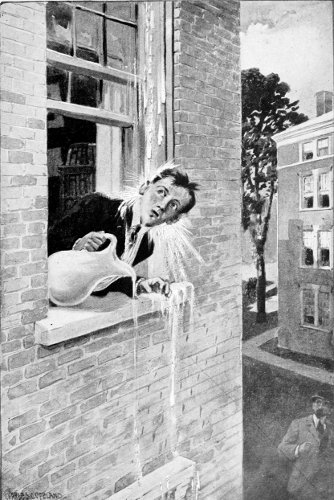
“Lots of ways. For one thing, he’s kept me
on probation three weeks for throwing water
out the window, when the fellow who started the
thing only got one.”
“Go and get Archer,” commanded Dr. Leighton.
“Was Peck here Saturday night?” asked the
instructor, as the two boys returned.
“Yes, sir,” answered Sam, eagerly. “He was
here the whole evening from the time I came in
a little after eight. We both went to bed about
eleven. He was no more in Boston than I was.”
“One thing more, Peck,” said the teacher,
turning abruptly on Duncan. “Where were
you on Saturday afternoon?”
Duncan’s countenance fell. “Knocking around,”
he answered cautiously.
“That’s indefinite. You were not at dinner.”
“No, sir. I got my dinner at McLane’s at
about five.”
“And before five?”
Peck hesitated, looked at his room-mate, then
out the window, then at his room-mate again,
and at last into Dr. Leighton’s face.
“I’d rather not tell you; that is, officially.
I’ll tell you personally, if you like. I didn’t do
anything bad.”
“Personally then, if it must be,” said the instructor.
“I went to Hampton Beach to see the surf.”
“What!”
“I went down on the one o’clock car and came
back on it. I walked up from the power-house.”
Dr. Leighton was silent, while Duncan shifted
nervously from foot to foot, and wondered wildly
whether he had made the great mistake of being
confidential with an untrustworthy prof. Dr.
Leighton, however, understood clearly the distinction
intended; he had agreed to receive
Duncan’s confession, not as a member of the
faculty, but as a friend of the confessor. Officially
he could take no cognizance of the affair.
He must speak as a friend and adviser, or not
at all.
“Duncan,” he said with slow seriousness, “in
going to Hampton you were leaving town without
permission just as much as if you had gone to
Boston, as Mr. Alsop thought you did. That
Mr. Alsop treated you unfairly, or that your visit
was for an innocent purpose, is no excuse whatever
for the act. You broke a rule on which the
school wisely insists, and the punishment for
which you well knew. In that you were totally
wrong.”
“Yes, sir,” said Duncan, humbly.
“You understand that if your absence is discovered
and the fact brought before the faculty,
I cannot say a word in your defence?”
“Yes, sir.”
“Now I want you to promise, and promise
honestly, that for the rest of the year you will
try to keep well within the school rules.”
“I will, sir.”
“Good!” Dr. Leighton held out his hand, and
turned to go. At the door he spoke again.
“One more word of advice—as a friend. You
have the advantage over Mr. Alsop in this Boston
affair. Use it to come to a better understanding
with him, and not to annoy him. Remember
that there is a very weak spot in your own armor.”
When the teacher was gone, the two boys remained
for a time in silence. Duncan’s malicious
joy in the prospect of Mr. Alsop’s humiliation had
given place to a serious mood. “Leighton’s a
square man!” he said at length. “You’d do
right for a man like him when you’d rather do
wrong; while as for Alsop, why, you’d do wrong
for him when you’d rather do right, just to spite
him.” And therein Duncan Peck showed a
knowledge of the essential traits of an inspiring
teacher which is rarely possessed by school
trustees.
Later in the day Mr. Alsop came to apologize
for his error, and the interview left a pleasant
impression with both participants. Duncan had
special reason to be satisfied with it, as the instructor,
to make amends for his false accusation,
removed the annoying probation. Through Dr.
Leighton’s influence the special committee made
no report to the faculty, and Mr. Alsop was
spared the pain of an official verdict on his
blunder.