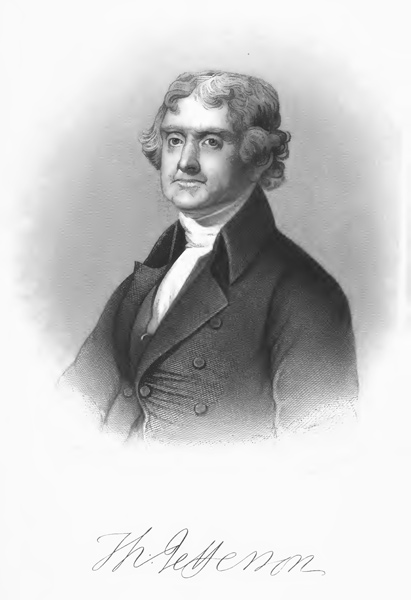
- PART I.—BEFORE HIS MISSION TO EUROPE, 1773-1783.
- PART II.—WHILE MINISTER TO FRANCE, 1784-1790.
- PART III.—FROM HIS RETURN TO UNITED STATES TO HIS DEATH, 1790-1826.
This division of the work includes all the Correspondence, official and private, of
Thomas Jefferson, from 1762 to his death in 1826, which possesses general interest
or permanent public value. For the purpose of easy reference, it has been classified
as follows:
Part I.—Letters written before his mission to Europe.—The letters included
in this division, consist principally of the private correspondence of the Author's
youth, and his official letters while Governor of Virginia. The former are interesting
mainly as illustrating his character, his views, and his purposes in life. The
latter, relating to the period of the invasion of Virginia, and the military operations
in the South, possess no inconsiderable historical value.
Part II.—Letters written while in Europe.—The letters included in this division,
relate principally to the objects of his mission to Europe—his efforts to extend
the commercial relations of this country with the European nations—the history of
particular treaties of commerce—piratical depredations upon our commerce by the
Barbary States—our Foreign Debt—our relations generally with Europe—the rise
and progress of the French Revolution through its early stages—his views of the
Confederation and the new Constitution—the political and social condition of Europe,
&c., all interspersed with the reflections by the Author upon every variety of topic,
literary, scientific, social, and political.
Part III.—Letters written after his return to the United States to the time
of his Death.—To the great majority of readers, this will be found to be much the
most interesting division of the work, ranging, as it does, over the whole field of Literature,
Philosophy, Science, Religion, Morals, History, and Politics, and embodying
the mature views of the Author upon nearly all the great Constitutional questions
which have arisen under our Government, and many of the most important problems
which have agitated the world.
Fairfield, December 25, 1762.
Dear Page,—This very day, to others the day of greatest mirth
and jollity, sees me overwhelmed with more and greater misfortunes
than have befallen a descendant of Adam for these thousand
years past, I am sure; and perhaps, after excepting Job, since
the creation of the world. I think his misfortunes were somewhat
greater than mine; for, although we may be pretty nearly on
a level in other respects, yet, I thank my God, I have the advantage
of brother Job in this, that Satan has not as yet put
forth his hand to load me with bodily afflictions. You must
know, dear Page, that I am now in a house surrounded with
enemies, who take counsel together against my soul; and when
I lay me down to rest, they say among themselves, come let us
destroy him. I am sure if there is such a thing as a Devil in
this world, he must have been here last night, and have had
some hand in contriving what happened to me. Do you think
the cursed rats (at his instigation, I suppose) did not eat up my
pocket-book, which was in my pocket, within a foot of my
head? And not contented with plenty for the present, they
carried away my jemmy-worked silk garters, and half a dozen
new minuets I had just got, to serve, I suppose, as provision for
the winter. But of this I should not have accused the Devil,
(because, you know rats will be rats, and hunger, without the
addition of his instigations, might have urged them to do this,)
if something worse, and from a different quarter, had not happened.
You know it rained last night, or if you do not know
it, I am sure I do. When I went to bed, I laid my watch in
the usual place, and going to take her up after I arose this
morning, I found her in the same place, it's true, but Quantum
mutatus ab illo! all afloat in water, let in at a leak in the roof
of the house, and as silent and still as the rats that had eat my
pocket-book. Now, you know, if chance had had anything to
do in this matter, there were a thousand other spots where it
might have chanced to leak as well as at this one, which was
perpendicularly over my watch. But I'll tell you, it's my
opinion that the Devil came and bored the hole over it on purpose.
Well, as I was saying, my poor watch had lost her
speech. I should not have cared much for this, but something
worse attended it; the subtle particles of the water with which
the case was filled, had, by their penetration, so overcome the
cohesion of the particles of the paper, of which my dear picture
and watch-paper were composed, that, in attempting to take
them out to dry them, good God! Mens horret referre! My
cursed fingers gave them such a rent, as I fear I never shall get
over. This, cried I, was the last stroke Satan had in reserve for
me; he knew I cared not for anything else he could do to me,
and was determined to try his last most fatal expedient. "Multis
fortunæ vulneribus percussus, huic uni me imparem sensi, et
penitus succubui!" I would have cried bitterly, but I thought
it beneath the dignity of a man, and a man too, who had read
των οντων, τα μεν εφ' ἡμιν, τα δ' ουκ εφ' ἡμιν. However, whatever misfortunes
may attend the picture or lover, my hearty prayers shall
be, that all the health and happiness which Heaven can send
may be the portion of the original, and that so much goodness
may ever meet with what may be most agreeable in this world,
as I am sure it must be in the next. And now, although the
picture be defaced, there is so lively an image of her imprinted
in my mind, that I shall think of her too often, I fear, for my
peace of mind; and too often, I am sure, to get through old
Coke this winter; for God knows I have not seen him since I
packed him up in my trunk in Williamsburg. Well, Page, I
do wish the Devil had old Coke, for I am sure I never was so
tired of an old dull scoundrel in my life. What! are there so
few inquietudes tacked to this momentary life of ours, that we
must need be loading ourselves with a thousand more? Or, as
brother Job says, (who, by-the-bye, I think began to whine a little
under his afflictions,) "Are not my days few? Cease then,
that I may take comfort a little before I go whence I shall not
return, even to the land of darkness, and the shadow of death."
But the old fellows say we must read to gain knowledge, and
gain knowledge to make us happy and admired. Mere jargon!
Is there any such thing as happiness in this world? No. And as
for admiration, I am sure the man who powders most, perfumes
most, embroiders most, and talks most nonsense, is most admired.
Though to be candid, there are some who have too much good
sense to esteem such monkey-like animals as these, in whose
formation, as the saying is, the tailors and barbers go halves with
God Almighty; and since these are the only persons whose esteem
is worth a wish, I do not know but that, upon the whole,
the advice of these old fellows may be worth following.
You cannot conceive the satisfaction it would give me to
have a letter from you. Write me very circumstantially everything
which happened at the wedding. Was she there? because,
if she was, I ought to have been at the Devil for not being
there too. If there is any news stirring in town or country,
such as deaths, courtships, or marriages, in the circle of my acquaintance,
let me know it. Remember me affectionately to
all the young ladies of my acquaintance, particularly the Miss
Burwells, and Miss Potters, and tell them that though that heavy
earthly part of me, my body, be absent, the better half of me,
my soul, is ever with them, and that my best wishes shall ever
attend them. Tell Miss Alice Corbin that I verily believe the
rats knew I was to win a pair of garters from her, or they never
would have been so cruel as to carry mine away. This very
consideration makes me so sure of the bet, that I shall ask everybody
I see from that part of the world what pretty gentleman
is making his addresses to her. I would fain ask the favor of
Miss Becca Burwell to give me another watch-paper of her own
cutting, which I should esteem much more, though it were a
plain round one, than the nicest in the world cut by other
hands; however, I am afraid she would think this presumption,
after my suffering the other to get spoiled. If you think you
can excuse me to her for this, I should be glad if you would
ask her. Tell Miss Sukey Potter that I heard, just before I
came out of town, that she was offended with me about something,
what it is I do not know; but this I know, that I never
was guilty of the least disrespect to her in my life, either in
word or deed; as far from it as it has been possible for one to
be. I suppose when we meet next, she will be endeavoring to
repay an imaginary affront with a real one; but she may save
herself the trouble, for nothing that she can say or do to me
shall ever lessen her in my esteem, and I am determined always
to look upon her as the same honest-hearted, good-humored,
agreeable lady I ever did. Tell—tell—in short, tell them all
ten thousand things more than either you or I can now or ever
shall think of as long as we live.
My mind has been so taken up with thinking of my acquaintances,
that, till this moment, I almost imagined myself in Williamsburg,
talking to you in our old unreserved way; and never
observed, till I turned over the leaf, to what an immoderate size
I had swelled my letter; however, that I may not tire your
patience by further additions, I will make but this one more, that
I am sincerely and affectionately,
Dear Page, your friend and servant.
P. S. I am now within an easy day's ride of Shadwell, whither
I shall proceed in two or three days.
Shadwell, Jan. 20, 1763.
Dear Page,—To tell you the plain truth, I have not a syllable to
write to you about. For I do not conceive that anything can happen
in my world which you would give a curse to know, or I either.
All things here appear to me to trudge on in one and the same
round: we rise in the morning that we may eat breakfast, dinner
and supper, and go to bed again that we may get up the next
morning and do the same: so that you never saw two peas more
alike than our yesterday and to-day. Under these circumstances,
what would you have me say? Would you that I should write
nothing but truth? I tell you I know nothing that is true. Or
would you rather that I should write you a pack of lies? Why,
unless they were more ingenious than I am able to invent, they
would furnish you with little amusement. What can I do then?
nothing, but ask you the news in your world. How have you
done since I saw you? How did Nancy look at you when you
danced with her at Southall's? Have you any glimmering of
hope? How does R. B. do? Had I better stay here and do nothing,
or go down and do less? or, in other words, had I better
stay here while I am here, or go down that I may have the pleasure
of sailing up the river again in a full-rigged flat? Inclination
tells me to go, receive my sentence, and be no longer in suspense;
but reason says, if you go, and your attempt proves unsuccessful,
you will be ten times more wretched than ever. In my last to
you, dated Fairfield, Dec. 25, I wrote to you of the losses I had
sustained; in the present I may mention one more, which is the
loss of the whites of my eyes, in the room of which I have got
reds, which gives me such exquisite pain that I have not attempted
to read anything since a few days after Jack Walker
went down, and God knows when I shall be able to do it. I
have some thoughts of going to Petersburg, if the actors go
there in May. If I do, I do not know but I may keep on to
Williamsburg, as the birth night will be near. I hear that Ben
Harrison has been to Wilton: let me know his success. Have
you an inclination to travel, Page? because if you have, I shall
be glad of your company. For you must know that as soon
as the Rebecca (the name I intend to give the vessel above
mentioned) is completely finished, I intend to hoist sail and
away. I shall visit particularly England, Holland, France,
Spain, Italy, (where I would buy me a good fiddle,) and Egypt,
and return through the British provinces to the Northward
home. This to be sure, would take us two or three years, and
if we should not both be cured of love in that time, I think the
devil would be in it. After desiring you to remember me to
acquaintances below, male and female, I subscribe myself,
Dear Page, your friend and servant.
Shadwell, July 15th, 1763.
Dear Page,—Yours of May 30th came safe to hand. The rival
you mentioned I know not whether to think formidable or not, as
there has been so great an opening for him during my absence. I
say has been, because I expect there is one no longer. Since you
have undertaken to act as my attorney, you advise me to go immediately
and lay siege in form. You certainly did not think,
at the time you wrote this, of that paragraph in my letter
wherein I mentioned to you my resolution of going to Britain.
And to begin an affair of that kind now, and carry it on so long
a time in form, is by no means a proper plan. No, no, Page;
whatever assurances I may give her in private of my esteem for
her, or whatever assurances I may ask in return from her, depend
on it—they must be kept in private. Necessity will oblige me to
proceed in a method which is not generally thought fair; that of
treating with a ward before obtaining the approbation of her
guardian. I say necessity will oblige me to it, because I never
can bear to remain in suspense so long a time. If I am to succeed,
the sooner I know it, the less uneasiness I shall have to go
through. If I am to meet with a disappointment, the sooner I
know it, the more of life I shall have to wear it off; and if I do
meet with one, I hope in God, and verily believe, it will be the
last. I assure you, that I almost envy you your present freedom;
and if Belinda will not accept of my service, it shall never be
offered to another. That she may, I pray most sincerely; but
that she will, she never gave me reason to hope. With regard
to my not proceeding in form, I do not know how she may like
it. I am afraid not much. That her guardians would not, if
they should know of it, is very certain. But I should think that
if they were consulted after I return, it would be sufficient. The
greatest inconvenience would be my not having the liberty of
visiting so freely. This is a subject worth your talking over
with her; and I wish you would, and would transmit to me your
whole confab at length. I should be scared to death at making
her so unreasonable a proposal as that of waiting until I return
from Britain, unless she could first be prepared for it. I am afraid
it will make my chance of succeeding considerably worse. But
the event at last must be this, that if she consents, I shall be
happy; if she does not, I must endeavor to be as much so as
possible. I have thought a good deal on your case, and as mine
may perhaps be similar, I must endeavor to look on it in the
same light in which I have often advised you to look on yours.
Perfect happiness, I believe, was never intended by the Deity to
be the lot of one of his creatures in this world; but that he has
very much put in our power the nearness of our approaches to it,
is what I have steadfastly believed.
The most fortunate of us, in our journey through life, frequently
meet with calamities and misfortunes which may greatly afflict
us; and, to fortify our minds against the attacks of these calamities
and misfortunes, should be one of the principal studies and
endeavors of our lives. The only method of doing this is to assume
a perfect resignation to the Divine will, to consider that
whatever does happen, must happen; and that, by our uneasiness,
we cannot prevent the blow before it does fall, but we may add
to its force after it has fallen. These considerations, and others
such as these, may enable us in some measure to surmount the
difficulties thrown in our way; to bear up with a tolerable degree
of patience under this burthen of life; and to proceed with a
pious and unshaken resignation, till we arrive at our journey's
end, when we may deliver up our trust into the hands of him
who gave it, and receive such reward as to him shall seem proportioned
to our merit. Such, dear Page, will be the language of
the man who considers his situation in this life, and such should
be the language of every man who would wish to render that
situation as easy as the nature of it will admit. Few things will
disturb him at all: nothing will disturb him much.
If this letter was to fall into the hands of some of our gay acquaintance,
your correspondent and his solemn notions would
probably be the subjects of a great deal of mirth and raillery, but
to you, I think, I can venture to send it. It is in effect a continuation
of the many conversations we have had on subjects of this
kind; and I heartily wish we could now continue these conversations
face to face. The time will not be very long now before
we may do it, as I expect to be in Williamsburg by the first of
October, if not sooner. I do not know that I shall have occasion
to return, if I can rent rooms in town to lodge in; and to prevent
the inconvenience of moving my lodgings for the future, I think
to build: no castle though, I assure you; only a small house,
which shall contain a room for myself and another for you, and
no more, unless Belinda should think proper to favor us with her
company, in which case I will enlarge the plan as much as she
pleases. Make my compliments to her particularly, as also to
Sukey Potter, Judy Burwell, and such others of my acquaintance
as enquire after me. I am,
Dear Page, your sincere friend.
Williamsburg, October 7, 1763.
Dear Page,—In the most melancholy fit that ever any poor
soul was, I sit down to write to you. Last night, as merry as
agreeable company and dancing with Belinda in the Apollo could
make me, I never could have thought the succeeding sun would
have seen me so wretched as I now am! I was prepared to say
a great deal: I had dressed up, in my own mind, such thoughts as
occurred to me, in as moving a language as I knew how, and
expected to have performed in a tolerably creditable manner.
But, good God! When I had an opportunity of venting them, a
few broken sentences, uttered in great disorder, and interrupted
with pauses of uncommon length, were the too visible marks of
my strange confusion! The whole confab I will tell you, word
for word, if I can, when I see you, which God send may be
soon. Affairs at W. and M. are in the greatest confusion. Walker,
M'Clurg and Wat Jones are expelled pro tempore, or, as Horrox
softens it, rusticated for a month. Lewis Burwell, Warner
Lewis, and one Thompson, have fled to escape flagellation. I
should have excepted Warner Lewis, who came off of his own
accord. Jack Walker leaves town on Monday. The court is
now at hand, which I must attend constantly, so that unless you
come to town, there is little probability of my meeting with you
anywhere else. For God sake come. I am, dear Page, your
sincere friend.
Devilsburg, January 19, 1764.
The contents of your letter have not a little alarmed me; and
really, upon seriously weighing them with what has formerly
passed between —— and myself, I am somewhat at a loss
what to conclude; your "semper saltat, semper ridet, semper
loquitur, semper solicitat," &c., appear a little suspicious, but good
God! it is impossible! I told you our confab in the Apollo; but
I believe I never told you that we had on another occasion. I
then opened my mind more freely, and more fully. I mentioned
the necessity of my going to England, and the delays which
would consequently be occasioned by that. I said in what manner
I should conduct myself till then, and explained my reasons,
which appears to give that satisfaction I could have wished; in
short, I managed in such a manner that I was tolerable easy myself,
without doing anything which could give αδνιλεβ'ς friends
the least umbrage, were the whole that passed to be related to
them. I asked no question which would admit of a categorical
answer; but I assured αδνιλεβ that such questions would one day
be asked—in short, were I to have another interview with him,
I could say nothing now which I did not say then; and were I,
with a view of obtaining one, licentiam solicitandi aliis, quibus
degit postulare, it would be previously necessary to go the rounds
cum custodibus; and after all this, he could be in no other situation
than he is at present. After the proofs I have given of my
sincerity, he can be under no apprehension of a change in my
sentiments; and were I to do as my friends advise me, I would
give no better security than he has at present. He is satisfied
that I shall make him an offer, and if he intends to accept of it,
he will disregard those made by others; my fate depends on
αδνιλεβ'ς present resolutions, by them I must stand or fall—if
they are not favorable to me, it is out of my power to say anything
to make them so which I have not said already; so that a
visit could not possibly be of the least weight, and it is, I am
sure, what he does not in the least expect. I hear you are courting
F——y B——l, but shall not listen to it till I hear it from
you. When I was up the country, I wrote a letter to you, dated
Fairfield, Dec. 25, 1763; let me know if you have received such
a one. As I suppose you do not use your Statutes of Britain, if
you can lend them to me, till I can provide myself with a copy,
it will infinitely oblige me. Adieu, dear Page.
Devilsburg,[78] January 23, 1764.
Dear Page,—I received your letter of Wednesday, the 18th
instant; in that, of this day, you mention one which you wrote
last Friday, and sent by the Secretary's boy; but I have neither
seen nor heard of such a one. God send mine of January 19 to
you may not have shared the same fate; for, by your letter, I am
uncertain whether you have received it or not; you therein say,
"you hope to have received an answer from me by this time,"
by which I judge it has miscarried; but you mention mine of
December 25th, which put me in spirits again, as I do not know
how you should have got intelligence that I had wrote such a
one, unless you had seen my letter of Jan. 19, in which it was
mentioned—yes, there is one other way by which you might
have received such intelligence. My letter of Jan. 19 may have
been opened, and the person who did it may have been further
incited by curiosity, to ask you if you had received such a letter
as they saw mentioned therein; but God send, and I hope this
is not the case. Sukey Potter, to whom I sent it, told me yesterday
she delivered it to Mr. T. Nelson, the younger, who had
delivered it to you—I hope with his own hand. I wish I had
followed your example, and wrote it in Latin, and that I had
called my dear campana in die,[79] instead of αδνιλεβ.
We must fall on some scheme of communicating our thoughts
to each other, which shall be totally unintelligible to every one
but to ourselves. I will send you some of these days Shelton's
Tachygraphical Alphabet, and directions. Jack Walker is engaged
to Betsey Moore, and desired all his brethren might be
made acquainted with his happiness. But I hear he will not be
married this year or two. Put campana in die in mind of me;
tell him I think as I always did. I have sent my horses up the
country, so that it is out of my power to take even an airing on
horseback at any time. My paper holds out no longer, so must
bid you adieu.
Devilsburg, April 9, 1764.
Dear Page,—This letter will be conveyed to you by the assistance
of our friend Warner Lewis. Poor fellow! never did
I see one more sincerely captivated in my life. He walked to
the Indian camp with her yesterday, by which means he had an
opportunity of giving her two or three love squeezes by the
hand; and, like a true arcadian swain, has been so enraptured
ever since, that he is company for no one. B——y has at last
bestowed her hand on B——d; and whether it was for money,
beauty, or principle, will be so nice a dispute, that no one will
venture to pronounce. Two days before the wedding I was not
a little surprised, on going to the door at my house, to see him
alight from his horse. He stepped up to me, and desired the
favor of me to come to Mr. Yates' at such a time. It was so
unexpected, that for some time I could make no reply; at last, I
said "yes," and turned about and walked back into my room. I
accordingly attended, and to crown the joke, when I got there,
was dubbed a bridesman. There were many other curious circumstances
too tedious to mention here. Jack Walker is expected
in town to-morrow. How does your pulse beat after
your trip to the Isle of Wight? What a high figure I should
have cut, had I gone! When I heard who visited you there, I
thought I had met with the narrowest escape in the world. I
wonder how I should have behaved—I am sure I should have
been at a great loss. If your mistress can spare you a little time,
your friends here would be very glad to see you, particularly
Small and myself, as everything is now ready for taking the
height of this place above the water of the creeks. Fleming's
relapse will justly afford you great matter of triumph, after rallying
you so much on being in love.
Adieu, dear Page.
P. S. Walker is just arrived—he goes out of town on Wednesday,
and will return again in about three weeks.
Charlottesville, Feb. 21, 1770.
Dear Page,—I am to acquaint Mrs. Page of the loss of my favorite
pullet; the consequence of which will readily occur to her.
I promised also to give her some Virginia silk which I had expected,
and I begin to wish my expectation may not prove vain.
I fear she will think me but an ungainly acquaintance. My late
loss may perhaps have reached you by this time; I mean the
loss of my mother's house by fire, and in it of every paper I had
in the world, and almost every book. On a reasonable estimate
I calculate the cost of the books burned to have been £200
sterling. Would to God it had been the money, then had it
never cost me a sigh! To make the loss more sensible, it fell
principally on my books of Common Law, of which I have but
one left, at that time lent out. Of papers too of every kind I
am utterly destitute. All of these, whether public or private,
of business or of amusement, have perished in the flames. I
had made some progress in preparing for the succeeding General
Court; and having, as was my custom, thrown my thoughts
into the form of notes, I troubled my head no more with them.
These are gone, and like the baseless fabric of a vision, leave
not a trace behind. The records also, and other papers which
furnished me with states of the several cases, having shared
the same fate, I have no foundation whereon to set out anew.
I have in vain attempted to recollect some of them; the defect
sometimes of one, sometimes of more circumstances, rendering
them so imperfect that I can make nothing of them. What am
I to do then in April? The resolution which the Court has
declared of admitting no continuances of causes seemed to be
unalterable; yet it might surely be urged, that my case is too
singular to admit of their being often troubled with the like
excuse. Should it be asked, what are the misfortunes of an
individual to a Court? The answer of a Court, as well as of an
individual, if left to me, should be in the words of Terence,
"homo sum; humani nil a me alienum puto"—but a truce with
this disagreeable subject.
Am I never more to have a letter from you? Why the devil
don't you write? But I suppose you are always in the moon,
or some of the planetary regions. I mean you are there in idea;
and, unless you mend, you shall have my consent to be there
de facto; at least, during the vacations of the Court and Assembly.
If your spirit is too elevated to advert to sublunary subjects,
depute my friend Mrs. Page to support your correspondences.
Methinks I should, with wonderful pleasure, open and
peruse a letter written by so fair, and (what is better) so friendly
hands. If thinking much of you would entitle me to the civility
of a letter, I assure you I merit a very long one. If this conflagration,
by which I am burned out of a home, had come before
I had advanced so far in preparing another, I do not know but
I might have cherished some treasonable thoughts of leaving
these my native hills; indeed I should be much happier were I
nearer to Rosewell and Severn hills—however, the gods, I
fancy, were apprehensive that if we were placed together, we
should pull down the moon, or play some such devilish prank
with their works. I reflect often with pleasure on the philosophical
evenings I passed at Rosewell in my last visits there.
I was always fond of philosophy, even in its drier forms; but
from a ruby lip, it comes with charms irresistible. Such a feast
of sentiment must exhilarate and lengthen life, at least as much
as the feast of the sensualist shortens it—in a word, I prize it so
highly, that, if you will at any time collect the same Belle Assemblée,
on giving me three days previous notice, I shall certainly
repair to my place as a member of it. Should it not happen
before I come down, I will carry Sally Nicholas in the
green chair to Newquarter, where your periagua (how the
—— should I spell that word?) will meet us, automaton-like, of
its own accord. You know I had a wagon which moved itself—cannot
we construct a boat then which shall row itself? Amicus
noster, Fons,[80] quo modo agit, et quid agit? You may be
all dead for anything we can tell here. I expect he will follow
the good old rule of driving one passion out by letting another
in. Clavum clavo pangere was your advice to me on a similar
occasion. I hope you will watch his immersion as narrowly as
if he were one of Jupiter's satellites; and give me immediate
notice, that I may prepare a dish of advice. I do not mean,
Madam, to advise him against it. On the contrary, I am become
an advocate for the passion; for I too am cœlo tactus, Currus[81]
bene se habet. He speaks, thinks, and dreams of nothing but
his young son. This friend of ours, Page, in a very small house,
with a table, half a dozen chairs, and one or two servants, is
the happiest man in the universe. Every incident in life he so
takes as to render it a source of pleasure. With as much benevolence
as the heart of man will hold, but with an utter neglect
of the costly apparatus of life, he exhibits to the world a
new phenomenon in philosophy—the Samian sage in the tub
of the cynic. Name me sometimes homunculo tuo, not forgetting
little dic mendacium. I am determined not to enter on the
next page, lest I should extend this nonsense to the bottom of
that also. A dieu je vous commis, not doubting his care of you
both.
Th: Jefferson.
Albermarle, in Virginia, Feb. 25th, 1773.
Dear Sir,—Encouraged by the small acquaintance which I
had the pleasure of having contracted with you during your
residence in this country, I take the liberty of making the present
application to you. I understood you were related to the
gentleman of your name (Mr. James McPherson), to whom the
world is so much indebted for the elegant collection, arrangement,
and translation of Ossian's poems. These pieces have
been and will, I think, during my life, continue to be to me the
sources of daily and exalted pleasures. The tender and the
sublime emotions of the mind were never before so wrought up
by the human hand. I am not ashamed to own that I think
this rude bard of the North the greatest poet that has ever existed.
Merely for the pleasure of reading his works, I am become
desirous of learning the language in which he sung, and
of possessing his songs in their original form. Mr. McPherson,
I think, informs us he is possessed of the originals. Indeed, a
gentleman has lately told me he had seen them in print; but I
am afraid he has mistaken a specimen from Temora, annexed to
some of the editions of the translation, for the whole works.
If they are printed, it will abridge my request and your trouble,
to the sending me a printed copy; but if there be more such,
my petition is, that you would be so good as to use your interest
with Mr. McPherson to obtain leave to take a manuscript
copy of them, and procure it to be done. I would choose it in
a fair, round hand, on fine paper, with a good margin, bound in
parchments as elegantly as possible, lettered on the back, and
marbled or gilt on the edges of the leaves. I would not regard
expense in doing this. I would further beg the favor of you to
give me a catalogue of the books written in that language, and
to send me such of them as may be necessary for learning it.
These will, of course, include a grammar and dictionary. The
cost of these, as well as the copy of Ossian, will be (for me),
on demand, answered by Mr. Alexander McCaul, sometime of
Virginia, merchant, but now of Glasgow, or by your friend Mr.
Ninian Minzees, of Richmond, in Virginia, to whose care the
books may be sent. You can, perhaps, tell me whether we may
ever hope to see any more of those Celtic pieces published.
Manuscript copies of any which are in print, it would at any
time give me the greatest happiness to receive. The glow of
one warm thought is to me worth more than money. I hear
with pleasure from your friend that your path through life is
likely to be smoothed by success. I wish the business and the
pleasures of your situation would admit leisure now and then
to scribble a line to one who wishes you every felicity, and
would willingly merit the appellation of, dear sir,
Your friend and humble servant.
Dec. 9th, 1774.
Dear Sir,—As I mean to be a conscientious observer of the
measures generally thought requisite for the preservation of our
independent rights, so I think myself bound to account to my
country for any act of mine which might wear an appearance
of contravening them. I, therefore, take the liberty of stating
to you the following matter, that through your friendly intervention,
it may be communicated to the committee of your
county. You may remember that it was about the last of May
that the House of Burgesses, after its dissolution, met in Raleigh,
and formed our first association against the future use of
tea only; tho' the proceedings of the ministry against the town
of Boston were then well known to us.
I believe nobody thought at that time of extending our association
further, to the total interruption of our commerce with
Britain; or, if it was proposed by any (which I don't recollect),
it was condemned by the general sense of the members who
formed that association. Two or three days, therefore, after
this, I wrote to Cary & Co., of London, for fourteen pairs of
sash windows, to be sent to me ready made and glazed, with a
small parcel of spare glass to mend with. This letter went by
a ship, which sailed about the third of June, just before Power
arrived here. I did not suppose they would send them till
Power should come in again in the spring of 1775.
About the middle of June, as nearly as I can recollect, a few
of the late members were again convened (in consequence of
fresh advices from Boston), and then it was suggested that a
more extensive association might be necessary. A convention
met for that purpose the first of August, and formed a new association,
of which I received a copy about the 11th of the month.
But as a general Congress was then appointed to be held to reconsider
the same matters, and it was agreed that our association
should be subject to any alteration that they might recommend,
I did not write to countermand my order, thinking I should have
sufficient time after the final determination of the Congress
should be known, to countermand it before Power should sail
in the spring. Accordingly, within a few days after receiving a
copy of the general association, I wrote to Cary & Co. not to
send the sashes and glass which I had ordered, and gave my letter
to the care of a gentleman (Mr. Evans) just then going downward,
who promised to send it out speedily; but three or four
days after I received a letter from those gentlemen, dated August
29th, in which they inform me my window frames and glass
are ready, but that it being necessary to detain them about a
month to harden the puttying, they were not sent in that ship,
but might be expected by the next ship afterwards. From this
I conclude they may be near arriving at this time, in which case
they will come under the 1st and 10th articles of the association.
In order, therefore, that no proceeding of mine might give a
handle for traducing our measures, I thought it better previously
to lay before your committee, within whose ward they will probably
be landed, a full state of the matter, by which it might be
seen under what expectations I had failed to give an earlier countermand,
and to show that, as they come under the prohibitions of
the Continental association, (which, without the spirit of prophecy,
could not have been foretold when I ordered them,) so I
mean they shall be subject to its condemnation. To your committee,
therefore, if landed within their county, I submit the disposal
of them, which shall be obeyed as soon as made known
to their and your
Most humble servant.
Dec. 9th, 1774. A copy of this sent to Col. A. Cary, and another
to Col. B. Harrison, by Mr. Marrei.
May 7, 1775.
Dear Sir,—Within this week we have received the unhappy
news of an action of considerable magnitude, between the King's
troops and our brethren of Boston, in which it is said five hundred
of the former, with the Earl of Percy, are slain. That
such an action has occurred, is undoubted, though perhaps the
circumstances may not have reached us with truth. This accident
has cut off our last hope of reconciliation, and a phrensy
of revenge seems to have seized all ranks of people. It is a
lamentable circumstance, that the only mediatory power, acknowledged
by both parties, instead of leading to a reconciliation
his divided people, should pursue the incendiary purpose
of still blowing up the flames, as we find him constantly doing,
in every speech and public declaration. This may, perhaps, be
intended to intimidate into acquiescence, but the effect has been
most unfortunately otherwise. A little knowledge of human
nature, and attention to its ordinary workings, might have foreseen
that the spirits of the people here were in a state, in which
they were more likely to be provoked, than frightened, by
haughty deportment. And to fill up the measure of irritation,
a proscription of individuals has been substituted in the room of
just trial. Can it be believed, that a grateful people will suffer
those to be consigned to execution, whose sole crime has been
the developing and asserting their rights? Had the Parliament
possessed the power of reflection, they would have avoided a
measure as impotent, as it was inflammatory. When I saw
Lord Chatham's bill, I entertained high hope that a reconciliation
could have been brought about. The difference between
his terms, and those offered by our Congress, might have been
accommodated, if entered on, by both parties, with a disposition
to accommodate. But the dignity of Parliament, it seems,
can brook no opposition to its power. Strange, that a set of
men, who have made sale of their virtue to the Minister, should
yet talk of retaining dignity! But I am getting into politics,
though I sat down only to ask your acceptance of the wine,
and express my constant wishes for your happiness.
Monticello, August 25, 1775.
Dear Sir,—I am sorry the situation of our country should
render it not eligible to you to remain longer in it. I hope the
returning wisdom of Great Britain will, ere long, put an end to
this unnatural contest. There may be people to whose tempers
and dispositions contention is pleasing, and who, therefore,
wish a continuance of confusion, but to me it is of all
states but one, the most horrid. My first wish is a restoration
of our just rights; my second, a return of the happy period,
when, consistently with duty, I may withdraw myself totally
from the public stage, and pass the rest of my days in domestic
ease and tranquillity, banishing every desire of ever hearing
what passes in the world. Perhaps (for the latter adds considerably
to the warmth of the former wish), looking with
fondness towards a reconciliation with Great Britain, I cannot
help hoping you may be able to contribute towards expediting
this good work. I think it must be evident to yourself, that
the Ministry have been deceived by their officers on this side
of the water, who (for what purpose I cannot tell) have constantly
represented the American opposition as that of a small
faction, in which the body of the people took little part. This,
you can inform them, of your own knowledge, is untrue. They
have taken it into their heads, too, that we are cowards, and
shall surrender at discretion to an armed force. The past and
future operations of the war must confirm or undeceive them
on that head. I wish they were thoroughly and minutely acquainted
with every circumstance relative to America, as it exists
in truth. I am persuaded, this would go far towards disposing
them to reconciliation. Even those in Parliament who
are called friends to America, seem to know nothing of our real
determinations. I observe, they pronounced in the last Parliament,
that the Congress of 1774 did not mean to insist rigorously
on the terms they held out, but kept something in
reserve, to give up; and, in fact, that they would give up
everything but the article of taxation. Now, the truth is far
from this, as I can affirm, and put my honor to the assertion.
Their continuance in this error may, perhaps, produce very ill
consequences. The Congress stated the lowest terms they
thought possible to be accepted, in order to convince the world
they were not unreasonable. They gave up the monopoly and
regulation of trade, and all acts of Parliament prior to 1764,
leaving to British generosity to render these, at some future
time, as easy to America as the interest of Britain would admit.
But this was before blood was spilt. I cannot affirm, but have
reason to think, these terms would not now be accepted. I wish
no false sense of honor, no ignorance of our real intentions, no
vain hope that partial concessions of right will be accepted, may
induce the Ministry to trifle with accommodation, till it shall
be out of their power ever to accommodate. If, indeed, Great
Britain, disjoined from her colonies, be a match for the most potent
nations of Europe, with the colonies thrown into their scale,
they may go on securely. But if they are not assured of this,
it would be certainly unwise, by trying the event of another
campaign, to risk our accepting a foreign aid, which, perhaps,
may not be obtainable, but on condition of everlasting avulsion
from Great Britain. This would be thought a hard condition,
to those who still wish for re-union with their parent country.
I am sincerely one of those, and would rather be in dependence
on Great Britain, properly limited, than on any nation on earth,
or than on no nation. But I am one of those, too, who, rather
than submit to the rights of legislating for us, assumed by the
British Parliament, and which late experience has shown they
will so cruelly exercise, would lend my hand to sink the whole
Island in the ocean.
If undeceiving the Minister, as to matters of fact, may change
his disposition, it will, perhaps, be in your power, by assisting to
do this, to render service to the whole empire, at the most critical
time, certainly, that it has ever seen. Whether Britain shall
continue the head of the greatest empire on earth, or shall return
to her original station in the political scale of Europe, depends,
perhaps, on the resolutions of the succeeding winter.
God send they may be wise and salutary for us all. I shall be
glad to hear from you as often as you may be disposed to think
of things here. You may be at liberty, I expect, to communicate
some things, consistently with your honor, and the duties
you will owe to a protecting nation. Such a communication
among individuals, may be mutually beneficial to the contending
parties. On this or any future occasion, if I affirm to you
any facts, your knowledge of me will enable you to decide on
their credibility; if I hazard opinions on the dispositions of men
or other speculative points, you can only know they are my
opinions. My best wishes for your felicity, attend you, wherever
you go, and believe me to be assuredly,
Your friend and servant.
Philadelphia, November 29, 1775.
Dear Sir,—I am to give you the melancholy intelligence of
the death of our most worthy Speaker, which happened here on
the 22d of the last month. He was struck with an apoplexy,
and expired within five hours.
I have it in my power to acquaint you, that the success of our
arms has corresponded with the justice of our cause. Chambly
and St. John's were taken some weeks ago, and in them the
whole regular army in Canada, except about forty or fifty men.
This day, certain intelligence has reached us, that our General,
Montgomery, is received into Montreal; and we expect, every
hour, to be informed that Quebec has opened its arms to Colonel
Arnold, who, with eleven hundred men, was sent from Boston
up the Kennebec, and down the Chaudière river to that place.
He expected to be there early this month. Montreal acceded
to us on the 13th, and Carlton set out, with the shattered remains
of his little army, for Quebec, where we hope he will be
taken up by Arnold. In a short time, we have reason to hope,
the delegates of Canada will join us in Congress, and complete
the American union, as far as we wish to have it completed.
We hear that one of the British transports has arrived at Boston;
the rest are beating off the coast, in very bad weather.
You will have heard, before this reaches you, that Lord Dunmore
has commenced hostilities in Virginia. That people bore
with everything, till he attempted to burn the town of Hampton.
They opposed and repelled him, with considerable loss on
his side, and none on ours. It has raised our countrymen into
a perfect phrensy. It is an immense misfortune, to the whole
empire, to have a King of such a disposition at such a time.
We are told, and everything proves it true, that he is the bitterest
enemy we have. His Minister is able, and that satisfies
me that ignorance or wickedness, somewhere, controls him. In
an earlier part of this contest, our petitions told him, that from
our King there was but one appeal. The admonition was despised,
and that appeal forced on us. To undo his empire, he
has but one truth more to learn; that, after colonies have drawn
the sword, there is but one step more they can take. That step
is now pressed upon us, by the measures adopted, as if they
were afraid we would not take it. Believe me, dear Sir, there
is not in the British empire a man who more cordially loves a
union with Great Britain, than I do. But by the God that made
me, I will cease to exist before I yield to a connection on such
terms as the British Parliament propose; and in this, I think I
speak the sentiments of America. We want neither inducement
nor power, to declare and assert a separation. It is will,
alone, which is wanting, and that is growing apace under the
fostering hand of our King. One bloody campaign will probably
decide, everlastingly, our future course; and I am sorry to
find a bloody campaign is decided on. If our winds and waters
should not combine to rescue their shores from slavery, and
General Howe's reinforcements should arrive in safety, we have
hopes he will be inspirited to come out of Boston and take another
drubbing; and we must drub him soundly, before the
sceptred tyrant will know we are not mere brutes, to crouch
under his hand, and kiss the rod with which he designs to
scourge us,
Yours, &c.
Philadelphia, July 8, 1776.
Dear Sir,—For news, I refer you to your brother, who writes
on that head. I enclose you a copy of the Declaration of Independence,
as agreed to by the House, and also as originally
framed. You will judge whether it is the better or worse for
the critics. I shall return to Virginia after the 11th of August.
I wish my successor may be certain to come before that time;
in that case I shall hope to see you, and not Wythe, in Convention,
that the business of Government, which is of everlasting
concern, may receive your aid.
Adieu, and believe me to be your friend and servant.
Virginia, August 13, 1777.
Honorable Sir,—I forbear to write you news, as the time of
Mr. Shore's departure being uncertain, it might be old before you
receive it, and he can, in person, possess you of all we have.
With respect to the State of Virginia in particular, the people
seem to have laid aside the monarchical, and taken up the republican
government, with as much ease as would have attended
their throwing off an old, and putting on a new suit of clothes.
Not a single throe has attended this important transformation. A
half-dozen aristocratical gentlemen, agonizing under the loss of
pre-eminence, have sometimes ventured their sarcasms on our
political metamorphosis. They have been thought fitter objects
of pity, than of punishment. We are, at present, in the complete
and quiet exercise of well-organized government, save only
that our courts of justice do not open till the fall. I think nothing
can bring the security of our continent and its cause into danger,
if we can support the credit of our paper. To do that, I apprehend,
one of two steps must be taken. Either to procure free
trade by alliance with some naval power able to protect it; or,
if we find there is no prospect of that, to shut our ports totally,
to all the world, and turn our colonies into manufactories. The
former would be most eligible, because most conformable to the
habits and wishes of our people. Were the British Court to return
to their senses in time to seize the little advantage which
still remains within their reach, from this quarter, I judge, that,
on acknowledging our absolute independence and sovereignty, a
commercial treaty beneficial to them, and perhaps even a league
of mutual offence and defence, might, not seeing the expense or
consequences of such a measure, be approved by our people, if
nothing, in the mean time, done on your part, should prevent it.
But they will continue to grasp at their desperate sovereignty, till
every benefit short of that is forever out of their reach. I wish
my domestic situation had rendered it possible for me to join you
in the very honorable charge confided to you. Residence in a
polite Court, society of literati of the first order, a just cause and
an approving God, will add length to a life for which all men
pray, and none more than
Your most obedient and humble servant.
Albermarle, Virginia, Aug. 21, 1777.
Dear Sir,—Your favor of May 26th came safely to hand. I
wish it were in my power to suggest any remedy for the evil
you complain of; though, did any occur, I should propose it to
you with great diffidence, after knowing you had thought on
the subject yourself. There is indeed a fact which may not
have come to your knowledge, out of which, perhaps, some
little good may be drawn. The borrowing money in Europe, or
obtaining credit there for necessaries, has already probably been
essayed, and it is supposed with some degree of success. But I
expect your applications have as yet been made only to France,
Holland, or such other States as are of principal note. There
is, however, a small power well disposed to our cause, and, as I
am informed, possessed of abilities to assist us in this way. I
speak of the Grand Duke of Tuscany. The little States of
Italy, you know, have had long peace, and show no disposition
to interrupt that peace shortly. The Grand Duke, being somewhat
avaricious in his nature, has availed himself of the opportunity
of collecting and hoarding what money he has been able
to gather. I am informed from good authority (an officer who
was concerned in the business of his treasury) that about three
years ago he had ten millions of crowns lying dead in his coffers.
Of this, it is thought possible as much might be borrowed as
would amount to a million of pounds lawful money. At any
rate, the attempt might be worth making. Perhaps an application
from Dr. Franklin, who has some acquaintance in that court,
might be sufficient; or as it might be prudent to sound well before
the application, in order to prevent the discredit of a rebuff,
perhaps Congress would think it worth while to send a special
agent there to negotiate the matter. I think we have a gentleman
here, who would do it with dexterity and fidelity. He is a
native of that Duchy, well connected there, conversant in courts,
of great understanding and equal zeal in our cause. He came
over not long since to introduce the cultivation of vines, olives,
&c., among us. Should you think the matter worth a further
thought, either of the Cols. Lee's, to whom he is known, can
acquaint you more fully of his character. If the money can be
obtained in specie, it may be applied to reduce the quantity of
circulating paper, and be so managed as to help the credit of
that which will remain in circulation. If credit alone can be
obtained for the manufactures of the country, it will still help us
to clothe our armies, or to increase at market the necessaries our
people want.
What upon earth can Howe mean by the manœuvre he is now
practicing? There seems to me no object in this country which
can be either of utility or reputation to his cause. I hope it will
prove of a piece with all the other follies they have committed.
The forming a junction with the northern army up the Hudson
river, or taking possession of Philadelphia, might have been a
feather in his cap, and given them a little reputation in Europe—the
former as being the design with which they came, the latter
as being a place of the first reputation abroad, and the residence
of Congress. Here he may destroy the little hamlet of Williamsburg,
steal a few slaves, and lose half his army among
the fens and marshes of our lower country, or by the heat of the
climate.
I am, dear sir, yours, &c.
Williamsburg, Virginia, June 8th, 1778.
Sir,—Your letter of September 15th, 1777, from Paris, comes
safe to hand. We have not, however, had the pleasure of seeing
Mr. De Crenis, the bearer of it, in this country, as he joined the
army in Pennsylvania as soon as he arrived.
I should have taken particular pleasure in serving him on your
recommendation. From the kind anxiety expressed in your
letter, as well as from other sources of information, we discover
that our enemies have filled Europe with Thrasonic accounts of
victories they had never won and conquests they were fated
never to make. While these accounts alarmed our friends in
Europe, they afforded us diversions. We have long been out of
all fear for the event of the war. I enclose you a list of the
killed, wounded, and captives of the enemy from the commencement
of hostilities at Lexington, in April, 1775, until November,
1777, since which time there has been no event of any consequence.
This is the best history of the war which can be
brought within the compass of a letter. I believe the account to
be near the truth, though it is difficult to get at the numbers lost
by an enemy with absolute precision. Many of the articles have
been communicated to us from England as taken from the official
returns made by their General. I wish it were in my power to
send you as just an account of our loss. But this cannot be done
without an application to the war office, which, being in another
county, is at this time out of my reach. I think that upon the
whole it has been about one-half the number lost by them; in
some instances more, but in others less. This difference is ascribed
to our superiority in taking aim when we fire; every
soldier in our army having been intimate with his gun from his
infancy. If there could have been a doubt before as to the event
of the war, it is now totally removed by the interposition of
France, and the generous alliance she has entered into with us.
Though much of my time is employed in the councils of America,
I have yet a little leisure to indulge my fondness for philosophical
studies.
I could wish to correspond with you on subjects of that kind.
It might not be unacceptable to you to be informed, for instance,
of the true power of our climate, discoverable from the thermometer,
from the force and direction of the winds, the quantity of
rain, the plants which grow without shelter in winter, &c. On
the other hand, we should be much pleased with cotemporary
observations on the same particulars in your country, which will
give us a comparative view of the two climates. Farenheit's
thermometer is the only one in use with us. I make my daily
observations as early as possible in the morning, and again about
four o'clock in the afternoon, generally showing the maxima of
cold and heat in the course of 24 hours. I wish I could gratify
your Botanical taste, but I am acquainted with nothing more
than the first principles of that science; yet myself and my
friends may furnish you with any Botanical subjects which this
country affords, and are not to be had with you, and I shall take
pleasure in procuring them when pointed out by you. The
greatest difficulty will be the means of conveyance during the
continuance of the war.
If there is a gratification, which I envy any people in this world,
it is to your country its music. This is the favorite passion of
my soul, and fortune has cast my lot in a country where it is in a
state of deplorable barbarism. From the line of life in which we
conjecture you to be, I have for some time lost the hope of seeing
you here. Should the event prove so, I shall ask your assistance
in procuring a substitute, who may be a proficient in singing, &c.,
on the Harpsichord. I should be contented to receive such an one
two or three years hence; when it is hoped he may come more
safely and find here a greater plenty of those useful things which
commerce alone can furnish.
The bounds of an American fortune will not admit the indulgence
of a domestic band of musicians, yet I have thought that
a passion for music might be reconciled with that economy which
we are obliged to observe. I retain among my domestic servants
a gardener, a weaver, a cabinet-maker, and a stone-cutter, to which
I would add a vigneron. In a country where, like yours, music
is cultivated and practiced by every class of men, I suppose there
might be found persons of these trades who could perform on the
French horn, clarinet, or hautboy, and bassoon, so that one might
have a band of two French horns, two clarinets, two hautboys,
and a bassoon, without enlarging their domestic expenses. A
certainty of employment for a half dozen years, and at the end
of that time, to find them, if they chose, a conveyance to their
own country, might induce them to come here on reasonable
wages. Without meaning to give you trouble, perhaps it might
be practicable for you, in your ordinary intercourse with your
people, to find out such men disposed to come to America. Sobriety
and good nature would be desirable parts of their characters.
If you think such a plan practicable, and will be so kind as to
inform me what will be necessary to be done on my part, I will
take care that it shall be done. The necessary expenses, when
informed of them, I can remit before they are wanting, to any
port in France, with which country alone we have safe correspondence.
I am, Sir, with much esteem, your humble servant
Monticello in Albemarle, Va., July 19, 1778.
Dear Sir,—I sincerely congratulate you on the recovery of
Philadelphia, and wish it may be found uninjured by the enemy.
How far the interests of literature may have suffered by the injury,
or removal of the Orrery, (as it is miscalled,) the public
libraries, your papers and implements, are doubts which still excite
anxiety. We were much disappointed in Virginia generally,
on the day of the great eclipse, which proved to be cloudy.
In Williamsburg, where it was total, I understood only the
beginning was seen. At this place, which is lat. 38 8', and
longitude west from Williamsburg, about 1 45', as is conjectured,
11 digits only were supposed to be covered. It was not seen at
all until the moon had advanced nearly one-third over the sun's
disc. Afterwards it was seen at intervals through the whole.
The egress particularly was visible. It proved, however, of little
use to me, for want of a time piece that could be depended on,
which circumstance, together with the subsequent restoration of
Philadelphia to you, has induced me to trouble you with this letter,
to remind you of your kind promise of making me an accurate
clock, which, being intended for astronomical purposes only, I
would have divested of all apparatus for striking, or for any
other purpose, which, by increasing its complication, might disturb
its accuracy. A companion to it for keeping seconds, and
which might be moved easily, would greatly add to its value.
The Theodolite, for which I also spoke to you, I can now dispense
with, having since purchased a most excellent one.
Williamsburg, January 22, 1779.
Dear Page,—I received your letter by Mr. Jamieson. It had
given me much pain, that the zeal of our respective friends should
ever have placed you and me in the situation of competitors. I
was comforted, however, with the reflection, that it was their
competition, not ours, and that the difference of the numbers
which decided between us, was too insignificant to give you a
pain, or me a pleasure, had our dispositions towards each other
been such as to admit those sensations. I know you too well to
need an apology for anything you do, and hope you will forever
be assured of this; and as to the constructions of the world, they
would only have added one to the many sins for which they
are to go to the devil. As this is the first, I hope it will be the
last, instance of ceremony between us. A desire to see my
family, which is in Charles City, carries me thither to-morrow,
and I shall not return till Monday. Be pleased to present my
compliments to Mrs. Page, and add this to the assurances I have
ever given you, that I am, dear Page, your affectionate friend.
Forest, March 1, 1779.
Dear Sir,—Since I left you, I have reflected on the bill
regulating the practising of attornies, and of our omitting to
continue the practitioners at the County and General Courts
separate. I think the bar of the General Court a proper and
excellent nursery for future judges, if it be so regulated that
science may be encouraged, and may live there. But this can
never be if an inundation of insects is permitted to come from
the county courts, and consume the harvest. These people,
traversing the counties, seeing the clients frequently at their
own courts, or, perhaps, at their own houses, must of necessity
pick up all the business. The convenience of frequently seeing
their counsel, without going from home, cannot be withstood
by the country people. Men of science, then, if there were to
be any, would only be employed as auxiliary counsel in difficult
cases. But can they live by that? Certainly not. The
present members of that kind, therefore, must turn marauders in
the county courts, and, in future, none will have leisure to acquire
science. I should therefore be for excluding the county
court attornies; or rather, for taking the general court lawyers
from the incessant drudgery of the county courts and confining
them to their studies, that they may qualify themselves as well
to support their clients, as to become worthy successors to the
bench. I hope to see the time when the election of judges of
the Supreme Courts shall be restrained to the bars of the General
Court and High Court of Chancery: for when I speak of
the former above, I mean to include the latter. I should, even
in our present bill, have no objection to inserting such a restriction
to take place seven or fourteen years hence. Adieu.
Albemarle, March 27, 1779.
Sir,—A report prevailing here, that in consequence of some
powers from Congress, the Governor and Council have it in contemplation
to remove the Convention troops,[83] either wholly or in
part, from their present situation, I take the liberty of troubling
you with some observations on that subject. The reputation and
interest of our country, in general, may be affected by such a
measure: it would, therefore, hardly be deemed an indecent liberty
in the most private citizen, to offer his thoughts to the consideration
of the Executive. The locality of my situation, particularly
in the neighborhood of the present barracks, and the
public relation in which I stand to the people among whom they
are situated, together with a confidence which a personal knowledge
of the members of the Executive gives me, that they will
be glad of information from any quarter, on a subject interesting
to the public, induce me to hope that they will acquit me of impropriety
in the present representation.
By an article in the Convention of Saratoga, it is stipulated,
on the part of the United States, that the officers shall not be
separated from their men. I suppose the term officers, includes
general as well as regimental officers. As there are general officers
who command all the troops, no part of them can be separated
from these officers without a violation of the article: they
cannot, of course, be separated from one another, unless the same
general officer could be in different places at the same time. It
is true, the article adds the words, "as far as circumstances will
admit." This was a necessary qualification; because, in no
place in America, I suppose, could there have been found quarters
for both officers and men together; those for the officers to
be according to their rank. So far, then, as the circumstances
of the place where they should be quartered, should render a
separation necessary, in order to procure quarters for the officers,
according to their rank, the article admits that separation. And
these are the circumstances which must have been under the
contemplation of the parties; both of whom, and all the world
beside (who are ultimate judges in the case), would still understand
that they were to be as near in the environs of the camp,
as convenient quarters could be procured; and not that the qualification
of the article destroyed the article itself, and laid it
wholly at our discretion. Congress, indeed, have admitted of
this separation; but are they so far lords of right and wrong as
that our consciences may be quiet with their dispensation? Or
is the case amended by saying they leave it optional in the Governor
and Council to separate the troops or not? At the same
time that it exculpates not them, it is drawing the Governor and
Council into a participation in the breach of faith. If indeed it
is only proposed, that a separation of the troops shall be referred
to the consent of their officers; that is a very different matter.
Having carefully avoided conversation with them on public subjects,
I cannot say, of my own knowledge, how they would relish
such a proposition. I have heard from others, that they will
choose to undergo anything together, rather than to be separated,
and that they will remonstrate against it in the strongest terms.
The Executive, therefore, if voluntary agents in this measure,
must be drawn into a paper war with them, the more disagreeable,
as it seems that faith and reason will be on the other side.
As an American, I cannot help feeling a thorough mortification,
that our Congress should have permitted an infraction of our public
honor; as a citizen of Virginia, I cannot help hoping and
confiding, that our Supreme Executive, whose acts will be considered
as the acts of the Commonwealth, estimate that honor too
highly to make its infraction their own act. I may be permitted
to hope, then, that if any removal takes place, it will be a general
one; and, as it is said to be left to the Governor and Council
to determine on this, I am satisfied that, suppressing every
other consideration, and weighing the matter dispassionately, they
will determine upon this sole question, Is it for the benefit of
those for whom they act, that the Convention troops should be
removed from among them? Under the head of interest, these
circumstances, viz., the expense of building barracks, said to
have been £25,000, and of removing the troops backwards and
forwards, amounting to, I know not how much, are not to be pretermitted,
merely because they are Continental expenses; for we
are a part of the Continent; we must pay a shilling of every dollar
wasted. But the sums of money which, by these troops, or
on their account, are brought into, and expended in this State,
are a great and local advantage. This can require no proof. If,
at the conclusion of the war, for instance, our share of the Continental
debt should be twenty millions of dollars, or say that we
are called on to furnish an annual quota of two millions four
hundred thousand dollars, to Congress, to be raised by tax, it is
obvious that we should raise these given sums with greater or
less ease, in proportion to the greater or less quantity of money
found in circulation among us. I expect that our circulating money
is, by the presence of these troops, at the rate of $30,000 a
week, at the least. I have heard, indeed, that an objection arises
to their being kept within this State, from the information of
the commissary that they cannot be subsisted here. In attending
to the information of that officer, it should be borne in mind
that the county of King William and its vicinities are one thing,
the territory of Virginia another. If the troops could be fed
upon long letters, I believe the gentleman at the head of that department
in this country, would be the best commissary upon
earth. But till I see him determined to act, not to write; to
sacrifice his domestic ease to the duties of his appointment, and
apply to the resources of this country, wheresoever they are to
be had, I must entertain a different opinion of him. I am mistaken
if, for the animal subsistence of the troops hitherto, we
are not principally indebted to the genius and exertions of
Hawkins, during the very short time he lived after his appointment
to that department, by your board. His eye immediately
pervaded the whole State, it was reduced at once to a regular
machine, to a system, and the whole put into movement and
animation by the fiat of a comprehensive mind. If the Commonwealth
of Virginia cannot furnish these troops with bread,
I would ask of the commissariat, which of the thirteen is now
become the grain colony? If we are in danger of famine from
the addition of four thousand mouths, what is become of that
surplus of bread, the exportation of which used to feed the
West Indies and Eastern States, and fill the colony with hard
money? When I urge the sufficiency of this State, however,
to subsist these troops, I beg to be understood, as having in contemplation
the quantity of provisions necessary for their real
use, and not as calculating what is to be lost by the wanton
waste, mismanagement, and carelessness of those employed
about it. If magazines of beef and pork are suffered to rot by
slovenly butchering, or for want of timely provision and sale;
if quantities of flour are exposed, by the commissaries entrusted
with the keeping it, to pillage and destruction; and if, when
laid up in the Continental stores, it is still to be embezzled and
sold, the land of Egypt itself would be insufficient for their
supply, and their removal would be necessary, not to a more
plentiful country, but to more able and honest commissaries.
Perhaps the magnitude of this question, and its relation to the
whole State, may render it worth while to await the opinion of
the National Council, which is now to meet within a few weeks.
There is no danger of distress in the meantime, as the commissaries
affirm they have a great sufficiency of provisions for some
time to come. Should the measure of removing them into another
State be adopted, and carried into execution, before the
meeting of Assembly, no disapprobation of theirs will bring
them back, because they will then be in the power of others,
who will hardly give them up.
Want of information as to what may be the precise measure
proposed by the Governor and Council, obliges me to shift my
ground, and take up the subject in every possible form. Perhaps,
they have not thought to remove the troops out of this State altogether,
but to some other part of it. Here, the objections arising
from the expenses of removal, and of building new barracks, recur.
As to animal food, it may be driven to one part of the country as
easily as to another: that circumstance, therefore, may be thrown
out of the question. As to bread, I suppose they will require
about forty or forty-five thousand bushels of grain a year. The
place to which it is to be brought to them, is about the centre of
the State. Besides, that the country round about is fertile, all
the grain made in the counties adjacent to any kind of navigation,
may be brought by water to within twelve miles of the spot. For
these twelve miles, wagons must be employed; I suppose half a
dozen will be a plenty. Perhaps, this part of the expense might
have been saved, had the barracks been built on the water; but
it is not sufficient to justify their being abandoned now they are
built. Wagonage, indeed, seems to the commissariat an article
not worth economising. The most wanton and studied circuity of
transportation has been practised: to mention only one act, they
have bought quantities of flour for these troops in Cumberland,
have ordered it to be wagoned down to Manchester, and wagoned
thence up to the barracks. This fact happened to fall within my
own knowledge. I doubt not there are many more such, in order
either to produce their total removal, or to run up the expenses of
the present situation, and satisfy Congress that the nearer they are
brought to the commissary's own bed, the cheaper they will be
subsisted. The grain made in the western counties may be
brought partly in wagons, as conveniently to this as to any other
place; perhaps more so, on account of its vicinity to one of the
best passes through the Blue Ridge; and partly by water, as it is
near to James river, to the navigation of which, ten counties are
adjacent above the falls. When I said that the grain might be
brought hither from all the counties of the State adjacent to navigation,
I did not mean to say it would be proper to bring it from
all. On the contrary, I think the commissary should be instructed,
after the next harvest, not to send one bushel of grain to the
barracks from below the falls of the rivers, or from the northern
counties. The counties on tide water are accessible to the calls
for our own army. Their supplies ought, therefore, to be husbanded
for them. The counties in the northwestern parts of the
State are not only within reach for our own grand army, but peculiarly
necessary for the support of Macintosh's army; or for the
support of any other northwestern expedition, which the uncertain
conduct of the Indians should render necessary; insomuch, that if
the supplies of that quarter should be misapplied to any other purpose,
it would destroy, in embryo, every exertion, either for particular
or general safety there. The counties above tide water,
in the middle and southern and western parts of the country, are
not accessible to calls for either of those purposes, but at such an
expense of transportation as the article would not bear. Here,
then, is a great field, whose supplies of bread cannot be carried
to our army, or rather, which will raise no supplies of bread, because
there is nobody to eat them. Was it not, then, wise in
Congress to remove to that field four thousand idle mouths, who
must otherwise have interfered with the pasture of our own troops?
And, if they are removed to any other part of the country, will
it not defeat this wise purpose? The mills on the waters of
James river, above the falls, open to canoe navigation, are very
many. Some of them are of great note, as manufacturers. The
barracks are surrounded by mills. There are five or six round
about Charlottesville. Any two or three of the whole might, in
the course of the winter, manufacture flour sufficient for the year.
To say the worst, then, of this situation, it is but twelve miles
wrong. The safe custody of these troops is another circumstance
worthy consideration. Equally removed from the access of an
eastern or western enemy; central to the whole State, so that
should they attempt an irruption in any direction, they must pass
through a great extent of hostile country; in a neighborhood
thickly inhabited by a robust and hardy people, zealous in the
American cause, acquainted with the use of arms, and the defiles
and passes by which they must issue: it would seem, that in this
point of view, no place could have been better chosen.
Their health is also of importance. I would not endeavor to
show that their lives are valuable to us, because it would suppose
a possibility, that humanity was kicked out of doors in America,
and interest only attended to. The barracks occupy the top and
brow of a very high hill, (you have been untruly told they were
in a bottom.) They are free from fog, have four springs which
seem to be plentiful, one within twenty yards of the piquet, two
within fifty yards, and another within two hundred and fifty, and
they propose to sink wells within the piquet. Of four thousand
people, it should be expected, according to the ordinary calculations,
that one should die every day. Yet, in the space of near
three months, there have been but four deaths among them; two
infants under three weeks old, and two others by apoplexy. The
officers tell me, the troops were never before so healthy since they
were embodied.
But is an enemy so execrable, that, though in captivity, his
wishes and comforts are to be disregarded and even crossed? I
think not. It is for the benefit of mankind to mitigate the horrors
of war as much as possible. The practice, therefore, of
modern nations, of treating captive enemies with politeness and
generosity, is not only delightful in contemplation, but really interesting
to all the world, friends, foes and neutrals. Let us apply
this: the officers, after considerable hardships, have all procured
quarters, comfortable and satisfactory to them. In order to do
this, they were obliged, in many instances, to hire houses for a
year certain, and at such exorbitant rents, as were sufficient to
tempt independent owners to go out of them, and shift as they
could. These houses, in most cases, were much out of repair.
They have repaired them at a considerable expense. One of
the general officers has taken a place for two years, advanced the
rent for the whole time, and been obliged, moreover, to erect additional
buildings for the accommodation of part of his family,
for which there was not room in the house rented. Independent
of the brick work, for the carpentry of these additional buildings,
I know he is to pay fifteen hundred dollars. The same
gentleman, to my knowledge, has paid to one person three thousand
six hundred and seventy dollars for different articles to fix
himself commodiously. They have generally laid in their stocks
of grain and other provisions, for it is well known that officers
do not live on their rations. They have purchased cows, sheep,
&c., set in to farming, prepared their gardens, and have a prospect
of comfort and quiet before them. To turn to the soldiers:
the environs of the barracks are delightful, the ground cleared,
laid off in hundreds of gardens, each enclosed in its separate
paling; these well prepared, and exhibiting a fine appearance.
General Riedezel alone laid out upwards of two hundred pounds
in garden seeds for the German troops only. Judge what an
extent of ground these seeds would cover. There is little doubt
that their own gardens will furnish them a great abundance of
vegetables through the year. Their poultry, pigeons and other
preparations of that kind, present to the mind the idea of a company
of farmers, rather than a camp of soldiers. In addition to
the barracks built for them by the public, and now very comfortable,
they have built great numbers for themselves, in such
messes as fancied each other; and the whole corps, both officers
and men, seem now happy and satisfied with their situation.
Having thus found the art of rendering captivity itself comfortable,
and carried it into execution, at their own great expense and
labor, their spirits sustained by the prospect of gratifications rising
before their eyes, does not every sentiment of humanity revolt
against the proposition of stripping them of all this, and removing
them into new situations, where, from the advanced season
of the year, no preparations can be made for carrying themselves
comfortably through the heats of summer; and when it is known
that the necessary advances for the conveniences already provided,
have exhausted their funds and left them unable to make
the like exertions anew. Again, review this matter, as it may
regard appearances. A body of troops, after staying a twelvemonth
at Boston, are ordered to take a march of seven hundred
miles to Virginia, where, it is said, they may be plentifully subsisted.
As soon as they are there, they are ordered on some other
march, because, in Virginia, it is said, they cannot be subsisted.
Indifferent nations will charge this either to ignorance, or to whim
and caprice; the parties interested, to cruelty. They now view
the proposition in that light, and it is said, there is a general and
firm persuasion among them, that they were marched from Boston
with no other purpose than to harass and destroy them with
eternal marches. Perseverance in object, though not by the most
direct way, is often more laudable than perpetual changes, as
often as the object shifts light. A character of steadiness in our
councils, is worth more than the subsistence of four thousand
people.
There could not have been a more unlucky concurrence of circumstances
than when these troops first came. The barracks
were unfinished for want of laborers, the spell of weather the
worst ever known within the memory of man, no stores of bread
laid in, the roads, by the weather and number of wagons, soon
rendered impassable: not only the troops themselves were greatly
disappointed, but the people in the neighborhood were alarmed at
the consequences which a total failure of provisions might produce.
In this worst state of things, their situation was seen by
many and disseminated through the country, so as to occasion a
general dissatisfaction, which even seized the minds of reasonable
men, who, if not affected by the contagion, must have foreseen
that the prospect must brighten, and that great advantages
to the people must necessarily arise. It has, accordingly, so happened.
The planters, being more generally sellers than buyers,
have felt the benefit of their presence in the most vital part
about them, their purses, and are now sensible of its source. I
have too good an opinion of their love of order to believe that a
removal of these troops would produce any irregular proofs of their
disapprobation, but I am well assured it would be extremely
odious to them.
To conclude. The separation of these troops would be a
breach of public faith, therefore I suppose it is impossible; if
they are removed to another State, it is the fault of the commissaries;
if they are removed to any other part of the State, it is the
fault of the commissaries; and in both cases, the public interest
and public security suffer, the comfortable and plentiful subsistence
of our own army is lessened, the health of the troops neglected,
their wishes crossed, and their comforts torn from them,
the character of whim and caprice, or, what is worse, of cruelty,
fixed on us as a nation, and, to crown the whole, our own people
disgusted with such a proceeding.
I have thus taken the liberty of representing to you the facts
and the reasons, which seem to militate against the separation or
removal of these troops. I am sensible, however, that the same
subject may appear to different persons, in very different lights.
What I have urged as reasons, may, to sounder minds, be apparent
fallacies. I hope they will appear, at least, so plausible, as
to excuse the interposition of
Your Excellency's most obedient and most humble servant,
Williamsburg, June 23, 1779.
Sir,—I have the pleasure to enclose you the particulars of
Colonel Clarke's success against St. Vincennes, as stated in his
letter but lately received; the messenger, with his first letter,
having been killed. I fear it will be impossible for Colonel
Clarke to be so strengthened, as to enable him to do what he desires.
Indeed, the express who brought this letter, gives us
reason to fear St. Vincennes is in danger from a large body of
Indians collected to attack it, and said, when he came from Kaskaskias,
to be within thirty leagues of the place. I also enclose
you a letter from Colonel Shelby, stating the effect of his success
against the seceding Cherokees, and Chuccamogga. The damage
done them, was killing half a dozen, burning eleven towns, twenty
thousand bushels of corn, collected probably to forward the expeditions
which were to have been planned at the council which
was to meet Governor Hamilton at the mouth of the Tennessee,
and taking as many goods as sold for twenty-five thousand
pounds. I hope these two blows coming together, and the depriving
them of their head, will, in some measure, effect the
quiet of our frontiers this summer. We have intelligence, also,
that Colonel Bowman, from Kentucky, is in the midst of the
Shawnee country, with three hundred men, and hope to hear a
good account of him. The enclosed order, being in its nature
important, and generally interesting, I think it proper to transmit
it to you, with the reasons supporting it.[84] It will add much to
our satisfaction, to know it meets your approbation.
I have the honor to be, with every sentiment of private respect
and public gratitude,
Sir, your most obedient and most humble servant,
P. S.—The distance of our northern and western counties,
from the scene of southern service, and the necessity of strengthening
our western quarter, have induced the Council to direct
the new levies from the counties of Yohogania, Ohio, Monongalia,
Frederick, Hampshire, Berkeley, Rockingham, and Greenbrier,
amounting to somewhat less than three hundred men, to
enter into the ninth regiment at Pittsburg. The aid they may
give there, will be so immediate and important, and what they
could do to the southward, would be so late, as, I hope, will
apologise for their interference.
T. J.
Williamsburg, July 17, 1799.
Sir,—I some time ago, enclosed to you a printed copy of an
order of Council, by which Governor Hamilton was to be confined
in irons, in close jail, which has occasioned a letter from
General Phillips, of which the enclosed is a copy. The General
seems to think that a prisoner on capitulation, cannot be put in
close confinement, though his capitulation should not have provided
against it. My idea was, that all persons taken in war,
were to be deemed prisoners of war. That those who surrender
on capitulation (or convention) are prisoners of war also, subject to
the same treatment with those who surrender at discretion, except
only so far as the terms of their capitulation or convention shall
have guarded them. In the capitulation of Governor Hamilton
(a copy of which I enclose), no stipulation is made as to the
treatment of himself, or those taken with him. The Governor,
indeed, when he signs, adds a flourish of reasons inducing him
to capitulate, one of which is the generosity of his enemy.
Generosity, on a large and comprehensive scale, seems to dictate
the making a signal example of this gentleman; but waving that,
these are the only private motives inducing him to surrender, and
do not enter into the contract of Colonel Clarke. I have the
highest idea of those contracts which take place between nation
and nation, at war, and would be the last on earth to do anything
in violation of them. I can find nothing in those books usually
recurred to as testimonials of the law and usages of nature
and nations, which convicts the opinions I have above expressed
of error. Yet there may be such an usage as General Phillips
seems to suppose, though not taken notice of by these writers.
I am obliged to trouble your Excellency on this occasion, by
asking of you information on this point. There is no other person,
whose decision will so authoritatively decide this doubt in
the public mind, and none with which I am disposed so implicitly
to comply. If you shall be of opinion, that the bare existence
of a capitulation, in the case of Governor Hamilton, privileges
him from confinement, though there be no article to that effect
in the capitulation, justice shall most assuredly be done him.
The importance of this point, in a public view, and my own
anxiety under a charge of violation of national faith by the
Executive of this Commonwealth, will, I hope, apologise for my
adding this to the many troubles with which I know you to be
burdened. I have the honor to be, with the most profound
respect,
Your Excellency's most obedient and most humble servant.
P. S. I have just received a letter from Colonel Bland, containing
information of numerous desertions from the Convention
troops, not less than four hundred in the last fortnight. He thinks
he has reason to believe it is with the connivance of some of
their officers. Some of these have been retaken, all of them going
northwardly. They had provided themselves with forged passports,
and with certificates of having taken the oath of fidelity to
the State; some of them forged, others really given by weak magistrates.
I give this information to your Excellency, as, perhaps,
it may be in your power to have such of them intercepted as shall
be passing through Pennsylvania and Jersey.
Your letter enclosing the opinion of the board of war in the
case of Allison and Lee, has come safe to hand, after a long passage.
It shall be answered by next post.
Williamsburg, October 1, 1779.
Sir,—On receipt of your letter of August 6th, during my absence,
the Council had the irons taken off the prisoners of war.
When your advice was asked, we meant it should decide with us;
and upon my return to Williamsburg, the matter was taken up
and the enclosed advice given.[85] A parole was formed, of which
the enclosed is a copy, and tendered to the prisoners. They objected
to that part of it, which restrained them from saying anything
to the prejudice of the United States, and insisted on "freedom
of speech." They were, in consequence, remanded to their confinement
in the jail, which must be considered as a voluntary one,
until they can determine with themselves to be inoffensive in word
as well as deed. A flag sails hence to-morrow to New York, to
negotiate the exchange of some prisoners. By her, I have written
to General Phillips on this subject, and enclosed to him copies of
the within; intending it as an answer to a letter I received from
him on the subject of Governor Hamilton. I have the honor to
be, Sir,
Your most obedient, and most humble servant.
Williamsburg, Oct. 2, 1779.
Sir,—Just as the letter accompanying this was going off, Colonel
Mathews arrived on parole from New York, by the way of
head-quarters, bringing your Excellency's letter, on his subject,
with that of the British commissary of prisoners. The subject
is of great importance, and I must, therefore, reserve myself
to answer after further consideration. Were I to speak from
present impressions, I should say it was happy for Governor Hamilton,
that a final determination of his fate was formed before this
new information. As the enemy have released Captain Willing
from his irons, the Executive of this State will be induced, perhaps,
not to alter their former opinion. But it is impossible they
can be serious in attempting to bully us in this manner. We
have too many of their subjects in our power, and, too much iron
to clothe them with, and I will add, too much resolution to avail
ourselves of both, to fear their pretended retaliation. However,
I will do myself the honor of forwarding to your Excellency the
ultimate result of Council on this subject.
In consequence of the information in the letter from the British
commissary of prisoners, that no officers of the Virginia line
should be exchanged till Governor Hamilton's affair should be
settled, we have stopped our flag, which was just hoisting anchor
with a load of privates for New York. I must, therefore, ask
the favor of your Excellency to forward the enclosed by flag,
when an opportunity offers, as I suppose General Phillips will be
in New York before it reaches you. I have the honor to be, Sir,
with the greatest esteem,
Your most obedient, and most humble servant.
In Council, Oct. 8, 1779.
Sir,—In mine of the second of the present month, written in
the instant of Colonel Mathews' delivery of your letter, I informed
you what had been done on the subject of Governor Hamilton and
his companions, previous to that moment. I now enclose you an
advice of Council,[86] in consequence of the letter you were pleased
to enclose me, from the British commissary of prisoners, with
one from Lord Rawdon; also a copy of my letter to Colonel
Mathews, enclosing, also, the papers therein named. The advice
of Council to allow the enlargement of prisoners, on their giving
a proper parole, has not been recalled, nor will be, I suppose,
unless something on the part of the enemy should render it necessary.
I rather expect, however, that they will see it their interest
to discontinue this kind of conduct. I am afraid I shall hereafter,
perhaps, be obliged to give your Excellency some trouble in aiding
me to obtain information of the future usage of our prisoners.
I shall give immediate orders for having in readiness every engine
which the enemy have contrived for the destruction of our unhappy
citizens, captured by them. The presentiment of these
operations is shocking beyond expression. I pray heaven to avert
them; but nothing in this world will do it, but a proper conduct
in the enemy. In every event, I shall resign myself to the hard
necessity under which I shall act.
I have the honor to be, with great regard and esteem, your Excellency's
most obedient, and most humble servant.
In Council, October, 1779.
Sir,—The proceedings respecting Governor Hamilton and his
companions, previous to your arrival here, you are acquainted with.
For your more precise information, I enclose you the advice of
Council, of June the 16th, of that of August the 28th, another of
September the 19th, on the parole tendered them the 1st instant,
and Governor Hamilton's letter of the same day, stating his objections,
in which he persevered: from that time his confinement has
become a voluntary one. You delivered us your letters the next
day, when the post being just setting out, much business prevented
the Council from taking them into consideration. They have this
day attended to them, and found their resolution expressed in the
enclosed advice, bearing date this day. It gives us great pain that
any of our countrymen should be cut off from the society of their
friends and tenderest connections, while it seems as if it was in
our power to administer relief. But we trust to their good sense
for discerning, and their spirit for bearing up against the fallacy of
this appearance. Governor Hamilton and his companions were
imprisoned and ironed, 1st. In retaliation for cruel treatment of
our captive citizens by the enemy in general. 2d. For the barbarous
species of warfare which himself and his savage allies
carried on in our western frontier. 3d. For particular acts of
barbarity, of which he himself was personally guilty, to some of
our citizens in his power. Any one of these charges was sufficient
to justify the measures we took. Of the truth of the first, yourselves
are witnesses. Your situation, indeed, seems to have been
better since you were sent to New York; but reflect on what you
suffered before that, and knew others of your countrymen to suffer,
and what you know is now suffered by that more unhappy
part of them who are still confined on board the prison ships of
the enemy. Proofs of the second charge, we have under Hamilton's
own hand; and of the third, as sacred assurances as human
testimony is capable of giving. Humane conduct on our part was
found to produce no effect; the contrary, therefore, was to be
tried. If it produces a proper lenity to our citizens in captivity,
it will have the effect we meant; if it does not, we shall return a
severity as terrible as universal. If the causes of our rigor
against Hamilton were founded in truth, that rigor was just, and
would not give right to the enemy to commence any new hostilities
on their part; and all such new severities are to be considered,
not as retaliation, but as original and unprovoked. If
those causes were not founded in truth, they should have denied
them. If, declining the tribunal of truth and reason, they choose
to pervert this into a contest of cruelty and destruction, we will
contend with them in that line, and measure out misery to those
in our power, in that multiplied proportion which the advantage of
superior numbers enables us to do. We shall think it our particular
duty, after the information we gather from the papers which
have been laid before us, to pay very constant attention to your
situation and that of your fellow prisoners. We hope that the
prudence of the enemy will be your protection from injury; and
we are assured that your regard for the honor of your country,
would not permit you to wish we should suffer ourselves to be
bullied into an acquiescence, under every insult and cruelty they
may choose to practice, and a fear to retaliate, lest you should be
made to experience additional sufferings. Their officers and soldiers,
in our hands are pledges for your safety: we are determined
to use them as such. Iron will be retaliated by iron, but a great
multiplication on distinguished objects: prison ships by prison
ships, and like for like in general. I do not mean by this to cover
any officer who has acted, or shall act improperly. They say
Captain Willing was guilty of great cruelties at the Natches; if
so, they do right in punishing him. I would use any powers I
have, for the punishment of any officer of our own, who should
be guilty of excesses unjustifiable under the usages of civilized
nations. However, I do not find myself obliged to believe the
charge against Captain Willing to be true, on the affirmation of
the British commissary, because, in the next breath, he affirms no
cruelties have as yet been inflicted on him. Captain Willing has
been in irons.
I beg you to be assured, there is nothing, consistent with the
honor of your country, which we shall not, at all times, be ready
to do for the relief of yourself and companions in captivity. We
know that ardent spirit and hatred for tyranny, which brought
you into your present situation, will enable you to bear up against
it with the firmness which has distinguished you as a soldier, and
to look forward with pleasure to the day, when events shall take
place, against which, the wounded spirits of your enemies will
find no comfort, even from reflections on the most refined of the
cruelties with which they have glutted themselves.
I am, with great respect, your most obedient, and most humble
servant.
Williamsburg, November 28th, 1779.
Sir,—Your Excellency's letter on the discriminations which
have been heretofore made, between the troops raised within this
State, and considered as part of our quota, and those not so considered,
was delivered me four days ago. I immediately laid it
before the Assembly, who thereupon came to the resolution I
now do myself the honor of enclosing you. The resolution of
Congress, of March 15th, 1779, which you were so kind as to
enclose, was never known in this State till a few weeks ago,
when we received printed copies of the Journals of Congress. It
would be a great satisfaction to us, to receive an exact return of
all the men we have in Continental service, who come within
the description of the resolution, together with our State troops
in Continental service. Colonel Cabell was so kind as to send
me a return of the Continental regiments commanded by Lord
Sterling, of the first and second Virginia State regiments, and of
Colonel Gist's regiment. Besides these are the following; viz.,
Colonel Harrison's regiment of artillery, Colonel Bayler's horse,
Colonel Bland's horse, General Scott's new levies, part of which
are gone to Carolina, and part are here, Colonel Gibson's regiment
stationed on the Ohio, Heath and O'Hara's independent companies
at the same stations, Colonel Taylor's regiment of guards
to the Convention troops: of these, we have a return. There
may, possibly, be others not occurring to me. A return of all
these would enable us to see what proportion of the Continental
army is contributed by us. We have, at present, very pressing
calls to send additional numbers of men to the southward. No
inclination is wanting in either the Legislature or Executive, to
aid them or strengthen you; but we find it very difficult to procure
men. I herewith transmit to your Excellency some recruiting
commissions, to be put into such hands as you may think
proper, for re-enlisting such of our soldiery as are not already engaged
for the war. The Act of Assembly, authorizing these instructions,
requires that the men enlisted should be reviewed and
received by an officer to be appointed for that purpose; a caution
less necessary in the case of men now actually in service, and,
therefore, doubtless, able bodied, than in the raising new recruits.
The direction, however, goes to all cases, and, therefore, we must
trouble your Excellency with the appointment of one or more
officers of review. Mr. Moss, our agent, receives orders, which
accompany this, to pay the bounty money and recruiting money,
and to deliver the clothing. We have, however, certain reason
to fear he has not any great sum of money on hand; and it is
absolutely out of our power, at this time, to supply him, or to
say, with certainty, when we shall be able to do it. He is instructed
to note his acceptances under the draughts, and to assure
payment as soon as we shall have it in our power to furnish
him, as the only substitute for money. Your Excellency's directions
to the officer of review, will probably procure us the satisfaction
of being informed, from time to time, how many men
shall be re-enlisted.
By Colonel Mathews, I informed your Excellency fully of the
situation of Governor Hamilton and his companions. Lamothe
and Dejean have given their paroles, and are at Hanover Court-House:
Hamilton, Hay, and others, are still obstinate; therefore,
still in close confinement, though their irons have never been on,
since your second letter on the subject. I wrote full information
of this matter to General Phillips also, from whom I had received
letters on the subject. I cannot, in reason, believe that the enemy,
on receiving this information, either from yourself or General
Phillips, will venture to impose any new cruelties on our officers
in captivity with them. Yet their conduct, hitherto, has been
most successfully prognosticated by reversing the conclusions of
right reason. It is, therefore, my duty, as well as it was my
promise to the Virginia captives, to take measures for discovering
any change which may be made in their situation. For this
purpose, I must apply for your Excellency's interposition. I
doubt not but you have an established mode of knowing, at all
times, through your commissary of prisoners, the precise state of
those in the power of the enemy. I must, therefore, pray you
to put into motions, any such means you have, for obtaining
knowledge of the situation of the Virginia officers in captivity.
If you should think proper, as I could wish, to take upon yourself
to retaliate any new sufferings which may be imposed on
them, it will be more likely to have due weight, and to restore
the unhappy on both sides, to that benevolent treatment for
which all should wish.
I have the honor to be, &c., &c.
Williamsburg, December 10, 1779.
Sir,—I take the liberty of putting under cover to your Excellency,
some letters to Generals Phillips and Reidezel, uninformed
whether they are gone into New York or not, and knowing that
you can best forward them in either case.
I also trouble you with a letter from the master of the flag in
this State, to the British commissary of prisoners in New York,
trusting it will thus be more certainly conveyed than if sent to
Mr. Adams. It is my wish that the British commissary should
return his answer through your Excellency, or your commissary
of prisoners, and that they should not propose, under this pretext,
to send another flag, as the mission of the present flag is not unattended
with circumstances of suspicion; and a certain information
of the situation of ourselves and our allies here, might
influence the measures of the enemy.
Perhaps your commissary of prisoners can effect the former
method of answer.
I enclose to you part of an Act of Assembly ascertaining the
quantity of land which shall be allowed to the officers and soldiers
at the close of the war, and providing means of keeping
that country vacant which has been allotted for them.
I am advised to ask your Excellency's attention to the case of
Colonel Bland, late commander of the barracks in Albemarle.
When that gentleman was appointed to that command, he attended
the Executive here, and informed them, he must either decline
it, or be supported in such a way as would keep up that respect
which was essential to his command; without, at the same time,
ruining his private fortune.
The Executive were sensible he would be exposed to great
and unavoidable expense: they observed, his command would be
in a department separate from any other, and that he actually relieved
a Major General from the same service. They did not
think themselves authorized to say what should be done in this
case, but undertook to represent the matter to Congress, and, in
the meantime, gave it as their opinion that he ought to be allowed
a decent table. On this he undertook the office, and in the course
of it incurred expenses which seemed to have been unavoidable,
unless he would have lived in such a way as is hardly reconcilable
to the spirit of an officer, or the reputation of those in whose
service he is. Governor Henry wrote on the subject to Congress;
Colonel Bland did the same; but we learn they have concluded
the allowance to be unprecedented, and inadmissible in the case
of an officer of his rank. The commissaries, on this, have
called on Colonel Bland for reimbursement. A sale of his estate
was about to take place, when we undertook to recommend to
them to suspend their demand, till we could ask the favor of you
to advocate this matter so far with Congress, as you may think
it right; otherwise the ruin of a very worthy officer must inevitably
follow.
I have the honor to be, with the greatest respect and esteem,
Your Excellency's most obedient servant.
Williamsburg, February 10, 1780.
Sir,—It is possible you may have heard, that in the course of
last summer an expedition was meditated, by our Colonel Clarke,
against Detroit: that he had proceeded so far as to rendezvous a
considerable body of Indians, I believe four or five thousand, at
St. Vincennes; but, being disappointed in the number of whites
he expected, and not choosing to rely principally on the Indians,
he was obliged to decline it. We have a tolerable prospect of
reinforcing him this spring, to the number which he thinks sufficient
for the enterprise. We have informed him of this, and left
him to decide between this object, and that of giving vigorous
chastisement to those tribes of Indians, whose eternal hostilities
have proved them incapable of living on friendly terms with us.
It is our opinion, his inclination will lead him to determine on
the former. The reason of my laying before your Excellency
this matter, is, that it has been intimated to me that Colonel
Broadhead is meditating a similar expedition. I wished, therefore,
to make you acquainted with what we had in contemplation.
The enterprising and energetic genius of Clarke is not altogether
unknown to you. You also know (what I am a stranger
to) the abilities of Broadhead, and the particular force with
which you will be able to arm him for such an expedition. We
wish the most hopeful means should be used for removing so
uneasy a thorn from our side. As yourself, alone, are acquainted
with all the circumstances necessary for well-informed decision,
I am to ask the favor of your Excellency, if you should think
Broadhead's undertaking it most likely to produce success, that
you will be so kind as to intimate to us to divert Clarke to the
other object, which is also important to this State. It will, of
course, have weight with you, in forming your determination,
that our prospect of strengthening Clarke's hands, sufficiently, is
not absolutely certain. It may be necessary, perhaps, to inform
you, that these two officers cannot act together, which excludes
the hopes of ensuring success by a joint expedition.
I have the honor to be, with the most sincere esteem, your
Excellency's most obedient and most humble servant.
Richmond, May 3, 1780.
Sir,—Your several favors of December 4th, February 10th, and
March 30th, are come duly to hand. I sincerely condole with
Madame de Riedesel on the birth of a daughter, but receive
great pleasure from the information of her recovery, as every circumstance
of felicity to her, yourself or family, is interesting to
us. The little attentions you are pleased to magnify so much,
never deserved a mention or thought. My mortification was
that the peculiar situation in which we were, put it out of our power
to render your stay here more comfortable. I am sorry to learn
that the negotiations for the exchange of prisoners have proved
abortive, as well from a desire to see the necessary distresses of
war alleviated in every possible instance, as that I am sensible
how far yourself and family are interested in it. Against this,
however, is to be weighed the possibility that we may again have
a pleasure we should otherwise, perhaps, never have had; that
of seeing you again. Be this as it may, opposed as we happen
to be in our sentiments of duty and honor, and anxious for contrary
events, I shall, nevertheless, sincerely rejoice in every circumstance
of happiness or safety, which may attend you personally;
and when a termination of the present contest shall
put it in my power to declare to you more unreservedly, how
sincere are the sentiments of esteem and respect (wherein Mrs.
Jefferson joins me) which I entertain for Madame de Riedesel
and yourself, and with which I am, Sir,
Your most obedient and most humble servant.
Richmond, June 11, 1780.
Sir,—Major Galvan, as recommended by your Excellency, was
dispatched to his station without delay, and has been furnished
with everything he desired, as far as we were able. The line
of expresses formed between us, is such as will communicate intelligence
from one to the other in twenty-three hours. I have
forwarded to him information of our disasters in the South, as
they have come to me.
Our intelligence from the southward is most lamentably defective.
Though Charleston has been in the hands of the enemy
a month, we hear nothing of their movements which can be relied
on. Rumors are, that they are penetrating northward. To
remedy this defect, I shall immediately establish a line of expresses
from hence to the neighborhood of their army, and send
thither a sensible, judicious person, to give us information of their
movements. This intelligence will, I hope, be conveyed to us
at the rate of one hundred and twenty miles in the twenty-four
hours. They set out to their stations to-morrow. I wish it
were possible, that a like speedy line of communication could
be formed from hence to your Excellency's head-quarters. Perfect
and speedy information of what is passing in the South,
might put it in your power, perhaps, to frame your measures by
theirs. There is really nothing to oppose the progress of the
enemy, northward, but the cautious principles of the military art.
North Carolina is without arms. We do not abound. Those
we have, are freely imparted to them, but such is the state of
their resources, that they have not been able to move a single
musket from this State to theirs. All the wagons we can collect,
have been furnished to the Marquis de Kalb, and are assembled
for the march of twenty-five hundred men, under General
Stevens, of Culpeper, who will move on the 10th instant. I
have written to Congress to hasten supplies of arms and military
stores for the Southern States, and particularly to aid us with
cartridge-paper and boxes, the want of which articles, small as
they are, renders our stores useless. The want of money cramps
every effort. This will be supplied by the most unpalatable of
all substitutes, force. Your Excellency will readily conceive,
that, after the loss of one army, our eyes are turned towards the
other, and that we comfort ourselves, if any aids can be furnished
by you, without defeating the operations more beneficial
to the general union, they will be furnished. At the same time,
I am happy to find that the wishes of the people go no further,
as far as I have an opportunity of learning their sentiments.
Could arms be furnished, I think this State and North Carolina
would embody from ten to fifteen thousand militia, immediately,
and more if necessary.
I hope, ere long, to be able to give you a more certain statement
of the enemy's as well as our situation, which I shall not
fail to do. I enclose you a letter from Major Galvan, being the
second I have forwarded to you.
With sentiments of the most perfect esteem and respect, I
have the honor to be your Excellency's
Most obedient humble servant.
Richmond, July 2, 1780.
Sir,—I have received from the Committee of Congress, at
head-quarters, three letters calling for aids of men and provisions.
I beg leave to refer you to my letter to them, of this
date, on those subjects. I thought it necessary, however, to
suggest to you the preparing an arrangement of officers for the
men; for, though they are to supply our battalions, yet, as our
whole line officers, almost, are in captivity, I suppose some
temporary provision must be made. We cheerfully transfer to
you every power which the Executive might exercise on this
occasion. As it is possible you may cast your eye on the unemployed
officers now within the State, I write to General
Muhlenburg, to send you a return of them. I think the men
will be rendezvoused within the present month. The bill, indeed,
for raising them is not actually passed, but it is in its last
stage, and no opposition to any essential parts of it. I will take
care to notify you of its passage.
I have, with great pain, perceived your situation; and, the
more so, as, being situated between two fires, a division of sentiment
has arisen, both in Congress and here, as to which the
resources of this country should be sent. The removal of General
Clinton to the northward, must, of course, have great influence
on the determination of this question; and I have no
doubt but considerable aids may be drawn hence, for your army,
unless a larger one should be embodied in the South, than the
force of the enemy there seems to call for. I have the honor
to be, with every sentiment of respect and esteem, your Excellency's
Most obedient humble servant.[88]
Richmond, August 4, 1780.
Sir,—Your several favors of July the 16th, 21st, and 22d,
are now before me. Our smiths are engaged in making five
hundred axes and some tomahawks for General Gates. About
one hundred of these will go by the wagons now taking in their
loads. As these are for the army in general, no doubt but you
will participate of them. A chest of medicine was made up for
you in Williamsburg, and by a strange kind of forgetfulness,
the vessel ordered to bring that, left it and brought the rest of the
shop. It is sent for again, and I am not without hopes will be
here in time to go by the present wagons. They will carry
some ammunition and the axes, and will make up their load
with spirits. Tents, I fear, cannot be got in this country; we
have, however, sent out powers to all the trading towns here, to
take it wherever they can find it. I write to General Gates, to
try whether the duck in North Carolina cannot be procured by
the Executive of that State on Continental account; for, surely,
the whole army, as well our militia as the rest, is Continental.
The arms you have to spare may be delivered to General
Gates's order, taking and furnishing us with proper vouchers.
We shall endeavor to send our drafts armed. I cannot conceive
how the arms before sent could have got into so very bad
order; they certainly went from hence in good condition. You
wish to know how far the property of this State, in your hands,
is meant to be subject to the orders of the Commander-in-chief.
Arms and military stores, we mean to be perfectly subject
to him. The provisions going from this country will be
for the whole army. If we can get any tents, they must be appropriated
to the use of our own troops. Medicine, sick stores,
spirits and such things, we expect shall be on the same footing
as with the northern army. There, you know, each State furnishes
its own troops with these articles, and, of course, has an
exclusive right to what is furnished. The money put into your
hands, was meant as a particular resource for any extra wants
of our own troops, yet, in case of great distress, you would probably
not see the others suffer without communicating part of it
for their use. We debit Congress with this whole sum. There
can be nothing but what is right in your paying Major Mazaret's
troops out of it. I wish the plan you have adopted for securing
a return of the arms from the militia, may answer. I apprehend
any man who has a good gun on his shoulder, would agree to
keep it, and have the worth of it deducted out of his pay, more
especially, when the receipt of the pay is at some distance.
What would you think of notifying to them, further, that a
proper certificate that they are discharged, and have returned
their arms, will be required before any pay is issued to them.
A roll, kept and forwarded, of those so discharged, and who
have delivered up their arms, would supply accidental losses
of their certificates. We are endeavoring to get bayonet belts
made. The State quarter-master affirms the cartouch boxes
sent from this place (nine hundred and fifty-nine in number),
were all in good condition. I therefore suppose the three hundred
you received in such very bad order, must have gone from
the Continental quarter-master at Petersburg, or, perhaps, have
been pillaged, on the road, of their flaps, to mend shoes, &c. I
must still press the return of as many wagons as possible. All
you will send, shall be loaded with spirits, or something else for
the army. By their next return, we shall have a good deal of
bacon collected. The enclosed is a copy of what was reported
to me, as heretofore sent by the wagons. I am, Sir, with the
greatest esteem,
Your most obedient humble servant.
Richmond, August 4, 1780.
Sir,—Your several favors of July 19, 21, and 22, are now before
me. I have enquired into the state of the cartouch boxes
which were sent from our magazine. The Quartermaster assures
me they were in very good order. I must, therefore, conclude,
that the 300 complained of by General Stevens, were
some sent from Petersburg by the Continental Quartermaster, or
that they were pillaged of the leather on the way, to mend shoes,
&c. We had hopes of getting 2,000 from the Board of War,
but we got only about 600, and they are said to be unfit for use.
We are engaged in making bayonet belts, which shall be forwarded,
but it is extremely difficult to procure leather. The
consumption of beef by your army will, I hope, remove the
want of this article another year. I have ordered the 500 axes
you desired, with some tomahawks, to be made. They turn
out about 20 a day. About 100 will go on by the wagons General
Stevens sent us, which are now loading at this place.
These wagons will carry some ammunition and spirit. A vessel
with about 3,000 stand of arms, coming down the bay for the
use of your army, was driven by privateers into Wicomico. We
are endeavoring to get them forwarded either by land or water.
The want of wagons will greatly retard them. What is to be
done for tents, I know not. I am assured that very little duck
can be got in this country. Whatever there is, however, will
be produced under a commission gone out for that purpose.
The duck you speak of as being in North Carolina, cannot be
procured by that State, on Continental account, for the use of
the army. I communicated your orders to Colonel Finnie, and
to Colonel Buford, and have directed proper applications for the
repairs of the bridges, &c., you mention. Arms are ready for
Buford's, Davies's, and Gibson's men. Gibson's men are clothed,
and wait only to be paid, which will be done within the course
of a week. Clothing has been issued some time for the others,
which is making up under the superintendence of Colonel
Davies. They are utterly destitute of blankets, and I fear we
shall be unable to get any. Brent's infantry are but 30, and
cannot be sent on without bringing on disagreeable disputes
about rank between his officers and Gibson's. To silence these,
the march of his men has been countermanded. Colonel Finnie
informs me, that Major Lee's infantry has been sent back by
special orders. We have ordered 243 horses to be purchased for
Colonels White and Washington. The orders to Mr. Lewis to
purchase beef in Carolina were given by the Continental Commissary,
so long ago as last winter, when it was not foreseen
there would be such a call for it in that country. Having no
other means of conveying a letter to him, I take the liberty of
putting one under cover to you, with instructions to him to discontinue
his purchases in North Carolina, and to furnish you
with so much of the beef he has, as you may think necessary.
It would be expedient for you to leave in his hands whatever
quantity is not absolutely necessary for your army; as, depending
on that, no other provision has been made for the post at
Charlottesville, and you know our country so well as to foresee
that a port, at which 5,000 rations a day are issued, cannot be
fed by the purchase of the day.
We have reason to believe the French fleet arrived at Newport
the 10th ult., but it is not certain. Admiral Graves, with
six sail of the line, is certainly arrived at New York.
I have the honor to be, with the greatest respect, Sir,
Your most obedient and most humble servant.
Richmond, August 15, 1780.
Sir,—Your favor of August the 3d, is just now put into my
hand. Those formerly received have been duly answered, and
my replies will, no doubt, have reached you before this date.
My last letter to you was by Colonel Drayton.
I spoke fully with you on the difficulty of procuring wagons
here, when I had the pleasure of seeing you, and for that reason
pressed the sending back as many as possible. One brigade of
twelve has since returned, and is again on its way with medicine,
military stores, and spirit. Any others which come, and
as fast as they come, shall be returned to you with spirit and
bacon. I have ever been informed, that the very plentiful harvests
of North Carolina, would render the transportation of flour
from this State as unnecessary as it would be tedious, and that,
in this point of view, the wagons should carry hence only the
articles before mentioned, which are equally wanting with you.
Finding that no great number of wagons is likely to return to
us, we will immediately order as many more to be bought and
sent on, as we possibly can. But, to prevent too great expectations,
I must again repeat, that I fear no great number can be
got. I do assure you, however, that neither attention nor expense
shall be spared, to forward to you every support for which
we can obtain means of transportation. You have, probably,
received our order on Colonel Lewis, to deliver you any of the
beeves he may have purchased.
Tents, I fear, it is in vain to expect, because there is not in
this country stuff to make them. We have agents and commissioners
in constant pursuit of stuff, but hitherto researches have
been fruitless. Your order to Colonel Carrington shall be immediately
communicated. A hundred copies of the proclamation
shall also be immediately printed and forwarded to you.
General Muhlenburg is come to this place, which he will now
make his head-quarters. I think he will be able to set into motion,
within a very few days, five hundred regulars, who are
now equipped for their march, except some blankets still wanting,
but I hope nearly procured and ready to be delivered.
I sincerely congratulate you on your successful advances on the
enemy, and wish to do everything to second your enterprises,
which the situation of this country, and the means and powers
put into my hands, enable me to do.
I am, Sir, with sincere respect and esteem,
Your most obedient and most humble servant.
Richmond, September 3, 1780.
Sir,—As I know the anxieties you must have felt, since the
late misfortune to the South, and our latter accounts have not
been quite so favorable as the first, I take the liberty of enclosing
you a statement of this unlucky affair, taken from letters from
General Gates, General Stevens, and Governor Nash, and, as to
some circumstances, from an officer who was in the action.[90]
Another army is collecting; this amounted, on the 23d ultimo, to
between four and five thousand men, consisting of about five
hundred Maryland regulars, a few of Hamilton's artillery, and
Portersfield corps, Armand's legion, such of the Virginia militia
as had been reclaimed, and about three thousand North Carolina
militia, newly embodied. We are told they will increase these
to eight thousand. Our new recruits will rendezvous in this
State between the 10th and 25th instant. We are calling out
two thousand militia, who, I think, however, will not be got to
Hillsborough till the 25th of October. About three hundred
and fifty regulars marched from Chesterfield a week ago. Fifty
march to-morrow, and there will be one hundred or one hundred
and fifty more from that post, when they can be cleared of the
hospital. This is as good a view as I can give you of the
force we are endeavoring to collect; but they are unarmed.
Almost the whole small arms seems to have been lost in the late
rout. There are here, on their way southward, three thousand
stand of arms, sent by Congress, and we have still a few in our
magazine. I have written pressingly, as the subject well deserves,
to Congress, to send immediate supplies, and to think of
forming a magazine here, that in case of another disaster, we
may not be left without all means of opposition.
I enclosed to your Excellency, some time ago, a resolution of
the Assembly, instructing us to send a quantity of tobacco to
New York for the relief of our officers there, and asking the
favor of you to obtain permission. Having received no answer,
I fear my letter or your answer has miscarried. I therefore
take the liberty of repeating my application to you.
I have the honor to be, with the most profound respect, your
Excellency's most obedient and most humble servant.
Richmond, September 3, 1780.
Dear Sir,—I sincerely condole with you on our late misfortune,[91]
which sits the heavier on my mind as being produced by
my own countrymen. Instead of considering what is past, however,
we are to look forward and prepare for the future. I write
General Gates and Governor Nash as to supplies and reinforcements.
Another body of 2,000 militia are ordered to you to rendezvous
at Hillsborough, on the 25th of October. They come
from the middle and north counties, beyond and adjoining the
Blue Ridge. I am told, also, that a spirit of raising volunteers is
springing up. The truth of this, however, is not certainly known,
nor can its success be depended on. Governor Nash writes me
that 400 wagons were lost. An officer here, however, thinks
they are not. This, indeed, would be a heavy loss, as well as
that of the small arms. We shall exert every nerve to assist you
in every way in our power, being, as we are, without any money
in the Treasury, or any prospect of more till the Assembly meets
in October.
I am with great esteem your most obedient and most humble
servant.
Richmond, September 11, 1780.
Dear Sir,—Your bill for £54,712 in favor of Mallette, has
been duly honored, that for £95,288 we shall also discharge;
another bill (which being delivered back to be presented at the
end of the ten days, I cannot recollect either the name of the
holder or the sum) has been accepted. We are now without
one shilling in the treasury, or a possibility of having it recruited
till the meeting of the Assembly, which takes place on the 15th
of the next month. In this condition Mr. Duncan Ochiltree
found us when he delivered your letter of the 5th instant, and
draught for £100,000 in favor of Col. Polk. The only thing in
our power, after stating to him our situation, was to assure him
that it should be paid as soon as we should be enabled to do it
by the Assembly, which I flatter myself will be as soon as they
meet. Of this I am to notify him, that he may know when to
call for payment. I shall be very glad if you can accommodate,
to the same circumstances, any other draughts you may find it
necessary to make on me.
We have sent a Mr. Paton, Commissary for the State, to collect
beeves in our southern counties, and forward them to your army.
He has orders to keep up a proper correspondence with your
Commissary.
I have the honor to be with the greatest esteem and respect,
Sir, your most obedient and most humble servant.
Richmond, September 12, 1780.
Sir,—Your letters of August 27th and 30th are now before
me. The subsequent desertions of your militia have taken away
the necessity of answering the question, How they shall be
armed? On the contrary, as there must now be a surplus of
arms, I am in hopes you will endeavor to reserve them, as we
have not here a sufficient number by fifteen hundred or two thousand
for the men who will march hence, if they march in numbers
equal to our expectations. I have sent expresses into all
the counties from which those militia went, requiring the county
lieutenants to exert themselves in taking them; and such is the
detestation with which they have been received, that I have
heard from many counties they were going back of themselves.
You will, of course, hold courts martial on them, and make them
soldiers for eight months. If you will be so good as to inform
me, from time to time, how many you have, we may, perhaps,
get the supernumerary officers in the State to take command of
them. By the same opportunities, I desired notice to be given
to the friends of the few remaining with you, that they had lost
their clothes and blankets, and recommended that they should
avail themselves of any good opportunity to send them supplies.
We approve of your accommodating the hospital with medicines,
and the Maryland troops with spirits. They really deserve the
whole, and I wish we had means of transportation for much greater
quantities, which we have on hand and cannot convey. This article
we could furnish plentifully to you and them. What is to be
done for wagons, I do not know. We have not now one shilling
in the treasury to purchase them. We have ordered an active
quarter-master to go to the westward, and endeavor to purchase
on credit, or impress a hundred wagons and teams. But I really
see no prospect of sending you additional supplies, till the same
wagons return from you, which we sent on with the last. I informed
you, in my last letter, we had ordered two thousand militia
more, to rendezvous at Hillsborough on the 25th of October. You
will judge yourself, whether, in the meantime, you can be more
useful by remaining where you are, with the few militia left and
coming in, or by returning home, where, besides again accommodating
yourself after your losses, you may also aid us in getting
those men into motion, and in pointing out such things as
are within our power, and may be useful to the service. And
you will act accordingly. I am, with great friendship and esteem,
dear Sir,
Your most obedient, humble servant.
Richmond, Sept. 15th, 1780.
Sir,—I beg leave to trouble you with a private letter, on a little
matter of my own, having no acquaintance at camp, with whom I
can take that liberty. Among the wagons impressed, for the use of
your militia, were two of mine. One of these, I know is safe, having
been on its way from hence to Hillsborough, at the time of the
late engagement. The other, I have reason to believe, was on
the field. A wagon master, who says he was near it, informs me
the brigade quarter-master cut out one of my best horses, and
made his escape on him, and that he saw my wagoner loosening
his own horse to come off, but the enemy's horse were then coming
up, and he knows nothing further. He was a negro man,
named Phill, lame in one arm and leg. If you will do me the
favor to enquire what has become of him, what horses are saved,
and to send them to me, I shall be much obliged to you. The
horses were not public property, as they were only impressed and
not sold. Perhaps your certificate of what is lost, may be necessary
for me. The wagon master told me, that the public money
was in my wagon, a circumstance which, perhaps, may aid your
enquiries. After apologising for the trouble, I beg leave to assure
you that I am, with great sincerity,
Your friend and servant.
Richmond, September 23, 1780.
Sir,—I have empowered Colonel Carrington to have twelve
boats, scows or batteaux, built at Taylor's Ferry, and to draw on me
for the cost. I recommended the constructing them so as to answer
the transportation of provisions along that river, as a change of position
of the two armies, may render them unnecessary at Taylor's
ferry; and I am thoroughly persuaded, that, unless we can find
out some channel of transportation by water, no supplies of bread,
of any consequence, can be sent you from this State for a long
time to come. The want of wagons is a bar insuperable, at least,
in any reasonable time. I have given orders to have Fry and
Jefferson's map, and Henry's map of Virginia, sought for and
purchased. As soon as they can be got, I will forward them. I
have also written to General Washington on the subject of wintering
the French fleet in the Chesapeake. Our new levies rendezvous
in large numbers. As General Washington had constituted
them into eight battalions, and allotted none to Colonel Harrison,
we think to deliver him about four hundred drafts of another kind,
who are to serve eighteen months also. Unless Congress furnish
small arms, we cannot arm more than half the men who will go
from this State. The prize you mention of tents and blankets is
very fortunate. It is absolutely out of our power to get these
articles, to any amount, in this country, nor have we clothing for
our new levies. They must, therefore, go to you clothed as
militia, till we can procure and send on supplies. They will be
as warm in their present clothing at Hillsborough, as at Chesterfield
Court House.
We have an agent, collecting all the beeves which can be got
from the counties round about Portsmouth, to send off to you.
They have there also plentiful crops of corn growing. We have
instructed him to try whether means of conveying it down into
the Sounds, and up some of the rivers of North Carolina, or by
land to Meherrin river, and thence down Chowan, and up Roanoke,
cannot be rendered practicable.
I am, with every sentiment of esteem and respect, your most
obedient and most humble servant.
P. S. I enclose a certificate, acknowledging satisfaction for
the money furnished by Colonel Kosciusko.
Richmond, September 23, 1780.
Sir,—I yesterday forwarded to you a letter from Colonel
Wood, informing you of his situation. That post has, for some
time past, been pretty regularly supplied, and I hope will continue
to be for some time to come. A person, whose punctuality
can be relied on, offers to contract for victualling it. If we can
agree on terms, and the Assembly will strengthen our hands sufficiently,
we think to adopt that method, as the only one to be
relied on with certainty. I have heard it hinted that Colonel
Wood thinks of quitting that post. I should be exceedingly
sorry, indeed, were he to do it. He has given to those under
his charge the most perfect satisfaction, and, at the same time,
used all the cautions which the nature of his charge has required.
It is principally owing to his prudence and good temper,
that the late difficulties have been passed over, almost
without a murmur. Any influence which your Excellency
shall think proper to use, for retaining him in his present situation,
will promote the public good, and have a great tendency
to keep up a desirable harmony with the officers of that corps.
Our new recruits are rendezvousing very generally. Colonel
Harrison was uneasy at having none of them assigned to his
corps of artillery, who have very much distinguished themselves
in the late unfortunate action, and are reduced almost to nothing.
We happened to have about four hundred drafts, raised
in the last year, and never called out and sent on duty by their
county lieutenants, whom we have collected and are collecting.
We think to deliver these to Colonel Harrison: they are to serve
eighteen months from the time of rendezvous. The numbers
of regulars and militia ordered from this State into the southern
service, are about seven thousand. I trust we may count that
fifty-five hundred will actually proceed; but we have arms for
three thousand only. If, therefore, we do not speedily receive a
supply from Congress, we must countermand a proper number of
these troops. Besides this supply, there should certainly be a
magazine laid in here, to provide against a general loss as well
as daily waste. When we deliver out those now in our magazine,
we shall have sent seven thousand stand of our own
into the southern service, in the course of this summer. We
are still more destitute of clothing, tents and wagons for our
troops. The southern army suffers for provisions, which we
could plentifully supply, were it possible to find means of transportation.
Despairing of this, we directed very considerable
quantities, collected on the navigable waters, to be sent northwardly
by the quarter-master. This he is now doing; slowly,
however. Unapprised what may be proposed by our allies, to
be done with their fleet in the course of the ensuing winter, I
would beg leave to intimate to you, that if it should appear to
them eligible that it should winter in the Chesapeake, they can
be well supplied with provisions, taking their necessary measures
in due time. The waters communicating with that bay furnish
easy, and (in that case) safe transportation, and their money
will call forth what is denied to ours.
I am, with all possible esteem and respect, your Excellency's
most obedient and humble servant.
Richmond, September 26, 1780.
Sir,—The enclosed copy of a letter from Lord Cornwallis[92]
to Colonel Balfour, was sent me by Governor Rutledge: lest
you should not have seen it, I do myself the pleasure of transmitting
it, with a letter from General Harrington to General
Gates giving information of some late movements of the enemy.
I was honored yesterday with your favor of the 5th instant,
on the subject of prisoners, and particularly Lieutenant Governor
Hamilton. You are not unapprised of the influence of this
officer with the Indians, his activity and embittered zeal against
us. You also, perhaps, know how precarious is our tenure of
the Illinois country, and how critical is the situation of the new
counties on the Ohio. These circumstances determined us to
detain Governor Hamilton and Major Hay within our power,
when we delivered up the other prisoners. On a late representation
from the people of Kentucky, by a person sent here from
that country, and expressions of what they had reason to apprehend
from these two prisoners, in the event of their liberation,
we assured them they would not be parted with, though we
were giving up our other prisoners. Lieutenant Colonel Dabusson,
aid to Baron de Kalb, lately came here on his parole, with
an offer from Lord Rawdon, to exchange him for Hamilton.
Colonel Towles is now here with a like proposition for himself,
from General Phillips, very strongly urged by the General.
These, and other overtures, do not lessen our opinion of the importance
of retaining him; and they have been, and will be,
uniformly rejected. Should the settlement, indeed, of a cartel
become impracticable, without the consent of the States to submit
their separate prisoners to its obligation, we will give up
these two prisoners, as we would anything, rather than be an
obstacle to a general good. But no other circumstance would,
I believe, extract them from us. These two gentlemen, with a
Lieutenant Colonel Elligood, are the only separate prisoners we
have retained, and the last, only on his own request, and not
because we set any store by him. There is, indeed, a Lieutenant
Governor Rocheblawe of Kaskaskie, who has broken his
parole, and gone to New York, whom we must shortly trouble
your Excellency to demand for us, as soon as we can forward
to you the proper documents. Since the forty prisoners sent to
Winchester, as mentioned in my letter of the 9th ultimo, about
one hundred and fifty more have been sent thither, some of
them taken by us at sea, others sent on by General Gates.
The exposed and weak state of our western settlements, and
the danger to which they are subject from the northern Indians,
acting under the influence of the British post at Detroit, render
it necessary for us to keep from five to eight hundred men on
duty, for their defence. This is a great and perpetual expense.
Could that post be reduced and retained, it would cover all the
States to the southeast of it. We have long meditated the attempt
under the direction of Colonel Clarke, but the expense
would be so great, that whenever we have wished to take it up,
the circumstance has obliged us to decline it. Two different
estimates make it amount to two millions of pounds, present
money. We could furnish the men, provisions, and every necessary,
except powder, had we the money, or could the demand
from us be so far supplied from other quarters, as to leave it in
our power to apply such a sum to that purpose; and, when
once done, it would save annual expenditures to a great amount.
When I speak of furnishing the men, I mean they should be
militia, such being the popularity of Colonel Clarke, and the
confidence of the western people in him, that he could raise the
requisite number at any time. We, therefore, beg leave to refer
this matter to yourself, to determine whether such an enterprise
would not be for the general good, and if you think it would,
to authorize it at the general expense. This is become the more
reasonable, if, as I understand, the ratification of the Confederation
has been rested on our cession of a part of our western
claim; a cession which (speaking my private opinion) I verily
believe will be agreed to, if the quantity demanded is not unreasonably
great. Should this proposition be approved of, it
should be immediately made known to us, as the season is now
coming on, at which some of the preparations must be made.
The time of execution, I think, should be at the time of the
breaking up of the ice in the Wabash, and before the lakes
open. The interval, I am told, is considerable.
I have the honor to be, &c., your most obedient and humble
servant.
Richmond, October 4, 1780.
Sir,—My letter of September 23d, answered your favors received
before that date, and the present serves to acknowledge
the receipt of those of September 24th and 27th. I retain in
mind, and recur, almost daily, to your requisitions of August;
we have, as yet, no prospect of more than one hundred tents.
Flour is ordered to be manufactured, as soon as the season will
render it safe; out of which, I trust, we can furnish not only
your requisition of August, but that of Congress of September
11th. The corn you desire, we could furnish when the new
crops come in, fully, if water transportation can be found; if
not, we shall be able only to send you what lies convenient to
the southern boundary, in which neighborhood the crops have
been much abridged by a flood in Roanoke. We have no rice.
Rum and other spirits we can furnish to a greater amount than
you require, as soon as our wagons are in readiness, and shall be
glad to commute into that article some others which we have
not, particularly sugar, coffee and salt. The vinegar is provided.
Colonel Finnie promised to furnish to Colonel Muter, a list of the
spades, hoes, &c., which could be furnished from the Continental
stores. This list has never yet come to hand. It is believed,
the Continental stores here will fall little short of your requisition,
except in the article of axes, which our shops are proceeding
on. Your information of September 24th, as to the quality
of the axes, has been notified to the workmen, and will, I hope,
have a proper effect on those made hereafter. Application has
been made to the courts, to have the bridges put in a proper
state, which they have promised to do. We are endeavoring
again to collect wagons. About twenty are nearly finished at
this place. We employed, about three weeks ago, agents to purchase,
in the western counties, a hundred wagons and teams.
Till these can be got, it will be impossible to furnish anything
from this place. I am exceedingly pleased to hear of your regulation
for stopping our wagons at Roanoke. This will put it in
our power to repair and replace them, to calculate their returns,
provide loads, and will be a great encouragement to increase
their number, if possible, as their departure hence will no longer
produce the idea of a final adieu to them.
Colonel Senf arrived here the evening before the last. He
was employed yesterday and to-day, in copying some actual and
accurate surveys, which we had had made of the country round
about Portsmouth, as far as Cape Henry to the eastward, Nansemond
river to the westward, the Dismal Swamp to the southward,
and northwardly, the line of country from Portsmouth by
Hampton and York, to Williamsburg, and including the vicinities
of these three last posts. This will leave him nothing to do,
but to take drawings of particular places, and the soundings of
such waters as he thinks material. He will proceed on this
business to-morrow, with a letter to General Nelson, and powers
to call for the attendance of a proper vessel.
I suppose, that your drafts in favor of the quarter-master, if
attended with sixty days' grace, may be complied with to a certain
amount. We will certainly use our best endeavors to answer
them. I have only to desire that they may be made payable
to the quarter-master alone, and not to the bearer. This is
to prevent the mortification of seeing an unapprised individual
taken in by an assignment of them, as if they were ready money.
Your letter to Colonel Finnie will go to Williamsburg immediately.
Those to Congress, with a copy of the papers enclosed
to me, went yesterday by express. I will take order as to the
bacon you mention. I fear there is little of it, and that not
capable of being long kept. You are surely not uninformed,
that Congress required the greater part of this article to be sent
northward, which has been done. I hope, by this time, you receive
supplies of beeves from our commissary, Mr. Eaton, who
was sent, three weeks or a month ago to exhaust of that article
the counties below, and in the neighborhood of Portsmouth;
and from thence, was to proceed to the other counties, in order,
as they stood exposed to an enemy.
The arrival of the French West India fleet (which, though
not authentically communicated, seems supported by so many
concurring accounts from individuals, as to leave scarcely room
for doubt), will, I hope, prevent the enemy from carrying into
effect the embarkation they had certainly intended from New
York, though they are strengthened by the arrival of Admiral
Rodney at that place, with twelve sail of the line and four
frigates, as announced by General Washington to Congress, on
the 19th ultimo. The accounts of the additional French fleet
are varied, from sixteen to nineteen ships of the line, besides
frigates. The number of the latter has never been mentioned.
The extracts of letters, which you will see in our paper of this
day, are from General Washington, President Huntington and
our Delegates in Congress to me. That from Bladensburg is
from a particular acquaintance of mine, whose credit cannot be
doubted. The distress we are experiencing from want of leather
to make shoes, is great. I am sure you have thought of preventing
it in future, by the appointment of a commissary of
hides, or some other good regulation for saving and tanning the
hides, which the consumption of your army will afford.
I have the honor to be, with all possible esteem and respect, Sir,
your most obedient, and most humble servant.
Richmond, October 15, 1780.
Sir,—I am rendered not a little anxious by the paragraph of
yours of the 7th instant, wherein you say, "It is near a month
since I received any letter from your Excellency; indeed, the receipt
of most that I have written to you remain unacknowledged."
You ought, within that time, to have received my letter of September
the 3d, written immediately on my return to this place,
after a fortnight's absence; that of September the 11th, acknowledging
the receipt of yours which covered drafts for money;
that of September the 23d, on the subject of batteaux at Taylor's
ferry, wagons, maps of Virginia, wintering the French
fleet in the Chesapeake, our new levies, and provisions from our
lower counties; and that of October the 4th, in answer to yours
of September the 24th, and 27th. I begin to apprehend treachery
in some part of our chain of expresses, and beg the favor of
you, in your next, to mention whether any, and which of these
letters have come to hand. This acknowledges the receipt of
yours of September the 28th, and October the 3d, 5th, and 7th.
The first of these was delivered four or five days ago by Captain
Drew. He will be permitted to return as you desire, as we
would fulfil your wishes in every point in our power, as well as
indulge the ardor of a good officer. Our militia from the western
counties, are now on their march to join you. They are
fond of the kind of service in which Colonel Morgan is generally
engaged, and are made very happy by being informed you
intend to put them under him. Such as pass by this place, take
muskets in their hands. Those from the southern counties beyond
the Blue Ridge, were advised to carry their rifles. For
those who carry neither rifles nor muskets, as well as for our
eighteen months' men, we shall send on arms as soon as wagons
can be procured. In the meantime, I had hoped that there were
arms for those who should first arrive at Hillsborough, as by
General Stevens's return, dated at his departure thence, there
were somewhere between five and eight hundred muskets (I
speak from memory, not having present access to the return) belonging
to this State, either in the hands of the few militia who
were there, or stored. Captain Fauntleroy, of the cavalry, gives
me hopes he shall immediately forward a very considerable supply
of accoutrements, for White's and Washington's cavalry. He
told me yesterday, he had received one hundred and thirteen
horses for that service, from us. Besides those, he had rejected
sixty odd, after we had purchased them, at £30 apiece. Nelson's
two troops were returned to me, deficient only twelve
horses, since which, ten have been sent to him by Lieutenant
Armstead. I am not a little disappointed, therefore, in the number
of cavalry fit for duty, as mentioned in the letter you enclosed
me. Your request (as stated in your letter of the 7th)
that we will send no men into the field, or even to your camp,
that are not well furnished with shoes, blankets, and every necessary
for immediate service, would amount to a stoppage of
every man; as we have it not in our power to furnish them
with real necessaries completely. I hope they will be all shod.
What proportion will have blankets, I cannot say: we purchase
every one which can be found out; and now I begin to have a
prospect of furnishing about half of them with tents, as soon as
they can be made and forwarded. As to provisions, our agent,
Eaton, of whom I before wrote, informs me in a letter of the
5th instant, he shall immediately get supplies of beef into motion,
and shall send some corn by a circuitous navigation. But
till we receive our wagons from the western country, I cannot
hope to aid you in bread. I expect daily to see wagons coming
in to us. The militia were ordered to rendezvous at Hillsborough,
expecting they would thence be ordered by you into service.
I send you herewith, a copy of Henry's map of Virginia.
It is a mere cento of blunders. It may serve to give you a general
idea of the courses of rivers, and positions of counties.
We are endeavoring to get you a copy of Fry and Jefferson's;
but they are now very scarce. I also enclose you some newspapers,
in which you will find a detail of Arnold's apostasy and
villany.
I am, with all sentiments of sincere respect and esteem, Sir,
your most obedient and most humble servant.
P. S. Just as I was closing my letter, yours of the 9th instant
was put into my hands. I enclose, by this express, a power to
Mr. Lambe, quarter-master, to impress for a month, ten wagons
from each of the counties of Brunswick, Mecklenburg, Lunenburg,
Charlotte, and Halifax, and direct him to take your orders,
whether they shall go first to you, or come here. If the latter,
we can load them with arms and spirits. Before their month is
out, I hope the hundred wagons from the westward will have
come in. We will otherwise provide a relief for these. I am
perfectly astonished at your not having yet received my letters
before mentioned. I send you a copy of that of the 4th of
October, as being most material. I learn from one of General
Muhlenburg's family, that five wagons have set out from hence,
with three hundred stand of arms, &c. However, the General
writes to you himself.
Richmond, October 22, 1780.
Sir,—I have this morning received certain information of the
arrival of a hostile fleet in our bay, of about sixty sail. The
debarkation of some light horse, in the neighborhood of Portsmouth,
seems to indicate that as the first scene of action. We
are endeavoring to collect as large a body to oppose them as we
can arm; this will be lamentably inadequate, if the enemy be
in any force. It is mortifying to suppose that a people, able
and zealous to contend with their enemy, should be reduced to
fold their arms for want of the means of defence. Yet no resources,
that we know of, insure us against this event. It has
become necessary to divert to this new object, a considerable
part of the aids we had destined for General Gates. We are
still, however, sensible of the necessity of supporting him, and
have left that part of the country nearest him uncalled on, at
present, that they may reinforce him as soon as arms can be received.
We have called to the command of our forces Generals
Weeden and Muhlenburg, of the line, and Nelson and Stevens
of the militia. You will be pleased to make to these such additions
as you may think proper. As to the aids of men, I ask
for none, knowing that if the late detachment of the enemy
shall have left it safe for you to spare aids of that kind, you
will not await my application. Of the troops we shall raise,
there is not a single man who ever saw the face of an enemy.
Whether the Convention troops will be removed or not, is yet
undetermined. This must depend on the force of the enemy,
and the aspect of their movements.
I have the honor to be your Excellency's most obedient humble
servant.
In Council, Oct. 22d, 1780.
Sir,—The letters which accompany this will inform you of
the arrival of a large fleet of the enemy within our capes, and
that they have begun their debarkation.[93] We are taking measures
to collect a body to oppose them, for which purpose it seems
necessary to retain such regulars, volunteers and militia as have
not yet gone on to you. We have left the counties of Lunenburg,
Mecklenburg, Halifax, and all above them on the south
side of James river, uncalled on, that they may be in readiness to
reinforce you as soon as arms can be procured. I am in hopes
the eighteen months' men and western militia, who will have
joined you with the volunteers from Washington and Montgomery,
as proposed by Col. Preston, and the eighteen months' militia,
will be a useful reinforcement to you, and shall continue to divide
our attention, both as to men and provisions, between the army in
your front and that which is posting itself within our own country.
I have the honor to be, with the greatest esteem, Sir, your
most obedient and most humble servant.
P. S. Col. Carrington is arrived since writing the above, and
says you want thirty horses to move your artillery. They shall
be immediately sent to you.
Richmond, October 25, 1780.
Sir,—I take the liberty of enclosing to you letters from Governor
Hamilton, for New York. On some representations received
by Colonel Towles, that an indulgence to Governor
Hamilton and his companions to go to New York, on parole,
would produce the happiest effect on the situation of our officers
in Long Island, we have given him, Major Hay, and some of
the same party at Winchester, leave to go there on parole. The
two former go by water, the latter by land.
By this express I hand on, from General Gates to Congress,
intelligence of the capture of Augusta, in Georgia, with considerable
quantities of goods; and information, which carries a fair
appearance, of the taking of Georgetown, in South Carolina, by
a party of ours, and that an army of six thousand French and
Spaniards had landed at Sunbury. This is the more credible, as
Cornwallis retreated from Charlotte on the 12th instant, with
great marks of precipitation. Since my last to you, informing
you of an enemy's fleet, they have landed eight hundred men in
the neighborhood of Portsmouth, and some more on the bay side
of Princess Anne. One thousand infantry landed at New-ports-news,
on the morning of the 23d, and immediately took possession
of Hampton. The horse were proceeding up the road.
Such a corps as Major Lee's would be of infinite service to us.
Next to a naval force, horse seems to be most capable of protecting
a country so intersected by waters.
I am, with the most sincere esteem, your Excellency's most
obedient and most humble servant.
Richmond, October 26, 1780.
Sir,—The Executive of this State think it expedient, under
our present circumstances, that the prisoners of war under the
Convention of Saratoga, be removed from their present situation.
It will be impossible, as long as they remain with us, to
prevent the hostile army from being reinforced by numerous desertions
from this corps; and this expectation may be one among
the probable causes of this movement of the enemy. Should,
moreover, a rescue of them be attempted, the extensive disaffection
which has of late been discovered, and the almost total
want of arms in the hands of our good people, render the success
of such an enterprise by no means desperate. The fear of
this, and the dangerous convulsions to which such an attempt
would expose us, divert the attention of a very considerable part
of our militia from an opposition to an invading enemy. An
order has been, therefore, this day issued to Colonel Wood, to
take immediate measures for their removal; and every aid has
been, and will be given him, for transporting, guarding, and
subsisting them on the road, which our powers can accomplish.
Notice hereof is sent to his Excellency Governor Lee, on whose
part, I doubt not, necessary preparations will be made.
I have the honor to be, with the greatest esteem and respect,
your Excellency's most obedient and most humble servant.
Richmond, October 28, 1780.
Sir,—Your letters of the 14th, 20th and 21st have come to
hand, and your despatches to Congress have been regularly forwarded.
I shall attend to the caveat against Mr. Ochiltree's
bill. Your letter to Colonel Senf remains still in my hands, as
it did not come till the enemy had taken possession of the
ground, on which I knew him to have been, and I have since
no certain information where a letter might surely find him.
My proposition as to your bills in favor of the quarter-master,
referred to yours of September 27th. I have notified to the
Continental quarter-master, your advance of nine hundred dollars
to Cooper. As yet, we have received no wagons. I wish
Mr. Lambe may have supplied you. Should those from the
western quarter not come in, we will authorize him or some other,
to procure a relief, in time, for those first impressed. We are
upon the eve of a new arrangement as to our commissary's and
quarter-master's departments, as the want of money, introducing
its substitute force, requires the establishment of a different kind
of system.
Since my first information to you of the arrival of an enemy,
they have landed about eight hundred men near Portsmouth,
some on the bay side of Princess Anne, one thousand at Hampton,
and still retained considerable part on board their ships.
Those at Hampton, after committing horrid depredations, have
again retired to their ships, which, on the evening of the 26th,
were strung along the road from New-ports-news, to the mouth
of Nansemond, which seems to indicate an intention of coming
up James river. Our information is, that they have from four to
five thousand men, commanded by General Leslie, and that they
have come under convoy of one forty-gun ship, and some frigates
(how many has never been said), commanded by Commodore
Rodney. Would it not be worth while to send out a swift boat
from some of the inlets of Carolina, to notify the French Admiral
that his enemies are in a net, if he has leisure to close the
mouth of it? Generals Muhlenburg and Nelson are assembling
a force to be ready for them, and General Weeden has come to
this place, where he is at present employed in some arrangements.
We have ordered the removal of the Saratoga prisoners,
that we may have our hands clear for these new guests.
I have the honor to be, with the most perfect esteem and respect,
Sir, your most obedient and most humble servant.
Richmond, November 3, 1780.
Sir,—Since I had the honor of writing to your Excellency,
on the 25th ultimo, the enemy have withdrawn their forces from
the North of James River, and have taken post at Portsmouth,
which, we learn, they are fortifying. Their highest post is Suffolk,
where there is a very narrow and defensible pass between
Nansemond river and the Dismal Swamp, which covers the
country below, from being entered by us. More accurate information
of their force, than we at first had, gives us reason to
suppose them to be from twenty-five hundred to three thousand
strong, of which between sixty and seventy are cavalry. They
are commanded by General Leslie, and were convoyed by the
Romulus, of forty guns, the Blonde, of thirty-two guns, the Delight
sloop, of sixteen, a twenty-gun ship of John Goodwick's,
and two row gallies, commanded by Commodore Grayton. We
are not assured, as yet, that they have landed their whole force.
Indeed, they give out themselves, that after drawing the force
of this State to Suffolk, they mean to go to Baltimore. Their
movements had induced me to think they came with an expectation
of meeting with Lord Cornwallis in this country, that his
precipitate retreat has left them without a concerted object, and
that they were waiting further orders. Information of this
morning says, that being informed of Lord Cornwallis's retreat,
and a public paper having been procured by them, wherein were
printed the several despatches which brought this intelligence
from General Gates, they unladed a vessel and sent her off to
Charleston immediately. The fate of this army of theirs hangs
on a very slender naval force, indeed.
The want of barracks at fort Frederick, as represented by Colonel
Wood, the difficulty of getting wagons sufficient to move
the whole Convention troops, and the state of uneasiness in which
the regiment of guards is, have induced me to think it would be
better to move these troops in two divisions; and as the whole
danger of desertion to the enemy, and correspondence with the
disaffected in our southern counties, is from the British only, (for
from the Germans we have no apprehensions on either head,) we
have advised Colonel Wood to move on the British in the first
division, and to leave the Germans in their present situation, to
form a second division, when barracks may be erected at fort
Frederick. By these means, the British may march immediately
under the guard of Colonel Crochet's battalion, while Colonel
Taylor's regiment of guards remains with the Germans. I cannot
suppose this will be deemed such a separation as is provided
against by the Convention, nor that their officers will wish to
have the whole troops crowded into barracks, probably not sufficient
for half of them. Should they, however, insist on their
being kept together, I suppose it would be the opinion that the
second division should follow the first as soon as possible, and
that their being exposed, in that case, to a want of covering,
would be justly imputable to themselves only. The delay of the
second division, will lessen the distress for provisions, which
may, perhaps, take place on their first going to the new post, before
matters are properly arranged.
I have the honor to be, with great esteem and respect, your
Excellency's most obedient and most humble servant.
Richmond, November 10, 1780.
Sir,—I inclose your Excellency a copy of an intercepted letter
from Major General Leslie, to Lord Cornwallis.[94] It was
taken from a person endeavoring to pass through the country
from Portsmouth towards Carolina. When apprehended, and a
proposal made to search him, he readily consented to be searched,
but, at the same time, was observed to put his hand into his
pocket and carry something towards his mouth, as if it were a
quid of tobacco; it was examined, and found to be a letter, of
which the inclosed is a copy, written on silk paper, rolled up in
gold-beater's skin, and nicely tied at each end, so as not to be
larger than a goose-quill. As this is the first authentic disclosure
of their purpose in coming here, and may serve to found, with
somewhat more of certainty, conjectures respecting their future
movements, while their disappointment in not meeting with Lord
Cornwallis may occasion new plans at New York, I thought it
worthy of communication to your Excellency.
Some deserters were taken yesterday, said to be of the British
Convention troops, who have found means to get to the enemy at
Portsmouth, and were seventy or eighty miles on their way back
to the barracks, when they were taken. They were passing under
the guise of deserters from Portsmouth.
I have the honor to be, with the greatest esteem and respect,
your Excellency's most obedient and most humble servant.
Richmond, November 10, 1780.
Sir,—Your favor of the 3d instant, enclosing Colonel Preston's
letter, came to hand on the 8th. The proposals mentioned
in the Colonel's letter, for sending volunteers to you, were accepted,
and put, as was necessary, into such precise form as that
all parties might know what they had a right to expect. In doing
this, two circumstances happened to interfere with what had
been expected. We required that they should be subject to
your orders, and those of such other officer as you should place
them under: this was to enable you to make use of them in
constituting the corps you had proposed under General Morgan;
2, that there should be two companies of rifles only to each battalion:
this was the advice of General Morgan in a conversation
with me. We have since dispensed with the last of these
conditions, and allowed every man to carry his rifle, as we found
that absolutely necessary to induce them to go. Colonel Skiller,
of Boletourt, writes me he has 150 engaged, and we shall endeavor
to prevail upon Colonel Campbell to raise another corps,
in which, if he undertakes it, I trust he will succeed. I am
much at a loss what should be done as to the prisoners taken at
King's Mountain. I do not think Montgomery Courthouse
good place, because it is very disaffected. It is too near their
own country, and would admit their co-operation in any enterprize
on our lead mines, which are about eight miles from
thence. I have taken measures for continuing their march
under a guard northwardly, and in the meantime for receiving
instructions from Congress where to terminate their journey.
The British Convention troops will proceed immediately to Fort
Frederick in Maryland. The Germans will remain in Albemarle
till accommodations can be provided for them in the same place.
From them we have no apprehensions of desertion to the enemy.
Some British were taken yesterday, who are said to have been
with the enemy, and were returning to the barracks. Two or
three days ago, a British emissary from Portsmouth was taken
endeavoring to proceed towards Carolina. On a proposal to
search him, they observed him to put his hand in his pocket and
put something to his mouth like a quid of tobacco. On examination
it was found to be a letter, of which the enclosed is a
copy, written on silk paper, rolled up in gold beater's skin, and
nicely tied at each end, the whole not larger than a goose-quill.
By this you will find our conjectures verified, that they expected
to meet with Lord Cornwallis in the neighborhood at least of
this county, and are disappointed and without an object. Can
you not take measures for finding out the other messenger to
Lord Cornwallis, who went by land? The force we shall now
immediately have together, authorizes me to assure you, you
need not apprehend their penetrating any distance southwardly.
I only lament that this measure should have intercepted our reinforcements
to you. We have left all the counties south of
James River, and nearer to Hillsborough than Portsmouth, uncalled
on, that they may be ready to go to the aid of our Southern
friends whenever arms can be procured.
I am, with the greatest esteem and respect, Sir, your most
obedient and most humble servant.
Richmond, November 10, 1780.
Sir,—Your two letters of October 24th and October — have
been duly received. I have been informed that the beeves which
have been collected in Princess Anne and Norfolk, to be sent
southwardly, were the first things which fell into the hands of
the enemy. We received notice of this invasion a few hours
after you left this place, and despatched a letter to recall you,
which we expected would have found you in Petersburg. However,
you had gone on, and as there should be a general officer
with the men from this State in the Southern service, and we
have here three general officers, we have not repeated our call
for your assistance. The force called on to oppose the enemy,
is as yet in a most chaotic state, consisting of fragments of three
months' militia, eight months' men, eighteen months' men, volunteers,
and new militia.
Were it possible to arm men, we would send on substantial
reinforcements to you, notwithstanding the presence of the enemy
with us; but the prospect of arms with us is very bad indeed.
I have never received a line from Mr. Lambe as to his
success in pressing wagons. None have yet come in from the
westward. The Executive were so far from allowing the eight
months' men to enlist into the Volunteer Corps, as you say, they
pretend they were expressly excluded from it in the several propositions
we made for raising volunteers. Nothing of moment
has happened here since the arrival of the enemy. General
Muhlenburg is at Stoaner's Mills, at the head of Pagan Creek,
with our main force. General Nelson is on the north side of
James River with another body. General Weeden is gone to
join the one or the other. A British emissary was taken two or
three days ago with a letter from General Leslie to Lord Cornwallis,
informing him he was at Portsmouth, but could not learn
where his Lordship was; that he had sent one letter to him to
Charlestown by water, another by land, and waited his orders.
Cannot measures be taken to apprehend the messenger who
went by land?
I am, with the greatest esteem, Sir, your most humble
servant.
Richmond, November 19, 1780.
Sir,—The vessel which had been sent by General Leslie to
Charlestown, as we supposed, returned about the 12th instant.
The enemy began to embark soon after from Portsmouth, and
in the night of the 15th, completed the embarkation of their
whole force. On the morning of the 16th, some of our people
entered Portsmouth. They had left their works unfinished and
undestroyed. Great numbers of negroes, who had gone over to
them, were left, either for the want of ship-room or through
choice. They had not moved from Elizabeth river at 11 o'clock
a. m. of the 16th. They gave out that they intended to go up
James River; but the precipitate abandoning of works on receipt
of some communication or other from Charlestown, was not likely
to be for the purpose of coming up James River. I received this
intelligence by express from General Muhlenburg yesterday morning.
As the enemy's situation was such as to give reason to expect
every moment a movement in some direction, I delayed
sending off notice to you, in hopes that that movement would
point out their destination. But no such information being yet
come to hand, I think it proper no longer to delay communicating
to you so much.
Since writing so far, your favor of the 8th instant comes to
hand, accompanied by one from General Stevens at Hillsborough
of the 10th—a strange derangement, indeed, our riders have got
into, to be nine days coming from Hillsborough. I shall be very
happy if the departure of the enemy, which I hourly expect to
be confirmed, shall leave us at liberty to send you a substantial
reinforcement. The men, being now in the field, may be marched
directly southwardly. What may be its precise amount, I cannot
say, till I get from General Muhlenburg a return of the
eighteen months' men, the eight months' men, and militia, who
had been stopped here on their way to the southward, and from
General Lawson a return of the volunteers he has engaged to go
to the southward.
I have the honor to be, with the greatest esteem, Sir, your
most obedient and most humble servant.
Richmond, November 26, 1780.
Sir,—I have been honored with your Excellency's letter of
the 8th instant. Having found it impracticable to move, suddenly,
the whole Convention troops, British and German, and it
being represented that there could not, immediately, be covering
provided for them all at Fort Frederick, we concluded to march
off the British first, from whom was the principal danger of desertion,
and to permit the Germans, who show little disposition
to join the enemy, to remain in their present quarters till something
further be done. The British, accordingly, marched the
20th instant. They cross the Blue Ridge at Rock Fish Gap,
and proceed along that valley. I am to apprise your Excellency,
that the officers of every rank, both British and German, but particularly
the former, have purchased within this State some of
the finest horses in it. You will be pleased to determine, whether
it be proper that they carry them within their lines. I believe
the Convention of Saratoga entitles them to keep the horses they
then had. But I presume none of the line, below the rank of
field officers, had a horse. Considering the British will be now
at Fort Frederick, and the Germans in Albemarle, Alexandria
seems to be the most central point to which there is navigation.
Would it not, therefore, be better that the flag vessel, solicited by
General Phillips, should go to that place? It is about equally
distant from the two posts. The roads to Albemarle are good.
I know not how those are which lead to Fort Frederick. Your
letter referring me to General Green, for the mode of constructing
light portable boats, unfortunately did not come to hand till
he had left us. We had before determined to have something
done in that way, and as they are still unexecuted, we should be
greatly obliged by any draughts or hints, which could be given
by any person within the reach of your Excellency.
I received advice, that on the 22d instant, the enemy's fleet
got all under way, and were standing towards the capes: as it
still remained undecided whether they would leave the bay or
turn up it, I waited the next stage of information, that you
might so far be enabled to judge of their destination. This I
hourly expected, but it did not come till this evening, when I
am informed they all got out to sea in the night of the 22d.
What course they steered afterwards, is not known. I must do
their General and Commander the justice to say, that in every
case to which their attention and influence could reach, as far as
I have been well informed, their conduct was such as does them
the greatest honor. In the few instances of wanton and unnecessary
devastation, they punished the aggressors.
I have the honor to be,
Your Excellency's most obedient humble servant.
Richmond, November 26, 1780.
Sir,—The enemy, which lately invaded us, left our capes in
the night of the 22d instant. What course they steered afterwards,
is not known. Another fleet of transports, under the
command of Admiral Rodney, fell down to the Hook on the
11th instant. As this, as well as the fleet, which lately left us,
is destined for Charleston, we shall march from their present
encampment all the forces who are so equipped as that they can
proceed to distant service. With them, will go on between three
and four hundred tents belonging to this State. Three hundred
more are on the road from Philadelphia, and as many to follow.
As Baron Steuben remains here to organize our forces, I shall be
obliged, by special returns of the eighteen months' men, eight
months' men, and three months' Militia, which have or shall
come unto you as frequently as convenient. The Assembly
being now met, will shortly, I hope, furnish us with money, so
that we may be once more able to send supplies to the southward.
We have collected here, at length, by impress principles,
about thirty wagons, which have been delivered to the Continental
Quarter-Master, to be sent on with stores to Taylor's
Ferry.
I am, with great esteem, sir,
Your most obedient humble servant.
Richmond, November 30th, 1780.
Sir,—The letter which covers this, being of a public nature,
I wished to acknowledge separately the many things personally
obliging to me, expressed in your two letters. The very small
amusement which it has been in my power to furnish, in order
to lighten some of your heavy hours, by no means merited the
acknowledgment you make. Their impression must be ascribed
to your extreme sensibility rather than to their own
weight. My wishes for your happiness give me participation in
your joy at being exchanged, sensibly, however, alloyed by a
presentiment of the loss I shall sustain, when I shall again be
permitted to withdraw to that scene of quiet retirement, abstracted
from which I know no happiness in this world. Your line of life
must have given you attachments to objects of a very different
nature. When the course of events shall have removed you to
distant scenes of action, where laurels, not tarnished with the
blood of my country, may be gathered, I shall urge sincere
prayers for your obtaining every honor and preferment which
may gladden the heart of a soldier. On the other hand, should
your fondness for philosophy resume its merited ascendancy, is
it impossible to hope that this unexplored country may tempt
your residence by holding out materials wherewith to build a
fame, founded on the happiness and not the calamities of human
nature? Be this as it may, whether philosopher or soldier, I
wish you many felicities, and assure you that I am, with great
personal esteem, Sir,
Your most obedient, and most humble servant.
Richmond, December 15, 1780.
Sir,—I had the honor of writing to your Excellency on the
subject of an expedition contemplated by this State, against the
British post at Detroit, and of receiving your answer of October
the 10th. Since the date of my letter, the face of things has so
far changed, as to leave it no longer optional in us to attempt or
decline the expedition, but compels us to decide in the affirmative,
and to begin our preparations immediately. The army the
enemy at present have in the south, the reinforcements still expected
there, and their determination to direct their future exertions
to that quarter, are not unknown to you. The regular force,
proposed on our part to counteract those exertions, is such, either
from the real or supposed inability of this State, as by no means
to allow a hope that it may be effectual. It is, therefore, to be
expected that the scene of war will either be within our country,
or very nearly advanced to it; and that our principal dependence
is to be on militia, for which reason it becomes incumbent to keep
as great a proportion of our people as possible free to act in that
quarter. In the meantime, a combination is forming in the
westward, which, if not diverted, will call thither a principal and
most valuable part of our militia. From intelligence received,
we have reason to expect that a confederacy of British and Indians,
to the amount of two thousand men, is formed for the purpose
of spreading destruction and dismay through the whole extent
of our frontier in the ensuing spring. Should this take place,
we shall certainly lose in the South all aids of militia beyond the
Blue Ridge, besides the inhabitants who must fall a sacrifice in
the course of the savage irruptions.
There seems to be but one method of preventing this, which
is, to give the western enemy employment in their own country.
The regular force Colonel Clarke already has, with a proper
draft from the militia beyond the Alleghany, and that of three or
four of our most northern counties, will be adequate to the reduction
of Fort Detroit, in the opinion of Colonel Clarke; and he
assigns the most probable reasons for that opinion. We have,
therefore, determined to undertake it, and commit it to his direction.
Whether the expense of the enterprise shall be defrayed
by the Continent or State, we will leave to be decided hereafter
by Congress, in whose justice we can confide, as to the determination.
In the meantime, we only ask the loan of such necessaries
as, being already at Fort Pitt, will save time and an immense
expense of transportation. These articles shall either be
identically or specifically returned; should we prove successful,
it is not improbable they may be where Congress would choose
to keep them. I am, therefore, to solicit your Excellency's order
to the commandant of Fort Pitt, for the articles contained
in the annexed list, which shall not be called for until everything
is in readiness; after which, there can be no danger of
their being wanted for the post at which they are: indeed,
there are few of the articles essential for the defence of the
post.
I hope your Excellency will think yourself justified in lending
us this aid, without awaiting the effect of an application elsewhere,
as such a delay would render the undertaking abortive, by postponing
it to the breaking up of the ice in the lake. Independent
of the favorable effects, which a successful enterprise against Detroit
must produce to the United States, in general, by keeping
in quiet the frontier of the northern ones, and leaving our western
militia at liberty to aid those of the South, we think the like
friendly office performed by us to the States, whenever desired,
and almost to the absolute exhausture of our own magazines, give
well-founded hopes that we may be accommodated on this occasion.
The supplies of military stores, which have been furnished
by us to Fort Pitt itself, to the northern army, and, most of all, to
the southern, are not altogether unknown to you. I am the more
urgent for an immediate order, because Colonel Clarke awaits
here your Excellency's answer by the express, though his presence
in the western country, to make preparations for the expedition,
is so very necessary if you enable him to undertake it.
To the above, I must add a request to you to send for us to Pittsburg,
persons proper to work the mortars, &c., as Colonel Clarke
has none such, nor is there one in this State. They shall be in
the pay of this State, from the time they leave you. Any money
necessary for their journey, shall be repaid at Pittsburg, without
fail, by the first of March.
At the desire of the General Assembly, I take the liberty of
transmitting to you the enclosed resolution; and have the honor
to be, with the most perfect esteem and regard, your Excellency's
most obedient, and most humble servant.
Richmond, January 10, 1781.
Sir,—It may seem odd, considering the important events
which have taken place in this State within the course of ten
days, that I should not have transmitted an account of them to
your Excellency; but such has been their extraordinary rapidity,
and such the unremitted attention they have required from all
concerned in government, that I do not recollect the portion of
time which I could have taken to commit them to paper.
On the 31st of December, a letter, from a private gentleman to
General Nelson, came to my hands, notifying, that in the morning
of the preceding day, twenty-seven sail of vessels had entered
the capes; and from the tenor of the letter, we had reason to
expect, within a few hours, further intelligence; whether they
were friends or foes, their force, and other circumstances. We
immediately despatched General Nelson to the lower country,
with powers to call on the militia in that quarter, or act otherwise
as exigencies should require; but waited further intelligence, before
we would call for militia from the middle or upper country.
No further intelligence came until the 2d instant, when the former
was confirmed; it was ascertained they had advanced up James
River in Wanasqueak bay. All arrangements were immediately
taken, for calling in a sufficient body of militia for opposition. In
the night of the 3d, we received advice that they were at anchor
opposite Jamestown; we then supposed Williamsburg to be their
object. The wind, however, which had hitherto been unfavorable,
shifted fair, and the tide being also in their favor, they ascended
the river to Kennons' that evening, and, with the next tide,
came up to Westover, having, on their way, taken possession of
some works we had at Hood's, by which two or three of their
vessels received some damage, but which were of necessity
abandoned by the small garrison of fifty men placed there, on the
enemy's landing to invest the works. Intelligence of their having
quitted the station at Jamestown, from which we supposed they
meant to land for Williamsburg, and of their having got in the
evening to Kennons', reached us the next morning at five o'clock,
and was the first indication of their meaning to penetrate towards
this place or Petersburg. As the orders for drawing militia here
had been given but two days, no opposition was in readiness.
Every effort was therefore necessary, to withdraw the arms and
other military stores, records, &c., from this place. Every effort
was, accordingly, exerted to convey them to the foundry five
miles, and to a laboratory six miles, above this place, till about
sunset of that day, when we learned the enemy had come to an
anchor at Westover that morning. We then knew that this, and
not Petersburg was their object, and began to carry across the
river everything remaining here, and to remove what had been
transported to the foundry and laboratory to Westham, the
nearest crossing, seven miles above this place, which operation
was continued till they had approached very near. They marched
from Westover at two o'clock in the afternoon of the 4th, and
entered Richmond at one o'clock in the afternoon of the 5th. A
regiment of infantry and about thirty horse continued on, without
halting, to the foundry. They burnt that, the boring mill, the
magazine and two other houses, and proceeded to Westham; but
nothing being in their power there, they retired to Richmond.
The next morning, they burned some buildings of public and private
property, with what stores remained in them, destroyed a
great quantity of private stores, and about twelve o'clock, retired
towards Westover, where they encamped within the neck the
next day.
The loss sustained is not yet accurately known. As far as I
have been able to discover, it consisted, at this place, of about
three hundred muskets, some soldiers' clothing to a small amount,
some quarter-master's stores, of which one hundred and twenty
sides of leather was the principal article, part of the artificers' tools,
and three wagons. Besides which, five brass four pounders
which we had sunk in the river, were discovered to them, raised
and carried off. At the foundry we lost the greater part of the
papers belonging to the Auditor's office, and of the books and papers
of the Council office. About five or six tons of powder, as
we conjecture, was thrown into the canal, of which there will be
a considerable saving by re-manufacturing it. The roof of the
foundry was burned, but the stacks of chimneys and furnaces not
at all injured. The boring mill was consumed. Within less than
forty-eight hours from the time of their landing, and nineteen
from our knowing their destination, they had penetrated thirty-three
miles, done the whole injury, and retired. Their numbers,
from the best intelligence I have had, are about fifteen hundred
infantry; and, as to their cavalry, accounts vary from fifty to one
hundred and twenty; the whole commanded by the parricide
Arnold. Our militia, dispersed over a large tract of country, can
be called in but slowly. On the day the enemy advanced to this
place, two hundred only were embodied. They were of this
town and its neighborhood, and were too few to do anything.
At this time they are assembled in pretty considerable numbers
on the south side of James River, but are not yet brought to a point.
On the north side are two or three small bodies, amounting in the
whole, to about nine hundred men. The enemy were at four
o'clock yesterday evening still remaining in their encampment at
Westover and Berkeley neck. In the meanwhile, Baron Steuben,
a zealous friend, has descended from the dignity of his proper
command to direct our smallest movements. His vigilance has,
in a great measure, supplied the want of force in preventing the
enemy from crossing the river, which might have been very
fatal. He has been assiduously employed in preparing equipments
for the militia as they should assemble, pointing them to
a proper object, and other offices of a good commander. Should
they loiter a little longer, and he be able to have a sufficient
force, I still flatter myself they will not escape with total impunity.
To what place they will point their next exertions we
cannot even conjecture. The whole country on the tide waters
and some distance from them is equally open to similar insult.
I have the honor to be, with every sentiment of respect, your
Excellency's most obedient, and most humble servant.
Richmond, January 15, 1781.
Sir,—As the dangers which threaten our western frontiers the
ensuing spring, render it necessary that we should send thither
Colonel Crocket's battalion, at present on guard at Fredericktown,
but raised for the western service, I thought it necessary to give
your Excellency previous information thereof, that other forces
may be provided in time to succeed to their duties. Captain
Reid's troop of horse, if necessary, may be continued a while
longer on guard.
I have the honor to be, with the greatest respect, your Excellency's
most obedient, and most humble servant.
Richmond, January 15, 1781.
Sir,—I received some time ago from Major Forsyth, and afterwards
from you, a requisition to furnish one half of the supplies
of provision for the Convention troops, removed into Maryland.
I should sooner have done myself the honor of writing to
you on this subject, but that I hoped to have laid it before you
more fully than could be done in writing, by a gentleman who
was to pass on other public business to Philadelphia. The late
events in this State having retarded his setting out, I think it my
duty no longer to postpone explanation on this head.
You cannot be unapprised of the powerful armies of our enemy,
at this time in this and the southern States, and that their
future plan is to push their successes in the same quarter, by still
larger reinforcements. The forces to be opposed to these must
be proportionably great, and these forces must be fed. By whom
are they to be fed? Georgia and South Carolina are annihilated,
at least as to us. By the requisition to us to send provisions into
Maryland, it is to be supposed that none are to come to the southern
army from any State north of this; for it would seem inconsistent,
that while we should be sending North, Maryland and
other States beyond that, should be sending their provisions
South. Upon North Carolina, then, already exhausted by the
ravages of two armies, and on this State, are to depend for subsistence
those bodies of men who are to oppose the greater part
of the enemy's force in the United States, the subsistence of the
German, and of half the British Conventioners. To take a
view of this matter on the Continental requisitions of November
the 4th, 1780, for specific quotas of provisions, it is observable
that North Carolina and Virginia are to furnish 10,475,740
pounds of animal food, and 13,529 barrels of flour, while the
States north of these will yield 25,293,810 pounds of animal
food, and 106,471 barrels of flour.
If the greater part of the British armies be employed in the
South, it is to be supposed that the greater part of the American
force will be sent there to oppose them. But should this be the
case, while the distribution of the provisions is so very unequal,
would it be proper to render it still more so, by withdrawing a
part of our contributions to the support of posts northward of
us? It would certainly be a great convenience to us, to deliver
a portion of our specifics at Fredericktown, rather than in Carolina;
but I leave it to you to judge, whether this would be
consistent with the general good or safety. Instead of sending
aids of any kind to the northward, it seems but too certain
that unless very timely and substantial assistance be received
from thence, our enemies are yet far short of the ultimate term
of their successes. I beg leave, therefore, to refer to you whether
the specifics of Maryland, as far as shall be necessary, had not
better be applied to the support of the posts within it, for which
its quota is much more than sufficient, or, were it otherwise
whether those of the States north of Maryland had not better
be called on, than to detract anything from the resources of the
southern opposition, already much too small for the encounter to
which it is left. I am far from wishing to count or measure out
contributions by the requisitions of Congress. Were they ever
so much beyond these, I should readily strain them in aid of any
one of our sister States. But while they are so far short of those
calls to which they must be pointed in the first instance, it would
be great misapplication to divert them to any other purpose;
and I am persuaded you will think me perfectly within the line
of duty, when I ask a revisal of this requisition.
I have the honor to be, with the greatest respect, sir,
Your most obedient, and most humble servant.
Richmond, January 17, 1781.
Sir,—I do myself the honor of transmitting to your Excellency
a resolution of the General Assembly of this Commonwealth,
entered into in consequence of the resolution of
Congress of September the 6th, 1780, on the subject of the Confederation.
I shall be rendered very happy if the other States
of the Union, equally impressed with the necessity of that important
convention, shall be willing to sacrifice equally to its completion.
This single event, could it take place shortly, would
overweigh every success which the enemy have hitherto obtained,
and render desperate the hopes to which those successes
have given birth.
I have the honor to be, with the most real esteem and respect,
your Excellency's most obedient, and most humble servant.
Richmond, January 18, 1781.
Gentlemen,—I enclose you a Resolution of Assembly, directing
your conduct as to the navigation of the Mississippi.
The loss of powder lately sustained by us (about five tons),
together with the quantities sent on to the southward, have reduced
our stock very low indeed. We lent to Congress, in the
course of the last year (previous to our issues for the southern
army), about ten tons of powder. I shall be obliged to you, to
procure an order from the board of war, for any quantity from
five to ten tons, to be sent us immediately from Philadelphia or
Baltimore, and to enquire into and hasten, from time to time,
the execution of it. The stock of cartridge-paper is nearly exhausted.
I do not know whether Captain Irish, or what other
officer, should apply for this. It is essential that a good stock
should be forwarded, and without a moment's delay. If there
be a rock on which we are to split, it is the want of muskets,
bayonets and cartouch-boxes.
The occurrences, since my last to the President, are not of any
magnitude. Three little rencounters have happened with the
enemy. In the first, General Smallwood led on a party of two
or three hundred militia, and obliged some armed vessels of the
enemy to retire from a prize they had taken at Broadway's, and
renewing his attack the next day with a four-pounder or two (for
on the first day he had only muskets), he obliged some of their
vessels to fall down from City Point to their main fleet at Westover.
The enemy's loss is not known; ours was four men
wounded. One of the evenings, during their encampment at
Westover and Berkeley, their light horse surprised a party of about
one hundred or one hundred and fifty militia at Charles City
Court House, killed and wounded four, and took, as has been
generally said, about seven or eight. On Baron Steuben's approach
towards Hood's, they embarked at Westover; the wind
which, till then, had set directly up the river from the time of
their leaving Jamestown, shifted in the moment to the opposite
point. Baron Steuben had not reached Hood's, by eight or ten
miles, when they arrived there. They landed their whole army
in the night, Arnold attending in person. Captain Clarke (of
Kaskaskias) had been sent on with two hundred and forty men
by Baron Steuben, and having properly disposed of them in ambuscade,
gave them a deliberate fire, which killed seventeen on
the spot, and wounded thirteen. They returned it in confusion
by which we had three or four wounded, and our party being so
small and without bayonets, were obliged to retire, on the
enemy's charging with bayonets. They fell down to Cobham,
whence they carried all the tobacco there (about sixty hogsheads);
and the last intelligence was, that on the 16th, they
were standing for New-ports-news. Baron Steuben is of opinion,
they are proceeding to fix a post in some of the lower counties.
Later information has given no reason to believe their force more
considerable than we at first supposed. I think, since the arrival
of the three transports which had been separated in a storm, they
may be considered as about two thousand strong. Their naval
force, according to the best intelligence, is the Charon, of forty-four
guns, Commodore Symmonds, the Amphitrite, Iris, Thames,
and Charlestown frigates, the Forvey, of twenty guns, two sloops
of war, a privateer ship and two brigs. We have about thirty-seven
hundred militia embodied, but at present they are divided
into three distant encampments: one under General Weeden, at
Fredericksburg, for the protection of the important works there;
another under General Nelson, at and near Williamsburg; and a
third under Baron Steuben, at Cabin Point. As soon as the
enemy fix themselves, these will be brought to a point.
I have the honor to be, with very great respect, gentlemen,
your most obedient servant.
Richmond, January 21, 1781.
Sir,—Acquainted as you are with the treasons of Arnold, I need
say nothing for your information, or to give you a proper sentiment
of them. You will readily suppose, that it is above all
things desirable to drag him from those under whose wing he is
now sheltered. On his march to and from this place, I am certain
it might have been done with facility by men of enterprise
and firmness. I think it may still be done, though perhaps not
quite so easily. Having peculiar confidence in the men from the
western side of the mountains, I meant, as soon as they should
come down, to get the enterprise proposed to a chosen number
of them: such whose courage and whose fidelity would be
above all doubt. Your perfect knowledge of those men personally,
and my confidence in your discretion, induces me to ask
you to pick from among them proper characters, in such numbers
as you think best, to reveal to them our desire, and engage them
to undertake to seize and bring off this greatest of all traitors.
Whether this may be best affected by their going in as friends,
and awaiting their opportunity, or otherwise, is left to themselves.
The smaller the number the better, so that they be sufficient to
manage him. Every necessary caution must be used on their
part, to prevent a discovery of their design by the enemy, as,
should they be taken, the laws of war will justify against them
the most rigorous sentence. I will undertake, if they are successful
in bringing him off alive, that they shall receive five
thousand guineas reward among them. And to men, formed for
such an enterprise, it must be a great incitement to know that
their names will be recorded with glory in history, with those
of Vanwert, Paulding, and Williams. The enclosed order from
Baron Steuben will authorize you to call for and dispose of any
force you may think necessary, to place in readiness for covering
the enterprise and securing the retreat of the party. Mr. Newton,
the bearer of this, and to whom its contents are communicated
in confidence, will provide men of trust to go as guides.
These may be associated in the enterprise or not, as you please.
But let that point be previously settled, that no difficulties may
arise as to the parties entitled to participate of the reward. You
know how necessary profound secrecy is in this business, even
if it be not undertaken.
Richmond, February 8, 1781.
Sir,—I have just received intelligence, which, though from a
private hand, I believe is to be relied on, that a fleet of the enemy's
ships have entered Cape Fear river, that eight of them had
got over the bar, and many others were laying off; and that it
was supposed to be a reinforcement to Lord Cornwallis, under
the command of General Prevost. This account, which had
come through another channel, is confirmed by a letter from
General Parsons at Halifax, to the gentleman who forwards it
to me. I thought it of sufficient importance to be communicated
to your Excellency by the stationed expresses. The fatal
want of arms puts it out of our power to bring a greater force
into the field, than will barely suffice to restrain the adventures
of the pitiful body of men they have at Portsmouth. Should
any more be added to them, this country will be perfectly open
to them, by land as well as water.
I have the honor to be, with all possible respect, your Excellency's
most obedient and most humble servant.
Richmond, February 12, 1781.
Sir,—The enclosed extract of a letter from Governor Nash,[99]
which I received this day, being a confirmation of the intelligence
I transmitted in a former letter, I take the liberty of transmitting
it to your Excellency. I am informed, through a private
channel on which I have considerable reliance, that the enemy
had landed five hundred troops under the command of a Major
Craig, who were joined by a number of disaffected; that they
had penetrated forty miles; that their aim appeared to be the
magazine at Kingston, from which place they were about twenty
miles distant.
Baron Steuben transmits to your Excellency a letter from General
Greene, by which you will learn the events which have
taken place in that quarter since the defeat of Colonel Tarleton,
by General Morgan. These events speak best for themselves,
and no doubt will suggest what is necessary to be done to prevent
the successive losses of State after State, to which the
want of arms and of a regular soldiery, seem more especially to
expose those in the South.
I have the honor to be, with every sentiment of respect, your
Excellency's most obedient and most humble servant.
Richmond, February 17, 1781.
Sir,—By a letter from General Greene, dated Guilford Court
House, February 10th, we are informed that Lord Cornwallis
had burnt his own wagons, in order to enable himself to move
with greater facility, and had pressed immediately on.[100] The
prisoners taken at the Cowpens, were happily saved by the accidental
rise of a water-course, which gave so much time as to
withdraw them from the reach of the enemy. Lord Cornwallis
had advanced to the vicinities of the Moravian towns, and was
still moving on rapidly. His object was supposed to be to compel
General Greene to an action, which, under the difference of
force they had, would probably be ruinous to the latter. General
Greene meant to retire by the way of Boyd's ferry, on the
Roanoke. As yet he had lost little or no stores or baggage, but
they were far from being safe. In the instant of receiving this
intelligence, we ordered a reinforcement of militia to him, from
the most convenient counties in which there was a hope of finding
any arms. Some great event must arise from the present
situation of things, which, for a long time, will determine the
condition of southern affairs.
Arnold lies close in his quarters. Two days ago, I received
information of the arrival of a sixty-four gun ship and two frigates
in our bay, being part of the fleet of our good ally at Rhode
Island. Could they get at the British fleet here, they are sufficient
to destroy them; but these being drawn up into Elizabeth
River, into which the sixty-four cannot enter, I apprehend they
could do nothing more than block up the river. This, indeed,
would reduce the enemy, as we could cut off their supplies by
land; but the operation being tedious, would probably be too
dangerous for the auxiliary force. Not having yet had any particular
information of the designs of the French Commander, I
cannot pretend to say what measures this aid will lead to.
Our proposition to the Cherokee Chiefs, to visit Congress, for
the purpose of preventing or delaying a rupture with that nation,
was too late. Their distresses had too much ripened their alienation
from us, and the storm had gathered to a head, when Major
Martin got back. It was determined to carry the war into their
country, rather than await it in ours, and thus disagreeably circumstanced,
the issue has been successful.
The militia of this State and North Carolina penetrated into
their country, burned almost every town they had, amounting to
about one thousand houses in the whole, destroyed fifty thousand
bushels of grain, killed twenty-nine, and took seventeen prisoners.
The latter are mostly women and children.
I enclose your Excellency the particulars as reported to me.
Congress will be pleased to determine on Col. Campbell's proposition
to build the fort at the confluence of the Holston and Tennessee.
I have the honor to be, &c., your Excellency's most obedient
humble servant,
P. S. Since writing the above, I have received information
which, though not authentic, deserves attention: that Lord Cornwallis
had got to Boyd's ferry on the 14th. I am issuing orders,
in consequence, to other counties, to embody and march all the
men they can arm. In this fatal situation, without arms, there
will be no safety for the Convention troops but in their removal,
which I shall accordingly order. The prisoners of the Cowpens
were at New London (Bedford Court House) on the 14th.
Richmond, February 17, 1781.
Dear General,—The situation of affairs here and in Carolina,
is such as must shortly turn up important events, one way or the
other. By letter from General Greene, dated Guilford Court
House, February the 10th, I learn that Lord Cornwallis, rendered
furious by the affair at the Cowpens and the surprise of Georgetown,
had burned his own wagons, to enable himself to move
with facility, had pressed on to the vicinity of the Moravian
towns, and was still advancing. The prisoners, taken at the Cowpens,
were saved by a hair's-breadth accident, and Greene was
retreating. His force, two thousand regulars, and no militia;
Cornwallis's, three thousand. General Davidson was killed in a
skirmish. Arnold lies still at Portsmouth with fifteen hundred
men. A French sixty-four gun ship, and two frigates of thirty-six
each, arrived in our bay three days ago. They would suffice
to destroy the British shipping here (a forty four frigate, and a
twenty,) could they get at them. But these are withdrawn up
Elizabeth river, which the sixty-four cannot enter. We have
ordered about seven hundred riflemen from Washington, Montgomery
and Bedford, and five hundred common militia from
Pittsylvania and Henry, to reinforce General Greene; and five
hundred new levies will march from Chesterfield Court House,
in a few days. I have no doubt, however, that the southwestern
counties will have turned out in greater numbers before our orders
reach them.
I have been knocking at the door of Congress for aids of all
kinds, but especially of arms, ever since the middle of summer.
The speaker, Harrison, is gone to be heard on that subject.
Justice, indeed, requires that we should be aided powerfully.
Yet if they would repay us the arms we have lent them, we
should give the enemy trouble, though abandoned to ourselves.
After repeated applications, I have obtained a warrant for your
advance money, £18,000, which I have put into the hands of Mr.
McAlister, to receive the money from the Treasurer, and carry it
to you.
I am, with very sincere esteem, dear Sir, your friend and servant.
Richmond, February 17, 1781.
Sir,—I have received your several favors by Mr. Sathim, and
am much pleased at the happy issue of the expedition against
the Cherokees. I wish it to be used for the purpose of bringing
about peace, which, under our present circumstances, is as necessary
for us, as it can possibly be to them.
If you can effect this, a right should be reserved of building a
fort at the confluence of Holston and Tennessee; a matter
which we must refer to Congress, as it lies not within our boundary.
The prisoners you have taken had better be kept for the
purpose of exchanging for any of ours taken by them. Should
any surplus be on hand at the conclusion of peace, they should
be given up. Nancy Ward seems rather to have taken refuge
with you. In this case, her inclination ought to be followed as
to what is done with her.
As by our laws, the pay of militia is made the same with that
of the Continental troops, and that, by a resolution of Congress,
is to be in the new money of March 18th, 1780, or in old money
at forty for one, I apprehend you will be paid at that rate. By
a late arrangement, the Commissary is directed to have a deputy
in every county. I hope that by their means the militia may
henceforward be better supplied with provisions when proceeding
on an expedition. The fort at Powell's Valley you will
please to proceed on. We approve of the company you have
raised for patrolling against the Indians and garrisoning the
fort.
I am, with much respect, sir, your most obedient servant.
Richmond, February 26, 1781.
Sir,—I gave you information in my last letter, that General
Greene had crossed the Dan, at Boyd's ferry, and that Lord
Cornwallis had arrived at the opposite shore. Large reinforcements
of militia having embodied both in front and rear of the
enemy, he is retreating with as much rapidity as he advanced;
his route is towards Hillsborough. General Greene re-crossed
the Dan on the 21st, in pursuit of him. I have the pleasure to
inform you, that the spirit of opposition was as universal as could
have been wished for. There was no restraint on the numbers
that embodied, but the want of arms.
The British at Portsmouth lie close in their lines. The French
squadron keep them in by water, and since their arrival, as they
put it out of the power of the enemy to cut off our retreat by
sending up Nansemond river, our force has been moved down
close to their lines.
I have the honor to be, with the greatest respect,
Your most obedient and most humble servant.
Richmond, March 4th, 1781.
Sir,—I have been honored with your letter of Feb. 5th.
Mr. Jones did put into my hands a paper containing sundry inquiries
into the present state of Virginia, which he informed me
was from yourself, and some of which I meant to do myself the
honor of answering.
Hitherto it has been in my power to collect a few materials
only, which my present occupations disable me from completing.
I mean, however, shortly to be in a condition which will leave
me quite at leisure to take them up, when it shall be one of my
first undertakings to give you as full information as I shall be able
to do on such of the subjects as are within the sphere of my acquaintance.
On some of them, however, I trust Mr. Jones will
engage abler hands. Those in particular which relate to the
commerce of the State, a subject with which I am wholly unacquainted,
and which is probably the most important in your plan.
Richmond, March 8th, 1781.
Sir,—I had the pleasure of receiving a letter from General
Greene, dated High-rock Ford, February 29th (probably March the
1st), who informs me, that on the night of the 24th Colonel McCall
surprised a subaltern's guard at Hart's Mill, killed eight, and
wounded and took nine prisoners, and that on the 25th General
Pickens and Lieutenant Colonel Lee routed a body of near
three hundred Tories on the Haw river, who were in arms to
join the British army, killed upwards of one hundred, and
wounded most of the rest, which had a very happy effect on the
disaffected in that country.
By a letter from Major Magill, an officer of this State, whom
I had sent to General Greene's head-quarters for the purpose of
giving us regular intelligence, dated Guilford County, March 2d,
I am informed that Lord Cornwallis, on his retreat, erected the
British standard at Hillsborough, that a number of disaffected
under the command of Colonel Piles were resorting to it, when
they were intercepted by General Pickens and Lieutenant Colonel
Lee, as mentioned by General Greene, and that their commanding
officer was among the slain: that Lord Cornwallis, after
destroying everything he could, moved down the Haw river
from Hillsborough: that General Greene was within six miles
of him: that our superiority in the goodness, though not in the
number of our cavalry, prevented the enemy from moving with rapidity
or foraging. Having been particular in desiring Major Magill
to inform me what corps of militia from this State joined General
Greene, he accordingly mentioned that seven hundred under
General Stevens, and four hundred from Botetourt, had actually
joined him; that Colonel Campbell was to join him that day with
six hundred, and that Colonel Lynch with three hundred from
Bedford, was shortly expected: the last three numbers being
riflemen. Besides these mentioned by Major Magill, General
Lawson must, before this, have crossed Roanoke with a body
of militia, the number of which has not been stated to me. Report
makes them a thousand; but I suppose the number to be
exaggerated. Four hundred of our new levies left Chesterfield
Court House on the 25th February, and probably would cross
the Roanoke about the 1st or 2d of March.
I was honored with your Excellency's letter of February the
21st, within seven days after its date. We have, accordingly,
been making every preparation on our part which we are able to
make. The militia proposed to co-operate, will be upwards of
four thousand from this State, and one thousand or twelve hundred
from Carolina, said to be under General Gregory. The enemy
are, at this time, in a great measure blockaded by land,
there being a force on the east side of Elizabeth river. They
suffer for provisions, as they are afraid to venture far, lest the
French squadron should be in the neighborhood, and come upon
them. Were it possible to block up the river, a little time would
suffice to reduce them by want and desertions, and would be more
sure in its event than an attempt by storm. I shall be very
happy to have it in my power to hand you a favorable account
of these two armies in the South.
I have the honor to be, with the greatest esteem and respect
your Excellency's most obedient and most humble servant.
Richmond, March 19, 1781.
Sir,—I have the honor of enclosing to your Excellency a copy
of a letter from General Greene, with some other intelligence received,
not doubting your anxiety to know the movements in the
South. I find we have deceived ourselves not a little by counting
on the whole numbers of the militia which have been in
motion, as if they had all remained with General Greene, when,
in fact, they seem only to have visited and quitted him.
The Marquis Fayette arrived at New York on the 15th. His
troops still remained at the head of the bay, till the appearance
of some force which should render their passage down safe.
I have the honor to be, with sentiments of the highest esteem
and respect, your Excellency's most obedient and most humble
servant.
Richmond March 21, 1781.
Sir,—The enclosed letter will inform you of the arrival of a
British fleet in the Chesapeake bay.
The extreme negligence of our stationed expresses is no doubt
the cause why, as yet, no authentic account has reached us of a
general action, which happened on the 15th instant, about a mile
and a half from Guilford Court House, between General Greene
and Lord Cornwallis. Captain Singleton, an intelligent officer
of Harrison's artillery, who was in the action, has this moment
arrived here, and gives the general information that both parties
were prepared and desirous for action; the enemy were supposed
about twenty-five hundred strong, our army about four thousand.
That, after a very warm and general engagement, of about an
hour and a half, we retreated about a mile and a half from the
field, in good order, having, as he supposed, between two and
three hundred killed and wounded: the enemy between five
and seven hundred killed and wounded; that we lost four pieces
of artillery: that the militia, as well as regulars, behaved exceedingly
well: that General Greene, he believes, would have renewed
the action the next day, had it not proved rainy, and
would renew it as soon as possible, as he supposes: that the
whole of his troops, both regulars and militia, were in high
spirits and wishing a second engagement: that the loss has fallen
pretty equally on the militia and regulars: that General Stevens
received a ball through the thigh. Major Anderson, of Maryland,
was killed, and Captain Barrett, of Washington's cavalry;
Captain Fauntleroy, of the same cavalry, was shot through the
thigh, and left on the field.
Captain Singleton, having left the camp the day after the battle,
does not speak from particular returns, none such having
been then made. I must inform your Excellency from him, till
more regular applications can reach you, that they are in extreme
want of lead, cartridge paper and thread. I think it improper,
however it might urge an instantaneous supply, to repeat to you
his statement of the extent of their stock of these articles. In a
former letter, I mentioned to you the failure of the vein of our
lead mines, which has left the army here in a state of equal distress
and danger.
I have the honor to be, with very high respect and esteem,
your Excellency's most obedient and most humble servant.
P. S. Look-out boats have been ordered from the seaboard
of the eastern shore, to apprise the Commander of the French
fleet, on its approach, of the British being in the Chesapeake.
In Council, Richmond, March 26, 1781.
Sir,—The appointment of commissioner to the war office of
this State, having lately become vacant, the Executive are desirous
to place Colonel William Davies, of the Virginian Continentals,
in that office. This gentleman, however, declines undertaking
it, unless his rank in the army, half pay for life and
allowance for depreciation of pay, can be reserved to him; observing
with justice, that these emoluments, distant as they are,
are important to a person who has spent the most valuable part
of his youth in the service of his country. As this indulgence
rests in the power of Congress alone, I am induced to request it
of them on behalf of the State, to whom it is very interesting
that the office be properly filled, and I may say, on behalf of the
Continent also, to whom the same circumstance is interesting, in
proportion to its reliance upon this State for supplies to the southern
war. We should not have given Congress the trouble of
this application, had we found it easy to call any other to the
office, who was likely to answer our wishes in the exercise of it.
I have the honor to be, with sentiments of the highest respect,
your Excellency's most obedient and most humble servant.
Richmond, March 28, 1781.
Sir,—I forward to your Excellency, under cover with this,
copies of letters received from Major General Greene and Baron
Steuben, which will give you the latest account of the situation
of things with us and in North Carolina.
I observe a late resolve of Congress, for furnishing a number
of arms to the southern States; and I lately wrote you on the
subject of ammunition and cartridge paper. How much of this
State, the enemy thus reinforced, may think proper to possess
themselves of, must depend on their own moderation and caution,
till these supplies arrive. We had hoped to receive by the
French squadron under Monsieur Destouches, eleven hundred
stand of arms, which we had at Rhode Island, but were disappointed.
The necessity of hurrying forward the troops intended
for the southern operations, will be doubtless apparent from this
letter.
I have the honor to be, with the greatest respect, your Excellency's
most obedient and most humble servant.
Richmond, March 31, 1781.
Sir,—The letters and papers accompanying this will inform
your Excellency of the arrival of a British flag vessel with
clothing, refreshments, money, &c., for their prisoners, under the
Convention of Saratoga. The gentlemen conducting them,
have, on supposition that the prisoners, or a part of them, still
remained in this State, applied to me by letters, copies of which
I transmit your Excellency, for leave to allow water transportation
as far as possible, and then, for themselves to attend them to
the post where they are to be issued. These indulgences were
usually granted them here, but the prisoners being removed, it
becomes necessary to transmit the application to Congress for
their direction. In the meantime, the flag will wait in James
river.
Our intelligence from General Greene's camp as late as the
24th, is, that Lord Cornwallis's march of the day before had decided
his route to Cross creek.
The amount of the reinforcements to the enemy, arrived at
Portsmouth, is not yet known with certainty. Accounts differ
from fifteen hundred to much larger numbers. We are informed
they have a considerable number of horse. The affliction of the
people for want of arms is great; that of ammunition is not yet
known to them. An apprehension is added, that the enterprise
on Portsmouth being laid aside, the troops under the Marquis
Fayette will not come on. An enemy three thousand strong,
not a regular in the State, nor arms to put in the hands of the
militia, are, indeed, discouraging circumstances.
I have the honor to be, with sentiments of the highest respect,
your Excellency's most obedient and most humble servant.
Richmond, April 7, 1781.
Sir,—Hearing that our arms from Rhode Island have arrived
at Philadelphia, I have begged the favor of our Delegates to
send them on in wagons immediately, and, for the conveyance
of my letter, have taken the liberty of setting the Continental
line of expresses in motion, which I hope our distress for arms
will justify, though the errand be not purely Continental.
I have nothing from General Greene later than the 27th of
March; our accounts from Portsmouth vary the reinforcements,
which came under General Phillips, from twenty-five hundred
to three thousand. Arnold's strength before, was, I think, reduced
to eleven hundred. They have made no movement as
yet. Their preparation of boats is considerable; whether they
mean to go southwardly or up the river, no leading circumstance
has yet decided.
I have the honor to be, with the highest respect, your Excellency's
most obedient and most humble servant.
In Council, April 18, 1781.
Sir,—I was honored, yesterday with your Excellency's favor
enclosing the resolutions of Congress of the 8th instant, for removing
stores and provisions from the counties of Accomack
and Northampton. We have there no military stores, except a
few muskets in the hands of the militia. There are some collections
of forage and provisions belonging to the Continent,
and some to the State, and the country there, generally, furnishes
an abundance of forage. But such is the present condition
of Chesapeake Bay that we cannot even get an advice
boat across it with any certainty, much less adventure on transportation.
Should, however, any interval happen, in which
these articles may be withdrawn, we shall certainly avail ourselves
of it, and bring thence whatever we can.
If I have been rightly informed, the horses there are by no
means such, as that the enemy could apply them to the purposes
of cavalry. Some large enough for the draught may, perhaps,
be found, but of these not many.
I have the honor to be, with the greatest respect, your Excellency's
most obedient and most humble servant.
Richmond, April 23, 1781.
Sir,—On the 18th instant, the enemy came from Portsmouth
up James river, in considerable force, though their numbers are
not yet precisely known to us. They landed at Burwell's ferry,
below Williamsburg, and also a short distance above the mouth
of Chickahomony. This latter circumstance obliged Colonel
Innis, who commanded a body of militia, stationed on that side
the river to cover the country from depredation, to retire upwards,
lest he should be placed between their two bodies. One
of these entered Williamsburg on the 20th, and the other proceeded
to a ship-yard we had on Chickahomony. What injury
they did there, I am not yet informed. I take for granted, they
have burned an unfinished twenty-gun ship we had there.
Such of the stores, belonging to the yard as were movable, had
been carried some miles higher up the river. Two small gallies
also retired up the river. Whether by this, either the stores or
gallies were saved, is yet unknown. I am just informed, from a
private hand, that they left Williamsburg early yesterday morning.
If this sudden departure was not in consequence of some
circumstance of alarm unknown to us, their expedition to Williamsburg
has been unaccountable. There were no public stores
at that place, but those which were necessary for the daily subsistence
of the men there. Where they mean to descend next,
the event alone can determine. Besides harassing our militia
with this kind of war, the taking them from their farms at the
interesting season of planting their corn, will have an unfortunate
effect on the crop of the ensuing year.
I have heard nothing certain of General Greene since the 6th
instant, except that his head-quarters were on Little river on
the 11th.
I have the honor to be, with the highest respect and esteem,
your Excellency's most obedient and most humble servant,
Richmond, May 9, 1781.
Sir,—Since the last letter which I had the honor of addressing
to your Excellency, the military movements in this State,
except a very late one, have scarcely merited communication.
The enemy, after leaving Williamsburg, came directly up
James river and landed at City Point, being the point of land
on the southern point of the confluence of Appomattox and
James rivers. They marched up to Petersburg, where they
were received by Baron Steuben, with a body of militia somewhat
under one thousand, who, though the enemy were two
thousand and three hundred strong, disputed the ground very
handsomely two hours, during which time the enemy gained
only one mile, and that by inches. Our troops were then ordered
to retire over a bridge, which they did in perfectly good
order. Our loss was between sixty and seventy, killed, wounded,
and taken. The enemy's is unknown, but it must be equal
to ours; for their own honor they must confess this, as they
broke twice and run like sheep, till supported by fresh troops.
An inferiority in number obliged our force to withdraw about
twelve miles upwards, till more militia should be assembled.
The enemy burned all the tobacco in the warehouses at Petersburg
and its neighborhood. They afterwards proceeded to Osborne's,
where they did the same, and also destroyed the residue
of the public armed vessels, and several of private property, and
then came to Manchester, which is on the hill opposite this place.
By this time, Major General Marquis Fayette having been
advised of our danger, had, by forced marches, got here with his
detachment of Continental troops; and reinforcements of militia
having also come in, the enemy, finding we were able to meet
them on equal footing, thought proper to burn the warehouses
and tobacco at Manchester, and retire to Warwick, where they
did the same. Ill armed and untried militia, who never before
saw the face of an enemy, have, at times, during the course of
this war, given occasions of exultation to our enemies, but they
afforded us, while at Warwick, a little satisfaction in the same
way. Six or eight hundred of their picked men of light infantry,
with General Arnold at their head, having crossed the
river from Warwick, fled from a patrole of sixteen horse, every
man into his boat as he could, some pushing North, some South,
as their fears drove them. Their whole force then proceeded
to the Hundred, being the point of land within the confluence
of the two rivers, embarked, and fell down the river. Their
foremost vessels had got below Burwell's ferry on the 6th instant,
when, on the arrival of a boat from Portsmouth, and a
signal given, the whole crowded sail up the river again with a
fair wind and tide, and came to anchor at Brandon; there six
days' provision was dealt out to every man; they landed, and
had orders to march an hour before day the next morning. We
have not yet heard which way they went, or whether they have
gone, but having, about the same time, received authentic information
that Lord Cornwallis had, on the 1st instant, advanced
from Wilmington half way to Halifax, we have no doubt, putting
all circumstances together, that these two armies are forming
a junction.
We are strengthening our hands with militia, as far as arms,
either public or private, can be collected, but cannot arm a force
which may face the combined armies of the enemy. It will,
therefore, be of very great importance that General Wayne's
forces be pressed on with the utmost despatch. Arms and a naval
force, however, are what must ultimately save us. This movement
of our enemies we consider as most perilous in its consequences.
Our latest advices from General Greene were of the 26th ult.,
when he was lying before Camden, the works and garrison of
which were much stronger than he had expected to find them.
I have the honor to be, with great respect, your Excellency's
most obedient humble servant.
In Council, May 10, 1781.
Gentlemen,—A small affair has taken place between the
British commanding officer in this State, General Phillips, and
the Executive, of which, as he may endeavor to get rid of it
through the medium of Congress, I think it necessary previously
to apprise you.
General Scott obtained permission from the Commandant at
Charleston, for vessels with necessary supplies to go from hence
to them, but instead of sending the original, sent only a copy of
the permission taken by his brigade major. I applied to General
Phillips to supply this omission by furnishing a passport for
the vessel. Having just before taken great offence at a threat
of retaliation in the treatment of prisoners, he enclosed his answer
to my letter under this address, "To Thomas Jefferson,
Esq., American Governor of Virginia." I paused on receiving
the letter, and for some time would not open it; however, when
the miserable condition of our brethren in Charleston occurred
to me, I could not determine that they should be left without
the necessaries of life, while a punctilio should be discussing between
the British General and myself; and, knowing that I had
an opportunity of returning the compliment to Mr. Phillips in a
case perfectly corresponding, I opened the letter.
Very shortly after, I received, as I expected, the permission of
the board of war, for the British flag vessel then in Hampton
Roads with clothing and refreshments, to proceed to Alexandria.
I enclosed and addressed it, "To William Phillips, Esq., commanding
the British forces in the Commonwealth of Virginia."
Personally knowing Phillips to be the proudest man of the proudest
nation on earth, I well know he will not open this letter; but
having occasion, at the same time, to write to Captain Gerlach,
the flag-master, I informed him that the Convention troops in this
State should perish for want of necessaries, before any should be
carried to them through this State, till General Phillips either
swallowed this pill of retaliation, or made an apology for his
rudeness. And in this, should the matter come ultimately to
Congress, we hope for their support.
He has the less right to insist on the expedition of his flag, because
his letter, instead of enclosing a passport to expedite ours,
contained only an evasion of the application, by saying he had
referred it to Sir Henry Clinton, and in the meantime, he has
come up the river, and taken the vessel with her loading, which
we had chartered and prepared to send to Charleston, and which
wanted nothing but the passport to enable her to depart.
I would further observe to you, that this gentleman's letters to
the Baron Steuben first, and afterwards to the Marquis Fayette,
have been in a style so intolerably insolent and haughty, that
both these gentlemen have been obliged to inform him, that
if he thinks proper to address them again in the same spirit, all
intercourse shall be discontinued.
I am, with great respect and esteem, Gentlemen,
Your most obedient servant.
Charlottesville, May 28,1781.
Sir,—I make no doubt you will have heard, before this shall
have the honor of being presented to your Excellency, of the
junction of Lord Cornwallis with the force at Petersburg under
Arnold, who had succeeded to the command on the death of
Major-general Phillips. I am now advised that they have evacuated
Petersburg, joined at Westover a reinforcement of two
thousand men just arrived from New York, crossed James river,
and on the 26th instant, were three miles advanced on their way
towards Richmond; at which place, Major-General the Marquis
Fayette lay with three thousand men, regulars and militia: these
being the whole number we could arm, until the arrival of the
eleven hundred arms from Rhode Island, which are, about this
time, at the place where our public stores are deposited. The
whole force of the enemy within this State, from the best intelligence
I have been able to get, is, I think, about seven thousand
men, infantry and cavalry, including, also, the small garrison left
at Portsmouth. A number of privateers, which are constantly
ravaging the shores of our rivers, prevent us from receiving any
aid from the counties lying on navigable waters; and powerful
operations meditated against our western frontier, by a joint force
of British and Indian savages, have, as your Excellency before
knew, obliged us to embody between two and three thousand
men in that quarter. Your Excellency will judge from this state
of things, and from what you know of our country, what it may
probably suffer during the present campaign. Should the enemy
be able to produce no opportunity of annihilating the Marquis's
army, a small proportion of their force may yet restrain his
movements effectually while the greater part are employed, in
detachment, to waste an unarmed country, and lead the minds
of the people to acquiesce under those events which they see no
human power prepared to ward off. We are too far removed
from the other scenes of war to say, whether the main force of
the enemy be within this State. But I suppose they cannot
anywhere spare so great an army for the operations of the field.
Were it possible for this circumstance to justify in your Excellency
a determination to lend us your personal aid, it is evident,
from the universal voice, that the presence of their beloved
countryman, whose talents have so long been successfully employed
in establishing the freedom of kindred States, to whose
person they have still flattered themselves they retained some
right, and have ever looked up, as their dernier resort in distress,
would restore full confidence of salvation to our citizens, and
would render them equal to whatever is not impossible. I cannot
undertake to foresee and obviate the difficulties which lie in
the way of such a resolution. The whole subject is before you,
of which I see only detached parts; and your judgment will
be formed on a view of the whole. Should the danger of this
State and its consequence to the Union, be such, as to render it
best for the whole that you should repair to its assistance, the
difficulty would then be, how to keep men out of the field. I
have undertaken to hint this matter to your Excellency, not only
on my own sense of its importance to us, but at the solicitations
of many members of weight in our legislature, which has not
yet assembled to speak their own desires.
A few days will bring to me that relief which the constitution
has prepared for those oppressed with the labors of my office,
and a long declared resolution of relinquishing it to abler hands,
has prepared my way for retirement to a private station: still, as
an individual, I should feel the comfortable effects of your
presence, and have (what I thought could not have been) an additional
motive for that gratitude, esteem, and respect, with
which I have the honor to be, your Excellency's most obedient
humble servant.
Monticello, August 4, 1781.
Sir,—I am much obliged by the trouble you took in forwarding
to me the letter of his Excellency, the President of Congress.
It found me in Bedford, an hundred miles southward of this,
where I was confined till within these few days, by an unfortunate
fall from my horse. This has occasioned the delay of the
answer which I now take the liberty of enclosing to you, as
the confidential channel of conveyance, pointed out by the
President.
I thank you also for your kind sentiments and friendly offer
on the occasion, which, that I cannot avail myself of, has given
me more mortification than almost any occurrence of my life.
I lose an opportunity, the only one I ever had, and perhaps ever
shall have, of combining public service with private gratification.
Of seeing countries whose improvements in science, in
arts, and in civilization, it has been my fortune to admire at a
distance, but never to see, and at the same time of lending some
aid to a cause, which has been handed on from its first organization
to its present stage, by every effort of which my poor faculties
were capable. These, however, have not been such as to
give satisfaction to some of my countrymen, and it has become
necessary for me to remain in the State till a later period in the
present year, than is consistent with an acceptance of what has
been offered me.[102] Declining higher objects, therefore, my only
one must be to show that suggestion and fact are different things,
and that public misfortune may be produced as well by public
poverty and private disobedience to the laws, as by the misconduct
of public servants.[103] The independence of private life under the
protection of republican laws will, I hope, yield me the happiness
from which no slave is so remote as the minister of a commonwealth.
From motives of private esteem as well as public
gratitude, I shall pray it to be your lot in every line of life, as no
one can with more truth subscribe himself with the highest
regard and respect, Sir, your most obedient, and most humble
servant.
Monticello, September 16, 1781.
Dear Sir,—I have received your letter of the 7th instant.
That, mentioned to have been sent by the preceding post, has
not come to hand, nor two others, which Mrs. Randolph informs
me you wrote before you left Virginia, nor indeed any others,
should you have been so kind as to have written any others.
When I received the first letter from the President of Congress,
enclosing their resolution, and mentioning the necessity of an expeditious
departure, my determination to attend at the next session
of the Assembly offered a ready and insuperable obstacle to my
accepting of that appointment, and left me under no necessity
of deliberating with myself whether, that objection being removed,
any other considerations might prevent my undertaking it. I
find there are many, and must, therefore, decline it altogether.
Were it possible for me to determine again to enter into public
business, there is no appointment whatever which would have
been so agreeable to me. But I have taken my final leave of
everything of that nature. I have retired to my farm, my family
and books, from which I think nothing will evermore separate
me. A desire to leave public office, with a reputation not more
blotted than it has deserved, will oblige me to emerge at the next
session of our Assembly, and perhaps to accept of a seat in it.
But as I go with a single object, I shall withdraw when that shall
be accomplished. I should have thought that North Carolina,
rescued from the hands of Britain, Georgia and almost the whole
of South Carolina recovered, would have been sufficiently humiliating
to induce them to treat with us. If this will not do, I hope
the stroke is now hanging over them which will satisfy them
that their views of Southern conquests are likely to be as visionary
as those of Northern. I think it impossible Lord Cornwallis
should escape. Mrs. Randolph will be able to give you all the
news on this subject, as soon as you shall be able to release her
from others. I am, with much esteem, dear Sir, your friend and
servant.
Monticello, October 28th, 1781.
Sir,—I hope it will not be unacceptable to your Excellency
to receive the congratulations of a private individual on your return
to your native country, and, above all things, on the important
success which has attended it.[104] Great as this has been,
however, it can scarcely add to the affection with which we have
looked up to you. And if, in the minds of any, the motives of
gratitude to our good allies were not sufficiently apparent, the
part they have borne in this action must amply evince them.
Notwithstanding the state of perpetual decrepitude to which I
am unfortunately reduced, I should certainly have done myself
the honor of paying my respects to you personally; but I apprehend
these visits, which are meant by us as marks of our attachment
to you, must interfere with the regulations of a camp, and
be particularly inconvenient to one whose time is too precious to
be wasted in ceremony.
I beg you to believe me among the sincerest of those who
subscribe themselves, your Excellency's most obedient, and most
humble servant.
Richmond, December 14th, 1781.
Dear Sir,—I have received your friendly letters of August
2d and November 15th, and some of the gentlemen to whom
you wished them to be communicated not being here, I have
taken the liberty of handing them to some others, so as to answer
the spirit of your wish. It seems likely to end, as I ever
expected it would, in a final acknowledgment that good dispositions
and arrangements will not do without a certain degree of
bravery and discipline in those who are to carry them into execution.
This, the men whom you commanded, or the greater
part of them at least, unfortunately wanted on that particular
occasion.
I have not a doubt but that, on a fair enquiry, the returning
justice of your countrymen will remind them of Saratoga, and
induce them to recognize your merits. My future plan of life
scarcely admits a hope of my having the pleasure of seeing you
at your seat; yet I assuredly shall do it should it ever lie within
my power, and am assured that Mrs. Jefferson will join me in
sincere thanks for your kind sentiments and invitation, and in
expressions of equal esteem for Mrs. Gates and yourself, and in a
certain hope that, should any circumstance lead you within our
reach, you will make us happy by your company at Monticello.
We have no news to communicate. That the Assembly does
little, does not come under that description.
I am, with very sincere esteem, dear sir, your friend and servant.
Monticello, March 24th, 1782.
Dear Sir,—I have received from you two several favors, on
the subject of the designs against the territorial rights of Virginia.[105]
I never before could comprehend on what principle our
rights to the western country could be denied, which would not,
at the same time, subvert the right of all the States to the whole
of their territory. What objections may be founded on the charter
of New York, I cannot say, having never seen that charter,
nor been able to get a copy of it in this country. I had thought
to have seized the first leisure on my return from the last Assembly,
to have considered and stated our rights, and to have communicated
to our delegates, or perhaps to the public, so much as
I could trace, and expected to have derived some assistance from
ancient MSS., which I have been able to collect. These, with
my other papers and books, however, had been removed to Augusta
to be out of danger from the enemy, and have not yet been
brought back. The ground on which I now find the question
to be bottomed is so unknown to me that it is out of my power
to say anything on the subject. Should it be practicable for me
to procure a copy of the charter of New York, I shall probably
think on it, and would cheerfully communicate to you whatever
could occur to me worth your notice. But this will probably be
much too late to be of any service before Congress, who doubtless
will decide, ere long, on the subject. I sincerely wish their
decision may tend to the preservation of peace. If I am not
totally deceived in the determination of this country, the decision
of Congress, if unfavorable, will not close the question. I suppose
some people on the western waters, who are ambitious to be
Governors, &c., will urge a separation by authority of Congress.
But the bulk of the people westward are already thrown into
great ferment by the report of what is proposed, to which I think
they will not submit. This separation is unacceptable to us in
form only, and not in substance. On the contrary, I may safely
say it is desired by the eastern part of our country whenever
their western brethren shall think themselves able to stand alone.
In the meantime, on the petition of the western counties, a plan
is digesting for rendering their access to government more easy.
I trouble you with the enclosed to Mons. Marbois. I had the
pleasure of hearing that your father and family were all well
yesterday, by your brother, who is about to study the law in my
neighborhood. I shall always be glad to hear from you, and, if it
be possible for me, retired from public business, to find anything
worth your notice, I shall communicate it with great pleasure.
I am with sincere esteem, dear Sir, your friend and servant.
Richmond, 11th of May, 1782.
Dear Sir,—As I so lately wrote you by Mr. Short, and have
since daily expected to see you here, I did not propose writing
to you till after I should have that pleasure; but as I begin to
fear you will not abate that firmness and decision which you
have frequently shown in the service of your country, even upon
this occasion, and as I have had an opportunity since I last
wrote of being better informed of the sentiments of those whom
I know you put the greatest value on, I think it my duty to make
you acquainted therewith. It is publicly said here, that the people
of your country informed you that they had frequently elected
you in times of less difficulty and danger than the present to
please you; but that now they had called you forth into public
office to serve themselves. This is a language which has been
often used in my presence; and you will readily conceive that,
as it furnishes those who argue on the fundamental maxims of
a Republican government with ample field for declamation, the
conclusion has always been, that you should not decline the
service of your country. The present is generally conceived to
be an important era, which, of course, makes your attendance
particularly necessary. And as I have taken the liberty to give
you the public opinion and desire upon this occasion, and as I
am warmly interested in whatever concerns the public interest
or has relation to you, it will be necessary to add, it is earnestly
the desire of, dear Sir,
Your sincere friend and obedient servant.
Monticello, May 20th, 1782.
Dear Sir,—I have been gratified with your two favors of the
6th and 11th inst. It gives me pleasure that your county has
been wise enough to enlist your talent into their service. I am
much obliged by the kind wishes you express of seeing me also
in Richmond, and am always mortified when anything is expected
from me which I cannot fulfill, and more especially if it
relate to the public service. Before I ventured to declare to my
countrymen my determination to retire from public employment,
I examined well my heart to know whether it were thoroughly
cured of every principle of political ambition, whether no lurking
particle remained which might leave me uneasy, when reduced
within the limits of mere private life. I became satisfied
that every fibre of that passion was thoroughly eradicated. I
examined also, in other views, my right to withdraw. I considered
that I had been thirteen years engaged in public service—that,
during that time, I had so totally abandoned all attention to
my private affairs as to permit them to run into great disorder and
ruin—that I had now a family advanced to years which require
my attention and instruction—that, to these, was added the
hopeful offspring of a deceased friend, whose memory must be
forever dear to me, and who have no other reliance for being rendered
useful to themselves or their country—that by a constant sacrifice
of time, labor, parental and friendly duties, I had, so far
from gaining the affection of my countrymen, which was the
only reward I ever asked or could have felt, even lost the small
estimation I had before possessed.
That, however I might have comforted myself under the disapprobation
of the well-meaning but uninformed people, yet, that
of their representatives was a shock on which I had not calculated.
That this, indeed, had been followed by an exculpatory
declaration. But, in the meantime, I had been suspected in the
eyes of the world, without the least hint then or afterwards
being made public, which might restrain them from supposing
that I stood arraigned for treason of the heart, and not merely
weakness of the mind; and I felt that these injuries, for such
they have been since acknowledged, had inflicted a wound on
my spirit which will only be cured by the all-healing grave. If
reason and inclination unite in justifying my retirement, the laws
of my country are equally in favor of it. Whether the State
may command the political services of all its members to an indefinite
extent, or, if these be among the rights never wholly
ceded to the public power, is a question which I do not find expressly
decided in England. Obiter dictums on the subject I have
indeed met with, but the complexion of the times in which
these have dropped would generally answer them. Besides that,
this species of authority is not acknowledged in our possession.
In this country, however, since the present government has
been established, the point has been settled by uniform, pointed
and multiplied precedents. Offices of every kind, and given by
every power, have been daily and hourly declined and resigned
from the Declaration of Independence to this moment. The
General Assembly has accepted these without discrimination of
office, and without ever questioning them in point of right. If the
difference between the office of a delegate and any other could
ever have been supposed, yet in the case of Mr. Thompson
Mason, who declined the office of delegate, and was permitted
so to do by the House, that supposition has been proved to be
groundless. But, indeed, no such distinction of offices can be
admitted. Reason, and the opinions of the lawyers, putting all
on a footing as to this question, and so giving to the delegate the
aid of all the precedents of the refusal of other offices. The
law then does not warrant the assumption of such a power by
the State over its members. For if it does, where is that law?
nor yet does reason. For though I will admit that this does
subject every individual, if called on, to an equal tour of political
duty, yet it can never go so far as to submit to it his whole existence.
If we are made in some degree for others, yet, in a
greater, are we made for ourselves. It were contrary to feeling,
and indeed ridiculous to suppose that a man had less rights in
himself than one of his neighbors, or indeed all of them put together.
This would be slavery, and not that liberty which the
bill of rights has made inviolable, and for the preservation of
which our government has been charged. Nothing could so
completely divest us of that liberty as the establishment of the
opinion, that the State has a perpetual right to the services of all
its members. This, to men of certain ways of thinking, would
be to annihilate the blessings of existence, and to contradict the
Giver of life, who gave it for happiness and not for wretchedness.
And certainly, to such it were better that they had
never been born. However, with these, I may think public
service and private misery inseparably linked together, I have
not the vanity to count myself among those whom the State
would think worth oppressing with perpetual service. I have
received a sufficient memento to the contrary. I am persuaded
that, having hitherto dedicated to them the whole of the active
and useful part of my life, I shall be permitted to pass the rest
in mental quiet. I hope, too, that I did not mistake modes any
more than the matter of right when I preferred a simple act of
renunciation, to the taking sanctuary under those disqualifications
(provided by the law for other purposes indeed but) affording
asylum also for rest to the wearied. I dare say you did not
expect by the few words you dropped on the right of renunciation
to expose yourself to the fatigue of so long a letter, but I wished
you to see that, if I had done wrong, I had been betrayed by a
semblance of right at least. I take the liberty of enclosing to
you a letter for General Chattellux, for which you will readily
find means of conveyance. But I mean to give you more trouble
with the one to Pelham, who lives in the neighborhood of
Manchester, and to ask the favor of you to send it by your servant—express—which
I am in hopes may be done without absenting
him from your person, but during those hours in which
you will be engaged in the house. I am anxious that it should
be received immediately. * * * * * * It will give me
great pleasure to see you here whenever you can favor us with
your company. You will find me still busy, but in lighter occupations.
But in these and all others you will find me to retain a due
sense of your friendship, and to be, with sincere esteem, dear Sir,
Your most obedient and most humble servant.
Chesterfield, November 26, 1782.
Sir,—I received yesterday the letter with which you have
been pleased to honor me, enclosing the resolution of Congress
of the 12th instant, renewing my appointment as one of their
ministers plenipotentiary for negotiating a peace—and beg
leave, through you, to return my sincere thanks to that august
body, for the confidence they are pleased to repose in me, and
to tender the same to yourself for the obliging manner in
which you have notified it.[106] I will employ in this arduous
charge, with diligence and integrity, the best of my poor
talents, which I am conscious are far short of what it requires.
This, I hope, will ensure to me from Congress a kind construction
of all my transactions. And it gives me no small pleasure,
that my communications will pass through the hands of a gentleman
with whom I have acted in the earlier stages of this
contest, and whose candor and discernment I had the good fortune
then to approve and esteem. Your letter finds me at a distance
from home, attending my family under inoculation. This
will add to the delay which the arrangements of my particular
affairs would necessarily occasion. I shall lose no moment, however,
in preparing for my departure, and shall hope to pay my
respects to Congress and yourself at sometime between the 20th
and the last of December.
I have the honor to be, with very great esteem and respect,
dear Sir, your most obedient and most humble servant.
Amphill, November 26, 1782.
Dear Sir,—I received your friendly letters of —— and June
30th, but the latter not till the 17th of October. It found me a
little emerging from the stupor of mind which had rendered me
as dead to the world as was she whose loss occasioned it.[107] Your
letter recalled to my memory that there were persons still living
of much value to me. If you should have thought me remiss
in not testifying to you sooner, how deeply I had been impressed
with your worth in the little time I had the happiness of being
with you, you will, I am sure, ascribe it to its true cause, the
state of dreadful suspense in which I have been kept all the
summer, and the catastrophe which closed it.
Before that event, my scheme of life had been determined. I
had folded myself in the arms of retirement, and rested all
prospects of future happiness on domestic and literary objects.
A single event wiped away all my plans, and left me a blank
which I had not the spirits to fill up. In this state of mind an
appointment from Congress found me, requiring me to cross the
Atlantic. And that temptation might be added to duty, I was
informed, at the same time, from his Excellency the Chevalier de
Luzerne, that a vessel of force would be sailing about the middle
of December in which you would be passing to France. I
accepted the appointment, and my only object now is, to so hasten
over those obstacles which would retard my departure, as to
be ready to join you in your voyage—fondly measuring your
affection by my own, and presuming your consent. It is not
certain that I can, by any exertion, be in Philadelphia by the
middle of December—the contrary is most probable. But hoping
it will not be much later, and counting on those procrastinations
which usually attend the departure of vessels of size, I
have hopes of being with you in time. This will give me full
leisure to learn the result of your observations on the natural
bridge, to communicate to you my answers to the enquiries of
Monsieur de Marbois, to receive edification from you on these
and other subjects of science; considering chess, too, as a matter
of science. Should I be able to get out in tolerable time,
and any extraordinary delays attend the sailing of the vessel, I
shall certainly do myself the honor of waiting on his Excellency
the Count de Rochambeau, at his head-quarters, and assuring
him in person of my high respect and esteem for him—an object
of which I have never lost sight. To yourself, I am unable to
express the warmth of those sentiments of friendship and attachment
with which I have the honour to be, dear Sir,
Your most obedient and most humble servant.
November 26, 1782.
Dear Sir,—I received in August your favor, wherein you
give me hopes of being able to procure for me some of the big
bones. I should be unfaithful to my own feeling, were I not to
express to you how much I am obliged by your attention to the
requests I made you on that subject. A specimen of each of
the several species of bones now to be found, is to me the most
desirable objects in natural history. And there is no expense of
package or of safe transportation which I will not gladly reimburse,
to procure them safely. Elk horns of very extraordinary
size, or anything else uncommon, would be very acceptable.
You will hear of my going to Europe, but my trip there
will be short. I mention this, lest you should hesitate forwarding
any curiosities to me. New London in Bedford, Staunton
in Augusta, or Frederick County, are places from whence I can
surely get them. Any observations of your own on the subject
of the big bones or their history, or on anything else in the
western country, will come acceptably to me, because I know
you see the works of nature in the great and not merely in detail.
Descriptions of animals, vegetables, minerals, or other curious
things; notes as to the Indians' information of the country
between the Mississippi and waters of the South Sea, &c., &c.,
will strike your mind as worthy being communicated. I wish
you had more time to pay attention to them. I perceive by
your letter, you are not unapprized that your services to your
country have not made due impression on every mind. That
you have enemies, you must not doubt, when you reflect that
you have made yourself eminent. If you meant to escape
malice, you should have confined yourself within the sleepy line
of regular duty. When you transgressed this, and enterprised
deeds which will hand down your name with honor to future
times, you made yourself a mark for envy and malice to shoot
at. Of these there is enough, you know, both in and out of
office. I was not a little surprised, however, to find one person
hostile to you, as far as he has personal courage to show hostility
to any man. Who he is, you will probably have heard, or may
know him by this description—as being all tongue without either
head or heart. In the variety of his crooked schemes, however,
his interest may probably veer about, so as to put it in your
power to be useful to him. In which case, he certainly will be
your friend again, if you want him. That you may long continue
a fit object for his enmity, and for that of every person of
his complexion in the State, which I know can only be by your
continuing to do good to your country and to acquire honor to
yourself, is the earnest prayer of one who subscribes himself,
with great truth and sincerity, dear Sir,
Your friend and servant.
Amphill, in Chesterfield, November 26th, 1782.
Dear Sir,—Your favor by Colonel Basset is not yet come to
hand. The intimation through the attorney, I received the day
before Colonel Bland's arrival, by whom I am honored with
yours of the 14th inst. It finds me at this place attending my
family under inoculation. This will of course retard those arrangements
of my domestic affairs, which will of themselves take
time and cannot be made but at home. I shall lose no time,
however, in preparing for my departure. And from the calculation
I am at present enabled to make, I suppose I cannot be in
Philadelphia before the 20th of December, and that possibly it
may be the last of that month. Some days I must certainly pass
there, as I could not propose to jump into the midst of a negotiation
without a single article of previous information. From these
data, you will be enabled to judge of the chance of availing myself
of his Excellency, the Chevalier de Luzerne's, kind offers, to
whom I beg you to present my thanks for his friendly attention,
and let him know I shall use my best endeavors to be in time for
the departure of his frigate. No circumstances of a private nature
could induce me to hasten over the several obstacles to my
departure more unremitting than the hope of having the Chevalier
de Chattellux as a companion in my voyage. A previous acquaintance
with his worth and abilities, had impressed me with
an affection for him which, under the then prospect of never
seeing him again, was perhaps imprudent.
I am with very sincere esteem, dear Sir, your very affectionate
friend, and humble servant.
Philadelphia, January 22d, 1783.
Sir,—Having lately received a call from Congress to pass the
Atlantic in the character of their minister for negotiating peace,
I cannot leave the continent without separating myself for a
moment from the general gratitude of my country, to offer my
individual tribute to your Excellency for all you have suffered
and all you have effected for us. Were I to indulge myself in
those warm effusions which this subject forever prompts, they
would wear an appearance of adulation very foreign to my
nature; for such is become the prostitution of language that
sincerity has no longer distinct terms in which to express her
own truths. Should you give me occasion, during the short
mission on which I go, to render you any service beyond the
water, I shall, for a proof of my gratitude, appeal from language
to the zeal with which I shall embrace it. The negotiations to
which I am joined may perhaps be protracted beyond our present
expectations, in which case, though I know you must receive
much better intelligence from the gentlemen whose residence
there has brought them into a more intimate acquaintance with
the characters and views of the European courts, yet I shall
certainly presume to add my mite, should it only serve to convince
you of the warmth of those sentiments of respect and
esteem with which I have the honor to be, your Excellency's
most obedient, and most humble servant.
Baltimore, February 7th, 1783.
Sir,—The Chevalier de Ville Brun was so kind as to communicate
to me yesterday your Excellency's letter to him of January,
together with the intelligence therein referred to. I feel
myself bound to return you my thanks, for your orders to the
Guadeloupe frigate to receive me, if I should think a passage
should be hazarded under present circumstances. According to
this information (which is the most worthy of credit of any we
have received here), it would seem that our capture would be unavoidable
were we to go out now. This, therefore, is a risk to
which I cannot think of exposing his Majesty's vessel and subjects;
however I might be disposed to encounter personal hazards,
from my anxiety to execute, with all the promptitude in
my power, a service which has been assigned to me. I shall
therefore wait with patience the arrival of the moment when the
Chevalier de Ville Brun shall be of opinion that the one or the
other of the vessels may venture out without any greater risk
than he shall think proportioned to her proper object, independently
of mine. It has been suggested to me this evening, that
perhaps their safe departure might be greatly forwarded by their
falling down to York, or Hampton, there to be ready at a moment's
warning, to avail themselves of those favorable circumstances
which the present season sometimes offers.
But of this, yourself will be the proper judge. I cannot close my
letter without expressing to you my obligations to the Chevalier
de Ville Brun for the particular attention he has shown to my
accommodation on board his ship. The apartments he has had
constructed for me are ample and commodious, and his politeness
and deportment as an officer are an agreeable presage of everything
that shall depend on him. I have delivered to him the
two large packets you were pleased to put into my hands, and
he will dispose of them according to your orders.
I have the honor to be, with the highest sentiments of esteem,
your Excellency's most obedient, and most humble servant.
Baltimore, February 7, 1783.
Sir,—I arrived here on the 30th of the last month, and had a
short interview the same evening with the Chevalier de Ville
Brun, commander of the Ramilies. There appeared at that time
little apprehension but that we might sail in a few days, but we
were not very particular in our conference, as we expected to see
each other again. The severity of the cold, however, which
commenced that night, obliged the Chevalier de Ville Brun to
fall twelve miles below this place, and excluded all correspondence
with him till yesterday, when I found means to get through
the ice on board his ship. He then communicated to me, by
direction of his Excellency, the minister of France, intelligence
as to the number and force of the cruisers now actually watching
the capes of the Chesapeake. I must acknowledge that the appearances
are such as to render a capture certain were we to
hazard it. The minister was pleased at the same time to submit
the Guadeloupe to my wishes, if I chose to adventure. I take
the liberty of troubling you with a copy of my letter to him on
that subject. I should certainly be disposed to run very considerable
risks myself to effect my passage; but should think it
an unfortunate introduction to an ally, who has already done so
much for us, were I to add to his losses and disbursements that
of a valuable ship and crew. I wish that the present delay
offered some period less distant than the lassitude of an avaricious
enemy to watch for prey. Perhaps you may be able to put me
on some more expeditious mode of passage than the one under
which I am acquiescing at present. I shall be much pleased to
adopt any such which may come recommended from you, without
regard to personal risk or trouble. In the meantime, any intelligence
which you can collect and will be pleased to give me
as to the state of our coast, will be of utility in determining
whether and when we shall depart hence.
I have the honor to be with very great esteem and respect, Sir,
your most obedient and most humble servant.
P. S. Your letter of the 31st ultimo came safely to hand
with the packet to Mr. Adams accompanying it.
Newburgh, 10th February, 1783.
Dear Sir,—I have been honored with your favor of 22d of
January from Philadelphia. I feel myself much flattered by
your kind remembrance of me in the hour of your departure
from this continent, for the favorable sentiments you are pleased
to entertain of my services for this our common country. To
merit the approbation of good and virtuous men is the height of
my ambition, and will be a full compensation for all my toils
and sufferings in the long and painful contest in which we have
been engaged. It gave me great pleasure to hear that the call
upon you from Congress to pass the Atlantic in the character of
one of their ministers for negotiating peace had been repeated;
but I hope you will have found the business already done. The
speech of his Britannic Majesty is strongly indicative of the olive
branch; and yet, as he observes, unforseen events may place it
out of reach. At present, the prospect of peace absorbs, or
seems to do so, every other consideration among us; and would,
it is to be feared, leave us in a very unprepared state to continue
the war, if the negotiations at Paris should terminate otherwise
than in a general pacification. But I will hope that it is the
dearth of other news that fills the mouths of every person with
peace, while their minds are employed in contemplating on the
means of prosecuting the war, if necessity should drive us to it.
You will please to accept my grateful thanks for your obliging
offer of services during your stay in France. To hear from you
frequently will be an honor and very great satisfaction to, dear
Sir, your most obedient, and most humble servant.
Philadelphia, 14th February, 1783.
Sir,—I have delayed in answering your favor of the
7th instant until I could obtain the sense of Congress on the
matter it contains. I conceive it hardly possible, while the
British cruisers retain their present station, for you to elude their
vigilance in either of the ships offered to your choice. This,
concurring with the late advices from England, has induced
Congress to pass the enclosed resolution.[108] We have reason to
conjecture that peace is already concluded; whether it is or not,
a few days will determine. I transmit the speech of his Britannic
Majesty, which, with what you already know of the state of our
negotiations, will enable you to form your opinion on the same
ground that we do. I have the honor to be, Sir, with great
respect and esteem, your most obedient, and most humble servant.
Baltimore, February 14, 1783.
Sir,—I apprised you in my former letter of the causes which
had so long delayed my departure. These still continue. I have
this moment received a printed copy of his British Majesty's
speech to his Parliament, by which we learn that the preliminaries
between Great Britain and America, among which is one for
the acknowledgment of our independence, have been provisionally
agreed to on his part. That the negotiations with the other powers
at war were considerably advanced, and that he hoped, in a
very short time, they would end in terms of pacification. As
considerable progress has been made in the negotiations for
peace since the appointment with which Congress were pleased
to honor me, it may have become doubtful whether any communications
I could make or any assistance I could yield to the very
able gentlemen in whose hands the business already is, would
compensate the expense of prosecuting my voyage to Europe.
I therefore beg leave through you, Sir, to assure Congress that I
desire this question to be as open to them now as it was on the
day of my appointment, and that I have not a wish either to go
or to stay. They will be pleased to weigh the economy of the
one measure against the chance which the other may offer of my
arriving in such time as that any communications which have
been confided to me may produce effect on definitive articles.
I shall continue here for the prosecution of my voyage, under the
orders before received, or for its discontinuance, should that be
more eligible to Congress, and be signified at any moment before
my departure. I have the honor to be, &c.
Philadelphia, February 18, 1783.
Sir,—I was yesterday honored with your favor of the 14th,
which I shall lay before Congress this morning. As you have
by this time received their resolution which I had the honor to
send you by the last post, and again enclosed, you will be relieved
in some measure from your embarrassments, though not
entirely of your suspense with respect to their final determination.
But that cannot be long doubtful, since the negotiations have
certainly arrived at such a crisis as either to terminate soon in a
peace or a total rupture. In the latter case, you will necessarily
be obliged to proceed on your voyage, as Congress seems anxious
to avail themselves of your abilities and information in the negotiations,
unless they are fully assured that a speedy peace will
preclude them from that advantage.
I enclose a paper which contains all that we have yet received
on that interesting subject. It may, perhaps, be difficult to account
for our ministers having signed before those of France.
But if this letter is genuine, it serves, when compared with their
instructions, to prove that the terms of peace are acceptable to
us and not disagreeable to France. I have the honor to be, Sir,
with great respect and esteem, your most obedient, and most
humble servant.
Philadelphia, March 13, 1783.
Sir,—Supposing the despatches received by the Washington,
may have enabled Congress to decide on the expediency of continuing,
or of countermanding my mission to Europe, I take the
liberty of expressing to you the satisfaction it will give me to
receive their ultimate will, so soon as other business will permit
them to revert to this subject.[109] I have the honor, &c.
Philadelphia, April 11, 1783.
Dear Sir,—In a letter which I did myself the honor of writing
to you by the Chevalier de Chattellux, I informed you of my
being at this place, with the intention of joining you in Paris.
But the uncommon vigilance of the enemy's cruisers, immediately
after the departure of the French fleet, deterred every
vessel from attempting to go out. The arrival of the preliminaries
soon after showed the impropriety of my proceeding, and
I am just now setting out on my return to Virginia. I cannot,
however, take my departure, without paying to yourself and
your worthy colleague my homage for the good work you have
completed for us, and congratulating you on the singular happiness
of having borne so distinguished a part both in the earliest
and latest transactions of this revolution. The terms obtained
for us are indeed great, and are so deemed by your country—a
few ill-designing debtors excepted. I am in hopes you will continue
at some one of the European courts most agreeable to
yourself, that we may still have the benefit of your talents. I
took the liberty in my letter of suggesting a wish that you would
be so kind as to engage lodgings for me. Should you have given
yourself this trouble, I beg leave to return you my thanks, and
to ask the favor of you to communicate the amount of their hire
to Mr. Robert Morris, of this city, who will immediately remit
it to you, as I lodge money in his hands for this purpose. Accept
my warmest wishes for your happiness, and be assured of the
sincerity with which I have the honor to be, dear Sir, your most
obedient, and most humble servant.
P. S. I beg to be affectionately remembered to Dr. F. and Mr.
A., if they be still with you.
Annapolis, April 16, 1784.
Dear Sir,—I received your favor of April 8th, by Colonel
Harrison. The subject of it is interesting, and, so far as you
have stood connected with it, has been matter of anxiety to me;
because, whatever may be the ultimate fate of the institution of
the Cincinnati, in its course, it draws to it some degree of disapprobation.
I have wished to see you standing on ground
separated from it, and that the character which will be handed
to future ages at the head of our Revolution, may, in no instance,
be compromitted in subordinate altercations. The subject
has been at the point of my pen in every letter I have written
to you, but has been still restrained by the reflection that
you had among your friends more able counsellors, and, in
yourself, one abler than them all. Your letter has now rendered
a duty what was before a desire, and I cannot better merit
your confidence than by a full and free communication of facts
and sentiments, as far as they have come within my observation.
When the army was about to be disbanded, and the officers
to take final leave, perhaps never again to meet, it was natural
for men who had accompanied each other through so many
scenes of hardship, of difficulty, and danger, who, in a variety
of instances, must have been rendered mutually dear by those
aids and good offices, to which their situations had given occasion;
it was natural, I say, for these to seize with fondness any
proposition which promised to bring them together again, at certain
and regular periods. And this, I take for granted, was the
origin and object of this institution; and I have no suspicion
that they foresaw, much less intended, those mischiefs which
exist, perhaps in the forebodings of politicians only. I doubt,
however, whether, in its execution, it would be found to answer
the wishes of those who framed it, and to foster those friendships
it was intended to preserve. The members would be
brought together at their annual assemblies, no longer to encounter
a common enemy, but to encounter one another in debate
and sentiment. For something, I suppose, is to be done
at these meetings, and, however unimportant, it will suffice to
produce difference of opinion, contradiction and irritation. The
way to make friends quarrel is to put them in disputation under
the public eye. An experience of near twenty years has taught
me, that few friendships stand this test, and that public assemblies,
where every one is free to act and speak, are the most
powerful looseners of the bands of private friendship. I think,
therefore, that this institution would fail in its principal object,
the perpetuation of the personal friendships contracted through
the war.
The objections of those who are opposed to the institution
shall be briefly sketched. You will readily fill them up. They
urge that it is against the Confederation—against the letter of
some of our constitutions—against the spirit of all of them;—that
the foundation on which all these are built, is the natural
equality of man, the denial of every pre-eminence but that annexed
to legal office, and, particularly, the denial of a pre-eminence
by birth; that, however, in their present dispositions,
citizens might decline accepting honorary instalments into the
order, a time may come, when a change of dispositions would
render these flattering, when a well-directed distribution of
them might draw into the order all the men of talents, of
office and wealth, and in this case, would probably procure an
ingraftment into the government; that in this, they will be supported
by their foreign members, and the wishes and influence
of foreign courts; that experience has shown that the hereditary
branches of modern governments are the patrons of privilege
and prerogative, and not of the natural rights of the people,
whose oppressors they generally are; that, besides these evils,
which are remote, others may take place more immediately;
that a distinction is kept up between the civil and military,
which it is for the happiness of both to obliterate; that when
the members assemble they will be proposing to do something,
and what that something may be, will depend on actual circumstances;
that being an organized body, under habits of subordination,
the first obstruction to enterprize will be already surmounted;
that the moderation and virtue of a single character
have probably prevented this Revolution from being closed, as
most others have been, by a subversion of that liberty it was intended
to establish; that he is not immortal, and his successor,
or some of his successors, may be led by false calculation into a
less certain road to glory.
What are the sentiments of Congress on this subject, and
what line they will pursue, can only be stated conjecturally.
Congress, as a body, if left to themselves, will, in my opinion,
say nothing on the subject. They may, however, be forced
into a declaration by instructions from some of the States, or by
other incidents. Their sentiments, if forced from them, will
be unfriendly to the institution. If permitted to pursue their
own path, they will check it by side-blows whenever it comes
in their way, and in competitions for office, on equal or nearly
equal ground, will give silent preferences to those who are not
of the fraternity. My reasons for thinking this are, 1. The
grounds on which they lately declined the foreign order proposed
to be conferred on some of our citizens. 2. The fourth
of the fundamental articles of constitution for the new States.
I enclose you the report; it has been considered by Congress,
recommitted and reformed by a committee, according to sentiments
expressed on other parts of it, but the principle referred
to, having not been controverted at all, stands in this as in the
original report; it is not yet confirmed by Congress. 3. Private
conversations on this subject with the members. Since the receipt
of your letter, I have taken occasion to extend these; not,
indeed, to the military members, because, being of the order
delicacy forbade it, but to the others pretty generally; and
among these, I have as yet found but one who is not opposed to
the institution, and that with an anguish of mind, though covered
under a guarded silence, which I have not seen produced by
any circumstance before. I arrived at Philadelphia before the
separation of the last Congress, and saw there and at Princeton
some of its members, not now in delegation. Burke's piece happened
to come out at that time, which occasioned this institution
to be the subject of conversation. I found the same impressions
made on them which their successors have received.
I hear from other quarters that it is disagreeable, generally, to
such citizens as have attended to it, and, therefore, will probably
be so to all, when any circumstance shall present it to the notice
of all.
This, Sir, is as faithful an account of sentiments and facts as
I am able to give you. You know the extent of the circle
within which my observations are at present circumscribed, and
can estimate how far, as forming a part of the general opinion,
it may merit notice, or ought to influence your particular conduct.
It remains now to pay obedience to that part of your letter,
which requests sentiments on the most eligible measures to be
pursued by the society, at their next meeting. I must be far
from pretending to be a judge of what would, in fact, be the
most eligible measures for the society. I can only give you the
opinions of those with whom I have conversed, and who, as I
have before observed, are unfriendly to it. They lead to these
conclusions: 1. If the society proceed according to its institution,
it will be better to make no applications to Congress on
that subject, or any other, in their associated character. 2. If
they should propose to modify it, so as to render it unobjectionable,
I think this would not be effected without such a modification
as would amount almost to annihilation; for such would it
be to part with its inheritability, its organization, and its assemblies.
3. If they shall be disposed to discontinue the whole,
it would remain with them to determine whether they would
choose it to be done by their own act only, or by a reference of
the matter to Congress, which would infallibly produce a recommendation
of total discontinuance.
You will be sensible, Sir, that these communications are
without reserve. I supposed such to be your wish, and mean
them but as materials, with such others as you may collect, for
your better judgment to work on. I consider the whole matter
as between ourselves alone, having determined to take no active
part in this or anything else, which may lead to altercation, or
disturb that quiet and tranquillity of mind, to which I consign
the remaining portion of my life. I have been thrown back by
events, on a stage where I had never more thought to appear.[110]
It is but for a time, however, and as a day laborer, free to withdraw,
or be withdrawn at will. While I remain, I shall pursue
in silence the path of right, but in every situation, public or private,
I shall be gratified by all occasions of rendering you service,
and of convincing you there is no one to whom your reputation
and happiness are dearer than to, Sir,
Your most obedient, and most humble servant.
Paris, Cul-de-Sac Tetebout, October 20th, 1784.
Sir,—I received yesterday your favor of the 8th instant, and
this morning went to Auteuil and Passy, to consult with Mr.
Adams and Dr. Franklin on the subject of it. We conferred
together, and think it is a case in which we could not interpose
(were there as yet cause for interposition), without express instructions
from Congress. It is, however, our private opinion,
which we give as individuals only, that Mr. McLanahan, while
in England, is subject to the laws of England; that, therefore,
he must employ counsel, and be guided in his defence by their
advice. The law of nations, and the treaty of peace, as making
a part of the law of the land, will undoubtedly be under the
consideration of the judges who pronounce on Mr. McLanahan's
case; and we are willing to hope, that in their knowledge and
integrity, he will find certain resources against injustice, and a
reparation of all injury to which he may have been groundlessly
exposed. A final and palpable failure on their part, which we
have no reason to apprehend, might make the case proper for the
consideration of Congress.
I have the honor to be, with sentiments of great respect and
esteem, for Mr. McLanahan, as well as yourself, Sir, your most
obedient humble servant.
Paris, May 11th, 1785.
Sir,—I was honored, on the 2d instant, with the receipt of
your favor of March the 15th, enclosing the resolution of Congress
of the 10th of the same month, appointing me their Minister
Plenipotentiary at this court, and also of your second letter
of March 22d, covering the commission and letter of credence
for that appointment. I beg permission through you, Sir, to
testify to Congress my gratitude for this new mark of their favor,
and my assurance of endeavoring to merit it by a faithful attention
to the discharge of the duties annexed to it. Fervent zeal
is all which I can be sure of carrying into their service, and,
where I fail through a want of those powers which nature and
circumstances deny me, I shall rely on their indulgence, and
much also on that candor with which your goodness will present
my proceedings to their eye. The kind terms in which you are
pleased to notify this honor to me, require my sincere thanks. I
beg you to accept them, and to be assured of the perfect esteem,
with which I have the honor to be, Sir, your most obedient, and
most humble servant,
Paris, June 7th, 1785.
Dear Sir,—I have been honored with the receipt of your
letter of the 2d instant, and am to thank you, as I do sincerely,
for the partiality with which you receive the copy of the Notes
on my country. As I can answer for the facts, therein reported,
on my own observation, and have admitted none on the report
of others, which were not supported by evidence sufficient to
command my own assent, I am not afraid that you should make
any extracts you please for the Journal de Physique, which come
within their plan of publication. The strictures on slavery and
on the constitution of Virginia, are not of that kind, and they
are the parts which I do not wish to have made public, at least
till I know whether their publication would do most harm or
good. It is possible, that in my own country, these strictures
might produce an irritation, which would indispose the people
towards the two great objects I have in view; that is, the emancipation
of their slaves, and the settlement of their constitution
on a firmer and more permanent basis. If I learn from thence,
that they will not produce that effect, I have printed and reserved
just copies enough to be able to give one to every young
man at the College. It is to them I look, to the rising generation,
and not to the one now in power, for these great reformations.
The other copy, delivered at your hotel, was for Monsieur
de Buffon. I meant to ask the favor of you to have it sent to
him, as I was ignorant how to do it. I have one also for Monsieur
Daubenton, but being utterly unknown to him, I cannot
take the liberty of presenting it, till I can do it through some
common acquaintance.
I will beg leave to say here a few words on the general question
of the degeneracy of animals in America. 1. As to the
degeneracy of the man of Europe transplanted to America, it is
no part of Monsieur de Buffon's system. He goes, indeed, within
one step of it, but he stops there. The Abbé Raynal alone has
taken that step. Your knowledge of America enables you to
judge this question, to say, whether the lower class of people in
America are less informed and less susceptible of information,
than the lower class in Europe; and whether those in America,
who have received such an education as that country can give,
are less improved by it than Europeans of the same degree of
education. 2. As to the aboriginal man of America, I know of
no respectable evidence on which the opinion of his inferiority
of genius has been founded, but that of Don Ulloa. As to Robertson,
he never was in America, he relates nothing on his own
knowledge, he is a compiler only of the relations of others, and
a mere translator of the opinions of Monsieur de Buffon. I
should as soon, therefore, add the translators of Robertson to the
witnesses of this fact, as himself. Paw, the beginner of this
charge, was a compiler from the works of others; and of the
most unlucky description; for he seems to have read the writings
of travellers, only to collect and republish their lies. It is really
remarkable, that in three volumes 12mo, of small print, it is
scarcely possible to find one truth, and yet, that the author should
be able to produce authority for every fact he states, as he says he
can. Don Ulloa's testimony is the most respectable. He wrote
of what he saw, but he saw the Indian of South America only, and
that after he had passed through ten generations of slavery. It
is very unfair, from this sample, to judge of the natural genius
of this race of men; and, after supposing that Don Ulloa had not
sufficiently calculated the allowance which should be made for
this circumstance, we do him no injury in considering the picture
he draws of the present Indians of South America, as no picture
of what their ancestors were three hundred years ago. It is in
North America we are to seek their original character. And I
am safe in affirming, that the proofs of genius given by the
Indians of North America place them on a level with whites in
the same uncultivated state. The North of Europe furnishes
subjects enough for comparison with them, and for a proof of
their equality. I have seen some thousands myself, and conversed
much with them, and have found in them a masculine,
sound understanding. I have had much information from men
who had lived among them, and whose veracity and good sense
were so far known to me, as to establish a reliance on their information.
They have all agreed in bearing witness in favor of
the genius of this people. As to their bodily strength, their
manners rendering it disgraceful to labor, those muscles employed
in labor will be weaker with them, than with the European
laborer; but those which are exerted in the chase, and
those faculties which are employed in the tracing an enemy or a
wild beast, in contriving ambuscades for him, and in carrying
them through their execution, are much stronger than with us,
because they are more exercised. I believe the Indian, then, to
be, in body and mind, equal to the white man. I have supposed
the black man, in his present state, might not be so; but it would
be hazardous to affirm, that, equally cultivated for a few generations,
he would not become so. 3. As to the inferiority of the
other animals of America, without more facts, I can add nothing
to what I have said in my Notes.
As to the theory of Monsieur de Buffon, that heat is friendly,
and moisture adverse to the production of large animals, I am
lately furnished with a fact by Dr. Franklin, which proves the
air of London and of Paris to be more humid than that of Philadelphia,
and so creates a suspicion that the opinion of the superior
humidity of America may, perhaps, have been too hastily
adopted. And, supposing that fact admitted, I think the physical
reasonings urged to show, that in a moist country animals must
be small, and that in a hot one they must be large, are not built
on the basis of experiment. These questions, however, cannot
be decided, ultimately, at this day. More facts must be collected,
and more time flow off, before the world will be ripe for decision.
In the meantime, doubt is wisdom.
I have been fully sensible of the anxieties of your situation,
and that your attentions were wholly consecrated, where alone
they were wholly due, to the succor of friendship and worth.
However much I prize your society, I wait with patience the
moment when I can have it without taking what is due to another.
In the meantime, I am solaced with the hope of possessing
your friendship, and that it is not ungrateful to you to receive
assurances of that with which I have the honor to be,
dear Sir,
Your most obedient, and most humble servant.
Paris, June 16, 1785.
Sir,—I have the honor of enclosing to your Excellency some propositions
which have been made from London to the Farmers
General, to furnish them with the tobaccos of Maryland and
Virginia. For this paper, I am indebted to the zeal of the M.
de La Fayette. I take the liberty of troubling you with it on a
supposition that it may be possible to have this article furnished
from those States to this country immediately without its passing
through the entrepôt of London, and the returns for it being
made, of course, in London merchandise. Twenty thousand
hogsheads of tobacco a year delivered here in exchange for the
produce and manufacture of this country, many of which are as
good and cheaper than in England, would establish a rivalship
for our commerce which would have happy effects upon both
countries. Whether this end will be best effected by giving out
these propositions to our merchants and exciting them to become
candidates with the Farmers General for this contract, or by any
other means, your Excellency can best judge. I shall mention
this matter also to the Governor of Virginia. The other paper
which accompanies the one before mentioned, is too miserable
to need notice. I will take measures for apprising them of its
errors.
I have the honor to be, with sentiments of the highest respect
and esteem, your Excellency's most obedient, and most humble
servant.
Paris, June 17, 1785.
Sir,—I had the honor of addressing you on the 11th of the
last month by young Mr. Adams, who sailed in the packet of
that month. That of the present is likely to be retarded to the
first of July, if not longer.
On the 14th of May I communicated to the Count de Vergennes
my appointment as minister plenipotentiary to this Court,
and on the 17th delivered my letter of credence to the King at
a private audience, and went through the other ceremonies usual
on such occasion.
We have reason to expect that Europe will enjoy peace another
year. The negotiations between the Emperor and United Netherlands
have been spun out to an unexpected length, but there
seems little doubt but they will end in peace. Whether the exchange
projected between the Emperor and Elector of Bavaria,
or the pretensions of the former in his line of demarcation with
the Ottoman Porte will produce war, is yet uncertain. If either
of them does, this country will probably take part in it to prevent
a dangerous accession of power to the House of Austria. The
zeal with which they have appeared to negotiate a peace between
Holland and the Empire seems to prove that they do not apprehend
being engaged in war against the Emperor for any other
power; because, if they had such an apprehension, they would
not wish to deprive themselves of the assistance of the Dutch: and
their opinion on this subject is better evidence than the details
we get from the newspapers, and must weigh against the affected
delays of the Porte, as to the line of demarcation, the change in
their ministry, their preparation for war, and other symptoms of
like aspect. This question is not altogether uninteresting to us.
Should this country be involved in a Continental war, while differences
are existing between us and Great Britain, the latter
might carry less moderation into the negotiations for settling
them.
I send you herewith the gazettes of Leyden and that of
France for the last two months, the latter because it is the best
in this country, the former as being the best in Europe. The
Courier de l'Europe you will get genuine from London. As reprinted
here it is of less worth. Should your knowledge of the
newspapers of this country lead you to wish for any other, I
shall take the greatest pleasure in adding it to the regular transmissions
of two others which I shall make you in future.
I have the honor to be, with the highest esteem and respect,
your most obedient, and most humble servant,
Paris, June 17, 1785.
Dear Sir,—I received three days ago your favor of April the
12th. You therein speak of a former letter to me, but it has not
come to hand, nor any other of later date than the 14th of December.
My last to you was of the 11th of May by Mr. Adams,
who went in the packet of that month. These conveyances
are now becoming deranged. We have had expectations of
their coming to Havre, which would infinitely facilitate the communication
between Paris and Congress; but their deliberations
on the subject seem to be taking another turn. They complain
of the expense, and that their commerce with us is too small to
justify it. They therefore talk of sending a packet every six
weeks only. The present one, therefore, which should have
sailed about this time, will not sail till the 1st of July. However,
the whole matter is as yet undecided. I have hopes that
when Mr. St. John arrives from New York, he will get them replaced
on their monthly system. By-the-bye, what is the meaning
of a very angry resolution of Congress on his subject? I
have it not by me, and therefore cannot cite it by date, but you
will remember it, and oblige me by explaining its foundation.
This will be handed you by Mr. Otto, who comes to America as
Chargé des Affaires, in the room of Mr. Marbois, promoted to the
Intendancy of Hispaniola, which office is next to that of Governor.
He becomes the head of the civil, as the Governor is, of
the military department.
I am much pleased with Otto's appointment; he is good-humored,
affectionate to America, will see things in a friendly
light when they admit of it, in a rational one always, and will
not pique himself on writing every trifling circumstance of irritation
to his court. I wish you to be acquainted with him, as a
friendly intercourse between individuals who do business together
produces a mutual spirit of accommodation useful to both
parties. It is very much our interest to keep up the affection of
this country for us, which is considerable. A court has no affections;
but those of the people whom they govern influence
their decisions, even in the most arbitrary governments.
The negotiations between the Emperor and Dutch are spun
out to an amazing length. At present there is no apprehension,
but that they will terminate in peace. This court seems to press
it with ardor, and the Dutch are averse, considering the terms
cruel and unjust, as they evidently are. The present delays,
therefore, are imputed to their coldness and to their forms. In
the meantime, the Turk is delaying the demarcation of limits
between him and the Emperor, is making the most vigorous
preparations for war, and has composed his ministry of warlike
characters, deemed personally hostile to the Emperor. Thus
time seems to be spinning out, both by the Dutch and Turks,
and time is wanting for France. Every year's delay is a great
thing for her. It is not impossible, therefore, but that she may
secretly encourage the delays of the Dutch, and hasten the preparations
of the Porte, while she is recovering vigor herself, also,
in order to be able to present such a combination to the Emperor
as may dictate to him to be quiet. But the designs of these
courts are unsearchable. It is our interest to pray that this country
may have no continental war till our peace with England is
perfectly settled. The merchants of this country continue as
loud and furious as ever against the Arret of August, 1784, permitting
our commerce with their islands to a certain degree.
Many of them have actually abandoned their trade. The ministry
are disposed to be firm; but there is a point at which they
will give way, that is, if the clamors should become such as to
endanger their places. It is evident that nothing can be done by
us at this time, if we may hope it hereafter. I like your removal
to New York, and hope Congress will continue there, and
never execute the idea of building their Federal town. Before
it could be finished, a change of members in Congress, or the
admission of new States, would remove them somewhere else.
It is evident that when a sufficient number of the western States
come in, they will remove it to Georgetown. In the meantime,
it is our interest that it should remain where it is, and give no
new pretensions to any other place. I am also much pleased
with the proposition to the States to invest Congress with the
regulation of their trade, reserving its revenue to the States. I
think it a happy idea, removing the only objection which could
have been justly made to the proposition. The time, too, is the
present, before the admission of the western States. I am very
differently affected towards the new plan of opening our land
office, by dividing the lands among the States, and selling them
at vendue. It separates still more the interests of the States,
which ought to be made joint in every possible instance, in order
to cultivate the idea of our being one nation, and to multiply the
instances in which the people shall look up to Congress as their
head. And when the States get their portions, they will either
fool them away, or make a job of it to serve individuals. Proofs
of both these practices have been furnished, and by either of
them that invaluable fund is lost, which ought to pay our public
debt. To sell them at vendue, is to give them to the bidders of
the day, be they many or few. It is ripping up the hen which
lays golden eggs. If sold in lots at a fixed price, as first proposed,
the best lots will be sold first; as these become occupied,
it gives a value to the interjacent ones, and raises them, though
of inferior quality, to the price of the first. I send you by Mr.
Otto a copy of my book. Be so good as to apologize to Mr.
Thompson for my not sending him one by this conveyance. I
could not burthen Mr. Otto with more on so long a road as that
from here to L'Orient. I will send him one by a Mr. Williams,
who will go ere long. I have taken measures to prevent its publication.
My reason is, that I fear the terms in which I speak
of slavery, and of our constitution, may produce an irritation
which will revolt the minds of our countrymen against reformation
in these two articles, and thus do more harm than good. I
have asked of Mr. Madison to sound this matter as far as he can,
and, if he thinks it will not produce that effect, I have then copies
enough printed to give one to each of the young men at the College,
and to my friends in the country.
I am sorry to see a possibility of * * * being put into the
Treasury. He has no talents for the office, and what he has,
will be employed in rummaging old accounts to involve you in
eternal war with * * * and he will, in a short time, introduce
such dissensions into the commission, as to break it up. If he
goes on the other appointment to Kaskaskia, he will produce a
revolt of that settlement from the United States. I thank you
for your attention to my outfit. For the articles of household
furniture, clothes, and a carriage, I have already paid twenty-eight
thousand livres, and have still more to pay. For the greatest
part of this, I have been obliged to anticipate my salary,
from which, however, I shall never be able to repay it. I find,
that by a rigid economy, bordering however on meanness, I can
save perhaps five hundred livres a month, at least in the summer.
The residue goes for expenses so much of course and of necessity,
that I cannot avoid them without abandoning all respect to
my public character. Yet I will pray you to touch this string,
which I know to be a tender one with Congress, with the utmost
delicacy. I had rather be ruined in my fortune than in
their esteem. If they allow me half a year's salary as an outfit,
I can get through my debts in time. If they raise the salary to
what it was, or even pay our house rent and taxes, I can live
with more decency. I trust that Mr. Adams's house at the
Hague, and Dr. Franklin's at Passy, the rent of which has been
always allowed him, will give just expectations of the same allowance
to me. Mr. Jay, however, did not charge it, but he
lived economically and laid up money.
I will take the liberty of hazarding to you some thoughts on
the policy of entering into treaties with the European nations,
and the nature of them. I am not wedded to these ideas, and,
therefore, shall relinquish them cheerfully when Congress shall
adopt others, and zealously endeavor to carry theirs into effect.
First, as to the policy of making treaties. Congress, by the
Confederation, have no original and inherent power over the
commerce of the States. But, by the 9th article, we are authorized
to enter into treaties of commerce. The moment these
treaties are concluded, the jurisdiction of Congress over the commerce
of the States springs into existence, and that of the particular
States is superseded so far as the articles of the treaty
may have taken up the subject. There are two restrictions only,
on the exercise of the power of treaty by Congress. 1st. That
they shall not, by such treaty, restrain the legislatures of the
States from imposing such duties on foreigners, as their own
people are subject to; nor 2dly, from prohibiting the exportation
or importation of any particular species of goods. Leaving
these two points free, Congress may, by treaty, establish any
system of commerce they please; but, as I before observed, it is
by treaty alone they can do it. Though they may exercise
their other powers by resolution or ordinance, those over commerce
can only be exercised by forming a treaty, and this probably
by an accidental wording of our Confederation. If, therefore,
it is better for the States that Congress should regulate
their commerce, it is proper that they should form treaties with
all nations with whom they may possibly trade. You see that
my primary object in the formation of treaties is to take the
commerce of the States out of the hands of the States, and to
place it under the superintendence of Congress, so far as the imperfect
provisions of our constitutions will admit, and until the
States shall, by new compact, make them more perfect. I
would say, then, to every nation on earth, by treaty, your people
shall trade freely with us, and ours with you, paying no more
than the most favored nation, in order to put an end to the
right of individual States, acting by fits and starts, to interrupt
our commerce, or to embroil us with any nation. As to the
terms of these treaties, the question becomes more difficult. I
will mention three different plans. 1. That no duty shall be
laid by either party on the productions of the other. 2. That
each may be permitted to equalize their duties to those laid by
the other. 3. That each shall pay in the ports of the other, such
duties only as the most favored nations pay.
1. Were the nations of Europe as free and unembarrassed of
established systems as we are, I do verily believe they would
concur with us in the first plan. But it is impossible. These
establishments are fixed upon them; they are interwoven with
the body of their laws and the organization of their government,
and they make a great part of their revenue; they cannot
then, get rid of them.
2. The plan of equal imposts presents difficulties insurmountable.
For how are the equal imposts to be effected? Is it by
laying, in the ports of A, an equal per cent. on the goods of B,
with that which B has laid in his ports on the goods of A? But
how are we to find what is that per cent.? For this is not the
usual form of imposts. They generally pay by the ton, by the
measure, by the weight, and not by the value. Besides, if A
sends a million's worth of goods to B, and takes back but the
half of that, and each pays the same per cent., it is evident that
A pays the double of what he recovers in the same way from
B: this would be our case with Spain. Shall we endeavor to
effect equality, then, by saying A may levy so much on the sum
of B's importations into his ports, as B does on the sum of A's
importations into the ports of B? But how find out that sum?
Will either party lay open their custom-house books candidly to
evince this sum? Does either keep their books so exactly as to
be able to do it? This proposition was started in Congress
when our instructions were formed, as you may remember, and
the impossibility of executing it occasioned it to be disapproved.
Besides, who should have a right of deciding, when the imposts
were equal? A would say to B, my imposts do not raise so
much as yours: I raise them therefore. B would then say, you
have made them greater than mine, I will raise mine; and thus
a kind of auction would be carried on between them, and a mutual
irritation, which would end in anything, sooner than equality
and right.
3. I confess then to you, that I see no alternative left but that
which Congress adopted, of each party placing the other on the
footing of the most favored nation. If the nations of Europe,
from their actual establishments, are not at liberty to say to America,
that she shall trade in their ports duty free, they may say
she may trade there paying no higher duties than the most favored
nation; and this is valuable in many of these countries,
where a very great difference is made between different nations.
There is no difficulty in the execution of this contract, because
there is not a merchant who does not know, or may not know,
the duty paid by every nation on every article. This stipulation
leaves each party at liberty to regulate their own commerce by
general rules, while it secures the other from partial and oppressive
discriminations. The difficulty which arises in our case is,
with the nations having American territory. Access to the West
Indies is indispensably necessary to us. Yet how to gain it,
when it is the established system of these nations to exclude all
foreigners from their colonies. The only chance seems to be
this: our commerce to the mother country is valuable to them.
We must endeavor, then, to make this the price of an admission
into their West Indies, and to those who refuse the admission,
we must refuse our commerce, or load theirs by odious discriminations
in our ports. We have this circumstance in our favor
too, that what one grants us in their islands, the others will not
find it worth their while to refuse. The misfortune is, that with
this country we gave this price for their aid in the war, and we
have now nothing more to offer. She, being withdrawn from
the competition, leaves Great Britain much more at liberty to
hold out against us. This is the difficult part of the business of
treaty, and I own it does not hold out the most flattering prospects.
I wish you would consider this subject, and write me your
thoughts on it. Mr. Gerry wrote me on the same subject. Will
you give me leave to impose on you the trouble of communicating
this to him? It is long, and will save me much labor in
copying. I hope he will be so indulgent as to consider it as an
answer to that part of his letter, and will give me his further
thoughts on it.
Shall I send you so much of the Encyclopedia as is already
published, or reserve it here till you come? It is about forty
volumes, which probably is about half the work. Give yourself
no uneasiness about the money; perhaps I may find it convenient
to ask you to pay trifles occasionally for me in America.
I sincerely wish you may find it convenient to come here; the
pleasure of the trip will be less than you expect, but the utility
greater. It will make you adore your own country, its soil, its
climate, its equality, liberty, laws, people, and manners. My
God! how little do my countrymen know what precious blessings
they are in possession of, and which no other people on earth
enjoy. I confess I had no idea of it myself. While we shall
see multiplied instances of Europeans going to live in America,
I will venture to say, no man now living will ever see an instance
of an American removing to settle in Europe, and continuing
there. Come, then, and see the proofs of this, and on your return
add your testimony to that of every thinking American, in
order to satisfy our countrymen how much it is their interest to
preserve, uninfected by contagion, those peculiarities in their governments
and manners, to which they are indebted for those
blessings. Adieu, my dear friend; present me affectionately to
your colleagues. If any of them think me worth writing to,
they may be assured that in the epistolary account I will keep
the debit side against them. Once more, adieu.
Yours affectionately.
P. S. June 19. Since writing the above, we have received
the following account: Monsieur Pilatre de Roziere, who had
been waiting for some months at Boulogne for a fair wind to cross
the channel, at length took his ascent with a companion. The
wind changed after awhile, and brought him back on the French
coast. Being at a height of about six thousand feet, some accident
happened to his balloon of inflammable air; it burst, they
fell from that height, and were crushed to atoms. There was a
Montgolfier combined with the balloon of inflammable air. It
is suspected the heat of the Montgolfier rarefied too much the inflammable
air of the other, and occasioned it to burst. The Montgolfier
came down in good order.
Paris, June 19, 1785.
Dear Sir,—I take the liberty of enclosing to you a state of
the case of one Polson, and begging your inquiries and information
whether the lands therein mentioned have been escheated and
sold, and, if they have, what would be the proper method of application
to obtain a compensation for them.
The negotiations between Holland and the Emperor are slow,
but will probably end in peace. It is believed the Emperor will
not at present push the Bavarian exchange. The Porte delays
the demarcation of limits with him, and is making vigorous preparations
for war. But neither will this latter be permitted to produce
a war, if France can prevent it, because, wherever the Emperor
is seeking to enlarge his dominions, France will present to
him the point of a bayonet. But she wishes extremely for repose,
and has need of it. She is the wealthiest but worst governed
country on earth; and her finances utterly unprepared for war.
We have need to pray for her repose, and that she may not be
engaged in a continental war while our matters with Great Britain
are so unsettled and so little like being settled.
An accident has happened here which will probably damp the
ardor with which aërial navigation has been pursued. Monsieur
Pilatre de Roziere had been attending many months at Boulogne
a fair wind to cross the channel in a balloon which was compounded
of one of inflammable air, and another called a Montgolfier
with rarefied air only. He at length thought the wind
fair and with a companion ascended. After proceeding a proper
direction about two leagues, the wind changed and brought them
again over the French coast. Being at the height of about six
thousand feet, some accident, unknown, burst the balloon of inflammable
air, and the Montgolfier being unequal alone to sustain
their weight, they precipitated from that height to the earth, and
were crushed to atoms. Though navigation by water is attended
with frequent accidents, and in its infancy must have been attended
with more, yet these are now so familiar that we think
little of them, while that which has signalized the two first martyrs
to the aëronautical art will probably deter very many from
the experiments they would have been disposed to make. Will
you give me leave to hope the pleasure of hearing from you sometimes.
The details from my own country of the proceedings of
the legislative, executive and judiciary bodies, and even those
which respect individuals only, are the most pleasing treat we can
receive at this distance, and the most useful also. I will promise
in return whatever may be interesting to you here.
I am, with very perfect esteem, Sir,
Your friend and servant.
Paris, June 21, 1785.
Dear Sir,—Your favor of March the 6th, has come duly to
hand. You therein acknowledge the receipt of mine of November
the 11th; at that time you could not have received my last,
of February the 8th. At present there is so little new in politics,
literature, or the arts, that I write rather to prove to you my desire
of nourishing your correspondence, than of being able to
give you anything interesting at this time. The political world
is almost lulled to sleep by the lethargic state of the Dutch negotiation,
which will probably end in peace. Nor does this court
profess to apprehend that the Emperor will involve this hemisphere
in war by his schemes on Bavaria and Turkey. The
arts, instead of advancing, have lately received a check, which
will probably render stationary for awhile, that branch of them
which had promised to elevate us to the skies. Pilatre de Roziere,
who had first ventured into that region, has fallen a sacrifice to
it. In an attempt to pass from Boulogne over to England, a
change in the wind having brought him back on the coast of
France, some accident happened to his balloon of inflammable
air, which occasioned it to burst, and that of rarefied air combined
with it being then unequal to the weight, they fell to the earth
from a height, which the first reports made six thousand feet, but
later ones have reduced to sixteen hundred. Pilatre de Roziere
was dead when a peasant, distant one hundred yards only, ran to
him; but Romain, his companion, lived about ten minutes, though
speechless, and without his senses. In literature there is nothing
new. For I do not consider as having added anything to that
field my own Notes, of which I have had a few copies printed.
I will send you a copy by the first safe conveyance. Having
troubled Mr. Otto with one for Colonel Monroe, I could not
charge him with one for you. Pray ask the favor of Colonel
Monroe, in page 5, line 17, to strike out the words, "above the
mouth of the Appamattox," which makes nonsense of the passage;
and I forgot to correct it before I had enclosed and sent off
the copy to him. I am desirous of preventing the reprinting
this, should any book merchant think it worth it, till I hear from
my friends, whether the terms in which I have spoken of slavery
and the constitution of our State, will not, by producing an irritation,
retard that reformation which I wish, instead of promoting
it. Dr. Franklin proposes to sail for America about the first or
second week of July. He does not yet know, however, by what
conveyance he can go. Unable to travel by land, he must descend
the Seine in a boat to Havre. He has sent to England to
get some vessel bound for Philadelphia, to touch at Havre for
him. But he receives information that this cannot be done. He
has been on the look out ever since he received his permission to
return; but, as yet, no possible means of getting a passage have
offered, and I fear it is very uncertain when any will offer.
I am, with very great esteem, dear Sir,
Your friend and servant.
Paris, June 23, 1785.
Dear Sir,—My last to you was of the 2d instant, since which
I have received yours of the 3d and 7th. I informed you in
mine of the substance of our letter to Baron Thulemeyer: last
night came to hand his acknowledgment of the receipt of it.
He accedes to the method proposed for signing, and has forwarded
our dispatch to the King. I enclose you a copy of our
letter to Mr. Jay, to go by the packet of this month. It contains
a state of our proceedings since the preceding letter, which
you had signed with us. This statement contains nothing but
what you had concurred with us in; and, as Dr. Franklin expects
to go early in July to America, it is probable that the future
letters must be written by you and myself. I shall, therefore,
take care that you be furnished with copies of everything which
comes to hand on the joint business.
What has become of this Mr. Lambe? I am uneasy at the
delay of that business, since we know the ultimate decision of
Congress. Dr. Franklin, having a copy of the Corps Diplomatique,
has promised to prepare a draught of a treaty to be offered
to the Barbary States: as soon as he has done so, we will send
it to you for your corrections. We think it will be best to have
it in readiness against the arrival of Mr. Lambe, on the supposition
that he may be addressed to the joint ministers for instructions.
I asked the favor of you in my last, to choose two of the best
London papers for me; one of each party. The Duke of Dorset
has given me leave to have them put under his address, and sent
to the office from which his despatches come. I think he called
it Cleveland office, or Cleveland lane, or by some such name;
however, I suppose it can be easily known there. Will Mr.
Stockdale undertake to have these papers sent regularly, or is
this out of the line of his business? Pray order me, also, any
really good pamphlets that come out from time to time, which
he will charge to me.
I am, with great esteem, dear Sir, your friend and servant.
Paris, June 27, 1786.
Sir,—I had the honor of informing you some time ago that
I had written to the Board of Treasury on the subject of the arrearages
of interest due to the foreign officers, and urging the
necessity of paying them. I now enclose the extract of a letter
which I have just received from them, and by which you will
perceive that their funds were not in a condition for making that
payment in the moment of receiving my letter, but that they
would be attentive to make it in the first moment it should be in
their power. There is still a second letter of mine on the way
to them, on the same subject, which will again press for exertions
in this business, which, however, I am satisfied they will
not fail to do their utmost in. It will give me real pleasure to
inform you of effectual provision for this purpose in the first moment
possible, being with sentiments of esteem and respect, Sir,
your most obedient and most humble servant.
Paris, July 5, 1785.
Dear Sir,—I wrote you by Mr. Adams, May the 11th, and
by Mr. Otto, June the 17th. The latter acknowledged the receipt
of yours of April the 12th, which is the only one come to
hand of later date than December the 14th. Little has occurred
since my last. Peace seems to show herself under a more
decided form. The Emperor is now on a journey to Italy, and
the two Dutch Plenipotentiaries have set out for Vienna; there
to make an apology for their State having dared to fire a gun in
defence of her invaded rights: this is insisted on as a preliminary
condition. The Emperor seems to prefer the glory of terror to
that of justice; and, to satisfy this tinsel passion, plants a dagger
in the heart of every Dutchman which no time will extract. I
enquired lately of a gentleman who lived long at Constantinople,
in a public character, and enjoyed the confidence of that government,
insomuch as to become well acquainted with its spirit and
its powers, what he thought might be the issue of the present affair
between the Emperor and the Porte. He thinks the latter will
not push matters to a war; and, if they do, they must fail under
it. They have lost their warlike spirit, and their troops cannot
be induced to adopt the European arms. We have no news yet
of Mr. Lambe; of course, our Barbary proceedings are still at a
stand.[111]
Yours Affectionately.
Paris, July 7, 1785.
Dear Sir,—This will accompany a joint letter enclosing the
draft of a treaty, and my private letter of June 23d, which has
waited so long for a private conveyance. We daily expect from
the Baron Thulemeyer the French column for our treaty with
his sovereign. In the meanwhile, two copies are preparing with
the English column, which Dr. Franklin wishes to sign before
his departure, which will be within four or five days. The
French, when received, will be inserted in the blank columns of
each copy. As the measure of signing at several times and
places is new, we think it necessary to omit no other circumstance
of ceremony which can be observed. That of sending it
by a person of confidence, and invested with a character relative
to the object, who shall attest our signatures here, yours in London,
and Baron Thulemeyer's at the Hague, and who shall make
the actual exchanges, we think will contribute to supply the departure
from the usual form, in other instances. For this reason,
we have agreed to send Mr. Short on this business, to make him
a secretary pro hac vice, and to join Mr. Dumas for the operations
of exchange, &c. As Dr. Franklin will have left us before Mr.
Short's mission will commence, and I have never been concerned
in the ceremonials of a treaty, I will thank you for your immediate
information as to the papers he should be furnished with
from hence. He will repair first to you in London, thence to
the Hague, and then return to Paris.
What has become of Mr. Lambe? Supposing he was to call
on the commissioners for instructions, and thinking it best these
should be in readiness, Dr. Franklin undertook to consult well
the Barbary treaties with other nations, and to prepare a sketch
which we should have sent for your correction. He tells me he
has consulted those treaties, and made references to the articles
proper for us, which, however, he will not have time to put into
form, but will leave them with me to reduce. As soon as I see
them, you shall hear from me. A late conversation with an
English gentleman here makes me believe, what I did not believe
before, that his nation thinks seriously that Congress have
no power to form a treaty of commerce. As the explanations
of this matter, which you and I may separately give, may be
handed to their minister, it would be well that they should agree.
For this reason, as well as for the hope of your showing me
wherein I am wrong, and confirming me where I am right, I will
give you my creed on the subject. It is contained in these four
principles. By the Confederation, Congress have no power given
them, in the first instance, over the commerce of the States.
But they have a power given them of entering into treaties of
commerce, and these treaties may cover the whole field of commerce,
with two restrictions only. 1. That the States may impose
equal duties on foreigners as natives: and 2. That they may
prohibit the exportation or importation of any species of goods
whatsoever. When they shall have entered into such treaty, the
superintendence of it results to them; all the operations of commerce,
which are protected by its stipulations, come under their
jurisdiction, and the power of the States to thwart them by their
separate acts, ceases. If Great Britain asks, then, why she
should enter into any treaty with us? why not carry on her
commerce without treaty? I answer; because, till a treaty is
made, no consul of hers can be received (his functions being
called into existence by a convention only, and the States having
abandoned the right of separate agreements and treaties);
no protection to her commerce can be given by Congress; no
cover to it from those checks and discouragements with which
the States will oppress it, acting separately, and by fits and
starts. That they will act so till a treaty is made Great Britain
has had several proofs; and I am convinced those proofs will become
general. It is, then, to put her commerce with us on systematical
ground, and under safe cover, that it behoves Great
Britain to enter into treaty. As I own to you that my wish to
enter into treaties with the other powers of Europe arises more
from a desire of bringing all our commerce under the jurisdiction
of Congress, than from any other views. Because, according to
my idea, the commerce of the United States with those countries,
not under treaty with us, is under the jurisdiction of each State
separately; but that of the countries, which have treated with us,
is under the jurisdiction of Congress, with the two fundamental
restraints only, which I have before noted.
I shall be happy to receive your corrections of these ideas, as
I have found, in the course of our joint services, that I think
right when I think with you.
I am, with sincere affection, dear Sir, your friend and servant.
P. S. Monsieur Houdon has agreed to go to America to take
the figure of General Washington. In case of his death, between
his departure from Paris, and his return to it, we may lose twenty
thousand livres. I ask the favor of you to enquire what it will
cost to ensure that sum, on his life, in London, and to give me as
early an answer as possible, that I may order the insurance if I
think the terms easy enough. He is, I believe, between thirty
and thirty-five years of age, healthy enough, and will be absent
about six months.
Paris, July 10th, 1785.
Sir,—I am honored with your Excellency's letter on the prize
money for which Mr. Jones applies. The papers intended to
have been therein enclosed, not having been actually enclosed, I
am unable to say anything on their subject. But I find that
Congress, on the first day of November, 1783, recommended
Captain Jones to their Minister here, as agent, to solicit, under his
direction, payment to the officers and crews for the prizes taken
in Europe under his command; requiring him previously to give
to their superintendent of finance good security for paying to
him whatever he should receive, to be by him distributed to
those entitled. In consequence of this, Captain Jones gave the
security required, as is certified by the superintendent of finance
on the 6th of November, 1783, and received from Doctor Franklin
on the 17th of December, 1783, due authority, as agent, to
solicit the said payments.
From these documents, I consider Captain Jones as agent
for the citizens of the United States, interested in the prizes
taken in Europe under his command, and that he is properly authorized
to receive the money due to them, having given good
security to transmit it to the treasury office of the United States,
whence it will be distributed, under the care of Congress, to the
officers and crews originally entitled, or to their representatives.
I have the honor to be, with sentiments of the highest respect,
your Excellency's most obedient, and most humble servant,
Paris, July 13th, 1785.
Gentlemen,—I had the honor of receiving your letter of June
the 21st, enclosing one from Mr. Alexander of June the 17th,
and a copy of his application to Monsieur de Calonnes. I am
very sensible that no trade can be on a more desperate footing
than that of tobacco, in this country; and that our merchants
must abandon the French markets, if they are not permitted to
sell the productions they bring, on such terms as will enable
them to purchase reasonable returns in the manufactures of
France. I know but one remedy to the evil; that of allowing
a free vent; and I should be very happy in being instrumental to
the obtaining this. But, while the purchase of tobacco is monopolized
by a company, and they pay for that monopoly a heavy
price to the government, they doubtless are at liberty to fix such
places and terms of purchase, as may enable them to make good
their engagements with government. I see no more reason for
obliging them to give a greater price for tobacco than they think
they can afford, than to do the same between two individuals
treating for a horse, a house, or anything else. Could this be
effected by applications to the minister, it would only be a palliative
which would retard the ultimate cure, so much to be wished
for and aimed at by every friend to this country, as well as to
America.
I have the honor to be, Gentlemen, your most obedient humble
servant,
Paris, July 17, 1785.
Sir,—I have long deferred doing myself the honor of writing
to you, wishing for an opportunity to accompany my letter with
a copy of the Bibliothéque Physico-œconomique; a book published
here lately in four small volumes, and which gives an account
of all the improvements in the arts which have been made
for some years past. I flatter myself you will find in it many
things agreeable and useful. I accompany it with the volumes
of the "Connoisance des Tems" for the years 1781, 1784, 1785,
1786, 1787. But why, you will ask, do I send you old almanacs,
which are proverbially useless? Because, in these publications
have appeared, from time to time, some of the most precious
things in astronomy. I have searched out those particular
volumes which might be valuable to you on this account.
That of 1781, contains de la Caille's catalogue of fixed stars
reduced to the commencement of that year, and a table of the
aberrations and nutations of the principal stars. 1784 contains
the same catalogue with the nebuleuses of Messier. 1785 contains
the famous catalogue of Hamsteed, with the positions of
the stars reduced to the beginning of the year 1784, and which
supersedes the use of that immense book. 1786 gives you
Euler's lunar tables corrected; and 1787, the tables for the planet
Herschel. The two last needed not an apology, as not being
within the description of old almanacs. It is fixed on grounds
which scarcely admit a doubt that the planet Herschel was seen
by Mayer in the year 1756, and was considered by him as one
of the zodiacal stars, and, as such, arranged in his catalogue,
being the 964th which he describes. This 964th of Mayer has
been since missing, and the calculations for the planet Herschel
show that it should have been, at the time of Mayer's observation,
where he places his 964th star. The volume of 1787
gives you Mayer's catalogue of the zodiacal stars. The researches
of the natural philosophers of Europe seem mostly in
the field of chemistry, and here, principally, on the subjects of
air and fire. The analysis of these two subjects, presents to us
very new ideas. When speaking of the "Bibliothéque Physico-œconomique,"
I should have observed, that since its publication,
a man in this city has invented a method of moving a vessel on
the water, by a machine worked within the vessel. I went to
see it. He did not know himself the principle of his own invention.
It is a screw with a very broad thin worm, or rather it is
a thin plate with its edge applied spirally round an axis. This
being turned, operates on the air, as a screw does, and may be
literally said to screw the vessel along; the thinness of the medium,
and its want of resistance, occasion a loss of much of the
force. The screw, I think, would be more effectual if placed
below the surface of the water. I very much suspect that a
countryman of ours, Mr. Bushnel of Connecticut, is entitled to
the merit of a prior discovery of this use of the screw. I remember
to have heard of his submarine navigation during the
war, and, from what Colonel Humphreys now tells me, I conjecture
that the screw was the power he used. He joined to
this a machine for exploding under water at a given moment.
If it were not too great a liberty for a stranger to take, I would
ask from him a narration of his actual experiments, with or without
a communication of his principle, as he should choose. If
he thought proper to communicate it, I would engage never to
disclose it, unless I could find an opportunity of doing it for his
benefit. I thank you for your information as to the great bones
found on the Hudson river. I suspect that they must have been
of the same animal with those found on the Ohio; and, if so,
they could not have belonged to any human figure, because
they are accompanied with tusks of the size, form and substance,
of those of the elephant. I have seen a part of the ivory,
which was very good. The animal itself must have been much
larger than an elephant. Mrs. Adams gives me an account of a
flower found in Connecticut, which vegetates when suspended
in the air. She brought one to Europe. What can be this
flower? It would be a curious present to this continent.
The accommodation likely to take place between the Dutch
and the Emperor, leaves us without that unfortunate resource
for news, which wars give us. The Emperor has certainly had
in view the Bavarian exchange of which you have heard; but
so formidable an opposition presented itself, that he has thought
proper to disavow it. The Turks show a disposition to go to
war with him, but, if this country can prevail on them to remain
in peace, they will do so. It has been thought that the two
Imperial courts have a plan of expelling the Turks from Europe.
It is really a pity so charming a country should remain in the
hands of a people, whose religion forbids the admission of
science and the arts among them. We should wish success to
the object of the two empires, if they meant to leave the country
in possession of the Greek inhabitants. We might then expect,
once more, to see the language of Homer and Demosthenes
a living language. For I am persuaded the modern
Greek would easily get back to its classical models. But this is
not intended. They only propose to put the Greeks under other
masters: to substitute one set of barbarians for another.
Colonel Humphreys, having satisfied you that all attempts
would be fruitless here to obtain money or other advantages for
your college, I need add nothing on that head. It is a method
of supporting colleges of which they have no idea, though they
practice it for the support of their lazy monkish institutions.
I have the honor to be, with the highest respect and esteem,
Sir, your most obedient and most humble servant.
Paris, July 28, 1785.
Dear Sir,—Your favors of July the 16th and 18th, came to
hand the same day on which I had received Baron Thulemeyer's
enclosing the ultimate draught for the treaty. As this
draught, which was in French, was to be copied into the two
instruments which Dr. Franklin had signed, it is finished this
day only. Mr. Short sets out immediately. I have put into his
hands a letter of instructions how to conduct himself, which I
have signed, leaving a space above for your signature. The
two treaties I have signed at the left hand, Dr. Franklin having
informed me that the signatures are read backwards. Besides
the instructions to Mr. Short, I signed also a letter to Mr. Dumas,
associating him with Mr. Short. These two letters I made out
as nearly conformably as I could to your ideas expressed in your
letter of the 18th. If anything more be necessary, be so good
as to make a separate instruction for them signed by yourself, to
which I will accede. I have not directed Mr. Dumas's letter.
I have heretofore directed to him as "Agent for the United States
at the Hague," that being the description under which the journals
of Congress speak of him. In his last letter to me, is a
paragraph from which I conclude that the address I have used
is not agreeable, and perhaps may be wrong. Will you be so
good as to address the letter to him, and to inform me how to
address him hereafter? Mr. Short carries also the other papers
necessary. His equipment for his journey requiring expenses
which cannot come into the account of ordinary expenses, such
as clothes, &c., what allowance should be made him? I have
supposed somewhere between a guinea a day, and one thousand
dollars a year, which I believe is the salary of a private secretary.
This I mean as over and above his travelling expenses. Be so
good as to say, and I will give him an order on his return.
The danger of robbery, has induced me to furnish him with
only money enough to carry him to London. You will be so
good as to procure him enough to carry him to the Hague, and
back to Paris.
The confederation of the King of Prussia with some members
of the Germanic body, for the preservation of their constitution,
is, I think, beyond a doubt. The Emperor has certainly complained
of it in formal communications at several courts. By
what can be collected from diplomatic conversation here, I also
conclude it tolerably certain, that the Elector of Hanover has
been invited to accede to the confederation, and has done, or is
doing so. You will have better circumstances, however, on the
spot, to form a just judgment. Our matters with the first of
these powers being now in conclusion, I wish it was so with
the Elector of Hanover. I conclude, from the general expressions
in your letter, that little may be expected. Mr. Short furnishing
so safe a conveyance that the trouble of the cypher may
be dispensed with, I will thank you for such details of what has
passed, as may not be too troublesome to you.
The difficulties of getting books into Paris delayed for some
time my receipt of the Corps Diplomatique left by Dr. Franklin.
Since that, we have been engaged with expediting Mr. Short.
A huge packet also, brought by Mr. Mazzei, has added to the
causes which have as yet prevented me from examining Dr.
Franklin's notes on the Barbary treaty. It shall be one of my
first occupations. Still the possibility is too obvious that we
may run counter to the instructions of Congress, of which Mr.
Lambe is said to be the bearer. There is a great impatience in
America for these treaties. I am much distressed between this
impatience and the known will of Congress, on the one hand,
and the uncertainty of the details committed to this tardy servant.
The Duke of Dorset sets out for London to-morrow. He
says he shall be absent two months. There is some whisper
that he will not return, and that Lord Carmarthen wishes to
come here. I am sorry to lose so honest a man as the Duke. I
take the liberty to ask an answer about the insurance of Houdon's
life.
Congress is not likely to adjourn this summer. They have
passed an ordinance for selling their lands. I have not received
it.
What would you think of the enclosed draught to be proposed
to the courts of London and Versailles? I would add Madrid
and Lisbon, but that they are still more desperate than the others.
I know it goes beyond our powers, and beyond the powers of
Congress too; but it is so evidently for the good of all the States,
that I should not be afraid to risk myself on it, if you are of the
same opinion. Consider it, if you please, and give me your
thoughts on it by Mr. Short; but I do not communicate it to him,
nor any other mortal living but yourself.
Be pleased to present me in the most friendly terms to the ladies,
and believe me to be, with great esteem,
Dear Sir, your friend and servant.
Paris, July 28, 1785.
Sir,—I was honored with the receipt of your letter on the
24th instant, together with the French draught of the treaty
proposed. As it ultimately meets his Majesty's approbation, Dr.
Franklin, our colleague, having assisted us through the progress
of this business, we were desirous he also should join in the execution.
Duplicate instruments were therefore prepared, each
divided into two columns, in one of which we entered the English
form as it has been settled between us, leaving the other
blank to receive the French, which we expected from you. In
this state the Doctor, before his departure, put his signature and
seal to the two instruments. We have since put into the blank
column the French form received from you verbatim. As we
thought that such instruments should not be trusted out of confidential
hands, and the bearer thereof, William Short, Esq.,
heretofore a member of the Council of State in Virginia, happened
to be in Paris, and willing to give us his assistance herein,
they are delivered into his hands with other necessary papers,
according to an arrangement previously made between Mr. Adams,
Dr. Franklin and myself. He will proceed to London to
obtain Mr. Adams's signature, and thence to the Hague, where
we have, according to your desire, associated Mr. Dumas with
him to concur with you in the final execution. It is with singular
pleasure I see this connection formed by my country with
a sovereign whose character gives a lustre to all the transactions
of which he makes part. Give me leave to recommend Mr.
Short to your notice. His talents and merits are such as to have
placed him, young as he is, in the Supreme Executive Council
of Virginia, an office which he relinquished to visit Europe.
The letter to Baron Steuben shall be taken care of.
I have the honor to be, with sentiments of the highest respect,
Sir, your most obedient and most humble servant.
Paris, July 30, 1785.
Gentlemen,—I received yesterday your favor of the 25th.
Supposing that the funds which are the object of your enquiry,
are those which constitute what we call our domestic debt, it is
my opinion that they are absolutely secure: I have no doubt at
all but that they will be paid, with their interest at six per cent.
But I cannot say that they are as secure and solid as the funds
which constitute our foreign debt; because no man in America
ever entertained a doubt that our foreign debts is to be paid fully;
but some people in America have seriously contended, that the
certificates, and other evidences of our domestic debt, ought to
be redeemed only at what they have cost the holder; for I must
observe to you, that these certificates of domestic debt, having
as yet no provision for the payment of principal or interest, and
the original holders being mostly needy, have been sold at a very
great discount. When I left America (July, 1784,) they sold, in different
States, at from 15s. to 2s. 6d. in the pound; and any amount
of them might then have been purchased. Hence some thought
that full justice would be done, if the public paid the purchasers
of them what they actually paid for them, and interest on that.
But this is very far from being a general opinion; a very great
majority being firmly decided that they shall be paid fully. Were
I the holder of any of them, I should not have the least fear of
their full payment. There is also a difference between different
species of certificates; some of them being receivable in taxes,
others having the benefit of particular assurances, &c. Again,
some of these certificates are for paper money debts. A deception
here must be guarded against. Congress ordered all such to
be re-settled by the depreciation tables, and a new certificate to
be given in exchange for them, expressing their value in real
money. But all have not yet been re-settled. In short, this is
a science in which few in America are expert, and no person in a
foreign country can be so. Foreigners should therefore be sure
that they are well advised, before they meddle with them, or they
may suffer. If you will reflect with what degree of success persons
actually in America could speculate in the European funds,
which rise and fall daily, you may judge how far those in Europe
may do it in the American funds, which are more variable
from a variety of causes.
I am not at all acquainted with Mr. Daniel Parker, further
than having once seen him in Philadelphia. He is of Massachusetts,
I believe, and I am of Virginia. His circumstances are
utterly unknown to me. I think there are few men in America,
if there is a single one, who could command a hundred thousand
pounds' sterling worth of these notes, at their real value.
At their nominal amount, this might be done perhaps with twenty-five
thousand pounds sterling, if the market price of them be
as low as when I left America.
I am, with very great respect, Gentlemen, your most obedient
humble servant.
Paris, July 31, 1785.
Dear Sir,—I was honored yesterday with yours of the 24th
instant. When the first article of our instructions of May 7th,
1784, was under debate in Congress, it was proposed that neither
party should make the other pay, in their ports, greater duties,
than they paid in the ports of the other. One objection to this
was, its impracticability; another, that it would put it out of our
power to lay such duties on alien importation as might encourage
importation by natives. Some members, much attached to English
policy, thought such a distinction should actually be established.
Some thought the power to do it should be reserved, in
case any peculiar circumstances should call for it, though under
the present, or, perhaps, any probable circumstances, they did
not think it would be good policy ever to exercise it. The footing
gentis amicissimæ was therefore adopted, as you see in the
instruction. As far as my enquiries enable me to judge, France
and Holland make no distinction of duties between aliens and
natives. I also rather believe that the other States of Europe
make none, England excepted, to whom this policy, as that of
her navigation act, seems peculiar. The question then is, should
we disarm ourselves of the power to make this distinction against
all nations, in order to purchase an exception from the alien duties
in England only; for if we put her importations on the footing
of native, all other nations with whom we treat will have a
right to claim the same. I think we should, because against
other nations, who make no distinction in their ports between us
and their own subjects, we ought not to make a distinction in
ours. And if the English will agree, in like manner, to make
none, we should, with equal reason, abandon the right as against
them. I think all the world would gain, by setting commerce
at perfect liberty. I remember that when we were digesting
the general form of our treaty, this proposition to put foreigners
and natives on the same footing was considered; and we were
all three, Dr. Franklin as well as you and myself, in favor of it.
We finally, however, did not admit it, partly from the objection
you mention, but more still on account of our instructions. But
though the English proclamation had appeared in America at the
time of framing these instructions, I think its effect, as to alien
duties, had not yet been experienced, and therefore was not attended
to. If it had been noted in the debate, I am sure that the
annihilation of our whole trade would have been thought too
great a price to pay for the reservation of a barren power, which
a majority of the members did not propose ever to exercise,
though they were willing to retain it. Stipulating for equal
rights to foreigners and natives, we obtain more in foreign ports
than our instructions required, and we only part with, in our
own ports, a power of which sound policy would probably forever
forbid the exercise. Add to this, that our treaty will be for
a very short term, and if any evil be experienced under it, a reformation
will soon be in our power. I am, therefore, for putting
this among our original propositions to the court of London.
If it should prove an insuperable obstacle with them, or if it
should stand in the way of a greater advantage, we can but abandon
it in the course of the negotiation.
In my copy of the cypher, on the alphabetical side, numbers
are wanting from "Denmark" to "disc" inclusive, and from
"gone" to "governor" inclusive. I suppose them to have been
omitted in copying; will you be so good as to send them to me
from yours, by the first safe conveyance?
With compliments to the ladies, and to Colonel Smith,
I am, dear Sir, your friend and servant.[112]
July, 1785.
Sir,—A treaty of amity and commerce between the United
States of America and his majesty the King of Prussia having
been arranged with the Baron de Thulemeyer, his majesty's envoy
extraordinary at the Hague, specially empowered for this
purpose, and it being inconsistent with our other duties to repair
to that place ourselves for the purpose of executing and exchanging
the instruments of treaty, we hereby appoint you special
secretary for that purpose.
You receive from Colonel Humphries, secretary of our legation,
the original of our full powers, and a copy of the same attested
by him, heretofore communicated to us by the Baron de
Thulemeyer, and the two instruments of treaty awarded between
us, each in two columns, the one in English and the other in
French, equally originals. From us you receive a letter to
Charles Dumas, Esq., for the United States at the
Hague, associating him with you in the object of your mission.
You will proceed immediately to the Hague, and being arrived
there, will deliver the letter to Mr. Dumas, and proceed conjunctly
with him in the residue of your business, which is to be executed
there.
The original of our full powers is to be exhibited to the plenipotentiary
of his majesty the King of Prussia, and the attested
copy is to be left with him, you taking back the original. You
will in like manner ask an exhibition of the original of his full
powers, and also a copy duly attested: you will compare the copy
with the original, and, being satisfied of its exactness, you will
return the original and keep the copy. That you may be under
no doubt whether the full powers exhibited to you be sufficient
or not, you receive from Colonel Humphries those which the
Baron de Thulemeyer heretofore sent to us; if those which
shall be exhibited agree with these in form or substance, they
will be sufficient.
The full powers being approved on each side and exchanged,
you will obtain the signature and seal of the Prussian plenipotentiary
to the two instruments of treaty with which you are
charged, and yourself and Mr. Dumas will attest the same. One
of these original instruments will remain in the hands of the
Prussian plenipotentiary, the other you will retain.
You will ask that the ratification of his majesty the King of
Prussia be made known to us as soon as it shall have taken
place, giving an assurance on our part that that of Congress shall
also be communicated as soon as it shall have taken place;
when both ratifications shall be known, measures may be concerted
for exchanging them. You will confer with the said
plenipotentiary on the expediency of keeping this treaty uncommunicated
to the public until the exchange of ratifications agree
accordingly.
You will then return to Paris, and redeliver to the secretary
of our legation, our original full powers, the copies of those of
Prussia before-mentioned, and the original instrument of the
treaty which you shall have retained.
Paris, August 3, 1785.
Sir,—The enclosed copy of a letter from Captain John Paul
Jones, on the subject on which your Excellency did me the honor
to write me, on the —— day of July, will inform you that there is
still occasion to be troublesome to you. A Mr. Puchilberg, a
merchant of L'Orient, who seems to have kept himself unknown
till money was to be received, now presents powers to receive it,
signed by the American officers and crews; and this produces a
hesitation in the person to whom your order was directed. Congress,
however, having substituted Captain Jones, as agent, to
solicit and receive this money, he having given them security to
forward it, when received, to their treasury, to be thence distributed
to the claimants, and having at a considerable expense of
time, trouble, and money, attended it to a conclusion, are circumstances
of weight, against which Mr. Puchilberg seems to have
nothing to oppose, but a nomination by individuals of the crew,
under which he has declined to act, and permitted the business
to be done by another without contradiction from him. Against
him, too, it is urged that he fomented the sedition which took
place among them; that he obtained this nomination from them
while their minds were under ferment; and that he has given
no security for the faithful payment of the money to those entitled
to it.
I will add to these, one more circumstance which appears to
render it impossible that he should execute this trust. It is now
several years since the right to this money arose. The persons
in whom it originally vested were probably from different States
in America. Many of them must be now dead; and their rights
passed on to their representatives. But who are their representatives?
The laws of some States prefer one degree of relations,
those of others prefer another, there being no uniformity among
the States on this point. Mr. Puchilberg, therefore, should know
which of the parties are dead; in what order the laws of their
respective States call their relations to the succession; and, in
every case, which of those orders are actually in existence, and
entitled to the share of the deceased. With the Atlantic Ocean
between the principals and their substitute, your Excellency will
perceive what an inexhaustible source of difficulties, of chicanery,
and delay, this might furnish to a person who should find an interest
in keeping this money, as long as possible, in his own
hands. Whereas, if it be lodged in the treasury of Congress,
they, by an easy reference to the tribunals of the different States,
can have every one's portion immediately rendered to himself, if
living; and if dead, to such of his relations as the laws of his
particular State prefer, and as shall be found actually living. I
the rather urge this course, as I foresee that it will relieve your
Excellency from numberless appeals, which these people will
continually be making from the decisions of Mr. Puchilberg;
appeals likely to perpetuate that trouble of which you have already
had too much, and to which I am sorry to be obliged to
add, by asking a peremptory order for the execution of what
you were before pleased to decide on this subject.
I have the honor to be, with sentiments of the most perfect
respect, your Excellency's most obedient, and most humble servant.
Paris, August 6, 1785
Dear Sir,—I now enclose you a draught of a treaty for the
Barbary States, together with the notes Dr. Franklin left me. I
have retained a press copy of this draught, so that by referring
to any article, line and word, in it, you can propose amendments,
and send them by the post, without anybody's being able to
make much of the main subject. I shall be glad to receive any
alterations you may think necessary, as soon as convenient, that
this matter may be in readiness. I enclose also a letter containing
intelligence from Algiers. I know not how far it is to be relied
on. My anxiety is extreme indeed, as to these treaties. We
know that Congress have decided ultimately to treat. We know
how far they will go. But unfortunately we know also, that a
particular person has been charged with instructions for us, these
five months, who neither comes nor writes to us. What are we
to do? It is my opinion, that if Mr. Lambe does not come in
either of the packets (English or French) now expected, we
ought to proceed. I therefore propose to you this term, as the
end of our expectations of him, and that if he does not come,
we send some other person. Dr. Bancroft or Captain Jones occurs
to me as the fittest. If we consider the present object only,
I think the former would be the most proper; but if we look
forward to the very probable event of war with those pirates, an
important object would be obtained by Captain Jones' becoming
acquainted with their ports, force, tactics, &c. Let me know
your opinion on this. I have never mentioned it to either, but I
suppose either might be induced to go. Present me affectionately
to the ladies and Colonel Smith, and be assured of the sincerity
with which I am, dear Sir, your friend and servant.
Paris, August 7, 1785.
Sir,—Your favor of July the 2d came duly to hand. The
concern you therein express as to the effect of your pamphlet in
America, induces me to trouble you with some observations on
that subject.
From my acquaintance with that country, I think I am able
to judge, with some degree of certainty, of the manner in which
it will have been received. Southward of the Chesapeake, it
will find but few readers concurring with it in sentiment, on the
subject of slavery. From the mouth to the head of the Chesapeake,
the bulk of the people will approve it in theory, and it
will find a respectable minority ready to adopt it in practice; a
minority, which for weight and worth of character, preponderates
against the greater number, who have not the courage to
divest their families of a property, which, however, keeps their
conscience unquiet. Northward of the Chesapeake, you may
find, here and there, an opponent to your doctrine, as you may
find, here and there, a robber and murderer; but in no greater
number. In that part of America, there being but few slaves,
they can easily disencumber themselves of them; and emancipation
is put into such a train, that in a few years there will be no
slaves northward of Maryland. In Maryland, I do not find such
a disposition to begin the redress of this enormity, as in Virginia.
This is the next State to which we may turn our eyes for the interesting
spectacle of justice, in conflict with avarice and oppression;
a conflict wherein the sacred side is gaining daily recruits,
from the influx into office of young men grown, and growing
up. These have sucked in the principles of liberty, as it were,
with their mother's milk; and it is to them I look with anxiety
to turn the fate of this question. Be not therefore discouraged.
What you have written will do a great deal of good; and could
you still trouble yourself with our welfare, no man is more able
to give aid to the laboring side. The College of William and
Mary, in Williamsburg, since the re-modelling of its plan, is the
place where are collected together all the young men of Virginia,
under preparation for public life. They are there under the
direction (most of them) of a Mr. Wythe, one of the most virtuous
of characters, and whose sentiments on the subject of
slavery are unequivocal. I am satisfied, if you could resolve to
address an exhortation to those young men, with all that eloquence
of which you are master, that its influence on the future
decision of this important question would be great, perhaps decisive.
Thus you see, that, so far from thinking you have cause
to repent of what you have done, I wish you to do more, and
wish it, on an assurance of its effect. The information I have
received from America, of the reception of your pamphlet in the
different States, agrees with the expectations I had formed.
Our country is getting into a ferment against yours, or rather
has caught it from yours. God knows how this will end; but
assuredly in one extreme or the other. There can be no medium
between those who have loved so much. I think the decision is
in your power as yet, but will not be so long.
I pray you to be assured of the sincerity of the esteem and
respect with which I have the honor to be, Sir, your most
obedient humble servant.
Paris, August 10, 1785.
Dear Sir,—Your favor of the 4th instant came to hand yesterday.
I now enclose you the two Arrets against the importation
of foreign manufactures into this kingdom. The cause of
the balance against this country, in favor of England, as well as
its amount, is not agreed on. No doubt the rage for English
manufactures must be a principal cause. The speculators in exchange
say also that those of the circumjacent countries who
have a balance in their favor against France, remit that balance
to England from France. If so, it is possible that the English
may count this balance twice; that is, in summing their exports
to one of these States, and their imports from it, they count the
difference once in their favor, then a second time when they
sum the remittances of cash they receive from France. There
has been no Arret relative to our commerce since that of August,
1784. And all the late advices from the French West Indies
are, that they have now in their ports always three times as
many vessels as there ever were before, and that the increase is
principally from our States. I have now no further fears of that
Arret's standing its ground. When it shall become firm, I do
not think its extension desperate. But whether the placing it on
the firm basis of treaty be practicable, is a very different question.
As far as it is possible to judge from appearances, I conjecture
that Crawford will do nothing. I infer this from some
things in his conversation, and from an expression of the Count
de Vergennes in a conversation with me yesterday. I pressed
upon him the importance of opening their ports freely to us in
the moment of the oppressions of the English regulations against
us, and perhaps of the suspension of their commerce. He admitted
it, but said we had free ingress with our productions. I
enumerated them to him, and showed him on what footing they
were, and how they might be improved. We are to have further
conversations on the subject. I am afraid the voyage to Fontainebleau
will interrupt them. From the inquiries I have made,
I find I cannot get a very small and indifferent house there for
the season, (that is, for a month,) for less than one hundred or
one hundred and fifty guineas. This is nearly the whole salary
for the time, and would leave nothing to eat. I therefore cannot
accompany the court thither, but I will endeavor to go there
occasionally from Paris. They tell me it is the most favorable
scene for business with the Count de Vergennes, because he is
then more abstracted from the domestic applications. Count
d'Aranda is not yet returned from the waters of Vichy. As soon
as he returns, I will apply to him in the case of Mr. Watson. I
will pray you to insure Houdon's life from the 27th of last
month till his return to Paris. As he was to stay in America a
month or two, he will probably be about six months absent; but
the three per cent. for the voyage being once paid, I suppose
they will insure his life by the month, whether his absence be
longer or shorter. The sum to be insured is fifteen thousand
livres tournois. If it be not necessary to pay the money immediately,
there is a prospect of exchange becoming more favorable.
But whenever it is necessary, be so good as to procure it
by selling a draft on Mr. Grand, which I will take care shall be
honored. With compliments to the ladies,
I am, dear Sir, your friend and servant.
Paris, August 14, 1785.
Sir,—I was honored, on the 22d ultimo, with the receipt of
your letter of June the 15th; and delivered the letter therein enclosed,
from the President of Congress to the King. I took an
opportunity of asking the Count de Vergennes, whether the Chevalier
Luzerne proposed to return to America? He answered me
that he did; and that he was here, for a time only, to arrange his
private affairs. Of course, this stopped my proceeding further,
in compliance with the hint in your letter. I knew that the
Chevalier Luzerne still retained the character of minister to Congress,
which occasioned my premising the question I did. But,
notwithstanding the answer, which indeed was the only one the
Count de Vergennes could give me, I believe it is not expected
that the Chevalier will return to America: that he is waiting an
appointment here, to some of their embassies, or some other promotion,
and in the meantime, as a favor, is permitted to retain
his former character. Knowing the esteem borne him in America,
I did not suppose it would be wished that I should add anything
which might occasion an injury to him; and the rather, as I presumed
that at this time, there did not exist the same reason for
wishing the arrival of a minister in America, which, perhaps,
existed there at the date of your letter. Count Adhemar is just
arrived from London, on account of a paralytic disease with
which he has been struck. It does not seem improbable that
his place will be supplied, and perhaps by the Chevalier de la
Luzerne.
A French vessel has lately refused the salute to a British armed
vessel in the channel. The chargé des affaires of Great Britain,
at this court, (their ambassador having gone to London a few days
ago,) made this the subject of a conference with the Count de
Vergennes, on Tuesday last. He told me that the Count explained
the transaction as the act of the individual master of the
French vessel, not founded in any public orders. His earnestness,
and his endeavors to find terms sufficiently soft to express
the Count's explanation, had no tendency to lessen any doubts I
might have entertained on this subject. I think it possible the
refusal may have been by order: nor can I believe that Great
Britain is in a condition to resent it, if it was so. In this case,
we shall see it repeated by France; and her example will then
be soon followed by other nations. The news-writers bring together
this circumstance, with the departure of the French ambassador
from London, and the English ambassador from Paris, the
manœuvring of a French fleet just off the channel, the collecting
some English vessels of war in the channel, the failure of a commercial
treaty between the two countries, and a severe Arret here
against English manufactures, as foreboding war. It is possible
that the fleet of manœuvre, the refusal of the salute, and the English
fleet of observation, may have a connection with one another.
But I am persuaded the other facts are totally independent of
these, and of one another, and are accidentally brought together
in point of time. Neither nation is in a condition to go to war:
Great Britain, indeed, the least so of the two. The latter power,
or rather, its monarch, as Elector of Hanover, has lately confederated
with the King of Prussia and others of the Germanic body,
evidently in opposition to the Emperor's designs on Bavaria. An
alliance, too, between the Empress of Russia and the republic of
Venice, seems to have had him in view, as he had meditated
some exchange of territory with that republic. This desertion of
the powers heretofore thought friendly to him, seems to leave no
issue for his ambition, but on the side of Turkey. His demarkation
with that country is still unsettled. His difference with the
Dutch is certainly agreed. The articles are not yet made public;
perhaps not quite adjusted. Upon the whole, we may count on
another year's peace in Europe, and that our friends will not,
within that time, be brought into any embarrassments, which
might encourage Great Britain to be difficult in settling the points
still unsettled between us.
You have, doubtless, seen in the papers, that this court was
sending two vessels into the south sea, under the conduct of a
Captain Peyrouse. They give out, that the object is merely for
the improvement of our knowledge of the geography of that part
of the globe. And certain it is, that they carry men of eminence
in different branches of science. Their loading, however, as detailed
in conversations, and some other circumstances, appeared
to me to indicate some other design: perhaps that of colonizing
on the western coast of America; or, it may be, only to establish
one or more factories there, for the fur trade. Perhaps we may
be little interested in either of these objects. But we are interested
in another, that is, to know whether they are perfectly
weaned from the desire of possessing continental colonies in
America. Events might arise, which would render it very desirable
for Congress to be satisfied they have no such wish. If
they would desire a colony on the western side of America, I
should not be quite satisfied that they would refuse one which
should offer itself on the eastern side. Captain Paul Jones being
at L'Orient, within a day's journey of Brest, where Captain Peyrouse's
vessels lay, I desired him, if he could not satisfy himself
at L'Orient of the nature of this equipment, to go to Brest for
that purpose: conducting himself so as to excite no suspicion
that we attended at all to this expedition. His discretion can
be relied on, and his expenses for so short a journey, will be a
trifling price for satisfaction on this point. I hope, therefore,
that my undertaking that the expenses of his journey shall be
reimbursed him will not be disapproved.
A gentleman, lately arrived from New York, tells me he thinks
it will be satisfactory to Congress to be informed of the effect
produced here by the insult of Longchamps on Monsieur de Marbois.
Soon after my arrival in France last summer, it was the
matter of a conversation between the Count de Vergennes and
myself. I explained to him the effect of the judgment against
Longchamps. He did not say that it was satisfactory, but neither
did he say a word from which I could collect that it was not so.
The conversation was not official, because foreign to the character
in which I then was. He has never mentioned a word on the
subject to me since, and it was not for me to introduce it at any
time. I have never once heard it mentioned in conversation, by
any person of this country, and have no reason to suppose that
there remains any uneasiness on the subject. I have indeed been
told, that they had sent orders to make a formal demand of Longchamps
from Congress, and had immediately countermanded these
orders. You know whether this be true. If it be, I should suspect
the first orders to have been surprised from them by some
exaggeration, and that the latter was a correction of their error, in
the moment of further reflection. Upon the whole, there certainly
appears to me no reason to urge the State, in which the
fact happened, to any violation of their laws, nor to set a precedent
which might hereafter be used in cases more interesting to
us than the late one.
In a late conversation with the Count de Vergennes, he asked
me if the condition of our finances was improving. He did not
make an application of the question to the arrearages of their interest,
though perhaps he meant that I should apply it. I told
him the impost still found obstacles, and explained to him the
effects which I hoped from our land office. Your letter of the
15th of April, did not come to hand till the 27th ultimo. I enclose
a letter from Mr. Dumas to the President of Congress, and
accompany the present with the Leyden Gazette and Gazette of
France, from the date last sent you to the present time.
I have the honor to be, with high esteem, Sir, your most obedient,
and most humble servant.
Paris, August 14, 1785.
Sir,—The letter of June 18th, signed by Dr. Franklin and
myself, is the last addressed to you from hence on the objects of
the general commission. As circumstances rendered it necessary
that the signature of the Prussian treaty, whenever it should be
in readiness, should be made separately, the intervention of a
person of confidence between the Prussian Plenipotentiary and
us became also requisite. His office would be to receive the
duplicates of the treaty here, signed by Dr. Franklin and myself,
to carry them to London to Mr. Adams, and to the Hague to
Baron Thulemeyer for their signatures. Moreover, to take hence
the original of our full powers to show to Baron Thulemeyer,
and the copy of his which he has before communicated to us, to
ask from him a sight of the original, to compare the copy with
it, and certify the latter to be true. Mr. Adams, Dr. Franklin,
and myself, therefore, had concluded to engage Mr. Short (a
gentleman of Virginia who lives with me at present) to transact
this business, and to invest him with the character of Secretary
pro hac vice, in order that his signature of the truth of the copy
of Baron Thulemeyer's full powers might authenticate that copy.
On the receipt of the letter No. 1, therefore, from that minister,
Mr. Short set out hence with the necessary papers. By a letter
lately received from him, I expect he left London for the Hague
about the 10th instant, and that the treaty is ultimately executed
by this time. In respect to the desire expressed by Baron
Thulemeyer in his letter, we associated Mr. Dumas with Mr.
Short to assist in the exchange of signatures and other ceremonies
of execution. We agreed to bear Mr. Short's expenses, and
have thought that a guinea a day (Sundays excluded) would be
a proper compensation for his trouble and the necessary equipments
for his journey, which could not enter into the account of
travelling expenses. I hope by the first safe conveyance to be
able to forward to you the original of the treaty. No 2 is my
answer to Baron Thulemeyer's letter, No. 3 our instructions to
Mr. Short, and No. 4 letter to Mr. Dumas.
Mr. Lambe's delay gives me infinite uneasiness. You will
see by the inclosed papers, Nos. 5, 6, and 7, sent me by Mr.
Carmichael, that the Emperor of Morocco, at the instance of the
Spanish Court, has delivered up the crew of the Betsey. No. 8,
also received from Mr. Carmichael, is a list of the articles given
the Emperor of Morocco the last year by the States General.
It is believed that the Spanish negociator at Algiers has concluded
a peace with that State, and has agreed to give them a
million of dollars, besides a very considerable quantity of things
in kind. The treaty meets with difficulties in the ratification,—perhaps
the exorbitance of the price may occasion them.
Rumors are spread abroad that they are pointing their preparations
at us. The enclosed paper, No. 9, is the only colorable
evidence of this which has come to my knowledge. I have
proposed to Mr. Adams that if Mr. Lambe does not come either
in the French or English packet, then (August 6) next expected,
to send some person immediately to negotiate these treaties, on
the presumption that Mr. Lambe's purpose has been changed.
We shall still be at a loss for the instructions of which he is said
to have been the bearer. I expect Mr. Adams's answer on this
subject.
I have the honor to be, with sentiments of the highest respect
and esteem, Sir, your most obedient, and most humble servant.
Paris, August 15, 1785.
Sir,—In the conversation which I had the honor of having
with your Excellency, a few days ago, on the importance of
placing, at this time, the commerce between France and America
on the best footing possible, among other objects of this
commerce, that of tobacco was mentioned, as susceptible of
greater encouragement and advantage to the two nations. Always
distrusting what I say in a language I speak so imperfectly,
I will beg your permission to state, in English, the substance
of what I had then the honor to observe, adding some
more particular details for your consideration.
I find the consumption of tobacco in France estimated at
from fifteen to thirty millions of pounds. The most probable
estimate, however, places it at twenty-four millions.
| This costing eight sous the pound, delivered in a port of France, amounts to |
9,600,000 |
livres. |
| Allow six sous a pound, as the average cost of the different manufactures |
7,200,000 |
|
| The revenue which the King derives from this, is something less than |
30,000,000 |
|
| Which would make the cost of the whole |
46,800,000 |
| But it is sold to the consumers at an average of three livres the pound |
72,000,000 |
|
| There remain, then, for the expenses of collection |
25,200,000 |
livres. |
This is within a sixth as much as the King receives, and so
gives nearly one half for collecting the other. It would be
presumption in me, a stranger, to suppose my numbers perfectly
accurate. I have taken them from the best and most disinterested
authorities I could find. Your Excellency will know how
far they are wrong; and should you find them considerably
wrong, yet I am persuaded you will find, after strictly correcting
them, that the collection of this branch of the revenue still
absorbs too much.
My apology for making these remarks will, I hope, be found
in my wishes to improve the commerce between the two nations,
and the interest which my own country will derive from this
improvement. The monopoly of the purchase of tobacco in
France discourages both the French and American merchant
from bringing it here, and from taking in exchange the manufactures
and productions of France. It is contrary to the spirit
of trade, and to the dispositions of merchants, to carry a commodity
to any market where but one person is allowed to buy it,
and where, of course, that person fixes its price, which the seller
must receive, or re-export his commodity, at the loss of his voyage
thither. Experience accordingly shows, that they carry it
to other markets, and that they take in exchange the merchandise
of the place where they deliver it. I am misinformed, if
France has not been furnished from a neighboring nation with
considerable quantities of tobacco since the peace, and been
obliged to pay there in coin, what might have been paid here in
manufactures, had the French and American merchants brought
the tobacco originally here. I suppose, too, that the purchases
made by the Farmers General, in America, are paid for chiefly
in coin, which coin is also remitted directly hence to England,
and makes an important part of the balance supposed to be in
favor of that nation against this. Should the Farmers General,
by themselves, or by the company to whom they may commit
the procuring these tobaccos from America, require, for the satisfaction
of government on this head, the exportation of a proportion
of merchandise in exchange for them, it would be an unpromising
expedient. It would only commit the exports, as well
as imports, between France and America, to a monopoly, which,
being secure against rivals in the sale of the merchandise of
France, would not be likely to sell at such moderate prices as
might encourage its consumption there, and enable it to bear a
competition with similar articles from other countries. I am persuaded
this exportation of coin may be prevented, and that of
commodities effected, by leaving both operations to the French
and American merchants, instead of the Farmers General. They
will import a sufficient quantity of tobacco, if they are allowed
a perfect freedom in the sale; and they will receive in payment,
wines, oils, brandies, and manufactures, instead of coin; forcing
each other, by their competition, to bring tobaccos of the best
quality; to give to the French manufacturer the full worth of
his merchandise, and to sell to the American consumer at the
lowest price they can afford; thus encouraging him to use, in
preference, the merchandise of this country.
It is not necessary that this exchange should be favored by
any loss of revenue to the King. I do not mean to urge anything
which shall injure either his Majesty or his people. On
the contrary, the measure I have the honor of proposing, will
increase his revenue, while it places both the seller and buyer on
a better footing. It is not for me to say, what system of collection
may be best adapted to the organization of this government;
nor whether any useful hints may be taken from the practice of
that country, which has heretofore been the principal entrepôt
for this commodity. Their system is simple and little expensive.
The importer, there, pays the whole duty to the King; and as
this would be inconvenient for him to do before he has sold his
tobacco, he is permitted, on arrival, to deposit it in the King's
warehouse, under the locks of the King's officer. As soon as he
has sold it, he goes with the purchaser to the warehouse, the
money is there divided between the King and him, to each his
proportion, and the purchaser takes out the tobacco. The payment
of the King's duty is thus ensured in ready money. What
is the expense of its collection, I cannot say; but it certainly
need not exceed six livres a hogshead of one thousand pounds.
That government levies a higher duty on tobacco than is levied
here. Yet so tempting and so valuable is the perfect liberty of
sale, that the merchant carries it there, and finds his account in
doing so.
If, by a simplification of the collection of the King's duty on
tobacco, the cost of that collection can be reduced even to five
per cent., or a million and a half, instead of twenty-five millions;
the price to the consumer will be reduced from three to two livres
the pound. For thus I calculate:
| The cost, manufacture, and revenue, on twenty-four million pounds of tobacco being (as before stated) |
46,800,000 |
livres. |
| Five per cent. on thirty millions of livres, expenses of collection |
1,500,000 |
| Give what the consumers would pay, being about two livres a pound |
48,300,000 |
| But they pay at present three livres a pound |
72,000,000 |
| The difference is |
23,700,000 |
The price, being thus reduced one-third, would be brought
within the reach of a new and numerous circle of the people,
who cannot, at present, afford themselves this luxury. The consumption,
then, would probably increase, and perhaps, in the same
if not a greater proportion, with the reduction of the price; that
is to say, from twenty-four to thirty-six millions of pounds; and
the King, continuing to receive twenty-five sous on the pound,
as at present, would receive forty-five instead of thirty millions
of livres, while his subjects would pay but two livres for an object
which has heretofore cost them three. Or if, in event, the
consumption were not to be increased, he would levy only forty-eight
millions on his people, where seventy-two millions are now
levied, and would leave twenty-four millions in their pockets,
either to remain there, or to be levied in some other form, should
the state of revenue require it. It will enable his subjects, also,
to dispose of between nine and ten millions worth of their produce
and manufactures, instead of sending nearly that sum annually,
in coin, to enrich a neighboring nation.
I have heard two objections made to the suppression of this
monopoly. 1. That it might increase the importation of tobacco
in contraband. 2. That it would lessen the abilities of the
Farmers General to make occasional loans of money to the public
treasury. These objections will surely be better answered by
those who are better acquainted than I am with the details and
circumstances of the country. With respect to the first, however,
I may observe, that contraband does not increase on lessening
the temptations to it. It is now encouraged by those who
engage in it being able to sell for sixty sous what cost but fourteen,
leaving a gain of forty-six sous. When the price shall be
reduced from sixty to forty sous, the gain will be but twenty-six,
that is to say, a little more than one-half of what it is at present.
It does not seem a natural consequence then, that contraband
should be increased by reducing its gain nearly one-half.
As to the second objection, if we suppose (for elucidation and
without presuming to fix) the proportion of the farm on tobacco,
at one-eighth of the whole mass farmed, the abilities of the
Farmers General to lend, will be reduced one-eighth, that is,
they can hereafter lend only seven millions, where heretofore
they have lent eight. It is to be considered then, whether this
eighth (or other proportion, whatever it be) is worth the annual
sacrifice of twenty-four millions, or if a much smaller sacrifice
to other moneyed men, will not produce the same loans of money
in the ordinary way.
While the advantages of an increase of revenue to the crown,
a diminution of impost on the people, and a payment in merchandise,
instead of money, are conjectured as likely to result to
France from a suppression of the monopoly on tobacco, we have
also reason to hope some advantages on our part; and this hope
alone could justify my entering into the present details. I do
not expect this advantage will be by any augmentation of price.
The other markets of Europe have too much influence on this
article to admit any sensible augmentation of price to take place.
But the advantage I principally expect is an increase of consumption.
This will give us a vent for so much more, and, of consequence,
find employment for so many more cultivators of the
earth; and in whatever proportion it increases this production
for us, in the same proportion will it procure additional vent for
the merchandise of France, and employment for the hands which
produce it. I expect, too, that by bringing our merchants
here, they would procure a number of commodities in exchange,
better in kind, and cheaper in price. It is with sincerity I add,
that warm feelings are indulged in my breast by the further
hope, that it would bind the two nations still closer in friendship,
by binding them in interest. In truth, no two countries
are better calculated for the exchanges of commerce. France
wants rice, tobacco, potash, furs, and ship-timber. We want
wines, brandies, oils, and manufactures. There is an affection,
too, between the two people, which disposes them to favor one
another. If they do not come together, then, to make the exchanges
in their own ports, it shows there is some substantial obstructions
in the way. We have had the benefit of too many
proofs of his Majesty's friendly disposition towards the United
States, and know too well his affectionate care of his own subjects,
to doubt his willingness to remove these obstructions, if
they can be unequivocally pointed out. It is for his wisdom to
decide, whether the monopoly, which is the subject of this letter,
be deservedly classed with the principal of these. It is a great
comfort to me, too, that, in presenting this to the mind of his
Majesty, your Excellency will correct my ideas where an insufficient
knowledge of facts may have led me into error; and that,
while the interests of the King and of his people are the first
objects of your attention, an additional one will be presented by
those dispositions toward us, which have heretofore so often befriended
our nation.
I avail myself of this occasion to repeat the assurance of that
high respect and esteem, with which I have the honor to be
your Excellency's most obedient, and most humble servant.
Paris, August 17, 1785.
Sir,—Mine of the 13th informed you that I had written to
the M. de Castries on the subject of Puchilberg's interference.
Yesterday I received his answer dated the 12th. In that he
says that he is informed by the Ordonneteur that he has not
been able to get an authentic roll of the crew of the Alliance,
and that, in the probable case of there having been some French
subjects among them, it will be just that you should give security
to repay their portions. I wrote to him this morning, that
as you have obliged yourself to transmit the money to the treasury
of the United States, it does not seem just to require you to
be answerable for money which will be no longer within your
power; that the repayment of such portions will be incumbent
on Congress; that I will immediately solicit their orders to have
all such claims paid by their banker here; and that, should any
be presented before I receive their orders, I will undertake to direct
the banker of the United States to pay them, that there may
be no delay. I trust that this will remove the difficulty, and
that it is the last which will be offered. The ultimate answer
shall be communicated the moment I receive it. Having pledged
myself for the claims which may be offered before I receive the
orders of Congress, it is necessary to arm myself with the proper
checks. Can you give me a roll of the crew, pointing out the
French subjects? If not, can you recollect personally the French
subjects, and name them to me, and the sums they are entitled
to? If there were none such, yet the roll will be material, because
I have no doubt that Puchilberg will excite claims upon
me, either true or false.
I am, with much respect, Sir,
Your most obedient humble servant.
Paris, August 18, 1785.
Dear Sir,—My last to you was of June the 22d, with a postscript
of July the 14th. Yours of June the 27th came to hand
the 23d of July, and that of July the 28th came to hand the
10th instant. The papers enclosed in the last shall be communicated
to Mr. Adams. I see with extreme satisfaction and gratitude
the friendly interposition of the court of Spain with the
Emperor of Morocco on the subject of the brig Betsey, and I am
persuaded it will produce the happiest effects in America. Those,
who are intrusted with the public affairs there, are sufficiently
sensible how essential it is for our interest to cultivate peace with
Spain, and they will be pleased to see a corresponding disposition
in that court. The late good office of emancipating a number
of our countrymen from slavery is peculiarly calculated to produce
a sensation among our people, and to dispose them to relish
and adopt the pacific and friendly views of their leaders towards
Spain. We hear nothing yet of Mr. Lambe. I have therefore
lately proposed to Mr. Adams, that if he does not come in the
French or English packet of this month, we will wait no longer.
If he accedes to the proposition, you will be sure of hearing of,
and, perhaps, of seeing some agent proceeding on that business.
The immense sum, said to have been proposed on the part of
Spain to Algiers, leaves us little hope of satisfying their avarice.
It may happen, then, that the interests of Spain and America may
call for a concert of proceedings against that State. The dispositions
of the Emperor of Morocco give us better hopes there.
May not the affairs of the Musquito coast, and our western ports,
produce another instance of a common interest? Indeed, I
meet this correspondence of interest in so many quarters, that
I look with anxiety to the issue of Mr. Gardoqui's mission,
hoping it will be a removal of the only difficulty at present
subsisting between the two nations, or which is likely to
arise.
Congress are not likely to adjourn this summer. They have
purchased the Indian right of soil to about fifty millions of acres
of land between the Ohio and lakes, and expected to make another
purchase of an equal quantity. They have, in consequence,
passed an ordinance for disposing of their lands, and I think a
very judicious one. They propose to sell them at auction for not
less than a dollar an acre, receiving their own certificates of debt
as money. I am of opinion, all the certificates of our domestic
debt will immediately be exchanged for land. Our foreign debt,
in that case, will soon be discharged. New York and Rhode Island
still refuse the impost. A general disposition is taking place
to commit the whole management of our commerce to Congress.
This has been much promoted by the interested policy of England,
which, it was apparent, could not be counter-worked by
the States separately. In the meantime, the other great towns
are acceding to the proceedings of Boston for annihilating, in a
great measure, their commercial connections with Great Britain.
I will send the cypher by a gentleman, who goes from here to
Madrid about a month hence. It shall be a copy of the one I
gave Mr. Adams. The letter of Don Gomez has been delivered
at the hotel of the Portuguese ambassador, who is, however, in
the country.
I am, with much respect, dear Sir,
Your most obedient humble servant.
Paris, August 18,1785.
Dear Madam,—
I am much pleased with the people of this country. The
roughness of the human mind are so thoroughly rubbed off with
them, that it seems as if one might glide through a whole life
among them without a jostle. Perhaps, too, their manners may
be the best calculated for happiness to a people in their situation,
but I am convinced they fall far short of effecting a happiness so
temperate, so uniform, and so lasting as is generally enjoyed with
us. The domestic bonds here are absolutely done away, and
where can their compensation be found? Perhaps they may
catch some moments of transport above the level of the ordinary
tranquil joy we experience, but they are separated by long intervals,
during which all the passions are at sea without rudder or
compass. Yet, fallacious as the pursuits of happiness are, they
seem on the whole to furnish the most effectual abstraction from
a contemplation of the hardness of their government. Indeed,
it is difficult to conceive how so good a people, with so good a
King, so well-disposed rulers in general, so genial a climate, so
fertile a soil, should be rendered so ineffectual for producing
human happiness by one single curse,—that of a bad form of
government. But it is a fact, in spite of the mildness of their
governors, the people are ground to powder by the vices of the
form of government. Of twenty millions of people supposed to
be in France, I am of opinion there are nineteen millions more
wretched, more accursed in every circumstance of human existence
than the most conspicuously wretched individual of the
whole United States. I beg your pardon for getting into politics.
I will add only one sentiment more of that character, that
is, nourish peace with their persons, but war against their manners.
Every step we take towards the adoption of their manners
is a step to perfect misery. I pray you to write to me often.
Do not you turn politician too; but write me all the small news—the
news about persons and about states; tell me who dies, that I
may meet these disagreeable events in detail, and not all at once
when I return; who marry, who hang themselves because they
cannot marry, &c. Present me in the most friendly terms to
Mrs. House and Browse, and be assured of the sincerity with
which I am, dear Madam,
Your affectionate friend and servant.
Paris, August 19, 1785.
Dear Peter,—I received, by Mr. Mazzei, your letter of April
the 20th. I am much mortified to hear that you have lost so
much time; and that, when you arrived in Williamsburg, you
were not at all advanced from what you were when you left
Monticello. Time now begins to be precious to you. Every
day you lose will retard a day your entrance on that public
stage whereon you may begin to be useful to yourself. However,
the way to repair the loss is to improve the future time.
I trust, that with your dispositions, even the acquisition of
science is a pleasing employment. I can assure you, that the
possession of it is, what (next to an honest heart) will above all
things render you dear to your friends, and give you fame and
promotion in your own country. When your mind shall be well
improved with science, nothing will be necessary to place you in
the highest points of view, but to pursue the interests of your
country, the interests of your friends, and your own interests
also, with the purest integrity, the most chaste honor. The defect
of these virtues can never be made up by all the other acquirements
of body and mind. Make these, then, your first object.
Give up money, give up fame, give up science, give the
earth itself and all it contains, rather than do an immoral act.
And never suppose, that in any possible situation, or under any
circumstances, it is best for you to do a dishonorable thing, however
slightly so it may appear to you. Whenever you are to do
a thing, though it can never be known but to yourself, ask yourself
how you would act were all the world looking at you, and
act accordingly. Encourage all your virtuous dispositions, and
exercise them whenever an opportunity arises; being assured
that they will gain strength by exercise, as a limb of the body
does, and that exercise will make them habitual. From the
practice of the purest virtue, you may be assured you will derive
the most sublime comforts in every moment of life, and in
the moment of death. If ever you find yourself environed with
difficulties and perplexing circumstances, out of which you are
at a loss how to extricate yourself, do what is right, and be assured
that that will extricate you the best out of the worst situations.
Though you cannot see, when you take one step, what
will be the next, yet follow truth, justice, and plain dealing, and
never fear their leading you out of the labyrinth, in the easiest
manner possible. The knot which you thought a Gordian one,
will untie itself before you. Nothing is so mistaken as the supposition,
that a person is to extricate himself from a difficulty,
by intrigue, by chicanery, by dissimulation, by trimming, by
an untruth, by an injustice. This increases the difficulties ten-fold;
and those, who pursue these methods, get themselves so
involved at length, that they can turn no way but their infamy
becomes more exposed. It is of great importance to set a resolution,
not to be shaken, never to tell an untruth. There is no
vice so mean, so pitiful, so contemptible; and he who permits
himself to tell a lie once, finds it much easier to do it a second
and third time, till at length it becomes habitual; he tells lies
without attending to it, and truths without the world's believing
him. This falsehood of the tongue leads to that of the heart,
and in time depraves all its good dispositions.
An honest heart being the first blessing, a knowing head is
the second. It is time for you now to begin to be choice in
your reading; to begin to pursue a regular course in it; and not
to suffer yourself to be turned to the right or left by reading
anything out of that course. I have long ago digested a plan for
you, suited to the circumstances in which you will be placed.
This I will detail to you, from time to time, as you advance.
For the present, I advise you to begin a course of ancient history,
reading everything in the original and not in translations.
First read Goldsmith's history of Greece. This will give you a
digested view of that field. Then take up ancient history in
the detail, reading the following books, in the following order:
Herodotus, Thucydides, Xenophontis Anabasis, Arrian, Quintus
Curtius, Diodorus Siculus, Justin. This shall form the first
stage of your historical reading, and is all I need mention to you
now. The next will be of Roman history.[114] From that, we
will come down to modern history. In Greek and Latin poetry,
you have read or will read at school, Virgil, Terence, Horace,
Anacreon, Theocritus, Homer, Euripides, Sophocles. Read
also Milton's Paradise Lost, Shakspeare, Ossian, Pope's and
Swift's works, in order to form your style in your own language.
In morality, read Epictetus, Xenophontis Memorabilia,
Plato's Socratic dialogues, Cicero's philosophies, Antoninus, and
Seneca. In order to assure a certain progress in this reading,
consider what hours you have free from the school and the exercises
of the school. Give about two of them, every day, to
exercise; for health must not be sacrificed to learning. A strong
body makes the mind strong. As to the species of exercise, I
advise the gun. While this gives a moderate exercise to the
body, it gives boldness, enterprise, and independence to the
mind. Games played with the ball, and others of that nature,
are too violent for the body, and stamp no character on the
mind. Let your gun, therefore, be the constant companion of
your walks. Never think of taking a book with you. The
object of walking is to relax the mind. You should therefore
not permit yourself even to think while you walk; but divert
yourself by the objects surrounding you. Walking is the best
possible exercise. Habituate yourself to walk very far. The
Europeans value themselves on having subdued the horse to
the uses of man; but I doubt whether we have not lost more
than we have gained, by the use of this animal. No one has
occasioned so much the degeneracy of the human body. An
Indian goes on foot nearly as far in a day, for a long journey,
as an enfeebled white does on his horse; and he will tire the
best horses. There is no habit you will value so much as that
of walking far without fatigue. I would advise you to take
your exercise in the afternoon: not because it is the best time
for exercise, for certainly it is not; but because it is the best
time to spare from your studies; and habit will soon reconcile it
to health, and render it nearly as useful as if you gave to that
the more precious hours of the day. A little walk of half an
hour, in the morning, when you first rise, is advisable also. It
shakes off sleep, and produces other good effects in the animal
economy. Rise at a fixed and an early hour, and go to bed at
a fixed and early hour also. Sitting up late at night is injurious
to the health, and not useful to the mind. Having ascribed
proper hours to exercise, divide what remain (I mean of your
vacant hours) into three portions. Give the principal to History,
the other two, which should be shorter, to Philosophy and
Poetry. Write to me once every month or two, and let me
know the progress you make. Tell me in what manner you
employ every hour in the day. The plan I have proposed for
you is adapted to your present situation only. When that is
changed, I shall propose a corresponding change of plan. I
have ordered the following books to be sent to you from London,
to the care of Mr. Madison: Herodotus, Thucydides,
Xenophon's Hellenics, Anabasis and Memorabilia, Cicero's
works, Baretti's Spanish and English Dictionary, Martin's Philosophical
Grammar, and Martin's Philosophia Britannica. I will
send you the following from hence: Bezout's Mathematics, De
la Lande's Astronomy, Muschenbrock's Physics, Quintus Curtius,
Justin, a Spanish Grammar, and some Spanish books.
You will observe that Martin, Bezout, De la Lande, and Muschenbrock,
are not in the preceding plan. They are not to be
opened till you go to the University. You are now, I expect,
learning French. You must push this; because the books
which will be put into your hands when you advance into
Mathematics, Natural philosophy, Natural history, &c., will be
mostly French, these sciences being better treated by the French
than the English writers. Our future connection with Spain
renders that the most necessary of the modern languages, after
the French. When you become a public man, you may have
occasion for it, and the circumstance of your possessing that
language, may give you a preference over other candidates. I
have nothing further to add for the present, but husband well
your time, cherish your instructors, strive to make everybody
your friend; and be assured that nothing will be so pleasing as
your success to, Dear Peter,
Yours affectionately.
Paris, August 20, 1785.
Dear Page,—I received your friendly letter of April the 28th,
by Mr. Mazzei, on the 22d of July. That of the month before,
by Monsieur le Croix, has not come to hand. This correspondence
is grateful to some of my warmest feelings, as the friendships
of my youth are those which adhere closest to me, and in
which I most confide. My principal happiness is now in the
retrospect of life.
I thank you for your notes of your operations on the Pennsylvania
boundary. I am in hopes that from yourself, Madison,
Rittenhouse or Hutchings, I shall receive a chart of the line as
actually run. It will be a great present to me. I think Hutchings
promised to send it to me. I have been much pleased to
hear you had it in contemplation, to endeavor to establish Rittenhouse
in our College. This would be an immense acquisition,
and would draw youth to it from every part of the continent.
You will do much more honor to our society, on reviving
it, by placing him at its head, than so useless a member as I
should be. I have been so long diverted from this my favorite
line, and that, too, without acquiring an attachment to my adopted
one, that I am become a mongrel, of no decided order, unowned
by any, and incapable of serving any. I should feel myself out
of my true place too, to stand before McLurg. But why withdraw
yourself? You have more zeal, more application, and more
constant attention to the subjects proper to the society, and can
therefore, serve them best.
The affair of the Emperor and Dutch is settled, though not
signed. The particulars have not yet transpired. That of the
Bavarian exchange is dropped, and his views on Venice defeated.
The alliance of Russia with Venice, to prevent his designs in
that quarter, and that of the Hanoverian Elector with the King
of Prussia and other members of the Germanic body, to prevent
his acquisition of Bavaria, leave him in a solitary situation. In
truth, he has lost much reputation by his late manœuvres. He is
a restless, ambitious character, aiming at everything, persevering
in nothing, taking up designs without calculating the force which
will be opposed to him, and dropping them on the appearance of
firm opposition. He has some just views, and much activity.
The only quarter in which the peace of Europe seems at present
capable of being disturbed, is on that of the Porte. It is believed
that the Emperor and Empress have schemes in contemplation,
for driving the Turks out of Europe. Were this with a
view to re-establish the native Greeks in the sovereignty of their
own country, I could wish them success, and to see driven from
that delightful country a set of barbarians, with whom an opposition
to all science is an article of religion. The modern Greek
is not yet so far departed from its ancient model, but that we
might still hope to see the language of Homer and Demosthenes
flow with purity, from the lips of a free and ingenious people.
But these powers have in object to divide the country between
themselves. This is only to substitute one set of barbarians for
another, breaking, at the same time, the balance among the European
powers. You have been told, with truth, that the Emperor
of Morocco has shown a disposition to enter into treaty
with us; but not truly, that Congress has not attended to his advances,
and thereby disgusted him. It is long since they took
measures to meet his advances. But some unlucky incidents
have delayed their effect. His dispositions continue good. As
a proof of this, he has lately released freely, and clothed well,
the crew of an American brig he took last winter; the only vessel
ever taken from us by any of the States of Barbary. But
what is the English of these good dispositions? Plainly this; he
is ready to receive us into the number of his tributaries. What
will be the amount of tribute, remains yet to be known, but it
probably will not be as small as you may have conjectured. It
will surely be more than a free people ought to pay to a power
owning only four or five frigates, under twenty-two guns: he has
not a port into which a larger vessel can enter. The Algerines
possess fifteen or twenty frigates, from that size up to fifty guns.
Disinclination on their part, has lately broken off a treaty between
Spain and them, whereon they were to have received a
million of dollars, besides great presents in naval stores. What
sum they intend we shall pay, I cannot say. Then follow Tunis
and Tripoli. You will probably find the tribute to all these powers
make such a proportion of the federal taxes, as that every man
will feel them sensibly, when he pays those taxes. The question
is, whether their peace or war will be cheapest? But it is a
question which should be addressed to our honor, as well as our
avarice. Nor does it respect us as to these pirates only, but as to
the nations of Europe. If we wish our commerce to be free
and uninsulted, we must let these nations see, that we have an
energy which at present they disbelieve. The low opinion they
entertain of our powers, cannot fail to involve us soon, in a
naval war.
I shall send you with this, if I can, and if not, then by the
first good conveyance, the Connoissance de tems for the years
1786 and 1787, being all as yet published. You will find in
these the tables for the planet Herschel, as far as the observations
hitherto made, admit them to be calculated. You will see, also,
that Herschel was only the first astronomer who discovered it to
be a planet, and not the first who saw it. Mayer saw it in the
year 1756, and placed it in the catalogue of his zodiacal stars,
supposing it to be such. A Prussian astronomer, in the year 1781,
observed that the 964th star of Mayer's catalogue was missing;
and the calculations now prove that at the time Mayer saw his
964th star, the planet Herschel should have been precisely in the
place where he noted that star. I shall send you also a little
publication here, called the Bibliothéque Physico-œconomique.
It will communicate all the improvements and new discoveries
in the arts and sciences, made in Europe for some years past. I
shall be happy to hear from you often. Details, political and literary,
and even of the small history of our country, are the most
pleasing communications possible. Present me affectionately to
Mrs. Page, and to your family, in the members of which, though
unknown to me, I feel an interest on account of their parents.
Believe me to be with warm esteem, dear Page, your sincere
friend and servant.
Paris, August 22, 1785.
Sir,—I was honored yesterday with your Excellency's letter
of June the 16th, enclosing the resolution of Assembly relative
to the bust of the M. de La Fayette. I shall render cheerfully
any services I can in aid of Mr. Barclay for carrying this resolution
into effect. The M. de La Fayette being to pass into Germany
and Prussia, it was thought proper to take the model of
his bust in plaister before his departure. Monsieur Houdon was
engaged to do it, and did it accordingly. So far Mr. Barclay
had thought himself authorized to go in consequence of orders
formerly received. You will be so good as to instruct me as to
the moneys hereafter to be remitted to me, whether I am to apply
them solely to the statue of General Washington, or to that,
and the Marquis's bust in common, as shall be necessary. Supposing
you wish to know the application of the money's remitted
from time to time, I state hereon an account thereof so far as
I am able at present. Before your receipt of this letter I am in
hopes mine of July 11th, by Monsieur Houdon, will have come to
your hands; in that I enclosed you a copy of the contract with him.
I have the honor to be, with due respect, your Excellency's
most obedient, and most humble servant,
Th: Jefferson.
(Private.) Paris, August 23, 1785.
Dear Sir,—I shall sometimes ask your permission to write
you letters, not official, but private. The present is of this kind,
and is occasioned by the question proposed in yours of June the
14th; "whether it would be useful to us, to carry all our own
productions, or none?"
Were we perfectly free to decide this question, I should reason
as follows. We have now lands enough to employ an infinite
number of people in their cultivation. Cultivators of the earth
are the most valuable citizens. They are the most vigorous, the
most independent, the most virtuous, and they are tied to their
country, and wedded to its liberty and interests, by the most
lasting bonds. As long, therefore, as they can find employment
in this line, I would not convert them into mariners, artisans, or
anything else. But our citizens will find employment in this
line, till their numbers, and of course their productions, become
too great for the demand, both internal and foreign. This is not
the case as yet, and probably will not be for a considerable time.
As soon as it is, the surplus of hands must be turned to something
else. I should then, perhaps, wish to turn them to the sea
in preference to manufactures; because, comparing the characters
of the two classes, I find the former the most valuable citizens.
I consider the class of artificers as the panders of vice,
and the instruments by which the liberties of a country are generally
overturned. However, we are not free to decide this
question on principles of theory only. Our people are decided
in the opinion, that it is necessary for us to take a share in the occupation
of the ocean, and their established habits induce them to
require that the sea be kept open to them, and that that line of
policy be pursued, which will render the use of that element to
them as great as possible. I think it a duty in those entrusted
with the administration of their affairs, to conform themselves to
the decided choice of their constituents; and that therefore, we
should, in every instance, preserve an equality of right to them
in the transportation of commodities, in the right of fishing, and
in the other uses of the sea.
But what will be the consequence? Frequent wars without a
doubt. Their property will be violated on the sea, and in foreign
ports, their persons will be insulted, imprisoned, &c., for pretended
debts, contracts, crimes, contraband, &c., &c. These insults
must be resented, even if we had no feelings, yet to prevent their
eternal repetition; or, in other words, our commerce on the
ocean and in other countries, must be paid for by frequent war.
The justest dispositions possible in ourselves, will not secure us
against it. It would be necessary that all other nations were
just also. Justice indeed, on our part, will save us from those
wars which would have been produced by a contrary disposition.
But how can we prevent those produced by the wrongs of other
nations? By putting ourselves in a condition to punish them.
Weakness provokes insult and injury, while a condition to punish,
often prevents them. This reasoning leads to the necessity of
some naval force; that being the only weapon by which we can
reach an enemy. I think it to our interest to punish the first insult;
because an insult unpunished is the parent of many others.
We are not, at this moment, in a condition to do it, but we
should put ourselves into it, as soon as possible. If a war with
England should take place, it seems to me that the first thing
necessary would be a resolution to abandon the carrying trade,
because we cannot protect it. Foreign nations must, in that
case, be invited to bring us what we want, and to take our productions
in their own bottoms. This alone could prevent the
loss of those productions to us, and the acquisition of them to
our enemy. Our seamen might be employed in depredations on
their trade. But how dreadfully we shall suffer on our coasts,
if we have no force on the water, former experience has taught
us. Indeed, I look forward with horror to the very possible case
of war with an European power, and think there is no protection
against them, but from the possession of some force on the sea.
Our vicinity to their West India possessions, and to the fisheries,
is a bridle which a small naval force, on our part, would hold in
the mouths of the most powerful of these countries. I hope
our land office will rid us of our debts, and that our first attention
then, will be, to the beginning a naval force of some sort.
This alone can countenance our people as carriers on the water,
and I suppose them to be determined to continue such.
I wrote you two public letters on the 14th instant, since which
I have received yours of July the 13th. I shall always be
pleased to receive from you, in a private way, such communications
as you might not choose to put into a public letter.
I have the honor to be, with very sincere esteem, dear Sir,
your most obedient humble servant.
Paris. August 28, 1785.
Dear Sir,—I wrote you on the 5th of July, by Mr. Franklin
and on the 12th of the same month, by Monsieur Houdon.
Since that date, yours of June the 16th, by Mazzei, has been
received. Everything looks like peace here. The settlement
between the Emperor and the Dutch is not yet published, but it
is believed to be agreed on. Nothing is done, as yet, between
him and the Porte. He is much wounded by the confederation
of several of the Germanic body, at the head of which is the
King of Prussia, and to which the King of England, as Elector
of Hanover, is believed to accede. The object is to preserve the
constitution of that empire. It shows that these princes entertain
serious jealousies of the ambition of the Emperor, and this
will very much endanger the election of his nephew as King of
the Romans. A late Arret of this court against the admission
of British manufactures produces a great sensation in England.
I wish it may produce a disposition there to receive our commerce
in all their dominions, on advantageous terms. This is
the only balm which can heal the wounds that it has received.
It is but too true, that that country furnished markets for three-fourths
of the exports of the eight northern-most States. A
truth not proper to be spoken of, but which should influence our
proceedings with them.
The July French packet having arrived without bringing any
news of Mr. Lambe, if the English one of the same month be
also arrived, without news of him, I expect Mr. Adams will concur
with me in sending some other person to treat with the Barbary
States. Mr. Barclay is willing to go, and I have proposed
him to Mr. Adams, but have not yet received his answer. The
peace expected between Spain and Algiers, will probably not
take place. It is said, the former was to have given a million
of dollars. Would it not be prudent to send a minister to Portugal?
Our commerce with that country is very important; perhaps
more so than with any other country in Europe. It is possible,
too, that they might permit our whaling vessels to refresh
in Brazil, or give some other indulgences in America. The
lethargic character of their ambassador here gives a very unhopeful
aspect to a treaty on this ground. I lately spoke with
him on the subject, and he has promised to interest himself in
obtaining an answer from his court.
I have waited to see what was the pleasure of Congress, as to
the secretaryship of my office here; that is, to see whether they
proposed to appoint a secretary of legation, or leave me to appoint
a private secretary. Colonel Humphreys' occupation in
the despatches and records of the matters which relate to the
general commissions, does not afford him leisure to aid me in my
office, were I entitled to ask that aid. In the meantime, the
long papers, which often accompany the communications between
the ministers here, and myself, and the other business of the
office, absolutely require a scribe. I shall, therefore, on Mr.
Short's return from the Hague, appoint him my private secretary,
till Congress shall think proper to signify their pleasure. The
salary allowed Mr. Franklin in the same office, was one thousand
dollars a year. I shall presume that Mr. Short may draw the
same allowance from the funds of the United States here. As
soon as I shall have made this appointment, I shall give official
notice of it to Mr. Jay, that Congress may, if they disapprove it,
say so.
I am much pleased with your land ordinance, and think it improved
from the first, in the most material circumstances. I had
mistaken the object of the division of the lands among the States.
I am sanguine in my expectations of lessening our debts by this
fund, and have expressed my expectations to the minister and
others here. I see by the public papers, you have adopted the
dollar as your money unit. In the arrangement of coins I proposed,
I ought to have inserted a gold coin of five dollars, which,
being within two shillings of the value of a guinea, would be
very convenient.
The English papers are so incessantly repeating their lies about
the tumults, the anarchy, the bankruptcies and distresses of America,
that these ideas prevail very generally in Europe. At a large
table where I dined the other day, a gentleman from Switzerland
expressed his apprehensions for the fate of Dr. Franklin, as he
said he had been informed, that he would be received with stones
by the people, who were generally dissatisfied with the Revolution,
and incensed against all those who had assisted in bringing
it about. I told him his apprehensions were just, and that the
people of America would probably salute Dr. Franklin with the
same stones they had thrown at the Marquis Fayette. The reception
of the Doctor is an object of very general attention, and
will weigh in Europe, as an evidence of the satisfaction or dissatisfaction
of America, with their Revolution. As you are to
be in Williamsburg early in November, this is the last letter I
shall write you till about that time.
I am, with very sincere esteem, dear Sir, your friend and
servant.
Paris, August 30, 1785.
Sir,—I had the honor of writing to you on the 14th instant,
by a Mr. Cannon of Connecticut, who was to sail in the packet.
Since that date, yours of July 13th has come to hand. The
times for the sailing of the packets being somewhat deranged, I
avail myself of a conveyance for the present, by the Mr. Fitzhughs
of Virginia, who expect to land at Philadelphia.
I enclose you a correspondence which has taken place between
the Marechal de Castries, minister of the Marine, and myself. It
is on the subject of the prize money due to the officers and crew
of the Alliance, for prizes taken in Europe, under the command
of Captain Jones. That officer has been here, under the direction
of Congress, near two years, soliciting the liquidation and
payment of that money. Infinite delays had retarded the liquidation
till the month of June. It was expected, when the liquidation
was announced to be completed, that the money was to be
received. The M. de Castries doubted the authority of Captain
Jones to receive it, and wrote to me for information. I wrote
him the letter dated July the 10th, which seemed to clear away
that difficulty. Another arose. A Mr. Puchilberg presented
powers to receive the money. I wrote, then, the letter of August
the 3d, and received that of the M. de Castries, of August the
12th, acknowledging he was satisfied as to this difficulty, but announcing
another; to wit, that possibly some French subjects
might have been on board the Alliance, and, therefore, that Captain
Jones ought to give security for the repayment of their portions.
Captain Jones had before told me there was not a Frenchman
on board that vessel, but the Captain. I inquired of Mr.
Barclay. He told me he was satisfied there was not one. Here
then, was a mere possibility, a shadow of a right, opposed to a
certain, to a substantial one which existed in the mass of the
crew, and which was likely to be delayed; for it was not to be
expected that Captain Jones could, in a strange country, find the
security required. These difficulties I suppose to have been conjured
up, one after another, by Mr. Puchilberg, who wanted to
get hold of the money. I saw but one way to cut short these
everlasting delays, which were ruining the officer soliciting the
payment of the money, and keeping our seamen out of what
they had hardly fought for, years ago. This was, to undertake
to ask an order from Congress, for the payment of any French
claimants by their banker in Paris; and, in the meantime, to undertake
to order such payment, should any such claimant prove
his title, before the pleasure of Congress should be made known
to me. I consulted with Mr. Barclay, who seemed satisfied I
might venture this undertaking, because no such claim could be
presented. I therefore wrote the letter of August the 17th, and
received that of August the 26th, finally closing this tedious
business. Should what I have done not meet the approbation
of Congress, I would pray their immediate sense, because it is
not probable that the whole of this money will be paid so hastily,
but that their orders may arrive in time, to stop a sufficiency for
any French claimants who may possibly exist. The following
paragraph of a letter from Captain Jones, dated L'Orient, August
the 25th, 1785, further satisfies me that my undertaking amounted
to nothing in fact. He says, "it is impossible that any legal demands
should be made on you for French subjects, in consequence
of your engagement to the Marechal. The Alliance was manned
in America, and I never heard of any persons having served on
board that frigate, who had been born in France, except the captain,
who, as I was informed, had, in America, abjured the church
of Rome, and been naturalized." Should Congress approve
what I have done, I will then ask their resolution for the payment,
by their banker here, of any such claims as may be properly
authenticated, and will moreover pray of you an authentic
roll of the crew of the Alliance, with the sums to be allowed to
each person; on the subject of which roll, Captain Jones, in the
letter above mentioned, says, "I carried a set of the rolls with
me to America, and, before I embarked in the French fleet at
Boston, I put them into the hands of Mr. Secretary Livingston,
and they were sealed up among the papers of his office when I
left America." I think it possible that Mr. Puchilberg may excite
claims. Should any name be offered which shall not be found on
the roll, it will be a sufficient disproof of the pretension. Should
it be found on the roll, it will remain to prove the identity of
person, and to inquire if payment may not have been made in
America. I conjecture, from the journals of Congress of June
2d, that Landais, who, I believe, was the captain, may be in
America. As his portion of the prize may be considerable, I
hope it will be settled in America, where only it can be known
whether any advances have been made him.
The person at the head of the post office here says, he proposed
to Dr. Franklin a convention to facilitate the passage of
letters through their office and ours, and that he delivered a draught
of the convention proposed, that it might be sent to Congress. I
think it possible he may be mistaken in this, as, on my mentioning
it to Dr. Franklin, he did not recollect any such draught
having been put into his hands. An answer, however, is expected
by them. I mention it, that Congress may decide whether they
will make any convention on the subject, and on what principle.
The one proposed here was, that, for letters passing hence into
America, the French postage should be collected by our post
officers, and paid every six months, and for letters coming from
America here, the American postage should be collected by the
post officers here, and paid to us in like manner. A second plan,
however, presents itself; that is, to suppose the sums to be thus
collected, on each side, will be equal, or so nearly equal, that the
balance will not pay for the trouble of keeping accounts, and for
the little bickerings that the settlement of accounts, and demands
of the balances, may occasion; and therefore, to make an exchange
of postage. This would better secure our harmony; but
I do not know that it would be agreed to here. If not, the other
might then be agreed to.
I have waited hitherto, supposing that Congress might, possibly,
appoint a secretary to the legation here, or signify their
pleasure that I should appoint a private secretary, to aid me in
my office. The communication between the ministers and myself,
requiring often that many and long papers should be copied,
and that, in a shorter time than could be done by myself, were I
otherwise unoccupied, other correspondences and proceedings, of
all which copies must be retained, and still more the necessity of
having some confidential person, who, in case of any accident to
myself, might be authorized to take possession of the instructions,
letters, and other papers of the office, have rendered it absolutely
necessary for me to appoint a private secretary. Colonel Humphreys
finds full occupation, and often more than he can do, in
writing and recording the despatches and proceedings of the general
commissions. I shall, therefore, appoint Mr. Short, on his return
from the Hague, with an express condition, that the appointment
shall cease whenever Congress shall think proper to make
any other arrangement. He will, of course, expect the allowance
heretofore made to the private secretaries of the ministers,
which, I believe, has been a thousand dollars a year.
An improvement is made here in the construction of muskets,
which it may be interesting to Congress to know, should they at
any time propose to procure any. It consists in the making every
part of them so exactly alike, that what belongs to any one, may
be used for every other musket in the magazine. The government
here has examined and approved the method, and is establishing
a large manufactory for the purpose of putting it into execution.
As yet, the inventor has only completed the lock of the
musket, on this plan. He will proceed immediately to have the
barrel, stock, and other parts, executed in the same way. Supposing
it might be useful in the United States, I went to the
workman. He presented me the parts of fifty locks taken to
pieces, and arranged in compartments. I put several together
myself, taking pieces at hazard as they came to hand, and they
fitted in the most perfect manner. The advantages of this, when
arms need repair, are evident. He effects it by tools of his own
contrivance, which, at the same time, abridge the work, so that he
thinks he shall be able to furnish the musket two livres cheaper than
the common price. But it will be two or three years before he will
be able to furnish any quantity. I mention it now, as it may have
an influence on the plan for furnishing our magazines with this arm.
Everything in Europe remains as when I wrote you last. The
peace between Spain and Algiers has the appearance of being
broken off. The French packet having arrived without Mr.
Lambe, or any news of him, I await Mr. Adams's acceding to the
proposition mentioned in my last. I send you the gazettes of
Leyden and France to this date, and have the honor to be, with
the highest respect and esteem, Sir,
Your most obedient humble servant.
Paris, September 1, 1785.
Dear Sir,—My last to you by Monsieur de Doradour was
dated May the 11th. Since that, I have received yours of January
the 22d, with six copies of the revisal, and that of April the
27th, by Mr. Mazzei.
All is quiet here. The Emperor and Dutch have certainly
agreed, though they have not published their agreement. Most
of his schemes in Germany must be postponed, if they are not
prevented by the confederacy of many of the Germanic body,
at the head of which is the King of Prussia, and to which the
Elector of Hanover is supposed to have acceded. The object
of the league is to preserve the members of the empire in their
present state. I doubt whether the jealousy entertained of this
prince, and which is so fully evidenced by this league, may not
defeat the election of his nephew to be King of the Romans,
and thus produce an instance of breaking the lineal succession.
Nothing is as yet done between him and the Turks. If anything
is produced in that quarter, it will not be for this year.
The court of Madrid has obtained the delivery of the crew of
the brig Betsey, taken by the Emperor of Morocco. The Emperor
had treated them kindly, new clothed them, and delivered
them to the Spanish minister, who sent them to Cadiz. This is
the only American vessel ever taken by the Barbary States.
The Emperor continues to give proofs of his desire to be in
friendship with us, or, in other words, of receiving us into the
number of his tributaries. Nothing further need be feared from
him. I wish the Algerines may be as easily dealt with. I fancy
the peace expected between them and Spain is not likely to take
place. I am well informed that the late proceedings in America,
have produced a wonderful sensation in England in our favor.
I mean the disposition which seems to be becoming general, to
invest Congress with the regulation of our commerce, and, in the
meantime, the measures taken to defeat the avidity of the British
government grasping at our carrying business. I can add with
truth, that it was not till these symptoms appeared in America
that I have been able to discover the smallest token of respect
towards the United States in any part of Europe. There was
an enthusiasm towards us all over Europe at the moment of the
peace. The torrent of lies published unremittingly in every
day's London paper first made an impression and produced a
coolness. The republication of these lies in most of the papers
of Europe, (done probably by authority of the governments to
discourage emigrations,) carried them home to the belief of every
mind. They supposed everything in America was anarchy, tumult,
and civil war. The reception of the Marquis Fayette gave
a check to these ideas. The late proceedings seem to be producing
a decisive vibration in our favor. I think it possible that
England may ply before them. It is a nation which nothing
but views of interest can govern. If they produce us good
there, they will here also. The defeat of the Irish propositions
is also in our favor.
I have at length made up the purchase of books for you as far
as it can be done at present. The objects which I have not yet
been able to get I shall continue to seek for. Those purchased
are packed this morning in two trunks, and you have the catalogue
and prices herein enclosed. The future charges of transportation
shall be carried into the next bill. The amount of the
present is 1154 livres 13 sous, which, reckoning the French
crown of six livres at six shillings and eight pence Virginia
money, is £64, 3s., which sum you will be so good as to keep in
your hands, to be used occasionally in the education of my
nephews when the regular resources disappoint you. To the
same use I would pray you to apply twenty-five guineas which
I have lent the two Mr. Fitzhughs of Marmion, and which I
have desired them to repay into your hands. You will of course
deduct the price of the revisals, and of any other articles you
may have been so kind as to pay for me. Greek and Roman
authors are dearer here than I believe anywhere in the world.
Nobody here reads them, wherefore they are not reprinted. Don
Ulloa, in the original, is not to be found. The collection of
tracts on the economies of different nations we cannot find, nor
Amelot's travels into China. I shall send these two trunks of
books to Havre, there to wait a conveyance to America; for as
to the fixing the packets there, it is as uncertain as ever. The
other articles you mention shall be procured as far as they can
be. Knowing that some of them would be better got in London,
I commissioned Mr. Short, who was going there, to get
them. He has not yet returned. They will be of such a nature
as that I can get some gentleman who may be going to America
to take them in his portmanteau. Le Maire being now able to
stand on his legs, there will be no necessity for your advancing
him the money I desired, if it is not already done. I am
anxious to hear from you on the subject of my Notes on Virginia.
I have been obliged to give so many of them here that
I fear their getting published. I have received an application
from the Directors of the public buildings, to procure them a plan
for their capitol. I shall send them one taken from the best morsel
of ancient architecture now remaining. It has obtained the
approbation of fifteen or sixteen centuries, and is therefore preferable
to any design which might be newly contrived. It will
give more room, be more convenient, and cost less, than the plan
they sent me. Pray encourage them to wait for it, and to execute
it. It will be superior in beauty to anything in America,
and not inferior to anything in the world. It is very simple.
Have you a copying press? If you have not, you should get
one. Mine (exclusive of paper, which costs a guinea a ream)
has cost me about fourteen guineas. I would give ten times that
sum to have had it from the date of the stamp act. I hope you
will be so good as to continue your communications, both of the
great and small kind, which are equally useful to me. Be assured
of the sincerity with which I am, dear Sir,
Your friend and servant.
Paris, September 1, 1785.
Gentlemen,—I have been duly honored with the receipt of
your separate letters of August 23d, and should sooner have returned
an answer; but that as you had written also to Mr. Adams,
I thought it possible I might receive his sentiments on the subject
in time for the post. Not thinking it proper to lose the occasion
of the post, I have concluded to communicate to you my separate
sentiments, which you will of course pay attention to only
so far as they may concur with what you shall receive from Mr.
Adams.
On a review of our letters to the Baron de Thulemeyer, I do
not find that we had proposed that the treaty should be in two
columns, the one English, and the other what he should think
proper. We certainly intended to have proposed it. We had
agreed together that it should be an article of system with us,
and the omission of it in this instance has been accidental. My
own opinion, therefore, is, that to avoid the appearance of urging
new propositions when everything appeared to be arranged, we
should agree to consider the French column as the original, if
the Baron de Thulemeyer thinks himself bound to insist on it;
but, if the practice of his court will admit of the execution in
the two languages, each to be considered as equally original, it
would be very pleasing to me, as it will accommodate it to our
views, relieve us from the embarrassment of this precedent,
which may be urged against us on other occasions, and be more
agreeable to our country, where the French language is spoken
by very few. This method will also be attended with the advantage,
that if any expression in any part of the treaty is
equivocal in the one language, its true sense will be known by
the corresponding passage in the other.
The errors of the copyist in the French column you will correct
of course.
I have the honor to be, with very high esteem, Gentlemen,
your most obedient, and most humble servant.
Paris, September 4, 1785.
Dear Sir,—On receipt of your favors of August the 18th and
23d, I conferred with Mr. Barclay on the measures necessary to
be taken, to set our treaty with the piratical States into motion,
through his agency. Supposing that we should begin with the
Emperor of Morocco, a letter to the Emperor and instructions to
Mr. Barclay, seemed necessary. I have therefore sketched such
outlines for these, as appear to me to be proper. You will be so
good as to detract, add to, or alter them as you please, to return
such as you approve under your signature, to which I will add
mine. A person understanding English, French, and Italian,
and at the same time meriting confidence, was not to be met with
here. Colonel Franks, understanding the two first languages
perfectly, and a little Spanish instead of Italian, occurred to Mr.
Barclay as the fittest person he could employ for a secretary.
We think his allowance (exclusive of his travelling expenses and
his board, which will be paid by Mr. Barclay in common with
his own) should be between one hundred, and one hundred and
fifty guineas a year. Fix it where you please, between these
limits. What is said in the instructions to Mr. Barclay as to his
own allowance, was proposed by himself. My idea as to the
partition of the whole sum to which we are limited (eighty thousand
dollars), was, that one half of it should be kept in reserve
for the Algerines. They certainly possess more than half of the
whole power of the piratical States. I thought then, that Morocco
might claim the half of the remainder, that is to say, one-fourth
of the whole. For this reason, in the instructions, I propose
twenty thousand dollars as the limit of the expenses of the
Morocco treaty. Be so good as to think of it, and make it what
you please. I should be more disposed to enlarge than abridge
it, on account of their neighborhood to our Atlantic trade. I
did not think that these papers should be trusted through the
post office, and, therefore, as Colonel Franks is engaged in the
business, he comes with them. Passing by the diligence, the
whole expense will not exceed twelve or fourteen guineas. I
suppose we are bound to avail ourselves of the co-operation of
France. I will join you, therefore, in any letter you think proper
to write to the Count de Vergennes. Would you think it
expedient to write to Mr. Carmichael, to interest the interposition
of the Spanish court? I will join you in anything of this kind
you will originate. In short, be so good as to supply whatever
you may think necessary. With respect to the money, Mr. Jay's
information to you was, that it was to be drawn from Holland.
It will rest, therefore, with you, to avail Mr. Barclay of that fund,
either by your draft, or by a letter of credit to the bankers in
his favor, to the necessary amount. I imagine the Dutch consul
at Morocco may be rendered an useful character, in the remittances
of money to Mr. Barclay while at Morocco.
You were apprised, by a letter from Mr. Short, of the delay
which had arisen in the execution of the treaty with Prussia. I
wrote a separate letter, of which I enclose you a copy, hoping it
would meet one from you, and set them again into motion.
I have the honor to be, with the highest respect, dear Sir, your
most obedient, and most humble servant.
[The following are the sketches of the letter to the Emperor
of Morocco, and of the instructions to Mr. Barclay, referred to in
the preceding letter.]
HEADS FOR A LETTER TO THE EMPEROR OF MOROCCO.
That the United States of America, heretofore connected in
government with Great Britain, had found it necessary for their
happiness to separate from her, and to assume an independent
station.
That, consisting of a number of separate States, they had
confederated together, and placed the sovereignty of the whole,
in matters relating to foreign nations, in a body consisting of
delegates from every State, and called the Congress of the
United States.
That Great Britain had solemnly confirmed their separation,
and acknowledged their independence.
That after the conclusion of the peace, which terminated the
war in which they had been engaged for the establishment of
their independence, the first attentions of Congress were necessarily
engrossed by the re-establishment of order and regular government.
That they had, as soon as possible, turned their attention to
foreign nations, and, desirous of entering into amity and commerce
with them, had been pleased to appoint us with Dr. Benjamin
Franklin, to execute such treaties for this purpose, as
should be agreed on by such nations, with us, or any two of us.
That Dr. Franklin having found it necessary to return to
America, the execution of these several commissions had devolved
on us.
That being placed as Ministers Plenipotentiary for the United
States at the courts of England and France; this circumstance,
with the commissions with which we are charged for entering
into treaties with various other nations, puts it out of our power
to attend at the other courts in person, and obliges us to negotiate
by the intervention of confidential persons.
That, respecting the friendly dispositions shown by his Majesty,
the Emperor of Morocco, towards the United States, and
indulging the desire of forming a connection with a sovereign
so renowned for his power, his wisdom, and his justice, we had
embraced the first moment possible, of assuring him of these, the
sentiments of our country and of ourselves, and of expressing to
him our wishes to enter into a connection of friendship and
commerce with him.
That for this purpose, we had commissioned the bearer hereof,
Thomas Barclay, a person in the highest confidence of the Congress
of the United States, and as such, having been several
years, and still being their consul general with our great and
good friend and ally, the King of France, to arrange with his
Majesty the Emperor those conditions which it might be advantageous
for both nations to adopt, for the regulation of their
commerce, and their mutual conduct towards each other.
That we deliver to him a copy of the full powers with which
we are invested, to conclude a treaty with his Majesty, which
copy he is instructed to present to his Majesty.
That though by these, we are not authorized to delegate to
him the power of ultimately signing the treaty, yet such is our
reliance on his wisdom, his integrity, and his attention to the instructions
with which he is charged, that we assure his Majesty,
the conditions which he shall arrange and send to us, shall be
returned with our signature, in order to receive that of the person
whom his Majesty shall commission for the same purpose.
HEADS OF INSTRUCTIONS TO MR. BARCLAY.
Congress having been pleased to invest us with full powers
for entering into a treaty of amity and alliance with the Emperor
of Morocco, and it being impracticable for us to attend his
court in person, and equally impracticable, on account of our
separate stations, to receive a minister from him, we have concluded
to effect our object by the intervention of a confidential
person. We concur in wishing to avail the United States of
your talents in the execution of this business, and therefore furnish
you with a letter to the Emperor of Morocco, to give due
credit to your transactions with him.
We advise you to proceed by the way of Madrid, where you
will have opportunities of deriving many lights from Mr. Carmichael,
through whom many communications with the court of
Morocco have already passed.
From thence, you will proceed, by such route as you shall
think best, to the court of the Emperor.
You will present to him our letter, with the copy of our full
powers, with which you are furnished, at such time or times, and
in such manner, as you shall find best.
You will proceed to negotiate, with his minister, the terms of
a treaty of amity and commerce, as nearly conformed as possible
to the draught we give you. Where alterations, which, in your
opinion, shall not be of great importance, shall be urged by the
other party, you are at liberty to agree to them. Where they
shall be of great importance, and such as you think should be
rejected, you will reject them; but where they are of great importance,
and you think they may be accepted, you will ask
time to take our advice, and will advise with us accordingly, by
letter or by courier, as you shall think best. When the articles
shall all be agreed, you will send them to us by some proper person,
for our signature.
The whole expense of this treaty, including as well the expenses
of all persons employed about it, as the presents to the
Emperor and his servants must not exceed twenty thousand dollars;
and we urge you to use your best endeavors to bring it as
much below that sum as you possibly can. As custom may have
rendered some presents necessary in the beginning or progress of
this business, and before it is concluded, or even in a way to be
concluded, we authorize you to conform to the custom, confiding
in your discretion to hazard as little as possible, before a certainty
of the event. We trust to you also to procure the best information,
as to what persons, and in what form, these presents should
be made, and to make them accordingly.
The difference between the customs of that and other courts,
the difficulty of obtaining a knowledge of those customs, but on
the spot, and our great confidence in your discretion, induce us
to leave to that all other circumstances relative to the object of
your mission. It will be necessary for you to take a secretary,
well skilled in the French language, to aid you in your business,
and to take charge of your papers in case of any accident to
yourself. We think you may allow him —— guineas a year,
besides his expenses for travelling and subsistence. We engage
to furnish your own expenses, according to the respectability of
the character with which you are invested; but, as to the allowance
for your trouble, we wish to leave it to Congress. We annex
hereto sundry heads of inquiry which we wish you to make,
and to give us thereon the best information you shall be able to
obtain. We desire you to correspond with us by every opportunity
which you think should be trusted, giving us, from time
to time, an account of your proceedings and prospects.
HEADS OF INQUIRY FOR MR. BARCLAY, AS TO MOROCCO.
1. Commerce. What are the articles of their export and import?
What duties are levied by them on exports and imports?
Do all nations pay the same, or what nations are favored, and
how far? Are they their own carriers, or who carries for them?
Do they trade themselves to other countries, or are they merely
passive?
2. Ports. What are their principal ports? What depth of
water in them? What works of defence protect these ports?
3. Naval force. How many armed vessels have they? Of
what kind and force? What is the constitution of their naval
force? What resources for increasing their navy? What number
of seamen? Their cruising grounds, and seasons of cruising?
4. Prisoners. What is their condition and treatment? At what
price are they ordinarily redeemed, and how?
Do they pay respect to the treaties they make?
Land forces. Their numbers, constitution and respectability?
Revenues. Their amount.
Coins. What coins pass there, and at what rates?
Paris, September 5, 1785.
Dear Sir,—Your favor of April the 15th, happened to be put
into my hands at the same time with a large parcel of letters
from America, which contained a variety of intelligence. It was
then put where I usually place my unanswered letters; and I,
from time to time, put off acknowledging the receipt of it, till I
should be able to furnish you American intelligence worth communicating.
A favorable opportunity, by a courier, of writing to
you, occurring this morning, what has been my astonishment and
chagrin, on reading your letter again, to find there was a case in
it which required an immediate answer, but which, by the variety
of matters which happened to be presented to my mind, at the
same time, had utterly escaped my recollection. I pray you to
be assured, that nothing but this slip of memory would have prevented
my immediate answer, and no other circumstance would
have prevented its making such an impression on my mind, as
that it could not have escaped. I hope you will, therefore, obliterate
the imputation of want of respect, which, under actual appearances,
must have arisen in your mind, but which would refer
to an untrue cause the occasion of my silence. I am not sufficiently
acquainted with the proceedings of the New York Assembly,
to say, with certainty, in what predicament the lands of
Mr. Upton may stand. But on conferring with Colonel Humphreys,
who, being from the neighboring State, was more in the
way of knowing what passed in New York, he thinks that the
descriptions in their confiscation laws were such as not to include
a case of this nature. The first thing to be done by Mr. Upton,
is, to state his case to some intelligent lawyer of the country, that
he may know with certainty whether they be confiscated or not;
and if not confiscated, to know what measures are necessary for
completing and securing his grant. But if confiscated, there is, then,
no other tribunal of redress but their General Assembly. If he is
unacquainted there, I would advise him to apply to Colonel Hamilton
(who was aid to General Washington), and is now very
eminent at the bar, and much to be relied on. Your letter in
his favor to Mr. Jay will also procure him the benefit of his
council.
With respect to America, I will rather give you a general view
of its situation, than merely relate recent events. The impost is
still unpassed by the two States of New York and Rhode Island;
for the manner in which the latter has passed it does not
appear to me to answer the principal object of establishing a
fund, which, by being subject to Congress alone, may give such
credit to the certificates of public debt, as will make them negotiable.
This matter, then, is still suspended.
Congress have lately purchased the Indian right to nearly the
whole of the land lying in the new State, bounded by lake Erie,
Pennsylvania, and the Ohio. The northwestern corner alone is
reserved to the Delawares and Wiandots. I expect a purchase is
also concluded with other tribes, for a considerable proportion of
the State next to this, on the north side of the Ohio. They have
passed an ordinance establishing a land office, considerably improved,
I think, on the plan of which I had the honor of giving
you a copy. The lands are to be offered for sale to the highest
bidder. For this purpose, portions of them are to be proposed in
each State, that each may have the means of purchase carried
equally to their doors, and that the purchasers may be a proper
mixture of the citizens from all the different States. But such
lots as cannot be sold for a dollar an acre, are not to be parted
with. They will receive as money the certificates of public
debt. I flatter myself that this arrangement will very soon absorb
the whole of these certificates, and thus rid us of our domestic
debt, which is four-fifths of our whole debt. Our foreign
debt will then be a bagatelle.
I think it probable that Vermont will be made independent, as
I am told the State of New York is likely to agree to it. Maine
will probably, in time, be also permitted to separate from Massachusetts.
As yet, they only begin to think of it. Whenever the
people of Kentucky shall have agreed among themselves, my
friends write me word, that Virginia will consent to their separation.
They will constitute the new State on the south side of
Ohio, joining Virginia. North Carolina, by an act of their Assembly,
ceded to Congress all their lands westward of the Alleghany.
The people inhabiting that territory, thereon declared
themselves independent, called their State by the name of Franklin,
and solicited Congress to be received into the Union. But before
Congress met, North Carolina (for what reasons I could never
learn) resumed their cession. The people, however, persist;
Congress recommended to the State to desist from their opposition,
and I have no doubt they will do it. It will, therefore, result
from the act of Congress laying off the western country into
new States, that these States will come into the Union in the
manner therein provided, and without any disputes as to their
boundaries.
I am told that some hostile transaction by our people at the
Natchez, against the Spaniards, has taken place. If it be fact,
Congress will certainly not protect them, but leave them to be
chastised by the Spaniards, saving the right to the territory. A
Spanish minister being now with Congress, and both parties interested
in keeping the peace, I think, if such an event has happened,
it will be easily arranged.
I told you, when here, of the propositions made by Congress to
the States, to be authorized to make certain regulations in their
commerce; and that, from the disposition to strengthen the hands
of Congress, which was then growing fast, I thought they would
consent to it. Most of them did so, and I suppose all of them
would have done it, if they have not actually done it, but that
events proved a much more extensive power would be requisite.
Congress have, therefore, desired to be invested with the whole
regulation of their trade, and forever; and to prevent all temptations
to abuse the power, and all fears of it, they propose that
whatever moneys shall be levied on commerce, either for the purpose
of revenue, or by way of forfeitures or penalty, shall go directly
into the coffers of the State wherein it is levied, without being
touched by Congress. From the present temper of the States,
and the conviction which your country has carried home to their
minds, that there is no other method of defeating the greedy attempts
of other countries to trade with them on equal terms, I
think they will add an article for this purpose to their Confederation.
But the present powers of Congress over the commerce
of the States, under the Confederation, seem not at all understood
by your ministry. They say that body has no power to enter
into a treaty of commerce; why then make one? This is a mistake.
By the sixth article of the Confederation, the States renounce,
individually, all power to make any treaty, of whatever
nature, with a foreign nation. By the ninth article, they give the
power of making treaties wholly to Congress, with two reservations
only. 1. That no treaty of commerce shall be made, which
shall restrain the legislature from making foreigners pay the same
imposts with their own people: nor 2d, from prohibiting the exportation
or importation of any species of merchandise, which they
might think proper. Were any treaty to be made which should
violate either of these two reservations, it would be so far void.
In the treaties, therefore, made with France, Holland, &c., this
has been cautiously avoided. But are these treaties of no advantage
to these nations? Besides the advantages expressly given by
them, there results another, of great value. The commerce of
those nations with the United States, is thereby under the protection
of Congress, and no particular State, acting by fits and
starts, can harass the trade of France, Holland, &c., by such measures
as several of them have practiced against England, by loading
her merchandise with partial impost, refusing admittance to
it altogether, excluding her merchants, &c., &c. For you will
observe, that though by the second reservation before mentioned,
they can prohibit the importation of any species of merchandise, as
for instance, though they may prohibit the importation of wines in
general, yet they cannot prohibit that of French wines in particular.
Another advantage is, that the nations having treaties
with Congress, can and do provide in such treaties for the admission
of their consuls, a kind of officer very necessary for the regulation
and protection of commerce. You know that a consul
is the creature of treaty. No nation without an agreement, can
place an officer in another country, with any powers or jurisdiction
whatever. But as the States have renounced the separate
power of making treaties with foreign nations, they cannot separately
receive a consul; and as Congress have, by the Confederation,
no immediate jurisdiction over commerce, as they have
only a power of bringing that jurisdiction into existence by entering
into a treaty, till such treaty be entered into, Congress themselves
cannot receive a consul. Till a treaty then, there exists
no power in any part of our government, federal or particular, to
admit a consul among us; and if it be true, as the papers say,
that you have lately sent one over, he cannot be admitted by any
power in existence, to an exercise of any function. Nothing
less than a new article, to be agreed to by all the States, would
enable Congress, or the particular States, to receive him. You
must not be surprised then, if he be not received.
I think I have by this time tired you with American politics,
and will therefore only add assurances of the sincere regard and
esteem, with which I have the honor to be, dear Sir, your most
obedient humble servant.
Paris, September 6, 1785.
Dear Sir,—Your letter of March the 28th, which I received
about a month after its date, gave me a very real pleasure, as it
assured me of an existence which I valued, and of which I had
been led to doubt. You are now too distant from America, to be
much interested in what passes there. From the London gazettes,
and the papers copying them, you are led to suppose that all there
is anarchy, discontent and civil war. Nothing, however, is less
true. There are not, on the face of the earth, more tranquil governments
than ours, nor a happier and more contented people.
Their commerce has not as yet found the channels, which their
new relations with the world will offer to best advantage, and the
old ones remain as yet unopened by new conventions. This occasions
a stagnation in the sale of their produce, the only truth
among all the circumstances published about them. Their hatred
against Great Britain, having lately received from that nation new
cause and new aliment, has taken a new spring. Among the individuals
of your acquaintance, nothing remarkable has happened.
No revolution in the happiness of any of them has taken place,
except that of the loss of their only child to Mr. and Mrs. Walker,
who, however, left them a grand-child for their solace, and that
of your humble servant, who remains with no other family than
two daughters, the elder here (who was of your acquaintance),
the younger in Virginia, but expected here the next summer.
The character in which I am here at present, confines me to this
place, and will confine me as long as I continue in Europe. How
long this will be, I cannot tell. I am now of an age which does
not easily accommodate itself to new manners and new modes
of living; and I am savage enough to prefer the woods, the
wilds, and the independence of Monticello, to all the brilliant
pleasures of this gay Capital. I shall, therefore, rejoin myself to
my native country, with new attachments, and with exaggerated
esteem for its advantages; for though there is less wealth there,
there is more freedom, more ease, and less misery. I should like
it better, however, if it could tempt you once more to visit it:
but that is not to be expected. Be this as it may, and whether
fortune means to allow or deny me the pleasure of ever seeing
you again, be assured that the worth which gave birth to my attachment,
and which still animates it, will continue to keep it
up while we both live, and that it is with sincerity I subscribe
myself, dear Sir, your friend and servant.
Paris, September 11, 1785.
Dear Sir,—Your Captain Yeaton being here, furnishes me an
opportunity of paying the tribute of my congratulations on your
appointment to the government of your State, which I do sincerely.
He gives me the grateful intelligence of your health,
and that of Mrs. Langdon. Anxious to promote your service,
and believing he could do it by getting himself naturalized here,
and authorized to command your vessel, he came from Havre to
Paris. But on making the best inquiries I could, it seemed that
the time requisite to go through with this business, would be
much more than he could spare. He therefore declined it. I
wish it were in my power to give you a hope that our commerce,
either with this country, or its islands, was likely to be put on a
better footing. But if it be altered at all, it will probably be for
the worse. The regulations respecting their commerce are by
no means sufficiently stable to be relied on.
Europe is in quiet, and likely to remain so. The affairs of
the Emperor and Dutch are as good as settled, and no other cloud
portends any immediate storm. You have heard much of American
vessels taken by the Barbary pirates. The Emperor of Morocco
took one last winter, (the brig Betsey from Philadelphia;)
he did not however reduce the crew to slavery, nor confiscate the
vessel or cargo. He has lately delivered up the crew on the solicitation
of the Spanish court. No other has ever been taken by
them. There are, indeed, rumors of one having been lately
taken by the Algerines. The fact is possible, as there is nothing
to hinder their taking them, but it is not as yet confirmed. I
have little doubt, that we shall be able to place our commerce on
a popular footing with the Barbary States, this summer, and thus
not only render our navigation to Portugal and Spain safe, but
open the Mediterranean as formerly. In spite of treaties, England
is still our enemy. Her hatred is deep rooted and cordial,
and nothing is wanting with her but the power, to wipe us and
the land we live on out of existence. Her interest, however, is
her ruling passion; and the late American measures have struck
at that so vitally, and with an energy, too, of which she had
thought us quite incapable, that a possibility seems to open of
forming some arrangement with her. When they shall see decidedly,
that, without it, we shall suppress their commerce with
us, they will be agitated by their avarice, on the one hand, and
their hatred and their fear of us, on the other. The result of
this conflict of dirty passions is yet to be awaited. The body of
the people of this country love us cordially. But ministers and
merchants love nobody. The merchants here, are endeavoring
to exclude us from their islands. The ministers will be governed
in it by political motives, and will do it, or not do it, as these
shall appear to dictate, without love or hatred to anybody. It
were to be wished that they were able to combine better, the
various circumstances which prove, beyond a doubt, that all the
advantages of their colonies result, in the end, to the mother
country. I pray you to present me in the most friendly terms to
Mrs. Langdon, and to be assured of the esteem with which I am,
your Excellency's most obedient, and most humble servant.
Paris, September 11, 1785.
Sir,—I received duly your favor of August 14th. It is not in
my power to take on the account of Congress any part of the
expenses of your passage, having received no authority of that
kind from them; nor indeed is the encouragement of emigrations
among the objects with which they are charged. I fear that
when you get to Portsmouth you will find difficulties in the
winter season to go by water to any more southern States. Your
objects being the manufacture of wool and cotton, you will of
course choose to fix yourself where you can get both or one of
these articles in plenty. The most and best wool is to be had in
the middle States; they begin to make a little cotton in Maryland;
they make a great deal in Virginia, and all the States south
of that. The price of clean cotton in Virginia is from 21 to 26
sols. a pound, that is to say, from a fifth to a fourth of a dollar.
General Washington being at the head of the great works carrying
on towards clearing the Potomac, I have no doubt but that
work will be completed. It will furnish great opportunities of
using machines of all kinds; perhaps you may find employment
there for your skill in that way. Alexandria on the Potomac
will undoubtedly become a very great place, but Norfolk
would be the best for cotton manufacture. As you are a stranger,
I mention such facts as I suppose may be useful to you. I wish
you success, and am, Sir, your very humble servant.
Paris, September 11, 1785.
Sir,—I received three days ago the letter you did me the
honor to write to me on the 2d of August. Congress have purchased
a very considerable extent of country from the Indians,
and have passed an ordinance laying down rules for disposing of
it. These admit only two considerations for granting lands;
first, military service rendered during the late war; and secondly,
money to be paid at the time of granting, for the purpose of discharging
their national debt. They direct these lands to be sold
at auction to him who will give most for them, but that, at any
rate, they shall not be sold for less than a dollar an acre. However,
as they receive as money the certificates of public debt,
and these can be bought for the half or fourth of their nominal
value, the price of the lands is reduced in proportion. As Congress
exercise their government by general rules only, I do not
believe they will grant lands to any individual for any other consideration
than those mentioned in their ordinance. They have
ordered the lands to be surveyed, and this work is now actually
going on under the directions of their own geographer. They do
not require information of the quality of the soil, because they will
sell the lands faster than this could be obtained; and after they
are sold, it is the interest of the purchaser to examine for what
the soil is proper. As ours is a country of husbandmen, I make
no doubt they will receive the book of which you write to me
with pleasure and advantage. I have stated to you such facts as
might enable you to decide for yourself how far that country
presents advantages which might answer your views. It is proper
for me to add that everything relative to the sale and survey of
these lands is out of the province of my duty. Supposing you
might be desirous of receiving again the letters of Dr. Franklin,
I enclose them, and have the honor to be, with the greatest respect,
Sir, your most obedient, and most humble servant.
Paris, September 20, 1785.
Dear Sir,—By Mr. Fitzhugh, you will receive my letter of
the first instant. He is still here, and gives me an opportunity
of again addressing you much sooner than I should have done,
but for the discovery of a great piece of inattention. In that
letter I send you a detail of the cost of your books, and desire
you to keep the amount in your hands, as if I had forgot that a
part of it was in fact your own, as being a balance of what I
had remained in your debt. I really did not attend to it in the
moment of writing, and when it occurred to me, I revised my
memorandum book from the time of our being in Philadelphia
together, and stated our account from the beginning, lest I should
forget or mistake any part of it. I enclose you this statement.
You will always be so good as to let me know, from time to
time, your advances for me. Correct with freedom all my proceedings
for you, as, in what I do, I have no other desire than
that of doing exactly what will be most pleasing to you.
I received this summer a letter from Messrs. Buchanan and
Hay, as Directors of the public buildings, desiring I would have
drawn for them, plans of sundry buildings, and, in the first place,
of a capitol. They fixed, for their receiving this plan, a day
which was within about six weeks of that on which their letter
came to my hand. I engaged an architect of capital abilities in
this business. Much time was requisite, after the external form
was agreed on, to make the internal distribution convenient for
the three branches of government. This time was much lengthened
by my avocations to other objects, which I had no right to
neglect. The plan, however, was settled. The gentlemen had
sent me one which they had thought of. The one agreed on
here, is more convenient, more beautiful, gives more room, and
will not cost more than two-thirds of what that would. We
took for our model what is called the Maison quarrée of Nismes,
one of the most beautiful, if not the most beautiful and precious
morsel of architecture left us by antiquity. It was built by Caius
and Lucius Cæsar, and repaired by Louis XIV., and has the suffrage
of all the judges of architecture who have seen it, as
yielding to no one of the beautiful monuments of Greece, Rome,
Palmyra, and Balbec, which late travellers have communicated
to us. It is very simple, but it is noble beyond expression, and
would have done honor to our country, as presenting to travellers
a specimen of taste in our infancy, promising much for
our maturer age. I have been much mortified with information,
which I received two days ago from Virginia, that the first brick
of the capitol would be laid within a few days. But surely, the
delay of this piece of a summer would have been repaired by
the savings in the plan preparing here, were we to value its other
superiorities as nothing. But how is a taste in this beautiful art
to be formed in our countrymen unless we avail ourselves of
every occasion when public buildings are to be erected, of presenting
to them models for their study and imitation? Pray try
if you can effect the stopping of this work. I have written also
to E. R. on the subject. The loss will be only of the laying
the bricks already laid, or a part of them. The bricks themselves
will do again for the interior walls, and one side wall and
one end wall may remain, as they will answer equally well for
our plan. This loss is not to be weighed against the saving of
money which will arise, against the comfort of laying out the
public money for something honorable, the satisfaction of seeing
an object and proof of national good taste, and the regret and
mortification of erecting a monument of our barbarism, which
will be loaded with execrations as long as it shall endure. The
plans are in good forwardness, and I hope will be ready within
three or four weeks. They could not be stopped now, but on
paying their whole price, which will be considerable. If the
undertakers are afraid to undo what they have done, encourage
them to it by a recommendation from the Assembly. You see I
am an enthusiast on the subject of the arts. But it is an enthusiasm
of which I am not ashamed, as its object is to improve the
taste of my countrymen, to increase their reputation, to reconcile
to them the respect of the world, and procure them its praise.
I shall send off your books, in two trunks, to Havre, within
two or three days, to the care of Mr. Limozin, American agent
there. I will advise you, as soon as I know by what vessel he
forwards them. Adieu. Yours affectionately.
Paris, September 20, 1785,
Dear Sir,—Being in your debt for ten volumes of Buffon,
I have endeavored to find something that would be agreeable to
you to receive, in return. I therefore send you, by way of
Havre, a dictionary of law, natural and municipal, in thirteen
volumes 4to, called le Code de l'humanité. It is published by
Felice, but written by him and several other authors of established
reputation. Is is an excellent work. I do not mean to
say, that it answers fully to its title. That would have required
fifty times the volume. It wants many articles which the title
would induce us to seek in it. But the articles which it contains
are well written. It is better than the voluminous Dictionnaire
diplomatique, and better, also, than the same branch of
the Encyclopedie methodique. There has been nothing published
here, since I came, of extraordinary merit. The Encyclopedie
methodique, which is coming out, from time to time,
must be excepted from this. It is to be had at two guineas less
than the subscription price. I shall be happy to send you anything
in this way which you may desire. French books are to
be bought here, for two-thirds of what they can in England.
English and Greek and Latin authors, cost from twenty-five to
fifty per cent. more here than in England.
I received, some time ago, a letter from Messrs. Hay and Buchanan,
as Directors of the public buildings, desiring I would
have plans drawn for our public buildings, and in the first place,
for the capitol. I did not receive their letter until within six
weeks of the time they had fixed on, for receiving the drawings.
Nevertheless, I engaged an excellent architect to comply with
their desire. It has taken much time to accommodate the external
adopted, to the internal arrangement necessary for the three
branches of government. However, it is effected on a plan,
which, with a great deal of beauty and convenience within,
unites an external form on the most perfect model of antiquity
now existing. This is the Maison quarrée of Nismes, built by
Caius and Lucius Cæsar, and repaired by Louis XIV., which, in
the opinion of all who have seen it, yields in beauty to no
piece of architecture on earth. The gentlemen enclosed me a
plan of which they had thought. The one preparing here, will
be more convenient, give more room, and cost but two-thirds of
that; and as a piece of architecture, doing honor to our country,
will leave nothing to be desired. The plans will be ready soon.
But, two days ago, I received a letter from Virginia, informing
me the first brick of the capitol would be laid in a few days.
This mortifies me extremely. The delay of this summer, would
have been amply repaid by the superiority and economy of the
plan preparing here. Is it impossible to stop the work where it
is? You will gain money by losing what is done, and general
approbation, instead of occasioning a regret, which will endure
as long as your building does. How is a taste for a chaste and
good style of building to be formed in our countrymen, unless
we seize all occasions which the erection of public buildings
offers, of presenting to them models for their imitation? Do, my
dear Sir, exert your influence to stay the further progress of the
work, till you can receive these plans. You will only lose the
price of laying what bricks are already laid, and of taking part
of them asunder. They will do again for the inner walls. A
plan for a prison will be sent at the same time.
Mazzei is here, and in pressing distress for money. I have
helped him as far as I have been able, but particular circumstances
put it out of my power to do more. He is looking with anxiety
to the arrival of every vessel, in hopes of relief through your means.
If he does not receive it soon, it is difficult to foresee his fate.
The quiet which Europe enjoys at present leaves nothing to
communicate to you in the political way. The Emperor and
Dutch still differ about the quantum of money to be paid by the
latter; they know not what. Perhaps their internal convulsions
will hasten them to a decision. France is improving her navy,
as if she were already in a naval war, yet I see no immediate
prospect of her having occasion for it. England is not likely to
offer war to any nation, unless perhaps to ours. This would
cost us our whole shipping, but in every other respect we might
flatter ourselves with success. But the most successful war seldom
pays for its losses. I shall be glad to hear from you when
convenient, and am, with much esteem, dear Sir, your friend and
servant.
Paris, September 24, 1785.
Dear Sir,—I have received your favor of the 18th, enclosing
your compliments on your presentation. The sentiments you
therein expressed were such as were entertained in America till
the commercial proclamation, and such as would again return
were a rational conduct to be adopted by Great Britain. I think,
therefore, you by no means compromised yourself or our country,
nor expressed more than it would be our interest to encourage,
if they were disposed to meet us. I am pleased, however,
to see the answer of the King. It bears the marks of suddenness
and surprise, and as he seems not to have had time for reflection,
we may suppose he was obliged to find his answer in
the real sentiments of his heart, if that heart has any sentiment.
I have no doubt, however, that it contains the real creed of an
Englishman, and that the word which he has let escape, is the true
word of the enigma. "The moment I see such sentiments as
yours prevail, and a disposition to give this country the preference,
I will, &c." All this I steadily believe. But the condition
is impossible. Our interest calls for a perfect equality in our
conduct towards these two nations; but no preference anywhere.
If, however, circumstances should ever oblige us to show a preference,
a respect for our character, if we had no better motive,
would decide to which it should be given.
My letters from members of Congress render it doubtful
whether they would not rather that full time should be given for
the present disposition of America to mature itself, and to produce
a permanent improvement in the federal constitution, rather than
by removing the incentive to prevent the improvement. It is
certain that our commerce is in agonies at present, and that these
would be relieved by opening the British ports in the West Indies.
It remains to consider whether a temporary continuance
under these sufferings would be paid for by the amendment it is
likely to produce. However, I believe there is no fear that Great
Britain will puzzle us by leaving it in our choice to hasten or
delay a treaty.
Is insurance made on Houdon's life? I am uneasy about it,
lest we should hear of any accident. As yet there is no reason
to doubt their safe passage. If the insurance is not made, I will
pray you to have it done immediately.
As I have not received any London newspapers as yet, I am
obliged to ask you what is done as to them, lest the delay should
proceed from some obstacle to be removed.
There is a Mr. Thompson at Dover, who has proposed to
me a method of getting them post free, but I have declined resorting
to it till I should know in what train the matter is at
present.
I have the honor to be, with the most perfect esteem, dear
Sir, your friend and servant.
Paris, September 24, 1785.
Dear Sir,—My letter of September the 19th, written the
morning after Mr. Lambe's arrival here, will inform you of that
circumstance. I transmit you herewith copies of the papers he
brought to us on the subject of the Barbary treaties. You will
see by them that Congress have adopted the very plan which we
were proposing to pursue. It will now go on with less danger
of objection from the other parties. The receipt of these new
papers, therefore, has rendered necessary no change, in matter of
substance, in the despatches we had prepared. But they render
some formal changes necessary. For instance, in our letter of
credence for Mr. Barclay to the Emperor of Morocco, it becomes
improper to enter into those explanations which seemed proper
when that letter was drawn, because Congress, in their letter,
enter into those explanations. In the letter to the Count de
Vergennes, it became proper to mention the new full powers received
from Congress, and which, in some measure, accord with
the idea communicated by him to us from the Marechal de Castries.
These and other formal alterations, which appeared necessary
to me, I have made, leaving so much of the original draughts,
approved and amended by you, as were not inconsistent with
these alterations. I have, therefore, had these prepared fair, to
save you the trouble of copying; yet, wherever you choose to
make alterations, you will be so good as to make them, taking,
in that case, the trouble of having new fair copies made out.
You will perceive by Mr. Jay's letter that Congress had not
thought proper to give Mr. Lambe any appointment. I imagine
they apprehend it might interfere with measures actually taken
by us. Notwithstanding the perfect freedom which they are
pleased to leave to us on this subject, I cannot feel myself clear
of that bias which a presumption of their pleasure gives, and
ought to give. I presume that Mr. Lambe met their approbation,
because of the recommendations he carried from the Governor
and State of Connecticut, because of his actual knowledge
of the country and people of the States of Barbary, because of
the detention of these letters from March to July, which, considering
their pressing nature, would otherwise have been sent by
other Americans, who, in the meantime, have come from New
York to Paris, and because, too, of the information we received
by Mr. Jarvis. These reasons are not strong enough to set aside
our appointment of Mr. Barclay to Morocco; that I think should
go on, as no man could be sent who would enjoy more the confidence
of Congress. But they are strong enough to induce me
to propose to you the appointment of Lambe to Algiers. He
has followed for many years the Barbary trade, and seems intimately
acquainted with those States. I have not seen enough
of him to judge of his abilities. He seems not deficient, as far
as I can see, and the footing on which he comes, must furnish a
presumption for what we do not see. We must say the same as
to his integrity; we must rely for this on the recommendations
he brings, as it is impossible for us to judge of this for ourselves.
Yet it will be our duty to use such reasonable cautions as are in
our power. Two occur to me. 1. To give him a clerk capable
of assisting and attending to his proceedings, and who, in case
he thought anything was going amiss, might give us information.
2. Not to give him a credit on Van Staphorst and Willinck,
but let his drafts be made on yourself, which, with the knowledge
you will have of his proceedings, will enable you to check
them, if you are sensible of any abuse intended. This will give
you trouble; but as I have never found you declining trouble
when it is necessary, I venture to propose it. I hope it will not
expose you to inconvenience, as by instructing Lambe to insert
in his drafts a proper usance, you can, in the meantime, raise the
money for them by drawing on Holland. I must inform you
that Mr. Barclay wishes to be put on the same footing with Mr.
Lambe, as to this article, and therefore I return you your letter
of credit on Van Staphorst & Co. As to the first article, there
is great difficulty. There is nobody at Paris fit for the undertaking
who would be likely to accept it. I mean there is no
American, for I should be anxious to place a native in the trust.
Perhaps you can send us one from London. There is a Mr.
Randall there from New York, whom Mr. Barclay thinks might
be relied on very firmly for integrity and capacity. He is there
for his health; perhaps you can persuade him to go to Algiers in
pursuit of it. If you cannot, I really know not what will be
done. It is impossible to propose to Bancroft to go in a secondary
capacity. Mr. Barclay and myself have thought of Cairnes,
at L'Orient, as a dernier resort. But it is uncertain, or rather
improbable, that he will undertake it. You will be pleased, in
the first place, to consider of my proposition to send Lambe to
Algiers; and in the next, all the circumstances before detailed, as
consequences of that.
The enclosed letter from Richard O'Bryan furnishes powerful
motives for commencing, by some means or other, the treaty
with Algiers, more immediately than would be done if left on
Mr. Barclay. You will perceive by that, that two of our vessels,
with their crews and cargoes, have been carried captive into
that port. What is to be done as to those poor people? I am
for hazarding the supplementary instruction to Lambe which accompanies
these papers. Alter it, or reject it, as you please.
You ask what I think of claiming the Dutch interposition. I
doubt the fidelity of any interposition too much to desire it sincerely.
Our letters to this court heretofore seemed to oblige us
to communicate with them on the subject. If you think the
Dutch would take amiss our not applying to them, I will join
you in the application. Otherwise, the fewer who are apprised
of our proceedings, the better. To communicate them to the
States of Holland, is to communicate them to the whole world.
Mr. Short returned last night, and brought the Prussian treaty,
duly executed in English and French. We may send it to Congress
by the Mr. Fitzhughs, going from hence. Will you draw
and sign a short letter for that purpose? I send you a copy of
a letter received from the Marquis Fayette. In the present unsettled
state of American commerce, I had as leave avoid all further
treaties, except with American powers. If Count Merci,
therefore, does not propose the subject to me, I shall not to him,
nor do more than decency requires, if he does propose it.
I am, with great esteem, dear Sir, your most obedient humble
servant.
Paris, September 25, 1785.
Dear Sir,—My last to you was of the 6th of July. Since
that, I have received yours of July the 23d. I do not altogether
despair of making something of your method of quilling, though,
as yet, the prospect is not favorable. I applaud much your perseverance
in improving this instrument, and benefiting mankind
almost in spite of their teeth. I mentioned to Piccini the improvement
with which I am entrusted. He plays on the pianoforte,
and therefore did not feel himself personally interested. I
hope some better opportunity will yet fall in my way of doing
it justice. I had almost decided, on his advice, to get a pianoforte
for my daughter; but your last letter may pause me, till I
see its effect.
Arts and arms are alike asleep for the moment. Ballooning
indeed goes on. There are two artists in the neighborhood of
Paris, who seem to be advancing towards the desideratum in
this business. They are able to rise and fall at will, without expending
their gas, and to deflect forty-five degrees from the
course of the wind.
I desired you, in my last, to send the newspapers, notwithstanding
the expense. I had then no idea of it. Some late instances
have made me perfectly acquainted with it. I have
therefore been obliged to adopt the following plan. To have
my newspapers, from the different States, enclosed to the office
for Foreign Affairs, and to desire Mr. Jay to pack the whole in
a box, and send it by the packet as merchandise, directed to the
American consul at L' Orient, who will forward it to me by the
periodical wagons. In this way, they will only cost me livres
where they now cost me guineas. I must pray you, just before
the departure of every French packet, to send my papers on
hand, to Mr. Jay, in this way. I do not know whether I am
subject to American postage or not, in general; but I think
newspapers never are. I have sometimes thought of sending a
copy of my Notes to the Philosophical Society, as a tribute
due to them; but this would seem as if I considered them as
worth something, which I am conscious they are not. I will
not ask you for your advice on this occasion, because it is one
of those on which no man is authorized to ask a sincere opinion.
I shall therefore refer it to further thoughts.
I am, with very sincere esteem, dear Sir, your friend and servant.
Paris, September 26, 1785.
Dear Sir,—I received, a few days ago, your favor of the 10th
of June, and am to thank you for the trouble you have given
yourself, to procure me information on the subject of the commerce
of your State. I pray you also, to take the trouble of
expressing my acknowledgments to the Governor and Chamber
of Commerce, as well as to Mr. Hall, for the very precise details
on this subject, with which they have been pleased to honor me.
Your letter of last January, of which you make mention, never
came to my hands. Of course, the papers now received are the
first and only ones which have come safe. The infidelities of
the post offices, both of England and France, are not unknown
to you. The former are the most rascally, because they retain
one's letters, not choosing to take the trouble of copying them.
The latter, when they have taken copies, are so civil as to send
the originals, resealed clumsily with a composition, on which
they have previously taken the impression of the seal. England
shows no dispositions to enter into friendly connections with
us. On the contrary, her detention of our posts, seems to be
the speck which is to produce a storm. I judge that a war with
America would be a popular war in England. Perhaps the
situation of Ireland may deter the ministry from hastening it on.
Peace is at length made between the Emperor and Dutch. The
terms are not published, but it is said, he gets ten millions of
florins, the navigation of the Scheldt not quite to Antwerp, and
two forts. However, this is not to be absolutely relied on.
The league formed by the King of Prussia against the Emperor,
is a most formidable obstacle to his ambitious designs. It certainly
has defeated his views on Bavaria, and will render doubtful
the election of his nephew to be King of the Romans. Matters
are not yet settled between him and the Turk. In truth,
he undertakes too much. At home he has made some good
regulations.
Your present pursuit being (the wisest of all) agriculture, I
am not in a situation to be useful to it. You know that France
is not the country most celebrated for this art. I went the other
day to see a plough which was to be worked by a windlass,
without horses or oxen. It was a poor affair. With a very
troublesome apparatus, applicable only to a dead level, four men
could do the work of two horses. There seems a possibility
that the great desideratum in the use of the balloon may be obtained.
There are two persons at Javel (opposite to Auteuil)
who are pushing this matter. They are able to rise and fall at
will, without expending their gas, and they can deflect forty-five
degrees from the course of the wind.
I took the liberty of asking you to order me a Charleston
newspaper. The expense of French postage is so enormous,
that I have been obliged to desire that my newspapers, from the
different States, may be sent to the office for Foreign Affairs at
New York; and I have requested of Mr. Jay to have them always
packed in a box, and sent by the French packets as merchandise,
to the care of the American consul at L'Orient, who
will send them on by the periodical wagons. Will you permit
me to add this to the trouble I have before given you, of ordering
the printer to send them, under cover to Mr. Jay, by such
opportunities by water, as occur from time to time. This request
must go to the acts of your Assembly also. I shall be on
the watch to send you anything that may appear here on the
subjects of agriculture or the arts, which may be worth your
perusal. I sincerely congratulate Mrs. Izard and yourself, on the
double accession to your family by marriage and a new birth.
My daughter values much your remembrance of her, and prays
to have her respects presented to the ladies and yourself. In
this I join her, and shall embrace with pleasure every opportunity
of assuring you of the sincere esteem, with which I have
the honor to be, dear Sir, your most obedient and most humble
servant.
Paris, September 30, 1785.
Dear Sir,—Your estimable favor, covering a letter to Mr.
Mazzei, came to hand on the 26th instant. The letter to Mr.
Mazzei was put into his hands in the same moment, as he happened
to be present. I leave to him to convey to you all his
complaints, as it will be more agreeable to me to express to you
the satisfaction I received, on being informed of your perfect
health. Though I could not receive the same pleasing news
of Mrs. Bellini, yet the philosophy with which I am told she
bears the loss of health, is a testimony the more how much she
deserved the esteem I bear her. Behold me at length on the
vaunted scene of Europe! It is not necessary for your information,
that I should enter into details concerning it. But you are,
perhaps, curious to know how this new scene has struck a savage
of the mountains of America. Not advantageously, I assure
you. I find the general fate of humanity here most deplorable.
The truth of Voltaire's observation, offers itself perpetually, that
every man here must be either the hammer or the anvil. It is a
true picture of that country to which they say we shall pass
hereafter, and where we are to see God and his angels in splendor,
and crowds of the damned trampled under their feet.
While the great mass of the people are thus suffering under physical
and moral oppression, I have endeavored to examine more
nearly the condition of the great, to appreciate the true value of
the circumstances in their situation, which dazzle the bulk of
spectators, and, especially, to compare it with that degree of
happiness which is enjoyed in America, by every class of people.
Intrigues of love occupy the younger, and those of ambition,
the elder part of the great. Conjugal love having no existence
among them, domestic happiness, of which that is the
basis, is utterly unknown. In lieu of this, are substituted pursuits
which nourish and invigorate all our bad passions, and
which offer only moments of ecstacy, amidst days and months
of restlessness and torment. Much, very much inferior, this, to
the tranquil, permanent felicity with which domestic society in
America blesses most of its inhabitants; leaving them to follow
steadily those pursuits which health and reason approve, and
rendering truly delicious the intervals of those pursuits.
In science, the mass of the people are two centuries behind
ours; their literati, half a dozen years before us. Books, really
good, acquire just reputation in that time, and so become known
to us, and communicate to us all their advances in knowledge.
Is not this delay compensated, by our being placed out of the
reach of that swarm of nonsensical publications which issues
daily from a thousand presses, and perishes almost in issuing?
With respect to what are termed polite manners, without sacrificing
too much the sincerity of language, I would wish my countrymen
to adopt just so much of European politeness, as to be
ready to make all those little sacrifices of self, which really render
European manners amiable, and relieve society from the disagreeable
scenes to which rudeness often subjects it. Here, it
seems that a man might pass a life without encountering a single
rudeness. In the pleasures of the table, they are far before us,
because, with good taste they unite temperance. They do not
terminate the most sociable meals by transforming themselves
into brutes. I have never yet seen a man drunk in France, even
among the lowest of the people. Were I to proceed to tell you
how much I enjoy their architecture, sculpture, painting, music,
I should want words. It is in these arts they shine. The last
of them, particularly, is an enjoyment, the deprivation of which
with us, cannot be calculated. I am almost ready to say, it is
the only thing which from my heart I envy them, and which, in
spite of all the authority of the Decalogue, I do covet. But I
am running on in an estimate of things infinitely better known
to you than to me, and which will only serve to convince you,
that I have brought with me all the prejudices of country, habit,
and age. But whatever I may allow to be charged to me as prejudice,
in every other instance, I have one sentiment at least,
founded on reality: it is that of the perfect esteem which your
merit and that of Mrs. Bellini have produced, and which will
forever enable me to assure you of the sincere regard with which
I am, dear Sir, your friend and servant.
Paris, October 2, 1785.
Dear Sir,—I have duly received your favor of April the 10th,
by Mr. Mazzei. You therein speak of a new method of raising
water by steam, which you suppose will come into general use.
I know of no new method of that kind, and suppose (as you say
the account you have received of it is very imperfect) that some
person has represented to you, as new, a fire engine erected at
Paris, and which supplies the greater part of the town with water.
But this is nothing more than the fire engine you have seen described
in the books of hydraulics, and particularly in the Dictionary
of Arts and Sciences, published in 8vo, by Owen, the
idea of which was first taken from Papin's Digester. It would
have been better called the steam engine. The force of the
steam of water, you know, is immense. In this engine, it is
made to exert itself towards the working of pumps. That of
Paris is, I believe, the largest known, raising four hundred
thousand cubic feet (French) of water, in twenty-four hours; or
rather, I should have said, those of Paris, for there are two under
one roof, each raising that quantity.
The Abbé Rochon not living at Paris, I have not had an opportunity
of seeing him, and of asking him the questions you
desire, relative to the crystal of which I wrote you. I shall
avail myself of the earliest opportunity I can, of doing it. I
shall cheerfully execute your commands as to the Encyclopedie,
when I receive them. The price will be only thirty guineas.
About half the work is out. The volumes of your Buffon which
are spoiled, can be replaced here.
I expect that this letter will be carried by the Mr. Fitzhughs,
in a ship from Havre to Portsmouth. I have therefore sent to
Havre some books which I expected would be acceptable to you.
These are the Bibliothéque Physico-œconomique, which will
give you most of the late improvements in the Arts; the Connoissance
des Tems for 1786 and 1787, which is as late as they
are published; and some pieces on air and fire, wherein you will
find all the discoveries hitherto made on these subjects. These
books are made into a packet, with your address on them, and
are put into a trunk, wherein is a small packet for Mr. Wythe,
another for Mr. Page, and a parcel of books, without direction,
for Peter Carr. I have taken the liberty of directing the trunk
to you, as the surest means of its getting safe. I pay the freight
of it here, so that there will be no new demands, but for the
transportation from the ship's side to Williamsburg, which I will
pray you to pay; and as much the greatest part is for my nephew,
I will take care to repay it to you.
In the last volume of the Connoissance des Tems, you will
find the tables for the planet Herschel. It is a curious circumstance,
that this planet was seen thirty years ago by Mayer, and
supposed by him to be a fixed star. He accordingly determined
a place for it, in his catalogue of the zodiacal stars, making
it the 964th of that catalogue. Bode, of Berlin, observed in
1781 that this star was missing. Subsequent calculations of
the motion of the planet Herschel, show that it must have been,
at the time of Mayer's observation, where he had placed his
964th star.
Herschel has pushed his discoveries of double stars, now, to
upwards of nine hundred, being twice the number of those communicated
in the Philosophical Transactions. You have probably
seen, that a Mr. Pigott had discovered periodical variations
of light in the star Algol. He has observed the same in the η of
Antinous, and makes the period of variation seven days, four
hours, and thirty minutes, the duration of the increase sixty-three
hours, and of the decrease thirty-six hours. What are we to
conclude from this? That there are suns which have their orbits
of revolution too? But this would suppose a wonderful
harmony in their planets, and present a new scene, where the
attracting powers should be without, and not within the orbit.
The motion of our sun would be a miniature of this. But this
must be left to you astronomers.
I went some time ago to see a machine which offers something
new. A man had applied to a light boat a very large screw, the
thread of which was a thin plate, two feet broad, applied by its
edge spirally around a small axis. It somewhat resembled a
bottle brush, if you will suppose the hairs of the bottle brush
joining together, and forming a spiral plane. This, turned on
its axis in the air, carried the vessel across the Seine. It is, in
fact, a screw which takes hold of the air and draws itself along
by it; losing, indeed, much of its effort by the yielding nature
of the body it lays hold of to pull itself on by. I think it may
be applied in the water with much greater effect, and to very
useful purposes. Perhaps it may be used also for the balloon.
It is impossible but you must have heard long ago of the machine
for copying letters at a single stroke, as we had received it
in America before I left there. I have written a long letter to
my nephew, in whose education I feel myself extremely interested.
I shall rely much on your friendship for conducting him
in the plan I mark out for him, and for guarding him against
those shoals on which youth sometimes shipwreck. I trouble
you to present to Mr. Wythe my affectionate remembrance of
him, and am, with very great esteem, dear Sir, your friend and
servant.
Paris, October 5, 1785.
Dear Sir,—A vessel sailing from Havre to Philadelphia, furnishes
the Messrs. Fitzhughs with a passage to that place. To
them, therefore, I confide a number of letters and packets which
I have received for you from sundry quarters, and which, I
doubt not, they will deliver safe. Among these, is one from
M. Du Plessis. On receipt of your letter, in answer to the one
I had written you, on the subject of his memorial, I sent to M.
La Motte, M. Chaumont, and wherever else I thought there was
a probability of finding out Du Plessis' address. But all in vain.
I meant to examine his memoir, as you desired, and to have it
copied. Lately, he came and brought it with him, copied by
himself. He desired me to read it, and enclose it to you, which
I have done.
We have no public news worth communicating to you, but the
signing of preliminaries between the Emperor and Dutch. The
question is, then, with whom the Emperor will pick the next
quarrel. Our treaty with Prussia goes by this conveyance. But
it is not to be spoken of, till a convenient time is allowed for exchanging
ratifications.
Science offers nothing new since your departure, nor any new
publication worth your notice. All your friends here are well.
Those in England, have carried you captive to Algiers. They
have published a letter, as if written by Truxen, the 20th of
August, from Algiers, stating the circumstances of the capture,
and that you bore your slavery to admiration. I happened to receive
a letter from Algiers, dated August the 24th, informing me
that two vessels were then there, taken from us, and naming the
vessels and captains. This was a satisfactory proof to us, that
you were not there. The fact being so, we would have gladly
dispensed with the proof, as the situation of our countrymen
there, was described as very distressing.
Were I to mention all those who make inquiries after you,
there would be no end to my letter. I cannot, however, pass
over those of the good old Countess d'Hoditot, with whom I
dined on Saturday, at Sanois. They were very affectionate. I
hope you have had a good passage. Your essay in crossing the
channel, gave us great hopes you would experience little inconvenience
on the rest of the voyage. My wishes place you in
the bosom of your friends, in good health, and with a well-grounded
prospect of preserving it long, for your own sake, for
theirs, and that of the world.
I am, with the sincerest attachment and respect, dear Sir, your
most obedient, and most humble servant.
Paris, October 5, 1785
Dear Sir,—It was with very sincere pleasure, I heard of your
appointment to the board of treasury, as well from the hope that
it might not be disagreeable to yourself, as from the confidence
that your administration would be wise. I heartily wish the
States may, by their contributions, enable you to re-establish a
credit, which cannot be lower than at present, to exist at all.
This is partly owing to their real deficiencies, and partly to the
lies propagated by the London papers, which are probably paid
for by the minister, to reconcile the people to the loss of us.
Unluckily, it indisposes them, at the same time, to form rational
connections with us. Should this produce the amendment of
our federal constitution, of which your papers give us hopes, we
shall receive a permanent indemnification for a temporary loss.
All things here, promise an arrangement between the Emperor
and Dutch. Their ministers have signed preliminary articles,
some of which, however, leave room for further cavil. The
Dutch pay ten millions of florins, yield some forts and territory,
and the navigation of the Scheldt to Saftingen. Till our treaty
with England be fully executed, it is desirable to us, that all the
world should be in peace. That done, their wars would do us
little harm.
I find myself under difficulties here, which I will take the liberty
of explaining to you as a friend. Mr. Carmichael lately
drew a bill on Mr. Grand for four thousand livres, I suppose, for
his salary. Mr. Grand said, he was not used to accept drafts but
by the desire of Dr. Franklin, and rested it on me to say, whether
this bill should be paid or not. I thought it improper, that the
credit of so confidential a person as Mr. Carmichael, should be
affected by a refusal, and therefore advised payment. Mr. Dumas
has drawn on me for twenty-seven hundred livres, his half year's
salary, informing me he always drew on Dr. Franklin. I shall
advise the payment. I have had loan office bills, drawn on the
commissioners of the United States, presented to me. My answer
has been, "These are very old bills. Had they been presented
while those gentlemen were in Europe, they would have
been paid. You kept them up till Dr. Franklin, the last of them,
has returned to America; you must therefore send them there,
and they will be paid. I am not the drawee described in the
bill." It is impossible for me to meddle with these bills. The
gentlemen who had been familiar with them, from the beginning,
who kept books of them, and knew well the form of these
books, often paid bills twice. But how can I interfere with
them, who have not a scrip of a pen on their subject, who never
saw a book relating to them, and who, if I had the books, should
much oftener be bewildered in the labyrinth, than the gentlemen
who have kept them? I think it, therefore, most advisable, that
what bills remain out, should be sent back to America for payment,
and therefore advise Mr. Barclay to return thither, all the
books and papers relative to them. There is the proper and ultimate
deposit of all records of this nature. All these articles are
very foreign to my talents, and foreign also, as I conceive, to the
nature of my duties. Dr. Franklin was obliged to meddle with
them, from the circumstances which existed. But, these having
ceased, I suppose it practicable for your board to direct the administration
of your moneys here, in every circumstance. It is
only necessary for me to draw my own allowances, and to order
payment for services done by others, by my direction, and within
the immediate line of my office; such as paying couriers,
postage, and other extraordinary services, which must rest on my
discretion, and at my risk, if disapproved by Congress. I will
thank you for your advice on this subject, and if you think a
resolution of your board necessary, I will pray you to send me
such a one, and that it may relieve me from all concerns with
the money of the United States, other than those I have just
spoken of. I do not mean by this, to testify a disposition to
render no service but what is rigorously within my duty. I am
the farthest in the world from this; it is a question I shall never
ask myself; nothing making me more happy than to render any
service in my power, of whatever description. But I wish only
to be excused from intermeddling in business in which I have no
skill, and should do more harm than good.
Congress were pleased to order me an advance of two quarters'
salary. At that time, I supposed that I might refund it, or spare
so much from my expenses, by the time the third quarter became
due. Probably, they might expect the same. But it has been
impossible. The expense of my outfit, though I have taken it
up, on a scale as small as could be admitted, has been very far
beyond what I had conceived. I have, therefore, not only been
unable to refund the advance ordered, but been obliged to go beyond
it. I wished to have avoided so much, as was occasioned
by the purchase of furniture. But those who hire furniture,
asked me forty per cent. a year, for the use of it. It was better
to buy, therefore; and this article, clothes, carriage, &c., have
amounted to considerably more than the advance ordered. Perhaps,
it may be thought reasonable to allow me an outfit. The
usage of every other nation has established this, and reason really
pleads for it. I do not wish to make a shilling; but only my
expenses to be defrayed, and in a moderate style. On the most
moderate, which the reputation or interest of those I serve, would
admit, it will take me several years to liquidate the advances for
my outfit. I mention this, to enable you to understand the necessities
which have obliged me to call for more money than was
probably expected, and, understanding them, to explain them to
others. Being perfectly disposed to conform myself decisively,
to what shall be thought proper, you cannot oblige me more,
than by communicating to me your sentiments hereon, which I
shall receive as those of a friend, and govern myself accordingly.
I am, with the most perfect esteem, dear Sir, your friend and
servant.
Paris, October 6, 1785.
Sir—My letter of August the 30th, acknowledged the receipt
of yours of July the 13th. Since that, I have received your
letter of August the 13th, enclosing a correspondence between
the Marquis de La Fayette and Monsieur de Calonnes, and another
of the same date, enclosing the papers in Fortin's case. I immediately
wrote to M. Limozin, at Havre, desiring he would send me
a state of the case, and inform me what were the difficulties which
suspended its decision. He has promised me, by letter, to do this
as soon as possible, and I shall not fail in attention to it.
The Emperor and Dutch have signed preliminaries, which are
now made public. You will see them in the papers which accompany
this. They still leave a good deal to discussion. However,
it is probable they will end in peace. The party in Holland,
possessed actually of the sovereignty, wish for peace, that
they may push their designs on the Stadtholderate. This country
wishes for peace, because her finances need arrangement.
The Bavarian exchange has produced to public view, that jealousy
and rancor between the courts of Vienna and Berlin, which
existed before, though it was smothered. This will appear by
the declarations of the two courts. The demarcation between
the Emperor and Turk does not advance. Still, however, I suppose
neither of those two germs of war likely to open soon. I
consider the conduct of France as the best evidence of this. If
she had apprehended a war from either of those quarters, she
would not have been so anxious to leave the Emperor one enemy
the less, by placing him at peace with the Dutch. While she is
exerting all her powers to preserve peace by land, and making no
preparation which indicates a fear of its being disturbed in that
quarter, she is pushing her naval preparations, with a spirit unexampled
in time of peace. By the opening of the next spring,
she will have eighty ships, of seventy-four guns and upwards,
ready for sea, at a moment's warning; and the further constructions
proposed, will probably, within two years, raise the number
to an hundred. New regulations have been made, too, for perfecting
the classification of her seamen; an institution, which,
dividing all the seamen of the nation into classes, subjects them
to tours of duty by rotation, and enables government, at all times,
to man their ships. Their works for rendering Cherbourg a harbor
for their vessels of war, and Dunkirk, for frigates and privateers,
leave now little doubt of success. It is impossible that
these preparations can have in view, any other nation than the
English. Of course, they show a greater diffidence of their peace
with them, than with any other power.
I mentioned to you, in my letter of August the 14th, that I had
desired Captain John Paul Jones to inquire into the circumstances
of Peyrouse's expedition. I have now the honor of enclosing
you copies of my letter to him, and of his answer. He refuses
to accept of my indemnification for his expenses, which is an additional
proof of his disinterested spirit, and of his devotion to
the service of America. The circumstances are obvious, which
indicate an intention to settle factories, and not colonies, at least
for the present. However, nothing shows for what place they
are destined. The conjectures are divided between New Holland,
and the Northwest coast of America.
According to what I mentioned in my letter of August 30th,
I have appointed Mr. Short my secretary here. I enclose to you
copies of my letters to him and Mr. Grand, which will show to
Congress that he stands altogether at their pleasure. I mention
this circumstance, that, if what I have done meets with their
disapprobation, they may have the goodness to signify it immediately,
as I should otherwise conclude that they do not disapprove
it. I shall be ready to conform myself to what would be
most agreeable to them.
This will be accompanied by the gazettes of France and Leyden,
to the present date.
I have the honor to be, with sentiments of the highest esteem
and respect, Sir, your most obedient, and most humble servant.
Paris, October 11, 1785.
Dear Sir,—I received, last night, the letter signed by yourself
and the other gentlemen, delegates of Massachusetts and
Virginia, recommending Mr. Sayer for the Barbary negotiations.
As that was the first moment of its suggestion to me, you will
perceive, by my letter of this day, to Mr. Jay, that the business
was already established in other hands, as your letter came at the
same time with the papers actually signed by Mr. Adams, for
Messrs. Barclay and Lambe, according to arrangements previously
taken between us. I should, with great satisfaction, have acceded
to the recommendation in the letter: not indeed as to Morocco,
because, no better man than Mr. Barclay could have been
substituted; but as to Algiers, Mr. Lambe being less known to
me. However, I hope well of him, and rely considerably on the
aid he will receive from his secretary, Mr. Randall, who bears a
very good character. I suppose Mr. Adams entitled to the same
just apology, as matters were settled otherwise, before he probably
received your letter. I pray you to communicate this to the
other gentlemen of your and our delegation, as my justification.
The peace made between the Emperor and Dutch leaves
Europe quiet for this campaign. As yet, we do not know where
the storm, dissipated for the moment, will gather again. Probably
over Bavaria or Turkey. But this will be for another year.
When our instructions were made out, they were conceived
on a general scale, and supposed that all the European nations
would be disposed to form commercial connections with us. It
is evident, however, that a very different degree of importance
was annexed to these different States. Spain, Portugal, England
and France, were most important. Holland, Sweden, Denmark,
in a middling degree. The others, still less so. Spain treats in
another line. Portugal is disposed to do the same. England
will not treat at all; nor will France, probably, add to her former
treaty. Failing in the execution of these our capital objects, it
has appeared to me that the pushing the treaties with the lesser
powers might do us more harm than good, by hampering the
measures the States may find it necessary to take, for securing
those commercial interests, by separate measures, which is refused
to be done here, in concert. I have understood through various
channels, that the members of Congress wished a change in our
instructions. I have, in my letter to Mr. Jay, of this date, mentioned
the present situation and aspect of these treaties, for their
information.
My letter of the 6th instant, to Mr. Jay, having communicated
what little there is new here, I have only to add assurances of
the sincere esteem with which I have the honor to be, dear Sir,
your friend and servant.
Paris, October 11, 1785.
Sir,—I have the honor of enclosing to your Excellency a report
of the voyage of an American ship, the first which has gone
to China. The circumstances which induces Congress to direct
this communication is the very friendly conduct of the consul of
his Majesty at Macao, and of the commanders and other officers
of the French vessels in those seas. It has been with singular
satisfaction that Congress have seen these added to the many
other proofs of the cordiality of this nation towards our citizens.
It is the more pleasing, when it appears in the officers of government,
because it is then viewed as an emanation of the spirit
of the government. It would be an additional gratification to
Congress, in this particular instance, should any occasion arise
of notifying those officers, that their conduct has been justly represented
to your Excellency on the part of the United States,
and has met your approbation. Nothing will be wanting, on our
part, to foster corresponding dispositions in our citizens, and we
hope that proofs of their actual existence have appeared, and will
appear, whenever occasion shall offer. A sincere affection between
the two people is the broadest basis on which their peace
can be built.
It will always be among the most pleasing functions of my
office, to be made the channel of communicating the friendly
sentiments of the two governments. It is additionally so, as it
gives me an opportunity of assuring your Excellency of the
high respect and esteem with which I have the honor to be,
your Excellency's most obedient and most humble servant.
Paris, October 11, 1785.
Sir,—In my letter of August the 14th, I had the honor of expressing
to you the uneasiness I felt, at the delay of the instructions
on the subject of the Barbary treaties, of which Mr. Lambe
was the bearer, and of informing you that I had proposed to Mr.
Adams, that if he did not arrive either in the French or English
packets, then expected, we should send some person to negotiate
these treaties. As he did not arrive in those packets, and I found
Mr. Barclay was willing to undertake the negotiations, I wrote to
Mr. Adams (who had concurred in the proposition made him), informing
him that Mr. Barclay would go, and proposing papers
for our immediate signature. The day before the return of the
courier, Mr. Lambe arrived with our instructions, the letters of credence,
&c., enclosed in yours of March the 11th, 1785. Just
about the same time, came to hand the letter No. 1, informing
me, that two American vessels were actually taken and carried
into Algiers, and leaving no further doubt that that power was
exercising hostilities against us, in the Atlantic. The conduct
of the Emperor of Morocco had been such, as forbade us to postpone
his treaty to that with Algiers. But the commencement of
hostilities by the latter, and their own activity, pressed the necessity
of immediate propositions to them. It was therefore
thought best, while Mr. Barclay should be proceeding with the
Emperor of Morocco, that some other agent should go to Algiers.
We had few subjects to choose out of. Mr. Lambe's knowledge
of the country, of its inhabitants, of their manner of transacting
business, the recommendations from his State to Congress of his
fitness for this employment, and other information founding a presumption
that he would be approved, occasioned our concluding
to send him to Algiers. The giving him proper authorities, and
new ones to Mr. Barclay conformable to our own powers, was
the subject of a new courier between Mr. Adams and myself.
He returned last night, and I had the honor of enclosing you
copies of all the papers we furnish those gentlemen with; which
will possess Congress fully of our proceedings herein. They are
numbered from two to ten inclusive. The supplementary instruction
to Mr. Lambe, No. 5, must rest for justification on the
emergency of the case. The motives which led to it must be
found in the feelings of the human heart, in a partiality for those
sufferers who are of our own country, and in the obligations of
every government to yield protection to their citizens, as the
consideration of their obedience. It will be a comfort to know
that Congress does not disapprove this step.
Considering the treaty with Portugal among the most interesting
to the United States, I some time ago took occasion at Versailles,
to ask of the Portuguese ambassador if he had yet received
from his court an answer to our letter. He told me he
had not; but that he would make it the subject of another letter.
Two days ago, his secretaire d'ambassade called on me,
with a letter from his minister to the ambassador, in which was
the following paragraph, as he translated it to me; and I committed
it to writing from his mouth. "Your Excellency has
communicated to us the substance of your conversation with the
American minister. That power ought to have been already
persuaded, by the manner in which its vessels have been received
here; and consequently that his Majesty would have much satisfaction,
in maintaining perfect harmony and good understanding
with the same United States. But it would be proper to begin
with the reciprocal nomination, on both sides, of persons, who,
at least with the character of agents, might reciprocally inform
their constituents of what might conduce to a knowledge of the
interests of the two nations, without prejudice to either. This
first step appears necessary to lead to the proposed object."
By this, it would seem, that this power is more disposed to
pursue a track of negotiation, similar to that which Spain has
done. I consider this answer as definitive of all further measures,
under our commission to Portugal. That to Spain was superseded
by proceedings in another line. That to Prussia is concluded
by actual treaty; to Tuscany will probably be so; and
perhaps to Denmark; and these, I believe, will be the sum of the
effects of our commissions for making treaties of alliance. England
shows no disposition to treat. France, should her ministers
be able to keep the ground of the Arret of August 1784 against
the clamors of her merchants, and should they be disposed, hereafter,
to give us more, very probably will not bind herself to it
by treaty, but keep her regulations dependent on her own will.
Sweden will establish a free port at St. Bartholemew's, which,
perhaps, will render any new engagement, on our part, unnecessary.
Holland is so immovable in her system of colony administration,
that, as propositions to her, on that subject, would be
desperate, they had better not be made. You will perceive by
the letter No. 11, from the Marquis de La Fayette, that there is a
possibility of an overture from the Emperor. A hint from the
chargé des affaires of Naples, lately, has induced me to suppose
something of the same kind from thence. But the advanced
period of our commissions now offers good cause for avoiding
to begin what probably cannot be terminated during their continuance;
and with respect to these two, and all other powers
not before mentioned, I doubt whether the advantages to be derived
from treaties with them will countervail the additional
embarrassments they may impose on the States, when they shall
proceed to make those commercial arrangements necessary to
counteract the designs of the British cabinet. I repeat it, therefore,
that the conclusion of the treaty with Prussia, and the
probability of others with Denmark, Tuscany, and the Barbary
States, may be expected to wind up the proceedings of the general
commissions. I think that, in possible events, it may be
advantageous to us, by treaties with Prussia, Denmark, and
Tuscany, to have secured ports in Northern and Mediterranean
seas. I have the honor to be, with sentiments of the highest respect
and esteem, Sir, your most obedient, and most humble servant.
Paris, October 11, 1785.
Dear Sir,—Colonel Franks and Mr. Randolph arrived last
night. This enables me to send copies of all the Barbary papers
to Congress by the Mr. Fitzhughs, together with the Prussian
treaty. They wait till to-morrow for that purpose. Considering
the treaty with Portugal as among the most important to the
United States, I, some time ago, took occasion at Versailles to
ask the Portuguese Ambassador if he had not received an answer
from his court on the subject of our treaty. He said not,
but that he would write again. His secretaire de ambassade
called on me two days ago, and translated into French, as follows,
a paragraph of a letter from his minister to the ambassador:
"Relativement à ce que V. E. nous a fait part de ce qu'elle
avoit parlé avec le ministre de l'Amerique, cette puissance doit
être déjà persuadée par d'effets la manière dont ses vaisseaux ont
été accueillis ici; et par conséquence sa majesté auroit beaucoup
de satisfaction à entretenir une parfaite harmonie et bon correspondence
entre les mêmes Etats Unis. Mais il seroit à propos de
commencer par la nomination réciproque des deux parties des
personnes, qui, au moins avec la caractère d'agens, informeroient
réciproquement leurs constituents de ce qui pourroit conduire à
la connoisance des intérêts des deux nations sans préjudice de l'un
ou de l'autre. C'est le premier pas qu'il paroit convenable de
donner pour conduire à la fin proposée." By this, I suppose,
they will prefer proceeding as Spain has done, and that we may
consider it as definitive of our commission to them. I communicate
it to Congress that they may take such other measures for
leading on a negotiation as they may think proper.
You know that the 3d article of instructions of October 29,
1783, to the ministers for negotiating peace, directed them to
negotiate the claim for the prizes taken by the alliance and sent
into Bergen, but delivered up by the Court of Denmark; you
recollect, also, that this has been deferred in order to be taken up
with the general negotiation for an alliance. Captain Jones,
desiring to go to America, proposed to me that he should leave
the solicitation of this matter in the hands of Doctor Bancroft,
and to ask you to negotiate it, through the minister of Denmark
at London. The delay of Baron Waltersdorf is one reason for
this. Your better acquaintance with the subject is a second.
The Danish minister here being absent, is a third. And a fourth
and more conclusive one is that, having never acted as one of
the commissioners for negotiating the peace, I feel an impropriety
in meddling with it at all, and much more to become the principal
agent. I therefore told Captain Jones I would solicit your care
of this business. I believe he writes to you on the subject.
Mr. Barclay sets out in two or three days. Lambe will follow
as soon as the papers can be got from this ministry. Having no
news, I shall only add assurances of the esteem with which I
am, dear Sir, your friend and servant.
Paris, October 12, 1785.
Gentlemen,—The receipt of your favor, of September the
19th, should not have been so long unacknowledged, but that I
have been peculiarly and very closely engaged ever since it came
to hand.
With respect to the expediency of the arrangement you propose
to make with Mr. Parker, I must observe to you, that it
would be altogether out of my province to give an official opinion
for your direction. These transactions appertain altogether
to the commissioners of the treasury, to whom you have very
properly written on the occasion. I shall always be willing,
however, to apprise you of any facts I may be acquainted with,
and which might enable you to proceed with more certainty;
and even to give my private opinion, where I am acquainted
with the subject, leaving you the most perfect liberty to give it
what weight you may think proper. In the present case, I cannot
give even a private opinion, because I am not told what are
precisely the securities offered by Mr. Parker. So various are
the securities of the United States, that unless they are precisely
described by their dates, consideration, and other material circumstances,
no man on earth can say what they are worth.
One fact, however, is certain, that all debts of any considerable
amount contracted by the United States, while their paper money
existed, are subject to a deduction, and not payable at any fixed
period. I think I may venture to say, also, that there are no
debts of the United States, "on the same footing with the money
loaned by Holland," except those due to the Kings of France
and Spain. However, I hope you will soon receive the answer
of the commissioners, which alone can decide authoritatively
what is to be done.
Congress have thought proper to entrust to Mr. Adams and
myself a certain business, which may eventually call for great
advances of money, perhaps four hundred thousand livres or upwards.
They have authorized us to draw for this on their funds
in Holland. The separate situation of Mr. Adams and myself,
rendering joint drafts inconvenient, we have agreed that they
shall be made by him alone. You will be pleased, therefore, to
give the same credit to these bills, drawn by him, as if they were
also subscribed by me.
I have the honor to be, with high respect, Gentlemen, your
most obedient, and most humble servant.
Paris, October 12, 1785.
Sir,—There are in the prison of St. Pol de Leon six or seven
citizens of the United States of America, charged with having
attempted a contraband of tobacco, but, as they say themselves,
forced into that port by stress of weather. I believe that they
are innocent. Their situation is described me to be as deplorable
as should be that of men found guilty of the worst of
crimes. They are in close jail, allowed three sous a day only,
and unable to speak a word of the language of the country. I
hope their distress, which it is my duty to relieve, and the recommendation
of Mr. Barclay to address myself to you, will apologize
for the liberty I take of asking you to advise them what to
do for their defence, to engage some good lawyer for them, and
to pass to them the pecuniary reliefs necessary. I write to Mr.
Lister Asquith, the owner of the vessel, that he may draw bills
on me, from time to time, for a livre a day for every person of
them, and what may be necessary to engage a lawyer for him.
I will pray the favor of you to furnish him money for his bills,
drawn on me for these purposes, which I will pay on sight.
You will judge if he should go beyond this allowance, and be
so good as to reject the surplus. I must desire his lawyer to send
me immediately a state of their case, and let me know in what
court their process is, and when it is likely to be decided. I
hope the circumstances of the case will excuse the freedom I
take; and I have the honor to be, with great respect, Sir, your
most obedient humble servant.
Paris, October 13, 1785.
Dear Sir,—Having been much engaged lately, I have been
unable sooner to acknowledge the receipt of your favor of September
the 8th. What you are pleased to say on the subject of
my Notes is more than they deserve. The condition in which
you first saw them would prove to you how hastily they had
been originally written, as you may remember the numerous insertions
I had made in them from time to time, when I could find
a moment for turning to them from other occupations. I have
never yet seen Monsieur de Buffon. He has been in the country
all the summer. I sent him a copy of the book, and have only
heard his sentiments on one particular of it, that of the identity
of the mammoth and elephant. As to this, he retains his opinion
that they are the same. If you had formed any considerable
expectations from our revised code of laws, you will be much
disappointed. It contains not more than three or four laws which
could strike the attention of a foreigner. Had it been a digest
of all our laws, it would not have been comprehensible or instructive
but to a native. But it is still less so, as it digests only
the British statutes and our own acts of Assembly, which are but
a supplementary part of our law. The great basis of it is anterior
to the date of the Magna Charta, which is the oldest statute
extant. The only merit of this work is, that it may remove from
our book shelves about twenty folio volumes of our statutes, retaining
all the parts of them which either their own merit or the
established system of laws required.
You ask me what are those operations of the British nation
which are likely to befriend us, and how they will produce this
effect? The British government, as you may naturally suppose,
have it much at heart to reconcile their nation to the loss of
America. This is essential to the repose, perhaps even to the
safety of the King and his ministers. The most effectual engines
for this purpose are the public papers. You know well that that
government always kept a kind of standing army of news-writers,
who, without any regard to truth, or to what should be like
truth, invented and put into the papers whatever might serve the
ministers. This suffices with the mass of the people, who have
no means of distinguishing the false from the true paragraphs of
a newspaper. When forced to acknowledge our independence,
they were forced to redouble their efforts to keep the nation quiet.
Instead of a few of the papers formerly engaged, they now engaged
every one. No paper, therefore, comes out without a dose
of paragraphs against America. These are calculated for a secondary
purpose also, that of preventing the emigrations of their
people to America. They dwell very much on American bankruptcies.
To explain these would require a long detail, but
would show you that nine-tenths of these bankruptcies are truly
English bankruptcies, in no wise chargeable on America. However,
they have produced effects the most desirable of all others
for us. They have destroyed our credit, and thus checked our
disposition to luxury; and, forcing our merchants to buy no more
than they have ready money to pay for, they force them to go
to those markets where that ready money will buy most. Thus
you see, they check our luxury, they force us to connect ourselves
with all the world, and they prevent foreign emigrations
to our country, all of which I consider as advantageous to us.
They are doing us another good turn. They attempt, without
disguise, to possess themselves of the carriage of our produce,
and to prohibit our own vessels from participating of it. This
has raised a general indignation in America. The States see,
however, that their constitutions have provided no means of
counteracting it. They are, therefore, beginning to invest Congress
with the absolute power of regulating their commerce, only
reserving all revenue arising from it to the State in which it is
levied. This will consolidate our federal building very much,
and for this we shall be indebted to the British.
You ask what I think on the expediency of encouraging our
States to be commercial? Were I to indulge my own theory, I
should wish them to practise neither commerce nor navigation,
but to stand, with respect to Europe, precisely on the footing of
China. We should thus avoid wars, and all our citizens would
be husbandmen. Whenever, indeed, our numbers should so increase
as that our produce would overstock the markets of those
nations who should come to seek it, the farmers must either employ
the surplus of their time in manufactures, or the surplus of
our hands must be employed in manufactures or in navigation.
But that day would, I think, be distant, and we should long
keep our workmen in Europe, while Europe should be drawing
rough materials, and even subsistence from America. But this
is theory only, and a theory which the servants of America are
not at liberty to follow. Our people have a decided taste for navigation
and commerce. They take this from their mother country;
and their servants are in duty bound to calculate all their
measures on this datum: we wish to do it by throwing open all
the doors of commerce, and knocking off its shackles. But as
this cannot be done for others, unless they will do it for us, and
there is no great probability that Europe will do this, I suppose
we shall be obliged to adopt a system which may shackle them
in our ports, as they do us in theirs.
With respect to the sale of our lands, that cannot begin till a
considerable portion shall have been surveyed. They cannot
begin to survey till the fall of the leaf of this year, nor to sell
probably till the ensuing spring. So that it will be yet a twelvemonth
before we shall be able to judge of the efficacy of our
land office to sink our national debt. It is made a fundamental,
that the proceeds shall be solely and sacredly applied as a sinking
fund to discharge the capital only of the debt.
It is true that the tobaccos of Virginia go almost entirely to
England. The reason is, the people of that State owe a great
debt there, which they are paying as fast as they can. I think I
have now answered your several queries, and shall be happy to
receive your reflections on the same subjects, and at all times to
hear of your welfare, and to give you assurances of the esteem,
with which I have the honor to be, dear Sir, your most obedient,
and most humble servant.
Paris, October 15, 1785.
Dear Sir,—I should sooner have answered the paragraph in
your letter, of September the 19th, respecting the best seminary
for the education of youth in Europe, but that it was necessary
for me to make inquiries on the subject. The result of these has
been, to consider the competition as resting between Geneva and
Rome. They are equally cheap, and probably are equal in the
course of education pursued. The advantage of Geneva is, that
students acquire there the habit of speaking French. The advantages
of Rome are, the acquiring a local knowledge of a spot
so classical and so celebrated; the acquiring the true pronunciation
of the Latin language; a just taste in the fine arts, more
particularly those of painting, sculpture, architecture, and music;
a familiarity with those objects and processes of agriculture
which experience has shown best adapted to a climate like ours;
and lastly, the advantage of a fine climate for health. It is probable,
too, that by being boarded in a French family, the habit
of speaking that language may be obtained. I do not count on
any advantage to be derived, in Geneva, from a familiar acquaintance
with the principles of that government. The late revolution
has rendered it a tyrannical aristocracy, more likely to give
ill than good ideas to an American. I think the balance in favor
of Rome. Pisa is sometimes spoken of as a place of education.
But it does not offer the first and third of the advantages
of Rome. But why send an American youth to Europe for
education? What are the objects of an useful American education?
Classical knowledge, modern languages, chiefly French,
Spanish, and Italian; Mathematics, Natural philosophy, Natural
history, Civil history, and Ethics. In Natural philosophy, I mean
to include Chemistry and Agriculture, and in natural history, to
include Botany, as well as the other branches of those departments.
It is true that the habit of speaking the modern languages
cannot be so well acquired in America; but every other
article can be as well acquired at William and Mary college, as
at any place in Europe. When college education is done with,
and a young man is to prepare himself for public life, he must
cast his eyes (for America) either on Law or Physics. For the
former, where can he apply so advantageously as to Mr. Wythe?
For the latter, he must come to Europe: the medical class of
students, therefore, is the only one which need come to Europe.
Let us view the disadvantages of sending a youth to Europe.
To enumerate them all, would require a volume. I will select
a few. If he goes to England, he learns drinking, horse racing,
and boxing. These are the peculiarities of English education.
The following circumstances are common to education in that,
and the other countries of Europe. He acquires a fondness for
European luxury and dissipation, and a contempt for the simplicity
of his own country; he is fascinated with the privileges
of the European aristocrats, and sees, with abhorrence, the lovely
equality which the poor enjoy with the rich, in his own country;
he contracts a partiality for aristocracy or monarchy; he
forms foreign friendships which will never be useful to him, and
loses the seasons of life for forming, in his own country, those
friendships which, of all others, are the most faithful and permanent;
he is led, by the strongest of all the human passions,
into a spirit for female intrigue, destructive of his own and others'
happiness, or a passion for whores, destructive of his health,
and, in both cases, learns to consider fidelity to the marriage bed
as an ungentlemanly practice, and inconsistent with happiness:
he recollects the voluptuary dress and arts of the European women,
and pities and despises the chaste affections and simplicity of those
of his own country; he retains, through life, a fond recollection,
and a hankering after those places, which were the scenes of his
first pleasures and of his first connections; he returns to his own
country, a foreigner, unacquainted with the practices of domestic
economy, necessary to preserve him from ruin, speaking and
writing his native tongue as a foreigner, and therefore unqualified
to obtain those distinctions, which eloquence of the pen and
tongue ensures in a free country; for I would observe to you,
that what is called style in writing or speaking is formed very
early in life, while the imagination is warm, and impressions are
permanent. I am of opinion, that there never was an instance
of a man's writing or speaking his native tongue with elegance,
who passed from fifteen to twenty years of age out of the country
where it was spoken. Thus, no instance exists of a person's
writing two languages perfectly. That will always appear to be
his native language, which was most familiar to him in his youth.
It appears to me, then, that an American, coming to Europe for
education, loses in his knowledge, in his morals, in his health,
in his habits, and in his happiness. I had entertained only
doubts on this head before I came to Europe: what I see and
hear, since I came here, proves more than I had even suspected.
Cast your eye over America: who are the men of most learning,
of most eloquence, most beloved by their countrymen and most
trusted and promoted by them? They are those who have been
educated among them, and whose manners, morals, and habits,
are perfectly homogeneous with those of the country.
Did you expect by so short a question, to draw such a sermon
on yourself? I dare say you did not. But the consequences of
foreign education are alarming to me, as an American. I sin,
therefore, through zeal, whenever I enter on the subject. You
are sufficiently American to pardon me for it. Let me hear of
your health, and be assured of the esteem with which I am,
dear Sir, your friend and servant.
Paris, October 16, 1785.
Sir,—I am to acknowledge the receipt of the letter of the
11th instant, with which you have honored me, and wherein
you are pleased to inform me of the satisfaction of his Prussian
majesty of the treaty of amity and commerce between him and
the United States of America. On our part, the earliest opportunity
was embraced of forwarding it to Congress. It goes by
a vessel sailing about this time from Havre. I shall with great
pleasure communicate to you its ratification by Congress, in the
first moment in which it shall become known to me, and concur
in the measures necessary for exchanging the ratifications.
I shall take the greatest care to forward the letter you are
pleased to enclose for Baltimore, according to its address.
I have the honor to be, with sentiments of the greatest respect
and esteem, Sir, your most obedient, and most humble servant.
Paris, October 18, 1785.
Dear Sir,—Your favor of the 29th of September, came safely
to hand: the constant expectation of the departure of the persons
whom I formerly gave you reason to expect has prevented
my writing, as it has done yours. They will probably leave
this in a week, but their route will be circuitous and attended
with delays. Between the middle and last of November, they
may be with you. By them, you will receive a cypher, by
which you may communicate with Mr. Adams and myself. I
should have sent it by Baron Dreyer, the Danish minister; but I
then expected our own conveyance would have been quicker.
Having mentioned this gentleman, give me leave to recommend
him to your acquaintance. He is plain, sensible, and open: he
speaks English well, and had he been to remain here, I should
have cultivated his acquaintance much. Be so good as to present
me very respectfully to him.
This being to go by post, I shall only add the few articles of
general American news, by the last packet. Dr. Franklin arrived
in good health at Philadelphia, the 15th ult., and was received
amidst the acclamations of an immense crowd. No late
event has produced greater demonstrations of joy. It is doubted
whether Congress will adjourn this summer; but they are so
thin, they do not undertake important business. Our western
posts are in statu quo.
I have the honor to be, with great esteem, dear Sir, your
friend and servant.
Paris, October 22, 1785.
Sir,—The friendly dispositions which the Court of Madrid
have been pleased to show towards us in our affairs relative to
the Barbary Powers, induce me to trouble you with an application
on that subject. We are about sending persons to Morocco and
Algiers to form arrangements with those powers. They will go
by the way of Madrid. I ask the favor of your Excellency's
passports for them. It would increase their value much if they
could protect those persons from having their baggage searched.
The one going to Morocco takes with him about a thousand
guineas worth of watches, rings, and other things of that nature:
he who goes to Algiers takes about a fourth of that value. I
pledge myself that these, with their necessary clothes, will constitute
the whole of their baggage, and that these are neither to
be sold nor left in Spain. The duties to which these things
would be subject are of no consideration with us. It is to avoid
the delays, the difficulties, and even the losses which may accrue
from the examination of small and precious things on the
road. Two separate passports will be acceptable: the one for
Thomas Barclay, and David S. Franks, and their servants; the
other for John Lambe and —— Randall, and their servants. We
propose to keep these transactions as much as we can from the
eyes of the public.
I have the honor to be, with the highest respect and esteem,
your Excellency's most obedient and most humble servant.
Paris, October 25, 1785.
Gentlemen,—I received yesterday your favor of the 20th instant.
In order to give you the information you desire on the
subject of the liquidated debts of the United States, and the
comparative footing on which they stand, I must observe to you,
that the first and great division of our federal debt, is, into 1,
foreign; and 2, domestic. The foreign debt comprehends, 1,
the loan from the government of Spain; 2, the loans from the
government of France, and from the Farmers General; 3, the
loans negotiated in Holland, by order of Congress. This branch
of our debt stands absolutely singular; no man in the United
States having ever supposed that Congress, or their legislatures,
can, in any wise, modify or alter it. They justly view the
United States as the one party, and the lenders as the other,
and that the consent of both would be requisite, were any modification
to be proposed. But with respect to the domestic
debt, they consider Congress as representing both the borrowers
and lenders, and that the modifications which have taken place
in this have been necessary to do justice between the two parties,
and that they flowed properly from Congress as their mutual
umpire. The domestic debt comprehends 1, the army
debt; 2, the loan office debt; 3, the liquidated debt; and 4, the
unliquidated debt. The first term includes debts to the officers
and soldiers for pay, bounty and subsistence. The second term
means moneys put into the loan office of the United States.
The third comprehends all debts contracted by quarter-masters,
commissaries, and others duly authorized to procure supplies for
the army, and which have been liquidated (that is, settled) by
commissioners appointed under the resolution of Congress, of
June the 12th, 1780, or by the officer who made the contract.
The fourth comprehends the whole mass of debts, described in
the preceding article, which have not yet been liquidated.
These are in a course of liquidation, and are passing over daily
into the third class. The debts of this third class, that is, the
liquidated debt, is the object of your inquiry. No time is fixed
for the payment of it, no fund as yet determined, nor any firm
provision for the interest in the meantime. The consequence
is, that the certificates of these debts sell greatly below par.
When I left America, they could be bought for from two shillings
and sixpence to fifteen shillings in the pound: this difference
proceeding from the circumstance of some States having
provided for paying the interest on those due in their own State,
which others had not. Hence, an opinion had arisen with
some, and propositions had even been made in the legislatures,
for paying off the principal of these debts with what they had
cost the holder, and interest on that. This opinion is far from
being general, and I think will not prevail. But it is among
possible events.
I have been thus particular, that you may be able to judge, not
only in the present case, but also in others, should any attempts
be made to speculate in your city, on these papers. It is a business,
in which foreigners will be in great danger of being duped.
It is a science which bids defiance to the powers of reason. To
understand it, a man must not only be on the spot, and be perfectly
possessed of all the circumstances relative to every species
of these papers, but he must have that dexterity which the habit
of buying and selling them alone gives. The brokers of these
certificates are few in number, and any other person venturing to
deal with them, engages in a very unequal contest.
I have the honor to be, with the highest respect, gentlemen, your
most obedient humble servant.
Paris, November 4, 1785.
Dear Sir,—I had the honor of writing you on the 18th of
October, and again, on the 25th of the same month. Both letters,
being to pass through the post offices, were confined to particular
subjects. The first of them acknowledged the receipt of yours,
of September the 29th.
At length a confidential opportunity arrives for conveying to you
a cypher; it will be handed you by the bearer, Mr. Lambe. Copies
of it are in the hands of Mr. Adams, at London, Mr. Barclay,
who is proceeding to Morocco, and Mr. Lambe, who is proceeding
to Algiers. This enables us to keep up such correspondences
with each other, as may be requisite. Congress, in the spring of
1784, gave powers to Mr. Adams, Dr. Franklin and myself, to
treat with the Barbary States. But they gave us no money for
them, and the other duties assigned us render it impossible for
us to proceed thither in person. These things having been represented
to them, they assigned to us a certain sum of money, and
gave us powers to delegate agents to treat with those States, and
to form preliminary articles, but confining to us the signing of
them in a definitive form. They did not restrain us in the appointment
of the agents; but the orders of Congress were brought
to us by Mr. Lambe, they had waited for him four months, and
the recommendations he brought pointed him out, in our opinion,
as a person who would meet the approbation of Congress. We
therefore appointed him to negotiate with the Algerines. His
manners and appearance are not promising. But he is a sensible
man, and seems to possess some talents which may be proper in
a matter of bargain. We have joined with him, as secretary, a
Mr. Randall, from New York, in whose prudence we hope he will
find considerable aid. They now proceed to Madrid, merely
with the view of seeing you, as we are assured they will receive
from you lights which may be useful to them. I hear that d'Expilly
and the Algerine ministers have gone from Madrid. Letters
from Algiers, of August the 24th, inform me that we had two vessels
and their crews in captivity there, at that time. I never had reason
to believe, certainly, that any others had been captured. Should
Mr. Lambe have occasion to draw bills, while in Spain, on Mr.
Adams, you may safely assure the purchasers that they will be paid.
An important matter detains Mr. Barclay some days longer,
and his journey to Madrid will be circuitous. Perhaps he may
arrive there a month later than Lambe. It would be well if the
Emperor of Morocco could, in the meantime, know that such a
person is on the road. Perhaps you may have an opportunity of
notifying this to him officially, by asking from him passports
for Mr. Barclay and his suite. This would be effecting two good
purposes at once, if you can find an opportunity.
Your letter of September the 2d, did not get to my hands till
these arrangements were all taken between Mr. Adams and myself,
and the persons appointed. That gave me the first hint that
you would have acted in this business. I mean no flattery when
I assure you, that no person would have better answered my
wishes. At the same time, I doubt whether Mr. Adams and myself
should have thought ourselves justifiable in withdrawing a
servant of the United States from a post equally important with
those which prevented our acting personally in the same business.
I am sure, that, remaining where you are, you will be able
to forward much the business, and that you will do it with a zeal
you have hitherto manifested on every occasion.
Your intercourse with America being less frequent than ours,
from this place, I will state to you, generally, such new occurrences
there, as may be interesting; some of which, perhaps,
you will not have been informed of. It was doubtful, at the date
of my last letters, whether Congress would adjourn this summer.
They were too thin, however, to undertake important business.
They had begun arrangements for the establishment of a mint.
The Dollar was decided on as the money Unit of America. I believe,
they proposed to have gold, silver and copper coins, descending
and ascending decimally; viz., a gold coin of ten dollars, a
silver coin of one-tenth of a dollar (equal to a Spanish bit), and
a copper coin of one-hundredth of a dollar. These parts of the
plan, however, were not ultimately decided on. They have
adopted the late improvement in the British post office, of sending
their mails by the stages. I am told, this is done from New
Hampshire to Georgia, and from New York to Albany. Their
treasury is administered by a board, of which Mr. Walter Livingston,
Mr. Osgood, and Dr. Arthur Lee, are members. Governor
Rutledge, who had been appointed minister to the Hague, on
the refusal of Governor Livingston, declines coming. We are uncertain
whether the States will generally come into the proposition
of investing Congress with the regulation of their commerce. Massachusetts
has passed an act, the first object of which seemed to be,
to retaliate on the British commercial measures, but in the close of
it, they impose double duties on all goods imported in bottoms
not wholly owned by citizens of our States. New Hampshire
has followed the example. This is much complained of here,
and will probably draw retaliating measures from the States of Europe,
if generally adopted in America, or not corrected by the
States which have adopted it. It must be our endeavor to keep
them quiet on this side the water, under the hope that our countrymen
will correct this step; as I trust they will do. It is no
ways akin to their general system. I am trying here to get
contracts for the supplying the cities of France with whale oil,
by the Boston merchants. It would be the greatest relief possible
to that State, whose commerce is in agonies, in consequence
of being subjected to alien duties on their oil, in Great Britain,
which has been heretofore their only market. Can anything be
done, in this way, in Spain? Or do they there light their streets
in the night?
A fracas, which has lately happened in Boston, becoming a serious
matter, I will give you the details of it, as transmitted to Mr.
Adams in depositions. A Captain Stanhope, commanding the
frigate Mercury, was sent with a convoy of vessels from Nova
Scotia to Boston, to get a supply of provisions for that colony.
It had happened, that two persons living near Boston, of the
names of Dunbar and Lowthorp, had been taken prisoners during
the war, and transferred from one vessel to another, till they were
placed on board Stanhope's ship. He treated them most cruelly,
whipping them frequently, in order to make them do duty against
their country, as sailors, on board his ship. The ship going to
Antigua to refit, he put all his prisoners into jail, first giving Dunbar
twenty-four lashes. Peace took place, and the prisoners got
home under the general liberation. These men were quietly
pursuing their occupations at home, when they heard that Stanhope
was in Boston. Their indignation was kindled. They
immediately went there, and, meeting Stanhope walking in the
mall, Dunbar stepped up to him, and asked him if he recollected
him, and the whipping him on board his ship. Having no weapon
in his hand, he struck at Stanhope with his fist. Stanhope stepped
back and drew his sword. The people interposed, and
guarded him to the door of a Mr. Morton, to which he retreated.
There, Dunbar again attempted to seize him; but the high sheriff
had by this time arrived, who interposed and protected him. The
assailants withdrew, and here ended all appearance of force. But
Captain Stanhope thought proper to write to the Governor, which
brought on the correspondence published in the papers of Europe.
Lest you should not have seen it, I enclose it, as cut from a London
paper; though not perfectly exact, it is substantially so.
You will doubtless judge, that Governor Bowdoin referred him
properly to the laws for redress, as he was obliged to do, and as
would have been done in England, in a like case. Had he applied
to the courts, the question would have been, whether they
would have punished Dunbar? This must be answered now by
conjecture only; and, to form that conjecture, every man must ask
himself whether he would not have done as Dunbar did? And
whether the people should not have permitted him to return to Stanhope
the twenty-four lashes? This affair has been stated in the
London papers, without mixing with it one circumstance of truth.
In your letter of the 27th of June, you were so good as to tell
me, that you should shortly send off some of the books I had
taken the liberty to ask you to get for me, and that your correspondent
at Bayonne, would give me notice of their arrival there.
Not having heard from him, I mention it to you, lest they should
be stopped anywhere.
I am, with great respect, dear Sir, your most obedient humble
servant.
Paris, November 4, 1785.
Sir,—I wrote you a short letter on the 29th of September, acknowledging
the receipt of yours of August the 24th, from Algiers,
and promising that you should hear further from me soon.
Mr. Adams, the American minister at London, and myself, have
agreed to authorize the bearer hereof, Mr. Lambe, to treat for
your redemption, and that of your companions taken in American
vessels, and, if it can be obtained for sums within our power, we
shall have the money paid. But in this, we act without instruction
from Congress, and are therefore obliged to take the precaution
of requiring, that you bind your owners for yourself and
crew, and the other captain, in like manner, his owners for himself
and crew, and that each person, separately, make himself
answerable for his own redemption, in case Congress requires it.
I suppose Congress will not require it; but we have no authority
to decide that, but must leave it to their own decision; which
renders necessary the precautions I have mentioned, in order to
justify ourselves for undertaking to redeem you, without orders.
Mr. Lambe is instructed to make no bargain without your approbation,
and that of the other prisoners, each for himself. We
also direct him to relieve your present necessities. I sincerely
wish you a speedy deliverance from your distresses, and a happy
return to your family.
I am, Sir, your most obedient humble servant.
Paris, November 12, 1785.
Sir,—I received the honor of your letter of the 25th ult.,
written by desire of the associated company of Irish merchants,
in London, and return you thanks for the kind congratulations
you express therein. The freedom of commerce between Ireland
and America is undoubtedly very interesting to both countries.
If fair play be given to the natural advantages of Ireland, she
must come in for a distinguished share of that commerce. She
is entitled to it, from the excellence of some of her manufactures,
the cheapness of most of them, their correspondence with the
American taste, a sameness of language, laws and manners, a reciprocal
affection between the people, and the singular circumstance
of her being the nearest European land to the United
States. I am not at present so well acquainted with the trammels
of Irish commerce, as to know what they are, particularly,
which obstruct the intercourse between Ireland and America;
nor, therefore, what can be the object of a fleet stationed in the
western ocean, to intercept that intercourse. Experience, however,
has taught us to infer that the fact is probable, because it is
impolitic. On the supposition that this interruption will take
place, you suggest Ostend as a convenient entrepôt for the commerce
between America and Ireland. Here, too, I find myself,
on account of the same ignorance of your commercial regulations,
at a loss to say why this is preferable to L'Orient, which,
you know, is a free port and in great latitude, which is nearer to
both parties, and accessible by a less dangerous navigation. I
make no doubt, however, that the reasons of the preference are
good. You find by this essay, that I am not likely to be a very
instructive correspondent; you shall find me, however, zealous
in whatever may concern the interests of the two countries. The
system, into which the United States wished to go, was that of
freeing commerce from every shackle. A contrary conduct in
Great Britain will occasion them to adopt the contrary system,
at least as to that island. I am sure they would be glad, if it
should be found practicable, to make that discrimination between
Great Britain and Ireland, which their commercial principles, and
their affection for the latter, would dictate.
I have the honor to be, with the highest respect for yourself
and the company for whom you write, Sir, your most obedient
and most humble servant.
Paris, November 14, 1785.
Sir,—I take the liberty of troubling your Excellency on behalf
of six citizens of the United States, who have been, for
some time, confined in the prison of St. Pol de Leon, and of referring
for particulars, to the enclosed state of their case. Some
of the material facts, therein mentioned, are founded on the bill
of sale for the vessel, her clearance from Baltimore, and her log
book. The originals of the two last, and a copy of the first, are
in my hands. I have, also, letters from a merchant in Liverpool
to Asquith, which render it really probable that his vessel was
bound to Liverpool. The other circumstances depend on their
affirmation, but I must say, that in these facts, they have been
uniform and steady. I have thus long avoided troubling your
Excellency with this case, in hopes it would receive its decision,
in the ordinary course of law, and I relied, that that would indemnify
the sufferers, if they had been used unjustly; but though
they have been in close confinement, now near three months, it
has yet no appearance of approaching to decision. In the meantime,
the cold of the winter is coming on, and, to men in their
situation, may produce events which would render all indemnification
too late. I must, therefore, pray the assistance of your
Excellency, for the liberation of their persons, if the established
order of things may possibly admit of it. As to their property,
and their personal sufferings hitherto, I have full confidence that
the laws have provided some tribunal, where justice will be done
them. I enclose the opinion of an advocate, forwarded to me by
a gentleman whom I had desired to obtain, from some judicious
person of that faculty, a state of their case. This may perhaps
give a better idea than I can, of the situation of their cause.
His inquiries have led him to believe they are innocent men, but
that they must lose their vessel under the edict, which forbids
those under thirty tons to approach the coast. Admitting their
innocence, as he does, I should suppose them not the objects, on
whom such an edict was meant to operate. The essential papers,
which he says they re-demanded from him, and did not return,
were sent to me, at my desire.
I am, with sentiments of the highest respect, your Excellency's
most obedient, and most humble servant.
The case of Lister Asquith, owner of the schooner William and
Catharine, William M'Neil, captain, William Thomson, William
Neily, Robert Anderson, mariners, and William Fowler,
passenger.
Lister Asquith, citizen of the State of Maryland, having a
law-suit depending in England, which required his presence, as
involving in its issue nearly his whole fortune, determined to go
thither in a small schooner of his own, that he might, at the
same time, take with him an adventure of tobacco and flour to
Liverpool, where he had commercial connections. This schooner
he purchased as of fifty-nine and a quarter tons, as appears by
his bill of sale, but she had been registered by her owner at
twenty-one tons, in order to evade the double duties in England,
to which American vessels are now subject. He cleared out
from Baltimore for Liverpool, the 11th of June, 1785, with eight
hogsheads of tobacco and sixty barrels of flour, but ran aground
at Smith's point, sprung a leak, and was obliged to return to Baltimore
to refit. Having stopped his leak, he took his cargo on
board again, and his health being infirm, he engaged Captain
William M'Neil[115] to go with him, and, on the 20th of June, sailed
for Norfolk in Virginia, and, on the 22d, came to in Hampton
road, at the mouth of the river on which Norfolk is. Learning
here that tobacco would be better than flour for the English
market, he landed fifty barrels of his flour and one hogshead of
tobacco, which he found to be bad, meaning to take, instead
thereof, nine hogsheads of tobacco more. But the same night it
began to blow very hard, with much rain. The 23d, the storm
became more heavy; they let go both their anchors, but were
driven, notwithstanding, from their anchorage, forced to put to
sea and to go before the wind. The occurrences of their voyage
will be best detailed by short extracts from the log-book.
June 24. The weather becomes worse. One of the fore
shrouds and the foremast carried away.
June 25. Shifted their ballast which threw them on their
beam ends, and shipped a very heavy sea. Held a consultation,
the result of which was, that seeing they were now driven so far
to sea, and the weather continuing still very bad, it was better to
steer for Liverpool, their port of destination, though they had not
their cargo on board, and no other clearance but that which they
took from Baltimore.
June 29. The first observation they had been able to take
N. lat. 38° 13´.
June 30. Winds begin to be light, but the sea still very
heavy.
July 5. Light winds and a smooth sea for the first time, in
lat. 43° 12´.
July 9. Spoke a French brig, Comte d'Artois, Captain Mieaux,
from St. Maloes, in distress for provisions. Relieved her with
three barrels of flour.
Aug. 6. Thick weather and a strong wind. Made the Lands'
End of England.
Aug. 7. Unable to fetch the land, therefore bore off for Scilly,
and came to with both anchors. Drove, notwithstanding, and
obliged to get up the anchors, and put to sea, running southwardly.
Aug. 8. Made the land of France, but did not know what
part.
Here the logbook ends. At this time they had on board but
ten gallons of water, four or five barrels of bread, two or three
pounds of candles, no firewood. Their sails unfit to be trusted
to any longer, and all their materials for mending them exhausted
by the constant repairs which the violence of the weather had
called for. They therefore took a pilot aboard, who carried them
into Pont Duval; but being informed by the captain of a vessel
there that the schooner was too sharp built (as the American vessels
mostly are) to lie in that port, they put out immediately, and
the next morning the pilot brought them to anchor in the road
of the Isle de Bas. Asquith went immediately to Roscaff, protested
at the admiralty the true state of his case, and reported his
vessel and cargo at the custom-house. In making the report of
his vessel, he stated her as of twenty-one tons, according to his
register. The officer informed him that if she was no larger, she
would be confiscated by an edict, which forbids all vessels under
thirty tons to approach the coast. He told the officer what was
the real truth as to his register and his bill of sale, and was permitted
to report her according to the latter. He paid the usual
fees of ten livres and seven sols, and obtained a clearance.
Notwithstanding this, he was soon visited by other persons whom
he supposes to have been commis of the Fermes, who seized his
vessel, carried her to the pier, and confined the crew to the vessel
and half the pier, putting sentinels over them. They brought
a guager, who measured only her hold and part of her steerage,
allowing nothing for the cockpit, cabin, forecastle, and above
one-half of the steerage, which is almost half the vessel, and
thus made her contents (if that had been of any importance)
much below the truth. The tobacco was weighed, and found
to be six thousand four hundred and eighty-seven pounds,[116] which
was sent on the 18th to Landivisian, and on the 19th they were
committed to close prison at St. Pol de Leon, where they have
been confined ever since. They had, when they first landed,
some money, of which they were soon disembarrassed by different
persons, who, in various forms, undertook to serve them.
Unable to speak or understand a word of the language of the
country, friendless, and left without money, they have languished
three months in a loathsome jail, without any other sustenance,
a great part of the time, than what could be procured for three
sous a day, which have been furnished them to prevent their
perishing.
They have been made to understand that a criminal process is
going on against them under two heads. 1. As having sold tobacco
in contraband; and 2, as having entered a port of France
in a vessel of less than thirty tons burthen. In support of the
first charge, they understand that the circumstance is relied on, of
their having been seen off the coast by the employés des Fermes
one or two days. They acknowledge they may have been so
seen while beating off Pont Duval till they could get a pilot
while entering that port, and again going round from thence to
the road of the Isle de Bas. The reasons for this have been explained.
They further add, that all the time they were at Pont
Duval they had a King's officer on board, from whom, as well as
from their pilot and the captain, by whose advice they left that
port for the Isle de Bas, information can be obtained by their accusers
(who are not imprisoned), of the true motives for that
measure. It is said to be urged also, that there was found in
their vessel some loose tobacco in a blanket, which excites a suspicion
that they had been selling tobacco. When they were
stowing their loading, they broke a hogshead, as is always necessary,
and is always done, to fill up the stowage, and to consolidate
and keep the whole mass firm, and in place. The loose tobacco
which had come out of the broken hogshead, they repacked
in bags; but in the course of the distress of their disastrous
voyage, they had employed these bags, as they had done
everything else of the same nature, in mending their sails. The
condition of their sails, when they came into port, will prove
this, and they were seen by witnesses enough, to whom their accusers,
being at their liberty, can have access. Besides, the sale
of a part of their tobacco is a fact which, had it taken place,
might have been proved; but they deny that it has been proved,
or ever can be proved by true men, because it never existed.
And they hope the justice of this country does not permit strangers,
seeking in her ports an asylum from death, to be thrown
into jail and continued there indefinitely, on the possibility of a
fact, without any proof. More especially when, as in the present
case, a demonstration to the contrary is furnished by their
clearance, which shows they never had more than eight hogsheads
of tobacco on board, of which one had been put ashore at
Hampton in Virginia, as has been before related, and the seven
others remained when they first entered port. If they had been
smugglers of tobacco, the opposite coast offered a much fairer
field, because the gain there is as great; because they understand
the language and laws of the country, they know its harbors and
coasts, and have connections in them. These circumstances are
so important to smugglers, that it is believed no instance has ever
occurred of the contraband of tobacco, attempted on this side the
channel by a crew wholly American. Be this as it may, they
are not of that description of men.
As to the second charge, that they have entered a port of
France in a vessel of less than thirty tons burthen, they, in the
first place, observe that they saw the guager measure the vessel,
and affirm that his method of measuring could render little more
than half her true contents; but they say, further, that were she
below the size of thirty tons, and, when entering the port, had
they known of the alternative of either forfeiting their vessel and
cargo, or of perishing at sea, they must still have entered the
port: the loss of their vessel and cargo being the lesser evil.
But the character of the lawgiver assures them, that the intention
of his laws are perverted when misapplied to persons who, under
their circumstances, take refuge in his ports. They have no occasion
to recur from his clemency to his justice, by claiming the
benefit of that article in the treaty which binds the two nations
together, and which assures to the fugitives of either from the
dangers of the sea, a hospitable reception and necessary aids in
the ports of the other, and that without measuring the size of
their vessel.
Upon the whole, they protest themselves to have been as innocent
as they have been unfortunate. Instead of relief in a friendly
port, they have seen their misfortunes aggravated by the conduct
of officers, who, in their greediness for gain, can see in no circumstance
anything but proofs of guilt. They have already long
suffered, and are still suffering, whatever scanty sustenance an
inclement season and close confinement can offer most distressing
to men who have been used to neither, and who have wives
and children at home participating of their distresses; they are
utterly ignorant of the laws and language of the country where
they are suffering; they are deprived of that property which
would have enabled them to procure counsel to place their injuries
in a true light; they are distant from the stations of those
who are appointed by their country to patronize their rights;
they are not at liberty to go to them, nor able to have communication
through any other than the uncertain medium of the posts;
and they see themselves already ruined by the losses and delays
they have been made to incur, and by the failure of the original
object of their voyage. They throw themselves, therefore, on
the patronage of the government, and pray that its energies may
be interposed in aid of their poverty and ignorance, to restore
them to their liberty, and to extend to them that retribution
which the laws of every country mean to extend to those who
suffer unjustly.
Paris, November 19, 1785.
Dear Sir,—I wrote to you, on the 11th of October, by Mr.
Preston, and again on the 18th of the same month, by post.
Since that, yours of September the 25th, by Mr. Boylston, of
October the 24th, November the 1st, and November the 4th, have
come safe to hand. I will take up their several subjects in order.
Boylston's object was, first, to dispose of a cargo of spermaceti
oil, which he brought to Havre. A secondary one, was to obtain
a contract for future supplies. I carried him to the Marquis
de La Fayette. As to his first object, we are in hopes of getting
the duties taken off, which will enable him to sell his cargo.
This has led to discussions with the ministers, which give us a
hope that we may get the duties taken off in perpetuum. This
done, a most abundant market for our oil will be opened by this
country, and one which will be absolutely dependent on us; for
they have little expectation themselves of establishing a successful
whale fishery. It is possible they may only take the duties
off of those oils, which shall be the produce of associated companies
of French and American merchants. But, as yet, nothing
certain can be said.
I thank you for the trouble you have taken to obtain insurance
on Houdon's life. I place the thirty-two pounds and eleven
shillings to your credit, and not being able, as yet, to determine
precisely how our account stands, I send a sum by Colonel Smith,
which may draw the scales towards a balance.
The determination of the British cabinet to make no equal
treaty with us, confirms me in the opinion expressed in your
letter of October the 24th, that the United States must pass a
navigation act against Great Britain, and load her manufactures
with duties, so as to give a preference to those of other countries;
and I hope our Assemblies will wait no longer, but transfer such
a power to Congress, at the sessions of this fall. I suppose,
however, it will only be against Great Britain, and I think it will
be right not to involve other nations in the consequences of her
injustice. I take for granted, that the commercial system, wished
for by Congress, was such a one as should leave commerce on the
freest footing possible. This was the plan on which we prepared
our general draught for treating with all nations. Of those with
whom we were to treat, I ever considered England, France,
Spain, and Portugal as capitally important; the first two, on account
of their American possessions, the last, for their European
as well as American. Spain is treating in America, and probably
will give an advantageous treaty. Portugal shows dispositions
to do the same. France does not treat. It is likely enough
she will choose to keep the staff in her own hands. But, in the
meantime, she gives us an access to her West Indies, which,
though not all we wish, is yet extremely valuable to us; this
access, indeed, is much affected by the late Arrets of the 18th
and 25th of September, which I enclose to you. I consider
these as a reprisal for the navigation acts of Massachusetts and
New Hampshire. The minister has complained to me, officially,
of these acts, as a departure from the reciprocity stipulated for
by the treaty. I have assured him that his complaints shall be
communicated to Congress, and, in the meantime, observed that
the example of discriminating between foreigners and natives
had been set by the Arret of August, 1784, and still more remarkably
by those of September the 18th and 25th, which, in
effect, are a prohibition of our fish in their islands. However,
it is better for us that both sides should revise what they have
done. I am in hopes this country did not mean these as permanent
regulations. Mr. Bingham, lately from Holland, tells
me that the Dutch are much dissatisfied with these acts. In
fact, I expect the European nations in general, will rise up
against an attempt of this kind, and wage a general commercial
war against us. They can do well without all our commodities,
except tobacco, and we cannot find elsewhere markets for them.
The selfishness of England alone will not justify our hazarding
a contest of this kind against all Europe. Spain, Portugal, and
France, have not yet shut their doors against us; it will be time
enough when they do to take up the commercial hatchet. I
hope, therefore, those States will repeal their navigation clauses,
except as against Great Britain and other nations not treating
with us.
I have made the inquiries you desire as to American ship-timber
for this country. You know they sent some person (whose
name was not told us) to America, to examine the quality of our
masts, spars, &c. I think this was young Chaumont's business.
They have, besides this, instructed the officer who superintends
their supplies of masts, spars, &c., to procure good quantities
from our northern States; but I think they have made no contract;
on the contrary, that they await the trials projected, but
with a determination to look to us for considerable supplies, if
they find our timber answer. They have on the carpet a contract
for live oak from the southern States.
You ask why the Virginian merchants do not learn to sort
their own tobaccos? They can sort them as well as any other
merchants whatever. Nothing is better known than the quality
of every hogshead of tobacco, from the place of its growth.
They know, too, the particular qualities required in every market.
They do not send their tobaccos, therefore, to London to
be sorted, but to pay their debts; and though they could send
them to other markets, and remit the money to London, yet they
find it necessary to give their English merchant the benefit of
the consignment of their tobacco (which is enormously gainful),
in order to induce him to continue his indulgence for the balance
due.
Is it impossible to persuade our countrymen to make peace
with the Nova Scotians? I am persuaded nothing is wanting
but advances on our part; and that it is in our power to draw
off the greatest proportion of that settlement, and thus to free
ourselves from rivals who may become of consequence. We
are at present co-operating with Great Britain, whose policy it is
to give aliment to that bitter enmity between her States and ours,
which may secure her against their ever joining us. But would
not the existence of a cordial friendship between us and them,
be the best bridle we could possibly put into the mouth of England?
With respect to the Danish business, you will observe that
the instructions of Congress, article 3, of October the 29th, 1783,
put it entirely into the hands of the Ministers Plenipotentiary
of the United States of America at the court of Versailles, empowered
to negotiate a peace, or to any one or more of them. At
that time, I did not come under this description. I had received
the permission of Congress to decline coming in the spring preceding
that date. On the first day of November, 1783, that is
to say, two days after the date of the instructions to the commissioners,
Congress recommended John Paul Jones to the Minister
Plenipotentiary of the United States at Versailles as agent, to
solicit, under his direction, the payment of all prizes taken in Europe,
under his command. But the object under their view, at
that time, was assuredly the money due from the court of Versailles,
for the prizes taken in the expedition by the Bon homme
Richard, the Alliance, &c. In this business, I have aided him
effectually, having obtained a definitive order for paying the money
to him, and a considerable proportion being actually paid
him. But they could not mean by their resolution of November
the 1st, to take from the commissioners powers which they had
given them two days before. If there could remain a doubt
that this whole power has resulted to you, it would be cleared up
by the instructions of May the 7th, 1784, article 9, which declare,
"that these instructions be considered as supplementary to those
of October the 29th, 1783, and not as revoking, except where
they contradict them;" which shows that they considered the
instructions of October the 29th, 1783, as still in full force. I
do not give you the trouble of this discussion, to save myself
the trouble of the negotiation. I should have no objections to
this part; but it is to avoid the impropriety of meddling in a
matter wherein I am unauthorized to act, and where anything I
should pretend to conclude with the court of Denmark might
have the appearance of a deception on them. Should it be in
my power to render any service in it, I shall do it with cheerfulness;
but I repeat, that I think you are the only person authorized.
I received, a few days ago, the Nuova minuta of Tuscany,
which Colonel Humphreys will deliver you. I have been so
engaged, that I have not been able to go over it with any attention.
I observe, in general, that the order of the articles is entirely
deranged, and their diction almost totally changed. When
you shall have examined it, if you will be so good as to send
me your observations by post, in cypher, I will communicate
with you in the same way, and try to mature this matter.
The deaths of the Dukes of Orleans and Praslin will probably
reach you through the channel of the public papers, before
this letter does. Your friends the Abbés are well, and always
speak of you with affection. Colonel Humphreys comes to pass
some time in London. My curiosity would render a short trip
thither agreeable to me also, but I see no probability of taking
it. I will trouble you with my respects to Dr. Price. Those to
Mrs. Adams, I witness in a letter to herself.
I am, with very great esteem, dear Sir, your most obedient,
and most humble servant.
Paris, November 20, 1785.
Sir,—I found here, on my return from Fontainebleau, the letter
of October the 30th, which your Excellency did me the honor
there, of informing me had been addressed to me at this place;
and I shall avail myself of the first occasion of transmitting it
to Congress, who will receive, with great pleasure, these new assurances
of the friendly sentiments which his Majesty is pleased
to continue towards the United States.
I am equally persuaded they will pay the most serious attention
to that part of your Excellency's letter, which mentions the
information you have received of certain acts or regulations of
navigation and commerce, passed in some of the United States,
which are injurious to the commerce of France. In the meantime,
I wish to remove the unfavorable impressions which those
acts seem to have made, as if they were a departure from the
reciprocity of conduct, stipulated for by the treaty of February
the 6th, 1776. The effect of that treaty is, to place each party
with the other always on the footing of the most favored nation.
But those, who framed the acts, probably did not consider the
treaty as restraining either from discriminating between foreigners
and natives. Yet this is the sole effect of these acts. The
same opinion as to the meaning of the treaty seems to have
been entertained by this government, both before and since the
date of these acts. For the Arret of the King's Council, of August
the 30th, 1784, furnished an example of such a discrimination
between foreigners and natives, importing salted fish into his
Majesty's dominions in the West Indies; by laying a duty on
that imported by foreigners, and giving out the same, in bounty,
to native importers. This opinion shows itself more remarkably
in the late Arrets of the 18th and 25th of September, which,
increasing to excess the duty on foreign importations of fish into
the West Indies, giving the double, in bounty, on those of natives,
and thereby rendering it impossible for the former to sell
in competition with the latter, have, in effect, prohibited the importation
of that article by the citizens of the United States.
Both nations, perhaps, may come into the opinion, that their
friendship and their interests may be better cemented, by approaching
the condition of their citizens, reciprocally, to that
of natives, as a better ground of intercourse than that of
the most favored nation. I shall rest with hopes of being
authorized, in due time, to inform your Excellency that nothing
will be wanting, on our part, to evince a disposition to concur in
revising whatever regulations may, on either side, bear hard on
the commerce of the other nation. In the meantime, I have the
honor to assure you of the profound respect and esteem with
which I have the honor to be, your Excellency's most obedient,
and most humble servant.
Paris, November 27, 1785.
Dear Sir,—Your favor of the 5th came to hand yesterday,
and Colonel Smith, and Colonel Humphreys (by whom you will
receive one of the 19th, from me) being to set out to-morrow, I
hasten to answer it. I sincerely rejoice that Portugal is stepping
forward in the business of treaty, and that there is a probability
that we may at length do something under our commissions,
which may produce a solid benefit to our constituents. I as
much rejoice, that it is not to be negotiated through the medium
of the torpid, uninformed machine, at first made use of. I conjecture,
from your relation of the conference with the Chevalier
de Pinto, that he is well informed and sensible. So much the
better. It is one of those cases, where the better the interest of
the two parties are understood, the broader will be the basis on
which they will connect them.
To the very judicious observations on the subjects of the conference,
which were made by you, I have little to add.
Flour. It may be observed, that we can sell them the flour
ready manufactured for much less than the wheat of which it is
made. In carrying to them wheat, we carry also the bran, which
does not pay its own freight. In attempting to save and transport
wheat to them, much is lost by the weavil, and much
spoiled by heat in the hold of the vessel. This loss must be
laid on the wheat which gets safe to market, where it is paid for
by the consumer. Now, this is much more than the cost of
manufacturing it with us, which would prevent that loss. I suppose
the cost of manufacturing does not exceed seven per cent.
on the value. But the loss by the weavil, and other damage on
shipboard, amount to much more. Let them buy of us as much
wheat as will make a hundred weight of flour. They will find
that they have paid more for the wheat than we should have
asked for the flour, besides having lost the labor of their mills in
grinding it. The obliging us, therefore, to carry it to them in
the form of wheat, is a useless loss to both parties.
Iron. They will get none from us. We cannot make it in
competition with Sweden, or any other nation of Europe, where
labor is so much cheaper.
Wines. The strength of the wines of Portugal will give
them always an almost exclusive possession of a country, where
the summers are so hot as in America. The present demand
will be very great, if they will enable us to pay for them; but
if they consider the extent and rapid population of the United
States, they must see that the time is not distant, when they
will not be able to make enough for us, and that it is of great
importance to avail themselves of the prejudices already established
in favor of their wines, and to continue them by facilitating
the purchase. Let them do this, and they need not care for
the decline of their use in England. They will be independent
of that country.
Salt. I do not know where the northern States supplied
themselves with salt, but the southern ones took great quantities
from Portugal.
Cotton and Wool. The southern States will take manufactures
of both: the northern will take both the manufactures
and raw materials.
East India goods of every kind. Philadelphia and New York
have begun trade to the East Indies. Perhaps Boston may follow
their example. But their importations will be sold only to
the country adjacent to them. For a long time to come, the
States south of the Delaware will not engage in a direct commerce
with the East Indies. They neither have, nor will have
ships or seamen for their other commerce: nor will they buy
East India goods of the northern States. Experience shows that
the States never bought foreign good of one another. The
reasons are, that they would, in so doing, pay double freight and
charges; and again, that they would have to pay mostly in cash,
what they could obtain for commodities in Europe. I know
that the American merchants have looked, with some anxiety, to
the arrangements to be taken with Portugal, in expectation that
they could, through her, get their East India articles on better
and more convenient terms; and I am of opinion, Portugal will
come in for a good share of this traffic with the southern States,
if they facilitate our payments.
Coffee. Can they not furnish us with this article from Brazil?
Sugar. The Brazil sugars are esteemed, with us, more than
any other.
Chocolate. This article, when ready made, as also the cocoa,
becomes so soon rancid, and the difficulties of getting in fresh
have been so great in America, that its use has spread but little.
The way to increase its consumption would be, to permit it to be
brought to us immediately from the country of its growth. By
getting it good in quality, and cheap in price, the superiority of
the article, both for health and nourishment, will soon give it the
same preference over tea and coffee in America, which it has in
Spain, where they can get it by a single voyage, and, of course,
while it is sweet. The use of the sugars, coffee, and cotton of
Brazil, would also be much extended by a similar indulgence.
Ginger and spices from the Brazils, if they had the advantage
of a direct transportation, might take place of the same articles
from the East Indies.
Ginseng. We can furnish them with enough to supply their
whole demand for the East Indies.
They should be prepared to expect, that in the beginning of
this commerce, more money will be taken by us, than after
awhile. The reasons are, that our heavy debt to Great Britain
must be paid, before we shall be masters of our own returns;
and again, that habits of using particular things are produced
only by time and practice.
That as little time as possible may be lost in this negotiation,
I will communicate to you, at once, my sentiments as to the
alterations in the draught sent them, which will probably be
proposed by them, or which ought to be proposed by us, noting
only those articles.
Article 3. They will probably restrain us to their dominions
in Europe. We must expressly include the Azores, Madeiras,
and Cape de Verd islands, some of which are deemed to be in
Africa. We should also contend for an access to their possessions
in America, according to the gradation in the 2d article of
our instructions of May the 7th, 1784. But if we can obtain it
in no one of these forms, I am of opinion we should give it up.
Article 4. This should be put into the form we gave it, in the
draught sent you by Dr. Franklin and myself, for Great Britain.
I think we had not reformed this article, when we sent our
draught to Portugal. You know the Confederation renders the
reformation absolutely necessary; a circumstance which had escaped
us at first.
Article 9. Add, from the British draught, the clause about
wrecks.
Article 13. The passage "nevertheless," &c., to run as in the
British draught.
Article 18. After the word "accident," insert "or wanting supplies
of provisions or other refreshments." And again, instead
of "take refuge," insert "come," and after "of the other" insert
"in any part of the world." The object of this is to obtain
leave for our whaling vessels to refit and refresh on the coast of
the Brazils; an object of immense importance to that class of
our vessels. We must acquiesce under such modifications as
they may think necessary, for regulating this indulgence, in
hopes to lessen them in time, and to get a pied a terre in that
country.
Article 19. Can we get this extended to the Brazils? It
would be precious in case of a war with Spain.
Article 23. Between "places" and "whose," insert "and in
general, all others," as in the British draught.
Article 24. For "necessaries," substitute "comforts."
Article 25. Add "but if any such consuls shall exercise commerce,"
&c., as in the British draught.
We should give to Congress as early notice as possible of the
re-institution of this negotiation; because, in a letter by a gentleman
who sailed from Havre, the 10th instant, I communicated
to them the answer of the Portuguese minister, through the ambassador
here, which I sent to you. They may, in consequence,
be making other arrangements which might do injury. The
little time which now remains, of the continuance of our commissions,
should also be used with the Chevalier de Pinto, to
hasten the movements of his court.
But all these preparations for trade with Portugal will fail in
their effect, unless the depredations of the Algerines can be prevented.
I am far from confiding in the measures taken for this
purpose. Very possibly war must be recurred to. Portugal is
at war with them. Suppose the Chevalier de Pinto was to be
sounded on the subject of an union of force, and even a stipulation
for contributing, each, a certain force, to be kept in constant
cruise. Such a league once begun, other nations would
drop into it, one by one. If he should seem to approve it, it
might then be suggested to Congress, who, if they should be
forced to try the measure of war, would doubtless be glad of
such an ally. As the Portuguese negotiation should be hastened,
I suppose our communications must often be trusted to the post,
availing ourselves of the cover of our cypher.
I am, with sincere esteem, dear Sir, your friend and servant.
Paris, December 4, 1785.
Dear Sir,—I enclose you a letter from Gatteaux, observing
that there will be an anachronism, if, in making a medal to commemorate
the victory of Saratoga, he puts on General Gates the
insignia of the Cincinnati, which did not exist at that date. I
wrote him, in answer, that I thought so too, but that you had
the direction of the business; that you were now in London;
that I would write to you, and probably should have an answer
within a fortnight; and, that in the meantime, he could be employed
on other parts of the die. I supposed you might not
have observed, on the print of General Gates, the insignia of the
Cincinnati, or did not mean that that particular should be copied.
Another reason against it strikes me. Congress have studiously
avoided giving to the public their sense of this institution.
Should medals be prepared, to be presented from them to certain
officers, and bearing on them the insignia of the order, as the
presenting them would involve an approbation of the institution,
a previous question would be forced on them, whether they
would present these medals? I am of opinion it would be very
disagreeable to them to be placed under the necessity of making
this declaration. Be so good as to let me know your wishes on
this subject, by the first post.
Mr. Short has been sick ever since you left us. Nothing new
has occurred here, since your departure. I imagine you have
American news. If so, pray give us some. Present me affectionately
to Mr. Adams and the ladies, and to Colonel Smith;
and be assured of the esteem with which I am, dear Sir, your
friend and servant.
Paris, December 10, 1785.
Dear Sir,—On the arrival of Mr. Boylston, I carried him to
the Marquis de La Fayette, who received from him communications
of his object. This was to get a remission of the duties
on his cargo of oil, and he was willing to propose a future contract.
I suggested, however, to the Marquis, when we were
alone, that instead of wasting our efforts on individual applications,
we had better take up the subject on general ground, and
whatever could be obtained, let it be common to all. He concurred
with me. As the jealousy of office between ministers
does not permit me to apply immediately to the one in whose
department this was, the Marquis's agency was used. The result
was, to put us on the footing of the Hanseatic towns, as to
whale oil, and to reduce the duties to eleven livres and five sols
for five hundred and twenty pounds, French, which is very
nearly two livres on the English hundred weight, or about a
guinea and a half the ton. But the oil must be brought in
American or French ships, and the indulgence is limited to one
year. However, as to this, I expressed to Count de Vergennes
my hopes that it would be continued; and should a doubt arise,
I should propose, at the proper time, to claim it under the treaty,
on the footing gentis amicissimæ. After all, I believe Mr.
Boylston has failed of selling to Sangrain, and, from what I
learn, through a little too much hastiness of temper. Perhaps
they may yet come together, or he may sell to somebody else.
When the general matter was thus arranged, a Mr. Barrett arrived
here from Boston, with letters of recommendation from
Governor Bowdoin, Cushing, and others. His errand was, to
get the whale business here put on a general bottom, instead of
the particular one, which had been settled, you know, the last
year, for a special company. We told him what was done. He
thinks it will answer, and proposes to settle at L'Orient, for conducting
the sales of the oil, and the returns. I hope, therefore,
that this matter is tolerably well fixed, as far as the consumption
of this country goes. I know not, as yet, to what amount that
is; but shall endeavor to find out how much they consume, and
how much they furnish themselves. I propose to Mr. Barrett,
that he should induce either his State or individuals to send a
sufficient number of boxes of the spermaceti candle, to give one
to every leading house in Paris; I mean to those who lead the
ton; and, at the same time, to deposit a quantity for sale here,
and advertise them in the petites affiches. I have written to Mr.
Carmichael, to know on what footing the use and introduction
of the whale oil is there, or can be placed.
I have the honor to be, with very sincere esteem, dear Sir,
your most obedient humble servant.
Paris, December 22, 1785.
Sir,—The death of the late General Oglethorpe, who had considerable
possessions in Georgia, has given rise, as we understand,
to questions whether those possessions have become the property
of the State, or have been transferred by his will to his widow,
or descended on the nearest heir capable in law of taking them.
In the latter case, the Chevalier de Mezieres, a subject of France,
stands foremost, as being made capable of the inheritance by the
treaty between this country and the United States. Under the
regal government, it was the practice with us, when lands passed
to the crown by escheat or forfeiture, to grant them to such relation
of the party, as stood on the fairest ground. This was even
a chartered right in some of the States. The practice has been
continued among them, as deeming that the late Revolution should,
in no instance, abridge the rights of the people. Should this have
been the practice in the State of Georgia, or should they, in any
instance, think proper to admit it, I am persuaded none will arise,
in which it would be more expedient to do it, than in the present,
and that no person's expectations should be fairer than those of the
Chevalier de Mezieres. He is the nephew of General Oglethorpe,
he is of singular personal merit, an officer of rank, of high connections,
and patronized by the ministers. His case has drawn their
attention, and seems to be considered as protected by the treaty
of alliance, and as presenting a trial of our regard to that. Should
these lands be considered as having passed to the State, I take
the liberty of recommending him to the legislature of Georgia,
as worthy of their generosity, and as presenting an opportunity
of proving the favorable dispositions which exist throughout
America, towards the subjects of this country, and an opportunity
too, which will probably be known and noted here.
In the several views, therefore, of personal merit, justice, generosity
and policy, I presume to recommend the Chevalier de
Mezieres, and his interests, to the notice and patronage of your
Excellency, whom the choice of your country has sufficiently
marked, as possessing the dispositions, while it has, at the same
time, given you the power, to befriend just claims. The Chevalier
de Mezieres will pass over to Georgia in the ensuing spring; but,
should he find an opportunity, he will probably forward this letter
sooner. I have the honor to be, with sentiments of the most
profound respect, your Excellency's most obedient, and most
humble servant.
Paris, December 22, 1785.
Gentlemen,—By my despatch to Mr. Jay, which accompanies
this, you will perceive that the claims of the Chevalier de Mezieres,
nephew to the late General Oglethorpe, to his possessions
within your State, have attracted the attention of the ministry
here; and that, considering them as protected by their treaty with
us, they have viewed as derogatory of that, the doubts which
have been expressed on the subject. I have thought it best to
present to them those claims in the least favorable point of view,
to lessen, as much as possible, the ill effects of a disappointment;
but I think it my duty to ask your notice and patronage of this
case as one whose decision will have an effect on the general
interests of the Union.
The Chevalier de Mezieres is nephew to General Oglethorpe;
he is a person of great estimation, powerfully related and protected.
His interests are espoused by those whom it is our interest to
gratify. I will take the liberty, therefore, of soliciting your recommendations
of him to the generosity of your legislature, and
to the patronage and good offices of your friends, whose efforts,
though in a private case, will do a public good. The pecuniary
advantages of confiscation, in this instance, cannot compensate its
ill effects. It is difficult to make foreigners understand those legal
distinctions between the effects of forfeiture, of escheat, and of
conveyance, on which the professors of the law might build their
opinions in this case. They can see only the outlines of the case;
to wit, the death of a possessor of lands lying within the United
States, leaving an heir in France, and the State claiming those
lands in opposition to the heir. An individual, thinking himself injured,
makes more noise than a State. Perhaps, too, in every case
which either party to a treaty thinks to be within its provisions,
it is better not to weigh the syllables and letters of the treaty,
but to show that gratitude and affection render that appeal unnecessary.
I take the freedom, therefore, of submitting to your
wisdom, the motives which present themselves in favor of a grant
to the Chevalier de Mezieres, and the expediency of urging them
on your State, as far as you may think proper.
I have the honor to be, with sentiments of the highest respect,
Gentlemen, your most obedient, and most humble servant.
Paris, December 27, 1785.
Dear Sir,—Your favors of the 13th and 20th, were put in my
hands to-day. This will be delivered you by Mr. Dalrymple,
secretary to the legation of Mr. Crawford. I do not know whether
you were acquainted with him here. He is a young man of
learning and candor, and exhibits a phenomenon I never before
met with, that is, a republican born on the north side of the
Tweed.
You have been consulted in the case of the Chevalier de Mezieres,
nephew to General Oglethorpe, and are understood to have
given an opinion derogatory of our treaty with France. I was
also consulted, and understood in the same way. I was of opinion
the Chevalier had no right to the estate, and as he had determined
the treaty gave him a right, I suppose he made the inference for
me, that the treaty was of no weight. The Count de Vergennes
mentioned it to me in such a manner, that I found it was necessary
to explain the case to him, and show him the treaty had
nothing to do with it. I enclose you a copy of the explanation
I delivered him.
Mr. Boylston sold his cargo to an agent of Monsieur Sangrain.
He got for it fifty-five livres the hundred weight. I do not think
that his being joined to a company here would contribute to its
success. His capital is not wanting. Le Conteux has agreed
that the merchants of Boston, sending whale oil here, may draw
on him for a certain proportion of money, only giving such a time
in their drafts, as will admit the actual arrival of the oil into a
port of France, for his security. Upon these drafts, Mr. Barrett
is satisfied they will be able to raise money, to make their purchases
in America. The duty is seven livres and ten sols on the
barrel of five hundred and twenty pounds, French, and ten sous
on every livre, which raises it to eleven livres and five sols, the
sum I mentioned to you. France uses between five and six millions
of pounds' weight French, which is between three and four
thousand tons, English. Their own fisheries do not furnish one
million, and there is no probability of their improving. Sangrain
purchases himself upwards of a million. He tells me our oil is
better than the Dutch or English, because we make it fresh,
whereas they cut up the whale, and bring it home to be made, so
that it is, by that time, entered into fermentation. Mr. Barrett
says, that fifty livres the hundred weight will pay the prime cost
and duties, and leave a profit of sixteen per cent to the merchant.
I hope that England will, within a year or two, be obliged to come
here to buy whale oil for her lamps.
I like as little as you do to have the gift of appointments. I
hope Congress will not transfer the appointment of their consuls
to their ministers. But if they do, Portugal is more naturally
under the superintendence of the minister at Madrid, and still
more naturally under that of the minister at Lisbon, where it is
clear they ought to have one. If all my hopes fail, the letters
of Governor Bowdoin and Cushing, in favor of young Mr. Warren,
and your more detailed testimony in his behalf, are not likely
to be opposed by evidence of equal weight, in favor of any other.
I think with you, too, that it is for the public interest to encourage
sacrifices and services, by rewarding them, and that they
should weigh to a certain point, in the decision between candidates.
I am sorry for the illness of the Chevalier Pinto. I think that
treaty important; and the moment to urge it is that of a treaty
between France and England.
Lambe, who left this place the 6th of November, was at Madrid
the 10th of this month. Since his departure, Mr. Barclay
has discovered that no copies of the full powers were furnished
to himself, nor of course to Lambe. Colonel Franks has prepared
copies, which I will endeavor to get, to send by this conveyance
for your attestation; which you will be so good as to
send back by the first safe conveyance, and I will forward them.
Mr. Barclay and Colonel Franks being at this moment at St.
Germain's, I am not sure of getting the papers in time to go by
Mr. Dalrymple. In that case, I will send them by Mr.
Bingham.
Be so good as to present me affectionately to Mrs. and Miss
Adams, to Colonels Smith and Humphreys, and accept assurances
of the esteem with which I am, dear Sir, your friend and servant.
Paris, January 3, 1786.
Dear Sir,—I wrote you last, on the 25th of September. Since
that, I have received yours of October the 25th, enclosing a
duplicate of the last invented tongue for the harpsichord. The
letter enclosing another of them, and accompanied by newspapers,
which you mention in that of October the 25th, has never
come to hand. I will embrace the first opportunity of sending
you the crayons. Perhaps they may come with this, which I
think to deliver to Mr. Bingham, who leaves us on Saturday, for
London. If, on consulting him, I find the conveyance from
London uncertain, you shall receive them by a Mr. Barrett, who
goes from hence for New York, next month. You have not authorized
me to try to avail you of the new tongue. Indeed, the
ill success of my endeavors with the last does not promise much
with this. However, I shall try. Houdon only stopped a moment,
to deliver me your letter, so that I have not yet had an opportunity
of asking his opinion of the improvement. I am glad
you are pleased with his work. He is among the foremost, or,
perhaps, the foremost artist in the world.
Turning to your Encyclopedie, Arts et Metiers, tome 3, part 1,
page 393, you will find mentioned an instrument, invented by a
Monsieur Renaudin, for determining the true time of the musical
movements, largo, adagio, &c. I went to see it. He showed me
his first invention; the price of the machine was twenty-five
guineas; then his second, which he had been able to make for
about half that sum. Both of these had a mainspring and a
balance wheel, for their mover and regulator. The strokes were
made by a small hammer. He then showed me his last, which
is moved by a weight and regulated by a pendulum, and which
cost only two guineas and a half. It presents, in front, a dial-plate
like that of a clock, on which are arranged, in a circle, the
words largo, adagio, andante, allegro, presto. The circle is moreover
divided into fifty-two equal degrees. Largo is at 1, adagio
at 11, andante at 22, allegro at 36, and presto at 46. Turning
the index to any one of these, the pendulum (which is a string,
with a ball hanging to it) shortens or lengthens, so that one of
its vibrations gives you a crotchet for that movement. This instrument
has been examined by the academy of music here, who
are so well satisfied of its utility, that they have ordered all music
which shall be printed here, in future, to have the movements
numbered in correspondence with this plexi-chronometer. I
need not tell you that the numbers between two movements, as
between 22 and 36, give the quicker or slower degrees of the
movements, such as the quick andante, or moderate allegro.
The instrument is useful, but still it may be greatly simplified.
I got him to make me one, and having fixed a pendulum vibrating
seconds, I tried by that the vibrations of his pendulum, according
to the several movements.
| I find the pendulum regulated to |
Largo } |
vibrates |
{ 52 } |
times in a minute. |
|
Adagio } |
{ 60 } |
|
Andante } |
{ 70 } |
|
Allegro } |
{ 95 } |
|
Presto } |
{135 } |
Every one, therefore, may make a chronometer adapted to his
instrument.
For a harpsichord, the following occurs to me.
| Largo, |
1 |
| Adagio, |
2 |
| Andante, |
3 |
| Allegro, |
4 |
| Presto, |
5 |
In the wall of your chamber, over the instrument,
drive five little brads, as 1, 2, 3, 4,
5, in the following manner. Take a string
with a bob to it, of such length, as that hung on No. 1, it shall
vibrate fifty-two times in a minute. Then proceed by trial to
drive No. 2, at such a distance, that drawing the loop of the string
to that, the part remaining between 1 and the bob, shall vibrate
sixty times in a minute. Fix the third for seventy vibrations,
&c.; the cord always hanging over No. 1, as the centre of vibration.
A person, playing on the violin, may fix this on his music
stand. A pendulum thrown into vibration, will continue in motion
long enough to give you the time of your piece. I have
been thus particular, on the supposition that you would fix one
of these simple things for yourself.
You have heard often of the metal, called platina, to be found
only in South America. It is insusceptible of rust, as gold and
silver are, none of the acids affecting it, excepting the aqua
regia. It also admits of as perfect a polish as the metal hitherto
used for the specula of telescopes. These two properties had
suggested to the Spaniards the substitution of it for that use.
But the mines being closed up by the government, it is difficult
to get the metal. The experiment has been lately tried here by
the Abbé Rochon, (whom I formerly mentioned to Mr. Rittenhouse,
as having discovered that lenses of certain natural crystals
have two different and uncombined magnifying powers) and
he thinks the polish as high as that of the metal heretofore used,
and that it will never be injured by the air, a touch of the finger,
&c. I examined it in a dull day, which did not admit a fair
judgment of the strength of its reflection.
Good qualities are sometimes misfortunes. I will prove it from
your own experience. You are punctual; and almost the only
one of my correspondents on whom I can firmly rely for the
execution of commissions which combine a little trouble with
more attention. I am very sorry, however, that I have three
commissions to charge you with, which will give you more than
a little trouble. Two of them are for Monsieur de Buffon.
Many, many years ago, Cadwallader Colden wrote a very small
pamphlet on the subjects of attraction and impulsion, a copy of
which he sent to Monsieur de Buffon. He was so charmed with
it, that he put it into the hands of a friend to translate, who lost
it. It has ever since weighed on his mind, and he has made repeated
trials to have it found in England. But in vain. He applied
to me. I am in hopes, if you will write a line to the booksellers
of Philadelphia to rummage their shops, that some of them
may find it. Or, perhaps, some of the careful old people of
Pennsylvania or New Jersey may have preserved a copy. In the
King's cabinet of Natural history, of which Monsieur de Buffon
has the superintendence, I observed that they had neither our
grouse nor our pheasant. These, I know, may be bought in the
market of Philadelphia, on any day while they are in season.
Pray buy the male and female of each, and employ some apothecary's
boy to prepare them, and pack them. Methods may be
seen in the preliminary discourse to the first volume of Birds, in
the Encyclopedie, or in the Natural history of Buffon, where he
describes the King's cabinet. And this done, you will be so
good as to send them to me. The third commission is more distant.
It is to procure me two or three hundred paccan-nuts from
the western country. I expect they can always be got at Pittsburg,
and am in hopes, that by yourself or your friends, some attentive
person there may be engaged to send them to you. They
should come as fresh as possible, and come best, I believe, in a
box of sand. Of this Barham could best advise you. I imagine
vessels are always coming from Philadelphia to France. If there
be a choice of ports, Havre would be best. I must beg you to
direct them to the care of the American consul or agent at the
port, to be sent by the Diligence or Fourgon. A thousand apologies
would not suffice for this trouble, if I meant to pay you in
apologies only. But I sincerely ask, and will punctually execute,
the appointment of your chargé des affaires in Europe generally.
From the smallest to the highest commission, I will execute with
zeal and punctuality, in buying, or doing anything you wish, on
this side the water. And you may judge from the preceding
specimen, that I shall not be behind hand in the trouble I shall
impose on you. Make a note of all the expenses attending my
commissions, and favor me with it every now and then, and I
will replace them. My daughter is well, and retains an affectionate
remembrance of her ancient patroness, your mother, as
well as your lady and family. She joins me in wishing to them,
and to Mr. and Mrs. Rittenhouse and family, every happiness.
Accept, yourself, assurances of the esteem with which I am, dear
Sir, your friend and servant.
P. S. What is become of the Lunarium for the King?
Paris, January 7, 1786.
Dear Sir,—The very few of my countrymen, who happen to
be punctual, will find their punctuality a misfortune to them.
Of this, I shall give you a proof by the present application, which
I should not make to you if I did not know you to be superior
to the torpidity of our climate. In my conversations with the
Count de Buffon on the subjects of natural history, I find him
absolutely unacquainted with our elk and our deer. He has
hitherto believed that our deer never had horns more than a foot
long; and has, therefore, classed them with the roe buck, which
I am sure you know them to be different from. I have examined
some of the red deer of this country at the distance of
about sixty yards, and I find no other difference between them
and ours than a shade or two in the color. Will you take the
trouble to procure for me the largest pair of buck's horns you
can, and a large skin of each color, that is to say, a red and a
blue? If it were possible to take these from a buck just killed,
to leave all the bones of the head in the skin, with the horns on,
to leave the bones of the legs in the skin also, and the hoofs to
it, so that, having only made an incision all along the belly and
neck, to take the animal out at, we could, by sewing up that incision,
and stuffing the skin, present the true size and form of
the animal, it would be a most precious present. Our deer have
been often sent to England and Scotland. Do you know (with
certainty) whether they have ever bred with the red deer of
those countries? With respect to the elk, I despair of your being
able to get for me anything but the horns of it. David Ross,
I know, has a pair; perhaps he would give them to us. It is
useless to ask for the skin and skeleton, because I think it not in
your power to get them, otherwise, they would be most desirable.
A gentleman, fellow passenger with me from Boston to
England, promised to send to you, in my name, some hares, rabbits,
pheasants, and partridges, by the return of the ship, which
was to go to Virginia, and the captain promised to take great care
of them. My friend procured the animals, and the ship changing
her destination, he kept them in hopes of finding some other
conveyance, till they all perished. I do not despair, however, of
finding some opportunity still of sending a colony of useful animals.
I am making a collection of vines for wine and for the
table; also of some trees, such as the cork oak, &c., &c.
Everything is absolutely quiet in Europe. There is not, therefore,
a word of news to communicate. I pray you to present me
affectionately to your family, and that of Tuckahoe. Whatever
expense is necessary for procuring me the articles above-mentioned,
I will instantly replace, either in cash or in anything you
may wish from hence.
I am, with very sincere esteem, dear Sir, your most obedient
humble servant.
Paris, January 12, 1786.
Dear Sir,—Your favor of June the 1st did not come to hand
till the 3d of September. I immediately made inquiries on the
subject of the frigate you had authorized your relation to sell to
this government, and I found that he had long before that sold
her to government, and sold her very well, as I understood. I
noted the price on the back of your letter, which I have since
unfortunately mislaid, so that I cannot at this moment state to
you the price. But the transaction is of so long a standing that
you cannot fail to have received advice of it. I should without
delay have given you this information, but that I hoped to be
able to accompany it with information as to the live oak, which
was another object of your letter. This matter, though it has
been constantly pressed by Mr. St. John, and also by the Marquis
de La Fayette since his return from Berlin, has been spun to a
great length, and at last they have only decided to send to you
for samples of the wood. Letters on this subject from the Marquis
de La Fayette accompany this.
Everything in Europe is quiet, and promises quiet for at least
a year to come. We do not find it easy to make commercial
arrangements in Europe. There is a want of confidence in us.
This country has lately reduced the duties on American whale
oil to about a guinea and a half the ton, and I think they will
take the greatest part of what we can furnish. I hope, therefore,
that this branch of our commerce will resume its activity. Portugal
shows a disposition to court our trade, but this has for some
time been discouraged by the hostilities of the piratical States of
Barbary. The Emperor of Morocco, who had taken one of our
vessels, immediately consented to suspend hostilities, and ultimately
gave up the vessel, cargo and crew. I think we shall be
able to settle matters with him. But I am not sanguine as to the
Algerines. They have taken two of our vessels, and I fear will
ask such a tribute for a forbearance of their piracies as the United
States would be unwilling to pay. When this idea comes across
my mind, my faculties are absolutely suspended between indignation
and impatience. I think, whatever sums we are obliged to
pay for freedom of navigation in the European seas, should be
levied on the European commerce with us by a separate impost,
that these powers may see that they protect these enormities for
their own loss.
I have the honor to be, with sentiments of the most perfect
esteem and respect, dear Sir, your most obedient, and most humble
servant.
Paris, January 12, 1786.
Sir,—You were here the last year when the interest due to
the French officers was paid to them, and were sensible of the
good effect it had on the credit and honor of the United States.
A second year's interest is become due. They have presented
their demands. There is not money here to pay them; the pittance,
remaining in Mr. Grand's hands, being only sufficient to
pay current expenses three months longer. The dissatisfaction
of these officers is extreme, and their complaints will produce
the worst effect. The Treasury Board has not ordered their
payment, probably because they knew there would not be money.
The amount of their demand is about forty-two thousand livres,
and Mr. Grand has in his hands but twelve thousand. I have
thought it my duty, under this emergency, to ask you whether
you could order that sum for their relief from the funds in Holland?
If you can, I am persuaded it will have the best of
effects.
The Imperial ambassador took me apart the other day at Count
d'Aranda's, and observed to me that Dr. Franklin, about eighteen
or twenty months ago, had written to him a letter proposing a
treaty of commerce between the Emperor and the United States:
that he had communicated it to the Emperor, and had answered
to Dr. Franklin that they were ready to enter into arrangements
for that purpose, but that he had since that received no reply
from us. I told him I knew well that Dr. Franklin had written
as he mentioned, but that this was the first mention I had ever
heard made of any answer to the letter. That, on the contrary, we
had always supposed it was unanswered, and had therefore expected
the next step from him. He expressed his wonder at this,
and said he would have the copy of his answer sought for and
send it to me. However, he observed that this matter being now
understood between us, the two countries might proceed to make
the arrangements. I told him the delay had been the more unlucky,
as our powers were now near expiring. He said he supposed
Congress could have no objections to renew them, or perhaps
to send some person to Brussels to negotiate the matter there.
We remitted all further discussion till he should send me a copy
of his letter. He has not yet done it, and I doubt whether he
has not forgotten the substance of his letter which probably was
no more than an acknowledgment of the receipt of Dr. Franklin's,
and a promise to transmit it to his court. If he had written
one proposing conferences, it could never have got safe to
Dr. Franklin. Be this as it will, he now makes advances, and I
pray you to write me your sentiments immediately as to what is
best to be done on our part. I will endeavor to evade an answer
till I can hear from you. I have the honor to be, with the
highest respect and esteem, dear Sir, your most obedient, and
most humble servant.
Paris, January 12, 1786.
Dear Sir,—I had just closed the preceding letter when M. de
Blumendorff, the Imperial Secretary of Legation, called on me
with the answer of Dr. Franklin. It was that of September 28,
1784, which you remember as well as myself, wherein Count
Merci informed us the Emperor was disposed to enter into commercial
arrangements with us, and that he would give orders to
the government of the Austrian Netherlands to take the necessary
measures. I observed to M. de Blumendorff that this answer
showed the next step was to come from them. He acknowledged
it, but said these orders having been for the Netherlands
only, they had waited in expectation of others for comprehending
Hungary, Bohemia, and the Austrian dominions in general,
and that they still expect such instructions. I told him,
while they should be expecting them, I would write to you on
the subject, as it was necessary for us to act jointly in this business.
I think they are desirous of treating, and will urge it. I
shall be anxious, therefore, to receive your sentiments on the subject;
and renew the assurances of the esteem with which I am,
dear Sir, your friend and servant.
Paris, January 12, 1786.
Sir,—I have been honored with your letter of the 26th of
December, on the subject of the interest due to the foreign officers.
An express instruction of Congress having subjected their
moneys in Europe to the order of their Board of Treasury only,
leaves me without the power of giving the order you desire.
However, wishing to do whatever was possible for those officers,
I went to Mr. Grand's to consult him on the subject. He informed
me he had received no orders to make the payment,
and, moreover, that there was no money, had he received an
order. I have therefore written to Mr. Adams at London, to
know whether there is any money in Holland subject to his
order, from which this sum could be supplied. But, in truth, I
have no expectations from that quarter, and only tried it because
there was a possibility of aid from thence. I wrote, however, to
Congress, praying their immediate and effectual interposition.
From this, I hope better effects. But it will be three months at
least before their order can be received. So soon as they shall
be known to me, I shall certainly make it my duty to communicate
them to you. And have the honor to be, with much
respect, Sir, your most obedient humble servant.
Paris, January 24, 1786.
Sir,—I have been honored with your Excellency's two letters
of September 10th and that of October 14th, 1785. The former
were brought me by Mr. Houdon, who is returned with the necessary
moulds and measures for General Washington's statue.
I fear the expenses of his journey have been considerably increased
by the unlucky accident of his tools, materials, clothes,
&c., not arriving at Havre in time to go with him to America, so
that he had to supply himself there. The money which you
were so kind as to send by Captain Littlepage for the purpose of
this statue, he found himself obliged to deposit in New York, to
satisfy a demand made on him there. This was a debt which
he owed to Mr. Jay. He assures me that in a settlement with
his guardian, the latter took credit for this debt, so as to be answerable
to Mr. Jay for it, and of course to the State, now that
Mr. Jay is paid with the State's money. I mention this circumstance
that your Excellency may be enabled to take the earliest
measures for recovering this money, and indemnifying the State.
Mr. Littlepage, to satisfy me, had obtained from the Marquis de
La Fayette his engagement to stand bound as Mr. Littlepage's
security for the payment of this money. But knowing the
punctuality and responsibility of his guardian, I did not suppose
a security necessary. Besides, if a loss was to be incurred, I
know too well the sentiments of the State of Virginia towards
the Marquis de La Fayette to suppose they would be willing to
throw the loss on him. I therefore acted as I thought your
Excellency and the Council would have directed me to act, could
you have been consulted. I waited on the Marquis, and in his
presence cancelled his name from the obligation which had been
given me, leaving only that of Mr. Littlepage. I have now the
honor to enclose you one of those instruments, duplicates of which
had been given me by Littlepage. The first of the Marquis's
Busts will be finished next month. I shall present that one to
the city of Paris, because the delay has been noticed by some.
I hope to be able to send another to Virginia in the course of the
summer. These are to cost three thousand livres each. The
agreement for the arms has been at length concluded by Mr.
Barclay. He was so much better acquainted with this business
than the Marquis Fayette or myself, that we left it altogether to
him. We were sensible that they might have been gotten
cheaper, but not so good. However, I suppose he has given you
the details of his proceedings, so as to render them unnecessary
from me. It will be eight months before they will be ready.
The cause of this, too, Mr. Barclay told me he would explain to
you. It is principally to insure their goodness. The bills remitted
to pay for them have been honored, and the money is lodged
in Mr. Grand's hands, who was willing to allow a small interest
for it.
An improvement is made here in the construction of the musket,
which may be worthy of attention. It consists in making
every part of them so exactly alike, that every part of any one
may be used for the same part of any other musket made by the
same hand. The government here has examined and approved
the method, and is establishing a large manufactory for the purpose.
As yet the inventor has only completed the lock of the
musket on this plan. He will proceed immediately to have the
barrel, stock and their parts executed in the same way. I visited
the workman. He presented the parts of fifty locks, taken to
pieces and arranged in compartments. I put several together
myself, taking the pieces at hazard as they came to hand, and
found them fit interchangeably in the most perfect manner. The
tools by which he effects this have, at the same time, so abridged
the labor, that he thinks he shall be able to furnish the musket
two livres cheaper than the King's price. But it will be two or
three years before he will be able to furnish any quantity. I have
duly received the propositions of Messrs. Ross, Pleasants, &c.,
for furnishing tobacco to the Farmers General; but Mr. Morris
had, in the meantime, obtained the contract. I have been fully
sensible of the baneful influence on the commerce of France
and America, which this double monopoly will have. I have
struck at its root here, and spared no pains to have the form itself
demolished, but it has been in vain. The persons interested in
it are too powerful to be opposed, even by the interest of the
whole country. I mention this matter in confidence, as a knowledge
of it might injure any further endeavors to attain the same
object.
Everything is quiet here, and will certainly remain so another
year. Mr. Barclay left Paris a few days ago, and will be absent
from France for some time. I shall spare no endeavors to fulfil
the several objects with which he was charged, in the best manner
I can.
I have the honor to be, with sentiments of the highest respect,
your Excellency's most obedient, and most humble servant.
Paris, January 25, 1786.
Dear Sir,—Your favor of September 28th, came to hand a
few days ago. I thank you for the details on the subject of the
southern and western lines. There remains thereon, one article,
however, which I will still beg you to inform me of, viz., how
far is the western boundary beyond the meridian of Pittsburg?
This information is necessary to enable me to trace that boundary
in my map. I shall be much gratified, also, with a communication
of your observations on the curiosities of the western country.
It will not be difficult to induce me to give up the theory
of the growth of shells, without their being the nidus of animals.
It is only an idea, and not an opinion with me. In the Notes
with which I troubled you, I had observed that there were three
opinions as to the origin of these shells. 1. That they have
been deposited, even in the highest mountains, by an universal
deluge. 2. That they, with all the calcareous stones and earths,
are animal remains. 3. That they grow or shoot as crystals
do. I find that I could swallow the last opinion, sooner than
either of the others; but I have not yet swallowed it. Another
opinion might have been added, that some throe of nature has
forced up parts which had been the bed of the ocean. But have
we any better proof of such an effort of nature, than of her
shooting a lapidific juice into the form of a shell? No such convulsion
has taken place in our time, nor within the annals of history;
nor is the distance greater between the shooting of the
lapidific juice into the form of a crystal or a diamond, which we
see, and into the form of a shell, which we do not see, than between
the forcing volcanic matter a little above the surface,
where it is in fusion, which we see, and the forcing the bed of
the sea fifteen thousand feet above the ordinary surface of the
earth, which we do not see. It is not possible to believe any of
these hypotheses; and, if we lean towards any of them, it should
be only till some other is produced, more analogous to the
known operations of nature. In a letter to Mr. Hopkinson, I
mentioned to him that the Abbé Rochon, who discovered the
double refracting power in some of the natural crystals, had
lately made a telescope with the metal called platina, which,
while it is as susceptible of as perfect a polish as the metal
heretofore used for the specula of telescopes, is insusceptible of
rust, as gold and silver are. There is a person here, who has hit
on a new method of engraving. He gives you an ink of his
composition. Write on copper plates anything of which you
would wish to take several copies, and, in an hour, the plate will
be ready to strike them off; so of plans, engravings, &c. This
art will be amusing to individuals, if he should make it known.
I send you herewith the nautical almanacs for 1786, 1787, 1788,
1789, 1790, which are as late as they are published. You ask,
how you may reimburse the expense of these trifles? I answer,
by accepting them; as the procuring you a gratification, is a
higher one to me than money. We have had nothing curious
published lately. I do not know whether you are fond of chemical
reading. There are some things in this science worth reading.
I will send them to you, if you wish it. My daughter is
well, and joins me in respects to Mrs. Rittenhouse and the young
ladies. After asking when we are to have the Lunarium, I will
close with assurances of the sincere regard and esteem, with
which I am, dear Sir, your most obedient humble servant.
Paris, January 25, 1786.
Dear Sir,—I have received your favor of the 17th of October,
which, though you have mentioned it as the third you have
written me, is the first that has come to hand. I sincerely thank
you for the communication it contains. Nothing is so grateful
to me, at this distance, as details, both great and small, of what
is passing in my own country. Of the latter, we receive little
here, because they either escape my correspondents, or are
thought unworthy of notice. This, however, is a very mistaken
opinion, as every one may observe, by recollecting, that when he
has been long absent from his neighborhood, the small news of
that is the most pleasing, and occupies his first attention, either
when he meets with a person from thence, or returns thither
himself. I still hope, therefore, that the letter, in which you
have been so good as to give me the minute occurrences in the
neighborhood of Monticello, may yet come to hand, and I venture
to rely on the many proofs of friendship I have received
from you, for a continuance of your favors. This will be the
more meritorious, as I have nothing to give you in exchange.
The quiet of Europe, at this moment, furnishes little which
can attract your notice. Nor will that quiet be soon disturbed,
at least for the current year. Perhaps it hangs on the life of
the King of Prussia, and that hangs by a very slender thread.
American reputation in Europe is not such as to be flattering to
its citizens. Two circumstances are particularly objected to us;
the non-payment of our debts, and the want of energy in our
government. These discourage a connection with us. I own
it to be my opinion, that good will arise from the destruction of
our credit. I see nothing else which can restrain our disposition
to luxury, and to the change of those manners which alone can
preserve republican government. As it is impossible to prevent
credit, the best way would be to cure its ill effects, by giving an
instantaneous recovery to the creditor. This would be reducing
purchases on credit to purchases for ready money. A man would
then see a prison painted on everything he wished, but had not
ready money to pay for.
I fear, from an expression in your letter, that the people of
Kentucky think of separating, not only from Virginia (in which
they are right), but also from the confederacy. I own, I should
think this a most calamitous event, and such a one as every good
citizen should set himself against. Our present federal limits are
not too large for good government, nor will the increase of votes
in Congress produce any ill effect. On the contrary, it will
drown the little divisions at present existing there. Our confederacy
must be viewed as the nest, from which all America, North
and South, is to be peopled. We should take care, too, not to
think it for the interest of that great Continent to press too soon
on the Spaniards. Those countries cannot be in better hands.
My fear is, that they are too feeble to hold them till our population
can be sufficiently advanced to gain it from them, piece by
piece. The navigation of the Mississippi we must have. This
is all we are, as yet, ready to receive. I have made acquaintance
with a very sensible, candid gentleman here, who was in
South America during the revolt which took place there, while
our Revolution was going on. He says, that those disturbances
(of which we scarcely heard anything) cost, on both sides, an
hundred thousand lives.
I have made a particular acquaintance here, with Monsieur de
Buffon, and have a great desire to give him the best idea I can
of our elk. Perhaps your situation may enable you to aid me in
this. You could not oblige me more than by sending me the
horns, skeleton, and skin of an elk, were it possible to procure
them. The most desirable form of receiving them would be,
to have the skin slit from the under jaw along the belly to the
tail, and down the thighs to the knee, to take the animal out,
leaving the legs and hoofs, the bones of the head, and the horns
attached to the skin. By sewing up the belly, &c., and stuffing
the skin, it would present the form of the animal. However, as
an opportunity of doing this is scarcely to be expected, I shall
be glad to receive them detached, packed in a box, and sent to
Richmond, to the care of Dr. Currie. Everything of this kind
is precious here. And to prevent my adding to your trouble, I
must close my letter, with assurances of the esteem and attachment
with which I am, dear Sir, your friend and servant.
Paris, January 26, 1786.
Gentlemen,—I have been duly honored by the receipt of your
letter of December the 6th, and am to thank you for the communications
it contained on the state of our funds and expectations
here. Your idea, that these communications, occasionally, may
be useful to the United States, is certainly just, as I am frequently
obliged to explain our prospects of paying interest, &c., which I
should better do with fuller information. If you would be so
good as to instruct Mr. Grand always to furnish me with a duplicate
of those cash accounts which he furnishes to you, from
time to time, and if you would be so good as to direct your secretary
to send me copies of such letters as you transmit to Mr.
Grand, advising him of the remittances he may expect, from
time to time, I should, thereby, be always informed of the sum
of money on hand here, and the probable expectations of supply.
Dr. Franklin, during his residence here, having been authorized
to borrow large sums of money, the disposal of that
money seemed naturally to rest with him. It was Mr. Grand's
practice, therefore, never to pay money, but on his warrant. On
his departure, Mr. Grand sent all money drafts to me, to authorize
their payment. I informed him, that this was in no wise
within my province, that I was unqualified to direct him in it,
and, that were I to presume to meddle, it would be no additional
sanction to him. He refused, however, to pay a shilling without
my order. I have been obliged, therefore, to a nugatory interference,
merely to prevent the affairs of the United States
from standing still. I need not represent to you the impropriety
of my continuing to direct Mr. Grand longer than till we can
receive your orders, the mischief which might ensue from the
uncertainty in which this would place you as to the extent to
which you might venture to draw on your funds here, and the
little necessity there is for my interference. Whenever you order
a sum of money into Mr. Grand's hands, nothing will be more
natural than your instructing him how to apply it, so as that he
shall observe your instructions alone. Among these, you would
doubtless judge it necessary to give him one standing instruction,
to answer my drafts for such sums as my office authorizes
me to call for. These would be salary, couriers, postage, and
such other articles as circumstances will require, which cannot
be previously defined. These will never be so considerable as
to endanger the honor of your drafts; I shall certainly exercise
in them the greatest caution, and stand responsible to Congress.
Mr. Grand conceives that he has suffered in your opinion by
an application of two hundred thousand livres, during the last
year, differently from what the office of finance had instructed
him. This was a consequence of his being thought subject to
direction here, and it is but justice to relieve him from blame on
that account, and to show that it ought to fall, if anywhere, on
Dr. Franklin, Mr. Adams, and myself. The case was thus:
The moneys here were exhausted, Mr. Grand was in advance
about fifty thousand livres, and the diplomatic establishments in
France, Spain, and Holland, subsisting on his bounties, which
they were subject to see stopped every moment, and feared a
protest on every bill. Other current expenses, too, were depending
on advances from him, and though these were small in their
amount, they sometimes involved great consequences. In this
situation, he received four hundred thousand livres, to be paid to
this government for one year's interest. We thought the honor
of the United States would suffer less by suspending half the
payment to this government, replacing Mr. Grand's advances, and
providing a fund for current expenses. We advised him so to
do. I still think it was for the best, and I believe my colleagues
have continued to see the matter in the same point of view.
We may have been biassed by the feelings excited by our own
distressing situation. But certainly, as to Mr. Grand, no blame
belongs to him. We explained this matter in a letter to Congress,
at the time, and justice requires this explanation to you,
as I conjecture that the former one has not come to your knowledge.
The two hundred thousand livres retained, as before mentioned,
have been applied to the purposes described, to the payment
of a year's interest to the French officers (which is about forty-two
thousand livres), and other current expenses, which, doubtless,
Mr. Grand has explained to you. About a week ago, there
remained in his hands but about twelve thousand livres. In
this situation, the demands of the French officers for a second
year's interest, were presented. But Mr. Grand observed there
were neither money nor orders for them. The payment of these
gentlemen, the last year, had the happiest effect imaginable. It
procured so many advocates for the credit and honor of the
United States, who were heard in all companies. It corrected
the idea that we were unwilling to pay our debts. I fear that
our present failure towards them will give new birth to new imputations,
and a relapse of credit. Under this fear, I have written
to Mr. Adams to know whether he can have this money
supplied from the funds in Holland; though I have little hope
from that quarter, because he had before informed me, that those
funds would be exhausted by the spring of the present year, and
I doubt, too, whether he would venture to order these payments,
without authority from you. I have thought it my duty to state
these matters to you.
I have had the honor of enclosing to Mr. Jay, Commodore
Jones's receipts for one hundred and eighty-one thousand and
thirty-nine livres, one sol and ten deniers, prize money, which
(after deducing his own proportion) he is to remit to you, for the
officers and soldiers who were under his command. I take the
liberty of suggesting, whether the expense and risk of double
remittances might not be saved, by ordering it into the hands of
Mr. Grand, immediately, for the purposes of the treasury in Europe,
while you could make provision at home for the officers
and soldiers, whose demands will come in so slowly, as to leave
the use of a great proportion of this money, for a considerable
time, and some of it forever. We could, then, immediately
quiet the French officers.
I have the honor to be, with the most perfect respect and
esteem, Gentlemen, your most obedient, and most humble servant.
January 27th, 1786.
Sir,—I had the honor of addressing you by the way of London
on the 2d instant. Since that, yours of December 7th, has
come to hand. I have now the pleasure to inform you that Mr.
Barclay having settled, as far as depended on him, the account of
Monsieur de Beaumarchais, left Paris on the 13th instant, to proceed
to Morocco. Business obliged him to go by the way of
L'Orient and Bordeaux, but he told me he should not be detained
more than one day at either place. We may probably allow him
to the last of February to be at Morocco.
The imperial ambassador some days ago observed to me, that
about eighteen months ago Dr. Franklin had written to him a
letter proposing a treaty of commerce between the Emperor and
the United States; that he had communicated it to the Emperor,
and had answered to Dr. Franklin, that they were ready to enter
into an agreement for that purpose, but that he had received no
reply from him. I told him I had been informed by Dr. Franklin
of the letter making the proposition, but that this was the first
I had ever heard of an answer expressing their readiness to enter
into negotiations. That on the contrary, we had supposed no
definitive answer had been given; and that, of course, the next
move was on their side. He expressed astonishment at this, and
seemed so conscious of having written such an answer, that he
said he would have it sought for and send it to me for my inspection.
However, he observed that the delay, having proceeded
from the expectation of each party that the other was to make
the next advance, and the matter being understood, the two
parties might now proceed to enter into the necessary arrangements.
I told him that Congress had been desirous of entering
into connections of amity and commerce with his Imperial Majesty;
that for this purpose they had commissioned Mr. Adams,
Dr. Franklin and myself, or any two of us, to treat; that reasons
of prudence had obliged them to affix some term to our commissions,
and that two years were the term assigned; that the delay,
therefore, which had happened, was the more unlucky, as these
two years would expire in the ensuing spring. He said he supposed
Congress could have no objection to renew our powers, or
perhaps to appoint some person to treat at Brussels. I told him
I was unable to answer that, and we omitted further communication
on the subject till he should send me his letter written to
Dr. Franklin. A few days after his Secretaire, d'Ambassade
called on me with it. It was the letter of September 28, 1784,
(transmitted in due time to Congress,) wherein he had informed
Dr. Franklin that the Emperor was disposed to enter into commercial
arrangements with us, and that he would give orders to
the government of the Netherlands to take the necessary measures.
I observed to Monsieur de Blumendorff (the secretary), that
this letter showed we were right in our expectations of their taking
the next step. He seemed sensible of it, said that the quarrel with
Holland had engrossed the attention of government, and that these
orders relating to the Netherlands only, it had been expected
that others had been given which should include Hungary, Bohemia
and the Austrian dominions in general, and that they still
expected such orders. I told him that while they should be attending
them, I would write to Mr. Adams in London, my colleague
in this business, in concert with whom I must move in it.
I think they are desirous of treating, and from questions asked
me by Monsieur de Blumendorff, I suspect they have been led to
that decision, either by the resolutions of Congress of April 1784,
asking powers from the States to impose restraints on the commerce
of States not connected with us by treaty, or else by an
act of the Pennsylvania Assembly for giving such powers to
Congress, which has appeared in the European papers. In the
meantime, I own myself at a loss what to do. Our instructions
are clearly to treat. But these made a part of a system wise and
advantageous, if executed in all its parts, but which has hitherto
failed in its most material branch,—that of connection with the
powers having American territory. Should these continue to
stand aloof, it may be necessary for the United States to enter
into commercial regulations of a defensive nature. These may
be embraced by treaties with the powers having no American
territory, and who are most of them as little commercial as perhaps
not to offer advantages which may countervail these embarrassments.
In case of war, indeed, these treaties will become of
value, and even during peace the respectability of the Emperor,
who stands at the head of one of the two parties which seem at
present to divide Europe, was a lustre to those connected with
him—a circumstance not to be absolutely neglected by us under
the actual situation of things. —— a letter from Mr. Adams
on this subject. Not trusting the posts, however, and obliged
to wait private conveyances, our intercommunication is slow, and
in the meanwhile our time shortening fast. I have the honor to
enclose to you a letter from the Count de Vergennes, in favor of
Mr. Dumas. With the services of this gentleman to the United
States, yourself and Dr. Franklin are better acquainted than I
am. Those he has been able to render towards effecting the late
alliance between France and the United Netherlands, are the
probable ground of the present application. The minister for
Geneva has desired me to have enquiries made after the Mr. Gallatin,
named in the within paper. I will pray you to have the
necessary advertisements inserted in the papers, and to be so good
as to favor me with the result. I enclose the Gazettes of France
and Leyden to this date, and have the honor to be, with the most
perfect respect and esteem, Sir, your most obedient, and most
humble servant.
Paris, January 27th, 1786.
Dear Sir,—I had the honor of writing to you on the 5th of
October, and since that have received yours of the 1st of the same
month. We were highly pleased here with the health you enjoyed
on your voyage, and with the reception you met with at
home. This was no more than I expected. Had I had a vote
for the Presidentship, however, I doubt whether I should not have
withheld it from you that you might have leisure to collect and
digest the papers you have written from time to time, and which
the world will expect to be given them. This side of the globe
is in a state of absolute quiet, both political and literary. Not a
sheet, I think, has come out since your departure, which is worth
notice. I do not know whether before that the Abbé Rochon
had thought of using the metal Platina for the specula telescope.
Indeed, I believe the thought is not his originally, but has been
carried into execution before by the Spaniards. It is thought
to take as high a polish as the metallic composition generally used,
and is not liable to rust. Hoffman's method of engraving with
ink was, I believe, known to you. I sent the other day to Pancouche's,
by Mr. Hopkinson's desire, to get the livraisons of the
Encyclopedie which had not yet been taken out for him, and informed
Pancouche that the subscription had been made by you.
He sent me word two copies were subscribed for in your
name, and at the same time sent both of them to me. Supposing
that the other may be your own, and that you had not made
arrangements for having it sent you, I received it, and forwarded
it in the same box with Mr. Hopkinson's. If you have no better
means of getting them in future, I offer my services very cheerfully
to forward them from time to time. What I have paid for these
(71 livres 10 sous), or may hereafter pay for others, you can be so
good as to replace in the hands of Mr. Hopkinson. If there should
be any other commissions to be executed here for you, I should
take real pleasure in being useful to you. Your friends here are
all well I think, and make you much the subject of their conversation.
I will trouble you to present my esteem to young Mr.
Franklin, and add assurances of the real respect and regard with
which I have the honor to be, dear Sir, your most obedient, and
most humble servant.
Paris, January 27, 1786.
Dear Sir,—I wrote you on the 11th of December, and on the
11th of this month I received your favor of July 15th, entrusted
to Mrs. McCaulay Graham. I do not know from what place she
sent it. The last papers from America present us a very disagreeable
altercation between Mr. Jay, and a young man from
whom he had deserved better things. Mr. Carmichael will, I
fear, too, think himself involved. With him I am unacquainted
personally, but he stands on advantageous grounds in the opinion
of Europe, and most especially in Spain. Every person,
whom I see from thence, speaks of him with great esteem. I
mention this for your private satisfaction, as he seemed to be
little known in Congress. Mr. Jay, however, knows him well,
and, notwithstanding their little broulerie, his candor will do him
justice. Dumas is a great favorite both of Holland and France.
You will be sensible of this from the application which is communicated
to Mr. Jay from the Count de Vergennes. Mr. Van
Bukel had solicited for him before I came from America. This
is a delicate matter, the more so as I believe Congress had set
the example by a letter to the King last year. True there is no
comparison between the characters solicited for. The death of
Mr. Hardy was matter of sincere concern to us. He had excellent
virtues, and only one foible, that of being too good-humored.
This intelligence was written to me from London by Colonel
Humphreys, who went there in November last. There being
nothing going on here under the commissions, to which he is
Secretary, and some little matter there, he will probably stay
there some while yet, or perhaps divide his time between that
place and this. I send by this packet drawings for the Capitol
and prison at Richmond. They are addressed to the Directors
of the public buildings. If you have a curiosity to see them,
open the round package which goes herewith, only be so good
as to do them up again in the same way, and send them off by
the first post. I think they will be a gratification to yourself
and such members as like things of that kind. You see by my
writing to you of American persons and things, that I have nothing
for you from this quarter. Europe enjoys the most perfect
repose, and will do so at least for another year. I have
been in expectation of receiving instructions from you as to your
Encyclopædie. But none being come, I will endeavor to send
it to you by this conveyance, if it can be got to L'Orient in time
for the packet. The re-establishment of these vessels is still
doubtful; and till they be re-established my correspondence will
be very irregular. I have only to add assurances of the sincere
esteem with which I am, dear Sir, your friend and servant.
P. S. If I should be able to send on your copy of the Encyclopædie,
it will be accompanied by one for Dr. Currie, which I
will pray you to forward to Richmond by land or water as you
see best.
Paris, February 2, 1786.
Sir,—I was honored some time ago with a letter from you of
December 6th, enclosing two for America, which I forwarded
by the first occasion. On the 18th of this month, I received a
letter from his Excellency the Count de Vergennes, expressing
the interest which he takes in your welfare, and recommending
you to Congress. This I had an opportunity of forwarding from
hence on the 27th of January, under cover to Mr. Jay. Yesterday
I was gratified with the receipt of your favor of January
27th, containing a copy of the resolution of Congress of October
24th, in your favor, and which I wish had been more so. With
respect to the payment of the arrearages, two things are necessary:
first, an order from the Treasury, and secondly, money to
comply with it. Mr. Grand wrote me this morning that he had
not now as much left as to pay a bill of Mr. Carmichael's for
4300 livres just presented. I shall forward your letter to Mr.
Jay the next week, with a request that the necessary measures
may be taken for the payment of your arrearages and interest.
In the meantime, I think you would do well to write a line for
the same purpose to Mr. Jay, or to the Commissioners of the
Treasury. I do not mean that what I have said above should
prevent your drawing in due time for the salary of the current
quarter. I will honor the draught from a private fund with
which I can take that liberty. I thank you for what you say
of the notes on Virginia. It is much more than they deserve.
Though the various matters they touch on would have been beyond
the information of any one person whatever to have
treated fully, and infinitely beyond mine, yet had I at the time
of writing them, had anything more in view than the satisfying
a single individual, they should have been more attended to both
in form and matter. Poor as they are, they have been thought
worthy of a surreptitious translation here, with the appearance
of which very soon I have been threatened. This has induced
me to yield to a friendly proposition from the Abbé Morellet,
to translate and publish them himself, submitting the sheets previously
to my inspection. As a translation by so able a hand
will lessen the faults of the original, instead of their being multiplied
by a hireling translator. I shall add to it a map and such
other advantages as may prevent the mortification of my seeing
it appear in the injurious form threatened. I shall with great
pleasure send a copy of the original to you by the first opportunity,
praying your acceptance of it.
I have the honor to be with great esteem and respect, Sir,
your most obedient and most humble servant.
Paris, February 7, 1786.
Dear Sir,—I am honored with yours of January the 19th.
Mine of January the 12th, had not, I suppose, at that time got to
your hands, as the receipt of it is unacknowledged. I shall be
anxious till I receive your answer to it.
I was perfectly satisfied before I received your letter, that your
opinion had been misunderstood or misrepresented in the case of
the Chevalier de Mezieres. Your letter, however, will enable me
to say so with authority. It is proper it should be known, that
you had not given the opinion imputed to you, though, as to the
main question, it is become useless; Monsieur de Reyneval having
assured me, that what I had written on that subject had perfectly
satisfied the Count de Vergennes and himself, that this case
could never come under the treaty. To evince, still further, the
impropriety of taking up subjects gravely, on such imperfect information
as this court had, I have this moment received a copy
of an act of the Georgia Assembly, placing the subjects of France,
as to real estates, on the footing of natural citizens, and expressly
recognizing the treaty. Would you think anything could be
added, after this, to put this question still further out of doors?
A gentleman of Georgia assured me, General Oglethorpe did not
own a foot of land in the State. I do not know whether there
has been any American determination on the question, whether
American citizens and British subjects, born before the Revolution,
can be aliens to one another? I know there is an opinion
of Lord Coke's, in Colvin's case, that if England and Scotland
should, in the course of descent, pass to separate Kings, those
born under the same sovereign during the union, would remain
natural subjects and not aliens. Common sense urges some considerations
against this. Natural subjects owe allegiance; but
we owe none. Aliens are the subjects of a foreign power; we
are not subjects of a foreign power. The King, by the treaty, acknowledges
our independence; how, then, can we remain natural
subjects? The King's power is, by the constitution, competent to
the making peace, war and treaties. He had, therefore, authority
to relinquish our allegiance by treaty. But if an act of parliament
had been necessary, the parliament passed an act to confirm
the treaty. So that it appears to me, that in this question,
fictions of law alone are opposed to sound sense.
I am in hopes Congress will send a minister to Lisbon. I know
no country with which we are likely to cultivate a more useful
commerce. I have pressed this in my private letters.
It is difficult to learn anything certain here, about the French
and English treaty. Yet, in general, little is expected to be done
between them. I am glad to hear that the Delegates of Virginia
had made the vote relative to English commerce, though they
afterwards repealed it. I hope they will come to it again. When
my last letters came away, they were engaged in passing the revisal
of their laws, with some small alterations. The bearer of
this, Mr. Lyons is a sensible, worthy young physician, son of
one of our judges, and on his return to Virginia. Remember me
with affection to Mrs. and Miss Adams, Colonels Smith and
Humphreys, and be assured of the esteem with which I am, dear
Sir, your friend and servant.
Paris, February 8, 1786.
Dear Sir,—My last letters were of the 1st and 20th of September,
and the 28th of October. Yours, unacknowledged, are of
August the 20th, October the 3d, and November the 15th. I
take this, the first safe opportunity, of enclosing to you the bills
of lading for your books, and two others for your namesake of
Williamsburg, and for the attorney, which I will pray you to
forward. I thank you for the communication of the remonstrance
against the assessment. Mazzei, who is now in Holland,
promised me to have it published in the Leyden gazette. It will
do us great honor. I wish it may be as much approved by our
Assembly, as by the wisest part of Europe. I have heard, with
great pleasure, that our Assembly have come to the resolution
of giving the regulation of their commerce to the federal head.
I will venture to assert, that there is not one of its opposers, who,
placed on this ground, would not see the wisdom of this measure.
The politics of Europe render it indispensably necessary that,
with respect to everything external, we be one nation only,
firmly hooped together. Interior government is what each State
should keep to itself. If it were seen in Europe that all our States
could be brought to concur in what the Virginia Assembly has
done, it would produce a total revolution in their opinion of us,
and respect for us. And it should ever be held in mind, that insult
and war are the consequences of a want of respectability in
the national character. As long as the States exercise, separately,
those acts of power which respect foreign nations, so long
will there continue to be irregularities committed by some one or
other of them, which will constantly keep us on an ill footing
with foreign nations.
I thank you for your information as to my Notes. The copies
I have remaining shall be sent over, to be given to some of my
friends, and to select subjects in the College. I have been unfortunate
here with this trifle. I gave out a few copies only,
and to confidential persons, writing in every copy a restraint
against its publication. Among others, I gave a copy to a Mr.
Williams; he died. I immediately took every precaution I could,
to recover this copy. But, by some means or other, a bookseller
had got hold of it. He employed a hireling translator, and is
about publishing it in the most injurious form possible. I am
now at a loss what to do as to England. Everything, good or
bad, is thought worth publishing there; and I apprehend a translation
back from the French, and a publication here. I rather
believe it will be most eligible to let the original come out in that
country; but am not yet decided.
I have purchased little for you in the book way, since I sent
the catalogue of my former purchases. I wish, first, to have
your answer to that, and your information, what parts of these
purchases went out of your plan. You can easily say, buy more
of this kind, less of that, &c. My wish is to conform myself to
yours. I can get for you the original Paris edition of the Encyclopedie,
in thirty-five volumes, folio, for six hundred and
twenty livres; a good edition, in thirty-nine volumes, 4to, for
three hundred and eighty livres; and a good one, in thirty-nine
volumes, 8vo, for two hundred and eighty livres. The new one
will be superior in far the greater number of articles; but not in
all. And the possession of the ancient one has, moreover, the
advantage of supplying present use. I have bought one for myself,
but wait your orders as to you. I remember your purchase
of a watch in Philadelphia. If it should not have proved good,
you can probably sell it. In that case, I can get for you, here,
one made as perfect as human art can make it, for about twenty-four
louis. I have had such a one made by the best and most
faithful hand in Paris. It has a second hand, but no repeating,
no day of the month, nor other useless thing to impede and injure
the movements which are necessary. For twelve louis more,
you can have in the same cover, but on the back, and absolutely
unconnected with the movements of the watch, a pedometer,
which shall render you an exact account of the distances you
walk. Your pleasure hereon shall be awaited.
Houdon has returned. He called on me, the other day, to remonstrate
against the inscription proposed for General Washington's
statue. He says it is too long to be put on the pedestal. I
told him I was not at liberty to permit any alteration, but I
would represent his objection to a friend, who could judge of its
validity, and whether a change could be authorized. This has
been the subject of conversations here, and various devices and
inscriptions have been suggested. The one which has appeared
best to me may be translated as follows: "Behold, Reader, the
form of George Washington. For his worth, ask History; that
will tell it, when this stone shall have yielded to the decays of
time. His country erects this monument: Houdon makes it."
This for one side. On the second, represent the evacuation of
Boston, with the motto, "Hostibus primum fugatis." On the
third, the capture of the Hessians, with "Hostibus iterum devictis."
On the fourth, the surrender of York, with "Hostibus ultimum
debellatis." This is seizing the three most brilliant actions
of his military life. By giving out, here, a wish of receiving
mottos for this statue, we might have thousands offered, from
which still better might be chosen. The artist made the same
objection, of length, to the inscription for the bust of the Marquis
de La Fayette. An alteration of that might come in time still,
if an alteration was wished. However, I am not certain that it
is desirable in either case. The State of Georgia has given
twenty thousand acres of land to the Count d'Estaing. This
gift is considered here as very honorable to him, and it has gratified
him much. I am persuaded, that a gift of lands by the
State of Virginia to the Marquis de La Fayette would give a
good opinion here of our character, and would reflect honor on
the Marquis. Nor, am I sure that the day will not come when
it might be an useful asylum to him. The time of life at which
he visited America was too well adapted to receive good and
lasting impressions to permit him ever to accommodate himself
to the principles of monarchical government; and it will need all
his own prudence, and that of his friends, to make this country
a safe residence for him. How glorious, how comfortable in reflection,
will it be, to have prepared a refuge for him in case of a
reverse. In the meantime, he could settle it with tenants from
the freest part of this country, Bretaigne. I have never suggested
the smallest idea of this kind to him; because the execution
of it should convey the first notice. If the State has not a right
to give him lands with their own officers, they could buy up, at
cheap prices, the shares of others. I am not certain, however,
whether in the public or private opinion, a similar gift to Count
Rochambeau could be dispensed with. If the State could give
to both, it would be better; but, in any event, I think they should
to the Marquis. Count Rochambeau, too, has really deserved
more attention than he has received. Why not set up his bust,
that of Gates, Greene, Franklin, in your new capitol? Apropos
of the capitol. Do, my dear friend, exert yourself to get the
plan, begun on, set aside, and that adopted, which was drawn
here. It was taken from a model which has been the admiration
of sixteen centuries; which has been the object of as many pilgrimages
as the tomb of Mahomet; which will give unrivalled
honor to our State, and furnish a model whereon to form the
taste of our young men. It will cost much less, too, than the
one begun; because it does not cover one-half of the area. Ask,
if you please, a sight of my letter of January the 26th, to Messrs.
Buchanan and Hay, which will spare me the repeating its substance
here.
Everything is quiet in Europe. I recollect but one new invention
in the arts, which is worth mentioning. It is a mixture
of the arts of engraving and printing, rendering both cheaper.
Write or draw anything on a plate of brass, with the ink of the
inventor, and, in half an hour, he gives you engraved copies of
it, so perfectly like the original, that they could not be suspected
to be copies. His types for printing a whole page are all in one
solid piece. An author, therefore, only prints a few copies of his
work, from time to time, as they are called for. This saves the
loss of printing more copies than may possibly be sold, and prevents
an edition from being ever exhausted.
I am, with a lively esteem, dear Sir, your sincere friend and
servant.
Paris, February 20, 1786.
Sir,—I have been honored with your letter, and the books
which accompanied it, for which I return you my hearty thanks.
America cannot but be flattered with the choice of the subject,
on which you are at present employing your pen. The memory
of the American Revolution will be immortal, and will immortalize
those who record it. The reward is encouraging, and
will justify all those pains, which a rigorous investigation of
facts will render necessary. Many important facts, which preceded
the commencement of hostilities, took place in England.
These may mostly be obtained from good publications in that
country. Some took place in this country. They will be probably
hidden from the present age. But America is the field
where the greatest mass of important events were transacted,
and where alone they can now be collected. I, therefore, much
applaud your idea of going to that country, for the verification
of the facts you mean to record. Every man there can tell you
more than any man here, who has not been there; and the very
ground itself will give you new insight into some of the most
interesting transactions. If I can be of service to you, in promoting
your object there, I offer myself freely to your use. I
shall be flattered by the honor of your visit here, at any time. I
am seldom from home before noon; but if any later hour should
suit you better, I will take care to be at home, at any hour and
day you will be pleased to indicate.
I have the honor to be, with great respect, Sir, your most obedient
humble servant.
Paris, February 26, 1786.
Dear Sir,—I wrote you on the 21st instant, on the subject
of Mr. Paradise, which I hope you have received.
By the death of Mr. Williams, a copy of my Notes on Virginia
got into the hands of a bookseller, who was about publishing a
very abominable translation of them, when the Abbé Morellet
heard of it, and diverted him from it by undertaking to translate
it for him. They will thus appear in French in spite of my precautions.
The Abbé engaged me to make a map, which I wish
to have engraved in London. It is on a single sheet, twenty-three
inches square, and very closely written. It comprehends
from Albemarle Sound to Lake Erie, and from Philadelphia to the
mouth of the great Kanawha, containing Virginia and Pennsylvania,
a great part of Maryland, and a part of North Carolina.
It is taken from Suell, Hutchins, and Fry and Jefferson. I wish
the favor of you to make two propositions for me, and to inform
me of the result. 1. To know from one of the best engravers
how much he will ask for the plate and engraving, and in how
short a time after he received the original can he furnish the
plate, done in the best manner; for the time is material, as the
work is in the press. 2. To know of Faden, or any other map
merchant, for how much he will undertake to furnish me 1,800
copies, on my sending the map to him, and in what time can he
furnish them. On this alternative, I am to have nothing to do
with the engraver, or any person but the undertaker. I am of
opinion, he may furnish them to me for nothing, and fully indemnify
himself by the sale of the maps. Though it is on a scale
of only an inch to twenty miles, it is as particular as the four-sheet
maps from which it is taken, and I answer for the exactness
of the reduction. I have supplied some new places, though
the first object which induced me to undertake it was to make a
map for my book. I soon extended my view to the making as
good a map of those counties as my materials would admit; and
I have no doubt but that in the States of Pennsylvania, Maryland,
and Virginia, 600 copies can be sold for a dollar apiece. I
shall finish it in about a fortnight, except the divisions in the
counties of Virginia, which I cannot do at all till I can get Henry's
map of Virginia. This I must trouble you to procure for
me, and send immediately by the diligence; and also give me
information on the premises as soon as possible. You will perceive
that time will press. I hope the circumstances of this affair
will plead my pardon for the trouble I am giving you. The
expense of procuring and sending the map shall be replaced, and
an infinitude of thanks attend you. Sir, your most obedient
humble servant.
P. S. I do not propose that my name shall appear on the map,
because it will belong to its original authors, and because I do
not wish to place myself at the bar of the public.
Paris, February 28, 1786.
Sir,—Circumstances of public duty calling me suddenly to
London, I take the liberty of mentioning it to your Excellency,
and of asking a few minutes' audience of you, at as early a day
and hour as will be convenient to you, and that you will be so
good as to indicate them to me. I would wish to leave Paris
about Friday or Saturday, and suppose that my stay in London
will be of about three weeks. I shall be happy to be the bearer
of any commands your Excellency may have for that place, and
will faithfully execute them. I cannot omit mentioning, how
pleasing it would be to me to be enabled, before my departure,
to convey to the American prisoners at St. Pol de Leon such
mitigation of their fate as may be thought admissible.
I have the honor to be, with sentiments of the highest respect
and esteem, your Excellency's most obedient, and most humble
servant.
Paris, March 5, 1786.
Sir,—The several commissions to which Congress were pleased
to appoint Colonel Humphreys Secretary of Legation, being
shortly to expire, and a French packet offering him a convenient
passage in the month of April, he proposes to avail himself of
that occasion of returning to his own country, and of then presenting
his respects and thanks to Congress, as a member of the
several commissions with which his office was connected. I
think it my duty to bear testimony to his ready, able, and faithful
discharge of all its duties; and I beg leave, through you, to
present this testimony to Congress, and to assure them that his
talents and disposition are such as they may repose themselves
on with security, should they think to avail our country of them
on any future occasion. I have the honor to be, with the highest
respect and esteem, Sir, yours, &c.
London, March 12, 1786.
Sir,—The date of a letter from London will doubtless be as
unexpected to you as it was unforeseen by myself a few days ago.
On the 27th of last month, Colonel Smith arrived in Paris with
a letter from Mr. Adams, informing me that there was at this
place a minister from Tripoli, having general powers to enter into
treaties on behalf of his State, and with whom it was possible
we might do something under our commission to that power; and
that he gave reason to believe he could also make arrangements
with us for Tunis. He further added that the minister of Portugal
here had received ultimate instructions from his court, and
that probably that treaty might be concluded in the space of three
weeks were we all on the spot together. He, therefore, pressed
me to come over immediately. The first of these objects had
some weight on my mind, because, as we had sent no person to
Tripoli or Tunis, I thought if we could meet a minister from
them on this ground, our arrangements would be settled much
sooner, and at less expense. But what principally decided me
was the desire of bringing matters to a conclusion with Portugal
before the term of our commissions should expire, or any new
turn in the negotiations of France and England should abate
their willingness to fix a connection with us. A third motive
had also its weight. I hoped that my attendance here, and the
necessity of shortening it, might be made use of to force a decisive
answer from this court. I therefore concluded to comply
with Mr. Adams's request. I went immediately to Versailles, and
apprised the Count de Vergennes that circumstances of public
duty called me hither for three or four weeks, arranged with him
some matters, and set out with Colonel Smith for this place, where
we arrived last night, which was as early as the excessive rigor
of the weather admitted. I saw Mr. Adams immediately, and
again to day. He informs me that the minister of Portugal was
taken ill five or six days ago, has been very much so, but is now
somewhat better. It would be very mortifying, indeed, should
this accident, with the shortness of the term to which I limit my
stay here, defeat what was the principal object of my journey,
and that, without which, I should hardly have undertaken it.
With respect to this country, I had no doubt but that every
consideration had been urged by Mr. Adams which was proper
to be urged. Nothing remains undone in this way. But we
shall avail ourselves of my journey here, as if made on purpose,
just before the expiration of our commission, to form our report
to Congress on the execution of that commission, which report
they may be given to know, cannot be formed without decisive
information of the ultimate determination of their court. There
is no doubt what that determination will be; but it will be useful
to have it; as it may put an end to all further expectations on
our side the water, and show that the time is come for doing
whatever is to be done by us for counteracting the unjust and
greedy designs of this country. We shall have the honor, before
I leave this place, to inform you of the result of the several
matters which have brought me to it.
A day or two before my departure from Paris, I received your
letter of January —. The question therein proposed, "How far
France considers herself as bound to insist on the delivery of
the posts," would infallibly produce another, How far we consider
ourselves as guarantees of their American possessions, and
bound to enter into any future war in which these may be attacked?
The words of the treaty of alliance seem to be without
ambiguity on either head, yet I should be afraid to commit
Congress by answering without authority. I will endeavor, on
my return, to sound the opinion of the minister, if possible without
exposing myself to the other question. Should anything
forcible be meditated on these posts, it would possibly be thought
prudent, previously, to ask the good offices of France to obtain
their delivery. In this case, they would probably say, we must
first execute the treaty on our part by repealing all acts which
have contravened it. Now this measure, if there be any candor
in the court of London, would suffice to obtain a delivery of the
posts from them without the mediation of any third power.
However, if this mediation should be finally needed, I see no
reason to doubt our obtaining it, and still less to question its omnipotent
influence on the British court.
I have the honor to be, with the highest respect and esteem, Sir,
your most obedient, and most humble servant.
London, April 22, 1786.
Dear Sir,—In your letter of October the 29th, you desired me
to send you one of the new lamps. I tried at every probable
place in Paris, and could not get a tolerable one. I have been
glad of it since I came here, as I find them much better made
here. I now deliver one, with this letter, into the hands of Mr.
Fulwar Skipwith, a merchant from Virginia, settled here, who
promises to send it to you, with one for Mr. C. Thomson. Be
pleased to accept, this from me. It is now found that they
may be used with almost any oil.
I expect to leave this place in about three days. Our public
letters, joint and separate, will inform you what has been done,
and what could not be done here. With respect to a commercial
treaty with this country, be assured that this government not only
has it not in contemplation at present to make any, but that they
do not conceive that any circumstances will arise which shall
render it expedient for them to have any political connection with
us. They think we shall be glad of their commerce on their
own terms. There is no party in our favor here, either in power
or out of power. Even the opposition concur with the ministry
and the nation in this. I can scarcely consider as a party the
Marquis of Lansdowne, and a half dozen characters about him,
such as Dr. Price, &c., who are impressed with the utility of a
friendly connection with us. The former does not venture this
sentiment in parliament, and the latter are not in situations to be
heard. The Marquis of Lansdowne spoke to me affectionately
of your brother, Doctor Lee, and desired his respects to him,
which I beg leave to communicate through you. Were he to
come into the ministry (of which there is not the most distant
prospect), he must adopt the King's system, or go out again, as he
did before, for daring to depart from it. When we see, that
through all the changes of ministry which have taken place
during the present reign, there has never been a change of system
with respect to America, we cannot reasonably doubt, that
this is the system of the King himself. His obstinacy of character
we know; his hostility we have known, and it is embittered
by ill success. If ever this nation, during his life, enter
into arrangements with us, it must be in consequence of events
of which they do not at present see a possibility. The object
of the present ministry is to buoy up the nation with flattering
calculations of their present prosperity, and to make them believe
they are better without us than with us. This they seriously
believe; for what is it men cannot be made to believe! I dined
the other day in a company of the ministerial party. A General
Clark, a Scotchman and ministerialist, sat next to me. He introduced
the subject of American affairs, and in the course of the
conversation told me that were America to petition Parliament
to be again received on their former footing, the petition would
be very generally rejected. He was serious in this, and I think
it was the sentiment of the company, and is the sentiment perhaps
of the nation. In this they are wise, but for a foolish
reason. They think they lost more by suffering us to participate
of their commercial privileges, at home and abroad, than they
lose by our political severance. The true reason, however, why
such an application should be rejected is, that in a very short
time, we should oblige them to add another hundred millions to
their debt in unsuccessful attempts to retain the subjection offered
to them. They are at present in a frenzy, and will not be recovered
from it till they shall have leaped the precipice they are
now so boldly advancing to. Writing from England, I write
you nothing but English news. The continent at present furnishes
nothing interesting. I shall hope the favor of your letters
at times. The proceedings and views of Congress, and of the
Assemblies, the opinions and dispositions of our people in general,
which, in governments like ours, must be the foundation of
measures, will always be interesting to me; as will whatever respects
your own health and happiness, being with great esteem,
dear Sir, your most obedient, and most humble servant.
London, April 22, 1786.
Dear Sir,—In one of your former letters, you expressed a
wish to have one of the newly-invented lamps. I find them
made here much better than at Paris, and take the liberty of
asking your acceptance of one, which will accompany this letter.
It is now found that any tolerable oil may be used in them. The
spermaceti oil is best, of the cheap kinds.
I could write you volumes on the improvements which I find
made, and making here, in the arts. One deserves particular notice,
because it is simple, great, and likely to have extensive consequences.
It is the application of steam, as an agent for working
grist mills. I have visited the one lately made here. It
was, at that time, turning eight pair of stones. It consumes one
hundred bushels of coal a day. It is proposed to put up thirty
pair of stones. I do not know whether the quantity of fuel, is
to be increased. I hear you are applying the same agent in
America, to navigate boats, and I have little doubt, but that it
will be applied generally to machines, so as to supersede the use
of water ponds, and of course to lay open all the streams for
navigation. We know that steam is one of the most powerful
engines we can employ; and in America, fuel is abundant. I
find no new publication here worth sending to you. I shall set
out for Paris within three or four days. Our public letters will
inform you of our proceedings here.
I am, with sincere esteem, dear Sir, your friend and servant.
London, April 23, 1786.
Sir,—In my letter of March the 12th, I had the honor of explaining
to you the motives which had brought me to this place.
A joint letter from Mr. Adams and myself, sent by the last packet,
informed you of the result of our conferences with the Tripoline
minister. The conferences with the minister of Portugal have
been drawn to a greater length than I expected. However,
everything is now agreed, and the treaty will be ready for signature
the day after to-morrow. I shall set out for Paris the same
day. With this country nothing is done; and that nothing is
intended to be done, on their part, admits not the smallest doubt.
The nation is against any change of measures; the ministers are
against it; some from principle, others from subserviency; and
the King, more than all men, is against it. If we take a retrospect
to the beginning of the present reign, we observe that
amidst all the changes of ministry, no change of measures with
respect to America ever took place; excepting only at the moment
of the peace; and the minister of that moment was immediately
removed. Judging of the future by the past, I do not
expect a change of disposition during the present reign, which
bids fair to be a long one, as the King is healthy and temperate.
That he is persevering, we know. If he ever changes his plan,
it will be in consequence of events, which, at present, neither
himself nor his ministers place among those which are probable.
Even the opposition dare not open their lips in favor of a connection
with us, so unpopular would be the topic. It is not that
they think our commerce unimportant to them. I find that the
merchants here set sufficient value on it. But they are sure of
keeping it on their own terms. No better proof can be shown
of the security in which the ministers think themselves on this
head, than that they have not thought it worth while to give us
a conference on the subject, though, on my arrival, we exhibited
to them our commission, observed to them that it would expire
on the 12th of the next month, and that I had come over on purpose
to see if any arrangements could be made before that time.
Of two months which then remained, six weeks have elapsed
without one scrip of a pen, or one word from a minister, except
a vague proposition at an accidental meeting. We availed ourselves
even of that, to make another essay to extort some sort of
declaration from the court. But their silence is invincible. But
of all this, as well as of the proceedings in the negotiation with
Portugal, information will be given you by a joint letter from
Mr. Adams and myself. The moment is certainly arrived, when
the plan of this court being out of all doubt, Congress and the
States may decide what their own measures should be.
The Marquis of Lansdowne spoke of you in very friendly
terms, and desired me to present his respects to you, in the first
letter I should write. He is thoroughly sensible of the folly of
the present measures of this country, as are a few other characters
about him. Dr. Price is among these, and is particularly disturbed
at the present prospect. He acknowledges, however, that
all change is desperate; which weighs more, as he is intimate
with Mr. Pitt. This small band of friends, favorable as it is,
does not pretend to say one word in public on our subject.
I have the honor to be, with sentiments of the highest esteem
and respect, Sir, your most obedient, and most humble servant.
London, April 23, 1786.
Sir,—In another letter of this day, I stated to you what had
passed with public characters, since my arrival here. Conversations
with private individuals, I thought it best not to mingle
with the contents of that letter. Yet, as some have taken place
which relate to matters within our instructions, and with persons
whose opinions deserve to have some weight, I will take the
liberty of stating them. In a conversation with an ancient and
respectable merchant of this place, such a view of the true state
of the commercial connections of America and Great Britain,
was presented to him, as induced him to acknowledge they had
been mistaken in their opinions, and to ask that Mr. Adams and
myself would permit the chairman of the committee of American
merchants to call on us. He observed that the same person happened
to be also chairman of the committee of the whole body
of British merchants; and that such was the respect paid to his
person and office, that we might consider what came from him,
as coming from the committees themselves. He called on us at
an appointed hour. He was a Mr. Duncan Campbell, formerly
much concerned in the American trade. We entered on the
subject of the non-execution of the late treaty of peace, alleged
on both sides. We observed that the refusal to deliver the
western posts, and the withdrawing American property contrary
to express stipulation, having preceded what they considered as
breaches on our part, were to be considered as the causes of our
proceedings. The obstructions thrown by our legislatures in the
way of the recovery of their debts, were insisted on by him.
We observed to him, that the great amount of the debt from
America to Great Britain, and the little circulating coin in the
former country, rendered an immediate payment impossible; that
time was necessary; that we had been authorized to enter into
explanatory arrangements on this subject; that we had made
overtures for the purpose, which had not been attended to, and
that the States had, therefore, been obliged to modify the article
for themselves. He acknowledged the impossibility of immediate
payment, the propriety of an explanatory convention, and
said that they were disposed to allow a reasonable time. We
mentioned the term of five years, including the present; but that
judgments might be allowed immediately, only dividing the
execution into equal and annual parts, so that the last should be
levied by the close of the year 1790. This seemed to be quite
agreeable to him, and to be as short a term as would be insisted
on by them. Proceeding to the sum to be demanded, we agreed
that the principal, with the interest incurring before and after the
war, should be paid; but, as to that incurring during the war, we
differed from him. He urged its justice with respect to themselves,
who had laid out of the use of their money during that
period. This was his only topic. We opposed to it all those
which circumstances, both public and private, gave rise to. He
appeared to feel their weight, but said the renunciation of this
interest was a bitter pill, and such a one as the merchants here
could not swallow. He wished that no declaration should be
made as to this article; but we observed that if we entered into
explanatory declarations of the points unfavorable to us, we
should expect, as a consideration for this, corresponding declarations
on the parts in our favor. In fact, we supposed his view
was to leave this part of the interest to stand on the general expressions
of the treaty, that they might avail themselves, in individual
cases, of the favorable dispositions of debtors or juries. We
proceeded to the necessity of arrangements of our future commerce,
were it only as a means of enabling our country to pay
its debts. We suggested that they had been contracted, while
certain modes of remittance had existed here, which had been
an inducement to us to contract these debts. He said he was
not authorized to speak on the subject of the future commerce.
He appeared really and feelingly anxious that arrangements
should be stipulated as to the payment of the old debts; said he
would proceed in that moment to Lord Caermarthen's, and discuss
the subject with him, and that we might expect to hear
from him. He took leave, and we have never since heard from
him or any other person on the subject. Congress will judge
how far these conversations should influence their future proceedings,
or those of the States.
I have the honor to be, with the highest respect and esteem,
Sir, your most obedient humble servant.
Paris, May 3, 1786.
Sir,—After begging leave to present my respects to your Excellency,
on my return to this place, I take the liberty of offering
to your attention some papers, which I found on my arrival here,
written by sundry merchants of L'Orient, and others, some of
whom are citizens of the United States, and all of them concerned
in the trade between the two countries. This has been
carried on, by an exchange of the manufactures and produce of
this country, for the produce of that, and principally for tobacco,
which, though, on its arrival here, confined to a single purchaser,
has been received equally from all sellers. In confidence
of a continuance of this practice, the merchants of both countries
were carrying on their commerce of exchange. A late contract
by the Farm has, in a great measure, fixed in a single mercantile
house, the supplies of tobacco wanted for this country.
This arrangement found the established merchants with some
tobacco on hand, some on the seas coming to them, and more
still due. By the papers now enclosed, it seems that there are
six thousand four hundred and eight hogsheads, in the single
port of L'Orient. Whether government may interfere, as to articles
furnished by the merchants after they had notice of the
contract before mentioned, must depend on principles of policy.
But those of justice seem to urge, that, for commodities furnished
before such notice, they should be so far protected, as that
they may wind up without loss, the transactions in which the
new arrangement found them actually engaged. Your Excellency
is the best judge, how far it may be consistent with the
rules of government, to interfere for their relief; and with you,
therefore, I beg leave entirely to rest their interests.
Information lately received, relative to the Barbary States,
has suggested, that it might be expedient, and perhaps necessary
for us, to pave the way to arrangements with them, by a
previous application to the Ottoman Porte. Your Excellency's
intimate acquaintance with this subject would render your advice
to us equally valuable and desirable. If you would be
pleased to permit me to wait on you, any day or hour which
shall be most convenient to yourself, I should be much gratified
by a little conversation with you on this subject.
I have the honor to be, with great respect, your Excellency's
most obedient, and most humble servant.
Paris, May 4, 1786.
Dear Sir,—Your two favors of March the 15th and August
the 23d, 1785, by Monsieur de la Croix, came to hand on the
15th of November. His return gives me an opportunity of sending
you a copy of the nautical almanacs for 1786, '7, '8, '9.
There is no late and interesting publication here, or I would
send it by the same conveyance. With these almanacs, I pack
a copy of some Notes I wrote for Monsieur de Marbois, in the
year 1781, of which I had a few printed here. They were written
in haste, and for his private inspection. A few friends having
asked copies, I found it cheaper to print than to write them.
They will offer nothing new to you, not even as an oblation of
my friendship for you, which is as old almost as we are ourselves.
Mazzei brought me your favor of April the 28th. I
thank you much for your communications. Nothing can be
more grateful at such a distance. It is unfortunate that most
people think the occurrences passing daily under their eyes, are
either known to all the world, or not worth being known.
They therefore do not give them place in their letters. I hope
you will be so good as to continue your friendly information.
The proceedings of our public bodies, the progress of the public
mind on interesting questions, the casualties which happen
among our private friends, and whatever is interesting to yourself
and family, will always be anxiously received by me.
There is one circumstance in the work you were concerned in,
which has not yet come to my knowledge; to wit, how far
westward from Fort Pitt does the western boundary of Pennsylvania
pass, and where does it strike the Ohio? The proposition
you mention from Mr. Anderson, on the purchase of tobacco,
I would have made use of, but that I have engaged the
abuses of the tobacco trade on a more general scale. I confess
their redress is by no means certain; but, till I see all hope of
removing the evil by the roots desperate, I cannot propose to
prune its branches.
I returned but three or four days ago from a two months'
trip to England. I traversed that country much, and own both
town and country fell short of my expectations. Comparing it
with this, I found a much greater proportion of barrens, a soil,
in other parts, not naturally so good as this, not better cultivated,
but better manured, and, therefore, more productive. This proceeds
from the practice of long leases there, and short ones here.
The laboring people here are poorer than in England. They
pay about one half their produce in rent; the English, in general,
about a third. The gardening, in that country, is the article
in which it surpasses all the earth. I mean their pleasure
gardening. This, indeed, went far beyond my ideas. The city
of London, though handsomer than Paris, is not so handsome as
Philadelphia. Their architecture is in the most wretched style
I ever saw, not meaning to except America, where it is bad, nor
even Virginia, where it is worse than in any other part of America
which I have seen. The mechanical arts in London are
carried to a wonderful perfection. But of these I need not
speak, because of them my countrymen have unfortunately too
many samples before their eyes. I consider the extravagance,
which has seized them, as a more baneful evil than toryism was
during the war. It is the more so, as the example is set by the
best and most amiable characters among us. Would a missionary
appear, who would make frugality the basis of his religious
system, and go through the land, preaching it up as the only
road to salvation, I would join his school, though not generally
disposed to seek my religion out of the dictates of my own reason,
and feelings of my own heart. These things have been
more deeply impressed on my mind, by what I have heard and
seen in England. That nation hate us, their ministers hate us,
and their King, more than all other men. They have the impudence
to avow this, though they acknowledge our trade important
to them. But they think, we cannot prevent our countrymen
from bringing that into their laps. A conviction of this
determines them to make no terms of commerce with us. They
say, they will pocket our carrying trade as well as their own.
Our overtures of commercial arrangements have been treated
with a derision, which shows their firm persuasion, that we shall
never unite to suppress their commerce, or even to impede it.
I think their hostility towards us is much more deeply rooted at
present, than during the war. In the arts, the most striking
thing I saw there, new, was the application of the principle of
the steam-engine to grist mills. I saw eight pair of stones which
are worked by steam, and there are to be set up thirty pair in
the same house. A hundred bushels of coal a day, are consumed
at present. I do not know in what proportion the consumption
will be increased by the additional gear.
Be so good as to present my respects to Mrs. Page and your
family, to W. Lewis, F. Willis, and their families, and to accept
yourself assurances of the sincere regard with which I am, dear
Sir, your affectionate friend and servant.
Paris, May 5, 1786.
Dear Sir,—A visit of two months to England has been the
cause of your not hearing from me during that period. Your
letters of February 3d, to Mr. Adams and myself, and of February
4th, to me, had come to hand before my departure. While
I was in London, Mr. Adams received the letters giving information
of Mr. Lambe's arrival in Algiers. In London, we had conferences
with a Tripoline ambassador, now at that court, named
Abdrahaman. He asked us thirty thousand guineas for a peace
with his court, and as much for Tunis, for which he said he could
answer. What we were authorized to offer, being to this but as a
drop to a bucket, our conferences were repeated, only for the purpose
of obtaining information. If the demands of Algiers and
Morocco should be in proportion to this, according to their superior
power, it is easy to foresee that the United States will not buy a
peace with money. What principally led me to England was, the
information that the Chevalier del Pinto, Portuguese minister at
that court, had received full powers to treat with us. I accordingly
went there, and, in the course of six weeks, we arranged
a commercial treaty between our two countries. His powers
were only to negotiate, not to sign. And as I could not wait,
Mr. Adams and myself signed, and the Chevalier del Pinto expected
daily the arrival of powers to do the same. The footing
on which each has placed the other, is that of the most favored
nation. We wished much to have had some privileges in their
American possessions; but this was not to be effected. The
right to import flour into Portugal, though not conceded by the
treaty, we are not without hopes of obtaining.
My journey furnished us occasion to renew our overtures to the
court of London; which it was the more important to do, as our
powers to that court were to expire on the 12th of this month.
These overtures were not attended to, and our commission expiring,
we made our final report to Congress; and I suppose this
the last offer of friendship which will ever be made on our part.
The treaty of peace being unexecuted on either part, in important
points, each will now take their own measures for obtaining execution.
I think the King, ministers, and nation are more bitterly
hostile to us at present, than at any period of the late war. A like
disposition on our part has been rising for some time. In what
events these things will end, we cannot foresee. Our countrymen
are eager in their passions and enterprises, and not disposed to
calculate their interests against these. Our enemies (for such
they are, in fact) have for twelve years past followed but one uniform
rule, that of doing exactly the contrary of what reason points
out. Having, early during our contest, observed this in the
British conduct, I governed myself by it in all prognostications
of their measures; and I can say, with truth, it never failed me
but in the circumstance of their making peace with us. I have
no letters from America of later date than the new year. Mr.
Adams had, to the beginning of February. I am in hopes our
letters will give a new spur to the proposition, for investing Congress
with the regulation of our commerce.
This will be handed you by a Baron Waltersdorf, a Danish
gentleman, whom, if you did not already know, I should take
the liberty of recommending to you. You were so kind as to write
me that you would forward me a particular map, which has not
come to hand. I beg you to be assured of the respect and esteem
with which I have the honor to be, dear Sir, your most
obedient, and most humble servant.
Paris, May 6, 1786.
Sir,—Having been absent in England, for some time past, your
favors of February the 27th, March the 28th, and April the 11th,
have not been acknowledged as soon as they should have been.
I am obliged to you, for assisting to make me known to the Rhingrave
de Salm and the Marquis de la Coste, whose reputations
render an acquaintance with them desirable. I have not yet seen
either, but expect that honor from the Rhingrave very soon.
Your letters to Mr. Jay and Mr. Van Berkel, received in my absence,
will be forwarded by a gentleman who leaves this place
for New York, within a few days. I sent the treaty with Prussia,
by a gentleman who sailed from Havre, the 11th of November.
The arrival of that vessel in America is not yet known here.
Though the time is not long enough to produce despair, it is sufficiently
so to give inquietude lest it should be lost. This would be a
cause of much concern to me; I beg the favor of you to mention
this circumstance to the Baron de Thulemeyer, as an apology for
his not hearing from us. The last advices from America bring
us nothing interesting. A principal object of my journey to London
was to enter into commercial arrangements with Portugal.
This has been done almost in the precise terms of those of Prussia.
The English are still our enemies. The spirit existing there, and
rising in America, has a very lowering aspect. To what events
it may give birth, I cannot foresee. We are young and can survive
them; but their rotten machine must crush under the trial.
The animosities of sovereigns are temporary, and may be allayed;
but those which seize the whole body of a people, and of a people,
too, who dictate their own measures, produce calamities of
long duration. I shall not wonder to see the scenes of ancient
Rome and Carthage renewed in our day; and if not pursued to
the same issue, it may be because the republic of modern powers
will not permit the extinction of any one of its members. Peace
and friendship with all mankind is our wisest policy; and I wish
we may be permitted to pursue it. But the temper and folly of
our enemies may not leave this in our choice. I am happy in
our prospect of friendship with the most estimable powers of Europe,
and particularly with those of the confederacy, of which
yours is. That your present crisis may have a happy issue, is
the prayer and wish of him who has the honor to be, with great
respect and esteem, Sir, your most obedient humble servant.
Paris, May 6, 1786.
Sir,—Your favor of November the 23d came duly to hand.
A call to England, soon after its receipt, has prevented my acknowledging
it so soon as I should have done. I am very sensible
of the honor done me by the South Carolina society for promoting
and improving agriculture and other rural concerns, when they
were pleased to elect me to be of their body; and I beg leave,
through you, Sir, to convey to them my grateful thanks for this
favor. They will find in me, indeed, but a very unprofitable servant.
At present, particularly, my situation is unfavorable to the
desire I feel, of promoting their views. However, I shall certainly
avail myself of every occasion which shall occur, of doing
so. Perhaps I may render some service, by forwarding to the
society such new objects of culture, as may be likely to succeed
in the soil and climate of South Carolina. In an infant country,
as ours is, these experiments are important. We are probably
far from possessing, as yet, all the articles of culture for which
nature has fitted our country. To find out these, will require
abundance of unsuccessful experiments. But if, in a multitude
of these, we make one useful acquisition, it repays our trouble.
Perhaps it is the peculiar duty of associated bodies, to undertake
these experiments. Under this sense of the views of the society,
and with so little opportunity of being otherwise useful to them,
I shall be attentive to procure for them the seeds of such plants,
as they will be so good as to point out to me, or as shall occur to
myself as worthy their notice. I send at present, by Mr. McQueen,
some seeds of a grass, found very useful in the southern parts of
Europe, and particularly, and almost solely cultivated in Malta.
It is called by the names of Sulla, and Spanish St. Foin, and is
the Hedysarum coronarium of Linnæus. It is usually sown early
in autumn. I shall receive a supply of fresher seed, this fall,
which I will also do myself the honor of forwarding to you. I
expect, in the same season, from the south of France, some acorns
of the cork oak, which I propose for your society, as I am persuaded
they will succeed with you. I observed it to grow in
England, without shelter; not well, indeed, but so as to give
hopes that it would do well with you. I shall consider myself
as always honored by the commands of the society, whenever
they shall find it convenient to make use of me, and beg you to
be assured, personally, of the sentiments of respect and esteem
with which I have the honor to be, Sir, your most obedient, and
most humble servant.
Paris, May 7, 1786.
Dear Sir,—On my return from a two months' visit to England,
I found here your favor of January the 18th. This contains
the latest intelligence I have from America. Your effects
not being then arrived gives me anxiety for them, as I think
they went in a vessel which sailed from Havre the 11th of November.
In this vessel, went also the two Mr. Fitzhughs of
Virginia, with the Prussian treaty, our papers relative to the Barbary
States, with the despatches for Congress, and letters which
I had been writing to other persons in America for six weeks
preceding their departure. I am obliged to you for the information
as to Dr. Franklin's health, in which I feel a great interest.
I concur in opinion with you, that in the present factious division
of your State, an angel from heaven could do no good. I
have been sorry, therefore, from the beginning, to see such time
as Dr. Franklin's wasted on so hopeless a business. You have
formed a just opinion of Monroe. He is a man whose soul
might be turned wrong side outwards, without discovering a
blemish to the world. I wish with all my heart, Congress may
call you into the diplomatic line, as that seems to have attracted
your own desires. It is not one in which you can do anything
more than pass the present hour agreeably, without any prospect
to future provision. Perhaps, the arrangements with Portugal,
by adding to the number of those appointments, may give Congress
an opportunity of doing justice to your own, and to Dr.
Franklin's services. If my wishes could aid you, you have them
sincerely. My late return to this place scarcely enables me to
give you any of its news. I have not yet called on M. La Veillard,
or seen any of your acquaintances. The marriage of the
ambassador of Sweden with Miss Neckar, you have heard of.
Houdon is about taking a wife also. His bust of the General
has arrived, and meets the approbation of those who know the
original. Europe enjoys a perfect calm, at present. Perhaps it
may be disturbed by the death of the King of Prussia, which is
constantly expected. As yet, we have no information from the
Barbary States, which may enable us to prognosticate the success
of our endeavors to effect a peace in that quarter. Present me
respectfully and affectionately to Dr. Franklin, and accept assurances
of the esteem with which I am, dear Sir, your friend and
servant.
Paris, May 7, 1786.
Dear Sir,—My last to you, was of the 11th of October.
Soon after that, your favor of the 12th September came to hand.
My acknowledgment of this is made later than it should have
been, by my trip to England. Your long silence I ascribe to a
more pleasing cause, that of devoting your spare time to one
more capable of filling it with happiness, and to whom, as well
as to yourself, I wish all those precious blessings which this
change of condition is calculated to give you.
My public letters to Mr. Jay will have apprised you of my
journey to England, and of its motives; and the joint letters of
Mr. Adams and myself, of its effects. With respect to Portugal,
it produced arrangements; with respect to England and Barbary,
only information. I am quite at a loss what you will do with
England. To leave her in possession of our posts, seems inadmissible;
and yet to take them, brings on a state of things for
which we seem not to be in readiness. Perhaps a total suppression
of her trade, or an exclusion of her vessels from the carriage
of our produce, may have some effect; but I believe not
very great. Their passions are too deeply and too universally engaged
in opposition to us. The ministry have found means to
persuade the nation, that they are richer than they were while
we participated of their commercial privileges. We should try
to turn our trade into other channels. I am in hopes this country
will endeavor to give it more encouragement. But what
will you do with the piratical States? Buy a peace at their enormous
price; force one; or abandon the carriage into the Mediterranean
to other powers? All these measures are disagreeable.
The decision rests with you. The Emperor is now pressing
a treaty with us. In a commercial view, I doubt whether
it is desirable; but in a political one, I believe it is. He is now
undoubtedly the second power in Europe, and on the death of
the King of Prussia, he becomes the first character. An alliance
with him will give us respectability in Europe, which we have
occasion for. Besides, he will be at the head of the second
grand confederacy of Europe, and may, at any time, serve us
with the powers constituting that. I am pressed on so many
hands to recommend Dumas to the patronage of Congress, that
I cannot avoid it. Everybody speaks well of him, and his zeal
in our cause. Anything done for him will gratify this court,
and the patriotic party in Holland, as well as some distinguished
individuals. I am induced, from my own feelings, to recommend
Colonel Humphreys to your care. He is sensible, prudent, and
honest, and may be very firmly relied on, in any office which
requires these talents. I pray you to accept assurances of the
sincere esteem and respect with which I am, dear Sir, your
most obedient, and most humble servant.
Paris, May 7, 1786.
Sir,—My absence in England, for some time past, has prevented
my acknowledging so soon as I should have done, the
receipt of your favor of January 15. In that you speak of having
written other letters, but no other has ever come to my hands.
I thank you for the intelligence that contained, several articles
of which never came to me through any other channel. On
this side of the water everything is quiet. But the death of the
King of Prussia is daily expected, and I think it very possible
this event may bring on a disturbance of the peace of Europe,
as the elastic spirit of the Emperor will feel itself restrained by
one pressure the less. This possibility excepted, Europe never
had a more pacific appearance. Among the Dutch, the republican
party seems to be quite triumphant. The misunderstanding
between Spain and Naples cannot produce any immediate consequences;
and that between France and Portugal, we are told,
is amicably settled. It is said that the Elector of Bavaria is in
an ill state of health. His death, with that of the King of Prussia,
would hazard the tranquillity of Europe. I have not heard
from the Chevalier de La Luzerne since my return. Count Adhemer
is again in England. A change in the ministry here is
more talked of and expected than at any time since my coming
to this place. It is said the Baron de Breteuil will go out; that
M. de Calonnes will be transferred to this place, and a Monsieur
Maillan succeed him. But the public know too little and talk
too much of these things to command our belief. The marriage
of the Swedish ambassador with the daughter of Mr. Neckar,
you have known long ago. The Cardinal de Rohan and Cagliotho
remain where they did, in the Bastile; nor does their affairs
seem as yet to draw towards a conclusion. It has been a
curious matter, in which the circumstances of intrigue and detail
have busied all the tongues, the public liberty none. I
have been laboring with the ministry to get the trade between
this country and the United States put on a better footing, by
admitting a free importation and sale of our produce, assuring
them that we should take their manufactures at whatever extent
they would enable us to pay for them. The importation of our
whale oil is, by the successful endeavors of M. de La Fayette,
put on a good footing for this year. Mine, for emancipating the
tobacco trade, have been less successful. I still continue to stir,
however, this and all other articles. I think myself happy in
the prospect of a correspondence with you, and am with sincere
respect and esteem, Sir, your most obedient humble servant.
Paris, May 7, 1786.
Dear Sir,—My stay in London having been considerably longer
than I had expected, I did not arrive in this place till the last
day of April. I found here your kind letter of the 4th of that
month, acknowledging, much more than they deserved, my little
attentions to you. Their only merit was their being faithful
testimonies of a sincere regard for you. The obligations have,
in fact, been on my side, and I shall ever consider it as such. I
sincerely wish that on your arrival in America, your own preference
may be gratified by an appointment on that side of the
water, to which your inclinations lead you. I have received the
books and papers you mention, and will undertake to have finished
what you left undone of the medals, or at least will proceed
in it, till the matter shall be put into better hands. My principal
object in my journey to London was accomplished by arrangements
with Portugal. They are almost exactly in the terms
of those with Prussia; except that the general license to trade is
restrained to those places where any foreign nation is admitted.
The Tripoline offered peace for 30,000 guineas for Tripoli, and
as many for Tunis. Calculating on this scale, Morocco should
ask 60,000, and Algiers 120,000. England declines all arrangements
with us. They say their commerce is so necessary to us,
that we shall not deny it to ourselves for the sake of the carrying
business, as the only trade they leave us is that with Great Britain
immediately, and that is a losing one. I hope we shall
show them we have sense and spirit enough to suppress that, or
at least to exclude them from any share in the carriage of our
commodities. Their spirit towards us is deeply hostile, and
they seem as if they did not fear a war with us. Should such
an event become necessary, we have need of but only one resolution
to place us on sure ground. That is, to abandon that element
where they are strong and we nothing; and to decide the
contest on terra firma, where we have all to gain, and can lose
nothing. The death of the King of Prussia is constantly expected.
Perhaps that event may bring on a general broil. I
am too lately returned here to be able to give you any of the
news of the place. I shall hope to hear from you soon and
often, and am, with sincere esteem, dear Sir, your friend and
servant.
Paris, May 8, 1786.
Dear Sir,—I have duly received your favor of October the
22d, and am much gratified by the communications therein made.
It has given me details, which do not enter into the views of
my ordinary correspondents, and which are very entertaining. I
experience great satisfaction at seeing my country proceed to
facilitate the intercommunications of its several parts, by opening
rivers, canals and roads. How much more rational is this disposal
of public money, than that of waging war.
Before the receipt of your letter, Morris's contract for sixty
thousand hogsheads of tobacco was concluded with the Farmers
General. I have been for some time occupied in endeavoring to
destroy the root of the evils, which the tobacco trade encounters
in this country, by making the ministers sensible, that merchants
will not bring a commodity to a market, where but one person is
allowed to buy it; and that so long as that single purchaser is
obliged to go to foreign markets for it, he must pay for it in coin,
and not in commodities. These truths have made their way
to the minds of the ministry, insomuch, as to have delayed the
execution of the new lease of the Farms, six months. It is renewed,
however, for three years, but so as not to render impossible
a reformation of this great evil. They are sensible of the
evil, but it is so interwoven with their fiscal system, that they
find it hazardous to disentangle. The temporary distress, too,
of the revenue, they are not prepared to meet. My hopes, therefore,
are weak, though not quite desperate. When they become
so, it will remain to look about for the best palliative this monopoly
can bear. My present idea is, that it will be found in a
prohibition to the Farmers General, to purchase tobacco anywhere
but in France. You will perceive by this, that my object is to
strengthen the connection between this country and my own, in
all useful points. I am of opinion that twenty-three thousand
hogsheads of tobacco, the annual consumption of this country,
do not exceed the amount of those commodities which it is more
advantageous to us to buy here than in England, or elsewhere;
and such a commerce would powerfully reinforce the motives for
a friendship from this country towards ours. This friendship we
ought to cultivate closely, considering the present dispositions of
England towards us.
I am lately returned from a visit to that country. The spirit
of hostility to us has always existed in the mind of the King,
but it has now extended itself through the whole mass of the
people, and the majority in the public councils. In a country,
where the voice of the people influence so much the measures of
administration, and where it coincides with the private temper of
the King, there is no pronouncing on future events. It is true
they have nothing to gain, and much to lose by a war with us.
But interest is not the strongest passion in the human breast.
There are difficult points, too, still unsettled between us. They
have not withdrawn their armies out of our country, nor given
satisfaction for the property they brought off. On our part, we
have not paid our debts, and it will take time to pay them. In
conferences with some distinguished mercantile characters, I
found them sensible of the impossibility of our paying these debts
at once, and that an endeavor to force universal and immediate
payment, would render debts desperate, which are good in themselves.
I think we should not have differed in the term necessary.
We differed essentially in the article of interest. For while the
principal, and interest preceding and subsequent to the war, seem
justly due from us, that which accrued during the war does not.
Interest is a compensation for the use of money. Their money,
in our hands, was in the form of lands and negroes. Tobacco,
the produce of these lands and negroes (or as I may call it, the
interest of them), being almost impossible of conveyance to the
markets of consumption, because taken by themselves in its way
there, sold during the war, at five or six shillings the hundred.
This did not pay taxes, and for tools and other plantation charges.
A man who should have attempted to remit to his creditor tobacco,
for either principal or interest, must have remitted it three times
before one cargo would have arrived safe; and this from the depredations
of their own nation, and often of the creditor himself;
for some of the merchants entered deeply into the privateering
business. The individuals, who did not, say they have lost this
interest; the debtor replies, that he has not gained it, and that it
is a case, where a loss having been incurred, every one tries to
shift it from himself. The known bias of the human mind from
motives of interest should lessen the confidence of each party
in the justice of their reasoning; but it is difficult to say, which
of them should make the sacrifice, both of reason and interest.
Our conferences were intended as preparatory to some arrangement.
It is uncertain how far we should have been able to accommodate
our opinions. But the absolute aversion of the government
to enter into any arrangement prevented the object from
being pursued. Each country is left to do justice to itself and to
the other, according to its own ideas, as to what is past; and to
scramble for the future, as well as they can; to regulate their
commerce by duties and prohibitions, and perhaps by cannons
and mortars; in which event, we must abandon the ocean, where
we are weak, leaving to neutral nations the carriage of our commodities;
and measure with them on land, where they alone can
lose. Farewell, then, all our useful improvements of canals and
roads, reformations of laws, and other rational employments. I
really doubt whether there is temper enough, on either side, to
prevent this issue of our present hatred. Europe is, at this moment,
without the appearance of a cloud. The death of the
King of Prussia, daily expected, may raise one. My paper admonishes
me, that after asking a continuance of your favors, it is
time for me to conclude with assurances of the esteem with
which I am, dear Sir, your friend and servant.
Paris, May 8, 1786.
Dear Sir,—At the time of the receipt of your favor of October
the 24th, the contract between the Farmers General and Mr.
Morris, for tobacco, was concluded, and in a course of execution.
There was no room, therefore, to offer the proposals which accompanied
your letter. I was moreover engaged in endeavors to
have the monopoly, in the purchase of this article, in this country,
suppressed. My hopes on that subject are not desperate, but
neither are they flattering. I consider it as the most effectual
means of procuring the full value of our produce, of diverting
our demands for manufactures from Great Britain to this country
to a certain amount, and of thus producing some equilibrium
in our commerce, which, at present, lies all in the British scale.
It would cement an union with our friends, and lessen the torrent
of wealth which we are pouring into the laps of our enemies.
For my part, I think that the trade with Great Britain is a ruinous
one to ourselves; and that nothing would be an inducement
to tolerate it, but a free commerce with their West Indies; and
that this being denied to us, we should put a stop to the losing
branch. The question is, whether they are right in their prognostications
that we have neither resolution nor union enough
for this. Everything I hear from my own country, fills me with
despair as to their recovery from their vassalage to Great Britain.
Fashion and folly are plunging them deeper and deeper into distress;
and the legislators of the country becoming debtors also,
there seems no hope of applying the only possible remedy, that of
an immediate judgment and execution. We should try whether
the prodigal might not be restrained from taking on credit the
gewgaw held out to him in one hand, by seeing the keys of a
prison in the other. Be pleased to present my respects to Mrs.
Pleasants, and to be assured of the esteem with which I am, dear
Sir, your friend and servant.
Paris, May 10, 1786.
Dear Sir,—My last to you was of January the 27th. Since
that I have received yours of January the 19th. Information
from other quarters gives me reason to suspect you have in negotiation
a very important change in your situation. You will carry
into its execution all my wishes for your happiness. I hope it
will not detach you from a settlement in your own country. I
had even entertained hopes of your settling in my neighborhood,
but these were determined by your desiring a plan of a house for
Richmond. However reluctantly I relinquish this prospect, I
shall not the less readily obey your commands by sending you a
plan. Having been much engaged since my return from England
in answering letters and despatching other business which
had accumulated during my absence, and being still much engaged,
perhaps I may not be able to send the plan by this conveyance.
If I do not send it now, I will surely by the next
conveyance after this. Your Encyclopedie, containing eighteen
livraisons, went off last night for Havre, from whence it will go
in a vessel bound to New York. It will be under the care of
M. La Croix, a passenger, who, if he does not find you in New
York, will carry it to Virginia, and send it to Richmond. Another
copy, in a separate box, goes for Currie. I pay here all
charges to New York. What may occur afterwards, I desire him
to ask either of you or Currie, as either will pay for the other, or
to draw on me for them.
My letters to Mr. Jay will have informed you of the objects
which carried me to England; and that the principal one, the
treaty with Portugal, has been accomplished. Though we were
unable to procure any special advantages in that, yet we thought
it of consequence to insure our trade against those particular
checks and discouragements which it has heretofore met with
there. The information as to the Barbary States, which we obtained
from Abdrahaman, the Tripoline ambassador, was also
given to Mr. Jay. If it be right, and the scale of proportion between
those nations, which we had settled, be also right, eight
times the sum required by Tripoli will be necessary to accomplish
a peace with the whole, that is to say, about two hundred
and forty thousand guineas. The continuance of this peace will
depend on their idea of our power to enforce it, and on the life
of the particular Dey, or other head of the government, with
whom it is contracted. Congress will, no doubt, weigh these
circumstances against the expense, and probable success of compelling
a peace by arms. Count d'Estaing having communicated
to me verbally some information as to an experiment formerly
made by this country, I shall get him to put it into writing, and
I will forward it to Congress, as it may aid them in their choice
of measures. However, which plan is most eligible can only
be known to yourselves, who are on the spot, and have under
your view all the difficulties of both. There is a third measure,
that of abandoning the Mediterranean carriage to other
nations.
With respect to England, no arrangements can be taken. The
merchants were certainly disposed to have consented to accommodation
as to the article of debts. I was not certain, when I
left England, that they would relinquish the interest during the
war. A letter received since, from the first character among the
American merchants in Scotland, satisfies me they would have
relinquished it to insure the capital and residue of interest.
Would to heaven all the States, therefore, would settle a uniform
plan. To open the courts to them, so that they might obtain
judgments; to divide the executions into so many equal annual
instalments, as that the last might be paid in the year 1790; to
have the payments in actual money; and, to include the capital,
and interest preceding and subsequent to the war, would give
satisfaction to the world, and to the merchants in general. Since
it is left for each nation to pursue their own measures in the execution
of the late treaty, may not Congress with propriety recommend
a mode of executing that article respecting the debts, and
send it to each State to be passed into law. Whether England
gives up the posts or not, these debts must be paid, or our character
stained with infamy among all nations and through all time.
As to the satisfaction for slaves carried off, it is a bagatelle, which,
if not made good before the last instalment becomes due, may
be secured out of that.
I formerly communicated the overtures for a treaty which had
been made by the imperial ambassador. The instructions from
Congress being in their favor, and Mr. Adams' opinion also, I
encouraged them. He expected his full powers when I went to
England. Yet I did not think, nor did Mr. Adams, that this was
of importance enough to weigh against the objects of that journey.
He received them soon after my departure, and communicated
it to me on my return, asking a copy of our propositions.
I gave him one, but observed our commission had then but a few
days to run. He desired I should propose to Congress the giving
new powers to go on with this, and said, that in the meantime
he would arrange with us the plan. In a commercial view, no
great good is to be gained by this; but in a political one, it may
be expedient. As the treaty would, of course, be in the terms
of those of Prussia and Portugal, it will give us but little additional
embarrassment in any commercial regulations we may wish
to establish. The exceptions from these, which the other treaties
will require, may take in the treaty with the Emperor. I
should be glad to communicate some answer as soon as Congress
shall have made up their minds on it. My information to Congress
on the subject of our commercial articles with this country
has only come down to January the 27th. Whether I shall say
anything on it in my letter to Mr. Jay by this conveyance, depends
on its not being too early for an appointment I expect
hourly from the Count de Vergennes, to meet him on this and
other subjects. My last information was, that the lease was too
far advanced to withdraw from it the article of tobacco, but that
a clause is inserted in it, empowering the King to discontinue it
at any time. A discontinuance is, therefore, the only remaining
object, and as even this cannot be effected till the expiration of
the old lease, which is about the end of the present year, I have
wished only to stir the subject from time to time, so as to keep
it alive. This idea led me into a measure proposed by the Marquis
de La Fayette, whose return from Berlin found the matter
at that point, to which my former report to Congress had conducted
it. I communicated to him what I had been engaged on,
what were my prospects, and my purpose of keeping the subject
just open. He offered his services with that zeal which commands
them on every occasion respecting America. He suggested
to me the meeting two or three gentlemen, well acquainted
with this business. We met. They urged me to propose to the
Count de Vergennes, the appointing a committee to take the matter
into consideration. I told them that decency would not permit
me to point out to the Count de Vergennes the mode by
which he should conduct a negotiation, but that I would press
again the necessity of an arrangement, if, whilst that should be
operating on his mind, they would suggest the appointment of a
committee. The Marquis offered his services for this purpose.
The consequence was the appointment of a committee, and the
Marquis as a member of it. I communicated to him my papers.
He collected other lights wherever he could, and particularly
from the gentlemen with whom we had before concerted, and
who had a good acquaintance with the subject. The Marquis
became our champion in the committee, and two of its members,
who were of the corps of Farmers General, entered the lists on
the other side. Each gave in memorials. The lease, indeed,
was signed while I was gone to England, but the discussions
were, and still are continued in the committee, from which we
derive two advantages: first, that of showing that the object is
not to be relinquished; and second, that of enlightening government
as to its true interest. The Count de Vergennes is absolutely
for it; but it is not in his department. Calonnes is his
friend, and in this instance his principle seems to be, Amica veritas,
sed magis amicus Plato. An additional hope is founded in
the expectation of a change of the minister of finance. The
present one is under the absolute control of the Farmers General.
The committee's views have been somewhat different from mine.
They despair of a suppression of the Farm, and therefore wish
to obtain palliatives, which would coincide with the particular
good of this country. I think that so long as the monopoly in
the sale is kept up, it is of no consequence to us how they modify
the pill for their own internal relief; but, on the contrary, the
worse it remains, the more necessary it will render a reformation.
Any palliative would take from us all those arguments and
friends, that would be satisfied with accommodation. The Marquis,
though differing in opinion from me on this point, has, however,
adhered to my principle of absolute liberty or nothing. In
this condition is the matter at this moment. Whether I say
anything on the subject to Mr. Jay will depend on my interview
with the Count de Vergennes. I doubt whether that will furnish
anything worth communicating, and whether it will be in
time. I therefore state thus much to you, that you may see
the matter is not laid aside.
I must beg leave to recommend Colonel Humphreys to your
acquaintance and good offices. He is an excellent man, an able
one, and in need of some provision. Besides former applications
to me in favor of Dumas, the Rhingrave of Salm (the effective
minister of the government of Holland, while their two ambassadors
here are ostensible) who is conducting secret arrangements
for them with this court, presses his interests on us. It is evident
the two governments make a point of it. You ask why
they do not provide for him themselves? I am not able to answer
the question, but by a conjecture that Dumas's particular
ambition prefers an appointment from us. I know all the difficulty
of this application which Congress has to encounter. I
see the reasons against giving him the primary appointment at
that court, and the difficulty of his accommodating himself to a
subordinate one. Yet I think something must be done in it to
gratify this court, of which we must be always asking favors.
In these countries, personal favors weigh more than public interest.
The minister who has asked a gratification for Dumas,
has embarked his own feelings and reputation in that demand.
I do not think it was discreet by any means. But this reflection
might, perhaps, aggravate a disappointment. I know not really
what you can do; but yet hope something will be done.
Adieu, my dear Sir, and believe me to be yours, affectionately.
Paris, May 11, 1786.
Dear Sir,—I do myself the honor of enclosing to you letters
which came to hand last night, from Mr. Lambe, Mr. Carmichael
and Mr. Barclay. By these you will perceive that our peace is not
to be purchased at Algiers but at a price far beyond our powers.
What that would be, indeed, Mr. Lambe does not say, nor probably
does he know. But, as he knew our ultimatum, we are to
suppose from his letter, that it would be a price infinitely beyond
that. A reference to Congress hereon seems to be necessary. Till
that can be obtained, Mr. Lambe must be idle at Algiers, Carthagena,
or elsewhere. Would he not be better employed in going
to Congress? They would be able to draw from him and Mr.
Randall, the information necessary to determine what they will do.
And if they determine to negotiate, they can re-appoint the same,
or appoint a new negotiator, according to the opinion they shall
form on their examination. I suggest this to you as my first
thoughts; an ultimate opinion should not be formed till we see
Mr. Randall, who may be shortly expected. In the meantime,
should an opportunity occur, favor me with your ideas hereon,
that we may be maturing our opinions. I shall send copies of
these three letters to Mr. Jay, by the packet which sails from
L'Orient the first of next month.
I have the honor to be, with great esteem, dear Sir, your most
obedient, and most humble servant.
Paris, May 12, 1786.
Gentlemen,—On my return from London, which was but a
few days ago, I found your letter of April 8th. I communicated
it to the Marquis de La Fayette, to whom, equally with myself,
an attention to the purchase of arms has been recommended by
the State of Virginia. Before we can order the receipt of the
arms at Bordeaux, we are of opinion they should previously go
through all the examinations and proofs usually practised with
the King's arms. As the Marquis is best acquainted with the detail
of these, I have asked and obtained his leave to refer you to
him on the subject. You will, therefore, be so good as to
confer with him thereon. I have an opportunity of writing to
the Governor of Virginia to-morrow, and I should be well pleased
to be able to inform him what number of arms you have now
ready to deliver, and what other numbers you expect to deliver,
with the epochs of delivery. If you could give me this information
by the return of the bearer, at any time to-day, it would
much oblige, Gentlemen, your most obedient humble servant.
Paris, May 12, 1786.
Sir,—The last letters I had the honor of addressing you from
this place were of the 2d and 27th of January. Those from
London were of the 12th of March, and 23d of April.
In the month of February, the Baron de Blome, minister plenipotentiary
at this court from Denmark, informed me that he was
instructed by his court to give notice to the ministers from the
United States, appointed to negotiate a treaty of commerce with
them that the Baron de Waltersdorff, formerly commissioned
by them for the same purpose, had received another destination,
which called him to the West Indies, that they were sensible
of the advantages which would arise to the two countries from
a commercial intercourse—that their ports accordingly were placed
on a very free footing, as they supposed ours to be also—that they
supposed the commerce on each part might be well conducted under
the actual arrangements, but that whenever any circumstances
should arise which would render particular stipulations more eligible,
they would be ready to concur with the United States in
establishing them, being desirous of continuing on the terms of
the strictest harmony and friendship with them.
In my letter of Jan. 27th, I informed you of what had passed
between the Imperial Ambassador and Secretary of Embassy and
myself, on the subject of the treaty with their sovereign. The
Ambassador was in hourly expectation of receiving his full powers
when I was called to London. Though I had received Mr.
Adams's opinion in favor of our proceeding in the treaty, yet it
was neither his nor my opinion that this object should overweigh
those which called me to London. A treaty with Portugal was
more important, exclusive of what was to be done with England
and the States of Barbary. On my return to Paris, the Secretary
called on me to inform me the Ambassador had received his full
powers very soon after my departure, and was now ready to begin
on our arrangements; that he was sensible, however, that these
could not be settled before our commission would expire, but as
he supposed Congress would be willing to renew it, we might
proceed to confer together, leaving the effect of our conferences
to rest on the event of a removal of the commission. He asked, also,
a draft of our propositions as a ground work to proceed on. I met
with the Ambassador a few days after. He said the same things
in substance, and concluded by asking our propositions. I gave
him a draught, which was a copy of what we had originally proposed
to Denmark, with such alterations as had occurred, and
been approved in our negotiations with Prussia, Tuscany and
Portugal.
The enclosed letters of December 9th and January 18th, from
O'Bryan, of February 24th, March 12th, 20th, 23d, 27th, 31st,
April 8th and 10th from Mr. Barclay, of March 29th from Mr.
Lambe, and February 3d and April 12th from Mr. Carmichael,
will put you in possession of my latest intelligence of the affairs
of Morocco and Algiers. You will perceive by them that Mr.
Randall may be daily expected here. If the propositions to Algiers
appear from his account to be as unhopeful as Mr. Lambe
seems to consider them, it is not impossible that Mr. Adams and
myself may think that, instead of remaining at Carthagena, as
Mr. Lambe proposes, it will be better for him to proceed to Congress.
Without occasioning any loss of time, this will offer the
two advantages of giving them all the information he may be
possessed of, and of putting it in their power to appoint any negotiator
they may think proper, should they find negotiations still
eligible. However, Mr. Adams and myself shall have better
grounds to decide on when we shall receive the information from
Mr. Randall.
Colonel Humphreys carried you the London Gazette to the beginning
of April. I now enclose it from that to the present date,
together with the Gazette of France from February 3d, to May
12th. I have the honor to be, with sentiments of the highest
esteem and respect, Sir, your most obedient, and most humble
servant.
Paris, May 22, 1786.
Sir,—The duty has been imposed on me of making the following
communication to Congress. It is necessary for me previously
to observe that, though the government of the United
Netherlands have both an ordinary and an extraordinary ambassador
here, yet the Patriotic party, now decisively possessed of the
powers of government, have sent hither the Rhingrave de Salm,
as possessing their plenary confidence, to treat with this Court on
some matters not yet made known to the public. His character
and credit accordingly are so well known here, that, passing by
the regular ambassador, they are actually in negotiation with
him. He took occasion to speak with me to-day on the subject
of Mr. Dumas. After saying much in his favor, he assured me
that Congress could not so much oblige the Patriotic party as by
naming Mr. Dumas to their diplomatic appointment at the
Hague; and, further, that should they have anything interesting
to do there, there was no other man who could do it so effectually
as Mr. Dumas. I wished to avoid flattering his expectations,
and therefore mentioned to him the resolution of Congress confining
their diplomatic appointments to citizens of the United
States. He seemed to admit they could not expect him to be
made minister plenipotentiary, but asked if it would not be possible
to give him another character. I told him we were in the
usage of appointing only one character inferior to that of minister
plenipotentiary, which was that of chargé des affaires. That
I was far from presuming to say that could be obtained in the
present case; but that one other difficulty occurred to me in that
moment. I observed that they had a minister plenipotentiary
with Congress, and that Congress, naming for their Court only a
chargé des affaires, might, perhaps, be considered as disrespectful,
and might occasion the recall of their minister. He assured me
it could not; nay, that it should not. We are, continued he, but
a party, and therefore cannot make a general declaration on this
subject; but we know how far we can undertake; and, if you
please, the members of our party shall go and make a declaration
privately before the French ambassador at our Court, that nothing
amiss shall be conceived of it. I told him this would not be
desired. He asked me if I thought Count de Vergennes' writing
a second letter on this subject would be of service. I told him
not to suppose a repetition of his application could be material.
My object in avoiding a second letter from the Count de Vergennes
as well as the declaration before the French ambassador, was
that embarrassments might not be multiplied, if Congress should
not think proper to comply with their request. He concluded
by desiring I would urge this matter to Congress. It seems certain
that Mr. Dumas has rendered himself very useful to the government
of both France and Holland in the late negotiations. It
was natural, therefore, that these governments should provide for
him. I know not how it has happened that we are resorted to on
the occasion, unless, perhaps, it is the particular wish of Mr. Dumas
to receive this species of reward. Be this as it may, the reigning
party in the United Netherlands, and the government of this
country, commit themselves on this application, and it becomes a
matter of calculation, in which their favor and the occasions we
may have for it, are to be weighed against the sacrifices the present
application call for. To pronounce on this would be beyond
my province, which is merely that of being the channel of communication.
This being desired in form, I suppose it is my duty
to comply with.
I have the honor to be, with sentiments of the most perfect
esteem and respect, Sir, your most obedient, and most humble
servant.
Paris, May 23, 1786.
Sir,—Letters received both from Madrid and Algiers, while I
was in London, having suggested that treaties with the States of
Barbary would be much facilitated by a previous one with the
Ottoman porte, it was agreed between Mr. Adams and myself,
that, on my return, I should consult on this subject the Count de
Vergennes, whose long residence at Constantinople rendered him
the best judge of its expediency. Various circumstances have
put it out of my power to consult him, till to-day. I stated to
him the difficulties we were likely to meet with at Algiers; and
asked his opinion what would be the probable expense of a diplomatic
mission to Constantinople, and what its effect at Algiers. He
said that the expense would be very great, for that presents must
be made at that court, and every one would be gaping after them;
and that it would not procure us a peace at Algiers one penny
the cheaper. He observed that the Barbary States acknowledged
a sort of vassalage to the Porte, and availed themselves
of that relation, when anything was to be gained by it; but that
whenever it subjected them to a demand from the Porte, they totally
disregarded it; that money was the sole agent at Algiers,
except so far as fear could be induced also. He cited the present
example of Spain, which, though having a treaty with the Porte,
would probably be obliged to buy a peace at Algiers, at the expense
of upwards of six millions of livres. I told him we had
calculated from the demands and information of the Tripoline
ambassador at London, that to make peace with the four Barbary
States would cost us between two and three hundred thousand
guineas, if bought with money. The sum did not seem to exceed
his expectations. I mentioned to him that, considering the
uncertainty of a peace, when bought, perhaps Congress might
think it more eligible to establish a cruise of frigates in the Mediterranean,
and even to blockade Algiers. He supposed it would
require ten vessels, great and small. I observed to him that
Monsieur de Massiac had formerly done it with five; he said it
was true, but that vessels of relief would be necessary. I hinted
to him that I thought the English capable of administering aid
to the Algerines. He seemed to think it impossible, on account
of the scandal it would bring on them. I asked him what had
occasioned the blockade by Monsieur de Massiac; he said an infraction
of their treaty by the Algerines.
I had a good deal of conversation with him, also, on the situation
of affairs between England and the United States; and
particularly on their refusal to deliver up our posts. I observed
to him that the obstructions thrown in the way of the recovery
of their debts were the effect, and not the cause, as they pretended,
of their refusal to deliver up the posts; that the merchants
interested in these debts, showed a great disposition to
make arrangements with us; that the article of time we could
certainly have settled, and probably that of the interest during
the war; but that the minister, showing no disposition to have
these matters arranged, I thought it a sufficient proof that this
was not the true cause of their retaining the posts. He concurred
as to the justice of our requiring time for the payment of
our debts; said nothing which showed a difference of opinion
as to the article of interest, and seemed to believe fully that their
object was to divert the channel of the fur trade, before they
delivered up the posts, and expressed a strong sense of the importance
of that commerce to us. I told him I really could not
foresee what would be the event of this detention; that the
situation of the British funds, and the desire of their minister to
begin to reduce the national debt, seemed to indicate that they
could not wish a war. He thought so, but that neither were we
in a condition to go to war. I told him I was yet uninformed
what Congress proposed to do on this subject, but that we should
certainly always count on the good offices of France, and I was
sure that the offer of them would suffice to induce Great Britain
to do us justice. He said that surely we might always count on
the friendship of France. I added, that by the treaty of alliance,
she was bound to guarantee our limits to us, as they should be
established at the moment of peace. He said they were so,
"mais qu'il nous etoit necessaire de les constater." I told him
there was no question what our boundaries were; that the English
themselves admitted they were clear beyond all question.
I feared, however, to press this any further, lest a reciprocal
question should be put to me, and therefore diverted the conversation
to another object.
This is a sketch only of a conference which was long. I
have endeavored to give the substance, and sometimes the expressions,
where they were material. I supposed it would be
agreeable to Congress to have it communicated to them, in the
present undecided state in which these subjects are. I should
add, that an explanation of the transaction of Monsieur de
Massiac with the Algerines, before hinted at, will be found in the
enclosed letter from the Count d'Estaing to me, wherein he gives
also his own opinion. The whole is submitted to Congress, as
I conceive it my duty to furnish them with whatever information
I can gather, which may throw any light on the subjects
depending before them.
I have the honor to be, with the most perfect esteem and
respect, Sir, your most obedient, and most humble servant.
Paris, May 31, 1786.
Sir,—I have been honored with your Excellency's letter of
yesterday, enclosing a copy of the Resolutions of the Committee
on the subject of tobacco, and am bound to make my acknowledgments
for this attention to the commerce between this country
and the United States, which will, I hope, by this measure,
be kept alive till more simple and permanent arrangements become
practicable. I have communicated it to Congress by an
opportunity which offered this morning. Perhaps it is for the
want of information that I apprehend it possible for the London
merchants, availing themselves of their early notice of this regulation,
and their proximity to the port of France, to run in French
vessels the whole 15,000 hogsheads of the first year, before the
French or American merchants can possibly bring them from
America. This might defeat the end of the regulation, as those
merchants would take payment in cash and not in merchandise.
I suppose the Committee had in view Tobaccos coming last
from a port of the United States, and that it may not be yet too
late to restrain the orders to such only. Of this your Excellency
is the best judge, to whom I have the honor of submitting
the doubt; and am, with sentiments of the most profound respect
and esteem, your Excellency's most obedient and most
humble servant.
Paris, June 3, 1786.
Sir,—It is six years since the paper money of New England
has ceased to circulate as money. It is considered at present
as making a part of the national debt, and that the holders of it
will be entitled to receive from the public as much gold or silver
as the paper money could have brought at the time it was received
by the holder, with an interest of 6 per cent. per annum.
But, as yet, no precise arrangements have been taken for the payment
either of principal or interest. Most of the subjects of
France, having paper money, have deposited it in the hands of
the French Minister or Council at New York, that payment may
be demanded whenever it shall be provided by Congress.
There are even speculators in America who will purchase it.
But they give much less than its worth. As for myself I do not
deal in it. I am, Sir, your very humble servant.
Paris, June 15, 1786.
Gentlemen,—The model of the Capitol being at length finished,
I have sent it down the Seine to Havre, it being necessary
that it should go by water. I have not collected the accounts,
but shall soon do it, and forward them to you; they
will be less than I had expected. I shall pray you to account
for their amount to the Governor and Council, as I have with
them an account into which it will be easier for me to transfer
the article. I enclose directions for opening the boxes in which
the model is, and I shall put two copies of those directions under
other covers to you in hopes some one of them may reach you
with or before the model. I have the honor to be with much
esteem, Gentlemen, your most obedient and humble servant.
Paris, June 15, 1786.
Dear Sir,—Monsieur Farrin called on me on the subject of
making Honfleur a free port, and wished me to solicit it. I told
him it was for our interest, as for that also of all the world, that
every port of France, and of every other country, should be free:
that therefore we would wish Honfleur to be made so: that if
the matter was in agitation, the Count de Vergennes would
probably speak of it to me, in which case I should tell him with
candor what I thought of it, but that I could not solicit it, as I
had no instructions to do so. So far I said to him. I did not
add, what I may safely do to you, that the measures proposed
being more for the interest of France than of the United States,
there is no reason for our desiring its adoption to be placed on
the ground of favor to us; and again, that those who have had
and who may yet have occasion to ask great favors, should
never ask small ones. I have, therefore, thought it better that the
United States should not be engaged in this negotiation. If the
government, for its own interest, will make the port free, I shall
be glad of it; but do not wish it enough to ask it. If you should
be of a different opinion, I should be glad to converse with you
on the subject. I write without reserve, knowing that you will
be pleased with it; and that your zeal for our interest will induce
you to do what is for the best. I am, my dear Sir, yours
affectionately.
Paris, June 20, 1786.
Dear Sir,—My last to you was of the 5th of May, by Baron
Waltersdorff. Since that I have been honored with yours of
April the 13th, and May the 16th and 18th. The present
covers letters to Mr. Lambe and Mr. Randall, informing them
that the demands of Algiers for the ransom of our prisoners and
also for peace are so infinitely beyond our instructions, that we
must refer the matter back to Congress, and therefore praying
them to come on immediately. I will beg the favor of you to
forward these letters. The whole of this business, therefore, is
suspended till we receive further orders, except as to Mr. Barclay's
mission. Your bills have been received and honored.
The first, naming expressly a letter of advice, and none coming,
it was refused till the receipt of your letter to me, in which you
mentioned that you had drawn two bills. I immediately informed
Mr. Grand, who thereupon honored the bill.
I have received no public letters of late date. Through other
channels, I have collected some articles of information, which
may be acceptable to you.
In a letter of March the 20th, from Dr. Franklin to me, is this
passage: "As to public affairs, the Congress has not been able
to assemble more than seven or eight States during the whole
winter, so the treaty with Prussia remains still unratified, though
there is no doubt of its being done soon, as a full Congress is
expected next month. The disposition to furnish Congress with
ample powers augments daily, as people become more enlightened.
And I do not remember ever to have seen, during my
long life, more signs of public felicity than appear at present
throughout these States; the cultivators of the earth, who make
the bulk of our nation, have made good crops, which are paid
for at high prices, with ready money; the artisans too, receive
high wages; and the value of all real estates is augmented
greatly. Merchants and shopkeepers, indeed, complain that
there is not business enough. But this is evidently not owing
to the fewness of buyers, but to the too great number of sellers;
for the consumption of goods was never greater, as appears by
the dress, furniture, and manner of living, of all ranks of the
people." His health is good, except as to the stone, which does
not grow worse. I thank you for your attention to my request
about the books, which Mr. Barclay writes me he has forwarded
from Cadiz. I have the honor to be with great respect, dear
Sir, your most obedient humble servant.
Paris, June 20, 1786.
Sir,—Having communicated to Mr. Adams the information
received at different times, from yourself, from Mr. Randall
and Mr. Carmichael, we find that the sum likely to be demanded
by Algiers for the ransom of our prisoners, as well as for peace,
is so infinitely beyond our powers, and the expectations of Congress,
that it has become our duty to refer the whole matter back
to them. Whether they will choose to buy a peace, to force one,
or to do nothing, will rest in their pleasure. But that they may
have all the information possible to guide them in their deliberations,
we think it important that you should return to them.
No time will be lost by this, and perhaps time may be gained.
It is, therefore, our joint desire, that you repair immediately to
New York, for the purpose of giving to Congress all the information
on this subject which your journey has enabled you to
acquire. You will consider this request as coming from Mr.
Adams as well as myself, as it is by express authority from him
that I join him in it. I am of opinion it will be better for you
to come to Marseilles and by Paris; because there is a possibility
that fresh orders to us, from Congress, might render it useful
that we, also, should have received from you all possible information
on this subject. And, perhaps, no time may be lost by
this, as it might be long before you would get a passage from
Alicant to America.
I am, Sir, your most obedient, and most humble servant.
Paris, July 8, 1786
Sir,—My letters to you by the last French packet were dated
May 12, 22, 23, 27, 27, and I sent, by the way of London, one
dated May 21. Since this, I have been honored with yours of
May the 5th. The letter therein enclosed for Mr. Dumas has
been duly forwarded; and the report on the subject of the Consular
convention I delivered to Count de Vergennes the first levee
day after the return of the King, who was gone to Cherbourg at
the time of my receiving it. Mr. Randall, being so far on his
return, and meaning to go by the way of London, where his stay
will be short, he will be the bearer of this letter, with which I
have an opportunity of enclosing the last letters I have received
from Mr. Barclay and Mr. Lambe. Mr. Barclay left Cadiz soon
after the date of his letter. I wrote to Mr. Lambe on the 20th
of June, with the concurrence of Mr. Adams, to repair to Congress
with all possible despatch, recommending, but not enjoining,
his coming by the way of Versailles and Paris, supposing it
possible that the information he might communicate might be
usefully applied by Mr. Adams and myself in the execution of
the commands of Congress. I afterwards wrote him another
letter, desiring expressly that if this route was likely to retard
much his attendance on Congress, he would take such other as
would be shortest. At the desire of Monsieur Houdon, I have
the honor to enclose to you his propositions for making the equestrian
statue of General Washington. In the autumn of the last
year, I received letters from an American master of a ship of the
name of Asquith, informing me that he had had a most disastrous
passage across the Atlantic, that they had put into Brest then in
such distress that they were obliged to make the first port possible,
that they had been immediately seized by the officers of the
Farmers General, their vessel and her lading seized, and that
themselves were then in jail suffering from every want. Letters
by every post gave me to believe their distress was very real. As
all their cash was soon exhausted, and the winter setting in very
severely, I desired a merchant in Brest to furnish them a livre a
day a piece. It was sometime before I could ascertain the nature
of the proceedings against them. It proved at length to be a
prosecution as for endeavoring to introduce tobacco in contraband.
I was induced to order this allowance from evidence that
the men, six in number, must inevitably perish if left to the pittance
allowed by the Farmers General to their prisoners, and
from a hope that the matter would soon be decided. I was led
on by this delusive hope from week to week, and month to
month, and it proved to be ten months before they were discharged.
I applied early to Count de Vergennes, and was informed
by him that the matter being in a regular course of law,
there could be no interference, and that if the sentence should
be against them I might expect a remission of so much of it as
should depend on the King. They were condemned to forfeit
their vessel and cargo, to a fine, and to the gallies. The fine and
condemnation to the gallies were remitted immediately by the
King, but the forfeiture of vessel and cargo being for the benefit
of the Farmers, he could not remit that. They were also to pay
the expenses of their prosecution, and to remain in jail till they did
it. So that, upon the whole, I was obliged to advance for them
2620l. 2s., being somewhat upwards of 100 guineas; for which
I informed Asquith, from the beginning, he must consider himself
as answerable to the United States. I accordingly enclose the
account showing the purposes for which the money was paid,
and his own original acknowledgment that it was for his use. I
own I am uncertain whether I have done right in this; but I am
persuaded some of them would have perished without this advance;
I therefore thought it one of those cases where citizens, being
under unexpected calamity, have a right to call for the patronage
of the public servants. All the disinterested testimony I
have been able to get has been in favor of the innocence of these
men. Count de Vergennes, however, believed them guilty; and
I was assured the depositions regularly taken were much against
them. I enclose herewith the state of their case as it appeared
to me in the beginning, and as I communicated it by letter to the
minister.
Having been lately desired by the Swedish Ambassador here,
to state to him what I thought the best measure for rendering
the island of St. Bartholomew useful to the commerce of Sweden
and the United States, I did it in a letter of which I enclose a
copy. My view in doing it is, that if any farther or better measure
should occur to Congress, on its being communicated to me,
I can still suggest it to the Ambassador, probably before any final
decision.
It being material that the reduction of the duties on whale oil,
which would expire with the close of this year, should be revised
in time for the whalemen to take measures in consequence,
we have applied for a continuance of the reduction, and even for
an abolition of all duties. The committee, of the creation of
which I informed you in my letter of May 27, and of which the
M. de La Fayette is a member, were in favor of the abolition.
But there is little prospect, perhaps none at all, of obtaining confirmation
of their sentence. I have no doubt of the continuance
of the abatement of the duties on the footing stated in that letter.
The term of three years will probably be adopted. The gazettes
of Leyden and of France, from the former to the present date,
accompany this. I have the honor to be, with sentiments of the
most perfect esteem and respect, Sir, your most obedient humble
servant.
Paris, July 9, 1786.
Dear Sir,—I wrote you last on the 23d of May. Your favor
of that date did not come to hand till the 19th of June. In
consequence of it I wrote the next day letters to Mr. Lambe and
Mr. Randall, copies of which I have now the honor to enclose
you. In these, you will perceive I had desired Mr. Randall, who
was supposed to be at Madrid, to return immediately to Paris and
London, and to Mr. Lambe, supposed at Alicant, I recommended
the route of Marseilles and Paris, expecting that no direct passage
could be had from Alicant to America, and meaning, on his arrival
here, to advise him to proceed by the way of London, that
you also might have an opportunity of deriving from him all the
information he could give. On the 2d of July, Mr. Randall arrived
here, and delivered me a letter from Mr. Lambe, dated
May the 20th, of which I enclose you a copy, as well as of another
of June the 5th, which had come to hand some time before.
Copies of these I have also sent to Mr. Jay. Yours of the
29th of June, by Dr. Bancroft, and enclosing a draught of a joint
letter to Mr. Lambe, came to hand on the 5th instant. I immediately
signed and forwarded it, as it left him more at liberty as
to his route than mine had done. Mr. Randall will deliver you
the present and supply the informations heretofore received. I
think with you that Congress must begin by getting money.
When they have this, it is a matter of calculation whether they
will buy a peace, or force one, or do nothing. I am also to acknowledge
the receipt of your favors of June 6, 25 and 26. The
case of Grosse shall be attended to. I am not certain, however,
whether my appearing in it may not do him harm by giving the
captors a hope that our government will redeem their citizens. I
have, therefore, taken measures to find them out and sound them.
If nothing can be done privately, I will endeavor to interest this
government.
Have you no news yet of the treaty with Portugal? does it
hang with that court? My letters from New York of the 11th
of May inform me that there were then eleven States present,
and that they should ratify the Prussian treaty immediately. As
the time for the exchange of ratifications is drawing to a close,
tell me what is to be done, and how this exchange is to be made.
We may as well have this settled between us before the arrival
of the ratification, that no time may be lost after that. I learn
through the Marechal de Castries that he has information of New
York's having ceded the impost in the form desired by Congress,
so as to close this business. Corrections in the acts of Maryland,
Pennsylvania, &c., will come of course. We have taken up again
the subject of whale oil, that they may know in time in America
what is to be done in it. I fear we shall not obtain any farther
abatement of duties; but the last abatement will be continued
for three years. The whole duties payable here are nearly one
hundred and two livres on the English ton, which is an atom
more than four guineas, according to the present exchange. The
monopoly of the purchase of tobacco for this country, which had
been obtained by Robert Morris, had thrown the commerce of
that article in agonies. He had been able to reduce the price in
America from 40 to 22l. lawful the hundred weight, and all
other merchants being deprived of that medium of remittance,
the commerce between American and that country, so far as it
depended on that article, which was very capitally too, was absolutely
ceasing. An order has been obtained, obliging the Farmers
General to purchase from such other merchants as shall offer
fifteen thousand hogsheads of tobacco at thirty-four, thirty-six
and thirty-eight livres the hundred, according to the quality, and
to grant to the sellers in other respects the same terms as they
had granted to Robert Morris. As this agreement with Morris is
the basis of this order, I send you some copies of it, which I will
thank you to give to any American (not British) merchants in
London who may be in that line. Seeing the year this contract
has subsided, Virginia and Maryland have lost £400,000 by the
reduction of the price of their tobacco.
I am meditating what step to take to provoke a letter from
Mrs. Adams, from whom my files inform me I have not received
one these hundred years. In the meantime, present my affectionate
respects to her, and be assured of the friendship and esteem
with which I have the honor to be, Sir, your most obedient,
and most humble servant.
Paris, July 9, 1786.
Dear Sir,—I wrote you last on the 10th of May; since
which your favor of May the 11th has come to hand. The
political world enjoys great quiet here. The King of Prussia is
still living, but like the snuff of a candle, which sometimes
seems out, and then blazes up again. Some think that his death
will not produce any immediate effect in Europe. His kingdom,
like a machine, will go on for some time with the winding up
he has given it. The King's visit to Cherbourg has made a
great sensation in England and here. It proves to the world,
that it is a serious object to this country, and that the King commits
himself for the accomplishment of it. Indeed, so many
cones have been sunk, that no doubt remains of the practicability
of it. It will contain, as is said, eighty ships of the line, be
one of the best harbors in the world, and by means of two entrances,
on different sides, will admit vessels to come in and go
out with every wind. The effect of this, in another war with
England, defies calculation. Having no news to communicate,
I will recur to the subjects of your letter of May the 11th.
With respect to the new States, were the question to stand
simply in this form, How may the ultramontane territory be disposed
of, so as to produce the greatest and most immediate benefit
to the inhabitants of the maritime States of the Union? the
plan would be more plausible, of laying it off into two or three
States only. Even on this view, however, there would still be
something to be said against it, which might render it at least
doubtful. But that is a question which good faith forbids us to
receive into discussion. This requires us to state the question
in its just form, How may the territories of the Union be disposed
of, so as to produce the greatest degree of happiness to
their inhabitants? With respect to the maritime States, little or
nothing remains to be done. With respect, then, to the ultramontane
States, will their inhabitants be happiest, divided into
States of thirty-thousand square miles, not quite as large as Pennsylvania,
or into States of one hundred and sixty thousand
square miles, each, that is to say, three times as large as Virginia
within the Alleghany? They will not only be happier in States
of moderate size, but it is the only way in which they can exist
as a regular society. Considering the American character in
general, that of those people particularly, and the energetic nature
of our governments, a State of such extent as one hundred
and sixty thousand square miles, would soon crumble into little
ones. These are the circumstances which reduce the Indians to
such small societies. They would produce an effect on our people,
similar to this. They would not be broken into such small
pieces, because they are more habituated to subordination, and
value more a government of regular law. But you would surely
reverse the nature of things, in making small States on the ocean,
and large ones beyond the mountains. If we could, in our consciences,
say, that great States beyond the mountains will make
the people happiest, we must still ask, whether they will be contented
to be laid off into large States? They certainly will
not; and, if they decide to divide themselves, we are not able to
restrain them. They will end by separating from our confederacy,
and becoming its enemies. We had better, then, look forward,
and see what will be the probable course of things. This
will surely be a division of that country into States of a small,
or, at most, of a moderate size. If we lay them off into such,
they will acquiesce; and we shall have the advantage of arranging
them, so as to produce the best combinations of interest.
What Congress have already done in this matter is an argument
the more in favor of the revolt of those States against a different
arrangement, and of their acquiescence under a continuance
of that. Upon this plan, we treat them as fellow citizens; they
will have a just share in their own government; they will love
us, and pride themselves in an union with us. Upon the other,
we treat them as subjects; we govern them, and not they themselves;
they will abhor us as masters, and break off from us in
defiance. I confess to you, that I can see no other turn that
these two plans would take. But I respect your opinion, and
your knowledge of the country too much, to be ever confident
in my own.
I thank you sincerely for your communication, that my not
having sooner given notice of the Arrets relative to fish gave discontent
to some persons. These are the most friendly offices
you can do me, because they enable me to justify myself, if I
am right, or correct myself, if wrong. If those, who thought I
might have been remiss, would have written to me on the subject,
I should have admired them for their candor, and thanked
them for it: for I have no jealousies nor resentments at things
of this kind, where I have no reason to believe they have been
excited by a hostile spirit; and I suspect no such spirit in a single
member of Congress. You know there were two Arrets; the
first of August the 30th, 1784, the second of the 18th and 25th
of September, 1785. As to the first, it would be a sufficient justification
of myself to say, that it was in the time of my predecessor,
nine months before I came into office, and that there was
no more reason for my giving information of it, when I did come
into office, than of all the other transactions which preceded that
period. But this would seem to lay a blame on Dr. Franklin,
for not communicating it, which I am confident he did not deserve.
This government affects a secrecy in all its transactions
whatsoever, though they be of a nature not to admit a perfect
secrecy. Their Arrets, respecting the islands, go to those islands,
and are unpublished and unknown in France, except in the bureau
where they are formed. That of August, 1784, would
probably be communicated to the merchants of the seaport towns
also. But Paris having no commercial connections with them,
if anything makes its way from a seaport town to Paris, it must
be by accident. We have, indeed, agents in these seaports; but
they value their offices so little, that they do not trouble themselves
to inform us of what is passing there. As a proof that
these things do not transpire here, nor are easily got at, recollect
that Mr. Adams, Dr. Franklin, and myself were all here, on the
spot together, from August, 1784, to June, 1785, that is to say,
ten months, and yet not one of us knew of the Arret of August,
1784. September the 18th and 25th, 1785, the second was
passed. And here alone I became responsible. I think it was
about six weeks before I got notice of it, that is, in November.
On the 20th of that month, writing to Count de Vergennes on
another subject, I took occasion to remonstrate to him on that.
But from early in November, when the Fitzhughs went to America,
I had never a confidential opportunity of writing to Mr. Jay
from hence, directly, for several months. In a letter of December
the 14th to Mr. Jay, I mentioned to him the want of an opportunity
to write to him confidentially, which obliged me, at
that moment, to write by post, via London, and on such things
only as both post offices were welcome to see. On the 2d of
January, Mr. Bingham setting out for London, I wrote to Mr.
Jay, sending him a copy of my letter to Count de Vergennes, and
stating something which had passed in conversation on the same
subject. I prayed Mr. Bingham to take charge of the letter,
and either to send it by a safe hand, or carry it himself, as
circumstances should render most advisable. I believe he kept
it, to carry himself. He did not sail from London till about the
12th of March, nor arrived in America till about the middle of
May. Thus you see, that causes had prevented a letter which I
had written on the 20th of November from getting to America
till the month of May. No wonder, then, if notice of this Arret
came first to you by way of the West Indies; and, in general, I
am confident that you will receive notice of the regulations of
this country, respecting their islands, by the way of those islands
before you will from hence. Nor can this be remedied, but by
a system of bribery which would end in the corruption of your
own ministers, and produce no good adequate to the expense.
Be so good as to communicate these circumstances to the persons
who you think may have supposed me guilty of remissness
on this occasion.
I will turn to a subject more pleasing to both, and give you
my sincere congratulations on your marriage. Your own dispositions
and the inherent comforts of that state, will insure you a
great addition of happiness. Long may you live to enjoy it, and
enjoy it in full measure. The interest I feel in every one connected
with you, will justify my presenting my earliest respects
to the lady, and of tendering her the homage of my friendship.
I shall be happy, at all times, to be useful to either of you, and
to receive your commands. I enclose you the bill of lading of
your Encyclopedie. With respect to the remittance of it, of
which you make mention, I beg you not to think of it. I know,
by experience, that on proceeding to make a settlement in life, a
man has need of all his resources; and I should be unhappy
were you to lessen them, by an attention to this trifle. Let it be
till you have nothing else to do with your money. Adieu, my
dear Sir, and be assured of the esteem with which I am,
your friend and servant.
Paris, July 11, 1786.
Dear Sir,—Our instructions relative to the Barbary States
having required us to proceed by way of negotiation to obtain
their peace, it became our duty to do this to the best of our
power. Whatever might be our private opinions, they were to
be suppressed, and the line, marked out to us, was to be followed.
It has been so, honestly and zealously. It was, therefore, never
material for us to consult together, on the best plan of conduct
towards these States. I acknowledge, I very early thought it
would be best to effect a peace through the medium of war.
Though it is a question with which we have nothing to do, yet
as you propose some discussion of it, I shall trouble you with my
reasons. Of the four positions laid down in your letter of the
3d instant, I agree to the three first, which are, in substance, that
the good offices of our friends cannot procure us a peace, without
paying its price; that they cannot materially lessen that
price; and that paying it, we can have the peace in spite of the
intrigues of our enemies. As to the fourth, that the longer the
negotiation is delayed, the larger will be the demand; this will
depend on the intermediate captures: if they are many and rich,
the price may be raised; if few and poor, it will be lessened.
However, if it is decided that we shall buy a peace, I know
no reason for delaying the operation, but should rather think it
ought to be hastened; but I should prefer the obtaining it by war.
1. Justice is in favor of this opinion. 2. Honor favors it. 3.
It will procure us respect in Europe; and respect is a safeguard
to interest. 4. It will arm the federal head with the safest of all
the instruments of coercion over its delinquent members, and
prevent it from using what would be less safe. I think that so
far, you go with me. But in the next steps, we shall differ. 5.
I think it least expensive. 6. Equally effectual. I ask a fleet of one
hundred and fifty guns, the one-half of which shall be in constant
cruise. This fleet, built, manned and victualled for six months will
cost four hundred and fifty thousand pounds sterling. Its annual
expense will be three hundred pounds sterling a gun, including
everything; this will be forty-five thousand pounds sterling a year.
I take British experience for the basis of my calculation: though
we know, from our own experience, that we can do in this way,
for pounds lawful, what costs them pounds sterling. Were we to
charge all this to the Algerine war, it would amount to little more
than we must pay, if we buy peace. But as is it proper and necessary
that we should establish a small marine force, (even were
we to buy a peace from the Algerines,) and as that force, laid up
in our dock-yards, would cost us half as much annually, as if kept
in order for service, we have a right to say that only twenty-two
thousand and five hundred pounds sterling, per annum, should be
charged to the Algerine war. 6. It will be as effectual. To all the
mismanagements of Spain and Portugal, urged to show that war
against those people is ineffectual, I urge a single fact to prove the
contrary, where there is any management. About forty years ago,
the Algerines having broke their treaty with France, this court
sent Monsieur de Massiac, with one large, and two small frigates;
he blockaded the harbor of Algiers three months, and they subscribed
to the terms he proposed. If it be admitted, however,
that war, on the fairest prospects, is still exposed to uncertainties,
I weigh against this, the greater uncertainty of the duration of a
peace bought with money, from such a people, from a Dey
eighty years old, and by a nation who, on the hypothesis of buying
peace, is to have no power on the sea, to enforce an observance
of it.
So far, I have gone on the supposition that the whole weight
of this war would rest on us. But, 1. Naples will join us. The
character of their naval minister (Acton), his known sentiments
with respect to the peace Spain is officiously trying to make for
them, and his dispositions against the Algerines, give the best
grounds to believe it. 2. Every principle of reason assures us
that Portugal will join us. I state this as taking for granted, what
all seem to believe, that they will not be at peace with Algiers.
I suppose, then, that a convention might be formed between Portugal,
Naples and the United States, by which the burthen of the
war might be quotaed on them, according to their respective
wealth; and the term of it should be, when Algiers should subscribe
to a peace with all three, on equal terms. This might be
left open for other nations to accede to, and many, if not most of
the powers of Europe, (except France, England, Holland, and
Spain, if her peace be made) would sooner or later enter into the
confederacy, for the sake of having their peace with the piratical
States guaranteed by the whole. I suppose, that, in this case,
our proportion of force would not be the half of what I first calculated
on.
These are the reasons which have influenced my judgment on
this question. I give them to you, to show you that I am imposed
on by a semblance of reason, at least; and not with an expectation
of their changing your opinion. You have viewed the subject, I
am sure, in all its bearings. You have weighed both questions,
with all their circumstances. You make the result different from
what I do. The same facts impress us differently. This is
enough to make me suspect an error in my process of reasoning,
though I am not able to detect it. It is of no consequence; as I
have nothing to say in the decision, and am ready to proceed
heartily on any other plan which may be adopted, if my agency
should be thought useful. With respect to the dispositions of
the State, I am utterly uninformed. I cannot help thinking,
however, that on a view of all the circumstances, they might be
united in either of the plans.
Having written this on the receipt of your letter, without knowing
of any opportunity of sending it, I know not when it will
go; I add nothing, therefore, on any other subject, but assurances
of the sincere esteem and respect with which I am, dear Sir, your
friend and servant.
Paris, July 11, 1786.
Dear Sir,—I am perfectly ready to transmit to America any
accounts or proofs you may think proper. Nobody can wish
more that justice be done you, nor is more ready to be instrumental
in doing whatever may insure it. It is only necessary for
me to avoid the presumption of appearing to decide where I have
no authority to do it. I will this evening lodge in the hands of
Mr. Grand the original order of the board of treasury, with instructions
to receive from you the balance you propose to pay, for
which he will give you a receipt on the back of the order. I
will confer with you when you please on the affair of Denmark,
and am, with very great esteem, dear Sir, your most obedient,
and most humble servant.
Paris, July 11, 1786.
Sir,—I have been honored with a letter from M. Delisle, Lieutenant
General au bailleage de lain, to which is annexed a postscript
from yourself. Being unable to write in French so as to
be sure of conveying my true meaning, or perhaps any meaning
at all, I will beg of you to interpret what I have now the honor
to write.
It is time that the United States, generally, and most of the
separate States in particular, are endeavoring to establish means
to pay the interest of their public debt regularly, and to sink its
principal by degrees. But as yet, their efforts have been confined
to that part of their debts which is evidenced by certificate.
I do not think that any State has yet taken measures for paying
their paper money debt. The principle on which it shall be paid
I take to be settled, though not directly, yet virtually, by the resolution
of Congress of June 3d, 1784; that is, that they will pay
the holder, or his representative, what the money was worth at
the time he received it, with an interest from that time of six per
cent, per annum. It is not said in the letter whether the money
received by Barboutin was Continental money; nor is it said at
what time it was received. But, that M. Delisle may be enabled to
judge what the five thousand three hundred and ninety-eight
dollars were worth in hard money when Barboutin received them,
I will state to you what was the worth of one hard dollar, both
in Continental and Virginia money, through the whole of the
years 1779 and 1780, within some part of which it was probably
received:
| CONTINENTAL MONEY. |
VIRGINIA MONEY. |
| 1779— |
Jan. 9, |
7 72⁄100 |
1779— |
Jan., |
8 |
1780— |
Jan., |
42 |
|
Jan. 24, |
8 34⁄100 |
|
Feb., |
10 |
|
Feb., |
45 |
|
Feb. 11, |
9 13⁄100 |
|
Mar., |
10 |
|
Mar., |
50 |
|
Mar. 2, |
10 |
|
Apr., |
16 |
|
Apr., |
60 |
|
Apr. 2, |
11 12⁄100 |
|
May, |
20 |
|
May, |
60 |
|
May 10, |
12 51⁄100 |
|
June, |
20 |
|
June, |
65 |
|
June 21, |
14 3⁄ 10 |
|
July, |
21 |
|
July, |
65 |
|
Aug. 8, |
16 69⁄100 |
|
Aug., |
22 |
|
Aug., |
70 |
|
Sept. 28, |
20 |
|
Sept., |
26 |
|
Sept., |
72 |
|
|
Nov. 22, |
25 6⁄100 |
|
Oct., |
28 |
|
Oct., |
73 |
| 1780— |
Feb. 2, |
33 44⁄100 |
|
Nov., |
36 |
|
Nov., |
74 |
|
Mar. 18, |
40 |
|
Dec., |
40 |
|
Dec., |
75 |
Thus you see that, in January 1779, seven dollars and seventy-two
hundredths of a dollar of Continental money were worth
one dollar of silver, and at the same time, eight dollars of Virginia
paper were worth one dollar of silver, &c. After March 18th,
1780, Continental paper, received in Virginia, will be estimated by
the table of Virginia paper. I advise all the foreign holders of
paper money to lodge it in the office of their consul for the State
where it was received, that he may dispose of it for their benefit
the first moment that payment shall be provided by the State or
Continent. I had lately the pleasure of seeing the Countess
d'Houditot well at Sanois, and have that now of assuring you of
the perfect esteem and respect with which I have the honor to
be, dear Sir, your most obedient humble servant.
Paris, July 17, 1786.
Dear Sir,—I have now the honor of enclosing to you an estimate
of the exports and imports of the United States. Calculations
of this kind cannot pretend to accuracy, where inattention
and fraud combine to suppress their objects. Approximation
is all they can aim at. Neither care nor candor have been
wanting on my part to bring them as near the truth as my skill
and materials would enable me to do. I have availed myself of
the best documents from the custom-houses, which have been
given to the public, and have been able to rectify these in many
instances by information collected by myself on the spot in many
of the States. Still remember, however, that I call them but approximations,
and that they must present some errors as considerable
as they were unavoidable.
Our commerce divides itself into European and West Indian.
I have conformed my statement to this division.
On running over the catalogue of American imports, France
will naturally mark out those articles with which she could supply
us to advantage; and she may safely calculate, that, after a
little time shall have enabled us to get rid of our present incumbrances,
and of some remains of attachment to the particular
forms of manufacture to which we have been habituated, we shall
take those articles which she can furnish, on as good terms as
other nations, to whatever extent she will enable us to pay for
them. It is her interest, therefore, as well as ours, to multiply
the means of payment. These must be found in the catalogue of
our exports, and among these will be seen neither gold nor silver.
We have no mines of either of these metals. Produce, therefore,
is all we can offer. Some articles of our produce will be found
very convenient to this country for her own consumption. Others
will be convenient, as being more commerciable in her hands
than those she will give in exchange for them. If there be any
which she can neither consume, nor dispose of by exchange, she
will not buy them of us, and of course we shall not bring them
to her. If American produce can be brought into the ports of
France, the articles of exchange for it will be taken in those
ports; and the only means of drawing it hither, is to let the
merchant see that he can dispose of it on better terms here than
anywhere else. If the market price of this country does not in
itself offer this superiority, it may be worthy of consideration,
whether it should be obtained by such abatements of duties, and
even by such other encouragements as the importance of the article
may justify. Should some loss attend this in the beginning,
it can be discontinued when the trade shall be well established in
this channel.
With respect to the West India commerce, I must apprise you
that this estimate does not present its present face. No materials
have enabled us to say how it stands since the war. We can
only show what it was before that period. This is most sensibly
felt in the exports of fish and flour. The surplus of the former,
which these regulations threw back on us, is forced to Europe,
where, by increasing the quantity, it lessens the price; the surplus
of the latter is sunk, and to what other objects this portion of industry
is turned or turning, I am not able to discover. The imports,
too, of sugar and coffee are thrown under great difficulties.
These increase the price; and being articles of food for the poorer
class (as you may be sensible in observing the quantities consumed),
a small increase of price places them above the reach of
this class, which being very numerous, must occasion a great
diminution of consumption. It remains to see whether the
American will endeavor to baffle these new restrictions in order
to indulge his habits, or will adopt his habits to other objects
which may furnish employment to the surplus of industry formerly
occupied in raising that bread which no longer finds a
vent in the West Indian market. If, instead of either of these
measures, he should resolve to come to Europe for coffee and
sugar, he must lessen equivalently his consumption of some other
European articles in order to pay for his coffee and sugar, the
bread with which he formerly paid for them in the West Indies
not being demanded in the European market. In fact, the catalogue
of imports offer several articles more dispensable than
coffee and sugar. Of all these subjects, the committee and yourself
are the more competent judges. To you, therefore, I trust
them, with every wish for their improvement; and, with sentiments
of that perfect esteem and respect with which I have the
honor to be, dear Sir, your most obedient, and most humble
servant.
|
TO EUROPE. |
TO WEST INDIES. |
TOTAL. |
|
Louis. |
Louis. |
Louis. |
| Fish |
107,000 |
50,000 |
157,000 |
| Fish Oil |
181,688 |
9,562 |
191,250 |
| Fish Bones |
8,400 |
. . . . . . |
8,400 |
| Salted Meats |
. . . . . . |
131,500 |
131,500 |
| Live Stock |
. . . . . . |
99,000 |
99,000 |
| Butter, Cheese |
. . . . . . |
18,000 |
18,000 |
| Flour, Bread, 660,000 barrels |
330,000 |
330,000 |
660,000 |
| Wheat, 2,210,000 bushels |
331,000 |
. . . . . . |
331,000 |
| Indian Corn |
30,000 |
61,000 |
91,000 |
| Rice, 130,000 barrels |
189,350 |
70,650 |
200,000 |
| Indigo |
51,700 |
. . . . . . |
51,700 |
| Tobacco, 87,000 hogsheads |
1,306,000 |
. . . . . . |
1,305,000 |
| Potash, 20,000 barrels |
49,000 |
. . . . . . |
49,000 |
| Peltry |
184,900 |
. . . . . . |
184,900 |
| Flax Seed |
79,500 |
. . . . . . |
79,500 |
| Hemp |
21,000 |
. . . . . . |
21,000 |
| Iron, Copper |
84,000 |
6,000 |
90,000 |
| Turpentine, &c., 60,000 barrels |
29,410 |
1,800 |
31,250 |
| Timber, Lumber |
82,000 |
164,000 |
246,000 |
| Hops, 300 |
216,500 |
. . . . . . |
216,500 |
| Miscellanies |
22,000 |
. . . . . . |
22,000 |
|
3,302,448 |
941,552 |
4,244,000 |
| FROM EUROPE AND AFRICA. |
|
Louis.
3,039,000 |
l.
0 |
s.
0 |
| Woollen cloths of every description, |
} |
| Linens of every description, |
} |
| Hosiery, Hats, |
} |
| Gloves, Shoes, Boots, Sadlery and other things of leather, |
} |
| Silks, Gold and Silver Lace, Jewellery, Millinery, Toys, |
} |
| East India goods, |
} |
| Porcelaine, Glass, Earthenware, |
} |
| Silver, Copper, Brass, Tin, Pewter, Lead, Steel, Iron in every form, |
} |
| Upholstery, Cabinet Work, Painters' Colors, |
} |
| Cheese, Pickles, Confitures, Chocolate, |
} |
| Wine, 2,000 tons, at 100 louis, 200,000 louis, Brandy, Beer, |
} |
| Medicinal Drugs, Snuff, Bees' Wax, |
} |
| Books, Stationery, Mill Stones, Grind Stones, Marble, |
} |
| Sail Cloth, Cordage, Ship Chandlery, Fishing-tackle, Ivory, Ebony, Barwood, Dyewood, |
} |
| Slaves, Salt, 521,225 bushels, at 24 sous, 26,061 louis 6 livres, |
} |
|
| FROM THE WEST INDIES. |
|
Louis. |
l. |
s. |
} |
927,438 |
8 |
8 |
| Salt, 500,484 bushels, at 24 sous |
25,020 |
4 |
16 |
} |
| Fruits |
2,239 |
12 |
|
} |
| Cocoa, 576,589 lbs., at 12 sous |
5,798 |
12 |
|
} |
| Coffee, 408,494 lbs., at 16 sous |
15,249 |
14 |
8 |
} |
| Sugar, 10,232,432 lbs. |
168,007 |
|
|
} |
| Molasses, 3,645,464 gallons, at 24 sous |
186,281 |
19 |
4 |
} |
| Rum, 3,888,370 gallons, at 2 livres 14 sous |
437,441 |
15 |
|
} |
| Ginger, Pimento |
1,395 |
1 |
4 |
} |
| Cotton, 356,591 lbs., at 24 sous |
17,829 |
13 |
4 |
} |
| Skins |
7,870 |
6 |
|
} |
| Indigo, 4,352 lbs., at 5 livres 8 sous |
979 |
4 |
16 |
} |
| Ivory, Turtle Shell |
247 |
4 |
16 |
} |
| Lignum vitæ, Sarsaparilla, Fustic, Annotta |
5,170 |
|
|
} |
| Logwood |
13,624 |
21 |
|
} |
| Mahogany |
23,280 |
|
|
} |
|
|
|
|
|
|
3,966,438 |
8 |
8 |
Paris, July 22, 1786.
Sir,—An opportunity offering, at a moment's warning only, to
London, I have only time to inform your Excellency that we
have shipped from Bordeaux fifteen hundred stand of arms for
the State of Virginia, of which I now enclose the bill of lading.
A somewhat larger number of cartouch-boxes have been prepared
here, are now packing, and will go to Havre immediately to be
shipped there. As soon as these are forwarded, I will do myself
the honor of sending you a state of the expenditures for these
and other objects. The residue of the arms and accoutrements
are in a good course of preparation. I have the honor to be,
with sentiments of the highest respect, your Excellency's most
obedient, and most humble servant.
Paris, August 8, 1786.
Sir,—I have been duly honored with your favor of July 28.
I have in consequence thereof reconsidered the order of Council
of Berny, and it appears to me to extend as much to the southern
ports of France as to the western; and that for tobacco delivered
in any port where there is no manufacture, only thirty sols per
quintal is to be deducted. The farmers may perhaps evade the
purchase of tobacco in a port convenient to them by purchasing
the whole quantity in other ports. I shall readily lend my aid
to promote the mercantile intercourse between your port and the
United States whenever I can aid it. For the present, it is much
restrained by the danger of capture by the piratical States.
I have the honor to be, with much respect, Sir, your most
obedient, and most humble servant.
Paris, August 9, 1786.
Sir,—I have duly received the honor of your Excellency's
letter of May 17, 1786, on the subject of Captain Green, supposed
to be in captivity with the Algerines. I wish I could have
communicated the agreeable news that this supposition was well
founded, and I should not have hesitated to gratify as well your
Excellency as the worthy father of Captain Green, by doing
whatever would have been necessary for his redemption. But
we have certainly no such prisoner at Algiers. We have there
twenty-one prisoners in all. Of these only four are Americans
by birth. Three of these are Captains, of the names of O'Brian,
Stephens, and Coffyn. There were only two vessels taken by
the Algerines, one commanded by O'Brian, the other by Stephens.
Coffyn, I believe, was a supercargo. The Moors took one vessel
from Philadelphia, which they gave up again with the crew.
No other captures have been made on us by any of the piratical
States. I wish I could say we were likely to be secure against
future captures. With Morocco I have hope we shall; but the
States of Algiers, Tunis and Tripoli hold their peace at a price
which would be felt by every man in his settlement with the
tax-gatherer.
I have the honor to be, with sentiments of the highest respect,
your Excellency's most obedient, and most humble servant.
P. S. August 13, 1786. I have this morning received information
from Mr. Barclay that our peace with the Emperor of
Morocco would be pretty certainly signed in a few days. This
leaves us the Atlantic free. Algiers, Tunis and Tripoli, however,
remaining hostile, will shut up the Mediterranean to us.
The two latter never come into the Atlantic; the Algerines
rarely, and but a little way out of the Straits. In Mr. Barclay's
letter is this paragraph, "There is a young man now under
my care, who has been a slave sometime with the Arabs in the
desert." His name is James Mercier, born at the town of Suffolk,
Nansemond County, Virginia. The King sent him after the first
audience, and I shall take him to Spain. On Mr. Barclay's return
to Spain, he shall find there a letter from me to forward this
young man to his own country, for the expenses of which I will
make myself responsible.
Paris, August 11, 1786.
Sir,—Since the date of my last, which was of July the 8th,
I have been honored with the receipt of yours of June the 16th.
I am to thank you on the part of the minister of Geneva for
the intelligence it contained on the subject of Gallatin, whose
relations will be relieved by the receipt of it.
The inclosed intelligence, relative to the instructions of the
court of London to Sir Guy Carleton, came to me through the
Count de La Touche, and Marquis de La Fayette. De La Touche
is a director under the Marechal de Castries, minister for the marine
department, and possibly receives his intelligence from him,
and he from their ambassador at London. Possibly, too, it might
be fabricated here. Yet, weighing the characters of the ministry
of St. James's and Versailles, I think the former more capable
of giving such instructions, than the latter of fabricating them
for the small purposes the fabrication could answer.
The Gazette of France, of July the 28th, announces the arrival
of Peyrouse at Brazil, that he was to touch at Otaheite, and
proceed to California, and still further northwardly. This paper,
as you well know, gives out such facts as the court are willing
the world should be possessed of. The presumption is, therefore,
that they will make an establishment of some sort, on the
north-west coast of America.
I trouble you with the copy of a letter from Scheveighauser
and Dobrec, on a subject with which I am quite unacquainted.
Their letter to Congress of November the 30th, 1780, gives their
state of the matter. How far it be true and just can probably
be ascertained from Dr. Franklin, Dr. Lee, and other gentlemen
now in America. I shall be glad to be honored with the commands
of Congress on this subject. I have inquired into the
state of their arms, mentioned in their letter to me. The principal
articles were about thirty thousand bayonets, fifty thousand
gunlocks, thirty cases of arms, twenty-two cases of sabres, and
some other things of little consequence. The quay at Nantes,
having been overflowed by the river Loire, the greatest part of
these arms were under water, and they are now, as I am informed,
a solid mass of rust, not worth the expense of throwing
them out of the warehouse, much less that of storage. Were
not their want of value a sufficient reason against reclaiming the
property of these arms, it rests with Congress to decide, whether
other reasons are not opposed to this reclamation. They were
the property of a sovereign body, they were seized by an individual,
taken cognizance of by a court of justice, and refused, or
at least not restored by the sovereign within whose States they
had been arrested. These are circumstances which have been
mentioned to me. Dr. Franklin, however, will be able to inform
Congress, with precision, as to what passed on this subject.
If the information I have received be anything like the truth,
the discussion of this matter can only be with the court of Versailles.
It would be very delicate, and could have but one of
two objects; either to recover the arms, which are not worth receiving,
or to satisfy us on the point of honor. Congress will
judge how far the latter may be worth pursuing against a particular
ally, and under actual circumstances. An instance, too, of
acquiescence on our part under a wrong, rather than disturb our
friendship by altercations, may have its value in some future
case. However, I shall be ready to do in this what Congress
shall be pleased to direct.
I enclose the despatches relative to the Barbary negotiation,
received since my last. It is painful to me to overwhelm Congress
and yourself continually with these voluminous papers.
But I have no right to suppress any part of them, and it is one
of those cases where, from a want of well-digested information,
we must be contented to examine a great deal of rubbish, in order
to find a little good matter.
The gazettes of Leyden and France, to the present date, accompany
this, which, for want of direct and safe opportunities, I
am obliged to send by an American gentleman, by the way of
London. The irregularity of the French packets has diverted
elsewhere the tide of passengers, who used to furnish me occasions
of writing to you, without permitting my letters to go
through the post office. So that when the packets go now, I
can seldom write by them.
I have the honor to be, with sentiments of the highest esteem
and respect, Sir, your most obedient, and most humble servant.
[The annexed is a translation of the paper referred to in the
preceding letter, on the subject of the instructions given to Sir
Guy Carleton.]
An extract of English political news, concerning North America.
July 14th, 1786.
General Carleton departs in a few days with M. de La Naudiere,
a Canadian gentleman. He has made me acquainted with
the Indian, Colonel Joseph Brandt. It is certain that he departs
with the most positive instructions to distress the Americans as
much as possible, and to create them enemies on all sides.
Colonel Brandt goes loaded with presents for himself, and for
several chiefs of the tribes bordering on Canada. It would be
well for the Americans to know in time, that enemies are raised
against them, in order to derange their system of government,
and to add to the confusion which already exists in it. The
new possessions of England will not only gain what America
shall lose, but will acquire strength in proportion to the weakening
of the United States.
Sooner or later, the new States which are forming will place
themselves under the protection of England, which can always
communicate with them through Canada; and which, in case
of future necessity, can harass the United States on one side by
her shipping, and on the other by her intrigues. This system
has not yet come to maturity, but it is unfolded, and we may
rely upon the instructions given to Colonel Brandt.
Paris, August 11, 1786.
Dear Sir,—I wrote you last on the 9th of July; and, since
that, have received yours of the 16th of June, with the interesting
intelligence it contained. I was entirely in the dark as to
the progress of that negotiation, and concur entirely in the views
you have taken of it. The difficulty on which it hangs is a
sine qua non with us. It would be to deceive them and ourselves,
to suppose that an amity can be preserved, while this
right is withheld. Such a supposition would argue, not only an
ignorance of the people to whom this is most interesting, but an
ignorance of the nature of man, or an inattention to it. Those
who see but half way into our true interest, will think that that
concurs with the views of the other party. But those who see
it in all its extent, will be sensible that our true interest will be
best promoted, by making all the just claims of our fellow citizens,
wherever situated, our own, by urging and enforcing them
with the weight of our whole influence, and by exercising in
this, as in every other instance, a just government in their concerns,
and making common cause even where our separate interest
would seem opposed to theirs. No other conduct can attach
us together; and on this attachment depends our happiness.
The King of Prussia still lives, and is even said to be better.
Europe is very quiet at present. The only germ of dissension,
which shows itself at present, is in the quarter of Turkey. The
Emperor, the Empress, and the Venetians seem all to be picking
at the Turks. It is not probable, however, that either of the
two first will do anything to bring on an open rupture, while the
King of Prussia lives.
You will perceive, by the letters I enclose to Mr. Jay, that
Lambe, under the pretext of ill health, declines returning either
to Congress, Mr. Adams, or myself. This circumstance makes
me fear some malversation. The money appropriated to this object
being in Holland, and, having been always under the care
of Mr. Adams, it was concerted between us that all the drafts
should be on him. I know not, therefore, what sums may have
been advanced to Lambe; I hope, however, nothing great. I
am persuaded that an angel sent on this business, and so much
limited in his terms, could have done nothing. But should
Congress propose to try the line of negotiation again, I think
they will perceive that Lambe is not a proper agent. I have
written to Mr. Adams on the subject of a settlement with Lambe.
There is little prospect of accommodation between the Algerines,
and the Portuguese and Neapolitans. A very valuable capture,
too, lately made by them on the Empress of Russia, bids fair to
draw her on them. The probability is, therefore, that these
three nations will be at war with them, and the probability is,
that could we furnish a couple of frigates, a convention might
be formed with those powers, establishing a perpetual cruise on
the coast of Algiers, which would bring them to reason. Such
a convention, being left open to all powers willing to come into
it, should have for its object a general peace, to be guaranteed to
each, by the whole. Were only two or three to begin a confederacy
of this kind, I think every power in Europe would soon
fall into it, except France, England, and perhaps Spain and Holland.
Of these, there is only England, who would give any
real aid to the Algerines. Morocco, you perceive, will be at
peace with us. Were the honor and advantage of establishing
such a confederacy out of the question, yet the necessity that
the United States should have some marine force, and the happiness
of this, as the ostensible cause for beginning it, would decide
on its propriety. It will be said, there is no money in the
treasury. There never will be money in the treasury, till the
confederacy shows its teeth. The States must see the rod; perhaps
it must be felt by some one of them. I am persuaded, all
of them would rejoice to see every one obliged to furnish its
contributions. It is not the difficulty of furnishing them, which
beggars the treasury, but the fear that others will not furnish as
much. Every rational citizen must wish to see an effective instrument
of coercion, and should fear to see it on any other element
than the water. A naval force can never endanger our
liberties, nor occasion bloodshed; a land force would do both.
It is not in the choice of the States, whether they will pay money
to cover their trade against the Algerines. If they obtain a
peace by negotiation, they must pay a great sum of money for
it; if they do nothing, they must pay a great sum of money, in
the form of insurance; and in either way, as great a one as in
the way of force, and probably less effectual.
I look forward with anxiety to the approaching moment of
your departure from Congress. Besides the interest of the confederacy
and of the State, I have a personal interest in it. I
know not to whom I may venture confidential communications,
after you are gone. I take the liberty of placing here my respects
to Mrs. Monroe, and assurances of the sincere esteem with
which I am, dear Sir, your friend and servant.