PART VI. MISCELLANEOUS PAPERS. — I. Extract from Diary relative to the invasion of Virginia in 1780, 1781. — II. Memorandum relative to invasion of Virginia in 1780, 1781. — III. Instructions to the Ministers Plenipotentiary appointed to negotiate treaties of commerce with the European nations. May 7, 1784. — IV. Report of a conference with the Count de Vergennes on the subject of the Commerce of the United States with France. [14] — V. Answers by Mr. Jefferson, to questions addressed to him by Monsieur de Meusnier, author of that part of the Encyclopedie Methodique , entitled Economie politique et diplomatique. — VI. Answers to questions propounded by M. de Meusnier, Jan. 24th, 1786. — VII. Notes on M. Soulés' work. — VIII. Observations on the letter of Monsieur de Calonnes, to Monsieur Jefferson, dated Fontainebleau, October 22d, 1786. — IX. [18] Proposals for concerted operation among the powers at war with the piratical States of Barbary, November 1786. — X. To the Editor of the Journal de Paris. — XI. Memoranda taken on a journey from Paris into the southern parts of France, and northern of Italy, in the year 1787. — XII. A Tour to some of the Gardens of England. — XIII. Memorandums on a Tour from Paris to Amsterdam, Strasburg, and back to Paris. —March 3d, 1788. — XIV. Travelling notes for Mr. Rutledge and Mr. Shippen, June 3, 1788. — XV. Queries as to the rights and duties of the United States under her treaties with France, and the laws of neutrality. — XVI. Heads of consideration on the conduct we are to observe in the war between Spain and Great Britain, and particularly should the latter attempt the conquest of Louisiana and the Floridas. — XVII. Heads of consideration on the Navigation of the Mississippi, for Mr. Carmichael, Aug. 22d, 1790. — XVIII. Questions to be considered of. — XIX. Plan of a Bill concerning Consuls. — XX. Matters to be arranged between the Governments of England and United States. December 12th, 1791. — XXI. Memorandum of communications made to a committee of the Senate on the subject of the diplomatic nominations to Paris, London, and the Hague. January 4th, 1792. — XXII. Considerations on the subjects of Ransom, and Peace with the Algerines. April 1st, 1792. — XXIII. Notes of a conversation with Mr. Hammond. June 3d, 1792. — XXIV. Extempore thoughts and doubts, on very superficially running over the Bankrupt Bill. — XXV. Heads of conversation with Mr. Hammond. — XXVI. Instructions to Andrew Michaud for exploring the Western Boundary. January, 1793. — XXVII. Memorandum relative to commissioners for laying off the federal city. March 11th, 1793. — XXVIII. Note given to the President relative to Genet. — XXIX. Rules for the regulation of our conduct towards the belligerent Powers recommended to the President for his adoption. — XXX. Opinion relative to the propriety of convening the Legislature at an earlier period than that fixed by law. August 4th, 1793. — XXXI. Communication relative to our French relations. August 22d, 1793. — XXXII. Explanation of the origin of the principle that "free bottoms make free goods." Dec. 20th, 1793. — XXXIII. An account of the Capitol in Virginia. — XXXIV. To the Speaker and House of Delegates of the Commonwealth of Virginia, being a Protest against interference of Judiciary between Representative and Constituent.—1797. — XXXV. Etiquette. — XXXVI. Charges exhibited to the President of the United States against the Honorable Arthur Sinclair, as Governor of the territory of the United States north-west of the river Ohio. — XXXVII. Hints on the subject of Indian boundaries, suggested for consideration. December 29th, 1802. — XXXVIII. Notes on the subject of the consular convention between the United States and France. May 3d, 1803. — XXXIX. Resolutions relative to the alien and sedition laws. [20] — XL. Dr. Stevens' case. [21] June 12th, 1804. — XLI. Notes on a Draught for a second Inaugural Address. — XLII. Farewell Address to Th: Jefferson. President of the United States. — XLIII. Notes on Fifth Volume of Marshall's Life of Washington. — XLIV. Scheme for a system of Agricultural Societies. March, 1811. — XLV. Observations on the force and obligation of the common law in the United States, on the occasion of Hardin's case, in Kentucky. November 11th, 1812. — XLVI. Plan for Elementary Schools. — XLVII. The solemn Declaration and Protest of the Commonwealth of Virginia, on the principles of the Constitution of the United States of America, and on the violations of them. — XLVIII. Thoughts on Lotteries. February, 1826. — XLIX. Mr. Jefferson's Will.
November the 13th. To Mr. Hammond, inquiring when we
shall have an answer on the inexecution of the treaty. The
substance agreed by all. The letter was sent off without communication,
none of the gentlemen being at Germantown.
22d. To Mr. Genet, returning the commissions of Pennevert
and Chervi, because not addressed to the President.
22d. To Mr. Genet, inquiring whether the Lovely-Lass,
Prince William Henry, and Jane, of Dublin, have been given
up; and if not, requiring that they be restored to owners.
These were agreed to by all, as to their matter, and the letters
themselves were submitted before they were sent to the President,
the Secretary of War, and the Attorney-General.
22d. To Mr. Gore, for authentic evidence of Dannery's protest
on the President's revocation of Duplaine's Exequatur. The
substance agreed by all. The letter sent off before communication.
THOMAS JEFFERSON.
HENRY KNOX.
EDMUND RANDOLPH.
ALEXANDER HAMILTON.
November 23d, 1793.
November the 5th, 1793. E. Randolph tells me, that Hamilton,
in conversation with him yesterday, said, "Sir, if all the
people in America were now assembled, and to call on me to say
whether I am a friend to the French revolution, I would declare
that I have it in abhorrence."
November the 8th, 1793. At a conference at the President's,
where I read several letters of Mr. Genet; on finishing one of
them, I asked what should be the answer? The President thereupon
took occasion to observe, that Mr. Genet's conduct continued
to be of so extraordinary a nature, that he meant to propose
to our serious consideration, whether he should not have
his functions discontinued, and be ordered away? He went
lengthily into observations on his conduct, to raise against the executive,
1, the people; 2, the State governments; 3, the Congress.
He showed he felt the venom of Genet's pen, but declared
he would not choose his insolence should be regarded any
further, than as might be thought to affect the honor of the
country. Hamilton and Knox readily and zealously argued for
dismissing Mr. Genet. Randolph opposed it with firmness, and
pretty lengthily. The President replied to him lengthily, and
concluded by saying he did not wish to have the thing hastily
decided, but that we should consider of it, and give our opinions
on his return from Reading and Lancaster.
Accordingly, November the 18th, we met at his house; read
new volumes of Genet's letters, received since the President's departure;
then took up the discussion of the subjects of communication
to Congress. 1. The Proclamation. E. Randolph read
the statement he had prepared; Hamilton did not like it; said
much about his own views; that the President had a right to declare
his opinion to our citizens and foreign nations; that it was
not the interest of this country to join in the war, and that we
were under no obligation to join in it; that though the declaration
would not legally bind Congress, yet the President had a
right to give his opinion of it, and he was against any explanation
in the speech, which should yield that he did not intend that
foreign nations should consider it as a declaration of neutrality,
future as well as present; that he understood it as meant to give
them that sort of assurance and satisfaction, and to say otherwise
now, would be a deception on them. He was for the President's
using such expressions, as should neither affirm his right to make
such a declaration to foreign nations, nor yield it. Randolph and
myself opposed the right of the President to declare anything
future on the question, shall there or shall there not be war, and
that no such thing was intended; that Hamilton's construction of
the effect of the proclamation, would have been a determination
of the question of the guarantee, which we both denied to have
intended, and I had at the time declared the executive incompetent
to. Randolph said he meant that foreign nations should understand
it as an intimation of the President's opinion, that neutrality
would be our interest. I declared my meaning to have
been, that foreign nations should understand no such thing; that
on the contrary, I would have chosen them to be doubtful, and to
come and bid for our neutrality. I admitted the President, having
received the nation at the close of Congress in a state of
peace, was bound to preserve them in that state till Congress
should meet again, and might proclaim anything which went no
farther. The President declared he never had an idea that he
could bind Congress against declaring war, or that anything contained
in his proclamation could look beyond the first day of their
meeting. His main view was to keep our people in peace; he
apologized for the use of the term neutrality in his answers, and
justified it, by having submitted the first of them (that to the
merchants, wherein it was used) to our consideration, and we
had not objected to the term. He concluded in the end, that
Colonel Hamilton should prepare a paragraph on this subject for the
speech, and it should then be considered. We were here called
to dinner.
After dinner, the renvoi of Genet was proposed by himself. I
opposed it on these topics. France, the only nation on earth sincerely
our friend. The measure so harsh a one, that no precedent
is produced where it has not been followed by war. Our
messenger has now been gone eighty-four days; consequently,
we may hourly expect the return, and to be relieved by their revocation
of him. Were it now resolved on, it would be eight or
ten days before the matter on which the order should be founded,
could be selected, arranged, discussed, and forwarded. This
would bring us within four or five days of the meeting of Congress.
Would it not be better to wait and see how the pulse of
that body, new as it is, would beat. They are with us now, probably,
but such a step as this may carry many over to Genet's
side. Genet will not obey the order, &c., &c. The President
asked me what I would do if Genet sent the accusation to us to
be communicated to Congress, as he threatened in the letter to
Moultrie? I said I would not sent it to Congress; but either put
it in the newspapers, or send it back to him to be published if he
pleased. Other questions and answers were put and returned in a
quicker altercation than I ever before saw the President use.
Hamilton was for the renvoi; spoke much of the dignity of the
nation; that they were now to form their character; that our conduct
now would tempt or deter other foreign ministers from treating
us in the same manner; touched on the President's personal
feelings; did not believe France would make it a cause of war; if
she did, we ought to do what was right, and meet the consequences,
&c. Knox on the same side, and said he thought it
very possible Mr. Genet would either declare us a department of
France, or levy troops here and endeavor to reduce us to obedience.
Randolph of my opinion, and argued chiefly on the resurrection
of popularity to Genet, which might be produced by
this measure. That at present he was dead in the public opinion,
if we would but leave him so. The President lamented there
was not unanimity among us; that as it was, we had left him
exactly where we found him; and so it ended.
November the 21st. We met at the President's. The manner
of explaining to Congress the intentions of the proclamation, was
the matter of debate. Randolph produced his way of stating it.
This expressed its views to have been, 1, to keep our citizens
quiet; 2, to intimate to foreign nations that it was the President's
opinion, that the interests and dispositions of this country
were for peace. Hamilton produced his statement, in which he
declared his intention to be, to say nothing which could be laid
hold of for any purpose; to leave the proclamation to explain itself.
He entered pretty fully into all the argumentation of Pacificus;
he justified the right of the President to declare his
opinion for a future neutrality, and that there existed no circumstances
to oblige the United States to enter into the war on account
of the guarantee; and that in agreeing to the proclamation,
he meant it to be understood as conveying both those declarations;
viz. neutrality, and that the casus fœderis on the guarantee did
not exist. He admitted the Congress might declare war, notwithstanding
these declarations of the President. In like manner,
they might declare war in the face of a treaty, and in direct infraction
of it. Among other positions laid down by him, this
was with great positiveness; that the constitution having given
power to the President and Senate to make treaties, they might
make a treaty of neutrality which should take from Congress the
right to declare war in that particular case, and that under the
form of a treaty they might exercise any powers whatever, even
those exclusively given by the constitution to the House of Representatives.
Randolph opposed this position, and seemed to
think that where they undertook to do acts by treaty, (as to settle
a tariff of duties,) which were exclusively given to the Legislature,
that an act of the Legislature would be necessary to confirm
them, as happens in England, when a treaty interferes with
duties established by law. I insisted that in giving to the President
and Senate a power to make treaties, the constitution meant
only to authorize them to carry into effect, by way of treaty, any
powers they might constitutionally exercise. I was sensible of
the weak points in this position, but there were still weaker in
the other hypothesis; and if it be impossible to discover a rational
measure of authority to have been given by this clause, I would
rather suppose that the cases which my hypothesis would leave
unprovided, were not thought of by the convention, or if thought
of, could not be agreed on, or were thought of and deemed unnecessary
to be invested in the government. Of this last description,
were treaties of neutrality, treaties offensive and defensive,
&c. In every event, I would rather construe so narrowly as to
oblige the nation to amend, and thus declare what powers they
would agree to yield, than too broadly, and indeed, so broadly
as to enable the executive and Senate to do things which the
constitution forbids. On the question, which form of explaining
the principles of the proclamation should be adopted, I declared
for Randolph's, though it gave to that instrument more objects
than I had contemplated. Knox declared for Hamilton's. The
President said he had had but one object, the keeping our people
quiet till Congress should meet; that nevertheless, to declare he
did not mean a declaration of neutrality, in the technical sense
of the phrase, might perhaps be crying peccavi before he was
charged. However, he did not decide between the two
draughts.
November the 23d. At the President's. Present, Knox,
Randolph, and Th: Jefferson. Subject, the heads of the speech.
One was, a proposition to Congress to fortify the principal harbors.
I opposed the expediency of the General Government's
undertaking it, and the expediency of the President's proposing
it. It was amended, by substituting a proposition to adopt means
for enforcing respect to the jurisdiction of the United States
within its waters. It was proposed to recommend the establishment
of a military academy. I objected that none of the specified
powers given by the constitution to Congress, would authorize
this. It was, therefore, referred for further consideration and
inquiry. Knox was for both propositions. Randolph against
the former, but said nothing as to the latter. The President acknowledged
he had doubted of the expediency of undertaking
the former; and as to the latter, though it would be a good thing,
he did not wish to bring on anything which might generate heat
and ill humor. It was agreed that Randolph should draw the
speech and the messages.
November the 28th. Met at the President's. I read over a
list of the papers copying, to be communicated to Congress on
the subject of Mr. Genet. It was agreed that Genet's letter of
August the 13th to the President, mine of August the 16th, and
Genet's of November to myself and the Attorney General, desiring
a prosecution of Jay and King should not be sent to the
legislature: on a general opinion, that the discussion of the fact
certified by Jay and King had better be left to the channel of
the newspapers, and in the private hands in which it now is,
than for the President to meddle in it, or give room to a discussion
of it in Congress.
Randolph had prepared a draught of the speech. The clause
recommending fortifications was left out; but that for a military
academy was inserted. I opposed it, as unauthorized by the
constitution. Hamilton and Knox approved it without discussion.
Randolph was for it, saying that the words of the constitution
authorizing Congress to lay taxes, &c., for the common defence,
might comprehend it. The President said he would not choose
to recommend anything against the constitution, but if it was
doubtful, he was so impressed with the necessity of this measure,
that he would refer it to Congress, and let them decide for themselves
whether the constitution authorized it or not. It was,
therefore, left in. I was happy to see that Randolph had, by
accident, used the expression "our republic," in the speech.
The President, however, made no objection to it, and so, as
much as it had disconcerted him on a former occasion with me,
it was now put into his own mouth to be pronounced to the two
Houses of legislature.
No material alterations were proposed or made in any part of
the draught.
After dinner, I produced the draught of messages on the subject
of France and England, proposing that that relative to Spain
should be subsequent and secret.
Hamilton objected to the draught in toto; said that the contrast
drawn between the conduct of France and England
amounted to a declaration of war; he denied that France had
ever done us favors; that it was mean for a nation to acknowledge
favors; that the dispositions of the people of this country
towards France, he considered as a serious calamity; that the
executive ought not, by an echo of this language, to nourish that
disposition in the people; that the offers in commerce made us
by France, were the offspring of the moment, of circumstances
which would not last, and it was wrong to receive as permanent,
things merely temporary; that he could demonstrate that Great
Britain showed us more favors than France. In complaisance
to him I whittled down the expressions without opposition;
struck out that of "favors ancient and recent" from France;
softened some terms, and omitted some sentiments respecting
Great Britain. He still was against the whole, but insisted that,
at any rate, it should be a secret communication, because the
matters it stated were still depending. These were, 1, the
inexecution of the treaty; 2, the restraining our commerce
to their own ports and those of their friends. Knox joined
Hamilton in everything. Randolph was for the communications;
that the documents respecting the first should be given
in as public; but that those respecting the second should not
be given to the legislature at all, but kept secret. I began to
tremble now for the whole, lest all should be kept secret. I
urged, especially, the duty now incumbent on the President, to
lay before the legislature and the public what had passed on the
inexecution of the treaty, since Mr. Hammond's answer of this
month might be considered as the last we should ever have;
that, therefore, it could no longer be considered as a negotiation
pending. I urged that the documents respecting the stopping
our corn ought also to go, but insisted that if it should be
thought better to withhold them, the restrictions should not go to
those respecting the treaty; that neither of these subjects was
more in a state of pendency than the recall of Mr. Genet, on
which, nevertheless, no scruples had been expressed. The
President took up the subject with more vehemence than I have
seen him show, and decided without reserve, that not only what
had passed on the inexecution of the treaty should go in as public,
(in which Hamilton and Knox had divided in opinion from
Randolph and myself,) but also that those respecting the stopping
our corn should go in as public, (wherein, Hamilton, Knox,
and Randolph had been against me.) This was the first instance
I had seen of his deciding on the opinion of one against that of
three others, which proved his own to have been very strong.
December the 1st, 1793. Beckley tells me he had the following
fact from Lear. Langdon, Cabot, and some others of
the Senate, standing in a knot before the fire after the Senate
had adjourned, and growling together about some measure which
they had just lost; "Ah!" said Cabot, "things will never go
right till you have a President for life, and an hereditary Senate."
Langdon told this to Lear, who mentioned it to the President.
The President seemed struck with it, and declared he had not
supposed there was a man in the United States who could have
entertained such an idea.
March the 2d, 1797. I arrived at Philadelphia to qualify as
Vice-President, and called instantly on Mr. Adams, who lodged
at Francis's, in Fourth street. The next morning he returned
my visit at Mr. Madison's, where I lodged. He found me alone
in my room, and shutting the door himself, he said he was glad
to find me alone, for that he wished a free conversation with me.
He entered immediately on an explanation of the situation of
our affairs with France, and the danger of rupture with that nation,
a rupture which would convulse the attachments of this
country; that he was impressed with the necessity of an immediate
mission to the Directory; that it would have been the first
wish of his heart to have got me to go there, but that he supposed
it was out of the question, as it did not seem justifiable
for him to send away the person destined to take his place in
case of accident to himself, nor decent to remove from competition
one who was a rival in the public favor. That he had,
therefore, concluded to send a mission, which, by its dignity,
should satisfy France, and by its selection from the three great
divisions of the continent, should satisfy all parts of the United
States; in short, that he had determined to join Gerry and
Madison to Pinckney, and he wished me to consult Mr. Madison
for him. I told him that as to myself, I concurred in the opinion
of the impropriety of my leaving the post assigned me, and that
my inclinations, moreover, would never permit me to cross the
Atlantic again; that I would, as he desired, consult Mr. Madison,
but I feared it was desperate, as he had refused that mission on
my leaving it, in General Washington's time, though it was kept
open a twelvemonth for him. He said that if Mr. Madison
should refuse, he would still appoint him, and leave the responsibility
on him. I consulted Mr. Madison, who declined as I expected.
I think it was on Monday the 6th of March, Mr. Adams
and myself met at dinner at General Washington's, and we happened,
in the evening, to rise from table and come away together.
As soon as we got into the street, I told him the event
of my negotiation with Mr. Madison. He immediately said,
that, on consultation, some objections to that nomination had
been raised which he had not contemplated; and was going on
with excuses which evidently embarrassed him, when we
came to Fifth street, where our road separated, his being
down Market street, mine off along Fifth, and we took leave;
and he never after that said one word to me on the subject,
or ever consulted me as to any measures of the government.
The opinion I formed at the time on this transaction, was, that
Mr. Adams, in the first moments of the enthusiasm of the occasion,
(his inauguration,) forgot party sentiments, and as he never
acted on any system, but was always governed by the feeling of
the moment, he thought, for a moment, to steer impartially between
the parties; that Monday, the 6th of March, being the
first time he had met his cabinet, on expressing ideas of this
kind, he had been at once diverted from them, and returned to
his former party views.
July, 1797. Murray is rewarded for his services by an appointment
to Amsterdam; W. Smith of Charleston, to Lisbon.
August the 24th. About the time of the British treaty, Hamilton
and Talleyrand, bishop of Autun, dined together, and
Hamilton drank freely. Conversing on the treaty, Talleyrand
says, "mais vraiment Monsieur Hamilton, ce n'est pas bien
honnete, after making the Senate ratify the treaty, to advise the
President to reject it." "The treaty," says Hamilton, "is an
execrable one, and Jay was an old woman for making it; but
the whole credit of saving us from it must be given to the President."
After circumstances had led to a conclusion that the
President also must ratify it, he said to the same Talleyrand,
"though the treaty is a most execrable one, yet when once we
have come to a determination on it, we must carry it through
thick and thin, right or wrong." Talleyrand told this to Volney,
who told it to me.
There is a letter now appearing in the papers, from Pickering
to Monroe, dated July the 24th, 1797, which I am satisfied is
written by Hamilton. He was in Philadelphia at that date.
December the 26th, 1797. Langdon tells me, that at the
second election of President and Vice-President of the United
States, when there was a considerable vote given to Clinton in
opposition to Mr. Adams, he took occasion to remark it in conversation
in the Senate chamber with Mr. Adams, who, gritting
his teeth, said, "damn 'em, damn 'em, damn 'em, you see that
an elective government will not do." He also tells me that Mr.
Adams, in a late conversation, said, "republicanism must be disgraced,
Sir." The Chevalier Yruho called on him at Braintree,
and conversing on French affairs, and Yruho expressing his belief
of their stability, in opposition to Mr. Adams, the latter lifting
up and shaking his finger at him, said, "I'll tell you what,
the French republic will not last three months." This I had
from Yruho.
Harper, lately in a large company, was saying that the best
thing the friends of the French could do, was to pray for the
restoration of their monarch. "Then," says a bystander, "the
best thing we could do, I suppose, would be to pray for the establishment
of a monarch in the United States." "Our people,"
says Harper, "are not yet ripe for it, but it is the best thing we
can come to, and we shall come to it." Something like this
was said in presence of Findlay. He now denies it in the public
papers, though it can be proved by several members.
December the 27th. Tenche Coxe tells me, that a little before
Hamilton went out of office, or just as he was going out,
taking with him his last conversation, and among other things,
on the subject of their differences, "for my part," says he, "I
avow myself a monarchist; I have no objection to a trial being
made of this thing of a republic, but," &c.
January the 5th. 1798. I receive a very remarkable fact indeed
in our history, from Baldwin and Skinner. Before the
establishment of our present government, a very extensive combination
had taken place in New York and the eastern States,
among that description of people who were partly monarchical
in principle, or frightened with Shay's rebellion and the impotence
of the old Congress. Delegates in different places had
actually had consultations on the subject of seizing on the powers
of a government, and establishing them by force; had corresponded
with one another, and had sent a deputy to General
Washington to solicit his co-operation. He refused to join them.
The new convention was in the meantime proposed by Virginia
and appointed. These people believed it impossible the States
should ever agree on a government, as this must include the
impest and all the other powers which the States had, a thousand
times, refused to the general authority. They therefore
let the proposed convention go on, not doubting its failure, and
confiding that on its failure would be a still more favorable moment
for their enterprise. They therefore wished it to fail, and
especially, when Hamilton, their leader, brought forward his
plan of government, failed entirely in carrying it, and retired in
disgust from the convention. His associates then took every
method to prevent any form of government being agreed to.
But the well-intentioned never ceased trying, first one thing,
then another, till they could get something agreed to. The final
passage and adoption of the constitution completely defeated the
views of the combination, and saved us from an attempt to establish
a government over us by force. This fact throws a
blaze of light on the conduct of several members from New
York and the eastern States in the convention of Annapolis, and
the grand convention. At that of Annapolis, several eastern
members most vehemently opposed Madison's proposition for a
more general convention, with more general powers. They
wished things to get more and more into confusion, to justify
the violent measure they proposed. The idea of establishing a
government by reasoning and agreement, they publicly ridiculed
as an Utopian project, visionary and unexampled.
February the 6th, 1798. Mr. Baldwin tells me that in a conversation
yesterday with Goodhue, on the state of our affairs,
Goodhue said, "I'll tell you what, I have made up my mind on
this subject; I would rather the old ship should go down than
not;" (meaning the Union of the States.) Mr. Hillhouse coming
up, "well," says Mr. Baldwin, "I'll tell my old friend Hillhouse
what you say;" and he told him. "Well," says Goodhue,
"I repeat that I would rather the old ship should go down,
if we are to be always kept pumping so." "Mr. Hillhouse,"
says Baldwin, "you remember when we were learning logic together
at school, there was the case categorical and the case hypothetical.
Mr. Goodhue stated it to me first as the case categorical.
I am glad to see that he now changes it to the case hypothetical,
by adding, 'if we are always to be kept pumping so.'"
Baldwin went on then to remind Goodhue what an advocate he
had been for our tonnage duty, wanting to make it one dollar instead
of fifty cents; and how impatiently he bore the delays of
Congress in proceeding to retaliate on Great Britain before Mr.
Madison's propositions came on. Goodhue acknowledged that
his opinions had changed since that.
February the 15th, 1798. I dined this day with Mr. Adams,
(the President.) The company was large. After dinner I was
sitting next to him, and our conversation was first on the enormous
price of labor,[12] house rent, and other things. We both
concurred in ascribing it chiefly to the floods of bank paper now
afloat, and in condemning those institutions. We then got on
the constitution; and in the course of our conversation he said,
that no republic could ever last which had not a Senate, and a
Senate deeply and strongly rooted, strong enough to bear up
against all popular storms and passions; that he thought our
Senate as well constituted as it could have been, being chosen
by the legislatures; for if these could not support them, he did
not know what could do it; that perhaps it might have been as
well for them to be chosen by the State at large, as that would
insure a choice of distinguished men, since none but such could
be known to a whole people; that the only fault in our Senate
was, that it was not durable enough; that hitherto, it had behaved
very well; however, he was afraid they would give way
in the end. That as to trusting to a popular assembly for the
preservation of our liberties, it was the merest chimera imaginable;
they never had any rule of decision but their own will;
that he would as lieve be again in the hands of our old committees
of safety, who made the law and executed it at the same
time; that it had been observed by some writer, (I forget whom
he named,) that anarchy did more mischief in one night, than
tyranny in an age; and that in modern times we might say
with truth, that in France, anarchy had done more harm in one
night, than all the despotism of their Kings had ever done in
twenty or thirty years. The point in which he views our Senate,
as the colossus of the constitution, serves as a key to the
politics of the Senate, who are two-thirds of them in his sentiments,
and accounts for the bold line of conduct they pursue.
March the 1st. Mr. Tazewell tells me, that when the appropriations
for the British treaty were on the carpet, and very uncertain
in the lower House, there being at that time a number
of bills in the hands of committees of the Senate, none reported,
and the Senate idle for want of them, he, in his place, called on
the committees to report, and particularly on Mr. King, who was
of most of them. King said that it was true the committees
kept back their reports, waiting the event of the question about
appropriation; that if that was not carried, they considered legislation
as at an end; that they might as well break up and consider
the Union as dissolved. Tazewell expressed his astonishment
at these ideas, and called on King to know if he had misapprehended
him. King rose again and repeated the same
words. The next day, Cabot took an occasion in debate, and
so awkward a one as to show it was a thing agreed to be done,
to repeat the same sentiments in stronger terms, and carried further,
by declaring a determination on their side to break up and
dissolve the government.
March the 11th. In conversation with Baldwin, and Brown
of Kentucky, Brown says that in a private company once, consisting
of Hamilton, King, Madison, himself, and some one else
making a fifth, speaking of the "federal government;" "Oh!"
says Hamilton, "say the federal monarchy, let us call things
by their right names, for a monarchy it is."
Baldwin mentions at table the following fact: When the
bank bill was under discussion in the House of Representatives,
Judge Wilson came in, and was standing by Baldwin. Baldwin
reminded him of the following fact which passed in the grand
convention: Among the enumerated powers given to Congress,
was one to erect corporations. It was, on debate, struck out.
Several particular powers were then proposed. Among others,
Robert Morris proposed to give Congress a power to establish a national
bank. Gouverneur Morris opposed it, observing that it was
extremely doubtful whether the constitution they were framing
could ever be passed at all by the people of America; that to
give it its best chance, however, they should make it as palatable
as possible, and put nothing into it not very essential, which
might raise up enemies; that his colleague (Robert Morris) well
knew that "a bank" was, in their State, (Pennsylvania,) the
very watch-word of party; that a bank had been the great bone
of contention between the two parties of the State from the
establishment of their constitution, having been erected, put
down, and erected again, as either party preponderated; that
therefore, to insert this power, would instantly enlist against
the whole instrument, the whole of the anti-bank party in Pennsylvania.
Whereupon it was rejected, as was every other special
power, except that of giving copyrights to authors, and patents
to inventors; the general power of incorporating being whittled
down to this shred. Wilson agreed to the fact.
Mr. Hunter, of South Carolina, who lodges with Rutledge,[13]
tells me that Rutledge was explaining to him the plan they proposed
to pursue as to war measures when Otis came in. Rutledge
addressed Otis. Now, sir, says he, you must come forward
with something liberal for the southern States, fortify their harbors,
and build gallies, in order to obtain their concurrence. Otis
said, we insist on convoys for our European trade, and guarda
costas, on which condition alone we will give them gallies and
fortifications. Rutledge observed, that in the event of war, McHenry
and Pickering must go out; Wolcott, he thought, might
remain, but the others were incapable of conducting a war. Otis
said the eastern people would never abandon Pickering, he must
be retained; McHenry might go. They considered together
whether General Pinckney would accept the office of Secretary
of War. They apprehended he would not. It was agreed in
this conversation that Sewall had more the ear of the President
than any other person.
March the 12th. When the bill for appropriations was before
the Senate, Anderson moved to strike out a clause recognizing
(by way of appropriation) the appointment of a committee by
the House of Representatives to sit during their recess to collect
evidence on Blount's case, denying they had power, but by a law,
to authorize a committee to sit during recess. Tracy advocated
the motion, and said, "We may as well speak out. The committee
was appointed by the House of Representatives to take
care of the British minister, to take care of the Spanish minister,
to take care of the Secretary of State, in short, to take care of
the President of the United States. They were afraid the President
and Secretary of State would not perform the office of collecting
evidence faithfully; that there would be collusion, &c.
Therefore, the House appointed a committee of their own. We
shall have them next sending a committee to Europe to make a
treaty, &c. Suppose that the House of Representatives should
resolve, that after the adjournment of Congress, they should continue
to sit as a committee of the whole House during the whole
recess." This shows how the appointment of that committee
has been viewed by the President's friends.
April the 5th. Doctor Rush tells me he had it from Mrs. Adams,
that not a scrip of a pen has passed between the late and
present President since he came into office.
April the 13th. New instructions of the British government
to their armed ships now appear, which clearly infringe their
treaty with us, by authorizing them to take our vessels carrying
produce of the French colonies from those colonies to Europe,
and to take vessels bound to a blockaded port. See them in
Brown's paper, of April the 18th, in due form.
The President has sent a government brig to France, probably
to carry despatches. He has chosen as the bearer of these one
Humphreys, the son of a ship carpenter, ignorant, under age, not
speaking a word of French, most abusive of that nation, whose
only merit is, the having mobbed and beaten Bache on board
the frigate built here, for which he was indicted and punished
by fine.
April the 25th. At a dinner given by the bar to the federal
judges, Chase and Peters, present about twenty-four lawyers,
and William Tilghman in the chair, this toast was given, "Our
King in old England." Observe the double entendre on the
word King. Du Ponceau, who was one of the bar present, told
this to Tenche Coxe, who told me in presence of H. Tazewell.
Dallas was at the dinner; so was Colonel Charles Sims, of Alexandria,
who is here on a lawsuit vs. General Irving.
May the 3d. The President some time ago appointed Steele,
of Virginia, a commissioner to the Indians, and recently Secretary
of the Mississippi Territory. Steele was a Counsellor of
Virginia, and was voted out by the Assembly because he turned
tory. He then offered for Congress, and was rejected by the
people. Then offered for the Senate of Virginia, and was rejected.
The President has also appointed Joseph Hopkinson
commissioner to make a treaty with the Oneida Indians. He is
a youth of about twenty-two or twenty-three, and has no other
claims to such an appointment than extreme toryism, and the
having made a poor song to the tune of the President's March.
October the 13th, 1798. Littlepage, who has been on one or
two missions from Poland to Spain, said that when Gardoqui returned
from America, he settled with his court an account of secret
service money of six hundred thousand dollars. Ex-relatione
Colonel Monroe.
January, 1799. In a conversation between Dr. Ewen and
the President, the former said one of his sons was an aristocrat,
the other a democrat. The President asked if it was not the
youngest who was the democrat. "Yes," said Ewen. "Well,"
said the President, "a boy of fifteen who is not a democrat is good
for nothing, and he is no better who is a democrat at twenty."
Ewen told Hurt, and Hurt told me.
January the 14th. Logan tells me that in his conversation
with Pickering on his arrival, the latter abused Gerry very much;
said he was a traitor to his country, and had deserted the post to
which he was appointed; that the French temporized at first with
Pinckney, but found him too much of a man for their purpose.
Logan observing, that notwithstanding the pacific declarations
of France, it might still be well to keep up the military ardor of
our citizens, and to have the militia in good order; "the militia,"
said Pickering, "the militia never did any good to this country,
except in the single affair of Bunker Hill; that we must have a
standing army of fifty thousand men, which being stationed in
different parts of the continent, might serve as rallying points
for the militia, and so render them of some service." In his
conversation with Mr. Adams, Logan mentioned the willingness
of the French to treat with Gerry. "And do you know why,"
said Mr. Adams. "Why, sir?" said Logan. "Because," said
Mr. Adams, "they know him to have been an anti-federalist,
against the constitution."
January the 2d, 1800. Information from Tenche Coxe. Mr.
Liston had sent two letters to the Governor of Canada by one
Sweezy. He had sent copies of them, together with a third
(original) by one Cribs. Sweezy was arrested (being an old
horse thief), and his papers examined. T. Coxe had a sight of
them. As soon as a rumor got out that there were letters of Mr.
Liston disclosed, but no particulars yet mentioned, Mr. Liston suspecting
that Cribs had betrayed him, thought it best to bring all
his three letters, and lay them before Pickering, Secretary of
State. Pickering thought them all very innocent. In his office
they were seen by a Mr. Hodgen of New Jersey, commissary of
military stores, and the intimate friend of Pickering. It happens
that there is some land partnership between Pickering, Hodgen
and Coxe, so that the latter is freely and intimately visited by
Hodgen, who, moreover, speaks freely with him on political
subjects. They were talking the news of the day, when Mr.
Coxe observed that these intercepted letters of Liston were
serious things; (nothing being yet out but a general rumor.)
Hodgen asked which he thought the most serious. Coxe said
the second; (for he knew yet of no other.) Hodgen said he
thought little of any of them, but that the third was the most
exceptionable. This struck Coxe, who, not betraying his ignorance
of a third letter, asked generally what part of that he
alluded to. Hodgen said to that wherein he assured the Governor
of Canada, that if the French invaded Canada, an army
would be marched from these States to his assistance. After
this it became known that it was Sweezy who was arrested, and
not Cribs; so that Mr. Liston had made an unnecessary disclosure
of his third letter to Mr. Pickering, who, however, keeps
his secret for him. In the beginning of the conversation between
Hodgen and Coxe, Coxe happened to name Sweezy as
the bearer of the letters. "That's not his name," says Hodgen
(for he did not know that two of the letters had been sent by
Sweezy also), "his name is Cribs." This put Coxe on his
guard, and sent him fishing for the new matter.
January the 10th. Doctor Rush tells me that he had it from
Samuel Lyman, that during the X Y Z Congress, the federal
members held the largest caucus they have ever had, at which he
was present, and the question was proposed and debated, whether
they should declare war against France, and determined in the
negative. Lyman was against it.
He tells me, that Mr. Adams told him, that when he came on
in the fall to Trenton, he was there surrounded constantly by the
opponents of the late mission to France. That Hamilton pressing
him to delay it, said, "Why, sir, by Christmas, Louis the
XVIII. will be seated on his throne." Mr. A. "By whom?"
H. "By the coalition." Mr. A. "Ah! then farewell to the independence
of Europe. If a coalition moved by the finger of
England, is to give a government to France, there is an end to
the independence of every country."
January the 12th. General Samuel Smith says that Pickering,
Wolcott, and McHenry, wrote a joint letter from Trenton to
the President, then at Braintree, dissuading him from the mission
to France. Stoddard refused to join in it. Stoddard says the
instructions are such, that if the Directory have any disposition
to reconciliation, a treaty will be made. He observed to him,
also, that Ellsworth looks beyond this mission to the Presidential
chair. That with this view, he will endeavor to make a treaty,
and a good one. That Davie has the same vanity and views.
All this communicated by Stoddard to S. Smith.
January the 13th. Baer and Harrison G. Otis told J. Nicholas,
that in the caucus mentioned ante 10th, there wanted but
five votes to produce a declaration of war. Baer was against it.
January the 19th. W. C. Nicholas tells me, that in a conversation
with Dexter three or four days ago, he asked Dexter
whether it would not be practicable for the States to agree on
some uniform mode of choosing electors of President. Dexter
said, "I suppose you would prefer an election by districts."
"Yes," said Nicholas, "I think it would be best; but would
nevertheless agree to any other consistent with the constitution."
Dexter said he did not know what might be the opinion of his
State, but his own was, that no mode of election would answer
any good purpose; that he should prefer one for life. "On that
reasoning," said Nicholas, "you should prefer an hereditary one."
"No," he said, "we are not ripe for that yet. I suppose,"
added he, "this doctrine is not very popular with you." "No,"
said Nicholas, "it would effectually damn any man in my State."
"So it would in mine," said Dexter; "but I am under no inducement
to belie my sentiment, I have nothing to ask from
anybody; I had rather be at home than here, therefore I
speak my sentiments freely." Mr. Nicholas, a little before or
after this, made the same proposition of a uniform election to
Ross, who replied that he saw no good in any kind of election.
"Perhaps," said he, "the present one may last awhile." On
the whole, Mr. Nicholas thinks he perceives in that party, a
willingness and a wish to let everything go from bad to worse,
to amend nothing, in hopes it may bring on confusion, and open
a door to the kind of government they wish. In a conversation
with Gunn, who goes with them, but thinks in some degree
with us, Gunn told him that the very game which the minority
of Pennsylvania is now playing with McKean, (see substitute of
minority in lower House, and address of Senate in upper,) was
meditated by the same party in the federal government, in case
of the election of a republican President; and that the eastern
States would in that case throw things into confusion, and
break the Union. That they have in a great degree got rid of
their paper, so as no longer to be creditors, and the moment they
cease to enjoy the plunder of the immense appropriations now
exclusively theirs, they would aim at some other order of things.
January the 24th. Mr. Smith, a merchant of Hamburg, gives
me the following information: The St. Andrew's Club of New
York, (all of Scotch tories,) gave a public dinner lately. Among
other guests, Alexander Hamilton was one. After dinner, the
first toast was, "The President of the United States." It was
drank without any particular approbation. The next was,
"George the Third." Hamilton started up on his feet, and insisted
on a bumper and three cheers. The whole company accordingly
rose and gave the cheers. One of them, though
a federalist, was so disgusted at the partiality shown by Hamilton
to a foreign sovereign over his own President, that he mentioned
it to a Mr. Schwarthouse, an American merchant of New
York, who mentioned it to Smith.
Mr. Smith also tells me, that calling one evening on Mr.
Evans, then Speaker of the House of Representatives of Pennsylvania,
and asking the news, Evans said, Harper had been just
there, and speaking of the President's setting out to Braintree,
said, "he prayed to God that his horses might run away with
him, or some other accident happen to break his neck before he
reached Braintree." This was indignation at his having named
Murray, &c., to negotiate with France. Evans approved of the
wish.
February the 1st. Doctor Rush tells me that he had it from
Asa Green, that when the clergy addressed General Washington
on his departure from the government, it was observed in their
consultation, that he had never, on any occasion, said a word to
the public which showed a belief in the Christian religion, and
they thought they should so pen their address, as to force him at
length to declare publicly whether he was a Christian or not.
They did so. However, he observed, the old fox was too cunning
for them. He answered every article of their address
particularly except that, which he passed over without notice.
Rush observes, he never did say a word on the subject in any
of his public papers, except in his valedictory letter to the Governors
of the States, when he resigned his commission in the
army, wherein he speaks of "the benign influence of the Christian
religion."
I know that Gouverneur Morris, who pretended to be in his
secrets and believed himself to be so, has often told me that
General Washington believed no more of that system than he
himself did.
March, 1800. Heretical doctrines maintained in Senate, on
the motion against the Aurora. That there is in every legal
body of men a right of self-preservation, authorizing them to do
whatever is necessary for that purpose: by Tracy, Read, and
Lawrence. That the common law authorizes the proceeding
proposed against the Aurora, and is in force here: by Read.
That the privileges of Congress are and ought to be indefinite:
by Read.
Tracy says, he would not say exactly that the common law
of England in all its extent is in force here; but common sense,
reason and morality, which are the foundations of the common
law, are in force here, and establish a common law. He held
himself so nearly half way between the common law of England
and what everybody else has called natural law, and not
common law, that he could hold to either the one or the other,
as he should find expedient.
Dexter maintained that the common law, as to crimes, is in
force in the United States.
Chipman says, that the principles of common right are common
law.
March the 11th. Conversing with Mrs. Adams on the subject
of the writers in the newspapers, I took occasion to mention that
I never in my life had, directly or indirectly, written one sentence
for a newspaper; which is an absolute truth. She said that Mr.
Adams, she believed, had pretty well ceased to meddle in the
newspapers, since he closed the pieces on Davila. This is the
first direct avowal of that work to be his, though long and universally
understood to be so.
March the 14th. Freneau, in Charleston, had the printing
of the laws in his paper. He printed a pamphlet of Pinckney's
letters on Robbins' case. Pickering has given the printing of
the laws to the tory paper of that place, though not of half the
circulation. The printing amounted to about one hundred dollars
a year.
March the 24th. Mr. Perez Morton of Massachusetts tells me
that Thatcher, on his return from the war Congress, declared to
him he had been for a declaration of war against France, and
many others also; but that on counting noses they found they
could not carry it, and therefore did not attempt it.
March the 27th. Judge Breckenridge gives me the following
information: He and Mr. Ross were originally very intimate;
indeed, he says, he found him keeping a little Latin school, and
advised and aided him in the study of law, and brought him
forward. After Ross became a Senator, and particularly at the
time of the western insurrection, they still were in concert. After
the British treaty, Ross, on his return, informed him there
was a party in the United States who wanted to overturn the
government, who were in league with France; that France, by
a secret article of treaty with Spain was to have Louisiana;
and that Great Britain was likely to be our best friend and dependence.
On this information, he, Breckenridge, was induced
to become an advocate for the British treaty. During this intimacy
with Ross, he says, that General Collot, in his journey to
the western country, called on him, and he frequently led
Breckenridge into conversations on their grievances under the
government, and particularly the western expedition; that he
spoke to him of the advantages that country would have in joining
France when she should hold Louisiana; showed him a
map he had drawn of that part of the country; pointed out the
passes in the mountain, and the facility with which they might
hold them against the United States, and with which France
could support them from New Orleans. He says, that in these
conversations, Collot let himself out with common prudence. He
says, Michaud, (to whom I, at the request of Genet, had given a
letter of introduction to the Governor of Kentucky as a botanist,
which was his real profession,) called on him; that Michaud
had a commissary's commission for the expedition, which Genet
had planned from that quarter against the Spaniards; that
——, the late Spanish commandant of St. Genevieve, with
one Powers, an Englishman, called on him. That from all
these circumstances, together with Ross' stories, he did believe
that there was a conspiracy to deliver our country, or some part
of it at least, to the French; that he made notes of what passed
between himself and Collot and the others, and lent them to Mr.
Ross, who gave them to the President, by whom they were deposited
in the office of the Board of War; that when he complained
to Ross of this breach of confidence, he endeavored to
get off by compliments on the utility and importance of his
notes. They now cooled towards each other; and his opposition
to Ross's election as Governor has separated them in truth,
though not entirely to appearance.
Doctor Rush tells me, that within a few days he has heard a
member of Congress lament our separation from Great Britain,
and express his sincere wishes that we were again dependent on
her.
December the 25th, 1800. Colonel Hitchburn tells me what
Col. Monroe had before told me of, as coming from Hitchburn.
He was giving me the characters of persons in Massachusetts.
Speaking of Lowell, he said he was, in the beginning of the
Revolution, a timid whig, but as soon as he found we were likely
to prevail, he became a great office hunter. And in the very
breath of speaking of Lowell, he stopped: says he, I will give
you a piece of information which I do not venture to speak of
to others. There was a Mr. Hale in Massachusetts, a reputable,
worthy man, who becoming a little embarrassed in his affairs, I
aided him, which made him very friendly to me. He went to
Canada on some business. The Governor there took great notice
of him. On his return, he took occasion to mention to me that
he was authorized by the Governor of Canada to give from three
to five thousand guineas each to himself and some others, to induce
them, not to do anything to the injury of their country, but
to befriend a good connection between England and it. Hitchburn
said he would think of it, and asked Hale to come and
dine with him to-morrow. After dinner he drew Hale fully out.
He told him he had his doubts, but particularly, that he should
not like to be alone in such a business. On that, Hale named to
him four others who were to be engaged, two of whom, said
Hitchburn, are now dead, and two living. Hitchburn, when he
had got all he wanted out of Hale, declined in a friendly way.
But he observed those four men, from that moment, to espouse
the interests of England in every point and on every occasion.
Though he did not name the men to me, yet as the speaking of
Lowell was what brought into his head to tell me this anecdote,
I concluded he was one. From other circumstances respecting
Stephen Higginson, of whom he spoke, I conjectured him to be
the other living one.
December the 26th. In another conversation, I mentioned to
Colonel Hitchburn, that though he had not named names, I had
strongly suspected Higginson to be one of Hale's men. He
smiled and said, if I had strongly suspected any man wrongfully
from his information, he would undeceive me; that there were no
persons he thought more strongly to be suspected himself, than
Higginson and Lowell. I considered this as saying they were
the men. Higginson is employed in an important business about
our navy.
February the 12th, 1801. Edward Livingston tells me, that
Bayard applied to-day or last night to General Samuel Smith, and
represented to him the expediency of his coming over to the
States who vote for Burr, that there was nothing in the way of
appointment which he might not command, and particularly mentioned
the Secretaryship of the Navy. Smith asked him if he
was authorized to make the offer. He said he was authorized.
Smith told this to Livingston, and to W. C. Nicholas who confirms
it to me. Bayard in like manner tempted Livingston, not
by offering any particular office, but by representing to him his,
Livingston's, intimacy and connection with Burr; that from him
he had everything to expect, if he would come over to him. To
Doctor Linn of New Jersey, they have offered the government
of New Jersey. See a paragraph in Martin's Baltimore paper of
February the 10th, signed, "A LOOKER ON," stating an intimacy
of views between Harper and Burr.
February the 14th. General Armstrong tells me, that Gouverneur
Morris, in conversation with him to-day on the scene
which is passing, expressed himself thus. "How comes it,"
says he, "that Burr who is four hundred miles off, (at Albany,)
has agents here at work with great activity, while Mr. Jefferson,
who is on the spot, does nothing?" This explains the ambiguous
conduct of himself and his nephew, Lewis Morris, and
that they were holding themselves free for a prize; i. e., some
office, either to the uncle or nephew.
February the 16th. See in the Wilmington Mirror of February
the 14th, Mr. Bayard's elaborate argument to prove that the
common law, as modified by the laws of the respective States at
the epoch of the ratification of the constitution, attached to the
courts of the United States.
June the 23d, 1801. Andrew Ellicot tells me, that in a conversation
last summer with Major William Jackson of Philadelphia,
on the subject of our intercourse with Spain, Jackson said
we had managed our affairs badly; that he himself was the author
of the papers against the Spanish ministers signed Americanus;
that his object was irritation; that he was anxious, if it
could have been brought about, to have plunged us in a war
with Spain, that the people might have been occupied with that,
and not with the conduct of the administration, and other things
they had no business to meddle with.
December the 13th, 1803. The Reverend Mr. Coffin of New
England, who is now here soliciting donations for a college in
Greene county, in Tennessee, tells me that when he first determined
to engage in this enterprise, he wrote a paper recommendatory
of the enterprise, which he meant to get signed by clergymen,
and a similar one for persons in a civil character, at the
head of which he wished Mr. Adams to put his name, he being
then President, and the application going only for his name, and
not for a donation. Mr. Adams, after reading the paper and considering,
said, "he saw no possibility of continuing the union of
the States; that their dissolution must necessarily take place;
that he therefore saw no propriety in recommending to New
England men to promote a literary institution in the south; that
it was in fact giving strength to those who were to be their enemies;
and, therefore, he would have nothing to do with it."
December the 31st. After dinner to-day, the pamphlet on the
conduct of Colonel Burr being the subject of conversation, Matthew
Lyon noticed the insinuations against the republicans at
Washington, pending the Presidential election, and expressed his
wish that everything was spoken out which was known; that it
would then appear on which side there was a bidding for votes,
and he declared that John Brown of Rhode Island, urging him
to vote for Colonel Burr, used these words: "What is it you
want, Colonel Lyon? Is it office, is it money? Only say what
you want, and you shall have it."
January the 2d, 1804. Colonel Hitchburn of Massachusetts,
reminding me of a letter he had written me from Philadelphia,
pending the Presidential election, says he did not therein give the
details. That he was in company at Philadelphia with Colonel
Burr and * * * * * that in the course of the
conversation on the election, Colonel Burr said, "we must have
a President, and a constitutional one, in some way." "How is
it to be done," says Hitchburn; "Mr. Jefferson's friends will not
quit him, and his enemies are not strong enough to carry another."
"Why," says Burr, "our friends must join the federalists, and
give the President." The next morning at breakfast, Colonel
Burr repeated nearly the same, saying, "we cannot be without a
President, our friends must join the federal vote." "But," says
Hitchburn, "we shall then be without a Vice-President; who is
to be our Vice-President?" Colonel Burr answered, "Mr. Jefferson."
January the 26th. Colonel Burr, the Vice-President, calls on
me in the evening, having previously asked an opportunity of
conversing with me. He began by recapitulating summarily,
that he had come to New York a stranger, some years ago; that
he found the country in possession of two rich families (the Livingstons
and Clintons); that his pursuits were not political, and
he meddled not. When the crisis, however, of 1800 came on,
they found their influence worn out, and solicited his aid with the
people. He lent it without any views of promotion. That his
being named as a candidate for Vice-President was unexpected
by him. He acceded to it with a view to promote my fame and
advancement, and from a desire to be with me, whose company
and conversation had always been fascinating to him. That since,
those great families had become hostile to him, and had excited
the calumnies which I had seen published. That in this Hamilton
had joined, and had even written some of the pieces against
him. That his attachment to me had been sincere, and was still
unchanged, although many little stories had been carried to him,
and he supposed to me also, which he despised; but that attachments
must be reciprocal or cease to exist, and therefore he asked
if any change had taken place in mine towards him; that he had
chosen to have this conversation with myself directly, and not
through any intermediate agent. He reminded me of a letter
written to him about the time of counting the votes, (say February,
1801,) mentioning that his election had left a chasm in my
arrangements; that I had lost him from my list in the administration,
&c. He observed, he believed it would be for the interest
of the republican cause for him to retire; that a disadvantageous
schism would otherwise take place; but that were he to retire, it
would be said he shrunk from the public sentence, which he
never would do; that his enemies were using my name to destroy
him, and something was necessary from me to prevent and
deprive them of that weapon, some mark of favor from me
which would declare to the world that he retired with my confidence.
I answered by recapitulating to him what had been my conduct
previous to the election of 1800. That I had never interfered
directly or indirectly with my friends or any others, to influence
the election either for him or myself; that I considered it
as my duty to be merely passive, except that in Virginia, I had
taken some measures to procure for him the unanimous vote of
that State, because I thought any failure there might be imputed
to me. That in the election now coming on, I was observing
the same conduct, held no councils with anybody respecting it,
nor suffered any one to speak to me on the subject, believing it
my duty to leave myself to the free discussion of the public; that
I do not at this moment know, nor have ever heard, who were to
be proposed as candidates for the public choice, except so far as
could be gathered from the newspapers. That as to the attack
excited against him in the newspapers, I had noticed it but as
the passing wind; that I had seen complaints that Cheetham,
employed in publishing the laws, should be permitted to eat the
public bread and abuse its second officer; that as to this, the publishers
of the laws were appointed by the Secretary of the State,
without any reference to me; that to make the notice general, it
was often given to one republican and one federal printer of the
same place; that these federal printers did not in the least intermit
their abuse of me, though receiving emoluments from the
governments and that I have never thought it proper to interfere
for myself, and consequently not in the case of the Vice-President.
That as to the letter he referred to, I remembered it, and
believed he had only mistaken the date at which it was written;
that I thought it must have been on the first notice of the event
of the election of South Carolina; and that I had taken that occasion
to mention to him, that I had intended to have proposed to
him one of the great offices, if he had not been elected; but that
his election in giving him a higher station had deprived me of his
aid in the administration. The letter alluded to was, in fact,
mine to him of December the 15th, 1800. I now went on to
explain to him verbally, what I meant by saying I had lost him
from my list. That in General Washington's time, it had been
signified to him that Mr. Adams, the Vice-President, would be
glad of a foreign embassy; that General Washington mentioned
it to me, expressed his doubts whether Mr. Adams was a fit character
for such an office, and his still greater doubts, indeed his
conviction, that it would not be justifiable to send away the person
who, in case of his death, was provided by the constitution
to take his place; that it would moreover appear indecent for
him to be disposing of the public trusts, in apparently buying off
a competitor for the public favor. I concurred with him in the
opinion, and, if I recollect rightly, Hamilton, Knox, and Randolph
were consulted and gave the same opinions. That when
Mr. Adams came to the administration, in his first interview with
me, he mentioned the necessity of a mission to France, and how
desirable it would have been to him if he could have got me to
undertake it; but that he conceived it would be wrong in him to
send me away, and assigned the same reasons General Washington
had done; and therefore, he should appoint Mr. Madison, &c.
That I had myself contemplated his (Colonel Burr's) appointment
to one of the great offices, in case he was not elected Vice-President;
but that as soon as that election was known, I saw it
could not be done, for the good reasons which had led General
Washington and Mr. Adams to the same conclusion; and therefore,
in my first letter to Colonel Burr, after the issue was known,
I had mentioned to him that a chasm in my arrangements had
been produced by this event. I was thus particular in rectifying
the date of this letter, because it gave me an opportunity of explaining
the grounds on which it was written, which were, indirectly,
an answer to his present hints. He left the matter with
me for consideration, and the conversation was turned to indifferent
subjects. I should here notice, that Colonel Burr must have
thought that I could swallow strong things in my own favor,
when he founded his acquiescence in the nomination as Vice-President,
to his desire of promoting my honor, the being with
me, whose company and conversation had always been fascinating
with him, &c. I had never seen Colonel Burr till he came
as a member of Senate. His conduct very soon inspired me
with distrust. I habitually cautioned Mr. Madison against trusting
him too much. I saw afterwards, that under General Washington's
and Mr. Adams' administrations, whenever a great military
appointment or a diplomatic one was to be made, he came
post to Philadelphia to show himself, and in fact that he was always
at market, if they had wanted him. He was indeed told
by Dayton in 1800, he might be Secretary at War; but this bid
was too late. His election as Vice-President was then foreseen.
With these impressions of Colonel Burr, there never had been an
intimacy between us, and but little association. When I destined
him for a high appointment, it was out of respect for the
favor he had obtained with the republican party, by his extraordinary
exertions and successes in the New York election in 1800.
April the 15th, 1806. About a month ago, Colonel Burr called
on me, and entered into a conversation, in which he mentioned,
that a little before my coming into office, I had written to him
a letter intimating that I had destined him for a high employ,
had he not been placed by the people in a different one; that
he had signified his willingness to resign as Vice-President, to
give aid to the administration in any other place, that he had
never asked an office, however; he asked aid of nobody, but
could walk on his own legs and take care of himself; that I
had always used him with politeness, but nothing more; that
he aided in bringing on the present order of things; that he had
supported the administration; and that he could do me much
harm; he wished, however, to be on different ground; he was
now disengaged from all particular business—willing to engage
in something—should be in town some days, if I should have
anything to propose to him. I observed to him, that I had
always been sensible that he possessed talents which might be
employed greatly to the advantage of the public, and that as to
myself, I had a confidence that if he were employed, he would
use his talents for the public good; but that he must be sensible
the public had withdrawn their confidence from him, and
that in a government like ours it was necessary to embrace in
its administration as great a mass of public confidence as possible,
by employing those who had a character with the public, of
their own, and not merely a secondary one through the executive.
He observed, that if we believed a few newspapers, it
might be supposed he had lost the public confidence, but that I
knew how easy it was to engage newspapers in anything. I
observed, that I did not refer to that kind of evidence of his
having lost the public confidence, but to the late Presidential
election, when, though in possession of the office of Vice-President,
there was not a single voice heard for his retaining it.
That as to any harm he could do me, I knew no cause why he
should desire it, but, at the same time, I feared no injury which
any man could do me; that I never had done a single act, or
been concerned in any transaction, which I feared to have fully
laid open, or which could do me any hurt, if truly stated; that
I had never done a single thing with a view to my personal interest,
or that of any friend, or with any other view than that of
the greatest public good; that, therefore, no threat or fear on
that head would ever be a motive of action with me. He has
continued in town to this time; dined with me this day week,
and called on me to take leave two or three days ago.
I did not commit these things to writing at the time, but I do
it now, because in a suit between him and Cheetham, he has
had a deposition of Mr. Bayard taken, which seems to have no
relation to the suit, nor to any other object than to calumniate
me. Bayard pretends to have addressed to me, during the pending
of the Presidential election in February, 1801, through General
Samuel Smith, certain conditions on which my election
might be obtained, and that General Smith, after conversing
with me, gave answers from me. This is absolutely false. No
proposition of any kind was ever made to me on that occasion
by General Smith, nor any answer authorized by me. And
this fact General Smith affirms at this moment.
For some matters connected with this, see my notes of February
the 12th and 14th, 1801, made at the moment. But the
following transactions took place about the same time, that is to
say, while the Presidential election was in suspense in Congress,
which, though I did not enter at the time, they made such an
impression on my mind, that they are now as fresh, as to their
principal circumstances, as if they had happened yesterday.
Coming out of the Senate chamber one day, I found Gouverneur
Morris on the steps. He stopped me, and began a conversation
on the strange and portentous state of things then existing, and
went on to observe, that the reasons why the minority of States
was so opposed to my being elected, were, that they apprehended
that, 1, I would turn all federalists out of office; 2, put
down the navy; 3, wipe off the public debt. That I need
only to declare, or authorize my friends to declare, that I would
not take these steps, and instantly the event of the election
would be fixed. I told him, that I should leave the world to
judge of the course I meant to pursue by that which I had pursued
hitherto, believing it to be my duty to be passive and silent
during the present scene; that I should certainly make no terms;
should never go into the office of President by capitulation, nor
with my hands tied by any conditions which should hinder me
from pursuing the measures which I should deem for the public
good. It was understood that Gouverneur Morris had entirely
the direction of the vote of Lewis Morris of Vermont, who, by
coming over to Matthew Lyon, would have added another vote,
and decided the election. About the same time, I called on Mr.
Adams. We conversed on the state of things. I observed to
him, that a very dangerous experiment was then in contemplation,
to defeat the Presidential election by an act of Congress
declaring the right of the Senate to name a President of the
Senate, to devolve on him the government during any interregnum;
that such a measure would probably produce resistance
by force, and incalculable consequences, which it would be in
his power to prevent by negativing such an act. He seemed to
think such an act justifiable, and observed, it was in my power
to fix the election by a word in an instant, by declaring I would
not turn out the federal officers, nor put down the navy, nor
spunge the national debt. Finding his mind made up as to the
usurpation of the government by the President of the Senate,
I urged it no further, observed the world must judge as to myself
of the future by the past, and turned the conversation to
something else. About the same time, Dwight Foster of Massachusetts
called on me in my room one night, and went into a
very long conversation on the state of affairs, the drift of which
was to let me understand, that the fears above mentioned were
the only obstacle to my election, to all of which I avoided giving
any answer the one way or the other. From this moment
he became most bitterly and personally opposed to me, and so
has ever continued. I do not recollect that I ever had any particular
conversation with General Samuel Smith on this subject.
Very possibly I had, however, as the general subject and all its
parts were the constant themes of conversation in the private
tête à têtes with our friends. But certain I am, that neither he
nor any other republican ever uttered the most distant hint to
me about submitting to any conditions, or giving any assurances
to anybody; and still more certainly, was neither he nor any
other person ever authorized by me to say what I would or
would not do. * * * * *
Saturday, December the 31st, 1780, eight o'clock, A. M.
Received first intelligence that twenty-seven sail were, on the
morning of December the 29th, just below Willoughby's Point.
Sent off General Nelson, with full powers.
1781. January the 1st. No intelligence.
January the 2d, ten o'clock, A. M. Information from N. Burwell,
that their advance was at Warrasqueak Bay. Gave orders
for militia, a quarter from some, and half from other counties.
Assembly rose.
Wednesday, January the 3d, eight o'clock, P. M. Received a
letter from E. Archer, Swan's Point, that at twelve o'clock that
day they were at anchor a little below Jamestown. At five
o'clock, P. M., of the same day, I had received a letter from R.
Andrews for General Nelson, that they were at Jamestown the
evening of the 2d.
Thursday, January the 4th, five o'clock, A. M. Mr. Eppes
and family, &c., came and informed me from the Speaker, that
they had passed Kennon's and Hood's the evening before; the
tide having made for them at one o'clock, P. M., of the 3d, and
the wind shifted to the east strong. They had not, however,
passed Hood's, but anchored at Kennon's. Called whole militia
from adjacent counties. I was then anxious to know whether
they would pass Westover, or not, as that would show the side
they would land.
Five o'clock, P. M. Learned by Captain De Ponthiere,
that at two o'clock, P. M., they were drawn up at Westover.
Then ordered arms, and stores, &c., (which till then had
been carrying to Westham,) to be thrown across the river at
Richmond; and at half-past seven o'clock, P. M., set out to the
foundry and Westham, and set Captain Brush, Captain Irish,
and Mr. Hylton, to see everything wagoned from the magazine
and laboratory to Westham, and there thrown over; to work all
night. The enemy encamped at Four-Mile Creek. I went to
Tuckahoe and lodged.
January the 5th. Went early over the river with my family;
sent them up to Fine Creek; went myself to Westham; gave
orders for withdrawing ammunition and arms (which lay exposed
on the bank to the effect of artillery from opposite shore),
behind a point. Then went to Manchester; had a view of the
enemy. My horse sunk under me with fatigue; borrowed one,
went to Chetwood's, appointed by Baron Steuben as a rendezvous
and head-quarters; but finding him not there, and understanding
he would go to Colonel Henry's, I proceeded there for
quarters. The enemy arrived in Richmond at one o'clock, P. M.
One regiment of infantry and thirty horse proceeded, without
stopping, to the foundry; burned that and the magazine and
Ballendine's house, and went as far as Westham. They returned
that evening to Richmond. Sent me a proposition to compound
for property. Refused.
January the 6th. In the morning they burned certain houses
and stores, and at twelve o'clock of that day left Richmond, and
encamped at Four-Mile Creek. I went to Westham, ordered
books and papers particularly from magazine. In the evening
I went up to Fine Creek.
January the 7th. I returned to Westham, and then came
down to Manchester, where I lodged. The enemy encamped at
Westover and Berkley. It had rained excessively the preceding
night, and continued to do so till about noon. Gibson has one
thousand; Steuben, eight hundred; Davis, two hundred; Nelson,
two hundred and fifty.
January the 8th, at half-past seven o'clock, A. M. I returned
to Richmond. The wind gets, about this time, to north-west; a
good gale; in the afternoon becomes easterly. The enemy remain
in their last encampment. General Nelson at Charles
City C. H. Colonel Nicholas with three hundred men at the
Forest.
January the 9th, eleven o'clock. The wind is south-east, but
almost nothing. The enemy remain in their last encampment,
except embarking their horse.
January the 10th, at one o'clock, P. M. They embark infantry,
and fall down the river, the wind having shifted a little
north of west, and pretty fresh. Baron Steuben gets to Bland's
Mills to-night, nine miles short of Hood's.
January the 11th, eight o'clock, A. M. The wind due west,
and strong.
Loss sustained by the public.
The papers and books of the Council since the revolution.
The papers of the auditors, but not their books. Five brass
field-pieces, four pounders, which had been sunk in the river, but
were weighed by the enemy. About one hundred and fifty
arms in the Capitol loft. About one hundred and fifty in a
wagon on the Brook road. About five tons of powder, and
some made ammunition at magazine. Some small proportion
of the linens, cloths, &c., in the public store. Some quarter-masters'
stores; the principal articles was one hundred and twenty
sides of leather. Some of the tools in the artificers' shops.
Foundry, magazine, four artificers' shops, public store, quarter-masters'
store, one artificers' shop, three wagons.
The legislature was sitting when the entrance of the enemy
into James river was made known. They were informed, without
reserve, of the measures adopted. Every suggestion from the
members was welcomed and weighed, and their adjournment on
the 2d of January furnished the most immediate and confidential
means of calling for the militia of their several counties. They
accordingly became the bearers of those calls, and they were
witnesses themselves, that every preparation was making which
the exhausted and harassed state of the country admitted.
They met again at Richmond in May, and adjourned to Charlottesville,
where they made a house on the 28th. My office of
Governor expired on the 2d of June, being the fifth day of the
session; and no successor had been appointed, when an enterprise
on the 4th by Tarleton's cavalry drove them thence, and
they met again at Staunton on the 7th. Some members attended
there who had not been at Richmond at the time of Arnold's
enterprise. One of these, George Nicholas, a very honest and
able man, then, however, young and ardent, supposing there had
been some remissness in the measures of the Executive on that
occasion, moved for an inquiry into them, to be made at the
succeeding session. The members who had been present and
privy to the transactions, courted the inquiry on behalf of the
executive. Mr. Nicholas, as a candid and honorable man, sent
me, through a friend, a copy of the topics of inquiry he proposed
to go into; and I communicated to him, with the same frankness,
the justifications I should offer, that he might be prepared
to refute them if not founded in fact. The following is a copy
of both:—
1st Objection.—That General Washington's information was,
that an embarcation was taking place, destined for this State.
Answer.—His information was, that it was destined for the
Southward, as was given out at New York. Had similar informations
from General Washington, and Congress, been considered
as sufficient ground at all times for calling the militia
into the field, there would have been a standing army of militia
kept up; because there has never been a time, since the invasion
expected in December, 1779, but what we have had those
intimations hanging over our heads. The truth is, that General
Washington always considered as his duty to convey every rumor
of an embarkation; but we (for some time past, at least)
never thought anything but actual invasion should induce us to
the expense and harassment of calling the militia into the field:
except in the case of December, 1799, when it was thought
proper to do this in order to convince the French of our disposition
to protect their ships. Inattention to this necessary economy,
in the beginning, went far towards that ruin of our
finances which followed.
2d Objection.—Where were the post-riders, established last
summer?
Answer.—They were established at Continental expense, to
convey speedy information to Congress of the arrival of the
French fleet, then expected here. When that arrived at Rhode
Island, these expenses were discontinued. They were again
established on the invasion in October, and discontinued when
that ceased. And again on the first intimation of the invasion
of December. But it will be asked, why were they not established
on General Washington's letters? Because those letters
were no more than we had received upon many former occasions,
and would have led to a perpetual establishment of post-riders.
3d Objection.—If a proper number of men had been put into
motion on Monday, for the relief of the lower country, and
ordered to march to Williamsburg, that they would at least have
been in the neighborhood of Richmond on Thursday.
Answer.—The order could not be till Tuesday, because we
then received our first certain information. Half the militia of
the counties round about Richmond were then ordered out, and
the whole of them on the 4th, and ordered not to wait to come
in a body, but in detachments as they could assemble. Yet
were there not on Friday more than two hundred collected, and
they were principally of the town of Richmond.
4th Objection.—That we had not the signals.
Answer.—This, though a favorite plan of some gentlemen,
and perhaps a practicable one, has hitherto been thought too
difficult.
5th Objection.—That we had not look-outs.
Answer.—There had been no cause to order look-outs more
than has been ever existing. This is only in fact asking why
we do not always keep look-outs.
6th Objection.—That we had not heavy artillery on travelling
carriages.
Answer.—The gentlemen, who acted as members of the
Board of War a twelvemonth can answer this question, by giving
the character of the artificers whom, during that time, they
could never get to mount the heavy artillery. The same reason
prevented their being mounted from May, 1780, to December.
We have even been unable to get those heavy cannon
moved from Cumberland by the whole energy of government.
A like difficulty which occurred in the removal of those at
South Quay, in their day, will convince them of the possibility
of this.
7th Objection.—That there was not a body of militia thrown
into Portsmouth, the great bridge, Suffolk.
Answer.—In the summer of 1780, we asked the favor of
General Nelson, to call together the County Lieutenants of the
lower counties, and concert the general measures which should
be taken for instant opposition, on any invasion, until aid could
be ordered by the Executive; and the County Lieutenants were
ordered to obey his call; he did so the first moment, to wit,
on Saturday, December the 31st, at 8 o'clock A. M., of our receiving
information of the appearance of a fleet in the bay. We
asked the favor of General Nelson to go down, which he did,
with full powers to call together the militia of any counties he
thought proper, to call on the keepers of any public arms or
stores, and to adopt for the instant such measures as exigencies
required, till we could be better informed.
Query.—Why were not General Nelson, and the brave officers
with him, particularly mentioned?
Answer.—What should have been said of them? The enemy
did not land, nor give them an opportunity of doing what
nobody doubts they would have done; that is, something worthy
of being minutely recited.
Query.—Why publish Arnold's letter without General Nelson's
answer?
Answer.—Ask the printer. He got neither from the Executive.
Objection.—As to the calling out a few militia, and that late.
Answer.—It is denied that they were few or late. Four thousand
and seven hundred men (the number required by Baron
Steuben) were called out the moment an invasion was known
to have taken place, that is on Tuesday, January 2d.
Objection.—The abandonment of York and Portsmouth fortifications.
Answer.—How can they be kept without regulars, on the
large scale on which they were formed? Would it be approved
of to harass the militia with garrisoning them?
To place me on equal ground for meeting the inquiry, one of
the representatives of my county resigned his seat, and I was
unanimously elected in his place. Mr. Nicholas, however, before
the day, became better satisfied as to what had been done, and
did not appear to bring forward the inquiry; and in a publication,
several years after, he made honorable acknowledgment
of the erroneous views he had entertained on those transactions.
I therefore read in my place the inquiries he had proposed to
make, and stated the justifications of the Executive. And nearly
every member present having been a witness to their truth, and
conscious all was done which could have been done, concurred
at once in the following resolution:
"The following resolution was unanimously agreed to by
both houses of the General Assembly of Virginia, December the
19th, 1781.
"Resolved, That the sincere thanks of the General Assembly
be given to our former Governor, Thomas Jefferson, Esquire, for
his impartial, upright, and attentive administration whilst in
office. The Assembly wish in the strongest manner to declare
the high opinion they entertain of Mr. Jefferson's ability, rectitude,
and integrity as Chief Magistrate of this Commonwealth,
and mean, by thus publicly avowing their opinion, to obviate
and to remove all unmerited censure."
And here it is but proper to notice the parody of these transactions
which General Lee has given as their history. He was
in a distant State at the time, and seems to have made up a random
account from the rumors which were afloat where he then
was. It is a tissue of errors from beginning to end.
The nonsense which has been uttered on the coup de main
of Tarleton on Charlottesville is really so ridiculous, that it is
almost ridiculous seriously to notice it. I will briefly, however,
notice facts and dates. It has been said before, that the
legislature was driven from Charlottesville by an incursion of the
enemy's cavalry. Since the adjournment from Richmond, their
force in this country had been greatly augmented by reinforcements
under Lord Cornwallis and General Phillips; and they
had advanced up into the country as far as Elk Island, and the
Fork of James river. Learning that the legislature was in session
at Charlottesville, they detached Colonel Tarleton with his
legion of horse to surprise them. As he was passing through
Louisa on the evening of the 3d of June, he was observed by a
Mr. Gouett, who, suspecting the object, set out immediately for
Charlottesville, and knowing the byways of the neighborhood,
passed the enemy's encampment, rode all night, and before sunrise
of the 4th, called at Monticello with notice of what he had
seen, and passed on to Charlottesville to notify the members of
the legislature. The Speakers of the two houses, and some
other members were lodging with us. I ordered a carriage to
be ready to carry off my family; we breakfasted at leisure with
our guests, and after breakfast they had gone to Charlottesville;
when a neighbor rode up full speed to inform me that a troop
of horse was then ascending the hill to the house. I instantly
sent off my family, and after a short delay for some pressing
arrangements, I mounted my horse; and knowing that in the
public road I should be liable to fall in with the enemy, I went
through the woods, and joined my family at the house of a
friend, where we dined. Would it be believed, were it not
known, that this flight from a troop of horse, whose whole
legion, too, was within supporting distance, has been the subject,
with party writers, of volumes of reproach on me, serious or
sarcastic? That it has been sung in verse, and said in humble
prose, that forgetting the noble example of the hero of La Mancha,
and his wind-mills, I declined a combat singly against a
troop, in which victory would have been so glorious? Forgetting,
themselves, at the same time, that I was not provided with
the enchanted arms of the Knight, nor even with his helmet of
Mambrino. These closet heroes, forsooth, would have disdained
the shelter of a wood, even singly and unarmed, against a legion
of armed enemies.
Here, too, I must note another instance of the want of that
correctness in writing history, without which it becomes romance.
General Lee says that Tarleton, in another enterprise
some time after, penetrated up the south side of James river to
New London, in Bedford county. To that neighborhood precisely,
where I had a possession, I had carried my family, and
was confined there several weeks by the effects of a fall from
my horse; and I can assure the readers of General Lee's history,
that no enemy ever came within forty miles of New London.
Among the manuscripts of Mr. Jefferson, and in his own hand writing, is the
following paper in relation to the invasion of Virginia in 1780-1781. It is,
therefore, inserted here, in connection with the foregoing extract from his diary.
Richmond, 1780. Dec. 31st, at 8 A. M. The Governor received
the first intelligence that twenty-seven sail of ships had
entered Chesapeake Bay, and were in the morning of the 29th
just below Willoughby's point, [the southern cape of James
river,] their destination unknown.
1781. January 2, at 10 A. M. Information received that
they had entered James river, their advance being at Warrasqueak
Bay. Orders were immediately given for calling in the
militia, one-fourth from some, and half from other counties. The
members of the legislature, which rises this day, are the bearers
of the orders to their respective counties. The Governor directs
the removal of the records into the country, and the transportation
of the military stores from Richmond to Westham, [on the
river seven miles above,] there to be carried across the river.
January 3d. 8 P. M. The enemy are said to be a little below
Jamestown; convenient for landing, if Williamsburg is their
object.
January 4th, at 5 A. M. Information is received that they
had passed Kennon's and Hoods the evening before with a
strong easterly wind, which determines their object to be either
Petersburg or Richmond. The Governor now calls in the whole
militia from the adjacent counties.
At 5 P. M. Information that at 2 P. M. they were landed
and drawn up at Westover, [on the north side of the river, and
twenty-five miles below Richmond,] and consequently Richmond
was their destination. Orders are now given to discontinue
wagoning the military stores from Richmond to Westham,
and to throw them across directly at Richmond.
The Governor having attended to this till an hour and a half
in the night, then rode up to the foundry, [one mile below
Westham,] ordered Captains Brush and Irish, and Mr. Hylton to
continue all night wagoning to Westham the arms and stores
still at the foundry, to be thrown across the river at Westham,
then proceeded to Westham to urge the pressing the transportation
there across the river, and thence went to Tuckahoe [eight
miles above, and on the same side of the river] to see after his
family, which he had sent that far in the course of the day. He
arrived there at 1 o'clock in the night.
Early in the morning he carried his family across the river
there, and sending them to Teine creek, [eight miles higher
up,] went himself to Breton's on the south side of the river,
[opposite to Westham,] finding the arms, &c., in a heap near the
shore, and exposed to be destroyed by cannon from the north
bank. He had them removed under cover of a point of land
near by. He proceeded to Manchester [opposite to Richmond].
The enemy had arrived at Richmond at 1 P. M. Having found
that nearly the whole arms had been got there from Richmond,
he set out for Chetwood's to meet with Baron Steuben, who had
appointed that place as a rendezvous and head-quarters; but not
finding him there, and understanding that he would be at Colonel
Fleming's, [six miles above Breton's,] he proceeded thither. The
enemy had now a detachment at Westham, and sent a deputation
from the city of Richmond to the Governor at Colonel
Fleming's to propose terms for ransoming the safety of the city,
which terms he rejected. The Governor returned to Breton's,
had measures taken more effectually to secure the books and
papers there. The enemy having burnt some houses and stores,
left Richmond, after twenty-four hours stay there, and encamped
at Four-Mile Creek, [eight or ten miles below,] and the Governor
went to look to his family at Fine Creek.
He returned to Breton's to see further to the arms there, exposed
on the ground to heavy rains which had fallen the night
before, and then proceeded to Manchester, and lodged there.
The enemy encamped at Westover.
At half-past 7 A. M. he crossed over to Richmond, and resumed
his residence there. The enemy are still retained in their
encampment at Westover by an easterly wind. Col. John
Nicholas has now three hundred militia at the Forest, [six miles
off from Westover,] General Nelson two hundred at Charles City
Court House, [eight miles below Westover,] Gibson one thousand,
and Baron Steuben eight hundred on the south side the river.
January 9th. The enemy are still encamped at Westover.
January 10th. At 1 P. M. they embark; and the wind having
shifted a little to the north of the west, and pretty fresh,
they fall down the river. Baron Steuben marches for Hood's,
where their passage may be checked. He reaches Bland's Mills
in the evening, within nine miles of Hood's.
January 11th. At 8 A. M. the wind due west and strong, they
may make good their retreat. During this period time and place
have been minutely cited, in order that those who think there
was any remissness in the movements of the Governor, may lay
their finger on the point, and say when and where it was.
Hereafter less detail will suffice.
Soon after this General Phillips having joined Arnold with
a reinforcement of two thousand men, they advanced again up to
Petersburg, and about the last of April to Manchester. The
Governor had remained constantly in and about Richmond, exerting
all his powers collecting militia, and providing such means
for the defence of the State as its exhausted resources admitted.
Never assuming a guard, and with only the river between him
and the enemy, his lodgings were frequently within four, five,
or six miles of them.
M. de la Fayette, about this time, arrived at Richmond with
some Continental troops, with which, and the militia collected,
he continued to occupy that place, and the north bank of the
river, while Phillips and Arnold held Manchester and the south
bank. But Lord Cornwallis, about the middle of May, joining
the main southern armies, M. de la Fayette was obliged to retire.
The enemy crossed the river, and advanced up into the country
about fifty miles, and within thirty miles of Charlottesville, at
which place the legislature being to meet in June, the Governor proceeded
to his seat at Monticello, two or three miles from it. His
office was now near expiring, the country under invasion by a
powerful army, no services but military of any avail, unprepared
by his line of life and education for the command of armies, he
believed it right not to stand in the way of talents better fitted
than his own to the circumstances under which the country was
placed. He therefore himself proposed to his friends in the legislature
that General Nelson, who commanded the militia of the
State, should be appointed Governor, as he was sensible that the
union of the civil and military power in the same hands at this
time, would greatly facilitate military measures. This appointment
accordingly took place on the 12th of June, 1781.
This was the state of things when, his office having actually
expired, and no successor as yet in place, Colonel Tarleton,
with his regiment of horse, was detached by Lord Cornwallis to
surprise Mr. Jefferson (whom they thought still in office) and
the legislature now sitting in Charlottesville. The Speakers of
the two houses, and some other members of the legislature,
were lodging with Mr. Jefferson at Monticello. Tarleton,
early in the morning, when within ten miles of that place,
detached a company of horse to secure him and his guests,
and proceeded himself rapidly with his main body to Charlottesville,
where he hoped to find the legislature unapprized of his
movement. Notice of it, however, had been brought, both to
Monticello and Charlottesville, about sun-rise. The Speakers
with their colleagues, returned to Charlottesville, and with the
other members of the legislature, had barely time to get out of
his way. Mr. Jefferson sent off his family to secure them from
danger, and was himself still at Monticello making arrangements
for his own departure, when a Lieutenant Hudson arrived there
at half speed, and informed him that the enemy were then
ascending the hill of Monticello. He departed immediately, and
knowing that he would be pursued if he took the high road, he
plunged into the woods of the adjoining mountain, where being
at once safe, he proceeded to overtake his family. This is the
famous adventure of Carter's mountain, which has been so often
resounded through the slanderous chronicles of federalism. But
they have taken care never to detail the facts, lest these should
show that this favorite charge amounted to nothing more than
that he did not remain in his house, and there singly fight a
whole troop of horse, or suffer himself to be taken prisoner.
Having accompanied his family one day's journey, he returned
to Monticello. Tarleton had retired after eighteen hours' stay
in Charlottesville. Mr. Jefferson then rejoined his family, and
proceeded with them to an estate he had in Bedford, about eighty
miles south-west, where, riding on his farm some time after, he
was thrown from his horse, and disabled from riding on horseback
for a considerable time. But Mr. Turner finds it more
convenient to give him this fall in his retreat before Tarleton,
which had happened some weeks before, as a proof that he
withdrew from a troop of horse with a precipitancy which Don
Quixotte would not have practiced.
The facts here stated most particularly, with date of time and
place, are taken from the notes made by the writer hereof for his
own satisfaction at the time. The others are from memory, but
so well recollected that he is satisfied there is no material fact
mis-stated. Should any person undertake to contradict any particular
on evidence which may at all merit the public respect,
the writer will take the trouble (though not at all in the best
situation for it) to produce the proof in support of it. He finds,
indeed, that of the persons whom he recollects to have been
present on these occasions, few have survived the intermediate
lapse of four and twenty years. Yet he trusts that some, as
well as himself, are yet among the living; and he is positively
certain that no man can falsify any material fact here stated.
He well remembers, indeed, that there were then, as there are at
all times, some who blamed everything done contrary to their
own opinion, although their opinions were formed on a very
partial knowledge of facts. The censures which have been
heralded by such men as Wm. Turner, are nothing but revivals of
these half-informed opinions. Mr. George Nicholas, then a very
young man, but always a very honest one, was prompted by
these persons to bring specific charges against Mr. Jefferson; the
heads of these in writing were communicated through a mutual
friend to Mr. Jefferson, who committed to writing also the heads
of justification on each of them. I well remember this paper,
and believe the original of it still exists; and though framed when
every real fact was fresh in the knowledge of every one, this
fabricated flight from Richmond was not among the charges
stated in this paper, nor any charge against Mr. Jefferson for not
fighting singly the troop of horse. Mr. Nicholas candidly relinquished
further proceeding. The House of Representatives
of Virginia pronounced an honorable sentence of entire approbation
of Mr. Jefferson's conduct, and so much the more honorable
as themselves had been witness to it. And Mr. George Nicholas
took a conspicuous occasion afterwards, of his own free will, and
when the matter was entirely at rest, to retract publicly the
erroneous opinions he had been led into on that occasion, and to
make just reparation by a candid acknowledgment of them.
Whereas, instructions bearing date the 29th day of October,
1783, were sent to the Ministers Plenipotentiary of the United
States of America at the Court of Versailles, empowered to negotiate
a peace, or to any one or more of them, for concerting
drafts or propositions for treaties of amity and commerce with
the commercial powers of Europe:
Resolved, That it will be advantageous to these United States
to conclude such treaties with Russia, the Court of Vienna,
Prussia, Denmark, Saxony, Hamburg, Great Britain, Spain,
Portugal, Genoa, Tuscany, Rome, Naples, Venice, Sardinia, and
the Ottoman Porte.
Resolved, That in the formation of these treaties the following
points be carefully stipulated:
1st. That each party shall have a right to carry their own
produce, manufactures, and merchandise, in their own bottoms to
the ports of the other, and thence the produce and merchandise
of the other, paying, in both cases, such duties only as are paid
by the most favored nation, freely, where it is freely granted to
such nation, or paying the compensation where such nation does
the same.
2. That with the nations holding territorial possessions in
America, a direct and similar intercourse be admitted between
the United States and such possessions; or if this cannot be obtained,
then a direct and similar intercourse between the United
States and certain free ports within such possessions; that if
this neither can be obtained, permission be stipulated to bring
from such possessions, in their own bottoms, the produce and
merchandise thereof to their States directly; and for these States
to carry in their own bottoms their produce and merchandise to
such possessions directly.
3. That these United States be considered in all such treaties,
and in every case arising under them, as one nation, upon the
principles of the federal constitution.
4. That it be proposed, though not indispensably required,
that if war should hereafter arise between the two contracting
parties, the merchants of either country, then residing in the
other, shall be allowed to remain nine months to collect their
debts and settle their affairs, and may depart freely, carrying off
all their effects, without molestation or hinderance; and all fishermen,
all cultivators of the earth, and all artisans or manufacturers,
unarmed and inhabiting unfortified towns, villages or places,
who labor for the common subsistence and benefit of mankind,
and peaceably following their respective employments, shall be
allowed to continue the same, and shall not be molested by the
armed force of the enemy, in whose power, by the events of
war, they may happen to fall; but if anything is necessary to
be taken from them, for the use of such armed force, the same
shall be paid for at a reasonable price; and all merchants and
traders, exchanging the products of different places, and thereby
rendering the necessaries, conveniences, and comforts of human
life more easy to obtain and more general, shall be allowed to
pass free and unmolested; and neither of the contracting powers
shall grant or issue any commission to any private armed vessels
empowering them to take or destroy such trading ships, or interrupt
such commerce.
5. And in case either of the contracting parties shall happen
to be engaged in war with any other nation, it be further agreed,
in order to prevent all the difficulties and misunderstandings that
usually arise respecting the merchandise heretofore called contraband,
such as arms, ammunition and military stores of all
kinds, that no such articles, carrying by the ships or subjects of
one of the parties to the enemies of the other, shall, on any account,
be deemed contraband, so as to induce confiscation, and a
loss of property to individuals. Nevertheless, it shall be lawful
to stop such ships and detain them for such length of time as the
captors may think necessary, to prevent the inconvenience or
damage that might ensue, from their proceeding on their voyage,
paying, however, a reasonable compensation for the loss such
arrest shall occasion to the proprietors; and it shall be further
allowed to use in the service of the captors, the whole or any
part of the military stores so detained, paying the owners the
full value of the same, to be ascertained by the current price at
the place of its destination. But if the other contracting party
will not consent to discontinue the confiscation of contraband
goods, then that it be stipulated, that if the master of the vessel
stopped, will deliver out the goods charged to be contraband, he
shall be admitted to do it, and the vessel shall not in that case
be carried into any port; but shall be allowed to proceed on her
voyage.
6. That in the same case, when either of the contracting parties
shall happen to be engaged in war with any other power, all
goods, not contraband, belonging to the subjects of that other
power, and shipped in the bottoms of the party hereto, who is
not engaged in the war, shall be entirely free. And that to ascertain
what shall constitute the blockade of any place or port,
it shall be understood to be in such predicament, when the assailing
power shall have taken such a station as to expose to imminent
danger any ship or ships, that would attempt to sail in or
out of the said port; and that no vessel of the party, who is not
engaged in the said war, shall be stopped without a material and
well-grounded cause; and in such cases justice shall be done,
and an indemnification given, without loss of time to the persons
aggrieved, and thus stopped without sufficient cause.
7. That no right be stipulated for aliens to hold real property
within these States, this being utterly inadmissible by their several
laws and policy; but when on the death of any person holding
real estate within the territories of one of the contracting
parties, such real estate would by their laws descend on a subject
or citizen of the other, were he not disqualified by alienage, then
he shall be allowed a reasonable time to dispose of the same, and
withdraw the proceeds without molestation.
8. That such treaties be made for a term not exceeding ten
years from the exchange of ratification.
9. That these instructions be considered as supplementary to
those of October 29th, 1783; and not as revoking, except when
they contradict them. That where in treaty with a particular
nation they can procure particular advantages, to the specification
of which we have been unable to descend, our object in
these instructions having been to form outlines only and general
principles of treaty with many nations, it is our expectation they
will procure them, though not pointed out in these instructions;
and where they may be able to form treaties on principles which,
in their judgment, will be more beneficial to the United States
than those herein directed to be made their basis, they are permitted
to adopt such principles. That as to the duration of
treaties, though we have proposed to restrain them to the term
of ten years, yet they are at liberty to extend the same as far as
fifteen years with any nation which may pertinaciously insist
thereon. And that it will be agreeable to us to have supplementary
treaties with France, the United Netherlands and Sweden,
which may bring the treaties we have entered into with them
as nearly as may be to the principles of those now directed; but
that this be not pressed, if the proposal should be found disagreeable.
Resolved, That treaties of amity, or of amity and commerce,
be entered into with Morocco, and the Regencies of Algiers,
Tunis and Tripoli, to continue for the same term of ten years,
or for a term as much longer as can be procured.
That our Ministers, to be commissioned for treating with foreign
nations, make known to the Emperor of Morocco the great
satisfaction which Congress feel from the amicable disposition he
has shown towards these States, and his readiness to enter into
alliance with them. That the occupations of the war, and distance
of our situation have prevented our meeting his friendship
so early as we wished. But the powers are now delegated to
them for entering into treaty with him, in the execution of which
they are ready to proceed, and that as to the expenses of his
Minister, they do therein what is for the honor and interest of
the United States.
Resolved, That a commission be issued to Mr. J. Adams, Mr.
B. Franklin, and Mr. T. Jefferson, giving powers to them, or the
greater part of them, to make and receive propositions for such
treaties of amity and commerce, and to negotiate and sign the
same, transmitting them to Congress for their final ratification;
and that such commission be in force for a term not exceeding
two years.
The next levee day at Versailles, I meant to bring again under
the view of the Count de Vergennes, the whole subject of
our commerce with France; but the number of audiences of
ambassadors and other ministers, which take place, of course,
before mine, and which seldom, indeed, leave me an opportunity
of audience at all, prevented me that day. I was only able
to ask the Count de Vergennes, as a particular favor, that he
would permit me to wait on him some day that week. He did
so, and I went to Versailles the Friday following, (the 9th of
December.) M. de Reyneval was with the Count. Our conversation
began with the usual topic; that the trade of the
United States had not yet learned the way to France, but continued
to centre in England, though no longer obliged by law
to go there. I observed, that the real cause of this, was to be
found in the difference of the commercial arrangements in the
two countries; that merchants would not, and could not trade
but where there was to be some gain; that the commerce between
two countries could not be kept up, but by an exchange
of commodities; that, if an American merchant was forced to
carry his produce to London, it could not be expected he would
make a voyage from thence to France, with the money, to lay
it out here; and, in like manner, that if he could bring his commodities,
with advantage, to this country, he would not make
another voyage to England, with the money, to lay it out there,
but would take in exchange the merchandise of this country.
The Count de Vergennes agreed to this, and particularly that
where there was no exchange of merchandise, there could be no
durable commerce; and that it was natural for merchants to
take their returns in the port where they sold their cargo. I
desired his permission then, to take a summary view of the productions
of the United States, that we might see which of them
could be brought here to advantage.
1. Rice. France gets from the Mediterranean a rice not so
good indeed, but cheaper than ours. He said that they bought
of our rice, but that they got from Egypt also, rice of a very
fine quality. I observed that such was the actual state of their
commerce, in that article, that they take little from us. 2. Indigo.
They make a plenty in their own colonies. He observed
that they did, and that they thought it better than ours. 3.
Flour, fish, and provisions of all sorts, they produce for themselves.
That these articles might, therefore, be considered as
not existing, for commerce, between the United States and the
kingdom of France.
I proceeded to those capable of becoming objects of exchange
between the two nations. 1. Peltry and furs. Our posts being
in the hands of the English, we are cut off from that article.
I am not sure even, whether we are not obliged to buy of them,
for our own use. When these posts are given up, if ever they
are, we shall be able to furnish France with skins and furs, to
the amount of two millions of livres, in exchange for her merchandise;
but at present, these articles are to be counted as
nothing. 2. Potash. An experiment is making whether this
can be brought here. We hope it may, but at present it stands
for nothing. He observed that it was much wanted in France,
and he thought it would succeed. 3. Naval stores. Trials are
also making on these, as subjects of commerce with France.
They are heavy, and the voyage long. The result, therefore, is
doubtful. At present, they are as nothing in our commerce with
this country. 4. Whale oil. I told him I had great hopes that
the late diminution of duty would enable us to bring this article,
with advantage, to France; that a merchant was just arrived
(Mr. Barrett) who proposed to settle at L'Orient, for the purpose
of selling the cargoes of this article, and choosing the returns.
That he had informed me, that in the first year, it would be
necessary to take one-third in money, and the remainder only
in merchandise; because the fishermen require, indispensably,
some money. But he thought that after the first year, the merchandise
of the preceding year, would always produce money
for the ensuing one, and that the whole amount would continue
to be taken annually afterwards, in merchandise. I added, that
though the diminution of duty was expressed to be but for one
year, yet I hoped they would find their advantage in renewing
and continuing it; for that if they intended really to admit it
for one year only, the fishermen would not find it worth while to
rebuild their vessels, and to prepare themselves for the business.
The Count expressed satisfaction on the view of commercial
exchange held up by this article. He made no answer as to the
continuance of it; and I did not choose to tell him, at that time,
that we should claim its continuance under their treaty with the
Hanseatic towns, which fixes this duty for them, and our own
treaty, which gives, us the rights of the most favored nation. 5.
Tobacco. I recalled to the memory of the Count de Vergennes,
the letter I had written to him on this article; and the object
of the present conversation being, how to facilitate the exchange
of commerciable articles between the two countries, I pressed
that of tobacco, in this point of view; observed that France, at
present, paid us two millions of livres for this article; that for
such portions of it as were bought in London, they sent the
money directly there, and for what they bought in the United
States, the money was still remitted to London, by bills of exchange;
whereas, if they would permit our merchants to sell
this article freely, they would bring it here, and take the returns
on the spot, in merchandise, not money. The Count observed,
that my proposition contained what was doubtless useful, but
that the King received on this article, at present, a revenue of
twenty-eight millions, which was so considerable, as to render
them fearful of tampering with it; that the collection of this
revenue by way of Farm, was of very ancient date, and that it
was always hazardous to alter arrangements of long standing,
and of such infinite combinations with the fiscal system. I answered,
that the simplicity of the mode of collection proposed
for this article, withdrew it from all fear of deranging other
parts of their system; that I supposed they would confine the
importation to some of their principal ports, probably not more
than five or six; that a single collector in each of these, was
the only new officer requisite; that he could get rich himself on
six livres a hogshead, and would receive the whole revenue, and
pay it into the treasury, at short hand. M. de Reyneval entered
particularly into this part of the conversation, and explained to
the Count, more in detail, the advantages and simplicity of it,
and concluded by observing to me, that it sometimes happened
that useful propositions, though not practicable at one time,
might become so at another. I told him that that consideration
had induced me to press the matter when I did, because I had
understood the renewal of the Farm was then on the carpet,
and that it was the precise moment when I supposed that this
portion might be detached from the mass of the Farms. I asked
Count de Vergennes whether, if the renewal of the Farm was
pressing, this article might not be separated, merely in suspense,
till government should have time to satisfy themselves on the
expediency of renewing it. He said no promises could be
made.
In the course of this conversation, he had mentioned the liberty
we enjoyed of carrying our fish to the French islands. I
repeated to him what I had hinted in my letter, of November the
20th, 1785, that I considered as a prohibition the laying such
duties on our fish, and giving such premiums on theirs, as made
a difference between their and our fishermen of fifteen livres the
quintal, in an article which sold for but fifteen livres. He said
it would not have that effect, for two reasons: 1. That their
fishermen could not furnish supplies sufficient for their islands,
and, of course, the inhabitants must, of necessity, buy our fish.
2. That from the constancy of our fishery, and the short season
during which theirs continued, and also from the economy and
management of ours, compared with the expense of theirs, we
had always been able to sell our fish, in their islands, at twenty-five
livres the quintal, while they were obliged to ask thirty-six
livres. (I suppose he meant the livre of the French islands.)
That thus, the duty and premium had been a necessary operation
on their side, to place the sale of their fish on a level with ours,
and that without this, theirs could not bear the competition.
I have here brought together the substance of what was said
on the preceding subjects, not pretending to give it verbatim,
which my memory does not enable me to do. I have, probably,
omitted many things which were spoken, but have mentioned nothing
which was not. It was interrupted, at times, with collateral
matters. One of these was important. The Count de
Vergennes complained, and with a good deal of stress, that they
did not find a sufficient dependence on arrangements taken with
us. This was the third time too, he had done it; first, in a conversation
at Fontainebleau, when he first complained to me of
the navigation acts of Massachusetts and New Hampshire; secondly,
in his letter of October the 30th, 1785, on the same subject;
and now, in the present conversation, wherein he added,
as another instance, the case of the Chevalier de Mezieres, heir
of General Oglethorpe, who, notwithstanding that the 11th article
of the treaty provides, that the subjects or citizens of either
party shall succeed, ab intestato, to the lands of their ancestors,
within the dominions of the other, had been informed from Mr.
Adams, and by me also, that his right of succession to the General's
estate in Georgia was doubtful. He observed too, that
the administration of justice with us was tardy, insomuch that
their merchants, when they had money due to them within our
States, considered it as desperate; and that our commercial regulations,
in general, were disgusting to them. These ideas were
new, serious and delicate. I decided, therefore, not to enter into
them at that moment, and the rather, as we were speaking in
French, in which language I did not choose to hazard myself.
I withdrew from the objections of the tardiness of justice with
us, and the disagreeableness of our commercial regulations, by a
general observation, that I was not sensible they were well
founded. With respect to the case of the Chevalier de Mezieres,
I was obliged to enter into some explanations. They related
chiefly to the legal operation of our Declaration of Independence,
to the undecided question whether our citizens and British subjects
were thereby made aliens to one another, to the general
laws as to conveyances of land to aliens, and the doubt whether
an act of the Assembly of Georgia might not have been passed,
to confiscate General Oglethorpe's property, which would of
course prevent its devolution on any heir. Mr. Reyneval observed,
that in this case, it became a mere question of fact,
whether a confiscation of these lands had taken place before the
death of General Oglethorpe, which fact might be easily known
by inquiries in Georgia, where the possessions lay. I thought
it very material, that the opinion of this court should be set to
rights on these points. On my return, therefore, I wrote the
following observations on them, which, the next time I went to
Versailles, (not having an opportunity of speaking to the Count
de Vergennes,) I put into the hands of M. Reyneval, praying
him to read them, and to ask the favor of the Count to do the
same.
Explanations on some of the subjects of conversation which I
had the honor of having with his Excellency, the Count de
Vergennes, when I was last at Versailles.
The principal design of that conversation was, to discuss those
articles of commerce which the United States could spare, which
are wanted in France, and if received there on a convenient footing,
would be exchanged for the productions of France. But in
the course of the conversation, some circumstances were incidentally
mentioned by the Count de Vergennes, which induced me
to suppose he had received impressions, neither favorable to us,
nor derived from perfect information.
The case of the Chevalier de Mezieres was supposed to furnish
an instance of our disregard to treaties; and the event of that
case was inferred from opinions supposed to have been given by
Mr. Adams and myself. This is ascribing a weight to our opinions,
to which they are not entitled. They will have no influence
on the decision of the case. The judges in our courts,
would not suffer them to be read. Their guide is the law of the
land, of which law its treaties make a part. Indeed, I know
not what opinion Mr. Adams may have given on the case. And,
if any be imputed to him derogatory of our regard to the treaty
with France, I think his opinion has been misunderstood. With
respect to myself, the doubts which I expressed to the Chevalier
de Mezieres, as to the success of his claims, were not founded on
any question whether the treaty between France and the United
States would be observed. On the contrary, I venture to pronounce
that it will be religiously observed, if his case comes under
it. But I doubted whether it would come under the treaty.
The case, as I understand it, is this: General Oglethorpe, a
British subject, had lands in Georgia. He died since the peace,
having devised these lands to his wife. His heirs are the Chevalier
de Mezieres, son of his elder sister, and the Marquis de Bellegarde,
son of his younger sister. This case gives rise to legal
questions, some of which have not yet been decided, either in
England or America, the laws of which countries are nearly the
same.
1. It is a question under the laws of those countries, whether
persons born before their separation, and once completely invested,
in both, with the character of natural subjects, can ever become
aliens in either? There are respectable opinions on both sides.
If the negative be right, then General Oglethorpe having never
become an alien, and having devised his lands to his wife, who,
on this supposition, also, was not an alien, the devise has transferred
the lands to her, and there is nothing left for the treaty
to operate on.
2. If the affirmative opinion be right, and the inhabitants of
Great Britain and America, born before the Revolution, are become
aliens to each other, it follows by the laws of both, that
the lands which either possessed, within the jurisdiction of the
other, became the property of the State in which they are. But
a question arises, whether the transfer of the property took place
on the Declaration of Independence, or not till an office, or an
act of Assembly, had declared the transfer. If the property
passed to the State on the Declaration of Independence, then it
did not remain in General Oglethorpe, and, of course, at the time
of his death, he having nothing, there was nothing to pass to his
heirs, and so, nothing for the treaty to operate on.
3. If the property does not pass till declared by an office found
by jury, or an act passed by the Assembly, the question then is,
whether an office had been found, or an act of Assembly been
passed for that purpose, before the peace? If there was, the
lands had passed to the State during his life, and nothing being
left in him, there is nothing for his heirs to claim under the
treaty.
4. If the property had not been transferred to the State before
the peace, either by the Declaration of Independence, or an office,
or an act of Assembly, then it remained in General Oglethorpe at
the epoch of the peace; and it will be insisted, no doubt, that, by
the sixth article of the treaty of peace, between the United States
and Great Britain, which forbids future confiscations, General
Oglethorpe acquired a capacity of holding and of conveying his
lands. He has conveyed them to his wife. But she being an
alien, it will be decided by the laws of the land, whether she
took them for her own use, or for the use of the State. For it
is a general principle of our law, that conveyances to aliens pass
the lands to the State; and it may be urged, that though, by the
treaty of peace, General Oglethorpe could convey, yet that treaty
did not mean to give him a greater privilege of conveyance than
natives hold, to wit: a privilege of transferring the property to
persons incapable, by law, of taking it. However, this would
be a question between the State of Georgia and the widow of
General Oglethorpe, in the decision of which the Chevalier de
Mezieres is not interested, because, whether she takes the land
by the will, for her own use, or for that of the State, it is equally
prevented from descending to him: there is neither a conveyance
to him, nor a succession ab intestato devolving on him, which are
the cases provided for by our treaty with France. To sum up
the matter in a few words; if the lands had passed to the State
before the epoch of peace, the heirs of General Oglethorpe cannot
say they have descended on them, and if they remained in
the General at that epoch, the treaty saving them to him, he
could convey them away from his heirs, and he has conveyed
them to his widow, either for her own use, or for that of the
State.
Seeing no event in which, according to the facts stated to me,
the treaty could be applied to this case, or could give any right
whatever, to the heirs of General Oglethorpe, I advised the Chevalier
de Mezieres not to urge his pretensions on the footing of
right, nor under the treaty, but to petition the Assembly of
Georgia for a grant of these lands. If, in the question between
the State and the widow of General Oglethorpe, it should be decided
that they were the property of the State, I expected from
their generosity, and the friendly disposition in America towards
the subjects of France, that they would be favorable to the Chevalier
de Mezieres. There is nothing in the preceding observations
which would not have applied against the heir of General
Oglethorpe, had he been a native citizen of Georgia, as it now
applies against him, being a subject of France. The treaty has
placed the subjects of France on a footing with natives, as to
conveyances and descent of property. There was no occasion
for the Assemblies to pass laws on this subject; the treaty being
a law, as I conceive, superior to those of particular Assemblies,
and repealing them, when they stand in the way of its operations.
The supposition that the treaty was disregarded on our part, in
the instance of the acts of Assembly of Massachusetts and New
Hampshire, which made a distinction between natives and foreigners,
as to the duties to be paid on commerce, was taken notice
of in the letter of November the 20th, which I had the honor of
addressing to the Count de Vergennes. And while I express my
hopes that, on a revision of these subjects, nothing will be found
in them derogatory from either the letter or spirit of our treaty, I
will add assurances that the United States will not be behind
hand in going beyond both, whenever occasions shall offer of
manifesting their sincere attachment to this country.
I will pass on to the observation, that our commercial regulations
are difficult, and repugnant to the French merchants. To
detail these regulations minutely, as they exist in every State,
would be beyond my information. A general view of them,
however, will suffice, because the States differ little in their several
regulations. On the arrival of a ship in America, her cargo
must be reported at the proper office. The duties on it are to be
paid. These are commonly from two and a half to five per
cent. on its value. On many articles, the value of which is tolerably
uniform, the precise sum is fixed by law. A tariff of these
is presented to the importer, and he can see what he has to pay,
as well as the officer. For other articles, the duty is such a per
cent. on their value. That value is either shown by the invoice,
or by the oath of the importer. This operation being once over,
and it is a very short one, the goods are considered as entered,
and may then pass through the whole thirteen States without
their being ever more subject to a question, unless they be reshipped.
Exportation is still more simple; because, as we prohibit
the exportation of nothing, and very rarely lay a duty on
any article of export, the State is little interested in examining
outward-bound vessels. The captain asks a clearance for his
own purposes. As to the operations of internal commerce, such
as matters of exchange, of buying, selling, bartering, &c., our
laws are the same as the English. If they have been altered in
any instance, it has been to render them more simple.
Lastly, as to the tardiness of the administration of justice with
us, it would be equally tedious and impracticable for me to give
a precise account of it in every State. But I think it probable
that it is much on the same footing through all the States, and
that an account of it in any one of them may found a general
presumption of it in the others. Being best acquainted with its
administration in Virginia, I shall confine myself to that. Before
the Revolution, a judgment could not be obtained under
eight years in the supreme court, where the suit was in the department
of the common law, which department embraces about
nine-tenths of the subject of legal contestation. In that of the
chancery, from twelve to twenty years were requisite. This
did not proceed from any vice in the laws, but from the indolence
of the judges appointed by the King; and these judges holding
their office during his will only, he could have reformed the evil
at any time. This reformation was among the first works of the
legislature after our independence. A judgment can now be obtained
in the supreme court in one year at the common law, and
in about three years in the chancery. But more particularly to
protect the commerce of France, which, at that moment, was
considerable with us, a law was passed, giving all suits wherein
a foreigner was a party, a privilege to be tried immediately, on
the return of his process, without waiting till those of natives,
which stand before them, shall have been decided on. Out of
this act, however, the British stand excluded by a subsequent
one. This, with its causes, must be explained. The British
army, after ravaging the State of Virginia, had sent off a very
great number of slaves to New York. By the seventh article
of the treaty of peace, they stipulated not to carry away any of
these. Notwithstanding this, it was known, when they were
evacuating New York, that they were carrying away the slaves.
General Washington made an official demand of Sir Guy Carleton,
that he should cease to send them away. He answered,
that these people had come to them under promise of the King's
protection, and that that promise should be fulfilled in preference
to the stipulation in the treaty. The State of Virginia, to which
nearly the whole of these slaves belonged, passed a law to forbid
the recovery of debts due to British subjects. They declared,
at the same time, they would repeal the law, if Congress were
of opinion they ought to do it. But, desirous that their citizens
should be discharging their debts, they afterwards permitted
British creditors to prosecute their suits, and to receive their
debts in seven equal and annual payments; relying that the demand
for the slaves would be either admitted or denied in time
to lay their hands on some of the latter payments for reimbursement.
The immensity of this debt was another reason for forbidding
such a mass of property to be offered for sale under execution
at once, as, from the small quantity of circulating money,
it must have sold for little or nothing, whereby the creditor
would have failed to receive his money, and the debtor would
have lost his whole estate without being discharged of his debt.
This is the history of the delay of justice in that country in the
case of British creditors. As to all others, its administration is
as speedy as justice itself will admit. I presume it is equally so
in all the other States, and can add, that it is administered in
them all, with a purity and integrity of which few counties
afford an example.
I cannot take leave altogether of the subjects of this conversation
without recalling the attention of the Count de Vergennes
to what had been its principal drift. This was to endeavor to
bring about a direct exchange between France and the United
States (without the intervention of a third nation), of those productions
with which each could furnish the other. We can
furnish to France (because we have heretofore furnished to
England), of whale oil and spermaceti, of furs and peltry, of
ships and naval stores, and of potash, to the amount of fifteen
millions of livres; and the quantities will admit of increase.
Of our tobacco, France consumes the value of ten millions more.
Twenty-five millions of livres, then, mark the extent of that
commerce of exchange, which is, at present, practicable between
us. We want, in return, productions and manufactures, not
money. If the duties on our produce are light, and the sale free,
we shall undoubtedly bring it here, and lay out the proceeds on
the spot in the productions and manufactures which we want.
The merchants of France will, on their part, become active in
the same business. We shall no more think, when we shall have
sold our produce here, of making an useless voyage to another
country to lay out the money, than we think at present, when
we have sold it elsewhere, of coming here to lay out the money.
The conclusion is, that there are commodities which form a
basis of exchange to the extent of a million of guineas annually;
it is for the wisdom of those in power to contrive that the exchange
shall be made.
Having put this paper into the hands of Monsieur Reyneval,
we entered into conversation again, on the subject of the Farms,
which were now understood to be approaching to a conclusion.
He told me, that he was decidedly of opinion, that the interest
of the State required the Farm of tobacco to be discontinued,
and that he had, accordingly, given every aid to my proposition,
which laid within his sphere; that the Count de Vergennes was
very clearly of the same opinion, and had supported it strongly
with reasons of his own, when he transmitted it to the Comptroller
General; but that the Comptroller, in the discussions of
this subject which had taken place, besides the objections which
the Count de Vergennes had repeated to me, and which are before
mentioned, had added, that the contract with the Farmers
General was now so far advanced, that the article of tobacco
could not be withdrawn from it, without unravelling the whole
transaction. Having understood that, in this contract, there
was always reserved to the crown a right to discontinue it at
any moment, making just reimbursements to the Farmers, I
asked M. Reyneval, if the contract should be concluded in its
present form, whether it might still be practicable to have it discontinued,
as to the article of tobacco, at some future moment.
He said it might be possible.
Upon the whole, the true obstacle to this proposition has penetrated,
in various ways, through the veil which covers it. The
influence of the Farmers General has been heretofore found
sufficient to shake a minister in his office. Monsieur de Calonnes'
continuance or dismission, has been thought, for some time,
to be on a poise. Were he to shift this great weight, therefore,
out of his own scale into that of his adversaries, it would decide
their preponderance. The joint interests of France and America
would be insufficient counterpoise in his favor.
It will be observed that these efforts to improve the commerce
of the United States, have been confined to that branch only
which respects France itself, and that nothing passed on the subject
of our commerce with the West Indies, except an incidental
conversation as to our fish. The reason of this, was no want of
a due sense of its importance. Of that, I am thoroughly sensible.
But efforts in favor of this branch would, at present, be desperate.
To nations with which we have not yet treated, and who have
possessions in America, we may offer a free vent of their manufactures
in the United States, for a full or modified admittance
into those possessions. But to France, we are obliged to give
that freedom for a different compensation; to wit, for her aid in
effecting our independence. It is difficult, therefore, to say what
we have now to offer her, for an admission into her West Indies.
Doubtless, it has its price. But the question is, what this would
be, and whether worth our while to give it. Were we to propose
to give to each other's citizens all the rights of natives, they
would, of course, count what they should gain by this enlargement
of right, and examine whether it would be worth to them as much
as their monopoly of their West India commerce. If not, that
commercial freedom which we wish to preserve, and which, indeed,
is so valuable, leaves us little to offer. An expression in
my letter to the Count de Vergennes, of November the 20th,
wherein I hinted that both nations might, perhaps, come into
the opinion, that the condition of natives might be a better
ground of intercourse for their citizens, than that of the most
favored nation, was intended to furnish an opportunity to the
minister of parleying on that subject, if he was so disposed, and
to myself, of seeing whereabouts they would begin, that I might
communicate it to Congress, and leave them to judge of the expediency
of pursuing the subject. But no overtures have followed;
for I have no right to consider as coming from the minister,
certain questions which were, very soon after, proposed to
me by an individual. It sufficiently accounts for these questions,
that that individual had written a memorial on the subject, for
the consideration of the minister, and might wish to know what
we would be willing to do. The idea that I should answer such
questions to him, is equally unaccountable, whether we suppose
them originating with himself, or coming from the minister. In
fact, I must suppose them to be his own; and I transmit them,
only that Congress may see what one Frenchman, at least, thinks
on the subject. If we can obtain from Great Britain reasonable
conditions of commerce, (which, in my idea, must forever include
an admission into her islands,) the freest ground between
these two nations would seem to be the best. But if we can
obtain no equal terms from her, perhaps Congress might think it
prudent, as Holland has done, to connect us unequivocally with
France. Holland has purchased the protection of France. The
price she pays, is aid in time of war. It is interesting for us to
purchase a free commerce with the French islands. But whether
it is best to pay for it, by aids in war, or by privileges in commerce,
or not to purchase it at all, is the question.
1. What has led Congress to determine, that the concurrence
of seven votes is requisite in questions which, by the Confederation,
are submitted to the decision of a majority of the United
States, in Congress assembled?
The ninth article of Confederation, section six, evidently establishes
three orders of questions in Congress. 1. The greater
ones, which relate to making peace or war, alliances, coinage,
requisitions for money, raising military force, or appointing its
commander-in-chief. 2. The lesser ones, which comprehend
all other matters submitted by the Confederation to the federal
head. 3. The single question of adjourning from day to day.
This gradation of questions is distinctly characterized by the
article.
In proportion to the magnitude of these questions, a greater
concurrence of the voices composing the Union was thought
necessary. Three degrees of concurrence, well distinguished by
substantial circumstances, offered themselves to notice. 1. A
concurrence of a majority of the people of the Union. It was
thought that this would be insured, by requiring the voices of
nine States; because, according to the loose estimates which
had been made of the inhabitants, and the proportion of them
which were free, it was believed that even the nine smallest
would include a majority of the free citizens of the Union. The
voices, therefore, of nine States were required in the greater
questions. 2. A concurrence of the majority of the States.
Seven constitute that majority. This number, therefore, was
required in the lesser questions. 3. A concurrence of the majority
of Congress, that is to say, of the States actually present
in it. As there is no Congress, when there are not seven States
present, this concurrence could never be of less than four States.
But these might happen to be the four smallest, which would
not include one-ninth part of the free citizens of the Union.
This kind of majority, therefore, was entrusted with nothing but
the power of adjourning themselves from day to day.
Here then are three kind of majorities. 1. Of the people.
2. Of the States. 3. Of the Congress: each of which is entrusted
to a certain length.
Though the paragraph in question be clumsily expressed, yet
it strictly announces its own intentions. It defines with precision,
the greater questions, for which nine votes shall be requisite.
In the lesser questions, it then requires a majority of the
United States in Congress assembled: a term which will apply
either to the number seven, as being a majority of the States, or
to the number four as being a majority of Congress. Which of
the two kinds of majority, was meant? Clearly, that which
would leave a still smaller kind, for the decision of the question
of adjournment. The contrary construction would be absurd.
This paragraph, therefore, should be understood, as if it had
been expressed in the following terms: "The United States, in
Congress assembled, shall never engage in war, &c., but with
the consent of nine States: nor determine any other question,
but with the consent of a majority of the whole States, except
the question of adjournment from day to day, which may be
determined by a majority of the States actually present in Congress."
2. How far is it permitted, to bring on the reconsideration of
a question which Congress has once determined?
The first Congress which met, being composed mostly of persons
who had been members of the legislatures of their respective
States, it was natural for them to adopt those rules in their
proceedings, to which they had been accustomed in their legislative
houses; and the more so, as these happened to be nearly
the same, as having been copied from the same original, those of
the British parliament. One of those rules of proceeding was,
that "a question once determined, cannot be proposed, a second
time, in the same session." Congress, during their first session,
in the autumn of 1774, observed this rule strictly. But before
their meeting in the spring of the following year, the war had
broken out. They found themselves at the head of that war,
in an executive as well as legislative capacity. They found
that a rule, wise and necessary for a legislative body, did not
suit an executive one, which, being governed by events, must
change their purposes as those change. Besides, their session
was then to become of equal duration with the war; and a rule,
which should render their legislation immutable, during all that
period, could not be submitted to. They, therefore, renounced
it in practice, and have ever since continued to reconsider their
questions freely. The only restraint as yet provided against the
abuse of this permission to reconsider, is, that when a question
has been decided, it cannot be proposed for reconsideration, but
by some one who voted in favor of the former decision, and declares
that he has since changed his opinion. I do not recollect
accurately enough, whether it be necessary that his vote should
have decided that of his State, and the vote of his State have
decided that of Congress.
Perhaps it might have been better, when they were forming
the federal constitution, to have assimilated it, as much as possible,
to the particular constitutions of the States. All of these
have distributed the legislative, executive and judiciary powers,
into different departments. In the federal constitution, the
judiciary powers are separated from the others; but the legislative
and executive are both exercised by Congress. A means of
amending this defect has been thought of. Congress having a
power to establish what committees of their own body they
please, and to arrange among them the distribution of their
business, they might, on the first day of their annual meeting,
appoint an executive committee, consisting of a member from
each State, and refer to them all executive business which
should occur during their session; confining themselves to what
is of a legislative nature, that is to say, to the heads described in
the ninth article, as of the competence of nine States only, and
to such other questions as should lead to the establishment of
general rules. The journal of this committee, of the preceding
day, might be read the next morning in Congress, and considered
as approved, unless a vote was demanded on a particular article,
and that article changed. The sessions of Congress would then
be short, and when they separated, the Confederation authorizes
the appointment of a committee of the States, which would
naturally succeed to the business of the executive committee.
The legislative business would be better done, because the attention
of the members would not be interrupted by the details
of execution; and the executive business would be better done,
because, business of this nature is better adapted to small, than
great bodies. A monarchical head should confide the execution
of its will to departments, consisting, each, of a plurality of
hands, who would warp that will, as much as possible, towards
wisdom and moderation, the two qualities it generally wants.
But, a republican head, founding its decrees, originally, in these
two qualities, should commit them to a single hand for execution,
giving them, thereby, a promptitude which republican proceedings
generally want. Congress could not, indeed, confide
their executive business to a smaller number than a committee
consisting of a member from each State. This is necessary to
insure the confidence of the Union. But it would be gaining a
great deal, to reduce the executive head to thirteen, and to relieve
themselves of those details. This, however, has as yet
been the subject of private conversations only.
3. A succinct account of paper money in America?
Previous to the Revolution, most of the States were in the
habit, whenever they had occasion for more money than could
be raised immediately by taxes, to issue paper notes or bills, in
the name of the State, wherein they promised to pay to the
bearer the sum named in the note or bill. In some of the States
no time of payment was fixed, nor tax laid to enable payment.
In these, the bills depreciated. But others of the States named
in the bill the day when it should be paid, laid taxes to bring in
money enough for that purpose, and paid the bills punctually, on
or before the day named. In these States, paper money was in
as high estimation as gold and silver. On the commencement
of the late Revolution, Congress had no money. The external
commerce of the States being suppressed, the farmer could not
sell his produce, and, of course, could not pay a tax. Congress
had no resource then but in paper money. Not being able to lay
a tax for its redemption, they could only promise that taxes should
be laid for that purpose, so as to redeem the bills by a certain
day. They did not foresee the long continuance of the war, the
almost total suppression of their exports, and other events, which
rendered the performance of their engagement impossible. The
paper money continued for a twelvemonth equal to gold and silver.
But the quantities which they were obliged to emit for the
purpose of the war, exceeded what had been the usual quantity
of the circulating medium. It began, therefore, to become
cheaper, or, as we expressed it, it depreciated, as gold and silver
would have done, had they been thrown into circulation in equal
quantities. But not having, like them, an intrinsic value, its depreciation
was more rapid and greater than could ever have happened
with them. In two years, it had fallen to two dollars of
paper money for one of silver; in three years, to four for one;
in nine months more, it fell to ten for one; and in the six months
following, that is to say, by September, 1779, it had fallen to
twenty for one.
Congress, alarmed at the consequences which were to be apprehended,
should they lose this resource altogether, thought it
necessary to make a vigorous effort to stop its further depreciation.
They therefore determined, in the first place, that their emissions
should not exceed two hundred millions of dollars, to which term
they were then nearly arrived; and though they knew that
twenty dollars of what they were then issuing, would buy no
more for their army than one silver dollar would buy, yet they
thought it would be worth while to submit to the sacrifice of
nineteen out of twenty dollars, if they could thereby stop further
depreciation. They, therefore, published an address to their
constituents, in which they renewed their original declarations,
that this paper money should be redeemed at dollar for dollar.
They proved the ability of the States to do this, and that their
liberty would be cheaply bought at that price. The declaration
was ineffectual. No man received the money at a better rate;
on the contrary, in six months more, that is, by March, 1780, it
had fallen to forty for one. Congress then tried an experiment
of a different kind. Considering their former offers to redeem
this money at par, as relinquished by the general refusal to take
it, but in progressive depreciation, they required the whole to be
brought in, declared it should be redeemed at its present value, of
forty for one, and that they would give to the holders new bills,
reduced in their denomination to the sum of gold or silver, which
was actually to be paid for them. This would reduce the nominal
sum of the mass in circulation to the present worth of that
mass, which was five millions; a sum not too great for the circulation
of the States, and which, they therefore hoped, would not
depreciate further, as they continued firm in their purpose of
emitting no more. This effort was as unavailing as the former.
Very little of the money was brought in. It continued to circulate
and to depreciate, till the end of 1780, when it had fallen
to seventy-five for one, and the money circulated from the French
army, being, by that time, sensible in all the States north of the
Potomac, the paper ceased its circulation altogether in those
States. In Virginia and North Carolina it continued a year
longer, within which time it fell to one thousand for one, and
then expired, as it had done in the other States, without a single
groan. Not a murmur was heard on this occasion, among the
people. On the contrary, universal congratulations took place
on their seeing this gigantic mass, whose dissolution had threatened
convulsions which should shake their infant confederacy to
its centre, quietly interred in its grave. Foreigners, indeed, who
do not, like the natives, feel indulgence for its memory, as of a
being which has vindicated their liberties, and fallen in the moment
of victory, have been loud, and still are loud in their complaints.
A few of them have reason; but the most noisy are
not the best of them. They are persons who have become
bankrupt by unskilful attempts at commerce with America. That
they may have some pretext to offer to their creditors, they have
bought up great masses of this dead money in America, where it
is to be had at five thousand for one, and they show the certificates
of their paper possessions, as if they had all died in their
hands, and had been the cause of their bankruptcy. Justice will
be done to all, by paying to all persons what this money actually
cost them, with an interest of six per cent. from the time they
received it. If difficulties present themselves in the ascertaining
the epoch of the receipt, it has been thought better that the State
should lose, by admitting easy proofs, than that individuals, and
especially foreigners, should, by being held to such as would be
difficult, perhaps impossible.
4. Virginia certainly owed two millions sterling to Great
Britain at the conclusion of the war. Some have conjectured
the debt as high as three millions. I think that State owed near
as much as all the rest put together. This is to be ascribed to
peculiarities in the tobacco trade. The advantages made by the
British merchants, on the tobaccos consigned to them, were so
enormous, that they spared no means of increasing those consignments.
A powerful engine for this purpose, was the giving
good prices and credit to the planter, till they got him more immersed
in debt than he could pay, without selling his lands or
slaves. They then reduced the prices given for his tobacco, so
that let his shipments be ever so great, and his demand of necessaries
ever so economical, they never permitted him to clear off
his debt, These debts had become hereditary from father to
son, for many generations, so that the planters were a species of
property, annexed to certain mercantile houses in London.
5. The members of Congress are differently paid by different
States. Some are on fixed allowances, from four to eight dollars
a day. Others have their expenses paid, and a surplus for their
time. This surplus is of two, three, or four dollars a day.
6. I do not believe there has ever been a moment, when a
single whig, in any one State, would not have shuddered at the
very idea of a separation of their State from the confederacy.
The tories would, at all times, have been glad to see the confederacy
dissolved, even by particles at a time, in hopes of their
attaching themselves again to Great Britain.
7. The 11th article of Confederation admits Canada to accede
to the Confederation at its own will, but adds, "no other
colony shall be admitted to the same, unless such admission be
agreed to by nine States." When the plan of April, 1784, for
establishing new States was on the carpet, the committee who
framed the report of that plan, had inserted this clause, "provided
nine States agree to such admission, according to the reservation
of the 11th of the articles of Confederation." It was objected,
1. That the words of the confederation, "no other colony,"
could refer only to the residuary possessions of Great
Britain, as the two Floridas, Nova Scotia, &c., not being already
parts of the Union; that the law for "admitting" a new member
into the Union, could not be applied to a territory which was already
in the Union, as making part of a State which was a
member of it. 2. That it would be improper to allow "nine"
States to receive a new member, because the same reasons which
rendered that number proper now, would render a greater one
proper, when the number composing the Union should be increased.
They therefore struck out this paragraph and inserted
a proviso, that "the consent of so many States, in Congress, shall
be first obtained, as may, at the time, be competent;" thus leaving
the question, whether the 11th article applies to the admission
of new States, to be decided when that admission shall be
asked. See the Journal of Congress of April 20, 1784. Another
doubt was started in this debate, viz.: whether the agreement
of the nine States, required by the Confederation, was to
be made by their legislatures, or by their delegates in Congress?
The expression adopted, viz.: "so many States, in Congress, is
first obtained," show what was their sense of this matter. If it
be agreed that the 11th article of the Confederation is not to be
applied to the admission of these new States, then it is contended
that their admission comes within the 13th article, which forbids
"any alteration, unless agreed to in a Congress of the United
States, and afterwards confirmed by the legislatures of every
State." The independence of the new States of Kentucky and
Franklin, will soon bring on the ultimate decision of all these
questions.
8. Particular instances whereby the General Assembly of Virginia
have shown that they considered the ordinance called their
constitution, as every other ordinance, or act of the legislature,
subject to be altered by the legislature for the time being.
1. The convention which formed that constitution, declared
themselves to be the House of Delegates, during the term for
which they were originally elected, and in the autumn of the
year met the Senate, elected under the new constitution, and did
legislative business with them. At this time, there were malefactors
in the public jail, and there was as yet no court established
for their trial. They passed a law, appointing certain
members by name, who were then members of the Executive
Council, to be a court for the trial of these malefactors, though
the constitution had said, in express words, that no person should
exercise the powers of more than one of the three departments,
legislative, executive and judiciary at the same time. This
proves that the very men who had made that constitution understood
that it would be alterable by the General Assembly. This
court was only for that occasion. When the next General Assembly
met, after the election of the ensuing year, there was a
new set of malefactors in the jail, and no court to try them. This
Assembly passed a similar law to the former, appointing certain
members of the Executive Council to be an occasional court for
this particular case. Not having the journals of Assembly by
me, I am unable to say whether this measure was repealed afterwards.
However, they are instances of executive and judiciary
powers exercised by the same persons, under the authority of a
law, made in contradiction to the constitution.
2. There was a process depending in the ordinary courts of
justice, between two individuals of the names of Robinson and
Fauntleroy, who were relations, of different descriptions, to one
Robinson, a British subject, lately dead. Each party claimed a
right to inherit the lands of the decedent according to the laws.
Their right should by the constitution have been decided by the
judiciary courts; and it was actually depending before them.
One of the parties petitioned the Assembly (I think it was in
the year 1782), who passed a law deciding the right in his favor.
In the following year, a Frenchman, master of a vessel, entered
into port without complying with the laws established in such
cases, whereby he incurred the forfeitures of the law to any person
who would sue for them. An individual instituted a legal
process to recover these forfeitures according to the law of the
land. The Frenchman petitioned the Assembly, who passed a
law deciding the question of forfeiture in his favor. These acts
are occasional repeals of that part of the constitution which forbids
the same persons to exercise legislative and judiciary powers
at the same time.
The Assembly is in the habitual exercise, during their sessions,
of directing the Executive what to do. There are few
pages of their journals which do not show proofs of this, and
consequently instances of the legislative and executive powers
exercised by the same persons at the same time. These things
prove that it has been the uninterrupted opinion of every Assembly,
from that which passed the ordinance called the constitution
down to the present day, that their acts may control that ordinance,
and, of course, that the State of Virginia has no fixed
constitution at all.
[The succeeding observations were made by Mr. Jefferson on an article entitled
"Etats Unis," prepared for the Encyclopedie Methodique, and submitted to him
before its publication.]
Page 8. The malefactors sent to America were not sufficient
in number to merit enumeration, as one class out of three which
peopled America. It was at a late period of their history that
this practice began. I have no book by me which enables me
to point out the date of its commencement. But I do not think
the whole number sent would amount to two thousand, and
being principally men, eaten up with disease, they married seldom
and propagated little. I do not suppose that themselves
and their descendants are at present four thousand, which is little
more than one thousandth part of the whole inhabitants.
Indented servants formed a considerable supply. These were
poor Europeans, who went to America to settle themselves. If
they could pay their passage, it was well. If not, they must
find means of paying it. They were at liberty, therefore, to
make an agreement with any person they chose, to serve him
such a length of time as they agreed on, upon condition that he
would repay to the master of the vessel the expenses of their
passage. If, being foreigners, unable to speak the language, they
did not know how to make a bargain for themselves, the captain
of the vessel contracted for them with such persons as he could.
This contract was by deed indented, which occasioned them to
be called indented servants. Sometimes they were called redemptioners,
because by their agreement with the master of the
vessel, they could redeem themselves from his power by paying
their passage, which they frequently effected by hiring themselves
on their arrival, as is before mentioned. In some States I know
that these people had a right of marrying themselves without
their master's leave, and I did suppose they had that right everywhere.
I did not know that in any of the States they demanded
so much as a week for every day's absence without leave. I
suspect this must have been at a very early period, while the
governments were in the hands of the first emigrants, who, being
mostly laborers, were narrow-minded and severe. I know that
in Virginia the laws allowed their servitude to be protracted only
two days for every one they were absent without leave. So
mild was this kind of servitude, that it was very frequent for
foreigners, who carried to America money enough not only to
pay their passage, but to buy themselves a farm, to indent themselves
to a master for three years for a certain sum of money,
with a view to learn the husbandry of the country. I will here
make a general observation. So desirous are the poor of Europe
to get to America, where they may better their condition, that
being unable to pay their passage, they will agree to serve two
or three years on their arrival here, rather than not go. During
the time of that service, they are better fed, better clothed, and
have lighter labor, than while in Europe. Continuing to work
for hire a few years longer, they buy a farm, marry, and enjoy
all the sweets of a domestic society of their own. The American
governments are censured for permitting this species of servitude,
which lays the foundation of the happiness of these people.
But what should these governments do? Pay the passage of all
those who choose to go into their country? They are not able;
nor were they able, do they think the purchase worth the price?
Should they exclude these people from their shores? Those
who know their situations in Europe and America, would not
say that this is the alternative which humanity dictates. It is
said that these people are deceived by those who carry them
over. But this is done in Europe. How can the American governments
prevent it? Should they punish the deceiver? It
seems more incumbent on the European government, where the
act is done, and where a public injury is sustained from it.
However, it is only in Europe that this deception is heard of.
The individuals are generally satisfied in America with their adventure,
and very few of them wish not to have made it. I
must add that the Congress have nothing to do with this matter.
It belongs to the legislatures of the several States.
Page 26. "Une puissance, en effet," &c. The account of
the settlement of the colonies, which precedes this paragraph,
shows that that settlement was not made by public authority, or
at the public expense of England; but by the exertions, and at
the expense of individuals. Hence it happened, that their constitutions
were not formed systematically, but according to the
circumstances which happened to exist in each. Hence, too,
the principles of the political connection between the old and
new countries, were never settled. That it would have been
advantageous to have settled them, is certain; and, particularly,
to have provided a body which should decide, in the last resort,
all cases wherein both parties were interested. But it is not certain
that that right would have been given, or ought to have
been given to the Parliament; much less, that it resulted to the
Parliament, without having been given to it expressly. Why
was it necessary that there should have been a body to decide
in the last resort? Because, it would have been for the good of
both parties. But this reason shows it ought not to have been
the Parliament, since that would have exercised it for the good
of one party only.
Page 105. As to the change of the 8th article of Confederation,
for quoting requisitions of money on the States.
By a report of the Secretary of Congress, dated January the
4th, 1786, eight States had then acceded to the proposition; to
wit, Massachusetts, Connecticut, New York, New Jersey, Pennsylvania,
Maryland, Virginia, and North Carolina.
Congress, on the 18th of April, 1783, recommended to the
States to invest them with a power, for twenty-five years, to
levy an impost of five per cent. on all articles imported from
abroad. New Hampshire, Massachusetts, Connecticut, New Jersey,
Pennsylvania, Delaware, Virginia, North Carolina, and South
Carolina, had complied with this, before the 4th of January,
1786. Maryland had passed an act for the same purpose; but,
by a mistake in referring to the date of the recommendation of
Congress, the act failed of its effect. This was therefore to be
rectified. Since the 4th of January, the public papers tell us
that Rhode Island has complied fully with this recommendation.
It remains still for New York and Georgia to do it. The exportations
of America, which are tolerably well known, are the best
measure for estimating the importations. These are probably
worth about twenty millions of dollars, annually. Of course,
this impost will pay the interest of a debt to that amount. If
confined to the foreign debt, it will pay the whole interest of
that, and sink half a million of the capital, annually. The expenses
of collecting this impost, will probably be six per cent.
on its amount, this being the usual expense of collection in the
United States. This will be sixty thousand dollars.
On the 30th of April, 1784, Congress recommended to the
States, to invest them with a power, for fifteen years, to exclude
from their ports the vessels of all nations, not having a treaty of
commerce with them; and to pass, as to all nations, an act on
the principles of the British navigation act. Not that they
were disposed to carry these powers into execution, with such
as would meet them in fair and equal arrangements of commerce;
but that they might be able to do it against those who
should not. On the 4th of January, 1786, New Hampshire,
Massachusetts, Rhode Island, Connecticut, New York, Pennsylvania,
Maryland, Virginia, and North Carolina, had done it. It
remained for New Jersey, Delaware, South Carolina, and Georgia,
to do the same.
In the meantime, the general idea has advanced before the
demands of Congress, and several States have passed acts, for
vesting Congress with the whole regulation of their commerce,
reserving the revenue arising from these regulations, to the disposal
of the State in which it is levied. The States which, according
to the public papers, have passed such acts, are New
Hampshire, Massachusetts, Rhode Island, New Jersey, Delaware,
and Virginia; but the Assembly of Virginia, apprehensive that
this disjointed method of proceeding may fail in its effect, or
be much retarded, passed a resolution on the 21st of January,
1786, appointing commissioners to meet others from the other
States, whom they invite into the same measure, to digest the
form of an act, for investing Congress with such powers over
their commerce, as shall be thought expedient, which act is to
be reported to their several Assemblies, for their adoption. This
was the state of the several propositions relative to the impost,
and regulation of commerce, at the date of our latest advices
from America.
Page 125. The General Assembly of Virginia, at their session
in 1785, passed an act, declaring that the district, called
Kentucky, shall be a separate and independent State, on these
conditions. 1. That the people of that district shall consent to
it. 2. That Congress shall consent to it, and shall receive them
into the federal Union. 3. That they shall take on themselves
a proportionable part of the public debt of Virginia. 4. That
they shall confirm all titles to lands within their district, made
by the State of Virginia, before their separation.
Page 139. It was in 1783, and not in 1781, that Congress
quitted Philadelphia.
Page 140. "Le Congres qui se trouvoit à la portée des rebelles
fut effrayé." I was not present on this occasion, but I
have had relations of the transaction from several who were.
The conduct of Congress was marked with indignation and
firmness. They received no propositions from the mutineers.
They came to the resolutions, which may be seen in the journals
of June the 21st, 1783, then adjourned regularly, and went
through the body of the mutineers to their respective lodgings.
The measures taken by Dickinson, the President of Pennsylvania,
for punishing this insult, not being satisfactory to Congress,
they assembled, nine days after, at Princeton, in Jersey. The
people of Pennsylvania sent petitions declaring their indignation
at what had passed, their devotion to the federal head, and their
dispositions to protect it, and praying them to return; the legislature,
as soon as assembled, did the same thing; the Executive,
whose irresolution had been so exceptionable, made apologies.
But Congress were now removed; and, to the opinion that this
example was proper, other causes were now added, sufficient to
prevent their return to Philadelphia.
Page 155. l. 2. Omit "La detta actuelle," &c.
And also, "Les details," &c., &c., to the end of the paragraph,
"celles des Etats Unis;" page 156. The reason is, that these
passages seem to suppose, that the several sums emitted by Congress,
at different times, amounting nominally to two hundred
millions of dollars, had been actually worth that at the time of
emission, and, of course, that the soldiers and others had received
that sum from Congress. But nothing is further from the
truth. The soldier, victualler, or other persons who received
forty dollars for a service, at the close of the year 1779, received,
in fact, no more than he who received one dollar for the same
service, in the year 1775, or 1776; because, in those years, the
paper money was at par with silver; whereas, by the close of
1779, forty paper dollars were worth but one of silver, and
would buy no more of the necessaries of life. To know what
the monies emitted by Congress were worth to the people, at
the time they received them, we will state the date and amount
of every several emission, the depreciation of paper money at
the time, and the real worth of the emission in silver or gold.
| Emission. |
Sum Emitted. |
Depreciation. |
Worth of the sum emitted, in silver dollars. |
| 1775. June 23 |
2,000,000 |
.... |
2,000,000 |
| " November 29 |
3,000,000 |
.... |
3,000,000 |
| 1776. Feb. 17 |
4,000,000 |
.... |
4,000,000 |
| " August 13 |
5,000,000 |
.... |
5,000,000 |
| 1777. May 20 |
5,000,000 |
2⅔ |
1,877,273 |
| " August 15 |
1,000,000 |
3 |
333,333⅓ |
| " Nov. 7 |
1,000,000 |
4 |
250,000 |
| " Dec. 3 |
1,000,000 |
4 |
250,000 |
| 1778. January 8 |
1,000,000 |
4 |
250,000 |
| " January 22 |
2,000,000 |
4 |
500,000 |
| " February 16 |
2,000,000 |
5 |
400,000 |
| " March 5 |
2,000,000 |
5 |
400,000 |
| " April 4 |
1,000,000 |
6 |
166,666⅔ |
| " April 10 |
5,000,000 |
6 |
833,333⅓ |
| " April 18 |
500,000 |
6 |
83,333⅓ |
| " May 22 |
5,000,000 |
5 |
1,000,000 |
| " June 20 |
5,000,000 |
4 |
1,250,000 |
| " July 30 |
5,000,000 |
4⅓ |
1,111,111 |
| " September 5 |
5,000,000 |
5 |
1,000,000 |
| " September 26 |
10,000,100 |
5 |
2,000,020 |
| " November 4 |
10,000,100 |
6 |
1,666,683⅓ |
| " December 14 |
10,000,100 |
6 |
1,666,683⅓ |
| 1779. January 14 |
[15]24,447,620 |
8 |
3,055,952½ |
| " February 3 |
5,000,160 |
10 |
500,016 |
| " February 12 |
5,000,160 |
10 |
500,016 |
| " April 2 |
5,000,160 |
17 |
294,127 |
| " May 5 |
10,000,100 |
21 |
416,670⅚ |
| " June 4 |
10,000,100 |
20 |
500,005 |
| " July 17 |
15,000,280 |
20 |
750,014 |
| " September 17 |
15,000,260 |
24 |
625,610⅚ |
| " October 14 |
5,000,180 |
30 |
166,672⅔ |
| " November 17 |
10,050,340 |
38½ |
261,053 |
| " November 29 |
10,000,140 |
38½ |
259,743 |
|
200,000,000 |
|
36,367,719⅚ |
Thus, it appears, that the two hundred millions of dollars,
emitted by Congress, were worth, to those who received them,
but about thirty-six millions of silver dollars. If we estimate
at the same value, the like sum of two hundred millions, supposed
to have been emitted by the States, and reckon the Federal
debt, foreign and domestic, at about forty-three millions, and
the State debts, at about twenty-five millions, it will form an
amount of one hundred and forty millions of dollars, or seven
hundred and thirty-five millions of livres, Tournois, the total
sum which the war has cost the inhabitants of the United
States. It continued eight years, from the battle of Lexington
to the cessation of hostilities in America. The annual expense,
then, was about seventeen millions and five hundred thousand
dollars, while that of our enemies was a greater number of
guineas.
It will be asked, how will the two masses of Continental and
of State money have cost the people of the United States seventy-two
millions of dollars, when they are to be redeemed,
now, with about six millions? I answer, that the difference,
being sixty-six millions, has been lost on the paper bills, separately,
by the successive holders of them. Every one, through
whose hands a bill passed, lost on that bill what it lost in value,
during the time it was in his hands. This was a real tax on
him; and, in this way, the people of the United States actually
contributed those sixty-six millions of dollars, during the war,
and by a mode of taxation the most oppressive of all, because
the most unequal of all.
Page 166; bottom line. Leave out "Et c'est une autre economie,"
&c. The reason of this, is, that in 1784, purchases of
lands were to be made of the Indians, which were accordingly
made. But in 1785, they did not propose to make any purchase.
The money desired in 1785, five thousand dollars, was
probably to pay agents residing among the Indians, or balances
of the purchases of 1784. These purchases will not be made
every year; but only at distant intervals, as our settlements are
extended; and it may be regarded as certain, that not a foot
of land will ever be taken from the Indians, without their own
consent. The sacredness of their rights, is felt by all thinking
persons in America, as much as in Europe.
Page 170. Virginia was quotaed the highest of any State in
the Union. But during the war, several States appear to have
paid more, because they were free from the enemy, whilst Virginia
was cruelly ravaged. The requisition of 1784, was so
quotaed on the several States, as to bring up their arrearages; so
that when they should have paid the sums then demanded, all
would be on an equal footing. It is necessary to give a further
explanation of this requisition. The requisitions of one million
and two hundred thousand dollars, of eight millions, and two
millions, had been made during the war, as an experiment, to
see whether, in that situation, the States could furnish the necessary
supplies. It was found they could not. The money was
thereupon obtained by loans in Europe; and Congress meant,
by their requisition of 1784, to abandon the requisitions of one
million and two hundred thousand dollars, and of two millions,
and also one-half of the eight millions. But as all the States,
almost, had made some payments in part of that requisition,
they were obliged to retain such a proportion of it, as would
enable them to call for equal contributions from all the others.
Page 170. I cannot say how it has happened, that the debt
of Connecticut is greater than that of Virginia. The latter is
the richest in productions, and, perhaps, made greater exertions
to pay for her supplies in the course of the war.
Page 172. "Les Americains sevant aprés une banqueroute,"
&c. The objections made to the United States, being here condensed
together in a short compass, perhaps, it would not be improper
to condense the answers in as small a compass, in some
such form as follows. That is, after the words "aucun espoir,"
add, "But to these charges it may be justly answered, that those
are no bankrupts who acknowledge the sacredness of their
debts, in their just and real amount, who are able, within a reasonable
time, to pay them, and who are actually proceeding in
that payment; that they furnish, in fact, the supplies necessary
for the support of their government; that their officers and soldiers
are satisfied, as the interest of their debt is paid regularly,
and the principal is in a course of payment; that the question,
whether they fought ill, should be asked of those who met
them at Bunker's hill, Bennington, Stillwater, King's mountain,
the Cowpens, Guilford, and the Eutaw. And that the charges
of ingratitude, madness, infidelity and corruption, are easily
made by those to whom falsehoods cost nothing; but that no
instances, in support of them, have been produced, or can be
produced."
Page 187. "Les officiérs et les soldats ont eté payés," &c.
The balances due to the officers and soldiers have been ascertained,
and a certificate of the sum given to each; on these, the
interest is regularly paid; and every occasion is seized of paying
the principal, by receiving these certificates as money, whenever
public property is sold, till a more regular and effectual
method can be taken, for paying the whole.
Page 191. "Quoique la loi dont nous parlons, ne s'observe
plus en Angleterre." "An alien born may purchase lands or
other estates, but not for his own use; for the King is thereupon
entitled to them." "Yet an alien may acquire a property in
goods, money and other personal estate, or may hire a house for
his habitation. For this is necessary for the advancement of
trade." "Also, an alien may bring an action concerning personal
property, and may make a will, and dispose of his personal
estate." "When I mention these rights of an alien, I must be
understood of alien friends only, or such whose countries are in
peace with ours; for alien enemies have no rights, no privileges,
unless by the King's special favor, during the time of war."
Blackstone, B. 1. c. 10, page 372. "An alien friend may have
personal actions, but not real; an alien enemy shall have neither
real, personal, or mixed actions. The reason why an alien
friend is allowed to maintain a personal action, is, because he
would otherwise be incapacitated to merchandise, which may
be as much to our prejudice as his." Cunningham's law dict.
title, Aliens. The above is the clear law of England, practiced
from the earliest ages to this day, and never denied. The passage
quoted by M. de Meuisnier from 2 Blackstone, c. 26, is
from his chapter, "Of title to things personal by occupancy."
The word "personal," shows, that nothing in this chapter relates
to lands, which are real estate; and, therefore, this passage
does not contract the one before quoted from the same author,
(1 Bl. c. 10.) which says, that the lands of an alien belong to
the King. The words, "of title by occupancy," show, that it
does not relate to debts, which, being a moral existence only,
cannot be the subject of occupancy. Blackstone, in this passage,
(B. 2. c. 26.) speaks only of personal goods of an alien, which
another may find, and seize as prime occupant.
Page 193. "Le remboursement presentera des difficultés des
sommes considerables," &c. There is no difficulty nor doubt
on this subject. Every one is sensible how this is to be ultimately
settled. Neither the British creditor, nor the State, will
be permitted to lose by these payments. The debtor will be
credited for what he paid, according to what it was really worth
at the time he paid it, and he must pay the balance. Nor does
he lose by this; for if a man who owed one thousand dollars to
a British merchant, paid eight hundred paper dollars into the
treasury, when the depreciation was at eight for one, it is clear
he paid but one hundred real dollars, and must now pay nine
hundred. It is probable, he received those eight hundred dollars
for one hundred bushels of wheat, which were never worth
more than one hundred silver dollars. He is credited, therefore,
the full worth of his wheat. The equivoque is in the use of
the word "dollar."
Page 226. "Qu' on abolisse les privileges du clergé." This
privilege, originally allowed to the clergy, is now extended to
every man, and even to women. It is a right of exemption
from capital punishment, for the first offence, in most cases. It
is, then, a pardon by the law. In other cases, the Executive
gives the pardon. But when laws are made as mild as they
should be, both those pardons are absurd. The principle of
Beccaria is sound. Let the legislators be merciful, but the
executors of the law inexorable. As the term "privileges du
clergé" may be understood by foreigners, perhaps, it will be better
to strike it out here, and substitute the word "pardon."
Page 239. "Les commissaries veulent," &c. Manslaughter
is the killing a man with design, but in a sudden gust of passion,
and where the killer has not had time to cool. The first offence
is not punished capitally, but the second is. This is the law of
England and of all the American States; and is not now a new
proposition. Those laws have supposed that a man, whose
passions have so much dominion over him, as to lead him to repeated
acts of murder, is unsafe to society: that it is better he
should be put to death by the law, than others, more innocent
than himself, on the movements of his impetuous passions.
Ibid. "Mal-aisé d'indiquer la nuance precise," &c. In
forming a scale of crimes and punishments, two considerations
have principal weight. 1. The atrocity of the crime. 2. The
peculiar circumstances of a country, which furnish greater
temptations to commit it, or greater facilities for escaping detection.
The punishment must be heavier to counterbalance this.
Were the first the only consideration, all nations would form the
same scale. But, as the circumstances of a country have influence
on the punishment, and no two countries exist precisely
under the same circumstances, no two countries will form the
same scale of crimes and punishments. For example; in
America, the inhabitants let their horses go at large, in the uninclosed
lands, which are so extensive, as to maintain them altogether.
It is easy, therefore, to steal them, and easy to escape.
Therefore, the laws are obliged to oppose these temptations with
a heavier degree of punishment. For this reason, the stealing
of a horse in America, is punished more severely, than stealing
the same value in any other form. In Europe, where horses are
confined so securely, that it is impossible to steal them, that
species of theft need not be punished more severely than any
other. In some countries of Europe, stealing fruit from trees is
punished capitally. The reason is, that it being impossible to
lock fruit trees up in coffers, as we do our money, it is impossible
to oppose physical bars to this species of theft. Moral ones are,
therefore, opposed by the laws. This, to an unreflecting American,
appears the most enormous of all the abuses of power; because,
he has been used to see fruits hanging in such quantities,
that, if not taken by men, they would rot: he has been used to
consider them, therefore, as of no value, and as not furnishing
materials for the commission of a crime. This must serve as an
apology for the arrangements of crimes and punishments, in the
scale under our consideration. A different one would be formed
here; and still different ones in Italy, Turkey, China, &c.
Page 240. "Les officiers Americains," &c., to page 264, "qui
le meritoient." I would propose to new model this section, in
the following manner. 1. Give a succinct history of the origin
and establishment of the Cincinnati. 2. Examine whether, in
its present form, it threatens any dangers to the State. 3. Propose
the most practicable method of preventing them.
Having been in America, during the period in which this institution
was formed, and being then in a situation which gave
me opportunities of seeing it, in all its stages, I may venture to
give M. de Meusnier materials for the first branch of the preceding
distribution of the subject. The second and third, he
will best execute himself. I should write its history in the following
form:
When, on the close of that war, which established the independence
of America, its army was about to be disbanded, the
officers, who, during the course of it, had gone through the most
trying scenes together, who, by mutual aids and good offices, had
become dear to one another, felt with great oppression of mind,
the approach of that moment which was to separate them, never,
perhaps, to meet again. They were from different States, and
from distant parts of the same State. Hazard alone could, therefore,
give them but rare and partial occasions of seeing each
other. They were, of course, to abandon altogether the hope
of ever meeting again, or to devise some occasion which might
bring them together. And why not come together on purpose,
at stated times? Would not the trouble of such a journey be
greatly overpaid, by the pleasure of seeing each other again, by
the sweetest of all consolations, the talking over the scenes of
difficulty and of endearment they had gone through? This, too,
would enable them to know who of them should succeed in the
world, who should be unsuccessful, and to open the purses of all
to every laboring brother. This idea was too soothing, not to
be cherished in conversation. It was improved into that of a
regular association, with an organized administration, with
periodical meetings, general and particular, fixed contributions
for those who should be in distress, and a badge, by which, not
only those who had not had occasion to become personally
known, should be able to recognize one another, but which
should be worn by their descendants, to perpetuate among them
the friendships which had bound their ancestors together.
General Washington was, at that moment, oppressed with the
operation of disbanding an army which was not paid, and the
difficulty of this operation was increased, by some two or three
States' having expressed sentiments, which did not indicate a
sufficient attention to their payment. He was sometimes present,
when his officers were fashioning in their conversations, their
newly proposed society. He saw, the innocence of its origin,
and foresaw no effects less innocent. He was, at that time,
writing his valedictory letter to the States, which has been so
deservedly applauded by the world. Far from thinking it a
moment to multiply the causes of irritation, by thwarting a
proposition which had absolutely no other basis but that of benevolence
and friendship, he was rather satisfied to find himself
aided in his difficulties by this new incident, which occupied,
and, at the same time, soothed the minds of the officers. He
thought, too, that this institution would be one instrument the
more for strengthening the federal bond, and for promoting
federal ideas. The institution was formed. They incorporated
into it the officers of the French army and navy, by whose sides
they had fought, and with whose aid they had finally prevailed,
extending it to such grades as they were told might be permitted
to enter into it. They sent an officer to France, to make the
proposition to them, and to procure the badges which they had
devised for their order. The moment of disbanding the army
having come, before they could have a full meeting to appoint
their President, the General was prayed to act in that office till
their first general meeting, which was to be held at Philadelphia,
in the month of May following.
The laws of the society were published. Men who read them
in their closets, unwarmed by those sentiments of friendship which
had produced them, inattentive to those pains which an approaching
separation had excited in the minds of the institutors, politicians,
who see in everything only the dangers with which it
threatens civil society, in fine, the laboring people, who, shielded
by equal laws, had never seen any difference between man and
man, but had read of terrible oppressions, which people of their
description experience in other countries, from those who are distinguished
by titles and badges, began to be alarmed at this new
institution. A remarkable silence, however, was observed. Their
solicitudes were long confined within the circles of private conversation.
At length, however, a Mr. Burke, Chief Justice of
South Carolina, broke that silence. He wrote against the new
institution, foreboding its dangers, very imperfectly indeed, because
he had nothing but his imagination to aid him. An
American could do no more; for to detail the real evils of aristocracy,
they must be seen in Europe. Burke's fears were
thought exaggerations in America; while in Europe, it is known
that even Mirabeau has but faintly sketched the curses of hereditary
aristocracy as they are experienced here, and as they would
have followed in America, had this institution remained. The
epigraph of Burke's pamphlet, was, "Blow ye the trumpet in
Zion." Its effect corresponded with its epigraph. This institution
became, first, the subject of general conversation. Next, it
was made the subject of deliberation in the legislative Assemblies
of some of the States. The Governor of South Carolina
censured it, in an address to the Assembly of that State. The
Assemblies of Massachusetts, Rhode Island, and Pennsylvania,
condemned its principles. No circumstance, indeed, brought
the consideration of it expressly before Congress; yet it had sunk
deep into their minds. An offer having been made to them, on
the part of the Polish order of Divine Providence, to receive some
of their distinguished citizens into that order, they made that an
occasion to declare, that these distinctions were contrary to the
principles of their Confederation.
The uneasiness excited by this institution, had very early
caught the notice of General Washington. Still recollecting all
the purity of the motives which gave it birth, he became sensible
that it might produce political evils, which the warmth of
those motives had masked. Add to this, that it was disapproved
by the mass of citizens of the Union. This, alone, was reason
strong enough, in a country where the will of the majority is the
law, and ought to be the law. He saw that the objects of the
institution were too light, to be opposed to considerations as
serious as these; and that it was become necessary to annihilate
it absolutely. On this, therefore, he was decided. The first
annual meeting at Philadelphia was now at hand; he went to
that, determined to exert all his influence for its suppression. He
proposed it to his fellow officers, and urged it with all his powers.
It met an opposition which was observed to cloud his face with
an anxiety, that the most distressful scenes of the war had
scarcely ever produced. It was canvassed for several days, and,
at length, it was no more a doubt what would be its ultimate
fate. The order was on the point of receiving its annihilation,
by the vote of a great majority of its members. In this moment,
their envoy arrived from France, charged with letters from the
French officers, accepting with cordiality the proposed badges
of union, with solicitations from others to be received into the
order, and with notice that their respectable Sovereign had been
pleased to recognize it, and permit his officers to wear its badges.
The prospect now changed. The question assumed a new
form. After the offer made by them, and accepted by their
friends, in what words could they clothe a proposition to retract
it, which would not cover themselves with the reproaches of
levity and ingratitude? which would not appear an insult to
those whom they loved? Federal principles, popular discontent,
were considerations whose weight was known and felt by themselves.
But would foreigners know and feel them equally?
Would they so far acknowledge their cogency, as to permit
without any indignation, the eagle and ribbon to be torn from
their breasts, by the very hands which had placed them there?
The idea revolted the whole society. They found it necessary,
then, to preserve so much of their institution as might continue
to support this foreign branch, while they should prune off every
other, which would give offence to their fellow citizens: thus
sacrificing, on each hand, to their friends and to their country.
The society was to retain its existence, its name, its meetings,
and its charitable funds: but these last were to be deposited with
their respective legislatures. The order was to be no longer
hereditary; a reformation, which had been pressed even from
this side the Atlantic; it was to be communicated to no new members;
the general meetings, instead of annual, were to be triennial
only. The eagle and ribbon, indeed, were retained; because
they were worn, and they wished them to be worn by
their friends who were in a country where they would not be
objects of offence; but themselves never wore them. They laid
them up in their bureaus with the medals of American Independence,
with those of the trophies they had taken, and the battles
they had won. But through all the United States, no officer is
seen to offend the public eye, with the display of this badge.
These changes have tranquillized the American States. Their
citizens feel too much interest in the reputation of their officers,
and value too much, whatever may serve to recall to the memory
of their allies, the moments wherein they formed but one people,
not to do justice to the circumstance which prevented a total annihilation
of the order. Though they are obliged by a prudent
foresight, to keep out everything from among themselves, which
might pretend to divide them into orders, and to degrade one
description of men below another, yet they hear with pleasure,
that their allies, whom circumstances have already placed under
these distinctions, are willing to consider it as one, to have aided
them in the establishment of their liberties, and to wear a badge
which may recall them to their remembrance; and it would be
an extreme affliction to them, if the domestic reformation which
has been found necessary, if the censures of individual writers,
or if any other circumstance should discourage the wearing their
badge or lessen its reputation.
This short but true history of the order of the Cincinnati,
taken from the mouths of persons on the spot, who were privy
to its origin and progress, and who knew its present state, is the
best apology which can be made for an insinuation, which appeared
to be, and was really, so heterogeneous to the governments
in which it was erected.
It should be further considered, that in America no other distinction
between man and man had ever been known, but that
of persons in office, exercising powers by authority of the laws,
and private individuals. Among these last, the poorest laborer
stood on equal ground with the wealthiest millionnaire, and generally
on a more favored one, whenever their rights seemed to jar.
It has been seen that a shoemaker or other artisan, removed by
the voice of his country from his work bench into a chair of
office, has instantly commanded all the respect and obedience
which the laws ascribe to his office. But of distinction by birth
or badge, they had no more idea than they had of the mode of
existence in the moon or planets. They had heard only that
there were such, and knew that they must be wrong. A due
horror of the evils which flow from these distinctions, could be
excited in Europe only, where the dignity of man is lost in arbitrary
distinctions, where the human species is classed into several
stages of degradation, where the many are crushed under
the weight of the few, and where the order established, can present
to the contemplation of a thinking being, no other picture
than that of God Almighty and his angels, trampling under foot
the host of the damned. No wonder, then, that the institution
of the Cincinnati should be innocently conceived by one order of
American citizens, should raise in the other orders, only a slow,
temperate, and rational opposition, and should be viewed in Europe
as a detestable parricide.
The second and third branches of this subject, no body can
better execute than M. de Meusnier. Perhaps it may be curious
to him to see how they strike an American mind at present. He
shall, therefore, have the ideas of one who was an enemy to the
institution from the first moment of its conception, but who was
always sensible that the officers neither foresaw nor intended the
injury they were doing to their country.
As to the question, then, whether any evil can proceed from
the institution as it stands at present, I am of opinion their may.
1. From the meetings. These will keep the officers formed into
a body; will continue a distinction between the civil and military,
which it would be for the good of the whole to obliterate, as soon
as possible; and the military assemblies will not only keep alive
the jealousies and fears of the civil government, but give ground
for these fears and jealousies. For when men meet together,
they will make business if they have none; they will collate
their grievances, some real, some imaginary, all highly painted;
they will communicate to each other the sparks of discontent;
and these may engender a flame which will consume their particular,
as well as the general happiness. 2. The charitable part
of the institution is still more likely to do mischief, as it perpetuates
the dangers apprehended in the preceding clause. For here
is a fund provided of permanent existence. To whom will it
belong? To the descendants of American officers of a certain
description. These descendants, then, will form a body, having
sufficient interest to keep up an attention to their description,
to continue meetings, and perhaps, in some moment, when the
political eye shall be slumbering, or the firmness of their fellow
citizens relaxed, to replace the insignia of the order and revive all
its pretensions. What good can the officers propose which may
weigh against these possible evils? The securing their descendants
against want? Why afraid to trust them to the same fertile
soil, and the same genial climate, which will secure from want
the descendants of their other fellow citizens? Are they afraid
they will be reduced to labor the earth for their sustenance?
They will be rendered thereby both more honest and happy. An
industrious farmer occupies a more dignified place in the scale of
beings, whether moral or political, than a lazy lounger, valuing
himself on his family, too proud to work, and drawing out a miserable
existence, by eating on that surplus of other men's labor,
which is the sacred fund of the helpless poor. A pitiful annuity
will only prevent them from exerting that industry and those talents
which would soon lead them to better fortune.
How are these evils to be prevented? 1. At their first general
meeting, let them distribute the funds on hand to the existing
objects of their destination, and discontinue all further contributions.
2. Let them declare, at the same time, that their
meetings, general and particular, shall thenceforth cease. 3. Let
them melt up their eagles and add the mass to the distributable
fund, that their descendants may have no temptation to hang them
in their button holes.
These reflections are not proposed as worthy the notice of M.
de Meusnier. He will be so good as to treat the subject in his
own way, and no body has a better. I will only pray him to
avail us of his forcible manner, to evince that there is evil to be
apprehended, even from the ashes of this institution, and to exhort
the society in America to make their reformation complete;
bearing in mind, that we must keep the passions of men on our
side, even when we are persuading them to do what they ought
to do.
Page 268. "Et en effet la population," &c. Page 270. "Plus
de confiance."
To this we answer that no such census of the numbers was
ever given out by Congress, nor ever presented to them: and
further, that Congress never have, at any time, declared by their
vote, the number of inhabitants in their respective States. On
the 22d of June, 1775, they first resolved to emit paper money.
The sum resolved on was two millions of dollars. They declared,
then, that the twelve confederate colonies (for Georgia
had not yet joined them) should be pledged for the redemption of
these bills. To ascertain in what proportion each State should
be bound, the members from each were desired to say, as nearly
as they could, what was the number of the inhabitants of their
respective States. They were very much unprepared for such a
declaration. They guessed, however, as well as they could.
The following are the numbers, as they conjectured them, and
the consequent apportionment of the two millions of dollars.
|
Inhabitants. |
Dollars. |
| New Hampshire, |
100,000 |
82,713 |
| Massachusetts, |
350,000 |
289,496 |
| Rhode Island, |
58,000 |
47,973 |
| Connecticut, |
200,000 |
165,426 |
| New York, |
200,000 |
165,426 |
| New Jersey, |
180,000 |
107,527 |
| Pennsylvania, |
300,000 |
248,139 |
| Delaware, |
30,000 |
24,813 |
| Maryland, |
250,000 |
206,783 |
| Virginia, |
400,000 |
330,852 |
| North Carolina, |
200,000 |
165,426 |
| South Carolina, |
200,000 |
165,426 |
|
2,418,000 |
2,000,000 |
Georgia having not yet acceded to the measures of the other
States, was not quotaed; but her numbers were generally estimated
at about thirty thousand, and so would have made the
whole two million four hundred and forty-eight thousand persons,
of every condition. But it is to be observed, that though
Congress made this census the basis of their apportionment, yet
they did not even give it a place on their journals; much less
publish it to the world with their sanction. The way it got
abroad was this: As the members declared from their seats the
number of inhabitants which they conjectured to be in their
State, the secretary of Congress wrote them on a piece of paper,
calculated the portion of two millions of dollars to be paid by
each, and entered the sum only in the journals. The members,
however, for their own satisfaction, and the information of their
States, took copies of this enumeration and sent them to their
States. From thence they got into the public papers: and when
the English news writers found it answer their purpose to compare
this with the enumeration of 1783, as their principle is "to
lie boldly that they may not be suspected of lying," they made
it amount to three millions one hundred and thirty-seven thousand
eight hundred and nine, and ascribed its publication to Congress
itself.
In April, 1785, Congress being to call on the States to raise a
million and a half of dollars annually for twenty-five years, it
was necessary to apportion this among them. The States had
never furnished them with their exact numbers. It was agreed,
too, that in this apportionment five slaves should be counted as
three freemen only. The preparation of this business was in the
hands of a committee; they applied to the members for the best
information they could give them of the number of their States.
Some of the States had taken pains to discover their numbers.
Others had done nothing in that way, and, of course, were now
where they were in 1775, when their numbers were first called
on to declare their numbers. Under these circumstances, and on
the principle of counting three-fifths only of the slaves, the committee
apportioned the money among the States, and reported
their work to Congress. In this they had assessed South Carolina
as having one hundred and seventy thousand inhabitants
The delegate for that State, however, prevailed on Congress to
assess them on the footing of one hundred and fifty thousand
only, in consideration of the state of total devastation in which
the enemy had left their country. The difference was then laid
on the other States, and the following was the result:—
|
Inhabitants. |
Dollars. |
| New Hampshire, |
82,200 |
52,708 |
| Massachusetts, |
350,000 |
224,427 |
| Rhode Island, |
50,400 |
32,318 |
| Connecticut, |
206,000 |
132,091 |
| New York, |
200,000 |
128,243 |
| New Jersey, |
130,000 |
83,358 |
| Pennsylvania, |
320,000 |
205,189 |
| Delaware, |
35,000 |
22,443 |
| Maryland, |
220,700 |
141,517 |
| Virginia, |
400,000 |
256,487 |
| North Carolina, |
170,000 |
109,006 |
| South Carolina, |
150,000 |
96,183 |
| Georgia, |
25,000 |
16,030 |
|
2,339,300 |
1,500,000 |
Still, however, Congress refused to give the enumeration the
sanction of a place on their journals, because it was not formed
on such evidence as a strict attention to accuracy and truth required.
They used it from necessity, because they could get no
better rule, and they entered on their journals only the apportionment
of money. The members, however, as before, took copies
of the enumeration, which was the groundwork of the apportionment,
sent them to their States, and thus this second enumeration
got into the public papers, and was by the English ascribed to
Congress as their declaration of their present numbers. To get
at the real numbers which this enumeration supposes, we must
add twenty thousand to the number on which South Carolina
was quoted; we must consider that seven hundred thousand
slaves are counted but as four hundred and twenty thousand persons,
and add, on that account, two hundred and eighty thousand.
This will give us a total of two millions six hundred and thirty-nine
thousand three hundred inhabitants of every condition in
the thirteen States, being two hundred and twenty-one thousand
three hundred more than the enumeration of 1775, instead of
seven hundred and ninety-eight thousand five hundred and nine
less, which the English papers asserted to be the diminution of
numbers in the United States, according to the confession of
Congress themselves.
Page 272. "Comportera peut etre une population de thirty
millions."
The territory of the United States contains about a million of
square miles, English. There is, in them, a greater proportion of
fertile lands than in the British dominions in Europe. Suppose
the territory of the United States, then, to attain an equal degree
of population with the British European dominions, they will
have an hundred millions of inhabitants. Let us extend our
views to what may be the population of the two continents of
North and South America, supposing them divided at the narrowest
part of the isthmus of Panama. Between this line and that
of 50' of north latitude, the northern continent contains about
five millions of square miles, and south of this line of division
the southern continent contains about seven millions of square
miles. I do not pass the 50th degree of northern latitude in my
reckoning, because we must draw a line somewhere, and considering
the soil and climate beyond that, I would only avail my
calculation of it, as a make weight, to make good what the colder
regions within that line may be supposed to fall short in their
future population. Here are twelve millions of square miles,
then, which, at the rate of population before assumed, will nourish
twelve hundred millions of inhabitants, a number greater than
the present population of the whole globe is supposed to amount
to. If those who propose medals for the resolution of questions,
about which nobody makes any question, those who have invited
discussion on the pretended problem, Whether the discovery of
America was for the good of mankind? if they, I say, would
have viewed it only as doubling the numbers of mankind, and,
of course, the quantum of existence and happiness, they might
have saved the money and the reputation which their proposition
has cost them. The present population of the inhabited parts
of the United Stated is of about ten to the square mile; and experience
has shown us, that wherever we reach that, the inhabitants
become uneasy, as too much compressed, and go off in
great numbers to search for vacant country. Within forty years
their whole territory will be peopled at that rate. We may fix
that, then, as the term beyond which the people of those States
will not be restrained within their present limits; we may fix
that population, too, as the limit which they will not exceed till
the whole of those two continents are filled up to that mark,
that is to say, till they shall contain one hundred and twenty
millions of inhabitants. The soil of the country on the western
side of the Mississippi, its climate, and its vicinity to the United
States, point it out as the first which will receive population from
that nest. The present occupiers will just have force enough to
repress and restrain the emigrations to a certain degree of consistence.
We have seen lately a single person go and decide on
a settlement in Kentucky, many hundred miles from any white
inhabitant, remove thither with his family and a few neighbors;
and though perpetually harassed by the Indians, that settlement
in the course of ten years has acquired thirty thousand inhabitants.
Its numbers are increasing while we are writing, and the
State, of which it formerly made a part, has offered it independence.
Page 280, line five. "Huit des onze Etats," &c. Say,
"There were ten States present; six voted unanimously for it,
three against it, and one was divided; and seven votes being
requisite to decide the proposition affirmatively, it was lost. The
voice of a single individual of the State which was divided, or
of one of those which were of the negative, would have prevented
this abominable crime from spreading itself over the new
country. Thus we see the fate of millions unborn hanging on
the tongue of one man, and heaven was silent in that awful moment!
But it is to be hoped it will not always be silent, and
that the friends to the rights of human nature will in the end
prevail.
"On the 16th of March, 1785, it was moved in Congress that
the same proposition should be referred to a committee, and it
was referred by the votes of eight States against three. We do
not hear that anything further is yet done on it."
Page 286. "L'autorité du Congrés etoit necessaire." The
substance of the passage alluded to in the journal of Congress,
May the 26th, 1784, is, "That the authority of Congress to make
requisitions of troops during peace is questioned; that such an
authority would be dangerous, combined with the acknowledged
one of emitting or borrowing money; and that a few troops
only being wanted to guard magazines and garrison the frontier
posts, it would be more proper at present to recommend than to
require."
Mr. Jefferson presents his compliments to M. de Meusnier, and
sends him copies of the thirteenth, twenty-third, and twenty-fourth
articles of treaty between the King of Prussia and the United
States.
If M. de Meusnier proposes to mention the facts of cruelty
of which he and Mr. Jefferson spoke yesterday, the twenty-fourth
article will introduce them properly, because they produced a
sense of the necessity of that article. These facts are, 1. The
death of upwards of eleven thousand American prisoners in one
prison ship (the Jersey), and in the space of three years. 2.
General Howe's permitting our prisoners, taken at the battle of
Germantown, and placed under a guard in the yard of the Statehouse
of Philadelphia, to be so long without any food furnished
them that many perished with hunger. Where the bodies laid, it
was seen that they had eaten all the grass around them within
their reach, after they had lost the power of rising, or moving
from their place. 3. The second fact was the act of a commanding
officer; the first, of several commanding officers, and
for so long a time as must suppose the approbation of government.
But the following was the act of government itself.
During the periods that our affairs seemed unfavorable, and theirs
successful, that is to say, after the evacuation of New York, and
again, after the taking of Charleston, in South Carolina, they
regularly sent our prisoners, taken on the seas and carried to England,
to the East Indies. This is so certain, that in the month
of November or December, 1785, Mr. Adams having officially
demanded a delivery of the American prisoners sent to the East
Indies, Lord Cærmarthen answered, officially, "That orders were
immediately issued for their discharge." M. de Meusnier is at
liberty to quote this fact. 4. A fact to be ascribed not only to
the government, but to the parliament, who passed an act for
that purpose in the beginning of the war, was the obliging our
prisoners taken at sea, to join them, and fight against their countrymen.
This they effected by starving and whipping them.
The insult on Captain Stanhope, which happened at Boston last
year, was a consequence of this. Two persons, Dunbar and
Lowthorp, whom Stanhope had treated in this manner (having
particularly inflicted twenty-four lashes on Dunbar), meeting him
at Boston, attempted to beat him. But the people interposed and
saved him. The fact is referred to in that paragraph of the Declaration
of Independence, which says, "He has constrained our
fellow-citizens, taken captive on the high seas, to bear arms
against their country, to become the executioners of their friends
and brethren, or to fall themselves by their hands." This was
the most afflicting to our prisoners of all the cruelties exercised
on them. The others affected the body only, but this the mind;
they were haunted by the horror of having, perhaps, themselves
shot the ball by which a father or a brother fell. Some of them
had constancy enough to hold out against half allowance of food
and repeated whippings. These were generally sent to England,
and from thence to the East Indies. One of them escaped from
the East Indies, and got back to Paris, where he gave an account
of his sufferings to Mr. Adams, who happened to be then at
Paris.
M. de Meusnier, where he mentions that the slave law has
been passed in Virginia, without the clause of emancipation, is
pleased to mention, that neither Mr. Wythe, nor Mr. Jefferson
was present, to make the proposition they had meditated; from
which, people, who do not give themselves the trouble to reflect
or inquire, might conclude hastily, that their absence was the
cause why the proposition was not made; and, of course, that
there were not in the Assembly, persons of virtue and firmness
enough to propose the clause for emancipation. This supposition
would not be true. There were persons there, who wanted
neither the virtue to propose, nor talents to enforce the proposition,
had they seen that the disposition of the legislature was
ripe for it. These worthy characters would feel themselves
wounded, degraded, and discouraged by this idea. Mr. Jefferson
would therefore be obliged to M. de Meusnier, to mention it
in some such manner as this. "Of the two commissioners, who
had concerted the amendatory clause for the gradual emancipation
of slaves, Mr. Wythe could not be present, he being a member
of the judiciary department, and Mr. Jefferson was absent
on the legation to France. But there were not wanting in that
Assembly, men of virtue enough to propose, and talents to vindicate
this clause. But they saw, that the moment of doing it
with success was not yet arrived, and that an unsuccessful effort,
as too often happens, would only rivet still closer the chains of
bondage, and retard the moment of delivery to this oppressed
description of men. What a stupendous, what an incomprehensible
machine is man! who can endure toil, famine, stripes, imprisonment,
and death itself, in vindication of his own liberty,
and, the next moment be deaf to all those motives whose power
supported him through his trial, and inflict on his fellow men a
bondage, one hour of which is fraught with more misery, than
ages of that which he rose in rebellion to oppose. But we must
await, with patience, the workings of an overruling Providence,
and hope that that is preparing the deliverance of these, our suffering
brethren. When the measure of their tears shall be full,
when their groans shall have involved heaven itself in darkness,
doubtless, a God of justice will awaken to their distress, and by
diffusing light and liberality among their oppressors, or, at
length, by his exterminating thunder, manifest his attention to
the things of this world, and that they are not left to the guidance
of a blind fatality."
[The following are the articles of the treaty with Prussia, referred to in the
preceding observations.]
Article 13. And in the same case, of one of the contracting
parties being engaged in war with any other power, to prevent
all the difficulties and misunderstandings, that usually arise respecting
the merchandise heretofore called contraband, such as
arms, ammunition, and military stores of every kind, no such
articles, carried in the vessels, or by the subjects or citizens of
one of the parties, to the enemies of the other, shall be deemed
contraband, so as to induce confiscation or condemnation, and a
loss of property to individuals. Nevertheless, it shall be lawful
to stop such vessels and articles, and to detain them for such
length of time, as the captors may think necessary to prevent
the inconvenience or damage that might ensue from their proceeding,
paying, however, a reasonable compensation for the
loss such arrest shall occasion to the proprietors; and it shall
further be allowed to use, in the service of the captors, the whole
or any part of the military stores so detained, paying the owners
the full value of the same, to be ascertained by the current price
at the place of its destination. But in the case supposed, of a
vessel stopped for articles heretofore deemed contraband, if the
master of the vessel stopped, will deliver out the goods supposed
to be of contraband nature, he shall be admitted to do it, and
the vessel shall not, in that case, be carried into any port, nor
further detained, but shall be allowed to proceed on her voyage.
Article 23. If war should arise between the two contracting
parties, the merchants of either country, then residing in the
other, shall be allowed to remain nine months to collect their
debts, and settle their affairs, and may depart freely, carrying off
all their effects, without molestation or hindrance; and all
women and children, scholars of every faculty, cultivators of the
earth, artizans, manufacturers, and fishermen, unarmed, and inhabiting
unfortified towns, villages, or places, and in general, all
others whose occupations are for the common subsistence and
benefit of mankind, shall be allowed to continue their respective
employments, and shall not be molested in their persons, nor
shall their houses be burned or otherwise destroyed, nor their
fields wasted by the armed force of the enemy, into whose power,
by the events of war, they may happen to fall; but if anything
is necessary to be taken from them, for the use of such
armed force, the same shall be paid for at a reasonable price
And all merchant and trading vessels, employed in exchanging
the products of different places, and thereby rendering the necessaries,
conveniences, and comforts of human life more easy to
be obtained, and more general, shall be allowed to pass free and
unmolested. And neither of the contracting parties shall grant,
or issue any commission to any private armed vessels, empowering
them to take or destroy such trading vessels, or interrupt
such commerce.
Article 24. And to prevent the destruction of prisoners of
war, by sending them into distant and inclement countries, or
by crowding them into close and noxious places, the two contracting
parties solemnly pledge themselves to each other and
the world, that they will not adopt any such practice; that
neither will send the prisoners whom they may take from the
other, into the East Indies or any other parts of Asia or Africa;
but that they shall be placed in some part of their dominions in
Europe or America, in wholesome situations, that they shall not
be confined in dungeons, prison ships, nor prisons, nor be put
into irons, nor bound, nor otherwise restrained in the use of their
limbs. That the officers shall be enlarged, on their paroles,
within convenient districts, and have comfortable quarters, and
the common men be disposed in cantonments, open and extensive
enough for air and exercise, and lodged in barracks as
roomy and good, as are provided by the party in whose power
they are, for their own troops; that the officers shall be daily
furnished by the party, in whose power they are, with as many
rations, and of the same articles and quality, as are allowed by
them, either in kind or by commutation, to officers of equal rank
in their own army; and all others shall be daily furnished by
them, with such rations as they allow to a common soldier in
their own service; the value whereof shall be paid by the other
party, on a mutual adjustment of accounts for the subsistence of
prisoners, at the close of the war; and the said accounts shall
not be mingled with, or set off against any others, nor the balances
due on them, be withheld as a satisfaction or reprisal for
any other article, or for any other cause, real or pretended, whatever.
That each party shall be allowed to keep a commissary
of prisoners, of their own appointment, with every separate cantonment
of prisoners in possession of the other, which commissary
shall see the prisoners as often as he pleases, shall be allowed
to receive and distribute whatever comforts may be sent to
them by their friends, and shall be free to make his reports in
open letters, to those who employ him. But if any officer shall
break his parole, or any other prisoners shall escape from the
limits of his cantonment, after they shall have been designated
to him, such individual officer, or other prisoner, shall forfeit so
much of the benefit of this article, as provides for his enlargement
on parole or cantonment. And it is declared, that either
the pretence that war dissolves all treaties, nor any other whatever,
shall be considered as annulling or suspending this, or the
next preceding article, but, on the contrary, that the state of war
is precisely that for which they are provided, and during which
they are to be as sacredly observed, as the most acknowledged
articles in the law of nature and nations.
1. On the original establishment of the several States, the
civil code of England, from whence they had emigrated, was
adopted. This of course could extend only to general laws, and
not to those which were particular to certain places in England
only. The circumstances of the new States obliged them to
add some new laws, which their special situation required, and
even to change some of the general laws of England in cases
which did not suit their circumstances or ways of thinking.
The law of descents, for instance, was changed in several States.
On the late revolution, the changes which their new form of
government rendered necessary were easily made. It was only
necessary to say that the powers of legislation, the judiciary, and
the executive powers, heretofore exercised by persons of such
and such description, shall henceforth be exercised by persons to
be appointed in such and such manners. This was what their
constitution did. Virginia thought it might be necessary to examine
the whole code of law, to reform such parts of it as had
been calculated to produce a devotion to monarchy, and to reduce
into smaller volume such useful parts as had become too
diffuse. A committee was appointed to execute this work; they
did it; and the Assembly began in October, 1785, the examination
of it, in order to change such parts of the report as might
not meet their approbation, and to establish what they should
approve. We may expect to hear the result of their deliberations
about the last of February next.
I have heard that Connecticut undertook a like work; but I
am not sure of this, nor do I know whether any other of the
States have or have not done the same.
2. The constitution of New Hampshire, established in 1776,
having been expressly made to continue only during the contest
with Great Britain, they proceeded, after the close of that, to
form and establish a permanent one, which they did. The Convention
of Virginia which organized their new government, had
been chosen before a separation from Great Britain had been
thought of in their State. They had, therefore, none but the
ordinary powers of legislation. This leaves their act for organizing
the government subject to be altered by every legislative
assembly; and though no general change in it has been made,
yet its effect has been controlled in several special cases. It is
therefore thought that that State will appoint a convention for
the special purpose of forming a stable constitution. I think no
change has been made in any other of the States.
3. The following is a rough estimate of the particular debts
of some of the States as they existed in the year 1784:
| New Hampshire |
$500,000 |
| Rhode Island |
5,000,000 |
| Massachusetts |
430,000 |
| Connecticut |
3,439,086⅔ |
| Virginia |
2,300,000. |
|
United States' principal of Foreign
debt nearly |
$7,000,000. |
|
The principal of the Domestic
debt is somewhere between 27½
millions and 35¼ millions, call
it therefore |
31,300,000. |
|
$38,300,000. |
The other States not named here, are
probably indebted in the same proportion to their abilities. If
so, and we estimate their abilities by the rule of quotaing them
those eight States will owe about fourteen millions, and consequently
the particular debts of all the States will amount to
twenty-five or twenty-six millions of dollars.
5. A particular answer to this question would lead to very
minute details: one general idea, however, may be applied to all
the States. Each having their separate debt, and a determinate
proportion of the Federal debt, they endeavor to lay taxes sufficient
to pay the interest of both of these, and to support their
own and the Federal Government. These taxes are generally
about one or one and a-half per cent. on the value of property;
and from two and a-half to five per cent. on foreign merchandise
imported. But the payment of this interest regularly, is not accomplished
in many of the States. The people are as yet not
recovered from the depredations of the war. When that ended
their houses were in ruin, their farms waste, themselves distressed
for clothing and necessaries for their households. They cannot
as yet, therefore, bear heavy taxes. For the payment of the
principal no final measures are yet taken. Some States will have
land for sale, the produce of which may pay the principal debt.
Some will endeavor to have an exceeding of their taxes to be
applied as a sinking fund; and all of them look forward to the
increase of population, and of course an increase of productions
in their present taxes, to enable them to be sinking their debt.
This is a general view. Some of the States have not yet made
even just efforts for satisfying either the principal or interest of
their public debt.
6. By the close of the year 1785 there had probably passed
over about 50,000 emigrants. Most of these were Irish. The
greatest number of the residue were Germans. Philadelphia
receives most of them, and next to that, Baltimore and New
York.
7. Nothing is decided as to Vermont. The four northernmost
States wish it to be received into the Union. The Middle and
Southern States are rather opposed to it. But the great difficulty
arises with New York, which claims that territory. In the beginning
every individual revolted at the idea of giving them up.
Congress therefore only interfered from time to time, to prevent
the two parties from coming to an open rupture. In the meanwhile
the minds of the New Yorkers have been familiarizing to
the idea of a separation, and I think it will not be long before
they will consent to it. In that case, the Southern and Middle
States will doubtless acquiesce, and Vermont will be received
into the Union.
8. LeMaine, a part of the government of Massachusetts, but detached
from it, (the State of New Hampshire lying between,)
begins to desire to be separated. They are very weak in numbers
as yet: but whenever they shall attain a certain degree of
population, there are circumstances which render it highly
probable they will be allowed to become a separate member of
the Union.
9. It is believed that the State of Virginia has by this time made
a second cession of lands to Congress, comprehending all those
between the meridian of the mouth of the Great Kanhaway, the
Ohio, Mississippi, and Carolina boundary. Within this lies Kentucky.
I believe that their numbers are sufficient already to
entitle them to come into Congress. And their reception there
will only increase the delay necessary for taking the consent of
the several Assemblies. There is no other new State as yet approaching
the time of its reception.
10. The number of Royalists which left New York, South
Carolina and Georgia, when they were evacuated by the British
army was considerable, but I am absolutely unable to conjecture
their numbers. From all the other States, I suppose perhaps two
thousand may have gone.
11. The Confederation is a wonderfully perfect instrument,
considering the circumstances under which it was formed.
There are, however, some alterations which experience proves to
be wanting. These are principally three. 1. To establish a
general rule for the admission of new States into the Union.
By the confederation no new States, except Canada, can be permitted
to have a vote in Congress without first obtaining the consent
of all the thirteen legislatures. It becomes necessary to
agree what districts may be established into separate States, and
at what period of their population they may come into Congress.
The act of Congress of April 23, 1784, has pointed out what
ought to be agreed on, to say also what number of votes must
concur when the number of voters shall be thus enlarged. 2.
The Confederation, in its eighth article, decides that the quota of
money to be contributed by the several States shall be proportioned
to the value of the landed property in the State. Experience
has shown it impracticable to come at this value. Congress
have therefore recommended to the States to agree that
their quotas shall be in proportion to the number of their inhabitants,
counting five slaves, however, but as equal to three free
inhabitants. I believe all the States have agreed to this alteration
except Rhode Island. 3. The Confederation forbids the
States individually to enter into treaties of commerce, or of any
other nature, with foreign nations: and it authorizes Congress to
establish such treaties, with two reservations however, viz., that
they shall agree to no treaty which would, 1. restrain the legislatures
from imposing such duties on foreigners as natives are
subject to; or 2., from prohibiting the exportation or importation
of any species of commodities. Congress may therefore be said
to have a power to regulate commerce so far as it can be effected
by conventions with other nations, and by conventions which do
not infringe the two fundamental reservations before mentioned.
But this is too imperfect. Because, till a convention be made
with any particular nation, the commerce of any one of our
States with that nation may be regulated by the State itself, and
even when a convention is made, the regulation of the commerce
is taken out of the hands of the several States only so far as it is
covered or provided for by that convention or treaty. But treaties
are made in such general terms, that the greater part of the
regulations would still result to the legislatures. Let us illustrate
these observations by observing how far the commerce of France
and England can be affected by the State Legislatures. As to
England, any one of the legislatures may impose on her goods
double the duties which are paid other nations; may prohibit
their goods altogether; may refuse them the usual facilities for
recovering their debts or withdrawing their property; may refuse
to receive their Consuls or to give those Consuls any jurisdiction.
But with France, whose commerce is protected by a
treaty, no State can give any molestation to that commerce
which is defended by the treaty. Thus, though a State may exclude
the importation of all wines (because one of the reservations
aforesaid is that they may prohibit the importation of any
species of commodities), yet they cannot prohibit the importation
of French wines, particularly while they allow wines to be
brought in from other countries. They cannot impose heavier
duties on French commodities than on those of other nations.
They cannot throw peculiar obstacles in the way of their recovery
of debts due to them, &c., &c., because those things are
provided for by treaty. Treaties, however, are very imperfect
machines for regulating commerce in the detail. The principal
objects in the regulation of our commerce would be: 1. to lay
such duties, restrictions, or prohibitions on the goods of any particular
nation, as might oblige that nation to concur in just and
equal arrangements of commerce. 2. To lay such uniform duties
on the articles of commerce throughout all the States, as
may avail them of that fund for assisting to bear the burthen of
public expenses. Now, this cannot be done by the States separately,
because they will not separately pursue the same plan.
New Hampshire cannot lay a given duty on a particular article
unless Massachusetts will do the same, because it will turn the
importation of that article from her ports into those of Massachusetts,
from whence they will be smuggled into New Hampshire
by land. But though Massachusetts were willing to concur
with New Hampshire in laying the same duty, yet she cannot
do it for the same reason, unless Rhode Island will also,
nor can Rhode Island without Connecticut, nor Connecticut without
New York, nor New York without New Jersey, and so on
quite to Georgia. It is visible, therefore, that the commerce of
the States cannot be regulated to the best advantage but by a
single body, and no body so proper as Congress. Many of the
States have agreed to add an article to the Confederation for allowing
to Congress the regulation of their commerce, only providing
that the revenues to be raised on it shall belong to the
States in which they are levied. Yet it is believed that Rhode
Island will prevent this also. An everlasting recurrence to this
same obstacle will occasion a question to be asked. How happens
it that Rhode Island is opposed to every useful proposition?
Her geography accounts for it, with the aid of one or two observations.
The cultivators of the earth are the most virtuous citizens,
and possess most of the amor patriæ. Merchants are the
least virtuous, and possess the least of the amor patriæ. The
latter reside principally in the seaport towns, the former in the
interior country. Now, it happened that of the territory constituting
Rhode Island and Connecticut, the part containing the seaports
was erected into a State by itself, called Rhode Island, and
that containing the interior country was erected into another
State called Connecticut. For though it has a little sea-coast,
there are no good ports in it. Hence it happens that there is
scarcely one merchant in the whole State of Connecticut, while
there is not a single man in Rhode Island who is not a merchant
of some sort. Their whole territory is but a thousand square
miles, and what of that is in use is laid out in grass farms almost
entirely. Hence they have scarcely any body employed
in agriculture. All exercise some species of commerce. This
circumstance has decided the characters of these two States.
The remedies to this evil are hazardous. One would be to consolidate
the two States into one. Another would be to banish
Rhode Island from the Union. A third, to compel her submission
to the will of the other twelve. A fourth, for the other
twelve to govern themselves according to the new propositions,
and to let Rhode Island go on by herself according to the ancient
articles. But the dangers and difficulties attending all these
remedies are obvious.
These are the only alterations proposed to the confederation,
and the last of them is the only additional power which Congress
is thought to need.
12. Congress have not yet ultimately decided at what rates
they will redeem the paper money in the hands of the holders.
But a resolution of 1784 has established the principle, so that
there can be little doubt but that the holders of paper money
will receive as much real money as the paper was actually worth
at the time they received it, and an interest of six per cent. from
the time they received it. Its worth will be found in the depreciation
table of the State wherein it was received; these depreciation
tables having been formed according to the market price
of the paper money at different epochs.
13. Those who talk of the bankruptcy of the United States,
are of two descriptions: 1. Strangers who do not understand
the nature and history of our paper money. 2. Holders of that
paper money who do not wish that the world should understand
it. Thus, when in March, 1780, the paper money being so
far depreciated that forty dollars of it would purchase only one
silver dollar, Congress endeavored to correct the progress of that
depreciation by declaring they would emit no more, and would
redeem what was in circulation at the rate of one dollar of silver
for forty of paper; this was called by the brokers in paper
money, a bankruptcy. Yet these very people who had only given
one dollar's worth of provisions, of manufactures, or perhaps of
silver, for their forty dollars, were displeased that they could not
in a moment multiply their silver into forty. If it were decided
that the United States should pay a silver dollar for every paper
dollar they emitted, I am of opinion (conjecturing from loose
data of my memory only as to the amount and true worth of the
sums emitted by Congress and by the several States) that a debt,
which in its just amount is not more, perhaps, than six millions
of dollars, would amount up to four hundred millions, and instead
of assessing every inhabitant with a debt of about two
dollars, would fix on him thirty guineas, which is considerably
more than the national debt of England affixes on each of its
inhabitants, and would make a bankruptcy where there is none.
The real just debts of the United States, which were stated under
the third query, will be easily paid by the sale of their lands,
which were ceded on the fundamental condition of being applied
as a sinking fund for this purpose.
14. The whole army of the United States was disbanded at
the close of the war. A few guards only were engaged for
their magazines. Lately they have enlisted some two or three
regiments to garrison the posts along the Northern boundary of
the United States.
16. The United States do not own, at present, a single vessel
of war; nor has Congress entered into any resolution on
that subject.
17. I conjecture there are six hundred and fifty thousand negroes
in the five southernmost States, and not fifty thousand
in the rest. In most of these latter, effectual measures have
been taken for their future emancipation. In the former, nothing
is done towards that. The disposition to emancipate them
is strongest in Virginia. Those who desire it, form, as yet, the
minority of the whole State, but it bears a respectable portion
to the whole in numbers and weight of character, and it is continually
recruiting by the addition of nearly the whole of the
young men as fast as they come into public life. I flatter myself
it will take place there at some period of time not very distant.
In Maryland and North Carolina a very few are disposed
to emancipate. In South Carolina and Georgia, not the smallest
symptom of it, but, on the contrary, these two States, and
North Carolina, continue importations of negroes. These have
been long prohibited in all the other States.
18. In Virginia, where a great proportion of the legislature
consider the constitution but as other acts of legislation, laws
have been frequently passed which controlled its effects. I have
not heard that in the other States they have ever infringed their
constitution, and I suppose they have not done it, as the Judges
would consider any law as void which was contrary to the constitution.
Pennsylvania is divided into two parties very nearly
equal, the one desiring to change the constitution, the other opposing
a change. In Virginia there is a part of the State which
considers the act for organizing their government as a constitution,
and are content to let it remain; there is another part
which considers it only as an ordinary act of the legislature,
who, therefore, wish to form a real constitution, correcting some
defects which have been observed in the act now in force.
Most of the young people as they come into office arrange themselves
on this side, and I think they will prevail ere long. But
there are no heats on this account. I do not know that any of
the other States propose to change their constitution.
19. I have heard of no malversations in office which have
been of any consequence, unless we consider as such some factious
transactions in the Pennsylvania Assembly; or some acts
of the Virginia Assembly which have been contrary to their
constitution. The causes of these were explained in the preceding
article.
20. Broils among the States may happen in the following
ways: 1. A State may be embroiled with the other twelve by
not complying with the lawful requisitions of Congress. 2. Two
States may differ about their boundaries. But the method of
settling these is fixed by the confederation, and most of the
States which have any differences of this kind, are submitting
them to this mode of determination, and there is no danger of
opposition to the decree by any State. The individuals interested
may complain, but this can produce no difficulty. 3.
Other contestations may arise between two States, such as
pecuniary demands, affrays among their citizens, and whatever
else may arise between any two nations, with respect to these,
there are two opinions. One that they are to be decided according
to the ninth article of the confederation, which says that
Congress shall be the last resort in all differences between two
or more States, concerning boundary jurisdiction, or any other
cause whatever; and prescribes the mode of decision, and the
weight of reason is undoubtedly in favor of this opinion, yet
there are some who question it.
It has been often said that the decisions of Congress are impotent
because the confederation provides no compulsory power.
But when two or more nations enter into compact, it is not usual
for them to say what shall be done to the party who infringes
it. Decency forbids this, and it is as unnecessary as indecent,
because the right of compulsion naturally results to the party injured
by the breach. When any one State in the American
Union refuses obedience to the confederation by which they
have bound themselves, the rest have a natural right to compel
them to obedience. Congress would probably exercise long patience
before they would recur to force; but if the case ultimately
required it, they would use that recurrence. Should
this case ever arise, they will probably coerce by a naval force,
as being more easy, less dangerous to liberty, and less likely to
produce much bloodshed.
It has been said, too, that our governments, both federal and
particular, want energy; that it is difficult to restrain both individuals
and States from committing wrong. This is true, and it
is an inconvenience. On the other hand, that energy which
absolute governments derive from an armed force, which is the
effect of the bayonet constantly held at the breast of every citizen,
and which resembles very much the stillness of the grave,
must be admitted also to have its inconveniences. We weigh the
two together, and like best to submit to the former. Compare
the number of wrongs committed with impunity by citizens
among us with those committed by the sovereign in other countries,
and the last will be found most numerous, most oppressive
on the mind, and most degrading of the dignity of man.
22. The States differed very much in their proceedings as to
British property, and I am unable to give the details. In Virginia,
the sums sequestered in the treasury remain precisely as
they did at the conclusion of the peace. The British having
refused to make satisfaction for the slaves they carried away,
contrary to the treaty of peace, and to deliver up the ports within
our limits, the execution of that treaty is in some degree suspended.
Individuals, however, are paying off their debts to
British subjects, and the laws even permit the latter to recover
them judicially. But as the amount of these debts are twenty
or thirty times the amount of all the money in circulation in that
State, the same laws permit the debtor to pay his debts in seven
equal and annual payments.
Paris, Sept. 13th, 1786.
Sir,—Before the receipt of your favor of the 11th inst. I had written the enclosed
short notes on such parts of your work as I have been yet able to go over.
You will perceive that the corrections are very trifling. Such as they are, I will
continue them, and forward them to you from time to time as I get along. I will
endeavor also to answer such of the queries you propose in your letter as my
memory will enable me to do with certainty. Some of them I shall be unable to
answer, having left in America all my notes, memorandums, &c., which might
have enabled me to give you the information you desire. I have the honor to
be, with the most esteem and respect, sir,
Your most obedient humble servant.
Th: Jefferson.
M. Soulés.
Answers to the queries of M. Soulés.
I am unable to say what was the number of Americans engaged
in the affair of Bunker's Hill. I am able, however, to set
right a gross falsehood of Andrews. He says the Americans
there engaged were constantly relieved by fresh hands. This is
entirely untrue. Bunker's Hill (or rather Breed's hill whereon
the action was) is a peninsular joined to the main land by a neck
of land almost level with the water, a few paces wide, and about
one or two hundred toises long. On one side of this neck lay
a vessel of war, and on the other several gun-boats. The body
of our army was on the main land, and only a detachment had
been sent into the peninsular. When the enemy determined to
make the attack, they sent the vessel of war and gun-boats to
take the position, before mentioned, to cut off all reinforcements,
which they effectually did. Not so much as a company could
venture to the relief of the men engaged, who therefore fought
through the whole action, and at length were obliged to retire
across the neck through the cross-fire of the vessels before mentioned.
"On the fall of Montgomery and his aids at Quebec, there were
present Colonel Campbell and Major Dubois. Campbell, though
having the rank of colonel, was only of the staff; Dubois was
of the line. The usage of all nations, therefore, authorized the
latter to take the command. But it was a case for which Congress
had not yet provided. Campbell availed himself of this;
and believing, on the sight of blood, that all was lost, ordered a
retreat."
The speech to the Indians, in Andrews', page 357, is a little
altered and abridged. You will find the genuine one in the
Journal of Congress, of July, 1775. I do not distinctly enough
recollect the anecdote of the old man's company, related by Andrews,
to affirm it in all its parts. I think I recollect in general
that there was such a company.
The questions relative to General Thomas, I could only have
answered indistinctly from my own memory: but fortunately
there came to Paris a few days ago, and will yet continue there
a few days, a Colonel Blackden, an American officer of good understanding
and of truth, and who was at the latter part of the
affair of Quebec. He was at the surprise of Ticonderoga by
Allen, and continued with the army until 1781. I have spoken
with him on this subject, and find that he possesses treasures of
details, which will be precious to M. Soulés. Any day that M.
Soulés will do me the honor to come and take a famille soupe
with me, (after the 16th instant,) if he will give me notice in
the morning, I will ask Colonel Blackden to meet him here, and
will make them acquainted. He is perfectly disposed to give all
the information in his power to M. Soulés, and whatever he gives
may be relied on. To him, then, I shall refer M. Soulés for
answers to his military questions, and will wait his orders, recommending
despatch, as Colonel Blackden has not long to stay.
The Stamp Act was passed in February, 1765.
What powers the Parliament might rightfully exercise over us,
and whether any, had never been declared either by them or us.
They had very early taken the gigantic step of passing the
Navigation Act. The colonies remonstrated violently against it,
and one of them, Virginia, when she capitulated to the commonwealth
of England, expressly capitulated for a free trade. [See
the articles on the Notes on Virginia, p. 201.] This capitulation,
however, was as little regarded as the original right, restored by
it, had been. The navigation act was re-enacted by Charles,
and was enforced. And we had been so long in the habit of
seeing them consider us merely as objects for the extension of
their commerce, and of submitting to every duty or regulation
imposed with that view, that we had ceased to complain of them.
But when they proposed to consider us as objects of taxation, all
the States took the alarm. Yet so little had we attended to this
subject, that our advocates did not at first know on what ground
to take their stand. Mr. Dickenson, a lawyer of more ingenuity
than sound judgment, and still more timid than ingenious, not
daring to question the authority to regulate commerce so as best
to answer their own purpose, to which we had so long submitted,
admitted that authority in its utmost extent. He acknowledged
* * * * * that
they could levy duties, internal or external, payable in Great
Britain or in the States. He only required that these duties
should be bonâ fide for the regulation of commerce, and not to
raise a solid revenue. He admitted, therefore, that they might
control our commerce, but not tax us. This mysterious system
took, for a moment, in America as well as in Europe. But
sounder heads saw in the first moment, that he who could put
down the loom, could stop the spinning wheel, and he who
could stop the spinning wheel could tie the hands which turned
it. They saw that this flimsey fabric could not be supported.
Who were to be judges whether duties were imposed with a
view to burthen and suppress a branch of manufacture, or to
raise a revenue? If either party, exclusively of the other, it
was plain where that would end. If both parties, it was plain
where that would end also. They saw, therefore, no sure clue
to lead them out of their difficulties but reason and right. They
dared to follow them, assured that they alone could lead them to
defensible ground. The first elements of reason showed that the
members of Parliament could have no power which the people
of the several counties had not. That these had naturally a
power over their own farms, and, collectively, over all England.
That if they had any power over counties out of England, it
must be founded on compact or force. No compact could be
shown, and neither party chose to bottom their pretensions on
force. It was objected that this annihilated the navigation act.
True, it does. The navigation act, therefore, becomes a proper
subject of treaty between the two nations. Or if Great Britain
does not choose to have its basis questioned, let us go on as we
have done. Let no new shackles be imposed, and we will continue
to submit to the old. We will consider the restrictions on
our commerce, now actually existing, as compensations yielded
by us for the protection and privileges we actually enjoy, only
trusting that if Great Britain, on a revisal of these restrictions, is
sensible that some of them are useless to her and oppressive to
us, she will repeal them. But on this she shall be free. Place
us in the condition we were when the king came to the throne,
let us rest so, and we will be satisfied. This was the ground on
which all the States very soon found themselves rallied, and that
there was no other which could be defended.
I will now proceed with remarks on the history. I do not
think that M. Soulés mentioned the affair of the Cedars, which
happened in April, 1775. This was an affair of no small importance.
A committee was appointed by Congress to institute
inquiries concerning it, as may be seen by the journal of June
14, 1776. The report of that committee is inserted in the journal
of July the 10th, and I can assure M. Soulés, that the facts
therein stated were proved unhesitatingly to the committee by
witnesses present at the transactions, and who were on watch.
I have the originals of that inquiry in my possession in America.
The Captain Foster therein mentioned, was afterwards taken
with Burgoyne's army, though permitted to go at large on his
parole. He was not received into any American company, nor
did the British officers, his fellow-prisoners, choose to be seen in
company with him—so detestable had been the transaction, &c.
Vol. i. p. 324. I have been very well informed, that during all
the latter part of the defence, the garrison were obliged to return
the cannon balls of the enemy, with which, indeed, the ground
was covered, having none of their own left.
Page 325. "Il Peut un Serjent," &c. This particular truly
related in Andrews.
Page 5. "Ils en vinrent," &c. See the journal of Congress.
That it was on that day put off to the 1st of July. This was
done at the instance of the members opposed to it. The friends
of the resolution objected, that if it were not agreed to till the
1st of July, they would after that have to frame a Declaration
of Independence, and that more time would then be lost. It
was therefore agreed between the two, that the resolution should
be put off till the 1st of July; and that a committee should be
immediately appointed to draw a Declaration of Independence,
conformable to the resolution, should it be adopted. A committee
was accordingly appointed the next day. On the 1st of July
the resolution was proposed, and when ready for a vote, a State
required it to be put off till the next day. It was done, and
was passed the next day, 2d of July. The Declaration of Independence
was debated the 2d, 3d and 4th days of July, and on
the last of these was passed and signed.
Page 6th. A "se retirèrent ensuite du Congres." I do not
remember that the delegates of Maryland retired from Congress,
and I think I could not have forgotten such a fact. On the contrary,
I find by the journal of Congress, that they were present,
and acting on the 11th, 12th, 17th, 18th and 24th of June.
Page 7. A "la plus grande partie." It should rather be the
most important parts.
Page 7, 6. "Les états ferraient encore aujourd'hui partie de
l'empire Britannique." M. Soulés may be assured that the submission
of the States could not have been effected but by a long
course of disasters, and such, too, as were irreparable in their
nature. Their resources were great, and their determination
so rooted, that they would have tried the last of them. I am as
satisfied as I can be of anything, that the conjecture here stated
would not have been verified by the event.
Page 14. "Provinces unis," should not this always be "états
unis?"
Page 15. "Mais qu'on pouvoir aussi les interpreter," &c.
His exact answer was, "That it was true the, &c. might include
anything, but that might also include nothing."
Page 16. "Tant de confiance," &c. Their main confidence
was in their own resources. They considered foreign aid as
probable and desirable, but not essential. I believe myself, from
the whole of what I have seen of our resources and perseverance,
that had we never received any foreign aid, we should not have
obtained our independence. But that we should have made a
peace with Great Britain on any terms we pleased short of that,
which would have been a subjection to the same king, a union
of force in war, &c. 2. That had France supplied us plentifully
with money, suppose about four millions of guineas a year,
without entering into the war herself at all, we should have established
our independence, but it would have cost more time
and blood, but less money. 3. That France, aiding us as she
did, with money and forces, shortened much the time, lessened
the expense of blood, but at a greater expense of money to her
than would have otherwise been requisite.
Page 18. "L'extremité septentrional," &c. I think the
word "cotè" would be better adapted than "extremité" to the
form of the island.
Page 21. "3000 hommes," inquire of Colonel Blackden.
Perhaps the propositions of Congress to the Hessians may be
worth mentioning. See their journals, 1776, Aug. 14.
I will make a general observation here on the events of Long
Island, New York, &c., at this time. The maxim laid down by
Congress to their generals was, that not a foot of territory was
to be ceded to their enemies where there was a possibility of defending
it. In consequence of these views, and against his own
judgment, General Washington was obliged to fortify and attempt
to defend the city of New York. But that could not be defended
without occupying the heights on Long Island which commanded
the city of New York. He was therefore obliged to establish a
strong detachment in Long Island to defend those heights. The
moment that detachment was routed, which he had much expected,
his first object was to withdraw them, and his second to
evacuate New York. He did this, therefore, immediately, and
without waiting any movement of the enemy. He brought off
his whole baggage, stores and other implements, without leaving
a single article except the very heaviest of his cannon and things
of little value. I well remember his letter to Congress, wherein
he expressed his wonder that the enemy had given him this leisure,
as, from the heights they had got possession of, they might
have compelled him to a very precipitate retreat. This was one
of the instances where our commanding officers were obliged to
conform to popular views, though they foresaw certain loss from
it. Had he proposed at first to abandon New York, he might
have been abandoned himself. An obedience to popular will
cost us an army in Charleston in the year 1779.
Page 30. "Une fuite precipiteé." It was a leisurely retreat
as I have before observed.
Page 41. "Que je n'ai prie obtener que d'un anglais."
Colonel Blackden can probably give M. Soulés good intelligence
on this affair. I think I recollect the slaughter on Kniphauser's
side to have been very great.
Volume 3. "Si dans son institution," &c.
This is a luminous idea, and worthy of being a little more developed.
It places the question between Great Britain and
America in the simplest form possible. No Englishman will pretend
that a right to participate in government can be derived from
any other source than a personal right, or a right of property.
The conclusion is inevitable that he, who had neither his person
nor property in America, could rightfully assume a participation
in its government.
Page 17. The seeds of the war are here traced to their true
source. The tory education of the King was the first preparation
for that change in the British government which that party
never ceases to wish. This naturally ensured tory administrations
during his life. At the moment he came to the throne and
cleared his hands of his enemies by the peace of Paris, the assumptions
of unwarrantable right over America commenced.
They were so signal, and followed one another so close, as to
prove they were part of a system, either to reduce it under absolute
subjection, and thereby make it an instrument for attempts
on Britain itself, or to sever it from Britain, so that it might not
be a weight in the whig scale. This latter alternative, however,
was not considered as the one which would take place. They
knew so little of America, that they thought it unable to encounter
the little finger of Great Britain. M. de Soulés has well
developed this subject. He is best judge whether anything
more need be said on this subject.
Page 43. "Se le ministere anglais avoit eu la patience d'attendre,"
&c.
Having seen and intimately known the positions of the Americans
at that moment, I am certain that this conjecture would not
have been verified. The determined resolution with which they
met every effort of the ministry, whether made in the form of
force, fraud, or persuasion, gives us a moral certainty they would
have been equally immoveable, if tried in the way of privation
here proposed.
Page 51. The substitution of Gage for Hutchinson was not
intended as a favor, but, by putting the civil government into
military hands, was meant to show they would enforce their
measures by arms. See page 109, where Congress makes it one
of their grievances.
Page 102. "Plusieurs criminals," &c. Notwithstanding the
laws the English made, I think they never ventured to carry a
single person to be tried in England. They knew that reprisals
would be made, and probably on the person of the governor who
ventured on the measure.
Page 149. The fact that the English commenced hostilities
at Lexington being proved beyond question by us, and even acknowledged
by the English, justice requires it should be plainly
asserted and left clear of doubt. Few of the facts which history
asserts and relies on, have been so well established.
Page 150. "L'humanité des Britons." I doubt whether this
is the character of the nation in general. But this history, and
every one which is impartial, must in its relation of this war show,
in such repeated instances, that they conducted it, both in theory
and practice, on the most barbarous principles, that the expression
here cited will stand in contradiction to the rest of the work.
As examples of their theory, recollect the act of Parliament for
constraining our prisoners, taken on the sea, to bear arms against
their fathers, brothers, &c. For their practice, recollect the exciting
the savages against us, insurrections of our slaves, sending
our prisoners to the East Indies, killing them in prison ships,
keeping them on half rations, and of the most unwholesome
quality, cruel murders of unarmed individuals of every sex, massacres
of those in arms after they had asked quarters, &c., &c.
Page 150. "A cé que l'on dét à 20,000 hommes." It was of
22,000 men. I was in a situation to know the fact from General
Washington's own information.
Page 158. 1. 8. Strike out "ét probablement," and insert
"mais veritablement." I remember the fact well, and the leading
persons of Connecticut, and particularly their delegates in
Congress made no secret, that their object was to overawe New
York into its duty. Page 159. "Et fut resolvè de la reduire
[i. e., nouvelle York] en cendre." This was proposed and considered
in Congress, but they refused to come to this resolution,
nor do I recollect that any other body resolved it.
Page 163. Doctor Franklin has been called by that title as
early as 1760, within my own knowledge; I do not know how
much longer.
His quality in France was that of Minister Plenipotentiary,
and not as Ambassador. We have never appointed an Ambassador.
France offered to receive one.
Page 166. The English set fire to Charleston. Query, as to
the number of their killed.
Page 180. 181. Gates was and still is an inhabitant of Virginia.
He never lived in any other State.
Page 190. "M. Arnold avoit formé une entreprise," &c. I
never understood that he formed this enterprise, nor do I believe
he did. I heard and saw all General Washington's letters on
this subject. I do not think he mentioned Arnold as author of
the proposition, yet he was always just in ascribing to every officer
the merit of his own works; and he was disposed particularly
in favor of Arnold. This officer is entitled to great merit
in the execution, but to ascribe to him that of having formed
the enterprise, is probably to ascribe to him what belongs to
General Washington or some other person.
Page 209. "Et qu' il ne leur fut plus permis de lever la
milice, &c." They had formerly had a law on the subject of
invasions and insurrections, which was of a perpetual tenor.
They altered this law by one which was to be in force for a
certain term of years only. That term of years effluxed at this
time, the altering law expired, and therefore, the old one resumed its
vigor. It was very imperfect, yet they chose to act under
the color of that rather than without any color of law.
Page 216. "Dont elles se plaignorent." This seems to be
the proper place to rectify a small error in the arrangement of
facts, and to state the answer to the conciliatory proposition,
which was, in truth, the first work of the Assembly. I have
not here the journals of the Assembly, but there are certain circumstances
which render it impossible for my memory to lead
me astray. I was under appointment to attend the general Congress;
but knowing the importance of the answer to be given
to the conciliatory proposition, and that our leading whig characters
were then in Congress, I determined to attend on the
Assembly, and, though a young member, to take on myself the
carrying through an answer to the proposition. The Assembly
met the 1st of June. I drew and proposed the answer, and carried
it through the house with very little alteration, against the
opposition of our timid members who wish to speak a different
language. This was finished before the 11th of June, because
on that day, I set out from Williamsburg to Philadelphia, and
was the bearer of an authenticated copy of this instrument to
Congress. The effect it had in fortifying their minds, and in
deciding their measures, renders its true date important; because
only Pennsylvania had as yet answered the proposition.
Virginia was the second. It was known how Massachusetts
would answer it, and the example of these three principal colonies
would determine the measures of all the others, and of
course the fate of the proposition. Congress received it therefore,
with much satisfaction. The Assembly of Virginia did
not deliver the answer to Lord Dunmore till late in the session.
They supposed it would bring on a dissolution of their body
whenever they should deliver it to him; and they wished previously
to get some important acts passed. For this reason they
kept it up. I think that Lord Dunmore did not quit the Metropolis
till he knew that the answer framed by the house was a
rejection of the proposition, though that answer was not yet
communicated to him regularly.
Page 231. "Quelques certaines de blancs." These were
composed principally of Scotch merchants and factors, and some
few English, who had settled in the country. I doubt whether
there was a single native among them. If M. Soulés could
therefore characterize more particularly who they were who
joined Lord Dunmore, it would be an agreeable act of justice
to the natives.
Page 283. "Les Americains qui avoit joint Milord Dunmore."
The same observation applies to this.
Page 245. "Pendant l'eté, le congres general avoit eté
occupé à dresser un plan pour former une confederation." It is
necessary to set to rights here a fact which has been mistaken
by every person who has written on this subject. I will do it
from a perfect recollection of facts, but my memory does not enable
me to state the date exactly. I was absent from Congress
from the beginning of January, 1776, to the middle of May.
Either just before I left Congress, or immediately on my return
to it, (I rather think it was the former,) Doctor Franklin put into
my hands the draught of a plan of Confederation, desiring me
to read it, and tell him what I thought of it. I approved it
highly. He showed it to others. Some thought as I did;
others were revolted at it. We found it could not be passed,
and the proposing it to Congress as the subject for any vote whatever
would startle many members so much, that they would
suspect we had lost sight of reconciliation with Great Britain,
and that we should lose much more ground than we should gain
by the proposition. Yet, that the idea of a more firm bond of
union than the undefined one under which we then acted might
be suggested and permitted to grow, Doctor Franklin informed
Congress that he had sketched the outlines of an instrument
which might become necessary at a future day, if the minority
continued pertinacious, and would ask leave for it to lay on the
table of Congress, that the members might in the meantime be
turning the subject in their minds, and have something more
perfect prepared by the time it should become necessary. This
was agreed to by the timid members, only on condition, that no
entry whatever should be made in the journals of Congress relative
to this instrument. This was to continue in force only
till a reconciliation with Great Britain. This was all that ever
was done or proposed in Congress on the subject of a Confederation
before June 1776, when the proposition was regularly made
to Congress, a committee appointed to draw an instrument of
Confederation, who accordingly drew one, very considerably
differing from the sketch of Doctor Franklin.
Page 294. "Il est á croire qu'il y avoit quelque convention."
It is well known that there was such a convention. It was
never made a secret of, on our part. I do not exactly recollect
its terms, but I believe they were what M. Soulés states.
Page 301. "La petite verole." I have been informed by
officers who were on the spot, and whom I believe myself, that
this disorder was sent into our army designedly by the commanding
officer in Quebec. It answered his purpose effectually.
A committee was appointed, in the course of the last year, to
take a view of the subjects of commerce which might be
brought from the United States of America, in exchange for
those of France, and to consider what advantages and facilities
might be offered to encourage that commerce. The letter of
Monsieur de Calonnes was founded on their report. It was conclusive
as to the articles on which satisfactory information had
been then obtained, and reserved for future consideration certain
others needing further enquiry. It is proposed, now, to review
those unfinished articles, that they also may be comprehended
in the Arrêt, and the regulations on this branch of commerce be
rendered complete.
1st. The letter promises to diminish the Droits du roi et
d'amirauté, payable by an American vessel entering into a port
of France, and to reduce what should remain into a single duty,
which shall be regulated by the draught of the vessel, or her
number of masts. It is doubted whether it will be expedient to
regulate the duty in either of these ways. If by the draught
of water, it will fall unequally on us as a Nation; because we
build our vessels sharp-bottomed, for swift sailing, so that they
draw more water than those of other nations, of the same
burthen; if by the number of masts, it will fall unequally on
individuals, because we often see ships of one hundred and
eighty tons, and brigs of three hundred and sixty. This, then,
would produce an inequality among individuals of six to one.
The present principle is the most just, to regulate by the burthen.
It is certainly desirable that these duties should be reduced
to a single one. Their names and numbers perplex and harass
the merchant more than their amount, subject him to
imposition, and to the suspicion of it where there is none. An
intention of general reformation in this article has been accordingly
announced[16] with augmentation as to foreigners. We are
in hopes that this augmentation is not to respect us; because it
is proposed as a measure of reciprocity; whereas, in some of
our States no such duties exist, and in others they are extremely
light; because we have been made to hope a diminution instead
of augmentation; and because this distinction cannot draw on
France any just claims from other nations, the Jura gentis amicissimæ
conferred by her late treaties having reference expressly
to the nations of Europe only; and those conferred by the
more ancient ones not being susceptible of any other interpretation,
nor admitting a pretension of reference to a nation which did
not then exist, and which has come into existence under circumstances
distinguishing its commerce from that of all other nations.
Merchandise received from them take employment from
the poor of France; ours give it; theirs is brought in the last
stage of manufacture, ours in the first; we bring our tobaccoes
to be manufactured into snuff, our flax and hemps into linen
and cordage, our furs into hats, skins into saddlery, shoes, and
clothing; we take nothing till it has received the last hand.
2d. Fish-oils. The Hanseatic treaty was the basis on which
the diminution of duty on this article was asked and granted.
It is expressly referred to as such in the letter of Monsieur de
Calonnes. Instead, however, of the expression "huile et graisse
de baleine and d'autres poissons" used in that treaty, the letter
uses the terms "huiles de baleine, spermaceti, et tout ce qui est
compris sous ces denominations." And the farmers have availed
themselves of this variation to refuse the diminution of duty on
the oils of the vache marine, chien de mer, esturgeon, and other
fish. It is proposed, therefore, to re-establish in the Arrêt the
expressions of the Hanseatic treaty, and to add from the same
treaty the articles "baleine coupee et fanon de baleine."
The letter states these regulations as finally made by the
King. The merchants on this supposition entered into speculations.
But they found themselves called on for the old duties,
not only on other fish oils, but on the whale oil. Monsieur de
Calonnes always promised that the Arrêt should be retrospective
to the date of the letter, so as to refund to them the duties they
had thus been obliged to pay. To this attention is prayed in
forming the Arrêt. His majesty having been pleased, as an encouragement
to the importation of our fish oils, to abolish the
Droits de fabrication, it is presumed that the purpose [17]announced
of continuing those duties on foreign oils will not be extended
to us.
3d. Rice. The duty on this is only seven and a half deniers
the quintal, or about one-quarter per cent. on its first cost. While
this serves to inform the government of the quantities imported,
it cannot discourage that importation. Nothing further, therefore,
is necessary on this article.
4th. Potash. This article is of principal utility to France in
her bleacheries of linen, glass-works, and soap-works; and the
potash of America, being made of green wood, is known to be
the best in the world. All duty on it was therefore abolished
by the King. But the city of Rouen levies on it a duty of
twenty sols the quintal, which is very sensible in its price, brings
it dearer to the bleacheries near Paris, to those of Beauvais, Laval
Company, and to the glass-works, and encourages them to
give a preference to the potash or soda of other nations. This
is a counteraction of the views of the King expressed in the
letter, which it is hoped will be prevented.
5th. Turpentine, tar, and pitch, were not decided on the former
occasion. Turpentine (Terebenthine) pays ten sols the quintal,
and ten sols the livre, making fifteen sols the quintal; which
is ten per cent. on its prime cost. Tar, (goudron, braigras)
pays eight livres the leth of twelve barrels, and ten sols the
livre, amounting to twenty sols the barrel, which is twelve and
a half per cent. on its prime cost. Pitch (brai sec) pays ten sols
the quintal, and ten sols the livre, making fifteen sols the quintal,
which is twenty per cent. on its prime cost. Duties of from
ten to twenty per cent. on articles of heavy carriage, prevent
their importation. They eat up all the profits of the merchant,
and often subject him to loss. This has been much the case
with respect to turpentine, tar, and pitch, which are a principal
article of remittance for the State of North Carolina. It is
hoped that it will coincide with the views of government in
making the present regulations, to suppress the duties on these
articles, which of all others can bear them least.
1. It is proposed that the several powers at war with the
piratical States of Barbary, (or any two or more of them who
shall be willing,) shall enter into a convention to carry on their
operations against those States in concert, beginning with the
Algerines.
2. This convention shall remain open to any other power who
shall, at any future time, wish to accede to it: the parties reserving
a right to prescribe the conditions of such accession according
to the circumstances existing at the time it shall be proposed.
3. The object of the convention shall be to compel the piratical
States to perpetual peace, without price, and to guarantee
that peace to each other.
4. The operations for obtaining that peace shall be constant
cruises on their coast, with a naval force to be agreed on. It is
not proposed that this force shall be so considerable as to be inconvenient
to any party. It is believed that half a dozen frigates,
with as many tenders, or xebecks, one half of which shall be on
cruise while the other half is at rest, will suffice.
5. The force agreed to be necessary, shall be furnished by the
parties in certain quotas now to be fixed: it being expected that
each will be willing to contribute in such proportion as circumstances
may render reasonable.
6. As miscarriages often proceed from the want of harmony
among officers of different nations, the parties shall now consider
and decide, whether it shall not be better to contribute their
quotas in money, to be employed in fitting out and keeping on
duty, a single fleet of the force agreed on.
7. The difficulties and delays too, which will attend the management
of these operations, if conducted by the parties themselves
separately, distant as their courts may be from one another,
and incapable of meeting in consultation, suggest a question
whether it will not be better for them to give full powers for
that purpose to their ambassador or other minister resident at
some one court of Europe, who shall form a committee or council
for carrying this convention into effect; wherein the vote of
each member shall be computed in proportion to the quota of
his sovereign, and the majority, so computed, shall prevail in
all questions within the view of this convention. The court of
Versailles is proposed, on account of its neighborhood to the
Mediterranean, and because all those powers are represented there
who are likely to become parties to this convention.
8. To save to that council the embarrassment of personal solicitations
for office, and to assure the parties that their contributions
will be applied solely to the object for which they are destined,
there shall be no establishment of officers for the said
council, such as Commissaries, Secretaries, or of any other kind,
with either salaries or perquisites, nor any other lucrative appointments,
but such as whose functions are to be exercised on
board of the said vessels.
9. Should war arise between any two of the parties to this
convention, it shall not extend to this enterprise, nor interrupt it;
but as to this they shall be reputed at peace.
10. When Algiers shall be reduced to peace, the other piratical
States, if they refuse to discontinue their piracies, shall become
the objects of this convention either successively or together, as
shall seem best.
11. Where this convention would interfere with treaties actually
existing between any of the parties and of the said States
of Barbary, the treaty shall prevail, and such party shall be allowed
to withdraw from the operations against that State.
Paris, August 29, 1787
Sir,—I am a citizen of the United States of America, and
have passed in those States almost the whole of my life. When
young, I was passionately fond of reading books of history and
travels. Since the commencement of the late revolution which
separated us from Great Britain, our country too, has been thought
worthy to employ the pens of historians and travellers. I cannot
paint to you, Sir, the agonies which these have cost me, in
obliging me to renounce these favorite branches of reading, and
in discovering to me at length, that my whole life has been employed
in nourishing my mind with fables and falsehoods. For
thus I reason. If the histories of d'Auberteuil and of Longchamps,
and the travels of the Abbé Robin can be published in
the face of the world, and can be read and believed by those
who are cotemporary with the events they pretend to relate, how
may we expect that future ages shall be better informed? Will
those rise from their graves to bear witness to the truth, who
would not, while living, lift their voices against falsehood? If
cotemporary histories are thus false, what will future compilations
be? And what are all those of preceding times? In your
journal of this day, you announce and criticise a book under the
title of "les ligues Acheenne, Suisse, & Hollandoise, et revolution
des etats unis d'e l'Amerique par M. de Mayer." I was
no part of the Achaean, Swiss or Dutch confederacies, and have
therefore nothing to say against the facts related of them. And
you cite only one fact from his account of the American revolution.
It is in these words: "Monsieur Mayer assure qu'une
seule voix, un seul homme, prononça l'independance des Etats
unis. Ce fut, dit il, John Dickinson, un des Deputés de la Pensilvanie
au Congrés. La veille, il avoit vôté pour la soumission.
L'egalité des suffrages avoit suspendu la resolution; s'il eut persisté,
le Congrés ne deliberoit point, il fut foible: il ceda aux
instances de ceux qui avoient plus d'energie, plus d'eloquence,
et plus de lumieres; il donna sa voix: l'Amerique lui doit une
reconnaissance eternelle; c'est Dickinson qui l'a affranchie."
The modesty and candor of Mr. Dickinson himself, Sir, would
disavow every word of this paragraph, except these—"il avoit
voté pour la soumission." These are true, every other tittle false.
I was on the spot, and can relate to you this transaction with precision.
On the 7th of June, 1776, the delegates from Virginia
moved, in obedience to instructions from their constituents, that
Congress should declare the thirteen united colonies to be independent
of Great Britain, that a confederation should be formed
to bind them together, and measures be taken for procuring the
assistance of foreign powers. The House ordered a punctual attendance
of all their members the next day at ten o'clock, and
then resolved themselves into a committee of the whole and entered
on the discussion. It appeared in the course of the debates
that seven States: viz., New Hampshire, Massachusetts,
Rhode Island, Connecticut, Virginia, North Carolina and Georgia,
were decided for a separation; but that six others still hesitated,
to wit: New York, New Jersey, Pennsylvania, Delaware, Maryland,
and South Carolina. Congress, desirous of unanimity, and
seeing that the public mind was advancing rapidly to it, referred
the further discussion to the first of July, appointing, in the mean
time, a committee to prepare a declaration of independence, a
second to form articles for the confederation of the States, and a
third to propose measures for obtaining foreign aid. On the 28th
of June, the Declaration of Independence was reported to the
House, and was laid on the table for the consideration of the
members. On the first day of July, they resolved themselves
into a committee of the whole, and resumed the consideration of
the motion of June 7th. It was debated through the day, and
at length was decided in the affirmative by the vote of nine
States: viz., New Hampshire, Massachusetts, Rhode Island, Connecticut,
New Jersey, Maryland, Virginia, North Carolina, and
Georgia. Pennsylvania and South Carolina voted against it.
Delaware, having but two members present, was divided. The
delegates from New York declared they were for it, and their
constituents also; but that the instructions against it which had
been given them a twelvemonth before, were still unrepealed;
that their convention was to meet in a few days, and they asked
leave to suspend their vote till they could obtain a repeal of their
instructions. Observe that all this was in a committee of the
whole Congress, and that according to the mode of their proceedings,
the resolution of that committee to declare themselves
independent, was to be put to the same persons re-assuming their
form as a Congress. It was now evening, the members exhausted
by a debate of nine hours, during which all the powers of the
soul had been distended with the magnitude of the object—without
refreshment, without a pause—and the delegates of South
Carolina desired that the final decision might be put off to the
next morning, that they might still weigh in their own minds
their ultimate vote. It was put off, and in the morning of the
second of July they joined the other nine States in voting for it.
The members of the Pennsylvania delegation too, who had been
absent the day before, came in and turned the vote of their State
in favor of independence; and a third member of the State of
Delaware, who, hearing of the division in the sentiments of his
two colleagues, had travelled post to arrive in time, now came in
and decided the vote of that State also for the resolution. Thus
twelve States voted for it at the time of its passage, and the delegates
of New York, the thirteenth State, received instructions
within a few days to add theirs to the general vote: so that, instead
of the "egalité des suffrages" spoken of by M. Mayer,
there was not a dissenting voice. Congress proceeded immediately
to consider the Declaration of Independence which had
been reported by their committee on the 28th of June. The
several paragraphs of that were debated for three days: viz., the
second, third, and fourth of July. In the evening of the fourth
they were finally closed, and the instrument approved by an
unanimous vote and signed by every member, except Mr. Dickinson.
Look into the Journal of Congress of that day, Sir, and
you will see the instrument and the names of the signers, and
that Mr. Dickinson's name is not among them. Then read again
those words of your paper: "il (M. Mayer) assure qu'une seule
voix, un seul homme, prononça l'independance des etats unis,
ce fut John Dickinson—l'Amerique lui doit une reconnoissance
eternel; c'est Dickinson qui l'a affranchie." With my regrets,
and my adieus to history, to travels, to Mayer, and to you, Sir,
permit me to mingle assurances of the great respect with which I
have the honor to be, Sir, your most obedient and most humble
servant.
Champagne. March 3. Sens to Vermanton. The face of
the country is in large hills, not too steep for the plough, somewhat
resembling the Elk hill, and Beaver-dam hills of Virginia.
The soil is generally a rich mulatto loam, with a mixture of
coarse sand and some loose stone. The plains of the Yonne are
of the same color. The plains are in corn, the hills in vineyard,
but the wine not good. There are a few apple trees, but none
of any other kind, and no inclosures. No cattle, sheep, or swine;
fine mules.
Few châteaux; no farm-houses, all the people being gathered
in villages. Are they thus collected by that dogma of their religion,
which makes them believe, that to keep the Creator in
good humor with his own works, they must mumble a mass
every day? Certain it is, that they are less happy and less virtuous
in villages, than they would be insulated with their families
on the grounds they cultivate. The people are illy clothed.
Perhaps they have put on their worst clothes at this moment, as
it is raining. But I observe women and children carrying heavy
burthens, and laboring with the hoe. This is an unequivocal
indication of extreme poverty. Men, in a civilized country,
never expose their wives and children to labor above their force
and sex, as long as their own labor can protect them from it. I
see few beggars. Probably this is the effect of a police.
Burgundy. March 4. Lucy le bois. Cussy les forges.
Rouvray. Maison-neuve. Vitteaux. La Chaleure. Pont de
Panis. Dijon. The hills are higher and more abrupt. The
soil, a good red loam and sand, mixed with more or less grit,
small stone, and sometimes rock. All in corn. Some forest
wood here and there, broom, whins and holly, and a few inclosures
of quick hedge. Now and then a flock of sheep.
The people are well clothed, but it is Sunday. They have
the appearance of being well fed. The Château de Sevigny,
near Cussy les forges, is a charming situation. Between Maisonneuve
and Vitteaux the road leads through an avenue of trees,
eight American miles long, in a right line. It is impossible to
paint the ennui of this avenue. On the summits of the hills
which border the valley in which Vitteaux is, there is a parapet
of rock, twenty, thirty, or forty feet perpendicular, which crowns
the hills. The tops are nearly level, and appear to be covered
with earth. Very singular. Great masses of rock in the hills
between la Chaleure and Pont de Panis, and a conical hill in the
approach to the last place.
Dijon. The tavern price of a bottle of the best wine (e. g.
of Vaune) is four livres. The best round potatoes here I ever
saw. They have begun a canal thirty feet wide, which is to
lead into the Saone at ——. It is fed by springs. They are
not allowed to take any water out of the riviere d'Ouche, which
runs through this place, on account of the mills on that river.
They talk of making a canal to the Seine, the nearest navigable
part of which at present is fifteen leagues from hence. They
have very light wagons here for the transportation of their wine.
They are long and narrow; the fore wheels as high as the hind.
Two pieces of wine are drawn by one horse in one of these
wagons. The road in this part of the country is divided into
portions of forty or fifty feet by stones, numbered, which mark
the task of the laborers.
March 7 and 8. From la Baraque to Chagny. On the
left are plains which extend to the Saone, on the right the ridge
of mountains called the Cote. The plains are of a reddish-brown,
rich loam, mixed with much small stone. The Cote has
for its basis a solid rock, on which is about a foot of soil and
small stone, in equal quantities, the soil red and of middling
quality. The plains are in corn; the Cote in vines. The former
have no inclosures, the latter is in small ones of dry stone
wall. There is a good deal of forest. Some small herds of
small cattle and sheep. Fine mules, which come from Provence,
and cost twenty louis. They break them at two years old, and
they last to thirty.
The corn lands here rent for about fifteen livres the arpent.
They are now planting, pruning, and sticking their vines. When
a new vineyard is made, they plant the vines in gutters about
four feet apart. As the vines advance, they lay them down.
They put out new shoots, and fill all the intermediate space, till
all trace of order is lost. They have ultimately about one foot
square to each vine. They begin to yield good profit at five or
six years old, and last one hundred, or one hundred and fifty
years. A vigneron at Voulenay carried me into his vineyard,
which was of about ten arpents. He told me that some years it
produced him sixty pieces of wine, and some, not more than
three pieces. The latter is the most advantageous produce, because
the wine is better in quality, and higher in price in proportion
as less is made, and the expenses at the same time diminish
in the same proportion. Whereas, when much is made, the
expenses are increased, while the price and quality become less.
In very plentiful years, they often give one half the wine for
casks to contain the other half. The cask for two hundred and
fifty bottles, costs six livres in scarce years, and ten in plentiful.
The Feuillette is of one hundred and twenty-five bottles, the
Piece of two hundred and fifty, and the Queue or Botte, of five
hundred. An arpent rents at from twenty to sixty livres. A farmer
of ten arpents has about three laborers engaged by the year.
He pays four louis to a man, and half as much to a woman, and
feeds them. He kills one hog, and salts it, which is all the meat
used in the family during the year. Their ordinary food is
bread and vegetables. At Pommard and Voulenay, I observed
them eating good wheat bread; at Meursault, rye. I asked the
reason of this difference. They told me that the white wines
fail in quality much oftener than the red, and remain on hand.
The farmer, therefore, cannot afford to feed his laborers so well.
At Meursault, only white wines are made, because there is too
much stone for the red. On such slight circumstances depends
the condition of man! The wines which have given such
celebrity to Burgundy, grow only on the Cote, an extent of
about five leagues long, and half a league wide. They begin at
Chambertin, and go through Vougeau, Romanie, Veaune, Nuys,
Beaune, Pommard, Voulenay, Meursault, and end at Monrachet.
Those of the two last are white, the others red. Chambertin,
Vougeau and Neaune are strongest, and will bear transportation
and keeping. They sell, therefore, on the spot for twelve hundred
livres the queue, which is forty-eight sous the bottle.
Voulenay is the best of the other reds, equal in flavor to Chambertin,
&c., but being lighter, will not keep, and therefore sells
for not more than three hundred livres the queue, which is
twelve sous the bottle. It ripens sooner than they do, and consequently
is better for those who wish to broach at a year old.
In like manner of the white wines, and for the same reason,
Monrachet sells for twelve hundred livres the queue (forty-eight
sous the bottle), and Meursault of the best quality, viz., the
Goutte d'or, at only one hundred and fifty livres (six sous the
bottle). It is remarkable, that the best of each kind, that is, of
the red and white, is made at the extremities of the line, to wit,
at Chambertin and Monrachet. It is pretended that the adjoining
vineyards produce the same qualities, but that belonging to
obscure individuals, they have not obtained a name, and therefore
sell as other wines. The aspect of the Cote is a little south
of east. The western side is also covered with vines, and is
apparently of the same soil, yet the wines are of the coarsest
kinds. Such, too, are those which are produced in the plains;
but there the soil is richer and less strong. Vougeau is the property
of the monks of Citeaux, and produces about two hundred
pieces. Monrachet contains about fifty arpents, and produces,
one year with another, about one hundred and twenty pieces.
It belongs to two proprietors only, Monsieur de Clarmont, who
leases to some wine merchants, and the Marquis de Sarsnet, of
Dijon, whose part is farmed to a Monsieur de la Tour, whose
family for many generations have had the farm. The best wines
are carried to Paris by land. The transportation costs thirty-six
livres the piece. The more indifferent go by water. Bottles
cost four and a half sous each.
March 9. Chalons. Sennecy. Tournus. St. Albin. Macon.
On the left are the fine plains of the Saone; on the right,
high lands, rather waving than hilly, sometimes sloping gently
to the plains, sometimes dropping down in precipices, and occasionally
broken into beautiful vallies by the streams which run
into the Saone. The plains are a dark rich loam, in pasture and
corn; the heights more or less red or reddish, always gritty, of
middling quality only, their sides in vines, and their summits in
corn. The vineyards are inclosed with dry stone walls, and
there are some quick hedges in the corn grounds. The cattle
are few and indifferent. There are some good oxen, however.
They draw by the head. Few sheep, and small. A good deal
of wood lands.
I passed three times the canal called le Charollois, which they
are opening from Chalons on the Saone to Dijon on the Loire.
It passes near Chagny, and will be twenty-three leagues long.
They have worked on it three years, and will finish it in four
more. It will re-animate the languishing commerce of Champagne
and Burgundy, by furnishing a water transportation for
their wines to Nantes, which also will receive new consequence
by becoming the emporium of that commerce. At some distance
on the right are high mountains, which probably form the separation
between the waters of the Saone and Loire. Met a malefactor
in the hands of one of the Marechausée; perhaps a dove
in the talons of the hawk. The people begin now to be in separate
establishments, and not in villages. Houses are mostly
covered with tile.
Beaujolois. Maison blanche. St. George. Château de
Laye-Epinaye. The face of the country is like that from
Chalons to Macon. The plains are a dark rich loam, the hills a
red loam of middling quality, mixed generally with more or less
coarse sand and grit, and a great deal of small stone. Very little
forest. The vineyards are mostly inclosed with dry stone wall.
A few small cattle and sheep. Here, as in Burgundy, the cattle
are all white.
This is the richest country I ever beheld. It is about ten or
twelve leagues in length, and three, four, or five in breadth; at
least, that part of it which is under the eye of the traveller. It
extends from the top of a ridge of mountains, running parallel
with the Saone, and sloping down to the plains of that river,
scarcely any where too steep for the plough. The whole is
thick set with farm-houses, chateaux, and the Bastides of the
inhabitants of Lyons. The people live separately, and not in
villages. The hill sides are in vine and corn; the plains in corn
and pasture. The lands are farmed either for money, or on half-stocks.
The rents of the corn lands, farmed for money, are
about ten or twelve livres the arpent. A farmer takes, perhaps,
about one hundred and fifty arpents, for three, six, or nine years.
The first year they are in corn; the second in other small grain,
with which he sows red clover. The third is for the clover.
The spontaneous pasturage is of green sward, which they call
fromenteau. When lands are rented on half-stocks, the cattle,
sheep, &c., are furnished by the landlord. They are valued,
and must be left of equal value. The increase of these, as well
as the produce of the farm, is divided equally. These leases
are only from year to year. They have a method of mixing
beautifully the culture of vines, trees, and corn. Rows of fruit
trees are planted about twenty feet apart. Between the trees, in
the row, they plant vines four feet apart, and espalier them.
The intervals are sowed alternately in corn, so as to be one year
in corn, the next in pasture, the third in corn, the fourth in pasture,
&c. One hundred toises of vines in length, yield generally
about four pieces of wine. In Dauphiné, I am told, they
plant vines only at the roots of the trees, and let them cover the
whole trees. But this spoils both the wine and the fruit. Their
wine when distilled, yields but one-third its quantity in brandy.
The wages of a laboring man here, are five louis; of a woman,
one half. The women do not work with the hoe; they only
weed the vines, the corn, &c., and spin. They speak a Patois
very difficult to understand. I passed some time at the Château
de Laye-Epinaye. Monsieur de Laye has a seignory of about
fifteen thousand arpents, in pasture, corn, vines, and wood. He
has over this, as is usual, a certain jurisdiction, both criminal and
civil. But this extends only to the first crude examination,
which is before his judges. The subject is referred for final
examination and decision, to the regular judicatures of the country.
The Seigneur is keeper of the peace on his domains. He
is therefore subject to the expenses of maintaining it. A criminal
prosecuted to sentence and execution, costs M. de Laye about
five thousand livres. This is so burthensome to the Seigneurs,
that they are slack in criminal prosecutions. A good effect from
a bad cause. Through all Champagne, Burgundy, and the
Beaujolois, the husbandry seems good, except that they manure
too little. This proceeds from the shortness of their leases.
The people of Burgundy and Beaujolois are well clothed, and
have the appearance of being well fed. But they experience all
the oppressions which result from the nature of the general government,
and from that of their particular tenures, and of the
seignorial government to which they are subject. What a cruel
reflection, that a rich country cannot long be a free one. M. de
Laye has a Diana and Endymion, a very superior morsel of
sculpture by Michael Angelo Slodtz, done in 1740. The wild
gooseberry is in leaf; the wild pear and sweet briar in bud.
Lyons. There are some feeble remains here, of an amphitheatre
of two hundred feet diameter, and of an aqueduct in
brick. The Pont d'Ainay has nine arches of forty feet from
centre to centre. The piers are of six feet. The almond is in
bloom.
Dauphine. From St. Fond to Mornas. March 15, 16, 17,
18. The Rhone makes extensive plains, which lie chiefly on
the eastern side, and are often in two stages. Those of Montelimart
are three or four miles wide, and rather good. Sometimes,
as in the neighborhood of Vienne, the hills come in precipices
to the river, resembling then very much our Susquehanna
and its hills, except that the Susquehanna is ten times as wide
as the Rhone. The highlands are often very level. The soil,
both of hill and plain, where there is soil, is generally tinged,
more or less, with red. The hills are sometimes mere masses
of rock, sometimes a mixture of loose stone and earth. The
plains are always stony, and, as often as otherwise, covered perfectly
with a coat of round stones, of the size of the fist, so as
to resemble the remains of inundations, from which all the soil
has been carried away. Sometimes they are middling good,
sometimes barren. In the neighborhood of Lyons, there is more
corn than wine. Towards Tains, more wine than corn. From
thence, the plains, where best, are in corn, clover, almonds, mulberries,
walnuts; where there is still some earth, they are in
corn, almonds, and oaks. The hills are in vines. There is a
good deal of forest-wood near Lyons, but not much afterwards.
Scarcely any inclosures. There are a few small sheep before
we reach Tains; there the number increases.
Nature never formed a country of more savage aspect, than
that on both sides the Rhone. A huge torrent, rushes like an
arrow between high precipices, often of massive rock, at other
times of loose stone, with but little earth. Yet has the hand of
man subdued this savage scene, by planting corn where there is
a little fertility, trees where there is still less, and vines where
there is none. On the whole, it assumes a romantic, picturesque,
and pleasing air. The hills on the opposite side of the river,
being high, steep, and laid up in terraces, are of a singular appearance.
Where the hills are quite in waste, they are covered
with broom, whins, box, and some clusters of small pines. The
high mountains of Dauphiné and Languedoc are now covered
with snow. The almond is in general bloom, and the willow
putting out its leaf. There were formerly olives at Pains; but
a great cold, some years ago, killed them, and they have not
been replanted. I am told at Montelimart, that an almond tree
yields about three livres profit a year. Supposing them three
toises apart, there will be one hundred to the arpent, which
gives three hundred livres a year, besides the corn growing on
the same ground. A league below Vienne, on the opposite side
of the river, is Cote Rotie. It is a string of broken hills, extending
a league on the river, from the village of Ampuys to the
town of Condrieux. The soil is white, tinged a little, sometimes,
with yellow, sometimes with red, stony, poor, and laid up
in terraces. Those parts of the hills only, which look to the
sun at mid-day, or the earlier hours of the afternoon, produce
wines of the first quality. Seven hundred vines, three feet
apart, yield a feuillette, which is about two and a half pieces,
to the arpent. The best red wine is produced at the upper end,
in the neighborhood of Ampuys; the best white, next to Condrieux.
They sell of the first quality and last vintage, at one
hundred and fifty livres the piece, equal to twelve sous the bottle.
Transportation to Paris is sixty livres, and the bottle four
sous; so it may be delivered at Paris in bottles, at twenty sous.
When old, it costs ten or eleven louis the piece. There is a
quality which keeps well, bears transportation, and cannot be
drunk under four years. Another must be drunk at a year old.
They are equal in flavor and price.
The wine called Hermitage is made on the hills impending
over the village of Tains; on one of which is the hermitage,
which gives name to the hills for about two miles, and to the
wine made on them. There are but three of those hills which
produce wine of the first quality, and of these, the middle regions
only. They are about three hundred feet perpendicular
height, three-quarters of a mile in length, and have a southern
aspect. The soil is scarcely tinged red, consists of small rotten
stone, and is, where the best wine is made, without any perceptible
mixture of earth. It is in sloping terraces. They use a
little dung. An homme de vignes, which consists of seven
hundred plants, three feet apart, yields generally about three
quarters of a piece, which is nearly four pieces to the arpent.
When new, the piece is sold at about two hundred and twenty-five
livres; when old, at three hundred. It cannot be drunk
under four years, and improves fastest in a hot situation. There
is so little white made in proportion to the red, that it is difficult
to buy it separate. They make the white sell the red. If
bought separately, it is from fifteen to sixteen louis the piece,
new, and three livres the bottle, old. To give quality to the
red, they mix one eighth of white grapes. Portage to Paris is
seventy-two livres the piece, weighing six hundred pounds.
There are but about one thousand pieces of both red and white,
of the first quality, made annually. Vineyards are never rented
here, nor are laborers in the vineyard hired by the year. They
leave buds proportioned to the strength of the vine; sometimes
as much as fifteen inches. The last hermit died in 1751.
In the neighborhood of Montelimart, and below that, they
plant vines in rows, six, eight, or ten feet apart, and two feet
asunder in the row, filling the intervals with corn. Sometimes
the vines are in double rows, two feet apart. I saw single asses
in ploughs proportioned to their strength. There are few chateaux
in this province. The people, too, are mostly gathered
into villages. There are, however, some scattering farm houses.
These are made either of mud, or of round stone and mud.
They make inclosures also, in both those ways. Day laborers
receive sixteen or eighteen sous the day, and feed themselves.
Those by the year receive, men three louis, women half that,
and are fed. They rarely eat meat; a single hog salted, being
the year's stock for a family. But they have plenty of cheese,
eggs, potatoes and other vegetables, and walnut oil with their
salad. It is a trade here, to gather dung along the road for
their vines. This proves they have few cattle. I have seen
neither hares nor partridges since I left Paris, nor wild fowl on
any of the rivers. The roads from Lyons to St. Rambert, are
neither paved nor gravelled. After that, they are coated with
broken flint. The ferry boats on the Rhone and the Isere, are
moved by the stream, and very rapidly. On each side of the
river is a moveable stage, one end of which is on an axle and
two wheels, which, according to the tide, can be advanced or
withdrawn, so as to apply to the gunwale of the boat. The
Prætorian palace at Vienne is forty-four feet wide, of the Corinthian
order, four columns in front, and four in flank. It was
begun in the year 400, and finished by Charlemagne. The
Sepulchral pyramid, a little way out of the town, has an order
for its basement, the pedestal of which, from point to point of
its cap, is twenty-four feet one inch. At each angle, is a column,
engaged one fourth in the wall. The circumference of
the three fourths disengaged, is four feet four inches; consequently,
the diameter is twenty-three inches. The base of the
column indicates it to be Ionic, but the capitals are not formed.
The cornice, too, is a bastard Ionic, without modillions or dentils.
Between the columns, on each side, is an arch of eight
feet four inches, opening with a pilaster on each side of it. On
the top of the basement is a zocle, in the plane of the frieze below.
On that is the pyramid, its base in the plane of the collarins
of the pilaster below. The pyramid is a little truncated
on its top. This monument is inedited.
March 18th. Principality of Orange. The plains on the
Rhone here are two or three leagues wide, reddish, good, in corn,
clover, almonds, olives. No forests. Here begins the country
of olives, there being very few till we enter this principality.
They are the only tree which I see planted among vines.
Thyme grows wild here on the hills. Asses, very small, sell
here for two or three louis. The high hills in Dauphiné are
covered with snow. The remains of the Roman aqueduct are
of brick: a fine piece of Mosaic, still on its bed, forming the
floor of a cellar. Twenty feet of it still visible. They are
taking down the circular wall of the amphitheatre to pave a road.
March 19th to 23d. Languedoc. Pont St. Esprit. Bagnols.
Connault. Valignieres. Remoulins. St. Gervasy. Nismes.
Pont d'Arles. To Remoulins, there is a mixture of hill and
dale. Thence to Nismes, hills on the right, on the left, plains
extending to the Rhone and the sea. The hills are rocky.
Where there is soil, it is reddish and poor. The plains, generally
reddish and good, but stony. When you approach the Rhone,
going to Arles, the soil becomes a dark gray loam with some
sand, and very good. The culture is corn, clover, St. foin,
olives, vines, mulberries, willow, and some almonds. There is
no forest. The hills are inclosed in dry stone wall. Many
sheep.
From the summit of the first hill, after leaving Pont St. Esprit,
there is a beautiful view of the bridge at about two miles distance,
and a fine landscape of the country both ways. From
thence, an excellent road, judiciously conducted, through very
romantic scenes. In one part, descending the face of a hill, it
is laid out in serpentine, and not zigzag, to ease the descent. In
others, it passes through a winding meadow, from fifty to one
hundred yards, walled, as it were, on both sides, by hills of rock;
and at length issues into plain country. The waste hills are
covered with thyme, box, and chene-vert. Where the body of
the mountains has a surface of soil, the summit has sometimes a
crown of rock, as observed in Champagne. At Nismes, the earth
is full of lime-stone. The horses are shorn. They are now
pruning the olive. A very good tree produces sixty pounds of
olives, which yield fifteen pounds of oil: the best quality sells at
twelve sous the pound, retail, and ten sous, wholesale. The high
hills of Languedoc still covered with snow. The horse chestnut
and mulberry are leafing; apple trees and peas blossoming. The
first butterfly I have seen. After the vernal equinox, they are
often six or eight months without rain. Many separate farm
houses, numbers of people in rags, and abundance of beggars.
The mine of wheat, weighing thirty pounds, costs four livres
and ten sous. Wheat bread, three sous the pound. Vin ordinaire,
good, and of a strong body, two or three sous the bottle.
Oranges, one sous a piece. They are nearly finishing at Nismes,
a great mill, worked by a steam engine, which pumps water
from a lower into an upper cistern, from whence two overshot
wheels are supplied, each of which turns two pair of stones. The
upper cistern being once filled with water, it passes through the
wheels into the lower one, from whence it is returned to the
upper by the pumps. A stream of water of one quarter or one
half inch diameter, supplies the waste of evaporation, absorption,
&c. This is furnished from a well by a horse. The arches of
the Pont St. Esprit are of eighty-eight feet. Wild figs, very
flourishing, grow out of the joints of the Pont du Gard. The
fountain of Nismes is so deep, that a stone was thirteen seconds
descending from the surface to the bottom.
March 24th. From Nismes to Arles. The plains extending
from Nismes to the Rhone, in the direction of Arles, are broken
in one place by a skirt of low hills. They are red and stony at
first, but as you approach the Rhone, they are of a dark gray
mould, with a little sand, and very good. They are in corn and
clover, vines, olives, almonds, mulberries, and willow. There
are some sheep, no wood, no inclosures.
The high hills of Languedoc are covered with snow. At an
ancient church, in the suburbs of Arles, are some hundreds of
ancient stone coffins, along the road side. The ground is thence
called les champs elysées. In a vault in a church, are some
curiously wrought, and in a back yard are many ancient statues,
inscriptions, &c. Within the town, are a part of two Corinthian
columns, and of the pediment with which they were crowned,
very rich, having belonged to the ancient capitol of the place.
But the principal monument here, is an amphitheatre, the external
portico of which is tolerably complete. How many porticoes
there were, cannot be seen: but at one of the principal gates,
there are still five, measuring, from out to in, seventy-eight feet
ten inches, the vault diminishing inwards. There are sixty-four
arches, each of which is, from centre to centre, twenty feet six
inches. Of course, the diameter is of four hundred and thirty-eight
feet; or of four hundred and fifty feet, if we suppose the
four principal arches a little larger than the rest. The ground-floor
is supported on innumerable vaults. The first story, externally,
has a tall pedestal, like a pilaster, between every two
arches: the upper story, a column, the base of which would indicate
it Corinthian. Every column is truncated as low as the
impost of the arch, but the arches are all entire. The whole of
the upper entablature is gone, and of the Attic, if there was one.
Not a single seat of the internal is visible. The whole of the
inside, and nearly the whole of the outside, is masked by buildings.
It is supposed there are one thousand inhabitants within
the amphitheatre. The walls are more entire and firm than
those of the amphitheatre at Nismes. I suspect its plan and distribution
to have been very different from that.
Terrasson. The plains of the Rhone from Arles to this place,
are a league or two wide: the mould is of a dark gray, good, in
corn and lucerne. Neither wood, nor inclosures. Many sheep.
St. Remis. From Terrasson to St. Remis, is a plain of a
league or two wide, bordered by broken hills of massive rock.
It is gray and stony, mostly in olives. Some almonds, mulberries,
willows, vines, corn, and lucerne. Many sheep. No forest,
nor inclosures.
A laboring man's wages here, are one hundred and fifty livres,
a woman's half, and fed. Two hundred and eighty pounds of
wheat sell for forty-two livres. They make no butter here. It
costs, when bought, fifteen sous the pound. Oil is ten sous the
pound. Tolerably good olive trees yield, one with another,
about twenty pounds of oil. An olive tree must be twenty years
old before it has paid its own expenses. It lasts forever. In
1765, it was so cold, that the Rhone was frozen over at Arles
for two months. In 1767, there was a cold spell of a week,
which killed all the olive trees. From being fine weather, in
one hour there was ice hard enough to bear a horse. It killed
people on the road. The old roots of the olive trees put out
again. Olive grounds sell for twenty-four livres a tree, and lease
at twenty-four sous the tree. The trees are fifteen pieds apart.
But lucerne is a more profitable culture. An arpent yields one
hundred quintals of hay a year, worth three livres the quintal.
It is cut four or five times a year. It is sowed in the broadcast,
and lasts five or six years. An arpent of ground for corn, rents
at from thirty to thirty-six livres. Their leases are for six or nine
years. They plant willow for fire-wood, and for hoops to their
casks. It seldom rains here in summer. There are some
chateaux, many separate farm-houses, good, and ornamented in
the small way, so as to show that the tenant's whole time is not
occupied in procuring physical necessaries.
March 25th. Orgon. Pontroyal. St. Cannat. From Orgon
to Pontroyal, after quitting the plains of the Rhone, the country
seems still to be a plain, cut into compartments by chains of
mountains of massive rock, running through it in various directions.
From Pontroyal to St. Cannat, the land lies rather in
basins. The soil is very various, gray and clay, gray and stony,
red and stony; sometimes good, sometimes middling, often barren.
We find some golden willows. Towards Pontroyal, the
hills begin to be in vines, and afterwards, in some pasture of
green sward and clover. About Orgon are some inclosures of
quick set, others of conical yews planted close. Towards St.
Cannat, they begin to be of stone.
The high mountains are covered with snow. Some separate
farm-houses of mud. Near Pontroyal is a canal for watering the
country; one branch goes to Terrasson, the other to Arles.
March 25th, 26th, 27th, 28th. Aix. The country is waving
in vines, pasture of green sward and clover, much inclosed with
stone, and abounding with sheep.
On approaching Aix, the valley which opens from thence towards
the mouth of the Rhone and the sea, is rich and beautiful;
a perfect grove of olive trees, mixed among which, are corn,
lucerne, and vines. The waste grounds throw out thyme and
lavender. Wheat bread is three sous the pound. Cow's milk
sixteen sous the quart, sheep's milk six sous, butter of sheep's
milk twenty sous the pound. Oil, of the best quality, is twelve
sous the pound, and sixteen sous if it be virgin oil. This is
what runs from the olive when put into the press, spontaneously;
afterwards they are forced by the press and by hot water. Dung
costs ten sous the one hundred pounds. Their fire-wood is
chene-vert and willow. The latter is lopped every three years.
An ass sells for from one to three louis; the best mules for thirty
louis. The best asses will carry two hundred pounds; the best
horses three hundred pounds; the best mules six hundred pounds.
The temperature of the mineral waters of Aix, is 90° of Farenheit's
thermometer, at the spout. A mule eats half as much as
a horse. The allowance to an ass for the day, is a handful of
bran mixed with straw. The price of mutton and beef, about
six and a half sous the pound. The beef comes from Auvergne,
and is poor and bad. The mutton is small, but of excellent
flavor. The wages of a laboring man are one hundred and fifty
livres the year, a woman's sixty to sixty-six livres, and fed.
Their bread is half wheat, half rye, made once in three or four
weeks, to prevent too great a consumption. In the morning,
they eat bread with an anchovy, or an onion. Their dinner in
the middle of the day, is bread, soup, and vegetables. Their
supper the same. With their vegetables, they have always oil
and vinegar. The oil costs about eight sous the pound. They
drink what is called piquette. This is made after the grapes are
pressed, by pouring hot water on the pumice. On Sunday they
have meat and wine. Their wood for building comes mostly
from the Alps, down the Durance and Rhone. A stick of pine,
fifty feet long, girting sixty feet and three inches at one end,
and three feet three inches at the other, costs, delivered here,
from fifty-four to sixty livres. Sixty pounds of wheat cost
seven livres. One of their little asses will travel with his burthen
about five or six leagues a day, and day by day; a mule from
six to eight leagues.[19]
March 29. Marseilles. The country is hilly, intersected by
chains of hills and mountains of massive rock. The soil is reddish,
stony, and indifferent where best. Wherever there is any
soil, it is covered with olives. Among these are corn, vines,
some lucerne, mulberry, some almonds and willow. Neither inclosures,
nor forest. A very few sheep.
On the road I saw one of those little whirlwinds which we
have in Virginia, also some gullied hill sides. The people are in
separate establishments. Ten morning observations of the thermometer,
from the 20th to the 31st of March inclusive, made at
Nismes, St. Renny, Aix and Marseilles, give me an average of
52 1‑2° and 46° and 61°, for the greatest and least morning heats.
Nine afternoon observations, yield an average of 62 2‑3° and 57°
and 66°, the greatest and least. The longest day here, from
sunrise to sunset, is fifteen hours and fourteen minutes; the shortest
is eight hours and forty-six minutes; the latitude being ——.
There are no tides in the Mediterranean. It is observed to me,
that the olive tree grows no where more than thirty leagues distant
from that sea. I suppose, however, that both Spain and
Portugal furnish proofs to the contrary, and doubt its truth as to
Asia, Africa, and America. They are six or eight months at a
time, here, without rain. The most delicate figs known in Europe,
are those growing about this place, called figues Marcelloises,
or les veritables Marcelloises, to distinguish them from
others of inferior quality growing here. These keep any length
of time. All others exude a sugar in the spring of the year, and
become sour. The only process for preserving them, is drying
them in the sun, without putting any thing to them whatever.
They sell at fifteen sous the pound, while there are others as cheap
as five sous the pound. I meet here a small dried grape from
Smyrna without a seed. There are few of the plants growing
in this neighborhood. The best grape for drying known here,
is called des Panses. They are very large, with a thick skin
and much juice. They are best against a wall of southern aspect,
as their abundance of juice requires a great deal of sun to
dry it. Pretty good fig trees are about the size of the apricot
tree, and yield about twenty pounds of figs when dry, each. But
the largest will yield the value of a louis. They are sometimes
fifteen inches in diameter. It is said the Marseilles fig degenerates
when transported into any other part of the country. The
leaves of the mulberry tree will sell for about three livres, the
purchaser gathering them. The caper is a creeping plant. It is
killed to the roots every winter. In the spring it puts out
branches, which creep to the distance of three feet from the centre.
The fruit forms on the stem, as that extends itself, and
must be gathered every day as it forms. This is the work of
women. The pistache grows in this neighborhood also, but
not very good. They eat them in their milky state. Monsieur
de Bergasse has a wine cellar two hundred and forty pieds long,
in which are one hundred and twenty tons, of from fifty to one
hundred pieces each. These tons are twelve pieds diameter;
the staves four inches thick, the heading two and a half pouces
thick. The temperature of his cellar is of 9 1‑2 of Reaumur.
The best method of packing wine, when bottled, is to lay the
bottles on their side, and cover them with sand. The 2nd of
April, the young figs are formed; the 4th we have Windsor
beans. They have had asparagus ever since the middle of March.
The 5th, I see strawberries and the Guelder rose in blossom. To
preserve the raisin, it is first dipped into ley and then dried in the
sun. The aloe grows in the open ground. I measured a mule,
not the largest, five feet and two inches high. Marseilles is in
an amphitheatre, at the mouth of the Vaune, surrounded by
high mountains of naked rock, distant two or three leagues.
The country within that amphitheatre is a mixture of small hills,
vallies and plains. The latter are naturally rich. The hills and
vallies are forced into production. Looking from the Château
de Notre dame de la garde, it would seem as if there was a Bastide
for every arpent. The plain land sells for one hundred louis
the caterelle, which is less than an acre. The ground of the arsenal
in Marseilles, sold for from fifteen to forty louis the square
verge, being nearly the square yard English. In the fields open
to the sea, they are obliged to plant rows of canes, every here
and there, to break the force of the wind. Saw at the Château
Borelli, pumps worked by the wind.
April 6. From Marseilles to Aubagne. A valley on the
Vaune, bordered on each side by high mountains of massive rock,
on which are only some small pines. The interjacent valley is
of small hills, vallies and plains, reddish, gravelly, and originally
poor, but fertilized by art, and covered with corn, vines, olives,
figs, almonds, mulberries, lucerne and clover. The river is twelve
or fifteen feet wide, one or two feet deep and rapid.
From Aubagne to Cuges, Beausset, Toulon. The road quitting
the Vaune and its wealthy valley, a little after Aubagne, enters
those mountains of rock, and is engaged with them about a
dozen miles. Then it passes six or eight miles through a country
still very hilly and stony, but laid up in terraces, covered with
olives, vines and corn. It then follows for two or three miles,
a hollow between two of those high mountains, which has been
found or made by a small stream. The mountains then, reclining
a little from their perpendicular, and presenting a coat of soil,
reddish and tolerably good, have given place to the little village
of Olioules, in the gardens of which are oranges in the open
ground. It continues hilly till we enter the plain of Toulon.
On different parts of this road there are figs in the open fields.
At Cuges, is a plain of about three-fourths of a mile in diameter,
surrounded by high mountains of rock. In this, the caper is
principally cultivated. The soil is mulatto, gravelly, and of middling
quality, or rather indifferent. The plants are set in quincunx,
about eight feet apart. They have been covered during
winter by a hill of earth a foot high. They are now inclosing,
pruning and ploughing them.
Toulon. From Olioules to Toulon, the figs are in the open
fields. Some of them have stems of fifteen inches diameter.
They generally fork near the ground, but sometimes have a single
stem of five feet long. They are as large as apricot trees. The
olive trees of this day's journey are about the size of large apple
trees. The people are in separate establishments. Toulon is in
a valley at the mouth of the Goutier, a little river of the size of
the Vaune; surrounded by high mountains of naked rock, leaving
some space between them and the sea. This space is hilly,
reddish, gravelly, and of middling quality, in olives, vines, corn,
almonds, figs and capers. The capers are planted eight feet
apart. A bush yields, one year with another, two pounds, worth
twelve sous the pound. Every plant then, yields twenty-four
sous, equal to one shilling sterling. An acre containing six hundred
and seventy-six plants, would yield thirty-three pounds sixteen
shillings sterling. The fruit is gathered by women, who
can gather about twelve pounds a day. They begin to gather
about the last of June, and end about the middle of October.
Each plant must be picked every day. These plants grow
equally well in the best or worst soil, or even in the walls where
there is no soil. They will last the life of a man or longer.
The heat is so great at Toulon in summer, as to occasion very
great cracks in the earth. Where the caper is in a soil that will
admit it, they plough it. They have peas here through the
winter, sheltering them occasionally; and they have had them
ever since the 25th of March without shelter.
April 6. Hieres. This is a plain of two or three miles diameter,
bounded by the sea on one side, and mountains of rock on
the other. The soil is reddish, gravelly, tolerably good and well
watered. It is in olives, mulberries, vines, figs, corn, and some
flax. There are also some cherry trees. From Hieres to the sea,
which is two or three miles, is a grove of orange trees, olives,
and mulberries. The largest orange tree is of two feet diameter
one way, and one foot the other, (for the section of all the larger
ones would be an oval, not a round,) and about twenty feet high.
Such a tree will yield about six thousand oranges a year. The
garden of M. Fille, has fifteen thousand six hundred orange trees.
Some years they yield forty thousand livres, some only ten thousand;
but generally about twenty-five thousand. The trees are
from eight to ten feet apart. They are blossoming and bearing
all the year, flowers and fruit in every stage, at the same time.
But the best fruit is that which is gathered in April and May.
Hieres is a village of about five thousand inhabitants, at the foot
of a mountain which covers it from the north, and from which
extends a plain of two or three miles to the sea shore. It has
no port. Here are palm trees twenty or thirty feet high, but
they bear no fruit. There is also a botanical garden kept by the
King. Considerable salt ponds here. Hieres is six miles from
the public road. It is built on a narrow spur of the mountain.
The streets in every direction are steep, in steps of stairs, and
about eight feet wide. No carriage of any kind can enter it.
The wealthiest inhabitants use chaises a porteurs. But there
are few wealthy, the bulk of the inhabitants being laborers of the
earth. At a league's distance in the sea, is an island on which is
the Château de Geans, belonging to the Marquis de Pontoives;
there is a cause-way leading to it. The cold of the last November
killed the leaves of a great number of the orange trees, and
some of the trees themselves.
From Hieres to Cuers, Pignans, Luc, is mostly a plain, with
mountains on each hand, at a mile or two distance. The soil is
generally reddish, and the latter part very red and good. The
growth is, olives, figs, vines, mulberries, corn, clover, and lucerne.
The olive trees are from three to four feet in diameter.
There are hedges of pomegranates, sweetbriar, and broom. A
great deal of thyme growing wild. There are some inclosures
of stone; some sheep and goats.
April 9th. From Luc to Vidauban, Muy, Frejus, the road
leads through vallies, and crosses occasionally the mountains
which separate them. The vallies are tolerably good, always
red and stony, gravelly or gritty. Their produce as before.
The mountains are barren.
Lesterelle, Napoule. Eighteen miles of ascent and descent,
of a very high mountain. Its growth, where capable of any,
two-leaved pine, very small, and some chene vert.
Antibes, Nice. From Napoule, the road is generally near the
sea, passing over little hills or strings of vallies, the soil stony,
and much below mediocrity in its quality. Here and there, is a
good plain.
There is snow on the high mountains. The first frogs I have
heard, are of this day (the 9th.) At Antibes are oranges in the
open ground, but in small inclosures; palm trees also. From
thence to the Var, are the largest fig trees and olive trees I have
seen. The fig trees are eighteen inches in diameter, and six
feet, stem; the olives, sometimes six feet in diameter, and as
large heads as the largest low ground apple trees. This tree
was but a shrub where I first fell in with it, and has become
larger and larger to this place. The people are mostly in villages.
The several provinces, and even cantons are distinguished
by the form of the women's hats, so that one may know of
what canton a woman is, by her hat.
Nice. The pine bur is used here for kindling fires. The
people are in separate establishments. With respect to the
orange, there seems to be no climate on this side of the Alps,
sufficiently mild in itself to preserve it without shelter. At Olioules,
they are between two high mountains; at Hieres, covered
on the north by a very high mountain; at Antibes and Nice,
covered by mountains, and also within small high enclosures.
Quære. To trace the true line from east to west, which forms
the northern and natural limit of that fruit? Saw an elder tree
(sambucus) near Nice, fifteen inches in diameter, and eight feet
stem. The wine made in this neighborhood is good, though
not of the first quality. There are one thousand mules, loaded
with merchandise, which pass every week between Nice and
Turin, counting those coming as well as going.
April 13th. Scarena. Sospello. There are no orange trees
after we leave the environs of Nice. We lose the olive after
rising a little above the village of Scarena, on Mount Braus, and
find it again on the other side, a little before we get down to
Sospello. But wherever there is soil enough, it is terraced, and
in corn. The waste parts are either in two-leaved pine and
thyme, or of absolutely naked rock. Sospello is on a little torrent,
called Bevera, which runs into the river Roia, at the mouth
of which is Ventimiglia. The olive trees on the mountain, are
now loaded with fruit; while some at Sospello are in blossom.
Firewood here and at Scarena, costs fifteen sous the quintal.
April 14th. Ciandola. Tende. In crossing Mount Brois, we
lose the olive tree after getting to a certain height, and find it
again on the other side at the village of Breglio. Here we
come to the river Roia, which, after receiving the branch on
which is Sospello, leads to the sea at Ventimiglia. The Roia is
about twelve yards wide, and abounds with speckled trout.
Were a road made from Breglio, along the side of the Roia, to
Ventimiglia, it might turn the commerce of Turin to this last
place instead of Nice; because it would avoid the mountains of
Braus and Brois, leaving only that of Tende; that is to say, it
would avoid more than half the difficulties of the passage.
Further on, we come to the Château di Saorgio, where a scene
is presented, the most singular and picturesque I ever saw. The
castle and village seem hanging to a cloud in front. On the
right, is a mountain cloven through, to let pass a gurgling
stream; on the left, a river, over which is thrown a magnificent
bridge. The whole forms a basin, the sides of which are shagged
with rocks, olive trees, vines, herds, &c. Near here, I saw
a tub wheel without a ream; the trunk descended from the top
of the water fall to the wheel, in a direct line, but with the
usual inclination. The produce along this passage, is most generally
olives, except on the heights as before observed; also
corn, vines, mulberries, figs, cherries, and walnuts. They have
cows, goats, and sheep. In passing on towards Tende, olives
fail us ultimately at the village of Fontan, and there the chesnut
trees begin in good quantity. Ciandola consists of only two
houses, both taverns. Tende is a very inconsiderable village,
in which they have not yet the luxury of glass windows; nor
in any of the villages on this passage, have they yet the fashion
of powdering the hair. Common stone and limestone are so
abundant, that the apartments of every story are vaulted with
stone, to save wood.
April 15th. Limone. Coni. I see abundance of limestone
as far as the earth is uncovered with snow; i. e. within half or
three-quarters of an hour's walk of the top. The snows descend
much lower on the eastern than the western side. Wherever
there is soil, there is corn quite to the commencement of the
snows, and I suppose under them also. The waste parts are in
two-leaved pine, lavender and thyme. From the foot of the
mountain to Coni, the road follows a branch of the Po, the
plains of which begin narrow, and widen at length into a general
plain country, bounded on one side by the Alps. They are
good, dark colored, sometimes tinged with red, and in pasture,
corn, mulberries, and some almonds. The hill sides bordering
these plains, are reddish, and where they admit of it, are in corn,
but this is seldom. They are mostly in chesnut, and often absolutely
barren. The whole of the plains are plentifully watered
from the river, as is much of the hill side. A great deal of
golden willow all along the rivers, on the whole of this passage
through the Alps. The southern parts of France, but still more
the passage through the Alps, enable one to form a scale of the
tenderer plants, arranging them according to their several powers
of resisting cold. Ascending three different mountains, Braus,
Brois, and Tende, they disappear one after another; and descending
on the other side, they show themselves again one after
another. This is their order, from the tenderest to the hardiest.
Caper, orange, palm, aloe, olive, pomegranate, walnut, fig, almond.
But this must be understood of the plant; for as to the
fruit, the order is somewhat different. The caper, for example,
is the tenderest plant, yet being so easily protected, it is the
most certain in its fruit. The almond, the hardiest plant, loses
its fruit the oftenest, on account of its forwardness. The palm,
hardier than the caper and the orange, never produces perfect
fruit in these parts. Coni is a considerable town, and pretty
well built. It is walled.
April 16th. Centale. Savigliano. Racconigi. Poerino.
Turin. The Alps, as far as they are in view from north to
south, show the gradation of climate, by the line which terminates
the snows lying on them. This line begins at their foot
northwardly, and rises, as they pass on to the south, so as to be
half way up their sides on the most southern undulations of the
mountain, now in view. From the mountains to Turin, we see
no tree tenderer than the walnut. Of these, as well as of almonds
and mulberries, there are a few; somewhat more of
vines, but most generally, willows and poplars. Corn is sowed
with all these. They mix with them also clover and small grass.
The country is a general plain; the soil dark, and sometimes,
though rarely, reddish. It is rich, and much infested with wild
onions. At Racconigi, I see the tops and shocks of maize,
which prove it is cultivated here; but it can be in small quantities
only, because I observe very little ground, but what has
already something else in it. Here and there, are small patches
prepared, I suppose, for maize. They have a method of planting
the vine, which I have not seen before. At intervals of
about eight feet, they plant from two to six plants of vine in a
cluster. At each cluster they fix a forked staff, the plane of the
prongs of the fork at a right angle with the row of vines.
Athwart these prongs they lash another staff, like a handspike,
about eight feet long, horizontally, seven or eight feet from the
ground. Of course, it crosses the rows at right angles. The
vines are brought from the foot of the fork up to this cross
piece, turned over it, and conducted along over the next, the
next, and so on, as far as they will extend, the whole forming
an arbor eight feet wide and high, and of the whole length of
the row, little interrupted by the stems of the vines, which being
close around the fork, pass up through hoops, so as to occupy a
space only of smaller diameter. All the buildings in this country
are of brick, sometimes covered with plaster, sometimes not.
There is a very large and handsome bridge of seven arches, over
the torrent of Sangone. We cross the Po, in swinging batteaux.
Two are placed side by side, and kept together by a plank floor,
common to both, and lying on the gunwales. The carriage
drives on this, without taking out any of the horses. About
one hundred and fifty yards up the river, is a fixed stake, and a
rope tied to it, the other end of which is made fast to one side
of the batteaux, so as to throw them oblique to the current.
The stream then acting on them, as on an inclined plane, forces
them cross the current in the portion of a circle of which the
rope is the radius. To support the rope in its whole length,
there are two intermediate canoes, about fifty yards apart, in the
heads of which are short masts. To the top of these, the rope
is lashed, the canoes being free otherwise to concur with the
general vibration, in their smaller arcs of circles. The Po is
there, about fifty yards wide, and about one hundred in the
neighborhood of Turin.
April 17th, 18th. Turin. The first nightingale I have heard
this year, is to-day (18th.) There is a red wine of Nebiule
made in the neighborhood, which is very singular. It is about
as sweet as the silky Madeira, as astringent on the palate as
Bourdeaux, and as brisk as Champagne. It is a pleasing wine.
At Moncaglieri, about six miles from Turin, on the right side of
the Po, begins a ridge of mountains, which, following the Po by
Turin, after some distance, spreads wide, and forms the duchy
of Montferrat. The soil is mostly red, and in vines, affording a
wine called Montferrat, which is thick and strong.
April 19th. Settimo. Chivasco. Ciliano. S. Germano. Vercelli.
The country continues plain and rich, the soil black. The
culture, corn, pasture, maize, vines, mulberries, walnuts, some
willow and poplar. The maize bears a very small proportion to
the small grain. The earth is formed into ridges from three to
four feet wide, and the maize sowed in the broad cast on the
higher parts of the ridge, so as to cover a third or half of the
whole surface. It is sowed late in May. This country is plentifully
and beautifully watered at present. Much of it is by torrents
which are dry in summer. These torrents make a great
deal of waste ground, covering it with sand and stones. These
wastes are sometimes planted in trees, sometimes quite unemployed.
They make hedges of willows, by setting the plants
from one to three feet apart. When they are grown to the height
of eight or ten feet, they bend them down, and interlace them
one with another. I do not see any of these, however, which
are become old. Probably, therefore, they soon die. The women
here smite on the anvil, and work with the maul and spade. The
people of this country are ill dressed in comparison with those
of France, and there are more spots of uncultivated ground.
The plough here is made with a single handle, which is a beam
twelve feet long, six inches in diameter below, and tapered to
about two inches at the upper end. They use goads for the
oxen, not whips. The first swallows I have seen, are to-day.
There is a wine called Gatina, made in the neighborhood of
Vercelli, both red and white. The latter resembles Calcavallo.
There is also a red wine of Salusola which is esteemed. It is
very light. In the neighborhood of Vercelli begin the rice fields.
The water with which they are watered is very dear. They do
not permit rice to be sown within two miles of the cities on account
of the insalubrity. Notwithstanding this, when the water
is drawn off the fields in August, the whole country is subject to
agues and fevers. They estimate that the same measure of
ground yields three times as much rice as wheat, and with half
the labor. They are now sowing. As soon as sowed, they let
on the water, two or three inches deep. After six weeks, or two
months, they draw it off to weed; then let it on again, and it
remains till August, when it is drawn off, about three or four
weeks before the grain is ripe. In September they cut it. It is
first threshed, then beaten in the mortar to separate the husk,
then by different siftings it is separated into three qualities.
Twelve rupes, equal to three hundred pounds of twelve ounces
each, sell for sixteen livres, money of Piedmont, where the livre
is exactly the shilling of England. Twelve rupes of maize sell
for nine livres. The machine for separating the husk is thus
made. In the axis of a water wheel are a number of arms inserted,
which, as they revolve, catches each the cog of a pestle,
lifts it to a certain height, and lets it fall again. These pestles
are five and a quarter inches square, ten feet long, and at their
lower end formed into a truncated cone of three inches diameter,
where cut off. The conical part is covered with iron. The
pestles are ten and a half inches apart in the clear. They pass
through two horizontal beams, which string them, as it were, together,
and while the mortises in the beams are so loose, as to
let the pestles work vertically, it restrains them to that motion.
There is a mortar of wood, twelve or fifteen inches deep, under
each pestle, covered with a board, the hole of which is only large
enough to let the pestle pass freely. There are two arms in the
axis for every pestle, so that the pestle gives two strokes for every
revolution of the wheel. Poggio, a muleteer, who passes every
week between Vercelli and Genoa, will smuggle a sack of rough
rice for me to Genoa; it being death to export it in that form.
They have good cattle, and in good number, mostly cream-colored;
and some middle-sized sheep. The streams furnish speckled
trout.
April 20th. Novara. Buffalora. Sedriano. Milan. From
Vercelli to Novara the fields are all in rice, and now mostly under
water. The dams separating the several water-plats, or
ponds, are set in willow. At Novara there are some figs in the
gardens, in situations well protected. From Novara to the
Ticino, it is mostly stony and waste, grown up in broom. From
Ticino to Milan, it is all in corn. Among the corn are willows,
principally a good many mulberries, some walnuts, and here and
there an almond. The country still a plain, the soil black and
rich, except between Novara and the Ticino, as before mentioned.
There is very fine pasture round Vercelli and Novara to
the distance of two miles, within which rice is not permitted.
We cross the Sisto on the same kind of vibrating or pendulum
boat as on the Po. The river is eighty or ninety yards wide;
the rope fastened to an island two hundred yards above, and supported
by five intermediate canoes. It is about one and a half
inches in diameter. On these rivers they use a short oar of
twelve feet long, the flat end of which is hooped with iron,
shooting out a prong at each corner, so that it may be used occasionally
as a setting pole. There is snow on the Appenines,
near Genoa. They have still another method here of planting
the vine. Along rows of trees, they lash poles from tree to tree.
Between the trees are set vines, which, passing over the pole, are
carried on to the pole of the next tree, whose vines are in like
manner brought to this, and twined together, thus forming the
intervals between the rows of trees alternately into arbors and
open space. They have another method also of making quick
set hedges. Willows are planted from one to two feet apart,
and interlaced, so that every one is crossed by three or four
others.
April 21st, 22d. Milan. Figs and pomegranates grow here
unsheltered, as I am told. I saw none, and therefore suppose them
rare. They had formerly olives; but a great cold in 1709 killed
them, and they have not been replanted. Among a great many
houses painted al fresco, the Casa Roma and Casa Candiani, by
Appiani, and Casa Belgioiosa, by Martin, are superior. In the
second is a small cabinet, the ceiling of which is in small hexagons,
within which are Cameos and heads painted alternately, no
two the same. The salon of the Casa Belgioiosa is superior to
anything I have ever seen. The mixture called Scaiola, of
which they make their walls and floors, is so like the finest marble
as to be scarcely distinguishable from it. The nights of the
20th and 21st instant the rice ponds froze half an inch thick.
Drouths of two or three months are not uncommon here in
summer. About five years ago, there was such a hail as to kill
cats. The Count del Verme tells me of a pendulum odometer
for the wheel of a carriage. Leases here are mostly for nine
years. Wheat costs a louis d'or the one hundred and forty
pounds. A laboring man receives sixty livres, and is fed and
lodged. The trade of this country is principally rice, raw silk,
and cheese.
April 23d. Casino, five miles from Milan. I examined another
rice-beater of six pestles. They are eight feet nine inches
long. Their ends, instead of being a truncated cone, have nine
teeth of iron, bound closely together. Each tooth is a double
pyramid, joined at the base. When put together, they stand
with the upper ends placed in contact, so as to form them into one
great cone, and the lower ends diverging. The upper are socketed
into the end of the pestle, and the lower, when a little
blunted by use, are not unlike the jaw teeth of the mammoth,
with their studs. They say here, that pestles armed with these
teeth, clean the rice faster, and break it less. The mortar, too,
is of stone, which is supposed as good as wood, and more durable.
One half of these pestles are always up. They rise about
twenty-one inches, and each makes thirty-eight strokes in a
minute; one hundred pounds of rough rice is put into the six
mortars, and beaten somewhat less than a quarter of an hour. It
is then taken out, put into a sifter of four feet diameter, suspended
horizontally; sifted there; shifted into another of the same size;
sifted there; returned to the mortars; beaten little more than a
quarter of an hour; sifted again; and it is finished. The six
pestles will clear four thousand pounds in twenty-four hours.
The pound here is twenty-eight ounces; the ounce equal to that
of Paris. The best rice requires half an hour's boiling; a more
indifferent kind, somewhat less. To sow the rice, they first
plough the ground, then level it with a drag harrow, and let on
the water; when the earth has become soft, they smooth it
with a shovel under the water, and then sow the rice in the
water.
Rozzano. Parmesan cheese. It is supposed this was formerly
made at Parma, and took its name thence, but none is made there
now. It is made through all the country extending from Milan
for one hundred and fifty miles. The most is made about Lodi.
The making of butter being connected with that of making
cheese, both must be described together. There are, in the stables
I saw, eighty-five cows, fed on hay and grass, not on grain.
They are milked twice in twenty-four hours, ten cows yielding
at the two milkings a brenta of milk, which is twenty-four of
our gallons. The night's milk is scummed in the morning at
daybreak, when the cows are milked again, and the new milk
mixed with the old. In three hours, the whole mass is scummed
a second time, the milk remaining in a kettle for cheese, and the
cream being put into a cylindrical churn, shaped like a grind-stone,
eighteen inches radius, and fourteen inches thick. In this
churn, there are three staves pointing inwardly, endwise, to break
the current of the milk. Through its centre passes an iron axis,
with a handle at each end. It is turned about an hour and a
half by two men till the butter is produced. Then they pour
off the buttermilk, and put in some water which they agitate
backwards and forwards about a minute, and pour it off. They
take out the butter, press it with their hands into loaves, and
stamp it. It has no other washing. Sixteen American gallons
of milk yield fifteen pounds of butter, which sell at twenty-four
sous the pound.
The milk, which, after being scummed as before, had been put
into a copper kettle, receives its due quantity of rennet, and is
gently warmed, if the season requires it. In about four hours it
becomes a slip. Then the whey begins to separate. A little of
it is taken out. The curd is then thoroughly broken by a machine
like a chocolate mill. A quarter of an ounce of saffron is
put to seven brenta of milk, to give color to the cheese. The
kettle is then moved over the hearth, and heated by a quick fire
till the curd is hard enough, being broken into small lumps by
continued stirring. It is moved off the fire, most of the whey
taken out, the curd compressed into a globe by the hand, a linen
cloth slipped under it, and it is drawn out in that. A loose hoop
is then laid on a bench, and the curd, as wrapped in the linen, is
put into the hoop; it is a little pressed by the hand, the hoop
drawn tight and made fast. A board two inches thick is laid
on it, and a stone on that of about twenty pounds weight. In
an hour, the whey is run off, and the cheese finished. They
sprinkle a little salt on it every other day in summer, and every
day in winter, for six weeks. Seven brentas of milk make a
cheese of fifty pounds, which requires six months to ripen, and
is then dried to forty-five pounds. It sells on the spot for
eighty-eight livres the one hundred pounds. There are now
one hundred and fifty cheeses in this dairy. They are nineteen
inches diameter, and six inches thick. They make a cheese a
day in summer, and two in three days, or one in two days, in
winter.
The whey is put back into the kettle, the butter-milk poured
into it, and of this, they make a poor cheese for the country
people. The whey of this is given to the hogs. Eight men
suffice to keep the cows and to do all the business of this dairy.
Mascarponi, a kind of curd, is made by pouring some butter-milk
into cream, which is thereby curdled, and is then pressed
into a linen cloth.
The ice-houses at Rozzano are dug about fifteen feet deep,
and twenty feet diameter, and poles are driven down all round.
A conical thatched roof is then put over them, fifteen feet high,
and pieces of wood are laid at the bottom, to keep the ice out of
the water which drips from it, and goes off by a sink. Straw is
laid on this wood, and then the house filled with ice, always
putting straw between the ice and the walls, and covering ultimately
with straw. About a third is lost by melting. Snow
gives the most delicate flavor to creams; but ice is the most
powerful congealer, and lasts longest. A tuft of trees surrounds
these ice-houses.
Round Milan, to the distance of five miles, are corn, pasture,
gardens, mulberries, willows, and vines. For in this State, rice
ponds are not permitted within five miles of the cities.
Binasco. Pavia. Near Cassino the rice ponds begin, and
continue to within five miles of Pavia, the whole ground being
in rice, pasture, and willows. The pasture is in the rice grounds
which are resting. In the neighborhood of Pavia, again, are
corn, pasture, &c., as round Milan. They gave me green peas
at Pavia.
April 24th. Voghera. Tortona. Novi. From Pavia to
Novi, corn, pasture, vines, mulberries, willows; but no rice.
The country continues plain, except that the Appenines are approaching
on the left. The soil, always good, is dark till we
approach Novi, and then red. We cross the Po where it is three
hundred yards wide, in a pendulum boat. The rope is fastened
on one side of the river, three hundred yards above, and supported
by eight intermediate canoes, with little masts in them to
give a greater elevation to the rope. We pass in eleven minutes.
Women, girls, and boys are working with the hoe, and breaking
the clods with mauls.
April 25th. Voltaggio. Campo-Marone. Genoa. At Novi,
the Appenines begin to rise. Their growth of timber is oak,
tall, small and knotty, and chesnut. We soon lose the walnut,
ascending, and find it again, about one-fourth of the way down,
on the south side. About half way down, we find figs and
vines, which continue fine and in great abundance. The Appenines
are mostly covered with soil, and are in corn, pasture,
mulberries, and figs, in the parts before indicated. About half
way from their foot to Genoa, at Campo-Marone, we find again
the olive tree. Hence the produce becomes mixed, of all the
kinds before mentioned. The method of sowing the Indian
corn at Campo-Marone, is as follows: With a hoe shaped like
the blade of a trowel, two feet long, and six inches broad at its
upper end; pointed below, and a little curved, they make a
trench. In that, they drop the grains six inches apart. Then
two feet from that, they make another trench, throwing the
earth they take out of that on the grain of the last one, with a
singular slight and quickness; and so through the whole piece.
The last trench is filled with the earth adjoining.
April 26th. Genoa. Strawberries at Genoa. Scaffold poles
for the upper parts of a wall, as for the third story, rest on the
window sills of the story below. Slate is used here for paving,
for steps, for stairs, (the rise as well as tread) and for fixed Venetian
blinds. At the Palazzo Marcello Durazzo, benches with
straight legs, and bottoms of cane. At the Palazzo del principe
Lomellino, at Sestri, a phaeton with a canopy. At the former,
tables folding into one plane. At Nervi they have peas, strawberries,
&c., all the year round. The gardens of the Count
Durazzo at Nervi, exhibit as rich a mixture of the utile dulci, as
I ever saw. All the environs in Genoa, are in olives, figs,
oranges, mulberries, corn, and garden stuff. Aloes in many
places, but they never flower.
April 28th. Noli. The Apennine and Alps appear to me, to
be one and the same continued ridge of mountains, separating
everywhere the waters of the Adriatic Gulf from those of the
Mediterranean. Where it forms an elbow, touching the Mediterranean,
as a smaller circle touches a larger, within which it is
inscribed, in the manner of a tangent, the name changes from
Alps to Apennine. It is the beginning of the Apennine which
constitutes the State of Genoa, the mountains there generally
falling down in barren naked precipices into the sea. Wherever
there is soil on the lower parts, it is principally in olives and figs,
in vines also, mulberries, and corn. Where there are hollows
well protected, there are oranges. This is the case at Golfo de
Laspeze, Sestri, Bugiasco, Nervi, Genoa, Pegli, Savona, Finale,
Oneglia, (where there are abundance,) St. Remo, Ventimiglia,
Mantone, and Monaco. Noli, into which I was obliged to put,
by a change of wind, is forty miles from Genoa. There are
twelve hundred inhabitants in the village, and many separate
houses round about. One of the precipices hanging over the sea
is covered with aloes. But neither here, nor anywhere else I
have been, could I procure satisfactory information that they
ever flower. The current of testimony is to the contrary. Noli
furnishes many fishermen. Paths penetrate up into the mountains
in several directions, about three-fourths of a mile; but
these are practicable only for asses and mules. I saw no cattle
nor sheep in the settlement. The wine they make, is white and
indifferent. A curious cruet for oil and vinegar in one piece, I
saw here. A bishop resides here, whose revenue is two thousand
livres, equal to sixty-six guineas. I heard a nightingale here.
April 29th. Albenga. In walking along the shore from
Louano to this place, I saw no appearance of shells. The tops
of the mountains are covered with snow, while there are olive
trees, &c. on the lower parts. I do not remember to have seen
assigned anywhere, the cause of the apparent color of the sea.
Its water is generally clear and colorless, if taken up and viewed
in a glass. That of the Mediterranean is remarkably so. Yet
in the mass, it assumes, by reflection, the color of the sky or atmosphere,
black, green, blue, according to the state of the
weather. If any person wished to retire from his acquaintance,
to live absolutely unknown, and yet in the midst of physical enjoyments,
it should be in some of the little villages of this coast,
where air, water and earth concur to offer what each has, most
precious. Here are nightingales, beccaficas, ortolans, pheasants,
partridges, quails, a superb climate, and the power of changing
it from summer to winter at any moment, by ascending the
mountains. The earth furnishes wine, oil, figs, oranges, and
every production of the garden, in every season. The sea yields
lobsters, crabs, oysters, thunny, sardines, anchovies, &c. Ortolans
sell at this time, at thirty sous, equal to one shilling sterling,
the dozen. At this season, they must be fattened. Through
the whole of my route from Marseilles, I observe they plant a
great deal of cane or reed, which is convenient while growing,
as a cover from the cold and boisterous winds, and when cut, it
serves for espaliers to vines, peas, &c. Through Piedmont, Lombardy,
the Milanese, and Genoese, the garden bean is a great
article of culture; almost as much so as corn. At Albenga, is a
rich plain opening from between two ridges of mountains, triangularly,
to the sea, and of several miles extent. Its growth
is olives, figs, mulberries, vines, corn, and beans. There is some
pasture. A bishop resides here, whose revenue is forty thousand
livres. This place is said to be rendered unhealthy in summer,
by the river which passes through the valley.
April 30th. Oneglia. The wind continuing contrary, I took
mules at Albenga for Oneglia. Along this tract are many of the
tree called carroubier, being a species of locust. It is the ceratonia
siliqua of Linnæus. Its pods furnish food for horses, and
also for the poor, in time of scarcity. It abounds in Naples and
Spain. Oneglia and Port Maurice, which are within a mile of
each other, are considerable places, and in a rich country. At
St. Remo, are abundance of oranges and lemons, and some palm
trees.
May 1st. Ventimiglia. Menton. Monaco. Nice. At Bordighera,
between Ventimiglia and Menton, are extensive plantations
of palms, on the hill as well as in the plain. They bring
fruit, but it does not ripen. Something is made of the midrib,
which is in great demand at Rome, on the Palm Sunday, and
which renders this tree profitable here. From Menton to Monaco,
there is more good land, and extensive groves of oranges
and lemons. Orange water sells here at forty sous, equal to sixteen
pence sterling, the American quart. The distances on this
coast, are, from Laspeze, at the eastern end of the territories of
Genoa to Genoa, fifty-five miles, geometrical; to Savona, thirty;
Albenga, thirty; Oneglia, twenty; Ventimiglia, twenty-five;
Monaco, ten; Nice, ten; in the whole, one hundred and eighty
miles. A superb road might be made along the margin of the
sea from Laspeze, where the champaign country of Italy opens,
to Nice, where the Alps go off northwardly, and the post roads
of France begin; and it might even follow the margin of the
sea quite to Cette. By this road, travellers would enter Italy
without crossing the Alps, and all the little insulated villages of
the Genoese would communicate together, and in time form one
continued village along that road.
May 3d. Luc. Brignolles. Tourves. Pourcieux. La Galiniere.
Long, small mountains, very rocky, the soil reddish
from bad to middling; in olives, grapes, mulberries, vines and
corn. Brignolles is in an extensive plain, between two ridges
of mountains, and along a water course which continues to
Tourves. Thence to Pourcieux we cross a mountain, low and
easy. The country is rocky and poor. To la Galiniere are
waving grounds, bounded by mountains of rock at a little distance.
There are some inclosures of dry wall from Luc to la
Galiniere; also, sheep and hogs. There is snow on the high
mountains. I see no plums in the vicinities of Brignolles;
which makes me conjecture that the celebrated plum of that
name, is not derived from this place.
May 8. Orgon. Avignon. Vaucluse. Orgon is on the
Durance. From thence, its plain opens till it becomes common
with that of the Rhone; so that from Orgon to Avignon is entirely
a plain of rich dark loam, which is in willows, mulberries,
vines, corn and pasture. A very few figs. I see no olives in
this plain. Probably the cold winds have too much power here.
From the Bac de Nova (where we cross the Durance) to Avignon,
is about nine American miles; and from the same Bac to Vaucluse,
eleven miles. In the valley of Vaucluse, and on the hills
impending over it, are olive trees. The stream issuing from the
fountain of Vaucluse is about twenty yards wide, four or five
feet deep, and of such rapidity that it could not be stemmed by
a canoe. They are now mowing hay, and gathering mulberry
leaves. The high mountains just back of Vaucluse are covered
with snow. Fine trout in the stream of Vaucluse, and the valley
abounds peculiarly with nightingales. The vin blanc de M.
de Rochequde of Avignon, resembles dry Lisbon. He sells it at
six years old for twenty-two sous the bottle, the price of the bottle,
&c., included.
Avignon. Remoulins. Some good plains, but generally hills,
stony and poor. In olives, mulberries, vines and corn. Where
it is waste the growth is, chene-vert, box, furze, thyme and rosemary.
May 10. Nismes. Lunel. Hills on the right, plains on the
left. The soil reddish, a little stony, and of middling quality.
The produce, olives, mulberries, vines, corn, St. foin. No wood
and few inclosures. Lunel is famous for its vin de muscat blanc,
thence called Lunel, or vin muscat de Lunel. It is made from
the raisin muscat, without fermenting the grain in the hopper.
When fermented it makes a red muscat, taking the tinge from
the dissolution of the skin of the grape, which injures the quality.
When a red muscat is required, they prefer coloring it with
a little Alicant wine. But the white is best. The piece of two
hundred and forty bottles, after being properly drawn off from its
lees, and ready for bottling, costs from one hundred and twenty
to two hundred livres, the first quality and last vintage. It cannot
be bought old, the demand being sufficient to take it all the first
year. They are not more than from fifty to one hundred pieces
a year, made of this first quality. A setterie yields about one
piece, and my informer supposes there are about two setteries in
an arpent. Portage to Paris by land is fifteen livres the quintal.
The best recoltes are these of M. Bouquet and M. Tremoulet.
The vines are in rows four feet apart, every way.
May 11. Montpelier. Snow on the Cevennes, still visible
from here. With respect to the muscat grape, of which the
wine is made, there are two kinds, the red and the white. The
first has a red skin, but a white juice. If it be fermented in the
cuve, the coloring matter which resides in the skin is imparted to
the wine. If not fermented in the cuve, the wine is white. Of
the white grape, only a white wine can be made. The species
of St. foin cultivated here by the name of sparsette, is the hedysarum
onobryches. They cultivate a great deal of madder (garance)
rubia tinctorum here, which is said to be immensely profitable.
Monsieur de Gouan tells me that the pine, of which they
use the burs for fuel, is the pinus sativus, being two leaved.
They use for an edging to the borders of their gardens, the santolina,
which they call garderobe. I find the yellow clover here,
in a garden; and the large pigeon succeeding well, confined in
a house.
May 12. Frontignan. Some tolerably good plains in olives,
vines, corn, St. foin, and lucerne. A great proportion of the hills
are waste. There are some inclosures of stone, and some sheep.
The first four years of madder are unproductive; the fifth and
sixth yield the whole value of the land. Then it must be renewed.
The sparsette is the common or true St. foin. It lasts
about five years; in the best land it is cut twice, in May and
September, and yields three thousand pounds of dry hay to the
setterie, the first cutting, and five hundred pounds the second.
The setterie is of seventy-five dextres en tout sens, supposed
about two arpents. Lucerne is the best of all forage; it is sowed
here in the broadcast, and lasts about twelve or fourteen years.
It is cut four times a year, and yields six thousand pounds of dry
hay at the four cuttings, to the setterie. The territory in which
the vin muscat de Frontignan is made, is about a league of three
thousand toises long, and one-fourth of a league broad. The
soil is reddish and stony, often as much stone as soil. On the
left, it is a plain, on the right, hills. There are made about one
thousand pieces (of two hundred and fifty bottles each) annually,
of which six hundred are of the first quality, made on the
coteaux. Of these, Madame Soubeinan makes two hundred,
Monsieur Reboulle, ninety. Monsieur Lambert, médicin de la
faculté de Montpelier, sixty, Monsieur Thomas, notaire, fifty,
Monsieur Argilliers, fifty, Monsieur Audibert, forty; equal to
four hundred and ninety; and there are some small proprietors
who make small quantities. The first quality is sold, brut, for
one hundred and twenty livres the piece; but it is then thick,
and must have a winter and the fouet to render it potable
and brilliant. The fouet is like a chocolate mill, the handle of
iron, the brush of stiff hair. In bottles, this wine costs twenty-four
sous, the bottles, &c., included. It is potable the April after
it is made, is best that year, and after ten years begins to have a
pitchy taste, resembling it to Malaga. It is not permitted to ferment
more than half a day, because it would not be so liquorish.
The best color, and its natural one, is the amber. By force of
whipping, it is made white, but loses favor. There are but two
or three pieces a year of red muscat made; there being but one
vineyard of the red grape, which belongs to a baker called Pascal.
This sells in bottles at thirty sous, the bottle included.
Rondelle, negociant en vin, Porte St. Bernard, fauxbourg St. Germains,
Paris, buys three hundred pieces of the first quality every
year. The coteaux yield about half a piece to the setterie, the
plains a whole piece. The inferior quality is not at all esteemed.
It is bought by the merchants of Cette, as is also the wine of
Bezieres, and sold by them for Frontignan of the first quality.
They sell thirty thousand pieces a year under that name. The
town of Frontignan marks its casks with a hot iron: an individual
of that place having two casks emptied, was offered forty
livres for the empty cask by a merchant of Cette. The town of
Frontignan contains about two thousand inhabitants; it is almost
on the level of the ocean. Transportation to Paris is fifteen livres
the quintal, and takes fifteen days. The price of packages is
about eight livres eight sous the one hundred bottles. A setterie
of good vineyard sells for from three hundred and fifty to five
hundred livres, and rents for fifty livres. A laboring man hires
at one hundred and fifty livres the year, and is fed and lodged;
a woman at half as much. Wheat sells at ten livres the settier,
which weighs one hundred pounds, poids de table. They make
some Indian corn here, which is eaten by the poor. The olives
do not extend northward of this into the country, above twelve
or fifteen leagues. In general, the olive country in Languedoc
is about fifteen leagues broad. More of the waste lands between
Frontignan and Mirval are capable of culture; but it is a marshy
country, very subject to fever and ague, and generally unhealthy.
Thence arises, as is said, a want of hands.
Cette. There are in this town about ten thousand inhabitants.
Its principal commerce is wine; it furnishes great quantities of
grape pomice for making verdigrise. They have a very growing
commerce; but it is kept under by the privileges of Marseilles.
May 13. Agde. On the right of the Etang de Tau, are
plains of some width, then hills, in olives, vines, mulberry, corn
and pasture. On the left, a narrow sand bar separating the Etang
from the sea, along which it is proposed to make a road from Cette
to Agde. In this case, the post would lead from Montpelier, by
Cette and Agde, to Bezieres, being leveller, and an hour, or an
hour and a half nearer. Agde contains six or eight thousand inhabitants.
May 14. Bezieres. Rich plains in corn, St. foin and pasture;
hills at a little distance to the right, in olives; the soil both
of hill and plain is red, going from Agde to Bezieres. But at
Bezieres the country becomes hilly, and is in olives, St. foin,
pasture, some vines and mulberries.
May 15. Bezieres. Argilies. Le Saumal. From Argilies
to Saumal are considerable plantations of vines. Those on the
red hills to the right, are said to produce good wine. No wood,
no inclosures. There are sheep and good cattle. The Pyrenees
are covered with snow. I am told they are so in certain parts all
the year. The canal of Languedoc, along which I now travel, is
six toises wide at bottom, and ten toises at the surface of the
water, which is one toise deep. The barks which navigate it
are seventy and eighty feet long, and seventeen or eighteen feet
wide. They are drawn by one horse, and worked by two hands,
one of which is generally a woman. The locks are mostly kept
by women, but the necessary operations are much too laborious
for them. The encroachments by the men, on the offices proper
for the women, is a great derangement in the order of things.
Men are shoemakers, tailors, upholsterers, stay-makers, mantua-makers,
cooks, housekeepers, house-cleaners, bed-makers, they
coeffe the ladies, and bring them to bed: the women, therefore,
to live, are obliged to undertake the offices which they abandon.
They become porters, carters, reapers, sailors, lock-keepers, smiters
on the anvil, cultivators of the earth, &c. Can we wonder,
if such of them as have a little beauty, prefer easier courses to
get their livelihood, as long as that beauty lasts? Ladies who
employ men in the offices which should be reserved for their
sex, are they not bawds in effect? For every man whom they
thus employ, some girl, whose place he has thus taken, is driven
to whoredom. The passage of the eight locks at Bezieres, that
is, from the opening of the first to the last gate, took one hour
and thirty-three minutes. The bark in which I go, is about
thirty-five feet long, drawn by one horse, and goes from two to
three geographical miles an hour. The canal yields abundance
of carp and eel. I see also small fish resembling our perch and
chub. Some plants of white clover and some of yellow, on the
banks of the canal near Capestan; santolina also, and a great deal
of yellow iris. Met a raft of about three hundred and fifty
beams, forty feet long, and twelve or thirteen inches in diameter,
formed into fourteen rafts, tacked together. The extensive and
numerous fields of St. foin in general bloom, are beautiful.
May 16th. Le Saumal. Marseillette. May 17th. Marseillette.
Carcassonne. From Saumal to Carcassonne, we have
always the river Aube close on our left. This river runs in
the valley between the Cevennes and Pyrenees, serving as the
common receptacle for both their waters. It is from fifty to one
hundred and fifty yards wide, always rapid, rocky, and insusceptible
of navigation. The canal passes in the side of hills made
by that river, overlooks the river itself, and its plains, and has its
prospect ultimately terminated, on one side, by mountains of
rock overtopped by the Pyrenees, on the other, by small mountains,
sometimes of rock, sometimes of soil, overtopped by the
Cevennes. Marseillette is on a ridge, which separates the river
Aube from the Etang de Marseillette. The canal, in its approach
to this village, passes the ridge, and rides along the front,
overlooking the Etang, and the plains on its border; and having
passed the village, re-crosses the ridge, and resumes its general
ground in front of the Aube. The land is in corn, St. foin,
pasture, vines, mulberries, willows, and olives.
May 18th. Carcassonne. Castelnaudari. Opposite to Carcassonne,
the canal receives the river Fresquel, about thirty
yards wide, which is its substantial supply of water from hence
to Bezieres. From Bezieres to Agde, the river Orb furnishes it,
and the Eraut, from Agde to the Etang de Thau. By means of
ecluse ronde at Agde, the waters of the Eraut can be thrown towards
Bezieres, to aid those of the Orb, as far as the ecluse de
Porcaraigne, nine geometrical miles. Where the Fresquel enters
the canal, there is, on the opposite side, a waste, to let off the
superfluous waters. The horseway is continued over this waste,
by a bridge of stone of eighteen arches. I observe them fishing
in the canal, with a skimming net of about fifteen feet diameter,
with which they tell me they catch carp. Flax in blossom.
Neither strawberries nor peas yet at Carcassonne. The
Windsor bean just come to table. From the ecluse de la Lande
we see the last olive trees near a metairée, or farm house, called
la Lande. On a review of what I have seen and heard of this
tree, the following seem to be its northern limits. Beginning on
the Atlantic, at the Pyrenees, and along them to the meridian of
la Lande, or of Carcassonne; up that meridian to the Cevennes,
as they begin just there to raise themselves high enough to
afford it shelter. Along the Cevennes, to the parallel of forty-five
degrees of latitude, and along that parallel (crossing the
Rhone near the mouth of the Isere) to the Alps; thence along
the Alps and Apennines, to what parallel of latitude I know not.
Yet here the tracing of the line becomes the most interesting.
For from the Atlantic, so far, we see this production the effect
of shelter and latitude combined. But where does it venture to
launch forth unprotected by shelter, and by the mere force of
latitude alone? Where for instance does its northern limits
cross the Adriatic? I learn that the olive tree resists cold to
eight degrees of Reaumur below the freezing point, which corresponds
to fourteen above zero of Farenheit; and that the
orange resists to four degrees below freezing of Reaumur, which
is twenty-three degrees above zero of Farenheit.
May 19th. Castelnaudari. St. Feriol. Escamaze. Lampy.
Some sheep and cattle; no inclosures. St. Feriol, Escamaze,
and Lampy are in the montagnes noires. The country
almost entirely waste. Some of it in shrubbery. The voute
d'Escamaze is of one hundred and thirty-five yards. Round
about Castelnaudari, the country is hilly, as it has been constantly
from Bezieres; it is very rich. Where it is plain, or
nearly plain, the soil is black; in general, however, it is hilly and
reddish, and in corn. They cultivate a great deal of Indian
corn here, which they call millet; it is planted but not yet up.
May 20th. Castelnaudari. Naurouze. Villefranche. Baziege.
At Naurouze, is the highest ground which the canal had
to pass, between the two seas. It became necessary then to
find water still higher to bring it here. The river Fresquel
heading by its two principal branches in the montagnes noires,
a considerable distance off to the eastward, the springs of the
most western one were brought together, and conducted to Naurouze,
where its waters are divided, part furnishing the canal towards
the ocean, the rest towards the Mediterranean, as far as
the ecluse de Fresquel, where, as has been before noted, the
Lampy branch, and the Alzau, under the name of the Fresquel,
enter.
May 20th. They have found that a lock of six pieds is best;
however, eight pieds is well enough. Beyond this, it is bad.
Monsieur Pin tells me of a lock of thirty pieds, made in Sweden,
of which it is impossible to open the gates. They therefore divided
it into four locks. The small gates of the locks of this
canal, have six square pieds of surface. They tried the machinery
of the jack for opening them. They were more easily
opened, but very subject to be deranged, however strongly
made. They returned therefore to the original wooden screw,
which is excessively slow and laborious. I calculate that five
minutes are lost at every basin by this screw, which, on the
whole number of basis, is one eighth of the time necessary to
navigate the canal; and of course, if a method of lifting the
gate at one stroke could be found, it would reduce the passage
from eight to seven days, and the freight equally. I suggested
to Monsieur Pin and others, a quadrantal gate, turning on a
pivot, and lifted by a lever like a pump handle, aided by a
windlass and cord, if necessary. He will try it, and inform me
of the success. The price of transportation from Cette to Bourdeaux,
through the canal and Garonne is —— the quintal;
round by the straits of Gibraltar is ——. Two hundred and
forty barks, the largest of twenty-two hundred quintals (or say,
in general, of one hundred tons) suffice to perform the business
of this canal, which is stationary, having neither increased nor
diminished for many years. When pressed, they can pass and
repass between Toulouse and Bezieres in fourteen days; but
sixteen is the common period. The canal is navigated ten and
a half months of the year; the other month and a half being
necessary to lay it dry, cleanse it and repair the works. This is
done in July and August, when there would, perhaps, be a want
of water.
May 21st. Baziege. Toulouse. The country continues
hilly, but very rich. It is in mulberries, willows, some vines,
corn, maize, pasture, beans, flax. A great number of chateaux
and good houses, in the neighborhood of the canal. The people
partly in farm houses, partly in villages. I suspect the farm
houses are occupied by the farmers, while the laborers (who are
mostly by the day) reside in the villages. Neither strawberries
nor peas yet at Baziege or Toulouse. Near the latter, are some
fields of yellow clover.
At Toulouse the canal ends. It has four communications
with the Mediterranean. 1. Through the ponds of Thau,
Frontignan, Palavas, Maguelone, and Manjo, the canal de la
Radela Aiguesmortes, le canal des Salines de Pecair, and the arm
of the Rhone called Bras de fer, which ends at Fourgues, opposite
to Arles, and thence down the Rhone. 2. At Cette, by a
canal of a few hundred toises, leading out of the Etang de Thau
into the sea. The vessels pass the Etang, through a length of
nine thousand toises, with sails. 3. At Agde, by the river Eraut,
twenty-five hundred toises. It has but five or six pieds of
water at its mouth. It is joined to the canal at the upper part of
this communication, by a branch of a canal two hundred and
seventy toises long. 4. At Narbonne, by a canal they are now
opening, which leads from the great canal near the aqueduct of
the river Cesse, twenty-six hundred toises, into the Aude. This
new canal will have five lock-basins of about twelve pieds fall,
each. Then you are to cross the Aude very obliquely, and descend
a branch of it six thousand toises, through four lock-basins
to Narbonne, and from Narbonne down the same branch,
twelve hundred toises into the Etang de Sigen, across that Etang
four thousand toises, issuing at an inlet, called Grau de la nouvelle,
into the Gulph of Lyons. But only vessels of thirty or
forty tons can enter this inlet. Of these four communications,
that of Cette only, leads to a deep sea-port, because the exit is
there by a canal, and not a river. Those by the Rhone, Eraut,
and Aude, are blocked up by bars at the mouths of those rivers.
It is remarkable, that all the rivers running into the Mediterranean,
are obstructed at their entrance by bars and shallows, which
often change their position. This is the case with the Nile,
Tyber, the Po, the Lez, le Lyoron, the Orbe, the Gly, the Tech,
the Tet, &c. Indeed, the formation of these bars seems not
confined to the mouths of the rivers, though it takes place at
them, more certainly. Along almost the whole of the coast,
from Marseilles towards the Pyrenees, banks of sand are thrown
up, parallel with the coast, which have insulated portions of the
sea, that is, formed them into etangs, ponds, or sounds, through
which here and there, narrow and shallow inlets only, are preserved
by the currents of the rivers. These sounds fill up in
time, with the mud and sand deposited in them by the rivers.
Thus the Etang de Vendres, navigated formerly by vessels of
sixty tons, is now nearly filled up by the mud and sand of the
Aude. The Vistre and Vidourle which formerly emptied themselves
into the Gulf of Lyons, are now received by the Etangs
de Manjo and Aiguesmortes, that is to say, the part of the Gulf
of Lyons which formerly received, and still receives those rivers,
is now cut off from the sea by a bar of sand, which has
been thrown up in it, and has formed it into sounds. Other
proofs that the land gains there on the sea, are, that the towns
of St. Gilles and Notre dame d'asposts, formerly sea ports, are
now far from the sea, and that Aiguesmortes, where are still to
be seen the iron rings to which vessels were formerly moored,
and where St. Louis embarked for Palestine, has now in its
vicinities, only ponds which cannot be navigated, and communicates
with the sea by an inlet, called Grau du roy, through which
only fishing barks can pass. It is pretty well established, that
all the Delta of Egypt has been formed by the depositions of
the Nile, and the alluvions of the sea, and it is probable that
that operation is still going on. Has this peculiarity of the
Mediterranean any connection with the scantiness of its tides,
which even at the equinoxes, are of two or three feet only?
The communication from the western end of the canal to
the ocean is by the river Garonne. This is navigated by flat
boats of eight hundred quintals, when the water is well; but
when it is scanty, these boats carry only two hundred quintals
till they get to the mouth of the Tarn. It has been proposed to
open a canal that far, from Toulouse, along the right side of the
river.
May 22d. Toulouse. 23d. Agen. 24th. Castres. Bourdeaux.
The Garonne and rivers emptying into it, make extensive and
rich plains, which are in mulberries, willows, corn, maize, pasture,
beans and flax. The hills are in corn, maize, beans, and a considerable
proportion of vines. There seems to be as much maize
as corn in this country. Of the latter, there is more rye than
wheat. The maize is now up, and about three inches high. It
is sowed in rows two feet, or two and a half feet apart, and is
pretty thick in the row. Doubtless they mean to thin it. There
is a great deal of forage they call farouche. It is a species of
red trefoil, with few leaves, a very coarse stalk, and a cylindrical
blossom of two inches in length, and three quarters of an inch
in diameter, consisting of floscules, exactly as does that of the
red clover. It seems to be a coarse food, but very plentiful.
They say it is for their oxen. These are very fine, large, and
cream-colored. The services of the farm, and of transportation,
are performed chiefly by them. There are a few horses and
asses, but no mules. Even in the city of Bourdeaux, we see
scarcely any beasts of draught but oxen. When we cross the
Garonne at Langon, we find the plains entirely of sand and
gravel, and they continue so to Bourdeaux. Where they are capable
of anything, they are in vines, which are in rows, four, five,
or six feet apart, and sometimes more. Near Langon is Sauterne,
where the best white wines of Bourdeaux are made. The waste
lands are in fern, furze, shrubbery, and dwarf trees. The farmers
live on their farms. At Agen, Castres, Bourdeaux, strawberries
and peas are now brought to table, so that the country
on the canal of Languedoc seems to have later seasons than that
east and west of it. What can be the cause? To the eastward,
the protection of the Cevennes makes the warm season advance
sooner. Does the neighborhood of the Mediterranean co-operate?
And does that of the ocean mollify and advance the season to the
westward? There are ortolans at Agen, but none at Bourdeaux.
The buildings on the canal and the Garonne are mostly of brick,
the size of the bricks the same with that of the ancient Roman
brick, as seen in the remains of their buildings in this country.
In those of a circus at Bourdeaux, considerable portions of which
are standing, I measured the bricks, and found them nineteen or
twenty inches long, eleven or twelve inches wide, and from one
and a half to two inches thick; their texture as fine, compact,
and solid as that of porcelain. The bricks now made, though
of the same dimensions, are not so fine. They are burnt in a
kind of furnace, and make excellent work. The elm tree shows
itself at Bourdeaux, peculiarly proper for being spread flat for
arbors. Many are done in, this way on the quay des Charterons.
Strawberries, peas, and cherries at Bourdeaux.
May 24th, 25th, 26th, 27th, 28th. Bourdeaux. The cantons
in which the most celebrated wines of Bourdeaux are made, are
Medoc down the river, Grave adjoining the city, and the parishes
next above; all on the same side of the river. In the first is
made red wine principally, in the two last, white. In Medoc,
they plant the vines in cross rows of three and a half pieds.
They keep them so low, that poles extended along the rows one
way, horizontally, about fifteen or eighteen inches above the
ground, serve to tie the vines to, and leave the cross row open to
the plough. In Grave, they set the plants in quincunx, i. e. in
equilateral triangles of three and a half pieds every side; and
they stick a pole of six or eight feet high to every vine, separately.
The vine stock is sometimes three or four feet high.
They find these two methods equal in culture, duration, quantity
and quality. The former, however, admits the alternative
of tending by hand or with the plough. The grafting of the
vine, though a critical operation, is practised with success.
When the graft has taken, they bend it into the earth, and let it
take root above the scar. They begin to yield an indifferent
wine at three years old, but not a good one till twenty-five years,
nor after eighty, when they begin to yield less, and worse, and
must be renewed. They give three or four workings in the
year, each worth seventy, or seventy-five livres the journal,
which is of eight hundred and forty square toises, and contains
about three thousand plants. They dung a little in Medoc and
Grave, because of the poverty of the soil; but very little, as
more would effect the wine. The journal yields, communibus
annis, about three pieces (of two hundred and forty or two
hundred and fifty bottles each). The vineyards of first quality
are all worked by their proprietors. Those of the second rent
for three hundred livres the journal, those of the third at two hundred
livres. They employ a kind of overseer at four or five hundred
livres the year, finding him lodging and drink; but he feeds
himself. He superintends and directs, though he is expected to
work but little. If the proprietor has a garden, the overseer tends
that. They never hire laborers by the year. The day wages
for a man are thirty sous, a woman's fifteen sous, feeding themselves.
The women make the bundles of sarment, weed, pull
off the snails, tie the vines, and gather the grapes. During the
vintage, they are paid high and fed well.
Of red wines, there are four vineyards of the first quality, viz.,
1. Château Margau, belonging to the Marquis d'Agincourt, who
makes about one hundred and fifty tons, of one thousand bottles
each. He has engaged to Jernon, a merchant. 2. La Tour de
Segur, en Saint Lambert, belonging to Monsieur Miresmenil, who
makes one hundred and twenty-five tons. 3. Hautbrion, belonging
two thirds to M. le Comte de Femelle, who has engaged to
Barton, a merchant; the other third to the Comte de Toulouse,
at Toulouse. The whole is seventy-five tons. 4. Château de
la Fite, belonging to the President Pichard, at Bourdeaux, who
makes one hundred and seventy-five tons. The wines of the
three first are not in perfection till four years old; those of De
la Fite, being somewhat lighter, are good at three years, that is,
the crop of 1786 is good in the spring of 1789. These growths
of the year 1783 sell now at two thousand livres the ton; those
of 1784, on account of the superior quality of that vintage, sell
at twenty-four hundred livres; those of 1785, at eighteen hundred
livres; those of 1786, at eighteen hundred livres, though
they had sold at first for only fifteen hundred livres. Red wines
of the second quality, are Rozan, Dabbadie or Lionville, la Rose,
Quirouen, Durfort; in all eight hundred tons, which sell at one
thousand livres, new. The third class are, Calons, Mouton,
Gassie, Arboete, Pontette, de Ferme, Candale; in all two thousand
tons, at eight or nine hundred livres. After these, they
are reckoned common wines, and sell from five hundred livres
down to one hundred and twenty livres the ton. All red wines
decline after a certain age, losing color, flavor and body. Those
of Bourdeaux begin to decline at about seven years old.
Of white wines, those made in the canton of Grave are most
esteemed at Bourdeaux. The best crops are, 1. Pontac, which
formerly belonged to M. de Pontac, but now to M. de Lamont.
He makes forty tons, which sell at four hundred livres, new. 2.
St. Brise, belonging to M. de Pontac; thirty tons, at three hundred
and fifty livres. 3. De Carbonius, belonging to the Benedictine
monks, who make fifty tons, and never selling till three
or four years old, get eight hundred livres the ton. Those made
in the three parishes next above Grave, and more esteemed at
Paris, are, 1. Sauterne. The best crop belonging to M. Diquem
at Bourdeaux, or to M. de Salus, his son-in-law; one hundred
and fifty tons, at three hundred livres, new, and six hundred
livres, old. The next best crop is M. de Filotte's; one hundred
tons, sold at the same price. 2. Prignac. The best is the President
du Roy's, at Bourdeaux. He makes one hundred and seventy-five
tons, which sell at three hundred livres, new, and six
hundred livres, old. Those of 1784, for their extraordinary
quality, sell at eight hundred livres. 3. Barsac. The best belongs
to the President Pichard, who makes one hundred and fifty
tons, at two hundred and eighty livres, new, and six hundred
livres, old. Sauterne is the pleasantest; next Prignac, and lastly
Barsac; but Barsac is the strongest; next Prignac, and lastly
Sauterne; and all stronger than Grave. There are other good
crops made in the same parishes of Sauterne, Prignac, and Barsac;
but none as good as these. There is a virgin wine, which,
though made of a red grape, is of a light rose color, because,
being made without pressure, the coloring matter of the skin does
not mix with the juice. There are other white wines, from the
preceding prices down to seventy-five livres. In general, the
white wines keep longest. They will be in perfection till fifteen
or twenty years of age. The best vintage now to be bought, is
of 1784; both of red and white. There has been no other good
year since 1779.
The celebrated vineyards before mentioned are plains, as is
generally the canton of Medoc, and that of the Grave. The soil
of Hautbrion, particularly, which I examined, is a sand, in which
is near as much round gravel or small stone, and very little loam;
and this is the general soil of Medoc. That of Pontac, which I
examined also, is a little different. It is clayey, with a fourth or
fifth of fine rotten stone; and at two feet depth it becomes all a
rotten stone. M. de Lamont tells me he has a kind of grape
without seeds, which I did not formerly suppose to exist; but I
saw at Marseilles dried raisins from Smyrna without seeds. I
saw in his farm at Pontac some plants of white clover, and a
good deal of yellow; also some small peach trees in the open
ground. The principal English wine merchants at Bourdeaux
are, Jemon, Barton, Johnston, Foster, Skinner, Copinger and
M'Cartey; the chief French wine merchants are, Feger, Nerac,
Bruneau, Jauge, and du Verget. Desgrands, a wine broker, tells
me they never mix the wines of first quality; but that they mix
the inferior ones to improve them. The smallest wines make the
best brandy. They yield about a fifth or sixth.
May 28th, 29th. From Bordeaux to Blaye, the country near
the river is hilly, chiefly in vines, some corn, some pasture; further
out, are plains, boggy and waste. The soil, in both cases,
clay and grit. Some sheep on the waste. To Etauliere, we
have sometimes boggy plains, sometimes waving grounds and
sandy, always poor, generally waste, in fern and furze, with
some corn however, interspersed. To Mirambeau and St. Genis,
it is hilly, poor, and mostly waste. There are some corn and
maize however, and better trees than usual. Towards Pons, it
becomes a little red, mostly rotten stone. There are vines, corn,
and maize, which is up. At Pons we approach the Clarenton;
the country becomes better, a blackish mould mixed with
a rotten chalky stone; a great many vines, corn, maize, and
farouche. From Lajart to Saintes and Rochefort, the soil is
reddish, its foundation a chalky rock, at about a foot depth; in
vines, corn, maize, clover, lucerne, and pasture. There are
more and better trees than I have seen in all my journey; a
great many apple and cherry trees; fine cattle and many sheep.
May 30th. From Rochefort to le Rochex, it is sometimes hilly
and red, with a chalky foundation, middling good; in corn, pasture,
and some waste; sometimes it is reclaimed marsh, in clover
and corn, except the parts accessible to the tide, which are in
wild grass. About Rochelle, it is a low plain. Towards Usseau,
and half way to Marans, level highlands, red, mixed with
an equal quantity of broken chalk; mostly in vines, some corn
and pasture; then to Marans and half way to St. Hermines, it
is reclaimed marsh, dark, tolerably good, and all in pasture;
there we rise to plains a little higher, red, with a chalky foundation,
boundless to the eye, and altogether in corn and maize.
May 31st. At St. Hermines, the country becomes very hilly, a
red clay mixed with chalky stone, generally waste, in furze and
broom, with some patches of corn and maize; and so it continues
to Chantenay, and St. Fulgent. Through the whole of
this road from Bourdeaux, are frequent hedge rows, and small
patches of forest wood, not good, yet better than I had seen in
the preceding part of my journey. Towards Montaigu, the soil
mends a little; the cultivated parts in corn and pasture, the uncultivated
in broom. It is in very small inclosures of ditch and
quickset. On approaching the Loire to Nantes, the country is
leveller; the soil from Rochelle to this place, may be said to
have been sometimes red, but oftener grey, and always on a
chalky foundation. The last census, of about 1770, made one
hundred and twenty thousand inhabitants at Nantes. They conjecture
there are now one hundred and fifty thousand, which
equals it to Bourdeaux. June 1st, 2d. The country from Nantes
to L'Orient is very hilly and poor, the soil grey; nearly half
is waste, in furze and broom, among which is some poor grass.
The cultivated parts are in corn, some maize, a good many apple
trees; no vines. All is in small inclosures of quick hedge and
ditch. There are patches and hedge-rows of forest wood, not
quite deserving the name of timber. The people are mostly in
villages; they eat rye bread, and are ragged. The villages
announce a general poverty, as does every other appearance.
Women smite on the anvil, and work with the hoe, and cows
are yoked to labor. There are great numbers of cattle, insomuch
that butter is their staple. Neither asses nor mules; yet
it is said that the fine mules I have met with on my journey,
are raised in Poictou. There are but few chateaux here. I observe
mill ponds, and hoes with long handles. Have they not,
in common with us, derived these from England, of which Bretagne
is probably a colony? L'Orient is supposed to contain
twenty-five thousand inhabitants. They tell me here, that to
make a reasonable profit on potash and pearl ash, as bought in
America, the former should sell at thirty livres, the latter thirty-six
livres the quintal. Of turpentine they make no use in their
vessels. Bayonne furnishes pitch enough; but tar is in demand,
and ours sells well. The tower of L'Orient is sixty-five pieds
above the level of the sea, one hundred and twenty pieds high,
twenty-five pieds in diameter; the stairs four feet radius, and
cost thirty-thousand livres, besides the materials of the old tower.
June 3d, 4th, 5th. The country and productions from
L'Orient to Rennes, and from Rennes to Nantes, are precisely
similar to those from Nantes to L'Orient. About Rennes, it is
somewhat leveller, perhaps less poor, and almost entirely in pasture.
The soil always grey. Some small separate houses
which seem to be the residence of laborers, or very small farmers;
the walls frequently of mud, and the roofs generally covered
with slate. Great plantations of walnut, and frequently of
pine. Some apple trees and sweet briar still in bloom, and
broom generally so. I have heard no nightingale since the last
day of May. There are gates in this country made in such a
manner, that the top rail of the gate overshoots backwards the hind
post, so as to counterpoise the gate, and prevent its swagging.
Nantes. Vessels of eight feet draught only, can come to
Nantes. Those which are larger, lie at Point Boeuf, ten leagues
below Nantes, and five leagues above the mouth of the river.
There is a continued navigation from Nantes to Paris, through
the Loire, the canal de Briare and the Seine. Carolina rice is
preferred to that of Lombardy for the Guinea trade, because it
requires less water to boil it.
June 6th, 7th, 8th. Nantes. Ancenis. Angers. Tours.
Ascending the Loire from Nantes, the road, as far as Angers,
leads over the hills, which are grey, oftener below than above
mediocrity, and in corn, pasture, vines, some maize, flax, and
hemp. There are no waste lands. About the limits of Bretagne
and Anjou, which are between Loriottiere and St. George,
the lands change for the better. Here and there, we get views
of the plains on the Loire, of some extent, and good appearance,
in corn and pasture. After passing Angers, the road is raised
out of the reach of inundations, so as at the same time, to ward
them off from the interior plains. It passes generally along the
river side; but sometimes leads through the plains, which, after
we pass Angers, become extensive and good, in corn, pasture,
some maize, hemp, flax, peas, and beans; many willows, also
poplars and walnuts. The flax is near ripe. Sweet briar in
general bloom. Some broom here still, on which the cattle and
sheep browse in winter and spring, when they have no other
green food; and the hogs eat the blossoms and pods, in spring
and summer. This blossom, though disagreeable when smelt
in a small quantity, is of delicious fragrance when there is a
whole field of it. There are some considerable vineyards in the
river plains, just before we reach Les trois volées, (which is at
the one hundred and thirty-sixth mile stone) and after that,
where the hills on the left come into view, they are mostly in
vines. Their soil is clayey and stony, a little reddish, and of
southern aspect. The hills on the other side of the river, looking
to the north, are not in vines. There is very good wine
made on these hills; not equal indeed to the Bourdeaux of best
quality, but to that of good quality, and like it. It is a great
article of exportation from Anjou and Touraine, and probably is
sold abroad, under the name of Bourdeaux. They are now
mowing the first crop of hay. All along both hills of the Loire,
is a mass of white stone, not durable, growing black with time,
and so soft, that the people cut their houses out of the solid,
with all the partitions, chimnies, doors, &c. The hill sides resemble
cony burrows, full of inhabitants. The borders of the
Loire, are almost a continued village. There are many chateaux;
many cattle, sheep, and horses; some asses.
Tours is at the one hundred and nineteenth mile stone. Being
desirous of inquiring here into a fact stated by Voltaire, in
his Questions Encyclopediques, article Coquilles, relative to the
growth of shells unconnected with animal bodies, at the Château
of Monsieur de la Sauvagiere, near Tours, I called on Monsieur
Gentil, premier secretaire de l'Intendance, to whom the Intendant
had written on my behalf, at the request of the Marquis de
Chastellux. I stated to him the fact as advanced by Voltaire,
and found he was, of all men, the best to whom I could have
addressed myself. He told me he had been in correspondence
with Voltaire on that very subject, and was perfectly acquainted
with Monsieur de la Sauvagiere, and the Faluniere where the
fact is said to have taken place. It is at the Château de Grillemont,
six leagues from Tours, on the road to Bourdeaux, belonging
now to Monsieur d'Orcai. He says, that de la Sauvagiere
was a man of truth, and might be relied on for whatever
facts he stated as of his own observations; but that he was
overcharged with imagination, which, in matters of opinion and
theory, often led him beyond his facts; that this feature in his
character had appeared principally in what he wrote on the antiquities
of Touraine; but that, as to the fact in question, he
believed him. That he himself, indeed, had not watched the
same identical shells, as Sauvagiere had done, growing from
small to great; but that he had often seen such masses of those
shells of all sizes, from a point to a full size, as to carry conviction
to his mind that they were in the act of growing; that he
had once made a collection of shells for the Emperor's cabinet,
reserving duplicates of them for himself; and that these afforded
proofs of the same fact; that he afterwards gave those duplicates
to a Monsieur du Verget, a physician of Tours, of great science
and candor, who was collecting on a larger scale, and who was
perfectly in sentiment with Monsieur de la Sauvagiere, that not
only the Faluniere, but many other places about Tours, would
convince any unbiassed observer, that shells are a fruit of the
earth, spontaneously produced; and he gave me a copy of de la
Sauvagiere's Recueil de Dissertations, presented by the author
wherein is one Sur la vegetation spontanée des coquilles du
Château des Places. So far, I repeat from him. What are we
to conclude? That we have not materials enough yet, to form
any conclusion. The fact stated by Sauvagiere is not against
any law of nature, and is therefore possible; but it is so little
analogous to her habitual processes, that, if true, it would be extraordinary;
that to command our belief, therefore, there should
be such a suite of observations, as that their untruth would be
more extraordinary than the existence of the fact they affirm.
The bark of trees, the skin of fruits and animals, the feathers
of birds, receive their growth and nutriment from the internal
circulation of a juice through the vessels of the individual they
cover. We conclude from analogy, then, that the shells of the
testaceous tribe, receive also their growth from a like internal
circulation. If it be urged, that this does not exclude the possibility
of a like shell being produced by the passage of a fluid
through the pores of the circumjacent body, whether of earth,
stone, or water; I answer, that it is not within the usual economy
of nature, to use two processes for one species of production.
While I withhold my assent, however, from this hypothesis,
I must deny it to every other I have ever seen, by which
their authors pretend to account for the origin of shells in high
places. Some of these are against the laws of nature, and
therefore impossible; and others are built on positions more difficult
to assent to, than that of de la Sauvagiere. They all suppose
the shells to have covered submarine animals, and have
then to answer the question, How came they fifteen thousand
feet above the level of the sea? And they answer it, by demanding
what cannot be conceded. One, therefore, who had
rather have no opinion than a false one, will suppose this question
one of those beyond the investigation of human sagacity;
or wait till further and fuller observations enable him to decide it.
Chanteloup. I heard a nightingale to-day at Chanteloup.
The gardener says, it is the male who alone sings, while the female
sits; and that when the young are hatched, he also ceases.
In the border at Chanteloup, is an ingenious contrivance to hide
the projecting steps of a stair-case. Three steps were of necessity
to project into the boudoir: they are therefore made triangular
steps; and instead of being rested on the floor, as usual,
they are made fast at their broad end to the stair door, swinging
out and in, with that. When it shuts, it runs them under the
other steps; when open, it brings them out to their proper place.
In the kitchen garden, are three pumps, worked by one horse.
The pumps are placed in an equilateral triangle, each side of
which is of about thirty-five feet. In the centre is a post, ten
or twelve feet high, and one foot in diameter. In the top of this,
enters the bent end of a lever, of about twelve or fifteen feet
long, with a swingle tree at the other end. About three feet
from the bent end, it receives on a pin, three horizontal bars of
iron, which at their other end lay hold of one corner of a quadrantal
crank (like a bell crank) moving in a vertical plane, to the
other corner of which is hooked the vertical handle of the pump.
The crank turns on its point as a centre, by a pin or pivot passing
through it. The horse moving the lever horizontally in a
circle, every point of the lever describes a horizontal circle. That
which receives the three bars, describes a circle of six feet in
diameter. It gives a stroke then of six feet to the handle of
each pump, at each revolution.
Blois. Orleans. June 9, 10. At Blois, the road leaves the
river, and traverses the hills, which are mostly reddish, sometimes
gray, good enough, in vines, corn, St. foin. From Orleans
to the river Juines, at Estampes, it is a continued plain of corn,
and St. foin, tolerably good, sometimes gray, sometimes red.
From Estampes to Estrechy, the country is mountainous and
rocky, resembling that of Fontainebleau. Quære. If it may not
be the same vein?
[Memoranda made on a tour to some of the gardens in England,
described by Whateley in his book on gardening.] While his
descriptions, in point of style, are models of perfect elegance and
classical correctness, they are as remarkable for their exactness. I
always walked over the gardens with his book in my hand, examined
with attention the particular spots he described, found them
so justly characterized by him as to be easily recognized, and saw
with wonder, that his fine imagination had never been able to
seduce him from the truth. My inquiries were directed chiefly
to such practical things as might enable me to estimate the expense
of making and maintaining a garden in that style. My
journey was in the months of March and April, 1786.
Chiswick.—Belongs to Duke of Devonshire. A garden about
six acres;—the octagonal dome has an ill effect, both within and
without: the garden shows still too much of art. An obelisk
of very ill effect; another in the middle of a pond useless.
Hampton-Court.—Old fashioned. Clipt yews grown wild.
Twickenham.—Pope's original garden, three and a half acres.
Sir Wm. Stanhope added one and a half acre. This is a long narrow
slip, grass and trees in the middle, walk all round. Now Sir
Wellbore Ellis's. Obelisk at bottom of Pope's garden, as monument
to his mother. Inscription, "Ah! Editha, matrum optima,
mulierum amantissima, Vale." The house about thirty yards
from the Thames: the ground shelves gently to the water side;
on the back of the house passes the street, and beyond that the
garden. The grotto is under the street, and goes out level to
the water. In the centre of the garden a mound with a spiral
walk round it. A rookery.
Esher-Place.—The house in a bottom near the river; on the
other side the ground rises pretty much. The road by which we
come to the house forms a dividing line in the middle of the front;
on the right are heights, rising one beyond and above another, with
clumps of trees; on the farthest a temple. A hollow filled up with
a clump of trees, the tallest in the bottom, so that the top is quite
flat. On the left the ground descends. Clumps of trees, the
clumps on each hand balance finely—a most lovely mixture of
concave and convex. The garden is of about forty-five acres,
besides the park which joins. Belongs to Lady Frances Pelham.
Claremont.—Lord Clive's. Nothing remarkable.
Paynshill.—Mr. Hopkins. Three hundred and twenty-three
acres, garden and park all in one. Well described by Whateley.
Grotto said to have cost £7,000. Whateley says one of the
bridges is of stone, but both now are of wood, the lower sixty
feet high: there is too much evergreen. The dwelling-house
built by Hopkins, ill-situated: he has not been there in five
years. He lived there four years while building the present
house. It is not finished; its architecture is incorrect. A Doric
temple, beautiful.
Woburn.—Belongs to Lord Peters. Lord Loughborough is
the present tenant for two lives. Four people to the farm, four
to the pleasure garden, four to the kitchen garden. All are intermixed,
the pleasure garden being merely a highly-ornamented
walk through and round the divisions of the farm and kitchen
garden.
Caversham.—Sold by Lord Cadogan to Major Marsac.
Twenty-five acres of garden, four hundred acres of park, six
acres of kitchen garden. A large lawn, separated by a sunk
fence from the garden, appears to be part of it. A straight, broad
gravel walk passes before the front and parallel to it, terminated
on the right by a Doric temple, and opening at the other end on a
fine prospect. This straight walk has an ill effect. The lawn
in front, which is pasture, well disposed with clumps of trees.
Wotton.—Now belongs to the Marquis of Buckingham, son
of George Grenville. The lake covers fifty acres, the river five
acres, the basin fifteen acres, the little river two acres—equal to
seventy-two acres of water. The lake and great river are on a
level, they fall into the basin five feet below, and that again into
the little river five feet lower. These waters lie in form of an  :
the house is in middle of open side, fronting the angle. A walk
goes round the whole, three miles in circumference, and containing
within it about three hundred acres: sometimes it passes
close to the water, sometimes so far off as to leave large pasture
grounds between it and the water. But two hands to keep the
pleasure grounds in order; much neglected. The water affords
two thousand brace of carp a year. There is a Palladian bridge,
of which, I think, Whateley does not speak.
Stowe.—Belongs to the Marquis of Buckingham, son of George
Grenville, and who takes it from Lord Temple. Fifteen men and
eighteen boys employed in keeping pleasure grounds. Within the
walk are considerable portions separated by inclosures and used
for pasture. The Egyptian pyramid is almost entirely taken
down by the late Lord Temple, to erect a building there, in
commemoration of Mr. Pitt, but he died before beginning it, and
nothing is done to it yet. The grotto and two rotundas are
taken away. There are four levels of water, receiving it one
from the other. The basin contains seven acres, the lake below
that ten acres. Kent's building is called the temple of Venus.
The inclosure is entirely by ha-ha. At each end of the front
line there is a recess like the bastion of a fort. In one of these
is the temple of Friendship, in the other the temple of Venus.
They are seen the one from the other, the line of sight passing,
not through the garden, but through the country parallel to the
line of the garden. This has a good effect. In the approach to
Stowe, you are brought a mile through a straight avenue, pointing
to the Corinthian arch and to the house, till you get to the
arch, then you turn short to the right. The straight approach is
very ill. The Corinthian arch has a very useless appearance,
inasmuch as it has no pretension to any destination. Instead of
being an object from the house, it is an obstacle to a very pleasing
distant prospect. The Grecian valley being clear of trees,
while the hill on each side is covered with them, is much deepened
to appearance.
Leasowes, in Shropshire.—Now the property of Mr. Horne by
purchase. One hundred and fifty acres within the walk. The
waters small. This is not even an ornamented farm—it is only
a grazing farm with a path round it, here and there a seat of
board, rarely anything better. Architecture has contributed nothing.
The obelisk is of brick. Shenstone had but three hundred
pounds a year, and ruined himself by what he did to this
farm. It is said that he died of the heart-aches which his debts
occasioned him. The part next the road is of red earth, that on
the further part gray. The first and second cascades are beautiful.
The landscape at number eighteen, and prospect at thirty-two,
are fine. The walk through the wood is umbrageous and
pleasing. The whole arch of prospect may be of ninety degrees.
Many of the inscriptions are lost.
Hagley, now Lord Wescot's.—One thousand acres: no distinction
between park and garden—both blended, but more of the
character of garden. Eight or nine laborers keep it in order.
Between two and three hundred deer in it, some few of them red
deer. They breed sometimes with the fallow. This garden
occupying a descending hollow between the Clent and Witchbury
hills, with the spurs from those hills, there is no level in it
for a spacious water. There are, therefore, only some small
ponds. From one of these there is a fine cascade; but it can only
be occasionally, by opening the sluice. This is in a small, dark,
deep hollow, with recesses of stone in the banks on every side.
In one of these is a Venus predique, turned half round as if inviting
you with her into the recess. There is another cascade
seen from the portico on the bridge. The castle is triangular,
with a round tower at each angle, one only entire; it seems to be
between forty and fifty feet high. The ponds yield a great deal
of trout. The walks are scarcely gravelled.
Blenheim.—Twenty-five hundred acres, of which two hundred
is garden, one hundred and fifty water, twelve kitchen garden,
and the rest park. Two hundred people employed to keep
it in order, and to make alterations and additions. About fifty
of these employed in pleasure grounds. The turf is mowed
once in ten days. In summer, about two thousand fallow deer
in the park, and two or three thousand sheep. The palace of
Henry II. was remaining till taken down by Sarah, widow of
the first Duke of Marlborough. It was on a round spot levelled
by art, near what is now water, and but a little above it. The
island was a part of the high road leading to the palace. Rosamond's
bower was near where is now a little grove, about two
hundred yards from the palace. The well is near where the
bower was. The water here is very beautiful, and very grand.
The cascade from the lake, a fine one; except this the garden has
no great beauties. It is not laid out in fine lawns and woods,
but the trees are scattered thinly over the ground, and every
here and there small thickets of shrubs, in oval raised beds, cultivated,
and flowers among the shrubs. The gravelled walks
are broad—art appears too much. There are but a few seats in
it, and nothing of architecture more dignified. There is no one
striking position in it. There has been a great addition to the
length of the river since Whateley wrote.
Enfield Chase.—One of the four lodges. Garden about sixty
acres. Originally by Lord Chatham, now in the tenure of Dr.
Beaver, who married the daughter of Mr. Sharpe. The lease
lately renewed—not in good repair. The water very fine; would
admit of great improvement by extending walks, &c., to the
principal water at the bottom of the lawn.
Moor Park.—The lawn about thirty acres. A piece of ground
up the hill of six acres. A small lake. Clumps of spruce firs.
Surrounded by walk—separately inclosed—destroys unity. The
property of Mr. Rous, who bought of Sir Thomas Dundas.
The building superb; the principal front a Corinthian portico of
four columns; in front of the wings a colonnade, Ionic, subordinate.
Back front a terrace, four Corinthian pilasters. Pulling
down wings of building; removing deer; wants water.
Kew.—Archimedes' screw for raising water. A horizontal
shaft made to turn the oblique one of the screw by a patent
machinery of this form:

The pieces separate.
A is driven by its shank into the horizontal axis of the wheel
which turns the machine.
B is an intermediate iron to connect the motion of A and C.
C is driven by its shank into the axis of the screw.
D is a cross axis, the ends, a and b, going into the corresponding
holes a and b of the iron A, and the ends, c and d,
going into the corresponding holes c and d of the iron B.
E is another cross axis, the ends, e and f, going into the corresponding
holes e and f of the iron B, and the ends, g
and h, going into the corresponding holes g and h of the
iron C.
Windows.
Amsterdam.—Joists of houses placed, not with their sides
horizontally and perpendicularly, but diamond wise,
thus:  first, for greater strength; second, to arch
between with brick, thus:
 Windows
opening so that they admit air and not rain. The
upper sash opens on a horizontal axis, or pins in the
centre of the sides, the lower sash slides up.
Manner of fixing a flag staff on the mast of a vessel: a is
the bolt on which it turns; b a bolt which is taken in and
out to fasten it or to let it down. When taken out, the
lower end of the staff is shoved out of its case, and the
upper end being heaviest brings itself down: a rope must
have been previously fastened to the butt end, to pull it
down again when you want to raise the flag end. Dining
tables letting down with single or double leaves, so as to take
the room of their thickness only with a single leaf when open,
thus:  or thus:
 double-leaves open:
 shut, thus:
 or thus:
 shut:

Peat costs about one doit each, or twelve and a half stivers
the hundred. One hundred make seven cubic feet, and to keep
a tolerably comfortable fire for a study or chamber, takes about
six every hour and a half.
A machine for drawing light empty boats over a dam at Amsterdam.
It is an axis in peritrochio fixed on the dam. From
the dam each way is a sloping stage, the boat is presented to this,
the rope of the axis made fast to it, and it is drawn up. The
water on one side of the dam is about four feet higher than on
the other.
The camels used for lightening ships over the Pampus will
raise the ships eight feet. There are beams passing through the
ship's sides, projecting to the off side of the camel and resting
on it; of course that alone would keep the camel close to the
ship. Besides this, there are a great number of windlasses on
the camels, the ropes of which are made fast to the gunwale of
the ship. The camel is shaped to the ship on the near side, and
straight on the off one. When placed along side, water is let
into it so as nearly to sink it; in this state it receives the beams,
&c., of the ship, and then the water is pumped out.
Wind saw mills. See the plans detailed in the moolen book
which I bought. A circular foundation of brick is raised about
three or four feet high, and covered with a curb or sill of wood,
and has little rollers under its sill which make it turn easily on
the curb. A hanging bridge projects at each end about fifteen or
twenty feet beyond the circular area, thus:  horizontally,
and thus:
 in the profile to increase the play of the
timbers on the frame. The wings are at one side, as at a; there
is a shelter over the hanging bridges, but of plank with scarce
any frame, very light.
A bridge across a canal formed by two scows, which open
each to the opposite shore and let boats pass.
A lanthern over the street door, which gives light equally into
the antechamber and the street. It is a hexagon, and occupies
the place of the middle pane of glass in the circular top of the
street door.
A bridge on a canal, turning on a swivel, by which means it
is arranged along the side of the canal so as not to be in the way
of boats when not in use. When used, it is turned across the
canal. It is, of course, a little more than double the width of the
canal.
Hedges of beach, which, not losing the old leaf till the new
bud pushes it off, has the effect of an evergreen as to cover.
Mr. Ameshoff, merchant at Amsterdam. The distribution of
his aviary is worthy of notice. Each kind of the large birds
has its coop eight feet wide and four feet deep; the middle of
the front is occupied by a broad glass window, on one side of
which is a door for the keeper to enter at, and on the other a
little trap-door for the birds to pass in and out. The floor
strewed with clean hay. Before each coop is a court of eight
by sixteen feet, with wire in front and netting above, if the
fowls be able to fly. For such as require it, there are bushes of
evergreen growing in their court for them to lay their eggs under.
The coops are frequently divided into two stories: the upper for
those birds which perch, such as pigeons, &c., the lower for those
which feed on the ground, as pheasants, partridges, &c. The
court is in common for both stories, because the birds do no injury
to each other. For the water-fowl there is a pond of water
passing through the courts, with a movable separation. While
they are breeding they must be separate, afterwards they may
come together. The small birds are some of them in a common
aviary, and some in cages.
The Dutch wheel-barrow is in this form:  which
is very convenient for loading and unloading.
Mr. Hermen Hend Damen, merchant-broker of Amsterdam,
tells me that the emigrants to America come from the Palatinate
down the Rhine, and take shipping from Amsterdam. Their
passage is ten guineas if paid here, and eleven if paid in America.
He says they might be had in any number to go to America,
and settle lands as tenants on half stocks or metairies. Perhaps
they would serve their employer one year as an indemnification
for the passage, and then be bound to remain on his lands seven
years. They would come to Amsterdam at their own expense.
He thinks they would employ more than fifty acres each; but
quære, especially if they have fifty acres for their wife also?
Hodson.—The best house. Stadhonderian, his son, in the
government. Friendly, but old and very infirm.
Hope.—The first house in Amsterdam. His first object England;
but it is supposed he would like to have the American business
also, yet he would probably make our affairs subordinate to
those of England.
Vollenhoven.—An excellent old house; connected with no
party.
Sapportus.—A brother, very honest and ingenuous, well-disposed;
acts for Hope, but will say with truth what he can do
for us. The best person to consult with as to the best house to
undertake a piece of business. He has brothers in London in
business. Jacob Van Staphorst tells me there are about fourteen
millions of florins, new money, placed in loans in Holland every
year, being the savings of individuals out of their annual revenue,
&c. Besides this, there are every year reimbursements of
old loans from some quarter or other to be replaced at interest in
some new loan.
1788. March 16th. Baron Steuben has been generally suspected
of having suggested the first idea of the self-styled Order
of Cincinnati. But Mr. Adams tells me, that in the year 1776
he had called at a tavern in the State of New York to dine, just
at the moment when the British army was landing at Frog's
Neck. Generals Washington, Lee, Knox and Parsons, came to
the same tavern. He got into conversation with Knox. They
talked of ancient history—of Fabius, who used to raise the Romans
from the dust; of the present contest, &c.; and General
Knox, in the course of the conversation, said he should wish for
some ribbon to wear in his hat, or in his button hole, to be transmitted
to his descendants as a badge and a proof that he had
fought in defence of their liberties. He spoke of it in such
precise terms, as showed he had revolved it in his mind before.
Mr. Adams says he and Knox were standing together in the door
of the tavern, and does not recollect whether General Washington
and the others were near enough to hear the conversation, or
were even in the room at that moment. Baron Steuben did not
arrive in America till above a year after that. Mr. Adams is now
fifty-three years old, i. e. nine years more than I am.
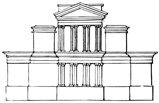
HOPE'S HOUSE, NEAR HARLAEM.
It is said this house will cost four tons of silver, or forty thousand
pounds sterling. The separation between the middle building
and wings in the upper story has a capricious appearance, yet
a pleasing one. The right wing of the house (which is the left
in the plan) extends back to a great length, so as to make the
ground plan in the form of an L. The parapet has a pannel of
wall, and a pannel of ballusters alternately, which lighten it.
There is no portico, the columns being backed against the wall
of the front.
March 30th, 31st. Amsterdam. Utrecht. Nimeguen. The
lower parts of the low countries seem partly to have been gained
from the sea, and partly to be made up of the plains of the Yssel,
the Rhine, the Maese and the Schelde united. To Utrecht nothing
but plains are seen, a rich black mould, wet, lower than the
level of the waters which intersect it; almost entirely in grass;
few or no farm-houses, as the business of grazing requires few
laborers. The canal is lined with country houses, which bespeak
the wealth and cleanliness of the country; but generally in an
uncouth state, and exhibiting no regular architecture. After
passing Utrecht, the hills north-east of the Rhine come into
view, and gather in towards the river, till at Wyck Dursted they
are within three or four miles, and at Amelengen they join the
river. The plains, after passing Utrecht, become more sandy;
the hills are very poor and sandy, generally waste in broom,
sometimes a little corn. The plains are in corn, grass, and willow.
The plantations of the latter are immense, and give it the
air of an uncultivated country. There are now few châteaux;
farm-houses abound, built generally of brick, and covered with
tile or thatch. There are some apple-trees, but no forest; a few
inclosures of willow wattling. In the gardens are hedges of
beach, one foot apart, which, not losing its old leaves till they
are pushed off in the spring by the young ones, gives the shelter
of evergreens. The Rhine is here about three hundred yards
wide, and the road to Nimeguen passing it a little below Wattelingen,
leaves Hetern in sight on the left. On this side, the
plains of the Rhine, the Ling, and the Waal unite. The Rhine
and Waal are crossed on vibrating boats, the rope supported by a
line of seven little barks. The platform by which you go on to
the ferry-boat is supported by boats. The view from the hill at
Cress is sublime. It commands the Waal, and extends far up the
Rhine. That also up and down the Waal from the Bellevue of
Nimeguen, is very fine. The château here is pretended to have
lodged Julius Cæsar. This is giving it an antiquity of at least
eighteen centuries, which must be apocryphal. Some few sheep
to-day, which were feeding in turnip patches.
April 1st. Cranenburg. Cleves. Santen. Reynberg. Hoogstraat.
The transition from ease and opulence to extreme poverty
is remarkable on crossing the line between the Dutch and
Prussian territories. The soil and climate are the same; the governments
alone differ. With the poverty, the fear also of slaves
is visible in the faces of the Prussian subjects. There is an improvement,
however, in the physiognomy, especially could it be
a little brightened up. The road leads generally over the hills,
but sometimes through skirts of the plains of the Rhine. These
are always extensive and good. They want manure, being visibly
worn down. The hills are almost always sandy, barren,
uncultivated, and insusceptible of culture, covered with broom
and moss; here and there a little indifferent forest, which is
sometimes of beach. The plains are principally in corn; some
grass and willow. There are no châteaux, nor houses that bespeak
the existence even of a middle class. Universal and equal
poverty overspreads the whole. In the villages, too, which seem
to be falling down, the over-proportion of women is evident.
The cultivators seem to live on their farms. The farm-houses
are of mud, the better sort of brick; all covered over with thatch.
Cleves is little more than a village. If there are shops or magazines
of merchandise in it, they show little. Here and there at
a window some small articles are hung up within the glass. The
goose-berry beginning to leaf.
April 2d. Passed the Rhine at Essenberg. It is there about
a quarter of a mile wide, or five hundred yards. It is crossed in
a scow with sails. The wind being on the quarter, we were
eight or ten minutes only in the passage. Duysberg is but a village
in fact, walled in; the buildings mostly of brick. No new
ones, which indicate a thriving state. I had understood that
near that were remains of the encampment of Varus, in which
he and his legions fell by the arms of Arminius (in the time of
Tiberius I think it was), but there was not a person to be found
in Duysberg who could understand either English, French, Italian,
or Latin. So I could make no inquiry.
From Duysberg to Dusseldorf the road leads sometimes over
the hills, sometimes through the plains of the Rhine, the quality
of which are as before described. On the hills, however, are
considerable groves of oak, of spontaneous growth, which seem
to be of more than a century; but the soil being barren, the trees,
though high, are crooked and knotty. The undergrowth is
broom and moss. In the plains is corn entirely. As they are
become rather sandy for grass, there are no inclosures on the
Rhine at all. The houses are poor and ruinous, mostly of brick,
and scantling mixed. A good deal of grape cultivated.
Dusseldorf. The gallery of paintings is sublime, particularly
the room of Vanderwerff. The plains from Dusseldorf to Cologne
are much more extensive, and go off in barren downs at some
distance from the river. These downs extend far, according to
appearance. They are manuring the plains with lime. A gate
at the Elector's château on this road in this form. We cross at
Cologne on a pendulum boat. I observe the hog
of this country (Westphalia), of which the celebrated
ham is made, is tall, gaunt, and with heavy
lop ears. Fatted at a year old, would weigh one hundred or one
hundred and twenty pounds. At two years old, two hundred
pounds. Their principal food is acorns. The pork, fresh, sells
at two and a half pence sterling the pound. The hams, ready
made, at eight and a half pence sterling the pound. One hundred
and six pounds of this country is equal to one hundred
pounds of Holland. About four pounds of fine Holland salt
is put on one hundred pounds of pork. It is smoked in a
room which has no chimney. Well-informed people here tell
me there is no other part of the world where the bacon is
smoked. They do not know that we do it. Cologne is the
principal market of exportation. They find that the small hog
makes the sweetest meat.

Cologne is a sovereign city, having no territory out of its
walls. It contains about sixty thousand inhabitants; appears to
have much commerce, and to abound with poor. Its commerce
is principally in the hands of Protestants, of whom there are
about sixty houses in the city. They are extremely restricted in
their operations, and otherwise oppressed in every form by the
government, which is Catholic, and excessively intolerant.
Their Senate, some time ago, by a majority of twenty-two to
eighteen, allowed them to have a church; but it is believed this
privilege will be revoked. There are about two hundred and
fifty Catholic churches in the city. The Rhine is here about
four hundred yards wide. This city is in 51° latitude, wanting
about 6´. Here the vines begin, and it is the most northern spot
on the earth on which wine is made. Their first grapes came
from Orleans, since that from Alsace, Champagne, &c. It is
thirty-two years only since the first vines were sent from Cassel,
near Mayence, to the Cape of Good Hope, of which the Cape
wine is now made. Afterwards new supplies were sent from the
same quarter. That I suppose is the most southern spot on the
globe where wine is made, and it is singular that the same vine
should have furnished two wines as much opposed to each other
in quality as in situation. I was addressed here by Mr. Damen,
of Amsterdam, to Mr. Jean Jaques Peuchen, of this place,
Merchant.
April 4th. Cologne. Bonne. Andernach. Coblentz. I saw
many walnut trees to-day in the open fields. It would seem as
if this tree and wine required the same climate. The soil begins
now to be reddish, both on the hills and in the plains.
Those from Cologne to Bonne extend about three miles from the
river on each side; but a little above Bonne they become contracted,
and continue from thence to be from one mile to nothing,
comprehending both sides of the river. They are in corn, some
clover and rape, and many vines. These are planted in rows
three feet apart both ways. The vine is left about six or eight
feet high, and stuck with poles ten or twelve feet high. To
these poles they are tied in two places, at the height of about
two and four feet. They are now performing this operation.
The hills are generally excessively steep, a great proportion of
them barren; the rest in vines principally, sometimes small
patches of corn. In the plains, though rich, I observed they
dung their vines plentifully; and it is observed here, as elsewhere,
that the plains yield much wine, but bad. The good is
furnished from the hills. The walnut, willow, and apple tree
beginning to leaf.
Andernach is the port on the Rhine to which the famous mill-stones
of Cologne are brought; the quarry, as some say, being
at Mendich, three or four leagues from thence. I suppose they
have been called Cologne mill-stones, because the merchants of
that place having the most extensive correspondence, have usually
sent them to all parts of the world. I observed great collections
of them at Cologne. This is one account.
April 5. Coblentz. Nassau. Another account is, that these
stones are cut at Triers and brought down the Moselle. I could
not learn the price of them at the quarry; but I was shown a
grind-stone of the same stone, five feet diameter, which cost at
Triers six florins. It was of but half the thickness of a mill-stone.
I supposed, therefore, that two mill-stones would cost
about as much as three of these grind-stones, i. e. about a guinea
and a half. This country abounds with slate.
The best Moselle wines are made about fifteen leagues from
hence, in an excessively mountainous country. The first quality
(without any comparison) is that made on the mountain of
Brownberg, adjoining to the village of Dusmond; and the best
crops is that of the Baron Breidbach Burrhesheim, grand chambellan
et grand Baillif de Coblentz. His Receveur, of the name
of Mayer, lives at Dusmond. The last fine year was 1783,
which sells now at fifty louis the foudre, which contains six
aumes of one hundred and seventy bottles each, equal about one
thousand one hundred and ten bottles. This is about twenty-two
sous Tournois the bottle. In general, the Baron Burrhesheim's
crops will sell as soon as made, say at the vintage, for
one hundred and thirty, one hundred and forty, and one hundred
and fifty ecus the foudre (the ecu is one and a half florin of Holland),
say two hundred. 2. Vialen is the second quality, and sells
new at one hundred and twenty ecus the foudre. 3. Crach-Bispost
is the third, and sells for about one hundred and five ecus. I
compared Crach of 1783 with Baron Burrhesheim's of the same
year. The latter is quite clear of acid, stronger, and very sensibly
the best. 4. Selting, which sells at one hundred ecus. 5.
Kous-Berncastle, the fifth quality, sells at eighty or ninety.
After this there is a gradation of qualities down to thirty ecus.
These wines must be five or six years old before they are quite
ripe for drinking. One thousand plants yield a foudre of wine
a year in the most plentiful vineyards. In other vineyards, it
will take two thousand or two thousand and five hundred plants
to yield a foudre. The culture of one thousand plants costs
about one louis a year. A day's labor of a man is paid in winter
twenty kreitzers (i. e. one-third of a florin), in summer twenty-six;
a woman's is half that. The red wines of this country are
very indifferent, and will not keep. The Moselle is here from
one hundred to two hundred yards wide; the Rhine three hundred
to four hundred. A jessamine in the Count de Moustier's
garden in leaf.
In the Elector of Treves' palace at Coblentz, are large rooms
very well warmed by warm air conveyed from an oven below,
through tubes which open into the rooms. An oil and vinegar
cruet in this form:  At Coblentz we pass the river on a
pendulum boat, and the road to Nassau is over tremendous hills,
on which is here and there a little corn, more vines, but mostly
barren. In some of these barrens are forests of beach and oak,
tolerably large, but crooked and knotty; the undergrowth beach
brush, broom, and moss. The soil of the plains, and of the
hills where they are cultivable, is reddish. Nassau is a village
the whole rents of which should not amount to more than a
hundred or two guineas. Yet it gives the title of Prince to the
house of Orange to which it belongs.
April 6th. Nassau. Schwelbach. Wisbaden. Hocheim.
Frankfort. The road from Nassau to Schwelbach is over hills,
or rather mountains, both high and steep; always poor, and
above half of them barren in beach and oak. At Schwelbach
there is some chesnut. The other parts are either in winter
grain, or preparing for that of the spring. Between Schwelbach
and Wisbaden we come in sight of the plains of the Rhine,
which are very extensive. From hence the lands, both high
and low, are very fine, in corn, vines, and fruit trees. The
country has the appearance of wealth, especially in the approach
to Frankfort.
April 7th. Frankfort. Among the poultry, I have seen no
turkies in Germany till I arrive at this place. The Stork, or
Crane, is very commonly tame here. It is a miserable, dirty,
ill-looking bird. The Lutheran is the reigning religion here,
and is equally intolerant to the Catholic and Calvinist, excluding
them from the free corps.
April 8th. Frankfort. Hanau. The road goes through the
plains of the Maine, which are mulatto, and very fine. They
are well cultivated till you pass the line between the republic
and the landgraviate of Hesse, when you immediately see the
effect of the difference of government, notwithstanding the tendency
which the neighborhood of such a commercial town as
Frankfort has to counteract the effects of tyranny in its vicinities,
and to animate them in spite of oppression. In Frankfort
all is life, bustle, and motion; in Hanau the silence and quiet
of the mansions of the dead. Nobody is seen moving in the
streets; every door is shut; no sound of the saw, the hammer,
or other utensil of industry. The drum and fife is all that is
heard. The streets are cleaner than a German floor, because
nobody passes them. At Williamsbath, near Hanau, is a country
seat of the Landgrave. There is a ruin which is clever.
It presents the remains of an old castle. The ground plan is
in this form:  The upper story in this:
 A circular
room of thirty-one and a half feet diameter within. The
four little square towers at the corners finish at the floor of the
upper story, so as to be only platforms to walk out on. Over the
circular room is a platform also, which is covered by the broken
parapet which once crowned the top, but is now fallen off some
parts, whilst the other parts remain.
 I like better, however, the
form of the ruin at Hagley, in England, which was thus a centry
box here, covered over with bark, so as to look exactly like
the trunk of an old tree. This is a good idea;
and may be of much avail in a garden. There
is a hermitage in which is a good figure of a hermit
in plaster, colored to the life, with a table and
book before him, in the attitude of reading and
contemplation. In a little cell is his bed; in another his books,
some tools, &c.; in another his little provision of firewood,
&c. There is a monument erected to the son of the present
landgrave, in the form of a pyramid, the base of which is
eighteen and a half feet. The side declines from the perpendicular
about twenty-one and a half degrees. An arch is carried
through it both ways so as present a door in each side. In the
middle of this, at the crossing of the two arches, is a marble
monument with this inscription: "ante tempus." He died at
twelve years of age. Between Hanau and Frankfort, in sight
of the road, is the village of Bergen, where was fought the battle
of Bergen in the war before last. Things worth noting
here are: 1. A folding ladder. 2. Manner of packing china
cups and saucers, the former in a circle within the latter. 3. The
marks of different manufactures of china, to wit: Dresden
with two swords. Hecks with a wheel with
 , Frankendaal
with
 (for Charles Theodore), and a
 over it. Berlin
with 4. The top rail of a wagon supported by the washers on
the ends of the axle-trees.
April 10th. Frankfort. Hocheim. Mayence. The little
tyrants round about having disarmed their people, and made it
very criminal to kill game, one knows when they quit the territory
of Frankfort by the quantity of game which is seen. In
the Republic, everybody being allowed to be armed, and to
hunt on their own lands, there is very little game left in its
territory. The hog hereabouts resembles extremely the little
hog of Virginia. Round like that, a small head, and short upright
ears. This makes the ham of Mayence so much esteemed
at Paris.
We cross the Rhine at Mayence on a bridge one thousand
eight hundred and forty feet long, supported by forty-seven
boats. It is not in a direct line, but curved up against the stream;
which may strengthen it if the difference between the upper and
lower curve be sensible, if the planks of the floor be thick,
well jointed together, and forming sectors of circles, so as to act
on the whole as the stones of an arch. But it has by no means
this appearance. Near one end, one of the boats has an axis in
peritrochio, and a chain, by which it may be let drop down
stream some distance, with the portion of the floor belonging to
it, so as to let a vessel through. Then it is wound up again
into place, and to consolidate it the more with the adjoining
parts, the loose section is a little higher, and has at each end a
folding stage, which folds back on it when it moves down, and
when brought up again into place, these stages are folded over
on the bridge. This whole operation takes but four or five minutes.
In the winter the bridge is taken away entirely, on account
of the ice. And then everything passes on the ice
through the whole winter.
April 11th. Mayence. Rudesheim. Johansberg. Markebronn.
The women do everything here. They dig the earth,
plough, saw, cut and split wood, row, tow the batteaux, &c.
In a small but dull kind of batteau, with two hands rowing
with a kind of large paddle, and a square sail, but scarcely a
breath of wind, we went down the river at the rate of five
miles an hour, making it three and a half hours to Rudesheim.
The floats of wood which go with the current only, go
one mile and a half an hour. They go night and day. There
are five boat-mills abreast here. Their floats seem to be about
eight feet broad. The Rhine yields salmon, carp, pike, and
perch, and the little rivers running into it yield speckled trout.
The plains from Maintz to Rudesheim are good and in corn;
the hills mostly in vines. The banks of the river are so low
that, standing up in the batteau, I could generally see what was
in the plains. Yet they are seldom overflowed.
A TOWER AT RUDESHEIM.
Though they begin to make wine, as has been said, at Cologne,
and continue it up the river indefinitely, yet it is only from
Rudesheim to Hocheim that wines of the
very first quality are made. The river happens
there to run due east and west, so as to
give its hills on that side a southern aspect.
And even in this canton, it is only Hocheim,
Johansberg, and Rudesheim, that are considered
as of the very first quality. Johansberg
is a little mountain (berg signifies mountain),
whereon is a religious house, about
fifteen miles below Mayence, and near the
village of Vingel. It has a southern aspect,
the soil a barren mulatto clay, mixed with a
good deal of stone, and some slate. This
wine used to be but on a par with Hocheim
and Rudesheim; but the place having come to the Bishop of
Fulda, he improved its culture so as to render it stronger; and
since the year 1775, it sells at double the price of the other two.
It has none of the acid of the Hocheim and other Rhenish wines.
There are about sixty tons made in a good year, which sell, as
soon as of a drinkable age, at one thousand franks each. The
tun here contains seven and a-half aumes of one hundred and
seventy bottles each. Rudesheim is a village of about eighteen
or twenty miles below Mayence. Its fine wines are made on
the hills about a mile below the village, which look to the south,
and on the middle and lower parts of them. They are terraced.
The soil is gray, about one-half of slate and rotten stone, the
other half of barren clay, excessively steep. Just behind the village
also is a little spot, called Hinder House, belonging to the Counts
of Sicken and Oschstein, whereon each makes about a ton of wine
of the very first quality. This spot extends from the bottom to
the top of the hill. The vignerons of Rudesheim dung their
wines about once in five or six years, putting a one-horse tumbrel
load of dung on every twelve feet square. One thousand plants
yield about four aumes in a good year. The best crops are,
| The Chanoines of Mayence, who make |
15 |
pieces of |
7½ aumes. |
| Le Comte de Sicken |
6 |
" |
" |
| Le Comte d'Oschstein |
9 |
" |
" |
| L'Electeur de Mayence |
6 |
" |
" |
| Le Comte de Meternisch |
6 |
" |
" |
| Monsieur de Boze |
5 |
" |
" |
| M. Ackerman, baliff et aubergiste des 3 couronnes |
8 |
" |
" |
| M. Ackerman le fils, aubergiste à la couronne |
5 |
" |
" |
| M. Lynn, aubergiste de l'ange |
5 |
" |
" |
| Baron de Wetzel |
7 |
" |
" |
| Convent de Mariahousen, des religieuses
Benedictines |
7 |
" |
" |
| M. Johan Yung |
8 |
" |
" |
| M. de Rieden |
5 |
" |
" |
|
92 |
These wines begin to be drinkable at about five years old.
The proprietors sell them old or young, according to the prices
offered, and according to their own want of money. There is
always a little difference between different casks, and therefore
when you choose and buy a single cask, you pay three, four,
five or six hundred florins for it. They are not at all acid, and
to my taste much preferable to Hocheim, though but of the same
price. Hocheim is a village about three miles above Mayence,
on the Maine, where it empties into the Rhine. The spot
whereon the good wine is made is the hill side from the church
down to the plain, a gentle slope of about a quarter of a mile
wide, and extending half a mile towards Mayence. It is of
south-western aspect, very poor, sometimes gray, sometimes mulatto,
with a moderate mixture of small broken stone. The
wines are planted three feet apart, and stuck with sticks about
six feet high. The wine, too, is cut at that height. They are
dunged once in three or four years. One thousand plants yield
from one to two aumes a year: they begin to yield a little at
three years old, and continue to one hundred years, unless sooner
killed by a cold winter. Dick, keeper of the Rothen-house
tavern at Frankfort, a great wine merchant, who has between
three and four hundred tons of wine in his cellars, tells me that
Hocheim of the year 1783, sold, as soon as it was made, at ninety
florins the aume, Rudesheim of the same year, as soon as made,
at one hundred and fifteen florins, and Markebronn seventy florins.
But a peasant of Hocheim tells me that the best crops of Hocheim
in the good years, when sold new, sell but for about thirty-two
or thirty-three florins the aume; but that it is only the poorer
proprietors who sell new. The fine crops are,
| Count Ingleheim about |
10 tuns. } |
All of these keep till about
fifteen years old, before
they sell, unless they are
offered a very good price
sooner. |
| Baron d'Alberg |
8 tuns } |
| Count Schimbon |
14 tuns } |
| The Chanoines of Mayence |
18 tuns } |
| Counsellor Schik de Vetsler |
15 tuns } |
| Convent of Jacobsberg |
8 tuns } |
| The Chanoine of Fechbach |
10 tuns } |
| The Carmelites of Frankfort |
8 tuns |
Who only sell by the bottle in their own tavern in Frankfort. |
| The Bailiff of Hocheim |
11 tuns |
Who sells at three or four years old. |
| Zimmerman, a bourgeois |
4 tuns } |
These being poor, sell new. |
| Feldman, a carpenter |
2 tuns } |
Markebronn (bronn signifies a spring, and is probably of affinity
with the Scotch word, burn) is a little canton in the same
range of hills, adjoining to the village of Hagenheim, about three
miles above Johansberg, subject to the elector of Mayence. It is
a sloping hill side of southern aspect, mulatto, poor, and mixed
with some stone. This yields wine of the second quality.
April 12th. Mayence. Oppenheim. Dorms. Manheim.
On the road between Mayence and Oppenheim are three cantons,
which are also esteemed as yielding wines of the second quality.
These are Laudenheim, Bodenheim, and Nierstein. Laudenheim
is a village about four or five miles from Mayence. Its wines
are made on a steep hill side, the soil of which is gray, poor and
mixed with some stone. The river there happens to make a
short turn to the south-west, so as to present its hills to the
south-east. Bodenheim is a village nine miles, and Nierstein
another about ten or eleven miles from Mayence. Here, too, the
river is north-east and south-west, so as to give the hills between
these villages a south-east aspect; and at Thierstein, a valley
making off, brings the face of the hill round to the south. The
hills between these villages are almost perpendicular, of a vermilion
red, very poor, and having as much rotten stone as earth.
It is to be observed that these are the only cantons on the south
side of the river which yield good wine, the hills on this side
being generally exposed to the cold winds, and turned from the
sun. The annexed bill of prices current, will give an idea of the
estimation of these wines respectively.
With respect to the grapes in this country, there are three
kinds in use for making white wine, (for I take no notice of the
red wines, as being absolutely worthless.) 1. The Klemperien,
of which the inferior qualities of Rhenish wines are made, and
is cultivated because of its hardness. The wines of this grape
descend as low as one hundred florins the tun of eight aumes.
2. The Rhysslin grape, which grows only from Hocheim down
to Rudesheim. This is small and delicate, and therefore succeeds
only in this chosen spot. Even at Rudesheim it yields a
fine wine only in the little spot called Hinder House, before mentioned;
the mass of good wines made at Rudesheim, below the
village, being of the third kind of grape, which is called the
Orleans grape.
To Oppenheim the plains of the Rhine and Maine are united.
From that place we see the commencement of the Bergstrasse,
or mountains which separate at first the plains of the Rhine and
Maine, then cross the Neckar at Heidelberg, and from thence
forms the separation between the plains of the Neckar and Rhine,
leaving those of the Rhine about ten or twelve miles wide.
These plains are sometimes black, sometimes mulatto, always
rich. They are in corn, potatoes, and some willow. On the
other side again, that is, on the west side, the hills keep at first
close to the river. They are about one hundred and fifty, or
two hundred feet high, sloping, red, good, and mostly in vines.
Above Oppenheim, they begin to go off till they join the mountains
of Lorraine and Alsace, which separate the waters of the
Moselle and Rhine, leaving to the whole valley of the Rhine
about twenty or twenty-five miles breadth. About Worms these
plains are sandy, poor, and often covered only with small pine.
April 13th. Manheim. There is a bridge over the Rhine
here, supported on thirty-nine boats, and one over the Neckar on
eleven boats. The bridge over the Rhine is twenty-one and a
half feet wide from rail to rail. The boats are four feet deep,
fifty-two feet long, and nine feet eight inches broad. The space
between boat and boat is eighteen feet ten inches. From these
data the length of the bridge should be 9ft. 8in. + 18ft. 10in. ×
40 = 1140 feet. In order to let vessels pass through, two boats
well framed together, with their flooring, are made to fall down
stream together. Here, too, they make good ham. It is fattened
on round potatoes and Indian corn. The farmers smoke
what is for their own use in their chimneys. When it is made
for sale, and in greater quantities than the chimney will hold,
they make the smoke of the chimney pass into an adjoining loft,
or apartment, from which it has no issue; and here they hang
their hams.

An economical curtain bedstead. The bedstead is seven feet
by four feet two inches. From each leg there goes up an iron
rod three-eighths of an inch in diameter. Those from the legs at
the foot of the bed meeting at top as in the margin,
and those from the head meeting in like manner, so
that the two at the foot form one point, and the
two at the head another. On these points lays an
oval iron rod, whose long diameter is five feet, and
short one three feet one inch. There is a hole
through this rod at each end, by which it goes on firm on the
point of the upright rods. Then a nut screws it down firmly.
Ten breadths of stuff two feet ten inches wide, and eight feet six
inches long, form the curtains. There is no top nor vallons. The
rings are fastened within two and a half or three inches of the
top on the inside, which two and a half or three inches stand up,
and are an ornament somewhat like a ruffle.
I have observed all along the Rhine that they make the oxen
draw by the horns. A pair of very handsome chariot horses, large,
bay, and seven years old, sell for fifty louis. One pound of beef
sells for eight kreitzers, (i. e. eight sixtieths of a florin;) one
pound of mutton or veal, six kreitzers; one pound of pork, seven
and a half kreitzers; one pound of ham, twelve kreitzers; one
pound of fine wheat bread, two kreitzers; one pound of butter,
twenty kreitzers; one hundred and sixty pounds of wheat, six
francs; one hundred and sixty pounds of maize, five francs; one
hundred and sixty pounds of potatoes, one franc; one hundred
pounds of hay, one franc; a cord of wood (which is 4 4 and 6
feet), seven francs; a laborer by the day receives twenty-four
kreitzers, and feeds himself. A journee or arpent of land (which
is eight by two hundred steps), such as the middling plains of
the Rhine, will sell for two hundred francs. There are more
soldiers here than other inhabitants, to wit: six thousand soldiers
and four thousand males of full age of the citizens, the whole
number of whom is reckoned at twenty thousand.
April 14th. Manheim. Dossenheim. Heidelberg. Schwetzingen
Manheim. The elector placed, in 1768, two males and
five females of the Angora goat at Dossenheim, which is at the
foot of the Bergstrasse mountains. He sold twenty-five last
year, and has now seventy. They are removed into the mountains
four leagues beyond Dossenheim. Heidelberg is on the
Neckar just where it issues from the Bergstrasse mountains, occupying
the first skirt of plain which it forms. The château is
up the hill a considerable height. The gardens lie above the
château, climbing up the mountain in terraces. This château
is the most noble ruin I have ever seen, having been reduced to
that state by the French in the time of Louis XIV., 1693. Nothing
remains under cover but the chapel. The situation is
romantic and pleasing beyond expression. It is on a great scale
much like the situation of Petrarch's château, at Vaucluse, on a
small one. The climate, too, is like that of Italy. The apple,
the pear, cherry, peach, apricot, and almond, are all in bloom.
There is a station in the garden to which the château re-echoes
distinctly four syllables. The famous ton of Heidelberg was
new built in 1751, and made to contain thirty foudres more than
the ancient one. It is said to contain two hundred and thirty-six
foudres of one thousand two hundred bottles each. I measured
it, and found its length external to be twenty-eight feet ten
inches; its diameter at the end twenty feet three inches; the
thickness of the staves seven and a half inches; thickness of
the hoops seven and a half inches; besides a great deal of
external framing. There is no wine in it now. The gardens at
Schwetzingen show how much money may be laid out to make
an ugly thing. What is called the English quarter, however,
relieves the eye from the straight rows of trees, round and square
basins, which constitute the great mass of the garden. There
are some tolerable morsels of Grecian architecture, and a good
ruin. The Aviary, too, is clever. It consists of cells of about
eight feet wide, arranged round, and looking into a circular area
of about forty or fifty feet diameter. The cells have doors both
of wire and glass, and have small shrubs in them. The plains
of the Rhine on this side are twelve miles wide, bounded by
the Bergstrasse mountains. These appear to be eight hundred
or a thousand feet high; the lower part in vines, from which is
made what is called the vin de Nichar; the upper in chesnut.
There are some cultivated spots however, quite to the top. The
plains are generally mulatto, in corn principally; they are planting
potatoes in some parts, and leaving others
open for maize and tobacco. Many peach
and other fruit trees on the lower part of the
mountain. The paths on some parts of these
mountains are somewhat in the style represented in the margin.

Manheim. Kaeferthal. Manheim. Just beyond Kaeferthal
is an extensive, sandy waste, planted in pine, in which the elector
has about two hundred sangliers, tamed. I saw about fifty;
the heavies I am told, would weigh about three hundred pounds.
They are fed on round potatoes, and range in the forest of pines.
At the village of Kaeferthal is a plantation of rhubarb, begun
in 1769 by a private company. It contains twenty arpens or
jourries, and its culture costs about four or five hundred francs a
year; it sometimes employs forty or fifty laborers at a time.
The best age to sell the rhubarb at is the fifth or sixth year, but
the sale being dull, they keep it sometimes to the tenth year;
they find it best to let it remain in the ground. They sell about
two hundred kentals a year at two or three francs a pound, and
could sell double that quantity from the ground if they could find
a market. The apothecaries of Francfort and of England are
the principal buyers. It is in beds, resembling lettice-beds; the
plants four, five or six feet apart. When dug, a thread is passed
through every piece of root, and it is hung separate in a kind of
rack; when dry it is rasped; what comes off is given to the cattle.
April 15. Manheim. Spire. Carlsruhe. The valley preserves
its width, extending on each side of the river about ten or
twelve miles, but the soil loses much in its quality, becoming
sandy and lean, often barren and overgrown with pine thicket.
At Spire is nothing remarkable. Between that and Carlsruhe we
pass the Rhine in a common skow with oars, where it is between
three and four hundred yards wide. Carlsruhe is the residence of
the Margrave of Baden, a sovereign prince. His château is built
in the midst of a natural forest of several leagues diameter, and
of the best trees I have seen in these countries: they are mostly
oak, and would be deemed but indifferent in America. A great
deal of money has been spent to do more harm than good to the
ground—cutting a number of straight allies through the forest.
He has a pheasantry of the gold and silver kind, the latter very
tame, but the former excessively shy. A little inclosure of stone,
two and a half feet high and thirty feet diameter, in which are
two tamed beavers. There is a pond of fifteen feet diameter in
the centre, and at each end a little cell for them to retire into,
which is stowed with boughs and twigs with leaves on them,
which is their principal food. They eat bread also;—twice a
week the water is changed. They cannot get over this wall
Some cerfs of a peculiar kind, spotted like fawns, the horns remarkably
long, small and sharp, with few points. I am not
sure there were more than two to each main beam, and if I saw
distinctly, there came out a separate and subordinate beam from
the root of each. Eight angora goats—beautiful animals—all
white. This town is only an appendage of the
château, and but a moderate one. It is a league from Durlach,
half way between that and the river. I observe
they twist the flues of their stoves in any form for
ornament merely, without smoking, as thus, e. g.

April 16. Carlsruhe. Rastadt. Scholhoven. Bischofheim.
Kehl. Strasburg. The valley of the Rhine still preserves its
breadth, but varies in quality; sometimes a rich mulatto loam,
sometimes a poor sand, covered with small pine. The culture
is generally corn. It is to be noted, that through the whole of
my route through the Netherlands and the valley of the Rhine,
there is a little red clover every here and there, and a great deal
of grape cultivated. The seed of this is sold to be made into oil.
The grape is now in blossom. No inclosures. The fruit trees are
generally blossoming through the whole valley. The high
mountains of the Bergstrasse, as also of Alsace, are covered with
snow. Within this day or two, the every-day dress of the country
women here is black. Rastadt is a seat also of the Margrave
of Baden. Scholhoven and Kehl are in his territory, but not
Bischofheim. I see no beggars since I entered his government,
nor is the traveller obliged to ransom himself every moment by
a chausiee gold. The roads are excellent, and made so, I presume,
out of the coffers of the prince. From Cleves till I enter
the Margravate of Baden, the roads have been strung with beggars—in
Hesse the most, and the road tax very heavy. We pay
it cheerfully, however, through the territory of Francfort and
thence up the Rhine, because fine gravelled roads are kept up;
but through the Prussian, and other parts of the road below
Francfort, the roads are only as made by the carriages, there not
appearing to have been ever a day's work employed on them.
At Strasburgh we pass the Rhine on a wooden bridge.
At Brussels and Antwerp, the fuel is pit-coal, dug in Brabant.
Through all Holland it is turf. From Cleves to Cologne it is
pit-coal brought from England. They burn it in open stoves.
From thence it is wood, burnt in close stoves, till you get to
Strasburg, where the open chimney comes again into use.
April 16th, 17th, 18th. Strasburg. The vin de paille is
made in the neighborhood of Colmar, in Alsace, about ——
from this place. It takes its name from the circumstance of
spreading the grapes on straw, where they are preserved till
spring, and then made into wine. The little juice then remaining
in them makes a rich sweet wine, but the dearest in the
world, without being the best by any means. They charge nine
florins the bottle for it in the taverns of Strasburg. It is the caprice
of wealth alone which continues so losing an operation.
This wine is sought because dear; while the better wine of
Frontignan is rarely seen at a good table because it is cheap.
Strasburg. Saverne. Phalsbourg. As far as Saverne the
country is in waiving hills and hollows; red, rich enough; mostly
in small grain, but some vines; a little stone. From Saverne
to Phalsbourg we cross a considerable mountain, which takes an
hour to rise it.

Fig.1

Fig.2
April 19th. Phalsbourg. Fenestrange. Moyenvic. Nancy.
Asparagus to-day at Moyenvic. The country is always either
mountainous or hilly; red, tolerably good, and in small grain.
On the hills about Fenestrange, Moyenvic, and Nancy, are some
small vineyards where a bad wine is made. No inclosures.
Some good sheep, indifferent cattle, and small horses. The most
forest I have seen in France, principally of beech, pretty large.
The houses, as in Germany, are of scantling, filled in with wicker
and mortar, and covered either with thatch or tiles. The people,
too, here as there, are gathered in villages. Oxen plough here
with collars and hames. The awkward figure of their mould-board
leads one to consider what should be its form. The offices
of the mould-board are to receive the sod after the share has
cut under it, to raise it gradually, and to reverse it. The fore-end
of it then, should be horizontal to enter under the sod, and
the hind end perpendicular to throw it over; the intermediate surface
changing gradually from the horizontal to the perpendicular
It should be as wide as the furrow, and of a length suited to the
construction of the plough. The following would seem a good
method of making it: Take a block, whose length, breadth and
thickness, is that of your intended mould-board, suppose two and
a half feet long and eight inches broad and thick. Draw the
lines a d and c d, figure 1, with a saw, the
toothed edge of which is straight, enter at a and
cut on, guiding the hind part of the saw on the
line a b, and the fore part on the line a d, till the
saw reaches the points c and d, then enter it at
c and cut on, guiding it by the lines c b and c d
till it reaches the points b and d. The quarter, a b c d, will then
be completely cut out, and the diagonal from d to b laid bare.
The piece may now be represented as in figure 2. Then saw
in transversely at every two inches till the saw reaches the line c e,
and the diagonal b d, and cut out the pieces with an adze. The
upper surface will thus be formed. With a gauge opened to
eight inches, and guided by the lines c e, scribe the upper edge
of the board from d b, cut that edge perpendicular to the face
of the board, and scribe it of the proper thickness. Then form
the underside by the upper, by cutting transversely with the saw
and taking out the piece with an adze. As the upper edge of
the wing of the share rises a little, the fore end of the board,
b c, will rise as much from a strict horizontal position, and will
throw the hind end, e d, exactly as much beyond the perpendicular,
so as to promote the reversing of the sod. The women here,
as in Germany, do all sorts of work. While one considers them
as useful and rational companions, one cannot forget that they
are also objects of our pleasures; nor can they ever forget it.
While employed in dirt and drudgery, some tag of a ribbon,
some ring, or bit of bracelet, earbob or necklace, or something
of that kind, will show that the desire of pleasing is never suspended
in them. It is an honorable circumstance for man, that
the first moment he is at his ease, he allots the internal employments
to his female partner, and takes the external on himself.
And this circumstance, or its reverse, is a pretty good indication
that a people are, or are not at their ease. Among the Indians,
this indication fails from a particular cause: every Indian man
is a soldier or warrior, and the whole body of warriors constitute
a standing army, always employed in war or hunting. To
support that army, there remain no laborers but the women.
Here, then, is so heavy a military establishment, that the civil
part of the nation is reduced to women only. But this is a
barbarous perversion of the natural destination of the two sexes.
Women are formed by nature for attentions, not for hard labor.
A woman never forgets one of the numerous train of little offices
which belong to her. A man forgets often.
April 20th. Nancy. Toule. Void. Ligny en Barrois. Bar
le Duc. St. Dizier. Nancy itself is a neat little town, and its
environs very agreeable. The valley of the little branch of the
Moselle, on which it is, is about a mile wide: the road then
crossing the head-waters of the Moselle, the Maes, and the Marne,
the country is very hilly, and perhaps a third of it poor and in
forests of beech: the other two-thirds from poor up to middling,
red, and stony. Almost entirely in corn, now and then only
some vines on the hills. The Moselle at Toule is thirty or forty
yards wide: the Maese near Void about half that: the Marne at
St. Dizier about forty yards. They all make good plains of
from a quarter of a mile to a mile wide. The hills of the Maese
abound with chalk. The rocks coming down from the tops of
the hills, on all the road of this day, at regular intervals like the
ribs of an animal, have a very irregular appearance. Considerable
flocks of sheep and asses, and, in the approach to St. Dizier,
great plantations of apple and cherry trees; here and there a
peach tree, all in general bloom. The roads through Lorraine
are strung with beggars.
April 21st. St. Dizier. Vitry le Français. Chalons sur
Marne. Epernay. The plains of the Marne and Sault uniting,
appear boundless to the eye till we approach their confluence at
Vitry, where the hills come in on the right; after that the plains
are generally about a mile, mulatto, of middling quality, sometimes
stony. Sometimes the ground goes off from the river so
sloping, that one does not know whether to call it high or low
land. The hills are mulatto also, but whitish, occasioned by the
quantity of chalk which seems to constitute their universal base.
They are poor, and principally in vines. The streams of water
are of the color of milk, occasioned by the chalk also. No inclosures,
some flocks of sheep; children gathering dung in the
roads. Here and there a château; but none considerable.
April 22d. Epernay. The hills abound with chalk. Of this
they make lime, not so strong as stone lime, and therefore to be
used in greater proportion. They cut the blocks into regular
forms also, like stone, and build houses of it. The common
earth too, well impregnated with this, is made into mortar,
moulded in the form of brick, dried in the sun, and houses built
of them which last one hundred or two hundred years. The
plains here are a mile wide, red, good, in corn, clover, Luzerne,
St. Foin. The hills are in vines, and this being precisely the
canton where the most celebrated wines of Champagne are made,
details must be entered into. Remember, however, that they
will always relate to the white wines, unless where the red are
expressly mentioned. The reason is that their red wines, though
much esteemed on the spot, are by no means esteemed elsewhere
equally with their white; nor do they merit equal esteem.
A Topographical sketch of the position of the wine villages, the
course of the hills, and consequently the aspect of the vine-yards.
Soil, meagre, mulatto clay, mixed with small broken stone,
and a little hue of chalk. Very dry.
Aspect, may be better seen by the annexed diagram. The wine
of Aij is made from a to b, those of Dizij from b to c, Auvillij d
to e, Cumieres e to f, Epernay g to h, Perij i to k. The hills are
generally about two hundred and fifty feet high. The good
wine is made only in the middle region. The lower region,
however, is better than the upper; because this last is exposed
to cold winds, and a colder atmosphere.
Culture. The vines are planted two feet apart. Afterwards
they are multiplied (provignés). When a stock puts out two
shoots they lay them down, spread them open and cover them
with earth, so as to have in the end about a plant for every square
foot. For performing this operation they have a hook, of this
shape,  and nine inches long, which, being stuck in the
ground, holds down the main stock, while the laborer separates
and covers the new shoot. They leave two buds above the
ground. When the vine has shot up high enough, they stick it
with split sticks of oak, from an inch to an inch and a half square,
and four feet long, and tie the vine to its stick with straw. These
sticks cost two florins the hundred, and will last forty years. An
arpent, one year with another, in the fine vineyards, gives twelve
pieces, and in the inferior vineyards twenty-five pieces, of two
hundred bottles each. An arpent of the first quality sells for
three thousand florins, and there have been instances of seven
thousand two hundred florins. The arpent contains one hundred
verges, of twenty-two pieds square. The arpent of inferior
quality sells at one thousand florins. They plant the vines in a
hole about a foot deep, and fill that hole with good mould, to
make the plant take. Otherwise it would perish. Afterwards,
if ever they put dung, it is very little. During wheat harvest
there is a month or six weeks that nothing is done in the vine-yard,
that is to say, from the 1st of August to the beginning of
vintage. The vintage commences early in September, and lasts
a month. A day's work of a laborer in the busiest season is
twenty sous, and he feeds himself: in the least busy season it is
fifteen sous. Corn lands are rented from four florins to twenty-four;
but vine lands are never rented. The three façons (or
workings) of an arpent cost fifteen florins. The whole year's
expense of an arpent is worth one hundred florins.
Grapes.—The bulk of their grapes are purple, which they prefer
for making even white wine. They press them very lightly,
without treading or permitting them to ferment at all, for about
an hour; so that it is the beginning of the running only which
makes the bright wine. What follows the beginning is of a
straw color, and therefore not placed on a level with the first.
The last part of the juice, produced by strong pressure, is red
and ordinary. They choose the bunches with as much care, to
make wine of the very first quality, as if to eat. Not above one-eighth
of the whole grapes will do for this purpose. The white
grape, though not so fine for wine as the red, when the red can
be produced, and more liable to rot in a moist season, yet grows
better if the soil be excessively poor, and therefore in such a soil
is preferred, or rather, is used of necessity, because there the red
would not grow at all.
Wine.—The white wines are either mousseux, sparkling, or
non-mousseux, still. The sparkling are little drunk in France,
but are almost alone known and drunk in foreign countries.
This makes so great a demand, and so certain a one, that it is
the dearest by about an eighth, and therefore they endeavor to
make all sparkling if they can. This is done by bottling in the
spring, from the beginning of March till June. If it succeeds,
they lose abundance of bottles, from one-tenth to one-third.
This is another cause increasing the price. To make the still
wine, they bottle in September. This is only done when they
know from some circumstance that the wine will not be sparkling.
So if the spring bottling fails to make a sparkling wine,
they decant it into other bottles in the fall, and it then makes the
very best still wine. In this operation, it loses from one-tenth to
one-twentieth by sediment. They let it stand in the bottles in
this case forty-eight hours, with only a napkin spread over their
mouths, but no cork. The best sparkling wine, decanted in this
manner, makes the best still wine, and which will keep much
longer than that originally made still by being bottled in September.
The sparkling wines lose their briskness the older they are,
but they gain in quality with age to a certain length. These
wines are in perfection from two to ten years old, and will even
be very good to fifteen. 1766 was the best year ever known.
1775 and 1776 next to that. 1783 is the last good year, and
that not to be compared with those. These wines stand icing
very well.
Aij. M. Dorsay makes one thousand and one hundred pieces,
which sell, as soon as made, at three hundred florins, and in good
years four hundred florins, in the cask. I paid in his cellar, to
M. Louis, his homme d'affaires, for the remains of the year 1783,
three florins ten sous the bottle. Sparkling Champagne, of the
same degree of excellence, would have cost four florins, (the
piece and demiqueue are the same; the feuillette is one hundred
bottles.) M. le Duc makes four hundred to five hundred pieces.
M. de Villermont, three hundred pieces. M. Janson, two hundred
and fifty pieces. All of the first quality, red and white in
equal quantities.
Auvillaij. The Benedictine monks make one thousand pieces,
red and white, but three-fourths red, both of the first quality.
The king's table is supplied by them. This enables them to
sell at five hundred and fifty florins the piece. Though their
white is hardly as good as Dorsay's, their red is the best. L'Abbatiale,
belonging to the bishop of the place, makes one thousand
to twelve hundred pieces, red and white, three-fourths red,
at four hundred to five hundred and fifty florins, because neighbors
to the monks.
Cumieres is all of the second quality, both red and white, at
one hundred and fifty to two hundred florins the piece.
Epernay. Madame Jermont makes two hundred pieces at
three hundred florins. M. Patelaine, one hundred and fifty pieces.
M. Mare, two hundred pieces. M. Chertems, sixty pieces. M.
Lauchay, fifty pieces. M. Cousin (Aubergiste de l'hôtel de
Róhan à Epernay), one hundred pieces. M. Pierrot, one hundred
pieces. Les Chanoines regulieres d'Epernay, two hundred
pieces. Mesdames les Ursulines religieuses, one hundred pieces.
M. Gilette, two hundred pieces. All of the first quality; red
and white in equal quantities.
Pierrij. M. Casotte makes five hundred pieces. M. de la
Motte, three hundred pieces. M. de Failli, three hundred pieces.
I tasted his wine of 1779, one of the good years. It was fine,
though not equal to that of M. Dorsay, of 1783. He sells it at
two florins ten sous to merchants, and three florins to individuals.
Les Seminaristes, one hundred and fifty pieces. M. Hoquart,
two hundred pieces. All of the first quality; white and red in
equal quantities.
At Cramont, also, there are some wines of the first quality made.
At Avisi also, and Aucy, Le Meni, Mareuil, Verzis-Verzenni.
This last place belongs to the Marquis de Sillery. The wines
are carried to Sillery, and there stored, whence they are called
Vins de Sillery, though not made at Sillery.
All these wines of Epernay and Pierrij sell almost as dear as
M. Dorsay's, their quality being nearly the same. There are
many small proprietors who might make wine of the first quality,
if they would cull their grapes, but they are too poor for this.
Therefore, the proprietors before named, whose names are established,
buy of the poorer ones the right to cull their vineyards,
by which means they increase their quantity, as they find about
one-third of the grapes will make wines of the first quality.
The lowest-priced wines of all are thirty florins the piece, red
or white. They make brandy of the pumice. In very bad
years, when their wines become vinegar, they are sold for six
florins the piece, and made into brandy. They yield one-tenth
brandy.
White Champagne is deemed good in proportion as it is silky
and still. Many circumstances derange the scale of wines. The
proprietor of the best vineyard, in the best year, having bad
weather come upon him while he is gathering his grapes, makes
a bad wine, while his neighbor, holding a more indifferent vineyard,
which happens to be ingathering while the weather is
good, makes a better. The M. de Casotte at Pierrij formerly
was the first house. His successors, by some imperceptible
change of culture, have degraded the quality of their wines.
Their cellars are admirably made, being about six, eight or ten
feet wide, vaulted, and extending into the ground, in a kind of
labyrinth, to a prodigious distance, with an air-hole of two feet
diameter every fifty feet. From the top of the vault to the surface
of the earth, is from fifteen to thirty feet. I have nowhere
seen cellars comparable to these. In packing their bottles, they
lay on their side; then cross them at each end, they lay laths,
and on these another row of bottles, heads and points; and so on.
By this means, they can take out a bottle from the top, or where
they will.
April 23d. Epernay. Château Thieray. St. Jean. Meaux.
Vergalant. Paris. From Epernay to St. Jean the road leads
over hills, which in the beginning are indifferent, but get better
towards the last. The plains, wherever seen, are inconsiderable.
After passing St. Jean, the hills become good, and the plains increase.
The country about Vergalant is pretty. A skirt of a
low ridge which runs in on the extensive plains of the Marne
and Seine, is very picturesque. The general bloom of fruit
trees proves there are more of them than I had imagined from
travelling in other seasons, when they are less distinguishable at
a distance from the forest trees.
General Observations.—On arriving at a town, the first thing
is to buy the plan of the town, and the book noting its curiosities.
Walk round the ramparts when there are any, go the top
of a steeple to have a view of the town and its environs.
When you are doubting whether a thing is worth the trouble
of going to see, recollect that you will never again be so near it,
that you may repent the not having seen it, but can never repent
having seen it. But there is an opposite extreme too, that is,
the seeing too much. A judicious selection is to be aimed at,
taking care that the indolence of the moment have no influence
in the decision. Take care particularly not to let the porters of
churches, cabinets, &c., lead you through all the little details of
their profession, which will load the memory with trifles, fatigue
the attention, and waste that and your time. It is difficult to
confine these people to the few objects worth seeing and remembering.
They wish for your money, and suppose you give it the
more willingly the more they detail to you.
When one calls in the taverns for the vin du pays, they give
what is natural and unadulterated and cheap: when vin etrangere
is called for, it only gives a pretext for charging an extravagant
price for an unwholesome stuff, very often of their own
brewery. The people you will naturally see the most of will be
tavern keepers, valets de place, and postilions. These are the
hackneyed rascals of every country. Of course they must never
be considered when we calculate the national character.
Objects of attention for an American.—1. Agriculture. Everything
belonging to this art, and whatever has a near relation to
it. Useful or agreeable animals which might be transported to
America. Species of plants for the farmer's garden, according
to the climate of the different States.
2. Mechanical arts, so far as they respect things necessary in
America, and inconvenient to be transported thither ready-made,
such as forges, stone quarries, boats, bridges, (very especially,)
&c., &c.
3. Lighter mechanical arts, and manufactures. Some of these
will be worth a superficial view; but circumstances rendering it
impossible that America should become a manufacturing country
during the time of any man now living, it would be a waste of
attention to examine these minutely.
4. Gardens, peculiarly worth the attention of an American,
because it is the country of all others where the noblest gardens
may be made without expense. We have only to cut out the
superabundant plants.
5. Architecture worth great attention. As we double our
numbers every twenty years, we must double our houses. Besides,
we build of such perishable materials, that one half of our
houses must be rebuilt in every space of twenty years, so that in
that time, houses are to be built for three-fourths of our inhabitants.
It is, then, among the most important arts; and it is desirable
to introduce taste into an art which shows so much.
6. Painting. Statuary. Too expensive for the state of wealth
among us. It would be useless, therefore, and preposterous, for
us to make ourselves connoisseurs in those arts. They are worth
seeing, but not studying.
7. Politics of each country, well worth studying so far as
respects internal affairs. Examine their influence on the happiness
of the people. Take every possible occasion for entering
into the houses of the laborers, and especially at the moments
of their repast; see what they eat, how they are clothed, whether
they are obliged to work too hard; whether the government or
their landlord takes from them an unjust proportion of their
labor; on what footing stands the property they call their own,
their personal liberty, &c., &c.
8. Courts. To be seen as you would see the tower of London
or menagerie of Versailles, with their lions, tigers, hyenas,
and other beast of prey, standing in the same relation to their
fellows. A slight acquaintance with them will suffice to show
you that, under the most imposing exterior, they are the weakest
and worst part of mankind. Their manners, could you ape
them, would not make you beloved in your own country, nor
would they improve it could you introduce them there to the
exclusion of that honest simplicity now prevailing in America,
and worthy of being cherished.
1st. Do the treaties between the United States and France
give to France or her citizens a right, when at war with a power
with whom the United States are at peace, to fit out originally
and from the ports of the United States, vessels armed for war
with or without commission?
2d. If they give such a right, does it extend to all manner of
armed vessels, or to particular kinds only? If the latter, to what
kinds does it extend?
3d. Do they give to France or her citizens, in the case supposed,
a right to refit, or arm anew vessels, which, before their
coming within any port of the United States, were armed for
war with or without commission?
4th. If they give such a right, does it extend to all manner
of armed vessels, or to particular kinds only? If the latter, to
what kinds does it extend? Does it include an augmentation
of force, or does it only extend to placing the vessel in status quo?
5th. Does the twenty-second article of the treaty of commerce,
in the case supposed, extend to vessels armed for war on
account of the Government of a power at war with France, or
to merchant-armed vessels belonging to the subjects or citizens
of that power, (viz.) of the description of those which, by the
English, are called letters of Marque ships; by the French, "batiments
armes en marchandize et en guerre"?
6th. Do the treaties aforesaid prohibit the United States from
permitting in the case supposed, the armed vessels belonging to
a power at war with France, or to the citizens or subjects of
such power to come within the ports of the United States, there
to remain as long as they may think fit, except in the case of their
coming in with prizes made of the subjects or property of France?
7th. Do they prohibit the United States from permitting in
the case supposed, vessels armed on account of the government
of a power at war with France, or vessels armed for merchandise
and war, with or without commission, on account of the
subjects or citizens of such power, or any vessels, other than
those commonly called privateers, to sell freely whatever they
may bring into the ports of the United States, and freely to purchase
in and carry from the ports of the United States, goods,
merchandise, and commodities, except as excepted in the last
question?
8th. Do they oblige the United States to permit France in
the case supposed, to sell in their ports the prizes which she or
her citizens may have made, of any power at war with her, the
citizens or subjects of such powers, or exempt from the payment
of the usual duties on ships and merchandise, the prizes so
made, in the case of their being to be sold within the ports of
the United States?
9th. Do those treaties, particularly the Consular Convention,
authorize France, as of right, to erect courts within the jurisdiction
of the United States, for the trial and condemnation of
prizes made by armed vessels in her service?
10th. Do the laws and usages of nations authorize her, as of
right, to erect such courts for such purposes?
11th. Do the laws of neutrality, considered relatively to the
treaties of the United States with foreign powers, or independently
of those treaties, permit the United States in the case
supposed, to allow to France or her citizens, the privilege of fitting
out originally in and from the ports of the United States,
vessels armed and commissioned for war, either on account of
the government, or of private persons, or both?
12th. Do those laws permit the United States to extend the
like privilege to a power at war with France?
13th. Do the laws of neutrality, considered as aforesaid,
permit the United States, in the case supposed, to allow to
France or her citizens the privilege of refitting, or arming anew,
vessels which, before their coming within the United States,
were armed and commissioned for war? May such privilege
include an augmentation of the force of such vessels?
14th. Do those laws permit the United States to extend the
like privilege to a power at war with France?
15th. Do those laws in the case supposed, permit merchant
vessels of either of the powers at war to arm in the ports of the
United States without being commissioned? May this privilege
be rightfully refused?
16th. Does it make any difference in point of principle,
whether a vessel be armed for war, or the force of an armed
vessel be augmented in the ports of the United States with
means procured in the United States, or with means brought into
them by the party who shall so arm or augment the force of
such vessels? If the first be unlawful, is the last lawful?
17th. Do the laws of neutrality, considered as aforesaid, authorize
the United States to permit France, her subjects, or citizens,
the sale within their ports of prizes made of the subjects
or property of a power at war with France, before they have
been carried into some port of France and there condemned, refusing
the privilege to her enemy?
18th. Do those laws authorize the United States to permit to
France the erection of courts within their territory and jurisdiction,
for the trial and condemnations of prizes refusing that privilege
to a power at war with France?
19th. If any armed vessel of foreign power at war with
another, with whom the United States are at peace, shall make
prize of the subjects or property of its enemy within the territory
or jurisdiction of the United States, have not the United
States a right to cause restitution of such prize? Are they
bound or not by the principles of neutrality so to do, if such
prize shall be within their power?
20th. To what distance, by the laws and usages of nations,
may the United States exercise the right of prohibiting the hostilities
of foreign powers at war with each other, within rivers,
bays, and arms of the sea, and upon the sea along the coast of
the United States?
21st. Have vessels armed for war, under commission from a
foreign power, a right without the consent of the United States,
to engage within their jurisdiction seamen or soldiers, for the
service of such vessels, being citizens of that power or of another
foreign power, or citizens of the United States?
22d. What are the articles by name to be prohibited to both
or either party?
23d. To what extent does the reparation permitted in the
nineteenth article of the treaty with France, go?
24th. What may be done as to vessels armed in our ports before
the President's proclamation? And what as to the prizes
they made before and after?
25th. May we within our own ports sell ships to both parties
prepared merely for merchandise? May they be pierced for guns?
26th. May we carry either or both kinds to the ports of the
belligerent powers for sale?
27th. Is the principle that free bottoms make free goods, and
enemies bottoms make enemies goods, to be considered as now
an established part of the law of nations?
28th. If it is not, are nations with whom we have no treaties,
authorized by the law of nations to take out of our vessels
enemy passengers, not being soldiers, and their baggage?
29th. May an armed vessel belonging to any of the belligerent
powers, follow immediately merchant vessels, enemies departing
from our ports, for the purpose of making prizes of them?
If not, how long ought the former to remain after the latter
has sailed? And what shall be considered as the place of
departure, from which the time is to be counted? And how are
the facts to be ascertained?
The first twenty-one questions by Alexander Hamilton.
Twenty-two to twenty-eight, by Thomas Jefferson.
Twenty-ninth, by the President.
The dangers to us, should Great Britain possess herself of
those countries:—
She will possess a territory equal to half ours beyond the
Mississippi.
She will reduce that half of ours which is on this side of the
Mississippi;—by her language, laws, religion, manners, government,
commerce, capital;—by the possession of New Orleans,
which draws to it the dependence of all the waters of the Mississippi;—by
the markets she can offer them in the Gulf of Mexico
and elsewhere.
She will take from the remaining part of our States the markets
they now have for their produce;—by furnishing those markets
cheaper with the same articles, tobacco, rice, indigo, bread,
lumber, arms, naval stores, furs.
She will have then possessions double the size of ours, as good
in soil and climate.
She will encircle us completely, by these possessions on our
land-board, and her fleets on our sea-board. Instead of two
neighbors balancing each other, we shall have one with more
than the strength of both.
Would the prevention of this be worth a war?
Consider our abilities to take part in a war. Our operations
would be by land only. How many men should we need to
employ?—their cost? Our resources of taxation and credit
equal to this.
Weigh the evil of this new accumulation of debt against the
loss of markets, and eternal expense and danger from so overgrown
a neighbor.
But this is on supposition that France, as well as Spain,
shall be engaged in the war; for, with Spain alone, the war
would be unsuccessful, and our situation rendered worse.
No need to take a part in the war as yet. We may choose
our own time. Delay gives us many chances to avoid it altogether.
In such a choice of objects, Great Britain may not single out
Louisiana and the Floridas. She may fail in her attempt on
them. France and Spain may recover them.
If all these chances fail, we should have to re-take them. The
difference between re-taking and preventing, overbalanced by the
benefits of delay. Delay enables us to be better prepared to obtain
from the allies a price for our assistance.
Suppose these our ultimate views, what is to be done at this
time?
- 1. As to Spain:—
If she be as sensible as we are, that she cannot save Louisiana
and the Floridas, might she not prefer their independence
to their subjection to Great Britain? Does not the
proposition of the Count d'Estaing furnish us an opening
to communicate our ideas on this subject to the court of
France, and through them to that of Madrid? and our
readiness to join them in guaranteeing the independence
of those countries? This might save us from a war, if
Great Britain respected our weight in a war; and if she
does not, the object would place the war on popular
ground with us.
-
2. As to England?—say to Beckwith,—
That as to a treaty of commerce, we would prefer amicable
to adversary arrangements, though the latter would be infallible,
and in our own power: that our ideas are, that
such a treaty should be founded in perfect reciprocity,
and would, therefore, be its own price: that as to an
alliance, we can say nothing till its object be shown, and
that it is not to be inconsistent with existing engagements:
that in the event of a war between Great Britain
and Spain, we are disposed to be strictly neutral: that,
however, we should view with extreme uneasiness any
attempts of either power to seize the possessions of the
other on our frontier, as we consider our own safety interested
in a due balance between our neighbors. [It
might be deemed advantageous to express this latter sentiment,
because, if there be any difference of opinion in
their councils, whether to bend their force against North
or South America, or the islands (and certainly there is
room for difference), and if these opinions be nearly balanced,
that balance ought to be determined by the prospect
of having an enemy the more or less, according to
the object they should select.]
July 12th, 1790.
We have a right to the navigation of the Mississippi—1, by
Nature; 2, by Treaty.
It is necessary to us. More than half the territory of the
United States is on the waters of that river. Two hundred
thousand of our citizens are settled on them, of whom forty thousand
bear arms. These have no other outlet for their tobacco,
rice, corn, hemp, lumber, house timber, ship timber.
We have hitherto respected the indecision of Spain, because
we wish peace;—because our western citizens have had vent at
home for their productions.
A surplus of production begins now to demand foreign markets.
Whenever they shall say, "We cannot, we will not, be longer
shut up," the United States will be reduced to the following dilemma:
1. To force them to acquiescence. 2. To separate
from them, rather than take part in a war against Spain. 3. Or
to preserve them in our Union, by joining them in the war.
The 1st is neither in our principles, nor in our power. 2d. A
multitude of reasons decide against the second. It may suffice
to speak out one: were we to give up half our territory rather
than engage in a just war to preserve it, we should not keep the
other half long. 3d. The third is the alternative we must
adopt.
How are we to obtain that navigation?
- (A.) By Force.
- I. Acting separately. That we can effect this with certainty
and promptitude, circumstances decide.
-
Objection. We cannot retain New Orleans, for instance,
were we to take it.
-
Answer. A moderate force may be so secured, as to hold
out till succored. Our succors can be prompt and effectual.
Suppose, after taking it, we withdraw our force. If
Spain retakes it by an expedition, we can recover it by a
counter-expedition, and so as often as the case shall
happen. Their expedition will be slow, expensive, and
lead to catastrophes. Ours sudden, economical, and a
check can have no consequences. We should associate
the country to our Union. The inhabitants wish this.
They are not disposed to be of the Spanish government.
It is idle in Spain to suppose our Western inhabitants
will unite with them. They could be quiet but a short
time under a government so repugnant to their feelings.
Were they to come under it for present purposes, it would
be with a view to throw it off soon. Should they remain,
they would communicate a spirit of independence to
those with whom they should be mixed.
-
II. Acting in conjunction with Great Britain, and with a
view to partition. The Floridas (including New Orleans)
would be assigned to us. Louisiana (or all the Western
waters of the Mississippi) to them. We confess that such
an alliance is not what we would wish. Because it may
eventually lead us into embarrassing situations with our
best friend, and put the power of two neighbors into the
hands of one. L. Lansdowne has declared he gave the
Floridas to Spain rather than the United States as a bone
of discord with the House of Bourbon, and of re-union
with Great Britain. Connolly's attempt (as well as
other facts) proves they keep it in view.
- (B.) By Negotiation.
-
I. What must Spain do of necessity? The conduct of
Spain has proved that the occlusion of the Mississippi is
system with her. If she opens it now, it will be because
forced by imperious circumstances. She will consequently
shut it again when these circumstances cease.
Treaty will be no obstacle. Irregularities, real or pretended,
in our navigators, will furnish color enough.
Perpetual broils, and finally war will ensue. Prudence,
and even necessity, imposes on us the law of settling the
matter now, finally, and not by halves. With experience
of the past and prospect of the future, it would be imbecility
in us to accept the naked navigation. With that,
we must have what is necessary to its use, and without
which it would be useless to secure its continuance; that
is, a port near the mouth to receive our vessels and protect
the navigation. But even this will not secure the
Floridas and Louisiana against Great Britain. If we are
neutral, she will wrest those possessions from Spain. The
inhabitants (French, English, Scotch, American) would
prefer England to Spain.
-
II. What then had Spain better do of choice? Cede to us
all territory on our side of the Mississippi: on condition
that we guarantee all her possessions on the Western
waters of that river, she agreeing further, to subsidize us
if the guarantee brings us into the war.
Should Great Britain possess herself of the Floridas and
Louisiana, her governing principles are conquest, colonization,
commerce, monopoly. She will establish powerful
colonies in them. These can be poured into the
Gulf of Mexico for any sudden enterprise there, or
invade Mexico, their next neighbor, by land. Whilst
a fleet co-operates along shore, and cuts off relief. And
proceed successively from colony to colony.
With respect to us, if Great Britain establishes herself
on our whole land-board our lot will be bloody and eternal
war, or indissoluble confederacy. Which ought we to
choose? What will be the lot of the Spanish colonies in
the jaws of such a confederacy? What will secure the
ocean against the monopoly?
Safer for Spain that we should be her neighbor, than
England. Conquest not in our principles: inconsistent
with our government. Not our interest to cross the Mississippi
for ages. And will never be our interest to remain
united with these who do. Intermediate chances save
the trouble of calculating so far forward.
Consequences of this cession, and guarantee: 1. Every
subject of difference will be removed from between Spain
and the United States. 2. Our interest will be strongly
engaged in her retaining her American possessions. 3.
Spain will be quieted as to Louisiana, and her territories
west of that. 4. She may employ her whole force
in defence of her islands and Southern possessions. 5.
If we preserve our neutrality, it will be a very partial one
to her. 6. If we are forced into the war, it will be,
as we wish, on the side of the House of Bourbon. 7.
Her privateers will commit formidable depredation on the
British trade, and occupy much of their force. 8. By
withholding supplies of provision, as well as by concurring
in expeditions, the British islands will be in imminent
danger. 9. Their expenses of precaution, both for their
continental and insular possessions, will be so augmented
as to give a hope of running their credit down. In fine,
for a narrow slip of barren, detached, and expensive
country, Spain secures the rest of her territory, and makes
an ally where she might have a dangerous enemy.
I. As to France.
Shall it be proposed to M. de Ternant to form a treaty ad referendum
to this effect: The citizens of the United States and
of France, their vessels, productions, and manufactures, shall be
received and considered each in all the dominions of the other
as if they were the native citizens, or the ships, productions,
or manufactures of the other; and the productions of the sea
shall be received in all the dominions of each, as if they were
the productions of the country by the industry of whose citizens
they have been taken or produced from the sea. Saving only
as to the persons of their citizens, that they shall continue under
those in capacities for office, each with the other, which the constitution
of France, or of the United States, or any of them, have or
shall establish against foreigners of all nations, without exception?
If not, shall a treaty be proposed to him ad referendum, in which
the conditions shall be detailed on which the persons, ships, productions,
and manufactures of each shall be received with the
other, and the imports to which they shall be liable be formed
into a tariff?
Shall the Senate be consulted in the beginning, in the middle,
or only at the close of this transaction?
II. As to England.
Shall Mr. Hammond be now asked whether he is instructed to
give us any explanations of the intentions of his court, as to the
detention of our Western posts, and other infringements of our
treaty with them?
Shall he be now asked whether he is authorized to conclude,
or to negotiate any commercial arrangements with us?
November 26, 1791.
The matter of the bill will naturally divide as follows:
I. Foreign Consuls residing within the United States under a
convention.
II. Consuls of the United States residing in foreign countries
under a convention.
III. Provision for future conventions, and cases where there
is no convention.
Preliminary observations.—Nothing should be inserted in the
bill which is fully and adequately provided for by the convention
with France, because weak magistrates may infer from thence,
that the parts omitted were not meant by the Legislature to be
enforced.
Are not the first, second and third sections of the printed
bill objectionable in this view? The instructions of the Executive
to their consuls will of course provide for the notification
directed in the second clause.
I. For carrying into full effect the convention between his
most Christian Majesty and the United States of America, entered
into for the purpose of defining and establishing the functions
and privileges of their respective Consuls and Vice-Consuls,
Be it enacted by the Senate and House of Representatives of the
United States of America, that where, in the seventh article of
the said convention, it is agreed when there shall be no Consul
or Vice-Consul of his most Christian King to attend to the saving
of the wreck of any French vessel stranded on the coast of the
United States, or that the residence of the said Consul or Vice-Consul
(he not being at the place of the wreck) shall be more
distant from the same place than that of the competent judge of
the country, the latter shall immediately proceed to perform the
office therein prescribed, the nearest (here name the officer) shall
be the competent judge designated in the said article, and it shall
be incumbent on him to perform the office prescribed in the said
article, and according to the tenor thereof. Go on to direct who,
in conjunction with the Consul or Vice-Consul, (if there be one,)
shall ascertain the abatement of duties on the damaged goods
stipulated in this article.
Article 9th allows the Consuls of the most Christian King to
arrest and imprison deserted captains, officers, mariners, seamen,
and all others being part of a ship's crew. For which purpose
they are to address themselves to the courts, judges, and officers
competent, who are to aid in arresting the deserter, and to confine
him in the prisons of the country. Say who are the competent
courts, judges, and officers to whom he is to apply, and
what prisons they shall use.
This clause confines the terms of imprisonment to three months.
The French Consuls represent that in many ports of the United
States, no opportunity of re-conveying by a French ship occurs
within that term, and they ask a longer. Suppose it be referred
to the Federal district judge on application by the French Consul,
and on his showing good cause, to prolong the term from time to
time, not exceeding three months additional in the whole.
Article 12th. It is necessary to authorize some officer to execute
the sentences of the Consul, not extending to life, limb or
liberty. Will it be best to require the Marshal residing at the
port to do it, (and make it the duty, where none resides, to appoint
a deputy residing there,) or to allow the Consul to constitute
some person of his nation an officer for the purpose? If it should
be thought indifferent to us, it might be well to pay the French
the compliment of asking their minister here which he would
prefer, and it would shield us from complaints of delinquencies
in the executing officer.
II. Article 12th. Say by what law the Consul of the United
States, residing in the French dominion, shall decide the cases
whereof he has jurisdiction, viz.: by the same law by which the
proper federal court would decide the same case.
Direct appeals from Consular sentences to the proper Federal
court, and save defects of formality in proceedings, where the
matter is substantially stated.
Article 4th. Declare what validity the authentication under
the Consular seal, of any instrument executed in foreign countries,
shall have in the courts of the United States.
[Duties not prescribed in the Convention.]
To subsist ship-wrecked or wandering seamen till an opportunity
offers of sending them back to some port of the United
States, and to oblige every master of an American vessel homeward
bound, to receive and bring them back in a certain proportion;
they working, if able.
Where a ship is sold in a foreign port, oblige the master to
send back the crew, or furnish wherewithal to do it, on pain of
an arrest by the Consul on his ship, his goods, and his person,
(if the laws of the land permit it,) until he does it.
Oblige all American masters (on pain of arrest, till compliance,
of their vessel, cargo, or person, or such other pain as shall
be thought effectual) on their arrival in any foreign port within
the jurisdiction of a Consul or Vice-Consul of the United States,
to report to him or his agent in the port, their ship's name, and
owners, burthen, crew, cargo, and its owners, from what port of
the United States they cleared, and at what ports they have
touched. Also to report to the Consul the cargo they take in,
and the port or ports of destination, and to take his certificate
that such report has been made, on like pain.
Allow certain fees to Consuls where none are already allowed,
for the same services, by the laws of the countries in which
they reside.
Allow salaries not exceeding three thousand dollars to one
Consul in each of the Barbary States.
III. Where there are Consuls of the United States residing in
foreign countries, with which we have no convention, but whose
governments indulge our Consuls in the exercise of functions,
extend the provisions of this bill, or such of them as such government
permits, to such Consuls of the United States residing
with them.
Also where any Consular Convention shall hereafter be removed
with the same, or entered into with any other nation, with
stipulations corresponding to those provided for in this bill, extend
the provisions of the bill respectively to the Consuls on both sides.
The discussions which are opening between Mr. Hammond
and our government, have as yet looked towards no objects but
those which depend on the treaty of peace. There are, however,
other matters to be arranged between the two governments,
some of which do not rest on that treaty. The following is a
statement of the whole of them:
1st. The Western ports.
2d. The negroes carried away.
3d. The debt of their bank to Maryland, and perhaps Rhode
Island.
4th. Goods taken from the inhabitants of Boston, while the
town was in their possession, and compensation promised.
5th. Prizes taken after the dates at which hostilities were
to cease.
6th. Subsistence of prisoners.
7th. The Eastern boundary.
Which of these shall be taken into the present discussion?
Which of them shall be left to arrangement through the ordinary
channels of our ministers, in order to avoid embarrassing
the more important points with matters of less consequence?
On the subject of commerce shall Mr. Hammond be desired
to produce his powers to treat, as is usual, before conferences are
held on that subject?
The Secretary of State having yesterday received a note from
Mr. Strong, as chairman of a committee of the Senate, asking a
conference with him on the subject of the late diplomatic nominations
to Paris, London, and the Hague, he met them in the
Senate-chamber in the evening of the same day, and stated to
them in substance what follows:—
That he should on all occasions be ready to give to the Senate,
or to any other branch of the government, whatever information
might properly be communicated, and might be necessary to enable
them to proceed in the line of their respective offices: that
on the present occasion, particularly, as the Senate had to decide
on the fitness of certain persons to act for the United States at
certain courts, they would be the better enabled to decide, if they
were informed of the state of our affairs at those courts, and
what we had to do there: that when the bill for providing the
means of intercourse with foreign nations was before the legislature,
he had met the committees of each House, and had given
them the ideas of the executive as to the courts with which we
should keep diplomatic characters, and the grades we should
employ: that there were two principles, which decided on the
courts, viz., 1, vicinage; and 2, commerce: that the first operated
in the cases of London and Madrid, and the second in
the same cases, and also in those of France and Portugal; perhaps,
too, of Holland: that as to all other countries, our commerce
and connections were too unimportant to call for the exchange
of diplomatic residents: that he thought we should adopt
the lowest grades admissible, to wit, at Paris that of minister
plenipotentiary, because that grade was already established there;
the same at London, because of the pride of that court, and perhaps
the sense of our country and its interests, would require a
sort of equality of treatment to be observed towards them; and
for Spain and Lisbon, that of chargé des affaires only; the Hague
uncertain: that at the moment of this bill, there was a complete
vacancy of appointments between us and France and England,
by the accidental translations of the ministers of France and the
United States to other offices, and none as yet appointed to, or
from England: that in this state of things, the legislature had
provided for the grade of minister plenipotentiary, as one that
was to be continued, and showed they had their eye on that
grade only, and that of chargé des affaires; and that by the sum
allowed, they approved of the views then communicated: that
circumstances had obliged us to change the grade at Lisbon to
minister resident, and this of course would force a change at
Madrid and the Hague, as had been communicated at the time
to the Senate; but that no change was made in the salary, that
of resident being made the same as had been established for a
chargé des affaires.——He then added, the new circumstances
which had supervened on those general ones in favor of these establishments,
to wit, with Paris, the proposal on their part to make a
liberal treaty, the present situation of their colonies which might
lead to a freer commerce with them, and the arrival of a minister
plenipotentiary here; with London, their sending a minister here
in consequence of notorious and repeated applications from us,
the powers given him to arrange the differences which had arisen
about the execution of the treaty, to wit, the posts, negroes, &c.,
which was now in train, and perhaps some authority to talk on
the subject of arrangements of commerce, and also the circumstances
which had induced that minister to produce his commission;
with Madrid, the communication from the king, that he
was ready to resume the negociations on the navigation of the
Mississippi, and to arrange that, and a port of deposit on the
most friendly footing, if we would send a proper person to Madrid
for that purpose: he explained the idea of joining one of the
ministers in Europe to Mr. Carmichael for that purpose; with
Lisbon, that we had to try to obtain a right of sending flour
there, and mentioned Del Pinta's former favorable opinion on
that subject: he stated, also, the interesting situation of Brazil,
and the dispositions of the court of Portugal with respect to our
warfare with the Algerines; with Holland, the negotiating loans
for the transfer of the whole French debt there, an operation
which must be of some years, because there is but a given sum
of new money to be lent to any one nation. He then particularly
recapitulated the circumstances which justified the President's
having continued the grade of minister plenipotentiary; but
added, that whenever the biennial bill should come on, each
House would have a constitutional right to review the establishment
again, and whenever it should appear that either House
thought any part of it might be reduced, on giving to the executive
time to avail themselves of the first convenient occasion to
reduce it, the executive could not but do it; but that it would
be extremely injurious now, or at any other time, to do it so abruptly
as to occasion the recall of ministers, or unfriendly sensations
in any of those countries with which our commerce is interesting.
That a circumstance, recalled to the recollection of the Secretary
of State this morning, induced him immediately to add to
the preceding verbal communication a letter addressed to Mr.
Strong in the following words:—
Philadelphia, January 4th, 1792.
"Sir,—I am just now made to recollect a mistake in one of
the answers I gave last night in the committee of the Senate,
and which, therefore, I beg leave to correct. After calling to
their minds the footing on which Mr. Morris had left matters at
the court of London, and informing them of what had passed
between the British minister here and myself, I was asked
whether this was all that had taken place? Whether there had
been no other or further engagement? I paused, you may remember,
to recollect. I knew nothing more had passed on the
other side the water, because Mr. Morris' powers there had been
determined, and I endeavored to recollect whether anything else
had passed with Mr. Hammond and myself. I answered that
this was all, and added in proof, that I was sure nothing had
passed between the President and Mr. Hammond, personally, and
so I might safely say this was all. It escaped me that there had
been an informal agent here, (Colonel Beckwith,) and so informal
that it was thought proper that I should never speak on business
with him, and that on a particular occasion, the question having
been asked whether if a British minister should be sent here,
we would send one in exchange? It was said, through another
channel, that one would doubtless be sent. Having only been
present when it was concluded to give the answer, and not having
been myself the person who communicated it, nor having
otherwise had any conversation with Colonel Beckwith on the
subject, it absolutely escaped my recollection at the moment the
committee put the question, and I now correct the error I committed
in my answer, with the same good faith with which I
committed the error in the first moment. Permit me to ask the
favor of you, sir, to communicate this to the other members of
the committee, and to consider this as a part of the information
I have had the honor of giving the committee on the subject.
I am with the most perfect esteem, sir, Your most obedient
and most humble servant."
Which letter, with the preceding statement, contains the substance
of what the Secretary of State has communicated to the
committee, as far as his memory enables him to recollect.
I. The Ransom of our captive citizens, being fourteen in
number.
For facts on this subject refer to the Reports of December
28th, 1790, on the same ransom, and on the Mediterranean
trade, and to Mr. Short's letter of August 21st, 1791, sent to the
Senate.
The probable cost will be one thousand five hundred dollars
for the common men, and half as much more for officers: adding
presents, duties, and other expenses, it will be little short of forty
thousand dollars. This must be ready money, and consequently
requires a joint, but secret vote of both houses. An
agent must be sent for the purpose.
II. Peace, how best to be obtained?
1st. By war; that is to say, by constant cruises in the Mediterranean.
This proved practicable by the experiment of M. de
Massiac, by the Portuguese cruise. The co-operation of Portugal,
Naples, Genoa, and Malta, could possibly be obtained, but
the expense would be considerable. Vessels mounting one hundred
guns in the whole, would probably be wanting on our part.
These would cost in the outset four hundred thousand dollars,
and annually afterwards one hundred and twenty-five thousand
dollars. It may be doubted if this expense could be met during
the present Indian war. If it could, it is the most honorable
and efficacious way of having peace.
2d. By paying a gross sum for a peace of fifty years. Respectable
opinions vary from three hundred thousand to one million
dollars, as to the first cost. Then are to follow frequent
occasional presents; and with all this, the peace will not be
respected unless we appear able to enforce it; and if able to enforce
it, why not rely on that solely? The same question arises
here, to wit: are we able to meet this expense at present?
3d. By tribute annually.
The Dutch, Danes, Swedes, and Venetians, pay about twenty-four
thousand dollars a year. We might, perhaps, obtain it for
something less. If for ten or fifteen thousand dollars, it might
be eligible. And by a tariff for the ransom of the captives they
shall take from us. If low, this might do for the present. The
agent to be sent for the purpose of ransom might be authorized
to treat; but should also make himself acquainted with their
coast, harbor, vessels, manner of fighting, &c. On either of
these plans a vote of the Senate will be requisite.
On the 1st or 2d the Representatives should be consulted,
and perhaps on the 3d or 4th. It will be best to bring it on by
a message from the President.
Having received Mr. Hammond's letter of June 2d, informing
me that my letter of May 29th should be sent to his court for
their instructions, I immediately went to his house. He was not
at home. I wrote him a note, inviting him to come and dine
with me alone, that we might confer together in a familiar way
on the subject of our letters, and consider what was to be done.
He was engaged, but said he would call on me any hour the
next day. I invited him to take a solo dinner the next day. He
accepted and came. After the cloth was taken off, and the servants
retired, I introduced the conversation by adverting to that
part of his letter wherein he disavowed any intentional deception,
if he had been misinformed, and had misstated any facts,
assuring him that I acquitted him of every suspicion of that
kind: that he had been here too short a time to be acquainted
with facts himself, or to know the best sources for getting at
them: that I had found great difficulty myself in the investigation
of facts, and with respect to the proceedings of the
courts particularly, had been indebted to the circumstance of
Congress being in session, so that I could apply to the members
of the different States for information respecting their
States. I told him that each party having now stated the
matters between the two nations in the point of view in which
they appeared to each, had hoped that we might by the way of
free conversation abridge what remained: that I expected we
were to take for our basis, that the treaty was to be fully executed:
that, on our part, we had pronounced our demands explicitly,
to have the upper posts delivered up, and the negroes
paid for: that they objected infractions on our part, which we
denied: that we ought to proceed to investigate the facts on
which we differed: that this was the country in which they
could alone be investigated; and if it should be found we had
unjustifiably broken the treaty, the case was of a nature to admit
of a proper compromise.
He said that he believed the question had never been understood
by his court;—admitted they had as yet heard only one
side of it, and that from a party which entertained strong feelings
against us (I think he said the Refugees): that the idea
would be quite new to his court, of their having committed the
first infraction, and of the proceedings on the subject of their
debts here being on the ground of retaliation: that this gave
the case a complexion so entirely new and different from what
had been contemplated, that he should not be justified in taking
a single step: that he should send my letter to the ministers—that
they would be able to consider facts and dates, see if they
had really been the first infractors, and say what ground they
would take on this new state of the case: that the matter was
now for the first time carried into mutual discussion: that the
close of my letter contained specific propositions, to which they
would of course give specific answers adapted to the new statement
of things brought forward. I replied, that as to the fact
of their committing the first infraction, it could not be questioned:
confessed that I believe the ministers which signed the treaty,
meant to execute it: that Lord Shelburne's plan was to produce
a new coalescence by a liberal conduct towards us: that the
ministry which succeeded thought the treaty too liberal, and
wished to curtail its effect in the course of executing it; but that
if every move and counter-move was to cross the Atlantic, it
would be a long game indeed. He said, no: that he thought
they could take their ultimate ground at once, on having before
them a full view of the facts, and he thought it fortunate that
Mr. Bord, from whom he got most of his information, and Lord
Dorchester, would be on the spot to bring things to rights, and
he imagined he could receive his instructions before November.
I told him that I apprehended that Lord Dorchester would not
feel a disposition to promote conciliation, seeing himself marked
personally as an infractor; and mentioned to him the opinions
entertained here of the unfriendliness of Mr. Bord's mind
towards us. He justified Mr. Bord. He had received information
from their other consuls, and the factors of the merchants,
who assured him that they could furnish proofs of the facts they
communicated to him, and which he had advanced on their authority,
and that he should now write to them to produce their
authority. He admitted that the debt to British subjects might
be considered as liquidated from the Potomac northward: that
South Carolina was making a laudable effort to pay hers; and
that the only important object now was, that of Virginia,
amounting by his list to two millions sterling: that the attention
of the British merchants from North to South was turned to the
decision of the case of Jones and Walker, which he hoped would
take place at the present session, and let them see what they had
to depend on. I told him that I was sorry to learn that but two
judges had arrived in Richmond, and that unless the third arrived
they would not take it up. I desired him to observe that the
question in that case related only to that description of debts
which had been paid into the treasury: that without pretending
to know with any accuracy what proportion of the whole debt
of Virginia had been paid into the treasury, I believed it was a
small one; but the case of Jones and Walker would be a precedent
for those debts only: that as to the great residuary mass,
there were precedents enough, as it appeared they were in a full
course of recovery, and that there was no obstacle, real or apparent.
He did not appear to have adverted to the distinction,
and showed marks of satisfaction on understanding that the
question was confined to the other portion of the debts only.
He thought that the collection, there being one under a hopeful
way, would of itself change the ground on which our difference
stands. He observed that the treaty was of itself so vague and
inconsistent in many of its parts, as to require an explanatory
convention. He instanced the two articles, one of which gave
them the navigation of the Mississippi, and the other bounded
them by a due west line from the Lake of the Woods, which
being now understood to pass beyond the most northern sources
of the Mississippi, intercepted all access to that river: that to
reconcile these articles, that line should be so run as to give them
access to the navigable waters of the Mississippi, and that it
would even be for our interest to introduce a third power between
us and the Spaniards. He asked my idea of the line from the
Lake of the Woods, and of now settling it. I told him I knew
of no objection to the settlement of it: that my idea of it was,
that if it was an impassable line, as proposed in the treaty, it
should be rendered passable by as small and unimportant an alteration
as might be, which I thought would be to throw in a
line running due north from the northernmost source of the
Mississippi, till it should strike the western line from the Lake
of the Woods: that the article giving them a navigation in the
Mississippi did not relate at all to this northern boundary, but to
the southern one, and to the secret article respecting that: that
he knew that our Provisional Treaty was made seven weeks before
that with Spain: that at the date of ours, their ministers
had still a hope of retaining Florida, in which case they were to
come up to the thirty-second degree, and in which case also the
navigation of the Mississippi would have been important; but
that they had not been able, in event, to retain the country to
which the navigation was to be an appendage. (It was evident
to me that they had it in view to claim a slice on our north-western
quarter, that they may get into the Mississippi; indeed,
I thought it presented as a sort of make-weight with the posts to
compensate the great losses their citizens had sustained by the
infractions charged on us.)
I had hinted that I had not been without a hope, that an early
possession of the posts might have been given us as a commencement
of full execution of the treaty.
He asked me if I had conceived that he was authorized to
write to the Governor of Canada to deliver us the posts? I said
I had. He smiled at that idea, and assured me he had by no
means any such authority. I mentioned what I had understood
to have passed between him and General Dickinson, which was
related to me by Mr. Hawkins, to wit: that the posts might be
delivered upon the assurance of the recovery of their debts in
Virginia. He said, that if any such thing as that had dropped
from him, it must have been merely as a private and unauthorized
opinion, for that the opinion of his court was, that the retention
of the posts was but a short compensation for the losses which
their citizens had sustained, and would sustain by the delay of
their admission into our courts. (Putting together this expression
and his frequent declarations that the face of the controversy
was now so totally changed from what it was understood to be
at his court, that no instructions of his could be applicable to it,
I concluded that his court had entertained no thought of ever
giving up the posts, and had framed their instructions to him on
a totally different hypothesis.) He asked what we understood
to be the boundary between us and the Indians? I told him he
would see by recurring to my report on the North Western Territory,
and by tracing the line there described on Hutchins' map.
What did I understand to be our right in the Indian soil? 1st.
A right of preëmption of their lands; that is to say, the sole and
exclusive right of purchasing from them whenever they should
be willing to sell. 2d. A right of regulating the commerce between
them and the whites. Did I suppose that the right of
preëmption prohibited any individual of another nation from
purchasing lands which the Indians should be willing to sell?
Certainly. We consider it as established by the usage of different
nations into a kind of Jus gentium for America, that a
white nation settling down and declaring that such and such are
their limits, makes an invasion of those limits by any other
white nation an act of war, but gives no right of soil against the
native possessors. Did I think the right of regulating the commerce
went to prohibit the British traders from coming into the
Indian territory? That has been the idea. He said this would
be hard on the Indians. I observed that whichever way the
principle was established, it would work equally on both sides
the line. I did not know whether we would gain or lose by
mutual admission or exclusion. He said they apprehended our
intention was to exterminate the Indians and take the lands. I
assured him that, on the contrary, our system was to protect
them, even against our own citizens: that we wish to get lines
established with all of them, and have no views even of purchasing
any more lands of them for a long time. We consider
them as a maze chaussee, or police, for scouring the woods on our
borders, and preventing their being a cover for rovers and robbers.
He wished the treaty had established an independent nation
between us to keep us apart. He was under great apprehensions
that it would become a matter of bidding as it were, between the
British and us, who should have the greatest army there, and
who should have the greatest force on the lakes: that we, holding
posts on this side the water, and they on the other, soldiers
looking constantly at one another, would get into broils and commit
the two nations in war. I told him we might perhaps regulate
by agreement the force to be kept on each side.
He asked what was our view in keeping a force there: that
he apprehended if we had these posts, we should be able to hinder
vessels from passing. I answered that I did not know
whether the position of the present posts was such as that no
vessel could pass but within their gun-shot; but that each party
must have a plenty of such positions on the opposite sides, exclusively
of the present posts: that our view in possessing these
posts was to awe the Indians, to participate in the fur trade, to
protect that trade. Protect it against whom? Against the Indians.
He asked what I imagined to be their motives for keeping
the posts? To influence the Indians, to keep off a rival nation
and the appearance of having a rival nation, to monopolize
the fur trade. He said he was not afraid of rivals if the traders
would have fair play. He thought it would be better that
neither party should have any military posts, but only trading
houses. I told him that the idea of having no military posts on
either side was new to me: that it had never been mentioned
among the members of the executive: that therefore I could
only speak for myself and say that, primâ facie, it accorded well
with two favorite ideas of mine, of leaving commerce free, and
never keeping an unnecessary soldier; but when he spoke of
having no military posts on either side, there might be difficulty
in fixing the distance of the nearest posts. He said that though
his opinion on this subject was only a private one, and he understood
mine to be so also, yet he was much pleased that we two
seemed to think nearly alike, as it might lead to something.
He said that their principal object in the fur trade was the consumption
of the goods they gave in exchange for the furs. I answered
that whether the trade was carried on by English or
Americans, it would be with English goods, and the route would
be, not through Canada, but by the shorter channels of the Hudson
or Potomac.
It is not pretended that the above is in the exact order, or the
exact words of the conversation. This was often desultory, and
I can only answer for having given generally the expression, and
always the substance of what passed.
The British statute excepts expressly farmers, graziers, drovers,
as such, though they buy to sell again. This bill has no exception.
The British adjudications exempt the buyers and sellers of
bank-stock, government papers, &c. What feelings guided the
draughtsman in adhering to his original in this case, and departing
from it in the other?
The British courts adjudge that any artists may be bankrupts
if the materials of their art are bought, such as shoemakers, blacksmiths,
carpenters, &c. Will the body of our artists desire to
be brought within the vortex of this law? It will follow as a
consequence that the master who has an artist of this kind in his
family, whether hired, indentured, or a slave, to serve the purposes
of his farm or family, but who may at leisure times do
something for his neighbors also, may be a bankrupt.
The British law makes a departure from the realm, i. e. out
of the mediation of British law, an act of bankruptcy. This
bill makes a departure from the State wherein he resides, (though
into a neighboring one where the laws of the United States run
equally,) an act of bankruptcy.
The commissioners may open houses, break open doors, chests,
&c. Are we really ripe for this? Is that spirit of independence
and sovereignty which a man feels in his own house, and which
Englishmen felt when they denominated their houses their
castles, to be absolutely subdued? and is it expedient that it
should be subdued?
The lands of the bankrupt are to be taken, sold, &c. Is not this a
predominant question between the general and State Legislatures?
Is commerce so much the basis of the existence of the United
States as to call for a bankrupt law? On the contrary, are we
not almost merely agricultural? Should not all laws be made
with a view essentially to the poor husbandmen? When laws
are wanting for particular descriptions of other callings, should
not the husbandmen be carefully excused from their operation,
and preserved under that of the general system only; which
general system is fitted to the condition of husbandmen?
That I communicated to the President his information of the
consent of the Western Indians to hold conferences of peace with
us, in the presence of Governor Simcoe:—took care to apprize
him of the informality of the conversation;—that it was accidental;—private;—the
present to be considered equally so:—unnecessary
to note to him that nothing like a mediation was
suggested. 1st. Because so informal a conversation could not
include so formal a thing as a mediation. 2d. Because, an established
principle of public law among the white nations of
America, that while the Indians included within their limits retain
all other national rights, no other white nations can become
their patrons, protectors, or mediators, nor in any shape intermeddle
between them and those within whose limits they are. That
Great Britain would not propose an example which would authorize
us to cross our boundary, and take under our protection the
Indians within her limits. 3d. Because, should the treaty prove
ineffectual, it would singularly commit the friendship of the two
nations.
That the idea of Governor Simcoe's attendance was presented
only as a thing desired by the Indians: that the consequences
of this had been considered. It is not necessary in order to effect
a peace. Our views so just, so moderate, that we have no fear
of effecting peace if left to ourselves. If it cannot be effected,
it is much better that nobody on the part of England should have
been present;—for however our government is persuaded of the
sincerity of your assurances that you have not excited the Indians,
yet our citizens in general are not so. It will be impossible
to persuade them the negotiations were not defeated by
British agents: that, therefore, we do not pretend to make the
exclusion of Governor Simcoe a sine quâ non, provided he be
there as a spectator, not as a party, yet we should consider his
declining to attend, either by himself or any other person, as
an instance of their friendship, and as an evidence of it particularly
calculated to make due impression on the minds of
our citizens. That the place fixed on by the Indians is extremely
inconvenient to us, because of the distance and difficulty
of transporting provisions there. Three hundred thousand
rations will probably be requisite, if three thousand Indians
attend. That if we had time, we would have proposed some
other place, for example the Maumee towns; but there not
being time, we shall do our best to make provision. 1st. We
shall collect and carry as much as possible through the Miami
channel. 2d. We shall hope for their permission to have
purchases made in Upper Canada, and brought along the lake.
Sundry persons having subscribed certain sums of money for
your encouragement to explore the country along the Missouri,
and thence westwardly to the Pacific ocean, having submitted
the plan of the enterprise to the directors of the American Philosophical
society, and the society having accepted of the trust,
they proceed to give you the following instructions:
They observe to you that the chief objects of your journey
are to find the shortest and most convenient route of communication
between the United States and the Pacific ocean, within
the temperate latitudes, and to learn such particulars as can be
obtained of the country through which it passes, its productions,
inhabitants, and other interesting circumstances. As a channel
of communication between these States and the Pacific ocean,
the Missouri, so far as it extends, presents itself under circumstances
of unquestioned preference. It has, therefore, been declared
as a fundamental object of the subscription (not to be dispensed
with) that this river shall be considered and explored as
a part of the communication sought for. To the neighborhood
of this river, therefore, that is to say, to the town of Kaskaskia,
the society will procure you a conveyance in company with the
Indians of that town now in Philadelphia.
From thence you will cross the Mississippi and pass by land
to the nearest part of the Missouri above the Spanish settlements,
that you may avoid the risk of being stopped.
You will then pursue such of the largest streams of that river
as shall lead by the shortest way and the lowest latitudes to the
Pacific ocean. When, pursuing those streams, you shall find
yourself at the point from whence you may get by the shortest
and most convenient route to some principal river of the Pacific
ocean, you are to proceed to such river, and pursue its course to
the ocean. It would seem by the latest maps as if a river called
Oregon, interlocked with the Missouri for a considerable distance,
and entered the Pacific ocean not far southward of Nootka
Sound. But the society are aware that these maps are not to
be trusted so far as to be the ground of any positive instruction
to you. They therefore only mention the fact, leaving to yourself
to verify it, or to follow such other as you shall find to be
the real truth.
You will in the course of your journey, take notice of the
country you pass through, its general face, soil, rivers, mountains,
its productions—animal, vegetable, and mineral—so far as they
may be new to us, and may also be useful or very curious; the
latitudes of places or material for calculating it by such simple
methods as your situation may admit you to practice, the names,
members, and dwellings of the inhabitants, and such particulars
as you can learn of their history, connection with each other,
languages, manners, state of society, and of the arts and commerce
among them.
Under the head of animal history, that of the mammoth is
particularly recommended to your inquiries, as it is also to learn
whether the Lama or Paca of Peru, is found in those parts of
this continent, or how far north they come.
The method of preserving your observations is left to yourself,
according to the means which shall be in your power. It is
only suggested that the noting them on the skin might be best
for such as may be the most important, and that further details
may be committed to the bark of the paper-birch, a substance
which may not excite suspicions among the Indians, and little
liable to injury from wet or other common accidents. By the
means of the same substance you may perhaps find opportunities,
from time to time, of communicating to the society information
of your progress, and of the particulars you shall have noted.
When you shall have reached the Pacific ocean, if you find
yourself within convenient distance of any settlement of Europeans,
go to them, commit to writing a narrative of your journey
and observations, and take the best measure you can for
conveying it thence to the society by sea.
Return by the same, or some other route, as you shall think
likely to fulfil with most satisfaction and certainty the objects
of your mission, furnishing yourself with the best proofs the
nature of the case will admit of the reality and extent of your
progress. Whether this shall be by certificates from Europeans
settled on the western coast of America, or by what other means,
must depend on circumstances. Ignorance of the country
through which you are to pass, and confidence in your judgment,
zeal, and discretion, prevent the society from attempting
more minute instructions, and even from exacting rigorous observance
of those already given, except, indeed, what is the first
of all objects, that you seek for and pursue that route which shall
form the shortest and most convenient communication between
the higher parts of the Missouri and the Pacific ocean.
It is strongly recommended to you to expose yourself in no
case to unnecessary dangers, whether such as might affect your
health or your personal safety, and to consider this not merely as
your personal concern, but as the injunction of science in general,
which expects its enlargement from your inquiries, and of
the inhabitants of the United States in particular, to whom your
report will open new fields and subjects of commerce, intercourse,
and observation.
If you reach the Pacific ocean and return, the society assign
to you all the benefits of the subscription before mentioned. If
you reach the waters only which run into that ocean, the society
reserve to themselves the apportionment of the reward according
to the conditions expressed in the subscription. If you do
not reach even those waters they refuse all reward, and reclaim
the money you may have received here under the subscription.
They will expect you to return to the city of Philadelphia to
give in to them a full narrative of your journey and observations,
and to answer the inquiries they shall make of you, still
reserving to yourself the benefit arising from the publication of
such parts of them as are in the said subscription reserved to you.
Question 1st.—What sacrifice may be made to retain Mr.
Johnson in the office of commissioner for the federal territory?
Answer.—For such an object, it is worth while to give up the
plan of an allowance per diem; to give, instead of that, a sum in
gross, and to extend that sum to five hundred dollars per annum,
and expenses; the latter to be rendered in account.
If Mr. Johnson persists in resigning, as it is evident Dr. Stewart
will not continue even for the above allowance, and Mr. Carroll
does not appear to make any conditions, the President will
be free as to Mr. Carroll and two new associates, to adhere to the
allowance per diem already proposed, or to substitute a sum in
gross.
Question 2d.—May new commissioners be chosen in the
town?
Answer.—It is strongly desirable that the commissioners should
not be of the town, nor interested in it; and this objection is
thought a counterpoise for a sensible difference in talents; but
if persons of adequate talents and qualifications cannot be
found in the country, it will be better to take them from the
town, than to appoint men of inadequate talents from the
country.
Question 3d.—How compensate them?
Answer.—If they come from the country, the per diem allowance
is thought best; if from the town, a sum in gross will be
best, and this might be as far as three hundred dollars a year,
and no allowance for expenses. If partly from the town, and
partly from the country, then three hundred dollars a year to
the former, and the same, with allowance of expenses, to the latter.
Mr. Madison, Mr. Randolph and Thomas Jefferson having
consulted together on the preceding questions, with some shades
of difference of opinion in the beginning, concurred ultimately
and unanimously in the above answers.
Mr. Genet's declaration to the President at his reception, that
France did not wish to engage the United States in the present
war by the clause of guarantee, but left her free to pursue her
own happiness in peace, has been repeated to myself in conversation,
and to others, and even in a public answer, so as to place
it beyond question.
Some days after the reception of Mr. Genet (which was May
17th), I went to his house on business. The Attorney General
went with me to pay his first visit. After he withdrew, Mr. Genet
told me Mr. Fornant had delivered him my letter of May 15th
on the four memorials of Mr. Hammond. He said something
first of the case of the Grange, and then of the vessels armed at
Charleston. He said that on his arrival there, he was surrounded
suddenly by Frenchmen full of zeal for their country, pressing
for authority to arm with their own means for its assistance: that
they would fit out their own vessels, provide everything, man
them, and only ask a commission from him: that he asked the
opinion of Governor Moultrie on the subject, who said he knew
no law to the contrary, but begged that whatever was to be done,
might be done without consulting him: that he must know nothing
of it, &c.: that hereupon he gave commission to the vessels:
that he was of opinion that he was justified, not only by
the opinions at Charleston, but by our treaties. I told him the
President had taken full advice on the subject, had very maturely
considered it, and had come to the decision expressed in my letter.
He said he hoped the President had not so absolutely decided it,
but that he would hear what was to be said against it. I told
him I had no doubt but that the President, out of respect to him
and his country, would receive whatever he should have to urge
on the subject, and would reconsider it with candor. He said he
would make it his business to write me a letter on the subject:
that he thought the arming the privateers was justifiable; but
that if the President should finally decide otherwise (though he
could not think it would be right), yet he must submit; for that
assuredly his instructions were to do whatever would be agreeable
to us. He showed, indeed, by his countenance, his manner,
and words, that such an acquiescence would be with reluctance;
but I was and am persuaded he then meant it.
Mr. Genet called at my office on Tuesday sennight, or fortnight,
say (July 16th or 9th), but I think it was Tuesday sennight;
and knew it was on a Tuesday, because he went from
thence to the President's. He was summing up to me the
strength of the French naval force now arrived. I took that
occasion to observe to him, that having such great means in his
hands, I thought he ought not to hesitate in abandoning to the
orders of the government the little pickeroons which had been
armed here unauthorized by them, and which occasioned so
much embarrassment and uneasiness: that certainly their good
dispositions must be worth more than the trifling services these
little vessels could render. He immediately declared, that having
such a force in his hands, he had abandoned every idea of further
armament in our ports: that these small objects were now beneath
his notice, and he had accordingly written to the consuls
to stop everything further of that kind; but that as to those
which had been fitted out before, their honor would not permit
them to give them up, but he wished an oblivion of everything
which had passed, and that in future the measure so disagreeable
to the government should not be pursued, though he thought it
clearly justifiable by the treaty. I told him the government was
of a different opinion: that both parties indeed had equal right
to construe the treaty: that, consequently, he had done his duty
in remonstrating against our construction, but that since the
government remained finally persuaded of the solidity of its
own construction, and had a right to act accordingly within their
own limits, it was now his duty, as a diplomatic man, to state
the matter to his government, to ask and await their orders, and
in the meantime to acquiesce, and by no means to proceed in
opposition within our limits.
It was at the same time, he informed me, that he had sent out
the Little Democrat, July 26th, 1793, to obtain intelligence of
the state of the coast, and whether it was safe for the fleet to
proceed round from Norfolk to New York.
1st. The original arming and equipping of vessels in the ports
of the United States by any of the belligerent powers for military
service, offensive or defensive, is deemed unlawful.
2d. Equipments of merchant vessels by either of the belligerent
parties in the ports of the United States, purely for the accommodation
of them as such, is deemed lawful.
3d. Equipments in the ports of the United States of vessels
of war in the immediate service of the government of any of
the belligerent parties, which, if done to other vessels, would be
of a doubtful nature, as being applicable either to commerce or
war, are deemed lawful, except those which shall have made
prize of the subjects, people or property of France, coming with
their prizes into the ports of the United States, pursuant to the seventeenth
article of our treaty of amity and commerce with France.
4th. Equipments in the ports of the United States by any of
the parties at war with France, of vessels fitted for merchandise
and war, whether with or without commissions, which are doubtful
in their nature, as being applicable either to commerce or war,
are deemed lawful, except those which shall have made prize, &c.
5th. Equipments of any of the vessels of France in the ports
of the United States, which are doubtful in their nature, as being
applicable to commerce or war, are deemed lawful.
6th. Equipments of every kind in the ports of the United
States of privateers of the powers at war with France, are
deemed unlawful.
7th. Equipments of vessels in the ports of the United States
which are of a nature solely adapted to war, are deemed unlawful;
except those stranded or wrecked, as mentioned in the eighteenth
article of our treaty with France, the sixteenth of our
treaty with the United Netherlands, the ninth of our treaty with
Prussia, and except those mentioned in the nineteenth article of
our treaty with France, the seventeenth of our treaty with the
United Netherlands, the eighteenth of our treaty with Prussia.
8th. Vessels of either of the parties not armed, or armed previous
to their coming into the ports of the United States, which
shall not have infringed any of the foregoing rules, may lawfully
engage or enlist therein their own subjects, or aliens not being
inhabitants of the United States, except privateers of the powers
at war with France, and except those vessels which shall have
made prize, &c.
August 3, 1793. The foregoing rules having been considered
by us at several meetings, and being now unanimously approved,
they are submitted to the President of the United States.
| Th: Jefferson. |
Alexander Hamilton. |
| H. Knox. |
Edw: Randolph. |
The President having been pleased to propose for consideration,
the question whether it be proper or not to convene the Legislature
at an earlier period than that at which it is to meet by law,
and at what time? I am of opinion it will be proper.
1st. Because the protection of our southern frontiers seems to
render indispensable a war with the Creeks, which cannot be declared
nor provided for but by the Legislature, nor prudently undertaken
by the Executive on account of the consequences it
may involve with respect to Spain.
2d. Because several Legislative provisions are wanting to enable
the government to steer steadily through the difficulties
daily produced by the war of Europe, and to prevent our being
involved in it by the incidents and perplexities to which it is
constantly giving birth.
3d. Because, should we be involved in it, which is every day
possible, however anxiously we endeavor to avoid it, the Legislature,
meeting a month earlier, will place them a month forwarder
in their provisions for that state of things.
I think the first Monday in November would be a proper time
for convening them, because, while it would gain a month in
making provisions to prevent or prepare for war, it leaves such a
space of time for their assembling as will avoid exciting alarm
either at home or abroad.
Thomas Jefferson has the honor to enclose to the President
the letter of the National Assembly to him, of December 22d,
1792. Its most distinct object seems to have been to thank the
United States for their measures to St. Domingo. It glances
blindly, however, at commercial arrangements, and on the 19th
of February, the same Assembly passed the decree putting our
commerce in their dominions on the footing of natives, and directing
their executive council to treat with us on the subject.
On this the following questions arise:
1st. Would the President choose to answer the letter, acknowledging
its receipt, thanking them in turn for the favors to our
commerce, and promising to consult the constitutional powers
(the Senate) on the subject of the treaty proposed?
2d. Would he rather choose to make no reply to the letter, but
that Mr. Morris be instructed to negotiate a renewal of Mr.
Genet's powers to treat, to his successor?
3d. Or would he choose that nothing be said on the subject
to anybody?
If the President would in his judgment be for a treaty on the
principles of the decree, or any modification of them, the 1st or
2d measure will be well to be adopted.
If he is against a treaty on those principles or any modification
of them, the 3d measure seems to be the proper one.
A doubt being entertained whether the use of the word modern,
as applied to the law of nations in the President's proclamation,
be not inconsistent with ground afterwards taken in a letter to
Genet, I will state the matter while it is fresh in my mind,—beginning
it from an early period.
It cannot be denied that according to the general law of nations,
the goods of an enemy are lawful prize in the bottom of
a friend, and the goods of a friend privileged in the bottom of
an enemy; or in other words, that the goods follow the owner.
The inconvenience of this principle in subjecting neutral vessels
to vexatious searches at sea, has for more than a century rendered
it usual for nations to substitute a conventional principle that the
goods shall follow the bottom, instead of the natural one before
mentioned. France has done it in all her treaties; so I believe
had Spain, before the American Revolution. Britain had not
done it. When that war had involved those powers, Russia,
foreseeing that her commerce would be much harassed by the
British ships, engaged Denmark, Sweden, and Portugal to arm,
and to declare that the conventional principle should be observed
by the powers at war, towards neutrals, and that they would
make common cause against the party who should violate it;
declaring expressly, at the same time, that that Convention should
be in force only during the war then existing. Holland acceded
to the Convention, and Britain instantly attacked her. But the
other neutral powers did not think proper to comply with their
stipulation of making common cause. France declared at once that
she would conform to the conventional principle. This in fact imposed
no new obligation on her, for she was already bound by her
treaties with all those powers to observe that principle. Spain made
the same declaration. Congress gave similar orders to their vessels;
but Congress afterwards gave instructions to their ministers abroad
not to engage them in any future combination of powers for the
general enforcement of the conventional principle that goods
should follow the bottom, as this might at some time or other
engage them in a war for other nations; but to introduce the
principle separately with every nation by the treaties they were
authorized to make with each. It had been already done with
France and Holland, and it was afterwards done with Prussia,
and made a regular part in every treaty they proposed to others.
After the war, Great Britain established it between herself and
France. When she engaged in the present war with France, it
was thought extremely desirable for us to get this principle admitted
by her, and hoping that as she had acceded to it in one
instance, she might be induced to admit it as a principle now
settled by the common consent of nations, (for every nation, belligerent
or neutral, had stipulated it on one or more occasions,)
that she might be induced to consider it as now become a conventional
law of nations, I proposed to insert the word modern
in the proclamation, to open upon her the idea that we should
require the acquiescence in that principle as the condition of our
remaining in peace. It was thought desirable by the other gentlemen;
but having no expectation of any effect from it, they
acquiesced in the insertion of the word, merely to gratify me. I
had another view, which I did not mention to them, because I
apprehended it would occasion the loss of the word.
By the ancient law of nations, e. g. in the time of the Romans,
the furnishing a limited aid of troops, though stipulated,
was deemed a cause of war. In latter times, it is admitted not
to be a cause of war. This is one of the improvements in the
law of nations. I thought we might conclude, by parity of
reasoning, that the guaranteeing a limited portion of territory, in
a stipulated case, might not, by the modern law of nations, be a
cause of war. I therefore meant by the introduction of that
word, to lay the foundation of the execution of our guarantee,
by way of negotiation with England. The word was, therefore,
introduced, and a strong letter was written to Mr. Pinckney to
observe to Great Britain that we were bound by our treaties with
the other belligerent powers to observe certain principles during
this war: that we were willing to observe the same principles
towards her; and indeed, that we considered it as essential to
proceed by the same rule to all, and to propose to her to select
those articles concerning our conduct in a case of our neutrality
from any one of our treaties which she pleased; or that we
would take those from her own treaty with France, and make
a temporary Convention of them for the term of the present war;
and he was instructed to press this strongly. I told Genet that
we had done this; but instead of giving us time to work our
principles into effect by negotiation, he immediately took occasion
in a letter, to threaten that if we did not resent the conduct of
the British in taking French property in American bottoms, and
protect their goods by effectual measures (meaning by arms), he
would give direction that the principle of our treaty of goods following
the bottom, should be disregarded. He was, at the same
time, in the habit of keeping our goods taken in British bottoms; so
that they were to take the gaining alternative of each principle,
and give us the losing one. It became necessary to oppose this
in the answer to his letter, and it was impossible to do it soundly,
but by placing it on its true ground, to wit: that the law of
nations established as a general rule that goods should follow the
owner, and that the making them follow the vessel was an exception
depending on special conventions only in those cases
where the Convention had been made: that the exception had
been established by us in our treaties with France, Holland, and
Prussia, and that we should endeavor to extend it to England,
Spain, and other powers; but that till it was done, we had no
right to make war for the enforcement of it. He thus obliged
us to abandon in the first moment the ground we were endeavoring
to gain, that is to say, his ground against England and Spain,
and to take the very ground of England and Spain against
him. This was my private reason for proposing the term modern
in the proclamation; that it might reserve us a ground to
obtain the very things he wanted. But the world, who knew
nothing of these private reasons, were to understand by the expression
the modern law of nations, that law with all the improvements
and mollifications of it which an advancement of
civilization in modern times had introduced. It does not mean
strictly anything which is not a part of the law of nations in
modern times, and therefore could not be inconsistent with the
ground taken in the letter to Genet, which was that of the law
of nations, and by no means could be equivalent to a declaration
by the President of the specific principle, that goods should follow
the bottom.
The Capitol in the city of Richmond, in Virginia, is the
model of the Temples of Erectheus at Athens, of Balbec, and
of the Maison quarrée of Nismes. All of which are nearly of
the same form and proportions, and are considered as the most
perfect examples of cubic architecture, as the Pantheon of Rome
is of the spherical. Their dimensions not being sufficient for
the purposes of the capitol, they were enlarged, but their proportions
rigorously observed. The capitol is of brick, one hundred
thirty-four feet long, seventy feet wide, and forty-five feet high,
exclusive of the basement. Twenty-eight feet of its length is
occupied by a portico of the whole breadth of the house, showing
six columns in front, and two intercolonnations in flank.
It is of a single order, which is Ionic; its columns four feet two
inches diameter, and their entablature running round the whole
building. The portico is crowned by a pediment, the height of
which is two ninths of its span.
Within the body of the building, which is one hundred and
six feet long, are two tier of rooms twenty-one feet high each.
In the lower, at one end, is the room in which the Supreme
court sets, thirty feet by sixty-four feet with a vestibule fourteen
feet by twenty-two feet, and an office for their clerk, fourteen
feet by thirteen feet. In the other end is the room for the House
of Delegates, thirty feet by sixty-four feet, with a lobby fourteen
feet by thirty-six feet. In the middle is a room thirty-six feet
square, of the whole height of the building, and receiving its
light from above. In the centre of this room is a marble statue
of General Washington, made at Paris, by Houdon, who came
over to Virginia for the express purpose of taking his form.
The statue is made accurately of the size of life. A peristile
of columns in the same room, six feet from the wall, and twenty-two
and a half feet high with their entablature, support a
corridor above, serving as a communication for all the upper
apartments, the stairs landing in it. In the upper tier is a Senate
chamber thirty feet square, an office for their clerk, five
rooms for committees and juries, an office for the clerk of the
House of Delegates, a chamber for the Governor and Council,
and a room for their clerk. In the basement of the building are
the Land office, Auditor's office, and Treasury.
The drawings of the Façade and other elevations, were done
by Clarissault, one of the most correct architects of France, and
author of the antiquities of Nismes, among which was the Maison
quarrée. The model in stucco was made under his direction,
by an artist who had been employed many years in Greece,
by the Count de Choiseul, ambassador of France at Constantinople,
in making models of the most celebrated remains of ancient
architecture in that country.
The petition of the subscribers, inhabitants of the counties of
Amherst, Albemarle, Fluvanna, and Coochland, sheweth:
That by the constitution of this State, established from its
earliest settlement, the people thereof have professed the right
of being governed by laws to which they have consented by representatives
chosen by themselves immediately: that in order to
give to the will of the people the influence it ought to have, and
the information which may enable them to exercise it usefully,
it was a part of the common law, adopted as the law of this
land, that their representatives, in the discharge of their functions,
should be free from the cognizance or coercion of the co-ordinate
branches, Judiciary and Executive; and that their communications
with their constituents should of right, as of duty
also, be free, full, and unawed by any: that so necessary has
this intercourse been deemed in the country from which they
derive principally their descent and laws, that the correspondence
between the representative and constituent is privileged
there to pass free of expense through the channel of the public
post, and that the proceedings of the legislature have been
known to be arrested and suspended at times until the Representatives
could go home to their several counties and confer with
their constituents.
That when, at the epoch of Independence, the constitution
was formed under which we are now governed as a commonwealth,
so high were the principles of representative government
esteemed, that the legislature was made to consist of two
branches, both of them chosen immediately by the citizens;
and that general system of laws was continued which protected
the relations between the representative and constituent, and
guarded the functions of the former from the control of the Judiciary
and Executive branches.
That when circumstances required that the ancient confederation
of this with the sister States, for the government of their common
concerns, should be improved into a more regular and effective
form of general government, the same representative principle
was preserved in the new legislature, one branch of which was to
be chosen directly by the citizens of each State, and the laws and
principles remained unaltered which privilege the representative
functions, whether to be exercised in the State or General Government,
against the cognizance and notice of the co-ordinate
branches, Executive and Judiciary; and for its safe and convenient
exercise, the inter-communication of the representative and
constituent has been sanctioned and provided for through the
channel of the public post, at the public expense.
That at the general partition of this commonwealth into districts,
each of which was to choose a representative to Congress,
the counties of Amherst, Albemarle, Fluvanna, and Coochland,
were laid off into one district: that at the elections held for the
said district, in the month of April, in the years 1795 and 1797,
the electors thereof made choice of Samuel Jordan Cabell, of
the county of Amherst, to be their representative in the legislature
of the general government; that the said Samuel Jordan
Cabell accepted the office, repaired at the due periods to
the legislature of the General Government, exercised his functions
there as became a worthy member, and as a good and dutiful
representative was in the habit of corresponding with many
of his constituents, and communicating to us, by way of letter,
information of the public proceedings, of asking and receiving
our opinions and advice, and of contributing, as far as might be
with right, to preserve the transactions of the general government
in unison with the principles and sentiments of his constituents:
that while the said Samuel J. Cabell was in the exercise
of his functions as a representative from this district, and
was in the course of that correspondence which his duty and
the will of his constituents imposed on him, the right of thus
communicating with them, deemed sacred under all the forms
in which our government has hitherto existed, never questioned
or infringed even by Royal judges or governors, was openly
and directly violated at a Circuit court of the General Government,
held at the city of Richmond, for the district of Virginia,
in the month of May of this present year, 1790: that at the
said court, A, B, &c., some of whom were foreigners, having
been called upon to serve in the office of grand jurors before
the said court, were sworn to the duties of said office in the
usual forms of the law, the known limits of which duties are
to make presentment of those acts of individuals which the laws
have declared to be crimes or misdemeanors: that departing out
of the legal limits of their said office, and availing themselves
of the sanction of its cover, wickedly and contrary to their fidelity
to destroy the rights of the people of this commonwealth, and
the fundamental principles of representative government, they
made a presentment of the act of the said Samuel J. Cabell, in
writing letters to his constituents in the following words, to wit:
"We, of the grand jury of the United States, for the district of
Virginia, present as a real evil, the circular letters of several
members of the late Congress, and particularly letters with the
signature of Samuel J. Cabell, endeavoring, at a time of real
public danger, to disseminate unfounded calumnies against the
happy government of the United States, and thereby to separate
the people therefrom; and to increase or produce a foreign influence,
ruinous to the peace, happiness, and independence of these
United States."
That the grand jury is a part of the Judiciary, not permanent
indeed, but in office, pro hac vice and responsible as other
judges are for their actings and doings while in office: that
for the Judiciary to interpose in the legislative department between
the constituent and his representative, to control them
in the exercise of their functions or duties towards each other,
to overawe the free correspondence which exists and ought to
exist between them, to dictate what communications may pass
between them, and to punish all others, to put the representative
into jeopardy of criminal prosecution, of vexation, expense,
and punishment before the Judiciary, if his communications,
public or private, do not exactly square with their ideas of fact
or right, or with their designs of wrong, is to put the legislative
department under the feet of the Judiciary, is to leave us, indeed,
the shadow, but to take away the substance of representation,
which requires essentially that the representative be as
free as his constituents would be, that the same interchange of
sentiment be lawful between him and them as would be lawful
among themselves were they in the personal transaction of their
own business; is to do away the influence of the people over
the proceedings of their representatives by excluding from their
knowledge, by the terror of punishment, all but such information
or misinformation as may suit their own views; and is the
more vitally dangerous when it is considered that grand jurors
are selected by officers nominated and holding their places at the
will of the Executive: that they are exposed to influence from
the judges who are nominated immediately by the Executive,
and who, although holding permanently their commissions as
judges, yet from the career of additional office and emolument
actually opened to them of late, whether constitutionally or not,
are under all those motives which interest or ambition inspire,
of courting the favor of that branch from which appointments
flow: that grand juries are frequently composed in part of bystanders,
often foreigners, of foreign attachments and interests,
and little knowledge of the laws they are most improperly called
to decide on; and finally, is to give to the Judiciary, and through
them to the Executive, a complete preponderance over the legislature,
rendering ineffectual that wise and cautious distribution
of powers made by the constitution between the three branches,
and subordinating to the other two that branch which most immediately
depends on the people themselves, and is responsible
to them at short periods.
That independently of these considerations of a constitutional
nature, the right of free correspondence between citizen and citizen
on their joint interests, public or private, and under whatsoever
laws these interests arise, is a natural right of every individual
citizen, not the gift of municipal law, but among the
objects for the protection of which municipal laws are instituted:
that so far as the attempt to take away this natural
right of free correspondence is an offence against the privileges
of the legislative house, of which the said Samuel J. Cabell is
a member, it is left to that house, entrusted with the preservation
of its own privileges, to vindicate its immunities against the
encroachments and usurpations of a co-ordinate branch; but so
far as it is an infraction of our individual rights as citizens by
other citizens of our own State, the judicature of this commonwealth
is solely competent to its cognizance, no other possessing
any powers of redress: that the commonwealth retains all its
judiciary cognizances not expressly alienated in the grant of
powers to the United States as expressed in their constitution: that
that constitution alienates only those enumerated in itself, or
arising under laws or treaties of the United States made in conformity
with its own tenor; but the right of free correspondence
is not claimed under that constitution nor the laws or treaties
derived from it, but as a natural right, placed originally under
the protection of our municipal laws, and retained under the
cognizance of our own courts.
Your petitioners further observe that though this crime may
not be specifically defined and denominated by any particular
statute, yet it is a crime, and of the highest and most alarming
nature; that the constitution of this commonwealth, aware it
would sometimes happen that deep and dangerous crimes, pronounced
as such in the heart of every friend to his country and
its free constitution, would often escape the definitions of the
law, and yet ought not to escape its punishments, fearing at the
same time to entrust such undescribed offences to the discretion
of ordinary juries and judges, has reserved the same to the cognizance
of the body of the commonwealth acting by their representatives
in general assembly, for which purpose provision is
made by the constitution in the following words, to wit: "The
Governor, when he is out of office, and others offending against
the State, either by mal-administration, corruption, or other
means by which the safety of the State may be endangered,
shall be impeachable by the House of Delegates. Such impeachment
to be prosecuted by the Attorney General or such
other person or persons as the house may appoint in the general
court, according to the laws of the land. If found guilty, he
or they shall be either forever disabled to hold any office under
government, or removed from such offices pro tempore, or subjected
to such pains or penalties as the law shall direct."
Considering then the House of Delegates as the standing inquest
of the whole commonwealth so established by the constitution,
that its jurisdiction as such extends over all persons within
its limits, and that no pale, no sanctuary has been erected
against their jurisdiction to protect offenders who have committed
crimes against the laws of the commonwealth and rights of
its citizens: that the crime committed by the said grand jurors
is of that high and extraordinary character for which the
constitution has provided extraordinary procedure: that though
the violation of right falls in the first instance on us, your petitioners
and the representative chosen immediately by us, yet in
principle and consequence it extends to all our fellow-citizens,
whose safety is passed away whenever their representatives are
placed, in the exercise of their functions, under the direction and
coercion of either of the other departments of government, and
one of their most interesting rights is lost when that of a free
communication of sentiment by speaking or writing is suppressed:
We, your petitioners, therefore pray that you will be
pleased to take your constitutional cognizance of the premises,
and institute such proceedings for impeaching and punishing the
said A, B, &c., as may secure to the citizens of this commonwealth
their constitutional right: that their representatives shall
in the exercise of their functions be free and independent of the
other departments of government, may guard that full intercourse
between them and their constituents which the nature of
their relations and the laws of the land establish, may save to
them the natural right of communicating their sentiments to one
another by speaking and writing, and may serve as a terror to others
attempting hereafter to subvert those rights and the fundamental
principles of our constitution, to exclude the people from
all direct influence over the government they have established
by reducing that branch of the legislature which they choose
directly, to a subordination under those over whom they have
but an indirect, distant, and feeble control.
And your petitioners further submit to the wisdom of the two
houses of assembly whether the safety of the citizens of this
commonwealth in their persons, their property, their laws, and
government, does not require that the capacity to act in the important
office of a juror, grand or petty, civil or criminal, should
be restrained in future to native citizens of the United States,
or such as were citizens at the date of the treaty of peace which
closed our revolutionary war, and whether the ignorance of our
laws and natural partiality to the countries of their birth are not
reasonable causes for declaring this to be one of the rights incommunicable
in future to adoptive citizens.
We, therefore, your petitioners, relying with entire confidence
on the wisdom and patriotism of our representatives in General
assembly, clothed preëminently with all the powers of the people
which have not been reserved to themselves, or enumerated
in the grant to the General Government delegated to maintain all
their rights and relations not expressly and exclusively transferred
to other jurisdictions, and stationed as sentinels to observe
with watchfulness and oppose with firmness all movements tending
to destroy the equilibrium of our excellent but complicated
machine of government, invoke from you that redress of our
violated rights which the freedom and safety of our common
country calls for. We denounce to you a great crime, wicked
in its purpose, and mortal in its consequences unless prevented,
committed by citizens of this commonwealth against the body
of their country. If we have erred in conceiving the redress
provided by the law, we commit the subject to the superior
wisdom of this house to devise and pursue such proceedings as
they shall think best; and we, as in duty bound, shall ever
pray, &c.
[Endorsed in Mr. Jefferson's hand: "This rough paper contains what was agreed
upon."]
I. In order to bring the members of society together in the
first instance, the custom of the country has established that residents
shall pay the first visit to strangers, and, among strangers,
first comers to later comers, foreign and domestic; the character
of stranger ceasing after the first visits. To this rule there is a
single exception. Foreign ministers, from the necessity of making
themselves known, pay the first visit to the ministers of the
nation, which is returned.
II. When brought together in society, all are perfectly equal,
whether foreign or domestic, titled or untitled, in or out of office.
All other observances are but exemplifications of these two
principles.
I. 1st. The families of foreign ministers, arriving at the seat
of government, receive the first visit from those of the national
ministers, as from all other residents.
2d. Members of the Legislature and of the Judiciary, independent
of their offices, have a right as strangers to receive the
first visit.
II. 1st. No title being admitted here, those of foreigners
give no precedence.
2d. Differences of grade among the diplomatic members, gives
no precedence.
3d. At public ceremonies, to which the government invites
the presence of foreign ministers and their families, a convenient
seat or station will be provided for them, with any other strangers
invited and the families of the national ministers, each taking
place as they arrive, and without any precedence.
4th. To maintain the principle of equality, or of pêle mêla, and
prevent the growth of precedence out of courtesy, the members
of the Executive will practice at their own houses, and recommend
an adherence to the ancient usage of the country, of gentlemen
in mass giving precedence to the ladies in mass, in passing
from one apartment where they are assembled into another.
1st. He has usurped legislative powers by the erection of
counties and location of the seats of justice, by proclamation, on
his own sole authority.
2d. He has misused the power of negativing legislative acts,
by putting his negative on laws useful and necessary for the territory.
3d. He has refused to perform the duties of his office but on
the payment of arbitrary fees not established by any lawful authority.
4th. He has negatived an act of the Legislature abolishing
those fees, and passed their act giving him five hundred dollars—meant
as a compensation for that abolition, thereby holding
both the fees and the compensation.
5th. He has attempted to effect the dismemberment of the territory,
and to destroy its constitutional boundaries, in order to
prevent its advancement to those rights of self-government to
which its numbers would entitle it.
6th. He has granted commissions generally during pleasure;
but that of Attorney General to his own son during good behavior.
7th. He has endeavored arbitrarily to influence and control
the proceedings of the Judiciary, and has revoked or effected a
surrender of the commissions of those who have refused to bend
to his will, (acknowledged, p. 22; revoked three commissions, p. 32.)
8th. He has appointed persons residing out of a county to
offices, the duties of which were to be habitually performed
within them. (Acknowledged, p. 20, in the case of Robb, his
son-in-law, made Recorder of Clermont though living in Hamilton—executed
by deputy.)
9th. He has obstructed the organization and disciplining of a
militia for the defence of the territory, by withholding the appointment
of officers years after a law had passed establishing
them.
10th. He has avowed his hostility to the form and substance
of republican government.
1st. The ordinance in the paragraph respecting counties, speaks
of laws adopted or made, which must refer both to the first and
second stage of government; it then gives the Governor power
to lay out counties from time to time, reserving a right to the
Legislature thereafter to alter them. This may mean that the
Governor is always to lay out first, and the Legislature thereafter
to alter; or it may mean that the Governor is to lay out during
the first stage of government, and the Legislature to do it in the
second, reddendo singula singulis. The first construction renders
the power reserved the Legislature null, because the Governor
having a negative will not permit the other branches to act
against his opinion manifested in the original laying out. The
second construction gives it full effect, and must therefore be understood
to be that intended by Congress, who certainly meant
to reserve a practicable right to the Legislature—not a nugatory
one, and the rather as the forming counties is an act of law-making,
not of the execution of a law. The place of dispensing
justice may not seem essentially legislative at first view, but
to rest naturally with those who are to dispense it; yet when
we consider it in all its relations to public convenience as well
as justice, at how early a date it was deemed a grievance in
England, and fixed by law, and how universally so in these
States, this gives a sure practical construction of what Congress
must have intended.
2d. The policy of giving a negative on laws to the Executive
seems to be: 1st, to provide protection against the Legislature
for the other independent departments. 2d. To protect such
portions of the citizens as might be oppressed by a local or partial
interest happening to predominate in the Legislature at the
moment. But not to set up the judgment of a single individual
in cases of ordinary legislation against the collected wisdom of
the nation. If these ideas be just, Governor Sinclair is guilty on
the second charge.
5th. The ordinance permits the whole territory north-west of
the Ohio to be divided by Congress into three or five States, and
says, whenever any of the said States shall have sixty thousand
inhabitants it shall be received in Congress. The change of
boundary proposed by the late act of the north-west Legislature
did divide the population into two parts, so that both would have
been much longer reaching sixty thousand than if the boundaries
remained fixed by the ordinance. That the act dismembered
that portion of territory which claimed to be a State, is certain.
That Governor Sinclair assented to it at least is certain. That
he promoted it by his influence, and with a view to continue
himself and friends the longer in place and power, is suggested
by many, and will be judged of by every one according to the
opinion entertained of his attachment to his office, or his power
of preserving his mind unbiassed by that attachment or any other
particular views. See Sinclair's letter to Harrison, printed
State papers, March 14th, 1800.
6th. The censure implied in this charge seems to be not so
much in the Governor's giving commissions during pleasure in
the judiciary line, though a tenure for life there is familiar, as
the making the Attorney General an officer for life, a thing unprecedented,
and its being in the case of his own son. The
reason assigned by the Governor that he gave him this fixed
tenure, because he at that time proposed himself to retire from
office, and meant thus to protect his son against his successor,
admits the fact charged, and is far from justifying it.
7th. Admitting the tenure of every commission, without any
special limitation, to be during the will of him who grants it, the
conduct of the three justices whose commission was revoked,
and that of Mr. Finlay whose resignation was not accepted, is
not sufficiently clear of blame to fix the charge of arbitrarily influencing
and controlling the judiciary.
8th. This charge is admitted to be true by Governor Sinclair,
in the case of his son-in-law, made Recorder of Clermont, while
he lived in Hamilton. See pp. 20. He urges some matters in
justification. Several other instances are stated by Worthington
and Meigs. Will's case, p. 46.
9th. This cannot be decided but on a view of the laws.
4th. That one of these acts was meant as a compensation for
the other, is not proved. See p. 24, 43.
3d. The real charge here is that the Governor and judges selected
laws from the codes of the States to give themselves fees.
I was a member of Congress, and I believe of the committee
which prepared the first plan for the organization of the new
States. A Legislature to be composed of the Governor and
judges was a measure of necessity in the earliest stages of those
territorial governments; yet we were sensible it was fundamentally
wrong to submit freemen to laws made by officers of
the Executive. It was determined, then, they should not make
laws themselves, but adopt from the codes of the States, which
being passed by freemen for their own government, it was supposed
would never be oppressive. But no one dreamt of their
selecting laws to give themselves fees. For to what a length
might not this be carried by entitling themselves to fees for every
act which was allowed a fee in any single State. Their salaries
were certainly understood to be in lieu of all emoluments; yet
they early began this abuse. Governor Sinclair and his associates
set the example. It was not unnoticed. But as every one
had rather another should pass personal censures than himself,
the first laws for this purpose were laid by myself before Congress
with the other laws, without comment, the power of repealing
being in them. Partly from much business, partly from
no individual member being willing to come forward as the denunciator,
the thing went on till the arbitrary and intolerable
temper of Governor Sarjeant urged it on the notice of Congress.
On the 12th of February, 1795, this among other legislative
practices, had been disapproved by the House of Representatives,
(report, p. 8, 9, February 19, 1801,) and lost in the Senate.
But February 19, 1801, a committee of friends to Sarjeant, appointed
by his friend Sedgwick, reported it an abuse, but not
proceeding from criminal intentions, and therefore resolved that
there ought to be no further proceedings for mal-administration
against him, to which resolution the House disagreed by a vote
of fifty against thirty-eight, though a federal house; but this being
late in the day of the 3d of March, 1801, on which day
they were to rise, nothing further could be done. But Governor
Sarjeant's time expiring soon after, his commission was not renewed
for this among other reasons.
An object, becoming one of great importance, is the establishment
of a strong front on our western boundary, the Mississippi,
securing us on that side, as our front on the Atlantic does towards
the East. Our proceedings with the Indians should tend systematically
to that object, leaving the extinguishment of title in
the interior country to fall in as occasions may arise. The Indians
being once closed in between strong settled countries on
the Mississippi and Atlantic, will, for want of game, be forced to
agriculture, will find that small portions of land, well improved,
will be worth more to them than extensive forests unemployed,
and will continually be parting with portions of them for
money to buy stock, utensils, and necessaries for their farms and
families.
On the Mississippi, we hold at present from our southern
boundary to the Yazoo. From the Yazoo to the Ohio is the
property of the Chickasaw, a tribe the most friendly to us, and at
the same time the most adverse to the diminution of their lands.
The portion of their territory of first importance to us, would be
the slip between the Mississippi on the west, and on the east the
Yazoo and the ridge dividing the waters of the Mississippi and
Tennessee. Their main settlements are eastward of this. I
believe they have few within this and towards the Mississippi.
The method by which we may advance towards our object will
be, 1, to press the encouragements to agriculture, by which they
may see how little land will maintain them much better, and the
advantage of exchanging useless deserts to improve their farms.
2. To establish among them a factory or factories for furnishing
them with all the necessaries and comforts they may wish (spirituous
liquors excepted), encouraging these, and especially their
leading men, to run in debt for these beyond their individual
means of paying; and whenever in that situation, they will
always cede lands to rid themselves of debt. A factory about
the Chickasaw bluffs, would be tolerably central, and they might
admit us to tend corn for feeding the factory and themselves
when at it, and even to fix some persons for the protection of the
factory from the Indians west of the Mississippi, and others.
After awhile we might purchase these, and add to it from time
to time. 3. We should continue to increase and nourish their
friendship and confidence by every act of justice and of favor
which we can possibly render them. What we know in favor
of the other Indians, should not constitute the measure of what
we do for these, our views as to these being so much more important.
This tribe is very poor, and they want necessaries
with which we abound. We want lands with which they
abound; and these natural wants seem to offer fair ground of
mutual supply.
The country between the Mississippi and Illinois on one side,
and the Ohio and Wabash on the other, is also peculiarly desirable
to us, and is in a situation this moment which renders it particularly
easy for us to acquire a considerable portion of it. It
has belonged to the Kaskaskias, Cahokias and Piorias. The
Cahokias (of whom the Michiganris were a part) have been anticipated
by the Sacs, the Piorias driven off, and the Kaskaskias
decreased to a few families. Governor Harrison, in his letter of
November 28th, 1802, says the Pioria chief has offered the right
of his nation to these lands for a trifle. We should not fail to
purchase it immediately. The Cahokias being extirpated, we
have a right to their lands in preference to any Indian tribe, in
virtue of our permanent sovereignty over it. He also says that
Deloigne, the Kaskaskia chief, would make easy terms with us.
I think we should be liberal in our offers to the Kaskaskians.
They are now but a few families, exposed to numerous enemies,
and unable to defend themselves, and would cede lands in exchange
for protection. We might agree to their laying off one
hundred acres of the best soil for every person, young and old, of
their tribe, we might enclose it well for them in one general inclosure,
give to every family utensils and stock sufficient for their
portion of it, and give them an annuity in necessaries, on their
ceding to us their whole country, on retaining for themselves only
a moderate range around their farms for their stock to range in;
and we might undertake to protect them from their enemies.
Having thus established ourselves in the rights of the Kaskaskias,
Cahokias and Piorias, we should have to settle the boundaries
between them and the Kickapoos, Powtawatamies and
Weaws. We should press again the good will of these tribes by
friendly acts, and of their chiefs by largesses, and then propose
to run the line between us, to claim whatever can be said to be
doubtful, offering them a liberal price for their pretensions, and
even endeavoring to obtain from them a cession of so much of
their acknowledged territory as they can be induced to part
with.
As to the country on the Mississippi above the mouth of the
Illinois, its acquisition is not pressing in the present state of
things. It might be well to be inquiring into titles, and to claim
whatever may have been abandoned or lost by its native owners,
so as to prevent usurpation by tribes having no right; as also to
purchase such portions as may be found in the occupation of
small remnants of tribes nearly extinct and disposed to emigrate.
For the present, it is submitted to the consideration of the
Secretary of War, whether instructions should not be immediately
given to Governor Harrison to treat with the Piorias and
Kaskaskias chiefs; as to the latter, which is most important, it
would be easy to solicit and bring over by presents every individual
of mature age.
In 1784 a convention was entered into between Dr. Franklin
and the Count de Vergennes concerning consuls. It contained
many things absolutely inadmissible by the laws of the several
States, and inconsistent with their genius and character. Dr.
Franklin, not being a lawyer, and the project offered by the
Count de Vergennes being a copy of the conventions which
were established between France and the despotic States on the
continent (for with England they never had one), he seems to
have supposed it a formula established by universal experience,
and not to have suspected that it might contain matters inconsistent
with the principles of a free people. He returned to
America soon after the signature of it. Congress received it with
the deepest concern. They honored Dr. Franklin, they were
attached to the French nation; but they could not relinquish
fundamental principles. They declined ratifying it, and sent it
back with new powers and instructions to Mr. Jefferson, who
succeeded Dr. Franklin at Paris. The most objectionable matters
were the privileges and exemptions given to the consuls, and
their powers over persons of the nation, establishing a jurisdiction
independent of that of the nation in which it was exercised, and
uncontrollable by it. The French government valued these,
because they then apprehended a very extensive emigration from
France to the United States, which this convention enabled them
to control. It was, therefore, with the utmost reluctance, and
inch by inch, that they could be induced to relinquish these conditions.
The following changes, however, were effected by the
convention of 1788:
The clauses of the convention of 1784, clothing consuls with
the privileges of the laws of nations, were struck out, and they
were expressly subjected, in their persons and property, to the
laws of the land.
The giving the right of sanctuary to their houses, was reduced
to a protection of their chancery room and its papers.
Their coercive powers over passengers were taken away; and
those whom they might have termed deserters of their nation,
were restrained to deserted seamen only.
The clause allowing them to arrest and send back vessels, was
struck out, and instead of it they were allowed to exercise a
police over the ships of their nation generally.
So was that which declared the indelibility of the character
of subject, and the explanation and extension of the eleventh
article of the treaty of amity.
The innovations in the laws of evidence were done away;
and the convention, from being perpetual, was limited to twelve
years.
Although strong endeavors were made to do away some other
disagreeable articles, yet it was found that more could not be
done without disturbing the good humor which Congress wished
so much to preserve, and the limitation obtained for the continuance
of the constitution insured our getting finally rid of the
whole. Congress, therefore, satisfied with having so far amended
their situation, ratified the convention of 1788 without hesitation.
To Mr. Wingate.
1. Resolved, That the several States composing the United
States of America, are not united on the principle of unlimited
submission to their general government; but that, by a compact
under the style and title of a Constitution for the United States,
and of amendments thereto, they constituted a general government
for special purposes,—delegated to that government certain
definite powers, reserving, each State to itself, the residuary mass
of right to their own self-government; and that whensoever the
general government assumes undelegated powers, its acts are unauthoritative,
void, and of no force: that to this compact each
State acceded as a State, and is an integral party, its co-States
forming, as to itself, the other party: that the government
created by this compact was not made the exclusive or final
judge of the extent of the powers delegated to itself; since that
would have made its discretion, and not the Constitution, the
measure of its powers; but that, as in all other cases of compact
among powers having no common judge, each party has an equal
right to judge for itself, as well of infractions as of the mode and
measure of redress.
2. Resolved, That the Constitution of the United States, having
delegated to Congress a power to punish treason, counterfeiting
the securities and current coin of the United States, piracies,
and felonies committed on the high seas, and offences against
the law of nations, and no other crimes whatsoever; and it being
true as a general principle, and one of the amendments to the
Constitution having also declared, that "the powers not delegated
to the United States by the Constitution, nor prohibited by it to
the States, are reserved to the States respectively, or to the people,"
therefore the act of Congress, passed on the 14th day of
July, 1798, and intituled "An Act in addition to the act intituled
An Act for the punishment of certain crimes against the United
States," as also the act passed by them on the —— day of June,
1798, intituled "An Act to punish frauds committed on the bank
of the United States," (and all their other acts which assume to
create, define, or punish crimes, other than those so enumerated
in the Constitution,) are altogether void, and of no force; and
that the power to create, define, and punish such other crimes is
reserved, and, of right, appertains solely and exclusively to the
respective States, each within its own territory.
3. Resolved, That it is true as a general principle, and is also
expressly declared by one of the amendments to the Constitution,
that "the powers not delegated to the United States by the Constitution,
nor prohibited by it to the States, are reserved to the
States respectively, or to the people;" and that no power over
the freedom of religion, freedom of speech, or freedom of the
press being delegated to the United States by the Constitution,
nor prohibited by it to the States, all lawful powers respecting
the same did of right remain, and were reserved to the States or
the people: that thus was manifested their determination to
retain to themselves the right of judging how far the licentiousness
of speech and of the press may be abridged without lessening
their useful freedom, and how far those abuses which cannot
be separated from their use should be tolerated, rather than the
use be destroyed. And thus also they guarded against all
abridgment by the United States of the freedom of religious
opinions and exercises, and retained to themselves the right of
protecting the same, as this State, by a law passed on the general
demand of its citizens, had already protected them from all
human restraint or interference. And that in addition to this
general principle and express declaration, another and more
special provision has been made by one of the amendments to
the Constitution, which expressly declares, that "Congress shall
make no law respecting an establishment of religion, or prohibiting
the free exercise thereof, or abridging the freedom of speech
or of the press:" thereby guarding in the same sentence, and
under the same words, the freedom of religion, of speech, and
of the press: insomuch, that whatever violated either, throws
down the sanctuary which covers the others, and that libels,
falsehood, and defamation, equally with heresy and false religion,
are withheld from the cognizance of federal tribunals. That,
therefore, the act of Congress of the United States, passed on the
14th day of July, 1798, intituled "An Act in addition to the act
intituled An Act for the punishment of certain crimes against the
United States," which does abridge the freedom of the press,
is not law, but is altogether void, and of no force.
4. Resolved, That alien friends are under the jurisdiction and
protection of the laws of the State wherein they are: that no power
over them has been delegated to the United States, nor prohibited
to the individual States, distinct from their power over citizens.
And it being true as a general principle, and one of the amendments
to the Constitution having also declared, that "the powers
not delegated to the United States by the Constitution, nor prohibited
by it to the States, are reserved to the States respectively, or to
the people," the act of the Congress of the United States, passed
on the — day of July, 1798, intituled "An Act concerning aliens,"
which assumes powers over alien friends, not delegated by the
Constitution, is not law, but is altogether void, and of no force.
5. Resolved, That in addition to the general principle, as well
as the express declaration, that powers not delegated are reserved,
another and more special provision, inserted in the Constitution
from abundant caution, has declared that "the migration or importation
of such persons as any of the States now existing shall
think proper to admit, shall not be prohibited by the Congress
prior to the year 1808:" that this commonwealth does admit
the migration of alien friends, described as the subject of
the said act concerning aliens: that a provision against prohibiting
their migration, is a provision against all acts equivalent
thereto, or it would be nugatory: that to remove them when migrated,
is equivalent to a prohibition of their migration, and is, therefore,
contrary to the said provision of the Constitution, and void.
6. Resolved, That the imprisonment of a person under the protection
of the laws of this commonwealth, on his failure to obey
the simple order of the President to depart out of the United States,
as is undertaken by said act intituled "An Act concerning aliens,"
is contrary to the Constitution, one amendment to which has provided
that "no person shall be deprived of liberty without due
progress of law;" and that another having provided that "in all
criminal prosecutions the accused shall enjoy the right to public
trial by an impartial jury, to be informed of the nature and cause
of the accusation, to be confronted with the witnesses against
him, to have compulsory process for obtaining witnesses in his
favor, and to have the assistance of counsel for his defence,"
the same act, undertaking to authorize the President to remove
a person out of the United States, who is under the protection
of the law, on his own suspicion, without accusation, without
jury, without public trial, without confrontation of the witnesses
against him, without hearing witnesses in his favor, without defence,
without counsel, is contrary to the provision also of the
Constitution, is therefore not law, but utterly void, and of no
force: that transferring the power of judging any person, who
is under the protection of the laws, from the courts to the President
of the United States, as is undertaken by the same act concerning
aliens, is against the article of the Constitution which
provides that "the judicial power of the United States shall be
vested in courts, the judges of which shall hold their offices
during good behavior;" and that the said act is void for that
reason also. And it is further to be noted, that this transfer of
judiciary power is to that magistrate of the general government
who already possesses all the Executive, and a negative on all
Legislative powers.
7. Resolved, That the construction applied by the General
Government (as is evidenced by sundry of their proceedings) to
those parts of the Constitution of the United States which delegate
to Congress a power "to lay and collect taxes, duties, imports,
and excises, to pay the debts, and provide for the common
defence and general welfare of the United States," and "to
make all laws which shall be necessary and proper for carrying
into execution the powers vested by the Constitution in the government
of the United States, or in any department or officer
thereof," goes to the destruction of all limits prescribed to their
power by the Constitution: that words meant by the instrument
to be subsidiary only to the execution of limited powers,
ought not to be so construed as themselves to give unlimited
powers, nor a part to be so taken as to destroy the whole residue
of that instrument: that the proceedings of the General Government
under color of these articles, will be a fit and necessary
subject of revisal and correction, at a time of greater tranquillity,
while those specified in the preceding resolutions call for immediate
redress.
8th. Resolved, That a committee of conference and correspondence
be appointed, who shall have in charge to communicate
the preceding resolutions to the Legislatures of the several States;
to assure them that this commonwealth continues in the same
esteem of their friendship and union which it has manifested
from that moment at which a common danger first suggested a
common union: that it considers union, for specified national
purposes, and particularly to those specified in their late federal
compact, to be friendly to the peace, happiness and prosperity of
all the States: that faithful to that compact, according to the
plain intent and meaning in which it was understood and acceded
to by the several parties, it is sincerely anxious for its preservation:
that it does also believe, that to take from the States
all the powers of self-government and transfer them to a general
and consolidated government, without regard to the special delegations
and reservations solemnly agreed to in that compact, is
not for the peace, happiness or prosperity of these States; and
that therefore this commonwealth is determined, as it doubts not
its co-States are, to submit to undelegated, and consequently unlimited
powers in no man, or body of men on earth: that in cases
of an abuse of the delegated powers, the members of the general
government, being chosen by the people, a change by the
people would be the constitutional remedy; but, where powers
are assumed which have not been delegated, a nullification of the
act is the rightful remedy: that every State has a natural right
in cases not within the compact, (casus non fœderis,) to nullify
of their own authority all assumptions of power by others within
their limits: that without this right, they would be under the dominion,
absolute and unlimited, of whosoever might exercise this
right of judgment for them: that nevertheless, this commonwealth,
from motives of regard and respect for its co-States, has
wished to communicate with them on the subject: that with
them alone it is proper to communicate, they alone being parties
to the compact, and solely authorized to judge in the last resort
of the powers exercised under it, Congress being not a party,
but merely the creature of the compact, and subject as to its assumptions
of power to the final judgment of those by whom,
and for whose use itself and its powers were all created and
modified: that if the acts before specified should stand, these
conclusions would flow from them; that the general government
may place any act they think proper on the list of crimes, and
punish it themselves whether enumerated or not enumerated by
the constitution as cognizable by them: that they may transfer
its cognizance to the President, or any other person, who may
himself be the accuser, counsel, judge and jury, whose suspicions
may be the evidence, his order the sentence, his officer the
executioner, and his breast the sole record of the transaction:
that a very numerous and valuable description of the inhabitants
of these States being, by this precedent, reduced, as outlaws, to
the absolute dominion of one man, and the barrier of the Constitution
thus swept away from us all, no rampart now remains
against the passions and the powers of a majority in Congress to
protect from a like exportation, or other more grievous punishment,
the minority of the same body, the legislatures, judges,
governors and counsellors of the States, nor their other peaceable
inhabitants, who may venture to reclaim the constitutional rights
and liberties of the States and people, or who for other causes,
good or bad, may be obnoxious to the views, or marked by the
suspicions of the President, or be thought dangerous to his or
their election, or other interests, public or personal: that the
friendless alien has indeed been selected as the safest subject of
a first experiment; but the citizen will soon follow, or rather,
has already followed, for already has a sedition act marked him
as its prey: that these and successive acts of the same character,
unless arrested at the threshold, necessarily drive these States
into revolution and blood, and will furnish new calumnies against
republican government, and new pretexts for those who wish it
to be believed that man cannot be governed but by a rod of iron:
that it would be a dangerous delusion were a confidence in the
men of our choice to silence our fears for the safety of our rights:
that confidence is everywhere the parent of despotism—free
government is founded in jealousy, and not in confidence; it is
jealousy and not confidence which prescribes limited constitutions,
to bind down those whom we are obliged to trust with
power: that our Constitution has accordingly fixed the limits to
which, and no further, our confidence may go; and let the honest
advocate of confidence read the Alien and Sedition acts, and
say if the Constitution has not been wise in fixing limits to the
government it created, and whether we should be wise in destroying
those limits. Let him say what the government is, if it be
not a tyranny, which the men of our choice have conferred on
our President, and the President of our choice has assented to,
and accepted over the friendly strangers to whom the mild spirit
of our country and its laws have pledged hospitality and protection:
that the men of our choice have more respected the bare
suspicions of the President, than the solid right of innocence, the
claims of justification, the sacred force of truth, and the forms
and substance of law and justice. In questions of power, then,
let no more be heard of confidence in man, but bind him down
from mischief by the chains of the Constitution. That this
commonwealth does therefore call on its co-States for an expression
of their sentiments on the acts concerning aliens, and for
the punishment of certain crimes herein before specified, plainly
declaring whether these acts are or are not authorized by the
federal compact. And it doubts not that their sense will be so
announced as to prove their attachment unaltered to limited government,
whether general or particular. And that the rights and
liberties of their co-States will be exposed to no dangers by remaining
embarked in a common bottom with their own. That
they will concur with this commonwealth in considering the said
acts as so palpably against the Constitution as to amount to an
undisguised declaration that that compact is not meant to be the
measure of the powers of the General Government, but that it
will proceed in the exercise over these States, of all powers whatsoever:
that they will view this as seizing the rights of the
States, and consolidating them in the hands of the General Government,
with a power assumed to bind the States, (not merely
as the cases made federal, (casus fœderis,) but) in all cases whatsoever,
by laws made, not with their consent, but by others
against their consent: that this would be to surrender the form
of government we have chosen, and live under one deriving its
powers from its own will, and not from our authority; and that
the co-States, recurring to their natural right in cases not made
federal, will concur in declaring these acts void, and of no force,
and will each take measures of its own for providing that neither
these acts, nor any others of the General Government not plainly
and intentionally authorized by the Constitution, shall be exercised
within their respective territories.
9th, Resolved, That the said committee be authorized to communicate
by writing or personal conferences, at any times or
places whatever, with any person or persons who may be appointed
by any one or more co-States to correspond or confer
with them; and that they lay their proceedings before the next
session of Assembly.
I consider the annual act which appropriates a given sum to
the expenses of intercourse with foreign nations, as a sufficient
authority to the President (the constitutional organ of foreign
intercourse) to expend that sum for the purposes of foreign intercourse
at his discretion. If he abuses that discretion, he is responsible
for it in a constitutional way. The legal restrictions
on this power are, 1. That for outfit or compensation for personal
services and expenses to certain specified grades (which are
those chiefly used by the United States), not more than specified
sums shall be allowed. 2. That the whole expenses shall not
exceed the sum appropriated. 3. That an account of the expenditure
shall be rendered. The sum on which these restrictions
leave the executive discretion to act, is too small to excite
any rational jealousy, or to render it useful to restrict it further
by rigorous and unusual constructions. The executive, therefore,
is believed to be free to make allowance to the specified grades
for any object than those (for personal services and expenses),
and to employ any unspecified grade on such salary and allowance
as he thinks proper within the limits of the whole appropriation.
Nor is any law, or principle of law known, which
would forbid the superadding these agencies and allowances for
them to the ordinary functions of a court minister, &c. I consider
the appointment, therefore, and allowance to Dr. Stevens
to have been within the limits of the Executive authority.
Whenever it is agreed between two parties that certain services
shall be performed by the one for the other, and no special compensation
is stipulated, the law understands their intention to be
that a quantum meruit, or a reasonable compensation shall be allowed.
Such an agreement will therefore be implied by law in
the case of Dr. Stevens. What is that reasonable compensation?
Not his expenses, however extravagant, even if a contract could
be proved that his expenses were to be paid. The law understands
such a promise to mean his reasonable expenses only.
His functions were in a certain degree of a diplomatic nature.
Yet the government to which he was sent, not being independent,
he could not be invested formally with any diplomatic
grade. If we place him, therefore, on the level of the lowest
grade, that of a chargé des affaires, and make that the measure
of his quantum meruit, we shall do him full justice. No circumstance
justifies his assuming a higher place.
But shall he be considered as a permanent agent, and therefore
entitled to an outfit, or only as an occasional one to be allowed
the reasonable expenses of his passage, which is the rule
with occasional diplomatic agents? His not having been nominated
to the Senate clearly excludes him from the character of a
permanent agent, if it does not take from him all legal character
after their first session following his appointment. To draw
such a line as will admit the Executive, during the recess of the
Senate, to despatch a special agent for a particular purpose without
awaiting their approbation, and yet not enable him, by continuing
that agent permanently, to evade the constitutional approbation
of the Senate, and to keep up a separate corps of diplomacy
of his own, will require great consideration, caution and candor,
and until it be done, great attention in the Executive to keep
within unquestionable bounds. I do not think, however, that
the right of Dr. Stevens ought to depend on that definition. An
individual who is employed by the highest public functionary to
do a public service within the line of his authority, is bound to
consider him as acting with legal powers, and as alone charged
with all the responsibility if he transcends his powers. Dr.
Stevens had a right to expect the Executive would nominate him
to the Senate for approbation, if that nomination was necessary.
He proceeds in his duty, and supposes the Executive does the
same, and ought not to lose his right by the failure of the latter.
The public in such case should pay the individual, and take on
themselves the measures necessary to prevent similar infractions
of the Constitution in future.
Questions meriting great consideration, have been made as to
the sufficiency of the evidence offered in support of Dr. Stevens'
claims. The settling by a quantum meruit, the claim (for personal
services and expenses) gets rid of this question so far.
For that the services were performed is notorious, and that it was
by public authority, results from the whole correspondence. It
has been suspected, indeed, that there was no contract, nor any
other reward intended than certain privileges of commerce. But
this is not the way the United States pay their servants. Monopolizing
compensations are among the most fatal abuses which
some governments practice from false economy. They are not
the usage here, and if suggested, the onus probandi is thrown
on the party suggesting it. The law will presume a fair and
usual contract, but not one which is improper and unusual.
The claim for travelling expenses within the limits of his
agency, would require proof of positive contract. When an
agent for a limited district, is sent into another, his expenses have
been usually allowed; but never those of travelling to and
from places within his regular care, and for the regular purposes
of that care. His general allowance compensates his general
superintendence over the whole, and to pay him for visiting each
particular part also, would be a double payment. This would
lead to endless claims and difficulties.
The hire of despatch vessels has been attended with such singular
circumstances as excite almost invincible suspicion that
they came on the ordinary business of the mercantile house.
This means of conveying information is so expensive, that it is
not allowed even to diplomatic agencies, but on great and important
emergencies, on each of which as it arises, the Department
of State will decide, at the risk of the agent venturing on
it. Whether these despatch vessels came purely on public account,
and whether the matter they were charged with justified
the expense, should be strictly inquired into.
Inquiry will doubtless also be made, 1, whether Mr. Yard's
connection in interest with Dr. Stevens will admit him to be a
witness in this case; and 2, if it does, his testimony will be estimated,
as every other man's is which is given under circumstances
of bias of which he is not sensible himself.
In deciding on these questions of evidence, we are bound to
proceed by the same laws of evidence which govern the courts
of justice. These are the laws of the land, admitting no exceptions
of person, public or private. The laws in refusing an
appeal to the ordinary tribunals in questions between an individual
and the public, and leaving the decision in the executive
department, has changed the judge in this instance, but not the
law. It has given judiciary but not legislative powers; and the
laws of the land are the inheritance and the right of every man,
before whatever tribunal he is brought. For instance, that a
contract need not be on record; that it may be by parol as well
as in writing, that a written contract may be controlled by verbal
agreement or other intrinsic matter, are principles of law to which
Dr. Stevens is entitled on the one hand, as it is our duty, on the
other, to bring his claims to the test of law, to sift the facts on
which they rest by the common rules of evidence, and to decide
according to these on every item of his accounts, not weakly to
relieve an individual by giving him the public money, nor arbitrarily
to withhold by public power what is justly due to an individual.
This investigation cannot be better trusted than to
the justice and judgment of the comptroller, to whom therefore
it is referred.
The former one was an exposition of the principles on which
I thought it my duty to administer the government. The second,
then, should naturally be a compte rendu, or a statement of
facts showing that I have conformed to those principles. The
former was promise: this is performance. Yet the nature of
the occasion requires that detail should be avoided; that the
most prominent heads only should be selected, and these placed
in a strong light, but in as few words as possible. These heads
are foreign affairs, domestic ditto, viz.: Taxes, Debts, Louisiana,
Religion, Indians, the Press. None of these heads need
any commentary but that of Indians. This is a proper topic,
not only to promote the work of humanizing our citizens towards
these people, but to conciliate to us the good opinion of
Europe on the subject of the Indians. This, however, might
have been done in half the compass it here occupies. But
every respecter of science, every friend to political reformation,
must have observed with indignation the hue and cry raised
against philosophy and the rights of man; and it really seems
as if they would be overborne, and barbarism, bigotry, and despotism,
would recover the ground they have lost by the advance
of the public understanding. I have thought the occasion justified
some discountenance of these anti-social doctrines, some
testimony against them. But not to commit myself in direct
warfare on them, I have thought it best to say what is directly
applied to the Indians only, but admits by inference a more general
extension.
[Agreed to by both Houses, Feb. 7, 1809.]
Sir,—The General Assembly of your native State cannot
close their session, without acknowledging your services in the
office which you are just about to lay down, and bidding you a
respectful and affectionate farewell.
We have to thank you for the model of an administration
conducted on the purest principles of republicanism; for pomp
and state laid aside; patronage discarded; internal taxes abolished;
a host of superfluous officers disbanded; the monarchic
maxim "that a national debt is a national blessing," renounced,
and more than thirty-three millions of our debt discharged; the
native right to nearly one hundred millions of acres of our national
domain extinguished; and, without the guilt or calamities
of conquest, a vast and fertile region added to our country,
far more extensive than her original possessions, bringing along
with it the Mississippi and the port of Orleans, the trade of the
west to the Pacific Ocean, and in the intrinsic value of the land
itself, a source of permanent and almost inexhaustible revenue.
These are points in your administration which the historian will
not fail to seize, to expand, and teach posterity to dwell upon
with delight. Nor will he forget our peace with the civilized
world, preserved through a season of uncommon difficulty and
trial; the good will cultivated with the unfortunate aborigines
of our country, and the civilization humanely extended among
them; the lesson taught the inhabitants of the coast of Barbary,
that we have the means of chastising their piratical encroachments,
and awing them into justice; and that theme, on which,
above all others, the historic genius will hang with rapture, the
liberty of speech and of the press preserved inviolate, without
which genius and science are given to man in vain.
In the principles on which you have administered the government,
we see only the continuation and maturity of the same
virtues and abilities, which drew upon you in your youth the
resentment of Dunmore. From the first brilliant and happy moment
of your resistance to foreign tyranny, until the present day,
we mark with pleasure and with gratitude the same uniform,
consistent character, the same warm and devoted attachment to
liberty and the republic, the same Roman love of your country,
her rights, her peace, her honor, her prosperity.
How blessed will be the retirement into which you are about
to go! How deservedly blessed will it be! For you carry with
you the richest of all rewards, the recollection of a life well
spent in the service of your country, and proofs the most decisive,
of the love, the gratitude, the veneration of your countrymen.
That your retirement may be as happy as your life has been
virtuous and useful; that our youth may see in the blissful close
of your days, an additional inducement to form themselves on
your model, is the devout and earnest prayer of your fellow citizens
who compose the General Assembly of Virginia.
Page 2. "The practicability of perpetuating his authority,"
&c. I am satisfied that General Washington had not a
wish to perpetuate his authority; but he who supposes it was
practicable, had he wished it, knows nothing of the spirit of
America, either of the people or of those who possessed their
confidence. There was indeed a cabal of the officers of the
army who proposed to establish a monarchy and to propose it
to General Washington. He frowned indignantly at the proposition,
[according to the information which got abroad,] and
Rufus King and some few civil characters, chiefly [indeed,
I believe, to a man] north of Maryland, who joined in this intrigue.
But they never dared openly to avow it, knowing that
the spirit which had produced a change in the form of government
was alive to the preservation of it.
Page 28. The member of Congress here alluded to was myself,
and the extracts quoted, was part of a letter from myself
in answer to one General Washington wrote. (See both.)
General Washington called on me at Annapolis (where I then
was as a member of Congress), on his way to the meeting of the
Cincinnati in Philadelphia. We had much conversation on the
institution, which was chiefly an amplification of the sentiments
in our letters, and, in conclusion, after I had stated to him the
modifications which I thought might remove all jealousies, as
well as dangers, and the parts which might still be retained, he
appeared to make up his mind, and said: "No! not a fibre of
it must be retained—no half-way reformation will suffice. If
the thing be bad, it must be totally abolished." And he declared
his determination to use his utmost endeavors to have it entirely
abolished. On his return from Philadelphia he called on me
again at Annapolis, and sat with me until a very late hour in the
night, giving me an account of what passed in their convention.
The sum of it was that he had exerted his whole influence in
every way in his power to procure an abolition; that the opposition
to it was extreme, and especially from some of the younger
members; but that after several days of struggle within doors
and without, a general sentiment was obtained for its entire abolition.
Whether any vote had been taken on it or not, I do not
remember; but his affirmation to me was, that within a few
days (I think he said two or three) it would have been formally
abolished. Just in that moment arrived Major L'Enfant, who
had been sent to France to procure the Eagles, and to offer the
order to the French officers who had served in America. He
brought the King's permission to his officers to accept it, the
letters of thanks of these officers accepting it, letters of solicitation
from other officers to obtain it, and the Eagles themselves.
The effect of all this on the minds of the members was to undo
much of what had been done; to rekindle all the passions
which had produced the institution, and silence all the dictates
of prudence, which had been operating for its abolition. After
this, the General said, the utmost that could be effected was the
modification which took place, and which provided for its extinction
with the death of the existing members. He declined
the Presidency, and, I think, Baron Steuben was appointed. I
went soon after to France. While there, M. de Munier, charged
with that part of the Encyclopedie Methodique which relates
to economy politique and diplomatique, called on me with the
article of that dictionary, "Etats Unis," which he had prepared
ready for the press, and begged I would revise it and make
any notes on it which I should think necessary towards rendering
it correct. I furnished him most of the matter of his fifth,
sixth, eighth, ninth, and tenth sections of the article "Etats
Unis," with which, however, he intermixed some of his own.
The ninth is that which relates to the Cincinnati. On this subject,
the section, as prepared by him, was an unjust and incorrect
Philippic against General Washington and the American
officers in general. I wrote a substitute for it, which he adopted,
but still retaining considerable of his own matter, and interspersing
it in various parts.
Page 33. "In a government constituted," &c. Here begins
the artful complexion he has given to the two parties, Federal
and Republican. In describing the first by their views and
motives, he implies an opposition to those motives in their opponents
which is totally untrue. The real difference consisted in
their different degrees of inclination to Monarchy or Republicanism.
The Federalists wished for everything which would approach
our new government to a Monarchy. The Republicans
to preserve it essentially Republican. This was the true origin
of the division, and remains still the essential principle of difference
between the two parties.
Several persons, farmers and planters of the county of Albemarle,
having, during their visits and occasional meetings together,
in conversations on the subjects of their agricultural pursuits,
received considerable benefits from an intercommunication
of their plans and processes in husbandry, they have imagined
that these benefits might be usefully extended by enlarging the
field of communication so as to embrace the whole dimensions
of the State. Were practical and observing husbandmen in each
county to form themselves into a society, commit to writing
themselves, or state in conversations at their meetings to be written
down by others, their practices and observations, their experiences
and ideas, selections from these might be made from
time to time by every one for his own use, or by the society or
a committee of it, for more general purposes. By an interchange
of these selections among the societies of the different counties,
each might thus become possessed of the useful ideas and processes
of the whole; and every one adopt such of them as he
should deem suitable to his own situation. Or to abridge the
labor of such multiplied correspondences, a central society might
be agreed on to which, as a common deposit, all the others should
send their communications. The society thus honored by the
general confidence, would doubtless feel and fulfil the duty of
selecting such papers as should be worthy of entire communication,
of extracting and digesting from others whatever might be
useful, and of condensing their matter within such compass as
might reconcile it to the reading, as well as to the purchase of the
great mass of practical men. Many circumstances would recommend,
for the central society, that which should be established in
the county of the seat of government. The necessary relations
of every county with that would afford facilities for all the transmissions
which should take place between them. The annual
meeting of the legislature at that place, the individuals of which
would most frequently be members of their county societies,
would give opportunities of informal conferences which might
promote a general and useful understanding among all the societies;
and presses established there offer conveniences entirely
peculiar to that situation.
In a country, of whose interests agriculture forms the basis,
wherein the sum of productions is limited by the quantity of the
labor it possesses, and not of its lands, a more judicious employment
of that labor would be a clear addition of gain to individuals
as well as to the nation, now lost to both by a want of skill
and information in its direction. Every one must have seen
farms otherwise equal, the one producing the double of the other
by the superior culture and management of its possessor; and
every one must have under his eye numerous examples of persons
setting out in life with no other possession than skill in agriculture,
and speedily, by its sole exercise, acquire wealth and
independence. To promote, therefore, the diffusion of this
skill, and thereby to procure, with the same labor now employed,
greater means of subsistence and of happiness to our fellow citizens,
is the ultimate object of this Association; and towards effecting
it, we consider the following particulars among those
most worthy of the attention of the societies proposed.
1st. And principally the cultivation of our primary staples of
wheat, tobacco, and hemp, for market.
2d. All subsidiary articles for the support of the farm, the food,
the clothing and the comfort of the household, as Indian corn,
rye, oats, barley, buckwheat, millet, the family of peas and beans,
the whole family of grasses, turnips, potatoes, Jerusalem artichokes,
and other useful roots, cotton and flax, the garden and orchard.
3d. The care and services of useful animals for the saddle or
draught, for food or clothing, and the destruction of noxious
quadrupeds, fowls, insects, and reptiles.
4th. Rotations of crops, and the circumstances which should
govern or vary them, according to the varieties of soil, climate,
and markets, of our different counties.
5th. Implements of husbandry and operations with them,
among which the plough and all its kindred instruments for dividing
the soil, holds the first place, and the threshing machine
an important one, the simplification of which is a great desideratum.
Successful examples, too, of improvement in the operations
of these instruments would be an excitement to correct the slovenly
and unproductive practices too generally prevalent.
6th. Farm buildings and conveniences, inclosures, roads, fuel,
timber.
7th. Manures, plaster, green-dressings, fallows, and other means
of ameliorating the soil.
8th. Calendars of works, showing how a given number of laborers
and of draught animals are to be employed every day in
the year so as to perform within themselves, and in their due
time, according to the usual course of seasons, all the operations
of a farm of given size. This being essential to the proportioning
the labor to the size of the farm.
9th. A succinct report of the different practices of husbandry
in the county, including the bad as well as the good, that those
who follow the former may read and see their own condemnation
in the same page which offers better examples for their adoption.
It is believed that a judicious execution of this article alone,
might nearly supersede every other duty of the society, inasmuch
as it would present every good practice which has occurred to the
mind of any cultivator of the State for imitation, and every bad
one for avoidance. And the choicest processes culled from every
farm, would compose a course probably near perfection.
10th. The county communications being first digested in their
respective societies, a methodical and compact digest and publication
of these would be the duty of the central society; and
on the judicious performance of this, would in a great degree depend
the utility of the institutions, and extent of improvement
flowing from them.
11th. That we may not deter from becoming members, those
practical and observing husbandmen whose knowledge is the
most valuable, and who are mostly to be found in that portion of
citizens with whom the observance of economy is necessary, all
duties of every kind should be performed gratis; and to defray
the expenses of the central publication alone, each member
should pay at the first stated meeting of his society in every year,
—— dollars, for which he should be entitled to receive a copy
of the publication bound in boards.
12th. The first association of —— persons in any county
notifying themselves as constituted to the central society, should be
received as the society of the county making a part of the general
establishment here proposed; but every county society should be
free to adopt associate members, although residents of other counties,
and to receive and avail the institution of communications
from persons not members, whether in or out of their county.
We are far from presuming to offer this organization and these
principles of constitution as complete, and worthy the implicit
adoption of other societies. They are suggested only as propositions
for consideration and amendment, and we shall readily
accede to any others more likely to effect the purposes we have
in view. We know that agricultural societies are already established
in some counties; but we are not informed of their particular
constitutions. We request these to be admitted into their
brotherhood, and to make with them parts of one great whole.
We have learned that such a society is formed or forming at the
seat of our government. We ask their affiliation, and give them
our suffrage for the station of central society. We promise to
all our zealous co-operation in promoting the objects of the institution,
and to contribute our mite in exchange for the more abundant
information we shall receive from others.
For these purposes we now constitute ourselves an agricultural
society of the county of Albemarle, and adopt as rules for
present observance, the principles before stated.
Our further organization shall be a President, Secretary and
Treasurer, to be chosen at the first stated meeting to be held in
every year, by a majority of the members present, provided those
present be a majority of the existing members, and to continue
in office until another election shall be made.
There shall be four stated meetings in ever year, to wit: on
the first Mondays in January, April, July and October.
The place of meeting, and rules of the society, shall be established,
revoked or altered, and new members admitted, at any of
the stated meetings, by a majority of the attending members, if
they be a majority of those present, not being less than one-fourth
of the whole. And, lest the powers given to the greater quorum
of a majority of the whole, should at any time remain unexercised
from insufficient attendance, the same may be exercised by a resolution
of the lesser quorum of one-fourth, passed at a stated meeting:
provided it be confirmed at the next stated meeting, by either
a greater or lesser quorum, and in the meantime have no force.
Those who for two whole years shall not have attended any
stated meeting shall, ipso facto, cease to be members. And to
ascertain at all times who are the existing members, the names
of those attending every meeting shall be regularly entered in
the journals of the society.
The President shall preside at all meetings when present, and
when absent, a president pro tempore may be appointed for that
purpose by those present.
The common law of England is that system of law which
was established in that country anterior to the Magna Charta,
9 H. 3, before which period no statutes are extant of record. It is
used in contradistinction to the term statute law, which comprehends
all the laws passed by their Parliament from the Magna
Charta down to this day.
The term common law is used also in contradistinction to the
chancery, as when we speak of the doctrines or courts of the
common law, the doctrines or courts of chancery, and then include
the statute law also. In which sense the term is used,
must always depend on the subject matter.
On the settlement of the colonies now composing the United
States, and the establishment of a legislature in each of them,
that legislature, in some cases, finding that the enacting a complete
code of laws, which should reach every transaction needing
legislative regulation, would be far beyond their time and abilities,
adopted, by an express act of their own, the laws of England
as they stood at that date, comprehending the common law,
statutes to that period, and the chancery law. In other cases,
instead of adopting them by an express statute of their own,
they considered themselves as having brought with them, and
been, even on their passage, under the constant obligation of the
laws of the mother country, and on their arrival they continued
to practice them without any act of adoption, which practice or
usage is evidence that there was an adoption by general consent.
In the case of Connecticut, they did not adopt the common law
of England at all as their basis, but declared by an act of their
own, that the law of God, as it stood revealed in the Old and
New Testament, should be the basis of their laws, to be subject
to such alterations as they should make. In all the cases where
the common law, or laws of England, were adopted either expressly
or tacitly, the legislatures held of course, and exercised
the power of making additions and alterations.
As the different States were settled at very different periods,
and the adoption for each State was the laws of England as they
stood at the moment of the adoption by the State, it is evident
that the system as adopted in 1607 by Virginia, was one thing,
as by Pennsylvania was another thing, as by Georgia, in 1759,
was still a different one. And when to this is added the very
diversified modifications of the adoptive code, produced by the
subsequent laws passed by the legislatures of the different States,
the system of common law in force in any one State on the 24th
of September, 1789, when Congress assumed the jurisdiction
given them by the Constitution, was very different from the systems
in force at the same moment in the several other States:
that in all of these the common law was in force by virtue of
the adoption of the State, express or tacit, and that it was not
in force in Connecticut, because they had never adopted it.
Having settled, by way of preliminary, to what extent, and by
what authority, the common law of England is the law of each
of the States, we will proceed to consider how far, and by what
authority, it is the law of the United States as a national government.
By the Constitution, the General Government has jurisdiction
in all cases arising under the Constitution, under the (constitutional)
laws of the United States, and under treaties; in all cases,
too, of ambassadors, of admiralty jurisdiction, where the United
States is a party, between a State or its citizens, or another
State or its citizens, or a foreign State or its citizens.
The General Government, then, had a right to take under their
cognizance all these cases, and no others. This might have been
done by Congress, by passing a complete code, assuming the
whole field of their jurisdiction, and applying uniformly to every
State, without any respect to the laws of that State. But, like
the State legislatures, who had been placed before in a similar
situation, they felt that it was a work of too much time and difficulty
to be undertaken. Observing, therefore, that (except
cases of piracy and murder on the high seas) all the cases within
their jurisdiction must arise in some of the States, they declared
by the act Sept. 24, 1789, c. 20, § 34, "That the laws of the
several States, except where the Constitution, treaties, or statutes
of the United States shall otherwise provide, shall be regarded
as rules of decision in trials at common law in the courts of the
United States in cases where they apply."
Here, then, Congress adopt for each State the laws of that
State; and among the laws so adopted were portions of the
common law, greater or less in different States, and in force, not
by any innate authority of its own, but by the adoption or
enacting of it by the State authority.
Now what was the opinion to which this was opposed? Several
judges of the General Government declared that "the common
law of England is the unwritten law of the United States in
their national and federal capacity." A State judge, in a printed
work, lays it down as "certainly wrong to say that the judiciary
power of the nation can exercise no authority but what depends
for its principle on acts of the national legislature." And then
quoting the preamble to the Constitution of the United States,
which says that its object is "to insure domestic tranquillity, promote
the general welfare," &c., he adds, that "what is here
expressed is the common law of the whole country," and that
"whatever is in opposition to it, whether treason, insurrection,
sedition, murder, riot, assaults, batteries, thefts or robberies, may
be punished as crimes, independent of any act of Congress."
And opinions equivalent to this were declared by one party on
the floor of Congress. This is the doctrine which the republicans
declared heretical. They deny that Congress can pass any law
not authorized by the Constitution, and that the judges can act on
any law not authorized by Congress, or by the Constitution in
very direct terms.
If the true doctrine then be, that certain portions of the common
and statute law of England be in force in the different
States by virtue of the adoption of that State, and in the federal
courts of the same State by virtue of the adoption by Congress
of the laws of that State within its limits, then whenever a case
is presented to a federal court, they are to ask themselves the following
questions:
1. Is this case within any of the definitions of jurisdiction
given by the Constitution to the General Government? If it be
decided that it is, then
2. Has Congress by any positive statute assumed cognizance
of this case as permitted them by the Constitution? To determine
this question, the judge must first look into the statutes of Congress
generally; if he finds it not there, he must look into the
laws of the State, as well as that portion of the English code
which the State may have adopted, as the acts passed specially
by the legislature. If the case be actually found provided for
in these laws, another question still remains, viz.:
3. Is the law of the State applicable to the analogous case of
the General Government? for it may happen that a law of the
State, adapted perfectly to its own organization and local circumstances,
may not tally with the different organization or circumstances
of the federal government. If the difference be such as
to defeat the application, it must be considered as a case unprovided
for by Congress, and not cognizable in their courts. Just
so parts of the common or statute law of England are found by
the State judges inapplicable to their State from a difference of
circumstance. These differences of circumstance will be shaded
off from nothing to direct inconsistence, and it will be only by
many decisions on a great variety of cases that the line will at
length be drawn.
Let us apply these questions to Hardin's case, which is simply
this: Congress, by an express statute, 1802, c. 13, § 6, have
made the murder of an Indian within the territory of the United
States punishable by death. A murder is committed on an Indian
in that territory. The murderers fly to Kentucky. They
are demanded by the Governor of Indiana of the Governor of
Kentucky; under whose authority our officer attempting to take
them, they are protected by Hardin and others in arms.
1. Is this case within the jurisdiction of Congress? Answer.
Congress having a right "to make all rules and regulations respecting
the territory of the United States," have declared this to
be a case of murder. As they can "make all laws necessary and
proper for carrying their powers into execution," they can make
the protecting a murderer criminal in any part of the United
States.
2. Has Congress assumed cognizance of the offence of Hardin?
We must first examine whether the act of Congress, 1790,
c. 9, § 22, takes in this offence. Then whether the laws of
Kentucky, common, statute, or State law, as adopted by Congress,
comprehend this offence.
3. Whether any difference of organization or other circumstance
renders the law of Kentucky inapplicable to this offence,
can be decided by those only who are particularly acquainted
with that law.
Poplar Forest, Sept 9th, 1817.
Dear Sir,—I promised you that I would put into the form of
a bill my plan of establishing the Elementary Schools, without
taking a cent from the Literary fund. I have had leisure at this
place, to do this, and now send you the result. If twelve or
fifteen hundred schools are to be placed under one general administration,
an attention so divided will amount to a dereliction
of them to themselves. It is surely better, then, to place each
school at once under the care of those most interested in its conduct.
In this way the Literary fund is left untouched to complete at
once the whole system of education, by establishing a college in
every district of about eighty miles square, for the second grade
of education, to wit: languages, ancient and modern, and for
the third grade a single University, in which the sciences shall
be taught in their highest degree.
I should apologize, perhaps, for the style of this bill. I dislike
the verbose and intricate style of the English statutes, and in our
revised code I endeavored to restore it to the simple one of the
ancient statutes, in such original bills as I drew in that work. I
suppose the reformation has not been acceptable, as it has been
little followed. You, however, can easily correct this bill to the
taste of my brother lawyers, by making every other word a
"said" or "aforesaid," and saying everything over two or three
times, so that nobody but we of the craft can untwist the diction,
and find out what it means; and that, too, not so plainly but that
we may conscientiously divide one half on each side. Mend it,
therefore, in form and substance to the orthodox taste, and make
it what it should be; or, if you think it radically wrong, try
something else, and let us make a beginning in some way. No
matter how wrong, experience will amend it as we go along,
and make it effectual in the end.
I shall see you of course at our stated visitation, and hope all
the gentlemen will consider Monticello as the rendezvous of the
preceding day or evening.
I salute you with friendship and respect.
An Act for establishing Elementary Schools.
1. Be it enacted by the General Assembly of Virginia, that at
the first session of the Superior Court in every county within
this commonwealth, next ensuing the passage of this act, the
judge thereof shall appoint three discreet and well-informed persons,
residents of the county, and not being ministers of the
gospel[22] of any denomination, to serve as visitors of the Elementary
Schools in the said county; of which appointment the
sheriff shall, within fifteen days thereafter deliver a certificate,
under the hand of the clerk of the said court, to each of the persons
so appointed.
2. The said visitors shall meet at the court-house of
their county on the first county court day after they shall
have received notice of their appointment, and afterwards
at such times and places as they, or any two of them, with
reasonable notice to the third, shall have agreed; and shall proceed
to divide their county into wards,[23] by metes and bounds
so designated as to comprehend each, about the number of militia
sufficient for a company, and so also as not to divide, and
throw into different wards[24] the lands of any one person held in
one body; which division into wards shall, within six months
from the date of their appointment, be completely designated,
published, and reported, by their metes and bounds, to the office
of the clerk of the Superior Court, there to be recorded, subject,
however, to such alterations, from time to time afterwards, as
changes of circumstances shall, in the opinion of the said visitors
or their successors, with the approbation of the said court, render
expedient.
3. The original division into wards being made, the visitors shall
appoint days for the first meeting of every ward, at such place as
they shall name within the same, of which appointment notice
shall be given at least two weeks before the day of meeting, by advertisement
at some public place within the ward, requiring every
free, white male citizen, of full age, resident within the ward, to
meet at the place, and by the hour of twelve of the day so appointed,
at which meeting some one of the visitors shall also attend,
and a majority of the said warders being in attendance, the
visitor present shall propose to them to decide by a majority of
their votes,—1. The location of a school-house for the ward, and
a dwelling-house for the teacher, (the owner of the ground consenting
thereto.) 2. The size and structure of the said houses;
and 3. Whether the same shall be built by the joint labor of the
warders, or by their pecuniary contributions; and also 4. To
elect by a plurality of their votes a warden, resident, who shall
direct and superintend the said buildings, and be charged with
their future care.
4. And if they decide that the said buildings[25] shall be erected
by the joint labor of the warders, then all persons within the
said ward liable to work in the highways, shall attend at the
order of the warden, and, under his direction, shall labor thereon
until completed, under the same penalties as provided by law
to enforce labor on the highways. And if they decide on erection
by pecuniary contributions, the residents and owners of
property within the ward shall contribute toward the cost, each
in proportion to the taxes they last paid to the State for their
persons and for the same property: of which the sheriff or
commissioners shall furnish a statement to the warden, who, according
to the ratio of that statement, shall apportion and assess
the quota of contribution for each, and be authorized to demand,
receive, and apply the same to the purposes of the contribution,
and to render account thereof, as in all other his pecuniary
transactions for the school, to the visitors; and on failure of
payment by any contributor, the sheriff, on the order of the
warden, shall collect and render the same under like powers and
regulations as provided for the collection of the public taxes. And
in every case it shall be the duty of the warden to have the buildings
completed within six months from the date of his election.
5. It shall be the duty of the said visitors to seek and to
employ for every ward,[26] whenever the number and ages of its
children require it, a person of good moral character, qualified to
teach reading, writing, numeral arithmetic and geography, whose
subsistence shall be furnished by the residents and proprietors of
the ward, either in money or in kind, at the choice of each
contributor, and in the ratio of their public taxes, to be apportioned
and levied as on the failures before provided for. The
teacher shall also have the use of the house and accommodations
provided for him, and shall moreover receive annually such standing
wages as the visitors shall have determined to be proportioned
on the residents and proprietors of the ward, and to be paid,
levied and applied as before provided in other cases of pecuniary
contribution. At this school shall be received and instructed gratis,
every infant of competent age who has not already had three
years schooling. And it is declared and enacted, that no person
unborn or under the age of twelve years at the passing of this
act, and who is compos mentis, shall, after the age of fifteen
years, be a citizen of this commonwealth until he or she can
read readily in some tongue, native or acquired.
6. To keep up a constant succession of visitors, the judge
of the Superior Court of every county shall at his first session
in every bissextile year, appoint visitors as before characterized,
either the same or others, at his discretion. And in case of the
death or resignation of any visitor during the term of his appointment,
or of his removal by the said judge for good cause, moral
or physical, he shall appoint another to serve until the next bissextile
appointment. Which visitors shall have their first meeting
at their court house on the county court day next ensuing
their appointment, and afterwards at such times and places as
themselves or any two of them with reasonable notice to the
third shall agree. But the election of wardens shall be annually,
at the first meeting of the ward after the month of March, until
which election the warden last elected shall continue in office.
7. All ward meetings shall be at their school house, and on
a failure of the meeting of a majority of the wardens on the
call of a visitor, or of their warden, such visitor or warden may
call another meeting.
8. At all times when repairs or alterations of the buildings
before provided for shall be wanting, it shall be the duty of the
warden or of a visitor, to call a ward meeting and to take the
same measures towards such repairs or alterations as are herein
before authorized for the original buildings.
9. When, on the application of any warden, authorized
thereto by the vote of his ward, the judge of the Superior Court
shall be of opinion that the contributors of any particular ward
are disproportionably and oppressively overburthened with an
unusual number of children of non-contributors of their ward,
he may direct an order to the county court to assess in their next
county levy the whole or such part of the extra burthen as he
shall think excessive and unreasonable, to be paid to the warden
for its proper use, to which order the said county court is required
to conform.
10. The said teachers shall, in all things relating to the education
and government of their pupils, be under the direction
and control of the visitors; but no religious reading, instruction
or exercise, shall be prescribed or practiced inconsistent with the
tenets of any religious sect or denomination.
11. Some one of the visitors, once in every year at least,
shall visit the several schools: shall inquire into the proceedings
and practices thereat: shall examine the progress of the pupils,
and give to those who excel in reading, in writing, in arithmetic,
or in geography, such honorary marks and testimonies of approbation,
as may encourage and excite to industry and emulation.
12. All decisions and proceedings of the visitors relative to
the original designation of wards at any time before the buildings
are begun, or changes of wards at any time after, to the
quantum of subsistence, or wages allowed to the teacher, and to
the rules prescribed to him for the education and government of
his pupils, shall be subject to be controlled and corrected by the
judge of the Superior Court of the county, on the complaint of
any individual aggrieved or interested.
We, the General Assembly of Virginia, on behalf, and in the
name of the people thereof, do declare as follows:
The States in North America which confederated to establish
their independence of the government of Great Britain, of
which Virginia was one, became, on that acquisition, free and
independent States, and as such, authorized to constitute governments,
each for itself, in such form as it thought best.
They entered into a compact, (which is called the Constitution
of the United States of America,) by which they agreed to
unite in a single government as to their relations with each
other, and with foreign nations, and as to certain other articles
particularly specified. They retained at the same time, each to
itself, the other rights of independent government, comprehending
mainly their domestic interests.
For the administration of their federal branch, they agreed to
appoint, in conjunction, a distinct set of functionaries, legislative,
executive, and judiciary, in the manner settled in that compact:
while to each, severally, and of course, remained its original
right of appointing, each for itself, a separate set of functionaries,
legislative, executive, and judiciary, also, for administering
the domestic branch of their respective governments.
These two sets of officers, each independent of the other,
constitute thus a whole of government, for each State separately;
the powers ascribed to the one, as specifically made federal, exercised
over the whole, the residuary powers, retained to the
other, exercisable exclusively over its particular State, foreign
herein, each to the others, as they were before the original
compact.
To this construction of government and distribution of its
powers, the commonwealth of Virginia does religiously and
affectionately adhere, opposing, with equal fidelity and firmness,
the usurpation of either set of functionaries on the rightful powers
of the other.
But the federal branch has assumed in some cases, and claimed
in others, a right of enlarging its own powers by constructions,
inferences, and indefinite deductions from those directly
given, which this assembly does declare to be usurpations of the
powers retained to the independent branches, mere interpolations
into the compact, and direct infractions of it.
They claim, for example, and have commenced the exercise
of a right to construct roads, open canals, and effect other internal
improvements within the territories and jurisdictions exclusively
belonging to the several States, which this assembly does
declare has not been given to that branch by the constitutional
compact, but remains to each State among its domestic and
unalienated powers, exercisable within itself and by its domestic
authorities alone.
This assembly does further disavow and declare to be most
false and unfounded, the doctrine that the compact, in authorizing
its federal branch to lay and collect taxes, duties, imposts
and excises to pay the debts and provide for the common defence
and general welfare of the United States, has given them thereby
a power to do whatever they may think, or pretend, would
promote the general welfare, which construction would make
that, of itself, a complete government, without limitation of
powers; but that the plain sense and obvious meaning were,
that they might levy the taxes necessary to provide for the general
welfare, by the various acts of power therein specified and
delegated to them, and by no others.
Nor is it admitted, as has been said, that the people of these
States, by not investing their federal branch with all the means
of bettering their condition, have denied to themselves any
which may effect that purpose; since, in the distribution of these
means they have given to that branch those which belong to its
department, and to the States have reserved separately the residue
which belong to them separately. And thus by the organization
of the two branches taken together, have completely
secured the first object of human association, the full improvement
of their condition, and reserved to themselves all the faculties
of multiplying their own blessings.
Whilst the General Assembly thus declares the rights retained
by the States, rights which they have never yielded, and which
this State will never voluntarily yield, they do not mean to raise
the banner of disaffection, or of separation from their sister
States, co-parties with themselves to this compact. They know
and value too highly the blessings of their Union as to foreign
nations and questions arising among themselves, to consider
every infraction as to be met by actual resistance. They respect
too affectionately the opinions of those possessing the same
rights under the same instrument, to make every difference of
construction a ground of immediate rupture. They would, indeed,
consider such a rupture as among the greatest calamities
which could befall them; but not the greatest. There is yet
one greater, submission to a government of unlimited powers.
It is only when the hope of avoiding this shall become absolutely
desperate, that further forbearance could not be indulged.
Should a majority of the co-parties, therefore, contrary to the
expectation and hope of this assembly, prefer, at this time, acquiescence
in these assumptions of power by the federal member
of the government, we will be patient and suffer much, under
the confidence that time, ere it be too late, will prove to them
also the bitter consequences in which that usurpation will involve
us all. In the meanwhile, we will breast with them,
rather than separate from them, every misfortune, save that only
of living under a government of unlimited powers. We owe
every other sacrifice to ourselves, to our federal brethren, and to
the world at large, to pursue with temper and perseverance the
great experiment which shall prove that man is capable of living
in society, governing itself by laws self-imposed, and securing
to its members the enjoyment of life, liberty, property, and
peace; and further to show, that even when the government of
its choice shall manifest a tendency to degeneracy, we are not
at once to despair but that the will and the watchfulness of its
sounder parts will reform its aberrations, recall it to original and
legitimate principles, and restrain it within the rightful limits
of self-government. And these are the objects of this Declaration
and Protest.
Supposing then, that it might be for the good of the whole,
as some of its co-States seem to think, that the power of making
roads and canals should be added to those directly given to
the federal branch, as more likely to be systematically and beneficially
directed, than by the independent action of the several
States, this commonwealth, from respect to these opinions, and
a desire of conciliation with its co-States, will consent, in concurrence
with them, to make this addition, provided it be done
regularly by an amendment of the compact, in the way established
by that instrument, and provided also, it be sufficiently
guarded against abuses, compromises, and corrupt practices, not
only of possible, but of probable occurrence.
And as a further pledge of the sincere and cordial attachment
of this commonwealth to the union of the whole, so far as has
been consented to by the compact called "The Constitution of
the United States of America," (constructed according to the
plain and ordinary meaning of its language, to the common intendment
of the time, and of those who framed it;) to give also
to all parties and authorities, time for reflection and for consideration,
whether, under a temperate view of the possible consequences,
and especially of the constant obstructions which an
equivocal majority must ever expect to meet, they will still prefer
the assumption of this power rather than its acceptance from
the free will of their constituents; and to preserve peace in the
meanwhile, we proceed to make it the duty of our citizens, until
the legislature shall otherwise and ultimately decide, to acquiesce
under those acts of the federal branch of our government
which we have declared to be usurpations, and against
which, in point of right, we do protest as null and void, and
never to be quoted as precedents of right.
We therefore do enact, and be it enacted by the General Assembly
of Virginia, that all citizens of this commonwealth, and
persons and authorities within the same, shall pay full obedience
at all times to the acts which may be passed by the Congress of
the United States, the object of which shall be the construction
of post roads, making canals of navigation, and maintaining
the same in any part of the United States, in like manner as if
said acts were, totidem verbis, passed by the Legislature of this
Commonwealth.
It is a common idea that games of chance are immoral. But
what is chance? Nothing happens in this world without a
cause. If we know the cause, we do not call it chance; but if
we do not know it, we say it was produced by chance. If we
see a loaded die turn its lightest side up, we know the cause, and
that it is not an effect of chance; but whatever side an unloaded
die turns up, not knowing the cause, we say it is the effect of
chance. Yet the morality of a thing cannot depend on our
knowledge or ignorance of its cause. Not knowing why a particular
side of an unloaded die turns up, cannot make the act of
throwing it, or of betting on it, immoral. If we consider games
of chance immoral, then every pursuit of human industry is immoral;
for there is not a single one that is not subject to chance,
not one wherein you do not risk a loss for the chance of some
gain. The navigator, for example, risks his ship in the hope (if
she is not lost in the voyage) of gaining an advantageous freight.
The merchant risks his cargo to gain a better price for it. A
landholder builds a house on the risk of indemnifying himself
by a rent. The hunter hazards his time and trouble in the hope
of killing game. In all these pursuits, you stake some one thing
against another which you hope to win. But the greatest of all
gamblers is the farmer. He risks the seed he puts into the
ground, the rent he pays for the ground itself, the year's labor on
it, and the wear and tear of his cattle and gear, to win a crop,
which the chances of too much or too little rain, and general
uncertainties of weather, insects, waste, &c., often make a total
or partial loss. These, then, are games of chance. Yet so far
from being immoral, they are indispensable to the existence of
man, and every one has a natural right to choose for his pursuit
such one of them as he thinks most likely to furnish him subsistence.
Almost all these pursuits of chance produce something
useful to society. But there are some which produce nothing,
and endanger the well-being of the individuals engaged in them,
or of others depending on them. Such are games with cards,
dice, billiards, &c. And although the pursuit of them is a matter
of natural right, yet society, perceiving the irresistible bent of
some of its members to pursue them, and the ruin produced by
them to the families depending on these individuals, consider it
as a case of insanity, quoad hoc, step in to protect the family and
the party himself, as in other cases of insanity, infancy, imbecility,
&c., and suppress the pursuit altogether, and the natural
right of following it. There are some other games of chance,
useful on certain occasions, and injurious only when carried beyond
their useful bounds. Such are insurances, lotteries, raffles,
&c. These they do not suppress, but take their regulation
under their own discretion. The insurance of ships on voyages
is a vocation of chance, yet useful, and the right to exercise it
therefore is left free. So of houses against fire, doubtful debts,
the continuance of a particular life, and similar cases. Money is
wanting for a useful undertaking, as a school, &c., for which a
direct tax would be disapproved. It is raised therefore by a lottery,
wherein the tax is laid on the willing only, that is to say,
on those who can risk the price of a ticket without sensible injury
for the possibility of a higher prize. An article of property,
insusceptible of division at all, or not without great diminution
of its worth, is sometimes of so large value as that no purchaser
can be found while the owner owes debts, has no other means
of payment, and his creditors no other chance of obtaining it
but by its sale at a full and fair price. The lottery is here a salutary
instrument for disposing of it, where many run small risks
for the chance of obtaining a high prize. In this way the great
estate of the late Colonel Byrd (in 1756) was made competent
to pay his debts, which, had the whole been brought into the
market at once, would have overdone the demand, would have
sold at half or quarter the value, and sacrificed the creditors, half
or three-fourths of whom would have lost their debts. This
method of selling was formerly very much resorted to, until it
was thought to nourish too much a spirit of hazard. The legislature
were therefore induced not to suppress it altogether, but to
take it under their own special regulation. This they did for
the first time by their act of 1769, c. 17, before which time
every person exercised the right freely; and since which time,
it is made unlawful but when approved and authorized by a
special act of the legislature.
Since then this right of sale, by way of lottery, has been exercised
only under the jurisdiction of the legislature. Let us
examine the purposes for which they have allowed it in practice,
not looking beyond the date of our independence.
1. It was for a long time an item of the standing revenue of
the State.
| 1813. c. 1, § 3. |
An act imposing taxes for the support of government,
and c. 2, § 10. |
| 1814. Dec. c. 1, § 3. |
| 1814. Feb. c. 1, § 3. |
| 1818. c. 1, § 1. |
| 1819. c. 1. |
| 1820. c. 1. |
This, then, is a declaration by the nation, that an act was not
immoral, of which they were in the habitual use themselves as a
part of the regular means of supporting the government; the tax
on the vender of tickets was their share of the profits, and if
their share was innocent, his could not be criminal.
2. It has been abundantly permitted to raise money by lottery
for the purposes of schools; and in this, as in many other cases,
the lottery has been permitted to retain a part of the money
(generally from ten to fifteen per cent.) for the use to which the
lottery has been applied. So that while the adventurers paid
one hundred dollars for tickets, they received back eighty-five
or ninety dollars only in the form of prizes, the remaining ten or
fifteen being the tax levied on them, with their own consent.
Examples are,
| 1784. c. 34. |
Authorizing the city of Williamsburg to raise £2,000
for a grammar school.
|
| 1789. c. 68. |
For Randolph Academy, £1,000. |
| 1789. c. 73. |
For Fauquier Academy, £500. |
| c. 74. |
For the Fredericksburg Academy, £4,000. |
| 1790. c. 46. |
For the Transylvanian Seminary, £500. |
| |
For the Southampton Academy, £300. |
| 1796. c. 82. |
For the New London Academy. |
}[27] |
| 1803. c. 49. |
For the Fredericksburg Charity School. |
} |
| c. 50. |
For finishing the Strasburg Seminary. |
} |
| c. 58. |
For William and Mary College. |
} |
| c. 62. |
For the Bannister Academy. |
} |
| c. 79. |
For the Belfield Academy. |
} |
| c. 82. |
For the Petersburg Academy. |
} |
| 1804. c. 40. |
For the Hotsprings Seminary. |
} |
| c. 76. |
For the Stevensburg Academy. |
} |
| c. 100. |
For William and Mary College. |
} |
| 1805. c. 24. |
For the Rumford Academy. |
} |
| 1812. c. 10. |
For the Literary Fund. To sell the privilege for
$30,000 annually, for seven years. |
| 1816. c. 80. |
For Norfolk Academy, $12,000. |
| |
Norfolk Female Society, $2,000. |
|
Lancastrian School, $6,000. |
3. The next object of lotteries has been rivers.
|
1790. c. 46. |
For a bridge between Gosport and Portsmouth,
£400. |
| 1796. c. 83. |
For clearing Roanoke River. |
| 1804. c. 62. |
For clearing Quantico Creek. |
| 1805. c. 42. |
For a toll bridge over Cheat River. |
| 1816. c. 49. |
For the Dismal Swamp, $50,000. |
4. For roads.
|
1790. c. 46. |
For a road to Warminster, £200. |
|
For cutting a road from Rockfish gap to Scott's
and Nicholas's landing, £400. |
| 1796. c. 85. |
To repair certain roads.
|
| 1803. c. 60. |
For improving roads to Snigger's and Ashby's
gaps. |
| c. 61. |
For opening a road to Brock's gap. |
| c. 65. |
For opening a road from the town of Monroe to
Sweet Springs and Lewisburg. |
| c. 71. |
For improving the road to Brock's gap. |
| 1805. c. 5. |
For improving the road to Clarksburg. |
| c. 26. |
For opening a road from Monongalia Glades to
Fishing Creek. |
| 1813. c. 44. |
For opening a road from Thornton's gap. |
5. Lotteries for the benefit of counties.
|
1796. c. 78. |
To authorize a lottery in the county of Shenandoah. |
|
c. 84. |
To authorize a lottery in the county of Gloucester. |
6. Lotteries for the benefit of towns.
|
1782. c. 31. |
Richmond, for a bridge over Shockoe, amount not
limited. |
| 1789. c. 75. |
Alexandria, to pave its streets, £1,500. |
| 1790. c. 46. |
do. do. £5,000. |
| 1796. c. 79. |
Norfolk, one or more lotteries authorized. |
| c. 81. |
Petersburg, a lottery authorized. |
| 1803. c. 12. |
Woodstock, do. |
| c. 48. |
Fredericksburg, for improving its main street. |
| c. 73. |
Harrisonburg, for improving its streets. |
7. Lotteries for religious congregations.
| 1785. c. 111. |
Completing a church in Winchester. |
|
For rebuilding a church in the parish of Elizabeth
River. |
| 1791. c. 69. |
For the benefit of the Episcopal society. |
| 1790. c. 46. |
For building a church in Warminster, £200. |
|
For building a church in Halifax, £200. |
|
For building a church in Alexandria, £500. |
|
For building a church in Petersburg, £750. |
|
For building a church in Shepherdstown, £250. |
8. Lotteries for private societies.
| 1790. c. 46. |
For the Amicable Society in Richmond, £1,000. |
| 1791. c. 70. |
For building a Freemason's Hall in Charlotte,
£750. |
9. Lotteries for the benefit of private individuals. [To raise
money for them.]
| 1796. c. 80. |
For the sufferers by fire in the town of Lexington. |
| 1781. c. 6. |
For completing titles under Byrd's lottery. |
| 1790. c. 46. |
To erect a paper mill in Staunton, £300. |
|
To raise £2,000 for Nathaniel Twining. |
| 1791. c. 73. |
To raise £4,000 for William Tatham, to enable
him to complete his geographical work. |
|
To enable —— to complete a literary work.[28]
|
We have seen, then, that every vocation in life is subject to
the influence of chance; that so far from being rendered immoral
by the admixture of that ingredient, were they abandoned
on that account, man could no longer subsist; that, among them,
every one has a natural right to choose that which he thinks
most likely to give him comfortable subsistence; but that while
the greater number of these pursuits are productive of something
which adds to the necessaries and comforts of life, others again,
such as cards, dice, &c., are entirely unproductive, doing good to
none, injury to many, yet so easy, and so seducing in practice to
men of a certain constitution of mind, that they cannot resist
the temptation, be the consequences what they may; that in this
case, as in those of insanity, idiocy, infancy, &c., it is the duty
of society to take them under its protection, even against their
own acts, and to restrain their right of choice of these pursuits,
by suppressing them entirely; that there are others, as lotteries
particularly, which, although liable to chance also, are useful for
many purposes, and are therefore retained and placed under the
discretion of the Legislature, to be permitted or refused according
to the circumstances of every special case, of which they are to
judge; that between the years 1782 and 1820, a space of thirty-eight
years only, we have observed seventy cases, where the
permission of them has been found useful by the Legislature,
some of which are in progress at this time. These cases relate
to the emolument of the whole State, to local benefits of education,
of navigation, of roads, of counties, towns, religious assemblies,
private societies, and of individuals under particular
circumstances which may claim indulgence or favor. The latter
is the case now submitted to the Legislature, and the question
is, whether the individual soliciting their attention, or his situation,
may merit that degree of consideration which will justify
the Legislature in permitting him to avail himself of the mode
of selling by lottery, for the purpose of paying his debts.
That a fair price cannot be obtained by sale in the ordinary
way, and in the present depressed state of agricultural industry,
is well known. Lands in this State will now sell for more than
a third or fourth of what they would have brought a few years
ago, perhaps at the very time of the contraction of the debts for
which they are now to be sold. The low price in foreign markets,
for a series of years past, of agricultural produce, of wheat
generally, of tobacco most commonly, and the accumulation of
duties on the articles of consumption not produced within our
State, not only disable the farmer or planter from adding to his
farm by purchase, but reduces him to sell his own, and remove
to the western country, glutting the market he leaves, while he
lessens the number of bidders. To be protected against this
sacrifice is the object of the present application, and whether the
applicant has any particular claim to this protection, is the present
question.
Here the answer must be left to others. It is not for me to
give it. I may, however, more readily than others, suggest the
offices in which I have served. I came of age in 1764, and was
soon put into the nomination of justice of the county in which
I live, and at the first election following I became one of its
representatives in the Legislature.
I was thence sent to the old Congress.
Then employed two years with Mr. Pendleton and Mr. Wythe,
on the revisal and reduction to a single code of the whole body
of the British statutes, the acts of our Assembly, and certain
parts of the common law.
Then elected Governor.
Next to the Legislature, and to Congress again.
Sent to Europe as Minister Plenipotentiary.
Appointed Secretary of State to the new government.
Elected Vice-President, and
President. And lastly, a Visitor and Rector of the University.
In these different offices, with scarcely any interval between them,
I have been in the public service now sixty-one years; and during
the far greater part of the time, in foreign countries or in
other States. Every one knows how inevitably a Virginia estate
goes to ruin, when the owner is so far distant as to be unable to
pay attention to it himself; and the more especially, when the
line of his employment is of a character to abstract and alienate
his mind entirely from the knowledge necessary to good, and
even to saving management.
If it were thought worth while to specify any particular services
rendered, I would refer to the specification of them made by
the Legislature itself in their Farewell Address, on my retiring
from the Presidency, February, 1809. [This will be found in
2 Pleasant's Collection, page 144.] There is one, however, not
therein specified, the most important in its consequences, of any
transaction in any portion of my life; to wit, the head I personally
made against the federal principles and proceedings, during
the administration of Mr. Adams. Their usurpations and violations
of the constitution at that period, and their majority in both
Houses of Congress, were so great, so decided, and so daring,
that after combating their aggressions, inch by inch, without being
able in the least to check their career, the republican leaders
thought it would be best for them to give up their useless efforts
there, go home, get into their respective Legislatures, embody
whatever of resistance they could be formed into, and if ineffectual,
to perish there as in the last ditch. All, therefore, retired,
leaving Mr. Gallatin alone in the House of Representatives, and
myself in the Senate, where I then presided as Vice-President.
Remaining at our posts, and bidding defiance to the brow beatings
and insults by which they endeavored to drive us off also,
we kept the mass of republicans in phalanx together, until the
Legislature could be brought up to the charge; and nothing on
earth is more certain, than that if myself particularly, placed by
my office of Vice-President at the head of the republicans, had
given way and withdrawn from my post, the republicans throughout
the Union would have given up in despair, and the cause
would have been lost forever. By holding on, we obtained time
for the Legislature to come up with their weight; and those of
Virginia and Kentucky particularly, but more especially the
former, by their celebrated resolutions, saved the constitution at
its last gasp. No person who was not a witness of the scenes of
that gloomy period, can form any idea of the afflicting persecutions
and personal indignities we had to brook. They saved
our country however. The spirits of the people were so much
subdued and reduced to despair by the X Y Z imposture, and
other stratagems and machinations, that they would have sunk
into apathy and monarchy, as the only form of government
which could maintain itself.
If Legislative services are worth mentioning, and the stamp of
liberality and equality, which was necessary to be imposed on
our laws in the first crisis of our birth as a nation, was of any
value, they will find that the leading and most important laws of
that day were prepared by myself, and carried chiefly by my efforts;
supported, indeed, by able and faithful coadjutors from the
ranks of the House, very effective as seconds, but who would not
have taken the field as leaders.
The prohibition of the further importation of slaves was the
first of these measures in time.
This was followed by the abolition of entails, which broke up
the hereditary and high-handed aristocracy, which, by accumulating
immense masses of property in single lines of families, had
divided our country into two distinct orders, of nobles and plebeians.
But further to complete the equality among our citizens so essential
to the maintenance of republican government, it was
necessary to abolish the principle of primogeniture. I drew the
law of descents, giving equal inheritance to sons and daughters,
which made a part of the revised code.
The attack on the establishment of a dominant religion, was
first made by myself. It could be carried at first only by a suspension
of salaries for one year, by battling it again at the next
session for another year, and so from year to year, until the public
mind was ripened for the bill for establishing religious freedom,
which I had prepared for the revised code also. This was
at length established permanently, and by the efforts chiefly of
Mr. Madison, being myself in Europe at the time that work was
brought forward.
To these particular services, I think I might add the establishment
of our University, as principally my work, acknowledging
at the same time, as I do, the great assistance received from my
able colleagues of the Visitation. But my residence in the vicinity
threw, of course, on me the chief burthen of the enterprise,
as well of the buildings as of the general organization and
care of the whole. The effect of this institution on the future
fame, fortune and prosperity of our country, can as yet be seen
but at a distance. But an hundred well-educated youths, which
it will turn out annually, and ere long, will fill all its offices with
men of superior qualifications, and raise it from its humble state
to an eminence among its associates which it has never yet
known; no, not in its brightest days. That institution is now
qualified to raise its youth to an order of science unequalled in
any other State; and this superiority will be the greater from
the free range of mind encouraged there, and the restraint imposed
at other seminaries by the shackles of a domineering
hierarchy, and a bigoted adhesion to ancient habits. Those now
on the theatre of affairs will enjoy the ineffable happiness of
seeing themselves succeeded by sons of a grade of science beyond
their own ken. Our sister States will also be repairing to
the same fountains of instruction, will bring hither their genius
to be kindled at our fire, and will carry back the fraternal affections
which, nourished by the same alma mater, will knit us to
them by the indissoluble bonds of early personal friendships.
The good Old Dominion, the blessed mother of us all, will then
raise her head with pride among the nations, will present to them
that splendor of genius which she has ever possessed, but has
too long suffered to rest uncultivated and unknown, and will become
a centre of ralliance to the States whose youth she has
instructed, and, as it were, adopted.
I claim some share in the merits of this great work of regeneration.
My whole labors, now for many years, have been devoted
to it, and I stand pledged to follow it up through the remnant
of life remaining to me. And what remuneration do I ask?
Money from the treasury? Not a cent. I ask nothing from the
earnings or labors of my fellow citizens. I wish no man's comforts
to be abridged for the enlargement of mine. For the services
rendered on all occasions, I have been always paid to my
full satisfaction. I never wished a dollar more than what the
law had fixed on. My request is, only to be permitted to sell
my own property freely to pay my own debts. To sell it, I say,
and not to sacrifice it, not to have it gobbled up by speculators
to make fortunes for themselves, leaving unpaid those who have
trusted to my good faith, and myself without resource in the last
and most helpless stage of life. If permitted to sell it in a way
which will bring me a fair price, all will be honestly and honorably
paid, and a competence left for myself, and for those who
look to me for subsistence. To sell it in a way which will offend
no moral principle, and expose none to risk but the willing,
and those wishing to be permitted to take the chance of gain.
To give me, in short, that permission which you often allow to
others for purposes not more moral.
Will it be objected, that although not evil in itself, it may, as a
precedent, lead to evil? But let those who shall quote the precedent
bring their case within the same measure. Have they,
as in this case, devoted three-score years and one of their lives,
uninterruptedly, to the service of their country? Have the
times of those services been as trying as those which have embraced
our Revolution, our transition from a colonial to a free
structure of government? Have the stations of their trial been
of equal importance? Has the share they have borne in holding
their new government to its genuine principles, been equally
marked? And has the cause of the distress, against which they
seek a remedy, proceeded, not merely from themselves, but from
errors of the public authorities, disordering the circulating medium,
over which they had no control, and which have, in fact,
doubled and trebled debts, by reducing, in that proportion, the
value of the property which was to pay them? If all these circumstances,
which characterize the present case, have taken
place in theirs also, then follow the precedent. Be assured, the
cases will be so rare as to produce no embarrassment, as never to
settle into an injurious habit. The single feature of a sixty
years' service, as no other instance of it has yet occurred in our
country, so it probably never may again. And should it occur,
even once and again, it will not impoverish your treasury, as it
takes nothing from that, and asks but a simple permission, by
an act of natural right, to do one of moral justice.
I, Thomas Jefferson, of Monticello, in Albemarle, being of
sound mind and in my ordinary state of health, make my last
will and testament in manner and form as follows:
I give to my grandson Francis Eppes, son of my dear deceased
daughter Mary Eppes, in fee simple, all that part of my
lands at Poplar Forest lying west of the following lines, to wit:
beginning at Radford's upper corner, near the double branches
of Bear Creek and the public road, and running thence in a
straight line to the fork of my private road, near the barn;
thence along that private road, (as it was changed in 1817,) to
its crossing of the main branch of North Tomahawk Creek; and
from that crossing, in a direct line over the main ridge which
divides the North and South Tomahawk, to the South Tomahawk,
at the confluence of two branches where the old road to
the Waterlick crossed it, and from that confluence up the northernmost
branch, (which separate M'Daniels' and Perry's fields,)
to its source; and thence by the shortest line to my western
boundary. And having, in a former correspondence with my
deceased son-in-law John W. Eppes, contemplated laying off
for him, with remainder to my grandson Francis, a certain portion
in the southern part of my lands in Bedford and Campbell,
which I afterwards found to be generally more indifferent than
I had supposed, and therefore determined to change its location
for the better; now to remove all doubt, if any could arise on a
purpose merely voluntary and unexecuted, I hereby declare that
what I have herein given to my said grandson Francis, is instead
of, and not additional to, what I had formerly contemplated. I
subject all my other property to the payment of my debts in the
first place. Considering the insolvent state of the affairs of my
friend and son-in-law Thomas Mann Randolph, and that what
will remain of my property will be the only resource against
the want in which his family would otherwise be left, it must
be his wish, as it is my duty, to guard that resource against all
liability for his debts, engagements or purposes whatsoever, and
to preclude the rights, powers, and authorities over it, which
might result to him by operation of law, and which might, independently
of his will, bring it within the power of his creditors,
I do hereby devise and bequeath all the residue of my
property, real and personal, in possession or in action, whether
held in my own right, or in that of my dear deceased wife, according
to the powers vested in me by deed of settlement for
that purpose, to my grandson Thomas J. Randolph, and my
friends Nicholas P. Trist and Alexander Garrett, and their heirs,
during the life of my said son-in-law Thomas M. Randolph, to
be held and administered by them, in trust, for the sole and separate
use and behoof of my dear daughter Martha Randolph,
and her heirs; and aware of the nice and difficult distinction of
the law in these cases, I will further explain by saying, that I
understand and intend the effect of these limitations to be, that
the legal estate and actual occupation shall be vested in my said
trustees, and held by them in base fee, determinable on the
death of my said son-in-law, and the remainder during the same
time be vested in my said daughter and her heirs, and of course
disposable by her last will, and that at the death of my said
son-in-law, the particular estate of the trustees shall be determined,
and the remainder, in legal estate, possession, and use,
become vested in my said daughter and her heirs, in absolute
property forever. In consequence of the variety and indescribableness
of the articles of property within the house at Monticello,
and the difficulty of inventorying and appraising them
separately and specifically, and its inutility, I dispense with having
them inventoried and appraised; and it is my will that my
executors be not held to give any security for the administration
of my estate. I appoint my grandson Thomas Jefferson Randolph,
my sole executor during his life, and after his death, I
constitute executors my friends Nicholas P. Trist and Alexander
Garrett, joining to them my daughter Martha Randolph, after the
death of my said son-in-law Thomas M. Randolph. Lastly, I
revoke all former wills by me heretofore made; and in witness
that this is my will, I have written the whole with my own
hand on two pages, and have subscribed my name to each of
them this sixteenth day of March, one thousand eight hundred
and twenty-six.
I, Thomas Jefferson, of Monticello, in Albemarle, make and
add the following codicil to my will, controlling the same so far
as its provisions go:
I recommend to my daughter Martha Randolph, the maintenance
and care of my well beloved sister Anne Scott, and trust
confidently that from affection to her, as well as for my sake,
she will never let her want a comfort. I have made no specific
provision for the comfortable maintenance of my son-in-law
Thomas M. Randolph, because of the difficulty and uncertainty
of devising terms which shall vest any beneficial interest in him,
which the law will not transfer to the benefit of his creditors,
to the destitution of my daughter and her family, and disablement
of her to supply him: whereas, property placed under the
exclusive control of my daughter and her independent will, as
if she were a femme sole, considering the relation in which she
stands both to him and his children, will be a certain resource
against want for all.
I give to my friend James Madison, of Montpelier, my gold-mounted
walking staff of animal horn, as a token of the cordial
and affectionate friendship which for nearly now an half
century, has united us in the same principles and pursuits of
what we have deemed for the greatest good of our country.
I give to the University of Virginia my library, except such
particular books only, and of the same edition, as it may already
possess, when this legacy shall take effect; the rest of my said
library, remaining after those given to the University shall have
been taken out, I give to my two grandsons-in-law Nicholas P.
Trist and Joseph Coolidge. To my grandson Thomas Jefferson
Randolph, I give my silver watch in preference of the golden
one, because of its superior excellence. My papers of business
going of course to him, as my executor, all others of a literary or
other character I give to him as of his own property.
I give a gold watch to each of my grandchildren, who shall
not have already received one from me, to be purchased and delivered
by my executor to my grandsons, at the age of twenty-one,
and granddaughters at that of sixteen.
I give to my good, affectionate, and faithful servant Burwell,
his freedom, and the sum of three hundred dollars, to buy necessaries
to commence his trade of glazier, or to use otherwise, as
he pleases.
I give also to my good servants John Hemings and Joe Fossett,
their freedom at the end of one year after my death; and to
each of them respectively, all the tools of their respective shops
or callings; and it is my will that a comfortable log-house be
built for each of the three servants so emancipated, on some part
of my lands convenient to them with respect to the residence of
their wives, and to Charlottesville and the University, where they
will be mostly employed, and reasonably convenient also to the
interests of the proprietor of the lands, of which houses I give
the use of one, with a curtilage of an acre to each, during his
life or personal occupation thereof.
I give also to John Hemings the service of his two apprentices
Madison and Eston Hemings, until their respective ages of
twenty-one years, at which period respectively, I give them their
freedom; and I humbly and earnestly request of the legislature
of Virginia a confirmation of the bequest of freedom to these
servants, with permission to remain in this State, where their
families and connections are, as an additional instance of the
favor, of which I have received so many other manifestations
in the course of my life, and for which I now give them my
last, solemn, and dutiful thanks.
In testimony that this is a codicil to my will of yesterday's
date, and that it is to modify so far the provisions of that will, I
have written it all with my own hand in two pages, to each of
which I subscribe my name, this seventeenth day of March, one
thousand eight hundred and twenty-six.